

Author: Webster K. Duff A.
Tags: innovation sustainability recycling circular economy resource efficiency waste reduction green economy environmental impact regeneration sustainable development
ISBN: 9781032109077


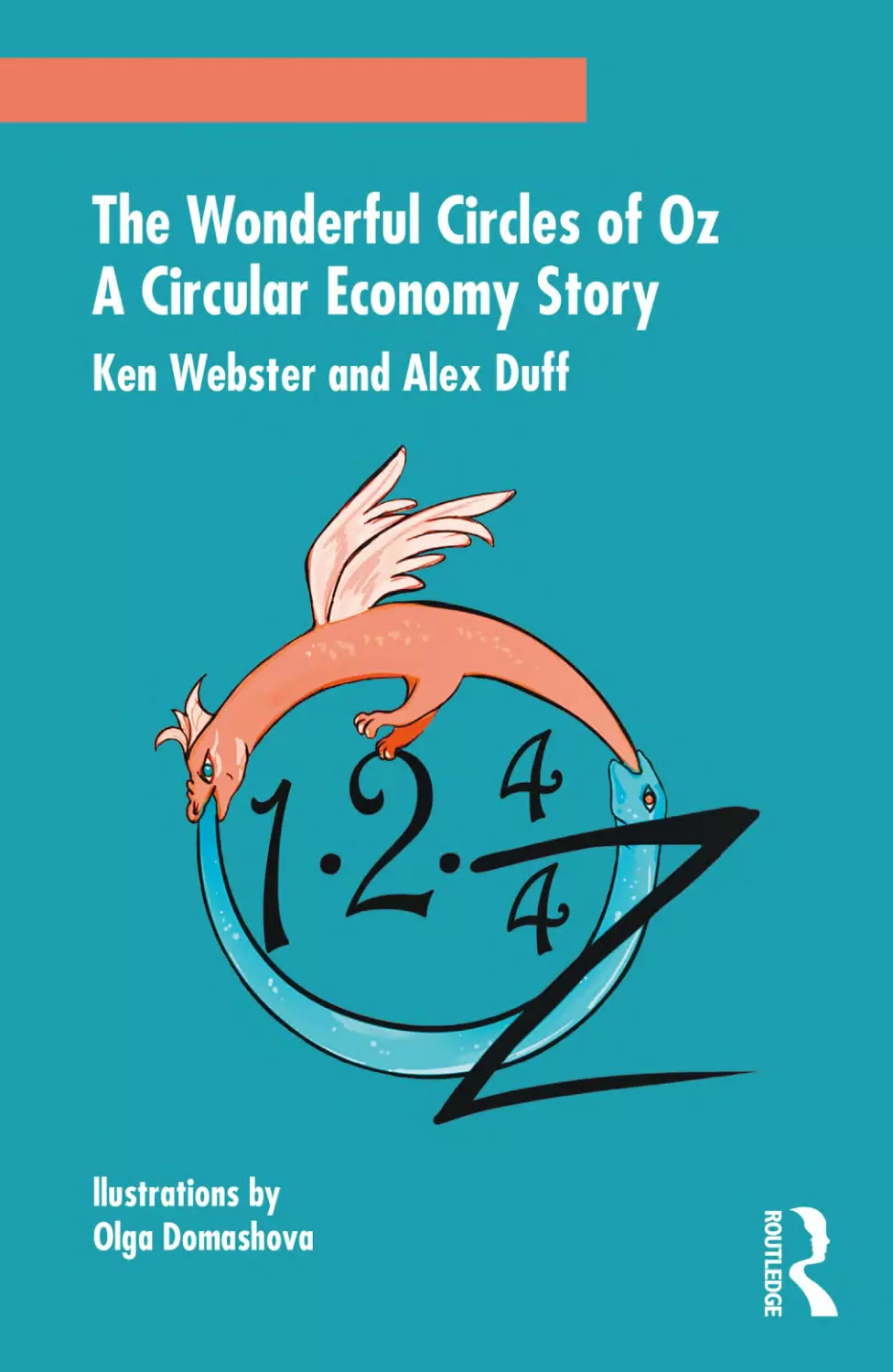
The Wonderful
Circles of Oz
With the world’s economies impacted by coronavirus, billions
are feeling social, environmental, and economic injustices. The
call for a new, more just, more distributive economic story and
system is louder and more urgent than ever. The Wonderful
Circles of Oz provides both the framework and solutions for
navigating towards an effective circular economy – the gateway
to an abundant, autonomous, and democratic future.
Widely regarded as one of the world’s most engaging circular
economy thought leaders, Ken Webster, together with creative
writer, Alex Duff, use a storytelling approach based on The
Wonderful Wizard of Oz to offer a new, accessible, and compelling narrative about the future direction of our economy.
‘The harder you work, the more you’ll improve your lot.’
That’s the simple story we’ve been sold over the last 40 years to
justify how today’s economy works. Yet extreme inequality, the
devastation of our natural world, and the erosion of our communities tell us this economic story resembles a work of fiction
and the way our extractive economy operates is not fit for purpose. Still a restoration narrative, a satisfying story about our
future and how we’ll get there, is slow to emerge. Using allegory,
commentary, and reflection, this book helps speed the shift
from an extractive economy of materials, energy, and finance to
one based on an effective circular economy, which builds wealth
as a stock of solutions accessible to all.
The Wonderful Circles of Oz goes beyond tired debates (capital vs labour and market vs state) and blends fiction and non to
effectively communicate the need for macro-economic system
redesign. Exploring complex change and containing echoes of
modern monetary theory, this book is a must for business professionals, students, and anyone with an interest in the circular
economy.
Ken Webster is a highly regarded circular economy thought
leader. He is credited with setting the intellectual direction for
what would become the influential Ellen MacArthur Foundation, where he was Head of Innovation from 2010 to 2018. Dame
Ellen (in her autobiography) and others credit Ken with reframing the circular economy concept and enabling the traction it
has achieved today. He is a Visiting Fellow at Cranfield University. Ken is a regular contributor and speaker at conferences and
seminars around the world and is a Fellow of the Royal Society
of Arts.
Alex Duff is an accomplished communicator who helps international leaders creatively turn the complex into compelling. Be
they written or spoken, the stories, scripts, and soundbites she’s
sculpted over the years have been seen and heard on an international stage. She is particularly interested in how fiction can
help make abstract topics more accessible so important issues
become mainstream.
“This book is a breath-taking journey into intellectual allegories
and metaphors of a powerful story… In an era of increasing inequalities, social anxieties and neo-materialism, we need more
than ever a story to feed our imagination, a journey to discover
sustainable futures, where ideas are the key currency.”
Stefano Pascucci, Professor in
Sustainability and Circular Economy, &
Head of Sustainable Futures, University
of Exeter Business School
“In these days of a dominance of audio-visual information, the
skill of storytelling is one of the keys to get listeners’ and readers’ attention. By spinning "the golden thread of ‘digitally connected systems’ to transform our economy" in this book, Ken
and Alex prove they are masters in this domain.”
Walter Stahel, Visiting Professor, University of Surrey, & Full Member of the
Club of Rome
“Just as The Wizard of Oz was an allegory critiquing the Gold
Standard, The Wonderful Circles of Oz allegorically introduces us to the actual ways in which money is created, and how
they might be harnessed to enable us to create a sustainable
economy.”
Steve Keen, Honorary Professor, UCL, &
Distinguished Research Fellow, Institute
for Strategy, Resilience and Security
“There is an ongoing debate on resource efficiency in most regions of the world, notably in Europe. Moving from a linear to
a circular production model is a primary objective. But to do
that the economic policy framework – if not the economic model
itself – has to be changed. The incentives structure of today is
flawed and for circularity to happen the policy frameworks have
to be re-thought. The Wonderful Circles of Oz presents a most
appealing new narrative which covers the economy as a whole –
income distribution, taxation, the right of property owners,
debt issues, production and consumption systems, financial
system, the digital society and its pros and cons... All in all a
very compelling narrative and much needed as inspiration for
people around the world who look for solutions to the sustainability dilemma(s).”
Anders Wijkman, Honorary President,
Club of Rome
The Wonderful
Circles of Oz
A Circular Economy Story
Ken Webster and
Alex Duff
Cover image: Olga Domashova
Illustrations: Olga Domashova
First published 2023
by Routledge
4 Park Square, Milton Park, Abingdon, Oxon OX14 4RN
and by Routledge
605 Third Avenue, New York, NY 10158
Routledge is an imprint of the Taylor & Francis Group, an informa business
© 2023 Ken Webster and Alex Duff
The right of Ken Webster and Alex Duff to be identified as authors of this work has been
asserted in accordance with sections 77 and 78 of the Copyright, Designs and Patents
Act 1988.
All rights reserved. No part of this book may be reprinted or reproduced or utilised in
any form or by any electronic, mechanical, or other means, now known or hereafter
invented, including photocopying and recording, or in any information storage or
retrieval system, without permission in writing from the publishers.
Trademark notice: Product or corporate names may be trademarks or registered
trademarks, and are used only for identification and explanation without intent to
infringe.
British Library Cataloguing-in-Publication Data
A catalogue record for this book is available from the British Library
Library of Congress Cataloging-in-Publication Data
Names: Webster, Ken, 1955- author. | Duff, Alex, 1971- author.
Title: The wonderful circles of Oz : a circular economy story / Ken Webster
and Alex Duff.
Description: Abingdon, Oxon ; New York, NY : Routledge, 2022. | Includes
bibliographical references.
Identifiers: LCCN 2022002622 (print) | LCCN 2022002623 (ebook) | ISBN
9781032109077 (hardback) | ISBN 9781032109107 (paperback) | ISBN
9781003217657 (ebook)
Subjects: LCSH: Sustainable development. | Waste minimization—Economic
aspects. | Recycling (Waste, etc.)—Economic aspects. | Environmental
economics. | Economics.
Classification: LCC HC79.E5 W438 2022 (print) | LCC HC79.E5 (ebook) | DDC
338.9/27—dc23/eng/20220126
LC record available at https://lccn.loc.gov/2022002622
LC ebook record available at https://lccn.loc.gov/2022002623
ISBN: 978-1-032-10907-7 (hbk)
ISBN: 978-1-032-10910-7 (pbk)
ISBN: 978-1-003-21765-7 (ebk)
DOI: 10.4324/9781003217657
Typeset in Georgia
by codeMantra
Contents
About the authors
Acknowledgements
Welcome from the authors
PART ONE – A fictional world.
Rewriting the allegory
xi
xiii
1
9
1 Weathering extremities
11
2 From poor to paws
14
3 From straw for brains to
wise owls
17
4 Heartless: If only AI had EI
23
5 Making the lion’s share enough to go around
27
6 Locked in the past
34
7 Technological wizardry or trickery?
38
viii
Contents
8 The wonderful Emerald City
45
9 The magical festival of urban food
52
10 The nightmare of Oz the Terrible
57
11 Meeting the wonderful Wizard of Oz
60
12 Back home
74
13 Chasing rainbows
78
14 Official correspondence of The Wizard’s
Office, Oz
80
PART TWO – A real-world framework.
An imaginary for the 21st century.
Updated version based on the Wizard’s
working guide. Drafted back in Exeter
by (Dorie), Ken, & Alex
83
15 An introduction to this ‘Imaginary for
today’s real world’ from Ken & Alex
85
16 An overview: The Wonderful Circles of Oz
framework and sigil for resetting the rules
of the game
87
17 Today’s economic narrative
95
18 Worldview pre-science
99
19 Shifting the metaphor: From machine to
metabolism
105
Contents
ix
20 The productive cycle: Four rules for
materials to flow not fail our economy
114
21 Uncovering the big players: Active but
hidden in plain sight
120
22 The gatekept cycle: Four rules for money to
circulate not clot our economy
133
23 The liberation and terrors of a digital world
150
24 A flourishing democracy – the path to a
flourishing economy
165
PART THREE – A ‘golden’ path
between the fiction, the framework,
and real-world applications
173
25 Story as a strategy for sharing real world
complex ideas
175
26 Weathering extremities – real world themes
177
27 From poor to paws – real world themes
180
28 From straw for brains to wise owls – real
world themes
182
29 Heartless: If only AI had EI – real
world themes
185
30 Making the lion’s share enough to go
around – real-world themes
188
x
Contents
31 Locked in the past – real world themes
192
32 Technological wizardry or trickery – real
world themes
194
33 The wonderful Emerald City – real
world themes
196
34 The magical festival of urban food – real
world themes
199
35 The nightmare of Oz the Terrible – real
world themes
202
36 Meeting the wonderful Wizard of Oz – real
world themes
205
37 Back home and Chasing rainbows – real
world themes
210
Afterword from the authors
211
About the authors
Ken Webster and Alex Duff
Ken Webster is a thought leader in
the circular economy. He is credited
with setting the intellectual direction
for what would become the influential Ellen MacArthur Foundation,
where he worked as Head of Innovation from 2010 to 2018. After a twoyear spell at Exeter University, Ken is
now Director of the academically orientated International Society
for Circular Economy (IS4CE). He is a Visiting Fellow at Cranfield University, as well as a regular contributor and sought-after
speaker at conferences and seminars around the world. Ken is
the author of two previous books on this subject – The Circular
Economy: A Wealth of Flows (2nd edition 2017) and Sense and
Sustainability: Educating for a Circular Economy, with Craig
Johnson (2009). Most recently, Ken has accepted an invitation to
join the 21st Century Transformational Economics Commission,
part of the Earth4All initiative from the Club of Rome, the Potsdam Institute for Climate Impact Research and partners.
@CircularEconKen
xii About the authors
Alex Duff is an accomplished communicator who helps international leaders
creatively turn the complex into compelling. Be they written or spoken, the
stories, scripts, and soundbites she’s
sculpted over the years have been seen
and heard on an international stage. She
is particularly interested in how fiction
can help make abstract topics more accessible so important issues become
mainstream. It was Ken who sparked Alex’s interest in the Circular Economy. The pair met near-on a decade ago, as he embarked on his mission to help frame and establish The Ellen
MacArthur Foundation. His innovative thinking (and patience)
continues to inspire her and is what led to their collaboration for
this book. Alex is the founder of ‘not A Duff word’.
@notADuffword
Acknowledgements
With special thanks to Mark Blyth, Steve Keen, Walter R. Stahel, Anders Wijkman, and Alexa Culver for their wise counsel,
which (among many things) led to the inclusion of the book’s
third part.
Thanks especially to the talented Olga Domashova who beautifully illustrated this book and was a pleasure to work with.
To Christina Templeton, Caroline Walker, and Dr Paul Rogers –
thank you for your keen eyes that helped prepare the manuscript
in its final stages.
With particular thanks to Craig Johnson for allowing us to
draw on the Imaginary and the 1.2.4/4 framework in the book
Craig and Ken are co-authoring on food systems ABC&D How
to create a regenerative circular economy for all, published by
TerraPreta.
And last but by no means least, thanks to Rebecca Marsh for
immediately ‘getting’ our vision for the book and to the Routledge team for enabling us to make that vision a reality.
Welcome from
the authors
This book is based on rewriting the allegory which reputedly
underpinned L Frank Baum’s book The Wonderful Wizard of
Oz, published in 1900.
Hugh Rockoff, a distinguished Professor of monetary history at
Rutgers, is one of several writers who claimed Baum was writing
about his times and the unfair and debilitating consequences of
running the US economy based on a gold standard – the commodity-base that controlled the stock of money (Rockoff, 1990).
•
•
•
Oz = ounce (of gold),
The yellow brick road = alluding to gold,
Dorothy’s silver slippers = silver bullion – the additional
money-base opponents of the gold standard demanded.
(Dorothy’s slippers in Baum’s book are silver, they were
changed for visual effect in 1939 for the movie).
And it goes on, with Baum drawing on the rural workforce,
represented by the Scarecrow, and industrial workers, represented by the Tin Woodman. But seemingly these parallels –
the text is littered with them – have run into the darkness of the
unconscious.
Even though Baum never claimed, or even hinted, that this
side to his original The Wonderful Wizard of Oz was there, both
the story and the claims of allegory and metaphor endure.
Baum’s time, the 1890s, was an era of extreme inequality and
populist resentment. Writers like Mark Twain call this period
DOI: 10.4324/9781003217657-1
2
Welcome from the authors
the ‘Gilded Age’, referring to its superficial splendours and its
deep poverty. The ‘Progressive Era’ followed with a different
kind of narrative – a swing of the pendulum in the other direction. In some ways, we are in a new ‘Gilded Age’. What dominates
the 21st century, our age of digital finance, asset inflation, and
private debt, are its scions of inequality, stagnant wages, and
precariousness. While today’s ‘Gilded Age’ has evolved beyond
commodity money (based on those physical goods that hold intrinsic value) to the immaterial, how we build wealth, and who
benefits has not evolved and begs for a systemic fix.
In our imagination, ordinary characters are on a bewildering
journey to try and reach the Emerald City and find a better understanding. Surely, some Wizard can make it all come right, to help
find a way home? Except that what is behind the screen concealing the Wizard might again be much less than it deserves to be.
Our hope is that using allegory can again reveal and preserve
ideas relevant to our own times, our new Gilded Age. And, when
we are ready, we can reinvent or coalesce around a new Progressive Era.
There is power in metaphor. We ask: What is this experience
or idea like? We know from cognitive science that almost all our
abstract thought is deeply metaphorical. In times of transformation, there is a need to contrast the falling away of the metaphors
used in the past with something new. In allegory, where the narrative is the vehicle rather than an image, this process unfolds
on a few levels – the obvious and the symbolic, and through this
into deeper reflections on the human condition. In search of a
different worldview, of seeing where we are now through different eyes, we can take a journey outward and back to ourselves.
As T.S. Eliot (1943/2001) wrote in Little Gidding: “We shall not
cease from exploration, and the end of all our exploring will be
to arrive where we started and know the place for the first time.”
In the contemporary world, it might be possible to find the right
images to convey something about what has been changing the
way we perceive the past, present, and future.
We are no longer in a world of crude mechanisms and sheet
metal, where images of clockworks, bureaucratic hierarchies,
Welcome from the authors
3
demarcated jobs, and the factory whistle are all part of an industrial society. It is digitally networked, fluid connections and interactions that prevail – data flows as much as physical flows. These
networks and flows are complex not just complicated. Increasingly, writers like architect William McDonough take insights
from living systems or use the lens of biological metabolism as
a springboard rather than the physics of machines (McDonough,
2021). This has been underway for decades, but change is slow.
Imagine then, a forest and beneath it an expanding, frequently self-learning collection of networks as the strands of
mycelium (the vegetative part of a fungus), undoing and reordering all it touches. In an exact parallel to the internet, it connects beneath the forest floor to provide minerals to the trees in
return for sugars. A kind of ‘wood-wide-web’ (Wohlleben, 2016).
Put more simply, digital might be a golden thread, that over time
becomes woven into the fabric of our times, just as mycelium is
in healthy soils. The dying dominance of the old machines and
materials order gives way to digitally connected systems. These
started just after the Second World War with the first computers
and continue today with our worldwide access to knowledge and
each other.
Our new resource is digital information. It is not just connective but creative. The more we have, the more possibilities we
have. Information reshapes the physical relationships of production, consumption, and exchange – as well as our knowledge
space.
If digital resources and tools do not end up primarily as a
means of surveillance, population control, or new extractive
monopolies, digital can bring the coming Age more autonomy,
freedom, and choice about collaboration and association. This is
something of a subtext in our Wonderful Circles of Oz narrative
and its economic framework, developed in our accompanying
companion essay, The Imaginary.
We see there being three critical strands to the golden thread
of ‘digitally connected systems’ for transforming our economy.
First, it offers the potential for cheaper tools as well as competitive and collaborative, low-cost social production. It is possible to
4
Welcome from the authors
competitively move to a smaller scale production and consumption
model (regional or local), and directly connect with customers cutting out the traditional intermediary from virtual transactions.
Second, digital enables true cost transparency. Materials
markers and Artificial Intelligence (AI) enable the monitoring and tracking of products, components, and materials. We
can now identify the real costs and extended responsibilities
of production and raise fees or charges accordingly. This helps
shape markets away from polluting activities and exploitative
relationships as their full costs are factored in. We can then fully
value renewables, including people, for their positive contribution, so taxation shifts from wages and consumption, towards
non-renewables and waste.
Data resources, contributed to by everyone, are a dividend
source as much as traditional land, mineral, and energy resources.
A person’s data is their property. As early as the 1960s, economist
Kenneth Boulding suggested: ‘An economy is knowledge, energy
and materials, with the greatest being knowledge’ (Boulding,
1966). Little wonder our digital resources and the knowledge they
bring are termed ‘the new oil’.
Third, in a changed world, where traditional work and wages
are no longer our central axis (climate disruption, inequality,
and alienation are), digital, through AI and the automation of all
repetitive tasks, has the potential to both increase productivity
and retire this kind of work from humans.
From a distribution angle, this is not only about goods and
services. A digital infrastructure can easily identify and distribute a basic dividend through digital accounts held at a central
bank. A basic dividend that becomes a reality through, among
other things, a shift in taxes or fees payable from a myriad of
sources – a ‘carbon dividend’ (Citizen’s Climate Lobby, 2021)
and other polluting activities that damage our environment, or
a share of the ‘common-wealth’ which has been enclosed and its
benefits privately captured. Proposals for a digital dividend are
an example (DDP, 2021; FTI, 2021).
Everyone, then, gets a dividend, a share of this income raised,
to recognise their share in wealth creation or to enable and reward
Welcome from the authors
5
low impact living or to acknowledge that the infrastructure we all
enjoy is part of our endowment. Damping down on the earnings
from non-renewables (including non-productive existing assets)
brings a productive economy back to the fore.
This is part of an ancient, and seemingly endless, tussle over
which is more important – the rights of property to charge for or
deny access (enclosure), or the rights of people to meet their own
needs from what is common to all. This was the essence of the
debate between feudal and mercantile, and in democratic states,
between unearned income (rent seeking) and industry (the power
to extract wealth versus the need to create wealth and circulate
it). It may also be at the heart of our current political malaise if
capitalism no longer gets its moral authority from democracy.
To unpack this a little further, it was okay in the industrial era
to make profits, interest, and rents because the social contract,
framed by democratic overview, was that there were mutual
benefits to some of our common inheritance being enclosed for
exploitation. But, in our world of seemingly growing inequality,
the abandonment of mutuality is a threat to the social contract.
What end does democracy serve if it only serves the enclosers
and rentiers? If George Cooper is right that essentially ‘capitalism accumulates and democracy distributes’, it is indeed all
about enabling circulation (Cooper, 2014).
In the struggle between extracting rents (unearned income)
versus wealth creation and circulation, the UK economist and
author Jon Kay (2009) also indicates: ‘Almost all the strength of
modern market economies is based on directing entrepreneurial activity from rent seeking into wealth creation.’
This is where strength lies – in the productive economy and
wealth creation, at all scales.
Our current extractive, linear economy has created scarcity
amid plenty, enormous (often toxic) wastes, and substantial unearned incomes. It can teach us about the dangers of the control
over access to the new digital tools and resources, falling into
relatively few hands.
Digital creates the opportunity for so many to live the lives
they choose – lives built on the freedom given by having a basic
6
Welcome from the authors
dividend that removes need. We can all be citizens – willing
participants with the time and space to do and enjoy the human
pursuits we most value.
The Wonderful Circles of Oz is a journey into some of these
ideas and relationships as part of the discussion around the social contract of the future. It strives to contextualise and bring
into sharp relief some of the choices before us. It’s space to think
through perhaps. Like Baum’s original story, it’s enjoyable just as
it is, a story with a moral and a girl… who sells her dog.
References
Boulding, K. E. (1966). The Economics of the Coming Spaceship Earth.
In H. Jarrett (Ed.). Environmental Quality in a Growing Economy,
pp. 3–14. Baltimore, MD: Resources for the Future/Johns Hopkins
University Press. [online]. Available at http://arachnid.biosci.utexas.
edu/courses/THOC/Readings/Boulding_SpaceshipEarth.pdf [Last
accessed 09 May 2021].
Citizen’s Climate Lobby. (2021). The Basics of Carbon Fee and Dividend. [online]. Available at https://citizensclimatelobby.org/basics-carbon-fee-dividend/ [Last accessed 09 May 2021].
Cooper, G. (2014). Economics Is a Broken Science: Dr George Cooper on
His New Book Money, Blood and Revolution. World Finance Videos
[online]. Available at https://www.youtube.com/watch?v=P7XGSfdYyC8 [Last accessed 09 May 2021].
DDP. (2021). Take Control of Your Data. Los Angeles: Data Dividend
Project. [online]. Available at https://www.datadividendproject.
com/ [Last accessed 09 May 2021].
Eliot, T. S. (1943/2001). Little Gidding. In Four quartets. London:
Faber & Faber.
FTI. (2021). Digital Dividends to Fund Basic Universal Income
Plans. The Future Today Institute. [online]. Available at https://
f uturetoday institute.com/trend/digital-div idends-to-f unduniversal-basic-income-plans/ [Last accessed 09 May 2021].
Kay, J. (2009, June 02) The Rationale of the Market Economy: A European Perspective. [online]. Available at https://www.johnkay.
com/2009/06/02/the-rationale- of-the- market- economy-aeuropean-perspective/ [Last accessed 09 May 2021].
Welcome from the authors
7
McDonough, W. (2021). Cradle to Cradle. [online]. Available at https://
mcdonough.com/cradle-to-cradle/ [Last accessed 09 May 2021].
Rockoff, H. (1990). The “Wizard of Oz” as a Monetary Allegory. Journal
of Political Economy, 98(4), 739–760. Available at https://courses.
cit.cornell.edu/econ1120jpw/readme/wizard%20of%20oz.pdf Last
accessed 09 May 2021].
Wohlleben, P. (2016). The Hidden Life of Trees: What They Feel, How
They Communicate. Vancouver: Greystone Books. Cited in R. Grant
(2018). Do Trees Talk to Each Other? Smithsonian Magazine, March
2018. [online]. Available at https://www.smithsonianmag.com/science-nature/the-whispering-trees-180968084/ [Last accessed 09
May 2021].
Part one
A fictional world.
Rewriting the allegory
`
1
Weathering
extremities
The dairy farm where Dorie lived with her Aunt E was in dire
trouble. They’d taken more cows, more machinery, more debt –
they could make more milk but, no matter how hard they tried,
they just couldn’t seem to make more money.
Caving into her aunt’s constant pestering, Dorie had
begrudgingly taken a supermarket job where she scanned
and sold milk for less than it cost her and Aunt E to produce
it. In Dorie’s mind, the job was a waste of time. The store, on
the outskirts of Exeter City, was inconvenient to reach from
their semi-rural farm, with shifts ill-timed and sporadic.
Dorie was convinced helping Aunt E on their farm would be a
much better use of her time.
The infrequent bus service had dropped Dorie on the main
road. She walked back towards home along the seemingly
never-ending dirt track, surrounded by fields of endless monocultures. It hadn’t rained in over a month and the heat was
oppressive – as was the stench that seeped from their troubled
farm. Her arms ached from carrying bags crammed with food
shopping. As she squinted against the sun towards their decaying farmhouse, Dorie saw a fat black Range Rover coming from
it. It gained speed showering her in a cloud of dust as it passed.
“Arse,” Dorie half spat, half coughed after it, her open mouth
filled with dirt. She was still blinking dust from her dry eyes
when she reached the courtyard to be greeted by Toto. The faded
black dog was too old now to leap and dance around, as he once
had, but he was always delighted to see her, and his tail still
DOI: 10.4324/9781003217657-3
12 Rewriting the allegory
wagged excitedly whenever she returned. His unconditional and
joyous display of love had never waned, and it made her smile.
Her smile faded though as she stepped into the gloomy
kitchen. Even with the windows and doors open, the house always seemed starved of light. Everything looked as neat as always, in its clumsily arranged, piled-high kind of way – but Dorie
had known immediately something was wrong. The trouble was
Aunt E, in her favourite fading pink day dress, was slouching at
the wonky rustic table, her back to the door. Her elbows rested
on the table, her dry, ageing hands holding up her head of wispy,
greying hair. And this was the problem. Aunt E was seemingly
doing absolutely nothing. Dorie knew no matter how bad things
were or how frequent her aunt’s complaints of constant exhaustion, Aunt E never did nothing.
Dorie plonked two heavy bags of shopping on the table and
some of their contents spewed out.
“Got us some bargains,” Dorie said to her aunt through a
forced smile. She was trying, unsuccessfully, to break her aunt
from stillness and from another of her increasingly frequent
dark moods. If Aunt E heard her niece she didn’t react, her
gaze unwavering. Unsure how best to proceed, Dorie begun
unpacking the shopping. But her aunt’s silence was eerie. She
was quick to temper, not a strong, silent type. So, after only a
few minutes, Dorie placed a hand on her aunt’s shoulder.
“Aunt E, you okay?” she said softly, gently shaking her as if to
wake her from sleep.
“We’ve lost it,” she almost whispered. “They’re going to take
the farm Dorie.”
***
There was nothing to be heard except the occasional slurp of tea
that Dorie and Aunt E drank from chipped mugs as they sat at
the table opposite each other. Dorie thought but didn’t say: ‘Why
would anyone want to take a farm that couldn’t make money?’
What did that mean for them?’ Somehow, she didn’t think now
was the time for such questions. But Dorie couldn’t think of
Weathering extremities
13
anything comforting to say, so the pair continued slowly sipping
their steaming, sweet tea in silence.
A strong gust of wind blew through the farmhouse, slamming
shut the rotting wooden-framed kitchen window. The noise
made Aunt E jump and drop her mug. It bounced off the table
and shattered against the flagstone floor. Startled by the commotion, Toto leapt from where he had been snoozing under the
table and ran into the courtyard. Dorie hurried to the window
and secured the latch, relieved to see the pane still intact. She
peered out of it and saw what had become a threatening sky.
“Wow, what’s going on?” Dorie said aloud but mainly to herself. “That wind’s really picked up.”
She turned the radio on to hear the newsreader say: ‘After the
driest year on record and following weeks of relentless heat, a
tornado is heading through the county. On the leading edge of
a cold front, it’s expected to bring much needed rain, although
this will possibly be torrential in places. The Government’s advice is to get indoors and seek shelter in the lowest level of your
home. Keep away from all windows. And keep your pets tied up
or crated.’
“Toto,” Dorie yelled. She ran into the courtyard to find the
little dog frightened and disorientated, howling and jumping
around. As she scooped Toto into her arms the tornado’s circular and powerful force hit the farm. A gust of wind knocked
Dorie off her feet and she fell to the ground. Everything around
her dissolved into chaos. Then there was nothing.
2
From poor to paws
Dorie wakes to find Toto licking her face.
“Yuck,” she says pushing him away and brushing the drool from
her cheek with the back of her hand. Sitting herself upright, she
exclaims: “Ow.”
“Heavy night was it?” says a bemused voice behind her.
Startled, Dorie clambers to her feet. “No,” she says, “I was
swept up in a tornado, fell from the sky and hit my head.”
“Ah ha,” says a plain greying lady in a royal blue trouser suit,
clearly disbelieving her.
“Where am I?” asks Dorie looking around, slightly startled by
how bright, clean, and green everything seems.
“You’re in Oz,” replies the grey lady. “Where’s home?”
“Exeter, it’s in Devon, do you know it?” Dorie asks.
“No, I’m afraid I’ve never heard of it, but Oz is an amazing
place, you’ll love it here. If you hang around, you might find
you’d prefer to stay.”
“I can’t possibly stay. I’ve got to get home. Aunt E just had
some dreadful news and I really need to get back to her.”
“Well, that’s a shame. I’m the Mayor – the People’s Mayor.”
She labours the word people’s and pauses, like she’s expecting a
reaction from Dorie – perhaps waiting for her to connect with
what she’s just said and all it implies. When the only reaction
she gets is one of puzzlement, she continues: “Then I’m afraid
I can’t help you. If it’s that important to you, you’ll have to go
to the Emerald City and seek out the Great Wizard to help you
get home.”
DOI: 10.4324/9781003217657-4
From poor to paws
15
“The Great Wizard? An Emerald City?” Dorie’s head is still
fuzzy but she’s getting a sense of déjà vu. “Okay,” Dorie continues, “how do I get there?”
“Well, that depends,” replies the grey lady. “How much money
have you got?”
Dorie looks down; she’s wearing leggings and a baggy t-shirt.
It’s her attempt at hiding her growing waistline, which she knows
is a result of all the cheap, unhealthy, food she and Aunt E have
lived on lately. She’d picked the outfit up at the supermarket – it
had been under a fiver, but there are no pockets. “Err, none,”
says Dorie.
“That means you’ll have to walk. It’s quite a distance, it will
take you a few days.”
Dorie gets a spark of recognition. “Let me guess, you are going
to give me a pair of silver slippers and set me on the right path?”
She pauses momentarily. “No not a path, a road paved with yellow bricks?”
The grey lady laughs. “You really did hit your head hard,” she
says. “Why would I do that? Your shoes look perfectly fine to me.
You’re in Oz – we have autonomy here and,” sliding into typical
politician mode, she finishes her sentence with, “you can mostly
choose your own path in life and certainly into the Emerald
City.” Dorie’s unsure how she’s supposed to respond to that, but
it doesn’t matter because the grey lady keeps on talking. “It’s a
long walk though and while our land is plentiful, you’ll need to
buy some supplies before you set off.”
“But I have no money,” says Dorie.
The grey lady looks down at the scruffy, greying dog laying
across Dorie’s feet, then opens her big, black handbag and pulls
out her purse. “We don’t see many of that breed,” she says. “I’ve
got £50.00 here, I’ll give you that for him.”
“Sell Toto?” Dorie says aghast. “I couldn’t do that.”
“Well, it doesn’t look like you’ve got anything else to bargain
with.”
“Can’t you just lend me some money?” says Dorie earnestly.
“I’ll pay you back when I get home.”
16 Rewriting the allegory
“Look Dorie. I love my job and my land. I’m paid a fair wage
for a fair day’s work but I’m not rich and I can’t afford to be dishing out money to every stranger that happens to end up here. If
it makes your decision any easier, the dog will only hold you up
anyway. You’ll be travelling through different lands to get to the
Emerald City and he’ll need a pet passport – I’m guessing you
don’t have one?”
Dorie shakes her head. She looks down to the little mutt at her
feet. She scoops him up in her arms, rubs his head and says: “Be
good boyo. Aunt E and I are broke, we’re losing the farm, you’ll
have happier last years here”. Then, she hands him over to the
grey lady, who puts him in her handbag – his little greying head
poking out of the top. Dorie takes the money and, as she hasn’t any
pockets, tucks the notes into her bra for safe keeping. “I’d better get
going before I change my mind.”
“I understand,” says the grey lady. “There are a few shops just
around the corner where you can get your supplies. Anyone will
be able to point you in the right direction to the Emerald City.”
Then, without another word, the grey lady turns on her low, fat,
black heel and walks away. A small, pathetic whimpering comes
from within her handbag, which swings by her side as she carries Toto away.
3
From straw for
brains to wise owls
Dorie doesn’t feel as bad as you might think, despite finding herself in an unknown place, selling Toto, and having a long walk
ahead. The countryside is beautiful, varied, and plentiful. There
are enormous trees bearing fruit, colourful plants abuzz with
wildlife and lush green hedgerows housing songful birds.
Wearing her comfiest old trainers, and with a new backpack
holding her supplies, Dorie feels good. After walking for some
hours, she needs to rest. She settles on a grassy green bank
alongside a golden cornfield with blood red poppies hugging its
perimeter. The field, set against a perfect blue sky, is complete
with its own scarecrow. It’s rather odd looking, dressed in a
weathered, zip-down, hooded owl onesie. Bored with the silence of having travelled alone for so long she says: “Hello Mr
Scarecrow, fancy joining me for some lunch?” before looking
down to unzip her backpack.
“Don’t mind if I do,” replies the scarecrow, smiling from under his orange-beaked hood.
Alarmed, Dorie asks: “Did you speak?”
“Yes, I did,” replies the scarecrow jumping down from his
post. “You did invite me to remember?”
“Err, of course,” says Dorie still unsure what to make of this.
She’s not scared. He seems so friendly and she’s sure she’s heard
about a talking scarecrow somewhere before but for the life of
her she can’t seem to recall where. She offers him half a triangle
of sandwich, which he takes beaming from ear to ear.
DOI: 10.4324/9781003217657-5
18
Rewriting the allegory
From straw for brains to wise owls
19
“You look too happy to scare off crows,” says Dorie by way of
breaking the ice.
“I’m not here to scare off crows,” says the scarecrow.
“Oh?” says Dorie puzzled.
“No, we have companion planting and other farming methods to keep natural pests away now. See how in this field we
are growing corn, beans, and squash altogether? They each
help the other in some way to reach their full potential and
that helps maximise our harvest.”
“Oh,” is the only response Dorie can muster – not sure if she is
more surprised by the scarecrow’s sales pitch or apparent horticultural knowledge. “But if that works, then why are you here?”
“I’m here to keep the unnatural pests away,” says the scarecrow, his voice quietening to a whisper, “the land vultures”.
Then, as if catching himself, he leans away from Dorie and adds
suspiciously: “You’re not one, are you?”
“No,” says Dorie, slightly offended but with great certainty. “I’m just a lost girl. I’m only passing through on my
way to the Emerald City. You see I’m going to find the Great
Wizard to ask him if he can help get me home.”
The scarecrow frowns, pausing a beat as though debating
whether he should say something. He settles on: “Oh, that’s a
shame. If I’m honest I was secretly hoping you were one. You see
the Wizard made some adjustments and introduced a land value
fee in Oz a few years ago. Since then, I’ve rarely seen anything
resembling a land vulture and it can get a little boring out here
all day on my own. Do you want to see me in scary mode?”
“Err no, probably not, says Dorie. Then, noticing his disappointment, she hurriedly adds: “It’s just, like I already said, you
seem more smart than scary.” The scarecrow warms again at that.
“I’m afraid I don’t really know what a land vulture is or anything
about land value fees so I’m not sure I can help you,” says Dorie.
“People make it sound difficult but it’s not really,” says the
scarecrow. “You see, it used to be that vultures would swoop in
and eat up all the land. Once they got their claws into it, you
couldn’t get them out again. It’s bad enough, having uninvited
visitors but then they’d outstay their welcome, start bossing
20 Rewriting the allegory
everyone around, before going onto charge us to stay here, keeping all the surplus for themselves. It was going on all through
Oz, until the Wizard decided enough was enough. The Wizard
said that because there’s only a limited supply of land, something that’s valuable and belongs to everyone, those fortunate
enough to get some to themselves, should pay an annual fee all
the time they have it. The fee is for them getting private benefit from what’s really a valuable and shared asset. It’s a kind of
compensation for them making that piece of land unavailable as
a shared resource – the fee they pay instead benefits everybody.
Anyway, since it came in, there’s been fewer vultures and things
have seemed much better.”
“It seems fair that something that belongs to everyone, benefits everyone,” says Dorie, “but if the vultures have gone, why do
you stay doing this job?”
“Because Oz is a democracy, and we have to protect it. That
means staying alert - so that’s what I’m doing. Just keeping
my eye on things here to be sure those vultures don’t return.”
Dorie’s unsure how to reply to that. From the way he speaks
she can’t help but wonder if he’s a friend of the Mayor. She’s
heard of citizens being active in community matters back home
but she can’t think of any of her friends who seem as committed
to the cause as this scarecrow. He’s even dressed himself as an
owl to help scare away any vultures that might happen to fly
over. She can’t decide if it’s commendable or committable, which
means it’s probably safer to change the subject.
“I’m from a farm back home,” Dorie tells the scarecrow. “We
only have cows on it though.”
“Just cows?” says the scarecrow surprised. “We have a real
mix of stuff here – cows, chickens, crops. You must be a great
cow farmer to be able to make a living from just the one thing.”
Dorie’s heart sinks at his comment. “Well actually things haven’t been going so well for us lately. I’d be really interested in
seeing what you do here. Do you think you’d be able to take a
break from your field to show me around?”
“I’d love to,” says the scarecrow proudly. “What are we waiting
for?” He jumps softly onto his feet.
From straw for brains to wise owls
21
***
By the time they’ve finished touring the farm, Dorie’s head is
spinning. She’s never seen anything like it.
“Of course, we don’t always get it right,” the scarecrow is
telling her. “These more mixed and regenerative methods
keep us all on our toes, well, for those of us who have toes,”
he half laughs, shaking his straw leg at her. “You can often
be wrong-footed by nature because it’s always evolving. Last
year the weather was particularly cool, and seed corn maggots invaded my field - we lost the lot. It cost us all dearly
but me particularly – I literally got eaten alive and needed
re-stuffing. It was awful but our farming methods mean we’re
never dependent on any one income stream. Crucially, they
keep our soil strong. So, when things go wrong, we have a
solid base from which to work and can just adapt what we do
and try something else.”
They are back at the edge of the scarecrow’s field now. “Thanks
so much for the tour,” Dorie says.
“My pleasure,” says the scarecrow beaming proudly again
at her. “It has cheered up my day but,” he continues, nodding
towards his field with the breath-taking view, “I guess I really
ought to be getting back to my post.”
Dorie senses his hesitation. “Look, I’m going to find the Great
Wizard to ask him to get me home,” she says. “You could come
with me. Perhaps you could ask him about those land vultures
you are watching for – what they look like and whether he thinks
any will be coming back any time soon.”
“Oh no, I couldn’t do that,” says the scarecrow. “What if they
were to return while I was gone? No, it’s kind of you to offer, but
I think I’ll stay put. My days can be a little boring, but I need to
hold my post for a while longer yet - just to be sure. Plus, I love
life here on the farm.”
Dorie can see why. Yet, she senses the story she’s vaguely starting
to recollect isn’t supposed to go this way. She’s sure the scarecrow
is meant to join her on her journey to the Emerald City. Still,
she guesses, his decision is understandable. While he’s confused
22
Rewriting the allegory
about his purpose, he seems happy and life on the farm is good
enough for him.
Dorie bids the scarecrow farewell and continues her journey
alone. A gentle mizzle falls, cooling Dorie’s face and filling her
nostrils with the most wonderful earthy smell. ‘It even smells
better here than home,’ she muses. As she reaches a turn in the
road, she glances back to see the scarecrow has returned to his
post and is scanning the horizon for enemies that will never
come.
4
Heartless
If only AI had EI
DOI: 10.4324/9781003217657-6
24 Rewriting the allegory
Lost in her thoughts, Dorie is enjoying the peacefulness of her
surroundings when a groan breaks the silence. Curious, she steps
off the path and heads towards a small wood. Standing at its
edge, under the shade of an apple tree, she strains to listen. She
hears another groan and walks into the wood’s darkness until she
comes to a clearing. In the middle, she sees what looks like a man,
made entirely of tin. Piles of perfectly separated out metal items –
which look a lot like computer parts – surround him.
A glimpse of a childhood story comes flooding back to Dorie. The surroundings aren’t exactly as she remembers them but
she’s confident – this is the tin woodman and he’s going to need
her help.
“Did you groan?” asks Dorie.
The tin woodman spins around and Dorie jumps back,
surprised by the sudden movement.
“No, I certainly did not,” says the tin woodman. “That’s the
sound the Next Gen 101s make when I take them apart.”
“Okay,” says Dorie, unsure how to respond to that. Then, composing herself, Dorie sticks her hand out by way of introduction
and says, “I’m guessing you are the tin woodman?”
“I am certainly no such thing,” says the tin looking man, seemingly most offended and ignoring her outstretched hand. “I am the
Nexus 209 robot with artificial intelligence capabilities.” She’s just
about to introduce herself but it continues on: “I’m the ultimate in
terms of artificial intelligence advancement. As you can see,” the
robot indicates to the piles of metal stacked high around it, “it has
taken a while to perfect the tech but there’s never been a more
powerful and useful version than me, Nexus 209. Everything that
came before me is now redundant.”
“Oh,” says Dorie. “Is that what you are doing? Breaking up the
old stuff and dumping it out here in the wood to get rid of it?”
“Get rid of it? Why on earth would I do that? No, while they’ve
surpassed their usefulness as robots, there’s still plenty of life
left in their parts. We make everything from the outset for disassembly. It means when this happens,” the robot points to the
piles of old computer parts around it, “we can easily take our
stuff apart and reuse the materials for something else. I’m even
Heartless: if only AI had EI 25
made that way. Although I’ll never suffer this sorry fate thank
goodness.”
“Why not?” asks Dorie.
“Because,” says the robot. “I’m the ultimate upgrade.
There’s never been a more intelligent version, there never will
be, and demand for me and my fellow Nexus 209s has been
unprecedented.”
Dorie frowns, she knows from her smartphone experiences
that this is very unlikely. How can evolution be over she thinks,
but she has the good sense to remain quiet. She feels sorry for this
robot. She assumes someone has programmed it to genuinely
believe it will never become obsolete. She realises the robot is
looking expectantly at her. “Err, unprecedented demand,” she
says, reminding herself of what it was saying. “What’s driving
that then?”
“Well Dorie,” the robot replies, “it’s because I’m so helpful to
humans.”
Dorie is confused, she’s sure she didn’t tell this thing her
name and she’s beginning to get a little creeped out. After all,
she is travelling alone and is in the middle of nowhere. Distractedly trying to remember if she told it her name or not, she asks:
“How is it helpful to humans?”
“In so many ways,” says the robot. “Just look at what I’m doing
here, dismantling all this redundant stuff. That’s such a boring
thing for a human to have to do, now they don’t need to.”
“Yeah, we’ve automated a lot of mundane factory jobs back
home as well,” says Dorie.
“Oh, that’s just one example. We’re using intelligent technologies extensively throughout Oz now. There’s a fellow self-learning
Nexus like me in the Emerald City, working with doctors. It’s
nearly twice as likely to correctly diagnose lung cancer than its
human equivalent.”
“Wow that’s life changing,” says Dorie. But then she starts
to think about it. Self-learning machines that are smarter than
people. Great all the time they’re doing something good, like saving lives, but she’s seen the movies – what’s to stop them going
beyond their remit if they are already smarter than people?
26
Rewriting the allegory
Dorie decides it might be better to keep that thought to herself
as well, so she continues: “Doesn’t everyone here hate you for
taking their jobs?”
“Quite the contrary,” the robot explains. “We give back
precious time to humans. We exist to give them the freedom to
engage in more creative pursuits.”
Dorie frowns again. That sounds unlikely. Surely if artificial
intelligence is replacing so many jobs in Oz, people wouldn’t be
able to afford to engage in ‘more creative pursuits’? Perhaps, she
thinks, this robot is devious. Perhaps it has learnt to lie. Perhaps,
she decides, it would be better to get going. And with that she
says, “I’m sorry but I really need to get going. I’m off to…”
“…See the Great Wizard in the Emerald City?” the robot cuts
in, finishing her sentence.
“How could you know that?” Dorie questions warily.
“Haven’t you been listening to anything I’ve told you Dorie?”
the robot responds. “I’m Nexus 209 – the ultimate artificial
intelligence – designed to help humans with their every need
and move. I, for example, can calculate the probability of someone like you reaching the Emerald City.”
“So, you can take me to the Emerald City then?” Dorie asks,
suddenly more hopeful that this entire encounter might lead to
something useful.
“No,” says the robot in its cold and matter-of-fact tone. “I told
you, Nexus 209 is in great demand and I’m needed here. I’ve
calculated there’s a 98.34% chance you’ll make it to the Emerald
City unaccompanied. Just keep an eye out for those lions and
tiger-headed bears and you should be fine. Your journey just
isn’t a priority for me.”
“Oh,” says Dorie again, trying to be neither offended nor
alarmed. She’s sure, in the story she remembers, the two of
them are supposed to journey onwards together and become
firm friends.
“Best I can do is give you directions for the quickest route into
the Emerald City and provide your estimated arrival time if you
take it,” concludes the robot, which it promptly tells her before
turning back to its work to destroy its lineage.
5
Making the lion’s
share enough to go
around
Dorie is thinking about stopping to rest again when ahead
she sees a lion. He’s in a layby behind a market stall of sorts,
displaying bottles of something. Dorie’s unsure why but she’s
not scared, indeed she’s expecting the lion to be scared at her
approach. She’s surprised to hear him roar out: “Come and
get your courage cider. All made right here with locally grown
organic apples.”
“Mm, that sounds delicious,” replies Dorie: “How much?”
“Three bottles for £10.00,” says the lion.
Given how little money she has this is clearly an extravagance,
but after the day she’s had Dorie just fancies a cold, refreshing
cider. Diving into her bra, she pulls out a note and hands it over.
The lion takes it, replacing the note with his oversized paw to
shake her hand.
“A pleasure doing business with you. I’m William Jennings
Bryan Junior,” he says.
“Gosh, that’s a big name. I’m Dorie,” says Dorie.
“Yes, having to live in the shadow of my grandfather can be
difficult but I’m trying to find my own path,” replies the lion.
Dorie has no idea what he’s talking about. She’s quite sure she’s
never heard of his grandfather – she’d simply meant it was rather
a long name for a lion. Instead, she says: “And your own path is…”
She trails off, raising the inflection in her voice to make it sound
like a question.
“… Community-based entrepreneur,” the lion says finishing
her sentence. “A few years ago, I was a dying breed. Then, the
DOI: 10.4324/9781003217657-7
28
Rewriting the allegory
Making the lion’s share enough 29
Great Wizard introduced a basic dividend in Oz – now instead
of being next on the extinction list local ventures like mine have
been thrown a lifeline.”
Having drunk half the bottle of cider, Dorie is beginning to
feel more confident about admitting her lack of knowledge. “A
basic dividend? Never heard of it. We don’t have that where I live
and I’m from a family farm, so I guess I’m considered a dying
breed. What is it? Try not to make it too complicated though –
this stuff is going straight to my head,” she says, tapping her
finger against the bottle’s neck.
“Don’t worry, there’s nothing complicated about it – you simply get money for being a citizen of Oz. It doesn’t matter who you
are or how much money you have, everyone gets the same. If
you’re rich and you don’t want it you can give it away but, if you
aren’t, you can use it for whatever you want.”
“Free money? For doing nothing?” questions Dorie
disbelievingly.
“Well, you’re supposed to do something productive with it. You
invest it in yourself to create a return for you over time. It provides
a foundation on which to do something courageous. For me, that
was making a real go at this brewing and bottling cider business.
It’s like start-up funding or venture capital, but for individuals.”
“Venture capital for the people – that’s brilliant,” says Dorie,
suppressing a small hiccup and tapping her finger against the
bottle again, which is now nearly empty.
“It really is,” says the lion proudly: “Both the product and the
production. I get surplus organic apples from a nearby orchard.
I employ local people to help me make it. I sell it locally but while
we’ve been chatting,” he pauses and looks down at his smartphone, “I’ve also sold 15 crates online to go further afield. And
look where I’m based – practically in the middle of nowhere.”
“What does it matter where you’re based?” asks Dorie.
“It matters a lot to this community. I’m creating wealth here
and keeping it circulating locally. That’s the best ten quid you’ll
spend today.”
“Really?” says Dorie, unsure of what the lion is getting at.
“You’ve just helped build the wealth of this little community.
How can communities be, well communities, if all a business
30 Rewriting the allegory
does is take money out from those that live there and divert it
to some central point miles away? A community doesn’t create
itself. It needs time, money, and effort to make it flourish. My
business helps keep money recirculating right here.”
“So, you’re more than a local entrepreneur,” says Dorie,
“you’re creating a localised vortex that sucks in, circulates and
spreads community wealth.”
“Exactly,” says the lion, thrilled that his customer seems to
appreciate his valuable contribution and to have grasped the
concept’s advantages.
“Then, why would you worry about living in the shadow of
your grandfather? I can’t imagine him being anything other
than impressed with your achievements.”
“I don’t think so,” responds the lion, hanging his head in what
Dorie thinks resembles shame. “I don’t think one of the greatest
political visionaries would be proud of my choice of venture.”
“Why not?” Dorie asks.
“Because his work about the importance of having enough
money flowing in society remains unfinished. You see if there’s
not enough cash in the system it hampers exchange. That hampers business, which hampers prosperity, and that’s not good
for anyone.”
“Hmm, so you not only carry his name, but feel you also carry
a responsibility to finish his work?” says Dorie.
“It feels more like a burden than a responsibility,” replies
the lion, then adds: “Local businesses keep money circulating
locally and working it hard to become a community force for
good. But cash certainly seems to be getting harder to come by
out here. That’s why I’ve taken my grandfather’s work a step
further, putting more money into our local economy by introducing these tokens… See?” The lion reaches down to the table
and picks up a metallic coin embossed around the outer edge
with: ‘Courageous community coinage’ and a value of ‘1sPence’
stated clearly in the middle. On the flip side is a slogan: ‘‘If you
want apples you have to shake the tree”.
“You introduced your own local currency?” asks Dorie,
surprised.
Making the lion’s share enough 31
“Well yes, to complement the national one,” says the lion. “Just
swapping one for the other doesn’t add any spending power,
which defeats the whole point – so there’s extra spending power
here. Just as there’s room in the market for locally, nationally, or
globally produced cider, you can do money on different scales.
These coins are actually made from my cider’s recycled steel
bottle tops.”
“And people use them?” Dorie is astonished.
“Of course,” says the lion, surprised by her surprise. “I’m a respected figure in this community. My family has long-standing.
People here trust me and that extends to these tokens. I mean,
don’t get me wrong, people aren’t just trusting in them because
of my family’s name – they are backed by my savings – but trust
matters because people want to know the tokens are worth
something. Once that confidence is there though, what you’ve
created is additional spending power.”
“I just don’t get it – how?” says Dorie frowning.
“Okay think about it like this. If you’d rocked up here today
without any cash, what could you have bought from me?”
“Nothing,” says Dorie.
“Exactly. You wouldn’t have been able to buy my cider. Which
means you’d be thirsty, and I’d be £10 down. That’s a tenner I
can’t now spend myself or invest in bettering my business and
neither can the next person I’d have spent that tenner with.”
“Yes, I get that bit but how do the tokens help?” says Dorie.
“Yesterday there was no £10.00 and no tokens. I can’t control
the availability of money governed centrally or its flow, but today there are these tokens – I’ve created credit. Let’s rerun the
scenario. What’s in your backpack?”
Dorie opens her backpack and says: “Six apples?”
“Excellent! I’m a cider producer, apples are my thing – they’ll
help my business be more productive. I’ll buy those off you in
exchange for two tokens.”
“Okay,” says Dorie. “What do I get for two tokens?”
“One will buy you a bottle of my cider. The other you can
spend as you pass through the village. You must spend your
tokens here though because nobody beyond this community
32 Rewriting the allegory
accepts them. When you exchange them, you set off a chain of
activity that otherwise wouldn’t have happened here.”
“I see. Because I’ve spent this token with you, you can now
also spend it locally and so it goes on,” says Dorie.
“Exactly. But you need money in the system to set things in
motion and you want to keep it circulating – in this instance,
locally. The more these tokens change hands, the more demand
they create and the more community good they do. They’ve certainly helped increase local economic activity here. But therein
lies the problem. I just have this constant nagging feeling that
were my grandfather still here, he’d be asking why I’d settled for
transforming a single community when I could be campaigning
to finish his work and transform all of Oz.”
“Well, what would you have to do to do that?” Dorie asks him.
“Go into politics,” the lion pauses, “and who in their right
mind would want to do that? Plus, everyone would unfavourably
compare me to my grandfather – I’m not known beyond this
community and I’m not a natural public speaker.”
“Nobody’s born a great public speaker, it takes years of practice. I’m sure if your grandad were here, he’d be the first to tell
you that.”
“I’m just not that brave,” says the lion despondently.
Making the lion’s share enough 33
“Look, I don’t know much about politics or public speaking
but I’m off to see the Great Wizard in the Emerald City. I’m going to ask him to get me home. If you come with me, I’m sure
he’ll be able to give you some coaching and confidence to help
you speak up and scale your ideas.”
The lion looks at Dorie in a slightly puzzled way. She thinks
he may be about to say something but seems to change his mind.
“It’s a good plan,” he says eventually. “I’ve often wondered what
it would feel like to acquire the type of fame my grandfather had
in his time.”
“Great, it’s settled then, you’ll come with me,” Dorie says, finally feeling like things are falling into place.
“No, sorry, I just can’t. Honestly, I admire the journey
you are on to find the Wizard and secure what you want but
it just feels like an awful lot of effort, for what might end up
being little return for me. My grandfather had a great idea but,
ultimately, he died without realising it. I guess I’m doing alright.
It may be small scale, but I’ve evolved his thinking and proved
it works. Plus, like you said, I’ve got an important role as a local entrepreneur helping create, circulate, and spread community wealth. Life here is good. I think I’d rather stick with what
I know.”
How disappointing, thinks Dorie. Such a magnificent creature, wasting such a massive opportunity. And she can’t put her
finger on it, but there’s something about everything he’s said.
She’s sure, were he more courageous, the connection he’s made
between a flourishing currency and community would just be
the start. Sad as it is though, Bryan the lion has made his decision, so she politely says her goodbyes and continues her journey alone.
6
Locked in the past
Dorie is weary from walking, but she ups her pace as dusk falls.
Then, she sees it – what can only be the Emerald City, silhouetted
against a burnt red sky. She’s relieved but as she approaches her
relief wanes. Ahead is a huge, locked titanium steel gate blocking her path into the walled city. She pushes and pulls but the
gate doesn’t budge. Set into the gate’s ironwork is a symbol…
That must be a code she thinks but she can’t see a keypad. In
a last ditch attempt she tries, “Open Sesame”.
“Open Sesame,” a masculine voice says mockingly. “Really?
We’re not in Ali Baba and the forty thieves.” A thin looking older
man, wearing a crumpled Emerald Green guard’s uniform, steps
into view.
“I’m the only one who can open the gate,” he says producing
an oversized steel key. “Listen to this.” He pushes the key into
DOI: 10.4324/9781003217657-8
Locked in the past
35
the lock and turns it. The internal mechanism clunks open.
“Sounds beautiful doesn’t it?”
“Err, yes?” says Dorie, not sure what else to say but slightly
underwhelmed by hearing it unlock.
“You won’t hear that anywhere else in the Emerald City. And
they only keep this one for posterity,” says the dishevelled, uniformed man nostalgically.
“Don’t tell me, things are so great here you don’t have to keep
anything locked up?” asks Dorie.
“Don’t be daft,” he replies. “This is a big city. There’s plenty
of crime, we still need locks, it’s just nobody uses the real thing
anymore.”
“The real thing?” questions Dorie.
“Yes, a lock and key like this,” he says, pointing at the oversized
steel key again. “I spent my life as a locksmith. My father and his
father before him were locksmiths but all the tech advances put
me out of business. Nobody wants a traditional lock and key
anymore – it’s all automated now.”
“Oh, I can imagine that’s upsetting,” says Dorie empathetically, albeit a little impatiently. She’s keen to get into the city, not
hear his life story or delusions.
“I took the job to preserve this lock – it’s a very important
part of our heritage you know. I don’t even have to keep the gate
locked but I just love that sound and it reminds me of the good
old days.”
“You don’t need to lock the gate?” questions Dorie. “What are
you supposed to do here then?”
“I’m the gate greeter. I’m here to give a warm welcome to
everyone who arrives at the gateway to the Emerald City,” the
gate greeter says, parodying the corporate speak of his job
description.
Dorie can’t help but think if that’s his role he isn’t particularly good at it. So far, he hasn’t smiled, he’s mocked her and
significantly slowed her journey. “It’s a bit ironic you having
this job isn’t it?” Dorie says instead. “You spent all those years
keeping people out and now here you are in a role designed to
welcome people in?”
36
Rewriting the allegory
“I never thought about it like that,” responds the gate greeter.
“I’ve just made the role my own. I believe it’s the perfect example
of old- meets new- world.”
Dorie raises an eyebrow, but the old man doesn’t seem to
notice. He just continues on: “After I went out of business, I was
lonely at home all day. I took this job to meet people. Then I realised by locking the gate I could have the best of both worlds.
Now I welcome people into the Emerald City AND preserve the
finest lock in the land. It’s actually a very important job.”
It sounds to Dorie that he’s trying to convince himself, rather
than her. She probes a little further: “You didn’t fancy a complete change then? You could have done anything couldn’t you?”
“There’s enough change in this land without me adding to it,”
snaps the gate greeter. Then, his voice softening, he says: “You
know what they say about old dogs and new tricks.”
The phrase leads Dorie’s mind back to Toto. How could
she have left the little mutt to start a new life at his age?
He hadn’t been able to learn many tricks even as a pup.
Dorie suddenly feels sad and tired and is keen to get going
Locked in the past
37
but the old gate greeter is still talking at her in his rather
depressing tone.
“This may not be the city’s best job, but what are my options? I’ve had plenty of time here to contemplate the future
but the longer I think about it, the less sense it makes. Everyone seems to welcome all this change and new technology, but
it has been the ruin of me.”
Dorie can see he’s lost in his thoughts now, so she shifts her
weight, and her movement brings the gate greeter back into the
moment. “Sorry, where were we?” he says.
“Technology,” Dorie replies reluctantly.
“Oh yes. That reminds me, you need to wear this while you are
in the Emerald City and return it before you leave.” He digs into
his inside jacket pocket and, to Dorie’s visible surprise, pulls out
a smartwatch.
As the gate greeter straps it to her wrist the screen lights up
and Dorie’s name flashes across it.
“Why do I need this and how does it know who I am?” Dorie
asks looking at it suspiciously.
“Well, I haven’t a clue how it works. I find all this tech
stuff completely bewildering but Nexus 209 sent an alert that
you were coming and what time you’d likely arrive,” says the
gate greeter matter-of-factly. “I don’t wear one myself but,
apparently,” he stresses the word ‘apparently’ in a sarcastic
way, “this smartwatch helps you get around the city.” Dorie isn’t
convinced but when he explains it’s how the Wizard’s office will
contact her, she reluctantly lowers her arm in acceptance. Meeting the Wizard is, after all, the reason she has travelled so far.
7
Technological
wizardry or
trickery?
It had all been going so well half an hour ago. Dorie had figured
out how to find somewhere to stay on the smartwatch and had
been following directions towards it. But now she’s sure she’s
lost, it’s dark, and she’s tired. ‘It’s not that smart,’ she thinks,
turning into a side street. She takes a few paces into the dark,
narrow alley, attempting to trick the machine into updating its
directions from her new location. She’s so focused on the watch
that she fails to hear something swooping in behind her. Then,
for the second time in a day, Dorie’s world goes black.
***
“Miss, miss. Can you hear me?” Dorie blearily opens her eyes to
find two medics in emerald green uniforms looming over her.
“What happened?” Dorie asks.
“Sit up slowly. You’ve taken a blow to the back of the head,”
says the male medic.
“But I just got here,” says Dorie. This was hardly the welcome
she’d been expecting. No wonder the scarecrow, robot, and lion
hadn’t wanted to join her going into the Emerald City.
The other, female, medic smiles at her. “The good news is
you’re going to be fine,” she says.
“What’s the bad news?” Dorie asks, knowing bad news always
follows someone’s first good news offering.
“You’ve been robbed,” says the male medic.
Dorie looks around her. “Oh no. My bag’s gone?”
DOI: 10.4324/9781003217657-9
Technological wizardry or trickery? 39
“So’s your smartwatch,” continues the male medic. “That’s
most likely what they were after. The bag was just a bonus, taken
in case it contained cash. Thieving monkeys.”
Dorie groans, her head hurting. “How did you find me?”
“Ironically, through your smartwatch. It not only tracks your
location but your health. We knew you were in trouble when
your heart rate elevated and then the watch went dark,” says the
female medic.
“I’m grateful,” says Dorie, “but it feels rather creepy that you
can just track people like that. Where I’m from that would never
be allowed. People would have a fit if they thought the authorities could track their every move.”
“Tech companies had been tracking people for years here
without anyone really understanding what was going on and
without any controls. The Wizard just helped people understand, embraced the technology, and put it to good use. As
you’ve seen it doesn’t stop crime, but it certainly helps response
times,” says the female medic.
“The difficulty is, all that tech in a watch is valuable,” says
the male medic, “and newly arriving visitors are easy pickings
because they have to wear one.”
Dorie can’t help but feel cynical. ‘There’s probably a gang
hacking the tech and tracking people through it,’ she thinks but,
not wanting to sound ungrateful, keeps her thoughts to herself.
“Well, I don’t know what I’m going to do now,” Dorie finally
says. “Virtually everything I had was in that bag.” She tucks her
hand down her top and retrieves the remaining notes from her
bra. “I’ve got thirty quid to my name.”
“Look, I’m getting off shift now,” says the female medic. “I’ve
got a spare room that I let out sometimes to get extra cash in
but it’s empty tonight. Come back and stay at mine. Don’t worry
about the money for now.” She outstretches her hand. “My
name’s Glinda by the way.”
***
It’s mid-morning by the time Dorie wakes. So exhausted was she
last night that she’d barely noticed her surroundings or had the
40
Rewriting the allegory
energy for polite conversation, retiring to her room quickly and
falling into a deep sleep. Now she pulls open the curtains in her
small but comfortable room, she’s surprised to find herself in
the hub of the Emerald City with a fantastic view. ‘I wonder how
she affords an apartment like this as a medic,’ Dorie thinks. The
thought is broken by the amazing smell of bacon wafting through.
It entices her out of her room towards the kitchen where she finds
Glinda busy cooking.
“Good morning, sleepy head,” says Glinda smiling.
“Is it? Still morning?” asks Dorie suppressing a yawn. “I feel
like I’ve been asleep for days.”
“Good. Sleep is still one of the best healers,” says Glinda without a jot of irony. “How are you feeling?”
Dorie instinctively touches the back of her head. “Tender,”
she says, “but remarkably good given my day yesterday. Thanks
for last night.”
Glinda waves away her comment with her hand. “Fancy a
BaKind sarnie?” Glinda says by way of response.
“I’m famished, yes please I’d love one. There’s nothing like
the smell of frying bacon,” says Dorie, automatically taking in a
deep breath to savour the smell.
“Well, it’s not actually bacon.”
“Really?” Dorie lifts the corner of the bread suspiciously to
examine the contents of the sandwich Glinda has put in front
of her.
“Just try it,” says Glinda, watching Dorie closely.
“It’s delicious,” says Dorie taking a bite. “What is it?”
“Believe it or not, it’s plant based – full of protein.”
“Don’t suppose your pig farmers are too happy?” says Dorie
between giant mouthfuls.
Glinda laughs. “There weren’t any left to upset. Livestock
farms had already morphed into industrial-scale factories. Tens
of thousands of animals, born, bred and dead under one cramped
roof. It was like prison for pigs without parole. Needless-to-say,
it wasn’t good for them and, as it turns out, it wasn’t good for us
or the land of Oz either, so the Wizard put a stop to it. Now you’re
hard pushed to find animal meat sold anywhere in Oz.”
Technological wizardry or trickery? 41
Dorie puts her sandwich down in surprise. “The Great Wizard
just told people they couldn’t eat animal meat anymore and they
didn’t? There would be uproar where I come from if you told
people they couldn’t have steak and chips.”
“Don’t be daft! Nobody told people they couldn’t have steak
and chips. The Wizard just created the environment for a
new steak, minus the animals, to become the most attractive
choice for people. It’s classic change theory – build the new,
don’t fight the old – the Wizard understands that. We still have
amazing steak. I’ll take you somewhere tonight so you can see
for yourself, but if it looks the same, smells the same, tastes
the same and is better for you – who cares that it’s plant- not
animal-based?”
“No one… I guess,” says Dorie stuffing the last of her sandwich into her mouth. Her mind is elsewhere now though. Perhaps their dairy farm in Devon really is in trouble this time.
She’s come all this way to find the Wizard so she can get home to
try and save it. She’s never questioned if the farm is beyond or,
even worth, saving.
“Oh, this came for you this morning,” says Glinda, breaking
Dorie’s thoughts.
Dorie opens a small cardboard box and groans. “Another
smartwatch? Really? After what happened yesterday?”
“You’ll be fine, you’re in the heart of the city now. It’s pretty
safe here. Just don’t stray into any more dark and empty alleys.”
“Ah, I was hoping we could spend the day together and you
could show me around,” says Dorie, a little deflated.
“I’d love to, but I’ve got to head back out to work. I get off at
seven so we can meet then,” says Glinda, strapping the watch to
Dorie’s wrist. She presses something and the screen lights up.
“I’ve programmed it with a route around the city – you might
as well see some of it while you wait to see the Wizard. And I’ve
entered the place I’ll meet you for dinner tonight – just click on
it and it will give you directions to get there from wherever you
are – I’ll meet you there around 19:15. Any problems, I’ve put my
number in there too.”
“Okay,” says Dorie, feeling more uplifted again.
42
Rewriting the allegory
“Looks like the Wizard’s office has scheduled a call with you at
midday so maybe take that here and head out afterwards,” suggests Glinda.
“They have?” asks Dorie.
“Yes, but don’t get too excited, it’s probably just to arrange an
appointment for you to meet later in the week. You are welcome
to stay here until then.”
“Thanks, Glinda,” says Dorie. “You go get ready for work; I
can clear up here.”
***
The watch screen lights up and vibrates against Dorie’s arm at
12 noon on the dot. She looks at it and reads ‘Great Wizard’s
Office’. She presses ‘accept’.
“Please hold for the Great Wizard,” she hears an annoyingly
upbeat mechanical sounding voice say. The room gets exceptionally bright as an enormous 3D holographic head is projected
from the watch.
“Wow,” says Dorie jumping back, the giant head leaping back
in tandem with her.
The head smiles. “Surprised by the technology?” it asks, the
lips moving in sync with the words.
“No, well yes, but it’s just that…” Dorie pauses, her face
flushing.
“Go on,” says the talking projected head.
“It’s just, well, I wasn’t expecting the Great Wizard to be a
woman.” Dorie’s cheeks burn more fiercely as she casts her mind
back to everyone she’s met on her journey and how many times
she’s referred to the Wizard as a man.
“Haven’t you realised that things here are different?” says the
Wizard.
“Well yes. On my journey much has seemed familiar, but just
as I think I’m experiencing déjà vu, something’s different, and it
throws me. From the outset, the image in my head for the Great
Wizard of Oz was a little old man, with a bald head and a wrinkled face – not a vibrant and stylish younger woman. Sorry.”
Technological wizardry or trickery? 43
“There’s no need to apologise. But you’d be wise to remember
you don’t have to change everything in a story to get a different
ending. People often think you need a whole new story to bring
about change. But you don’t. You can create something quite different, by changing and introducing a few key elements.”
“I see,” says Dorie, although she’s not sure she does.
“Great. Well as it happens, I’m in the process of exploring the
next of those possible changes for Oz and I was hoping you could
help me?” says the Wizard.
“Err, well okay, if you think I can be useful, but I was rather
hoping you could help me get home?” says Dorie.
“Maybe we could help each other,” responds the Wizard.
“I understand you are planning to go sightseeing in the Emerald
City this afternoon?” Dorie nods. “Do it, enjoy it,” says the Wizard, “but as you explore do so with this question in your mind:
‘Should Oz become a cashless society?’ If you can come to my
office tomorrow afternoon and give me your reflections on that,
then I’ll help you get home.”
“Me? Why would you want my opinion on that? I’m not an
economist. I don’t know anything about Oz or its monetary
system.”
“Maybe not,” says the Wizard, “but you’ll be exploring our city
for the first time so will have fresh eyes. You’ll have an outside
perspective so can be objective. You also don’t live here so you
can be honest with me and, trust me when I tell you this, honesty is valuable to a leader because it is always difficult to find.
And lastly…” The Wizard hesitates, seemingly selecting her next
words carefully. “And lastly, I understand your arrival last night
to our great city wasn’t what we aspire to.”
“I got mugged,” says Dorie glumly, automatically touching the
bruise on the back of her head again.
“Yes, that’s very unfortunate but not necessarily unhelpful for
the purposes of your task,” says the Wizard. “You see we’ve noticed visitors to the Emerald City are often targeted. We think it’s
because they arrive with cash and with their smartwatch – which
is easily converted into cash. You see cash is becoming much less
common in the Emerald City, most people now pay electronically.
44 Rewriting the allegory
Financially it seems to make sense to phase out cash, but these
persistent muggings leave an unanswered question in my mind as
to whether that’s the right thing to do. Then again, maybe if there
were no cash, we’d get rid of some of the crime and vice and so improve the reputation of the Emerald City. I’m just not sure, that’s
why I need your help. If you can help me with this, then I think
I can help you get home.”
Dorie feels a little overwhelmed by the task but, when the
Wizard puts it like that, she can’t see that she has much choice.
“Okay,” says Dorie reluctantly. “I’ll see what I can do but I still
think there are others, much better placed than me, to help you
with this.”
“Great. That’s settled then. You come to my office tomorrow
lunch time with your thoughts and I’ll find a way to get you
home. Sorry to be rude but I’m running late for my next meeting,
so I need to go. I look forward to meeting you in person tomorrow Dorie.” And before Dorie has time to speak, the Wonderful
Woman Wizard of Oz has gone, replaced by the symbol:
8 The wonderful
Emerald City
“And now if you look to your left, you’ll get a great view across
the Emerald City,” the tour guide tells the bus full of tourists.
Dorie isn’t sure but she seems to be the only one from completely
outside Oz.
“Why’s it called the Emerald City?” a young boy asks.
“Because it’s like an emerald – both precious and green,” the
tour guide explains. “This is the greenest city in all of Oz,” he
says with obvious pride. “We’ve got the cleanest air, the least
waste, it’s easy to get around without a car and it’s affordable to
live here.”
“It looks like a maze from here,” another visitor comments.
“Actually, it’s more like clusters of interconnected mazes. Each
is its own community. As more and more come and live here, the
city grows organically. It looks a bit messy when you see it from
here, but this is the result of millions of decisions by those living,
working, and playing here. You’ll see when we get down there
though, each is a hub of activity – somehow it just works. Before we move on, just look to your right.” All heads instinctively
turn in unison to look right. “This is how our great city helps
feed itself. So much food in Oz is destined for its cities – it just
didn’t make sense to keep transporting it all from so far away.
So, we brought some of the growing closer – you’ll find plenty
of these types of smaller local farms circling the outskirts of
this and increasingly Oz’s other cities.” No mention of big farms,
Dorie can’t help but think suspiciously.
As the bus continues onwards, a group of young kids run to
the edge of the field waving as they pass. Dorie waves back.
DOI: 10.4324/9781003217657-10
46
Rewriting the allegory
“Ah, our munchkins,” says the tour guide noticing Dorie’s
wave.
“Your what?” asks Dorie.
“Munchkins. It’s a term of endearment here in Oz for our
youngsters. Schools are now a distributed network of learning
hubs, but personal tutors regularly bring their kids out to these
nearby farms to help them understand how their food grows.
When you see the work involved in growing something, you are
much more respectful of it. Together with some helpful tech,
this hands-on learning is proving highly effective in reducing
how much good food is wasted at home.”
As the bus weaves its way into the hubbub of the Emerald
City, Dorie is dazzled by its brilliancy. The streets are alive
with people walking from place to place, against a backdrop of
interwoven apartments, businesses, and green spaces, all powered by a web of renewable energy systems. She listens as the
tour guide explains how the entire city is designed and built to
cascade energy and materials – to circulate rather than extract
value. It certainly seems to be thriving.
“And this,” says the tour guide, “is where the wonderful Wizard of Oz works.” A towering living wall greets the visitors.
“Wow,” says the younger boy from earlier. “It really is green.”
“Yes,” says the tour guide. “Both inside and out. This living
wall is by far the largest in the city holding 1.5 million plants. It
looks impressive but it’s also cleaning our air. Nature’s inspired
the building’s entire design – we’ve really been re-thinking how
we use and reuse things. Everything is designed to be taken
apart when it is no longer needed and reused to create something else – equally as valuable or close to it.”
“You’re having us on mate, aren’t you?” says a burly guy at
the back of the bus. “I’m a builder and trust me, if the Wizard
decides to relocate this office to where I live in Oz, the far corner
of Quadline Country, there’s no way it’s possible to reuse what
goes into this building when it’s no longer needed.”
“Between imagination, technology and the enabling
frameworks – anything is possible in Oz,” says the tour guide
obviously resorting to his training brief and delivering his
The wonderful Emerald City
47
spiel without a hint of irony. “Today this is the Wizard’s office
building. Tomorrow, as you rightly say, it might not be. But if
that’s understood from the outset, any building, indeed anything, can be designed to be repurposed or taken apart and
used again elsewhere.”
Dorie can tell from the builder’s expression that he’s having
a hard time believing this, but she can’t hang around to see if
he leaves the bus convinced. She’s exactly where she wants to
be now – the place she’ll be meeting the Wizard tomorrow. As
she stands to leave the bus, the tour guide has started talking
about passports, not for people or pets, but for products and
materials. This really is a strange land, she thinks, why would
anyone go to the trouble of issuing passports for inanimate
objects? She doesn’t get to hear why, neither does it occupy her
thoughts for long because she hops off the bus to suss out what’s
around the Wizard’s office.
***
Having been on the tour bus for what feels like an eternity, Dorie
heads around the corner and spots a coffee shop. There’s a homeless girl outside, sitting on the pavement. “Spare any change?”
the girl asks Dorie as she passes to go inside.
“I haven’t got any. I’ll break a note inside and get some for you
on my way out,” she promises the girl.
Dorie orders a tall, extra hot latte and heads to the till to
pay. ‘We are a cashless café,’ states a handwritten note on top of
the till.
“Oh,” says Dorie as the cashier hands her the latte. “I’m sorry,
I didn’t realise you were cashless. This is a bit embarrassing,
but I’m new to the city and don’t have another way to pay – my
watch isn’t set up to make payments.” The cashier snatches the
drink back. “You aren’t going to let me have it?” asks an astonished Dorie. “I can pay but I only have cash.”
“Then you can’t pay,” says the guy behind the till, “we’re a
cashless café,” he says flatly looking past her at the growing
queue. Dorie just stands there looking at him.
48 Rewriting the allegory
The guy behind her has started clicking his tongue impatiently. “I’ll pay for her coffee,” he says.
“Thanks,” says Dorie turning to him with genuine relief and
gratitude.
“I just need to get back to work,” he says dismissively. “And a
double expresso,” he says to the cashier.
The guy behind the till passes Dorie her coffee back and waves
her away.
“Thanks,” she says quietly to no one in particular, as she walks
away and towards an empty chair in the corner of the café.
Each time the door swings open and someone new enters,
Dorie hears the familiar call of ‘spare any change’. Dorie feels for
the homeless girl. She has no change to give her and everyone
else shakes their head, paying on their smartwatch. It’s probably not the best place for the homeless girl to position herself –
hoping for change outside a cashless café. But then, where would
be good to sit if the entire city went cashless?
As she sips her coffee, Dorie remembers a fly-poster, crookedly slapped to the bus shelter, she’d seen on her bus journey
back from work yesterday. It showed a homeless guy sat crossed
legged on the floor, just like this girl now. The difference was,
poster guy held a sign which read: ‘Keep your coins, I want
change.’ The image was so powerful in its simplicity it had stuck
with her. Looking at the scene unfolding here now, Dorie can’t
help but wonder if either would ever be possible.
***
Dorie is hovering just outside a central bustling square. A sign
over the entrance reads: ‘Festival of urban food’. She checks her
smartwatch. She’s in the right place – even if she’s having difficulty believing there can be that much to celebrate as far as
urban food is concerned. She’s also ahead of herself, it’s only
six o’clock. It will be at least another hour before Glinda gets off
work and joins her here.
“You coming in?” says a face Dorie recognises but can’t
place.
The wonderful Emerald City
49
He outstretches his hand. “It’s Matt.” He waits for a glimmer of recognition. Seeing none, he adds: “The medic from last
night.”
“Oh yes, of course. This is serendipitous,” says Dorie.
“Not really,” says medic Matt. “I’ve been working with Glinda
today and we’ve been keeping an eye on your location. I finished
my shift early and when Glinda saw you were already heading
this way, she asked me to come and meet you. I was going to
join you for dinner tonight anyway and as I only live around the
corner…”
“You live right in the heart of the city too?” questions Dorie.
“Being a medic must pay a lot more here than it does where I’m
from.”
“Well, I don’t know about that,” laughs medic Matt, “but the
Wizard has worked her magic on public services and social
housing – I’ve benefited from both.”
“You don’t own your home then?” Dorie asks.
“No,” says medic Matt. “Hardly anyone in the city does. We
had to make a choice – it came down to ownership or affordable access. It started with housing, but it goes way beyond that
now – this city is built on a service model. Do you own your own
home?”
“Yes. No. Well, it’s complicated. But your whole city’s housing
can’t be built on rentals?” Dorie says diverting the conversation
away from her and back to Oz.
“No not all of it, there are exceptions. Some people still own
their own home, but they don’t let you borrow too much now and
hoarding loads of property or land to rent or sell on for inflated
sums, attracts hefty tax penalties.”
“Still some hungry land vultures then,” says Dorie remembering how the scarecrow had described it.
“Ha! Never heard it put like that before but yes. Still, if I’m
being honest, I was pretty against the proposal at the beginning.
I’d always wanted to own my home and make a good load of cash
for when I retired but that was probably a pipe dream anyway
given my career choice. Don’t get me wrong, I still think it would
be amazing to own my own home, you know, not to have to pay
50
Rewriting the allegory
any rent, but now I live in an affordable, comfortable and warm
apartment, right in the heart of the best city in Oz, doing a job
I love.”
“And all it took was a tax change?” says Dorie unconvinced.
“Well, a few actually. It started with land and property but
now the Wizard’s made it unattractive to make money in Oz
from doing nothing – she’s all about promoting productivity.”
“You sound like you work for the Wizard’s marketing team.
What does that mean to people like you and me?” asks Dorie.
“Working to make a positive difference is rewarded. Making
good money through hard work isn’t a problem, but if you go to
sleep tonight and wake up much richer in the morning for having done nothing – that is.”
“The Wizard’s vision is all about giving people access to Oz’s
communal assets and resources to be productive. They provide the means to secure personal prosperity. Access enables
opportunity.”
“That’s why syphoning off communal assets solely for
personal gain or running them out of existence or restricting
productivity is heavily disincentivised.”
“Well, I’m not likely to do anything like that,” says Dorie.
“Exactly,” says medic Matt. “That’s why the Wizard’s been in
office for so long. She’s popular because people here are mostly
like you. She’s shifted taxes and fees to make non-renewables
and unproductive income unattractive. This is a circular city – it
means the focus is on keeping things in circulation. The Wizard
taxes things like financial transactions and un-taxes things that
are productive and renewable, like green energy or people.”
“Hang on a minute. Are you saying you don’t pay tax on what
you earn as a medic?” Dorie asks incredulously but suddenly extremely interested.
“Not a bean,” says Matt smiling. “My work is productive, it
adds value to Oz. The Wizard encourages that by taxing those,
and those things, that don’t do that.”
Dorie is thinking about her supermarket payslip and the
enormous chunk in the right-hand column that’s deducted each
month in tax. She’d be rich if she worked here in Oz. The thought
The wonderful Emerald City
51
of the supermarket leads her mind back to food. She hasn’t eaten
since Glinda fixed her that sandwich this morning and she’s
starving. As though reading her mind medic Matt asks: “Shall
we?” then, linking arms with Dorie, he leads her into the buzzing festival of urban food.
9
The magical festival
of urban food
There is a feast of food stalls, but Matt leads Dorie past them
to an enormous open kitchen. It’s alive with activity. People are
busy sorting, scrubbing, slicing, stirring, simmering, and serving up a wealth of food.
“What is all this? Dorie asks.
“It’s community cuisine,” says medic Matt. “Oz-style home
cooking at its best. You just pitch up and get stuck in. It’s a
place people come together and connect over food. You eat like
a local because it’s made by locals. It started out as a project to
promote sustainable food and reduce food waste but it’s much
more than that now. You’ll often find great chefs here, working
to create recipes with whatever ingredients are available on the
day or running cookery workshops. It’s social change through
gastronomy.”
There he goes again, thinks Dorie, sounding like a TV advert but she’s genuinely impressed by so many people connecting over food. Maybe Matt the medic missed his vocation, he
could have been Matt the marketeer, she thinks. Interrupting
her thoughts medic Matt says, “all we have to do is get stuck in.”
“You mean, in the kitchen? Oh no I couldn’t. I can’t cook,” says
Dorie.
“You can’t cook?” says medic Matt disbelievingly. “I thought
Glinda said you lived on a farm?”
“I did. I do. It’s complicated. It’s a dairy farm so that’s got
nothing to do with cooking, plus we don’t do food like this where
I’m from. I mean, people connect over cooking programmes all
DOI: 10.4324/9781003217657-11
The magical festival of urban food
53
right but most of them are eating their TV dinners as they’re
watching.”
Matt doesn’t say anything and throws her an apron. “You’ve
got to be able to peel a carrot,” he says.
It turns out to be more than a carrot. As they squeeze into the
bustling kitchen a guy with a sack truck wheels in five pallets of
fresh vegetables. Dorie peers at them.
“They’re still dirty,” she says.
“Well of course they are,” says sack truck guy. “They only got
dug out the ground a few hours ago. They’ve come straight from
the farm.” Sack truck guy studies her. “You’re not from round
here are you?”
“You have no idea,” laughs Matt the medic as he splinters off
from Dorie to take a position further down the kitchen. Ignoring
him Dorie asks: “Is all the city’s food locally grown then?”
“No not all but a lot.”
“How though?” Dorie asks. “Where I’m from, there seems
to be this constant battle between global and local. The latter
always seems to lose because it’s too small, too expensive or
both.”
The sack truck guy is nodding as she speaks. “The Emerald
City and all cities in Oz have been expanding. We had to think
about how we were going to feed everyone. And we were wasting so much good food because it was travelling so far. Bringing
some growing and processing closer just made sense. The trouble is, us small producers can’t supply enough to feed everyone,
but when enough of you locally come together to complement
rather than compete against a central system, then it works. It’s
not global versus local, it’s both.”
Dorie is thinking about her job at the supermarket and life
with her Aunt E on their small dairy farm. Could she ever see a
future in which the two could work together harmoniously? The
sack truck guy must see her contemplation because he continues: “Don’t get me wrong, I’m not saying it has been easy. But
Oz’s big cities have enormous power…”
“…Because they are magical,” Dorie says trying to predict the
end of his sentence.
54
Rewriting the allegory
“No, because of the volume of food eaten within them. I know
it seems obvious, but it took us ages to realise we didn’t need
to find a way to deal with loads of food waste if we could stop
it piling up in the first place. We had to fix our food system –
including thinking about food waste in its design. That’s taken
time, collaboration, investment, smart thinking, tech and a
great deal of pressure and patience, but we’ve got multiple food
loops working now, so it’s been worth it.”
“It certainly seems like it,” says Dorie signalling to the buzz
of activity all around her. “So, it’s less about the Emerald City
being a drop off point and more about it being a hub for cultivating, creating and consuming its own food?”
“Exactly,” says the sack truck guy clapping his hands together
excitedly, clearly happy she’s interested and gets it.
“With many local growers and producers, all connected
through platform technology, it’s just easier now to find local
buyers wanting our food or its by-product. We’ve dramatically reduced wasted food and food waste. All the peelings here tonight,
will go back into the food cycle to strengthen the soil. Nothing
gets wasted, it just becomes food for something else. And because
we’re farming this close to the city, people demanded we clean up
our practices – so farms and their food are much healthier too.”
‘Hmm sounds too good to be true. Who pays?’ Dorie wonders.
She thinks she gets it but now sack truck guy has started talking
about by-products and platform technology she thinks it might
be time to politely excuse herself and get on with peeling veg,
which is exactly what she does.
***
Dorie and medic Matt have already perched themselves at an
enormous, communal table with their drinks when Glinda arrives. She’s accompanied by a group of friends who all join them.
“Let me get your dinner Dorie,” says Glinda: “There’s something I really want you to try.”
“Thanks,” says Dorie. “As long as we can eat soon, I’m
starving.”
The magical festival of urban food
55
Glinda comes back five minutes later with two plates of food.
She puts one in front of Dorie.
“Steak and chips,” Dorie laughs.
“Well, FakeSteak but try it,” says Glinda.
Dorie is too hungry to even consider protesting. She cuts into
it. “Oh, my goodness,” gasps Dorie. The table goes quiet and all
eyes fix on Dorie. Prodding it with her knife she says: “It’s bleeding! I thought you said it wasn’t from an animal?”
“It’s not,” says Glinda. “They create that effect with beetroot
juice but it’s pretty realistic right?”
“That’s incredible and it tastes good,” says Dorie through half
a mouthful.
The conversation turns from food towards life in the city more
generally. Dorie quizzes Glinda’s friends about what they do.
Some work for private profit companies but others work for themselves, cooperatives, not for profits, charities and, of course, the
Wizard’s office. They all agree it’s much easier to choose where
they invest their time since being freed up by the basic dividend.
The broad consensus seems to be that life in the Emerald City
is good, but something is nagging away at Dorie. “It can’t be all
great,” she challenges. “I’m here with you tonight because I got
mugged and Glinda and Matt helped me. From what I see, for
all the good, there’s still crime, there’s still homelessness on the
streets.”
“Look, all I can say is this is a big city, it has problems,” says
the guy sitting opposite her. “The Wizard has made lots of
changes, it has made life better but that doesn’t, and never will,
change human behaviour. Mental health issues don’t just disappear; some people reject or simply aren’t capable of embracing
change; others choose to operate in the shadows. At the end of
the day people are still people.”
The girl to his right says: “Well maybe if the Wizard upped the
basic dividend it would help”.
Dorie smiles at that. The guy opposite her isn’t wrong. People are still people she thinks. Even when life is good, human
nature is to want for more. But more of what and why is it the
Wizard who decides how much is enough?
56 Rewriting the allegory
Taking in the wider scene, Dorie spots a group of teenagers
huddled around a stall in the far corner. The stall is teetering on
the edge of the festival, hidden in the shadows. Dorie is curious,
especially since the young crowd are obscuring her view. She
watches them. Most are sporting smartwatches but are digging
into pockets and rucksacks for cash.
“What’s going on over there?” Dorie asks Glinda, who follows
her gaze.
“Err cakes,” Glinda says, her initial embarrassment falling
into a frown.
“They must be good,” says Dorie failing to spot Glinda’s expression. “Look at that queue. Perhaps I could get us all some
for dessert. I’ve got a little cash left.” She pulls the last note from
her bra.
There’s a nervous laugh from the rest of the table.
“They are magic cakes,” says medic Matt.
“Well of course they are,” says Dorie flippantly, “everything in
Oz is magical right?”
Matt the medic realises Dorie has no idea what he’s implying.
“It’s the type of magic that messes with your head,” Matt adds.
“Oh, you really mean magic cakes,” says Dorie embarrassed
at her naivety. “Is that kind of thing legal here then?”
“It’s frowned upon shall we say but not strictly illegal,” says
Glinda.
“Ah, that’s why they are all paying in cash,” says Dorie as what
she is seeing starts to fall into place.
“Well, who wants that sort of activity on their electronic footprint?” asks medic Matt.
‘Who indeed?’ Dorie thinks to herself. And it’s that question,
rather than the festival’s food, that fuels Dorie’s thoughts as the
friends say their goodnights.
10 The nightmare of Oz
the Terrible
Safely back in Glinda’s apartment, Dorie has fallen into a deep
sleep. In her vivid dream, she finds herself in a far-away land,
desperately trying to get home but she can’t. She is frantically
running from place to place trying to get on a bus, a train, a plane –
anything that will take her closer to home. But nobody will let her
on. She tries to pay for a ticket through her smartwatch, but the
ticket machine displays the words ‘citizen rating low, travel denied’. She finds a ticket inspector and offers him cash. He simply shakes his head. ‘We don’t take cash,’ he says in the type of
slow-motion way that can only happen in a dream. ‘Nobody here
takes cash.’
Through the crowded train concourse Dorie spots Glinda. She
rushes over to her. ‘Help me,’ she pleads with Glinda, ‘I must get
home’.
‘You did this to yourself. You destroyed your citizen rating
through your own actions,’ says Glinda harshly. ‘Now you are
stuck here.’
‘But I have to get home. I didn’t realise the cakes were magic.
Buying them was an innocent mistake. I’m only young, I was
naïve. There must be something you can do to help me?’
Glinda looks down at her own smartwatch. ‘I have to go,’ she
says. ‘Just being here with you is draining my own citizen rating.’
She starts to move away but turns back to call over her shoulder:
‘The only thing you can do is go plead your case in front of Oz
the Terrible.’ And then Glinda is lost to the crowd.
In the next moment, Dorie is in a grand court room. It is dark
and oppressive. There is a huge throne like chair on a raised
DOI: 10.4324/9781003217657-12
58
Rewriting the allegory
platform in front of her. The throne is empty but there is a monstrous green head floating above it.
‘I am Oz the Terrible,’ bellows the disapproving head.
There doesn’t seem to be anyone else in the room with them
and Dorie is very scared. The Wizard has an ugly distorted face
with a single black dead eye.
‘I am Dorie’ she says meekly ‘and I need to get home, but I
can’t because there has been a mistake’.
‘Oz the Terrible does not make mistakes,’ booms the enormous green head.
‘Of course not,’ says Dorie. ‘I mean, I made the mistake. I
bought something I shouldn’t have, by accident. I didn’t realise
what I was buying. Anyway, now my smartwatch won’t work. It
won’t let me pay for a ticket to get home.’
‘Let me check your file,’ thunders Oz the Terrible. A mass of
data appears from nowhere. It automatically scrolls at an incredibly fast pace, which the head’s black dead eye scans through.
‘Is that all about me?’ Dorie asks surprised by the wealth of
information Oz the Terrible has already accumulated about her.
‘Quiet!’ bellows the green head making Dorie jump. ‘I collect
this information about everyone because Oz is a special place
and I must keep it that way. Your behaviour is not good. So far
you have often been a hindrance to our society.’
‘I have not,’ Dorie protests angrily. ‘Who are you to say this?’
‘QUIET! No one interrupts Oz the Terrible. You make poor
decisions. It’s been evident from the moment you got here. You
arrived with an alien dog, unaccompanied by the appropriate
paperwork, and then illegally sold it on the black market. On
reaching the Emerald City, you headed down a dark alley. That
led you to needing costly medical assistance. You lost valuable state-owned assets when you had your smartwatch stolen. You’ve purchased the types of goods that hurt, not help,
productive behaviour. It’s all here. This is a permanent digital
footprint on you. There is nothing to be done, your appeal is
denied.’
‘But there must be something I can do. I must get home,’ says
Dorie starting to cry. ‘I love Toto, I didn’t want to sell him. And
The nightmare of Oz the Terrible 59
those other things, they weren’t my fault. Is there someone else
I can appeal to?’
‘Do you dare to question the decision of the Great Oz the
Terrible?’
‘No. I mean, yes. I mean, I must get home. I can’t stay here
stranded.’
‘You must redeem yourself and increase your rating. That is
the only way. Court adjourned.’ The enormous green, monstrous
head of Oz the Terrible disappears.
Alone in the throne room, Dorie starts crying uncontrollably.
It’s hopeless, she thinks. Glinda won’t even speak to her, nobody
is going to help her, she can’t buy anything, she has nowhere to
go and no redress. This is a nightmare she thinks. That means
it can’t be real. Wake up Dorie. WAKE UP.
Dorie opens her eyes to find herself back in Glinda’s spare
room. Glinda’s approaching her bed with a cup of tea.
“I had a dreadful dream,” says Dorie.
“I know, I heard,” says Glinda. “Meeting the Wizard today is
clearly playing on your mind.” She pauses, handing Dorie the
mug. “Word to the wise though. I wouldn’t refer to her as Oz the
Terrible. You want her to help you get home remember?”
Glinda smiles and leaves Dorie alone with her mug of tea and
her thoughts. It was a terrible dream but now she is awake it
seems more like an epiphany. For the first time, Dorie is confident about what she will say to the Wizard in response to her
cashless country challenge.
11 Meeting the
wonderful
Wizard of Oz
Dorie steps across the threshold into the Wizard’s towering office block. It’s much brighter and airier inside than she imagined
it would be, given the enormity of the exterior green wall. The
building has a glass atrium flooding the grand entrance with
natural light, which also reflects off an indoor stream, complete
with fish.
Dorie is nervous and excited as she approaches the visitor’s
area but not so much so that she fails to notice the magnificent mosaic floor. It depicts the Emerald City and prominently features the numbers:
DOI: 10.4324/9781003217657-13
Meeting the wonderful Wizard of Oz 61
These numbers spark a glimmer of recognition within Dorie.
She knows they are familiar but why? It stays just out of her
reach. By the time she’s ushered through the hubbub of people
milling around and into a lift, up to the Wizard’s office, the mosaic floor and its numerical symbol are all but forgotten to her.
“Dorie,” says a welcoming, slender, woman with auburn
bobbed hair in a sharp trouser suit walking towards her with
the support of a cane, “welcome to Oz.”
“Thanks,” says Dorie her voice wavering as her nerves get the
better of her. If the Wizard notices the quiver in her voice, she
doesn’t say anything.
“So how are you enjoying our beautiful land?” the Wizard
asks as the pair wander over to the window to survey the Emerald City sprawling below.
“Compared to where I’m from, I’d have to say Oz is amazing,”
Dorie responds.
“And yet you are here to see me because you are keen to get
home?” the Wizard quizzes her.
“I must. For my Aunt E. You see she has a small dairy farm
and it’s the only life she knows. But things haven’t been going so
well for us lately and I think the bank is foreclosing on the mortgage and she’s going to lose it. She’s always done so much for me,
I really need to get back there. She needs me now.”
“Perfectly understandable and very commendable,” says the
Wizard. “I think I can help you, but I believe we had an agreement –
that you would also help me. So first tell me Dorie, what are your
thoughts about our precious circular city going cashless?”
“Don’t do it,” Dorie blurts out. “What I mean is the evidence I
have is that it would be a profound mistake.”
“You sound pretty sure for someone who this time yesterday
thought they weren’t the best person to help me with my dilemma,” says the Wizard, somewhat surprised by the strength
of Dorie’s conviction.
“I know,” says Dorie, “but you have created something special in Oz and I think if you take cash away it will work against
the strong element of freedom you seem to be creating for your
people. You’ve created this amazing basic dividend which gives
62 Rewriting the allegory
people autonomy but so does cash – you don’t want to give with
one hand and take away with the other.”
“But what has cash to do with freedom?” the Wizard questions.
“Cash is a right to citizenship, it’s foundational to democracy and it’s the economy’s safety net that lets everyone participate. Without it you force everything to become digital,
every transaction trackable. That will exclude too many. Even
if you could find a way to include everyone, they will all have a
permanent, financial-digital footprint. People aren’t perfect,
but cash represents their right to be forgotten. Freedom is being able to spend your money on what you want, when you
want, without worrying that something you buy today will be
held against you tomorrow.”
“But I don’t intend to hold people’s purchases against them
Dorie,” the Wizard says.
“I believe you. Those I’ve spoken to tell me you are a good Wizard, that’s why you’ve been in office so long. But you will not hold
this role forever and what if your successor is less scrupulous?
What if some future Wizard ties together a person’s location from
their smartwatch, with what they see, search for, and say through
their other digital devices, then link this to their financial transactions and bank account information? Together, that information
creates a comprehensive profile. Let’s say your less scrupulous
successor scores every citizen’s profile. With only a digital way to
pay for anything, what would stop them, on a whim, deciding a
person’s score is too poor to access their only digital method of
payment – then what?”
“Hmm,” says the Wizard, “your concerns are valid but fewer and
fewer use cash here, so clearly they aren’t too worried about that.”
“Maybe they don’t yet understand the potential threat. And
right now, we’re discussing a theoretical future with a less
scrupulous Wizard. But what if the joining of those digital dots
weren’t conducted by a Wizard in Oz, holding public office at
all, but by a wicked witch working only for excessive private
profit? Say this witch is already a genius in a land far outside
Oz with a global digital empire. What or who could stop her
shutting down a person’s digital presence here and disrupting
their entire life? She might use all that digital information to
Meeting the wonderful Wizard of Oz 63
manipulate people without them ever knowing – not only to
influence what they buy, but what they believe. She could even
introduce her own rival private digital currency – a global one
– not that difficult once yours has gone digital. You’ll have lost
control. And, when things go wrong and your people seek you
out for help, all your polite pleas and political potions won’t be
powerful enough to conjure her to fly into Oz to sort them out
with you.”
The Wizard’s forehead has developed a deep crease in it from
her worried frown. Dorie can see she thinks her arguments
have merit, so she keeps going, finishing what she wants her
to take away. “Anyway, a downward trend in cash transactions
doesn’t mean everyone has stopped using it,” Dorie thinks
about the technophobic older gatekeeper, the homeless girl, and
the scene at last night’s food festival. “Where I’m from most
people have a car and drive, but I don’t. Hardly anyone uses
the bus but if it weren’t there I couldn’t get to work. A drop in
demand doesn’t make something any less vital to those who
still depend on it. Removing cash is like cutting a public service. Plus, you are the Great Wizard of Oz – of all its lands and
people. I walked through your countryside to get here and the
dwindling amount of cash was already problematic for one rural community – so much so they’d introduced their own complementary community coinage. It seemed to be working pretty
well too, solving the local cash and credit problem, and increasing local spending.”
“That’s very interesting and news to me,” says the Wizard,
“but it doesn’t change the fact that less demand means cash is
becoming more costly to keep in circulation.”
“I get it, cash costs,” says Dorie. “You already know it cost
me personally when I got mugged for it when first arriving in
the Emerald City. I suspect the only reason they didn’t get away
with any is because I had it hidden in my bra. What you don’t
know, and I’m not particularly proud of, is that a lack of cash
also cost me my little dog, Toto. I had to sell him to get some
to enable my journey to the Emerald City. That’s kept me going
since my arrival but here in the city simply buying a coffee with
cash proved difficult.”
64
Rewriting the allegory
The Wizard looks surprised by these revelations but says
nothing.
“Look, my point is,” continues Dorie, “what starts as an idea
about something purely financial, even if it’s philanthropic,
could be manipulated at a later point in time to restrict wider
freedoms. If the price of democracy, autonomy and freedom in
Oz is a little inefficiency and cost - surely it has to be worth it?”
Dorie surprises herself with her words and the passion with
which she says them. Perhaps she’s been in Oz for too long –
she’s seen this advocacy in others she has met here, but this isn’t
something she’s seen in herself until now. The Wizard, however,
seems extremely pleased with her response.
“What I don’t understand though,” Dorie continues, “cash or
cashless, how can you pay for everything you are doing in Oz?
The basic dividend, renewable energy, untaxing human labour,
social housing, affordable rents, investment in the city’s public
services and infrastructure – how is it possible to have such an
amazing country without going bankrupt?”
Meeting the wonderful Wizard of Oz 65
“Come with me,” smiles the Wizard.
The pair walk to the far end of the Wizard’s office. She pulls
back a panel built into the wall. Hidden behind is a heavy sealed
door. The Wizard looks at a security screen, which scans her
face. The door makes a buzzing sound and the Wizard pushes it
open. Dorie feels the chill from the air conditioning in the room
beyond and hears a low hum. At the flick of a switch, bright light
floods the room and Dorie follows the Wizard inside.
“What’s all this?” Dorie asks.
“It’s a data storage centre,” replies the Wizard. “These servers
store and process all the digital information circling through Oz.”
“And what’s so special about that then?” Dorie asks.
“This is where our artificial intelligence is analysing what’s
happening in Oz in real time and creating the money we need
to encourage production. It’s circular; the more productive capacity we have the more credit we can extend to encourage more
production.”
“You are creating money from here?” Dorie questions. “But
how is that possible? You are a politician, not a bank.”
66 Rewriting the allegory
“I’m the highest elected representative responsible for this
land. That means it’s within my gift to determine who creates
the money,” says the Wizard. She carries on, “And money, Dorie, is a public utility. Managing it is like operating any other
public service. In Oz, for a long time, that money management
was outsourced to private banks. But that model simply stopped
working. Money was lent for the wrong things and stopped
circulating – it was being unproductively stockpiled by fewer
and fewer people. That wasn’t good for Oz or its people, it’s not
what money is designed to do. Money must flow. To create prosperity, everything within our economy must be productive –
people, products, property, and pounds. Money especially, must
be used and exchanged to circulate and build prosperity. That
stopped happening under the management of the private banks
and, as Oz has its own currency, there was nothing to stop me
taking back its control and creating whatever money the country
needed.”
“You just took control and started printing your own money?
But what about inflation and price rises?” Dorie says in astonishment. “No disrespect but where I’m from governments aren’t
good at that.”
“Well, it may be their thinking is still back to front. When I took
charge of this beautiful land, I was told I couldn’t spend more than
I raised from taxes or borrowed, which added a burden of interest to the future and wasn’t true. If I manage all the money, I can
produce whatever Oz needs. I know I’m a Wizard, and call me a
humbug if you like, but this isn’t magic, I simply spend into existence the money that’s needed first and tax it back afterwards.
When prices start to rise, I adjust taxes.”
“Look, I’m just an ordinary girl so the workings of money,
even my own, are confusing to me but I think I kind of get it.
What I still don’t understand though is how you can be so generous? Paying a basic dividend, a welfare safety net, investment in
public services – those must cost a lot and yet those I’ve spoken
to here don’t even pay tax on their wages. Regardless of whether
you raise it before or after spending, where on earth do you get
the money to pay for everything?”
Meeting the wonderful Wizard of Oz 67
“That’s like asking where you get inches. You are forgetting Oz
creates and controls its own money. We create whatever we need
and then heavily tax anything undesirable. That’s anything that
prevents productivity or the circulation of wealth, harms our
land, or we need to keep prices steady. But it isn’t just about
what I raise in taxes, it’s also about what I no longer must pay
out,” says the Wizard. She can see Dorie’s attention waning, so
she tries a different tack.
“Let me give you an example,” the Wizard continues. “You spoke
about our basic dividend. These servers hold a central bank account for everyone in Oz – their basic dividend gets paid into it. As
you rightly say that costs, but it also saves money on administering
many welfare and pension payments. Do you have any idea how
much it costs to means test things? The basic dividend replaces
some of those payments and reduces means testing – lessening
bureaucracy and cost. The dividend also ensures people have
money to spend. Businesses need customers Dorie. The dividend
helps keep the economy thriving by generating spending power.”
The Wizard turns to glance at Dorie and seeing she still has
her interest continues: “But it isn’t any one thing that helps, it’s
the combination of a few – all positively reinforcing each other.
When you start combining those, you get a benefit because
you’ve got more people spending on things that help, not harm,
Oz and its economy.”
“Well, when you put it like that, it sounds pretty straightforward,
but I don’t think any of this would ever be possible in my land,”
says Dorie as the pair walk back into the Wizard’s main office and
the heavy door slams behind them. The Wizard indicates for Dorie
to sit in a chair opposite her. “Everything is so mucked up, it’s like
we’re operating in permanent crisis. I can’t see how we could ever
pull it back to recreate something like you’ve created here.”
“Hmm,” ponders the Wizard. “Your land looks democratic…
is it not?”
Dorie hesitates but nods as she offers, “once in a while”.
The Wizard smiles and continues, “your land has its own, stable, currency does it not?” Dorie nods again. “Then your land
has everything it needs to recreate what we have here in Oz.”
68
Rewriting the allegory
Dorie doesn’t look convinced.
“Look,” continues the Wizard, “your input into my cash dilemma has really helped me. I’m grateful for your passion and honesty about it. You’ve helped me see an invisible yet intrinsic link
between democracy and money – both physical and digital. On
reflection, I don’t think helping you get home is enough in return,
especially if things are as bad as you say they are back there. What
kind of Wizard would I be if I let you return empty handed, without the ability to better your lot? So, I’m going to sweeten the deal.”
Dorie is suddenly very interested, giving the Wizard her full
attention. Nobody ever sweetens a deal once made where she is
from, but she’s not about to tell the Wizard that.
“Go on,” says Dorie, trying hard not to give away her surprise
and excitement.
“Oz’s success is built on a secret works called The Wonderful
Circles of Oz,” says the Wizard. “You’ve probably seen this symbol displayed around the city.” The Wizard indicates towards a
photo on the wall that shows:
“That underpins The Wonderful Circles of Oz. I’m afraid I’m
not going to have the time to go into it in detail now, I’ve got
a meeting with the Council of the Elders, but conceptually it’s
straight forward.”
Checking her smartwatch the Wizard rushes through a statement she’s so familiar with, it’s clear to Dorie she must have
Meeting the wonderful Wizard of Oz 69
said it a thousand times: “The zero’s circular shape signifies our
living planet. The one represents the economic process that’s
forever entwined with our planet’s circular, living systems. The
two stands for a pair of interconnected cycles that are set in
motion during the economic process – the first being materials
and the second asset-based. And the fourth, well that’s the minimum number of rules each of those cycles need to start working well for society.”
“So, sorry, what is it you are giving me?” Dorie asks, completely baffled.
“I’m giving you a choice Dorie,” says the Wizard, getting up
and walking to her desk to pull two rucksacks from underneath
it. One is red, the other blue. “You can leave with one of these
two rucksacks. The blue one contains £350,000 in cash – it
should be enough to pay the outstanding mortgage on your Aunt
E’s dairy farm.”
“Wow.” Dorie can’t help herself. The word falls out of her
mouth and her jaw drops open in complete surprise. She’s
never seen that kind of money in her life and the Wizard is offering it to her for a little advice? “What’s in the red rucksack?”
she asks.
“All the detail behind The Wonderful Circles of Oz –
everything you need to recreate a version of what you have seen
here in Oz once you get back home,” says the Wizard.
“That’s not a choice,” says Dorie. “There’s no way anyone from
my land could recreate Oz based on a simple formula. I choose
the blue rucksack containing all the cash please,” Dorie says
confidently.
“Let me just show you something before you rush your decision,” says the Wizard. She heads over to a cabinet and brings
back a board with four metronomes on it. “Do you know what
these are?”
“Sure,” says Dorie. “They set a beat to help your timing when
playing music.”
“Exactly right. Now set them going one at a time,” says the
Wizard. Dorie does as the Wizard instructs, and each metronome begins ticking out its own beat.
70
Rewriting the allegory
“You see how these are all beating out of sync and competing
for your attention?” says the Wizard. “This is what Oz used to
be like. Lots of good things happening individually but working
against each other. The overall effect – messy. Now look what
happens when I do this.”
The Wizard produces two empty drinks cans, laying them
down on their sides, parallel to each other, a hand’s width apart.
Then, she carefully picks up the board of four metronomes and
balances it on the two cans. Both cans begin to gently rock from
side to side, just a tiny fraction and then, as if by magic, the
metronomes begin to sync, until all four are tapping out a strong
harmonious beat and all within about 30 seconds.
“Ha,” says Dorie. “That’s brilliant. I’ve never seen that done
before. But what does it mean?”
“It means that in discovering and using the right enabling
conditions, it can be quick and easy to effect change. It means
it’s possible to work with what you’ve got, even if it is a bit of
a mess right now, that you don’t need to start over to resynchronise. It means you don’t necessarily need to change too
much to harmonise a system and secure a different result. And
it means it’s the feedback that’s important when you change
a few of the right interconnecting things. My point, Dorie, is
what underpins The Wonderful Circles of Oz is simple but, as
you’ve seen for yourself while you’ve been here, it works. The
formula isn’t perfect, Oz isn’t perfect, there’s always more that
can be done but what’s in the red bag would go a long way towards helping your entire land.”
Dorie suddenly feels a huge burden of responsibility. £350,000
will change hers and Aunt E’s life forever. The Wonderful Circles of Oz, on the other hand, might better the lives of so many.
She knows it would be selfish to take the cash and adopt an ‘I’m
all right Jack’ attitude but, come on, it’s £350,000 in cash with
no strings attached. And anyway, who else is ever going to know
that she took the cash? What they don’t know won’t hurt them.
Dorie takes a deep breath trying to clear her head.
“I’d know,” she says aloud talking to her thoughts.
“You’d know what? asks the Wizard.
Meeting the wonderful Wizard of Oz 71
“I’d know that by taking the rucksack full of cash I’ll be letting
everyone down, even though they’d never be any the wiser. I met
a lion on my way into the Emerald City. He’d done some good
things in his community, but he could have done much more.
I was quick to judge him for not having the courage to push
himself out of his comfort zone. He was good but he might have
been great. As it turns out, he didn’t have the courage to try, so
he stayed put. And yet, now I’m here, faced with that dilemma
myself – to be courageous or stick with the safety of what I know
I find myself drawn to taking the bag full of cash.”
“So, you still want the blue bag full of cash?” the Wizard asks,
lifting it up.
Dorie pauses and scrunches up her face. “No,” she says tensely.
“I’ll take the red one containing your Wonderful Circles of Oz
work,” she finishes, albeit somewhat reluctantly.
If the Wizard is pleased with her choice, she doesn’t show
it. She simply drops the blue rucksack to the floor, which
thuds upon impact. She picks up the red one and throws it
over to Dorie who, upon catching it, can’t help but notice it’s
incredibly light. ‘Oh, I really hope I’ve done the right thing,’
she thinks.
“Well, I’m sorry to break this up, I’ve really enjoyed meeting
you Dorie,” says the Wizard, “but I’ve got to get to my next meeting, and you need to get home.”
“You can get me home right now?” Dorie beams.
“It will take some time for you to reach your destination but,
yes, I can get you on your way right now,” the Wizards says.
“Speak to my assistant on the way out. I’ve arranged for the
self-driving Tesla I lease to take you home.”
“You mean I could have driven home at any time?” Dorie asks
incredulously.
“Well theoretically yes. Obviously, you’d have needed the right
car to get you across the desert between Oz and where you call
home, but don’t you worry, the car has successfully crossed the
toughest desert.”
“But if it was that simple, why didn’t you just arrange for
your car to collect me when we spoke yesterday? Or why didn’t
72 Rewriting the allegory
anyone on my journey tell me it was possible to cross the desert
and get home that way?” Dorie says, more than a little miffed.
“But had that happened,” says the Wizard, “you wouldn’t
have been able to help me with my cashless dilemma and
neither would you be returning home with The Wonderful
Circles of Oz. You are leaving with everything you need, Dorie,
not to save your aunt’s farm but to save your country.”
Dorie laughs out loud. “I can’t go home and save my country.
I’m just an ordinary girl. I work in a supermarket and help on a
farm filled with cows.”
“But you’ve chosen the red rucksack,” says the Wizard somewhat confused. “What are you planning to do with The Wonderful Circles of Oz then?”
“Honestly? I was going to send it to Downing Street – that’s
where all the big decisions are made about our country.”
“Dorie, you can’t just post it on and hope someone picks it
up and runs with it. You’ve seen what this looks like in practice. You’ve got to go home and paint a vivid picture of what’s
possible. You’ve got to get people rallied around The Wonderful
Circles of Oz as a starting point for a way to get there.”
“But I can’t do that. I don’t know the first thing about our
country’s politics or its economy and I’m not a Wizard. There
are people better placed than me to do this type of thing.”
“Like there were people better placed than you to advise me
on whether or not Oz should become cashless?” The Wizard lets
the statement hang for a moment. “Don’t you get it yet Dorie?
You don’t need to be a politician, an economist, or a Wizard –
you just need to be involved. Democracy is a participatory sport.
Go home Dorie. Tell your story of Oz. Help your people see that
creating something better is neither impossible nor fictional.”
***
And that is all the Wizard has to say because someone interrupts her and whisks her off to her next meeting.
The Wizard’s assistant escorts Dorie back to the lift, which
this time descends to a basement level car park. Dorie’s
Meeting the wonderful Wizard of Oz 73
then bundled into the Tesla, together with her red rucksack.
Nobody lines the streets to wave her off and, with her destination pre-programmed, she doesn’t even get the chance to say
goodbye to her host, Glinda.
Without needing to drive herself, Dorie thinks about
everything she’s seen in Oz. She watches the scenery roll by until her eyes grow heavy and she nods off. She has no idea how
long she’s been asleep, but she’s woken by an automated voice
telling her she has ‘reached her destination’. With that, her door
pops up and opens like that of a spaceship. Dorie sleepily grabs
her red rucksack and stumbles out towards Aunt E’s farmhouse.
12 Back home
Aunt E hadn’t noticed Dorie’s extended absence. Dorie couldn’t
help herself though, she was excited to be home, and rushed in
to greet her aunt with an enormous bear hug.
“I’ve missed you,” Dorie said, “and I’ve got so much to tell
you.”
“Get off me, silly girl,” Aunt E said in a kindly way. She was
clearly quietly pleased by Dorie’s spontaneous show of affection.
“You can tell me everything over dinner.”
“Great, I’m starving,” replied Dorie. “How long?”
Aunt E headed over to the fridge and yanked out two readymeals. She speared the top of each with a fork and put them in
the microwave, setting the timer to six minutes. While waiting
for it to ting off, she headed back to the fridge and pulled out
a half-empty bottle of Chardonnay and poured two generous
glasses. She placed them on the table and then emptied the contents of both microwave meals onto plates, plonking one down
in front of Dorie. Sitting directly opposite her, Aunt E asked: “So,
what’s all this you’ve got to tell me?”
Dorie was suddenly nervous. Where should she start? She decided it was probably best just to start at the beginning and tell
her Aunt E everything.
Dorie cut into her chicken, but it was like rubber. She cut a
lump off and when Aunt E headed over to the fridge to retrieve
the rest of the wine, Dorie dropped the chicken on the floor.
Then she remembered she no longer had Toto to rely on to eat
it. She decided it might be an idea to skip the part of the story
where she sold Toto.
DOI: 10.4324/9781003217657-14
Back home 75
Aunt E was much enjoying her tale, at least right up until the
point where she found out Dorie didn’t take the blue rucksack
stuffed with cash.
“You did what?” Aunt E said, her eyes open wider than Dorie
had ever seen them. “Someone offered you enough cash to save
the farm and you turned it down?”
“I know it sounds a bit crazy, but The Wonderful Circles of Oz
is special,” flushed Dorie. “I saw it working in practice so I know
it can work. It can help a lot of people, not just us. I thought you’d
be proud of me, that you’d think I made the right choice.”
“Some stupid formula, over our farm, our home, our livelihood?” screamed Aunt E, jumping from her chair, which
screeched loudly against the dull, flagstone floor. It was a long
time since Dorie had seen her aunt this angry. “What an earth
is wrong with you girl? Philanthropy is for the rich, not people
like us.”
Dorie pushed her plate aside. She knew there was only one
way to calm her aunt who was glaring down at her accusingly
with her hands firmly welded to her hips, and that was to show
her why taking The Wonderful Circles of Oz was overwhelmingly the right decision. But Dorie hadn’t even looked at what
the Wizard had given her yet. Her choice had seemed so logical
when she was in Oz but right here and now, confronted with her
aunt’s wrath, she was beginning to doubt herself.
Reluctantly Dorie pulled the rucksack onto the table and,
with shaking hands, opened it. Inside she found an A4 envelope
with an Emerald Green wax seal over the opening. Dorie ripped
it open pulling out a dog-eared, roughly bound document. The
words ‘The Wonderful Circles of Oz’ printed in large bold font
across the cover. The cover also hosted, somewhat ironically Dorie thought, a perfectly circular coffee stain. It was not, however,
the professionally presented book she’d hoped to impress her
aunt with.
“That’s it?” said Aunt E, grabbing it from her and flicking
through it. “You’ve got to be kidding me? This is a joke, it’s a
complete mess. Look at all this,” Aunt E pointed to a section that
had been scribbled out, then turning a page she said “and this,”
76
Rewriting the allegory
indicating to some handwritten notes in the margin. “Clearly,
your Wizard hasn’t even finished it.”
“It’s not set-in stone,” Dorie said jumping to the Wizard’s
defence. “This is real life, things evolve, progress is ongoing.
It makes sense that the Wizard would be constantly updating
Back home 77
it and Oz is a democracy, she’s not pulling it together singlehandedly. There’s probably been loads of people working on this
document.”
“Dorie, even if that were true, how are you ever going to make
head or tail of this lot? This isn’t Jack and the bloody beanstalk,
as you just said yourself, this is real life, with real-world consequences,” Aunt E was shouting again. “Get your butt outside,
get back in that fancy car you said brought you here, go back
to the Wizard and say you’re sorry, you made a mistake, you’ve
changed your mind and get the bag containing the cash.”
“I don’t think it works like that Aunt E,” said Dorie glumly.
Still, she got up from the table and followed her aunt outside.
But, as Dorie knew it would be, the Tesla was long gone.
13 Chasing rainbows
Everything was stormy. The weather, the financial markets,
and Dorie’s relationship with her Aunt E. Dorie had been continually feeling bad for what her aunt had, on more than one
occasion, referred to as ‘the stupidity of her decision’. Neither her aunt’s reprimands nor Dorie’s reaction of frequent
self-loathing, stopped the removals van arriving to take their
furniture away and Aunt E with it.
Before leaving, Aunt E told Dorie: “I love you, but I’m so upset
at losing the farm. I know it’s not your fault but, for now, I just
need some space.”
“I understand,” said Dorie and, not wanting to strain their relationship further, she told her aunt, “don’t worry about me, I’m
going to stay with some friends for a while.” That was a small
white lie to protect her aunt’s feelings though. The thought of
sofa surfing was simply too much for Dorie to bear right then
and she was really going to stay with her Uncle Hen, who had a
tiny apartment in Exeter City. Dorie adored her Uncle Hen but
sadly her aunt didn’t anymore, which was why the pair were no
longer together.
The landlord didn’t allow substantial changes to be made to
the apartment, but Uncle Hen had devised an ingenious temporary partition dividing the living space in two, so she had her
own bedroom. It was just big enough for Dorie to squeeze a single bed and a chest of drawers into. The walls were flimsy but it
was private and Dorie much appreciated the gesture.
She had been there a few months when Uncle Hen arrived
home one afternoon to find Dorie still in her PJs watching Judge
DOI: 10.4324/9781003217657-15
Chasing rainbows
79
Judy. “Dorie, that’s it, I’ve been patient but you can’t just lounge
about on my sofa all day, every day.”
“But Uncle Hen, I’ve tried,” Dorie protested.
“Then try harder or try something, anything, else,” said Uncle
Hen. “I can’t stand to see you lolling around, it’s such a waste,
you are capable of so much more.”
Dorie wasn’t sure exactly what it was that Uncle Hen had said
but she realised he was right. She couldn’t sit unproductively on
her butt for the rest of her life. What was it she was so scared of
anyway? She had already lost so much – what else did she have
left to lose? For the first time since her bust up with Aunt E,
she was drawn to The Wonderful Circles of Oz. Dorie didn’t say
anything, because she realised, she hadn’t even read it yet – it
was buried at the bottom of her underwear drawer. But she was
suddenly, if not somewhat inexplicably, secretly excited by the
hope it might offer.
“You’re right Uncle Hen,” she responded as she jumped from
the sofa. “I think there’s something better I could be doing.”
Without elaborating any further, Dorie disappeared into
her room to dig out The Wonderful Circles of Oz and started
reading…
14 Official
correspondence
of The Wizard’s
Office, Oz
Dear Dorie,
If you are expecting a recipe book, I’m afraid I’m going to disappoint. What you get is this Imaginary. It’s my guide detailing the past, present, and future of all our thoughts for building
something better or, if we dare to dream, something great.
As we discussed, the core framework is:
It works like the rules of football – the parameters that guide
the game. A framework is never the thing itself, just as a map
isn’t a territory. To know a territory, you must be there. You need
the map to avoid getting lost and wasting time. Perhaps some
aimless wandering upon arrival is pleasant but it quickly gets
DOI: 10.4324/9781003217657-16
Official correspondence
81
Part two
A real-world
framework. An
imaginary for the
21st century.
Updated version based on
the Wizard’s working guide.
Drafted back in Exeter by
(Dorie), Ken, & Alex
15 An introduction to
this ‘Imaginary for
today’s real world’
from Ken & Alex
Author and philosopher Yuval Noah Harari in his book Sapiens:
A Brief History of Humankind (Harari, 2015) insists that change
in society comes through the emergence of narratives that become acceptable rather than strictly testable. Change, firstly, requires these narratives to be better than those we have now.
In similar vein Narrative Economics, Robert Shiller (2019)
shows how stories with recurring themes have impacted markets. He urges economists to ‘pay attention to stories to predict,
prepare for, and lessen the damage of financial crises, recessions, depressions and other economic events.’
Stories then, can change our perspectives on life and change our
economic behaviour. But what happens when all those stories collectively suggest that our overarching narrative, societal contract,
and economic system, no longer hold true? What if our umbrella
economy no longer connects to the overarching story it promised?
‘To a worm in horseradish, the world is horseradish,’ says
journalist and author, Malcolm Gladwell (2004). Right now, we
know there is a world beyond the horseradish jar constraining
us, but imagining it feels impossible.
Storytelling legend, Jonah Sachs, believes stories hold so much
societal sway there is currently a hidden war going on to control
them. ‘We live in a world that’s lost its connection to its traditional myths, now we’re grasping for new ones. These myths will
shape our future, for through story we can help people connect
with solutions to complex economic, social and environmental
challenges.’ Those who can imagine and spread these solutions
DOI: 10.4324/9781003217657-18
86
An imaginary for the 21st century
by telling the best stories, stories that inspire people to think
differently, will win, what Sachs terms, ‘the story wars’ (Sachs,
2012, pp. 6–7). His book ‘Winning the Story Wars’ (Sachs, 2012)
is an easy read and excellent resource for telling stickier stories.
Many great stories stem from ‘what if’. Our story is no
different. We began by asking: What if we could imagine a society beyond the constraints of our current system. What if, just
like we discovered with The Wonderful Wizard of Oz, we could
reflect on ideas long forgotten that might help an alternative
narrative emerge? What if that narrative resonates more closely
with people and their reality today? Surely, it could create not
episodic economic events but wide-scale, systemic change to
society and the economy that supports it?
What follows in the remainder of this book is the reimagining of a real-world society worth fighting for – beyond the constraints of our current system, together with a contemporary
pathway for how to help move us towards it.
Before diving into the full detail of how we got there though,
we first offer an overview of a framework, its system assumptions, and how to approach resetting the rules of the game.
References
Gladwell, M. (2004). Choice, Happiness and Spaghetti Sauce. Talk given
at TED2004. February 2004 [online]. Available at https://www.ted.
com/talks/malcolm_gladwell_choice_happiness_and_spaghetti_
sauce?language=en [Last accessed 09 May 2021].
Harari, Y. N. (2015). Sapiens: A Brief History of Humankind. London:
Vintage.
Sachs, J. (2012). Winning the Story Wars: Why Those Who Tell – And
Live – The Best Stories Will Rule the Future. Boston, MA: Harvard
Business Review Press.
Shiller, R. (2019). Narrative Economics: How Stories Go Viral and
Drive Major Economic Events. Princeton, NJ: Princeton University
Press.
16 An overview
The Wonderful Circles of
Oz framework and sigil
for resetting the rules of
the game
Within our living planet, powered by the abundant flow of energy
from the sun, sits our economy. We signify the planet with a
Zero – reflecting its circular shape. We symbolise the zero with
the ancient circular Ouroboros (dragon/snake) endlessly eating
its tail to illustrate the planet’s ongoing change and renewal.
Our economy is ONE dynamic process that’s forever entwined with and impacts all the planet’s cyclical, living systems.
Our economy sets in motion TWO interconnected cycles:
A productive cycle endlessly transforms useable energy
and materials into useful goods and services before becoming
waste. That waste then either flows through (energy) or becomes food (materials) for the system. Wedded to knowledge,
technology and powered by an adequate flow of energy, drawn
DOI: 10.4324/9781003217657-19
88
An imaginary for the 21st century
principally from the sun, this cycle builds capitals and maintains them. In this cycle, money is a medium of exchange and,
via savings, a source of productive investment with prices acting
as messages. Just as materials need to cleanly flow and remain
uncontaminated to become food for the next cycle, so too must
prices. Prices need to reflect ‘true costs’ to do their job.
Many mistakenly believe this productive cycle is the totality
of our economy because it is what we hear most about. But our
economy also involves a second cycle. We’re calling it the gatekept
cycle, but you may also hear it referred to by others as the ‘tollbooth economy’ or ‘FIRE sector’ (Finance Insurance and Real
Estate). This is an asset-based cycle that revolves around the ownership and control of commonwealth resources (minerals, land,
fossil fuels, and other of the Earth’s endowments) and the supply
of money as credit. These are two of the critical means of enabling
production, exchange, and deciding who benefits. By means of example, when commonwealth assets become privately controlled,
access to them and wealth generated from them aren’t available to (or managed by) a community of users or Commoners –
hence the idea of there being a gate keeper or ‘tollbooth’ denying or
charging for access. In return for that, enclosure is supposed to be
a social contract with its roots in mutuality.
We call it the Gatekept cycle
The ‘Guardian of the Gates’ is a character in Baum’s original
story. It is this Gate Guardian that grants Dorothy and her
companions’ passage into the Emerald City and determines
whether they will be granted access to see the Great Oz.
Gatekeeping is now also a well-established communications theory about how we access information (Wikipedia,
2021). It was coined in relation to the mass media and how
the decisions of one reporter, one news outlet, would determine (through intentional and/or unintentional filtering)
the flow of information to the many.
The Wonderful Circles of Oz 89
Given the critical role knowledge plays in today’s economy and the link to the original story, gatekeeping felt an
important theme and so ‘Gatekept’ seemed an apt descriptor for this cycle. It is easy to visualize a gatekeeper regardless of whether we are talking about:
•
•
A person physically guarding a gate in the real world
to charge for or deny access to something, or
An avatar, protecting what lays beyond a digital paywall in our virtual world.
And, as we see in Dorie’s encounter with the gate “greeter”
at the gates to Oz, the charge for access no longer necessarily requires us handing over money but frequently
something far more valuable – our personal data.
Together the productive and gatekept cycles comprise our
economy. It’s that economy, that’s embedded in our environment and society. Like all the planet’s living systems our economy does not exist in isolation, it is nested and as a condition of
its enduring character it must be circulatory in nature.
90
An imaginary for the 21st century
A circular economy is dynamic but adaptive. When enduring,
it is effective. It neither courts disaster by over-extending efficiency (brittleness), nor is it too resistant to change (stagnation).
That is determined by the system conditions or the rules of the
game and to reset those, we suggest four change principles to
each of the economy’s interconnected cycles as a minimum
number required to start the deeper processes of change, to get
them working well for society.
FOUR change principles for the productive cycle:
First: Regenerate and restore capitals including natural and social capital. The aim is always wealth creation by building
and maintaining stocks. A stock of accessible solutions as
entrepreneur and venture capitalist, Nick Hanauer might
describe wealth (Hanauer and Beinhocker, 2014).
Second: Be biomimetic. This is the notion that by seeing
everything as food for the next cycle, we design out waste
(waste = food). This is how all living systems deal with
change. It is imagining a ‘nutrient economy’ (Webster, 2016).
Third: Shift from selling goods to selling services or performance. That vastly extends value because we can access the
benefit goods provide, time after time.
Fourth: Celebrate diversity and optimise the whole system.
That means diversity of scale, culture, place, connection,
and time. A dynamic system is full of change and to thrive
it requires diversity. Diversity is strength. It is a fount of
creative adaption and a means of resilience. The entire system must have diversity in abundance to be effective and
optimised rather than efficient and brittle.
Energy flows through everything described in these four change
principles. This energy use must be renewable in source and
optimised.
FOUR change principles to the Gatekept cycle:
First: Create an adequate basic dividend, together with greater
access to more historical and newly created commons – a
The Wonderful Circles of Oz 91
fair share of the surplus coming from enclosed commonwealth resources that exist to benefit everyone. These might
include shares/stock for employees, payments for the use of
an individual’s data, a carbon allowance to add equity to
dealing with climate challenges. This helps rebalance the
lack of mutuality to the social contract for common inheritance and its private exploitation. This dividend becomes
a reality through, among other things, a shift in taxes or
fees payable from a myriad of sources. A basic dividend is
not dependent though on any one fee, tax, or measure in
isolation.
Second: Shift taxes or fees towards non-renewables and away
from people and the profits from the productive economy. It’s rebalancing the financial and productive economies to:
• Promote and enable equity
• Disincentivise some activities – including waste
• Promote other activities – such as local production.
Third: Relieve people of much of their debt burden with a debt
jubilee. In his book Between Debt and the Devil (Turner,
2017), the former Chairman of Britain’s Financial Services
Authority, Adair Turner, describes debt as a kind of financial pollution. Ignoring it is like ignoring carbon already released into the atmosphere – you do so at your peril. Those
without debt get a spending boost.
Fourth: Create business opportunities from an investment in
productive infrastructure at all scales, based on turning
waste into food and adding value with what’s available.
Small and large scales co-exist, collaborate, and compete in
new ways – a flourishing ecosystem of enterprise, using infrastructure to even the playing field. That’s access to tools
and resources like maker-labs, temporary materials storage, platform cooperatives (software), and low rent buildings and land.
The economy is a complex system. It is ever shifting. But what
we know is it is these basic relationships – between the whole,
the cycles, and the principles – feeding back over time, show us
how the economy is doing. We can adjust these relationships,
92
An imaginary for the 21st century
using the feedback we receive to better inform our future decision making.
Democracy and decision making
There is, of course, then the question of who decides and that is
where a democratic society and its people come in. People must
be active within the system to be part of the decision-making
feedback cycle. Not once every four years active either. Citizens,
business, and enterprise of all kinds lead a circular economy
within the ‘rules of the game’. These ‘rules’ are decided by an
active citizenship, at all scales, in a flourishing democracy.
It is collaborative networks of socially engaged people that
energise and make productive and effective systems possible.
Digital technologies can advance participation in communities,
health, entrepreneurship, business, politics, and democracy –
enriching feedback loops to better inform our decisions. But be
warned, digital’s shadow is dark and long. Digital can be used to
enclose and enslave the system – making change more difficult
and anti-democratic.
This is not easy. Nothing worthwhile ever is but we believe
our approach frames a set of important and mutually reinforcing relationships. It is their feedback, over time, that holds the
key to shifting an economy – from one that degenerates capitals
and democracy, in a self-defeating slide into wealth extraction
and extinction, towards a thriving, circular, new normal.
A circular economy, in essence, is a shift from the extraction to the circulation of the productive, materials, cycle and
the gatekept, asset-based, cycle simultaneously. From degenerating capitals to regenerating and restoring. These cycles
are symbiotic and nested within our living planet. A circular
economy is, therefore, best thought about from a living systems
perspective.
The Wonderful Circles of Oz 93
PRODUCTIVE CYCLE
(energy & materials)
CHANGE PRINCIPLES
Rebuild capital & stocks
Be biomimetic (waste=food)
Shift goods to services
Celebrate diversity & all scales
GATEKEPT CYCLE
(money & asset-based)
CHANGE PRINCIPLES
Pay a basic dividend
Shift taxes & fees to
non-renewables
Hold a modern debt jubilee
Build productive infrastructure
94
An imaginary for the 21st century
References
Hanauer, N. and Beinhocker, E. (2014). Capitalism Redefined; What
Prosperity Is, Where Growth Comes From, Why Markets Work,
and How We Resolve the Tension between a Prosperous World
and a Moral One. Democracy: A Journal of Ideas, 31. Cited in M.
Bucganan (2014, April 02). Why We Misunderstand Capitalism.
[online]. Available at https://medium.com/the-physics-of-finance/
why-we-misunderstand-capitalism-2f606f111cf5 [Last accessed 09
May 2021].
Turner, A. (2017). Between Debt and the Devil: Money, Credit, and
Fixing Global Finance. Princeton, NJ: Princeton University Press.
Webster, K. (2016). Metaphors of Prosperity (Part 1). Circulate. 16
March. [online]. Available at https://medium.com/circulatenews/themetaphors-of-prosperity-part-1-e9cc309b9a86 [Last accessed 09 May
2021].
Wikipedia. (2021, April 04). Gatekeeping (communication). Wikipedia
the Free Encyclopaedia. [online]. Available at https://en.wikipedia.
org/wiki/Gatekeeping_(communication).
17 Today’s economic
narrative
Before we can begin to reimagine, we must first get closer to our
economic narrative as imagined now.
Physicists impressed the economists of the 19th and early
20th centuries. These economists went in search of parallel
laws of economic relationships to those in physics. If they could
find them, then economics would be the queen of social science.
If the physicists could drill down to fundamentals and use this
analysis to understand, predict, and control, then why not apply
a mechanistic lens to economics?
The economy, in an era of machines, is a specific machine.
It is one where the individual firm, worker or consumer is a
rational, separate actor who chases maximum satisfaction and
accepts the discipline of the market, since it gives the most
efficient result possible. When aggregated, individual decisions
can describe an Economy. Big E.
The metaphor then switches slightly to an Economy as engineered pipework. In the pipes is money. Money represents
production and consumption exchanges, with prices acting as
messages.
Here is a familiar diagram, based on Paul Samuelson’s
best-selling 20th century book Economics (e.g., Samuelson,
1948; Samuelson and Nordhaus, 2009).
This pipework is a stylised closed loop of money in exchange.
Money is representing stuff – goods and services. It is, unsurprisingly for engineering pipework, all valves and no leaks. Via
the market (the interaction of supply and demand), there is
DOI: 10.4324/9781003217657-20
96
An imaginary for the 21st century
wages & profit
labour & capital
HOUSEHOLDS
BUSINESS
goods & services
consumer spending
savings
BANKS
spending
taxes
imports
investment
TRADE
exports
An economy as engineered pipework. After Samuelson.
equilibrium in the long run. It must work this way, it is pipework!
There is nothing creative or indeterminate about it.
This pipework metaphor represents the entire Economy, with
money fixed and also seen as a kind of lubricating oil in the
machine of exchange. All will be well if people fit the machine,
which must stay equalised to be efficient. That is why we have
governments balancing budgets and exchange rates balancing
trade. The Economy is like the pipework of a central heating
system. It is a closed system that requires balance for the water
within it to flow and heat efficiently.
If our current imagined economic narrative stopped there,
perhaps all would be well but it doesn’t. It goes on to suggest
that it can produce growth from within. This closed system of
pipework can produce more over time – through technology and
Today’s economic narrative
97
innovation. Well, there are limits to the use of analogies. What is
more, the narrative fails to say anything about what sits beyond
the pipework; the energy to drive it, the natural environment it
depends on, and society, which gives it purpose.
It is a picture of utopia with disappointment seemingly waiting at the corner. But it is a metaphor, a simplifying of reality.
It can’t do everything, right? But does it do enough? Clearly,
it fulfils Harari’s criteria for social change as it is a narrative
about human motivation and how the future can be better. But
evidence on the ground today, particularly in the wreckage of
the Coronavirus downturn, suggests that this narrative is both
broken and inadequate.
To find a starting point for the idea of an economy that
resonates with the needs of these times, we must abandon the
‘engineered pipework’ image. We must replace it with something more contemporary and realistic.
To do that, we are going back in history for, as the last Queen
of France, Marie Antoinette, somewhat perceptively is believed to have said: “There is nothing new except what has been
forgotten”.
For just as we uncovered with The Wonderful Wizard of Oz,
by looking back we might rediscover great, long-forgotten ideas
to help an alternative narrative emerge.
And so, we look back to before mechanical science, to the
archetype of the regenerative process, and work forward from
there. In The Imaginary that follows, a series of insights take
us back to the pre-science circularity archetype, move through
its curious lessening in today’s mechanical economic story, and
into real-world regenerative systems – revealed thanks to contemporary science and insights from living systems.
The remainder of this book then details our journey, or
our ‘yellow brick road’ if you like, through history to arrive
at insights that, when blended become mutually reinforcing.
They offer the basis for an alternate narrative structure – a
contribution to a new economic story offering both resonance
and hope.
98
An imaginary for the 21st century
References
Samuelson, P. A. (1948). Economics: An Introductory Analysis, 1st edition. London: McGraw-Hill.
Samuelson, P. A. and Nordhaus, W. D. (2009). Economics: An Introductory Analysis, 19th edition. London: McGraw-Hill Education.
18 Worldview
pre-science
Our journey starts in the 16th century, before the Age of Enlightenment. It is a world view ordained, ordered, and animated by
God. Humanity’s role was to draw closer to God by understanding and participating in the mystery with the guidance of the
Church. It was an encompassing sort of order and in a strange
way quite iterative. Knowledge was handed down. One of these
traditions (not exactly Church approved), was alchemy – the
transformation of materials. They too could surely be perfected
in a sacred world, and in more refined traditions this process, or
effort, transformed the alchemist too.
It was no mere pastime. In an era when printing was expensive, more than 4,600 publications on alchemy are known to
originate between 1470 (and the early printing press) and the
18th century (and the rise of modern science) (McLean, 1996).
Alchemy was a pervasive and powerful narrative. Almost like
discussing economics, Alchemy is highly symbolic and deemed
practical only for the adept. Allegory and symbolism were often
also used to communicate its complex philosophical beliefs.
This alchemical dragon-snake illustration, first used around
1600 BC, shows a beast endlessly eating its tail to stay alive. It
transforms and continues forever.
The dragon-snake symbolises a story doing two things. It is
trying to grasp the whole, and to imagine the system at work
– the process. It points to the infinite cycle of nature’s creation
and destruction, life and death. Complementary opposites help
express this idea. The perfection of the human, and all things,
comes then through cycles – dissolution and coming together.
DOI: 10.4324/9781003217657-21
100 An imaginary for the 21st century
Constant recreation and transformation, through iteration.
Behind is the Tree of Life.
Worldview pre-science 101
Alchemy then suggests something important about a circular process even if set within a utopia. That while we strive for
perfection, the process of repeatedly and iteratively trying to
achieve it is valuable – perhaps more so than the outcome. As
the late photojournalist, artist, and activist, Dan Eldon, captured in his work and is the title of a book about it: “The journey
is the destination” (Eldon, 2011).
For many, the idea of making gold from lead was the purpose of Alchemy, rather than it also being the tool for a
greater purpose – the perfection of self or enlightenment or a
reflection on the necessity of being in tune with the sacred. These
failed experiments around furnaces and flasks did manage to
create some of the foundations for modern chemistry however,
so never dismiss unintended consequences!
Something like this narrowness of vision exists today
about the economy. The prevalent view is that it is an end not
a means – seen as a linear process that turns everything into
today’s gold… money.
But this misses the wider value that is inbuilt into the process.
Where is the Tree of Life, for example? We are imagining an
economic process that mirrors, symbolically at least, the inbuilt
value in Alchemy – bettering everything that participates in its
process, to be regenerative of the whole system.
Our current but limited ‘ends’ view also skews how we see the
elements of which the economy comprises.
In Alchemy, four, known, traditional elements ‘earth, air, fire
and water’ represent matter. These are animated by a fifth element: The life force, known as the quintessence, which is symbolised by the dragon-snake.
If then energy, materials, money (as a medium of exchange) and
the commons (endowed resources) are collectively the imagined
four elements of our stylised understanding of the economy, then
the fifth element is missing; there is no quintessence – no life force.
If we momentarily cycle forward to the 20th century, to the
economist, Kenneth Boulding, a prolific, forward-thinking
writer, we are reminded that an economy consists of ‘knowledge, materials and energy’. Knowledge then, because of the
102 An imaginary for the 21st century
way it ‘in-forms’ gives meaning and structure to matter. Knowledge is our economy’s hidden fifth element, or at least part of it.
And the codeword for knowledge today? Technology.
The fifth element is critical because, just as in Alchemy,
there is an exchange between the different material elements
in the process of the economy. After many cycles, working
through an animating fifth element, there is the potential
for a changed form. By understanding what our economy’s
animating fifth element is, there is the potential for change –
for us that change is to become a regenerative economic
system.
In addition to a conventional view of technology, there is
something else intrinsically linked to knowledge. It too animates the system – it is the social technology of money as credit.
It may not be immediately obvious because money has two roles
within today’s economic system – it is both passive and active.
We are most familiar with money’s passive role, as a medium
of exchange. In a textbook, an economy is seemingly about
barter between producers and consumers. That exchange,
facilitated by money, means money acts like oil in a machine.
Money in its exchange role (and as a temporary store of value
(savings) to allow further investment in production), serves as
a means – simply a way of getting around barter to facilitate
production and consumption.
But money has a second active role that many do not see. It
animates the system. Money, as credit, is often created from
nothing – and even from the days when gold was a standard, it
was still given a value way above what it cost to mine by the stamp
upon it (and it was the security for lending promissory notes).
Money is not a fixed commodity; it is not a given. It is more akin
to knowledge, a promise to pay or, as British economist, Ann
Pettifor (2017), names it “a social construct”. Money is an agreement, with a purpose – a share in a better life, a call on the future.
Just like Alchemy’s dragon-snake, it is the quintessence, both
active and activating – more like rocket fuel than engine oil.
We can’t usefully discuss the potential for a regenerative economy by staying within the four, currently imagined, elements
Worldview pre-science 103
of our economy – energy, materials, money (in its passive role)
and the commons (land and other endowed resources). We must
reimagine our economy, animated by the fifth element… knowledge: technology and money in its active role as credit. The
dragon-snake must eat its tail but instead, today’s dragon-snake
captures and guards the treasure – serving as a gatekeeper.
To recap. What we have is an economy, seen as a machine, operating in isolation – failing to grasp its part of a larger whole, a
machine for processing all resources and converting all capitals
(natural, social, and human) towards an end goal of ever greater
financial capital. This engineered, throughput, rocket-fuel powered machine doesn’t take account of the energy needed to drive
it, the environment it depends upon, and the society that gives
it purpose. Financial capital stands for all capitals, supposedly
substituting natural, social, and human capitals, if the price is
right. Consequently, the useful technology of money as credit,
designed to bring forward production, increasingly fails to close
the loop – it is not widely recirculated but adds to the ‘treasure’
such as stocks, bonds, derivative options, and real estate values.
Rather than being creatively ‘alchemical’ then, our economy is the opposite, it is now extractive and degenerative. It is
harming not helping many of the participants involved in its
process. Our inability to see all the elements our economy comprises, and their real role within it, clouds our understanding
104
An imaginary for the 21st century
of what our economy does. It’s why we find it difficult to comprehend the disconnect between our economy’s promise and
the reality it delivers.
While Alchemy would fade to give way to the Enlightenment
(the Age of Reason in the 17th and 18th centuries), it perhaps
offers us golden, yet forgotten, insights like:
•
•
•
•
To achieve transformation, we need ongoing, circular,
iterative processes and these are nothing new.
There’s inbuilt value in a ‘good process’ as a means, not an
end.
There’s interdependence of the process within a wider
system ‘in service to life’ (Lovins et al., 2018).
A narrative being crucial to engagement, even if it has never
led to heaven.
If the economy’s purpose then is an enduring, dynamic set of
relationships in service to life, it suggests that, just like alchemy,
an economy needs a meaning outside itself because it is narrative, rather than gold, that ultimately draws us on.
References
Eldon, K. (2011). Journey Is the Destination: Journals of Dan Eldon.
San Francisco, CA: Chronicle Books.
Lovins, L. H., Wallis, S., Wukman, A. and Fullerton, J. (2018). A Finer
Future: Creating an Economy in Service to Life: A Report to the
Club of Rome. Gabriola Island and British Columbia: New Society
Publishers.
McLean, A. (1996). The Alchemy Website. Internet. www.alchemywebsite.com
Pettifor, A. (2017). The Production of Money: How to Break the Power
of Bankers. London: Verso.
19 Shifting the
metaphor
From machine to
metabolism
If not a machine or pipework as a metaphor to think about the
economy, then what?
The machine metaphor is so simple. It connects input and
output. There is a direct correlation. It is a linear relationship –
I pull the handle I get the result. But if output and input are no
longer related in the obvious way, then we need a metaphor that
is non-linear, something dependent on connection.
Rather than machine, perhaps our new economic metaphor is
more metabolic? Like an organism or even an organism in the
context of its ecosystem.
But ecosystems are living systems, and these are complicated,
complex, and diverse. They are full of feedback, from inside and
out. Living systems evolve and change. That makes them harder
to visualise. So, to make it more tangible, here we compare two
complex systems with circulation – blood and money. In fact,
comparing these circulations goes back to the time of the first
economists we might recognise – de Qwesnay and the Physiocrats in the 18th century (Monroe, 1923).
Insight from living systems
Money within the economy is like blood in a living creature.
Blood must reach every cell for the body to survive. It does
so by flowing through large, medium, and small channels. Its
boundary is not just the obvious pipework (arteries and veins)
but thousands of miles of capillaries, just wide enough for single
DOI: 10.4324/9781003217657-22
106
An imaginary for the 21st century
blood cells. Indeed, 80% of the miles of blood vessels are capillaries. The cells of the body are one boundary and the body itself then connects to sources of input (food) and output (waste).
Importantly, the blood system nests within the body’s other systems. But the body itself sits within a wider ecosystem and its waste
becomes food for that bigger system.
Insight from the Roman god Janus
So, the first insight about complex living systems is that they
are Janus-faced. Named after the Roman god of ‘beginnings,
Shifting the metaphor
107
gates, transitions, time, duality, doorways, passages, and endings,’ Janus faced the past and the future. Let’s also imagine he
viewed the smaller and the larger system simultaneously. Arthur Koestler (1983) used this idea in his book Janus. It is one
of the first broadly based books linking complexity with philosophy. For him, this way of organising was a holarchy, nested
systems where whole and part have a mutual relationship.
The money circuit of an economy needs to work like the blood
system – effectively reaching everywhere in a nourishing way.
An effective system is more than an efficient one. Effectiveness
is about the whole system and its purpose. Efficiency by contrast, just means a relationship between input and output. It has
no purpose in a systems sense. Our current emphasis in simplified descriptions is usually on efficiency. If we cannot sense the
periphery, then we tend to ignore it.
Consider the blood flow in this illustration.
The temptation is just to notice the big channels (arteries and
veins) and the pump (heart). Yet, much action takes place at the
periphery – at the level of the tiny capillaries and individual cells.
The work happens at a myriad of exchanges. We must look at
exchanges, not only flow functions.
108
An imaginary for the 21st century
The contemporary world obsesses with efficiency. This is
really a throughput or flow idea about getting more from less.
“The linear economy is driven by the bigger-better-fastersafer syndrome,” says one of the circular industrial economy’s
founding fathers, Walter Stahel (e.g., Stahel, 2016).
In a linear economy of machine thinking, the parts are the
focus and whether they work well. “Well,” is determined by specific performance targets, for example, how inputs are related to
outputs. The whole then is just the sum of the parts.
But in complex systems, like those of blood and money, the
emphasis is on the relationships within a nested system. It is
much more than individual parts; the focus is effectiveness.
And, ‘effectiveness is efficiency plus redundancy over time’.
In an aeroplane, there are redundant systems, their use
intended only for when a main system fails. Air masks, for example, only become available when the cabin pressure system
fails, yet no one complains about this ‘hardly used’ equipment
as inefficiency.
In blood circulation, damage to parts of the system, say bruising or bleeding, is not usually fatal. Blood flow is flexible, the
body can heal, and there is spare capacity for coping. Capillaries can shut off, blood rerouted. There is redundancy built into
the system. There is resilience brought about by the many small
pathways, nodes, and an ability to self-repair. By contrast, when
an efficient ‘big flow’ pipe in a very efficient system fails, it is
often fatal. Efficiency can mean brittleness.
Effective systems, unlike efficient ones, reveal an interplay
between large and small; delivery/recovery and exchange; and
the system and its environment. This is why anyone who only
wants to talk about efficiency is missing what makes such a
complex system work; they are assuming the contexts. This can
be a fatal one-sidedness.
Here is a test of it: ‘It’s a great business idea now try running it
in Somalia’. It might well be possible but assuming benign business contexts – accessible public institutions, enforceable legal
contracts, working infrastructure, banking, etc. – is a flawed
approach when we know all systems are nested. There are subsystems and there are systems which enfold our system.
Shifting the metaphor
109
‘We talk about the forest as well as the trees,’ explains Cradle
to Cradle pioneer, Michael Braungart (McDonough and Braungart, 2002). It is odd that he must repeatedly make the point
since the trees, shrubs, and other life are obviously nested
within a forest ecosystem. And yet the point remains largely
ignored. Braungart uses the idea, popularised by management
‘guru’, Peter Drucker, that there is a difference between “doing
the right thing and doing things right”. The former suggests
understanding effectiveness and the latter just efficiency –
important as it is.
What makes an effective system?
Sally Goerner et al. (Fullerton, 2015) helped illustrate what
makes an effective system in this graphic. It could be related to
blood, oxygen, money, or energy systems.
The outcome for an enduring, adaptable, effective system is
the interplay between efficiency and resilience.
Effectiveness is a system design, or intention, in the real
world of change and complex systems aimed at enduring. Go
too much towards efficiency and brittleness follows. Go too far
towards resilience and change becomes difficult – the system
unresponsive, dying even.
Health & Sustainability
The Window of Vitality
Towards brittleness
Towards stagnation
(Too little diversity)
(Too little efficiency)
Optimal Balance
Collapse
Greater Efficiency Greater Resilience
Streamlining
Diversity
Stagnation
Diversity & Connectivity
The window of vitality. Adapted from Sally Goerner, Bernard Lietaer,
Bob Ulanowicz (Ulanowicz et al., 2009).
110 An imaginary for the 21st century
Insight from the Greek god Pan
Over time, these dynamic living systems grow, develop, breakdown, and reorder with strong recognisable patterns. Buzz Holling,
the Canadian ecologist, calls this ‘panarchy’, which tries to explain
the interplay in systems between change and persistence, between
the predictable and unpredictable (Resilience Alliance, n.d.).
This time the calling is of the Greek god of nature, Pan, whose
persona also gave an image of unpredictable change, strength, and
energy so we can also consider dynamic living systems as Pan-like.
The Greek god of nature, Pan.
Shifting the metaphor
111
Panarchy helps us understand how all kinds of complex systems (including ecological, social, and economic), evolve and
adapt. Thomas Homer-Dixon (2010) has observed how panarchy shares similarities with other theories about adaptation and
change in complex dynamic systems. His core idea is that systems naturally grow, become brittle, collapse, and then renew
themselves in an endless cycle. This notion recurs repeatedly in
literature, philosophy, religion, and studies of human history, as
well as in the natural and social sciences.
But Holling does more than simply restate this old idea.
Through his impressive theoretical research, he has made it
more precise, powerful, and practical. He does so by distinguishing between potential, connectivity, and resilience. He
identifies variations in a system’s pace of change as it moves
through its cycle and describes the roles of adjacent cycles in the
grand hierarchy of cycles.
So be it a healthy blood or money system, a kind of ‘circularity’ prevails. Within it are adaptive cycles and feedback creating dynamic stability. Surplus energy powers these cycles. In
the real world, the surplus powering our living system is energy
from the sun.
Every economy is a monetary economy as well as a materials,
products, and services economy. The creation and use of money
as credit gives money a more active role. Added to knowledge,
Key:
a = reorganisation
r = growth
K = conservation / maturity
Ω = collapse release of nutrients
Living systems nest within each other.
Some cycles move faster than others.
For example, a tree compared
with the whole forest.
There’s an interplay between change
(‘revolt’) and resilience (‘remember’).
Remember & revolt. After Holling.
112 An imaginary for the 21st century
it intertwines with energy surplus as a means of creating economic growth.
In summary, effective, purpose-orientated systems are characterised by the interplay between:
•
•
•
•
Efficiency and resilience – the twin functions we characterise
as a bias to ‘structure/flow’ (for efficiency) and then ‘network/
exchange’ (for resilience)
Being Janus-faced – nested
Panarchy – which shows the relationship between ‘remember’ and ‘revolt’ across nested systems. This is both creative
and destructive by turns. No system endures forever or
remains unchanged, and
An energy surplus being available.
What different perspective interdependent, non-linear systems
bring. There is one process in the economy, but it is not
machine-like, it is far more dynamic, interdependent, and feedback rich; it has therefore ‘circularity’.
References
Fullerton, J. (2015). Regenerative Capitalism. How Universal Principles and Patterns Will Shape Our New Economy. [online]. Available
at http://capitalinstitute.org/wp-content/uploads/2015/04/2015Regenerative-Capitalism-4-20-15-final.pdf [Last accessed 10 May
2021].
Homer-Dixon, T. (2010). Complexity Science and Public Policy. Articled based on the Manion Lecture for the Canada School of Public
Service, Ottawa, Canada, 05 May 2010. [online]. Available at https://
homerdixon.com/complexity- science-and-public-policy-speech/
[Last accessed 10 May 2021].
Koestler, A. (1983). Janus: A Summing Up, New Edition. London:
Picador.
McDonough, W. and Braungart, M. (2002). Buildings Like Trees, Cities
Like Forests. London: The Catalog of the Future, Pearson Press. [online]. Available at https://mcdonough.com/writings/buildings-liketrees-cities-like-forests/ [Last accessed 10 May 2021].
Shifting the metaphor
113
Monroe, A. E. (1923). Early Economic Thought: Selections from Economic Literature Prior to Adam Smith, pp. 336–348. Cambridge,
MA: Harvard University Press.
Resilience Alliance (n.d.). Panarchy [online]. Available at https://www.
resalliance.org/panarchy [Last accessed 10 May 2021]. Originally in
L. H. Gunderson and C.S. Holling (2002). Panarchy: Understanding Transformations in Human and Natural Systems. Washington,
DC: Island Press.
Stahel, W. R. (2016, March 23). The Circular Economy. Nature:
International Weekly Journal of Science, 531(7595). [online].
Available at https://www.nature.com/news/the-circular-economy1.19594#:~:text=The%20linear%20economy%20is%20driven,
of%20cheap%20and%20sexy%20goods [Last accessed 10 May
2021].
Ulanowicz, E. R., Goerner, S., Lietaer, B. and Gomez, R. (2009). Quantifying Sustainability: Resilience, Efficiency and the Return of Information Theory. Ecological Complexity, 6(1), 27–36. doi:10.1016/j.
ecocom.2008.10.005
20 The productive cycle
Four rules for materials
to flow not fail our
economy
The textbook economy is an idealised economy of production,
consumption, and exchange – powered by fossil fuels. It is barter, with a veil of money. It is about products, components, and
materials but ignores resource stocks and waste sinks.
In the real world, we need space and time to transition to renewables and to cope with the decline in the quality and availability of
metals and minerals. Rethinking production, exchange, and the
notion of waste, as well as rebuilding eroded natural capital might
give us that.
In the 1990s, numerous books made the case for a modern
economy, with sophisticated materials flows and better product, service, and system design. Natural Capitalism originally
published in 1999 was, perhaps, the best of these (Hawken et al.,
1999, 2009).
It looks beyond flows, exploring how to improve stocks, especially natural capital.
…natural capital, on which civilization depends to create
economic prosperity, is rapidly declining, and the rate of
loss is increasingly proportionate to gains in material wellbeing.
Amory and Hunter Lovins with Paul Hawken, Natural
Capitalism (1999, P11)
Natural capital encompasses all earth’s resources and living
systems. It includes water, minerals, oil, trees, fish, soil, air,
DOI: 10.4324/9781003217657-23
The productive cycle
115
grasslands, savannas, wetlands, estuaries, oceans, coral reefs,
riparian corridors, tundras, and rainforests. The book’s authors
talk about four essential shifts to reverse natural capital’s decline. Two decades on they remain essential:
1.
2.
3.
4.
Radical resource efficiency
A shift from goods to services
Be bio-mimetic so that waste = food
Rebuild natural capital
Around the same time as the publication of Natural Capitalism,
Bill McDonough and Michael Braungart (2002) were writing
Cradle to Cradle. They posed the question: How could we remake the way we make things? They identified three main principles for switching to a net-positive production model – one
mimicking nature’s regeneration cycle:
1. Celebrate diversity
2. Shift to renewables/clean energy
3. Waste = food
We’ve reordered their list to start with ‘celebrating diversity’ as
the pointer towards systems thinking. For in a complex, adaptive system, diversity is strength, a source of creativity, and
resilience. We follow diversity from their list with the desperately needed energy shift, before finally listing their materials
question – where the important principle is ‘waste = food’. Today, McDonough and Braungart talk increasingly of a ‘nutrient
economy’.
Implied within ‘rebuilding natural capital’ is the ‘waste = food’
equation. The ‘forest feeds the trees’. The forest, its soils, the
fallen and living plant matter, is a stock made from converted
solar energy. That stock is also a source of nutritious flows. It
is a virtuous cycle. Everything within a forest serves a purpose,
not by design but through evolution: it is the survival of the ‘fitting-most’. It is a complex and interconnected ecosystem, with
each element positively reinforcing the whole with elements of
116
An imaginary for the 21st century
competition and cooperation entwined. A forest wastes nothing
– except energy. Energy flows through and everything is food,
fuelling the forest’s growth. It is the collective that determines a
forest’s ability to thrive.
When discussing waste = food with organic matter (like that
of a forest), the equation seems logical, almost straight-forward.
The forest analogy makes sense. But how does it work if someone runs through the forest contaminating it – say by dropping
a plastic bottle and leaving it on the forest floor?
McDonough and Braungart identify two types of materials:
Biological (natural/organic) and technical (manufactured). The
key to ‘waste = food’ is separating biological and technical materials by keeping each in their own cycle.
To understand which cycle something sits in simply ask,
‘where is order rebuilt?’ If only humans can restore order, it is
technical and should not enter the biosphere.
In the biosphere are products of consumption. In other
words, products that get ‘used-up’ (think tomatoes). In the
technosphere are products of service. We ‘use’ these products
but they are not ‘used-up’ (think smartphones). This offers
valuable insight. In a circular economy, you need both regenerative and restorative approaches to enable the ‘waste =
food’ principle to rebuild natural and manufactured capitals,
respectively.
This diagram is based on Cradle to Cradle design protocol. It
shows the two material cycles and is ‘regenerative and restorative by intention and design’.
The basic stories of Natural Capitalism and Cradle to Cradle
interweave nicely and, in 2009 following the second of this century’s three financial crashes so far, others began to strengthen
and reframe their work. Organisations such as the Ellen MacArthur Foundation shaped a bigger picture sense of the business
and conventional economic case for a ‘circular economy’.
For many, a circular materials economy is inevitable. Without it, the aspirations of several billion world citizens will only
accelerate our resources overshoot and climate breakdown
(EMF, 2019). The challenges are enormous from an energy,
The productive cycle
117
Biological and technical material cycles. Adapted from Webster and
Johnson (2009).
resources, and systems perspective. Cradle to Cradle asks
that we ‘celebrate diversity’. Natural Capitalism asks that we
do ‘whole system design’. But we don’t, still widely ignoring or
misunderstanding both.
Instead, much of today’s circular economy discussions are
bogged down in waste management, the need for a renewable
energy surplus and resource efficiency in materials production
at large scales. What is missing is the need to:
•
Address stock maintenance not just flows. Flows are active
so attract our attention, but stocks are rebuilt or depleted
over time by flows. That matters because as the age old saying goes: ‘You can’t draw water from a dry well’.
118
•
•
An imaginary for the 21st century
Be regenerative. We must find ways to rebuild rather than
deplete the natural and social capitals upon which our
continued productivity depends.
Consider all scales. We need structures that combine
efficient channels and effective exchange at the small and
medium scale – as well as the large.
Given this, as circular thinking for the productive cycle enters
its third decade, in its contemporary guise, we suggest four updated rules:
1.
Regenerate & restore all capitals
–
Think: Natural & social capitals
2. Be bio-mimetic
–
Think: Waste = food
3. Sell performance and service
–
Think: Shift from selling goods to services/performance
(with nature supplying services every bit as much as
materials)
4. Optimise the whole system
–
Think: Effective whole not only efficient parts (include
all scales).
Yet, while these updated rules can help fix the mess that is our
‘products economy’, they will never, in isolation, lead to a full
circular economy. For while we understand our products, components, and materials are in an intimate dance with the economy of natural and social capital, it is harder to see its intimate
connection with money, debt, banks, and the extended realm
of financial capital. And, that is not about the nuts and bolts of
financing production and consumption. It is much more to do
with how money is created and allocated and how that too circulates – or not. It is often about the ownership of assets and the
economic rents others must pay to access them.
The productive cycle
119
Some of our circular, regenerative economy is ‘missing in action’. It is time to find it.
References
EMF. (2019). Completing the Picture: How the Circular Economy
Tackles Climate Change. V.3–26 September 2019. Cowes, Isle of
Wight: Ellen MacArthur Foundation. Available at https://www.
ellenmacarthurfoundation.org/assets/downloads/Completing_
The_Picture_How_The_Circular_Economy-_Tackles_Climate_
Change_V3_26_September.pdf [Last accessed 10 May 2021].
Hawken, P., Lovins, A. and Lovins, H. (1999). Natural Capitalism:
Creating the Next Industrial Revolution. New York: Little Brown
& Company.
Hawken, P., Lovins, A. and Lovins, H. (2009). Natural Capitalism:
The Next Industrial Revolution (10th Anniversary Edition). Abingdon, Oxon: Earthscan/Routledge.
McDonough, W. and Braungart, M. (2002). Cradle to Cradle. Remaking the Way We Make Things. Berkeley, CA: North Point Press.
Webster, K. and Johnson, C. (2009). Sense and Sustainability:
Educating for a Low Carbon World. Skipton: Terra Preta.
21 Uncovering the big
players
Active but hidden in
plain sight
An economy is always some combination of knowledge,
materials, and energy. ‘Knowledge’ stands behind the very
idea of civilisation and technology is one element. Money is
also a technology if the definition of technology is science or
knowledge put into practical use to solve problems or invent
useful tools.
‘Energy’ stands for energy in surplus, cheap energy, and
concentrated energy, whether from trees, from whales, or from
the coal and oil of buried sunshine. We apply these energies to
materials of all kinds – minerals, metals, forests.
To obtain a growing economy requires more than making and
selling, it requires money. Perhaps that money is invested savings, but increasingly it is credit, newly created, to bring forward
production. Cheap energy and cheap credit are a heady mix.
How credit creates economic growth
and economic growth creates credit
Economic growth enables the repayment of the principal loan
and interest. That gives confidence that new loans will also be
serviced. Low or zero growth inhibits loans.
In a way, the owners of the money supply (the organisations behind the issuance of non-commodity fiat currency (governments)
and those with banking licences), are creating, holding, and allocating useful, scarce, assets. Then, they are charging for access,
for the use of them.
DOI: 10.4324/9781003217657-24
Uncovering the big players
121
Finance: a big active player hidden
in plain sight
In the power to create credit and decide where it is applied is a
clue to why Finance is very ‘active’. It shapes the economy.
When we say ‘hidden’ in the subtitle here, we mean a player
beyond the familiar in our simplified, textbook, economic
story – firms (producers), households (consumers), and government. Finance is not just an intermediary, matching savings
with investment opportunities as the textbooks would have it.
So, might there be more hidden yet active big players?
In their powerful article, ‘Finance Is Not the Economy’
Michael Hudson and Dirk Bezemer (2016) set out to describe
who these players are and why our seeing them is so important
to understanding the ‘evolution and distribution of wealth and
debt in today’s global economy’.
Real estate and monopolies: big
active players hidden in plain sight
Hudson and Bezemer (2016) identify two ‘active’ players,
‘missing in action’ from our simplified economic story. These
are ‘finance’ (which we’ve already referred to above) and ‘real
estate and monopolies’ (predominately land, property, and
finite resource ownership, including copyright and patents).
Both these ‘hidden’ players share something in common –
they can (and do) extract vast amounts of economic wealth.
They do so by charging access fees. So, whether you want access
to a bank loan or a privately-owned property – you will likely
pay an access or use fee in the form of interest, admission or
rent. In the world of economics, the access fees – that portion
above what it actually takes to provide the service or access at a
profit – are called ‘economic rents’.
Economic rents are a surplus, but they aren’t often competed
away. That’s because what the economic rent is raised against
(be it land or copyright), is fixed or nearly fixed in supply. Scarcity pays.
122 An imaginary for the 21st century
Today’s simplified economic story only focuses on ‘earned
income’. That is any money made that involves productively
working for it. For most of us this is a salary in exchange for being a productive employee. Or a business that earns an income
(profit) by converting materials and energy into new goods or
services in a truly competitive marketplace.
What ‘finance’ and ‘real estate and monopolies’ both have in
common is that they attract and extract a surplus, an ‘unearned
income’. It means those with these assets do not have to be productive in the traditional sense to make money, their ‘business’
is making returns by controlling access.
Michael Hudson describes it as a ‘tollbooth’ economy. And,
the scarcer something is (like land for development with a
coastal view or a specialist medicine), the higher the economic
rents likely to accrue.
Taking Samuelson’s textbook pipe diagram as a starting point,
and synonymous with our simplified economic story, Hudson and
Bezemer (2016) redraw the pipework, layer by layer, to provide a
comprehensive and more accurate picture of our economy at work.
taxe
s
wage
s
Producers
Consumers
taxes
Government
The traditional economy without a finance or trade sector. Adapted
from Hudson and Bezemer (2016).
Uncovering the big players
Producers
taxe
wages
credit
s
interest
credit
interest
Finance
123
Consumers
taxes
Government
The traditional economy adding finance as an active player. Adapted
from Hudson and Bezemer (2016).
The traditional economy adding real estate as an active player.
Adapted from Hudson and Bezemer (2016).
124
An imaginary for the 21st century
Source of new
credit (2) Private
credit
wages
interest
s
Consumers
taxes
Source of new
credit (1) Public
Government
rent
rent
Producers
taxe
mortgage lending
debt service
credit
interest
Finance
Real estate
& monopolies
Assets and
Unearned Income
VS
Production / Consumption
Earned Income
Identifying the places where new money is created. Adapted from
Hudson and Bezemer (2016).
We know that money is not a fixed-supply commodity that
shuffles around the economy. Those institutions with banking
licences can create additional money from nothing, as can governments if they control the currency they use. In the last of the
diagrams, Hudson and Bezemer are showing where additional
money is created.
Mary Mellor (2010) in The Future of Money describes these
places where additional money is created as two ‘magic money
trees’:
Magic money tree – number one
Who creates this tree’s additional money? The government.
The government can supply as much money as it requires either
from selling bonds or increasing national debt, which it never
Uncovering the big players
125
needs to pay off. It can just issue more debt – some of the UK’s
debts from 1720 were only redeemed in 2014 (Castle, 2014).
Only the part held overseas is of real concern because large
holdings abroad can reduce confidence in a country’s own national currency. But a government does not have to borrow its
own currency at all.
Where does it go? The government spends the additional
money into existence (Mellor, 2010), then taxes it back to ensure
stable prices.
This is ‘our’ magic money tree in a democratic society.
Magic money tree – number two
Who creates this tree’s additional money? The banking sector. It
does so by issuing loans, which are, in practice, not dependent on
reserves or existing deposits. Banks create both the asset and
the liability on their books. Why this is new money and why
regulation for the UK’s banking sector needs to change, is elegantly explained by Professor Richard Werner (2019) a banking
and development economist in his interview ‘Are banks good or
bad?’ on RT.com.
In practice, this additional money is, overwhelmingly, loaned
for existing assets like real estate, shares on the stock exchange,
intellectual property and insurance.
How does this work through? Increased loans increase perceived value. Perceived increased value provides security for
further loans and increases the attractiveness of the asset still
further. This cycle increases confidence in the rest of the economy and some spending spills over to create additional growth.
Owners of stocks receive dividends and, as for the housing market, the result is quite familiar.
An example: A landlord buys a property on a mortgage, lets it,
and, in return, receives a monthly rent. The rent pays the landlord’s monthly mortgage interest. Over the long-term, the value
of the landlord’s property is likely to increase; in practice, this
is based on what a bank is willing to lend upon it. If nothing
126 An imaginary for the 21st century
productive has happened, say property improvements, to create
additional monetary value to the property, then the capital gain
is an ‘unearned surplus’.
Landlords grow rich in their sleep without working, risking
or economising.
John Stuart Mill (1848)
But housing (or even land) is not the only secure asset with the
ability to leverage credit. Any asset perceived as scarce and marketable can be the subject of asset inflation – examples include
‘growth stocks’ [shares without dividends] artworks, classic cars,
fine wines, and precious metals. As Hudson and Bezemer (2016)
point out, banking too earns economic rents, with ‘interest’ being
what we pay to rent money.
The world’s gifts and who benefits
from them
There are many ways to achieve the outcomes we desire in our
societies and all need the endowments of the world – its sun,
land, atmosphere, water cycles, biodiversity, mineral deposits.
To this, we could add the wisdom of past generations, the designs for machinery, accumulated knowledge and social data,
products, or systems.
One way to view these worldly gifts (or assets) is as a source
of common wealth, which is often referred to as ‘the commons’.
We mentioned these earlier but now explore the concept.
An alternative view is that the world’s gifts only hold value if ‘husbanded’ correctly – done by privately enclosing them, with suitable
compensation going to the owner for their prudent management.
The commons, its enclosure, and who reaps the various rewards
is an ancient tussle, going back in England to before 1217 and is
particularly important when it comes to land. All classical economists from Adam Smith to Karl Marx identified the question of
Uncovering the big players
127
economic rents as central to their work and focused on land and
landlords as one of the barriers to wider prosperity. Land, for classical economists, was one of the three factors of production – along
with labour and capital. Land is more-or-less fixed in supply –
‘they aren’t making more of it’. So, when land is treated as a
shared common under shared management, rather than held
privately or fully enclosed by the State, it makes a big difference
to who gets the benefits. Land can be a source of surplus from
crops and forestry, from by-products, as well as for the minerals
beneath it. But, in an age of increasing population and the development of cities, especially from the 19th century onwards,
land has had a value from location rather than its soil – making
it rather special.
Henry George’s footnote in history
It was journalist turned politician, Henry George, that put land
ownership and the impact of economic rents in the spotlight
once more in the industrial era.
George powerfully explored the social tension of the late 19th
century in America, in his hugely popular 1879 book Progress
and Poverty (see George, 2006). And, in today’s language, it
trended. It sold three million copies.
Labour economist and author, George Henry Soule Jr (1887–
1970) describes Henry George as: “By far the most famous
American economic writer, [and] …author of a book which probably had a larger worldwide circulation than any other work on
economics ever written.” (Soule, 1955, p. 81).
George and his followers wanted some portion of unearned
income as the source of revenue and relief: through a land value
tax, rather than taxing enterprise or workers.
Although George’s influence was widespread, ultimately, he
failed.
An assault against George’s land tax ideas, principally led by US
economist JB Clarke saw land lumped together with other kinds
of capital in economic theory. This muddied the economic picture
128 An imaginary for the 21st century
– surely it is all productive now, isn’t it? And, while George’s ideas
extended long after his own death in 1897, land, and its unearned
income, subsequently became almost invisible in the new neoclassical economics (Gaffney, 1994).
Combined at that time with the rise of labour organisation,
wages, social welfare, and economic growth, which eased the
conditions of the poor, George’s ideas faded and, arguably today,
are much forgotten. Even Marx (Marx-Engels Correspondence,
1881) saw George as a footnote to economic history.
But questions about natural capital, the land, and the
commons began resurfacing in the 1960s, as part of the
environmental and ‘rights’ movements. Questions about who
owns and who benefits from the land and other original wealth
sources, gifted by the earth or previous generations, began to
re-emerge.
Today, growing inequality coupled with a stumbling, low
growth, production economy, has rekindled curiosity about the
difference between ‘earned and unearned income’.
It seems inequality – largely a consequence of ownership and
economic rents/unearned income from real estate, intellectual
property, stocks and shares, and financial instruments – is a
feature not a bug in the system. Perhaps there are learnings
from Henry George’s legacy that will live on yet?
Makers versus Takers
No one more simply sums up the difference between ‘earned and
unearned income’ than Rana Foroohar (2017), in her beautifully
titled book: Makers and Takers. In our words not hers, makers
make money by productively working for it (earned) and takers
take money via access fees to assets (unearned). Foroohar’s
critique of unearned income talks about ‘rent seeking’ and the
‘return of the rentier’. It is a live issue.
To make sense of real-world stocks, flows, and feedback,
we need to ‘see’ all the economy’s major actors. Our current
simplified economic story means we already understand the
Uncovering the big players
129
productive ‘makers’. Now, it is time to focus on the ‘takers’ –
those owners of fixed assets and enclosers of the commons.
A single economic process with two
distinctive aspects
Let’s circle back to the beginning of this chapter then and
Hudson and Bezemer’s (2016) final diagram. There is no arguing their picture is more complex than Samuelson’s simplified
pipework. But let’s face it if pipework really were that simple,
we’d never need a plumber.
What Hudson and Bezemer illustrate are two distinctive aspects within one economic process. In bold are the flows around
the physical and other assets including the credit money system
Full flows around the economy resulting from new sources of private
credit. Adapted from Hudson and Bezemer (2016).
130 An imaginary for the 21st century
that attracts returns (economic rents) to their owners for allowing access.
In a thriving economy, money circulates. Importantly, it must
circulate throughout the whole system – money, like blood,
must reach the very periphery. But what tends to happen within
the economy’s second aspect (from unearned income takers)
is that this money gets trapped – often stuck in an inflating,
then bursting asset bubble. In short, it hurts and does not help
the supporting economic system it is nested within. In Michael
Hudson’s view, it has become parasitical on the productive
economy. Worse than this, it is an active preoccupation of governments across the globe to prop up asset values whenever a
periodic crisis threatens them – as manifest in the trillions lavished in 2008 and 2020.
Source of new
credit (2) Private
credit
wages
interest
s
Consumers
taxes
Source of new
credit (1) Public
Government
rent
rent
Producers
taxe
mortgage lending
debt service
credit
interest
Finance
Real estate
& monopolies
Assets and
Unearned Income
VS
Production / Consumption
Earned Income
Full flows around the economy resulting from new sources of public
credit. Adapted from Hudson and Bezemer (2016).
Uncovering the big players
131
Healing the whole requires money to better circulate in the
productive economy. The challenge is significant, and for some
almost inconceivable. In an aside, and as ascribed to author Fredric Jameson: “It’s easier to imagine an end to the world than an
end to capitalism” (cited in Fisher, 2009).
So, just as we describe four rules for better circulation within
a materials economy, next we offer four rules for better money
retention and circulation within the productive cycle.
References
Castle, S. (2014). That Debt from 1720? Payment Is Coming. The New
York Times. 27 December 2014. [online]. Available at https://www.nytimes.com/2014/12/28/world/that-debt-from-1720-britains-paymentis-coming.html [Last accessed 10 May 2021].
Fisher, M. (2009). Capitalist Realism: Is There No Alternative? Ropely, Hants: Zero Books.
Foroohar, R. (2017). Makers and Takers: How Wall Street Destroyed
Main Street. New York: Crown Business.
Gaffney, M. (1994). Neo-Classical Economics as a Stratagem against
Henry George. In M. Gaffney and F. Harrison (Eds.). The Corruption of Economics, pp. 29–164. London: Shepheard-Walwyn Publishing Co. Available at https://masongaffney.org/publications/
K1Neo-classical_Stratagem.CV.pdf [Last accessed 10 May 2021].
George, H. (2006). Progress and Poverty, New Edition. New York:
Schalkenbach (Robert) Foundation US.
Hudson, M. and Bezemer, D. (2016). Finance Is Not the Economy:
Reviving the Conceptual Distinction. Journal of Economic Issues,
50(3), 745–768. https://doi.org/10.1080/00213624.2016.1210384.
Marx-Engels Correspondence. (1881). Marx to Friedrich Adolph Sorge
in Hoboken. Moscow: Progress Publishers. [online.] Available at
www.marxists.org/archieve/marx/works/1881/letters/81_06_20
[Last accessed 26 June 2021].
Mellor, M. (2010). The Future of Money: From Financial Crisis to Public Resource. London: Pluto Press.
Mill, J. S. (1848). Principles of Political Economy, with some of Their
Applications to Social Philosophy: On the General Principles of
Taxation, Book V, Chapter II. New York: Appleton & Co. [online].
132 An imaginary for the 21st century
Available at https://www.econlib.org/library/Mill/mlP.html?chapter_num=67#book-reader [Last accessed 10 May 2021].
Soule, G. H. Jr. (1955). Ideas of the Great Economists. New York:
Mentor.
Werner, R. (2019, March 27). Are Banks Good or Bad? On Financial
sector problems and money creations. Interviewed on www.
RT.com [online]. Available at https://www.youtube.com/watch?v=
A49tHchSegg [Last accessed 10 May 2021].
22 The gatekept cycle
Four rules for money
to circulate not clot our
economy
Almost all the strength of modern market economies is
based on directing entrepreneurial activity from rent seeking into wealth creation.
Economist, John Kay, The Monumental Folly of
Rent-Seeking (2012)
Governments or banks can create money, but does it circulate
or get stuck somewhere? If money is like blood and must reach
everywhere, and continuously – the key is circulation. However,
the velocity of money has been getting slower for years, that means
the number of times a pound or dollar changes hands in a year has
been falling. It is getting ‘stuck’ very quickly. If it were blood, we’d
likely describe it as a blood clot.
The new money mostly gets lodged in assets, in the unproductive sector, which Michael Hudson nicely shorthands the FIRE
(Finance, Insurance, and Real Estate) sector (Hudson and Bezemer, 2016). While our thinking reflects Hudson’s, we’re calling
it the ‘Gatekept cycle’ because of the way so relatively few are
guarding, access to and wealth generated from, these FIRE sectors. Some of the wealth generated in this cycle trickles down,
a kind of wealth effect, but not much (Liberto, 2021). If money
‘clots’ when fed into the unproductive economy it follows that
DOI: 10.4324/9781003217657-25
134 An imaginary for the 21st century
to restore flow, we should be encouraging it towards productive
infrastructure – rebuilding capital or capacity. That means:
•
•
•
Injecting money into sectors that spend on designing and
making goods and services, and the consumers and users
who are buying them.
Shrinking the preference for wealth accumulating assets
over production and consumption, and the private debt
overhang.
Building the ‘commons’ – our natural and social capital, our
broader resource base, including data.
To regenerate the shared infrastructure upon which we build a
liveable world (including all markets), investment and where we
direct it matters (Mazzucato, 2021).
Our collapsing income distribution
system
“82% of all wealth created in the last year went to the top 1% [of
the world’s population], and nothing went to the bottom 50%,”
states Oxfam International’s 2018 ‘Reward work not wealth’
report (Pimentel et al., 2018). This signals the extent to which
our money is failing to effectively circulate (and serve) the whole
system. Money is ‘clotting’ so heavily in this gatekept cycle that
our income distribution system is collapsing. That’s because
asset bubbles and ballooning debt extract (in mortgages, rent,
healthcare, and interest payments), more of what income there
is. Indeed, it is a ‘trickle up’ system.
We live in a world where for decades, the share of wages in
developed-world national economies has stagnated or fallen.
During that same time, the flexible yet precarious gig economy
has grown rapidly (Azmanova, 2020). And, while AI and automation has been disruptive – its full impacts are hardly yet felt.
Perhaps it is not surprising then that there is growing interest in
an old, much written about, idea – some form of direct payment
to citizens – often called a “basic income”.
The gatekept cycle 135
A limited example of this concept is the Alaska Permanent
Fund. For business to extract some of Alaska’s natural resources, like oil, fees are payable to a general fund distributed to
citizens directly. It’s a state-owned investment fund that’s been
paying an annual dividend to those living in Alaska since 1982.
[https://apfc.org/].
Peter Barnes in his 2014 book ‘With Liberty and Dividends
for All’ explores how this concept could have application in
America. Only a citizens’ basic income is not really an ‘income’,
as that makes it sound like something actively earned or perhaps given as welfare. The framing is important. Rather the
concept is more akin to a dividend or interest. It is a share of
the return from allowing others to exploit (by enclosing) those
resources gifted by earth or left by previous generations. It is a
citizen share of fees on enclosure, and it is a dividend.
For the purposes of illustrating the benefits, we are referring
to it as a ‘basic dividend’. It is encouraging to see others already
thinking about its framing – like US 2020 Democratic presidential candidate, Andrew Yang, who calls it a ‘freedom dividend’ (Yang 2020). We also like the word ‘interest’ because of
the multiple associations it affords – commUNITYinterest anyone? But we digress, we’ll leave the naming and framing to experts like George Lakoff and focus on the underlying economic
principle – the first of our four basic rules for money to better
circulate in the productive economy.
All four rules are simply about ‘circularity’. People must have
the means (money, tools, and resources) to thrive, to participate
freely in the economy – on their own terms. To have a reduced
debt burden so they can spend on the goods and services they
need and want. But how?
Rule 1: Distribute a basic dividend
The basic dividend is a key to ensuring citizens feel secure and
have a share in what is the bounty of the earth, and what this
generation has inherited. More pragmatically, from a purely
economic perspective, it ensures there is enough demand for
136
An imaginary for the 21st century
the goods and services produced in an era of easy overproduction and a fragmenting workforce (Roberts, 2010). This is not
the old world, post-World War II, when employment was high
and income taxes paid for welfare, when industry and commerce was national and there was a trade-off with labour.
The old ‘capital versus labour’ perception is primitive and out
of sync with our times, just as ‘market vs state’ is. Contrastingly
instead, earned and unearned stocks and flows are not only an
interesting approach – a basic dividend is a practical and better
fit for the world we are now in.
Long-time advocate and economist, Guy Standing, sets out five
advantages. An interview by Deutsche Telekom (2017) with Standing sees him talk about why he supports a basic dividend/income.
We paraphrase his reasoning here:
It is a social justice. ‘The wealth and income of all of us
has more to do with the efforts of our ancestors than anything we do for ourselves. If we allow private inheritance of
wealth/influence/status, we should also have social inheritance. A basic income would be a sort of social dividend.’
It enhances freedom. “If I have basic income security, I have
more freedom. The freedom to say no to an oppressive or
abusive relationship or an exploitative employer. The freedom to go forth in society as an equal.”
It provides a sense of security. And those who have security,
says Standing, ‘are more tolerant and altruistic. They have
improved mental stability, IQ, and an improved capacity for
long-term thinking. They tend to see themselves as citizens.’
It is a way of building a new income distribution system. ‘Inequality is rising fast and won’t come down through
the traditional ways of raising wages. We won’t see real
wages on average rising much in OECD countries. Stagnation will continue if globalisation and the tech revolution
continue, and a huge overhang of existing debt requires
service. The basic dividend is a way of building a new distribution system. It is not an entire solution by itself, but
it could help us prepare for the disruptive effects of robots
and automation.’
The gatekept cycle 137
It offers political stability. ‘If we do not have a new system
that gives people, ordinary people, basic income security,
we’ll see more and more political polarisation.’
There have been a variety of trials in different parts of the world
experimenting with the notion of a basic dividend or income.
They have usually resulted in a wealth of benefits well beyond
the strictly economic. We touch on some of these in the fictional
part of this book and offer some highlights here. The key though
is not to look at the basic dividend, or any single idea, in isolation.
Each forms one part of a solution in a complex system – how the
parts influence one another within a wider whole is crucial to
how we ultimately view their contribution and success.
•
•
•
A reduction in bureaucracy. When everyone is eligible, a basic dividend is much easier and cheaper to administer than
means testing state provided benefits. It is also much fairer.
An increase in disposable income. People would have a
guaranteed source of money to buy goods and services. In
a flourishing productive economy, demand and supply hold
equal importance.
Greater entrepreneurship. Establishing any enterprise
comes with risk but it is much easier to make the leap when
there is a basic safety net. A basic dividend would be a catalyst for creativity and new jobs.
There are many evidence-based benefits, some more surprising than others. One trial in Canada saw hospitalization rates
reduce by 8.5% – attributed to improved physical health. ‘An
increase in economic security reduced peoples stress, disease
and self-destructive behaviour’ (Cox, 2020).
We are the wealthiest and most technologically advanced
society in human history; it’s time to invest in our people…
Imagine your life and the lives of everyone you know with
an extra $1,000 per month – how would you spend it? How
would things change?
Democratic presidential candidate, Andrew Yang,
Yang2020.com
138
An imaginary for the 21st century
Rule 2: Shift taxes and fees
117,000 people lost their jobs in the UK’s retail sector alone in
2018 according to the Centre for Retail Research. That figure
rose to 143,000 in 2019 and, with the impact of coronavirus,
2020 was the worst for High Street job losses in more than 25
years with ‘200,000 job losses anticipated in the sector in 2021’
(CRR, 2019; see also Nazir, 2019). Many blame the shift to online shopping. The political debate focuses on the unfair tax
advantage online retailers have over their traditional counterparts. While it might be ‘unfair’ (most physical retailers reportedly pay double to eight times the tax rate of Amazon in the UK)
(PYMNTS, 2019), this debate’s focus, alongside others like it,
consumes itself within the scope of existing taxes. This preoccupation distracts from bigger picture thinking about the logic
of the tax system and how it fundamentally needs to change.
Today’s assumption is that most taxes need to come from human labour (income taxes) and consumption (VAT or other sales
taxes). An ever-decreasing amount comes from company profits
or capital gains and little comes from the use of resources. But
switching taxes from labour to pollution and resource use, could
increase GDP, create more jobs and lower pollution according to
research with the Ex’tax project – conducted in collaboration with
organisations including Deloitte, EY, KPMG, PWC, Meijburg &
Co, Trucost and Cambridge Econometrics (Groothuis, 2015).
A hundred years on and still the fossil fuel industry takes
subsidies – either in production or by avoiding a contribution
towards costs caused by their combustion (such as air pollution). Worldwide these subsidies total approximately $5 trillion
– about the size of Japan’s GDP [Figures calculated by the International Monetary Fund in their May 2019 working paper
(Coady et al., 2019) and cited in Irfan (2019)]. Prices are messages but when subsidies are given, the ‘true costs’ are hidden –
distorting prices and markets.
Times have changed, so too must our tax system.
A lengthy, though lesser reported, discussion is ongoing in
certain circles about switching taxes from people and other renewables to non-renewables.
The gatekept cycle 139
That might sound like just taxing fuel and mineral resources,
or waste but the term ‘non-renewables’ goes beyond that to
include fixed assets which generate unearned income – from
real estate, intellectual property, financial transactions, capital
gains and data – which Clive Humby refers to as ‘the new oil’
(cited in Arthur, 2013).
What it is not, is a tax on profits from the productive
economy – especially those reinvested. The shift is away from
upping the costs of the productive economy and to penalising
activity where unearned income or excessive economic rents
are visible.
All the classical economists, from Adam Smith to Karl
Marx, Henry George, and Thorstein Veblen, saw the taxation of
economic rents as least likely to damage the economy. They saw
it as a tax on surplus with an economic justice to it. Neo-classical
economists disagreed. They saw any earnings in a market as
justified because competition removes surplus in the long term.
This then is an ancient debate indeed. In 1900, the ultimate nonrenewable was land. The rationale for what was styled ‘a natural resource tax’ was made in just 50 words by Samuel Brazier
writing in The Public (cited in LVT Fan’s Blog, 2020).
All men have equal right to life.
Life depends absolutely upon land.
Therefore all have equal right to land.
Some must occupy more valuable land than others.
Equal right demands that landholders pay the yearly value
of land into a common fund for common purposes.
…Or they should at least pay for some of the resulting uplift.
This tax shift has a strong environmental rationale too as it
promotes circulation and continued use of products, components, and materials – and disincentivises the extraction of new
resources. Since these reuse and recovery activities are more
140 An imaginary for the 21st century
labour intensive (because economies of scale are more limited),
it can give another uplift to job opportunities.
One of the original thinkers who has continuously called for
this tax shift is Founder-Director of the Product Life Institute in
Geneva, Walter Stahel. He argues that:
Exempting all renewable resources from taxation including
work (human labour), and instead taxing the consumption
of non-renewable resources and their undesirable polluting
costs, creates a virtuous circle… It gives economic actors
clear and powerful incentives to design more sustainable
business models.
(Stahel, 2011)
A positive systemic cycle in the economy then begins to emerge:
•
•
A basic dividend provides security and autonomy, allows
enterprise or small-scale working, and encourages demand
for goods and services.
A tax shift away from wages and production profits encourages the use of labour, investment, and entrepreneurship. Simultaneously, it discourages the use of raw
materials and dampens the asset cycle.
It is about taking some of the unearned dividends (economic
rents) from holding a scarce asset and giving it as one part of an
‘unearned dividend’ to everyone – although the implementation
of a basic dividend does not depend on this tax. It could, for
example, be spent into existence through the central bank in so
called ‘deficit spending’ (Kelton, 2020). So, it is not a zero-sum
game since it gives impetus to economic activity at the base and
can increase prosperity over time – simply because the poor
spend what they have and the rich do not spend all of it.
At the same time, it supports a circular materials economy –
extending product life, cascading value, and closing the loop.
It also stimulates the needed investment in infrastructure for
this outcome to manifest – towards a renewables-based energy
The gatekept cycle 141
system and widespread regenerative agriculture. Indeed, the
increasingly popular idea of a Green New Deal (Pettifor, 2019)
meshes here seamlessly.
Rule 3: Arrange a debt jubilee
Making these stocks and flows of money work – circulate
effectively – is not just about adding spending via a basic dividend as there is also the question of the existing debt burden.
Debts take servicing. To avoid skewing figures, pre-pandemic
borrowers in the UK were paying approximately £140 million
per day in October 2019 in such debt service. This spending
could be redirected of course but, as it stands, much of it feeds
the financial system where it finds a new home in assets like
real estate or stocks and shares (The Money Charity, 2019).
If asset bubbles hurt and do not help us, then we no longer want
them to be the most salient feature our economies experience
around the world. Neither do they have to be. It is possible to discourage investment in such bubbly assets by directing the criteria
for the private creation of credit. Governments can issue ‘guidance’. An early UK example was linking mortgages to a multiple
of two to three times income maximum. Government can also
direct its own spending and determine the rules for contracts.
‘The love of money is the root of all evil,’ so the old saying
goes. In many ways, there is truth to this. Not money per se but a
desire to accumulate rather than circulate it. This is the age-old
tension – between money as a medium of exchange, essentially
a tool, and money as a private store of value to be rented out.
Frederick Soddy, a Nobel winning scientist and ardent economic researcher, phrased it this way in the 1930s:
The ruling passion of the age is to convert wealth into
debt to derive a permanent future income from it – to
convert wealth that perishes into debt that endures, debt
that does not rot, costs nothing to maintain, and brings
in perennial interest.
(cited in Zence, 2009)
142 An imaginary for the 21st century
Money is surely mostly useful to everyone as a utility, a tool, it
is meant to be a good servant to the economy, not its master. To
put money first, to make it scarce (by storing it away) and charge
for its use is an inversion of all that is good.
Just like any infrastructure created by past and present generations, money can be seen as a kind of commons, or at least
a public utility. As such, perhaps its private enclosure ought
to be subject to more conditions which create guidance for its
issuance.
This would include devolving and diversifying money’s powers and responsibilities whenever possible, so it can be locally
or regionally discharged. It is a monoculture now as almost all
our money (its creation and distribution) is centrally controlled.
An effective economic system embraces all scales – that is not
only important for our productive infrastructure but also our
money.
Interestingly, throughout history, all religions had an
injunction against making money on money. All-important
pre-Roman civilisations understood that debt was more and
more onerous over time (debts grow by compound interest) and
arranged periodic debt cancellation – what we still describe as
a “debt jubilee”.
There is then a huge precedent for debt jubilees but before we
move to that, it is worth pausing to recognise here the work of anthropologist, David Graeber. His book ‘Debt: The first 5000 years’
offers an illuminating insight into the history of debt and the
impact its history continues to have on us today (Graeber, 2014).
If we look at today’s economy, there is much merit to Graeber’s
assertions. Yesterday’s debts are choking us. Debts are a claim
on today’s and tomorrow’s wealth. We need a debt jubilee now
for the simple reason – our debt overhang is so onerous that it is
dampening spending in the productive economy.
“But how is it fair if your personal debts are cancelled
and I don’t have any,” we hear you ask? There are moral and
ethical entanglements throughout economics. Deciding what
is fair is merely one of them. In this instance though, we see
a ‘fair to all’ one off input of cash as an option. This reduces
The gatekept cycle 143
the indebtedness of those who owe money (it must be allocated
to reducing debt) but gives those who don’t have debts a cash
injection – acting as an immediate boost to spending. Another
might be a specific sector such as student debt or a revaluing of
mortgages and payments adjustment.
As the physical world deals with a legacy of materials, energy,
waste, and pollution, the monetary economy deals with the
legacy of ‘financial pollution’ (Turner, 2017).
To ignore debt is like ignoring carbon already released into the
atmosphere. You do so at your peril. The impacts are inevitable –
they affect today and tomorrow. Like climate change, it requires
reduced carbon emissions and a drawdown of what is there.
Rule 4: Build the commons &
productive infrastructure at all
scales
Many of the mental hangovers from the past century and
beyond include thinking that what isn’t private is state/
city controlled – as if people cannot cooperatively manage
resources. This has never been true. History is replete with examples of managing ‘commons’ (Walljasper, 2011). Being able
to have, create and use resources in a distributed and collective
sense makes it different ground than private or state.
‘No commons without commoners’ is the saying. A commons
is not so much a thing as a process. These days, in practice, commons are often localised and used by smaller operations without
much capital. These are frequently low cost or replicable – often
both. But extensive land use arrangements in the past have been
managed as commons and scale is not a barrier if governance
issues can be worked through.
Today, the idea of the digital commons is getting attention.
This matters. Building prosperity or wellbeing from the periphery is all about the possibilities that exist there – using
what is available to add value. Investing in the right kind of enabling infrastructure that supports an enterprising approach
144 An imaginary for the 21st century
The future of cash at the heart of The
Wonderful Circles of Oz
Our fictional narrative pivots around the role of cash
(notes and coins) in an economy. This is about what cash
means and the freedoms and obligations tied to it.
Cash need not derive from a nation but, like all money,
must be acceptable. In return for its acceptance comes a
benefit. It must be based on trust. It’s an authority, social
or legal, which protects its value and its ‘currency’ to flow
through many exchanges.
Except in exceptional circumstances and with difficulty, money cannot be withdrawn. It is anonymous, it is
a freedom to enter into an exchange for goods or services
without interference or judgement.
Most importantly, it is not dependent on a digital infrastructure for its very existence. It still works if the lights
go out.
And, for all cash’s inconvenience, it is a principled and
democratic technology. Human autonomy should not be
at the whim of governance, which might decide to cut you
off from the simplest of agencies – access to a medium of
exchange or store of value.
Money is a visible manifestation of a community, of a
managed commons and, for this book, a reminder that it
is always more than economics.
is crucial – whether it is in the physical or digital realm. That
enabling infrastructure may be places, spaces, tools, the land
itself, or the sanctioning of more local or regional currencies
or bonds. It is ‘enabling’ because the infrastructure allows
a creative and enterprising response – it isn’t being ‘done’
for people. The online Commons Transition Primer (P2P
The gatekept cycle 145
Foundation, n.d.) is a great resource, sharing developed thinking and examples to make ideas of the Commons accessible.
In physical spaces, the commons infrastructure – around the
likes of maker labs, community land trusts, municipal lots, and
community kitchens – has a strong sense of being user managed.
There are many examples of digital commons too. Examples
include platform cooperatives where the commons are its software. Often those involved get a stake in the data to which they
have contributed.
Be they physical or digital though, as commons, they are neither privately nor state managed.
The role of government and
governance
The activities of government, its governance, emerge then as a
recurring theme. How a government uses money’s power (via its
creation and direction) cuts across all eight ‘rules’ we suggest to
bring about change.
Governance basically sets the rules of the game. Appropriate
governance then, is about providing the direction and enabling
conditions for a thriving productive economy.
By addressing these four monetary rules (providing an adequate basic dividend, shifting taxes to penalise non-renewables,
reducing personal debt, and guiding the issuance and destination of credit/money into productive and commons assets), government enables money to circulate effectively and can:
•
•
•
Discourage lending into existing ‘bubbly’ assets, like real
estate or shares, rather than production.
Decrease inequality, which is based greatly on owning such
‘bubbly’ assets.
Curb asset price inflation by redirecting the creation and
rapid flow of money into natural and social capital.
146
•
•
•
An imaginary for the 21st century
Increase employability and conserve mineral and manufactured ‘stocks’ through a shift in taxes.
Boost disposable income and encourage spending in the
productive economy.
Encourage political stability by actively engaging citizens in
the economy and democracy.
This flurry of ideas becomes meaningful when set in the economy’s full context. There are two aspects – monetary and material. Circulation within both aspects is critical and, therefore,
their ‘circularity’ implicit. To effectively circulate the whole, the
system is more organic than mechanical, requiring us to recognise flows, stocks, and feedback.
Perhaps now we move to a place of recognition of what is already before us.
We shall not cease from exploration, and the end of all our
exploring will be to arrive where we started and know the
place for the first time.
(Eliot, 1943/2001)
References
Arthur, C. (2013, August 23). Tech Giants May Be Huge, But Nothing
Matches Big Data. The Guardian. [online]. Available at https://www.
theguardian.com/technology/2013/aug/23/tech-giants-data [Last
accessed 11 May 2021].
Azmanova, A. (2020). Capitalism on Edge: How Fighting Precarity
Can Achieve Radical Change Without Crisis or Utopia. New York:
Columbia University Press.
Barnes, P. (2014). With Liberty and Dividends for All: How to Save
Our Middle Class When Jobs Don’t Pay Enough. San Francisco, CA:
Berrett-Koehler Publishers.
Coady, D., Parry, I., Le, N. -P. and Shang, B. (2019). Global Fossil Fuel
Subsidies Remain Large: An Update Based on Country-Level Estimates. IMF Working Paper WP/19/89, May 2019. Washington, DC:
Fiscal Affairs Department, International Monetary Fund.
The gatekept cycle 147
Cox, D. (2020). Canada’s Forgotten Universal Basic Income Experiment.
BBC Worklife. [online]. Available at https://www.bbc.com/worklife/article/20200624-canadas-forgotten-universal-basic-incomeexperiment [Last accessed 10 May 2021].
CRR. (2019). The Crisis in Retailing – Check Latest Closures & Job
Losses Centre for Retail Research. [online]. Available at https://
www.retailresearch.org/retail-crisis.html#:~:text=Our%20figures%20for%20store%20closures, losing%20sales%20to%20online%20shopping [Last accessed 10 May 2021].
Deutsche Telekom. (2017). An Interview by Teledom.com with Guy
Standing. Communications Team of Deutsche Telekom, 13 November 2017. Bonn, Germany: Deutsche Telekom AG. [online]. Available
at
https://www.telekom.com/en/company/digital-responsibility/
work/work/video-interview-with-guy-standing-506526 [Last accessed 10 May 2021].
Eliot, T. S. (1943/2001). Little Gidding. In Four Quartets. Main edition.
London: Faber & Faber.
Graeber, D. (2014). Debt: The First 5000 Years (Updated and Expanded Edition). New York: Melville House Publishing.
Groothuis, F, (2015, December 15). European Union (2016). EX’Tax:
Tax Pollution Not People. [online]. Available at https://ex-tax.com/
reports/new-era-new-plan-europe/ [Last accessed 11 May 2021].
Hudson, M. and Bezemer, D. (2016). Finance Is Not the Economy:
Reviving the Conceptual Distinction. Journal of Economic Issues,
50(3), 745–768. https://doi.org/10.1080/00213624.2016.1210384.
Irfan, U. (2019, May 17). Fossil Fuels Are Underpriced by a Whopping $5.2 Trillion. Vox. [online]. Available at https://www.vox.
com/2019/5/17/18624740/fossil-fuel-subsidies- climate-imf [Last
accessed 11 May 2021].
Kay, J. (2012, November 21). The Monumental Folly of Rent-Seeking.
[Online]. Available at https://www.johnkay.com/2012/11/21/themonumental-folly-of-rent-seeking/ [Last accessed 10 May 2021].
Kelton, S. (2020). The Deficit Myth: Modern Monetary Theory and
How to Build a Better Economy. London: John Murray (Publishers).
Liberto, D. (2021, January 27). The Wealth Effect Investopedia.
[online]. Available at https://www.investopedia.com/terms/w/
wealtheffect.asp [Last accessed 10 May 2021].
LVT Fan’s Blog. (2020, March 31). The Single Tax: An Essay on the
Single Tax in 50 Words. [online blog]. Available at https://lvtfan.
148
An imaginary for the 21st century
typepad.com/lvtfans_blog/natural-monopolies/ [Last accessed 11
May 2021].
Mazzucato, M. (2021). Mission Economy: A Moonshot Guide to Changing Capitalism. Dublin: Allen Lane/Penguin Random House.
Nazir, S. (2019, December 30). Over 140,000 Jobs Have Been Lost
This Year. Retail Gazette. [online]. Available at https://www.retailgazette.co.uk/blog/2019/12/140000-jobs-lost-year/ [Last accessed
10 May 2021].
P2P Foundation. (n.d.). The Commons Transition Primer: Welcome.
[online]. Available at www.primer.commonstransition.org [Last accessed 11 May 2021].
Pettifor, A. (2019). The Case for the Green New Deal. New York: Verso.
Pimentel, D. A. V., Aymar, I. M. and Lawson, M. (2018). Reward Work,
Not Wealth: To End the Inequality Crisis, We Must Build an Economy
for Ordinary Working People, Not the Rich and Powerful. [English
Version]. Oxford: Oxfam International. Available at https://oi-filesd8-prod.s3.eu-west-2.amazonaws.com/s3fs-public/file_attachments/bp-reward-work-not-wealth-220118-en.pdf [Last accessed
10 May 2021].
PYMNTS (2019, February 21). UK Government Report Calls on eCommerce Players to Pay More Taxes. [online]. Available at https://
www.pymnts.com/news/ecommerce/2019/uk-report-ecommercetaxes/ [Last accessed 11 May 2021].
Roberts, M. (2010, January 29). Overproduction and Capitalist Crisis. [online]. Available at https://thenextrecession.
wordpress.com/2010/01/29/overproduction-and- capitalist-crisis/
[Last accessed 10 May 2021].
Stahel, W. R. (2011). The Virtuous Circle? Sustainable Economics and
Taxation in a Time of Austerity. Thinkpiece CII, 63. October. The
Chartered Insurance Institute. [online]. Available at http://www.
businessperformance.org/sites/default/files/tp63_stahel_sustainable_taxation_10oct2011_4.pdf [Last accessed 26 June 2021].
The Money Charity. (2019). Money Statistics December 2019. [online].
Available at https://themoneycharity.org.uk/money-statistics/december-2019/ [Last accessed 11 May 2021]
Turner, A. (2017). Between Debt and the Devil: Money, Credit, and
Fixing Global Finance. Princeton, NJ: Princeton University Press.
Walljasper, J. (2011, October 02). Elinor Ostrom’s 8 Principles for Managing Commons. On the Commons. [online]. Available at https://
The gatekept cycle 149
www.onthecommons.org/magazine/elinor- ostroms-8-principlesmanaging-commmons [Last accessed 11 May 2021].
Yang, A. (2020). The Freedom Dividend. Yang2020.com [online]
https://2020.yang2020.com/policies/the-freedom-dividend/.
Zencey, E. (2009, April 11). Mr. Soddy’s Ecological Economy. The
New York Times. [online]. Available at https://www.nytimes.
com/2009/04/12/opinion/12zencey.html?_r=1&ref=opinion [Last
accessed 11 May 2021].
23 The liberation and
terrors of a digital
world
We worship innovation for its ability to advance us. Yet innovation that extracts, exploits and excludes does not solve
societal problems or advance collective wealth. In fact, it
does the opposite.
Ken & Alex
Knowledge, our economy’s life force, animates everything it
touches and provides our richest source of feedback… information. After many economic cycles, this knowledge, should we
choose to listen, informs us – then we can adjust the ‘rules of
the game’. There is potential to change our economy’s form – for
it to become circular, circulating, and regenerative.
Like alchemy, these adjustments are iterative, with learnings
revealed by the experience of the economic process itself. Digital
has already proven itself to be a change accelerator and one that
is only just getting started. Tech’s transforming how our economy ticks. Tech will see the economy and those it serves flourish
or fail but all that is dependent on (hu)man, not machine.
Microsoft CLO, Brad Smith, co-authored the book ‘Tools and
Weapons’ (Smith and Browne, 2019) and the title is a good metaphor. Change driven by tech is inevitable but how we choose to
use it is not. Ultimately, how we respond will determine whether
tech’s economic impact widens or narrows systemic inequality.
The world has always faced change though, so why is technology seemingly having such a big economic impact and doing so
DOI: 10.4324/9781003217657-26
The liberation and terrors 151
with such pace? Tech is revolutionising by doing three mutually
reinforcing things simultaneously:
The liberation and terrors of
becoming general purpose
The digital revolution is the coming together of numerous technologies to become one, general purpose, technology explains
Jeremy Rifkin. Rifkin’s an American economic and social theorist who has written extensively about the impact of scientific
and technological changes (e.g., Rifkin, 2014).
The smartphone, for example, integrates six technologies
(most of them, incidentally, developed in the public realm). Although originally seen as a business tool because of its high
cost and complex application, public demand quickly outpaced
corporate demand because of its usefulness (Sarwar and
Soomro, 2013). Today, nearly 84% of the world’s population
own a smartphone, and six years ago, it was just under 50%
(Turner, 2021).
What futurist Azeem Azhar (2021) calls Exponential Technology (in recognition of the accelerating speed of change as
well as its combining of different elements), is now everywhere. It is changing the game within traditional ‘non tech’
industries and its general application is impacting culture
and social life. Just think what Airbnb has done to the hotel
industry – despite not owning a single room, or what Uber’s
done to the taxi sector – without owning any vehicles, or what
152 An imaginary for the 21st century
Netflix has done to the media industry – long before it started
producing its own content.
The digital sector is still just 7.7% of the UK’s economy but
its growth is outstripping the economy as a whole six-fold and
is set to continue its upward trajectory (Warman, 2020).
It’s a similar story elsewhere in the world, with Microsoft’s
Chairman and CEO, Satya Nadella, citing in their 2020 annual
report “technology spending as a percentage of gross domestic
product is projected to double” (Nadella, 2020).
His letter within that report is insightful, so we summarise
and share some of its salient points here:
Confronted by the year’s compounding crises – including
coronavirus and the economic crisis – we became digital
first responders to the world’s first responders. Supporting those from healthcare, to education, to public sector, to
critical manufacturing, grocery, and retail. Tech has helped
organizations not only stay open for business but innovate.
We’ve witnessed years of digital transformation in mere
months and the world’s now at an inflection point, with digital tech set to define what comes next.
So, while today’s tech may be less than 10% of GDP, what’s set to
expedite its growth is how other sectors, in every aspect of our
lives, come to apply and rely on it.
“Digital technology is the most malleable tool ever created,”
says Nadella and, of course, “Microsoft’s key to building the
technologies that will empower every person and every organization on the planet” (Nadella, 2020).
The upside to tech becoming general purpose is digital giants
use those economies of scale to deliver excellent digital tools for
the global world. Imagine a coronavirus-style lockdown without
the benefits of technology.
But making a return on such huge technological investments
is difficult without the controlling market share. Inevitably, ‘being number one’ is replaced with ‘being the only one’.
The liberation and terrors 153
The liberation and terrors of making
market access easier
Precision automation coupled with AI is crashing the price of
production and distribution. For established agile players, who
embrace tech and the change it forces, there is plenty to play
for. Professional services consultancy PwC (PricewaterhouseCoopers) suggest AI alone will lift global GDP by 14% in the
next decade (Rao and Verweij, 2017, p. 4). But mature players,
often busy defending existing markets, find it hard to embrace
disruptive innovation. Half the Fortune 500 companies from
2006 no longer exist (DDI, 2018, p. 12).
Machines have extended the reach of our bodies for centuries.
Automated factories transformed the world of work by producing more stuff with less staff. But today’s digital revolution
extends machine muscle into mental power. And it is tech’s cognitive mastery that is a workplace game changer according to
renowned author Yuval Harari (2019).
The shadow side of machines having muscle and mental capacity is that tech is disrupting worldwide workforces regardless
of sector – particularly the skills people need for employment,
the jobs they do, and how they are employed to do them.
Enabled by technology, the swing towards contractors,
freelancers, giggers, and crowd workers has been seismic. Freelancers, for example, are the fastest-growing labour group in the
EU (Volini et al., 2019).
For those with highly sought skills, ‘alternative working’ enables flexible, portfolio careers filled with varied and interesting
work. But that is not a representative picture and the economy’s
already sending clear signals.
Forty years ago, wages started losing touch with economic
growth. Since then, profitability has increased but wages have
stagnated. Economic growth has largely been backfilled by, part
time, poorly paid, precarious, employment with little protections for the ‘alternative’ workers on which it draws. And “these
workers do not make confident consumers” (Webster, 2017).
154
An imaginary for the 21st century
With good reason. As the coronavirus crisis has most recently
shown, these alternative workers were quickly abandoned and
they fell into penury.
People’s purchasing power in a book about the future success
of our productive economy is a critical question.
‘Automation has already shown it disproportionately reduces
demand for less skilled workers, with innovation favouring the
more educated’ (World Bank Group, 2019, p. 29). But as tech
revolutionises, signals already suggest those wanted for future
work will have skills in increasingly concentrated areas.
There might well be, as the World Economic Forum suggests,
a “reskilling imperative” (Leopold et al., 2018), but who pays,
and will today’s and tomorrow’s workforce be willing or able to
‘reskill’ into such concentrated employment areas in an ageing
world?
Tech can speed supply in the productive economy but, on its
current transformational trajectory of the labour market and
earned income, it might just destroy demand.
So, we need to think carefully about people’s purchasing
power in our future economy (a basic dividend, a tax shift and
a debt jubilee all speak to this) but we also need to think beyond
that… to people’s purpose, psychology, protections, and prosperity in an economy transformed by tech. And, while it is not
for this book, we must also recognise the repercussions (economic and otherwise) this technology has on people beyond
the world of work. Those implications reach back to childhood,
starting with what and how we teach our young people in this
‘half-life of skills’ era.
The liberation and terrors of
directly connecting people, places,
and things
Goodbye middleman. Digital platforms are replacing our reliance
on traditional intermediaries. We can now directly connect with
people, places, and things regardless of their physical location.
The liberation and terrors 155
Via platform technology, anyone with a smartphone can
reach people anywhere and create demand for their products
or services. With a smartphone and a connection, anyone has
a tool for business or social good with immediate and immense
flexibility. And, we don’t need to look far to see the transformative power these connecting platforms offer. In 2017, British
YouTuber Daniel Middleton (DanTDM) reportedly became the
channel’s highest earner – making over £12m from the video
sharing site (Andrews, 2020).
At the other end of the spectrum, that same platform technology is being used for social good by sharing open-source data
to benefit local communities. Take FareShare Go in the UK for
example (FareShare, 2020). This tech platform takes data from
supermarkets and the UK charity food redistribution market.
FareShare matches a charity with a local supermarket with surplus edible food. The charity collects food that would otherwise
be binned and instead puts it to good use. Since 2015, 7,500
charities have benefited (Calnana, 2018) connecting with more
than 3,500 supermarket stores.
Digital has created a new ‘information commons’ and people have been quick to recognise its transformational power –
likening it to the discovery of oil reserves in the previous era.
It should hardly be surprising then that, just as we’ve seen the
enclosing of the commons in the physical world, there’s a similar scramble going on in the virtual world. We’re literally seeing
history repeat itself.
Today’s reality is that a handful of firms dominate the digital
sector. Just think about businesses built on platform technology.
Facebook, which connects you to your friends, reported 1.93 billion daily active users in the third quarter of 2021. Google, connecting you to the world’s information, had 92% market share
as of January 2021. Amazon, connecting you to products and
services, became the second $1 trillion business in 2018, after
Apple and, during the last quarter of 2020 recorded sales of
more than $100 billion for the first time. And, of course, both
Apple and Microsoft are the tech titans connecting your hardware to software to access all world wide web applications.
156 An imaginary for the 21st century
The digital economy is mirroring the enclosure and consolidation we’ve seen in the ‘real-world’ economy. It means swapping ‘making’ with ‘taking’ or replacing production with rent
seeking… again.
A digital model that replicates efficiency and scale with the
hope that something good will fall out is flawed. It is based on
the same simplified, standardised, volume-throughput model
we have created in our physical world, which has proven itself
an unequal and brittle system.
Yet, technology gives us the opportunity to improve circulation
within the virtual- and real- world economy by enabling a new
layer of connections focused not on profit but exchange – just
think about that FareShare Go example.
That new connecting layer can only happen though if the platform or other tech enabling it does not become completely gated
by a dominant few.
Platform cooperatives, designed to meet an economic, social, or cultural need, return benefits to users and enable new
connections within the economy encouraging circulation.
With the acceleration of materials platforms like www.
materiom.org, 3D printing, maker and hacker labs, and community kitchens, some write about the rise of the real sharing
economy, shareable cities, or how non-profits will rule the world.
And certainly, with the decline in formal employment such digital enablement that leads to a wealth of ‘socially produced goods
and services’ (Mason, 2019) at all scales would be most welcome
– especially when accompanied by the important monetary
tools already discussed like a basic dividend and a tax shift.
But, while the cost of a smartphone and connection have
dropped to make such a vision technically possible, the huge
capital investments needed to build the enabling applications
remain out of reach to most. Without commons-biased digital
infrastructure investments, user interfaces are less advanced.
That means people tend to migrate towards offers by the
usual dominating industry suspects for reasons of efficiency
and convenience – perpetuating the cycle towards digital’s
further enclosure by the dominant few.
The liberation and terrors 157
In exchange for access to gigantic platformed communities of
connection and information, we freely give up masses of personal data with little transparency from tech companies on how
they use it. And, perhaps, we don’t mind so much if those companies mine our data to get us to buy Aquafresh over Colgate, or
even a VW over a Ford. But what if that data is weaponised and
eats away at the very heart of our democracy?
In our earlier narrative ‘the nightmare of Oz the Terrible’, we
fictionalise Sesame Credit and how this might overtly play out
further. There’s more detail about our fictionalisation of Sesame
Credit and its application in the real world in Part 3 ‘Sesame and
Social credit systems’. But, if you want to be truly terrified about
the art of covert manipulation, just look at the work of Observer
investigative journalist, Carole Cadwalladr (e.g., her TED Talk,
2019) or Christopher Wylie’s extraordinary book ‘Mindf*ck’.
Who guards the guards or, in this case, the gatekeepers of vast
gatekept digital communities? As Wylie and Cadwalladr discovered, ‘in the digital realm where complex technological crimes
happen at global scale beyond any single jurisdiction’, the answer still seems to be no one (Wylie, 2020). We come onto look
further at democracy in this book’s final chapter, but for now,
let’s return to digital’s potential to liberate a circular economy.
A circular economy enables the recreation of elegant abundance evident in living systems. That is economic growth but
not as we define it today. It has much more to do with quality of
life than merely throughput. It’s about the shape of the economy,
not its size, as Ann Pettifor (2019) has noted.
To illustrate this point, let’s again momentarily return to the
fictional part of this book – to where we found our Nexus 209 in
the clearing of a wood. Rather than focus on the AI though, let’s
switch our attention to the wood because trees and their surroundings offer a perfect example of how a networked, complex,
exchange-based living system effectively operates.
The tree trunk and branches provide structure and flow for
materials and money in our economy. But the twigs, leaves, filial
roots, and tendrils are ‘exchange’ focused on creating and sourcing the nutrients the tree needs.
158 An imaginary for the 21st century
Exchange
Flow
Flow
The first thing we learn is that there is an abundance of
exchanges – there are a lot of leaves, for example, on a tree. A
myriad of roots too. That tells us a tree has redundancy built in.
To aid a tree’s resilience though, and that of the wider forest
ecosystem upon which its survival depends, it also exchanges
information with neighbouring trees. It does this through an
underground layer of fungal exchange networks. It is something
German forester and author, Peter Wohlleben, says others are
aptly calling ‘the wood-wide-web’.
Trees share water and nutrients through these exchange
networks and use them to communicate. They send distress
signals to each other about drought, disease, and insect attacks. When exchanging these messages, nearby trees alter
their behaviour, helping provide resilience to shocks.
(Wohlleben, 2016)
In an exact parallel to the internet, a forest is a myriad of complex, expanding, frequently self-learning networks facilitating
The liberation and terrors 159
an abundance of exchanges – feeding and protecting individual
trees and the wider collective wood in which they grow.
For a forest to thrive, it needs more than a tiny clump of standalone, single species, giant, trees. These tree trunks and their
branches provide stability and structure, but a healthy forest
also needs diversity and exchange in abundance to fully flow
and circulate. Just as invisible fungal networks provide the
fertile floor upon which all forest life is built, we need digital
to be a golden thread, that weaves an abundance of exchanges
through our economy and into the fabric of our times.
What living systems show us is that effective systems combine economies of scope, formed by variety, with economies of
scale, which are the bigger structures and flows. The coronavirus has shown that we have the balance wrong – resilience is
low, too much rests on long supply chains, which proves brittle.
This is tragic because digital makes production and exchange
potentially more efficient for local producers and for those selling
limited quantities than ever before. A variety of smaller volume
products from one region, network or business, result in multiple
cashflows – offering smaller producers’ greater resilience.
In a digitally enabled devolved and distributed world, volume
and scale become less important than connection to local markets.
Platform technology allows the efficient sale or exchange of waste
and by-product. After all, one person’s waste is another person’s
treasure. It means, with limited investment and minimal energy,
smaller producers can flip costly ‘waste’ into additional revenue
streams by selling it as ‘food’ into another’s production cycle.
For Gunter Pauli, the circular economy business entrepreneur
and author of The Blue Economy, adding value rather than focusing on lowering costs is fundamental (Gunter, 2017). Adding
and circulating value with what is already available provides
multiple benefits in a ‘fair to all’ competitive environment. This
means fewer economic rents can be earned, and multiple cashflows provide multiple possibilities for yet more entrepreneurial
initiative.
Pauli advocates that these multiple benefits are the unlock to
a local ‘double digit growth model’ that responds to basic needs,
160 An imaginary for the 21st century
with local products and services that circulate cash in the local
economy.
It seems there are two opposing approaches, but what living
systems teach us is that it isn’t local versus global, scope versus
scale, or variety versus volume – it is their co-existence that creates an abundance of value. Big firms need customers, and to be
customers those people need an income. In a working world disrupted by digital with a shift to ‘alternative’ working, these people also need tools, connectivity, and access to the commons.
Digital technologies are central to that process, which by design and intention, and with time and many failures, can evolve
to produce a system wide effectiveness. Neither efficiency nor
resilience on their own gives an optimal result. Only the appropriate relationship between the two provides effectiveness.
As in all systems built by iteration, by feedback, the rules of
the relationships are the key. Over time, they generate desirable
patterns or can be adjusted to do so. Complexity is usually an
outcome of the iteration of simple rules.
Returning then to the earlier illustration by Sally Goerner
et al. (Fullerton, 2015) as to what makes an effective system, we
see the shape of the curve is a clue. The curve weighs towards
resilience. The bias is towards the network rather than the hierarchy. These patterns around scale are remarkably consistent.
Health & Sustainability
The Window of Vitality
Towards brittleness
Towards stagnation
(Too little diversity)
(Too little efficiency)
Optimal Balance
Greater Efficiency
Collapse
Streamlining
Greater Resilience
Diversity
Stagnation
Diversity & Connectivity
The window of vitality. Adapted from Sally Goerner, Bernard Lietaer,
Bob Ulanowicz (Ulanowicz et al. 2009).
The liberation and terrors 161
From organisms to corporations to cities, scientist and writer,
Geoffrey West (2018) has been impressed by the regularity in
which these systems scale. The pattern which biases towards the
network rather than the hierarchy seems to be a marker, a general characteristic, of all such systems. So why not the economy?
Or perhaps the better question is, why wouldn’t we view our economic system in this way too?
In the body, there are many more capillaries than veins and
arteries. In a forest, there are more leaves, twigs, filial roots
than tree trunks and branches. If cities and corporations have
similar scale relationships, then perhaps this is a clue to how we
can support the economy. Maybe our economy simply cannot
work optimally otherwise.
What is less clear is who our economy is designed to serve.
And, it is with this front of mind that in the next chapter, we
explore democracy and the conundrum of power and control in
these kinds of complex and dynamic economic systems.
References
Andrews, J. (2020, May 28). How to make money from YouTube – and
how much you get paid per view (Updated Version). Daily Mirror.
[online]. Available at https://www.mirror.co.uk/money/how-makemoney-youtube-how-12650536 [Last accessed 11 May 2021].
Azhar, A. (2021). Exponential – How Accelerating Technology Is
Leaving Us Behind and What to Do About It. London: Random
House Business.
Cadwalladr, C. (2019, June 10). Facebook’s Role in Brexit – and the
Threat to Democracy. TED Talk. [online]. Available at https://
w w w.ted.com/talk s/carole _cadwalladr_facebook _ s _role _
in_brexit_and_the_threat_to_democracy.
Calnana, M. (2018, April 24). Waitrose to Extend Use of Fare
Share Go App [online]. Available at https://www.thegrocer.co.uk/
food-waste/waitrose-to-extend-use-of-fareshare-go-app-across-itsestate/566258.article [Last accessed 11 May 2021].
DDI. (2018). Global Leadership Forecast 2018. In RESEARCH: 25 Research Findings about the State, Context, and Future of Leadership.
Bridgeville, PA: Development Dimensions International. [online].
162
An imaginary for the 21st century
Available at https://www.ddiworld.com/research/global-leadershipforecast-2018 [Last accessed 11 May 2021].
FareShare. (2020). About FareShare [online]. Available at https://
fa re sha re.or g.u k/w p - c ontent/upload s/2020/02/User - C o ordinator.pdf and this is good too [Last accessed 11 May 2021].
Fullerton, J. (2015). Regenerative Capitalism. How Universal Principles and Patterns Will Shape Our New Economy. [online]. Available
at http://capitalinstitute.org/wp-content/uploads/2015/04/2015Regenerative-Capitalism-4-20-15-final.pdf [Last accessed 10 May
2021].
Gunter, P. (2017). The Blue Economy 3.0: The Marriage of Science,
Innovation and Entrepreneurship Creates a New Business Model
that Transforms Society. Bloomington, IN: XLIBRIS.
Harari, Y. N. (2019). 21 Lessons for the 21st Century. London: Vintage.
Leopold, T. A., Ratcheva, V. and Zahidi, S. (2018). The Future of Jobs
Report 2018. Insight Report, Centre for the New Economy and Society, World Economic Forum. September 2018. [online]. Available at
http://www3.weforum.org/docs/WEF_Future_of_Jobs_2018.pdf
[Last accessed 11 May 2021].
Mason. P. (2019, July 01). Time for Postcapitalism. Social Europe.
[online]. Available at https://www.socialeurope.eu/time-for-postcapitalism [Last accessed 11 May 2021].
Nadella, S. (2020). Our Opportunity to Define the World We Want to
Live In. [online]. Available at https://www.linkedin.com/pulse/
our-oppor tunit y-def ine-world-we-want-live- sat ya-nadella/
[Last accessed 03 September 2021].
Pettifor, A. (2019). The Case for the Green New Deal. New York:
Verso.
Rao, A. S. and Verweij, G. (2017). Sizing the Prize: what’s the Real Value
of AI for Your Business and How Can You Capitalise? London PricewaterhouseCoopers. [online]. Available at https://www.pwc.com/
gx/en/issues/analytics/assets/pwc-ai-analysis-sizing-the-prize-report.pdf [Last accessed 11 May 2021].
Rifkin, J. (2014). The Zero Marginal Cost Society: The Internet of
Things, the Collaborative Commons, and the Eclipse of Capitalism.
New York: Palgrave Macmillan.
Sarwar, M. and Soomro, T. R. (2013). Impact of Smartphone’s on Society.
European Journal of Scientific Research, 89(2), 216–226. Available
at https://www.researchgate.net/publication/236669025_Impact_
of_Smartphone%27s_on_Society [Last accessed 11 May 2021].
The liberation and terrors 163
Smith, B. and Browne C. A. (2019). Tools and Weapons: The Promise
and Peril of the Digital Age. London: Hodder & Stoughton.
Turner, A. (2021, June). How Many Smartphones Are in the World?
June 2021 Mobile User Statistics: Discover the Number of Phones
in the World & Smartphone Penetration by Country or Region.
bankmycell. [online]. Available at https://www.bankmycell.com/
blog/how-many-phones-are-in-the-world [Last accessed 07 January 2022].
Ulanowicz, E. R. Goerner, S. Lietaer, B. and Gomez, R. (2009). Quantifying Sustainability: Resilience, Efficiency and the Return of Information Theory. Ecological Complexity, 6(1), 27–36. doi:10.1016/j.
ecocom.2008.10.005.
Volini, E., Schwartz, J., Roy, I., Hauptmann, M., van Durme, Y.,
Denny, B. and Berson, J. (2019). Leading the Social Enterprise: Reinvent with a Human Focus 2019. Deloitte Global Human Capital
Trends Report. [online]. Available at https://www2.deloitte.com/
content/dam/insights/us/articles/5136_HC-Trends-2019/DI_HCTrends-2019.pdf [Last accessed 11 May 2021].
Warman, M. (2020, February). Digital Sector Worth More Than £400
Million a Day to UK Economy. From the Department for Digital,
Culture, Media & Sport. [online]. Available at https://www.gov.uk/
government/news/digital-sector-worth-more-than-400-million-aday-to-uk-economy [Last accessed 03 September 2021].
Webster, K. (2017). The Circular Economy: A Wealth of Flows, second
edition. Cowes, Isle of Wight: Ellen MacArthur Foundation.
West, G. (2018). Scale: The Universal Laws of Life and Death in Organisms, Cities and Companies. London: Weidenfeld and Nicholson.
Wohlleben, P. (2016). The Hidden Life of Trees: What They Feel, How
They Communicate. Vancouver, BC, Canada: Greystone Books.
Cited R. Grant (2018). Do Trees Talk to Each Other? A Controversial German Forester Says Yes, and His Ideas Are Shaking Up the
Scientific World. Ask Smithsonian, Smithsonian Magazine, March
2018. [online]. Available at https://www.smithsonianmag.com/science-nature/the-whispering-trees-180968084/ [Last accessed 11
May 2021]. Copyright 2018 Smithsonian Institution. Reprinted with
permission from Smithsonian Enterprises. All rights reserved. Reproduction in any medium is strictly prohibited without permission
from Smithsonian magazine.
World Bank Group. (2019). World Development Report 2019: The
Changing Nature of Work. Washington, DC: The International
164 An imaginary for the 21st century
Bank for Construction and Redevelopment/World Bank (English
Version). Available at https://openknowledge.worldbank.org/handle/10986/30435 [Last accessed 27 June 2021].
Wylie, C. (2020). Mindf*ck: Inside Cambridge Analytica’s Plot to
Break the World. London: Profile Books.
24 A flourishing
democracy – the
path to a flourishing
economy
We have to recognize that human flourishing is not a mechanical process; it’s an organic process… All you can do,
like a farmer, is create the conditions under which they will
begin to flourish.
Sir Ken Robinson, Bringing on the Learning
Revolution, TED Talk (2010)
Paradigm ➡ structure ➡ pattern ➡ events
Donella Meadows was a pioneer of systems thinking. In essence, we aspire to be systems thinkers as it’s a way of thinking that gives us the freedom to identify the root causes of
problems and see new opportunities. Like Meadows in her
core text Thinking in Systems, we feel there is a sequence
from paradigm or shared vision (the almost unconscious
set of assumptions we use in our everyday thinking – usually
metaphor based), through structures and how we frame
our thinking. This allows us to see patterns of related events
and finally to examine events. Synthesis precedes analysis.
In looking around at the many issues confronting us, we’ve
strived to uncover the systemic approaches to change with the
two cycles around assets and finance (the gatekept cycle) and
the materials and energy cycle (the productive cycle). Yet, governance is just as important. An economy might do very well
DOI: 10.4324/9781003217657-27
166
An imaginary for the 21st century
in terms of output and working within planetary boundaries –
you could say it is ‘flourishing’ – but it could be a slave state, a
feudal fiefdom, a totalitarian regime, a ‘free for all’ market dystopia. Or, it could be a system in service to all. Democracy is the
given term but democracy as it exists is very fragile – often a
first-past-the-post representative democracy with all its familiar issues.
Just as the control of access to commons resources in
relatively few hands clots our economic system, control of
political access and decision making in relatively few hands
clogs democracy.
There is an intrinsic link between a flourishing democracy
and a flourishing economy. For the question isn’t only ‘how’ we
evolve our economic system but ‘who decides’ and this requires,
in our view, a reinvigorated democracy. Both our economy and
democracy are interdependent ‘living’ (non-linear, feedback
rich) systems that need to be multiscale, brimming with diverse
and active agents that create and circulate value (and Values)
from the very periphery of society right through to the core.
But democracy today is far from ‘active’. The late, British
Prime Minister, Margaret Thatcher, (in)famously said: ‘There
is no such thing as society’ (Thatcher, 1987). This ‘catchy’
phrase took hold, and not only within the UK. Framed by a
story, with democratic roots, people began to see themselves
only as individuals. Vast swathes of common inheritance were
enclosed based on a social contract which with privatisation
meant efficiency through competition and, for the individual,
the harder you work, the higher your reward. Over time, many
disengaged from society, their local communities and politics
altogether.
As Kim Stanley Robinson (2020) articulately notes in his
article in The New Yorker:
We are individuals first, yes, just as bees are, but we exist
in a larger social body. Society is not only real; it’s fundamental. We can’t live without it… Even as an individual, you
are a biome, an ecosystem much like a forest or a swamp
A flourishing democracy 167
or a coral reef. Your skin holds inside all kinds of unlikely
cooperations, and to survive you depend on any number
of interspecies operations going on within you all at once.
We are societies made of societies, there are nothing but
societies.
There’s competition in nature but not at the expense of all
else – relationships are symbiotic. In the swing to individualism, set against a backdrop where there’s no such thing as
“society”, our “societal” contract has broken – its original mutuality abandoned. The resulting devastation broadens this
from an economic debate to an ethical one, about the type of
society we collectively want to live in – something that strikes
at the very heart of democracy.
Today’s democratic decision making looks as crude as an
economy designed as pipework. It was conceived in an era
of four-yearly ballot boxes, limited economic and political
literacy, national (or in the EU’s case pan-national) decision
making, with active consumerism encouraged and enabled
over active citizenship.
Democracy has become enfeebled by the notion that an
occasional decision to select a political party or figurehead is all
the participation citizens need. Yet, those parties or figureheads
often lack diversity and share the same economic understandings, the same theory, and the same tired juxtaposing of labour
and capital.
According to environmental and political activist and writer,
George Monbiot, “Democracy becomes fainter as scale increases. The larger the scale of any form of politics, the harder
it is to ensure that popular control remains a live proposition.”
(Monbiot, 2017, P130).
Politics then, like all living systems, including our economy, requires exchange at all scales to remain healthy. For it
is exchange at all scales that enables circulation and creates
abundance. And, according to economist Herman Daly (2019),
‘abundance and excess capacity is a prerequisite for freedom
and democracy’.
168 An imaginary for the 21st century
Democracy needs an active political periphery where powers
and responsibilities are devolved – “handed to the smallest political unit that can reasonably discharge them” (Monbiot, 2017,
P130). That reinvigorates democracy, people become citizens
and producers as well as consumers. Many more participate in
their own lives and communities, rather than reside as passive
consumers dependent on work. Networked in ‘schools of democracy’ – a phrase used by Michel Bauwens in the peer-to-peer
sharing economy – enabled predominately via a digitally platformed commons (see Sylvester-Bradley, 2017).
It is our active involvement in the commons that can ignite
grassroots development where people regain power to make
decisions, priorities, and choices in a participatory manner.
In nature, it is the scale, quality, and mutualistic nature of
relationships that matter – perhaps this too offers insight for
achieving more active relationships and participation between
government, economic policy, and wider society. It’s about twoway dialogue and an abundance of new ‘nodes’. New nodes, for
example, like the emergence of “citizen assemblies” or what the
RSA’s CEO Matthew Taylor refers to as ‘citizen deliberative democracy’ (Taylor, 2019). And perhaps too, borrowing the concept from other disciplines, “citizen economists” – those with
economics knowledge between expert and amateur who act as
lynchpins by relating knowledge and practice in an informed
way. But whatever their form, these communications and relationships become plentiful and symbiotic at different scales –
just like that in the forest.
Guy Standing (2017) has made the case for celebrating and
reminding people of England’s Charter of the Forest in 1217.
Just as Magna Carta began the slow progress around human
rights, the Forest Charter should serve to remind us about the
commons. Our ‘forests’ are a source of wealth and wellbeing to
which we all have rights of access – freedom and autonomy are
distributive by design.
And most recently, as Kate Raworth (2020) reminds us, our
new economy will be ‘regenerative and distributive by design’.
What it won’t be based on is reluctant redistribution handouts
A flourishing democracy 169
because there are no commons left to access. For it is the commons and our participation in them that helps us meet what
Maslow (1943, 1954) describes as our basic needs – they help
avoid our becoming slaves to wages or welfare.
To avoid furthering unequal opportunity, widening income
inequality, and rising societal unrest, we must build our social contract of the future on a productive, circular economy,
where wealth is created at all scales, underpinned by an active
democracy that more equitably circulates and distributes. We
have new freedoms and autonomy because of:
•
•
•
•
An adequate basic dividend which is a fair return on our
enclosed commonwealth resources, together with access to
more historical and newly created commons. A right, not a
handout.
A shift in taxes towards non-renewables and away from
people and productive profits.
Relieving people of their debt burden with a debt jubilee or
for those without debt, giving a spending boost.
Business opportunities from the investment in productive
infrastructure at all scales based on turning waste into food
and adding value with what we have.
The story of the new economy is all about rebuilding capitals
through circulation. It is based within a systems framework and
appreciates the commons; the data and its tools; the abundance
of the earth’s endowment; the distributed renewable energy
sources; the re-invention of money; and access to the historical
and ongoing commons. Then, what we call civilization can start
to re-emerge in a new form. It is based on environmental and
economic as well as social justice.
As economist Eric Beinhocker says:
...economics has painted itself as a detached amoral
science, but humans are moral creatures. We must bring
morality back into the centre of economics for people
to relate and trust it. All the science shows that deeply
170 An imaginary for the 21st century
ingrained, reciprocal moral behaviours are the glue that
holds society together. Understanding the economy as not
just an amoral machine that provides incentives and distributes resources, but rather as a human moral construct
is essential, not just for creating a more just economy, but
also for understanding how the economy actually creates
prosperity....
(Beinhocker, 2017)
...and, these authors would add: for understanding how to revitalise democracy.
References
Beinhocker, E. (2017, January 31). It’s Time for a New Economic
Thinking Based on the Best Science Available, Not Ideology. A New
Narrative for a Complex Age. Evonomics: The Next Evolution of
Economics. [online]. Available at https://evonomics.com/time-neweconomic-thinking-based-best-science- available-not-ideology/
[Last accessed 11 May 2021].
Daly, H. (2019). Envisioning a Successful Steady-State Economy. Journal of Population & Sustainability, 3(1), (Autumn/Winter 2018), 21–
33. Available at https://jpopsus.org/wp-content/uploads/2019/02/
Daly-JPS-Vol3-No1-2018.pdf [Last accessed 11 May 2021].
Maslow, A. H. (1943). A Theory of Human Motivation. Psychological Review, 50(4), 370–396. https://doi.org/10.1037/h0054346.
Maslow, A. H. (1954). The Instinctoid Nature of Basic Needs. Journal of Personality, 22(3), 326–347. https://doi.org/10.1111/j.14676494.1954.tb01136.x.
Monbiot, G. (2017). Out of the Wreckage: A New Politics for an Age of
Crisis. London: Verso.
Raworth, K. (2020). Speaking at the On-Life Seminar: Designing a Regenerative and Distributive Economy. The Economy of Francesco,
21 May 2020. [YouTube]. Available at https://www.youtube.com/
watch?v=vHcx-9JTvIE [Last accessed 11 May 2021].
Robinson, K. (2010). Bring on the Learning Revolution! TED talk.
To Watch the Full Talk Visit https://www.ted.com/talks/sir_
ken_robinson_bring_on_the_learning_revolution. Cited in O.
Friedman (2020, August 22). Remembering Sir Ken Robinson.
A flourishing democracy 171
TED Blog. [online]. Available at https://blog.ted.com/remembering-sir-ken-robinson/ [Last accessed 07 January 2022].
Robinson, K. S. (2020, May 01). The Coronavirus Is Rewriting Our
Imaginations. What Felt Impossible Has Become Thinkable. The
Spring of 2020 Is Suggestive of How Much, and How Quickly, We
Can Change as a Civilization. The New Yorker: Annals of Inquiry.
[online]. Available at https://www.newyorker.com/culture/annals-of-inquiry/the- coronavirus-and-our-future © Conde Nast.
[Last accessed 03 September 2021].
Standing, G. (2017, November 06). Why You’ve Never Heard of a Charter That’s as Important as the Magna Carta. Open Democracy UK.
[online]. Available at https://www.opendemocracy.net/en/opendemocracyuk/why-youve-never-heard-of-charter-thats-as-important-as-magna-carta/ [Last accessed 11 May 2021].
Sylvester-Bradley, O. (2017, January 13). Representation Is No Longer
Enough – a Q&A with Michel Bauwens. Open Democracy. [online].
Available at https://www.opendemocracy.net/en/representation-isno-longer-enough-qa-with-michel-bauwens/ [Last accessed 11 May
2021].
Taylor, M. (2019, March 11). Citizen Deliberation Is the Gateway to a
Better Politics. The Economist, Open Future. [online]. Available at
https://www.economist.com/open-future/2019/03/11/citizen-deliberation-is-the-gateway-to-a-better-politics [Last accessed 11 May
2021].
Thatcher, M. (1987, September 23). Interview for Woman’s Own (“No
Such Thing As Society”) with Douglas Keay. Margaret Thatcher
Foundation, Thatcher Archive (THCR 5/2/262): COI transcript. [online]. Available at https://www.margaretthatcher.org/document/
106689 [Last accessed 11 May 2021].
Part three
A ‘golden’ path
between the fiction,
the framework,
and real-world
applications
25 Story as a strategy
for sharing real
world complex ideas
Great stories like The Wonderful Wizard of Oz capture our imagination because they speak to us on multiple levels. Baum’s story
entertains, but we also root for his characters because we identify with them, their struggles, and their desire to bring about
change. If Baum intended his story to be an allegory, then there
is meaning layered beyond even that, economic meaning that
reveals his belief that monetary policy was the cause of inequality and injustice in his time – meaning which also pointed a path
towards resolution.
Perhaps Baum’s mastery of storytelling and the allegorical literary device he used was so great that it took us many
years to uncover the story’s alleged economic undertones. This
deeper meaning was, reportedly, first identified by the historian Henry Littlefield in 1964.
Given that Baum’s ‘Wonderful Wizard of Oz’ was published
in 1900, it means it took 64 years for this much-loved story’s
deeper meaning to surface. We can’t wait that long to fix the
dysfunctionality of today’s economic system. Yes, we need
stories that share complex ideas in an accessible way, so they
stick and stay. But we need those stories that point to systemic
solutions right away. We simply can’t wait more than half a
century to uncover embedded meaning – we need solutions
now.
That’s why we want to be transparent that the famous fictional fairy tale, which we’ve rewritten in the first part of this
book, is an allegory for our times. We’ve also tried not to bury
DOI: 10.4324/9781003217657-29
176
‘Golden’ path
that meaning too deep. It, we hope, paints a picture of a society worth fighting for, beyond the constraints of our current
system. It points towards the circular economy as the pathway
to lead us there. But, for the sake of absolute clarity, and to help
directionally move us sooner rather than later towards a circular economy, here we offer the main themes we touch on in each
of the fictional chapters and point to where we see they have
crossover with the non-fiction aspects in part two of this book,
with illustrative examples from our real world today.
References
Baum. (1900). The Wonderful Wizard of Oz. New York: George M. Hill
Company.
Littlefield, H. (1964). The Wizard of Oz: Parable on Populism. American Quarterly, 16(1), 47–58. https://doi.org/10.2307/2710826.
26 Weathering
extremities – real
world themes
From this opening chapter, food and farming are recurrent
themes. Dorie not only lives in a small farm-style house, as per
Baum’s original, but this is also now part of a working, albeit
failing, dairy farm.
Fraught food
Since Baum’s time of writing, we’ve experienced more than a
century of commodification and consolidation in agriculture –
impacting our land, food, and people. Dairy throughout is illustrative of the wider industrialised agriculture agenda and this
chapter points to topics such as monocultures, pesticide usage,
soil erosion, too much debt, overextended herd, milk gluts, price
instability, and the imbalance of power within large scale, monopolistic supply chains.
•
Nargi, L. (2018, November 05). What’s Behind the Crippling Dairy Crisis? Family Farmers Speak Out. Civil Eats.
[online]. Available at https://civileats.com/2018/11/05/
whats-behind-the- crippling-dairy-crisis-family-farmersspeak-out/ [Last accessed 12 May 2021].
Flourishing food
Food is a reoccurring theme in the story because it is an excellent illustration of how both the productive and gatekept
DOI: 10.4324/9781003217657-30
178
‘Golden’ path
economic cycles interplay. It is relatively easy to see how the four
rules outlined in the productive cycle and summarised on P90
could help transform our food system. But perhaps less obvious
is how food’s enclosure and its trade as a commodity, also sees
it influenced by the gatekept cycle (also P90), raising questions
around price stability, quality, and food security.
•
Vivero, J. L. (2013, October 16). Why Food Should be a
Commons Not a Commodity. Our World, United Nations
University. [online]. Available at https://ourworld.unu.
edu/en/why-food-should-be-a-commons-not-a-commodity
[Last accessed 12 May 2021].
Extreme weather events
Today’s economic system makes it profitable to pollute and poison our environment. A bleak picture of a dry and dusty Devon,
and the tornado that follows, points to the link between the
current take-make-dispose model in the productive economic
cycle and climate change, which leads to the increased intensity
and frequency of extreme weather events. In addition to deadly
floods, bushfires, wildfires, sandstorms, record droughts, and
rainfalls, disruptive weather patterns, like everything within
an interconnected system, come full circle directly impacting
water, food, and farming.
•
•
Carbon Brief. (2021, February 25). Mapped: How Climate
Change Affects Extreme Weather Around the World. Carbon
Brief: Clear on Climate. [online]. Available at https://www.
carbonbrief.org/mapped-how-climate-change-affectsextreme-weather-around-the-world [Last accessed 12 May
2021].
Bosely, M. (2021, March 19). You Can’t Escape the Smell:
Mouse Plague Grows to Biblical Proportions Across
Eastern Australia. The Guardian. [online]. Available at
https://w w w.theguardian.com/australia-news/2021/
Weathering extremities – real world themes
•
179
mar/19/you-cant- escape-the-smell-mouse-plague-growsto-biblical-proportions-across-eastern-australia [Last accessed 12 May 2021].
Greenpeace East Asia. (2021, March 19). Sandstorm Spreads
Across East Asia, Bringing Orange Skies and Choking Air
Pollution. [online Blog]. Available at https://webcache.googleusercontent.com/search?q=cache:pn8XP4Ldj-8J:https://
w w w.greenpeace.org/eastasia/blog/6444/sandstormspreads-across-east-asia-bringing-orange-skies-andchoking-air-pollution/+&cd=1&hl=en&ct=clnk&gl=uk
[Last accessed 12 May 2021].
27 From poor to paws –
real world themes
Having awoken in Oz with Toto, Dorie meets the “People’s
Mayor” who tries to sell her on how great Oz is and to convince
her to stay. Seeing it’s a lost cause and that she won’t get Dorie’s
vote, the People’s Mayor quickly loses interest in her.
Servant leadership
This is the first direct reference in the story, again a recurring
theme, to the role of democracy, our role within it, and why, for
democracy to flourish, our elected government representatives
must represent all people – not only themselves or those who
vote for them.
In Abraham Lincoln’s elegant words, at his Gettysburg Address in 1863, those elected to serve in democratic government
are meant to be: ‘Of the people, by the people, for the people’.
It’s a public service role, which to be representative requires
an active, engaged, electorate. It points towards a fundamental
question: Is our current economy democratic? Today’s economy
was built on a democratic social contract of mutuality. If widening inequality and injustice suggests our current economic
model is in breach of contract, then let’s renegotiate. Both the
economy and democracy are living systems that can evolve and
be reinvented. The interlinkages between democracy and the
economy are further explored in the section: A flourishing
democracy is the path to a flourishing economy P165.
DOI: 10.4324/9781003217657-31
From poor to paws – real world themes
181
Fast fashion
This chapter also returns to the imbalance of power within large
scale, industrialised supply chains, this time in relation to what
Dorie is wearing. Fast fashion does not feature within the second part of the book, but the circularity of materials, in this case
textiles, is a critical aspect of the productive cycle, so the four
rules summarised on P90 would apply. This article is also a
useful reference:
•
Thomas, D. (2019, September 03). Fashionopolis: The
Price of Fast Fashion and the Future of Clothes. The New
York Times. [online]. Available at https://www.nytimes.
com/2019/09/03/books/rev iew/how-fast-fashion-isdestroying-the-planet.html [Last accessed 12 May 2021].
28 From straw for
brains to wise
owls – real world
themes
Dorie meets a rather unusual looking scarecrow wearing an owl
onesie – worn to scare off unnatural pests called ‘land vultures’ –
vultures are reportedly wary of owls.
Common land
Land here introduces the wider theme of the commons, and how
economic rents, derived from enclosure, rob everyone of benefiting from scarce, valuable communal assets. You’ll find more on
the detrimental impacts of this on the economy in: The world’s
gifts and who benefits from them on P126. Building the
commons and productive infrastructure at all scales is
also the fourth rule for the gatekept cycle on P143.
Land vultures
The made-up term ‘land vultures’ and the accompanying description of their behaviour, is used to make it easier to visualise what, in essence, is happening when land is enclosed. You’ll
find the fuller detail for how this works in the chapter Uncovering the big players: active but hidden in plain sight
on P120 – particularly the subsections on Real estate and
monopolies and The world’s gifts and who benefits
from them.
DOI: 10.4324/9781003217657-32
From straw for brains to wise owls
183
Henry George
The chapter also points towards possible alternative outcomes
from land’s enclosure. The reference to a ‘land value fee’ relates to the section on Henry George and his footnote in
history on P127. This article also offers a short overview of
George’s ideas:
•
Neklason, A. (2019, April 15). The 140-Year-Old Dream of ‘Government without Taxation’. The Atlantic. [online]. Available
at https://www.theatlantic.com/national/archive/2019/04/
henry-georges-single-tax-could-combat-inequality/587197/
[Last accessed 12 May 2021].
Compensation for enclosure
The concept of land value fees corresponds with rule two in the
gatekept cycle – to shift taxes and fees on P138. Citizens become the beneficiaries of such enclosure fees via a basic dividend, as a “kind of financial compensation”, which corresponds
with the first rule in the gatekept cycle on P135.
Regenerative farming
Dorie and the scarecrow both live on farms – albeit vastly different. Their shared interest though leads to a tour, highlighting
the benefits of mixed and regenerative farming methods. These
regenerative methods lead to healthier soils, sequestered carbon, and multiple cashflows.
While food and agriculture are not mentioned in the second
part of the book, what the scarecrow is describing here is how
it’s possible to secure circular food systems by applying rules
1, 2, and 4 set out within the chapter The productive cycle:
Four rules for materials to flow not fail our economy
on P114.
184
‘Golden’ path
Strong soil
Strong soil is foundational to resilient food systems. When soil
is weak, the forecast is bleak, yet many of today’s industrialised
farming practices deplete soil strength.
What’s happening within strong soil, promoted by these regenerative farming methods, is circularity. There’s a symbiotic
relationship between what we see, like plants, crops, trees,
and what we don’t, like the fungus/mycelium embedded in the
soil. Below the surface, tiny fungal threads interact with roots,
helping the soil absorb water and exchange minerals for sugars via photosynthesis. That reciprocity impacts yields from
a food and farming perspective, but it’s also critical to freshwater availability and atmospheric carbon levels. Strong soil
then is integral to the circularity of living systems at different
scales. This podcast with Hunter Lovins, where she describes
the need for a circular economy of the soil is well worth a listen. The work of Dr Walter Jehne is also worth checking out.
Tracy Frisch’s comprehensive interview with him offers a great
starting point:
•
•
Lovins, H. (2016, May 31). The Circular Economy of Soil.
The Circular Economy Show. [online Podcast]. Available at
https://the-circular-economy-podcast.simplecast.com/episodes/hunter-lovins-on-the-circular-economy-of-ba448ab9
[Last accessed 12 May 2021].
Jehne, W. (2019) Supporting the Soil Carbon Sponge. Eco
Farming Daily: Grow Crops, Raise Livestock, Grow Your
Farm. Interview by T. Frisch. [online]. Available at https://
www.ecofarmingdaily.com/supporting-the-soil-carbonsponge/ [Last accessed 12 May 2021].
Tax triggers
Regenerative agriculture requires more people. That becomes
more economically attractive, and therefore more likely, when
taxes and fees shift away from people (and all renewable energy)
as set out in the gatekept cycle’s second rule on P138.
29 Heartless
If only AI had EI – real
world themes
Baum’s tin woodman is now a high tech, no emotion robot with
artificial intelligence capabilities.
DemocraTECH
While this chapter discusses tech, the core theme is primarily
about democracy. For it’s not tech, still lacking an inbuilt heart,
but the decisions humans take that will determine whether tech
enables or disables our democratic freedoms. This links to the
section The liberation and terrors of directly connecting people, places, and things on P154.
Being biomimetic
When Dorie finds the robot, it is disassembling earlier robotic
models and separating their now redundant parts into different
piles – ready for reuse. This is precisely the ‘design for disassembly’ concept pioneered by McDonough and Braungart (2002) in
their seminal book Cradle to Cradle. It relates to the second rule
to be biomimetic. You’ll find information on all of this in the
chapter The productive cycle: Four rules for materials
to flow not fail our economy on P114.
DOI: 10.4324/9781003217657-33
186 ‘Golden’ path
Health check and tech
Within this chapter, there’s reference to a “fellow self-learning
Nexus” working with doctors to help diagnose cancer. This is
not fictitious. It’s based on IBM’s Watson.
While you’ll not find reference to Watson in part two, it’s illustrative here to show how high tech is already transforming
healthcare. The article below makes this point:
•
Balasubramanian, S. (2021, January 23). How Technology
Is Rapidly Changing Cancer Care. Forbes Magazine. [online]. Available at https://www.forbes.com/sites/saibala/
2021/01/23/technolog y-is- rapidly-changing-cancercare/?sh=7dab21ee5e9f [Last accessed 12 May 2021].
Workplace (r)evolution
“Doesn’t everyone here hate you for taking their jobs?” Dorie
asks the robot, to which it replies: “Quite the contrary. We exist
to give humans the freedom to engage in more creative pursuits.”
There’s no escaping that tech, as a critical element within our
economy (established in the chapter Worldview pre-science
on P99), is and will continue to transform the world of work.
Yet, it’s frequently reported as a given that tech is a threat to
many livelihoods and ruinous to lives – with nothing we can do
about it. It’s ruinous to lives because good work matters beyond
the income it provides. But that perilous prediction need not
be a self-fulfilling prophecy. With the right proactivity, governance, and supporting mechanisms in place, like paying citizens
a basic dividend, shifting taxes away from renewables (including human labour), and selling performance and service, tech
could enable a positive shift in work. You’ll find details of the
first two supporting mechanisms in rules 1 and 2 in the chapter
The gatekept cycle: Four rules for money to circulate
not clot our economy from P133. The details for the third
supporting mechanism is rule 3 in the chapter The productive cycle: Four rules for materials to flow not fail our
economy on P118.
Heartless: if only AI had EI 187
References
McDonough, W. and Braungart, M. (2002). Cradle to Cradle. Remaking the Way We Make Things. Berkeley, CA: North Point Press.
30 Making the lion’s
share enough to go
around – real-world
themes
Bryan the lion draws on his family heritage, his product, and his
business model in this chapter to introduce Dorie to some key
concepts. These include:
•
•
•
The value of local community and how communities
flourish. We discuss this in more detail in the chapter A
flourishing democracy is the path to a flourishing
economy P165.
The importance of the flow of money; to be effective, it must
work at different scales – explained further in the chapter
Shifting the metaphor: From machine to metabolism P105.
The benefit of a basic dividend for energising enterprise,
which is the first rule in the chapter The gatekept cycle:
Four rules for money to circulate not clot our economy on P135.
William Jennings Bryan
The story’s fictional ‘Bryan the lion’ is a descendant of the late,
real-world, American orator and presidential nominee, William
Jennings Bryan. Bryan campaigned hard against tying the
US currency to available gold supplies because it led to there
being insufficient dollars available for exchange. This, Bryan argued, caused immense hardship, deflation, and benefitted only
creditors.
DOI: 10.4324/9781003217657-34
Making the lion’s share enough 189
Golden speech
Bryan made his case in dramatic fashion, in his most famous
‘cross of gold’ speech in 1896 (available online at https://en.
wikipedia.org/wiki/Cross_of_Gold_speech). Within it, Bryan
sets out the economy should not be nailed to the ‘cross of gold’.
Instead, silver, which was much more readily available, should
additionally become part of the monetary base. Today, we have
dispensed with any commodity tie-in.
Bryan influences Baum?
Bryan’s ‘cross of gold’ speech happened only a few years before
Baum published The Wonderful Wizard of Oz. It is this that many
scholars (like Littlefield in 1964 in his Parable on Populism),
believe Baum may have really been writing about and hid below
the surface story.
Accessing assets
While President Nixon (“the Nixon shock”) ended the link between America’s monetary base and metals in 1971, it’s a reminder
that this was another twist on the assets versus commons power
struggle. Bryan saw access to currency as a necessary public utility, and there are parallels we might again draw today as access to
cash continues to become more difficult.
Cash crisis
This chapter offers the first mention in the story about the role
cash plays within an economy. This goes on to become a central
theme later in the story when the Great Wizard sets Dorie a challenge to look at the interplay between digital and physical money.
While this interplay isn’t a big focus within part two (see P144,
cash and its circulation is critical to an inclusive economy. Offered
190 ‘Golden’ path
here are some excellent reports and articles that highlight ‘the
magical disappearing act of cash’ in real-world economies and
some immediate implications:
•
•
•
•
ACR. (2019). The Access to Cash Review – Final Report,
March 2019. Chaired by N. Ceeney. Available at https://
www.accesstocash.org.uk/media/1087/final-report-finalweb.pdf [Last accessed 12 May 2021].
Davidson, H. (2020, October 12). Chinese City Giving Away
10m Yuan in Lottery Trial of Digital Currency. The Guardian. [online]. Available at https://www.theguardian.com/
world/2020/oct/12/chinese-city-giving-away-10m-yuanin-lottery-trial-of-digital-currency [Last accessed 12 May
2021]
Hearing, N. (2018, December 10). Who Is Behind the
Campaign to Rid the World of Cash? Real-World Economics Review, Issue 86, 2–14. Available at http://www.paecon.
net/PAEReview/issue86/Haering86.pdf [Last accessed 12
May 2021].
Peachey, K. (2021, September 3). Coin Hoarding at Home
Leads to Charity Plea. BBC News. [online]. Available at
https://www.bbc.co.uk/news/business-58421192
[Last
accessed 26 September 2021].
Community coinage
There are plenty of historical examples of local currencies. In
this chapter, a fictional ‘courageous community coin’ has a value
of ‘1sPence’ stated on one side and a slogan on the other.
Thomas Spence
Coining the word ‘1sPence’ is a nod to Thomas Spence (1750–
1814). Spence, a very real-world early English radical, advocated for gender equality and capturing land value surplus.
His vision was to use the economic rents from land at a parish
Making the lion’s share enough 191
level to benefit the whole community – including for women’s
education.
To advertise his ideas, Spence created tokens or over-stamped
existing ones with political slogans. The slogan in the story: ‘If
you want apples you have to shake the tree’ is a real-world proverb, but not one of Spence’s slogans. It simply seemed fitting with
the story given that it’s embossed on tokens made from recycled
cider bottle tops. For more on Spence, see:
•
Thomas Spence Society. (2018). Thomas Spence. [online].
Available at http://www.thomas-spence-society.co.uk/ [Last
accessed 12 May 2021].
Money at different scales
In Spence’s time, Parliament deemed him politically radical,
forbidding his organisation and censuring his ideas. Spence offers insight here, but the reference to him is primarily to illustrate that, as in the productive cycle, diversity is important, and
money too has and can be done on different scales.
In this article, Gowen presents an overview of how a small
Austrian town successfully experimented with its own local
currency between 1932 and 1933.
•
Gowen. (2021, January 17). Currency Solutions for a Wiser
World – The Wörgl Experiment: Austria (1932–1933). Lietaer.
[online]. Available at https://www.lietaer.com/2010/03/
the-worgl-experiment/ [Last accessed 12 May 2021].
31 Locked in the past –
real world themes
Dorie finally arrives at the Emerald City, ironically a gated community, with Baum’s Guardian of the Gates reimagined as a
grumpy gate greeter.
This scene led to the term ‘the Gatekept cycle’. To understand
the full meaning behind why we called it that, see the feature
box on P88. Conceptually, this ‘gatekept’ term is interchangeable with what is often referred to as the ‘Tollbooth economy’.
Access costs
This chapter’s key theme is about how technology is transforming every sector. While that’s exciting for many, not everyone
welcomes that change and some, as the grumpy gate greeter,
are excluded by it. The gate greeter’s demeanour is a direct
consequence of the loss of his business. It further illustrates
an earlier point that work is about more than a wage, it’s about
a person’s standing, their sense of worth, and the contribution
they make within society.
When the gate greeter tells Dorie she must wear a smartwatch while in the Emerald City, this hints to the cost of entry
to gated communities – whether the charge is immediately obvious (financial) or not (personal data). This is explored in the
section The liberation and terrors of making market
access easier on P153 and also relates directly to the need
for rule 4 to build the commons on P143.
DOI: 10.4324/9781003217657-35
Locked in the past – real world themes
193
Secret symbols
This is also the chapter where Dorie first sees the ‘1. 2. 4 / 4’
symbol, set into the ironwork of the locked gates. This numerical device, more accurately described as a sigil in the second
part of the book, is the unlock to the framework for economic
change towards a circular economy. You’ll find an overview of
the framework and what each of the sigil’s numbers represents
on P87.
SPQR
The ‘hidden in plain sight’ symbol within the story, is from
something in the real world, believed to date back as far as 80
B.C. It relates to “Senatus Populusque Romanus”, often abbreviated to SPQR, which roughly translates as the ‘Senate and the
Roman people’. It’s meant to signify Government and the people
of the ancient Roman Republic working together because ‘authority comes from the people’. You’ll see it today inscribed on
monuments and the municipality of Rome continues to use it as
an official emblem. It’s used in the story to signify the powerful
interconnection between the economy and democracy.
32 Technological
wizardry or
trickery – real world
themes
Dorie’s arrival into the Emerald City doesn’t go to plan when
she’s mugged for the smartwatch she’s forced to wear while in
the city. This incident raises questions in Dorie’s mind about
tech accessing personal data and how that can, or might in the
future, be helpful or harmful to humans. This relates to the
chapter The liberation and terrors of a digital world
on P150. The following resources also offer illustrative
insights:
•
•
•
Parkins, K. (2021, February 26). OCT West Coast: How Can
Decentralisation Help Optimise Rare Disease Trials? Clinical
Trials Arena. [online]. Available at www.clinicaltrialsarena.
com/analysis/rare- disease-research-decentralised-trials/
[Last accessed 12 May 2021].
BBC TWO. (2016, December 07). Meet Emma: Parkinson’s
has Had a Devastating Impact on the Graphic Designer’s
Ability to Draw, But This Extraordinary Invention Could
Help Change Her Life. The Big Life Fix. [online video clip].
Available at www.bbc.co.uk/programmes/p04jylxm [Last
accessed 12 May 2021].
Love, B. (2020, November 20). Covid Tracing Fans Public
Health vs Privacy Debate. Financial Times. [online]. Available at https://www.ft.com/content/269d82ce-4523-4023946f-9ded91ba63fc [Last accessed 12 May 2021].
DOI: 10.4324/9781003217657-36
Technological wizardry or trickery 195
Cash or cashless challenge
Dorie also has her first, virtual, interaction with the Great
Wizard of Oz in this chapter. It is during this initial encounter that the Great Wizard agrees to get Dorie home in exchange
for her doing something in return. Not, as Baum tasks Dorothy
to do and kill the Wicked Witch of the West, but something, to
Dorie, that seems equally out of her comfort zone and daunting: to advise the Wizard on whether Oz should become a cashless society. You’ll find the details on this in the Cash Crisis
section on P189. Dorie’s reticence to undertake the Wizard’s
challenge also links to the theme of democracy and the importance of citizens playing an active role in it, which you’ll find in
more detail in the chapter: A flourishing democracy – the
path to a flourishing economy on P165.
33 The wonderful
Emerald City – real
world themes
Dorie tours the Emerald City, which sees her discover key circularity design themes.
Waste=food
The reference to how the great city feeds itself (biological
sphere), and the reference to product passports (technical
sphere), both relate to the waste=food concept. That’s where
the waste of one domain becomes food for another.
Waste=food relates to the second change principle – to be
biomimetic. You’ll find details related to this in the chapter
about The productive cycle: Four rules for materials to
flow not fail our economy on P114.
Product passports
Product passports are about how tech is enabling supply chain
transparency – a critical element to materials circularity. To
find out more about this passport concept, the start-up ‘Circularise’ in the Netherlands is an illustrative example.
•
Circularise. (n.d.). Disrupting Long-Held Linear Systems.
Circularise. Available at https://www.circularise.com/
about. [Last accessed 12 May 2021].
DOI: 10.4324/9781003217657-37
The wonderful Emerald City
197
Fractal cities
The reference to the City’s design, which is described as ‘clusters
of interconnected mazes’ is in direct reference to fractal cities.
This paper offers an introduction:
•
Salingaros, N. A. (2004). Connecting the Fractal City. Keynote speech at the 5th Biennial of Towns and Town Planners in Europe (Barcelona, April 2003). First published
in PLANUM: The European Journal of Planning, March
2004. [online]. Available at https://applied.math.utsa.
edu/~yxk833/connecting.html [Last accessed 12 May 2021].
Coffee, cash, & computer chips
The seemingly mundane activity to grab a coffee gives Dorie
reason to think about the challenge she’s been set by the Great
Wizard and the role cash plays within society. You’ll find the
details on this in the Cash Crisis section on P189.
Pocket change
Before even entering the coffee shop, Dorie’s encounter with a
homeless girl reminds her of a poster ‘keep your coins, I want
change’. The inspiration here is from a real world, rumoured
Banksy piece, in Melbourne. The implied deeper meaning being
that the person depicted is asking for social change, not loose
pocket change.
•
Canvas Art Rocks. (2021, May 07). UPDATED 2021! 136
Amazing Banksy Graffiti Artworks with Locations. [online
blog]. Available at https://us.canvasartrocks.com/blogs/
posts/70529347-121-amazing-banksy-graffiti-artworks
with-locations [Last accessed 12 May 2021].
198 ‘Golden’ path
Oz-nomic policies
Dorie also learns in this chapter about some more economic
policies the Wizard has used to enable the city and its people to
sparkle. These directly correspond to some of the key principles
in part two as outlined below.
When medic Matt explains to Dorie that he rents not owns
his apartment he says: “We had to make a choice. It came down
to ownership or affordable access. It started with housing, but it
goes way beyond that now – this city is built on a service model.”
This corresponds with rule 2 to shift taxes and fees towards
non-renewables on P138 and rule 3 to shift from selling
goods to services and performance on P118.
Later in the chapter, medic Matt says: “The Wizard’s vision
is all about giving people access to Oz’s communal assets and
resources to be productive.” This relates to rule 4 to build the
commons and productive infrastructure at all scales
outlined on P143.
The upshot of Dorie’s tour is ultimately that while the Emerald City is wonderful, it isn’t perfect.
34 The magical festival
of urban food – real
world themes
It’s at this festival that Dorie has her ideas challenged about
industrialised food systems.
Community cuisine
While helping prepare food at the festival, the first thing Dorie learns about is community cuisine. These community style
cooking and dining experiences are very real and increasingly
popular. You can find out more about community kitchens in
these resources:
•
•
•
Big Bold Cities. (2018). Mexico City Community Kitchens:
A Community Solution for Food Insecurity. Big Bold Cities:
Democratic Innovation in World Cities. [online]. Available at https://bigboldcities.org/en/innovation/communitykitchens [Last accessed 12 May 2021].
Shareable. (2013). Sharing Cities: Activating the Urban
Commons. San Francisco, CA: Tides Center/Shareable.
Bentley, S. (2017, May 19). Why the World Needs Community Kitchens. TEDx Talk. [online]. Available at https://www.
youtube.com/watch?v=g7ab3eN9qPo [Last accessed 12 May
2021].
DOI: 10.4324/9781003217657-38
200
‘Golden’ path
Global and local food
Dorie learns that Oz has moved away from the tired ‘global versus local’ debate by embracing all operational scales – effectively
speaking to another core circularity principle: To celebrate diversity and optimise the whole system (rule 4) contained in the
chapter The productive cycle: Four rules for materials
to flow not fail our economy on P114.
These articles demonstrate some emerging high tech, low
carbon initiatives that illustrate global and local food systems
working in tandem in the real world:
•
•
Vegconomist. (2020, December 03). Finland: Protein from
Thin Air by Solar Foods Get Commercial Go-Ahead. Vegconomist: The Vegan Business Magazine. [online]. Available
at https://vegconomist.com/science/finland-protein-fromthin-air-by-solar-foods-gets-commercial-go-ahead/ [Last
accessed 12 May 2021].
Dyson, L. (2016, July 24). A Forgotten Space Age Technology
Could Change How We Grow Food. TED Talks. [online]. Available at https://www.youtube.com/watch?v=c8WMM_PUOj0
[Last accessed 12 May 2021].
Platforms for produce
When the sack truck guy speaks to Dorie while delivering his
produce, he talks about making use of platform technology to
design out waste from the food system. This links to the section
The liberation and terrors of directly connecting
people, places, and things P154 – particularly the example
of FareShare Go in the UK.
Fake steak
The inspiration for the ‘bleeding’ fake steak that Dorie digs
into at dinner is based on the Beyond Burger by the Beyond
Meat company.
The magical festival of urban food
•
201
Young, S. (2018, November 12). ‘Bleeding’ Vegan Burger
Launches in Tesco Stores Across the UK. The Independent. [online]. Available at https://www.independent.co.uk/
life-style/bleeding-vegan-burger-beyond-meat-tescouk-supermarket-health-plant-based-a8629431.html [Last
accessed 12 May 2021].
Table talk – money and politics
Dorie’s dinner table conversation extends beyond food to other
circularity themes. She gains an understanding of the roles of a
basic dividend, explained on P135.
Dorie also wonders ‘who decides how much basic dividend is
enough?’ That question links to the chapter A flourishing democracy is the path to a flourishing economy on P165.
The ‘magic cakes’ are simply used as another illustrative
way to return to the theme about the role cash plays within an
economy – as discussed in the Cash Crisis section on P189.
35 The nightmare of Oz
the Terrible – real
world themes
In a dream, Dorie meets her equivalent of Baum’s Wicked
Witch of the West – Oz the Terrible. Having fallen foul of the
laws of the land, Dorie finds herself in a grand court room
answering to Oz the Terrible who has accumulated masses
of digital data on her. This Terrible Oz is judge, jury, and
displeased.
This entire chapter, about tech’s shadow side, relates to The
liberation and terrors of directly connecting people,
places, and things on P154.
Sesame and social credit systems
This chapter includes a fictionalisation of real-world social and
sesame credit systems to illustrate how digital data can begin to
converge to build a powerful picture of a person.
The social credit system emerging in China is a complex
system where unique identity codes link individuals and businesses to a permanent digital record. Today, China’s system is
regionally varied, but it’s fictionalised in the story to illustrate
how multiple digital technologies can converge and might, in
the wrong hands, become Big Brotherish in style, to restrict
democratic freedoms. Indeed, some reports (including the one
mentioned below by Nicole Kobie), already indicate that there’s
a ‘blacklist’ linked to this social credit system – so ‘if you owe
the government money, you could lose certain rights’. Imagine if
DOI: 10.4324/9781003217657-39
The nightmare of Oz the Terrible 203
all an economy’s money were to become digital. As a purely digital technology, money would become linkable to such a system.
Getting blacklisted and losing certain rights, while extreme,
could include suspending someone’s ability to pay.
This, then, uncovers a tension between the benefits of a basic dividend, paid to citizens in digital currency into a central
bank account, and a potential threat to autonomy. In the digital
world, it is easy to get all sorts of seemingly unrelated things to
talk to each other. In an ‘internet of things’, digital money simply becomes another ‘thing’ that could/would connect. That’s
why, while not necessarily obvious today, when the possibility
exists for a remote third party to instantly ‘switch off’ an individual’s choices, the disappearance of cash from society is a real
threat to autonomy. Diversity brings strength; digital and physical money are both needed within the economy because cash
represents freedom. It’s yet further evidence of the intrinsic link
between our economy and democracy.
You’ll find information relating to:
•
•
•
•
central bank accounts on P208
paying a basic dividend on P135
the disappearance of cash from the economy in Cash
Crisis on P189
the interplay between our economy and democracy on P165
These resources may also be of interest:
•
•
Kobie, N. (2019, June 07). The Complicated Truth about China’s Social Credit System. Wired. [online]. Available at https://
w w w.wired.co.uk/article/china-social- credit-systemexplained [Last accessed 12 May 2021].
Mosher, S. W. (2019, May 18). China’s New ‘Social Credit
System’ is a Dystopian Nightmare. New York Post. [online].
Available at https://nypost.com/2019/05/18/chinas-newsocial-credit-system-turns-orwells-1984-into-reality/ [Last
accessed 12 May 2021].
204
•
‘Golden’ path
Zuboff, S. (2021, February 19). How Surveillance Capitalism
Is Undermining Democracy. Interview by Hari Sreenivasan
PBS. [online video and transcript]. Available at https://
www.pbs.org/wnet/amanpour-and-company/video/howsurveillance-capitalism-is-undermining-democracy/ [Last
accessed 12 May 2021].
36 Meeting the
wonderful Wizard
of Oz – real world
themes
Cash challenge
When meeting the wonderful Wizard of Oz, Dorie offers her
thoughts on the cash challenge. She advocates for the importance of keeping cash and highlights why phasing it out would
be a profound mistake. With the economy and democracy interwoven, the removal of cash is more than an economic decision –
it’s a democratic one. This relates to the chapter A flourishing democracy – the path to a flourishing economy on
P165. You’ll find all the additional resources in the Cash Crisis section on P189.
Costly cash
Dorie’s acknowledgement that “cash costs” speaks to rule 4 to
optimise the whole system on P118. An efficient part (cash)
will never be enough – a diverse and effective whole monetary
system is what’s required to secure resilience. There’s a delicate
yet necessary balance to strike between efficiency and resilience, which relates to the section What makes an effective
system? referencing Sally Goerner’s work on P109.
Creating money
“It’s within my gift to determine who creates the money,” the
Wizard explains to Dorie. How and where money is created
DOI: 10.4324/9781003217657-40
206 ‘Golden’ path
need not be fixed and this is explored in the chapter Finance:
A big active player hidden in plain sight, specifically the
sub-sections that reference Mary Mellor’s Magic money trees on
P124.
“When I took charge of this beautiful land, I was told I couldn’t
spend more than I raised from taxes or borrowed,” the Wizard
tells Dorie. The Wizard’s words here mirror the narrative about
our own real-world economy: You can only spend what you
first raise. But that’s not true. That thinking is, as the Wizard
explains to Dorie, “back to front”. If Government really could
‘only spend what it first raises’, it would not have been possible
for Governments, in Britain in particular, to spend as they have
during the pandemic.
Pandemic spending is evidence that any Government, with
its own stable currency, can “spend money into existence that’s
needed first and tax it back afterwards”, and there doesn’t need
to be a pandemic to do it – they can do it any time.
But what about our having to pay back all that additional
spend and the severe austerity measures that must surely follow
because of that mounting debt and deficit? Also a fiction. What
usually happens after a big Government splurge is people and
public services are punished with high taxes, austerity measures and selling off ‘common wealth’ to ‘balance the books’.
•
Inman, P. (2021, March 27). Britain’s Public Wealth and
Health Are Up for Sale Again. The Guardian. [online].
Available at https://www.theguardian.com/business/2021/
mar/27/britains-public-wealth-and-health-are-up-forsale-again [Last accessed 12 May 2021].
That reaction by Government leads most of us to believe that
a Country’s deficit is something bad, to be avoided at all costs.
But as Stephanie Kelton lays bare in her aptly titled book ‘The
Deficit Myth’ the narrative that Government borrowing is
bad is flawed. Deficits, when the money is used productively
(within the Productive cycle), can strengthen and build a better
economy.
Meeting the wonderful Wizard of Oz 207
This ‘deficit is doom’ myth is reinforced not because the
Government borrows or creates new money, but because of
where the money is incentivised to be spent (often unproductively in assets that extract wealth – the gatekept cycle), and
how Government behaves afterwards to claw all the money
back to “rebalance” (often from the Productive cycle where
money fulfils its intended purpose – to circulate and work
hard).
Low, zero, or negative real interest rates mean it doesn’t cost
Government (with a sovereign currency) much or anything to
borrow, neither does Government have to pay everything it borrows back – it can issue more bonds at the due date. The Government is just like a bank. The public sector’s deficit is the private
sector’s surplus. Governments can spend money into existence
first, get it into people’s hands, and put it to good use. They can
incentivise its spend within the economy’s Productive cycle and
disincentivise spend on wealth-extracting assets in its Gatekept
cycle. Two chapters in part two explain why the Productive cycle
is critical to a circular economy and how we could start to shift
spending towards it.
•
•
The Productive cycle on P114
The Gatekept cycle on P133
Pandemic spending, at least in the UK, has seen Government
create and borrow money and broadly put it ‘to good use’ in
the Productive cycle. It places us at a tipping point, there is a
genuine opportunity to #BuildBackBetter. Whether we realise
this opportunity or not will be determined by what happens
next. A reaction that leads to the punishment of the Productive
cycle – squeezing wages, damaging public services, or generally
taxing productivity, isn’t the only response.
“1% NHS pay rise is ‘the most we can afford’ for nurses,” said
the UK’s Health Minister in March 2021. This is an illustrative
example, but it needn’t be the default, tired, untrue narrative
from Government in building a post-pandemic economy. There
are other options that enable us to #BuildBackBetter. As citizens
208
‘Golden’ path
in a democracy, we can actively engage with Government and
challenge what happens next to change the economic narrative.
“The moment it stops being permissible to question the fundamental assumptions of an economic system that is patently
dysfunctional is the moment political freedom ends and cultural
repression begins,” Tim Jackson beautifully articulates in the
prologue to the second edition of his book ‘Prosperity Without
Growth’ (Abingdon, Oxon: Routledge). This is a book that morphed to unexpected international success from a UK Sustainable Development Commission report, exploring the relationship
between prosperity and sustainability. Reportedly deemed illtimed and ill-titled for the then UK Government (launched the
week of the G20 in London in 2009 to ‘kick-start growth’ following the 2008 financial crash), the report (and its ideas, some of
which are echoed in this book), was effectively “buried”. Today,
more than a decade later, we still have that very same “patently
dysfunctional economic system”. Yet, now we find ourselves in a
different time, with a different Government, and with a different
mindset – with recent citizen activism suggesting a greater willingness to get our collective voice heard.
In Baum’s original story, Dorothy discovers her silver slippers
have the power to take her home. They’ve been on her feet from
the outset of her journey in Oz. Dorothy has always had the power.
While we might not realise it, Governments too ‘have the power’.
The power to create money, the power to bring about spend in the
Productive cycle, the power to print or borrow money to solve all
kinds of societal problems, including, for example, investments
towards tackling climate change. But we too ‘have the power’ to
‘lobby government’ and bring about the systemic economic change
we need and seek.
Central bank accounts
In the secret room accessed from her office, the Wizard reveals
a data storage centre to Dorie. The Wizard tells Dorie: “These
servers hold a central bank account for everyone in Oz – their
basic dividend gets paid into it.” In development today are
Meeting the wonderful Wizard of Oz 209
central bank digital currencies, which offer an opportunity to
make payments directly to citizens. See for instance:
•
Wikipedia. (2021, May 07). Central Bank Digital Currency.
Wikipedia the Free Encyclopaedia. [online]. Available at
https://en.wikipedia.org/wiki/Central_bank_ digital_
currency [Last accessed 12 May 2021].
Metronome synchronization
Before going their separate ways, the Wizard reveals a critical truth to Dorie. With one simple adjustment, the Wizard
synchronises some metronomes. The Wizard is demonstrating
to Dorie that you don’t have to change everything when things
are out of order or incoherent to get a different, more harmonious, result – it’s about synchronising systems, ‘entraining’
them. You can see this Synchronization of Metronomes experiment being demonstrated by Harvard Natural Sciences here:
•
Harvard Natural Sciences. (2010, June 08). Synchronization of Metronomes Experiment. Harvard Natural Sciences
Lecture Demonstrations. [online YouTube clip]. Available at
https://www.youtube.com/watch?v=Aaxw4zbULMs [Last
accessed 12 May 2021]. Reproduced from B. Daniels. (2005),
Synchronization of Globally Coupled Nonlinear Oscillators:
The Rich Behavior of the Kuramoto Model. [online]. Available at http://go.owu.edu/~physics/StudentResearch/2005/
BryanDaniels/index.html [Last accessed 12 May 2021].
37 Back home and
Chasing rainbows –
real world themes
In a departure from Baum’s original ending, Dorie doesn’t
neatly land back home to live happily ever after.
The somewhat dogeared Wonderful Circles of Oz document
(due to its constant review and adjustment over decades), designed to help Dorie bring about real-world economic change, is
a reminder that change is both constant and difficult.
No matter how good an economic model and how great our
resulting lives become, we simply don’t live in a perfect world.
There will always be tensions to resolve because progress is
iterative and there is no year zero. What we have to secure the
economy and the ending we both want and need, is ourselves.
What we do in the here and now will determine our future.
These final two chapters then directly correlate with active
participation in democracy and the chapter A flourishing
democracy – the path to a flourishing economy on P165.
DOI: 10.4324/9781003217657-41
Afterword from
the authors
This book has been five years in the making and as we come to
write these final words, COVID-19 continues to wrong-foot the
world as we know it. As this invisible virus continues to mutate
and spread through the planet, if ever there were evidence that
we are part of an interdependent and circulatory ecosystem,
this is it.
And, while the virus itself is indiscriminate, the economic impact it is wreaking is not. Work and income are again at the fore.
Early in the pandemic, The International Labour Organisation
suggested that “almost half the global workforce 1.6 billion
people are in immediate danger of having their livelihoods
destroyed” (Inman, 2020). Two years on and the economic
impacts are still being acutely felt globally yet disproportionately. Food security is but one of COVID’s devastating impacts
on livelihoods and futures, with the World Food Programme
estimating 111 million more people are without sufficient food
in the 35 countries it works (The World Bank, 2021).
Inequality and precarious work is widening and starkly revealing just how far we have diverged from a social contract
based in democracy. From the side-lines, most (at least in the
most unequal ‘democracies’ like the UK and USA) are watching
in disbelief as centralised political personalities battle between
keeping people alive or keeping the economy alive.
In Baum’s original story, it is Dorothy’s dog, Toto, who knocks
over a screen to reveal the Great Wizard is not so great. It seems
an animal (likely a bat or bird) may again be a catalyst – this time
212 Afterword from the authors
for COVID-19 – which is once more exposing a hugely disappointing truth. It lays bare, not only the fragility of our interconnected planet that we all call home, but it raises critical questions
in the minds of billions – about democracy, about politics and
about what our economy is for and who it serves.
In her book the Shock Doctrine, Naomi Klein (2008) argues
that it is possible to change the status quo following a shocking national or pan-national event. A global pandemic that
kills millions, closes borders, pauses capitalism, and halts the
world – it is hard to imagine anything more shocking than this.
Yet, as Klein herself shows in her book, it is economic stories
that determine how the status quo is altered – something Black
Death historian, Walter Scheidel, agrees with:
What I’m very sceptical about is the idea that ideology, or
rhetoric, or just political agitation by itself can change things.
What you need is essentially a combination of certain kind
of ideas being out there, and then a shock to the established
order that allows those ideas to become mainstream.
(Scheidel, 2008)
Now is the time for a new economic story. Not one penned by a
phoney Wizard in some far away glitzy city who we believe magically holds all the answers but by us – rewriting our economic
story until it becomes one we can identify with. For the moral
of Baum’s classic story is surely that four, ordinary, underconfident, characters embark on a difficult journey only to discover
that they always held all the answers they seek when they are
brave enough to look within.
Robert J. Shiller has demonstrated, economic narratives are
no different to other stories. Those we re-tell are those that resonate and those that resonate, spread. Stories are powerful. They
can be as contagious as any virus, infecting those they touch as
they spread.
Disease epidemiology has shown us that there will likely be repeats of variants of older epidemics in the future as reservoirs
Afterword from the authors
213
of old epidemics mutate or react to a changed environment to
start a new wave of contagion. There will be new forms of
influenza and new influenza epidemics. So, too, many [old
economic] narratives... will become epidemic again, weaken
after years have passed, and then rise once more... Powerful
economic narratives of the past that are mostly inactive and
sometimes largely forgotten... are not completely forgotten,
and someone seeking a powerful story may rediscover them.
(Shiller, 2019, p. 271)
We already have all the elements to create a great new economic
story enabling us to #BuildBackBetter, one that combines certain kinds of long forgotten ideas and reimagines them in a
fresh new way – a fully circular way. One that casts us as the
main protagonist. And, one that has a happy ending because it
works for us – wherever we live and call home.
All we need to do now is start telling it.
We sign off with this, taken from the story that inspired this
book, the original ‘Wonderful Wizard of Oz’ (Baum, 1990).
“My darling child!” cried Aunt Em, folding the little girl in her
arms and covering her face with kisses. “Where in the world did
you come from?”
“From the Land of Oz’ said Dorothy gravely. ‘And here is Toto,
too. And oh, Aunt Em! I’m so glad to be at home again!”
With heartfelt thanks to L. Frank Baum. Whether rooted in
fact or fiction his beautifully crafted story ‘The Wonderful Wizard of Oz’ has inspired generations of children... and adults.
References
Baum. (1900). The Wonderful Wizard of Oz. New York: George M. Hill
Company.
Inman, P. (2020, April 29). Half of the World’s Workers at Immediate
Risk of Losing Livelihood Due to Coronavirus. The Guardian [online]. Available at https://www.theguardian.com/world/2020/
apr/29/half-of-worlds-workers- at- immediate-risk-of-losinglivelihood-due-to-coronavirus [Last accessed 12 May 2021].
214
Afterword from the authors
Klein, N. (2008). The Shock Doctrine: The Rise of Disaster Capitalism.
London: Penguin.
Scheidel, W. (2020, April 30). Black Death Historian: A Coronavirus
Depression Could be a Great Leveller. Interviewed by Kyrill Hartog. The Guardian. [online]. Available at https://www.theguardian.
com/world/commentisfree/2020/apr/30/walter-scheidel-a-shockto-the-established-order-can-deliver-change [Last accessed 12 May
2021].
Shiller, R. J. (2019). Narrative Economics: How Stories Go Viral and
Drive Major Economic Events. Princeton, NJ: Princeton University
Press.
The World Bank. (2021, May 07). Food Security and COVID-19. [online]. Available at https://www.worldbank.org/en/topic/agriculture/brief/food-security-and-covid-19 [Last accessed 12 May 2021].