/




Text
                    ISSUE 293 SEPTEMBER 2023
Cycling UK's latest route
takes us to the wilds
of Snowdonia, p64

BIKES & GEAR

BIKES IN THIS ISSUE

30 FIRST RIDES
Tansition Relay Carbon GX AXS, Cannondale
Moterra Neo Carbon 2

86 LONGTERMERS
Introducing the Canyon Spectral:ON CFR with
EP801 motor. And it’s verdict time after more
than a year on the Sonder Signal ST GX

92 PRODUCT

FEATURES
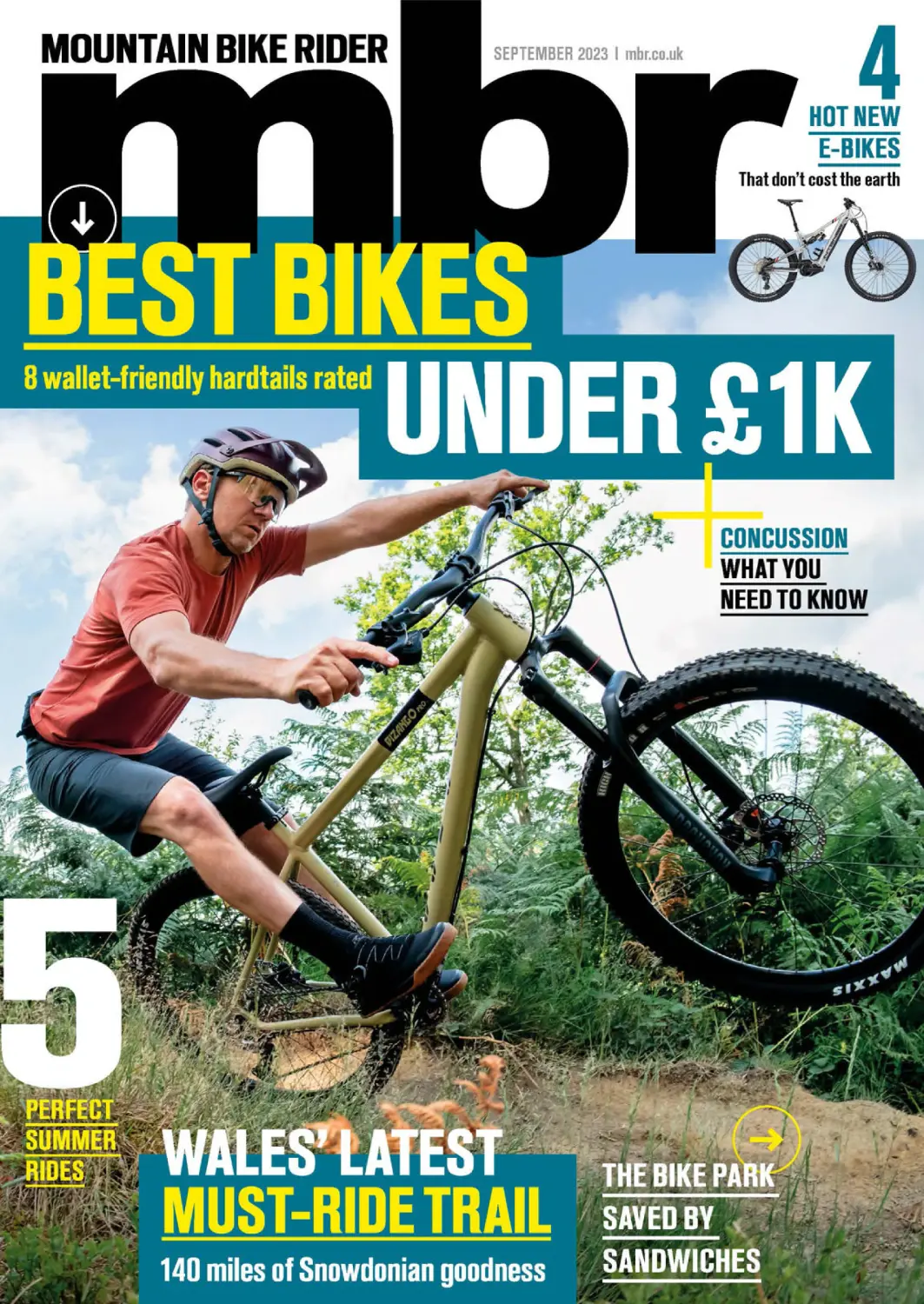
ON THE COVER

64 TRANS SNOWDONIA
Covering 140 miles from Machynlleth to Conwy,
the Traws Eryri is the latest long distance trail
from Cycling UK. It gets truly wild and is a
must-ride for adventure seekers

72 MANON CARPENTER
We catch up with former world champ and
World Cup winner Manon Carpenter – still
shredding, but now making films and pushing
for trail advocacy rather than split times

Giro Merit Spherical helmet, Gusset S2 Extra
Soft grips, Fasthouse Trace SS Tech Tee and
Crossline 2.0 short, DMR Stage 2 saddle, 100%
Glendale Glasses on the test bench

98 TESTED: BARS AND STEMS
Get your cockpit sorted with five of the best
bars and stems
ON THE COVER

40 BIKE TEST: HARDTAIL
OF THE YEAR
We rate the best entry-level hardtails on
the market, starting at £600, and with eight
models on test, this is a must-read for new
riders or those looking to grab a bargain bike

Wreaking Havok
in West Yorkshire, p16

REGULARS

HOW TO

12 BIG PICTURES
ON THE COVER

80 SKILLS: BEST ADVICE PART 1
Advice is everywhere, from YouTube to books
and even your best mate – some of it’s useful
and well intentioned, plenty isn’t. Dirt School
shows us how to recognise the good from
the bad, how to dish out help and how to
understand your own riding better too

Calibre Line T3-27 52
Cannondale Moterra Neo Carbon 2 34
Canyon Spectral:ON CFR 86
Carrera Fury 44
Jamis Highpoint A2 46
On One Scandal SX 54
Pivot Firebird Pro 88
Polygon Xtrada 5 48
Scott Genius ST 900 Tuned 88
Sonder Signal ST GX 90
Transition Relay Carbon GX AXS 30
Vitus Nucleus 29 VR 50
Vitus Sentier 29 56
Voodoo Bizango Pro 58

16 THE BUZZ: HAVOK 2.0
Havok Bike Park in Todmorden is back after
Storm Arwen forced its closure in 2021, with
new trails, location and a community-led focus
Wallet-friendly
whips, p40

106 COLUMN: GUY KESTEVEN
SEPTEMBER 2023

mbr

9

MEET
THE
TEAM

EDITOR’S LETTER

Decades of riding and
writing about bikes
goes into every issue,
this is who we are...

DANNY MILNER
EDITOR
Been hooked on mtbs
since the late ’80s, and
testing them for three
decades. Dream ride?
Lush Oregon singletrack.

Trickle-down tech
is helping us blaze
the trails for less cash

JAMIE DARLOW

Crisis? What crisis?

FRONT SECTION EDITOR
JD’s been with mbr since
2008. Gave up a career
as a financial journalist to
muck about on bikes. Now
penniless but happy.

Plain to see in this year's HOTY test, bikes are
bucking the cost-of-living trend
ast summer, getting six
bikes together for our
Hardtail of the Year test was
like squeezing blood out of
a stone. And we had to abandon
our more affordable sub-£700
category completely, as there was
just no availability. Just over 12
months on, and while inflation
is the bitter buzzword filling the
news headlines, over in our little
corner of the economy choice has
improved and value for money is
better than ever.
Instead of six bikes, this year
we’ve got eight, and better yet
they’re split between two price
points: sub-£700 and sub£1,000. We actually had 10 bikes
to choose from for the test, but
seeing as a couple of them hadn’t
changed at all, we decided to
spend our time assessing the
best alumni against this year’s
fresh intake instead.

L
ON THE COVER
Danny testing
last year's winning
hardtail, the Voodoo
Bizango Pro
Photo: Roo Fowler

SUBSCRIBE
TO MBR
FROM ONLY
£ 25.99
Turn to page 46
for details

FREE

MUC-OFF
BIKE CARE
KIT WORTH

£ 35 !

mbr

facebook.com/MBRmagazine

SEPTEMBER 2023

ALAN MULDOON
BIKE TEST EDITOR
Started at mbr in 2001.
Gets to the bottom of every
bike he slings a leg over,
even if it’s not on test. Don't
let him ride your bike.

PAUL BURWELL
CONTRIBUTOR
PB used to be mbr’s tech
editor, and has been testing
bikes and products since the
late ‘80s. An accomplished
trail builder and skills coach.

ROO FOWLER
CONTRIBUTOR
Photographer Roo will
destroy most riders up,
down and along any trail,
even with 15kg of camera
gear strapped to his back.

Editor, mbr

mbr.co.uk

10

In 2022 there was only one bike
with a dropper post. This year
there are three, including one
at the lower price point. That’s
amazing, given that at SRP, a
dropper post is 10% of the value
of these bikes. So while the cost
of heating and eating has gone up
by double-digit percentages, some
of our contenders this year are
effectively 10% cheaper.
As you’ll see by the ratings,
the level of performance is also
even higher than ever, with
more options to recommend. So
whether you’re new to the sport,
or returning after a hiatus, the
admission ticket to mountain
biking’s theme park has
never been such
good value.

twitter.com/mbrmagazine

youtube.com/user/MBRmagazine

instagram.com/mbrmagazine

BIG PICTURE

Big picture
The dichotomy between what
mountain bikers want to ride,
and what we are allowed to ride,
has never been greater in the UK.
While ancient bridleways – like
this classic in the Peak District –
still challenge riders, the growth
in off-piste trails shows that tastes
and demands have evolved. Of
course, unregulated trail building
causes huge problems, and former
world champion racer Manon
Carpenter has made it her mission
to try and dovetail the demands
of mountain bikers with the reality
of good land stewardship. Read
more about her new role as trail
advocate on p72.
Sim Mainey

12

mbr

SEPTEMBER 2023

SEPTEMBER 2023

mbr

13

BIG PICTURE

14

mbr

SEPTEMBER 2023

Big picture
Like scoring a penalty in
Wembley stadium the day after
the FA Cup final, a select group
of riders recently got the chance
to ride the Crankworx Whistler
slopestyle course at night. Minus
the crazy crowds and intense
pressure of the blue riband event,
Brandon Semenuk throws a lazy
extended nac-nac amid a storm of
backlit insects.
Mason Mashon/
Red Bull Content Pool

SEPTEMBER 2023

mbr

15

S TA RT YO U R R I D E H E R E

Edited by Jamie Darlow

GEAR

RIDES

FA S T & F I T

I N S P I R AT I O N

G E T S TA RT E D

H AVO K R E I G N S

After a long hiatus, slight relocation and a whole lot of
digging, Havok Bike Park is back; welcome to Havok 2.0

T

he story of the new inevitably
starts with the ending of the
old. In 2021 Storm Arwen
hammered much of the UK,
with high winds flattening forests in
Scotland and northern England. Despite
being tucked away in a narrow valley
in Yorkshire, Havok Bike Park didn’t
escape a pummelling. Overnight, the
park’s downhill tracks were buried under
windblown trees.
Previously, the team had been happy
to deal with any minor incidence of
wind damage themselves, but the scale
of the chaos caused by Arwen called
for professional assistance. When the
forest’s managers came to assess what
would be needed to clear the tracks
they decided that it was too dangerous
to even attempt to move the trees.
The park had to close.
The trail builders who’d created
Havok were, effectively, without a home
but still keen to keep the spirit of Havok
alive. They tried putting their shovels
in at a few different locations, seeing
if they could progress existing riding
True style is so laid back
it’s almost horizontal

spots, but for one reason or another
nothing felt quite right. In their minds
they knew the only real way forward for
themselves, and for Havok, was to find
a place they could call their own. The
answer came from a chance encounter.
After approaching various landowners
with plans for a new bike park and not
having much joy, a conversation with
the owner of local butty shop, Moor
Fillings, yielded better results. The
owner’s husband owned the hillside
directly opposite the site of the original
bike park and was interested in helping
the trail builders find a home for Havok.
“We told them the story of the woods,
and with them being local people, they
understood the importance of the park
to the community,” Sam Peel from
Havok told us. “It gets people visiting
the area and gets people in their shop.”
Things were starting to look up.
After a few exploratory digs on the
proposed site, and some direction
from the landowner on where would
be best to build, the team decided to
commit to putting down roots and
trails within view of the forest they had
once called home. Fortunately, with
the new site straddling the Yorkshire/
Lancashire border, they managed to
get support from mayors and leaders in
both counties. With a track record, so
to speak, for building and managing a
bike park, and an established reputation
in the area, they’ve been able to hit the
ground running, knowing what needs to
be done to build a successful venture.

H AVO K R E B O R N
Work on Havok 2.0, as it became known,
started in October of 2022, and as of
June 2023, there are three trails – a blue,
red and black – along with a dirt-jump
area. Plans are afoot for more trails, an
expanded dirt-jump zone, and more.

16

mbr

SEPTEMBER 2023

THERE ARE THREE TRAILS
– A BLU E , R E D A N D BL AC K
– ALONG WITH WITH A
DIRT JUM P A R EA

SEPTEMBER 2023

mbr

17

I N T RODUC T ION

“This is miles better
than fetching a stick”

18

mbr

SEPTEMBER 2023

A 4X track has been mentioned and
there’s enthusiasm for running mini-DH
races and incorporating the park into
an enduro race, too. The builders are
keen to make the most of the hill and
to create a venue that, like the previous
park, has a reputation for fun. “Riding
bikes shouldn’t be serious, should it?”
says Sam.
Fun needs funding, though, and
building a bike park is not cheap. Despite
Sam’s reservations, a crowdfunding
campaign was set up to help raise money
to hire diggers and pay for materials
to build the up track, giving riders an
easier way to push up the hill now, and
providing potential for an uplift in the
future, something that couldn’t feasibly
be done by hand. “I don’t like asking for
money and I didn’t want people to think
we were scrounging, but we were blown
away by how generous people were,”
says Sam.
Money came from all over. Riders
who’d enjoyed the first Havok and riders
who were excited about the new one
all chipped in, either way local riders
wanted a bike park on their doorstep.
The north of England has a lot of great
natural riding, a few trail centres and

quite a lot of less-official riding spots,
but it only has one real bike park,
Descent Bike Park in Hamsterley forest.
Sam says they are trying to fill that
gap and give riders in the north who are
after that bike park experience a place
to come. The Calder Valley already has a
vibrant riding scene but the team behind
Havok want to give locals a fresh set of
tracks and those further afield, a reason
to visit.

S WA P P I N G S I D E S
The contrast between the two sides of
the valley, and two Havoks, couldn’t
be more stark. The old park was
north-facing and in a dense and dark
commercial forest. The new one is
south-facing and on an open hillside.
Both locations have their strengths,
but the new park definitely gets more
light; perfect for getting in more laps,
especially in winter.
Another upside to the new park is the
quality of the dirt. The hillside was once a
spoil heap for mines and a lot of the soil
is of a much higher standard than you’d
expect to find as a result, making building
and sculpting work much easier than
expected. But the past year hasn’t just

PA R K L I F E
B U R L I S H B I K E PA R K
Havok isn’t the only bike park having something of a revival, Burlish Dirt
Jumps has been saved from the threat of demolition and expanded to become
Burlish Bike Park. The idea is to turn turn the 16-acre woodland Park into a
spot for riders of all levels, with multiple jump lines, a skills area, dual slalom,
flow trail and more, all supported by volunteer efforts.
Qopentrail.co.uk/burlish-bike-park

C A I R N G O R M S M O U N TA I N B I K E PA R K
The new Cairngorms Mountain Bike Park features green, blue and red-graded
trails, spread over 3km, with the longest descent currently running at 1.4km.
It’s designed as a family-friendly park and employs two 100m conveyor uplifts
to boost you up to the top of the Lower Zone. From there you can lap down
on the green or blue, or continue higher and drop into the red trail. There’s
bike hire including electric bikes, you can get a bus from Aviemore right to the
trails, and entry costs from £10 a day for kids.
Qcairngormmountain.co.uk

Pic: Cairngorm Mountain Bike Park

Perfectly sculpted berms
keep the flow high and
the smiles wide

The dirt jump zone
is where the fun
really ramps up

“RIDING BIKES
SHOULDN’ T
BE SERIOUS,
SHOULD IT?”
been about rebuilding Havok Bike Park,
it’s been about rebuilding the community.
After the first park closed, the
community of local riders who will,
hopefully, become the next generation
of trail builders emerged. Improving
the park but also having the potential
to take their skills elsewhere and create
something new. One example of how
this is already working can be seen
with Sam’s co-director at Havok,
Huey Walker.
Huey was a regular at the original
park, working his way up from barrow
boy to trail sculptor and is now making
decisions that will shape, in many ways,
the future of Havok. Stylish on the bike
and keen to pass his knowledge on to
the next generation of riders who are
now part of the park’s wider family, he’s

also appeared on the radar of the 50:01
crew. On the day we visit the park, 50:01
stars including Josh Bryceland, Josh
Lewis and Craig Evans are here scoping
out what’s what and having fun in the
process. Judging by the smiles and
shouting, the trails are hitting the spot –
it’s hard to tell who is more pleased, the
riders or the trail builders.
It’s safe to say that even riders who
are not quite up to Bryceland’s level
of skill will have a laugh at Havok.
Jumps and turns reward commitment
but all can be taken at a mellower
pace. Each track can be ridden top
to bottom or easily broken into
sections and sessioned until you’ve got
a particular feature nailed. However you
do it, a day at Havok is guaranteed to
bring your riding on.
Havok 2.0 as it currently stands is
very much just the start. Sam explains
that trail building is about levels, you’re
always evolving, refining, tweaking. A
bike park is no different. As more riders
come and new trails are built, things will
change but, for now, the dig team has
made a solid start and riders are reaping
the rewards of their hard labour. Havok
reigns, once again.

A new generation of riders
are getting their hands dirty
and creating Havok 2.0

N E E D TO K NOW
QHavok Bike Park is located just outside Todmorden in
West Yorkshire. The postcode for the park is OL14 8PU.
QThe park is currently open on weekends from 10am
to 6pm for non-members and throughout the week
for members.
QYearly membership for over-18s is £80. E-bike is £150.
For under-18s, membership is £60 and £110 for e-bikes.
QA day pass for over-18s is £12, £22 for e-bikes. An
under-18s day pass is £10, £20 for e-bikes.
Qhavokbikepark.co.uk

SEPTEMBER 2023

mbr

19

GEAR

Four new alloy e-bikes at down-to-earth prices

P

lastic might be fantastic if you’ve
got pockets deeper than the Mariana
Trench, but for those of us on more
realistic budgets, alloy frames are
hard to beat. Which is why this quartet of
new e-bikes is music to our ears.
All four reject the complexity and labour-

intensive manufacturing of carbon in favour
of a frame material that has been serving
mountain bikers humbly for the last 40
years: aluminium. Yes, this non-ferrous
metal might have the atomic number 13,
but if you’re looking for maximum bang
for your buck, you’re in luck.

P R I VAT E E R E 1 6 1 £ 5 , 9 9 9
Hunt wheels took a big step when it diversified
into complete bikes with the Privateer 161, and
subsequent 141. But it won the hearts, minds and
wallets of many riders thanks to its progressive
geometry, robust build quality and affordable
pricing. Those attributes have been kept front and
centre in the design of the new E161: the brand’s
first e-bike. With 161mm of rear travel paired
with a 170mm-travel fork, it’s designed for hard
charging as well as e-enduro racing, where the
630Wh Shimano battery is easily removable from
the down tube to facilitate quick changes between
stages. As with its naturally aspirated siblings, the
E161 is built from 6061 T6 alloy and comes in either
a no-nonsense raw finish, or with hard-wearing
black annodising. Plugged into the mixed-wheel
frame is Shimano’s latest EP801 motor, and the
E161 also gets Privateer’s signature steep seat
angle, forged one-piece rocker link, and durable
oversize bearings. The keen price includes highend Fox suspension, Hunt E All-Mountain wheels
and a Shimano SLX drivetrain.
privateerbikes.com

VITUS E-MYTHIQUE
LT V R £ 3 , 2 9 9. 9 9
Vitus is the undisputed king of value,
so it’s no surprise to see it disrupting
the market yet again with an incredible
price-point prospect. And, as one of
the first brands in the world to dabble
with aluminium as a frame material
(albeit before Vitus became part of the
Wiggle/CRC stable) it’s fitting to see its
new everyman e-bike sport a welded
alloy frame.
Biggest news on the 170mm-travel,
mixed wheel, E-Mythique LT is the
fitment of a Bafang M510 motor,
boasting a colossal 95Nm of torque.
Keeping that motor spinning is a 630Wh
battery, accessible through a hatch in
the down tube. All good numbers, we’re
sure you’ll agree, but the most exciting
digits are the prices: this VR model
comes in at an amazing £3,299, while
the VRS and VRX models cost £3,899.99
and £4,399.99 respectively.
vitusbikes.com

20

mbr

SEPTEMBER 2023

TREK FUEL EXE 5 £5,175
Trek really upped its game last year
with the release of both the hench
new Fuel EX trail bike, and the
stealthy Fuel EXe e-bike. Virtually
indistinguishable from each other,
the assisted Fuel EXe gets the
micro TQ motor and removable
360Wh battery, along with a frame
that’s multi-adjustable to suit all
manner of geometry and wheel
size preferences. Quiet as a church
mouse, the motor is as silent as
it is invisible, and now, thanks to
three new Alpha Platinium alloyframed models, it makes less of an
impression on your bank balance
too. This entry-level EXe 5 costs

Trek’s alloy Fuel
offers grand savings

£5,175, which is £1,225 cheaper than
the carbon-framed EXe 9.5, and yet
(if Trek’s weights are to be believed)
the alloy frame adds less than 800g.
trekbikes.com

I N T E N S E TA Z E R £ 4 , 4 9 9
Intense has a deep affinity with
aluminium. It’s the material that
catapulted the brand to stardom with
the seam-welded, clamshell M1 downhill
bike. And Intense founder Jeff Steber
still welds up its prototypes and team
frames in California. So the Tazer is
more of a glorious homecoming than an
economic box-ticking exercise. Having
said that, there is a strong financial
incentive for prospective customers,
with an entry-level price point of £4,499
for the Tazer Alloy Expert. Your cash
gets you a 155mm-travel frame with
MX wheels (29in front/27.5in rear),
Shimano’s EP6 motor and removable
504Wh battery, Shimano Deore
transmission, TRP brakes, and DVO
suspension. For another bag of sand,
Intense will sell you the Tazer Alloy Pro
with the Shimano EP8 motor, larger
630Wh battery and high-end Fox
Performance Elite/Factory suspension.
uk.intensecycles.com

SEPTEMBER 2023

mbr

21

GEAR

HOT STUFF

WHAT WE’RE EXCITED ABOUT THIS MONTH

MOST
WA N T E D

M A N I T O U M AT T O C
PRO £1,323
The new Mattoc is a
multipurpose fork that you
can fit to most bikes, from
XC to enduro, thanks to
its light, stiff and tuneable
nature. Manitou has made
some serious changes to
the old version, released in
2016, to let it make this bold
claim. For starters, the travel
ranges from 150mm at the
top end down to 110mm,
meaning on paper you could
ride both XC and enduro on
it. Better yet, you can adjust
IRT dial (top) can adjust
the fork travel at home, with
air-spring pressure at
the travel spacers you’ll
both ends of the travel
need included in the box.
Those disciplines require
more than just the right travel length, though. The new Mattoc is
indeed impressively light at 1,790g on our scales in the Pro model,
although it’s not the super-light 1,500g ballpark of a RockShox
SID or Fox 34 Step-Cast. Manitou also says it’s 30% stiffer than the
old version, the new 34mm chassis uses the trademark rearward
arch that’s claimed to be more solid than a forward-projecting
brace, and it has removed material while adding strength. There
are also Trail Side Relief bleeder valves on the lower legs to release
pressure, but unlike with Fox or RockShox, you’ll need an Allen key
to purge them.
Inside, the Dorado Air spring uses self-equalising positive and
negative chambers like most other models out there, and that
helps the fork break away into its initial travel. More interesting is
something called Infinite Rate Tune (IRT). Manitou says you can
independently adjust the air-spring pressure at the beginning and
end stroke, effectively creating a secondary positive. What that
means is you could have a soft main positive spring for a slurpy feel
off the top, then a firmer second positive to add support around
the mid-stroke and stop it diving through the travel.
All that’s left then is the damper, the Pro model gets Manitou’s
premium Multi Compression Control (MC2) Sealed Cartridge
system with independent high and low-speed compression
damping. There’s a separate damping circuit called Hydraulic
Bottom Out (HBO) that controls the very end of the stroke and
stops a harsh bottom-out. It’s not adjustable as it is on other
Manitou forks, but the sacrifice is presumably for weight reduction
and simplicity of set-up.
The Mattoc Pro could be many things to many riders, and has
oodles of adjustments to get set up just right (or very wrong).
What it really can’t be any longer though, is an entry-level fork.
hayesbicycle.com

22

mbr

SEPTEMBER 2023

NOW I N G R E E N

COLOU R DROP

The latest version of Five Ten’s Trailcross XT has been tweaked, the
neoprene cuff is gone, it’s lighter, and made from 50% recycled content.
You still get Five Ten’s best-gripping Stealth Phantom rubber on the sole,
and a breathable but not waterproof upper. Sizes 5.5 - 14.5, four colours.
£140, adidas.co.uk

The e*thirteen Vario Dropper Post is now £20 cheaper and comes with
colourful saddle clamp and collar options that’ll match to other e*thirteen
Helix gear. The Colour Kit lets you bling up your existing Vario dropper.
Travel options include 90-120mm, 120-150mm, 150-180mm & 180210mm. Lifetime warranty on internals. £179.95, ethirteen.com

U P T H E VO LTAG E

P R OV E N G R O U N D

WTB’s famous Volt and Silverado saddles have been updated. The latter is
now slightly flatter to reduce perineal pressure, and it’s shorter at 265mm.
The Volt gets updated looks and less fibres in the nylon to increase flex
and make it more comfortable in an upright pedalling position.
from £39.99, hotlines-uk.com

Hunt’s latest wheelset is for XC bikes. Called Proven Carbon Race XC UD,
it’s 1,254g, with 30mm internals, front and rear-specific lay-ups, UD
carbon spokes, and a new 2° engagement hub. The super-low weight
is possible thanks to those Taperlock UD spokes weighing 2.7g each.
£1,349, huntbikewheels.com

N O S W E AT

S W E E T E R PROT E C T ION

You can get Skratch Labs Hydration Sport Drink Mix in a pouch or
single-serving sachet. It’s designed to replace electrolytes lost in sweat,
so is ideal for scorching-hot summers. Low sugar, high sodium, made
with real fruit, six flavours or a clear version with next to no taste.
£15.95, silverfish-uk.com

Sweet Protection has updated its Bushwhacker with a new two-layer
2Vi MIPS liner designed to increase comfort and slip-plane protection,
greater coverage, and a multi-density EPS structure for slow and highspeed impacts. Sharp styling, a Fidlock buckle, multi-position peak, and
it’s available in six subtle colours. £219, groovearmada.net

SEPTEMBER 2023

mbr

23

RIDES

L AT E S U M M E R
L OV I N ’
Classic UK holiday hotspots
that really shine when the
crowds have gone

C O N W Y, N O R T H WA L E S
2 8 . 5 k m ( 1 7. 7 m i l e s )

LY N T O N , D E VO N
3 9. 7 k m ( 2 4 . 6 m i l e s )

Wales never fails, so it’s no surprise that it’s so popular with holidaymakers. North Wales in particular has always been a hit with mountain
bikers; from the rugged peaks of Snowdonia to the rolling Clwydian
Hills, it’s got something for everyone. Look towards the coast if you
want to mix a seaside holiday with some great riding. Conwy is a popular
holiday destination that happens to have some great riding right from
its doorstep. In fact it doesn’t take long at all for it to feel like you’re in
the middle of nowhere – perfect for escaping the holiday crowds.
GPS download bit.ly/ConwyRide

With a rocky coastline that butts up to green rainforest-filled valleys
leading you out onto windswept moors, Devon’s varied landscape
makes it perfect for keeping holidays – and riding – interesting. Starting
in the town of Lynton on the north Devonshire coast, this route loops
you into the tight and twisty wooded valleys before sending you out
and back across Exmoor. Starting, and finishing, at a tea room that
serves ice-cream (natch) you can enjoy everything that Devon has to
offer in one belting 40km ride.
GPS download bit.ly/LyntonMTB

N O R T H YO R K S H I R E
55.5km (34.5 miles)
Think summer holidays in North Yorkshire, and coastal towns like
Whitby probably come to mind. But for mountain bikers, it’s worth
heading inland to find some great trails. This figure-of-eight ride
takes you across the North York Moors from north to south. At
55km it’s a good all-day ride, but with ‘just’ 934m of ascent along
its length it’s a pretty mellow way to take in the iconic ridges that
help give the Moors their character. Being so high up and exposed
to the elements, we’d recommend you check the wind strength
and direction before heading out. And pack a waterproof, it is
Yorkshire after all…
GPS download bit.ly/NorthYorkRidges

24

mbr

SEPTEMBER 2023

C O R N WA L L ( A N D D E VO N )
56.6km (35.2 miles)
If you like surfing, beaches and a laid-back vibe then Cornwall is a
superb place to spend your holidays. Unfortunately, in terms of legal
tracks for mountain biking, it comes up short. So, while this ride starts
in the Cornish town of Gunnislake, the vast majority of it is actually
in Devon on Dartmoor. Sorry Cornwall, you need to up your rightsof-way game. Get over the county border issue, though, and this is a
cracking South-West leg-stretcher. Just make sure you apply jam and
cream to your scone in the right order.
GPS download bit.ly/CornwallRide

E S K DA L E C U M B R I A
34.2km (21.2 miles)
You might not have visited Miterdale, you might not have even heard
of it, but this quiet, overlooked valley is a hidden gem. Running parallel
to the much better known Eskdale, Miterdale makes a great starting
point for an exploration of the western reaches of Cumbria. From fells
to tarns, castles and coast, this ride packs in a real variety of terrain
and scenery along its length. It’s a tough ride but – unlike many Lakes
rides – there’s no hike-a-bike required and the descents are fast and
fun without being overly technical.
GPS download bit.ly/MiterdaleRide

Our ride starts in
Cornwall but the cream
of the riding lies in Devon

SEPTEMBER 2023

mbr

25

FA S T & F I T

New guidance reveals how to spot concussion, and how best to treat it

26

mbr

SEPTEMBER 2023

W

hat is a concussion? Stupid
question, it’s when your
friend tries a new feature,
hits a tree and then can’t
remember which trail he or she is on
or who won Hardline (it was cancelled,
if you’re reading this in A&E). We’re
being flippant, but until this year, the
government couldn’t really do much
better than that, with no UK-wide
definition across different sports. To say
concussion was overlooked would be an
understatement.
Since March though, and thanks to a
report by Parliament’s Digital, Culture,
Media and Sport Committee released in
March, we have new official guidelines
on how to spot concussion and what
to do about it. British Cycling now
describes a concussion as “an injury to
the brain resulting in a disturbance to
brain function,” with symptoms including
headache, dizziness, concentration
problems or balance disturbance.
This is an important step because
sports and their governing bodies are
increasingly looking to mitigate risks
from head injuries and prove they’re
doing everything they can do to make
things safer… and prevent litigation.
The first step is to get a definition of
concussion, so changes can be made to
the sport and behaviours altered.
“It’s really helpful because people are
still in the same headspace about it as
they were years ago,” says Katy Curd,
who suffered from concussion while
racing elite-level downhill. “Even the
other day I spoke to someone who’d had
Skills coach Katy Curd
is a keen advocate of
the new guidelines

HIT+ sensor uses a traffic
light system to grade the
severity of impact

THE NEW GUIDELINES’ KEY
TA K E AWAY M E S S A G E I S :
“ I F I N D O U B T, S I T T H E M O U T ”
a massive crash, broken their helmet,
and just got back on the bike and rode
again. With a broken bone you can feel
it, but with concussion, we just don’t
know what’s going on.”

THE GUIDELINES
Running through the new guidelines
is this key takeaway message: “If in
doubt, sit them out.” So if there’s even
a chance you, a friend or race partner
has a concussion, they’re done riding for

the day. No ifs, no buts. This is because
the brain needs time to recover after
an impact, if it’s not given that chance
then repeated injuries to the head have
been shown to cause more serious
problems like chronic depression,
pain, anger, or even Chronic Traumatic
Encephalopathy (CTE).
How can you tell there’s a chance
of concussion? British Cycling says
most concussions don’t lead to a loss
of consciousness, with only 10% of
people blacking out. This makes it a
really unreliable metric for working
out if one has occurred. Instead, you
need to look out for the following signs
and symptoms:
QA dazed, blank or vacant look
QLying motionless on the ground,
slow to get up
QUnsteady on feet, balance problems,
falling over and/or poor coordination
QLoss of consciousness or
responsiveness
QConfused, not aware of events leading
up to the injury or surroundings
QGrabbing/clutching of head
QTonic-posturing (raising of the limbs)
QSeizure (fits)
QMore emotional/irritable than is usual
for that person
QVomiting
QCheck their helmet for visible signs
of damage

SEPTEMBER 2023

mbr

27

FA S T & F I T
Resist the urge to ride on if
you suspect concussion

Accompanying app records
the impacts you’ve sustained

On top of that you need to ask the
patient themselves if they have a
headache, dizziness, mental clouding,
visual problems, fatigue, “pressure in the
head” or sensitivity to light or noise.

If you’re dazed or confused,
it’s time to end the ride

“ I T ’ S A B O U T P U T T I N G T H E D ATA
A N D I N F O R M AT I O N I N T O YO U R
H A N D S S O YO U C A N D E C I D E ”

U S I N G T H E L AT E S T
TECHNOLOGY
Following the guidelines above should
be the first port of call for anyone
assessing a suspected concussion,
but there are now a host of tech
innovations that help too. The latest,
from HIT Recognition, is a little buttonshaped sensor that attaches to your
helmet to record impacts. We’ve seen
wearable crash detection before of
course, with Specialized’s ANGi working
as an effective crash detection monitor.
The latest HIT+ builds on that, offering
live data to your phone, including
G-Force impacts and rotational force.
It then gives you a traffic light warning
system that indicates if the impact has
been light, medium or hard, with the
hardest red-flag impacts automatically
calling your emergency contact.

28

mbr

SEPTEMBER 2023

Live data is extremely important
because it lets riders decide whether
they’re likely to have suffered a
concussion or if they’re at risk of making
things worse, explains Euan Bowen from
HIT. “It’s doing more than this though,

HIT’s Euan Bowen is
the man behind the tech

it’s a log book of all the impacts you’ve
received, because what you’re doing
on the bike is cumulative,” he says.
“So in the same way you might have
sore legs and DOMS after a big ride, if
your head hurts the next day you can
look back and see how much G-Force
you encountered on your ride, and
maybe rest up for 48 hours.”
The goal is to educate riders, help
them make informed decisions about
their riding and improve the safety of
the sport, Euan says. “We’re not there
trying to use scare tactics,” he says.
“This device isn’t gospel, it’s not going
to tell you when you can and cannot
ride. It’s about putting the data and
information into your hands so you
can decide.”

H O W T O T R E AT C O N C U S S I O N
No amount of safety equipment or
tech can make our sport 100% safe,
of course, so here’s how to treat
a suspected concussion. To start
with, no more riding for the rest of
the day. After that you should be
monitored for the next 48 hours for
more serious signs of concussion,
which include…
QSevere neck pain
QDeteriorating level of
consciousness (more drowsy)
QIncreasing confusion or irritability
QSevere or increasing headache
QRepeated vomiting (vomiting
more than once)
QUnusual behaviour or a change in
their behaviour
QSeizure/fit
QDouble vision
QWeakness or tingling/burning in
their arms and/or legs
If any of the above signs are present
you need to get to A&E sharpish,
something Katy Curd wishes she’d
done. “ I didn’t even know the
signs to be aware of,” she says. “I
took a hit to the head, then I went
back out and did the same thing,
another knock to the head. Then
four months down the line that’s
where everything hit me. I now work
the latest British Cycling guidelines
into my coaching – check out
katycurdcoaching.com.”
Back in 2019 the EWS (now
EDR) published the results of a
survey asking 2,000 EWS enduro
riders to detail their rate of injury.
Euan had the idea for HIT+ while
working on his final degree project at
Napier University, before developing
it into a fully fledged business with
applications across many sports
including mountain biking. Since then
HIT+ has been honed with thousands
of hours of testing to make sure the
data being sent to your phone is really
representative of what’s happening to
your head when you ride.
“That was the first step, validating
the G-Forces,” Euan says. “Then we
took that to the medical profession and
medical journals from different sports
and replicated those tests to find similar
G-Forces they’d found doing the same
activities.” In short, benchmarking the
product against medical studies.
The next step is to collect anonymous
profile data from users (with permission,
of course), to try and spot trends,
before giving the data back to the
end users. This could build a picture of
which helmets are doing a good job
and which are disproportionately
involved in concussions.

Concussions were reportedly mild,
and instances rare, with 0.6% of
riders competing in the 10 EWS race
events during 2017 and 2018 seasons
experiencing one, or one concussion
for every 263 EWS rider races.
That sounds great, but as many
concussions go undiagnosed, the
real number was probably far higher.
Just as worryingly, a little over a
third of riders with concussions
simply carried on racing.
“Riding with a concussion is just
the worst thing you can do,” Euan
from HIT says. “The brain is the only
organ in the body that has to do
its own damage assessment. This
means it can be very bad at it. The
risk of crashing again if you’re riding
with a concussion is hugely increased
because your brain might not be up
to speed,” he says.
Recognising the importance
of concussion is heading in the
right direction though, Euan says,
with governing bodies and riders
becoming better informed. “It’s
trying to get to a level where a head
injury is seen in the same way as any
other injury.”
The latest BC guidance is part
of that process. It means riders at
a race, event or club ride would be
compelled to stop after a concussion,
and spotting one in the first place will
be much more straightforward. Our
advice then is, as always, Just Get
Out and Ride. But do it safely, and
armed with the best helmet you can
afford and the knowledge of what to
do should something nasty happen.

Racing with concussion
came back to bite Katy

SEPTEMBER 2023

mbr

29

NEW BIKES

SWINGING A LEG OVER WHAT’S HOT THIS MONTH
30

mbr

SEPTEMBER 2023

TRANSITION RELAY
CARBON GX AXS
£ 9,7 9 9.9 5 • 2 9 i n • w i n d w av e . c o .u k

NEED TO
KNOW
OLightweight,
mid-power e-bike
with Fazua Ride
60 motor and
removable battery
OBuilt to be ridden
with or without
430Wh battery,
thanks to near
drag-free motor
O160mm travel
front and rear,
choice of mullet
or 29in wheels,
coil or air shocks
OSleek carbon
frame with real
bio-bike looks,
or available as an
alloy-frame build
OBuilds from
£6,999.95 with
NX and alloy
frame, up to XX
AXS carbon at
£12,599.95

Lower shock mount flip-chip
means swapping to a mullet
set-up is a cinch

With its barely-there Fazua motor, the Relay
carries the mid-power baton forward in style

T

hey say there’s nothing really
new in mountain biking, just old
ideas recycled, like Shimano’s
auto shifting, steering dampers
and electronic suspension.
Here’s another one to add to the list:
Fazua’s latest Ride 60 motor has 250W
power, puts out 60Nm torque and uses
a 430Wh battery. That makes it pretty
darned close to the old Shimano E8000
motor and battery launched in 2016,
which had the same average power and
10Nm more torque. And, just as it was
seven years ago, it’s cutting-edge stuff,
coming on the most exclusive new bikes,
like this Transition Relay.
The difference, of course, is that
today’s mid-powered motors have
sacrificed the peak torque for low
weight and compact size in an effort
to replicate the look and ride feel of
a regular bike. Fazua’s Ride 60 motor
is claimed to weigh just 1.96kg, while
the 430Wh battery is easier to verify
because it’s removable on the Relay, and
reads 2.27kg on our scales. That 4.23kg
system weight is light, but on the other
hand, it’s actually only 1,100g less than
the old E8000 motor and bigger 504Wh
battery, according to Shimano’s figures.
You’ll be relieved to hear Fazua
wins in terms of space savings though:
the Ride 60 motor is so tiny you’d be
forgiven for thinking the Relay is a
regular bike, and the fact you can whip
the internal battery out and pedal it
around is useful, even if just for the
ability to charge the battery off the bike.
Powered up, the display uses a traffic

light system, and it is integrated into the
top tube, with a series of lights to let you
know how much juice you have left and
which of the three power modes you’re
in. The claim is it’s intuitive because the
lights instantly remind you of the mode
you’re in, but to do that you have to
first learn which colour relates to which
power mode. I’d argue words and letters
are more intuitive as most of us have
already learnt them. I also found the
LEDs far too bright for riding at the end
of a summer’s day, so I imagine they’re
blinding on a night ride.
The bar-mounted Ring Controller
remote used to select the power modes
is a simple up-down switch that floats
on a bushing and uses magnets to select
the modes. It’s unobtrusive, works most
of the time (it does tend to get sticky
when gritty) and is very tactile. It’s also
easy to clean.
Compared to the old Ride 50 system,
you get more peak power with Ride
60 – 350W – and there’s even more in
reserve if you need it: hold the remote
forward and it’ll give you a 12-second
boost at 450W.
In terms of availability, Transition has
alloy or carbon frames, and there are
six builds, from NX at £6,999.95 up to
XX AXS at £12,599.95. The bike here
comes with 29in wheels and suspension
provided by Fox’s Performance Elite
range. You get 160mm travel front
and rear, or there are two Pacific
Northwest (PNW) builds with 170mm
travel, a mullet set-up and coil shocks.
There’s also a flip-chip on the lower
shock mount so you can mullet the bike
yourself and still maintain the same ride
height by putting it into High mode.

HOW IT RIDES
Transition says the Relay is “two bikes
in one” so we’ll start there. It does work
with the battery out. It’s certainly easy
to remove, probably the easiest of any
system I’ve tried – pop the plastic cover
off, pull on a rubber-coated lever and
out it slides. There’s no noticeable drag
with the motor off, while the ride feel is
pretty much the same, albeit slightly less

You’d be forgiven
for thinking it’s a
regular bike
SEPTEMBER 2023

mbr

31

NEW BIKES

I can best describe
the ride feel of the
Relay as hectic

Battery removal is a
hassle-free process

High and Low
modes offer two
geometry settings

Fox Float X Performance
shock delivers 160mm travel

32

mbr

SEPTEMBER 2023

planted with some of the weight lopped
off. The only problem is you’re left riding
round on a trail bike weighing in excess
of 17.5kg, a weight that’s very noticeable
when you’re cruising round with friends
on regular bikes.
With the battery in and the power
back on is how you’ll want to ride the
Relay, then. I doubt many riders will
spend £10,000 on a bike to remove the
best part of it, no matter how charitably
they feel towards their friends. This is
almost certainly a feature for the US
market, where access rights prohibit
e-bikes from certain areas and trails, or
those wanting to fly with the bike.
Fazua’s Ride 60 is very powerful for
a mid-weight motor, it’s moderately
quiet if not at the pin-drop levels the TQ
motor can muster, and the three power
modes (Breeze, River and Rocket) are
useful. The extra Boost power mode is

Switching to High mode
turns the Relay into a
thrill-seeking weapon

Spider/bash guard got
scuffed when rotating
due to overrun

a great touch too because you can use
it to muscle up the steepest or techiest
sections of a climb. If, like me, you
have no willpower, you’re best off not
touching it, or you’ll be back again and
again until the battery is flat.
I found that in Rocket mode I could
whizz through the 430Wh in around
90 minutes and 1,000m of climbing if
I’m not careful, but that’s a very good
range for a mid-powered eeb. After the
latest firmware update it’s much more
natural in feel too, and doesn’t have the
annoying power lag after the overrun
has been used. Fazua has cured the
early motor shut-off problems too.
I can best describe the ride feel of the
Relay as hectic. It’s very easy to move
around and you can skip about the trail
easily – inside here, outside there, over
the top everywhere. This is the kind of
bike that gets you into serious trouble,
the temptation is to jump out of and into
everything going because it’s just so
easy to do so.
The truth is the Relay is two
bikes in one, but not for the reasons
Transition thought. For that poppy,
playful experience, I wound off all the
compression damping on the shock
and put the bike into its High mode to

make it less stable and more fun. I don’t
know if you’re supposed to do this with
the mullet flip-chip, but it worked. Do
the reverse – wind on a decent amount
of damping and lower it 8mm – and it’s
more composed and more serious.
In either mode it’s never what you’d
call plush and there is always a certain
amount of trail buzz coming through
your hands and feet, making it tiring to
ride. I suppose that’s the trade-off for
such a connected, dynamic ride. Plenty
of riders will also appreciate the great
connection to the trail, as you can feel
exactly what’s happening under those
taught Race Face rims.
The hectic feel isn’t helped by an earsplitting rattle coming from deep inside
the bike though. It’s not relieved by
taking the battery out; all the bolts were
tight and I even took the battery cover
off to eliminate it from enquiries, to no
avail. I’m pretty sure it’s a cable-routing
issue, which could potentially be solved
with a bit of creative tinkering.
I also had problems with Transition’s
spider and bashguard, a one-piece unit
designed specifically for this bike. It sits
a fraction too proud and consequently
the driveside crankarm has shaved some
of the metal off it, and the bolts securing
it in place. This can only have happened
when the spider was rotating forward
due to the overrun kicking in everytime
you stop pedalling,
So I took the Relay back to distributor
Windwave to have the pre-production
spider replaced, but the standard set-up

suffered just the same. It’s not a structural
problem, we’re talking about a millimetre
of metal at most here, and once that’s
clean-shaven it probably won’t get any
worse, but it’s not a good look.
Actually there’s one other problem.
The Relay doesn’t come with a chain
guide and there’s no place to fit one
aftermarket either. If you slip the chain
you’ll make a mess of the carbon. That
said, it didn’t happen on the test bike,
a machine that’s done months of
service this side of the pond and in
Bellingham, Washington.
Transition says the Relay is “the
mountain biker’s e-mtb,” which means
it’s the bike the brand hopes will
convince the diehard non-believers to
turn electric. And if the initial response
is anything to go by, it’s true, as the
Relay is one of those bikes that causes
strangers to rush over to you before
sheepishly asking for a bounce on it. One
die-hard non-eeber told me it’s the bike
he’s been waiting for (but as a die-hard
Transition fan he would say that). Ride
it and it’s easy to see why, it’s like being
at a rave – senses overwhelmed, you’re
carried forward on a rush of emotion,
vitalised to try moves like never before.
It’s powered by the best mid-power
motor, looks amazing and comes from
one of the coolest niche brands around.
Could this really be the bike to electrify
the world? Only if you can afford the
nightclub entry price.
Jamie Darlow

1ST IMPRESSION

 HIGHS
Hilariously fun to ride,
lightweight and with a normal bike feel.
Twinned with a powerful and adaptable
motor that’s a joy to use. Available in
six sizes.

 LOWS
Noisy, tendency to eat its own
spider. Needs a chain guide.

SPECIFICATION
Frame Carbon,
160mm travel
Shock Fox Float X
Performance Elite
(205x60mm)
Fork Fox Float 36 Grip
2 Performance Elite,
160mm travel
Motor Fazua Ride
60, 60Nm, 450W
peak power
Battery Fazua Energy
430 Take Out, 430Wh
Display Fazua Ride 60
Wheels Race Face
Trace hubs, Race
Face Aeffect R rims,
Maxxis Assegai/
Minion DHR II 3C EXO+
29x2.5/2.4in tyres
Drivetrain Praxis
alloy ETOR 165mm
crank, Transition Bash
Spider and SRAM 32t
chainring, SRAM Eagle
GX AXS r-mech &
shifter, SRAM XG 1275
10-52t cassette
Brakes SRAM
Code Silver Stealth
four-piston brakes,
200mm/200m
Components ANVL
Mandrel alloy 800mm
bar, ANVL Swage
40mm stem, OneUp
210mm post, SDG Bel
Air 3.0 saddle
Sizes XS, S/M, M, L, G,
XL, XXL
Weight 19.8kg (43.7lb)

GEOMETRY
(LOW SETTING)
Size ridden L
Rider height 185cm
Head angle 63.0°
Seat angle 70.3°
Effective SA
(@750mm) 78.4°
BB height 343mm
Chainstay 449mm
Front centre 837mm
Wheelbase 1,286mm
Down tube 753mm
Seat tube 430mm
Top tube 590mm
Reach 485mm

SEPTEMBER 2023

mbr

33

NEW BIKES

34

mbr

SEPTEMBER 2023

CANNONDALE MOTERRA
NEO CARBON 2
£ 5 ,9 5 0 • 2 9 i n • c a n n o n d a l e.c o m

NEED TO
KNOW
OFull-power
e-bike rocking 29in
wheels (size Small
comes with 27.5in)
OCarbon front
end houses Bosch
Performance CX
motor and in-tube
750Wh battery
OTravel is balanced
with 150mm
front and rear
OFour frame
sizes, each with
custom-configured
suspension
kinematics
OCurrently
discounted by
over £1k!

It’s got more suspension tunes than a Hitchcock
movie, but will this Moterra thrill us or chill us?

C

annondale claims that the
Moterra Neo Carbon 2 is “agile,
quick, stable and composed.”
And there might be a kernel of
truth in this boast, because the
bike is Proportional Response Tuned.
Put simply, PRT means the suspension
on the Moterra Neo Carbon 2 has been
tuned for each of the four frame sizes,
so everyone gets to ride a bike that is
tailored more closely to their height and
body weight, as opposed to adopting a
one- size-fits-all approach.
As such, Cannondale engineers have
tuned the kinematics on the larger
frames to be more progressive to deal
with the increase in rider weight, and
they have more anti-squat too, while
taking the opposite approach on the
small sizes. Other size-specific tweaks
include 27.5in wheels on the size Small,
while the M, L and XL bikes are full 29ers,
and there are different-length dropper
posts throughout. The obvious next step
would be to have size-specific chainstay
lengths but Cannondale has stopped
short of that, even if, at 460mm, the
chainstay length on the Moterra is
anything but short.
The Neo Carbon frame isn’t full
carbon – only the front triangle is a
composite construction, the rear end is
aluminium. At over 25kg for a 150mmtravel bike, it’s not that light either. Take
a closer look at the stays and you’ll see
kickstand, rack and mudguard mounts
which are not necessary on an e-mtb.
This is because Cannondale offers a

Mottera New EQ model that uses the
same frame and makes full use of the
superfluous fittings and fixtures. Having
those attachment points doesn’t affect
performance in any way, but I reckon
some riders are going to be put off
because they don’t look very neat.
In terms of travel, the Moterra
Neo Carbon 2 is the baby brother
to the Moterra LT 2 that featured in
mbr’s E-Bike of the Year test. It has
150mm travel front and rear instead
of 170/165mm and comes with an air
shock rather than a coil. So all you need
is a shock pump to set the sag, rather
than a mate and a tape measure, and
it also creates a bit more space in the
front triangle to get the water bottle
in and out, especially on the smaller
frame sizes.
Housed inside the carbon front end
of the Moterra Neo Carbon 2 is a Bosch
Performance CX motor with a 750Wh
PowerTube battery. A Kiox display
is mounted directly over the top of
the stem. It offers a ton of rider, bike
and route information but it is very
vulnerable perched so high up.
For every e-bike on the market, there

All you need is a
shock pump to
set the sag

600W Bosch Performance
CX motor is twinned with a
long-lasting 750Wh battery

SEPTEMBER 2023

mbr

35

NEW BIKES

Charger port uses a foam
seal to keep water out

Sealed cartridge bearing on
the rear hub seized up
after just two months

Kiox display flags a
multitude of stats but
is vulnerable to impacts

36

mbr

SEPTEMBER 2023

Moterra Neo Carbon 2’s
size-specific suspension tune
delivers a lively ride

seems to be a different charging port
design, even when the same charger
is used. Cannondale has a little trap
door with a foam seal on the inside to
keep water out, which is simple and
does work. However, removing the
battery from the frame for charging is
somewhat long-winded because you
have to loosen a latch on the plastic
cover underneath the down tube then
unlock the battery with a key before
releasing another latch to finally free the
battery from the frame.
And there are a couple of other odd
choices – it uses an old spoke-mounted
magnet for the speed sensor and it has a
six-bolt front hub but a CenterLock rear.
Now, I appreciate that the front hub is
from Formula rather than Shimano, but I
can’t imagine fitting a matching Shimano
front hub would break the bank,
especially on a bike that was initially £7K.
Not that I’ve got anything good to say
about the Shimano MT410 rear hub. After
only two months of riding, the sealed
cartridge bearing on the non-drive side
seized solid. Replacement bearings are
only £4.99, but this shouldn’t happen
with such low mileage.

And my rant isn’t over. There’s a
current trend in the bike industry to
route all cables internally and it does
look sleek, but Cannondale’s stem
face-plate routing system is fiddly at
best if you want to put the stem down.
The oval headset spacers split, so you
can unclip them from the fork steerer,
but you can’t actually put these spacers
on top of the stem to pre-load the
headset. It’s crazy, as it makes it really
difficult to experiment with a lower stem
position when setting the bike up.
Thankfully, the rest of the components
are sorted. I like the Fabric FunGuy grips
with their mushroom pattern (get it?)
and Cannondale specs different-length
droppers depending on the frame size
– 125mm on the size Small, 150mm on
the Medium and 170mm on Large and
XL. And despite the tight cable routing,
the DownLow dropper has a light lever
action and snappy return speed, even if
there is quite a bit of rotational play out
of the box.

HOW IT RIDES
On my first outing, the Moterra felt
agile and manoeuvrable but also a bit
wild. This was mostly due to the Maxxis
Rekon rear tyre, which is fast-rolling but
the shallow knobs offer limited braking
traction and grip. To tame the ride, I
swapped it to a Maxxis High Roller II
and I recommend you do the same.
Once I’d changed the rear tyre,
I set about experimenting with the
handlebar height to push a bit more
weight over the front, but there’s no
way to get the bars down unless you
cut the steerer and after that, there’s
no way back, so it could prove to be a
very costly experiment.
Like the Moterra LT, the Bosch
motor is clocked slightly to help
position the battery lower in the
frame, in theory to improve handling.
However, with its 350mm bottom
bracket height, the Moterra Neo Carbon
2 is just as high off the ground as the
LT, and that makes more of a difference
here because this bike has less travel.
In fact, I’d argue that it’s way more

important to position the 80kg rider
lower in the frame than to worry about
the 4.47kg battery placement.
Even with the high BB, on flatter trails
and rolling singletrack, the Moterra has
good pace and feels incredibly poised.
The damping in the RockShox Lyrik
Select fork is less sophisticated than
RockShox’s high-end units, and spikes
with more regularity on really rough
chop but shouldn’t hold you back.
And while I can’t speak for the other
frame sizes, to say how much the
Proportional Response Tune plays a
part, the rear suspension on the
medium felt totally dialled.
So the Moterra Neo Carbon 2 is
not quite the jack of all trades that
Cannondale claims. It does have a
pretty decent skillset, though, and
like the Moterra LT, it’s also currently
discounted, so you’re getting a sleek
carbon frameset with a Bosch motor
and big battery for quite a bit less
than full retail. Which is the polite way
of saying that this goes a long way to
help overlook the stubborn stem and
elevated ride height. You’ll also have
money left over to invest in a grippier
rear tyre and better wheels, maybe
even a 27.5in rear wheel to lower the BB
height and slacken the angles a touch.
All of which seems like a lot of hassle,
especially given that there are plenty of
sorted e-bikes to choose from.
Paul Burwell

SPECIFICATION
Frame Neo Carbon/
SmartForm C1
aluminium,
150mm travel
Shock RockShox
Deluxe Select+
DebonAir
Fork RockShox Lyrik
Select, 150mm travel
Motor Bosch
Performance Line
CX, 600W peak
power/85Nm torque
Battery Bosch
PowerTube, 750Wh
Display Bosch Kiox
Wheels Formula/
Shimano 110/148mm
hubs, WTB ST i30
TCS 32h rims, Maxxis
Minion DHF/Rekon
29x2.6in tyres
Drivetrain FSA Bosch
E-bike chainset 34t,
Shimano XT r-mech,
SLX 12-speed shifter
and cassette
Brakes Shimano
MT-520 four-piston,
203/203mm
Components
Cannondale 3
Riser 800mm bar,
Cannondale 2 35mm
stem, Cannondale
DownLow 150mm
post, Fabric Scoop
Shallow Sport saddle
Sizes S, M, L, XL
Weight 25.5kg
(56.2.lb)

GEOMETRY
1ST IMPRESSION

 HIGHS
Good value for money at the
discounted price. Suspension is custom
tuned across the four frame sizes. Agile
and lively ride quality.

 LOWS
Seatstays feature ugly kickstand
and mudguard mounts. You need
a key to unlock the battery. Maxxis
Rekon rear tyre lacks bite and braking
traction, wheels use cheap unreliable
hubs. It’s heavy and the BB is high.

Size ridden M
Rider height 5ft 10in
Head angle 65.3°
Seat angle 69.8°
Effective SA 76.8°
BB height 350mm
Chainstay 460mm
Front Centre 780mm
Wheelbase 1,240mm
Seat tube 430mm
Top Tube 585mm
Reach 455mm

SEPTEMBER 2023

mbr

37

40 mbr SEPTEMBER 2023

It needn’t cost the earth to ride a machine that will rock your
world; we put eight of the latest hardtails through their paces
to see which deserve our ultimate entry-level accolade
Words: Alan Muldoon, Danny Milner Photos: Roo Fowler

SEPTEMBER 2023

mbr

41

Eight budget barnstormers
do battle, but which will
blow us away?

uying a good-quality hardtail is
often the first step on a rider’s
mtb journey. And to ensure that
you set off on this amazing
adventure with your best foot
forward, we’re always tweaking
our Hardtail of the Year test in
search of the best-performing bikes for the
money. Pre-Covid, that meant a bumper haul
of everything on the market below £1,000,
bottom feeders and all. Post-Covid, it became
whatever we could get our hands on.
Regardless of the format, one thing has
always been crystal clear, the traditional bricks
and mortar brands like Giant, Kona, Specialized
and Trek really struggle to compete with the
leaner direct-sales brands on pricing, and
ultimately performance. Because, let’s face it,
higher-end components can and do make a
bike at the same price ride better, or if you can
get the same level of spec for less cash, that’s a
massive win too.
With that in mind, we’ve shuffled the format
of the test once again. For 2023, all of the
bikes in our Hardtail of the Year test are from
direct-to-consumer brands. So in theory that
should mean there are more killer bikes on
test and way less filler. We also have two price
points; £600-700 and £900-1,000, with an
even split of four bikes in each category.
Inflationary pressure has, sadly, decimated our
longstanding £500 price point.
And direct to consumer doesn’t have to
mean that the bike arrives on your doorstep in
a big cardboard box, even if all of the brands in

42 mbr SEPTEMBER 2023

We have eight of the most competitively
priced mountain bikes on the market
this test offer that service. Voodoo and Carrera
are both from Halfords, which has over one
thousand stores nationwide. So you can try
the bikes for size, kick the tyres and get the
windscreen wipers on your car changed all at
the same time.
Go Outdoors has Jamis, Calibre and Polygon
under one roof, and it boasts 80 stores across
the UK, so again there’s a port of call if you
have any questions or issues. Even Vitus has a
flagship store in Belfast, but you’ll have to live
in Northern Ireland to really take advantage of
that service.
So we have eight of the most competitively
priced mountain bikes on the market right now.
All have aluminium frames, suspension forks,
self-adjusting hydraulic disc brakes, sturdy
two-piece chainsets, and short stems and wide
handlebars for maximum control. Some even
have dropper seat posts, so you can adjust your
saddle height on the fly to match the terrain,
which is simply amazing. In short, these bikes
should have none of the pitfalls that instantly
raise red flags on entry-level bikes.
We have all of the current wheel sizes
represented too: 29in, 27.5in and 27.5 Plus. In
fact, the only standard that’s missing is MX,
which is surprising as it is, in our opinion, the

best option for an entry-level hardtail as you get
the rollover benefits of the bigger 29in wheel up
front and the comfort and strength gains of a
27.5in wheel and fatter tyre on the rear.
It’s clear from the specifications then, that
raising the lower price point has ironed out a lot
of the bugs. That’s not to say we won’t uncover
any issues though. In fact, one of the main
advantages of having two distinct price points –
other than covering a wider spread of bikes – is
that we can split the test into two categories
with a dedicated test rider for each. That way
we can spend more time on each bike to really
drill down into the differences in performance.
As that’s, ultimately, what really counts. And
just like any other test we undertake at mbr, we
run all of the bikes through our workshop where
they are weighed and painstakingly measured
so we can bring you the most accurate
information on each bike.
So we have six hopefuls and two title
defenders, where the Vitus Nucleus 29 VR
and Voodoo Bizango Pro have dominated this
test for the best part of a decade. Can any of
the hopefuls step it up and become the new
benchmark, or is this just an exhibition fight
where the outcome is a foregone conclusion?
All will be revealed over the next 19 pages.

Available in
only three sizes:
S, M and L

SUB £700

Shimano MT200
brakes have a
smooth, light action,
with power to match

Wide-range
Shimano Deore
11-46t cassette is
all-terrain ready

The wider 141mm
quick-release dropout
standard boosts rear
wheel strength

CARRERA FURY £ 680
SPECIFICATION
Frame 6061
aluminium
Fork Suntour Raidon
LO-R Air, 120mm
travel
Wheels Formula
100/141mm hubs,
Carrera alloy rims,
WTB Trail Boss
27.5x2.25in tyres
Drivetrain Prowheel
32t, 175mm chainset,
Shimano Deore
Shadow Plus r-mech
and 10sp shifter,
Shimano Deore
11-46t cassette
Brakes Shimano
MT200 two-piston,
180/160mm
Components Carrera
760mm bar, Carrera
45mm stem, Carrera
125mm dropper post,
Carrera MTB saddle
Sizes S, M, L
Weight 14.41kg
(31.77lb)
Contact halfords.com

GEOMETRY
Size tested L
Head angle 68°
Seat angle 74.3°
Effective SA 74.3°
BB height 304mm
Chainstay 425mm
Front centre 740mm
Wheelbase 1,165mm
Down tube 713mm
Seat tube 510mm
Top tube 625mm
Reach 455mm

W

hen unboxing the Carrera
Fury our first thought was
that Halfords must have
made a blunder. How
could the Fury possibly
have an air-sprung fork, wide-range
Shimano Deore 1x10 drivetrain, Shimano
brakes and a dropper post and still hit
our £600-700 target price range?
Sounds impossible right? Obviously
not, as the Carrera Fury is indeed £680
with no hidden catches or loyalty
cards required. It clearly has the best
specification in this category then, so
what’s the catch? Well, it is the only
bike in this test with 27.5in wheels, so
they don’t roll over bumps as effectively
as 29in wheels, or 27.5in wheels fitted
with plus-size tyres. This translates to a
harsher ride, especially when combined
with the skinny 2.25in tyres.
But there are also advantages with
smaller wheels, like increased strength
and reduced weight. They also make
it easier for smaller riders to get off
the back of the bike on steep descents
without buzzing their bums on the rear
tyre. Carrera hasn’t really made the
most of this advantage though, as the
size Large frame is really tall, both in top
tube height and seat tube length.
The 510mm seat tube is so tall that at
5ft 11in, even with the 125mm dropper
post slammed in the frame, the saddle
height was still borderline too high.
And while the older 1 ⅛in head tube
instantly dates the frame, it’s not a big
deal, as most of the bikes at this price
point use 1 ⅛in forks anyway. And the
Fury has the best fork in class. No, the
real limiting factor here is that the bike
is only available in three sizes: S, M and

44 mbr SEPTEMBER 2023

L. But less frame options means lower
costs, which has given Halfords the
freedom to splurge on the components.

SUSPENSION
Being air-sprung, the spring rate on the
120mm travel Suntour Raidon LO-R fork
can be matched precisely to the rider
weight with nothing more than a shock
pump. It also has externally adjustable
hydraulic rebound damping, so the
return rate of the fork can be matched to
the spring rate.
Confused? Don’t be. This simply
means the fork on the Fury offers the
most controlled action in its class. It’s
the most sensitive, so it offers the best
grip and comfort too. Alloy upper tubes
save weight and the icing on the cake is
the stiffer Q-Loc 15mm axle.
There’s definitely a knack to removing
it, but once you get the hang of it, it’s
one of the fastest systems we’ve used
for removing the front wheel.

COMPONENTS
It’s hard to know where to start, so let’s
go with the dropper post. Being able
to adjust your saddle height on the fly
by up to 125mm, is genuinely game
changing in this category.
Slam the saddle for descending, or
lower it by 10mm for technical climbing.
It’s fast, easy and efficient. Okay, so the
post on the Fury is a little sluggish in
action, but it’s still 10x faster than using
a quick-release seat collar.
And while dropper posts typically add
500g to the weight of a bike, the lighter
alloy fork and smaller wheels on the Fury
mean it’s still competitive for a hardtail
at this price point.

Now for the drivetrain. Shimano’s
10-speed Deore with the wide range 1146t cassette means the Fury has the legs
for steep climbs and steep descents.
So it’s the only bike here with a 1x
drivetrain that’s ready for all terrain, and
more importantly, all fitness levels.

PERFORMANCE
For a bike with small, strong wheels, it’s
actually pretty hard to ride the Carrera
Fury in anger. And that’s primarily
because the frame has dated geometry
and proportions.
So even with the dropper post
slammed, you’re always conscious of the
frame getting in the way.
There’s also no escaping the harsher
ride quality, which could be due to the
frame, tyres or wheels, but is most
probably all three combined. And in a
cruel twist of fate, the smoother action
of the superior quality fork only serves
to highlight the shortcomings elsewhere
on the Carrera Fury.
Air-sprung fork
is almost too good
for the package

HIGHS
Amazing
build kit

LOWS
Harsh ride
quality
Wide-range gears
and Shimano Deore
derailleur impress

VERDICT

After the fork the
dropper post is
another big plus

With 27.5in wheels, the Carrera Fury really should be
the mucking about bike of the bunch. Instead, it’s more
like a gangling teenager who hasn’t grown into their
proportions yet. And it’s the proportions that really
hold the Fury back. With a slacker head angle to calm
the steering at speed, a lower top tube to make it more
chuckable, and fatter tyres to dampen the ride, the Fury
could be an absolute ripper of a ride.
It already has the best fork, the best
drivetrain and the best brakes, it just
needs the rest of the build to fill out.

SEPTEMBER 2023

mbr

45

SUB £700

Shimano Deore
1x10 drivetrain with
chain-stabilising
clutch derailleur

Cable routing is in
place for a dropper
post, and you’ll
want to use it
WTB 29in rims and
Trail Boss tyres keep
the tempo high

Triple-butted aluminium
frame is available in four
size: S to XL

JAMIS HIGHPOINT A 2 £ 650
SPECIFICATION
Frame 6061 triplebutted aluminium
Fork Suntour
XCM 32 HLO Coil,
120mm travel
Wheels Alloy
100/135mm hubs,
WTB STX i23 TCS
rims, WTB Trail Boss
29x2.25in tyres
Drivetrain FSA
Gamma Pro 32t,
175mm chainset,
Shimano Deore
Shadow Plus
r-mech and Deore
10sp shifter, Deore
11-42t cassette
Brakes Tektro HDM275 two-piston,
160/160mm
Components Jamis
XC 740mm bar,
Jamis XC 60mm
stem, Jamis alloy
post, Selle Royal
Vivo saddle
Sizes S, M, L, XL
Weight 14.88kg
(32.8lb)
Contact gooutdoors.
co.uk

GEOMETRY
Size tested L
Head angle 69.1°
Seat angle 74.6°
Effective SA 74.6°
BB height 303mm
Chainstay 435mm
Front centre 725mm
Wheelbase 1,160mm
Down tube 735mm
Seat tube 490mm
Top tube 620mm
Reach 450mm

J

amis bills the Highpoint A2
as a true all-rounder and it’s
easy to see why. With big 29in
wheels to roll over bumps
better and a 120mm travel
coil-sprung Suntour XCM 32 fork to
take the edge off the harshest impacts,
it’s designed for speed, but not at the
expense of comfort.
Comfort, which is enhanced further
thanks to the triple-butted aluminium
frame. In fact, the Highpoint A2 offers
a more forgiving ride than the Carrera,
even though both bikes have the same
2.25in width WTB Trail Boss tyres fitted.
The frame also has a tapered head
tube, even if the fork still uses the older
1 1/8in straight steerer tube. Not that
you can tell when riding, however, as
the front end feels solid and direct.
Bolstered, no doubt, by the stiffer boltthru dropouts on the fork.
Cable routing on the Highpoint A2
frame is a mix of internal and external
and it desperately needs sorting. The
gear cable rattled inside the down tube
and one of the C-clips that secures the
brake hose under the top tube popped
out on the very first ride. As such, we
replaced all of the C-clips with zip ties
and suggest you do the same.
We’d also recommend sawing a
couple of inches off the seatpost, as we
couldn’t lower it more than 40mm for
descending. Thankfully, the frame has
routing for a dropper post, so ultimately
an upgrade would be the best solution.

SUSPENSION
With 32mm chromed steel upper tubes
and a 15mm bolt-thru axle, the Suntour
XCM 32 fork provides good steering

46 mbr SEPTEMBER 2023

precision and confidence under heavy
braking. The coil spring is slightly too
stiff for an 80kg rider which makes it
nigh on impossible to achieve the full
120mm travel. That’s no bad thing here
though, as it helps maintain balanced
geometry and is preferable to it being
under-sprung. Not least because the cap
that holds the spring in place is made
from plastic, so swapping a spring, if
you can actually get hold of one, could
be tricky. Overall, the action of the fork
is rudimentary. It works, but the friction
damping really lacks finesse.

COMPONENTS
Thankfully there’s nothing basic
about the Shimano Deore 10-speed
transmission. It delivered smooth,
fast, accurate shifting every time.
And because of the clutch mechanism
on the derailleur, chain noise is
dramatically reduced.
Jamis has missed a trick with the gear
ratios though; the lowest (easiest) gear
with the 32t chainring being the 42t cog
on the back. For an all-purpose 29er,
we’d like to see a 30t chainring or, better
still, a wider range cassette to make
harder rides easier on tired legs.
Tektro’s M275 two-piston brakes
are consistent, but don’t offer the
same amount of stopping power or
modulation as the Shimano units on the
Carrera or the Clarks brakes on the Vitus.
The two-piece FSA Gamma Pro chainset
does feel solid under foot though, which
just adds to the overall sense of urgency.

PERFORMANCE
The combination of the big 29in wheels
and well executed frame design

make the Highpoint A2 a relatively
comfortable place to be for bigger days
in the saddle. It feels great on climbs,
providing the gradient isn’t too steep,
as you run out of gears pretty quickly.
In fact the less technical the riding the
better, as the snappy steering response
and elevated top tube encourage a more
sedate riding style.
Stick to more flowing trails and
the Jamis carries speed really well,
which makes it a real joy to carve fast
singletrack on. The 740mm-wide bar
and 55mm stem offer a good balance
between control and navigating tightly
spaced trees, but when you need to get
the saddle out of the way for descending
the Jamis comes unstuck.
And it’s not just the riding position
that hampers its ability to shred – that
sappy steering response that feels
great at lower speeds becomes nerve
wracking when the tempo picks up,
when the front wheel has a tendency to
tuck under when cornering at speed.
Suntour fork is
over-sprung and
very basic

HIGHS
Smooth, fast
ride

LOWS
Limited saddle
drop
Deore 10-speed is
quiet thanks to
clutch mechanism

Cable entry point
useful for upgrade
to a dropper post

VERDICT
The Jamis Highpoint A2 has some real standout
qualities. With its triple-butted aluminium frame it offers
a fast engaging ride without the rider being exposed to
every single bump on the trail, which makes it great for
longer rides. If the Highpoint A2 is to really deliver on
its promise of being a true all-rounder though, it’s going
to need calmer steering geometry, better standover
clearance, a wider spread of gears
and a wider range of saddle height
adjustment. Taken together, these
factors really limit the Highpoint A2’s
full potential, and ultimately prevent
the underlying frame quality from
really shining through.

SEPTEMBER 2023

mbr

47

SUB £700

Slender 27.2in
seatpost adds
flex and comfort
for longer rides

All the benefits of
29in wheels and a
compact frame design
Suntour 120mm
travel fork has 15mm
bolt-thru lowers for
added stiffness

Shimano Deore 2x10
drivetrain offers a
wide gear range,
when the chain is on

POLYGON XTRADA 5 £ 600
SPECIFICATION
Frame ALX XC
aluminium
Fork Suntour
XCM-HLO Coil,
120mm travel
Wheels Formula
100x15mm/
135x10mm hubs,
Alloy double wall
rims, Maxxis Ikon
29x2.2in tyres
Drivetrain Prowheel
Vortex 36/22t,
170mm chainset,
Shimano Deore
r-mech and 2x10sp
shifters, Shimano
Deore 11-42t cassette
Brakes Tektro HDM275 two-piston,
160/160mm
Components Entity
Sport 760mm bar,
Entity Sport 45mm
stem, Entity Sport
27.2 post, Entity
Void saddle
Sizes S, M, L, XL
Weight 14.31kg
(31.55lb)
Contact gooutdoors.
co.uk

GEOMETRY
Size tested L
Head angle 66.6°
Seat angle 75.4°
Effective SA 75.7°
BB height 305mm
Chainstay 432mm
Front centre 750mm
Wheelbase 1,182mm
Down tube 725mm
Seat tube 460mm
Top tube 610mm
Reach 450mm

X

trada means crossroads.
And that can be interpreted a
couple of different ways. Did
Polygon intend the Xtrada 5
to meet at the intersection
between on and off-road riding? Or
did it simply take the wrong road when
speccing the 2x10 drivetrain?
We’re convinced it’s the latter.
Because if you ignore the front derailleur
for a second and take a closer look at the
frame design, it’s clear that the Xtrada 5
has the most modern layout in class.
Not only does this 29er have the
slackest steering geometry for stability
at speed, but it also has the lowest top
tube and shortest seat tube. So if your
feet do get blown off the pedals, you
have a much better chance of riding
home with your private parts intact.
Shift your focus to the rear of the bike
and you’ll instantly notice a big disparity
in size between the chainstays and
the seatstays. The chunky chainstays
provide direct power transfer from
the pedals to the rear wheel, while the
slender seatstays deliver a modicum of
comfort from bumps transmitted via
the rear wheel. Comfort that’s enhanced
further by the slender 27.2in seatpost
when sat down pedalling.
The frame also has internal routing
for a dropper post, and given the
increased availability of affordable 27.2in
droppers, it doesn’t spell the death knell
it once did for a trail bike.

SUSPENSION
Up front, the Xtrada 5 gets a 120mm
travel Suntour XCM-HLO Coil fork,
which is identical to the fork on the
Jamis. It’s friction damped, but it’s still

48 mbr SEPTEMBER 2023

pretty sensitive, so it does a good job
of eliminating a lot of the trail chatter
before it gets transmitted to your hands.
The fork uses a 15mm axle to bolster
steering precision, but it gets a standard
straight steerer tube, even though the
frame is designed around a modern
tapered head tube.
Flick the lockout lever on the fork for
a stint of blacktop and the mechanical
top-out clunk when you hit a bump
serves as a jarring reminder to open up
the fork again as soon as you get off
the road.

COMPONENTS
The Entity 760mm bar and stubby
45mm stem enhance the control
and blend perfectly with the frame
dimensions, even if the stem is
somewhat at odds with the more XC
focused 2x10 drivetrain.
Now, having two chainrings up front
definitely gives the Xtrada 5 the widest
gear range in test. Just don’t take
that as a plus point, though, unless of
course you plan on using the Polygon
exclusively for commuting duties.
Get the Xtrada off-road, and on trails
that aren’t billiard table smooth, you are
guaranteed to find the chain dangling
off the chainset at the bottom of every
descent. It’s mega frustrating, and not
something we usually have to deal with
as 99% of modern mountain bikes have
1x drivetrains.
It should be noted though, that the
10-speed cassette on the Polygon
offers the same gear range as the one
on the Jamis, so if you have strong
legs and lungs you could probably fit
a narrow-wide single chainring to the

chainset, which would allow you to
ditch the front derailleur and shifter.

PERFORMANCE
We have highlighted the shortcomings
of the drivetrain, but we do not want it
to be the defining characteristic of the
Xtrada 5. Because from the very first
pedal stroke it felt like the best riding
bike in its class. On the Maxxis Ikon tyres
it carries speed really well, but unlike the
Jamis, the frame puts the rider in a more
commanding position. Your body takes
less of a beating than on the Carerra and
with the saddle dropped you can really
motor on the Polygon.
Pump rollers, slap berms, or just
charge hard, it instantly inspires the
confidence required to push your
limits and those of the bike. And there
are limits. The Tektro brakes aren’t as
powerful, or as reliable, as the Shimano
units on the Carrera, and the chain
constantly dropping is not something
anyone should have to endure in 2023.
Suntour fork is also
on the Jamis and is
a solid performer

HIGHS
Top-quality
frame

WINNER
SUB £700

LOWS
2x10
drivetrain
Maxxis Ikon tyres
are well specced
and roll nicely

Now rarely seen front
changer and twin rings
are a mixed blessing

VERDICT
With the best frame proportions and ride quality, and the
keenest pricing, the Polygon Xtrada 5 is the real standout
bike in the £600-700 category of this test. Unfortunately,
it also stands out because it’s the only bike to come with
a now defunct 2x drivetrain. Which serves as a poignant
reminder that more isn’t always better.
It’s by far the easiest fault to remedy though,
and given that none of its rivals are 100%
dialled, the Polygon Xtrada 5 is the
clear winner of our 2023 Hardtail of
the Year test, even if it misses out on
a perfect 10 rating.

SEPTEMBER 2023

mbr

49

SUB £700

Box Four 1x8 speed
derailleur and
shifter run on an
11-42t cassette

The Nucleus 29 VR
gets a 100mm travel
Suntour XCR32
LO-R Air fork

With a bigger 180mm
rotor up front, the
Clarks brakes have
plenty of power

Tubeless ready WTB
rims and Maxxis
Ardent tyres make
for a great wheelset

VITUS NUCLEUS 29 VR £ 649.99
SPECIFICATION
Frame 6061-T6
aluminium
Fork Suntour
XCR32 LO-R Air,
100mm travel
Wheels Vitus QR
100/135mm hubs,
WTB i30 TCS 2.0
rims, Maxxis Ardent
29x2.25in tyres
Drivetrain Samox
32t, 170mm
chainset, Box Four
r-mech and 1x8sp
shifter, SunRace
11-42t cassette
Brakes Clarks
M2 two-piston,
180/160mm
Components
Nukeproof Neutron
V2 780mm bar,
Vitus 50mm stem,
Vitus alloy 31.6mm
post, Vitus saddle
Sizes M, L, XL
Weight 13.53kg
(29.83lb)
Contact
vitusbikes.com

GEOMETRY
Size tested L
Head angle 67.4°
Seat angle 73.5°
Effective SA 74.4°
BB height 312mm
Chainstay 435mm
Front centre 735mm
Wheelbase 1,170mm
Down tube 714mm
Seat tube 485mm
Top tube 615mm
Reach 445mm

H

ead over to the Vitus website
and you could be forgiven for
thinking that you’re seeing
double. You’re not, it’s simply
that Vitus offers the Nucleus VR
with either 27.5in wheels or 29in wheels.
Both options are the exact same price
and both come with very similar wheelsize appropriate build kits, that include
different fork travel, different tyre sizes
and different gearing.
Regardless of your preferred wheel
size, both options also use bespoke alloy
frame designs, where Vitus has sensibly
used the wheel size split to offer subtly
different size ranges. The 27.5in wheel
bikes run from S to XL, the 29ers from M
to XL. The idea being shorter riders will
benefit most from the smaller wheels, as
they need more bum/tyre clearance.
To keep the test fresh we opted for
the Nucleus 29 VR, as we know from
experience that bigger wheels roll over
bumps better, especially when you have
zero rear suspension, so they keep the
rider fresher too.
The lightweight alloy 29er
frame has all the features you’d
expect on a modern trail hardtail.
A tapered head tube and internal
routing for a stealth dropper post.
And even though the seat tube has a
slight kink in it, to help tuck the bigger
29in rear wheel in nice and tight and
keep the chainstays short, there’s still
plenty of seatpost insertion. So getting
the saddle well out of the way for
shredding is easy.

SUSPENSION
One of the big differences between the
29in Nucleus VR and the 27.5in bike is

50 mbr SEPTEMBER 2023

that it has 20mm less fork travel,
so 100mm vs 120mm. Both bikes
get the Suntour XCR 32 LO-R which
is air-sprung and easily adapted to
different rider weights. The fork also has
externally adjustable rebound damping,
but that’s not enough to put it level
pegging with the fork on the Carerra,
as this fork is really sticky. Maybe the
bushings were too tight, but even with
all of the dials wound wide open, the
fork was slow to react to impacts and
very harsh.
And while you could take one look
at the 9mm quick-release dropouts
and assume the fork wouldn’t be stiff
enough, Vitus is the only brand in this
category to use a tapered steerer tube,
so fork stiffness isn’t a problem.

COMPONENTS
With a Nukeproof riser bar and
50mm Vitus stem the cockpit on
the Nucleus is totally sorted – the
lock-on grips a real bonus in wet
conditions. The Maxxis Ardent
tyres also offer a good compromise
between rolling speed and traction,
and will definitely dig in better in
loose conditions than the lower profile
Ikon tyres on the Polygon. We were
impressed by the Clarks brakes too,
as they were more powerful than the
Tektros and have a light lever action
just like the Shimanos.
In fact, the only question mark
over the build kit is the eight-speed
Box drivetrain. Yes, you read that
right, the Vitus only has eight gears.
The cogs on the SunRace cassette run
from 11-42t so the range isn’t shocking,
but the jumps between some of the

gears are really pronounced. Also the
shift action isn’t as light or as precise as
that of the Shimano drivetrains found
elsewhere in this test.

PERFORMANCE
As a perennial winner of our Hardtail
of the Year test, we had high hopes
for the 29in version of the entry-level
Nucleus VR. Sadly, it did not deliver. The
congested action of the 100mm travel
Suntour fork meant that the ride was
harsher than it really should have been.
So while the overall shape of the frame
is sound, if not cutting edge, we always
felt like we had to hold back, for fear of
taking an absolute beating.
And being the lightest bike in class,
the Nucleus 29 VR should have made
light work of the climbs, but again it
was hamstrung by the specification.
The larger jumps in the 8-speed Box
drivetrain often left us spinning a gear
that was too easy or grinding in a gear
that was too hard.
Gearing a little
sparse for more
rugged outings

HIGHS
Choice of
wheel sizes

LOWS
Sticky front end
yields a rough ride
over harsh terrain

Sticky fork,
only eight
gears

Clarks brakes
packed an
ample punch

VERDICT
If you’re treading water in a fast moving current you’re
going backwards. Lucky for Vitus, development in the
entry-level hardtail market moves at trickle rather than
a torrent, so the Nucleus 29 VR is still kind of relevant.
If, however, Vitus wants to lead the way once again,
the Nucleus 29 VR needs a better fork and a 10-speed
drivetrain, even if that means the weight of the bike
creeps up. We’d also like to see shorter
seat tubes across the board and slacker
steering geometry. Basically the same
features we’ve come to expect on
modern full-suspension trail bikes.

SEPTEMBER 2023

mbr

51

SUB £1,0 0 0

Inline dropper post
and steep seat tube
give the best seated
climbing position

Tool mount under
the top tube lets you
carry essentials

External cables
are clamped to
the down tube to
prevent rattle

Four frame sizes
with generous reach
measurements from
425mm to 500mm

CALIBRE LINE T 3 -27 £1,000
SPECIFICATION

T

Frame 6061 T6
aluminium
Fork RockShox
Recon Silver RL,
140mm travel
Wheels Formula
110/148mm hubs,
Alloy 35mm rims,
Maxxis Rekon
27.5x2.6in tyres
Drivetrain Calibre
32t, 170mm chainset,
SRAM NX r-mech
and 1x11sp shifter,
SunRace 11-42t
cassette
Brakes SRAM Level
T four-piston,
180/160mm
Components Calibre
Trail 780mm bar,
Calibre Trail 45mm
stem, KS Rage-i
125mm dropper post,
Calibre Trail saddle
Sizes S, M, L, XL
Weight 14.52kg
(32.01lb)
Contact
gooutdoors.co.uk

he Line T3-27 marks a welcome
return for the Calibre brand to
one of its most successful old
stomping grounds. And with its
sloping top tube, progressive
trail geometry and large-volume 27.5in
tyres, there’s been clear inspiration from
the Whyte 901 trail bike. Which is no bad
thing, given that Whyte has been at the
forefront of trail hardtail design for over
a decade now.
Calibre’s 6061 alloy frame looks sharp
and contemporary from its collar to
its cuffs. There’s a tapered head tube,
slender top tube, square-section down
tube and forged dropouts clamping a
bolt-through rear axle. Mounts for both a
water bottle cage and a tool strap adorn
the frame, while the cables are all routed
cleanly along the underside of the down
tube. This keeps them rattle-free and
easily accessible for maintenance. There
are four frame sizes available and, given
that our medium test bike compares
favourably with the large frames of its
rivals, it has the most progressive sizing.

GEOMETRY

SUSPENSION

Size tested M
Head angle 64.5°
Seat angle 75°
Effective SA 75°
BB height 315mm
Chainstay 427mm
Front centre 770mm
Wheelbase 1,197mm
Down tube 716mm
Seat tube 420mm
Top tube 605mm
Reach 450mm

The RockShox Recon Silver RL fork has
a dial atop the right leg that gives you
some control over the compression
damping. Turn it clockwise and each
click makes the fork firmer, until it
completely locks out. But there are
only a couple of settings where you
can actually feel a difference, so it’s
more of an on-off switch than a variable
adjuster. The Recon also needs to be
overinflated to stop it falling through
its full 140mm of travel. We went up to
115psi for our 78kg bodyweight, which
helped keep the geometry stable but

52 mbr SEPTEMBER 2023

didn’t seem to sacrifice too much in the
way of small-bump sensitivity.

COMPONENTS
Calibre has got its priorities right on the
Line T3-27 by fitting an excellent KS
Rage-i dropper post. It has 125mm of
drop accessed by a durable alloy remote
lever under the handlebar. Retracted, it
lets you fully exploit the low top tube to
hustle the bike around corners and down
technical descents. And once extended,
it complements the steep seat angle to
give a climbing position that makes it
easy to balance steering control at the
front with traction at the rear wheel.
We’re also fans of the service-friendly
threaded bottom bracket and strong
two-piece SRAM cranks. SRAM also
provides the Level T brakes and NX
rear mech and shifter, but Calibre has
made savings by fitting a KMC chain and
SunRace cassette. The main compromise
being that you don’t have as low a gear
for climbing as the On One and Voodoo.

compete with, which isolates the rider
from trail feedback. Your feet don’t
get bounced off the pedals and your
knuckles don’t go white from gripping
the bars like your life depended on it.
Such impressive comfort and control
gave us the confidence to release the
brakes and carry more speed on the
descents. But the Line T3 also led the
way on the climbs – as long as they
weren’t velvet-smooth – as there was
more traction and a floaty ride that
didn’t interrupt our pedal stroke. It was
only on the road where extra drag made
the Calibre feel a touch more sluggish
than its rivals.
With a low front end, it’s easy
to weight the fork for grip, but the
relatively high BB does tilt your body
forward over the bars, which feels a
little unbalanced. Raising the stem and
adding air to the fork helped recline us
slightly, but the Calibre would benefit
from a higher-rise bar – and ideally a
slightly lower BB.

PERFORMANCE
With that dropper post and the most
modern sizing and geometry, the
Calibre was always odds-on favourite
to shine brightest in the dirt. But what
was truly blinding was just how much
more comfort and control it boasted
compared to its rivals. And it’s the
chunky 2.6in Maxxis Rekon tyres that
make all the difference. With a broad
footprint, they offer plenty of grip in
the dry, and break away predictably in
loose gravel, but the real ace up their
sleeve is the large-volume of air inside.
Running 20psi front and rear, there’s a
level of suspension that the others can’t

Quality KS Rage-i dropper
post with 125mm drop

WINNER
SUB £1,000

HIGHS
A brilliant package,
whatever your
skill level

LOWS
High BB. Not
the widest
gear range

VERDICT

2.6in Maxxis Rekon tyres
add welcome compliance,
enhancing comfort

Good old-fashioned threaded
bottom bracket is a boon
for home mechanics

Calibre has knocked it out of the park with the Line T327. It’s got all the big decisions right, with progressive
geometry, a quality dropper post, and large-volume tyres
that let you ride further and faster with greater control.
There are certain situations where the Voodoo would be
our first choice, namely cross-country races or big rides
with lots of fire road sections, but the Calibre is a more
versatile package that you can really
shred straight from the box to the trail.
As a performance mountain bike at
an entry-level price, Calibre has hit
the bullseye.

SEPTEMBER 2023

mbr

53

The Scandal frame
comes in four sizes –
also available in black

SUB £1,0 0 0

Lots of clearance
in the frame for
fatter rubber

SRAM Level brakes
are powerful and
comfortable to use

Slow freehub
engagement
stymies acceleration

ON ONE SCANDAL SX £ 999.99
SPECIFICATION
Frame 6061 T6
double-butted
aluminium
Fork RockShox Judy
Silver RL, 130mm
travel
Wheels Formula
110/148mm hubs,
WTB ST i30 TCS
2.0 rims, Panaracer
FireSport 29x2.35in
tyres
Drivetrain SRAM SX
32t, 170mm chainset,
SRAM SX r-mech and
1x12sp shifter, SRAM
NX 11-50t cassette
Brakes SRAM
Level two-piston,
180/160mm
Components Selcof
Enduro 6 780mm
bar, Selcof Hot Box
45mm stem, Selcof
Watchtower 150mm
dropper post, San
Marco Monza saddle
Sizes S, M, L, XL
Weight 14.48kg
(31.92lb)
Contact planetx.
co.uk

GEOMETRY
Size tested L
Head angle 65.2°
Seat angle 69.9°
Effective SA 73.4°
BB height 320mm
Chainstay 430mm
Front centre 775mm
Wheelbase 1,205mm
Down tube 727mm
Seat tube 460mm
Top tube 630mm
Reach 450mm

O

n One might be a newcomer
to our Hardtail of the Year test,
but the UK brand has many
years of experience in this
sector. In particular, its Inbred
model achieved cult status thanks in
part to its ability to convert between
geared and singlespeed modes.
Right now, the brand offers several
complete bike options at under £1,000,
including the steel-framed Big Dog and
Huntsman, but this is On One’s only
offering made from aluminium. Before
ordering a Scandal you get the chance to
upgrade components such as the fork,
handlebar, stem, seatpost and tyres. By
only paying the price difference at the
checkout, you can save a decent amount
versus upgrading at a later date.
On One hasn’t been shy with the
design of the Scandal frame. It’s
dripping with gussets, forgings and
reinforcing webs. The 6061 aluminium
tubes are heavily shaped and internally
butted, all in an effort to keep the frame
stiff when steering and pedalling, but
comfortable and compliant when rolling
over rough ground.
There’s a tapered head tube, a
flattened chainstay forging for extra
chainring clearance, and acres of room
for fatter tyres. By channelling the
cables through the frame, On One has
given the Scandal a clean look, but they
rattle noisily inside the tubes and make
maintenance more complex.

SUSPENSION
As standard, the Scandal SX comes
with a RockShox Judy Silver TK fork.
It gets 130mm of travel and relatively
skinny 30mm diameter upper tubes

54 mbr SEPTEMBER 2023

made from heavy steel, painted black
to look more expensive. However, those
stanchions move freely over trail chatter.
And because the riding position on
the Scandal has a rear bias, there’s less
weight over the front end, which helps
prevent the fork from diving excessively
on steeper descents and under braking.
Equally, there’s no harsh clunk when you
lift the front wheel over an obstacle or
through a ditch.

COMPONENTS
The Scandal instantly earned brownie
points among our test riders by coming
with a dropper post. Being able to raise
or lower your saddle while riding along
is a huge advantage that transforms
mountain biking from a frustrating
stop-start affair to a beautifully flowing
experience. While it has a smooth
action, we were disappointed that the
cheap plastic handlebar remote actually
snapped on the first test ride.
With its high rise handlebar, the front
end of the Scandal literally stands out
among its rivals. Even slammed on the
steerer there’s a somewhat sit-up-andbeg position. As such, it’s comfortable
for rolling along smooth dirt tracks,
and it matches the tall bottom bracket
height, so the height of your hands and
feet feel in proportion when standing
up. But on climbs the front wheel starts
to go light and it’s tricky to steer, and on
descents it’s more difficult to find grip,
particularly in loose, gravelly turns.
With 12 widely spaced gears, the
SRAM SX drivetrain gives a low gear for
climbing and a high gear for kamikaze
downhills. It’s effective, but it’s not as
slick shifting as the Shimano drivetrain

on the Voodoo, and the chain rattles
conspicuously against the unprotected
chainstay on every descent.

PERFORMANCE
The lofty riding position is comfortable
and confidence inspiring on tame tracks,
but when the difficulty factor ramps up
there’s a big disconnect between what
we felt through the bike and what was
going on beneath the tyres. We ended
up tip-toeing around tight turns and
through technical sections.
While On One has clearly tried hard
to introduce comfort into the Scandal
frame, it’s undone by the narrow, low
volume Panaracer FireSport tyres. Of
all the £1k bikes it’s the harshest, with a
bone-jarring ride that made it hard to
keep our feet on the pedals. And those
impacts take their toll on both comfort
and control. Given that there’s so much
frame clearance, the obvious answer is
to pony up for the Hutchinson Griffus
2.5in tyre option at the checkout.
High rise handlebar
feels remote when
searching for feel

HIGHS
Customisable spec.
Dropper post

LOWS
Tricky to ride
aggressively.
Spiky ride

VERDICT

Plastic lever for
dropper post not
up to the job

Comfort is in short
supply with the
stock Panaracer tyres

For just under £1k, On One’s Scandal gives you all the mod
cons. There’s a sculpted alloy frame, 130mm front travel
suspension fork, single-ring drivetrain, 29in wheels and
a dropper post. It’s a compelling package in isolation.
But get it out on the trails against its rivals and a couple
of basic flaws become obvious. Specifically the upright
geometry that limits control, and the jittery ride, caused
by those narrow, low-profile tyres. Sure,
fatter tyres are only a £50 upgrade and
will definitely help soothe the spiky
ride and improve control, but even
with more rubber the Scandal still
won’t be as fast as the Voodoo, or as
composed as the Calibre.

SEPTEMBER 2023

mbr

55

SUB £1,0 0 0

Shimano Deore
drivetrain only has
10 gears and lacks
the range of the
12-speed bikes

RockShox Recon fork
uses narrow 32mm
upper tubes made
from heavy steel

30mm-wide WTB
rims increase the
tyre volume and
help smooth the ride

Clarks M2 brakes
with 180mm rotors
front and rear

VITUS SENTIER 29 £ 949.99
SPECIFICATION
Frame 6061-T6
double-butted
aluminium
Fork RockShox
Recon Silver RL,
130mm travel
Wheels Vitus KT
110/148mm hubs,
WTB i30 TCS
2.0 30mm rims,
Schwalbe Magic
Mary/Nobby Nic
29x2.4/2.3in tyres
Drivetrain Shimano
Deore M5100 32t,
170mm chainset,
Shimano Deore
r-mech and 10sp
shifter, Deore
11-46t cassette
Brakes Clarks M2
brakes, 180/180mm
Components
Nukeproof Neutron
V2 Riser 780mm bar,
Vitus 50mm stem,
Vitus alloy seatpost,
Vitus saddle
Sizes S, M, L, XL
Weight 13.9kg
(30.64lb)
Contact vitusbikes.
com

GEOMETRY
Size tested L
Head angle 66.9°
Seat angle 72.9°
Effective SA 73.9°
BB height 309mm
Chainstay 433mm
Front centre 744mm
Wheelbase 1,177mm
Down tube 732mm
Seat tube 490mm
Top tube 625mm
Reach 444mm

T

here are a ton of parallels
between the Sentier 29 and the
Nucleus 29 VR in the sub-£700
category. Both are the entrylevel models in their respective
range and both are offered in two
different wheel sizes, where the 27.5in
bikes come in four frame sizes (from
S-XL) and the 29ers in three (M-XL).
Zoom in closer and you’ll notice
that both also have tapered head
tubes, threaded BB shells for improved
durability, and internal routing for
dropper posts. That’s not to say the
frames are identical, however – the
Nucleus uses plain-gauge tubing, while
the Sentier gets butted tubing profiles to
save weight and enhance the ride feel.
The most obvious difference, then,
when stepping up to the Sentier, is that
the frame has bolt-thru rear dropouts
with Boost hub spacing, which improves
both wheel strength and security. You
also get ISCG tabs on the BB shell for
fitting a chain device.
The bikes also have slightly different
geometry. The Sentier gets a slacker
head angle and seat angle, but also
a fractionally lower BB height. Taken
together these subtle changes instantly
make the Sentier feel more composed
and capable.

SUSPENSION
Having a 130mm-travel RockShox Recon
Silver fork also makes the Sentier much
better able to handle the hits than the
Nucleus. The fork still lacks the level of
support offered by the RockShox 35 on
the Voodoo Bizango Pro, though.
The range of rebound damping
adjustment is impressive, running the

56 mbr SEPTEMBER 2023

full gamut from bullet-fast to paintdryingly slow, albeit with just a couple
of clicks that are genuinely usable. The
compression/lockout dial is also very
binary, so you either run the fork open
or closed. Also, don’t be fooled by the
black upper tubes on the Recon SL,
they look cool but they’re heavy steel
rather than hard anodised alloy.

COMPONENTS
Since we last tested the Sentier 29
there have been some subtle updates
to the specification. The 10-speed
SunRace 11-46t cassette has been
replaced by a Shimano Deore, but the
gear ratios are identical so you still
have to grind up climbs rather than
spin. Also, with 10 gears rather than 12,
the jumps between some of the cogs
are more pronounced than the 12-speed
Shimano drivetrain on the Voodoo or
SRAM SX on the On One.
Clarks also seem to have sorted the
brake levers, because when we last
tested them they were lazy to return
and uncomfortable when pulling hard.
Now the lever action feels light and fast,
and with the lever reach wound in a
little, the Clarks brakes also offered
good modulation.
The tyre specification has also
changed slightly. You still get the
blocky Schwalbe Magic Mary up front
for railing turns, but the Hans Dampf
rear has been replaced by a Nobby Nic.
Set up tubeless, the wide WTB i30 rims
increase the contact patch of both tyres
to improve traction and control. As
such, the Vitus gives a more comfortable
ride than the Voodoo, but it still pales in
comparison to the Calibre.

PERFORMANCE
With higher gearing, a slacker seat angle
and a more upright riding position, due
to the shorter reach, the Vitus struggles
to keep up with the Voodoo on steeper
climbs. It also drags its heels a bit on
flatter, smooth trails. Point the Vitus
down anything steep, or rough, however,
and it instantly starts to roll away. And
that’s almost entirely down to the top
quality Schwalbe rubber giving you the
confidence to release your grip on the
brakes and let gravity work its magic.
It helps too that the Sentier frame feels
more compact, and more forgiving, so
it’s easier to chuck the Vitus around,
change lines at a moment’s notice, or
simply snap out of a tight berm.
It’s not perfect, though. The tall seat
tube and front derailleur guides make
the bike feel dated, and with brands like
Calibre and Voodoo putting together
such competitively priced bikes, Vitus
needs to step it up if it wants to remain
the king of entry-level hardtails.
RockShox Recon fork sucks
up the hits well but steel
stanchions add unwelcome heft

HIGHS
Smooth ride and
grippy tyres

LOWS
Needs a dropper
& a wide-range
cassette
Cassette is now Shimano
Deore but with 10 gears
the big jumps remain

VERDICT

Schwalbe Magic Mary rubber
keeps grip high up front

One year on and the Vitus Sentier 29 still managed to put
a smile on our face every time we rode it. It’s got poised
handling so you can instantly shred on it, the top-quality
Schwalbe tyres really elevating the ride quality to the
next level.
It’s not without compromise, however. The gear range
is limited and the fork could offer more support. Also,
with bikes like the On One Scandal SX
and Calibre Line-T3 now in the mix and
both rocking dropper posts, the Vitus
starts to lose some of its appeal, even
if it still feels like a really good-quality
bike overall.

SEPTEMBER 2023

mbr

57

Bizango Pro comes
in four sizes, and
shares frame with
cheaper model

SUB £1,0 0 0

Wide-range
12-speed Shimano
Deore drivetrain is
slick and smooth

RockShox 35
Gold fork is stiff
and smooth

Dropped chainstay
and clutch derailleur
help reduce chain slap

VOODOO BIZANGO PRO £ 950
SPECIFICATION
Frame Triplebutted alloy
Fork RockShox 35
Gold, 130mm travel
Wheels Shimano
110/148mm hubs,
alloy rims, Maxxis
High Roller II/Rekon
29x2.3in/2.25in tyres
Drivetrain Shimano
Deore 32t, 170mm
chainset, Shimano
Deore r-mech and
12sp shifter, Deore
11-51t cassette
Brakes Shimano
MT401 two-piston
brakes, 180/
160mm
Components Voodoo
alloy 780mm bar,
Voodoo Trail 45mm
stem, Voodoo alloy
seatpost, WTB
Volt saddle
Sizes S, M, L, XL
Weight 13.25kg
(29.21lb)
Contact halfords.com

GEOMETRY
Size tested L
Head angle 66.5°
Seat angle 73.3°
Effective SA 74.7°
BB height 311mm
Chainstay 430mm
Front centre 762mm
Wheelbase 1,192mm
Down tube 745mm
Seat tube 480mm
Top tube 627mm
Reach 455mm

S

ince winning our 2022 Hardtail
of the Year award, life has been
good for the Voodoo Bizango
Pro. So good, that the only thing
that’s changed is the price has
crept up by £25. Impressive, given that
a bag of groceries has probably gone up
by the same amount.
To improve the ride feel and save
weight the alloy Bizango frame uses
triple-butted tubes in the front triangle.
The last round of revisions ushered
in a longer reach and a slacker head
angle, so the geometry is current, if
not as progressive as the new Calibre
Line T3-27.
All of the standards are bang-up-todate too. The head tube is tapered, the
bottom bracket is threaded, the thruaxles are Boost and the cable routing
includes a port for a stealth dropper
post. And it’s the latter that we’d
recommend pushing the budget a little
higher to attain. We can’t stress how
transformative having a dropper post
is to the ride quality, not least because
the seat clamp quickly gets gunked up
with grit.

SUSPENSION
With a RockShox Gold 35 leading
the charge, the Voodoo easily has
the best suspension fork on test.
With big 35mm upper tubes and a
15mm bolt-thru axle, it’s plenty stiff
enough to hold a precise line without the
steering ever feeling wayward or vague.
Something that heavier, hard-charging
riders will really appreciate.
The fork boasts 130mm travel, but
delivers slightly less as it has a tendency
to spike on bigger hits. There’s no

58 mbr SEPTEMBER 2023

faulting its performance off the top
though. The RockShox Gold 35 delivers
a buttery smooth action, so traction
and comfort are both first rate. There’s
also plenty of support in the middle of
the travel, so the Bizango Pro feels very
stable and composed even when the
trail turns rowdy.

COMPONENTS
While we can pick small holes in the
performance of the fork, Voodoo has
really delivered on the specification. Let’s
start with the contact points. The lock-on
grips are secure and comfortable. Saddle
choice is personal, but everyone agreed
that the profile of the WTB Volt makes for
the perfect perch.
Rest your index finger on the slender
Shimano MT401 brake levers, and
you have the ability to modulate your
speed with absolute ease and complete
control, even with the modest 160mm
rear rotor. You get a Shimano Deore 12speed drivetrain with a massive 51t rear
cog that makes light work of even the
steepest climbs. Shifting was swift
and accurate and it never felt like
something was going to break when
we mashed down hard on the excellent
two-piece cranks.
If there is one area where the build kit
could be improved upon, it’s the tyres.
The Maxxis Rekon rear tyre certainly
keeps the tempo high, but traction in
the wet – whether climbing or braking
– was minimal and the skinny width
did little to isolate us from bumps. You
could improve matters by transferring
the more aggressive front Maxxis High
Roller II onto the rear and sticking a
2.5in tyre up front. With the bike in

the workstand, we’d also recommend
converting to tubeless, to save weight
and help reduce pinch flats.

PERFORMANCE
If getting from point A to point B in the
shortest time possible is your number
one priority, then the Voodoo Bizango
Pro is the best option here. It has all of
the efficiency of a high-end modern XC
bike on the climbs, but slam the saddle
and it feels composed and capable on the
descents too. Not as capable or as playful
as the Calibre though, and you’ll have to
stop to adjust your saddle height.
With the high end specification,
everything on the Bizango Pro works like
a Swiss timepiece. It offers a blissfully
quiet ride too, with no chain slap and
cable rattle to distract you from the trail
ahead. The wide bar and short stem make
it easy to pick your line, the RockShox 35
fork guaranteeing that you can stick to it.
All that’s really missing is a fatter rear tyre
to take the edge of the hits.
RockShox Gold 35
gets the plaudits for
the best fork on test

HIGHS
Light, fast,
silent

LOWS
No dropper
post, narrow
tyres

VERDICT

Shimano MT401
provides a meticulous
braking experience

Wide-ranging
cassette guarantees
the right gear

If ever there was a true all rounder, it’s the Bizango Pro.
It’s the consummate professional, a modest 29er hardtail
that’s strong in every department. The ride quality is
superb and it has a blinding specification. And with every
component part selected for performance and durability,
you’ll get more quality ride time and less down time. Yes,
fatter tyres would enhance the ride quality of the Bizango
Pro further, but not having a dropper post
is the real buzzkill here. Not enough to
knock it down to a single-digit rating,
but it loses its hardtail crown to the
Calibre Line T3-27.

SEPTEMBER 2023

mbr

59

WINNER
SUB £700

POLYGON
XTRADA 5

Polygon Xtrada X5: gets the
angles right while leaving
your finances in good shape

Conclusion
t’s easy for us to sit back and critique
some of the decisions that brands
make with entry-level hardtails. Like
why have skinny tyres, especially on
the rear? Does anyone really want,
or need, a 2x10 or even a 1x8 drivetrain?
Why do most of the frames, even the
good ones, have super-long seat tubes
and high top tubes, and why fit sticky
forks and slippery grips?
The obvious answer is that budget
dictates some of these decisions. But it’s
not the only reason. Some of it is clearly
down to neglect. Parts that have never
been ridden or tested in the real world
making their way into the spec to meet
the target price point.
But there’s a less cynical reason
too. And that is that brands simply
have no idea how these bikes will
be used. For some, it’s a scattergun
approach; they want a bike that will
cover the daily commute, a summer
holiday blast on the back of the
campervan, and maybe a spot of
mountain biking. The bigger the
spread, the more bikes they are likely
to sell. That’s just business, right?

I

Good frame
geometry costs
nothing, so it
should be a given
60 mbr SEPTEMBER 2023

Here at mbr, life is much simpler as
we have a single focus for our Hardtail
of the Year test – find the best entrylevel hardtails for mountain biking.
Nothing less. Nothing else. And this test
is really important as we think of these
hardails as gateway bikes that should
instantly get you hooked on riding. So
anything that makes riding more fun
or easier is an instant win in our book.
Good frame geometry costs nothing,

so it should be a given. And mod cons
like dropper posts, wide-range 1x
drivetrains and fatter tyres elevate
performance further, just like on highend bikes. Maybe we’re asking for too
much, but clearly it’s possible.
In the sub-£700 price point Carerra
delivered a bike with all the bells and
whistles fitted as standard. It just needs
to sort out its frame proposition and
tyre spec and the Fury would be an

RANGE FINDER

Our test winners’ stablemates
POLYGON XTRADA 6 £700

CALIBRE LINE T3-29 £1,100

For just £100 more than our test-winning
bike in the sub-£700 category, the Xtrada 6
gets a Shimano Deore 1x11 drivetrain with a
wide-range 11-51t cassette. It shares the same
excellent frame and ride quality, but a narrowwide single chainring helps keep the chain on.
Tektro brakes are replaced by Shimano, which
is another upgrade, and by ditching the 2x10
drivetrain there’s now space on the handlebar
for a dropper post remote. Bonus.

Want all the test-winning benefits that the
Line T3-27 provides but with the improved
rollover of 29in wheels? Well, for £100 more,
the Calibre Line T3-29 delivers just that. You
also get a dedicated 29in RockShox Recon fork
with 140mm travel and SRAM’s excellent NX
11-speed drivetrain. The frame comes in four
sizes, S to XL, with reach numbers spanning
from 430mm to 495mm. The only obvious
limitation is the SunRace 11-42t cassette.

Future PLC, Unit 415,
Eskdale Rd, Winnersh Triangle
Business Park, Winnersh,
Reading, RG41 5TU

NEXT MONTH

Qmbr@futurenet.com Qmbr.co.uk

EDITORIAL
Editor Danny Milner
Bike test editor Alan Muldoon
Front section editor Jamie Darlow
Contributors Paul Burwell, Sim Mainey,
Roo Fowler, Mick Kirkman, Sean White,
Andy Barlow, Andy McCandlish, Rich Butcher,
James Bracey, Guy Kesteven, Alice Burwell,
Claire Frecknell, Samantha Dugon

PAGE FACTORY
Group chief sub editor Dan Thomas
Chief sub editor Jonathan Emery
Sub editor Steve Shrubsall
Group art editor Kevin Eason
mbr art editor Ben Smith

ADVERTISING
Advertising manager Rob Last
rob.last@futurenet.com
Global Commercial Partnerships director
Rebecca Hutt, 07572 116044,
rebecca.hutt@futurenet.com
Account director Natalie Adams,
07752 127014, nathalie.adams@futurenet.com
Account manager Nathan Watts, 07517 561185
nathan.watts@futurenet.com
Account manager Sam Marsh, 07517 560177
sam.marsh@futurenet.com

PUBLISHING
Group managing director Dave Clutterbuck
Content director Rob Spedding
Assistant business director Kirsty Setchell
Production Maaya Mistry
Distribution 020 3148 3333

SUBSCRIPTION ENQUIRIES
Telephone: 0330 333 1113
Email: help@mymagazine.co.uk

INTERNATIONAL
Mountain Bike Rider is available for licensing
and syndication. To find out more contact us at
licensing@futurenet.com or view our available
content at futurecontenthub.com
Head of Print Licensing Rachel Shaw

HOTTEST
NEW TECH
FOR 2024
Get the inside scoop on all the
latest bikes and gear

© Future PLC 2020. This periodical must not, without written
consent of the publishers first being given, be lent, sold,
hired out or otherwise disposed of in mutilated condition or, in any
unauthorised cover by way of trade, or annexed to as part of any
publication or advertising literary or pictorial matter whatsoever.
© Future PLC 2020 ISSN 1367 0824.
Printed by Walstead UK Limited. Registered at the Post Office
as a newspaper.
mbr is published 13 times a year on every fourth Wednesday.
If you have trouble finding an issue at your newsagents,
please call Distribution on 020 3148 3333.
mbr incorporating Mountain Biker International, Bicycle
Magazine, Performance Cyclist and The Bike Mag, a part of Future
PLC, is published 13 times a year on every fourth Wednesday of
each month by Future PLC, 161 Marsh Wall, London E14 9AP.
Editorial Complaints We work hard to achieve the highest
standards of editorial content, and we are committed to
complying with the Editors’ Code of Practice (www.ipso.co.uk/
IPSO/cop.html) as enforced by IPSO. If you have a complaint
about our editorial content, you can email us at complaints@
futurenet or write to Complaints Manager, Future PLC Legal
Department, 161 Marsh Wall, London, E14 9EP. Please provide
details of the material you are complaining about and explain your
complaint by reference to the Editor’s Code. We will endeavour to
acknowledge your complaint within 5 working days and we aim to
correct substantial errors as soon as possible.

OCTOBER ISSUE ON SALE WEDS 13 SEPTEMBER
SEPTEMBER 2023 mbr

61

ALL THE INFO

Specification &
geometry

A Head angle
B Seat angle
C Effective seat angle
D BB height

WINNER

K

SUB £1,000

B

A

J
C

CALIBRE LINE
T 3 -27

E Chainstay
F Front centre
G Wheelbase

H
I

H Down tube
I Seat tube

E

F
J Top tube

D

K Reach

G

Carrera Fury 27.5

Jamis Highpoint A2

£680

£650

Weight

14.41kg (31.77lb)

14.88kg (32.8lb)

Contact

halfords.com

gooutdoors.co.uk

S, M, L

S, M, L, XL

L

L

Frame material

6061 aluminium

6061 triple-butted aluminium

Suspension fork

Suntour Raidon LO-R Air

Suntour XCM 32 HLO Coil

Rear shock

N/A

N/A

Front travel

120mm

120mm

Rear travel

N/A

N/A

Hubs

Formula 15x100/10x141mm

Alloy 100/135mm

Rims

Carrera alloy

WTB STX i23 TCS

Stainless

Stainless

Front Tyre

WTB Trail Boss 27.5x2.25in

WTB Trail Boss 29x2.25in

Rear Tyre

WTB Trail Boss 27.5x2.25in

WTB Trail Boss 29x2.25in

Prowheel 32t, 175mm

FSA Gamma Pro 32t, 175mm

BSA

Shimano BSA

Shimano Deore Shadow Plus

Shimano Deore Shadow Plus

Shifter

Shimano Deore 1x10sp

Shimano Deore 1x10sp

Cassette

Shimano Deore 11-46t

Shimano Deore 11-42t

Shimano MT200 two-piston

Tektro HD-M275 two-piston

180/160mm

160/160mm

Carrera 760mm (31.8mm)

Jamis XC alloy riser 740mm
(31.8mm)

Carrera 45mm

Jamis XC 60mm

Carrera 125mm dropper

Jamis alloy

Carrera MTB

Selle Royal Vivo

Make/Model
Price

FRAME
Sizes
Size tested

The Calibre’s raised the bar
and taken Voodoo’s crown

amazing package. In the end we gave
the win to the Polygon Xtrada 5. Not
only is it the cheapest bike in test, it also
has the most modern frame design and
ultimately the best ride quality. Yes,
the 2x10 drivetrain is a throwback to a
bygone era, but it will wear out and you
can upgrade to a 1x drivetrain at a later
date. Or, if you can stretch your budget
to £700, the Polygon Xtrada 6 gets the
excellent Shimano Deore 1x11 drivetrain
as standard.
Making the leap to the sub-£1,000
category, the biggest difference is the
overall improvement in the quality and
performance of the suspension forks
fitted. With RockShox, rather than
Suntour, dominating this price point, the
action of the fork and serviceability are
both greatly improved. The bikes also
have more progressive geometry, which
is strange, because as we mentioned
before, there’s no reason why the
cheaper bikes shouldn’t have the same
angles and proportions.
In the end it came down to a battle
between two bikes: the brand new
Calibre Line T3-27 and last year’s winner,
the Voodoo Bizango Pro. Both are great
bikes in their own right, but Calibre
managed to nudge Voodoo off the
top spot with its more modern frame
layout, extra cushioning and traction
from the 2.6in tyres, and the addition of
a dropper post. And with inflation sky
high, it blows us away that you can get
such an accomplished bike for a grand.
With the Calibre Line T3-27, new riders
have never had it so good.

62 mbr SEPTEMBER 2023

WHEELS

Spokes

GROUPSET
Chainset
Bottom bracket
Derailleur

Brakes
Rotor sizes
COMPONENTS
Handlebar
Stem
Seatpost
Saddle
Rating

Carrera

Jamis

Polygon

Vitus

Calibre

On-One

Vitus

Voodoo

68°

69.1°

66.6°

67.4°

64.5°

65.2º

66.9°

66.5°

74.3°

74.6°

75.4°

73.5°

75°

69.9°

72.9°

73.3°

74.3°

74.6°

75.7°

74.4°

75°

73.4°

73.9°

74.7°

304mm

303mm

305mm

312mm

315mm

320mm

309mm

311mm

425mm

435mm

432mm

435mm

427mm

430mm

433mm

430mm

740mm

725mm

750mm

735mm

770mm

775mm

744mm

762mm

1,165mm

1,160mm

1,182mm

1,170mm

1,197mm

1,205mm

1,177mm

1,192mm

713mm

735mm

725mm

714mm

716mm

727mm

732mm

745mm

510mm

490mm

460mm

485mm

420mm

460mm

490mm

480mm

625mm

620mm

610mm

615mm

605mm

630mm

625mm

627mm

455mm

450mm

450mm

445mm

450mm

450mm

444mm

455mm

Polygon Xtrada 5

Vitus Nucleus 29 VR

Calibre Line T3-27

On-One Scandal SX

Vitus Sentier 29

Voodoo Bizango Pro

£600

£649.99

£1,000

£999.99

£949.99

£950

14.31kg (31.55lb)

13.53kg (29.83lb)

14.52kg (32.01lb)

14.48kg (31.92lb)

13.9kg (30.64lb)

13.25kg (29.21lb)

gooutdoors.co.uk

vitusbikes.com

gooutdoors.co.uk

planetx.co.uk

vitusbikes.com

halfords.com

S, M, L, XL

M, L, XL

S, M, L, XL

S, M, L, XL

S, M, L, XL

S, M, L, XL

L

L

M

L

L

L

ALX XC aluminium

6061-T6 aluminium

6061 T6 aluminium

6061 T6 double-butted
aluminium

6061 T6 double-butted
aluminium

Triple-butted aluminium

Suntour XCM-HLO Coil

Suntour XCR32 LO-R Air

RockShox Recon Silver RL

RockShox Judy Silver RL

RockShox Recon Silver RL

RockShox 35 Gold

N/A

N/A

N/A

N/A

N/A

N/A

120mm

100mm

140mm

130mm

130mm

130mm

N/A

N/A

N/A

N/A

N/A

N/A

Formula 15x100/10x141mm

Vitus QR 100/135mm

Formula 110/148mm

Formula 110/148mm

Vitus KT 110/148mm

Shimano 110/148mm

Alloy doublewall

WTB i30 TCS 2.0

Alloy 35mm

WTB ST i30 TCS 2.0

WTB ST i30 TCS 2.0

Alloy 29er

Stainless

Stainless

Stainless

Stainless

Stainless

Stainless

Maxxis Ikon 29x2.2in

Maxxis Ardent 29x2.25in

Maxxis Rekon 27.5x2.6in

Panaracer FireSport
29x2.35in

Schwalbe Magic Mary
29x2.4in

Maxxis High Roller II
29x2.3in

Maxxis Ikon 29x2.2in

Maxxis Ardent 29x2.25in

Maxxis Rekon 27.5x2.6in

Panaracer FireSport
29x2.35in

Schwalbe Nobby Nic
29x2.3in

Maxxis Rekon 29x2.25in

Prowheel Vortex 36/22t,
170mm

Samox 32t, 170mm

Calibre 32t, 170mm

SRAM SX 32t, 170mm

Shimano Deore 32t,
170mm

Shimano Deore 32t,
170mm

BSA

BSA

BSA

SRAM BSA

Shimano BSA

Shimano BSA

Shimano Deore

Box Four

SRAM NX

SRAM SX

Shimano Deore

Shimano Deore

Shimano Deore 2x10sp

Box Four 1x8sp

SRAM NX 1x11sp

SRAM SX 1x12sp

Shimano Deore 1x10sp

Shimano Deore 1x12sp

Shimano Deore 11-42t

SunRace 11-42t

SunRace 11-42t

SunRace 11-50t

Shimano Deore 11-46t

Shimano Deore 11-51t

Tektro HD-M275 two-piston

Clarks M2 two-piston

SRAM Level T two-piston

SRAM Level two-piston

Clarks M2 two-piston

Shimano MT401 two-piston

160/160mm

180/160mm

180/160mm

180/160mm

180/180mm

180/160mm

Entity Sport 760mm
(31.8mm)

Nukeproof Neutron V2
780mm (31.8mm)

Calibre Trail 780mm
(31.8mm)

Selcof Enduro 6 780mm
(31.8mm)

Nukeproof Neutron V2
780mm (31.8mm)

Voodoo alloy 780mm
(31.8mm)

Entity Sport 45mm

Vitus 50mm

Calibre Trail 45mm

Selcof Hot Box 45mm

Vitus 50mm

Voodoo Trail 45mm

Entity Sport 27.2mm

Vitus alloy 31.6mm

KS Rage-i 125mm
dropper

Selcof Watchtower
150mm dropper

Vitus alloy

Voodoo alloy

Entity Void

Vitus

Calibre Trail

San Marco Monza

Vitus

WTB Volt

SEPTEMBER 2023

mbr

63

F E AT U R E

We ride 140 miles through Snowdonia on Cycling
UK’s newest and gnarliest long-distance trail
Words: Claire Frecknall Photos: Samantha Dugon

64

mbr

SEPTEMBER 2023

SEPTEMBER 2023

mbr

65

F E AT U R E

orth Wales is the birthplace of UK trail centres.
It’s where Coed y Brenin first introduced us all
to a purpose-built and waymarked mountain
bike route back in 1996, and since then the area
has seen an ever-growing collection of centres
and trails, all well maintained, signposted
and graded to suit every skill and fitness
level. Those trails offer a wide range of riding,
with technical climbs; flowing tree-lined
singletrack; steep rock slabs; drop-offs and
perfectly formed berms and jumps; rideable in
all but the most horrendous conditions. And
with no route planning required, it’s an easy
option for an adrenaline fix: just park up, kit
up and ride, often with a conveniently placed
cafe to return to for a warming cuppa and a
hunk of cake once you’re done.
This is all very well, but Wales is surely
bigger than manmade trail centres? What
about the in-between, the parts you only see
from a car window as you’re heading to your
curated laps of fun? Those brief glimpses
of trail that catch your eye only to instantly
disappear out of view as trees flash by in a
blur of greens and browns? The rocky byways
that weave upwards towards misty summits?
The snippets of dreamy riverside path that
whizz below you as you try to focus on the
tarmac ahead? Where do those lead? There’s
always a part of me that yearns to be out there,
exploring, travelling and moving within a
changing landscape; it’s a feeling of freedom,
escape and adventure that you just don’t get
riding around a well-signposted loop, no
matter how much fun it is.
Cycling UK has the perfect solution in
the Traws Eryri, a new long-distance route

66

mbr

SEPTEMBER 2023

Doubletrack descending
is best done with a sense
of reckless abandon

Wild woods provide a
leafy interlude

Time to get cracking
on the slate trail

Making good time
near Cadair Idris

SEPTEMBER 2023

mbr

67

F E AT U R E

sections are gravelly or rocky, so the route is
reasonably all-weather, but you will no doubt
encounter a few puddles and the odd section of
greasy off-camber grass because this is North
Wales, after all.

MAGICAL MAWDDACH

When the going is rough
rather than rowdy, a
hardtail hits the spot

though the Snowdonia National Park from
Machynlleth up to the coastal town of Conwy
via some of the area’s best trail centres. The
200km (125-mile) ride has around 4,700m
(15,420ft) of climbing and is the sixth longdistance cycling route to be launched by
the charity. This time it has been working
alongside Natural Resources Wales to
encourage visitors to explore the fantastic
landscape that the country has to offer in a
more sustainable way.

68

mbr

SEPTEMBER 2023

Unlike Cycling UK’s other long-distance
routes though, Traws Eryri is no place for
gravel bikes. There’s tarmac to cover for
sure, along with fire roads too, but there’s
singletrack you just wouldn’t want to tackle
on a knobbly-tyred road bike. I took a Mason
RAW along, a steel hardtail with geometry
progressive enough for enjoying technical
trail sections whilst still being able to
comfortably cover the miles during days out
in the mountains. The majority of the off-road

The trail centre offerings start early.
Machynlleth itself is home to the original
Mach 1, 2 and 3 trails. They are wilder and
more cross-country-oriented than the newer
Climachx trail, which takes you up into the
Dyfi forest for a mix of flowing singletrack
that steps up into something a little more
technical at the end of the 15km loop. And it’s
just a short distance out of town. If you want
something more extreme then Dyfi Bike Park
is also just up the road. This is Dan Atherton’s
playground, which started life as black trails
only and although a few red trails have now
been built, it’s designed for more advanced
riders. Full-face helmets and kneepads are
mandatory, so maybe leave the bikepacking
bags back at your accommodation for this one.
Fuelled up with a hearty breakfast from
the Wynnstay Arms, we leave Machynlleth
for our three-day journey up to Conwy.
We’re travelling in the company of Polly from
MTB Wales as our guide with partner Phil
and their beautiful trail dog Suki providing
logistical support, drone piloting and snacks

SWOOPING ROCKY DOUBLETRACK
OPENS UP TO STUNNING VIEWS
OVER GOLDEN SAND BEACHES
along the way. The ancient mountain pass of
Ffordd Ddu, (meaning Black Road in English)
is the first real taste of the mountains as the
track passes through the western edge of the
Cadair Idris mountain range via a windswept
headland that rises above the Mawddach
Estuary. Swooping rocky doubletrack
opens up to stunning views over golden
sand beaches, the wide mouth of the Afon
Mawddach and beyond that the seaside town
of Barmouth. From the summit it’s a fairly
gradual descent, but it’s easy to get caught out
by the odd loose corner or find yourself on the
wrong side of a rut.
The Mawddach Trail is a cycle path that
runs alongside the riverside, it’s one of the

“Shangri-La next! Well...
Gwydir Forest, at least”

few flat sections of the route, but no less
beautiful because of it. The broad expanse of
sand and wetlands is flanked by steep-sided
woodland and overlooked by the occasional
picture postcard stone cottage. The route
goes all the way to Dolgellau, but we cross the
river via the Penmaenpool toll bridge, where
a 60p fee goes towards maintaining the 19th
century structure. Climbing again, it’s time
for low gearing and we head up through a
small collection of houses. For all the empty
expanses of mountain you’ll find
in Snowdonia, the rocks and gorse-land
stripped bare of trees, or replanted with
uniform rows of pine ready for logging, you
will still find snippets of what used to be here

The inquisitive locals
think we’re baaarmy

before man made his mark. Running along the
roadside is a beautiful example of this native
woodland, wizened moss-covered branches of
ancient oaks, ash and beech trees reach over a
small stream that tumbles its way down to the
river below.

CRACKLE AND POP
The easily recognisable wooden marker signs
of the Coed y Brenin MTB centre come into
view at the side of a wide fire road and it’s easy
to veer off to take in a few of these trails as part
of the route down towards the visitor centre
cafe. We opt for Crackle and Pop, part of the
original Tarw Du trail, but I could have happily
stayed to spend an hour or so exploring the

This one’s more troll
bridge than toll bridge

SEPTEMBER 2023

mbr

69

Boulders, bracken and
moss give forest trails
a prehistoric vibe

F E AT U R E

well-marked network of trails had we not had
a decent chunk of riding to get done before
dark. Instead, we join the Sarn Helen, an
ancient Roman road that meanders through
central Wales, and we ride along one of several
stretches that still exist as we climb back up
out of Coed y Brenin. Loose rubble makes the
rocky track a challenge to clear without taking
a walk, but with wise line choice, commitment
and the correct tyre pressure, you can make
it all the way up to the gate. From the top
you’ll be rewarded with views over towards
Llyn Trawsfynydd and what looks to be an
imposing castle in the distance, but is actually
a decommissioned nuclear power station.
Sorry to ruin that fairy tale.

ON THE SLATE
When the route is launched this month,
it will still be a work in progress as
Cycling UK continues to negotiate with
landowners to open new trails to improve
the experience. It took us through one
section it hopes to include in the near future,
which snakes its way up to a quarry that is
still used by lorries collecting slate from one
of the area’s few remaining operations. The
tops are shrouded by clouds the morning
we start, adding to the feeling that we are
entering the unknown, but what comes next
is undoubtedly one of the highlights of the
route in terms of riding, scenery and also an
insight into the region’s history.
A short stretch of pathway weaves around
steep-sided drops into cavernous quarry
pits; I unclip from my pedal and plant my
foot on the tufty grass before peering over
the edge to take a look, too nervous that my
target fixation would get the better of me
and send me plummeting into the precipice
below if I continued riding. Around the next
corner the path drops away and we approach
with caution. But rather than a sheer drop,
it’s a couple of large slabs of slate that step
down to a perfectly straight steep grassy
incline instead, drawing our eyes ahead to
the crumbling infrastructure of the derelict

70

mbr

SEPTEMBER 2023

mining area below. Walls and chimneys still
stand as a stark and ghostly reminder of a
dying industry and huge piles of waste slate
fan out like feathers from the remnants of the
settlement. The eerie silence of the mountains
is broken by the sound of our tyres clattering
over this loose slate like shattering ice as we
weave our way down to the valley below.
More roofless shells of tumbledown buildings
litter the hillside above the village of Carrog
as the road passes by rows of tiny terraced
cottages that give the feeling we’ve stepped
back in time.
The Penmachno MTB area is a little
different to the other North Wales trail
centres in that it’s unashamedly XC, more
natural and wild, with fewer manmade
technical features and 30km of singletrack
maintained by local riders. It may not have
a cafe or toilet block, but it still has a lot to
offer as you swerve your way through giant
ferns and scruffy undergrowth. Later on, we
rejoin the Sarn Helen as we climb the last hill
before a long overdue coffee stop at Betws
y Coed and an unexpectedly rough descent

A placid pedal alongside
Llyn Crafnant is perfect
after a coffee stop

The descent to Capel Curig’s been
defanged by gravel but the views
certainly leave an impression

greeting us on the other side. Rocks
dislodge and resettle with a rough clicketyclack as my bike skips and hops beneath
me, arms and legs pump like pistons in an
effort to keep flow and momentum over
increasing technical terrain. I pick my
way around football-sized boulders that
I know I won’t be able to just roll over on
my hardtail, stuttering, dabbing and
eventually walking my bike through a
particularly tough section. This was one of
the few points on the trip where I wished
I’d brought a full-suspension bike.

THE EERIE SILENCE OF THE
MOUNTAINS IS BROKEN BY THE
SOUND OF OUR TYRES

Refuelled with coffee, cake and ice cream,
we journey on through the peaceful Gwydyr
Forest and over to Llyn Crafnant. Skirting
around the lake, the sun is starting to get
low in the sky and there’s still one obstacle
between us and our beds for the night in the
form of a final climb. We start off through a
grassy tussocky field before exposed rocks
break through at the higher levels and force
us into a final push up as the path passes
between two peaks, opening up to views of
the village of Capel Curig below and giving us
our first glimpses of Snowdon. The downward
stretch of this pass has been disappointingly
sanitised, and what was once a challenging
technical descent is now a smooth gravel
track, much to the dismay of local riders.

THE WAY TO CONWY
From Capel Curig we ride out through
Dyffryn Ogwen, a distinctive wide glacial
valley that separates the Glyderau and
Carneddau mountain ranges. Past the lake
and visitor centre we hit a beautiful stretch
of singletrack road leading us up towards
strange, towering mounds of slate scrap.
The remnants of years of industry, these
conical heaps look so unnatural compared
to the surrounding landscape, resembling
sand inside a giant egg timer. The nearby
Penrhyn Quarry has now found a new life
as the home of ZipWorld and we soon pass
by the chugging machinery that powers the
network of zip wires. It’s a good idea to stop
at Bethesda, a run-down town that has sadly

suffered high unemployment since the closure
of the quarry but does at least have a few
shops, cafes and pubs to fuel yourself for the
next stretch of riding up to the summit of the
Sychnant Pass.
Don’t let your guard down when the sea
comes into view and the landscape changes,
leaving the jagged mountains to become more
rolling, open and exposed, as this doesn’t
mean it’s all downhill to the finish. It reminds
me of Exmoor as patchy sunshine warms us
and we ride along a high path that follows
the curve of the coastline. It would have
been a far bleaker experience had a strong
northerly wind and traditional Welsh drizzle
been rolling in from the Irish Sea. Colourful
heather and gorse make way for grassy
hillsides, fast descents towards the coastline,
dipping back down to almost sea level to cross
a river before climbing back up past stone
circles and burial mounds. Sheep tracks crisscross bridleways and ponies watch on as we
traverse the undulating hills towards Conwy
Mountain and a final descent into historic
Conwy itself, a medieval walled castle town
and world heritage site.
I love the finality of a route that ends at the
coast; with no land left, you feel that you can go
no further on your journey. Better yet, there’s
usually the option of fish and chips to refuel
those tired muscles while you gaze out to sea
reflecting on the experiences of the past few
days. Traws Eryri is a proper off-road route,
and one that should sit proudly at the top of
every mountain biker’s bucket list.

That moment when you
realise how great fullsussers are...

Llynnau Cregennen
is a picture-perfect
place to take a break

A gap in the trees allows
for a spot of blue-sky thinking

SEPTEMBER 2023

mbr

71

F E AT U R E

72

mbr

SEPTEMBER 2023

Manon Carpenter may have retired from downhill
competition, but her new role as a trail advocate is
achieving results far beyond the race track
Words & photos: Sim Mainey

Speed and style is
something a top
racer never loses

SEPTEMBER 2023

mbr

73

F E AT U R E

74

mbr

SEPTEMBER 2023

ou know who that is, don’t you? That’s
Manon Carpenter!” The three riders look
over in our direction. Manon does a good job
of suppressing a visible squirm and smiles.
Being recognised out on the trails is all part
and parcel of being, amongst other things,
a former world champion.
Ten years ago, when mbr talked to Manon for
our New Stars of 2013 series, she was just about to
break into elite level DH racing, having dominated
the junior category. Her winning streak continued
with tens of podiums, a World Cup overall victory
and a world champion’s jersey before, in 2017,
Manon announced her retirement from racing.
Six years on and she’s still being recognised, still
achieving results, and still inspiring riders – this time with
no podiums or race tape in sight.
Today Manon is in the public eye for the work she has
done bringing attention to subjects that mountain biking
has often shied away from. Manon, in partnership with
filmmaker Tommy Wilkinson, has produced two films:
Trails on Trial and Winds of Change. Both take a look at
some big issues, namely land access and climate change.
“When I finished racing six years ago I didn’t really have a
plan. I’d always liked making riding edits, so I had a link to
being involved in films.
“I’ve transitioned into making films through the lens of
mountain biking on topics I’d like to see more on.”

UNCOMFORTABLE TRUTHS
In a sport that loves a 15-second ‘shredit’, and can sometimes
feel more like a fashion show than an outdoor activity,
asking people to invest their time exploring subjects that
are large, complex and, in many cases, full of uncomfortable
truths is no easy task. But it’s taking these important,
if unwieldy, topics and using mountain biking and
filmmaking as a way to talk about them – and make them
understandable – that has become Manon’s new-found skill.
Good racers have a methodical side to them. One that can
calculate risk, understand where time can be made,

NEW STARS REVISITED

I’D ALWAYS
LIKED MAKING
RIDING EDITS,
SO I HAD A
LINK TO FILMS

Ten years ago we made a number of bold predictions.
With a dollop of insight and a bucketload of guesswork,
we shone the mtb spotlight on eight trailblazing young
D
guns that we predicted would shape the future of
R E V IS I T E
mountain biking. From visionary photographers and
filmmakers to advocacy campaigners, innovative designers, and up-andcoming racers, these were the individuals we thought would influence where,
what, and how we
would ride. A decade
later, we thought it
would be a good idea
to catch up with our
class of 2013 and see
how their lives have
progressed. And
whether we are any
better at spotting
young talent than we
are at predicting the
lottery numbers.

SEPTEMBER 2023

mbr

75

F E AT U R E

and lost, and to judge what’s required for a race to be won.
The best racers can then follow through with that plan
and put it into action with unfaltering accuracy. Now an
academic, studying earth sciences, it’s clear that Manon
has a brain that is hardwired for analysis. “When we were
putting Trails on Trial together I was in my Masters year
and the first documents that I wrote had an introduction,
method, results and conclusion structure. Which is a bit
nerdy I know,” laughs Manon.

BALANCING OUT

As a world champion
Manon raced at the
highest level in DH

76

mbr

SEPTEMBER 2023

But it’s that kind of thinking that has helped her
break down complex topics and make them not just
understandable, but interesting. Ask Manon a complex
question and there’s a momentary pause in which you
sense an answer is being carefully formulated before it’s
delivered with considered precision.
Just as with her racing. The partnership with Tommy
has allowed Manon to flex her interest in information with
Tommy balancing things out with emotions and opinions.
“I like the information because it’s objective, but it’s often the
emotion that gets the point across.”

Specialized created Soil
Searching with the aim
of funding trail projects

In retirement, Manon
is even busier as a rider,
filmmaker and advocate

Having all the skills
is an advantage when
it comes to trail politics

Time, tools and talent all cost money, but without
sponsorship, making a film of the quality Manon and
Tommy wanted would be impossible. Manon is quite happy
to admit that her racing career has given her a platform
from which she’s been able to approach brands to sponsor
the films. In turn, getting large brands such as Shimano,
Specialized and Patagonia on board has reassured interview
subjects, particularly at large public bodies, that the films
would be serious, balanced pieces of work and worthy of
their time. Being a familiar face might be a little awkward on
the trails but it does help open doors. Manon hasn’t just used
her reputation to further her interests though. “I recognise I
know a lot less than other people about trails and I’ve been in
the trail advocacy space a shorter time than many, which is
why I’ve used my platform to bring in other people’s voices.”
The idea for Trails on Trial came about during lockdown
when the acceleration and proliferation of trail use and
trail building was creating tension, particularly between
mountain bikers and landowners. Although they didn’t want
to sensationalise the issue, it did feel like mountain bikers
were coming under increasing scrutiny and the future of
some trails was hanging in the balance.

“At the start we wanted to prod a bit, because as mountain
bikers it can be frustrating how difficult it can be to work
with land managers and landowners. But then talking to
Forestry and Land Scotland, Natural Resources Wales and
Forestry England you realise there are challenges from their
side too. It felt like constructive dialogue.”
Not only did Trails on Trial raise awareness of the issues
our trails were facing, it helped fill the gap between riders
and landowners with knowledge that was useful to both
sides. “A lot of people who were already working in that
space really appreciated it being talked about more and
also maybe it raised awareness for what could be done and
showing the examples that exist.
“What was quite nice was we heard how some of the
public bodies were going to show it to their staff to show
them the people who were behind the trails.”

PROBLEM SOLVING
As much as it was a film for anyone with an interest in how
land in the UK was being used and managed for recreation,
Trails on Trial was also a way for mountain bikers to talk
to non-riders. By humanising mountain bikers, explaining
what they wanted from the land, and showing that they
actually cared about the places they rode, it demonstrated
that riders weren’t just a problem that needed dealing with.
The film showed that there were plenty of conversations
already happening around the topic. It also helped get more
conversations going, and inspired plenty of action too –
Trail Collective North Wales, previously featured in our
Trailblazers series, was created as a result of seeing the film
and realising that a trail association was going to be the best
way to save and manage trails in the region.
Despite her custom painted, Soil Searching-branded
Specialized Stumpjumper and Patagonia riding gear,

SEPTEMBER 2023

mbr

77

F E AT U R E

Soil Searching takes
Manon all over the UK

I THINK THE INDUSTRY IS
WAKING UP TO HOW
IMPORTANT THESE TRAILS ARE
Manon isn’t a sponsored athlete. Ambassador would
possibly be a better title, but she prefers trail advocate,
a subtle difference but one that comes with a different set of
expectations. “I’m good at carving out niches. I’m a mountain
biking geologist who talks about climate change!”
These days, rather than turning up for races, she’s turning
up for dig days and screenings of films, chairing discussions
and helping to join some of the dots that make up the UK
riding scene. “I had no idea when I quit racing that this
would be a growing area of mountain biking. It’s cool to see
it. I think in the industry there’s more awareness of the need
to get people interested in our trails.”

HONEST CONVERSATIONS
Soil Searching seems a natural partner for Manon. It started
out with the premise that Specialized supported athletes, so
why not the people behind the trails that everyone rides? It’s
now expanded to holding dig days and fundraisers around
the world. A big part of what it, and indeed Patagonia,
does is share stories – presenting proactive ways of looking
after trails and the places where trails are built, and giving
recognition to the people who make riding possible. This is
a big part of what Manon does in her ambassador and trail
advocacy role. “I had some good conversations with them
that I maybe wouldn’t have had with sponsors in the past.
Honest conversations about what I wanted to do.”
Sponsors like results. They like winning. But the idea with
trail advocacy, regardless of who is putting money behind
it, is we all win. “Supporting trails shouldn’t be a marketing
exercise. There’s talk of whether a proportion of bike product
sales should go into a pot to support recreation. Something
similar happens in the US with the outdoor industry,
with money going towards conservation in the areas that
recreation takes place in.”
Manon points to how Trash Free Trails has managed to
get support from three large bike brands: Specialized, Trek
and Santa Cruz. Pulling together competitors for a common
goal is how it should be. “There shouldn’t be brand politics in
supporting trails.”
From supporting films that talk about wild trails and
climate change to getting involved with dig days, Manon
points out that these are huge brands that could have kept

78

mbr

SEPTEMBER 2023

Creating trails in some
of the UK’s most scenic
areas is a big challenge

their hands clean and shied away from thorny topics without
affecting their bottom line. But the fact that they stepped up
to see conversations take place and help trails get maintained
is hugely encouraging. Manon sees this as a trend that will
continue to grow.
“That’s the thing, right? The industry relies on these trails
so much. If you didn’t have wild trails, in the UK at least,
there wouldn’t be a lot left to ride. I think the industry is
waking up to how important wild trails are and recognising
we can support trails in different ways.”
A racer relies on the structure of a team to win races
and trails also need a team to manage, maintain and fund
them. A trail association gives a way for that to happen
but creating one is often easier said than done. Manon says
there are discussions taking place about creating a national
framework to help new associations form and joining
up existing trail organisations, helping unite riders for a
common purpose.
With a unique and wide ranging overview of the issues
riders are facing, Manon is well placed to be the facilitator for
the discussions needed to make this happen – both on and off
camera. “I think that’s where I can be of most use.”
Trails don’t exist in isolation and Manon is just as
passionate about the places trails exist as the trails
themselves. She points out that getting mountain bikers

The best trails look
like an organic part
of the landscape

Riding trails remains
a passion for Manon,
now with added politics

actively involved
in the places they
Manon’s film with
spend time in, and
Tommy Wilkinson
getting them to
tackles serious issues
appreciate them
for more than just
somewhere that
trails can be found, will mean they are much more likely to
advocate for the environment on a larger scale.

HUGELY EXCITING
Winds of Change, which looked at the storms of 2021-2022
and the damage they caused to trails in the UK, has enabled
Manon, and other organisations like Protect Our Winters,
to sit in a room of mountain bikers and talk about climate
change. Something that hasn’t happened before. Manon
finds this hugely exciting, especially when the reaction
has been so positive with riders wanting to be part of the
discussion and keen to find out more. “Part of the evolution
of mountain biking is broadening the conversations it’s
having but without taking anything away from what it’s
always been.”
Playing in the dirt will always be fun – it’s why most of us
ride – but being mindful of the issues around trails and the
environment can happily co-exist with that hedonism.

It’s probably not surprising that
having grappled with some big issues
Manon is now looking at one of the
most contentious of them all: political
action. “When you’re an athlete you’re
not supposed to be political. But there’s
a general election next year and I’d like
to be a bit more vocal around that. What that will look like
I don’t quite know yet, but I want to encourage people to
have their say. That’s the biggest thing, right? How are you
going to vote? What are your priorities? I care about how our
environment is managed, but also things like climate change
as well. A lot of conversations around climate change get
shot down in mountain biking and people don’t want to talk
about it, but there’s no reason why we can’t or shouldn’t talk
about it. The more everyone talks about it the better. I want
to normalise having those conversations.”
And what about the next film? Manon has some ideas,
but is having a much needed break before sitting down with
Tommy and deciding what topic to cover next.
Back in 2013 mbr described Manon as “a storm-force
blast of fresh air”. While she’s moved from successful racer
to passionate trail advocate, filmmaker and conversation
facilitator, that statement still very much stands, and her
winning streak continues.

SEPTEMBER 2023

mbr

79

TECHNIQUE

BEST
ADVICE
PART 1

LISTEN TO
YOUR FRIENDS
(SOME TIMES ! )
Experienced riders can be a goldmine of advice if you’re new
to the sport... here’s how to sift out the genuine nuggets
Words: Andy Barlow Photos: Andy McCandlish

80

mbr

SEPTEMBER 2023

dvice for riding faster or handling more technical
trails is everywhere. YouTube videos, forums,
books, magazine articles, even. Even on a group
ride with friends, as soon as you mention dabbing
a foot someone will have the perfect solution that
will make it much easier next time. Phrases like
“Keep your weight back”, and “Drop your outside
foot” are standard. They tend to sound like the right things
to do at the time, but somehow don’t seem to work when you
try them on the trail.
Over the next few issues we’re going to look at what
your fellow riders mean by these common pieces of advice,
and how most of the message is being lost in translation.
We’ll look at each one in a bit more context, and hopefully
allow you to be able to communicate better yourself, so
that the next time you want to give someone advice you can
say something more useful. That way you can get a better
understanding of what you are actually doing to stay in
control on technical trails yourself, and hopefully bring your
riding buddies on a bit quicker too.

THE COACH
ANDY BARLOW
Before joining Dirt School
Andy liked to win things – races
like the Scottish XC Champs and
the Scottish Downhill Champs.
Since 2009, though, he’s coached
some of the world’s best riders
with Dirt School and helped
bring on the BASE MTB course
at Borders College
in the Tweed Valley.
But what Andy
really likes to do is
communicate those
pro techniques
to everyday
riders.

OUT OF CONTEXT
The biggest thing wrong with
most of the riding advice out
there is that it isn’t necessarily
wrong, it’s just given out of
context. You have to remember
that a lot of your riding has

become automatic over the
years, so things like your body
position, or how your weight is
distributed, are things that you
don’t necessarily have to think
about any more. With these

more important components
of your riding automated, the
things that you’re now thinking
about aren’t necessarily going to
be that helpful to someone with
less experience.

Everyone knows to not
brake on the roots, but if
you can’t pull your brakes
where it’s slippery, then
where do you pull them?
Perhaps there’s a better
way of explaining it

“BR AKE WHERE IT’S SAFE”
If a friend of yours says that they are having
trouble slipping on some roots on a trail, you
might be tempted to say something like “Just stay
off the brakes”. After all, you don’t brake while
you’re riding over the roots do you? The problem
is that there’s more to it than that. In order to
stay in control over slippy roots, you have to slow
down on the way in, you have to get close to the
bike, you have to drive your weight against the
grippy bits, you have to go lighter over the more
slippery features... There’s loads going on that
you might not even realise. On top of that, the
way that “Stay off the brakes” is received, is that
the less experienced rider doesn’t know that they
need to stay low or slow down on the way in. They
do the easy stuff at a comfortable speed and

arrive at the tricky section way too fast having
missed the opportunity to scrub momentum or
set up. Only now on top of that they’re thinking
about staying off the brakes. Inevitably their
body position starts to look tight and stressed,
and at the slightest movement they do the only
thing that’s going to make them feel safe – they
pull the brakes. Hopefully they stay on board, but
at the next opportunity they chat with you about
what happened and the advice just starts all
over again. If you really want to help them you’d
actually be better saying “Do all your braking
where it’s safe”. But unless you are a regular
reader of these articles you most likely don’t think
about your riding this way, because slowing down
on the way in has become automatic for you.

SEPTEMBER 2023

mbr

81

TECHNIQUE

Fi is low at the front
and opening up so
much room to let her
arms fill the drop
that’s approaching.
Preparing like this on
the way in will allow
her to neutralise the
feature and stop any
unwanted rotation
from taking her over
the bars

Fi is extended here with her
weight off the back, but she’s just
rolled her front wheel off a sizable
drop and her rear wheel is yet to
fall. The instant it clears the drop
and is starting to level out she
will be back in a low position and
ready for the next trail feature

CL ASSIC ADVICE NO1: “KEEP YOUR
WEIGHT BACK (ON STEEP TR AILS) ”
Whenever trails get steep, or there are rollable
drops ahead of you, the advice to keep your
weight back pops up. This is understandable,
and it kind of makes sense. If you look at any
capable rider negotiating a drop off on a steep
trail there is a moment when they are off the
back of their bikes and their arms are at full
extension. The problem with thinking about
steep trails this way is that the image of the
rider being off the back is only a tiny snapshot
of a much wider range of motion. They might
look like they are hanging off the back at the
worst part of the drop, but they are setting up
that maximum extension by doing something
completely different on the way in.

Andy is about to head into
a fairly technical, twisty
section here. The trail drops
away after the stump, but
continues to turn as it does
so. The only way he can stay
composed here is to open
up all the room he needs on
the approach. That way as
his front wheel disappears
off the drop he can use his
arms to fill the gap meaning
he can continue to turn and
remain in control

THE FEELING
Riding off the back seems to make sense
initially. It’s defensive, and will feel like you
are so far away from the danger that it must
be safer. The problem with riding this way is
that it causes rotation. If your arms are at full
extension, and you are already off the back
of your bike, as your front wheel falls into
anything you will get violently pulled forward.
If this happens on a big enough drop, or a steep
enough trail, then that sudden forward rotation
will be enough to send you over the handlebars.

THE CORRECT TECHNIQUE
When it comes to steep trails or rollable drops
the correct way of approaching them is to
lower your body towards the bike. Doing this
on the way in will allow you a much bigger
range of motion, and mean that as your front
wheel repeatedly drops into holes, you have
enough room in your arms to fill that space and
keep your bodyweight neutral. There might be
moments when you are at full extension, but
remember that it’s only a fraction of a second,

82

mbr

SEPTEMBER 2023

and that as soon as your rear wheel rolls off
the same drop you will be back in a composed,
low, ready position with your arms bent, your
head over the stem, and your torso close to the
bike. Riding this way will mean you feel like your
bodyweight is neutral, and you have more time
to see and react effectively to the next obstacle;
lowering your perceived exertion.

CONCLUSION
The correct way of riding steep trails and
rollable drops is to think about how to
neutralise the forward rotation that a more
rigid body position exaggerates. The next time
someone says “keep your weight back,” think:
“Stay low and keep your weight neutral.”

Look how low Andy
is at the front of his
bike. This deliberate
range of motion will
separate him from the
rotation, allowing him
to stay neutral

TECHNIQUE

84

mbr

SEPTEMBER 2023

CL ASSIC ADVICE NO2: “PULL ON
THE BARS (ON FAST DROPS) ”
Andy is using a manual here to
negotiate a very tricky drop off
over a stump. He set his manual
up early with a low body position,
then swung his weight back
neutralising the front wheel. The
bend in his knees is giving him
control of how long the front wheel
stays up, meaning that he can
handle the step of the leading edge
of the stump, and keep his front
wheel in the air over the top of it
till his back wheel has cleared the
whole rise of the feature. He’s not
pulling on the bars to do this. He’s
driving his legs from underneath

THE FEELING
If you come into a simple, faster drop where you
don’t want your front wheel to fall first, then
in theory all you need to do is pull on the bars.
After all, this quick movement will keep your
front wheel from dropping and mean that you
can let your rear wheel clear the feature before
both wheels come down together. The problem
is when the drop is complicated, or when you
aren’t going fast enough, or even if the drop is
above a certain height. Add any complication
to the trail and the technique of pulling on the
bars will fall short, and most likely cause more
rotation! What you need to do is keep the bike
level by driving it from underneath.

THE CORRECT TECHNIQUE

Starting low is the key to
opening up the momentum
needed to swing off the back.
Remember to get low at the
front as well. The more body
weight you can commit to the
swing, the easier it will happen

1

Remember to stay
low keeping your
eye level just above
your handlebars

If drops are too large to roll, or if you are going
too fast to want to drop your front wheel off
the end, then a much better way of controlling
them is to keep your bike level as you ride off
them. After all, you are trying to keep both
of your wheels level in the air and avoid any
forward rotation that might be caused if your
front wheel falls first. This can be done in a
few different ways and the most common way
of explaining this is when riders say, “Pull on
the bars”. While this quick tug might work on
a fairly straightforward drop-off at speed, it
has its limitations and won’t work everywhere,
meaning that you get caught short on anything
but a fast, easy drop in a straight line.

A much better way of neutralising that front
wheel, and keep it level in the air longer, is to
master manuals. The further you can manual,
the longer you can keep your front wheel
up, meaning you can handle bigger or more
awkward drops with balance and precision.
This all comes down to starting low in the first
place, then throwing your weight back. This
sudden shift of bodyweight off the back of the
bike is often confused with a rider pulling on

2

Keeping a bend in
both your knees at the
tipping point will give
you so much more room
to be able to push with

the bars, but in fact it’s the complete opposite
- they’re pushing the bars away from them.
Keeping your weight this low and off the
back will counterbalance the front of your
bike, meaning you can use your bent legs to
actually drive the front end up from below.
Practise this on the flat and you can use the
exact same technique on the most awkward
of drops on the trail.

CONCLUSION
The correct way to keep your wheels level off
a fast drop is to start low, swing your weight
back, and push from underneath with your legs.
So the next time someone says “pull on the
bars” to get over something chunky, think:
“Get low, swing back, and push with your legs.”

Swing off the back but stay low.
This will allow a good bend in
both of your knees. This extra
room is what you’ll need to be
able to ‘push’ with your legs
from underneath keeping the
front wheel in the air longer

SEPTEMBER 2023

mbr

85

LONG
TERMERS
Countless hours on
the trails make this
the ultimate test of
performance as
well as reliability

INTRODUCING

PB'S CANYON SPECTRAL:ON CFR
£ 9 , 3 4 9 • 2 9 / 2 7. 5 i n • c a n y o n . c o m

MONTH 1: For a man of PB's advancing years, automatic gear shifting
could be a true game-changer. He'll work out how to set it up soon...

THE RIDER
PAUL BURWELL
Position Freelance
Writer/Tester
Mostly Rides The
High Weald and
Surrey Hills
Height 5ft 10in
Weight 79kg

THE BIKE
QFull carbon
frameset, 160mmtravel fork and
155mm rear travel
QShimano EP801
motor with AutoShift and upgraded
900Wh battery
QMullet wheels and
a chunky 2.6in tyre
QOne-piece
Canyon carbon
bar and stem,
full Reynolds
carbon wheelset

86

mbr

I

’ve always been a big fan
opportunity came along to
of electric drivetrains.
have this bike on longWHY IT’S HERE
When Mavic first
term test, I jumped at it.
Our E-bike of the
launched its wireless
Not least because the
Year now comes
road system 20-odd
Spectral:ON CF 9 just
with
Shimano's
years ago, I instantly
won mbr’s E-Bike of
Auto-Shift
the Year award. The key
wondered when it would
difference here, though, is
be available for mountain
technology
that the latest version gets a
bikes. Mavic eventually
160mm-travel Fox 36 fork fitted
shelved the technology
rather than a 150mm. This slightly alters
(prematurely in my mind) but when
the geometry, pushing up the bottom
Shimano then launched its first electric
bracket a hair and slackening the head
road components, I cobbled together
angle a touch while adding a bit of
a ghetto system for my mountain bike
length to the front centre.
that worked well. That’s all in the distant
The taller fork also means the bars
past though, and today Shimano and
are higher, and that was something
SRAM both offer excellent wired and
mentioned in the E-Bike of the Year test.
wireless electronic mountain bike
So I definitely want to get them a tad
systems respectively.
lower to put a bit more weight over the
Shimano has recently taken it a step
front. The CFR gets Canyon’s one-piece
further with the development of e-bike
carbon handlebar/stem combo and,
tech – its latest EP801 motor offering
while it looks incredibly sleek, I suspect
a new Auto Shift function that does
that they are also very stiff and a little
exactly what it says on the tin. Yes, that's
harsh. So I’ll probably swap the bar
right, the bike changes gear all by itself.
and stem to add a bit of comfort and
I was fortunate to ride the new EP801
increase the degrees of adjustability.
motor with Auto Shift on the official
I feel the same way about carbon
launch and that brief taste left me
wheels in general, but the Reynolds
hundry for more.
composite hoops here are a little bit
One of the first bikes available
different to most. Not only do you get a
with this technology is the Canyon
29in wheel up front for better rollover
Spectral:ON CFR. So when the

SEPTEMBER 2023

and a 27.5in rear wheel to increase
strength, the front rim is actually 5mm
narrower than the rear, so adds some
much-needed compliance and better
matches the tyre profiles too.
What you can’t see is the whopping
900Wh battery hidden inside the down
tube. The bike is available with a 720Wh
battery for £8,999, but seeing as it’s only
£350 more for the bigger unit, it would
be rude not to try it, right? Because, let’s
face it, who doesn’t want more range?
Especially when the complete bike only
weighs 23.75kg (52.36lb).
Although I’ve just taken off the
wrapper, I’ve already ridden the Canyon
half a dozen times and I didn’t even get
to the bottom of the first descent before
I was taking risks and hanging it out.
There are some bikes that you can just
get on and they feel so good from the
get-go, the Spectral:ON CFR is one of
those bikes. It’s such an easy bike to ride
but also so much fun. It is going to need
some fettling, however – I’m currently
getting an error message on the
Shimano E-Tube app, so I haven't been
able to set up the Auto Shift properly
just yet. I’ve got plenty of time to get it
sorted, though, and the gears still work
perfectly in manual mode, so my riding
hasn’t been curtailed.

IN THE
SHED

2 9/
27.5in

Canyon Spectral:On CFR £9,349

Shimano EP801 motor
with a 900Wh battery is
a compelling combo

2 9in
Pivot Firebird Pro £8,200

SPECIFICATION

XT rear mech
changes gear by itself
in Auto Shift mode

It didn't take long
for PB to get lairy
on the new Spectral

Frame CFR Carbon,
155mm travel
Shock Fox Float
X Factory EVOL
230x60mm
Fork Fox 36 Factory
GRIP2, 44mm offset,
160mm travel
Motor Shimano
EP801, 85Nm
Battery Canyon
900Wh
Display Shimano
SC EM8000
Wheels Reynolds
TR309 E/ TR 367 E,
Maxxis Assegai EXO
29x2.5in/Minion
DHR II EXO+
27.5x2.6in tyres
Drivetrain Shimano
Steps 34t chainset,
Shimano XT Di2
r-mech and 12sp
Di2 shifter, XTR
CS-M9101 12s
10-51t cassette
Brakes Shimano
XTR four-piston,
203/203mm
Components
Canyon:ON CP12
carbon one-piece bar
and stem 780mm,
Fox Transfer Factory
175mm-travel
dropper post,
Fizik Terra Aidon
X5 saddle
Sizes S, M, L, XL
Weight 23.75kg
(52.36lb)

2 9in
Scott Genius ST 900 Tuned £10,999

2 9in
Sonder Signal ST GX £2,899

GEOMETRY
Size tested L
Head angle 65.1°
Effective SA 76.3°
Seat angle 70.3°
BB height 342mm
Chainstay 440mm
Front centre 830mm
Wheelbase 1,270 mm
Down tube 761mm
Seat tube 460mm
Top tube 620mm
Reach 475mm

SEPTEMBER 2023

mbr

87

LONGTERMERS

BEN’S SCOTT GENIUS
ST 900 TUNED
£ 1 0,9 9 9 • 2 9 i n • s c o t t - s p o r t s .c o m

MONTH 4: Ben restores the
blissfully quiet ride of the Genius
after some detective work
THE RIDER
BEN SMITH
Position Art editor
Mostly rides
Forest of Dean
Height 5ft 9in
Weight 76kg

THE BIKE
QScott’s rangetopping carbon trail
bike with 150mm
travel, paired with
160mm-travel Fox 36
Factory fork and
no TwinLoc
QFox Float X Nude
shock is hidden in
the frame for low
centre of gravity
and ultra-clean lines
Q29in Syncros
carbon wheels and
chunky 2.6in
Maxxis tyres
QHigh-end spec
includes SRAM X01
AXS shifting and
Syncros Hixon onepiece bar and stem

he Scott Genius ST 900 Tuned is a very quiet
bike. The DT Swiss freehub is virtually silent, the
internally routed cables don’t slap around inside
the frame, and the few cables and hoses (front
brake excluded) that this SRAM AXS-equipped
bike has are wound tightly together and tucked neatly
under the one-piece handlebar and stem.
So far, so good. But when there is a creak – no matter
how minor – it’s really noticeable. And my bike has
recently developed a couple of these annoying creaks, and
it is starting to drive me mad. One seems to be emanating
from the front end, the other from the rear, so one rainy
afternoon I set about restoring the peace.
The bike was covered in a thick layer of dust from the
recent hot spell so the first task was to give it a wash.
Dust can work its way into the tiniest of gaps so I took the
bar/stem off and cleaned the whole interface – spacers
and bolt threads included – and greased the headset
cups. I put everything back together and was chuffed to
find no more front-end noise.
I was on a roll. Armed with my Torq keys I checked all
the suspension pivot bolts for tightness and found one of
the main pivots was slightly loose.
With it pinched back up to the
recommended 15Nm torque,
WHY IT’S HERE
I took the bike for a spin and –
Because
it’s the
hey presto! – silence. An hour
first Genius
well-spent.

T

without a
TwinLoc
remote

JAMES’S PIVOT
FIREBIRD PRO
£8,200 • 2 9in • saddleback.co.uk

MONTH 11: The Fox
Float X2’s external
damping adjusters
save the day for James
THE RIDER
JAMES BRACEY
Position
Freelance writer
Mostly rides
South Wales
Height 6ft 1in
Weight 75kg

THE BIKE
Q29er enduro race
bike with 165mm rear
travel married to a
170mm-travel fork
QFour frame sizes,
all with proportional
chainstay lengths
QFlip-chip and an
angleset-friendly
1.5in head tube offer
plenty of adjustability
QReady-to-race Pro
spec with Fox Factory
suspension, DT Swiss
wheels and Maxxis
EXO+ Assegai tyres

WHY IT’S HERE
It’s a red-hot
race bike

88

mbr

SEPTEMBER 2023

’ve been struggling to get the
Firebird to give me the level of
confidence I’ve come to expect
from it. Something felt off with
the suspension, with the whole
bike feeling unbalanced – harsh at the
front and not as supportive at the rear.
I hadn’t really noticed the disconnect
while riding my local trails, but heading
further afield and hitting faster, rougher
terrain made it feel like I was getting
pushed off line and I was feeling it in
my wrists more than usual.
Too much time on the XC bike? Yes,
that’s partly to blame, especially because
I've been steadily losing weight over the
past few months and have not adjusted
the suspension setting to compensate.
The Fox 38 fork was pretty simple to
correct, I dropped the spring pressure by
5PSI and wound off a couple of clicks of
high-speed compression.
Getting the X2 shock dialled in has
taken a bit more experimentation,
though. First I Increased the pressure,
but this robbed me of travel. So instead
I added a few more clicks of both high
and low-speed compression. This
initially felt good but, two destroyed
tyres later, left me winding a bit off
to let the rear end react a little more
to the trail. I’ve also increased rebound
speed (less damping) by one click
on both the high and low-speed
adjusters. And that’s the real beauty
of having a four-way adjustable shock
like the X2, you can make all of these
adjustments trailside with nothing
more than a multi-tool.

I

LONGTERMERS

THE
FINAL
VERDICT

SEAN’S SONDER SIGNAL ST GX
£2,899 • 29in • alpkit.com

MONTH 17: Progressive geometry and 29in wheels are a sign of the
times, but did Sean give the Signal the thumbs-up or thumbs-down?

THE RIDER
SEAN WHITE
Position Freelance
writer/tester
Mostly rides Forest
of Dean, Mid Wales
Height 6ft 2in
Weight 87kg

THE BIKE
QHandmade 4130
steel frame with
size-specific
chainstays and
up-to-date
trail geometry
QCane Creek Helm
air fork upgrade
comes with 130mm
travel – the sweet
spot for a 29er
trail hardtail?
QFull SRAM GX
Eagle drivetrain
with a super-wide
10-52t cassette
QHope Fortus
wheelset, an upgrade
over Sonder’s housebrand hoops and a
solid choice for 12
months of heavy use

90

mbr

What attracted you to the Sonder?
latest Alpha 29 hoops when supply
If I look back over the 35 years I’ve been
finally caught up. Also, I traded the
riding mountain bikes, from my first fully
slim Sonder grips for a pair of chunkier
rigid Diamond Back through a run of XCDeity Knuckledusters.
focused models from Canadian brands
such as Kona, Cove, Rocky Mountain
Was the bike easy to set up?
and DeKerf, there’s always been plenty
Yes. Thanks to the detailed owner’s
of steel tubing in the mix. These
manual, the Cane Creek Helm fork was
were mostly in the 26in wheel
remarkably easy to dial in. In fact I
era, and had geometry and
spent most of the initial set-up
sizing that would be frowned
period experimenting with
WHY IT’S HERE
upon today.
the position of the stem.
So I was keen to
Initially, I was running it at
It blends classic
see how a mix of
steel tubing
contemporary geometry
with modern
and steel tubing played
geometry
with 29in wheels. The
Sonder Signal ST seemed
to fit the bill, that fact that it is
designed and tested here in the UK only
added to its appeal.
Did you change anything straightaway?
The SRAM GX-equipped bike arrived
with a spec that deviated slightly from
the stock build on Sonder’s website.
This was mostly due to Covid-related
supply issues and also the transitioning
of Sonder’s wheel building to the UK.
The supplied Hope Fortus 30 wheels
were switched out to a pair of Sonder’s

SEPTEMBER 2023

Cane Creek Helm fork
is a cinch to set up

full height and found I couldn’t weight
the front tyre enough in fast, loose,
corners. In the end I upped the stem
length from 35mm to 55mm and reduced
the stem height to refine the fit further.
How did it ride?
Lively, comfortable, nimble and
forgiving are the keywords here. The
Signal ST may not have the unflappable
sure-footedness of the Whyte 629 –
one of my favourite hardtails – but it
has bags of character and feels more

Sonder's Signal offers
a fun, forgiving and
flickable ride

SPECIFICATION

HIGHS
Q An engaging and lively ride quality.
Q Reliable, well-built wheelset.
Q Stunning colour and finish.

LOWS
Q Annoying rattling from dropper post cable.
Q Lack of rubber chainstay protection as standard fit.
Q No XXL size for really tall riders.
Q BB height could be lower.

involving while retaining all the qualities
steel frames are renowned for.

Dropper post cable rattles
in the frame due to lack
of an anchor point

Did anything break or wear out?
I had some trouble with the X-Fusion
Manic dropper post sticking, especially
at full height. Some tweaking of the
cable tension and careful torquing of the
seat collar helped, but it still seemed a
touch needier than most other droppers
I’ve used.

GEOMETRY
Size tested XL
Head angle 64°
Seat angle 70.5°
Effective SA 74.5°
(@760mm)
BB height 315mm
Chainstay 435mm
Front centre 805mm
Wheelbase 1,240mm
Down tube 755mm
Seat tube 485mm
Top tube 670mm
Reach 483mm

If you could change one thing about the
Sonder what would it be?
I’d like it to be quieter. The dropper post
cable is the only one routed internally
and it’s not anchored at the entry or
exit points of the frame. This creates an
annoying rattle, especially on rough,
rooty tracks at speed. I also added a
rubber VHS Slapper chainstay protector
to conserve the paint and reduce noise.
Would you buy this bike?
Yes, if I was buying a hardtail I’d
certainly place the Signal ST near
the top of my list. I’d lean more towards
ticking the Signal ST Deore (£1,549)
box at checkout though,
because much as
the Cane Creek
Helm Air fork is a
nice-to-have item,
it’s a real luxury on
a hardtail.

Frame 4130 cro-mo
Fork Cane Creek
Helm Air,
130mm travel
Wheels Hope Pro 4
hubs, Hope Fortus
rims, Schwalbe Hans
Dampf Addix Soft
29x2.35in tyres
Drivetrain SRAM GX
Eagle 32t 170mm
chainset, GX r-mech
and 12sp shifter,
10-52t cassette
Brakes SRAM
G2 R four-piston,
180/160mm
Components Sonder
Aspect 780mm bar
(31.8mm), Sonder
Piskie 35mm stem,
X-Fusion Manic
150mm post, Sonder
Abode saddle
Sizes S, M, L, XL
Weight 14.5kg
(31.97lb)

Deity Knuckleduster grips
were purchased to... er..
increase purchase

Fitting a chainstay protector
helped boost the Signal
above the noise

SEPTEMBER 2023 mbr

91

NEW PRODUCTS

GIRO MERIT SPHERICAL HELMET
£ 1 9 9.9 9
SPECIFICATION Weight: 365g (M) • Sizes: S, M, L, XL • Colours: seven colours • Contact: giro.com

S

haring loads of safety
technology with Giro’s
flagship Manifest helmet,
this Merit Spherical lid
saves you £50 by omitting
a few features. Like me, you can
probably live without a bulkier,
magnetic Fidlock chinstrap
clasp anyway, but there are also
differences in the shell construction
and the way the ‘Spherical’ layers
Giro's Spherical technology uses
are structured that allow for this
a MIPS-based design to redirect
cost saving too.
impact forces and protect the head
The Merit still uses Giro’s
sophisticated multi-layer
construction (developed with MIPS), where two
able to rotate over the lower portion above the
separate helmet sections rotate independently
ears, rather than the concentric layers. It is made
of each other. Like a ball and socket joint, an
possible by that lid’s ‘Aura’ reinforcing arch,
inner and outer shell are connected via small
which is a polycarbonate band strengthening
elastomers, with the outer piece able to twist
the top of the helmet. Giro can then use massive
and slide separately to the part in contact
vent holes on top of the crown to pump air in,
with your skull. The two sections use foam
rather than relying entirely on an in-moulded
liners of varying densities too, with EPS in
outer shell for structural integrity like most lids.
the outer zone and a slower-rebounding EPP
Omitting this piece of the puzzle means the
in the inner one, to better absorb impacts of
Merit’s lengthways vents are much smaller on
different velocities.
the top, and its air ports are also less gaping all
The design means one layer (held in place
over. Ventilation is still on par with most rivals
by Giro’s sorted retention system) grips the top
though, and there are also effective dual-vent
of your head, and the outer shell of the helmet
slits on the forehead (that feed through both
is held in place by the chin straps. The set-up
layers of the Spherical design) to channel
eliminates the sometimes clammy and hard
cooling air onto the brow.
edges of a traditional MIPS plastic slip-plane
Giro’s layered set-up doesn’t creak like some
liner (that can also impact on cooling and
MIPS lids can, and the Roc Loc cradle wraps the
airflow), but still allows energy absorption
entire circumference of your head and combines
from glancing impacts to help prevent damage
with an excellent interior shape and pad
to the brain.
placement to keep the Merit super-stable when
While both lids share the excellent, heightriding. Air flow is pretty good, but this lid isn’t
adjustable Roc Loc tensioning dial headband,
the absolute coolest on boiling days, and while
with its rubberised foam padding, Giro’s pricier
the thinner Ionic+ pads are very comfy and grip
Manifest has a separate upper outer shell. This is
your head well, they don’t mop up and hold

onto as much perspiration as thicker linings if
you’re a heavy sweater.
The Merit is also not as deep-dished as
some lids – such as Troy Lee’s A3 – if you have
a longer skull and want a helmet that sits lower
at the ears and forehead. If you need to run the
chinstrap short, it can niggle against the side
of the jawline, rather than sitting centralised
directly above the throat.
I’ve always got on well with the fit and
function of Giro helmets, and this well-finished
and high-quality Merit is no exception. But
while it packs in a ton of safety tech, heat can
build up inside more than some
lids I’ve tested, especially
considering it has a slightly
more trail-orientated remit
in terms of pad cushiness
and deep dome coverage.
Mick Kirkman

YOUR
TESTERS

92

mbr

SEPTEMBER 2023

JAMIE DARLOW

PAUL BURWELL

DANNY MILNER

MICK KIRKMAN

FRONT SECTION EDITOR
Fifteen years on mbr testing
gear, bikes and trails, and editing
the Hotstuff pages: JD’s product
knowledge is as broad as it gets.

CONTRIBUTOR
Elite-level XC racer turned trail
schralper, been riding since Gary
Fisher was a boy. Tested everything
going, from Flexstems to auto shifting.

EDITOR
Been hooked on mtbs since the
late ’80s, and testing them for
three decades. Dream ride?
Lush Oregon singletrack.

CONTRIBUTOR
Spent years racing BMX, then 4X
and DH, and is still ultra-competitive,
despite what he says. Has been
testing bikes for two decades.

GUSSET S2 EXTRA
SOFT GRIPS
£19
SPECIFICATION Weight: 75g • Size: 32mm diameter, 131mm length • Contact: gussetcomponents.com

Over the last few years mtb grips
have become muti-textured, with
numerous grip zones, traction
ridges, dimples and knurling.
They’re multifaceted to maximise
grip with different parts of your
hand, but also because your grip
changes constantly when riding.
Gusset’s new S2 Extra Soft is
one of these new tech-heavy grips.
It features a different-size diamond
knurling top and bottom, a ribbed
underside with thin flanges for
finger grip, and a dedicated slatted
finger/thumb grip area close to the
collar, which is very reminiscent of
DMR’s DeathGrip.
To increase traction in wet or
sweaty conditions, the S2 also uses
an extra-soft rubber compound.
Compared to Renthal’s Ultra Tacky
grip, which I’ve tested previously,
it doesn’t feel quite as sticky, but it
hasn’t cut up as badly in the time
I’ve had it either.
The S2 grip has a single inner
locking collar, which I wouldn’t say
is any less secure than Renthal’s

double-collar design, and the S2 is
more comfortable if you ride with
your hands over the end of the
bar. The other good thing about
single-clamp grips is they use
bigger 3mm fasteners, which are
less likely to round out.
At £10 cheaper than the
Renthal, the S2 is better value,
and it also comes in four colours to
complement your bike or kit; the
Renthal is just offered in black.
The S2 doesn’t quite have
enough cushioning for my liking,
though. It gets an eccentric
core, so there is more rubber on
the topside under your palm,
but the grip feels a bit wooden
compared to the Renthal or my
current favourite grip, the Burgtec
Bartender Pro. However, for a grip
with this much design and detail,
multiple colour options and a soft
compound, it’s
an absolute
bargain at £19.
Paul
Burwell

A deeper shell and better heat
dispersal would have bumped
up the Merit to a distinction

Inner and outer layers
rotate and can float
against each other

mbr
ratings
explained
The scores
on the doors

1-4

Something’s wrong. It’s rare, but sometimes
a product will have a design flaw or some
other weakness that means we can’t
recommend it. Steer clear.

5-6

OK – one or two
faults but it has
potential.

Good –
Very
worth
good
considering. – for the
money,
we’d buy it.

7

8

Excellent
– a slight
mod or two
and it might
be perfect.

9

Simply
the best
– we couldn’t
fault it.

10

SEPTEMBER 2023

mbr

93

FASTHOUSE TRACE SS
TECH TEE
£ 3 4 .9 9
SPECIFICATION Weight: 140g (L) • Sizes: S - XXXL • Colours: multiple colours & designs • Contact: fasthouse.co.uk

Fasthouse’s Trace Tech Tee intentionally looks like a regular T-shirt, but there’s
more going on under the hood in terms of fabric technology. This latest version
has improved fit and fabric, with a slightly more body-hugging athletic shape
than previously, and also a softer fabric handle.
Rather than using pure cotton, that can easily get saturated and heavy
through sweating or from a quick shower, Fasthouse uses a polyester blend.
With 80% man-made material and 20% cotton, it aims to deliver quick-drying,
with the softness, look and feel of a traditional tee, and none of the heaviness
and saggy/clingy fabric you get from cotton once it’s wetted out.
There are more Fasthouse colours and designs than you can shake a stick
at, and also more sizes; including a XXXL that might be more relevant to the
brand’s American motocross customer base than many UK mountain bikers.
The Trace is well cut, so while it looks regular, there’s plenty of room to move
about across the shoulders and chest without it hanging loose and boxy at the
sides and falling straight down to the waist. Fasthouse’s fabric blend feels super
soft against skin too; so plush in fact, it’s much more floaty, light and velvety
than many regular cotton T-Shirts that can feel a bit stiff and coarse.
If you’re working really hard, the material here doesn’t flow cooling air
over your torso or wick away sweat and moisture to the same extent as some
of the best summer jerseys with more perforated fabrics.
Specialized’s excellent Drirelease Tech Tee, for example, is
£10 less (at £25) and also dries faster and breathes better
– possibly due to a slightly thinner weave that also runs
cooler when it’s scorching hot. Fasthouse’s T-Shirt is decent
then, but there are better options that cost less.
Mick Kirkman

FASTHOUSE CROSSLINE
2.0 SHORTS
£99
SPECIFICATION Weight: 110g (34in) • Sizes: 28 - 42in • Colours: black, brown, camo, black camo •
Contact: fasthouse.co.uk

Fasthouse is a motocross brand that’s crossed over into mtb kit in recent years
and a subtle, racy style is hinted at by the chequerboard rear waistband detail.
This Crossline 2.0 short uses a detailed cut with multiple fabric panels and a
diagonal seam that goes from the buttocks to the front of the thigh, not unlike
shorts from another moto-originated brand, Troy Lee Designs. Both myself at
5ft 9in and model Chris, at 6ft 4in, found Fasthouse’s fit and cut excellent, and
there’s plenty of room for muscly thighs and buttocks without being baggy on
the waist; something I find an issue with the majority of mtb shorts.
The way the slightly textured fabric is articulated makes it feel invisible when
pedalling, and there’s zero creep or wriggling at the waist thanks to a broad
waistband and dual Velcro tabs at the side of the hips. These boast the perfect
amount of stretch, and good grab from the hook-and-loop fasteners.
Fasthouse’s polyester blend uses a wicking Coolmax fabric with a finish
to shed moisture and 5% Spandex for a bit of extra give. There’s not as much
four-way stretchiness going on as rival shorts like Endura’s Singletrack, but it
doesn’t matter because the tailoring is so good, and the Crossline feels totally
unobtrusive and also holds a really good shape on the thighs on and off the bike.
Many mtb shorts have poor waist fit, adjustment and fasteners; sit badly and
flap around when you’re not riding; or have flared-out hems that are too baggy
at the knee in an attempt to accommodate knee pads, but none of that is the
case here. Fasthouse keeps it simple with the overall shape, but helps the short
move with well-positioned panels and fabric that doesn’t get
snagged or pulled too easily when brushing vegetation. This
short is cool and quick-drying, and with deep, slanted, front
pockets with YKK zips, the contents are always in the right
place. There’s just nothing to complain about, making it a
short I find myself regularly choosing from a big selection.
Mick Kirkman

94

mbr

SEPTEMBER 2023

NEW PRODUCTS

DMR STAGE 2 MTB RAIL SADDLE
£40
SPECIFICATION Weight: 282g • Width: 147mm • Length: 270mm • Contact: upgradebikes.co.uk

DMR’s new Stage 2 MTB Rail is one of those
new/old products. The shape and construction
are identical to the existing Oi Oi saddle, but
the company has wrapped it in a new skin and
added some harder-wearing reinforcement to
the edges. It’s also toned down the lairy
graphics; this saddle only comes in
plain black.
The construction is pretty
standard, with hollow cro-mo
rails, a reinforced nylon base
and stapled cover. The latter is
not quite as neat or as durable as
the new bonded designs from Fizik
and SDG, but so far, I’ve had no issues
with it peeling away. The black finish on the
rails is also pretty good – I had a few saddles
in the recent group test where this coating
started to flake off.
There is only a single width available, but
the Stage 2 is well padded, and there’s both
a central channel and cutaway underneath to
reduce pressure on your delicate bits.
The new side reinforcement is a sort of
rubberised material that is bonded to the
microfibre cover. Traditionally, companies

would use a Kevlar or aramid
edge material, but I find that can
look tatty quickly and it also holds on to dirt;
this doesn’t.
Although DMR has pretty much picked the
shape from a catalogue, it’s a good one. With
its blunt nose and deep shoulders, it reminds
me of the SDG Bel-Air 3.0 and is on the slightly
firmer/more supportive side. There’s a slight
curve and raised tail to keep you centred, so
you don’t feel like you’re floating around on
the surface. There’s also a decent amount of

flex in the base and that channel really does
take the pressure off.
There’s nothing really groundbreaking
about the Stage 2 saddle, but there is one
thing that is truly stunning – the price.
A lot of the similar-specced
saddles I tested earlier this
year cost £70-80. Even the
Fabric Magic Elite Radius
was £50, so at £40 this an
absolute bargain.
Paul Burwell

100% GLENDALE GLASSES
£ 1 7 9.9 9
SPECIFICATION Weight: 47g • Spare clear (£29.99) and photochromatic (£69.99) lens available • Contact: freewheel.co.uk

When it comes to eyewear, having a large lens
not only offers a lot more protection from trail
splatter, it puts the frames further out from your
field of view, allowing you to focus on the terrain
in front of you. The Glendale is absolutely vast,
and actually has a lens size akin to a full downhill
goggle, so you literally can’t see the top or sides
of the frame.
The Hiper mirror lens is made from
lightweight polycarbonate and has a cylindrical
shape, meaning it wraps right around the front
of your face. It also features a Hyroilo lens
treatment that 100% says repels water, dirt, and
oil, and is also scratch-resistant, although I tend
to take the latter with a pinch of salt.
To boost impact strength, the Glendale
features a Grilamid TR90 frame. Ultra-grip
rubber nose pads and rubber arms stop it from
slipping when you’re rattling downhill. It also
comes with a spare low-light (clear) lens along
with a microfibre cleaning bag and an extra
nose pad in the box.
I haven’t always worn eyewear when riding
off-road in the past, but I now see it as essential
because my eyes are not what they were, and
getting dirt in them can often take a few days
to clear. I prefer lenses with good optical clarity,
and the bigger the better, and the Glendales
tick both those boxes. The clarity isn’t quite as
crisp as the SunDog Velans, or Smith’s Flywheel,

96

mbr

SEPTEMBER 2023

both I’ve tested previously, but it’s absolutely
massive – dirt just doesn’t get past these bad
boys. The fit is good, and for a slightly heavier
shade, they are pretty stable. My only criticism
is that the top of the frame can touch the edge
of some helmets. And for riders with smaller
features, they are just a bit too big.

At full price, the Glendale represents good,
rather than stellar, value, but Freewheel is
currently selling this colour
(Brown Fade) online for
£79.99, making them a
must-buy.
Paul Burwell

GROUP TEST

A sorted cockpit gives you the confidence to fly down the trail and the control to
help you avoid crash landings; 10 bars and stems get the mbr test treatment
Words: Paul Burwell Photos: Richard Butcher

B

ack in the 90s, the fashion was to run
long stems and narrow bars. Gradually,
over the years since, stems have got
shorter, while bars have got wider.
It’s one of mountain biking’s weird
inverse relationships. Most of the trail bikes
we get on test now come with a stem that’s
around 35mm to 50mm in length, while the
maximum handlebar width has stretched to
about 800mm.
Stems have shrunk to work with modern
steering geometry, and because frame lengths
now grow more with each step in size, brands
can fit a stem with the same extension across
the whole range. A short stem is generally
stiffer and stronger than a long one, and from
an aesthetic point of view, they also look better.
Gone are the days when you matched your
bar width to your shoulder width, but ask 20
riders what handlebar width they prefer, and
you’ll still get 20 answers. The ideal bar width

98

mbr

SEPTEMBER 2023

will depend on what bike you ride (bigger/
heavier bikes need more leverage), where
you ride (how far apart are the trees?), the
speeds you reach on the descents, and the
roughness of the ground. Your height and
weight also enter the equation, but it’s not
the only factor to consider. Plainly, you can’t
add material to a bar, so if you start as wide as

possible you can have any bar width you want
just by cutting it down.
From the hundreds of different bars and
stems out there we’ve picked five stubby
aluminium stems and a spread of aluminium
and carbon handlebars. We’ve mixed things up
because we wanted to showcase several price
points, weights and also the ride feel.

USED & ABUSED

How we test
Riding the bars back-to-back, using the same stem on the same bike on the same tracks,
allowed us to gauge the resilience and comfort of each bar. We also measured the angle of all
the bars using a digital angle finder because, despite what manufacturers claim, some don’t
match the figures. All the weights were measured at full width.
In terms of stiffness, most stems don’t actually feel that different from one another, so we
looked at things like the ease of fitting, durability and the quality and corrosion resistance
of the fasteners. However, we also did the same back-to-back testing over a range of terrain
using a single test handlebar on the same bike.

JARGON BUSTER

Know your bar & stem
BAR GEOMETRY

RISE
Handlebars are offered in different rises, which can be anywhere
from 10mm to 50mm. This is measured from a horizontal centre
line running through the stem to a centre line through the bend
in the handlebar.

To create a comfortable angle for your hands, a handlebar will
have upsweep and backsweep, although we’ve seen plenty
without the former. If you rotate the bar backwards, you can
obviously change the amount of backsweep, but this also affects
the upsweep, which is why there’s a massive debate about what
bar has the best shape.

BAR DIAMETER

STACK HEIGHT

What is set in stone is the bar diameter.
The 35mm size is now king because it’s
stiffer, not any heavier and, some say,
the oversized look is more in keeping
with modern trail bikes. That’s not to
say it’s definitively better though.

The total height the
stem takes up on the
steerer tube. A low
stack height is useful
if you’ve cut a steerer
tube too short.

FASTENERS

ZERO GAP
The best stems have a zero gap or
top-lock bar clamp, which means one
half of the clamp (usually the top)
is closed fully, before the opposite
side is torqued up. This reduces the
chance of uneven clamping and also
eliminates the ugly gap at the top of
the stem.

Bigger fasteners have a higher torque
value, but do you really need 6mm bolts
on a stem when 4mm works fine? No you
don’t, it’s just extra weight. In an ideal
world, all the fasteners (bolts) on the
stem and headset would be identical,
so you could use a single tool to adjust
everything. Unfortunately, manufacturers
don’t always make
it easy, and you
see a mixture
of hex bolt
sizes and even
Torx T25 on
some stems.

CLAMP SIZE
To accommodate oversized handlebars
the stem will have a matching 35mm
clamp size. The smaller 31.8mm diameter
is still popular on budget bikes and
several manufacturers still offer stems
in that diameter.

SEPTEMBER 2023

mbr

99

DEITY SKYWIRE BAR
£ 1 5 4 .9 9
SPECIFICATION Weight: 223g • Width: 800mm • Rise: 15mm and 25mm • Contact: zyrofisher.co.uk

Although it has fresh graphics and a new
finish, we actually tested the Deity carbon
Skywire over four years ago. It was £20
cheaper back then, but has anything
else changed?
According to our scales, it’s now 7g lighter,
and the overall weight is competitive for a
composite bar that’s 800mm wide. You could
save a few grams by cutting it down, and Deity
does make this easier by adding 5mm cut
marks to either end of the bar. Fitting the stem
to this bar is also pretty easy, and you don’t
have to over-torque the bolts because it has a
textured, non-slip surface at the stem clamp
area. However, this has been removed from
the control centres, which is probably a good
thing because we found the sharp edge on

the lock-on grip collars would often mark the
carbon surface.
The Skywire has a 9° backsweep and 5°
upsweep and is offered in 15mm and 25mm
rise. On our test bike, we tipped the bar
slightly forward to knock off a bit of the rake
and add some height, because even the
25mm option does come up a bit shallow.
The centre bulge is quite short on this bar,
so in theory it should have a good amount of
resilience, but it actually feels pretty wooden
compared to the Race Face SixC, and
obviously the One Up alloy. Steering

is direct, but on a stiff frame with a big Fox 38
fork it’s not the most comfortable, and cutting
the bar down will make it feel worse.
However, if you want to add some precision
and save weight this is a good choice for
enduro racing and harder riding, but you
might want to shop around for a
discount, because at full price it’s not
particularly good value.

DEITY COPPERHEAD STEM
£9 4 .9 5
SPECIFICATION Weight: 147g (35mm) • Clamp size: 35mm • Lengths: 35mm and 50mm • Stack height: 35mm • Contact: zyrofisher.co.uk

Like a lot of stems, the Deity Copperhead is
CNC machined from a solid block of 6061-T6
series aluminium, and is offered in 35mm and
50mm lengths and a kaleidoscope of colours.
The slightly lower grade alloy means it’s not
as lightweight as the stems made from 7075,
but with stems this short we couldn’t really
feel a lot of difference in rigidity. The
Copperhead is one of the widest
across the front, but also pretty
smooth and tidy at the back,
potentially saving your knees in
the event of a slip.
Several of the stems in this
test use a no-gap faceplate
design, where one-half of the clamp
closes fully before you lock down the
lower two bolts. It’s easier to set up,
reduces uneven clamping and looks
clean, but unfortunately, Deity hasn’t
embraced this technology. Normally
we wouldn’t mention this, since there
are plenty of stems on the market

100

mbr

SEPTEMBER 2023

without a no-gap design, but the difference
here is that the Copperhead leaves quite
an ugly gap between the body of the stem
and the faceplate.

The Copperhead does have a low
stack height, which is great if you’re
trying to drop your front end on a long-travel
trail bike. All the edges are nicely chamfered,
so it doesn’t scrape the handlebar
during fitting, and it’s nice to see the
same bolt size used throughout.
The steering response is on par
with most other stems on test,
and with its deep gloss finish the
Copperhead does look fantastic
on the bike. It is missing the nogap design, but it’s still a solid
stem. The weight and the fact
that it’s only available in two
lengths count against it, but
you get a ton of colour options,
and you’re covered
by the company’s
Lifetime Crash
Replacement
Policy which is
a true bonus.

NUKEPROOF HORIZON V2 BAR
£ 1 0 9.9 9
SPECIFICATION Weight: 258g • Width: 800mm • Rise: 12, 25 and 38mm • Contact: nukeproof.com

We’ve also tested the Nukeproof Horizon
previously, and while that was only a year ago,
the price has remained the same and is still
ultra-competitive for a composite handlebar.
Like most composite bars here, Nukeproof
uses a unidirectional carbon in the main layup, but switches to denser and finer 3K carbon
weave on the control centres to resist collar
damage from grips, brake levers and the like.
Nukeproof also covers this area with the same
texture coating we found on the Deity and
Renthal bars. This does mean you can run the
controls slightly looser, but having to wiggle
a tight clamp along this section can mark the
bar. There’s obviously a thick layer of lacquer,
so it’s purely cosmetic, but it doesn’t feel nice
putting scratch lines into the surface.
The Horizon V2 is still available in three

rises and two widths, as well as 31.8mm and
35mm clamp sizes. All 12 options share the
same 5° upsweep and 9° backsweep but
we reckon Nukproof measures these angles
from a different centre line, because the bar
doesn’t feel the same as the Deity, despite
identical numbers. As a result, we did a bit
more tweaking with the Horizon to get the
angle just right.
In terms of ride feel, the Nukeproof has a bit
more resilience compared to the Deity, but it’s
still stiff. There’s not the damped effect
you can feel with the Race Face SixC or
the One Up alloy, and on a long, hard

ride we could really feel it. If you really want
all-day comfort, we recommend going down
to the smaller 31.8mm bar and stem.
Beauty is in the eye of the beholder, but
we’re not fans of the gloss finish; it scuffs too
easily and looks cheap. We can’t argue with
the price though. The Horizon V2 is a little
weighty compared to other composite
bars, but it has the biggest range of
sizes and diameters on test.

NUKEPROOF HORIZON STEM
£ 6 9.9 9
SPECIFICATION Weight: 134g (35mm) • Clamp size: 31.8 and 35mm • Lengths: 35mm and 50mm • Stack height: 35mm • Contact: nukeproof.com

Nukeproof doesn’t specify which grade
of aluminium the Horizon stem is made
from, but it’s probably something like
6061-series, because you don’t get
the high-grade alloys for this money.
Not that there’s anything wrong with
the finish on the Horizon; it’s really nicely
crafted and is also available in seven
funky colours, if you count black
and silver.
Like the Renthal Apex, the
Horizon sits up a little taller
and has a 5° rise, but that does
mean you can flip it, which will
drop the front end even lower
– handy if you have a bike with a
tall head tube. It also has the lowest
stack height of any stem on test here,
and with its low-profile steerer clamp
and offset fasteners, it has the best
knee clearance too.
Nukeproof is also running a no-gap
faceplate, which reduces the risk of

tightening the bolts unevenly and clamping
the faceplate off-centre. The top two bolts
also screw further into the body of the stem,
making them less likely to

work loose, and it also looks cleaner because
there’s no ugly gap.
The front of the stem is pretty broad, which
adds stiffness, although we could feel a bit
more flex when riding hard compared
to the other models on test. That
said it does take out some trail
buzz, so it’s not all bad news.
What we really like about
the Nukeproof Horizon is the
price. It’s nearly £30 cheaper
than anything else on test,
but still looks like a boutique
design. When flipped, we had
an issue with the front clamp
touching the internal cables
on our test bike, but for the
money it’s hard
to fault the
Horizon – it’s
clean, looks great
and is a doddle to
set up.

SEPTEMBER 2023

mbr

101

ONE UP ALUMINIUM BAR
£ 7 9. 5 0
SPECIFICATION Weight: 340g • Width: 800mm • Rise: 20mm and 30mm • Contact: oneupcomponents.com

We’ve put the One Up in this test with four
other carbon bars because it’s brand new and
it also has a unique patent pending oval crosssection that increases vertical compliance,
while still offering horizontal stiffness for
accurate steering. One Up does a similar thing
with its carbon handlebar, which we are also
testing currently.
This bar is offered in two rises and a single
800mm width. Cut marks on the control
centres allow accurate trimming and, like
the Race Face SixC, it does have a minimum
cut width of 750mm – apparently below that
and you don’t get the optimum amount of
compliance. The bar comes in stealth black,
but you do get a set of colour decals in the
box, which you have to apply yourself. The
bar is shot peened to increase the surface

hardness and has a matt anodised finish, but
it’s not the most durable coating and it did
scuff up quite quickly.
On paper the bar has 8° backsweep and a
5° upsweep, but it feels like One Up measures
these numbers from the rise, rather than the
centre line. To get the bar to feel right we had
to roll it slightly forward.
If a bar feels harsh and transmits shock to
your hands and body, you’re going to become
fatigued, which means your grip strength
starts to go and you then struggle to hold
on. A bar that absorbs some of this
harshness is a godsend, especially

since we’re riding harder and faster and front
ends have gotten bigger and stiffer. The One
Up technology does work, and really tones
down that chatter and trail noise. It also takes
that edge off those harsh spikes and means
you can charge into the rough stuff, rather
than having to ride around it.
The One Up isn’t the lightest bar, nor is it
the best finished, but if you suffer from numb
hands or struggle for control, it’s a
must-buy.

TEST
WINNER!
HANDLEBARS

ONE UP STEM
£ 8 9. 5 0
SPECIFICATION Weight: 156g (42mm) • Clamp size: 35mm • Lengths: 35, 42, 50mm • Stack height: 40mm • Contact: oneupcomponents.com

One Up doesn’t do names; this product is just
called the ‘Stem’. It’s also plain looking, but it
does feature a machined 6061-T6 aluminium
construction. There are three lengths available,
and all are compatible with 35mm handlebars.
Like the majority of stems here, the face plate
uses a no-gap clamp design that, according
to One Up, creates a more consistent
clamping force.
It’s a similar concept to the
Race Face Turbine Top-Lock
design, but One Up takes it
a step further by using two
separate face clamps, which
allow you to torque the bolts
individually up to 6Nm before
tightening the lower bolts –
there’s no need to go backwards and
forwards. The split clamps are not
any lighter than a joined design, but
they do feature chamfered edges on
the inside allowing the bar to glide in
easily. One Up runs good quality 4mm

102

mbr

SEPTEMBER 2023

bolts on the face plate and 5mm on the
steerer clamp, but the matt anodising is not as
deeply etched as some and has worn in a few

areas on our sample. The stack height is not
quite as low as the Nukeproof Horizon, but the
opposing bolts mean there’s plenty of knee
clearance and it’s also one of the widest at
the front.
It’s difficult to feel the stiffness
when running the flexy One Up
handlebar, but this stem does feel
solid with other bars. It is one of
the heaviest here and, while in
the general scheme of things
the extra 20g is neither here
nor there, you’re also paying
slightly more for it.
With its subtle understated
look, this dovetails nicely with
One Up’s excellent aluminium
handlebar, but the devil
is in the detail and
the Stem is not as
lightweight or as
well finished as the
best on test.

RACE FACE SIXC BAR
£ 14 9.9 5
SPECIFICATION Weight: 239g • Width: 820mm • Rise: 20mm and 35mm • Contact: silverfish-uk.com

Two things have happened since we last
tested the Race Face SixC – the price has gone
up, which is sort of inevitable with the costof-living crisis, and the bar is now a whopping
820mm wide. Some mbr testers love a wide
bar, but others are going to cut 60mm off this
one. Not that they can, because Race Face has
put a minimum cut length of 770mm on this
bar, which we imagine is due to the carbon
lay-up.
The SixC is only available in two rises, but
importer Silverfish is still offering the 31.8mm
option with a 15mm rise and 780mm width
for £10 less. With its short bulge, getting a
stem round the angles is pretty easy, and
when we installed the controls they also slid
on smoothly, but that is because the bar is
slightly undersized by 0.2mm. You are never

going to scratch the surface, but the collars
and clamps may need another quarter turn to
stop them slipping.
The SixC is really comfortable when you’re
smashing over rocks or a maze of
roots, but the problem we had is getting it
through gaps – on some of our test trails there
just isn’t room between the trees – you’re
going to have to do either a manual/bar turn
or shuffle through.
Cutting it down is likely what most
will do, but we’ve been running it full
width because it is so comfortable.
There’s still plenty of precision, but

the vertical compliance is almost as good as
the One Up alloy.
The 100g weight saving over the aluminium
One Up is not to be sniffed at, but you are
paying more for this. Both bars are superb,
so ultimately your choice will be down to how
much weight you want to save and
your budget.

RACE FACE TURBINE R 35 STEM
£ 9 9.9 5
SPECIFICATION Weight: 124g (32mm) • Clamp size: 35mm • Length: 32, 40, 50, 60, 70mm • Stack height: 43mm • Contact: silverfish-uk.com

Although the Turbine R 35 has seen a
£10 price hike since we last tested it, this
minimalist trail stem is still a class act. It’s
intricately machined from a high-quality,
7075-series aluminium and features the
company’s Top-Lock clamping system. This
no-gap design allows you to bottom-out the
top two fasteners and then snug up
the opposite two bolts, which reduces
the risk of clamping the bar unevenly
and also looks much neater. To save
weight, Race Face uses smaller
4mm bolts, and they’re the only
ones on test that came with a dab of
Threadlocker to hold them securely.
The Turbine R 35 is only available
in a 35mm bar clamp, but Race Face
offers it in nine anodised colours and five
different lengths. There won’t be much
demand for the 60 or 70mm options, but
we like the fact that Race Face offers them
for tall riders looking for extra reach, or if
you just want to get your weight forward.
The two longer sizes are only available

in black. For such a lightweight stem, the
Turbine does feel pretty solid. It has a wide
front end and cross-section, and even with
the super-wide 820mm Race Face SixC
handlebar between its jaws,

TEST
WINNER!

there’s just the right
amount of steering
precision and stiffness.
The Turbine R 35 is zerorise, so is pretty low profile, but
it does have a slightly taller stack
height than most. Since companies
say you should have the steerer
sticking all the way through the
stem and use a small washer on
top to gain maximum stiffness and
strength, this will only become an
issue if you’ve cut your steerer
too short.
The reason the Turbine R 35
is the best on test is that it’s only
a few grams shy of the Renthal
Apex and has just as many usable
lengths, but a ton
more colours. It’s
also strong and
stiff but is easier
to set up and
better value.

STEMS

SEPTEMBER 2023

mbr

103

RENTHAL FATBAR CARBON 35 BAR
£ 17 3.9 9
SPECIFICATION Weight: 214g • Width: 800mm • Rise: 10, 20, 30 and 40mm • Contact: ison-distribution.com

The Renthal FatBar Carbon 35 is probably one
of the most sophisticated handlebars on the
planet, and it’s got to be right up there when
it comes to World Cup DH wins too. It’s made
from pretty standard UD (uni-directional)
carbon, but Renthal says these are layered
and aligned to give a specific ride feel, which
suggests this bar has a bit more vertical
compliance than most. Compared to the Deity
Skywire, there is some give in the bar to take
the edge off impacts, but it’s not as plush as
the Race Face SixC, or even the alloy FatBar.
Renthal keeps the options simple; there
are four rises from 10 to 40mm in 10mm
jumps. They all have a 35mm diameter, are
800mm wide, and feature the company’s
distinctive shape, which is a 5° upsweep and

7° backsweep. There are 5mm cut lines on
the control centres for accurate trimming,
gradients in the centre to help alignment, and
also some of that textured paint to stop the
bar slipping in the clamp. Obviously, you need
to be careful sliding the Renthal clamps over
this area, because it can scuff up the surface.
Compared to the other bar shapes there’s
only 1-2° difference, but the shape of the
FatBar is one of the most natural here. and
our hands fell into a really neutral position.
We didn’t have to roll the FatBar
excessively – it’s fit and forget.
However, it is stiff, and some

mbr testers feel it’s too stiff. There’s plenty
of efficiency when climbing, and if you want
to change direction quickly on the trail it’s
responsive, but we noticed quite a bit of
feedback and vibration in rough terrain.
The FatBar Carbon has one of the best
shapes, and is the lightest full-width bar out
there, but the unforgiving ride feel and price
are harder to swallow.

RENTHAL APEX STEM
£ 1 16.9 5
SPECIFICATION Weight: 116g (33mm) • Clamp size: 35mm • Lengths: 33, 40, 50 and 60mm • Stack height: 40mm • Contact: ison-distribution.com

We’ve tested the Renthal Apex a few times
over the years, and one of its unique features
is the wrap-around bar clamps. Normally
the faceplate goes straight onto the front of
the stem, with a 180° clamp, but the Apex
design has a much wider 240° wrap. This
means the faceplate, or in this case the two
individual clamps, bolt on further round the
bar, creating more overlap and contact
area. This allows Renthal to oversize
the body of the stem (called the
extension tube) to boost stiffness
while cutting the most amount of
weight possible. The two clamps
also use a zero-gap design, but unlike
every other stem here, the clamps close
at the bottom rather than the top, leaving
an ugly visible gap. You also need to slide
them along the bar from the grip end, and
since the edges are pretty sharp it’s easy
to scrape the bar if you’re not careful.
We don’t know if it’s a consequence
of the design, but the Renthal is only

104

mbr

SEPTEMBER 2023

available in a 6° rise, and on our test bike this
is just a little bit too tall. We flipped it over, but
then had to add a spacer because the clamp
fouled on the headset.

It used to come in eight lengths, but
Renthal has cut this to four, including the
shortest physically possible, a 31mm.
The Apex is machined from a hardwearing 2014-series aluminium (the
clamps are 7075) and, like most
Renthal parts, there’s a deep
anodising that seems to last ages,
even if it’s only offered in the one
factory colour.
Although the stiffness of stubby
stems is mostly negligible, we did
notice a little bit more give in this
stem under heavy loading – but
on a stiff, carbon-framed e-bike
that’s not a bad thing.
The Apex isn’t as sleek as
the Race Face Turbine R 35,
it’s fiddly to set up, and
it’s more expensive, but
it is one of the lightest
35mm trail stems
on the market.

TEST
WINNER!
HANDLEBARS

Conclusion

One Up’s Aluminium bar was
impressively comfortable

ars have increased in width because
we’re riding bigger bikes at greater
speeds on more technical terrain, and
the only way to control those bikes and
make changes in direction quickly and
efficiently is to have more leverage. A wider bar
also flexes more, so it can absorb some of the
trail chatter. If you don’t agree with this and just
want to run a narrower bar, you can have that
too, you’ll just need to acquire a hacksaw.
The most comfortable, and also the best,
bar in this test is the One Up alloy. It’s like that
brand of shed paint – it does exactly what it says
on the tin. It flexes up and down, but still feels
precise and direct, so you can make changes in
direction quickly and easily. Not far behind in
terms of ride feel is the Race Face SixC. It’s more
money, but it’s a good chunk lighter and has a
nicer finish.
In the runners-up spot are two handlebars
that are like chalk and cheese – the great value
but slightly heavier Nukeproof Horizon, and
the super-light but ultra-pricey Renthal FatBar
carbon. Your choice here will depend on your
budget, and whether weight is an issue for you
or not.
The bottom of the pile is the Deity Skywire.
It’s a well-crafted, good-looking bar, but it’s a
bit too wooden, and it’s also pushing the limit in
terms of cost.

B

HANDLEBARS

Although there are significant differences in
the ride feel of the handlebars, the stems are a
lot closer in performance, and we reckon you
could easily run any of them with any of the
above bars, without really changing the overall
ride feel. You might want to match like with like
though, because who doesn’t want their bike
to be coordinated and well-dressed? After all,
you do look down on these parts constantly
when riding.
If you put the two Renthal components
together you are going to have the lightest set-

up, perfect for racing and competition, where
efficiency and marginal gains trump comfort.
With the Race Face combo, you’ve got a stiff
stem that is also lightweight, with a bar that
has a ton of leverage. If you ride wide-open,
Alpine-style tracks, we’d go with the 820mm
because it’s a giggle, but in tight trails and
woodland the only comedy will be slapstick.
Like the bar, the Nukeproof stem is wellmade and looks flash. It’s
also fantastic value, and
comes in a ton of cool
colours. The same
is true of the Deity
Copperhead, a lovelylooking stem that’s
reasonably stiff, but the
sleek aesthetic is somewhat
spoiled by its builder’s crack
at the bar clamp.
The One Up stem is the
plain Jane of this test. It
doesn’t have the nicest
finish, but it does what
it’s supposed to – it’s a
connection between the
bar and the bike. It’s not
the lightest, but that won’t
matter a jot if you’re riding a
25kg e-bike.

TEST
WINNER!
STEMS

Race Face’s stem is light
and available in many
lengths and colours

Price

Weight

Width

Rise

Contact

Deity Skywire

£154.99

223g

800mm

15mm and 25mm

zyrofisher.co.uk

Nukeproof Horizon V2

£109.99

258g

800mm

12, 25 and 38mm

nukeproof.com

One Up Aluminium

£79.50

340g

800mm

20mm and 30mm

oneupcomponents.com

Race Face SixC

£149.95

239g

820mm

20mm and 35mm

silverfish-uk.com

Renthal FatBar Carbon 35

£173.99

214g

800mm

10, 20, 30 and 40mm

ison-distribution.com

STEMS

Price

Weight

Clamp size

Lengths

Stack height

Contact

Deity Copperhead

£94.95

147g (35mm)

35mm

35mm and 50mm

35mm

zyrofisher.co.uk

Nukeproof Horizon

£69.99

134g (35mm)

31.8/35mm

35mm and 50mm

35mm

nukeproof.com

One Up Stem

£89.50

156g (42mm)

35mm

35, 42, 50mm

40mm

oneupcomponents.com

Race Face Turbine R 35

£99.95

124g (32mm)

35mm

32, 40, 50, 60, 70mm

43mm

silverfish-uk.com

Renthal Apex

£116.95

116g (33mm)

35mm

33, 40, 50 and 60mm

40mm

ison-distribution.com

SEPTEMBER 2023

Rating

Rating

mbr

105

STRAIGHT TORQUING

Fake it so you don’t make it
Has tech taken the hard work and fun out of mountain biking,
or should we embrace evolution and roll with it?

If you started riding in the late 1980s like I did, mountain
biking is almost unrecognisable now in terms of what bikes
are capable of, but also the trails we are riding them on. I get
a regular reminder of how amazing it is that mtb caught on at
all, thanks to a vintage Raleigh Memphis ATB that I still ride
as an errand bike. Between the 15 non-indexed gears, tiny tan
wall tyres, rigid steel forks and non-existent brakes, the whole
experience is terrifying even on the mildest tracks.
It’s like going back to a predictive keypad phone and wondering how on earth
texting took off when sending “C U L8R” took longer than ChatGPT will churn out an
essay today. But get out into the wild we did, heading out for distances I’d be worried
about now and cheerfully launching into descents that we knew we couldn’t stop on,
and probably wouldn’t stay upright on either.
At this point the Victor Meldrew in me (Google him, kids) could start ranting about
how the relentless drive to make things easier is corrupting everything that made
mtb such an addictive challenge. Buttery-smooth Buttercup forks mean you don’t
have to be strong to stay the right side of your bars in a rock garden. Progressive
geometry is designed to sit you calmly in the centre of your
bike as it naturally holds a line through the
horrible bits, rather than trying to stop
a 70° head angle from tripping up and
tucking under on every root, rut or rock.
We’ve even pulled the corners up at the
edges so we don’t have to steer, just lean
and let the berm do the work.
E-bikes are obviously the poster child for
the ‘riders these days are soft’ mentality.
Plugging in before you ride is the new
puking up at the top of a climb. Battery capacity is what limits
range and speed now, not how much blood you can handle
tasting in your mouth before you give up. Trails and riding
Guy Kesteven spent
areas that were previously reserved for, and preserved by,
the ’90s thrashing
the most determined and dedicated riders are now within
hardtails round
reach of everyone.
God’s Own Country
Even the artisan skills of grind-free gear changing, suspension
before stepping
tuning/mode
selection, route planning/finding/following
up to bike testing.
After four decades
and braking without skidding are now being handed over to
on the job he’s
algorithms. My current test wheels even tell my phone if the
graduated to mbr.
tyre pressure is too low and my helmet will tell my wife if she’s
Most likely spotted
potentially got a life-insurance payout coming before I even
shouting into his
stop breathing.
GoPro somewhere
in Yorkshire
But hang on a minute, the fact that more people are finding

mountain biking easier now is surely a good thing in terms of
opening up new health and happiness chapters in more lives?
Plus, every time mountain biking has got ‘easier’ and ‘safer’,
it’s only been a matter of time before riders have taken that
tech and used to it to push to new limits instead. Whether it’s
the latest airborne insanity from Emil at Crankworx, mega
sends at Darkfest, World Cup DH speeds or FKT’s for epic
wilderness routes, cutting-edge riders are going harder than
ever. And that’s been the same since the first ‘clunker’ riders
went mental down Mt Tamalpais on bodged-gear beach
bikes, or we flinched as early freeriders hucked to oblivion on
VHS videos. The first rider to ever complete a 24-hour mtb
race solo – John Stamstad – did it by pretending he was four
different brothers at the sign in. Whatever level our sport is
at, people will push it further.
And the more tech we can use, the more options we have
to set our own comfort / achievement / reward levels within
mountain biking. Sure, I can take a cutting-edge e-bike to a

I get a reminder of how amazing it is
that mtb caught on at all, thanks to
a vintage Raleigh Memphis ATB

WHO IS GUY
KESTEVEN?

106

mbr

SEPTEMBER 2023

bike park and bathe in fitness-flattering Bosch power, chainsaving AXS gears, ego-boosting Flight Attendant suspension
and mistake-correcting long/slack geometry. Or I can ride
that old Raleigh Memphis through the same woods I used to
decades ago when a metal rear mech protector cage and fourfinger motorbike brake levers were the T-Type Transmission
and Trick Stuff brakes of their day.
Either way, I’ll likely be laughing my arse off and still have
so much fun that I’ll be late home for tea. It’ll be my adult
daughters not my mum giving me ‘that look’
as I sneak through the door now, though. And
if that’s what tech and evolution gives us, then
I’m all for things that let me ‘fake it’ as far into
my future as possible.

9000

9001