/












































Tags: engineering transport study guide user guide classic bike guide magazine bikes
Year: 2023
Text
New!
K w
oy
S B
250 Teenage triple reat
We’ve idden it – what’s it like
NOVEMBER 2023
BUY SELL RIDE RESTORE
American
Eagle SS
are burley Ita an w
American suit
d
Sidecars - useful yet lots of fun
e
aus
made by hand
an
26
32
40
48
56
64
72
94
100
T
o Classic Bike Guide, head to
c
Alternatively, scan the QR code on this page and order your next copy today.
We will send it directly to you! Save time by not having to nip to the shop!
CLASSIC BIKE GUIDE || NOVEMBER 2023
3
Contents
#012
008 From the archive
036 Letters
072 Exquisite exhausts
012 American Eagle SS
038 What’s on
078 Reader adverts
040 AJS Model 30
Tales from the
090 workshop
One sidecar journey unlikely
to be forgotten
You may not have heard of
them, but boy they’re cool!
021 Next Month
How about Ducati’s first real
factory race bike from 1973?
022
024
Subscribe!
It’s simple: get a huge saving,
get it delivered, be happy
News
All that’s been going on in our
little world of old bikes
Retro: Royal Enfield
026 New
Bullet
Our Alan has been to India to ride the
new 350 Bullet. What did he think?
032
4
What’s the new Bullet
factory like?
While he was there, Alan crept into
the back door to have a look around
NOVEMBER 2023 || CLASSIC BIKE GUIDE
What have you got to tell
us all? Let us know what’s
happening in your world
There’s still plenty to have a look
at, lots of runs, and autojumbles
A bargain in a box turned
nightmare now looks incredible
recalls: Royal
048 Frank
Enfield Constellation
Frank’s memories of the big
Enfield differ from bike to bike
A visit to Hitchcox shows us
how a bespoke system can
be made for your bike
Prices are stable, the market
sensible, and project time is looming
Hutch makes a factorylook engine cover
092 Back to basics: tyres
Old bikes don’t go better
with old tyres…
bit on the side –
056 Asidecars
to sort your brake
094 How
fittings
064 Your
KH250
100 In the workshop
They’ve gone from everyday family
transport to fun with the pooch!
e to: Kawasaki
Can you imagine having one
at 17 years old – even now, a
250 triple makes you cool!
They stick out in the weather, so
we see how to get them apart
Oli realises what he thought
was wrong, isn’t…
106 Frank’s last words
Sod, Murphy... they all have
laws that apply to Frank
Welcome
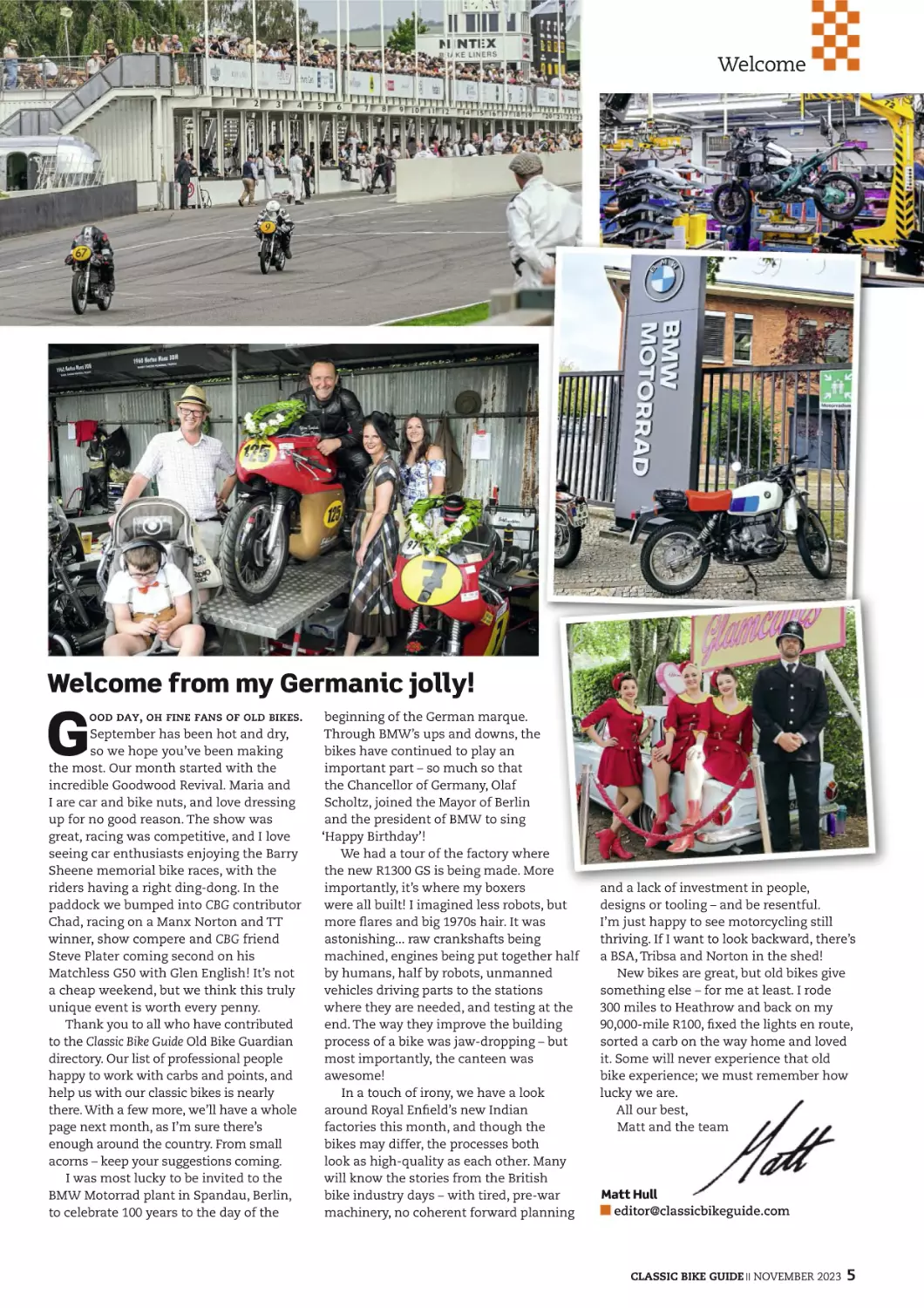
Welcome from my Germanic jolly!
G
ood day, oh fine fans of old bikes.
September has been hot and dry,
so we hope you’ve been making
the most. Our month started with the
incredible Goodwood Revival. Maria and
I are car and bike nuts, and love dressing
up for no good reason. The show was
great, racing was competitive, and I love
seeing car enthusiasts enjoying the Barry
Sheene memorial bike races, with the
riders having a right ding-dong. In the
paddock we bumped into CBG contributor
Chad, racing on a Manx Norton and TT
winner, show compere and CBG friend
Steve Plater coming second on his
Matchless G50 with Glen English! It’s not
a cheap weekend, but we think this truly
unique event is worth every penny.
Thank you to all who have contributed
to the Classic Bike Guide Old Bike Guardian
directory. Our list of professional people
happy to work with carbs and points, and
help us with our classic bikes is nearly
there. With a few more, we’ll have a whole
page next month, as I’m sure there’s
enough around the country. From small
acorns – keep your suggestions coming.
I was most lucky to be invited to the
BMW Motorrad plant in Spandau, Berlin,
to celebrate 100 years to the day of the
beginning of the German marque.
Through BMW’s ups and downs, the
bikes have continued to play an
important part – so much so that
the Chancellor of Germany, Olaf
Scholtz, joined the Mayor of Berlin
and the president of BMW to sing
‘Happy Birthday’!
We had a tour of the factory where
the new R1300 GS is being made. More
importantly, it’s where my boxers
were all built! I imagined less robots, but
more flares and big 1970s hair. It was
astonishing... raw crankshafts being
machined, engines being put together half
by humans, half by robots, unmanned
vehicles driving parts to the stations
where they are needed, and testing at the
end. The way they improve the building
process of a bike was jaw-dropping – but
most importantly, the canteen was
awesome!
In a touch of irony, we have a look
around Royal Enfield’s new Indian
factories this month, and though the
bikes may differ, the processes both
look as high-quality as each other. Many
will know the stories from the British
bike industry days – with tired, pre-war
machinery, no coherent forward planning
and a lack of investment in people,
designs or tooling – and be resentful.
I’m just happy to see motorcycling still
thriving. If I want to look backward, there’s
a BSA, Tribsa and Norton in the shed!
New bikes are great, but old bikes give
something else – for me at least. I rode
300 miles to Heathrow and back on my
90,000-mile R100, fixed the lights en route,
sorted a carb on the way home and loved
it. Some will never experience that old
bike experience; we must remember how
lucky we are.
All our best,
Matt and the team
Matt Hull
editor@classicbikeguide.com
CLASSIC BIKE GUIDE || NOVEMBER 2023
5
Parts Sp
pecialists
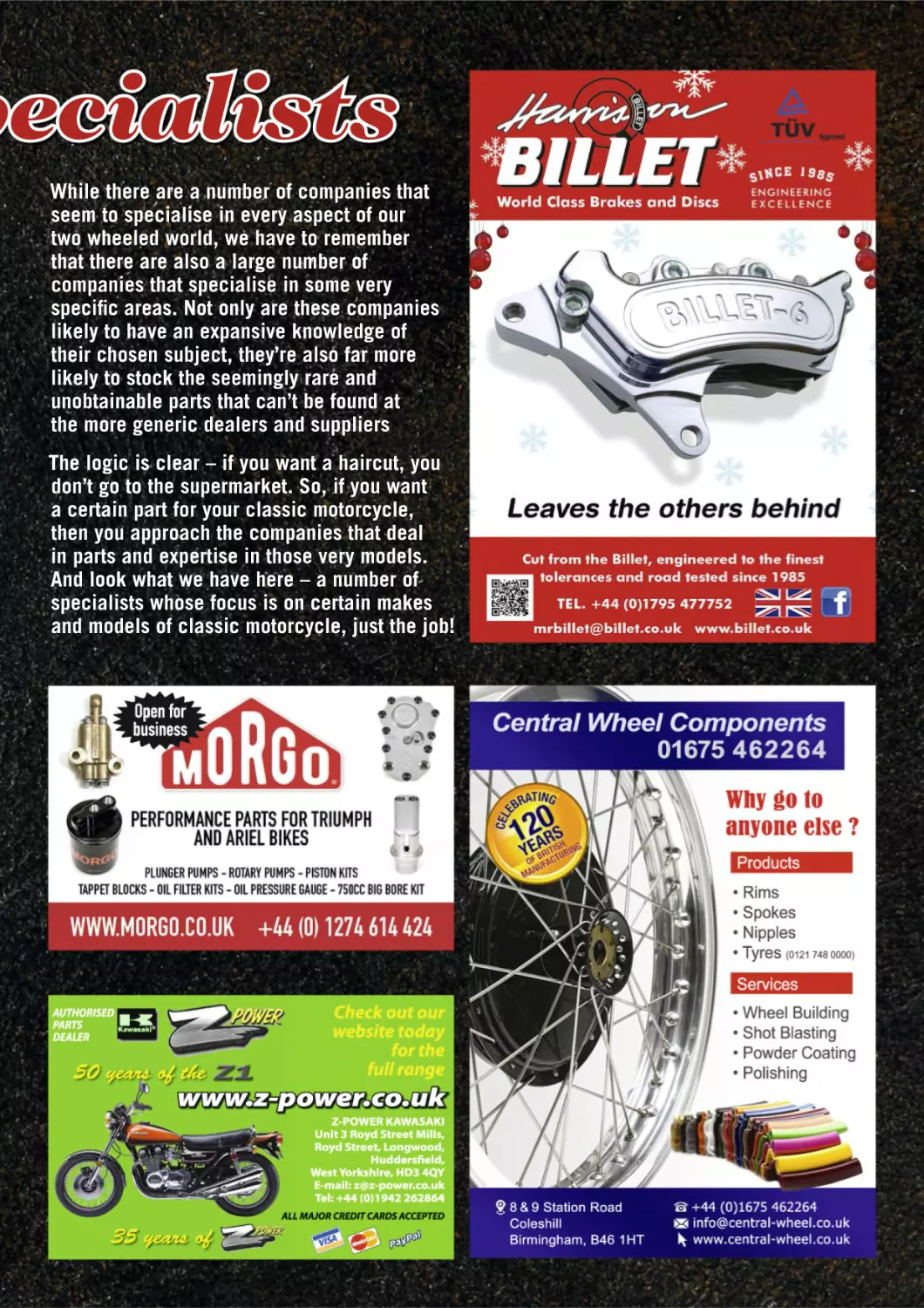
While there are a number of companies that
seem to specialise in every aspect of our
two wheeled world, we have to remember
that there are also a large number of
companies that specialise in some very
specific areas. Not only are these companies
likely to have an expansive knowledge of
their chosen subject, they’re also far more
likely to stock the seemingly rare and
unobtainable parts that can’t be found at
the more generic dealers and suppliers
The logic is clear – if you want a haircut, you
don’t go to the supermarket. So, if you want
a certain part for your classic motorcycle,
then you approach the companies that deal
in parts and expertise in those very models.
And look what we have here – a number of
specialists whose focus is on certain makes
and models of classic motorcycle, just the job!
From our archive
■ Three men
and a lady
The rider of this Matchless V-twin,
sidevalve outfit found himself passing
the two soldiers and a lady walking to
a country station, one of the men being
trench-bound again after seven days’
leave. The sidecar owner insisted on
taking the trio the remainder of their
journey, a distance of two and a half
miles. The registration points to the
North West London area, but there are
many Black Lion pubs, not to mention
the many that will have closed in the
last 95 years or so. It would certainly
have given the lads a story to tell the
boys back in the trenches.
8
NOVEMBER 2023 || CLASSIC BIKE GUIDE
CLASSIC BIKE GUIDE || NOVEMBER 2023
9
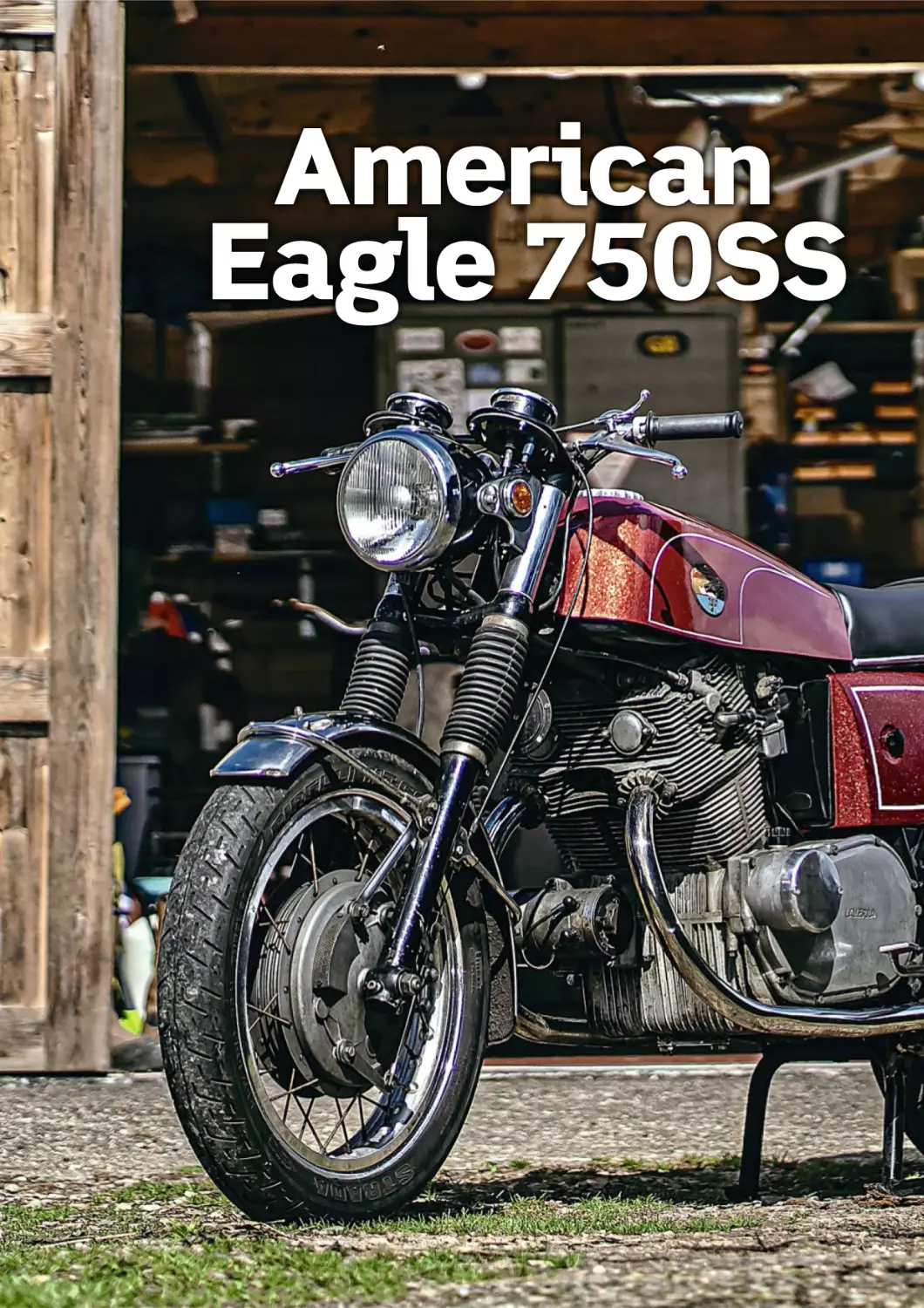
American
Eagle 750SS
Not all American twin-cylinder bikes are
Harleys made for cruising. This littleknown marque was a collaboration with
Laverda to bring the US a sporty edge
Words by Oli Hulme Photos by James Archibald
F
or reasons that are hard to fathom,
American motorcycle manufacturers seem
to struggle making motorcycles that are not
big V-twins, with established companies
resorting to foreign firms to provide
small and medium-capacity bikes. Most famously,
Harley-Davidson bought Aermacchi, while Indians
had a small sidevalve single made by Blackpool’s
Brockhouse to sell as an Indian, tried a Vincent
engine, and imported rebadged Royal Enfields. In
the Clymer years, Indians came with engines from
Velocette and Royal Enfield and Italjet frames, and
there were Taiwanese-made two-stroke Indian
tiddlers.
One of the more unusual efforts to slap on the
Stars and Stripes was American Eagle Motorcycles – a
great name for a motorcycle company, even if it didn’t
actually make any motorcycles. It was established
in 1967 by former Honda and Suzuki concessionaire
Jack McCormack, the man who came up with the
slogan “you meet the nicest people on a Honda”.
McCormack started American Eagle when Suzuki took
its importation operation off him and moved it inhouse in the USA. He sued them, won, and used the
substantial pay-out to set up the new company.
There was never any American Eagle motorcycle
facto y. He started out with a big ad budget and small
racing team while selling off-road bikes in a classic
example of ‘Badge Engineering’. These were made in
the UK, by Sprite Engineering in Oldbu y, in the West
Midlands, which did similar deals with Belgian and
Australian companies. Sprite machines originally
used engines developed from Villiers designs, but
the American Eagle-badged bikes used Sachs and
Husqvarna-based engines. McCormack also brought
in bikes built by Italjet, and badged up Kawasaki
off-roaders and road bikes, including a version of the
Kawasaki A7 twin. Many of these bikes had American
Eagle badges cast into the engine casings.
Then he decided he needed a big road bike to
grab the buyer’s attention and chose as his flagship
a rebadged Laverda twin. McCormack said it was he
who persuaded Laverda to take it out to 750cc and the
bike was being produced exclusively for American
Eagle, a claim parroted in the US motorcycle press.
American Eagle also sold a 150 version of a Laverda
off-roader.
McCormack enlisted the help of Evel Knievel to
promote American Eagle, and the daredevil stunt rider
used a 750cc-engined Super Sport-derived model
in late 1969 and early 1970 instead of his previous
Triumphs. The Knievel American Eagles were the first
to use the stunt rider’s ‘Stars and bars’ Confederate
battle flag-style colour scheme that became his
signature look.
While using the heavyweight Laverda to perform
jumps, he crashed several times. Two Knievel
American Eagles now sit in a museum in Topeka,
Kansas.
“McCormack enlisted the help of Evel Knievel to promote
American Eagle and the daredevil stunt rider used a
750cc-engined Super Sport-derived model in late 1969
and early 1970 instead of his previous Triumphs.”
When the Honda 750 and BSA-Triumph Triples
arrived in US showrooms, American Eagle’s 750
sports bike exclusivity evaporated and the Honda, in
particular, was $200 cheaper. American Eagle went
bust in 1970. Italjet, Kawasaki and Laverda were
able to survive the unpaid bills. Sprite took a much
bigger hit and ve y nearly went out of busines, but
it survived, making bikes and components into the
late 1970s. These days, Sprite makes motorhomes
and caravans.
An all-new Italian twin for the US
The Laverda motorcycle company was set up
in 1947 by Francesco Laverda, who worked with
engineer Luciano Zen to create a range of highquality lightweights to fill the need in
postwar Italy for personal transport.
The resulting machines successfully
took part in many endurance events.
Although the early focus was on small
bikes, in the early 1960s Francesco’s
son, Massimo, wanted to launch a new
large-capacity machine. After some
heated discussion, in 1965 Francesco
allowed his son, then still aged in his
early 20s, to go ahead with the concept,
with the help of Luciano Zen, to create a
650cc twin.
While 650cc doesn’t sound big by
today’s standards, in 1966 it was a
superbike. The 650 appeared at the
Earls Court Show in 1966. It isn’t clear
whether, when Jack McCormack asked
14
NOVEMBER 2023 || CLASSIC BIKE GUIDE
Metalflake paint, a
big 750 twin, and Evel
Knievel used to jump
one – can you think of
anything cooler to ride?
for a 750, Laverda had already decided to make the
engine bigger, but whatever the truth, Zen quickly
made the changes needed. The new American Eagle
Super Sports and GT had a 750 engine, which hit the
US market first. Many pundits felt the engine was, on
the face of it, a beefed-up version of the ohc Honda
twin fitted to the C77 and CB77 twins. What it wasn’t,
though, was a copy. Not entirely accurate legend
has it that Zen simply increased the dimensions of
eve ything on the Honda’s engines and precisionengineered the resulting design, yet Zen’s design
was far more sophisticated than the Honda. Honda
had used a 180-degree crank on the CB77 and a
360-degree crank on the earlier C77. Zen plumped
for the 360 design, like the British parallel twins, so
the pistons moved up and down together. There were
roller bearings on the crankshaft, double-caged roller
bearings on the big ends, and ball and roller bearings
all over the gearbox and a triplex prima y drive chain.
There were lots of supporting webs in the crankcase,
which was horizontally split, Japanese style, and the
pistons were made for Laverda by Mondial. In the onepiece cylinder head were four roller bearings holding
the camshafts and a duplex cam chain. The oil pump
could handle three litres of lubricant a minute. The
engine was hung off a tubular spine frame that used
the engine as a stressed member. Two robust tubes
ran from the top of steering head to the rear of the
seat, two more tubes ran up from the swingarm pivot,
looped up alongside the two upper tubes and then
cu ved down to the bottom of the steering head.
Laverda staked a claim to the reliability of its
equipment by not fitting a kick-start.
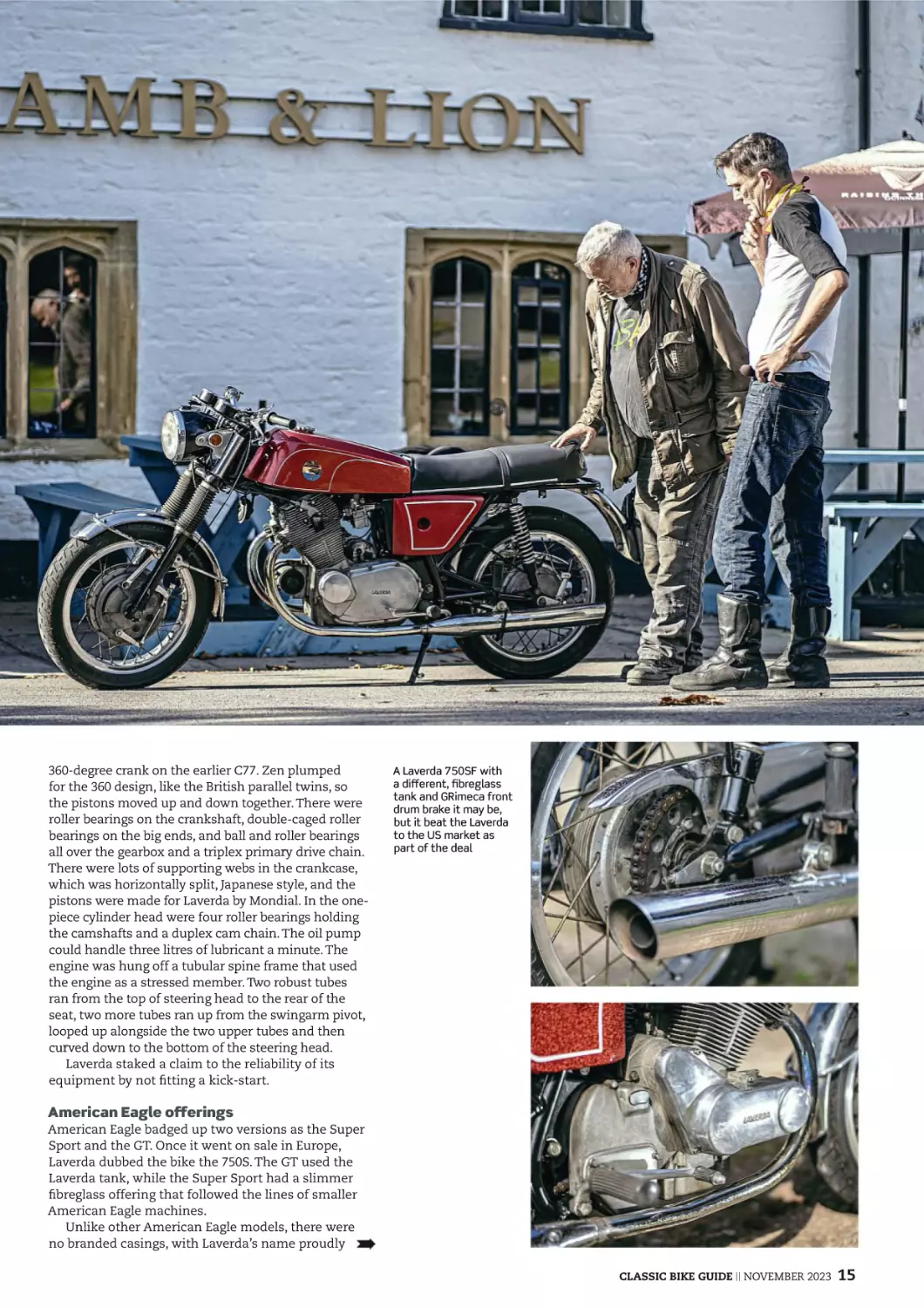
A Laverda 750SF with
a different, fibreglass
tank and GRimeca front
drum brake it may be,
but it beat the Laverda
to the US market as
part of the deal
American Eagle offerings
American Eagle badged up two versions as the Super
Sport and the GT. Once it went on sale in Europe,
Laverda dubbed the bike the 750S. The GT used the
Laverda tank, while the Super Sport had a slimmer
fibreglass offering that followed the lines of smaller
American Eagle machines.
Unlike other American Eagle models, there were
no branded casings, with Laverda’s name proudly
CLASSIC BIKE GUIDE || NOVEMBER 2023
15
SPECIFICATION: 1969 AMERICAN EAGLE 750 SUPER SPORT
ENGINE: SOHC parallel twin BORE AND STROKE: 80 x 74mm POWER: 68bhp CAPACITY: 744cc
COMPRESSION RATIO: 9.6:1 CArburettors: 2x Dell Orto VHB 30mm ELECTRICS: 12v Bosch beltdriven generator SUSPENSION: 35mm Ceriani telescopic forks, twin Ceriani oil-damped shocks
BRAKES: 9in (230mm) TLS drum front; 8in (200mm) TLS drum rear TYRES: 3.50 x 18in front;
4.00 x 18in rear WHEELBASE: 1500mm (59.2in) WEIGHT: 229kg (498lb) Top speed: 115mph
cut into the alloy. During the early production run,
equipment came from German, Italian and British
manufacturers. The American Eagle models had a
230mm Grimeca drum brake at the front, a 200mm
one at the back, CEV lights and Smiths instruments,
which used a curious and effective rubber band
mounting arrangement. Ceriani provided the forks
and shocks. There was a belt-driven Bosch generator,
a chain-driven Bosch electric start, and a Bosch
24ah battery, bringing German quality to Italian flair.
The headlamp was of Laverda’s own design. There
were levers from Smiths and the carbs were 30mm
pumpers from Dell’Orto.
The American Eagle Super Sport claimed to have
about 8bhp more than the GT or Laverda version. How
this was achieved is unclear, so perhaps it was just
publicist hype.
It was the look of the Super Sport that marked it
out as an American Eagle. There was a skinny glass
fibre petrol tank in red metalflake and American Eagle
side panels with white pinstripes. There were high,
braced bars and a prominent starter button.
Laverda’s link with American Eagle did not last
long, and when McCormack’s company went bust in
16
NOVEMBER 2023 || CLASSIC BIKE GUIDE
Though mainly built
through purpose,
the lines and detail
of the American
Eagle flow well
1970, Laverdas were reintroduced to the US market
with their own name on the tank. The 750SF with
Laverda’s own brakes arrived in 1970, becoming
the backbone of Laverda’s range and establishing
the company as one of the great manufacturers of
motorcycles of quality. American Eagle foundered in
1970, and Laverdas became Laverda all over the world.
Riding an Eagle
If you use a single word to describe the American Eagle
Super Sport, ‘beefy’ would be good. Heavy as a four,
yet almost as slender as a British twin, it has serious
presence. The thundering Laverda engine and shiny
metalflake fibreglass bodywork are an impressive
combination. Max, the owner, sold his BSA M20 and
used the money to buy it from a Laverda collector
who hadn’t had it running, and they had got it from
another Laverda collector who hadn’t had it running,
so it has all the quirks of a motorcycle that hasn’t been
out, much, for quite a few decades. For reasons best
known to a previous owner, the wide, braced bars have
been replaced with a narrow and low set from a much
smaller machine, and the enormous starter button
has been relocated from the right-hand handlebar to
the middle of the yoke, meaning you can’t operate the
steering damper. It’s not immediately apparent why
this was done, but it means the bike can be started by
pressing the button with the left hand while keeping
a hand on the throttle with the right. As mentioned,
Laverda’s confidence in its Bosch starter was such that
it didn’t fit a kick-start. The low and narrow bars over
the weighty front end make steering quite heavy at low
speeds, too. I gave it half choke on the bar-mounted,
British-style lever and the engine was off and running.
It seemed only kind to let the oil circulate a little, so
I let the choke off, looked at the currently flickering
generator light, and revved it to about 1000rpm to get it
to go out. I pulled in the clutch and it slipped into gear.
According to the original publicity, Laverda did
something clever with the gearshift mechanism,
involving a steel sheath over an aluminium selector
drum, which helped reduce the clunkiness common
to big twins of the period – and it does seem to have
worked. This bike is markedly easier on the right foot
than most. The later SF750s had a reputation for a
heavy clutch action, requiring extended clutch arms
to make life easier. Either this isn’t the case with the
American Eagle or I’m used to heavy clutches. From
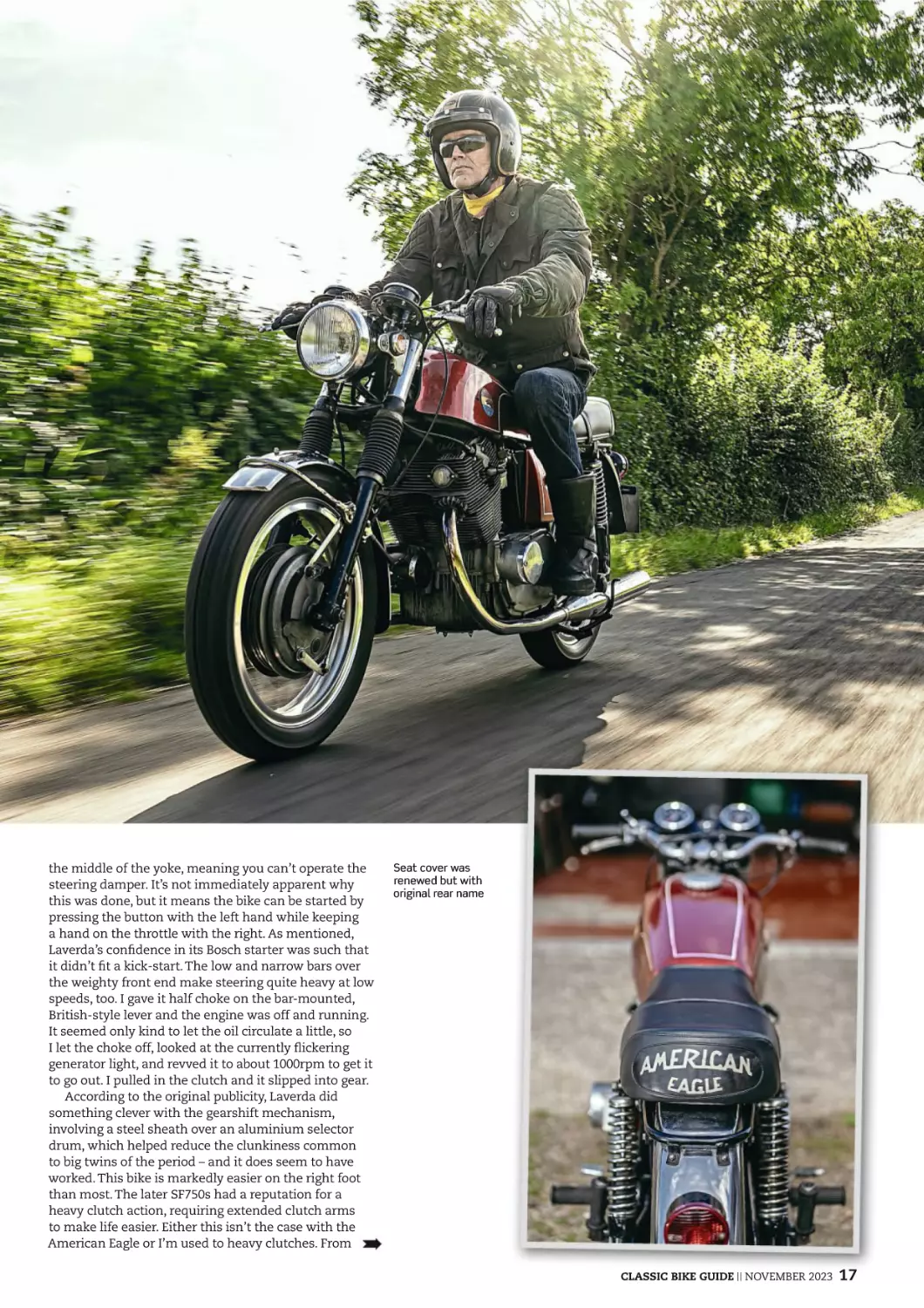
Seat cover was
renewed but with
original rear name
CLASSIC BIKE GUIDE || NOVEMBER 2023
17
first into second, the Super Sport rapidly gathers
momentum, the previously low-speed, heavy steering
becoming nicely positive while the low-barred riding
position gives the rider a head-first and aggressive
stance. The touring height footrests mean the rider
isn’t cramped as one might be with a more café racertype stance. Handling and performance became better
the harder it rode. The Ceriani forks and oil-damped
shocks are firm but not uncomfortable. You steer it,
rather than chuck it about. I clamped my knees into
the tank old-style, as this is much more old-style
sports bike, rather than letting-it-all-hang-out territo y.
Knowing the fuel level was low, I was gentle with
it for the first few miles. Then, after splashing some
E5 into the tiny tank, being extra-careful not to spill
any on the metalflake paint job for fear of watching
it dissolve, I headed back at a more enervating
pace. Without the fear that I was about to coast to a
halt, I gave it few handfuls and found a sweet spot
somewhere between 4000-5000rpm. Below that and
the old Dell’Orto carbs seemed to labour a bit; above
6000 is an appreciable buzz that would have become
wearing on a long run.
Brake operation is unusual, as it seems to be twostage, with half-braking for progressive slowing, while
a big handful stops it on a sixpence. The front brake
on the American Eagle is not the legenda y item of
the later Laverda SF and SFC, but a Grimeca offering
like that fitted to many other period Italian bikes.
It handles sweetly, growls along nicely, and gives
you a sense of aggressive well-being. All you could
want from a motorcycle, really.
No matter what badge there is on the tank, the 750
is a robust machine and can be ve y reliable. Keeping
the batte y charged and up to snuff on a bike with no
kick-start is a must; if it has been standing for a while,
you will need to clean the carbs, but the square slide
Dell’Ortos are well catered for by Eurocarbs in the UK,
and updated round slide Dell’Ortos are available too –
at a price. Unlike a lot of early 1970s Italian bikes, the
Laverda can survive inclement conditions reasonably
well, as long as it gets regular post-ride wipe downs,
though some ancilla y parts might be hard to find.
Max found the rear brake shoes had fallen
apart and had some made.
The major issue on a Super Sport is the
bodywork. On the GT, the petrol tank is the
steel Laverda original, but on the Super
Sport, the glass fibre tank, along with the
Fibreglass tanks will
need to be coated
to be protected
from ethanol
side panels, are some of the few actual American
parts. This will not like even low ethanol petrol, and
E10 is likely to eat through it in short order, so it will
need lining with a good ethanol-proof liner. Finding
replacements is likely impossible. The seat foam on
Max’s bike had crumbled, so Max had new foam cut,
and the battered original cover had the rear badge
panel cut out and expertly stitched into a new cover.
Buying an Eagle
OWNERS’ CLUB
International Laverda
Owners’ Club
www.iloc.co.uk
In the 1970s, American Eagle Laverda machines often
met the fate of many a failed attempt to encourage
US motorcyclists to part with their money – relegated
to the backs of garages and sheds, languishing for
many years, a few packed into containers by British
importers in the 1980s and 1990s, when they were
snapped up by UK racers looking for a big twin
to campaign. It is estimated that just 150 were
made of both types. Their rarity and the recentlyrecalled Knievel connection has seen the Super
Sport significantly rise in value, particularly in the
US. A concours condition Super Sport now stands at
upwards of $14,000, and even a poor example will set
an American buyer back $6000.
Thanks to Max for letting us play!
“It handles sweetly, growls along nicely and
gives you a sense of aggressive well-being. All
you could want from a motorcycle, really.”
CLASSIC BIKE GUIDE || NOVEMBER 2023
19
Next month
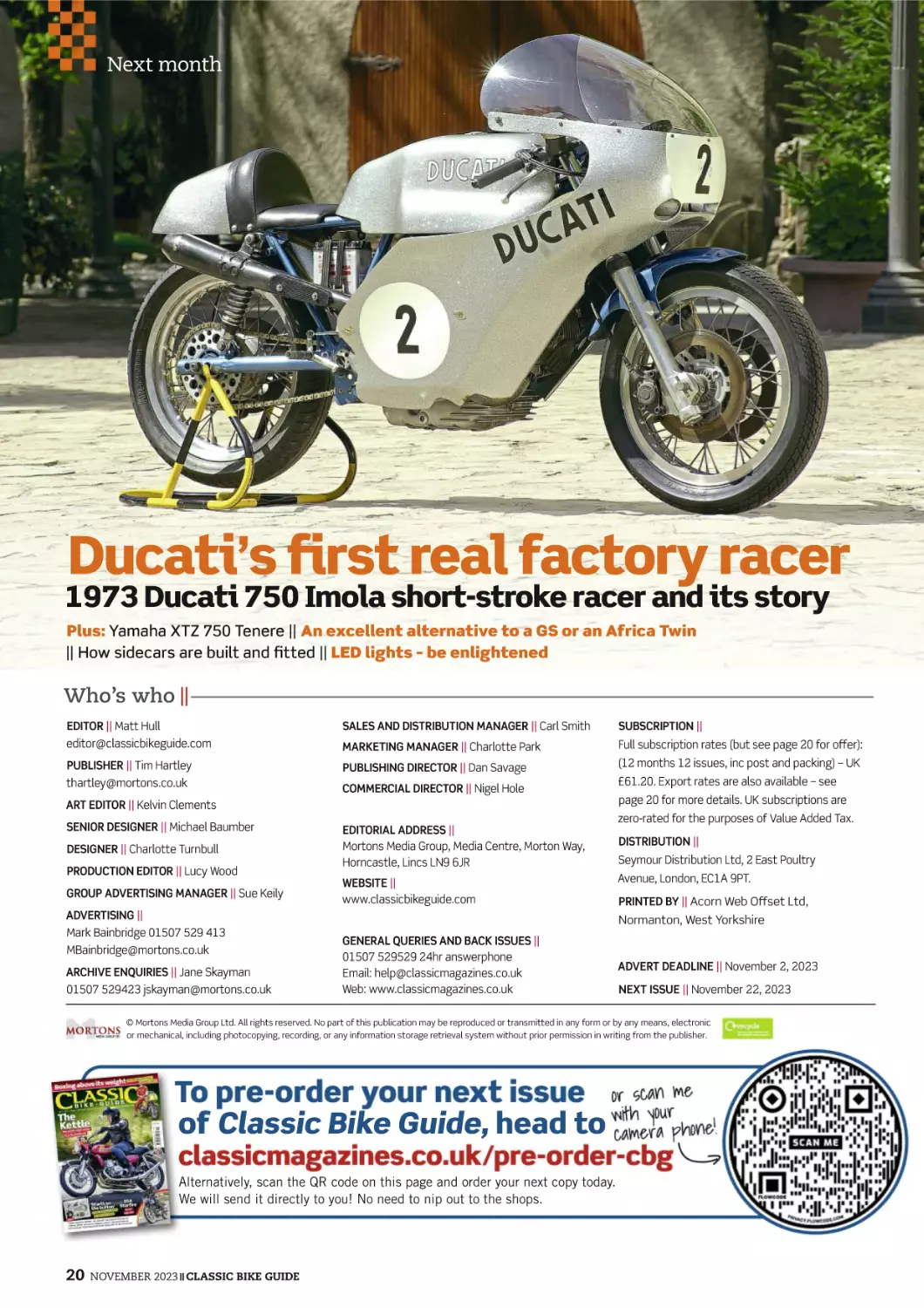
Ducati’s first real factory racer
1973 Ducati 750 Imola short-stroke racer and its story
Plus: Yamaha XTZ 750 Tenere || An excellent alternative to a GS or an Africa Twin
|| How sidecars are built and fitted || LED lights – be enlightened
Who’s who ||
EDITOR || Matt Hull
editor@classicbikeguide.com
PUBLISHER || Tim Hartley
thartley@mortons.co.uk
SALES AND DISTRIBUTION MANAGER || Carl Smith
Full subscription rates (but see page 20 for offer):
PUBLISHING DIRECTOR || Dan Savage
(12 months 12 issues, inc post and packing) – UK
COMMERCIAL DIRECTOR || Nigel Hole
ART EDITOR || Kelvin Clements
SENIOR DESIGNER || Michael Baumber
DESIGNER || Charlotte Turnbull
PRODUCTION EDITOR || Lucy Wood
GROUP ADVERTISING MANAGER || Sue Keily
ADVERTISING ||
Mark Bainbridge 01507 529 413
MBainbridge@mortons.co.uk
ARCHIVE ENQUIRIES || Jane Skayman
01507 529423 jskayman@mortons.co.uk
SUBSCRIPTION ||
MARKETING MANAGER || Charlotte Park
EDITORIAL ADDRESS ||
Mortons Media Group, Media Centre, Morton Way,
Horncastle, Lincs LN9 6JR
WEBSITE ||
www.classicbikeguide.com
£61.20. Export rates are also available – see
page 20 for more details. UK subscriptions are
zero-rated for the purposes of Value Added Tax.
DISTRIBUTION ||
Seymour Distribution Ltd, 2 East Poultry
Avenue, London, EC1A 9PT.
PRINTED BY || Acorn Web Offset Ltd,
Normanton, West Yorkshire
GENERAL QUERIES AND BACK ISSUES ||
01507 529529 24hr answerphone
Email: help@classicmagazines.co.uk
Web: www.classicmagazines.co.uk
ADVERT DEADLINE || November 2, 2023
NEXT ISSUE || November 22, 2023
© Mortons Media Group Ltd. All rights reserved. No part of this publication may be reproduced or transmitted in any form or by any means, electronic
or mechanical, including photocopying, recording, or any information storage retrieval system without prior permission in writing from the publisher.
T
o Classic Bike Guide, head to
c
Alternatively, scan the QR code on this page and order your next copy today.
We will send it directly to you! No need to nip out to the shops.
20
NOVEMBER 2023 || CLASSIC BIKE GUIDE
r
u
o
y
e
k
Ma
e
t
t
e
b
n
e
ev
iffts for
mily,
m
self?
zine
ones
hat,
subscribe to Classic Bike Guid
ua
99.
t
f
i
g
r
u
o
y
t
e
G
y
a
d
o
t
n
o
i
t
p
subscri
If you enjoyed this issue,
subscribe or renew for
12 MONTHS
from just £46
and claim your
FREE GIFT
Visit www.classicmagazines.co.uk/xmascbg
or call 01507 529529 and quote XMASCBG
Kit
worth
£99
TERMS & CONDITIONS: Rates are based on UK orders only –
for overseas please visit: www.classicmagazines.co.uk/cbg-overseas.
Subscriptions will start with the issue selected at the basket. Offer
closes 31/01/2024. Full year subscription gifts are available while
stocks last. Full terms and conditions can be found at
www.classicmagazines.co.uk/terms Any gifts are for UK orders only
and will not be mailed out until December 2023.
Try one of our
!
o
o
t
s
e
l
t
i
t
t
a
e
r
othe
f
Get 6 issues of one o
0
2
£
t
s
ju
r
o
f
s
g
a
m
e
s
e
th
The personalities, legendary
bikes and the racetrack
heroes who mattered then...
and still matter now.
Classic, twinshock or Evo, it’s
the place for you to dive into
the dirty side of biking.
Real bikes. Real riders.
Real rebuilds. Real rides.
RealClassic!
Celebrating the rich
history of motorcycles and
motorcycling, then and now.
The original and best mag
for choppers, bobbers and all
kinds of customs!
For news, innovative features,
tech talk and practical tests,
head to Fast Bikes.
Real-world tests of the latest
bikes and kit, places to go,
and features not to miss.
Running, riding and repairing
Japanese, European and US
classics from the ‘70s onward.
The best for classic and
modern scooters. For
enthusiasts, by enthusiasts.
The bible of the British-US car
scene. If it’s American and got
wheels, we’ve got it covered!
For those who like building
model boats, or just enjoy
soaking up this huge hobby.
UK’s biggest model flying mag
packed with reviews, features
and expert opinion.
From steam locomotives to
new developments in scale
engineering.
Britain’s best magazine for
those who love to grow their
own fruit and veg.
Enthusiast-led content, news,
in-depth expert features and
outstanding imagery.
News and features for the
modern traction and heritage
modern traction enthusiast.
Recalling Britain’s steam era
through photos, recollections
and historical features.
Simply Britain’s biggest and
best rail title – modern, steam
and everything in between.
The tools and techniques
used by model makers, light
engineers and restorers.
The best for news, features
and images covering the UK’s
rail preservation movement.
Visit www.classicmagazines.co.uk/xmas23dps Or call 01507 529529 and quote xmas23dps
TERMS & CONDITIONS: Rates are based on UK orders only – for overseas please visit: www.classicmagazines.co.uk
Subscriptions will start with the issue selected at the basket. Offer closes 31/01/2024.
Classic news
Wemoto backs Blood Bikes
Parts specialist Wemoto is backing
Blood Bikes through its annual charity
appeal.
Eve y year, Wemoto and its trade
arm WMD chooses a charity to
sponsor and produces a T-shirt, the
sales of which raise money for the
chosen organisation. All the profit,
after production costs, is donated to
the charity.
This year, the National Association
of Blood Bikes is being supported. You
may have seen Blood Bikes around your
local roads, car ying precious cargos
of blood, platelets, samples, surgical
instruments, clinical products and
even human milk to their important
destinations. These exceptional riders
are all unpaid volunteers and work
tirelessly delivering to the NHS, The
Human Milk Foundation (car ying
donor milk for babies in intensive care),
and air ambulance charities that need
to top up their ‘blood on board’.
Blood Bikes is a group of regional
charities, each of which runs a fleet
of liveried bikes for riders to use for
delive y runs. All the money raised
goes directly into maintaining these
bikes and paying for fuel and insurance.
The se vice is kept operational purely
by donations.
If you would like to contribute to
the work of Blood Bikes, visit Wemoto.
com and buy one of the shirts – they’re
e
only £15!
hibi
Haynes
celebrates the British
Motorcycling Story
The first Hurricane
hits the NMM
A legenda y Hurricane X-75
‘works prototype’ has found
a new and prestigious home
at the National Motorcycle
Museum. After being offered
for sale at auction by H&H
Classics, it’s now being
showcased as a key highlight
in the museum.
This specific 1971 model
stands apart as the only
roadworthy ‘BSA Vetter
Rocket 3’. The BSA Owners’
Club dating certificate
backs its authenticity, with
evidence suggesting only
two prototypes were ever
hand-crafted. A handwritten
note by Mr A G Cave, the
BSA works manager at Small
Heath, and a feature in
Classic Bike magazine further
corroborate its storied past
and the dedicated endeavour
of John Simmonds in
preserving this piece of
British motorcycling histo y.
The bike, under the
24
dedicated stewardship of
John Simmonds since 1982,
had woven itself into the
fabric of his life, becoming
more than just a vehicle.
Following his sad death,
the bike was seeking a new
chapter – and what better
home than a museum
dedicated to protecting the
legacy of iconic motorcycles?
James Hewing, museum
director, said: “In our quest
to source the best vehicles
for our collection, it is
important that we partner
with an auction house that
consistently offers highquality lots and impeccable
service.
“H&H Classics has an
enviable and long-standing
reputation in the indust y,
and our recent acquisition of
the Hurricane X-75 through
it is a testament to that. The
dedication and expertise of
its team is unparalleled.”
NOVEMBER 2023 || CLASSIC BIKE GUIDE
Haynes Motor Museum has
opened a major new exhibition
telling the sto y of British
motorcycling, from its origins
to the modern day.
Life On Two Wheels: The
British Motorcycling Sto y
provides a fresh, fascinating
perspective on the social histo y
of the motorbike and the
impact bikes have on society,
technolo y, and the economy.
Innovative displays will allow
up-close access to dozens of
historically significant bikes,
alongside interactive and
hands-on activity stations to
engage visitors of all ages.
“This exhibition will tell
the entire sto y of British
motorcycling, from its
beginnings at the ve y end of
the 19th centu y to the current
day,” said museum curator
Dr Luca Hoare. “It will also
highlight the central role the
motorbike has played in our
society over the decades.
“The exhibition features
many of histo y’s most iconic
motorcycles, including a
1930s Brough Superior and
Sidecar and a 1970s Triumph
Bonneville.”
As well as detailing the
evolution of the motorbike,
the exhibition will look at
eve ything from the science of
how motorcycles work to the
specialised protective clothing.
Opened in 1985 by John
Haynes OBE, the man behind
Haynes Motor Manuals, the
museum is home to the UKs
biggest collection of cars and
motorbikes dating from 1900
to the present day.
It is located at Sparkford,
near Yeovil, in Somerset (BA22
7LH) and opens from 10am
daily. For more information,
visit www.haynesmuseum.org
Prices for new 400 riumph Singles announced
The showroom prices of Triumph’s new Speed 400 and
Scrambler 400 X singles have been announced and it looks
ve y competitive. The new models joining the Triumph
range in 2024 will be priced at £4995 for the Speed 400 and
Scrambler 400 X will be £5595.
The new bikes have been displayed at Triumph’s Hinkley
base and will be on show at Motorcycle Live at the NEC from
November 18-26.
Dealers report that demand for the new singles, which are
due to arrive in early 2024, is strong. The price puts the bikes,
made by Bajaj in India, between Royal Enfield’s 350 singles
and Japanese 400 machines such as Yamaha’s MT-03.
The Speed 400 is a roadster model with upside-down front
forks, mono-shock, 17-inch wheels and roadster-specific
geomet y and wheelbase. The Scrambler 400 X features a
longer wheelbase, longer travel suspension, larger 19-inch
front wheel and wide handlebars.
Vincents on show at Ardingly
Ardingly Classic Bike Show and Jumble
returns to The South of England
Showground on Sunday, October 29,
rounding off the season in style with a
Vincent theme.
Organiser Elk Promotions and the
Vincent Owners’ Club have arranged a
show-stopping line-up of racing Vincents
for visitors to see. They will also be able to
hear a selection in the fire-up paddock.
Of particular interest are the Mighty
Mouse and Super Mouse drag bikes, built
by legenda y racer Brian Chapman. These
unique machines were still racing, and
winning, into the early 1980s. An array of
club stands and plenty of private entries
of pre-1980 machines will be on display
in the main Jubilee show hall. Visitors
wishing to enter their own bike can do
so online via the Elk Promotions website.
The all-motorcycle autojumble and trade
stands, offering new and used spares,
accessories, clothing, tools and more, will
fill up the remaining space inside the
halls, with additional pitches outdoors.
Workshop clear-out stalls are available at
the bargain price of just £20 per plot (prebooked only). The BikeMart display-to-sell
area also returns, offering the opportunity
to buy and sell complete machines. The
South of England Showground is located
at Ardingly, near Gatwick (RH17 6TL), eight
miles from junction 10 of the M23.
Admission is from 10am and
tickets cost just £7, with no charge for
accompanied children under 16. Earlybird
tickets are valid from 8am and cost £10.
Tickets are available online or visitors can
pay by card or cash at the gate. Tickets,
stall bookings and all other information
can be found at www.elk-promotions.
co.uk
Andy’s 2024
calendar
Suffolk classic bike shop owner Andy
Tiernan has been collecting and
trading largely British classics for
more than 40 years now. He started
a charity calendar a few years ago
and the 2024 edition is now here.
The theme is ‘Panther through
the Decades’. The six motorcycles
are all magnificently drawn in
pencil and painted in watercolour,
captured by Mike Harbar, a former
Suffolk local now resident in
Australia and producing art at www.
classiclinesartist.com
Proceeds are being donated to the
East Anglian Air Ambulance.
Individual copies of the calendar
can be obtained from: Andy Tiernan
Classics Calendars, The Old Railway
Station, Station Road, Framlingham,
Woodbridge, Suffolk IP13 9EE.
The cost for one calendar is
£12, which includes UK second
class postage. Cheques should
be made payable to East Anglian
Air Ambulance, or alteranatively,
you can pay via PayPal using
AndyTiernanCalendarDonation@
outlook.com. For more details, visit
www.andybuysbikes.com
CLASSIC BIKE GUIDE || NOVEMBER 2023
25
Royal Enfield
Bullet 350
The Indian icon – born-again Bullet
Words by Alan Cathcart Photos by Royal Enfield
26
NOVEMBER 2023 || CLASSIC BIKE GUIDE
B
onneville. Monster. Commando. Vespa.
Bullet. A select list of motorcycle and scooter
models so iconic in their own right that
adding the name of the manufacturer is
simply redundant. The Royal Enfield Bullet
may have been ‘resting’ since 2020, when the lastever 500cc version was manufactured, but this was a
mere hiccup in the Bullet’s unrivalled claim to be the
motorcycle with the longest continuous production run
in histo y, ever since its 1932 debut.
And now the Bullet returns to Royal Enfield dealers
around the world as an all-new design, based on RE’s
latest generation J-Series air/oil-cooled 349cc longstroke single-cylinder motor. This was introduced
three years ago in the Meteor 350, with high bars
and forward-mounted footrests as a custom hors
d’oeuvre to the main dish. That came one year later
as the Classic 350, the world’s largest-selling current
motorcycle over 250cc, of which 432,000 units were
built in India’s last full pre-Covid fiscal year up to
April 2019 alone. That made up a 53% slice of RE’s
806,870-unit overall 2018/19 annual production, so
for Eicher Motors, RE’s owner, developing a modern,
fully emissions-compliant replacement for when
the existing 350 Classic’s pushrod motor could no
longer meet India’s increasingly more stringent
environmental regulations had been a key priority.
That done, in August 2022, Eicher management,
led by its astute, dynamic CEO/MD Siddhartha Lal,
came up with the Hunter 350, an all-new urban
model mainly targeted at younger riders in India, who
mostly live in cities and want a streetfighter-type
bike. Now, the last of the four different models has
been unveiled, the born-again Bullet 350 due to reach
Europe in November this year at a price of about
£4500.
CLASSIC BIKE GUIDE || NOVEMBER 2023
27
The Bullet has become a key part of India’s social
fabric – often to the extent of being an heirloom
handed down from one generation to the next – that’s
spawned more than 1000 different Bullet riders’ clubs
throughout the subcontinent. For India is in fully
requited love with the Bullet, and none more so than
Siddhartha Lal. “The summer of ‘94 was when I rode
solo across Europe, fearless and adventurous, on a
Bullet 500. Many before me, and many afterwards,
have made the same journey, literally and figuratively,
but it was the most memorable motorcycle experience
of my life. Undoubtedly, while the Bullet has been a
definitive symbol of what we call pure motorcycling
for generations of riders, it’s also been a crucial part
of Royal Enfield’s histo y. The Bullet has become a
beloved badge of honour and identity for many riders
and enthusiasts. Today, we are truly honoured to play
a key role in taking its legacy forward.”
Eve ything on the born-again 2023 Bullet 350,
from the frame to the styling, is new compared to
the previous OHV version. Its core element is the
now well-established single-cylinder, J-Series motor,
measuring 72 x 85.8mm, with chain-driven SOHC
and a two-valve cylinder head. Producing 20.2bhp at
6100rpm and 19.9lb.ft of torque peaking at 4000 revs,
this has been retuned via different ignition timing and
fuel mapping to give a broader spread of performance
versus the other three models it shares the motor
with. Much work has also gone into making the new
Bullet engine frugal like the old model – a key element
for the Indian customers still representing 88% of RE’s
market – in delivering up to a claimed 107mpg. Hence
the five-speed gearbox has an overdrive top gear for
more relaxed cruising
However, the 2023 Bullet has a hefty wet weight
of 195kg with a full 13-litre fuel tank; that’s the
same as an 850 Norton Commando. But the Bullet
is built to be substantial and durable, as well as
stylish – a point raised at the unveiling of what, given
28
NOVEMBER 2023 || CLASSIC BIKE GUIDE
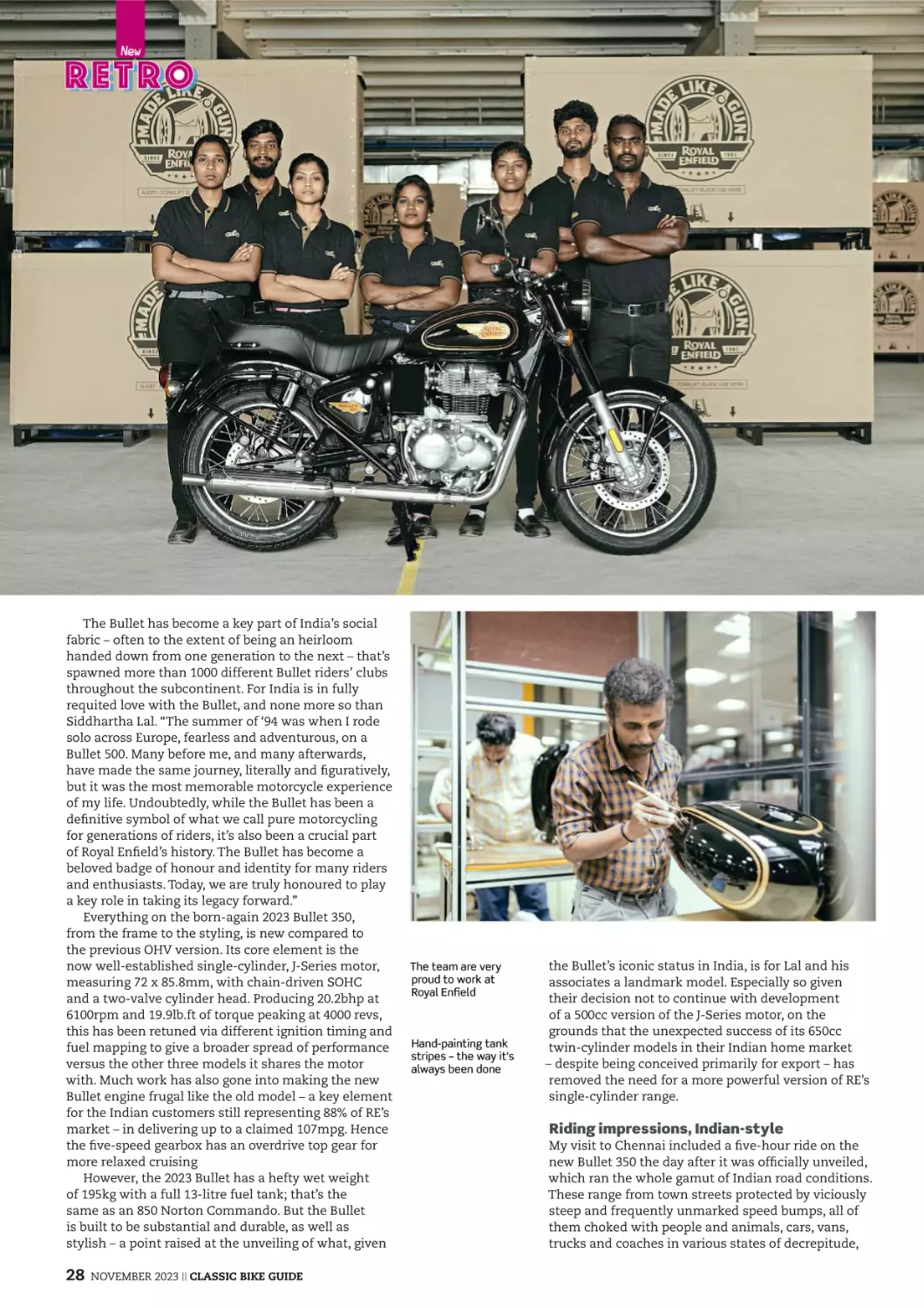
The team are very
proud to work at
Royal Enfield
Hand-painting tank
stripes – the way it’s
always been done
the Bullet’s iconic status in India, is for Lal and his
associates a landmark model. Especially so given
their decision not to continue with development
of a 500cc version of the J-Series motor, on the
grounds that the unexpected success of its 650cc
twin-cylinder models in their Indian home market
– despite being conceived primarily for export – has
removed the need for a more powerful version of RE’s
single-cylinder range.
Riding impressions, Indian-style
My visit to Chennai included a five-hour ride on the
new Bullet 350 the day after it was officially unveiled,
which ran the whole gamut of Indian road conditions.
These range from town streets protected by viciously
steep and frequently unmarked speed bumps, all of
them choked with people and animals, cars, vans,
trucks and coaches in various states of decrepitude,
with motorcycles, motorcycles, motorcycles
eve ywhere, to narrow, winding rural roads stacked
with potholes that last saw a repair crew sometime in
the previous centu y. They went from well-surfaced
but often traffic-clogged highways to a fast, four-lane
motorway with the occasional cow wandering around,
unfazed, seemingly well aware that as a religious icon,
it is impervious to harm. And optimistic scooter riders
motoring the wrong way down the fast lane in the
carriageway you’re travelling on!
Whereas the 350 Bullet’s engine is essentially the
same as fitted to the other three models it powers,
its tubular steel twin-loop frame developed by RE
subsidia y, Harris Performance in the UK, is all-new,
although the wire wheels, brakes and suspension
are shared with the new-generation Classic. So,
the 805mm seat height is taller than the Hunter’s
800mm and the Meteor/Classic’s 765mm, which helps
deliver a more spacious riding position for taller
riders, without sacrificing the ability for shorter ones
to put both feet flat on the ground. That’s thanks
to the narrow stepover section of the well-shaped,
comfortable dual seat where it meets the fuel tank,
and the taller seat meant my legs didn’t get cramped,
especially with the quite low-set footrests positioned
slightly further back than on the Meteor. Combined
with the quite tall, pulled-back handlebars with
fairly thick grips adding extra comfort, this delivers a
fairly upright stance, resulting in feeling at one with
the bike.
The Bullet version of the 349cc motor is both crisp
and well-controlled in throttle response, especially
at low revs. There’s seamless fuelling, so no snatchy
take-off from a standstill in bottom gear, or a brusque
pick-up from a closed throttle. There is no point in any
riding modes here, nor enough power to warrant any
electronic riding aids like traction control. The power
delive y is smoothly responsive in any of the bottom
three gears, allowing you to exploit the Bullet’s
willing nature. The motor’s fuel injection has been
expertly mapped – it’s not easy to achieve that crisp
response allied to a smooth, initial pick-up and Euro 5
compliance, but RE’s engineers have done so.
There is a reasonable top end for a 350 single, too. I
saw 76mph on the analogue speedo, on level ground
in top (fifth) gear, whereas the Meteor could only
manage this in fourth. But most Bullet customers
in India, for whom the bike was designed, won’t
exceed 50mph in eve yday use – just that they’ll
have the oomph to out-accelerate most other road
Looks are part 350
Classic, part original
Bullet, but both have
been popular so it’s
not a bad recipe
users away from traffic lights, exploiting that upright
stance and the view it gives over car roofs to carve a
course through.
Thanks to the gear-driven balance shaft, even at
what feels like something approaching peak revs (the
Bullet has no tacho), there’s absolutely no vibration
at any point on the motorcycle – not from the
seat, handlebar or footrests, and the quite effective
retro-looking mirrors remained steady, too. The lever
operating the seven-plate wet clutch has no span
adjustment, but despite being not particularly light
has a smooth action and isn’t too heavy, so this is
an easy bike to ride in traffic. But you must always
use the clutch, even for upward gear changes via the
heel-and-toe gearshift lever – it’s hard to change gear
smoothly each time unless you do. Neutral is easy to
find at rest, though. While I didn’t think I’d like the
ve y Latin heel and toe left-foot gearshift, it’s ve y
easy to use once you get used to it, and the actual
gear selection is butter-smooth in all ratios. But since
fifth gear is an overdrive ratio, it’s best to select it only
when you’re cruising, because top gear roll-on isn’t in
abundance on this small-cube motor.
That Harris-developed twin-loop frame is fitted
with a non-adjustable 41mm Gabriel forks giving a
good 130mm of wheel travel, and a twin-shock rear
end with each unit six-way adjustable for spring
preload, delivering 102mm travel. The geomet y
CLASSIC BIKE GUIDE || NOVEMBER 2023
29
gives responsive, direct steering – the Bullet is ve y
manoeuvrable on busy streets, the narrow steering
lock making feet-up U-turns easy. Yet it’s also
satisfyingly nimble in the way you can flick it from
side to side through tight bends at any sort of speed,
without ground clearance ever being an issue for the
footrests. The Bullet’s front suspension felt compliant
when riding bumps leaned over, though there’s not
much feel as to what the front tyre is doing when you
brake hard on the angle, and the limited wheel travel
of the twin-shock rear end, plus the short 1390mm
wheelbase, induces a lively ride over bumps.
The spoked wheels car y Indian-made CEAT tyres,
a 100/90-19 front and 120/80-18 at the rear, whose
hard compound giving extra mileage does so at the
expense of any great feedback – though grip was
seemingly good in eve yday conditions; all that really
matters. Braking is a 300mm disc with twin-piston
floating Bybre (Brembo’s cheaper brand) caliper at the
front and a 270mm rotor and single-piston floating
caliper at the rear. There’s basic dual-channel ABS
and you must use both brakes really hard to stop
a bike weighing a claimed 195kg with oil and a full
13l gas tank (facto y figure 183kg d y, a huge 14kg
more than the same-engined Hunter, albeit only 4kg
more than the Meteor) from any real speed. The front
brake didn’t have exceptional bite – for some reason,
the Meteor’s similar such brake works better... pads,
maybe? – but the Bullet’s smaller rear disc was much
more effective in pulling the bike up, and if both are
used together it stops hard reasonably well.
From November onwards, the Bullet 350 will be
available in Royal Enfield’s dealerships in more than
60 countries around the globe, alongside the
2100 stores in India, which began deliveries
in September. Available in export markets in
three different colour schemes for the fuel
tank, with on-trend blacked-out engine and
components, it comes fitted with an easyon/easy-off centrestand, as well as a
small sidestand, and a USB port is
included, discreetly mounted below
the handlebar, to enable charging
on the go. However, unlike on
the Meteor where it’s included as
standard, Royal Enfield’s Tripper
30
NOVEMBER 2023 || CLASSIC BIKE GUIDE
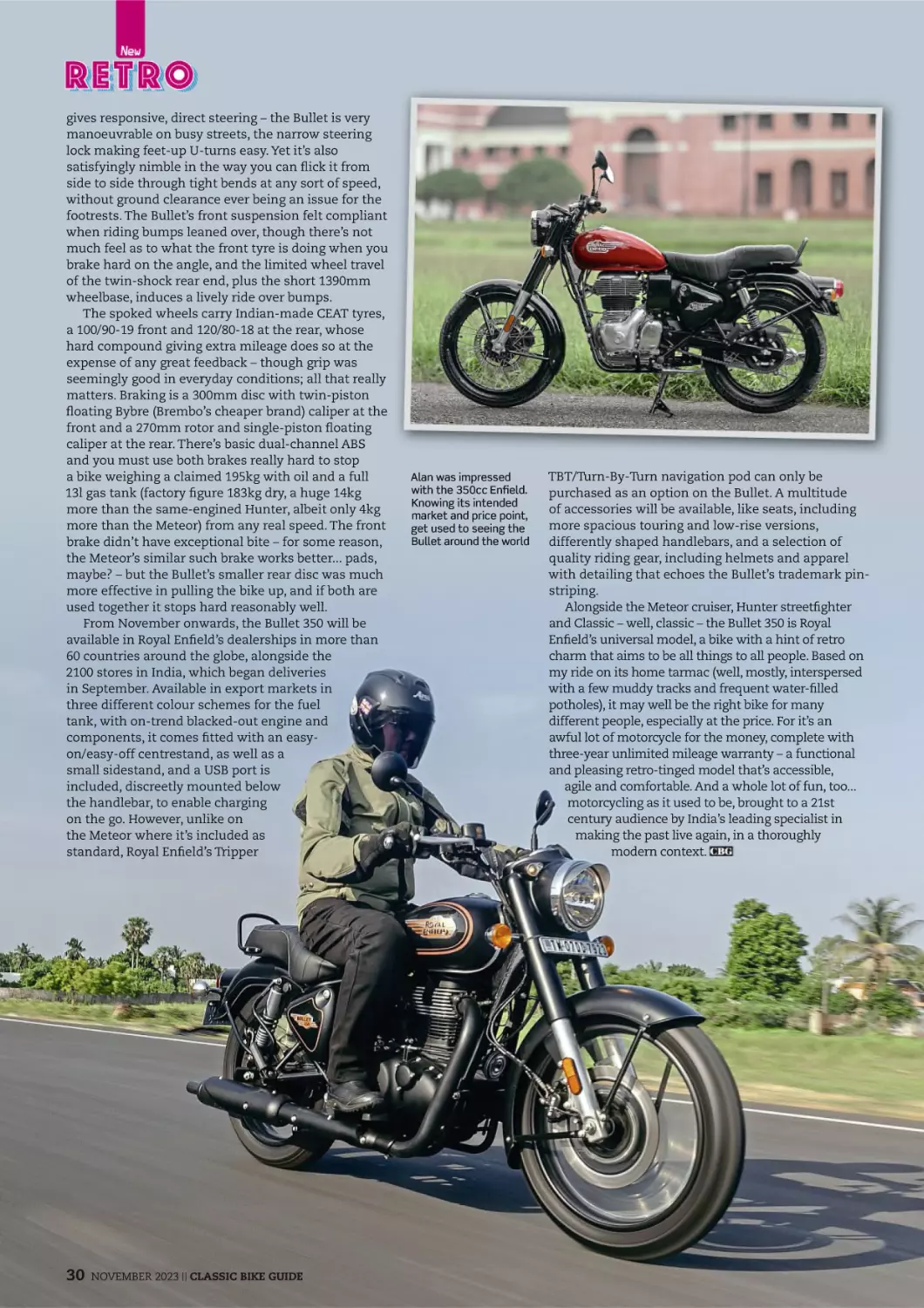
Alan was impressed
with the 350cc Enfield.
Knowing its intended
market and price point,
get used to seeing the
Bullet around the world
TBT/Turn-By-Turn navigation pod can only be
purchased as an option on the Bullet. A multitude
of accessories will be available, like seats, including
more spacious touring and low-rise versions,
differently shaped handlebars, and a selection of
quality riding gear, including helmets and apparel
with detailing that echoes the Bullet’s trademark pinstriping.
Alongside the Meteor cruiser, Hunter streetfighter
and Classic – well, classic – the Bullet 350 is Royal
Enfield’s universal model, a bike with a hint of retro
charm that aims to be all things to all people. Based on
my ride on its home tarmac (well, mostly, interspersed
with a few muddy tracks and frequent water-filled
potholes), it may well be the right bike for many
different people, especially at the price. For it’s an
awful lot of motorcycle for the money, complete with
three-year unlimited mileage warranty – a functional
and pleasing retro-tinged model that’s accessible,
agile and comfortable. And a whole lot of fun, too...
motorcycling as it used to be, brought to a 21st
centu y audience by India’s leading specialist in
making the past live again, in a thoroughly
modern context.
CLASSIC BIKE GUIDE || NOVEMBER 2023
31
Behind the scenes of the
new Royal Enfield Bullet!
Alan is invited to Royal Enfield in India for a sneak view of its
inner workings. The figures are staggering... the attention to
detail not what many expect
R
Words by Alan Cathcart Photos by Royal Enfield
oyal Enfield is the smallest of
the four indigenous Indian
motorcycle manufacturers in
numbers of bikes (no scooters!),
behind Hero, Bajaj and TVS
in that order. But it’s the only one to
market larger-capacity four-stroke models,
350cc and up, so has a much higherthan-average sticker price for each bike
delivered to its customers. A total of 88%
of these are in India; any Royal Enfield is
very much a status symbol in a country
where 67% of the 1.43 billion inhabitants
(which has now officially overtaken China
as the world’s largest) rides a powered
two-wheeler, of whatever vintage. No
wonder annual pre-Covid sales of all
powered two-wheelers peaked there in
2019 at 22 million units!
Indeed, besides India and China, the
annual production numbers for the three
32
NOVEMBER 2023 || CLASSIC BIKE GUIDE
Royal Enfield plants located in Tamil Nadu
are mind-boggling. In the year ending
April 2023, Royal Enfield produced a
record 832,179 motorcycles – a huge 38.4%
increase on the 602,268 bikes the previous
year, which was compromised by the
Covid-19 pandemic. Moreover, for the first
time since Enfield India was established
in 1955, more than 100,000 motorcycles
were exported in a single year, with
100,055 Royal Enfields sold outside India,
including via its five offshore plants in
Brazil, Thailand, Colombia, Argentina and
Nepal, which assemble bikes from Indiamade kits. For the first time ever, its sales
to the USA broke the 40,000 barrier, via its
own local distribution operation based in
Milwaukee, Harley-Davidson’s home turf!
Given the ongoing rise, it seems only a
matter of time before the magic million
bikes a year barrier will be broken.
RE’s Indian factories have a combined
production capacity of 1.2 million bikes a
year on the workforce’s current six-daysa-week triple-shift basis, making this
entirely feasible.
Royal Enfield’s original, comparatively
tiny 4.45-acre plant at Tiruvottiyur is in
the heart of the coastal city of Chennai,
previously Madras. It’s where manufacture
of the Bullet started in 1955, was
repurposed as corporate HQ in 2013, and
the company’s ultra-modern new 50-acre
facto y at Oragadam, 40 miles inland, was
inaugurated. Today, this produces all RE’s
650cc twin-cylinder bikes, as well as the
Himalayan and Scram models powered
by their quite different 411cc SOHC motor.
And in 2017, an even larger 65-acre facto y
at Vallam Vadagal, just seven miles away,
has a 4000 workforce building all the new
350cc J-Series engine bikes, including
the Classic, Meteor, Hunter, and now the
Bullet.
The Bullet 350, like all new-generation
Royal Enfield models, was conceived as a
joint venture between RE’s UK Tech Centre
in Bruntingthorpe, opened in 2017, and its
Indian R&D Centre at Tiruvottiyur, near its
corporate HQ.
The 4½ hour time difference between
the two extends the working day ve y
nicely, in what Italian former Aprilia/
Moto Guzzi, BMW/Husqvarna and
Peugeot Motorcycles R&D engineer Paolo
Brovedani, who joined Royal Enfield in
2020 as the chief of product development,
terms ‘convergence’.
My invitation to visit RE’s three-storey
R&D facility came on the condition that I
left my phone at the front gate, so without
any photos you’ll have to believe me when
I tell you that, besides the numerous
design studios and prototype component
workshops, the 300 people working in
the 18,000m² building have a seemingly
endless succession of often ingeniously
designed rigs to test eve y component in a
forthcoming new model to destruction.
“We have made quality an obsession,”
Siddhartha Lal told me later that day – as
my tour, led by Paolo Brovedani, of the
more than 70 test stations each working
24/7, amply demonstrated.
I saw a steering stem test rig that turns
the wheel from lock to lock 100,000 times
in a week, in eight-hour, 7200-cycle stages
to allow for inspection. Next, a fuel tank
leak test rig that’s pressurised at 0.3 bar
over an extended period to ensure it is fueltight, a gearshift test rig that makes seven
million gear changes to simulate 15 years
of eve yday riding, and a seat foam test rig
which deposits a putative 80kg posterior on
and off the seat through 11,520 cycles over
eight hours. Alongside this was a footrest
test station, which repeatedly applied
80kg of pressure to each rider and pillion
footpeg, again over an eight-hour period.
There was a chain snatch test rig, a starter
motor endurance rig, a speedo test rig, and
copious other set-ups to pull levers, twist
throttles, and press eve y button on the
switch blocks tens of thousands of times. It
was just amazing!
The ignition switch and warning
lights are tested in a heat and humidity-
controlled booth so they know they
remain working in all conditions; the
instruments are subjected to ambient
temperatures ranging over a 70ºC span.
Another rig lifts a bike onto its centrestand
and drops it off over and over again, then
another one puts the sidestand down,
lowers the bike onto the stand, raises the
bike, and lifts the sidestand up again, in a
process that encompasses 20,000 cycles of
durability testing.
And while the second floor at
Tiruvottiyur is devoted to individual
component durability testing, the ground
floor is dedicated to entire vehicle
dynamic appraisal. There’s a climatic
chamber containing eight chassis
dynos that run the vehicle in ambient
temperatures between minus 30ºC and
60ºC, and a bump test rig that has a rolling
road covered with rocks and bumps,
which the complete bike is subjected to
for hours on end. There’s an ultra-costly,
American-made, MTS five-axis test rig of
the type used by Formula 1 race teams,
which shakes a 90kg dummy strapped
to a bike to death – all in a good cause!
Designed to simulate eve y type of road
CLASSIC BIKE GUIDE || NOVEMBER 2023
33
surface imaginable, the bike is shaken by
four hydraulic rams attached to the axles,
which bounce it both up and down and
forward and back at crazy speeds to see if
anything rattles loose over the course of a
170-hour non-stop test. Bullets are frugal,
but 170 hours non-stop?
Of course, there are the more
conventional engine dynos used for
performance and endurance testing – but
it’s worth noting that the half-dozen hispec AVL dynos in use here in Chennai
are identical to the two employed 8000km
away at Bruntingthorpe in the UK, and for
consistency reasons they are operated at
the exact same temperature and humidity
thanks to the climatic chamber they’re
installed in. Little things mean a lot.
A visit the next day to the Vallam
Vadagal facto y revealed the production
process this development was aimed at,
which produces an amazing 3200 bikes
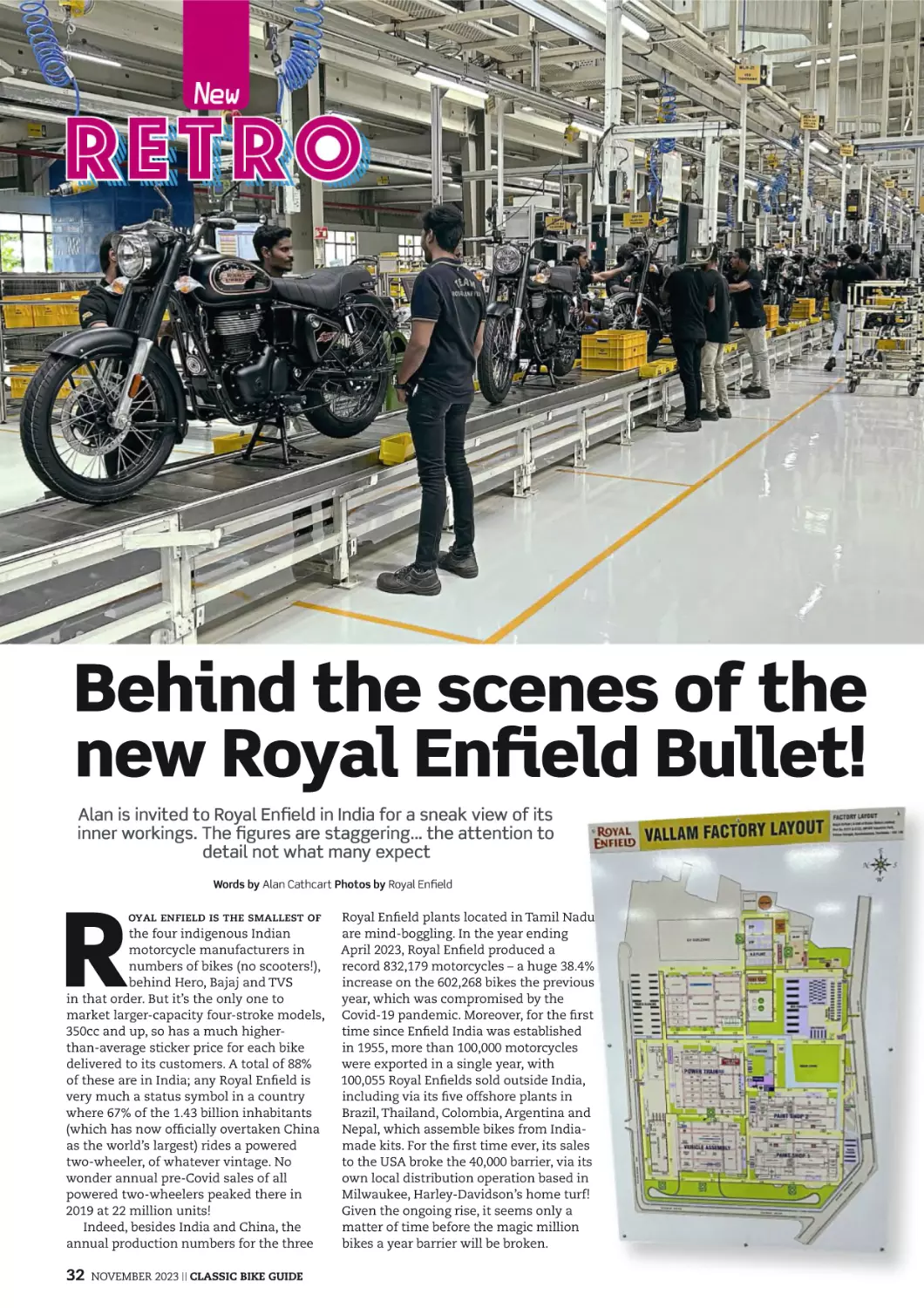
each day, six days a week. The slick, wellorganised and spotlessly clean facto y
has a high proportion of female assembly
line workers (all on the same wages as the
men, I was told), divided into four separate
34
NOVEMBER 2023 || CLASSIC BIKE GUIDE
operations: power train assembly,
vehicle assembly, and two paint
shops. The power train section is
air-conditioned to ensure cleanliness
– but it’s also a welcome relief from
the constant humidity of South
India! Incredibly, eve y single engine
produced there – so, more than 3000
each day – is dyno-tested for five
minutes, during which a total of 16
different checks are made, including
for noise, vibration and performance. I
repeat: that’s eve y single engine, before
an approval sticker is attached to the
cylinder head, and the power unit is sent
to the vehicle assembly section next door
for installation in the waiting frame.
After completion, there’s an intensive
QC checkover before the finished bike is
forwarded to the shipping department,
though 1½% of each day’s production –
about 160 bikes – are spot-checked by a
test rider.
Perhaps surprisingly, Royal Enfield has
no found y, so raw castings are purchased
from outside suppliers, but machined and
where necessa y painted in the facto y,
while frames and fuel tanks are made in
the nearby Oragadam plant, then trucked
to Vallam for painting. In the case of the
Bullet fuel tanks, their gold-coloured
pinstripes are hand-finished by two
brothers who aren’t members of the RE
workforce, but are instead proudly selfemployed!
After seeing the care taken at the
development stage, and quality control at
manufacturing level, it’s easy to see how
RE has succeeded in shedding its previous
reputation for hit-and-miss reliability. Not
anymore – Siddhartha Lal’s obsession with
quality has decidedly paid off.
Email || editor@classicbikeguide.com Write to || Classic Bike Guide, PO Box 99, Horncastle, Lincolnshire, LN9 6LZ
Anything
to say?
s
The writer of this month’s Star Letter wins a Weise Drift
jacket, worth £199.99. Combining the look and feel of high
street fashion with the impact protection expected from a
premium motorcycle jacket, the Drift is laminated for reliable
waterproofing, too. Find out more at www.fab-biker.co.uk
A Starfire is even better once you get used to it
Hi Matt, I read with interest
the article on the Starfire
in October’s issue. Having
owned one of these little
beasts for a few years now,
an early ‘68 model, I have a
few observations which may
be useful. The main problem
is that 10.0:1 piston, which
can make them difÏcult to
live with. The clutch can
slip on compression and
the clutch springs need to
be screwed fully home to
stop this. A Fleetstar piston
is the answer, but I have
never managed to find one,
and the compression plate
under the barrel fix that
some use does not work
because the pushrods are
not long enough to adjust
the valve clearance due to
the cam adjusting system.
I have fitted electronic
ignition, a proper filter, a
new regulator/rectifier LED
lights and the later TLS front
brake, a must if you can find
one.
It starts quite easily
but requires a good kick; I
recommend checking the
oil pressure relief valve,
renew the ball and spring,
if it fails – and they often
do – the result is a blown
bottom end, as I found to
my cost. Other than that, a
challenging bike to own, and
a lot of fun if you don’t mind
a noisy engine.
I remember you had one
at one time. Great mag – I
always look forward to
each issue.
Charles Hallam
Thank you, Charles, I hope
this helps fellow Starfire
owners. I did indeed own one
briefly, though it was bought
to be a competition prize.
Although it ran, it needed
rings as one was broken
(still ran though) and it was
superb for around the lanes –
my favourite place for riding.
I enjoyed its easy-riding size
and weight, though it did
take time to get used to
its revvy nature compared
to the BSA B31 plodder it
shared a shed with – Matt
Importing from abroad – can you make it easier?
Is it possible to have an article
expanding on the importation
of bikes from the USA? The
idea is from the article recently
featured in the mag about
the Honda SL brought over
by the writer, David. But that
is a starting point: maybe
David and others can add to
the discussion? I have bought
stuff from importers, scared
of doing it myself through lack
of knowledge. And whereas
when there were local DVLA
sites, only about one in 20 were
inspected (according to the
ofÏcial); now, I have been told
when I did my last one that it is
nearer one in three.
What would be nice to know:
how do you find a shipper who
fills their container with odd
36
loads and will take one or two
items, what is a reasonable
rate to pay for shipping per bike,
what are the collection rules
once in the UK, and NOVA forms,
what is needed and how to apply
for one and sort HMRI duties to
be paid. Lastly, now with your
bike in the UK, to register you
need a USA Title or an approved
dating certificate, NOVA ref, MoT
if applicable, insurance, tax or
RFL and first registration fee, a
filled out V55...?
Another thing that might
be worth mentioning is if there
are motorcycle breakers in
the US that are willing to sell
UK citizens a bike and arrange
shipping, saving us the cost of
going over?
A Nnonymous
NOVEMBER 2023 || CLASSIC BIKE GUIDE
Lucky Mr A. That feature was
more than a year ago, and we
covered all about importing
bikes and the paperwork in the
July 2023 edition. Give the ofÏce
a ring on 01507 529529 to order
a back issue. But the conclusion
was that it isn’t complicated;
it just needs several hoops to
be jumped over, to make sure
countries know where these
vehicles are, all taxes due
have been paid and that the
machines involved are legitimate
– so all understandable reasons.
It all takes time and is easier
with experience, hence why
people want paying to do it for
you. And if they have a space in
their container, I’m sure they’ll
find something to fill it for
themselves… Good luck – Matt
STAR
LETTER
Ride as
you wish
Regarding Oli’s problem
with close group riding
(September 2023 issue),
the simple answer is: don’t
do it! It is much more fun
and safer to adopt a very
loose formation tactic,
riding at your own pace.
Start your ride to suit
the agreed destination
arrival time. A bit like a
handicapped air ‘race’ of
old. Works for me. All the
best.
David
Never a truer word spoken.
Thanks, David – Matt
Anyone remember
the old days?
(Referring to Mick Powell’s
letter in the October edition
of Classic Bike Guide, where
he remembered his time spent
as a student in London getting
parts to keep his bikes going
and wondered if other readers
recalled the old bike emporiums.
Does anyone else have fond
memories of old bike shops
that doubled up as hangouts?
– Matt)
The Ladbroke Grove
emporium was Happy Hamrax.
It was the lair of Chopper, who
had a great fund of
knowledge, and who
was free with help
and advice to those
who sought it. A
good bloke.
Peter Day
And...
The name of the ‘cave’ on
Ladbroke Grove (mentioned in
the Star letter) was Hamrax – I
spent many a happy hour there
in my late teens as I lived
nearby and ran a 1974 ‘bikini’
Triumph 3TA.
Dr C Gillies O’Bryan-Tear
The bike’s the star?
Hugh Mason, bike
designer and
manufacturer, as
well as TT winner
In your article ‘TT Legends – HR Davies’, in
the July 2023 issue, it is stated that he is
‘the only man to compete on his own make
of motorcycle’. Hmm... are you sure this
is true?
Twelve years earlier, in 1913, a brilliant
engineer named Hugh Mason, from the
shipbuilding town of Wallsend and later
based in Newcastle, had founded his own
motorcycle marque, named NUT. The
acronym stood for Newcastle-upon-Tyne.
As well as being the founder, he was
the designer, builder, test rider and racer
for the enterprise – and a brave, tenacious
and skilful rider at that. In 1913 he took
a number of his own machines to the
Isle of Man and not only competed but,
remarkably, won the Junior TT for that year,
riding his own NUT motorcycle.
Though he is largely forgotten now,
would you concede that your assertion
quoted above is wrong?
Terry Gay
Yes, Terry, well done, this one really did
backfire! I had never heard of Hugh Mason
or NUT. After reading up, he was indeed
a fascinating man who managed great
things. The Broughs, Irvings and even the
Davis’ of this world are oft remembered,
but there are several very clever folk who
did just as well, yet luck intervened and
they didn’t quite make the big time – Matt
The piece about the Suzuki Kettle got me thinking
about bikes in films. Quite why, I will explain in
due course.
Classic car mags are always highlighting specific
cars in films, particularly when the car is a major part
of the story. The list is long, but for starters, The
Italian Job and Bullitt come to mind. But, for some
reason, bikes don’t seem to feature so much. Why
is that? Of course, there are exceptions: the King
of Cool on that Triumph in the Great Escape, Easy
Rider (naturally) and the occasional mention of The
Wild One. But others? There’s the execrable Girl on a
Motorbike, and who remembers The Knack, with the
anti-hero on an Ariel Leader?
Kettles? It is a long time since I saw one on the
road, even in period. But there is at least one in an
iconic film – The Rocky Horror Show. Yes, really, when
Brad and Janet suffer their puncture outside the
Frankenstein Mansion, they are hounded by some
bikers in the dark. And the leader is on a Kettle! Odd
choice for a bad boy rebel? I believe the producers
contacted a nearby bike club in Maidenhead, close to
the mansion where the film was made. And there is,
of course, Meat Loaf on that Harley.
Mick Powell
Mick, you constantly amaze us with your thoughts!
And you’re
right – but
then there’s
an existential
difference
between
those who
have found
motorcycling
and those
who haven’t...
discuss –
Matt
CLASSIC BIKE GUIDE || NOVEMBER 2023
37
What’s on
Fancy a day out?
Although we are almost past the mists and mellow fruitfulness of autumn,
there’s still the odd Sunday run out, indoor jumble, the Ace Café’s extensive
calendar, and shows big and small, all tailor-made to give you the inspiration
and the bits you need. Don’t forget supporting the traders, whether they are
selling petrol tap corks or crankcases, and artisan gin is a usually welcome
present to stash for Christmas. Remember to take a few carrier bags... and do
let us know about your own upcoming events.
OCTOBER
28 Kempton Park Autojumble: Kempton Jumble
has at least 250 stalls for regular traders and is a
very useful venue for enthusiasts having clear-outs.
Kempton Park, Middlesex, TW16 5AQ. Visit www.
kemptonparkautojumble.co.uk
28/29 National Motorcycle Museum LIVE:
Free admission to the museum buildings this
weekend, with the only charge made for parking
cars. Coventry Road, Bickenhill, Solihull B92 0EJ
(see news).
29 South of England Classic Motorcycle Show
and Bikejumble: A must for all classic motorcycle
enthusiasts. Special guest Dave ‘Crasher’ Croxford
and friends. Ardingly, West Sussex, RH17 6TL. Visit
www.elkpromotions.co.uk
29 Rat, Brat, Bobbers, Choppers and Rat Rods:
From 9am at Ace Café, Stonebridge, NW10 7UD. Visit
london.acecafe.com
29 Blackberry Week Steam Day and Classic
Vehicles: Ryhope Engines Museum, Waterworks
Road, Ryhope, Sunderland, Tyne and Wear SR2 0ND.
29 Huddersfield Autojumble: Old Market Building,
Brook Street, Huddersfield, West Yorkshire. Visit
phoenixfairs.jimdofree.com
29 Stickney Autojumble: Main Road, Stickney,
Lincolnshire. www.stickneycarbootsale.co.uk
November
4 VMCC Somerset Section Autojumble: Entry
per person is £5. This is one of the cheapest
autojumbles in the country, and aside from the
retail therapy, it is the perfect opportunity to spend
a day meeting fellow enthusiasts. Take a flask.
From 9.30am to 4pm. Bath and West of England
Society, The Showground, Shepton Mallet, Somerset
BA4 6QN.
4 Rufforth Autojumble: Rufforth Rark, Wetherby
Road, Rufforth, YO23 3QH. Find out more online at
www.rufforthautojumble.com
5 Ton-Up Day – England Expects: Ace Café, Ace
Corner, North Circular Road, Stonebridge, London
NW10 7UD. Find out more at london.acecafe.com
5 Salisbury Motorcycle and Light Car Club Jack
White Trial: Bryces Farm, Bunny Lane, Sherfield.
www.salisburymotorcycleandlightcarclub.co.uk
10-12 NEC Classic Motor Show: The Lancaster
Insurance Classic Motor Show brings together a
great array of classic car and motorcycle clubs. As
well as checking out some amazing vehicles, you
can shop at the autojumble, or source parts and
tools for your maintenance and restoration needs
from the many specialist traders. More information
online at www.necclassicmotorshow.com
12 VMCC Dorset Breakfast Meet: The Old Brewery
Café (formerly Moto Corsa), The Old Brewery, Wyke
Road, Gillingham.
12 Poppy Day Parade, Service and Military Vehicle
Meet: Ace Café, Ace Corner, North Circular Road,
Stonebridge, London NW10 7UD. london.acecafe.
com
18 Giant Auto and Bike Jumble: Scorton, North
Yorkshire Events Centre DL10 6EJ.
18 Langport Bike Night Autumn Sunday Meet:
Breakfast on the Somerset Levels at Bere Cider
Company, Woodpecker Lodge, Bere, Aller, Langport,
Langport TA10 0QX.
19 Mid-Kents Auto and Bike Jumble: Lockmeadow
Market Hall, Barker Road, Maidstone, ME16 8LW.
19 Double LL Club Autumn Autojumble: The Grange
Leisure Centre, Midhurst, GU29 9HD.
18-26 Motorcycle Live: Four halls of the NEC will
be bursting with manufacturers, new products,
opportunities to ride, and stacks of entertainment.
More than 50 motorcycle manufacturers, hundreds
of exhibitors, and thousands of visitors are expected.
And if all the shiny newness starts to leave you cold,
you can always slip across the M42 and check out
the National Motorcycle Museum. National Exhibition
Centre, North Ave, Marston Green, Birmingham B40
1NT. www.motorcyclelive.co.uk
19 ‘Normous Newark Autojumble: The
Showground, Drove Lane, Winthorpe, Newark, Notts
NG24 2NY. www.newarkautojumble.co.uk
19 Ariel Owner’s Club Founders Day and Classic
Bike Day: Ace Café, Ace Corner, North Circular Road,
Stonebridge, London NW10 7UD. More information
online at london.acecafe.com
20 Mid-Kents Bike and Autojumble: Indoors at
Lockmeadow Market Hall, Barker Road, Maidstone,
Kent ME16 8LW. www.mIdkentsautojumble.co.uk
26 Mud Pluggers Day: Ace Café, North Circular
Road, Stonebridge, London NW10 7UD.
26 Huddersfield Auto/Retro Jumble: Old Market
Building, Brook Street, HD1 1RY. Find out more at
www.phoenixfairs.jimdo.com
Know of a show, club meet or event that would be of interest to fellow classic bike enthusiasts?
Drop us a line with some details and we’ll do our best to include it so others can enjoy it.
Comment at facebook.com/classicbikeguide
38
NOVEMBER 2023 || CLASSIC BIKE GUIDE
Visit classicbikeguide.com
E-mail editor@classicbikeguide.com
40
NOVEMBER 2023 || CLASSIC BIKE GUIDE
AJS Model 30
silk purse
The result of a mismatched box of bits from
a dodgy seller, this wonderful Model 30
is great proof of what can be possible...
A
Words and photos by Stuart Urquhart
MC purists will have spotted that this
very presentable 1957 AJS Model 30
twin is not all that it appears. Take, for
instance, the smaller singles model
petrol tank, the all-alloy primary
chaincase (perhaps from a later Model 31, the 650cc
version) and even the two-into-one siamese exhaust,
which certainly suits the all-black style of this
handsome 600cc ‘Ajay’.
A deeper look reveals other departures from
the factory mould, such as the all-black dual seat,
Commando Roadster handlebars and the BSA chain
guard. However, there is a significant reason for nonstandard parts being fitted to this popular 600cc AJS
twin. What follows is an interesting tale of one man’s
persistence against very testing and difficult odds!
Classic motorcycle restorer Sandy Bloy has the
luxury of an industrial unit, where he enjoys repairing
and restoring old British motorcycles. As a friend
and Classic Bike Guide reader, Sandy is (fortunately)
open to features about the rare and the not-so-rare
motorcycles that regularly pass through his hands
– either to be restored for future sale or friend’s
motorcycles that are fettled and sorted before being
returned to the road.
Earlier in the year, I was on a mission to write up
a rare Sunbeam competition machine that Sandy
had just sympathetically restored. But as we talked
‘Sunbeam’, I became distracted by the lovely AJS M30
featured throughout these pages. It was strapped
to Sandy’s workbench and I just couldn’t resist its
presence. “What’s that interesting beauty in for?” I
asked, nodding towards the AMC machine. “Well,”
Sandy replied, ‘it’s a complicated rebuild that sorely
tested my patience. Trust me – you really don’t want
to know about it!”
CLASSIC BIKE GUIDE || NOVEMBER 2023
41
I persisted, so an obliging Sandy followed me
over to the benched AJS. The more we discussed the
problems with its renovation, the more Sandy’s sto y
won my attention. Turning to my notebook, I hastily
scored a pen line through the ‘Sunbeam Model 9A’
title I’d scribbled earlier. “Any possibility we could
talk about the AJS then?” I laughed, impatiently
drumming my pen. Much too poor Sandy’s frustration,
I had become well and truly hooked!
We sat down over coffee as Sandy continued.
“I saw an advert in the AMOC’s (AJS and
Matchless Owners’ Club) newsletter, The
Jampot, offering a ‘Project AJS M30’ for sale,
located in the Midlands. Pictured was
an assortment of boxed parts, and quite
naturally I assumed it was a strippeddown member’s bike, so I contacted the
vendor, who said he was reconsidering its
sale because he felt sure of a better return
if he sold the parts individually. The chap
seemed genuine enough, and because he was
a club member I expected his description of
the boxed machine would be fair and true, so
I offered the asking price and he subsequently
sold it to me.”
Bin or build?
Unfortunately, when Sandy’s ‘Project Bike’ arrived
in Perth, it didn’t take him ve y long to discover that
many key parts were missing – while several were
just simply wrong for an AJS model 30 twin.
“I thought I had bought a 1959 Model 30, but as I
checked through the various boxes I began to realise
I’d bought a ‘BITSA.’ I was disappointed because the
vendor had assured me that all the original parts
were present – not the sort of behaviour I expected
from a fellow AMOC member.”
Already committed, Sandy decided to work with
what he had, knowing full well that the project
could turn problematic – he just didn’t realise how
42
NOVEMBER 2023 || CLASSIC BIKE GUIDE
problematic! Sandy first compiled a missing parts list,
hopeful that he could source replacements through
the owners’ club or from specialist suppliers. He
became disheartened when he discovered that several
important cycle parts belonged to at least two or three
different AMC models.
More discouraging was his growing list of missing
parts – amounting to the exhaust and silencer, seat,
tool box, headlamp, speedometer, wiring loom, rear
brake assembly, engine oil pipes, chain guard, clutch
and the engine drive sprocket. Useable, but clearly
not correct for his machine, was a late alloy prima y
chaincase. Both the speedometer and the earlier
mentioned petrol tank were from an AJS single –
although the tank was correct for the frame supplied
with the project bike, as we’ll discover later!
“As I built up my invento y of required parts, I also
checked parts that were beyond service; these were
the monobloc carburettor, magneto, dynamo and
wheels.
“But I was about to discover that the engine was
another matter entirely,” sighed Sandy.
A little help from my friends
“I decided my first task was to have the magneto
and dynamo professionally serviced. I knew both
were knackered – their poor condition was obvious
to the naked eye – so I sent them to friend and
electrical specialist Andrew Guttman, who has been
a great help with many projects in the past. However,
following Andrew’s expert assessment, I accepted
a scrap allowance against a replacement and fullyfurbished magneto and dynamo. The better outcome
really, because now I needn’t wor y over any future
starting or charging issues.
“The wheels were in a dreadful state, but they were
the correct full-width hubs for my model. I delivered
both to wheelsmith George Spence of Cupar and
left him to supply rebuilt wheels in his own time.
Although he’s long retired, George still provides an
excellent service for his old pals. Another buddy and
SCMC (Scottish Classic Motorcycle Club – a superb
club) member Chris supplied a correct headlamp,
complete with inset speedo, ammeter and an
attached wiring loom! This helpful member also
produced a spare clutch and a complete rear brake
assembly from his parts bin – where would we be
without our friends?
“Ken D’Groom, specialist AMC man and another
long-time friend, supplied a missing toolbox lid
CLASSIC BIKE GUIDE || NOVEMBER 2023
43
and centre panel that links the toolbox to the oil tank.
Once prepped, all parts were sent for powder-coating
by IPF Coatings in Glenrothes.”
“Both fork seal holders were so badly rusted
and riddled with holes that they reminded me of
chocolate Aero bars!” laughed Sandy. “My friend
and ace fabricator/mechanic John Lamb braised and
restored the shrouds before they went for powdercoating. While the parts were away at IPF, I sent the
battered old petrol tank to my friend Rab Grant, who
sanded and painted it, and then applied the classic
transfers and gold lining – he produced a lovely job!”
More specialist work
Sandy next attended to the donated clutch. He sent
the sprocket and clutch basket, plus all its associated
fibre plates, to Villiers Restoration Services (renowned
clutch and brake shoe lining specialist). As most
of the cork segments were missing, Villiers simply
supplied a set of matching, but solid, back plates. A
more robust and modern solution to ‘press and fit
cork segments’, they come complete with a single
fibre-bonded ring.
The missing chainguard was replaced with a
BSA guard that Sandy produced from his parts bin
(fortunately, he never throws anything away!), but
the mounting brackets were different from the AMC
equivalent, so John Lamb removed them before he
fabricated a new pair. He then riveted all the parts
in situ to achieve a perfect fit, after which it too was
powder-coated.
44
NOVBEMBER 2023 || CLASSIC BIKE GUIDE
The ‘project in boxes’
quickly turned into
a random collection
of various bikes.
Trust is earned
John also married the alloy M31 prima y
chaincases to the M30 engine with his own fabricated
mountings, while Sandy busied himself tidying and
rebuilding the candlestick rear shock absorbers. The
front forks were reassembled on the workbench, after
which the black powder-coated shrouds and silver
seal holders were added. New fork seals and chrome
caps followed. Sandy’s wheels arrived from George
and looked splendid, with highly polished hubs and
new stainless spokes and rims. Sandy added new
Avon tubes and tyres.
Confident his project was progressing, Sandy
then ordered the new two-into-one siamese exhaust
system from Armours. He also said he was indebted
to Steve at AMC Spares, who provided first-class
service and endless help with sourcing all the hardto-find parts – including a set of scarce Model 30
mudguard brackets.
More problems
In order to register his project, Sandy mailed the
AJS frame and engine numbers to AMOC’s dating
officer, Roy Bellett. Unfortunately, Roy discovered both
engine and frame were from two different models
and were therefore not a ‘matching pair’. According
to AMOC records, the frame belonged to a 1959 Model
31DL which was dispatched by the facto y on April
6, 1959, and then sold by Stan Marks Motorcycles Ltd
of Lancaster. The engine was from a 1957 Model 30,
dispatched by the facto y on June 25, 1957, and sold
by Craven Motor & Cycle Co of Newbu y. Sandy said
the news of a mismatched frame and engine was just
another downside to buying a ‘project bike’ unseen.
“Covid saw us in a second lockdown when I decided
to fit the engine and gearbox to my evolving rolling
chassis,” he continued. “The gearbox was in relatively
good condition and only required gaskets, an inner
kick-start spring, and ratchet mechanism. When I
lifted the engine onto the work bench, I was expecting
it would require some fettling. However, as I turned
the crankshaft over by hand, I wasn’t expecting the
ominous clanking sound that came from the bottom
end! This only happened on the bottom stroke,
so I suspected that the pistons were fouling the
flywheels. I’d never come across this before. Once I’d
removed the split heads (see below) and barrels for
a look inside, I discovered that this was indeed the
problem. I remember all too well how depressing this
discove y was!”
The 600 and 650 model engines share the same
72mm bore, but each has a different stroke – 72.8 and
79.3mm respectively. Separate heads and barrels are
peculiar to AMC twins, and the 600 barrel has one fin
less than the 650 model as it’s shorter.
Now that Sandy suspected his engine had 650cc
pistons, he turned to his friend John Lamb for help
and advice. As a solution to the problem, John
carefully removed a small amount of material from
the piston skirts so they would clear the flywheels.
Sandy then honed the barrels before rebuilding the
engine with new piston rings and reground valves
and seats. Then the valve clearances were reset.
“The 600 and 650 model engines share the
same 72mm bore, but each has a different
stroke – 72.8 and 79.3mm respectively.
Separate heads and barrels are peculiar to
AMC twins, and the 600 barrel has one fin
less than the 650 model as it’s shorter.”
The AJS engine was missing an engine sprocket but
Sandy failed to find one through his usual suppliers.
He was keen to fit a sprocket with one extra tooth to
help improve the drive experience. Eventually, one
turned up on eBay – but it was located in Australia
and took more than a fortnight to reach Perth. While
Sandy was waiting, he made control cables. Then he
‘part-binned’ the old monobloc and replaced it with
a re-jetted Amal concentric. The engine crankcase
was missing its flow and return banjo oil feeds (and
retaining bolts), but fortunately, Les at Russell Motors
supplied a set of NOS banjos. Another supplier, Serk
UK, came up with a pair of new banjo bolts and
correct diameter hoses from stock.
Then Sandy discovered that both oil pumps were
well and truly jammed. A lengthy soak in diesel didn’t
free them, so the ever-helpful John Lamb stripped and
rebuilt both pumps using new parts. Meantime, Sandy
fitted an anti-sumping valve to the oil system. Once
again Sandy’s parts bin came in handy, in coughing
up an original AMC dual seat.
CLASSIC BIKE GUIDE || NOVEMBER 2023
45
“Last to be added were Commando handlebars and
a pair of new Wassell levers. Then I fitted a new 12v
batte y – oh, did I forget to mention I converted all the
electrics to 12v?” laughed Sandy. In went fresh oil, on
went the petrol tank, and it was ready for a test firing!
“I filled her with fresh fuel, then checked for a spark
in the traditional fashion. I set the choke lever to half
and retarded the ignition. Excited, I flooded the carb...
but as I attempted to kick the bike over, I knew we had
another problem... the compression was horrendous!
After many hefty kicks, she eventually fired up, revved
her nuts off and blew the head gasket! It was another
depressing moment and I cursed my luck.
“John popped round and reckoned the compression
was a crippling 14:1 – even with a blown head
gasket! We removed the heads and tested the piston
heights at TDC, only to discover they were sitting
several millimetres too high – but enough to hike
the compression up from standard. John suggested
we either hunt down a set of correct 600cc pistons
or he could make an alloy decompression plate – an
old trick he used in his days as chief mechanic to a
competitive grass track racer.
“Naturally, I chose the latter, and in just a few
days John appeared with two sets of different-sized
compression plates he’d cobbled up using a cylinder
base gasket as a template – clever chap! John was
confident that the thicker set would reduce the
compression to an acceptable 8:1 – the thinner
plates I could fit if I wanted to race another friend’s
Commando! Of course he wasn’t serious, but I felt
relieved by John’s light-hearted humour as we set
about fitting the plates, heads and resetting the
valve clearances.
Test run
“On our second attempt, the twin fired up immediately,
but once the engine had warmed it developed an
erratic tick-over. However, carb fettling I did expect.”
46
NOVBEMBER 2023 || CLASSIC BIKE GUIDE
The factory finish
continues on the
timing side, with
exhaust, brakes and
tank looking like
they belong with the
twin-cylinder engine
John checked the tyre pressures and brakes while I
threw on my gear and helmet. Minutes later I took to
the traffic-free hills behind Perth for a debut test drive.
Sandy finally can relax: “I’ve owned several AMC
twins down the years and this ‘Special’ behaved much
as my others – despite its assortment of parts. Placid
and comfortable twins by nature, this one was no
different, especially after I’d sorted the carburetion.
Now she’s a first-kick starter with nice brakes,
excellent handling, and a surprisingly smooth engine
and transmission. The siamese exhaust sounds
sublime – and deliciously fruity above 40mph. She’s
quite frugal too, returning around 55mpg. Once I get
more runs under my belt, I’ll be in a better position
to properly assess the end result of what was a ve y
testing build.”
Against considerable odds, hassle and grief Sandy
experienced with his project bike, he has created a
superb, useable AJS Model 30 twin, from boxed to
on the road in less than nine months – all credit to
Sandy for having the skill and the patience to create a
reliable motorcycle from what many would dismiss as
worthless junk! It has a lightweight look to it that the
original twins didn’t possess, with his use of mostly
AMC parts giving a facto y feel. And it is a splendid
and highly-finished classic by anyone’s standards.
CLASSIC BIKE GUIDE || NOVEMBER 2023
47
1959 ROYAL ENFIELD
CONSTELLATION
Strangely
starry…
BSA called one of its twins the Shooting
Star. Royal Enfield went rather better,
naming its 700 twin after an entire
constellation. Frank Westworth
rides among the stars again…
Photos by Rowena Hoseason and Frank Westworth
S
traight away I need to reveal that my
experiences with UK-built Royal Enfield
twins have not been entirely positive. I’ve
been t ying to work out whether the ratio
of good’uns to bad’uns is actually any
different for RE big twins than for any of their more
commonplace contempora y competitors, yet no
answer springs to mind. But maybe a full third of
the big Redditch bruisers to have been graced by my
fundament have been less than delightful, sadly. Most
of the others were okay, including a rather handsome
maroon machine with the full Airflow treatment –
properly facto y-fitted weather protection – which I
seriously considered buying. Until it ran onto a single
cylinder as I returned it to base.
Likewise, my ve y first-ever commissioned (and
paid-for!) road-riding feature involved a Royal
Enfield Series 2 Interceptor, a machine of such
brash and brazen brawn that had it been for sale, I
would definitely have strained the wallet to buy it.
But that Interceptor was built at Bradford-on-Avon,
not at Redditch, was facto y fitted with Norton’s
Roadholder forks and 8in front stopper, which made
it glorious through the wild roads between Buxton
and Macclesfield, but retained the Albion gearbox
with the bizarre chasm between third and top gears
that seriously interrupted the fast flow along those
winding, hilly roads.
I digress. The big RE twin engine was a mechanical
marvel in its own right, with some creative
engineering and solutions to problems that probably
didn’t actually exist. The frame which carried it was
also unusual in that it was remarkably minimal,
employing the engine as a major, and indeed massive,
part of the load-car ying structure, so keeping the
machine short and dense, somehow. Some wit once
remarked that a truly beautiful machine was one
where it was impossible to spit between the engine
and the rest of it, or something like that, and they
may have been thinking of RE’s condensed twins at
the time. Just take a look: that huge engine, complete
with its integral oil tank and massively-finned top end,
all squeezed into a frame which appears to have been
intended for a 350 single. And maybe it was.
As what were once merely old and odd motorcycles
were gradually and remarkably transformed into
classics, many of them developed reputations, based
more on preconceptions – hearsay – than on actual
experience. And preconceptions are remarkable
things. Do you also suffer from them? I read once
– just once – in a bike magazine of some antiquity
that a model under review ‘shook like an Ariel
Huntmaster.’ Such is the power of my memo y that
not only can I not recall which wonderful magazine
it was, but I also have no recollection at all of the
50
NOVEMBER 2023 || CLASSIC BIKE GUIDE
“If they do not make your little light of
happiness glow when you ride them …
well then, they’re not great bikes. Unless
they’re Nortons, of course, which are
allowed to be cranky and awkward for
some of the time. Just like their riders.”
wonderful motorcycle they were actually writing
about. I remember the crack about the Ariel though,
mostly because I’ve ridden and enjoyed a lot of
Huntmasters, and none of them were particularly
shaky. Which probably demonstrates how shaky is the
research carried out by some journalists. But not this
one, you will be amazed to read!
Opinions – other folks’ opinions – do have a
tendency to stick. Royal Enfields all leak their lube at
the first hint of use, they claim. This is not true, not
even faintly true, and is probably the result of some
long-forgotten magazine hack renaming the things
Royal Oilfields. My my, how we laughed. But take a
good look at the RE in these pics. It’s as oil-tight as any
other bike of its age, and much more oil-tight than
many.
And now, entirely in a spirit of pure research, go
talk to your motorcycling mates and ask them about
the original RE twins. Do they leak oil? Shall we take
bets on their replies? As usual, oil leaks are generally
a result of inexpert or entirely absent maintenance.
I share no great love for Royal Enfields, singles or
twins, great or small. But, I almost always enjoy riding
them. Exactly how these apparently contradicto y
views sit easily together I have no idea, but they’re
true and they do.
That big shiny understanding dawned on me as I
was pushing along rapidly aboard the big shiny red
Constellation you can see hereabouts. A little light
shone in my cranial cavity. It was a little light of
understanding: I was having a hoot of a time again.
Great bikes do this, don’t they? If they do not make
your little light of happiness glow when you ride
them … well then, they’re not great bikes. Unless
they’re Nortons, of course, which are allowed to be
cranky and awkward for some of the time. Just like
their riders.
The last RE twin I’d borrowed had not been great.
It had been amusing. It had been challenging. Any
motorcycle that can pull away on its own without
the rider releasing the clutch is guaranteed to be
entertaining, if mostly impractical. That machine
was a great bike for the count y-dweller or motorway
hauler – no use at all in a town. A good clutch is a
clutch that will free off properly. I thought eve yone
knew that. When I asked whether I could borrow
another RE twin from another source, that source and
I shared some mildly hysterical laughter. It needed to
be better than the previous example, we roared! And
indeed it was.
As I roared (and I do mean ‘roared’; that single
small silencer struggles to mute those two big
cylinders) across some of my favourite Somerset
count yside, the excellent state of this twin was
obvious. The Constellation was ve y well set up. You
can tell this ve y quickly, especially if you’re a rider
lucky enough to ride a lot of different machines.
There is something so immediately ‘right’ about
some of them. Ignoring for a moment all the starting
and tickling and choke and ignition advance and
things like that, once you’ve been in the saddle for a
half-hour or so, you know whether the bike’s having
a good time down there or whether the inevitable
compromises in so many rebuilds have ganged up to
make the ride more of a challenge than a choice.
It was a complete package, this twin. Eve ything
worked well, and it all worked well together, which
is not always the case, even with a decently rebuilt
machine. The gearing was just about spot-on, which
is a personal favourite. And not always the case
CLASSIC BIKE GUIDE || NOVEMBER 2023
51
ith Enfield twins, the bigger ones in particular. The
suspension was good, too. Although I can’t recall
anyone raving away about RE’s own front forks in the
way they do about Norton’s Roadholders, in fact, they
work ve y well; smooth and progressive in this case,
balancing well with what appear to be the original
Armstrong units at the back. It is actually pleasant to
ride a machine with the suspension set a little soft.
So many rebuilders throw away the original shocks,
usually because the chrome has rusted and the paint
flaked, in favour of the cheapest repro items to hand.
And sometimes this is ve y obvious, usually when
the opportunity arises to ride a machine with original
shocks for comparison. Or top-quality replacements,
of course.
Even the brakes matched the performance, so
far as I was willing to go in the interests of writing
a sto y. The RE big twin here boasts only six-inch
brakes at the front, but it boasts two of them, side-byside, and operated by two balanced cables. This is a
complex but effective way of having a twin leadingshoe arrangement, a method which avoids the usual
disadvantage of a more conventional twin leader
mechanism, where the brake can often struggle to
prevent the machine sliding backwards when held
facing uphill on a steep slope. BSA/Triumph conical
hubs seem particularly prone to this. The RE system,
like the Vincent arrangement, provides two leading
shoes, one on each side of the wheel, which adds bite
to the brake, whether the bike is travelling forward
or backwards at the time. Two leading shoes and
two trailing shoes, too, so four brake shoes… It is, of
course, more expensive to manufacture than a singlesided drum.
You’ll observe that I have failed so far to mention
the technical features of the engine. It has occurred to
me that because my own fascination lies with engine
design that I talk about it too much. The truth is that
if I enjoy the way an engine behaves and performs,
then I am pretty much certain to enjoy the whole of
the riding experience. Royal Enfield’s big twin engine
is… well… it can be a cracker, and the Constellation
interpretation may be the best for classic use on
modern roads.
Straightaway I should tell you that although early
Constellations were specified with Amal TT9 carbs
and the later ones with twin 389 Monoblocs, this
bike has been fitted with a single Monobloc. Which
is probably one reason the engine starts so readily,
52
NOVEMBER 2023 || CLASSIC BIKE GUIDE
runs so smoothly and ticks over properly. It’s a small
surprise that more pilots of old Brits fitted with
twin carbs choose not to replace them with a single
instrument wherever possible. After all, no one buys
an old twin like this so they can crack around the
bypass flat-out with their mates on Hayabusas and
the like. Do they? Really?
As it was intended to be a sporting twin, and
because for some reason sporting riders apparently
preferred magnetos to coil ignition systems, the
Connie is fitted with a Lucas K2F magneto. Excellent
devices. When they work. This one was excellent,
providing big fat sparks to ignite those tall cylinders
easily, hot or cold. I wonder whether bikes with
sporting pretentions were fitted with magnetos
so that owners could remove their entire lighting
equipment while racing them, replacing eve ything
for the evening ride home? I will never know (unless
you do know and write in to educate us).
No tickle. Full choke. Kick. Kick again, and off the
engine goes. Not least because it stores its engine oil
inside its crankcases, the RE big twin is a tall twin
indeed. A veritable tower of power, as 1970s magazine
roadtesters might have remarked. The stroke is long
at 90mm, which adds to the height, and indeed to the
engine’s undoubted ‘character’. For comparison, the
stroke of a T140 is 82mm and a 750 Commando 89mm,
so you might expect the Connie to behave more like a
Norton than a Triumph twin. In fact, it doesn’t behave
like either of those ubiquitous beasts; it is surprisingly
individualist in its approach to performance delive y.
But I’m getting ahead of myself. RE clutches should
be light and positive. This one is. They should also
neither slip nor drag. This one is fine. Hurrah. I truly
detest dragging clutches. They ruin the balance, the
rhythm of a decent ride. The dragging horror on the
Connie I rode before this one appeared to be unfixable
by mortal hands, for some reason.
Whatever, the gearbox is still an Albion. Anyone
whose chosen wheels are of an AJS, Matchless, Norton,
Triumph or BSA origin will wonder what’s wrong with
the RE’s gearbox. Riders of Panthers and Ariels and
earlier AMC machines fitted with Burman boxes will
recognise the signs. The slow shifts. The heavy, slow
shifts. The cunning ability to locate neutrals where
neutrals usually fear to tread. Don’t misunderstand,
there is nothing wrong with the gearbox on this
Constellation. It is really rather good. For an Albion.
Albion boxes work well on gentle woofly tourers, but
feel anachronistic in a machine as powerful and as
rapid-revving as this one. Go on: tell me I’m wrong,
delighted-with-your-gearbox RE owner!
At least riders of the Constellation need to consider
their gearshifting only occasionally, especially out
in the count y. The big RE twin is delightful at the
pedestrian speeds at which I habitually ride my
own old bikes. You can up-shift at 10mph, and then
again at 20mph and 30mph. It really will pull 30mph
in top. Cleanly, too – and it delivers decent grunt at
subterranean revs, enough to accelerate away with
only a little mechanical shuddering and no protest
at all. Or you can pretend to be some sort of strange
time-warped, speed-crazed hooligan, changing up at
an indicated 30+, 50+ and 70+, but you should only do
this when you are 100% certain that either the owner
is deaf or that he is distracted or that he is a long way
away, because if you were to t y this (entirely in the
course of exhaustive research of course), you would
discover that great big handfuls of throttle produce
great big earfuls of noise. Real noise. Loud noise.
Anyone making that amount of noise in a suburb
would probably get locked up. Did I mention earlier
how the small silencer struggles to silence those
big bangs?
However, throwing political correctness aside, as
a chap should, if you decide that, hang it all, you are
going to go mad for a few miles, then all of the results
are good. All the surprises are pleasant surprises.
You will explore the wide range of the engine’s
flexibility. It is wonderfully flexible. This is a good
thing, because the gearbox is incapable of performing
super-fast, toe-tapped clutchless shifts, which the
committed scratcher might demand. It must have
been purgatorial to those coffee shop cowboys
of the late 1960s, assuming they actually bought
new motorcycles, which I have always doubted, to
be honest.
The handling, even when pressed, is excellent and
unexpectedly nimble. No sidecar-trail fork sliders
CLASSIC BIKE GUIDE || NOVEMBER 2023
53
ROYAL ENFIELD CONSTELLATION
Bore/stroke: 73mm x 90mm Capacity: 693cc Compression: 8.5:1 Output: 51bhp @ 6250rpm
Fuel consumption: 40mpg Transmission: Four-speed, chain final drive Carburettor: Amal 389
Monobloc Front tyre: 3.25 x 19 Rear tyre: 3.50 x 19 Front brake: 6in sls drums, two,
back to back Rear brake: 7in sls drum Wheelbase: 54in
Seat height: 31in Dry weight: 403lb Top speed: 100+mph
on this Connie. It holds the road ve y well, keeping
its line with a tall, slightly top-heavy feel which will
be familiar to AMC CSR riders but utterly alien to
anyone used to Norton flat bars and the hunched
riding posture they dictate. I’d like to distinguish that
top-heavy feel from what I think some riders might
describe as ‘top hamper’. The bike rides tall – it is
a tall bike – but the weight is actually low, around
wheel spindle height from the feel of it, so it rolls
easily around its centre of mass with a predictability
that positively encourages smooth and rapid
bendswinging.
I found that I did not use my body weight to lead
it into corners; instead, tilt the bike over, lay it down
beneath you, and stay upright. Visibility is better that
way, anyhow, and it’s amusing to feel the machine
squirm a little, rise and fall a little as the corner radii
shift and the suspension works. You can lay it over
until the footrests touch, and if you need more lean
than that, your body mass can supply it.
Then you slow down to more legal speeds and ride
gently for a mile or three or four so you can return the
bike to its owner running cool and quiet, rather than
crackling with the heat and smelling of hot oil.
54
NOVEMBER 2023 || CLASSIC BIKE GUIDE
If I may offer an opinion, after riding this
Constellation I wondered whether the 700cc twin is
the best of the Redditch twins. The Interceptor 750s
may have more panache, but they only produce
1.5bhp more than the Connie. They also always make
me want an extra gear between third and top.
The return ride provided a handy opportunity to
t y the bike as a gentleman’s tourer, rather than as
a geriatric rocket. It does this well, probably better
than its hooligan impersonation. The ergonomics
are good, the seat wide and deep, the bars wide and
with a decent rise, providing a comfortable, relaxed
and roomy riding position. As usual, I would have
preferred the footrests to be a couple of inches rearset, but that’s just personal. And as usual, the relaxed
return ride provided a reminder of how smooth a big
old twin like this can be…
…at low engine speeds. Not when working hard on
wide throttles at high revs. Peak power, all 51 Redditch
horses, arrives at 6250rpm, and as you approach that
giddy whirl rate, the vibes are serious vibes. It’s no
good pretending otherwise. Royal Enfield was at one
time proud of the fact it balanced each of its big twin
crankshafts individually. They needed to. I can’t see
any reason why an extra millimetre of stroke should
make the engine shake more than Norton’s Atlas, but
it does. It’s a hard vibe, too, and switches in abruptly
at around 80mph in top.
But that is the only ointmental insect. The rest of
the Constellation is big bad bold Brit twin biking at its
best. If what you fancy is a brash, flash rorty sportster
which is not just another Triumph, Norton or BSA, t y
one like this. You will be surprised, I guarantee it.
CLASSIC BIKE GUIDE || NOVEMBER 2023
55
A bit on the side
Sidecars were once the transport of the country. Transport of tradesmen,
transporter of soldiers, transport of families, and, fitted to a BSA M21 or Norton
16H, the steed of the AA and RAC Patrolman. This most eclectic form is no
longer a common sight on British roads, but for the first 60 years of the 20th
Words by Oli Photos by Mortons Archive
B
olting a sidecar to a two-wheeler
predates the motorcycle. There are two
claims to being the creator of the first
sidecar, one from 1883. Firstly, in the USA,
GW Pressey of New Jersey, creator of the
Star bicycle, a sort-of reversed penny farthing, with
the small wheel at the front. He attached a side seat
and wheel to his bicycle so he could take his wife
out for rides. The Star has a further claim to fame as
being one of the first motorcycles, being fitted with
a steam engine by one Lucius Copeland, who then
turned it into his own steam tricar in 1888.
The other claim on inventing the sidecar as we
know it was by a French army officer who came up
with a similar bicycle attachment in 1893. These were
56
NOVEMBER 2023 || CLASSIC BIKE GUIDE
just the documented ones; many others would surely
have been created as one-offs, solutions to a rider’s
carrying problem.
Once petrol motorcycles arrived, the motorcycle
and sidecar was actually predated by the tricar – a
fairly terrifying device that positioned the passenger
on a steerable axle in front of the pilot, who sat
on a saddle behind, which must have required
considerable bravery on the part of the passenger.
The motorcycle combination proper arrived
in 1903 when a patent was filed for the sidecar by
Mr W J Graham, of Enfield, Middlesex. The sidecar
quickly became popular, being useful and very cheap
in comparison to cars of the day, which were still
extremely expensive playthings for the wealthy.
It quickly became apparent that the big difference
with a combo was the negotiation of corners, and in
the USA efforts were made to create a tilting sidecar
to make it easier to go round corners, but this feature
did not catch on elsewhere in the world.
Sidecars were also taking off in the UK and Europe.
Tilting around corners wasn’t such an issue, however,
a folding sidecar was created in 1912 by one Thomas
Fredrick Watson, who founded the Patent Collapsible
Sidecar Company, later renamed the Watsonian Folding
Sidecar Company Ltd.
His design allowed him to get his motorcycle and
sidecar combination through a narrow entrance to
the yard at his house. This innovation established
Watsonian and today is the longest-su viving British
sidecar company, with several designs, though the
collapsible sidecar is no longer available…
Early passenger sidecar bodies were made
using material of the age: wicker, canvas, wood or
aluminium sheets over wooden frames. These were
then attached to the motorcycle with steel fixings.
They soon became the ideal way for tradespeople to
car y tools or shops to deliver goods.
During the First World War, the relative
convenience and light weight of the outfit was
appreciated by all sides, and sidecars became
emergency ambulances, used by despatch riders and
scouts, and even as assault vehicles with machine
guns attached – the National Motorcycle Museum has
a fine example of such a vehicle. Postwar, many of the
CLASSIC BIKE GUIDE || NOVEMBER 2023
57
bikes that came back from the warzones had chairs
bolted to them.
Through the 1920s and 1930s, the sidecar was the
norm and became indispensable, cheap transport for
the masses. Some were occasionally removed from
bikes during the week for the ride to work and then
reattached at weekends for chores, or the other way
around.
Such was the sidecar indust y that most motorcycle
manufacturers produced specifically tuned or geared
models for a chair. Panther was one company that
became synonymous with sidecar hauling. While most
offered their machines with alternative sidecar gearing,
Panther would build its big bikes with sidecar gearing
from the off, and buyers would have to specify road
gearing if they wanted a solo.
Most big machines came with sidecar mounts or
frame lugs already attached, and many manufacturers
produced their own machines, including Matchless
and Royal Enfield, the latter offering tradesmen’s
boxes and specialised sidecars too. The practice of
incorporating sidecar frame mounts into frame design
became commonplace.
During the Second World War, the combination
came into its own again as reliable, cheap and
lightweight milita y transport, but the advent of the
Jeep largely replaced it in frontline Allied milita y use.
The Axis powers used BMW and Zundapp combos,
often with driven sidecar wheels, while the Japanese
used Rikuo Harley-Davidson copies.
Postwar, there was a desperate need for civilian
transport, and tonnes of redundant BSA M20s and
other sidevalves were ready for sidecar use. There was
a bit of a boom in sidecar manufacture too, with many
smaller companies taking advantage of the ready
58
NOVEMBER 2023 || CLASSIC BIKE GUIDE
Never mind what bike
it is, nor the beautiful
rider – admire wicker
work, complete with
door! Not sure why
she’s carrying oil
cans... panic buying?
market. As well as Watsonian, there was Busmar,
Swallow, Canterbu y, Raven, Garrard and many more,
while Steib in Germany produced some ve y high
quality offerings.
Among young hoodlums, the motorcycle
combination got a boost in 1960 thanks to a change in
licensing laws. Until then you could ride pretty much
any motorcycle on a provisional licence, but when
they were limited to 250cc machines, a loophole in the
law meant you could ride a combination of any size so
long as it had a sidecar.
This led to more than few café racers and later,
choppers, temporarily having an old sidecar chassis
attached until the owner could acquire their licence.
It was another change in the law, however, that
spelled the almost complete disappearance of the
combination. Once you passed your bike test, you
could also drive a three-wheeled car, but only if the
reverse gear had been blanked off. In 1963 this rule
was dropped, meaning the Reliant Regal three-wheeler,
previously considered a bit of joke, became much more
attractive to the bike licence-holding impoverished
young parent, especially as the Reliant owner only paid
road tax for a motorcycle. And they had a roof.
While the advent of the conventional small family
car certainly had an impact, it was the Reliant Regal
and Robin that did for the sidecar.
Elsewhere in the world, sidecars had become a rare
sight, except, significantly, in the Soviet Bloc. There
were long waiting lists for a family car, such as a
Trabant or Moskovich, and motorbikes and sidecars
were easier to buy. The Soviet Union turned out outfits
by the million, and there were combinations from
MZ in East Germany and Jawa in Czechoslovakia,
among others.
As those countries desperately needed foreign
currency, the only way to do it was to sell stuff to
the West. Cossack, later Neval, sold Soviet outfits of
variable quality, and Skoda was the original importer
of the practical and reliable Jawa 350 combination,
which remains available to this day.
When the 250cc learner law became the 125cc
law in the early 1980s, there was a short-lived phase
when a product called the Sidewinder appeared
on the market. This was a simple-wheeled, tilted
platform that had a fibreglass platform bolted on
top. Effectively, if you bolted it to your Superdream or
RD250LC, it made it into a combo, so you could still
ride your bike on L-plates – as long as you could put
up with it ruining your handling. The tilting sidecar
had briefly returned!
In the UK, Squire sidecars started producing a
new type in 1973. The Squire chairs had a fresh
look that fitted well with modern machine y and
were more of a complete design than a wooden
body fitted to a chassis. In 1988, Squire merged with
the then struggling Watsonian company, whose
main work making body panels for Land Rover had
Above: Scooters
loved the space – Noel
Lempriere, Sidney
Meddings and Anthony
Wyatt leaving for the
coast from Big Ben
in London for the
start of a 5000mile continental
tour, complete with
sidecar and caravan
Above: Freddie Dixon
and the leaning outfit,
with Walter Denny in
the chair operating the
banking lever, 1925
TT. The motorcycle
is a Douglas
ended. The new company, Watsonian Squire, is
now the UK’s largest sidecar producer. There have
been other efforts, including the high-quality chairs
from Suffolk-based Hedingham, now known as Unit
Hedingham and based in Dorset.
Who buys sidecars today? Apart from traditional
sidecar fans who have never lost their affection for
three-wheeled transport, one of the most popular
reasons for sidecar use is by dog owners who love
their canine chums as much as their motorcycles.
And why shouldn’t Fido feel the wind in his ears?
They are currently going through a particularly
popular phase, being seen as a fashionable and fun
mode of transport, especially with the good-value
Royal Enfield 650 range, as well as the ever-popular
Triumph Bonneville models, offering the looks
befitting an outfit and the modern niceties of a new
bike. Watsonian’s models reflect the retro look, with
the Grand Prix or GP Manx ideal for classic-loooking
bikes, the smaller Prescott for smaller bikes, or larger
scooters and even dedicated scooter chairs.
In the future, it will be interesting to see if, with
the advent of ULEZ zones and ever more packed cities,
if the tradesman’s sidecar makes a comeback. After
all, given the choice between a £50,000 electric van or
£11,000 worth of Royal Enfield with a box on the side,
which would you choose?
CLASSIC BIKE GUIDE || NOVEMBER 2023
59
Sidecars – the breed
The basic passenger chair was originally a simple box
with a seat in it on, an unbraked and often undamped
platform. This classic chair was cheap and would
car y one adult or two small children, with a canvas
cover in the event of poor weather. These were often
sold on cheaply and are relatively simple to attach to
almost anything. More recently, the simple, openpassenger chair format has become the norm but is
far more sophisticated, with proper trim, comfort,
more advanced suspension, and braking. The SquireWatsonian concept is the most common UK type, and
Watsonian has comprehensively modified it over the
last 70 years, from perimeter steel chassis, a second,
lower chassis rail on the motorcycle side to help get
a more rigid triangulation to the bike, motorcyclediameter wheels and cantilever suspension with
shocks to replace the rudimenta y rubber trailer units
used before. In Europe, German company Ideal builds
a full range of open sidecars based on the famous
Steib designs and there are lighter-weight offerings
from Velorex in the Czech Republic.
Tradesman’s chair
This was common in the 1920s, 1930s and 1940s
as a cheap way of making your business mobile.
They came with wooden crate boxes for milk and
dai y products, filled with brushes for the wellheeled chimney sweep, with ice cream cool-boxes
at the seaside, and fitted with various simple cargo
boxes for plumbers’ and butchers’ boys. AA and
RAC patrolmen on their toolbox-equipped combos
were out in all weathers. In the austerity of the late
1970s, Velorex gave the type a small revival with its
box sidecar. Today, Velorex still makes them and
Watsonian has made the platform chair you can bolt
a box to, or for the ultra-hip, the platform can car y a
couple of sur boards and a bicycle, or even transport
another motorcycle.
60
NOVEMBER 2023 || CLASSIC BIKE GUIDE
Below: You'd expect
motorcycle makers
to use sidecar outfits
as service vans – and
you'd be right. These
BSAs were in support
of Sir Alan Cobham's
National Aviation
Display team
Saloon sidecars
These were popular from the 1930s to the 1950s,
when car ownership was either too expensive or
when family cars simply weren’t available, but big
motorcycles could haul a fair bit of weight for many.
You could fit a whole family in a large Busmar double
adult offering, known affectionately by owners as
the Blackpool Egg, and there were Canterbu y or
Watsonian saloon sidecars, among others.
Lozenge-shaped with solid roofs, they had a fullyenclosed passenger area and dwarfed the motorcycles
they were bolted to. People were smaller in the UK
back then, but squeezing three or four in one was
a challenge. There were even radios and heating,
provided by redirecting engine heat into the sidecar,
though blankets were a more practical and efficient
way of keeping the chill off.
The last big family chair made in the UK was
the Watsonian Oxford, which was technically wide
enough to seat four. Watsonian’s biggest chair today is
the GP700, a large child/adult model with a boot and
hydraulic suspension.
Off the shelf
There are a few manufacturers still turning out
complete sidecar outfits:
Ural: Now owned by a US company. Ike manufacture
originally began in the city of Irbit, Russia, in 1941
and was later sold in the UK under the Cossack and
Neval brands. These companies also sold the Ukrainemade Dnepr models, which were made in Kyiv until
the 1990s. Unlike most other models, the Dnepr had
a driven sidecar wheel with the chair on the right,
an arrangement now illegal in the UK. Since July
2022, the Ural has been assembled in Petropavlovsk,
Kazakhstan, and a range of Urals are sold through
an international dealer network in more than 40
countries across five continents. They come with disc
brakes and leading link forks, and are available in
the UK with left-hand chairs, some with a two-wheel
drive arrangement.
Right-hand chairs – beware!
Occasionally you might see unregistered,
imported outfits with right-hand chairs,
the seller claiming you can register it in
the UK. Watch out. While you can, that
doesn’t make it legal to use.
If an outfit with a right-hand sidecar
fitted was first registered in the UK before
August 1, 1981, you can legally ride it in
the UK. If it was registered after that, it
is illegal, unless you are a visitor from
abroad. The law states: “No person shall
use or cause or permit to be used on
a road any two-wheeled motorcycle
registered on or after August 1, 1981, not
being a motorcycle brought temporarily
into Great Britain by a person resident
abroad, if there is a sidecar attached to
the right (or of ) side of the motorcycle.”
Unlike the law relating to historic
vehicles, the law clearly states that it is
date of registration in the UK – not the
date of build – that is important.
While the DVLA might allow you to
register a bike with a right-hand chair,
that doesn’t make it legal to use, and in
the event of an accident you could be
uninsured and liable.
CLASSIC BIKE GUIDE || NOVEMBER 2023
61
Jawa, Velorex and Chang Jiang
If you are looking for an off-the-showroom-floor
motorcycle combination, a visit to F2 Motorcycles
in Wisbech, Norfolk, is essential. David Angel has
been selling affordable complete sidecar outfits for
decades, and currently sells a range of Czech-made
Jawa models fitted with Velorex sidecars, using the
traditional Jawa 350 twin engine or a 350cc OHC single.
The Velorex chairs are also available for fitting to other
bikes in traditional, wedge-shaped and box formats.
The Velorex UK range includes the Chassis, AL-21 (a
UK-manufactured aluminium box sidecar made for
F2) and the Sport and Sport GT high-quality sidecars.
F2 has been involved with Velorex for many years and
originally helped develop the current fitting kit. They
can be fitted to large motorcycles while still being
light enough for as small as 250cc and come with a
wide range of trim options.
David is also the importer for the Chinese Chang
Jiang range, a long-established manufacturer, part
of CF Moto. The latest Chang Jiang models are bang
up-to-date with a liquid-cooled DOHC eight-valve
twin, producing 55hp and fed by a Bosch EFI system.
The Dynasty is a road-trimmed model, while the
Pekin Express has a milita y/adventure look. There
are linked disc brakes on eve y wheel, and good build
quality, backed by warranty and a European spares
warehouse. The company currently supplies more
than 2000 units a year worldwide.
62
NOVEMBER 2023 || CLASSIC BIKE GUIDE
A modern Royal Enfield
with colour-matched
Watsonian-Squire
GP Manx outfit, used
here for transport
of a most important,
if fluffy, passenger.
Sidecars have become
a great way to get
out with your dog!
For more information,
visit:
Watsonian-squire.com
f2motorcycles.ltd.uk
hedinghamclub.co.uk
sidecarland.co.uk
sidecars.org.uk
CLASSIC BIKE GUIDE || NOVEMBER 2023
63
Kawasaki S1B
When making a bike for the learner market, the Japanese quickly worked
out that emotion and desire was more important than technical innovation
Words by Steve Cooper Photos by Gary Chapman
I
f you were a teenager of the 1970s and the
sight of a Kawasaki triple doesn’t fire those
recollective synapses, then you probably have a
hole in your soul – it really is that simple. Even if
two-strokes aren’t your thing, there’s no denying
the visceral impact of the maddest bikes of the
period. We can all dream about the chest-beating
750s and the trouser-compromising 500s, but for
many the smaller 250/350/400 versions were more
practical, viable and/or accessible. Be honest here,
who hasn’t aspired to owning one? It’s a little like
that line from the 1970s rock film That’ll Be The Day:
‘Show me a kid who didn’t want to be a rock star and
I’ll show you a liar!’ Triples are most emphatically
like that.
Almost without exception, the 250 is the most
le in terms of both cost and availability. Yes,
y be the slowest of the genre (depends on the
eve – the younger the rider, the more fearless
– Matt) and the likes of a well-maintained
will outpace and out-handle an S1-cum, but that misses the point entirely. The threeer motor allied to that asymmetric tail end,
r combined with the associated aural delights,
are and will forever remain the bikes’ USP
(unique selling point). Nothing quite sounds
like the smallest triple when they are given
the beans, which is how the manufacturer
intended them to be ridden. Oh, and of course, those
stunning, drop-dead gorgeous looks – Kawasaki’s
stylists were always on the button when it came to
sorting out a bike’s lines.
The ride and the bike in camera
Cards on the table time – although I don’t own one,
I’ve become a huge fan of the smallest Kawasaki
triple. Therefore, perhaps you’ll excuse me if I get
a little over-enthusiastic? Quite simply, even in my
dotage the attraction of that trio of small pistons has
suckered me in like a teenager… Kawasaki’s three-pot
lure is still working fine after all these years, then!
The fired-up little sounds like a baby triple and
even more so on these non-standard Allspeed pipes
– the sound is addictive. And just to spite the rivet
counters out there, yes, these are the wrong colours
for the S1B, but the owner likes his bike this way.
Another deviation from OEM is the fitment of the
alloy rims. Oh, and the missing rear guard? It’s not.
This is an American market bike so they were never
fitted as standard!
Our bike in camera is a well-used example with a
delightfully ‘loose’ motor, which absolutely flies. It’s
not rattling or tapping but eve ything has just bedded
in to that sweet point that means it’s as sharp and
effective as it can be. Aided and abetted by those
exhausts, you’re egged on to wind open the taps and
“Nothing quite sounds like the smallest
triple when they are given the beans, which
is how the manufacturer intended them to
be ridden. Oh, and of course, those stunning,
drop-dead gorgeous looks – Kawasaki’s
stylists were always on the button when
it came to sorting out a bike’s lines.”
work the engine, which is never a chore, to be honest.
Once the tacho needle gets to the magic 6000rpm mark,
the bike takes off like a miniature missile.
It’s very possibly ungentlemanly to spout off
about top speeds here, and especially given CBG’s
demographic – surely we’re past that sort of thing
now? Is the S1 the fastest 250? Does it really matter?
Being a triple, it is carrying a little more mass and
is slightly less aerodynamic, so that has to have an
impact. The later KH250s are often said to be the
slowest of the breed but I’d put the S1s up there or
close to the contemporary Suzuki’s GT250 and a little
behind the race-developed RDs. Argue all you like,
basing your reasoning on data gleaned from period
road tests, but know this – every press bike of the
day had been breathed on or blueprinted. Therefore,
those old magazine figures are about as accurate and
relevant as your mate’s boasts!
Styling-wise, the S1B laid down a format that
would roll on through to the KH iterations. The
subtly squared-off tank of the S1 and S1A had been
exchanged for a much more rounded version, and the
black headlamp brackets of the older models became
chrome. Look a little deeper and that cute tail piece –
very much a Kawasaki thin – had changed contours
too. Similarly, the gauges of the S1B were revised in
looks and silhouette. In essence, the B model would
help establish an outline that would last through to
the late 1970s.
The bike’s road manners are of the period, for sure,
but nothing like those of the wayward 500s and 750s.
We’re not talking triple with a ripple here! In fact, the
250/350/400 chassis is generally acknowledged to be
the best-handling of the family. This may go some
way to explain why some fans shoehorn the halflitre motor into these smaller frames. That said, the
S1B here came with the optional steering damper
that was generally mandatory on the bigger bikes, so
perhaps a previous owner looked upon its presence as
some kind of insurance policy?
A good S1 can be hustled like any other 250 of
the day but arguably with a little more aplomb and
precision than, say, a contemporary Honda 250 twin.
Having sampled most of the period quarter litre
offerings, over the years I’d personally put our test
bike up there or just above the Suzuki GT250 and
only a little behind Yamaha’s RD. Brakes-wise, then
Kawasaki lags behind, or is that actually surges
66
NOVEMBER 2023 || CLASSIC BIKE GUIDE
Top: The only time a
young owner looked
at the clocks was to
see how far round
the needle was
on the speedo!
Right and below:
Handling is better
than larger models,
thanks to less
weight and power?
ahead? The cable-operated rear brake is adequate and
possibly okay but the front anchor leaves a little to be
desired. By the time the S1B was on sale, Kawasaki
had already realised the twin leading shoe drum that
the S1 and S1A shared with the original 1972 S2 350
was borderline. The 1973 350 S2A had a disc brake
and, rather obviously, the 250s really need it too!
Why wasn’t one fitted until the introduction of the
KH250? Costs saving, over-ordering of components,
downright stupidity – it’s anyone’s guess. Ridden with
a modicum of forethought, the S1’s front brake is
fine and you’d get used to it but it was, and is, a little
lacking compared to its peers. Nowadays, a wise rider
might ve y well invest in some modern, softer linings
and spend some time setting the unit up to deliver its
best.
So, if Kawasaki’s S1 250s aren’t necessarily the
best-handling, the fastest, or the best braked, why
were they so popular then and remain in demand
today? The answers are variously image, ego, kerb
appeal, bragging rights and oh so much more. As a
17-year-old, you could have a two-stroke triple that
looked and sounded like the 500s and 750s. Kawasaki
Last owner of this
one fitted a steering
damper, just in case
was on the ball by applying a familial look and style
to all of its triples and kept the lineage going when it
changed paint schemes and decals year on year. You
could be seen as being ‘guilty by association’ on a
250, which was some image to have as a callow youth.
Those three pipes, that engine note, the styling –
nothing came close for many. To steal a line from
radio’s Emperor Roscoe, ‘Baby, if that don’t turn you
on, then you ain’t got no switches!’ I rest my case.
CLASSIC BIKE GUIDE || NOVEMBER 2023
67
Costs and options
Reality check time – the 250 Kawasaki triple is no
longer cheap. Even if the bulk of the classic market
is cooling down somewhat, the baby triple’s value
has been enhanced by the aura of the 500 and 750.
Most expensive of the smallest triples will always be
the first year S1, which was only ever sold in small
numbers in the UK due to a very sketchy dealer
network. Of the S series, the C variant is the most
common, closely followed by the B. If you were after
an S series 250 rather than a KH, then quite possibly
the S1A is worth tracking down. In European Gold
with two subtle stripes, it looks very much like its
rabid 750 H2A brother, which is no bad thing. The
KH versions are more numerous but not necessarily
cheaper than the later S models. Condition and build
accuracy are more important than apparent mileage.
It’s still possible to buy a project in boxes but we’d
advise against; something is always missing and you
generally need three of everything for the motor.
A complete S1A ripe for restoration is going to
be about £3000 to £4000, with a restored example
circa £5500 to £6500 depending on condition. Sellers
are still asking £10k for a mint 1972 S1, but whether
they get that is debatable. A rough but complete
S1C recently went for £3100. The KH250 was more
readily available when new and it would seem that
nostalgia for the later 250/3 is still buoying up prices.
An example with signs of use and patina but totally
usable is going to be about £3500 to £4500, but at the
68
NOVEMBER 2023 || CLASSIC BIKE GUIDE
Details abound on
this, one of the
period’s best- looking
Japanese bikes
upper end it really needs to have the airbox, OEM
exhausts, etc. Dealer price for a ’79 B4 is going to be in
the region of £5000 to £6000 at the time of writing.
Good news is the 250s are relatively well-supported
by the specialists out there. Most of the pattern or
aftermarket stuff is decent quality, although there
have been some issues reported regarding cheapo
pistons and rings. The likes of Z Power, Kawasaki
Triple Parts and so on hold decent stocks, and what
they don’t have they can normally get.
Faults and foibles
Trim parts, seats and gauges – the usual Japanese
items – all need to be there and correct for the model.
Kawasaki carried out regular revisions of the bike
over its 10-year lifespan, so everything must be from
the same model or very close. The Kawasaki Triples
Club is the default for advice, specifications, and,
very often, parts. The cognoscenti agree the smaller
triples handle better than their bigger brothers, but a
fork service and possibly upgraded shock absorbers
is unlikely to go amiss on a machine of unknown
provenance. The drum brakes are of their time and
reward careful setting up. The KH250 discs are similar,
and modern pad materials are worth investigating.
If your reference points are period Suzuki or Honda,
then you probably won’t be too disappointed with
the 250’s anchors. However, if you’re coming from
a Yamaha YDS7 or RD250, you may need some
time to adjust to the Kawasaki’s brakes. There’s
nothing inherently wrong with them, they’re just
not exceptional.
Obvious but often overlooked is the fact that
there’s more to service on the engine. An extra set of
points to gap and time, and extra carb to set up and
so on. Not a big issue but worth considering if you’re
not regularly ‘on the tools’. Seizing centre pot horror
stories abound, but almost all of them are myths
and fantasies.
Overall, there’s not too much to worry about, but
it’s always worth noting the following:
“From a technical perspective, there is
genuinely no reason whatsoever for the S
and KH 250 to exist as they fundamentally
do nothing better than their predecessors.”
Seats, clocks and
trim are tricky to find
for restorations, so
look out for them.
Other parts are
well-supported
■ Lead balance weights pressed into the crank’s
flywheels sometimes work loose, locking the
motor solid.
■ Selector forks bend, leading to missed or baulked
change and gear linkages wear.
■ Tinware, airboxes and rear tail units must be there.
■ Centrestands can seize on their mounts, leading to
horrendous bodges.
■ Watch out for delaminating brake shoes and
leaking front calipers/master cylinders.
■ Aftermarket electronic ignitions are common. Many
a 250 has been robbed of its points for use on a 400.
Potted history
From a technical perspective, there is genuinely no
reason whatsoever for the S and KH 250 to exist as
they fundamentally do nothing better than their
predecessors. In fact, most who know the brand well
will tell you the previous A series Samurai twin was
a better machine. Its disc valve motor was genuinely
faster and its chassis had better manners. However,
the baby triple was a substantial facet of marketing
CLASSIC BIKE GUIDE || NOVEMBER 2023
69
and brand image. Someone high up decided back in
1971 that all the road-going strokers would be triples
and so that’s what happened.
The following year, 1972, saw the iconic S1 revealed,
which was an instant headline grabber. The press bikes
were white with green stripes and, allegedly, ‘massaged’
to crack the magic ton – the legend was born, as they
say. From here onwards, the S1 gained a letter suffix A,
B and C until 1976, when there was a major marketing
rebrand. All two-stroke road bikes became KH (Kawasaki
Highway), hence the change from S1C to KH250. Styling
was generally dictated by the 500 and 750s lines, with
the 250/400 following a similar visual set-up; only the
colours and graphics/decals/badges being 250 specific.
When Kawasaki began its transition to four-strokes,
it was the 750 and then the 500 that were dropped
from the range. The 400 followed a little later but,
perhaps surprisingly, the KH250 hung on much longer.
Why? Two reasons. (A) There were rumours of the
forthcoming 125cc learner law and (B) quite simply
because the KH250 was still selling by the crate-load
and it was effectively cheap(ish) to manufacture.
Whereas Suzuki and Yamaha felt compelled to
update, reconfigure and eventually redesign their
250s, Kawasaki felt no need. There was nothing else
available to learners that looked, sounded or felt like
those final KH250 B5s and the firm knew it. They even
went out in style by lettering the seat covers, almost
waving two fingers at anyone who couldn’t grasp the
appeal of a two-stroke triple. Not a bad
way to end a hugely successful lineage!
70
NOVEMBER 2023 || CLASSIC BIKE GUIDE
Owner Dave has two
sets of bodywork of
different colours to suit
his mood! He’s had it
for 10 years and uses
it as much as he can
Owner’s tale
By Sam Samways
This S1B was built in October 1973 and imported from
America in 2013. I bought it in 2014 from a good friend,
Dave Higgs, and it came with fresh green paint, a rebuilt
top end and a set of his stainless expansion chambers.
The chassis has never been painted. About five years ago,
I decided for a change when a set of period Allspeeds
came my way for half-sensible money. Soon after this,
my painter contacted me to say that a full original red
S3 paint set had come in to him to be repainted! A deal
was done and I had a red option. I now tend to swap
over each year from green to red, and this year its red!
Two years ago I fitted a pair of alloy rims after
sourcing hubs from Triples Club members. The bike
has been used every year and covered 6000 miles in
those nine years, only requiring plugs, points, head
gaskets and oil changes. Top tip for any of these S
series triples is to get the timing spot-on – 2.6mm
BTDC, set every year. If had to find any downside
of this fun triple, it’s the front drum that can suffer
when used a great deal on hot days. But overall, I love
it and have become very attached to it.
CLASSIC BIKE GUIDE || NOVEMBER 2023
71
72
NOVEMBER 2023 || CLASSIC BIKE GUIDE
Specialists who help us
Hand-made exhausts
Hitchcox Motorcycles kindly invited us to watch them hand-make a range of exhausts for the
Hinkley Triumph retro range, but they are just as happy to make one-offs for your classic
Words and photos by Matt
A
rt is an expansive word.
Most admire painting as art,
while others see landscaping
or photography as an art form,
too. For many in our world, or
who have tried it, TIG welding to the level
you see illustrated around these words
is clearly an art form, especially when
contained within bespoke exhausts, with
a multitude of angles, on different planes,
that must be the same length if the part
is to fit, performance is to be untouched
or even bettered, with a sound that stirs
the owner at a level they want. To me, as a
package, this is art.
Tom Hitchcox wouldn’t necessarily
agree with the above piffle, but he does
take enormous pride in what Hitchcox
Motorcycles creates – beautiful exhaust
systems. The idea started from Tom’s
years of experience “making exhausts
for Formula 1 teams.” These teams
CLASSIC BIKE GUIDE || NOVEMBER 2023
73
A one-off system for a Triumph Scrambler special
from the left
And the same system from the back, waiting for the heat shield
Pie-crust method of creating bends – time-consuming but gorgeous
have almost endless money to chase
hundredths of a second against their
rivals, and even the smallest imperfection
or deviation from design could cost them
dearly. While a million miles away from
a Street Twin system, that pedigree does
give an idea of the quality of work we are
looking at, and when it says it ‘fits straight
on your bike’, it fits straight on.
As a biker, Tom fancied a set of drag
pipes for his Triumph, which came out
nicely. These were seen by someone else,
who wanted some too. With Covid-19
having taken a toll on overtime and a little
one on the way, the idea of a sideline to
his day job looked realistic. Along with the
kind cooperation of his understanding
boss, he was able to start making exhausts
out of hours, from stainless steel and
even titanium, for a growing number of
Triumph models.
Things have accelerated quickly, with
Tom now working full-time for himself
alongside two others, and the order book
is healthy. With the custom scene still
popular and those riders wanting to
personalise their bikes with something
that they are happy will fit as it says it will,
74
NOVEMBER 2023 || CLASSIC BIKE GUIDE
Angled join is balance pipe, with a ‘fish mouth’ shape perfectly cut
Hitchcox is keeping busy. Drag pipes seem
to be the most popular, both silenced and
unsilenced, with more traditional, sportsstyle systems for the Thruxton and Speed
Twin – which include hand-made silencers.
Full systems and systems that must have
lambda sensor plugs welded in, feature
crossover pipes to keep the exhaust
balance as it should be, and after-catalytic
converter systems are available to keep all
customers happy.
Material, manufacture and cost
There are two materials available, 304
stainless steel and titanium. Stainless
systems are usually made in 1 ¾in
diameter with 1.6mm thickness, with
silencers thinner; stainless steel will
generally be 1.2mm and the stronger
titanium as thin as 0.9mm thickness.
They are ve y different in price, with
Ti being a lot more expensive, so the
lightweight advantage of titanium has to be
appreciated, like for racing, as most custom
will be perfectly happy with a stainless
system and aside from the material, the
cost of building an exhaust is the same.
Both materials are TIG welded. There are
Very clever sound dynamics from internal bafÒe
Tom mounts piece so he can work around it fluidly,
and tube is for Argon to keep inside of weld pure
other ways, but TIG allows the most control
over quality of finish and longevity. To make
sure of no impurities in the weld, the pipes
are ‘purged’, by plugging the pipes, then
filling the inside with an inert gas like Argon,
so no impurities are brought into the weld.
With precise preparation, there should
be little need for filler wire, so all those
pie-crust bends are fusion welding, with
both parts carefully fused together. This
takes years to learn, with setting the welder,
cleaning, and preparing the material and
even the position of the welder’s arms and
hands essential to get a nice weld.
As I’m taking some photos, I watch Tom
weld a Triumph Bobber drag pipe together.
He works around the weld seamlessly,
the jig helping to keep it in place. Then
he uses a little filler rod to attach the
bracket. The concentration, even for
this experienced welder, is palpable. As
someone who has endlessly tried his
hand at TIG welding, I may have more
admiration than many, but you would be
hard-pressed not to see this concentration
and finished product as art.
Helping with this is usually a jig for the
more common systems, which while it
looks ve y rudimenta y, made from bits
of steel box section and brackets, it is
essential for a good fit to the bike, making
sure all the bends and curves are correct
and any brackets are in the right place.
Coatings are also an option, with
Zircotec or Ceracote. Ceracote is cheaper
and easier, but marks more easily. Zircotec
is applied with a flame and impregnates
the material, so much more resistant
and even lowers the temperature of the
exhaust – but much more expensive!
Bends can be made with the pie-crust
method, which looks incredible but takes
time, or can be made with mandrel bends,
which are quicker, easier, but less cool!
No robots here!
Triumph Bobber has swaged section for
closer fitting
“He works around the weld seamlessly, the jig
helping to keep it in place. Then he uses a little
filler rod to attach the bracket. The concentration,
even for this experienced welder, is palpable.”
Brackets must be exactly right – that’s
what annoys customers
These skills just take time to perfect
A jig – looks rudimentary, but the finished article ends up exact
CLASSIC BIKE GUIDE || NOVEMBER 2023
75
Another jig, complete with purging fitting to keep welds clean
Thruxton exhausts are beautiful, light, and just
the right blend of modern and classic styling
Sound
perfect product, to the fitting instructions,
through to the back-up if they need. And
currently on the website, all our reviews
are five stars. But it takes time. To build
our range, we currently wait for a model
we haven’t worked on to come in, then
make an exhaust for it that pleases the
customer, that we’re happy with, and we
think will please others, make a jig and log
the time and materials used, any specialist
parts like end caps or brackets so we can
make more, easier. The ultimate goal is to
become an Akrapovic of the UK (Akrapovic
is one of, if not the largest, aftermarket
exhaust company in the world, based in
Slovenia – so large it has its own titanium
found y). It’s a goal, but it would be nice to
get to the stage where we have a few more
people, but the quality has to stay where it
is, and that will never change. We want to
stay meticulous. For now, we’d like to get
accomplished in the Triumph aftermarket
world and take it from there.”
From the laser-etched ‘Hitchcox
Motorcycles’ to the impeccable welding,
from the brackets that line up where they
should to the crisp sound, I feel that the
quiet, thoughtful Tom should be pleased
with what he and the team are producing –
it’s beautiful. Is it art? I think so.
This is an extremely important element
of people’s exhaust-buying decision. If not
careful, you can make a bike louder but
it’ll sound like a tractor. So Hitchcox has
looked at the way its customers’ bikes can
sound as good as they look, and Tom has
done a lot of research into acoustics. It is
one of the few companies to use baffle
cores even in its straight-through pipes
that have a raised-triangle pattern in a
spiral rotation, which doesn’t quieten the
level that most are looking for, but makes
it a nicer sound, especially on overrun. For
the bikes that are more likely to rev, like
the Speed Twin and Thruxton, there are
silencers with more standard Acccustafil and wire wool packing. And if that’s
not enough, matching Db-killers that fit
straight in are available.
Classic one-offs
Though one-off jobs take a lot of working
out, with the bike being brought to the
workshop to make sure eve ything fits,
there is still a lot of things we already
know. Tom explains: “If the customers
require the pie-crust method of creating
bends (where straight pipe is cut at a
certain angle, then welded together to
76
NOVEMBER 2023 || CLASSIC BIKE GUIDE
create the bend you wish), we can work
out how many pieces and therefore how
much welding is needed, therefore how
much time to an extent, which also helps
give an accurate costing.
“One man came in with a NortonMetisse. It was immaculate, because his
son was a customer too and he had liked
the work on that system. He wanted a
two-into-one in stainless for ‘his baby’,
ending in a reverse mega ‘silencer’. He was
a perfectionist, so we were thrilled when
we saw how happy he was.
Best way to keep an exhaust clean?
The answer is not what most wanted – it’s
to get on your hands and knees with some
rag and clean your exhaust with acetone
once you’ve been out and it’s cooled!
WD40 and such like will help look after it
though the winter, but get it off before you
use the bike to prevent it burning on and
changing the colour.
Small company, big goal
Tom is proud of what the company done
in a short time and is confident in what
it would like: “We wanted to create a
business that gives a great customer
experience. From the satisfaction of a
Christmas Gift Guide
Upload your free advert today – www.classicbikeguide.com
CLASSIC BIKE GUIDE IS THE BEST PLACE TO ADVERTISE YOUR BIKES AND SPARES
All private adverts are FREE!
Upload your advert at www.classicbikeguide.com
Post the coupon below
We cannot accept Reader Adverts over the phone
Please debit my:
It is our policy at Classic Bike
Guide not to accept private adverts
from traders. If, whilst looking for
a bike in Classic Bike Guide, you
experience a trader advertising as
a private seller, please call us on
01507 529529 and we will take
appropriate action.
’Normous Newark Autojumble
OLD BIKE MART
383
❏ Visa ❏ Mastercard ❏ Switch
Card number:
_______________________________________
Advertisements can be accepted
on this form, photocopy or internet.
Security code (from signature strip):
___________________________________________
If you are a trader, give our
advertising department a
call on 01507 524004 for our
latest display ad rates.
Switch issue number:
___________________________________________
Start date:
Expiry date:
___________________
_____________________
Signature:
___________________________________________
or make cheques payable to:
Mortons Motorcycle Media
To include your bike in Old Bike Mart
tick the box on the form below.
There is no other medium so
effective as Classic Bike Guide
Trading Post – so why not take
advantage of them right now?
Simply complete the form below
and send it as soon as possible
to: Classic Bike Guide Trading Post,
PO Box 99, Horncastle, Lincolnshire
LN9 6LZ.
Terms and conditions for private advertisers
1. The advert provided by the customer must be
legal, decent, honest and truthful and comply
with the code of the Advertising Standards
Authority (www.asa.org.uk). Mortons Media
Group may amend the advertisement to
comply with these requirements.
2. Mortons Media Group is not able to verify
the truthfulness of any statements made by a
customer in the advert copy. Accordingly, the
customer will be responsible for any losses,
expenses or other costs incurred by Mortons
Media Group which are caused by an untrue
statement made deliberately.
3. Mortons Media Group reserves the right
to edit an advert to fit the allotted space and
can only accept one advert per coupon.
4. Whilst every effort is made to include your
free advert correctly, we are unable to take
telephone calls should an error occur.
5. Please enclose a stamped addressed
envelope if you would like your photograph
to be returned.
6. The publisher reserves the right to place
this advert free of charge in other Mortons
Media related publications.
DATA: Protection of your personal data
is important to us. Personal data will be
stored securely and will only be used for the
purpose of processing the advertisement.
Data will be stored for a period of 6 months
and then destroyed.
Classic Bike Guide Reader Adverts
Make
Model
Year
Choose a section
For Publishing
■ Bikes for sale ■ Miscellaneous
Price
■ Wanted
■ OBM cheque enclosed
■ Spares
■ Photo enclosed
Name: ...............................................................................................................
Address:........................................................................................................
.....................................................................................................................................
.....................................................................................................................................
Area/County:..................................................................................................
Telephone:........................................................................................................
Email: .....................................................................................................................
County
Tel
Email
Signature: .......................................................................................................
I confirm that I am not a dealer
Date: ........................................................................................................................
OFFICE USE ONLY MONTH
CODE
Dealer directory
CLASSIC BIKE GUIDE || NOVEMBER 2023
79
Reader adverts
classicbikeguide.com
||
Fill in the coupon on page 78
cb
g’
sp
ic
k
Book your advert online now
KAWASAKI GPZ900, 1990, A7, 43,000 miles,
MoT Sept 2024, well maintained, receipts for all
work, £1650. Tel. 07740 775758. Birmingham.
AJS Model 14, 1961, 250cc, starts,
runs and rides, many new
consumables to make so, £1350 Tel.
07821 671692
AJS 350cc, starts easily runs well,
reliable, not a concours winner but
looks very presentable at any local
shows, historic registered so t&t
exempt Tel. 07832 786136
AJS Model 16, 1961 347cc, 23,373
miles, certificate of authenticity from
AJS & Matchless Owners Club and
copy of original published road test
for this exact bike, vgc, £4200 Tel.
07872 630398
AMBASSADOR 3 Star Special,
197cc Villiers 9E 1960, recent
restored condition, runs and rides
fine, ready to ride, no work required,
£3000 Tel. 01702 217273 Southendon-Sea
ARIEL VH500, Red Hunter, 1955,
matching numbers, with current V5,
recent engine and magdyno rebuild,
plus new carburettor, exhaust and
silencer, £4995 Tel. 07990 639439
ARIEL 350NH, 1959, last of the Red
Hunters, in good preserved
condition and well equipped, £3450
Tel. Richard 01366 728030 West
Norfolk
ARIEL Huntmaster, 1958, concours
condition, polished alloy, excellent
chrome, Buff logbook, V5C, free
delivery arranged, £6450 Tel. 01723
372219 North Yorkshire
BIANCHI MT61, 1961, 318cc, vgc
and very original, rare post war
Italian military, owned many years,
V5C, £3500 Tel. 07798 866071.
Middx Email. peterpaulmoore@
hotmail.co.uk
BMW K75RT, 1995, 33,000
documented miles, electric screen
heated grips, good service history,
full luggage, new tyres, £3999 Tel.
07773 693042 Hampshire
BMW R80, 1980 with leading link
forks, with combo Squire sidecar,
colour black, free tax, good
condition, £4900 Tel. Jim 07710
853658 Croydon
BSA Golden Flash, 1958, not a
concours winner but a nice reliable
bike to use all year, £4750 Tel.
07832 786136
BSA A65, Thunderbolt, 1970,
restored some years ago and still in
beautiful condition, starts easily and
runs and rides great, £5150 ono Tel.
07817 257889 Leics
BSA C15, 1967, good condition,
recent rebuild and paint refresh, 12
volt electronic ignition, new battery,
new wheels and tyres, tls front brake,
runs well, on Sorn, £2250 Tel. 01530
610377 Leics
BSA Shooting Star, 1958, metallic
green, 500c twin, alloy rims, Avon
tyres, topbox, panniers, very
genuine bike, running well, V5C, free
delivery arranged, £5950 Tel. 01723
372219 North Yorkshire
BSA Rocket Gold Star Rep, 1953,
chrome guards, Goldie tank,
silencer, Siamese exhaust, twin
clocks, new rear tyre, V5c, free
delivery arranged, £6950 Tel. 01723
372219
BSA Rocket 3, 1971, 750cc, imported
from Tennessee, bought from dealer
in Wales, new carburettors, original
condition quite tidy, £10,000 Tel.
07876
235080
Email.
neil.
alexander30@googlemail.com
80
NOVEMBER 2023 || CLASSIC BIKE GUIDE
Dealer directory
CLASSIC BIKE GUIDE || NOVEMBER 2023
81
Reader adverts
Book your advert online now
classicbikeguide.com
||
Fill in the coupon on page 78
BSA A7 Shooting Star, 1959, not BSA Gold Star DB32 Clubmans,
run for 20+ years, turns over on kick- 1959, vgc, 1350 miles since total
start, open to sensible offer, but not rebuild, RRT2 box GP carb SRM
giving it away! Tel. 07892 968360 clutch 12 volt STD bore 1st
West Lancashire
registered 2001, £10,999 Tel. 07881
910049 Southampton
BSA B31, 1953, 2000 miles since
rebuild, rewired, Gel battery, LED
bulbs, Triumph clutch, dating
certificate, all good, £4500 Tel.
07549 177468. Herts Email.
tonyporter185@gmail.com
BSA A65 Thunderbolt, 1968, black,
nice condition, Electrex World
ignition system fitted, runs and
starts well, £4250 ono Tel. 07910
604596 Hertfordshire
DERBI Mulhacen, 2010, 660cc
Yamaha single engine, 5 speed,
5850 miles, electric start, £2350 p/x
welcome, can delivery at cost Tel.
07443 642408 West Yorkshire
DMW P200, 1955, barn stored,
since 1985, good working order,
£1950 Tel. 07541 829937 Somerset
DOUGLAS T35, 1947, starts runs
well, everything works, vgc, original
reg lots of history, V5, on Sorn,
£4650 Tel. 07544 785882 Lancs
HARLEY-DAVIDSON
Sportster,
883cc, 1991, 16,800 miles, MoT,
chain, tyres, brakes, clutch cable,
battery, voltage regulator, fork seals,
etc last year, £3000 Tel. 07958
550851
HONDA CMX500, 2022, 3600 miles,
excellent condition, too heavy for
me, £5600 ono Tel. 07974 862441
Lancs
HONDA C90 Custom, bike has
been built from new parts, fitted with
new Lifan 110cc engine, everything
works, not registered no docs,
£1550 ono Tel. 01773 872418
Derbyshire
HONDA CB900 F2C Bol-Dor, good
condition, forty one years old, t&t
exempt, 46,357 miles on the clock,
£2500 ono Tel. 07557 122705
HONDA PC50, 1971, two owners
from new, runs well, ride or restore,
£1075 Tel. 01652 633134 Lincs
HONDA ST1100 Pan European 1 x
Anniversary Model T-reg 1 x P-reg for
spares or repair, £500 each or £800
for pair, consider swap for 2-stroke
on/off road Jap bikes, Bantams Tel.
07474 128407 Somerset
HONDA CBF1000, red, fabulous
condition, 7700 miles, MoT loads of
extras, £3400 Tel. 07926 151289
Retford
KAWASAKI GPZ500S custom, lots
of work done to this one-off,
Chopper pipes, seat and frame mod,
braided hoses, belly pan, sounds
amazing, £1000 Tel. 07969 148204
KAWASAKI 550GT G9, red, 2001,
beautiful original condition, engine
turbine smooth, only 14,000 miles,
original owners books & paperwork,
£2100 Tel. 07526 000910 Tyne &
Wear
KAWASAKI W650, 2002, 22,556
miles, MoT March 2024, standard
apart from some heat wrap on the
exhausts, £3000 Tel. 07771 897287
KAWASAKI Z750S, 2005, 25,414
miles, MoT, good tyres, new chain &
sprocket, oil & filter change, brakes
stripped & serviced, new battery last
year, £2099 ono Tel. Tom 07854
928974 Durham
LAVERDA SFC1000, original and
unmolested, stunning condition,
ready to ride or show, new battery just
fitted & fired up immediately, carbs
professionally refurbished, £12,500
Tel. 07768 802168 Co Durham
MOTO GUZZI Le Mans, 1981,
unused for several years all totally
original, offers welcome Tel. 07833
906288
82
NOVEMBER 2023 || CLASSIC BIKE GUIDE
Dealer directory
CLASSIC BIKE GUIDE || NOVEMBER 2023
83
Reader adverts
classicbikeguide.com
||
Fill in the coupon on page 78
cb
g’
sp
ic
k
Book your advert online now
MATCHLESS G12 Deluxe, 1960, vgc, high
compressionpistons,hightensilecrankcase
studs, upgraded oil pump, oil tight engine,
manual advance/retard magneto ignition,
£4650. Tel. 07825 705285. Surrey
MOTO GUZZI California MkII,
1000cc, 1982, 50,000 miles, runs
well, good condition, total rewire
2017, German single seat, HD
imported fishtail pipes, £6000 ono
Tel. 07949 805722 Swindon
MZ 250/2ES trophy, 1974, original
paint, complete with very rare leg
shields and fittings, full engine
rebuild with rebore/new piston etc,
£1850 Tel. 07747 118031 East
Sussex
MZ 1992, 292cc, restored 2021,
slightly customised, new tyres,
chain, exhaust, battery, rear shocks,
H4 halogen headlight and LED rear
light, £1600 Tel. 07989 030387
South Somerset
NORTON Dominator 99, 1959,
showroom condition, owned nine
years, V5C, show winner, ready to
ride, free delivery arranged, £7950
Tel. 01723 372219 North Yorkshire
NORTON Navigator Deluxe 350cc,
1962, stainless rims, 12 volt
conversion, excellent runner, ride
away, £3600 Tel. 01702 217272
Southend-on-Sea
NORTON Dominator 650cc, 1962,
slimline frame, bike is generally to
SS650 specification without the
chrome and is running on a single
concentric carburettor, £5200 Tel.
07789 006565; 01709 543846
NORTON Dominator 99, 1961,
restored 2016 placed in private
collection, large history folder,
genuine bike, V5C, free delivery,
£7250 Tel. 01723 372219 North
Yorkshire
SUZUKI GSX600, only 19,500 miles,
MoT, new Motad exhaust, new
chain, panels in fantastic condition,
runs and rides great, use as is or
easy restoration Tel. 07957 217142
SUZUKI SV650X, 1999, 650V twin,
28,500 miles, vgc, gel battery, new
rear tyre, dual seat, single seat cowl,
not used 2 years, £1000 ono Tel.
01162 774128 Leics
SUZUKI GS1000G, 1981, very
good condition, historic tax, £4000
ono Tel. 07884 935589 Preston.
Email. leese677@gmail.com
TRITON full rebuild, 7000 miles, 12V
electronic
ignition,
slimline
featherbed, short road holders, alloy
tank, new carbs, belt drive, 5 speed
box, £8950 ono Tel. 07814 091378
TRITON 1973 8V Rickman/Nourish
wideline, Manx front end and
swingarm, new Amal concentrics,
Newby belt, BTH mag, new s/s
exhausts with Goldie Tapers,
£10,000 Tel. 01252 835257 Surrey
TRIUMPH T100C, 500cc, 1971,
good condition, recent rewire in
2018, s/s rims and spokes, twin high
exhaust, low mileage for year, £3000
ono Tel. Richard 01473 328105
TRIUMPH Tiger 90, 1966, electronic
ignition, new battery, lovely
condition, first time starter, £4250
Tel. 01328 823686 Norfolk
TRIUMPH
Bonneville
Royal
Wedding, 750cc, No. 46 of only 125,
USA style bikes built, starts, rides
and stops fine, has the original Bing
carbs, £7950 ono Tel. 07429 460600
SE Northumberland
TRIUMPH TRW, 1957, 500cc
sidevalve twin, superb restored
condition, V5C, £6995 can deliver
Tel. 07798 866071 Middx
84
NOVEMBER 2023 || CLASSIC BIKE GUIDE
CLASSIC BIKE GUIDE || NOVEMBER 2023
85
Reader adverts
Book your advert online now
classicbikeguide.com
||
Fill in the coupon on page 78
TRIUMPH Tiger TR6R, 1973,
matching numbers, 13,000 miles,
speedo was replaced in the 80’s by
previous owner, running and ready
to go, good tyres, £3950 ovno Tel.
07851 364323 Wiltshire
TRIUMPH Bonneville Tiger 100,
1968, 500cc, renovated in 2012 and
only done 3000 miles since
renovation, vgc, £5950 Tel. 07901
750403 Norfolk
TRIUMPH T120R Bonneville, 1968,
matching engine & frame numbers,
registered historic vehicle, older
restoration very good overall
condition, £8750 Tel. 07817 560845
TRIUMPH T120R Bonneville, 1965,
good clean condition, runs well,
needs a new chain, US import,
comes with a US Title and Nova
registration, no rust, £7250 no offers
Tel. 07365 297414 Hampshire
TRIUMPH 3TA 21 Sport, 1962,
immaculate condition, starts first
kick, £4500 price negotiable Tel.
07393 948883 Scotland
TRIUMPH Trident T150V, 1974,
matching numbers UK model,
engine rebuild by Trident specialist,
frame powder coated, many new
parts fitted, new exhaust system,
£5500 Tel. 07803 163769
YAMAHA R6, 2000, MoT May 2024,
full service excellent condition,
33,000 miles, new battery, ignition
switch, fuel pump, rectifier, tyres
good, £2250 Tel. 07522 983224
Essex
YAMAHA XS650 Special, 1980, US
import, 7009 genuine miles,
registered historic vehicle t&t
exempt, fantastic well cared for
example, ring for details, £4750 Tel.
07860 644519 Coventry
For Sale
HONDA CBR600FY, 2001, 32,000
miles, red & black, recent new tyres,
chain and sprockets, battery, 12 months
MoT, tidy reliable bike, motorcycle
mechanic owned, £1495. Tel. 07748
942271. West Yorkshire.
TRITON 650cc, 1959, been stood
4 years, needs fettling, £6000. BSA
Bantam 1969, B175, standard trim,
original reg, matching number, black,
£2000. Tel. 07376 522907. Notts.
TRIUMPH TR6, 1958, road tested
in Classic MotorCycle in Sept 2003,
owned by me for 33 years, all the right
TR6 bits, matching nos in ISOT trim, rev
counter, one of the best, £11,000. Tel.
02920 733956. Cardiff.
TRIUMPH TR5, 1966, mint condition,
100% right all the right TR5 bits, starts
first kick, sweet motor belt clutch, rev
counter, one of the best, £11,000. Tel.
02920 733956. Cardiff.
TRIUMPH Bonneville Tiger 100, 1968,
renovated in 2012, done 3000 miles
since then, no MoT or road tax required,
£6250 ono. Tel. 07901 750403. Norwich.
TRIUMPH Bonneville T140E, 1979,
rebuild project, lovely original bike,
matching numbers, requires full rebuild
- all parts included, one owner from
new, mileage 22,314, viewing in Gloucs,
£3250. Tel. Lin 07464 485716.
URAL Planet, 1974, 650cc, had it
running and the engine sounds good,
but the bike needs work, logbook in my
name, comes with new and s/h spares,
£1100. Tel. 07976 787254. Leics.
YAMAHA FJR 1300, 2005, 39,000
miles, £2980. Ducati S4R, 2003,
12,000 miles, £3500. Suzuki GT250,
1976, registered as historic so no tax
or MoT, ride as is or restore, £3500.
Honda 4 cylinder 250, 1995 in bits for
spares or repair with log book £1000.
Also Honda VF400 import from IOM
not registered in UK yet, complete
does run, £1850. Also 1960 ish Triton,
offers. Phone for information and I can
send photos of bike you are interested
in. Tel. 07771 525698.
BSA B31/B33, 1951 to 1955 shed
clearance, large quantity BSA B31/
B33 spares, prefer to sell as job lot. Tel.
07999 542220. Somerset.
DUCATI GTS, 1980 seat 900cc, £225,
headlight brackets, chrome, £125 or
exchange Harley 45 or Triumph 6T,
1961 Thunderbird parts or Watsonian
Monza sidecar screen, why? Tel. 07863
262603; 02085 341761. London.
HARLEY-DAVIDSON sidecar body,
1928 upwards, original seats, arm rests,
sidecar cover, spare wheel carrier,
mudguards, no chassis, £3500 firm
exchange outfit combo on road ring
for photo cash either way. Tel. 07863
262603; 02085 341761. London.
HARLEY-DAVIDSON 1940, forks in
army green, need some restoration and
some bolts and nuts and tool box, £950
firm and front stand, may exchange for
sidecar for 6T Triumph Thunderbird,
1961. Tel. 07863 262603; 02085
341761. London.
HONDA F6C, panniers with bracketry
to fit good condition, £250. Tel. 07976
787254. Leics.
NVT 125 Rambler side panels, £50 or
offers £50. Tel. 01539 741341. Cumbria.
SUZUKI 2 x 1965, 50cc, M12
Supersports in boxes engines are
complete and where running good
before bikes where stripped for
restoration both some new spares,
£1795. Tel. Peter 07979 070951. South
Yorkshire.
TRIUMPH Bonneville Trophy, 1969/70,
brand new dual seat still in makers
wrapping, good quality seat bought for
my own bike costing, £239 but never
fitted as bike was sold, bargain £99,
will post at cost, call for details, no texts
please. Tel. 01865 762859 or 07960
447592. Oxford.
TRIUMPH Bonneville T100, EFI, 2016,
silencers Dunstall fit 2000 to 2016, carb
and EFI as new original boxed, under 1
year old, excellent condition, £175 ono.
Tel. 07840 364013. Bucks.
BRITISH bike project wanted to keep
me busy, open to offers, any make,
model, size or condition, anything from
box of bits to a tatty runner, have cash
and trailer and will travel. Tel. 07984
950257. Derbyshire.
CLASSIC BIKE British or Jap for
retirement project, consider anything
rough, tatty, rusty, etc BSA, Ariel,
Triumph, Honda, Yamaha etc, good
price paid. Tel. 07398 052043. Cheshire.
CLASSIC JAP BIKE wanted FS1E,
AP50, GT250, RD400, KH250 etc or
any other Honda, Suzuki, Yamaha,
Kawasaki, in any condition rusty,
wrecked, boxes of bits, anything good
price paid collection any area. Tel.
07432 566835.
WATSONIAN Monza sidecar screen,
new or old stock or good used one why?
Monza 1960 parts also front badge for
front of body and lots of sidecar spares
and fitting for sale or exchange for parts
wanted, I may have that sidecar fitting
you are looking for. Tel. 07863 262603;
02085 341761. London.
YAMAHA restoration project wanted
from 1970s/1980s for my retirement,
any model or size in any condition, but
XS650, SR500 or TR1 great, have cash
and trailer and will travel. Tel. 07984
950257. Derbyshire.
AJS Model 14 250cc, 1962, owned
since 1994, engine part dismantled
(head, barrels, side covers) spare fuel
tank, reasonable condition comes with
instruction book, Service & Overhaul
Manual & Spares List, £600. Tel. 07376
667861. Staffordshire.
BSA Winged Wheel-W1, 99% restored,
resprayed and rechromed, needs engine
rebuild completion, offers. Tel. 01778
422344.
DUCATI 750SS, 1991, needs a service
getting going, £1500. Moto Guzzi, 750S,
1990, needs work £1100. Sanglas 500,
been sat ten years, needs work, £1300
shed clearout. Tel. 01737 833932.
Surrey.
DUCATI 916 Biposto 1998, completely
standard appearance, well looked after,
full service history, all stainless and
titanium parts & fittings, travelled all over
Europe and Scandinavia and never been
let down, £5000. Tel. 01473 658432;
07752 447503. Suffolk.
FRANCIS-BARNETT Falcon, 1976,
23,276 miles, two stroke, 197cc,
rebuilt, very good condition, t&t exempt,
starts runs lovely, very useable classic,
currently Sorned, reg YFY 737P, British
racing green, must be seen, £2500
ono. Tel. Brian 07775 613733; 01924
547146. Email. brianinman19@gmail.
com
HARLEY-DAVIDSON Sportster 883,
1991, chain drive, new MoT, lots
spent last August, new tyres, brakes,
chain, battery, service, 16,500 miles,
owned since 1992, £3000. Tel. 07958
550851.
HONDA VTX 1300S, 2003, 14,000
miles, recent full service, fitted with a
custom saddle & nice pipes, vgc, runs
perfectly, no faults, chrome work is
excellent. Tel. 07770 685662. Email.
taz26@me.com
HONDA CA78 305cc, 1965, if you
bought one in 1965 and looked after it
this is how it would look today, all first
paint and chrome, even cables and
footrest rubbers are original, 21,000
miles, complete with panniers which
carry extra running and brake lights,
12V, MoT and ready to ride, £3300. Tel.
01763 208955.
86
Parts For Sale
Wanted
BSA B31/33/A7 new seat cover in
maroon, this cover was made for my
bike by Leighton Seats but never fitted,
£35 (cost £65) will post. Tel. 07960
447592.
BRITISH BIKE enthusiast looking for
bike to restore, consider any condition
BSA, Norton, Triumph, Velo, Vincent,
etc, good price paid can collect. Tel.
07432 566835.
NOVEMBER 2023 || CLASSIC BIKE GUIDE
Miscellaneous
BP OIL Military Jeep trailer, 1940s with
cover has same size tyres as landrover,
£2500 or exchange, motorbike classic
why? ring for photo. Tel. 07863 262603;
02085 341761. London.
LEATHER JACKET vintage black, vgc,
waxed regularly, looked after, size 42,
zips & press studs good, padded back,
elbow lumber, looking for £50 ono. Tel.
07840 364013. Bucks.
VW CAMPER VAN T25, 1981, air
cooled, t&t exempt, history, good
runner, exchange old V-twin combo on
road, owned 10 years, 1981, why? Tel.
07863 262603; 02085 341761. London.
CLASSIC BIKE GUIDE || NOVEMBER 2023
87
Services
ACCESSORIES
To advertise in Classic Bike Guide
Mark on 01507 529413
mbainbridge@mortons.co.uk
CHROMING
ELECTRICAL
88
BRAKES
DELIVERY
CABLES
ELECTRICAL
OCTOBER 2023 || CLASSIC BIKE GUIDE
Services guide
ENAMELING AND POWDER COATING
ENAMELING AND POWDER COATING
SHOCK ABSORBERS
TRANSFERS
MAGNETOS
SPEEDOMETER REPAIRS
ENGINEERING
STAINLESS STEEL
PAINTWORK
RESTORATION
TYRES
SPARES
www.classicbikeguide.com
CLASSIC BIKE GUIDE || NOVEMBER 2023
89
CBG Workshop
Beautiful 350 Gold Star, tarnished
by a leaking home-made cover
Workshop quickies
Scratch marks
Hutch shows how to accurately make an engine cover that looks original
T
The offending piece was too thin
90
NOVEMBER 2023 || CLASSIC BIKE GUIDE
Time to make some drawings
he lovely little 350 Gold Star
we currently have in rode well
after its new head-bearings
were fitted. But the engine
showed a few leaks, one of
these from the rocker cover on the side of
the head.
Removal of this revealed that the top
cover plate was a home-made job; a thin
piece of tin, with little rigidity. And the
gasket wasn’t that good either.
I decided to make a new one out of
thicker aluminium. With my favourite
crayon in hand, I made a dimensioned
sketch. I have long been aware that
accuracy of measuring, marking and
machining when making stuff helps jobs
to go easy.
Now I use a datum point from where
everything is measured from
Using a Sharpie as my engineer’s blue
has run out – works almost as well
Using a height gauge and an angle block
on a flat plate is more accurate
Just a different view to see the magnetised
angle block on the steel flat plate and scribe
There we go – ready to drill, cut, and file
With a flat steel base, a height gauge
makes everything precise
Taking my drawing, I made another
dimensioned drawing using a single
datum; I often find this helps me mentally
to ‘see’ it before making.
Picking a piece of 3mm thick ally
scrap, I coloured it in with a big marker
pen (I have used up all the marking
out engineer’s blue that once ‘followed
me home’ from work). Using my cheap
eBay digital height gauge, with the work
clamped to an angle block sitting on a
surface plate (a solid steel plate that is
perfectly flat), I marked out the piece
in one direction and then the other
after turning the angle plate 90 degrees.
Actually, I marked out two covers as I
wanted one with a breather in it.
Once accurately marked out, it was
just the usual drill-cut-file process, before
fitting the new cover and a new gasket. Yes,
you can do the job quicker, but it won’t be
as accurate and the cover is an integral
part of the style of this famous engine, so
has to look right. Hopefully, it’ll seal as
well as it fits.
No shots of cutting and filling because I couldn’t hold the camera...
Using a scribe is much more accurate
than drawing with a pen
CLASSIC BIKE GUIDE || NOVEMBER 2023
91
CBG Workshop
Back to basics
Know your tyres
Your tyres look after you and your bike, so look after them – check them and love them
H
ow to tell how old your
tyres are? Motorcycle tyres
wear out from use, but if you
own several motorcycles or
don’t use them much, they
could suffer from old age.
All motorcycle and scooter tyres
manufactured in the last 30 years will
have an Ⓔ mark and a date stamp to show
when they were produced, unless they
are ‘not for road use’ tyres. To identify
the production date stamp, look for an
oval stamp on your tyre’s sidewall; the
numbers represent the week and year of
manufacture. For all tyres made after 2000
this will have four numbers – for example,
4420. This would mean the tyre was
manufactured in the 44th week of 2020,
between October 26 and November 1. Tyres
with a three-number date stamp were
made prior to 2000 and need to go!
Shelf life: Most tyre firms put the ‘sell-by’
date on a tyre at roughly five years from
manufacture. If you buy a tyre from a
retailer that’s a few years old, you are not
being sold an out-of-date product; there’s
no need to worry. A well-maintained tyre
can easily last 10 years and even after... as
long as you check them, they should be
safe. Keep an eye on condition, looking out
for sidewall cracks or tread damage, and
replace if you notice defects.
92
NOVMEBER 2023 || CLASSIC BIKE GUIDE
By Oli, with help from Bryn Phillips from Cambrian Tyres
Cracking: Side wall cracking is something
to look out for. Rubber is not as volatile
as it used to be, and these days tyres
have a lot of synthetics in them, so they
are much less affected to cracking than
they once were. But cracking caused by
environmental conditions such heat, cold
and ozone damage is the biggest concern,
and tyres used by the coast are most
susceptible to ozone damage. Electric
motors also produce a lot of ozone, so
try not to store your bike too close to
generators.
Storage: Storing a motorcycle badly is the
biggest cause of tyre deterioration. Putting
your bike in a cold, uninsulated garage
and leaving it sitting on a concrete floor
all winter will damage your tyres. When
storing your bike, put it on a centrestand
if you can and place carpet under your
wheels. If you can, prop up your front
wheel by putting a block under the engine
or use paddock stands so both wheels are
off the ground. Bikes left sitting on their
tyres should have their wheels rotated
weekly and kept at regular pressures to
prevent flat spots developing.
Pressures: Tyre technology has improved
since your classic was built and the best
advice is to check the recommended
pressures on the tyre manufacturer’s
website or ask your dealer what the
pressure should be. Higher pressures
used more recently promote stability
when riding.
Inner tubes and tubeless repairs: Inner
tubes are still common on classics with
spoked wheels, and they are relatively
cheap, with even a premium tube only
costing about £20. If you get a puncture,
replace them rather than patching them.
Replace them when you replace your tyres,
too, as unless you did it last time, you can
have no idea how old that tube is. Tubeless
tyres can be professionally plugged if a
puncture is small and in the centre section,
but a repair with a get-you-home kit is
only ever temporary. Tyre manufacturers
don’t like the in-tyre puncture prevention
fluid because it can repair a hole, but the
reason for that puncture might still be
there, or the carcass damaged.
Should tyres match? Tyres on
performance bikes should match,
especially if used for regular high-speed
running, but this is much less important
on an older bike.
The most important thing? The most
important thing to consider with tyres
is to keep them at the right pressures.
Checking your pressures every time you
go out is ideal, but do it at least once a
fortnight. Tubed tyres should be checked
every week, at least.
CBG Workshop
In the workshop
BY STEVE COOPER
Brake line hydraulics
disassembly
Getting brake lines apart can be challenging!
A
First job is to remove the feedline into the caliper and, like all the joints and unions in
this article, lots of easing fluids, penetrating sprays and anti-corrosion liquids have
been applied. Chances are the bleed nipple will be the ‘problem child’ here.
94
NOVEMBER 2023 || CLASSIC BIKE GUIDE
significant number of us Who
run bikes with hydraulic
brakes may have done the
odd refurbishment. Perhaps
a caliper rebuild or possibly
a master cylinder overhaul – but how
easy was it to get those brake lines apart?
That old bike in the back of the garage
may not be too keen on being overhauled.
Similarly, if you bought your latest project
in pieces, or you took a punt on some
brake parts online, chances are corrosion
may have set in. Brake fluid is notoriously
hygroscopic, meaning it absorbs moisture,
which swiftly leads to dissimilar metals
reacting to form a galvanic cell, i.e., a
corrosion welded joint.
Older bikes and cars may have steel
pipe fittings connecting the various parts,
with nickel pipes, and so rust can be even
worse – newer pipe is often coated with
copper and fittings are plated too, but
these are unfortunately all too often not
the best quality, rounding off with the
force needed, unless you are lucky enough
to have brass fittings. So, all in all, a tricky
job!
A normal 10mm spanner doesn’t cover all of the hexagon here, which
could lead to rounding off the flats, so we’ll be using something
else. Ideally, the entire nut needs to covered by the spanner.
Preferably, I’d be using a hydraulic spanner like this, but the correct
size – this one is Imperial. They slide over the metal pipe and grasp
most of the hydraulic nut. Unfortunately, mine has gone missing...
However, a suitably filed,
deep-bodied, /k Imperial
spanner does the job
nicely. It’s a really snug
fit and covers all of the
nut, allowing maximum
torque to be applied.
With a smaller hydraulic fitting, there’s even more need to have correctly
fitting devices. Smaller spanners allow better ‘feel’ than the equivalent
sockets but tend to twist up or down in use. Gentle force is strongly advised…
…Sometimes the inevitable happens and the nipple snaps off. This one has
decided to unhelpfully fracture just below the surface of the caliper!
CLASSIC BIKE GUIDE || NOVEMBER 2023
95
CBG Workshop
Lots of heat, lots
of specialist fluids,
and even more
patience win the
day. With a tiny Torx
bit carefully tapped
down the bore of
the nipple, this one
came out eventually.
The caliper had a
plug tap run down
the threads just to
clean everything up.
However, there’s always a hope and an
expectation that the main components
will be retrievable, so it pays to use a bit
of caution and patience on tasks like this.
We are going to look at some workshopproven tools, techniques, and kit that
do the job. And if you wanted further
validation of the procedures used, know
this…we’re working on one of Ducati’s
most unloved models – the GTV350
parallel twin. It’s probably more than 40
years since any of these mechanisms have
been apart!
Right: If you plan
to use heat, and it’s
a good technique,
start off with a hot
air gun first. They’re
controllable and
least likely to cause
a fire – and remember,
if there are seals or
rubbers inside, they
will need replacing
if they get too hot.
Small gas torches can target heat precisely and may save the day. The
flame is very precise, allowing pinpoint accuracy during heating.
96
NOVEMBER 2023 || CLASSIC BIKE GUIDE
If you have to gear up to full-sized gas torch, play the flame over a
large area to prevent overheating. Having a bucket of water, fire
blanket or extinguisher on hand might be a good plan!
E
fl
T
o
q
o
Above right: Ideally, I’d
cut the fitting right down
sufÏciently to use a socket
here, but I want the lines
intact to use as samples,
so I’ve selected the bestfitting open end spanner
for the job. Using a chilling
spray before heating
can have a substantial
effect on seized fittings.
Right: The brake pressure
switch is now much easier
to access with both brake
hoses out of the equation.
The surrounding area has
been heated and chilled
repeatedly with Loctite
Freeze & Release. The alloy
housing it’s screwed into
will be hard to replace
and expensive, so caution
is the watchword here.
w
cons. Some folk swear by diesel,
which they reckon seeps past
most things, but hell, it stinks your
workshop out. Others rate a 50/50
blend of acetone and ATF, which
is super runny but also extremely
flammable. Kroil is supposed to
be the bee’s knees, and at £25 for
eight fluid ounces, it ought to be –
has anyone tried it? What do CBG
readers recommend and use for
seized fittings? Please, share your
experiences with the rest of us.
CLASSIC BIKE GUIDE || NOVEMBER 2023
97
CBG Workshop
I’ve used my impact wrench with a 22mm socket to great effect
here. The force it applies is directed straight onto the body of
the switch so there’s minimal stressing of the surrounding metal.
Snapped-off bleed nipples aside, everything
else came apart better than I could have hoped
for. One of the nipples damaged the alloy thread in
the caliper to the point where it wasn’t viable, but
there’s generally a Plan B if you stop, walk away,
and think logically. The marred 6mm thread was
tapped out with an M7 plug tap and a Japanese
bleed nipple fitted; one caliper saved! Preparation
and forward planning are key when working on
Rather than wring the banjo bolts and apply unnecessary
stress to the splitter block, I’ve used the impact wrench again
with a 14mm socket. It makes the task so much easier.
ancient hydraulics; lots of easing fluid, considered
application of heat and the use of chilling sprays all
played their part. I make no apologies for using and
plugging the Sealey impact wrench mentioned here.
For less than £130 you get the wrench, charger and
two batteries that seem to last and last. The way it
evicts the various fittings has to be experienced to
be believed. Working smarter, not harder generally
sorts most workshop tasks out!
And on something as potentially delicate as this master cylinder, why risk damage levering with a socket
and extension bar? The impact wrench does a cracking job on alloy or steel cylinders.
98
NOVEMBER 2023 || CLASSIC BIKE GUIDE
CLASSIC BIKE GUIDE || NOVEMBER 2023
99
CBG Workshop
In the workshop
The troublesome top end
Oli’s head
is in a mess
Self-diagnosis can save time and money, if it’s correct...
Words and photos by Oli Hulme
R
ecent use of my BSA B25
Starfire indicated that things
weren’t quite running as they
should. There was a certain
amount of smoke coming out
of the exhaust and sticky deposits were
collecting around the tailpipe, which, to
me, implied excessive oil consumption.
The engine is also very noisy, and
although I’m told ‘they all do that’, it does
concern me.
This article is about the frustrations
of working on an old bike – and why you
should never jump to conclusions about
what’s wrong. My initial deduction was
that the bores were worn, and that the
clattering noise was piston slap.
100
NOVEMBER 2023 || CLASSIC BIKE GUIDE
Work had already been carried out
to replace the valves, springs, collets
and guides when a valve had snapped. I
resolved to pull the head and barrel off for
checking. It was also possible that oil was
leaking through the outside of the valve
guides, so that needed to be checked too.
First job, therefore, was to remove
the cylinder head. I took off the tank
by undoing the central mounting nut.
Originally, the tank would have been
also fitted with a front mounting strap,
but like many bikes, it is missing on this
version. Then I undid the head steady, by
undoing the two 5/16 UNF nuts. I removed
the exhaust by undoing two nuts at the
silencer and a steady on the front engine
This is your bible when working on a BSA/
Triumph unit single
Remove the tank...
mounting bolt, and then pulled off the
whole system in one go.
Next, undo the carburettor and pull it
off – this, as anyone who has worked on
an Amal carb will know, is slightly fiddly
as you cannot get the nuts off the studs at
first as they are too close to the carb body,
so you have to half undo the nuts on both
sides, pull the carb backwards, and this
completes the removal process. Then you
need to pull the spark plug lead from the
coil so there is just enough room for the
rocker box to clear the studs.
One of the more frustrating things
about working on a late-1960s BSA unit
single is the mixture of threads and thread
forms, and the need for multiple format
sockets and spanners. For instance, the
1969 rocker box is held on by four 5/16 UNF
nuts, and by seven ¼ BSC/CEI nuts. But the
following year, the OIF bikes changed to an
all-UNC/UNF arrangement, so things don’t
interchange between models. And two of
those cycle nuts are deeply recessed into
an area that requires a thin-walled socket
to get them out. Take off the rocker box
and remove the push rods, which need
to be marked as they are of fractionally
different lengths. To remove the six nuts
holding the cylinder head and barrel, you
need several spanners and sockets. This
is held on by four UNF nuts on full-length
barrel studs and two cycle nuts on two
short studs on either side of the pushrod
tunnel. And while you can get at the two
nuts on the left-hand side with a socket,
you cannot get at the four on the right
with a socket because they’ve been fitted
under a shoulder on the cylinder head. You
have to remove the two smaller nuts from
the two outer studs first, fish out their
washers with something pointy or with a
magnet, and then, using a ground-down
ring spanner, you can just about get at the
other two barrel stud UNF nuts hidden
behind them a fraction of a turn at a
Unbolt the exhaust – all going well so far – can we stop now?
Unbolt the carb with those pesky nuts
Undo the head steady
Oh, good – a typically interesting mixture of threads
CLASSIC BIKE GUIDE || NOVEMBER 2023
101
CBG Workshop
Two different pushrods
Time to pull apart
A somewhat sooty combustion chamber
Piston lacking oil I was expecting
time. This arrangement will make torquing
down the head a challenge. It is also
necessary to use washers with one edge
cut off, as they won’t clear the cylinder
head casting if complete. Once the nuts
are undone, however, the head and the
barrel simply lifts off.
Inspection of the cylinder head was
a surprise. I looked down the inlet port
and it was clean as a whistle and the
guides unworn, with still-shiny brass. The
combustion chamber was crusted up
with black deposits and the exhaust port
was similarly black, but I took the valve
out and the guide was still good, with no
movement. I was beginning to have doubts
about my worn barrel.
I pulled off the piston and inspected
it, and while it was brown, black and dirty,
it didn’t have the appearance of a piston
that been slapping away at the barrel, the
lining of which too seemed unmarked. I
took off the piston rings and slid one into
the barrel, but this didn’t show a vast
amount of wear.
Time to get it checked. I stuck the barrel
in a bag and rode to Hamlins, the superb
local engine specialist, where it was
inspected – and they spotted something
I hadn’t. When the valve had snapped
three years ago, the edge of the valve had
whacked into the very top of the cylinder
liner, leaving three clear indentations
and raising a slight lump in the top of
the sleeve. They took the barrel away,
checked it for wear, honed it, and brought
it back 10 minutes later. It was well within
tolerances, with just four thou of wear, so
wouldn’t need a rebore. I could reuse the
old piston and rings, though new rings
would be nice if I could find some, and
I’d need to sort out the lump at the top of
the sleeve. I was expecting to be told that
it would need to be machined, but I was
told the damage was so minor I could do
it at home with a file. They charged me
a frankly derisory amount of money for
their generations of expertise and sent me
on my way.
As I had the barrel off and the con rod
loose, I decided to see what play was like
at the crankshaft. Sitting on top of the bike,
I pulled hard on the con rod and, although
there was some side-to-side movement,
there was nothing at all up and down. The
gudgeon pin was a similarly nice, snug
fit in the small end. I made enquiries
about the side-to-side/lateral movement
and received two contradicting pieces of
advice. One camp said that any movement
was bad and I needed to rip the bottom
end apart, clean out the sludge trap, and
replace the shells, if necessary getting the
crank reground. The other camp said that
as long as I wasn’t taking it racing at the
weekend, a bit of movement was fine and
I should leave it alone. I decided on the
latter camp, as the workbench already has
a part-dismantled Morini engine on it, I
am not keen on dismantling gearboxes,
102
NOVEMBER 2023 || CLASSIC BIKE GUIDE
Little end visual check
Checking the conrod for movement
and I don’t have a clutch puller. If she
blows, she blows – and I’ll worry about the
consequences later.
To sort out the cylinder sleeve, I
mounted the barrel in a vice and,
protecting the opposite face of the sleeve
with a sheet of 2mm shim steel, set
to work with a selection of files. Once
the damage was as removed as I could
Damage to the top of the sleeve
Filing off the lump
Bright and shiny inlet port
Sooty exhaust port
manage, I took a sheet of glass, and using
a small quantity of fine grinding paste,
lapped the top of the sleeve until it was
level on all sides. I checked it with a
straight edge and all seemed well. Lots of
cleaning took place.
And it suddenly dawned on me. It
wasn’t a worn bore that was causing all
that smoke. The damn thing was running
rich. There was eve y possibility I had
taken the top end apart for no reason.
Apart, however, from the sorting out of the
slight damage to the sleeve. And this did
not explain the clattering noise.
Realising that I now no longer needed
to spend my hard-earned cash on a rebore
and piston, I splashed out instead on a
few bags of nuts and bolts and circlips and
gaskets from Draganfly and set to work
putting the top end back together, while
researching jet sizes and the tuning of
Amal Concentrics.
The piston was cleaned and refitted
with the new circlips, and then it was time
to refit the barrel.
A thin film of ThreeBond gasket sealant
was applied to the jointing face on the
crankcase and the new base gasket
applied. Now it was time to get the barrel
over the piston. I supported the piston
using a piece of ¼-inch fuel pipe to stop it
moving about and positioned the piston
rings the way my old lecturer from my
motor mechanic (semi-skilled) course had
always instructed me, with the gaps at
All clean and flat
Lapping the liner
CLASSIC BIKE GUIDE || NOVEMBER 2023
103
CBG Workshop
XL ratchet tie in piston ring compression mode
Ratchet tie ring compressor in action
Nice and clean, going back together
Head went on nicely, so just waiting to sort pushrods
120 degrees to each other. Then I took a
very large ratchet tie, big enough to cover
all three piston rings, put it over the top
of the piston and compressed those rings.
After applying a very thin film of oil, I
slid the barrel over the studs and gently
pushed downwards until the barrel slid
over the rings, pushing the ratchet tie out
of the way, and I pulled it off. You can use
a piston ring compressor, obviously, but I
don’t have one, and I have a lot of ratchets
ties, which do the job just as well.
And then I put the head on over the
studs and reached for the pushrods. I also
reached for my copy of the Rupert Ratio
Unit Singles Manual, essential reading
for the owners of these machines. The
two pushrods are marginally different
lengths, and I wanted to make sure they
were orientated correctly. I read the page
about checking the pushrod condition and
examined them for straightness by rolling
them on the sheet of glass. They seemed
104
NOVEMBER 2023 || CLASSIC BIKE GUIDE
to be straight. But the top cap on the
exhaust pushrod was loose. Was this the
source of my rattle? This is something that
can be rectified with threadlock.
Then I checked the bottom end of
pushrods and found that the inlet one was
damaged – and according to Rupert, this
means the pushrod is scrap, as it makes
it impossible to set the valve clearances
accurately.
None of the usual suppliers have new
inlet pushrods, but I may have tracked
some good used ones down thanks to
a certain Mr Westworth of this parish,
someone similarly afflicted with the
ownership of a unit single. For now,
though, things must be put to one side
until they arrive, which, given the state of
Royal Mail, I expect to happen eventually.
When they say these things are sent to
try us, they aren’t kidding.
Has anybody got a B44 engine I could
drop in there?
The source of my woes? A damaged pushrod end
Who do
think th they
ey are?
Frank W
estwort
h is the
RealClas
editor of
sic maga
zine, the
series o
latest in
f publica
a long
tions tha
when he
t began
was bulli
in 1982
ed into p
the prev
ro
ducing T
iously ex
he Jamp
cellent m
ot,
& Match
agazine
less OC.
of the A
H
e was als
JS
of Class
o foundin
ic Bike G
g editor
uide and
columnis
has retu
t as a pe
rned as
nance. O
a
has a my
r someth
sterious
ing. He
obsessio
obscure
n
w
ith riding
and elde
rly moto
which he
rcycles,
does ve
ry slowly
…
Frank’s Famous Last Words
Frank has been wrestling with The Law. The Law of Unintended Consequences…
I
t seemed so straightforward at the
time. After only several months
of intermittent effort, the Norton
Commando was ready to roll again for
the first time in many, many years. I
wrote that in vague terms because I don’t
actually know when it last rolled under its
own steam. Steam? What? I digress…
Being ‘ready to roll’, and ‘actually
rolling’ can be very close together or they
can be some time apart. Time is flexible,
as all Doctor Who? fans will understand.
But in this case, as well as feeling faintly
triumphant, despite the bike being a
Norton, I was also impatient. I dragged on
the obligatory protective stuff, fired the
old monster up again and headed out into
the quiet rural lanes of local Cornwall to
see how well it actually ran. And whether
the brakes worked, that kind of thing
(they did).
The only feature of the bike I didn’t like
was the sound of the silencers. At some
point in its undocumented past, some
vocal soul had fitted a pair of pea-shooters,
which do sound crisp, shall we say, but
also loud. And in any case, I knew that
somewhere in The Shed there was a pair
of late 1970s bean can silencers, which
the bike should be wearing. Of course, I
couldn’t find them.
So I bought some new ones. New old
stock, in fact, in case this was important.
And I fitted them. The work of mere
moments. Took me several days, mainly
because the right-side silencer refused
to fit the right-side exhaust header pipe.
These things are sent to try us. I checked
that the pipe was still completely round
and it was. I checked that there were no
obstructions in the silencer’s throat. There
were none. All perfect, then. Except that
the pipe refused to fit into the silencer.
So I sawed an inch off the end of the
pipe. And then it fit. And the bike sounded
much better. I may be the only person
on the planet who prefers the sound
of the black-cap bean-cans, but I doubt
I’ll need to make my excuses come the
day of judgement. Time for another ride.
Commandos are great. Official.
Time and a few miles passed. I began
to wonder how it was that the bike would
run perfectly – but only with the choke
fully on. It started perfectly, and on the
button (!), and it ticked over happily and
steadily. It pulled like a train and once
onto a decently open road where the
throttles could be opened wider than
when just rolling down the lanes, that
is what I did. At maybe 60mph in top, I
rotated the choke lever to fully lift the
slides and feed a proper mixture to the
nicely hot engine. The bike flew along,
as Commandos do, and not only in our
collective imagination.
Junction. Slowness required. The
mighty engine spat and spluttered at low
revs and when I pulled slowly around
the junction, it stopped – as did the rest
of the motorcycle. Gentle Reader, this
is not great in the middle of a junction.
I convinced myself that the hooting
and the gesticulations were all signs of
encouragement and admiration of a great
British classic. This helped.
A touch of the starter button twirled
the engine, but nothing fired. Inspiration
descended and I dropped the choke slides
again. Instant ignition and perfect running.
How can this be? I rode home in a haze
of bewilderment and parked the bike,
swearing only a little. Already a friend
wants to rid me of this turbulent beast. I
felt like selling it to him…
The only thing that had changed
between perfect (well…) running and this
mysterious behaviour was the change of
silencers. Easy to reverse, then!
Off with the bean cans, and… the rightside pea-shooter… doesn’t… actually…
reach the header pipe. Because I’d hacked
off a bit to fit the bean can. There is a
gap. Small but effective. Life is filled with
interesting and educational experiences.
Fortunately, I had of course found the
other pair of somewhat ancient bean cans
I’d stored away safely many years ago.
They came off another Mk3 Commando
which ran very well. I’d removed them
to fit pea-shooters because a) they were
louder, and b) I was younger and more
foolish. So why not fit those? That most
fondly-remembered Norton had run
perfectly well with them, so this one
should too.
Of course it doesn’t. Noted Experts
advise me that re-jetting the Amals is a
simple job and will almost certainly fix
the running. Unintended consequences?
I’ll break the carbs changing the jets,
somehow, and they’ll leak all over the
starter motor, the bike will burst into
flames and…
“I rotated the choke lever to fully lift the slides and feed a proper mixture to the nicely hot
engine. The bike flew along, as Commandos do, and not only in our collective imagination.”
106
NOVEMBER 2023 || CLASSIC BIKE GUIDE