/


Author: Çakir A. Hart D.J. Stewart T.F.M.
Tags: safety engineering labor organization ergonomics occupational health
ISBN: 0-471-27793-2
Year: 1980
Similar




Text
A.Cakir D.J.Hart T.EM.Stewart
~
eee.
~
=
a,|ay,Bay|Reyees
| amana stalea mos
wae aos eo oe eo” er—_
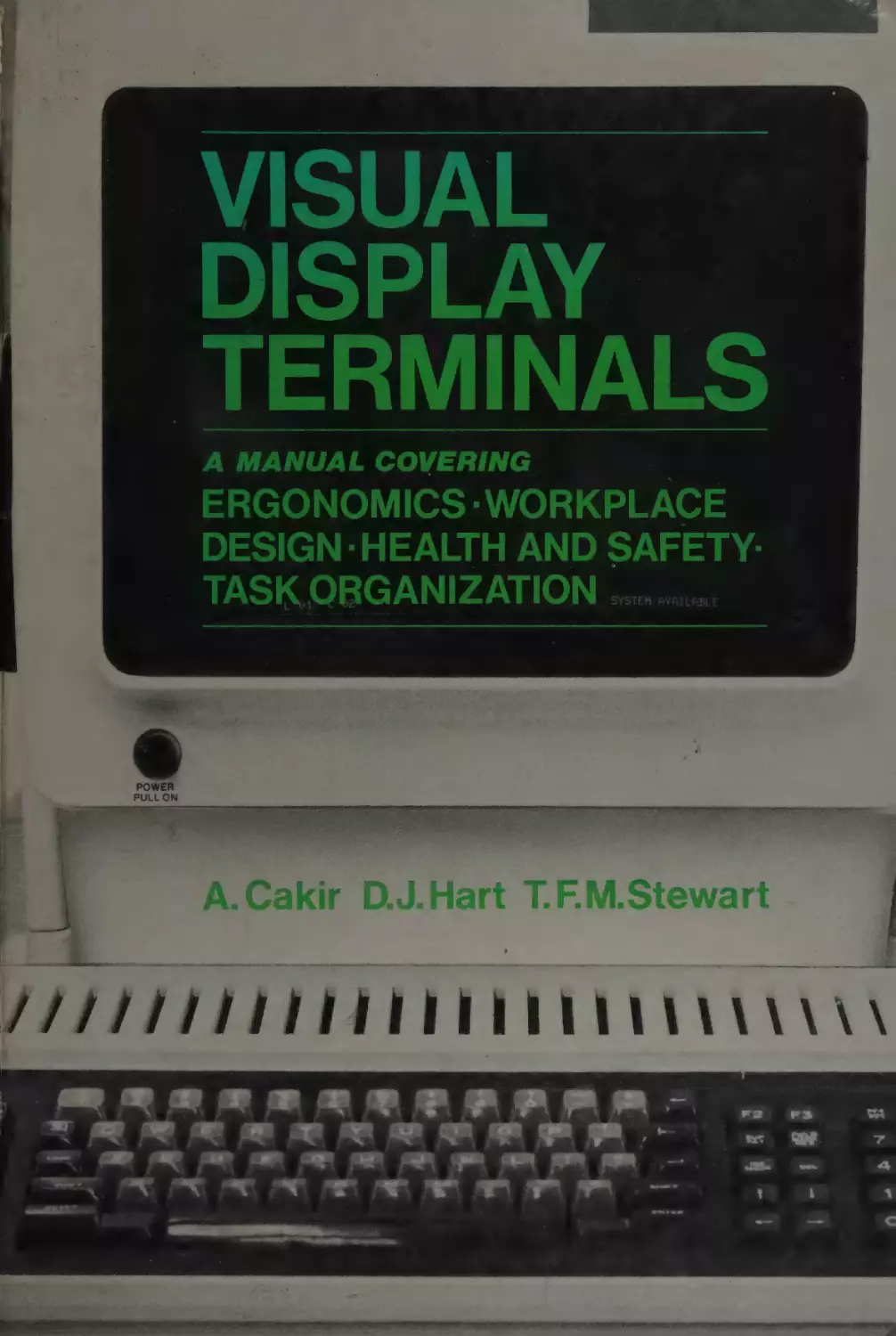
VISUAL DISPLAY TERMINALS
A manual covering
ERGONOMICS
WORKPLACE DESIGN
HEALTH AND SAFETY
TASK ORGANIZATION
A Cakir
The Technical University of Berlin
D. J. Hart
IFRA
T. F. M. Stewart
The University of Loughborough
It is surprising perhaps, that in spite of the vast amount of literature that
has been devoted to the subject of computers, very little has been written
about the people who use them and the conditions under which they are
used. The main purpose of this book is to provide the designers, planners
and users of computer systems with the most comprehensive guide to the
human aspects of the design of visual display terminals and workplaces.
This guide is based on a large number of experiments and field studies
conducted by the,‘present authors,and many,others 1 in recent years.
This book was: originally prepared” by the;‘Authors for the Inca-Fiej
Research Association. However, because of the considerable interest shown
by a wide range of users from industry, government etc. throughout the
world it was felt that the book deserved international publication.
WITHDRAWN-UNL
aan,
VISUAL
DISPLAY
TERMINALS_
A manual covering
ERGONOMICS
WORKPLACE DESIGN
HEALTH AND SAFETY
TASK ORGANIZATION
A. Cakir, Technical University of Berlin, F.R.G.
D. J. Hart, JFRA, F.R.G.
T. F. M. Stewart, University of Loughborough
Originally published by
The Inca-Fiej Research Association, Darmstadt
A Wiley-Interscience Publication
JOHN
WILEY
& SONS
Chichester - New York - Brisbane - Toronto
Originally published by the Inca-Fiej Research Association 1979
Copyright © 1980 by John Wiley & Sons Ltd
All rights reserved
No part of this book may be reproduced by any means, nor transmitted,
nor translated into machine language without the written permission of
the publisher.
“
British Library Cataloguing in Publication Data:
Cakir, A
Visual display terminals.
1. Information display systems
I. Title
001.6'443
Ie Hart Ds I
TK7882.16
ISBN 0 471 27793 2
Printed in The Federal Republic of Germany
III. Stewart, T. F. M.
80—40070
»
Foreword
It is surprising, perhaps, that in spite of the vast amount of literature that has been
devoted to the subject of computers, very little has been written about the people who
use them and the conditions under which they are used. And yet computers have been
a familiar part of the working lives of many people, in many different walks of life for
many years. Even if we, ourselves, do not come into direct contact with computers at
work, the contact is most certainly there in one or other aspect of our daily lives, for
example in the processing of wages and salaries, bank statements, the electricity bill,
travel reservations etc.
At work, a computer can help take away the tedium and monotony involved in many
types of repetitive data processing job. From an occupational standpoint, this is a
respectable goal and one worth striving for. But in solving one type of problem, others
are created. The ability of a computer to handle large volumes of data, quickly and
reliably, usually means that fewer people are required to do a given amount of work. In
some cases, the problem can be offset to some extent by the fact that these same
facilities also make it possible to increase the amount or extend the types of work being
performed. The fact remains, however, that computers are creating an increasingly more
pressing social problem as far as employment is concerned.
In the early days of computers, the popular image of the computer as a giant adding
machine, capable of performing simple arithmetic computations - albeit lots of them
and very quickly was not too far from the truth. The computer of today, however, is a
more sophisticated machine, both in construction and in terms of programming level.
Computer designers have reaped a rich reward from the development of electronics
technology. The development of computer terminals has improved the possibility and
efficiency of access to computers. Storage and processing capacity has become cheaper,
and this, coupled with the evolution of more advanced programming software, has
meant that the computer of today can seek its applications in a much broader range of
industrial environments than its less sophisticated and more cumbersome predecessors.
This spreading out of the umbrella of computer applications is bringing computers
into contact with occupations associated with progressively higher levels of skill. From
an industrial point of view, therefore, it is not only the number of people whose
employment may be affected by the use of computers that is of concern, it is also the
skill categories of those affected. Nowhere, perhaps, is this more apparent than in the
printing industry.
Whilst it is not the object of this book to consider the social problems of computer
technology, it is against this background that any book of this kind is written. The
newspaper industry is currently in the frontline of computerisation. This helps to
explain why it is that the initiative for a study of this kind should come from an industry
that is not generally known to be in the frontline of technical research.
To many people, the prospect of working with computers and visual display terminals
is a source of anxiety. For some, these anxieties stem from the fear of job insecurity and
the prospect of redundancy. For many, however, anxieties have also arisen from a fear
that working with a visual display terminal - the outpost of a central computer - might
iii
pose some form of health or safety risk. Within the past two years, this has been the
subject of considerable debate. And in spite of a great deal of research effort, the
information which has hitherto been available has been largely uncoordinated and too
sparse in many aspects to put this subject into practical perspective.
To help bridge these gaps in knowledge, the International Research Association for
Newspaper Technology, IFRA, brought together two of Europe’s leading authorities in
the fields of man-computer interaction, computer ergonomics and human science in an
attempt to analyse the ergonomic, health and safety aspects of working with VDTs. The
outcome of this work is presented in this book, and it is with some pride that IFRA
extends its thanks to the professors and staff of the Institut fuer Arbeitswissenschaft,
University of Berlin, F.R.G., and the Department of Human Sciences, University of
Loughborough in England for their guidance and unfailing efforts throughout the
duration of this two-year exercise. In undertaking this investigation, the authors have
sought the help of a great many people in medical centres, occupational health and
safety authorities, universities, trade unions and in a wide variety of industries. Not
least, the authors have also sought the help of a great many VDT and computer users.
So many have contributed information and comment during this investigation that it
would be impossible to credit them individually, but to these, the authors would like to
express their most sincere thanks.
In dealing with a subject as broad and as complicated as this, an attempt has been
made to write this book in such a way that those most concerned, i.e. the user him- or
herself, can read, easily understand and apply the information that is given. It is an
inescapable fact that the involvement of the people who will eventually be working with
a computer system in its conception and installation is one of the best and most
desirable safeguards against future dissatisfaction and complaints of discomfort. But
however desirable this form of participation may be, the fact remains that neither those
designing a system nor those using it can actively contribute without some fundament
of knowledge. It is with this spirit in mind that this work has been undertaken, and it
is with the same spirit that IFRA, and the authors of this book, sincerely hope to have
contributed in some way by shedding light onto a subject that is of major concern to
many computer and VDT users.
e
Contents
i
EOLO WOT
ak een Seas eee Pee
oleeee
oe a TiAee Ta RRL
ETS Ten
Prete co kere crit sacks atecees pr i ecnetieranawsuslets
dsn
Migseaeidasa qentiean! as"saeco
SHIAPTER {1D VBI
deninanilacs rs iku Nie Aint
steng tie er ater . xiii
Re tence ta Done
Pat MTL SPAY ccoatassreelcatOhiac forse oak cok Gouge vhs One ERI
PBB etre BU ATITULTI cau hs Seatac sb cosPoscoeyeasts vee Cee oos aay La
PSTRUGE ION
PGR,
ec aeen iii
BASICS ooo casihi capers scccetochetesetecsecesdvascs e s ldibas +40kelOeiety oh bu cece a ae Rese eames nO
PIO) ha OPCS. Pnayier cts cu ade
PPB
ee in
eee
TT he ee
Lt ape
eee ee
SCONUIOL Aaya tee ac fetid ciwnccades 8c vaoaelec heey chs met tae MPENier eee Sere eee
OUOS TIMOR ee hits Geet crs coriahs idea dare csaneehicoe ch reanie en eaten cetera
aL
Z
4
5
6
Cee
8
ETAL akon Gy cele aniadeetths Meiera2 oh Rawk. ceca ne ge ncete Mette ee tacts tone eee
BPNOG OUOL BOIUCIEN CY. >. smiaies 1.felt hesatobuted ts Aecb dived cenesthan beth ai ne
ee
CSDOUEDS co hn ee Saat cee ce oedccad ites cerned tenet Vices ee Me eae eae eee
Persisvence, refresh TAte: <5. sv. caedose.c ssso dsis he awa rat fy so ape ead see eee
OPATACLOV A PCTICLAUION crates ass steiece tide os semen cae TUR oe hes Leaieee Meth ait ee
eee
PacsiTailee SCNeELAtiON sacs. ce een ade acetGee «arte ons Cane ae wares ee
ETO OM CCMELA
ON acy ccd foots eer neces Town eae Fiencath
ven teeta ce cebe ene
RABE
AIOUS, WOETIELATION asics occa tseeeca can seicc steeds cote it oea eae nti eee
8
8
9
9
13
13
13
13
MIOERINACTIXSPENCTALION f s2.6,.c2achaisaaeceds
Seaguee esoeehak ohcnt oesubse ate
eee 14
MTORR
CV AIORLC oo ere
Twat tel ater ac set
ne AER AE
cen tn eee
Milter al phan uimericn KEY SEU... scaoss sie. sack coum cet oean cet each coke hea nero eae
PAUINIUTARY PIUINETIC KEYSEUl. 2. cid ries tsucssettecsteiates
ieceeter Stern
WOOL OM M KEVSCit
tac
16
ceUad ee eR Creer ee aeee 17
ott. sacri sora sueeotaact eee etc macoete Se De ceae Don haeeee ee
ET SOCRPONL COCR CNS fico sat geet
16
19
cos ac carson tone eee Ml atetts bagethane
ae ee
19
From the keystroke to the screen...............csscesceeeeeees he ciMacey cs deen aee eee
19
Oi eree CONSICIELAUIONS 55.0, 7sch ten, heed oti chas acoske tease teeta
VD TERCOOUISE Mets Met
KAN Me relies hers nr tater Eee
boaters
ean sek ees
so ack Meme coe Ne th eeenee
WL AMOUPSL AU IIICV aset tec vntacs ensue teers cs ih ote lee ec ete
Linimberruptables
power supp luess..
ray ce ee ee erate 22
4%, cers eects eaeee eons ener eee eee
PHD lOslOnmesale
PUArds: tees
nee een
ere ch eco
ees can noes cis ae ea See
BR RTA LOTS
ae
cen ee en
eee inc stein Sates Senne eee eeeighitad | MER. eee
PralOmirCrtlcn
Cymeta a lONs mera aeot arta: coh sceisey, asic oa Meretcoat wanes date tena
VITCEOM
AV CANEACIALLON aN ran ter nee ato onciemst dt, te nee Oes GUANA heasday earned soe ene ns
Natt ATeCMeT AC LA UIONIe aad tener a ktaee Pin mine nce hie cece nclocc asaetaccacantechenee renee
Ultraviolet radiation............... cess eeseeeeeeeeeesseeseenseenees seeseesseersseneessossseeeey
Ded
GPM POLIS
ee coy a eee Sig ar se aecle ve 5c seta wehak > Whe
hircs eee Re eaaeas
ee OT MT CMEL ALA ION tr eee
21
Zt
sess ssck eden dongs un gnntst see asnngads eoence cone arspaaseet
ee
23
23
24
24
24
24
25
25
Orr aatiouia ee XOSuTCaLORX-TA CIA LION tvs 65 cacitac yosacs bovdealt soos sande eid ovine sa ecedeee 26
A-Tay sources
Mm VDTSi
5 Fe
oe
ee
JEDEC
-x-radiation limite CUTVer..
JBDEC
sIseexposure: rate, lnmieeGrve. cect oncaeid eee
nen er
-c aceite cots teaeeradaeeen henner
eee
27
ares Coane 28
ot ae
ea
ee 29
Valve components in the HV power supply...¢.:.cc-..cneecspenne. rmennns 30
Eifects otterminal age. .and Maliunction...c4
Neravca OSOrptlOn? IMAC Sy.
ns
ecsere cae ot
eno
30
ceMncee Reeak mercer tare foe Sime tase theee: aseete aente ena
31
XSradiation, measurements: on VV si nvisnestetsrerscs
ssecuctess secetsoe ae
33
Cw
L 570 (SYSTEMS: COMPOMENt,:, csc there sarten.sarees sho sania cance teen
ee ee 35
pubeeiitellsments COP 1a lesa sivas caeerenwuinns serelice sis (Nes ac carta tn een eee eee ee 36
OOYINLIT LEAEL OTN. Oy os ccc sadol cs oad edad coc dea taeh au rodoa Ree ada Reute cage a ae radee eee
37
PIA LAM ELATIGIN ISSIOL Yan vc cos sccccses nad metas ed amet tvedebctec ee che yars colae ee ae anne Tena
SUT ERISINIGSLOTY
PUPAMSINIGSIOMN
NOU c, Sacccccs sicisia cists acer Gou sei gavaneetiet a cukereet: beke trace stan yeaa
EA LOg. cc cns rc Nasipsestirs Sedg
ee
oT
eee 37
igo cvtnl an Pelkrtoed Sardcow syn ae
38
Andress... error and Parity Checking taug.ses. coocsesh 1 sckeearecinus ceporeme teen enna
38
SHVSEER EPOSIIOTIGE” DINING oeictay. ccc neaige tuccusded neces vaseeastrs ot nae soon saranie eee
eee 39
PACING OF ITE SV SUCTIN x (vane os bam eerask case-caauins sues tay tsk are a ee Ree
39
DY Stems PIOCESSING CADACIUV A sm ocousesoth\ dee sten deo rccrst usence reenete cane aee ee aunameere 39
INALUTE OF THO PEG UES Tcor.scimc orcs} onktacaandonaacae eamtiiesfo ca nates tavas teen cana ae
40
VE)Ts DIOCESSI
Nes CADACIUY 22 thay esendacdeeasan planeta dd estates oteciyoaa ie comet een ae 40
EPansm™mission
Ce
40
SUTRA TECCONLIOUL
ALOL ence ccc arnans nck ccse-sis conseae cokcte sence erated heroleae deena taca ee Oe mene
41
CINE
CelayS. 20. sc'ts<iace ats how teate tes eases ee ahe kan eee
RSs OF
PSMINES senha
5 86h ys ca vacasaden Cakes oy eames aug Aaee mee dae Lee tee ee
POPPA OLEH UCL UVTITA 1S cars.cyathel eresss oxo SASERGOeA ast bs
Stand-alone
nat Sete PaO Se echeh
ee
terminals, terminal clusters................... CLAIRE
eee ee
POUNCE
OrOO ba COU PLINGa.t niate erd rayetaails sano tection < sak aes cette ewe tee tericme ty See ee
PSEA OE MLS oe Seah oc vs tehe Peas bbeiene cn San ewe gad Laven tp tee en ea
BOTA
TAUT CIOL ress osteitis oti ee g ay Sece do oleeee
alice
eee
cs
DISPLAYS i327 oon cor cans beenctten note ences cae ieee thicok cae eee
44
46
47
ae eee
49
mene ee
50
0. se snecleany-sneseeess
0saa ee eee eee eens
51
PATIO FVISION 2.sacha cnee rece sak adon Race token decane Ate eke hie aaeat eae ent
fa Hes NUMAN
BVET
43
LIGHT, VISION AND THE OPTICAL CHARACTERISTICS
OFSVISUAL
PGC
42
47
PNCHMIOWICCECTIIETIUS. ccv caicnes stack dns eek dad eh va us selsete cacenit atlaee tele MiteLerareca ena
CHAPTER 2:
4]
CVE“ ANG’ VISIONi2
MOV CINENES Tor conta ares ties
eeaee ak Seexs striae Osco eT a ur eeneEERE eee
53
The'serisitivity of the eves tolight.:.....csce.cchage
ettenet ee eeeeee
eae 54
AGA PUATIORN: <3 coaacnyeac tekcn etav alscase one Ghent sacaa steps meat tes etek oe
Agevand’ visions
Vistial
10 creed cokes carer enueee ink sect teumentee: Sens coe tee
UVACuity, tv phsaveccurh cikce caveat oedanictat ee tana me recor
Agcommodation)
Glare
AbINty: Au.t.u. scence
ee
rene ae eee
eee ern oa eee eee
55
59
55
58
serisitivity.. c.aciieintesdoneeees
seen techmeeeenmeettcr ere centeetenon eee
cae 60
Loss ‘of ‘Contrast sensitivity:
The measurement’
cis. deetactec cee tee ee retreat oe 60
of light: taiavicisneecccs-bevaeee
aeaee cet Coe tee
ee eee 61
Luminous: ©flutes...
vi
ace eee
ee
ccc ect vate
ei cees a eee
TRC ce
61
UP WaaRINNTYCOM aasee rah as evi anata ree iebeaciinaah acca Matas someise ct eee
PROM OGURTICOR ae arama 2 tS Aes Satesh oka.vents cab estan ena on ee eee ae
APTI
CEATVCONe Rattner Oty co Se Rincioee\sriiss databace Re
BA OP OTTO ee as tniet Lact iris Shs ns eaten ance beh Rohe GATT uaepee
DAVID ARCe CONTLASE war. c 5c. Sor Auatereteet ha ee oe On ae ete
hightemitting-vs illuminated characters .s.6 .i.c0.02.00.. tsar. saniemeeasons
apie aeeeeee
a evoptiealrenaracteristics of visual displays:,....c...0.::.0Miemdeeen teen
CROLACUEr
OTL
62
63
65
66
66
67
68
FUTIANCE RS. 5 dicas ven momivnossahanncurdnetee
sheochaee oer Rm Cee ” 68
SU et
ier eae ncciicaaieers vee Seles oe oiakshah
nokattNO Napanee
70
Visiialeachhityaand Tread
aDIG yy ceats.ucssciasesverc
eet ieeeenGee
re 70
The.optical characteristics of source documents. iojsce.cdsa0ce-cascateasaenre
stench Te
Subjective evaluation of the readability of source documents
BINGEN
ALLCS
1AVS Mccoy cosa gavkolsnucsiniesed coos eave cess eae Lae hee eee
RceARCe Rema. <iartesNe
Reflected
PRO
gre wihs S vacndas Mai notinuitera «tea aitiedecal a uate
glare... BaaQedac Se\ e'sdiules Mais bea NINA ane eee
E ECON Sette cota cetes rank ces tee lable yet cen beks oe cee
ee
oa
ee
79
80
ee
81
Whe disturbimg effects of screen reflections: <i. sciyoasanvcsncanest
asso see
81
PRELIOGUION. 2Pla
Te. Sein, eee
needs he ale bee
een
eee
81
Retiections and’ accommodation difficulty .....cck. ne tone « seceonsmeer
ee ee
81
OM LEASLSTECUCELON fg soe ascot sine tend iota salen
eae
ome ee a eee
MMe MSE! Olms Chen: MITEL aides: scceck op aos coosoo cooks boos ao ee
Reflectance of the untreated CRT glass surface.................0...sscseeee0s
BU ILey PANGSree ia,da os sikh ane ns cadet Rvedonslin at voedepah ean
Gti teem
83
84
84
84
BOlarisatroriel
wade
meee
ULers. face seen hore cosoe co Nacnawos 03 eee moans ctl Ua cube Cea
eee ne
PVEREROTMICS rd LIVETS i pea hs bese cy oheNrcs sa uedden due ancueredee nliee i a eeeee oS
Fiching tne screen class surlaces. Fics
eoesges ease ean
e Ce
eee
86
87
ene
89
eee
90
Vapour deposited screen coatings...ccbfe.d.c./0tie.ts
asatoross ta
ree
90
PUTL
91
Spray -onmanti-relection. COAUINGS...%.25
CHAPTER
76
+. :hescssee nee opeeee eee
LAV
eTSs A tre Wed, 25 ds Hie ay a hens ARR Seta ot
ae
MODES SU IOUS Stars! cama ees One Or Sees eae Eco eA EE REO an
te ce one
plibective evalliation Of SCreen-fters..,.
s.cc- casessec.0eg cos seesen cease tarts teres ee mem
91
o2
SLU RAUUEY: Pst
92
3:
9
ERGONOMIC
MPR dp
REQUIREMENTS
a
eC
Re the.
Po Ae ei
sels nN A Js ta
FOR VDTsb....................cccc
cccce cecececeeeeeee
MOM VAS ALI SDAY Micah a, otic tenant sete aren
eet
MM acres tee valis ate atwlers neces
95
96
EZeT ie yes PCC ICALION Serie ce Rees Nee averse sysage ene es te dies band ss Bm ots ngtuedolt 96
emi uti ivr anc abe ata OLLCyceee cst tees: nce use, oe tan si nws Secameieencs “Hesune tute OT
Tek yee aed eet Mims een ee te a ed ane Cae EE Sola Sati. «fame te ae 98
GARAGECTBEOLINIE LICL Mee MPaen erecta eakiads < ceincweneitesnna scetitealanes cnadeae Ueanewereens 100
erITiom NCS OLULLOUM Pere meter coat h ns nes assess attcd suetynchods secminctacs (oem
OACUl GION
ese
100
PATNCLB WLC Nim, cp cis Pan Svieveaicnnonaase@adeaanies sobebnworginemes omens 100
DaTETG VARACL elas ACAI ee par a. eit
ae ht osu
Gino etcos donde he Onoda sons conan cdetes 102
vii
Line
SPACINIR Ee
Pn ce Ce
ee
102
Upper and*lowert: cease characterse.cieess..civ
elscotter ated aeet eaeoere eee 105
DISPLAY
Cap Beat yetic cata cpias guctane peeseee oes reat aI NG tone th op ray eer
ee
105
SSGL COT OBZOL I eck gai Ney Sah
ROU
RE
ee ba I ee nett eget te ae
Avatlable-character spaces ou weossse steve its hones eee eee
Disnlay memory, .sCrolling, caseeve.cer eines eens sete erate eee meee
Tra POM STA DELL Ey ah asus chee quviondete ANrCnl te AREA el ee rat eae ae te ote eee
PRGON 5 sees 5 sic AR
ok
ac va
ne
LA
ne
105
106
106
107
108
Potsp lay
PORMIAtris be besnaies lekest seseeele eaudeeos Toe
INGFrataves
Te eT
fo
ee
eee
111
AMC
nee
111
LOTMATAA oi itiy trode bho evcee tee donee tu cal gee eee
Fea CAEL EAM POL TIVE Gos cuit cen Beiradeals aes eae OOD te eee
152
Sim pleity
114
srelevanite dase is
SECU ETACL ING Votes via cca
is renc auc CeO
Cote vee
ae oe tvs needved ee PRT aeswoe tee TREO
RE ee eee
os a ee
114
ONSIS
CEN GY oak hs caas Heatodars Coan ete dae fo execs da cs tgoe de ot pay EIRTecee SCTE te eae
114
Grouping, SPAClOUSNESS ..............6.860e fics
Mawes coted Mang ccnaen etree
ee 114
PPV CLEISITID PAOTTNI ATS Ae 053. ooh hk opack ples toda push ce eae oa ne
ee ee
114
DVRS
EIU Y SAO
1T9
F
ayes aks Fa oon be eh lok caches Peas AOS Oe OE ee Thee
Eo ee
Ppa muInericy Codes Havas, ee cyccpecuhe cereals ae ni abe et
Pin hancement?
COCs ion hteic ese coon
Brightness®
ee ae ee et ear
hes eel eondte cata eaens emaeen ee oe
couing 4 er.ca os cee
Reverse video COMING Sand saecee bak davon coe eae Pete
PPT
its
te
heenim
te eae
117
ee
118
ae tee
Syaivolsandystylercod ine 4.20... cal apone oats ocecete coe na tata
117
tt.|e ibe
a
COLIN Hs Noss sect ods onc co Bie tot Ae te ee tok Pest eee
ema
115
ne
119
eee nes aera
119
Whaltiplec coding rdiMensions Af, Waa svar eens tee ie eae
119
PCRUUAREE al Peteco cs uAe vast ens cteistuh Serctealtwait Por cc'scome
120
Oiher sCoding -AiMIeNiSlONS.9,
etaitMee EIRnee ete an Meeaaa
side assJee sacs st nde cette ook Ce
121
RSIIE SOLS Were, oan cea 57 dc APC kcg ae ck aL Oe Pe este can TTT ONMC PoE COE Gea ee re eer ee ie.A
MAS AKOM OAL Nectar ads oo Reecs oc) Bans socke Peotet vvnadyr Set eta reteset
122
My ping. and K@yDOdlCINe <n.) f.c.res Geen
eee
122
ane eae ees
124
Keyrshapes and profiles. 00 acsc9 ss ccceetece dhs oaks eee des sx acmane sg wnpene eet aa
125
Key Oates DIOMO ta suits, s.catiee
steers ‘cet
125
Key and*keyboardrdesign:..<.
Keyboard
thicknéeg:..)...0
Key. - dimensionsiiis:.
Keyclegends,.
Key
diestase age OE
Ae
OLE eee
acc etunese rcs cee tae ceteh ct enter ee
oA aces secitaaad 2 Co eae
oe
ee
size! and. -COdING arjsccc a0) Wie ce adept ccs Meme
eae
2%
ee ae eee nee eee
124
ee 128
eane etek ee
Alpha.
viii
129
Safeguards. ccsecussccsacusnandcceeeandes
aaAb Ca eee atneeene ee ae 129
TEPCAT..cccoy.
nities cv sa saanacuden ans sxAelh Decos eta dete aan
ete eRe ee ent
ee er
Colour and the reflection characteristics of keys and keyboards........
Keyboards
126
ee
vcstetice von cauctes eeeken ete acted. tana a eae
feedback. sic. s.ctsh stedaaacgeeress cones eee
Security:
eee
.us.mvdias ceeeeees covet fas teens etna
oct
Key force-and) travelicsciiciicc
Tactile.
tae ray ata
layout...
131
132
isco sesnuesssas ade vnaveteuiy duces ttt ges eatei) eatin ne att nee ar eee ane
136
Ke ysisciséscciscnstuaseedei
senssobuertua earner teaeAtel eeeae ee eee
136
PNT ORL
GE Vis ete Hh GREE Te ope SRE LisscH is cade ug decd «te andes aie tae
PVANOMON
RRC
YS ret tO een crite
aM enc ccse asta st Te, eieeheret Ooehce aera
143
143
PIAL ALY SOL POCO ITICINO
ALIOTISn Corr. dos (berthed senaei cous Wests cw Lc oeckees Pact ooreeeee 144
CHAPTER
4: ERGONOMIC
WER
LAGE
REQUIREMENTS
FOR VDT WORKPLACEG....................00c000-
EPO TOIML OSS ooo) hc once iced
linpartancesc! thenV DI
ASTI tie
ars
ee eee
ee
task, cov wivecatincnGelabieoh
nee ee
AV ENOL: VL)1s"WOLVES ALOR ii a 2A aie ee etee tee
lea
Woo
eee
155
ae
ee
eee
155
Data renquiry work placesiee 20.) s.: Ohchecshs. heater
eee ee
156
Dialovue* task *workplacesies:
General
aids sen aet eok a
seo. ccc
cworkplace: Considerations...
ae Oe
cen vinscccse aon eet
The-usevol ‘model pyork:stations. oui
Anthropometric
ees
ee
154
eee
Bata, en wey WOrkplaces 5A
Le ee
153
ee
eae ee
hia ces ee
156
eee
ed 158
aspects of VDT workplaces.............s:00.sssessssseeeseceeeecenee
NVOPKINGe LOvel, Soak Nie AE Ci rh ay eden ean iatin SGNae ates Cee
Gs KC UAOIetaps aleb sk coeinee ts tae Lea he
BOO
rOS torn tase
Document
ew Mr Se,Mecca ees
nes Nees
ee
163
TIER Uatese
soe Pee
165
evisving POTN
oe
166
workingrlevel *..2...05 cater e-a5ieaacoe ree eee ee ete
Position and) movement
ane
169
of: theshéad: 21.08)
yveds tess ek eeeoe eee
Lia
sea vray int at. cis ace cee tes nda eee nee cee ree eee
ae
A TOWVETTOUCISTATICE Sencha csOey Va shot teat ape ta et eeee enc eon eee
orteiliar HVT
OTWIC
teats ais ioe ed senate uae eh eterna ee Rac eee
joa
Si aia ae aocee dy
Tiigemation
Luminance
162
eee
holders ie cis s5 oc ces sis, | eee dae
Armereachoand
160
es
Chair. seating height and back support:...4..0:.oulsa
159
edasen, Ra Nv ane
Opera
eee eee
teeta hid teenth tN Re AOL Bi Wecya Peay an go bE oh
Pleyel csr hp ciate tas vcien yantsnanbae tees pete sn een en eas
ratio FEVALIONSINIDS
hc Sele ccekac cen aetna
eee aes
Glavetanderes lection. 1evelis:.vie.ccssiscctieeeeds
teeae ake een ee ences
TOUT tieae ASL ALIA LAONIs. 9 ame
eh ee ete es Senos oat een vet cee eae
FOLOUTMPEIN PETA UTE Ts Pe eens tec coresbeoa sect cod anne me rr maT arcele a en
GISESASNICL ING ek oe gt ene oneaes a
A Ram eRe
NCR olor sae
Wherplacing of the luminaires
the-roOMia
nore ee a
ss ietce seeceteots
Imehting Circuit rarrange mente: ....co ssc .ceeteaddects sentietth oiotws areonmncce
WN ANIC OW SteALICHECLILEA ITISM sett tia ver ns rp oiee. Uae en cere amen) erenle dat care Mages aNatenwes
1G
173
174
174
174
177
ia
178
178
178
179
180
180
ANMEC ORIELI
MONIEA es are nee renee eto Meee tn tee Lak cheSec mwlenc case Seen ste co wheat de encima 181
Vemperature problems atv) VDT workplaces... 2.0.1 5. A. ssscss.csessssuneenonne 181
Pcieey seamen ee tees ice arene ree reas Sag tate tre se tse
ets eaters caylee Sane 181
Pe ACU ae ent Mier Nortel Ot OER. 08 eM aM realise ceo dd deodechs cesanne tegebverahentees 182
PVCUClCMOLEC AUC IONG: fete Mir eicnt tcc cute se eves isda easthensttocraramntdeesswes 182
sionscnc eese 183
Call ONS a.m) ntti scsts. Gt csetentessotetnossecbusvongeese
NTS Eye ere COMING
CHAPTER 5: THE HEALTH, SAFETY AND ORGANISATIONAL ASPECTS
OF WORKING,
WITH: VDTsi. :xecgoi tuk, see c covaomnce rit ton nds bose messe meer essosaenciens 191
Postural diSCOMPOLE .c.Siscces ass aoesace nach ene bolecases eevee ane on kee peceier eee eee
192>%
Working \ procedures, i ic.cuss 355s Seabee nae eanee cet csean sd eaien cana <a ex teas nomena 192
Posture=and ‘individual: behaviour ac. viess sci sss cransredent eoaaeneecanapeenn
names
NMatching. posture. with. Lhewwistia task... feycencsccvecvos
verter saeopeateceencamacene
Equipment design and the reduction of postural loading.................seceee
ENG. GSP lA VeSCKEOINi c.f asi senate ccmnny cata taeeettbevastee areata eee
nae
MTG eINOW ORIN eros naka ctdeadseta sav estas¢niE amet hee Een loom ae ve eon ae
PPERMISCCOl- COCIINEN
Css. cos, sites vag sencc neeionke merce nels ee tee ae oe ana eee ame
NUT AUR CHASCUIION Ue eatccc sca ss ca gets thea c hoaty danas lienCoe beanie Magna ee tee eear aireace een a ac
Phescaueec Ol Vistal CISCOMlOlti «1 -ci omecsncedtiepanenees
ac omen eAweer eee
POCEB GEILE VISHON senior cess vant se Gone eck ssote a dgad ohare Ih ada eect oad an eee ea
Viswal disorders and "their COrrection.:4.
2.10550; eeiuadereaesaceeeleecdeema
reeereess
PNG USE Ole CLASSOR Maa os .s5 Pes eins a aneniceun ate shows eau Bhar ass ocean ee ee eat
Gn the uestion:. of vasiiali dani ge) 09 vic. sas<cthcomten
oeieee eee
ee
Piveatecte. for WV DT GODCLAtOIs srccsscecss ii'cdcsesnsnas sbayso Shar atte ates aR
ae eee
CREAT ACES. wciccahe: Svahgcuataas (lei cak as.Sandys ine wv BA side ar aa peauee ee
Wisuallys precipitated
218
epilepsy wi.stend ob senic ssc sihetaunes vecaeroeruanabeiae
teeteoeas oe 219
Proplem= related to air-conditioning.
PRG TIDE AUT Carioca
enact eent area
192
194
197
197
199
205
208
208
209
209
211
214
216
cs. s..<a00c0s «ons coe scdvsds oe gases Hasan eae Senteemiaes 220
cev neh oso eee a dleds ce kee
a Sole Senate De
Ns ees eaten
ce era Zoi
PRE TAPU VO PUN ICY con coh nase tines votes eum eWer natant ae oe mle ainsi ce on a
nem
TMCS
ee em te
CATAUTOM oe Nec
at
afin oats teasae avs
Parsconcitionine of VL) TworkrOoms),
LE SLOPE ChaCOS ra] IPTC(0)cre)
rc ie ee
Re
PNersl Ud VeGOr Mental WOTKMOAG..c
Ms Ree
es 222
222
<7, -12. dos. 5 sd sep tuens ceeeena te teacoee man tee 224
a
ae imereie MERE TOTS BC. yeti
ri
bay fC
227
brie ndaeerc iced sue obec couaiacreae neiWamn oe meenen ues 228
muplective: methods of investigation <....<casiisce
ss«cossase tustasuperoeeenaceneas 229
Performance methods of investigation’...
).cic.5,.seos) seuateenasscesesereaes jeae eae
Physiological” methods: of Investigation...
PANVORVACUOU Ge coc och one CE aE Teac Ohne eT
ccs ssa siaceene te eer ene ee
RR TET CLE
Nee
eee ee
Alrenation- and. machine Control mec, 5.05 tase tan eaten eet ae dee eee
231
231
234
Control of periormance-by the computer. rc 1s. .c. es eee eee 234
Fatasuig and si ONnOUuOny ns oss cron centr steeds hes
ee
eee
ee
236
Fatigue/monontony relation and loss of qualification...............cs0cce00s 236
SOO):
GALABLA CERO, 2c. vx.)svete oi eey ieten A aap
AIR NE Gets tree Oe numer ee Sete 239
Work allocation -and job SAatisiaction....\
scam tect ciaera eee
Uhe' degree’ of work: alloéatiore.
ct sacar: cer seveahn ee eee
Job quality and jobs satisractiony.
1... csc
Workload: and time: pressuré;.cisne
ccc
Job organisation and physical demand’...
eer nana
242
eecenee 242
ance
sie Mass kee ert en e
ere
e
ee eee
243
eee
244
:a..ancensn eee
ee
245
Ergonomic requirements of VDTs and activation.............c0..cs00scseonssneesee 246
On. the subject: of rest: pauses. 5.3.4 7.0h.soceceeeaee
ee
247
Fatigue. and “pauses. .ia...sicsasonvetseces
41ssenorpeas Ree
eee
247
Mee Measure Niall Toru atiP UG Wiis Aci sued naaddevectece) dotew eared ieaweadess ope 248
MGR ITOVISION Ol reetrDA USCS 075.2) 2 coed is cveced von taabuduteneasseaentncarete
eter 250
Pauses and the nature Ol Che ActivVoi seci.siehccsssvssesdesertecteeestoene
tree 251
APPENDIX
|:ERGONOMIC
CHECKLIST FOR VDTs AND VDT WORKPLACEG...................... 1.1
APPENDIX
II:EYE TESTS FOR VDU OPERATORS
BEPENUIAS
MIA BIBLIOGRAPELY 525 ccc cce st rcsseasacmtcastneeciwent
Gheert caasteaneds dieotWikecethet aaa
PPPENDIXOIV
GLOSSARY
- A DISCUSSION
DOCUMENT................ i.
HW.
OF TERMS 0.oiei tins ccc cosesne oc caacudetiscacceccs cess Mibasecnasaevdeecomeotnnes 1
xi
‘
Preface
The main purpose of this report is to provide the designers, planners and users of
computer systems with the most recent ergonomics knowledge relevant to the design
and selection of VDTs and VDT workplaces. This knowledge has been derived from a
large number of experiments and field studies conducted by the present authors and
many others in recent years. Detailed references have not been given in the text because
the primary aim of this report is to be useful and practical rather than academic.
However, the bibliography lists the sources used and readers interested in greater detail
on particular points are recommended to consult the original reports or articles.
Report Structure
This report covers five major areas. The first chapter starts with a basic description
of how a VDT works and this is followed by a discussion of the VDT as a systems
component. The second chapter deals with the basics of light and vision that is
necessary if the reader is to fully appreciate the subsequent sections.
Chapter three covers the ergonomics of VDTs in some detail starting with displays
and display legibility and ending with the ergonomics of keyboards. However, many of
the ergonomic problems of working with VDTs stem more from the workplace and
working environment in which they are used rather than from the equipment itself.
Chapter four therefore discusses various aspects of VDT workplaces and covers such
environmental issues as lighting, heating, air conditioning and so on.
Both chapters three and four contain considerable detail in the text. So in order to
facilitate the easy use of the specific recommendations they contain, these are repeated
in checklist form at the end of each chapter. The final chapter reviews the various issues
raised in the earlier chapters in terms of their effects on the operator’s health.
The report ends with a series of appendices which support the text in the five
principal chapters. These present the main checklist, a glossary and bibliography, and
a description of an eye test procedure for VDT operators.
How to Read the Report
The report has been written in such a way that each chapter can be regarded as more
or less complete. As a result, there is a certain degree of overlap between chapters to
ensure that any reader who is referring only to one chapter does not overlook important
or relevant material in other sections. However one theme which emerges from the report
is that there are many interacting factors involved in the design, selection and
implementation of VDTs and VDT based systems. It is important to keep in mind,
therefore, that interpreting the recommendations which are made in this report may
involve considerable skill and compromise in specific applications. Indeed, in order. to
make the best use of the report, it is first necessary to consider the role of ergonomics in
the design process.
xili
The ergonomist has two main objectives when designing equipment, workplaces or
working environments. The first is to ensure the well-being and safety of the operator at
work, the second is to make the best use of his or her skills and abilities.
When the first objective is ignored or overlooked, the penalties may be high for both
the individual and employer. Unsafe, dangerous and uncomfortable work should not
only be avoided on humanitarian
legislation in several countries.
grounds
but is increasingly
being restricted
by
The results of ignoring the second objective, however, are usually less dramatic
although they may well be as costly in the longer term. Failure to design in such a way
that the skills, abilities and other characteristics of the operator are adequately matched
results in excessive errors, delays and other decrements in job performance. This, in
itself, can also have an adverse effect on operator well-being. For example, a poor match
between the facilities of a computer system - in terms of both hardware and software and the needs of the individual user can be a major source of job dissatisfaction in
addition to being counterproductive.
There are nevertheless times when ‘unergonomic’ design may not result in any
apparent decrease in task performance. In situations such as these, however, the
individual may over-compensate for the non-functional or relatively unusable features
of the equipment by expending more mental or physical effort. This effort is not without
cost and can also result in problems for the individual or his employer in the longer term.
Performance measures such as speed or error rate, therefore, need to be supplemented
with some measures of effort or strain in order to satisfactorily evaluate equipment or
workplaces.
Ergonomic Requirements for VDTs
It follows from the above that the primary ergonomic requirements for a VDT is that
it should perform all of the functions required of it. Whether or not these requirements
are met not only depends on the design of the equipment and of the workplace, but also
on the characteristics of the user(s) and of the tasks they wish to perform.
There is therefore no single ‘ergonomic’ VDT. Different user and task combinations
generate their own specific requirements.
In the newspaper industry, there are a number of applications which. may be
relatively similar in different newspapers and which could, therefore, give rise to
common requirements, e.g. for an editing or page make-up terminal. The exact
ergonomic requirements of such a terminal will, however, depend on the detailed nature
of the user’s task. For this reason, this study on the human aspects of working with
VDTs has placed great emphasis on the analysis of the various types of VDT task. It is
hoped that specific detailed ergonomic requirements may eventually be established for
the various types of VDT use. In the meantime, however,there are a number of general
requirements which can be laid down and these form the basis of this report.
The relative importance of some of these requirements depends, of course, upon the
user’s task so that care should be taken in interpreting the recommendations which are
presented in the master checklist. The ‘best’ answer is not always as obvious as it might
seem.
Where general recommendations apply, the preferred answer is indicated in the
master checklist. In many cases, however, the preferred answer will depend on the
specific task in question so that only those involved with the planning of the system and
xiv
the users themselves can decide which is the preferred answer. For example, although
illegible characters are undesirable for any task, this may not always beacritical factor,
e.g. when reading the display screen is only an infrequent checking activity. If, on the
other hand, reading the display is the predominant task activity, e.g. proofreading, good
display legibility is an essential attribute of the VDT. In addition, not all facilities are
necessary or even useful for all types of VDT task, so the VDT with the greatest number
of facilities is certainly not the most obvious choice for any given task.
A second problem with such a checklist is that there are a wide range of individual
differences among people in their psychological as well as their physical characteristics.
There are many situations in which it makes sense to design to suit an ‘average’ nian.
Unfortunately, there are also situations where the result is that neither one end of the
range nor the other receives satisfactory attention. Thus, for example, when the
preferred seating height, the preferred screen format or the preferred workplace layout
is indicated, this refers to the best compromise for a large proportion, typically 95%, of
all users. This may be quite different from the height, format or layout that best meets
the need of the individual user.
Designing for 95% of the population means that 1 person in every 20 would find it
difficult or impossible to work with the equipment or at the workplace. In practice, this
may be too great a proportion to ignore, especially for systems which are to be used by
a large number of persons. In applying recommendations such as those contained in this
report, therefore, there must remain a certain degree of flexibility. It is for this reason
that, where possible, many of the recommendations are formulated in such a way as to
indicate ranges of values and characteristics that will permit the user to design or have
designed for him a working environment that is best matched to his or her own needs.
It cannot be emphasised too strongly that it is the comfort and well-being of the real
individual and not that of a ‘hypothetical’ average that is the primary concern of the
ergonomist and of this report.
XV
Chapter 1
‘VDT BASICS
Foreword
Ever since the development of the CRT display terminal a little more than a decade
ago, visual display terminals or VDT's and the computer systems of which they are an
integral part have found widespread application in graphics, text and data processing.
The VDT as an input/output device permits access to and dialogue with the storage and
processing capacity of a central computer. In other words, the VDT is a part of a system
comprising a computer, terminals and other items of peripheral equipment, e.g.
printers, controllers and a software package that is specifically tailored to the processing
requirements of the application in question.
The key to the attractiveness of computer
rapid processing speed and large volume of
the purely functional] characteristics of the
VDT as a piece of equipment to be used
systems in most business applications is the
data that can be handled. But in addition to
system, it is also necessary to. consider the
by persons with a wide range of physical
characteristics, skills and individual or task-related requirements. This combination of
functional and human requirements represents the ergonomic criteria which are among
the most important factors to be considered in designing and specifying a computer
system.
This chapter is intended to provide an introduction to the design and operational
characteristics of VDTs and VDT systems and, in particular, to the role of the two main
elements of the VDT - the display screen and keyboard. Much of this information
provides a necessary background with which to better understand the subsequent
chapters which deal with the ergonomic requirements of VDTs and VDT workplaces.
HOW A VDT WORKS
A visual display terminal or VDT comprises four main elements:
e
e
e
®
a display screen
a keyboard
an electronics circuit pack and
a power supply
These elements are usually housed in a metal, fibreglass or plastic housing and cooled
by means of a motor-driven fan to keep the internal temperature within safe operating
limits.
For most practical purposes, the user of a VDT need know little more than this in
order to be able to use the VDT in his or her work. In order to determine and understand
which of the design and operating features of the VDT and VDT system are important
from the human point of view, however, some basic understanding is required of how a
VDT works and the role that is played by the VDT as a systems component.
The following sections are intended to provide a background with which to better
understand the subsequent chapters in this report which deal more specifically with the
ergonomic requirements of VDT design and operation. This chapter is not intended as
a comprehensive text on the complexities of VDT design’ but rather to serve as a guide
to better understanding the importance of the two main constructional elements of the
VDT - the display screen and the keyboard. These are the points of human contact with
the VDT itself and with the system of which the VDT is part.
THE CRT DISPLAY
The cathode ray tube or CRT is the basic element around which most display
terminals are constructed.
A cathode ray tube is basically an evacuated glass tube with an electron ‘gun’ at one
end and a screen which is coated with a light emitting material called a phosphor at the
other.
When ahigh electrical voltage - usually between 12 and 15 kilovolts - is supplied to
the electron gun, a stream of electrons is produced. This stream is then focussed into a
narrow beam by an electronic ‘lens’ system, and the beam is directed to any desired
position on the face of the screen by means of either an electrostatic or electromagnetic
deflection arrangement located in or around the ‘neck’ of the tube, see Figure 1.2.
When the beam strikes the phosphor coating on the inner surface of the screen, the
electrons interact with the phosphor material in such a way as to cause the grains of
phosphor at each point of impact to glow. To the observer viewing the face of the screen,
each point of impact appears as a bright spot of light.
The interaction between the electron beam and the screen phosphor,
of character generation together play a crucial role in determining the
the display. Not all applications are equally demanding in this respect
processing applications the need for a high quality display is of great
and the method
visual quality of
but for most text
importance.
1. The subject of VDT design and operation has been dealt with in several recent publications and special
mention can be made of ‘Visual display units - and their application’, edited by D.Grover and published by
IPC Science and Technology Press Limited, London, 1976 on behalf of the British Computer Society.
2
Microprocessor card
Monitor
Character refresh card
System timing card
Memory card
(b)
Display console chassis
Power supplies
Circuit card chassis (Space for 7 cards)
Figure 1.1 A typical text-processing VDT showing: (a) the external view, (b) the major internal
components.
There are two basic types of CRT:
e Refreshed CRTs in which the image must be continually
refreshed in order to present a stable, flicker-free image to the
operator and
¢ Storage CRTs with the ability to maintain the image on the
screen without the need for continuous regeneration.
The CRTs which are used in text processing VDTs are usually of the refreshed type.
They are very similar, and in many cases identical, to those used in domestic television
receivers. CRTs of this type lend themselves more readily to interactive operations such
as text editing and correction.
Storage tubes on the other hand are more widely used for the display of graphic
information e.g. charts, line pictures, etc., because of their high level of image stability
and resolution. However, VDT's of this type have hitherto been less suited for text
processing applications for basically three reasons:
* more energy is required to activate
refreshed CRTs,
the image than with
¢ the display image is usually less bright than on refreshed CRT
displays, and
¢ once the image has been written, it is usually necessary to
erase the entire display if any part of the display must be
altered.
In spite of these disadvantages, however, storage tube technology is progressing
rapidly - particularly in providing the facility for selective erasure by means of more
sophisticated software and by the use of storage mesh techniques. CRTs of this kind are
particularly well suited for certain types of layout work, page make-up etc.
Deflection plates (electrostatic deflection)
Glass tube
Phosphor
Focusing coils
Deflection coils (electromagnetic deflection)
Glass tube
Phosphor
MIN
Anode lead
Figure 1.2 CRT construction: the electron beam which is used to ‘write’ the characters on the
display screen is controlled by either (a) an electrostatic or (b) electromagnetic deflection system.
The following sections, however,
display.
4
are concerned
only with refreshed types of CRT
Beam scanning
The scanning control circuitry sweeps the electron beam across the entire usable
surface of the CRT screen in a series of regularly spaced horizontal or vertical lines
called scan lines. The chafacter images are then written on the face of the screen by
switching the beam ‘on’ and ‘off’ as it travels through its scanning pattern.
ee
nga
ee
|
gs
TAQeL]I
|
TV line raster
rol
Stripe raster
( —»
direction of major scan)
Figure 1.3 Building up a character by (a) horizontal or (6) vertical slicing and dot matrix assembly.
(Inset: normal appearance) Ref. G.19
With few exceptions, the motion of the electron beam in text processing CRT displays
follows the same type of raster scan that is used in conventional television receivers. For
this reason, the raster scan is often referred to as a T'V raster.
An alternative technique, but one which is used less frequently that the conventional
TV-raster, is to scan the face of the CRT in a series of vertical stripes. This type of beam
scanning, which is illustrated in Figure 1.3(b), is usually referred to as a stripe raster.
More complicated arrangements are used only in VDT's on which it is required to
display different character sizes or on which graphic information is to be displayed
together with text.
The number of scan lines is one of the factors that determines the resolution of the
display. Generally speaking, the more scan lines which are available, the finer the
resolution of the character shapes. CRT's designed for the U.S.A. use 525 scan lines
across the tube whereas 600 lines are used in European CRTs. It should be noted,
however, that the number of lines is constant, regardless of the size of the CRT, Thus the
lines on a 24 inch (60,96 cm) tube, for example, are spaced twice as far apart as the lines
on a 12 inch (30,48 cm) tube.
The characteristics of the phosphor and the resolution of the character shapes
together determine the time required to display a single line of text. This, and the
number of character lines on the display, then governs the time required to generate a
full display. In the case of large capacity displays, this poses a problem to the VDT
designer because it becomes increasingly more difficult to maintain an adequate refresh
rate without sacrificing display resolution.
To help overcome this problem, VDT manufacturers can modify the conventional TV
raster scan in one of two ways, i.e. by interlaced raster scanning or by skipping, see
Figure 1.4.
When interlaced raster scanning is used, alternate lines only are refreshed in each
pass. To the observer, this produces the visual effect of a faster refresh rate than is
actually the case.
The skipping technique is based on a different principle. In this case the true refresh
rate is maintained by scanning only along those lines which determine the vertical
extent of the character images. Using this technique, the scan is advanced or ‘skipped’
to successive blocks of lines which make up succeeding character rows.
Interlace
Figure 1.4 (a) ‘Interlace’ and (b) ‘skip’ techniques of preventing screen flicker. With interlaced
raster scanning alternate lines are refreshed on consecutive fields. Using the skip technique only those
lines which determine the vertical extent of the character image are refreshed. Ref G.19
Distortion control
The beam which writes the image on the face of the CRT is focussed and deflected so
that its horizontal and vertical strokes form a circular arc. The ‘focal point’ of the
writing beam is then at a fixed radius from the point of deflection. Since the surface of
the screen is relatively flat, however, the focal plane of the writing beam is not the same
as the plane of the display screen, see Figure 1.5. In fact, the two planes intersect, with
the result that if no corrections were applied, the image shapes would appear fuzzy and
distorted everywhere on the display screen except at those points where the focal plane
of the beam and the plane of the display screen coincide.
In the case of a 110° CRT, the distance from the point of deflection to the corners of
the screen is about 40% greater than the distance from the source to the centre of the
display. For a 90° CRT, the difference is only about 10%, see Figure 1.6.
The different radii of curvature of the focal plane of the beam and the CRT screen also
gives rise to other types of distortion that must be corrected to produce a good image.
For example, without corrective circuitry, a line drawn across the face of the screen
would appear to bow in an arc, the effect being greatest along the edges of the screen.
This type
curvature
the centre
distortion
6
of distortion is known as pin-cushion or barrel distortion. Similarly, the
of the screen can produce an optical effect whereby the character images in
of the screen appear to be larger than those at the edges. This type of
is termed cigar distortion.
To overcome these types of distortion, the motion of the electron beam must be
suitably modified and the writing area of the display must be centered so as to avoid
writing the characters too close to the edges of the screen.
Generally speaking, these types of distortion increase and become more difficult to
control as the length of the CRT decreases. The use of a longer CRT, i.e. with a smaller
angle of deflection of the writing beam, makes it easier to correct against image
distortion, but at the same time increases the depth of the terminal.
Deflection coils
fe
Writing beam
Viewing screen
Figure 1.5 Because the phosphor surface of the CRT is relatively flat and the focal point of the
writing beam is at a fixed radius from the point of deflection, the character images tend to become
defocussed as the beam sweeps across the screen.
Soe
\
Y
Figure 1.6 Distortion caused by defocussing of the writing beam is less marked in the case of (a) a
of
90° CRT to (b) a 110° CRT because of the relatively smaller distance from the source to the centre
the screen. Ref. R.18
The phosphor
The light-emitting coating which is applied on the inside surface of the CRT screen is
called the phosphor. These types of material are crystalline compounds - usually
sulphides or fluorides - which fluoresce when struck by a beam of electrons and
phosphoresce when the excitation is removed.
By convention, screen phosphors are designated
there are many phosphor types which are available
suitability for specific applications varies. In the
most important factors which govern the choice of
by a ‘P’ number, e.g. P4, P11, and
to the VDT designer, although their
case of alphanumeric displays, the
the phosphor are:
e the grain of the phosphor
e the light emitting efficiency of the phosphor
¢ the colour or chromaticity of the emitted light, and
e the decay rate or persistence of the phosphor
Grain
The visual quality of the character images in the display depends primarily on the
resolution of the individual dots or strokes which depict the shape of the characters. This
resolution depends on the particle size or grain of the phosphor coating. In addition, the
dot spacing, the width of each character image and hence the number of characters that
can be displayed in each line is directly proportional to the dot size.
To produce a sharp and well-defined image, the dots must be equally small, round
and sharp, i.e. free from blurring, and this requires the use of a phosphor with a fine,
uniform grain. Too coarse a grain produces a less well-defined or fuzzy image and
increases the risk of dot overlap and elongation during scanning.
Phosphor efficiency
Not all of the electron beam energy is converted into light energy by the phosphor. In
fact, the light emitting efficiency of the phosphor seldom exceeds about 20%, see Figure
1.7, the remaining energy being converted into heat.
The excess heat energy must be dissipated as effectively as possible in order to
prevent local overheating or burn of the phosphor.
The burn resistance of the phosphor is an important phosphor characteristic because
this has a significant effect on the operational life of the CRT. For this reason, all
phosphors which are used in text processing VDTs fall into the ‘highly burn resistant’ or
‘moderately burn resistant’ categories.
Phosphor
Light output (Im/W) | Phosphor efficiency (%)
Figure 1.7 Luminous efficiency and light emission for some typical phosphors. By courtesy of JEDEC
and Telefunken.
8
Colour
The colour of the light which is emitted by the phosphor is another important
consideration when selecting the screen phosphor.
i
Coordinates in the
CIE colour triangle
Phosphor
Colour
x
y
Yellowish-
0.218
0.712
e
green
P4
White
460/560
0.270
0.300
P7
Yellowishgreen
555
0.357
0.537
0.032
Violet-blue
440
0.151
Pll
Blue
460
0.139
0.148
P31
Green
520
0.193 ..0.226
0.420 ..0.528
P39
Yellowishgreen
520
0.223
0.698
\
Figure 1.8 Wavelengths of maximum luminous radiation and colour positions of some typical CRT
phosphors. By courtesy of JEDEC and Telefunken.
The apparent colour of the display is the result of the effect of the eye in integrating
the various wavelengths of light generated by the phosphor. These colours are never
pure, and the chromaticity of several commonly-used VDT phosphors are shown in the
CIE colour triangle in Figure 1.9.
There are two important considerations when selecting a colour for a CRT display
image:
e ease of focus
° the ability of the display to provide colour contrast
Under certain conditions, the colour sensitivity of the eye should also be considered,
particularly when the display is to be used under low levels of ambient lighting. In most
office applications, however, such very low lighting levels are rarely encountered and the
ability of the operator to focus easily is of greater importance.
Nevertheless, the normal light-adapted eye is most sensitive to the light in the green
part of the spectrum with a slight shift towards the blue end of the spectrum as the
overall level of illumination diminishes, e.g. at night or in a darkened room.
For this reason, it is often recommended that the colour of the characters on the
display should preferably fall in the green-yellow part of the spectrum. In practice,
however, the consideration of colour is secondary to the need for adequate contrast and
display clarity to ensure ease of readability. For this reason, the choice of colour is more
a matter of personal preference than of scientific decree.
Persistence, refresh rate
As soon as a character is projected onto the CRT screen, it begins to fade at
which depends on the persistence of the screen phosphor. In order to keep the
visible on the screen, it must be continually regenerated or refreshed. If the image
refreshed sufficiently frequently, the display will appear to blink or ‘flicker’ and
a rate
image
is not
this is
9
not only distracting, it can impose a strain on the eyes of the operator.
The refresh rate of a CRT phosphor is the frequency with which each point on the
surface of the CRT is re-illuminated by the electron beam as it sweeps through the
raster. The rate at which it is necessary to refresh the display in order to avoid
perception of the flicker depends upon the persistence of the phosphor, i.e. how long it
remains illuminated after the electron beam has excited it.
The persistence of CRT phosphors falls into three categories, i.e. short, medium and
long persistence. Although the distinctions are to some extent arbitrary, persistence can
be described in terms of the time constant of the phosphor which is the time required for
the luminous intensity to drop to about 1/e or 37% of its initial value. For short
Yellowishgreen
Blueishgreen
0.4
Violet-
pink
Redviolet
0
01
0.2
03°
Figure 1.9 Colour positions of some common
10
0.4
0.5
0.6
07
VDT phosphors in the CIE colour triangle. Ref. C.2
tJ
ie
)
OO
t
@g
ST
SF OO
— CE
AS SS 2
MM
NWN
ON
MPO. 0
MIEN
OM OM
NI
OMY
9
)
Y
4}<| 4
‘
e
a|
-—Iq
as i BSI
4
DONO
AMO
;
O99
GN
O
e
dq
4
TT
4
4d
qd
4
5
dq
4d
ITO
O
tJ
4d
q
4
4
100
t
y
tJ
6
Od
4
500~Ss«éiOD
Oe
e
4d
4
i
jSarai
q
«400s
—
e
qd
300
J
ION
BO
NO-NO
oncwmN
om
LOO
QIUICKIIQIIINN
NIDISN
NI
IMSL
— ~ WO WM
Fe
Infrared
NO
QO08-0.-00-0.0-0-400-00-00.
REGION IN nm
0000900000800
00.0
0-000000
0
Ultraviolet
0.0.40-0-0-0-0.0.4
000
PTICAL RADIATION
0.0—
4
q
—>
4
800
Figure 1.10 Estimated spectral energy distribution characteristics of CRT phosphors. Ref. M.31
persistence phosphors, the period of phosphorescence usually does not exceed about 1
millisecond. Medium persistence phosphors do not phosphoresce for more than about 2
seconds whilst long persistence phosphors may phosphoresce for several minutes.
Provided that the display presents a static image - as in the case of alphanumeric
VDTs - use is generally made of short to medium persistence phosphors. Television
receivers, on the other hand, use only short persistence phosphors since the motion of the
image on the screen would otherwise result in blurring.
In principle, there are three ways of ensuring that the image is flicker-free:
e by coating the screen with a long persistence phosphor and
using a low refresh rate
e by using a short or medium persistence phosphor and relying
on a high refresh rate - of the order 50-60 Hz
e by making use of an interlaced or skipped raster, usually in
combination with a medium persistence phosphor.
The persistences of the screen phosphors which are most commonly
processing VDT's are summarised in Figure 1.11.
used in text
The persistence values refer to the time required for an image to decay to a given
fraction of its initial light intensity. The 10°: and 1° levels are often selected for
reference purposes, with the former taken as the minimum discernable brightness in
high ambient lighting and the latter as the approximate limit in dimly lit surroundings.
In considering the relative merits of short and long persistence phosphors there is,
however, another factor which should be borne in mind. In order to produce the same
average character brightness, short persistence phosphors must be energised to a higher
peak brightness than long persistence phosphors. Consequently, the light intensity
varies over a much wider range with the result that whilst these types of phosphor can
give a sharp and stable image, the image tends to appear less sharp than is the case
when long persistence phosphors are used.
For reasons such as these, higher refresh rates using short to medium persistence
phosphors are normally used in text processing CRTs, and the refresh memory is
synchronised with the mains frequency - 50 Hz in Europe, 60 Hz in the U.S.A.
Chromaticity
Persistence
Phsophor
Yellowishgreen
Yellowishgreen
P4
White
White
P7
Violet-blue
Yellowish-
150x10°
470x10°
300x10 °
green
3
Pll
Blue
Blue
P31
Green
Green
P39
Yellowish-
Yellowish-
green
green
Figure 1.11 Persistence and chromaticity of some screen phosphors
processing VDTs. By courtesy of JEDEC and Telefunken.
12
250x10°
commonly
used in text-
Character generation
For alphanumeric displays, there are basically four methods by which the character
images can be generated on the screen:
i
efacsimile generation in which a master ‘copy’ of the character
set is scanned by a scanning raster to produce information
which can be simultaneously copied - or ‘facsimiled’ - on the
screen by the display raster.
*stroke generation in which the shape of the character is formed
by a series of connected line segments or ‘strokes’.
“
elissajous generation in which the shape of the individual
characters is built up by inter-connected segments of electronically-generated curves known as lissajous curves, and
edot matrix generation in which the shape of the character
image is defined by an appropriate series of dots in a given
rectangular pattern.
4
Facsimile generation
Prior to the development of the electronic data store which permits storage of the
character shape information in digital form, the technique of facsimile generation was
widely used in visual display equipment. Using this technique, the character shapes
were stored in analogue form on a mask which was built into a cathode ray tube. Once
a character was selected at the keyboard, the character set mask was scanned by the
‘reading beam” and the output was used to control the movement of the ‘writing beam”’
in the display screen cathode ray tube.
Stroke generation
Using the technique of stroke generation, the character
sequences of straight-line segments or ‘strokes’.
shapes are composed
of
The individual character stroke coordinates are digitally stored in the character
generator logic tdgether with an appropriate beam intensity control signal. The
character image is formed on the display screen by a succession of horizontal, vertical
and diagonal movements of the electron beam. Usually, only the required number and
sequence of strokes for any given character image are addressed in which case the beam
intensity signal is kept at a fixed value, although this is not necessarily the case. It is also
possible to sequence through all of the possible stroke movements, intensifying only
those which are required. In this case, the electron beam is switched ‘on’ and ‘off’ as
directed by the character shape and beam intensity information in the data store.
Each character image occupies a rectangle or cell, the size of which is determined by
the height and width of the character. Some degree of character rounding at the corners
can be achieved with the help of integrators in the beam deflection circuitry. To achieve
a uniform character brightness, the intensity of the electron beam is usually increased
for longer strokes. In addition, the application of a ‘jitter’ signal can be used to increase
the character line width to improve character legibility.
Lissajous generation
In Lissajous generation, the character shapes are composed of sequences of curved
13
and straight-line segments which are synthesised electronically. As in the case of stroke
generation, the start and end coordinates of. all the strokes for each character are
digitally stored in the character generator logic. This information also controls the
switching of the electron beam ‘on’ and ‘off’ as the image is traced on the display.
A somewhat
simpler version of Lissajous generation can be obtained by combining
straight-line segments with circular quadrants.
(a)
bed
7x5
Qe
ee
7x7
Dot matrix
7x7
ee
(b)
Stroke writing
Facsimile
Figure 1.12 The character images are usually built up (a) by a series of dots in a so-called dot
matrix, (b) bya series of strokes or (c) bya facsimile representation of the character. Ref. G.19
Dot matrix generation
Dot matrix character generation is the technique which is most commonly used for
text processing VDT's using the raster scanning principle.
By this method, the required dot
matrix memory which is incorporated
system of the CRT. Depending upon
required dot information is retrieved
brightness of the electron beam. The
character shape on the screen.
positions for each character are stored in a dot
in the refresh store and coupled to the scanning
which character is selected at the keyboard, the
from the refresh store and is used to control the
sequence of dots thus generated builds up the
Each character is defined by a selected set of dots from a rectangular matrix of dots
as the electron beam scans through its raster pattern. The resolution of the matrix is
defined by the number of horizontal and vertical dots (in that order) which determine
the maximum possible horizontal and vertical extents of the character image, e.g. 5 x 7,
1x9 etc.
In general a 5 x 7 matrix. is adequate for displaying capital letters and numerals but
14
is usually considered to be the bare minimum requirement for combined upper and
lower case displays. The reason for this becomes apparent when lower case letters with
descenders are reproduced in the display, see Figure 1.13.
|
||
lelele
|jo
|
ele
je
||
|a
jelejele
ae
|
Det
||
jeleje
| BERZOREA
Figure 1.13 Upper and lower case Xs and Ys displayed ina 5 x 7 dot matrix. The total area occupied
on the screen by each character is actually 7 positions wide by 10 deep, but the character design must
be confined to the 5 x 7 area indicated by the heavy box. Note that the lower case character is
displaced two positions below the base line.
The basic character image may still be contained in the 5 x 7 matrix, but in order to
maintain a common base line, the matrix must be displaced two lines below the baseline in order to accommodate the descender. This, in effect, creates a 5 x 9 matrix of
which the upper seven or the lower seven can be used for capitals and lower case
descenders respectively. Allowing for inter-line and inter-character spacing, the cell
within which the character image is formed is actually seven positions wide by ten
positions deep even though the character image is confined to the basic 5 x 7 matrix.
To provide for a more efficient use of the raster and to avoid confusion between certain
numerals, upper case and lower case letters, e.g. B, 8, m, w, preference is usually given
to more dense dot matrices and matrix densities of 7 x 9 and above are most commonly
used in text editing displays.
To further improve the shape and hence the readability of the characters in the
matrix, various techniques have been devised for enhancing the character images, see
Figure 1.14.
—p>
eae
7x5
7x7
7x7
(enhanced)
Figure 1.14 The appearance of the character images can be improved by displacing some of the
horizontal dots in the matrix by a distance equal to half of the dot separation. This ts called half-shift
character enhancement. Ref. G.19
15
A commonly-used technique is the so-called half-shift enhancement or character
rounding, the effect of which is to horizontally displace some of the dots in the matrix
through a distance equal to half the dot separation either to the right or left as required.
The effect is most noticeable in the shape of capital letters and numerals which take on
a more natural proportion. Other, equally simple and inexpensive techniques include
dot stretching or elongation.
Generally speaking, character definition improves as the density of the dot matrix
increases, but until recently, preference for the 5 x 7 matrix was governed by economic
necessity to conserve the amount of capacity required to store the dot information for
each character image. Only recently have the costs of data storage come down toalevel
where the use of more dense character matrices is economically viable.
THE KEYBOARD
The keyboard of a text processing VDT usually comprises three, and sometimes four,
groups or sets of keys, see Figure 1.15:
¢ the alphanumeric or main keyset,
e the function keyset including the shift, lock and
function keys,
editing
¢ a cursor control keyset including the tab and space bar, and
e perhaps an auxiliary numeric keyset.
In addition, a series of indicator lights is often mounted on the keyboard. These lights
are
used
to
indicate
SEND/RECEIVE.
display screen.
ws
raga
ROMANS
J
.
Pas
Bi
Tag
U
e
oe
=
ae
ame
=
:
als)
@
‘
RI
GET
of
=
Ts
RJ
Lc2
|
the
terminal,
e.g.
ede
aa
ba
'
7
nee
—
og
—-
f
ss
7
os
i
Cy
Pea
PARA
<=
:
,
f
4
bs
| :
i
j
Et
F
END
=<
2
M
=
uf
;
oe
ed
ae
Seo
:
.
Le
=
i
m4
soa
ie
‘
if:
e
i
8
2
Bol
u
ps Reo
a
s
MOVE
Se
‘
|
‘
Fes
:
oe
an
~
oss
s
ij
}
a ets
‘)
}
ee
|
ae 5
aay
I
ji
ites)
:u
a
EXECUTE
Pisa
pe r
ON/OFF,
ay
Ea
ae
AF
}
=
oo
Es
:
a
"
| ai
status
=
4e
,
a
nes
=
sash
r
operational
#
eee |
ear
if Pi
the
These lights and other controls may also be situated alongside the
Prd
SENT
Da
pa
as a
Plt
Daa
ny
ca
DEFINE
List
;
b
Reo
,
UP
:
:
;
:
t
Lite
Brahe
INSERT
Figure
1.15 A typical complex
VDT keyboard
layout. By courtesy of Atex.
The alphanumeric keyset
The alphanumeric keyset provides the means for entering text and numerical data
16
>
and the basic layout and function of this keyset is usually identical to the familiar
typewriter layout, see Figure 1.16.
The basic set comprises 26 upper and lower case characters,
number of special symbols, e.g. &,!,?,% etc.
10 numerals and a
Minor differences, both in the number of character and symbol keys and in the layout
of the main keyset may be necessary depending upon
e the occurrence of accented letters (the English language is
one of the few European languages that has no accented
characters in its alphabet),
-
e national preferences for the siting of certain letters in the
keyset, e.g. the QWERTZ layout which is used in the Germanspeaking countries and the AWERTY layout used in France,
e provision for a special arrangement or duplication of the
numeric keypad, usually for applications which involve large
volumes of numerical data entry, and
e provision for particular application-related symbols.
CLEAR
=1
ERASE
;
<2
3
%5
>7
+
&
+
¢
PAI
CANCEL
PEN
PF2
PF3
INSERT
ERASE
equ
dL
Ee
?
TEST
Pe
(bee
Wie ante WY
eae:
EEE
et
eee
ee]
[See
Figure 1.16 The QWERTY alphanumeric keyboard. By courtesy of IBM.
Auxiliary numeric keyset
For certain types of application, particularly those requiring rapid entry of large
amounts of purely numerical information, a separate or auxiliary numeric keypad is
provided in addition to the numeric keys in the central alphanumeric block. Where such
ROSE OAeEES
SEE Ee
IS
SEL CELEEEEEEEL
~EELEEEEL
oO »
o wn 4Oo
Figure 1.17 The QWERTZ layout used in German-speaking countries (without function keys). In
this particular layout the numeric keys are incorporated within the alpha keyset. By courtesy of IBM.
17
a facility is provided, the keys are generally laid out in an adding machine cluster which
is usually located to the right of the main keyset, see Figure 1.18.
In the simplest arrangement, the numeric pad operates in precisely the same way as
the numeric keys in the main alphanumeric keyset except that it is not affected by the
shift keys.
Figure 1.18 A VDT keyboard with an auxiliary numeric keypad with the keys arranged in adding
machine layout. By courtesy of Chromos:
In more sophisticated terminals, on the other hand, functions can also be assigned to
some or all of the auxilliary numeric keys, see Figure 1.19. Depending upon the
intelligence of the terminal, these functions may represent assigned editing functions,
e.g. insert, delete, search, or user assignable functions, e.g. for multiple character sets
which at a single keystroke can be called to the display or transmitted.
AUTO-PRINT
— INSERT
EDITING
KEYPAD
Maou
BLOCK
—KEYBOARD LOCKED
RECEIVER OFF
#
sae
—CLEAR
TO SEND
ce
[7]
DeleteChar
XmDat
Srp
Figure 1.19 In more sophisticated terminals the auxiliary numeric keypad can be used to provide
special functions accessed by a shift key. By courtesy of DEC.
18
Function keyset
The function keys provide for four types of command:
* operating or mode commands, e.g. shift, tab, lock, scroll, etc.,
that enable the operator to change from one mode of entry or
command to another, e.g. lower case to upper case shift, special
function access etc.,
¢ editing commands, e.g. insert, delete, etc., some .of which
may be hardwired into the terminal and some of which may be
user programmable,
* communication and typesetting commands, e.g. SEND,
PRINT, etc., which establish a link between the VDT and the
central processor, the terminal controller or some other output
device such as a line printer, and
e user programmable instructions which may be accessed via
the function keyset or an auxiliary numeric keypad in
combination with a shift or super-shift command. These keys
venerate character codes that are identified by the user’s own
programme. In their simplest form these keys can be used to
enter blocks of frequently recurring characters, e.g. names,
thereby reducing the number of required keystrokes. If more
sophisticated programmes are used, the special function keys
can be used to perform more complex editing functions e.g.
search/replace.
Cursor control keys
The cursor is a position indicator and
usually as an underline marker or block,
the attention of the operator. The cursor
block which is usually positioned on one
is displayed on the screen as a special symbol,
which might also blink so as to easily attract
control keys are usually located in a separate
side of the main keyset.
The basic cursor controls include:
MOVE
-
separate keys are provided to direct the movement of the
cursor to the left, right, up, down, to the beginning of the
first line (home top) or the beginning of the bottom line
(home bottom).
TAB -
moves the cursor to the desired tab stop
RETURN
-
LINE FEED
which moves the cursor to the first character position on
the next line
-
which moves the cursor to the same position on the next
line.
From the keystroke to the screen
The sets of displayable characters i.e. the alphanumeric and special symbol sets, are
stored in coded form in the character generator logic. In order that the system can
respond by displaying the correct symbol on command
must
be
connected
with-the
character
generator
from the keyboard, each key
logic
and
the
signal
which
is
19
transmitted from the keystroke must be compatible with the display coding in the
character store, see Figure 1.20.
Circulating refresh store
To logic
<==
>»
To character generator
Character
buffer
Store
Line store
1/p O/p
No. 2
eS
:
sw
Line store
No. 1
2
= 7
sw
1
<_——_c
Comms
line
buffer
———>
From keyboard and
comparator logic
——
Communications
systems via logic
Figure 1.20 Typical refresh store showing logic and control characteristics. Ref. G.19
|
|
1
-®%
Vv
5
x
5
=
“)
UO generator
x
\/
Comm
channel
control
1
Gower
2]
control
Data entry
control
Data-bus
|
||
\/
\/
2
Om
3
|
Light pen
contro
|
|
|
Se
ee
EE
ee
ee
ee
0eo
ES
2
Lo.
\)
% Yj
\/
t)
|
’
re
Line
printer
Light pen
Interface to multiplexing
To communication
line
Figure 1.21 Schematic block diagram of a typical VDT showing the principal stages between the
keystroke and the display of information on the screen.
20
Most text editing and composition VDTs are
two internationally standardised data codes, the
EBCDIC 8-bit code. The ISO code has a total of
reserved for control codes. The 8-bit EBCDIC code
designed according to one of the
ASCII or ISO 7-bit code or the
128 combinations of which 32 are
has 256 combinations.
The control codes differ ftom the display symbol codes in that they are (usually) nondisplayable and are used to identify certain basic command functions e.g. new line, shift
and tab instructions.
In most text editing applications, the message is preceded and followed bya series of
‘head and tail’ codes which,may be used to identify the author, the destination of the
message and to provide indicators for the ‘start’ and ‘end’ of the message. In addition,
some of the control codes, e.g. the ‘new line’ instructions, will be hidden in the body of
the text. These codes have to be recognised, interpreted and acted upon and, depending
upon the code, a ‘decision’ has to be made as to whether or not the code in question must
be stored with the text.
For this reason, each signal which is generated at the keyboard first passes through a
comparator which instructs the character generator as to whether the incoming
command is a character or control code.
OTHER
CONSIDERATIONS
VDT cooling
Like all items of electrical or electronic equipment, display terminals generate heat.
Depending upon the overall power requirements of the terminal, i.e. the cathode ray
tube and the control circuitry, the amount of heat that is generated by a VDT is usually
in the range 100-400 Watts. This compares with ca 35-50 Watts from a conventional
electric typewriter and ca 100 Watts from each person at work.
This quantity of heat is sufficient to raise the temperature inside the cabinet of the
terminal. In multi-terminal centres, especially where the terminals are in continuous
operation, the total quantity of heat that is generated by the VDTs can be sufficient to
noticeably raise the temperature of the room. In cases such as this, heat generation from
the terminals becomes a significant factor when considering the air conditioning
requirements of the terminal centre.
This type of heat generation can become problematic for two reasons. Firstly, the
temperature environment close to the terminal may become less pleasant for the
operator even if the overall room temperature is not significantly increased. Secondly, if
the internal temperature of the terminal is increased without adequate provision for
removing the heat, the temperature may increase to a level at which the reliability of
some of the electronics components is threatened.
To overcome these types of problem, most VDTs are equipped with a fan to provide
air circulation within the terminal cabinet which is also provided with ventilation slits
to permit the free flow of air into and out of the cabinet.
From the users’ point of view, adequate cooling of the terminal is of course a desirable
feature. But if cooling is provided by means of a fan, it is worthwhile bearing in mind
some of the noise and air flow problems which have arisen in practice. These problems
are considered in more detail in a later section.
21
Voltage stability
The stability of the electrical power supply is an important factor as regards the
security of both the computer, the terminals and other items of equipment in the
system, and the information which is.stored within the system.
Mains power supply, i.e. power taken directly from the national supply grid, is not as
constant as is commonly supposed. This is particularly true in areas with a
~ concentration of heavy industry and where the loading on the mains grid is both high
and likely to change significantly throughout the day and night. Variations in loading at
the central power station result in ‘slow’ changes in the supply voltage, and
voltage fluctuations within +10°: of the nominal rated mains voltage are not
uncommon.
In addition to slow variations of supply voltage, more spontaneous types of voltage
fluctuation can occur whenever large and high power consuming items of equipment
such as motors, generators, lifts, air conditioning systems, etc., are switched on and off.
These surges of power demand and release on the supply line can cause sudden and large
voltage peaks or drops although usually of very short duration. Most items of equipment
in a computer system are so designed that power surges and slow changes of supply
voltage and frequency can be tolerated but there are limits beyond which the possibility
that the system may be adversely affected can no longer be ignored. At the functional
level, the most obvious consequence of unstable voltage supply is shut-down of the
system due to the activation of the central or local fuses. But in some cases, this may not
be sufficient protection against damage to some of the more sensitive electrical
components in which case re-start may not be possible without some form of
maintenance effort. In any case, repeated fluctuations of supply voltage over a prolonged
period may shorten the life of certain components thus reducing the overall availability
of the system and increasing the maintenance requirement.
At the operational level, instability of the power supply can also affect the storage and
display of information in the system. Voltage overloads, for example, can have the effect
of erasing or modifying the information which is held in storage or which is displayed on
the VDT screens. Less drastic, but to the operator nonetheless disturbing effects can also
occur with respect to the display screen. Short duration power surges, e.g. when the air
conditioning system is switched on and off, may cause the information on the display to
‘jump’. In addition, if the supply voltage is consistently below the nominal voltage
rating of the VDT, the signal strength may be insufficient to ensure a static image. In
this case, the image might appear to oscillate or ‘jitter’. This is usually visible to the
operator who might, albeit incorrectly, attribute the effect to flicker caused by the
refreshing of the image.
It is usually recommended that the power supply to a computer system is dedicated
in the sense that the system power supply should not be shared by other items of
equipment or systems, particularly if they have a high and variable power requirement.
Uninterruptable power supplies
For the most part, the user of a computer system has little or no possibility to control
the causes of instability in the power supply to the system. So, depending upon the
actual condition of the local mains supply, and the likelihood and consequences of
system errors due to voltage instability, it may be necessary to consider the installation
of a power stabilizing system.
22
One solution is the installation of an uninterruptable power supply or UPS. In a
typical UPS installation, the mains power is first converted to a d.c. signal which is used
to drive a solid state a.c. generator, the output from which is very much more uniform,
usually within + 0,5°c, than the original supply voltage.
There are three basic typés of UPS, i.e static, rotary and hybrid types. A static UPS
incorporates an inverter which generates a.c. power to the system from a d.c. line which
is supplied by the rectifier charger and batteries. The batteries are floated on the d.c.
line so that, if the input power is disrupted, the inverter will continue to provide power
for the system for a period which depends upon the capacity of the batteries. If a reserve
generator is provided, the wequired capacity of the batteries would, of course, “be
reduced.
The decision to provide a UPS when installing a system is essentially an economic one
in which the costs of system malfunction, part replacement, maintenance and downtime
due to power supply instability must be weighed against the capital and running costs
of the UPS. The results of such a calculation will inevitably vary from one application
to another but, as a general rule, if system malfunction may have critical consequences,
provision of a UPS is recommended.
,
Implosion safeguards
Because the VDT operator sits in close proximity to the VDT, it is usual to provide
some form of protection for the viewer in the event of CRT breakage. Under normal
office circumstances, the risks of such a failure are slight but in some working
environments where VDTs have been introduced, e.g. factory floor environments, the
risks of damage and breakage may be higher.
The CRTs which are used in VDT equipment are usually of the so-called rim guard
type with a metal band - the rim band - stretched under tension around the edges of the
CRT face. This helps to hold the broken pieces of the tube together during failure.
Additional protection may be provided by an implosion shield to ae
against
flying fragments from the rear of the tube.
#
RADIATION
The utility of the VDT screen as a means for information display depends upon the
radiation of visible light which is generated by the interaction between the electron
beam and the screen phosphor. Depending upon the spectral characteristics of the
phosphor, however, other forms of radiant energy may be generated as a by-product of
this interaction. In addition, the physical processes which are involved in the interaction
between the electron beam and the phosphor material can also lead to the generation of
x-radiation. Finally, some of the components and electronic circuits within the VDT can
generate radio frequency types of radiation.
The generation of one or several forms of secondary electromagnetic radiation is an
inevitable consequence of the application of CRT technology to VDT design. It is also
one that has lead to the establishment of stringent safety regulations with which the
designers of CRT and electronics equipment in general must comply.
To the individual user, however, the idea that the VDT might be a source of radiation
can be a cause of anxiety. We are all aware that exposure to certain forms of radiation
23
may be harmful but that the senses generally give no warning that the harm is being
done. For this reason, the types of radiation which might be looked for in a VDT are
reviewed in this section.
Radio frequency (RF) radiation
The radio frequency band extends from a few Hz to about 10” Hz with wavelengths
between many kilometers and about 0,3 m. The higher frequency part of the band is
used for radio and television broadcasting.
The field strength of RF radiation can be described and measured in terms of the
strength of the electric and magnetic fields induced by the radiation.The likelihood that
this type of radiation is emitted from a VDT depends upon the operating characteristics
of the electronic components and circuits, particularly oscillator circuits. RF radiation
may be emitted at particular frequencies depending on the oscillator characteristics of
the component or circuit from which the RF is generated. In practice, however, the field
strengths of this type of radiation are likely to be very small and confined to the
immediate vicinity of the source. This has been confirmed by the results of RF field
strength measurements using several types of text processing VDT in which neither the
electric nor magnetic field strength components could be detected.
Microwave
radiation
The microwave region of the spectrum ranges-from about 10° to 3 x 10'' Hz with
wavelengths ranging from about 30 cm to 1 mm.
There are no known sources of microwave radiation in a VDT or television receiver.
Infrared radiation
The infrared region extends from approximately 3 x 10'' Hz to about 4x 10" Hz.
The full IR bandwidth is usually subdivided into four regions in relation to their
proximity to the visible radiation band. Thus the near IR band is closest to the visible
light band and extends from ca 780 to 3000 nm. The intermediate IR band extends from
ca 3000 to 6000 nm, the far IR band from 6000 to 15 000 nm and the extreme IR band
from 15 000 nm to 1 mm.
The screen phosphor in a VDT fluoresces when excited by the electron beam and,
depending upon the emission spectrum of the phosphor, it is possible that some
quantities of infrared radiation may be generated in the near IR band, see Figure 1.10.
Very few screen phosphors do in fact overlap into the IR region and measurements made
in the U.K. have confirmed the absence of detectable IR radiation in the range 400 nm
to 1400 mm, i.e. including that part of the near IR band that is closest to the visible
radiation emission spectrum of the phosphors. This has also been confirmed by the
results of a recent investigation undertaken by the NIOSH in the U.S.A.
Ultraviolet radiation
The ultraviolet region of the
approximately 3x 10'' Hz.
24
spectrum
extends
from
about
8x
10' Hz
to
Some quantity of ultraviolet radiation may be generated by the phosphor depending
upon its emission spectrum, see Figure 1.10, but it is unlikely that UV would pass
through the screen glass due to the trapping properties of the glass constituents. For
example a small quantity, e.g. 0,08 to 0,1% of ferrous oxide, Fe, O , , would trap all UV
below about 250 nm. Measurements of UV emission from VDTs and television receivers
made in England, Sweden and the U.S. have shown that emission of UV radiation in the
range 200 to 400 nm is usually undetectable. Measurements made recently by the
NIOSH in the U.S.A. on three types of terminal used in newspaper production
showed
that the UV
2x 10° W/cm’*.
1x10.
radiation
This can
in the range
be compared
200 to 400 nm
to the occupational
varied
between
exposure
0,5 to
standard of—
W/em?.
X-radiation
An x-ray is produced whenever the field of electrons surrounding the nucleus of an
atom of matter is disturbed to such an extent that at least one of the nuclear electrons
is caused to migrate from a lower to a higher energy state and back again. One way of
creating a disturbance of this kind is to ‘fire’ another particle, say a free electron, at the
atom so that it interferes with the nuclear electrons.
The type of radiation which is generated in this way is often called induced radiation.
In the most extreme, but at the same time most unlikely, case that one of the nuclear
electrons is actually knocked off the atom, the result is a strong ionisation, and a
correspondingly high x-ray energy emission. This represents the upper limit on the
energy of x-radiation.
In most cases,
however,
the interaction
between the bombarding electron and the
nuclear electrons results only in temporary adjustments of electron energy level causing
x-ray emissions of lower energy. This means that if the atoms of a material are
bombarded by a stream of electrons - which occurs for example in any type of thermionic
valve such as the CRT ina television receiver or a display unit - the x-radiation which
is generated is characterised, not by a single energy level, but by a spectrum of energies
with a well defined upper limit.
Because of the extremely short duration of these types of electron interactions, x-rays
are characterised by their very short wavelengths which are typically about 10 000 times
shorter than the wavelengths of visible light, i.e. from about 0,25 to 1,0 x 10 cm.
To better describe distances at these very small scales, wavelengths of radiation are
often measured in terms of a unit known as the Angstrom Unit (A.U.) rather than the
meter. 1 A.U=10°° meter. In terms of this unit, visible light extends from 4000 to 7000
A.U. Wavelengths of the different spectral colours in A.U. are approximately 4000-4500
(violet) through 5700-5900 (yellow) to 6300-7500 (red).
Knowing the wavelength of
energy can be calculated. It is
should be taken in the design
CRTs to safeguard against the
a given photon or package of radiation, the radiation
this, which in practice determines the precautions that
of vacuum components such as thermionic valves and
escape of x-rays to the outside of the device.
Background radiation
Man is, and always has been exposed to a number of radiations of natural origin and
the intensity of these background radiations helps to provide a scale with which to
compare the intensity of radiation from artificial sources.
25
To measure radiation dosage, scientists commonly use a unit called the rad which
represents the quantity of energy dissipated per gram of matter. 1 rad=100 ergs/gram. In
addition, a unit called the rem is used to represent the amount of energy absorbed with
correction for the biological effects of the different kinds of radiation. In the specific case
of exposure to x-radiation, the most commonly used unit of dosage is the roentgen, and
for x-radiation 1 rad=1,07 roentgens, and 1 rad=1 rem.
With the exception of some geographical regions which are locally rich in deposits of
radioactive minerals such as uranium and thorium, the total dose of background
radiation to which the population as a whole is exposed usually varies between 0,1 and
0,3 roentgens/year, i.e. about 0,01 to 0,03 milliroentgens/hour (mR/h).
Occupational exposure to x-radiation
For reasons of personal safety, it is legally required that any working place in which
an individual might be occupationally exposed to a high level of radiation intensity
must be designated as a ‘restricted area’ and that the employer shall take adequate steps
to ensure that access to such working areas is strictly controlled. Based on the current
regulations throughout Europe and the United States, this is normally taken to apply to
any working area in which the average levels of radiation are likely to exceed 1,25 to
1,5 R/year or between 0,65 and 0,75 mR/h depending upon specific local requirements
and definitions of the working year. Persons who are employed in high radiation
environments such as these are also required to be classified with the local medical
authorities, provided with radiation monitoring or ‘film’ badges and kept under regular
medical supervision.
In those cases where, due to the nature of the work, certain parts of the body are likely
to be particularly prone to radiation exposure, permissable doses of radiation to the
different parts of the body and its organs are prescribed. According to the U.S.
Department of Labour regulations relating to employees working in a restricted area, for
example, the permissable doses are as follows:
Permissable
radiation dose
Rem/Calender quarter
Comment
1,25
Whole body, head and trunk, lenses of eyes, gonads,
blood forming organs
Tigo
Skin of whole body
18,75
Hands, forearms, feet, ankles
Figure 1.22 Permissable doses of x-radiation according to U.S. Department of Labour regulations.
Where these levels apply, the use of radiation monitoring equipment is required for
any person likely to be exposed to 25% of these dose levels, and no employee under the
age of 18 years may be exposed to more than 10% of these levels. Under normal
circumstances, however, an employer may permit an individual working in a restricted
area to receive doses to the whole body which are higher than these levels provided that
the cumulative dose does not exceed 5(N-18) rems, where N is the person‘s age in years
at his last birthday. Similar regulations are also prescribed by the European health and
safety authorities.
Where regulations are prescribed in terms of an allowable radiation dose per calendar
quarter, this is normally taken to refer to any three-month period of thirteen consecutive
26
working weeks, although the U.S. regulations also make
calender quarter comprising twelve consecutive weeks.
By either definition,
and presuming
a five-day,
provision for a minimum
fourty-hour
working week, the
regulations throughout Europe and the United States correspond to a permissable
exposure of about 2,5 mR/h to the eyes, i.e. ca 125 times greater than the normal
background level.
From the point of view of equipment design, it is required that the manufacturers of
any form of high intensity radiation generating equipment must demonstrate that
adequate steps have been taken to safeguard the health of the personnel operating the
equipment and of persons who may be required to service or test the equipment. This
requirement is not mandatory, however, for most types of equipment in which low
intensity or soft x-rays can be generated as a by-product of the normal mode of
operation. Throughout Europe and the United States it is the responsibility of the
equipment manufacturer to ensure and, if necessary, to demonstrate that adequate
shielding is provided to safeguard against radiation emission at a level greater than
0,5 mR/h at any point located a distance of 5 centimetres from the surface of the
equipment. This level is about 25 times greater than the typical levels of background
radiation, and applies to all forms of domestic or industrial display equipment which
incorporates a cathode ray tube and other types of electronic valve for rectification or
voltage regulation.
X-ray sources in VDTs
The most commonplace types of electrical component in which x-rays can be
generated are power vacuum tubes in which aflow of electrons from the cathode to the
anode is stimulated by a high voltage. Basically, any thermionic type valve or similar
device which operates with an anode voltage greater than about 5 kilovolts may produce
x-radiation.
In a VDT, the largest and most obvious device of this kind is the cathode ray tube. In
the case of text processing types of visual display terminals, the operating potential or
anode voltage is usually about the same or less than that used in conventional
monochrome television receivers, i.e. between ca 12 and 20 kV. This voltage is the most
important factor governing the intensity of x-radiation within the CRT.
Outside of the normal working conditions of the CRT, however, and particularly if the
anode voltage exceeds the maximum voltage rating of the tube, x-radiation can occur
through the neck of the tube. This occurs as the result of a high voltage breakdown or
current leakage at the electron gun. The radiation thus induced is independent of the
beam current and tube manufacturers are required to specify the maximum voltage
difference for which it is assured that the x-radiation through the neck of the tube will
not exceed 0,5 mR/h.
Finally, since the x-radiation absorption characteristics of the anode contact in the
tube differ from those of the surrounding glass, additional shielding is provided to
safeguard against x-radiation leakage through this contact.
Based on national regulations concerning exposure to x-radiation and on the codes of
practice which have been established within the electronics industries, CRT manufac-
turers are required to indicate the voltage ratings for their CRTs which correspond to the
maximum levels of x-radiation which can be anticipated when the CRT is in use. This
has resulted in stringent controls as regards the choice of glassware from which CRT
bulbs are manufactured, tube ratings and testing methods.
27
The x-ray emission characteristics of CRTs can be described in several ways but the
two basic methods which have been adopted by the JEDEC in the United States are
particularly illustrative and simple to understand.
JEDEC X-radiation limit curve
For
a given
tube,
the exposure rate’ measured
in mR/h
is determined
by the
combination of anode voltage and beam current when the CRT is in operation. If the
exposure rate is plotted graphically against the anode voltage for a given beam current,
the result is a diagram of the type shown in Figure 1.23. The exposure rates from all
CRTs follow this same basic form but their exact positions in the diagram vary
according to the absorption characteristics of the bulb glass.
5.0
‘0
3.0
2.0
Registration
Reterence Point
Exposure
mR/h
Rate,
NO
Gipnorice"
alscela alana
Data Curve
Anode Voltage, kV
Figure 1.23 The radiation emission curve for monochrome and colour CRTs. If the curve for a
typical CRT is known, the exposure rate in mR/h can be determined for a particular anode voltage,
enabling voltage ratings for the CRT to be fixed. Ref. J.3
1. Measured values of x-ray emission from a CRT are convenientely described in terms of the ‘exposure rate’
in milliroentgens/hour,(mR/h).In other words, the emission of x-radiation is described in terms of the rate
at which an object located at a specified distance from the point of maximum emission is exposed to the
emitted radiation.
28
The shape of this diagram shows hows rapidly the exposure rate increases with
increasing anode voltage; the exposure rate is typically proportional to the twentieth
power of the anode voltage.
Diagrams such as these are used to determine the voltage ratings for a given CRT, and
this is done by locating a registration reference point on the diagram which corresponds
to a pre-determined exposure rate. Since an exposure rate of 0,5 mR/h is the commonly
accepted legal limit for exposure to x-radiation, this value is often used as the designers
guide in selecting the CRT bulb glasses. It is also the value which has been adopted in
defining the reference voltages of CRTs for television receivers and display units.
Having located the reference point corresponding to an exposure rate of 0,5 mR/h on
the x-radiation curve which is supplied from the tube manufacturer, a straight line is
drawn tangent to the curve at that point, and this line is termed the limit curve. These
limit curves correspond to a constant beam current of 300 microamperes in the case of
colour television tubes and 250 microamperes for monochrome tubes.
These limit lines are used to define the voltage ratings for the CRT and since the limit
line is drawn tangent to the data curve, these ratings are conservative for voltage levels
which are both higher and less than the reference voltage.
The JEDEC Isoexposure rate limit curve
The so-called isoexposure curve is another useful way of representing the x-radiation
characteristics of a CRT. In this form of presentation, the anode voltage is plotted
against the beam current for a predetermined and constant value of the exposure rate.
This results in a diagram similar to that shown in Figure 1.24. The main advantage with
this type of diagram is that all combinations of anode voltage and beam current which
fall outside the curve will result in excessive x-radiation exposure whilst all
a
3
2
a
a
a
SB
et|
&
a
“
oN
a
&
a
a
@
my
|
Voltage,
Anode
kV
ia)
a
a
co
a
@
a
ea
me]
Fe
a]
ae
a
Fa
|wo
ie
G
eI
|
|)
fl
Sa
i
Ys
as
|e
ea
| |)
||
||
a
ae
ae
a|a
Yao
YT
a]
fi
fr
fae
aa
|isiaL
To
ve)
fe
Oa
|fee
ae|
fis
i
8SeFi
|)
ae
a
|FY
fe
iP
|
iss
Fs
[geo
a
i
fa
fan
|
|
|
ef
|
eee
ev
eas]
aa
an
as
|a||
Fe
a
a
Sf
|
|a
ae
sw
a
ei
ei
|
i
a
ifm
_ ele
ec)
e]
eS]
al
sae)
Spal
ae
aSS
es
eae
eer
|e
cat
fe)
|em eT)
[fm
fa
200
L00
g
s
fe
nF
Yo
|iSF
i
ae
|e
|fc
a|e
fea
faa
eg
a8|aes
aN
|
J
S
Anode Current, uA
Figure 1.24 Shape of the radiation isoexposure curve corresponding to known combinations of the
CRT anode voltage and beam current. This enables combinations of anode voltage and beam current
which will result in excessive x-radiation to be determined. Ref. J.3
29
combinations of anode voltage and beam current which fall within the boundaries of the
curve will ensure that the exposure rate is less than or equal to the prescribed value. For
the reasons mentioned earlier, an exposure rate of 0,5 mR/h is usually selected as the
basis for drawing this type of diagram which is calculated from the measured x-radiation
curve. For monochrome CRTs, the curve is constructed within a voltage interval
of +2kV about the reference voltage defined earlier. In the case of colour CRT
receivers, the current span extends from 50 to 2000 microamperes.
Valve components in the HV power supply
Prior to the development of solid state technology, the designers of electronic power
circuitry were forced to rely on the use of vacuum devices to perform the necessary
control functions in the high voltage supplies to cathode ray tubes in display units and
domestic television receivers. Today, this situation has changed. Improvements in the
reliability of solid state components coupled with their compactness are the major
factors which explain why solid state devices have replaced vacuum
modern types of display equipment.
components
in
Nevertheless, some older types of display equipment still incorporate valves for voltage
rectification and regulation. During the earlier development of computer and other
items of equipment such as video displays, it was found that under some circumstances
devices such as these could become emitters of x-radiation. In most cases this type of
emission tended to become problematic due to the deterioration of the valve electrodes
with age. But observations such as these prompted valve manufacturers and circuit
designers to develop better means for shielding this type of stray emission with the result
that glasses with greatly improved absorption properties came into general use, and
metal screens were provided as a means for shielding the entire valve assembley.
In modern types of terminal equipment the high voltage power supply circuitry is
almost invariably an all solid-state construction. For this type of equipment, there are
no elements which could produce any form of x-radiation emission.
Effects of terminal age and malfunction
Although it is assured that under normal operating conditions the emission of xradiation from a display unit is negligable, it is perhaps natural to wonder whether or
not there is any likelihood that the radiation emission would increase due to
deterioration of the terminal with age or as the result of malfunction in the equipment.
Consider firstly the cathode ray tube. Provided that the anode voltage does not exceed
the rated value of the tube, the emission of x-radiation from the CRT stays within the
prescribed limits. But if, for some reason, a condition develops whereby the anode
voltage is increased to a level which is much greater than the rated value, the intensity
of radiation would tend to increase accordingly. If such a condition should develop, the
fault would normally be traced to the malfunction of one of the electronic components
in the high voltage power supply, probably to one of the rectifiers, or to the high voltage
transformer. For example, if a short circuit should develop in the primary windings of
the transformer, the output voltage would increase significantly. If for this or some other
reason the anode voltage were maintained at a level higher than the rated value, voltage
breakdown would occur at the electron gun and the arcing or leakage thus caused would
result in higher emission levels through the neck of the tube.
For this reason, the tube designer is required to specify the maximum voltage
difference for which it is assured that the emission rates will not exceed 0,5 mR/h, and
to ensure that this area is sufficiently well shielded to safeguard against higher emission
30
levels. Although in practice there is a possibility, albeit a slight one that this type of
malfunction can occur, it would almost certainly mean that the display unit as a whole
would cease to operate until the fault had been corrected.
As a cathode ray tube ages, the electrodes in the gun end of the tube begin to
deteriorate and stray
ree begin to disperse throughout the tube in the form of a
loose gas. When this happens, the tube is sometimes said to have become ‘gassy’. Under
normal circumstances it would take many years for this type of condition to develop, but
when it does, the gas particles interfere with the display beam, eventually to such an
extent that the displayed images begin to look fuzzy.
*
Due to the increased number of collisions between the electron beam
particles, the intensity of x-radiation would be expected to decrease
increase.
and the gas
rather than
It has already been mentioned that certain types of malfunction in the high voltage
power supply circuitry can affect the anode voltage to the CRT to such an extent that
the possiblity of higher radiation intensities would be increased, albeit that the terminal
would almost certainly cease to function. But in some older types of display unit, i.e.
those with valve rectifiers, the deterioration of the rectifier could, under some
circumstances, result in higher radiation emission levels from the device. Normally, the
voltage potential across the valve electrodes is very small compared with the high
potential in the CRT, too small in fact to induce any significant quantities of radiation
under normal operation which would not otherwise be completely absorbed by the walls
of the valve. In a valve of this kind, however, the cathode emission would tend to
decrease as the valve cathode deteriorates resulting in a progressively higher voltage
across the electrodes. Ultimately a point would be reached where the walls of the valve
could no longer absorb the radiation with the result that the exposure rates outside the
valve would be increased.
With all solid-state components in the high voltage power supply, this type of
problem does not occur, but even in the older designs, a deterioration of the valve
functions would impair the operation of the equipment as a whole to the point where it
would finally cease to operate.
X-ray absorption in CRTs
In view of the fact that the cathode ray tube is an evacuated glass bulb, the thickness
of the glass walls must be sufficient to withstand the atmospheric pressure on the outer
surfaces so as to avoid the risk of implosion. The final choice of wall thickness depends
therefore on the mechanical strength of the glass which is selected as the manufacturing
material, and on the design safety margin. Tube glass qualities are selected on the basis
of both their mechanical strength and their ability to absorb x-radiation.
The rate of x-ray attenuation through an absorbing medium is directly proportional
to the intensity of the incident radiation. So, if 1, denotes the initial radiation intensity,
and I, denotes the intensity of the x-rays which have penetrated a thickness x into the
absorber,
and the constant& is called the linear absorption coefficient.
31
The thickness of absorber - which for the tube designer is glass - needed to reduce the
initial intensity by half is termed the half-value layer, where;
For most types of soft radiation, an absorber thickness of between 8 to 10 times that
of the half value thickness is usually sufficient to provide virtually complete radiation
absorption.
Glass is manufactured by mixing together a variety of different materials in order to
produce a desired set of optical and strength characteristics. In other words, glass is a
composite material, and each individual component material absorbs radiation quite
independently of the other materials. But to the tube designer, it is the linear absorption
coefficient of the composite glass ,, which describes how effective an absorber ofx-rays
the glass is, and what thickness would be required to absorb a given quantity of
radiation.
Provided the absorption properties of the individual glass components are known, the
linear absorption coefficient for the composite glass, fu,, can be calculated with a
reasonable degree of accuracy. In order to make this kind of calculation the linear
absorption coefficient for a specific wavelength of radiation is defined as the product of
density, p, and the so called mass absorption coefficient, w,, for that wavelength so
that:
Me
= p Ws
In a composite such as glass, the mass absorption coefficient of the glass can be
calculated by summing together the effects of the individual components such that
= >. w. f.
where f, denotes the weight fraction of each component material.
According to the recommendations of the JEDEC in the United States, it is
conventional to characterise the x-ray absorption properties of television bulb glass in
terms of their linear absorption coefficients corresponding to an x-ray wavelength of
0,6 A.U. which corresponds to the theoretical limiting intensity of radiation in the x-ray
spectrum for an anode potential of about 20kV.
To illustrate the relative absorbing powers of some common glass elements, the mass
absorption coefficients for a variety of materials have been listed below in Figure 1.25.
This table shows for example how effectively lead oxide, with its high atomic weight,
absorbs x-radiation.
Consider for example, the tube of a visual display unit operating with an anode
potential of 20kV. The radiated intensity in the x-radiation spectrum will reach a
32
maximum at a wavelength of 0,93 A.U., and the radiation energy at this wavelength
would be about 13,3 keV requiring a half value layer of glass of ca. 0,3 mm based on the
absorption characteristics of pyrex glass. Assuming that a thickness of about 10 times
the half value layer would be sufficient to completely absorb the radiation, a wall
thickness of 3 mm would be required. This can be compared with wall thicknesses in the
range 10 to 15 mm at the screen end of display tubes, and thicknesses of5 to 6 mm along
the tube neck, see Figure 1.26. Quite clearly, these thicknesses provide a very high
margin of safety against the risk of x-radiation leakage from any surface of the tube. At
the neck end of the tube, where radiation levels could be increased in the event of a high
voltage breakdown, a glass with a high lead content, typically about 40% by weighty
is
invariably selected to provide an added measure of protection.
Material
Material
Fig.1.25 Mass absorption characteristics for glass materials corresponding to radiation wavelength
A=06A.U. Ref. J.3
2.5mm
5-6mm
10-15 mm
Figure 1.26 Typical glass wall thickness of cathode ray tube bulb. The lead content in the tube
neck glass is typically 40%.
X-radiation measurements
on VDTs
In recent years, many national occupational safety authorities and industrial
associations have gathered together and analysed the results of radiation measurements
33
which they themselves have commissioned or which have been made by individual
glassware, CRT and display equipment manufacturers. Using this data, the necessary
controls and test methods have been established to enable CRT manufactuers to comply
with the appropriate safety standards.
Much of this data derives from measurements made on monochrome and colour
television receivers but since the CRTs in visual display terminals are in many cases
identical to those used in domestic television receivers, this data is also relevant in the
present context.
The JEDEC has recently published a review of the radiation characteristics of CRTs
manufactured in the United States. The results from these tests showed that, with very
few exceptions, the reference voltage corresponding to an exposure of 0,5 mR/h ' was
greater than 20kV. Likewise, the anode voltage levels corresponding to the typical level
of exposure to background radiation, i.e. about 0,02 mR/h, were also in excess of 20kV.
It is largely based on observations of this kind that it is generally concluded that an
otherwise all solid-state terminal operating with an anode voltage of less than 20 kV does
not produce measurable, i.e. greater than background, levels of x-radiation.
During the present investigation, a survey was conducted among the manufacturers
of text processing VDTs and it was found that all existing VDTs comply with the
requirements of local safety standards. Some of the results are shown in Figure 1.27.
X-ray exposure | Anode voltage
rate (MR/h)
(V)
Terminal
IBM 3277
Source
Philadelphia Newspapers
Ferranti 38B/1090
16 kV/100 A
Ferranti Ltd.
Siemens 8150
Siemens 8151
Siemens 8152
10kV
Bayerisches Landesinstitut
fuer Arbeitsschutz
Dymo DELTA 5000
18kV/250 A
Clinton Electronics
16 kV/200 A
18 kV/0,8 mA
Harris 1100
University of Florida
Harris 1500
Harris 1600
Atex EDIT |
Atex Inc.
Atex EDIT Il
Atex EDIT V
Linoscreen 300
Linotye-Paul
Hendrix Edit III
Hendrix
Teleram
Teleram Communication Corp.
P1800
Compugraphic
Unified Composer
Compugraphic Corp.
Figure 1.27 Radiation measurements on a sample of text-processing
levels such as these are difficult to measure accurately.
1. This requirement
Europe.
34
is prescribed
in DHEW-42-CFR-Part
VDTs. Note: low radiation
78. Similar requirements
exist throughout
THE VDT AS A SYSTEMS COMPONENT
VDTs are not used in isolation. Usually they are part of a data or text processing
system. In order to‘understand the human aspects of VDT design and usage, therefore,
It 1s necessary to consider the role which is played by the terminal as a part of a system.
(C
Storage mediums
Disc
Screen
Memory
(RAM-memory
Core-memory)
itt —{]
or
abcdefgh
Cassette
abcd
abe
2)
Bs
b
WMO
OD
© MM ©
abcdef
ky
ifra
‘
i
Ora
d-3)—)
Perforated tape
ifra
Keyboard
Floppy disc
Ns
Figure 1.28 Major components of a system where text is entered, edited and stored. Ref. K.26
Regardless of the size and application of the system, the visual display terminal may
provide the means for:
¢ entering data/text or commands into the system
e retrieving
and
visually
inspecting
the
raw
or
processed
data/text
e editing and correcting the data/text using either the internal
processing capacity of the terminal or the remote capacity of
the computer
¢ consigning the processed data to production, directly or
indirectly, via the internal storage capacity of the central
processor or via some form of auxiliary storage device, e.g.
punch tape, magnetic tape cassette, floppy disc etc.
In most practical applications, VDT systems offer the potential advantages of fast
processing speed, increased accuracy of working and better efficiency in handling large
volumes of data arriving from different sources and at different times.
35
In designing a VDT system to perform a certain task, there are three main factors
which should be initially considered:
e the operations
question
and
computer
system
which are basic to the particular task in
which
must
be performed
by the VDT
and
¢ additional operations and facilities which, whilst not basic to
the task, might improve the speed or efficiency with which the
task is carried out, and
e the likelihood that the requirements for or of the task in
question might change at some future point in time, thereby
necessitating a modification to the configuration of or the
facilities offered by the system.
In other words, the designer must consider the basic requirements of the task, how the
use of a VDT/computer system might in itself change the structure or requirements of
the task and finally how these requirements might change in time.
The speed, facilities, ease-of-use and reliability of the system are the next group of
factors to be considered. These depend not only on the design of the software and main
items of systems hardware, e.g. the terminals, controllers, central processor etc, but also
on:
¢ the intelligence of the VDTs and other parts of the system,
e the type, capacity and reliability of the systems communications network, i.e. the network of transmission lines and
interfaces that link the terminals with the central processor or
other systems components,
e.g. controllers, printers etc., and
e the configuration of the terminals, i.e. the way in which they
are linked singly or in groups to the central processor.
The intelligent terminal
Until comparatively recently, computer systems were hardwired in the sense that
once the basic tasks were defined, the electronic circuitry in the computer was designed
for those and only those tasks. Later modification, to accommodate additional
operations or to cater for changes in the requirements of the task in question, required
extensive modification to the circuitry, usually at great expense. For many years, this
restricted the application of computer systems to the types of task, e.g. mathematical
computation, in which the basic operations or algorithms were unchanging.
With the advent of semi-conductor technology, however, the costs of data storage
capacity have been substantially reduced. In addition, the introduction of microprocessors has made it possible to distribute the intelligence throughout the system.
Initially, the trend was to increase the overall intelligence of the system by providing
for a wider range of facilities within the central processor itself. This centralised
intelligence offered two practical advantages:
e by increasing the intelligence of the processing unit, the
intelligence available to all terminals connected with it was
increased at the same time, and
e use could be made of relatively simple and less costly types of
input terminal.
36
The main drawbacks with a completely centralised intelligence, however, are most
readily appreciated by considering the consequences of a breakdown in the processing
unit. In this case, failure of the central computer means that the entire system is out of
operation until normal working can be restored.
To improve system reliability and at the same time reduce the communications load,
the current trend is towards decentralised or distributed intelligence.
This has been facilitated by the development of the microprocessor which can be
incorporated in the terminal itself or other elements in the system, e.g. terminal
controllers, multiplexers etc., to relieve the main computer of some of the operations
required by the operator.
The word ‘intelligent’ has therefore become a common adjective in describing the
capabilities of many systems components and not least the terminal itself. Most modern
alphanumeric display terminals are intelligent although to varying degrees. Basic
editing tasks can usually be performed locally which means that fewer transmissions to
and from the central processor are required. Furthermore, in the event of a breakdown
at the central site, the internal processing and storage capacity of the terminal permits
a certain amount
of continued off-line working.
COMMUNICATION
Data transmission
The communications link between the terminals and the computer is usually a
dedicated data transmission line. In remote applications, the communications link is
usually a voice-grade transmission line, i.e. a telephone line, that can either be directly
coupled between the terminal communication interface and the computer or via a
modem.
In some terminals, the modem is built into the terminal as an integral unit in which
case the terminal can be coupled directly with a telephone line. More usually, however,
the modem is a separate unit.
In most portable terminals, an acoustic coupler is provided so that the terminal can
be coupled with the central processor using a conventional telephone receiver and by
dialling ona public telephone line.
Transmission
mode
Communication between the terminal and the central processor is usually made by
transmitting the data in either half-duplex mode in which case information can be
transmitted in both directions but only one way at a time, or full-duplex mode where
data can be transmitted in both directions at the same time.
Where the terminal is used purely as a remote input device, e.g. transmission from a
field reporter terminal to the central processor, transmission usually takes place in one
direction only, the so-called simplex mode.
Text processing systems can be designed to operate in either half-duplex or fullduplex mode, and even though it is seldom required to transmit data in both directions
at the same time, full-duplex transmission reduces the response time. If the terminal is
buffered and it is required to receive messages from the central processor or some other
37
source whilst communication is in progress, then both the terminal and communication
line must be full-duplex.
Data transmission
asynchronous.
over
the communications
lines can
be either synchronous
or
If the transmission is asynchronous, the data is transmitted in such a way that the
time interval between the transmission of successive characters can vary. If the data is
transmitted synchronously, on the other hand, the rate at which the terminal transmits
the data is synchronised with the receiving rate at the computer and the time interval
between each character is always constant. In this case, timing or clocking information
accompanies the transmitted data to ensure perfect synchronisation.
Most text processing terminals are provided with local storage capacity so that
transactions between the terminal and the central processor can procede by the
transmission of blocks of characters or whole messages rather than by character-bycharacter transmission. This means that the transmission time need not depend on the
variable time required to key in each character as is the case in some on-line teletype
terminal systems for example - so that synchronous transmission and faster transmission rates can be used.
Transmission
rate
In remote applications, the VDTs are usually linked to the computer by means of
voice-grade telephone lines which restrict the speed of transmission to 4800 baud, i.e.
about 500 characters/second, or less. Higher speeds, but seldom more than 9600 baud,
can be used on dedicated private or leased lines.
In order to improve the efficiency of data transmission in a multi-terminal system, the
network of terminals and communications lines is usually designed so as to be able to
transmit as much data as possible, as quickly as possible through the least number of
data lines. In these types of system, therefore, the terminals are often grouped in
‘clusters’, each cluster being linked to the central processing unit by a high speed, fullduplex transmission line.
Depending upon the application in question, the efficiency of data transmission
within the system can be further improved by using terminals which offer the facility of
split transmission rates, i.e. with slow speed transmission from the terminal to the
central processor and high speed transmission in the reverse direction.
Address, error and parity checking
Once communication has been established between the terminal and the central
processor there are basically three types of check that the message can be subjected to:
e a check on the identity of the operator
e a check for errors in the control or funetion codes due, for
example, to the omission of an instruction at the keyboard, and
e a check for errors in the character coding due to either
interference in the communication line or faults in the
transmitting (VDT) and receiving ends (central processor) of
the line.
For security reasons, access to some or all of the display terminals might be restricted
to certain operators, the identity of which must be made known to and approved by the
38
central processor before communication can take place. This is usually by means of a
password known only to the operator and the system. In some cases, the password is a
keyed sequence of characters; in others the password is encoded on an identity badge usually a plastic card with a magnetic stripe code - which is inserted into a badge
reading device which is built into or beside the terminal.
Communication errors can be detected by a variety of methods, one of the simplest of
which is the even-odd or parity check. In this case, an extra parity bit is inserted in every
uneven character code so that each code contains an even number of digits. This type of
checking procedure helps to safeguard against errors due to the pickup of spurious extra
pulses or the dropping of pulses during the transmission of the data. For many
applications, this type of data checking procedure is sufficient but more sophisticated
error checking routines can be used to help improve the reliability of error detection.
System response time
Ideally, a text processing VDT system should respond ‘instantly’ to any command
made at the keyboard. In practice, however, there is always a time delay or waiting time
between the keying-in of a command and the receiving of the response on the screen.
This waiting time is called the system response time and is determined by;
e the loading of the system when the request is made,
e the processing capacity of the system,
¢ the nature, i.e. complexity and volume of the job,
¢ the processing and storage capacity of the VDT, and
e transmission delays.
Loading of the system
Clearly, the more terminals in the queue for service by the central processor, the
longer will be the waiting time.
During the peak hours before deadline in newspaper production, for example, the
loading on the editorial and composing room system increases as the number of stories
to be edited, headlined, hyphenated and justified (h & j’ed) and sent for typesetting
increases. In practice, the peak loading requirement, i.e. number, frequency and volume
of jobs to be processed is a prime factor to be considered in determining the processing
capacity of the central processor, terminal controllers and individual terminals, the type
and speed of communication network etc.
Repeated delays, due either to excessive waiting times or system breakdowns can be
a major source of frustration to the individual operator.
System processing capacity
The processing capacity of the system refers to;
e the number
simultaneously,
of
jobs
that
the
system
can _ process
e the speed with which each request can be serviced including
the time to access the appropriate file, once the nature of the
_ request has been identified.
39
Nature of the request
Not all text or data processing functions are equally time and storage consuming. In
a text processing system, for example, commands such as the insertion or deletion of a
character or block of characters clearly require less processing time and capacity than,
say, the hyphenation and justification of a complete story or the retrieval of a story from
a directory. In most text processing systems, simple editing functions can be executed
using the processing capacity of the terminal, i.e. without having to rely on the
processing capacity of the central computer and data transmission to and from the
computer.
If the processing of a given job requires transaction between the terminal and the
central computer, then as a general rule, the greater the volume of data to be processed
or the more complicated the type of processing to be performed, the longer is the waiting
time between the processing of each job in the queue.
VDT processing capacity
The internal storage capacity of a VDT usually ranges between 1000 and 10 000
characters. Larger capacities are generally made available by the use of auxiliary storage
devices such as cassettes, floppy discs or, as in some types of system, by storage capacity
in a dedicated controller.
At the lowest level, the internal processing power of a VDT is restricted to the
functions which are hardwired into it via the keyboard. This can be extended by means
of programmable logic elements. When simple editing commands can be accommodated
internally, the response time is determined by the processing speed of the VDT and the
screen writing speed.
Transmission delays
The rates at which the VDT can send to and receive from the central processing unit
can have an effect on response times. In general sense, the transmission times can be
broken down into two parts:
¢ the transmission time in sending data to and from the central
processing unit or from the VDT to the controller and from the
controller to the CPU and vice versa, and
¢ the contention time and polling overhead, i.e. the time which
is lost due to the CPU having to make routine polling
interrogations of all VDTs or controllers in order to stay in
control of the system.
Depending upon the intelligence of the controller, the transmission rates from the
VDT to the host computer and vice versa need not be identical. If the data requires a
large amount of processing it is not unusual to choose VDT’ in which the keyboard
(transmitter) and screen (receiver) are logically separate elements. In this type of
parallel connection, the keyboard is connected to the processor using a normal, lowspeed serial interface and the display is connected by a high speed, usually 4800, 9600
baud or higher, interface. This type of time-reducing connection is sometimes called
split transmission.
40
TERMINAL CONFIGURATION
On-line vs off-line
VDTs may be incorporated into a system in one of three ways; on-line, off-line and
on/off-line.
f
If the VDT is connected on-line to the central computer, the VDT has immediate
access to the computer if it needs it. If the VDT is used off-line, on the other hand, the
data which is entered at the VDT is first stored on an intermediate storage medium, e.g.
on paper tape, punched card, magnetic tape or floppy disc. The data can then-be
entered into the systems processor as and when required.
If the terminal has no built-in processing and storage capacity, its availability is
determined by the availability of the systems processor. In this case, should a
breakdown occur in the central computer, the terminal operator is usually required to
stop working until the operation of the computer has been restored. If the terminal is
provided with internal processing and data storage capacity, on the other hand, the
operator is no longer dependant on the availability of the central processor. In this case,
should a breakdown occur in the central processor, the terminal operator is able to
continue working off-line.
(220020
Computer
Figure 1.29 On-line terminal operation: the data entered at the VDT is transmitted directly to the
computer, and the system availability is determined by the availability of the mainframe.
e2350509)
Computer
Figure 1.30 Off-line terminal operation: data entered at the VDT is stored either at the terminal or
in an auxiliary store. The data is transmitted to the mainframe or output as and when required.
In many VDT systems, it may be desirable for the operator to work either on-line or
off-line as desired. In this case, single terminals or terminal clusters can be interfaced
41
either directly to the central computer or to some form of intermediate storage or output
device.
Computer
Figure 1.31 On/Off-line terminal operation: simultaneous on-line and off-line transmission.
Portable terminals
Certain requirements in news reporting, e.g. coverage of special events such as sports
events and other froms of ‘on-the-spot’ reporting, make it desirable for the field reporter
to have at his disposal a remote input terminal which, after having entered the story,
can later be coupled with the central processing unit. Terminals of this kind, which are
called portable terminals, are easy to carry and can be operated from a normal a.c.
mains connection or, in some cases, from a car battery.
The contents of the memory can be transferred to a magnetic tape cassette for
intermediate storage for later transmission to the central processor over a conventional
telephone line using an acoustic coupler and/ or modem.
At the receiving station, the signal can be handled by any device which has been
programmed to be compatible with the sending device. The signal can then be brought
to a printer, paper tape punch, magnetic tape recorder, another VDT or directly into the
store of the central processor.
Portable Unit
Acoustical
coupler
built in
Field
terminal
Computer
Telephone
line
Figure 1.32 Block diagram showing a remote portable terminal communicating with a system. A
terminal of this type is often used for ‘on-the-spot’ reporting.
42
Stand-alone terminals, terminal clusters
Depending upon the type and volume of data traffic that must be handled by the
system and on the intelligence of the terminals themselves, a distinction is often drawn
between stand-alone and cluster terminals. To some extent, however, the distinction is
not a clear one; stand-alone terminals can also be grouped in ‘clusters’.
Basically, the terms stand-alone and cluster are more aptly used to describe the
configuration of the system rather than the characteristics of the terminals themselves,
even though the two may be - and usually are - related.
Stand-alone or intelligent terminals can be coupled directly to the computer or, in
remote applications, via a modem and telephone lines. In some systems configurations,
the terminals are also connected to the main computer in groups or clusters.
To help reduce transmission costs, however, most of the terminals in larger, multi-
terminal networks are grouped in
terminals in each cluster share a
the central procesor. To further
alone terminals can be ‘dropped’
clusters around a terminal or cluster control unit. The
common communication line from the control unit to
improve the utilisation of the line, individual standor ‘multi-dropped’ onto the line, see Figure 1.33.
4
{_
(a)
Computer
Cluster control
Figure 1.33 A computer system using stand-alone and clustered terminals. This often helps to
reduce transmission costs. Terminals in a cluster share a common line to the central processor.
In sonte systems configurations,
via an intelligent control unit, i.e.
between the VDT and the main
facilities. In this type of system,
the VDTs
one that in
computer
the central
may be connected to the central processor
addition to controlling the communication
also incorporates processing and storage
computer is relieved of some part of the
systems work load, and the processing facilities of the terminals can be expanded.
43
Point-to-point coupling
If each terminal in the system is directly coupled to the central processor by its own,
dedicated communication line, the terminal and processor are said to the coupled pointto-point, see Figure 1.34.
Computer
ic
Figure 1.34 A point-to-point network. Each terminal is directly coupled to the central processor by
its own dedicated line.
Provided that the number of terminals in the system is less than the number of
input/output ports which can be reasonably accommodated on the computer, point-topoint coupling helps to reduce transmission delays since the terminal and processor
have immediate access to one another at all times. But if the number of terminals in the
system is too large to permit point-to-point coupling, a technique has to be found that
will enable more than one terminal to be linked on each available data line.
This can be done by arranging the terminals in groups or clusters, so that the
terminals within each cluster share a common transmission line to the computer. But
regardless of whether the terminals are point-to-point linked to the computer or grouped
in clusters, it is necessary to maintain some form of discipline as to the order in which
each terminal cantransmit a message to or receive a message from the central processor.
This can be done in one of several ways. The computer can, for example, be programmed
to scan or ‘poll’ each terminal, inviting each in turn to transmit its data. This technique
is known as polling, see Figure 1.35. Alternatively, the computer can be programmed to
recognise an interrupt signal, i.e. a signal from a terminal that it is ready to transmit,
in which case the computer will interrupt the work that it is then doing at a suitable
point in order to deal with the request from the terminal.
44
Terminal
a eeiecged
V
Block check
Block check
correct
incorrect
An
ees
a
Yes!
Please
repeat
message
Thisis isi my
lddrese
data check
No message
ask another
block check
POLL FROM COMPUTER
4. Acknowledged
Block check
incorrect
| have got
a message
for you
Sorry!
| am
not
in receive
mode
MESSAGE FROM COMPUTER
Figure 1.35 Polling. With several terminals sharing a common line to the central processor, one way
of ensuring that they all receive adequate service is for the central processor to scan or poll each
terminal in turn, (a) transmitting data or (b) receiving data from the terminal.
45
In any computer system, it is the computer and not the individual terminals which
controls the communications discipline within the system. Inevitably, there is a delay in
the response from the computer depending upon the number of terminals that require to
transmit at the same time, the volume of each request and the speed with which the
computer can process each request.
In addition, use of the polling technique requires that each terminal can distinguish
the response that is intended for it. In a clustered network, this can be catered for either
in the VDT software or in the software of the cluster controller. If stand-alone terminals
are dropped onto the line, however, this must be accommodated within the terminal
software.
In practice, deciding on the number of terminals that can share each line is a trade-
off between transmission costs, and the consequence of a breakdown in the communication line and the number of terminals that would be thus affected.
Multiplexing
Multiplexing is a technique that can be used to sub-divide a common transmission
line into a number of channels which provide a link between terminal clusters and the
central processor or, if necessary, between the processor and each cluster controller.
(2900000005
Computer
a
Figure 1.36 A multiplexed network. A common
of channels.
communication
line is sub-divided into a number
Multiplexing is well suited for computer systems with a small number of available
input/output channels to the computer and with a large number of terminals which are
used for processing short messages or which do not require very frequent dialogue with
the computer. If the terminals are used for processing large volumes of data, however,
e.g. In some commercial and technical data processing applications, care should be
taken in the use of multiplexing since individual response times can be rather high.
46
Concentration
It is rarely the case that all of the sub-channels in a multiplexed line are used to
capacity at the same time. For example, intermittent keying at the keyboard particularly smaller volumes of data - makes inefficient use of the multiplex channels.
To improve the efficiency of a multiplexing facility, a device known as a concentrator
can be used to accept the signals on several channels, add the appropriate identification
data and transmit the data to the processor over a single channel.
Concentrators
are usually programmed
for the particular network that they are
required to serve although intelligent multiplexers which can be independently
programmed to meet the requirements of a network, e.g. if the configuration of“the
system is changed at some date, in some cases also offer additional facilities, e.g. error
detection.
Acknowledgements
The authors would
contributed information
of the British Computer
recent BCS publication
like to express their
for this section of the
Society for permission
‘Visual display units
thanks to the many people who have
report and in particular to Mr. D. Grover
to draw on the material contained in the
- and their application’.
Those sections of this chapter concerning radiation emission from VDTs are based on
information which was supplied from many CRT and VDT manufacturers and from
occupational health and safety authorities in Europe and in the United States. Special
thanks are due, however, to Mr. J. Hassman of the Electronics Industries Association,
Washington D.C., U.S.A; to Professor W. Mauderli of the University of Florida,
Gainesville College of Medicine, Gainesville, Fla, U.S.A.; to Mr. H.W. Eriksen of the
Liberty Mutual Insurance Co., Allentown, Pa; to Mr. E.G. Weatherley of the U.K.
Health and Safety Executive, London, England; Herrn Eder of the Bayerisches
Landesinstitut fur Arbeitsschutz, Miinchen, F.R.G; Herr J. Karlberg of the Statens
Stralskyddsintitut, Stockholm, Sweden. Additional thanks are due to the many
newspaper companies and equipment manufacturers who made available the results of
radiation measurements made on their behalf.
47
Chapter 2
LIGHT, VISION AND THE
OPTICAL CHARACTERISTICS
OF VISUAL DISPLAYS
:
Foreword
To see, we need light. To see clearly and without undue effort, we need sufficient
light, an adequate sense of vision and visual objects which are themselves clearly
defined and easy to recognise.
Visual discomfort occurs as a result of the effort of trying to see. Depending upon each
of these three basic attributes of ‘seeing’ - illumination, the individual sense of vision
and the optical characteristics of the visual objects - this effort may result in
unfavourable posture, excessive visual effort and other forms of behaviour which may
very rapidly lead to fatigue.
In order to better understand the nature of these problems and their significance as
regards the design And implementation of VDTs and VDT workplaces, this chapter is
devoted to the subjects of light, vision and the optical characteristics of printed and
CRT displays. Character formation and legibility are examined in relation to
illumination and visual acuity, and the effects of glare and reflections are dealt with in
some detail.
49
LIGHT AND VISION
Light is a form of radiant energy which induces a luminous sensation in the eyes. It
is this luminous sensation that provides us with the sense of vision; in other words, to
see, we need light.
Light consists of packets or quanta of energy, and the energy contained in each
quantum is a function of frequency. The frequency components of visible light are most
easily demonstrated when a beam of light is diffracted through a prism. Each frequency
is diffracted through a slightly different angle so that the beam emerges from the prism
as a fan of light in which all the spectral colours are visible. Each spectral colour is light
of a different and characteristic frequency.
All types of so-called electromagnetic radiation are essentially the same and the
physical difference between radio waves, infrared, visible light, ultraviolet and x-rays is
their frequency. Only a very narrow band of these frequencies stimulates the eyes to give
vision and the perception of colour.
Figure 2.1 Light occupies only a narrow region of the total electromagnetic spectrum which
includes radio waves, infra-red, ultra-violet and x-rays. The physical difference is purely the
wavelength of the radiation. Within the octave to which the eye is sensitive, different wavelengths
give different colours. Ref. G.16
30
The human eye and vision
The human eye is a beautifully contrived and extremely sensitive optical instrument,
the main components of which are illustrated in Figure 2.2.
ou
pupil
aqueous humour
iris
ciliary muscle
.
zonula
retina
|
optic nerve
/|
i|
i/
fovea
Figure 2.2 The main components of the human eye. Ref G.16
Light enters the eye through the cornea, is focussed by the lens to give a minute,
inverted image which is projected onto the retina. Here, the patterns of light are
converted into ele¢trical pulses which are carried to the visual centres of the brain by the
optic nerve.
The movement of each eyeball is controlled by six external muscles which control the
orbital position of the eye and which rotate the eyeballs in order to follow moving objects
or direct the eyes towards a particular visual object. In addition to the external muscles,
there are also muscles within the eyeball. The zris is an annular muscle which forms the
aperture - the pupil - through which light passes to the lens. The contraction of the iris
reduces the aperture of the lens in bright light and also when the eyes converge to view
near objects. Another muscle, the ciliary muscle, controls the shape and hence the
focussing of the lens.
Although the lens is relatively unimportant as regards the formation of the image on
the retina, it plays a vital role in the ability of the eyes to accommodate to different
viewing distances. This is done by changing the shape of the lens; for near vision the
tension in the membrane surrounding the lens is released by the contraction of the
ciliary muscle thus allowing the lens to take on a more convex form. In this case, the
reduced radius of curvature of the lens makes the lens more powerful. If the lens is
ol
incorrectly adjusted, the image may be projected on a plane which is slightly in front of
or behind the retina. This results in the condition of either short sight or long sight.
superior oblique
superior rectus
removed on
this side
Figure 2.3 The muscles which move the eye. The position of the eyeball is maintained by six
muscles which move it to direct the gaze to any position and give convergence of the two eyes for depth
perception. Ref. G.16
The development of the lens in later life has important consequences from the point
of view of vision and age. The lens is built up in layers from the centre which is thus the
oldest part of the lens. With increasing age, and as more cells are added to the lens, the
cells in the centre become more and more separated from the blood system. Thus
starved of oxygen and nutrient, they die and harden so that the lens becomes
progressively stiffer and eventually too stiff to permit change of shape for accommodation.
The retina is a thin fabric of blood vessels, nerve and other cells, including the
sensitive rod and cone receptors which convert light into electrical neural pulses.
retina is the first stage in visual sensation and an object can only be seen clearly
sharply-defined when the image that is projected onto the retina is itself clearly
sharply defined.
light
The
and
and
The retina has often been described as an ‘outgrowth
of the brain’ and since some of
the data processing for perception actually takes place within the retina, it is indeed an
integral and specialised part of the brain.
The retina is equipped with two kinds of light receptor cells which are called rod and
cone cells. Vision in daylight and the perception of colour is due to the function of the
cone cells. The rods function in dim light and only permit the perception of shades of
grey. Daylight vision, i.e. when the cone cells are most active, is called photopic vision.
Dark-adapted vision using mainly the rod cells is called scotopic vision.
02
The size of the receptors and their packing density in the retina are important as
regards the ability of the eye to detect and discriminate fine detail. The density of
receptors is greatest in a small region called the fovea and the images which are
projected onto this region are perceived as being ‘sharp’. It is this characteristic of the
retina that enables the reception of unnecessary information to be minimised. In other
words, we have the ability to select a particular object in a visual field that might, and
usually does, contain many other objects.
Eye movements
The eyes are in continuous, so-called saccadic movement, and
essential to vision. Once an image has been optically stabilised
begins to fade after a short while, usually a matter of seconds. Part
saccadic movements of the eyes is to continually scan the image
that they do not adapt and so cease to send the image signals to
these movements are
on the retina, vision
of the function of the
over the receptors so
the brain.
The eyes are separated by a small distance with the result that each eye receives a
somewhat different view of a given object.
4
Figure 2.4 Convergence or range-finder depth perception. The eyes converge on an object we
examine, the images being brought to the fovea. In (a) we see the eyes converged to a near object, in
(b) to one more distant. The angle of convergence is signalled to the brain as information of distance,
serving as a range-finder. Ref G.16
For objects placed not too far, say less than 50 metres, from the eyes, this enables the
perception of depth by stereoscopic vision, i.e. the synthesis of two slightly different
visual images into the perception ofa single, solid object. When viewing objects at great
distances, on the other hand, we are effectively one-eyed.
93
The sensitivity of the eyes to light
In the broadest sense, the term ‘sensitivity’ refers to the ability of the eyes,
particularly the retina and visual centres of the brain, to detect and correctly interpret
the light signals which enter the eye and which enable us to see brightness, colour,
movement
etc.
As the intensity of the light entering the eyes increases, the rate at which the receptors
in the retina signal the brain also increases. With no light entering the eyes, it might be
imagined that no signals are transmitted between the eyes and the brain, but in fact this
is not so. There is always some signal traffic in the visual system, even when the retina
is not stimulated by light. When the retina /s stimulated by light, the brain has to decide
whether the signals coming from the retina are in fact due to light entering the eyes or
merely due to ‘noise’ in the system.
This background noise is an important
eye is a very sensitive instrument but one
for this noise activity. There is also some
the visual system increases with age and
in visual functions as we get older.
characteristic of the human visual system. The
which would be even more sensitive were it not
evidence to suggest that the internal noise in
may be partially responsible for the reduction
In a rather more specific sense, the term sensitivity is used to describe the ability of
the eyes to evaluate different wavelengths of the light entering the eyes. The eye is not
equally sensitive to all wavelengths although this also depends to some extent on the
quantity of light entering the eye. Figure 2.5 shows how the spectral sensitivity of the eye
varies according to whether the eyes are light or dark adapted, i.e. for photopic and
scotopic vision.
coefficient
Visibility
400
500
600
Wavelength of light, nm
Figure 2.5 The spectral sensitivity of the dark and light adapted eye.
54
700
Within the retina, the rod and cone cells adapt at different rates and in a sense it is
as if the eye has not one but two retinas.
When it is dark, the eye is more sensitive to blue than when it is light. The reverse is
true as regards the sensitivity of the eyes to red. In addition, the dark-adapted eye is
most sensitive to green light with a wavelength of about 525 nm. The light adapted eye
is most sensitive ‘to a more, yellow/green shade with a wavelength of about 555 nm. In
both cases, the sensitivity of the eyes to red, ca 650 nm, is only about 10% of the
maximum sensitivity. This means that the quantity of radiation in the red region of the
spectrum would have to be about 10 times greater than that in the green region in order
to appear equally bright.
Adaptation
The term adaptation refers to the adjustment of the receiving properties of the eye in
relation to the prevailing luminance conditions. There are two mechanisms which make
this possible. Firstly, the pupil, as a mechanical element, can change its surface area in
the younger eye in the ratio 1:16. The amount of light entering the eye can thus be
changed in the same ratio. The pupil reacts very quickly and the minimum reaction
time is typically ca 0,2 seconds.’
The eye can, however, adapt in a ratio of 1:10'', i.e. the greatest luminance within
which the eye can still work is 100 billion times greater than the lowest level. Of course,
this enormous range cannot be accounted for by the reaction of the pupil alone, but is
due more to the nature of the switching processes in the visual nervous system.
The properties of the eye differ considerably according to the conditions of
adaptation. When the eye works in the lower luminance region, it loses its ability to
discriminate between colours - at night, all cats look grey. The eye also loses its ability
to accommodate to different distances. By increasing the level of luminance, all visual
functions improve, colour perception increases and the ability to accommodate
improves.’ Within the range 1 to 100 cd/m” ' these changes are very important, and the
effect of adaptation on the visual function is illustrated in Figure 2.6.
Age and vision
;
From about the age of 10 years, all visual functions are subject to deterioration
although to some extent these losses are counterbalanced by the fact that with
increasing experience and familiarity with a given visual object, increasingly less
information is required for the purposes of recognition. Taken as a whole, however,
visual ability diminishes with age and it is necessary to consider these effects in more
detail and particularly to understand which visual functions are most affected and in
what way.
Visual acuity
Between the ages of 20 and 60 years, the visual acuity of a normally sighted individual
is reduced by about 25%. This reduction occurs progressively but the rate at which
visual acuity diminishes increases with age, see Figure 2.7(a).
1. 1 cd/m? corresponds to a moderately well lit street at night, a black visual display screen or white paper
with a 4 Lx illumination. 100 cd/m? corresponds to white paper at 400 Lx.
39
In practice, this means that careful attention has to be paid to the design of visual
tasks in order to properly take into account the variations in visual abilities among
individuals at work and, in particular, the somewhat lower visual abilities of older
persons. In the case of most normal visual tasks, e.g. reading printed text, it is usually
sufficient to raise the general level of illumination of the visual object. In practice,
however, even this simple precaution is not without some difficulties since sensitivity to
glare also increases with age.
Finding a means to compensate for reduced visual acuity is rather more difficult when
reading the self-illuminated characters on a display screen. For example, if the
luminance contrast is sufficient for an individual in the age range 20 to 30 years, a
general increase in the level of illumination in the room would have the effect of reducing
the contrast level. It is, however, precisely the opposite effect that should be aimed for
in improving the readability of a display screen. For this reason, it is important that
older as well as younger employees should be given the opportunity to test the
equipment when purchasing a VDT system.
Whilst the reduction in visual acuity with age is unavoidable, it is nevertheless
possible to minimise the effects of such a reduction. Figure 2.7(b) illustrates the change
in visual acuity for a group of 696 persons of differing age. Some members of this group
were non-spectacle wearers, some wore spectacles that were prescribed before the test
and the remainder were provided with the best possible spectacle correction just prior to
the test. The results from this investigation showed that, using the proper correction, it
Daylight
Streetlight
Moonlight
Effect
Illuminance
on the ground
Action of the
receptor cells
Area of the pupil
100 000 Lux to
10 000 Lux
30 Lux to 3 Lux
100% perception of
colour
by the cone cells
is
perception of
black/white
partly of colour
=
5 to 10 mm2
lO Jers
to 300ei
mm2
Ability of the eye
A text must have
to read text
a minimum
0,1 Lux to 0,01 Lux
only perception of
black/white
by the rod cells .
bas
ans Noon
to 50 mm2 a
A text
text n
n
size
to be readable.
minimut
&
US
Figure 2.6 Illuminance: On a clear summer day, the illuminance of sunlight at midday is typically
about 100 000 lux. The illuminance of street lighting usually falls in the range 3 to 30 lux; the
illuminance of moonlight is typically 0,01 to 0,1 lux. This diagram shows the effect of these levels of
illuminance on the size of the pupil and on the size of printed text required to permit reading. Ref F.9
96
is possible to correct for the reduction in visual acuity in the age range 60 to 69 years to
a level that is somewhat higher even than for the 20 to 29 years age group with the
spectacles used prior to the test!
(a) 100
aooS
visual
Relative
acuity
40
20
Age, years
(b)
100
Best refractive correction
S°
7
~~.
80
eon
ac
fe
~
rN Previous
\. 20/20
os
60
\ correction
*., Weg
4
a
NS
opr.
40
~
“+, No correction
Per
acuity
(20/20
cent
scores
20
%-19 20-29
3039
40-49
50-59
60-69
70-79
60-89
Age, years
Figure 2.7 (a) The reduction of visual acuity with age, and (b) the effect of spectacle correction (1)
with no correction, (2) with spectacles (but not necessarily giving optimal correction) and (3) with the
best possible correction. Ref I.2
a7
Accommodation ability
The ability of the eye to adjust
diminishes very rapidly with age,
accommodation range decreases from
of about 70 mm, at the age of 5 years,
mm at the age of 50-years.
or accommodate to different visual distances
see Figure 2.8. As the diagram shows, the
14 dioptres, i.e. equivalent to a near point of vision
to 2 dipotres corresponding to a near point of 500
dioptres
width,
Accommocation
SOP
20308260
250s
605"
>.
Ceeoe
Age, years
Figure 2.8 Variation in accommodation range with age. The middle curve represents the average
value, the shaded area the variation for a large number of individuals. Ref H.11
The speed of accommodation also decreases rapidly with age and the increase in
accommodation time is especially important when considering working with visual
display terminals. This is because the visual distances involved are changed rapidly,
typically within a time interval of less than 0,5 sec, and very often. In typical data entry
tasks, it has been found that the VDT operator changes his or her viewing direction
between at least three objects, the screen, the keyboard and a source document of some
kind, once every 0,8 to 4 seconds. The increased accommodation time with age means
that the older user must either work at a rather slower pace or accept a somewhat greater
risk of error.
Because of these effects, the visual objects involved when working with VDTs should
ideally be situated at roughly the same distance from the user’s eyes. Furthermore, the
older user should preferably carry out the type of work where accuracy rather than speed
is important. Other points to bear in mind are:
e the inputting of redundant text requires less frequent
changes of vision than the inputting of less redundant matter,
e.g. numerical data
38
¢ proofreading and correction tasks
frequent changes of visual object
¢ journalistic and many types of
necessarily require the use of paper
objects common in most VDT tasks
using a VDT involve less
tele-sales tasks do not
so that one of the visual
is omitted.
j
20 years
Viewing
angle
erele)
Far point
D\
Near point
11 cm
Area of optimum focus
ee Oe)
50 years
DY
Far point
Viewing angle
Near point
50 cm
Area of optimum focus
50 years with 2 dioptres
refractive correction
Viewing
angle
Far point
50 cm
\Near point
11 cm
Area of optimum
>
focus
Figure 2.9 Accommodation range (the difference between the far and near points of vision) at 20
and 50 years of age with and without refractive correction.
39
Glare sensitivity
Sensitivity to glare also increases with age and it is not difficult to appreciate why this
should be so, see Figure 2.10.
Glare is caused by the scattering of light in the eyes, and this scattered light is
superimposed on the image that is projected onto the retina. As we get older, the humour
of the eye becomes increasingly more opaque, an effect which increases both the light
scattering effect and the loss of contrast. Tests have shown that besides the increasing
opacity of the humour, other processes must also contribute to the contrast loss, e.g.
changes in the colour of the eye lenses.
In trying to counterbalance the reduced visual abilities of older persons by improving
their visual tasks at work, account must also be taken of their higher sensitivity to glare.
Figure 2.10 The physical cause and the physiological effect of glare. Light scattering in the retina,
lens and the vitreous humour (3) reduces visual contrast. Light from the glare source impinging on
part of the retina (2) reduces the sensitivity of the retina (1). A similar effect results from light
impinging on the sclera (4).
Loss of contrast sensitivity
As with the other visual functions, the ability of the eye to detect very small
differences in luminance also diminishes with age. Figure 2.11 shows the increase in
60
contrast that is necessary in order to perform a given visual task. The difference between
persons in the age ranges 20 to 30 years and 60 to 70 years is very great.
.
AGE 20-30 —
30-40 °
40-50
00-60 :
60-70
Ee
——
ES
Task
contrast
1 6
CO!
1
1g!
02
0
Background luminance, footlamberts
Figure 2.11 The effect of age on required task contrast for task performance. Ref I.2
The measurement of light
Since light is a form of radiant energy which induces a luminous sensation in the eye,
the sensitivity of the eyes must also be taken into account in the measurement and
description of light. The branch of science that is concerned with the measurement of
light is called ‘photometry’, and some of the more important photometric quantities are
described in the following sections.
Luminous flux
The term /uminous flux is used to describe the quantity of light which is emitted from
a light source per unit time and is expressed in units of lumen (Im). The luminous flux
is calculated in accordance with the spectral sensitivity of the ‘standard’ human eye.
It is clear from this definition that the luminous flux provides no indication as to the
direction of light flow and yet, as experience tells us, light sources seldom emit light
uniformly in all directions. In order to describe
photometric quantities are needed.
this directional effect, additional
61
Luminance
Luminance is a measure of the intensity of light which is emitted from a light source
per unit surface area normal to the direction of the light flux. In this context, the term
‘light source’ not only includes self-luminous sources such as lamps, but can also be any
light transmitting or reflecting surface such as a wall, desktop etc.
Quantity
Abbreviation
Luminous flux
Luminous intensity
Illuminance
Luminance
Lumen
Candela
Lux
Candela/m ”
cd
Ix
cd/m?
Figure 2.12 Photometric quantities and units.
Luminance is a very important quantity as far as lighting and vision are concerned
since it is a measure of that attribute of light which produces the sensation of brightness
or luminosity. Since an object can radiate light in such a way that the intensity of light
emission is different in different directions, the luminance also varies in different
directions. In practice, therefore, the light from natural and artificial light sources in a
room combine to produce a distribution of luminance rather than a constant level. This
is important not only from the point of view of vision, but also with respect to the
aesthetic qualities oftroom lighting.
Luminance is expressed in units of candela/m”, cd/m’, and is usually denoted by the
letter ‘L’.
Illuminance
Illuminance is that part of the total luminous flux that is incident on a given surface
and, as such, is a measure of the quantity of light with which a given surface, e.g. a
desktop, is illuminated. In practice, this depends on both the flow direction of the light
and on the spatial position of the surface in relation to the light flux.
In lighting technology, illuminance is usually measured in both the horizontal and
vertical planes. Those values which are normally to be found in lighting tables,
standards etc., are usually the values of horizontal illuminance. These values are
important in describing the illumination of objects, e.g. desks, which are positioned in
the horizontal plane. However, the values of horizontal illuminance do not adequately
describe the illumination of objects in the vertical plane, e.g. objects on storage shelves,
book cases, display screens etc. In order to be able to read the images on a display
screen, for example, we need light in the vertical plane.
At VDT
workplaces,
therefore,
both the horizontal
and vertical
illuminances
are
important. A document lying on the desktop is illuminated by the horizontal
illuminance whereas the display screen is illuminated by the vertical illuminance.
luminance
is measured in units of Lux (lx) and is often denoted by the letter ‘EF’.
In an office which is illuminated from above, the ratio between these two quantities
is usually between 0,3 and 0,5. So if, for example, the illuminance in the room is quoted
to be 500 lx, the horizontal illuminance is 500 lx whilst the vertical illuminance might
be somewhere in the range 150 to 250 Ix.
62
Reflectance
The term reflection is used to describe the ability of a surface to ‘send back’ some part
or all of the light that is incident upon it. If the surface is glossy, the angle between the
reflected light and the surface is equal to the angle between the incident light and the
surface. Objects which are reflected in this way are clearly defined, at best mirror-image
like, and this type of reflection is referred to as direct or specular reflection.
If the surface is completely matt on the other hand, thereflected light is diffused. This
type of reflection is called diffuse reflection.
The term spectral reflection refers to the ability of a surface to reflect light selectively
according to wavelength. Neutral colours, white, grey or black reflect the same
proportion of incident light regardless of wavelength. Coloured surfaces, on the other
hand, tend to reflect light in different proportions according to wavelength.
(b)
feelg oeerla
a” hy Acosa
Figure 2.13 (a) A light source with a luminous intensity I, generates a luminous flux, ® (b) The
luminance of a given surface depends upon the angle at which the surface is viewed and the luminous
intensity in this direction. Ref. O.13
63
The ratio between the quantities of reflected and incident light is termed reflectance.
This is a very important surface property but insofar that reflectance is only related to
the quantities of reflected and incident light, it is not a sufficient quantity with which
to describe all of the reflection characteristics of a surface.
When light is diffusely reflected, the relationship between luminance and illuminance
is as follows:
where p, the reflectance may take a value between 0 and 1. As an example, the black
printea text on this page has a low reflectance, less than 0,1, whilst the paper on which
the text is printed has a high reflectance, greater than 0,8.
Reflectance is an overall measure of the light which is reflected from a surface. In
practice, however, the most important part of the reflected light is that part which is
directed towards the eye of the observer, see Figure 2.14. In viewing a perfectly matt
surface, the luminance of the surface would appear to be the same regardless of the
viewing direction.In other words, the surface would appear uniformly bright. In viewing
a very glossy surface, on the other hand, the surface would appear to lack brightness
when viewed from certain directions. In practice, these effects are very important as
regards the subjective and objective evaluation of reflected glare, e.g. from keyboards,
display screens etc., and loss of contrast.
S
a. Polished surface
b. Rough surface
c. Matt surface
specular
spread
diffuse
Figure 2.14 The type of reflection varies with different surfaces (a) polished surface (specular), (b)
rough surface (spread) and (c) matt surface (diffuse) Ref [.2
a. Diffuse and
specular
b. Diffuse and
spread
c. Specular and
spread
Figure 2.15 Examples of compound reflection: (a) diffuse and specular, (b) diffuse and spread, (c)
specular and spread. These types of reflection are very important for the assessment of reflected glare
e.g. from keyboards and display screens Ref I.2
64
Transmittance
The
term
transmittance
is used to describe the ratio between
the quantities of
transmitted and incident light. In this sense, the transmitted light flux refers to that
quantity of light which leaves a particular medium from a surface other than that on
which the light was incident.
i
The most important light transmitting media on a VDT are the front face of the
display screen and the filters which are or may be used to reduce reflections on the
Roughened surface of
tube or filter
Glass
Phosphor laye
|
_———
Spread
Specular
transmission
reflection
:
oe
| Diffuse
Luminous
Dot
reflection
Roughened surface of
tube or filter
Glass
Phosphor layer
Nearly diffuse
transmission
Nearly diffuse
reflection
Figure 2.16 The effect of a roughened screen glass surface (a) on the light emitted from a character,
(b) on the light incident on the screen surface.
65
screen. Both media should transmit the light from the characters without diffusing it. If
this light is diffused, the character images look blurred.
It is also necessary, however, that the surfaces of the display screen and filters
glossy so that specular reflections are avoided. To achieve such a condition, the
may be roughened, e.g. by etching, and Figure 2.16 shows the effect of a rough
on light transmission when light is incident on the smooth side of the panel and
light emitted from the characters in the display.
are not
surface
surface
on the
These diagrams also demonstrate that the transmission and reflection characteristics
of a surface are not independent. By using a surface, the reflection characteristics of
which are good in the sense that specular reflections are avoided, the character images
may become blurred as the transmitted light is diffused.
A bsorptance
The sum of the reflectance and
which implies that some quantity
luminous flux remains within the
retained is known as absorption.
heat.
transmittance of a medium is always less than unity
of light is lost in each transmission. If some part of the
medium, the process by which this quantity of light is
The retained light ‘energy is normally converted into
The sum of the reflected, transmitted and absorbed luminous fluxes must always be
equal to the incident flux. In other words, the sum of the reflectance, transmittance and
absorptance is always equal to 1,0.
Luminance
contrast
The term contrast is often used to describe the perceived difference in colour or
brightness or both of the objects within a particular field of vision or from one point in
time to another. Whilst contrast is not, strictly speaking, a physiological quantity, it is
nevertheless one of the most important photometric quantities insofar that it is related
to most visual functions, e.g. visual acuity, contrast sensitivity, speed of recognition,
etc.
In the objective sense, the term luminance contrast is used to describe the ratio
between the difference in luminance of an object and its surroundings and the
luminance of the surroundings or background luminance. Thus:
where L., = luminance of the object, and
L ,= background luminance
In calculating the contrast value, it should be noted that the formula is not symmetric
since
numerical
values
of
the
contrast,
C,
are
not
the
same
when
Lz» is
greater than L, and when the same luminance values are used but when L, is less than
Li
If the luminance of the object is very much greater than the background luminance,
the numerical values of contrast are large and increase rapidly. If, on the other hand, the
luminance of the object is less than the background luminance, the values of C tend
asymptotically to the value C = -1.
66
This is illustrated in the following examples:
We
L, =
Slt,
=
ke
..C = 200%
0,5L,...C = -50%
(or +2; positive)
(or -0,5; negative)
1OL,
(or +9; positive)
...C
=
900%
L, =| 0,1L,...C = -90%
Figure 2.17 Luminance
luminance.
contrast
in relation
(or -0,9; negative)
to the ratio between
background and visual object
Visual
acuity
0
-Q01 -01
-02
-03 -04
-05 -06 -07
-08 -09
Contrast
Figure 2.18 The visual acuity of normally sighted persons (25-50 years of age) at different levels of
contrast and background luminance (1 and 100 cd/m 2). Ref H.11.
LIGHT EMITTING vs ILLUMINATED CHARACTERS
Printed characters are made visible by virtue of the light which falls on them. The
characters on a CRT display are made visible by virtue of the light which they emit.
This difference is an important one.
In order to be visible, a printed character must reflect the light in a way that differs
from that in which light is reflected by the surroundings. The bigger the difference in
these
reflection
characteristics,
the greater
is the perceived
contrast
between
the
character and the background, and hence the more legible the character image becomes.
If, in practice, it is found that legibility is unsatisfactory, the illumination can be
increased. The contrast, however, remains the same.
In the case of light emitting characters, this is not so. The brightness of the character
67
images is determined by the characteristics of the VDT. If the incident illumination is
increased, the contrast is reduced.
The eye is more sensitive to small changes
brightness. But whilst minor variations in contrast
legibility of the text, reading performance may not
course, this is not always the case. Under certain
impaired and the various factors in this respect are
in contrast than small changes in
may sometimes appear to reduce the
necessarily be adversely affected. Of
conditions, legibility can indeed be
considered in the following sections.
The optical characteristics of visual displays
.
Character luminance
1
The luminance of a self-illuminated character on a VDT screen is not an exactly
definable quantity and there are several reasons why this is so. In the first place, it is
very difficult to obtain an exact measure of the luminance in such small fields without
resorting to very complicated measuring equipment. Secondly, the luminance is not
constant at all points within the boundaries of the character image.
The relationship between the luminance and legibility of printed characters can be
investigated by varying the conditions under which the text is illuminated. However, it
is not possible to do this on a VDT screen since the stroke intensity and also the
distribution of luminance within each character shape and across each stroke changes
according to the overall level of luminance. Since these changes depend very much on
the method of character generation, it is necessary to devise very complicated testing
procedures in order to arrive at correct and meaningful measures of character
luminance. Difficult though they may be, however, these problems can be overcome.
But there remain a number of other problems. For example, the size and shape of the
character is important. The shape of a 5 x 7 dot matrix image with a character height of
10 mm and a dot size of 0,8 mm, for example, is less affected by changes in luminance
than the same image with a height of, say, 4 or 6 mm.
For these reasons, therefore, there exists no single definition of character brightness
and its distribution within each character image that is meaningful from the point of
view of character recognition.
Part of the problem can be resolved by measuring the luminance at certain points
within each character stroke in order to determine both the levels and distribution of
luminance. The results from a series of measurements of this kind are shown in Figure
2.19.
These figures show the horizontal and vertical distributions of luminance through
single dots at different positions on a relatively good CRT display. By comparing the
upper and lower halves of the diagram, it can be seen that the horizontal extent of the
dots is greater than the vertical extent. In other words the dots are not perfectly round
but are somewhat oval in shape. Furthermore, the dots are significantly broader in the
upper left hand part of the writing area than in the centre.
1. In everyday language, the term ‘brightness’ is used in a sense which differs from the more exact, scientific
definition. In the case of character images on a CRT display, however, it is the character luminance which
is normally referred to as brightness. Luminance is an extremely important - but not unique - quantity as
regards the visual perception of the brightness of an object. For example, snow at night appears to be
brighter than coal in daylight. By measuring the luminances, however, the reverse is in fact the case. The
discrepancy is due to the fact that the impression of brightness depends not only upon the luminance of the
object that we look at but also on the luminance of the environment in which the object exists. ‘Brightness’
therefore, is a quantity that is related to individual sensitivity whereas ‘luminance’ is a measurable,
photometric quantity.
68
An additional characteristic, and one that is common to all CRT displays, is that the
luminance varies over quite a wide range at different points on the display screen. In this
case, the luminance was found to vary between 62 cd/m? in the upper left corner of the
display to 73 cd/m* in the centre to about 24 cd/m? in the lower right hand corner.
Individual terminals differ greatly in this respect and the closer the boundaries of the
writing area come to the edges of the CRT, the greater this variation becomes.
2
(a)
Umax. ( le)
Telefunken TELEVET 15
Dot middle ——
=o
Top
(¢d/m?)
left ——
Bottom right~~"~
0
Telefunken TELEVET
—
s
*
23)
54
2 0.1 mm
Ps
Deviation
15
Dot middle
(b) Umax. (%e)
= 70
.
Licd/m2) = 73
Top left —-—_—_
Bottom right --—- = *
= 62
2 26
100
—-
¢ 0.1mm
Deviation
Figure 2.19 (a) Horizontal and (b) vertical luminance distributions through single dots at different
positions on a relatively good CRT. Ref C.2
69
In Figure 2.20, the character images on two VDT displays are reproduced. On both
displays, the character images are generated using the dot matrix technique. The
terminals whose characters are illustrated on the right is used in practice with a
luminance between 80 and 120 cd/m’, still with readable images. The terminal on the
left can produce,a
maximum
luminance
of only 30 to 40 cd/m” by which time the
character images are blurred and no longer readable.
In this case, one could prescribe 12 and 120 cd/m2 respectively as the maximum
usable luminance levels for these two terminals.
16
;
Figure 2.20 A comparison
28
of two characters on different
VDTs,
with four character luminance
levels.
Contrast
Knowing the values of character luminance
luminance contrast values can be calculated.
and
background
luminance,
the
On most types of VDT, the background luminance and hence the contrast is
determined by the quantity of incident light and the reflection properties of the screen
surface.
Under normal office lighting conditions, good terminals can attain contrast values
which are comparable to those which are typical of printed text. The image quality
differences
between
the VDTs
now
available
on the market,
however,
are very large
indeed.
Visual acuity and readability
The importance of luminance and contrast can be most easily shown in terms of their
effects on visual acuity. Visual acuity is a measure of the ability of the eye to
discriminate between or resolve fine detail, e.g. characters or parts of a character image.
It is also an important and indeed one of the best available measures for evaluating the
legibility of a visual display.
The term ‘visual acuity’ is used here in a sense that differs somewhat from the normal
usage. It is sometimes believed that this is a constant property which provides a fixed
measure of the visual ability of the eye. More correctly, however, visual acuity is a
quantity which depends on a number of parameters including character size, shape,
70
0S2
77
"3 (xq)
S
Ff fo
ZD fay “so1}s14ajIDADYI aavfuns uaass Suraffip YUN SLA
‘eUDUIWIN]) puD adD{ins UdadIs BY] {oO adUDJIAL Jou aSN{fIp AY] 0} UOIZD]A4 UI AZINID JONS10 8017D}aY (YD) 1G ens
0001
=
07
08
06
(°%)QOL
(q)
=H
"1092 *1005 x10001
=H3
BY],
G1 S/ 0
OOL
JDMSIA
052
=H3
AJINID
00S
°/e
(x)T3
sosidajIDADYyD
0001
=
=adldy
$2
%
S194f1} 10
=
Bu1jp03._ ynoy
194]1J-SS015
oot
7
23
z4/yp2?
xX)
0S¢
panos,
to
CY a
met
contrast, luminance, colour and so on. When the other parameters are fixed for a given
display, the effects of luminance and contrast on the visual acuity of an individual
observer can be determined. If the maximum acuity of a ‘standard’ observer is defined
as 100%, then the visual acuity under different conditions can be used as a comparitive
measure.
Figure 2.21' shows the visual acuity characteristics of four VDTs with differing
surface characteristics and character luminances. In considering these diagrams, two
things become readily apparent. Firstly, the two display screens without filters, screens
3 and 4, exhibit the highest character luminances and the highest levels of reflection
from the surface of the screen. Secondly, these screens also exhibit the highest visual
acuity under lighting conditions that are typical of those found in office environments.
To illustrate the practical significance of different values of visual acuity for two
terminals, consider the following example. If a VDT operator could comfortably read a
given text at a distance of 500 mm, a text with 20% poorer visual acuity would have to
be placed at a distance of 430 mm. In this case, the operator would have to chose
between a somewhat higher visual loading by locating the text with poorer visual acuity
at the same distance, or to change his or her posture in order to ensure optimum
readability. This choice is important in most VDT applications because the eyes are
required to focus on the display screen, the keyboard and the text on a source document,
and often in quick succession. To help overcome these problems, therefore, it is
advisable to use a VDT with a higher visual acuity.
Referring back to Figure 2.21, the difference in visual acuity between terminal 1 and
terminal 4 in a typical office environment with 500 Ix illumination is about 25%. This
corresponds to the deterioration in the visual acuity of a normally sighted person
between the ages of 20 and 60 years.
From the foregoing comments, it can be seen quite clearly that the optical and
photometric characteristics of visual displays are of differing but very real importance as
regards both the design and use of CRT displays.
The optical characteristics of source documents
In most types of work involving the use of visual display terminals, a significant
amount of the information to be processed either originates from or is presented in the
form of paper copy, or both. In some cases, hardcopy is more important than ns display
screen for the presentation and transfer of information.
Information which is presented on hardcopy usually appears as a positive image, i.e.
dark, usually black characters against a light coloured, usually white background. This
ensures good optical contrast but is no guarantee for easy readability, even under normal
office illumination or in daylight. Just how readable a given piece of text is depends,
among other things, on the reflectivity of the unprinted paper surface and the colour and
optical density of the ink. These effects are best appreciated by looking at a glossy
photoprint.
The effects of reflectance are easily appreciated by looking at a glossy photoprint.
Depending on the angle at which light is made to fall on a print of this kind, the image
can be made to appear either as a positive or as a negative image. Somewhere in
1. These figures are derived from a luminance-contrast- aculty- formula. This is neither a sufficient nor an
accurate way of describing the visual acuity characteristics of VDT type character images but it does
provide a useful way of illustrating the order of magnitude of the various effects.
72
between, there is a certain angle at which the entire image appears to be uniformly
bright and is no longer visible. This effect is illustrated in Figure 2.22.
ve, (op literal:ve, “too-lit
iter
Bo Sise se Saar
ee
bee
+
€€
Figure 2.22 Appearance of text viewed from different angles.
The picture on the extreme left was exposed under favourable lighting conditions. The
centre picture was less favourably exposed, in this case, with a lamp suspended directly
over the text. Finally, the picture on the right shows the result of having illuminated the
text from such a direction that the text is no longer readable. Had the lighting angle
been increased still further, the text would have completely disappeared.
If a glossy paper is illuminated at an angle of less than 30’, the unprinted areas appear
to be highly glossy with a corresponding angle of light reflection. If the paper is printed
with a matt coloured ink, the brightness of the text is always less than that of the
unprinted surface of the paper albeit that the contrast depends to a large extent on the
viewing angle. If a glossy ink is used instead, there would be no apparent difference in
brightness between the printed and unprinted areas.
A glossy paper printed with a glossy ink gives less contrast for most viewing angles.
Such a text is most easily read under diffuse illumination, e.g. under a uniformly cloudy
sky. In the working environment, however, this type of lighting is the exception rather
than the rule, and neither is this type of lighting particularly desirable.
Quite clearly then, the so-called ‘gloss effect’ which can seriously disturb the ability
to read easily and comfortably is not only a problem which is related to the use of CRT
displays; it is a problem which occurs frequently in all types of visual task.
The visual quality of source documents not only depends on their contrast, but also
on the brightness distribution within each character image. In Figure 2.25, several
reproductions of the character ‘M’ are shown, beginning with the image that was
produced on matt paper using a typewriter with a good carbon band.
At work, however, typewritten originals are seldom used. More usually it is the first
or a lower order carbon copy that is used. These types of copy, computer print-outs,
photocopies and telex copies are the most common types of source document used in
VDT tasks.
Figure 2.25 shows how the character images become distorted and less readable as the
result of carbon copying. In this particular example, the copies were made on white
paper, a fact which for organisational reasons, is also becoming less common. Copies are
more frequently being made on coloured or off-white paper such as telex, telegram paper
etc. These types of paper reflect less light than white paper grades so that the contrast
is usually rather less than that shown in these reproductions.
The effect which this has on the readability of the text is shown in Figure 2.26. With
brighter papers, the readability of the text is progressively improved. Microfilm
73
25
h
A-PAPER
GLOSS CHARACTERISTICS
20
|
5 45
|
|
5
||
a
peat a
A
aA p
Dees:
loa
/
60800.
30),
igh
~
el
40:20. pa Bae
LOA
n
eet
(b)
9
GLOSS CHARACTERISTICS C-PAPER
L
e
/\
|\
23
2
.
|
oe
a!
TA
AO
ho
e
ies
30
Unprinted area
Vie oo
80-20
ni
30
0 A
matt printing aa
a0
\
fa
/
AUS
eeae,
normal printing pte glossy printing
Figure 2.23 Reflection characteristics of paper surfaces and different printing inks (a) gloss paper,
(b) moderately glossy paper. Ref. H.11
74
enlargements usually have an optical quality that corresponds roughly to that shown in
the middle of the diagram.
SSSe
ee
With matt printing ink
With normal printing
ink
Information
time
bit/s
unit,
per
With glossy printing
ink
Paper qualities
Figure 2.24 Comparison of reading performance for printed material with papers and printing inks
of different gloss. Ref. H.11
Many VDT operators work with telex copy, the optical quality of which is often very
much less than that of the CRT display. In cases such as this, working with the VDT
may very well lead to a subjective feeling of fatigue, but due more to the poor readability
75
of the copy than of the display screen. In very many VDT applications, telex copy is used
and read more frequently than other, more legible types of copy.
Original
i
Figure 2.25 The quality of typewritten
successive carbon copies.
a
text: original typewritten
3.
4. Copy
character reproduction
and
Figure 2.26 Effect of decreased paper brightness upon readability.
Subjective evaluation of the readability of source documents and
CRT displays
The readability of a document may be poor for a number of physiological and
psychological reasons, some of which have been considered in the foregoing sections. But
are these problems merely of theoretical interest or do they have practical significance
in everyday working life? In addition, how do these difficulties compare with those of
reading and identifying the character images on a CRT display?
To help answer these questions, a series of laboratory tests was carried out in order to
quantify the physical and photometric characteristics of the more commonly used types
of source document at VDT workplaces. These data were then compared
corresponding values for CRT displayed texts.
with the
As a rule it was found that the quality of the text on printed copies or originals from
a good and regularly cleaned typewriter was superior to that which was displayed on a
VDT screen. However, it was also found that such high quality document originals are
seldom encountered in practice.
If the quality of character reproduction on VDT'ss is compared with that on commonlyused document or ‘hard-copy’ sources e.g. photostat copies, many types of computer
print-outs etc., then as a rule, VDT reproduction is of a superior quality.
In order to determine how VDT operators themselves judge these differences, a survey
76
was carried out in which several pertinent questions were asked. In answer
question:
to the
‘Does the text on the display screen look more like a typewritten
original or more like a carbon copy?’
the response
preference
comprised
originals.
was as shown
in Figure 2.27. In other words, the answers
showed
a
for the CRT display. Figure 2.28 shows how this same group, which
more than 800 VDT operators, judged the readability of their hardcopy
‘Does the text on the display screen look more like
a typewritten original or more like a carbon copy?’
Carbon copy (typewritten)
Original (typewritten)
Figure 2.27 Subjective evaluation
typewritten and carbon copy text.
of the text on the VDT screen
in relation to the quality of
‘The hard copy originals are easily readable?’
Agree
Strongly agree
Strongly diasagree
Undecided
Disagree
Figure 2.28 Subjective evaluation of the readability of VDT task source documents.
More people within this group judged their source documents to be ‘easily readable’
than ‘difficult to read’, 44° vs 33°c, but this does not mean that character reproduction
77
on their originals could be described as favourable. Only when the proportion of those
who judge their hardcopy to be ‘easily readable’ exceeds about 70°: could we begin to
speak of good readability.
By comparison, the way in which the subjects judged their VDT displayed text is
shown in Figure 2.29.
It can be seen that the majority of the subjects described the readability of the display
as ‘good’. A more direct comparison between the subjective judgement of the readability
of source documents and CRT displayed texts is shown in Figure 2.30.
‘The text on the VDT screen is easily readable?’
Undecided
Disagree
eo
Stronglydiasagree
Yq
Strongly agree
Figure 2.29 Subjective evaluation of the readability of text on the VDT screen.
‘The text on the VDT screen is often more
easily read than the hardcopy originals?’
Undecided
A
Disagree 3%
Strongly agree
Strongly disagree
Figure 2.30 Subjective evaluation
of the readability of hardcopy text and VDT text display.
But what do these figures really mean? Do they, as they seem, praise the merits of the
VDT? Of course not; the VDT, like all forms of data and text presentation has its own
78
advantages and disadvantages, most of which are diacueend elsewhere in this report.
What these observations do show, however, is that when VDT%s are introduced into a
particular working environment, the problems which can occur must not necessarily be
due to or blamed on the VDT itself!
In all working situations where source documents are used, visual problems can arise
which have little or nothing to do with the display terminal. For this reason, there may
seem to be little point in striving to achieve the ‘optimum VDT’ when many other, and
perhaps more easily modified, features of the workplace are unfavourable. In reality, of
course, the goal should be to optimise all aspects of the working environment, including,
but not only, the VDT.
GLARE
Glare is a visual condition that occurs when the range of luminances in the visual field
is too great, e.g. when bright sources of light such as luminaires, windows or their
reflected images, fall within the field of vision, with the result that the processes of
visual adaptation are disturbed. Due to this effect, glare may be experienced as a source
of distraction, as a source of actyal visual discomfort or it may, in more extreme cases,
impair vision, e.g. by reducing visual acuity.
As far as the effects of glare are concerned,
consequences:
therefore,
there are two important
e visual discomfort and / or
e visual impairment or disability
The type of glare that results in an impairment of vision is termed disability glare,
and the type of glare that is experienced as discomforting is referred to as discomfort
glare. Both types of glare may, but need not necessarily, occur simultaneously, and for
this reason they are usually considered separately.
Glare from interior lighting sources may often be a source of discomfort but seldom
disability. When considering the design of the lighting system in VDT rooms, therefore,
it is necessary to place some form of restriction on discomfort glare, i.e. by the
appropriate choice, positioning and shielding of the luminaires. However, if these
restrictions are too harsh, the resulting illumination may be lifeless and lacking in relief.
If the task does require definite restrictions on discomfort glare, it may be possible to
provide some relief to the appearance of the room by providing a few, locally bright areas
to add lustre but without causing glare.
It is also necessary to make a further distinction as regards types of glare according to
whether the glare is caused directly by the light sources - direct glare - or by their
reflection from illuminated surfaces such as walls and desktops, reflected glare.
Glare increases with increasing luminance of the luminous surfaces and their size
within the visual field, but decreases when the glare sources are more remote from the
viewing direction or when the areas surrounding them are made brighter. This is one of
the reasons why bright ceilings are normally recommended for offices.
Under some circumstances, the visual surfaces of the task may themselves be a source
of discomfort glare or even disability. This is particularly true of large surfaces, e.g.
glossy desktops, paper with too high luminance under the prevailing illumination etc.
Unfortunately, there is no universally accepted method for evaluating the perceived
levels of glare. Different methods have been established in different countries. In the
79
United Kingdom, glare is calculated using the so-called BRS-Glare formula and the
levels of glare are referred to in terms of a glare index '. In the U.S.A., glare is evaluated
using the Guth-formula and in West Germany, the evaluation of glare is based on the
use of a series of ‘luminance limit curves’.
Reflected glare
The lighting conditions in a work room
with the appropriate level of illumination
taken to safeguard against direct glare, e.g.
curtains at windows etc. In cases such as
reflected glare which occurs when objects
smooth and glossy surfaces.
may still give rise to problems of glare even
and when adequate precautions have been
by installing glare shields on the luminaires,
this, the problem can usually be traced to
with a high luminance are reflected from
In office environments, there are many possible sources of specular reflections,
‘including the paper which is used, particularly if it has a glossy finish such as
photographic prints. In VDT workrooms, however, the display screen represents an
additional source of specular reflection and one which, for the reasons explained below,
makes the display screen potentially one of the most important sources of reflected
glare.
Among the IES recommendations concerning glare, the following may be used as a
guide in relation to the design of VDT workrooms:
Visual tasks should preferably be so located that no bright
source of light or its reflected image lies close to the line of sight.
If this is not practicable, the glare source should be screened
from view or its luminance reduced, or the relative positions of
task, operator and source changed appropriately. In some
circumstances an increase in task illuminance may be necessary.
In an interior where more than one type of work or activity
takes place, the glare index or corresponding restriction should
not exceed the lowest of the limiting values for the individual
occupations.
If it is not convenient to calculate a glare index or
corresponding value, or if it is not possible to suitably restrict
the luminance of luminaires, e.g. according to the reeommendations of the CIE, an empirical method should be used to ensure
that discomfort glare is not excessive. For example, the lamp
may be shielded from direct view by means of reflectors, louvres
or structural features of the interior. The lamps may be
enclosed in diffusing covers whose average luminance at usual
angles of view is not greater than 500 cd/m’.
1. The glare index is a series of numbers in
and lighting conditions, the glare index can be
the ability to perform the task demands severe
exceed 13. For most tasks involving the use of
glare index should not exceed 16.
80
.
the sequence 13, 16, 19, 22 and 25. For a given set of room
calculated using the method described in the IES Code. If
restrictions on discomfort glare, the glare index should not
keyboards and the reading of text on a display screen, the
SCREEN REFLECTIONS
Most CRT terminals have a large screen area - usually with a diagonal measure of 28
cm or more - with a curved glass screen surface which tends to reflect some part of the
light that falls on it. In addition, VDTs are often used in brightly-lit office environments
and frequently situated close to windows and other bright surfaces.
In many VDT applications, reflections on the display screen are a major source of
distraction and complaints of visual discomfort at work can, in many cases, be traced
back to the effects of screen reflections
The reflection characteristics of visual display screens - and other surfaces - can-be
described in terms of two components:
e the direct reflectance which provides a measure of the
luminance of the image that can be seen as directly reflected on
the surface of the screen, and
¢ the indirect or diffuse reflectance which provides a measure
of the luminance of the screen when light falls on it.
Surface reflections which are predominantly of the direct kind, i.e. mirror-image type
reflections, are sometimes referred to by the term ‘‘gloss”’.
These two types of reflection are not necessarily related to one another. With the
appropriate choice of the surface reflectance properties of the equipment, materials, job
aids and other surfaces in the working environment, visual displays can usually be
partially or completely freed from disturbing reflections. In this way, VDTs can be
successfully integrated into the office environment from the point of view of colour and
luminance.
The disturbing effects of screen reflections
Specular reflections on the VDT screen are a major source of distraction and
discomfort for basically two reasons. Firstly, this type of reflection reduces the
brightness contrast of the display with the result that the displayed character images
become more difficult to read. Secondly, the reflected images obscure the visual display.
In addition to these two effects, it has often been suggested that screen reflections can
also be a source of glare and one which increases the likelihood of visual discomfort.
Reflection ‘glare’
In office environments,
the highest levels of luminance
due to the room lighting
usually fall in the range 5000 to 8000 cd/m’. Since the direct reflectance of an untreated
VDT screen is typically less than 4%, the luminance of the images reflected on the
display screen would then be expected to fall in the range of 200 to 300 cd/m’. This can
be compared with the luminances of paper copy, desktops etc., which fall typically in
the range of 150 to 250 cd/m’. In view of the fact that paper documents and other light
reflecting surfaces represent the greater part of and, in many VDT tasks e.g. text and
data copy entry, the more frequently referred to parts of the visual field, screen ‘glare’
cannot be considered as a major factor as regards visual discomfort.
Reflections and accommodation difficulty
Reflections on the face of the VDT screen represent an additional image which is
81
interposed between the eye of the operator and the plane on which the character images
are displayed. In other words, the focal plane of the reflected images is closer to the the
eyes than that on which the character images are displayed, and the consequences of
this effect are shown in Figure 2.31.
Figure 2.31 shows the reflection of a light source L on the display screen B on which
a character, say Z, is displayed. In order to see the character Z clearly, both eyes
accommodate according to the distance between the eyes and the character, i.e. to avoid
seeing a double image, the visual axis through both eyes intersect at Z. With the eyes
thus accommodated, however, the reflection is seen by the left eye to be in the position
L", and by the right eye in position L'. In this way, the viewer perceives a double image
of the reflection.
When this occurs, signals pass between the eyes and the brain in an attempt to bring
the perceived double image into clear focus with the result that the eyes tend to reaccommodate in order to bring the points L" and L! together. In this position, however,
the character Z is now perceived as a double and unclear image and the accommodation
process is repeated. In the long run, therefore, the accommodation position oscillates
between the plane of the character Z and that of the reflected image L.
This type of disturbance increases as:
e the luminance of the reflected image increases
e the direct reflectance of the screen surface increases
e the form of the reflected image becomes more sharply defined
e the horizontal extent of the reflected image decreases
e the distances L' and L" decrease, and
° the distance between Z and L! : L" decreases.
Figure 2.31 An illustration of the effects of screen reflections and the difficulty of accommodation.
82
In general, an unstructured source of reflections, i.e.
shape, results in a more diffuse type of reflected image
mirror-image type reflections. This has very important
VDT workrooms. Luminaires should be shielded so as to
one without a clearly defined
which is less disturbing than
consequences in the design of
avoid their direct reflection on
the display screens. Windows should be shielded by pattern-free curtains or roll blinds
rather than by venetian blinds, louvres or similar types of blind that might cause a
pattern of light stripes, especially on sunny days.
It has been found that neither character brightness nor colour play a particularly
important role as regards the disturbing effect of reflections. The most important
display feature in this respect is the uniformity of the background luminance.
As a general rule, reflections with sharp contours and high luminance should be
avoided even when the contrast between the character and background luminances on
the visual display is sufficient.
Contrast reduction
In the absense of reflections, the luminance contrast on the display screen can be
calculated as follows:
nae
Ce
L U
L0G
:
If L. is the luminance of a directly reflected image, the contrast is reduced to a value
that can be calculated from:
gee
lilio aha
eteas
Petes
where L,, = character luminance, and
L_, = background luminance of the screen
Consider the following example. The character and background luminances on VDT
displays are typically L, 140 cd/m* and L,, 20 cd/m* respectively, giving a contrast C of
600%. With an ambient luminance of, say, 8000 cd/m’ and a screen with a direct
reflectance of 3%, the luminance of the reflected image would be L % 240 cd/m * in which
case the contrast is reduced to 46%!.
Due to the fact that the reflected images are not uniformly distributed over the face
of the screen, the characters are, or at least appear to be, more readable in the higher
contrast regions of the display than in those areas with low contrast. Most VDT
operators try to overcome this problem by adjusting the character luminance to a higher
level, and this is one of the reasons why character luminance control is usually regarded
to be an essential feature of visual display equipment.
In practice, windows are one of the most important sources of reflections on VDT
screens. On the face of things, it would seem quite easy to avoid problems of this kind
by shielding the windows with curtains or blinds, but in practice, this is not always as
easy as it sounds. Even on a cloudy winter day, the contrast can vary by a factor of two
or more, and on a day such as this, few people would think of drawing the curtains or
83
pulling down the blinds. To many, louvre-type blinds appear to offer a solution to this
kind of problem but blinds such as these can easily give rise to a striped or otherwise
patterned structure of reflections on the display screen.
One way of reducing the effects of screen reflections is to make use ofa screen filter.
However, the most effective and least costly way of avoiding this type of problem is to
adjust the position of the terminal so that reflections are no longer visible.
Under constant artificial lighting with an illuminance of 500 Ix in a room with a depth
of 4 metres or more, daylight has relatively little effect on screen reflections provided
that the face of the screen is at right angles to the line of the windows.
The use of screen filters
Screen filters, of one type or another, are often used by manufacturers and individual
operators in an attempt to combat the problem of screen reflections and thereby to
improve the visual quality of the display. It should be borne in mind, however, that it
is not possible to place a filter between the eye and the visual display and thereby
improve all of the characteristics that contribute to the ‘quality’ of the display. Whilst
the use of an appropriate type of filter can be effective in reducing reflections, this is
invariably accomplished at the expense of reduced character brightness and resolution.
The use of screen filters, therefore, is something that should be approached with
caution. It is worth reiterating that, in most cases, screen reflections can most effectively
be reduced, not by using a filter, but through the much simpler expedient of adjusting
the position of the terminal. If the use of a filter is being considered, however, it is
important that the operator clearly understands the characteristics of the various types
of filter that are available to him.
Reflectance of the untreated CRT glass surface
The smooth glass surface of the CRT screen typically reflects about 4% of the light
which falls onto it. When the surface is less smooth or dusty, this value is reduced to
about 3%. This is sufficient to produce clearly visible and sharply defined reflections on
the screen. Even under quite low ambient illumination, the operator is usually able to
see his or her own image clearly reflected on the screen. The luminance of an untreated
CRT display is usually in the range 100 to 300 cd/m”.
When the phosphor is bonded directly onto the inner surface of the screen glass, i.e.
without any intermediate filter substrate, the diffuse reflectance of the screen is
typically in the range 22 to 27%, and the screen usually appears milky-grey in colour.
The untreated display has the highest character and background luminances under
ambient illumination. However, some part of the incident light is transmitted through
the phosphor with the result that reflections can occur within the CRT. This tends to
reduce the luminance contrast on the screen.
Filter panels
In spite of the fact that there are several kinds of glass or plexiglass panels which can
be installed in front of the display to provide some measure of filtering, the reason for
doing so is not always very clear.
In some
cases,
panels of this kind are used to change the apparent colour of the
display. It is not uncommon for individual VDT operators to use colour filters to produce
84
‘UaaidS
‘086
‘(sjapow suawals‘O¢1g
40
Pe wwesur
Wal |j>)
4461
‘1U014;Da]
Sl-Ol
LUD
‘OOZL
DWD
EOL
‘UoNDIshay
4Ppsasuy
LT-0%
44DW
jnsuoy
‘pyppndwioy
(ydwinut) OpZZ Sa Sipumid ‘OOiL LUD sps244y
BIDJINS
98ZE 14S ‘OOLS LA suldajay ‘uoaysAny
uaai2s papuog ‘Bulypo0> 44617
‘7106 CUIDY JaxUNG
VW 097 dH ‘006 WILD ‘8 ZZZ DL XP1°L
‘OT-LZ SAW ‘Uosojuy ‘ZB 1D1 ‘98ZE ‘ZBZE 13S
‘ST-LOBE IN] Wasshs xajay aulyjezD}
X!4044421 ‘OEZ DAD ‘SH2Npoig jOUWd]
uaai2s papuog ‘Buiyno> yyby ‘4a4j1y ssDjS
‘GLO6 CUlDy JaxUNG
L-S LO
‘Z8-O0L P40q Yr4PqAoy OOL 4DG ‘HUDLIDA
‘OpW sulsdajal ‘086 INsUOD SaavV ‘LSZZ 131 ‘06 494
Buijypo>
4464) Aas6
uaai6
40
AasB ajppiw
yupp
JOINGIAYSIG 10 ABANyINyNUDW ‘adAy ‘axyoW | (%) 44IP
G/0Z88 }OPXIN
e
242 ‘L918 Suswials ‘ge/0Z9 HOPXIN ‘OO0E SAV
J94}I4-[Oq ‘494]Y-YSOU-O1I_ YIM SLOA IV
ssEj6 ‘sa4yiy y4pp
Z°S
ueei6
Aas6B y4pp
INOjO
‘494]14-]0g
yap
EL-OL OSL)(XE
(x} OSL)
(x] OSL) $-%
(zu /p>)]
O2-SL
L-PLil
OL
oO fey ‘(41DYy 4aa0uDy
LL6I 294} 1D painspaw) [QA {oO sad] Jpsaaas 40f 01904 BdUDUIWN) JUaWINIOP Ad4NOS/UAaIIS PUD adUDUIWNY UaaLIs ‘adUDIJIa}Ja4 ASN{IT “GES 24NF1Y
OL-Z
(x} OSZ) ZL-8
(x}
OSL)
971-851
(x}
LZ-9L
OSZ)
[P4161g
OL
LA
‘ZS
ssorg
‘SWD
‘01/009
YOWO
SH4OH
‘LLL8
$708
‘Gd
2210
‘uosjonpay
yny
PYdiy
oyWeD
wayshs
‘G6
‘gZ1
‘0007
BEEZ Est
6L?L-Za'L
LT1-0L7A
OZL:L
OOL:L
(014_4)]
S>
10
(x}
OSZ)
9L-ZL
(x]
OSZ)
L-€€FL
LL
8-r
L-6Lél
VL BL-LLél
85
a preferred screen colour and this raises no problems unless the terminal is to be used by
several operators who might not agree as to what is and what is not a pleasing colour!
The use of coloured filters to produce what is supposed to be a ‘less tiring’ colour,
however, is a less justifiable reason for using a filter of this kind.
There is a great deal of confusion concerning colour and visual fatigue. It is often
claimed, for example, that green is a suitable colour for visual displays because the
spectral sensitivity of the eyes is greatest in the green part of the spectrum, and hence
less tiring. Provided that the luminances and luminance contrast of the display are
sufficient to ensure good readability, however, there is no evidence to suggest that any
one colour is less tiring than any other.
Although colour filters are sometimes used in the belief that the resulting effect is less
tiring on the eyes, these types of filter tend to have the opposite effect but for reasons
quite unrelated to colour. Colour filters and most other types of glass or plastic panel
usually have a smooth, glossy surface which is less uniform than the surface of the screen
glass. This results in a highly reflective surface!
A further disadvantage in using filter panels is that the filter material usually absorbs
between 30 and 70% of the character luminance, and the background luminance is also
reduced. Taken together, filter panels reduce the legibility of the display and tend to
increase the visibility of screen reflections.
Polarisation filters
The only type of panel filter which can sometimes be used to advantage is the socalled polarisation filter in which the incident light is polarised and later dispersed after
reflection from the surface of the screen.
Polarisation filters reduce both direct and diffuse reflections but suffer the drawback
that they too are usually glossy and prone to be reflective, sometimes to the extent that
the images reflected by the surface of the filter may be clearer even than those on the
untreated glass screen.
wae
i "i ir.
Figure 2.33 An example of reflections produced
86
a
ey
Gu
tte
by the front surface of a polarisation filter.
Because the filter material is usually plexiglass, it is not possible to reduce specular
reflections on the surface of the filter by vapour depositing an anti-reflection coating. To
overcome this difficulty, however, a thin glass layer can be suitably treated and bonded
to the surface of the panel.
Polarisation filters are most effective on small display surfaces, e.g. meter displays,
but are not widely used for larger displays due to the practical difficulties and costs
involved in overcoming the problems described above.
Micromesh filters
Meshed or micromesh filters placed directly onto the surface or a short distanée in
front of the display screen are quite often used to help reduce reflections. Filters of this
kind usually give the screen a black appearance, and the mesh behaves effectively as a
large number of very small tubes, the effect of which is illustrated in Figure 2.34.
Figure 2.34 Migro-mesh filters for the prevention of screen reflections: (a) the reflectance of the
surface is very low, the incident light is scattered with a diffuse reflectance typically ca. 5%, (b) that
part of the incident light which passes through the filter is mainly directly reflected from the screen
surface, (c) the character luminance is reduced, (d) part of the light emitted from the characters ts
scattered. In the case of black filter materials the scattered light has a low luminance, ca. 3-5% of the
character luminance.
Micromesh filters are an effective way of reducing reflections but not without certain
penalties, some of which outweigh the advantages to be gained to such an extent that
their use is often of questionable value.
The main drawbacks with this type of filter are:
e depending on the coarseness of the mesh, the display is
obscured by the mesh when viewed from certain oblique angles,
e¢ some of the light passing through the mesh is scattered, and
e the characters appear less bright because some part of the
light which is emitted from each character is absorbed by the
filter, in some cases up to 70%.
87
Provided that the terminal is used by only one operator whose sitting position and the
height of the display screen are adjusted
readability of the display is not a problem.
Light ray striking
the Ist surface
;
™,
to permit
direct viewing,
the directional
Roughened Ist surface
of the Faceplate
Glass
Phosphor
layer
:
;
ae
Reflected rays
Luminous
Dot
Figure 2.35 A diffusing surface used to reduce specular reflections. When light rays from outside
sources strike the first surface they are scattered, the reflected image ts diffused and out of focus. The
same thing happens to the light rays coming from a character or point generated in the display. When
the light rays from the character pass through the diffusing surface they too are diffused. Ref R.18
The effect of the filter in scattering and absorbing some of the light which passes
through it depends on the coarseness of the mesh and on whether the filter is bonded to,
laid on or placed at a short distance in front of the screen surface, e.g. in a frame.
If the mesh is placed in front of but not in contact with the screen glass, direct
reflections can be almost completely avoided because the direct reflectance of the
surface is reduced from about 4c to less than 1°c. The diffuse reflectance is also reduced,
however, from a level typically about 25° to ca 3 to 5°.
The sharpness of the displayed character images, i.e. the brightness distributions
within and along the edges of each character image, is not appreciably disturbed by the
use of a mesh filter provided that the mesh is free from dust and has not been distorted
as a result of having been touched, e.g. by fingers, pencil points etc.
The reduction in character brightness, however, is a more serious problem. Depending
upon the coarseness of the mesh, the character luminance can be reduced by between 30
and 70‘: due to light reflection and absorption within the mesh.
88
Provided that the mesh is free from dust and the screen glass is uniformly smooth, the
reduction in sharpness of the character images due to light scattering in the mesh is
usually less of a problem. If the glass is not smooth, however, other types of optical
effects can occur, e.g. Newton rings. In addition, the character luminance is usually
reduced by more than 50% and in some cases by as much as 80%.
Many of these problems'can be overcome by adhesively bonding the mesh to the glass
surface. In this case, the diffuse reflectance of the surface is seldom more than 3%.
However, the effectiveness of the filter depends very much on how the mesh is bonded
to the glass. It is important to use an adhesive which does not, itself, produce a glossy
surface.
Micromesh filters can be used to advantage only if the ambient illuminance exceeds
about 500 lx. Since the filter also helps to reduce reflections from other bright surfaces
in the work room, the effectiveness of the filter may in some cases be determined by the
luminance of the reflecting surfaces.
:
Even if micromesh filters can be effective in reducing reflections, this is inevitably
realised at the expense of readability. The display contrast is often reduced to such an
extent that.the display looks ‘flat’ and may, in extreme cases, be more difficult to read
than handwritten copy!
,
Etching the screen glass surface
Direct reflections can also be reduced by roughening the screen glass surface e.g. by
etching, or by installing a roughened glass panel in front of the screen. This can be
effective but there are main drawbacks.
Only the outer surface of the screen glass can be treated in this way; it is not possible
to roughen the phosphor side of the glass! So, not only can the sharpness of the character
Etched surface
Glass
Etched surface
Glass
Air
Canada
Glass
| ~ Phosphor layer
balsam
Glass
Phosphor layer
Luminous
Unbonded
O®
panel
Dot
Bonded panel
Scattered light reducing
@O® the character image quality
Figure 2.36 Due to reflection from the air/glass and glass/air surfaces between an unbonded filter
effect
panel and the screen glass, light is scattered, reducing the quality of the character images. This
glass.
screen
the
onto
panel
the
is minimised by bonding
89
images be greatly reduced due to light scattering, but the greater the distance between
the visual object - the character images in this case - and the roughened surface, the
greater the light scattering effect will be. This is greater still if a roughened panel is
placed in front of the display screen.
Figure 2.37 Reflections of high luminance areas on an etched screen surface.
An etched glass surface can reduce the direct reflectance from ca 4°c to about 2,5 to
2° and perhaps a little less, but only at the expense of reduced image clarity.
Nevertheless, the problem of light scattering might not, in itself, be so important if it
were not for the additional problem of reduced character brightness. Etching the glass
surface can reduce character brightness by as much as 80°o and the effect may be greater
still if an etched panel is placed in front of the screen glass.
The effectiveness of the etched surface in reducing reflections depends very much on
how the surface is etched. The end effect can vary from a very coarse, highly diffusing
surface to a fine surface finish in which case the scattering effect on the character images
is very small.
If one is either unable or unwilling to directly etch the screen glass, a separate panel
can be etched and then bonded to the screen glass. Providing an etched panel in front
of the display without bonding does not reduce reflections and serves only to reduce the
quality of the character images.
Spray-on anti-reflection coatings
The main drawback in applying spray-on coatings to the external surface of the
display screen is that light is scattered as it passes through the coating. This reduces the
sharpness of the character images, sometimes to so great an extent that the characters
appear to be surrounded by a halo. This effect is particularly likely if the grain of the
coating is too coarse and if the coating thickness is uneven.
Vapour deposited screen coatings
It is technically possible, though more costly, to overcome some of the disadvantages
with spray-on filter coatings by vapour depositing a thin layer of a suitable material onto
90
the glass surface of the screen. The main advantage with this technique is that the
structure of the surface is less coarse and the resolution of the characters at a normal
reading distance is not appreciably reduced.
Thin-film layers
Another method of treating the glass surface with an anti-reflection coating but
without diffusing the character images is the vapour deposition of a thin-film layer with
a thickness equal to one quarter the wavelength of light. This type of filter is usually
referred to as a ‘quarter wavelength’ or A/4 layer.
Using a filter of this type, the luminance of the reflected images can be reduced by a
factor of about 10 without reducing the luminance of the character images. In this way,
the perceived quality of the character images is greatly improved.
In spite of the obvious advantages in using this technique, the method is not without
some drawbacks. One is the relatively high cost of the filter which cannot be applied
directly to the screen glass but has instead to be applied to a glass panel which has then
to be bonded to the screen glass. If the CRT is replaced, a new filter would be required.
A second disadvantage is the sensitivity of the filter to dust and finger touch. If the filter
surface is not regularly and carefully cleaned, the character images tend to look
smeared. Nevertheless, the use of a A/4 layer filter is a very effective way of reducing
specular reflections.
é
Tube shields
It is also possible to reduce reflections on the screen by fitting a tubular type of shield
around the display screen. This is not a new idea, shields of this kind have been used
ever since the invention of the CRT, but their use in office environments is new.
Tube shields are often fitted as a visor on CRT oscilloscopes to avoid reflections and
improve display contrast. In this type of application, however, the information content
on the screen is not very great - certainly much less than on a VDT screen - and the
display screen is consulted much less frequently. If a tube shield is to be fitted toa VDT,
care must be taken to ensure that the shield is not fitted in such a way that the operator
is required to sit in an awkward position in order to be able to read the display.
Figure 2.38 Under unfavourable
lighting conditions the use of a tube shield can reduce screen
reflections and enhance image contrast. However in the office environment, the use of tube shields is
an extreme
measure
as they tend to enforce a fixed, often unfavourable working posture.
91
Subjective evaluation of screen filters
In examining the attitudes of VDT operators as to the effectiveness of and problems
caused by the use of different types of filter, no clear correlation has been found between
the surface characteristics of the display and visual discomfort. This is partly due to the
fact that there are other variables which have a much more important effect in this
respect. As might have been expected, however, a very clear correlation has been found
between legibility and the surface characteristics of the display.
CRT displays with fine-grained anti-reflection coatings, i.e. so-called ‘anti glare’
displays, or with a high quality etched surface are more highly ranked by VDT operators
than other types of filter both as regards their effectiveness in reducing reflections and
the legibility of the display. From the point of view of efficiency in reducing reflections
alone, micromesh filters have been judged to be equally effective.
Visual displays with anti-reflection coatings are effective in reducing reflections in
500 lx room lighting but are as ineffective as other types of filter if the VDT faces a
window.
The subjective evaluation of untreated visual display screens has been found to
depend very much on the visual environment in which the terminal is used. In using
CRT displays of this kind, careful attention must be paid to the height and inclination
of the display screen in relation to both the viewing angle of the operator and the
position of luminaires and reflecting surfaces in the room. As a general rule, however:
e Visual displays with anti-reflection shielding, i.e. so-called
anti-glare displays are preferable to displays with untreated
display screens.
Displays with glass or
especially from the point
conditions, is far less than
quality of this type of filter
polarisation filters are usually less favourably judged,
of view of display legibility which, under typical office
that of other types of display. For as long as the optical
cannot be improved, their use cannot be recommended.
Black micromesh filters are also poorly judged by most VDT operators; again due to
their effect in reducing display legibility. Only when the ambient illuminance exceeds
500 Ix and the problem of reflections cannot otherwise be resolved can micromesh filters
be used to advantage. This can apply to some VDT workplaces close to windows or in
environments that cannot be controlled in terms of favourable illumination, e.g. shops,
warehouses,
booking halls etc.
Summary
Glare shielding the surface of the display screen in order to reduce the luminance of
specular reflections can be satisfactorily accomplished in many ways. The simplest,
least costly, and often the most effective is to adjust the position of the VDT in relation
to the sources of the reflections. As far as the use of filters is concerned, each technique
has its own advantages and disadvantages, the individual merits of which may vary
from one application and environment to another. For this reason, it is not possible to
give general recommendations as regards the use and selection of filters but in normal
office environments, the various types of filter can be ranked in effectiveness as follows:
¢ A/4 thin film layer
¢ etching
92
¢ polarisation filter anti-glare treatment
¢ micromesh filters
¢ polarisation filters.
If the environment
is less favourable
than
the normal
office environment,
filter
effectiveness may then be/ranked as follows:
¢ micromesh
filters
¢ etching
If the lighting conditions are extremely unfavourable,
may be combined with thé use of a tube shield.
any one of these techniques
93
Chapter 3
ERGONOMIC
REQUIREMENTS
FOR VDTs
Foreword
The legibility of the display and the feel and useability of the keyboard are often the
most important criteria by which the individual operator himself judges the ‘quality’ of
a VDT and the merits of working with a VDT-based system. Having examined, in the
foregoing sections, the basic features of VDT design and the optical properties of visual
displays, attention is now turned to the ergonomic requirements that should be
considered in the design and selection of VDTs.
To ensure good readability of the visual display, a number of requirements should be
satisfied as regards the design, formation and stability of the character images. Coding,
display capacity and formatting also play a major role in determining the suitability and
ease of use of a VDT in specific applications.
The VDT keyboard differs from the familiar typewriter keyboard in providing for
additional function keys, some of which may be user-programmable, cursor control keys,
multiple shifts etc. Because of these differences, neither the design nor the operation of
a VDT keyboard can be directly likened to working with a typewriter. These differences
not only affect the users performance, but also his or her posture at work. In this and in
later sections it is shown that the characteristics of the keyboard play a major role as far
as the incidence of fatigue and other forms of discomfort among VDT operators is
concerned.
This section contains many specific recommendations which are intended to serve as
a guide to the designers, purchasers and users of VDT'’s. These recommendations are
summarised
in the form
of a checklist
at the end of the chapter and again in
Appendix I.
95
THE VISUAL DISPLAY
The visual display provides the operator with a means - and often the only means - for
checking the content and accuracy of the information which is entered via his or her own
keyboard or which is communicated to the terminal from other parts of the system, e.g.
the central processor, other terminals etc. In most VDT applications, therefore, the
visual display serves a vitally-important control function in allowing the information to
be searched in order to locate specific items of information, errors etc.
The effectiveness and ease with which this can be done depends on both the legibility
and readability of the display.
Poor legibility can have serious consequences on the ability of the individual operator
to successfully and reliably carry out the work for which the VDT is intended. Crucial
in this respect is the ‘cost of error’.
At the simplest level and provided that they are not too frequent, errors are a source
of inconvenience rather than cost. At a higher level, however, e.g. billing, credit
checking, the consequences of errors, however infrequent, can become more serious and
costly. In extreme cases, e.g. in air traffic control and many types of military
application, the costs of errors can be disastrous!
Display legibility is, therefore, one of the most important criteria by which the merits
of a VDT-based system are judged and by which the individual operator of a VDT
himself judges the ‘quality’ of the VDT.
Legibility specifications
No other attribute of VDT design and display evaluation has been more intensively
studied than display character formation and design. As one author put it .. .“‘work on
the design of alphanumerics has become almost an industry in itself’.
Studies of ‘legibility’ usually require that one or more human subjects try to recognise
letters or read words that are presented on a visual display screen. The set of letters or
letter characteristics that give the best reading performance e.g. speed of recognition,
freedom-from-error, is customarily said to be the most legible. The objective in studies
of this kind is usually to investigate how reading performance depends upon factors such
as character size and style, brightness, spacing and other geometric and photometric
properties of the characters and display. It is then presumed that the results
demonstrate that the ‘best legibility’ is given with certain values of these properties
because reading time or error rate was less with these than with other values of these
characteristics.
Notwithstanding the usefulness of experiments of this kind, the results should
nevertheless be interpreted with some caution in devising a VDT specification. In
formulating a display specification on the basis of this type of data, attention is directed
away from the practical realities and differences of human performance and too much
emphasis may be placed on the details of its presumed components.
It is tempting for the writer of a display
symbol and display characteristics that
legibility. This list of values then becomes
that the display will have ‘good legibility’
specification to list the particular values of
he believes most likely to provide good
the display specification and it is presumed
if the display properties meet the specified
requirements.
Whilst
96
it is both
helpful
and
technically
sensible
to state ranges
of values
for
brightness, character size etc., the list of values that is written into the display
specification must necessarily be restricted to narrow ranges in order to ensure that no
combination of conditions occurs, the combined effects of which would reduce
‘legibility’. For this reason, the writer of the specification is then tempted to list the best
known values for each characteristic with the result that the specification is made overly
/
conservative.
A VDT specification whose sole guarantee of good legibility rests on the dependability
of the listed values of display characteristics runs the risk that the prediction may not
be as reliable or even as relevant as it ought to be. Human reading performance depends
upon a great many variables, many of them task related, whose effects interact in a
complex manner. The conversion of these data into actual human performance at work
is difficult, and often impossible, to do in general terms.
It is important, therefore, that the writer of the VDT specification understands that
the relationship between the generally recommended values of display characteristics
and real human performance is technically not sound enough to warrant placing one’s
faith entirely in a specification of this kind.
Legibility and readability
The ability to read is a skill that most of us take for granted; what is important is the
fact that we can read, not how we read. But to the display designer, an understanding
of the processes that enable us to read is of very real and practical importance from the
point of view of ‘designing for readability’.
Reading is essentially a four-stage process, see Figure 3.1, and one which depends on
the interaction of many geometric and photometric characteristics of individual
characters, character groups and the conditions under which the characters are viewed.
Reading is only effective when all four stages operate simultaneously and effectively.
Although the terms legibility and readability are often used interchangeably in
everyday language to describe those attributes of visual presentation pertaining to
identification and understandability, this use of terms is neither clear nor correct.
Legibility, i.e. the ability to detect and discriminate between individual characters, is
an essential pre-requisite, and as such a component of readability. Similarly, readability
is necessary in eh to permit interpretation and understanding, i.e. readability is a
component of comprehension.
Stage
Marker
Mechanism
Basic concept
Detecting and
Discriminating
Characters
and signs
Eyesight
Legibility
Transforming
into meaningful
Spacing
of words
Eye movements | Readability
Texts, graphs,
Mental
Processing
units
4
Integrating and
understanding
the message
tables,
Understandability
;
layout
Figure 3.1 The components of readability.
97
Legibility
The legibility of alphanumeric symbols is usually measured in terms of the confusion
- or lack of confusion - that occurs in recognising and discriminating between individual
characters in a displayed group. Given the ability to detect each character in a visual
display, i.e. by sufficient size, resolution, brightness and contrast, the tendency to
confuse characters is determined primarily by similarities of shape and construction.
The most commonly-confused letters and numerals in visual displays are illustrated in
Figure 3.2.
Mutual
OandQ
T and Y
S and 5
landL
X and K
| and |*
One-way
C called G
D called B
H called M or N
J,T called |
K called R
2 called Z*
B called R,S, or 8*
*The three often comprise 50% or more of the total confusions.
Figure 3.2 Commonly confused alphanumeric characters.
on the display screen.
These should be clearly distinguishable
Clearly, the greater the similarity between the perceived shapes of characters, the
greater is the risk of confusion and error in their correct identification. It has also been
found that asymmetric character shapes are less prone to mis-identification than
symmetric character shapes.
In designing a visual display character set for readability,therefore, it is important
that each character shape is designed in such a way that fine differences in stroke
length, curvature, etc., are preserved in order to avoid similarity.
Taking dot matrix characters as an example, fineness of detail is improved by
increasing the resolution of the dot matrix. Thus a 7 x 9 or 9 x 13 matrix is usually
judged to be more legible than say a 5 x 7 matrix because of the ability of a fine matrix
to present a more natural image to the viewer. The 5 x 7 matrix is usually regarded to
be the minimum resolution from the point of view of character discrimination, especially
in mixed upper and lower case displays.
The example of dot matrix generated characters also serves to highlight another
important interrelationship between legibility, resolution and character size.
Based largely on familiarity with typewritten and printed matter, it is often presumed
that character legibility increases in proportion to character size. But the same
assumption can no longer be so rigorously applied in the evaluation of CRT generated
and displayed characters and symbols. Once the resolution of each symbol, i.e. the
number of dot or stroke elements, has been fixed, increasing the size of each character
leads only initially to an improvement in character definition. Beyond a certain size,
however, further increases in character height serve only to dissociate the individual dot
or stroke elements of each character and hence disrupt the ability and the speed with
which the viewer is able to correctly identify the character in question.
98
1.0
0.9
0.8
0.7
0.6
0.4
relative
performance
Mean
"hp
Seema) gee 36
1
inch
Character height
Figure 3.3 Relative performance when reading visually displayed words and digits of different
character heights showing 95.5°c confidence limits.
99
In most types of visual displays, therefore, there is in addition to the minimum size
which is required to ensure a basic ability to detect and discriminate between similarlyshaped characters, an optimum size.
This effect is clearly seen in the case of dot matrix generated characters. If the
character sizes are increased beyond the optimal value corresponding to the resolution
of the matrix, dot size etc, the dissociation of the individual dots ceases to present a
continuous image to the viewer.
The optimum character size for a given resolution also depends to some extent on the
brightness of the characters. In most displays, increasing the brightness of the
characters has the secondary effect of enlarging either the apparent dot size or stroke
width. In the case of dot matrix characters, this effect can be used to partially
compensate for the sparseness of the dots in low-resolution matrices.
Character formation
Scanning resolution
The number of raster lines within which each character matrix is formed affects the
degree of refinement of the character shapes. Generally speaking, the number of raster
lines per character should not be less than 10.
Character height and width
Even under poor lighting conditions, it is usually possible for the human eye to detect
a weak point of light, e.g. with a brightness of about 1 cd/m’ and subtending a viewing
angle of 1’ of arc. On this basis, the minimum character size in a 5 x 7 dot matrix would
be 14 high and 10° wide and this, from a physiological point of view, represents the
minimum character size to permit identification. At a viewing distance of 50 cm, this
corresponds to a character height of 2,1 mm!
In seeking to optimise character size, however, the ability to identify individual
characters, 1.e. the lower limit of perceptability, is less important than the ability to
simultaneously and clearly recognise consecutive groups of characters.
Provided that the visual object is clearly in focus, it is possible for the eye to clearly
recognise all objects which fall within a viewing angle of between 1° and 2° of arc. With
a 1’ viewing angle, a character width of 10’ or 15’, and allowing for a character spacing
equal to 50% of the character width, only four or five consecutive characters could
normally be clearly identified with only one fixation of the eye. So, in order to minimise
the number of eye movements in reading text, restricting character width and spacing
is as important as ensuring that the overall size of the characters is optimised from the
point of view of legibility.
The results from an investigation in which 130 VDT operators were asked for their
opinions concerning the size of the characters on the display screen, showed that 15% of
the subjects were of the opinion that a character height of about 16’ of arc was to small.
With a character height corresponding to 20’ of arc it might be expected that the
proportion would be about 5% or less. This response compares well with other estimates
of the optimum character size which is usually estimated to fall in the range 15’ to 22’,
depending upon the method of character generation and resolution.
1.Character height (mm)
100
0.0003 x Arc (‘) x Viewing distance (mm)
In order to maintain a natural proportion in the visual appearance of each character,
the width of the cell in which the character image is generated should be between 70%
and 80%
of the height of the cell. This requirement,
coupled with the use of an
100
90
80
Character resolution”
70
60
oo
16
50
40
30
Correct
%
reaction
20
10
SEOs
Oia
Ce
9
Olen) ee 2
{Seem
20
21
oa
34
Viewing angle, minutes
Figure 3.4 The relationship between viewing angle and the accuracy of alphanumeric character
recognition for different scanning resolutions. (Presentation rate of four characters/10 sec.)
=
jw
height,
character
Minimum
mm
300
£00
500
600
700
600
Viewing distance, mm
Figure 3.5 Preferred minimum character height as a function of viewing distance.
101
appropriate character spacing and character height, ensures the correct balance
between the legibility of individual characters and the readability of consecutive
characters.
Finally, it is worth emphasising that just as the character images can be too small,
they can also be so large that either the clarity of the image is disturbed or the character
width is increased to a level whereby reading effort, i.e. the number of eye movements,
is significantly increased.
Character heights should not be less than 16’ of an arc, i.e.
2.5mm
exceed
at 50cm
20’
viewing
distance,
of arc, i.e. 3,0 mm
and
at 50cm.
should
preferably
Preferred
minimum
character heights are shown as a function of viewing distance in
the following diagram.
Character widths, i.e. the width of the matrix or cell within
which each character image is formed, should be between 70°
and 80°c of the character height.
Depending upon the method of character generation and the
resolution of the character images, the size of each character
should not be so great as to improve the legibility of individual
characters at the expense of the readability of character groups.
In the case of 5x7 dot matrix generated characters, the
recommended maximum height is about 22’ of arc, i.e. ca
3,3 mm
at a viewing distance of 50 cms.
In order to ensure clarity of each character image, the stroke
width should be between 1/6 to 1/8, i.e. 12°¢ - 17%¢, of the
character height.
Intercharacter spacing
The intercharacter spacing, together with the width of the character matrix
determines the number of the characters which can be recognised with a single fixation
of the eye. It is therefore an important attribute of written, printed or displayed text,
both from the point of view of readability and as regards the visual effort of reading.
In addition to the basic mode in which text is presented on the display screen,
character spacing also becomes an important consideration if the text is displayed in
justified form, and where the technique of line length justification involves providing
additional increments of intercharacter spacing.
To ensure adequate discrimination between individual characters, the character spacing should not be less than about 20°
of the character width. Likewise, to ensure good readability and
to maintain the visual distinction between individual characters and words, the character spacing should not exceed about
50° of the character width.
Line spacing
The vertical spacing between lines also has a significant effect on readability.
Reducing the packing and line density of the characters in the display obviously reduces
the number of characters that can be displayed but at the same time increases the
legibility of those that remain.
102
8/1
- 9/1
6/1
8/1
L/L
syBiay/yspim
L/S
$/p
wu
wu
wu
9’/¢ wnuijdo
¢’¢ wnuwiuiw
|’Z wauuiw
¢’Z winuwiuiw
9/7 wnwixpouw
ssauyy6ug
ybipy
[’€
“ul
6%
wu
-
ssaquinu
¢/€
S/?
winuwiydo
9’¢ ww
wnuiydo
p’p ww
ww
wu
aoupysip Buimaia
(ur gz) ww [LZ
40} pasipsppun4s
syyBiay 194201DY4
$7- 1S wu
ssaujybugq
Moy
8'€9'/ wu
£/Z
O1j04 b/f
p/€
S194]
€/@
-
4a420D1DU
wauiulw
/Z|
uu
1yBiay/2 40445
01404
winuijdo
['€
|p
ww
-
wauiulWW
O’p
wu
40
adunysip
papuajyqns
aj5un
4yBiay
pun
434;9010Y45
wauiuiw
OL
wD
Jaquinu
wauwiuiw
yo
seuryOL
LZ
winunjdo
4D
9,
wnuiulw
oO
Buimaia
UNG
€'0-
ybiy Mo}S10
9€
4D
jo
Seuyj
OL
“Ul
“ON
wnuwiulw
Z7'O
‘ul
wawiuw
SL
ZL
4D
-
g
sjoquiAs
105
JE/G
‘ul
/€
Ssaquinu
‘ul
91 winwijdo
ZL'0
9L‘0
‘ul
OL
Buipuayqns
4D uinuiijdo
OF
‘ul
4D $19442]
ssauuog
O'E IInd
0Z6l
OZ6l
6961
996l
azis 4AJIDIDY,)
uosy>119sBulppis
UOSPOOAA)
SUDAQ
Jaysoy
puD
(yo2tw0e5j2~W
UDIPaqDDA
pup 1saddoi5
L961
896l
pun AnmBbulway
H!N4N4S
9961
pines
aj00q
896l
S96l
DuD|
pup
ye
aj0q
9S6l6Sél
oy!DUIS
pup
siuiDH
|JaMoOH Biaquaxny
PUD
4j04)
321N0S
‘SUu01]DPUIWWOIdL
J3aISDY
UDIS
sopZ x 6 puo
te
uDdSs Jajsoy
a4014js adodsouow
ayiveds a1aymM
poyjaw uolpiauas
iajsDyUDIS
waunuiw
€'O0
winwiuiw BEC
OSLO
rg
A
he L‘O
“ul
Saul| JO “ON “UI
ssaujybug
ssaujyBugq
‘ul
103
An important requirement is that immediately adjacent ascenders and descenders
should not overlap or intersect.
Generally speaking, interline spacing should not be less than
100% and not greater than 150% of the character height.
Distance from the centres
of consecutive characters
ies
|
,
Character
| image area
!
Character
Fotiswidth
rs
Character
image extent
Character
size
Row spacing
Character
height
ta
Inter-character
|spacing
|
Character field
Figure 3.7 Definition of character image size and spacing parameters.
Minimum character height
15 - 20’ of arc
3,1 - 4,2 mm
Maximum character height for dot matrix 5 x 7
4,5 mm
Width to height ratio
3/4 - 4/5
Stroke to height ratio
1/8-
Minimum number of raster lines
Figure 3.8 Recommended character dimensions and resolution.
104
1/6
10 lines
Upper and lower case characters
Text which is written with both upper and lower case characters is generally easier to
read than all upper case. This is primarily because the use of ascenders and descenders
gives each character and word a more natural and characteristic shape so that words can
be recognised as units rather than read character by character.
It is important, therefore, that descenders project below the base line of each line of
text. Unfortunately, this is not permitted by all character sets which therefore tend to
look strange and are somewhat more difficult to read.
Another problem arises in that in making provision for the display of ascenders and
descenders, the number of dots which remain for the body of lower case characters can
become unacceptably small. This is particularly true in the case of 5x 7 dot matrix
characters unless interlacing or some form of character rounding technique is used.
Display capacity
The display capacity of a VDT depends on:
e the size of the display screen, and
e the number of characters which it is possible to display
simultaneously.
Screen size
The viewing area of a VDT screen is usually specified in terms of the diagonal size, i.e.
corner-to-corner dimension of the screen or by the height and width dimensions of the
viewing area.
The ratio between the height and width of the viewing area is called the aspect ratio
of the screen, and the aspect ratio of most VDT displays in which the CRT is
horizontally mounted is 3:4. For VDTs in which the CRT is vertically mounted - usually
for graphic layout or ‘page-view’ - the height of the display is greater than the width of
the viewing area. When conventional CRTs are used for these types of display, the
aspect ratio is then usually 4:3 which corresponds approximately to the proportions of an
A4 sheet of paper.
The most common CRT sizes for desk-top VDTs have a diagonal dimension of 12” or
15” (30,5 or 38cm)
although smaller, down to 9” and 7” in some portable remote
terminals, and larger screens with a viewing area diagonal of as much as 20” (50 cm) are
used for text input and editing purposes.
It should always be borne in mind, however, that the viewing area of the screen is
always somewhat less than the face area of the CRT, and different manufacturers may
chose to use more or less of the available area depending upon whether the main aim is
to:
e provide as large a viewing area as possible
¢ to minimise distortion at the edges of the screen caused by
the curvature of the CRT face, or
e to achieve a particular aspect ratio.
For a 12° (305 mm) display, the viewing area is usually about 6.75 x9
(170 x 230
mm), and fora 15 (381 mm) display, about 8,25 x11" (210 x 280 mm).
105
Available character spaces
The principal limitations on the number of available character spaces are:
¢ the requirement that the individual characters shall be large
enough to be easily read and scanned,
e the number of raster or scan lines with which to generate the
character images, and
e the requirement that the writing speed, i.e. the scanning rate
shall be compatible with a high enough refresh rate to ensure a
stable or ‘flicker-free’ display.
For good readability, a ‘7-dot’ character height is usually considered to be a minimum
requirement and in most editing terminals, the character height is formed by 9 dots or
more. So, allowing room for the interline spacing and perhaps for an underscore type of
cursor or label, the number of available character lines on a 525 scan-line CRT is 24 or
25. In the case of a 600 scan-line CRT, this number is increased to about 30.
The optimum width-to-height ratio of the character is between 0,7 to 0,8. So, once the
height of the character has been fixed, so too has the character width and hence the
number of characters that can be displayed on each line.
The refresh rate of the CRT is usually synchronised with the mains frequency which
in Europe is 50 Hz. To keep within these limits, therefore, it is seldom possible to
display more than 80 characters on each line.
The display capacity of most text input and editing VDTs seldom exceeds 25 to 30
lines of text in a single column format with 80 characters per line. This corresponds
approximately to the display capacity of a typewritten A4 sheet of paper.
Within certain technical limits, therefore, there is the possibility of a trade-off
between character size and display capacity. Some manufacturers prefer to display
somewhat less text on the screen - by reducing the number of lines or characters per line
or both - in order to provide for a slightly larger character size.
Display memory,
scrolling
In many practical situations, the text to be input and edited might require a greater
character display capacity than the screen is able to accommodate. For this reason,
editing VDTs are usually provided with internal storage capacity or display memory usually between 1500 - and 19000 characters depending on the type of terminal - which
can be recalled onto the display by means of a scrolling facility.
Most editing terminals are provided with a roll-scroll facility with which the
movement of the text on the screen is analogous to the movement of printed copy on a
tele-typewriter. As each line of text is retrieved from the store, all existing lines of text
in the display move up or down by one line to» make room for the new line.
Correspondingly, a line of text is removed from the display unless the amount of text
remaining on the screen is less than the available display capacity.
As an alternative to roll scrolling, some VDTs offer the facility of page scrolling or
paging, which is the electronic equivalent of reading the text (calling the text from the
store) page by page.
More recently, some VDT manufacturers have looked to the development of a third
alternative, namely that of pan scrolling which is a more continuous form of roll scrolling
and similar to the panning movement of the credits which follow television programmes.
106
For many types of text input, editing and correction application, additional character
storage capacity is essential in allowing the operator to jump backwards and forwards
through the text of an article, the character content of which is greater than the screen
capacity. The amount of extra storage capacity required clearly depends on the task in
question and in-the case of news text processing, on the stage which the story has
reached prior to typesetting. Generally speaking, there is little added advantage to be
gained from extra storage capacity which exceeds the maximum
length of job to be
entered or processed. This is particularly true of text composition terminals which are
used to input text from hardcopy originals.
In certain types of VDT task, the convenience with which the operator can recall and
refer to parts of the stored text is an important consideration. In applications such as
these, adequate display storage capacity and a scrolling facility should be provided. In
some applications, however, the convenience of being able to recall parts of the text by
scrolling may be less critical or important to the operator than the time it takes. In cases
such as these, a short response time to enable the writing up of the next screenful of
information may be more useful than a relatively slower scrolling time.
Finally, all terminals should be provided with a safeguard against ‘overfilling’ the
display memory. In some types of terminal, problems can arise in that it is possible for
the operator to enter more text than can be displayed on the screen or stored in the
display memory. In this case, there is a risk that the first part of the text can be lost or
overwritten unless some form of warning signal is provided, either audibly, by keyboard
lock-out, or by means of a special display code to indicate that the operator is
approaching or has reached the capacity of the terminal. Clearly, automatic limits
should be provided to safeguard against problems of this kind.
Image stability
The stability of the image on the display screen is another of the characteristics by
which the operators and would-be operators of VDTs judge the ‘quality’ of a VDT.
Ideally, the display should be completely free of perceptible movement but in practice,
the visual display may exhibit a certain degree of instability due to one or several causes.
Display instability is oftén referred to as ‘flicker’. This is a useful way of describing
the behaviour of the unstable image, the movement of which is usually perceived as a
rapid blinking or flickering motion. The use of the term flicker can, however, be
misleading since it is used more specifically to describe the periodic dimming and
brightening of the display due to refreshing of the images in the display. This is dealt
with in some detail in the following section.
In most VDTs with refreshed CRT displays, the refresh rate is synchronised with the
frequency of the mains electricity supply which in Europe is 50 Hz and in the U.S.A. is
60 Hz. In a normally-working VDT it is doubtful that the apparent flicker on the screen
could be attributed to this type of fluctuation, particularly if a medium persistence
phosphor is used. The perception of image instability is in many cases more likely to be
due to certain types of instability in the power supply to the terminal and in the
synchronisation of the line scanning.
In some
CRT deflection systems, the screen is split into two or more fields. This
occurs, for example, with the interlaced technique of character formation. If the refresh
rate is 50 Hz, then each interlaced field will be refreshed at 25 Hz with adjacent scan
lines refreshed alternately. This can cause a disturbing ‘jittering’ effect. The perception
of this type of jittering motion is closely related to visual acuity and will be detected
107
when the motion is large enough to be resolved by the eye at the selected viewing
distance. Assuming that the minimum separable acuity is about 1 minute of arc, then
movement of a scan line subtending 3 minutes of arc at the eye will be detected when
this motion is between half and one line width. It will be noticeable either as a blurring
or as actual motion of the image. The perception of jitter is otherwise likely to be
dependent on the same variables as the perception of flicker.
Swim or drift is a slow movement of the image without any change to the image itself.
It is caused by mains interference in the d.c. supply circuitry and is reduced by careful
screening and positioning of the components.
Faulty synchronisation is something that many of us are familiar with in connection
with domestic television receivers. Poor synchronisation causes the picture to ‘hunt’, the
perceived effect of which is often described as flicker. Too low a signal strength is
another cause of line jitter, and this effect can occur in VDT systems with an
unstabilised power supply and in which the voltage levels to the terminals are close to
the lower operating limits of the VDT.
More sporadic types of image instability can also occur as the result of short term
surges of power in an unstabilised power supply. For example, when the air conditioning
is switched on or when the presses are started up in a printing plant, the demand on the
power supply is momentarily very high and the voltage spikes which can occur at these
times may cause the image to jump or hop.
It is important, therefore, that the apparent instability
screen is not automatically attributed to ‘flicker’ without
likely causes. Although the refreshing action of the CRT
VDTs, the key to improving image stability lies, in many
the power supply, both as regards voltage and frequency,
of the image on the display
additional thought to other
is a well-known attribute of
cases, in the stabilisation of
to the VDT.
Flicker
As soon as a character is projected onto the CRT screen
which depends on the persistence of the screen phosphor. To
on the screen, the signal must be continually regenerated or
not refreshed sufficiently frequently, the display will appear
it begins to fade at a rate
keep the character visible
‘refreshed’. If the signal is
to blink or flicker.
The perceptibility of screen flicker depends upon a great many factors, among the
most important of which are the brightness, size and density of the display, wavelength
of the light and the age of the viewer. As a general rule, the brighter, the more dense and
the larger the display, the more noticeable is the flicker. But as we get older and our
visual acuity diminishes, so too does our ability to detect rapidly flickering objects.
As the frequency of a flickering stimulus is increased, a point is reached where the
flicker appears to cease and the individual sensations are fused into a continuous
uniform sensation. This point is known as the critical fusion frequency or CFF.
The frequency at which fusion occurs is, however, not constant; it varies and is
dependent on many different environmental and constitutional factors. From the point
of view of equipment design, perhaps the most important factor influencing the
perception of flicker is the screen luminance. The Ferry-Porter law states that the
critical fusion frequency increases directly with the logarithm of the field luminance but
is also dependent on the location and size of the stimulated retinal region, the level of
adaptation of this region and the brightness of the surrounding field. The Ferry-Porter
law. can be plotted as shown in Figure 3.9.
108
For flicker to be imperceptible, therefore, the brightness of the screen must be kept
reasonably low, but for legibility reasons, a certain level of contrast between the
characters and the background must be maintained.
flicker
Critical
frequency
Hz
(CFF),
Field brightness, milliLamberts
Figure 3.9 Relationship between critical fusion frequency and luminance: the Ferry-Porter law.
The refresh or regeneratiqn rate is usually limited according to the required display
bandwidth and by the need to maintain adequate resolution. In order to produce a
‘flicker-free’ display, ideal regeneration rates of 50 - 60 Hz have been recommended.
Displays made with a refresh rate of under 20 Hz are usually very annoying to the
viewer, and they are not flicker-free under about 50 Hz. It has been suggested that
flicker is likely to be a problem only when the stimulation is very intense and a large area
of the retina is affected.
Many manufacturers try to reduce flicker by altering the persistence of the phosphor,
by changing the scan order or by filtering out the shorter component of a cascade
phosphor.
To produce the same average character brightness, short persistence phosphors must
be energized to a higher peak brightness than high persistence phosphors. Consequently,
the instantaneous light intensity varies over a wider range when using short persistence
phosphors so that higher refresh rates must be relied upon in order to avoid the
perception of flicker.
A long persistence phosphor is less likely to cause flicker problems but suffers the
disadvantage that the image is more likely to smear when it is scrolled up or down. It
must also be borne in mind that longer persistence phosphors have a shorter life and
109
some
are quite susceptible to burning. This is a very important factor where fixed
messages, e.g. system control messages, are written and remain on the screen for long
periods of time. Long persistence usually means short tube life so the most popular and
generally best phosphors, P4, P31 etc. are short to medium persistence phosphors.
The persistence of some common CRT display phosphors is shown in Figure 3.11
together with empirically determined critical fusion frequencies at different levels of
screen luminance.
Scan order has been found to have little effect on the minimum required refresh rate
except for long persistence phosphors. It has been found that pseudorandom, random
P-4
7
(60°10 -s
P-31 (38-106
s)
P-7 (400 103s)
40
P-12
(210-1073s)
fusion
Critical
frequency,
Hz
35
110
350
Luminance, cd/m?
Figure 3.10 Relationship between critical fusion frequency and luminance for some CRT display
phosphors (small fields, t.e. < 2° ).
C.F.F. small fields, Hz
Persistence to 10%,
.32 ft Ll
100 ft L
Phosphor
secs.
109,6 cd/m?
|342,6 cd/m?
P4
P7
60 x 10°
400 x 10°
47
43
P12
210 x 10°
32
P31
38 x 10°
51
Figure 3.11 Persistence and empirically
display phosphors (Gould 1968).
110
determined
flicker frequency of some
common
CRT
and dot line interlace scan orders reduce the perceptibility of flicker although they do
not affect the minimum required refresh rate for flickerless displays with short to
medium persistence phosphors.
Display format
The basic requirement in formatting a visual display is that of ensuring that the
communication between the operator and the computer is organised and structured in
a form which is appropriate to the task and to the frame of reference of the operator.
Crucial in this respect is the structure or sequence required in the way in which the data
is to be entered into the system and displayed.
N.arrative format
If the VDT is to be used solely for the purposes of entering and editing straight text
matter, e.g. in journalism and reporting, the structure of the display is usually of little
importance to the operator. For this reason, a basic single column or narrative type of
format is sufficient.
However, situations frequently arise in copy editing and text composition where it is
desirable to simultaneously view two versions of a story, e.g. in comparing and merging
two wire versions of a story, or to inspect the effect of a given set of typographic and
layout commands whilst listing and editing the commands themselves. For this type of
work, split and dual screen VDTs have been introduced.
In a split screen display, the basic single column format can be split into a two column
format in which the number of characters per column line is a little less than half of the
number of characters per full screen line.
azOSr w ssbylezewyd
istld-pickup4thg:
,
arter‘s
the
nmunioer ee nai meme
. Carter wrote a
omNeh aes
Sakharov assuring
é administration's
; ane drew a rebuke
SBS Mme Oba oatti!
co ae
> GOP Leader Howard
id Tuesday after a meeting
Carter and congressional
that the letter may make
for dissidents in
se
f
**T think the President made
ke,°* said Baker of the
which Carter sent to the
DUNT L-DS
mamnoti(¢ Mes +)?2a OA
:
;
Yare
that
the President's
share his goals and
is
to
improve
the
-
iersia aeaetna
WASHINGTON (UPI) = 4
concert promoter said cds
he vetoed letting disc jock
from a local radio aerate
huge concert hall because
t
threatened to stop playing t
music of singers and bands who
would not cooperate.
4 @ Senate GOP Leader Howard
Baker said Tuesday after a
between Carter and congre
leaders that the letter may
life worse for dissidents in
Russia.
¥
John Boyle.
ae cde of Brore?
:
Cellar Door Productions inc.
he
and
another
promoter
A
U RMS teen geae acd
OTe
‘
Centre, one of the orea’s
thot allowed =
auditoriums,
“
3
NTT mast es
ca
veto
anyone
who
usec
:
Figure 3.12 A split screen display. By courtesy ofHarris.
111
In most cases, the two columns can be independently controlled, i.e. scrolled up or
down, from the keyboard and this is a particularly useful feature in editing and merging.
For typesetting applications, dual screen
VDTs are often used to display (a) the
typographic commands for the layout of a given piece of text and (b) the visual
appearance of the text according to these instructions. This type of procedure is
sometimes referred to as soft typesetting and is widely used in text and graphics
composition.
Figure 3.13 A dual screen display. By courtesy of Ferranti.
Tabular format
In most applications involving the use of VDTs, however, the structure of the display
assumes a much greater importance. In cases such as these, but depending upon the
task in question, preference may be given to a tabular type of format.
In the presentation of directory lists or those types of information with a high
numerical content, e.g. stock market reports, sports results etc., or with a specific
requirement as regards the sequence in which the information is displayed, the merits of
a tabular format are self-evident.
The sequence in which information is entered into the computer system is also
important in most applications in which the terminal operator is in dialogue with either
the computer or a customer or both, perhaps simultaneously.
This situation arises in most types of tele-sales activity where the terminal operator
has to enter data obtained from a customer. In this case, the sequence in which the
information is requested from the customer not only affects the efficiency with which the
data is entered into and handled by the system, it can also have an effect on the
relationship between the sales operator and the customer. To illustrate the importance
of sequence and formatting, the sale of classified advertisements provides a useful
example.
112
Situations often arise in tele-ad sales where it is necessary to establish the
creditworthyness of the customer before the advertising order is accepted. In a situation
such as this, some degree of embarassment can be avoided by first enquiring as to the
identity of the customer, e.g. ‘What is your name and telephone number please?’ To the
customer, the question is a relevant and appropriate one and provided that the credit
rating file in the system is ¢oded by name or telephone number, enables the operator to
check the rating of the customer discreetly and without risk of affront.
When satisfied, the operator can then request the information that is relevant to the
production of the advertisement i.e. date(s) and issue(s) of publication, classification,
desired format, lineage, account mode, box numbers etc. This information, which is
sometimes called the header information, can be entered into the system by a formfilling technique using a special format called onto the VDT screen which provides
spaces in which the appropriate header information is entered. In order to prevent more
characters being inserted than the number which is permitted to define an instruction,
the formats are usually protected to prevent overfilling.
Having entered the header, the ad text can then be entered via the keyboard in
narrative format after which the text can be dictated back to the customer and
amendments made on the screen where necessary.
First screen format in Classified Order Entry
Classified insertion
Ref No. X ZQR
Publication
Class No.
Daily
Weekly
Insert patt
Code
Ins
QTRS
Insertions
Cols
Style
Account mode
He
Tel se
ae
Special request
‘Choice’ screen for compositors for text correction
CORRECTION
Classifieds
Features
- AMENDMENTS
Take No.....
URN ..
Take Clear ....
Section ..
Take No.....
Section ....
Take Clear....
Amendment
UNIQUE REFERENCE ....
Figure 3.14 A typical screen format for the order entry of classified advertisements in newspaper
production.
113
In selecting a format for an application such as this, there are several factors which
should be taken into account:
Simplicity, relevance
The format should be as simple as possible, i.e. no more complex than is actually
dictated by the needs of the task in question. Only information which is directly relevant
to the handling of the job - by the operator and in other parts of the production process
- should be displayed. It is always tempting to provide information which might be
useful or is useful on some occasions. In general this only clutters the display and makes
the important information less understandable. Additional information is better
provided on a second display.
Sequencing
The sense and logic behind the sequence in which information is requested
entered into the display should derive from the nature of the task rather
convenience for the computer. This is particularly true in the case of tele-ad sales;
sales involves maintaining a good relationship with customers and is not simply a
entry task!
and
than
teledata
Consistency
Screen formats which are designed with a specific task in mind should be consistent:
a) between different displays engaged in the same task,
b) with other modes of handling the same task, and
c) with the input requirements of subsequent stages in handling the data.
For example, advertisements might enter the system through tele-ads, over the front
counter or by post. Handling the information is made more efficient and less confusing
if ‘form-filling’ involves the same or closely-similar formats.
Similarly, once the information has been entered into the system, the information
content and the way in which the information is coded should be consistent with the
requirements of both the typesetting and accounts departments.
Grouping, spaciousness
Grouping similar items together in a display format improves their readability and
can highlight relationships between different groups of data. Grouping, and the use of
blank spaces can also be used to provide structure in the display and aid in the
recognition and identification of specific items of information.
Formatting the display is an important consideration in most VDT applications.
Simply providing the operator or the system with the correct information and
disregarding or paying too little heed to its presentation may prove to be a false
economy! Badly or inappropriately formatted displays waste time, can be confusing and
certainly cause errors to be made both in reading and in interpretation.
Advertising formats
In newspaper production, the format and typographic style of display and classified
114
advertisements is something which varies considerably from one newspaper to another.
Yet the basic problem of formatting ad layouts is common to most newspapers in that
it involves selecting and cataloguing a certain number of preferred or ‘standard’ formats
depending upon the style and format of the newspaper, and storing each layout code in
the computer.
|.,
Once selected, ad formats become a special example of protected tabular formats and
the same general rules apply although to a rather different degree. In this case, the ad
format, i.e. height, depth, typestyle etc., must satisfy several constraints, some of them
practical and related to the style and format of the newspaper, and some of them
aesthetic.
One of the most important problems in computer-assisted ad formatting, therefore, is
that of selecting an appropriate number of standard formats (a) to satisfy as fully as
possible the number
of format requirements of the advertiser and (b) to enable the
typographer to come as quickly as possible to a suitable format where no particular
format has been specified by the advertiser.
Display coding
The VDT operator is usually concerned with basically two types of coding:
e alphanumeric codes, e.g. for identification, instruction etc.,
and
e enhancement codes which relate to the mode in which the
information, or selected parts of it, are discriminated in the
display.
Alphanumeric codes
In order to utilise the limited data storage capacity of the computer most effectively,
some types of data, particularly those concerned with identification, command and
format instructions etc., are often encoded or abbreviated in some way. Generally
speaking, alphanumeric codes usually fall into one of three categories:
(a) “copy coding’’, i.e. some part of the data may be copied directly. For
example, just as airline destinations are often denoted by the first three
letters of the destination, e.g. FRA is the common code for Frankfurt, so the
codes ‘FI’ and ‘SE’ might be used to represent the instructions FILE and
SEND.
(b) “associative coding’’, in which case the code serves as a stimulus and
has associated with it some unique response, this response having been
previously assigned to the code. This type of coding forms the basis of most
national telephone dialling systems, e.g. ‘01’ is the STD code for London
exchanges. In VDT text processing applications, associative coding is
perhaps the most widely used method for encoding typographic, userprogrammed and format instructions etc.
(c) “transformational coding” in which astrict set of rules is applied to the
data in order to derive a code. For example the identity of ‘J. Smith, 133
Fletcher Street, Manchester’ might be encoded as ‘JS133FSM’.
With both copy and transformational coding, it is possible to derive the code for new
data provided the rules are known. However, with associative codes the choice of code
is usually arbitrary and has either to be learned or read off in a reference list of some
kind.
115
Regardless of which method of coding is used, the system should, from the operators
point of view, be as simple as possible to use. In other words, the user should be able to
communicate with the computer in a language with which the user is, or can easily
become, familiar. Likewise, the system should respond in a language which is
compatible with the input coding, i.e. in a language which has some obvious significance
and meaning to the operator.
Requirements such as these are important when considering the use of alphanumeric
codes, both from the point of view of their ease of use and in learning. Where it is
possible to use them without running the risks of ambiguity or confusion, the use of
commonplace terms or easily recognised abbreviations may be preferred to more
synthetic types of alphanumeric coding - human language is sometimes (but not
always!) preferable to machine language.
There are nevertheless, many types of VDT application where the use of a synthetic
type of coding offers certain practical advantages to the operator. This is especially true
in applications where the number of codes, e.g. for addresses, formats, typestyles etc.,
is very large and where the use of a simple form of copy code would either be too
cumbersome, or might introduce too great a margin for confusion or error. In cases such
as these, there is much to be said in favour of the adoption of a unique, associative type
of coding.
Nevertheless, copy and transformational codes can be used to advantage in many
situations where the number of codes is relatively small as is the case for example in
many data entry tasks, journalistic and reporting activities.
Consider for example a journalist who wishes to write a story into an editing system.
He has first of all to let the system know that he wishes to write in a story so that the
system can make the computer available to the terminal. The journalist must also let
the computer know what to do with the story when it has been entered into the system,
i.e. where and how the story must be filed. To begin with then, some form of ‘start’ and
‘file’ introduction is required.
From the computer’s point of view, only two or three letters or digits might be
required in order to uniquely define these instructions. The instruction codes in this case
might suitably be ‘ST’ followed by the initials of the operators name or, if necessary, by
an appropriate file or directory reference number.
Figure 3.15 shows how one VDT manufacturer has applied this form of copy coding to
text input and editing instructions in a newspaper editorial system.
In spite of the apparent advantages in using what appears to be simple language
coding, however, the question can also be raised as to whether instructions of this kind
are in fact ‘everyday’ terms or merely another form of synthetic, albeit readily
identifiable, form of coding?
Regardless of the extent to which seemingly everyday-language can be adapted to
visual display coding, it can be argued that the match can never be perfect in the general
sense since computer technology constrains the use of ‘language’ to the level of one
specific code for each specific instruction. In other words, the computer does not permit
the same degree of flexibility in the use of language as does normal voice communica-:
tion.
Provided that the number of codes is manageably small, however, part of this problem
can be overcome - but even then only a small part - by building in the possibility for a
certain degree of redundancy in the way an instruction is encoded. For example, in order
to open a line to the computer, the operator might be offered the facility of keying in the
116
word ‘START’, even though the computer would act only on the first two characters ST,
the remaining eeyatrekes being redundant. In this case, the risk of ambiguity iis reduced,
the use of the code is easy to remember and would usually aid in gaining familiarity with
the use of the VDT system.
be rpe
begin
en
end
fe 12647
fetch
tr 12647,net
transfer
co 12647,adv
copy
ch 12647,13206,10731
chain
pu
punch
pr 12647
print
se
set
xt
x-take or remove
hj
;
mo
li
=
hyphenate and justify
move
list (directory)
wi pa
fetch wire service index
ge
get wire service take
Figure 3.15 An example of the use of copy coding for text input and editing.
Enhancement coding
The term enhancement coding refers to the use of graphical techniques, e.g. the use
of brightness or colour, to enhance the visual appearance of selected parts of the
information on the display screen. This type of coding helps to attract the attention of
the operator to specific items of information in the display and, on a more general level,
permits visual distinction between certain classes of information.
The provision of one or more enhancement coding dimensions is usually an essential
attribute of the VDTs in an interactive system in which the information on the display
screen is to be searched and manipulated.
There are several coding dimensions which may be provided singly or in combination
for the display of alphanumeric information, but the most commonly-used techniques
are brightness coding, reverse video coding, blink coding and the use of special symbols
and character styles. The display of graphical information often requires the use of other
and more appropriate coding dimensions, e.g. the use of colour, symbol, shape and size
coding etc.
Brightness coding
One way of separating different items of information on the screen is to display each
class of item at a different luminance level. This technique is known as brightness
coding or contrast enhancement,
and is widely used in the display of alphanumeric
information.
117
The effectiveness of brightness coding and the number of brightness levels that it is
practicable to use for coding purposes depends mainly on the ability of the operator to
clearly detect the changes in contrast at each coding level. The optical properties of most
current types of alphanumeric display are such that it is doubtful if more than two, at
most three, levels of brightness can be clearly distinguished.
To ensure the effectiveness of brightness coding, it is recommended that no more than
two brightness levels be used, corresponding to normal and bold appearance. If the
application requires additional levels of coding, this should be provided for by
introducing an additional coding dimension.
In addition, the use of higher brightness levels should not detract from the legibility
of the coded data. This is a distinct possibility on most currently available displays,
particularly if the ‘normal’ character brightness is adjusted to an initially high level.
Reverse video coding
The term reverse video is used to describe the technique whereby coded data is
displayed as a negative image, i.e. data which is normally displayed as light characters
on a dark background is displayed as dark characters on a light background. This is
made possible by reversing the polarity of the electron beam so that the beam is ‘on’
when it would normally be ‘off’ and vice versa. In other words, the beam is controlled in
such a way that each character image is made visible, not by generating the dot or stroke
pattern of the character image in the matrix but by ‘filling in’ the background.
Seems ta
? today.
aust ite
rc
3
blocking th
oA anTel meee
aed oka
Pies
SRimmer
&
Interior Department, which had earli
the New England coast.
Sa RU RECOM
Nt Te mhCae CCE
Tad i
ance hae Rae
Figure 3.16 Common enhancement coding dimension on text processing
coding (b) reverse video (c) italic style. By courtesy of Atex.
118
ERE
CORO until
VDTs
(a) brightness
Reverse video is a very effective coding dimension and it is usually possible to display
single characters, selected fields or even the entire contents of the screen in reverse
video. It should be noted, however, that where a large area of the screen is displayed in
reverse video, flicker is more likely to be perceived.
Blink coding
Blink or intermittency
coding attracts the attention of the operator to particular
items of information by blinking the character or field that represents the relevant data.
To be effective, the blink rate should be such that the operator can search for and locate
the coded data as quickly as possible. If the blink rate is too low, the blink action may
not be immediately obvious to the operator, particularly if only a small part of the
display e.g. a single character, is thus coded. If the blink rate is too high, on the other
hand, the blink action may again be imperceptible. There is, therefore, an optimum
blink rate which minimises the time required to search and locate the coded data, and
it has been found that the optimum blink rate is in the range 3 to 5 Hz.
It is technically possible to employ more than one blink rate in order to increase the
number of coding levels but this is of questionable value. Firstly, the frequency range
within which blink coding is most effective is a narrow one and it is doubtful if the
provision of more than two blink rates would help to reduce search time. Secondly, and
perhaps of more practical significance, the simultaneous blinking of different parts of
the display at different rates, particularly if several small fields are involved, may
confuse the appearance of the display and hinder, rather than aid, the interpretation of
the coded data.
A further disadvantage with blink coding is that the blink action may be a source of
annoyance to the operator. For this reason, blink coding is more appropriate for small
fields and means should be provided for suppressing the blink action once the coded
data has been located and is being attended to.
Symbol and style coding
The use of special symbols is used extensively as a coding dimension on many types
of graphic display but is less.commonly used on alphanumeric displays. If symbols are
provided, they should be easy to distinguish and in the case of graphic displays, they
should, if possible, have a high level of association with the objects they represent. In
both graphic and alphanumeric displays, symbols which already serve some purpose in
the display should not be used additionally for coding purposes. In addition, the symbols
which are used for coding should be distinct from one another to avoid the risk of error
in interpretation.
Two commonly-used coding symbols on alphanumeric text processing displays are the
underscore (a) and strike through (@ ) symbols. The use of the underscore as a coding
dimension prohibits the use of the underscore as the cursor symbol.
The ability to display different character styles also provides a useful means for
coding parts of an alphanumeric display, and the italic or cursive style is suitable for
this purpose.
Multiple coding dimensions
In considering the effectiveness of enhancement coding, the coding requirements. of
the application in question should be viewed in relation to the number, type and levels
of coding dimensions that it is possible for the operator to distinguish between.
119
Enhancement coding should be an aid to the operator and neither a hindrance nor a
source of confusion or annoyance.
In most applications involving the use of alphanumeric displays, it is generally
preferable to provide several coding dimensions which may be used singly or in
combination rather than too many levels of a single dimension. The use of combination
coding, e.g. reverse video/blink, bold/underscore, extends the number of available
coding levels without sacrificing the efficiency of any single dimension due to the
difficulty or inability to discriminate between levels.
Edit trail
Very few data processing applications require more than a few levels of enhancement
coding but the simultaneous use of several coding dimensions can be a very useful aid
in certain text applications. Consider as an example the evolution of a “‘story” that is
written into a system by a journalist or reporter. In progressing from the original to the
printed version of the story, a number of editing changes are likely to be made, possibly
by several persons - including the journalist himself - and on several different occasions.
To the editor and very often to the journalist concerned, it is useful to have a record
of the editing history of a particular article in order to see what changes have been made,
when, by whom and with what effect as regards the size or content of the article in
question. This can be accomplished by using a technique that is often referred to as an
edit trail whereby the original version of an article can be displayed showing all changes
that have been made to the original content, e.g. error corrections, deletions, additions,
block moves etc. This is made possible by using several coding dimensions the most
commonly used of which are strike-through, reverse video, contrast enhancement and
underscoring.
Peay
Oia
eth dh
aes,
te..
Figure 3.17 The ‘edit trail’ facility; this multiple use of enhancement coding permits the display of
the original text as well as the editing changes during the evolution of the text. By courtesy of Harris.
120
Other coding dimensions
The use of colour as a coding dimension is possible only on CRT displays with the
facility for multicolour display. It is an effective means of visual coding and one which
enhances contrast and the ability to discriminate between different classes of objects. It
is, however, a costly and technically complex method, and the brightness of coloured
~CRT displays is usually less good than that of monochromatic CRT displays.
In considering the merits of colour coding, it should also be borne in mind that quite
a high proportion, ca 8%, of the male population is colour blind. It has also been found
that peripheral colour vision varies greatly from one individual to another.
ze
Notwithstanding these difficulties, however, coloured CRT displays are well-suited
for many types of graphical display where the ability to rapidly and clearly distinguish
between various items is a prime criterion.
Size coding, i.e. the ability to display an object at different size levels, is a useful
technique for encoding a limited amount of graphical information but beyond three
different sizes, interpretation errors may become unacceptably frequent due to the
inability to clearly distinguish between the coding levels.
Other methods of coding which may be useful in graphic displays and computer
generated drawings include motion, focus, distortion and line orientation on the display
surface. In several applications involving the representation of three dimensional bodies,
the use of lines to represent the three axes and their orientation can provide a useful
depth cue.
Cursors
The cursor is an important feature of an alphanumeric CRT display because it
indicates the position on the screen to which the operator’s attention should be directed.
The basic function of the cursor is to indicate the position in the display where the next
character will appear. In this role, the cursor is analogous to the carriage position on a
typewriter.
As a more general position.indicator, however, the cursor may be used to indicate the
location of specificyitems of information in the display or the position at which one or a
group of characters is to be inserted or deleted, or where a command is to given.
Several types of cursor are used on alphanumeric displays, the most common of which
being the underscore, box, block and other special symbol type cursors. In addition, the
cursor symbol may blink or it may be static, i.e. non-blinking. However, the type of
cursor that is best suited for an alphanumeric CRT display depends very much on how
the terminal is used. There are some types of display, e.g. those used in non-interactive,
retrieval-only systems, in which there is no special need for a cursor. In interactive
systems, on the other hand, the cursor is an essential display feature and one that may
have a significant effect on operator performance and particularly the search and move
times involved in editing the displayed information.
The general qualities required of a cursor are that:
e the cursor should be easy to locate at any random position in
the display,
e the cursor should be easily tracked as it is moved through the
display,
121
e the cursor should not interfere with the reading of the symbol
that it marks,
e the cursor should not be so distracting as to impair the
searching of the display for information unrelated to the cursor,
e the cursor should not be represented by a graphic technique
or symbol that is used for some other purpose in the display.
Depending upon their effect on the
three categories, i.e. superimposing,
cursors do not alter the appearance of
A replacing cursor is one that actually
symbols they mark, cursors can be divided into
replacing or enhancing cursors. Superimposing
the symbol, e.g. a box drawn around the symbol.
replaces the marked symbol bya special graphic
symbol, e.g. a cross, thus obliterating the original symbol. To overcome the problem of
obliteration, the cursor symbol can be alternated with the marked character. An
enhancing cursor is one that applies some form of graphic attribute to the marked
character, e.g. by intensifying its brightness or by displaying the character in a reverse
video block.
In order to aid in the detection of the cursor, the cursor symbol is usually made to
blink. It has been found that both cursor form and blink rate have a significant effect on
search time and on the subjective evaluation of the effectiveness of the cursor. It has
been found that a blink rate between 3 and 5 Hz minimises both search and tracking
times, although a facility for suppressing the cursor blink should be provided to prevent
annoyance either when the display is not in use or when, having located the position at
which a change is to be made, the change is being attended to.
Generally speaking, box and block type cursors with a 3 Hz blink rate are to be
preferred. The use of underscore cursors may not be permitted if the underscore symbol
serves another function in the display.
THE KEYBOARD
The purpose of this section is to consider the basic processes of operating a keyboard
or keyboarding and to discuss the factors which affect keying speed and accuracy and
the design characteristics of keyboards.
Typing and keyboarding
Keyboarding is a complex psychomotor process in which the movement of the hands
and fingers is activated and controlled by motor command signals from the brain. These
signals can be generated in response to either the creative generation (writing) or visual
recognition (read/writing) of word sequences. Once this process has been started,
response signals are continually fed back to the brain and these signals are used to
control the actions of the operator.
Keyboarding actions are controlled by three basic types of feedback:
e kinesthetic feedback, i.e. by the sensation of touch, position
and movement,
e auditory feedback, and
e visual feedback
All three forms of feedback inform the brain that the command signals have been
acted upon and all, but to varying degrees, assist in the self-detection
Feedback, therefore, is important for accurate and rapid keying.
122
of errors.
Visual feedback
Tactile feedback
Command
Figure 3.18 An illustration of the basic types of feedback in keyboard entry using a VDT.
Keyboarding has been studied in some detail by manufacturers of typewriters and
computer equipment and the main elements in the keyboarding process can be
described as shown in Figure 3.19.
At each stage in the process, a checking element may be required or introduced,
depending on the operators’ confidence that the correct operation has been effected.
The introduction of checking elements may reduce keying speed whereas their omission
may result in errors, especially if the keyboard or task places demands on particular
parts of the process. For example, the use of a difficult-to-read source document may
result in smaller blocks of text being stored in the short term memory of the operator,
with more time being spent in reading and checking.
Keying speed may also be affected when the operator is creating a text rather than
transcribing source copy. In this case, the user’s short term memory may be required
both for creating and for keying. Typically, creative keyboarding is slower and more
error prone than typing from source copy.
Read copy in ‘blocks’!
V
Short term store of block
V
Decode
Select finger
V
Select key
0
Depress key
Repeat for
each character
in
block
eae.
Vv
Release key
Figure 3.19 The main elements in the keyboarding process.
1.The term block is used here in the technical sense to describe any group of characters or digits which
represents a meaningful block of information to the operator.
123
A second major factor which affects keying speed and accuracy is the meaningfulness,
orderliness and clarity of the source material to the operator. Various experiments have
shown that experienced keyboard users can key meaningful material, e.g. straight text,
significantly faster and more accurately than coded matter. Familiarity with the text is
also important. Thus relatively more typing errors occur when keying the less frequently
occurring letters of the alphabet although this may also be partly due to aiming errors
by hitting adjacent keys.
Keyboarding errors usually fall into one of four categories:
e Substitution errors
= where a wrong character is put in place of a correct
one.
e Omissive errors
=
e Transposition errors
= where characters are keyed in reverse order.
e Insertion errors
= where additional keystrokes are inserted.
where data is lost during keying.
Any of the above-mentioned types of error can occur when keyboarding text,
numerical data or even command instructions. Another type of error which can occur
arises when a wrong command is keyed. For example, if an operator has keyed in a
command but is unsure as to whether or not. the system has responded to the command
he or she may be tempted to repeat the instruction. This type of error may be influenced
to some extent by the design of the keyboard.
Feedback plays an important role in the self-detection of errors. Typically 70°c of all
errors in keying tasks are self-detected and thence may be self-corrected. However, the
efficiency of self-detection and correction may be adversely affected if the operator is
working under pressure.
Visual feedback of the keyed material has been found to aid the detection of errors for
unskilled or novice operators, but has little effect on skilled keying performance. In
addition, skilled i.e. faster typists tend to make fewer errors.
Generally speaking, skilled operators do not need to see what they have typed but
they do need to make visual reference to the keyboard and to see their own keyboarding
movements.
Key and keyboard design
There are a number of parameters of the keyboard and of the individual keys which
affect the feel and useability of the keyboard. These include:
¢ the shape and profile of the key tops
¢ keyboard profile
e keyboard thickness
¢ the dimensions of the keys
¢ size and coding of the key legends
¢ key force and travel
¢ tactile feedback
e key-roll characteristics
¢ security safeguards
¢ colour and reflection characteristics of the key and keyboard
surfaces.
124
Key shapes and profiles
The keytop serves both as the target for the key-pressing action and for the display of
the character, number or function legend. The shape of the keytop must, therefore,
satisfy several ergonomic requirements:
e aid the accurate location of the user’s finger
* minimise reflections
¢ provide a suitable surface for the key legends
¢ prevent the accumulation of dirt, dust, moisture etc. on the
surface, or from falling into the mechanism
¢ be neither sharp nor uncomfortable to press.
The shape (b), in Figure 3.20 best satisfies the above criteria and is generally to be
recommended.
1 - Reflective part of the keytop
Bb 1
Db i)
(a)
(b)
Di
1
P
(c)
]1
(d)
Figure 3.20 Keytop profiles illustrating the point of light reflection with unfavourable illumination.
Keytop surfaces should be matt finished in order to minimise reflection. Generally speaking, shape
(b) is to be preferred.
There has been considerable variation in key shapes used by manufacturers over the
years but relatively little systematic research has been carried out to investigate the
practical significance of the various materials and shapes. Most VDT keyboards,
however, use moulded plastic key tops.
The surface of the keytops should be given a matt finish both to reduce specular
reflections and also to provide a non-slip target. However, care must be taken to avoid
excessive roughening of the surface as this leads to a more rapid accumulation of dust
and grime which may obscure the key legends and which is also aesthetically and
perhaps hygenically unpleasant.
The relative merits of circular and square keytops are unclear, although there is some
evidence to suggest that the size of the keytops is a critical factor as far as keying
performance and error rates are concerned. Since square tops provide a bigger target
area for a given spacing between key centres they are generally regarded to be more
suitable.
Keyboard profile
The profile of the keyboard may be stepped, sloped or dished, see Figure 3.21
When the keyboard profile is dished, the profile curvature of the keytops in each of the
four rows must be slightly different to ensure that the overall dish shape is maintained.
This arrangement is reported to improve the keying rate for skilled operators and, when
combined with slightly deeper depressions in the home row keys, to ‘instil a sense of
confidence in the operator’.
125
|
Both the profile and angle of the keyboard are important from the point of view of the
position and motion of the hands and fingers while keying. To minimise the
physiological loading in the hands and to ensure good keying performance, the profile
angle of the keyboard should be between 5 and 15’.
Stepped
a
o =e
Dished
eet
CC
Figure 3.21 Three of the most common keyboard profiles.
Keyboard thickness
The operation of a keyboard requires a specific working posture. Even when the task
in question requires only a relatively small number of keyboard entries, the operator will
usually try to adjust, for example, the seating height in order to ensure an optimum
position of the arms. The most favourable arm position would be achieved if it were
possible to rest the keyboard directly on the thighs, the keyboard having as small a
thickness as possible and ideally having zero thickness.
In practice, of course, this is not possible, but every millimeter that can be spared in
keeping the thickness of the keyboard to a minimum helps to reduce the postural
loading on the user by ensuring the correct working level, the beneficial effects of which
are two-fold:
e the static loading
reduced, and
in the arms
and
shoulder
muscles
is
e the viewing distance between the eyes and the documents
resting on the desktop in the event that a document holder is
not provided, or used, is reduced.
The question of keyboard thickness and height is dealt with in greater detail in
Chapter 4 ‘Ergonomic Requirements of VDT Workplaces’, but it is desirable that the
thickness of the keyboard, i.e. the distance from the base of the keyboard to the home
row of keys, should not exceed about 30 mm.
126
Key Dimensions
The size of the keytop is to some extent the result of a compromise between providing
a large enough target area and surface for the legend on the one hand, and keeping the
overall size of the keyboard down to a manageable size on the other. Although there have
been several studies of the significance of key size, it is largely by design convention and
evolution that most typewriter and VDT keys have acceptable dimensions. A square
keytop size of 12-15 mm with an intercentre spacing of 18-20 mm is recommended.
Key legends, size and coding
P
Using key tops of this size, a maximum of two legends may be printed on the top
surface. Since the keys are expected to be durable, two-shot moulding is recommended.
Using this technique, the legends are moulded directly into the key top during
manufacture. Although tooling costs are higher than with other techniques, the resulting
keytop is extremely resistant to wear.
There is no clear evidence concerning the optimum size of key legends but since the
keyboard should be ideally at the same viewing distance as the VDT screen, the legends
should not be smaller than the minimum acceptable character size i.e. 3 mm.
Where the users are relatively skilled in keying, the legends serve primarily to identify
infrequently used keys or functions. For users less skilled in keying or unfamiliar with
the keyboard, all key legends are important since a major proportion of the time is spent
looking at the keyboard. The key legends need therefore to be as explicit and easy to
understand as possible. Generally, simple abbreviations are adequate although in some
cases it may be preferable to modify the name of a full command or function rather than
attempt to squeeze a long code onto the keytop.
The labelling of function keys should generally use abbreviations or codes except
when standard symbols exist. Cursor controls for example can use arrow symbols very
effectively when the keys are arranged so as to correspond to the cursor movement.
Generally it is unwise to label editing functions purely with symbols since there may be
and often are several conflicting and equally plausible explanations for their meanings.
It is also more difficult for users to remember symbolic labels. A sensible abbreviation
of a meaningful function is easily remembered.
e
Consistency and simplicity in labelling aids identification and allows the user to more
rapidly search and locate the desired key. The practice of varying the size of the legend
from key to key to fill the available space only adds inconsistency and confuses the user
both in searching and in using the keys. Where possible, the main alpha legends should
be as large as possible, clear and uniform in size regardless of whether other characters
are available on other shifts or not.
Multishift keyboards and the provision of user-programmable keys have obvious
advantages in VDT tasks involving the frequent repetition of long names or phrases. If
the user can simply press a single function key, instead of keying e.g. ‘highly desirable
residence’, considerable savings in time and error can be made.
However, the way in which such facilities can best be used is not clear. Very few users
can remember more than a few such functions and it is difficult to imagine how
meaningful abbreviations could be written onto the appropriate keytops. In practice,
most VDT operators refer to look-up lists of one kind or another when they wish to use
functions of this kind. This may well be the best solution and one which certainly seems
preferable to cluttering the keytops and hence making all legends unreadable.
127
It is also worth pointing out that the use of look-up lists of this kind is often an
extremely efficient way of providing users with appropriate aides memoire and this
practice should certainly not be resisted in the interests of the ‘paperless office’. In any
event, individual users will probably adopt such measures for themselves if they feel it
necessary and it is generally more satisfactory if management encourages rather than
hinders any process which the users themselves feel to be of value and help to them.
Key force and travel
Early typewriter keyboards were purely mechanical in construction and it was
necessary for the operator to exert considerable pressure in order to operate each key
effectively. The introduction of electromechanical and more recently electronic
keyboards has greatly improved operator performance by reducing the physical effort
required and hence delaying the onset of fatigue during keyboarding. Neither are
modern keyboards subject to most of the design constraints imposed on key positioning,
travel and other key parameters in mechanical keyboards. Potentially at least, this
allows for greater flexibility in keyboard design and particularly for better taking into
account individual task and user requirements. However, this flexibility does not seem
to have been fully exploited.
Author
Grisez (experimentally derived)
Deininger (subjectively derived)
(22,5 mm
used}
13 optimum
4 optimum
(min. used)
200 optimum
(min.used)
3 optimum
99 optimum
Wallis
227
1361
Dreyfuss
113
1361
Morgan
284
1134
Kellerman
250
1100
Woodson
284 |
1134
Murrell
199
850
Damon
284
1134
Figure 3.22 Comparitive table of pushbutton recommendations.
Mechanical keyboards did, however, incorporate some good features from the users’
point of view and it is important that these should be retained in modern designs. One
such feature was the mechanical interlock which prevented two keys being struck
together. This is further considered in the section dealing with ‘security safeguards’.
Another desirable feature was that the ‘feel’ of the key during its travel bore a direct
relationship to the output process. There was considerable tactile and audible feedback
to the operator to indicate that a keystroke had been successful. With light-action
keyboards, on the other hand, the feel of the key may not always be a sufficiently reliable
indicator that the keystroke has been actioned. In addition, the design of some
mechanical
keyboards provided the operator with the facility of adjusting
force/displacement characteristics of the keys to suit their own style or even degree of
fatigue.
128
Most research in this area has shown that there is a fairly wide range of acceptable key
force/displacement characteristics, see Figure 3.23.
Force required for key displacement
0,25-1,5N
Key displacement (travel)
0,8 - 8mm
‘J
Figure 3.23 Recommended key characteristics.
Tactile feedback
“~
The nature of the feedback to the operator to indicate that the keystroke has been
successfully actioned appears to be an extremely important keyboard characteristic
although the exact requirements vary according to individual levels of keyboarding skill.
Relatively infrequent or unskilled keying is both faster and more accurate if tactile
feedback is provided. Figure 3.24 shows how tactile feedback provided by a collapsing
spring or a similar snap-action mechanism, gives the key a positive feel which helps the
operator to avoid missed or multiple key-strokes through uncertainty or as the result of
‘teasing’ the key.
(a)
¢
é
Character accepted
f-----—— —
Stop
(b)
Character accepted
Stop
2
Key released
<—— A——»
# Key travel
Key travel
Figure 3.24 Key force/displacement characteristics (a) without and (b) with tactile feedback.
Tactile feedback seems to be less important for skilled operators although some
degree of feel may still be necessary to aid the self detection of keying errors. However,
too positive a snap-action may actually increase errors among experienced operators.
Some audible feedback or ‘click’ to indicate successful operation can also help to
reduce undetected errors for both skilled and unskilled operators, mainly by aiding in
the self-detection of omitted and duplicate keystrokes. The results from one investigation showed that the undetected error rate may be reduced bya factor of between 2 and
3 when an audible feedback signal is provided.
Security safeguards
There are a number of keyboard characteristics which
inadvertant key operation or other miskeying problems.
can
help to minimise
129
One of the most important features of this kind is that of key roll-over. When keying
at high speed, the user may produce bursts of key strokes with very short interkeying
times, typically 20 to 30 ms. This often results in more than one key being in the
depressed state at a given time and, depending on the roll characteristics of the
keyboard, may give rise to lost key strokes. Figure 3.25 illustrates the action of a
keyboard with no roll-over, with two-key roll-over and n-key roll-over.
No roll-over
A key
|
|
B key
A
Two key roll-over
A key
n-key roll-over
|
|
A key
B key
|
|
B key
see
lI
Figure 3.25 The principles of key roll-over showing the effect of the simultaneous depression of two
keys when the first key is released before the second key (a) with no roll-over, (6) with 2-key roll-over
and (¢) with n-key roll-over.
Regardless of the number of keys which are depressed at the same time, the n-key rollover keyboard is able to store all the keystrokes and generate all the characters in their
correct sequence. With no roll-over, the second keystroke is lost completely.
The difference between these features is even more significant when the second key is
released before the first. This is called shadow-roll. Only with n-key roll-over are the
characters generated correctly.
No roll-over
A key
|
|
B key
B never generated
Two key roll-over
A key
n ~- key roll-over
|
|
A key
|
|
B key
A
A!
B never generated
|
A
|
“| A and B generated
Figure 3.26 The principles of key roll-over when shadow rolling, i.e. when the second key is released
before the first key, (a) with no roll-over, (b) with 2-key roll-over and (c) with n-key roll-over.
130
A major problem can occur when users change from a keyboard with one type of keyroll to another. Keystrokes may be lost or double characters generated, and it may be
very difficult for the user to discover why. Error rates may be as much as 30°¢ lower with
n-key roll-over as compared with 2-key roll-over. Given time, the user is able to adapt
his or her keying-style to the different constraints but in the meantime, the difficulties
of so doing may be a sourée of frustration.
A second type of keyboarding safeguard concerns the use of either chord keying, i.e.
the required simultaneous depression of two or more keys, double pressing, i.e. the
repeated action of a given key or sequential keystroking, i.e. the depression of two or
more keys in a specific sequence to prevent the inadvertant operation of critical function
or command keys. There is no direct evidence as regards which of these three approaches
to safeguarding against critical errors is most effective but in many VDT applications
where faulty command errors may have serious consequences, the provision of some type
of safeguard is essental.
The provision of excessive safeguards, however, is usually of little practical benefit
and may actually be self defeating. For example, if the system automatically questions
a given command in order to determine if it really was intended, there is a danger that
the operator may confirm autdmatically without actually checking. If some form of
multiple keystroking is required, however, the accidental or inadvertant key press can
more easily and consciously be rendered harmless .
In many types of VDT system, the delete or ‘kill’ key is one of the most important keys
as far as the consequences of inadvertant operation are concerned. In applications such
as these, it should be possible for the operator to ‘undelete’ a killed item if it is later
decided that the command was inappropriate!. This can be a useful facility without
necessarily imposing a high software overhead cost.
As a general rule, safeguarding should be restricted to genuinely important or critical
functions since it adds appreciably to the time and effort involved in entering commands
and this may, in some cases, disrupt the flow of input by the operator. In fact, a welldesigned keyboard should have all critical command keys positioned separately from the
more frequently used alpha, numeric and less critical function keys.
Key repeat *
The provision of a facility to repeat certain characters or symbols continuously can be
a very useful aid to the operator. This can be provided either by having a separate
‘repeat’ key which, when depressed, will repeat any other key instruction that is
depressed at the same time, or by using typamatic keys which automatically repeat
when depressed for more than a short period of time, typically about half a second. For
most applications, only a few characters e.g. the underline symbol, need to be regularly
repeated so that the selective use of typamatic keys may be sufficient to provide this
facility without otherwise requiring the operator to use both hands for the operation of
a separate repeat key.
1. In the case of systems designed to handle and permit the editing of large volumes of material for which
the inadvertent killing of some part of the material may have serious consequences, e.g. the loss of one or
more stories in a news agency or newspaper production system, the provision of a specific ‘kill file’ may be
a worthwhile consideration. All material which is accidentally or deliberately killed may then be committed
to this file for recall, if necessary, at a later stage. The frequency with which such.a file is purged would
normally depend on the capacity and volume of traffic in the system file. In practice, the value of such a
safeguard depends on the ‘cost’ of error.
131
Colour and the reflection characteristics of keys and keyboards
The layout of the keyboard should obviously aid the user in locating the correct key,
and the use of colour coding of the keys can play a major part in this. Colour can help
to give a structure to the keyboard and this greatly reduces search times and search
errors. The combination of coloured keytops and keys laid out in blocks imposes an order
to the layout of the keyboard that is both functionally desirable and aesthetically
pleasing.
In practice the reflection characteristics of keyboards are often determined more by
considerations of styling than ergonomic reasoning. In many cases, the keyboard
designer tacitly assumes that the keyboard will be operated by skilled typists, i.e. those
with the ability to touch-type. In reality, however, this is seldom the case.
The ability to touch-type is a skill that is associated with the operation of the
alphanumeric keyboard on a conventional typewriter. By comparison, however, a VDT
keyboard is a more complex instrument. On the one hand, the keyboard itself is more
complicated since, in addition to the main alphanumeric keyset, one or more sets of
function keys are provided and perhaps also an auxilliary numeric keyset. Even the
most skilled typist finds it necessary to look frequently at the keyboard when operating
the function and numeric keys. Secondly, the fact that the VDT is part of a system in
which the flow and manipulation of information takes place in abstract form compared
with the more tangible form of paper in a typewriter, requires care in the use of the
function and command keys, particularly those, the inadvertant operation of which may
have serious consequences. This inevitably results in greater visual reference to the
keyboard.
cum (%)
100
80
70
60
50
40
Glossy keys
\\
Cumulative
frequency
1 Matt keys
30
1
Strongly
disagree
2
3
l
5
Strongly
agree
Figure 3.27 Subjective ratings of the incidence of pains in the neck when using VDTs with glossy
and matt keys.
132
cum (“fo
) 100
a< 0,001
90
80:
70
60
50
Glossy keys
40
frequency
Cumulative
\
30
4 Matt keys
20
10
0
Strongly
disagree
2
3
l
5
Strongly
agree
Figure 3.28 Subjective ratings of fatigue when using VDTs with glossy and matt keys.
cum (%) 100
ao
=~ oS
frequency
Cumulative
o&
eo
ww
NI
4 Matt keys
_— S&
So
Glossy keys
=
1
Strongly
disagree
2
3.
L
5
Strongly
agree
Figure 3.29 Subjective ratings of the incidence of headaches when using VDTs with glossy and
matt keys.
133
cum(%) 100
“
90
a<G,00001
80
—~s
Go
&
oO
Black keys
0
on
a>
=
frequency
Cumulative
30
"0
Grey keys
Othercolours
rT
(=)
(==)
1
2
3
L
Strongly
disagree
5
Strongly
agree
Figure 3.30 Subjective ratings of glare from windows when using VDTs with black, grey and other
key colours.
cum |(‘/o) 100
90
80
>a
rn
oo
frequency
Cumulative
x Black keys
=
Other
wom fom}
FE
WS
oe
colours
Grey keys
_— eo
S&S
1
Strongly
disagree
2
3
i
:
Strongly
agree
Figure 3.31 Subjective ratings of glare from luminaires when using VDTs with black, grey and
other key colours.
134
cum(%) 100
@<0,00001
90
=
= 60
z 50
:
\\
é 40
:
>
;
Ss Black keys
:
5 30
~ Other colours
Grey keys
ROoo
—
ao
&
Strongly
Strongly
disagree
agree
Figure 3.32 Subjective ratings of eye discomfort when using VDTs with black, grey and other key
colours.
cum (%o) 100
tee
90
Wy
aS
« < 0,00001
60
~s \
70
>Black keys
Cumulative
frequency
Grey keys Other colours
30
1
Strongly
disagree
2
3
L
5
Strongly
agree
Figure 3.33 Subjective ratings of fatigue when using VDTs with black, grey and other key colours.
135
Keyboard layout
Alpha keys
The basic layout of the typewriter keyboard has remained essentially unchanged since
its invention more than a century ago. Many of the features to be found on current VDT
and typewriter keyboards are a direct result of design decisions that were necessary to
overcome the purely mechanical limitations of the technology at that time. Their
persistence today is largely the result of habit and custom rather than attention to sound
ergonomic principles.
The QWERTY keyboard layout, with minor national variations, has become the
universal keyboard layout for typewriter and terminal keyboards. But in spite of the
continued preference for the QWERTY layout, the relative placings of the characters
were not, as is commonly supposed, chosen for the convenience of the operator but for
reasons associated with the construction of the type bar mechanism in mechanical
typewriters. The keys for some of the more common letters pairs or digrams in the
English language were well separated to help avoid clashing of the type bars. The rows
were also offset to give each key a single, straight linkage to the block.
These features lead to a substantial increase in. typing speed by reducing type bar
clashes and also by allowing alternate hands to be used when typing some of the more
common
digrams.
Apart from the rudimentary considerations that were originally given to digram
frequencies in the English language, however, the QWERTY arrangement is not tailored
to any of the structure of any major language.
The movement and physiological loading of the hands, fingers and arms during
keyboarding is necessarily related to the characteristics of the language. Of particular
importance in this respect are the frequency of occurrence of individual letters and
multigrams, accented letters, word-ending and word-beginning letters etc. The frequent
use of capital letters in some languages, e.g. in German, requires frequent use of the shift
key which results in correspondingly more frequent use of the little fingers than is
necessary when typing, say, English or French language text.
The main physiological criteria that should be considered in the arrangement of a
keyboard are that:
e operation of the. keyboard
changes as possible,
should
require
as many
hand
e the letters in the home row of keys should include those which
occur most frequently in the language,
e there should be a roughly even distribution of load between
the right and left hands but with slight emphasis on the right
hand,
¢ the distribution of load on the key rows should give emphasis
to the home row, then to the top and bottom rows in that order,
e the least use should be made of the ring and little fingers, i.e.
the keys at the ends of each row should correspond to the least
frequently occurring letters in the language,
¢ the number of keying sequences requiring the consecutive use
of the middle/ring and ring/little fingers should be kept to a
minimum,
¢ wide and awkward spans of the fingers on each hand should be
avoided or at least kept to a minimum,
136
¢ keying should require as few jumps from the base to the top
row and vice versa as possible, and
* the number of keying sequences requiring the repeated use of
any one finger should be as small as possible.
In considering how these criteria might best be satisfied in arranging
structure of the language inevitably becomes a primary consideration.
reform the basic QWERTY-type layout have been based on letter
frequencies in order to place the most frequently used keys under the
and to concentrate more of the work load onto the right hand.
a keyboard, the
All attempts to
and multigram
stronger fingers
s
One of the criticisms that can be levelled at the QWERTY layout is that, in English
language typing, about 60% of the work load is carried by the left hand which, for most
of the population, is the non-preferred hand. In addition, too little typing is done of the
home row, about 30%, whilst about 50% is done on the back row, see Figure 3.34. As
shown in Figure 3.35, the situation is much the same in the case of German language
typing.
229
216
184
6.2
79
Left hand
Right hand
Figure 3.34 The QWERTY keyboard layout and workload distribution when typing English text.
Ref. S.30
From the table of individual letter frequencies shown in Figure 3.36, it can be seen
that the 10 most frequently used letters in the English language account for 73% of the
overall utilisation of the alphabet. The corresponding figures for the German, Spanish
and Swedish languages, for example, are 72%, 76% and 71% respectively. The six letters
‘e’, ‘a’, ‘n’, ‘r’, ‘s’, and ‘1’, are among the ten most frequently used letters in each of these
four languages, but only two of these letters, ‘a’ and ‘s’, are included in the home row of
the QWERTY keyboard.
By keeping the letters in the most common digrams well separated on the keyboard,
one of the most important physiological requirements as regards keyboard layout is
satisfied, i.e. that of frequent changes of hand. Figure 3.37 shows the most common
digrams in the German, English and Spanish languages.
137
UNIVERSAL KEYBOARD
(German version)
Values represent the
percentages
of total
number of keystrokes
used when keying German
text.
Utilisation of the hands
during keyboarding
(AITSIDILF]
232 CKILLIO
6 anew wane 57
in the
Utilisation of the
ail row
three key rows
8s MEOW
KO
= 318MISO
Pers 106 MCCOMB
426129
68.2
A 51.3
BS?
E12
068
C134
B79
A = changes of hand
B = keying sequences involving non-adjacent fingers
C = keying
D = keying
E = keying
F =keying
G= jumps
H= keying
| =double
Figure 3.35 The QWERTZ
Ref. M.17
138
sequences involving the index and middle fingers
sequences involving the middle and ring fingers
sequences involving the ring and little fingers
sequences involving repeated use of the same finger
between the top and bottom rows
sequences requiring broad stretch of the finger span
key strokes
keyboard layout and workload distribution when typing German text.
English
—
Spanish
Swedish
1
2
3
4
5
6
7
8
16,55
16,55
n {10,36
27,01
Pete Tareas 1s
t 7,94 43,09
ae
Borys
1» 5,43 - 54.09
a 5,15 59,24
h 4,76 64,00
a 934
19,31
n 8,78 28,09
t (8,62 > 3671
r 841
45,12
08/651) ees tied.
‘aed 7A
beerocea
2
15,29"
He2e2
9
d
d
4,47
67,10
q
0,01
100,00
0
0,10
100,00
4,21
6821
4,01
72,22
0,03
100,00
0,01
100,00
Figure 3.36 A comparison of relative letter frequencies in four languages for typewritten text. Ref.
MOTT arALT.
English
Spanish
Figure 3.37 The most frequent digrams in the German, English and Spanish languages. Ref. M.17
The ten most common digrams and their reverses in the German language, see Figure
3.38, represent about one-third of all digrams in the language. The first 20 digrams
represent about half and the first 40 represent about two-thirds of the total.
1. en
ne
6,1 %
6,1 %
6. te
et
2,7%
2. er
re
5,7%
118%
7.ine
nb
*2,5.%! ~ 2755 %
3. ei
ie
44%
162%
8. ge,
eg”
2,2 % § 29,7 %
3,3%
195%
9. es
se
2,2%
31,9%
28%
22,3 %
10. un
nu
2,2%
341%
4. ch
5. de
ed
250%
Figure 3.38 The ten most common digrams and their reverses in the German languages. Ref. M.17
139
Based on the combined frequencies of digrams in the German, English and Spanish
languages, for example, only 17 of the 30 most frequent digrams, i.e. about 20% of the
total can be keyed using alternate hands, and of these 17, very few are among the most
common.
Over the years, there have been many attempts at reforming keyboard design by
better tailoring the arrangement of the keys to the requirements of individual languages,
i.e. to develop national keyboard layouts. In addition, several attempts have been made
to develop multilingual arrangements and sometimes with considerable apparent
success. Among the best known multilingual keyboard arrangements are those that were
developed by Levasseur, Dvorak and Meier, and of these three keyboard designs, the
Dvorak arrangment is perhaps the best known,
With the Dvorak layout, about 56° of the work load in English language typing is
concentrated on the right hand and the loading on the individual fingers gives emphasis
to the stronger index and middle fingers. In addition, about 70° of the typing load is
given to the home row of keys, 20% to the top row and 10°: to the bottom row.
Top: Maximum
value
Middle:
German value
Bottom:
Minimum
value
Left hand
Little
finger
Ring
finger
Right hand
Middle
_—_ finger
Index
finger
Index
finger
Middle
finger
Ring
finger
Little
finger
Figure 3.39 Frequency of key usage for eight languages. Ref. M.17
Based on the digram frequencies in the English, German and Spanish languages, 23
of the 30 most frequent digrams, i.e. about 40% of all digrams, require two-handed
keying sequences. With the Levasseur keyboard, for example, 45% of all digrams require
the use of both hands.
It has been claimed that the layout of the Dvorak keyboard reduces the amount of
training time which is necessary and that among experienced operators this particular
keyboard layout promotes a higher output when measured in terms of the number of
words/minute. But despite several investigations to compare operator output and
efficiency, these claims have never been satisfactorily substantiated.
The design and operating characteristics of the Meier keyboard are shown in Figure
3.41 which shows that the apparent deficiencies-of the QWERTY layout can be
overcome without sacrificing the basic desirability of a multilingual keyboard layout.
140
Quite a different approach to keyboard design, but one which was considered in some
detail when keyboards started to be used by an increasingly high proportion of nonskilled typists on computer terminals, was the so-called alphabetic keyboard. On the
face of things, this would seem to be quite a plausible layout and one that need not be
influenced by traditional or mechanical constraints. However, various experiments have
failed to show any practical benefits in using this layout which in fact only helps the user
by making it easier to locate the first few and the last few letters of the alphabet. The
minor advantage gained by making it easier to scan the rows of keys in order to locate
a given letter is more than offset by the awkwardness of keying the most common
digrams and other sequences.
a
Yet in spite of these and many other attempts to introduce reform into keyboard
design, the QWERTY layout has survived and has become avirtual standard and it is
perhaps the seemingly high costs of retraining that inhibits change,
Be
eA)
ah |W be
Sree
yr rees
185
15.3
134
89
Left hand
Right hand
Figure 3.40 The DVORAK keyboard layout and workload distribution in typing English language
text. Ref. S.30
141
THREE-LANGUAGE KEYBOARD
(After Meier, English, German,
Spanish)
Values represent the
percentages of total
number of keystrokes
used when keying German
text.
Utilisation of the hands
during keyboarding
WILIATE) 591 (RINISI(F]
3k.2 —Utilisation
Utilisation of the
three key rows
in the oe
249
row
|
oe O5t COMO
sonewowBch /TMDOCEDOE
See
TEM
oOo
11,0.7129
g F67
029
A 683
C69
B 100
A = changes of hand
B = keying sequences involving non-adjacent fingers
C = keying sequences involving the index and middle fingers
D = keying sequences involving the middle and ring fingers
E = keying sequences involving the ring and little fingers
F = keying sequences involving repeated use of the same finger
G= jumps between the top and bottom rows
H = keying sequences requiring broad stretch of the finger span
| =double key strokes
Figure 3.41 The Meier keyboard arrangement and workload distribution based on the single letter
and digram frequencies for the German, English and Spanish languages. Ref. M.17
142
Numeric keys
There is still considerable variation in the location of numeric keys on the keyboard,
but the most suitable location varies from task to task. When the keyboard is used
mainly for text entry, the numeric keys should be positioned along the top row of the
keyboard as on a conventiénal typewriter keyboard.
However, when substantial quantities of numbers must also be entered, a separate
numeric keypad should be provided, preferably in addition to the standard numeric
keyset. This offers the advantage that block sequences of numbers can be entered singlehandedly whilst mixed alphanumeric data can be typed in a conventional manner.
The layout of the keys on numeric keypads has been the subject of much debate due
to the different layouts used on telephone and adding machine keypads. For most
purposes, both layouts provide for more efficient use than the standard, linear numeric
key arrangement, but there is certain evidence to support the claim that the telephone
layout is preferable to the adding machine layout, particularly for low-skill operators.
Even setting aside purely ergonomic considerations, it is desirable that the layout of
keyboard numeric pads should be compatible with telephone pads, particularly since
push-button telephones are increasingly being used in conjunction with VDTs.
Certainly in the longer term, the ‘1, 2, 3’ layout should be adopted in order to avoid
excessive transfer errors when both pieces of equipment - the VDT and the telephone are used together.
On some VDT keyboards, numerics are incorporated in the main alpha keyset and are
accessed using the shift key. Although this type of layout might appear suitable for
applications requiring very infrequent entry of numerical data, this type of layout can
lead to frequent shift errors.
Figure 3.42 Numeric keypad layout: (a) telephone layout, (b) adding machine layout.
Function keys
As mentioned earlier, there will be an optimum number of function keys for any given
type of use. If there are too few then either facilities are not available at all or they
involve an excessive number of keystrokes. If there are too many, then they are not used
in practice because remembering them and how they operate requires more effort than
finding a longer way of doing the same thing.
143
The principal recommendations at present are that there should not be more function
keys available than the user can easily access otherwise the excess of choice makes all
of them difficult to use. There is, however, a distinction to be made between function
keys which the user programs to replace long character strings, e.g. football team names,
and function keys which provide commands, editing functions or other operations. In
the former case the user will almost certainly refer to a look-up list and so may at times
make use of a large number of such keys. However, in the latter case, only a limited
number of distinct functions will actually be usable and essential in practice. Esoteric
functions may appear attractive in the sales brochure but in the working situation they
will not only be unused frills but may actually reduce the useability of the terminal.
It is important that the layout of the keys is such that typical operational sequences
form a logical flow on the keyboard. This helps to reduce errors and to maintain the
operators’ keying rythm. However it is also important that the layout minimises the
effect of likely errors. Overreaching frequently used keys or failing to change shift are
both extremely common and should not result in critical errors. Keys with major or
‘fatal’ effect should be located so that inadvertant operation is unlikely.
_
SUMMARY
OF RECOMMENDATIONS
The Display Screen
Character formation
1.
2.
3.
YES
Does the screen have a display capacity, i.e. number
of available character spaces, that is sufficient for the
task?
> B
If the display capacity is less than the maximum
capacity required by the task, is there sufficient
display memory?
>L]
Is the display memory accessed by
> roll scrolling?
iz
L
p> page scrolling?
LJ
&
» pan scrolling?
[a
[=]
&
4.
Is scrolling under keyboard control?
> [FJ
5.
Is the character set sufficient for the task?
y
6.
Is the colour of the characters in the display
7.
144
NO
vi
L)
p white?
ia
UL
p> yellow?
bed
CL]
p> green?
ie
p> other?
ter
[]
> []
[]
Is the character height greater than or equal to 3 mm?
Lia]
YES
10.
Do the character height and viewing distance ensure a
visual angle of at least 16°, preferably 20°?
>L]
If the characters are génerated by dot matrix, do the
individual dots merge sufficiently well so as to
produce a sharp and well defined image?
>L]
Z, Oo
Is the resolution of the dot matrix
‘>
> 5 x 7? (acceptable)
>L]
> 7 x 9 or greater? (preferred)
11.
Is the character width
character height?
12.
Is the stroke
width
70-80%
between
case
>L]
of the
>]
of the upper
12%
and
17%
character height?
,
13.
Is the space between the characters between 20% and
50°% of the character height?
>L]
14.
Is the row spacing between
character height?
and 150% of the
>L]
15.
Does the VDT permit the display of both upper and
lower case characters?
>L]
16
In displaying lower case characters do descenders
project below the base line of the matrix?
>]
ee
ee
eee
[el
sac
eee)
(doa
aes
Cl
se
Cos
a
Vi:
Is it possible to clearly
following characters
>L]
a
>]
>]
>L]
>L]
>L]
oat
Fea
ES)
fiat
(22)
heehee
2
18.
distinguish
between
the
ands: K?
and
Q?
and
Y?
and
5?
and
L?
and
V?
and
1?
Is it possible to clearly distinguish between the
number ‘‘0” and the letter “O”’ (it should be noted
that
19.
100%
the
letter @ is included
in
several
Nordic
alphabets and should not be used to represent the
number “‘0’’)?
>L]
Are the basic characters upright, i.e. not slanted?
>L]
O-0
145
YES
20.
Are cursive characters, e.g. italic, available for special
coding purposes?
Zh.
Is it possible to adjust the orientation of the screen or
the VDT about its vertical axis?
>L]
on.
Is it possible to adjust the screen about its horizontal
axis? (screen angle)
>L]
23.
If the screen is fixed, is it approximately vertical?
24.
Is the upper edge of the screen at or below eye height?
>L)
20.
Where appropriate, does the visual display format
correspond to the format which is used on documents,
e.g. order forms?
>L]
Coding, Format
Is colour
display?
How
available
many
pele
El
ol)
EJ;
ee
r<
as
colours
a means
of coding
is it necessary
in the
Ee
Eive
to distinguish
between
Pl
-
5?
Pid”
—
10?
> > 10?
Is luminance, i.e. selective brightening
means of coding in the display?
How many luminance
inguish between
used
as a
eats)
[s)he olga}
[zits]
levels it is necessary to dist-
> 2”
> 3?
> 23?
Is it possible to clearly distinguish between
different luminance levels at maximum setting?
the
Is a cursor provided?
Is it possible to clearly distinguish the cursor from
other symbols on the display?
Is it possible to generate
keyboard?
146
graphic symbols
via the
[=
alias
el
leas
ees
alee
YES
Is it possible to blink selected parts of the display?
10.
Is the blink rate between 2 and 4 Hz?
}
Ets
Is it possible to suppress the repeated blink action of
the cursor?
12.
Is it possible to display characters of differing size?
>L)
>]
*
13.
Is it possible to display characters of differing style?
14.
Are all displayed symbols unambiguous?
15.
If filters are used, are the characters in the display
sharply defined?
16.
Is it possible to adjust the orientation of the screen or
the VDT about its vertical axis?
>L)
17.
Is it possible to adjust the screen about its horizontal
>L]
axis? (screen angle)
>L)
>L]
18.
If the screen is fixed, is it approximately vertical?
>L)
EE
Is the upper edge of the screen at or below eye height?
>L)
20:
Where appropriate, does the visual display format
correspond to the format which is used on documents,
e.g. order forms?
au
i
Can forms be generated with protected fields?
Tl
Keg
eG
Ce
C
#
The display screen and luminance
YES
Zz,©O
Is the character luminance
p greater than 45 cd/m2? (minimum)
» between 80 and 160 cd/m’? (preferred)
>L
Is the character luminance adjustable?
>L)
Do the character images remain sharply defined at
maximum character luminance?
>LI
Is the background luminance between 15 and 20
cd/m2 under the appropriate office lighting conditions?
>L]
Is the background luminance adjustable?
>)
Ele
ES.
alg
147
Is the contrast between the character and background
> 3:
> 5
1? (minimum)
:
Pro.
1? (better)
1°
=
10°
EA_eno
Y-1? (optimal)
Is the contrast between the screen background and
other items in the working field, e.g. documents,
better than
>1
:
Pues
10? (acceptable)
35
1
SY (preferred)
Are the displayed character images stable?
>L)
>L]
pee
The Keyboard
General criteria
YES
Is the keyboard detached from
console, i.e joined by a cable?
the display screen
> L)
Is the weight of the keyboard sufficient to ensure
stability against unintentional movement?
>L]
pikes
El
Is the thickness of the keyboard, i.e. base to the home
row of keys
> less than 50 mm?
> 30 mm?
(acceptable)
(preferred)
Is the distance between the underside of the desk
frame and the home row of keys on the keyboard less
than 60 mm?
Is the profile of the keyboard
p stepped?
p> sloped?
p> dished?
Is the surface of the keyboard surround matt finished?
>L
>L)
Is the reflectance of the keyboard surface (not single
keys) between 0,40 and 0,60?
a)
Is the angle of the keyboard in the range 5-15° ?
148
Lada
eS
be
BAe
ale
YES
Is the luminance ratio between the keyboard, screen
and documents less than 1:3 or 3:1?
NO
UO
sj
10.
Is there at least a 50 mm deep space provided for
resting the palms of the hands?
Key characteristics
Is the key pressure between 0,25 and 1,5 N?
Is the key travel between 0,8 and 4,8 mm?
For square keytops is the keytop size between J 12 and
M15 mm?
Is the centre spacing between adjacent keys between
18 and 20 mm?
'
Are the key legends resistant to wear and abrasion,
i.e. are the legends moulded into the keytop?
Are the keytop surfaces
keyboarding accuracy?
concave
so as to improve
Fee
es
Fea)
[i
sg
a
a
Are the keytop surfaces such that specular reflections
are kept to a minimum?
Is the
activation
of each
key accompanied
by a
feedback signal such as an
p audible click?
> tactile click?
p or snap action?
Dey
fs)
taal
i
Do the keys have a low failure rate?
10.
What type of errors might occur as the result of a key
failure
p> keystroke not registered
(contact error)?
p keystroke is repeated
(jammed key)?
1,
If two keys are activated simultaneously, is a warning
signal given?
LZ,
Is the keyboard provided with a roll-over facility
p> 2-key roll-over?
> n-key roll-over?
au
>L]
ee)
Sasa)
149
Keyboard layout
YES
Does the layout of the alpha keys correspond to the
conventional typewriter keyboard layout?
>L)
Does the layout of the numeric keys - above the alpha
keys - correspond to the conventional typewriter
keyboard layout?
>L]
Are the numeric keys grouped in a separate block:
p as the only numeric keyset?
p> or as an auxilliary keyset in addition
p> to the keyset referred to under 2?
If an auxilliary numeric keyset is provided, are the
keys arranged:
p> asin the calculator layout i.e. 7, 8, 9, along the
top row?
> as in the telephone layout i.e. 1, 2, 3 along the
top row?
Is the space bar at the bottom of the keyboard?
a
Does the number and type of function
respond to the requirements of the task?
>]
keys cor-
Does the arrangement of the function keys correspond
to the sequences with which the task is carried out?
>
BD
ee
See
eee
OO
OS
2
Are keying errors critical as regards the success of the
task in question,
nient?
i.e. rather
than
merely
inconve-
Is the colour of the alphanumeric keys neutral, e.g.
beige, grey, rather than black or white or one of the
spectral colours red, yellow, green or blue?
10.
>
LI
L
Are the different function key blocks distinct from the
other keys by
pm colour?
p shape?
> position?
p» distance (spacing)?
LY,
Are the most important function keys colour-coded?
iz
Are all keys for which unintentional or accidental
operation may have serious consequences especially
secure by
es
Del
ey
Vat
Fa)
fey)fez),
p> their position?
> higher required key pressure?
P key lock?
b> two handed (two key) chord operation?
150
OOO Siiai
eis
YES
13.
Do the function key labels and symbols correspond to
the same functions on other keyboards used e.g.
typewriters or other VDTs at the same workplace?
14.
Are user-programmable function keys provided?
Is the power
possible?
dissipation
from
the VDT
as low as
Is the VDT resistant to knocks and vibration?
Is the operator secure against electrical accident even
when tampering with the VDT?
Does the VDT satisfy the requirements of all national
and local safety standards?
Are the operators and cleaning staff aware of which
cleaning materials may be used without causing
damage to the screen, housing and other components
of the VDT?
Is there
sufficient
maintenance
access
to both the
VDT and VDT workplace?
10.
O
/
Additional VDT and System Characteristics
~
NO
is]
YES
‘>
>L]
>L)
>L]
>L]
(Si
ls
i)
tee
>L)
>]
Are there any user-serviceable repairs, e.g. fuse
changes, that can be quickly and easily carried out by
the operator?
Are the electrical supply cables and other services to
the VDT and workplace adequately secured and
concealed?
>L
Has the voltage supply to the VDT system been
stabilised against fluctuations in supply voltage, e.g.
due to variations in mains voltage, peak loads etc?
>L
Is the operator provided with a warning signal in the
event of system or VDT malfunction
p audible alarm?
p visual alarm?
>L]
>]
p> other?
rh
Is the operator provided with a warning in the event
that the VDT is no longer able to register keystrokes,
e.g. when the VDT memory storage is filled?
12:
Will security procedures be necessary?
LD:
How is the operational status of the VDT, e.g. if the
terminal is in send, receive or queue mode, made
known to the operator:
>L
p> no indication?
> flashing light indicator?
p continuous light indicator?
>L]
ens
eS
[
s
— on_—_
YES
14,
Is the response time of the system sufficiently short
during peak working times?
>L]
15.
If the response time is likely to vary appreciably, is
the operator given an indication of waiting times?
a
16.
If several terminals share a common transmission line
to the computer, can each terminal transmit and
receive information independently of the status of the
other terminals on the line?
Ae
152
Is it necessary to consider special precautions, e.g.
special carpeting or a copper grid carpet underlay, to
safeguard against the discharge of static electricity to
the VDT chassis?
Pe
46)
[)
Chapter 4
ERGONOMIC REQUIREMENTS
FOR VDT WORKPLACES
Foreword
In the previous sections, the main individual components of VDTs have been dealt
with from the point of view of their design and operation. Particular emphasis was
placed on the ergonomic criteria which should be observed in the design of VDTs. In this
section, attention is turned to the configuration of VDT workplaces, and in particular to
the anthropometric requirements that should be considered in the design and layout of
the workplace.
The likelihood that the operator of a VDT may experience feelings of fatigue or stress
at work is governed to a very large extent by his or her sitting position whilst operating
the VDT. The design of the workplace must take account of the position and freedom of
movement required by the hands, arms, legs and head, as well as the viewing distances
involved whilst working with the VDT screen, keyboard and other job aids such as
source documents, telephones etc. These considerations result in specific requirements
as regards working level, desk and seating heights, arm reach and the provision of foot
rests, document holders etc. These, then, are among the most important parameters of.
the VDT workplace.
It must always be borne in mind, however, that no matter how well the ergonomic
criteria for VDT workplace design are satisfied in practice this, in itself, is no guarantee
against postural discomfort. If the job itself requires the individual to maintain a static
position or permits only a few essential movements, some degree of postural discomfort
is still to be expected. In striving to achieve an optimal workplace, therefore, it should
be remembered that the tasks which are to be performed at each workplace themselves
impose certain constraints on the design of the workplace. These constraints should be
very carefully considered in practice. In particular, the working method should, as far as
possible, be designed so as to eliminate the need for a static working position or
repetitive movements either by providing for greater freedom of body movement or for
short pauses.
153
WORKPLACE
ERGONOMICS
Introducing a computer system into an office environment inevitably raises a number
of organisational and work design issues which must be considered and resolved if the
system is to be successfully implemented. The decision to purchase or lease a computer
system can seldom be approached as one would approach the decision to buy an ‘off-thepeg’ type of product. The financial investment involved is usually quite large and
getting the best return on this investment in terms of efficiency and productivity
requires a thorough and detailed understanding of what it is that the system must be
designed to do. It also depends upon an appreciation of the fact that the system is to be
used by people which, like computers, come in a variety of shapes and sizes and which,
as individuals, will tend to view the idea of working with a computer system with
varying degrees of enthusiasm and anxiety.
It should be the basic axiom of systems design that a computer system should be
tailored to meet the needs of the job that it is intended for and the people who must use
it and not vice versa. This is a basic human requirement and applies to both the
functional design of the system and the physical design of the various items of hardware
that, together, make up a system. No matter how well the facilities of a computer system
match the needs of the job, if it does not live up to the needs and expectations of those
actually doing the job, they will become dissatisfied and disillusioned.
The involvement of future users at each stage in the planning and selection of a
system is, therefore, an important feature of successful system implementation. This
applies as much to the concept and design of the system as it does to the physical
installation of the system and its components in the office environment, and this section
of the report deals with the practical considerations involved in the design of VDT
workplaces and offices.
If the VDT supplier also offers complete workplaces, it is easier for the purchaser to
judge the extent to which the ergonomic requirements on workplace design are satisfied.
Most suppliers, however, offer only the VDTs themselves, in which case the design of the
workplace and the selection of office furniture is left to the discretion of the purchaser.
But without an appropriate set of guidelines, this might not be as successful as would be
hoped for. Indeed, the design of the VDT itself may prohibit the realisation of an
optimal workplace.
There are many examples of display units which, at first sight, appear suitably sized
and angled to fit the needs of the user but which when used are found to press the legs,
stretch the arms and body too much, present the display screen at a less than optimum
viewing angle or are in other respects awkward to use. For reasons such as these, the
selection of the VDTs and the design of the individual VDT workplaces should be
considered together rather than separately.
Importance of the VDT task
As far as VDT workplace design is concerned, there cannot, of course, be one single
solution which will suit all situations. It is strongly recommended,
therefore, that all
decisions regarding work station layout and location should be taken with the full
collaboration and involvement of the potential users. If the users have been fully
involved from an early stage, then by the time the work stations and their locations are
being considered, they should have developed a sufficiently detailed appreciation of
what using the system will involve to enable them to participate in a realistic and
informed manner.
154
To ensure an adequate design for a single work station or for a standard version to suit
a particular range of tasks, it is essential that a full and detailed analysis is first made
of the tasks involved. It is essential that the development programme is as much
oriented to the needs of the human tasks as to the needs of the computer and the system.
This is easy and obvious to state, but it is not quite so easy to realise in practice. This
is partly due to the fact that whilst computer and engineering considerations can usually
be evaluated in tangible cost terms, human needs and benefits cannot be so easily
quantified. Nevertheless, the importance of taking human needs into account is
beginning to be realised from experience by system engineers and by those who have
themselves faced the practical problems of implementing a VDT system.
Fd
E
Types of VDT working area
VDT tasks generally fall into one of three task categories: '
e data entry
e dialogue-type tasks and
e data enquiry
Data entry workplaces
When the VDT is used primarily for text or data entry, the principal activities which
are performed by the operator involve (a) reading information from a source document
of one kind or another and (b) entering this information into the computer via the
keyboard. In most data entry tasks, the source information is, for the most part, nonredundant, i.e. lacking in any form of predictable sequence, requiring frequent visual
reference to the source document. Operators engaged in tasks of this kind are usually
highly-skilled in keyboarding so that the speed with which the data is keyed is relatively
high.
Field studies have shown that in tasks such as these, even the most difficult types of
numerical data are usually touch-typed into the computer. Head movements are fairly
frequent and usually occur at intervals of between one and four seconds. When entering
alphanumeric information, on the other hand, more frequent visual reference is made to
the keyboard. Head and eye movements therefore occur more
keyboard is the main visual object for about half of the time.
frequently,
and the
Dialogue task workplaces
This type of activity is characterised by the flow of information from a document or
person as the data source to the computer store and vice versa. Persons engaged in these
types of activity seldom command the same level of typing skills as data entry
personnel.
During the time in which the operator is in dialogue with the computer via the
terminal, the principal activities involve looking at whatever documents may be
necessary, and at the keyboard and the screen.
1. Not all types of VDT task can be exactly classified into one of these three categories. The borderlines
between them are not very precise, and neither would it be difficult to introduce further categories.
Nevertheless this sub-division does help to illustrate some essential features of the task-workplace
relationship.
155
Data enquiry workplaces
The principal task at this kind of VDT workplace involves requesting information
from the computer store. Once again, persons engaged in tasks of this kind rarely
command the same keyboarding skills as those involved in purely data entry tasks and
the frequency and duration of visual contact with the keyboard is usually very much
zreater.
Studies which have been made to date concerning the nature of VDT tasks have
shown that the visual focus of the data entry task is that of reading information from a
source document. In dialogue tasks, the source documents, the keyboard and the screen
are of equal importance whilst at a data enquiry station, working with the VDT itself is
the single most important visual aspect of the task.
At all three types of VDT workplace it is the keyboard which has the greatest
influence on working method. In addition to the alphanumeric keys there are many
function and command keys to be operated. Apart from VDT tasks which are solely or
mainly concerned with numerical data entry, VDT operators spend quite a high
proportion of the time looking at the keyboard. Even those with a high level of typing
skill spend more time looking at the VDT keyboard than is commonly realised. VDT
operators who do not command the skills of a typist - and this is true of the majority of
VDT operators - necessarily spend most of their time looking at the keyboard whilst
using the VDT.
General workplace considerations
There are a number of dimensions and clearances which, at a given work station, may
need to be adjusted to suit the different sizes and shapes of the potential users.
Generally speaking, there are three basic areas in which the match between the user and
the VDT work station should be checked.
Can the user reach and operate the controls? The different controls which a user may
need to operate should all be easily and safely accessible. The major controls on the VDT
itself are the keyboard, power on/off and other controls e.g. brightness, contrast,
modems, etc. There are also likely to be other items of equipment and controls which the
user may have to operate in conjunction with the use of the VDT, e.g. typewriter,
lighting, telephones, calculators, line printers, heating, etc.
Can the user see and read the displays? The different displays which the user may
need to read or use whilst working at the VDT workplace, e.g. the keyboard, display
screen, documents etc, should be favourably placed, i.e. at a suitable distance and
location, in relation to the operator’s working position. None of the displays should be
concealed by other objects, particularly if the operator needs to change position whilst
working, e.g when working alternately with the VDT and, say, a typewriter.
Can the user work in a comfortable position and get in and out of the work place
easily? There are a number of basic clearances which are needed to safeguard against
the user having to adopt an uncomfortable or potentially harmful posture, either when
using the work station or when getting in or out. For example, short VDT operators may
require a footrest, but adequate knee clearance between the underside of the desk and
the seat of the chair is still required. The display screen should always be at a
comfortable viewing distance and the keyboard should always be in such a position that
it is easy to operate without awkward hand, arm and body positions.
Suitably sized equipment
156
and office furniture
is not only necessary
for comfort,
essential though this is for efficient work; it is also a matter of health and safety. Back
problems account for a substantial proportion of industrial ailments and incorrect work
place design is a major contributor to poor posture and the incidence of backstrain. It is
an unfortunate, costly, but nevertheless quite common, misconception that workplace
design and the selection of office furniture are secondary considerations in systems
design and utilisation!
/
Desk space or additional work surfaces may be required in order to lay out, read and
write on documents, printouts etc. The work surfaces should, therefore, be appropriate
for such needs in terms of size, position and accessibility. A lectern placed between a
detachable keyboard and the VDT screen can be useful for supporting source documents
at an appropriate reading distance.
Another storage need which is often overlooked is that for a short term buffer area
where incoming or outgoing documents or work can be batched or sorted. Items such as
calculators, pencils, etc., also need to be stored. So too do personal belongings. Tripping
over a handbag or briefcase is as inexcusable - and probably as painful - as tripping over
an exposed cable!
The type of seating required depends on the length of time the user is likely to spend
at the VDT and how frequently he or she will need to move away from it whilst working.
A swivel chair, with a stable base but without arms, can be used to provide mobility if
a fixed chair is not appropriate.
If more than one user or group of users is to share the VDT, there may be difficulties
in locating the terminal in a mutually convenient place.
Terminal work stations often require a considerable quantity of equipment and
materials to be accessible to the user. Unless adequate provision is made for unnecessary
items such as waste paper, cables from VDTss, and for items such as modems, typewriter
etc., the result is clutter. This is not only aesthetically unpleasant but can also present
a real hazard to working posture.
Figure 4.1 A cluttered VDT workplace is both unpleasant and can represent a real hazard to
working posture.
157
Even with the best equipment, access will be required for routine servicing and
maintenance. When designing the work station it is also worthwhile giving some thought
to what access might be needed for non-routine repairs and servicing, e.g. repairs in the
cable ducts under the floor.
There
are
also a number
of different physical
environments
which
should
be
considered, e.g. lighting, the thermal environment, noise, etc., in each of which the VDT
can itself create a problem or be threatened. In deciding the best location of the VDTs
in the office, careful account should be taken of these factors in order that a suitable
environment can be created.
One of the most difficult compromises which must be made is that of providing
enough lighting to adequately illuminate source documents or other printed or written
materials, without illuminating the VDT screen and reducing the contrast of the
display. Providing individual directional lighting for the reading of documents and a
more diffuse and lower level of illumination for viewing the screen and other activities
is not an entirely satisfactory solution to the problem. The human eye has then to
continually adjust from light to dark when shifting vision from screen to paper. The
greater the difference, the greater the amount of adjustment effort and hence fatigue.
The VDT screen should neither be completely black nor completely shaded since this
increases the amount of visual adaptation required in looking from the display screen to
the source documents and vice versa. By fitting baffles and diffusers to overhead
lighting, and by appropriate positioning of the luminaires, a satisfactory compromise
can usually be achieved. In addition, it is often possible to tilt the screen a few degrees
away from the vertical to provide a suitable viewing angle and degree of illumination
while at the same time avoiding unnecessary and distracting reflections on the screen.
There are also a number of features of VDTs which lead to potential safety problems
for users. In addition to the electrical hazards which are common to many other items
of office equipment, several components of VDT's operate with high voltages although
these are normally well protected. It is important that objects such as paperclips should
not be able to fall into the VDT through ventilation grilles or slots. Neither is the top of
a VDT a suitable place to rest a cup of coffee!
VDTs are vulnerable to a number of hazards ranging from vibrations or knocks to
fluctuations in the power supply which can cause the screen to clear and data to be
corrupted. Even if these effects are only temporary, they can be extremely disruptive
and frustrating to the user.
Chemical hazards might arise if plastic components are attacked by wrongly-chosen
cleaning solvents, or if inflammable liquids are ignited by sparking contacts.
The use of model work-stations
One of the best ways to consider the arrangement of VDT work stations is for the
computer personnel and the users to work together through some of the possible work
station arrangements using either paper and pencil sketches, scale or full-size mock-ups.
Mock-ups of this kind do not need to involve the real computer equipment; large
cardboard boxes of the appropriate dimensions can be moved and experimented with
quite easily.
Once satisfactory arrangements have been produced it is a simple matter to
photograph or draw the layout, and any structural or other alterations can be completed
before the proper equipment is installed. When properly conducted, mock-up trials of
this kind can be useful in involving junior levels of personnel who might not have had
the opportunity to be involved in the earlier stages of the computer project.
158
Anthropometric aspects of VDT workplaces
The efficiency of a posture is determined by the degree to which it loads the skeleton
and the skeletal and postural muscles of the body. The effects of faulty sitting postures
reveal themselves’ through spinal disorders and fatigue of the back muscles. In
considering the working posture at a VDT workplace, therefore, special attention is paid
to the arms, spine, pelvis and legs as the most affected skeletal parts of the body, and
the neck, back, abdomen, arms and legs as the musculature involved.
Neck pains
=.
PY
Backache
Compressed abdomen
Clamped position of the thighs
Pressure point on the underside
of the thighs
Figure 4.2 The VDT Workplace should be designed to match the physical characteristics of the
individual. If not, the VDT operator may suffer a variety of physical discomforts. Ref. C.2
It should be remembered however, that any posture is bad if it has to be fixed or
maintained for too long a period: muscular loading in a static position is more tiring
than the loading induced by movement. With. any posture, static loads are always
present in one or other group of muscles. The effort required to maintain a fixed posture
increases with time and eventually reaches such a fatiguing level, particularly in those
parts of the musculature that are most heavily loaded, that the individual necessarily
feels the urge to change position. So it is that even the ‘most desirable’ posture becomes
tiring after a while.
The freedom and ability to change posture at
towards delaying subjective feelings of fatigue.
Firstly, changes in posture and the engagement
helps to decrease the static work expended in
Secondly, the mechanical work that is expended
relief from purely static muscular loading.
frequent intervals contributes greatly
This is so for basically two reasons.
of different parts of the musculature
any one particular group of muscles.
in changing posture tends to provide
With regard to the anthropometric matching of the workplace to the VDT operator,
159
the following results have been determined from investigations which were carried out
taking into account the factors shown in Figure 4.3.
IIlumination
(,
~
Air conditioning
Noise
Forces
Twisting of
the head
Inclination of
the head
Decor
Viewing
distances
Manuscript holder
Back support
Desk height
{\
Working level
Freedom of
leg’ movement
Seating height
Foot rest
Figure 4.3 The most important aspects in the design of VDT workplaces
Working level
The working level is defined as the distance between the underside of the thighs and
the palms of the hand, and is one of the most important characteristics of working
posture in the sitting position. The working level should be determined with the
individual sitting in a nearly upright position with the hands and forearms horizontal.
According to one national standard (DIN 33402) the working level should fall in the
range 220 to 250 mm corresponding to the lower 5% percentile limit for the female
population and the upper 95% percentile limit for the male population.
The working level at a VDT workplace includes the distance between the seat of the
chair and the upper surface of the thighs, the distance between the upper surface of the
thighs and the underside of the desk, the thickness of the desk and the height of the
keyboard measured between the desktop and the home row of keys.
The practical importance of the working level is best appreciated by considering the
need (a) to provide sufficient knee clearance and (b) to provide for a working posture in
which the position of the hands and arms is the most favourable when using the
keyboard. Generally speaking, the knee clearance should be between 170 and 200 mm.
Since desk thicknesses are typically of the order 20 to 40 mm for the desk top with an
additional 20 mm allowing for the thickness of the desk frame, both requirements are
satisfied only when the height of the keyboard is of the order 30 mm. Bearing in mind
that on most existing types of VDT, the height of the keyboard is usually between 50 and
120 mm, it is clear that very seldom can both requirements be fully satisfied.
The desk top, desk frame and keyboard should be as thin as possible in order to ensure
a working level between 220 and 250 mm. Detached keyboards with a height of more
than 30 mm should be set into the desktop. Keyboards which are an integral part of the
VDT chassis should not be built into the desk top since the screen is then usually placed
160
in too low a position to permit comfortable viewing. The position of the keyboard should
always be adjustable and adequate knee clearance must also be maintained.
anuscript holder
Display screen
Working level
220-250 mm
Figure 4.4 The working level is defined as the distance between the underside of the thighs and the
palms of the hands when operating the keyboard with the hands and forearms in an approximately
horizontal position.
Figure 4.5 In this posture, the forearms are in the correct position, but the hands are inclined about
the wrists at an unfavourable angle.
161
Desk height
When working with a typewriter or a VDT, the operator supports himself in three
positions:
e with the seat and underthighs on the chair,
¢ with the feet on the ground or on a footrest, and
¢ with the back on the backrest of the chair
Figure 4.6 In this posture, comfortable viewing of the screen has resulted in too low a seating
position. This gives more than adqeaute leg room but only at the expense of a very unfavourable
position of the hands and arms when using the keyboard.
Having fixed any one of the three variables desk height, seating height and height of
the foot rest, both of the remaining two variables must be adjustable. For the following
reasons, however, it is more sensible to adjust the seating and foot support heights in
relation to a fixed desk height.
An adjustable desk height cannot compensate for the effects
of too great a keyboard height. In striving to achieve the correct
working height, there is no substitute for a thin keyboard.
Many people in office environments are either unaware of the possibility of adjusting
the height of their seat or choose not to make use of this facility. One might suppose,
therefore, that individual VDT operators might be even less inclined to make use of desk
height adjustment.
A partially adjustable desk top, i.e. one that permits adjustment of either the
keyboard or screen height is more favourable, however, since this allows the operator to
adjust the position of his or her head to one which minimises the strain in the neck and
shoulders. Such a facility might also be used to help eliminate reflections from windows
and lamps.
162
Desks for VDT workplaces should have a desktop height of
720 - 750 mm with a minimum free height of 650 - 690 mm. In
the case of keyboards which are detached from the display
screen, the keyboard height, i.e. the height of the home row of
keys above floor level, should be between 720 and 750 mm.
;
Manuscript holder
Display screen
Desk height
Keyboard height
(Floor to home key row)
720 - 750 mm
Height of
leg room
720 mm
690 mm
Figure 4.8 Some suggested designs to permit desk adjustment for VDT workplaces. Ref. O.9
Chair, seating height and back support
To obtain a good working posture, the,chair height should be adjusted so as to enable
keyboarding in a position with the forearms approximately horizontal. The feet should
163
_rest comfortably on the floor with the feet flat on the floor and with the thighs
horizontal. In this position, the stabilising work required to maintain the sitting position
is kept to a minimum and so too is the static stress in the back and leg muscles. If the
user is unable to adopt such a position without stretching, a footrest should be provided
for added support.
Figure 4.9 Two examples of poor VDT operating posture caused by too high keyboard height and
too little leg room.
Most types of office chair are suitable for terminal workplaces provided that they are
of the type with back rests for pelvic and lumbar support. The lumbar region is usually
the most highly-strained part of the spine and the provision of a back-rest helps to
minimise the static muscular work that is necessary to stabilise the trunk of the body in
the sitting position. The back-rest serves as a ‘lumbar pad’, helping to maintain the
correct curvature of the lumbar part of the spine and at the same time preventing
rotation of the pelvis. The position of the back-rest, should be adjustable both in height
and angle. The surfaces of the back-rest should curve smoothly outwards so that they do
not cut into the body surface.
The pressure distribution between the body and the seat surface and the
stability of the sitting position are both affected by the properties and design of the seat
coverings. In both respects, rough textured and flexible materials are more suitable than
shiny and hard materials. A textured material surface provides greater friction to help
stabilise the sitting position; flexibility helps to evenly distribute the pressure and avoid
pressure spots. The seat coverings should also permit air circulation over the surface of
the skin.
Seats
164
made
of hard
materials,
even
when
contoured,
should
not
be used
when
prolonged sitting is required. Curving down the front edge of the seat prevents it from
cutting into the thighs in the sitting position.
Chairs for VDT workplaces should be adjustable in height
between 450 and 520 mm. The optimum height is attained with
the feet flat on the floor and the thighs in a horizontal position.
Chairs
should
be provided
with
adjustable
backrests
to
provide pelvic and lumbar support in the seated position.
Individual operators should be informed - and if necessary
constantly reminded - of the possibility to adjust the height of
the chair and the position of the backrest. In many instances, it
has been found that postural discomfort among office personnel
could have been avoided if those concerned had thought to
adjust their seating position.
Physiologically satisfactory and
most economical
The most unsatisfactory solution since
the user must adjust himself completely
to the features of the workplace
Physiologically very good but
uneconomical
Physiologically the best version
but very costly
Theoretical solution,
uneconomical
See 7
Figure 4.10 An economic and physiological appraisal of the adjustability of desk height, seating
height and footrest height.
Foot rests
With a fixed desk height and variable seating height, the correct leg posture for
smaller persons can only be achieved with the aid of a footrest. In this position, the
thighs should be horizontal with the feet resting on the footrest so as to give a 90°
or
slightly greater bend angle at the knee.
Footrests should be adjustable both in height, in the range 0
to 50 mm, and inclination, 10° to 15° , and should be large
enough to cover the entire usable leg area. Ideally, footrests
should be secured to the floor or to the desk in order to prevent
sliding. Moveable footrests are less desirable but can be better
than nothing.
165
Document holders
In order to avoid an unfavourable inclination of the head or even a complete sideways
body movement when shifting vision between documents and the screen, document
holders should be provided and used. In deciding the most suitable position of the
document holder, the following considerations should be taken into account.
The most highly stressed part of the body is the neck, and more effort is expended
when the head is moved in the vertical plane, e.g. when nodding the head, than when the
‘head is rotated from side to side. In order to check the accurary of data which has been
read from a document and displayed on the screen, the operator makes aseries of rapid
eye movements between the screen and the document. In order to relieve the neck of
unnecessary strain, these eye movements should require only a horizontal movement of
the head.
Figure 4.11 The copy holder should be positioned behind the keyboard. But when the keyboard is
an integral part of the VDT chassis, the manuscript is then often too high. In this example, the
problem is not too bad since the screen itself is not very high, in fact, it is too low to be read
comfortably. Ref. K.26
If the user finds it difficult to read the text on the document, he or she will usually try
to reduce the visual distance between the eyes and the document. This means that if the
document is lying on the desk, additional strain is imposed on the neck or the back. If
the document is placed next to and in the same plane as the display screen, the viewing
distance can be reduced by moving the entire upper part of the body forward. This
imposes much less strain on the neck and back. It is sensible, therefore, to place the
document on the same level as the display screen. If it is also assumed that the
document will be read with the head inclined forward at an angle of about 20° it is also
sensible to incline the document holder at an angle of 20° to the vertical so that the line
of sight is at right angles to the plane of the paper.
These precautions are also advantageous from the point of view of the visual process.
VDT workplaces are usually illuminated from above which means that the luminance of
a source document is greatest when it is lying flat on the desk. By inclining the plane of
166
the document, the illuminance is reduced until, with the copy inclined at 20° to the
vertical, the luminance is approximately halved. For example, if the luminance ratio
between the display screen and a document lying next to the keyboard is 1:6, the
luminance ratio is reduced to 1:3 with the same ambient lighting and with the document
inclined at 20°. , +)
In practice, however, some flexibility must be maintained as to how these
recommendations are implemented. Individual user needs may give preference to other
solutions. For example, if the user needs to make additions or corrections to the text
Figure 4.12 A VDT with detachable keyboard. In this example the operator has the keyboard and
manuscript in their most favourable positions, i.e. directly in front of him. Ref. K.26
rise
Figure 4.13 The manuscript holder shown in this example is transparent, unstable and can give
to troublesome reflections. Ref. K.26
167
shown on the document, a shallower angle may be
secured onto the holder using a magnetic or other
again prefer a shallower angle. Preference might also
a bottom lip to secure the position of the document
preferred. Likewise, if the copy is
type of clip, individual users may
be given to document holders with
without the need for clips.
Dr,
Figure 4.14 This type of manuscript holder is more satisfactory. Note the use of a magnet to retain
the manuscript on the holder. Ref. K.26
Depending upon the way in which source documents are used, requirements
regards the type and position of the holder vary as shown in the following table.
Frequency of manuscript
change
Type and position
of manuscript holder
Size according to type of document
Row marker: yes
Position:to the left of the display
screen, 20° angle
Pure copy entry,
no manipulation
Copy entry with some
manipulation,e.g.
occassional notes
Seldom
Pure copy entry,
Frequent
Size: as above
row marker: as above
Position: to the right of the display
screen
no manipulation
Size: as above
Row marker: preferably
Position: to the left of the display
screen, or between
the
keyboard and screen
Copy entry with some
manipulation
Frequent
Size: as above
Row marker: as above
Position: to the right of the display
screen
Pure copy entry,
no manipulation
(mostly numerical data)
Very frequent
Size: as above
Row marker:
no
Position: to the left of the keyboard
Figure 4.15 Manuscript holder recommendations according to the type of VDT task and use of a
manuscript.
168
as
If a dynamic copy feed and holder is used, this too should permit adjustment of
height, reading distance and inclination.
Body movements which occur when reading source documents ican often be unfavourable, but they cannot be entirely
avoided. By providing a copy holder of an appropriate design,
however,
some
of these movements
can be reduced
or trans-
ferred to less highly loaded parts of the body, e.g. as arm
movement instead of neck movement or rotation of the body
about the pelvis rather than bending of the neck.
Vie
Ww, °
450 ; Ng dis,
500
N"e
™m
tI
i
——
20
0
ManuscriptP
holder
Height of the eyes above the
seat surface, 700 - 800 mm
\
N\E90°
\
a
Display screen
i
Figure 4.16 Recommended
copy-holder position.
Arm reach and working level
Besides ensuring the correct working level, the desk upon which the VDT is placed
should have a large enough area to accommodate all other necessary working aids. The
keyboard should be within the arm reach of the operator, i.e. the back row of keys should
be located at a distance of no more ‘than 400 mm from the front edge of the desk. A free
area of approximately 60 mm depth in front of the keyboard has been found to be useful
169
as a resting place for the hands and to safeguard against the ‘cutting’ action between the
edge of the keyboard and the operator’s wrist.
Figure 4.17 When using the keyboard, the hands and forearms should be in such a position that
there is no cutting action between the wrists and the edge of the desk.
A common fault at some VDT workplaces is inadequate provision for the use of
documents; in some cases so little space is provided that the operator is required to rest
documents on his or her knees!
Figure 4.18 Plenty of space should be provided for documents! Ref. G.20
170
Position and movement of the head
When seated and engaged in an activity such as reading, the most comfortable
position of the head is such that the viewing angle is between 32° and 44° below the
horizontal plane: ‘This angle includes both the inclination of the head and the line of
sight in approximately equal measure. In this position, therefore, the head is inclined
forward at an angle of about 20° to the vertical.
Figure 4.19 The normal viewing inclination for seated tasks.
Figure 4.20 The display screen can be read comfortably with the eyes directed at an angle of about
20° below horizontal.
As far as reading the display screen and documents is concerned, this viewing angle
can be achieved by placing the screen and the document holder in their most
appropriate positions. In the case of the keyboard, however, this is no longer possible. In
spite of the fact that most VDT operators spend a lot of time looking at the keyboard,
the keyboard is first and foremost a manual operating field which should be positioned
in such a way that the hands and arms are held in an optimal position whilst
keyboarding. In this position, however, the viewing angle is much greater than that
171
which is necessary to minimise the strain in the neck and back. The keyboard viewing
angle is usually about 60°. It is not possible, therefore, to simultaneously ensure the
optimum positions of the head and the arms. For this reason, even persons who only
occasionaly need to use the VDT should be well trained in using the keyboard so that as
little time as possible is spent looking down at the keys. This, however, is seldom the
case in practice!
Figure 4.21 A VDT with integral keyboard recessed into the desk top to provide an optimum
keyboard position. Unfortunately, the screen is now too low for comfortable viewing. Note the
inclination of the neck. Ref. K.26
Twisting of the head
Twisting the head sideways and down is usually caused by having to read a document
that is placed on the desktop and to one side of the keyboard. In extreme cases, the head
AY
eo
so MT Hl
;
Figure 4.22 Examples of poor workstation layout. (a) By having placed the manuscript on the desk
top next to the keyboard, the operator is forced to turn her head down and to one side. (b) This
operator, in using the low desk as an elbow support, has to bend her back. She will also be affected
by glare from the white desk top. Ref. C.2
172
can be turned through an angle of 45” to 75° with the upper part of the body also in a
twisted position. This type of very unfavourable movement can be reduced by the
appropriate use of a document holder.
Viewing distance
The
,
choice of viewing distances
at the VDT
reasons:
workplace
is important
for several
* as a rule, three different objects - a document, the screen and
the keyboard -*are looked at in quick succession,
* the text which is presented on the documents is usually
written or typed with small characters, typically less than
3 mm high,
e the characters on the display screen are also small in size.
Figure 4.23 Recommended
viewing distance.
In most office tasks, the speed of visual accommodation ' is not especially important
since, as a rule, the luminance is more or less uniform at each work station and the visual
distances involved in most office tasks are much the same. But since it is often
recommended that the viewing distance to the VDT screen should not exceed about
700 mm and since the keyboard is usually situated at a viewing distance of 450 to 500
mm, the speed and frequency of accommodation become very much more important.
1. The term accommodation is used to describe the adjustment of the eyes to accommodate changes in focal
distance.
173
For physiological reasons, it is necessary to keep changes in viewing distance to a
minimum in order to reduce accommodation time. The reason for this lies less in the
actual saving of accommodation time but more to protect the individual from reading
with non-optimally accommodated eyes.
In addition, because the screen and the keyboard cannot be located on the same
visual plane, i.e. at desk level, there follows a change of focal point between these
elements in the vertical plane. These changes in focal point stress the eyes and neck
muscles more than would corresponding changes in the horizontal plane and should,
therefore, be kept to a minimum.
WORKING
ENVIRONMENT
Of the classical features of the working environment - lighting, temperature and noise
- lighting is undoubtedly of the greatest importance as regards VDT workplaces.
Nevertheless, temperature and air conditioning have also to be carefully considered
since VDTs produce appreciable quantities of heat which should be compensated for by
adequate air conditioning.
Noise problems at VDT workplaces usually stem from other items of equipment in the
room and not from the VDTs themselves. However, in some VDTs, the noise which is
emitted from the cooling fan and even the power supply can be irritating or distracting,
especially for younger operators with a greater sensitivity to high frequency noise.
Lighting
Presuming normal vision, the quality of the lighting and the difficulty of the visual
task together determine the ease with which a visual object can be recognised. Since the
importance of viewing angle, luminance and screen contrasts, and the characteristics of
the keyboard and source documents have been dealt with more fully in other sections,
the following notes are intended only to serve as a guide to achieving optimum lighting
conditions at VDT workplaces.
Illumination level
The illumination required for a particular task is determined by the complexity and
visual difficulty of the task, the average standard of eyesight of those concerned, and the
level of visual performance expected, i.e. the speed and accuracy of recognition.
Typical relationships between visual performance and illuminance for tasks of
different size and contrast are illustrated in Figure 4.24. The size or contrast, or both, of
some tasks may be great enough to ensure the required level of visual performance at a
comparatively low illuminance, e.g. 50 Lux. The appearance of many working interiors,
however, is gloomy at illuminances less than about 200 Lux For this reason, the
minimum illuminance that is recommended for normal working spaces is 200 Lux,
irrespective of the visual ease of the task.
In prescribing
the levels
of artificial
illumination
for VDT
workplaces,
various
suggestions have been made, ranging from 100 Lux to 1000 Lux. The first value stems
from a recommendation which is based on the argument that reflections on the screen
can be avoided by maintaining the illumination level at such a low value. The IES Lux
table, on the other hand, recommends a level of 1000 Lux for large offices.
174
In practice, however, neither of these two extreme values are suitable for VDT
workplaces. Maintaining a uniform level of artificial illumination as low as 100 Lux
would require at least a partial darkening of the room and the shielding of natural light
sources, e.g. windows, to safeguard against the VDT operators from becoming dazzled
by the greater luminance of the exterior. Darkening or partial darkening of the room can
only be recommended if the work being carried out requires such an environment. This
is most certainly not the case as far as the use of VDTs in offices is concerned.
s=J.0 C=039
Fwo
oS
I
speed
and
accuracy
performance,
visual
Relative
ll
CSE
05
at
50
luminance,
Seca6b
500
5000
Lux
Figure 4.24 Relationship between visual performance
apparent size(S) and contrast(C). Ref. I.3
and illuminance for different values of
In any case, screen reflections cannot be satisfactorily eliminated by reducing the
level of illumination; they can be controlled much more easily and effectively by
appropriately positioning the VDT or by means of a suitable screen surface treatment.
All suggestions which aim to establish a lower limit on room illumination tend to
overlook the fact that a major part of the information which is required when working
with VDTs is contained in documents of one type or another. These too, and not only the
display screen, must be capable of being read clearly and easily. It has been found that
VDT operators, in general, judge the readability of their source documents to be more
critical than the readability of the display screen.
From a physiological point of view, the readability of a document with 500 Lux
illumination does not differ greatly from its readability with 100 Lux illumination.
Although at least one investigation showed that reading performance was improved
after having increased the level of illumination to 2000 Lux in an office environment, the
same effect has not been demonstrated in connection with working with VDTs. On the
contrary,
it has been found that the reduction
in critical fusion frequency as an
indication of fatigue between morning and evening in a room with 1000 Lux illumination
was greater than with 500 Lux. This was so because attempting to reduce the glare in the
room had resulted in a less favourable luminance ratio between the documents and the
display screen.
A quite detailed investigation was carried out in order to evaluate the subjective
reaction of a group of VDT operators to the level of illumination as regards visual effort
and agreeableness of the lighting. This investigation took place on the premises of a
company in which VDTs of the same kind were installed in three offices in which the
175
same type of work was carried out on a two-shift basis. The results showed that the VDT
operators in two identical rooms, each with 500 Lux, judged both the degree of visual
effort and agreeableness of the lighting to be similar. In the third room, with 1000 Lux,
the operators rated the visual effort to be significantly higher. In each of the three rooms,
the agreeableness of the lighting was judged to be better in the evenings than during the
day.
Strongly agree
Strongly disagree
1
2
L
3
OO
@
O
| feel that my eyes are excessively strained whilst working with the VDT
5
1
ae
/,
/ oe if
/.
OO
HO
° working with the VDT
| feel burning sensations in my eyes whilst
ee
bola
O-O
O-O
My eyelids twitch whilst working with the VDT
ex=e=esass Open plan office (1000
ex=sexea= Open plan office (1000
N = 130
m=seemms Daylight office (500 Ix)
==ecaes Daylight office (500 Ix)
Ix) by day
Ix) by night
by day
by night
Figure 4.25 Subjective evaluation of visual discomfort under various office lighting conditions
using the same types of VDT for the same tasks.
Field studies have also repeatedly shown that VDT operators, where it is possible for
them to do so, turn down the lighting to levels corresponding to the range 300 to 500 Lux.
The only relevant argument in favour of 1000 Lux is the ability to better match the
illuminance indoors with that outdoors. But this is only justified on the basis of
qualitative reasoning and not by quantitative measurement. In practice, the provision
of partitions and similar fitments means that most people working in large offices are
seldom able to look from the inside to the outside of the room. In any event, the
illuminance of a VDT workroom can never be entirely matched with that of the outside
world. For this reason it is recommended that:
VDT working areas should be illuminated with 300 to
500 Lux illuminance with the best possible glare shielding to
safeguard against both direct and reflection glare.
176
Luminance ratio relationships
Whenever we change our line of sight to view different objects, transient adaptive
changes in visual sensitivity occur unless the luminance of every visible point in the
environment is equal to the luminance of the central field of vision, i.e. the field that is
occupied by the object that we are looking at. Generally speaking, the duration of these
transient effects is quite brief, but their magnitude, and hence the visual effort involved,
depends very much on the spatial distribution of luminances to which the eyes must
adapt and re-adapt. In order to safeguard against the problems of visual fatigue that
may occur as the result of these re-adaptation stresses it is usually recommended that
the luminance ratio in the, central field of vision should not exceed 1:3 and thatthe
luminance ratio in the peripheral field of vision should not exceed 1:10.
It has been found that the luminance ratio between paper and the display screen at
many VDT workplaces is usually about 1:6 with normal CRT displays and without
screen filters. By using micromesh filters or polarisation discs, however, the luminance
ratio is made very much worse - up to 100:1 and more - so that in spite of good character
formation on the display screen, visual discomfort cannot be totally avoided.
The luminance ratios in the field of vision comprising the
keyboard and screen, the desk and the room should, if possible,
not exceed 1:3:10.
These observations can also be related to the optical characteristics of the keyboard
which, being one of the most important visual objects at the VDT workplace, should
have a reflectance which, as far as possible, matches that of the display screen and
paper. For this and other reasons, black is not a suitable colour for the keys.
The keyboard should be designed in such a way that the luminance ratios between the
keyboard and screen, and between the keyboard and paper do not exceed 1:3. A ratio of
1:1 would be the theoretical ideal but this cannot be achieved in practice and neither is
such a condition desirable in practice since an environment of uniform brightness is
psychologically very unattractive.
Glare and reflection level
Glare is a gross disturbance of the adaptation process of the eyes caused by large
differences in luminance, both spatially and in time.
Relative ceiling
Ceiling cavity reflectance,
illuminance, 0,3 i
to
0,6 minimum
Effective reflectance of
walls, 0,3 to 0,8
Relative wall
illuminance,
ae
5 to 0,8
Task
illuminancel, sien
Reflectance of
task immaterial
Reflectance of floor cavity, 0,2 to 0,3
Relative floor
illuminance, 1,0
Figure 4.26 Recommended ranges of reflectance and relative illuminance for room surfaces. Ref. 1.3
177
Direct glare can be satisfactorily avoided by the appropriate positioning of the
luminaires. This is considered in more detail in a later section. But in addition to direct
glare, neither should the problems of indirect glare be underestimated. This type of glare
is caused by specular reflections from glossy surfaces and from too high luminance
differences.
It is recommended that the reflectance of the surface of the work desk should be of the
order of magnitude 0,4 to 0,6 and preferably towards the lower value. This helps to
ensure a favourable similarity between the luminance of the desk top and that of the
display screen. Within this range, the colour of the desk surface can be chosen freely
although the surface should have a matt finish.
A bright floor covering with a reflectance of about 0,3 is also of some advantage since
this helps to increase the diffuse components of the illumination.
Lighting installation
The principles which govern the choice of lighting system, i.e. quantity and
distribution of luminaires, colour temperature, etc., for VDT working areas are precisely
the same as for conventional office environments. The main requirement is that the
quality of illumination is compatible with the requirements of a permanent supplementary artificial lighting installation or PSALI.
Colour temperature
Generally speaking, subjective preference is usually given to warmer light colours
rather than to cooler colours. However, fluorescent lamps with the colour ‘neutral white’
are those which are most compatible with daylight and may be generally recommended.
Lighting installations with light sources of differing colour temperature can produce
an irritating ‘twilight’ effect which should be avoided. For this reason, all lamps should
have the same colour temperature.
Glare shielding
Investigations have repeatedly demonstrated that there is a strong correlation
between the type of lighting equipment that is used at the VDT working area and
complaints of visual discomfort. Together with illumination level and the colour
temperature of the lights, glare shielding is an extremely important consideration in the
illumination of VDT rooms. Increased perception of glare leads to greater psychological
stress and thence to more rapid feelings of fatigue. Burning sensations in the eyes and
the tendency to screw up the eyes are not only related to the type of lighting that is used,
but also to the visual exactitude of the task.
Glare shielding of the lamps can be achieved by installing appropriate covers or glare
shields. In order to find the optimal type of glare shielding for VDT workplaces, a field
investigation was carried out to determine subjective reactions to direct and reflection
glare and to investigate the psychological stress in relation to the type of glare shielding.
On the basis of these investigations,
it was
possible to rank the order of subjective
preference for the three most common types of glare shield pattern as follows:
1. prismatic pattern shielding
2. grid or louvre pattern shielding
3. smoked glass shielding
178
Qualitatively, then, the prismatic pattern and grid types of glare shielding are more
generally preferred because of their ability to create a more favourable light distribution.
The lights which are used to illuminate VDT working areas should, therefore, be
shielded using either the prismatic or grid pattern types of glare shield. But when grid
type shields are used, it should be borne in mind that the luminance directly beneath
the lamps is not significantly reduced by the shield. In working positions such as these,
an attempt must be made to reduce the risk of reflections from other objects e.g. the
desk, keyboard etc. Alternatively, a combination of a coarse grid pattern with an
additional smoked glass shield may be used to simultaneously reduce the glare and the
luminance in positions directly below the luminaire. In spite of their disadvantages,
however, a grid pattern type of shield should be preferred to a smoked glass shield. —
Unshielded fluorescent lamps i.e. those in which the tubes are visible with a viewing
angle of 45 or less are in all cases to be avoided.
The placing of the luminaires in the room
In order to minimise the perception of glare, the luminaires should be installed in a
direction which is parallel to both the viewing direction of the VDT operators and to the
windows. From a physiological point of view, these two requirements are quite correct,
but implementing them may, in practice, result in too uniform a structure in the layout
of the workroom. So, provided that the arrangement of the luminaires is such as to
minimise the risk of glare, these recommendations need not be rigidly adhered to. This
would apply, for example, to lighting installations in which the lamps cannot be seen
directly when viewed from the side, e.g. when the lamps are recessed into the ceiling,
with deep grid type installations etc.
The question as to whether or not the luminaires should be recessed into the ceiling
depends, among other things, on the likelihood of problems caused by glare. When the
lamps are recessed into the ceiling, the luminance of the ceiling is less than when the
luminaires protrude or are suspended below ceiling level thus permitting illumination of
the ceiling itself.
CATITTTTITTTITT
ITT TNS «=| ATT TTTTTT
TTTTY
Grid-type glare
GL
a
Figure 4.27 Direct and reflected glare at a VDT work station. A standard office lighting system with
grid type glare shields to prevent direct illumination (non-hatched area). The operator ts will
nevertheless be subjected to some degree of reflected glare from the screen, the keyboard and the desk.
179
Architecturally extravagant solutions in the form of continuous lines of fluorescent
lamps or lamps installed along the lower surfaces of a cassette-type ceiling structure can
too easily lead to the type of ‘screen contents’ shown below. Installations of this kind
should, therefore, be avoided.
amenities
aii
aE
“
Figure 4.28 A continuous line of luminaires reflected ina VDT screen and obliterating the image.
If the luminance of the luminaires is of the order 500 cd/m? or more, the luminance
of the ceiling should fall ideally in the range 150 to 200 cd/m’. In fact, it has been found
that ceiling luminances can be as low as 15 to 35 cd/m’. For this reason, direct glare
cannot be completely eliminated, but neither can ceiling luminances of the order 150 to
200 cd/m’ be realised without directly illuminating the ceiling.
Lighting circuit arrangements
In order to avoid stroboscopic effects between the display screen and the fluorescent
lamps and between the lamps themselves, the use of a ‘duo-circuit arrangement’ is
recommended, particularly in smaller work rooms. In this type of circuit, a phase
difference is introduced in the voltage supply to each lamp so that the maxima and
minima of the light flux from the lamps no longer coincide. In larger work rooms it is
sensible to couple neighbouring lamps with different phases of the three-phase mains
supply. This has the effect of trebling the effective flicker frequency and a much lower
fluctuation in lighting level is achieved.
In order to avoid flickering of the lamps towards the end of their life, DEOS or similar
types of starters should be used since these prevent the illumination of defective tubes.
Windows
and curtains
We are not concerned here with the necessity or otherwise of providing windows in the
work room but more with the requirements concerning their furnishing with curtains,
blinds etc.
Curtains provide a necessary, but often insufficient degree of protection against glare,
180
especially at night, when the curtains prevent the reflection of illuminated objects inside
the room. Curtains should be bright, plain and with a reflectance of more than 0,5 in
order to match that of the wall surfaces inside the room. By using a thick, finely-meshed
material, the curtains also contribute to noise insulation and absorption.
‘J
Air conditioning
Air conditioning also plays an important role in establishing the most favourable
conditions for working with VDTs.
Temperature problems at VDT workplaces
Investigations have shown that there may be several different types of heating
problem at VDT workplaces depending upon the power consumption of the equipment,
the room lighting and the occupancy of the room (m’ /person, m’ /workplace). VDT
work stations at present have a higher thermal loading than normal office work places,
and air conditioning calculations have shown that the thermal loading may be between
30%
and 150°
greater compared
with the situation without VDTs.
Furthermore,
the
thermal loading increases very rapidly as the number of VDTss installed in the room
increases.
When designing a new office in which a large number of
VDTs is to be installed, the thermal emission from the VDTs
should be taken into account when calculating the air conditioning requirements of the room.
It is recommended, however, that the causes rather than the effects of too great a
thermal load be controlled. This can be done in the following ways:
¢ where possible use should be made of VDTs with low thermal
emission
¢ the heat which is dissipated by VDTs and other equipment
should not be directed towards the operator or the neighbouring
operators.
e the number of VDTs installed in the room should be as small
as possible, and evenly distributed over the office area.
The results from a survey which was carried out among a large number of VDT
operators showed that about 50°% of persons in non-air conditioned work rooms and
about 30% of those in air conditioned rooms complained of problems related to heating.
The frequency of complaints concerning problems caused by draughts around the legs,
neck and throat was found, in the same survey, to be significantly less in non-air
conditioned rooms. Approximately 25% of complaints about neck ache were attributable
to draughts in air conditioned rooms.
These findings show that problems related to air conditioning should be tackled at
their source and that equipment with low thermal emission should be purchased
wherever possible. It is less satisfactory to resort to the need for air cooling of the
equipment since this increases the risk of draughts caused by the cooling air.
Humidity
Although the humidity at the VDT workplace is not influenced by the VDT itself, it
is nevertheless an important factor as regards the comfort of the operator at work.
181
In an investigation which was carried out in a large number of VDT work rooms, it was
found that more than two-thirds of those employed described the air as being too dry,
even though measurements showed the relative humidity to be in the range 30 to 40%,
i.e. within the normally accepted comfort range 30 to 70%.
The relative humidity in office environments should not fall
below about 50% and should not be subject to wide variations
during working hours.
Noise
One of the advantages in using a VDT rather than a typewriter is that VDTs are less
noisy. From an ergonomic point of view, therefore, VDTs present few problems as far as
noise is concerned, and where they arise, noise problems at VDT workplaces are usually
caused
by the noise emission
from
other items
of equipment
in the room,
e.g.
typewriters, line printers etc.
However, VDTs are seldom completely silent. Many VDTs incorporate a cooling fan
or transformer which can whir or hum. Even though the level of this type of noise may
be low, its frequency may be such that some find the noise to be distracting or irritating
in an office environment, particularly among persons with a high sensitivity to high
frequency noise and those whose task requires close concentration.
In practice, VDT work rooms are so quiet that the installation and siting of other items of office equipment with higher
noise levels should be carefully considered, even when there
may be only a few such machines.
Anti-static precautions
The use of carpets made from synthetic materials such as nylon provide a durable and
an aesthetically pleasing floor covering. However, when walking on carpets of this kind,
appreciable quantities of static electricity may be stored in the body and which may be
discharged in close contact with metal objects. In VDT rooms, static discharge against
the chassis of the VDT or other parts of the systems equipment may interfere with the
display or other aspects of the systems operation.
To safeguard against malfunction due to static discharge to the chassis, an earth line
is usually provided between each VDT and the main systems earth connection. Where
this is not provided, or to provide an added measure of security, the use of carpeting
material with a copper wire interweave might be considered. By using such a carpet and
by installing a separately earthed copper foil grid under the carpet, the build up of static
electricity in the body is adequately safeguarded against.
182
SUMMARY
OF RECOMMENDATIONS
YES
Desks, Footrests
Are a sufficient number of work surfaces provided?
Are the working surfaces of sufficient size?
>L]
>C]
[sbi
Are all items of equipment and job aids which must
often be manually manipulated within the normal
arm reach of the operator, i.e. within reach without
requiring movement of the body?
Is the desk height between 720 and 750 mm?
Is the height of the keyboard above floor level between
720 and 750 mm?
Is the surface of the desk matt finished?
>C]
>]
au
ys}
Is the reflectance of the desk surface:
>|
> 0,4? (optimum)
Pm 0,5? (acceptable)
> 0,6? (maximum)
Is the height of the leg area sufficient?
Is the underside of the desk free of obstructions?
20)
Is the leg area at least 800 mm
unobstructed turning?
wide
>L]
au
to permit
he
Is the leg area at least 700 mm
au
au
BZ:
Is the leg area shielded against heat from the VDT
>C]
deep?
and other items of equipment?
13.
Is adequate ‘space provided for storage of copies,
handbooks, documents, personal belongings etc.?
>]
14.
Is the leg area free from obstructions such as desk
frame spars?
>L]
15.
Is it possible for the operator to easily re-arrange the
workplace, e.g. by changing the positions of the VDT
and other items of equipment?
>L]
16.
Is a footrest provided which covers the entire leg area?
be
If footrests are used are they adjustable
p> in height?
p> in inclination?
18.
Can the footrest be quickly and easily adjusted to
cater for the different body sizes of the operators?
au
Pa)
>L]
feel
fa
Ol
a
aCG
183
YES
ioe
Is the
surface
of the
footrest
such
as
to enable
comfortable movement of the feet without slipping?
>L]
&
Chair
Does the design of the chair satisfy the requirements
of the national standards?
>L]
Is the chair stable
(fivepoint base)
over?
>L]
with castors are they self-
>L
es
>L]
i.e.
If the chair is provided
locking?
safe
from
tipping
Is the seating height easily adjustable?
Is the seat angle adjustable?
Is the front edge of the seat rounded to avoid cutting
into the thighs?
Is the seat surface padded?
Is the height of the backrest adjustable?
Can
the backrest
backwards?
be
adjusted
forwards
and
aul
>L]
>L]
>L]
10.
Can adjustments be made easily and safely from the
seated position?
rl]
ie
Are the adjustment mechanisms safe against self- or
unintentional release?
au
12.
Is there guidance available to the individual operators
to help them achieve an optimum adjustment of their
chair?
>L]
Dee
ls
ele
aa
(ey
Aa
fel
ae
ee
C=
Job Aids, Other Items of Equipment
Documents
YES
Do the documents that are necessary to the task
satisfy the requirements of section I as far as
p character formation?
> contrast between characters
p and background?
184
>]
>L]
>L]
EEE
YES
i
Are all
Can
Oo
paper surfaces matt?
all of the information
task be easily read?
which is relevant to the
,
Where appropriate, does the format used on documents such as order, billing forms etc., correspond to
the display screen format?
>( |
> [
Siting of the VDT, job aids and other items of equipment
YES
iz,oO
Are all job aids and items of equipment so positioned
that - apart from short-term considerations - the
operator may assume an optimum working posture
according to the following criteria:
> head inclined forward at an angle of ca 20°
> LJ
p spine slightly arched and forward leaning when
seen from the side
> 8
p> no twisting of the head and trunk
>L)
>
p thighs approximately horizontal
e L
> lower part of the leg approximately vertical
P =
p sufficient leg room both in height and depth
> LJ
> upper arms vertical
> frequent
modated
changes
of
visual
object
accom-
within an angle of 15-30° relative
>[ |
Pe
eee
a
Ca
(es)
[oe
to the normal viewing direction
Are all job aids and items of equipment in the visual
and working field situated according to frequency of
use?
p> their frequency of use?
p> their relation to the way the task is performed?
p> their importance?
ENVIRONMENTAL
:
feel
ea
oa]
(a
(es);
YES
NO
CONSIDERATIONS
:
Lighting
Is the illuminance between 300 and 500 lux?
> le}
Is the operator’s field of vision free of direct reflections
from the display screen, keyboard, desk, papers etc?
. 0
185
NO
Are there glare sources in the operators field of vision,
lights, windows etc?
Are the luminaires equipped with prismatic or gridtype glare shields?
Is the lighting system equipped with duo- or threephase switching?
Are the VDT workplaces
operators line of vision is
ale
El
lc
positioned such that the
p> parallel to luminaires?
> parallel to windows?
Are the windows fitted with external blinds?
Are the windows
Are
the
windows
fitted with internal blinds?
fitted
with
curtains
with
a re-
flectance in the range 0,5 to 0,7?
10.
Is the average reflectance of the ceiling greater than
O72
on
Is the reflectance of the walls between 0,5 and 0,7?
12:
Is the reflectance of the floor about 0,3?
13.
Are the lamps fitted with starters to prevent flashing
at the end of their useful life?
14.
Has the regular cleaning and maintenance
luminaires been properly considered?
Room
ea
EE)
es
ee
ee
of the
Z iS
Climate
Is the work room air conditioned?
Can the room temperature be maintained between 21
and 23°C?
Can the relative humidity be maintained between 45
and 55%?
Is the speed of air movement
p
at neck height?
>
at waist height?
p at ankle height?
186
less than 0,1m/s
>]
>L]
a
el
AT]
slo
fool
fete
YES
Are the individual operators and their neighbours
protected against thermal loading from the equipment by
> thermal radiation?
p> warm air flow?
Have steps been taken to avoid local hot spots, e.g.
under desks, in corners etc?
NO
>L]
>L
fed
[as
>[]
0
Noise
YES
NO
Is the noise level:
> less than 55 dB(A) in task areas requiring a
high level of concentration?
>L
>
>L
less than 65 dB(A) in routine task areas?
EE)
Are the equipment noise levels no more than 5 dB(A)
greater than the background noise level?
> VDT, e.g. fans, power supply but not the auditory feedback and signals from the keyboard?:
p> other items of equipment?
Is the noise environment
tones?
free from
high frequency
Is the noise in the VDT room affected by external
noise sources, e.g. neighbouring rooms, the outside
world?
Are there other items of equipment in the workroom,
e.g. printers, /teletypes, which generate high or distracting levels of noise?
a
>L)
>C)
Ease
L
187
“SAOSN
JAOUS
Aida
40} {S01
UaaMjaq
JOOY
WZ‘O
‘U01]D]SY4OM LA
VD 40f suoisuaup [oD2dK] 6S
Sy
"s10ysp) uo sdpuysad
aspg Apinys YyyIM JIDY? [aAIMS
syBiay yoas ajqnyisnipy
:punoi6 wp'gQ Ajaypuixoiddo
188
Ajayounxoiddn
punoghay
doy
yo “punosB
aaogn
(winwixnpw)
wid
pub
UsaMjeq
“wg¢|[’|
Wi,
jo
aAq
‘a]QD} puD Das
yyBiay
pajypas
aauy LUNWIUIW
arogn
Up’GQ)
jO a2UDIDa}>
(jyDaS
+—"sjsa1 wup ou - yoddns
ADQUIN] 105 4894 420q ajqnisnipy
punosB
"4461; Burysajja1 Buipioan
ing 4yBis yo aut 0} sajbup
yyBis Ajayouxoiddn yo uaass
sapjoy ydiussnuow
‘ui/'Q Ua—adIS JO adUDYSIP
BuimalA ajqnjsojuso> WiNWIxDy
%G6
SI
Sa}DWia}y
10y
YIONA
pud
BIDJINS
10}
"yNojuLd
(Y24a44S
a1qISsaddp
0}
*s4ayjo
40jp1ado0
4D)D
sayulg
‘aBni04s
auoydajay
SS
!
=
pun‘dn-yipys
wapow
40}
/Buiyrypq,
syuawNdOp
104
10}
sauinbas
‘Buiyoyjo>
ya14yM
“41OM
saopdfuns
pun
Ge
(~~
saquId-[ UoI1}ZDIsSYyOM
ynIM y4om
ajqissa22D
‘FyF OF IA
asp4i0js
‘sa1qyiop{
es
>
YIOM
‘SyUBWINIOP-410y
arDzyiNs
103
aBiny
‘syuauinz0p
40
pasajduso>
BHDIO\S
spoNUuUDW
‘248
‘Q2USIPND
"24a
suoldnssayut
‘siasn
124IO
“yIOM
Huiwiodul
arnyuNS
'
Burysing,
ynojyulig
189
abn1045
‘33a sBoqpupy
103 Daip
(TA 0 U2 ajOU 07 squiod 4aYyIQ) [EP “F1Y
‘u01qDISYy4OM-4a}qUlUd-[
‘ynoyutid dss
104 ulg
‘24a Sajly ‘SpUBLUNIOP
'gp102a1 10} a6p104
$
4
Ee
‘aIDMPIDY OF
$$a22D aduDUaJUIDW
jDaH
“ADM jo
=)
eee
/siasnyyig puD
ino saumM Buyiniay
i}
"SUD}
1042D44Xd
‘sBurty
4461)
asiou
Sajjjog
"$sa22D
AJUDISUI, YM SyUaWINIOp
pup sjonupw 10} 2601045
‘papzpy
juawUOAUa jOWAU
pub |D21Way? ajqissog
190
wiodj
uo
:
Chapter 5
THE HEALTH, SAFETY AND
ORGANISATIONAL ASPECTS”
OF WORKING WITH VDTs
-
Foreword
The VDT is a relative newcomer to the office environment. Compared with more
conventional types of office equipment, working with a VDT introduces a number of
additional visual demands and with them, certain requirements as regards the design,
implementation and use of VDTs. In the foregoing sections, these requirements have
been looked at in some detail. It has been shown that, whilst there is nothing
intrinsically harmful about working with a VDT, where these requirements are not
correctly satisfied, working with a VDT can result in fatigue. The problems of fatigue
among VDT operators are not inevitable, however, and in many cases, neither are they
unique to occupation with VDTs.
This fatigue can arise from postural problems due to inadequate workplace design or
from many other factors including, of course, the visual aspects of the task and the
visual disabilities of those concerned. Fatigue may be experienced as various symptoms
of discomfort or strain in the eyes, neck, back and other parts of the body. However,
visual fatigue is nét necessarily an indication that the source of the problem is actually
visual. The eyes may even act as an ‘early warning system’ for the rest of the body.
This chapter deals with the types of postural and visual discomfort that can occur
when working with a VDT. The possibility of irreversible, long-term effects on vision is
also considered although this question is confounded by the fact that a high proportion
of the working population, typically 20% to 30%, have uncorrected or inadequately
corrected visual defects. The development of an appropriate set of eye tests for VDT
operators has, therefore, been emphasised by many user organisations and occupational
health authorities. This, too, has been one of the focal issues in this investigation and is
considered in this chapter and later, but in more detail, in Appendix II.
Fatigue among VDT operators also depends to a large extent on the nature and
organisation of the task. Complaints of physiological discomfort among VDT operators
often cannot be entirely dissociated from the psychological reactions of the individual to
his role, and the professional and organisational aspects of the task in relation to the
introduction of a computer system. Among some professional categories this has
highlighted some important features of the relationship between man and task. These
too are considered in this chapter.
191
POSTURAL DISCOMFORT
The problems of working posture, i.e. the positions and movements of the body whilst
performing a given task, depend on the nature of the task in question, the physiological
structure and function of the body, and also on the psychological attitude and loading
of the individual at work. It is essential, therefore, that when complaints of postural
discomfort occur, the working situation should be investigated in its entirity in order to
trace the most likely causes of the problem. In many cases, the problems will be found
to lie in the poor design of the work place or working environment in which case they can
usually be put right without too much difficulty. In others, complaints of discomfort
might be the result of a more basic dissatisfaction at work, finding the solution to which
might require a reappraisal of the organisation of the task in question.
The human body is designed for movement. Static loads induced by keeping the
body, or parts of it, in a fixed position, are very much more tiring than the loads induced
by movement. This is easily appreciated by considering the differences between
standing and walking. Standing still, even for just a few minutes, can be very tiring, but
a healthy person can walk for a much longer period of time without experiencing similar
feelings of fatigue. At work, therefore, the most important work place design
requirements follow as a direct result of the skeletal and muscular structure of the body
and its affinity for movement and the need to minimise static strain. Based on the same
reasoning, a workplace which requires the individual to maintain a single so-called
‘optimum’ posture, cannot in fact, be regarded as an ‘optimum’ workplace.
Working procedure
The criteria which have been considered in earlier
configuration of a workplace are a necessary but not,
conditions to ensure freedom from postural discomfort
require or permit only a minimum of body movements,
workplace may be of relatively little help.
sections concerning the optimal
in themselves, a sufficient set of
at work. If the task is such as to
the ‘optimal’ arrangement of the
Under some circumstances, however, the body movements associated with a
particular task may themselves be a source of loading. This is particularly true if the
nature and organisation of the task require the frequently-repeated movement of certain
parts of the body during relatively long and uninterrupted periods of time. Since every
workplace represents a compromise between a great many factors, not all of which can
be optimised or assigned their most favourable value, the effects of postural ‘and other
forms of loading at work can often be reduced only by suitably organising the nature of
the task in question.
Posture and individual behaviour
In practice, the success of any attempt to encourage a favourable working posture
when working with VDT's depends very much on the attitudes of those concerned. It
would be wrong to presume that the behaviour of the individual can be suitably altered
simply by making available an appropriate series of recommendations as to what should
be done. Experience alone tells us human behaviour is very difficult to change; old
habits, particularly the bad ones, die hard! In reality, human nature is such that even
when potential risks are well-known, individual behaviour can usually be changed to
only a small extent and then very slowly. Good examples of this are the reluctance of
many cigarette smokers to stop smoking in spite of the known health risks involved, and
the frequent failure of many people working in noisy environments to use ear defenders.
192
The reason for this type of behaviour usually rests in the fact that we tend to behave in
a way that maximises short term pleasure or comfort, pushing the thought of longer term
consequences to the back of our minds even though we are conscious of them.
What then are the most important behavioural characteristics at work using VDTs,
and what does the’ operator of a VDT himself try to optimise and why?
The most important aspects of most VDT task activities are:
¢ the visual process, i.e. looking at source
display screen, keyboard etc.,
* operating the keyboard and
documents,
the
4
e working with a source document of some kind.
In general, the individual at work tends to assume a posture which is suited to the
short term optimisation of the way the work is performed with little or no thought to the
possibility of longer term effects such as fatigue. This is by no means a casual tendency
but is due to the fact that we very quickly become aware of the short term difficulties in
performing a task and it is these that we first seek to overcome. In working with a VDT,
for example, one is immediately aware of whether or not it is possible to read the visual
display easily. If the position of the keyboard is incorrect in relation to the position of the
body, e.g. too high, too low or too far away, this is soon felt by feelings of tiredness in the
arms or by the difficulty of working with the keyboard. If it is difficult or uncomfortable
to refer to and manipulate, e.g. turn the pages of or make entries on a document, this too
is very quickly appreciated. So, even if the individual appreciates the fact that a poor
working posture may quickly lead to feelings of fatigue, he or she will usually chose to
_adopt such a posture if it is felt that by doing so, the job is made easier.
The use of source documents when working with a VDT illustrates this type of
behaviour very well. If the task requires frequent reference to a document, e.g. in
transcribing the information on a document into the computer system via the keyboard,
the user may be reluctant to use a manuscript holder which is designed to permit
reading in an optimum position. This is especially true if it is also necessary to make
frequent written entries or notes on the document. In task situations such as these, the
source document will more usually be placed at an optimal distance in relation to the
arm reach of the operator and in a position which permits writing in a comfortable
position. In other words, the document will usually be placed flat on the desk and either
to the right or left of the keyboard in which position it is usually necessary to bend or
twist the back and neck whilst reading or otherwise working with the document.
In a case such as this, it might be possible to improve the situation by dividing the
working process into two successive stages, e.g. working with and making entries on the
documents as the first stage before entering the data into the terminal as the second
stage, with the workplace designed accordingly. By structuring the work in this way, the
task is sub-divided into two activities which are carried out sequentially rather than in
parallel, the emphasis being on relatively short periods engaged in each activity so as to
permit frequent changes of posture. Apart from the organisational difficulties that may
be involved, from an ergonomic point of view it would be to no advantage to sub-divide
the work into long periods in each activity because feelings of fatigue might occur more
rapidly as the result of the prolonged static posture in each activity.
The long term consequences of poor posture, especially the possibility of irreversible
postural damage, are very seldom considered by the individual at work. This can readily
be seen in all workplaces where the various stages or requirements of the task impose
conflicting
demands
as regards
posture.
If it is not possible
to satisfy all of the
193
requirements associated with a particular type of work, it might also be possible to
tackle the problem by providing for alternative tasks to provide a break from the
primary task or by providing periodic rest pauses.
It should be noted, however, that these comments do not only apply to working with
VDTs. They are equally true of all types of job and human activity at work.
Matching posture with the visual task
Figure 5.1 illustrates what, in the view of many ergonomists, is a favourable sitting
posture whilst working with a VDT. But holding such a posture for a long period would
eventually lead to such a high level of static muscular loading that a VDT operator
would seldom be able to maintain such a posture for very long. Instead, he or she would
usually adopt a posture which was found to be the most economical in the short term.
Economic in this sense means that the actual posture is such as to minimise the loading
in the back muscles, on the one hand, but which optimises the ability to perform the
visual task in question on the other. An extreme example of this type of posture is
illustrated in Figure 5.2, but it should be noted that this particular example has been
selected to demonstrate as clearly as possible how the layout of the workplace can
adversely affect working posture.
A posture such as this may well be economic in the short term, but the longer the time
such a posture is maintained, the greater is the likelihood of more permanent strain the
back muscles. This type of muscle overloading syndrome not only affects those parts of
the body which are directly affected but can also lead to problems in other parts of the
body. It is by no means unusual that the causes of some industrial ailments, for example
spinal disc ailments, are wrongly diagnosed for this reason.
Head not excessively bent over,
inward curve at the neck
Outward curve of the
spine in the thorax
Inward curve of the spine
in the lumbar region
eS
No pressure against the lower
back of the thigh
About a 90° angle between the
upper and lower arms, upper
arm near vertical
Feet flat on the floor
or foot rest
Figure 5.1 The main characteristics of a favourable sitting posture when working with a VDT.
Although this posture may be considered correct in the ergonomic sense, it should be borne in mind
that the human body is better adapted to movement than the maintaining of static positions. Any
static posture, even the ‘ideal’, soon becomes fatiguing if is has to be maintained for too long a period.
194
One of the most important points to note in the posture shown in Figure 5.2 is the
hanging position of the head. The head is supported with the least muscular effort only
when the cervical vertebrae are erect. But with the head bent forward as in this example,
the position of the head is supported by the muscles of the neck and shoulders.
of
Neck pains
=
Backache
Compressed abdomen
Clamped position of the thighs
Pressure point on the underside
of the thighs
a
Figure 5.2 A poorly designed workplace can easily result in a posture such as that shown in this
example. It is essential that the design of the workplace and office furniture is tailored to the task
needs and physical characteristics of the individual operator. Good workplace design is not a luxury;
it is a necessary safeguard against discomfort and ill-health, and is conducive to increased job
satisfaction and performance!
As mentioned
is most VDT operators position their source documents, not where
there can be most easily read but more usually where they can be most easily
manipulated. As a rule, this is somewhere on the left of the keyboard with the result that
the entire upper part of the body must be twisted in order to read and work with the
document.
Figure 5.3 summarises the main types of loading on different parts of the spinal
column due to the following types of movement:
e bending the head and upper part of the body to view the
screen, keyboard and source documents,
e sideways movement and twisting in looking from the screen
or keyboard towards the document, and
e bending and stretching when alternately viewing the screen
and keyboard.
In an investigation of the incidence of postural discomfort among office staff, it was
found that 57% of a sample comprising 261 male and 117 female employees complained
195
of problems in various parts of the back. 24% of the sample complained of problems in
the neck and shoulders.
Type of loading
Cervix
Thorax
Bending, stretching
Leaning sideways
Het
Twisting
ee
Leaning sideways and twisting
Strength
+++
4
Figure 5.3 The static and dynamic loading in various parts of the spinal column due to the
positions and movements of the body when working with a VDT. (+= weak loading, ++=medium
loading, +++= heavy loading).
By way of comparison, Figure 5.4 summarises the results of an investigation of the
frequency of postural complaints among VDT operators engaged in data entry and other
types of clerical work involving the use of VDTs.
Copy typists
Strongly
agree
%
Type of discomfort
Clerical workers
Lumbar
Thorax
Cervix
Figure 5.4 The frequency of complaints of discomfort in the neck and in the upper and lower
regions of the back among a large sample of VDT operators engaged (a) in data entry tasks and (b)
in other types of clerical and administrative tasks using VDTs.
These results show that complaints of discomfort in the back and neck are by no
means uncommon among VDT operators but, notwithstanding the variation in tasks
included in this survey, appear to occur to about the same extent as among other
categories of office staff not using VDT’.
Neckaches.
Backaches
Headaches
Type of task
Copy typists
45
Info. typists
23
Clerical workers
30
Programmers
Editors
4=Agree
5=Strongly agree
Figure 5.5 The frequency of neck, back and head aches among VDT operators engaged in different
types of VDT task.
lenetee
196
to
It has been found that complaints of postural discomfort and visual fatigue due to
working with VDTs do not occur independently but are correlated to a very significant
degree. In addition, both types of symptom are highly correlated with the incidence of
headaches. It has also been found that with increasing repetitiveness in the work, the
frequency of all types of complaints increases markedly.
A rather more detailed Riniver of the frequency of postural complaints among various
professional groups is shown in Figure 5.5, and these results clearly indicate that:
e the physiological demands on VDT operators are highly
dependent on the nature of the job that they are doing,
e the same demands tend to diminish when the work is of a less
repetitive nature, and
e those categories of VDT operator with the least likelihood of
postural discomfort are those whose jobs are of a varied nature
and who are not bound to remain at their work place, e.g.
programmers,
editors etc.
A point that emerges very clearly from these observations is that, when considering
the susceptibility of VDT operators to postural discomfort whilst using a VDT, one
cannot lump all task categories together and speak of ‘VDT operators’ in general. Each
type of VDT activity imposes its own professional, physical and psychological
constraints on the people involved. Extrapolating the results of studies which are made
within specific occupational groups to other groups with very different types of activity
can be very misleading. It also brings us again to the dangers in placing too much faith
in recommendations
which
refer, in effect, to an ‘average VDT
operator’;
it is the
comfort and well-being of the real person, and not that of a hypothetical average, that
should be uppermost in our minds.
Nevertheless, based on these observations, there are two guiding principles that
should be adopted when considering the general characteristics of VDT workplaces:
e the design of the workplace and the organisation of the task
should encourage a less static working posture, i.e. by permitting as many changes in position as possible
¢ the design of VDT workplaces should permit the individual
adjustment of reading distance, viewing angle etc.
Equipment design and the reduction of postural loading
In the previous section, the main effects of poor working posture were considered and
so too was the possibility that part of the problem, and perhaps a large part, can be
relieved by paying closer attention to the organisation of the job and its task
components. Another way of helping to reduce the likelihood of postural discomfort
among VDT operators lies in the appropriate design of the equipment itself. In this
respect, it is necessary to consider which of the problems related to posture are related
to each specific characteristic of the VDT and the use of job aids such as documents.
The display screen
Given that the position and the physical and optical properties of the display screen
should be optimised from the visual point of view, it is necessary to consider the effect
which these parameters have on the working posture of a VDT operator.
197
In practice, the display screen may give rise to a number of problems if
e the display is difficult to read, e.g. if the characters are too
small, the contrast too low etc.,
e the screen is improperly sited, e.g. too high, too low or too
much to one side, in relation to the position of the operator, or
e if the surface of the screen is highly reflective.
Each of these characteristics tends to encourage a poor working posture.
Figure 5.6 shows two spatial distributions of character brightness. On both
screens, the incident light is diffusely reflected and the luminance of the screen
is 10 cd/m” in every viewing direction. The characters in this display emit their light
in a well-defined direction, and the optimum position for the viewing eye is, in this case,
at point 1. Even very close to this point, say at point 2, the apparent contrast is greatly
reduced. This means that the viewer would try to move his or her head in order to locate
the viewing position giving maximum contrast. By comparison, the character luminance
is more broadly distributed on the second screen, Screen 2, and the viewer is presented
with a more or less uniform contrast over a broad range of viewing angles with the result
that the viewer’s freedom of movement is increased.
Screen luminance,
Screen 1
diffuse = 10 cd/m?
Screen 2
100
Observer's eye
1
2
3
Observer's eye
Figure 5.6 The effect of the spatial distribution of character luminance on the position of the head
when reading a VDT screen. It is assumed that the diffuse background luminance of the two screens
depicted in this example is 10 cd/m ”. In both cases, the perceived contrast is 1:10 when viewing the
screen from point 1. When viewing the screen from point 2, the contrast is reduced to 1:5, and from
point 3, to 1:2. In viewing screen 1, however, even slight changes in viewing direction about point 1
results in a marked loss of contrast. In other words, to ensure maximum contrast, the operator would
find it necessary to view the screen from a particular angle and hold his or head in an essentially fixed
position. When viewing screen 2, on the other hand, the operator can adopt a much wider range of
viewing angles and head positions without incurring a significant reduction in contrast.
198
The practical importance of this type of effect is perhaps best appreciated by
considering the problems experienced by those working with optical microscopes. The
conditions under which a microscopist works is very close to that illustrated above as
Screen 1. In order to attain the optimum viewing position, the microscopist must hold
his or her head in. a fixed position and always focus the eyes on the same point. This
leads to a variety of back and eye problems, the cause of which, i.e. the lack of freedom
of movement,
is not easy to remedy.
When the characters in the display are difficult to read, the operator would be
inclined to lean forward, i.e. to bend the upper part of the body towards the display
screen. If the screen is positioned at a distance of, say, 500 mm, and even if, for a
normally sighted person with good vision, the display is easy to read at this distance,
many people with less good vision would try to reduce the viewing distance by bending
forwards. But if the characters are such as to be easily readable by persons with average
visual acuity at, say, 700 mm, and the screen is again positioned at a distance of 500mm,
sufficient freedom of movement is provided for. In this case, the operator would not find
it necessary to move his head as close as possible to the screen.
The possible effects of an incorrectly positioned display screen really require little
explanation. Even so, it should be pointed out that the exact meaning of ‘incorrectly
positioned’ in this sense varies from one type of work to another. If the task is such that
text or data entry via the keyboard is secondary to reading text on the display screen,
e.g. proof reading and correction, the optimum position of the display screen is that at
which the text on the screen can be read as clearly as possible. But if, on the other hand,
the task mainly involves text entry via the keyboard and only casual checking of the text
in the display, it may be better to position the display screen at a somewhat smaller
distance, and one which better corresponds to the viewing distance to the keyboard.
When the screen exhibits specular reflections, the operator would normally try to
move his head into such a position that the reflections are no longer visible. This can,
among other things, result in an inclined and awkward position of the neck. These types
of problem can most easily and effectively be remedied by providing for moveability of
the display screen about its vertical axis. This is one of the main reasons why it is
generally considered to be less favourable to use display screens which are either in a
fixed position at the work place or which are directly joined to the keyboard.
The keyboard
In contrast to handwriting, a VDT or typewriter keyboard is usually operated with the
hands and arms in an unsupported position. Most of the common occupationallyinduced ailments among skilled typing staff tend, therefore, to occur in the shoulder/arm region and in the tendons and tendon sheaths. Tenosinovitis, for example, was
a common and well-known ailment among typists in the days of mechanical typewriters
which required considerable force to operate the keys. By comparison, modern electric
keyboards are less high and require much less key pressure, typically only about 5% of
the pressure required to operate a mechanical keyboard. It might be suspected,
therefore, that the incidence of tenosinovitis today would be less frequent, and this is
indeed the case.
In spite of the advantages of electric keyboards in comparison to their mechanical
predecessors, however, symptoms of fatigue in the shoulders and arms are still not
uncommon among keyboard operators. The results from an investigation among a large
number of typists, for example, revealed that 20% complained of tenosinovitis. More
detailed examination showed, however, that not one did in fact suffer this ailment.
Several authorities have attributed this to the fact that the general symptoms of
199
tenosinovitis can also be caused as the result of a poor posture when operating the
keyboard rather than by any form of mechanical over-exertion. In this sense, therefore,
complaints such as these represent a syndrome, the shoulder-arm syndrome.
This syndrome can occur quite frequently when working with VDTs and even persons
who operate the keyboard relatively infrequently have been found to experience this
type of problem. At this point, the results from a recent survey among a large number
of VDT operators are quite illustrative. In response to the question:
“Since I have been working at this workplace, I have suffered
from tenosinovitis”
the following answers were given:
Average work Time
at the VDT
Task
Data input
Clerical tasks
Programmers,
10
editors
0
Tasks involving work with two
VDTs, constant visual alternation'
20
1. This is based on the results of a survey carried out in three organisations in which a high
proportion of the VDT operators were required to work with two visual display units.
Figure 5.7 The frequency of complaints of tenosinovitis among VDT operators engaged in different
types of VDT task. Complaints of this kind are symptomatic of a fatigue syndrome in the arms and
shoulders caused by static loads in the arms which, during keyboarding, are held in an angled and
unsupported position.
These figures show very clearly that with repetitive and concentrated types of VDT
task such as data entry, about 20% of the employees surveyed were affected by this
syndrome. Even among clerical staff, about 10% complained of having suffered
tenosinovitis.
Symptoms such as these are, nevertheless, not a necessary result of introducing VDT
equipment; they can be very effectively combatted by paying heed to the configuration
of the working place and to the organisation of the working procedure. These symptoms
are caused by a static loading of the arms which, during keyboarding, are held in an
angled and unsupported position. It is essential, therefore, that this type of posture is
avoided as far as possible. In other words, the distance between the thighs and the palms
of the hands, i.e. the working level, must be as small as possible.
In the past, when the problem of reducing the thickness of keyboards had yet to be
resolved, keeping the working level to a minimum was partly achieved by reducing the
desk height. Nowadays, however, there is no reason why the desk height should be
reduced for VDT operators. It can be successfully argued, in fact, that it is the thickness
of the keyboard, and not the height of the desk that must be reduced. And since some
modern keyboards are no more than 30mm thick, in comparison to the 80 to 100 mm
thick keyboards of only a few years ago, it is clear that the technical problems involved
in reducing keyboard thickness can indeed be resolved.
The reduction in stress in the arm muscles is not the only argument in favour of
reducing keyboard height; there is an additional point, and one which concerns overall
posture. This is illustrated in Figure 5.9.
200
Illumination
fo
~
wisting o
Air conditioning
;
Noise
F
the head
ee
Inclination of
; the head
Viewing
distances
Manuscript holder
Desk height
Freedom of
leg movement
Foot rest
Figure 5.8 The main characteristics of a VDT workplace. Each of these characteristics must ‘be
carefully considered in matching the design of the workplace to the task needs and physical
characteristics of the individual VDT operator.
Figure 5.9 In striving to minimise the loading in the neck, back and arms, there is no substitute for
a thin keyboard. This example shows the effect of working with a keyboard at the incorrect height
whilst making visual reference to a source document placed to one side of the keyboard. Only by
making use of a manuscript holder and a thin keyboard can the positions of the head and arms both
be comfortably ensured.
In order to be able to read the source document, this woman must bend forward. If,
in a case such as this, the seating height were to be kept at the same level but the desk
top were to be lowered, she would find it necessary to bend still further forward, thus
increasing the risk of strain in the neck and back. Although one might be tempted to
think that the problem could be avoided by lowering the seating height this is not, in
fact, the case. By lowering the seating height, this operator would find it necessary to
hold her arms in a more elevated, and hence more tiring, position whilst using the
201
keyboard.
In other words,
she herself would
have to make
the choice between
an
uncomfortable position of the hands and arms whilst using the keyboard but less strain
in the neck and back, and vice versa. It would not be possible to juggle the seating and
desk top heights to avoid both types of discomfort simultaneously. A much better
solution would be to reduce the thickness of the keyboard and not the height of the desk
in order to minimise the need to bend the head forward whilst
comfortable position of the hands and arms when keyboarding.
maintaining
a
Even so, it has sometimes been argued that because most users of VDT's are not
skilled typists, one need not attach so much importance to this kind of workplace
consideration, but in fact, a keyboard which is to be used by an unskilled typist must
satisfy even more stringent requirements.
At this point we should consider what other keyboard characteristics, besides height,
should be controlled so as to help to reduce the loading on the user? To begin with, we
must presume that even the most skilled typist must make occasional visual reference
to the keyboard. A VDT keyboard is a complex instrument, and very few VDT operators
can get by without the need for some visual contact with the keyboard. Of course, the
frequency and duration of visual contact differs fram person to person and from task to
task. The longer it takes to assimilate the information on the keys and the more
unfamiliar the user is with the keyboard, the longer is the duration of visual contact with
the keyboard.
It has already been stated that if an object is such as to require both visual and
manual contact it is seldom possible to place the object in a position that is optimal with
regard to both the eyes and the hands. In the case of working with a keyboard, the user
would normally chose to adjust the seating height in order to be able to use the keyboard
with the arms in their most comfortable position.
The relationship between keyboard characteristics and postural discomfort among
VDT operators is also clearly demonstrated by considering the colour and reflection
characteristics of VDT keyboards.
Consider firstly, those occasions when a VDT operator would normally find it
necessary to make visual reference to the keyboard. When data is being entered from a
source document, visual reference to the keyboard is first made after having looked at
the document. If both objects - the paper and the keyboard - have very different average
luminances, then in looking from the paper to the keyboard and vice versa, the durations
of accommodation and pupil adjustment are longer than would have been the case if
both objects had the same luminance. In theory, it would take rather longer for the
subject to locate a particular target key. More importantly, however, these characteristics can have a material influence on the posture of the VDT operator and the
possibility of a variety of forms of postural and visual discomfort.
The practical significance of the keyboard colour and reflection characteristics is
illustrated in Figures 5.10 to 5.13. The survey on which these results are based involved
more than 800 VDT operators working in different companies in widely differing room
conditions and involved in a wide variety of tasks. In spite of these differences, however,
these diagrams show very clearly the importance of keyboard colour. The results shown
in Figure 5.10, for example, shows how working posture could be much improved and the
frequency of complaints of postural discomfort reduced by chosing a light colour rather
than black as the keyboard colour.
Keyboard colour is not only important as regards working posture. It was stated
earlier that the incidence of visual discomfort among VDT operators cannot be treated
separately from the question of posture. This is illustrated in Figure 5.11 which shows
202
that working with a black keyboard also leads to a significantly greater frequency of
complaints concerning burning sensations in the eyes. In analysing the data shown in
Figures 5.10 and 5.11, it was confirmed
discomfort were very highly correlated.
that the complaints of postural and visual
“7
cum (%) 100
a<0,00001
~~
Black keys
Ss©
wnao
Other colours
= oo
wao
frequency
Cumulative
20
10
0
1
Strongly
disagree
2
3
5
Strongly
agree
Figure 5.10 Subjective ratings of the incidence of discomfort in the back in relation to the colour
of the keyboard.
cum(%)
100
a<0,00001
90
80
“70
Oo?So
~
\
Black keys
wo—
_(—
a
woo
Other colours
a)So
Grey keys
frequency
Cumulative
1
Strongly
disagree
2
3
L
5
Strongly
agree
Figure 5.11 Subjective ratings of the incidence of visual fatigue in relation to the colour of the
keyboard.
203
The results shown in these two diagrams demonstrate that it is possible to reduce the
incidence of problems of visual fatigue among VDT operators by relatively simple
means, in this case by chosing an appropriate keyboard colour. In addition to colour,
however, the surfaces of the keyboard also have a certain reflectance, and in Chapter 2,
it was shown that with the same direct reflectance, darker coloured surfaces are more
glossy than light colours.
In the development of future generations of VDTs
and electronic typewriters, the
designers should not rely on earlier and even many of the current recommendations
concerning typewriter desk heights. Of much greater importance is the height of the
keyboard surface above floor level.
The problem of reflected glare during keyboarding is something that anyone who has
at any time worked with a typewriter or VDT keyboard is quite familiar with.
Reflections on the keytops obscure the key legends, an effect which one tries to avoid by
moving the head to a position in which the reflections are no longer visible. But in doing
so, the neck is exposed to still greater strain, see Figure 5.12. This also restricts the
freedom of head movement; the key legends can only be clearly identified when viewing
from a direction in which the glare image is no longer visible.
cum (%/o)
100
frequency
Cumulative
oS
Oo
oOo
oS
oo
=
ms
=~
nN
oa
nani
ww
—So
&
1
2
3
Strongly
disagree
Figure 5.12 Subjective ratings
characteristics of the keyboard.
204
L
5
Strongly
agree
of the incidence
of neck
pains in relation
to the reflection
That the results shown in the preceding diagrams do not merely reflect a casual
tendency, Figure 5.13 shows quite impressively that complaints of fatigue among the
operators of VDT's with black and glossy keyboards are twice as frequent as similar
complaints among the users of lighter coloured and less reflective keyboards.
To summarise then, the incorrect choice of keyboard characteristics can result in
unfavourable types of loading on the individual. It is no coincidence or fault of planning,
therefore, that so much time has been devoted in this report to the subject of
‘keyboards’. The VDT keyboard is a vital aid to communication between the user and
the computer. Compared with typewriter keyboards, however, a VDT keyboard isastill
more critical instrument as far as operator comfort is concerned since most YDT
keyboards are, and must be capable of being, operated by untrained or unskilled
persons.
cum (°/o)
100
oe
a<0,00001
90
60
70
Black keys
oO =
—_(«Ol
oc
oe
Other colours
frequency
Cumulative
c&
eo
jw
Ro
ok
eo
&
1
Strongly
disagree
2
3
L
5
Strongly
agree
Figure 5.13 Subjective ratings of the incidence of tiredness and fatigue in relation to the colour of
the keyboard.
The use of documents
The importance of documents in most VDT tasks is clearly shown by the fact that
about 80% of VDT operators also work with hardcopy. For the most part, this concerns
paper copy of one type or another, but due to the varying properties of paper, different
problems may be caused depending upon the task in question.
205
In using documents at a VDT workplace, there are four activities that might be
involved, i.e. reading (basic task), turning over pages (aid function), manipulation, e.g.
making notes (basic function) and copying (after reading).
Three of these functions require working with the hands in addition to visual work,
and even the task of reading may not necessarily be a purely visual task since the fingers
of the hand are often used to trace the lines of text. It is quite understandable then that
the user will usually place his documents in a position where they can be most easily
manipulated. When a document holder is not provided - and this is unfortunately very
often the case in practice - documents will be positioned most favourably as regards
touch, and in this position they are no longer favourably placed as visual objects. This
is a very common and important fault at all workplaces involving working procedures of
this kind.
Whether or not it is possible for a VDT operator to change posture without making the
visual task more difficult depends on the optical properties of the visual object. But how
much freedom of movement is there when reading from a document?
Consider firstly the range of viewing angles between the eye and the paper within
which unfavourable postural effects can occur. The desirability of a posture such as that
shown in Figure 5.14 has been considered in the previous section. At this point, we are
concerned mainly with the relationship between the readability of a document and
working posture as such. Figure 5.15 shows the results of an investigation made to
determine the frequency of viewing angle whilst reading, and the corresponding
difficulty of reading pencil handwriting. It should be noted that in the posture shown in
Figure 5.14, the viewing angle is greater than in these tests because the manuscript is
positioned even more to one side than was considered usual during this investigation. It
can be seen that the slope of the curve showing relative task difficulty becomes very
steep for viewing angles greater than about 30°. When this angle approaches 40°, the
difficulty of reading is so apparent to the reader himself that he tries continually to find
a reading position in which reading ability is improved. It is this activity that then
determines the posture of the remainder of the body. Very often, the user will find it
necessary to bend over the document, sometimes with the head twisted to one side.
|
Figure 5.14 The principal activity in data entry tasks is that of reading the information contained
in a source document. If a manuscript holder is not provided (or used), the document is placed to one
side of the keyboard with the result that the operator finds it necessary to twist the head sideways
through quite a large angle and to bend the head forward in order to reduce the viewing distante.
Many people engaged in this type of VDT task find it necessary to work in this position for very long
periods, sometimes all day. Closer attention to workplace design and the use of a manuscript holder
can greatly help to reduce the likelihood of fatigue in this type of VDT task. Ref. C.2
206
The extent to which this is necessary also depends upon the physical characteristics
of the document in question and the prevailing lighting conditions. In this example, the
text is hand-written using a lead pencil which tends to become unreadable at large
viewing angles due to glare. If one reads hand written pencil text on glossy paper, there
are very few angles which permit optimum reading ability. In the case of matt text
printed or written on matti paper, the range of viewing angles and the corresponding
freedom of movement is much greater.
The quality of the documents itself constitutes something of a problem at most
workplaces. In general, and usually for organisational reasons, most VDT operators work
with carbon or photocopies rather than originals. In many cases, even the quality of the
originals leaves something to be desired as far as readability is concerned.
4
Copies and carbon duplicates are the most common types of document at most
workplaces. So too is hand-written copy. The use of documents such as these has always
been one of the causes of poor posture among typing staff. Whilst other employees find’
documents of this kind easier to read because they can pick them up and hold them, this
is no longer possible when working with a keyboard. Instead of taking the document in
the hand and directing the position of the document to suit the eyes, the eyes have
viewing
of
Frequency
0
eel e ps0
S60.
250)
0,00
Viewing angle from vertical, degrees
85% of seeing occurs
within this range
Pencil handwriting as viewed at 25 degrees from the
vertical - typical viewing angle for most people.
(b)
es
200
Dea,
of
viewing
Frequency
Viewing angle from vertical, degrees
100
Same task os viewed at 40 egrees. Task difficulty
is about 8 times that at 25 degrees.
30
wnoO
degrees)
difficulty
Relative
25
(unity
at
0
60
30
40
30
20
10
Viewing angle from vertical, degrees
Same task as viewed at 60 degrees. Task difficulty
is more than 100 times that at 25 degrees.
thepeak
Figure 5.15 Task viewing angles. (a) People use a range of viewing angles in their work but
limited
angles
larger
at
seeing
with
’
40
to
0
of
range
a
within
occurs
seeing
of
85°¢
is about 25° (b)
actual
of
s
Photograph
(c)
to occasional glances due to foreshortening and increased viewing distance.
of
levels
determine
to
research
original
the
in
pencil handwriting sample (handwriting used
of
difficulty
relative
the
showing
Curve
(d)
60°.
and
40
25,
of
angles
viewing
illumination) as seen at
1.2
Ref.
Evaluator.
the pencil handwriting shown in (c) as measured with the Visual Task
207
instead to be directed towards the document, and the position of the head and body
adjusted accordingly.
In practice, very little can be done to change this particular characteristic of working
with a keyboard and a document, but the effects can be lessened by:
e reducing the quantity of handwritten text, particularly using
lead pencil,
e when the work requires the reading of large quantities of
written or printed matter, the lighting should be sufficient to
permit good readability but without impairing the readability
of the screen, and
e placing the documents, as far as possible, on document
holders.
By following these simple rules, most of the negative effects of having to work with
documents at a VDT workplace can be reduced, but they cannot be totally avoided.
VISUAL DISCOMFORT
Visual discomfort and fatigue are often presumed to be basically visual problems. To
some extent this is true; visual fatigue occurs due to the effort of trying to see, but the
need to expend more or less effort in trying to see is not entirely a question of visual
ability. It has been shown in the foregoing sections that many of the symptoms of visual
discomfort among VDT operators are so closely related to, and in many cases a direct
consequence of, poor working posture that the two types of problem cannot be dealt with
separately. In some cases, however, the cause of poor posture can be traced to certain
types of defective vision among those concerned.
Where VDT operators have complained of visual discomfort, most of these complaints
have referred to what is commonly, although often rather loosely, described as ‘eyestrain’. More specifically, such complaints have referred to symptoms such as burning
sensations in the eyes, twitching of the eye muscles, headaches etc. It cannot be
emphasised too strongly however, that visual symptoms such as these do not necessarily
imply a purely visual problem.
The causes of visual discomfort
The symptoms of visual fatigue are manyfold and so too are the factors which can give
rise to or accelerate visual fatigue at work. But not all of these factors are directly related
to the visual task itself, and it is necessary to distinguish between what might be termed
the personal and occupational sources of visual discomfort.
The most important personal factors which can determine the likelihood of visual
fatigue at work are:
¢ incidence of uncorrected eye sight defects, e.g. short- or longsightedness, fault of accommodation, astigmatism, etc.,
¢ poor working posture
¢ constitutional factors such as tiredness,
effects of smoking, drinking etc.
° age
208
poor
health,
the
The occupational factors which might be expected to affect the incidence of visual
fatigue relate to the design characteristics of the terminals, to the type and mode of
working with the VDT and to the workplace environment:
¢ factors related to the keyboard and display unit, e.g.
character size, spacing and focus (legibility), the optical
characteristics of the keyboard and display screen, etc.
¢ factors related to the type and mode of working, e.g. duration
of uninterrupted working periods, degree of concentration
required, freedom to pause at will, the use of documents and
other job aids, .
"
-
e factors related to the office environment, e.g. level of
illumination, availability of daylight and artificial light, the
effects of reflecting surfaces such as windows, desks, paintwork
etc.
The importance of most of these factors has already been considered in some detail
but, in this section, we shall look at some of the visual problems which can arise when
working with VDTs but which are not necessarily posture or even task related.
,
Defective vision
Very few people possess what might be called perfect vision. In fact, since visual
performance steadily deteriorates throughout adult life, ‘perfect vision’ is, at best, a
relative concept. The decrease in visual performance is especially marked between the
ages of about 30 and 50 years, and this, and the effects of other common disorders of the
visual system must be taken into account when considering the visual aspects of working
tasks.
Most people try to compensate for minor visual defects by adjusting visual distance,
e.g. by tilting the head, leaning closer to or farther away from the visual object. Certain
types of deficiency can also be overcome by increasing the level of illumination.
However, if it is necessary to maintain an awkward position to ensure ease of reading
this, in itself, may lead to postural discomfort and it may also cause or aggravate
existing visual defects.
In this section, therefore, ‘the most common types of visual disorder are reviewed
before considering the types of spectacle correction which are normally prescribed to
compensate for these disorders and their suitability in connection with VDT tasks.
Visual disorders and their correction
Hyperopia or ‘long sight’ occurs when the refractive power of the eye is insufficient to
bring the image on the retina into the correct focus. The focal plane of the image, in this
case, is behind the retina and only objects situated a long way from the eyes, i.e. those
requiring less refractive power, appear in focus.
If this condition is uncorrected, the person concerned may chose to move away from
near visual objects thus reducing the amount of refractive power needed to bring the
object into clear focus. Persons with uncorrected hyperopia tend, therefore, to sit further
away from the visual information surfaces of the workplace, e.g. the display screen. But
if, as the result of moving away from the visual object of the task, other aspects of the
task are made more difficult, e.g. using the keyboard or writing on a document, the
mildly hyperopic person may chose to increase visual distance by tilting the head
backwards rather than by moving away from the task.
209
Hyperopia does not necessarily imply a reduction in accommodation range.
Especially among younger people, the condition of hyperopia may be partially
compensated for by accommodation, i.e. the ability of the eye to increase the refractive
power of the lenses. This condition is known as latent hyperopia, and in cases such as
this, the muscular action controlling accommodation is increased with the result that
visual discomfort may occur with prolonged visual effort.
Hyperopia can be corrected for by means of spectacle lenses which supplement the
refractive power of the lenses of the eyes. The accommodation range, however, remains
the same.
Figure 5.16 Hyperopia or ‘long sight’ and its refractive correction.
The condition of myopia or ‘short sight’ occurs when the refractive power of the eyes
is too strong, with the result that the focal plane of the image is in front of the retina.
In order to bring an object into clear focus, persons with uncorrected myopia will usually
try to reduce the viewing distance, either by sitting or bending the head closer to the
visual object.
The need for close viewing distances, even for mildly myopic individuals, may require
frequent movement of the head and upper part of the body in attending to different
visual tasks, e.g. reading the display, documents etc. Whilst the frequency of movement
is not, in itself, disadvantageous, the positions of the head, neck and other parts of the
body may easily lead to strain and fatigue in the neck and back.
Myopia can be corrected by means
refractive power of the eye.
of spectacle lenses which reduce the effective
Figure 5.17 Myopia or ‘short sight’ and its refractive correction.
In the normal eye, the cornea, lens and ball of the eye are spherically symmetrical so
that the light entering the eye is refracted uniformly with respect to the meridians of
each of the light refracting parts of the eye. In this case, the image that is projected onto
the retina is an undistorted replica of the visual object. In the astigmatic eye, however,
one of the light refracting parts of the eye, usually the cornea, is spherically asymmetric
with the result that light is refracted unequally in different meridians. This condition is
known as astigmatism.
Depending on the degree of refractive error, the visual acuity of both far and near
objects is reduced, and they may also appear to be distorted. People suffering mild
210
astigmatism are often inclined to tilt the head to one side in order to reduce the amount
of distortion.
The term phoria is used to describe an imbalance of the muscles which control the
orbital position and movement of the eyeballs. The result of such an imbalance is the
projection of differént images of a given object on the retina in each eyeball. One of the
principal effects of phoria is the greater effort required to converge the eyes, and to
adjust convergence e.g. when looking from a remote object to a closer one.
Provided that the muscular imbalance is only slight, a single clear image can be
perceived by increasing this muscular effort although this may result in rather rapid
symptoms of fatigue depending upon the actual degree of phoria. Furthermore, this type
of self-correction may only be possible within a certain range of viewing distances.
Almost every second person suffers from a latent phoria in the sense that some degree
of phoria occurs at one or other visual distance albeit that the effects are usually not
troublesome.
Due to aging of the visual system, the accommodation power of the eyes decreases as
we get older. This means that, for a normally sighted person i.e. one with a far point of
vision at infinity, the near point, of vision moves progressively farther and farther away.
This condition, called presbyopia, is caused by a progressive inability of the lens to
change its shape thus limiting the range of visual distances over which objects can be
brought into focus.
The use of glasses
Most common disorders of the visual system can be compensated for by the use of
spectacles or corneal contact lenses. Needless to say, defective vision should be corrected
for as effectively as possible but it is worthwhile giving a little thought to what this
means in practice.
From an occupational point of view, the correction of visual defects should permit the
carrying out of the task or tasks in question with optimum visual ability. If the job with
which an individual is engaged comprises several tasks, each with differing visual
requirements, spectacle correction which is designed to compensate for a specific
deficiency, e.g. short or long sight, may be sufficient for only one task. This might also
be true if the job comprises a single task but one which involves the use of several items
of equipment and job aids, each with differing visual requirements.
The most common form of spectacle correction involves the use of spectacles with
monofocal lenses to permit focussing at a predetermined near distance. Spectacles such
as these are usually called “reading glasses’, and would normally be prescribed in cases
where the individual is engaged in tasks requiring clear near vision for long periods of
time and where a large field of view is helpful. The main disadvantage in using reading
glasses is that they improve clarity of near vision at the expense of far vision. If the task
in question requires the clear vision of both near and far objects, therefore, they must be
removed and, if necessary, replaced by another pair of glasses.
The use of spectacles with monofocal
lenses poses few problems in using VDT's
provided that accommodation ability is sufficient. This is usually the case for younger
persons but due to the reduction in accommodation with age, may still result in some
problems among older persons.
Differences in lens prescription cause significant changes in the range of comfortable
viewing distance and it is important that the lenses are not too strong for the visual task
211
in question. The ranges of acceptable focus to within + 0,5 diopter for various strengths
of near point lenses are shown in the following table:
Lens strength
(diopters)
Range of focus
(image within + 1/2 diopter)
670 mm
- 2000 mm
1,5
500 mm
- 1000 mm
2,0
400 mm -
670 mm
2,5
330 mm
-
500 mm
3,0
280 mm -
400 mm
Figure 5.18 The ranges of acceptable focus for various strengths of near point spectacle lenses.
Consider the case of a 50 year old person (accommodation range 2 diopters) who
wears spectacles to correct for near sight, the spectacles giving a near point of 300 mm
(near point distance 3,33 diopters). The far point in this case is located at 750 mm (1,33
diopters). In practice, the display screen of a VDT is located at.a distance of about 700
mm whilst the viewing distance of the keyboard is more usually about 450 - 500 mm.
Looking alternately to the screen and the keyboard requires almost continual
accommodation and, at this age, the process of accommodation requires a period of more
than one second, and this is a very long time. For this reason, this person would normally
try to overcome the problem by trying to reduce the visual distance involved by
changing posture but then, only at the expense of increased strain in other parts of the
body and particularly in the back and neck.
The spectacle wearer whose glasses are corrected for a near point of 250 mm is in a still
less fortunate position since only images within a range of 500 mm can be seen sharply.
The range of focus is decreased from 1330 mm at 1 diopter to 120 mm at 3.0 diopters.
This is an important factor because without a sufficient range of focus, it may be
necessary to resort to changes in posture in order to ensure the most comfortable viewing
distance. Most office tasks involve viewing distances between 400 mm and 700 mm and
not all relevant visual tasks can be placed at the same visual distance. It is essential,
therefore, that if a VDT operator is required to wear glasses, lenses are chosen which
provide a sufficient range of focus.
Another difficulty which can arise when wearing spectacles or contact lenses of which
the strength of one lens differs significantly from that of the other, is that the image of
a given object on the retina of one eye may be larger than that on the other. This
condition is called aniseikonia, the effects of which are much stronger when wearing
spectacles because the plane of the lenses is farther away from the principal plane of the
eye than contact lenses are. The change in retinal image size caused by wearing
spectacles and contact lenses of various strengths is shown in Figure 5.19.
In order to provide clear focus at different distances one can use multifocal lenses,
some varieties of which are illustrated in Figure 5.20.
Many people with long-sight use so-called bifocal glasses with two lens segments, the
lower of which is intended for near vision and the upper part for far vision, e.g. for 300
mm and for 700 mm upwards. If a VDT operator wears bifocals, the keyboard can be
viewed through the lower part of the lens although the user may bend forward alittle in
order to see the keyboard as clearly as possible. The display screen may then be viewed
either through the lower part or through the upper part of the glass lenses. In the former
212
case, the visual distance might be about 500 mm and the viewing posture is likely to
result in pains in the neck. When looking through the upper part of the glasses, on the
other hand, the user would usually prefer to position the screen as far away as possible,
but since the apparent sizes of character images in the display remain the same, the
visual task is made more difficult by doing so. The visual angle for 3 mm high characters
at 500 mm is 20,6’ and at/700 mm only 14,7’.
If the task involves different viewing distances, the
the visual ease of the task may lead to discomfort
posture. This is true for all kinds of visual task which
and the maintaining of a particular posture for long
Contact
use of multifocal lenses to improve
of the back and neck due to poor
require different viewing distances
periods.
LS
lenses
Oo
Eyeglass lenses
f
nN}
(om
change,
%size
Image
slr Ugurds Hom
een Omsle
Lens power, Diopters
Figure 5.19 The change in retinal image size caused by wearing spectacles and contact lenses of
various strengths. Ref. R.18
FLAT-TOP BIFOCAL. A small segment of the lens is used for near
viewing. This type of lens is suitable for occasional near-point work
in the lower part of the visual field. Lateral viewing of near objects
is restricted.
FULL-WIDTH BIFOCAL. The lens is divided into two parts with the
dividing line usually a little below the normal line of sight for
distant objects. Both parts of the lens provide a wide field of view.
PROGRESSIVE-ADDITION BIFOCAL. For people who are distracted
by the dividing line in the full-width bifocal. The smoothing
segment is usually very narrow, however, and causes some
distortion which may itself be distracting.
WOOL
TRIFOCAL LENSES. Intermediate segments
may be added to flat-top or full-width
bifocals to improve clarity of far, intermediate and near vision.
Figure 5.20 Some examples of multifocal spectacle lenses. Ref. R.18
213
Aeri
ane
ea
Sih
SMG
ore
fers)
lerfie) Vow
i
aeve
|
$e
—etfh:
Re
Ht
eonnteteade ne afae
CEST
aT
7
eed
eS eal Hn
Le
|
She,
.
ape.
+
t
eas
Piet
{
-~
eB
eee
cl
ef
roy
ores
6
Sets
eee
Sera
Pinder
tee
eete
at ae
ie
s
a etree
ee
area
|Re
Vinca
eke
Seas
tts +
poe
SS
-$
| i
Pe
=
+H
t+
oo +
-+
1
C
ier
ela Pee
ea
3 sa
SER
CCL
CLL
Soo
Py
BECCA
PE
eee
(oie
cH
a
ae
Ce
ia
on
| EEE
PEEP
Full-width bifocal
Beene rr
Peete
a
eee
pt
papper
Flat-top trifocal
Reber
14
ee
Full-width trifocal
Figure 5.21 Photographs taken through the spectacle lenses shown in Figure 5.20. Ref. R.18
On the question of visual ‘damage’
A question which many
that the eyes may become
deal of research, however,
likely to damage the eyes
214
VDT operators themselves ask is whether or not it is possible
‘damaged’ as a result of working with VDTs. In spite of a great
there is no evidence at present to suggest that using a VDT is
or eyesight.
The use of VDTs in office environments has introduced a number of new visual
demands on those that work with them. This, in turn, has meant that certain
requirements as regards the design, implementation and the use of VDTss should be
satisfied in order to keep the risk of postural and visual discomfort whilst working with
a VDT to a minimum. In the foregoing sections, these requirements have been looked at
in some detail. It has beén shown that where these requirements are not correctly
satisfied, working with a VDT can result in unnecessary fatigue. This fatigue can arise
from postural problems due to inadequate workplace design, or from a host of other
factors including, of course, the visual aspects of the task and the visual abilities of the
persons concerned.
“a
Fatigue among VDT operators may be experienced as various symptoms of discomfort
or strain in the eyes, regardless of whether or not the source of the problem is actually
visual. The eyes may even act as an ‘early warning system’ for the rest of the body and
may feel tired or sore even though the cause of the fatigue lies elsewhere.
Throughout this report it has been shown that symptoms of postural and visual
fatigue are not uncommon among VDT operators, particularly in certain task categories.
These problems are not inevitable, however, and neither, in many cases, are they
uniquely associated with working with VDTs. The fact that they occur is merely an
indication that the constraints on working method and posture which are introduced by
the use of VDTs are often not sufficiently well-understood and catered for.
Visual fatigue occurs as the result of the effort of trying to see.
an unfavourable posture. Poor lighting may be the cause of or
problem. Prolonged visual concentration on objects which are
prolonged concentration on a single point can very quickly lead
fatigue.
This effort may require
at least aggravate the
not clearly in focus or
to symptoms of visual
The main symptoms of fatigue, e.g. burning sensations in the eyes, tiredness,
headaches etc, are reversible. After a short period of rest, the symptoms recede and a
normal feeling of well-being is restored. The possibility that irreversible effects might
accrue from working with VDTs cannot be supported on the basis of current medical
experience. This is not to say, however, that such a possibility and, perhaps more
importantly, individual anxieties concerning such a possibility should not be taken
seriously.
There are, and will continue to be, less than ideal VDT's and VDT workplaces in many
organisations for some time to come. These may well cause unnecessary or excessive
fatigue which will be experienced day after day by some operators. Although there is no
evidence to suggest that this fatigue will cause irreversible damage to the eyes or visual
system, the possibility that prolonged fatigue from using VDTs might have some long
term effects cannot be entirely precluded.
The problem is further compounded by the fact that a high proportion of the working
population have uncorrected or inadequately corrected visual defects. Estimates of the
exact proportion vary but it is likely to be between 20% and 30%. The result has been
that many VDT operators who have experienced symptoms of discomfort or fatigue in
their eyes have been told, when they consulted their optician, that they needed glasses.
Inevitably, the need for glasses is then connected with the use of VDTs.
Eyesight defects and other conditions which can result in excessive loading of the eye
muscles can aggravate visual discomfort in all types of close visual work. Unfortunately,
defective vision is common,
even among young adults, and tends to become the rule
rather than the exception after the age of 40 years. Neither does the use of spectacles
necessarily guarantee that the defect has been satisfactorily cured. This was clearly
215
demonstrated by the results of an investigation among a sample of 500 clerical and
administrative workers, 50% of whom were found to have defective vision and in which
37% of the spectacle wearers required re-prescription. 69% of the non-spectacle wearers
in this sample required positive correction. The results from a similar investigation
conducted in Scandinavia also showed that up to one third of employees exhibited
uncorrected or insufficiently well corrected sight defects. In a recent investigation
among the 300 employees of a leading news agency in the United Kingdom it was found
that two thirds had adequate eye sight, and of the remaining one third 20 definitely
required correction, and 4 were declared unsuitable for working with VDTs.
The reassurance that is needed to overcome the anxiety that working with a VDT may
result in damaged eyes or impaired vision can only come from the results of valid, longterm observations. Whilst it is not the object of this report to state the need or otherwise
for such an investigation, it is nevertheless necessary to draw attention to some of the
conditions that must be satisfied in order that an investigation of this kind may yield
valid and reliable results.
The procedures with which an occupationally-related study such as this is designed
and carried out must be well defined and controlled. In principle, investigations of this
kind are relatively straightforward but the practical difficulties involved in selecting the
members of the sample and control groups, establishing the appropriate test procedures,
collecting and analysing the results etc, should not be underestimated. Ergonomics
research has shown that the nature of the task has a major effect on fatigue. In the case
of working with VDTs, this and the duration of working with the VDT are factors to be
carefully considered. The number of individuals involved must necessarily be large and
representative of the variety of tasks and working conditions in question. In the case of
working with VDTs, this is very large indeed. Account must also be taken of the fact that
quite a high proportion of the original control and subject groups are likely to change
profession or in some other way become ineligible to continue participation within the
study at some stage. The number of subjects must, therefore, be high enough to ensure
that the anticipated final number is sufficiently large to draw meaningful conclusions.
Ergonomics research has shown that the nature of the task has a major effect on
fatigue. In the case of working with VDTs, this and the duration of working with the
VDT are factors to be carefully considered.
| Eye tests for VDT operators
A second difficulty arises in respect of the measurements or tests that must be carried
out on each member of the subject and control group in collecting the data.
A number of authorities have considered the need for a relevant set of procedures with
which to test the eyesight of VDT operators. This, too, has been a focal theme in the
course of the present investigation. It would be unfortunate, however, if inappropriate
tests were used and it would be wasteful if the resultant data could not be coordinated
in some way so that any trends which might otherwise remain concealed in a number of
small groups could be detected.
In order to develop a series of eyesight testing procedures therefore, a special VDU Eye
Test (VET) Advisory Group was established in the United Kingdom, and the eye test
procedures that have been recommended by this group are described in Appendix II.
In formulating the test procedures for screening the eyesight of potential VDT
operators and for permitting an on-going investigation, the following criteria were
observed:
216
¢ the test procedures should be both relevant and sufficiently
straightforward as to be able to be administered by suitably
qualified local authorities rather than by a centralised authority. For this reason, no tests have been considered which
depend, upon highly specialised equipment or which can only be
conducted in résearch laboratories,
eneither the tests themselves nor the way the tests are
conducted should unduly inconvenience the subject, place him
under unnecessary strain nor be likely to introduce bias in the
results. In addition, it was considered desirable that the tests
should take no longer than one half-hour to administer in order
to minimise the cost of the investigation and the inconvenience
to the individual,
¢ the data which is gathered from the tests should be reported
in such a way as to permit centralised analysis.
Based on these requirements, a package of tests has been agreed and it is felt that,
when suitably administered, this procedure will be sufficiently comprehensive to allow
for the early detection of abnormalities without being unduly complex.
The emphasis in the test package is on those aspects of the image forming apparatus,
of binocular vision and of the oculo-motor system which promote the formation of a
sharply outlined single perception when both eyes are used. This is the process in
reading characters on a VDT screen or a source document and is, therefore, the area of
most concern. It is also the area where the individual is most likely to be able to detect
a defect such as blurred or double vision.
The following tests are recommended:
1.
.
.
.
.
Unaided Visual Acuity
Refractive Findings
Corrected Visual Acuity
Amplitude of Accommodation
Suppression _
. Distant Muscle Balance (Maddox rod)
. 1 metre Muscle Balance (Maddox rod)
. Near Muscle Balance
LH
W
f&
oOoOnNonDa
(Maddox wing)
It should be pointed out that the procedures recommended here are not a substitute
for normal health care. Indeed, one of the consequences of instituting this test procedure
will be that a number of the people screened, whether they are VDT operators or not,
will be found to require glasses or a change of lenses. Such people should be advised to
consult their own opticians in the normal way. However, if they require special
prescriptions specifically for VDT work then it seems reasonable that they should be
provided by the employer. Indeed the viewing distance for VDTs usually falls in between
the near point and distant vision for which spectacles are normally prescribed.
The tests themselves are only part of the data necessary to effectively monitor the
effects of prolonged VDT use. For example, it will be important to know how long the
individual uses a VDT each day. It will also be necessary to record, in general terms, the
type of work involved since for some tasks, e.g. data entry, the display screen is looked
at far less than for others e.g. text editing. The tester should therefore complete a record
217
sheet for each subject in order to provide the additional information about their work
and use of the VDT that is necessary to make the results statistically meangingful.
Cataracts
The question as to whether or not a cataract condition can be caused as the result of
working with VDTs has become a controversial issue, not least within the medical
community itself. This controversy centres around the likelihood that exposure to
certain forms of non-ionising radiant energy, and microwave radiation in particular,
may induce cataracts in the eyes, this condition having been termed radiant energy or
capsular cataract. The common feature of this form of cataract is that the cataract is
initiated at the surface of the lens. Most other types of cataract occur mainly as
opacification of the substance of the lens.
The link between the occurrence of such a condition and the use of VDTs can only be
established when sufficient clinical evidence exists with which to positively demonstrate
the existence of such a condition, and then only if it can be shown that VDTs are
emitters of the offending form of radiant energy.
As to whether exposure to microwave radiation, in itself, may cause a cataract
condition, there is some evidence to suggest that this may be so, but the evidence is both
sparse and disputed. The most convincing evidence for the existence of the condition
derives from certain sectors of the avionics industry and particularly among those
working with radar installations which are potentially high emitters of microwave
radiation. Cases of capsular cataract have been reported and clinically confirmed among
these occupational groups in several countries but the etiology of the condition has
seldom been sufficiently well established so as to conclusively indict microwave
radiation as being the cause of the condition. It is also worth noting that the results of
an ocular examination among 1300 U.S. servicemen who had worked with radar and a
control group who had not, lead to the conclusion that there was no evidence to suggest
that people had suffered cataracts as a result of exposure to microwave not just to small
amounts but even large amounts.
Neither is it well-established that VDTs are capable of emitting radiation in the
microwave region of the spectrum. Several types of electromagnetic radiation are
produced in a VDT. Ultraviolet, visible and infra-red radiation are emitted by the
phosphor material when stimulated by the electron beam within the CRT. X-rays may
also be generated within the CRT. Radio frequency (RF) radiation is also produced by
some of the electronic components and circuits. But in a correctly functioning VDT,
there is no part of the equipment which would normally be considered capable of
emitting radiation in the microwave band. Of course, the possibility might exist that
otherwise non-emitting components may emit this form of radiation when malfunctioning, and this should, perhaps, be the subject of further investigation. Whether or not this
might be of practical significance, however, would depend upon which components were
affected and by what type of malfunction. In most cases, malfunction in the electronic
circuitry of a VDT leads to either malfunction of the entire VDT or to a display condition
that is apparent to the operator and which would presumably be corrected because of
the practical difficulty of working with the VDT.
To
summarise,
the
occupation with VDTs
evidence
relating
the
incidence
of capsular
cataract
and
is at present little more than conjectural, but the evidence
linking this condition and exposure to non-ionising radiation is perhaps less so. It
remains, therefore, to be demonstrated whether or not VDTs are capable of emitting this
type of radiation during normal operation and during malfunction. Although this hardly
seems likely, the possibility should nevertheless be properly investigated.
218
Visually precipitated epilepsy
Kpilepsy is believed to occur in about 0,5% of the population and may be as high as
0,8% among children between the ages of 5 and 14 years. It has been estimated that
probably between’1 and 3% of the epileptic population is subject to visual reflex
epilepsy, i.e. epileptic seizures induced by visual stimulation, the condition being much
more common among children than in the adult population. The incidence of
photosensitive epilepsy, i.e. epileptic sensitivity to flickering lights, is probably between
1:2 500 and 1:10 000. The condition is more common in females than in males, and most
commonly occurs between the ages of 6 and 12 years, the incidence dropping off quite
steeply after the age of 16-18 years. It has been suggested that puberty may play some
part in the genesis of this type of epilepsy and there is also some evidence of a genetic
factor.
Quite a high proportion of photosensitive epileptics, possibly as high
prone to suffer seizures whilst watching television. This condition is known
epilepsy. There is a further group of people, whom it is probably better not
epileptic, who are prone to seizures only when exposed to provocative visual
Television epilepsy is a form of visual reflex epilepsy caused by a sensitivity
light and most likely also to pattern.
as 50%, are
as television
to regard as
stimulation.
to flickering
The optimum flash rates to induce convulsions in photosensitive epileptics has been
found to be between 10 and 25 Hz with a peak of sensitivity between 15 and 20 Hz. Most
flicker sensitive epileptics respond to stroboscopic stimulation at frequencies near 16
Hz. There is a good deal of evidence to suggest that the combined presence of pattern
and flicker may extend the sensitivity range. The results from one investigation, for
example, showed that whilst the mean sensitivity range for diffuse stimulation was 11-32
Hz, the range was increased to 10-43 Hz with patterned stimulation. This difference
confirms a conclusion which has been drawn by most researchers in this field, namely
that patterned stimulation is more epileptogenic than diffuse stimulation. It has also
been found that many photosensitive epileptics are not only sensitive to flicker but also
to stationary striped patterns, and that by vibrating the patterns, the incidence of
pattern sensitivity is doubled. There is also some evidence to suggest that TV-epileptic
seizures are more frequent when viewing black-and-white receivers than when viewing
colour receivers.
The epileptogenic effects of working with VDTs has not been studied, but it seems
reasonable to presume that same principles should apply.In fact, it may well be so that
the more marked linear pattern of text on a visual display screen and the jitter and other
types of image instability that frequently occur on VDTs may lead to a somewhat
greater sensitivity to seizures among those prone to this condition. VDTs which use
storage CRTs should present no problem but VDTs which use the refreshed, TV-type of
CRT may be expected to induce seizures in the same type of people as are adversely
affected by watching domestic TV.
The effect of pattern is likely to be particularly important when considering the
epileptogenic effects of viewing an alphanumeric display screen. In addition to the lines
of text on the display screen, the television raster presents an array of stripes, which, if
the signal strength is low, also undergoes small oscillations known as line jitter. In
addition, the stripe pattern is refreshed at 50 Hz, and the lines may be interlaced to give
an effective image on the retina similar to that produced by horizontal lines vibrating at
25 Hz with a superimposed jitter.
It might also be suspected that a visual display screen could represent a more
provocative stimulus compared with a T'V screen because of the closer viewing distance.
219
The optimum spatial.frequency for pattern sensitivity has been found to be 2 cycles per
degree of visual angle with a range of about 0,5 to 8 cycles per degree. It has also been
found that striped patterns cease to result in sensitivity when only one cycle of the
pattern substands an arc of 3,75’ or less. With the 625 line system in which 287 lines are
visible at any one time, this corresponds to a viewing distance of 1,91 times the diagonal
size of the screen. With the appropriate combination of screen size and viewing distance
this condition can certainly be achieved when working with a VDT.
The epileptogenic effects of flicker and pattern can be reduced by reducing the size,
luminance and contrast of the visual stimulus and by monocoluar viewing. All of these
conditions can be satisfied when viewing a TV or VDT screen but the price may well be
a greater likelihood of eye strain.
Pattern and the stroboscopic fluctuation of luminance are essential ingredients to the
inducement of this type of seizure. It is possible, however, that the stimulus in many
TV-induced seizures is not the line and frame scanning frequencies of the set, and not
the types of malfunction which can cause fluctuations at lower frequencies, but minor
instabilities in the system producing a low frequency flicker which is not immediately
obvious to the viewer. This might occur, for example, due to hunting in the automatic
gain control circuit, with poor resolution and stability of the image close to the edges of
the screen and with minor faults in line synchronisation. Sensitivity to frequencies
below about 8 Hz is uncommon, so that in connection with the use of VDTs, a 5 Hz or
less blinking cursor is unlikely to prove epileptogenic.
It seems reasonable to presume, therefore, that persons who are subject to TV or other
forms of visual reflex epilepsy may be prone to seizures when working with or in the
vicinity of a VDT. Albeit that this condition affects only a small proportion of the
population and one which is in any case unlikely to be occupationally exposed to VDTs,
it would seem a wise precaution, in the event that a potential user of a VDT who is
known to have a history of photosensitive epilepsy, should undergo an appropriate
medical examination before using the equipment. If the individual concerned was shown
to be likely to suffer seizures or other forms of discomfort due to this type of sensitivity,
some other form of employment should be considered.
PROBLEMS
RELATED TO AIR CONDITIONING
Complaints of physical discomfort among office workers can often be traced to the
effects of air conditioning. In the course of the present investigations too, it was found
that complaints of discomfort among VDT operators were, in many cases, due to or
aggravated by poor air conditioning. It was also shown that the causes of complaints of
this kind are tangible and can be quantitatively examined with the help of physical
measurements. But the fact that both the charactersitics and effects of poor air
conditioning can be identified, and to some extent even measured, this does not mean
that the problems are always quite so easy to remedy in practice. This is partly due to
the technical difficulties involved in designing and controlling air conditioning systems.
But a part of the problem also lies in the very nature of human physiology.
Even in these investigations, it has been found that there are certain types of problem
which neither are, nor can be, resolved at the technical level due to the fact that human
physiology is as it is. This applies particularly to one of the basic questions of air
conditioning, namely the problem of holding all of the relevant climatic components at
a constant level.
In order that the human body can adjust its rhythm to a 24-hour cycle, some external
220
stimuli are needed. Nature provides these stimuli, for example, as the cycles of light and
temperature throughout the day. In contrast, however, air conditioning systems are
constructed in such a way as to maintain or try to maintain a constant set of conditions.
For this reason, the basic principle on which air conditioning systems are construed is a
false one. But aside from the technical difficulties that may be involved in seeking to
overcome this problem, we run into another, basically psychological problem: people
react to natural and artificial environments in very different ways.
For example, an outdoor illumination of 5000 Lux would normally be judged to be
rather subdued but indoors, such a level of illumination would be described as very
bright. Neither do we necessarily consider all changes in natural temperature tobe
acceptable simply because they are part of nature’s rhythm. It is human nature to
widthdraw from or avoid any condition of climate which we find to be unacceptable,
provided, of course, that we have the freedom to do so. And outside of our working lives,
we do indeed have a certain degree of freedom to chose or modify the climate that we live
in or are exposed to. At work, however, one is subjected to a particular set of
environmental conditions which, as individuals, we usually have little possibility to
modify or influence. For this reason, when considering the climatisation of any form of
working environment, it is necessary to find that set of conditions which is acceptable to
the majority of the people concerned and then try to hold these conditions at a constant
level.
Temperature
It has been found that both too high and too low temperature has an adverse effect on
well-being and performance at work. Too high a temperature induces feelings of
tiredness. Too low a temperature, on the other hand, induces the need for movement and
also leads to a reduction in attentiveness. As one author put it: ‘““The guarantee of a
comfortable room climate is a necessary requirement to maintain the feeling of wellbeing and full performance ability.” '
What is understood to be a ‘comfortable temperature’, however, is usually a matter of
personal preference. It has also been found that, on average, women feel most
comfortable with a room temperature that is about 2” higher than that which is usually
preferred by men. But it is also true that our opinion as to what constitutes a
comfortable temperature changes from time to time. It is virtually impossible, therefore,
to generate a room temperature in which all employees are equally well satisfied, and
the results from several investigations have shown that it is very seldom that more than
95% of employees in a given working environment describe the room temperature as
comfortable. More recent investigations have shown that even this figure may be too
optimistic. In many office rooms, it has been found that no more than 50% of those
employed considered the room temperature to be comfortable.
At least part of the problem is caused by the effects of sitting close to a window. Many
office employees prefer to sit by a window, the view to the outside world providing visual
relaxation from the office interior. Very often, however, those sitting close to a window
experience the temperature there as being too low because on cooler days, the body gives
off more heat to the window area than it receives from it.
As a general rule, it is recommended that the temperature in office rooms should be
maintained in the range 21 - 23° C and between 26 - 28’ C on hot summer days. By
keeping the inner temperature within these ranges, the difference between inside and
outside temperature is kept as small as possible.
I. Ref. P.3
221
Relative humidity
Relative humidity is another important component of room climate, and one which
has a strong influence on comfort and well-being. Too dry air leads to a drying out of the
mucous membranes of the eyes and nose. This inhibits the self-cleaning of the breathing
system thus increasing the risk of infection, and increases the sensitivity of the eyes to
various forms of discomfort.
minutes
Time,
ated
chee woes Op mieerlee
Measurement
Figure 5.22 The effect of (a) anormal and (b) a ‘close’ room
climate on the time required to perform
a given task. Ref. P.3
Relative humidity may also have an effect on working performance. The results from
a series of tests with persons in two room climates, one a normal office climate with
temperature
20 - 22°C and 40-50% R.H., and the other a ‘close’ atmosphere with
temperature 22 - 24° C and 60-80% R.H. showed that, in the close environment, there
was a certain ‘working in’ effect and a significantly longer time was required to carry out
individual tasks. Although relative humidity is usually related to temperature
sensitivity, it is now well established that both characteristics should be treated
independently. In this particular investigation, it was not possible to determine if these
effects were due to the difference in temperature or to the difference in relative
humidity, but the results clearly indicated the negative effects of a too moist air.
In most offices, however, the air is too dry rather than too moist, and between 70% and
95% of those interviewed in a recent investigation judged the air in the working room to
be ‘too dry’. Physical measurements which were made during this investigation
confirmed that this was a quite justified opinion.
As a general rule, it is recommended that the relative humidity in office environments
should be between 50 and 55%.
Air circulation
Air circulation, particularly in closed rooms such as offices, has a significant effect on
comfort, but precisely how pleasant or unpleasant this is experienced to be depends on
the prevailing room temperature and on a number of other factors e.g. whether or not the
individual is perspiring, moving about etc. Generally speaking, a draught is felt to be
more unpleasant when the temperature is low.
222
Experiments have shown that people are more sensitive to air movements than is
commonly supposed. 23% of those questioned in a particular investigation of office
working conditions experienced an air current of 0,lm/sec to be an uncomfortable
draught.
The parts of the body that are most sensitive to draughts are the head, neck, shoulders
and arms. Some types of visual discomfort, e.g. dryness and burning sensations in the
eyes, can also be partly attributed to the effects of air movements in drying out the
mucous membranes of the eyes.
coS&
a@<0,0001
—r
=oOo
&
on eS
40
l
jw =
Indicated
%response,
La)=
—=
=
uverception
~low
U
l
L
of air
at neck height
No perception of
air flow at neck
height
MQAQAAAYN
Complaints about eye strain
Figure 5.23 The effects of draughts in the region of the neck and throat on the sensitivity of VDT
operators to eye strain. This diagram shows the correlation between the responses of VDT operators
to the questions ‘I experience a draught around my neck’ and a group of questions concerning
the incidence of visual discomfort e.g. burning sensations in the eyes, twitching of the eye-lids, itching
of the eyes and a subjective feeling of intense eye strain when working with the VDT’. '
Due to the circulation of air, dry air is felt to be even more dry. To ensure the comfort
of those who work in offices, therefore, it is necessary to avoid even very small air
currents in the room at head and neck height.
1. The use of the terms ‘Low’, ‘Medium’ and ‘High’ along the horizontal axes in Figures 5.23, 5.25 and 5.26
is based on the reactions of more than 800 VDT operators to the questions shown in the legends to these
diagrams. Of those surveyed, 69° worked in climatised rooms, and 31% in non-climatised rooms. In
answering the question, each operator was requested to indicate which number in the range 1 to 5, best
described his or her feeling as to the relevance of the question. In this scale, ‘1’ corresponded to the feeling
that, to the person concerned, the question was ‘completely irrelevant’ and ‘5’ corresponded to the feeling
that the question was ‘completely relevant’. In other words, this scale of numbers provides a measure of the
intensity of the individual operators reaction to the question. In these diagrams, the responses are lumped
into three categories where ‘Low’ refers to the group that had few complaints or gave a negative response to
the question, ‘Medium’ refers to the group that had some complaints or gave an essentially non-committal
response to the question, and ‘High’ refers to the group that complained most or gave a positive response
to the question concerned.
223
Other factors which help to determine the quality of the air in a work room are the
oxygen content, odour and the presence of pollutants in the air. In order to ensure a
pleasant and fresh quality of the air, sufficient ventilation is essential.
In smaller offices, window ventilation may be sufficient but in larger offices some form
of air conditioning system would normally be necessary. In this case a minimum free
ventilation rate of 30 to 50 cubic metres of air per person and per hour is required.
However, such a large quantity of air cannot be introduced into a room without creating
some form of draught. This being the case, one should then ensure that the currents of
air are directed away from the most cold and draught sensitive parts of the body.
Air conditioning of VDT workrooms
The cooling load in a modern office building
factors, see Figure 5.24. These calculations
equipment, however, because, at the time these
significant factor. But the situation in rooms
different matter.
(a)
is distributed among several different
do not include the effects of office
calculations were made, this was not a
which are equipped with VDTss is a
Exterior offices'
Interior
Heat source
offices
Glass
-
Lighting
84%
Occupants
16%
100%
1. Per cent at time of maximum
(b)
Heat source
load in each office
Office
building
A
Loan
office
B
Clinic
8 $e
Glass
11,8%
27,0%?
5,7%
Lighting
42,3%
12,9%
23,3%
16,9%°
0,7%
16,8%
12,0%
33,4%
15,4%
26,6%
12,2%
31,1%
33,4%
15,5%
21,4%
19,4%
Roof and walls
Occupants
Ventilation
System power
3,2%
-
14,8%
4,2%
100,0%
Glass + lighting
2. Large expanse of window exposed west.
39,9%
31,7%
3. Assumes 50% of lighting in use.
Figure 5.24 Examples of the cooling load distribution (a) in a modern office building and (b) for
several types of office installation.
224
In a survey in which a sample of 1021 VDT operators were asked if they felt that the
air temperature in the VDT room was pleasant or otherwise, only 14% described the
temperature as ‘pleasant’. A further 10° replied that the temperature was more or less
satisfactory. In other words, less than 25° of this group found the air temperature to be
satisfactory or better!
A VDT emits quite a lot of heat. In most installations, the combined thermal emission
from the VDTs is sufficient to raise the average temperature in the room, often in spite
of ventilation.
workrooms,
The
change
in temperature
has
been
measured
in several
VDT
and on the basis of these experiments, a cooling load calculation has been
made which showed that with 7m” per person and a power consumption of 350 watts per
working place, about 50% 'of the cooling load was attributable to the VDTs. With a
loading of 100 watts/unit and 400 watts/unit respectively, and 10m°/per person, the
cooling load increased by 30% and 120° respectively. These differences are very great
indeed.
In order to determine whether or not these quantities of heat can be removed without
disturbing the people working with the VDTs, the reaction of people working in
climatised and non-climatised VDT working rooms has been compared. As expected,
there were fewer people in the climatised type of working room who described their
working place as being too warm, 30% as opposed to 45° respectively. In both cases,
however, the temperature was described as being pleasant just as infrequently. In a
climatised room, the optimum temperature can be maintained by increasing the
amount of ventilation, but this means that, in many cases, it is not possible to remove
the heat which is emitted from the VDTs without a greater circulation of air in the room.
There is no doubt that the well-being
affected by room temperature and the
questioned complained about the effects
complaints about draughts and pains in
a@<0,005
and performance of the individual at work is
effects of draughts. More than half of those
of draughts around their legs and neck, and
the neck are very closely correlated.
Medium
71:29
=
Z
g
t
OS o.—
on
_-
F
Climatised
rooms
jw =
Non-climatised
Indicated
%response,
rooms
MMMM
0
l
NW
Z WN
AAS
SUS
SSS
REESE SI
4
Complaints of somatic discomfort (back-, neck and headaches)
Figure 5.25 The frequency of complaints of somatic discomfort, e.g. back-, neck- and headaches
among VDT operators working in climatised and non-climatised workrooms. This diagram compares
the responses of VDT operators working in climatised and non-climatised rooms to the questions ‘I
suffer (a) back, (b) neck and (c) headaches whilst working with the VDT.
229
In those rooms where
significantly less frequent
therefore, one should not
with a lower heat output
fewer complaints about draughts were recorded, there were
complaints about pains in the neck. To resolve the problem,
strive to increase the cooling load but rather to select VDT's
and to arrange the equipment more favourably in the room.
The problem of dry air in VDT work rooms can also be assessed in terms of the
subjective reaction of VDT operators to the dryness of the air. In the course of the survey
referred to earlier and in answer to the question: ‘“‘do you think that the air is too dry’’?,
72% of those in rooms with air-conditioning and 68% of those in rooms without airconditioning answered: ‘‘yes’’. It should be noted, however, that the air in the climatised
rooms was, in fact, measured to be more moist. The fact that a roughly equal proportion
of those working in air conditioned rooms described the air as being too dry can be
explained by the draughtier conditions in the climatised rooms.
It is clear, then,
that the climatisation
of rooms
with VDT's
poses a number
of
problems in that air-conditioning may disturb those employed in the room in several
different ways.
a@< 0,007
High
80
Medium
7, :26
70:30
—~S&
Low
oNS&S
94:46
250
°o
e
wn
c
o
wn
2 40
Z
Climatised
rooms
3
2
£
Non-climatised
rooms
ROS&S
—&
WOOAOO2XOQAQOOOOOOAY
RQ
Oomyy
dX
MMWMMM
Qt
So)
i
Os
Complaints about room climate
Figure 5.26 Subjective ratings of complaints about room climate among VDT operators in
climatised and non-climatised work rooms. This diagram compares the responses of VDT operators
working in climatised and non-climatised work rooms to the question ‘I have problems with the room
climate’. Even though many of those working in non-climatised rooms felt the temperature to be too
high, there were on the whole fewer complaints than among those working in climatised rooms.
226
(a)
100
90
VDT operators who experience
high visual loading
1s
90
80
\:
> 70
\
80
> 70
c
ie
> 50
£
5
iy
5 30
|
g
5 50
2z
|
VU
||
~
|
VDT operators who do not experience” ~
high visual loading
4
1
2
Strongly
disagree
3
:
4
5
Strongly
agree
|
|
\
|
\
\%
ae
5 30
20
10
VDT operators who perceive
a draught around the neck
\
a
5g 60
20
10
a< (000)
cum (%)
*(b)
@<(.0001
cum (%)
:
Soran
SG
|
~!
Be
”|
|
VDT operators who do not perceive aL
a draught around the neck
1
Strongly
disagree
:
;
:
:
Strongly
agree
Figure 5.27 Subjective ratings of complaints about (a) draughts around the neck and throat and (b)
burning sensations in the eyes, showing the correlation between the incidence of a draught in the
region of the head among VDT operators in climatised work rooms and the incidence of visual
discomfort.
PSYCHOLOGICAL
ASPECTS
How to measure mental work load? This is a problem that industrial psychologists
have wrestled with for many years in order to provide a quantitative way of describing
the sensitivity of the individual to the various factors which constitute the situation
‘man at work’. At present, there is no dearth of theoretical descriptions of the
psychological aspects of man’s relationships and reactions to work and his working
environment. Some are able to satisfactorily explain certain practical observations of
fatigue and individual behaviour, but none has yet been able to produce convincing or
reliable correlation with all pope
of psychological behaviour in the everyday working
environment.
Most techniques of work structure and response analysis approach the problem from
two directions, namely by studying the objective and subjective reactions to given task
and occupational situations. In taking the objective approach, the task is analysed into
its structural components and the human demands of the task are described in terms of
the individual requirements associated with each phase or component of the task. This
approach to ‘measuring’ the mental work load on the individual at work is satisfactory
provided that the components of ‘mental work load’ are well enough defined and that
there is some yardstick by which the intensity of this type of load can be measured. This
is one of the drawbacks in attempting to define levels of mental work load, as it were,
from the outside.
It might be argued that since the individual himself is in the best position to describe
the nature and intensity of this type of work load, the problem is best examined from his
point of view, i.e. from the inside. In subjective approaches to task analysis, therefore,
the individual himself is requested to describe his working situation in the light of his
own experience. On the face of things, this would seem a logical way of approaching the
problem but the technique is not without some drawbacks. The first problem is that of
‘asking the right questions’. As with the analysis of more objectively definable types of
227
reaction, it is also necessary to begin an investigation of this kind with a clear
understanding and definition of the components of mental work load. A sufficiently
detailed understanding of the nature of the task in question is also necessary if the
questions are to be meaningful and expressed in the right way. The success of an
investigation of this kind depends as much on the way a subject is questionned as on the
subject and scope of the questions themselves. Most people have considerable difficulty
in describing their reactions to a particular situation. In formulating a survey of this
kind, therefore, the questions must be as explicit, unambiguous and as relevant as
possible, and the way in which the response is invited should be similarly unambiguous
and should aid the subject in his or her ability to express a reliable opinion.
Techniques of subjective or experience analysis of man at work have been undertaken
many times and in a wide variety of industrial environments. But for the time being,
there is still a lack of any standardised procedure with which to make reliable
comparisons between the levels of mental work load associated with different types of
task. Neither is it usually possible to compare levels of mental work load associated with
a particular task but one which is performed in different ways, e.g. as the result of
changes in task organisation or production machinery due, say, to technological
innovation.
The study of mental work load
As individuals, and depending upon our physical and psychological make-up, each of
us has certain possibilities and limitations as regards what we can accomplish at work.
If the organisational and technical aspects of our work and the environment in which we
work fail to take these possibilities and limitations into account, we will experience some
form of ‘overloading’ which might be physical, psychological or both. As individuals, we
also tend to respond differently to changes in the organisational and technical structure
of our work. A change in procedure that might prove to be a stimulus to one may well
prove to be a burden or source of pressure to another. Much depends on the relationship
we have to our work and to attitudes which stem from a sense of identity and
involvement, personal motivation, etc.
In most traditional approaches to analysing fatigue at work, the human body was
itself likened to a machine among the positive characteristics of which are the ability to
perform a given task under a variety of conditions and to derive satisfaction from so
doing. Among the negative characteristics of the human ‘machine’ are tendency to
fatigue, the reduction in performance in the short term and, depending upon the task in
question, the possibility of health damage in the longer term. In the early days of fatigue
reseach, attention was mainly focussed on muscular fatigue. In heavy, manual types of
work, i.e. those types of occupation that were most extensively studied, bodily damage
could easily occur due to overexertion and to the onesidedness of physical loading at
work. But this approach has since changed. Many of the leading authorities in this field
have not been able to find any tangible distinction between physical and mental fatigue
since mental fatigue, like physical fatigue, is also closely linked to the change in function
of the human organism.
In analysing the mental work load on an individual at work, therefore, the main
objective is to determine which personal, occupational and environmental factors are
responsible for the loading and to what extent. Only then is it possible to make
meaningful suggestions as to how the psychological demands on the individual at work
can be reduced and by what means. A prime goal in this type of investigation is to
determine the types of fatigue to which the subject is prone, the degree of fatigue, its
228
effects on the person concerned and the circumstances which are more or less conducive
to the progression of fatigue. It is also important that the disposition and personality of
the person concerned is examined since this too can have a significant influence on his
or her relationships within and outside of the working environment.
It was mentioned earlier, that the problem of studying fatigue and the psychological
aspects of man at work is usually approached from two directions, i.e. by studying the
objective and subjective reactions of an individual to his work and working environment.
These types of reaction can be investigated in terms of:
e individual
sponse,
experience,
‘
e.g. personal opinion, subjective re-
e the levels and changes in levels of performance or productivity, e.g. by measuring error rates, changes in mean levels
and fluctuations of output, etc., and
e physiological reaction,
pulse rate, etc.
e.g. EEG
activity,
breathing
rate,
Since the beginning of the century, there have been many attempts to define the
characteristics of physical and’ mental fatigue on the basis of these three types of
reaction. From a practical point of view, however, the basic problem lies in the fact that,
when considered individually, none provides a sufficiently reliable and quantitative way
of describing all of the relevant aspects of the response of a given individual to physical
and psychological activity. In order that the results from such an investigation can be
considered meaningful and trustworthy, therefore, studies of this kind must necessarily
be broad in scope. Even so, the measurement and analysis of fatigue and mental work
load in an industrial environment is a very difficult and complex undertaking.
Nevertheless, the need for investigations of this kind has continued to grow with the
realisation that, in many occupational environments, the problems of physiological
discomfort and disorder cannot be separated from the psychological aspects of the task.
In spite of the fact that fatigue is still largely an undefined concept, the symptoms of
fatigue are manyfold. Some of them can only be described in subjective terms, i.e. on the
basis of the experience of the individual and his or her ability to describe the experience.
Others can be examined in more objective terms.
The objective symptoms of fatigue depend, but to varying extents, on disturbances of
the following types of process:
e reception and perception of information,
® coordination,
e attention and concentration,
e thought,
e motor and control functions, and
¢ social relationships.
Subjective methods of investigation
There are basically two ways of inviting an individual to describe his reaction to a
particular factor or condition related to his job, a particular aspect of his job or the
conditions under which he works. Both types of investigation involve the use of
questionnaires and interviews, the main function of which is to elicit information about
the main components of fatigue and individual reaction and to do so in a way that
229
maximises the ability of the individual to express his experience as accurately and
reliably as possible. By providing some form of scale to help the subject express his
response to a particular question, the analysis of this type of investigation is also made
very much easier. With the appropriate choice of questions, this type of analysis can also
aid in the analysis of the more objective symptoms of fatigue and psychological loading.
The first type of approach involves asking the subject to describe his reaction to a
particular question at that particular point in time, i.e. to invite an immediately
applicable response. In a survey of this kind, a number of key questions are formulated
and the ‘answer’ is expressed in the form of one number selected from a given scale of
numbers which describes the intensity of the subject’s reaction at that time. Taking the
second approach, the subject is invited to respond to the question in the light of his
previous experience, i.e. to comment retrospectively. This is a well-proven and quite
reliable approach to this type of subjective investigation and one which lends itself quite
readily to the kind of multifactor analysis that is necessary in order to identify the
probable causes of the subject’s responses.
Insofar that certain forms of physical and mental fatigue and the way that a subject
might describe problems of this kind may be quite strongly influenced by particular
aspects of the subject’s personality and attitude, this type of survey must also seek to
establish a profile in respect of self factors such as these, e.g. emotional stability,
introversion/extroversion etc. It is is also necessary to investigate the factors which lead
to a greater or lesser degree of motivation on the part of the subject, e.g. greater financial
reward, the desire for more responsibility,praise, recognition, success etc.
Performance methods of investigation
In studying fatigue and psychological behaviour at work on the basis of performance,
it is presumed that the degree of fatigue can be measured in terms of the change in
performance or output during the period of the investigation. In analysing fatigue in
relation to VDT tasks, the following three measures of performance have been
considered:
e reduced vigilance for visual stimuli,
perception, and misinterpretation,
reduced
speed
of
e reduced eye and hand coordination, and
e reduced attentiveness and concentration, increased frequency of errors, reduced general level of performance, increase in
performance fluctuation.
The main drawback in attempting to measure the degree of fatigue in terms of
changes in productivity, error rate etc., is that the subject is often found not to suffer a
reduction in performance capability in spite of the fact he or she is clearly aware of
sensations of fatigue. Neither is it uncommon for the subject to show a measurable
increase in the mean level of performance, e.g. by making fewer mistakes. Although this
might, at first sight, seem paradoxical, this type of behaviour corresponds very well with
the theories of activation and compensation.
In spite of the fact that one may be well aware of certain symptoms of fatigue, it is
possible to compensate for the tendency to lose concentration, to slow down or stop
working, or to become less attentive by means of increased activation. In this way, the
subject may even be able to cope with a higher work load in spite of the sensations of
fatigue. In the course of the present investigations it has also been found that with more
demanding types of task, i.e. tasks carrying a high level of responsibility, requirements
as regards accuracy etc, tend to encourage higher levels of activation in order to
230
compensate for the effects of fatigue. But this is probably not without its price. The
physical loading, e.g. higher heart beat rate, which is associated with higher levels of
activation is also an important human factor since this may have a direct bearing on the
effect of physical and mental fatigue on the private life of the individual.
Even though changes in the level of performance may not necessarily provide a
reliable measure of fatigue at the end of a working day, the time needed to run down the
high level of activation is also an important human factor since this may have a direct
bearing on the effect of physical and mental fatigue on the private life of the individual.
Physiological methods of investigation
On the face of things, physiological examination appears to offer a useful way of
investigating fatigue at work. This is certainly true to some extent, but investigations of
this kind are usually very time consuming and often require sophisticated types of
instrumentation and expertise which may not be suited to ‘on-the-spot’ types of
investigation. Furthermore, if the test instrumentation is such that the behaviour of the
subject is affected, e.g. by restricted freedom of movement or other types of
inconvenience or discomfort, ,this type of investigation may result in a quite
uncharacteristic type of behaviour on the part of the subject thereby introducing bias in
the results. In addition, to draw meaningful conclusions, the number of subjects must
necessarily be very large, and the costs of undertaking this type of investigation on a
industrial scale may be and often are prohibitive.
Part of the difficulty can be overcome by making use of only a limited number of
subjects, but only when the risk that the results might be unrepresentative, unreliable
or difficult to interpret is fully appreciated. In addition, if the subject is aware that he
is one of a select group of subjects, he may, in the beginning at least, react quite
uncharacteristically. A feature of all investigations of this kind, therefore, is the need to
provide a ‘working in’ period during which the subject can get accustomed to being the
subject of an investigation.
Alienation
The term alienation is used by social scientists to
the condition of an individual that would exist by
state that is compelled by virtue of the culture
adjustment on the part of an individual can be
sometimes to the extent that the individual may.
question his own identity.
characterise the difference between
virtue of his own ‘nature’, and the
in which he exists. This enforced
a major source of inner conflict,
temporarily or even permanently
Although this type of conflict is a source of pressure, this is not to say that the
complete absense of this type of pressure represents some kind of ideal situation. The
history of social and cultural development provides ample evidence to show that
pressure is an essential ingredient of progress. Societies develop, not when the external
pressures on them are minimal, but rather when they are optimal. And precisely the
same is true of the development of an individual: the ideal situation is that with the
optimum level of demand or challenge.
Alienation is an extremely important aspect of mans behaviour in his working
environment. This is particularly true in respect of the reaction of an individual or a
professional group to changes in the technical or organisational aspects of their work or
particular phases of it.
231
There are many forms of pressure and demand to which we might be subjected as
work, and we tend to view these pressures differently according to whether or not we
consider that they constitute a positive or negative aspect of the job. To illustrate this
effect, we might consider the case of a newspaper editor. Newspaper journalists and
editors are highly motivated and regard their work as being mentally creative. Tenacity
and the ability to work creatively under pressure are among the hallmarks of a good
journalist. Provided that the pressures to which the journalist feels himself subject are,
so to speak, of a ‘professional’ nature, i.e. concerned with the act of journalism, the
pressures are accepted as part of the job and may even be considered to be a source of
stimulation rather than alienation. But if he is subjected to other sources of frustration
on a level other than the professional level, e.g. concerned with the ‘mechanics’ of being
a journalist, these frustrations may contribute to a certain degree of dissatisfaction and
alienation. Although, in this example, we have taken the situation of a journalist,
precisely the same is true of any professional category, where certain types of pressure
are considered ‘all part of the job’ - and sometimes among the more stimulating parts whilst other types of pressure, often seemingly trivial in relation to professional
pressures, may be considered intolerable and may actually become a hindrance to the
work.
Although
environment,
factory
many
workers
are
authorities
often
regarded
to be alienated
in this field believe
that,
in their
in modern
working
times,
many
categories of office worker can experience still higher levels of alienation. In any
professional group, this may come about for a variety of reasons some of which may lie
within the working environment and others in the general social environment. The
phrase ‘the job isn’t what it used to be’ is asymptom of alienation and reflects a sudden
or progressive loss of identity with the job, perhaps as the result of some degree of deskilling caused by higher levels of automation.
The use of the term ‘alienation’ is often rather diffuse and imprecise, but alienation
can be viewed on at least two levels, i.e. the social level and the psychological
level. There can be no doubt that there is a very close relationship between these types
of alienation and the optimal fulfillment of the function of working, i.e. individual,
economic and social goals. The social level of alienation is characterised by the situation
in which the the individual’s job in the overall production process, the work and the
results of his work have become independent of him as an individual. In other words, he
no longer feels master of his job but feels mastered by his job. This type of alienation is
not linked to a particular technology but does reflect what, in many occupational
groups, appears to be a growing social-political phenomenon.
Of more immediate concern to the individual however, is the psychological level of
alienation. He may feel powerless, ‘just a number’ or a ‘cog in the machinery of a large
organisation’, as someone doing a job that he does not see the sense of, as stressed but
nevertheless isolated within the working environment, self-alienated due to the inability
to reach the goals and satisfy the expectations that he has set for himself.
Modern computer and office business systems are highly sophisticated tools, the
correct application of which can take away the drudgery and tedium of many types of
hitherto labour and time intensive clerical and administrative tasks, e.g. cost and wage
accounting, bookkeeping, etc. It may seem strange, therefore, that the use of computers
in the office environment is often referred to in terms of ‘machine control’. One reason,
perhaps, is the fact that clerical staff are very often willing to make use of and accept
computer systems as an auxilliary aid but may resent the use of a computer in
performing tasks which detracts from the individual’s sense of authority and value. In
addition, prior to the introduction of computer systems into the office environment,
office personnel worked with paper ‘storage’. Albeit that this way of handling
232
information is usually rather cumbersome, information processing and storage on paper
is a tangible and visible activity. In a computer system, on the other hand, information
processing is an abstract operation and one which requires that those making use of the
computer comply with the mechanical and operational constraints of the computer. In
many modern office environments, large numbers of personnel work with a computer
system using a VDT as ari input and control device. Whilst doing the job, the VDT
provides the operator with the sole means of ‘seeing’ what the computer is actually
doing. In order to be able to work with the system and the VDT, the operator must learn
at least:
e how to operate the alphanumeric keyboard,
¢ how to operate a function keyboard in the most appropriate
way,
¢ the main computer commands
and coding instructions, and
e the facilities of the programmes that are available to him and
how they can be accessed and used.
In order to use the system most effectively, he must also learn at what times he can
work most effectively with the computer, how long each of the main processes lasts etc.
The user of a computer system must also learn that the output of the desired
information is only possible:
e if the correct input has been made,
e when the computer is ready and available to process the
information and send it back.
The latter point is particularly important in many practical situations. A newspaper
editor, for example, places great store on the speed with which he receives the processed
text from the computer; he wants it as quickly as possible. But depending upon the
design of the system, he may have to wait an indefinite period while the computer
processes the input of another editor who works with the same system and enjoys higher
priority or calculates wages and salaries if the system is so designed.
In the course of these investigations, it has been found that journalists tend to view
their job as being:
e interesting, demanding and of a variable nature,
° suck to provide a high level of personal responsibility and
autonomy,
e such as to give the individual journalist the feeling that he is
his own master,
e stimulating and motivating to such an extent that the high
work loading is not felt to constitute a correspondingly high
pressure,
e of a value that the journalist is aware of and can himself
appreciate.
The journalist works under the pressure of time. The quantity of his work is not
usually calculable in advance, and the quality of his effort cannot be measured in terms
of quantity. The product of his labours has a high social relevance and is constantly open
to scrutiny and criticism. In journalism, therefore, as in most other professional groups,
the individual tends to react with more sensitivity to the idea that his job may be
constrained or controlled by a machine. In being aware of his social role, the journalist
may even react with more suspicion than other groups to this idea. Because the work of
233
a journalist is of a creative nature, it is the creative, and not the mechanical processes
of the work that is of greatest concern to the journalist. To most journalists, replacing
the traditional tools of journalism, i.e. pen, paper and typewriter, by a computer system
using VDTs as the input device, is acceptable provided that the use of this type of tool
does not restrict his editorial independence or inhibit the creative aspects of his work.
Generally speaking, the risk of frustration and alienation increases if the individual
feels inhibited or constrained by the ‘mechanics’ of his profession. This may also reduce
the identity of a person with the product of his work, and since this is one of the most
important components of job satisfaction, the effects of technological innovation should
be carefully considered from this point of view.
Alienation and machine control
In most work processes and organisations, there is an unmistakable structure of
authority. Due to the hierarchical nature of any enterprise or the multimomemt nature
of a given type of occupation, one man controls another. Within to certain limitations,
this is a situation that we are used to and prepared to accept. But generally speaking,
man is not prepared to accept that his work is controlled by a machine. Whilst the
control of one man over another is an attribute of social existence, the control of man by
a machine can be regarded as a deficiency in the concept and use of the machine and one
which should be put right.
The classical example of the control of human work by a machine is conveyer belt
types of work. The pace and rhythm of the belt dictates when and where the individual
must execute his task. Another example is the older type of telex machine with
mechanically reduced typing speed.
In the modern industrial environment, there are many examples of production
machinery, and the computer is certainly one of these examples, which have altered the
balance of control between man and machine. Computers are ideally suited to
performing the repetitive and tedious types of job that, when manually performed,
result in a monotonous type of task activity. But removing some of the burden is not
without its price. A computer does only what it is instructed to do. In human
relationships, we are tolerant of error and even semantic mistakes. In man-computer
relationships, however, there is no margin for error. The computer is only able to act on
such commands as are issued in its own and very precise language. Unlike the human
being, a computer has no ability to induce; it can only deduce.
There are some occupational groups whose task is it to live with these peculiarities of
computer
systems,
e.g. programmers,
systems
engineers.
During the past few years,
their efforts have had a rich reward. Today we speak in terms of ‘software packages’ in
contrast to the tightly restricted programming capacity of the earlier types of computer.
The VDT has added a new dimension to the accessing of the data storage and
programming capacity of computers. The cost of data storage has shown a steady
decline thanks to the birth of the ‘chip’ and the growth of microprocessor technology.
Control of performance by the computer
The use of the computer to control individual levels of performance, e.g. by counting
input or production rates for piece-work rate assessment, can constitute a significant
source of mental work loading. Part of the reason for this lies in the fact that the
employee fears or resents an anonymous type of control over his job. If the quality of the
work being performed cannot be measured in the more quantitative terms of
234
productivity, the idea that the computer may be used in this way tends, in any case, to
be viewed with great suspicion. In the present investigations, it was found that people
have strong feelings that their work is the subject of control if the job is of a more routine
nature, e.g. data entry, and all the more so if they are performing piece work.
+]
100
4cum (%)
90
80
~
ENE «Piece
pt
work
—~ ]
fom
mm Se
nr
«Cc
=
&
frequency
Cumulative
qe=
20
1
Strongly
disagree
2
3
L
5
Strongly
agree
Figure 5.28 The proportion of VDT operators performing piece work with performance control by
the computer who complain of being ‘strongly controlled at work’ is more than six times higher than
the group experiencing the least control, i.e. computer programmers.
This and other characteristics of routine work can lead to a higher degree of fatigue
depending upon the organisation of the job. To test this idea, a sample of 50 VDT input
typists performing piece work and 130 VDT input typists doing the same kind of work
but not on piece rates were questionned before and after work in order to investigate
their personal conditions. In the second of the two groups, performance was controlled
only on the basis of group performance. The results from this investigation showed that
the changes in factors such as sociability, frame of mind, state of stress, fatigue and
inner security, were much greater among the computer controlled typists than in the
other group.
235
9
:
Z
25
ao
e
5SPa
=
& >
=
w
a
£
a
a <0001
6
570 58h
||
?
|
|
Ww
<001
ae e
aes
= fr
nS
<0
$3
548 2718us
<0.001
5H
620
be ie
PAN BAS
EAN
iS
WN
WES
PAN
Teo—AN
on
oben
—~AN
EAN
BS
BBS
BN
BS
BS
Lo
Ss
Z
SS J
ZA"
SS
fter
ZZ
Piece work
‘Oo
o
o
o
“w £
<i
e
a
=
®
<0.001
355 640
lip a
BN
lS
BN
ig
<0.001
473
a
<0.001
< 0.001
<0.001
<0.05
536
521
BAN
£
541
558
<0.001
9
451
WNSS &-[us
8 BBS
BBS
BS
BSbe
BN
BS
BS
BSNS
after
S
Hourly paid
Figure 5.29 There are large differences in the way piece work and hourly paid VDT copy typists feel
before and after work. After work, both groups are reluctant to undertake further activities involving
effort, and both suffer a decrease in the desire for social contact but more so in the case of piece
workers. Among both groups, tension builds up during the day but piece workers experience a greater
level of fatigue and decrease in general feeling of well-being.
Fatigue and monotony
It is a well established fact that monotonous types of work lead more rapidly to
feelings of fatigue. To investigate the relationship between monotony and fatigue in
connection with VDT tasks, more than 1000 VDT operators in different jobs were
surveyed. The results showed that those with the most onesided types of activity, i.e.
input copy typists doing piece work, find it necessary to summon up the greatest level
of will-power in order to continue working. Among professional groups such as
programmers and editors, hardly anyone gave a positive response to this question. The
response to the question concerning the exertion of will-power correlates very well with
complaints about fatigue. For example, only 10°c of the programmers gave the strongest
response to questions concerning fatigue, compared with 55°c of the input and copy
typists.
Fatigue/monotony relation and loss of qualification
If the introduction of a computer system changes a more challenging job into a more
routine one, the response of the subjects to monotony is significantly increased.
The results from this investigation showed that about 20 to 30% of input typists and
about 10% of other categories of clerical worker complained of monotony. But in
surveying VDT operators who were employed in more routine types of task than was the
case prior to the introduction of a VDT system, it was found that 60% complained of
236
monotony although the nature of the job was very similar to that being performed by
other typist groups with a much lower frequency of complaints concerning monotony.
This group also experiences a level of fatigue which is much higher even than among
typists engaged in piece work.
i
cum (%o) 100
90
80
eure
c
2 60
o
=
©
50
= 0
mou
3
‘pPiece work
£ 30
2
]
\ | RS
7
cea
<
10
7On-line
ae
0
Clerical staff
Programmers
5
Strongly
agree
1
Strongly
disagree
Figure 5.30 Ifa person does not like his job, he must summon up more will-power to go to work. The
percentage of each sample group who experienced this effect was 0% in the case of computer
programmers and 37% among piece rate copy typists using VDTs. The more routine the job, the
higher is the percentage of those employed who are conscious of this effort of will power.
cum(%.) 100
a<0,001
90
80
a
®
2 60
Clerical staff de-qualified
copy copy typists
typ
=2 sq
Ito to
a
= 40
5
E 30
r
|
20
Piece work
Hourly paid
10
Clerical workers
0
1
Strongly
disagree
2
3
L,
5
|Strongly
agree
Figure 5.31 The feeling of monotony correlates strongly with the quality of the job. Copy typists
experience a greater degree of monotony than other groups of clerical worker using VDTs. It was found
that clerical staff whose work had been de-qualified to that of copy typist experienced the highest
degree of monotony, 60% compared with 10% for normal clerical type work.
237
This kind of fatigue is not caused as the result of a high level of performance required
by the job, but by a feeling of alienation. This is also reflected in the response of those
surveyed as to whether or not they found their job to be meaningful.
cum (%/o) 100
50
©
WJ
=2a
Cumulative
frequency
&
A
—ao
eS
1
2
3
L
Strongly
disagree
5
Strongly
agree
Figure 5.32 More routine Jobs are more likely to induce feelings of extreme fatigue. In responding
to the question ‘my work ts very fatiguing’, only 10% of computer programmers but more than 50% of
copy typists would strongly agree with the statement.
cum(%o)
409
90
80
70
60
50
|
Piece work
> Clerical workers
L0
30
20
10
0
1
Strongly
disagree
2
3
L
5
Strongly
agree
Figure 5.33 The problem of alienation among clerical staff showing the effects of de-qualification.
Only 28% of de-qualified clerical workers could strongly agree that their job had ‘meaning’.
238
Only 28% of those engaged in tasks with a lower level of qualification than earlier
found their job ‘meaningful’. This is a clear sign of alienation. So, when introducing a
computer system and restructuring the work procedures accordingly, very careful
attention should be paid to this type of problem. New computer systems are expected to
be ‘interactive’ but neither they, nor the people who use them can function to the best
advantage if the human interface does not work properly. This will always be the case
if challenge is replaced by routine.
‘
,
cum(*/o)
a<0,01
100
co=&
cS&
Clerical staff de-qualified
to copy typists
mo
=So
&
on&
=~é&
frequency
Cumulative
qocS
D Clerical workers
AD
—
CO
CD
Oo
i;
Strongly
disagree
2
3
l
5
Strongly
agree
Figure 5.34 The experience of extreme fatigue among clerical workers using VDTs.. The dequalified clerical workers experienced higher levels of fatigue than piece work copy typists in spite of
less performance.
Job satisfaction
Although there is no precise definition of ‘job satisfaction’, one can say that it is an
attitude, the components of which are borne of feelings of satisfaction and dissatisfac-
tion in all aspects of the relationships of man at work. It is a concept that is very closely —
linked to motivation, the influencing factors of which can be divided into two categories,
i.e. motivators or factors creating satisfaction, and hygiene factors or factors creating
dissatisfaction.
239
Ruehl
Hertzberg
Factors
Self approval
Recognition
Motivators PC
Motivators
Task
Responsibility
Ob
Na
Oo Promotion
Pay
intermediate eee
o
Development
ae
Relationships to subordinates
oeStatus
1 = Relationship to superiors
11. Relationship to colleagues
12. Control/management
techniques
ie
13. Activity, organisation and management
Hygiene factors
14. Working conditions
15. Private life
16. Professional security
‘
Hygiene factors
Figure 5.35 The motivator and hygiene factors of job satisfaction according to RUEHL
HERZBERG. See Ref. C.2
and
In taking this approach to describing job satisfaction, it is quite clear that job
satisfaction and its opposite are best viewed as two separate dimensions and not as two
poles of a scale in a single dimension.
A ONE DIMENSIONAL PORTRAYAL OF JOB-SATISFACTION
Unsatisfaction
Satisfaction
Judgement
(Opinion)
TWO DIMENSIONAL PORTRAYAL OF JOB-SATISFACTION
Satisfaction
1. Motivators
Judgement
2. Hygiene factors
ie
Unsatisfaction
(Opinion)
a ee
Judgement (Opinion)
0
Figure 5.36 The scale of job satisfaction.
A lack of motivators, in itself, does not result in job dissatisfaction. By a similar
token, when an individual positively judges the hygiene factors which he considers most
relevant to his working situation, e.g. pleasant working conditions, this does not
necessarily indicate job satisfaction. Only when the individual senses a lack of
motivators and at the same time adversely judges the hygiene factors does the slide
towards job dissatisfaction begin.
240
In addition to the groups of factors that fall into the ‘motivator’ and ‘hygiene factor’
categories, there is a group of intermediate factors which, if they are positively judged,
act as motivators and if they are negatively judged, act as hygiene factors. This group
includes pay, relationships with subordinates, development prospects, status etc.
The results from a recent U.S. government survey have shown that there is a very
close relationship between job satisfaction and the ‘quality’ of life, including physical
and psychological health. This survey has shown that job satisfaction and life
expectancy, heart diseases, stomach ulcers, arthritis and epileptic seizure are mutually
related to a very significant degree. Aggression and frustration at work is often reflected
in family relationships and can also lead to aggressive attitudes in social and political
life.
To some extent, the results of this survey conflict with the theory of ‘compensation’
according to which restrictions which are experienced during working time are
compensated for in private life through a less restricted way of life. As this survey has
shown, in fact, negative factors in one’s working life similarly affect one’s private and
social relationships.
At this point, we might consider which of the motivator and hygiene factors of job
satisfaction can directly or indirectly be affected by the introduction of a new technology
at work and how they may be affected.
Factor
16. Professional security
| Effect
Yes, direct
(?) indirect
‘| Yes, direct
Yes, direct/
indirect
indirect
(?)
|
technique
12. Management
Yes, indirect
11. Relationships with
colleagues
.
(?)
10. Realtionships with
15. Private life
14. Working conditions
13. Organisation
Comment
If former qualifications or
skills are made redundant
Depending on job satisfaction
No explanation needed
If the work organisation is altered
If the work organisation is altered
E.g. if a working group is disbanded
If the work organisation is altered
superiors
9. Status
Yes, direct
See 16
If the work organisation is altered see also 11
Yes, direct/
8. Relationships with
subordinates
indirect
7. Development prospects | Yes, direct/
indirect
Higher value tasks may go to specialists,
Qualifications may be less necessary
6. Pay
Yes, direct
See 7 and 9
5. Promotion
4. Responsibility
Yes, direct
Yes, direct
3. Task
Yes, direct
2. Recognition
1. Self approval
(?)
Yes, direct/
indirect
See 7 and 9
E.g. different division of responsibility,
see also 3
E.g. different task structure and allocation
If the work organisation is altered
See ‘Alienation and machine control’
Figure 5.37 The direct and indirect influence of the introduction of a new technology on job
satisfaction.
241
It can be seen, therefore, that nearly all of the factors that contribute to job
satisfaction can be affected by the introduction of modern technology and, using this
table, each person can construct an impression of how his own situation may be likely
to change.
This table also illustrates the
VDT and computer-technology,
the main functions of work, i.e.
noted that the improvement of
irreversible cultural process.
criteria that must be satisfied if a new technology, e.g.
is to be introduced in a way that does not conflict with
economic, social and individual goals. It should also be
working conditions as part of social development is an
Work allocation and job satisfaction
Work and task allocation and the division of responsibility are basic factors as far as
job satisfaction is concerned. Generally speaking, satisfaction with the job itself is very
much more important to us than satisfaction with workplace conditions and circumstances. In the course of the present investigations, it was found that some professional
groups are quite unaware of poor workplace conditions provided that the quality of their
work is not affected. In some other groups, the main contributing factors were feelings
of a lack of significance and a lack of meaning in the work.It was also found that, among
many groups of clerical worker, the lack of demand on their mental abilities was a major
contributor to job dissatisfaction. This is by no means a new observation but is one
which reflects an important feature of job satisfaction, namely that job satisfaction
arises from the complexity of the duties performed.
Nevertheless, many workers themselves express a desire for more routine in their
work, and even among those who look for greater complexity or challenge, the job
obviously cannot be complicated indefinitely. If this were the case, work allocation and
the delegation of responsibility would become senseless. Individual expectations as
regards work and task content vary according to the principles by which they, as
individuals, judge the motivators and hygiene factors that apply to their job. For
example, in a survey among a large number of VDT operators engaged in a very
repetitive type of task, it was found that 30% would be prepared to take on greater
responsibility for the same wage whilst a further 50% would take on greater
responsibility for a higher wage. In other words, the desire for greater responsibility with
less routine was a common desire but payment was ranked quite differently as one of the
motivating factors.
Clearly there is an optimal complexity associated with a particular type of job, the
level of which
varies from
one
person
to another.
important factor as far as the effectiveness of the
consideration in reducing work load, and most
disagree as far as the principle is concerned
particular job environments.
Work
allocation
is, therefore,
an
job is concerned. It is also an important
critics of work allocation tend not to
but more in respect of its degree in
;
The degree of work allocation
One of the main goals of social and work scientists is to find ways of matching the
activity of working to man’s abilities in the most favourable or optimum way. This was
as much the goal of the so-called ‘psychotechnologists’ of the 1920’s as it is today, but
in our times, we have more ways and means at our disposal to help make this possible.
The computer, if used effectively, could be one of these means.
A worthwhile goal in any work context is that of freeing the job from its more
repetitive elements in order to make more time available for the more creative or
challenging parts of the job. Take the case of the sports editor of a newspaper as an
242
example. With the aid of a computer system, there would no longer be any necessity to
draw up the football league tables by hand; the names of the clubs can be very easily
stored within the computer. This leaves him more time to write his commentaries and
check those of the other sports writers. In researching an article, say on the history of the
Derby, he can draw the names and data of the Derby winners from the data store,
provided of course that this store exists in his system, without having to spend perhaps
several hours in background research.
Enlarging the work field can be accomplished in several ways. Job enlargement
describes an increase in the content of the work by allocating new operations thus giving
a quantitative increase in the size of the work field. Taking the example of the sports
writer, this would be the case if he were made responsible for, say, tennis as well as
football. Job enrichment implies a qualitative change in the work field. For example, in
the previous example, the work field would have become enriched if the sports writer
himself considered it to be more satisfying that the scope of his job had been enlarged
in this way. Job rotation implies some variety in the way a job with a number of
repetitive elements is tackled. Our sports writer, for example, does not work with figures
and numbers on one day and with commentaries on another. He himself has a certain
degree of freedom to structure his approach to the more routine and the more creative
parts of his job. The work field can also be enlarged by creating group autonomy by
appropriately planning and sharing the work load.
The creation of autonomous work groups is one of the most progressive ways of
qualitatively enlarging the work field. The editorial department of a newspaper provides
a good example of this type of division of work and responsibility. Each editorial group
is responsible for its own field of activity, the division of task responsibility within its
own field and for the quality of its work whilst maintaining close coordination with the
other editorial groups.
This brief description of some of the ways in which human fields of working may be
developed helps to illustrate the trend to find better ways of improving the quality of
work. As such, they have no special correlation with working with VDTs but in some
cases they may have.
Job quality and job satisfaction
Job enlargement is a quantitative increase of the workfield that does not necessarily
lead to greater job’ satisfaction. If the job, in its initial form, is sufficiently large in scope
to be satisfying, the introduction of additional job elements would lead to a decrease of
job satisfaction rather than to a further increase. If the increase in the number of job
elements requires more and difficult learning and a new and permanent form of
adaptation to the new elements, job enlargement may prove to be a burden rather than
a source of enrichment.
Job enrichment on the other hand can be seen as a positive effort to improve job
satisfaction, particularly if the creative elements of the job can be increased at the
expense of more repetitive and monotonous elements.
Job rotation helps to minimise onesidedness in the work loading on an individual. If
job rotation is accompanied by the introduction of new elements into the job, this may
require more learning, more adaptation and perhaps also to the need for greater effort,
with the result that his workload may be increased rather than decreased. Job rotation
does not necessarily mean a qualitatively more rewarding or satisfying task but in many
working situations can be an effective way of combatting monotony.
The concept of autonomous work groups has been ranked among the most progressive
approaches to improving the situation of man at work. But the approach is not without
243
some attendant problems. In some industrial environments, and particularly in
production environments, pressures for higher performance can come from within the
group and from neighbouring groups as well as ‘from the top’. In many cases, the ‘group’
can more effectively control the individual performance of its members than a manager
would find it possible to do. Other problems can arise among management staff who
might possibly have some difficulty in adapting their own working style and
relationships at work in accordance with the changed conditions.
The introduction of new work structures is essentially a social problem. The costs of
poorly designed work procedures are eventually paid by the community as a whole.
Here, only the problems of work load and job satisfaction have been considered, and
then only briefly. But one cannot separate the various aspects of job quality, work load
and pay from each other. Every change in these conditions is the subject of negotiation
between the social partners concerned, i.e. trade unions and employers. It should not be
forgotten, therefore, that job satisfaction is only one problem, although a very important
one, in a much larger complex.
Workload and time pressure
One of the distinguishing features of work planning in some industries is that it is not
always possible. To some extent, this is true of the press. News comes unplanned so that
the workload is unpredictable. This means that both man and machine must be flexible
in being able to adapt to changing pressures of work. Every period of calm is followed by
a period of hectic activity.
Another feature of the press is that a job, e.g. writing a story, is never really finished.
To the journalist, the story can always be altered and improved and this is one of the
reasons why a newspaper journalist and editor works under time pressure. News also
loses its topicality after a short period of time. Old news is no news! The journalist also
works to a deadline, when everything must be ready, but to the editorial staff of a
newspaper, what this ‘everything’ includes is not exactly known until the closing
minutes.
When a computer system is installed in an environment such as this, it is essential
that the various parts of the system do what they are intended to do and do so with the
maximum reliability if those using the system are to have confidence in this way of doing
the job. The meaning of ‘reliability’ in this sense varies according to the function of the
individual and his level of responsibility. To illustrate this, 49 editors and 62 input
typists in a leading European news agency which handles as many as 4000 lines of text
on VDTs per hour were asked:
a) if technical
disturbances
were
a rare occurrence
at their
workplace, and
b) if they found these types of technical breakdown and failure
to be a major source of annoyance.
All of those questionned
equipment,
typists said
and 37% of
annoyance.
were working with the same
system and with identical
and the results were as follows. 62% of the editors and 30% of the input
that technical disturbances were not a rare occurrence. 62% of the editors
the input typists felt that breakdowns of this kind were a major source of
Since both groups worked with the same system, the different responses
were not caused by the characteristics of the system. Since the technical disturbances
were not caused by the individual VDTs but by the system, both groups were also
judging the same level of unreliability. The main reason for the difference in response
lies in the different function and level of responsibility of the two groups. The input
244
typists do not edit. The text which they enter into the system is first edited by the editor
who is responsible for the content and style of each story that he releases.
As far as the relationship between the requirements of each type of job and the
reliability of the system is concerned, it should be noted that 62% and 37% of the subject
groups were annoyed by technical disturbances which occurred just as often for both
groups and then relatively infrequently. Had breakdowns occurred more often, they
would probably have tried to find some way of making up for lost time and this would
have involved a change in the basic procedure associated with each task.
Systems response times can also be a cause of mental loading and the results from the
same survey showed that the editors experienced a response time of 6 seconds to be too
long and frustrating. In making simple editing changes to text using a VDT, one needs
response times of no more than about 2 seconds. This does not apply to complex
functions such as hyphenation and justification. In an environment such as this,
therefore, the reaction of the individual editors to indefinite response times between
seconds and minutes as is the case in some systems might well be imagined.
The time pressure in jobs such as these can be reduced, but not totally avoided, if the
system is reliable, flexible and fast. An attempt to do away with the time pressure factor
altogether would, in the newspaper industry for example, bring the whole job into
question since journalists understand their function to be that of supplying information
in the shortest possible time. It is the technical causes of delays that is the main source
of annoyance, not the self-imposed time pressure.
Job organisation and physical demand
The results from these investigations have also demonstrated how the loading
associated with more routine types of VDT task can lead to physiological problems. It
was found, for example, that off-line input typists seek orthopedic treatment for
backaches more frequently than any other category of clerical worker using VDTs. This
underlines the need to put computer technology to work in order to create less routine
work and not to do the reverse.
% 60
Oe
> Off-line copy
typists
5S
be
‘Oo
£
|
|
£
|
|
o
°2
|1
S
|
|
<2)
21-30
31-40
cre
1 Clerical
workers
|
|
|
|
41-50 Age group
- Figure 5.38 The effect of job routine on the incidence of backaches in clerical staff. The first group,
off-line copy typists, experience more frequent pains in the back and a higher percentage of this
category seeks treatment. The percentage is significantly lower among other clerical staff.
245
Ergonomic requirements of VDTs and activation
A higher degree of activation indicates a higher degree of work loading. By measuring
the levels of activation in different professional groups using VDTs, it was found that the
highest level of activation is experienced by flight plan controllers with high levels of
individual responsibility. Certain categories of clerical staff, particularly those with
difficult visual tasks, e.g. using other types of display in addition to the VDT, were
found to rank next, and these were followed by off-line input typists and other groups of
clerical worker. Computer programmers belong to the group with the lowest degree of
activation. Compared with other occupational groups, VDT users are placed in the
medium range of the activation range.
Higher stress,
higher AZA
ret
Activity
—
Foundry crane drivers
Hollerith operators
Dockside crane drivers
Lorry drivers
(on the road)
Air traffic controllers
Smelting workers
Glossy keyboard —
Black display
screen
Difficult visual tasks (2 displays)
?
Matt keyboard —S}>
Clerical staff, off-line, copy typists
Aluminium smelting
workers, night shift
Grey display —>
screen
Aluminium smelting
workers, early shift
On-line copy typists
Programmers
Figure 5.39 A comparison between the activation of VDT operators and other professional groups,
using the AZA scale of general central activation proposed by BARTENWERFER, Ref.B.7. This
diagram also illustrates the differences in activation caused by certain positive and negative
ergonomic aspects of VDT design. The higher the position in this scale, the higher the degree of
activation.
It is also possible to relate the ergonomic characteristics of the VDT to the level of
activation. The results from these investigations showed, for example, that there is a
two-point difference in activation level between the users of grey displays and the users
of black displays. This difference can be compared with the response of workers in an
aluminium smelting plant who work a day and night shift. A slightly greater difference
in activation was observed in the response of users of matt and glossy keyboards.
246
This approach to relating the level of demand on a VDT user to the ergonomic
features of the equipment is both useful and illustrative. There is a very clear difference
between the increase in activation as the result of a challenging job and increases caused
by ergonomic deficiencies in the design of the equipment. Differences due to the nature
of the job can be more easily accepted because they reflect the different levels of skill,
responsibility and autonomy among different professional groups. But differences in
activation caused by ergonomic deficiency in the design of the equipment are less easy
to accept. Thus it is that the ergonomic criteria for VDT and workplace design have
come to assume such importance.
On the subject of rest pauses
There is no definition of a ‘pause’ that is universally accepted by all partners in
industry, i.e. employers, employees and their trade unions. A rest pause may be
interpreted as an interruption from work, as a specific rest period, as a period of
inactivity, as an interruption from specific phases of a task etc. Some authors also
include periods of inactivity that arise due to the nature and organisation of the task,
e.g. data entry and response waiting times in computer dialogue tasks, as pauses. Others
include periods of inactivity such as these as among the more burdening parts of the
working procedure.
In conjunction with most VDT and computer tasks, waiting times such as these can
be taken to constitute a pause in the sense that the body is provided with a period of rest,
but against this, the overall stress on the individual is not necessarily reduced. This is
particularly true if waiting times, especially if they are of unpredictable duration and if
they occur at critical stages in the performance of the task, represent a source of
psychological stress.
As far as working with VDTs is concerned, the term ‘pause’ should be used to describe
a period of recovery from the physiological and psychological stresses induced during the
preceding working period. The nature of these stresses and the relative importance of the
physiological and psychological components of fatigue vary according to the specific
nature of the task in question. Nevertheless, a period of time during which the
individual is inactive, or apparently so, but is not free to become disengaged from the
task, does not, by this definition, constitute a pause. It 1s the recovery value of a rest
pause that is impertant and not the duration of periods of real or apparent inactivity.
Fatigue and pauses
Fatigue is also a very broad concept for which there exists no unequivocal definition.
Generally speaking, however, fatigue can be considered as a reaction to any form of
physiological-psychological loading which leads to a reversible reduction in the
efficiency of the human body and its organs.
The causes and
characteristics:
effects
of fatigue
can
be described
in terms
of three
basic
e stress; fatigue occurs as the result of one or more types of
physiological or psychological stress or both,
e insufficiency; fatigue leads to reduced
efficiency or both, and
physical or mental
e reversibility; fatigue is reversible in the sense that the effects
of fatigue can be overcome.
247
Fatigue can also take a variety of forms, and in considering the provision of rest
pauses in connection with a particular type of work, the types of fatigue to which an
employee may be prone and the rate at which symptoms of fatigue can occur should be
considered very carefully. This is essential if the rest pauses are to serve their real
purpose, i.e. to permit recovery.
It is possible to distinguish between the following types and causes of fatigue:
e visual fatigue caused by stress in the visual system,
e muscular
fatigue
caused
by static, dynamic
or repeated
muscular stress,
e general body fatigue caused by physical stress in the entire
body,
e mental or psychological fatigue caused by mental or spiritual
overexertion or both,
e dexterity or nervous
chomotor system,
fatigue caused
by stress in the psy-
¢ chronic fatigue caused by the combined effects of different
types of prolonged fatigue, and
* sensations of fatigue caused as a result of prolonged monotony
at work or elsewhere.
Whilst it would not be difficult to sub-divide the various types of fatigue in a different
way or even to introduce other ways of referring to the types of fatigue, this list
nevertheless provides a useful guide in judging the causes and symptoms of fatigue in
relation to specific types of work and task.
The measurement of fatigue
The provision of rest pauses should always be set in relation to the frequency with
which the symptoms of fatigue manifest themselves and the period required for
recuperation. Ideally, these should be investigated by measuring fatigue at work but, in
practice, this is very difficult, and in many cases, impossible to do.
Of the three characteristics of fatigue that were referred to earlier, it is the difficulty
of finding a way to accurately and reliably measure the reduction in efficiency due to
fatigue that makes the observation of fatigue very difficult in practice. The results from
a large number of investigations of VDT tasks have shown that the efficiency of a VDT
operator at work, when measured using a variety of tests that were conducted before and
after work, did not necessarily reveal any reduction in performance or efficiency, whilst
other tests showed that subjective feelings of fatigue did indeed occur. It is not possible
to reliably investigate the characteristics of fatigue at work by relating fatigue to
working efficiency, i.e. to some measure of performance or productivity, alone. This is
because many people, when they become aware of the fact that are getting tired, tend
to compensate by exerting more effort, concentration or will-power in order to carry on
with the job, in some cases to such an extent that performance actually increases.
Even the question as to what constitutes ‘stress at work’ causes certain problems in
measuring fatigue and this is especially true when there is some uncertainty as to the
extent to which periods of inactivity may or may not be sources of stress. For the reasons
given earlier, this is particularly true in the case of many job categories involving the use
of computer systems.
248
Unfavourable working
environment: climate,
noise, illumination,
vibration, dust, gas,
vapour, etc.
High level of
responsibility
om}
Intensity and duration
of physical and mental
demand
Externa
yVinternally
determi
ed factors
Depression, spiritual
and social conflict,
indifference
Eating habits,
way of life
UO)
Working conditions
conducive to monotony
IIIness, pain
Fatigue
Recovery
T\\
RECOVERY
Ct
Special work time
Rest
pauses
regulations
Staggered
working
hours
;
Weekends
Conscious
Momentary pauses
Short breaks
Meal breaks, breaks
Instructed,
Provided,
Planned
for personal reasons
Voluntary,
Spontaneous,
Unplanned
Dependent on
the individual
Pauses for technical and
organisational
:
Holidays
Apparent activity
but unproductive
Paurcotabonaie
boliscinctien tarave
reasons,
e.g. tooling up
Other rest periods due to
the organisation of the
work to permit relaxation
Calculated recovery
times
Pauses motivated by lack
of interest in the work,
lack of motivation, etc.
Job rotation,
waiting times as
pauses, production
restrictions etc.
Dependent on
work procedure
Supervision periods, breakdowns, incidental waiting times
as pauses, early finishing time
Figure 5.40 Schematic representation of the combined effects of different factors leading to fatigue
and the way in which these factors are affected by different types of recuperation. Ref. G.10
249
Additional problems arise when the organs prone to fatigue are themselves so robust
that they exhibit no or very few observable symptoms of fatigue. This is so, for example,
in the case of the eyes which are among the most efficient and robust systems in the
human body. The light-sensitive part of the eye, the retina, exhibits no characteristics
of fatigue. The muscles of the eye do, however, exhibit observable symptoms of fatigue
but these can be caused by other forms of stress and not only to visual fatigue, for which
reason the measurement of these symptoms as an indicator of visual fatigue is not very
reliable.
In practice, therefore, neither the causes nor the effects of fatigue at work can usually
be measured reliably and expressed in quantitative terms. So, whilst all theories of
fatigue may be able to explain and in some cases provide a means for observing certain
aspects of the fatigue process, none is yet able to describe and permit the measurement
of the overall organic process of fatigue.
The provision of rest pauses
A rest pause is a means of overcoming or avoiding the condition of occupationally
induced fatigue and it is worth re-stating that itis the recovery value and not the
nominal duration of a rest pause that is important.
It is a popular misconception that the recovery value of a rest pause depends entirely
upon its length. In practice, however, it is not only the length of a rest pause that is
important, it is also a question of when the pause is taken. In order to maximise the
recovery value of rest pauses, their timing and duration cannot be considered separately,
and this can be illustrated by observing the reaction of people at work in jobs requiring
physical effort, see Figure 5.41.
1 - Activity
2 - Rest pause”
1 - Activity
2 - Rest pause
ts.
ho
Bh
Figure 5.41 Performance and cumulative productivity during a single shift of moderately heavy
manual work when rest pauses are first taken (a) after and (b) before the degree of fatigue has
progressed to a high level. Ref. B.18
230
As these diagrams clearly show, frequent pauses which are taken before the onset of
a high level of fatigue are very much more effective than longer but less frequent rest
pauses which are taken after an appreciable reduction in the level of performance has
occurred, i.e. after longer periods
the job, the cumulative level
performance improved in/spite
provided for frequent, but short
[Js
pauses
of continuous working. Depending upon the nature of
of fatigue can be markedly reduced and overall
of the reduction in overall working time in having
duration, rest pauses, see Figure 5.42.
Ml]Breakfast break
= Lunch break
(a) Normal working curve
(b) Productivity with 6 short pauses, each 3 minutes long
Productivity increase: 11,10%/shift
(c) Productivity with 6 short pauses, each 1,5 minutes long
Productivity increase: 6,45% /shift
Units/15
minutes
]
Sena eet wee
encaret deta oes loan
Figure 5.42 The’ effect of different pause structures on performance. Ref. H.5
That the same basic principle is true in connection with tasks involving mental effort
can be seen in Figure 5.43. The results from this investigation showed that:
e the most favourable regulation of
pauses are taken prior to the onset
fatigue, and
e pause times of between 5 and 10%
are compensated by the recuperating
rest pauses is such that
of a noticeable degree of
of the total working time
effects of the pauses.
Pauses and the nature of the activity
The need to rest is as important to human well-being and satisafaction as the need to
work. But not all types of occupation are equally demanding from the point of view of
the provision of rest periods. In some types of activity, particularly those involving
prolonged physical or mental effort and in industries in which individual incomes are
251
productivity related, the provision of specified rest periods during the working day is a
necessary safeguard to the well-being of those thus employed. In many other types of
activity, on the other hand, and particularly those in which the nature of the job
provides the individual with the freedom to pause at his own discretion, the provision of
specified rest pauses may often be judged to be superfluous.
|
2
=o
pee ea
15
minutes
per
Calculations
2200 Ga
200 feeb
—
—
eS
0
na
Pause distributionsZ
Or,
i
ss
eee
i
1 30 45 &
TL
:
|
PT
ee
P3
75 90 105 120 135 150 165 18)minutes
ee
PO
- without pauses
eae
P3
- with pauses of 2, 4 and 6 minutes after 45, 90 and 135 minutes
PTl - with pauses of 0,5, 1 and 2 minutes after every 15 minutes
Pause length in % of working time = 6,7%
Productivity increase: P3 = 5,6%
Productivity increase:
P11 = 9,8%
Figure 5.43 The effect of pause structure on the efficiency of work involving mental effort during
a three hour working period with a combined rest period of 12 minutes. Ref. G.8
z 720
g B60
Most favourable
rest t pause
5 50
so ere
=
®
vy
ia
= 300
$
Gross performance increase
Zo
(
é
300
cd in working time
3 210
ve to rest pauses
3
2
a
/\
VE 2
3
Se Ah 77
BeSSA STUNT oeI2irseutes
Figure 5.44 The effect of different pause lengths after two-thirds of a two hour working period
involving concentrated mental effort on the marginal increase of performance. Ref. G.7
When considering the provision of rest pauses in connection with a specific type of
job, therefore, the results of investigations made in connection with other types of
activity must be interpreted with some caution. Most investigations concerning the
252
recovery value of rest pauses have been undertaken in connection with heavy, manual
types of work but clearly, regulations based on these types of activity cannot, per se be
applied in judging the pause requirements in, say, administrative or similar types of
office working situation.
In many
industries, and the printing and publishing industry is a good example,
production calls for a wide variety of skills and professions, each with its own
characteristic professional requirements and working conditions. In an industry such as
this, the rhythm of work may vary from one department to another. Even within a given
department, the pace and rhythm of activity may vary considerably throughout the
duration of the working day. Furthermore, the different levels of creative and other skills
in the various editorial and production departments
in, say, newspaper production,
serves well to highlight the fact that the provision of rest pauses must be considered in
relation to the nature of the task, and this is true with respect to both the frequency and
duration of rest pauses.
In most production environments, the provision of fixed rest pauses for production
staff can be accommodated in such a way that the employee can recover from the effects
of the preceding working period without adversely affecting the production schedule.
Among many categories of administrative staff, on the other hand, the similar provision
of fixed rest pauses might, in itself, constitute a source of pressure and may in any case
be superfluous due to the lack of a fixed structure or procedure in the way the work is
carried out. This is very much the case, for example, among journalists and most of the
editorial staff of a newspaper.
The discussion of rest pause provisions is by no means a closed question but these few
comments are intended to serve as a guide as to how the question might be approached.
Most important is the need to consider rest pauses in relation to the task and to bear in
mind that rest pauses shall not themselves be a source of inconvenience or stress to the
individual at work.
253
J
APPENDIX
ERGONOMIC
I
CHECKLIST
FOR VDTs
AND VDT WORKPLACES
APPENDIX
I
Ergonomic Checklist
for VDTs
and VDT Workplaces
Foreword
a
The following checklist summarises
concerning:
the recommendations
contained in the report
ethe design and operating characteristics of VDTs
ethe design of VDT workplaces
ethe design of the VDT workroom
*environmental considerations
In order to make the checklist easy to use and apply in practice, each item is covered
by one or more questions, the answers to which may be either YES or NO. In those cases
where a general recommendation can be made, the preferred answer is appropriately
indicated. For example:
Is the character height greater
than or equal to 3,0 mm?
YES
NO
LU
CI
>
In some cases, however, the importance that is attached to a particular requirement
cannot be assigned in general terms. The wide range of tasks that are being performed
using VDTs makes this to some extent inevitable. In cases such as these, therefore, no.
indication is given of a generally preferred answer, this being left to the discretion of the
user in relation to the specific requirements of the task in question.
In using this checklist, the user should guard against drawing the conclusion that
provided every item has been answered with the appropriate YES or NO, the VDT,
workplace etc., may be expected to be totally favourable from the ergonomic point of
view. Checklists of this kind provide a useful means of drawing the attention of
equipment manufacturers and users to some of the important relationships between the
characteristics
of the individual at work, the job that he or she is doing and the
characteristics of the equipment and working environment with and within which the
job is to be carried out. Each of these ‘‘elements”’ represents a basic component of the
situation ‘““man at work”’ and each - not least the physical attributes of the individuals
themselves - varies between wide limits.
In having established a series of guidelines such as those contained in the checklist,
their application should be approached with a certain degree of caution. In every real
working situation, it is the comfort and well-being of the real individual that should be
secured. It is this individual and his job that are the centrepieces of the working
situation.
In applying the recommendations contained in this checklist, therefore, there must
remain a certain degree of flexibility. Any solution must necessarily be a compromise. A
too rigid and implicit adherence to recommendations
such as these without some
understanding of how they have been arrived at and, at the same time, some measure
of common sense, is certainly no guarantee of success in striving to achieve a favourable
and conducive working environment.
1.1
THE DESIGN AND OPERATING CHARACTERISTICS OF VDTs
The Display Screen
Character formation
YES
NO
Does the screen have a display capacity, i.e. number
of available character spaces, that is sufficient for the
task?
If the display capacity is less than the maximum
capacity required by the task, is there sufficient
display memory?
>L]
Is the display memory accessed by
> roll scrolling?
p> page scrolling?
p> pan scrolling?
Is scrolling under keyboard control?
Is the character set sufficient for the task?
Is the colour of the characters in the display
p white?
p> yellow?
p> green?
2
ai
oo
ooehel
p> other?
Is the character height greater than or equal to 3 mm?
Do the character height and viewing distance ensure a
visual angle of at least 16°, preferably 20°?
If the characters are generated by dot matrix, do the
individual dots merge sufficiently well so as to
produce a sharp and well defined image?
10.
vv
feel
L
Is the resolution of the dot matrix
> 5 x 7? (acceptable)
>L)
> 7 x 9 or greater? (preferred)
1s
Is the character width
character height?
1:
Is the stroke
width
character height?
70-80%
between
of the upper
12%
and
17%
case
>L]
of the
au
a
9)
la
DE
ee
Bg
Ele
YES
13.
Is the space between the characters between 20% and
>L]
14.
Is the row spacing between
character height?
a
15.
Does the VDT permit the display of both upper and
lower case characters?
16
In displaying lower case characters do descenders
project below the base line of the matrix?
Lf.
Is it possible to clearly
following characters
50% of the character height?
distinguish
between
>L]
+
>L)
and
V?
I and
1?
>t]
and
K?
O
and
Q?
derands
Y2
S
and
5?
I and
L?
ea
el
sid
ss
[Sa
[8]
Fl
the
>L)
a
>L|
>]
>L]
>]
X
U
18.
100% and 150% of the
7, ©
Sie)
als)
lai
Is it possible to clearly distinguish between the
number “0” and the letter ““O”’ (it should be noted
that the letter @ is included in several Nordic
alphabets and should not be used to represent the
number ‘‘0’’)?
>L]
a
19.
Are the basic characters upright, i.e. not slanted?
20.
Are cursive characters, e.g. italic, available for special
coding purposes?
PAE
Is it possible to adjust the orientation of the screen or
the VDT about its vertical axis?
>L]
22:
Is it possible to adjust the screen about its horizontal
>L
axis? (screen angle)
23.
If the screen is fixed, is it approximately vertical?
24.
Is the upper edge of the screen at or below eye height?
25.
Where appropriate, does the visual display format
correspond to the format which is used on documents,
e.g. order forms?
>L
>]
sss)
dis
95
ee
Ses)
Les
1.3
Coding, Format
YES
Is colour
display?
available
How many
between
colours
P1
-
5?
m5
-
10?
as
a means
of coding
is it necessary
in the
i)
Esl
to distinguish
> > 10?
Is luminance, i.e. selective brightening
means of coding in the display?
used
as a
esjelayete
el:
Sete
[eel
How many luminance levels it is necessary to distinguish between
> 2”
> 3?
> 23?
Is it possible to clearly distinguish between
different luminance levels at maximum setting?
the
Is a cursor provided?
Is it possible to clearly distinguish the cursor from
other symbols on the display?
Is it possible to generate
keyboard?
graphic symbols
via the
Is it possible to blink selected parts of the display?
10.
Is the blink rate between 2 and 4 Hz?
Ii;
Is it possible to suppress the repeated blink action of
the cursor?
Ze
Is it possible to display characters of differing size?
13.
Is it possible to display characters of differing style?
14.
Are all displayed symbols unambiguous?
15.
If filters are used, are the characters in the display
sharply defined?
ee
el
TA
ils
ele)”
el
$d
Pals
ae
ae
eel
a
YES
16.
Is it possible to adjust the orientation of the screen or
the VDT about its vertical axis?
>)
Le
Is it possible to adjust the screen about its horizontal
axis? (screen angle)
>[]
18.
If the screen is fixed, is it approximately vertical?
>L
19:
Is the upper edge of the screen at or below eye height?
>L
20.
Where appropriate, does the visual display format
correspond to the format which is used on documents,
e.g. order forms?
>C]
21.
Can forms be generated with protected fields?
The display screen and luminance
YES
sh
Ded
es
Cel
Ea
a
ga
Is the character luminance
p greater than 45 cd/m’? (minimum)
p> between 80 and 160 cd/m2? (preferred)
>L
Is the character luminance adjustable?
>)
Do the character images remain sharply defined at
maximum character luminance?
eae
Is the background luminance between 15 and 20
cd/m2 under the appropriate office lighting conditions?
$
a
Is the background luminance adjustable?
>L]
Is the contrast between the character and background
> 3:
> 5
1? (minimum)
:
pes
1? (better)
fe
2
10>
al?
(optimal)
>L]
Cee)
(2)
[o}
se
i
eel)
Fee)
(is
>L]
>L]
aisles)
Is the contrast between the screen background and
other items in the working field, e.g. documents,
better than
>1
:
10? (acceptable)
>
1:
3
-
1
:
5? (preferred)
Are the displayed character images stable?
The Keyboard
General criteria
YES_
Is the keyboard detached from
console, i.e joined by a cable?
the display screen
> L]
Is the weight of the keyboard sufficient to ensure
stability against unintentional movement?
>L]
NO
ee
fal
Is the thickness of the keyboard, i.e. base to the home
row of keys
> less than 50 mm?
(acceptable)
> 30 mm? (preferred)
Is the distance between the underside of the desk
frame and the home row of keys on the keyboard less
>LI
bt]
than 60 mm?
Is the profile of the keyboard
p stepped”?
p> sloped?
p> dished?
Is the surface of the keyboard surround matt finished?
>L)
>L]
Is the reflectance of the keyboard surface (not single
keys) between 0,40 and 0,60?
>L]
Is the luminance ratio between the keyboard, screen
and documents less than 1:3 or 3:1?
au)
Is there at least a 50 mm deep space provided for
resting the palms of the hands?
>L)
Is the angle of the keyboard in the range 5-15° ?
10.
Key characteristics
me
Dene
Te
es
Tacs
Ce)
die
EV
ed
YES
Is the key travel between 0,8 and 4,8 mm?
>L]
>L]
Epil
For square keytops is the keytop size between @ 12 and
M15 mm?
>L]
CJ
Is the key pressure between 0,25 and 1,5 N?
YES
Is the centre spacing between adjacent keys between
18 and 20 mm?
>L]
Are the key legends resistant to wear and abrasion,
i.e. are the legends moulded into the keytop?
>L]
Are the keytop surfaces
keyboarding accuracy?
Vv
concave
so as to improve
Bi
*°
Are the keytop surfaces such that specular reflections
are kept to a minimum?
Is the activation of each
feedback signal such as an
Zz, Oo
key accompanied
>L]
see
see
ee)
[st
by a
p audible click?
> tactile click?
p or snap action?
Do the keys have a low failure rate?
10.
st
isis
BSS
Pe}
ste
fe]
fa
eT
What type of errors might occur as the result of a key
failure
> keystroke not registered
L
(contact error)?
p> keystroke is repeated
(jammed
key)?
11.
If two keys are activated simultaneously, is a warning
signal given?
LZ.
Is the keyboard provided with a roll-over facility
p> 2-key roll-over?
> n-key roll-over?
Keyboard layout
>L]
>L]
YES
Does the layout of the alpha keys correspond to the
conventional typewriter keyboard layout?
>L]
Does the layout of the numeric keys - above the alpha
keys - correspond to the conventional typewriter
rl]
keyboard layout?
FT
>
Fer}
a
[FT
NO
LJ
Are the numeric keys grouped in a separate block:
p as the only numeric keyset?
p> or as an auxilliary keyset in addition
Ee
ks
a
> to the keyset referred to under 2?
If an auxilliary numeric keyset is provided, are the
keys arranged:
p> asin the calculator layout i.e. 7, 8, 9, along the
top row?
> as in the telephone layout-i.e. 1, 2, 3 along the
top row?
Is the space bar at the bottom of the keyboard?
Does the number and type of function
respond to the requirements of the task?
keys cor-
Does the arrangement of the function keys correspond
to the sequences with which the task is carried out?
10.
Are keying errors critical as regards the success of the
task in question, i.e. rather than merely inconvenient?
tee
al
oe
(1s
EL
ls
lec
Sa
Is the colour of the alphanumeric keys neutral, e.g.
beige, grey, rather than black or white or one of the
spectral colours red, yellow, green or blue?
L
Are the different function key blocks distinct from the
other keys by
pe colour?
p shape?
> position?
p> distance (spacing)?
a
Are the most important function keys colour-coded?
12:
Are all keys for which unintentional or accidental
operation may have serious consequences especially
secure by
feel
feel)
Oo
ooo0o0(3)
> their position?
> higher required key pressure?
Pe key lock?
> two handed
(two key) chord operation?
13.
Do the function key labels and symbols correspond to
the same functions on other keyboards used e.g.
typewriters or other VDT's at the same workplace?
14.
Are user-programmable function keys provided?
eb)
iets
2s
pies ele)
Additional VDT and System Characteristics
YES
Is the power
dissipation
from
the VDT
as low as
possible?
Is the VDT resistant to knocks and vibration?
Is the operator secure against electrical accident even
when tampering with the VDT?
Does the VDT satisfy the requirements of all national
and local safety standards?
Are the operators and cleaning staff aware of which
cleaning materials may be used without causing
damage to the screen, housing and other components
of the VDT?
Is there
sufficient
maintenance
access
to both
the
VDT and VDT workplace?,
iz Oo
>L]
>L]
a
%
>L]
Bal
bal]
(ls
>L]
pL]
Are there any user-serviceable repairs, e.g. fuse
changes, that can be quickly and easily carried out by
the operator?
10.
Are the electrical supply cables and other services to
the VDT and workplace adequately secured and
concealed?
>]
Has the voltage supply to the VDT system been
stabilised against fluctuations in supply voltage, e.g.
due to variations in mains voltage, peak loads etc?
au
Is the operator provided with a warning signal in the
event of system or VDT malfunction
pm audible alarm?
p visual alarm”?
>L]
>L]
p other? |
Bly
Is the operator provided with a warning in the event
that the VDT is no longer able to register keystrokes,
e.g. when the VDT memory storage is filled?
123
Will security procedures be necessary?
13.
How is the operational status of the VDT, e.g. if the
terminal is in send, receive or queue mode, made
known to the operator:
au
P no indication?
> flashing light indicator?
p> continuous light indicator?
>|
14.
Is the response time of the system sufficiently short
during peak working times?
>]
15.
If the response time is likely to vary appreciably, is
the operator given an indication of waiting times?
>L|
I)
Ea
pp
AD
2).
EO]
re
[ee
Ti
me
ael
YES
16.
If several terminals
to the computer,
receive information
other terminals on
Be
Is it necessary to consider special precautions, e.g.
special carpeting or a copper grid carpet underlay, to
safeguard against the discharge of static electricity to
the VDT chassis?
NO
share a common transmission line
can each terminal transmit and
independently of the status of the
the line?
DESIGN OF WORKPLACES
YES
Desks, Footrests
Are a sufficient number of work surfaces provided?
Are the working surfaces of sufficient size?
Are all items of equipment and job aids which must
often be manually manipulated within the normal
arm reach of the operator, i.e. within reach without
requiring movement of the body?
>L]
>L]
Is the desk height between 720 and 750 mm?
>L]
>L]
Is the height of the keyboard above floor level between
720 and 750 mm?
>L]
Is the surface of the desk matt finished?
ps)
OO
Is the reflectance of the desk surface:
>[|
> 0,4? (optimum)
> 0,5? (acceptable)
> 0,6? (maximum)
Is the height of the leg area sufficient?
Is the underside of the desk free of obstructions?
10.
Is the leg area at least 800 mm
unobstructed turning?
to permit
i:
Is the leg area at least 700 mm deep?
>L]
>L]
Les
Is the leg area shielded against heat from the VDT
and other items of equipment?
>L]
io.
Is adequate space provided for storage of copies,
handbooks, documents, personal belongings etc.?
>L]
14.
Is the leg area free from obstructions such as desk
frame spars?
>L]
1.10
wide
>L]
re
SE)
Sf
asse
SSS
BBE
2
Bl
YES
15.
Is it possible for the operator to easily re-arrange the
workplace, e.g. by changing the positions of the VDT
and other items of equipment?
16.
Is a footrest provided which covers the entire leg area?
Li.
If footrests are used are they adjustable
Z, ©
au
>L]
>C]
> in height?
> in inclination?
18.
Can the footrest be quickly and easily adjusted to
cater for the different body sizes of the operators?
>L]
19:
Is the surface of the footrest such as to enable
comfortable movement of the feet without slipping?
>L]
aaa
ae
Ce]
Nabil
eat
[eel
Chair
Does the design of the chair satisfy the requirements
of the national standards?
>L]
Is the chair stable
(fivepoint base)
over?
>L]
If the chair is provided with castors are they selflocking?
>L]
i.e.
safe
from
tipping
Is the seat angle adjustable?
>L
>L]
Is the front edge of the seat rounded to avoid cutting
into the thighs?
au
Is the seat surface padded?
>L
Is the seating height easily adjustable?
Is the height of the backrest adjustable?
backrest
the
Can
backwards?
be
adjusted
forwards
and
au
>L]
10:
Can adjustments be made easily and safely from the
seated position?
>L]
it.
Are the adjustment mechanisms safe against self- or
unintentional release?
>L]
i:
Is there guidance available to the individual operators
to help them achieve an optimum adjustment of their
chair?
>L]
ee
ee
ie
aa
Gh.
Eb
1.11
Job Aids, Other Items of Equipment
Documents
YES
Do the documents that are necessary to the task
satisfy the requirements of section I as far as
p character formation?
> fig}
pm contrast between characters
> i)
> and
> Cc
background?
g
Are all paper
paper surfaces
face ma tt?
Can all of the information
> O
which is relevant to the
task be easily read?
> ey
Where appropriate, does the format used on documents such as order, billing forms etc., correspond to
the display screen format?
;
> Cl
el
Ele
El
alse
Siting of the VDT, job aids and other items of equipment
YES
Are all job aids and items of equipment so positioned
that - apart from short-term considerations - the
operator may assume an optimum working posture
according to the following criteria:
> head inclined forward at an angle of ca 20°
> L]
p spine slightly arched and forward leaning when
seen from the side
> C]
> upper arms vertical
rEUI
p> no twisting of the head and trunk
riL
p thighs approximately horizontal
> Ba
> lower part of the leg approximately vertical
> L]
p sufficient leg room both in height and depth
> LJ
> frequent
modated
changes
of visual
object
accom-
within an angle of 15-30° relative
>[ |
to the normal viewing direction
Ze
foe)
2°)
Poet
pe
TST
ST)
Lei
Are all job aids and items of equipment in the visual
and working field situated according to frequency of
use?
> their frequency of use?
> their relation to the way the task is performed?
> their importance?
1.12
(2)
FS)
fs
OOO
ENVIRONMENTAL
CONSIDERATIONS
Lighting
YES
Is the illuminance between 300 and 500 lux?
>L
Is the operator’s field of vision free of direct reflections
from the display screen, keyboard, desk, papers etc?
Pele
Are there glare sources in the operators field of vision,
lights, windows etc?
>L
Are the luminaires equipped with prismatic or gridtype glare shields?
>]
Is the lighting system equipped with duo- or threephase switching?
pols!
Are the VDT workplaces
operators line of vision is
Soa
(ie
i
fal
fos]
ares
eel
2
positioned such that the
>L]
>L]
p parallel to luminaires?
> parallel to windows?
Are the windows fitted with external blinds?
Are the windows fitted with internal blinds?
Are the windows fitted with curtains
flectance in the range 0,5 to 0,7?
with
a re-
a
>L]
10.
Is the average reflectance of the ceiling greater than
OF
te?
Is the reflectance of the walls between 0,5 and 0,7?
>L]
2:
Is the reflectance of the floor about 0,3?
>L|
13.
Are the lamps fitted with starters to prevent flashing
at the end of their useful life?
>)
14.
Has the regular cleaning and maintenance
luminaires been properly considered?
of the
>L]
Neo
asia)
eee
BPG
Room Climate
Is the work room air conditioned?
Can the room temperature be maintained between 21
and 23°C?
Can the relative humidity be maintained between 45
and 55%?
Is the speed of air movement less than 0,1m/s
p
at neck height?
>
at waist height?
pm at ankle height?
Are the individual operators and their neighbours
protected against thermal loading from the equipment by
> thermal radiation?
p> warm air flow?
Have steps been taken to avoid local hot spots, e.g.
under desks, in corners etc?
>)
>]
>L]
aid
ss
a
ep
EAR
a
a
(a)
Late
>]
L
Noise
YES
NO
Is the noise level:
> less than 55 dB(A) in task areas requiring a
high level of concentration?
a
>
a
less than 65 dB(A) in routine task areas?
ee
[re
Ll
Are the equipment noise levels no more than 5 dB(A)
greater than the background noise level?
> VDT, e.g. fans, power supply but not the auditory feedback and signals from the keyboard?
p> other items of equipment?
Is the noise environment
tones?
free from
high frequency
Is the noise in the VDT room affected by external
noise sources, e.g. neighbouring rooms, the outside
world?
Are there other items of equipment in the workroom,
e.g. printers, teletypes, which generate high or distracting levels of noise?
a
a
>L]
ey
eg
else
UO
WUD
ADQUIN]
“punosb6
Ajaynunxoiddn
——'SjS@1
aspg Apinis YyIM 4IDY? JaAIMS
ajqnyisnlpy
yoas
syBiay
Ajaypunxoiddo
wip’
:punosB
yioddns
ou
ajqnisnipy
42Dq 4Sa4 104
(tumuixpU)
asA0gD
A
psnoghay
doy 4p
]DI1dA
" :
wz'o
a
"WS1/|
suoisuaup
40fY
LA
ES
;
a
=
uaamyjeq
wy pun
ae
jyyBiay aaogn punosB
104 %GS6
papas Wp’) (yDasS
sajpwiay
SI
ae
"U01]D]SYLOM
SS
JOOS
aAq
jo
Ajayouixoiddp
446i
WZ‘O
WNUWIUIW
aouy
22UDIDa]>
jO
UvaMjaq
yDas puD
‘8/qQD}
sajBup
oy aulyo
4yBising
Buipioan Buiy2a]321
"y4y6y
uaairs
4p
ydu2snuoyw
sapjoy
40} 4S91
Ua—dIS ‘wi7'Q
Alaa
adUDISIP
Jo
JOYS
ayqnyiojw0>
Buimala
winwixoy
“S1OSN
ry
a,
s10jsp>
uo
sdoysed
1.15
10;D1ad0
pud
"siayjo
arDYINS
104
D
4D)
YOM
"yNojyuLd
1
t
6
0o=m™
ame
¢
>
j
eeeSil
ox
— '
rf
tee
cneeeeen
A
=m
=—ss
an
SS
§
arcane
4,
BIGISSa22D
©}
‘aBniojs
yNoyUldg
!
Jayulg
YUM
Yyrry
a=
‘
eae:
:
8
sauinbas
!
‘Buryojjo>
(y24a448
KON
40y
/Buiyr4joq,
syuaN.Op
104
Bulwooul
arnjpuNS
"yIOM
SarDfJuns
PUD
ISDAO]S
‘$a1q19D{
‘SJUBUINIOP
‘QUSIPND
SuoldnAdayul
‘248
194IO ‘s1aSN
YON
UOIZDIsy4OM
YRM Y4OM
sponuDUW
‘248
aBn1045
104
10
arnjINs
‘syuauinzop
4aqUIAd-
‘dn-yipjs
10
[TA
104
auoyudajay
POW
Pppun wapo
Yae|e4
Buiysing,
‘
alqissa22n
19!
1. 16
t ( i
t
parajdwiod
aBiny
"10M
Of
ug 10y
dois
"242 Saply ‘SpUaUINIOP
‘$p10991 10) aBni0
=P
,
4S
*ynojutd
a2uDUajUIDW
s$a22D
"QIDMPIDY
ae
Sajjjoqg/suasnyyig
UO
‘sBunay
soapy pub asiou Wwodj
10j2044xd
*“SUDJ
4461)
5
(JA
bb.
——"
(
NED
4aYyI,) szu10d
07
aj0UU1 D
)
4
=)
}
‘U01}DISYLOM-4a}UIUd-]
e
———
jD21WAaY?
PUD
juaUWUOsIAUa
Buryipsysamino
*$59990
aBni0js
403
sjpnunw
pun
syuaUN.0p
YIM
AUDISUI,
a\qissog
jDUWIAaYY
a
SR
|
oS
"ADM jo
40j
aBn1045
DaID
sBoqpupy
‘342
1. 17
APPENDIX
II
EYE TESTS FOR VDU OPERATORS
- A Discussion Document
-
APPENDIX
II
Eye Tests For VDU Operators
A Discussion Document
Summary of Conclusions
In view of the widespread concern about any possible effects on eyesight of prolonged
VDU use, and in view of the piecemeal testing planned and already taking place, a set
of eyesight tests for VDU operators is recommended. These tests should be widely
available in a standardised and reliable form. They represent a compromise but should
be adequate for the present situation.
It is not recommended that all VDU operators should be required to undergo such
tests. In general, people should have their sight tested more frequently than they usually
do. However, that is outside the scope of this particular document. What is being
recommended is that where the use of VDUs is particularly intensive or prolonged, or
where there is real concern over fatigue caused by inadequate attention to ergonomics,
then a long term check should be kept on the operators’ eyesight using the tests
described here.
It must be emphasised that the VET Advisory Group does not have evidence that
health is at risk but feel that the further studies being undertaken will help in time to
allay any anxiety. In the meantime the real problem with VDUs is more concerned with
ensuring adequate-attention to ergonomics in their design, implementation and use.
This document is being distributed for comment to the various parties concerned in
this debate. There will be difficulties in establishing this procedure and there will be
practical problems which will need to be debated very fully in many organisations.
Management and unions will need to agree on what should happen if someone were
found with an existing visual problem of such magnitude that they should not start
using VDUs, for example, alternative employment. There will still be problems in
interpreting individual test results since defects do occur normally. It may even be
argued that the publicity generated by introducing an eye testing scheme causes more
problems and worry than the effect it is there to detect.
These and other issues have yet to be resolved. It is hoped that informed discussion
will allow a fuller and more detailed document to be produced and a carefully considered
scheme to be implemented.
Comments and contributions are welcome and should be sent initially to VET Advisory
Group, c/o D.J. Hart, IFRA, Washingtonplatz
1, D-6100 Darmstadt, F.R.G.
Preamble
of
Visual Display Units (VDUs) are becoming increasingly common in a wide range
more
by
regularly
used
being
they
are
only
Not
office and other working environments.
in a
people than a few years ago, they are also being used more intensively. Indeed,
of
ion
introduct
the
number of industries using VDUs is a full time job. In many cases,
in jobs
VDUs is associated with major changes in the work organisation, which can result
ent,
environm
changing
rapidly
a
such
In
being radically altered or even replaced.
term
longer
the
public
make
to
managements are frequently unwilling or even unable
ble
considera
result,
a
employment implications of computerisation projects. As
uncertainty surrounds many computerisation projects. When this is coupled with the
reluctance most people feel for major changes, there is ample opportunity for fears and
worries about computers to flourish.
In certain industries, fears about the lack of future job opportunities may be entirely
realistic and well founded. This clearly is a problem which society as a whole must solve
if we are to benefit from the tremendous potential of micro-chip technology. However,
there is a very real danger that less realistic and unfounded fears may also thrive, which
is to no-one’s advantage. One area where fears abound and facts are scarce concerns the
possible health hazards of using VDUs. In particular, the fear that continued or
prolonged use of a VDU may cause irreparable damage to eyes or vision has been given
considerable exposure in the media.
- This problem has been confounded by the fact that a substantial proportion of the
working population typically have uncorrected or inadequately corrected visual defects.
Estimates of the exact proportion vary but it is likely to be between 20% and 30%. The
result has been that a number of VDU operators, who have experienced various
symptoms of discomfort or fatigue in their eyes, have been told, when they consulted
their optician, that they needed glasses. Inevitably, they connected the need for glasses
with VDU use. Support for regular eye tests for VDU operators has therefore come both
from those concerned with industrial safety and from those concerned with possible
compensation claims.
Despite a considerable amount of research, there is at this time no evidence to suggest
that using a VDU is likely to damage eyes or eyesight. What the research does show is
that failure to apply ergonomic knowledge to the design, implementation or use of
VDUs, frequently results in unnecessary fatigue among the operators. This fatigue can
arise from postural problems due to inadequate workplace design, or from a host of other
factors, including of course the visual aspects of the task. The fatigue may well be
experienced as various symptoms of discomfort or strain in the eyes whether or not the
source of the problem is visual. The eyes may even act as an early warning system for the
rest of the body and may feel tired or sore even though the cause of the fatigue lies
elsewhere.
None of the above problems is inevitable. Ergonomics knowledge already exists to
permit VDUs to be designed, implemented and used in a way which does not result in
undue fatigue. This information is presented in the main body of this report which has
been produced jointly with the Universities of Berlin and Loughborough and brings
together the latest evidence from these and other research centres.
Nonetheless there are, and will be, less than ideal VDUs and VDU workplaces in
many organisations for some time to come. These may well cause unnecessary or
excessive fatigue which will be experienced day after day by some operators. Although
there is no evidence that this fatigue will cause damage to the eyes or the visual system,
11.2
it is of course possible that prolonged fatigue from using VDUs could have some long
term effects. However it is extremely unlikely that such changes would be detected by
a test of visual acuity (the ability to distinguish fine detail).
Ergonomics research has shown that the nature of the user’s task has a major effect
on fatigue. TV viewing, and the use of radar, for example, are sufficiently different from
current VDU use that experience in these areas may not be relevant to the present
problem.
A number of organisations are testing or are planning to test their VDU operators’
eyesight. It would be unfortunate if inappropriate tests were used and it would be
wasteful if the resultant data could not be co-ordinated in some way so that any trends
could be detected which might otherwise remain concealed in a number of small groups.
Furthermore, the reassurance necessary to overcome the fears and worries discussed
earlier in this document will only come from evidence that is generally regarded as valid.
Long term effects can only validly be established by long term studies since the types of
VDU and types of intensitve use have only been around for a relatively short period.
VET Advisory Group
In recognition of the above facts, it was decided that a VDU Eye Test (VET) Advisory
group should be formed with the primary objective of establishing a set of tests suitable
for monitoring VDU operators’ eyesight over a period of some years.
The advisory group first met formally in July 1978. Some of the initiative for the group
came from an initial one day meeting in Loughborough in April 1978 attended by
representatives of 25 interested organisations. The participants in the advisory group
have considerable experience relevant to the testing of VDU operators’ eyesight and in
addition represent or are in close contact with the main interested parties. The members
of the advisory group are as follows:
Dr. R. Owen
Medical Adviser - Trades Union Congress
P.T. Stone
Head of the Vision and Lighting Research Group,
Loughborough University
Prof. R.A. Weale
Director of the Department of Visual Science,
at
Institute of Opthalmology, University of London
Dr. E.H. Burgess
Medical Adviser’s Office, Civil Service Department
Chairman
T.F.M. Stewart
IFRA Project Leader, Loughborough University
Secretary
Dr. B. Malde
IFRA Project Member, Loughborough University
In addition, help has been received from the British Optical Association, The Health
and Safety Executive and various other bodies.
Before describing the test package which is being proposed in this discussion
document, it is necessary to review the various constraints recognised by the advisory
group. In view of the urgency of the need for suitable tests, it was clear that all the tests
recommended should be currently available throughout Britain in a standardised and
reliable form. For this reason, no tests have been considered which depend on highly
specialised equipment or which can only be conducted in research laboratories. A
further constraint was that the tests should not take more than one half hour to
administer in order to minimise the cost and inconvenience to the individuals involved.
A package of tests has been agreed and it is felt that, suitably administered, this
procedure will be sufficiently comprehensive
abnormalities without being unduly complex.
to allow for the early detection
of
11.3
Eye Test for VDU Operators
The emphasis in the test package is on those aspects of the image forming apparatus,
of binocular vision and of the oculo-motor system which promotes the formation of a
sharply outlined single perception when both eyes are used. This is the process involved
in reading characters on a VDU screen or indeed a source document and is therefore the
area of most concern. It is also the area where the individual is most likely to be able to
detect a defect such as blurred or double vision. The tests recommended are as follows:
Unaided Visual Acuity
Refractive Findings
Corrected Visual Acuity
Amplitude of Accommodation
Suppression
Go
ON
OR
Distant Muscle Balance (Maddox rod)
1 metre Muscle Balance (Maddox rod)
Near Muscle Balance (Maddox wing)
Unaided Visual Acuity is established conventionally with a letter test (Snellen chart)
or, better, with a Landolt C or E. It is defined as normal, when, at a viewing distance of
6 metres, the patient resolves a target with maximum contrast and detail, subtending at
the eye 1’ of arc.
If unaided vision is not normal, this may be due to malfunction in the image-forming
mechanism. This consists of the cornea, pupil, and crystalline lens. Malfunction can
usually be remedied with suitable glasses, made up essentially of spherical and,
sometimes, cylindrical refracting surfaces. If the latter are used, as happens in the
correction of astigmatism, the direction of the axis of the cylindrical surface has to be
specified. Once refraction has been optimised, ‘corrected’ vision or corrected visual acuity
can be determined.
Contrary to popular belief, the crystalline lens plays a secondary role in image
formation: it is the cornea that is the principal image-forming device. The lens controls
fine focus, a faculty known as accommodation. Like refraction, it is measured in dioptres
(d), but actually expresses
a change in focus, and therefore a dioptric variation.
In
children it is some 12D, and drops progressively through adult life, reaching zero at
about the end of the sixth decade. This is known as presbyopia.
When both eyes can see but do not contribute to a binocular perception, the inactive
-percipient is said to be suppressed. This results often from amblyopia, squint, etc.
Muscle balance is also important. Eyes looking at a target have to turn in such a way
as to direct the visual axes at the target, and the amount of turning (convergence) has
to be consonant with the amount of focusing for that distance. This consonance may be
correct for some viewing distances rather than others. Maddox instruments present a
separate image to each eye, and enable one to assess whether or not both eyes are aiming
at the same point. Older eyes have fewer problems as the distance increases: their phoria
(discrepancy between focusing and convergence distances) diminishes as the viewing
distance increases.
Test Administration
If the tests are conducted by an optician then various pathological conditions such as
cataracts or glaucoma can also be detected at an early stage. However the majority of
the tests can be conducted using proprietary vision testers such as the Keystone
Telebinoccular, Mavis Tester or the Orthorater by trained lay personnel.
11.4
It should also be pointed out that the procedures recommended
here are not a
substitute for normal health care. Indeed, one of the consequences of instituting this test
procedure will be that a number of the people screened, be they VDU operators or not,
will be found to require glasses or a change of lenses. Such people should be advised to
consult their own opticians in the normal way. However, if they require special
prescriptions specifically for VDU work, then it seems reasonable that these should be
provided by the employer. Indeed the viewing distance for VDUs usually falls in
between near point and distant vision for which spectacles are normally prescribed.
The tests themselves are only part of the data necessary to monitor effectively the
effects of prolonged VDU use. For example, it will be important to know how long the
individual uses a VDU for each day. It will also be necessary to record in general terms
the type of work involved, since for some tasks, for example, data entry, the display is
looked at far less than for others e.g. text editing. The tester should therefore complete
a record sheet for each subject, which will provide the additional information about their
work and use of VDU, which is necessary to make the results statistically meaningful.
A sample record sheet is attached at the end of this document. This raises two problems
which have yet to be overcome.
First, there is the question of how the data base of test data will be managed and
maintained. The second problem is closely related to this and concerns the confidentiality of what may effectively be medical records. Part of the reason for issuing this as
a discussion document is so that these issues can be discussed widely by the parties
concerned. However, it is hoped that some suitable means will be found for ensuring
that central records can be kept since this is the only way that trends can be detected.
Eyesight does deteriorate with age and so it is important that a large enough sample of
subjects is tested to ensure that any deviation from the normal incidence of defects can
be detected. In some industries it may be possible to keep records from non-VDU users
as a control group (e.g. this is currently being done in the U.K. Post Office using these
tests) but there will be many situations where this is just not possible.
It need not be expensive to maintain such a data base since the participating
organisations will be bearing the most direct costs of sight testing. However, it will be
important that the co-ordinating body is seen to be responsible and independent. In the
United Kingdom, for example, the Employment Medical Advisory Service of The
Health and Safety Executive could well be such a body.
Conclusions
In view of the widespread concern about any possible effects on eyesight of prolonged
VDU use, and in view of the piecemeal testing planned and already taking place, a set
of eyesight tests for VDU operators is recommended. These tests should be widely
available in a standardised and reliable form. They represent a compromise but should
be adequate for the present situation.
It is not recommended that all VDU operators should be required to undergo such
tests. In general, people should have their sight tested more frequently than they usually
do. However, that is outside the scope of this particular document. What is being
recommended is that where the use of VDUs is particularly intensive or prolonged, or
where there is real concern over fatigue caused by inadequate attention to ergonomics,
then a long term check should be kept on the operators’ eyesight using the tests
described here.
It must be emphasised that the VET Advisory Group does not have evidence that
health is at risk but feel that the further studies being undertaken will help in time to
allay any anxiety.
1.5
allay any anxiety. In the meantime the real problem with VDUs is more concerned with
ensuring adequate attention to ergonomics in their design, implementation and use.
This document is being distributed for comment to the various parties concerned in
this debate. There will be difficulties in establishing this procedure and there will be
practical problems which will need to be debated very fully in many organisations.
Management and unions will need to agree on what should happen if someone were
found with an existing visual problem of such magnitude that they should not start
using VDUs, for example, alternative employment. There will still be problems in
interpreting individual test results since defects do occur normally. It may even be
argued that the publicity generated by introducing an eye testing scheme causes more
problems and worry than the effect it is there to detect.
These and other issues have yet to be resolved. It is hoped that informed discussion
will allow a fuller and more detailed document to be produced and a carefully considered
scheme to be implemented.
Comments and contributions are welcome and should be sent initially to VET Advisory
Group, c/o D.J. Hart, IFRA, Washingtonplatz
11.6
1, D-6100 Darmstadt, F.R.G.
VET VDU EYE TEST RECORD SHEET
To be completed by subject:
PRET oro aceasta k a oa etn ee 0 oll i
CONMAMISAULON ceo ca eovk scoeclnn anceadPretoria
RDORace ey cM caME RR
ae ae a
a A
ct
tee anCray iets aioe enechxe sasoueh eh eT Ack hentia soca eek SOK cc. cee
(sos Rn cs Pe Seow icon a dah va su aRcsaoe oe CECT are
Havervou-bad-ar VU!
Kye :test before?
PPC mRNA Ge VONAGE
Qi LI
Date of Birth ’...3.-..6ae
aaker MAGA bexsptba aires aoe tdelivantic sme eon eae
heawrenceussddvaees If yes, when was it?..............00008
cosas. becoedacdueceh?
a5 065, hc caus tn sedan duletewebene chic Bevekcart otehost ity dey neta
VE RCSD CANNOS STEGER EOF ONL)LI EABREL: essen 7.
ele ie
nee
ee
ds caresoleaeGawtinoactcaneh Polvecn Coat ets so aoe cakeeaPeE ToS Se
secoe teoe
Dheaverace, bow many hours ‘per day. do you. use’ a VDU2 gets oy) besccce seceses ps Sanasesdoraveso-theens
arsIf not, how long is a typical session?................6666
RSP Mae ert MON PUEUNG. teen pecees ct acucenesacc soesuecSinsauhaves
Do you work mainly with
Tick the category that best describes your own use of a VDU.
ose Input Only
Saar OXE
ve Mainly input but reading some output also
..... Data
ee
..... Program
A mixture of inputting and reading output
instructions
ae Mainly reading output but’some input also
ae Reading output only
On average how many hours. per day do you watch television”. .....:...cc<s00sss00.-0c04..0-casnesonceecereseeeeeenneee
tees
EX A
W CLENG ATIC Clic sees
cas hsiseMeee Cadence aR Me
eet Un Ca ere
ee
ene feet/metres
(delete as appropriate)
To be completed by tester
TEST
RIGHT EYE
Refractive
Findings
SPH
(ONAL
LEFT EYE
AXIS
SPH
CYL
AXIS
Corrected Visual Acuity
Amplitute of
?
Accomodation
(Dioptres)
Corrected
for near=
Corrected for near =
Suppression
Muscle Balance
(Dist.) Maddox Rod
Muscle Balance
(1 Metre) Maddox Rod
| Muscle Balance
Near (33 cm)
Maddox Wing
Specuacies- currently: Used: 4.1u.is.05....218220=+er-am
eee Distances Close........ Work
Only........ Remarks.........
INewroDeClacles: TEQUITEGs..1.2.0:c.cssheincer
seedesonedenees Distance........ Close........ Work Only........ Remarks.........
EN eT
TE ee
I ataA
eset
eet ec aa eae See ee
non eesalena regi ses Acsree ez sh ironedeesandennrnspenuh usar eres sete seraacaceeee
cee tee stv ove nan;ci owehcaannsPACT COS RE GG. Oe. Mad cat ei<ee nO5c OATET ads dewdetLodetenaacenee
aateeteeeras
Please complete record sheet carefully and return to VET Centre
W.7
APPENDIX III.
.
ssBIBLIOGRAPHY
f
%
x
=
acy
;
i
#
-
_
-
é
—=
:
‘
2
at
:
te
4
. =
¥
=
~~,
’
—
;
-
i
By
“
Ni
-
“
i.
>
oF
:
APPENDIX
III
Bibliography
In the course of the present investigation, a great many references have been noted
which are relevant to the theme of the investigation. Some of these references are listed
in the following bibliography.
Bearing in mind the number of disciplines involved, and the number of industrial,
academic and medical groups within which this subject has been considered, it cannot
be claimed that this bibliography is complete. Nevertheless, those sources are listed
which the authors know of and have found to be useful in providing background material
for the investigation.
A
ADAMS H.L., The comparative effectiveness of electric and manual typewriters in the acquisition
of typing skill in a Navy radioman school. Journal of Applied Psychology, 1957, 41, 227-230.
ADAMS
J.A., Response feedback and learning, Psychological Bulletin, 1968, 70, 486-504.
ADRIAN W., Physiologische und psychologische Blendung,
1966, 3-10.
Sueddeutsche
Optikerzeitung,
21,
ALDEN D.G., DANIELS R.W., KANARICK A.F., Human factors principles for keyboard design
and operation: a survey review. Honeywell Micro Switch, PPBS 70-90, March 1970.
ALDEN D.G., DANIELS R.W., KANARICK A.F., Keyboard design and operation - a review of
the major issues, Human Factors, 1972, 14, 275-293.
ALEXANDER S.N., Comments on standard versus Dvorak keyboards, Unpublished Memo March
9, 1965 to A.V. Austin, Direction National Bureau Standards. (Reported by Siebel 1972)
—
ALLEN
S., Nusvensk frekvensordbok, del 1, Almqvist & Wiksell, Stockholm,
1970, 1, 1053.
ANDREW I.D.C., ANDERSON D.M., McKERRAL J.D., Ergonomics study for a naval console
design, EMI Electronics Report No. DMP2895, 1967.
AUSTRALIAN POST OFFICE, Dvorak keyboard experiment - follow-up investigation, Australian
Post Office, Melbourne, 1953.
10.
A unified framework of methods for evaluating visual performance aspects of lighting. Commission
de l’Eclairage, CIE No. 19 TC-3.1, 1972.
11.
AYOUB
M.M, Work place design and posture, Human Factors, 1973, 15, 3, 265-268.
B
BAINBRIDGE
Medicine FPRC
E.A.,
Human
MEMO 179.
factors
in the design
of consoles,
1962,
BAINBRIDGE L., The influence of display type on decision making,
Displays, Loughborough.
RAE
Inst.
1971, IEE Conference on
BALDWIN T.S., BAILEY L.J., Readability of technical training materials
microfiche versus offset copy, Journal of Applied Psychology, 1971, 55, 37-41.
BARMACK J.E., SINAIKO H.W., Human factors problems
displays. Inst. for Defence Analysis AD.636.170 Arlington, Va.
BARTLEY
S.H., Fatigue: Mechanism
and Management,
of Aviation
in computer
presented
generated
Springfield, CC. Thomas,
on
graphic
1965.
Acs BARRETT W.J., The evaluation of microfilm readers, Journal of Micrographics, 1972, 6(2), 51-63.
~]
BARTENWERFER H., Ueber Beanspruchung und Ermuedung bei psychischer Aktivitaet, Habil.
Schrift, Marburg, 1965.
BARTENWERFER H., Psychische Beanspruchung und
chologie’, Band 9, A.Mayer, B.Herwig, Gottingen, 1970.
Ermuedung,
in ‘Handbuch
der Psy-
BEDWELL C.H., The problems associated with fine and other visually difficult concentrated
tasks in industry, Ann. Occup. Hygiene, 1961, 3, 84-93.
10.
BEDWELL C.H., The eye, vision and visual discomfort. Lighting Research and Technology, 1972,
4, 151-158.
De
BERTELSON
P., DE CAE A., Experimental
Bulletin du CERP,
12.
comparison of two types of numerical keyboard,
1961, 10, 131-144.
BESSEY E.G., MACHEN G.S., An operational test of laboratory determined optima of screen
brightness and ambient illumination for radar viewing rooms, Journal of Applied Psychology, 1957,
41, 51-52.
13.
BEYER P., SCHENK H.D., ZIELTOW E., Wirksamkeitsuntersuchungen zur Leuchtdichte- und
Farbcodierung von Anzeigenelementen. Forschungsbericht 71-57, Deutsche Forschungs- und
Versuchsanstalt fur Luft- und Raumfahrt, Braunschweig,
11.2
1971.
14.
BINNIE C.D., DARBY C.E., HINDLEY A.Y., Electroencephalographic
while viewing television, British Medical Journal, 4, 1975, 378-379.
15.
BLACKWELL H.R., Development and use of a quantitative method for specification of interior
illumination levels. Illuminating Engineering 54 (1959).
16.
BLACKWELL H.R., Development of visual task evaluations for use in specifying recommended
illumination levels. Illuminating Engineering vol. 56, 1961, 543-544.
te
BODENSEHER H., A console keyboard for improved man-machine interaction, IEE Conference
on MCI, Teddington, 1970.
18.
BOHRS
19.
BOISSIN J.P., Aspect actuel de problemes poses par les terminaux d’ordinateurs, Air Frafice|
document, 1976.
changes in epileptics
H., Angewandte Arbeitswissenschaft, 75, June 1978.
BORSCHKE A., Ueber die Ursachen der Herabsetzung der Sehleistung durch
Zeitschrift fur Psychologie und Physiologie der Sinnesorgane, 1904, 35, 161-194.
Blendung,
218
BOWEN H.M. GRADIJAN J.M., Graphical display of multiparametric information.
Reports AMRL-TDR-62-115 (Parts 1 & 2) Wright-Patterson Air Force Base, 1963.
ae
BOWEN H.M., GUINESS G.B., Preliminary experiments on keyboard design for semi-automatic
mail sorting, Journal of Applied Psychology, 1965, 49, 194-198.
23.
BOYCE P.R., Current knowledge of visual performance, Lighting Research and Technology, 1973,
5, 204-211.
24.
BRADLEY J.V., WALLIS R.A., Spacing
Industrial Psychology, 1959, 1, 107-119.
20.
BRAUNSTEIN M.,:ANDERSON N.S., A comparison of reading digits aloud and keypunching,
IBM Research Centre Memo RC-185, 1959.
26.
BROOKS
of push-button
on-off controls,
USAF
Engineering
and
R., Search time and color coding, Psychonomic Science, 2, 1965, 281-282.
BROWN L.D., Measurement of fatigue in abnormal physical environments. In the effect of
abnormal physical conditions at work, edited by C.N. Davis, P.R. Davies and F.H. Tyrer,
Livingstone, Edinburgh 1967.
Zo:
BRUTON D.M., Medical aspects of cathode ray rube display systems, Trans. Soc. Occup. Med.,
22, 1972, 56-57.
29.
BRYDEN M.P., Symmetry of letters as a factor in tachistoscopic recognition. J. Exp. Psychol. 80,
1967, 513-524.
30.
BURGER
ol.
BUSCH G.K., Probleme der Ergonomie bei der Anwendung von Sichtgeraeteanzeigen im Bankund Versicherungswesen. Internationaler Bund der Privatangestellten, Fiet, Genf 1977.
C.E., DE JONG J.R., Aspects of ergonomic job analysis, Ergonomics, 1962, 5, 185.
C
CAKIR A., Die Gestaltung von Datenarbeitsplaetzen, Die Berufsgenossenschaft, Feb. 1978, 83-86.
CAKIR A., REUTER H.J., VON SCHMUDE
L., ARMBRUSTER
A., Anpassung von
Bildschirmarbeitsplaetzen an die physische und psychische Funktionsweise des Menschen,
Forschungsbericht April 1978, Der Bundesminister fuer Arbeit und Sozialordnung, Bonn, F.R.G.
CAMERON
C., Fatigue problems in modern industry, Ergonomics,
CAMERON
C., A theory of fatigue, Ergonomics, 1973, 16, 633-648.
CAMPBELL F.W., GREEN
Physiol., 181, 1965, 576-593.
D.G.,
1971, 14, 713-720.
Optical and retinal factors affecting visual resolution,
J.
CARLSON B.O., STRABY A., Occupational health aspects of work with copying paper (Swedish),
Reports of the CO-OPs Ergonomics Laboratory No. 1, 1974, Stockholm.
CARLSOO
S., People with stiff back should not perform keying tasks (Swedish), Arbetsmiljoe,
1976(7), 23-25.
H.3
CARMICHAEL L., DEARBORN
Cambridge Mass. 1947 (483 pp).
CARMICHAEL
W.F., Reading
and Visual Fatigue, Houghton
Mifflin Co.
L., Reading and visual work: A contribution to the technique of experimentation
on human fatigue, Trans. New York Acad. Sciences, 1951, 14, 94-96.
10.
CHAMBERS
J.B., STOCKBRIDGE
button recommendations,
H.C.W., Comparison of indicator components and push-
Ergonomics,
1970, 13, 4, 401-420.
A
CHRIST R.E., Review and analysis of colour coding research for visual displays, Human Factors,
os e-onU el Oros
Ae
CLAUER C.K., NEAL A.S., ERDMAN R.L., Evaluation of some display parameters with human
performance measures, Proceedings of the 7th National Symposium of the Society for Information
Display, 1966, 15-23.
13.
COCKING
14.
COFFEY J.L., A comparison of vertical and horizontal arrangements of alphanumeric material,
Human Factors, 1961, 3, 93-98.
15.
COLLINS B.L., Review of psychological reaction to windows, Lighting Research and Technology,
1976, 8, 80-88.
16.
COLLINS
ie
CONNELL B., JOLLEY D.J., LOCKWOOD P., MERCER S., Activation of photosensitive
epileptics whilst watching television; observations on line frequency, colour and picture content,
Journal of Electrophysiological Technology, 1975, 1, 281-283.
18.
CONRAD R., HULL A.J., The preferred layout for numeral data entry keysets, Ergonomics, 1968,
11, 165-173.
1D:
CONRAD R., LONGMAN D.J.A., Standard typewriter versus chord keyboard - an experimental
study, Ergonomics, 1965, 8, 71-88.
20.
CORKINDALE K.G.G.,
Loughborough, 1971.
vA
CORNOG D.Y., ROSE F.C., WALKOWICZ J.L., Legibility of alphanumeric characters and other
symbols, National Bureau of Standards, Misc. Publications No 262-1, Washington 1964.
Zoe
CORNOG J.R., ROSE F.C., Legibility of alphanumeric characters and other symbols, National
Bureau of Standards, Misc. Publications No 262-2, Washington 1967.
23.
CROUCH C.L., BUTTOLPH
Application, May 19738, 23-25.
R.W., In place of QWERTY,
J.B., PRUEN
Daily Telegraph Supplement, No.301, 24.7.1970.
B., Perception time and visual fatigue, Ergonomics 1962, 5, 5.
The
evaluation
L.J., Visual
of visual
display,
relationships
IEE
Conference
on
Displays,
in office tasks, Lighting Design
and
D
DANIELS R.W., GRAF G.P., The influence
Honeywell Micro Switch PO 08132, 1970.
DEININGER
of keyset
interlocks
on
operator
performance,
R.L., Desirable push-button characteristics, IEEETransactions Human Factors in
Electronics, HFE-1, 24-30, 1960.
DEININGER R.L., Human factors studies of the design and use of push-button telephone keysets,
Bell Telephone System Monograph 3643, Bell System Technical Journal 39, 995-1012, 1966.
DEININGER R.L., BILLINGTON M.J., RIESZ R.R., The display mode and the combination of
sequence length and alphabet size as factors in keying speed and accuracy, IEEE Transactions
Human
Factors in Electronics HFE-7, 110-111, 1966.
DEININGER R.L., BILLINGTON M.J., MICHAELS S.E., Operator speed and accuracy with
literal and combination codes for processor input, IEEE Transactions Man-Machine Systems,
MMS-9,
10-14, 1968.
DESROSIERS E.V., The effect of image/surround brightness contrast ratios on student
preference, attention, visual comfort and visual fatigue. Dissertation, Boston University School of
Education, Boston, 1976.
1.4
DEVOS-PERTIPEZ C.A., A propos des facteurs d’ambiance au poste de terminal d’ordinateur,
Dissertation, University of Lille, Department of Occupational Medicine, 1973.
DICKERSON E., Visual criteria aid job placement, International Journal of Occupational Health
and Safety, May/June 1976, 39-41.
DIEHL M.J.,, SEIBEL R., The relative importance of visual and auditory feedback in speed
typewriting, Journal of Applied Psychology, 1962, 46, 365-369.
10.
DIETRISCH E., HILBERT D., Arbeitswissenschaftliche
Mikrofilm-Lesearbeitsplatzes, Informatik, 1975, 22, 40-43.
units
DILL A.B., GOULD J.D., Flicklerless regeneration rates for CRT displays as a function of scan
order and pheaubor persistence, Human Factors, 1970, 12, 5, 465-471.
“
12%
DIN 66234 Teil 1,Characteritics for adapting display work places to man: character shapes, Feb.
1978.
13.
DOLATTA T.A., SELFRIDGE O.G., Functional specifications for typewriter-like time sharing
terminals, Princeton University Computer Centre, April 1968.
14,
DUDEK
R.A., COLTON
DUNCAN
Ergonomics,
bei der Gestaltung
eines
G.M., Effects of lighting and background with common signal lights on
human peripheral vision, Human
15.
Aspekte
J., FERGUSON
Factors, 1970, 12, 4, 401-407.
D., Keyboard
operating
posture
and
symptoms
in operating,
1974, 17, 651-662.,
16.
DUNN
ii:
DURAFFOURG J., JANKOVSKY F., LANTIN G., LAVILLE A., PINSKY L., TEIGER C., Le
travail de correction sur ecran cathodique, Laboratoire de Physiologie du Travail et d’Ergonomie,
CNAM,
R.F.H., Lighting in radar rooms, Light and Lighting, 1972, 65, 6-9.
Paris, 1978.
18.
DYSTER-AAS K., FRISTEDT B., Sight and lighting in industry, National Board of Occupational
Safety and Health, AI-Rapport Nr.12, 1969, Stockholm.
1:
DYSTER-AAS
K., FRISTEDT B., Eye check-ups in occupational medicine, Ibid.
E
EARL W.K.N., GOFF J.D., Comparison of two data entry methods, Perceptual and Motor Skills,
1965, 20, 369-384.
EDWARDS E., LEES
Loughborough, 1972.
F., Information display in process control IEE Conference on Displays,
ELLIS K., Methods of scanning a large visual display, Occupational Psychology, 1968, 42, 181-188.
EMANUEL J.T., GLONEK R.J., Microscope operations, recommendations for workplace layout
and fatigue reduction. Motorola Semiconductor Product Division, Phoenix, August 1974.
EVANS R.A., MARTIN W.K., A proposal for simple conversion of QWERTY keyboard
typewriters into SI units, CEGB Generation Development and Construction Division, Southern
Project Group, SPG TR8 1970, 1971.
F
FELL J.C., LAUGHERY K.R., STM-mode of presentation for alphanumeric information, Human
Factors, 1969, 11, 4, 401-406.
FERGUSON D., An Australian
Medicine, 1971, 28, 280-285.
FERGUSON
study
of telegraphists
cramp,
British
Journal
of Industrial
D., Shiftwork and health, Pers. Pract. Bulletin, 1971, 27, 113-122.
FERGUSON D., DUNCAN J., A study of the effect of equipment design on posture, Proc.
Australian and New Zealand Society of Occupational Medicine, 1972, 56-60.
NL)
FERGUSON
D., DUNCAN
J., Keyboard
design and operating posture, Ergonomics
1974, 6,
731-744.
FERGUSON D.A., MAJOR G., KELDOULIS T., Vision at work, visual defect and the visual
demand of tasks, Applied Ergonomics, 1974, 5, 2, 84-93.
FITTS P.M., Cognitive aspects of information processing 111 Set for speed versus accuracy,
Journal of Experimental Psychology, 1966, 71, 849-857.
FOURCADE J., MARTIN
Humain, 1975, 38, 119-132.
Foerdergemeinschaft
J.P., DEFAYOLLE
M., Attention
Gutes Licht, (FGL), Lichtanwendung,
visuelle
- posture,
Le Travail
Richard Pflaum Verlag, 1976.
10.
FORTUIN
G.J., Visual Power and visibility, Dissertation Rijks Universiteit Groningen, 1951.
11.
FREMMER H., Erfassung von Beanspruchung des Menschen und Ermittlung notwendiger
Erholungszeiten, Angewandte Arbeitswissenschaft, Mitteilung des IfaA, Koln, 57, Aug. 1975.
12:
FRY G.A., The relation of blur and grain to the upper limit of useful magnification, In E. Bennet
et al, Human Factors in Technology, McGraw-Hill, New York 1963.
G
GEACINTOV T., PEAVLER W.S., Pupillography
Applied Psychology, 1974, 59, 213-216.
GIBSON
in industrial fatigue assessment, Journal of
E.I., Principles of perceptual learning and development. Appleton, New York 1969.
GIDDINGS
R.J., Contrast enhancement with CRT and other self-luminous display devices, IEE
Conference on Displays, Loughborough,
GIDDINGS
1971.
R.J., Alphanumerics for raster displays, Paper presented to 1970 ERS Conference,
Elliot Flight Automation,
1970.
GOULD J.D., Visual factors in the design of computer controlled CRT displays, Human Factors,
1968, 10, 4, 359-376.
GOULD J.D., SCHAFFER A., Visual monitoring of multi-channel displays, IEE Transactions on
Human Factors in Electronics, HFE-7, N2, 69-76, 1966.
GRAF
O., Ueberlohnendste Arbeitspausen bei geistiger Arbeit, in ‘Physiologische Arbeiten’, E.
Kraepelin, 1922.
GRAF O., Arbeitsphysiologie, Wiesbaden,
1960.
GRALL T.B., An experimental investigation of the quantitative effects of postural support on
man’s systemic stress mechanism, University of Loughborough, Department of Human Sciences,
Dissertation,
10.
1974.
GRANDJEAN
LOG
E., Physiologische Arbeitsgestaltung;
Leitfaden der Ergonomie, Thun/Munchen,
Teele
UV
GRANDJEAN E., Physiologische Untersuchung ueber die nervoese Ermuedungen bei Telefonistinnen und Bueroangestellten, Int. Zeitschrift fur angewandte Physiologie einschliesslich
Arbeitsphysiologie, 1958, 17, 400-418.
1
GRANDJEAN E.P., WOTZKA G., SCHAAD
controllers, Ergonomics 1971, 14, 159-165.
13.
GREEN B.F., The time required to search for numbers on large visual displays, MIT Lincoln
Laboratory Report 36, 1953.
14,
GREEN D.G., CAMPBELL F.W., Effect of focus on the visual response to a sinusoidally
modulated spatial stimulus, Journal of the Optical Society of America, 1965, 55, 1154-1157.
15.
GREGORY M., POULTON E.C., Even versus uneven right hand
comprehension in reading, Ergonomics, 13, 4, 427-434, 1970.
16.
GREGORY
Iie
GRIFFITH R.T., The mini-motion typewriter keyboard, Journal of the Franklin Institute 246.5,
1949, 399-425.
LR)
R., GILGEN
A., Fatigue and stress in air traffic
margin
and
the rate of
R.L., Eye and Brain - the psychology of seeing, World University Library, 1973.
18.
19:
GRIND W.A., VAN DE BOUMANN A.M., A model of a retinal sampling united based on a
fluctuation theory. Kybernitik 4, 1968, 136-141.
GROVER D.., (ed), Visual display units and their application, IPC Science and Technology Press
Ltd., London, 1976.
20.
GUNNARSSON E., OSTBERG O., Fysisk och psykisk arbetsmiljo
datasystem. Arbetarskyddsstyrelsen Undersokningsrapport 1977:35.
i ett terminalbaserat
H
HAIDER. M., SLEZAK
Wien 1975.
H., Arbeitsbeanspruchung und Augenbelastung an Bildschirmgeraetén,
HANES L.F., Human factors considerations in international keyboard arrangement, NCR Human
Factors Report 72-55, 1972.
HANES
L.F., KINKEAD
R.D., Research in manual data entry, NCR Human Factors Report AT
47-18, 1971.
HANEY
R.W., The effect of instructional format on a functional testing performance, Human
Factors, 1969, 11, 2, 181-188.
HANHART
A,., Die Arbeitspause im Betrieb, Thalwil/Zurich,
1954.
HARING D.R., Computer driven display facilities for an experimental computer based library,
AFIPS Proceedings 33, 1, 255-265, 1968.
HARMON G.H., User problems with micrographic imagery, Proc. National Micrographics Assoc.
Ann. Conference 1975, 24, 69-72.
HARRIET
J., QWERTY
lives another day, Office Equipment News, 15, 16, 57, 1972.
HARRIS W.P., GREEN B.F., WILSON E.A., LIAUDANSKY L.H., The design of characters for
the Charactron, MIT Lincoln Laboratory Tech. Report 117, 1956.
10.
HART D.J., The human aspects of working with visual display terminals, IFRA Research Report
76/02, Feb. 1976.
Te
HARTMANN
U2:
HARTRIDGE H., The visual perception of fine detail, Philosphical Transactions of the Royal
Society of London, 1947, 232.B, 519-671.
13.
HAUGWITZ T., Opthalmologische Probleme
Augenheilkunde, 1967, 151, 101-108.
14,
HAYMAN E., Design
Cambridge 1969.
15.
HECHT
16.
HEMINGWAY J.C., ERICKSON R.A., Relative effects of raster scan-lines and image subtense on
symbol legibility on TV, Human Factors, 1969, 11, 4, 331-338.
fe
E., Beleuchtung und Sehen am Arbeitsplatz, Muenchen 1970.
for CRT
Arbeitsplatz,
alphanumeric
displays,
Klinische Monatsblaetter fuer
IEE
E. ZAJAC A., Optics, Addison-Wesley Publishing Company,
HILLIX W.A., COBURN
NEL
criteria
am
Symposium
on
MMS,
1974.
R., Human factors in keyset design, U.S. Navy Electronics Laboratory
Report 1023, 1961.
18.
HIRSCH R-.S., Effects of standard versus alphabetical keyboard formats on typing performance.
Journal of Applied Psychology, 1970, 54, 6, 484-490.
is)
HEMINGWAY J.C., ERICKSON R.A., Relative effects of raster scan-lines and image subtense on
symbol legibility on TV, Human Factors, 1969, 11, 4, 331-338.
20.
HITT W.D., SCHUTZ H.G., CHRISTNER C.A., RAY H.W., COFFEY L.J., Development of
design criteria for intelligence display formats, Human Factors, 1961, 3, 86-92.
21;
HOFLING
22.
HOISMAN A.J., HANNAH L.D., SCHARF E.S., An experimental investigation of intelligence
information display parameters, American Institute for Research, AIR-C86-5/63, Pittsburgh, 1963.
G., Kopfschmerzen durch Leuchtstofflampen? Herne, Schilling Verlag, 1973.
1.7
23.
HOLLER H., KUNDI M., SCHMID H., STIDL H.G., THALER A., WINTER N., Arbeitsbeanspruchung und Augenbelastung an Bildschirmgeraeten, Wien, Automationsausschuss’ der
Gewerkschaft der Privatangestellten, 1975.
24.
HOLLWICH F., DIECKHAUS B., MEINERS C.0O., Die physiologische Bedeutung des Lichtes fur
den Menschen, Lichttechnik, 1975, 27, 388-394.
25.
HOLLWICH F., Leuchtroehrenlicht - Ist ‘‘Neonlicht”
Medizinische Wochenschrift, 1976, 17, 678-679.
26.
HOPKIN V.D., Some neglected psychological problems in man machine systems. 8th Conference
of WEAAP,
fuer die Augen
schaedlich?
Deutsche
Zurich, Sept. 1969, 140-154.
2.
HOPKINSON
28.
HOPKINSON R.G., COLLINS
Scientific Press, London, 1970.
29:
HOSOKAWA M., HIGASHIDA T., Studies on the fatigue of operators in telegraph and telephone
services, Japanese Journal of Industrial Health, 1968, 10, 395-409.
30.
HOWELL W.C., KRAFT C.K., Size, blur and contrast as variables affecting the legibility of
alphanumeric symbols on radar type displays, WADC TR 59-536, 1959.
ol.
HUDDLESTON H.F., Evaluation of alphanumerics for a 5x7 matrix display, IEE Conference on
Displays, Loughborough, 1971.
HULTGREN
R.G., Magnitude of discomfort caused by high brightness, Nature, 1958, 181, 1076.
J.B., The
ergonomics
of lighting,
G.V., Work places for CRT terminals, STANSAAB
Macdonald
Documentation
Technical
and
Service, 1974.
33.
HULTGREN G.V., KNAVE B., Discomfort glare and disturbances from light reflections in an
office landscape with CRT display terminals, Applied Ergonomics, 1974, 5, 2-8.
34.
HULTGREN
G.V.,
KNAVE
B., WERNER
M.,
Eye
discomfort
when
reading
microfilm
in
different enlargers, Applied Ergonomics, 1974, 5, 194-200.
I
IBM 3270 Human Factors Study, File 5360/5370/53-09, IBM Systems Development Division, New
Yorke
1972:
IES Lighting Handbook, Illuminating Engineering Society, 5th edition, Ed. J.E. Kaufman, 1972.
The Illuminating Engineering Society, IES Code for Interior Lighting, London, 1973.
IFRA Symposium
proceedings, Editorial use of electronics, Paris, March 5/6 1974.
IFRA Symposium
proceedings, The electronic ad department,
IFRA Symposium
proceedings, Planning a newspaper system, Munich, February 12/13 1976.
pee
ens
na
ee
IFRA Symposium
1976.
We
proceedings,
Zurich, April 15/16 1975.
Electronic editing - nice or necessary? Amsterdam, March 9/10
IFRA Symposium proceedings, Electronic advertising systems, Munich, March 1/2 1977.
IFRA Symposium proceedings, Electronic editorial systems, London, May 3/4 1977.
10.
ISO 2126, Alphanumeric keyboard operated with both hands, ISO, Geneva, 1971.
J
JANSEN
J., Techniques de l‘Eclairage, Philips Technical Library, 1956.
JEAVONS P.M., HARDING G.F.A., Photosensitive epilepsy, Clinics in Developmental Medicine
No.56, Spastics International Medical Publications, London, 1975.
JEDEC Electron Tube Council, Considerations used in establishing the x-radiation ratings of
monochrome and colour picture tubes, JEDEC publication No. 94, Washington D.C., June 1975.
JOHNSON
E.W., WOLFE
V.V., Bifocal spectacles in the etiology of cervical radiculopathy,
Archives of Physical Medicine and Rehabilitation,
1972, 53, 201-205.
JONES
J.C., Anthropometric data and fitting trials, The Architects Journal, 1963, 6, 317-325.
JONES
M.R., Colour coding, Human Factors, 1962, 4, 355-365.
JONES C.H., HUGHES J.L., ENGVOLD K.J., A comparitive study of management
making from computer terminals, AFIPS, 1970, 36.
decision
1}
JUDICH J.M., The effe¢t of positive-negative microforms and front-rear projection on reading
speed and comprehension, National Micrographics Association Journal, 1968, 2, 58-61.
K
KANARICK A.F., PETERSON R.C., Effects
displays, Human Factors, 1969, 11, 4, 313-320.
KANNER,
W.,
SOMMER
J., WITTGENS
of value
on
the
monitoring
H., Arbeitsbedingungen
und
of multi-channel
psychosomatische
Befindlichkeit des Maschinenpersonals in einem Rechenzentrum, in: Der aertzliche Dienst,
amtliches Fortbildungs- und Mitteilungsorgan fur die Aerzte und die Psychologen der Deutschen
Bundesbahn,
Heft 11/12, Darmstadt 1975.
KAVALENKO I.G., Hygienic requirements in working with microfilms, Hygiene and Sanitation,
1970, 35, 344-348.
KERN
J.L., The computer operator interface, Control Engineering, 1966, 13, 9, 114-118.
KINKEAD R.D., GONZALEZ B.K., Human factors design recommendation for touch operated
keyboards, Honeywell Microswitch, March 1969.
KINNEY G.C., SHOWMAN D.J., The relative legibility of upper case and lower case typewritten
words, Information Display, 1967, 4, 34-39.
~
10.
KLEMMER
E.T., A ten-key typewriter, IBM Research Memo RC-65, 1958.
KLEMMER
E.T., Numerical error checking, Journal of Applied Psychology, 1959, 43, 316-320.
KLEMMER
E.T., Communication
KLEMMER
E.T., Grouping of printed digits for manual
and human performance, Human Factors, 1962, 4, 75-79.
entry, Human
Factors,
1969, 11, 4,
397-400.
iy
KLEMMER
172:
KLEMMER E.T., LOCKHEAD
Research Note NC39, 1961.
13.
KLEMMER E.T., LOCKHEAD G.R., Productivity and erros in two keying tasks: a field study,
Journal of Applied Psychology, 1962, 46, 401-408.
14.
KOMOIKE Y., HORIGUCHI S., Fatigue assessment on key purge operators, typists and others,
Ergonomics, 1971, Area
LOO
15.
KRAFT W.P., Job enrichment for production typists - a case study, in ‘New perspectives in job
enrichment’, ed. J.R. Maher, New York, 1971.
16.
KRIVOLAHVY J., KODAT V., CIZEK P., Visual efficiency and fatigue during the afternoon shift,
Ergonomics,
E.T., Keyboard entry, Applied Ergonomics, 1971, 2, 1, 2-6.
G.R., Further data on card punch operation performance, IBM
1969, 12, 735-740.
7.
KROCHMANN
J., BEYER A., Untersuchungen
Formel, Lichttechnik 14, 1962, 446-451.
18.
KROEMER
19,
KROEMER K.H.E., Ueber den Einfluss der raeumlichen Lage von Tastenfeldern auf die Leistung
an Schreibmaschinen, Int. Zeitung f. angew. Physiol. 1964, 20, 240-251.
20.
KROEMER
K.H.E., Vergleich einer normalen Schreibmaschinen-Tastatur
Tastatur’”, Int. Zeitung f. angew. Physiol. 1965, 20, 453-464.
Zh:
KROEMER
ueber
eine
das
Flimmern
kennzeichnende
K.H.E., Ergonomics aspects of keyboard arrangement, Wright patterson AFB, 1972.
K.H.E.,
Zur Verbesserung
der Schreibmaschinen-Tastatur,
mit
einer
‘“K-
Arbeitswissenschaft,
1965, 4, 11-16.
22.
KROEMER.K.H.E.,
Ueber die Hoehe von Schreibtischen, Arbeitswissenschaft, 1963, 4, 132-140.
1.9
23.
KROEMER K.H.E., ROBINETTE J., Ergonomics in the design of office furniture: a review of
European literature, Int. Journal of Industrial Medicine and Surgery, 1969, 38, 115-125.
24,
KROEMER
K.H.E., Human
25.
KRUGER
H.,
Arbeitsmedizin,
26.
KULLBERG
engineering the keyboard, Human Factors, 1972, 14, 1, 51-63.
Arbeitsphysiologische
Beurteilung
Sozialmedizin, Praeventivmedizin
J., Arbete
visueller
Informationsuebermittlung,
I, 1977, 4-6.
vid bildskaermsterminaler
ur ergonomisk
synvinkel,
Grafiska
Forsk-
ningslaboratoriet, Stockholm, 1976.
L
LAKOWSKI
R., Theory
and practice of colour vision
testing, A review,
British Journal
of
Industrial Medicine, 1969, 26, 173-189, 265-288.
LANDIS
D., SILVER
C.A., JONES
J.M., MESSICK
S., Levels of proficiency and
multidimensional viewpoints about problem similarity, Journal of Applied Psychology, 1967, 51, 3,
216-222.
LANYON
R.I., GIDDINGS
J.W.,
Psychological
approaches
to myopia;
a review,
American
Journal of Optometry and Physiological Optics, 1974, 51, 271-281.
LEE D.R., BUCK
J.R., The effect of screen angle and luminance on microfilm reading, Human
Factors, 1975, 17, 461-469.
LICKLIDER
J.C.R., Man-computer
partnership,
International Science and Technology,
1965,
18-26.
LOCKHEAD
G.R., KLEMMER
Research Report RC150,
~~]
LONGMORE
E.T., An evaluation of an 8-key word writing typewriter, IBM
1959.
J., Lighting of workplaces, Applied Ergonomics,
1970, 1, 5, 277-288.
LOVIE A.D., LOVIE P., The effects of mixed visual contrast schedules on detection times for both
free and horizontally structured visual search, Ergonomics, 1970, 18, 6, 735-741.
LOWE R.T., Display systems design, in J.H. Howard, Electronic Information Display Systems,
Spartan Books, Washington 1963.
10.
LUCKETT L.W., CASE L.M., RACKLIN J.A., Radiation exposure from a cathode
display device, 20th Annual Meeting Health Physics Society, Buffalo N.Y., July 1975.
LT
LUCKIESH M., MOSS F.K.,
Psychology, 1933, 8, 455-460.
Muscular
tension
resulting
from
glare,
Journal
LUCKIESH M., MOSS F.K., Fatigue of convergence induced by reading
illumination intensity, American Journal of Opthalmology, 1935, 18, 319-323.
ray tube
of General
as a function
of
13.
LUNDERVOLD A.J.S., Electromyographic investigations of position and manner of working in
typewriting, Acta. Physiolog. Scandinavia, 1951, Supplement No. 84.
14.
LUTZ M.C., CHAPANIS A., Expected locations of digits and letters on ten-button
Journal of Applied Psychology, 1955, 29, 314-317.
15.
LUXEMBERG
H.R., KUHN
keysets,
R.K., Display Systems Engineering, McGraw-Hill, New York, 1968.
M
MAAS
J.B., JAYSON
J.K., KLEIBER
D.A.,
Effects of spectral difference
in illumination
on
fatigue, Journal of Applied Psychology, 1974, 59, 524-526.
MATHO
564-565.
MAIRE
R.S.,
Eye strain
from
convergence
F., Ergonomie, La Bacomiere,
insufficiency,
Boudry-Neuchatel,
British
Medical
Journal,
Suisse, 1965.
MAJEWSKI T.R., Factors affecting the punching speeds of Hollerith operators,
factors outside the control of the operators, Cranfield Note No. 6, 1954.
5.
1.10
MARTIN
1972, 2,
A., A new keyboard layout, Applied Ergonomics, 1972, 3, 1, 48-51.
mechanical
MARTIN
J., Design and man-computer dialogues, Englewood-Cliffs, N.J., Prentice-Hall, 1973.
MAUDERLI W., Report of radiation survey on a Harris
Radiation Data Systems, Gainesville Fla., April 1972.
1100 editing and proofing terminal,
MAUDERLI W., Report of radiation suvey on a Harris 1500 video typewriter, Radiation Data
Systems, Gainésville Fla., Sept, 1973.
MAUDERLI W., Report of radiation survey on the Harris 1600 terminal, Radiation Data Systems,
Gainesville, Fla., Dec. 1974.
10.
MAYFIELD C.E., A comparison of three arrangements of alphanumeric data for air traffic control
displays, Franklin Institute Research Lab. Interim Report, Project B1860, Contract FAA/BRD 423,
Federal Aviation Agency, Washington DC 20025, 1964.
ett
oi
MAYZNER M.S., Factors affecting information storage and retrieval in man, Report AD 486382,
Department of Industrial Engineering, New York University, 1966.
12s
MAYZNER M.S., GABRIEL R.F., The effect of spatial organisation of the stimulus on short-term
retention, Journal of Psychology, 1964, 58, 17-21.
13.
MAYZNER M.S., ADLER S., COHEN A., SCHOHBERG K.M.,
irrelevant information, Journal of Psychology, 1965, 61, 257-262.
14,
McLEAN
521-526.
15.
McCLEOD D., BANNON
1973s 42, 2-7-9.
16.
McCORMICK
Le
MEIER H., Deutsche Sprachstatistik, Georg Olms Verlagsbuchhandlung, Hildesheim, 1967.
18.
MENZEL W., Menschliche Tag-Nacht Rhytmik und Schichtarbeit, Benno Schwabe Verlag und
Co., Basel/Stuttgart, 1962.
coe
MICHAELS S.E., Qwerty versus alphabetic
Telephone Laboratory Report HF 13, 5, 1971.
20.
MICHAL V., Visual fatigue, Ceskoslovenska
Research Station Library No. 76553.
24:
MILLER
2A
MILLER R.B., Response time in man-computer conversational transactions, AFIPS Conference
Proceedings, 1968, 33(1) 267-277, Washington, Thompson.
23.
MINOR F.J., Experimental comparison of two keyboard interlock systems, Journal of Engineering
Psychology, 1946, 3, 9-15.
24.
MINOR F.J., REVESMAN S.K., Evaluation of input devices for a data setting job, Journal of
Applied Psychology, 1962, 46, 332-336.
29.
MONETA K.B., Optimum physical design of an alphabetical keyboard, Part 1 - survey of the
literature, Post Office Engineering Department (U.K.), Research Report No. 20412, 1960.
26.
MOOG P., Codierung von Informationen auf Sichtgeraeten,
Gesellschaft fur Kernforschung, Karlsruhe, 1975.
ill
MOON
28.
MOORE T.G., The design of tactile
Loughborough, LUTERG 339, 1972.
29.
MORFIELD M.A., WIESEN R.A., GROSSBERG M., YNTEMA D.B., Initial experiments on the
effects of system delay on on-line problem solving, MIT Lincoln Lab. Tech. Note 1959, 5, 1969.
30.
MORGAN
M.V.,
Brightness
contrast,
4
,
colour contrast
A study of the effects of
and legibility, Human
Factors,
1965, 7,
R.E., Microscopes and eye fatigue, Industrial Medicine and Surgery,
E.J., Human Factors Engineering 1964, Second Edition, McGraw-Hill, New York.
keyboard
Oftalmologie
for operators
of various
1954, 10, 362-367. See also Building
R.B., Archetypes in man-computer problem solving, Ergonomics,
P., SPENCER
C.T.,
skills, Bell
1969, 12, 4, 559-581.
PDV-Berichte
Nr. KFK-PDV
61,
D.E., The visual effect of non-uniform surrounds. JOSA 35, 1945, 233-248.
COOK
coding
J.S., CHAPANIS
for machine
A., LUND
M.W.,
control
Human
buttons,
University
engineering
of
guide to
equipment design, McGraw-Hill, New York, 1963.
31.
MOSS C.E., MURRAY W.E., PARR W.H., MESSITE J., KARCHES G.J., An electromagnetic
radiation survey of selected video display terminals, DHEW/NIOSH, Cincinnatti, Ohio, 1977.
Wt.
N
NEMITZ R., WALDHUBEL T., WENK S., OHM C., Forschung, Entwicklung und Einsatz neuer
Technologien in der Text- und Datenerfassung und -Verarbeitung, Bielefeld, Feb. 1978.
NEWMAN K.M., DAVIS A.K., Relative merits of spatial and alphabetic encoding of information
for a visual display, Journal of Engineering Psychology, 1962, 1, 102-126.
NEWMAN K.M., DAVIS A.K., Multidimensional non-redundant
display, U.S. Navy Electronics Lab. NEL Report 1048, 1961.
encoding of a visual symbolic
NICKERSON
for human
Ergonomics,
R.S.,
Man-computer
interaction
- a challenge
factors
research,
1969, 12, 4, 501-517.
NICKERSON R.S., ELKIND J.I., CARBONELL J.R., Human
sharing computer systems, Human Factors, 1968, 10, 127-133.
factors and the design of time
NICKERSON R.S., PEW R.W., Oblique steps towards the human factors
interactive computer systems, ARPA, AFOSRC, F44620-71-C-0065, 1971.
engineering
of
NITSCH J., Theorie und Skalierung der Ermuedung, Phil., Diss. TU Berlin 1971.
NOTTBOHM
1967, 69-72.
NYGAARD
ALTORG
L., Arbeitsplatzgestaltung als Mittel zur Gesunderhaltung,
K., BERGO
O.T., The trade unions
- new
users
of research,
Arbeitswissenschaft,
Proceedings
of the
Conference on ‘“The Impact of Computer and Automation on Management, Structure
and Work Design’’, Berlin, International Institute of Management,
1974.
O
ONISHI N., NOMURA H., SAKAI K., Fatigue and strength of upper limb muscles
reservation operators, Journal of Human Ergology, 1973, 2, 133-141.
OSSANA J.F., SALZER J.H., Technical and human engineering problems
terminals to a time sharing system, AFIPS Proceedings 1970, 37, 355-362.
OSTBERG
of flight
in connecting
O., CRTs pose health problems for operators, International Journal of Occupational
Health and Safety, Nov/Dec 1975.
OESTBERG O., Office computerisation in Sweden; worker participation, workplace design
considerations, and the reduction of visual strain. Proceedings of NATO Advanced Study Institute
on Man-Computer Interaction, Athen, Sept. 5-18, 1976.
OSTBERG O., Review of visual strain with special reference to micro-image reading, Proceedings
of the International Micrographics Congress, Stockholm Sept. 1976.
OSTBERG
O., The
physiology,
psychology
and
measurement
of glare,
University
of Lulea
Technical Report 24T, 1977.
OSTBERG
O., Terminals are not dangerous, Arbetsmiljoe, 1976, 1, 24-26.
OSTBERG
O., Designing CRT workplaces. A handbook, Statskontoret, Stockholm,
OSTBERG
O., HOLMGREN
D., GUNNARSON
review, Arbetarskyddsstyrelsen AMMF
10.
ie
E., Desks
101/76, Stockholm,
for CRT
O., STONE P.T., BENSON
terminals
- a
1976.
OSTBERG O., STONE P.T., Methods for evaluating ‘discomfort
Psychological Reports, Gothenborg, Sweden, 1974, 4, No. 4.
OSTBERG
computer
1976.
glare aspects
of lighting,
R.A., Free magnitude estimation of discomfort glare and
working task difficulty, Psychological Reports, Gothenborg, Sweden, 1975, 5, No. 15.
12:
OSTBERG O., Interindividual differences in circadian fatigue patterns of shift workers, British
Journal of Industrial Medicine, 1973, 30, 341-351.
13.
OTTOSSON
A., HOKFELT
OWSOWITZ
S. SWEETLAND
14,
S., Belysning inom grafisk industri, Ljungforetagen, Orebro, 1975.
A., Factors affecting coding errors, Rand Memo RM-4346-PR, AD
614415, Rand Corporation, Santa Monica, Cal.
W.12
P
PALME J., Interactive software for humans, FOA
Research Institute, C10029-M3(E5), Stockholm.
1 Report
1975, Swedish
National
Defence
PAUL L.E., SARLANDIS K., BUCKLEY E.P., A human factors comparison of two data entry
keyboards, 6th Annual Symposium of the IEEE Professional Group on Human Factors in
Electronics, 1965.
PETERS
T., Arbeitswissenschaft fuer die Bueropraxis, Kiehl Verlag, Ludwigshafen,
PETERS
T.,
Arbeitsmedizin,
1973.
Datenterminalarbeitsplaezte
aus
arbeitsmedizinische-ergonomischer
Sozialmedizin, Praeventivmedizin, Oktober 1975, 10, 193-196.
Sicht,
ad
PETERS T., Was heisst eigentlich menschengerechter Arbeitsplatz und Bueroraumgestaltung?
Fachtagung des AWV, Cologne,1976-10-19.
PETERS T., Arbeitsmedizinische Forderungen an die Bildschirmtextverarbeitung, 5th European
Congress for Text Processing, INTERTEXT, Nov. 1977.
PETERS J.R., BRISBANE A.D., An alphanumeric word module using planar Ga (As P) arrays in
a programmed function keyboard, IKE Conference on Displays, Loughborough, 1971.
PHILLIPS A., Computer peripherals and typesetting, HMSO,
London, 1968.
PLATH D.W., The readability of segmented and conventional numerals, Human
12
AS49078
Factors, 1970,
10.
POLLOCK W.T., GILDNER G.G., Study of computer manual input devices, Tech. Doc. Report
No. ESD-TDR-63-545, 1963.
li.
POOCK
G.K., Colour coding effects in compatible and non-compatible
arrangements, Journal of Applied Psychology, 1969, 53, 4, 301-303.
Ze
POOLE
display
control
H.H., Fundamentals of display systems, Spartan Books, Washington 1966.
13.
POULTON
E.C., The measurement of legibility, Printing Technology, 12, 1968, 72-76.
14.
POULTON E.C., Searching for letters or closed shapes in simulated electronic displays, Journal
of Applied Psychology, 1968, 52, 348-356.
15.
POULTON E.C., Arousing stresses can improve performance
Space and eerie dra) Medicine, 1976, 47, 1193-1204.
16.
POULTON E.C., BROWN H.C., Rate of comprehension of an existing teleprinter output and of
possible alternatives, Journal of Applied Psychology, 1968, 52, 16-21.
i:
PRICE
18.
PROMISEL DM., Visual target location as a function of number and kind of competing signals,
Journal of Applied Psychology, 1961, 45, 420-427.
whatever
people SAX
Aviation,
D.G., Whither keypunch? Datamation, June 1967.
Q
R
G., Bildschirme
RADL
1978-05-05, 22.
nicht
gesundheitsschaedlich,
RADL W., BURGER H., KVASNCKA
und Arbeitsunfall, Dortmund 1975.
E., SCHAAF
Berufspraxis,
E., THAU
WDI-Nachrichten
18,
G., Psychische Beanspruchung
RADL-KOETHE H., SCHUEBERT E., Comparative studies of the legibility of light emitting
numerals, IEE Conference on Displays, Loughborough, 1971.
RAYNOR K., McCONKIE G.W., What guides a readers eye movements? Vision Research, Vol 16,
828-837, Pergammon Press, London, 1976.
1.13
REMINGTON R.J., ROGERS M., Keyboard literature survey; Phase 1, bibliography,
Corporation, Systems Development Division, Technical Report TR 29, 0042, 43, 1969.
IBM
RESCHKE B., Eine empirische Studie zur Erfassung der Beanspruchung an Arbeitsplaetzen mit
Datensichtgeraeten.
Unveroeff.
Diplomarbeit,
Institut
fuer
Psychologie/Institut
fuer
Arbeitswissenschaft TU Berlin 1976.
REY
P., The interpretation of changes in critical fusion frequency, In W.T.
‘Measurement
Singleton et al,
of Man at Work’, London, Taylor & Francis, 1971.
REY P., Sichtprobleme an Bildschirmen, Seminar ‘Visual problems and visual displays’, Geneva
1977-11-16.
RICHE C.V., KINNEY
G.C., Studies in display legibility, NATO AGARD
Conference Proceedings
No. 28, 1969.
10.
RINGEL S., Information
Proceedings No. 23, 1969.
ily:
RINGEL S., HAMMER C., Information assimilation from alphanumeric displays; amount and
density of information presented, U.S. Army Personnel Research Office Report TRN-141, AD
601973,1964.
2.
RINGEL S., VICINO F.L., Information assimilation from alphanumeric displays; amount of
information presented and removed, U.S. Army Personnel Research Office Report TRN-139, 1964.
13.
ROEDLER F., Arbeiten aus dem Bundesgesundheitsamt
Bundesgesundheitsblatt 13, 1970, 269-276.
14.
ROHMERT
W.,
Arbeitsmedizin,
transfer from
Mechanisierung
Sozialmedizin,
und
command-control
Automatisierung
Arbeitshygiene,
ROHMERT W., Ermittlung von Erholungspausen
Zeitung f. angew. Physiolog. 1960, 18, 123-164.
16.
ROHMERT
LUCZAK
H.,
Zur
NAT
AGARD
Conference
zur Problematik fensterloser Raeume,
aus
Arbeitswissenschaftlicher
Sicht,
1970, 12, 305-309.
15.
W.,
displays,
ergonomischen
fuer statische
Beurteilung
Arbeit
des Menschen,
informatorischer
Arbeit,
Int.
Int.
Zeitung f. angew. Physiolog. 1973, 31, 209-229.
i.
RUBIN J., The viewing characteristics of negative vs positive microfilm
visual fatigue, National Micro News, 1957, No. 29.
18.
RUPP B.A., HIRSCH R.S., Human factors of workstations with display terminals, IBM Document
HFC-22, Nov. 1977.
images as they affect
S
SACKMAN H., Experimental analysis of man-computer problem solving, Human
eZee S20
Factors, 1970,
SCHMIDTKE
H., SCHMALE
H., Beziehungen zwischen Sehschaerfe und Arbeitserfolg,
Arbeitsmedizinische Fragen in der Opthalmologie, Vol. 1, Symposium, Basel, Karger Verlag 1969.
SCHMIDTKE H., HOFFMANN
E., SCHMIDTKE G., Die psychophysische Belastung an
Ausgewaehlten Arbeitsplaetzen elektronischer Datenverarbeitungsanlagen. Siehe Soziale Probleme der Automation in Bayern. Bayerisches Staatsministerium fuer Arbeit und Soziale
Fuersorge, 1969.
SCHOBER H.A.W., DEHLER H., KASSEL R., Accommodation during observation with optical
instruments, Journal of the Optical Society of America, 1970, 60, 103-107.
SCHMIDTKE
H., Die Ermuedung,
Bern/Stuttgart 1965.
SCHULZ
B., Arbeitswissenschaftliche
Diplomarbeit TU Berlin 1976.
nN
an
Datensichtgeraeten,
SCHULZE H.H., Organisation des Buero- und Verwaltungsbereiches.
(Hrsg.), Handwoerterbuch der Organisation, Stuttgart 1973.
SCHUTY
99-107.
1.14
Untersuchungen
Unveroeff.
Stichwort in: Grochla E.
H.G., An evaluation of formats for graphic trend displays, Human
Factors, 1961, 3,
SCHUTY
H.G., An evaluation of methods for presentation of graphic multiple trends, Human
Factors, 1961, 3, 108-119.
10.
SEGAL J., Die physiologische Wirkung des Lichtes von Leuchtstoffroehren, Sowjetwissenschaft,
Naturwissenschaftliche
Beitraege (Berlin), 1961, 366-373.
sh:
SEPPAELAEA
P.,
TURUNEN
M.,
Ergonomics
Tyoeterveyslaitoksen Tutkimuksia, Helsinki, 1974, No. 87.
12.
SHACKEL B., Ergonomics in the design of a large digital /computer console, Ergonomics, 1962, 5,
229-241.
13.
SHACKEL
B., SHIPLEY
aspects
of
microfilm
reading,
P., Man-computer interaction - a review of ergonomics literature and
research, EMI Report DMP3472,
1970.
oe
14,
SHERMAN
15.
SHIFFRIN R.M., ATKINSON R.C., Storage and retrieval proceses in long-term memory. Psychol.
rev. 76, 1969, 179-193.
16.
SHURTLEFF D.A., OWEN D., Studies in display symbol legibility, Part IV: Leroy and courtney
symbols. Mitre Corp. Bedford, Mass. 1966.
ite
SIEGEL A.I., FISCHL M.A.,
Psychology, 1971, 55, 470-476.
18.
SILVER C.A., Decision quality as a means of visual display effectiveness, Journal of Applied
Psychology, 1966, 50, 109-115.
19,
SIMONS
2A.
D.J.,
DAY
Dimensions
of visual information displays, Journal
of Applied
W., WOLFF H.G., Experimental studies of headache:
of pain, Research Publications of the Association of
Research in Nervous and Mental Disease, 1942, 23, 228-244.
Muscles
20.
R.A., Eyes for the job, Industrial Medicine, 1970, 39, 60-63.
E., GOODELL
of the scalp and neck as sources
SIMPSON G.C., A comparison of the legibility of three types of electronic
Ergonomics, 1971, 14, 4, 497-507.
SMITH
signal displays,
S.L., Colour coding and visual search, Journal of Experimental Psychology,
1962, 64,
434-440.
SMITH S.L., GOODWIN
283-290.
N.C., Blink coding for information display, Human Factors, 1971, 13, 3,
23.
SMITH W.A., Accuracy of manual
Psychology, 1967, 51, 362-368.
24.
SPENCER H., REYNOLDS L., Factors affecting the acceptability of microforms as a reading
medium, Royal College of Art, London, Readability of Print Research Unit, 1976.
20.
SOMMER
26.
SOMMER J., HERBST C.H., Einfluss der Beleuchtung auf die Arbeit and der Schreibmaschine,
Lichttechnik, 1971, 23, 23-26.
Zit
STATSKONTORET
Laegesrapport,
Statskontoret, 1974-09-10.
28.
STEFANSSON S.B., DARBY C.E., WILKINS A.J., BINNIE C.D., MARLTON A.P., SMITH
A.T., STOCKLEY A.V., Television epilepsy and pattern sensitivity, British Medical Journal, 2,
1977, 88-90.
20%
STENHOUSE STEWART D.D., Some observations on a tendency to near-point esophoria and
possible contributory factors, British Journal of Ophthalmology, 1945, 24, 37-42.
30.
STEWART
entries
in data
collection
devices,
Journal
of Applied
J.,’Arbeitsleistung und Beleuchtung, Arbeit und Leistung, 1969, 23, 142-158.
T.F.M., OSTBERG
Terminalfunktioner
O., MACKAY
och
terminalarbetsplats,
Svenska
C.J., Computer terminal ergonomics, a review of
recent human factors literature. University of Loughborough 1974.
3l.
32.
STEWART
T.F.M., Displays and the software interface, Applied Ergonomics, 7.3, 1976 137-146.
STEWART T.F.M., Designing systems for people, Advanced Data Entry Techniques Conference,
London, Sept. 1978.
33.
STEWART T.F.M., Human factors aspects of working with VDUs, in ‘Visual display units and
their application”, ed. D. Grover, IPC Science & Technology Press, London 1976.
W.1S
34.
STOCKBRIDGE H.C.W., Microshape-coded knobs or buttons for Post Office keys, CSEE, MOD
Tech. Memo. 67, 1959.
30.
STOCKBRIDGE H.C.W., Microshape-coded push buttons, CEPRE MOD Tech. Memo. 137, 1959.
36.
STOCKER A.C., Display, paper and lighting: the visual system in command centres, Information
Display, 1964, 1(1), 16-26.
37.
STOCKER
A.C., The size and contrast of hard-copy symbols, Information Display, 1966, 3(5),
36-42.
T
TAYLOR
R.L., Reading spatially transformed digits. J. Exp. Psychol. 96, 1972, 396-399.
THOMAS
M.P., Human coding performance; a review, University of Loughborough LUTERG 66,
1ORZ:
THOMSON F.M., Polarity and projection mode effects on microform reading performance,
Dissertation, Department of Industrial Engineering. Purdue University, 1974.
TIRRELL J.A., KLEMMER
RC-775, 1962.
E.T., The effects of coding on keying rate, IBM
TREIER
P.,
Zur
Ermuedungsproblematik
und
zur
Arbeitswissenscahft, Mitteilung der IfaA, Koln; 75, June 1978.
Research Report
Pausengestaltung,
Angewandte
U
UDRIS I., Beanspruchungsaspekte der Arbeitsorganisation im Dienstleistungssektor. Referat
gehalten auf der 17. Arbeitstagung der Sektion Arbeits- und Betriebspsychologie des
Berufsverbandes Deutscher Psychologen (BDP), Kiel, 1975.
UDRIS
I., BARTH
H., Mental
load in clerical work,
Proceedings
of the 6th Congress of the
International Ergonomics Association, 1976, 192-197, Santa Monica, Cal, Human
ULRICH
E., Some experiments on the function of mental training in the acquisition of motor
skills, Ergonomics,
1967, 10, 4, 411-419.
ULLRICH O.A., WALKUP L.E.,
Technical Review 1966, 15, 10-14.
UNGAR
Factors Society.
Psychophysical
aspects
of micro-image
reading,
Battelle
P.E., Sight at work, Work study, March 1971, 46-48.
V
VAN COTT H.P., KINKADE R.G., Human
Government Printing Office, Washington, 1972.
engineering
guide
to equipment
design,
US
VAN GEFFEN L.J.H.J., A review of keyboarding skills, Advances in Computer Typesetting, 2-11,
Proceedings of the International Typesetting Conference, IOP, London.
VARTABEDIAN A.G., Human factors evaluation of several cursor forms for use on alphanumeric
CRT displays, IEEE Transaction on MMS 11, 2, 132-137, 1970.
VARTABEDIAN
A.G., Legibility of symbols on CRT displays, Applied Ergonomics,
1971, 2, 3,
130-132.
VARTABEDIAN
A.G., The effects of letter size, case and generation method on CRT display
search time, Human
Factors, 1971, 13, 4, 363-368.
WwW
_
11.16
WALLIS D., Human factors in the design and use of naval equipment, Royal Navy PRC Report
RNP 60/962 1960.
WALTERS
1971.
WEALE
F., DC gas discharge matrix displays, IEE Conference on Displays, Loughborough,
R.A., Retinal illumination and age, Trans. IES, London, 1961, 26, 95.
WEAR L.K., DORF R.C., An interactive keyboard for man-computer
Proceedings, 36, 1970.
communication,
AFIPS
WEICHARD H., Die Anpassung des Arbeitsplatzes an den Menschen aus arbeitsmedizinischer
Sicht, Arbeitsmedizin, Sozialmedizin, Arbeitshygiene, 1966, 11, 393-397.
WEST L.J., Vision and kinesthesis in the acquisition of typewriting skill, Journal of Applied
Psychology, 1967, 51, 161-166.
WESTON
H.C., Visual fatigue, Illuminating Engineering, 1954, 49, 63-76.
WESTON
H.C., Sight, Light and Work, Lewis, London, 1962 (2nd edition).
ei
WESTON H.C., ADAMS S., Further experiments on the use of special spectacles in very fine
processes, Reports of the Industrial Health Research Board, 1929, No. 57.
10.
WHITFIELD
Ergonomics,
ll.
D., Validating the application of ergonomics to equipment design - a case study,
1964, 7, 165-174.
WOODSON W.E., CONOVER D.W., Human engineering guide for equipment design, Cambridge
University Press, London 1964.
X
Y
Ae
YLLO A., The bio-technology of card punching, Ergonomics, 1962, 5, 75-79.
Z
ie
ZARAT M., Cataracts in avionic environments, British Journal of Ophthalmology, 61, 1978, 380.
i.17
APPENDIX IV
GLOSSARY OF TERMS
A
Absorptance -- That proportion of the quantity of light incident on an object which is
absorbed within the object, the energy normally being converted into heat.
Acceleration potential -- The voltage between the cathode in a cathode ray tube, CRT,
and the tube face which attracts the beam of focussed electrons causing them to impinge
on the phosphor.
Access time -- The time interval between the instant at which data is called for and the
instant at which delivery is completed. See also response time.
Accommodation -- The ability of the eyes to adjust to or “accommodate”
viewing distances.
<
different
Acoustic coupler -- A modem that enables a remote terminal to be connected with the
central processor using a conventional telephone receiver and by dialling over a public
or leased telephone line.
Adaptation -- The adjustment of the eyes and the sense ‘of vision in relation to the
amount of available light.
Alphanumeric -- Pertaining to’a character set that contains both letters and numerals.
Aniseikonia -- A visual condition among spectacle wearers whereby the image of a
given object on the retina of one eye may be larger than that of the other. This condition
is caused by differences in lens strength.
Application package -- A programme or set of programmes designed to perform a given
function or set of functions, e.g. typesetting, text editing.
Artificial click -- A type of auditory feedback in which the operator of a VDT hears an
artificial click that replaces the real click from a typewriter mechanism.
Aspect ratio -- The ratio between the height and width of the viewing area of a VDT
screen.
ASCII -- Pronounced “‘asky’’. Strictly USASCII, the USA standard data code; the U.S.
version of the ISO 7-bit data code.
Associative coding -- A type of coding in which a unique code is associated with an item
of data, e.g. telephone dialling codes.
Astigmatism -- A visual disorder caused by an uneven curvature of the cornea.
Asynchronous data channel -- A communication channel capable of transmitting data
but not timing the information. Sometimes called an Anisochronous data channel.
Asynchronous
modem
-- A modem
which
cannot
transmit
timing
information
in
addition to the data; a modem which does not require synchronisation with the
associated terminal equipment. Sometimes called an “‘anisochronous” modem.
Asynchronous terminal -- A terminal using the start-stop transmission method.
Auditory feedback -- Indication that an action has been effected, e.g. the actioning of
a keystroke by the detection of an audible signal, e.g. a click,
Auxilliary keyset -- A separate pad or block of keys, usually numeric, in addition to the
main alphanumeric keyset on the terminal keyboard. Usually, but not necessarily, an
integral part of the main keyboard.
Auxilliary storage -- Any peripheral device, e.g. tape, disc etc., upon which data may
be stored. As opposed to the internal storage capacity of the central computer. See also
Backing store.
IV.1
Backing store -- An intermediate storage medium, e.g. paper tape, card, disc etc., onto
which data is entered from an off line terminal for later processing by the central
computer. Also any auxilliary storage medium.
Badge Reader -- A card, usually of plastic, containing a notched or magnetic stripe
code for identifying the operator.
Bandwidth -- The range of signal frequencies that can be transmitted
communication channel with defined maximum loss or signal distortion.
by a
Barrel distortion -- See Pin cushion distortion.
Baud -- A measure of the transmission speed capability of a communications line or
system. In a sequence of binary signals, 1 Baud=1 Bit/sec.
Bin -- Colloquial term sometimes used to describe buffer storage in a computer
system.
Binary code -- A coding system employing the binary digits ones and zeros to represent
a letter, digit or other character in a computer.
Binary digit, Bit -- The smallest unit of information and storage capacity in a computer
system. Also a single pulse in a sequence or train of pulses.
Burn resistance -- The ability of a phosphor to withstand local overheating or “‘burn”’
due to the conversion into heat of the residual energy of the electron beam, i.e. that part
of the electron beam energy that is not converted into visible light.
Bus -- A path over which information is transferred in a digital computer from any of
several sources to any of several destinations. Also called a channel, line or trunk.
Byte -- A collection of 8 bits.
Cc
Cathode ray tube, CRT -- An electronic vacuum tube in which an electron beam is
generated and used to energise a phosphor screen which thereby emits visible light.
Central processing unit, CPU -- The computer at the centre of an on-line system which
performs
the
processing
according
to the applications
package.
Also
called
host
computer.
Character -- The actual or coded representation of a digit, letter or special symbol but
not a space.
Character generator -- An encoding device which converts a stored code into
appropriate information in the correct order for writing on the cathode ray tube face so
that the appropriate character image is formed and becomes visible to the VDT
operator.
_ Character rounding (enhancement) -- The technique of improving the shape of a
displayed character within its basic limitations by stretching or moving certain dots
with respect to others.
Check bit -- A unit within a byte or word of data which is used to check the validity
of the data.
Chord keying -- A keyboard safeguard in which two or more keys must be depressed
simultaneously in order to action critical commands from the keyboard.
IV.2
Clock -- Shorthand term for the source or sources of timing signals used in isochronous
data channels.
Clock rate -- The speed or frequency at which the clock oscillator produces control
pulses which schedule the operation of the computer.
Cluster -- A data network in which two or more terminals are connected to a line or
data channel at a single point.
Code -- A system of symbols and rules for use in representing information.
Command -- A pulse, signal or set of signals that occur in a computer as the result of
an instruction and which initiate one step in the process of executing the instruction.
Concentrator -- A device used to divide a data channel into two or more channels of
lower average speed, dynamically allocating channel space according to demand in
order to maximise data throughput at all times.
Contention -- A condition in a computer system when two or more terminals attempt
to transmit data in a communication line at the same time.
Control character -- A character whose occurrence in a particular context initiates,
modifies or stops a function. There are 32 such characters in the ASCII data code.
Control unit -- That part of a central or intermediate processor that directs the
sequence of operations, interprets the coded instructions and initiates the proper signals
to the computer circuits to execute the instructions.
Core (storage) -- The memory or internal storage capacity of a computer.
Critical fusion frequency (CFF) -- As the frequency of a flickering stimulus increases, a
point is reached where the flicker ceases and the individual sensations are fused into a
continuous, uniform sensation. This point is known as the ‘critical fusion frequency’.
CRT -- Cathode ray tube.
Cursor -- A symbol or sign which acts as a flag to identify one and only one of the
character spaces on the display screen of a VDT that will be affected by a command or
action.
Cursor control keys -- Those keys which specifically control the movement of the cursor
on a VDT; necessary for editing operations and for rapid access to any part of the display
screen.
i
Cycle time -- The length of time used by a computer for one operation, usually
measured in micro- or nanoseconds.
i
D
Data reduction -- The removal of superfluous information from a message.
Data store -- The part of a terminal in which received data is held during operation.
A method of storing data, usually in binary coded form.
Data transmission -- The automatic transfer of data between two points, usually the
computer
and
a terminal,
in a computer
system.
The
data
are transferred
via a
telegraph, telephone or radio circuit.
Delete -- The ability to remove surplus material from text, simultaneously eliminating
the gaps which would otherwise be formed.
Demodulation -- The process of retrieving an original signal from a modulated carrier
wave. This technique is used in data sets to make communications signals compatible
with business machine signals.
IV.3
Directory -- A meaningful list of the contents
parameter, e.g. user’s name, subject head etc.
Disc drive -- The device which
of a system pertaining to a given
reads information
from or writes information
on a
magnetic disc.
Display memory -- The internal storage capacity of a VDT to permit a greater
character display capacity than the screen is able to accommodate. The display memory
is accessed by means of a scrolling facility.
Downtime -- The time during which a computer system is not functioning properly.
Dot matrix characters -- Character images on a VDT display screen that are
represented by an appropriate number and location of dots within a defined cell or
“matrix” of dot positions.
Dot matrix memory -- Commercially available integrated circuits which produce
defined dot sequences when driven by the code and timing of a character generator.
E
EBCDIC -- Extended Binary Coded Decimal Interchange Code; an 8-bit character code
which can represent 256 characters and which is used primarily in IBM equipment.
Envelope -- The part of a total message which is concerned with the control and
command of transmission to and from defined destinations of the data message
contained within it.
F
Facsimile character generation -- The technique of writing characters on a display
screen by copying those already written and stored in a master set.
File -- A collection of related records, usually, but not necessarily,
sequence according to a directory key contained in each record.
arranged
in
Fixed data -- Data that is written on the display screen of a VDT but which cannot be
altered by the operator.
Flicker -- A form of image instability caused by the perceived dimming and
brightening of the character images as they are refreshed on the display screen. See also
Critical fusion frequency (C.F.F.).
Formatting -- The structuring of the display screen into protected and accessible areas
within which various actions can be performed in fields.
Form filling -- The entering of information into pre-defined areas or fields in the
display screen. Appropriate for buffered terminals only.
Full duplex -- Pertaining to the simultaneous, independent transmission of data in
both directions over a communications line. Also called duplex; see also half duplex and
simplex.
Full duplex channel -- A channel capable of transmitting data in both directions at the
same time,
Function keyset -- A collection of keys, each of which is associated with a specific
command.
G
Gas panel -- A display screen formed from an array of small tubes, e.g. neon tubes, the
selective illumination of which is used to generate the desired character images.
IV.4
Glare -- A visual condition caused by excessive luminance variations within the field
of vision, e.g. when bright sources of light such as windows or lamps or their reflected
images fall in the line of sight.
Grain -- The particle size of the phosphor coating on the interior surface of the CRT
face.
;
H
Half duplex transmission -- The alternate and independent transmission of data in
both directions, but in only one direction at a time, over a communication line. See also
full duplex, simplex.
Half duplex channel -- A data channel capable of transmitting data in both directions
but in only one Cc irection at a time.
Half shift enhancement -- A method for improving the shape of dot matrix characters
by selectively moving some of the horizontally disposed dots through a distance equal to
one half of the dot spacing, to the right or left as required.
Hard copy unit -- A printer associated with a processing system which, on command
from the operator or programme, can print out the information displayed on a VDT
screen or contained in storage.
Hardware -- The physical equipment which makes up a computer system, e.g. CPU,
terminals
and
other
input/output
(I/O) and
storage
devices.
As opposed
to the
programming software.
Head -- A device that reads, writes or erases data on a storage medium, e.g. the fixed
or moving electromagnetic heads used to read, write and erase data on magnetic discs
or drums. Also the set of perforating and reading devices used for punching and reading
paper tape.
Header -- A series of characters that precedes a message giving addressing, source and
other information concerning the message to follow. The front part of the message
envelope carrying the data necessary to allow the system to transmit the message to and
from the correct destinations.
Holding time -- The time during which a communication line is in use for transmission.
Host computer -- The central computer on which the application programmes are run.
The central computer in a centralised computer network, also called CPU and
Mainframe.
Hyperopia -- A visual disorder caused by insufficient refractive power of the eye due
to which only objects far from the eyes appear to be in focus. Also called ‘long sight’.
Illuminance -- That part of the luminous flux that is incident on a unit area of a
surface, i.e. a measure of the quantity of light with which a surface is illuminated.
Measured in units of Lux (lx).
Image stability -- The perceived stability, i.e. freedom from flicker and movement, of
the character images on the display screen. The main causes of image instability are
fluctuations of the voltage supply, e.g. variations in mains voltage, voltage spikes etc.
scan line jitter and flicker.
IV.5
—
Implosion shield -- A protective perspex plate installed in front of the CRT tube face
to protect the operator in the event of tube failure.
Intelligent terminal -- A terminal which incorporates a microprocessor
performing processing functions independently of the central processor.
Interface -- An electronic device which
municate with or control another.
enables
capable of
one piece of equipment
to com-
Interlace -- A technique used in television receivers and some VDTs in which alternate
frames are displayed so that their raster scans interlace. In this way, a basic rate of 25
frames/second, for example, is made to appear refreshed at 50 frames/second.
Internal storage -- The total memory or storage capacity within and controlled by a
central processor.
Isochronous data channel -- A communication channel capable of transmitting timing
information in addition to data. Also called a synchronous data channel.
J
Jitter -- A type of visual display image instability in which the individual lines appear
to oscillate due to too low signal strength or poor synchronisation. Also called line jitter.
K
Key force -- The force required to depress the key so as to ensure positive contact and
the actioning of the keystroke.
Key travel -- The displacement of the key from its static to fully depressed position;
also called stroke.
Kill -- A commonly-used expression to denote the deletion of information from a data
storage area.
Kill file -- A storage area to which all or selected items of deleted or ‘‘killed”’
information is committed enabling recall at a later stage if necessary. A useful attribute
of systems handling information, the inadvertent deletion of which may have serious
consequences.
Kinesthetic feedback -- Indication that an action has been effected, e.g. the actioning
of a keystroke, by the sensation of touch, position or movement.
L
Latency -- The time required to locate the first character of a location in storage;
calculated as access time minus work time.
Leased
“carrier”
Leased
from the
IV.6
line -- A telephone or telegraph line leased from the postal authorities or their
and dedicated to use by the lessee.
network -- A data network of telephone or telegraph lines or channels leased
postal authority or their “carrier” and dedicated to use by the lessee.
Lens system
-- An assembly
of magnetic
and/or electrostatic components
which
modifies the path of the electron beam emitted from the cathode of a CRT. The lens
system is used to achieve a sharp focus of the beam at the tube face.
Limited distance modem -- A simplified modem designed for operation over distances
up to about 35 miles,
usually
over
privately
owned
wires
where
the bandwidth
limitations of the telephone system do not apply. Sometimes called a “baseband” or
“short-haul modem’’.
Line switching -- A method of establishing communication in a switched network, e.g.
by dialling, whereby the channel so established remains dedicated to the user for the
duration of his ‘‘call’’.
x
Line time -- The time that the transmission line is occupied in transmitting a message.
Local terminal -- A VDT that is linked directly to a computer or control unit.
M
Machine language -- A language that is used directly by a computer; a “‘machine
language programme’ is a set of instructions written using a code that the computer is
able to identify.
Mainframe -- The central processing unit or CPU of a large computer system.
Menu -- A collection of items, e.g. a list or directory of the contents of a given file, from
which the operator may select.
Merge -- To combine two or more sets of data into a single set.
Message format -- Rules for the placement of parts ofa message, e.g. heading, address,
text and end of message.
Message switching -- The switching technique of receiving a message or group of
messages, storing until the proper outgoing circuit and station are available and then retransmitting toward their destination.
Microcomputer -- An integrated circuit performing basic programme instructions.
Micromesh filter -- A fine mesh that is placed in front of or in contact with a VDT
display screen in order to reduce the visibility of reflections on the screen.
Minicomputer -- A computer designed with integrated circuitry but with less storage
capacity than large computers but usually able to perform the same or similar tasks.
Modem -- A contraction of the term “‘modulator-demodulator”’. A device used to
convert serial digital data from a transmitting terminal to a signal that is suitable for
transmission over a telephone channel, and to reconvert the signal to serial digital data
for acceptance bya receiving terminal.
Multi-dropped line -- A single communication line to which terminals are attached at
more than one point.
Multiplex -- To interleave or simultaneously transmit two or more messages on asingle
data channel.
Multiplexer -- A device used to divide a data channel into two or more independent
fixed data channels of lower speed; see also concentrator.
Multi-point -- A line or data channel connecting terminals at more than one point.
Sometimes called multi-drop; see also Cluster.
Multi-threading -- The apparent ability of a computer
to handle more than one
terminal user at any given time.
Myopia -- A visual disorder caused by excessive refractive power of the eyes with the
result that only objects close to the eyes appear to be in focus. Also called ‘short sight’.
IV.7
N
Narrative format -- A basic, single column display format, i.e. a format lacking in
tabular or any other specific type of formatting constraint.
N-key roll-over -- A keyboard characteristic in which the keyboard is able to generate
all keystrokes in the correct sequence when two or more keys are depressed at the same
time.
Non-erasable storage -- Storage media, e.g. punch cards, paper tape, the information
on which cannot be erased to permit re-use.
Non-volatile storage -- Storage media that retain information in the absence of power,
e.g. magnetic drums, tapes, discs etc.
O
Off-line system -- A systems configuration in which the input/output devices, e.g. the
terminals, are not in direct communication with the central processor.
On-line system -- A systems configuration in which the input /output devices, e.g. the
terminals, are in direct communication
with the central processor.
Pp
Page scrolling -- A technique used in recalling information from the display memory in
which, as the information is recalled, the entire screen content is renewed to make room
for the new data. Analogous to the page-by-page presentation and indexing of printed
information. See also roll scrolling, pan scrolling.
Pan scrolling -- A variation of roll scrolling in which the movement of the lines of data
up and down the screen is smoother, i.e. less jerky, than the conventional roll scroll and
more similar to the smooth panning of the credits following a TV programme. True pan
scrolling cannot be achieved on a CRT display employing raster scanning but the effect
can be approached by roll scrolling at slow speed.
Parity -- The condition of the number of items in a group, e.g. bits in a byte, being odd
or even. Used as a basis for checking certain types of error in data transmission.
Parity bit -- A binary digit or bit appended to a group of bits to make their sum always
odd or always even.
Parity check -- The automatic transmission of additional parity bits to enable the
receiving device to check the accuracy of the transmitted data.
Password -- A word or code used to identify the operator of a VDT or computer system.
Peripheral equipment -- The input/output units and auxilliary storage of a computer
system.
Persistence -- The ability of a screen phosphor to continue to emit light after the
original stimulation has ceased.
Phoria -- A term used to describe an imbalance of the external muscles which control
the orbital position and movement of the eyeballs.
Phosphor -- A coating of luminescent material which emits visible light when struck by
a beam of electrons within an evacuated glass tube such as a CRT.
Phosphor efficiency -- The proportion of the energy of the electron beam that is
converted to light energy by the phosphor.
IV.8
Photopic vision -- A term used to describe vision and the spectral sensitivity of the
human eyes when light-adapted, e.g. in daylight.
Pin cushion distortion -- A type of image distortion on the face of a CRT due to the
different radii of curvature of the electron beam and the CRT screen. Without corrective
circuitry, a line drawn across the screen would appear to bow in an arc, the effect being
greatest along the edges of the screen. Also called ‘barrel distortion’.
Plasma panel -- An assembly of small neon tubes arranged in matrix form to provide
a display screen.
Point-to-point connection -- A communication line or channel that connects two’and
only two devices, e.g. a terminal and a central processor.
Polarisation filter -- A type of screen filter in which the intensity of the reflection of
incident light is reduced through the polarising action of the filter. That is, only light
waves in one plane are allowed to escape the field of the filter.
Polling -- ‘The interrogation of each terminal in a multi-point or clustered network by
the computer to determine whether it is ready to receive or transmit data. This is
necessary if data transmission can only be initiated by the computer.
Polling overhead -- The time which is lost due to the computer having to make routine
polling interrogations of all terminals in order to remain in control of the system.
Presbyopia -- The reduction of accommodation with age due to a progressive inability
of the lens to change its shape thus limiting the range over which objects can be brought
into focus.
Processor utilisation -- The amount of time, usually expressed as a percentage of total
available time, during which the processor is engaged in performing necessary and
useful tasks.
Protected field -- A designated field on a display screen within which no keyboard
initiated action can make any change.
Protocol -- A set of rules governing the flow of information within a communication
system.
Q
R
Random access -- A system of file management, usually on disc, in which data may be
accessed independent of its file location or the location of the data previously accessed.
Raster -- The pattern of scan lines traced across the face of the CRT by the electron
beam.
Raster scan -- A method of scanning a CRT display inaseries of horizontal lines. The
technique used in television receivers and most types of VDT incorporating refreshed
CRTs.
Redundancy -- That part of the total information content of a message which can be
eliminated without loss of essential information. Also a type of information, the full
content of which may be predicted from a knowledge of only part of the total
information. In this sense, human
language is more redundant than most types of
numerical data.
IV.9
Redundancy checking -- A method of error detection involving the transmission of
additional or redundant data together with the message data in such a way that, by
comparing the two sets of data, the receiving terminal can determine to a certain level
of probability whether or not an error has occurred in transmission.
Reflectance -- The ratio between the quantity of light that is reflected from a given
surface and the total quantity of light that is incident on the same surface.
Reflected glare -- A glare condition caused by the reflection of bright sources of light,
e.g. windows, luminaires etc., from illuminated surfaces within the field of vision.
Refresh -- A technique used to regularly energise the phosphor coating in the CRT in
order to ensure an apparently continuous and stable, but in fact transient image.
Refreshed CRT -- A cathode ray tube in which
refreshed in order to remain visible.
the image must
be continuously
Refresh rate -- The frequency with which the image on the face of refreshed CRT is
refreshed.
Remote connection -- A connection in which one device, e.g. a VDT, is located remote
from the computer system. This generally means that the data connection is via a leased
or switched telephone line.
Remote terminal -- A VDT with its own refresh store, editing capability and a modem
interface.
Response time -- The elapsed time between the generation of an enquiry at a data
terminal and receipt of the response at the same terminal.
Rim guard CRT -- A CRT with a tension band clamped around the edges to prevent the
flying out of fragments in the event of a tube failure. In practice, the tension band helps
to guard against the electron gun bursting through the face plate.
Roll-over -- A keyboard characteristic that permits the correct interpretation of
keystroke sequence when two or more keys are depressed at the same time; see also Twokey roll-over, n-key roll-over.
Roll scroll -- A technique used in recalling information from the display memory in
which, as each line of text is recalled, all existing lines on the display screen move up or
down by one line to make room for the new line. The movement of the lines of data is
discontinuous and similar to the line feed movement of paper in a line printer.
Ss
Scotopic vision -- A term used to describe vision and the spectral sensitivity of the
human eyes when dark-adapted, e.g. at night.
Screen Buffer -- The buffer from which the display on a VDT is refreshed.
Screen format -- The structure or layout of a visual display, e.g. column text format
(narrative), tabular, division into protected and unprotected areas, etc.
Serial data transmission -- A method of data transmission whereby data characters or
bytes are transmitted one bit at a time over a single path.
| Single-line buffer -- A necessary part of a television raster generator, in which a whole
line of information must be available sequentially up to ten times for horizontal slicing.
IV.10
Site polling -- A technique in which all terminals at a given site are polled as a group,
the local controller assuming the role of supervisor for this purpose. Site polling reduces
the polling overhead.
Specific poll -- The process by which a particular terminal is invited to transmit or
receive a message.
Spooling -- The writing onto a backing store of data which is normally sent directly to
the central processor or to some other peripheral device. The data is usually stored
temporarily on the backing store until it can be despooled, i.e. read from the backing
store and sent to its eventual destination.
Stand-alone terminal -- A’terminal which can be directly connected with a modem; i.e.
not one of a terminal cluster.
Stand-alone processing system -- A processing system which does not depend on a host
processing computer for normal operation.
Start-stop transmission -- A method of serial data transmission in which each character
or byte is transmitted as a self-contained piece of information needing no additional
synchronising or timing information to be transmitted.
Status poll -- A computer-initiated request for information about the present status of
a terminal.
Storage tube -- A special purpose cathode ray tube with a wire mesh on which
alphanumeric or graphical information is stored. The information is displayed on the
screen without refreshing from a dynamic store.
Stored programme VDT -- A VDT whose principal external and internal characteristics
are contained within a stored programme control section.
Stripping -- The process of removing the head and tail parts of a message envelope,
leaving only the essential data for processing or display.
~
Tabulation markers -- Symbols used to designate protected fields in the visual display
but may also be used as tabulation settings similar to the use of tab settings on a
typewriter.
;
Tactile feedback
-- Indication that an action has been effected, e.g. a keystroke, by the
sense of touch.
Tail -- The series of codes that are transmitted with, but immediately after the
message to denote end of message; the last part of the message envelope. See also
Header.
Teletype-compatible terminal -- A hardcopy terminal or VDT which is compatible with
a teletype either at the functional or software level.
Television (TV) scan -- A regular series of horizontal scan lines from the top to bottom
of the CRT face. Both line scan and frame rates are defined by international standard,
e.g. for a 625 line system.
Terminal -- An input-output (I-O) device for transmitting and-or receiving data on a
communication line.
Thin-film layer filter -- A vapour deposited screen filter layer with a thickness equal to
one quarter of the wavelength of light; also called a +-4 filter.
Transformational coding -- A method of data coding in which the data is transformed
into coded form by the application of a strict set of transformational rules.
IV.11
Transformational coding -- A method of data coding in which the data is transformed
into coded form by the application of a strict set of transformational rules.
Transmittance -- The ratio between the quantity of light that is transmitted through a
given surface and the quantity of light that is incident on the same surface.
Transposition error -- A keyboarding error in which characters are keyed in reverse
order.
Tube shield -- A shield or shroud that is sometimes installed around the display screen
of a VDT in order to reduce or avoid reflections.
Turn-round time -- The time taken to reverse the direction of data flow in a half duplex
channel.
Two-key lock-out -- A keyboard characteristic that inhibits all further keyboard action
when more than one key is depressed.
Two-key roll-over -- A keyboard characteristic that permits any two keystroke
sequence to be correctly interpreted when the two keys are depressed at the same time.
Two-shot moulding -- A technique used in the manufacture of keys in which each key
is moulded in a two-stage process. Keys manufactured in this way are durable and the
key legends are moulded deeply into the surface.
Typamatic key -- A key which automatically repeats the character or function
associated with it when the key is depressed for more than a short period of time,
typically about half a second.
U
Unit buffer terminal -- A terminal which has no cummunication buffer, e.g. a teletype
terminal.
Unprotected field -- Any part of a visual display, the structure or contents of which
may be altered on command from the VDT operator.
UPS -- Uninterruptable Power Supply. A voltage stabilised mains power supply to a
computer system to safeguard against fluctuations of voltage caused by loading
variations at the central power station, switching on and off of heavy items of equipment
Ctc.
V
Variable data -- Data on a VDT screen that may be modified, e.g. added to or deleted,
by the operator.
VDT -- Visual Display Terminal; a terminal which comprises a keyboard for data
input and a display screen for control of the input.
Vector drawing -- A method of character generation in which the electron beam is
steered so that the required character shape is ‘written’ on the face of the CRT. The
beam brightness is also controlled so that only the required strokes are made visible.
Visual acuity -- The ability of the eye to discriminate or resolve fine detail. One of the
best available measures of legibility.
Voice grade channel -- A communication channel which is suitable for the
transmission of speech, digital or analogue data. The bandwidth of voice grade channels
usually extends from about 300 to 3500 Hz.
IV.12
Volatile memory -- A storage medium on which the information is lost when the power
supply is turned off, e.g. delay-line storage.
WwW
Word -- A storage location usually comprising 8, 12, or 16 bits. Two characters, for
example, may be stored in one word of a 16-bit computer. In some computers, the
principle of chaining is used to achieve longer words.
Word length -- The number of bits or characters in a word.
Working level -- When operating the keyboard in the seating position, the working
level is the distance between the underside of the thighs resting on the seat of the chair
and the underside of the hands in the keyboarding posture.
X
Y
IV.13
Contents
Foreword
Preface
CHAPTER
1: VDT BASICS
How a VDT works
The CRT display
The keyboard
Other considerations
Radiation
The VDT as a systems component
Communication
Terminal configuration
CHAPTER 2: LIGHT, VISION AND THE OPTICAL CHARACTERISTICS OF VISUAL
DISPLAYS
Light and vision
Light emitting vs illuminated characters
Glare
Screen reflections
CHAPTER 3: ERGONOMIC
REQUIREMENTS
FOR VDTs
The visual display
Summary of recommendations
CHAPTER 4: ERGONOMIC
REQUIREMENTS
FOR VDT WORKPLACES
Workplace ergonomics
Working environment
Summary of recommendations
CHAPTER 5: THE HEALTH, SAFETY AND ORGANISATIONAL ASPECTS OF
WORKING WITH VDTs
Postural discomfort
Visual discomfort
Problems related to air conditioning
Psychological aspects
APPENDIX I:
ERGONOMIC CHECKLIST FOR VDTs AND VDT WORKPLACES
APPENDIX Il:
EYE TESTS FOR VDU OPERATORS - A DISCUSSION DOCUMENT
APPENDIX III:
BIBLIOGRAPHY
APPENDIX IV:
GLOSSARY OF TERMS
JOHN WILEY & SONS
Chichester. New York- Brisbane - Toronto
A Wiley—Interscience Publication
ISBN 0 471
27793 2