/
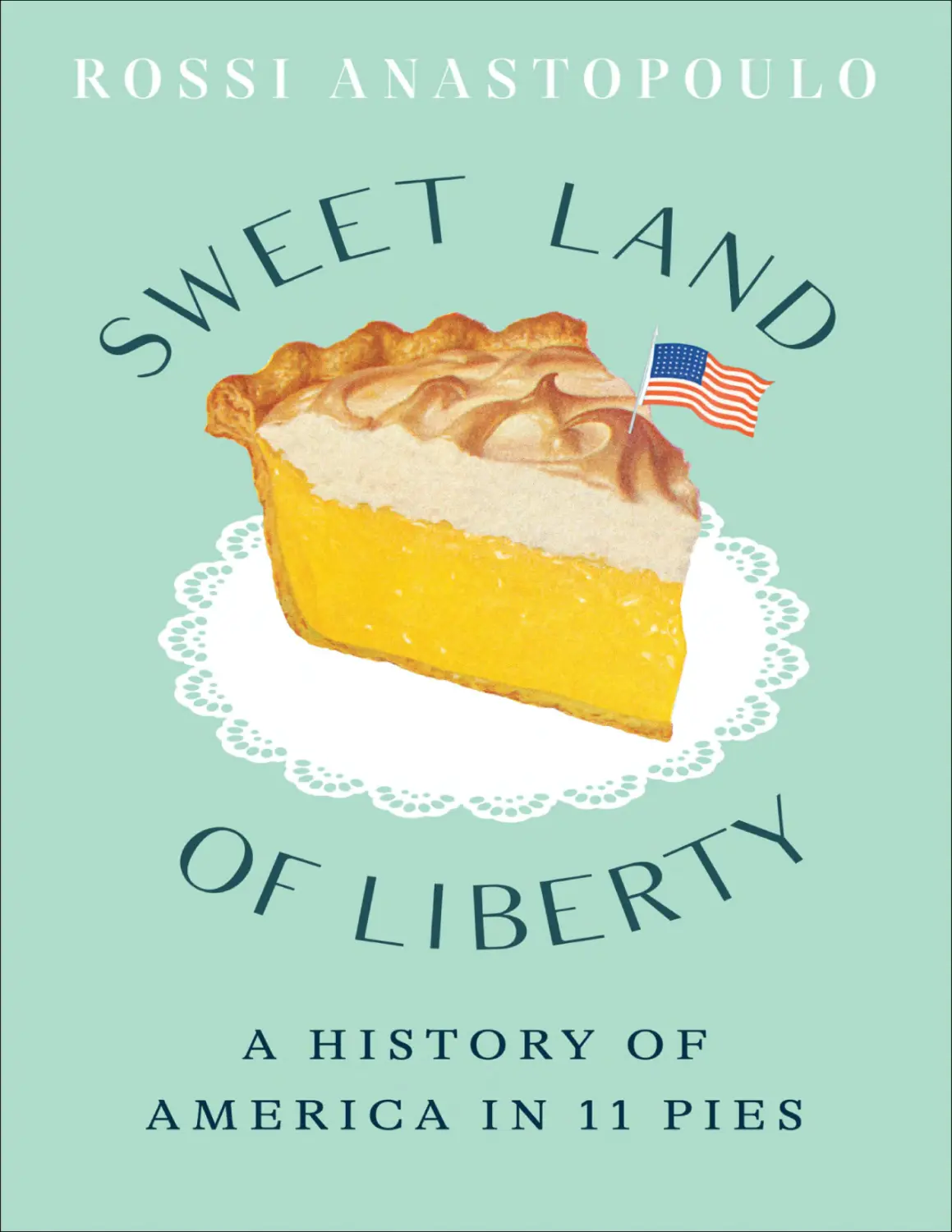


Author: Anastopoulo Rossi
Tags: cooking history of the usa baking
ISBN: 978-1-4197-5487-6
Year: 2022



Text
                    Copyright © 2022 Rossi Anastopoulo
Illustrations by Jenice Kim
Cover and cover © 2022 Abrams
Published in 2022 by Abrams Press, an imprint of ABRAMS. All rights reserved. No portion of this
book may be reproduced, stored in a retrieval system, or transmitted in any form or by any means,
mechanical, electronic, photocopying, recording, or otherwise, without written permission from the
publisher.
Chapter Six has been adapted from the author’s article “The ‘Pie Engineer’ Who Designed a Dessert
for the Jazz Age,” first published by Atlas Obscura on March 24, 2020.
Chapter Nine has been adapted from the author’s article “The Radical Pie That Fueled a Nation,”
first published by TASTE on November 13, 2018.
Chapter Twelve has been adapted from the author’s article “Why Apple Pie Isn’t So American After
All,” first published by Food52 on October 8, 2021.
Recipe for Karo Pecan Pie courtesy of ACH
Recipe for Tofu Cream Pie reprinted with permission from Pie Any Means Necessary: The Biotic
Baking Brigade Cookbook (Oakland, CA: AK Press, 2004), 108.
Library of Congress Control Number: 2022933714
ISBN: 978-1-4197-5487-6
eISBN: 978-1-64700-305-0
Abrams books are available at special discounts when purchased in quantity for premiums and
promotions as well as fundraising or educational use. Special editions can also be created to
specification. For details, contact specialsales@abramsbooks.com or the address below.
Abrams Press® is a registered trademark of Harry N. Abrams, Inc.

ABRAMS The Art of Books
195 Broadway, New York, NY 10007
abramsbooks.com

For my yiayias.
To my Yiayia Harriet, whose pies started this all.
And my Yiayia Rosie, who taught me to meet everything with a laugh.

LAND ACKNOWLEDGMENT

The majority of this book was written on the ancestral homelands of the
Tongva people, who were enslaved, assimilated, and forcibly removed
through colonization. I honor their right to this land and pay my respects to
generations past, present, and future.

CONTENTS

INTRODUCTION
RECIPE FOR ALL-BUTTER PIE CRUST

CHAPTER ONE: APPLE PIE
RECIPE FOR A BUTTERED APPLE PIE
CHEDDAR APPLE PIE

CHAPTER TWO: PUMPKIN PIE
RECIPE FOR MAPLE PUMPKIN PUDDING

CHAPTER THREE: MOLASSES PIE
RECIPE FOR MOLASSES PIE

CHAPTER FOUR: SWEET POTATO PIE
RECIPE FOR ABBY FISHER’S SWEET POTATO PIE

CHAPTER FIVE: PECAN PIE
RECIPE FOR KARO PECAN PIE
DERBY PIE

CHAPTER SIX: CHIFFON PIE
RECIPE FOR LEMON CHIFFON PIE
KEY LIME PIE

CHAPTER SEVEN: MOCK APPLE PIE
RECIPE FOR RITZ MOCK APPLE PIE
INDIANA SUGAR PIE

CHAPTER EIGHT: JELL-O PIE
RECIPE FOR JELL-O COFFEE ’N’ CHOCOLATE CREAM PIE

CHAPTER NINE: BEAN PIE
RECIPE FOR BEAN PIE

CHAPTER TEN: QUICHE
RECIPE FOR QUICHE LORRAINE

CHAPTER ELEVEN: TOFU CREAM PIE
RECIPE FOR TOFU CREAM PIE
CHOCOLATE HAUPIA PIE

CHAPTER TWELVE: REVISITING APPLE PIE
RECIPE FOR AKIM’S APPLE PIE

ACKNOWLEDGMENTS
NOTES
Index of Searchable Terms

INTRODUCTION

On February 1, 1960, Ezell Blair Jr. entered the F. W. Woolworth’s lunch
counter in Greensboro, North Carolina, along with several of his friends,
took a seat at the counter, and ordered coffee and a slice of cherry pie.
Woolworth’s was a popular lunch destination in Greensboro, a place
where you could go for a quick burger or sandwich, maybe a cup of coffee
with a slice of pie on the side. The interior was basic but comfortable—a
row of metal-backed stools lined a long counter littered with sugar canisters
and salt and pepper shakers, behind which servers in paper hats took orders
and refilled coffee cups.
It was the sort of democratic spot that served a large cross-section of the
town’s population, from local lawyers in suits to thrifty college students
from nearby UNC Greensboro.
There was one exception to this clientele, however. Woolworth’s did not
serve Black customers.
Ezell Blair and his three friends, all of whom were Black, knew this
when they entered Woolworth’s that winter day. As freshmen at the local
North Carolina Agricultural and Technical State University, they were
accustomed to the strict racial codes that governed Greensboro, dictating
where they could eat and shop and live. Therefore, unlike all other patrons,
their trip to the Woolworth’s lunch counter that day was meticulously
planned.
Inspired by nonviolent protest, including a television program he had
previously watched about Mahatma Gandhi, Blair had joined his friends in

organizing a deliberate civil rights protest by staging a sit-in at the all-white
Woolworth’s lunch counter. The tactic—which had already been employed
several times in lunch counters throughout the South—was decided after
the group dared each other to do it during a campus bull session.
Determined to be organized and disciplined, the students planned their
approach deliberately, plotting their route to ensure success.
First, the group stopped at a nearby store owned by white businessman
Ralph Johns, a social activist who supported the NAACP and was
sympathetic to their cause. Next, the four young men visited the
Woolworth’s five-and-dime store, where they purchased several items and
carefully saved their receipts. Finally, they took their seats at the
Woolworth’s lunch counter and politely placed their orders, with Ezell Blair
Jr. requesting coffee and cherry pie.
It seems no coincidence that Blair ordered pie during this historic
moment. The dish was a staple of Southern diners and lunch counters, part
of the distinctly American cuisine such establishments served, and it could
be found in similar lunch spots across the region. Pie was a familiar order. It
was also deeply and traditionally American—a direct product of the United
States. It seemed that if a Black American could eat pie—this symbol of
American innovation and identity—at a lunch counter in North Carolina or
anywhere else in the South, he or she might be considered just as equal an
American citizen as anyone else.
Seated calmly at the lunch counter, the four men were immediately
denied service. Unfazed, they remained, refusing to be denied. Blair waited
for his slice of pie.
Unlike white Woolworth’s patrons, he didn’t receive it.
And thus, with one order, Ezell Blair Jr., Franklin McCain, Joseph
McNeil, and David Richmond sparked a wave of social protest that ignited
throughout the region. The next day, more students from North Carolina
A&T arrived at Woolworth’s to protest alongside the four men. Two days
later, Black protesters were seated in sixty-three of the restaurant’s sixty-six
seats, with employees occupying the remaining three. The protest rippled
out beyond Greensboro to Charlotte, Winston-Salem, and Durham, and
eventually as far away as Jackson, Mississippi.
While pie was ordered by civil rights activists in sit-ins throughout
the ’60s, it played a different role in these protests for white people intent
on opposing the fight for desegregation. For Black customers and protestors

at lunch counters, being served pie was a symbol of equality, but
segregationists instead turned the dish into a weapon of division. In many
instances, the white reaction to Black protesters became violent, and when
this happened, they often pelted activists with food and smeared them with
pie.
Ann Moody, a participant in a sit-in at a Jackson, Mississippi,
Woolworth’s in which angry white high school students began violently
attacking the protesters, recalled: “We bowed our heads [to pray], and all
hell broke loose.… The mob started smearing us with ketchup, mustard,
sugar, pies, and everything on the counter.” In these instances, pie became
politicized and racially charged. Now, transformed into an object used for
intimidation and power, it was a weapon for those aiming to preserve the
status quo.
In these lunch counter settings—battlegrounds over which some of the
fiercest wars of the Civil Rights Movement were waged—control over pie
became a metaphor for racial victory. For Black Americans, being served
pie represented a win for equality and justice; meanwhile, white Americans
sought to reclaim the dish by using it as a tool in physical assaults.
Underlying this struggle is the fact that—like much of the food prepared at
these Southern lunch counters—the pie being served was a descendant of
both Black and white culinary influences.
The segregationists’ violent efforts were to no avail. Six months after
the original Greensboro Four calmly took a seat at the all-white lunch
counter, Woolworth’s officially desegregated.
And when, over a decade after he had first placed his fateful order at the
Greensboro Woolworth’s lunch counter, Ezell Blair (by then known as
Jibreel Khazan after he joined the Islamic Center of New England and
changed his name in 1968) returned to the same Woolworth’s for a reunion
with the three other men alongside whom he had shaped history, the
Greensboro Daily News proclaimed, “First Sit-In Participant Finally Gets
Cherry Pie.”
And with one slice, victory had finally been achieved.*
PIE IS, NEEDLESS to say, not the most natural medium through which to
navigate American history. I’ve received more than enough curious looks
when explaining the premise of this book to confirm this (although I relish

the opportunity to be an obsessed pie lady, as many people now seem to
view me).
The idea that food can be a lens through which to examine issues of
race, class, and gender in our society is not a new one, or even a particularly
radical one. I am far from the first person to step into such deep and rich
waters, and it thrills me that I will not even come close to being the last.
But though food as a medium for social history is not a novel concept,
using pie to do so certainly is.* Served everywhere from greasy-spoon
diners to holiday tables to hipster bakeries, it’s a dish so common that it’s
easy to overlook its power. Though it may seem mundane, pie’s broad
exposure means that, in a way, this humble dish is a touchstone for almost
all of us.
Many of us can recall fond childhood memories in which pie makes an
appearance—a comfortable, familiar presence on the table. Maybe it was
your aunt’s sweet potato pie at every Thanksgiving dinner, generously
spiced with black pepper and always served first to Grandpa before anyone
else could even think about taking a bite. Perhaps it’s the slice of chocolate
cream pie waiting in the cooler at the diner where your dad would take you
after Saturday T-ball games, resplendent under fluorescent lights. Pecan pie
might remind you of the chocolate version served at the church potluck on
Sundays; tomato pie might conjure the dish your mom made every year
during the height of summer, when the small patch of tomatoes she
dutifully tended in the backyard ripened in abundance.
You might be the kind of person who’s terrified at the thought of
making pie crust and won’t come within ten feet of a rolling pin, so when
your best friend brings over a cherry pie after your new baby is born, it
tastes all the sweeter. Or maybe you’re a baker, and you dream about
endless filling combinations and artful lattice designs.
For me, thinking about pie always conjures the apple pie I make for my
father’s birthday every year. Never a fan of cake, he’s requested apple pie to
celebrate for as long as I can remember. (As he is a very Greek man, it’s a
little funny to me that he wants such a stereotypically American dish.) It’s
the first pie I ever made, and still the only one I can make without a recipe.
At some point, inspired by the headnote from the original recipe we used,
my mother suggested we cut my dad’s name into the crust, and now his
apple pie isn’t complete without a craggy, lopsided “Akim” carved into the
golden-brown canvas.

My dad’s apple pie technically doesn’t mean anything—the recipe itself
came from the first cookbook we decided to look in decades ago, and when
we eat it every year, the main takeaway is mostly, “Delicious.” (And “Dad
is old,” but we don’t say that one out loud. At least, not to his face.)
But every year, as the smell of cinnamon and nutmeg and butter wafts
from the oven, a simple apple pie becomes the center point around which
the various far-flung pieces of my family are gathered. Sloppy, warm slices
become harbingers of nostalgia and memory and identity. The simple act of
making this pie is an expression of love, and the act of eating it one of
community.
And I know I’m not the only one with a pie memory like this.
Pie is baked and eaten all over our country every day, and it has been for
centuries, since the very beginning of the United States. Nearly every
person in the US has some memory or association with pie, and so too have
endless generations that came before us, from the Black Muslim on the
streets of Brooklyn to the Midwest housewife struggling through the Great
Depression to the activist fighting against globalization in San Francisco.
Pie, in a way, is a common thread woven through the fabric of American
history, one that has evolved and mutated throughout the years right
alongside our country.
Pie is more than just a widespread, commonly known dish. There are
three reasons in particular why pie is such a unique vehicle for this type of
social study. Firstly, it is one of the few quintessentially American dishes
we have. Though “American pie” (shout out Don McLean … and Jason
Biggs) is directly descended from pie in other countries like England and
the Netherlands, not to mention the dish itself originated thousands of years
ago, pie as we know and eat it in the United States doesn’t really exist
anywhere else. There are savory bisteeyas in Morocco and sweet galettes in
France and flaky empanadas in Spain. But for us, pie is (for the most part!)
a sweet dish with at least one crust, often two, molded in a pie plate and
filled with any number of things. These include, but are certainly not
limited to, almost any type of fruit, various spins on cream, chocolate, JellO, beans, crackers, and so much more.
Here is probably the best place to point out that this arbitrary definition
of American pie is limited, porous, and by no means strict. In fact, at least
one pie in this book breaks the very rules I’ve just set out. When it comes to

defining pie, it might be best to adopt the attitude of a certain Supreme
Court justice about a certain type of adult film: I know it when I see it.
Which leads to the second characteristic that makes pie such a good
barometer for American society—it is endlessly adaptable. The fact that pie
is so malleable and hard to define is the very reason it is so revealing.
Because of its flexibility, pie is frequently molded to the situation that it’s
in, shaped by such varying factors as the ingredients available, the amount
of time or energy the baker has to make it, the kitchen in which it’s made
and the tools on hand, the eating habits or dietary restrictions of the people
eating it, and even the weather outside or time of day. (Is it any coincidence
that the pie originating at our country’s southernmost point—the key lime
pie—is made with a graham cracker crust that calls for melted butter rather
than the ice-cold butter needed for traditional flaky pastry? Maybe … but
also maybe not.) As such, pie is somewhat of a blank canvas whose many
quirks and intricacies become revealing insights into the place and time in
which it is made.
Finally, pie is so powerful because, frankly, it’s pretty unnecessary.
Unlike, you know, dinner, we only make and eat dessert because we want
to. In times of hardship or stress—everything from war to revolution to
poverty—there’s really no point in making dessert. So when someone does
make a pie in these circumstances, it begets one very big and very obvious
question: Why? The answer to that question, as you’ll find in many of these
chapters, can be quite illuminating.
I might add one fourth and irrelevant reason why pie makes an excellent
foundation for a book like this—pie is delicious, and delicious things, I’ve
found, have a tendency to capture the imagination (mine, at the very least).
But while we can say that these are the pies that tell the story of
America, this country’s history cannot always be collapsed into
scrumptiously comforting desserts. As exceptional as it is, pie does not
actually correlate to every ebb and flow of our country’s trajectory. Not to
say I didn’t try to will this into fact. Abandoned chapter ideas, which fell to
the wayside as soon as I realized their symbolism existed mostly in my own
head and not really anywhere else, include: key lime pie and Cuban
relations, shoofly pie and nineteenth-century European immigration,
campfire pie and westward expansion, and some pie—any pie!—and the
Cold War. (I wanted a Cold War pie so badly.) There was also a
tremendously salty suffragette recipe that begged to be included, but try as I

might, I ultimately couldn’t make it support a full chapter. Nevertheless,
gaze upon the “Pie for a Doubting Husband,” which appeared in 1915’s The
Suffrage Cook Book and calls for:
1 qt. Milk of Human Kindness
8 reasons:
War
White Slavery
Child Labor
8,000,000 Working Women
Bad Roads
Poisonous Water
Impure Food
Mix the crust with tact and velvet gloves, using no sarcasm, especially with
the upper crust. Upper crusts must be handled with extreme care for they
quickly sour if manipulated roughly.
THOUGH, IN THE end, not every nuance of American history is
represented by a circular dessert in a crust, you’d be surprised by just how
much of our past can be told through pie.
Pumpkin pie, for instance, captures stories about the very beginnings of
the United States—the Indigenous people who lived here before European
colonizers arrived, what these two populations ate separately and then
together, and how that history eventually played out. Pumpkin pie didn’t
exist at the first Thanksgiving (or, at least, an approximation of what we
typically like to think of as the first Thanksgiving), yet by the mid-1800s it
was popping up in Thanksgiving-themed poetry, and today we eat it every
year on the fourth Thursday of November while our cousins yell at the
Cowboys and at least one uncle is napping from too much beer turkey.
Why? And how?
Molasses pie, meanwhile, captures some of the worst crimes of the
United States and the legacies of racial trauma and oppression passed down
from our country’s history of slavery. Sweet potato pie, on the other hand,
emerged from a complicated origin amidst enslavement to be reclaimed by
the Black population originally forced to bake the dish and barred from

eating it. The dish proved so powerful that it even helped fund the
historically Black college that would go on to become Bethune-Cookman
University, as the university’s founder Dr. Mary McLeod Bethune sold
sweet potato pies to earn capital and keep the school open when it still had
just five students. And many decades later, a bean-based pie emerged once
again as a weapon in the fight for racial equality to become a radical
symbol of Black power. (Not to mention, the alleged cause of Muhammad
Ali’s most famous boxing loss.)
A quirky pie like the mock apple pie (made with crushed crackers and
literally no fruit) pops up during two of the most severe economic crises our
country has faced, and its endearing filling embodies the creativity and
ingenuity employed by housewives trying to preserve an air of normalcy
amidst drastic upheaval and uncertainty.
Of course, pie has also been entwined in gender relations on both sides
of the divide. In the twentieth century, food corporations marketed pie
recipes using their products to capitalize on the domestic pressures of
modern housewives tasked with providing traditional meals for their
families. Later, in reaction to Second-Wave Feminism, men seized upon a
very specific type of pie as a barometer to define arbitrary rules of
masculinity and gender roles. They also deeply misunderstood satire in the
process, because classic.
And at one point, political activists in the late twentieth century became
so fed up with the dire state of global affairs that they took a cue from the
Three Stooges and began literally hurling pie in people’s faces. The
movement led to fabulous puns like the handbook Pie Any Means
Necessary, not to mention the rise of such notorious individuals as Aron
“Pieman” Kay, an anonymous thrower known only as Agent Apple, and the
infamous “Cherry Pie Three.” Truly terrifying stuff.
These are just some examples of the stories you’ll find between these
pages. They range in scope and subject, touching upon such hefty topics as
war, nationalism, race, industrialization, poverty, environmental
degradation, gender, and even Hollywood. Narratives range from ongoing,
multi-decade epics to brief flashes in the pan (or, erm, stints in the oven).
There are heartbreaking histories and amusing anecdotes, and one character
quite literally dubbed “The Pie King.” From the marshy lowlands of the
South to the crowded streets of New York to the suburbs of the Midwest to

the bright lights of California, pie stretches across the broad expanse to
touch nearly every corner of our country.
Ultimately, the story of pie in the United States is a story of America
itself, following the narrative of our country and its evolution across
centuries of innovation and change.
It’s time to dig in.
*

Joseph McNeil had returned to the Woolworth’s to order pie the autumn following the sit-in.
According to him, “The pie wasn’t very good.”
*
Not to say others haven’t written about pie history. Food historian Janet Clarkson’s Pie: A Global
History is a wonderful book and invaluable resource.

ALL-BUTTER PIE CRUST
MAKES 1 CRUST FOR A 9-INCH (23-CM) PIE

Crust is pretty much the unifying factor when it comes to pie. This fluid,
flexible, feisty dish morphs into countless shapes and styles, but you can
count on the final result having some sort of crust. It won’t get too much
attention in the following chapters—with a notable exception here and there
—as most pies are distinguished by their filling. But don’t let that fool you.
The crust is our trusty friend, a guide into the wide and wonderful world of
pie. It will be the common thread woven through the rest of this book, even
if it often goes unacknowledged.
So let’s lay the foundation here with a go-to recipe. Everyone has their
favorite pie crust recipe, and this just happens to be mine. Everyone also
says their crust is the very best—the flakiest, the most flavorful, the most
shrink-resistant. I will make no such claims of this recipe, because I don’t
think the “perfect pie crust” actually exists. Experiment with adding vinegar
or vodka, shortening or lard, and feel free to use the pie crust recipe that
best suits you. I’ve used this one for years and love the fact that (1) it’s all
butter so you only have to worry about keeping one kind of fat in your
kitchen and (2) it doesn’t require any odd ingredients or complicated
methods. It’s simple and straightforward, and for a dish as humble and
quotidian as pie (and for a baker who can be both lazy and timeconstrained), it suits just fine.
One final note on this recipe—I usually don’t measure the salt or sugar.
Just a big scoop of each. I also never measure the water, as the amount of
water you’ll need to bring the crust together depends on many factors, and
the exact measurement will differ each time you bake. Once you’ve made
enough crusts, you’ll be able to go by feel instead of measurement; until
then, use the amounts below as a guide and trust your gut. Happy baking!
1¼ cups (155 g) all-purpose flour

½ teaspoon salt
1 teaspoon granulated sugar
8 tablespoons (1 stick/115 g) unsalted butter, cold, cut into ½-inch (12-mm)
chunks
3 to 6 tablespoons ice water
In a large mixing bowl, combine the flour, salt, and sugar. Add the butter to
the flour mixture and lightly toss until all the butter is coated in flour, then
use your fingers to work the butter into the flour, smashing the butter into
flat pieces as you do so (see Note). Do this until you have a crumbly
mixture that’s still full of large, visible butter chunks, about the size of
dimes or lima beans.
Drizzle in the ice water 1 tablespoon at a time, lightly stirring the
mixture until you have a shaggy, mostly cohesive dough. It’s okay if there
are still dry patches—in fact, that’s ideal. Gently form the dough into a disc,
then wrap tightly in plastic or a reusable alternative and chill in the
refrigerator for at least 30 minutes before using. You can store the chilled
crust in the fridge for a few days before using and for a few months in the
freezer.
To prepare for a standard 9-inch (23-cm) pie, roll out a disc on a lightly
floured work surface until about 12 inches (30.5 cm) in diameter. It’s now
ready to line a pie plate or top a double-crusted pie.
Note: Working the butter in with your fingers can be physically difficult for some people, so you can
easily do this part with a pastry cutter or food processor, or even in the bowl of your stand mixer.

CHAPTER ONE

APPLE PIE

It seems inevitable, doesn’t it, that this book would begin with apple pie.
Easily the single most famous pie, if not dish, in the United States, it
harkens all the way back to the country’s beginning, and even well before.
It’s no surprise, then, that apple pie parallels America’s birth. Originating
on foreign shores, the dish arrived in the New World with British colonists
before evolving with the early United States, culminating with the first truly
American apple pie recipe arriving at nearly the same time as our
Constitution.
Ultimately, the story of American apple pie’s creation is that of
America’s itself. And telling that story means going back to the very
beginning.
American cuisine is a vast, deeply multicultural landscape with
influences from a remarkable number of cultures that have relocated here.
To say that it is exclusively Western, European, or British would clearly be
misguided. Yet in a general sense, there still exists a certain through line of
British and Western European influence that speaks to this country’s start as
a collection of not-very-well treated colonies—coincidentally (or not) the
first time apple pie was consumed on North American shores.
Obviously, it would be not only naive but also dumb to pretend that
Western Europeans were the first people to call this verdant landmass home.
And indeed, the next chapter of this book dives deeply into the influence of
Indigenous people on the United States of America and on our collective
pie consumption habits. But in tracing the thread that eventually became
both apple pie and the republican democracy that we know of as the USA,
we typically begin with the first of the British colonies.
Of course, that’s not really where it all began, either. Rather, we might
go even further beyond that, back across the pond and into England.
Because here, amidst a monarchy and a lot of ale and some very dirty

streets, is where our country really originated, with some royal charters
authorizing the colonization of North America. It’s where our beloved apple
pie got its start, as well.
And if we want to get the full lay of the land and go very deeply down
the rabbit hole, we could go all the way back to ancient civilizations in the
Mediterranean, where both modern Western government and pie originated.
Unsurprisingly, both looked a little different way back then. Pie, for
instance, had an oil-based crust that was pretty nasty tasting and basically
inedible. It was also mostly savory at that point, built on the basic concept
of enclosing meat in a pastry made from ground wheat and oil.
Government, meanwhile, was mostly democratic in nature and occupied
almost exclusively by white men who all hated each other.
So actually, maybe only one of them has evolved in the last few
thousand years.
To continue the long story of pie and the United States, we can jump
into one of those warp-speed flashes through history, like the opening of
The Big Bang Theory, through the evolution of Europe into a loose
collection of feuding states and territories and families. This brings us to
England in the Jacobean Era, on the brink of establishing another colony in
a faraway land upon which it should seemingly have no jurisdiction. In this
instance it was the New World, an untapped wonderland that was definitely
full of gold and definitely not full of people already living there.
Colonial expansion was fueled by a number of social, political, and
economic factors in England at the dawn of the seventeenth century. Rapid
population growth had put a strain on resources, prompting an economic
recession that left many struggling to support themselves. Poor crop yields
only made things worse. In addition, industrial development had created a
thriving textile industry that demanded wool, and as a result, landholders
transformed farms into land for sheep grazing, leaving many farmers
without work. Add to this a huge swath of second and third sons who, being
left out of the inheritance reserved only for firstborns, sought other
opportunities to make their name and fortune. In all, England at the time
was home to quite a number of people with nothing to lose and everything
to gain, a situation that, in addition to motivating gamblers throughout the
course of history, also turned out to be quite good for breeding colonists.
The establishment of joint-stock companies was the final push to the
exodus launched across the Atlantic Ocean, providing financial backing that

funded colonial expansion as a commercial venture. With joint-stock
companies, multiple investors pooled their resources to fund journeys west,
sharing the financial risk and potential profits that might result. Incidentally,
such companies were also the precursor to modern-day corporations, which
have impacted the trajectory of American history as much as any social or
political force.
And so, with financial investment and a royal charter burning a hole in
their pockets, British settlers embarked by the boatload, lugging with them
their clothes and customs and cooking, the latter of which contained one
distinctly British dish that had evolved to become a culinary staple in the
last few hundred years.
I’m speaking, of course, of apple pie.
Apple pie emerged from a pie culture that evolved from those early
crude pies in the ancient Mediterranean. The dish had become deeply
entrenched in the British Isles since the Middle Ages, when societies in
Northern Europe began using butter and lard in their pastry instead of oil to
create a dough that could more easily be rolled and shaped. The Middle
Ages were also when the crust began to be eaten along with the filling,
whereas it had previously only been used as a receptacle for the meat
within. These crucial changes eventually birthed what we would consider
the “modern pie.” The dish, however, still looked rather different than the
pie we know and love today—pies were freestanding and portable, and they
were also known as “pastry coffins”* because the crust was hard, dense,
and several inches thick (to withstand long baking times).
With the Renaissance and its onslaught of cherubic painted babies,
irascible geniuses, and ornate architecture came a new artistic evolution for
pie that nudged it toward a dish more familiar to modern bakers. Pastry
cooks began developing lighter, easier-to-handle doughs, particularly in
France, though the trend soon expanded north. By the time 1685 rolled
around, English cook Robert May published The Accomplisht Cook, with
fourteen different recipes for paste (“paste” being the word used for crust or
pastry at the time).
The Renaissance also saw the crucial transition from savory to sweet
pies, paving the way for apple pie and a legacy of mostly dessert pies that
would eventually become a distinctly American culinary tradition. In
England, bakers began creating sweet, fruit-based pies. One of the first
recipes for apple pie appeared during the beginning of this era, found in The

Forme of Cury by Samuel Pegge in 1390. A compilation of recipes by the
master cooks of King Richard II, this cookbook included a recipe “For to
make Tartys in Applis” (warning: confusing Middle English ahead):
Tak gode Applys and gode Spyeis and Figys and reysons and Perys and
wan they are wel ybrayed co-lourd wyth Safron wel and do yt in a cofyn
and do yt forth to bake well.
By the mid-sixteenth century, sweet fruit pies, and particularly apple
pie, had gained a stronger foothold in British cuisine and daily life. One
mid-sixteenth-century cookbook, A Proper Newe Booke of Cokerye,
featured instructions “To make pyes of grene apples,” which included
directions to add cinnamon, sugar, and ginger to season the apples, resulting
in a pie very much resembling the dish we enjoy today. The recipe went as
follows:
Take your apples and pare them cleane and core them as ye wyll a Quince,
then make youre coffyn after this maner, take a lyttle fayre water and half a
dyche of butter and a little Saffron, and sette all this upon a chafyngdyshe
tyll it be hoate then temper your flower with this sayd licuor, and the whyte
of two egges and also make your coffyn and ceason your apples with
Sinemone, Gynger and Suger ynoughe. Then putte them into your coffin
and laye halfe a dyshe of butter above them and so close your coffin, and so
bake them.
Meanwhile, apple pie was also becoming ingrained in everyday British
culture. The sixteenth-century English dramatist and poet Robert Greene
once praised a lovely lady by writing that “Thy breath is like the steame of
apple-pyes.” Really, I could think of no higher compliment. Swoon. And
later, in 1713, an English poem summed up just how beloved apple pie had
become to the British in a poem titled “Apple Pye,” declaring:
Of all the Delicates which Brittons try
To please the Palate, and delight the Eye,
Of all the several Kinds of sumptuous Fare,
There’s none that can with Apple-pye compare
For costly Flavour, or substantial Paste,

For outward Beauty, or for inward Taste.
And none other than Jane Austen herself weighed in, writing to her
sister Cassandra in a letter, “Good apple pies are a considerable part of our
domestic happiness.”
It’s worth noting that England was not the only country baking and
eating apple pie at this time. The Netherlands, in particular, was known for
apple pie, with one recipe book as far back as 1514 including a recipe for
Appeltaerten made with pastry, sliced apples, warming spices like
cinnamon, cardamom, and nutmeg, and some very creative cooking
methods that included baking the filling, removing the crust to mash it up,
then serving. Versions of Dutch apple pie have endured, served as a distinct
style in America today—typically covered with a crumb topping and with
cream added to the filling. This iteration is not, however, what we think of
when we proclaim something as “American as apple pie,” and that is
because the dish that has cemented its legacy as our national symbol
remains firmly rooted in double-crusted British tradition, just like our
nation’s founding.
This brings us back to the fledgling United States and the intrepid
colonists making their home in the New World, who would go on to (quite
literally) plant the seeds of our apple pie tradition. Following the lost colony
of Roanoke in 1585 (the original cold case), the British established their
first colonies in Jamestown in 1607 and later Plymouth Rock in 1620. Life
at the time was, to put it mildly, hard. Colonists struggled to feed
themselves, because, as it turns out, not everything you’re used to growing
and eating on an island on the other side of the ocean is possible to cultivate
on a completely different continent. Not to mention, many settlers had little
experience in farming or hunting, more accustomed instead to purchasing
their food. Just how the British solved the rather large problem of feeding
themselves is detailed further in the following chapter, but one very crucial
and very familiar food source is worth discussing here: apples.
Because when they arrived, these boats full of weary travelers found
that one particularly beloved and useful fruit was not available in their new
home. That’s right—the foundational ingredient of our country’s most
cherished and iconic dish didn’t even grow here four hundred years ago.
What did grow here were crab apples—small, shrunken little fruits that
were sour and bitter. They could barely be eaten, let alone transformed into

pie, and colonists gradually learned these would not fill the apple-size hole
in their diets (and hearts).
Though it somewhat pains me to admit it, apples weren’t only valued
for their ability to make excellent pie. They were also a tremendously useful
dietary staple, as they were hearty, grew easily and with little maintenance,
and, perhaps most importantly, could be dried and stored throughout the
winter. Plus, they were great for making cider, and alcohol can go a long
way when you’re moored on a hostile coast thousands of miles away from
your friends and family (and, sure, need a safe drinking source too). As a
result, colonists sought to introduce apples to North American soil, thus
making their mark on the future of America’s agriculture and diets.
Originally, settlers attempted to bring grafted apple saplings from
England, but the harsh sea voyage and subsequent New England winters
proved precarious for the young trees. So instead the colonists pivoted,
relying on apple seeds. Though this strategy worked better than the grafted
saplings, the crop still struggled. As a result, settlers likely began crossbreeding these newly grown apples with the continent’s native crab apples
to produce varieties more suited to the climate, mostly notably with the
creation of the Hewe’s Crab Apple. A cider apple, it was an extremely
popular fruit variety grown in 1700s Virginia, including at Thomas
Jefferson’s Monticello. In so doing, they created a distinctly American crop,
one literally created from both English and native origins.
And that crop took to the North American landscape like a duck to
water; by 1850, the country boasted thousands of different types of apples,
which was largely possible due to the plant’s ability to cross-pollinate.
Though it seems small in the grand scheme of things, and even in the
food scheme of things (apples, after all, were far from the only crops the
British and Europeans introduced to the New World, and not as influential
as others like sugar, wheat, and rice), this was a crucial development that
introduced a newly created variety of apples to America and enabled
centuries of national mythmaking for one dessert. It enabled the eventual
creation of American apple pie, a key distinction that came to mean so
much more than its British predecessor.
Had the British not begun planting apples in North America, who
knows what our national dish would be? Another type of pie? A cake?
Something savory? (The baker in me shudders at the thought.)

In a way, the colonists’ introduction of apples was yet another way for
them to plant their flag on this new continent, reshaping the land to suit
their dietary needs. It was a form of cultural dominance, designed to
introduce traditions and customs to solidify British ownership of a land to
which they technically had no right. And the roots of this ideology went far
deeper than those of these settlements’ new apple trees.
In North America, the British were creating an entirely new society,
built from scratch and on the back of English culture. And eventually, as we
all know, they would go on to do more, establishing an entirely new country
complete with a new government, social hierarchy, and economic system.
But in the meantime, they also wanted to transplant their familiar way of
life from their homes in England to their new outposts on foreign soil in the
process.
One of the primary ways the British went about re-creating their
accustomed lifestyle was through their food, a practice that indirectly led to
apple pie’s introduction to the New World. In addition to the usual
continent-conquering goods like weapons, the colonists also brought along
domestic guides to provide advice on farming, homemaking, and cooking.
One such book was Thomas Tusser’s Five Hundred Pointes of Good
Husbandrie (including one section on “Huswiferie”), originally published
in 1573 and brought to the New World at some point in the seventeenth
century. Another, likely much more helpful, example was Gervase
Markham’s seventeenth-century book The English Huswife, Containing the
Inward and Outward Virtues Which Ought to Be in a Complete Woman.
Aside from a somewhat bombastic title, this book contained advice for
nearly everything a housewife might be faced with, including the plague, a
headache, and a hungry husband. Replete with recipes and domestic advice,
the book offered a blueprint for re-creating an English home on foreign
shores. And somewhere amidst all of that sage advice, the book also
contained a recipe for apple pie, making it one of the earliest recorded
recipes for apple pie used in America.
In fact, the book technically provided two recipes for apple pie,
demonstrating the dish’s popularity. Using the term “pippin,” which
referred to apples, the book shared recipes for A Pippin Pie and A Pippin
Tart. Ironically, the tart is much more similar to what we would think of as
pie than the actual pie recipe. Markham’s Pippin Pie, for instance, calls for
whole cored apples and bears a resemblance to a kind of dumpling. The

Pippin Tart, on the other hand, instructs the baker to take apples and “pare
them, and then divide them just in the halves, and take out the cores clean.”
The apples are then spiced and placed in a pastry-lined dish, and finally
covered with yet another layer of pastry, making a dish that very much
resembles the type of pie we’re familiar with today.
As the colonies continued to grow and develop over the course of the
seventeenth and eighteenth centuries, more British cookbooks like The
English Huswife and their accompanying recipes for apple pie proliferated.
Susannah Carter, for example, included a recipe for apple pie (well,
technically “apple or pear pie”) in her book The Frugal Housewife, or
Complete Woman Cook, which was originally published in England and
later reprinted in the colonies in the 1770s.* Her apple pie recipe was also
notable for another reason: It was lifted nearly verbatim from an earlier
cookbook, The Art of Cookery Made Plain and Easy by Hannah Glasse,
which was published decades prior, in 1747. Apparently such blatant
plagiarism really wasn’t that uncommon back then, but still!
Regardless of who actually developed it, this apple pie recipe was likely
popular in early America due to the success of The Frugal Housewife.
Though not an exact reproduction of modern apple pie, it called for
techniques and ingredients that we would be familiar with—pared and
cored apples, sugar, lemon, cloves—as well as a bottom and top crust of
flaky puff pastry, a style that was on its way to becoming standard. It goes:
Make a good puff paste crust, lay some round the sides of the dish, pare and
quarter your apples, and take out the cores; lay a row of apples thick, throw
in half the sugar you intend for your pie; mince a little lemonpeel fine,
throw a few cloves, here and there one, then the rest of your apples, and the
rest of your sugar. You must sweeten to your palate, and squeeze in a little
lemon juice. Boil the peeling of the apples and the cores in fair water, with a
blade of mace till it is very good; strain it, and boil the syrup with sugar till
it is rich; pour it into your pie, put on your upper crust, and bake it. You
may put in a little quince* or marmalade, if you please.
These published recipes—originally written for English cooks—
circulated among women in early America, who tweaked or modified as
needed to serve their families. They reflected the eating habits of colonists,
many of whom turned to apple pie at all hours of the day to eat for

breakfast, lunch, and/or dinner. “Aple” pie, for instance, made an
appearance in a 1769 entry in the diary of a minister named John Page,
listed alongside mince pies in an extensive list of dishes that included a
“roasting pig.”
While writing home to Sweden in 1759 about a settlement in Delaware,
the Swedish parson Dr. Israel Acrelius shared: “Apple pie is used
throughout the whole year, and when fresh Apples are no longer to be had,
dried ones are used. It is the evening meal of children. House pie, in country
places, is made of Apples neither peeled nor freed from their cores, and its
crust is not broken if a wagon wheel goes over it.” His community’s pies,
evidently, were still made in the rustic style that emulated Medieval British
“coffins,” with a hard, unbreakable crust (not even a wagon wheel could
shatter it!) and whole, uncored apples. Acrelius also referenced dried
apples, which turned apples into pantry staples for the lean years of winter.
By drying the fruit, North American settlers made it possible to prepare
apple pie at any time of year, even when fresh apples were no longer
accessible.
Overall, as demonstrated from the number of variations and iterations of
apple pie that proliferated, from dumpling-style pies with whole uncored
apples to Dr. Acrelius’s unbreakable coffins to more familiar double-crusted
pastries, the dish was evolving with the colonies, beginning its slow
transformation from purely British invention to American staple.
AS VERSIONS OF British apple pie adapted to a new American
environment, local government in the colonies also evolved from a
foundation built on existing English systems. In the Massachusetts Bay
Colony, for example, the population developed a system of local
governance that mirrored England’s Parliament. The General Court, as it
was known, was divided into two houses that mimicked the House of Lords
and the House of Commons; in Massachusetts, they were known as the
House of Assistants and the House of Deputies, respectively. Rooted in the
church, this original system emulated the values and structures that
governed England. But soon, evolving philosophies and belief systems
challenged this status quo, leading to new, distinctly American forms of
government.
In Rhode Island, for example, Roger Williams established a new
settlement with a government that emphasized more democratic ideals.

Williams had been banned from the Massachusetts Bay Colony for having
the gall to advocate for such outlandish ideas as separation of church and
state (absolutely bonkers). Arriving in Rhode Island in 1636, he set up a
new settlement, one with a government based on the consent of the people,
religious tolerance, and the separation of church and state. Sound familiar?
And he wasn’t the only one—in Hartford, a settlement founded in 1636
along the Connecticut River by Reverend Thomas Hooker, the people were
governed by a system rooted in democratic control by all citizens that did
not limit voting rights to members of the Puritan church; it was also shaped
by the Fundamental Orders of Connecticut, which influenced elements of
the eventual United States Constitution. As colonies continued to develop
throughout the next few decades, particularly in the middle and northern
territories, many reflected these new liberal and democratic ideals,
including William Penn’s Pennsylvania.
And as government began to develop, so too did social ideology.
Isolated in the New World, the colonies underwent their own periods of
moral, social, and religious revolution that separated them from their
English origins. During the Great Awakening of the 1730s and ’40s, which
was anchored by Jonathan Edwards’s sermon “Sinners in the Hands of an
Angry God” and George Whitefield’s travels to preach throughout the
thirteen colonies, America experienced a wave of religious revivalism that
impacted American culture for years to come. It established a religious
climate that emphasized individualism and nationalism and began to plant
the idea that colonists were American rather than just British expatriates.
Meanwhile, the Enlightenment—whose American poster boy was
history’s most famous kite enthusiast, Benjamin Franklin—was also going
on in Europe, and its influence spread across the sea to the colonies. Also
known as the Age of Reason, the Enlightenment emphasized logic,
education, and science, ushering in a new era of modern thought. It also
promoted ideals like balance and order, which laid the groundwork for an
eventual American governance structure built on a system of balance of
power.
We know, of course, how this whole story ends. Colonists eventually
embraced their American identity wholeheartedly, breaking from the British
and their ties to England. With the Revolutionary War and powerfully
symbolic touchstones like the Declaration of Independence and the Liberty
Bell, Americans created a new code of nationalism and patriotism, one

isolated to the societies of North America and the newly created United
States.
Not coincidentally, it was also right around this time that apple pie fully
broke from its British roots, and the first truly American apple pie entered
the picture.
It came in the 1796 cookbook American Cookery (whose full title was
*clears throat*: American Cookery, or the art of dressing viands, fish,
poultry, and vegetables, and the best modes of making pastes, puffs, pies,
tarts, puddings, custards, and preserves, and all kinds of cakes, from the
imperial plum to plain cake: Adapted to this country, and all grades of life),
believed to be the first cookbook published in the United States, arriving
less than a decade after the official ratification of the Constitution in 1787
and only a few years after George Washington’s election as the country’s
first president.
As we have seen, the recipe books American housewives had previously
used were English creations born from a purely English lifestyle. Amelia
Simmons, the author of American Cookery, set out to change the game.
Instead, she wrote a distinctly American cookbook that embraced the spirit
of the newborn country, employing ingredients that could be found in the
States and formalizing American recipes that had developed over the
previous two centuries. She even made this mission clear in the title, if you
happened to have the patience to read all the way to the end.
Unfortunately, we don’t know much about Amelia Simmons herself,
despite her unbelievably significant role in the course of apple pie history.
As culinary historian Karen Hess explained in a modern printing of
Simmons’s book, she was an orphan (she’s literally listed on the book’s
cover as “Amelia Simmons: American Orphan”) and came from a modest
background; likely because of these origins, her book demonstrates a keen
understanding of social hierarchies and the difficulties many women from
less prosperous backgrounds might face, with a particular affinity for other
orphans like herself. As such, American Cookery is somewhat of a
democratic text that sought to help women by fortifying them with essential
domestic knowledge.
That egalitarian framework is just one of the ways Simmons’s book
embodied the new American spirit. Even more importantly, Simmons’s
recipes focused on using ingredients found in North America, an area in
which English cookbooks’ knowledge was severely lacking, having been

written for English pantries and all. Indeed, as Hess wrote in the
introduction of that modern American Cookery: “So, again, what makes
American Cookery so very American? It is precisely the bringing together
of certain native American products and English culinary traditions.” For
instance, Simmons included many recipes using cornmeal, one of the
foundations of the American diet and a substitute for English oats; such
recipes included dishes like Hoe Cake and Indian Slapjacks.
Catering to a definitively American kitchen, American Cookery was
extremely popular, so much so that it was kept in reprints for thirty-five
years after its initial publication in Hartford. Needless to say, food and
cuisine play a tremendously important role in developing a common
national identity, and Simmons’s American Cookery proved particularly
influential in this regard, due to its spirit, ingredients, and groundbreaking
status as the first such book published in America. By explicitly recording
the way people ate and cooked in the young United States of America,
Simmons created a guideline of domestic American life and culture that
was inextricably linked to food. As culinary historian Mary Tolford Wilson
has written, “Amelia Simmons’s work was, in its minor sphere, another
declaration of American independence.”
American Cookery knowingly leaned into this role, too—the book’s
second edition included recipes for Independence Cake and Election Cake.
And even though it didn’t have such an extravagant name, the inclusion of
apple pie was no less patriotic.
Up to this point, apple pie had long been a culinary staple for colonists,
as we well know, and it had emerged more than perhaps any other variety as
the definitive pie of America. Simmons herself called out apples in a
section titled Fruit, in which she wrote:
Apples, are still more various, yet rigidly retain their own species, and are
highly useful in families, and ought to be more universally cultivated,
excepting in the most compactest cities … If the boy who thus planted a
tree, and guarded and protected it in a useless corner, and carefully
engrafted different fruits, was to be indulged free access into orchards,
whilst the neglectful boy was prohibited—how many millions of fruit trees
would spring into growth—and what a saving to the union. The net saving
would in time extinguish the public debt, and enrich our cookery.

Amelia Simmons proposed that apples could literally save the country,
defeating the two-headed monster that brings down all empires: crippling
national debt and bad cooking.
Therefore, it’s no surprise that Simmons included not one but two
recipes for apple pie in her book, as well as a recipe for apple tart. The two
pies are fairly similar, but the second recipe, Buttered Apple Pie, might be
considered a bit more standard to our twenty-first-century eyes, mainly
because it explicitly calls for pared, quartered apples and a top crust.
Observe:
A Buttered Apple Pie: Pare, quarter and core tart apples, lay in paste No. 3,
cover with the same; bake half an hour, when drawn, gently raise the top
crust, add sugar, butter, cinnamon, mace, wine or rose-water.
Really, this recipe isn’t all that different from some of the previous
versions produced during America’s early decades. In particular, it harkens
back to the more refined English styles of British cookbooks like The
Frugal Housewife and The Art of Cookery (a connection that’s more than
just implicit—turns out our girl Amelia also allegedly indulged in a little
creative shoplifting throughout American Cookery).
But what made this pie recipe so groundbreaking was the fact that by
recording it, Simmons ultimately established a definitive version of
American apple pie. This exact recipe hasn’t endured, of course, but certain
hallmarks have become standard, including cut apples, warming spices like
cinnamon and mace (or nutmeg), and of course, the signature top crust,
designed to be edible and tender, rather than a hard pastry like early British
coffins and Dr. Acre-lius’s indestructible shell. Though Simmons’s recipe
for Buttered Apple Pie calls for the apples to be baked in the sealed crust
and the spices, sugar, butter, wine, and rosewater to be added afterward by
lifting the top crust, a practice we would never engage in today (can you
imagine the stress of handling that top crust?!), the distinction of sealing a
spiced and sweetened apple filling between two layers of pastry remains.
By setting forth this version of apple pie in the first cookbook of the
United States, Simmons (perhaps unwittingly) established the outline of a
national symbol that would endure as much as any other piece of patriotic
propaganda from the era.

And, like much of the broader foundation of the new United States, her
book established how the apple pie emerged from English origins to create
something new and distinct. Indeed, Harriet Beecher Stowe just about
summed it all up in 1869 when she wrote, “The pie is an English institution,
which, planted on American soil, forthwith ran rampant and burst forth into
an untold variety of genera and species.”
This moment comes at the very beginning of our nation’s birth, in its
infant stages. The narrative, as we know, is just beginning. Apple pie, like
the United States, has a long way to go to become the dominant force that
we know it as today. But already, before the catchy sayings and the nearmythological status, it was there at the very beginning of the United States,
solid and comforting, a harbinger of all that our country had already
undergone.
* Incidentally, a pastry coffin is also what I would like to be buried in. Relatives, please take note.
* Fun fact: The plates used to illustrate the American edition of her book were made by the one and
only Paul Revere.
* Pie maven Kate McDermott, author of a book named Art of the Pie, also cites quince as a secret
weapon in her apple pie fillings. These ladies were on to something!

A BUTTERED APPLE PIE
Adapted from American Cookery by Amelia Simmons
MAKES ONE 9-INCH (23-CM) PIE

Unlike Amelia, we will not be lifting the top crust after baking to add all the
ingredients, though feel free to experiment with that technique if you so
desire. I like this pie made with white wine (and tend to have that available
in my kitchen more frequently), though you can also take Amelia’s other
suggestion and use a splash of rosewater instead.
2 All-Butter Pie Crusts
4 to 5 medium-to-large apples, peeled, cored, and cut into ¼-inch (6-mm)
slices
½ cup (100 g) granulated sugar
¼ cup (30 g) all-purpose flour
½ teaspoon mace or nutmeg
2 teaspoons ground cinnamon
2 tablespoons white wine or rosewater
½ teaspoon salt
2 tablespoons unsalted butter, cold, cut into ¼-inch (6-mm) chunks
1 large egg, lightly beaten, for brushing the crust
Preheat the oven to 425°F (220°C). Line a 9-inch (23-cm) pie pan with one
of the prepared crusts. Place in the refrigerator while you make the filling.
In a large bowl, toss the apples with the sugar, flour, mace, cinnamon,
white wine, and salt. Arrange the apples in the prepared crust, then dot with
the chunks of butter. Top the filling with the second pie crust, sealing and
crimping the edges. Cut vents into the top crust, then brush with the beaten
egg.

Bake for 40 to 50 minutes, until the crust is golden brown and the filling
is bubbling though the vents. Let cool completely before serving, so that the
filling can set and be cut neatly.

CHEDDAR APPLE PIE

Like Darcy and Elizabeth or Lady Gaga and Tony Bennett, sometimes two
seemingly incompatible things can go perfectly together when given the
chance. The same goes for apple pie and cheese.
If you live in certain regions of the United States, particularly New
England, you might know exactly what I’m talking about—in fact, this
pairing might be your favorite way to eat apple pie. Or, more likely, you’re
not only shocked to learn this combo exists, but horrified.
While not exactly common, this dynamic duo of pie and cheese is
widespread enough to have multiple iterations—sometimes the cheese is
shredded and baked into the crust; other times, a slice of cheddar is laid
atop a warm apple pie so that it slightly melts. Its roots, like apple pie itself,
reportedly trace back to merry old England, where dairy-based sauces were
added to pies as early as the seventeenth century. Cheese, too, was served at
the end of meals just before or alongside the dessert course, a natural
combination of savory and sweet (and a tradition that endures today on the
dessert menus of many modern restaurants).
It’s unsurprising, then, that Americans started eating their beloved apple
pie this way as well, and by the nineteenth century it was a popular pairing.
Curiously enough, a Brit once reported on the practice of Americans eating
cheese with their pie, then circled back to its origins in his home country: In
1882’s Through America: Or, Nine Months in the United States, Walter
Gore Marshall wrote, “You have a triangular-shaped slice put on your plate,
and (in some parts of America) if you do not want to be singular you will
eat it with a bit of cheese, Yorkshire fashion.”
This pairing was so popular that there was even a common phrase
uttered by the masses: “An apple pie without cheese is like a kiss without a
squeeze.” (One woman used that phrase to describe the inconceivable idea
of a Thanksgiving dinner without turkey in 1891.) In fact, the duo sparked

such passion that it ultimately inspired some poetry—in 1896, American
poet Eugene Field wrote “Apple Pie and Cheese,” a fervent ode to this pie
style that included the line “But I, when I undress me / Each night, upon my
knees / Will ask the Lord to bless me / With apple-pie and cheese!”
Though many modern Americans might think of cheese and pie as a
quirky, little-known delicacy, it reached national prominence for a time—
when the phrase “American as apple pie” was starting to percolate in the
first half of the twentieth century, it was often expanded to “American as
apple pie and cheese.”
Today, though, that national spotlight has waned, and cheese is served
with apple pie mostly in New England and the Midwest. (Southern Living
once ran a headline “Why Southerners Wouldn’t Put a Slice of Cheese on
Apple Pie.”) Meanwhile, up north, there’s a Vermont law that decrees
citizens should make a “‘good faith’ effort” to serve apple pie “with a slice
of cheddar cheese weighing a minimum of ½ ounce.” (There’s also a longstanding legend that such a law exists in Wisconsin, but it’s been proven to
be nothing more than a myth inspired by the state’s fervent love of dairy.)

CHAPTER TWO

PUMPKIN PIE

When was the first time you learned about the origins of Thanksgiving?
If you’re one of the millions of people who celebrate the holiday each
November, did you discuss the parable of “the Pilgrims and the Indians”
between bites of mashed potatoes, seated next to cousins around the family
table? Did you learn about the holiday in school? Maybe your first-grade
teacher taught you how to make those cute little turkeys out of your
handprint and told you about a time long ago, when a friendly group of
people wearing funny hats with belt buckles met an even friendlier group of
people with feathers in their hair. Maybe some source—an aunt, a parent, a
schoolteacher, a children’s book—spun a story about a difficult winter, a
very nice young Native American man, the magic of corn grown with beans
at the same time (!), and of course, a lavish feast that brought together two
groups of people from opposite sides of the world to give thanks for the
blessing of a successful harvest and a bright future ahead.
Now, when was the first time you learned this story of Thanksgiving
was all a lie?
Even though, thankfully, we’re now more open about discussing and
acknowledging the reality of the first Thanksgiving (if you can even call it
that), we still cling tightly to the traditions of this holiday. And that, more
than anything, applies to the food we eat. While certain dishes are
associated with various American celebrations throughout the year (though
I wouldn’t shed a tear if fruitcake somehow faded away from the Christmas
rotation), the stereotypical Thanksgiving menu remains firmly set and
stubbornly universal in a manner unrivaled by any other holiday. From dry
turkey to jiggly cranberry sauce to pillowy sweet potatoes, most Americans
continue to collectively emulate our modern idea of a harvest feast every
fourth Thursday of November, year in and year out. Even if almost all of
that harvest bounty comes from the supermarket nowadays.

And though various treats abound, there’s really only one dessert
unquestionably associated with Thanksgiving.* Pumpkin pie has held its
undisputed crown as the ruler of the dessert table for centuries, a dominant
pastry dynasty. And why shouldn’t it? It stands out with its silky texture,
pungent spices, and rich, almost savory flavor. Of course, it’s also made
from a plant harvested in the fall, adding some welcome seasonality. And,
perhaps most importantly, it’s the kind of dessert you can make ahead and
leave to hang while you try to figure out just what exactly a spatchcocked
turkey is and whether or not it’s worth your time.† Pumpkin pie, it seems,
really is the perfect dish to close an annual Thanksgiving feast.
Like the reality of the holiday, however, the story of pumpkin pie is not
necessarily a feel-good narrative. In addition to being coopted and melded
into a whitewashed, sanitized narrative of Thanksgiving, pumpkin pie’s
overall proliferation has erased its Indigenous American origins and the
culinary influences of the dish; in the end, it’s a journey that reflects the
overall erasure of Indigenous people’s struggle from the falsely celebratory
myth of Thanksgiving.
BEFORE PUMPKIN WAS a vital ingredient on the Thanksgiving table, it
was a foundational food source for the Indigenous people who lived across
North America. In fact, squash—the broader category under which
pumpkin falls—very well might be the first foundational food source
domesticated for human consumption in the Americas. As chronicled by
Cindy Ott in her book Pumpkin: The Curious History of an American Icon,
domesticated squash seeds can be traced back eight thousand to ten
thousand years ago in Oaxaca, Mexico, which is two thousand years before
the earliest domesticated corn or bean seeds can be dated. Admittedly, it’s
difficult to trace the specific lineage of pumpkin, as multiple layers of
nomenclature, language translation, and historical documentation tend to
blur the line between various squash varieties; often, little distinction can be
parsed beyond just, well, “squash.” Adding to this is the fact that the
ancestors of the pumpkin we know today were different than the broad,
hearty plants into which we like to carve jack-o’-lanterns each October.
Early pumpkins were small, only around three to four inches (7.5 to 10 cm)
in diameter. Over time, various Indigenous communities used their
agricultural skill to breed the plants and yield larger, sweeter varieties more
in line with what we know today (though not quite the same).

The diets of various Indigenous tribes throughout North America
differed by region and were composed of local food sources. Regardless, a
large portion of communities along the Eastern Seaboard relied on corn,
beans, and squash as the core of their diet, and the three plants came to be
known as the “three sisters.” This grouping was emphasized by the fact that
the three crops grew incredibly well together, flourishing in a symbiotic
relationship. Beans grew by climbing the tall, sturdy stalks of corn as if they
were trellises. Meanwhile, squash propagated on the ground between stalks
and helped retain moisture in the soil. As French explorer Samuel de
Champlain observed of certain Indigenous agricultural practices in 1605,
“With this corn they put in each hill three or four Brazilian beans, … which
are of different colors. When they grow up, they interlace with the corn,
which reaches the height of from five to six feet; and they keep the ground
very free from weeds. We saw there many squashes, and pumpkins, and
tobacco, which they likewise cultivate.”
Pumpkin, in particular, was valued in precolonial America because it
grew and propagated easily, and like other hard winter squashes, it could be
stored to last throughout the winter. The plant was just one of many
varieties of squash that Indigenous people cultivated, and it wasn’t
particularly prized above other squashes and gourds. Nevertheless, it was
eaten by people across North America. By the late fifteenth century, when
European colonizers began arriving in waves from across the sea, pumpkin
was being grown by the Iroquois in present-day New England, the Mandans
of the Great Plains, the Ojibwas near the Great Lakes, the Cherokee in the
Southeast, and as far away as the Cahuillas and Pueblos in the sunbaked
lands of the Southwest. Indeed, almost all early accounts of Indigenous
customs written by white colonizers after their arrival mention cultivated
squash and pumpkin.
Since squash was grown and eaten by Indigenous tribes for thousands of
years, it’s no surprise that the plant was revered enough to take on a
spiritual significance. Squash found its way into creation myths, festivals,
and ceremonies long before its descendant pumpkin pie became a key
figure in Thanksgiving celebrations. One Iroquois creation tale depicted the
Great Spirit as a woman walking the earth; with each step, squash grew on
her right, beans on her left, and corn in her footprints. Similarly, other tribes
viewed corn, beans, and squash as the daughters of Mother Earth. Seneca
and Huron oral traditions described squash sprouting from the abdomen and

head of a sacred being. Meanwhile, squash was celebrated in many festivals
and ceremonies, such as the Iroquois’s annual feast of the squash or the
Green Corn Ceremony of the Iroquois and Cherokees. The plant
occasionally took on something of a practical use in these ceremonies as
well; according to accounts attributed to Chief Gibson of the Seneca by
Frederick W. Waugh, pumpkin seeds were among the crop seeds used as
wagers in a game during a spiritual harvest ceremony.
Despite its widespread proliferation, and the very distinct reality
(largely ignored by all those people sailing in from Europe) that Indigenous
people lived across the entirety of North America, we’ll focus primarily on
the foodways and traditions of Indigenous tribes in the Northeast, such as
the Wampanoag, Iroquois, and Powhatan. This region was the site of some
of the first interactions between the English and Indigenous people (at
settlements like Jamestown and Plymouth), as well as the location of the
“First Thanksgiving” and the myth that propagated from there, which
initially took root in the mid-Atlantic and New England.
When it came to actually eating all the pumpkin Indigenous people
cultivated in the region, you could find it just about any which way you
wanted it: boiled, baked, mashed, dried, fried, baked into bread, and more.
And since there was no wheat in North America before the arrival of
Europeans, Indigenous tribes relied on corn as their primary grain, meaning
corn and pumpkin were often prepared together by tribes in the Northeast,
like in corn and pumpkin bread or hominy. And of course, this absence also
means that there was no pumpkin “pie” that existed in Indigenous cuisine
prior to contact with Europeans. Not to mention, sugar and spices weren’t
available in North America, so the traditional sweet tastes most modern
Americans are used to wouldn’t have been incorporated into the Indigenous
diet. (Wrote one European on Indigenous people he had encountered in
Massachusetts and Rhode Island: “They will not taste sweet things.”)
As a result, pumpkin was originally almost an exclusively savory food.
Thanks to Canada’s favorite condiment, maple syrup (or a rudimentary
precursor, like the much-less-sweet maple sap), pumpkin could potentially
have been gussied up with a little sugary flair by tribes in New England,
though that’s largely the extent of any dessert-like iterations. (Interestingly
enough, honeybees didn’t reside on the continent until introduced by
colonists; one account claims the Iroquois referred to them as “English

flies.”) Of course, like with literally everything about Indigenous life, that
would all change with the arrival of Europeans on American shores.
The entire trajectory of world history altered in 1492, when Christopher
Columbus sailed the ocean blue and landed in the New World, on a piece of
land he wrongfully identified as India. Columbus’s landfall resulted in the
deaths of up to 90 percent of the Indigenous population in the Americas
over the course of the next few centuries, largely due to a deadly
combination of disease and violence. The catastrophic loss of tens of
millions of Indigenous persons was a genocide of the cruelest order.
For those Indigenous people who did survive, the European invasion
still affected their entire way of life, including the way they ate. These
effects are best summed up by the Columbian Exchange—in short, the
transfer of foods, crops, and livestock among the Americas, Europe, and
Africa. The term, however, is rather misleading. “Exchange” implies a
peaceful, voluntary trade, engaged in for mutual benefit, but of course there
was nothing voluntary or peaceful about it. Nevertheless, the impact of this
geographical shakeup was enormous. Some of the most important crops and
livestock introduced to the Americas included cows, pigs, sugarcane, wheat,
and coffee. Meanwhile, American crops brought back across the Atlantic
Ocean included corn, potatoes (they’re not Irish after all!), and of course,
pumpkin, among many others.
The Columbian Exchange is the very reason we are now able to eat and
enjoy pumpkin pie, a cultural mashup of native North American pumpkin,
European wheat, and Canary Island (and later, Caribbean) sugar. But when
you peel back the layers of this seemingly charming embodiment of crosscultural exchange to examine the deeper implications of European
colonization in the Americas, is it really worth it?
Spoiler alert: It isn’t.
MORE THAN A hundred years after Columbus set foot on land that was
definitely not India, the Mayflower pulled into Plymouth Bay following a
jaunt across the Atlantic that lasted sixty-five days. The ship made landfall
in 1620, depositing 102 (woefully unprepared) people onto New England
soil. Bearing wide-eyed optimism and a somewhat terrifying religious
fervor, they, quite simply, had no idea what they were in for. The group had
traveled to the New World not just in search of religious freedom and the

opportunity to live freely as Protestants, but with a more fanatical drive to
establish a religious theocracy.
It wasn’t the first English settlement on the continent: Jamestown, down
south in Virginia, had been around since 1607. You’re likely familiar with
Jamestown from the Disney film Pocahontas. You’re also likely familiar
with the fact that the film doesn’t exactly get a gold star for historical
accuracy. After a series of wars—in which the Virginia Company at one
point called for “a perpetual war without peace or truce” that would prevent
the Powhatan “from being any longer a people”—the English colonizers all
but extinguished the Powhatan. This tragic cycle would be repeated up and
down the East Coast, including at the site of America’s beloved
Thanksgiving celebration.
We all know the Pilgrims up in Plymouth Bay had a difficult first winter
in 1620—that’s what the Thanksgiving fable tells us, after all! But what is
typically obscured from the legend is just how difficult it was, and the
measures to which the Pilgrims resorted as a result. With few supplies or
resources, the small Pilgrim settlement suffered from devastating starvation;
only about half of the original 102 people survived. The group became so
desperate for food that they resorted to eating dogs, cats, rats, and mice.*
What’s more, the colonists raided nearby Indigenous graves and storage
houses in pursuit of corn. Wrote one of their leaders, Edward Winslow,
“There was also a heap of sand … newly done, we might see how they had
paddled it with their hands—which we digged up, and in it we found a little
old basket, full of fair Indian corn.”
The Pilgrims stuck it out, though, refusing to return to England in the
spring with the Mayflower, and you’ve got to give it to them—they were a
hardy set of people. And they knew it: One Pilgrim wrote, “It is not with us
as with other men, whom small things can discourage.” Of course, it wasn’t
just sheer stubbornness that enabled them to stick around. It was the local
Wampanoag tribe.
One thing to note—the Pilgrims of the Mayflower weren’t the first
Europeans the Wampanoag had dealt with. Years earlier, in 1614, British
captain Thomas Hunt had kidnapped members of the tribe and stolen them
back to Europe to be sold into slavery. And like countless other Indigenous
tribes, the Wampanoag had been devastated by disease from exposure to
European colonizers. So when the Mayflower arrived in Plymouth Bay, the
Wampanoag had reason to be both nervous and skeptical. In the end, their

chieftain Ousamequin was inclined to ally with the Pilgrims—despite the
horror they had already wrought on the Wampanoag—because he believed
the Englishmen could be useful in his tribe’s ongoing conflict against the
Narragansett tribe to the west. Many of his people, unsurprisingly, felt
differently.
Ultimately, they were right.
Ousamequin signed a treaty with the Pilgrims in 1621, which eventually
turned out to be nothing but a piece of paper, but it started things off on the
right foot between the Wampanoag and the religious fanatics who suddenly
wanted to live on their land. The Wampanoag engaged with the Pilgrims via
a member of their tribe named Tisquantum, also known as Squanto, who
knew English because, and this is important, he had been one of the people
kidnapped by Captain Thomas Hunt in 1614. (He had returned from Europe
to North America after a long and winding journey that lasted years.)
Tisquantum shared agricultural methods like planting and fertilization with
the colonists, which proved crucial to the survival of the Pilgrim settlement.
As a result, they had a successful harvest in 1621, which consisted of corn,
peas, and barley (reportedly for beer-making, because evidently that’s
where their priorities lay after HALF OF THEM STARVED TO DEATH).
Suddenly, the Pilgrims were able to do a noteworthy little thing known as
feeding themselves.
It’s true that the Pilgrims and the Wampanoags celebrated together in
the fall of 1621, though details on the exact proceedings are scant. Pretty
much the only description we have of what we like to think of as
“Thanksgiving” comes from the account of that same Edward Winslow who
recounted raiding Indigenous settlements to steal food. Which should tell
you something. Supposedly, Governor William Bradford invited
Ousamequin (known by the Pilgrims as Chief Massasoit because apparently
they had to have their own special name for everything) and his people to a
three-day celebration consisting of much feasting. Approximately ninety
members of the Wampanoag tribe showed up, bearing five deer to
contribute to the festivities. However, it wasn’t all warm fuzzy feelings: The
celebration included rifle demonstrations by the English—just a little
classic dinner-party paranoia.
A celebration of thanksgiving also wasn’t a super unique thing at the
time, either in Indigenous or colonist tradition. Many tribes in the region,
including the Wampanoag, already held celebrations of thanks throughout

the year, including the Maple Dance, the Planting Feast, and the Green Corn
Celebration, hosted in gratitude for the first harvest. The English colonists,
meanwhile, had previously had their own little shindig down in Virginia in
1610, when the Jamestown settlement held a celebration in honor of the
arrival of an English ship bearing supplies and food following a harrowing
winter. Not to mention, the Pilgrims themselves sometimes held
thanksgiving celebrations, although in keeping true to character, these were
typically somber affairs marked by extensive prayer and fasting (boring!).
The elephant in the room is, of course, one simple question: What did
they eat in 1621? Besides the deer, there was reportedly turkey (shocker!),
corn (of course), and even beer (your favorite football-loving uncle would
have fit right in). There was not, however, pumpkin pie. Though there is no
confirmation as to whether or not there was any pumpkin at all, it is likely
that squash was present in some form, very possibly pumpkin. If so, the
pumpkin would have been prepared in a way closely aligned with
Indigenous culinary methods, rather than European ones, given that
ingredients like wheat, butter, and spices were still missing from Plymouth.
In other words, the first pumpkin dish served at the first Thanksgiving was
almost certainly a direct descendant of Indigenous cuisine. Indeed, even the
vegetable’s name came from them—according to the Wôpanâak Language
Reclamation Project, the word “pumpkin” is descended from the language
of the Wampanoag people: the original word, “pôhpukun” (ponh-pu-kun),
means “grows forth round.”
So how, then, did the very sweet and very English pumpkin pie become
the de facto dessert of the Thanksgiving table? Like Thanksgiving itself, the
pie underwent its own journey of American mythmaking to result in a
product almost entirely divorced from its Indigenous roots and the feast
between the Plymouth Pilgrims and Ousamequin’s Wampanoag tribe.
Part of the reason Thanksgiving is so misleading is because it entirely
ignores what came after the autumn of 1621. Many accounts will have you
believe that, after breaking (corn)bread together, the Englishmen and the
Wampanoags lived in harmony. If you’re skeptical of such a tidy story and
have even the smallest grasp of American history, you might assume that it
wasn’t all so merry. What’s much harder to swallow and too frequently
ignored, however, is the fact that just a few decades later, the Massachusetts
colonists and the Wampanoag—led by none other than Ousamequin’s son
Metacomet—engaged in all-out war that devastated the local Indigenous

population. During the conflict known as King Philip’s War (the colonists
called Metacomet King Philip—once again with all the special names), the
violence perpetrated by the colonists was brutal. Mere decades after the
Pilgrims had been saved from the brink of starvation by his father’s
assistance, Metacomet was beheaded and drawn and quartered, with his
head carried to Plymouth on a pike and mounted for display. Whatever
mutual goodwill that existed in 1621 clearly didn’t last long.
The concept of Thanksgiving was also coopted in Massachusetts for a
much more sinister purpose shortly after the initial feast between the
Wampanoag and Pilgrims of Plymouth Bay. In 1637, following the
Englishmen’s brutal massacre of thousands of members of the local Pequot
tribe, including women and children, Governor William Bradford (the same
one who invited the Wampanoags to feast in 1621) declared “a day of
thanksgiving and celebration for subduing the Pequots.”
While European colonists were killing Indigenous tribes, spreading
disease, and settling on Native land, they were also eating a lot of pumpkin.
The squash was readily adopted into the colonial diet, often referred to as
“pompion” in early accounts. Edward Ward, an Englishman traveling
throughout New England in the late 1600s, observed that “pumpkin
porrage” was a favorite dish and wrote that pumpkins “were the chief Fruit
that supported the English at their first settling of these parts.” (Ward,
meanwhile, did not discuss the ways in which Indigenous people supported
the English at their first settling of those parts.) And according to NewEngland’s Plantation author Francis Higginson in 1630, “This Countrey
aboundeth naturally with store of rootes of great varietie and good to eat.…
Here are store of Pumpions, Cowcombers, and other things of that nature
which I know not.”
Pumpkins weren’t just common; they were necessary. For the same
reasons Indigenous people valued the squash—its easy cultivation and
propagation—so too did the English settlers gravitate toward the vegetable.
One colonial song likely traced to 1630 went, “Instead of pottage and
puddings and custards and pies / Our pumpkins and parsnips are common
supplies / We have pumpkins at morning and pumpkins at noon / If it was
not for pumpkin, we should be undone.” Notice that according to this little
ditty, pumpkins were replacing pie, not populating it. At the time, pumpkins
were typically prepared by boiling them into a stew or porridge, which
mirrors the way Indigenous people used the squash. Emulating Indigenous

agricultural methods as well, colonists grew pumpkins in the corn crops
they cultivated. One Maine farmer’s five-acre farm was “all set with corn
and pumpkins” in the spring of 1634. Just as they had seized the very land
on which those pumpkins grew, white settlers readily seized Indigenous
crops and cuisine for their own purposes.
It wasn’t long, though, before pumpkin began to be Anglicized in the
colonial kitchen and transformed into something much more Eurocentric.
One 1671 cookbook, New-England’s Rarities, shared a recipe in which
pumpkin was prepared in “the Housewives’ manner,” i.e., just like baked
apples, with butter and spices like ginger. Which, as we know from our pie
journey in the previous chapter, means that it was a replacement for a
popular British ingredient not even native to North America. Later, in 1770,
the book Travels into North America: Containing Its Natural History, with
the Civil, Ecclesiastical and Commercial State of the Country explicitly laid
out the difference between Indigenous pumpkin preparations and European
ones. Indigenous tribes, the book asserted, “boil them whole, or roast them
in ashes.” Meanwhile, “the French and the English also slice them … when
they are done they generally put sugar on the pulp.” Most tellingly, the book
added that “some [Europeans] make puddings and tarts of pumpkins.”
Indeed, according to Cindy Ott, further mentions of pumpkin pie began
cropping up sparingly in colonial records throughout the eighteenth century,
signaling how the English-style preparation gradually began to gain a
foothold in the kitchen. And what’s more, the brutal trade system organized
by European merchants—which was built on the back of enslaved labor—
meant that eventually the main spices we associate with pumpkin pie were
soon available on the shores of New England as well. With the addition of
non-native spices like cinnamon, nutmeg, ginger, cloves, and allspice, most
of which were imported from the West Indies, colonial pumpkin pies and
tarts became even further divorced from their North American origins.
Just like with apple pie, things weren’t official until Amelia Simmons,
our favorite plagiarizing colonial orphan and the author of American
Cookery, said they were. As you (hopefully) remember, her primary goal in
publishing America’s first cookbook in 1796 was to ground English
cooking practices in indigenous ingredients to reflect the way “Americans”
(of European descent, of course) really ate. So it’s no surprise, then, that
pumpkin pie was included in the text. In fact, you could convincingly argue
that her pumpkin pie recipe was really much more representative of

“American” cuisine at the time than that apple pie I made such a big deal
about last chapter.
The inclusion also notably established pie as a common preparation for
pumpkin, plus solidified its use in sweets and desserts, as opposed to savory
applications. In other words, the pumpkin pie recipe in American Cookery
standardized a European interpretation of pumpkin completely divorced
from its Indigenous origins; what’s worse, it codified pumpkin pie as purely
American, when in fact the only real cuisine native to North America was
the one prepared by tribes like the Wampanoag and Powhatan. The myth of
European descendants being “true Americans” had already begun, and
pumpkin pie was there to prove it.
The symbolism goes even further. Throughout the eighteenth century,
white settlers stigmatized pumpkin as a rustic, unsophisticated vegetable (so
much so that “pumpkinhead” was used as a term of ridicule—biting!);
therefore, by transforming this primitive squash into a refined, Europeanstyle sweet delicacy, Simmons asserted a symbolic mastery of the wild
North American land. And—if you take things a step further and draw the
all too obvious line—its people.
LEAVING AMERICAN COOKERY behind and entering into the nineteenth
century, both pumpkin pie and its bedfellow Thanksgiving shed their
(sometimes dubious) historical ties and became emblems of manufactured
American pride. You see, the thing about American culture at the time was
that, well, it didn’t really exist. The English, French, and Dutch who had
colonized North American shores were part of cultures whose roots
stretched back centuries. Meanwhile, the people of the very young United
States could claim one (rather impressive!) revolution, and that was about
it. So naturally, many American people went about fixing that, using food
and holidays to codify particular American ideals and values. This trend
included pumpkin pie.
Those values often emphasized old-fashioned standbys like family and
farm life. The timing wasn’t a coincidence, either; as American life became
more urban, fast-paced, and modern during the nineteenth century, people
turned to nostalgic values like these as a way to hold on to the golden past.
This all happened to suit pumpkin particularly well. Because it was
extremely common, particularly humble, and never grown as a cash crop,
pumpkin came to be strongly associated with an idealized New England and

visions of bucolic rural life, as documented by Ott in Pumpkin. No less than
Henry David Thoreau, the poster boy of natural idealism (even if his mom
still did his laundry while he lived at Walden Pond), used pumpkin to
represent the wholesome value of simple living, asserting, “I would rather
sit on a pumpkin and have it all to myself than be crowded on a velvet
cushion.”
Naturally, pumpkin pie followed suit. Leaning heavily on nostalgia and
ideals of wholesome family values, the dish became inextricably associated
with New England farm life, so much so that many pumpkin pie recipes
published in other parts of the country were labeled “New England
Pumpkin Pie.” Which I personally would call successful branding.
As early as 1818, John Palmer wrote in the Journal of Travels in the
United States that “one or two dishes are peculiar to New England, and
always on the table, toast dipped in cream and pumpkin pie.” Later in 1833,
a letter to the editor in American Farmer stated, with quite a bit of
admirable snark, “Having recently traveled through the ‘Land of Steady
Habits,’ or ‘Pumpkin Dominion’ (I mean the New England States), there
was scarcely a family but what, in the article of diet, when forthcoming at
stated periods, would bring up the rear with a company or platoon of
pumpkin pies.”* And in her landmark work Rural Hours, a document of
Northeast life, Susan Fenimore Cooper wrote, “Yesterday, the first
pumpkin-pie of the season made its appearance on the table. It seems rather
strange, at first glance, that in a country where apples, and plums, and
peaches, and cranberries abound, the pumpkin should be held in high favor
for pies.” She notably added, “this is a taste which may probably be traced
back to the early colonists.”
At the same time that pumpkin pie was becoming a sweet symbol of
rural American pride and New England identity, the holiday of
Thanksgiving was developing along very similar lines. Though it
supposedly originated with the Plymouth harvest gathering all the way back
in 1621, Thanksgiving wasn’t celebrated as a national holiday until over a
century and a half later in 1789, when George Washington declared a day of
thanksgiving to be celebrated on November 26 at the request of the first
Federal Congress. The proclamation was an important step in the creation
of a national identity, coinciding with the formation of the new country.
Though it wasn’t celebrated annually until the Civil War, Thanksgiving
became a common occurrence in American households. Drawing broadly

from the vague outlines of the original Pilgrim feast, Thanksgiving
represented agrarian bounty and communal gathering. Very much unlike the
1621 gathering, Thanksgiving also evolved to encompass family and
spending time with loved ones.
So while pumpkin pie naturally became linked with Thanksgiving
because of its association with the harvest and early colonial foodways,
there was another reason the dish became so embedded in the holiday—it
represented the same values of a newly forming, European-based American
identity.
This all really kicked into gear over the course of the nineteenth century,
when Thanksgiving evolved from a sporadically celebrated holiday to a
widespread canonized event, and pumpkin pie evolved right along with it.
Already by 1834, American Farmer stated, “If Thanksgiving in
Massachusetts go not off with éclat, it will neither be for the want of a good
proclamation … nor for lack of squashes, which every body knows are
converted into what is by a figure of speech called pumpkin pie.” The poet
John Greenleaf Whittier notably cemented the relationship in his
Thanksgiving poem, “The Pumpkin.” According to Whittier, “on
Thanksgiving day, when from East and from West / From North and from
South come the pilgrim and guest … What calls back the past, like the rich
Pumpkin pie?” He wished, quite dreamily, “And thy life be as sweet, and its
last sunset sky / Golden-tinted and fair as thy own Pumpkin pie!” It’s also
not a coincidence that Whittier only referenced the Pilgrims and their
“guests” in his poem.
And around the same time, Lydia Maria Child (author of The American
Frugal Housewife) published her still-famous poem “A New-England
Boy’s Song about Thanksgiving Day” (better known as “Over the River and
Through the Woods”) a bucolic, family-oriented ode to Thanksgiving that
culminates with “Hurra for the pumpkin pie!”
Perhaps most importantly, a woman named Sarah Josepha Hale featured
pumpkin pie prominently in the Thanksgiving spread in her 1827 novel,
Northwood; or, a Tale of New England, calling the “celebrated pumpkin
pie” an “indispensable part of a good and true Yankee Thanksgiving.” This
book wasn’t just another example of pumpkin pie’s prominence on the
Thanksgiving table; Sarah Hale, as it turns out, went on to become the
editor of the hugely influential American Ladies’ Magazine (later Godey’s

Lady’s Book) and also the single greatest Thanksgiving enthusiast our
nation has ever seen.
Hale was convinced that America needed an autumn holiday—up to this
point, the only two national holidays were Washington’s birthday in
February and Independence Day in July—and thus launched a campaign for
a national Thanksgiving Day in 1846, using her prominence as a magazine
editor to basically turn her pages into a Thanksgiving propaganda leaflet the
likes of which would have made Joseph Stalin proud. She wrote
passionately about the holiday every autumn, like in an 1859 editorial in
Godey’s Lady’s Book in which she postured, “OUR THANKSGIVING
UNION.—The last Thursday in November—will it not be a great day in our
Republic?” Another year, in 1860, she wrote, “We must advert once more to
this grand object of nationalizing Thanksgiving Day, by adopting, as a
permanent rule, the last Thursday in November in all the States … If all the
States and Territories hold their Thanksgiving on that day, there will be a
complete moral and social reunion of the people of America in 1860.”
A true ringleader, Hale enlisted other magazines to take up the cause,
and many began to publish Thanksgiving-related content as well. She also
spent years writing to presidents, congressmen, and governors, requesting
they establish a Thanksgiving Day in November, until Abraham Lincoln
finally caved and did so in 1863 to promote national unity in the midst of
the Civil War.
From there, the insidious myth of the humble Pilgrims and benevolent
“Indians” took root, entwining itself with the defining narrative of
Thanksgiving until the two were inseparable. By the late 1860s, Northern
writers were linking Thanksgiving with the Pilgrims in stories for
newspapers and magazines; by the 1870s, school textbooks promoted the
sanitized narrative of the “First Thanksgiving.” The narrative was also
included in Standish of Standish: A Story of the Pilgrims by Jane G. Austin
in the late 1880s. The book was entirely fiction, though that seemed to fly
above quite a large number of people’s heads; many Americans seized upon
Austin’s story of an abundant feast, and the imagery reappeared in
children’s literature, books, art, magazines, and more. The tale became so
embedded in American lore that the Pilgrims eventually became a symbol
of national heritage used in schools to help the flood of immigrants in the
late nineteenth and early twentieth centuries assimilate to an American
identity. And just like Thanksgiving, pumpkin pie was upheld as a symbol

of authentic American virtue used to promote national identity, as
evidenced by its titular role in the famous cookbook by Henriette Davidis,
Pickled Herring and Pumpkin Pie: A Nineteenth-Century Cookbook for
German Immigrants to America.
It wasn’t all harmless cookbooks or novels, either. In one particularly
harrowing account, pumpkin pie was served as part of an 1892
Thanksgiving celebration at the Hampton Institute, a school in Virginia
founded with the colonial-minded goal of educating Indigenous children
and Black Americans. One Seneca girl was made to recite the story of the
Pilgrims’ first Thanksgiving for an audience; another Winnebago boy was
quoted as saying, “I am thankful that by the help of the white race, the
Indian and negro races are advancing in civilization and Christianity.” In
truly disturbing fashion, pumpkin pie and Thanksgiving were used by the
Institute as tools to assimilate Indigenous children into their own country.
Elsewhere, the St. Louis Globe-Democrat declared in 1884 that the
pumpkin “is known to have been the early comrade of the Pilgrim Fathers
and was a constant companion of the pioneers who followed the star of
empire westward. It was a friend in need to the patriots who fought the
Revolution.” One writer for the Emporia (Kansas) Daily Gazette called
pumpkin pie “national discs of delight” in 1895. Perhaps most wildly, the
Kansas City Journal believed pumpkin pie was so patriotic and nobly
American that it warded off treason, declaring that “When properly made
the pumpkin pie is the embodiment, so to speak, of peace on earth and good
will toward men. No man ever plotted treason or formulated dark damnable
designs while filling his system with a genuine New England pumpkin pie.”
By the twentieth century, pumpkin pie had become the de facto standard
dessert for a Thanksgiving feast, largely because the nostalgic, humble
ideals of the pie and the holiday so closely aligned. In his 1906 Pacific
Monthly article “The Golden Pumpkin Pie,” John L. Cowan put it plainly
when he wrote, “Surely a Thanksgiving dinner without pumpkin pie would
be an empty sham and a hollow mockery.” Pumpkin pie appeared
everywhere from the Waldorf’s 1908 Thanksgiving menu to holiday feasts
at hospitals during the Great Depression to Thanksgiving dinners sent to
American military troops in the 1940s. In 2000, Martha Stewart Living
asserted, “For many, without pumpkin pie, it’s just not Thanksgiving.” And
perhaps most tellingly, the first Thanksgiving edition of Time after the
September 11 terrorist attacks featured a pumpkin pie with an American

flag smack dab in its middle on the cover. I’m not sure it gets much more
stereotypically patriotic than that.
Many of us now eat pumpkin pie and celebrate Thanksgiving each year
without much of a thought, even if we’ve begun to acknowledge the
limitations of the prevailing Thanksgiving myth more readily. But for the
Indigenous people who have suffered centuries of oppression as a result of
settlements like Plymouth Bay, Thanksgiving means something entirely
different. And those scant nods toward the reality of history simply aren’t
enough.
Despite the fact that one of the most popular Thanksgiving dishes stems
directly from Indigenous foodways, there are members of the Indigenous
community who don’t currently eat pumpkin pie at the end of November.
Instead, some gather in Plymouth on the fourth Thursday of the month to
commemorate the National Day of Mourning, a reminder of democide by
European colonizers and the American government, theft of Native lands,
and the ongoing oppression and suffering of Indigenous people that has
been held since 1970. Others make their way to Alcatraz Island for
Unthanksgiving Day, also known as the Indigenous People’s Sunrise
Gathering. Held since 1975, the ceremony honors the Indigenous people of
the Americas and their rights, serving as a direct counter-celebration to the
traditional American Thanksgiving.
The idea that Thanksgiving represents a national feast of American
gratitude and unity, hinging on the shared consumption of similar foods,
doesn’t fit with the reality of the Indigenous experience. Nor does pumpkin
pie. Over the centuries, Thanksgiving and pumpkin pie have ultimately
become tools of assimilation—for a culture and history that wasn’t even
native to North America, one that itself was fabricated.
This makes pumpkin pie, admittedly, a difficult thing to swallow (some
pun intended). Can non-Indigenous Americans pop open a can of Libby’s
and bake a pumpkin pie, chock-full of spices and ingredients forced onto
North America by colonizers, and feel good about it? Can Thanksgiving be
celebrated without perpetuating a false myth and causing harm to
Indigenous people?
Honestly, I’d say no. But I’m also not the right person to answer this
question. I spoke with Durwood Vanderhoop—a member of the
Wampanoag tribe in Aquinnah, Massachusetts, and a language instructor,
singer, and artist specializing in tribal cultural arts—about this question, and

he shared his personal reflections on Thanksgiving more broadly. For a
good part of his life, he celebrated Thanksgiving and ate pumpkin pie
alongside his relatives, before reevaluating the holiday’s narrative and
complicating its simplistic story when he attended the National Day of
Mourning while in college.
He spoke about the way the prevailing myth of Thanksgiving should be
interrogated, as well as the personal importance he places on finding joy
and comfort in his Native community. I’ll leave you with his words:
Looking at the realities around us, it can be really exhausting to look at our
poor condition, our inability to remain in our homelands, the loss of our
homelands, the systemic genocides, or other things that have happened as a
result of colonization. And there’s the other side, where sometimes we just
want to be able to celebrate and be with family, and be thankful for each
other. I have tended to sometimes just want to be with my family on
Thanksgiving, but I think now, more than ever, there is discussion about the
whole Thanksgiving myth.… We all love to eat and share in our
community. The Thanksgiving holiday allows for that to happen.… Many
of us do that and are thankful for that, but we are also much more able to
talk about the things that some of our ancestors have persevered through.
And to educate more of our young ones about why they should be a little
skeptical of that whole notion around Thanksgiving to begin with.
* Some people might take issue with this comment and argue that sweet potato pie is also an iconic
Thanksgiving pie. Don’t worry—there’s more on sweet potato pie to come later in this book.
† If you’re wondering, it’s a turkey split along its backbone and flattened out, and it’s very much
worth your time.
* And in once instance, even each other. Reportedly, one man killed, salted, and ate his wife!
(Unsurprisingly, he was executed for the grisly deed. It’s never a good idea to keep a murderous
cannibal around, no matter how resourceful he might be.)
* I truly don’t know why the author was so bitter—a platoon of pumpkin pies sounds fantastic.

MAPLE PUMPKIN PUDDING
(OR, A CRUSTLESS PUMPKIN
PIE)
MAKES ONE 9-INCH (23-CM) PIE

An entire book about pie … and this isn’t even a pie recipe! Instead, it’s
more of a baked pudding. Or you could also think of it as a crustless pie.
Most crucially, it’s made with all precolonial ingredients, meaning nothing
that arrived here as a result of European settlement: pumpkin, maple syrup,
corn, and pecans. If you do make it for a holiday, use it as an entry point to
discuss why certain traditional recipes (like classic pumpkin pie) look the
way they do, and what that legacy means for the people who live in
America in both the past and the present.
1½ cups (173 g) pecan halves
¾ cup (180 ml) pure maple syrup, plus more for drizzling
1¾ cups (420 ml) pumpkin puree
2 tablespoons cornstarch
1½ teaspoons allspice
1 tablespoon vanilla extract
Preheat the oven to 325°F (165°C). Line a baking sheet with parchment
paper.
In a medium bowl, toss 1 cup (115 g) of the pecans with ¼ cup (60 ml)
of the maple syrup until fully coated. Spread into a single layer on the
prepared sheet. Bake for 10 minutes, then let cool while you prepare the
filling.
Increase the oven temperature to 350°F (175°C). In a food processor,
combine the remaining ½ cup (58 g) pecans with 1 cup (240 ml) water and
process for 1 to 2 minutes. In a large bowl, whisk the pecan milk from the

food processor with the remaining ½ cup (120 ml) maple syrup, the
pumpkin, cornstarch, allspice, and vanilla. Pour into a 9-inch (23-cm) pie
pan, and use an offset spatula or the back of a spoon to smooth the top.
Sprinkle the pecans in an even layer over the surface of the filling. Use your
fingers to slightly press the pecans into the filling.
Bake for 40 minutes, until set. Let cool completely. You can serve now,
or place in the fridge for a few hours, until completely chilled. Serve by
slicing or scooping. (An additional drizzle of maple syrup is a nice touch!)

CHAPTER THREE

MOLASSES PIE

Molasses isn’t a super common ingredient in today’s kitchen. Aside from
digging out that half-used jar from the back of the pantry once a year to
bake up some too-dry gingerbread, most people don’t rely on it in their
regular cooking. Such relative obscurity, however, is only a recent
development. As it turns out, molasses has been consumed in the United
States for centuries. With a rich, nuanced flavor, bold sweetness, and a
surprisingly high amount of nutrients, the dark syrup served as an everyday
ingredient in households throughout American history, particularly prized
on the Eastern Seaboard all the way from New England to the Deep South.*
It emerged as a vital staple as far back as the first days of the United
States, becoming one of the country’s primary sweeteners before the
country itself even became official. (It helped that it was also the primary
ingredient used to distill rum. It helped a whole lot, in fact.) According to
the research of historian and foodways scholar Frederick Douglass Opie,
one anonymous source writing around 1730 observed, “Molasses is
generally used throughout all the Northern Colonies, and at our Fisheries, in
brewing their Beer, and the poorer Sort, who are very numerous, eat it with
their Bread, and make Puddings of it.” (The source might have been
referring to hasty pudding, a type of charmingly named porridge made from
oats or cornmeal and also served with butter or milk.)
Later, in the nineteenth century, molasses was valued as a cheap, easily
available alternative sweetener, as it was produced in sugar-making regions
like Louisiana and the Caribbean as a byproduct in the sugar refinement
process. By 1820, for instance, the price of crude sugar was half that of
refined sugar, the latter of which could equal up to 14 percent of a skilled
worker’s daily wages. Though all manner of cooks used the widely sold
product in their cuisine, this affordability particularly endeared molasses to
cooks producing food in kitchens that might not exactly have overflowing
cabinets. What’s more, the ingredient appealed to lower-class families

because it allowed them to easily raise the caloric content of their food
without expensive staples like dairy and meat, a handy if extremely dubious
nutritional decision. Opie has written of its import, asserting that “molasses
has been one of the three Ms of the diet of southern common folks, along
with meat (salt pork) and meal (corn meal).”
It wasn’t just hard-pressed families who relied on it, either. One Civil
War soldier, Leonard C. Ferguson, noted in his diary that molasses was a
regular feature in the meager rations provided to him while he was
imprisoned by the Confederacy in South Carolina. Indeed, molasses became
especially prized during the Civil War because blockades meant refined
sugar from Louisiana and neighboring states was rationed and unavailable
elsewhere in the country.
Molasses, especially back then, was about as versatile as Gary
Oldman’s acting range, used in savory applications as much as sweet. To
name just a few uses for its unique flavor and sweetness: It could be
simmered alongside beans, folded into a cake, drizzled directly on top of
biscuits, or stirred into porridge. And of course, it was baked into pie. And
when it came to pie, there were multiple ways to deploy the rich, sticky
syrup. You could find it in a pure, straight-up molasses pie cradled by a
classic butter crust and buttressed by eggs, butter, and—why not?—more
sugar. At the same time, it was frequently used as a complementary
sweetener in everything from apple to pumpkin pies, taking the place of
more expensive refined sugar.
Many nineteenth-century Southern cookbooks included recipes for pure
molasses pie that reflected its particular popularity in the region, especially,
for whatever reason, in Virginia. These include 1838’s The Virginia
Housewife, 1879’s Housekeeping in Old Virginia, and the 1938 recipe
collection The Williamsburg Art of Cookery, which shared a molasses pie
recipe (it was technically listed, quite hilariously, as “molaffes” pie)
attributed to a housewife from 1837. Even the venerable periodical The
Southern Planter, a stereotypically named and very influential agricultural
journal published in Virginia in the decades before the Civil War, featured a
molasses pie recipe in 1858. The author emphatically declared, “This is
decidedly the best substitute for apple pie.”* (For the record, this same
molasses pie recipe, snarky sidenote and all, was also published in another
farmer’s guide, The Maryland Farmer, in 1866.)

And when molasses became such a savior in the lean years of the Civil
War, molasses pie was a common sweet treat at a time when dessert had all
but disappeared from family tables. (These wartime limitations also directly
influenced a curious pie that appears as the subject of a chapter later in this
book.) One Shenandoah Valley woman, Emma Cassandra Riely Macon,
recalled baking and eating molasses pie in her book, Reminiscences of the
Civil War:
The molasses pie recipe, whose chief recommendation … was cheapness,
was as eagerly sought out as that for the cake. These pies were nothing but
molasses or sorghum and lemons stewed together and baked in pastry. So
easily made that only three minutes were required to prepare them, so the
recipe said. I suppose the lemons were intended to insure a rapid
fermentation of the molasses.*
In the Deep South of Louisiana, where domestic molasses was produced
on sprawling plantations, the unrefined syrup also thrived. In his extensive
1885 compilation of Creole cuisine, La Cuisine Creole: A Collection of
Culinary Recipes from Leading Chefs and Noted Creole Housewives, Who
Have Made New Orleans Famous for Its Cuisine, author Lafcadio Hearn
included a recipe for Molasses Pie, as well as, immediately following, a
recipe for Richer Molasses Pie that included both molasses and sugar, as
well as more eggs and butter. In case, you know, you were feeling indulgent
enough for something a little richer than a pie made from straight syrup.
But let’s not stop at just the South! Molasses pie could also be found on
the dessert table well beyond the region, as demonstrated in the 1857 tome
Miss Leslie’s New Cookery Book, published in Pennsylvania and promising
“wholesome and palatable food where economy is very expedient.” True to
its titular promise to provide recipes for cooks who either wouldn’t or
couldn’t spend their precious money on food, the book bore a molasses pie
recipe, as well as a molasses pudding recipe calling for “West Indian
Molasses.” (We’ll get to the significance of this particularly descriptive
name shortly.) Interestingly enough, the recipe also declares that the
molasses filling should be baked into a double-crusted pie. Not only did this
differ from most versions of the dish, but it also departed from
Pennsylvania’s storied molasses pie iteration: shoofly pie. One of the most
well-known examples of Pennsylvania Dutch cuisine and a descendent of

European baking traditions, the single-crusted, crumble-topped shoofly pie
is a separate, distinct version of molasses pie with a culture and origin all its
own, hence the reason it’s not really part of this main molasses pie narrative
—sorry, shoofly!
Molasses pie was so ingrained in American baking that it even got
something of a presidential shine; a recipe for Molasses Pie was shared in
The White House Cook Book, originally published in 1887, to which Mary
Todd Lincoln supposedly contributed, though to be honest the explicit
connection between this particular molasses pie recipe and the sixteenth
president remains unclear. (Interestingly enough, Abraham Lincoln also
reportedly patronized a Washington, DC, bakery owned by the father of
prominent molasses and sugar industry figure Isaac W. Taussig. There’s
obviously not a lasting menu from this nineteenth-century bakery—at least
as far as I can find—so who knows if molasses was used there, but I like to
imagine Lincoln chowing down on some molasses pie anyway, especially
given his reported sweet tooth.)
But despite molasses’s previous widespread prominence, molasses pie
itself has unquestionably declined in the past century. Following a drop in
sugar prices after World War I, molasses lost its popularity and receded to
the background of national cuisine alongside other alternative sweeteners,
like maple syrup. Today, the syrup is typically only used in dishes that call
for its specific flavor, and anyone baking a pie with it does so out of
fondness, not necessity. As a result, molasses pie can easily be classified as
more of a niche dessert, one typically found in devoted regions like the
South and rarely mass-produced. Eating a slice now, particularly for those
with strong personal or geographic connections to the dish, may conjure
something of a nostalgic reminiscence. Indeed, the dish harkens back to a
time when molasses sustained generations spanning all the way back to the
early colonies with its dependence, versatility, affordability, and
accessibility.
Except …
Molasses is not a fruit. Nor a vegetable. Nor any other food product that
can be grown naturally. It must be created—produced from sugarcane stalks
that rise from the earth. And as things turn out, the very virtues that made
molasses so useful to cooks throughout the centuries—the distinct
affordability and accessibility that made it so appealing in homemade pie—

come back to how it was created. And that story … well, that story isn’t
nostalgic or sweet at all.
It is, on the other hand, absolutely necessary to tell.
THE SUGARCANE FROM which molasses is made was first brought to
the English colonies in 1619—the same year the first enslaved Africans
were delivered to North American shores. The sugarcane ultimately failed,
as the Mid-Atlantic region of the early colonies didn’t provide the right
growing conditions to successfully cultivate the crop. The systematic
enslavement of Africans, on the other hand, did not.
This small note in history represents the story of sugar, and by
extension, molasses. It is interwoven with that of slavery, and the forced
labor of millions of enslaved persons on sugar plantations and in sugar mills
spanning from Brazil to Jamaica to the Mississippi River. And without this
enslaved labor, molasses wouldn’t have been produced in such large
quantities or been available in so many places across the United States.
Without the free servitude of enslaved persons, it would never have been so
cheap and, by extension, molasses would never have been made into pie.
It all started, as so much death and pain and destruction did, with
Christopher Columbus’s arrival. Bearing sugarcane seedlings from the
Canary Islands off the coast of Africa, he introduced the crop to the New
World along with everything else he brought across the sea with him, like
plants and guns and, of course, disease.
The sugarcane took quickly to the warm, tropical climates of the
Caribbean and South America, literally sowing the seeds of a forthcoming
sugar revolution. The Spanish drove the initial boom of sugar in the New
World, pioneering sugarcane production, milling, processing (including the
extraction of both molasses and sugar crystals), and the system of enslaved
labor that fueled it all on islands like Cuba, Jamaica, and Puerto Rico. Like
a racehorse bursting out of the gates with a little too much enthusiasm, that
Spanish lead initially puttered out, and the Dutch, English, French, and
Portuguese came right behind to capitalize on the enormous opportunity for
wealth that New World sugar promised. At that point in history, sugar was a
luxury product in Europe because it was difficult to produce in bulk, so it
promised some pretty high profits for those who could bring the sweet stuff
back to the Continent.

The European powers carved out their sugar empires from the mainland
of Central and South America—including Mexico and Brazil—as well as
the Caribbean sugar islands of Barbados, Cuba, and others. The British, in
particular, took control of several islands in the West Indies in the
seventeenth century, such as Jamaica in 1655. Sugar was the foundation of
the British economy on the island, and molasses, though not the primary
good produced, played an integral role. One solicitor to British sugar
colonies testified to the importance of the molasses trade in supporting the
overall Caribbean sugar industry:
It is well known to every one concerned in the Sugar Trade that the Profits
of the Planter depend upon the Vent which he finds for his Rum and
Molasses for if Sugar only and no Rum or Molasses could be produced
from the Sugar Cane it would hardly pay the expense of Culture and
making[,] consequently as the Vent of Rum and Molasses is stopt or
increased the Sugar Colonies … must thrive or decline.
But the commodity crop was incredibly resource-intensive to produce—
both planting the sugarcane and processing it into crystalized sugar and
molasses to trade. One of the key resources needed to make it all work?
Labor, and lots of it.
To solve this problem, the British and other European nations decided to
just get as much labor as possible … for free.
In order to successfully turn a profit with their sugar ventures, British
planters resorted to the widespread importation of enslaved Africans to
work the sugar plantations of Jamaica and additional islands in the West
Indies. In Barbados, another British colony, the small Black population
skyrocketed to fifty thousand by the end of the seventeenth century, at
which point they vastly outnumbered the white islanders and accounted for
three-quarters of the total population. Meanwhile, 662,400 enslaved
Africans were brought to Jamaica, mostly for sugar. By 1753, the British
were stealing an average of 34,250 Africans each year. And they weren’t
the only ones engaging in the barbaric practice. Across the New World,
nearly eleven million Africans were enslaved as European nations vied to
fill their coffers in pursuit of “white gold.” (That number doesn’t even
account for the people who perished on the Middle Passage.) In pursuit of

the purity and power of sweetness, Europeans engaged in a practice utterly
ugly and grotesque.
For those who did survive the harrowing journey across the sea, the
work that awaited Africans stolen from their homeland—the harvesting of
sugarcane and milling of sugar and molasses—was horrific. One English
sailor, referring to the enslaved Africans destined for West Indian sugar
plantations, attested, “They have a more dreadful apprehension of Barbados
than we can have of hell.” And that apprehension was for good reason!
Working the sugar plantations was exhausting and dangerous, following
a regular pattern of planting, cultivating, and harvesting the cane for
milling. In the sugar mill itself, enslaved laborers fed the harvested cane
into grinders, powerful machines that extracted the sweet juice from the
tough stalks. This juice was then continuously boiled down in a series of
vats, until what was left was raw crystalized sugar, like what we’re familiar
with in our cooking and baking. Meanwhile, a viscous brown syrup was left
over after the crystals formed—this byproduct, still plenty sweet on its own,
was molasses.
Viewed as nothing more than equipment to produce sugar and molasses,
like the mills and vats themselves, enslaved workers were just as easily
discarded and replaced in the name of efficiency. Truly, that sailor wasn’t
far off in the slightest when he likened the conditions to hell.
And beyond the terror of the actual work, enslaved persons were often
forced to toil under cruel, inhumane overseers whose punishments far
exceeded even the pain of the plantation labor. One sugar plantation
overseer in Jamaica, Thomas Thistlewood, punished an enslaved man by
gagging him and locking his hands, then covering him with molasses and
exposing him naked to flies and mosquitos all day and night. Even when
they weren’t worked to death making it, molasses still became a source of
agony for enslaved persons, no matter how sweet its taste.
By the late seventeenth century, the sugar and molasses produced in the
West Indies had found a booming market in the English colonies. In
particular, a robust trade network developed between Barbados and Rhode
Island—the New England colonists sent products like cider, pork, and
butter to the West Indies, and in return, they received shipments of rum,
molasses, and sugar. This successful system expanded into a profitable
global trade network—a little old thing known as the Triangular Trade,

which spanned from Africa to the Caribbean to America, illustrating how
deeply intertwined slavery and molasses truly were.
In the New England colonies, molasses emerged as quite a handy
substance, used in the production of the two things every New Englander
desired: food and rum. The fact that molasses enabled the distillation of rum
was, unsurprisingly, a huge factor in its popularity in the colonies.
Remember, these were the same people who brought apples with them from
England to make sure they could brew cider! And planted barley the second
they arrived in their new homeland to ensure a ready supply of beer! Of
course they hoarded molasses without a second thought about the people
who produced it. If it led to alcohol, who cared?
Despite colonists’ ample thirst, molasses was also incredibly useful in
the kitchen. The cane sugar that initially arrived in the colonies from the
plantations of the West Indies was too expensive for everyday cooking, so
its cheaper byproduct, molasses, became the primary sweetener in cooking
and baking for New Englanders. This widespread use laid the foundation
for the molasses pies that would follow in the years and centuries to come.
The whole molasses trade with the colonies became so profitable that
the British government tried to cash in by passing the Molasses Act of
1733, which put a tax on molasses imported from the West Indies to the
colonies. Devoted to their beloved molasses (and rum), New Englanders
were so pissed off by the Act that it became part of the unfair taxation
system that led them to, you know, launch an entire revolution for
independence. I mean, they really liked eating and drinking! (Especially
drinking.) What else were they supposed to do?
Though the sugar plantation boom started in South and Central America
and the Caribbean, with the products subsequently imported into the
colonies, it wasn’t long before sugar production itself spread to taint North
American shores as well. Because why trade for the stuff when you can just
make it yourself? As early as the late seventeenth century, some English
farmers moved from the West Indies to the North American mainland and
brought the brutal system of the sugar plantations with them to establish a
similarly structured version in the South.
Though the crop was grown throughout the South—including Alabama
and Virginia—it was in Louisiana, in particular, where the heart of domestic
sugar production soon emerged. Sugarcane was first planted in New
Orleans by French Jesuit priests in 1751 (ironic that men of God got the

whole sugar thing going down on the bayou), and plantations eventually
sprung up all along the Mississippi River between New Orleans and Baton
Rouge, where the rich soil was ideal for growing sugar. The raw sugarcane
could typically be processed in mills right on the property, with the
subsequent crystalized granules and molasses packaged into barrels and
shipped to New Orleans. From the port city, the sweet stuff could be
distributed all over.
So brutal was enslaved life on sugar plantations in Louisiana that at one
point the enslaved population had a negative birthrate—that means more
Black people died on the plantations than were born. Ceceil George, who
was enslaved on a sugar plantation in Louisiana, described the never-ending
toil: “Every body worked, young and old, if you could carry two or three
sugarcane you worked. Sunday, Monday, it all [sic] the same … it like [sic]
a heathen part of the country.” Slave revolts erupted in protest to such harsh
brutality, including the German Coast Uprising in 1811, which was one of
the largest such revolts in American history.
And beyond the South, far from the plantations infamous for their
backbreaking enslavement, the “free states” continued to perpetuate the
whole system. These states’ ready and rapid consumption of slave-produced
goods, including molasses, fueled the labor system from which they came.
Overall—though many Northerners would probably have liked to get up on
their high horse and deny it back then—the entire country’s sweet tooth was
complicit in upholding this practice, including every single pie (molasses or
otherwise) that was baked and savored in the era.
ENSLAVED PEOPLE NOT only had to deal with molasses in the field, but
also in the diet—both their own, and that of their white owners. Since
molasses was considered a rough, basic food—literally leftovers of
circumstance—it frequently showed up in the diets of enslaved people. The
formerly enslaved Betty Cofer, speaking of other enslaved people, recalled:
“They only had ash cakes [corn pone baked in ashes] without salt, and
molasses for their dinner.” Meanwhile, the weekly rations of Henry Brown,
an enslaved man in South Carolina, included a “quart o’ molasses.”
Recalled formerly enslaved Fannie Clemons, “And sugar—we did not
know about that. We always used sugar from molasses.” Even as far back as
the days of the Trans-Atlantic slave trade, slavers sometimes flavored the

water given to enslaved Africans on the boats of the Middle Passage with
molasses.
Beyond the basic rations provided to enslaved people, molasses also
made its way into the plantation kitchen. There, enslaved cooks
incorporated molasses into the food they prepared for white tables, a
departure from the prevailing white preference for refined granulated sugar,
which was considered more upper class. By cooking elegant dishes with
molasses, enslaved chefs changed the Southern white perception of the
ingredient and made it more enticing to rich white palates of the region.
After the Civil War nominally ended the production of slavery-produced
molasses (though the sharecropping that continued for decades afterward
certainly extended to the sugarcane fields), molasses—and by extension,
molasses pie—continued to retain a foothold in national cuisine for another
half century, particularly in regional Southern cuisine. It also retained its air
of frugal practicality; for instance, it popped up in 1871’s Mrs. Porter’s New
Southern Cookery Book, and Companion for Frugal and Economical
Housekeepers, which specifically called for “West Indian molasses.”
One 1889 tome, The New Dixie Cook-Book (the rebranding of “new”
not-so-subtly aligning with a postwar, post-slavery region) even included
molasses pie among recipes designed to help white housewives struggling
to adjust to a new way of life; it was specifically dedicated “to the mothers,
wives and daughters of the ‘sunny South,’ who have so bravely faced the
difficulties which new social conditions have imposed upon them as
mistresses of Southern homes, and on whose courage and fidelity in good or
ill fortune the future of their beloved land must depend.”
In addition, the dish later appeared with a somewhat patriotic alignment
in 1918’s “Win the War” Cook Book, published by the St. Louis County
Unit Woman’s Committee Council of National Defense. The book provided
a recipe for Brer Rabbit Ole South Molasses Pie (referring to the Brer
Rabbit Molasses brand), which promised to be “a Southern pie that will
make any cook proud.” Around the same time, in 1917, molasses pie
retained its deep-rooted Louisiana ties by appearing in The New Orleans
Federation of Clubs Cook Book, in a fairly standard recipe made with sugar,
molasses, eggs, butter, and flour. Quite tellingly, too, not one but two
recipes for molasses pie were included in the 1912 cookbook Favorite
Southern Recipes,* both submitted by women from Alabama.

And, of course, Brer Rabbit Molasses tried to cash in on this legacy by
promoting molasses pie in ads for its product, encouraging bakers to “get
the real Southern flavor in your goodies,” which included what they
referred to as “ ’lasses pie.” A 1921 ad for the product in Ladies’ Home
Journal that featured an illustration of molasses pie mused, “Recipes were
passed along, copied carefully—but what became of that celebrated
‘Louisiana plantation flavor’?—Ah! That had come from something all the
recipes called for, from something that practically went out of existence for
years—from the home-made molasses.” Brer Rabbit Molasses, the ad
explained, was meant to “revive this bygone delicacy of [the founders’]
plantation days.” In addition to pie, it could also be used to make treats like
“Ole Mammy Cookies” and “Plantation Cakes.”
It should come as no surprise that even as cookbook authors, chefs,
brands, and housewives celebrated the Southern lineage and long-standing
tradition of molasses pie in the twentieth century, they largely ignored and
erased its inextricable link to slavery. Like much of antebellum Southern
culture—such as “moonlight and magnolia” plantations and reformatted
slave markets—molasses was recast as a charming, nostalgic bit of heritage
that should be preserved as America barreled into modernized, fast-paced
times. The brutal reason for its widespread popularity, meanwhile, was
basically buried.
Frederick Douglass called out this tendency early; in 1870, he wrote,
“The South has a past not to be contemplated with pleasure, but with a
shudder. She has been selling agony, trading in blood and in the souls of
men. If her past has any lesson, it is one of repentance and reformation.”
But while an idealistic myth of the South’s past grew common in the early
twentieth century, such omissions of molasses’s true legacy aren’t simply a
thing of the past, either—the second volume of The Oxford Encyclopedia of
Food and Drink in America, published in 2004, does not mention the role of
slavery or the labor of enslaved people in its entry on molasses, instead only
referring to “slaves” twice while reciting the profitability of the Triangular
Trade.
Like so many relics of our nation’s history, it’s necessary to
contextualize the use and consumption of molasses and molasses pie when
dining today. True, the molasses bottle we pluck off a supermarket shelf
was not made by enslaved laborers toiling in dreadful conditions. But the
very reason that jar of syrup is on an American shelf in the first place—or

that pie recipe is tucked into the folds of an old cookbook you might be
referencing—is because of the legacy of enslavement embedded in North
American history, one that continues to reverberate in every part of
American life, society, and governance.
This legacy doesn’t mean molasses can’t, or shouldn’t, be used today.
But failing to acknowledge this painful lineage can make even the sweetest
pie taste bitter.
* Don’t worry—I promise we’ll make it out West eventually! (Skip ahead to Chapter Six if you’re
anxious.)
* I can’t tell, but something about this feels like a backhanded compliment? Also, molasses and apple
pies are literally nothing alike? ALSO, this recipe called for “six tablespoonfuls of good vinegar,”
which seems like an awful lot, plus it directed readers to mix the filling and then “cover with a rich
paste.” I don’t know, I guess that’s what happens when agricultural journals publish pie recipes.
* No, I don’t know why one would want to ferment their molasses, but I’m intrigued.
* This particular cookbook, it feels worth noting, bears a distressingly problematic illustration on the
cover with an offensive caricature of a Black “mammy” figure in the kitchen alongside a smiling,
rosy-cheeked white female cook.

MOLASSES PIE
Adapted from La Cuisine Creole by Lafcadio Hearn
MAKES ONE 9-INCH (23-CM) PIE

Just a fair warning: You won’t enjoy this pie if you don’t like molasses. If
you do like molasses, however, you’ll find this to be a striking way to
indulge in its dark, smoky, almost salty flavor. Cut small slices—it’s
incredibly rich!—and serve with a big dollop of whipped cream or a scoop
of vanilla ice cream to balance out the richness.
1 All-Butter Pie Crust
1 cup (240 ml) unsulphured molasses (not blackstrap)
1 cup (200 g) granulated sugar
3 large eggs
4 tablespoons (½ stick/55 g) unsalted butter, melted
Preheat the oven to 425°F (220°C). Line a 9-inch pie pan with the prepared
crust. Trim excess dough and crimp the edges. Place in the refrigerator
while you make your filling.
In a large bowl, whisk together the molasses, sugar, eggs, and butter
until smooth. Pour into the prepared crust.
Bake for 15 minutes. Reduce the oven temperature to 350°F (175°C)
and bake 50 to 55 minutes more, until the filling is mostly set but still
slightly jiggly in the center. Let cool completely before serving.

CHAPTER FOUR

SWEET POTATO PIE

When the National Museum of African American History and Culture
opened in 2016 in Washington, DC, food played a key role in programming.
Unlike the soggy sandwiches and dry cookies found at most museum
cafeterias, the museum boasted carefully curated cuisine at its Sweet Home
Café. Designed in tandem with the museum’s programming, the menu was
created with the input of legendary culinary historian Jessica B. Harris and
reflected the Southern Black experience. So naturally, one of the most
classic dishes in the Black American culinary canon, sweet potato pie, was
on the menu.
And people had some thoughts.
The pie, it turned out, was made with the addition of ginger. Which
might not seem like a big deal—ginger is a warming ingredient, after all,
and pairs well with other flavors in the pie—but to many, it’s not traditional.
And when it comes to a beloved dish like sweet potato pie, whose legacy
spans generations, it’s all about tradition. Esteemed Black foodways
historian Michael Twitty put it pretty clearly while speaking to journalist
Tracie McMillan for NPR: “You don’t play around; you do what the mamas
did.”
As McMillan reported, enough diners spoke up about the sweet potato
pie, both online and in person, that the Sweet Home Café eventually
tweaked its recipe to align with more traditional tastes. Innovation might
have been fun at first, but it was clear that when it came to sweet potato pie,
there was to be no more playing around.
It’s notable, of course, that sweet potato pie was on the menu in the first
place—selected as an embodiment of the Black American experience at the
country’s flagship African American museum. Because, as was so tellingly
revealed in this good-natured dustup over ginger, sweet potato pie means a
great deal to many Black Americans, especially those with roots in the

South. It’s something their mothers made, and their grandmothers, and their
ancestors before them. The pie is a deeply rooted tradition with personal
and cultural nostalgia.
But beyond that, sweet potato pie also embodies the historic legacy of
the Black American experience, as painful and redemptive as it has been. It
was inspired by and born from West African cuisine, rose to prominence
because of enslaved chefs who prepared it for others to eat, then was
ultimately reclaimed and liberated by Black cooks in freedom. In many
ways, sweet potato pie is one of the most powerful culinary touchstones our
country has to offer, and as a result, it’s no coincidence the dish has endured
to remain every bit as potent today as it has been in the past few centuries.
Sweet potato pie is a goddamn culinary icon.
It didn’t start that way though. It started humbly, steeped in pain.
To talk about sweet potato pie, we need to first talk about yams. Real
yams, not the ones we refer to with the muddied lingo of the holiday table.
Real yams are West African, and they are absolutely not the same thing as
sweet potatoes. In fact, the two tubers are completely different plant species
that come from opposite sides of the world (which is the whole point,
actually). Sweet potatoes are a New World crop that originated in Peru;
remnants have been found in Peruvian caves from as far back as 8000 BCE.
Yams, on the other hand, come from the Old World and are thought to date
all the way back to the Jurassic Era. They’re a starchy, lighter-colored tuber
with passing similarities to sweet potatoes, and they have long been eaten as
a staple food in West African cuisine.
Though the two vegetables share similar characteristics, it’s actually due
to linguistic confusion that they are so often referred to interchangeably.
Enslaved Africans called sweet potatoes in America by an African word
that sounded like “yam,” muddying the waters separating the two plants;
the exact linguistic roots are unclear, but it could be either the Gullah word
“njam,” Senegal “nyami,” or Vai “djambi.” The first recording of the
American use of the word “yam” dates to 1676.
Stolen from their home by white slave traders and forced across the
world in brutal conditions, enslaved West Africans were cast adrift in a
culinary abyss upon their arrival in America. Cut off from the foods with
which they were familiar, they were forced to use North American stand-ins
for West African ingredients. One such substitution was sweet potato.
Grown prolifically across the South—particularly in Georgia, Virginia, and

the Carolinas—the tuber boasted characteristics similar to starchy West
African root vegetables like cassava, plantain, and, of course, yams. As a
result, enslaved Africans employed sweet potato as a passable substitution
for such common staples, incorporating it into their adapted American diets,
according to Black foodways scholar Adrian Miller. Emulating the styles of
meals enjoyed in their homeland, for instance, West Africans could use
sweet potatoes as the main starch in a meal, served alongside a sauce or
stew of vegetables or fish.
It also helped that sweet potatoes were easy to propagate, and thus
appeared in the rations many enslaved Africans received from white
slaveholders. Frederick Douglass Opie shares in Hog & Hominy that in
South Carolina, for example, enslaved rations included sweet potatoes
among crops like rice and corn. Enslaved people used such rations to
prepare simple meals, but limited by the scarcity of the food provided—
both in quantity and diversity—many took matters into their own hands and
turned to alternative food sources to supplement their diet.
The most aboveboard version of this practice came through the
cultivation of small gardens, which enslaved people tended to in the small
pockets of time they found when they weren’t performing work for white
masters, according to Harris. It’s no surprise that sweet potato could often
be found in such gardens, with its passing similarity to West African
culinary tastes. Despite the limited time and energy enslaved persons had to
devote to their gardens, they were often a success; so much so, in fact, that
there are reports of masters purchasing vegetables from these plots. Which
maybe sounds slightly, I don’t know, not too bad … until you realize that
sometimes the currency offered by these white customers was the privilege
of a visiting pass to do something as basic as leave the property.*
In other cases, enslaved people turned to more, ahem, clandestine
methods to source food. Harris writes in High on the Hog that foraging and
hunting were common practices. Resourceful enslaved people
supplemented their diet with hunted wild game, such as opossum and fish,
and foraged plants like wild garlic and ramps.
Enslaved cooks transformed these meager rations, as well as food they
tended in their gardens, into nourishing, if simple, meals—demonstrating a
forced culinary ingenuity stemming from unavoidable scarcity. (For
reference to just how impressive this cooking was, Swedish traveler
Fredrika Bremer tried enslaved persons’ cooking in Charleston and

declared, “I must confess I have seldom tasted better or more savory
viands.”) Common hallmarks of enslaved diets included pork, greens, and
cornmeal. Cheap, low-quality meat would be cooked for a long time, which
broke down connective tissue to turn tough meats tender (the foundation of
barbecue!); salt pork was also instrumental to season greens cooked for
extended periods of time until tender.
Opie writes that when it came to sweet potatoes, enslaved cooks would
often roast them in ashes, or, drawing on West African culinary traditions,
perhaps use sweet potatoes like bread. In another example of white people
eternally cribbing Black culture, white masters in Virginia followed suit and
consumed the orange tubers in the same way. Frederick Law Olmsted,
while visiting a Virginia tobacco plantation, recounted a meal eaten around
the white dinner table: “But one vegetable served—sweet potato, roasted in
ashes, and this, I thought, was the best sweet potato, also, I ever had eaten.”
It’s more than likely Olmstead was left in the dark as to the inspiration for
such a delicious meal.
Unsurprisingly, sugar was in short supply in the diets of enslaved
persons. Solomon Northup, who was captured and sold into slavery in 1841
and whose story is depicted in 12 Years a Slave, described the rations he
and other enslaved persons received thus: “Each one receives, as his weekly
allowance, three and a half pounds of bacon, and corn enough to make a
peck of a meal. This is all—no tea, coffee, sugar and with the exception of a
very scanty sprinkling now and then, no salt.” One enslaved woman in
Appalachia, Harriet Miller, resorted to stealing molasses and sugar (for
which she was whipped by her mistress). And Booker T. Washington
reportedly never saw dessert growing up, so that when he once encountered
his mistresses eating cakes, he described the cakes as the most desirable
thing he’d ever seen.
This lack of sugar means that sweet potato pie, in the classic form we
typically think of today, wasn’t part of the regular diet of enslaved persons.
But! That doesn’t mean they never ate it. And like, well, just about
everything we put in our mouths, it’s pretty significant when and how
enslaved Black Americans did so.
For the most part, enslaved Black people only ate sweet potato pie or
other desserts during holidays or celebratory occasions. According to
Solomon Northup, pies were a treat enjoyed during the special feasting of
Christmas and holidays; he described tables with “every manner and

description of pies” during such celebrations. He added, “Only the slave
who has lived all the years on his scanty allowance of meal and bacon, can
appreciate such suppers. White people in great numbers assemble to witness
the gastronomical enjoyments.”
In addition to possible feasts provided by white masters, holidays and
other occasions like barbecues were also the rare instances in which
enslaved people were bestowed extra time and rations with which to cook
(though still probably not that much time and not that much food). The
result of such additional resources was sometimes pie, or at least a close
approximation. Enslaved cooks made cobblers out of fruit that had been
foraged, or used leftover pie dough scraps from the plantation kitchen to
craft desserts. One woman, Caroline Farrow, described a celebratory supper
that featured “good potatoes and pumpkin pies,” which she described as the
“best eating ever.” Another man, Gus Feaster, recounted a barbecue for
which enslaved women prepared “pies, cakes, and custards.”
Emma Virgel, an enslaved Black woman, explicitly referenced the
sweet potato pie made by her mother in her recounting of a corn-shucking
celebration among the enslaved population, adding, “Jus’ thinking ’bout
dem pies makes me hongry, even now.” These unique iterations of sweet
potato pie were some of the first versions of the dish created in the newly
born Black American food tradition. They were almost always as basic as
possible, with no spices for flavor and likely nothing other than the tuber
itself for sweetness, given the little access to sugar. Overall, these pie
characteristics are emblematic of the conditions in which Black Americans
lived at the time, and they represent the intense scarcity that defined the
beginnings of the Black American experience, born in the shackles of
enslavement.
BUT WHILE THE pies that enslaved persons ate were important, the ones
they didn’t eat are just as significant. The simple, humble pies of cornshucking celebrations and holidays weren’t the only ones enslaved persons
made—they were just the only ones they had the pleasure of consuming
themselves. Far from the humble cooking spaces of the enslaved quarters,
in the well-appointed kitchen of the plantation house, enslaved cooks
encountered sweet potato pie on a regular basis. Except these desserts
looked a whole lot different.

As you well know by now (yawn), pie originally arrived in America and
on Southern plantations from British and European food traditions.
Interestingly enough, pies made with sweet potatoes were already present in
these cultures, although they were regarded as an upper-class English
dessert because imported sweet potatoes were rare and very expensive, a
somewhat hilarious prospect. (Husband of the Year[s] King Henry VIII
allegedly enjoyed sweet potatoes, including baked into pies, and believed
they were an aphrodisiac. Maybe the starchy orange tuber is to blame for …
ahem, you know. Everything.)
In the American South, however, the vegetable grew in abundance and
was very much not a rare or expensive ingredient. With similarities in
preparation to early pumpkin pie, sweet potato pie naturally became a
common and accessible dessert enjoyed across the region. American
versions of the pie, sweet potato pudding, or both appeared in the
nineteenth-century cookbooks The Virginia Housewife, The Kentucky
Housewife, and The Carolina Housewife, indicating their prevalence in
Southern households (and cookbooks with extremely uncreative titles).
These new cookbooks fall into the next phase of American recipe
writing, in which cookbooks were written with a distinct regional focus
instead of the broader national one espoused by our girl Amelia Simmons
of American Cookery fame. And when it came to Southern regional recipes,
the framework in which they were written and cooked was very distinct
indeed.
Authored by Mrs. Lettice Bryan and featuring “nearly thirteen hundred
full receipts” (!), 1839’s The Kentucky Housewife was a tome dedicated to
the art of managing a household; it set out to help genteel women
“discharge each devolving duty with care and precision, fulfilling the
station of a housewife indeed, and not a wife only.” Inspiring stuff! Of
course, the key point here is the management of a household—the allimportant duty to oversee housework being done, and not to actually do it
yourself. Because, after all, someone like Mrs. Lettice Bryan had people for
that.
“Have established rules for domestics and slaves to be governed by, and
fail not to give them such advice as is really necessary to promote their own
welfare as well as your own,” she advised in her book’s introduction. Mrs.
Mary Randolph, author of the highly influential The Virginia Housewife
(considered to be America’s first regional cookbook) was in a similar

situation, also referring to “slaves” in her introduction and probably writing
under the assumption that her audience would have the labor of Black men
and women to rely upon.
So, needless to say, it’s pretty safe to assume that Mrs. Bryan and Mrs.
Randolph were not in fact the ones carrying out much of the real work in
their households and kitchens, nor were most of their readers. The real
workers—and the people actually baking—were enslaved Black people.
In The Kentucky Housewife, Bryan included a recipe for a rather
luxurious sweet potato pie. Her pie recipe is seasoned heavily with “butter,
sugar, cream, nutmeg and cinnamon,” and is directed to be served “with
cream sauce or boiled custard” AND grated sugar over top. As in many
well-off Southern households, enslaved chefs were probably the ones to
prepare (and develop) such sweet potato pies, and with its overload of
sugar, cream, and spices, there was quite a bit more abundance in such a
dish than, say, the ash-roasted sweet potatoes of enslaved kitchens.
Slave owners hungered for sweet potato pies like Bryan’s (or, to be
more accurate, sweet potato pies like those of her chefs), and they relied on
enslaved labor to produce them. Pie was so important in plantation kitchens
that most white households required pie-making skills from every cook that
worked in their kitchens. In fact, pastry chefs were considered one of the
most valuable of enslaved professions, next to carpenters, and their talent
and skill distinguished them from mere cooks. According to author Betty
Fussell, “In the Carolinas slaves were often sent to the eating houses of
Charleston for training in the Anglo-French arts of cookery, arts they were
expected to pass on to the next generation.”
Despite such extensive and clearly visible training, white masters
viewed the incredible culinary skills of enslaved chefs as natural, inherent
talents to which they were genetically predisposed—racially charged
stereotypes that have continued to endure for centuries. As shared by Harris
in High on the Hog, an 1880 issue of Harper’s magazine declared, with
absolutely unbelievable sincerity, “The Negro is a born cook. He could
neither read nor write, and therefore he could not learn from books. He was
simply inspired; the god of the spit and the saucepan had breathed into him;
that was enough.”
Though enslaved chefs toiled in the kitchen, not in the back-breaking
fields, preparing meals (including pies) was not an easy position. White
mistresses still abused them—accounts of such mistreatment include white

women spitting into leftovers so enslaved chefs couldn’t supplement their
meager diets with extra food, or meticulously weighing ingredients to
ensure Black chefs and cooks didn’t eat a single bite. Harris shares the
experiences of one enslaved woman, Mariah Robinson, who recounted the
inherent dangers of daily kitchen work, such as the burns chefs suffered
when scorching pots would spill. It was under these conditions that the
legacy of Southern sweet potato pie originally flourished.
Unlike enslaved quarters, where cooking was done in limited indoor
facilities during cold winter months or outdoors over a fire in the heat of
summer, plantation house kitchens were fully furnished and equipped. The
place where so many enslaved chefs labored to produce sweet potato pies
and other delicacies for white consumption was typically a separate
structure, built apart from the main house in case of fire. The floors were
usually brick or stone to be easily washed, and the dominant feature was the
fireplace, where most of the cooking was accomplished. In such spaces,
Black chefs toiled with no recognition or compensation to produce
mouthwatering pies that would go on to become foundational in Southern
cuisine.
Like so much of the Southern and national culinary canon, a dish like
sweet potato pie simply wouldn’t exist the way we know and love it today
without the knowledge, skill, and labor of enslaved Black chefs. The irony
that this pie was defined and perfected by Black chefs who were barred
from actually eating it is a vital thread of that legacy.
Through prominent cookbooks like The Kentucky Housewife and The
Virginia Housewife, white housewives obscured and excluded the
contributions of Black chefs, receiving all the credit and profit for the work.
As Marcie Cohen Ferris writes in The Edible South, “Ignoring [enslaved
chefs’] intellectual hand in the creation of the distinctive cuisine of the
South, particularly on the printed page, was the same denial of African
Americans’ humanity that whites had honed since slavery’s introduction to
the southern colonies.”
Additionally, Black chefs historically taught their craft orally, in large
part because they were systematically denied access to resources teaching
them to read and write, and thus this teaching and knowledge wasn’t
preserved in most historical records—something Toni Tipton-Martin has
written of in The Jemima Code. Therefore, the pie recipes that were made
and consumed in white households, both before and after the Civil War,

were in most instances a result of forced Black labor; the ultimate credit
taken by white women, and their resulting denial of ownership to Black
chefs, was another form of racial oppression perpetuated in the South.
SUCH SYSTEMIC OPPRESSION eventually began to shift with the
publication of Black-authored cookbooks, which finally took ownership
over sweet potato pie by presenting the knowledge of such a dish directly
from Black authority. Such cookbooks came in the years and decades
following the Emancipation Proclamation, which is obviously not a
coincidence. They represented a new period of Black American life, one in
which freedom and independence, if still elusive, were now possible.
The first such cookbook was A Domestic Cook Book: Containing a
Careful Selection of Useful Recipes for the Kitchen, authored by Malinda
Russell and published in 1866—making it, quite extraordinarily, the oldest
known published cookbook written by a Black woman. Russell’s book
represented the transformation of Southern Black chefs from anonymous,
frequently enslaved laborers to free citizens using their culinary talents to
succeed in society, and her own story embodied a similar narrative arc.
She was born in Tennessee to “one of the first families set free by Mr.
Noddie of Virginia”; in other words, her birth literally ushered in the new
generation of free Black Americans leaving behind the shackles of slavery.
When she was nineteen, she embarked for Liberia with a traveling party (so
badass), but before she could leave the country, her plans were shattered
when she was robbed in Lynchburg, Virginia. With her money gone, she
hunkered down in Virginia, eventually marrying and birthing a son while
using her domestic skills to earn money as a cook and washerwoman.
It was in Virginia that Russell really deepened her knowledge of
cooking and baking, all thanks to Fanny Steward, a local Black cook. And
get this: According to Russell, she cooked “after the plan of the ‘Virginia
Housewife,’” almost surely the very cookbook Mary Randolph had
published.
Russell became a widow while her son was still young, after which she
moved back to Tennessee to run a boarding house, then a pastry shop. In
this way, Russell followed the trail blazed by many free Black pastry chefs
before her—women like Phillis Hill, Frances Carly, Nancy Golding, and
Susan Jackson, who owned property and businesses in Savannah, Georgia,

as early as the 1820s—who used their highly valued pastry skills to achieve
economic independence and freedom when such basic rights were
systematically denied to the Black population by white society.
Despite her success, Malinda Russell did have some seriously bad luck
when it came to crime—in 1864, she was robbed yet again, after which she
decided it was time to hightail it out of the South once and for all. As she
wrote, she and her son “followed a flag of truce out of the Southern
borders.” Probably a very smart move, for quite a number of reasons. She
ended up settling in Michigan, which is where she eventually published A
Domestic Cook Book and thus changed our country’s publishing history.
Her cookbook demonstrated a keen mastery of cooking and baking,
with complex dishes included alongside more traditional Southern favorites.
But perhaps most noteworthy (at least for our very specific purpose) was
the recipe she published on page 23: Sweet Potato Slice Pie.
To be honest, the recipe itself isn’t much. It’s directed to be “made in
the same manner as above,” in reference (presumably) to the preceding
recipe for Slice Apple Pie, and calls for the addition of brandy, vinegar,
lemon rind and juice, and sugar to taste. Russell advises that it be eaten
“with sauce,” though just what kind of sauce, exactly, is not specified.
Baker’s choice? What’s more notable is that her recipe differs from the
custard-style sweet potato pies that we typically know today—it’s a “slice”
sweet potato pie, a different version that’s been mostly lost to time.
With her familial origins in enslavement and subsequent birth and
career in freedom, Russell embodied the post-slavery trajectory of many
Black Southerners. In addition, her authorship of a sweet potato pie recipe
three years after the Emancipation Proclamation, credited to and profiting a
Black woman for the first time in American cookbook history, was nothing
short of radical. It signified Black people’s reclamation of sweet potato pie
for their own purposes and enjoyment, a foundational touchstone in Black
American foodways.
Similar to Malinda Russell, Abby Fisher also reclaimed sweet potato pie
and rightfully rooted it in Black culinary knowledge with her book, What
Mrs. Fisher Knows About Old Southern Cooking, published in 1881 (and
originally thought to be the first American cookbook written by a Black
author, before A Domestic Cook Book was rediscovered). Fisher was
actually born into slavery in South Carolina, before moving out West from
her residence in Alabama to San Francisco; it was in California that she

eventually published her cookbook. As she reveals in her introduction,
Fisher could neither read nor write—neither of which stopped her from
sharing her thirty-five years of experience in a book. (Which, I can now
personally attest, is downright incredible.)
True to its title, Fisher’s cookbook is indeed an extensive, evocative
portrait of Southern cooking. Though few details exist about her life in the
South, Fisher makes several references to plantation life in her cookbook,
indicating the likely roots of her skill. And, given this background and
purpose, it was therefore inevitable that she included a recipe for sweet
potato pie. Her method makes the more well-known custard-style pie, with
the unusual (and delicious-sounding) addition of orange:
Boil the potatoes soft; peel and mash fine through a cullender while hot;
one tablespoonful of butter to be mashed in with the potato. Take five eggs
and beat the yolks and white separate and add one gill of milk; sweeten to
taste; squeeze the juice of one orange, and grate one-half of the peel into the
liquid. One half teaspoonful of salt in the potatoes. Have only one crust and
that at the bottom of the plate. Bake quickly.
(The clear, distinct, and very authoritative “bake quickly” is my favorite
part of that whole thing.)
The publication of Black-authored cookbooks like A Domestic Cook
Book and What Mrs. Fisher Knows epitomized the trajectory of Black
American life during Reconstruction. Now, Black culinary knowledge and
labor were wielded independently of white folks. The production and
consumption of sweet potato pie by Black families, beyond the pages of
these cookbooks, embodied this new way of life.
In the decades following the Civil War, Black Southerners were no
longer restricted to partaking in sweet potato pie during special occasions,
as they had been permitted according to the whims of their white masters.
And they weren’t forced to settle for brutally basic approximations like the
ash-roasted sweet potatoes of the enslaved persons’ quarters, either. At the
same time, these postwar sweet potato pies weren’t crafted in a fancy,
robustly stocked, (white-owned) plantation kitchen. They were simply
prepared, it’s true. But unlike the pies crafted by enslaved chefs, they were
baked by Black hands for Black mouths—a foundation that has continued
to stretch through the centuries.

In this way, baking a classic dish like sweet potato pie was almost a
radical act, a culinary assertion of independence and autonomy. And indeed,
this was the new reality Black families were carving out for themselves
across the South, despite the staunch efforts of white people who just
wanted things to go back to (their own personal) “normal.”
Of course, Emancipation was neither a smooth nor complete process.
Generations of racism, as we well know, are impossible to stamp out with
some signed papers. As Frederick Douglass wrote, the Black Southerner
“was free from the individual master, but the slave of society. He had
neither money, property, nor friends.” Nevertheless, Reconstruction ushered
in a new era of life for millions of Southern Black people. Some formerly
enslaved people took new names, abandoning those imposed by their white
masters and making a clear mark between the old way of life and the new.
After the Civil War, the Southern agrarian economy shifted from
plantation slavery to tenant farming and sharecropping. With little
economic recourse, many Southern Black people became entangled in
sharecropping systems that were only marginally better than actual
enslavement. For those Black Southerners who remained in the region after
the war and continued to provide for themselves through agriculture, food
access remained limited due to the poverty that still defined much of their
lives.
In the sharecropping system, in particular, most food was substandard
and minimally nourishing—sometimes it was even hard to come by. As a
result, cooking practices became defined by simple ingredients,
straightforward cooking techniques, few tools, and a focus on stretching
limited resources. Staple ingredients included sweet potatoes, corn bread,
collards, and pork. (There are even accounts of dried and ground sweet
potatoes being used to make a substitute for coffee!) If these sound familiar,
there’s a reason—this diet was similar to that of enslaved Black people.
Other holdovers from the antebellum diet included hoecakes and
johnnycakes.
For many Black people in the South, access to sugar and other basic
baking ingredients was limited, as well. And to make things even worse,
poverty wasn’t the only limiting factor; straight-up discrimination
sometimes made it hard for Black Southerners to purchase baking
ingredients at white-owned establishments. According to Anne Yentsch,

“being poor and black made it impossible to buy the ingredients to bake a
cake at some stores.”
And here is where we finally get into the age-old divide, one influenced
by class and tradition and heritage and sugar: cake versus pie. (You can
probably guess which side I fall on.) In this case, the difference becomes
notable because of ingredients; as Yentsch writes, cake requires much more
specialized baking ingredients than pie—baking powder, baker’s chocolate,
vanilla extract, nuts, coconut—which were expensive and difficult to attain
in the South at that time. With its adaptability and accessibility—all you
needed were ingredients for a crust and a filling, which could be made from
the most basic foraged or harvested produce—pie may have been an easier
dessert to create on a regular basis. Cheap, flavorful, and abundant, sweet
potatoes were a particularly natural fit.
As more Black farmers acquired their own land from 1890 to 1910,
families became increasingly self-sufficient, bolstering Black pride and
self-esteem. They supported themselves and their community through
gardens and orchards, as well as by raising livestock like chickens and
hogs. Their meals reflected this new reality—humble and simple, but
plentiful and pleasurable.
Iconic chef Edna Lewis grew up in a Black agricultural community that
embodied such a lifestyle. She was the granddaughter of formerly enslaved
people who took the plot of land bequeathed to them by their former owners
and turned it into a close-knit, successful Black community in Virginia
appropriately named Freetown. (This was a common occurrence—in the
decades after the war, many formerly enslaved people banded together to
form all-Black communities, sharing land, crops, schools, churches, and
more.)
At Freetown, there was a school for the community’s children, a nearby
general store, and an abundance of food to be grown, foraged, and hunted.
And there was pie. (Of course there was!) Lewis’s grandmother Mama
Daisy prepared sweet potato pies in an old stove; meanwhile, in her
landmark book, The Taste of Country Cooking, Lewis presents many
different recipes for pie, including classics like sweet potato pie. Her recipe
calls for sweet potatoes, sugar, cinnamon, nutmeg, salt, eggs, vanilla, butter,
and milk, served in a lard-based crust that reflects the agricultural
community in which she was raised.

In Freetown, as in so many other independent Black communities,
sweet potato pie was a symbol of the simple abundance created by Black
inhabitants—access to butter and lard to make pastry, as well as sweet
potatoes grown and harvested in garden plots. Resources were limited and
hard work was necessary, yet Freetown is an example of the new lives
Black Southerners created for themselves in the uncertain landscape of
post–Civil War America.
And finally, you can’t talk about sweet potatoes in America without
mentioning George Washington Carver, the great Black inventor and
agricultural scientist whose extensive research on the orange tuber and its
amazing versatility boosted its popularity. Naturally, he had his own sweet
potato pie recipes, though one of them was a slice-style pie similar to
Malinda Russell’s recipe, a noticeably different version than custard-style
pies. It was Sliced Potato Pie, featuring thin circles of sweet potato rather
than a smooth blended filling:
Line a deep baking dish with a rich sheet of pastry. Parboil the number of
potatoes desired. When two thirds done remove the skins, slice lengthwise,
very thin, cover the dish to a depth of 2 inches, sprinkle with ground
allspice and a dash of ginger, cloves and nutmeg. To a pie sufficient for six
people, scatter around the top in small pieces a lump of butter the size of a
hen’s egg; add one teacupful of sugar and ½ teacupful of molasses. Add ½
pint of cream, dust a little flour over the top sparingly; cover with hot water,
put on upper crust, crimp edges and bake in a moderate oven until done.
Serve hot, with or without sauce.
Though it originally developed with close ties to slavery, sweet potato
pie became such a potent symbol of Black American foodways because its
story is much more complex, and ultimately redemptive. Despite the fact
that the first iterations of the dish were tasted amidst enslavement, sweet
potato pie was eventually reclaimed by Black populations to become a
powerful touchstone of identity and tradition. Prepared by Black chefs and
eaten frequently in Black households, sweet potato pie has evolved to
become a potently nostalgic dish and a pillar of Black American cuisine.
Just be careful about playing around and adding any ginger to it.

* Not-so-fun fact: Thomas Jefferson reportedly purchased sweet potatoes grown by his enslaved
laborers in their garden plots at Monticello.

ABBY FISHER’S SWEET
POTATO PIE
Adapted from What Mrs. Fisher Knows about Old Southern Cooking
MAKES ONE 9-INCH (23-CM) PIE

Quickly skim the ingredients below, and you’ll notice a crucial missing
element: spices. Unlike most of today’s sweet potato pie recipes, Abby
Fisher’s didn’t include any cinnamon, nutmeg, coriander, or other spices
(and certainly not ginger!). The result is a pie with pure, unadulterated
sweet potato flavor, accented by a slight note of orange. When I baked it for
my family, they declared it the best sweet potato pie they’d ever had.
1 All-Butter Pie Crust
1 pound (455 g) sweet potatoes
1 tablespoon unsalted butter, melted
¼ teaspoon salt
¼ cup (60 ml) milk
½ cup (100 g) granulated sugar
Zest and juice of ½ orange (about 2 tablespoons)
2 large eggs, separated
Preheat the oven to 425°F (220°C). Line a 9-inch (23-cm) pie pan with the
prepared crust. Trim excess dough and crimp the edges. Place in the
refrigerator while you make your filling.
In a large pot of water, boil the sweet potatoes until soft, about 15 to 25
minutes, then peel and mash through a colander (or mash with a fork) while
they’re still hot.
In a large bowl, combine the sweet potatoes, butter, salt, milk, sugar,
orange zest and juice, and egg yolks and mix until smooth.

In the bowl of a stand mixer, whisk the egg whites until soft peaks form.
Gently fold the egg whites into the sweet potato mixture until just
combined. Pour the filling into the prepared crust.
Bake for 15 minutes. Lower the heat to 350°F (175°C) and bake for 25
to 35 minutes more, until the filling is mostly set but still jiggles in the
middle. Let cool completely before serving.

CHAPTER FIVE

PECAN PIE

Napoleon was in trouble. (Yes, that Napoleon.) He wanted to conquer lands
across the world, but that also meant feeding his army in lands across the
world—in places as far away (and decidedly not France) as Egypt.
So he did what any great leader would do. He tried to find someone
smart who could solve this problem for him.
The French emperor put out a call for innovations in food preservation
to feed his army, launching a competition in which the winner with the best
idea would receive twelve thousand francs. A victor was eventually
crowned: Nicolas Appert, who introduced the brand-spanking-new process
of canning in L’art de conserver pendant plusiers années toutes les
substances animales et végétales in 1810. (I’ll save you the trip to Google
Translate—it means “the art of preserving all animal and plant substances
for several years.”) No longer would food spoil during transportation or
grow rotten shortly after harvesting. With Appert’s new process, fruits,
vegetables, and other ingredients could be hauled all over, delivering a meal
with just the pop of a lid.
And that is how we got pecan pie.
Okay, obviously not directly. But Appert’s invention of canning at the
turn of the nineteenth century laid the foundation for what would eventually
become an industrialized American food system. And that shift to massproduced, commercialized goods—which started in the mid-nineteenth
century before hitting its stride at the turn of the twentieth century and
completely defining our food system in the modern age—did, in fact, lead
to pecan pie. At least, it led to the pecan pie most of us know today.
Honestly, it’s most likely the reason many of us even know and bake pecan
pie at all. Otherwise, the dish might have remained an obscure, niche
regional staple forever (like that underground band your hipster cousin

always tells you about while stressing that you need to listen to their early
stuff).
Like most heartwarming underdog stories, pecan pie had fairly humble
origins before making it big and becoming a star. Surprisingly, the pie
didn’t really crop up in America until the nineteenth century, despite the
long history of pecans in the United States. The nut is native to the North
American continent, and it was an important food source for many
Indigenous people as far back as thousands of years ago. In fact, the nut’s
name most likely comes from the Algonquin word “paccan,” which refers
to a nut that needs to be cracked by stone. Like so much else related to
Indigenous food origins, that history’s been pretty much erased.
Pecans were cultivated by white people once they settled onto the
continent, and there are accounts of Thomas Jefferson growing them at
Monticello. He even recommended them to his pal George Washington, and
they were installed amongst the crops of Mount Vernon. Despite this clear
fondness for the nut, commercial pecan production didn’t really take off
until around 1847, when an enslaved man known only as Antoine (the
Beyoncé of pecans) invented a way to graft pecan trees. Introduced on the
Oak Alley plantation in Vachery, Louisiana, Antoine’s game-changing
invention quickly spread across the South, launching lucrative pecan
cultivation in states like Georgia and Texas, which would eventually
become hot spots for growing the nut.
Once this commercial pecan market sprang up, the nut started to
become available everywhere—by 1867 you could find pecans sold in New
York markets through the winter and spring. Beyond common city markets,
pecans were also exhibited at fairs and festivals all over, like the World’s
Columbian Exposition in Chicago in 1893.*
As the nut grew more popular, people started to use it more and more in
their kitchens. Including, for some, in pie. Key word there—some. Though
people across the country enjoyed pecans by the latter half of the nineteenth
century, there really aren’t that many accounts of people baking them into
pie, which is really quite shocking, when you think about everything else
they were willing to sandwich into a pastry crust by this time, like crackers
(more on that in a later chapter). References to pecan pie started showing up
in Texas cookbooks in the 1870s and 1880s, localized in the heart of
American pecan country. There’s some argument that pecans were also
incorporated into pie by French cooks in New Orleans, given the culinary

traditions and agriculture of the region. But though pecan pralines were
certainly a thing, there’s not too much evidence to back up that pie link.
Pecan pie certainly started to gain some steam toward the end of the
century—in 1886, Harper’s Bazaar declared: “Pecan pie is not only
delicious, but is capable of being made ‘a real state pie,’ as an enthusiastic
admirer said.” According to this account, the pie was made by boiling
pecans in milk, then draining the pecans and adding to a custard. If desired,
a cook could apparently add a meringue, a flourish not typically included in
today’s pecan pies.
Another early recipe featuring a meringue was published in 1897 as
Texas Pecan Pie in Ladies’ Home Journal. Shared by the vaguely named
Mrs. M. B., the recipe went as follows:
One cup of sugar, one cup of sweet milk, half a cup of pecan kernels
chopped fine, three eggs and a tablespoonful of flour. When cooked, spread
the well-beaten whites of two eggs on top, brown, sprinkle a few of the
chopped kernels over. These quantities will make one pie.
So it’s clear that pecan pie was being baked and eaten in Texas and
other areas of the country by the turn of the century, even if the dish wasn’t
widely known. This timeline also means that one woman’s claim to have
invented Texan pecan pie around 1913 was absolutely untrue. But despite a
clear paper trail to refute her claim, she sure had a wild and completely
true-sounding story to back it up.
According to Vesta Harrison, who recounted the tale while being
interviewed by historian Sue March, the idea for the previously unheard-of
dish known as pecan pie came to her in a dream the night before her first
day of cooking school in Fort Worth. After waking from the prophetic
dream, which should go down in history with the likes of Constantine and
his cross, Harrison claimed to have said, “I don’t know, but I’m gonna mess
up something making a pecan pie.” (In Texas vernacular, this was
presumably a good, determined sort of thing.) She went on to make a
sorghum syrup pie, added a cup of pecans, and there you go—Texas pecan
pie! Her revelatory recipe went on to win $500 in a cooking contest.
Even if this wasn’t actually the first pecan pie recipe (it definitely
wasn’t), the fact that Harrison hadn’t been exposed to pecan pie—even in
Texas!—and thus believed it to be original suggests how isolated and

regionalized the dish was up to that point. By the 1940s, however, beloved
cookbooks like Joy of Cooking were sharing recipes for pecan pie, making
it a dessert that had received national renown in all corners of the nation.
And that dramatic spike in popularity can be attributed to the rapidly
commercialized food system that had been developing ever since the first
French soldier popped open a can of perfectly preserved peas. Specifically,
it was because of one particular commercial product that was introduced to
the American public as part of a radical reshaping of what they ate and how
they ate it: Karo Corn Syrup.
Karo Corn Syrup was introduced to the American consumer in 1902,
and, trust me, we’ll get back to that date in a little bit. But first, we’re going
to Europe, to catch up on a little history of how, exactly, Karo even arrived
on store shelves, and why it embodied a century-long evolution in
American eating.
After canning kicked off in France, it spread to other European nations
and into England, one of the key hubs for American immigration. Thus, it
was only a matter of time before it found its way into the States. And
originally, canning and food preservation spread into the US not through
necessity, but rather, luxury—like sending turtle soup across the pond, for
instance (of all the fancy food you could send to show off …). Soon
enough, of course, people realized it was good for a whole lot more than a
soup made from reptiles.
Naturally, the practice of food preservation became a useful tool in
American households, even if people had no idea how it actually worked
(seriously—they were hazy on the science but didn’t let that stop them from
canning). It caught on both at home, with home canning practices, and in
the marketplace, where new canned products started to become available.
This availability beyond a homemaker’s kitchen was a key shift toward an
eventual food system dominated by packaged products.
Hardship begets hunger and necessity, so it’s no surprise that canned
foods proved particularly useful during the Civil War, and there’s evidence
that canned goods were present in Union camps; one soldier wrote a letter
home to his wife on the back of a Borden’s Condensed Milk label, surely
the height of romance. Canned foods were also handy in the great migration
west as explorers and pioneers took their covered wagons to the horizon,
though canning was still relatively new and small-scale at this time.

As actual food preservation evolved in America over the course of the
nineteenth century, food also became more industrial in other ways, mostly
as a product of the large-scale social evolution that occurred in the latter
half of the century. Before industrialization reshaped all aspects of
American life, not just food, family was the defining social unit. A majority
of families lived in rural locations, and they supported themselves by
growing and producing almost everything they needed, whether by eating it
directly or trading in the marketplace. With the outbreak of the Industrial
Revolution, this entire way of living shifted. Families moved to cities, and
men (and women!) took jobs in factories instead of in the fields.
Meanwhile, mechanization spread from textile factories and steel mills
into agriculture. Whereas the ingredients families cooked with had been
localized and seasonal for pretty much the entirety of American history—
making them the original farm-to-table evangelists—the debut of the
Transcontinental Railroad in 1869 opened the country’s biggest new
grocery store: the West. The extensive plains and verdant valleys west of
the Mississippi were suddenly an agricultural business, and, baby, they were
ready to make some sales. Thanks to this extensive railroad and its nifty
refrigerated cars, fruits, vegetables, grains, and more could be easily
transported from thousands of miles away straight to cities and towns in the
East for the first time in history.
Suddenly, food wasn’t grown in the backyard garden or traded for at the
market down the road, but rather purchased in a store from producers far,
far away—things like wheat from the Great Plains, beef from the
Southwest, and lemons from California. It was totally game-changing.
Unlike, say, an old man intent on growing the perfect tomato,
industrialized farms were (and very, very, very much still are) defined by
principles like, among others, specialization, standardization, and vertical
integration. You know, all the stuff that would make a kid in an MBA
program foam at the mouth. So agricultural products turned into
commodities that used mechanization to maximize profit from the field.
And in tandem to this burgeoning system of industrialized agriculture, the
food industry continued to innovate in other ways beyond farming.
For instance, stores started selling baking powder—“one of the first
chemical products in food,” according to the Encyclopedia of Food and
Drink in America—to go with that cheap new refined flour from the plains;
the product enabled women to more efficiently bake up quick bread, pies,

and cakes in their home’s wood stove. The 1890s also saw the introduction
of dry cereals, which went on to replace hot cooked breakfasts for many
families (although I am still shocked it was able to replace bacon). Overall,
food prices dropped so that the masses of people who had moved into cities
for industrialized jobs could afford dinner purchased from the store.
Products also started placing an emphasis on branding to better stand
out in an increasingly nationalized and cluttered marketplace. Though it
wasn’t technically food, it’s notable that the Smith Brothers secured official
trademarks in 1866 for the cough drops they sold and marketed in glass
jars, pioneering the use of packaging to brand a product for a consumer’s
benefit. This practice would become widespread in the food market soon
enough. Around the same time, Henry Crowell of Quaker Mill Company
started to pioneer “saturation advertising” by launching plenty of absurd
promotions (he got an ad for his oats on the White Cliffs of Dover in
England) and bogus health claims. Such stunts would be echoed by other
food brands (though maybe not as extreme as the cliffs propaganda). Royal
Baking Powder, for example, spent a mind-boggling $500,000 on
advertising in 1893—more than $15 million (!) in today’s dollars.
And there were new tools, too! Like the pressure cooker, which
provided an entirely new and efficient way for women to cook at home
when it became available in 1874. The transition away from open-hearth
cooking to indoor coal- and wood-fired stoves was another huge gain for
homemakers, as was the introduction of indoor plumbing, which had one or
two benefits beyond cooking.
After the champagne bottles popped to ring in the new century on
January 1, 1900, the changes ushered in during the previous decades
steadily continued as the twentieth century revved up, and processed food
became more and more prevalent. But canned foods were hiding a dark
secret ….
They were low-key getting a ton of people sick because, um, actually it
turns out that people hadn’t completely figured out how to successfully
preserve food just yet. Somewhat important elements like, I don’t know,
sanitation were still very much in question, and as a result the risk of
spoilage and getting sick was distressingly high. Many people were worried
about eating canned and preserved foods for the very reasonable fear that
they just might kill them, which needless to say dampened their enthusiasm.

The unease was also more general; one contemporary journalist wrote
that many women saw the transition to a “large-scale corporation foodindustry” as “new and mysterious, and therefore disquieting.” Eventually,
the disquiet grew so feverish that Congress passed the Pure Food and Drug
Act in 1906, signaling the extent to which commercialized food was
starting to influence the American table (and marketplace).
IT WAS INTO this fracas that Karo Corn Syrup boldly entered.* The
product was invented by the Corn Products Refining Company of New
York and Chicago, and, as mentioned, hit the market in 1902. It predated
the introduction of Coca-Cola, Cracker Jack popcorn, and Jell-O, all wildly
influential food brands in their own right that hit the shelves slightly later—
a hundred years into the future, our diets are still impacted by the changes
of this era.
No one really knows where Karo’s name came from; some say it’s
because the inventor’s wife’s name was Caroline, while others claim it
stemmed from an earlier brand name, Kairomel. A liquid sweetener like
honey or maple syrup, the product didn’t crystalize when heated, making it
particularly useful for dessert and candy-making. As the name implies, it
was derived from cornstarch, making it a byproduct of the massive (in both
literal size and influence) corn industry that would come to define the
Midwest and also basically everything we eat today.
It wasn’t the first time such a sweetener had been introduced; attempts
to turn corn into sugar like a much-sweeter Rumpelstiltskin date back to the
1700s, when Americans were seeking a substitute for molasses after the
passage of the Molasses Act of 1733. In 1865, New York’s Union Sugar
Company introduced the industrial conversion of cornstarch to sugar; the
following decade, the American Glucose Company advanced the process.
But with Karo, corn syrup soon became consolidated under a single brand.
Before the nationally distributed and branded Karo stocked store
shelves, cooks sourced corn syrup for pies and candies by refilling jugs
from barrels at the local grocery store. These regional corn syrup brands
varied, unlike the new uniform, consistent, packaged version that Karo
made available in “friction-top tins.” And while the new product was
undoubtedly useful for anyone curious enough to pick up a sample, the
brand rose to prominence not on good old-fashioned word of mouth, but

rather because of savvy marketing, a key hallmark in the coming age of
commercialized food.
Almost as soon as it debuted, Karo ran full-page ads in Ladies’ Home
Journal, which was the definitive source for all things homemaking.
Prominent ads proclaimed that the syrup was a wholesome sweetener
option, despite the fact that this was, uh, far from true. But hey, who said
marketing ever had to be 100 percent honest? Or even slightly honest at all?
One ad claimed Karo was “a pure clear wholesome syrup made of the grain
of the corn and retaining the full nutriment of this most nutritious of all
cereals.” Often, it was promoted as “The Great Spread for Daily Bread.”
(As someone with a massive sweet tooth, even I can point out that toast
spread with corn syrup does not sound appealing in the slightest.)
In 1910, the company launched a massive and unprecedented $250,000
publicity campaign designed to make Karo a household name—a staggering
cost amounting to more than $7 million today. As part of this marketing
blitz, the company decided to teach people how to use its product by
distributing free cookbooks chock-full of Karo recipes. And, boy, did the
Karo Cook Book deliver. First of all, the brand wisely stayed in the Ladies’
Home Journal lane by hiring Emma Churchman Hewitt, former associate
editor of the Journal, to write the cookbook. The result was a fifty-page
wonderland boasting “120 Practical Recipes for the Use of Karo Syrup.” In
her introduction, Hewitt claimed the syrup was “wholesome, sustaining,
higher in food value than other syrups and more digestible,” and shared her
completely unbiased opinion that “I find that it imparts a flavor not to be
obtained from any other sweet. It seems to blend more naturally with every
other article of food.”
The cookbook included plenty of notable facts, such as the little tidbit
that “thousands of people eat Karo freely who cannot digest other sweets”
(which does not make an ounce of sense) and “men at hard labor … find
they can go further on a diet of bread and Karo than almost any other
ration.” It also omitted some pretty telling stuff, like any awareness for
racial equity with the inclusion of a recipe for “Jim Crows” (YIKES) and,
on a much less offensive scale, pecan pie. That’s right! The Karo Cook
Book had a whole section titled “Pastry & Puddings” that shared recipes for
Mince Pie, Pumpkin Pie, Squash Pie, Karo Pie, Cranberry Pie, Lemon Pie,
and Orange Tart … but no pecan pie. Despite the glaring absence, the
cookbook clearly defined the influential new syrup not just as an incredibly

versatile pantry staple—chapters ranged from Vegetables to Breads and
Muffins—but also a valuable ingredient in pie production.
According to the cookbook, Karo sold sixty million cans the year before
publication, and with the ongoing marketing push those numbers only
continued to grow. The syrup popped up as an ingredient in cookbooks sold
across the country, beginning as early as 1909 with mentions in cookbooks
published in California, Illinois, and Massachusetts. Throughout the next
decade, Karo was listed in plenty of other cookbooks spanning the nation
from the East to West Coasts.
So on the one hand, it’s obvious that the product’s enthusiastic
marketing worked—people all over the country were buying and baking
with Karo, and, quite notably, the product was so well known that it was
explicitly called out by cookbook authors, a landmark move in an industry
where brand names hadn’t previously really been a thing. But despite the
120 different uses put forth in 1910’s Karo Cook Book, almost all of the
Karo recipes in these cookbooks were for divinity candy or some variation,
like Divinity Fudge or Divinity Frosting.*
Karo’s journey over the next few decades coincided with an ongoing
increase in processed food consumption in American households. By 1920,
the largest manufacturing industry in America in terms of earnings wasn’t
steel, automobiles, or even textiles … it was food processing. Food
processing! Was beating out steel! It’s truly hard to grasp. Consequently,
food prices dropped, making it more affordable for the masses. So,
somewhat unsurprisingly, between 1914 and 1928 workers consumed an
average of two more pounds of food per day, along with more refined sugar,
bread, and starch products. These developments were aided by
improvements to home and cooking technology, like the introduction of
gas, oil, or electric stoves to replace coal and wood stoves.
Such changes dovetailed with the continued rise of women’s magazines
(like Karo’s favorite billboard, Ladies’ Home Journal), which became
fertile advertising grounds for packaged products to appeal directly to the
housewives who were doing the shopping and the cooking. Because
housewives were, in fact, doing more of the shopping and cooking—at this
time, domestic labor shifted from being performed by paid and unpaid
servants to the housewife herself. So naturally, she was constantly on the
lookout for products and recipes that would make her life easier (and her
husband happier, if these advertisements were to be believed).

Like many other packaged foods, Karo recognized and targeted these
women with its branded recipes, well-placed advertisements, and
wholesome message of health. And by all accounts, Karo was incredibly
successful at it. But it wasn’t until it slipped its syrup into the most
quintessential American homemaker dish that Karo Corn Syrup truly
became a lasting culinary icon. That’s right—we’re talking about pie.
The Karo pecan pie finally hit the scene in the 1930s, several decades
after Americans had overcome their (rightful) fear of packaged food to
embrace industrialized products wholeheartedly into their diets. The story
goes that the wife of a corporate sales executive dreamed up a nifty little
recipe that would put Karo Corn Syrup to use. It called for corn syrup,
sugar, eggs, vanilla, and pecans, all baked up in a pie shell. It was, quite
obviously, a pecan pie, one that distinguished itself from the regional
versions pockmarked across the states. And eventually, it became the pecan
pie, eclipsing the individual heritage recipes kept tucked away in kitchens
and memories across the country to become the definitive version of this
dish.
I want to take a quick sidebar to note that, as brilliant as this employee’s
wife might have been, it’s pretty likely this wasn’t the first time Karo had
actually been used in pecan pie. In 1931, the student publication WardBelmont Hyphen (of Ward-Belmont College in Tennessee) published this
fun little anecdote in its “Club Chatter” section:
Was Hortense ever surprised Monday night after discovering that the club
business she was called down to the Agora House for turned out to be a
dinner! Well, the expression on her face told the story pretty plainly … The
‘eats’ consisted of chili, potato salad, hot rolls and butter, karo-pecan pie,
and coffee. Three young ladies on campus will tell you if you ask them that
preparing a meal isn’t the simplest thing in the world, especially making
coffee. However, they will also add that ‘all’s well that ends well,’ surprise
parties not excepted.*
And even before this wholesome little surprise party, a pecan pie made
with Karo was published in 1925 in 800 Proved Pecan Recipes: Their Place
in the Menu, a collection of pecan recipes meant to reinvigorate pecan
consumption after it fell flat following World War I. Tucked amidst a
massive section on “Pecan Pies and Pastries,” the book contained a recipe

for Molasses Pie (ironically made without any molasses at all) from Mrs.
Gus. O. Selbensen that called for “½ C. sugar, 2 T. butter, 2 eggs, 2 T. flour,
¼ t. salt, 1 t. almond extract, 1 C. white Karo syrup, 1½ C. chopped
pecans.” Other recipes abound: Mrs. Frank Herring shared her recipe for
Karo Pecan Pie in Oklahoma’s Democrat-American in 1931, a pretty
conventional version similar to most recipes; in 1932’s The National
Cookbook, meanwhile, a standard recipe for Pecan Pie called for “1 cup
Karo Syrup.”
But truly, the under-the-radar presence of Karo Corn Syrup in pecan pie
before Karo debuted its own official recipe to the world just goes to show
you that their branded pecan pie recipe didn’t become popular naturally—it
became popular because it was marketed with a lot of money.
You’ve got to give the folks at Karo credit: They knew when they had a
hit on their hands. They began folding Karo pecan pie into their prodigious
marketing campaigns, and it soon became a signature piece of content used
to usher the brand’s corn syrup into home kitchens. Instead of snake oil–
shilling proclamations about the wholesomeness of the product, Karo began
printing its pecan pie recipe in advertisements and displays. One 1941
display ad in Texas’s Big Spring Daily Herald took the pecan pie back to its
roots, proclaiming:
Surprise the Folks with Karo Pecan Pie Tonight … it’s wonderful! Try this
Texas favorite: 3 eggs, slightly beaten, ⅛ teaspoon salt, 1 teaspoon vanilla,
1 cup sugar, 1 cup Karo (Blue Label), ⅔ cup pecan meats, coarsely
chopped. Mix together all ingredients, adding nut meats last. Pour into 9inch pie pan lined with your favorite pie crust. Bake in hot oven (450
degrees F.) ten minutes, then reduce heat to moderate (350 degrees F.) and
continue baking until a silver knife blade inserted in center of filling comes
out clean.
Karo ran its recipe in the places where people (read: housewives) were
looking for them, sharing a compelling dish directly with its target market.
The recipe also eventually got printed right on the corn syrup’s label, so that
each package shipped out into the far-flung corners of the country spread
the pie just a little bit further into people’s homes. The marketing angle
worked spectacularly, and pecan pie soon became synonymous with Karo
Corn Syrup; in many cases, women’s pecan pie recipes explicitly called for

the specific product, like one handwritten iteration included in The New
Milwaukee Cook Book in 1938. Sometimes, the brand was included right in
the recipe name, such as The Delta’s Best Cook Book’s recipe for Karo
Pecan Pie (which, apparently, was important enough to include separate
from not one, but two other regular pecan pie recipes also printed in the
book).
On the back of Karo’s national prominence, pecan pie also rose to
stardom, launching to become a household name. No longer was it just a
humble Southern staple, but rather a national darling. And like all
celebrities, it inspired some pretty strong feelings on both sides of the
divide. In 1942, author Marjorie Kinnan Rawlings shared her, um, decisive
feelings about it, declaring that “fat men in particular are addicted to it.”
She added, “I have nibbled at the Utterly Deadly Southern Pecan Pie, and
have served it to those in whose welfare I took no interest, but being
inclined to plumpness, and having as well a desire to see out my days on
earth, I have never eaten a full portion.” Which, given that the product
shilling the pie was literally sugar syrup, her incredibly blunt take isn’t
exactly wrong.
By the 1950s, when Karo was running recipes for pecan pie in Better
Homes and Gardens, nearly every American from all four corners of the
country had either enjoyed a slice of pecan pie, or at the very least knew
what it was—a far cry from the days just few decades earlier when Vesta
Harrison thought she had invented the dish in the very state in which it
likely originated. The recipe was particularly beloved on holiday tables,
associated with the harvest and cooler weather. In her famous Southern
Cookbook, Marion Brown proclaimed it “the South’s most popular pie.”
Karo kept up the marketing angle, too, continuing to share recipes like De
Luxe Pecan Pie (which wasn’t that different from most other pecan pies)
into the latter half of the twentieth century. Today, the recipe for classic
pecan pie still resides on the back of each bottle of Karo Corn Syrup.
OF COURSE, CORN syrup—and corn as a whole—has not only continued
to be a part of our American diet since Karo made its splashy entrance onto
the national scene. Now, the starch pretty much defines what we eat. Corn
is the foundation of our processed food; it’s used to make, well, pretty much
everything, employed as a starch, meal, alcohol, and of course, sugar. As
modern farming technology made corn production more efficient, and thus

cheaper, food corporations used it to replace more expensive ingredients,
driving their costs down and profit up (right along with calorie counts).
Notably in 1985, Coca-Cola replaced cane sugar with corn syrup; it’s now
the most-used sweetener in processed foods.
It’s even seeded international conflict: In 2001, a trade dispute blew up
between the United States and Mexico when America started dumping
excess corn syrup off on its neighbor to the south, flooding the Mexican
market and damaging Mexican cane sugar producers’ business. The whole
affair ended up going before the World Trade Organization, where the
dispute was settled in favor the Americans (because things were totally nonbiased in any way whatsoever toward a global superpower).
So it’s fairly fitting that corn syrup, perhaps the most industrialized of
all commercial food products, was the ingredient that made one obscure pie
go national and become a staple in American diets. For home cooks baking
up pecan pie well into the twenty-first century, Karo is still pretty much the
only brand you can buy in grocery stores, keeping that corporate hold
strong to this day. You can break from these industrialized roots by
replacing the corn syrup with sweeteners like maple syrup or sorghum
syrup. Or embrace the legacy of this dish, pick up a bottle of Karo, and
accept that, at the very least, it bakes up a damn good pie.
* At one point in 1902, a particularly clever girl discovered a new way to reach the elusive pecans at
the top of a tree; she plopped into a hot-air balloon anchored by a bunch of men and shook out all the
previously out-of-reach nuts at the tip-top. This isn’t actually that relevant to the influence of pecans
in American diets, but I mean, how could I not mention that?
* Just a note: Sugar is a preservative that pretty much kills a lot of the gross stuff that might get you
sick, so it didn’t suffer from the whole “this food might not actually be edible” problem that
packaged produce and meats faced.
* What is this divinity stuff, you ask? It was an early-twentieth-century confection whose primary
ingredient was corn syrup. Recipes were included in Karo cooking brochures, so we can likely chalk
up the popularity of the candy and its appearance in all those cookbooks to Karo’s marketing. Which
also explains why the syrup was so widely used in the recipe—those advertisements were working!
In a way, divinity candy walked so that pecan pie could run.
* I just love that out of everything they prepared for sweet little Hortense, the dish that gave them the
most trouble was the coffee.

KARO PECAN PIE
From Karo Corn Syrup
MAKES ONE 9-INCH (23-CM) PIE

Syrupy sweet and deeply nostalgic, this is Karo’s classic pecan pie recipe.
You’ll find plenty of pecan pie recipe spins out there—versions that include
a dose of bourbon, or that ditch the corn syrup entirely (!). And there’s a
time and place for those … but this isn’t it.
When it comes to the Karo, you can choose dark corn syrup for a
deeper, more complex flavor; light corn syrup will be more neutral and
allow the pecans to shine.
1 All-Butter Pie Crust
1 cup (240 ml) Karo Corn Syrup, light or dark
3 large eggs
1 cup (200 g) granulated sugar
2 tablespoons unsalted butter, melted
1 teaspoon vanilla extract
1½ cups (150 g) pecan halves
Preheat the oven to 350°F (175°C). Line a 9-inch (23-cm) pie pan with the
prepared crust. Trim excess dough and crimp the edges. Place in the
refrigerator while you make your filling.
In a large bowl, whisk together the corn syrup, eggs, sugar, butter, and
vanilla until smooth. Stir in the pecans. Pour the filling into the prepared
crust, then bake for 60 to 70 minutes, until the filling is mostly set. Let cool
completely before serving.

DERBY PIE

Pie can do a lot of things, but there’s only one version that can get you sued.
In Kentucky, there’s a certain style of pecan pie known as Derby Pie,
made with either pecans or walnuts, plus bourbon (naturally), and
chocolate. It’s a pretty beloved classic in the state, not only because it’s
delicious and contains bourbon, but also because it honors the Bluegrass
State’s most famous annual event. What’s more Kentuckian than the literal
Kentucky Derby?
As much as Derby Pie is enjoyed, however, there’s just one problem:
Only one company is allowed to make it. Try it yourself, and you’ll get
slapped with a lawsuit.
A company called Kern’s Kitchen has had a federal trademark on
“Derby-Pie” since the 1960s. The eponymous Kern family officially started
making the pie a decade earlier, in 1954 at their Melrose Inn in Prospect,
Kentucky. The pie itself has always been a secret recipe—all the Kerns will
reveal nowadays is that “premium chocolate and choice walnuts are folded
into a decadent filling, then baked in a delicate crust.” And as for the name
that’s launched a thousand lawsuits (there haven’t been a thousand
lawsuits), the Kerns claim it was picked out of a hat full of suggestions
from family members.
The pie proved a hit at the Melrose Inn, so much so that the family filed
for state and federal trademark protection for the Derby-Pie trademark upon
the advice of local restaurateur friends. Since then, its popularity has only
grown: Today, Kern’s Kitchen (the company eventually founded by the
family) makes more than one thousand pies a day and sells over one
hundred thousand a year. And in between all that pie-making, the Kerns
track down anyone who might be selling a Derby Pie themselves.
Kern’s Kitchen regularly doles out cease-and-desist letters to
establishments selling anything called a “Derby Pie,” reportedly sending

one or two letters each week. One hostess working at an inn in Shelbyville,
Kentucky, said her restaurant has to worry that Kern’s might send in a plant
to catch them calling their chocolate pecan pie “Derby Pie.” After Science
Hill Inn, another restaurant in Shelbyville, received a cease-and-desist letter
from Kern’s, a hostess claimed, “We were threatened.” One Kentucky
restaurateur got so fed up that the Kerns were trying to keep a state dish to
themselves that he put up a sign at his establishment proclaiming “Have a
piece of ‘I Can’t Call It Derby Pie’ pie.’”
It’s not just local restaurants that Kern’s metes out their particular form
of justice to, either. In 1987, the company sued Bon Appétit after the
magazine ran a recipe for Derby Pie in its pages. The two ultimately settled
their case in appeals court.
Many bakers in Kentucky feel the pie is a piece of their state and their
community, and it shouldn’t be owned by a single family. Kern’s, however,
doesn’t seem apologetic, or concerned with the role pie can play in the
collective culture of an American region (or, for that matter, the role the
Kentucky Derby plays in, uh, Kentucky). On its company website, Kern’s
brags: “Kern’s Kitchen has successfully enforced the Derby-Pie® trademark
throughout the years against Bon Appétit Magazine, Sweet Streets Desserts
and Nestle Foods to name but a few.”
So don’t get caught selling Derby Pie anywhere in the US, or they just
might hunt you down and add you to that list, too.

CHAPTER SIX

CHIFFON PIE

Pie just sort of seems like it’s always been there.
And as you know if you’ve been following along thus far, it basically
has. The dish has been made since ancient civilizations in the
Mediterranean were enclosing meat in heavy olive oil-based crusts. And, as
we know, pie was baked in the United States even before the Declaration of
Independence was shipped off to England like the world’s most formal
breakup letter. The beauty of pie, and the reason it has become so
interwoven into the fabric of American cuisine, is that it is endlessly
adaptable, forgiving, and—in contrast to the towering layers of an elaborate
cake—humble.
At least, that was the beauty of pie. Until one man came along in the
1920s and decided to shake up everything. His real name was Monroe
Boston Strause, but he was perhaps better known as “The Pie King.”
(Apologies to my potential future husband, whose would-be title has
already been claimed.) In Los Angeles, a growing city unbound by
historical tradition, Strause pioneered a new meringue-based dessert that
embodied the shifting cultural landscape of the West in the ’20s: the chiffon
pie, a refined, polished, and delicately airy confection that snubbed the
sturdy practicality of traditional custard and double-crusted pies.
Pie, as we’ve covered thus far, usually evolves over time. But with
chiffon pie, things were different. Here was a dessert that arose not because
of the convenience of circumstance or availability of ingredients, but rather
from the sheer inventiveness, creativity, and ambition of its creator. It was
an origin that mimicked the time and place in which this pie was born:
California in the 1920s.
The ’20s were a decade of profound change across the country, beyond
just the pastry-verse. In addition to flappers and speakeasies, gangsters and
jazz, a nation firmly rooted on the East Coast began to look West. With the

rise of Los Angeles and the emergence of Hollywood and the film industry
as a potent force with landmark movies like The Jazz Singer and the shift to
“talkies,” a new American center of culture began to take shape. One that
was, for the first time, on the Pacific Coast.
The chiffon pie similarly filtered beyond the West and throughout the
country to become a staple in daily lives, arguably hitting the mainstream
when its recipe was published in Joy of Cooking in 1931. Today, it’s a
common genre of pie found in bakeries and cookbooks pretty much
everywhere. All thanks to one very important man.
Like most legendary royals—King Arthur, Princess Mia Thermopolis—
the Pie King started from humble origins. Monroe Boston Strause was born
to Midwestern parents, real “salt of the earth” people as he described them,
who had escaped the frigid plains of the Midwest to start a new life in
California. There they eventually married and started a family consisting of
the future pie prodigy Monroe and his two older sisters, who grew up
surrounded by the doers and dreamers of LA.
This sun-soaked childhood differed greatly from that of his parents, who
were born in Garrett, Indiana, and Ironton, Ohio. Monroe’s parents’ journey
to California was part of a larger migration west in the early decades of the
twentieth century, during which the nation collectively realized that
constant sunshine and 72-degree weather every day was probably a better
way to live than dealing with lake-effect snow and frigid temperatures half
the year. With the Southern Pacific Railroad connecting the region to the
rest of the country, millions of people, including Strause’s parents, decided
to hightail it across the country and move to California—a significant
internal migration movement that proved instrumental in shifting the
balance of the US beyond its historical urban centers.
Between 1910 and 1920, Los Angeles grew faster than all other West
Coast cities combined; after another decade, Los Angeles was the fifthlargest city in the entire country. And unlike the major metropolises in the
East, Los Angeles developed as a modern city, one built for cars (so many
suburbs) and industrialization.
However alluring the Pacific Coast might have been, the western boom
didn’t happen entirely organically. Like most social trends, the move was
fueled by advertisers, businessmen, and other people motivated by the
desire to make money. The image of Southern California as a wonderland
of natural beauty, plentiful business opportunity, good weather, and exotic

lifestyle was explicitly fueled by commercial developers looking to make a
quick buck. The whole thing was essentially a booster campaign, one that
Collier’s called out in 1915 when it dubbed Los Angeles “The City
Advertising Built.”
There was also an unmistakable xenophobic element to the growth of
LA. As cities on the Eastern Seaboard accepted more and more immigrants
flooding in from foreign shores, white people grew increasingly frantic that
the beloved country they had established on the homeland of Indigenous
people was turning into something far too ethnic for their tastes. California,
with its shiny aura of the new and untapped, presented itself as a haven far
from the immigration problems that plagued the rest of the country (despite
its clear Spanish and Mexican influence). Charles Lummis, one of the many
boosters who peddled an idealized narrative of Southern California life to
attract new residents and business, called it “Eden for Anglo-Saxon homeseekers.”
The one goal that united these dauntless internal migrants was the same
one that had been luring Americans westward since the days of the great
Gold Rush over half a century prior: the material dream of a better life.
California was dubbed the “Land of Opportunity,” a place where you could
achieve your wildest (and most expensive) dreams. As historian Hilary
Hallett has written, “Many of these youthful strangers from someplace else
shared … a willingness to use their economic and imaginative resources to
chase new desires in the City of Dreams.” Such opportunity applied to any
industry: oil (the oil boom of the era, off which George Getty made his
massive fortune, was dubbed “Oildorado”), shipping, and quite obviously,
entertainment. It could even apply to pie-making.
From pastry to pictures, that pursuit of prosperity often meant
rethinking convention to blaze a bright new path to glory. This approach
was most obviously applied to the film industry, where entertainment titans
were capitalizing on the success they’d had developing an American film
industry in the 1910s to reach even higher in the ’20s.
During the decade, Adolph Zukor of Paramount developed the
foundation of the movie studio system, while Fox Film broke ground on a
brand new 450-acre studio lot in Hollywood. Across the country, glamorous
“picture palaces” were constructed to play films to the masses, and as soon
as 1922, Los Angeles was estimated to produce 84 percent of the movies
made in America to solidify its status as the “Film Capital of the World.” In

1929, the whole cinematic boom was celebrated with the first Academy
Awards ceremony.
In 1927, a journalist wrote that in Los Angeles, “anything seems
possible; the future is yours, and the past?—there isn’t any.” Raised in such
a place, Monroe Boston Strause was bound to apply the same expectation of
wild possibility to the profession he was thrust into and eventually chose:
pie.
Strause’s father was reportedly a flour miller, an occupation the younger
Strause supposedly ventured into before pivoting into baking. That pivot
came as a result of his uncle Mike, who operated a wholesale pie business
that Strause went on to join in 1919 when he was a teenager. There, his
most formidable challenge soon arose in the form of cakes, the greatest
enemy of pie. You see, housewives were finding cakes much easier to make
at home, possibly due to more standardized equipment and the availability
of commercial ingredients. This mounting competition led the young
Strause to dig deep and get creative. His greatest ambition: Innovate pie.
Though his creativity was indisputable, there was another key to his
success. Strause approached pie-making as a scientist, a stark departure
from the adaptable, free-form approaches that so many bakers (especially
women) had traditionally used for their desserts. This methodical approach
was something he prided himself on—he thought that housewives “tend to
be too slipshod for scientific pie-making.” Just how dedicated was he to this
method? Well, he went so far as to call his recipes “formulas” and
approached pie-making like an inventor or mathematician seeking to write
the perfect equation. As Strause’s publishers described in his book, Pie
Marches On: “He has reduced pie baking to an exact science and measures
each ingredient with the care of a pharmacist.”
As a pie “scientist,” Strause was particularly opposed to volume
measurements, relying instead on more accurate weight measurements for
all of his ingredients and recipes (something that also suited his work in a
professional bakery working at scale). As he once grandly proclaimed, he
believed “the tea cup and teaspoon are the greatest enemies to a good pie.”
Strause also obsessively experimented to land on a final recipe, and at one
point made 150 different versions of cherry pie to find the right one. With
all the drama of a good diva, he once derided a common method for
thickening fruit filling by scoffing, “I’m afraid my vocabulary is too limited

to provide a sufficiently appalling description of such a product (I hesitate
to call it pie).” The pettiness, it must be noted, was truly admirable.
In all, his methods deviated from the previous reputation of pie as
rustic, humble, and easily adaptable. Much like the rest of California
industry, Strause abandoned old, quaint ways tied up in tradition in favor of
a bold, inventive approach. He emphasized breaking away from established,
routine, and accepted means of baking pies in favor of new methods to
improve the dessert.
So with a deep desire to create a new, modern pie that would inspire
people to abandon cake, establish his skill, and satisfy his own personal pie
preferences, Strause began the ’20s hard at work in the lab … erm, the
kitchen. He zeroed in on one specific, and highly personal, problem: cream
pies. The thing is, he hated them. He found them too thick and heavy, and
lambasted their resemblance to cornstarch-thickened pudding. Like the best
deep-rooted grudges, his went all the way back to childhood; as legend has
it, Strause once ate so much cornstarch pudding as a kid that he made
himself sick and studiously avoided the dish as a result. So he set out to
invent a new, signature version of the common dish.
In the end, he came up with the chiffon pie, a new style that would go
on to bring him fame and fortune across the country. The filling featured
egg whites beaten until voluptuous and stiff, then gently folded into a base
of cornstarch-thickened cream. Unlike the drab, gloopy puddings he so
detested, this pie filling was delicate and ethereal, with plenty of volume for
a show-stopping presentation. When she saw it for the first time, Strause’s
mother declared that it “looks just like a pile of chiffon,” crowning it with
its iconic name.
Like Hollywood, Strause’s new pie was also emphatically focused on
appearance, pioneering a new pie style in which the filling was piled higher
in the middle than on the sides, creating a round, dome-like shape—Strause
wrote that it was “a distinctive feature of the true chiffon pie and adds
greatly to its eye-appeal.” So long to mundane custards and rustic lattice
designs; this pie not only tasted good—it looked good, too. The pie’s crust
was yet another notable first, as it was likely one of the earliest official
iterations of graham cracker crust, which, as a journalist later wrote, yielded
“a shell light, crisp, and tender—the ideal mate for chiffon.”
We have ample recordings of the first airplane flight, or the exact
moment a man stepped on the moon, but this particular leap in human

ingenuity is less documented; we don’t know the exact date chiffon pie
made its debut, as most coverage of the pie’s invention fails to mention the
precise date. One profile of Strause from the ’50s claimed he invented it in
1928, while the Los Angeles Times asserted that he debuted it in 1926.
Either way, it was amidst the Hollywood boom. And like the leading men
and ladies on the silver screen, it went on the become a star, skyrocketing in
popularity—and bringing the man who invented it right along with it. By
the ’30s, when Strause wrote his book, he commented that “today chiffon
pie is known to people in every walk of life; and is probably the most talked
of and highest publicized of all pies.” (Modesty and understatement were
not his strong suits.)
Whereas traditional baked-fruit pies might have been considered dowdy
—the realm of those same housewives Strause dismissed—his chiffon pie
was elegant and refined, just like the world of Hollywood outside his door
in Los Angeles.* And Strause didn’t merely suggest such a connection—he
specifically promoted it. In the opening pages of his book, he included a
photograph of silent film star Mary Pickford along with an orange chiffon
pie. In the image, he stands with a rather large pie cradled in both hands; in
truly over-the-top fashion, the dessert is at least twice the size of a typical
nine-inch dish. Mary, dressed in a classy black dress and triple strand of
pearls, smiles beatifically as she dips her fork into the billowy whipped
cream that crowns Strause’s pie. With her coiffed curls and striking
makeup, she appears every bit the movie star. The caption, meanwhile,
boasts, “Mary Pickford, America’s Sweetheart, tastes a delicious orange
chiffon pie presented to her by the author.” Of all the pies in all pages that
Strause authored (and boy, there were a lot—chiffon was just one of his
many pastry creations), it’s no surprise that the one specially prepared for
an icon of Hollywood was his own iconic chiffon.
It wasn’t just the glamour of Hollywood that Strause embodied in his
approach to pie, either. One of the key elements in the growth of the film
industry throughout the 1910s and ’20s had been the shift from smallproduction companies to massive corporations who prided themselves on
efficiency and consistency. With his mathematical measurements, precise
approach, and emphasis on scaling up pie production business (later in his
career, Strause boasted to a reporter that he had designed a pie plant in St.
Louis that could make 100,000 pies in one day), the Pie King took one or
two cues from the studio executives who populated his city.

Beyond Strause’s chiffon pie, other examples of his creations reflected
the changing trends and social landscape of the era. Perhaps his secondbest-known pie was the black bottom pie, which featured a chocolate base
with additional fillings piled on top. In his book, Strause wrote that it was
“the most sensational pie that has even been introduced, and is one of the
outstanding originals of the writer.” High praise, indeed! Now, you would
think the pie’s name came from its chocolate base, but according to the Los
Angeles Times, there was more to it: “It came from the Black Bottom Dance
which was the rage in the early ’20s.” The dance was the same kind of
swinging, Jazz-Age jaunt as the Charleston, and the pie itself capitalized on
that modern, freewheeling sense of daring with its name.
Despite the popularity of the black bottom pie and other pastry
inventions, Strause ultimately built his entire career on the fact that he
invented the chiffon pie. It was his masterpiece, the signature dessert upon
which he hung his (chef’s) hat and the foundation of a lucrative profession.
Except … what if he didn’t invent it?
In 1925, the book 800 Proved Pecan Recipes: Their Place in the Menu
included a recipe titled Chiffon Lemon Pie made with pecans, credited to a
Mrs. Hannah Breckenridge. The method for preparing went as follows:
Add lemon juice and grated rind to water and boil. Beat egg yolks well and
add 5 T. sugar and 1 T. water. Stir boiling lemon juice and water slowly into
egg yolks. Return to double boiler and cook until thick. Cool. Beat 2 egg
whites very stiff and add 4 T. powdered sugar. Fold into other mixture and
pour into baked crust. Brown slightly in oven, remove and add meringue
made from remaining egg white, sugar, and pecans. Return to oven to
brown slightly.
It differs slightly from Strause’s method, but still uses beaten egg whites
to achieve a lofty, airy texture characteristic of the chiffon pie. It’s even
named the same thing! And Mrs. Breckenridge wasn’t the only one
whipping up chiffon pies at that time—in April 1926, the American
Women’s Club of London included details on how to make lemon chiffon
pie in its magazine, among other distinctly American favorites like
molasses cakes and divinity fudge. So much for Mrs. Strause’s off-the-cuff
exclamation of pure delight that named her son’s newest invention. Unless
it’s all just a coincidence?

Since the date of Strause’s chiffon pie invention is somewhat unclear,
and the identities of Mrs. Breckenridge and those particular London ladies
are lost to time, it’s difficult to parse out an exact series of events or
culinary inspiration. The entire concept of multiple discovery, after all, is
based on the idea that inventions and discoveries happen at the same time
completely independent of each other: A little-known scientist named
Elisha Gray filed a caveat to later apply to patent the telephone on the same
day Alexander Graham Bell filed his own application for a telephone
patent, for instance. The same thing could have easily happened with pie.
Did Strause steal the idea for the chiffon pie from a cookbook meant to
promote pecan sales in the years after World War I, or a magazine made by
American women living in England? Given how straight-up obsessive he
was about inventing pies, I’d say it’s safe to assume no. Though who can
really know for sure? One thing that’s clear is that Strause wasn’t quite as
much of a renegade as he might have led people to believe: According to
Jean Anderson in her book American Century Cookbook: The Most Popular
Recipes of the 20th Century, “Fluffy unbaked pies debuted in the early
1920s as ‘souffle’ or ‘gelatin’ pies.… Knox Gelatine’s 1915 booklet, Dainty
Desserts for Dainty People, features gelatin ‘sponges,’ ‘marshmallow
puddings,’ and ‘marshmallow creams’—the airy mixes that would one day
emerge as chiffon fillings.” Anderson also traced airy, delicate gelatin pie
fillings to Good Housekeeping as early as 1922.
Overall, what this coincidence really reveals is the extent to which
Strause actively engaged in his own mythmaking, spinning a story of
discovery and invention that mimicked the grand tales being told on the
movie screen and in business offices across Los Angeles during the same
years he toiled in the kitchen. (He even embellished his origins in the
profession: He once quipped that he started making pies because, “One time
a guy threw a pie in my face. It tasted so good I just started baking them.”
Which, given the fact that his uncle literally owned a pie business, seems
less than likely.) In many ways, he actively used his pie to make himself
into a star.
And he really did become a star. Eventually, Strause’s pie business
expanded to become one of the biggest in the West, and people desperately
sought his pie expertise. He traveled around the country to teach hotels and
restaurants how to make the dish himself, intent on keeping the recipe a

secret. When it did eventually leak, the chiffon pie was so well known that
it didn’t matter: The Pie King had officially been crowned.
The chiffon pie also started to get some local press, discussed frequently
in the Los Angeles Times starting around 1929. By that year, many folks
were writing in to the paper’s “Practical Recipes” column to request the
recipe for lemon chiffon pie, a version of which was shared in the paper’s
pages. (Once again, there’s no way to be entirely sure it was Strause’s pie to
which they were referring, but still … the geography, at least, matches up.)
And once the ’30s rolled around, multiple businesses in LA were hawking
the dessert; in 1935, lemon chiffon pie was sold at Ralph’s Grocery, one of
Southern California’s most prominent supermarket chains.
As his pie became more and more famous, so too did Strause. By
breaking away from established means of baking pies, Strause basically
became a culinary celebrity in America, decades before the twenty-firstcentury pastry chef Dominique Ansel would chart a similar course with his
invention of the viral Cronut. Strause also followed the same path as the
movie industry, which easily weathered the storm of the Great Depression
(more on that in the next chapter) to reach a golden age in the 1930s, some
of the peak years of the major studios who dominated the industry. It was
also a decade in which the Pie King thrived.
After selling his original business at a profit, Strause became a national
“pie consultant.” He taught classes and led lectures; he opened factories and
developed new ways to ship his products. In Chicago, he entered a pie
contest against over 2,500 other pies—and, to no one’s surprise (least of all
his own), won.
It seems absurd, even for me, to say this about a pie-maker, but he really
was like a movie star. He had glowing profiles written about him, and
crowds of people turned up for his speeches and demonstrations. He said
absurd, vain things like, “I have a good complexion and marvelous
digestion,” which he credited to a steady, though moderate, diet of pie.
More than the glitz and glamour, he also embodied the kind of splashy
showmanship and affinity for publicity that the businessmen and
advertising executives who built LA had favored. The accounts of his pie
performances are numerous, including the time he baked a pie twenty-four
feet in diameter for newsboys in Los Angeles, or when he made the largest
lemon chiffon pie in the world (clocking in at three feet in diameter).

He never stopped inventing, either, including a technique to ship frozen
pies that he initially developed for World War II. In 1939 Strause published
his book, Pie Marches On, and in the foreword his publishers declared,
“Monroe Boston Strause has indeed every right to the title of ‘The Pie
King.’ Every baker in the United States or Canada or wherever he is known
acknowledges him as such.” His success brought fortune as well; one
profile in the Globe and Mail declared that he made “a bank president’s
salary out of pie.”
Sadly, given his clear desire for public notoriety, Strause eventually
faded from the spotlight and into obscurity. By the late 1950s, the profiles
trickled to a standstill, and the dashing pastry stunts either ceased or went
unrecorded. His pie influence waned, and perhaps most notably, his
association with (and self-asserted ownership of) chiffon pie disappeared.
Perhaps he was boxed out by food corporations who made chiffon pie so
public that there was no more room for a story about how one man had
claimed to invent an entirely new genre of pie.
In the ’90s, the LA Times called Strause “probably the last pie celebrity
in our history.” But even more important than being the last, he was the
first. The first to invent a number of influential pastry creations, and the
first to promote pie-making as a scientific venture built on the back of
innovation and experimentation. As the Roaring Twenties exploded with
glamour and modernity, and Los Angeles dictated American culture from a
new coast on a shining sea, the Pie King shook up the pastry world with a
spark that continues to glow to this day.
* Chiffon pie’s launch also aligned with a shift in American cuisine to “feminine” food early in the
twentieth century; in other words, dainty dishes that featured things like cream, whipped egg whites
(sound familiar?), and gelatin (notably, later incarnations of chiffon pie would be thickened with
gelatin instead of cornstarch, as Strause made it). Chiffon pie’s appearance in the 1920s was a natural
extension of this trend, and likely very much informed by it (no matter how original Strause wanted
to believe he was).

LEMON CHIFFON PIE
Adapted from Pie Marches On by Monroe Boston Strause
MAKES ONE 9-INCH (23-CM) PIE

In his book, Monroe Boston Strause recommended readers “take the
doctor’s advice in reading this prescription.” In other words, read the recipe
before making it. He advised bakers to read the recipe through no fewer
than three times to ensure success (though between you and me, you can
probably get away with twice). And of course, use metric measurements if
you can—it’s what the Pie King would have wanted.
For the crust
¼ cup (46 g) shortening
4 teaspoons (12 g) all-purpose flour
⅛ teaspoon salt
1 cup (100 g) graham cracker crumbs
4 teaspoons (20 ml) corn syrup
4 teaspoons (20 ml) warm water
For the filling
4 large egg whites
¾ cup plus 3 tablespoons (186 g) sugar
¼ cup (28 g) cornstarch
3 tablespoons (45 ml) fresh lemon juice
1 cup (240 ml) water
1½ teaspoons lemon zest
½ teaspoon salt
Whipped cream, for serving

MAKE THE CRUST: Preheat the oven to 425°F (220°C). In the bowl of a
stand mixer, beat together the shortening, flour, and salt. Add the graham
cracker crumbs and beat until thoroughly mixed.
In a small bowl, combine the corn syrup and warm water until the syrup
is dissolved. Pour into the graham cracker mixture and mix until a dough
forms.
Pat the dough out into a 9-inch (23-cm) pie pan, covering only the
bottom of the pan—the crust doesn’t go up the sides. Bake for 10 minutes,
until the edges of the crust are browning slightly. Remove from the oven;
the crust will still be quite soft, but will harden as it cools.
MEANWHILE, MAKE THE FILLING: In the bowl of a stand mixer,
whisk the egg whites and ¼ cup (50 g) of the sugar to stiff peaks. Add an
additional ¼ cup (50 g) of the sugar and beat until it disappears. (This will
take only a few revolutions of the machine.) Set aside.
In a small bowl, dissolve the cornstarch in the lemon juice. Set aside.
In a medium saucepan over medium heat, combine the water, the
remaining 7 tablespoons (86 g) of the sugar, the lemon zest, and the salt.
Bring to a boil, then whisk in the cornstarch and lemon juice mixture. Cook
over medium heat, whisking constantly, until the mixture noticeably
thickens; this should occur very quickly.
Immediately pour the cooked lemon mixture over the beaten egg whites
and carefully fold in until completely combined.
Pour the filling into the prepared crust. Use a spatula to shape the filling,
making the center higher than the sides and giving it a dome shape. Allow
to cool completely. Top with whipped cream before serving.

KEY LIME PIE

Monroe Boston Strause’s reported invention of the graham cracker crust
was important for a lot of classic pie recipes, key lime pie being one of the
foremost among them (though it must be noted that there are plenty of
purists who advocate for a traditional pastry crust in key lime pie instead).
But while the provenance of this classic pie’s crust can be traced without
much fanfare, the origins of the tangy green dessert are actually the subject
of some fervent debate.
You’d automatically assume key lime pie was invented in Florida, right?
After all, it is the state pie, and tucking into a slice is basically Tourist
Activity #1 while visiting the Keys. And that does align with the pie’s local
origin story. As legend has it, the pie was invented by a Floridian woman
known only as “Aunt Sally” around 1869, when she dreamed up the dish in
the kitchens of Key West’s Curry Mansion while working as a cook for
millionaire William Curry. Like the best legends, however, this story has
never been verified, and according to Key West historian Tom Hambright,
Aunt Sally makes for a compelling story, but it’s hardly fact.
So what’s the truth? Pastry chef Stella Parks laid out an alternate theory
in her 2017 book, BraveTart. According to her research on the origins of
key lime pie, the dish likely got its start far from the tropical islands of
Florida. Instead, she traced it to the cold urban jungle of New York City.
Parks identified a 1931 recipe for Magic Lemon Cream Pie—a
sweetened condensed milk pie strikingly similar to key lime pie, just with
lemons instead of limes—that was created by the Borden Company (of
condensed milk fame) in New York. She suggests that company advertising
caused the recipe to proliferate and eventually make its way to Florida,
where residents swapped the lemons for key limes. It’s a very logical story
that nevertheless has received backlash from Key West locals and key lime

pie historian David Sloan, the author of the 2013 book, The Key West Key
Lime Pie Cookbook.
These aren’t the only theories: There’s also local lore that traces the
rough foundation of the pie back to the nineteenth century. According to
Hambright, coastal sponge harvesters in the 1890s were tired of eating fish
while out on the water, so they decided to switch up their diet with a new
treat: lime juice, sweetened condensed milk, eggs, and old bread. They’d
soak the stale bread in the canned milk, then top with island eggs and key
lime juice to create a mixture that jelled. Notably, the base was supposedly
Cuban bread, a reflection of the island’s geography.
That geography is also likely the reason sweetened condensed milk is so
foundational to the classic key lime pie recipe. Because fresh milk and
refrigeration were largely unavailable in the Keys until the 1930s due to the
islands’ isolation, sweetened condensed milk became essential.
Regardless of the exact origins of the pie and the debates that have
sprung up around it, it was clearly being made in Florida by the mid- to late
1930s. One 1936 Miami Herald article called the key lime pie a “Conch
contribution to American cookery worthy of the Cordon Bleu.” And in
1937, the Orlando Sentinel wrote about a baker by the name of Jefferson
Bell who “makes a Key lime pie that causes Winter visitors to get out their
note books.”
Sadly, key limes don’t really grow on the island like they used to, back
when they were a big commercial crop in the nineteenth century. A
hurricane and changing trends knocked them out beginning in the 1920s,
and now the local pie tourists to the Keys enjoy is either made with regular
limes or key lime juice that’s been shipped to the islands.

CHAPTER SEVEN

MOCK APPLE PIE

Sometimes, a pie is notable not because of what it contains, but rather,
because of what it lacks. Like, for example, an apple pie made without any
apples at all.
Wild, right?
The mock apple pie is a curious concoction that’s arguably the most
unique pie in this book. Instead of apples in the pie filling, it uses …
crackers. Turns out that, ground to pieces, coated in spices and sugar syrup,
and tucked beneath a pastry crust, plain crackers make a surprisingly
effective filling substitute for apple pie. It’s hard to believe that it all really
works. Indeed, with a mushy brown filling, the dish looks different than
most apple pies you’re likely familiar with. But heavily spiced, darkly
sweet, and with an unmistakable fruit tang, it does not resemble a bunch of
ground-up crackers. Miraculous yet true, the dish tastes just like baked
apples.
It’s a fun novelty and a good joke, and, speaking from personal
experience, it makes a hell of a party trick. (A rousing game of “guess what
this pie filling is made of” is the perfect icebreaker.) But though on the
surface it may appear to be little more than a quirky recipe, the dish is
actually a powerful example of the skill and ingenuity housewives have
been forced to display during times of immense struggle in American
history.
Mock apple pie is most closely associated with the Great Depression,
when economic disaster forced enterprising home cooks to get real creative,
real quick. But in reality, the pie first came to prominence in another
uncertain and catastrophic time, though it was one plagued by war, not
stocks. During the Civil War, Southern households faced ingredient
scarcities caused by blockades, rationing, and damaged crops. As a result,

they were forced to adapt their kitchens to accommodate a new culinary
reality.
One of the dishes they turned to was an ingenious little number known
as the “mock apple pie,” or sometimes just “cracker pie.” The pie actually
already existed both in and beyond the region, popping up in various
periodicals and cookbooks before the outbreak of the war. One example is
the 1857 news publication Brookville American, which described it as “an
excellent substitute when apples are scarce.” That same year, the Saturday
Evening Post shared a recipe for the pie, noting, “As apples are very scarce
in many sections of the country, I think the housewife will find the
following recipe for making an apple pie out of crackers, very acceptable.”*
In addition, a food blogger known as “Crazy Pie Lady” (with whom I
now want to be best friends) discovered a letter dating to 1858 from
Henderson, Texas, in which a woman named Sue Smith wrote to her friend
Bet, “I have learned to make a new kind of Pie I think you all would like
them they taste just like an apple pie make some and try them see if you
don’t love them … Take a teaspoon heaping full of tartarlic [sic] acid and
dissolve it in water a teasp [sic] full of sugar and stir it in the acid then take
cold biscuit or light bread and crumble in it.” Remarkably, this method is
quite similar to the mock apple pie that would endure for over a century
after Sue first passed it along. Of particular note is the acid—almost all
mock apple pies contain some form of acid, like cream of tartar or lemon
juice, which is the real secret to making the filling taste like fruit. Don’t be
surprised to see it in the recipes mentioned throughout this chapter.
Interestingly, the pie wasn’t isolated to the South, or even the East
Coast. One cookbook published in California, How We Cook in Los
Angeles, shared a recipe for California Pioneer Apple Pie reportedly from
1852 (though the book itself was published in 1894), which was made from
soda crackers. The woman who shared the recipe noted, “The deception
was most complete and readily accepted. Apples at this early date were a
dollar a pound, and we young people all craved a piece of mother’s apple
pie to appease our homesick feelings.” Nostalgia, convenience, and thrift,
all wrapped up in one tasty package. Another woman, Elizabeth Storrs of
Emporia, Kansas, turned to cracker pie to feed her guests, who reportedly
“wondered by what magic she could provide green apple pies when there
wasn’t a bearing apple tree within 50 miles.”

But though it appears to have been a handy hack for Midwest settlers
and pioneers in the mid-nineteenth century, mock apple pie’s true time to
shine came a bit later. During the war, mock apple pie likely rose to
prominence when it was published in 1863’s Confederate Receipt Book, the
only cookbook to be published in the Confederacy during the war. There, it
was described as “Apple Pie Without Apples,” and the recipe itself was
straightforward: “To one small bowl of crackers, that have been soaked
until no hard parts remain, add one teaspoonful of tartaric acid, sweeten to
your taste, add some butter, and a very little nutmeg.”
Written to help Southern white families cook and eat when ingredients
were scarce (its subtitle literally noted that it was “adapted to the times”),
the recipe book contained many other dishes and tricks suited to wartime,
such as Artificial Oysters, Method of Curing Bad Butter, Substitute for
Coffee (made with acorns), and Preserving Meat without Salt.
During the war, the mock apple pie spread not only through the
Confederate Receipt Book, but also by other means. In her book
Reminiscences of a Soldier’s Wife, Ellen McGowan Biddie wrote about the
high cost of food she faced in wartime, following up by adding, “Perhaps I
might give a couple of recipes that we used, showing how one can get along
without either milk or eggs.” One of those recipes? Apple-pie, without
Apples, which she credited to Mrs. Coolidge, a woman who ventured out
onto the frontier in 1850—a lineage that reflects the western-bound mock
apple pie recipe shared in How We Cook in Los Angeles. Biddie’s directions
went as follows: “Soda crackers soaked in water, and warmed until soft, but
do not break too fine; add essence of lemon and sugar and a great deal of
nutmeg; bake in pastry, with a top crust to the pie.” Her review was
enthusiastic: “You will feel sure it is apple-pie (if you do not make it
yourself).”
It’s particularly notable that women even bothered to make apple pie
when ingredients like dairy and wheat (or at least the money to pay for
them) were scarce, and when there were no apples to begin with. Especially
since this dish is a dessert—great to have, but not exactly necessary for
one’s health or survival.
It’s clear that to these wives and mothers (and by extension, their
families) apple pie was worth going out of one’s way to bake and eat, even
in its shabbily adapted form. During a time of earth-shattering upheaval, a
freshly baked apple pie, or even an imitation of the dish, kept a culture and

way of life alive and preserved a sense of normalcy. As white Southerners’
carefully constructed (and, ahem, problematic) world dissolved around
them, this, at least, proved to be something they could hang on to. Even for
those beyond the region, this familiar dish was a thread connecting them to
their homes and memories, and a balm for homesickness. Amelia Simmons
would be proud her apple pie had become such a powerful cultural symbol!
(Though she’d possibly be horrified at the new cracker-based version of the
dish, having written her whole cookbook as an ode to cooking with local
ingredients and all that.)
In its later incarnations, mock apple pie would be baked under notably
different conditions and in much more modern environments. But that
deeper power—the ability to conjure an air of normalcy even as life
radically changes—would remain part of its appeal.
MOCK APPLE PIE stuck around after the Civil War. I mean, you don’t
simply ditch such a fun and inventive dish. It continued to be published in
various cookbooks under a variety of creative names. Housekeeping in Old
Virginia, for instance, included a recipe for Soda Cracker Pie when it was
published in 1879. The pie also later appeared in Favorite Southern Recipes
in 1912 (that same cookbook with the offensive “mammy” image on the
cover, if you recall from our molasses pie chapter), where it was named
Cracker Pie and called for the addition of raisins (gross). And it also popped
up outside the South, such as in The Kitchen Companion Cookbook
published just after the war in 1869 in Philadelphia. So the pie never really
disappeared in the decades after the Civil War, but in a thriving world where
such kitchen shortcuts weren’t exactly necessary, its usefulness deteriorated.
It took the devastating economic crisis of the Great Depression to revive
such a desperate form of baking.
At that point, we all know what happened: In 1929, the stock market
crashed, plunging millions of American (and international!) families into
dire economic straits. The worldwide GDP plummeted, and the American
unemployment rate skyrocketed to over 20 percent. Across the United
States, and beyond American borders, the gears of a functioning economy
ground to a devastating halt. The subsequent fallout was not pretty.
The effects of the Great Depression crept slowly and inexorably into
every facet of life. In the kitchen, it was impossible to ignore. Herbert
Hoover may have referred to the country’s “abundant harvests,” but in

reality, families were struggling to put food on the table as they dealt with
crippling unemployment.
Suddenly, the threat of starvation haunted American families, many of
whom were unused to dealing with the stark reality of food insecurity. In
1933, one report found that over a million people in New York City were
completely dependent on public funds for support like food, while up to an
additional million were “barely existing.” For many suffering families, the
effort to simply obtain food was all-consuming, and it forced many to get
creative to feed themselves and their loved ones. One aid worker observed,
“The myriad ways in which a family, its entire attention concentrated on
food—just food—succeeded in obtaining it constitutes abundant evidence
of the ingenuity and perseverance of these people.”
Breadlines and soup kitchens drew crowds that stretched around the
block, sometimes numbering in the thousands. Many struggling Americans
relied on neighbors or roommates to pool their food resources. Hooverville
residents scavenged for food scraps. Rural families canned weeds for the
winter. In Louisiana, Black plantation tenants fed themselves from the
livestock feed. One child recalled eating dog food.
Even those who weren’t under the direct threat of starvation had severe
challenges in the kitchen. Studying unemployed families at the time, E.
Wight Bakke wrote: “Economy was chiefly exercised through the curtailing
of expenditures involved in the normal pattern of food supply.” Among the
changes, fresh fruit was cut from families’ diets. Said activist Oscar
Ameringer, “Millions of children … , on account of the poverty of their
parents, will not eat one apple this winter.”
Unlike the rural economies of the nineteenth-century South, families of
the Great Depression could find their cupboards empty of apples but full
(well, maybe not full) of pantry staples and processed crackers instead. One
woman in coal country recounted how many local families relied on the
Red Cross to supply groceries, which consisted of “flour, lard, beans, salt,
and sugar. No milk was provided, whether fresh or canned, and no fruit or
vegetables.” And recall, if you will, the rapid encroachment of processed
food upon the American diet that had been taking place in the decades
leading into ’30s. Not only were simple processed foods like crackers
widely available, but they were also cheap—especially one specific brand
of cracker, introduced during the decade and specially marketed to appeal to
families facing economic crisis. But more on that in a second.

The limited availability of fresh fruit and the dependence on cheap
processed food staples clearly supported the case for the reintroduction of
mock apple pie into the American diet at this time. So too did the new
cooking and baking habits of American women. Like Ellen Biddie during
the Civil War, many housewives were forced to get inventive in the kitchen
to expand their limited supplies. They stretched resources to the absolute
maximum, using oily margarine wrappers to grease pans or making one
meal’s leftovers last across the course of a week. Meals were simple; as one
Wisconsin woman recalled, “Every family knew what it was to live on
bread and Wisconsin gravy.” (Wisconsin gravy, if you’re curious, was a
simple mixture of flour, water, salt, and pepper.) Families got resourceful
when it came to stocking their pantries. Remembered one woman,
“Butternuts were for the picking if you were smarter than the squirrel.”
Faced with meager supplies, housewives made do with what they had to put
nourishing meals on their family’s table.
Needless to say, the challenge required creativity. In her cookbook,
Stories and Recipes of the Great Depression, Rita Van Amber praised “the
mothers who cooked those meals out of nothing and made them taste so
good.” That creativity was almost otherworldly; she added, “as a result of
the constant need the women became near magicians in their large kitchens,
out-performing in putting meals on the table.”
The difficulty of cooking at home was a nationally recognized problem.
To help guide struggling housewives with their new domestic burden, a
national figure stepped up. A fictitious character springing from the minds
at the federal Bureau of Home Economics, Aunt Sammy (so-named because
she was meant to be Uncle Sam’s wife, though if you think too hard about it
that doesn’t really make sense) was a spokeswoman and radio personality
who debuted on the radio in the ’20s, chatting regularly about domestic
duties to something like five million listeners in her regular show,
“Housekeeper’s Chat.” As circumstances evolved throughout the ’30s, she
spoke directly to housewives keeping afloat during the Depression, offering
insight on how to cook when there really wasn’t all that much to cook with.
Her advice often involved the kind of tricks and menu substitutions that fit
comfortably alongside the mock apple pie, such as tomato-juice cocktail
instead of oyster stew for the Thanksgiving table, or a mock duck consisting
of a creatively rolled and stuffed flank steak.

Aunt Sammy’s radio show started to fade away in the mid-’30s, but
before that she shared insights on how to make every scrap of food count
and how to use ingredients that saved precious time, effort, and money.
Doing so quickly became a hallmark of Depression-era cooking. Another
example of this necessary ingenuity that started popping up in home
kitchens? Substituting packaged crackers for apples in pie, of course.
It was finally time for this pie to shine yet again! In home kitchens
defined by cheap ingredients and creative substitution, the mock apple pie
once more could be a useful way to re-create the familiar staples of the
family table, even during a time of severe want. To be honest, it’s unclear if
the pie was “rediscovered” during this era, or if it was something that had
always been known but not as popular until it became practical. Either way,
it’s remembered by Americans as being most closely associated with this
decade, even if that’s not the true story of its origin.
Despite how strongly mock apple pie is linked to the Great Depression,
there actually aren’t that many direct accounts of the pie itself from this
time period. Struggling families, of course, didn’t have their on-the-fly
recipes reflected in national cookbooks or publications, and, in that sense, it
can be difficult to determine just what people were baking day-to-day.
But truly, this recipe’s status as an icon of the Great Depression may
actually be due to the public boost of a national food corporation (more on
that in a second) and the myth that subsequently arose around it, and less to
do with the overwhelming frequency with which it was made at the time.
Does that make it any less notable? I’d argue no, because overall, the
mock apple pie fit squarely into the broader trend toward “mock” foods that
naturally erupted during this period. Imitation foods were nothing new in
American cuisine—recipes for things like mock turtle soup appeared long
before the Great Depression (again with the obsession with turtle soup!)—
but their usefulness made them extremely popular during the decade. Like
the innovative tips for acorn coffee and the like included in the Confederate
Receipt Book, the suggestions were both creative and confounding. One
Minnesota community cookbook shared a recipe for Mock Turkey Legs and
Mock Maple Mousse, for instance. Another cookbook, published in
Cincinnati, offered a recipe for Mock Lobster Soup made, inexplicably,
from a combination of pea soup, tomato soup, cream, milk, and sherry.
These mock recipes demonstrated the desire to reproduce classic
favorites and the necessary shortcuts to do so. That desire, in fact, is key—

these approximations of varied and distinct dishes were a way to keep the
taste buds and the spirit alive, in addition to the body. Cheap, bulky staples
like beans and rice might fill a person, but when they were constantly
consumed meal after meal, did they really satisfy them? One popular folk
song, “Beans, Bacon and Gravy,” summed up the era’s eating conditions
this way: “Beans, bacon, and gravy / They almost drive me crazy,” adding,
“As for pies, cakes, and jellies, we substitute sour bellies.” In the end, food
was about more than just nutrition for many people, especially during such
a stressful and emotionally turbulent time.
In particular, pie became a breeding ground for economically friendly
adaptations. It is, after all, one of the most familiar and comforting dishes in
the American diet. Not to mention that, like a true chameleon, the dish can
shape-shift to circumstance and ingredients, and thus new trendy stars
emerged beyond the mock apple pie. These include the mock mincemeat
pie, an iteration meant to evoke the classic English-style staple, as in the
community cookbook Choice Recipes. Another frequent meaty stand-in was
chopped green tomatoes.
In addition, there was vinegar pie, a pantry-friendly dish often made
with basics like eggs, sugar, vinegar, water, and butter. One community
cookbook, The Benkleman Cook Book, included multiple recipes for
vinegar pie submitted by various members of the community. Alongside
those recipes were other thrifty desserts like Eggless Pumpkin Pie, Poor
Man’s Pie (notably made with apples, in direct opposition to the whole
point of the mock apple pie), that old favorite Mock Mince Pie, and a recipe
for Apple Pie Dessert made with only egg whites, flour, sugar, salt, baking
powder, and nuts. There was even, apparently, a kidney bean version of
pecan pie (!), in which, according to Southern foodways writer Kathleen
Purvis, “the cheap beans take on the crunchiness of nuts.”
These pies are specific examples of a broader genre of pies that emerged
amongst the food shortages of the Great Depression. “Desperation pies,”
sometimes referred to as “nothing-in-the-house pies,” were a popular staple
in the 1930s, so called because they were made with just a few simple and
inexpensive ingredients when there seemed to be—unsurprisingly—nothing
in the house. Folklorist Emily Hilliard, who has written extensively on the
anthropology of pie, describes nothing-in-the-house pies this way: “A genre
of pie … that became popular during the Great Depression and, with a dose
of ingenuity, were made from few, inexpensive ingredients. The name

speaks to our practical home-baker sensibilities, roots in the history of pie,
and appreciation for all the women and men, past and present, who have
used their ingenuity and wit to make something delicious and beautiful with
what they have.”
Though all of these pies were widely baked and endure to this day, most
of them sort of faded out of the rotation of everyday staple pies made with
little thought and regarded without much fanfare. Vinegar pie, one might
argue, is almost so basic as to not really be paid that much attention. The
exception to this trend, however, is the mock apple pie, which is often cited
as the quintessential “Great Depression pie.” And one of the reasons mock
apple pie stands out from these other Depression-friendly pies (besides
being the most nifty) was that it got somewhat of a mainstream boost. It
came, naturally, from a packaged cracker brand: Ritz Crackers.
Like all those desperation pies, Ritz Crackers were specifically attuned
to fraught economic conditions—and related dietary habits—of the era. The
popular product was introduced to the American market by the National
Biscuit Company in 1934, still in the midst of the Great Depression and
alongside a glut of packaged convenience foods continuing to flood
American diets. Other low-cost products of the era included Miracle Whip
(1930), Twinkies (1930), Honey Maid Graham Crackers (1934), and SPAM
(1937).
These debuts also marked the emergence of supermarkets, which
provided cheaper processed foods for families—things like prepared mixes,
precooked meats, canned goods, bottled gravies, and more. Now I should
note that America, as we know, was already trending toward processed
foods; this simply continued that existing trend, spurred on by the immense
economic challenges families faced.
Those folks running Ritz knew exactly how to appeal to households
with little in their pantries and less in their bank accounts. Though the
product was just a simple cracker, Ritz was marketed to struggling families
as an inexpensive indulgence, with one 1936 ad promising, “see how they
bring out hidden flavor in soups, salads, cheeses and even the plainest
economy dishes.” One newspaper advertisement boldly proclaimed that
meals, spreads, drinks, and cheese “gathers glamour from Ritz.” Even the
name itself was meant to conjure decadence and wealth—reportedly born
from a company-wide cracker naming contest, it’s said to have come from
Manhattan’s posh Ritz-Carlton Hotel, naturally.

The cracker itself also evoked a little bit of extra indulgence. Unlike
plain-Jane soda crackers (the original choice for mock apple pie; the dish
was sometimes explicitly named Soda Cracker Pie in old recipe books),
these were butter crackers, crispy and flavorful. And while the idea of a
cracker being a luxury seems a bit funny—no matter how buttery it might
be—I don’t think many families were too picky back then. They’d take
their treats where they could get them. And at an affordable nineteen cents a
box, Ritz really was achievable for most consumers, especially since
Nabisco was the only baking manufacturer who had the resources to
produce and distribute nationally at the time.
Keeping in line with all the other food corporations shilling their
product through recipes (remember, this is the same decade Karo debuted
the legendary pecan pie), Ritz eventually starting printing recipes for mock
apple pie on its labels. It’s a bit unclear when this practice actually started.
Most peg the year at 1935, one year after the crackers first hit shelves, but
it’s also possible it didn’t happen until World War II, slightly after the Great
Depression but still during a time of struggle, scarcity, and sacrifice. As
such, it’s fairly impossible to know just what exactly the first iteration of
the printed recipe said, but here’s one version that has appeared on Ritz
packaging (date unknown):
Mock Apple Pie
NO APPLES NEEDED!
Pastry for two crust 9-inch pie
36 RITZ CRACKERS
2 cups water
2 cups sugar
2 teaspoons cream of tartar
2 tablespoons lemon juice
Grated rind of one lemon
Butter or margarine
Cinnamon
Roll out bottom crust of pastry and fit into 9-inch pie plate. Break RITZ
CRACKERS coarsely into pastry-lined plate. Combine water, sugar and

cream of tartar in saucepan; boil gently for 15 minutes. Add lemon juice
and rind. Cool. Pour syrup over crackers, dot generously with butter or
margarine and sprinkle with cinnamon. Cover with top crust. Trim and flute
edges together. Cut slits in top crust to let steam escape. Bake in a hot oven
(425°F.) 30 to 35 minutes, until crust is crisp and golden. Serve warm.
Makes 6 to 8 servings.
Regardless of when, exactly, the recipe made its first packaging
appearance, its presence illustrates the extent to which mock apple pie had
become part of the mainstream culinary canon. Prior to its debut on the Ritz
Cracker box, mock apple pie had been a sort of local legend. It didn’t
appear in mainstream cookbooks of the era, nor did it really boost itself into
the official cooking classics. (I mean, it was a pie made out of crackers,
after all.) Rather, it remained an underground sort of dish. It’s possible there
was some sort of shame associated there—who wants to admit they can’t
scrape together the ingredients for a classic apple pie?—or perhaps it just
hadn’t reached the mainstream public. Either way, the pie hit a new level
when Ritz decided to use it to sell its products.
For many bakers, the pie’s association with Ritz eventually came to be
its defining feature. The pie was sometimes referred to specifically as Ritz
Cracker Pie, like in the 1947 cookbook Treasure of Personal Recipes,
which included both a Ritz Cracker Pie and a Ritz Date Pie with no crust.
The Ritz Cracker Pie as shared in this cookbook, as a matter of fact, was
made in a different way than most mock apple pies (with stiffly beaten egg
whites), which means it’s possible that Ritz was either tinkering with the
classic recipe in some of its promotions, or, more likely, the idea of Ritz
Crackers being baked into a pie had become so common and accepted by
the mid-’40s that women were putting their own personal spins on the
concept. Intrigued? Here’s how it went:
3 egg whites, beaten stiff
Gradually add ¾ cup granulated sugar. Beat well. Fold in:
20 Ritz Crackers, rolled fine
¾ cup chopped nuts
Spread in buttered nine inch pie pan. Bake 35 minutes at 350 degrees. Top
with whipped cream or ice cream.

Recipes like these also marked a change, because now the defining
benefit of such a pie recipe wasn’t that it tasted just like apples, it was that
this pie made out of Ritz Crackers just tasted good, period. Which speaks a
lot to the new ways of cooking and baking that American women were
pursuing in the mid-twentieth century, something we’ll dive into much
more deeply in the next chapter.
In time, as World War II came to an end and life returned to normal, the
overall need for mock apple pie faded, and the dish lived on mostly as a
fond memory and occasional promotional device for Ritz. It’s even been
featured in marketing materials for the product into the twenty-first century,
curiously lauded as a holiday recipe. (I love my family, and I love this pie,
but if they ever served me a fake apple pie instead of the real thing while
we’re holding a once-a-year celebration, I’d riot.) But in a time of industrial
food and global capitalism, the idea that one might ever need to swap
crackers for apples just to be able to make a pie is somewhat old-fashioned.
Even the economic crisis of the 2008 recession didn’t cause people to resort
to such means.
And yet, pie always finds a way. In the early days of the COVID-19
pandemic, in 2020—when life was suddenly turned upside down not by
war, nor the stock market, but disease—the mock apple pie enjoyed a miniresurgence among a number of other crisis recipes like water pie and cake
pan cake, many of which can be traced to the Great Depression as well. The
circumstances weren’t entirely the same: It wasn’t that people couldn’t
afford apples, but rather that they were too scared to venture outside for
new ingredients for fear of a deadly virus. And even then, it’s not that there
was a particular need to make mock apple pie or other simple recipes like
vinegar cake, another Depression-dessert that popped up again for a brief
period of time. Rather, stuck at home, bored and terrified, home cooks
engaged in a sort of historical cultural retrospection, looking to the past as a
way to cope with the present. As one small news outlet rather succinctly
reported about a local resident who suddenly found himself with a lot of
time on his hands, “Ritz Cracker Mock Apple Pie [was] part of forced timeoff creations.”
In March and April 2020—when the panic and strangeness of
quarantine was at its height—one food outlet ran a series on “historic dishes
born from tough times that you can make at home,” promising readers they
could “use every last crumb with these feats of culinary creativity.” Among

those dishes featured were mock apple pie (duh!), sugar cream pie (another
classic desperation pie), salt-rising bread (useful when there was literally no
yeast to be found), and nothing soup (brilliant name). Of these historic
dishes, one of the series authors, Luke Fater, wrote, “They’re our ticket out
of this mess. The better we are at staying home and stretching what
ingredients we have, the sooner we can all get back out there and have
someone else do the cooking. After all, it’s not the first time we’ve faced
down a situation like this. History has given us lessons. Now it’s our turn to
eat them.”
* Now, I’ll say what you’re probably thinking: It does seem kind of curious that apples were so
unavailable people had to start making pies out of crackers instead. I mean, apples literally grow on
trees, and many Southerners did, after all, live in agricultural communities. But who am I to argue
with the Brookville American? Plus, it often wasn’t availability that made apples difficult to access,
but rather price.

RITZ MOCK APPLE PIE
Adapted from Ritz Crackers
MAKES ONE 9-INCH (23-CM) PIE

I know that, after all this, you’re probably still doubting that the mundane
collection of ingredients below can be transformed into a filling that comes
anywhere close to apples. Have faith. It will work. And trust me, it’ll be
incredibly fun to have people try to guess what your pie is made out of. (No
one will get it right!)
2 All-Butter Pie Crusts
2 cups (400 g) sugar
2 teaspoons cream of tartar
1½ teaspoons ground cinnamon
Zest of 1 lemon
2 tablespoons freshly squeezed lemon juice
36 Ritz Crackers
2 tablespoons unsalted butter, cold, cut into ¼-inch (6-mm) chunks
1 large egg, lightly beaten, for brushing the crust
Preheat the oven to 425°F (220°C). Line a 9-inch (23-cm) pie pan with one
of the prepared crusts.
In a medium saucepan over medium-high, combine 2 cups (480 ml)
water, the sugar, the cream of tartar, and the cinnamon and bring to a boil.
Reduce the heat and simmer for 15 minutes. Stir in the lemon zest and
juice. Remove from the heat and let cool for roughly 10 minutes.
Break the crackers into coarse pieces, then place into the prepared crust.
Pour the syrup over the crackers in the crust. Dot the filling with the
butter.

Top the filling with the second pie crust, sealing and crimping the edges.
Cut vents into the top crust, then brush with the beaten egg. Bake 30 to 35
minutes, until the crust is crisp and golden. Let cool until it’s not too hot to
handle, then cut and serve warm.

INDIANA SUGAR PIE

Desperation pies came in all sorts of styles and flavors, united by their
ability to provide pleasure with easily accessible ingredients. They were
eaten across the country, but in the Midwest, one particular pie outlasted
pure usefulness to become a sweet state symbol.
Indiana’s sugar pie—affectionately known as Hoosier Pie—didn’t
originate during the Great Depression. Like mock apple pie, it was baked in
the nineteenth century; in this case, the early 1800s. Some people claim the
Shakers that settled in eastern Indiana first introduced the pie; others say it
was the Amish in the northeast of the state; and still more people assert it
was actually North Carolina Quakers who brought the recipe to Indiana.
Either way, it’s pretty clear the pie has been enjoyed since the early days of
Indiana’s history, possibly even before it officially became a state in 1816:
One of the oldest recipes for the dish comes from The Hoosier Cookbook,
which was technically first published in 1976 but contains a sugar pie
recipe supposedly dating back to 1816.
Sugar pie is made with the most elementary of baking ingredients: flour,
dairy, and sugar. It’s a dead simple pie—filled with a sweet (duh) and
creamy filling—but nevertheless enticing. As with our fake apple friend,
the pie underwent a resurgence in prominence during the lean years of the
Depression, when its simple and affordable ingredient list made it a dinner
table darling.
But its sweet star only continued to rise after the early ’30s. Most
importantly, one of Indiana’s most famed sugar pie bakers started selling its
wares just after this culinary crisis. Wick’s Pies in Winchester began
making sugar pies in 1944 and hasn’t stopped since; with a total pie count
of ten thousand a day, the bakery is believed to be the world’s largest sugar
pie producer.

In addition to being called Hoosier Pie, sugar pie goes by a few other
names throughout the state: sugar cream pie, transparent pie, and (my
favorite) finger pie, since the filling can be mixed with just one’s fingers.
Steeped in nostalgia, the rich dessert is so embedded in the culinary
traditions of Indiana that the Indiana Foodways Alliance has a Hoosier Pie
Trail, mapping out places to enjoy this local delicacy.
With each stop at the dozens of establishments marked on the trail,
you’ll find a familiar pie with slightly different embellishments. Sugar, after
all, is technically the only consistent ingredient in this widely baked pie.
The dairy can be either milk or cream, and seasonings such as cinnamon,
nutmeg, and vanilla rotate in and out based on preferences. Sometimes a
thickening ingredient like flour or cornstarch is added. (For what it’s worth,
Wick’s includes shortening in its recipe.) And, most controversially, an egg
may be used. Some Indianans, however, claim that a filling made with eggs
is actually a custard pie, and should not be called a sugar pie.
In Indiana, sugar pie is serious business … and all the sweeter for it.

CHAPTER EIGHT

JELL-O PIE

“At last!” the illustration proclaims, the two words a bright, eye-catching
red that leaps out from the page. “A creamy-dreamy coconut pie you can
make at home—in minutes!”
Attention: caught.
The pie in question looks classic enough. A circle of nondescript cream
filling, garnished with a ring of whipped cream and a smattering of some
unidentifiable red substance that might be sprinkles or might just be an
illustrated artistic flourish. (Plus, the red goes well with the rest of the text
on the page. Appearance, you know, really is everything.)
Other bits of text surround the pie. “A thrifty treat!” shouts one line.
“Tastes homemade!” adds another. In an additional abuse of exclamation
points, the dessert is described as “a luscious homemade coconut cream pie
like you never had before!”
The orgasmically effusive praise makes sense, though. Because doesn’t
this solve everything in your life? Haven’t you been agonizing over how to
make a mouth-watering, irresistible pie for your family in your home
kitchen, squeezed into the scant amount of time you have to bake? Isn’t the
pursuit of a perfect pie pretty much the main concern of your day-to-day
existence?
Never fear: Jell-O is here to solve all your worries.
Because this luscious pie and over-the-top text comes, naturally, from
an advertisement. An ad for Jello-O Coconut Cream Pudding & Pie Filling
tucked into the pages of Good Housekeeping in 1951, to be more specific.
The filling, the ad assures, takes just five minute to make. All you need
to do is add milk, and this big, beautiful pie could be yours (for a low and
sensible price, the ad is quick to emphasize).
The unquestionable star of the spread is the pie, of course, accompanied
by a ramekin of coconut pudding in the background, because this stuff is

nothing if not versatile. There’s an illustration of the Jell-O pudding box too
—above all the goal is to make money. But there’s one other figure tucked
into the full-page spread, the only sign of humanity in the frame.
It should come as no surprise that the figure is a woman. More
specifically, a housewife. And when I say housewife, I’m talking about the
most basic sketch of a mid-century white housewife you could picture: tidy
blue dress that falls past her knees, neatly tied stark white apron, hair
pinned back, obnoxiously beatific smile, and homemade pie cradled in her
outstretched, giving hands. Just in case, you know, it wasn’t already
obvious who this advertisement was directed toward.
At one point on the page, the Jell-O coconut pie is described as
“quicker, easier, more economical—and a beauty besides!” All worthy
attributes for a pie, sure, but it’s not a stretch to say these qualities were also
for women themselves to aspire to. Because we’ve now entered the 1950s,
an era that meant a lot of different things to a lot of different people, but for
a certain subset of middle-class white families signaled suburbs and
suppertime, stability—and stereotypes.
And amidst a redefining (or recommitment) of domestic American
values, pie emerged not just as a symbol, but as a cash cow. With its
wholesome comfort, patriotic zeal, and gendered associations, it became
something of a Trojan horse for food corporations to sell more products by
capitalizing on its mass appeal and the societal expectations of women of
the era.
Now, I know what you’re thinking. Hasn’t this already been happening
for a while now? Isn’t this how not one, but two pies already got popular:
Karo’s pecan pie and Ritz’s mock apple pie? To which I say, first of all,
thank you for paying attention! And secondly, yes, you are absolutely right!
The seeds of this story were already planted in prior decades, because pie
and capitalism have been around since the very beginning of our country.
But as America entered the postwar era, two things happened to these
commercial pie promotions. To begin with, they exploded; suddenly,
advertisements for pie made with store-bought products were everywhere,
particularly in the pages of magazines. And secondly, they shifted. The
demands of marriage and motherhood have always been embedded in
culinary advertising (remember the ludicrous health claims Karo used to
make to get women to feel better about serving literal corn syrup to their

kids for breakfast?), but starting around the 1950s that connection became
overt.
Bolstered by the changing domestic landscape of a large swath of the
American population, food corporations began blatantly tailoring their
advertising to women laboring at home to sell product, frequently using pie
as a vehicle to do so. Why? Because pie was a potent symbol of successful
American family life. Remember all the patriotic zeal of the pumpkin pie
chapter? Exactly. One quote shared in Sherrie A. Inness’s Dinner Roles
sums it all up: Cookbook author Jessie DeBoth wrote in her 1951 book It’s
Easy to Be a Good Cook, “[Pie] symbolizes so many things: the energy and
effort of the woman [a man] married; her wish to give him the utmost in
eating enjoyment; her competence in fitting a pie into her never-ending day
of homemaking.”
For further context, “American as apple pie” had already become a
national phrase by this time as well (more on the how and why of that
particular story in Chapter Twelve). And some brands even got explicit with
this symbolic association: In the 1950 Betty Crocker’s Picture Cook Book, a
chapter header on pie called it “a symbol of good eating in a good land.”
The fictional Crocker went on to add, “If I were to design a coat of arms for
our country, a pie would be the main symbol … Every American home has
its favorite pie.”
As a result, women were burdened by the societal expectation to bake
pie for their husbands and children—to prove their worth, to prove their
love, and to prove their skill. Not only did products like Jell-O’s magical
pudding and pie filling mix make successfully achieving that mission
guaranteed, but it also offered a much less lofty advantage: a shortcut that
made baking easier, more time-efficient, and cheaper. What Jell-O and other
corporate food advertisers sold was a better pie, and thus a better
housewife. The concepts were inextricably linked.
To really understand why and how such pie promotions played out,
we’ve got to first situate ourselves in this profoundly unique era. In the
grand landscape of twentieth-century history, the 1950s tend to be a bit of
flyover country. I mean, try comparing it to events like two literal world
wars. But just because the drama was more small-scale doesn’t mean it
wasn’t there.
Our previous destination was the Great Depression, and between that
deeply traumatic experience and where we find ourselves now was,

obviously, yet another traumatic experience: World War II. Like all wars, its
reverberations echoed long after the last gunshot, and when men returned
home from Europe, it was to a distinctly different country. One in which
(gasp!) women were working. In fact, 35 percent of women (including 25
percent of married women) were in the labor force by 1944, a record
amount. That number quickly plummeted, as women returned to their
traditional roles at home now that the boys were back to take over their
perceived rightful place in the workforce. Those women who did continue
to pursue employment or educational advancement were accused of
symbolically castrating American men, while working women were called a
“menace” and a “disease” in the pages of magazines like Esquire and Life.
(It would appear many social critics of the day could have used a dictionary
to look up the actual meaning of their word choices before putting pen to
paper.)
Meanwhile, the housing boom sparked by the GI Bill for returning
soldiers accelerated the development of suburbs, which provided an
affordable solution for families looking to settle down. White families, that
is. Because in addition to affordability, suburbs also offered exactly what a
lot of white people were looking for: a convenient separation from the
rising number of Black residents living in urban centers after moving to
work in Northern wartime factories. White flight was in full swing this
decade.
Soon, the postwar baby boom erupted, and the American population
spiked. And as women toiled away at home with all those squalling babies
and hungry mouths, American society both implicitly and explicitly
promoted the good old-fashioned ideal of married women as homemakers
and mothers. As one 1957 cover story for the Saturday Evening Post
asserted, “It is the duty of every girl to talk to boys on the telephone, kindle
romantic sentiments, round-up potential husbands and thus help perpetuate
the race by assuring that by and by she will become a homemaker.”
Finally, American domestic life was also shaped by the other major
political development of the era: the Cold War. Stalking the American
consciousness was a crippling fear of the communist bogeyman, as the
United States fought to ward off any possible encroachment on its sterling
and definitely not hypocritical values of freedom and self-determination.
Naturally, the antidote to communism was simply more capitalism. America
leaned full tilt into the sacred act of buying things, a trend that did nothing

but help the continued rise in corporate food products that shaped piemaking of the decade. With per capita income rising—it grew by 35 percent
between 1945 and 1960—there were even more disposable dollars for
people to spend on their love of country (and pie).
But even beyond just a clear and explicit devotion to capitalism, the
Cold War also bolstered the identity of the wholesome suburban family as
an answer to communism’s threat. As Stephanie Coontz recounts in The
Way We Never Were: American Families and the Nostalgia Trap, during his
1959 “kitchen debate” opposite Soviet leader Nikita Khrushchev, Richard
Nixon proclaimed that the suburban home embodied the essence of
capitalism; in particular, he noted that the system was “designed to make
things easier for our women.”
Now, I want to be very clear that this domestic trend and housewife
track wasn’t all-encompassing. The postwar years didn’t send every woman
back home to the kitchen, nor did it mean a comfortable, bland middle-class
existence for all Americans. To solely abide by the pervading cultural
domestic stereotypes of the decade flattens the perspective into something
very simplistic, while the reality for most American women was much more
complex than what’s often portrayed. During the 1950s and ’60s, women
participated in trade unions, the Civil Rights Movement, civic reform, and
movements for peace; and at the time, many women still sought wageearning jobs outside the home. Meanwhile, poverty affected 25 percent of
Americans—up to fifty million people, many of whom had bigger concerns
than how to make a perfect pie or occupy oneself as a stay-at-home mom.
Ultimately, the pristine “Leave it to Beaver” version of America so
popularized in this period didn’t exist for most people in the United States.
But for a certain subset of the American population—you know the one:
white, middle class, straight, suburban, Christian—this reality was true and
very potent. Suburban “family values” certainly reinforced ideals like
conformity and like-mindedness, and those values were perpetuated even
more aggressively by brands looking to sell as much of their products as
possible. It’s these women who food advertisers zeroed in on, and thus it is
their experience that this chapter will be examining.
The push toward domestic female conformity came from all directions,
many of which were beyond a woman’s personal circle. Cultural figures
including, of all ladies, Eleanor Roosevelt (!) had promoted the ideal as
early as 1933. In her book It’s Up to the Women, written with a clear focus

on financial efficiency for an audience in the Great Depression, she firmly
instructed, “Too much emphasis cannot be laid on the importance of the
preparation of food and the choice of food where the family is concerned …
it is fairly important that the mother study all the latest suggestions in the
way of inexpensive and yet nourishing meals.”
Even education, typically a means of eventually securing lucrative
employment, became a training ground for future housewives. With a rising
number of women going to college, educators suggested they should be
receiving better instruction in domestic arts. That way, they would be fully
prepared for their lives after graduation, when they would trade their
careers for marriage and motherhood (who needs one of those fancy things
like a job, anyway?). I mean, there was literally a film called Why Study
Home Economics released in 1955. Unsurprisingly, home economics
became a prominent, widely taught subject directed only toward female
students. (In 1970, it became required for both boys and girls.)
Beyond the classroom, women’s magazines were also a particularly
pervasive breeding ground for this sort of traditional domestic mindset, both
in their editorial pages as well as in their accompanying advertisements.
Such ads shilled everything from cleaning products to kitchen appliances—
anything associated with home-based labor (not that anyone would ever
actually refer to it as labor … caring for your loved ones was a privilege).
And leaping out from those pages, with colorful illustrations and blazing
text and so many extraneous exclamation points, were magical food
products that would make a woman’s life better. Many of which were used
to make pie.
Frozen orange juice pie. Fruit basket pie. Fruit cocktail eggnog pie (I
don’t discriminate against pies, but WTF). Even our good friends at Karo
Corn Syrup popped up with a pastry innovation for their products: the Karo
Ko-Ko-Nut Pie. (And in case you’re wondering, they did decide to stick
with the dubious health claims: The tagline at the bottom of the
advertisement read, “Karo supplies vital food energy … right thru life!”)
While pie, of course, wasn’t the only dish used to sell corporate food
products, it was incredibly prominent. Knox Gelatine, for whom pie was a
true favorite, even offered a free “Treasury of Pie Recipes” in the pages of
one 1956 magazine. Upon mailing in the coupon attached to the ad, a
woman would be granted “a refreshing array of Chiffon and Cream Pies,

and special holiday candies, all in the color-illustrated Recipe Bulletin of
sweet-tooth treats.”
Several things were typically included in these ads, most of which took
up a full page in their respective magazines. There was an illustrated photo
of the pie itself, almost always with a slice already neatly cut to showcase
how it would be served. The pies were eye-catching but never elaborate,
boasting simple flourishes like whipped cream or a lattice crust. They were
clearly homemade and boasted none of the intimidating finesse of a
professionally prepared pie. In other words, they were something you—yes,
you!!—could make.
As long as you have Crisco or a packet of Jell-O in your pantry, that is.
Which ties into the next element trumpeted by these ads—the inevitable
product callout. Alongside that perky pie illustration was frequently an
accompanying image of the actual product responsible for such an
irresistible dessert. And who were the main culprits? There was the crust
camp: Gold Medal Flour, for instance, and Crisco, who declared their
shortening was “the sure way to Perfect Pie Crust.” Perhaps even more
frequent were ingredients designed for the pie filling itself. Karo Corn
Syrup, as mentioned, went beyond pecan to offer other pie innovations.
Carnation Evaporated Milk also popped up, in one instance used to make
“high and fluffy” Frosty Fruit Pies (and known today as a primary
ingredient in custard-style pies like pumpkin or chocolate). Knox Gelatine
was another highly prominent brand, a staple in delicate chiffon-style pies
(shoutout Monroe Boston Strause!). The gelatin company actively leaned
into its role as a housewife’s companion, even releasing corporate
cookbooks like 1963’s Knox On-Camera Recipes: A Completely New Guide
to Gel-Cookery. (Naturally, there were quite a number of pies included.)
Perhaps the biggest poster boy for this corporate pie takeover was JellO. Like most industrial-era foods, Jell-O became a prominent force in
American cuisine because it made a difficult and time-consuming culinary
process quick and simple. Instant gelatin checked all of the boxes of the
time period’s domestic needs: efficiency, cleanliness, order, and
affordability. But beyond the culinary benefits inherent in Jell-O’s original
gelatin products, the company took an extra step to cater to women’s
domestic needs by broadening its offerings to include pudding mixes, pie
fillings, and even a low-calorie option for topping pies: Dream Whip. (One
ad boasted it could be used both on and in pies for “magic lightness.”)

As a result of its keen ability to serve women’s needs in the kitchen,
“Jell-O was all but universal” writes culinary historian Laura Shapiro in
Something from the Oven. The brand molded itself over the course of the
early twentieth century, peaking in sales in the early 1960s. As Laura
Schenone explains in A Thousand Years Over a Hot Stove, “Pliable in spirit
and texture, it could form itself to the trends of any generation—not unlike
the stereotypes of women. During the 1920s, it had been dainty. During the
1930s, economical. During the 1940s, quick. Now, during the 1950s, JELLO was light-hearted and comforting, perfect for a generation struggling with
the memories of war, fear of communism, and worry that an atom bomb
might fall.”
Another key element of these pie-centric advertisements was the recipe
itself. Jell-O promoted recipes for classic pies like lemon meringue and
tasty inventions like Butterscotch Cream Pie. And they couldn’t be simpler.
To make that butterscotch one, all a woman had to do was “prepare 1
package Jell-O Butterscotch Pudding and Pie Filling as directed. Turn into a
baked 8-inch pie shell. Chill. Top with sweetened whipped cream.” No
matter your skill in the kitchen, or lack thereof, surely such a simple pie
was still within reach. And it was impressive too—the plethora of pie
recipes shared in 1963’s Joys of Jell-O cookbook almost all harp on the
dessert’s ability to impress a crowd while still fitting into a busy schedule.
It’s notable, too, that amidst the vast array of dessert recipes shared in that
book—everything from Rainbow Cake to the Cherry Cheese Charmer—the
only one to explicitly use the term “homemaker” in the headnote is a pie
recipe. That specific pie was Grasshopper Pie, which Jell-O proclaimed was
“a gourmet’s delight that can be a busy homemaker’s specialty.”
The inclusion of recipes was both practical—we’ll show you just how
simple it is to make this pie by giving you all the steps right here—and also
purposeful. Because the reason these brands sold pie ingredients and not,
say, frozen pies already prepared, was because women were so burdened by
the expectations of being a wife and mother that they couldn’t simply
defrost a pie to serve to their family. That was too easy. It was too
impersonal. It was cheating. It was even, for some women, simply boring.
This balance between baking and buying boils down to one of the chief
anxieties for many housewives during this period. If one of the primary
caregiving roles of a woman was to cook and bake for her family, was she
failing to meet those standards if she didn’t actually do much cooking or

baking in the kitchen at all? As Laura Shapiro has written on this
phenomenon, “The faster the cooking, the less it was going to feel like real
cooking and the greater the potential for guilt on the part of the
homemaker.” Simply adding water and mixing up something like a pudding
mix wasn’t enough effort for women to feel that they had successfully
fulfilled their cooking responsibilities. To solve this problem, products
incorporated extra labor to create full dishes like a pie, while still keeping
the process and subsequent results simple and uniform.
According to Shapiro, corporations introduced the concept of
“glamorizing” to elevate the perception of commercially processed
products. By turning a mix or processed ingredient into something greater
than the sum of its parts, recipes had a whiff of gourmet to them, rather than
merely mundane. And a pie fit that bill quite nicely. The dessert had
multiple components, unlike a simple stir-and-serve dish. There was the
crust, then the filling, and possibly a topping. And it was easy to dress up
without the need for too much skill or effort. Rather than, say, elaborately
assembling and decorating a layer cake, a woman could artfully apply some
whipped cream and a garnish (not coincidentally, exactly like the pie
described in the Jell-O ad at the start of the chapter) and be proud of her
pie’s ultimate appearance. Pies were meant to be rustic and homemade,
after all. Made with an ingredient like Crisco or Knox or Jell-O, they were
accessible and achievable, while still being impressive.
This targeted appeal wasn’t just some vague projection on the part of
companies and copywriters, either. Advertisers acutely understood the
burdens and anxieties of the women they were shilling their products to,
and they tailored their pie advertisements accordingly. In one section of The
Feminine Mystique, Betty Friedan shared an extended look at the thought
process of one ad man on how to sell a baking mix to housewives.
According to him, “Stress should be laid upon the cooking manipulations,
the fun that goes with them, permitting you to feel that X Mix baking is real
baking.” (Emphasis mine.)
The concept of “real baking” was utterly fraught, and a point of true
concern and consideration for a lot of women. In Something from the Oven,
Laura Shapiro recounted how one Boston Globe article of the decade that
praised the beneficial science of modern-day food products was met with
vehement backlash by female readers, who decried the loss of classic
baking and cooking as a result of these new modern offerings. Elsewhere in

The Feminine Mystique, Friedan shared one woman’s fond recollection of
what “real baking” meant to her: “The way my mother made them, you had
to sift the flour yourself and add the eggs and the butter and you knew
you’d really made something you could be proud of.”
If a woman just slapped together something out of a baking mix, could
she really be proud of that? And on a much darker note, would she be
abandoning her family? After all, how much could she really love her
husband and kids if she wouldn’t even deign to spend some time baking
them a pie?
Such considerations were a point of crushing guilt for many women.
Ever ones to exploit the debilitating burden of being a woman in the United
States of America, those wily little buggers down at the ad agency seized on
that guilt as an opportunity to make even more sales.
The ad man quoted in The Feminine Mystique suggested that instead of
soothing women’s guilt, companies should simply transfer it instead. Tell
women that not to take advantage of all the different uses a mix offers
actually means you’re limiting your effort to make your family happy. He
explained: “Rather than feel guilty about using X Mix for dessert food, the
woman would be made to feel guilty if she doesn’t take advantage of this
opportunity to give her family 12 different and delicious treats.” By
upcycling processed ingredients and using them to make baked goods out of
actual recipes, like the multitude of pies printed in the pages of domestic
magazines, a woman proved “her personal participation and her concern
with giving satisfaction to her family,” as Friedan explained.
This all feeds into the broader concept of “creativity” that percolated
around the role of women in the home, including how it related to pie.
Faced with the drudgery of housework, many home-bound women found
that, unsurprisingly, their lives seemed to be devoid of a ton of meaning.
Everybody told these women they should be fulfilled catering to the needs
of their families, but what if … they actually weren’t? Don’t worry—
advertisers already anticipated that, too. By overlaying their products with a
shiny veneer of creative possibility, corporations turned seemingly mundane
tasks like pie-making into projects of endless possibility. Wasn’t a wife
clever and talented, after all, to be able to tear open a small packet of gelatin
and use her skill to create a delicious, eye-catching dessert? Friedan’s
advertising buddy (I don’t think they were buddies) summed it all up: “The
appeal should emphasize the fact that X Mix aids the woman in expressing

her creativity because it takes the drudgery away.” As he further explained,
“We help her think of the modern home as the artist’s studio, the scientist’s
laboratory.” In other words, an equivalent to the workspace of a much more
accomplished (and possibly fulfilling) profession.
Advertisers recognized that women yearned for creative expression and
personal fulfillment—you know, basically the exact kind of benefits they
would receive from careers outside the household. So instead, they just
decided to give it to them in a branded recipe like Pumpkin Dream Pie
instead. Colorful, shimmering, ethereal products like Jell-O only further
emphasized pie’s new (very much manufactured) artistic bent. Shapiro hit
the nail on the head: “Above all, creativity was the fairy dust that would
transform opening boxes into real cooking.”
The irony of it all, of course, is that food brands pedaled conformity just
as much as creative freedom. Isn’t the whole point of these scientifically
manufactured products, after all, the fact that they work perfectly every
time, for everyone? The same could be said of each pie recipe tucked in the
pages of each Good Housekeeping magazine read all across the country.
Your neighbor Gail made a perfect custard pie during last week’s dinner
party? Guess what, ladies, so can you.
Along similar lines, an emphasis on competition and appearances was
threaded throughout pie advertisements, many of which explicitly focused
on a woman’s hosting ability. Because nothing counted more than showing
off and showing up when company came over. And pie, with its communal
nature and American wholesomeness, was the perfect dessert for such
occasions. Even more so because pie-making was frequently the barometer
by which a woman’s baking ability (and thus status as a homemaker, and
thus status as a human worthy of American society) was measured. (There
was literally an old American folk tune that asked a young man intent on
marrying his sweetheart: “Can she bake a cherry pie?”) So corporate brands
offered reassurance; alongside one recipe for Brown Derby Black Bottom
Pie (shoutout Monroe Boston Strause … again), Knox Gelatine promised,
“This scrumptious pie will add stature to your reputation as a hostess.”
Accompanying the recipes and the illustrations of the pies themselves,
the final piece of these pie advertisements (forgive me for the pun) was the
copy. And here’s where things went from subtle to super in your face.
Corporate pie ads almost always included words and phrases that touched
on the superlative benefits that made these dishes better than your average

pie. You know, things like “close to magic,” “so easy,” “perfect,”
“economical,” and more. One Karo ad went full hype person, telling the
assumed reader, “Lady, you’re in … as a champion pie-baker.” Cue the hair
flip. In other words, they explicitly appealed to the expectations of
contemporary womanhood, and they told you just how these pies (and the
products they were made from) would help you achieve them.
And I guess it’s worth noting—though you probably already assumed
this based on quotes like the one previous—that the copy explicitly
addressed women as their primary demographic. This included claims like
“more women cook with Crisco than any other brand of shortening” and
images of homemaking women beaming out from the page directly to the
reader. Another advertisement bragged “homemakers voted this one of the
best Betty Crocker pie recipes of all time.” In a world shaped by
conformity, the immense pressure to follow what everyone else was doing
—even in pie-making!—was inescapable (and profitable).
The claims of exemplary taste and foolproof success were fairly
obvious, but interestingly enough, there were also frequent references to the
economy of products and pies—emphasis placed on the fact that not only
would this dish please the family with its taste and appearance, but it would
also be a sensible budget decision as well. Such characteristics appealed to
women tasked with making their husbands proud by smartly and efficiently
spending the money he worked so hard to earn. One 1950 ad for Gold
Medal Flour, adorned with a resplendent slice of orange pie, declared the
product and accompanying recipe would help a woman “avoid costly
baking failures”—both literally and figuratively. As the ad explained, “The
flour you use in a recipe costs but a few cents. Yet if it fails, your baking
can fail—and ingredients costing many times as much may be wasted.” By
relying on not only Gold Medal’s trusty flour, but also on the accompanying
recipe, a woman could ensure she wouldn’t waste ingredients and money on
an unsuccessful pie. A great baker and smart with money? What a lady!
As industrialized food products embedded themselves more deeply into
the culinary arsenal of American housewives, they started showing up
beyond the paid-for promotions of magazines: Now, brands popped up in
the pages of cookbooks as well.
Some of these were cookbooks proffered by culinary corporations
themselves, carrying on a long tradition of products burrowing themselves
more deeply into the American kitchen through branded cookbooks. Betty

Crocker was a particularly prolific proponent of this tactic. There were tons
of Betty Crocker cookbooks published during this time designed
specifically to help women bake and cook. And not just simply succeed at
that one act … Betty Crocker was also there to ensure a reader was the
perfect wife and the perfect mother. For beyond just simple directions on
how to bake a successful cherry pie, Betty took things a step further, like a
page in the Beginner’s Luck section of The Bisquick Cookbook on Breads a
Bride Can Bake. The handful of recommended recipes were accompanied
quite helpfully (it wasn’t helpful) by an illustration of a blonde woman in
full wedding dress and veil baking, sporting the biggest smile you’ve ever
seen, while her perplexed husband (still rocking his nuptials tux) looks on
from the background.
Meanwhile Wesson Oil, which sold a type of “pourable shortening,”
published a 1955 cookbook called Quicker Ways to Better Eating: The
Wesson Oil Cookbook that, naturally, included a section on pie. One came
complete with an illustration of a housewife rolling out pie dough while her
young son observes, and noted, “There’s warm and happy satisfaction when
the pies we bake for our families come out of the oven as perfect and pretty
as we hoped.” And thanks to Wesson Oil’s “famous” stir-n-roll method,
women could make a pie crust deemed “fast,” “a real time-saver,” and
“simple and sure.” In fact, “nine out of ten women who’ve tried Stir-N-Roll
say even beginners can make successful pastry the first time they try,”
proclaimed the cookbook. With Wesson, who needs good old-fashioned
butter?
And then there were regular, non-branded cookbooks that still took up
the mantle of female domesticity and spoke directly to the narrow role
women were expected to play in the kitchen. Like 1956’s To the Bride, a
non-subtle directive on how to achieve marital bliss through homemade
food. As bad as you might be thinking this book’s approach was, trust me, it
was worse. It was the kind of book that opened with a note from the editors
that read, “Soon you will reach that day for which you have planned and
dreamed since you were a little girl … Your Wedding Day!! … You are
about to assume the most important role of your life … The composite role
of sweetheart, wife and mother.” In one whimsical poem, the editors
assured the reader that “The talented gal / Who can whip up a pie, / Rates a
well deserved rave / From her favorite guy.” Cue the eye rolls.

In its chapter on pie, To the Bride spoke to the importance of pie in a
wife’s repertoire, as well as the common anxieties around the dish: “Pie is a
challenge to any bride because it is one of America’s favorite desserts.”
Thankfully, this book would enable women to summit the pie peak and
overcome their pastry fears, with the help of not only carefully constructed
recipes but also … wait for it … food brands! That’s right, the recipes
filling To the Bride’s pages were stuffed with specific recommendations for
culinary convenience products, ranging from Blue Bonnet Margarine to
Kellogg’s Corn Flakes to that old standby, Knox Gelatine. Their presence
proved these products had officially leapt from beyond the pages of mere
magazine ads and corporate cookbooks to firmly embed themselves in the
ways in which housewives baked.
IN THE END, not every woman took the bait. I mentioned at the beginning
of this chapter that the bland, monotonous ideal of a perfect housewife
tending to her family in the middle of a cookie-cutter suburb wasn’t the
reality for every woman—or even most women—in the postwar era. And
similarly, there were women cooking and baking at home who simply didn’t
like to cook and stubbornly refused to give in to the prevailing domestic
stereotype they were expected to uphold. To them, convenience products
didn’t replace personal passions and the freedoms of the world—they made
them easier to achieve for a more fulfilled life.
The spokeswoman for such ladies was Peg Bracken, the hilarious author
of the I Hate to Cook Book (1960). In her chapter on desserts, she wrote in a
pure voice-of-a-generation monologue:
I understand that the ready-mix people, through exhaustive surveys, learned
that most women prefer not to have the entire job done for them. The theory
is that if women realize they haven’t done a thing besides add water, mix,
and set the pan in the oven, they miss the creative kick they would
otherwise get from baking that cake or pan of muffins … But so far as we
are concerned—we ladies who hate to cook—they needn’t have bothered.
We don’t get our creative kicks from adding an egg, we get them from
painting pictures or bathrooms, or potting geraniums or babies, or writing
stories or amendments, or, possibly, engaging in some interesting type of
psycho-neuro-chemical research like seeing if, perhaps, we can replace
colloids with sulphates. And we simply love ready-mixes.

In the chapter that followed, Bracken shared numerous easy dessert
recipes and a rant on cheese trays. There wasn’t a single recipe for pie.

JELL-O COFFEE ’N’
CHOCOLATE CREAM PIE
From Jell-O advertisement in Better Homes and Gardens, June 1956
MAKES ONE 9-INCH (23-CM) PIE

If you’re skeptical of Jell-O pies, don’t be. This one is genuinely delicious.
Creamy, light, and flavorful, it threads the needle of homemade and
convenience—exactly what this company was aiming for. And you know
what? It’s a simple process that results in a no-fail, thoroughly tasty pie.
That’s something we can all embrace. Also, serving with whipped cream (or
Cool Whip, to really double down on the convenience angle) is highly
recommended.
1 All-Butter Pie Crust *
1 package (3.4 ounces/96 g) Chocolate Jell-O Pudding and Pie Filling
1 package (3.4 ounces/96 g) Vanilla Jell-O Pudding and Pie Filling
1 tablespoon instant coffee
2 tablespoons granulated sugar
PRE-BAKE THE CRUST: Preheat oven to 375°F (190°C). Line a 9-inch
(23-cm) pie pan with the prepared crust. Trim excess dough and crimp the
edges. Line the crust with parchment paper and fill three-fourths of the way
with pie weights or an equivalent, like dried beans or rice. Chill for 30
minutes. Bake for 20 minutes, then remove the parchment paper and
weights and continue baking for 15 to 20 minutes. Let cool completely
before adding the filling.
MAKE THE FILLING: Prepare the chocolate pudding mix according to
the package directions. Pour into the pre-baked crust, and refrigerate 5 to 10
minutes, until softly set.

Prepare the vanilla pudding mix according to the package directions.
Mix in the instant coffee and sugar. Pour over the chocolate filling, and
refrigerate about 3 hours, until fully set. Top with whipped cream to serve,
if desired.
* Feel free to lean in to the spirit of this recipe and go with a store-bought crust (either pastry or
graham cracker)—no one’s judging here.

CHAPTER NINE

BEAN PIE

If you drive through the right parts of South Los Angeles, walk certain
stretches of Brooklyn, or spend time on particular corners in the South Side
of Chicago, you might encounter clusters of men in dark suits on the corner,
proffering bean pie to pedestrians and drivers passing by. There’s a jovial
nature to their business, and pies often come with a newspaper circulated by
the Nation of Islam and a good-natured, “Bean pie, my brother?”
It’s a practice that stretches back decades, a tradition imprinted on
generations of Nation of Islam members. For many, selling bean pie on the
street is like a rite of passage. In fact, it’s almost secondary that the bean pie
is delicious (though it is—creamy, rich, and sweet, like a better, much more
complex sweet potato or custard pie. And no … just because it’s made from
beans does not mean it tastes like dinner; consider the many sweet bean
desserts in East Asian cuisine). The origins of the pie itself, the money it
raises, the people who have made it and eaten it—all make it much more
than just a curious dessert.
The bean pie’s basic ingredients are simple: navy beans, sugar, eggs,
milk, spices, and a whole-wheat crust. The execution is also
straightforward, much like that of other custard-style pies. But the
deceptively simple pie is one of the most enduring symbols of revolutionary
Black Power in the twentieth century. It has been sold on street corners and
in high-end restaurants. It has been referenced in television shows and rap
music, and Will Smith feasted on it with friends on The Fresh Prince of
Bel-Air. Boxer Muhammad Ali even blamed one of his most famous losses
on it. Today, it continues to be sold in bakeries and outside mosques, an
enduring symbol of protest and revolution.
The bean pie first came to prominence through the Nation of Islam, the
Black nationalist and social reform movement founded in 1930, and its
history is intertwined with the legacy of this influential and controversial
organization. To understand the bean pie, we must first dive into the

complex, inspiring, frustrating, and sometimes downright weird history of
the NOI.
Despite its prominence, the Nation sprung from rather obscure and
somewhat curious origins. In 1930 in Detroit, a little-known Black
salesman named Wallace D. Fard began preaching a Black-centered
mythological origin story that reframed race relations. According to Fard,
the Black population originally lived in peace before the white race was
created by an evil wizard named Yakub. This devilish, blue-eyed race
eventually seized power, which it had held for the last six thousand years,
and systematically enforced the widespread oppression of Black people.
Fard preached that this reign was drawing to an end, and followers should
prepare for an epic struggle between the races in which the Black
population would take control, ending white domination and reasserting
their rightful dominance. As part of this origin story and supposed natural
racial divide, Fard argued that Islam was the true religion of the Black
population, and that Christianity was only for whites—a tool through which
they enforced their dominance.
Stories of evil wizards and apocalyptic race wars might have seemed
farfetched, but Fard’s teachings were intertwined with doctrines of Black
independence, justice, and equality, and as a result his words quickly caught
on. He attracted followers who identified with his messages of Black
nationalism, ideas that aligned with the kind of Black separatism advocated
by activists like Marcus Garvey earlier in the century.
While the organization he founded continues to this day, Fard himself
didn’t last long. In a move befitting the mystical bent of his teachings, he
disappeared without a trace in 1934, leaving his dedicated disciple Elijah
Muhammad in charge of the burgeoning Nation of Islam. It was a position
he would occupy for the next four decades. Under Elijah Muhammad’s
leadership, the Nation continued to advocate for Black independence, and
the organization backed up these messages through concrete measures like
buying land, establishing temples, and even organizing an elite paramilitary
unit, the Fruit of Islam, which doesn’t sound all that aggressive but could be
downright intimidating. By putting economic and militaristic weight behind
its words, the NOI evolved into a group with real influence and power,
despite its small size.
Then, in the 1950s, the Nation of Islam experienced a meteoric rise,
largely on the back of its most promising young orator, Malcolm Little,

later known as Malcolm X. You, uh, might have heard of him.
Having converted and joined the Nation of Islam while serving a prison
sentence in Massachusetts for grand larceny and breaking and entering,
Malcolm X ascended rapidly in the organization after his release from jail
in 1952. He traveled the country on behalf of the NOI from Chicago to
Detroit to Philadelphia, recruiting new members in the process. And the
hard work and long hours on the road paid off. His charisma, oratorical
skills, and unapologetic assertions of Black superiority proved irresistible
for many, especially amidst the ongoing turmoil of the Civil Rights
Movement, and the Nation’s membership skyrocketed. According to
historian John Henrik Clarke, “Malcolm X preached black pride, black
redemption, black reaffirmation … [He] instilled admiration and pride in
most black Americans.” Though Malcolm X eventually left the Nation in
1964 and was assassinated by one of its members just a year later, he left an
indelible mark on the organization and its philosophies, vaulting it into the
national spotlight.
Eventually, under the continued leadership of Elijah Muhammad (a big
theme of this story is the continued leadership of Elijah Muhammad), the
Nation grew to become one of the largest and best-organized Black
organizations in the country, and its influence challenged prominent
philosophies that had shaped the Civil Rights Movement of the 1950s and
into the 1960s. With its emphasis on beliefs like Black supremacy and selfreliance, the NOI represented a profound shift from strategies promoted by
groups like Dr. Martin Luther King Jr.’s Southern Christian Leadership
Conference. Where King had preached nonviolence and peaceful
integration, the NOI vehemently argued for self-defense and Black
separatism. But as Malcolm X had written in his memoir, The
Autobiography of Malcolm X, they were both fighting for the same
outcome, however different their methods: “The goal has always been the
same, with the approaches to it as different as mine and Dr. Martin Luther
King’s non-violent marching.”
With its more radical approach, the NOI promoted fiery rhetoric that
uplifted the Black population but could also be deeply divisive, and as a
result the group was steeped in controversy. Coupled with leaders’
emphasis on self-defense and militant power, the organization was
frequently denigrated as a hate group, and was even the subject of a 1959
television documentary titled The Hate That Hate Produced. And indeed,

rhetoric could imply harsh violence, with Malcolm X’s famous declaration
of achieving equality “by any means necessary” taken to include violence,
among other methods. King called it “a hate group arising in our midst that
would preach the doctrine of Black supremacy.” Despite what Malcolm X
wrote in his autobiography, things weren’t exactly hunky dory amidst these
Black leaders and their followers.
As one of its most distinguishing doctrines, the Nation preached a
separatist movement that rejected all enforced elements of white society,
from clothing to surnames to religion to food (which extended to pie).
Instead, it advocated for a new Black identity free from the legacies of
enslavement. Christianity, for example, was abandoned in favor of Islam,
and surnames given by slave owners were famously replaced by an X.
According to NOI leaders, only through such radical separation from white
society could Black people elevate themselves from whites’ ongoing
oppression.
Across the country, the Nation of Islam’s followers took steps to
eradicate white influence from their lives. Most prominently, the promising
young Black boxer Cassius Clay converted to Islam and adopted a new
moniker, Cassius X, and eventually, Muhammad Ali. You, uh, might have
heard of him as well. “Cassius Clay is a slave name,” said the brash twentytwo-year-old. “I didn’t choose it and I don’t want it.” Nor did he want the
white man’s religion, either.
The movement away from white society extended to all aspects of life,
including music, fine arts, literature, and fashion. Wrapped up in the racial
pride of the burgeoning Black Power movement, almost every element of
daily culture became a tool of protest and a canvas of racial expression.
Including pie.
Pie eventually became so prominent in the Nation of Islam because a
follower’s diet was promoted as one method to embrace this new identity.
In the 1960s, during the peak of the Civil Rights Movement, soul food had
been championed by many middle-class Black Americans, who asserted
that this style of traditional cooking was a way to honor their roots. As a
result, many Black-authored cookbooks of the decade featured recipes for
dishes like collard greens, macaroni and cheese, fried chicken, and, perhaps
most famously, sweet potato pie (the importance of which you hopefully
recall from our earlier chapter).

With the onset of the 1970s and the continued rise of the Nation of
Islam, however, diets—and by extension, pies—changed. As part of their
newly constructed Black identity, the Nation’s leaders began advocating for
a new Black diet; they argued that many dishes and ingredients traditional
to Black foodways, particularly soul food, were relics of the “slave diet”
and had no part in the lives of contemporary Black Americans.
In fact, leaders connected soul food to the medical woes that
disproportionately affected the Black community, blaming classic dishes’
higher salt, fat, and sugar content for chronic diseases like high cholesterol,
high blood pressure, hypertension, and obesity. Soul food, the Nation’s
leaders believed, was just another means through which whites sought to
control and destroy the Black population. They argued that it killed Black
people and made white doctors and undertakers rich. As Elijah Muhammad
wrote in his seminal two-book series, How to Eat to Live, “You know as
well as I that the white race is commercializing people and they do not
worry about the lives they jeopardize so long as the dollar is safe. You
might find yourself eating death if you follow them.” A touch dramatic?
You bet. But Elijah Muhammad did have a point, and his words resonated.
Sadly, a dish like sweet potato pie, full of fat and sugar and directly
traced back to plantations, embodied these problems almost more than any
other. As Elijah Muhammad wrote, “… sweet potatoes and white potatoes
are very cheaply raised foods. The Southern slave masters used them to
feed the slaves, and still advise the consumption of them.” But when one
(oven) door closes, another one opens: With the rejection of sweet potato
pie and soul food came the rise of a new pie that would reshape Black
American culinary traditions.
In order to replace the oppressive “slave diet” that he railed against,
Elijah Muhammad created his own radical—and perplexing—new diet for
his followers to adhere to, one influenced by both health and identity. In
How to Eat to Live, which was published in 1967, Muhammad emphasized
vegetarianism, consuming whole grains and vegetables, and limiting sugar,
processed grains, and traditional soul food ingredients, like sweet potatoes,
corn, col-lard greens, and pork—the latter of which was vehemently
forbidden to Nation members in accordance with Muslim law. Alcohol and
tobacco were also prohibited. In their stead, Black chefs cooked with
ingredients like brown rice, smoked turkey, tahini, and tofu—which, as
Black culinary historian Jessica B. Harris writes in High on the Hog,

“appeared on urban African American tables as signs of gastronomic
protest against the traditional diet and its perceived limitations to health and
well-being, both real or imagined.” These alternate ingredients transcended
the table to become symbols of the new Black power movement.
It should be noted that the trend away from soul food to a new Black
cuisine was not isolated to the Nation of Islam. In the late 1960s and ’70s,
other Black food activists such as Dick Gregory and Dr. Alvenia M. Fulton
began distancing themselves from traditional soul food and its complicated
history in favor of healthier diets more in line with traditional African
cuisine. Because most people could not trace their ancestry directly to a
single country, however, this new African diet was broad and flexible, often
centered on ingredients more than specific techniques or dishes. Like the
Nation’s Islam-inspired diet, vegetarianism was a central tenet, as well as
overall healthier foods like whole grains and fresh vegetables. Ebony even
published a 1974 report on the subject titled, “A Farewell to Chitterlings:
Vegetarianism is on the Rise Among Diet-Conscious Blacks.”
The Nation of Islam, however, took things a step further by folding diet
into its core philosophy, using food as a powerful tool of the new Black
identity it championed. The NOI’s training program for new converts, for
instance, included a significant focus on nutrition. Fasting became a
prominent practice as well, taught as a way to train both the body and the
mind; in this way, dietary enlightenment became linked to spiritual
enlightenment. NOI leaders, meanwhile, incorporated the message into their
teachings. At one point, Muhammad Ali gave a speech at Howard
University in which he decried eating pork and made fun of fellow Black
Americans for eating pig feet. Much like his race-inflected taunts toward
Joe Frazier in the boxing ring, Ali’s comments were harsh, mocking, and
rooted in his own superiority. There’s a reason he was The Greatest, not The
Kindest.
The NOI even linked meat consumption in general to white brutality
and barbarism. While meat wasn’t technically outlawed for followers—only
pork—Elijah Muhammad scorned it, declaring it un-nutritious. Whites, he
argued, were the original carnivores. Malcolm X also associated killing and
hunting for meat with whites’ violent and animalistic nature: “They’re
blood-thirsty, they love blood … I’ve watched them; when I was a little
boy, I lived on a farm with white folks. When they shoot something, they
just go crazy, you know, like they were really getting their kicks.” No

wonder he was so persuasive, when he was throwing around imagery like
that.
Beyond just dietary habits, the Nation of Islam also used food to fight
for social and economic equality, targeting all aspects of the food system,
from production to purchase. They opened restaurants that became
economic centers in urban Black neighborhoods, and the Nation’s
newspaper, Muhammad Speaks, included calls for followers to pursue selfsufficiency by cultivating their own food. The initiative was referred to as
“Muhammad’s Program” (after Elijah Muhammad, not the prophet).
Recognizing that food insecurity contributed to economic oppression
and the devastating health consequences that afflicted the Black community,
the Nation also took to the fields, buying farms across the South whose
yields were used to feed the Black population. Part of a broad program of
economic nationalism, the Nation’s farms encouraged land ownership and
self-sufficiency, which historian Jennifer Jensen Wallach recounts in her
analysis of this movement, “How to Eat to Live: Black Nationalism and the
Post-1964 Culinary Turn.” In addition, the NOI founded Black-owned
grocery stores and even a fish-importing business. With each farm, venture,
and dish, they were taking charge of another level of a vertically integrated
system to create a separatist food system isolated from white influence, a
core tenet of Black power.
The Nation’s emphasis on nutrition and the switch to healthier foods
had a tangible effect on its members, and many testified to the profound
change they experienced after embracing the new diet. Their experiences
were published throughout Muhammad Speaks as a way to encourage other
followers and support the effectiveness of the NOI’s teachings (and
probably boost Elijah Muhammad’s ego in the process). In an article titled
“Islam Has Started Life Anew for Me,” NOI member Sister Josephine X
wrote that Elijah Muhammad had changed her life because he “teaches us
the way to prolong our lives while we are steadily killing ourselves by
taking into our system the wrong food and liquids.”
In another piece, titled “How Messenger Muhammad’s Dietary Laws
Saved My Life,” Brother Allen 3X listed the litany of poor health problems
he had suffered—including headaches, heartburn, and hemorrhoids, a pretty
terrible-sounding combination—and how following Elijah Muhammad’s
prescribed diet had largely eradicated them. In particular, he noted, “I stay
off pastries.” He concluded, “I write this article because I know that many

Black people suffer needlessly from many symptoms that could be
eliminated by putting into practice what the Honorable Elijah Muhammad
teaches.” As a result, “they would bear witness that the Honorable Elijah
Muhammad, the last and greatest Messenger of Allah, is fulfilling that
prophecy, attributed to Jesus, wherein it reads, ‘I am come that ye may have
life and life [sic] more abundantly.’”
One can imagine Elijah Muhammad was quite pleased with this
particular editorial.
Amidst this broad, impactful shift in diet, the navy bean somewhat
inexplicably emerged as one of the Nation’s most important new
ingredients, laying the foundation for the groundbreaking pie that
eventually followed. According to Elijah Muhammad, all other beans were
divinely prohibited, though he gave no reason for this oddly specific ban.
“Do not eat any bean but the small navy bean—the little brown pink ones,
and the white ones,” he wrote in How to Eat to Live. “Allah (God) says that
the little navy bean will make you live, just eat them.… He said that a diet
of navy beans would give us a life span of one hundred and forty years. Yet
we cannot live [half] that length of time eating everything that the Christian
table has set for us.”
Just why, exactly, the navy bean was deemed so sacred remains unclear.
Sure, it was a useful source of protein in a diet largely absent of meat, but
there’s a whole lot of other vegetarian protein options out there. And this
particular ingredient isn’t mentioned in the Quran or referenced elsewhere
in the Muslim faith. In fact, prior to Elijah Muhammad’s proclamation in
How to Eat to Live, the navy bean hadn’t played a significant role in the
Nation of Islam in any capacity.
Nevertheless, Elijah Muhammad was a revered, totalitarian figure in the
organization (four decades in charge, remember?), and his influence over
the Nation was total; in all, his declarations could shift the course of the
movement. It didn’t matter why he said the navy bean was sacred, only that
he had said it in the first place. Imagine having that power! Truthfully, the
navy bean also demonstrated the complete control Muhammad exerted over
the Nation of Islam, and the way he shaped generations of culture simply
with his (sometimes, seemingly random) opinions.
As a result of How to Eat to Live and the Nation of Islam’s emphasis on
creating new Black foodways, the navy bean was suddenly used in a
number of new Muslim recipes published in cookbooks and pamphlets,

including soups, salads, and side dishes. One creative recipe even used the
beans to make cake frosting (!). But in the end, it was via the bean pie—a
new take on a classic American dish—that the navy bean truly rose to
prominence.
The pie’s origins are unclear. Lance Shabazz, an archivist and historian
of the Nation of Islam, told the Chicago Reader that the pie allegedly came
from the Nation’s original founder, our old mysterious friend Wallace D.
Fard, who supposedly bestowed the recipe upon Elijah Muhammad and his
wife, Clara, way back in the 1930s. This claim, however, has no concrete
proof to back it up. Meanwhile, in one newspaper interview, Lana Shabazz,
Muhammad Ali’s personal chef, also claims to have invented the dish (more
on her baking in a second).*
Elijah Muhammad never explicitly mentioned the bean pie in How to
Eat to Live, but the dish reflected many of the elements of the NOI’s diet
that he wrote about in his seminal work, particularly its emphasis on health.
For instance, it was typically made with healthier ingredients like a wholewheat crust made with oil instead of butter. In addition, the pie frequently
called for brown sugar or natural sugar, which was deemed less harmful
than processed white sugar. These details were reflected in Elijah
Muhammad’s own teachings; he wrote in How to Eat to Live, “Pastries and
cakes—the kind made with crusts of white flour and sweetened with white
sugar, so sweet you can taste them the next day—are not good for our
stomachs.… Use brown sugar and whole wheat flour for your pie and
cobbler crusts.”
Paradoxically, however, the bean pie itself was laden with sugar (even if
it was technically unprocessed), often including more than a cup in the
filling. No matter what kind of sugar you’re using, that’s never going to be
healthy. Curiously enough, Elijah Muhammad had made sugar an important
tenet of his dietary teachings, identifying the ingredient as one of the
biggest threats to Black health. “You eat too much sugar,” he advised in
1970. “That is why we are troubled with diabetes. We eat too much starchy
foods, [so] lay off all those sugar and starchy foods.” Not only did the bean
pie’s sugar count directly contradict the health teachings of the Nation’s
diet, but the legacies of slavery that shaped the sugar industry ran counter to
Elijah Muhammad’s determination to free Black people from the shackles
of enslavement that lurked in what they ate.

I’ve asked plenty of food historians and bakers about the irony of the
bean pie’s sugar count, and, to be honest, no one really has much of an
answer about how to reconcile this key trait of the dish. The closest I’ve
gotten to any sort of concession is that, in the end, it is supposed to be a
dessert. Which, to be honest, is exactly the kind of healthy eating
philosophy I can get behind!
In fact, the bean pie was one of the only desserts in the Nation of Islam
diet, and it quickly rose to prominence in the Black Muslim community.
With a rich, custard-like filling from starchy mashed navy beans, the pie
was generously spiced and pleasantly sweet. The beans’ nuttiness,
combined with the warming kick of nutmeg and cinnamon, proved an
irresistible dish, and soon, as Jessica B. Harris wrote, it could be found
“hawked by the dark-suited, bow-tie-wearing followers of the religion
along with copies of the Nation’s newspaper, Muhammad Speaks.” Muslim
bakeries in cities from New York to Chicago offered it to customers; as
Black food historian Thérèse Nelson told me when I reported on the pie for
TASTE a few years ago, “that’s where you would go to buy it, like going to
get bread.”
The bean pie also became a staple on the menus of restaurants owned by
Nation members. At the iconic Temple No. 7 Restaurant in Harlem, for
instance, customers could indulge in the restaurant’s “original bean pies” or
other health-minded fare, such as whole-wheat muffins. In Cleveland,
Shabazz Restaurant & Bakery advertised it was the “home of original bean
pies,” which it served alongside “Asiatic style and American cooked
foods.” Later, when the New York Times covered the splashy 1995 opening
of a $5 million Nation of Islam-backed restaurant in Chicago, the article’s
headline declared “Bean Pies Have Grand New Home.” When asked about
the opening, one neighbor summed up the lavish opulence by saying, “It
makes you want to get dressed up to eat bean pie.”
At these restaurants, the bean pie and the Nation’s new diet became not
only a tool of Black identity, but also an economic force that revitalized
Black neighborhoods and funded the ongoing work of the movement. Just
years earlier, the central fight for Black Americans had centered on their
right to dine in white-owned establishments. With the sit-in movement,
restaurants became battlegrounds, and war was waged over requests to eat
traditional American cuisine—and pie—prepared by white chefs. But now,
instead, Black Americans were creating their own establishments and their

owns dishes, built from a fully formed Black identity. And unlike the diners
and restaurants of the South, these were not intended as settings for
interracial cohesion.
Muhammad Ali’s chef, Lana Shabazz—the same one who claimed to
have invented bean pie in that newspaper interview—was renowned for her
version of the dish, and she included a recipe for it in her cookbook,
Cooking for the Champ. As Shabazz wrote, the pie was a personal favorite
of the boxer’s, and when he would come to the restaurant where she worked
in New York City, more often than not his meal ended with a bean pie. A
1964 New York Times profile of Ali, published not long after he publicly
announced his conversion to Islam (so recent, in fact, that the title reads
“Day with Clay”—willful ignorance of his Islamic conversion or just an
admirable journalistic commitment to a catchy headline?), captured the
boxer at Temple No. 7 Restaurant eating not one, but two bean pies. In fact,
according to Shabazz, he so loved the pie that he even blamed it for his loss
to Joe Frazier in the 1971 heavyweight title fight:
After Ali lost the championship boxing title to Joe Frazier in 1971, he
blamed it all on me and my bean pie. I knew he was not supposed to have
sweets during training, but he would always ask me to fix it. Sometimes I
felt sorry for him and would make a pie, leaving a small slice for him in his
cabin. It never failed. The following day he’d announce to everyone within
earshot of the camp that I had left bean pie under his pillow.
Eventually, perhaps because it was so distinct or just that delicious, the
bean pie became emblematic of the Black Muslim diet—a “juggernaut,” to
use Nelson’s term. Not only could it be found at temples and in bakeries,
but it was also a fundraising tool to support the broader mission of the
Nation across the United States.
One theory behind the bean pie’s potent symbolism is that it not only
employs Elijah Muhammad’s beloved navy beans but is also believed to use
them as a replacement for sweet potatoes, one of the most prominent
symbols of traditional Black cooking and a direct relic of the “slave diet.”
In some ways, swapping sweet potatoes for navy beans in a pie was akin to
replacing one’s slave name with an X, as Muslim American historian
Zaheer Ali has proposed. By baking the pie, Black Muslim Americans
rejected the social bonds imposed by white society and instead created a

new identity, in the process establishing their own foothold in American
culinary traditions.
Despite the powerful symbolism of the dish, the strict standards NOI
leaders had set for the pie—namely, that it be wholesome and healthful, and
made with all-natural ingredients—were frequently brushed aside. In his
book Black Muslim Religion in the Nation of Islam, Edward E. Curtis
recounts how one former NOI minister came across a version of the pie in
Baltimore that was the best he’d ever had. Determined to find out what
made it so great, he traveled to the local NOI bakery in Baltimore to unearth
the secret … only to find that the bakers were using artificial flavoring! He
was, needless to say, bummed. According to the same minister, these kinds
of variations in ingredients weren’t uncommon; often bakeries didn’t use
brown sugar or a whole-wheat crust, whether because of taste, expense, or
both.
In addition to evolving beyond the strict ingredient guidelines of Elijah
Muhammad, the bean pie also became so popular that it transcended the
narrow confines of the Nation of Islam itself to be served and eaten
elsewhere. Bean pie, for example, was served at Tamu-Sweet East, a food
and dessert shop operated by The East, a community-oriented Black
nationalist space founded in 1969 in Brooklyn. Though the organization had
similar principles, it was not affiliated with Nation of Islam, or even Islam
itself. Rather, The East served bean pie because it was a familiar dish and
culinary touchstone for many customers invested in a new, modern Black
identity. Interestingly, this culinary radicalism didn’t reach quite as far as
the Nation of Islam’s; Tamu-Sweet East also offered sweet potato pie, that
powerful symbol of traditional Black soul food and a dish firmly denounced
by Elijah Muhammad.
Since the 1970s, the bean pie has continued to endure and become a
fixture in Black American culture, referenced in rap, comedy, television,
and movies. In her song “Just Another Day … ,” Queen Latifah raps,
“Stomach ache, head to Steak-N-Take for a bean pie / Get a Final Call from
the brother in the bow tie.” (When she performed at NOI leader Louis
Farrakhan’s alma mater, Winston-Salem State, Queen Latifah was presented
with a copy of the Nation’s newspaper, The Final Call, and—what else?—a
bean pie.) Ice Cube proclaimed that “I might start slangin’ bean pies” in a
“Steady Mobbin’” verse. Meanwhile, in one sketch from In Living Color
featuring a Star Trek/Nation of Islam mashup titled “The Wrath of

Farrakhan,” an NOI member dressed in the organization’s iconic red hat and
bowtie offers bean pie to Star Trek proxies with a classic “Bean pie, my
brother?”
Most prominently, the bean pie continues to be served after mosque
services and sold on street corners, typically with a copy of The Final Call.
Today, recipes can still be closely guarded secrets; often a certain level of
trust must be earned before you might be gifted a recipe from another
Nation of Islam member. Over the years, online outlets and lifestyle gurus
have published their own takes on the bean pie, but those are, essentially,
irrelevant. When Martha Stewart publishes a recipe for bean pie—described
on her website as a “fall-friendly pie” and with no mention of the Nation of
Islam—you know it’s not the real thing. I mean, I love Martha as much as
the next baker, but this is not a culinary matter in which I trust her expertise.
Not just relegated to mosques and street corners, the bean pie is also
sold at many landmark Muslim bakeries, such as the iconic and sadly closed
Your Black Muslim Bakery in Oakland and Abu’s Homestyle Bakery in
Brooklyn. Abu’s Homestyle Bakery, curiously enough, didn’t even sell bean
pies when it first opened in the late 1990s. The community’s imam,
however, told the owners they couldn’t have a Muslim bakery without
selling bean pie, and so they sought a recipe from one of the community’s
elders, who had been a member of the Nation and thus privy to the recipe.
After some cajoling, they were granted the traditional recipe, and once
introduced to the menu, the pie quickly became a hit.
Idris Braithwaite, who now runs Abu’s after taking over from his father,
says that the bean pie is, in fact, more American than apple pie. Apple pie,
he points out, has origins in England (see Chapter One), whereas bean pie
originated in America. And, as Braithwaite told me when I first wrote about
bean pie for TASTE, it’s all about “being creative, being innovative, taking
sort of what you’ve been presented with and making something unique and
awesome.”
And on top of all that powerful symbolism, he said that the bean pie
also “happens to be a great dessert. It tastes wonderful, it looks nice, it
smells wonderful. And so, it’s all that and then some.”
* Some of Ali’s confident boasting must have rubbed off on Shabazz—she claimed that “a story
about Lana Shabazz will sell more newspapers in New York than a story about Muhammad Ali.”

BEAN PIE
Adapted from Cooking for the Champ: Muhammad Ali’s Favorite Recipes
by Lana Shabazz
MAKES ONE 9-INCH (23-CM) PIE

This pie is smooth, sweet, and rich—extremely comforting, which may not
be the first thing you think of when it comes to a pie made from beans.
When you blend the mixture, make sure it’s totally smooth, as you don’t
want any chunky bits of bean to ruin the texture. Oh, and if you’re training
for a heavyweight title fight, maybe wait to make this until after you win.
For the crust
¾ cup (95 g) all-purpose flour
½ cup (65 g) whole-wheat flour
1 tablespoon granulated sugar
½ teaspoon salt
8 tablespoons (1 stick/115 g) unsalted butter, cold, cut into ½-inch (12-mm)
chunks
4 to 8 tablespoons (60 to 120 ml) cold water
For the filling
8 tablespoons (1 stick/115 g) unsalted butter, room temperature
1½ cups (300 g) granulated sugar
2 tablespoons ground cinnamon
¼ teaspoon ground nutmeg
1 tablespoon cornstarch
¼ teaspoon salt
3 large eggs
1½ cups (275 g) canned navy beans

1 cup (240 ml) evaporated milk
1 teaspoon vanilla extract
Zest of 1 lemon
MAKE THE CRUST: In a large bowl, combine the flours, sugar, and salt.
Add the butter to the flour mixture and lightly toss until all the butter is
coated in flour, then use your fingers to work the butter into the flour,
smashing the butter into flat pieces as you do so.* Do this until you have a
crumbly mixture that’s still full of large, visible butter chunks, about the
size of dimes or lima beans.
Drizzle in the cold water 1 tablespoon at a time, lightly stirring the
mixture until you have a shaggy, mostly cohesive dough. It’s okay of there
are still dry patches—in fact, that’s ideal. Gently form the dough into a disc,
then wrap tightly in plastic or a reusable alternative and chill in the
refrigerator for at least 30 minutes before using. You can store the chilled
crust in the fridge for a few days before using and a few months in the
freezer.
Preheat the oven to 425°F (220°C). Roll out the pie crust on a lightly
floured surface until around 12 inches (30.5 cm) in diameter, then use it to
line a 9-inch (23-cm) pie pan. Trim excess dough and crimp the edges.
Place in the refrigerator while you make your filling.
MAKE THE FILLING: In a food processor, blend the butter and sugar.
Add the cinnamon, nutmeg, cornstarch, and salt, blending until combined.
Add the eggs, one at a time, and blend, waiting until each egg is thoroughly
combined before adding the next one. Once all the eggs have been added,
use a spatula to scrape down the food processor and blend again until
smooth.
Add the beans, and process until the mixture is completely smooth. Add
the evaporated milk, vanilla, and lemon zest, and blend until completely
smooth.
Pour the filling into the prepared crust. Bake for 5 minutes. Lower the oven
temperature to 325°F (165°C) and bake for 45 minutes more. Let cool
completely before serving.

* Working the butter in with your fingers can be physically difficult for some people, so you can
easily do this part with a pastry cutter, food processor, or even in the bowl of your stand mixer.

CHAPTER TEN

QUICHE

In our patriarchal society, Americans often assume pie is made by women.
But they also assume the dish is enjoyed by everyone. Men and women,
city dwellers and rural recluses, families both rich and poor. Sure, certain
pies have been geared toward certain populations, like the bean pie we just
talked about. But for the most part, they’re not bound by rules of
consumption.
Until a young humorist by the name of Bruce Feirstein* dropped a
satirical book in 1982, and an unprepared American public suddenly had
very strong opinions about who could, and more importantly, couldn’t, eat
pie. Specifically a rustic, egg-based, savory French version: quiche.†
The book in question was literally titled Real Men Don’t Eat Quiche.*
And that title was, essentially, everything readers needed to know about
how to be a man in one handy, easy-to-internalize five-word phrase. In
addition to banning the consumption of a perfectly innocent savory custard,
Feirstein’s book—subtitled A Guidebook to All That Is Truly Masculine—
laid out everything a “real” man did and did not do, such as support
feminist movements, “play games with wine in restaurants,” or have
meaningful dialogues. Other items banned from a truly manly menu,
according to Feirstein, included bean curd, tofu, pâté, yogurt, and light beer.
And all the way through his book, he lambasted quiche and those who ate
it, for instance, declaring that a real man would be an airline pilot while a
quiche-eater would be a travel agent.
In case you haven’t picked up by now, Feirstein wrote Real Men Don’t
Eat Quiche as a wry joke of a book shrewdly poking fun at masculine
stereotypes. † Except that’s not entirely how it was received. The book
proved immensely popular at the time of its publication: It sold 2.1 million
copies and was translated into sixteen languages. It even appeared as
assigned reading in a Rutgers University men’s studies class. On the back of
that success, the saying “real men don’t eat quiche” embedded itself into the

public consciousness and became a popular phrase—sometimes entirely
unironically. The majority of people who read the book picked up on the
satire (it was pretty heavy-handed), but as the title outgrew the confines of
the book, many associated the dish with gender performance, particularly in
the pages of magazines and newspapers. Feirstein himself doesn’t think the
book’s success actually impacted quiche consumption; he wrote me via
email, “I don’t believe a single piece of it wasn’t eaten, or served, because
of the book. But the phrase resonated, and became a shorthand to describe
things masculine.”
And thus, with that one highly specific dictum, quiche became a
shorthand for gender identity and social norms in 1980s America.
TO UNDERSTAND WHY men got so worked up about quiche, you have
to look at the environment in which Feirstein wrote his book in the first
place. It was a response to the anxiety bubbling up around America over the
recent rise of Second-Wave Feminism; across the nation, empowered
women were ramping up public initiatives to achieve gender quality in
the ’60s and ’70s by increasing women’s possession of economic resources,
achieving more access to higher education, paid jobs, and political office,
and attaining power and independence. The country was engulfed in a
public reckoning over gender roles, tradition, and expectations, and many
men, as a result, began questioning just what it meant to be an American
man in the first place.
This gender analysis occurred in nearly every facet of life (as Feirstein
covered throughout his book), but one key battleground was the kitchen.
Amidst broad aims to shift their status in both the public and private
spheres, women had begun reexamining and reframing cooking and their
relationship to it.
Unsurprisingly, they started rejecting that old housewife role. As one of
their methods to achieve personal liberation, feminists sought to share
domestic cooking duties with the men in their lives. Basically, the idea was
for men to cook half the time, which would change the gendered
associations of this culinary work and divorce it from its restrictive
feminine associations. This attempted domestic movement saw the rise of
terms like “househusbands” and images such as men wearing aprons in Ms.
magazine. Liberal feminists even published cookbooks that were meant for
men to cook from as much as women, which even—hold your hats here—

included recipes that had been contributed by men. Radical stuff (but
seriously, for a lot of people it was).
Needless to say, the movement to get men in the kitchen didn’t exactly
catch fire. In part because—shocker—men enjoyed being shackled to the
home about as much as women had. Said one man who switched places
with his wife to start working at home: “My biggest emotional letdown was
when I realized I had completely supplanted my own career goals with my
wife’s. When she put on her white coat, it was great for her, but there was
not a whole lot there for me. I felt empty.”
With all these new rules about what men should and shouldn’t be doing
to promote a more equal society, there soon arose a specter of the “new
man,” one who was sensitive, emotionally aware, and gender egalitarian.
“In the 1970s,” wrote Barbara Ehrenreich, “it had become an article of
liberal faith that a new man would eventually rise up to match the new
feminist woman, that he would be more androgynous than any ‘old’ variety
of man, and that the change, which was routinely expressed as an
evolutionary leap from John Wayne to Alan Alda, would be an
unambiguous improvement.” (Alan Alda, for what it’s worth, was
frequently dissed in Real Men Don’t Eat Quiche.)
This “new man” identity coincided with a rising focus on health and
fitness in men, which came about during an increase in national
conversations on nutrition and weight. Suddenly confronted with these new
expectations for how they were meant to exist in American society—not to
mention all the new ways women were asserting they should get to exist in
American society—men launched a public questioning of their masculine
identity. And from this questioning and anxiety there sprung a reactionary
movement of “men’s liberation.”
Instead of bending to the will of these bra-burning feminists and their
sissy male allies, many American men dug their heels into the traditional
identities they had always embodied. Real men weren’t weak or emotional;
they were strong, mighty, virile, and definitely in control.
Ultimately, Feirstein’s Real Men Don’t Eat Quiche was published as a
satirization of this mindset amidst changing national trends. And quiche
became one of the primary symbols through which to engage in this
dialogue, thanks to the negative connotations it bore with everything from
France to vegetarians.

THE MARRIAGE OF food and gender was a part of American cuisine long
before Feirstein started satirically defining which foods could and couldn’t
be considered manly. In the first half of the twentieth century, American
culture began assigning gender associations to food and food preparation,
organizing them neatly along the lines with which most of us are familiar.
The main message, of course, was that cooking was for women, not men.
But this period of time also saw the organization of foods themselves into
narrow definitions of gender, a message spread through a combination of
cookbooks, advertisements, and women’s magazines.
Specifically, the press started emphasizing that women should consume
foods that were delicate, fanciful, and ornamental. Meanwhile, the
husbands, boyfriends, and other men in a woman’s life needed heartier,
more substantial food for their rough-and-tumble manly activities. As an
example, some of the female-oriented dishes that popped up as early as the
1910s included tomato and cucumber jelly salad, lemon honey tarts,
crystallized strawberries, and pink frosted cakes; far on the other end of the
spectrum, masculinity was associated with (what else?) steak.
So men and women had been bound by arbitrary definitions of what
was and was not socially acceptable for them to eat for decades, and both
genders already operated within these constructed culinary lines by the time
Feirstein’s book rolled around. Perhaps none of these rules, however, struck
such a strangely specific, not to mention resonant, chord. And of course, all
that history still begs the question: Why quiche? It’s heartier and more
wholesome than delicate and dainty. Wasn’t there a more feminine dish (or
pie) Feirstein could have picked on?
Ultimately, there were four primary reasons why quiche was cast in the
titular role of an anti-masculine villain in the early 1980s: It was a tired fad,
a staple of counterculture cuisine, frequently vegetarian, and, perhaps most
damning of all, it was French.
First, the meteoric rise and tragic fall of a shining culinary star.
Emerging from the bland cookie-cutter food of the 1950s, American cooks
entered the ’60s with a new interest in gourmet cooking, one that employed
foreign ingredients and lots of time and was actually, you know, creative.
To spark their interest and rev their appetites, cooks began looking beyond
America’s borders for inspiration, and one of the first places they did so
was France. This decade saw the rise of Julia Child, the beloved evangelist
of French cuisine and staunch proponent of scratch-cooking with whole

ingredients. In 1961, volume one of her landmark work, Mastering the Art
of French Cooking, was published, with volume two following in 1970.
Between her books and her television show, The French Chef (which ran
from 1963 to 1973), Child helped shift the American culinary
consciousness away from pre-boxed mixes to a more creative,
internationally inspired cuisine.
It wasn’t just Julia who did so, either; Pierre Franey’s “60-Minute
Gourmet” column began running in the New York Times in 1975, for
instance. In addition to the passionate advice doled out by such professional
cooks and their cookbooks, Americans also expanded their palates a little
wider while traveling, as the rise of postwar tourism in Europe had helped
them broaden their horizons before bringing home a new appetite for
foreign foods.
Bolstered by this new interest in creative, gourmet international cuisine,
quiche arrived in the United States. The dish had been popular in Europe
for centuries, of course, particularly in France, Germany, and Switzerland,
but it hadn’t hit America until the twentieth century. Even still, it really
didn’t gain a strong foothold until the ’50s and ’60s. When it did, however,
it was with a huge splash. Quiche started trending across the country in
the ’60s and ’70s, popping up on restaurant menus and home dinner tables
alike. As a 1995 Los Angeles Times article put it, “Back in the disco days,
quiche was the white three-piece suit of the food world. It was every home
cook’s solution for what to serve for brunch and every cafe’s solution for
what to pair with a salad for the daily lunch special. It was omnipresent.”
The article also called it the “quintessential ’70s cliché.” (Shots fired at
ABBA.)
During this heyday, quiche morphed from a traditional European dish
with standard variations (like Lorraine and Alsatian) to little more than a
blank canvas into which chefs and home cooks could stuff every filling
ingredient and flavor combination imaginable. Soon, you could hardly
throw a rock without hitting some form of quiche on a cafe menu, and by
the time the early ’80s arrived, “Americans had been served too many
quiches,” wrote Sylvia Lovegren in her book Fashionable Food: Seven
Decades of Food Fads.
When Feirstein wrote Real Men Don’t Eat Quiche in 1982, quiche
wasn’t just a versatile dinner or a random savory pie. It was an aging and

tired trend, a fad that was dying an unglamorous death. And as Feirstein
noted, “today’s Real Man is unaffected by fads or fashion.”
Beyond its status as a ’70s culinary cliché, quiche was also burdened by
other undesirable and unmanly associations. Specifically, its relationship to
another emerging phenomenon of the era: the counterculture movement.
(We couldn’t talk about the ’60s without mentioning hippies!)
As young people started protesting war and promoting love, they also
began considering the type of foods they were eating. Food was such a
focus of their movement, in fact, that author Warren Belasco has used a
separate label specific to their culinary revolution: countercuisine. As he
explains in his book Appetite for Change: How the Counterculture Took on
the Food Industry, the countercuisine started in the 1960s and was marked
by three hallmarks: avoiding processed foods; making food more fun
through improvisation and ethnic or regional cooking; and decentralizing
the food system through systems like co-ops, organic farms, and more.
There was also a significant focus on vegetarianism, for both health and
environmental reasons. As Belasco wrote, “the implicit agenda of the
countercuisine [was that] food was a medium for broader change.”
Countercultural youth sought to effect this change through a wide
variety of methods primarily focused on the foods they ate and how they
sourced them. For the sourcing: They grew organic vegetable plots in their
backyards and shopped for grains in the bulk-bin section of their local coop. For the foods themselves: a lot of fruits and vegetables, whole grains,
nuts, lentils and beans, and soy milk. Basically, what we would think of as
the stereotypical diet of a thirty-something Los Angeles yoga instructor.
And there was one additional element: how those foods were prepared. The
countercuisine movement delighted in traditional peasant fare and regional
country cooking, the kind that featured simple preparation methods and
hearty, wholesome ingredients. And, ironically, they also loved French
cuisine, reveling in repurposing traditionally “high class” foods for their
own purposes. There was an additional practical element to integrating
French dishes into the countercultural diet—it was a lot easier to convert
people to vegetarianism when the foods they ate were full of rich
ingredients like cheese, cream, and eggs (basically the Holy Trinity of the
French diet).
So take a movement that values vegetarianism, whole foods, French
cuisine, and rustic country cooking, and what do you have? Basically a

focus group designed specifically to love quiche. While Julia Child was
extolling the virtues of quiche Lorraine to middle-class housewives, hippies
were adapting the dish for their own underground use. Soon, quiche popped
up on the menus at faddish communal restaurants, like one in
Massachusetts that served a “quiche and curry menu” (an almost too-perfect
example of the broad international inspiration from which the
countercuisine drew). Eventually, quiche became “the symbol of an
emerging socioeconomic class, a class of college graduates and young
professionals whose eclectic tastes and non-traditional values gave birth to
the term ‘quiche culture,’” wrote a reporter for the Burlington Free Press in
a 1983 article titled, “A Question of Quiche.” These freewheeling youths—
who shirked responsibility and meat in equal measure—were the antithesis
to good old-fashioned American values, and their diet represented that unAmerican (and by extension, unmanly) spirit.
Though counterculturists seized on quiche for a variety of reasons,
perhaps the most significant part of its appeal was its suitability to a
vegetarian diet. Chock-full of protein-rich eggs and cheese and stuffed with
a whole lot of vegetables, it was perfectly suited to those who didn’t partake
in meat. (Although it must be said that this status as a vegetarian star is
somewhat ironic, since the original versions of quiche found in Europe
were typically full of rich meats like bacon.) Regardless of this backstory,
the American version of quiche—though often served with meat fillings
like its European cousins—became linked to vegetarianism, even beyond
the narrow confines of the countercultural movement. And vegetarianism,
meanwhile, was linked to femininity.
Many scholars have explained the associations of meat with masculinity
and vegetarianism with femininity, including the 1980 feminist cookbook,
The Political Palate, but perhaps none have done so as well as Carol J.
Adams in her book The Sexual Politics of Meat. In her landmark work,
Adams unpacked “the assumption that men need meat, have the right to
meat, and that meat eating is a male activity associated with virility.”
(Emphasis hers.) Adams illustrated how the consumption of meat is
inherent to maleness, while vegetables are a food for women. Such dietary
choices go beyond just what’s consumed on the plate to have a tangible
impact on the way men and women interact in the world beyond the dinner
table. As Adams wrote in the preface to the twenty-fifth-anniversary edition
of her work, “Being a man in our culture is tied to identities that they either

claim or disown—what ‘real’ mean do and don’t do. ‘Real’ men don’t eat
quiche. It’s not only an issue of privilege, it’s an issue of symbolism.
Manhood is constructed in our culture, in part, by access to meat eating and
control of other bodies.”
The performance of masculinity and the way it played out in what a
man ate may seem trivial, but the reality of men’s relationships to their diet
and its symbolism could be all too real. One American wife recounted the
dangerous effects of her failure to provide an adequately “masculine” meal
for her husband: “A month ago he threw scalding water over me, leaving a
scar on my right arm, all because I gave him a pie with potatoes and
vegetables for his dinner, instead of fresh meat.” In a less horrifying
example of the way such stereotypes perpetuated, Burger King once ran ads
railing against “chick foods,” as embodied by asparagus quiche. In a
completely reasonable display of their maleness, men were also depicted
throwing a truck off an overpass. The message was once again clear: If you
ate (vegetarian) quiche, you weren’t truly a man. Moreover, it’s no surprise
that bean curd and tofu—two classic meat alternatives—were listed as
unmanly foods right alongside quiche in Feirstein’s book.
In addition to black marks on its reputation from the likes of hippies and
veggie-eaters, quiche had one final fatal flaw, an association so perverse
there was no possible way it could ever be accepted by American males: It
was French.
This rejection wasn’t just some fealty to patriotic duties. Historically,
Americans have perpetuated gender-coded stereotypes of France and
French culture as overwhelmingly feminine. According to Polly Platt,
author of French or Foe?: Getting the Most Out of Visiting, Living and
Working in France, in an Anglo-Saxon’s view, France is the country of four
Fs: food, fashion, fragrance, and frivolity. Plus, a bonus fifth F: femininity.
Such ideals (regardless of how absurd they are) run counter to the narrow
definition of manhood that so many Americans like to perpetuate. Unlike
French men, American men (supposedly) don’t concern themselves with
culture, romance, fine food, or aesthetic details. (In other words, they hate
anything pleasurable.) They stand in opposition to the archetype of the
French man, who is considered undisciplined, out of touch, impractical, and
frivolous—coincidentally the same sort of silly characteristics that plague
women. Such stereotypes sound ridiculously childish, but they go all the
way back to the days of the American Revolution, when Patrick Henry

launched a zinger at Thomas Jefferson by claiming he had an “effete taste
for French cookery.”
It’s no coincidence that Patrick Henry specifically zeroed in on food
with that biting insult. Perhaps because of the international culinary
reputation France bears for its cuisine, Americans frequently criticize and
reject French femininity through its food. The renowned travel writer Rick
Steves has, in the past, referred to the classic French dish as “sissy
quiches.” One man who self-identified as a “mainstream American” wrote a
letter to the editor criticizing media coverage of the Persian Gulf War in
1991, in which he proudly asserted, “Most of us would feel much more
comfortable sharing a hot dog and a beer with Norman Schwarzkopf than
quiche and Perrier with Dan Rather.”*
Feirstein, too, brought that stereotype into Real Men Don’t Eat Quiche,
repeatedly dissing the “French maître d’” throughout the book’s pages.
According to him, the term was “a satiric trope for someone who was
snooty and pretentious, who ran a snooty and pretentious restaurant … if
you’re doing a satire about ‘Real Men’ who eat steak, and drive nuclear
waste for a living, a French maître d’ is pretty much on the other side of the
‘compare and contrast’ spectrum.”
While quiche was widely embraced in the United States in the 1960s
and ’70s, it could never fully ditch its French (and thus feminine)
associations. This is perhaps due to the fact that early American quiche
recipes were often published in French-inflected books, or at the very least
with nods to the savory pie’s European ancestry. Examples include a recipe
in 1946’s Home Cookbook: French Cooking for Americans by Louis Diat,
and the 1931 edition of Joy of Cooking, in which a quiche recipe was
accompanied by headnotes detailing the story of the Swiss cook from which
the recipe came. And when Craig Claiborne wrote about the dish in the
pages of The New York Times Cookbook in 1961, he mused, “It seems odd
that this very special pie, traditional in France, was so long in gaining
popularity in America.”
So all in all, quiche pretty much had the deck stacked against it by the
time Feirstein set out to write his book. As one 1983 newspaper article
summed up in an impressively comprehensive roundup of all these
stereotypes, quiche was “a spineless and custard-like substance made of
various dairy products and other stuff that leads people to drinking bottled
water from France, hanging out in health food stores, jogging and using the

word “infrastructure” to distraction.” (No idea why the banal term
“infrastructure” caught a stray bullet here.)
And yet. Even with all of that—the silly macho American pride and the
overly sensitive opinions and the mounting backlash to Second-Wave
Feminism—it’s still unbelievably remarkable just how much the American
public ran with the idea that quiche was the antithesis of manliness after
Feirstein’s book hit the mainstream.
IN 1983, THE food section of the Fort Lauderdale News ran an article titled
“Let ’em Eat Quiche,” which described how “the epithet of ‘quiche-eater’
was transformed from compliment to slur.” The same article referenced an
incident in which daytime talk-show host Phil Donahue was met with an
audience’s roars when he admitted, “I eat quiche, too,” and also cited a joke
in 10 to Midnight in which a tough Los Angeles policeman is mocked by
his colleague for eating quiche at the cafeteria; in quick defense of his
actions he protests, “I thought it was pie.” Ray Hudson, a member of the
Fort Lauderdale Strikers soccer team, was quoted in the article saying, “I
absolutely don’t eat quiche. The most exotic food I eat comes from Burger
King or McDonald’s. I have a hearty English appetite and I don’t go for
anything exotic.” And one Miami Dolphins defensive player secretly
confided, “Yes, I do enjoy quiche but I have never eaten it in public.”
Another article, published in 1982, mused, “It’s difficult to imagine
Clint Eastwood, say, tucking into a slice of zucchini quiche when he could
be eating raw sirloin.” Indeed, the hallowed image of famous manly men
was a key touchstone in many people’s opinions about quiche. The owner
of a restaurant in Burlington, Vermont, told a local reporter, “Some of the
heroes of [my restaurant] the Last Chance have been John Wayne, Johnny
Cash, Clint Eastwood—and for the life of us we couldn’t picture any of
them eating quiche.” Needless to say, the dish wasn’t on his menu. He even
sold a bumper sticker that said, “Ten years in business and proudly not
serving quiche.”
According to one newspaper, there was supposedly an organization
formed in Austin, Texas, called Men Against Quiche, Hairdressers and
Other Such, a “consumer organization of sorts” made up of eight or so
geologists from the University of Texas. (Evidently, they also hated
houseplants; one member declared, “We really have a united front against
ferns.” This statement may have been in reference to the concept of “fern

bars,” a pejorative term used to describe preppy or “yuppie” establishments
in the ’70s and ’80s that potentially had homophobic undertones.) Instead
of quiche, they enjoyed local staples like “The Hole in the Wall’s Reality
Sandwich, a chicken-fried steak with cheese and jalapeños served on a bun,
and Dirty’s O.T. Special, a greasy cheeseburger with two pieces of meat,
bacon, lettuce, tomato and mayo.” Greasy, spicy, and loaded with meat—
that’s a real man’s kind of meal.
Even those articles that defended the consumption of quiche did so in
recognition of the prevailing stereotypes against it. One article that
appeared in the Calgary Herald asserted “Real Men Do Eat Quiche”; it
went on to cite the “real men” who ate the dish and included such
characters as “hockey players, construction workers, cowboys, cops, and
football players.” Indeed, almost all of these quiche defenses tried to make
the dish acceptable by leaning into the public perception of what constituted
a real man, desperately proclaiming that it was consumed by the kinds of
masculine professions a ten-year-old boy might dress up as for Halloween:
cops, firemen, athletes, cowboys, and more. A separate article, advocating
for the dish ahead of Father’s Day, rather dramatically asserted that
“rugged, energetic, adventurous and loving fathers—REAL fathers!—do
eat quiche.” Even when they were arguing in favor of quiche, such authors
still did so within the strict gender rules of American manhood, rather than
trying to challenge such clearly meaningless conventions.
Others tried to reframe the dish into more masculine terms, like one
lighthearted newspaper article that chided men, “You like eggs, don’t you?
You like bacon? You like pie crust? You put ’em together, you got your
quiche.” So did another reporter, who tried to convince men to come over to
the quiche side of life by imploring, “Instead of calling it quiche, think of it
as a savory pie.” To them, the publicly pillaged pastry just needed a little
rebranding, demonstrating that the problem never had anything to do with
the actual dish to begin with.
In addition to trying to frame quiche as just another savory pie, many
defenders harped on its “meat-like” characteristics, quick to point out that
although everyone assumed quiche was low-fat and low-calorie, it was
actually a heavy, protein-rich food. According to one body builder, quiche
was initially described as a “sissy food,” but actually it was “good for
building muscles.” Another newspaper article proclaimed, “Never let it be
said quiche is not for real men, especially when it can be made with a He-

Man ingredient, spinach. Didn’t our mothers tell their sons to eat lots of
spinach to build muscles?” In doing so, such articles translated quiche into
acceptable manly foods in order to make them more palatable to their
audience.
Even women were affected. A newspaper food editor, haunted by the
associations tied to a perfectly tasty dish, expressed anguish over
developing a quiche recipe: “I thought for a long time before I would
confess that I eat these things. I had planned to title this recipe something
like egg ’n’ pepper surprise or pepper dinner pie, anything to avoid using a
name now long-associated with hanging ferns and bentwood chairs.”
(Again with the potential nod to “fern bars” … or just some anti-fern bias!)
If food writers wrung their hands over whether or not to indulge in an
egg-based pie, or bent over backward to convince themselves (and everyone
around them) that it was actually okay to consume, other Americans latched
onto the symbolic power it bore to achieve their own nefarious gains. I’m
speaking specifically here of the United States’ very own horror movie
villain: Phyllis Schlafly.
***
AS SCHLAFLY PLOTTED and schemed her way to blocking the Equal
Rights Amendment from passing, she once turned to quiche for a bizarre
PR stunt. Putting her Eagle Forum army to work, she delivered fifty quiches
to members of the US Senate who supported the reintroduction of the ERA.
Affixed to each quiche was a note: “Real Men Do Not Draft Women.”
According to Noreen Barr, national legislative director of the Eagle Forum,
the group wanted to make all the quiches homemade, had time allowed for
it. The varieties they ended up delivering ranged from spinach to
mushroom.
In response to the delivery, senator Bob Packwood from Oregon
declared, “Of course I’m a Real Man … and I like quiche. Should women
go into combat? That’s not even an issue we have to face right now. I’m
going to take my quiche home and eat it.… It only makes me more
determined to support ERA.” Senator Dennis DeConcini of Arizona
supported the ERA but was unexpectedly snubbed; his lack of quiche led
his spokesperson to announce: “We’re very upset. Mr. DeConcini always

has been and always will be a supporter of ERA. We think we should have
our choice of what kind [of quiche].”
As the reporter of an article covering the whole debacle pointed out,
Schlafly could have studied her source material a little more closely;
Feirstein’s later book Real Men Don’t Cook Quiche asserted, “ERA: Real
Men are not frightened to deal with anyone as equal.”
Like the myth of Thanksgiving, the debate over whether or not “real
men” eat quiche has endured through the decades. The famed James Beard
Award-winning chef Gabrielle Hamilton wrote about the dish for the New
York Times in 2018, and the subsequent article was boldly headlined, “Real
People Eat Quiche.” While advocating for quiche, Hamilton acknowledged,
“I was writing the menu for our lunch service at [my restaurant] Prune a
few weeks ago and kept crossing out then penciling back in a classic:
quiche Lorraine. I just wasn’t quite sure where we stood, as a nation, on the
subject these days.” She went on to add, “You don’t want to go through the
considerable work of putting together a warm, trembling, fragrant quiche
Lorraine—with a perfect flaky crust and a silken custard streaked with
Gruyère and salt pork—to discover that while you were downstairs in the
prep kitchen, quiche had been conscripted into some new culture war.”
“Culture war,” however tiresome or nausea-inducing the term may be,
isn’t a terribly off-base way to describe this whole dustup. It stems from the
conflict between a set of ideologies supposedly rooted in “traditional”
American values and forward-looking social progress toward a more
egalitarian society. Also, it features a lot of ridiculous chest-puffing and hot
takes completely divorced from fact. But in reality, quiche is just an
unlucky little pie that became a blank slate onto which angsty men (and
women) could project all their fear and anger over gender identity. The dish
may have its origins in France, but in the end, there’s really nothing more
American than that.
* Feirstein went on to have quite the prolific career, including writing three James Bond movies and
consulting on national security for the US government.
† I know what you’re thinking: Is quiche technically a pie? Some people are adamant that it’s a tart,
while others feel it belongs in its own special category. But pie is a fluid thing, and since quiche is a
circular dish with a filling baked in a crust, I’m considering it a pie. And as you’ll see throughout this
chapter, Americans throughout the years have called it a pie as well, which is good enough for me.
* According to Feirstein, he first wrote the phrase as a line of dialogue in a film script. A studio
executive circled the line and wrote, “This is what’s wrong with the script. It’s not funny.” From
there, he turned it into an article for Playboy, and then into a book.

† It’s unclear if Feirstein himself eats quiche. When I asked him, he said via email: “The head of
publicity at Simon & Schuster took me out to lunch and issued an edict: ‘No matter what anyone
asks, and no matter what you eat in private, you say you don’t eat quiche, you’ve never eaten quiche,
and you never will eat quiche.’ Seems to have worked out pretty well for me, so far.”
* In addition to quiche and Perrier (the French water has gotten A LOT of heat from “mainstream
Americans” throughout the years), another French food considered too fancy for a proper American
has been Grey Poupon, which was lambasted by one Texan who didn’t realize that the fancy mustard
was actually an American product.

QUICHE LORRAINE
Adapted from Charlyne Varkonyi and her article “Quiche Still Unbeatable
Egg Dish”
MAKES ONE 9-INCH (23-CM) QUICHE

In a 1983 edition of the Fort Lauderdale News, food editor Charlyne
Varkonyi shared a variety of quiche recipes, with the note: “Whether it is
safe for ‘Real Men’ to eat quiche or not, food authorities, such as Julia
Child, consider quiche fundamental to French cooking.” This one is hearty
and nourishing yet light enough that you can tuck away a few slices without
feeling like you immediately need a post-brunch nap.
1 All-Butter Pie Crust
1½ cups (170 g) shredded Swiss cheese
8 bacon slices, crisply cooked and crumbled
¼ cup (15 g) green onion, thinly sliced
4 large eggs
1½ cups (360 g) half-and-half
Pinch of ground nutmeg
Preheat the oven to 425°F (220°C). Line a 9-inch (23-cm) pie pan with the
prepared crust. Trim excess dough and crimp the edges.
Scatter the cheese across the bottom of the crust. Sprinkle the bacon and
green onion on top of the cheese.
In a medium bowl, whisk the eggs, half-and-half, and nutmeg until
thoroughly combined. Pour into the crust, covering the cheese, bacon, and
onion.
Bake for 15 minutes. Reduce the oven temperature to 325°F (165°C),
then bake 25 to 30 minutes more, until the filling is mostly set but still
jiggles a bit in the middle. Serve warm or at room temperature.

CHAPTER ELEVEN

TOFU CREAM PIE

One February day in 1998, Bill Gates was in Brussels, Belgium. He was
there to meet with Belgian computer industry and government leaders, a
pretty reasonable activity when you’re the richest man in the world. As the
sun shone down, Gates emerged from the kind of nondescript black car that
all rich and famous people get carted around in, smiling and nodding
pleasantly at the people gathered to greet him on the sidewalk. He began
walking up the handful of steps that led to the grand building’s entrance,
when suddenly two figures sprung from behind an ornate pillar to his right,
bearing something white and fluffy.
That something was pie, and they proceeded to smash it directly into
Bill Gates’s face.
Stunned, Gates fell back against the pillar, hands immediately going to a
face now completely invisible behind a thick layer of gloopy whipped
cream. It covered the shoulders of his undoubtedly expensive suit and was
splattered across his chest. Frozen in shock, Gates remained immobile for a
moment; everyone surrounding him, in fact, was slow to take action,
stunned into a delayed response. They quickly kicked themselves into gear
and huddled around the dripping billionaire, urgently ushering him away.
As they steered him toward the safety of the building, the sneak attack
continued, with assailants swiftly launching two more pies at Gates before
security finally managed to tackle one person to the ground.
Gates continued his way inside, wiped his pie-covered face (not very
successfully—a large glob of whipped cream remained lodged in his right
ear), then proceeded with his scheduled meeting. Business stopped for
nothing and no one, not even pie.
THE TRUTH IS, I could have opened this chapter with any number of
stories, because people getting pied in the face was downright common in

the late twentieth century and early aughts. And it’s not like this anecdote
was notable because Bill Gates was the only famous person to get a face
full of custard. Practically everyone who was anyone got pied at one point
or another: from Sylvester Stallone (reportedly a good sport about it) to San
Francisco mayor Willie Brown (reportedly not). Basically, if you were
middle-aged anytime between the years 1970 and 2008 and you were
actively destroying the world through capitalism, power, or greed, you were
in danger of having a pie launched at your head.
Made up of “revolutionary bakers and pie-slingers,” the political pie
protest movement recognized that “the technocrats who dominate industrial
society may call us radical and unrealistic, but the dream of a biodiverse
and socially just future is one that we will fight for until the day we pie,” as
one group solemnly vowed. It was a surprisingly long phenomenon, one
that ebbed and flowed over the course of several decades, with a sort of
mini-resurgence as recently as 2011.
Technically, it all started in 1970 (more on that in a second) but its roots
trace back even further, to the days of silent film stars and the Three
Stooges, when comedians ran around in a frenzy, hitting people with pie.
More than three thousand pies were reportedly thrown in the 1927 Laurel
and Hardy film Battle of the Century. And Moe Howard of the Three
Stooges supposedly had his own secret pie recipe: “A vat of whipped
cream, marshmallow sauce and pumpkin filling,” the executive director of
the International Clown Hall of Fame and Research Center claimed in an
article on pieing for the Washington Post. “That made it very gooey. It
really stuck to the target’s face.” Some pie activists reached back to beyond
the twentieth century, referencing the sly mayhem of the Boston Tea Party
or claiming their protest was descended from the days of medieval courts,
where jesters made fun of kings to keep them grounded and humble. (I
assume there was no pie involved in such courtly antics, but the same spirit
was there.)
Such historical inspiration was cited by individual pie-throwers and
prominent pie groups as justification for their pastry pranks, but it’s entirely
possible this whole sticky movement would never have gotten off the
ground (or soared through the air) without the actions of one legendary
pothead: Thomas King Forçade.
Forçade was the kind of man with wild anecdotes that sound like
something from a not-very-realistic myth: A prominent drug smuggler, he

once spent two nights hiding out from police in a mosquito-infested Florida
swamp before escaping by crawling past a herd of cop cars parked in a
sheriff’s substation lot. He was most prominently known as the founder of
High Times magazine, a drug-culture magazine read by four million people
at its height, and his work with the publication made him one of the most
famous drug advocates in the country. Described as a “counterculture guru
and drug culture mastermind,” he was also involved with the Youth
International Party, whose members were known as “Yippies.” In the spirit
of the wild and wacky protest antics that the Yippies were known for,
Forçade inspired legions of radicals and activists through the mischievous
performances he called “guerrilla theater.”
One of Forçade’s most publicized stunts came in May 1970, when he
spoke before the President’s Commission on Obscenity and Pornography on
behalf of the Underground Press Syndicate, a network of countercultural
media outlets that he ran. True to his ridiculously provoking form, he
showed up outfitted in a clerical costume, complete with hat, black suit, and
a reversed collar, a nice bit of theatricality. Taking the stand, Forçade
denounced the commission, decrying it as nothing more than
“McCarthyesque witch hunts and inquisitional hearings.” His rant mostly
concluded, he then proceeded to launch a custard pie (some accounts have
described it as a “cottage cheese pie” instead) into the face of Otto N.
Larsen, a professor at the University of Washington who was part of the
commission. He capped things off by shouting, “Pie power!”
His explanation for the stunt? He claimed it was to demonstrate how
ludicrous the idea of the whole commission was in the first place.
Forçade’s pie protest came on the heels of violent and tragic protests
like the infamous Vietnam War demonstration at Kent State, which had
occurred only a week earlier. It made front-page news around the US; the
caption of a photo that ran in the New York Times recapped with an
admirable attempt at stoicism: “Cottage cheese dribbling from the side of
his face, Prof. Otto N. Larsen holds pie plate emptied on his head by
Thomas K. Forcade.”
The event wasn’t just a short-lived media flare-up, either; later, Forçade
was denied a press pass for the White House, which culminated in a
lawsuit, Forçade v. Knight (officially known as Sherrill v. Knight, a long
story), which affected how press passes were issued. The legal decision
continues to have ramifications to this day; in what should likely come as

no surprise, it was cited by the media in multiple instances during the
Trump administration’s assault on freedom of the press.
Forçade’s actions inspired others to raise their pie plates in protest. One
such activist was Pat Small, a man referred to in a 1972 newspaper article
as “the world’s most celebrated pie-thrower.” Small was a member of
Forçade’s Underground Press Syndicate and the leader of the Zippie faction
of the Youth International Party, a breakaway group in Miami. His most
prominent hit was throwing a pie at Miami Beach councilman Harold
Rosen (the weapon itself was alternately identified as a pumpkin tart and a
cream pie) in protest of a decision to deny protestors a campsite during the
Democratic National Convention—an action that was later described by the
press as “the splat heard ’round the world.” Small was subsequently
sentenced to ninety days in jail for creating a disturbance, and as a result of
his sentencing, a group of local Zippies organized a “pie-in” at Miami
Beach municipal court that featured an assortment of peach, cherry, and
banana pies to communicate their outrage.
It wasn’t just Small who took up the pie plate from Forçade—radical
activists around the United States seized on pieing as their newest form of
protest, and it particularly caught on in the Yippie movement, inspired by
the ridiculous, humorous stunts of leaders like Abbie Hoffman and other
modes of guerrilla theater. Rex Weiner, a buddy of Thomas Forçade’s who
was also involved with High Times, decided to put his own spin on the piein-the-face genre. “Goaded by the political zeitgeist,” as he wrote in The
Paris Review, Weiner started a group called Agents of Pie-Kill. As he
wrote:
Taking a businesslike approach, we created a brochure offering a menu of
attacks: Squirt Gun Ambush, Seltzer Bottle Blitz, and the classic Pie-in-theFace, with a choice of flavors (chocolate cream, lemon meringue, etc.).
Fees began at a basic $150, with upward adjustments depending upon the
difficulty involved. Their anonymity guaranteed, customers signed a
contract authorizing the hit. Payment was 50 percent up front, with the
remainder, plus expenses, due on the successful conclusion of the mission.
For an extra fee we provided photographic evidence.
Riding the pastry-pranking trend, Weiner’s operation took off, steadily
growing beyond the founding duo of Weiner and his girlfriend. At the

company’s height, the members of Agents of Pie-Kill numbered up to six,
but without a doubt, the most significant recruit was its first: Aron Kay. Or,
as he later became known, Aron “Pieman” Kay.
Pat Small may have been known as the most celebrated pie-thrower in
the world in 1972, but it wasn’t long before Kay overtook that title. A
pieing prodigy in the making, he got his feet wet doing hits for Weiner’s
Agents of Pie-Kill, launching custards at everyone from bosses to landlords
to a nun who was referred to by the students she taught as “The Bitch.”
(Guess who paid for the pieing.) These were standard hires that came
through as part of the job, for which Kay was paid by the company. But
soon, on something of pastry power trip, Kay started to go off script. “It
wasn’t long before we noticed Agent Kay had switched to autopilot,” wrote
Weiner. “He couldn’t stop throwing pies at people: Watergate operative
Gordon Liddy, New York City mayor Abe Beame, Senator Daniel
Moynihan, and even rock poet Patti Smith.* The list goes on.” He added
solemnly: “Agents of Pie-Kill had created a monster.”
With Nixon out of office and the end of the Vietnam War, plus one
rogue agent on its hands, Agents of Pie-Kill soon closed up shop. But by
that time, Aron Kay had internalized the ability of pie to speak truth to
power (or, at the very least, humiliate some people), and he soldiered on. As
Weiner described, he’d easily graduated from regular everyday folks to set
his sights on loftier targets.
Like many pie-throwers, Kay had started with the Youth International
Party (a.k.a. the Yippies) and came up with the likes of Tom Forçade, Abbie
Hoffman, and Jerry Rubin. “I was always a follower of the Marx Brothers
and the Three Stooges. Then, in 1971, Thomas Forcade of High Times
magazine pied a commissioner,” Kay told an interviewer in 2018. (He was a
little off with his dates, but the sentiment was there.) “Then a year or so
later, Pat Small pied a councilman in Miami Beach. I took up the idea from
all of them.” The first pie he ever threw was a cherry pie (as he later said,
“Get it? It was my pie virginity”). As he broadened his repertoire to more
politically minded targets, he zeroed in on members of the conservative
establishment, crooked politicians, corrupt public figures, and other
scumbags. Some of the many (many!) people he pied included Andy
Warhol (simply because he had met the Shah of Iran), Senator Daniel
Moynihan (because he was “a fascist pig,” as Kay yelled when he threw his
pie), and Phyllis Schlafly (because she was literally the worst).

True to form, Schlafly sniffed a conspiracy behind her gloopy
spectacles, claiming years later that “he was out for hire. Obviously he was
backed by the feminists.”
Many of his pies were specially tailored to their victims. When Kay hit
New York mayor Abraham Beame, it was with “an apple crumb pie because
he was a crummy politician in the Big Apple,” said Kay. As for former CIA
director William Colby, “he got a Bavarian chocolate and blueberry cream
cheese pie because he was the big cheese of the CIA,” Kay recalled. And
lastly, there was Edward Teller, the “Father of the A-Bomb.” In 1983, his
pastry “was a mushroom and tofu pie—mushroom for all the mushroom
clouds.”
Kay’s prolific pieing (he kept it up until 1992) earned him what he
claimed was a 120-page file at the FBI and a slew of colorful nicknames,
including the “Pied Sniper of New York” and “Chef of America’s
Pieromaniacs.” He was, as such titles indicate, the avatar for pie-tossing in
New York and all of America. But not necessarily in the rest of the world.
You may be thinking that’s because pieing was isolated to the United States,
but in fact, it’s quite the opposite. In reality, it’s because Kay’s Belgian
counterpart, Noël Godin, was the poster boy of pie in Europe.
That’s right, I said Europe … we’re going to take a quick international
detour.
THOUGH THE POLITICAL pie-tossing movement technically started in
the US with Forçade and the Yippies, it eventually spread across the globe,
mostly due to the admirable (and messy) efforts of Noël Godin. He founded
the International Patisserie Brigade, and he was the devious mastermind
behind the 1998 pieing of Bill Gates, an event that made international
headlines and launched Godin’s name into the global spotlight. (You can
find a clip of it online—I highly recommend it.) In a Wall Street Journal
report on the Gates hit, the unidentified Godin was referred to only as a
prankster who was “well-known in Belgium as an ‘entarteur’—someone
who throws pies in famous peoples’ faces as a form of harmless disrespect.”
Describing the motives behind the Gates pieing, Godin said, “He is the
master of the world. He’s offering his intelligence, his sharpened
imagination, and his power to the governments and the world as is today—
that is to say gloomy, unjust, and nauseating.… So Bill Gates was at the top
of our lists of victims. The attack against him was symbolic; it was against

hierarchal power itself.” Ultimately, Godin’s tireless efforts to pie
problematic people in power—Gates and beyond—was cited as inspiration
for many a subsequent pie-tosser.
Pie-throwing also caught on in England: Toward the end of the century,
People Insurgent Everywhere (PIE) popped up in London, hitting victims
that included scientist Keith Campbell (otherwise known as the guy who
co-created Dolly the sheep) and Renato Ruggiero, director-general of the
World Trade Organization. Indeed, pie throwing reached such a fever pitch
in Britain that the grocery chain Tesco started testing their pies for throwing
after they received customer requests for tossing pies. The grocery chain
organized a whole excursion to a school gym outside of London, where
employees launched pies at each other to see which varieties were the best
for throwing. Criteria for evaluation included how well they flew through
the air and the mess they left upon impact. The ultimate goal, according to a
Tesco spokesperson, was to “not make an absolute mess, but a nice, polite
mess.” (Classic England.) Their final recommendations after such extensive
scientific research? Egg custard, lemon meringue, and fruit pies.
Pieing even infiltrated the British music scene: In 2004, English rock
band Chumbawamba released their eleventh studio album, Un, which
included the pie power–inspired song, “Just Desserts.” An homage to the
pieing movement, the song fit neatly alongside the album’s themes of
individualism and anti-consumerism and included lyrics like, “We talk
without words, and everybody understands / Just desserts, delivered by
hand / Nobody move or the CEO / Gets it in the face with cream and
dough.”
Elsewhere, in Canada, the political pastry movement was boldly carried
forth by Les Entartistes, a group that took to throwing pies in people’s faces
—including the Canadian prime minister’s—after being inspired by Godin’s
hit on Bill Gates. Their operations were highly organized and efficient; they
could involve anywhere from four to sixteen operatives, and they liked to
hide their pies in pizza boxes until the very last minute. After the pie had
been launched and the target was covered in a sticky sweet mess, the
attackers would chant “Gloup, gloup” (imitating the sound of the filling
dripping from face to floor—an almost outstanding level of coldhearted
disrespect) before running off.
Entartistes member Evan Brown, who hit the prime minister, explained
the impetus behind their movement in a statement he made to the court after

being arrested for his pie antics (unsurprising given that he hit the prime
minister): “There are issues that need to be addressed but they’re sometimes
ignored and that leads people to desperate protest.” (In staunch defense of
his client, Brown’s lawyer proclaimed to the court, “This is a story of cream
and punishment.”) One prominent Entartistes member, who went by the
codename Pope-Tart, summed up the activists’ attitude even further: “The
pie gives power back to the people because so many feel powerless in the
face of big politicians and industrialists.” He added: “The pie delivers a
human political message. What we’re trying to say is, ‘You work for us.
You can’t be too big for your britches or you’ll get a pie in the face.’” This
explanation makes sense for most of the people they targeted, but perhaps
less so for one particular victim: Sylvester Stallone, who they nailed at the
opening of a Planet Hollywood restaurant. Their reasoning? Just for being
Sylvester Stallone.*
It’s no surprise that political pie-throwing turned into a global
movement that expanded beyond America’s borders. That’s because so
many of the social, political, and economic problems that sparked
protestors’ discontent were rooted in globalization, particularly in the ’80s
and ’90s, when the pie-in-the-face phenomenon continued to gain steam. As
American history professor Alexander Bloom told the New York Times in a
2000 report on the uptick in pieing, “There is this basic undercurrent of
people who are feeling that all these forces beyond their control—from the
I.M.F. to the W.T.O. to Y2K to H.M.O.’s—are in charge of their lives and
are operating outside of the political process.” He added, “I think people
feel frustrated.”
“Frustrated” was one way to put it. As one pie-throwing group asserted,
“This uprising has its roots in the belief that our planet is not dying, it is
being killed; and the ones doing the killing have names and faces.” It wasn’t
just frustration that motivated protestors—it was fury. With globalization
accelerating the rates of environmental destruction, poverty, and social
decline, targets frequently included leaders directly involved in
international decision-making. For instance, Frank E. Loy, undersecretary
of state for global affairs during the Clinton administration, was hit in the
face with cream pie by a protestor while delivering a briefing at the United
Nations climate conference at The Hague in November 2000. That same
year, International Monetary Fund managing director Michel Camdessus
got a pastry plastered all over himself.

These pie protests came at the same time that the broader antiglobalization movement was developing internationally. Worried and
angered by the rise of corporate power, global trade, and an accelerating
wealth gap, members of the movement asserted their opposition to
neoliberalism in an activist crusade perhaps best embodied by the “Battle
for Seattle” protest in 1999. During the protest, an estimated fifty thousand
to seventy thousand people descended on Seattle during the World Trade
Organization negotiations looking ahead to the new millennium, which
many feared would implicate the entire world in a massive global trade deal
with far-reaching (and pretty much all harmful) ramifications.
The protestors in Seattle included Indigenous groups, environmentalists,
students, anti-capitalists, labor unionists, and more. Unlike similar protests
in the ’80s and ’90s, which could be serious and dour, this gathering was a
party. There was rave music, dancing, and sea turtle costumes—pretty much
everything you could ask for to have a good time. In some ways, the
lighthearted spirit in Seattle echoed that of fellow pastry activists making
their point by running around smashing pie in people’s faces. All that
revelry, however, came to an end when law enforcement assaulted the
nonviolent protestors with tear gas and rubber bullets, leading to violent
chaos in the city. The meeting was subsequently canceled and trade talks
shut down, a major victory for the activists.
This willingness to stand up in opposition to the “new world order”
being proclaimed by international leaders—one that would make rich
people richer and poor people poorer—was found in countries all over, such
as in Italy in 2001, when two hundred thousand anti-globalization activists
arrived to demonstrate at the G8 summit for a protest that ended up turning
violent and bloody.
Many such protesters also turned to food to get their message across,
though not necessarily always pies—instead, they transformed other
culinary delights into resistance weapons. Once, a protestor slapped a
minister in the Portuguese government back and forth in the face with a
cod, yelling, “That’ll teach you how to govern!” as they did so. Another
time, a British musician dumped a bucket of ice water over the head of the
deputy prime minister while attending an awards dinner, an act the victim
complained was “a contemptible publicity stunt.” But though culinary
protests like these occurred, the most prominent (and organized) such

method was still very clearly pie. Which begs the question: Why, exactly,
was pie the edible vehicle of choice?
As Bloom explained to the New York Times in that report on pieing,
“Pies defuse the anger and identify the target as a clown. If someone
dumped feces or blood or mock toxic waste on you, that would be a lot
more threatening.” This idea of a clown echoes the term once used to
describe pieing: “carnival humor.” But even beyond just being not human
waste, there’s a deeper element to the whole joke that pie, by its very
nature, gets at. “Pie is goopy, a treat, and meant to be served in
moderation,” wrote Ben Paynter in his deep dive on the history of pieing for
Fast Company, “How Pie Became a Powerful Punchline in Political
Provocation.” As Paynter pointed out, “When weaponized, it becomes a
comedic way to exert power over someone—you just gave them too much
of a good thing, in a way they can’t control—making it clear that not
everyone takes that person or their agenda so seriously.” In addition, some
pie-tossers cited the activist handbook Rules for Radicals to explain the
reasoning behind pie, particularly author Saul Alinsky’s assertion that
“ridicule is [hu]man’s most potent weapon. It is almost impossible to
counter-attack ridicule. It also infuriates the opposition, who then react to
your advantage.” Nothing, it turns out, is more ridiculous—and humiliating
—than a custard-covered face.
ONE GROUP THAT truly embraced the international nature of the whole
pie-throwing movement—which they called a “Global Pastry Uprising”—
was the San Francisco-based Biotic Baking Brigade (BBB), who described
themselves as “flan-archists.” The BBB was one of the most prominent and
prolific pastry protest groups to come out of this whole period. Like many
of their brethren across the globe, they targeted politicians, capitalists,
executives, and government officials whose greed and corruption ran
unchecked, protected by their own power. Such victims, for instance,
included the chief executive of Monsanto at the time, Robert Shapiro, and
Nobel Prize-winning economist Milton Friedman. The BBB wrote of their
mission, “As multinational corporations accelerate the plunder of our world,
a militant resistance has formed in response. Diverse in philosophy and
targets, diffuse in geography and structure, the movement comprises
freedom-loving folks with a sense of aplomb and gastronomics. Fighting a
guerrilla media and ground war with the titans of industry, these

revolutionary bakers and pie-slingers have achieved in short order what can
truly be called a Global Pastry Uprising (GPU).”
One of the group’s most famous operations occurred in 1998, when they
tossed a pie at San Francisco mayor Willie Brown in opposition to his
policies against the unhoused population. Brown proceeded to throw a huge
stink about it, ranting about how unacceptable such behavior was. As he
said at the time, “You can’t punch me in the nose and then claim it’s a
political statement” (perhaps missing the whole point of the protestors
having done something other than punch him in the nose). Brown went on
to press charges against the pie-tossers, who were sentenced to six months
in jail after being convicted of conspiracy and battery and went on to be
known as the infamous “Cherry Pie Three.”
What happens when a group of pie-throwing activists become martyrs
for their cause? They produce a new wave of pie protestors, of course, like
the mythic Greek Hydra sprouting many cream-filled heads. The arrests of
BBB agents resulted in the sudden appearance of a mysterious group known
as the National Pies Association (NPA), who participated in a practice
referred to as “ritual public pieicide” (which appears to involve smashing
pies into their own faces) and operated under the motto, “They can have my
pie when they pry my bloated, overweight fingers from it.” They popped up
in San Francisco when they protested the justice system’s harsh treatment of
BBB agents, and their arrival on the scene was, in true pie protest fashion,
chaotic: They interrupted a chamber of commerce seminar by yelling
“death to all tyrants” in both English and Latin (echoing John Wilkes Booth
and other figures throughout history), then hit themselves in the face with
pie.
The Biotic Baking Brigade engaged in a sort of mythmaking and
culture-building that stood out even in an era full of cleverly named groups
and larger-than-life figures. The group had their own song, which warned
transgressors that they risked being treated with a visit from “the vegan
vigilantes of the biotic baking brigade.” Like the previous Agents of PieKill, the group’s members went by code names such as Agent Lemon
Custard and Agent Apple, one of the most prominent of their members,
who stalked the nightmares of guilty capitalists. The Biotic Baking Brigade
even released a cookbook in 2004 called Pie Any Means Necessary, which
captured decades of pie protest philosophy and technique in a
comprehensive volume that included everything from the history of pieing

to philosophical arguments promoting the practice, “as well as recipes,
songs, verses, and frontline accounts of the most outstanding deliveries,” as
the book promised in its introduction.
In order to spread the movement and empower even more pie-tossers,
Pie Any Means Necessary was chock-full of tips and advice on piethrowing. For example, the group cautioned against using cherry pies
because the effect could look like blood, which might cause unnecessary
alarm among spectators. (Although such a result could sometimes be
desired, and was specifically recommended as a “great choice for a
homophobic preacher or neo-Nazi Klansman.”) More seriously, they
included a section about how to remain active in the movement while
serving jail time for a pie hit.
And beyond simple action items for smuggling pies into crowded
locations (briefcases and the aforementioned pizza boxes were commonly
used) or debates about whether it was better to toss the pie through the air
or smush it directly onto the victim (a hotly contested topic among agents),
the book also included more strategic recommendations for achieving its
high-minded goals of speaking truth to power. In one section, the group
explained, “If we hold a rally in demonstration-jaded San Francisco, the
media usually will not cover it. If we write letters to the editor, they don’t
get printed. However, the visual of a pie in the face makes a sizable chink in
the media armor through which we can then put forth the reasons why a
figure deserved to be pied in the first place. It allows us to communicate our
message beyond what traditional means allow.” As a result, the Biotic
Baking Brigade prepared ready-to-send press releases for their pieings,
which were distributed as soon as the deed occurred to maximize media
coverage.
This perspective zooms in on just why such an absurd comedy routine
became a dearly beloved activist tool that lasted decades. “Opponents of the
current system are disillusioned with traditional channels of dissent—
writing letters, voting, complaining, and being ignored,” the group wrote.
The usual means of raising one’s voice and being heard by people in power
had become ineffective, and if it took a pastry crust and some whipped
cream to garner attention instead, then so be it.
The pies themselves weren’t only valued for their messy spectacle.
They also represented the counterculture-inspired ideals of the people
throwing them, a membership that was mostly made up of “experienced

activists involved in ecology, social justice, animal rights, anti-racist, and
feminist movements, who participate in groups such as Earth First!, Food
Not Bombs, and ACT UP.” The BBB emphasized homemade pies
whenever possible, and preferred them to be vegan and organic. In fact,
they even developed a recipe for tofu cream pie—entirely vegan, of course
—that was specifically meant for throwing.* Made with ingredients like
tofu, sucanat, almond butter, and maple syrup in place of the commonly
used whipped cream (which agents described as “that late-twentiethcentury, nutritionally void, environmentally wasteful decorative product”),
the pie’s natural, health food bent aligned with broader counterculture
protest ideals of the ’80s and ’90s. The accompanying headnotes to the
recipe printed in Pie Any Means Necessary shared, “Using some variation
of a cream pie is your best bet. Leaving the pie-ee with a face full of lightcolored goop not only accomplishes your goal more effectively, it also
communicates what’s going on better. This can also help avoid situations
where you get your ass kicked.”
Such a recipe—and in fact, such an approach to pie in general—is a first
in this book and a unique anomaly in the history of American pie more
broadly: a pie whose purpose and value had absolutely nothing to do with
being eaten. Not to get all existential on you, but what is a pie if not
something to be consumed? Am I overthinking this one?
It doesn’t matter, of course. Really, the moral of this story comes down
to the simple fact that pie, as a symbol in the American consciousness, is
infinity malleable and, frankly, powerful. It brought titans of industry and
world leaders to their knees! (Mostly metaphorically, but still.) If ever there
was an example to prove that pie is more than just a tasty food, this is it: the
use of pie to achieve goals completely unrelated to bodily hunger. In fact,
pie might be even more effective when it’s not being eaten. Just ask Bill
Gates.
* Patti might have been more inspired than angered by the stunt—in 1976, she smashed a pie in the
face of the Velvet Underground’s John Cale while performing onstage in Cleveland.
* The one person Les Entartistes refused to pie was Celine Dion. Said Pope-Tart, “She is lovely.”
* They weren’t the only ones to turn to tofu. When pie-tossing duo Al-Pieda hit Ann Coulter in 2004,
it was reportedly with a tofu lemon pie.

TOFU CREAM PIE
Adapted from Pie Any Means Necessary
MAKES ONE 9-INCH (23-CM) PIE

Though it was originally developed for tossing in people’s faces, this pie is
surprisingly tasty. Those revolutionaries evidently knew their way around a
kitchen. Be sure to get silken tofu in a shelf-stable package, not from the
refrigerated section, for a smoother texture and less noticeable tofu taste.
For the crust
2 cups (240 g) graham cracker crumbs
3 tablespoons neutral oil
2 tablespoons pure maple syrup
¼ teaspoon almond extract
For the filling
1 pound (455 g) silken tofu, firm or extra-firm
⅓ cup (50 g) sucanat
1 tablespoon tahini or almond butter
½ teaspoon salt
½ teaspoon lemon zest
2 tablespoons lemon juice
½ teaspoon almond extract
For the topping
1 pound (455 g) extra-firm silken tofu
¼ cup (60 ml) pure maple syrup
1 tablespoon vanilla extract
2 tablespoons nondairy milk

Pinch of salt
MAKE THE CRUST: Preheat the oven to 350°F (175°C). Grease a 9-inch
(23-cm) pie pan.
In a medium bowl, combine the graham cracker crumbs, oil, maple
syrup, and almond extract until evenly moistened. Press into the prepared
pan, packing tightly and evenly. Bake for 5 minutes.
MAKE THE FILLING: In a blender or food processor, combine the tofu,
sucanat, tahini, salt, lemon zest and juice, and almond extract and process
until completely smooth. Pour into the baked pie shell. Refrigerate for an
hour or two to chill completely.
MAKE THE TOPPING: In a blender or food processor, combine the tofu,
maple syrup, vanilla, milk, and salt and process until completely smooth.
Apply to the top of your pie with a spatula, or transfer to a pastry bag and
pipe it on.

CHOCOLATE HAUPIA PIE

Apple pie might be a quintessential American dish in part because of its
universality, but there are other types of pies that capture nostalgia and
devotion for the opposite reason: because of their narrow specificity. They
embody a place so clearly and distinctly that locals put them on a pedestal,
claiming ownership for the simple reason that this pie embodies their
history and their way of life.
Hawai’i’s chocolate haupia pie is one such dessert. A rich, custardy pie,
it’s made up of a crust (often made from macadamia nuts), a layer of
haupia, a chocolate layer, and a topping of whipped cream. If you’re not
from Hawai’i, you may be wondering what haupia actually is. Which is
exactly the point.
Haupia is a classic dessert on the islands: a rich coconut milk pudding
thickened with arrowroot or cornstarch, which sets into a firm, sliceable
consistency. The sweet, gelatinous dessert can often be found cut into cubes
and served at a traditional luau or on a Hawaiian mixed-plate lunch, at
home alongside the other tropical flavors and ingredients that make up
much of Hawaiian cuisine. It’s only natural, then, that it should be turned
into a pie. Particularly one that incorporates chocolate as well, drawing on
cacao’s centuries-long history in the islands: It first arrived in the 1830s and
has been cultivated since King David Kalakaua grew the crop in his
gardens. Today, Hawai’i is the only state to grow cacao (and it’s barely able
to—the islands sit at the very top of the tree’s cultivation range).
Easily the most famous purveyor of chocolate haupia pie is Ted’s
Bakery on Oahu’s North Shore, the self-proclaimed “Home of Chocolate
Haupia Cream Pie.” Tourists and locals alike flock for a creamy slice. Like
the pie that made it famous, Ted’s Bakery also bears a quintessentially
Hawaiian backstory. It all started in 1906, when Torojiro Nakamura
emigrated from Kumamoto, Japan, to Maui to work on sugar plantations.

He eventually saved up just enough meager earnings to lease three acres of
poor land, then proceeded to cultivate that small swath into a flourishing
farm. He ultimately bought more land in Sunset Beach with his son
Takemitsu, who went on to open the Sunset Beach Store in 1956. Then his
son, Ted, opened his own spot, Ted’s Bakery, which was integrated into the
store, and started selling his chocolate haupia pies alongside donuts, corn
bread, and other pastries.
Though chocolate is the most classic iteration, haupia pie is prevalent in
many forms across the state. Another popular version is sweet potato haupia
pie. Ever ones to latch onto local food customs to try to ingratiate
themselves into a market, McDonald’s also seized onto the pie’s popularity,
offering its own version of haupia pie at locations across Hawai’i—a
spotlight that’s usually reserved for America’s apple pie. But in a country
woven from a fabric of distinct cultures, histories, and customs, the haupia
pie is just as unmistakably emblematic of this land.

CHAPTER TWELVE

REVISITING APPLE PIE

When we last left apple pie, its recipe was printed for the first time on
American shores in Amelia Simmons’s American Cookery, a representation
of the new cuisine developing in the infant United States. Fast-forward a
couple hundreds of years, and the pie is now one of the most potent (and
cliché) symbols of American identity, with everything from suits to movie
stars dubbed “as American as apple pie.” So how, exactly, did this dessert
turn into such a patriotic behemoth, eclipsing not just every other pie but
also every other food to get here?
And a less obvious but arguably more important question: Despite
Amelia Simmons’s best intentions, is apple pie even really that American
after all?
As we all (hopefully) remember, apple pie as we know it first originated
in England, rather than the good old US-of-A, and it developed from
culinary influences from France, the Netherlands, and even the Arab world,
which likely introduced the concept of small, sweet pastries to Europe,
according to food historian Janet Clarkson. And if you recall, apples
weren’t even grown in North America until the Europeans arrived.
Indeed, many of the other ingredients necessary for apple pie also come
from beyond America’s borders. Wheat originated in the Middle East, while
pastry fats like lard and butter arrived with Christopher Columbus. The
same goes for sugar, a non-native crop that only solidified its place in the
American diet through global trade and the enslavement of West Africans.
Crucial spices like cinnamon and nutmeg, meanwhile, came from far-flung
countries like Sri Lanka and Indonesia. And of course, the art of pastry
stemmed from a melting pot of culinary traditions abroad, particularly
French, Italian, and Arabic.
As for the dish itself, we know the British and Dutch made their own
versions of apple pie long before they set foot on the New World’s shores.

So how did apple pie, a dish eaten centuries before America’s first president
was even born, become an enduring patriotic symbol and nativist myth?
IT WAS A long, winding road full of petty patriotism, sentimental soldiers,
and plenty of pastry. Though the pie became a staple in American cuisine
throughout the eighteenth and nineteenth centuries because it was an easy,
affordable, and adaptable dish, merely being tasty and convenient is a far
cry from being an American symbol that’s been compared to the
Constitution itself.
Apple pie started to become specifically associated with the United
States around the latter half of the nineteenth century, when some of the
earliest references to its status as an explicitly American dish cropped up.
Such mentions included one 1881 satirical hotel writeup that referred to “a
patriotic love for the American dried apple pie,” and a made-up story
printed that same year about the late Russian czar that cited “American
apple pie” as a weapon employed by his foes against him. Meanwhile, as
far away as Australia, the grand opening of Kaiser’s Model American
Restaurant included “American Apple Pie” on the menu (alongside
Washington Pudding, Philadelphia Custard, American Custard Tart, and
more). And when 1887 promised a spectacular apple crop, that only meant
one thing to Americans: pie. As one newspaper explained, “The devotees of
that great American institution Apple Pie will rejoice at the news which
comes from the orchards of down East. There is a glorious apple crop.” The
reporter sharing the good news expounded on the virtues of the humble
(non-native) apple, writing “All history shows that no people ever lost heart
or went about asking the pessimistic question ‘Is life worth living?’ so long
as apples were plenty in their cellars.”
Similarly, there was a controversy in Rochester, New York, a few years
later when a local group of capitalists cornered the market on dried apples.
Their misdeeds were filtered through a distinctly nationalist lens, with the
nefarious scheme viewed as not just dishonest, but unpatriotic, because it
would deprive Americans of their favorite dish: “A rumor which spread
through the city yesterday was sufficiently startling to catch the attention of
every patriotic American.… The far-reaching consequences of this combine
were at once seen. Pie is the favorite dish of all the Americans, and apple
pie is the prince of pies.”

But it wasn’t until 1889 that one of the first explicit mentions of apple
pie as a national symbol occurred. That year, the Sacramento Daily RecordUnion reprinted an article from the Milwaukee Sentinel that proclaimed,
“The National Emblem: What is the Matter with the American Apple Pie?”
The author went on to lay out a compelling argument for why the country
should anoint this humble dessert as its national emblem. Their reasoning
referred to many of the same virtues suggested in the decades to come when
people discussed apple pie’s status as an American institution: its
universality (“The apple pie grows in every section of our beloved
country.… Every true American eats apple pie”); its hardiness (“It is
substantial, it is satisfying, it is hard to digest, and therefore it is no light
and trifling symbol of the solid, satisfying and tenacious life of America”);
and its lack of acceptance in other countries (“It is hated, reviled, and feared
by foreigners, just as our great Republic has been. Like our free institutions,
the apple pie has held its own against all the world”). Not only did the
author want to crown the pie as our national emblem, but they advocated to
make it a requirement of American life, declaring, “We should embody in
the Constitution of the United States a requirement that no foreign
immigrant should receive his final papers of naturalization until he should
eat an apple pie in the presence of the Court.”
Only a few years later, by 1891, apple pie seemed to have secured its
place as a purely American construct: There was a widely circled report
around this time that “Queen Victoria recently ordered her baker to make
her an American apple pie.” The pie’s English origins had been discarded,
and the dish was now solidly entrenched as American, even in the land one
could technically consider its birthplace.
IF THE HUMBLE apple pie had now become “American apple pie” by the
end of the nineteenth century, it was during the twentieth century that it
emerged as part of the cultural lexicon, when such influential factors as
advertising, news, and war created a new narrative that officially
transformed the dish into a grand nationalist symbol.
One of the earliest examples of this shift can be traced back to 1902,
when a New York Times editorial argued for the dish’s national importance
by asserting that pie had become “the American synonym for prosperity.”
“Pie is the food of the heroic,” it declared. “No pie-eating people can be
permanently vanquished.”

Perhaps that kind of thinking was what propelled soldiers in World War
I, which was instrumental in providing a big boom for apple pie’s
prominence as an American symbol, representing all that was good and
comforting about home. A 1918 report described how women traveling to
the front lines served apple pie and other delicacies from home to weary
soldiers. “Back from the front line trenches in France, where for hours they
have given battle to the Boches, the American soldiers first want what? A
cigarette, as has been stated time and again? Not at all. A piece of
homemade pie, brown crusted and spiced—the kind mother used to make in
the yester years.”
Indeed, apple pie proved a key strategy in boosting soldiers’ morale.
One said that “one of the biggest problems was that of overcoming the
longing for home which attacked almost every soldier at some time.… To
Colonel Barker came the thought of furnishing the boys with old-fashioned
American apple-pie made by American women,” reported one newspaper.
These women’s efforts didn’t go unnoticed, either; soldiers wrote poems
about apple pie, including one ode to the female Salvation Army volunteers
abroad that included the line, “What better reminder of home? / What
brings mother’s love touch so nigh / To American soldiers in France / As
American apple pie?”
The lack of apple pie abroad remained a constant source of frustration
for Americans after the war. The New York Times published a 1926 article
with the headline “The Tourist Apple Pie Hunt Is Ended: American Army
Abroad Has Failed Again to Find in Europe ‘the Kind They Make at
Home.’” (Confusingly, “army” referred to tourists, rather than the actual
military.) It recounted the desperate search tourists underwent trying to find
their favorite food in Paris (evidently forgetting the whole point of traveling
is to experience other cultures) and the lengths to which they went trying to
track down a decent slice when all they could find were desserts like an
apple cake with a crust that “would make excellent paving material.”
(We’ve come full circle from Dr. Acrelius’s wagon-wheel-resistant pies of
the colonial era.)
This quick dismissal of foreign foods—especially those that claimed to
hold a candle to American apple pie—was constant. Indeed, part of apple
pie’s patriotic power came from how frequently Americans used the dish to
assert their country’s superiority over other nations, either by directly
comparing the American version to inferior attempts elsewhere or by

asserting that it was better than another country’s national dishes. As early
as 1891, one woman claimed in a Montana newspaper that “Nothing in
European dinners can compare with the American custards, puddings and
pies.” She acknowledged that cakes in Paris are “pretty to look at, but oh!
how they break their promise when you eat them.… After years of foreign
travel I have never met a dish so perfect as the American apple pie can be,
with cream.”
The French, in particular, caught a lot of flak for their lack of apple pie,
perhaps because the country was considered the international master of
pastry. One reporter took a cold-hearted appraisal of the desperate measures
the French were forced to take during World War I, writing, “The French
have banned pastry as a food conservation measure. If they had American
apple pie in France they’d never have done it.” This opinion doesn’t just
seem rooted in apple pie tasting better than French pastry; it also linked the
dish (and the people who ate it) to being tough and tenacious. The same
year, one headline took a shot at the French’s culinary abilities: “French
Cannot Bake Apple Pie.” Writing from France to his brother, an American
stationed in France named Myrick Sublette (great name) called his French
apple pie “a tragic disappointment,” recounting that “The color was brown
and it had the consistency of hardtack.… It tasted somewhat like a stale
salmon sandwich.”
When soldiers like Sublette returned home, some Americans were
seized by a desperate fear not that they would suffer from “shell shock,” but
that they would succumb to foreign influence and no longer prefer apple
pie. Civilians worried their boys abroad might favor lemon pie, an
incomprehensible horror. “Such a pastry propaganda, however, entails a
very real menace to the nation’s legends and digestion,” fretted a writer in
the New-York Tribune. “Lemon pie at best is no food for the strong men of a
great world power.” To save the nation, he directed that women get to work
in the kitchen, and “out with the real apple pies, crisp and spicy.”
The Germans, too, were mocked for their pitiful pie: “German inventive
genius, seeking to attract American dollars, tried its hand today at American
apple pie. It was a partial success, but German inventive genius didn’t
understand the intricacies of the great American national dish.” Neither, of
course, did the English: “The American pie is totally different from the
sweet, sickly, unappetizing, undersized English tart,” sniffed an American
reporter.

And in an article that worried, “What Has Become of American
Cookery?,” it wasn’t just a particular nation that was lambasted for its lack
of pie prowess. Instead, the piece took a much more nativist approach,
implying that anyone born outside the borders of the United States should
be forced to master this most beloved of dishes. When it came to hiring
foreign cooks, “We shouldn’t therefore lose track of the dishes that have
proved suitable for Americans for generations.… Just because your
Hungarian cook can make a delicious egg noodle, don’t fail to teach her
how to make plain, old-fashioned American apple pie.” In circumstances
like these, apple pie was deemed a requirement to be a true American.
Unsurprisingly, not every nation took this kind of apple pie antagonism
lying down. In 1927, the British went after apple pie. The London Evening
News wrote, “American pie breeds dyspepsia, dyspepsia breeds
restlessness, and restlessness begets a feverish but none the less formidable
material progress.… The American apple pie is the sheer gastronomic
equivalent of an incendiary bomb.” The French, too, eventually had
enough. One Frenchman wrote about American workers living in his home
country: “Why, they even believe that their good apple-pie was first made
in America. In spite of the fact that I explained that practically the same
dish, our tarte aux pommes, had been seen since time immemorial in little
French villages.” He added, “I found them to have a most exaggerated
national pride, pride in everything to be found in America and believing
always that every good thing had its origin with them.” Almost a hundred
years later, and that observation is still pretty darn accurate.
Sometimes, Americans used apple pie as a way of “winning over”
foreign adversaries, proving the might and power of the dish (and, of
course, of its home country). There are many anecdotes of people from
other counties being seduced by this distinctive dessert, from the Belgian
violinist Eugène Ysaÿe (who reportedly ate two pies a day while traveling
through the US in 1904) to Poland’s chief of state. Even King Peter II of
Yugoslavia became enamored with the dish. The Washington correspondent
of the London Times once admitted, “I like American apple pie so much
that I want to stay here,” and in response, an American reporter crowed,
“This conversion is proof of the patriotism of the elder statesmen of the
United States senate in providing for the senate restaurant a cook who
brings apple pie and apple dumplings and baked apples to the very pinnacle
of culinary perfection—dishes that the gods envy.”

***
OF COURSE, WE can’t talk about apple pie’s status as a national symbol
without discussing the iconic phrase “as American as apple pie.”* It began
to crop up around this same time, in the early part of the twentieth century,
though its exact origin is unclear. One early example appeared in 1924,
when an advertisement that ran across the country promoted suits “that are
as American as apple pie.” Meanwhile, a 1928 New York Times article
quoted the phrase to describe the homemaking abilities of First Lady Lou
Henry Hoover: “as American as apple pie or corn pone.” The reference to
corn pone or any other similarly American dish was eventually dropped,
and “as American as apple pie” flourished. By 1940, it was referred to as a
“familiar phrase” in an Oregon newspaper. Sometimes the phrase was
extended to “as American as apple pie for breakfast,” such as one instance
in which it was used to refer to a particular breed of dog. Other times, it was
accompanied by additional “American” symbols, like baseball or chewing
tobacco.
A newspaper once printed that “advertising is just as American as apple
pie. It shows up most of our national faults, just as it sets forth our national
virtues.” This proved to be an ironic declaration, since the phrase
“American as apple pie” was constantly used in advertising to sell products,
movie tickets, books, and more by literally capitalizing on the dish’s
patriotism. Promotions for a 1930 play The Patsy, 1934 novel The Folks,
1935 movie Steamboat Round the Bend, and 1940 film Young Tom Edison
all included the phrase. The saying was also, quite inevitably, used by
politicians in their campaigns to construct the image of an authentically
American representative.
Eventually apple pie became explicitly associated with the US
government, another powerful force in its mythmaking. In 1935, Congress
turned to apple pie to settle a squabble between New York and Oregon,
which got into a heated debate over who produced the best apples. After
Oregon sent free apples to Congress to prove their superiority, New York
retaliated by sending seventy-five apple pies to the Capitol. Representatives
on both sides of the divide sampled slices and offered their take, while the
Oregon representative sniffed, “The crust was excellent, but there was not
enough filling to really find out what New York apples taste like.” Peeved
to be left out of the debate, Connecticut later chimed in to assert that “apple

pie made by a Connecticut cook from Connecticut apples cannot be
surpassed by New York, Oregon, or any other state!” This claim was met
with swift backlash by a Rochester newspaper, which felt compelled to
point out that “the foundation of good apple pie is good apples, and that no
good apples grown in Connecticut equal in quality those grown in Western
New York.”
Similarly, apple pie became directly linked to other explicit American
symbols and institutions. While writing of American soldiers’ preference
for the dish, a reporter claimed, “The Statue of Liberty is not the only thing
that is distinctly American.” Another writer said that “to banish pie from the
American dining table would be like banishing the American constitution.”
In fact, it was even deemed more authentically American than the literal
founding document of our country, at one point called “an ancient and
honored American institution, older than the Constitution itself.” People
really got worked up over this dish; that same writer went on to rant, “Let
those in whose arteries pulses the red blood of Revolutionary sires rouse
themselves, deport these alien kitchen knaves, dig up grandmother’s cook
book and set their wives and daughters to conning it, and boycott every
hotel, restaurant and bake shop that refuses to serve, three times a day as in
the Pie Belt’s golden age, real, honest-to-goodness American apple pie.”
Someone also dramatically called it “the lone remaining bulwark of
American liberty,” which doesn’t make a lick of sense.
Disliking apple pie was even linked to treason! During a journalistic tiff
that played out on the pages of Missouri newspapers, an editorial raged,
“It’s a sad state of affairs when fellows like [local newspaper editor] Don
Wright—and he lives in the apple country, too—refuse to indorse [sic] an
American institution like apple pie.… Don’s views are down-right treason,
that’s what they are.” Anyone who disliked apple pie, it seemed, couldn’t be
trusted. Wrote another writer in a whole separate diatribe on the pie:
“Kidnapers, jail breakers and gangsters are eyed with some toleration—
apple pie critics are frowned upon.”
Later, the dessert became even more patriotic when the president got
involved. In 1951, Franklin Roosevelt’s White House head housekeeper
Henrietta Nesbitt wrote in her Presidential Cookbook: Feeding the
Roosevelts and Their Guests that “apple pie was the President’s preference
among pies” and added that it was “generally conceded to be the AllAmerican favorite.” Roosevelt wasn’t the only president who reportedly

took a liking. Calvin Coolidge and William Taft were both big fans, though
Taft was forbidden by his physician from eating apple pie at one point.
(Once, when a banned slice was served to the president, several of his
companions confiscated it and ran off to devour it themselves.)
And of course, there was a boost from war, yet again. During World
War II, the dish was the most popular dessert in the American army. Most
notably, American soldiers began to proclaim they were fighting for “mom
and apple pie,” an assertion that firmly established the dessert as a metaphor
for the United States. So much so that the Akron Beacon Journal suggested
the war should be referred to as the “Pie War.” “How much pie do you think
we might get if Germany and Japan win this war?” the writer fretted. “Pie is
worth fighting for.”
One newspaper ad describing the brief bliss of soldiers’ leave wrote:
“The smell of Mom’s hot apple pie.… That’s what he’s fighting for …
that’s what he’s dreaming of … that’s what he’s coming back to.” Many
American soldiers, in fact, believed in “the homely American tradition that
‘Home’ means ‘Mom’ and apple pie.” And once they returned to it, they
savored it with deep-rooted happiness. When a solider named Lloyd R.
Bridgford returned to civilian life after four years in the navy, he told a
reporter that he was just glad to be home eating his mother’s apple pie.
IN 1943, THE New York Times dubbed an actor the perfect choice to depict
American ambassador Joseph E. Davies in a film because, in part, “his
manners are as indigenously American as apple pie.” The inclusion of
“indigenous” is particularly notable because, of course, it wasn’t remotely
true. Using a word like that to describe the dish was hardly surprising,
though. This particular idea of “American” apple pie was a constructed one
built through mythology, rather than reality. And it was a practice that
spanned years.
A 1907 article titled “The Apple, King of the Fruits” taught readers that
“the apple is the descendent of the wild crabs of Europe and was brought to
America with the Caucasian race of man and, like the race, has found a
congenial home in most of the United States and in large acres of adjacent
British America.” This story isn’t technically wrong—apples did, in fact,
come to North America with the Europeans—but it took a decidedly
colonizing slant that ignored any history of the continent before a white
person stepped foot on it. Similarly, a later newspaper referenced that “pie

followed the western expansion of the country. Every covered wagon had
pie cans and the makings for apple pie,” thus linking the dish to ongoing
colonization of North America and its Indigenous people. This
mythological messaging echoes the legend of Johnny Appleseed, known for
spreading apples throughout the Midwest in a method that mimicked
western expansion.
References to colonists and Pilgrims, the nation’s heartwarming origin
story, were common with this pie, from mentions around Thanksgiving to a
Los Angeles Times article that informed readers: “The meat pie is British
and from it our Pilgrim fathers (Pilgrim mothers, rather) evolved the apple
pie.” Another paper in Iowa told the story of how a Pilgrim woman
invented apple pie when she started baking with “the fruits of the New
World” (which, as we know, was pretty much impossible to do when the
British first stepped off the Mayflower, as the writer claims).
Sometimes apple pie language went a step further with decidedly
nativist rhetoric, such as when the US was referred to as the dish’s “native
land.” At times, this nationalist origin story was used as a way for later
generations to question their American identity through pie. Worried one
writer about apple pie: “Are we unworthy of our forebears? Are we too dull
of apprehension to realize the merit of our own, our native pie?” In an echo
of the nationalist and inflammatory rhetoric used by a few notable
American politicians, they added, “Let us turn back to the foods that made
our parents great.”
Apple pie has also been used to illuminate the darker aspects of
American identity. “Lynching is as American as apple pie and does not exist
in Canada or Mexico, but only in our nation,” wrote Wisconsin’s Ernest L.
Myer in 1938. Others have echoed this refrain: While writing about the
KKK in the Heartland, James H. Madison stated unequivocally, “The Ku
Klux Klan of the 1920s was as dark as the night and as American as apple
pie.” The same goes for an article published in the Journal of Race &
Policy with the accurately straightforward title “The Killing of Black
People by the U.S. State is as American as Apple Pie.” Audre Lorde, too,
knew that “oppression is as American as apple pie” for Black women, and
her comments inspired an analysis of “‘Apple Pie’ Ideology and the Politics
of Appetite in the Novels of Toni Morrison” by Emma Parker in
Contemporary Literature, in which that “apple pie ideology” referred

specifically to “the effects of dominant (white, male) American cultural
values.”
Apple pie hasn’t just been an avatar for America’s racism; it’s also been
used to draw a stark line between who can be considered “truly” American
and who is destined to be labeled “other.” After being confined for two
years in the Heart Mountain Relocation center amidst the anti-Japanese
racism that engulfed the US after Pearl Harbor, Japanese American boys
and girls were described as “still as American as apple pie.” Another
newspaper echoed this same language:
One of the most difficult tasks faced by this country after Pearl harbor [sic]
was to adopt an immediate policy and take quick action with respect to the
Japanese living on the west coast.… Some were actively subversive, some
were actively loyal, and some were on the fence. Some were foreign-born,
the majority were native-born, some had been exposed to the indoctrination
of the Japanese government and even the Black Dragon society, some were
as American as apple pie in spite of their skin color and eye shape.”
(Emphasis mine.)
I wish I could say that such blatant anti-Asian racism was limited to this
dark period of national history, but of course it wasn’t. In 1937, the actress
Anna May Wong, frequently cited as the first Chinese American movie star,
was described in a profile in which the author wrote: “Born and raised in
Los Angeles, she was as American as apple pie, but not so her portly papa.”
The implied message being that with the proper amount of assimilation, an
accomplished actress born in the United States is generously granted “apple
pie status” by those Americans who are naturally entitled to it, but her
father hasn’t become “American” enough to qualify. Despite the fact that he
was also born in the US!
Apple pie was so effective as a marker between “American” and “other”
in part because its association with mothers and home during and after the
two World Wars conjured a wholesome, hearty image for the dessert that
hammered home idealistic (white) American purity. This can be seen, in
particular, with the emergence of the phrase “as American as motherhood
and apple pie” (a phrase once used to describe actor Jimmy Stewart in
1983), which led the dish to become a shorthand for feminine love.

And beyond just motherly love, the dish represented a rustic, agrarian
past that evoked nostalgia for the mythic America of a simpler time, before
the widespread urbanization of the country. As one domestic writer
reminded her readers, “A glance into some of the much used cook books of
old times may give amusing proof of the fact that the page on which there
were apple pie recipes got the hardest wear of any.”
The dish even became a patriotic avatar for the middle class and
Western values amid the ideological struggles of the Cold War. An
American named Virginia McCleary sent an apple pie from her Texas home
to Soviet Premier Nikita Khrushchev during his visit to New York City in
1960. According to McCleary, “The Communist pie is nothing but crust. In
America we have an upper crust and a lower crust but it’s what’s between—
the middle class—that gives the real flavor.”
With these kinds of associations, apple pie became emblematic of a very
specific American ideal: wholesome, hearty, pure, noble, and free. (And
mostly white.) Because of its association with powerful factors like the US
government and military, it was rewritten as a symbolic dish that
(somewhat absurdly) represented classic American ideals like liberty and
democracy, and, by extension, traditional American families and their
homes. This symbolism also carried the implication that the dish itself was
native to the United States, a mindset that echoes a history of willful
ignorance of white colonialism.
Of course, this framing ignores the actual history of apple pie and its
origins overseas, and it represents a falsely constructed narrative of our
culture and past. But should all of this mean, ultimately, that apple pie can’t
be a symbol for our nation?
DESPITE ITS MANUFACTURED symbolism, apple pie actually does
embody American values—just not for the reasons we may automatically
think. Apple pie is not American because it is wholesome and hearty, and
certainly not because it is indigenous. It’s American because it embodies
the way cultures and traditions from all over the world have blended,
reshaped, and ingrained themselves into the fabric of this country to define
the reality of our national narrative.
As John Lehndorff of the American Pie Council has commented,
“When you say that something is ‘as American as apple pie,’ what you’re

really saying is that the item came to this country from elsewhere and was
transformed into a distinctly American experience.” Indeed, Libby
O’Connell wrote in The American Plate, “The phrase ‘as American as apple
pie’ is only misleading to those who forget that, except for American
Indians, we are all transplants on this continent, just like apple trees.”
While writing about her identity as a Muslim American, Ranya Tabari
Idliby titled her 2014 book Burqas, Baseball, and Apple Pie. It’s “the story
of one American Muslim family. The story of how through our lives, our
schools, our friends and neighbors, we end up living the challenges, myths,
fears, hopes, and dreams of all Americans.” And in its pages, Idliby wrote
eloquently of the flaws and hopes of the American promise, what she says
makes up the country’s heart and soul. The defining identity of this country
is “its superpower ability to welcome, assimilate, and empower those who
continue to flock to its shores. That is truly America’s unrivaled, unmatched
power, pride, and legacy. It is our own.”
In many ways, apple pie embodies this immigrant experience—which,
in the end, is perhaps the most distinctly American experience of all. A fruit
that originated in Kazakhstan starring in a British pastry and beloved by
people across the United States transcends national and cultural boundaries
in much the same way my Greek great-grandparents did when they opened
an American-style diner as immigrants. This dessert has been embraced by
Americans from every background and heritage; indeed, there’s a reason
that one author used the dish to capture the diverse cuisines of the North
Shore in Massachusetts she documented in a book titled From Apple Pie to
Pad Thai: Neighborhood Cooking North of Boston.
In American Like Me: Reflections on Life Between Cultures, actor
America Ferrera recounted her experience growing up with apple pie and
the way it intersected with all aspects of her identity: “Speaking Spanish at
home, my mom’s Saturday-morning-salsa-dance party in the kitchen, and
eating tamales alongside apple pie at Christmas do not in any way seem at
odds with my American identity. In fact, having parents with deep ties to
another country and culture feels part and parcel of being an American.”
Such experiences can be found across the nation, from the recollections in
Edmund S. Wong’s Growing Up in San Francisco’s Chinatown: Boomer
Memories from Noodle Rolls to Apple Pie to the recipe swapping in “Apple
Pie and Makizushi: Japanese American Women Sustaining Family and
Community” by Valerie J. Matsumoto in Eating Asian American. Indeed, at

their core “apples are a part of Americans’ national identity in a way no
other fruit is,” wrote Anne Dimock in Humble Pie: Musings on What Lies
Beneath the Crust. “Maybe we embrace its immigrant heritage and hybrid
vigor as a reflection of ourselves.”
The United States was woven from the cultural influences, histories,
and traditions of countless populations who have made this country their
home, creating a richly vibrant culture that is distinct all on its own. So too
was apple pie.
* “As American as apple pie” wasn’t the only saying to embed itself into the national lingo, either,
even if it was far and away the most popular. There was also the phrase “in apple pie order,” meant to
describe neatness and tidiness. According to one 1901 newspaper, there’s a legend that the saying
dates back to the Puritans (well before the United States of America), when a woman named
Hepzibah Merton (another great name) baked dozens of apple pies each Saturday for her family. She
placed the pies on her pantry shelves with careful labeling for each day of the coming week, an
orderliness that came to be known throughout the settlement and referred to as “apple pie order.”

AKIM’S APPLE PIE
MAKES ONE 9-INCH (23-CM) PIE

My entire life, I’ve made this apple pie every October in celebration of my
dad’s birthday. Once, I flew all the way across the country to do it. (My
mother, despite her many, many skills, is not much of a baker, and I
couldn’t trust this important duty to her.) There are two non-negotiable
elements to this recipe: The first is that you use Granny Smith apples,
which bring a welcome tartness and retain a slight crunch even after a long
bake in the oven. The second is that you carve the name of your loved one
in the crust—it’s the best way to show how much you truly care.
2 All-Butter Pie Crusts
6 to 7 medium-to-large Granny Smith apples, peeled, cored, and cut into ¼inch (6-mm) slices
Juice of ½ lemon
⅓ to ½ cup (65 to 100 g) sugar (depending on your preferred sweetness)
⅓ cup (40 g) all-purpose flour
1½ teaspoons ground cinnamon
½ teaspoon ground nutmeg
½ teaspoon salt
1 large egg, lightly beaten, for brushing the crust
Preheat the oven to 425°F (220°C). Line a 9-inch (23-cm) pie pan with one
of the prepared crusts. Place in the refrigerator while you make your filling.
In a large bowl, toss the apples with the lemon juice.
In a medium bowl, combine the sugar, flour, cinnamon, nutmeg, and
salt. Add the sugar mixture to the apples and toss until the apples are
completely coated. Place the apples in the prepared crust by laying them in
a circle, moving from the outside of the crust and working toward the inside
until you’ve used them all. Pour any juices over the filling.

Place the second pie crust over the filling, sealing the sides by pressing
the edges of the two crusts together. Cut the name of your loved one in the
crust with a sharp knife (or just cut some vents if you want to be boring).
Brush the crust with egg.
Bake for 40 to 50 minutes, until the crust is golden brown and the filling
is bubbling though the name. Let cool slightly before serving, so that the
filling can set and be cut neatly.

ACKNOWLEDGMENTS

The first person I can ever remember officially calling me a writer was my
yiayia Rosie, who was proudly reciting her grandchildren’s professions and
dropped “writer” alongside more conventional careers like lawyer, dentist,
and engineer. “Huh,” I thought. I guess, technically, I was a writer. Given
that I was in my early twenties at the time and had absolutely no idea about
what I wanted in a career, or even believed was possible, it felt powerful to
have a concrete name to return to. I was, and am, a writer. And now an
author.
So thank you to her (even though she has no recollection of this
moment) and to the rest of my family for their love and support. Thank you
to my sister, Hali, for always keeping me humble. Thank you to my parents,
Akim and Constance, whose unwavering faith in me has taught me that I
am capable of anything, even when most of the time I don’t really believe
that. I am so so lucky to have parents as loving and supportive as you two.
It’s a cliché to say something wouldn’t have been possible without
someone, but this book really and truly wouldn’t have been possible
without y’all.
To my friends, thank you for listening to me give the exact same life
update for the past year and a half: “I’m doing well, mostly been working
on the book.” So boring. Now I can be fun again! In particular, 406
(Lindsay, Nikki, and Caroline) and 301B (Laura, Emily, Leah, Lauren, and
once again Caroline) have been the best cheerleaders in the world. I owe
you all a Blue Cup.
More thank-yous for important people: my incredibly supportive King
Arthur family—I love geeking out over baking with you! Every editor who
ever let me write for them. Nikki Hardin, whose writing made me want to
be a writer. Generations of bakers, both celebrated and unacknowledged,

who shaped this pie story. Whoever decided to let me into UNC-Chapel
Hill, you changed my life.
Part of the reason UNC changed my life is because it connected me to
Chris Combemale, who in turn connected me to Robert Guinsler, who have
both been the best agents any author, let alone a first-time one, could ever
hope for. Thank you both for understanding this book from the very
beginning. It’s pretty, shall we say, unconventional, and having agents who
knew what I was trying to do and championed that from the beginning was
huge.
On that note, thank you to the whole team at Abrams, particularly to my
editor, Chelsea Cutchens. Your warmth, understanding, and diligence have
made this experience a joy, and this book infinitely better.
Thank you to Theo Anastopoulo, the most thorough and enthusiastic
research assistant around, whose assistance bringing some of these chapters
to life was crucial.
And my deepest, most heartfelt thank-you to you, dear reader, for
picking up this book and diving into these stories and pies along with me.
During one of my lower moments of writing, I told a friend that I wished I
could write this book and ensure that no one would ever read it. But that’s
not true. I’m so glad, if still slightly terrified, that you’ve read these words
and hopefully had a laugh and a deep think as a result. Happy baking (and
eating)!

NOTES

INTRODUCTION
Inspired by nonviolent … : “A Passive Insister Ezell Blair Jr.” The New York Times, March 25,
1960.
The tactic—which … : Harvey Harris, “First Sit-In Participant Finally Gets Cherry Pie,”
Greensboro Daily News, February 4, 1973.
First, the group … : Jim Schlosser, “Jan. 27, 1985: Four men summon courage to alter course of
history,” Greensboro News & Record, January 26, 1985,
greensboro.com/townnews/commerce/jan-27-1985-four-men-summon-courage-to-alter-courseof-history/article_c60882e6-7a13-11e3-bdc3-001a4bcf6878.html.
Finally, they took … : Harris, “First Sit-In Participant Finally Gets Cherry Pie.”
The next day … : “Greensboro Lunch Counter Sit-In,” The African American Odyssey, Library of
Congress, December 9, 1998, www.loc.gov/exhibits/odyssey/educate/lunch.html.
“We bowed our …”: Quoted in Marcie Cohen Ferris, The Edible South: The Power of Food and
the Making of an American Region (Chapel Hill: University of North Carolina Press, 2014),
255.
And when, over … : Harris, “First Sit-In Participant Finally Gets Cherry Pie.”
Joseph McNeil also … : Matt Cherry and Emanuella Grinberg, “Sit-in vet: ‘Never request
permission to start a revolution,’” CNN, February 1, 2010,
www.cnn.com/2010/US/02/01/greensboro.four.sitins/index.html.

CHAPTER ONE
Pie, for instance … : John Ayto, An A–Z of Food and Drink (Oxford, England: Oxford University
Press, 2002), 254.
Colonial expansion was … : Lizabeth Cohen and David M. Kennedy, The American Pageant, 15th
ed. (Boston: Cengage Learning, 2012), 26–27.
The establishment of … : Karen Ordahl Kupperman, The Jamestown Project (Cambridge, MA:
Harvard University Press, 2009), 191.
Apple pie emerged … : Andrew F. Smith, ed., The Oxford Encyclopedia of Food and Drink in
America, Volume 1 (Oxford, England: Oxford University Press, 2004), 43.
This dish, however … : Janet Clarkson, Pie: A Global History (London: Reaktion Books Ltd.,
2009), 19.
Pastry cooks began … : “Pie and Pastry,” The Food Timeline, accessed April 6, 2016,
www.foodtimeline.org/foodpies.html.
By the time … : Robert May, The Accomplisht Cook, Or, The Art & Mystery of Cookery: Wherein
the Whole Art is Revealed in a More Easie and Perfect Method, Than Hath Been Publisht in Any
Language. Expert and Ready Ways for the Dressing of All Sorts of Flesh, Fowl, and Fish, with

Variety of Sauces Proper for Each of Them; and how to Raise All Manner of Pastes; the Best
Directions for All Sorts of Kickshaws, Also the Terms of Carving and Sewing. An Exact Account
of All Dishes for All Seasons of the Year, with Other À-la-mode Curiosities (London: O.
Blagrave, 1685).
In England, bakers … : Clarkson, Pie, 25.
“Tak gode Applys …”: Samuel Pegge, The Forme of Cury: A Roll of Ancient English Cookery,
Compiled, about A.D. 1390, by the Master-cooks of King Richard II, Presented Afterwards to
Queen Elizabeth, by Edward, Lord Stafford, and Now in the Possession of Gustavus Brander,
Esq. (London: J. Nichols, 1780), xxiv.
“Take your apples …”: A Proper Newe Booke of Cokerye, ed. Catherine Frances Frere (London: W.
Heffer & Sons Ltd., 1913), 29.
“Thy breath is …”: Robert Greene, Menaphon (London: T. Orwin for S. Clarke, 1589), 87.
“Of all the …”: The Northern Atalantis: Or, York Spy (United Kingdom: A. Baldwin, 1713), 13.
“Good apple pies …”: Quoted in Josephine Ross, Jane Austen: A Companion (New Brunswick, NJ:
Rutgers University Press, 2003), 50.
The Netherlands, in … : Thomas VanderNoot, Een notabel boecxken van cokeryen (Brussels:
Thomas VanderNoot, 1514), www.kookhistorie.nl/index.htm.
Not to mention … : Sally Smith Booth, Hung, Strung & Potted: A History of Eating in Colonial
America (New York: Clarkson N. Potter, Inc., 1971), 1.
That’s right—the … : Thomas Burford, “Apples,” in The Oxford Encyclopedia of Food and Drink
in America, 2nd ed., ed. Andrew Smith (Oxford, England: Oxford University Press, 2013), 78.
What did grow … : Ibid.
They were also … : Andrew F. Smith, Food and Drink in American History: A “Full Course”
Encyclopedia (Santa Barbara, CA: ABC-CLIO, 2013), 39–40.
Plus, they were … : Booth, Hung, Strung & Potted, 155.
Originally, settlers attempted … : “Winter Banana, Northern Spy & King Luscious: Apples in
America,” Cornell University Albert R. Mann Library, accessed November 29, 2020,
exhibits.mannlib.cornell.edu/ apples/home.htm.
A cider apple … : “Hewes Crab Apple,” Thomas Jefferson Foundation, Inc., accessed September
13, 2021, www.monticello.org/site/house-and-gardens/in-bloom/hewes-crab-apple.
And that crop … : Burford, “Apples,” 78.
One such book … : Mary Tolford Wilson, “Amelia Simmons Fills a Need: American Cookery,
1796,” The William and Mary Quarterly 14, no. 1 (1957): 16–17.
In fact, the … : Gervase Markham, The English Housewife facsimile ed., ed. Michael R. Best
(Kingston: McGill–Queen’s University Press, 1986), 105.
Susannah Carter, for … : Susannah Carter, The Frugal Housewife Or, Complete Woman Cook
(London: F. Newbery; reprinted in Boston: Edes and Gill, 1772), 119.
Her apple pie … : Rebecca Claire Bunschoten, “As American as Apple Pie: The History of
American Apple Pie and Its Development into a National Symbol,” Bard Senior Projects Spring
2014, 13.
“Make a good …”: Ibid.
These published recipes … : Mary Tolford Wilson, “The First American Cookbook,” in The First
American Cookbook: A Facsimile of “American Cookery,” 1796 (New York: Dover
Publications, Inc., 1958), vii–xi.
They reflected the … : Pat Willard, “Pies and Tarts,” in The Oxford Encyclopedia of Food and
Drink in America, Volume 2, ed. Andrew Smith (Oxford, England: Oxford University Press,
2004), 272.

“Aple” pie, for … : John Page, Diary of John Page, 1757–1781, Harvard University Archives,
accessed October 27, 2021, iiif.lib.harvard.edu /manifests/view/drs:46645632$55i.
“Apple pie is …”: Israel Acrelius, A History of New Sweden: Or, The Settlements on the River
Delaware (Philadelphia: Historical Society of Pennsylvania, 1874), 159.
By drying the … : Willard, “Pies and Tarts,” 272.
In the Massachusetts … : “Massachusetts: Government and Society,” Britannica, accessed
November 29, 2020, www.britannica.com/place/Massachusetts/Government-and-society.
In Rhode Island … : Alan Taylor, American Colonies (New York: Penguin Books, 2002), 182.
And he wasn’t … : “Thomas Hooker,” Britannica, accessed November 29, 2020,
www.britannica.com/biography/Thomas-Hooker.
As colonies continued … : William Roger Louis, The Oxford History of the British Empire: Volume
I: The Origins of Empire (Oxford: OUP Oxford, 2001), 351.
Isolated in the … : Cohen and Kennedy, The American Pageant, 87–88.
Meanwhile, the Enlightenment … : D. H. Meyer, “The Uniqueness of the American
Enlightenment,” American Quarterly 28, no. 2 (1976): 171.
As culinary historian … : Karen Hess, “Historical Notes on the Work and Its Author, Amelia
Simmons, An American Orphan,” in American Cookery (Carlisle, MA: Applewood Books,
1996), x.
“So, again, what …”: Ibid., xv.
For instance, Simmons … : Amelia Simmons, American Cookery (Hartford: Hudson & Goodwin,
1796), www.gutenberg.org/cache/epub/12815/pg12815.html.
Catering to a … : Mary Tolford Wilson, “Amelia Simmons Fills a Need: American Cookery, 1796,”
29.
“Amelia Simmons’s work …”: Ibid., 19.
American Cookery knowingly … : Ibid., 28.
“Apples, are still …”: Simmons, American Cookery,
www.gutenberg.org/cache/epub/12815/pg12815.html.
“A Buttered Apple …”: Ibid.
In particular, it … : Wilson, “Amelia Simmons Fills a Need: American Cookery, 1796,” 20.
“The pie is …”: Harriet Beecher Stowe, Oldtown Folks (Boston: Fields, Osgood, & Company,
1869), 340.

CHEDDAR APPLE PIE
Its roots, like … : Michael Waters, “The Long, Storied Controversy Over Cheese on Apple Pie,”
Gastro Obscura, July 13, 2017, www.atlasobscura.com/articles/cheese-apple-pie.
Cheese, too, was … : Bruno Battistotti, Vittorio Bottazzi, Antonio Piccinardi, and Giancarlo
Volpato, Cheese: A Guide to the World of Cheese and Cheesemaking (New York: Facts on File
Publications, 1983), 14–15, quoted in The Food Timeline, “Apple Pie,”
www.foodtimeline.org/foodpies.html#applepie.
“You have a …”: Walter Gore Marshall, Through America: Or, Nine Months in the United States
(London: S. Low, Marston, Searle & Rivington, 1882), 99.
This pairing was … : Phillip Stephen Schulz, As American as Apple Pie (New York: Simon &
Schuster, 1990), 19.
One woman used … : “A Young Housekeeper’s Trials in Serving Japanese Fowl,” Quad-City Times
(Davenport, IA), November 23, 1891.
“But I, when …”: The World of Eugene Field Vol. 1 (New York: Charles Scribner’s Sons, 1896),
43–46.

Southern Living once … : Lisa Cericola, “Why Southerners Wouldn’t Put a Slice of Cheese on
Apple Pie,” Southern Living, accessed October 1, 2021,
www.southernliving.com/desserts/pies/apple-pie-with-cheese.
Meanwhile, up North … : Sec. 1. 1 V.S.A. § 512 (1999),
www.leg.state.vt.us/docs/2000/acts/ACT015.HTM.

CHAPTER TWO
In fact, squash … : Cindy Ott, Pumpkin: The Curious History of an American Icon (Seattle:
University of Washington Press, 2012), 10.
Early pumpkins were … : Ibid., 11.
Regardless, a large … : Sandra L. Oliver, Food in Colonial and Federal America (Westport, CT:
Greenwood Press: 2005), 128–29.
“With this corn …”: Quoted in M. K. Bennett, “The Food Economy of the New England Indians,
1605–75,” Journal of Political Economy 63, no. 5 (1955): 388.
Pumpkin, in particular … : Ott, Pumpkin, 11, 18.
The plant was … : Ibid., 12.
One Iroquois creation … : Ibid., 19.
The plant occasionally … : F. W. Waugh, Iroquois Foods and Food Preparation, facsimile 1916
edition (Honolulu: University Press of the Pacific, 2003), 16.
When it came … : Ibid., 114–15.
And since there … : Oliver, Food in Colonial and Federal America, 128–29; Waugh, Iroquois
Foods and Food Preparation, 87–93.
Not to mention … : Bennett, “The Food Economy of the New England Indians, 1605–75,” 384.
“They will not …”: Quoted in ibid.
Thanks to Canada’s … : Waugh, Iroquois Foods and Food Preparation, 140–42.
Interestingly enough, honeybees … : Ibid., 140–43.
Columbus’s landfall resulted … : Nathan Nunn and Nancy Qian, “The Columbian Exchange: A
History of Disease, Food, and Ideas,” Journal of Economic Perspectives 24, no. 2 (2010): 165.
These effects are … : Alejandro Colás, Jason Edwards, Jane Levi, and Sami Zubaida, “Exchange:
The Columbian Exchange and Mercantile Empires,” in Food, Politics, and Society: Social
Theory and the Modern Food System (Oakland, CA: University of California Press, 2018), 43.
More than a hundred … : Andrew F. Smith, “The First Thanksgiving,” Gastronomica 3, no. 4
(2003): 79.
After a series … : Gregory D. Smithers, “Rethinking Genocide in North America,” in The Oxford
Handbook of Genocide Studies, ed. Donald Bloxham and A. Dirk Moses (Oxford: OUP Oxford,
2010), 330–31.
With few supplies … : Paula Neely, “Jamestown Colonists Resorted to Cannibalism,” National
Geographic, May 3, 2013, www.nationalgeographic.com/science/article/130501-jamestowncannibalism-archeology-science.
“There was also …”: Edward Winslow, Mourt’s Relation: A Journal of the Pilgrims in Plymouth
(Carlisle, MA: Applewood Books, 1986), 22.
“It is not …”: Rod Gragg, The Pilgrim Chronicles: An Eyewitness History of the Pilgrims and the
Founding of Plymouth Colony (Washington, DC: Regnery History, 2014), 103.
Years earlier in … : David J. Silverman, This Land Is Their Land: The Wampanoag Indians,
Plymouth Colony, and the Troubled History of Thanksgiving (New York: Bloomsbury
Publishing, 2019), 61–68.

In the end … : David J. Silverman, “In 1621, the Wampanoag Tribe Had Its Own Agenda,” The
Atlantic, November 27, 2019, www.theatlantic.com/ideas/archive/2019/11/thanksgivingbelongs-wampanoag-tribe/602422/.
Ousamequin signed a … : Silverman, This Land Is Their Land, 143–67.
As a result … : Emory Dean Keoke and Kay Marie Porterfield, “Thanksgiving,” in Encyclopedia of
American Indian Contributions to the World: 15,000 Years of Inventions and Innovations (New
York: Facts on File, Incorporated, 2009), 262.
It’s true that … : Smith, “The First Thanksgiving,” 81.
Supposedly, Governor William … : Keoke and Porterfield, “Thanksgiving,” 262.
A celebration of … : Ibid.
Besides the deer … : Ibid.
Indeed, even the … : “Fun with Words,” Wôpanâak Language Reclamation Project, accessed
October 29, 2021, www.wlrp.org/fun-with-words.
What’s much harder … : Silverman, This Land Is Their Land, 352.
In 1637, following … : Delilah Friedler, “This Thanksgiving Marks 50 Years Since Natives
Occupied Alcatraz. They Want You to Remember Why,” Mother Jones, The Foundation for
National Progress, November 28, 2019,
www.motherjones.com/politics/2019/11/unthanksgiving-day-50-anniversary-native-occupationalcatraz-island-scene.
The squash was … : Ott, Pumpkin, 33.
Edward Ward, an … : Edward Ward, Boston in 1682 and 1699: A Trip to New-England
(Providence, RI: Club for Colonial Reprints, 1905), 50 & 58.
“This Countrey aboundeth …”: Francis Higginson, New-Englands Plantation: With the Sea Journal
and Other Writings (Salem, MA: Essex Book and Print Club, 1908), 93–94.
“Instead of pottage …”: Quoted in Ott, Pumpkin, 36–37.
At the time … : Ibid.
One Maine farmer’s … : Ibid., 36–38.
One 1671 cookbook … : John Josselyn, New-England’s rarities discovered in birds, beasts, fishes,
serpents, and plants of that country (Boston: W. Veazie, 1865), 148.
“boil them whole …”: Pehr Kalm, Travels Into North America: Containing Its Natural History, and
a Circumstantial Account of Its Plantations and Agriculture in General, with the Civil,
Ecclesiastical and Commercial State of the Country, the Manners of the Inhabitants, and
Several Curious and Important Remarks on Various Subjects (London: The Editor, 1771), 266–
67.
“the French and …”: Ibid.
“some [Europeans] make …”: Ibid.
Indeed, according to … : Ott, Pumpkin, 50.
So it’s no … : Amelia Simmons, American Cookery (Hartford: Hudson & Goodwin, 1796),
www.gutenberg.org/cache/epub/12815/pg12815.html.
Throughout the eighteenth … : Ott, Pumpkin, 39–40.
Those values often … : Ibid., 104.
“I would rather …”: Henry David Thoreau, Walden (New York: Thomas Y. Crowell & Company,
1910), 47.
Leaning heavily on … : Ott, Pumpkin, 68.
“one or two …”: John Palmer, Journal of Travels in the United States … in the Year 1817 (London:
Sherwood, Nealy and Jones, 1818), 241.
“Having recently traveled …”: A.B.C., “Pumpkin Pies,” American Farmer (Baltimore, MD),
January 11, 1833.

“Yesterday, the first …”: Susan Fenimore Cooper, Rural Hours (New York: G.P. Putnam, 1850),
297.
Though it supposedly… : “Congress Establishes Thanksgiving,” The Center for Legislature
Archives, The U.S. National Archives and Records Administration, accessed December 5, 2020,
www.archives.gov/legislative/features/thanksgiving.
Though it wasn’t … : Ott, Pumpkin, 100.
“If Thanksgiving in …”: “All the Squashes,” American Farmer (Baltimore, MD), November 18,
1834.
“on Thanksgiving day …”: John Greenleaf Whittier, “The Pumpkin,” Poetry Foundation, accessed
December 3, 2020, www.poetryfoundation.org/poems/53105/the-pumpkin.
“around the same time …”: Lydia Maria Child, “A New-England Boy’s Song about Thanksgiving
Day,” Poetry Foundation, accessed December 5, 2020,
www.poetryfoundation.org/poems/43942/the-new-england-boys-song-about-thanksgiving-day.
Perhaps most important … : Sarah Josepha Buell Hale, Northwood; A Tale of New England
(Boston: Bowles & Dearborn, 1827), 109–10.
This book wasn’t … : Smith, “The First Thanksgiving,” 82.
Hale was convinced … : Ibid.
“OUR THANKSGIVING UNION …”: Sarah Josepha Hale, “Editor’s Table,” Godey’s Lady’s Book,
November 1859, 466.
“We must advert …”: Hale, “Editor’s Table,” 271.
A true ringleader … : Smith, “The First Thanksgiving,” 82.
By the late … : Ibid., 84.
The narrative was … : Ibid., 84–85.
In one particularly … : Hampton Institute, “Hampton School Record,” Southern Workman,
December 1892, 184.
“is known to …”: “The American Pumpkin,” St. Louis Globe-Democrat, November 7, 1884.
One writer for … : “He Longs for Pie: Away with Foreign Cooks Who Won’t Serve Mince and
Pumpkin,” Emporia (Kansas) Daily Gazette, May 1, 1895.
“When properly made …”: “Genuine Pumpkin Pie,” Kansas City Journal, reprinted in the Macon
(Georgia) Telegraph, October 23, 1897.
“Surely a Thanksgiving …”: John L. Cowan, “The Golden Pumpkin Pie,” Pacific Monthly,
November 1906, 570.
Pumpkin pie appeared … : Emma Paddock Telford, New York Evening Telegram Cook Book (New
York: Cupples & Leon, 1908), 218; “Inmates of Institutions to Get Holiday Meals,” Daily
Record (New Jersey), November 23, 1932; Ott, Pumpkin, 124.
“For many, without …”: Jonathan Hayes, “Pumpkin Pie 101,” Martha Stewart Living, November
2000, 98.
And perhaps most … : Time, November 19, 2001.
Instead, some gather … : “Homepage,” United American Indians of New England, accessed
December 6, 2020, www.uaine.org.
Others make their … : Friedler, “This Thanksgiving Marks 50 Years Since Natives Occupied
Alcatraz. They Want You to Remember Why.”
Looking at the … : Durwood Vanderhoop (Wampanoag language instructor, singer, and artist) in
discussion with the author, October 2021.

CHAPTER THREE

“Molasses is generally …”: Quoted in Frederick Douglass Opie, “Molasses-Colored Glasses: WPA
and Sundry Sources on Molasses and Southern Foodways,” Southern Cultures 14, no. 1 (2008):
82.
Later, in the … : John F. Mariani, The Encyclopedia of American Food and Drink (New York:
Lebhar-Friedman, 1999), 207–8.
By 1820, for … : Manuel Moreno Fraginals, “The Crisis of the Plantation: Part One: The years
before emancipation,” in General History of the Caribbean Volume IV: The Long Nineteenth
Century: Nineteenth-Century Transformations, ed. K.O. Lawrence and Jorge Ibarra Cuesta
(Paris: UNESCO and London: Macmillan Education, 1997), 78.
What’s more, the … : Sidney Mintz, Sweetness and Power: The Place of Sugar in Modern History
(New York: Penguin Books, 1985) 146.
“molasses has been … : Opie, “Molasses-Colored Glasses: WPA and Sundry Sources on Molasses
and Southern Foodways,” 82.
One Civil War … : William A. Hunter, “The Civil War Diaries of Leonard C. Ferguson,”
Pennsylvania History: A Journal of Mid-Atlantic Studies 14, no. 3 (1947): 219.
Indeed, molasses became … : Opie, “Molasses-Colored Glasses: WPA and Sundry Sources on
Molasses and Southern Foodways,” 87.
These include 1838’s … : Helen Duprey Bullock, The Williamsburg Art of Cookery, Or,
Accomplish’d Gentlewoman’s Companion: Being a Collection of Upwards of Five Hundred of
the Most Ancient & Approv’d Recipes in Virginia Cookery … and Also a Table of Favorite
Williamsburg Garden Herbs (Williamsburg, VA: Colonial Williamsburg, 1983), 127.
“This is decidedly …”: “Domestic Receipts,” The Southern Planter 18, no. 11 (1858): 703.
“The molasses pie …”: Emma Cassandra Riely Macon, Reminiscences of the Civil War (Cedar
Rapids, IA: The Torch Press, 1911), 118–19.
In his extensive … : Lafcadio Hearn, La Cuisine Creole: A Collection of Culinary Recipes from
Leading Chefs and Noted Creole Housewives (Carlisle, MA: Applewood Books, 2007), 193.
“wholesome and palatable …”: Eliza Leslie, Miss Leslie’s New Cookery Book (Philadelphia: T. B.
Peterson, 1857), xxvi.
True to its titular … : Ibid., 446.
Molasses pie was … : Fanny Lemira Gillette, White House Cook Book: A Selection of Choice
Recipes, Original and Selected, During a Period of Forty Years’ Practical Housekeeping
(Chicago: L.P. Miller, 1889), 296.
Interestingly enough, Abraham … : “The Best Belt Speed,” The Cracker Baker 6, no. 1 (1917): 36.
Following a drop … : Mariani, The Encyclopedia of American Food and Drink, 207–8.
The sugarcane ultimately … : Mintz, Sweetness and Power, 37.
Bearing sugarcane seedlings … : Opie, “Molasses-Colored Glasses: WPA and Sundry Sources on
Molasses and Southern Foodways,” 82.
The sugarcane took … : Mintz, Sweetness and Power, 34–35.
At that point … : Khalil Gibran Muhammad, “The Barbaric History of Sugar in America,” The New
York Times, August 14, 2019, www.nytimes.com/interactive/2019/08/14/magazine/sugar-slavetrade-slavery.html.
The British, in … : “The Caribbean and the Trade,” Black Presence: Asian and Black History in
Britain, The National Archives, accessed September 25, 2021,
www.nationalarchives.gov.uk/pathways/blackhistory/africa_caribbean/caribbean_trade.htm.
“It is well …”: Quoted in Frank Wesley Pitman, The Development of the British West Indies, 1700–
1763 (New Haven: Yale University Press, 1917), 415.
But the commodity … : “The Caribbean and the Trade.” 70 In order to … : Ibid.

In Barbados, another … : John J. McCusker and Russell R. Menard, The Economy of British
America, 1607–1789 (Chapel Hill: University of North Carolina Press, 1991), 151.
Meanwhile, 662,400 enslaved … : Marc Aronson and Marina Tamar Budhos, Sugar Changed the
World: A Story of Magic, Spice, Slavery, Freedom, and Science (Boston: Clarion Books, 2010),
32.
By 1753, the … : Ibid., 35.
Across the New … : Muhammad, “The Barbaric History of Sugar in America.”
“They have a …”: Quoted in Daniel Meaders, Dead or Alive: Fugitive Slaves and White Indentured
Servants Before 1830 (New York: Garland Pub., 1993), 121.
Working the sugar … : Aronson and Budhos, Sugar Changed the World, 36.
In the sugar … : “Slavery in Louisiana,” Whitney Plantation, accessed December 9 2020,
www.whitneyplantation.org/history/slavery-in-louisiana.
Viewed as nothing … : Manuel Moreno Fraginals, “The Crisis of the Plantation: Part One: The
years before emancipation,” in General History of the Caribbean: The Long Nineteenth
Century: Nineteenth-Century Transformations, ed. K.O. Lawrence and Jorge Ibarra Cuesta
(United Kingdom: Macmillan, 1997), 72.
One sugar plantation … : Aronson and Budhos, Sugar Changed the World, 59.
By the late … : Andrew F. Smith, Food and Drink in American History, 122–23.
This successful system … : Mariani, The Encyclopedia of American Food and Drink, 207–8.
In the New … : Smith, Food and Drink in American History, 122–23.
Despite colonists’ ample … : Waverly Root & Richard de Rochemont, Eating in America: A
History (New York: William Morrow, 1976), 83.
The whole molasses … : Smith, Food and Drink in American History, 122–23.
As early as … : “Early Carolina Settlement: Barbados Influence,” African Passages, Lowcountry
Adaptations, Lowcountry Digital History Initiative, College of Charleston, accessed September
25, 2021,
ldhi.library.cofc.edu/exhibits/show/africanpassageslowcountryadapt/sectionii_introduction/barb
ados_influence.
Though the crop … : Opie, “Molasses-Colored Glasses: WPA and Sundry Sources on Molasses and
Southern Foodways,” 82.
Sugarcane was first … : Muhammad, “The Barbaric History of Sugar in America.”
The raw sugar … : “Slavery in Louisiana.”
So brutal was … : Ibid.
“Every body worked …”: Quoted in Aronson and Budhos, Sugar Changed the World, 92.
Slave revolts erupted … : Muhammad, “The Barbaric History of Sugar in America.”
And beyond the … : Jenifer Frank, Joel Lang, Anne Farrow, Complicity: How the North Promoted,
Prolonged, and Profited from Slavery (United States: Ballantine Books, 2006), xxv–xxviii.
Since molasses was … : Opie, “Molasses-Colored Glasses: WPA and Sundry Sources on Molasses
and Southern Foodways,” 85.
“They only had …”: Betty Cofer, “Negro Folk Lore of the Piedmont,” interview by Esther S.
Pinnix, Federal Writers’ Project: Slave Narrative Project, Vol. 11, North Carolina, Part 1
(Washington, DC: The Library of Congress Project, 1941), 168.
Meanwhile, the weekly … : Opie, “Molasses-Colored Glasses: WPA and Sundry Sources on
Molasses and Southern Foodways,” 84–85.
“And sugar—we …”: Fannie Clemons, interview by Pernella Anderson, Federal Writers’ Project:
Slave Narrative Project, Vol. 2, Arkansas, Part 2 (Washington, DC: The Library of Congress
Project, 1941), 28.

Even as far … : Jessica B. Harris, High on the Hog: A Culinary Journey from Africa to America
(New York: Bloomsbury Publishing, 2011), 33.
There, enslaved cooks … : Opie, “Molasses-Colored Glasses: WPA and Sundry Sources on
Molasses and Southern Foodways,” 86.
It also retained … : M. E. Porter, Mrs. Porter’s New Southern Cookery Book, and Companion for
Frugal and Economical Housekeepers (Philadelphia: John E. Potter and Company, 1871), 26.
“to the mothers …”: The New Dixie Cook-Book and Practical Housekeeper, Carefully Compiled
from the Treasured Family Collections of Many Generations of Noted Housekeepers (Atlanta:
L.A. Clarkson & Company, 1889), iii.
In addition, the … : Reah Jeannette Lynch, “Win the War” Cook Book (Missouri: St. Louis County
Unit Woman’s Committee Council of National Defense, 1918), 106–7.
Around the same … : Ben I. Isaacs, The New Orleans Federation of Clubs Cook Book (United
States: n.p., 1917), 23.
Quite tellingly, too … : The Southern Ruralist, Favorite Southern Recipes (Atlanta: Southern
Ruralist, 1912), 90.
And of course … : Advertisement for Brer Rabbit Molasses, Ladies’ Home Journal, January 1921,
82.
“Recipes were passed …”: Ibid.
“The South has …”: Quoted in Marcie Cohen Ferris, The Edible South (Chapel Hill: University of
North Carolina Press, 2009), 189.
But while an … : Robert W. Brower, “Molasses,” in The Oxford Encyclopedia of Food and Drink in
America, ed. Andrew F. Smith (Oxford, England: Oxford University Press, 2004), 122–23.

CHAPTER FOUR
When the National … : Tracie McMillan, “Don’t Mess with the Sweet Potato Pie: A Museum
Wrestles with ‘Authentic’ Black Menu,” The Salt, National Public Radio, April 11, 2018,
www.npr.org/sections/thesalt/2018/04/11/599888119/dont-mess-with-the-sweet-potato-pie-amuseum-wrestles-with-authentic-black-menu.
Real yams are … : Lynne Olver, “Sweet potato pie,” The Food Time-line, accessed December 17,
2020, www.foodtimeline.org/foodpies.html#sweetpotatopie.
Sweet potatoes are … : Alan Davidson, The Oxford Companion to Food (Oxford, England: Oxford
University Press, 1999), 775.
Yams, on the … : Ibid., 856.
Enslaved Africans called … : John F. Mariani, The Encyclopedia of American Food and Drink
(New York: Lebhar-Friedman, 1999), 318.
Grown prolifically across … : Andrew F. Smith, “Sweet Potatoes,” in The Oxford Encyclopedia of
Food and Drink in America, ed. Andrew F. Smith (Oxford, England: Oxford University Press,
2004), 520; Adrian Miller, “How Sweet Potato Pie Became African Americans’ Thanksgiving
Dessert,” Washington Post, November 24, 2015, www.washingtonpost.com/lifestyle/food/howsweet-potato-pie-became-african-americans-favorite-dessert/2015/11/23/11da4216-9201-11e5b5e4-279b4501e8a6_story.html.
As a result … : Miller, “How Sweet Potato Pie Became African Americans’ Thanksgiving Dessert.”
Frederick Douglass Opie … : Frederick Douglass Opie, Hog & Hominy: Soul Food from Africa to
America (New York: Columbia University Press, 2008), 32.
Enslaved people used … : Harris, High on the Hog, 95.
The most above-board … : Ibid., 84.
Not-so-fun fact: Thomas … : Ibid.
Harris writes in … : Ibid., 95.

Enslaved cooks transformed … : Opie, Hog & Hominy, 31–32.
“I must confess …”: Fredrika Bremer, America of the Fifties: Letters of Frederika Bremer (New
York: American-Scandinavian Foundation, 1924), 107–8.
Common hallmarks of … : Opie, Hog & Hominy, 31–32.
Opie writes that … : Ibid.
“But one vegetable …”: Frederick Olmsted, The Cotton Kingdom: A Traveller’s Observations on
Cotton and Slavery (Carlisle, MA: Applewood Books, 2008), 90.
“Each one receives …”: Solomon Northup, Twelve Years a Slave (Carlisle, MA: Applewood Books,
2008), 168.
One enslaved woman … : Wilma A. Dunaway, The African-American Family in Slavery and
Emancipation (Cambridge: Cambridge University Press, 2003), 147.
And Booker T.… : Ibid.
According to Solomon … : Northup, Twelve Years a Slave, 215.
“Only the slave …”: Ibid., 168.
In addition to … : Opie, Hog & Hominy, 33.
Enslaved cooks made … : Ibid., 32.
One woman, Caroline … : Caroline Farrow, “Stories From Ex-Slaves,” interview by G. L. Summer,
Federal Writers’ Project: Slave Narrative Project, Vol. 14, South Carolina, Part 2 (Washington,
DC: The Library of Congress Project, 1941), 40.
Another man, Gus … : Gus Feaster, “Slave Time Customs on the Plantation of Thomas Anderson
Carlisle,” interview by Caldwell Sims, Federal Writers’ Project: Slave Narrative Project, Vol.
14, South Carolina, Part 2 (Washington, DC: The Library of Congress Project, 1941), 59.
“Jus’ thinking ’bout …”: Emma Virgel, “Plantation Life as Viewed by Ex-Slaves,” interview by
Grace McCune, Federal Writers’ Project: Slave Narrative Project, Vol. 4, Georgia, Part 4
(Washington, DC: The Library of Congress Project, 1941), 120.
These unique iterations … : Harris, High on the Hog, 95.
Interestingly enough, pies … : Larry Zuckerman, The Potato: How the Humble Spud Rescued the
Western World (New York: North Point Press, 1998), 9.
In the American … : Smith, “Sweet Potatoes,” 520.
American versions of … : Mary Randolph, The Virginia Housewife: Or, Methodical Cook
(Baltimore: Plaskitt, Fite, 1838), 120; Lettice Bryan, The Kentucky Housewife (Carlisle, MA:
Applewood Books, 2001), 268; Anna Wells Rutledge and Sarah Rutledge, The Carolina
Housewife (Columbia: University of South Carolina Press, 1979), 131.
“discharge each devolving …”: Bryan, The Kentucky Housewife, vii.
“Have established rules …”: Ibid.
Mrs. Mary Randolph … : Randolph, The Virginia Housewife, vii.
In The Kentucky … : Bryan, The Kentucky Housewife, 268.
Pie was so … : Anne Yentsch, “Excavating the South’s African American Food History,” African
Diaspora Archaeology Newsletter 12, no. 2 (2009): 28.
In fact, pastry … : Betty Fussell, I Hear America Cooking (New York: Penguin Books, 1997), 222.
“In the Carolinas …”: Ibid.
Despite such extensive … : Harris, High on the Hog, 104–5.
“The Negro is …”: Quoted in ibid.
White mistresses still … : Ibid., 104.
Harris shares the … : Ibid., 103.
Unlike enslaved quarters … : Ibid., 69.
“Ignoring [enslaved chefs’] …”: Marcie Cohen Ferris, The Edible South (Chapel Hill: University of
North Carolina Press, 2009), 89.

Additionally, Black chefs … : Toni Tipton-Martin, The Jemima Code: Two Centuries of African
American Cookbooks (Austin: University of Texas Press, 2015), 2.
She was born … : Malinda Russell, A Domestic Cook Book: Containing a Careful Selection of
Useful Receipts for the Kitchen (Michigan: The Author, 1866), 3.
It was in … : Ibid., 5.
Russell became a … : Ibid., 4.
In this way … : Yentsch, “Excavating the South’s African American Food History,” 73.
Despite her success … : Russell, A Domestic Cook Book, 4.
“followed a flag …”: Ibid.
It’s directed to … : Ibid., 23.
Similar to Malinda … : Abby Fisher, What Mrs. Fisher Knows about Old Southern Cooking, Soups,
Pickles, Preserves, Etc. (San Francisco: Women’s Co-operative Printing Office, 1881).
Fisher was actually … : Karen Hess, “What We Know About Mrs. Abby Fisher and Her Cooking,”
in What Mrs. Fisher Knows about Old Southern Cooking: Soups, Pickles, Preserves, Etc.: By
Abby Fisher, with Historical Notes by Karen Hess (Carlisle, MA: Applewood Books, 1995), 76–
78.
As she reveals … : Fisher, What Mrs. Fisher Knows, 3.
“Boil the potatoes …”: Fisher, What Mrs. Fisher Knows, 26.
“was free from …”: Frederick Douglass, Life and Times of Frederick Douglass (Hartford, CT: Park
Publishing Company, 1882), 458.
Nevertheless, Reconstruction ushered … : “Changing Names,” The Reconstruction Era and the
Fragility of Democracy, Facing History and Ourselves, accessed March 30, 2021,
www.facinghistory.org/reconstruction-era/changing-names.
After the Civil … : Opie, Hog & Hominy, 43.
For those Black … : Yentsch, “Excavating the South’s African American Food History,” 20.
In the sharecropping … : Ibid., 20–21.
There are even … : Emily Mays, interview by Alberta Minor, Federal Writers’ Project: Slave
Narrative Project, Vol. 4, Georgia, Part 3 (Washington, DC: The Library of Congress Project,
1941), 119.
Other holdovers from … : Opie, Hog & Hominy, 46.
“being poor and …”: Yentsch, “Excavating the South’s African American Food History,” 21.
In this case … : Ibid.
As more Black … : Ibid., 25.
Iconic chef Edna … : Francis Lam, “Edna Lewis and the Black Roots of American Cooking,” The
New York Times Magazine, October 28, 2015, www.nytimes.com/2015/11/01/magazine/ednalewis-and-the-black-roots-of-american-cooking.html.
This was a … : DeNeen L. Brown, “Black Towns, Established by Freed Slaves After the Civil War,
Are Dying Out,” The Washington Post, March 27, 2015, www.washingtonpost.com/local/blacktowns-established-by-freed-slaves-after-civil-war-are-dying-out/2015/03/26/25872e5c-c60811e4-a199-6cb5e63819d2_story.html.
At Freetown, there … : Lam, “Edna Lewis and the Black Roots of American Cooking.”
Lewis’s grandmother, Mama … : Michael Twitty, “Edna Lewis,” in Icons of American Cooking, ed.
Elizabeth S. Demers and Victor William Geraci (Santa Barbara, CA: Greenwood, 2011), 158;
Edna Lewis, The Taste of Country Cooking (New York: Alfred A. Knopf, 2006), 126.
Her recipe calls … : Lewis, The Taste of Country Cooking, 126.
“Line a deep …”: George Washington Carver, “How the Farmer Can Save His Sweet Potatoes and
Ways of Preparing Them for the Table,”(Revised and Reprinted) Fourth Edition (Alabama:

Tuskegee Institute Press, 1937), aggie-horticulture.tamu.edu/vegetable/additionalresources/carver-sweetpotatoes.

CHAPTER FIVE
Napoleon was in … : Sarah Everts, “Processed: Food Science and the Modern Meal,” Distillations,
Science History Institute, January 4, 2014, www.sciencehistory.org/distillations/processed-foodscience-and-the-modern-meal.
The nut is … : Ken Albala, Nuts: A Global History (London: Reaktion Books, 2014), 72.
Pecans were cultivated … : John Egerton, Southern Food: At Home, on the Road, in History (Chapel
Hill: University of North Carolina Press, 1993), 334.
Despite this clear … : Albala, Nuts, 72.
Once this commercial … : Andrew F. Smith, Food and Drink in American History, 658.
References to pecan … : Dana Hatic, “A Brief History of Pecan Pie,” Eater, Vox Media, November
23, 2016, www.eater.com/2016/11/23/13575790/pecan-pie-history-about.
There’s some argument … : James McWilliams, The Pecan: A History of America’s Native Nut
(Austin: University of Texas Press, 2013), 121.
“Pecan pie is …”: “Pecan Pie,” Harper’s Bazaar, February 6, 1886, 95.
“One cup of …”: Goshen Daily Democrat (Indiana), November 26, 1898.
According to Ms.… : Lenny Wells, Pecan: America’s Native Nut Tree (Tuscaloosa : University of
Alabama Press, 2017), xx.
After canning kicked … : Anna Zeide, Canned: The Rise and Fall of Consumer Confidence in the
American Food Industry (Berkeley: University of California Press, 2018), 13–14.
Naturally, the practice … : Everts, “Processed: Food Science and the Modern Meal.”
Hardship begets hunger … : Zeide, Canned, 1.
Canned foods were … : Ibid., 16.
Before industrialization reshaped … : Ruth Schwartz Cowan, “The ‘Industrial Revolution’ in the
Home: Household Technology and Social Change in the 20th Century,” Technology and Culture
17, no. 1 (1976): 1–2.
Meanwhile, mechanization spread … : John Ikerd, “Corporatization of the American Food System,”
White Paper prepared for the Home Box Office Network, 2012,
web.missouri.edu/~ikerdj/papers/HBOCorporatizationofAmericanFoodSystem.pdf.
Suddenly, food wasn’t … : Ibid.
Unlike, say, an … : Ibid.
For instance, stores … : Linda Civitello, “Baking Powder,” in The Oxford Encyclopedia of Food and
Drink in America, 2nd ed., ed. Andrew Smith (Oxford, England: Oxford University Press,
2013), 109.
The 1890s also … : Douglas E. Bowers, “Cooking Trends Echo Changing Roles of Women,” A
Century of Change in America’s Eating Patterns, 23, no. 11 (2000): 24.
Overall, food prices … : Katherine Leonard Turner, How the Other Half Ate: A History of WorkingClass Meals at the Turn of the Century (Berkeley: University of California Press, 2014), 28.
Though it wasn’t … : Paula Hook and Joe E. Heimlich, “A History of Packaging,” Ohioline, Ohio
State University Extension, May 11, 2017, ohioline.osu.edu/factsheet/cdfs-133.
Around the same … : Michael Krondl, “Advertising,” in The Oxford Encyclopedia of Food and
Drink in America, 2nd ed., ed. Andrew F. Smith (Oxford, England: Oxford University Press,
2013), 12–13.
Like the pressure … : Zeide, Canned, 22.
The transition away … : Bowers, “Cooking Trends Echo Changing Roles of Women,” 24.

They were low-key … : Zeide, Canned, 28.
The unease was … : Quoted in ibid., 31–32.
Eventually, the disquiet … : Ibid.
The product was … : Jay Weinstein, “Karo Syrup,” in The Oxford Encyclopedia of Food and Drink
in America, 2nd ed., ed. Andrew F. Smith (Oxford, England: Oxford University Press, 2013),
410–11.
No one really … : Ibid., 411.
It wasn’t the … : Hilde Lee, “Follow the Cornstarch and Corn Syrup History Path to a Scrumptious
Pecan Pie,” Daily Progress, August 27, 2014, dailyprogress.com/entertainment/hilde-lee-followthe-cornstarch-and-corn-syrup-history-path-to-a-scrumptious-pecan-pie/article_2c2037ec-295311e4-9520-0017a43b2370.html.
Before the nationally … : Weinstein, “Karo Syrup,” 410–11.
“a pure clear …”: Advertisement for Karo Corn Syrup, Success, April 1904, 268.
Often, it was … : “Karo History,” Karo, accessed February 27, 2021,
www.karofoodservice.com/about.
In 1910, the … : Weinstein, “Karo Syrup,” 411.
First of all … : Emma Churchman Hewitt, Karo Cook Book: Being One Hundred and Twenty
Practical Recipes for the Use of Karo Syrup (New York: Corn Products Refining Co., 1920), 3.
“wholesome, sustaining, higher …”: Ibid., 3.
“I find that …”: Ibid., 4.
“thousands of people …”: Ibid., 5.
“men at hard …”: Ibid.
It also omitted … : Ibid., 15.
According to the … : Ibid., 5.
By 1920, the … : Lowell K. Dyson, “American Cuisine in the 20th Century,” A Century of Change in
America’s Eating Patterns 23, no. 1 (2000): 4.
So somewhat unsurprisingly … : Ibid.
These developments were … : Cowan, “The ‘Industrial Revolution’ in the Home: Household
Technology and Social Change in the 20th Century,” 7.
Such changes dovetailed … : Dyson, “American Cuisine in the 20th Century,” 4.
Because housewives were … : Cowan, “The ‘Industrial Revolution’ in the Home: Household
Technology and Social Change in the 20th Century,” 9–10.
The Karo pecan … : Weinstein, “Karo Syrup,” 410–11.
“Was Hortense ever …”: “Club Chatter,” Ward-Belmont Hyphen, January 13, 1931.
Tucked amidst a … : Keystone Pecan Research Laboratory, 800 Proved Pecan Recipes: Their Place
in the Menu (Philadelphia: Macrae Smith Company, 1925), 270.
Other recipes abound … : “Favorite Recipe,” Democrat-American (Sallisaw, OK), February 19,
1931; Sheila Hibben, The National Cookbook (New York: Harper & Brothers Publishers, 1932),
369.
“Surprise the Folks …”: Advertisement for Karo Corn Syrup, Big Spring Daily Herald, April 17,
1941.
The marketing angle … : Volunteer Committee of Visiting Nurses Association of Milwaukee, The
New Milwaukee Cook Book (Michigan State University Libraries Special Collections; Original
Publisher: Visiting Nurse Association, 1938), 200.
Sometimes, the brand … : The Delta’s Best Cook Book (Mississippi: The American Legion Auxiliary,
unknown date), 74.
“fat men in …”: Marjorie Kinnan Rawlings, Cross Creek Cookery (New York: Charles Scribner’s
Sons, 1942), 179–81.

By the 1950s … : Advertisement for Karo Corn Syrup, Better Homes and Gardens, December 1952,
89.
In her famous … : Marion Brown, Marion Brown’s Southern Cook Book (Chapel Hill: University of
North Carolina Press, 1980), 396.
Karo kept up … : Happy Holidays: Recipes and “Goodies for Giving” (New York: Corn Products
Refining, undated, probably early 1960s) via “Pecan Pie,” Pie & Pastry, The Food Timeline,
accessed April 15, 2021, www.foodtimeline.org/foodpies.html.
As modern farming … : Weinstein, “Karo Syrup,” 410–11.
It’s even seeded … : Ibid.

DERBY PIE
A company called … : Danny Lewis, “Why Making ‘Derby-Pie’ Might Land You a Lawsuit,”
Smithsonian Magazine, Smithsonian Institution, May 5, 2016,
www.smithsonianmag.com/smart-news/why-making-derby-pie-might-land-you-lawsuit180959007.
“premium chocolate and …”: “Our Story,” Kern’s Kitchen Derby Pie, accessed April 8, 2021,
derbypie.com/pages/our-story.
And as for … : Ibid.
The pie proved … : “Tour the Timeline,” Kern’s Kitchen Derby-Pie, accessed April 8, 2021,
derbypie.com/pages/tour-the-timeline.
Since then, its … : Lewis, “Why Making ‘Derby-Pie’ Might Land You a Lawsuit.”; “Tour the
Timeline.”
Kern’s Kitchen regularly … : Lewis, “Why Making ‘Derby-Pie’ Might Land You a Lawsuit.”
One hostess working … : Ibid.
After Science Hill … : Nina Feldman, “What’s Inside a ‘Derby Pie’? Maybe a Lawsuit Waiting to
Happen,” The Salt, NPR.org, May 1, 2015,
www.npr.org/sections/thesalt/2015/05/01/399842082/whats-inside-a-derby-pie-maybe-alawsuit-waiting-to-happen.
One Kentucky restaurateur … : Ibid.
In 1987, the … : Lewis, “Why Making ‘Derby-Pie’ Might Land You a Lawsuit.”
Many bakers in … : Feldman, “What’s Inside a ‘Derby Pie’? Maybe a Lawsuit Waiting to Happen.”
“Kern’s Kitchen has …”: “Tour the Timeline.”

CHAPTER SIX
The ’20s were a decade … : Luke Buckmaster, “The Greatest Decade in Cinema History?” BBC,
June 1, 2020, www.bbc.com/culture/article/20200601-the-greatest-decade-in-cinema-history.
Monroe Boston Strause … : Monroe Boston Strause, Pie Marches On (United States: Ahrens
Publishing Company, 1954), 7.
This sun-soaked childhood … : Ibid.
With the Southern … : “Inventing a City,” Los Angeles, Britannica, accessed January 17, 2022,
www.britannica.com/place/Los-Angeles-California/Inventing-a-city.
Between 1910 and … : Hilary Hallett, Go West, Young Women! The Rise of Early Hollywood
(Berkeley: University of California Press, 2012), 5; Kevin Starr, Material Dreams (Oxford,
England: Oxford University Press, 1991), 69.
And unlike the … : Starr, Material Dreams, 80.
Like most social … : Hallett, Go West, Young Women!, 4.
The whole thing … : Ibid., 5.

As cities on … : Ibid.
Charles Lummis … : Ibid.
“Many of these …”: Ibid., 5–6.
Such opportunity applied … : Starr, Material Dreams, 86–88.
During the decade … : Douglas Gomery, The Hollywood Studio System: A History (London:
Bloomsbury Publishing, 2019), “Introduction” and “Fox,” Kindle.
Across the country … : Joel Waldo Finler, The Hollywood Story (London: Wallflower, 2003), 13;
Hallett, Go West, Young Women!, 7.
“anything seems possible …”: Quoted in Starr, Material Dreams, 70.
Strause’s father was … : Mary Meade, “Pie ‘Engineer’ Is the Baking Industry’s Friend: He’s Also the
Creator of Delectable Desserts,” Chicago Daily Tribune, October 31, 1952.
That pivot came … : Charles Perry, “The Pie King,” Los Angeles Times, January 9, 1997.
“tend to be …”: “40 Kinds of Apple Pie, One Man Makes Them All,” Globe and Mail, March 15,
1950.
“He has reduced …”: Strause, Pie Marches On, 9.
“the tea cup …”: Ibid.
Strause also obsessively … : Ken W. MacTaggart, “He Knows All Answers When It Comes to Pie,”
Globe and Mail, December 1, 1937.
“I’m afraid my …”: Strause, Pie Marches On, 26.
He zeroed in … : Clementine Paddleford, “Its Inventor Tells How to Make a Chiffon Pie,” New York
Herald Tribune, May 15, 1939.
When she saw … : Clementine Paddleford, “Food for Conversation,” Los Angeles Times, May 6,
1945.
Like Hollywood, Strause’s … : Paddleford, “Its Inventor Tells How to Make a Chiffon Pie.”
“a distinctive feature …”: Strause, Pie Marches On, 263.
“a shell light …”: Paddleford, “Food for Conversation.”
One profile of … : Meade, “Pie ‘Engineer’ Is the Baking Industry’s Friend”; Perry, “The Pie King.”
“today chiffon pie …”: Strause, Pie Marches On, 161.
Chiffon pie’s launch … : Sherrie A. Inness, Dinner Roles: American Women and Culinary Culture
(United States: University of Iowa Press, 2001), 55–58.
In the opening … : Strause, Pie Marches On, 8.
“Mary Pickford, America’s …”: Ibid.
One of the … : Finler, The Hollywood Story, 13.
With his mathematical … : “40 Kinds of Apple Pie, One Man Makes Them All.”
“the most sensational …”: Strause, Pie Marches On, 231.
“It came from …”: Clementine Paddleford, “For Halloween … Black-Bottom Pie,” Los Angeles
Times, October 18, 1953.
“Add lemon juice …”: Keystone Pecan Research Laboratory, 800 Proved Pecan Recipes: Their
Place in the Menu (Philadelphia: Macrae Smith Company, 1925), 263.
And Mrs. Breckenridge … : Myra Nye, “Doings Echoed Near and Far: Ripples of Clubdom Wash
Strands of Women’s World Here,” Los Angeles Times, April 18, 1926.
The entire concept … : Rory Boothe, “Multiple Discovery,” Indiana Public Media, August 30, 2018,
indianapublicmedia.org/amomentofscience/multiple-discovery.php.
“Fluffy unbaked pies …”: Jean Anderson, American Century Cookbook: The Most Popular Recipes
of the 20th Century (New York: Clarkson Potter, 1997), 364, quoted in “Pie & Pastry,” The
Food Timeline, accessed March 3, 2021, www.foodtimeline.org/foodpies.html#chiffon.
“One time a …”: “GI’s May Get Better Pies,” The Times Recorder (Zanesville, OH), January 16,
1951.

Eventually, Strause’s pie … : Clementine Paddleford, “Food for Conversation,” Los Angeles Times,
May 6, 1945.
He traveled around … : MacTaggart, “He Knows All Answers When It Comes to Pie.”
By that year … : “Practical Recipes,” Los Angeles Times, February 26, 1929.
And once the … : Advertisement for Ralph’s Grocery, Los Angeles Times, December 30, 1935.
Strause also followed … : Finler, The Hollywood Story, 13.
After selling his … : “He Bakes the Pies,” The Cincinnati Enquirer, January 13, 1935.
He taught classes … : Paddleford, “Its Inventor Tells How to Make a Chiffon Pie.”; “Frozen Pie in
Sky Flies to Market,” The Washington Post, February 26, 1947.
In Chicago, he … : MacTaggart, “He Knows All Answers When It Comes to Pie.”
He never stopped … : “Frozen Pie in Sky Flies to Market,” The Washington Post, February 26, 1947.
“Monroe Boston Strause …”: Strause, Pie Marches On, 9.
His success brought … : MacTaggart, “He Knows All Answers When It Comes to Pie.”
In the ’90s … : Perry, “The Pie King.”

KEY LIME PIE
As legend has … : Gwen Filosa, “We All Know Key Lime Pie Was Invented in the Keys, Right?
Seems Not Everyone Agrees,” The Miami Herald, August 6, 2018,
www.miamiherald.com/living/food-drink/article215758680.html.
Like the best … : Stella Parks, BraveTart: Iconic American Desserts (New York: W. W. Norton,
2017), 171–72.
Parks identified a … : Ibid.
It’s a very … : Filosa, “We All Know Key Lime Pie Was Invented in the Keys, Right? Seems Not
Everyone Agrees.”
According to the … : Ibid.
They’d soak the … : CJ Lotz, “A Slice of Key Lime Pie History,” Garden & Gun, June 30, 2017,
gardenandgun.com/articles/slice-key-lime-pie-history.
That geography is … : Ibid.
“Conch contribution to …”: Quoted in Filosa, “We All Know Key Lime Pie Was Invented in the
Keys, Right? Seems Not Everyone Agrees.”
“makes a Key …”: Nina Oliver Dean, “Candle Light,” The Orlando Sentinel, October 17, 1937.
Sadly, Key limes … : Lotz, “A Slice of Key Lime Pie History.”

CHAPTER SEVEN
“an excellent substitute …”: “Quaker Minnie—Out-of doors & Indoors,” Brookville American (IN),
February 27, 1857, quoted in “Pies & Pastry,” The Food Timeline, accessed January 15, 2022,
www.foodtimeline.org/foodpies.html#mock.
“As apples are …”: “Useful Receipts,” The Saturday Evening Post, February 14, 1857, quoted in
“Pies & Pastry,” The Food Timeline, accessed January 15, 2022,
www.foodtimeline.org/foodpies.html#mock.
“I have learned …”: “Mock Apple Pie,” Crazy Pie Lady, September 5, 2007,
crazypieladys.blogspot.com/2007/09/mock-apple-pie.html.
“The deception was …”: Ladies Social Circle, Simpson M.E. Church, How We Cook in Los Angeles
(Los Angeles: Commercial Printing House, 1894), 240–41.
“wondered by what …”: “Elizabeth Storrs—III,” The Emporia Gazette (Emporia, Kansas), May 18,
1965.

“To one small …” : Confederate Receipt Book: A Compilation of Over One Hundred Receipts
Adapted to the Times (Athens: University of Georgia Press, 1960), 16.
Written to help … : Confederate Receipt Book, 11, 16, 17.
“Perhaps I might …”: Ellen McGowan Biddie, Reminiscences of a Soldier’s Wife (Philadelphia: Press
of J.B. Lippincott Company, 1907), 173.
“Soda crackers soaked …”: Ibid.
Housekeeping in Old … : Marion Cabell Tyree, Housekeeping in Old Virginia: Containing
Contributions from Two Hundred and Fifty of Virginia’s Noted Housewives, Distinguished for
Their Skill in the Culinary Art and Other Branches of Domestic Economy (Louisville, KY: John
P. Morton and Company, 1879), 413.
The pie also … : The Southern Ruralist, Favorite Southern Recipes (Atlanta: Southern Ruralist,
1912), 90.
And it also … : The Kitchen Companion Cookbook (Philadelphia: Richards, Warren & Flint Brothers,
1869), 22.
The worldwide GDP … : Robert A. Margo, “Employment and Unemployment in the 1930s,” Journal
of Economic Perspectives 7, no. 2 (1993): 43.
Herbert Hoover may … : Herbert Hoover, “Proclamation 1974—Thanksgiving Day, 1931,” Online
by Gerhard Peters and John T. Woolley, The American Presidency Project, accessed June 1,
2021, www.presidency.ucsb.edu/node/208700.
In 1933, one … : Michael Golay, America 1933: The Great Depression, Lorena Hickok, Eleanor
Roosevelt, and the Shaping of the New Deal (New York: Simon & Schuster, 2016), 119.
“The myriad ways …”: Federal Aid for Unemployment Relief: Hearings, Seventy-second Congress,
Second Session (Washington, DC: U.S. Government Printing Office, 1933), 395.
Breadlines and soup … : James R. McGovern, And a Time for Hope: Americans in the Great
Depression (Westport, CT: Praeger Publishers, 2000), 9.
Many struggling Americans … : Ibid., 10.
Hooverville residents scavenged … : Libby O’Connell, The American Plate: A Culinary History in
100 Bites (Naperville, IL: Sourcebooks, 2014), 214.
In Louisiana, Black … : McGovern, And a Time for Hope, 9.
One child recalled … : Milton Meltzer, Brother, Can You Spare a Dime?: The Great Depression
1929–1933 (New York: Alfred A. Knopf, Inc., 1969), 42.
“Economy was chiefly …”: Quoted in Janet Poppendieck, Breadlines Knee-Deep in Wheat: Food
Assistance in the Great Depression (Berkeley: University of California Press, 2014), 20.
Among the changes … : Ibid.
“Millions of children …”: Quoted in ibid., xvi.
“flour, lard, beans …”: Quoted in Meltzer, Brother, Can You Spare a Dime?, 100.
They stretched resources … : Mary MacVean, “Food Lessons from the Great Depression,” Los
Angeles Times, December 10, 2008, www.latimes.com/style/la-fo-depression10-2008dec10story.html.
“Every family knew …”: Rita Van Amber, Stories and Recipes of the Great Depression of the 1930’s
(Neenah, WI: Van Amber Publishers, 2004), 8.
“Butternuts were for …”: Ibid., 11.
“the mothers who …”: Rita Van Amber, “The Way It Was,” Stories and Recipes of the Great
Depression of the 1930’s, Vol. 1 (United States: Van Amber Publishers, 2004), ii.
“as a result …”: Ibid., iii.
A fictitious character … : Morleen G. Rouse, “Daytime Radio Programming for the Homemaker,
1926–1956,” Journal of Popular Culture 12, no. 2 (1978): 317–18.

Her advice often … : Jane Ziegelman and Andrew Coe, “‘Mock Duck’ and Other Depression
Thanksgiving Delights,” The New York Times, November 24, 2016,
www.nytimes.com/2016/11/24/opinion/mock-duck-and-other-depression-thanksgivingdelights.html.
Aunt Sammy’s radio … : Edward Bottone, “The Radio Homemaker,” The Smart Set, March 16,
2016, www.thesmartset.com/the-radio-homemaker.
Imitation foods were … : Natasha Frost, “How America Fell Into—and Out of—Love With Mock
Turtle Soup,” Gastro Obscura, Atlas Obscura, August 3, 2017,
www.atlasobscura.com/articles/mock-turtle-soup-rise-and-fall-calf-head.
One Minnesota community … : Debbie Miller, “1930s Cookbooks,” Collections, Minnesota
Historical Society, accessed February 16, 2021,
www.mnhs.org/collections/upclose/cookbooks.php.
Another cookbook, published … : The Garden Club of Cincinnati, The Garden Club of Cincinnati
Cook Book (University of Michigan Janice Bluestein Longone Culinary Archive; Original
Publisher: A.H. Pugh Print Co., 1937), 5.
That desire, in … : Kennan Ferguson, “Intensifying Taste, Intensifying Identity: Collectivity through
Community Cookbooks,” Signs 37, no. 3 (2012): 708.
“Beans, bacon, and …”: “Beans, Bacon, and Gravy,” Musixmatch, accessed February 21, 2021,
www.musixmatch.com/lyrics/Pete-Seeger/Beans-Bacon-and-Gravy.
These include the … : Fruit and Flour Mission, Choice Recipes (Seattle: Lowman and Hanford
Company, 1930), 254, 258.
Another frequent meaty … : Pat Willard, “Pies and Tarts,” in The Oxford Encyclopedia of Food and
Drink in America, Volume 2, ed. Andrew Smith (Oxford, England: Oxford University Press,
2004), 273.
One community cookbook … : Ladies of the Woman’s Club of Benkleman, Nebraska, The
Benkleman Cook Book (University of Michigan Janice Bluestein Longone Culinary Archive;
Original Publisher: The Benkelman Post, 1937), 77–82.
“the cheap beans …”: Kathleen Purvis, “‘Tastes Like Apple Pie’ Zucchini Pie,” Garden & Gun, July
12, 2018, gardenandgun.com/recipe/tastes-like-apple-zucchini-pie.
“A genre of …”: Emily Hilliard, “About,” Nothing in the House: A Pie Blog, accessed February 16,
2021, www.nothinginthehouse.com/p/our-love-for-pies.html.
The popular product … : Lynne Olver, “Ritz Crackers,” Cookies, The Food Timeline, accessed
February 21, 2021, www.foodtimeline.org/foodcookies.html#ritz.
Other low-cost products … : Andrew F. Smith, Food and Drink in American History, 270.
These debuts also … : Ibid.
“see how they …”: Advertisement for Ritz Crackers, Good Housekeeping, September 1936, 142.
One newspaper advertisement … : Advertisement for Ritz Crackers, Chicago Tribune, March 31,
1939.
Even the name … : Encyclopedia of Consumer Brands, Volume 1: Consumable Products, ed. Janice
Jorgenson (Detroit: St. James Press, 1994), 494, quoted in The Food Timeline,
www.foodtimeline.org/foodcookies.html#ritz; Jean Anderson, American Century Cookbook, 32,
quoted in The Food Timeline, www.foodtimeline.org/foodcookies.html#ritz
Unlike plain Jane … : Encyclopedia of Consumer Brands, 494, quoted in The Food Timeline,
www.foodtimeline.org/foodcookies.html#ritz
Most peg the … : Beth Kracklauer, “Putting on the Ritz,” Saveur, February 28, 2008,
www.saveur.com/article/Kitchen/Putting-on-the-Ritz; “Did Nabisco Invent Mock Apple Pie to
Sell Ritz Crackers?,” Culinary Lore, January 6, 2015, culinarylore.com/food-history:didnabisco-invent-mock-apple-pie.

“Mock Apple Pie …”: “Mock Apple Pie Recipe—Ritz Crackers,” Recipe Curio, October 4, 2010,
recipecurio.com/mock-apple-pie-recipe-crackers.
“3 egg whites …”: Women’s Society of World Service at South Bend Indiana, Treasure of Personal
Recipes (Missouri: North American Press, 1947), 20.
“Ritz Cracker Mock …”: “Ritz Cracker Mock Apple Pie Part of Forced Time Off Creations,” NNY
360, April 28, 2020, www.nny360.com/news/ritz-cracker-mock-apple-pie-part-of-forced-timeoff-creations/article_0e752b2d-40d1-5948-9e7b-62a1a52aaa7e.html.
“historic dishes born …”: Sam O’Brien, “7 Historic Dishes Born From Tough Times That You Can
Make at Home,” Gastro Obscura, Atlas Obscura, March 30, 2020,
www.atlasobscura.com/articles/unusual-dishes-to-make-with-pantry-staples.
“They’re our ticket …”: Luke Fater, “Even More Historic Dishes Born From Tough Times to Make
at Home,” Gastro Obscura, Atlas Obscura, April 27, 2020, www.atlasobscura.com/articles/easyhistorical-recipes-to-make-at-home.

SUGAR PIE
Some people claim … : Katherine Coplen, “Vintage Vittles: Dreaming of Sugar Cream Pie,” Historic
Indianapolis, Aug. 17, 2013, historicindianapolis.com/vintage-vittles-dreaming-of-sugar-creampie; Dawn Mitchell, “Things You Didn’t Know About Indiana Sugar Cream Pie (and a
Cherished Recipe),” IndyStar, Jan. 17, 2019,
www.indystar.com/story/news/history/retroindy/2018/01/23/things-you-didnt-know-sugarcream-pie-and-cherished-recipe/1057180001.
Either way, it’s … : The Classic Hoosier Cookbook, ed. Elaine Lumbra (United States: Indiana
University Press, 2018), 236.
As with our … : Coplen, “Vintage Vittles: Dreaming of Sugar Cream Pie.”
Wick’s Pies in … : Mitchell, “Things You Didn’t Know About Indiana Sugar Cream Pie (and a
Cherished Recipe).”
In addition to … : Ibid.
Steeped in nostalgia … : “Hoosier Pie,” Indiana Culinary Trails, Indiana Foodways Alliance,
accessed January 15, 2022, www.indianafoodways.com/trail/31/Hoosier-Pie.
The dairy can … : Coplen, “Vintage Vittles: Dreaming of Sugar Cream Pie.”
For what it’s … : “Hoosier Pie.”
And most controversially … : Kate Scott, “Desperate for Pie,” Indiana Historical Society, accessed
April 4, 2021, indianahistory.org/blog/desperate-for-pie/.

CHAPTER EIGHT
“AT LAST!” … : Advertisement for Jell-O, Good Housekeeping, 1951 (month unknown), via Etsy,
www.etsy.com/listing/778889404/good-housekeeping-1951-magazine-ad-jello?
show_sold_out_detail=1&ref=nla_listing_details.
“[Pie] symbolizes so …”: Quoted in Inness, Dinner Roles, 146.
And some brands … : Betty Crocker’s Picture Cookbook (Minneapolis: General Mills, 1950), 293.
“If I were …”: Ibid.
In fact, 35 … : Douglas E. Bowers, “Cooking Trends Echo Changing Roles of Women,” A Century of
Change in America’s Eating Patterns 23, no. 11 (2000): 26.
Those women who … : Stephanie Coontz, The Way We Never Were: American Families and the
Nostalgia Trap (New York: Basic Books, 2000), 32.
Meanwhile, the housing … : Diane Boucher, The 1950s American Home (New York: Bloomsbury
Publishing, 2013), 6–10.

“It is the …”: “The Cover,” The Saturday Evening Post, February 9, 1957, 3.
Stalking the American … : Coontz, The Way We Never Were, 24, 28.
As Stephanie Coontz … : Ibid., 28.
During the 1950s … : June Meyerowitz, Not June Cleaver: Women and Gender in Postwar America,
1945–1960 (Philadelphia: Temple University Press, 1994), 4–6.
Meanwhile, poverty affected … : Coontz, The Way We Never Were, 31.
“Too much emphasis …”: Eleanor Roosevelt, It’s Up to the Women (New York: Frederick A. Stokes
Company, 1933), 59.
With a rising … : Bowers, “Cooking Trends Echo Changing Roles of Women,” 26.
Unsurprisingly, Home Economics … : Joan Jacobs Brumberg, “Defining the Profession and the
Good Life: Home Economics on Film,” in Rethinking Home Economics: Women and the
History of a Profession, ed. Sarah Stage and Virginia B. Vincenti (Ithaca, NY: Cornell
University Press, 2018), 195.
(In 1970, it … ): Edith Kjaersgaard, “Home Economics and the Changing Roles of Men and
Women,” International Review of Education / Internationale Zeitschrift Für
Erziehungswissenschaft / Revue Internationale de l’Education 19, no. 1 (1973): 125.
Frozen Orange Juice … : Advertisement for Gold Medal Flour, Ladies’ Home Journal, July 1950, 19.
Fruit Basket Pie … : Advertisement for Crisco, Family Circle Magazine, November 1950, via
Pinterest, www.pinterest.com/pin/558094578815679942.
Fruit Cocktail Eggnog … : “1956 Recipe for Fruit Cocktail Eggnog Pie,” McCallum Vintage Recipe
Divas, December 19, 2013, mccallumvintagerecipedivas.wordpress.com/2013/12/19/1956recipe-for-fruit-cocktail-eggnog-pie.
Even our good … : “Ko-Ko-Nut Pie: Vintage ’50s Coconut Dessert Recipe,” Click Americana,
accessed October 28, 2021, clickamericana.com/recipes/dessert-recipes/ko-ko-nut-pie-recipe1950.
“Karo supplies vital …”: Ibid.
“a refreshing array …”: “1956 Recipe for Fruit Cocktail Eggnog Pie,”
mccallumvintagerecipedivas.wordpress.com/2013/12/19/1956-recipe-for-fruit-cocktail-eggnogpie.
“the sure way …”: Advertisement for Crisco, Family Circle Magazine, November 1950, via
Pinterest, www.pinterest.com/pin/558094578815679942.
Carnation Evaporated Milk … : Advertisement for Betty Crocker Carnation Milk, 1953 (source
unknown).
One ad boasted … : Advertisement for Jell-O, Redbook, November 1959, 161.
“Jell-O was all …”: Laura Shapiro, Something from the Oven: Reinventing Dinner in 1950s America
(New York: Viking Penguin, 2004), 56.
The brand molded … : Laura Schenone, A Thousand Years Over a Hot Stove: A History of American
Women Told through Food, Recipes, and Remembrances (New York: W. W. Norton, 2004), 320.
“Pliable in spirit …”: Ibid.
“prepare 1 package …”: Advertisement for Jell-O Puddings and Pie Fillings, Ladies’ Home Journal,
October 1951, 15.
That specific pie … : Joys of Jell-O (New York: General Foods Corporation, 1963), 31.
“The faster the …”: Shapiro, Something from the Oven, 63.
According to Shapiro … : Ibid., 65.
“Stress should be …”: Betty Friedan, The Feminine Mystique (50th Anniversary Edition) (New York:
W. W. Norton, 2013), 305.
In Something from … : Shapiro, Something from the Oven, 6.
“The way my …”: Friedan, The Feminine Mystique, 306.

“Rather than feel …”: Ibid., 307.
“her personal participation …”: Ibid., 308.
“The appeal should …”: Ibid., 305.
“We help her …”: Ibid., 324–25.
“Above all, creativity …”: Shapiro, Something from the Oven, 64.
There was literally … : Mary Drake McFeely, Can She Bake a Cherry Pie?: American Women and
the Kitchen in the Twentieth Century (Amherst, MA: University of Massachusetts Press, 2001),
1.
“This scrumptious pie …”: Knox On-Camera Recipes (Johnstown, NY: Knox Gelatine, 1963), 32.
“Lady, you’re in …”: “Ko-Ko-Nut Pie: Vintage ’50s Coconut Dessert Recipe.”
This included claims … : Advertisement for Crisco, McCall’s, January 1952, 61.
“homemakers voted this …”: Advertisement for Betty Crocker Carnation Milk, 1953 (source
unknown).
One 1950 ad … : Advertisement for Gold Medal Flour, Ladies’ Home Journal, July 1950, 19.
“The flour you …”: Ibid.
For beyond just … : The Bisquick Cookbook: Recipes from Betty Crocker in Answer to Your Requests
(Minneapolis: General Mills, 1964), 58.
“There’s warm and …”: Quicker Ways to Better Eating: The Wesson Oil Cook Book (New Orleans:
Wesson Oil & Snowdrift People, 1955), 53.
“nine out of …”: Ibid.
“Soon you will …”: Dorothy Hurst, To the Bride (Evanston, IL: Walter E. Botthof, 1956), 3.
“The talented gal …”: Ibid., 84.
“Pie is a …”: Ibid., 237.
“I understand that …”: Peg Bracken, The I Hate to Cook Book: More Than 180 Quick and Easy
Recipes (San Diego: Harcourt Brace Jovanovich, 1960), 103.

CHAPTER NINE
In 1930 in … : “Nation of Islam,” Southern Poverty Law Center, accessed April 4, 2021,
www.splcenter.org/fighting-hate/extremist-files/group/nation-islam.
Stories of evil … : Modern Black Nationalism: From Marcus Garvey to Louis Farrakhan, ed.
William L. Van Deburg (New York: NYU Press, 1997), 97.
In a move … : Louis A. DeCaro, On the Side of My People: A Religious Life of Malcolm X (New
York: NYU Press, 1996), 25.
Under Elijah Muhammad’s … : “Nation of Islam.”
Having converted and … : “Chronology,” The Malcolm X Collection: Papers, 1948–1965,
Manuscripts, Archives and Rare Books Division, Schomburg Center for Research in Black
Culture, The New York Public Library, Astor, Lenox and Tilden Foundation, accessed January
15, 2022, archives.nypl.org/scm/21896.
His charisma, oratorical … : “Nation of Islam.”
“Malcolm X preached …”: John Henrik Clarke, Malcolm X: The Man and His Times (Trenton, NJ:
Africa World Press, Inc., 1990), xviii–xix.
Eventually, under the … : “Nation of Islam.”
Where Dr. King … : Edward E. Curtis, Black Muslim Religion in the Nation of Islam, 1960–1975
(Chapel Hill: University of North Carolina Press, 2009), 3.
“The goal has …”: Malcolm X., Ossie Davis, and Alex Haley, The Autobiography of Malcolm X
(New York: Ballantine Books, 1992), 385.
Coupled with leaders’ … : “Chronology.”

And indeed, rhetoric … : Mattias Gardell, In the Name of Elijah Muhammad: Louis Farrakhan and
the Nation of Islam (Durham, NC: Duke University Press, 1996), 80–81.
“a hate group …”: “Nation of Islam.”
As one of … : Simon Wendt, “Intellectual Predicaments: Black Nationalism in the Civil Rights and
Post-Civil Rights Eras,” in Black Intellectual Thought in Modern America: A Historical
Perspective, ed. Brian D. Behnken, Gregory D. Smithers, and Wendt Simon (Jackson:
University Press of Mississippi, 2017), 170–205.
“Cassius Clay is …” : Stuart Cosgrove, Cassius X: The Transformation of Muhammad Ali (Chicago:
Chicago Review Press, Incorporated, 2020), 217.
The movement away … : “The Foundations of Black Power,” National Museum of African
American History & Culture, Smithsonian, accessed April 13, 2021, nmaahc.si.edu/blogpost/foundations-black-power.
In the 1960s … : Harris, High on the Hog, 209.
As part of … : Ibid., 210.
In fact, leaders … : Opie, Hog & Hominy, 159.
“You know as …”: Elijah Muhammad, How to Eat to Live (Phoenix, AZ: Secretarius MEMPS
Ministries, 2008), 6.
“… sweet potatoes and …”: Ibid., 5.
In their stead … : Harris, High on the Hog, 209.
“appeared on urban …”: Ibid.
In the late … : Jennifer Jensen Wallach, “How to Eat to Live: Black Nationalism and the Post-1964
Culinary Turn,” Study the South, July 2, 2014, southernstudies.olemiss.edu/study-thesouth/how-to-eat-to-live.
Ebony even published … : Althea Smith, “A Farewell to Chitterlings: Vegetarianism is on the Rise
Among Diet-Conscious Blacks,” Ebony Magazine, September 1974, 104.
The NOI’s training … : Opie, Hog & Hominy, 159.
Fasting became a … : Curtis, Black Muslim Religion, 133.
At one point … : Opie, Hog & Hominy, 164.
While meat wasn’t … : Wallach, “How to Eat to Live: Black Nationalism and the Post-1964 Culinary
Turn.”
“They’re blood-thirsty, they …”: Malcolm X, “Afro-American History,” International Socialist
Review 28, no. 2 (1967): 28.
Beyond just dietary … : Wallach, “How to Eat to Live: Black Nationalism and the Post-1964
Culinary Turn.”
Recognizing that food … : Ibid.
“teaches us the …”: Josephine X, “Islam Has Started Life Anew for Me; Proud to Follow the Last
Messenger,” Muhammad Speaks 8, no. 17 (1969): 31.
“I stay off …”: Allen 3X, “How Messenger Muhammad’s Dietary Laws Saved My Life,”
Muhammad Speaks 10, no. 30 (1971): 28.
“Do not eat …”: Muhammad, How to Eat to Live, 63.
“Allah (God) says …”: Ibid., 170.
Lance Shabazz, an … : Mike Sula, “Bean Pie, My Brother?,” Chicago Reader, November 18, 2013,
www.chicagoreader.com/chicago/bean-pie-noi-sweet-potato-imani-muhammad/Content?
oid=11544239.
Meanwhile, in one … : Mimi Sheraton, New York Times News Service, “Lana Shabazz’s Culinary
Wonders Keep Ali in Shape,” Shreveport Journal (Shreveport, LA), September 29, 1976.
“Pastries and cakes …”: Muhammad, How to Eat to Live, 10–11.
“You eat too …”: Quoted in Curtis, Black Muslim Religion, 106.

“hawked by the …”: Harris, High on the Hog, 211.
Muslim bakeries in … : Thérèse Nelson in discussion with the author, October 2018.
At the iconic … : Curtis, Black Muslim Religion, 103.
In Cleveland, Shabazz … : Advertisement for Shabazz Restaurant & Bakery, Muhammad Speaks 8,
no. 45, July 25, 1969.
Later when the … : Lena Williams, “Bean Pies Have Grand New Home,” The New York Times,
March 1, 1995.
“It makes you …”: Ibid.
As Shabazz wrote … : Lana Shabazz, Cooking for the Champ (New York: Jones-McMillon, 1979),
11.
A 1964 New … : Robert Lipsyte, “Day With Clay: TV, Song, Muslims; He Voices Pride in African
Heritage to ‘Ladies of Press,’” The New York Times, June 27, 1964.
After Ali lost … : Shabazz, Cooking for the Champ, 94.
Eventually, perhaps because … : Thérèse Nelson in discussion with the author, October 2018.
One theory behind … : “This Pie Tells One of the Most Essential Stories About Muslims in America.
And It’s Delicious,” Slate, July 22, 2018, video, 7:56, www.youtube.com/watch?
v=yWjDBWXzBLQ.
In his book … : Curtis, Black Muslim Religion, 107.
Bean pie, for … : Kwasi Konadu, A View from the East: Black Cultural Nationalism and Education
in New York City (United States: Syracuse University Press, 2009), 77.
“Stomach ache, head …”: Queen Latifah, vocalist, “Just Another Day …,” by Apache and Dana
Owens, recorded 1993, track 11 on Black Reign, Motown Records, compact disc.
When she performed … : Adler Hip Hop Archive, #8092, Division of Rare and Manuscript
Collections, Cornell University Library.
“I might start …”: Ice Cube, vocalist, “Steady Mobbin,’” recorded 1991, track 4 on Death
Certificate, Lench Mob and Priority, compact disc.
Meanwhile, in one … : In Living Color, season 1, episode 2, “The Wrath of Farrakhan,” directed by
Paul Miller, written by Keenen Ivory Wayans, Franklyn Ajaye, Jeanette Collins, Barry Douglas,
Rob Edwards, Sandy Frank, Mimi Friedman, Jeff Joseph, Howard Kuperberg, Buddy Sheffield,
Joe Toplyn, Damon Wayans, and Matt Wick-line, featuring Damon Wayans and Jim Carrey,
aired April 21, 1990, www.youtube.com/watch?v=slqtjqDHQqY.
When Martha Stewart … : “Navy Bean Pie,” Martha Stewart, Meredith Corporation, accessed April
7, 2021, www.marthastewart.com/1162977/navy-bean-pie.
Abu’s Bakery, curiously … : Idris Braithwaite in discussion with the author, September 2018.
“being creative, being …”: Ibid.
“happens to be …”: Ibid.

CHAPTER TEN
Feirstein went on … : “Bio,” Bruce Feirstein, accessed January 16, 2022,
brucefeirstein.com/bio.html.
In addition to … : Bruce Feirstein, Real Men Don’t Eat Quiche: A Guidebook to All That Is Truly
Masculine (New York: Pocket Books, 1982), 15.
According to Feirstein … : Bruce Feirstein, email to author, August 30, 2021.
And all the way … : Feirstein, Real Men, 35.
The book proved … : Beth Ann Krier, “A ‘Real Man’ Takes Aim at ’80s Dating,” Los Angeles Times,
November 27, 1986.
“I don’t believe …”: Feirstein, email to author, August 30, 2021.

It was a … : Stacy J. Williams, “Subversive Cooking in Liberal Feminism, 1963–1985,” in Gender
and Food: From Production to Consumption and After, ed. Vasilikie Demos and Marcia Teller
Segal (Bingley, UK: Emerald Group Publishing Limited, 2016), 265–86.
“The head of …”: Feirstein, email to author, August 30, 2021.
The country was … : Robert W. Connell, “A Whole New World: Remaking Masculinity in the
Context of the Environmental Movement,” Gender and Society 4, no. 4 (1990): 452–78.
As one of … : Williams, “Subversive Cooking in Liberal Feminism, 1963–1985,” 276.
“My biggest emotional …”: Quoted in ibid.
With all these … : Emily J. H. Contois, Diners, Dudes, and Diets: How Gender and Power Collide in
Food Media and Culture (Chapel Hill: University of North Carolina Press, 2020), Kindle.
“In the 1970s …”: Barbara Ehrenreich, “A Feminists’ View of the New Man,” The New York Times,
May 20, 1984.
This “new man” … : Contois, Diners, Dudes, and Diets, Kindle.
Suddenly confronted with … : Connell, “A Whole New World: Remaking Masculinity in the Context
of the Environmental Movement,” 452.
Ultimately, Feirstein’s Real … : Contois, Diners, Dudes, and Diets, Kindle.
In the first … : Inness, Dinner Roles, 4.
Specifically, the press … : Ibid., 53–54.
As an example … : Ibid., 54–55.
Emerging from the … : Douglas E. Bowers, “Cooking Trends Echo Changing Roles of Women,” A
Century of Change in America’s Eating Patterns 23, no. 1 (2000): 27.
It wasn’t just … : Ibid., 28.
In addition to … : Ibid., 27.
“Back in the …”: Candy Sagon, “It Was Up in the ’70s and Down in the ’80s. But, When Properly
Prepared, Real Quiche is Most Certainly … : Stayin’ Alive,” Los Angeles Times, November 30,
1995.
“Americans had been …”: Sylvia Lovegren, Fashionable Food: Seven Decades of Food Fads (New
York: Simon & Schuster, 1995), 317.
“today’s Real Man …”: Feirstein, Real Men Don’t Eat Quiche, 15.
Food was such … : Warren J. Belasco, Appetite for Change: How the Counterculture Took on the
Food Industry (Ithaca, NY: Cornell University Press, 2007).
As he explains … : Ibid., 4.
“the implicit agenda …”: Ibid., 28.
The countercultural youth … : Ibid., 7–8, 63.
Soon, quiche popped … : Ibid., 95.
“the symbol of …”: Eric Sorenson, “A Question of Quiche,” The Burlington Free Press, March 14,
1983.
Though counterculturists seized … : Belasco, Appetite for Change, 63.
“the assumption that …”: Carol J. Adams, The Sexual Politics of Meat—25th Anniversary Edition: A
Feminist-Vegetarian Critical Theory (New York: Bloomsbury Publishing, 2015), xviii.
“Being a man …”: Ibid., xvii.
“A month ago …”: Quoted in ibid., 17.
In a less … : Ibid., xviii.
Accordingly to Polly … : Alan S. Rosenthal, “The Gender-Coded Stereotype: An American
Perception of France and the French,” The French Review 72, no. 5 (1999): 897–98.
Unlike French men … : Ibid., 898–99.
Such stereotypes sound … : Ibid., 903.

The renowned travel … : Ibid., 904.
“Most of us …”: Quoted in ibid., 902.
“a satiric trope …”: Feirstein, email message to author, August 30, 2021.
Examples include a … : Louis Diat, Louis Diat’s Home Cookbook: French Cooking for Americans
(Philadelphia: J.B. Lippincott, 1946), 76; Irma S. Rombauer, Joy of Cooking, facsimile 1931
edition (New York: Scribner, 1998), 60–61.
“It seems odd …”: Craig Claiborne, The New York Times Cookbook (New York: Harper & Row,
1961), 26–27.
“a spineless and …”: John Kelso, “Quiche Foes Join Forces,” Austin-American Statesman, June 18,
1983.
“the epithet of …”: Charlene Varkonyi, “Let ’em Eat Quiche,” Fort Lauderdale News, May 18, 1983.
“I absolutely don’t …”: Ibid.
“Yes, I do …”: Ibid.
“It’s difficult to …”: Diane White, “Quiche’s True Significance,” The Vidette-Messenger (Valparaiso,
Indiana), June 30, 1982.
“Some of the …”: Eric Sorenson, “A Question of Quiche.”
According to one … : Kelso, “Quiche Foes Join Forces.”
“We really have …”: Ibid.
“The Hole in …”: Ibid.
One article that … : Cheryl Cornacchia, “Real Men Do Eat Quiche,” Calgary Herald, November 30,
1983.
“rugged, energetic, adventurous …”: Kathleen Kelly, “Real Fathers Do Eat Quiche,” The Wichita
Eagle, June 15, 1983.
“You like eggs …”: Mike Kelly, “All My Men Eat Quiche,” Austin-American Statesman, November
5, 1982.
“Instead of calling …”: Kelly, “Real Fathers Do Eat Quiche.”
According to one … : Varkonyi, “Let ’em Eat Quiche.”
“Never let it …”: Pat Brockenborough, “Quiches for All Tastes, Made with All Sorts of Ingredients,”
The Paducah Sun (Paducah, KY), September 7, 1983.
“I thought for …”: Elaine Corn, “It’s Said Quiche Isn’t Manly, but it Sure Comes in Handy,” The
Courier-Journal (Louisville, KY), April 11, 1984.
As Schlafly plotted … : Louis Romano, “Political Pie,” The Philadelphia Inquirer, January 27, 1983.
“Of course I’m …”: Ibid.
“We’re very upset …”: Ibid.
“ERA: Real Men …”: Quoted in ibid.
“I was writing …”: Gabrielle Hamilton, “Real People Eat Quiche,” The New York Times, November
21, 2018.

CHAPTER ELEVEN
One February day … : “Gates Won’t Press Charges After Pie Attack in Belgium,” The Wall Street
Journal, February 5, 1998, www.wsj.com/articles/SB886697459798333000.
As the sun … : “Bill Gates Pie in Face,” YouTube, January 1, 2010, video, 0:44,
www.youtube.com/watch?v=iK6SS8CXYZo.
“revolutionary bakers and …”: Pie Any Means Necessary: The Biotic Baking Brigade Cookbook
(Oakland: AK Press, 2004), vi.
“the technocrats who …”: Ibid., viii.

More than three thousand … : Thomas Vinciguerra, “Take Sugar, Eggs, Beliefs … And Aim,” The
New York Times, December 10, 2000.
“A vat of …”: Monica Hesse and Manuel Roig-Franzia, “Murdoch is the Latest in a Long Line of
Pie-Throwing Pranksters’ Targets,” Washington Post, July 19, 2011,
www.washingtonpost.com/lifestyle/style/murdoch-is-the-latest-in-a-long-line-of-pie-throwingpranksters-targets/2011/07/19/gIQASokmOI_story.html.
Some pie activists … : Pie Any Means Necessary, 16; Andrew Duffy, “Pied Snipers,” The Gazette
(Montreal, Canada), January 31, 1999.
Forçade was the … : Albert Goldman, “Thomas King Forcade: Living and Dying the Great
Adventure,” Conjunctions, no. 17 (1991): 371–79.
“counterculture guru and …”: Ibid., 371.
In the spirit … : Ibid., 371–79.
One of ForÇade’s … : Ibid., 382.
Taking his stand … : Sean Howe, “Glass, Pie, Candle, Gun,” Longreads, May 2019,
longreads.com/2019/05/13/glass-pie-candle-gun.
His rant mostly … : Goldman, “Thomas King Forcade: Living and Dying the Great Adventure”;
Howe, “Glass, Pie, Candle, Gun.”
He capped things … : “Witness Presents Pornography Commissioner With a Pie (in the Face),” The
New York Times, May 14, 1970.
He claimed it … : Fred P. Graham, “White House Bars a Radical Reporter,” The New York Times,
November 14, 1971.
“Cottage cheese dribbling …”: “Witness Presents Pornography Commissioner With a Pie (in the
Face).”
The event wasn’t … : Howe, “Glass, Pie, Candle, Gun.”
One such activist … : Charles Whited, “Pumpkin Tart Tough to Find—So an Apple Pie Has to Do,”
The Miami Herald, December 26, 1972.
Small was a … : Fred Barger, “Beach Turns Down Nondelegate Campsite,” The Miami Herald, June
24, 1972.
His most prominent … : Whited, “Pumpkin Tart Tough to Find—So an Apple Pie Has to Do.”
Small was subsequently … : Pamela Doran, “3 Hollywood Youths Participate and Now It’s a Zippie
Pie-In,” Fort Lauderdale News, July 11, 1972.
It wasn’t just … : Tom Hale, “The Yippie Pie Man, America’s Unlikely Hero of the Radical Left,”
Huck, September 18, 2018, www.huckmag.com/perspectives/activism-2/the-yippie-pie-manamericas-unlikely-hero-of-the-radical-left.
“Goaded by the …”: Rex Weiner, “Here’s Pie in Your Eye,” The Paris Review, April 1, 2014,
www.theparisreview.org/blog/2014/04/01/heres-pie-in-your-eye.
“Taking a businesslike …”: Ibid.
Riding the pastry … : Ibid.
A pieing prodigy … : Hale, “The Yippie Pie Man, America’s Unlikely Hero of the Radical Left.”
Patti might have … : John Petkovic, “Patti Smith’s legendary 1976 Cleveland Agora show: ‘My
Generation’ and the year punk broke,” Cleveland.com, January 11, 2019,
www.cleveland.com/entertainment/2016/01/patti_smiths_legendary_1976_cl.html.
“It wasn’t long …”: Weiner, “Here’s Pie in Your Eye.”
With Nixon out … : Ibid.
Like many pie … : Hale, “The Yippie Pie Man, America’s Unlikely Hero of the Radical Left.”
“I was always …”: Ibid.
“Get it? It …”: Ibid.
As he broadened … : Ibid.

“he was out …”: Hesse and Roig-Franzia, “Murdoch is the Latest in a Long Line of Pie-Throwing
Pranksters’ Targets.”
“an apple crumb …”: Hale, “The Yippie Pie Man, America’s Unlikely Hero of the Radical Left.”
“he got a …”: Ibid.
“was a mushroom …”: Ibid.
Kay’s prolific pieing … : Ibid.
He founded the … : “Flanning: Rich and Famous Get Custard Pie Treatment,” BBC News, February
3, 2000, news.bbc.co.uk/2/hi/uk_news/629352.stm.
“well-known in Belgium …”: “Gates Won’t Press Charges After Pie Attack in Belgium.”
“He is the …”: Quoted in Pie Any Means Necessary, 15.
Pie throwing also … : “Flanning: Rich and Famous Get Custard Pie Treatment.”
Indeed, pie throwing … : Pie Any Means Necessary, x.
“We talk without …”: Chumbawamba, “Just Desserts,” recorded 2003, track 2 on Un, 2004, Mutt
Records, compact disc.
Elsewhere, in Canada … : Andrew Duffy, “Pied Snipers.”
“There are issues …”: Chris Morris, “Cream and Punishment in P.E.I.,” The Windsor Star (Windsor,
Canada), May 17, 2001.
“This is a …”: Ibid.
“The pie gives …”: Andrew Duffy, “Pied Snipers.”
This explanation makes … : Ibid.
“There is this …”: Vinciguerra, “Take Sugar, Eggs, Beliefs … And Aim.”
“This uprising has …”: Pie Any Means Necessary, vi.
For instance, Frank … : Vinciguerra, “Take Sugar, Eggs, Beliefs … And Aim.”
The one person … : Duffy, “Pied Snipers.”
During the protest … : Gregory Scruggs, “What the ‘Battle of Seattle’ Means 20 Years Later,”
Bloomberg, November 29, 2019, www.bloomberg.com/news/articles/2019-11-29/what-seattle-swto-protests-mean-20-years-later.
The protestors in … : Ibid.
This willingness to … : Nick Davies, “The Bloody Battle of Genoa,” The Guardian, July 16, 2008,
www.theguardian.com/world/2008/jul/17/italy.g8.
Once, a protestor … : Eric Asimov, “Gentlemen, Choose Your Sausage,” The New York Times,
February 15, 1998.
Another time, a … : Ibid.
“Pies defuse the …”: Vinciguerra, “Take Sugar, Eggs, Beliefs … And Aim.”
“Pie is goopy …”: Ben Paynter, “How Pie Became a Powerful Punchline in Political Provocation,”
Fast Company, November 20, 2017, www.fastcompany.com/40467645/how-pie-became-apowerful-punchline-in-political-provocation.
“ridicule is [hu]man’s …”: Quoted in Pie Any Means Necessary, 17.
One group that … : Ibid., 16”.
Such victims, for … : Vinciguerra, “Take Sugar, Eggs, Beliefs … And Aim.”
“As multinational corporations …”: Pie Any Means Necessary, vi.
One of the … : Andrew Duffy, “Humble Pie on the Menu,” Edmonton Journal (Edmonton, Canada),
August 17, 2000.
“You can’t punch …”: Ibid.
Brown went on … : Pie Any Means Necessary, 16.
The arrests of … : Ibid., viii.
The Biotic Baking … : Ibid., vi.

The group had … : Ibid., ix.
For example, the … : Ibid., 9.
More seriously, they … : Ibid., 10.
“If we hold …”: Ibid., 11.
As a result … : Ibid., 12.
“Opponents of the …”: Ibid., 2–3.
“experienced activists involved …”: Ibid., vii.
The BBB emphasized … : Ibid., 8, 16.
They weren’t the … : J. D. Wallace, “Al Pieda Member Says the Arrest Was Worth the Stunt,”
KOLD, last updated February 19, 2009, www.kold.com/story/2485057/al-pieda-member-saysthe-arrest-was-worth-the-stunt.
Made with ingredients … : Pie Any Means Necessary, 2.
“Using some variation …”: Ibid., 108.

CHOCOLATE HAUPIA PIE
Haupia is a … : Sheldon Simeon, Cook Real Hawai’i (New York: Clarkson Potter, 2021), 240.
The sweet, gelatinous … : Kalei Talwar, “Recipe: How to Make Hawaii-Style Chocolate Haupia
Pie,” Hawai’i Magazine, August 5, 2009, www.hawaiimagazine.com/recipe-how-to-makehawaii-chocolate-haupia-pie.
Particularly one that … : Tiffany Hill, “How Hawaii’s Cacao is Making the World Sweeter,” Hawai’i
Magazine, June 17, 2019, www.hawaiimagazine.com/how-hawaiis-cacao-is-making-the-worldsweeter.
Easily the most … : “Our Story,” Ted’s Bakery, www.tedsbakery.com/story.
Ever ones … : Kathy Chan, “Special Menu at McDonald’s Hawaii,” Onolicious Hawai’i, June 19,
2019, onolicioushawaii.com/mcdonalds-hawaii-special-menu.

CHAPTER TWELVE
Such mentions included … “The Boss Watering Place ‘Done’ by ‘Derrick Dodd,’” Napa County
Reporter, July 1, 1881; “A Perilous Pie,” The Boston Globe, May 15, 1881.
Meanwhile, as far … : “Grand Opening of Kaiser’s Model American Restaurant,” The Sydney
Morning Herald (Sydney, Australia), June 15, 1885.
“The devotees of …”: “A Good Apple Crop,” The Sentinel (Carlisle, PA), October 12, 1887.
“All history shows …”: Ibid.
“A rumor which …”: “Corner in Dried Apples,” The Macon Telegraph (Macon, GA), March 28,
1889.
That year, an … : “The National Emblem: What is the Matter With the American Apple Pie?,”
Sacramento Daily Record-Union, July 13, 1889.
“We should embody …”: Ibid.
“Queen Victoria recently …”: “Personals,” The Yonkers Statesman (Yonkers, NY), March 12, 1890.
One of the … : “Pie,” The New York Times, May 3, 1902, 8.
“Pie is the …”: Ibid.
“Back from the …”: “Salvation Army Worker Tells of Need for Pie at the Front,” New-York Tribune,
May 18, 1918.
“one of the biggest …”: “Women Cheer Up Soldiers Abroad; Tribute to Work,” The Morning Union
(Grass Valley, CA), October 16, 1918.

“What better reminder …”: “American Girl in France,” The Meriden Daily Journal (Meriden, CT),
March 14, 1919.
The New York … : James Young, “The Tourist Apple Pie Hunt Is Ended,” The New York Times,
October 3, 1926.
“Nothing in European …”: M. E. W. Sherwood, “Ambrosial Dainties,” The Daily Independent
(Helena, MT), July 5, 1891.
“The French have …”: “Apple Pie,” The Johnson City Staff (Johnson City, TN), May 31, 1917.
“The color was …”: Myrick H. Sublette, “French Cannot Bake Apple Pie,” The Republic (Columbus,
IN), December 1, 1917.
“Such a pastry …”: “Not Lemon Meringue,” New-York Tribune, December 25, 1918.
“German inventive genius …”: “Not Real Apple Pie,” The Tucson Citizen (Tucson, AZ), March 13,
1921.
“The American pie …”: “America’s National Dessert, Pie, Termed Most Wholesome of Foods,” The
Journal and Tribune (Knoxville, TN), September 23, 1923.
“We shouldn’t therefore …”: Anne Rittenhouse, “What Has Become of American Cookery?,” The
News Journal (Wilmington, DE), July 5, 1921.
“American pie breeds …”: Quoted in “Britons Denounce Yankee Apple Pie,” The North Adams
Transcript (North Adams, MA), October 27, 1927.
“Why, they even …”: “French Survey Finds Workers Proud in U.S.,” The Kokomo Tribune (Kokomo,
IN), August 21, 1929.
There are many … : “Ysaye and the American Apple Pie,” Evening Star (Washington, DC),
September 17, 1904; “Pilsudski Pleased by American Apple Pie,” The Morning News
(Wilmington, DE), May 25, 1921.
Even King Peter … : “Monarch Finds Time to ‘Discover’ Treat: King Peter Loses Heart to American
Favorite, Apple Pie and Cheese,” The Cincinnati Enquirer, June 25, 1942.
“I like American …”: Frederic J. Haskin, “The Apple, King of Fruits,” The Butte Daily Post (Butte,
MT), July 5, 1907.
“This conversion is …”: Ibid.
One early example … : Advertisement for Humphrey’s The Blue Store, The Burlington Free Press
(Burlington, VT), June 4, 1924.
Meanwhile, a 1928 … : Anne Rerendeen, “Mrs. Hoover, Too, Has Served the Nation,” The New York
Times, July 22, 1928.
By 1940, it … : “John Garfield and Ann Shirley Stars of Rialto’s Drama,” Medford Mail Tribune
(Medford, OR), June 30, 1940.
Sometimes the phrase … : Henry P. Davis, “Dogs Save Game,” The Dispatch (Moline, IL),
December 23, 1938.
“As American as …”: “Apple Pie Order,” The Daily News (Mount Carmel, PA), August 9, 1901.
Other times, it … : “America Stands for ‘Isolation’ In Its Real Sense, Says Harper,” The Pantagraph
(Bloomington, IL), November 6, 1940.
“advertising is just …”: Richard Harrison, “America Today,” Lincoln News Messenger (Lincoln,
CA), April 13, 1939.
Promotions for a … : “‘The Patsy’ Will Make You Laugh—It is So Guaranteed,” The Noblesville
Ledger (Noblesville, IN), March 25, 1930; “American Detail,” Daily News (New York, NY),
September 30, 1934; Advertisement for “Steamboat Round the Bend,” The Knoxville-News
Sentinel, September 6, 1935; Advertisement for Young Tom Edison, The Twin Falls News (Twin
Falls, ID), May 5, 1940.
The saying was … : Advertisement for Walt Horan for Congress, The Spokesman-Review (Spokane,
WA), October 25, 1942.

In 1935, Congress … : Catherine Mackenzie, “Apple Pie Raises an Issue,” The New York Times, May
5, 1935, 18.
“The crust was …”: Ibid.
“apple pie made …”: Ibid.
“the foundation of …”: “Connecticut’s Pie Claims,” Democrat and Chronicle (Rochester, NY), April
22, 1935.
“The Statue of …”: “Back to America,” The Pantagraph (Bloomington, IL), January 19, 1924.
“to banish pie …”: Merrill Herald, “Political This or That,” Leader-Telegram (Eau Claire, WI), May
24, 1934.
“an ancient and …”: Henry W. Clune, “Not as Mother Made ’Em,” The Ithaca Journal (Ithaca, NY),
January 19, 1935.
“Let those in …”: Ibid.
Someone also dramatically … : Lew Fitch, “Claims Good Old Apple Pie Libeled,” The Oklahoma
News (Oklahoma City, OK), August 30, 1934.
“It’s a sad …”: “For Shame, Don, For Shame,” The Kansas City Times, August 24, 1934.
“Kidnapers, jail breakers …”: Fitch, “Claims Good Old Apple Pie Libeled.”
In 1951, Franklin … : Victoria Henrietta Kugler Nesbitt, The Presidential Cookbook: Feeding the
Roosevelts and Their Guests (Garden City, NY: Doubleday, 1951), 161.
Calvin Coolidge and … : L. Clare Davis, “Passed by the Censor,” Stockton Daily Evening Record
(Stockton, CA), August 17, 1923; “Apple Pie,” The Ogden Standard (Ogden, UT), October 23,
1911.
During World War … : “Apple Pie Still No. 1 in Army,” Rushville Republican (Rushville, IN),
January 12, 1942.
“How much pie …”: “Fighting for Pie,” News-Journal (Mansfield, Ohio), May 10, 1943.
“The smell of …”: Advertisement for Globe Furniture Co., Chillicothe Gazette (Chillicothe, OH),
September 29, 1943.
“the homely American …”: Mary Sears, “Red Roses is Johnny Doughboy’s Choice for Mom,
Sweetheart or Wife on Easter,” Fort Worth Star-Telegram, April 5, 1944.
When a solider … : Hazel Fowler Nelson, “Young Navy Vet Sure of Plans for Future,” The Miami
Herald, October 7, 1945.
“his manners are …”: Ezra Goodman, “Huston the Ambassador,” The New York Times, March 7,
1943.
“the apple is …”: Frederic J. Haskin, “The Apple, King of Fruits.”
“pie followed the …”: “Mathilda, Thou Hast Done Well,” The Des Moines Register, September 23,
1945.
“The meat pie …”: H. H. Bushnell, “American Apple Pie,” Los Angeles Times, January 29, 1932.
Another paper in … : “Mathilda, Thou Hast Done Well.” 259 Sometimes apple pie … : Plattsburg
Leader (Plattsburg, MO), October 9, 1925.
“Are we unworthy …”: Bushnell, “American Apple Pie.”
“Lynching is as …”: Ernest L. Meyer, “Making Light of the Times,” The Capital Times (Madison,
WI), March 6, 1938.
“The Ku Klux …”: James H. Madison, The Ku Klux Klan in the Heartland (Bloomington: Indiana
University Press, 2020), 1.
The same goes … : Rickey Hill and Tazinski P. Lee, “The Killing of Black People by the U.S. State
is as American as Apple Pie: Groundwork toward a Critique,” Journal of Race & Policy 11, no.
2 (2015): 5–22.
Audre Lorde, too … : Emma Parker, “‘Apple Pie’ Ideology and the Politics of Appetite in the Novels
of Toni Morrison,” Contemporary Literature 39, no. 4 (1998): 614–643.

“oppression is as …”: Quoted in ibid.
After being confined … : “Japanese-American Youths Praised by Scout Executive,” The Havre Daily
News (Havre, MT), August 16, 1944.
“One of the …”: “Re-Location of Japanese,” Freeport Journal-Standard (Freeport, IL), October 2,
1942.
“Born and raised …”: Jimmie Fidler, “Studios Restrict Sports of Big Actors,” The St. Louis Star and
Times, September 17, 1937.
This can be … : “Jimmy Stewart Statue Unveiled at Actor’s 75th Birthday Party,” The Danville News
(Danville, PA), May 23, 1983.
“A glance into …”: Jane Eddington, “The Most Glorious Yield of the Old Apple Tree is the Ever
Refreshing Apple, but There is Apple Pie in the Offing,” Argus-Leader (Sioux Falls, SD),
October 1, 1927.
An American named … : Gabriella Petrick, “Why Americans Love Their Apple Pie,” Smithsonian
Magazine, September 2019, www.smithsonianmag.com/arts-culture/why-americans-love-theirapple-pie-180972852/.
“The Communist pie …”: Quoted in ibid.
“When you say …”: Quoted in “American Apple Pie,” The Food Timeline, accessed October 29,
2021, www.foodtimeline.org/foodpies.html#applepie.
“The phrase ‘as …’”: Libby H. O’Connell, The American Plate, 71.
“the story of …”: Ranya Tabari Idliby, Burqas, Baseball, and Apple Pie: Being Muslim in America
(New York: Palgrave Macmillan, 2014), 3.
“its superpower ability …”: Ibid., 225.
This dessert has … : Linda Bassett, From Apple Pie to Pad Thai: Neighborhood Cooking North of
Boston (Beverly, MA: Commonwealth Editions, 2002).
“Speaking Spanish at …”: America Ferrera, American Like Me: Reflections on Life Between Cultures
(New York: Gallery Books, 2018), xv.
Such experiences can … : Edmund S. Wong, Growing Up in San Francisco’s Chinatown: Boomer
Memories from Noodle Rolls to Apple Pie (Charleston, SC, The History Press, 2018), 141;
Valerie J. Matsumoto, “Apple Pie and Makizushi: Japanese American Women Sustaining
Family and Community,” in Eating Asian America: A Food Studies Reader, ed. Robert Ji-Song
Ku, Martin F. Manalansan, and Anita Mannur (New York: NYU Press, 2013), 259.
“apples are a …”: Anne Dimock, Humble Pie: Musings on What Lies Beneath the Crust (Kansas
City: Andrews McMeel Publishing, 2005), 56.

Index of Searchable Terms

Abby Fisher’s Sweet Potato Pie (recipe)
Abu’s Homestyle Bakery
The Accomplisht Cook
Acrelius, Israel
Adams, Carol J.
Agent Apple. See also Kay, Aron “Pieman”
Agents of Pie-Kill
Akim’s Apple Pie (recipe)
Akron Beacon Journal
Alda, Alan
Ali, Muhammad
Ali, Zaheer
Alinsky, Saul
All-butter Pie Crust (recipe)
Allen 3X
Al-Piedan
American Century Cookbook
American colonies. See colonialism and the American colonies
American Cookery
American culture. See nationalism and American culture
American Farmer
American Glucose Company
American Ladies’ Magazine (later Godey’s Lady’s Book)
American Like Me
American Pie Council
The American Plate

American Women’s Club of London
Ameringer, Oscar
Anderson, Jean
Antoine
Appeltaerten
Appert, Nicolas
Appetite for Change
apple pie. See also mock apple pie
with cheddar cheese
colonialism and the American colonies
molasses pie comparisonn
nationalism and American culture
origin and evolution of
recipes
symbolism ofn
“Apple Pie and Cheese” (poem)
“Apple Pye” (poem)
The Art of Cookery Made Plain and Easy
Art of the Pien
Aunt Sammy
Austen, Cassandra
Austen, Jane
Austin, Jane G.
The Autobiography of Malcolm X
Bakke, E. Wight
Barker (colonel)
Barr, Noreen
“Battle for Seattle” protest (1999)
Battle of the Century (film)
BBB (Biotic Baking Brigade)
Beame, Abraham
bean pie
background

Nation of Islam background
Nation of Islam culinary restrictions
origin and evolution of
pecan pie version
recipe
Belasco, Warren
Bell, Jefferson
The Benkleman Cook Book
Bethune, Mary McLeod
Betty Crocker
Betty Crocker’s Picture Cook Book
Biddie, Ellen McGowan
Biotic Baking Brigade (BBB)
The Bisquick Cookbook
Black American cuisine. See also bean pie; sweet potato pie
black bottom pie
Black Muslim Religion in the Nation of Islam
Black nationalism
Black Power movement. See Nation of Islam
Blair, Ezell, Jr.
Bloom, Alexander
Blue Bonnet Margarine
Borden Company
Borden’s Condensed Milk
Bracken, Peg
Bradford, William
Braithwaite, Idris
BraveTart
Breckenridge, Hannah
Bremer, Fredrika
Brer Rabbit Ole South Molasses Pie
Bridgford, Lloyd R.
Brown, Evan
Brown, Henry

Brown, Marion
Brown, Willie
Brown Derby Black Bottom Pie
Bryan, Lettice
Burger King
Burqas, Baseball, and Apple Pie
Buttered Apple Pie (recipes)
butterscotch pie
Cahuillas
Cale, John
Camdessus, Michel
Campbell, Keith
Canada
canning
capitalism
Carly, Frances
Carnation Evaporated Milk
The Carolina Housewife (Rutledge & Rutledge)
Carter, Susannahn
Carver, George Washington
Champlain, Samuel de
cheddar apple pie
Cherokee
“Cherry Pie Three”
Chiffon Lemon Pie (recipe)
chiffon pie
background
invention of
popularity of
recipes
Child, Julia
Child, Lydia Maria
Chocolate Haupia Pie

Choice Recipes
Chumbawamba
Civil Rights movement
Civil War
Claiborne, Craig
Clarke, John Henrik
Clarkson, Janetn
Clay, Cassius. See also Ali, Muhammad
Clemons, Fannie
Coca-Cola
coconut pie
Cofer, Betty
Colby, William
Cold War
colonialism and the American colonies
apple pie and apples
molasses and slavery
pumpkin pie and pumpkins. See also pumpkin pie, pumpkins, and squash
Columbian Exchange
Columbus, Christopher
commercial food production. See Jell-O pie; pecan pie
Commission on Obscenity and Pornography
Confederate Receipt Book
Cooking for the Champ
Coolidge, Calvin
Coolidge, Mrs.
Coontz, Stephanie
Cooper, Susan Fenimoren
Corn Products Refining Company
corn syrup. See Karo Corn Syrup
Coulter, Annn
counterculture cuisine
COVID-19 pandemic
Cowan, John L.

crab apples
cracker pie. See mock apple pie
“Crazy Pie Lady”
Crisco
Crowell, Henry
crust. See pie crust
Crustless Pumpkin Pie (recipe)
Curry, William
Curtis, Edward E.
Dainty Desserts for Dainty People
Davidis, Henriette
Davies, Joseph E.
DeBoth, Jessie
DeConcini, Dennis
The Delta’s Best Cook Book
De Luxe Pecan Pie
Derby-Pie®
Diat, Louis
Dimock, Anne
Dinner Roles
Dion, Celinen
divinity candyn
A Domestic Cook Book
Donahue, Phil
Doubting Husband, Pie for (recipe)
Douglass, Frederick
dried apples
Dutch apple pie
The East (food and dessert shop)
Eating Asian American
economic crisis. See Great Depression; mock apple pie
The Edible South
Edwards, Jonathan

egg custard pie
Ehrenreich, Barbara
800 Proved Pecan Recipes
Encyclopedia of Food and Drink in America
England. See also colonialism and the American colonies
on American apple pie
apple pie origin and evolution in
canning in
colonialism and
fusion recipes in the American Colonies
molasses and slavery
origin and evolution of pie in
pie-throwing political activism in
pumpkin pie evolution and
sweet potato pie evolution and
The English Huswife
Equal Rights Amendment
Fard, Wallace D.
Farrakhan, Louis
Farrow, Caroline
Fashionable Food: Seven Decades of Food Fads
Fater, Luke
Favorite Southern Recipesn
Feaster, Gus
Feirstein, Brucen
The Feminine Mystique
Ferguson, Leonard C.
Ferrera, America
Ferris, Marcie Cohen
Field, Eugene
The Final Call (newspaper)
Fisher, Abby
Five Hundred Pointes of Good Husbandrie

The Folks (novel)
food preservation
canning and
commercial food production andn. See also Jell-O pie
Forçade, Thomas King
Forçade v. Knight
The Forme of Cury
Franey, Pierre
Franklin, Benjamin
Frazier, Joe
Freetown, Virginia
The French Chef (TV show)
French cuisine
French or Foe?
The Fresh Prince of Bel-Air (TV Show)
Friedan, Betty
Friedman, Milton
From Apple Pie to Pad Thai
The Frugal Housewifen
fruit-based pies. See also apple pie
origin and evolution of
for throwing
Fulton, Alvenia M.
Fundamental Orders of Connecticut
Fussell, Betty
Gandhi, Mahatma
Garvey, Marcus
Gates, Bill
gender relations
background
food defined by gendern. See also quiche and gender relations
post-World War II era and
George, Ceceil

German Coast Uprising (1811)
Gibson, Chief
Glasse, Hannah. See also The Art of Cookery Made Plain and Easy
Global Pastry Uprising (GPU)
Godin, Noël
Golding, Nancy
Gold Medal Flour
Granny Smith apples
Grasshopper Pie
Great Depression
Greene, Robert
Greensboro, North Carolina
Greensboro Four
Gregory, Dick
Grey Pouponn
Growing Up in San Francisco’s Chinatown
“guerrilla theater”
Hale, Sarah Josepha
Hallett, Hilary
Hambright, Tom
Hamilton, Gabrielle
Harris, Jessica B.
Harrison, Vesta
The Hate That Hate Produced (documentary)
haupia pie
Hawai’i
Hearn, Lafcadio
Henry VIII (king)
Herring, Mrs. Frank
Hess, Karen
Hewe’s Crab Apple
Hewitt, Emma Churchman
Higginson, Francis

High on the Hog
Hill, Phillis
Hoffman, Abbie
Hog & Hominy
Hollywood
Home Cookbook: French Cooking for Americans
honeybees
Honey Maid Graham Crackers
Hooker, Thomas
The Hoosier Cookbook
Hoosier Pie
Hoover, Herbert
Hoover, Lou Henry
househusbands
“Housekeeper’s Chat” (radio show)
Housekeeping in Old Virginia
Howard, Moe
How to Eat to Live
How We Cook in Los Angeles
Hudson, Ray
Humble Pie
Hunt, Thomas
Huron
Ice Cube
Idliby, Ranya Tabari
I Hate to Cook Book
Indiana Foodways Alliance
Indiana sugar pie
Indigenous people
apples and
celebrations and ceremonies
colonialism and British colonists
colonialization and Columbian Exchange

colonists’ adaptations of food resources of
first Thanksgiving myth
pumpkin and squash cultivation and
Seattle protest and
Sunrise Gathering
industrialization. See Jell-O pie; pecan pie
In Living Color (TV show)
Inness, Sherrie A.
International Monetary Fund
International Patisserie Brigade
Iroquois
It’s Easy to Be a Good Cook
It’s Up to the Women
Jackson, Susan
Jamaica
Jamestown, Virginia
Jefferson, Thomas
Jell-O pie
coconut pie
gender relations and
post-World War II era and
recipe for Coffee ‘n’ Chocolate Cream Pie
The Jemima Code
Johns, Ralph
joint-stock companies
Josephine X
Joy of Cooking
Joys of Jell-O cookbook
“Just Another Day …” (song)
“Just Desserts” (song)
Kaiser’s Model American Restaurant
Kalakaua, David (king)
Karo Corn Syrup

backgroundn
cookbook
divinity candy andn
health claims
marketing push forn
pecan pie origin and evolution with
pecan pie recipes
Kay, Aron “Pieman”
Kentucky Derby
The Kentucky Housewife
Kern’s Kitchen and Kerns family
key lime pie
Key West
The Key West Key Lime Pie Cookbook
Khazan, Jibreel. See also Blair, Ezell, Jr.
Khrushchev, Nikita
King, Martin Luther, Jr.
King Philip’s War
The Kitchen Companion Cookbook
Knox Gelatine
Knox On-Camera Recipes
Ku Klux Klan
La Cuisine Creole
Larsen, Otto N.
lawsuit and Derby Pie
Lehndorff, John
lemon chiffon pie
Lemon Chiffon Pie recipe
lemon meringue pie
Les Entartistesn
Leslie, Eliza
Lewis, Edna
Lincoln, Abraham

Lincoln, Mary Todd
Little, Malcolm. See Malcolm X
Lorde, Audre
Los Angeles
lost colony of Roanoke
Louisiana
Lovegren, Sylvia
Loy, Frank E.
Lummis, Charles
Macon, Emma Cassandra Riely
Madison, James H.
Magic Lemon Cream Pie
Malcolm X
Mama Daisy (Edna Lewis’s grandmother)
Mandans
Maple Pumpkin Pudding (recipe)
March, Sue
Markham, Gervase
Markham’s Pippin Pie
Marshall, Walter Gore
Massasoit, Chief
Mastering the Art of French Cooking
Matsumoto, Valerie J.
May, Robert
McCain, Franklin
McCleary, Virginia
McDermott, Katen
McDonald’s
McMillan, Tracie
McNeil, Josephn
Melrose Inn
Men Against Quiche, Hairdressers and Other Such
men’s liberation

Merton, Hepzibah
Metacomet
Miller, Adrian
Miller, Harriet
Miracle Whip
Miss Leslie’s New Cookery Book
mock apple pie
background
origin and evolution of
popularity of
recipes
Ritz Crackers and
Molasses Act (1773)
molasses pie and molasses
apple pie comparisonn
background
fermentation of molassesn
origin and evolution of
recipe
recipe, without molasses
slavery and
Monsanto
Monticello
Moody, Ann
Moynihan, Daniel
Mrs. Porter’s New Southern Cookery Book
Muhammad, Elijah
Myer, Ernest L.
Nakamura, Torojiro
Napoleon (emperor)
Narragansett tribe
National Biscuit Company (Nabisco)
The National Cookbook

National Day of Mourning
nationalism and American culture
apple pie and
background
pumpkin pie and
National Museum of African American History and Culture
National Pies Association (NPA)
Nation of Islam
background
bean pie origin and evolution
bean pie recipe
culinary restrictions
Nelson, Thérèse
Nesbitt, Henrietta
Netherlands
The New Dixie Cook-Book
“A New-England Boy’s Song about Thanksgiving Day” (poem)
New-England’s Plantation
New-England’s Rarities
The New Milwaukee Cook Book
New Orleans
The New Orleans Federation of Clubs Cook Book
New York (state)
The New York Times Cookbook
Nixon, Richard
Noddie, Mr.
Northup, Solomon
Northwood; or, a Tale of New England
Oaxaca, Mexico
O’Connell, Libby
Ojibwas
Olmsted, Frederick Law
Opie, Frederick Douglass

Ott, Cindy
Ousamequin
“Over the River and Through the Woods” (poem)
The Oxford Encyclopedia of Food and Drink in America
Packwood, Bob
Page, John
Palmer, John
Parker, Emma
Parks, Stella
paste (crust)
“pastry coffins”
Paynter, Ben
pecan pie
background
bean version of
food preservation and commercial food production
Karo Corn Syrup and. See also Karo Corn Syrup
origin and evolution of
recipes
Pegge, Samuel
Penn, William
People Insurgent Everywhere (PIE)
Pequot tribe
Peter II (king)
Pickford, Mary
Pickled Herring and Pumpkin Pie
pie
adaptability of
defined
as distinctly American cuisine. See also nationalism and American
culture
economic crises. See also Great Depression; mock apple pie
gender relations. See also quiche and gender relations
industrialization. See Jell-O pie; pecan pie

as medium for social history
origin and evolution of
political activism and. See also bean pie; Civil Rights movement; piethrowing as political statement
race and racial oppression. See also bean pie; colonialism and the
American colonies; molasses pie and molasses; pumpkin pie,
pumpkins, and squash; sweet potato pie
Pie: A Global Historyn
Pie Any Means Necessary
pie crust
All-Butter Pie Crust recipe
evolution of
graham cracker crust recipe
healthier version of
middle class and
product callout for
Pie Marches On
pie-throwing as political statement
background
globalization of
mythmaking and culture-building of
origin and evolution in United States
recipes
Pilgrimsn
Pippin Pie and Tart
Platt, Polly
Plymouth, Massachusetts
“pôhpukun”
political activism. See also bean pie; Civil Rights movement; pie-throwing
as political statement
The Political Palate
Pope-Tartn
Porter, M. E.
post-World War II society

post-World War I society
Powhatan
Presidential Cookbook
A Proper Newe Booke of Cokerye
Pueblos
“The Pumpkin” (poem)
pumpkin pie, pumpkins, and squash
background
as colonists’ food source
first Thanksgiving myth
Indigenous food source
nationalism and American culture
origin and evolution of
recipe
Thanksgiving and
Pumpkin: The Curious History of an American Icon
Pure Food and Drug Act (1906)
Purvis, Kathleen
Quaker Mill Company
Queen Latifah
quiche and gender relations
backgroundn
as counterculture cuisine
culture war on
food defined by gender
as pien
recipe for Quiche Lorraine
Quicker Ways to Better Eating: The Wesson Oil Cookbook
quincen
race and racial oppression. See also Nation of Islam
apple pie and
background
molasses and slavery

sweet potatoes and slavery
sweet potato pie in post-Civil War America
Randolph, Mary
Rawlings, Marjorie Kinnan
Real Men Don’t Eat Quiche (Feirstein)n
recipes
Abby Fisher’s Sweet Potato Pie
Akim’s Apple Pie
All-butter Pie Crust
apple pie
bean pie
Buttered Apple Pie
chiffon pie
Coffee ‘n’ Chocolate Cream Pie (Jell-O)
Crustless Pumpkin Pie
Doubting Husband, Pie for
graham cracker crust
Lemon Chiffon
Maple Pumpkin Pudding
mock apple pie
molasses pie
molasses pie, without molasses
pecan pie
for pie-throwing
pumpkin pie
Quiche Lorraine
with Ritz Crackers
Sliced Potato Pie
suffragette pie
sweet potato pie
Sweet Potato Slice Pie
Texas pecan pie
tofu cream pie
regional cuisine

apple pie and
Derby Pie
haupia pie
key lime pie
molasses and Southern cuisine
molasses pie
pecan pie
pumpkin pie and
sugar pie
sweet potato pie and
Reminiscences of a Soldier’s Wife
Reminiscences of the Civil War
Richard II (king)
Richmond, David
Ritz Crackers
recipes with
Roanoke, lost colony of
Robinson, Mariah
Rochester, New York
Roosevelt, Eleanor
Roosevelt, Franklin
Rosen, Harold
Royal Baking Powder
Rubin, Jerry
Ruggiero, Renato
Rules for Radicals
Rural Hoursn
Russell, Malinda
St. Louis County Unit Woman’s Committee Council of National Defense
Schenone, Laura
Schlafly, Phyllis
Science Hill Inn
Seattle protest (1999)

Second-Wave Feminism
Selbensen, Mrs. Gus. O.
Seneca
The Sexual Politics of Meat
Shabazz, Lanan
Shabazz, Lance
Shabazz Restaurant & Bakery
Shapiro, Laura
Shapiro, Robert
Sherrill v. Knight
shoofly pie
Simmons, Amelia
“Sinners in the Hands of an Angry God” (sermon)
slavery
molasses and
sweet potato pie and
Sliced Potato Pie (recipe)
Sloan, David
Small, Pat
Smith, Pattin
Smith, Sue
Smith, Will
Smith Brothers
Soda Cracker Pie
Something from the Oven
soul food. See also sweet potato pie
Southern Cookbook
SPAM
Squanto (Tisquantum)
squash. See pumpkin pie, pumpkins, and squash
Stallone, Sylvester
Standish of Standish: A Story of the Pilgrims
“Steady Mobbin’” (song)
Steamboat Round the Bend (film)

Steves, Rick
Steward, Fanny
Stewart, Jimmy
Stewart, Martha
Stories and Recipes of the Great Depression
Storrs, Elizabeth
Stowe, Harriet Beecher
Strause, Monroe Boston “The Pie King”
graham cracker crust recipe
Lemon Chiffon Pie recipe
Sublette, Myrick
suburban living
The Suffrage Cook Book
suffragette recipe for pie
sugar pie
sweet potato pie
background
Black American cuisine and
origin and evolution of
recipes
slavery and
Sweet Potato Slice Pie (recipe)
Taft, William
Tamu-Sweet East
The Taste of Country Cooking
Taussig, Isaac W.
Ted’s Bakery
Teller, Edward
Temple No. 7 Restaurant
10 to Midnight (film)
Tesco
Texas pecan pie
Thanksgiving

first Thanksgiving
national holiday status
The East (food and dessert shop)
Thistlewood, Thomas
Thoreau, Henry David
A Thousand Years Over a Hot Stove
“three sisters”
Three Stooges
Through America
Tipton-Martin, Toni
Tisquantum (Squanto)
tofu cream pien
recipe
To the Bride
Transcontinental Railroad
Travels Into North America
Treasure of Personal Recipes
Triangular Trade
turkey, spatchcockedn
Tusser, Thomas
12 Years a Slave
Twinkies
Twitty, Michael
Union Sugar Company
United States Constitution
United States history. See pie
Unthanksgiving Day
Van Amber, Rita
Vanderhoop, Durwood
Varkonyi, Charlyne
Velvet Underground
Victoria (queen)
vinegar pie

Virgel, Emma
The Virginia Housewife
Waldorf (restaurant)
Wallach, Jennifer Jensen
Wampanoag tribe
Ward, Edward
Ward-Belmont Hyphen
Warhol, Andy
Washington, Booker T.
Washington, George
Waugh, Frederick W.
The Way We Never Were
Weiner, Rex
Wesson Oil
West African cuisine
West Indian molasses
West Indies
What Mrs. Fisher Knows About Old Southern Cooking
Whitefield, George
The White House Cook Book
Whittier, John Greenleaf
Why Study Home Economics (film)
Wick’s Pies
Williams, Roger
The Williamsburg Art of Cookery
Wilson, Mary Tolford
Winnebago tribe
Winslow, Edward
“Win the War” Cook Book
Wong, Anna May
Wong, Edmund S.
Woolworth sit-insn
Wôpanâak Language Reclamation Project

World’s Columbian Exposition (1893)
World Trade Organization
World War I
World War II
Wright, Don
yams
Yentsch, Anne
Yippie movement
Young Tom Edison (film)
Your Black Muslim Bakery
Youth International Party (Yippies)
Ysaÿe, Eugène
Zippie faction of the Youth International Party
Zukor, Adolph