/








Tags: military affairs military positions army
Year: 1957



Text
                    DEPARTMENT OF THE ARMY PAMPHLET 355-10
TROOP TOPICS
NON-COMMISSIONED OFFICER AND
SPECIALIST GRADE INSIGNIA
U.S. ARMY
MASTER
SERGEANT
MASTER
SPECIALIST
SPECIALIST
FIRST CLASS
FIRST
SERGEANT
PRIVATE
FIRST CLASS
CORPORAL
SERGEANT
SERGEANT
FIRST CLASS
SPECIALIST
SECOND CLASS
SPECIALIST
THIRD CLASS
Pam 355-10
PAMPHLET
No. 355-10 .
HEADQUARTERS,
DEPARTMENT OF THE ARMY
Washington 25, D. C., 19 September 1957
THE ARMY GREEN UNIFORM
Our new Army Green uniform is a top-quality product that we can wear with
pride, not only because it is good looking and in the “latest style,” but even
more important because it identifies us as members of America’s oldest fighting
force—the United States Army.
This Troop Topics explains why the Army needed a new uniform and how
it was developed, and reviews the several steps by which the new uniform is
gradually replacing the old one. It also looks briefly at other uniforms that
Army men before us have been proud to wear from the time of George Wash-
ington to our own day.
Why a New Uniform?
The need for a new general duty uniform became especially clear at the
end of World War II in 1945. During the war, and for several years after-
ward, the number of Army olive drab uniforms in use naturally increased by
many millions. More than 12 million men served in the Army and Army Air
Forces during the war period. Large stocks of olive drab uniforms were also
used to clothe displaced persons and other needy people in the liberated and
occupied countries. A number of countries also bought or were furnished
U. S. Army uniforms to meet emergency needs of their military forces. Several
million uniforms passed from Army control as a normal part of the great
demobilization of 1946-47 when most of the soldiers returned to civilian life.
Surplus stocks of Army clothing began to appear in civilian stores all over
the United States.
Some of these non-Army uses of the Army uniform served humanitarian
and other worthwhile purposes. But they also had the effect of reducing the
value of olive drab as the “trade mark” of an American soldier. Thus one
of the essential qualities of any military uniform—distinctiveness—was no
longer true; the American soldier needed a new identifying shade in his clothing
in order to distinguish him from soldiers of other countries and from the many
private citizens who were wearing olive drab at work and play.
Another reason for considering a new uniform was that the old uniform
had never been entirely satisfactory. From its inception, the olive drab uniform
was meant to serve two purposes. In the huge Army of the war years it made
4365G20—57
1
good sense to have a uniform suitable for wear both in the field and in garrison
or other general duty situations. However, some of the qualities needed in a
field uniform do not at the same time make for the smartness of appearance
that soldiers ought to have on general duty, in ceremonial formations, or when
off-duty. No single uniform can entirely satisfy both of these requirements.
The olive drab uniform of World War II was a reasonable compromise. It
was a good field uniform at a time when millions of soldiers were serving in the
field; and even though it was not the most handsome attire for other purposes,
several million Americans wore it proudly. It is no reflection against the genuine
merits of the olive drab uniform to say that it went “out of style,” and that the
Army needed a general purpose uniform capable of enhancing the prestige of
the Army and inspiring renewed pride of service in its members.
How Was the. New Army Green Uniform Developed?
It’s no simple job to put a whole Army into a new-style uniform. It takes
a lot of time, thinking, planning, testing, and money.
First there are the complicated problems of selecting the best fabric and
color and deciding upon many points of design and styling. Then comes the
job of making and testing samples of actual uniforms, followed by production
of the required stocks of new clothing for issue to troops.
This final step, however, can’t be made all at once as soon as the supply
of new uniforms is available. Because many old-style uniforms are still in
serviceable condition, it would be wasteful of money and materials to replace
them immediately with the new model. This is why the long range plan for
introducing the Army Green uniform includes a “wear out” period for the
old uniform.
Between now and October i960, both the olive drab and the new Army
Green uniforms will be authorized for wear as provided in current regula-
tions. At that time the olive drab uniform will be finally “phased out” of
the active Army, and the Army Green will become the only general purpose
winter uniform.
The new uniform project really got under way in 1949, when the Secretary
of the Army established the Army Uniform Board. The board was assigned
to study the whole problem and come up with recommendations for a new
uniform, including its introduction into the Army over a 10-year period, and
such other matters as design and styling, rules for proper wear, and selection
of accessories.
In its work the board relied primarily upon the experience and knowledge
of various Army agencies, especially the Research and Development Division
of the Office of the Quartermaster General. It also got the expert help and
advice of prominent leaders in the clothing industry who are members of the
National Advisory Council to the Army. From these and other sources the
2
first models of the new uniform were developed. Many test uniforms were
made in the search for the best fabric, color, and design.
To select only the color, for example, the board carefully considered samples
of 31 different shades. These included 3 different grays, 5 blues, 16 greens,
2 olive drabs, a taupe, and the colors now used in uniforms of the Navy, Marine
Corps, Air Force, and the United States Military Academy. Eventually the
choice narrowed to 4 colors, one of which was finally agreed to be best—the
gray-green which is now officially called “Army Green shade 44.”
Similar procedures were followed in choosing the best fabric and design.
Moreover, each factor (color, fabric, and design) had to be studied not only
as a separate problem but also as part of the whole effect being sought. For
example, a certain color may have an excellent appearance in one type of cloth,
but proves entirely unsuitable when used with another fabric. Thus the choice
of color was affected by the choice of fabric and vice versa.
By late 1950 the Army Green uniform was ready for the next stage of
testing—actual wear by Army personnel. Three thousand uniforms and caps
were issued to troops of the 3d Infantry Regiment, stationed at Fort Myer,
Virginia and Fort Lesley J. McNair, Washington, D. C. The main purpose was
to gather opinions of soldiers about the new uniform. The opinions proved
to be overwhelmingly favorable. Most of the 3d Infantry men proudly wore
the new uniform during off-duty hours although they were authorized to wear
civilian clothes if they wished.
During this period additional sampling of Army opinion was conducted by
showing various types of proposed uniforms to selected units of the active
Army and Reserve forces, The Army Green rated highest in all these opinion
surveys. Based on the extensive study and testing, the final decision was made
to begin “phasing in” the new uniform. Limited issue to inductees began on
1 My T957-
Is Green a New Color in the Army?
Like the olive drab when it was first adopted, the particular color called
Army Green shade 44 is new to the Army. However, the Army’s history does
include some use of green in its uniforms. During the Revolutionary War
several of the rifle companies raised on the frontier wore uniforms of “forest
green.” While this was a “greener green” than that of our new uniform, the
color of green does have a place in Army tradition. From 1808 to 1812, the
United States Rifle Regiment wore green uniforms faced with black and
trimmed with yellow. The gold insignia of the new uniform provides a green-
yellow combination quite similar to that uniform of a century-and-a-half ago.
When we wear the Army Green, therefore, we represent the “new” Army of
today and tomorrow, and also the “old” Army—the long parade of generations
of Americans who have worn U. S. Army uniforms of many different colors
and designs.
3
Let’s look back along the line of march at this long Army parade that began
before there was a United States of America.
Colonial Militia to Continental Army
It should be kept in mind that our military uniforms in the Colonial and
Revolutionary War periods were not standard items of issue like our uniforms
today. In those times, the clothing actually worn by most troops had little
resemblance to the officially prescribed uniform. For example, most of the
Continental Army soldiers under General Washington never wore a uniform
exactly like the one pictured on page 6. The reason is quite simple: lack
of money, lack of cloth-making facilities, lack of almost everything an Army
Continental Army, 1776-1779.
4
needs to sustain itself. As we all know, Washington’s Army won the long
fight for independence despite serious shortages of everything except courage
and rock-like faith in its cause. Thus the Continental Army uniform was
official but not standard; some of Washington’s men wore it, the rest wore a
great variety of uniform and nonuniform clothing, as will be seen later. Not
for many years after the birth of the United States would American soldiers
be dressed in what could truly be called a uniform—that is, standard garb
actually issued to all troops.
Our colonial forefathers were quick to learn one particular military lesson
in the strange new world of the North American wilderness. In defending
their homes against hostile Indians, just as in hunting the wild game essential
for survival, concealment often meant the difference between life and death.
They soon developed clothing suited to this need—the frontiersman’s typical
hunting dress whose color and design blended perfectly with the foliage and
terrain of the forests and prairies in which the fighting and hunting took place.
Twice during his military career, George Washington recommended this hunt-
ing dress as a uniform for American troops. The first time was in 1755 when
he was engaged in repelling Indian invasions on the Virginia frontier. He
repeated the recommendation 20 years later when he was Commander-in-Chief
of the Continental Army. The design of this clothing was entirely practical
for the purpose. Besides its “camouflage” qualities, it was a good all-weather
dress, because layers of undergarments could easily be added or removed ac-
cording to climatic changes. It also had acquired prestige—the frontiersmen
who wore this distinctive clothing were widely known as expert marksmen
and masters of all the tricks of survival in the rough wilderness. The British
troops had good reason to know that this reputation was deserved, and Wash-
ington is said to have recognized these psychological advantages in his recom-
mendation to clothe the Continental Army in this rustic uniform.
The uniform finally selected for the Continental Army, however, was of
more conventional design. Of basic blue color with facings varying from red
to tan or white, it was patterned after the uniform of English and other European
armies of that era. The design featured breeches, cutaway coat, and the familiar
three-cornered hat. It was intended to serve both field and parade uses, but
as already mentioned, not many of Washington’s soldiers actually were equipped
with it. The majority wore homespun “civilian-type” clothing, hunting-dress,
or more elegant town clothes.
For a short time after the Revolutionary War, clothing the Army was quite
a simple problem, mainly because there was almost no Army. It was reduced
at one period to 25 men at Fort Pitt and 55 at West Point. Their duty was to
guard military stores. The highest ranking officer was a captain. By 1785,
however, the Army had grown to a regiment of 700 men for service on the
frontier.
In 1796, because of trouble brewing between the United States and France,
Congress authorized a further strength increase to 10,000 men. At this time
5
Infantry, Continental /irmy, 1779-1783.
some marked changes were made in the trimming and accoutrements of the
uniform but blue remained the basic color. Not until 1813 did the more prom-
inent features of the Revolutionary uniform give way to new forms.
War of 1812
This period saw a definite step toward the military dress of today. The coats
of blue, for both infantry and artillery troops, were shortened and trimmings
of tape added to the collar. The old flat buttons began to disappear in favor
6
of rounded buttons bearing corps insignia. The wearing of epaulettes by ser-
geants and corporals, which had begun during the Revolutionary War, now
became fairly standard. Knee breeches and shoes were worn on special oc-
casions; an order of 1813 directs that “where etiquette requires shoes, breeches
agreeable to the uniform are to be worn with yellow knee-buckles instead of
strings, yellow buckles in the shoes and a chapeau instead of the cap. No
plumes.” Enlisted men and officers wore similar uniforms except for certain
differences of ornamentation. This precedent of similar uniforms for all ranks
has been revived in the new Army Green uniform.
Representative U. S. Army Uniforms, 1813-1821.
7
Army Regulations of 1821 prescribed dark blue as the national color, “when
a different one is not prescribed.” Blue was used for all dress uniforms. Fatigue
jackets and winter trousers for enlisted men were gray, as were the dress uni-
forms of the Corps of Cadets at West Point. The “Kaydet Gray” still worn
by West Point cadets commemorates the victory of General Winfield Scott’s
gray-clad forces over the British in the Battle of Chippewa in 1814. The 1821
Regulations also introduced the chevron to designate rank in the Artillery and
Infantry.
Full Dress Uniform, 1835-1850.
8
Mexican War
During the Mexican War (1847-48), infantrymen and artillerymen wore sky
blue, the dragoons a dark blue. The trouser legs had white stripes for infantry,
red stripes for artillery, and yellow stripes for dragoons.
Typical Campaign Uniform, 1841-1851.
9
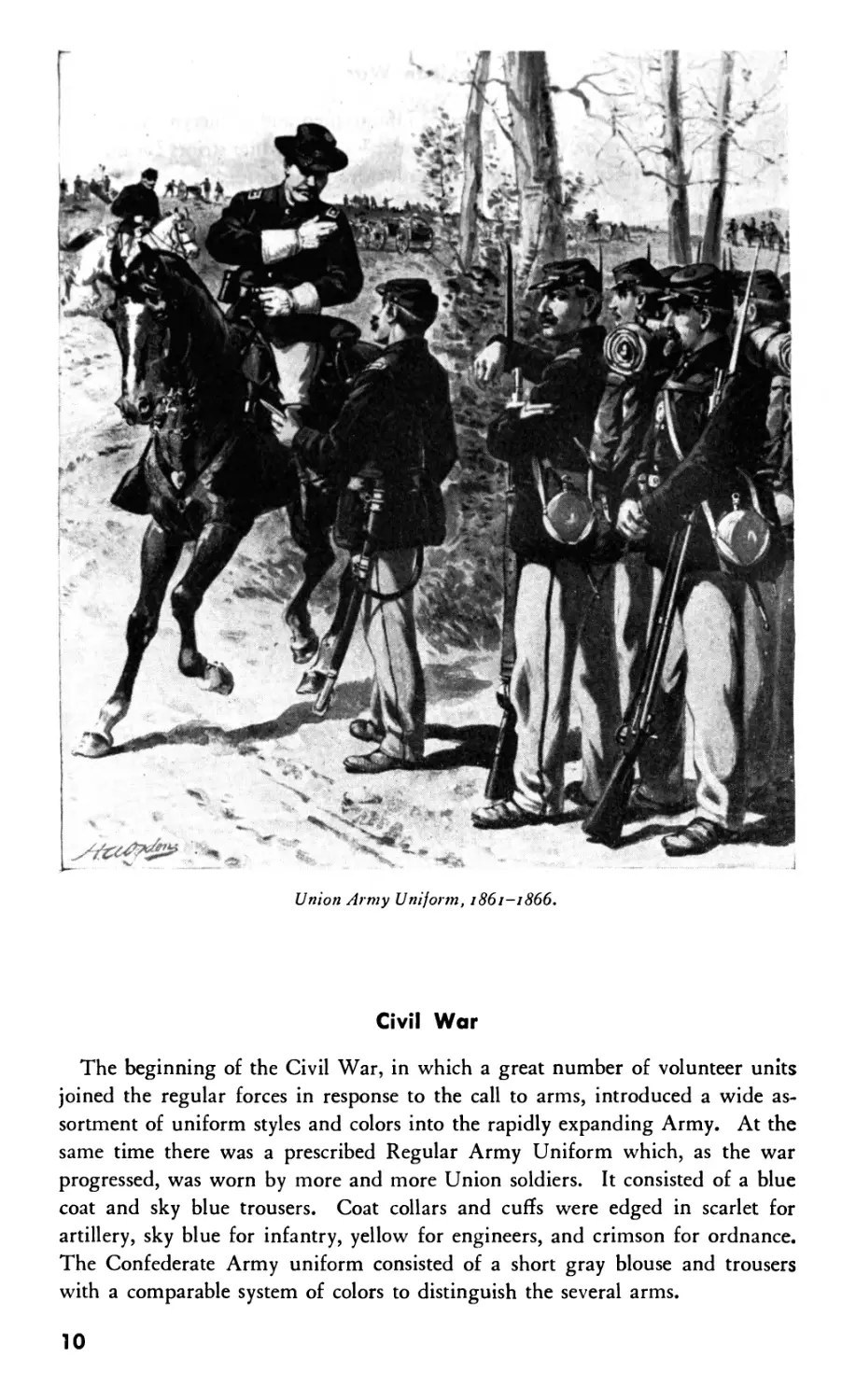
Union Army Uniform, 1861-1866.
Civil War
The beginning of the Civil War, in which a great number of volunteer units
joined the regular forces in response to the call to arms, introduced a wide as-
sortment of uniform styles and colors into the rapidly expanding Army. At the
same time there was a prescribed Regular Army Uniform which, as the war
progressed, was worn by more and more Union soldiers. It consisted of a blue
coat and sky blue trousers. Coat collars and cuffs were edged in scarlet for
artillery, sky blue for infantry, yellow for engineers, and crimson for ordnance.
The Confederate Army uniform consisted of a short gray blouse and trousers
with a comparable system of colors to distinguish the several arms.
10
Spanish-American War
This brief conflict brought olive drab into the Army. The United States was
not the first major power to use this color. Great Britain had outfitted its
forces in India with olive drab or khaki as early as i860. The word khaki
itself (meaning dust-colored) is of Indian origin. Several of the United States
volunteer regiments were authorized to wear khaki in 1898 during the fighting
in Cuba and Puerto Rico. However, blue remained the officially prescribed color
for the uniform.
The First Olive Drab, 1898-1907.
11
World War I
At the beginning of this Century most of the major nations were already
clothing their armies in colors chosen for their quality of making the soldier
less conspicuous on the battlefield. This trend was a natural outgrowth of ad-
vances in the range, accuracy, and hitting power of weapons. Not for many
years had troops marched against enemy positions in parade-ground formation;
for the same reason, armies had gradually discarded such brilliant hues as the
scarlet that British forces had worn during the 18th Century.
As late as 1914, however, some French Army units entered battle wearing
scarlet trousers. They had not yet been outfitted with the horizon blue field uni-
forms which the French had recently adopted. German machine-gunners found
that the scarlet trousers made excellent targets and the high casualties in these
French units once again testified to the soundness of General Washington’s recom-
mendations made more than 100 years earlier.
The combat conditions during World War I established beyond any question
the necessity for clothing troops in dull, low-key shades that blend with earth,
World War I Uniforms, 1917-1918.
12
rock, and foliage. To survive on the modern batdefield the soldier must be
able to remain relatively inconspicuous; his uniform must help him do so.
When he is not in the field, on the other hand, he is much less interested in
being inconspicuous. To the contrary—he wants a uniform that will be noticed,
one that he can be proud to wear, and that identifies him with a proud and
honored Service. Both in the field and in garrison, in other words, he wants
to be well dressed for the occasion.
The Army Green uniform answers one of these needs, just as the various
types of field and combat clothing answer other specific needs. When we
say that the Army Green is a “general purpose” uniform this what we mean:
it is a winter uniform for wear (i) on garrison duty, (2) when traveling, and
(3) when off-duty. (This pamphlet does not cover various local regulations
that may be in effect during the transition from olive drab to mandatory wear-
ing of Army Green by all personnel. You will find, however, that local uni-
form regulations are always based upon the general Army-wide provisions.)
Wearing the Army Green
Army Green shade 44 is a well styled and accurately tailored uniform. It
is being manufactured in a wide range of sizes in order to insure that its basic-
ally good design will contribute to the soldierly appearance of all its wearers,
regardless of the many individual differences of height, weight, and other
bodily attributes. To look good in the new uniform, in other words, you don’t
have to be a perfect specimen of manly beauty. The fact that you are in the
Army proves your general physical fitness. The new uniform has been de-
signed to enhance your natural or acquired habits of bearing and posture. If
these are already good, the new uniform will make you look even better. At
the same time, it is not a magic cloak; your personal appearance will still
depend primarily upon your own efforts. It won’t hide poor posture; it won’t
keep itself cleaned and pressed.
If your uniform doesn’t fit you, you’re not a well-dressed soldier. The Army
has done its part to insure that you can be properly fitted. The new uniform
has been manufactured in 5 different models with 65 different variations of
sizes. Almost everyone can be properly fitted from these standard stocks. For
the few who cannot, special measurement uniforms can be obtained—tailor
made service at no additional charge. (For this special service, officers are
charged 20% above the basic cost of the uniform.)
Army Green Is for Army Only
As already mentioned, one reason for developing the Army Green uniform
was the fact that the olive drab color was no longer identified exclusively with
our Army. Steps have been taken to insure that Army Green will remain
an exclusive “trade mark” of the United States Army. The wearing of dis-
tinctive items of the Army Green uniform by unauthorized persons is already
prohibited by law. Congress is also considering a law prohibiting anyone from
selling items of the Army Green uniform to persons not authorized to wear
them.
13
Quality Control
Measures also have been taken to maintain the quality of the new uniform—
to protect you against unknowingly buying substandard uniform items. The
Quartermaster General has established a Quality Control Office to examine
samples of uniform items submitted by textile manufacturers, custom tailors,
military tailors, and others engaged in the fabrication of Army clothing. When
these samples meet or exceed the minimum standards set by The Quartermaster
General, official approval is indicated in the form of a certificate number covering
each type of garment. Whenever you purchase any item of uniform from a
source other than the Army, make sure that it bears a label reading substantially
as follows:
This garment is warranted to meet or exceed the standards of specification(s) No.
and was produced under Certificate No. -- from basic material warranted by the
manufacturer to have been produced in accordance with sample under current certificate.
If the item doesn’t have such a label, don’t buy it.
Women’s Uniforms
The Army Green Uniform program has not yet been completed with respect
to the female members of the Army. However, the Chief of Staff and Secretary
of the Army have recently approved Army Green as the color to be used in the
future uniform for women. It will probably be introduced within several years,
but exact dates have not yet been determined.
The three Army elements to which women are generally assigned (Army
Nurse Corps, Women’s Army Corps, and Army Medical Specialist Corps)
originated at different times during the last half-century. Although each of
these corps developed its own distinctive uniform, a single uniform for all three
was adopted when they were integrated into the Regular Army in 1948. This is
the uniform of taupe color which will continue to be used until replaced by the
Army Green uniform.
The Importance of Insignia
U. S. Army insignia are integral parts of the uniform. Your various items
of insignia tell a great deal about you as an individual soldier. Combined with
your decorations and awards (discussed below) they are a kind of “visible service
record.”
Insignia are provided for several reasons, practical and intangible. The
practical reason can be summed up in one word—identification. Without your
insignia, your uniform identifies you only as a member of the Army. It is
your insignia that distinguishes you from other soldiers, or the members of your
outfit from those of other outfits. Army insignia are visible signs of your grade,
your branch, your capacity or duty assignment, your present outfit, and (when
appropriate) the outfit you served with overseas in wartime.
14
The intangible value of insignia is closely related to the function of identifica-
tion. Your pride in yourself as a soldier and in your present and past outfits
is symbolized by the fact of wearing all this information in the form of insignia.
From this feeling of pride is developed most of your other soldierly qualities.
This same feeling by groups of soldiers becomes pride of unit and the feeling of
oneness that is so vital in all military life. Once this is understood we can see
immediately why the proper wearing of insignia is very much a part of the broader
subject of proper wearing of the uniform.
Decorations and Awards
On all occasions when it is proper for you to wear them, your decorations
and awards become part of your uniform. Wearing them properly is part of
your individual responsibility for proper wearing of the uniform. To wear a
decoration or award in an incorrect position, for example, means that you are
not properly uniformed in that respect. To know and observe the regulations
on this subject is an important mark of a good soldier. It is not hard to imagine
what would happen if there were no regulations covering this matter, or if the
existing regulations were widely ignored. The purpose of the regulations is
merely to insure uniformity; you promote this purpose by carefully obeying all
the provisions that pertain to your particular decorations and awards.
An extremely important caution should be kept in mind: Never wear any
decoration or award until you are certain of two points—(i) That it is an award
authorized in regulations for wear by Army personnel, and (2) that you have
been specifically authorized by competent orders to wear it. If in doubt, con-
sult your service record and file. Serious penalties are provided for knowingly
wearing an unauthorized decoration or award. First be sure you are entitled
to wear it; then be sure to wear it correctly on all proper occasions.
Olive Drab’s Last Tour of Duty
As mentioned earlier, 1 October i960 is the target date when Army Green
will become the only winter service uniform for all Army personnel. Olive
drab, therefore, is now serving its final hitch of a long and honorable Army
career that has included two world wars and the Korean conflict. Like the old
soldier of song and legend, it is not dying but “just fading away”—in several
definite stages.
Two of these stages are already past. Since 1 July 1957, men entering the
Army are issued one olive drab and one Army Green uniform. After 1
October 1957, Army Green becomes the only authorized winter service uni-
form for commissioned and warrant officers.
The remaining stages are as follows—
Beginning 1 October 1958, men entering the Army will be issued two Army
Green uniforms. There will be no initial issue of the olive drab uniform.
All enlisted men will be required to own at least one Army Green uniform.
15
Beginning i October i960, wearing of the olive drab uniform (including its
garrison and service caps) will be prohibited.
During the transition period (1 July 1957 to 1 October i960), enlisted men
will have the individual option of wearing (in the proper season) any of the
uniforms that have been issued to them or that they are required to purchase.
This means that both olive drab and Army Green will be in evidence in most
formations and normal duty situations.
In order that local commanders may be able to present a uniformly dressed
command on various ceremonial occasions during this period, they are au-
thorized to prescribe one of these uniforms for such formations. Before 1
October 1958 they can prescribe only the olive drab because some men will
not yet be required by regulations to own an Army Green uniform. After 1
October 1958, only Army Green can be prescribed, because some men will no
longer have an olive drab uniform.
It is important to keep in mind that until olive drab is finally and officially
retired in i960, the regulations governing its proper wear remain in effect. In
no sense has olive drab become “old clothes”—it is still a uniform of the United
States Army. To most Americans, in fact, olive drab is the uniform they or
their sons, brothers, and husbands once wore. To other millions around the
world, olive drab calls up memories of American fighting men in World War
II and Korea.
During the next few years, therefore, both the “old” Army and the “new”
will be on display in our uniforms. Each man’s behavior while wearing one
of these uniforms will affect the Army’s reputation for better or worse.
When you wear the olive drab, part of the Army’s glorious past is entrusted
to your care. When you wear the Army Green, you symbolize the Army of
today and tomorrow. Your duty is the same in both cases—to conduct your-
self, on duty and off, in a manner that reflects credit on the uniform of the
United States Army.
[AG 461 (5 Aug 57)]
By Order of Wilber M. Brucher, Secretary of the Army:
MAXWELL D. TAYLOR,
General, United States Army,
Chief of Staff.
Official:
HERBERT M. JONES,
Major General, United States Army,
The Adjutant General.
Distribution:
Active Army:
Ten (10) copies per 100 Military Personnel.
NG and USAR: A.
This pamphlet is an adjunct of the troop information program. Commanders will
govern its distribution accordingly.
16
U. S. GOVERNMENT PRINTING OFFICE: 1957
ARMY GREEN AND THE CLOTHING ALLOWANCE
In planning the several steps of the Army Green Uniform program, the Depart-
ment of the Army has recognized that the monthly clothing allowance will be a most
important factor during the change-over period. It will enable each soldier to make
the shift from Olive drab to Army Green at no greater expense for purchase and up-
keep of uniforms than he would have incurred even if a new Army uniform had
not been adopted.
A main purpose in planning the change-over has been to spread over a period of
time the purchase of items of the new uniform. By this means, the purchase of
needed replacement items to maintain proper uniform becomes a normal part of
the orderly transition of the Army from its old uniform to the new.
The announcement of the program in DA Circular 102, 1954, gave the career soldier
in service at that time a four-year advance notice that he would be required to own
one Army Green uniform by 1 October 1958. This notice has remained in effect
for those entering the Army since 1954. The elapsed time has provided an op-
portunity to build up the allowance and plan the purchase of the new uniform. By
October i960, additional clothing allowances will have accrued for the purchase of
the required second Army Green uniform.
Soldiers entering the Army between 1 July 1957 and 1 October 1958 will receive
one Army Green uniform as part of their initial issue of clothing. The clothing
allowance they accumulate by 1 October i960 will purchase their required second
Army Green uniform at that time.
Soldiers entering the Army after 1 October 1958 will receive two Army Green uni-
forms as initial issue. When 1 October i960 rolls around, they will have accumulated
enough clothing allowance for the normal expense of replacing a worn-out uniform.
In a matter that affects so many people over a long period of time, it isn’t possible
to establish a plan that will have exactly the same financial effect on each individual.
This is particularly true since wearing habits, thrift, and other factors differ widely.
Consideration of the overall plan described above will show that the Department of
the Army has been as fair as possible in working out a method of introducing the
Army Green uniform.