/
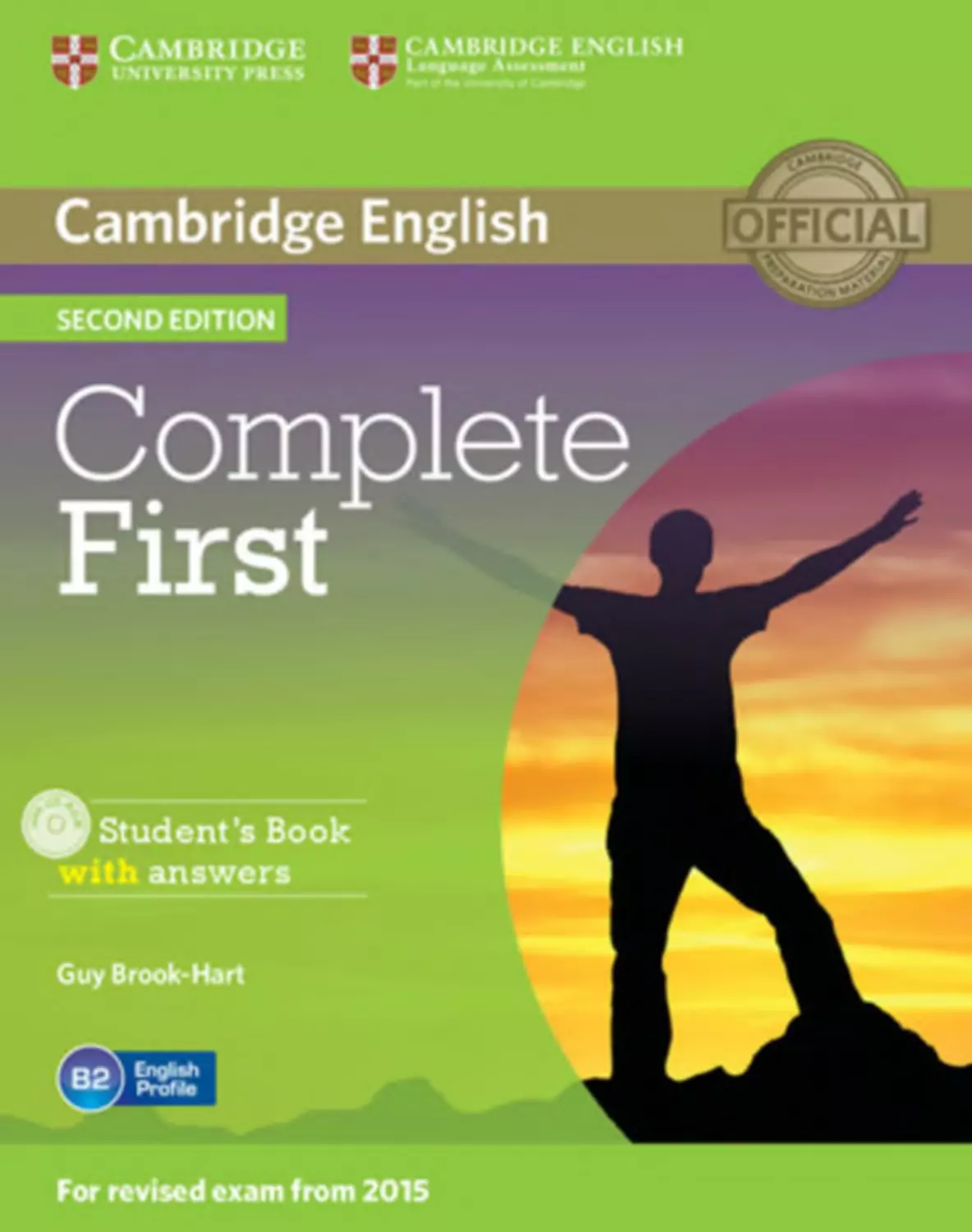


Author: Brook-Hart G.
Tags: linguistics english english grammar english language cambridge english
ISBN: 978-1-107-63390-2
Year: 2014


Text
Student’s Book with answers
First
Complete
Univer sit y Printing House, C amb ridge CB2 8BS, United Kingdom
Cambridge University Press is part of the University of Cambridge.
It furthers the University’s mission by disseminating knowledge in the pursuit of
e ducation, learning and re search at the highest inter national levels of excellen ce.
www.cambridge.org
Information on this title: w ww.cambridge.org/9781107656178
© Cambridge Univer sit y Press 2014
This publication is in copyright. Subject to statutor y exce ption
and to the provisions of relevant collective licensing agreements,
no reproduction of any part may take place without the written
permission of C amb ridge Univer sit y Press.
First published 2008
Second edition 2014
Reprinted 2014
Printed in Italy by L.E.G .O. S .p.A .
A catalog ue record for this p ublication is available from the British Library
ISBN 978-1-107-63390-2 Student’s Book without answers with CD-ROM
ISBN 978-1-107- 65617-8 Stud ent ’s Book with answe rs with CD-ROM
ISBN 978-1-107- 64394-9 Teache r’s Book with Teacher ’s Resource s CD-ROM
ISBN 978-1-107-65220-0 Workbook without answers with Audio CD
ISBN 978-1-107-66339-8 Workbook with answers with Audio CD
ISBN 978-1-107- 68734-9 Class Audio CDs (2)
ISBN 978-1-107- 66666 -5 Present ation Plu s
ISBN 978-1-107- 65186-9 Student’s Pack (Stud ent ’s Book without an sw er s w ith CD-ROM,
Workbook withou t answe r s with Audio CD)
ISBN 978-1-107- 69835-2 Student ’s Book Pack (Student ’s Book with answ er s w ith CD-ROM
w ith Class Audio CDs (2)
Cambridge University Press has no responsibility for the persistence or accuracy of
URLs for external or third-party internet websites referred to in this publication,
an d d oe s not guarantee that any content on such w ebsites i s, or will remain,
accurate or appropriate. Infor mation regarding prices, t ravel timet ables, and other
factual information given in this work is correct at the time of first printing but
Cambridge Unive rsity Press does not guarante e the accu rac y of such infor mation
thereafter.
3
Map of the unit s
4
Introduction
6
Cambridge English: First (2015) content and overview
7
1 A family affair
8
2 Leisure and pleasure
18
Vocabulary and grammar reviews Units 1 and 2
28
3 Happy holidays?
30
4 Food, glorious food
40
Vocabulary and grammar reviews Units 3 and 4
50
5 Study time
52
6 My first job
62
Vocabulary and grammar reviews Units 5 and 6
72
7 High adventure
74
8 Dream of the stars
84
Vocabulary and grammar reviews Units 7 and 8
94
9 Secrets of the mind
96
10 Spend, spend, spend?
106
Vocabulary and grammar reviews Units 9 and 10
116
11 Medical matters
118
12 Animal kingdom
128
Vocabulary and grammar reviews Units 11 and 12
138
13 House space
140
14 Fiesta!
150
Vocabulary and grammar reviews Units 13 and 14
160
Language reference
162
Writing reference
185
Speaking reference
194
Answer key
199
Acknowledgements
249
Contents
4
Unit title
Reading and Use of English Writing
Listening
1 A family affair
Part 6: ‘Surviving teenagers’
Part 2: ‘Doing the chores’
Par t 1 An essay: Teenagers and young people
should share housework equally with their parents.
Do you agree?
Expressing opinions
Using although, however, on the other hand and
whereas
Part 1: Young people talking
about their families and
ac tivities
2 Leisure and pleasure Part 5: ‘My first bike’
Part 4: Key word transformation
Par t 2 An article: A leisure-time activity you really
enjoy
Writing compound and complex sentences
Part 2: A talk from a games
developer
Vocabulary and grammar reviews Units 1 and 2
3 Happy holidays?
Part 3: ‘A bus journey’
Part 7: ’My nightmare holiday!’
Par t 2 A report: A one-day excursion
Part 3: Five young people talking
about their holidays
4 Food, glorious food Part 6: ‘Learning about food’
Part 1: ‘Moso Moso’ – a restaurant
review
Par t 2 A review: A local restaurant, café or snack bar Part 4: A radio interview with the
owner of a popular café
Vocabulary and grammar reviews Units 3 and 4
5 Study time
Part 7: ‘At school abroad’
Part 3: ‘Culture shock for international
students’
Part 1 An essay: All young people who have the
opportunity should study in a foreign school or
college for a year. Do you agree?
Writing opening paragraphs
Using linking words and phrases
Part 1: People talking about
studying and school
6 My first job
Part 5: ‘Lucy’s first job’
Part 2: ‘A new summer programme’
Par t 2 A letter or email: Describe the jobs students
do in your country
Commonly misspelled words
Part 3: Five people talking about
their first job
Vocabulary and grammar reviews Units 5 and 6
7 High adventure
Part 6: ‘Are you ready for an adventure
race?’
Part 4: Key word transformation
Part 2 An article: A great way to keep fit
Part 2: A talk about adventure
racing
Part 4: A radio interview with a
paraglider
8 Dream of the stars
Part 7: ‘Five young actors’
Part 1: ‘YouTube millionaire celebrities’
Par t 1 An essay: There are both advantages and
disadvantages to a career as a musician or an actor.
Writing a balanced essay
Part 2: A talk about a television
quiz show
Vocabulary and grammar reviews Units 7 and 8
9 Secrets of the mind
Part 5: ‘The secrets of happiness’
Part 4: Key word transformation
Part 2 A report: The benefits of improving
classrooms and students’ social activities
Making suggestions and recommendations
Part 1: People talking about
different aspects of psychology
10 Spend, spend, spend? Part 2: ‘Shopping online versus
shopping locally’
Part 5: ‘My greatest influence’
Par t 2 A review: A place where people have a good
time
Words/Phrases to build up more complex sentences
Part 4: A student interview about
a new shopping centre
Vocabulary and grammar reviews Units 9 and 10
11 Medical matters
Part 6: ‘ What’s it like to study medicine?’
Part 3: ‘Is there a doctor on board?’
Par t 1 An essay: Modern lifestyles can seriously
endanger our health. Do you agree?
Writing concluding paragraphs
An essay: Young people generally don’t pay enough
attention to their health and fitness. Do you agree?
Part 3: Five people talking about
visits to the doctor
12 Animal kingdom
Part 1: ‘My sister’s circus’
Part 7: ‘Sur viving an animal attack’
Part 2 A letter or email: Advice to a visitor to your
country
Giving advice
Part 1: People talking about
animals in different situations
Vocabulary and grammar reviews Units 11 and 12
13 House space
Part 5: ‘My new home in Venice, 1733’
Part 2: ‘Li ving on a houseboat’
Par t 2 An article: My ideal home
Part 2: A talk about a haunted
house
14 Fiesta!
Part 6: ‘The world’s highest festival?’
Part 3: ‘My local festival’
Part 1 An essay: Is it better to watch films at the
cinema or at home?
it, this, that and they for reference
Part 4: A radio interview with a
street performer
Vocabulary and grammar reviews Units 13 and 14
M
a
p
o
f
t
h
e
u
n
i
t
s
5
Speaking
Pronunciation
Vocabulary
Grammar
Part 1: Talking about yourself, your home and your family
Giving extended answers
Word stress (1): Stress in
words with two or more
s yllables
Phrasal verbs: get on with, do up, etc.
Collocations with make and do
Present perfect simple and
continuous
Part 2: Comparing photos of free-time activities
Using discourse markers to structure the answer
Sentence stress (1): Stress
on words carrying the most
meaning
Phrasal verbs and expressions: take up,
sum up, etc.
Making comparisons
Adjectives with -ed and -ing
Part 3: Discussing the benefits of different kinds of trip
Phrases to involve partners in discussion
Strategies for dealing with the second section of Part 3
Intonation (1): Indicating
when you have/haven’t
finished speaking
travel, journey, trip and way
Adjective suffixes
Past simple, past continuous
and used to
at, in or on in time phrases
Past per fect simple and
continuous
Part 4: Discussing diet, food and health
Supporting opinions with reasons and examples
Grouping words and
pausing (1)
food, dish and meal
Adjectives to describe restaurants
so and such
too and enough
Part 1: Talking about your studies
Giving reasons, offering several possible ideas
Word stress (2): Shifting
word stress
Phrasal verbs: get over, live up to, etc.
find out, get to know, know, learn, teach
and study; attend, join, take part and
assist
Forming nouns from verbs
Zero, first and second
conditionals
Part 2: Comparing photos of different kinds of work
Describing similarities and differences when comparing
Sentence stress (2):
Contrastive sentence
stress
work /job; possibility/occasion/
opportunity; fun/funny
Collocations with work and job
Countable and uncountable
nouns
Articles
Part 3: Discussing ways of encouraging people to do more
sport
Suggesting ideas, asking opinion, agreeing and
disagreeing
Intonation (2): Showing
attitude
Verb collocations with sporting activities
look, see, watch, listen and hear
Infinitive and verb + -ing
Part 4: Discussing different aspects of media and celebrity
Giving balanced, general answers
Expressing agreement/disagreement
Grouping words and
pausing (2)
Verb collocations with ambition, career,
experience and job
play, performance and acting; audience,
(the) public and spectators; scene and stage
at, in and on in phrases
ex pres sing location
Reported speech
Part 2: Comparing photos of different kinds of feeling and
emotion
Speculating about photos using look, seem and appear
Sentence stress (3):
Using sentence stress for
emphasis
achieve, carry out and devote
stay, spend and pass; make, cause and
have
Modal verbs to express
cer tainty and possibility
Part 1: Talking about how you spend your money
Strategies for answering Part 1 questions
Linking (1): Linking to
increase fluency
arrive, get and reach
Phrasal verbs: come up with, pull in, etc.
as and like
Modals expressing ability
Part 2: Comparing photos of situations related to health
Strategies for dealing with difficulties: finding the right
word
Intonation (3): Showing
certainty/uncertainty
Idiomatic expressions: taken aback, etc.
Health vocabular y: illness, infection, etc.
Relative pronouns and
relative clauses
Parts 3 and 4: Discussing topics related to animals
Commenting on the question
Expressing other people’s opinions
Expressing agreement/disagreement
Word stress (3): Strong and
weak forms
avoid, prevent and protect; check, control,
keep an eye on and supervise
Negative prefixes
Third conditional and mixed
conditionals
wish, if only and hope
Part 2: Comparing photos of people in different locations Linking (2): Linking with
consonant sounds
space, place, room, area, location and
square
Causative have and get
Expres sing obligation and
permission
Parts 3 and 4: Discussing different topics related to
festivals and celebrations
Improving fluency
Vocabulary for festivals: celebrate,
commemorate, etc.
Suffixes to form personal nouns
The passive
6
Introduction
Who this book is for
Complete First Second Edition is a stimulating and thorough
preparation course for students wishing to take the revised
Cambridge English: First exam from 2015. It teaches you
the reading, writing, listening and speaking skills which are
necessary for the exam, how to approach each exam task,
as well as essential grammar and vocabulary. The book also
teaches you the language knowledge and develops the skills
you need to reach an upper-intermediate B2 level in the
Common European Framework of Reference. Complete First
Second Edition is official Cambridge English preparation
material for the exam.
What the book contains
In the Student’s Book there are:
t 14 units for classroom study. Each unit contains:
–
at least one par t of each of the Writing, Speaking and
Listening papers and t wo part s of the Reading and Use
of English Paper in the Cambridge English: First exam.
The units provide language input, skills practice and
exam technique to help you to deal successfully with
each of the tasks in the exam.
–
essential information and advice on what each par t of
the exam involves and the best way to approach each
task.
–
a wide range of enjoyable and stimulating speaking
activities designed to increase your fluency and your
ability to express yourself.
–
detailed advice and practice of strategies to perfect
your performance in the Speaking paper.
–
a pronunciation section working on stress, intonation,
pausing, linking and fluency.
–
a step-by-step approach to doing Cambridge English:
First writing tasks.
–
grammar activities and exercises with the grammar
you need to know for the exam. When you are doing
grammar exercises you will sometimes see this symbol:
. These are exercises which are based on research
from the Cambridge English Corpus and they deal with
areas which cause problems for many candidates in the
exam.
–
vocabulary input needed for success at Cambridge
English: First based on the English Vocabulary Profile
(EVP) at B2 level. When you see this symbol: EP , the
exercise is based on EVP research. When you see this
symbol
next to a vocabulary exercise, the exercise
is based on research from the Cambridge English
Corpus and focuses on words which candidates often
confuse or use wrongly in the exam.
t 14 Vocabulary and Grammar reviews. These contain
exercises which revise the grammar and vocabulary that
you have studied during the unit.
t A Language reference section which clearly explains all
the main areas of language, including grammar, word
formation, spelling and punctuation, which you need to
know for the Cambridge English: First exam.
t Writing and Speaking reference sections. These explain
the possible tasks you may have to do in the Speaking
and Writing papers, and they give you examples,
language and advice on how best to approach them.
t A CD-ROM provides extra practice, with all activities
linked to the topics in the Student’s Book.
Also available are:
t two audio CDs containing listening material for the 14
units. The listening material is indicated by different-
coloured icons in the Student’s Book as follows:
02.
02.
t a Workbook to accompany the Student’s Book, with four
pages of exercises for each unit. The Workbook is also
accompanied by an audio CD.
7
Cambridge English: First content and overview
Part / timing
Content
Test focus
Reading and Use of English
1 hour 15 minutes
Part 1 A modified cloze text containing eight gaps and
followed by eight multiple-choice items
Part 2 A modified open cloze text containing eight gaps
Part 3 A text containing eight gaps. Each gap corresponds
to a word. The stems of the missing words are given beside
the text and must be changed to form the missing word.
Part 4 Six separate questions, each with a lead-in sentence
and a gapped second sentence to be completed in two to
five words, one of which is given as a ‘key word’
Part 5 A text followed by six multiple-choice questions
Part 6 A text from which six sentences have been removed
and placed in a jumbled order af ter the text. A seventh
sentence, which does not need to be used, is also included.
Part 7 A text, or several short texts preceded by ten
multiple-matching questions
Candidates are expected
to demonstrate the ability
to apply their knowledge
of the language system by
completing the first four tasks;
candidates are also expected
to show understanding of
specific information, text
organisation features, tone
and text structure.
Writing
1 hour 20 minutes
Part 1 One compulsory essay question presented through
a rubric and shor t notes
Part 2 Candidates choose one task from a choice of three
task types. The tasks are situationally based and presented
through a rubric and possibly a short input text. The task
types are:
t an article
t a letter or email
t a review
t a report
Candidates are expected
to be able to write using
different degrees of formailty
and diffferent functions:
advising, comparing,
describing, explaining,
expressing opinions, justifying,
persuading, recommending
and suggesting.
Listening
Approximately 40 minutes
Part 1 A series of eight short unrelated extracts from
monologues or exchanges bet ween interacting speakers.
There is one three-option multiple-choice question per
extract.
Part 2 A short talk or lecture on a topic, with a sentence-
completion task which has ten items
Part 3 Five shor t related monologues, with five multiple-
matching questions
Part 4 An inter view or conversation, with seven multiple-
choice questions
Candidates are expected to
be able to show understanding
of at titude, detail, function,
genre, gist, main idea,
opinion, place, purpose,
situation, specific information,
relationship, topic, agreement,
etc.
Speaking
14 minutes
Part 1 A conversation bet ween the examiner (the
‘ interlocutor’) and each candidate (spoken questions)
Part 2 An individual ‘long turn’ for each candidate, with
a brief response from the second candidate (visual and
writ ten stimuli, with spoken instructions)
Part 3 A discussion question with five written prompts
Part 4 A discussion on topics related to Part 3 (spoken
questions)
1 A family affair
8
Starting off
Work in pairs.
t What aspects of family life does each of the photos show?
t Which of these activities do you most enjoy doing with members of
your family? Which do you prefer to do with friends? Why?
t What other activities do you enjoy doing with members of your
family? Why?
t How impor tant is it for families to spend time together? Why?
Listening | 1BSU
1 Work in pairs. You w ill hear people talking in eight different
situations. Before you listen, read questions 1–8 and underline
the main idea in each. An example has been done for you.
You hear par t of a conversation with a boy called Patrick. He thinks
his mother helps him because
"she enjoys it.
B she worries about him.
$she has plenty of time.
You hear a girl called Tracey talking to a friend. What is her family
doing to the house at the moment?
"extending it
B painting it
$cleaning it
You hear a girl called Vicky taking par t in a class discussion. How
often does she do spor ting activities with her father?
"more of ten than before
B the same as before
$less often than before
You hear a boy called Kostas talking about family celebrations.
How does he feel about them?
"bored
B embarrassed
$amused
In Listening Part 1, you:
s listen to people talking in eight different situations which may be
either a conversation between two or more people, or just one
person speaking;
s answer one question for each situation by choosing A, B or C;
s hear each piece twice.
This part tests your ability to understand a variety of things, including
the general idea being expressed, a detail, a reason or a purpose.
Exam information
9
A family affair
You hear a boy called Rajiv talking to his sister on the
phone. He is annoyed with her because
" she has taken something without permission.
B she has gone out without telling him.
$she has lost something he needs.
You hear a boy called Marco talking to a friend. He is
tired because he has done too much
"studying.
B exercise.
$travelling.
You hear a girl called Samin leaving a telephone
message for her mother. She is phoning to
"explain something.
#complain about something.
$ask permission for something.
You hear an interview with a young musician called Pau.
Why does he say he chose to play the trumpet?
"It was the only instrument available.
B It was his favourite instrument.
$It was a family tradition.
2 02 Listen and choose the best answer (A, B or C).
3 Work in pairs. Correct the mistakes in questions 1–6
on the tablet.
4 Now take turns to ask and answer questions
1–6 in Exercise 3.
Vocabulary
1ISBTBMWFSCT
1 EP Match these phrasal verbs from Listening Part 1
with their definitions.
get on with
doup
clear up
goon
wear out
pick up
B collect (or go and get)
someone or something
C continue
D continue doing something,
especially work
E make a place tidy by removing
things from it or putting them
where they should be
F make someone extremely
tired
G repair or decorate a building
so that it looks attractive
2 Complete these sentences by writing a phrasal verb
from Exercise 1 in the correct form in each of the
gaps.
Ineedto
my homework project, otherwise I
won’t finish it for tomorrow.
Mati had a little sleep because she felt
after
spending all morning
the mess in her room.
I got bored with the film because it
for too
long.
We’ll need to
some more pots of paint if
we’re going to
your room this weekend.
get on with
1 How much you help around the house?
How much do you help around the house?
Ϯ ,ŽǁŽŌĞŶLJŽƵĂůůĚŽŝŶŐƚŚŝŶŐƐƚŽŐĞƚŚĞƌĂƐĂĨĂŵŝůLJ͍
ϯ zŽƵĞǀĞƌĚŽƐƉŽƌƚƐǁŝƚŚŽƚŚĞƌƉĞŽƉůĞŝŶLJŽƵƌĨĂŵŝůLJ͍
κ ƌĞLJŽƵĞŶũŽLJĨĂŵŝůLJĐĞůĞďƌĂƟŽŶƐ͍
ρ ,ŽǁŽƚŚĞƌŵĞŵďĞƌƐŽĨƚŚĞĨĂŵŝůLJĂŶŶŽLJLJŽƵ͍
ς zŽƵŚĂǀĞĂŶLJĨĂŵŝůLJƚƌĂĚŝƟŽŶƐ͍
Unit 1
Reading and Use of English | 1BSU
1 EP Work in pairs. You are going to read an article
giving advice to parents. Before you read, w rite these
adjectives in the most appropriate column below.
usually positive
usually negative
could be either
aggressive
2 Add one of these prefixes dis-, un-, im-, ir-, in- to
each of these words to make opposites.
QBHF-BOHVBHFSFGFSFODFWord formation – adding
prefixes
3 Work in pairs. Which of the adjectives in Exercise 2
describe typical attitudes of parents to teenagers?
Why? Which describe typical attitudes of teenagers
to parents? Why?
4 Work in groups.
t Make a list of things that parent s sometimes say about
their teenage children.
He’s so bad-tempered! He gets angry whenever I ask him to tidy
his room!
She’s ver y hard-working. She spends hours studying in her room.
t What do you think parents can do to live happily with
their teenage children?
Listen to what their children say.
5 Read the article carefully, ignoring the gaps, and
make a note of the main idea of each paragraph.
An example has been done for you.
aggressive anxious bad-tempered concerned
critical enthusiastic hard-working impatient
impolite mature organised reasonable
responsible self-confident sensitive strict
understanding unreliable
aggressive
critical uncritical concerned enthusiastic mature
organised reasonable responsible sensitive
treat
teenagers
differently
from before
SURVIVING
TEENAGERS
It might be difficult to accept, but a new
approach to living happily with teenagers is for
parents to look at their own behaviour.
“The key to getting teenagers to respect you is to
UHVSHFWWKHPÀUVWμVD\V3HQQ\3DOPDQRZKRKDV
ZULWWHQDEHVWVHOOLQJERRNRQWHHQDJHUV́<RX
FDQ·WFRQWLQXHWRWUHDWWKHPWKHVDPHZD\WKDW\RX
KDYHEHHQWUHDWLQJWKHPIRUWKHSUHYLRXV\HDUV
WKH\KDYHRSLQLRQVWKDWFRXQW 1 <RX·GEHYHU\
XSVHW<RX·GQHYHUVD\WKDWWRDQDGXOWEHFDXVHLW
VKRZVDWRWDOODFNRI UHVSHFWμ
3DOPDQRZKRKDVDGDXJKWHUDJHG
DQGD
\HDUROGVWHSGDXJKWHUKDVHYHQDOORZHGWKH
FKLOGUHQWRKROGVHYHUDOWHHQDJHSDUWLHVDWKHU
KRPH7KH\SDVVHGZLWKRXWSUREOHPV́,·YHIRXQG
WKDWLI \RXKDYHEURXJKWWKHPXSWRGRWKHULJKW
WKLQJDQGWKHQWUXVWWKHPWRGRLWXVXDOO\WKH\·OO
EHKDYHZHOOμVKHVD\V́,PDNHWKHPVDQGZLFKHV
DQGOHDYHWKHPDORQH%XW,PDNHLWFOHDUWKDWthey
KDYHWRFOHDUXSDQ\PHVV 2 μ
6KHDJUHHVWKDWWHHQDJHUVFDQEHLUULWDWLQJ
HQMR\LQJ
DZRUOGWKDWLVIUHHRI UHVSRQVLELOLW\\HWGHVSHUDWH
IRULQGHSHQGHQFH6KHGRHVQ·WWKLQNKRZHYHU
WKDWWKH\DUHWU\LQJWRDQQR\\RX8QWLOUHFHQWO\
VFLHQWLVWVDVVXPHGWKDWWKHEUDLQÀQLVKHGJURZLQJ
DWDERXWWKHDJHRI DQGWKDWWHHQDJHSUREOHPV
ZHUHDUHVXOWRI ULVLQJKRUPRQHVDQGDGHVLUHIRU
LQGHSHQGHQFH 3
10
A family affair
́7KLVZRXOGH[SODLQZK\many teenagers can’t make
JRRGGHFLVLRQVFRQWUROWKHLUHPRWLRQVSULRULWLVHRU
FRQFHQWUDWHRQVHYHUDOGLIIHUHQWWKLQJVDWWKHVDPH
time 4 ,WPHDQVWKDWWKH\GRQRWLQWHQWLRQDOO\
GRWKHZURQJWKLQJMXVWWRDQQR\WKHLUSDUHQWVμVD\V
3DOPDQR
7KHNH\WRKDSSLQHVVIRUDOO3DOPDQREHOLHYHVLV
FDOPQHJRWLDWLRQDQGFRPSURPLVH,I \RXZDQW\RXU
WHHQDJHUVWREHKRPHE\SPH[SODLQZK\EXWOLVWHQ
WRWKHLUFRXQWHUDUJXPHQWV,I LW·VD6DWXUGD\you might
FRQVLGHUDJ UHHLQJWRPLGQLJKW
UDWKHUWKDQDPZKLFK
LVZKDWWKH\KDGLQPLQG
5 ,QVWHDGDVNLI WKH\·YH
KDGDSUREOHPZLWKSXEOLFWUDQVSRUWDQGOHWLWSDVV;
WKH\·YHDOPRVWPDQDJHGZKDW\RXDVNHG6KHXUJHVD
ELWRI SHUVSHFWLYHDERXWRWKHUWKLQJVWRŔ7KHUHKDYH
EHHQWLPHVZKHQP\GDXJKWHU·VURRPKDVQRWEHHQDV
WLG\DV,H[SHFWHGEXWDVVKHVDLGRQFH¶,·PDWHHQDJHU
2ZKDWGR\RXH[SHFW",·PQRWWXUQLQJLQWRDFULPLQDO
LW·VMXVWFORWKHVRQWKHÁRRU·μ
́,W·VYLWDOWRFKRRVH\RXUEDWWOHVFDUHIXOO\
GRQ·WFULWLFLVH
WHHQDJHUVIRUKDYLQJDQXQWLG\URRPWKHQVXGGHQO\
FULWLFLVHWKHPIRURWKHUWKLQJV 6 2QHPLQXWHLW·V
DERXWDQXQWLG\URRPDQGWKHQH[W\RX·UHVD\LQJ¶$QG
DQRWKHUWKLQJ·DQGFULWLFLVLQJWKHPIRUHYHU\WKLQJμ
$GDSWHGIURPThe Daily Telegraph
11
6 Six sentences have been removed from the article.
Choose the correct sentence from A–G which fits
each gap (1–6). There is one ex tra sentence which
you do not need. Use the underlined words and
phrases in the sentences and in the text to help you.
" But it turns out that the region of the brain that
controls common sense and emotions is not fully
mature until the early twenties.
# If they are up to 20 minutes late, don’t react angrily.
$ For example, they may find it difficult to make the right
decision between watching television, ringing a friend,
or finishing their homework.
% Parents of ten complain that teenagers can be
charming to people outside the home but irritating to
their family.
& I’ve never had a problem; in fact, the kitchen was
sometimes cleaner than I’d left it.
' On these occasions, parents tend to mention all the
other things that they may or may not have done
wrong.
(Imagine if you’d spent two hours getting ready to go
out for the evening and someone said, ‘You’re not
going out looking like that, are you?’
In Reading and Use of English Part 6, you read a text of
500–600 words with six gaps where sentences have been
removed. You choose one sentence from a list of seven
sentences A–G for each gap; there is one sentence you
will not need.
This part tests your ability to understand the structure of
the text, how the argument develops and how ideas in
the sentences A–G refer and link to ideas in the text.
Exam information
Unit 1
12
7 Work in groups of four. Two students should take the
role of parents and two students should take the role
of teenagers.
t Work with the student who has the same role as you.
Read your role and prepare what you are going to say.
t When you are ready, change par tners and have your
conversations.
Grammar
1SFTFOUQFSGFDUTJNQMFBOEDPOUJOVPVT
1 Look at each of the pairs of sentences in italics and
answer the questions that follow.
B Penny Palmano has written a best-selling book on
teenagers.
CShe’s been writing books for more than 20 years.
Which sentence (a or b) talks about ...
the result of an activity?
the length of an activity?
B I’ve been learning how to do things like carpentry
and so on.
CI’ve phoned her more than six times, but she never
answers the phone.
Which sentence (a or b) talks about ...
how many times something has been repeated?
changes or developments which are not finished?
B I’ve been helping my mum while her assistant is on
holiday.
CWe’ve lived in this house since I was a small child.
Which sentence (a or b) talks about something which
is ...
temporary?
permanent?
QBHF-BOHVBHFSFGFSFODFVerb tenses – present perfect
simple and continuous
2 Complete these sentences by writing the verbs in
brackets in the correct form (present perfect simple
or continuous) in the gaps.
I
(visit) friends, so I haven’t spoken to
my parents yet today.
I
(ask) him to tidy his room several
times.
I
(clean) the kitchen, so what would you
like me to do next?
My neighbour
(play) the violin for the
last three hours and it’s driving me mad!
Congratulations! You
(pass) the exam
with really high marks!
We can’t leave Adrianna to run the shop. She
(only work) here for a few days.
We
(spend) ever y summer in Crete
since I was a child, so it’ll be sad if we don’t go there
this year.
I’m really tired because I
(cook) all day!
’ve been visiting
1BSFOUT
It is Saturday night and your teenage son/daughter
has gone out with friends. You are annoyed
because
t ZPVBTLFEUIFNUPCFCBDLCZNJEOJHIUBOE
they came home half an hour late
t ZPVQIPOFEUIFJSNPCJMFCVUUIFZEJEOPU
answer
t UIJTIBTBMSFBEZIBQQFOFEPODFCFGPSFUIJT
month.
Have a conversation with your teenage son/
daughter. Find out what happened and decide how
to avoid this situation in the future.
5FFOBHFTPOEBVHIUFS
It is Saturday night. You went out with your friends,
but you promised your parent(s) you would be back
by midnight. However, you got home half an hour
late.
Have a conversation with your parents. Explain
what happened and discuss how to avoid this
situation in the future.
A family affair
4 Complete the tex t by writing one word in each gap.
Make sure that you spell the word correctly.
According to a recent study of teenagers, most of
them do not do housework just (0)
pocket
money. While many do household chores because
they see it (1)
a way of getting ready for
adult life, others feel they have a duty to help their
parents because it is fair, especially if their parents
work.
More than two-thirds of the young people who were
surveyed clean floors (2)
least once a
week and more than 80% regularly set the table for
meals or (3)
the washing-up. Girls are more
likely than boys to wash (4)
own clothes.
(5)
are, however, a few teens who only do
the housework because they are made (6)
by their parents. They argue that they should
(7)
be expected to help out at home
because in their view, their teenage years are a
period which should be enjoyed (8)
than
interrupted with household responsibilities.
for
Doing the chores
3
Candidates often make mistakes w ith the
present perfect simple and continuous. Correct one
mistake w ith a verb tense in each of these sentences.
I was interested in it since I was a child. have been
In the last three weeks, I learned so many interesting
things which I didn’t know how to do before.
This isn’t the first time I work at a camp.
My name is Sarah Beauland, I’m 25 years old and I play
tennis since 1990.
Since I star ted the project, I had been doing research
on someone famous from my country.
Vicky and Kostas are friends for
many years. They actually met
at primary school.
They had been talking
about it for years, but
nothing has been done up
to now.
I dance since I was very
young and now I’m working
ver y hard to fulfil my dream of
becoming a famous dancer.
Reading and Use of English | 1BSU
1 Work in pairs. You will read an article about
housework. Before you read, match the verbs (1–8)
with the nouns (a–h) to make phrases for common
household chores.
do
do
dust
get
hang
lay
make
sweep
B the beds
C the dinner ready
D the floor
E the furniture
F the ironing
G the table
H the washing out to dry
I the washing-up
2 Work in groups.
t Who does each of the chores in Exercise 1 in your
family, and why?
We all do our own ironing because we’re all very busy. My dad gets
the dinner ready because he says it helps him relax.
t Which of the chores do you not mind doing? Which
would you prefer to avoid?
3 Read the text quickly. Why do teenagers do
housework?
13
Unit 1
14
5 Now check or complete your answers by using these
clues.
This preposition is used with see to mean believe it
is (that thing). Other verbs which are followed by this
preposition are consider and regard.
In other words, they clean floors a minimum of once a
week.
Which verb do we use with washing-up?
Whose clothes do they wash?
This word is of ten used to introduce a sentence before
the verb be.
Their parents make them do the housework = They are
made
do the housework by their parents.
Do you understand that a minority of teens mentioned
in this paragraph believe they should help?
This word is part of a two-word phrase which means
instead of.
6 Work in pairs. Do you think what the text says about
teenagers and household chores is true in your
country as well?
In Reading and Use of English Part 2, you read a text of
150–160 words with eight gaps where words have been
removed. You write one word in each gap. You are given
an example (0).
This part tests your knowledge of grammar, e.g. articles
(a, the, an), prepositions (to, with, by, etc.), modal verbs
(can, must, should, etc.) auxiliary verbs (do, did, have,
etc.), pronouns (it, them, which, etc.), conjunctions (and,
although, but, etc.), quantifiers (much, few, a little, etc.).
Exam information
Vocabulary
$PMMPDBUJPOTXJUImakeBOEdo
1 EP Complete the third column of the table below by
w riting these words and phrases in the correct row.
verb
definition
common collocation
NBLF UPDSFBUFPSQSPEVDF
TPNFUIJOH
make an appointment
EP
UPQFSGPSNBOBDUJWJUZ
PSKPC
2
Candidates often confuse make and do.
Complete these sentences by writing make or do in
the correct form in the gaps.
According to a recent study of teenagers, most of them
not do housework just for pocket money.
I always
my own bed in the morning, but I don’t
any cleaning.
Hehadto
a phone call in order to
the
arrangements.
Essential changes should be
so that we avoid
the same mistake in the future.
People who
language courses tend to
a
lot of friends at the same time.
This weekend, as well as
the shopping, I’m
hoping to
some outdoor activities as well.
3 Work in pairs. Each choose five words/phrases from
the box in Exercise 1 and think about when you did
or made each of these things. Then take turns to tell
your partner about each of them.
I had to make a choice between going away with my family, or doing a
language course during the summer. Although it was a difficult choice to
make, I decided to do the language course and miss my holiday.
an activity an appointment an arrangement
the bed business a change a choice the cleaning
a course a decision an effort an excuse
(an) exercise a favour friends homework
housework an impression a job a mistake money
a noise a phone call a plan progress a promise
the shopping (a) sport work
an activity an appointment
A family affair
15
Speaking | 1BSU
1 Look at these two questions, which the examiner
may ask you in Speaking Part 1.
t Where are you from?
t What do you like about the place where you live?
Which question asks you to give your personal
opinion? Which asks you for personal information?
Which question can be answered with quite a shor t
phrase? Which question needs a longer answer?
2 03 Listen to two candidates, Irene and Peter,
answering the questions above. Who do you think
gives the best answers? Why?
3 In the exam, you will get higher marks if you use
a range of appropriate vocabulary. Work in pairs.
Which of these phrases can you use to describe
the place where you live?
B a large industrial city
C a relaxed atmosphere
D a busy tourist resort
E in the middle of some great countr yside
F a pleasant residential district
G an impor tant business centre
H some impressive architecture
I a lot of historic buildings
J a lot of attractive buildings
K some pretty good shopping
L a busy city centre
M wonderful beaches nearby
In Speaking Part 1, the examiner asks you questions about
yourself. These may include questions about your life,
your work or studies, your plans for the future, your family
and your interests, etc.
This part is intended to break the ice and tests your ability
to interact with the examiner and use general social
language.
Exam information
4 Which of the phrases (a–l) can you use with ... ?
It is ... a large industrial city
Ithas...
(In some cases, both are correct.)
5 Pronunciation: word stress
In the Speaking paper, you will get higher marks if your
pronunciation is clear. In words of more than one syllable,
one syllable is stressed more than the others. If you
stress the wrong syllable, the word becomes difficult to
understand. In dictionaries the stressed syllable is marked
like this: in‘dustrial.
Underline the stressed syllable in each of these words
and phrases.
04 Listen and check your answers. Then work in pairs
and take turns to read the words aloud.
industrial relaxed atmosphere wonderful
important business impressive historic
attractive residential
Unit 1
16
6 How can you extend your answers to these two
questions? Think about Irene’s extended answers
you heard in (Speaking) Exercise 2, and use the
frameworks given to help you.
7 Work in pairs. Take turns to ask and answer the
questions in Exercise 6. Use some of the vocabular y
from (Speaking) Exercise 3.
8 Read questions 1–8.
t Spend a little time thinking about how you can give
extended answers.
t Work in pairs and take turns to ask and answer the
questions.
Do you come from a large family?
What do you like about being par t of a large/small
family?
Who does the housework in your family?
What things do you enjoy doing with your family?
Tell me about your friends.
What things do you enjoy doing with your friends?
Which are more impor tant to you: your family or your
friends?
Do you have similar interests to your parents?
QBHF4QFBLJOHSFGFSFODFSpeaking Part 1
Writing | 1BSU"OFTTBZ
1 Read this w riting task and underline the points you
must deal with.
2 Work in groups. Discuss the task and try to find two
or three things you can say about each of the notes
1–3 .
In Writing Part 1, you:
s write an essay in which you discuss a question or topic.
After the essay title, there are some notes which you
must use.
s must also include your own ideas.
s must write between 140 and 190 words.
This part tests your ability to develop an argument or
discussion on a topic, express your opinion on the topic
clearly and support your ideas with reasons and examples.
Exam information
/ŶLJŽƵƌ
ŶŐůŝƐŚĐůĂƐƐ͕LJŽƵŚĂǀĞďĞĞŶƚĂůŬŝŶŐĂďŽƵƚ
ŚŽǁŵƵĐŚƚĞĞŶĂŐĞƌƐĂŶĚLJŽƵŶŐƉĞŽƉůĞƐŚŽƵůĚŚĞůƉ
ǁŝƚŚƚŚĞŚŽƵƐĞǁŽƌŬ͘
EŽǁLJŽƵƌ
ŶŐůŝƐŚƚĞĂĐŚĞƌŚĂƐĂƐŬĞĚLJŽƵƚŽǁƌŝƚĞĂŶ
ĞƐƐĂLJ͘
tƌŝƚĞĂŶĞƐƐĂLJƵƐŝŶŐallƚŚĞŶŽƚĞƐĂŶĚŐŝǀĞƌĞĂƐŽŶƐ
ĨŽƌLJŽƵƌƉŽŝŶƚŽĨǀŝĞǁ͘
ƐƐĂLJƋƵĞƐƟŽŶ
dĞĞŶĂŐĞƌƐĂŶĚLJŽƵŶŐƉĞŽƉůĞƐŚŽƵůĚƐŚĂƌĞŚŽƵƐĞǁŽƌŬ
ĞƋƵĂůůLJǁŝƚŚƚŚĞŝƌƉĂƌĞŶƚƐ͘ŽLJŽƵĂŐƌĞĞ͍
EŽƚĞƐ
tƌŝƚĞĂďŽƵƚ͗
ϭ͘ǁŚŽŚĂƐŵŽƌĞƟŵĞĨŽƌŚŽƵƐĞǁŽƌŬ
Ϯ͘ǁŚŽĚŽĞƐŚŽƵƐĞǁŽƌŬďĞƩĞƌ
ϯ͘ .. . .. .. .. ;LJŽƵƌŽǁŶŝĚĞĂͿ
tƌŝƚĞLJŽƵƌessay͘
Examiner: Where are you from?
Student: I’m from ... It’s a ... which ...
Examiner: What do you like about the place where
you live?
Student: Well,it’s ... , so ... , but...and...Also...
A family affair
3 Read Violetta’s answer to the task, ignoring the gaps.
Which of her ideas do you agree w ith and which do
you disagree w ith?
4 Complete this plan for Violetta’s essay by matching
the notes (a–e) with the paragraphs (1–5).
a life more enjoyable doing things together
b time: young people studying, parents working,
chores finished more quickly
c get practice – you improve
d sharing work together – better family life
e parents do most of it + my opinion
5 It is important to express your opinions in an essay.
Find four phrases which Violetta uses to introduce
her personal opinions.
6 When you w rite an essay, you should try to present
contrasting points of view. Complete Violetta’s essay
by writing although, however, on the other hand or
whereas in each of the gaps 1–5. Then check your
answers by reading the Language reference.
QBHF-BOHVBHFSFGFSFODFLinking words for contrast
7 Complete these sentences by writing although,
however, on the other hand or whereas in the gaps. In
some cases, more than one answer may be possible.
Adult s tend to worry more about their health,
young people are more concerned about money.
I am happy to do some of the cooking, I don’t
want to do it all.
My mum and dad have similar tastes.
, mine are
completely different.
my parents give me a lot of freedom, I would
prefer to have even more independence.
Young people often spend many hours a week on their
social life.
, older people are of ten too busy.
I enjoy making beds.
, I’mnotatallkeenon
doing the ironing.
8 Write your own answer to the writing task in
Exercise 1. Before you w rite, use the notes you made
in Exercise 2 to write a plan. Write between 140 and
190 words.
t Use Violetta’s answer in Exercise 3 as a model, but
express your own ideas and the ideas which came up
during your discussion.
QBHF8SJUJOHSFGFSFODFPart 1 Essays
(1)
it is fashionable to say that everyone
should share the housework equally, in many
homes parents do most of it. (2)
, I believe
people of all ages should do their fair share.
It is true that young people spend most of the
day at school or college and they also have large
amounts of homework to do when they come
home. (3)
, parents go out to work and
come home tired. In my view, family life is more
pleasant when everyone shares the responsibility
for cleaning and tidying because it takes less time.
People often argue that parents do the cooking
and ironing better. (4)
in my opinion,
young people should learn to do them as
preparation for the future.
Finally, housework is boring if you do it alone
(5)
when families do it together, it gives
parents and children a chance to talk to each other
about the things that matter to them. This greatly
improves family life and makes young people
more cooperative and responsible.
For all these reasons, I think that family life is
more pleasant when everyone shares the chores.
Para. 1: intro: .........
Para. 2: .........
Para. 3: .........
Para. 4: .........
Para. 5: conclusion: .........
17
2 Leisure and pleasure
18
Starting off
Work in pairs.
Which of the activities in the photos have you done?
Which do you think is ...
" the most enjoyable?
# the cheapest?
$ the healthiest?
% the most relaxing?
& the least active?
' the best one to do with friends?
( the most popular among young people?
Which would you like to tr y? Why?
Listening | 1BSU
1 Work in groups. You are going to hear a games
developer talking about his life and work. Before you
listen, complete the advantages and disadvantages of
video or computer games by writing a word from the
box in the gaps.
"EWBOUBHFT
They
people to be more creative.
They can
you from your problems.
People learn to
on complicated
tasks.
They
many skills, such as hand and
eye coordination.
They teach people how to
problems.
%JTBEWBOUBHFT
People
little imagination to play
them.
They
people less sociable.
They
to violence in societ y.
People
time doing something
which is not very useful.
2 Which sentences do you agree w ith? Why?
concentrate contribute develop distract
encourage make require solve waste
In Listening Part 2, you hear a talk or lecture by one
speaker. You:
s listen and complete ten sentences with between one
and three words.
s write words you actually hear and try to spell them
correctly.
s hear the recording twice.
This part tests your ability to pick out and write down
details, specific information and opinions.
Exam information
Leisure and pleasure
19
3 Work in pairs. Read this text. What type of
information do you need to complete each sentence?
4 05 Now listen to the talk and complete the
sentences in Exercise 3 with a word or short phrase.
5 Work in groups.
Which video games do you find ...
t NPTUFOUFS UBJOJOH
t CFTUGPSQBTTJOHUIFUJNFPSUBLJOHBCSFBL
t NPTUFEVDBUJPOBMPSJOGPSNBUJWF
Are there any video games you would recommend?
Mike talked about how he made his hobby into his
career. Is this something you would like to do? If so,
what hobby would you like to make into a career?
Grammar
.BLJOHDPNQBSJTPOT
1 Circle the correct phrase in italics in these ex tracts
from Listen ing Part 2. Then listen again to check your
answers.
My aims when I was at school were a bit more / some
more realistic I think.
I thought that would be a more safer / much safer career
where I’d make far more / much money than developing
games.
At the time, it was the most / more exciting thing in my
life.
And then I had this oppor tunity which was even best /
better.
I worked much harder / more hardly than I ever worked at
school.
Games development is the more / most creative thing
you can imagine.
One of the very big / biggest thrills for me was when one
of my games, The Snake Quest, was made into a film.
I don’t want to spend as many / so much time on things.
QBHF-BOHVBHFSFGFSFODFMaking comparisons
2
Candidates often make mistakes with
comparisons. Correct the mistakes in these sentences.
There are lots of ways to keep fit, but I think the healthier
of all is zumba.
Playing chess is more cheaper than playing video games.
Team games are more sociable that biking because you
meet and speak to a lot of people.
When you play chess, you have to think more hardly than
when you’re playing video games.
I don’t go window shopping as often than I used to.
For me, parachute jumping is the more risky of all spor ts.
Speaking for myself, I find team spor ts the less
interesting.
Mountain biking is more good for get ting exercise than
most sports.
3 Complete these sentences w ith your ow n ideas.
It’s becoming more and more ...
Learning to ride a bicycle is not as ...
In team games, the most ...
I’m much better at ...
My friends are far ...
Computer games are not nearly ...
'ĂŵĞƐĞǀĞůŽƉĞƌ
ƐĂĐŚŝůĚ͕DŝŬĞ͛ƐŵĂŝŶŝŶƚĞƌĞƐƚƐǁĞƌĞƉůĂLJŝŶŐǀŝĚĞŽ
ŐĂŵĞƐĂŶĚƌĞĂĚŝŶŐ(1)
͘
,ŝƐŽƌŝŐŝŶĂůĂŵďŝƟŽŶǁĂƐƚŽďĞĐŽŵĞĂ
(2)
͕ŶŽƚĂŐĂŵĞƐĚĞǀĞůŽƉĞƌ͘
tŚĞŶŚĞǁĂƐĂƚƐĐŚŽŽůŚĞĨŽƌŵĞĚĂŐĂŵĞƐ
(3)
ǁŝƚŚŽƚŚĞƌƐƚƵĚĞŶƚƐ͘
,ĞǁŽƌŬĞĚŝŶŚŝƐƐƵŵŵĞƌŚŽůŝĚĂLJƐŝŶŽƌĚĞƌƚŽŐĞƚ
(4)
͘
KŶĞƚŚŝŶŐŚĞĞŶũŽLJƐŝƐĚŽŝŶŐ(5)
ƚŽĮŶĚƐŽůƵƟŽŶƐĨŽƌŐĂŵĞƐ͘
,ĞůŝŬĞƐǁŽƌŬŝŶŐǁŝƚŚƉĞŽƉůĞǁŚŽŚĂǀĞďŽƚŚ
(6)
ƚŚĂƚĂƌĞƵŶůŝŬĞŚŝƐ͘
,ĞƚŚŝŶŬƐŐĂŵĞƐĚĞǀĞůŽƉŝŶŐŝƐĂ(7)
͕
ŶŽƚƐŽŵĞƚŚŝŶŐƚŽĚŽĂůŽŶĞ͘
,ĞŚĂƐǁŽƌŬĞĚŽŶŵĂŶLJƐƵĐĐĞƐƐĨƵůŐĂŵĞƐĂŶĚŽŶĞŝƐ
now a (8)
͘
>ĂƌŐĞŐĂŵĞƐŶĞĞĚ(9)
to
ĚĞǀĞůŽƉ͕ƐŽŚĞƉƌĞĨĞƌƐǁŽƌŬŝŶŐŽŶƐŵĂůůĞƌŽŶĞƐ͘
/ŶƚŚĞĨƵƚƵƌĞ͕ŚĞŝŶƚĞŶĚƐƚŽƐƚĂƌƚĂ(10)
͘
Unit 2
20
Reading and Use of English | 1BSU
1 You are going to read an ex tract from a book in
which actor Ewan McGregor explains how he first
became interested in motorbikes. Before you read,
work in pairs. What do you think people most enjoy
about riding motorbikes?
2 Read the extract quickly to find out how Ewan
McGregor became interested in motorbikes.
Film star, Ewan McGregor,
recently rode round the world on
a motorbike. He talks about how
he first took up riding motorbikes.
My biking beginnings can
be summed up in two words:
teenage love. My first girlfriend
was small with short, mousy
blonde hair, and I was mad
about her. Our romance came to an abrupt end, however,
when she started going out with another guy in my
hometown, Crieff. He rode a 50cc road bike first and then
a 125. And whereas I had always walked my girlfriend
home, suddenly she was going back with this guy.
I was nearly sixteen by then and already heartbroken.
Then one day, on the way back from a shopping trip to
Perth with my mum, we passed Buchan’s, the local bike
shop. I urged my mother to stop the car. I got out, walked
up the short hill to the shop and pressed my nose to the
window. There was a light-blue 50cc bike on display right
at the front of the shop. I didn’t know what make it was,
or if it was any good. Such trivialities were irrelevant
to me. All I knew was that I could get it in three or four
months’ time when I was sixteen and allowed to ride it.
Maybe I could even get my girlfriend back.
I’d ridden my first bike when I was about six. My father
gotholdofatinyredHonda50ccandweheadedofftoa
field that belonged to a family friend. I clambered on and
shot off. I went all over the field. I thought it was just the
best thing. I loved the smell of it, the sound of it, the look
of it, the rush of it, the high-pitched screaming of the
engine. Best of all, there was a Land Rover parked next
to two large piles of straw with about a metre and a half
10
15
20
25
30
between them. I knew that from where the adults were
standing it looked as if there was no distance between
them. Just one large heap of straw. I thought I would have
a go. I came racing towards the adults, and shot right
through the gap in the straw. I was thrilled to hear the
adults scream and elated that it had frightened them. It
was my first time on a motorbike. It was exciting and I
wanted more.
So when I looked through Buchan’s window in Perth that
day, it suddenly all made sense to me. It was what had to
happen. I can’t remember whether it was to win back my
ex-girlfriend’s heart or not, but more than anything else it
meant that, instead of having to walk everywhere, I could
ride my motorbike to school and the games fields at the
bottom of Crieff and when I went out at weekends.
I started to fantasise about it. I spent all my waking
hours thinking about getting on and starting up the bike,
putting on the helmet and riding around Crieff.
I couldn’t sleep. Driven to desperation by my desire for a
bike, I made a series of promises to my mum: I won’t leave
town. I’ll be very safe. I won’t take any risks. I won’t do
anything stupid. But, in fact I was making the promises
up – I never thought about keeping them.
At the time that I was begging for a bike, I’d already had
an accident with a bike belonging to George Carson, the
school laboratory technician. When I asked him if I could
borrow it, he agreed, not knowing that I didn’t have a clue
how to ride it. The bike was in an alleyway up the side of
the school hall. I managed to start it and zoomed down
the alleyway until I crashed smack into a wall, bending
the wheel and snapping the handlebars. Mr Carson came
out to find me looking very red-faced. The bill for the
damage came to more than £80, a fortune to a fifteen-year-
old in those days and one that took me months of working
as a dish washer and waiter at the Murray Park Hotel to
pay back.
35
40
45
50
55
60
65
Adapted from Long Way Round by Ewan McGregor
and Charley Boorman
0\ÀUVW
bike
0\ÀUVW
bike
In Reading and Use of English Part 5, you:
s read a text of 550–650 words
s answer six questions about it by choosing A, B, C or D.
This part tests your ability to understand main ideas and
details, the writer’s opinion and purpose and your ability
to work out what something means from the context.
Exam information
20
Leisure and pleasure
3 Read and underline the main idea in questions 1–6,
but not in the options A–D.
What does ‘Such trivialities’ refer to in line 22?
"his mother’s at titude to the bike
#the bike’s size and colour
$the bike’s price
%the bike’s quality and its manufacturer
Ewan did not buy the bike straightaway because
"he did not have enough money.
#he was too young to ride it.
$he was uncer tain about its quality.
%he had to ask his girlfriend first.
The adults were frightened the first time Ewan rode a
motorbike because
"the bike was making too much noise.
#he disappeared from view.
$they thought he was going to have an accident.
%he seemed too small for the bike.
What was Ewan’s main reason for buying the
motorbike?
"It would be exciting to ride.
#It would improve a friendship.
$It was good for his image.
%It was a useful means of transpor t.
In paragraph 5, Ewan’s desire for the bike meant he
"thought about nothing else.
#spent more time with his mother.
$invented reasons for buying the bike.
%star ted behaving more carefully.
One result of Ewan’s accident was that he
"was injured.
#was punished.
$had to get a job.
%lost interest in bikes.
4 For questions 1–6, choose the answer (A, B, C or D)
which you think fits best according to the text.
5 Work in pairs.
Vocabulary
1ISBTBMWFSCTBOEFYQSFTTJPOT
1 EP Match these phrasal verbs and expressions from
the extract (1–8) with their definitions (a–h).
take up (line 4)
sum up (line 6)
get hold of (line 27)
haveago
(lines 36–37)
take risks (line 54)
make up (lines 55-56)
keep a promise
(line 56)
not have a clue
(line 60)
B describe the impor tant facts
or characteristics about
something or someone
C do what you said you would
do
D say or write something which
is not true
E start doing a particular job or
activity
F be completely unable to
guess, understand, or deal
with something
G try to do something
H do something even though
something bad might happen
because of it
I obtain something
4UVEFOU"
You are a teenager. You want to buy a motorbike,
but you need your parents to lend you the money.
Think of reasons why you want a motorbike and
then try to persuade your father/mother to lend
you the money you need.
4UVEFOU#
You are one of Student A’s parents. You don’t
want him/her to buy a motorbike. Think of reasons
why he/she shouldn’t buy a motorbike and try to
persuade him/her not to do so.
21
Unit 2
22
2
Candidates often confuse adjectives w ith -ed
and adjectives with -ing. Circle the correct adjective
in italics in these sentences.
When we went to Disneyland, I think we found it more
amused / amusing than our parents.
It can be ver y irritated / irritating when friends arrive
late for a film.
You will never get bored / boring at night in Berlin
because the nightlife is wonderful.
I am very confused / confusing about what you are
offering in your advertisement.
The situation was ver y embarrassed / embarrassing for
me and I felt uncomfor table.
I was really excited / exciting and wanted to see as
much of the city as possible.
3 EP Use the word given in capitals at the end of these
sentences to form a word with -ed or -ing that fits the
gap.
Ever yone watches Pietro at par ties because he’s just an
dancer. "450/*4)
We were quite
by the attitude of the
other students. 16;;-&
It’s very
to be able to apply things
we learn in the classroom to our free-time activities.
.05*7"5&
Anita looked quite
when she left the
police station. 8033:
The film was not par ticularly
".64&
We were pretty
by the time we got
to the top of the mountain. &9)"645
2 Complete these sentences by writing a phrasal verb
or expression from Exercise 1 in the correct form in
the gaps.
I’d never do something like sky-diving because I don’t
enjoy
.
2 How would you
her personality in
just a few words?
3 Hans let me
on his new bike, and
now I want to get one myself!
4 Sometimes when I arrive home late, I
an excuse to tell my parents why I am late.
5 Diego
how to answer the questions
in yesterday’s exam because he simply hadn’t studied.
6 People won’t trust you unless you can
and do what you say you’re going to do.
7 I need to get more exercise, so I’m thinking of
jogging.
We could play football this af ternoon if I can
a ball.
Grammar
"EKFDUJWFTXJUIedBOEing
1 Look at these sentences from the extract and answer
the questions below.
Which of the underlined words refer to how Ewan felt?
Which of the underlined words refers to what made
him feel like that?
QBHF-BOHVBHFSFGFSFODFAdjectives with -ed and -ing
I was thrilled to hear the adults scream and elated that it
had frightened them. It was my first time on a motorbike.
It was exciting and I wanted more.
Leisure and pleasure
4 06 You will hear a girl talking about one of
these experiences (a– g). Listen and decide which
experience she is talking about.
B She rode a motorbike for the first time.
C She was punished for something she didn’t do.
D She had to study all weekend for an exam.
E She broke a bone.
F She was trapped in a lift.
G She won a competition.
H She did a parachute jump.
5 Listen again. Which adjectives did she use to
describe how she felt ...
about the whole experience:
after studying:
and
about her boyfriend’s suggestion:
about the thought of breaking a bone:
in the plane:
and
about the jump itself:
6 Work in pairs. Look at the experiences a–g in
Exercise 4. Have you done any of these or have any
of them happened to you? How did you feel about
them? Take turns to describe your experience.
Reading and Use of English | 1BSU
amazing
In Reading and Use of English Part 4, you:
s complete six sentences with between two and five
words so that they mean the same as the sentences
printed before them
s use a word given in CAPITALS without changing it in
any way.
This part tests your ability to manage different grammar,
vocabulary and collocations.
Exam information
For questions 1–6, complete the second sentence so that
it has a similar meaning to the first sentence, using the
word given. Do not change the word given. You must
use between two and five words, including the word
given.
He doesn’t enjoy running as much as cycling.
.03&
)FMJLFT
SVOOJOH
It is easier to learn the guitar than most other musical
instruments.
0/&
The guitar is
musical instruments
to learn.
Olivia finds watching TV more boring than reading.
/05
For Olivia, watching TV is
reading.
Maria’s brothers are better tennis players than her.
"4
Maria doesn’t
her brothers.
No one in the class makes as much noise as Peter.
1&340/
Peter
the class.
In general, cars are more expensive than motorbikes.
/05
In general, cars are
motorbikes.
It took Janusz longer to finish the game than Sarah.
.03&
Sarah finished the game
Janusz.
cycling more than
23
Unit 2
Speaking | 1BSU
1 Work in pairs. Look at the examiner’s instructions
and the question and photos below. Then discuss
what you can say to compare them.
In Speaking Part 2, you and the other candidate take turns
to speak on your own for a minute during which you:
s compare two photos which the examiner gives you.
s answer a question connected with both photos.
s answer a question quite briefly about your partner’s
photos.
This part tests your ability to speak at length, organise
your ideas, compare, describe and express opinions.
Exam information
+RZFDQWKHSHRSOHEHQH¿WIURPVSHQGLQJWKHLU
IUHHWLPHGRLQJWKHVHGLIIHUHQWDFWLYLWLHV"
Here are your photographs. They show people
doing different activities in their free time. I’d
like you to compare the photographs, and say
how you think the people can benefit from
spending their free time doing these different
activities.
2 07 Listen to an examiner giving this task to a
candidate called Martyna. According to Martyna,
how can people benefit from each activity?
3 Listen again and tick ✓ this checklist.
Martyna
Yes No
introduces her talk.
✓
describes each photo in detail.
deals with each photo in turn.
spends most of the time answering the
printed question.
refers to the first photo when talking
about the second photo.
talks about things not connected with the
question.
speaks until the examiner says ‘Thank you’.
4 Work in pairs. Complete the sentences from
Martyna’s answer which begin with these words and
phrases.
5 Which word(s)/phrase(s) (1–5) in Exercise 4 does
Martyna use to:
B introduce her answer to the examiner’s question?
Cintroduce the first point she wants to make?
D add additional points?
6 Which of these words/phrases could also be used for
b and c in Exercise 5?
I think they benefit from ...
Firstly ...
At the same time ...
Also ...
I think they also benefit because ...
Besides First of all In addition
To start with What is more
24
Leisure and pleasure
25
9 Work in pairs and take turns to do this Speaking
Part 2 task.
8 Change partners and take turns to do the Speaking
Part 2 task in (Speaking) Exercise 1.
t Try to speak for a minute.
t Try to use some of the words and phrases from
(Speaking) Exercise 4.
t Use your own ideas and Mar tyna’s ideas.
t While you are listening to your par tner, use the
checklist in (Speaking) Exercise 3 and give feedback
when your par tner has finished.
7 Pronunciation: sentence stress (1)
We stress the words in sentences that we particularly
want our listeners to hear, the words which carry the most
meaning. These are usually nouns, verbs or adjectives,
not small grammar words like ar ticles or prepositions.
08 Underline the words you think are stressed in
these sentences. Then listen to check your answer.
Firstly, they’re getting some exercise, which is always
good for you.
It’s great for your health and helps you to relax.
At the same time, they’re having fun together...
... which is important because it builds up their social
relationships and their friendships.
Also, it’s good to see boys and girls doing a bit of
spor t together instead of separately.
I think it helps break down social boundaries bet ween
boys and girls.
Work in pairs. Take turns to read the sentences aloud
using the same sentence stress.
Work in pairs. Take turns to read these extracts.
t Firstly, they’re getting some exercise, which is always
good for you because it’s great for your health and
helps you to relax.
t At the same time, they’re having fun together, which is
important because it builds up their social relationships
and their friendships. Also, it’s good to see boys
and girls doing a bit of spor t together instead of
separately because I think it helps to break down social
boundaries between boys and girls.
:KDWGRWKHSHRSOHHQMR\DERXWGRLQJWKHVH
GLIIHUHQWDFWLYLWLHV"
The photographs show people doing different
free-time activities.
Compare the photographs, and say what you
think the people enjoy about doing these
different activities.
QBHF4QFBLJOHSFGFSFODFSpeaking Part 2
Unit 2
Writing | 1BSU"OBSUJDMF
1 Look at this w riting task and underline the points
you must w rite about.
2 Work in pairs. Tell your partner about one of your
free-time activities. While speaking, answer the
questions in the w riting task above.
3 Work in pairs. The article in the next column would
lose marks in the exam because it is not divided into
paragraphs.
Divide it into four paragraphs.
Say what the main idea is in each paragraph.
QBHF8SJUJOHSFGFSFODFWriting Part 2 Articles
4 You can w rite compound sentences by joining two
sentences w ith and, but and because. Which two
sentences are joined in these compound sentences?
I found I really enjoyed cooking and I was soon doing
things which were more complicated.
My younger brother and sister complained about
some of my dishes, but they usually ate the food quite
happily.
When friends come round to my house, I of ten cook
them something because I find it really satisfying and
relaxing.
I’d recommend it as a hobby because for me it’s one
of the most creative and useful free-time activities that
anyone can do.
When I went back to school after the summer, I
decided to do cookery lessons and now I think I’m
quite a competent cook.
Cooking – it’s creative and fun!
I first got interested in cookery one summer
holiday when I was about 12. I was staying
with my aunt, who is a keen cook, and
I wanted to try cooking for myself. She
started by teaching me how to do fairly
simple dishes at first. I found I really
enjoyed cooking and I was soon doing
things which were more complicated. Not
everything I cooked was as successful as
my aunt’s cooking. My younger brother
and sister complained about some of my
dishes, but they usually ate the food quite
happily. When I went back to school after
the summer, I decided to do cookery lessons
and now I think I’m quite a competent cook.
When friends come round to my house, I
often cook them something because I find
it really satisfying and relaxing. I find
creating new dishes fascinating and it’s
wonderful to see my family and friends
enjoying a meal I’ve cooked. I’d recommend
it as a hobby because for me it’s one of the
most creative and useful free-time activities
that anyone can do.
A great way to spend your free time!
Tell us about a leisure-time activity you really
enjoy.
+RZGLG\RXJHWVWDUWHG"
:K\GR\RXHQMR\LWVRPXFK"
:HZLOOSXEOLVKWKHPRVWLQWHUHVWLQJDUWLFOHVLQ
QH[WPRQWK·VLVVXH
<RXVHHWKLVDQQRXQFHPHQWLQDQ(QJOLVKODQJXDJH
PDJD]LQHIRUWHHQDJHUV
:ULWH\RXUarticle
26
Leisure and pleasure
5 Write compound sentences by joining these
sentences w ith and, but and because. Use pronouns
(he, she, it, etc.) to avoid repetition.
I’d like to learn to fly. I think learning to fly is too
expensive. I ’d like to learn to fly, but I think it’s too expensive.
I got interested in flying when I was about 14. My father
took me to an airshow.
My parents don’t want me to fly. They think flying is
dangerous.
One of my friends is learning to fly. My friend has asked
me to come with him. My friend thinks I’d like flying.
6 You can w rite complex sentences by joining two
sentences with words such as when, who, which and
that. Write these complex sentences as t wo separate
sentences.
I first got interested in cookery one summer holiday
when I was about 12.
I first got interested in cookery one summer holiday. I was about 12.
I was staying with my aunt, who is a keen cook.
I was soon doing things which were more complicated.
When I went back to school af ter the summer, I
decided to do cookery lessons.
When friends come round to my house, I often cook
them something.
For me, cooking is one of the most creative and useful
free-time activities that anyone can do.
7 Join these sentences using when, who, which and that.
I was 13. I started running seriously.
My aunt encouraged me. My aunt’s a keen athlete.
I go running most days. I’ve finished school and done
my homework.
Running is a sport. Running gets you really fit.
8 Join these sentences using and, because,
but, when, which and who. Use pronouns
(he, she, it, etc.) to avoid repetition.
I started windsurfing. I was 13.
I was staying with friends by the
sea.
One of my friends is a keen windsurfer. She
encouraged me to star t. She thought I would enjoy it.
I kept falling into the sea to start with. It was a fairly
windy day. There were a lot of waves.
I didn’t enjoy it at first. I had to concentrate quite hard.
I carried on tr ying.
I started to windsurf quite fast. It was exciting. I started
to find it quite enjoyable.
9 Find adjectives in the article which describe the
following.
the writer’s feelings about cooking:
,
,
,
cooking as a leisure-time activity:
,
the writer’s ability to cook:
0 EP Complete the table below by writing these words
and phrases in the correct column.
feelings about an activity the type of activity
1 You are going to write your own article to answer the
w riting task in Exercise 1. Before you write,
t decide on a title for your ar ticle which will encourage
people to read it.
t decide how many paragraphs you need, the subject of
each paragraph and write a shor t plan.
t think about some of the vocabulary you can use.
2 When you are ready, w rite your article using
between 140 and 190 words.
1
astonishing competitive delightful demanding
depressing dreadful economical entertaining
exhausting incredible irritating popular
superb time-consuming tremendous unbelievable
1
1
In Writing Part 2:
s you do one writing task from a choice of three.
s the possible tasks are an article, a letter or email, a
review or a report.
s you must write between 140 and 190 words.
This part tests your ability to write effectively for a range
of different purposes.
Exam information
27
28
Vocabulary and grammar review Unit 1
7PDBCVMBSZ
1 EP Complete each of these sentences by writing an
adjective in the gap. Choose from the adjectives or
their opposites in the exercises in Reading and Use
of English Part 6 on page 10. In some cases, more
than one answer may be possible.
Juan’s parents are ver y
and don’t allow him to
do ever ything he wants.
You need to be careful what you say to my brother, as
he can be rather
in the morning.
Pascale is ver y
, so she’s bound to finish her
part of the project on time.
David is so
that you can never trust him to do
what he says he’s going to do.
Melanie tries to act confidently even when she’s
feeling very
about things.
I wouldn’t have criticised you if I had known how
you were!
Helen is ver y young, but she behaves in a
and
responsible way.
We’re all feeling rather
about Luis, because
he’s been looking rather depressed recently.
2 Complete these sentences w ith a phrasal verb in the
correct form.
Your room is such a mess! Could you
it
before you go out?
Dad will
you
from the station
when you arrive.
I must
the housework, other wise I’ll never
finish it.
I need a rest – all this shopping has
me
.
We’ll need to
the flat before we move in –
the paintwork is ver y old.
The game
for about two hours, but I won in
the end.
3 Complete these sentences with the correct form of
make or do.
Could you
me a favour and let me copy your
notes from the last class?
Do you mind if I use your phone? I’ve got to
an urgent phone call.
strict
I’ll
the shopping on my way home this
evening.
I’m
this English course because I’m hoping
to study in the USA next year.
I’ve got so much homework to
that I can’t
come out with you tonight.
Marco has
a big effort with his students, so
I’m afraid he’s a bit disappointed with their results.
Sarah wasn’t enjoying the par t y, so she
an
excuse and left.
We phoned the police because our neighbours were
too much noise.
(SBNNBS
4 Complete these sentences by writing the verbs in
brackets in the correct form (present perfect simple
or continuous). In some cases, both forms are
possible.
I’m celebrating because my team has
(win) the league!
At last you
(arrive) – we
(expect) you for ages.
Of course I’m annoyed. I
(spend) ages preparing for this par t y and no one
(turn up) yet.
We
(have) a really interesting
time. Gavin
(tell) us about his
trip round the world. There are a few countries he
still
(not tell) us about, but I get
the impression he
(see) almost
ever y thing!
Kate
(lose) weight recently because
she
(get) more exercise.
I wonder if Irina
(finish) reading that
book yet. I
(wait) to read it for ages.
Tatiana is so greedy! She
(eat) all the
cakes and she
(not leave) any for us.
Paolo
(look) ver y tired recently. I
think it’s because he
(study) too
hard.
Leisure and pleasure
Vocabulary and grammar review Unit 2
29
7PDBCVMBSZ
1 Complete these sentences by writing a phrasal verb
or expression from the Vocabulary section on page
21 in the correct form in the gaps.
If you can’t
, no one will ever trust
you.
I just don’t like
,soI’dnevergeta
motorbike.
Mario is thinking of
jogging, as he
doesn’t feel he’s getting enough exercise.
Instead of reading to the children, I think I’ll just
a story for their bedtime.
I’ll
all our ideas in just a few words to
save time.
I
how to solve this maths problem;
would you like to
and see if you can
do it?
(SBNNBS
2 Join these sentences to form compound and complex
sentences. More than one answer may be possible.
Kat ya took up karate. She was seven years old. She
was interested in karate.
Her father is a professional karate instructor. He taught
her karate. She progressed quickly. She soon became
junior regional champion.
She did karate with other children. The other children
were the same age as her. None of them was as good
as her. She felt dissatisfied.
Last year, she par ticipated in the national
championship. She did not win. She was injured during
one of the matches.
She hopes to become a professional karate instructor.
She hopes to work in the same sports centre as her
father. Her father has too many students.
Some of her father’s student s have been studying
karate for several years. Her father thinks they would
benefit from a different teacher. They are too familiar
with his style of karate.
3 For questions 1–6, complete the second sentence so
that it has a similar meaning to the first sentence,
using the word given in capitals. Do not change the
word given. You must use between t wo and five
words, including the word given.
This motorbike is not as noisy as my previous one.
."%&
My previous
this one.
Small towns are safer than large cities.
/05
Small towns
as large cities.
No one in the team plays better than Gemma.
1-":&3
Gemma
in the team.
She looks more relaxed than she did before the exam.
453&44&%
She does not look
she did before
the exam.
Tatiana does not speak nearly as clearly as Irina.
.6$)
Irina speaks
Tatiana.
None of the other sofas in the shop are as comfor table
as this one.
"/:
This sofa is
the others in the shop.
8PSEGPSNBUJPO
4 EP Use the word given in capitals at the end of each
sentence to form a word that fits in the gap.
What an
band! I never expected they’d be
that good. ".";&
They found the journey so
that they fell
asleep as soon as they arrived. &9)"645
It’s a
problem – I don’t really know what to
do about it. 16;;-&
Jake felt
with his exam results. He had
hoped to do better. %*4"110*/5
You can’t expect children to work hard if they don’t
feel
.05*7"5&
We were
by the way they shouted at us.
"450/*4)
4
Starting off
1 Work in pairs. Complete the table below by writing the words
and phrases from the box in the most appropriate column.
types of holiday
holiday locations and
places to stay
holiday activities
2 Now look at the photos and answer these questions using
words and phrases from the table.
What type of holiday does each photo show?
What do people do on these t ypes of holiday?
Why do people choose these t ypes of holiday?
Which types of holiday would you enjoy most? Which would
you enjoy least? Why?
camping holiday at a campsite walking and climbing
at a luxury hotel a beach holiday on a cruise ship
meeting new people sunbathing a sightseeing tour
relaxing a cruise at a youth hostel backpacking
visiting monuments in the city centre at the seaside
seeing new places
1
3
5
3
30
Happy holidays?
2
Listening | 1BSU
1 You are going to hear five people talking about
the holiday they took last year. Before you listen,
underline the main idea in each statement A–H.
" I didn’t enjoy it much at first.
# I didn’t mind the discomfor t.
$ I got to know lots of people.
%I’d done something similar before.
&I wanted a low-cost holiday.
'I didn’t do much during the day.
(I wasn’t in as much danger as some people imagined.
)I went on the trip as a break from my parents.
2 09 Now listen and, for questions 1–5, choose from
the list (A–H) in Exercise 1 what each speaker says
about their holiday. Use the letters only once. There
are three ex tra letters which you do not need to use.
Francesca
Mike
2
Sally
3
Paul
4
Katie
5
3 Work in groups.
What do you like about holidays with your:
t family?
t friends?
In Listening Part 3, you:
s listen to five different speakers talking about a related
subject. You must match each speaker with one of
eight statements A–H. There are three extra statements
you don’t need.
s hear each speaker twice.
This part tests your ability to understand a variety of
things, including the general idea being expressed,
details, attitudes, opinions or purpose.
Exam information
Grammar
1BTUTJNQMF
QBTUDPOUJOVPVTBOEused to
1 09 Complete these extracts from Listening Part 3
by writing the verbs in brackets in the correct form
in the gaps. Then listen again to check your answers.
t ... on family holidays we always
(go) to the same campsite and lie on the same beach ...
t My dad
(be) a climber when he
(be) younger ...
t Still, there was an upside because while we
(go) round yet another museum,
I
(get) to meet this Polish girl
called Jolanta.
t ... so we just
(dump) our parents
and
(go) off for the day together.
We
(have) a really great time ...
t...we
(stay) in youth hostels,
which saved us a bit of money. There were lot s of other
people like us from all over the world who
(do) the same sort of
thing.
QBHF-BOHVBHFSFGFSFODFVerb tenses – past simple, past
continuous and used to
2 Circle the correct form of the verb in italics in each of
these sentences.
When he walked / was walking home, he found a wallet
with a huge amount of money in it!
When I was at primary school, I was doing / used to do
about one hour’s homework a day.
As soon as Mandy was getting / got Simon’s text, she
was jumping / jumped on her bike and was riding /
rode round to his house to speak to him.
When I was younger, we used to spend / were
spending our holidays in my grandparents’ village.
Luckily, we walked / were walking past a shopping
centre when the storm began / was beginning.
My mum used to visit / was visiting lots of exotic places
when she was / was being a tour guide.
3
Candidates often make spelling mistakes when
adding -ed to past tense verbs. Add -ed to each of
these words.
QBHF-BOHVBHFSFGFSFODFSpelling
develop enjoy happen mention occur open
plan prefer stop study travel try
31
Happy holidays?
31
Vocabulary
travel
journey
tripBOEway
1
Candidates often confuse the follow ing nouns:
travel, journey, trip and way. Look at these sentences
from the recording script in Listening Part 3 and
complete the ex tract below by writing travel, journey,
trip or way in the gaps.
t I went on one of those KPVSOFZT overland to Kenya ...
t ... we made a USJQ to the beach, which was only about
20 minutes away by bus.
t We were on our XBZ back down the mountain when we
got caught in this really big storm.
t I really like that sort of mixing of cultures – it’s one of
the best things about foreign USBWFM ...
2
Circle the correct word in italics in each of
these sentences.
She met plent y of interesting people during her
weekend travel / trip to Montreal.
We stopped at the supermarket on the way / trip to the
beach to pick up some cold drinks.
My mum and dad have booked a journey / trip to
Greece for our holidays this August.
My mum is away on a business journey / trip, so the
house is really quiet at the moment.
People spend far more on foreign travel / journeys than
they did 50 years ago.
The travel / journey to my village will take about three
hours.
‘Have a good travel / trip to Budapest!’ ‘Thanks! See
you next week when I get back!’
You can’t get to school by bicycle if the journey / way is
too long – over 30 kilometres, for example.
Excuse me, I’m a bit lost. Can you tell me the best
journey / way to the bus station?
3 Complete each of the sentences by writing an
adjective from the box. In some cases, more than one
answer may be possible.
I hope you have a(n)
journey.
I’m going on a(n)
trip to Zurich, so I
won’t be back till tomorrow.
The
journey wasn’t nearly as hard as
the homeward one.
They’ve gone on a(n)
trip, so I guess
they’ll come home with lots of new clothes.
What are you going to do on your
trip to New York? Is it for business or pleasure?
Have a(n)
journey and don’t drive
too fast!
4 Work in groups. Imagine you are plann ing a trip
together this weekend. Decide:
t where to go
t how to get there
t what to do when you arrive.
a(n) homeward/outward/hard/dangerous journey
a business/sightseeing/shopping/day/forthcoming/
round trip
a(n) outward/pleasant/successful/safe/extended/
overnight journey/trip
travel, journey, trip or way?
A (1)
is a journey in which you visit a
place for a short time and come back again.
‘(2)
’ refers only to the route that you
take to get from one place to another.
The noun ‘(3)
’ is a general word
which means the activity of travelling.
Use ‘(4)
’ to talk about when you
travel from one place to another.
Unit 3
32
Reading and Use of English | 1BSU
1 EP Form adjectives from these nouns and verbs by
adding a suffix.
noun (n) or verb (v)
adjective
OBUVSF O
natural
2 BEWFOUVSF O
3 GSJFOE O
4 NFNPSZ O
5 NZTUFSZ O
6 SJTL O
W
7 DSPXE O
W
8 UISJMM O
W
EPVCU O
W
TVDDFTT O
SFNBSL O
W
BDDFTT O
W
QBHF-BOHVBHFSFGFSFODFWord formation – adding
suffixes
2 EP Form adjectives from the nouns and verbs in
the box. In some cases, more than one answer may
be possible. When you have finished, use your
dictionary to check your answers.
3 EP Read the text on the right. Use the word given in
capitals at the end of some of the lines to form a word
that fits in the gap in the same line. When you have
finished, use your dictionary to check your answers.
artist caution colour educate emotion energy mass
predict reason respond storm thought wealth
In Reading and Use of English Part 3, you read a text of
150–160 words with eight gaps and one example
. You
write the correct form of the word given in $"1*5"-4 at
the end of the line in each gap.
This part tests your knowledge of vocabulary and your
ability to form words by adding prefixes and suffixes and
making other changes.
In the test, the words will be a mix of nouns, adjectives,
adverbs and verbs.
Exam information
4 Work in groups. What things make you nervous or
anx ious when you’re travelling?
A bus journey
Tasha climbed onto a (0)
bus which was going to take her to
a nearby village. The wooden seats
looked quite (1)
,so
she decided to stand, even though a
(2)
passenger offered
her a seat. As the bus moved through the
countryside, it filled with women dressed
in bright, (3)
clothes
on their way to market to do their weekly
shopping. ‘This is an (4)
experience,’ thought Tasha, who was
beginning to feel (5)
about her journey.
More passengers climbed aboard laughing
and chatting, and the noise became
(6)
.
Gradually, the bus
grew hotter and Tasha began to feel a little
(7)
that she might not get
to the door when the bus reached her stop.
Fortunately, though, a (8)
passenger saw her problem and shouted
to the other passengers to let her pass and
suddenly everyone made room for her to
get off.
CROWD
crowded
COMFORT
THOUGHT
COLOUR
FORGET
OPTIMIST
CONSIDER
ANXIETY
SYMPATHY
33
Happy holidays?
Grammar
at, inPSon JOUJNFQISBTFT
1 Complete these sentences from Listening Part 3 by
writing at, in or on in the gaps.
We got up late
the morning or even
the
afternoon ...
Except of course
days when it was cloudy.
But
night, we were down at the clubs, part ying to
the small hours, getting back to the hotel
two or
three in the morning.
I went off with a couple of my friends
March.
QBHF-BOHVBHFSFGFSFODFPrepositions – at, in and on in
time expressions
2
Candidates often make mistakes w ith at, in
and on in time phrases. Some of these sentences are
correct. Find and correct the mistakes.
I would like to travel on July because it is the perfect
time to go to the camp.
In the weekends, he only stays at home on Sunday on
the af ternoon, because in the mornings he goes to see
football games.
At weekends, every thing opens in 11.00 a.m .
I would advise you to come in summer because the
weather is great and there are many islands with great
beaches.
She graduated from Cambridge University at 20 08.
So I prefer shopping on weekdays unless I am busy or
have an appointment.
The traffic makes us nervous, par ticularly in cer tain
times of the day when the roads are busy.
We used to go to the beach at the morning in a normal
day, and clubbing ever y night.
Reading and Use of English |1BSU
1 Work in groups. You are going to read about four
people’s nightmare holidays. Before you read,
discuss what things sometimes spoil people’s
holidays.
2 Read questions 1–10 carefully and underline the key
words in each question.
8IJDIQFSTPO
had to hide from danger?
found an employee intimidating?
2
was not pleased to spend so long somewhere?
3
had visited the country on a previous occasion?
4
worried about how strong something was?
5
missed speaking to people?
6
had a painful experience?
7
travelled with an ex-criminal?
8
was unaware of the danger in what they
were doing?
realised the holiday might be a mistake
before arriving?
3 For questions 1–10, choose from the people (A–D).
Each person may be chosen more than once.
4 Work in groups. Which of the holidays sounds the
worst to you? Take turns to tell each other about a
memorable holiday you have had. Then decide which
of you had the most interesting holiday.
In Reading and Use of English Part 7, you will read either
one long text divided into four to six sections, or four to
six separate short texts. The total length will be 500–600
words. There are ten questions which you must match
with the different texts or sections.
This part tests your ability to understand specific
information, detail and opinion.
Exam information
Unit 3
34
D Graham Whitely – Nepal
It was not my first walking holiday to Nepal, but for some
reason I no longer remember, I decided to go several weeks
before the walking season actually began. There were no other
walkers on the flight to Kathmandu, which suggested I might
not have made the best decision. Walking to my empty hotel
through rainy streets on the first night, I tried not to think
what conditions would be like at higher altitudes.
Next day I flew to Tumlingtar to start walking up the remote,
rarely visited Arun valley. As I climbed, the bushes on either
side of the path were covered in ice and the weather was
constantly cloudy. The lodges where I stayed were run by
people who spoke no English, and the only meal available was
boiled rice with lentil soup.
Each day required at least
eight hours of unpleasant
solitary walking, longing
for a conversation with
someone. During all the long
walk towards Kathmandu, it
continued cloudy and I never
even saw a mountain.
B Sandy Henderson – the USA
I was on a camping holiday in Yosemite National Park
in California with a friend, when I awoke to the sound of
screaming. I looked out of my tent and saw my friend trying
to get out of his sleeping bag, with a giant black bear rearing
up behind him. Quite possibly the quickest I’ve ever got out
of bed, I scrambled up and we both sprinted in no particular
direction. By pure chance, we’d passed a small cabin a little
way back on the trail and we made a dash for that, jumped
inside and locked the door. Seconds later, the bear was
scraping at the door as we cowered inside, afraid that the
whole thing might fall off. After quite a long time, the bear lost
interest and we were able to leave the shelter.
A Pauline Vernon – Malaysia
My dad was teaching in Kota Bharu, Malaysia. When my
mum and I flew out to visit him for three weeks, he had
already organised our stay in great detail. On our first
evening we had a party on the beach. It was an idyllic
scene: a beautiful empty beach, palm trees, white sand, the
warm gentle waters of the South China Sea. I swam in the
shallow water thinking “this is the life”, when a jellyfish
swam between my legs. The sting, on both legs, was agony,
and it was only then I discovered that two people had died
from jellyfish stings that year and until that point, no
one had bothered to mention the sea-snakes, for whose
bite there is no cure. I now understood why the beach was
deserted.
My nightmare holiday!
C Cat O’Donovan – the USA
Twenty-three hours into an epic bus trip across the States, I
began to wonder what I had let myself in for. I was at Denver bus
station, sitting on my backpack, drinking coffee. Before boarding
the first bus in LA, I had been filled with romantic ideas of
friendship among the passengers and fascinating stops, as well as
spectacular scenery. After the guy next to me had finished talking
about his time in jail, I realised my expectations were a bit off.
After all, I was 17 and travelling alone.
I had no idea when the next bus was, so I went up to the counter
to ask. One unfriendly staff member was so large I feared she had
eaten several passengers, so I waited until her colleague was free.
“Three-and-a -half hours,” she said. I groaned. Would I ever reach
New York? I sat back down to drink my coffee.
Happy holidays?
35
Grammar
1BTUQFSGFDUTJNQMFBOEDPOUJOVPVT
1 Look at this sentence from Reading and Use of
English Part 7 (A Pauline Vernon) and answer the
questions below.
Which of these actions happened first?
"He had organised their stay.
#They flew out to visit him.
Which verb form is used to indicate that something
happened before something else in the past?
Compare the sentence above with the one below.
What does the sentence below suggest about when
the stay was organised?
When my mother and I flew out to visit him for three
weeks, he organised our stay in great detail.
QBHF-BOHVBHFSFGFSFODFVerb tenses – past perfect simple
2 Work in pairs. Find six other examples of the past
perfect (had been / had done) in Reading and Use of
English Part 7. Why is the past perfect used in each
case, i.e. what is the event or situation in the past
simple? e.g . A Pauline Vernon: I discovered that two people had
died from jellyfish stings that year – i.e. I discovered (this).
3 Complete these sentences by writing the verb in
brackets in the correct form (past simple or past
perfect) in the gaps.
We were feeling hungry although we
(eat) lunch only an hour
before.
I didn’t know my way around the city because I
(never be) there before.
The party, which our hosts
(organise) before we arrived, was one of the most
enjoyable par ts of our trip.
When I
(arrive) in Nairobi,
I wasn’t allowed into the country because I
(lose) my passpor t.
I
(recognise) her from the
photograph, although I
(never speak) to her before.
He helped to raise money to repair homes which
the hurricane
(damage).
4 Look at sentences A and B below.
Which sentence focuses on the length of time spent
travelling?
Is the underlined verb in the past perfect simple or
past perfect continuous?
" Paul was tired because he’d been travelling all day.
# Paul went to the information office because he’d never
travelled in the region before.
QBHF-BOHVBHFSFGFSFODFVerb tenses – past perfect
continuous
5 Complete these sentences by writing the verb in
brackets in the correct form (past perfect simple or
continuous) in the gaps.
The storm damaged the house where she
(live) since she lef t school.
We
(walk) up the
mountain for about three hours when suddenly it
(begin) to rain.
I
(already finish) the work when
she
(offer) to help me.
I
(only speak) for 30 seconds
when he interrupted me with a question.
I was tired and dirty when I
(get)
home because I
(walk) in the
country all afternoon.
6
Candidates often make mistakes with the past
perfect simple and continuous. Correct the mistakes
in these sentences.
I couldn’t believe he have done such a thing.
I was hungry when I arrived because I didn’t have
anything to eat all day.
He didn’t go to London before and he found it really
exciting.
On one of my bir thdays, my father had bought me a
bicycle because I always wanted one.
She was 19 years old and she just finished school two
weeks earlier.
I was tired because I have been cleaning the house the
whole day.
When my mum and I flew out to visit him for three weeks, he had
already organised our stay in great detail.
Unit 3
36
Speaking |1BSU
1 Work in pairs. Read the examiner’s instructions
and look at the task. Which phrases in the box
below could you use to talk about each option?
In Speaking Part 3:
s you and the other candidate must discuss a situation or
problem together and reach a decision.
s the examiner gives you a page with a task consisting of
a question and five different word prompts.
s you have 15 seconds to read and think about the task
and then you have two minutes to discuss your ideas.
s the examiner then asks you another question (which
is not written down) so that you can summarise your
thoughts. You will have one minute to do this.
This part tests your ability to interact by exchanging ideas,
discussing opinions, suggesting, agreeing, disagreeing, etc.
Exam information
2 10 Listen to two candidates, Miguel and Antonia,
beginning this task. What benefits do they mention
for three of the options?
3 In Speaking Part 3, it’s important for candidates to
react to each other’s ideas and suggestions. You can
do this by asking each other questions. Complete
the students’ questions below by writing a word or
phrase from the box in the gaps. Then listen again to
check your answers.
we start with
?
How do you
a sightseeing tour of a city
might be good for students?
this sor t of activity holiday in the
mountains?
Yes, and they learn to be more independent
because they’re away from home and their families,
think?
And the beach activity day: what
?
about that don’t you shall think this one
what about
I’d like you to imagine that your college has
won first prize in a competition – a trip for all
the students. Here are some ideas for trips that
students could do and a question for you to
discuss. Talk to each other about how these
different trips could benefit the students.
37
How could
each of these
trips benefit
students?
A weekend
camping trip in
the mountains
A city
sightseeing
tour
Avisittoa
museum or art
gallery
Avisittoa
theme park
A beach
activity day
become more self-confident become more independent
learn to work in a team cope in another language
be educational make a change from their everyday lives
get a real thrill have new experiences
appreciate other cultures learn teamwork
tough conditions get away from their daily routine
Happy holidays?
5 Work in pairs. Do the first part of the task
yourselves.
t Ask each other the questions from (Speaking)
Exercise 3.
t Talk about each of the options from the speaking task
in turn. Take two minutes to do this.
t Try to use the words and phrases from the box in
(Speaking) Exercise 1.
6 Work in pairs. Look at the examiner’s instruction for
the second part of the task and the list of strategies
(1–6) which follow. Then:
t decide together which strategies would be good for
this part of the task. Write Y (yes) or N (no) next to each
strategy
t give reasons for your answers.
4 Pronunciation: intonation (1)
You can indicate that you have finished speaking, or that
you have more to say by making your voice rise or fall.
This is called intonation. A falling intonation shows that
you have finished speaking, while a rising intonation
of ten indicates that you still have more to say.
The speaker’s voice falls or rises most on words which are
stressed.
11 Listen to these extracts from the conversation.
Decide if the speaker’s voice rises or falls on the
underlined words.
How do you think a sightseeing tour might be good for
students?
I think you can learn a lot about architecture and
history and things like that.
Yes, and also you can visit somewhere ver y different
and learn about other cultures.
What about this sort of activity holiday in the
mountains?
I think it can give young people exciting experiences
and adventures, things they don’t get in their everyday
lives.
Work in pairs. Take turns to read sentences 1–5 aloud.
Write two sentences of your own, explaining the benefits
of two of the options in the speaking task. Decide which
words you should stress and whether your voice should
rise or fall on the stressed words. When you are ready,
work in pairs and
t take turns to read your sentences aloud
t react to what your par tner says with your own ideas.
Talk about each of the options in turn again.
Suggest which option you would choose, say why, and
ask your par tner if he/she agrees.
Agree with the first option your partner suggests.
Disagree with the first option your par tner suggest s,
say why you disagree, then suggest another option and
say why.
Agree with the first option your partner suggests, but
then suggest an alternative and say why.
Disagree with ever ything your par tner says in order to
make the discussion longer.
7 12 Listen to t wo pairs of candidates, Miguel and
Antonia, and Irene and Nikolai, doing this part of
the task. Which of the strategies from Exercise 6
(1–6) does each speaker use?
t Miguel: .........
Antonia: .........
t Irene: .........
Nikolai: .........
8 Match each of these phrases (1–7) with their function
(a– e). Some functions can be matched with more
than one phrase.
In my opinion, the best choice is ... because ...
I think we should choose ... because ...
What do you think?
Yes, I think you’re right, but ... because ...
You might be right, but I think we should also consider
... because ...
I think ... is a better option because ...
I think your suggestion would be fine if ... , but ...
B suggest an option and say why
C ask your par tner if they agree
D disagree with a suggestion and say why
E suggest a different option
F agree with a suggestion, but suggest a different option
and say why
9 Now work in pairs and do the second part of the task
using phrases from Exercise 8.
QBHF4QFBLJOHSFGFSFODFSpeaking Part 3
Now you have a minute to decide
which trip the school should choose.
Unit 3
38
Writing | 1BSU"SFQPSU
1 A report is a factual description of events or a
situation. Read this writing task and underline the
things you must deal with in your report.
2 Work in pairs. Discuss these questions about the
writing task above, then decide which ideas you
would like to include in your answer.
t Where did you go, and what was the purpose of the
excursion? (You may have to invent these details. These
could be a visit to a theatre, museum, a day in the
countr y, a visit to a spor ting event, or something else.)
t When did you go, and what did you do and/or see?
t What reasons can you think of to explain why the day
was a success?
3 Sandra is studying English near London. Read the
report she wrote on the right and circle the correct
form of the verb in italics.
4 Read the report again and answer these questions.
Does the repor t have a title?
How many sections does the report have? How do we
know what each section is about?
How many purposes of the excursion does Sandra
mention?
What reasons does Sandra give for the day being a
success?
5 Work in pairs. Write a plan for the writing task in
Exercise 1. Decide:
t what title you will give the report
t how many sections you need
t what section headings you want to use
t what each section will contain.
6 Write your report using the report in Exercise 3 as a
model. You should write between 140 and 190 words.
QBHF8SJUJOHSFGFSFODFWriting Part 2 Reports
When writing a report for Writing Part 2:
s you should give it a title.
s you can divide it into sections and give each section
a heading (the first and last sections could be
Introduction and Conclusion).
s make suggestions and recommendations (if required by
the task).
s make sure that you answer all parts of the task.
This writing question tests your ability to organise and
express information and make recommendations or
suggestions.
Exam information
<RXUHFHQWO\PDGHDRQHGD\H[FXUVLRQZLWK\RXUFODVV
WRDORFDOSODFHRILQWHUHVW1RZWKHGLUHFWRURI\RXU
FROOHJHKDVDVNHG\RXWRZULWHDUHSRUWDERXWLWIRUVHQLRU
WHDFKHUVWRUHDG<RXVKRXOGH[SODLQZKDW\RXGLGand
VD\ZK\\RXWKLQNWKHGD\ZDVDVXFFHVV
:ULWH\RXUreport
Unit 3
Excursion to London
Purposes of trip
On 2nd April, our class (1) took / was
taking a break from normal lessons
and (2) has gone /
went on a day trip to London. The
purpose of our visit (3) was / had
been to ride on the London Eye in the
morning and then do a tour of the
Globe Theatre, which (4) was being /
had been Shakespeare’s theatre, in the
afternoon.
What we did
We (5) rode / were riding for about half an hour on
the London Eye, which is a giant wheel. Fortunately,
the weather was good, so we (6) were / have been able
to see views across the whole of London. After lunch
and a walk along the South Bank, we (7) took / have
taken a guided tour of Shakespeare’s Globe Theatre,
where the guide explained how the theatre (8) was
operating / had operated in Shakespeare’s time and
how the theatre works nowadays.
Comments
The excursion (9) was / has been excellent because
the two activities (10) were / had been extremely
interesting and very different, so everyone
(11) enjoyed / had enjoyed something. Also, we
(12) learned / have learned a lot. The day was well
planned, and we (13) had / have had plenty of
opportunities to practise our English outside the
classroom, which I think the class (14) found / was
finding very motivating.
39
Happy holidays?
4 Food, glorious food
40
1
5
Starting off
1 Work in groups. Complete the predictions below
(1–5) about food in the future by writing a word or
phrase from the box in the gaps. Then check your
answers on page 42.
from stem cells will one
day replace meat from farm animals in our diet.
In many par ts of the world, people already eat
. This will soon be one of
the vegetables ever yone eats.
In many par ts of the world, people eat
, which are a great source
of protein. They will soon become par t of ever yone’s
diet.
There may be a connection between eating
and increased
intelligence: people will eat more of it.
Eating genetically modified
will help prevent disease.
2 Match each sentence w ith a photo.
3 Work in pairs. Discuss these questions, giving
reasons for your answers.
Which of the foods in Exercise 1 would you ...
Bbe happy to eat or use?
Cbe ready to tr y?
Dabsolutely refuse to eat or use?
Which of these predictions do you think will come
true?
a spinach and broccoli C seaweed c chocolate
d insects F meat grown in a laboratory or factory
Reading and Use of English | 1BSU
1 Work in groups. You are going to read an article
about a school in California where the students
grow, cook and eat their ow n food. How do you think
students benefit from this?
2 Read the article Learning about food carefully and
note down the topic of each paragraph. An example
has been done for you.
3 Six of the seven sentences below have been removed
from the article. There is one extra sentence you do
not need to use. Underline the words and phrases in
the sentences which refer to something in another
part of the article. (Sentences A and B have been
done for you as examples.)
" Judging by the happiness in this garden among a
mixed bunch of ordinary children, the answer would
have to be yes.
# Keeping notes in this way is viewed as an essential par t
of experimental learning.
$ One lesson, on European diets in the Middle Ages,
ends with the children cooking roasted vegetables with
herbs and garlic.
% The problem, according to some critics, is that these
projects may be just too expensive to run.
& These two projects aim to provide all 10,000 students
in Berkeley’s public schools with good food while also
placing food at the hear t of the curriculum.
' We couldn’t possibly produce enough food in this
small space to feed all 300 children.
( Lessons like this one take place in the garden and
kitchen and they form par t of the curriculum.
4
3
2
41
School where
students grow
vegetables
A school in California finds a new way to teach students
about healthy eating
Alice Waters – chef and restaurant owner – is sitting
in the kitchen garden of the Martin Luther King School
in Berkeley, California. The kitchen garden is called the
Edible Schoolyard, and students at this public school
are preparing a vegetable bed as part of a lesson. Later,
they will cook what they pick as part of their school
lunch. 1 Each student receives between 18 and 40
hours’ tuition a year in the Schoolyard, and as a result,
what they eat at school has changed. A good part of the
food grown here is used in the school’s daily meals.
Waters has been fighting to improve children’s diets for
a decade, and in 1996 she started a campaign to raise
funds for the Edible Schoolyard and the School Lunch
Initiative. 2 And Waters hopes that they will set an
example for other parts of the country as well. “We
have such a huge problem of bad eating habits in the
United States that teaching about food cannot be left
to parents,” she says. “So many children generally are
eating fast, cheap, easy food that something has to be
done.”
Marsha Guerrero, director of the School Lunch Initiative,
explains how it all works. “Th is is mainly a teaching
garden,” she says. “ 3
” Nearby farms therefore
also supply food as part of the regular lunches at
the school. These are prepared using fresh organic
ingredients when possible.
Typical classes in the Edible Schoolyard involve plenty
of gardening activity. However, they are not a break
from normal school work, as academic projects are
always attached. In one lesson, the students are asked
to choose one part of the garden as their personal spot
for the entire year. They then observe and record in a
journal what happens in this spot as time progresses.
They record their observations of insect life, the soil and
changes to the plants. 4
Classes in the kitchen involve cooking lunch, but also
link into classroom academic subjects. The food cooked
here includes a range of dishes from pasta to stuffed
vine leaves and delicious Italian omelettes filled with
herbs and vegetables. The recipes are dictated by what
vegetables are available. Science is taught through
nutrition and cooking technique; geography through
the effects of the seasons and eating habits around the
world. 5
Today’s midday meal consists of homemade pesto
and tomato sandwiches, with a big vegetable salad.
Everyone is eating. Teo Hernandez, 13, says he has
changed the way he eats. “ I can now cook and grow
things,” he says. “I don’t know yet if I will continue
doing so in the future, but I know I can. I have changed
my attitude to food; I like some herbs and lettuce and I
use less salt. It’s been fun, the teachers are nice – and
there’s no homework.” Teo has been in the US for only
three years, but his teachers say he has learned to
speak perfect English in such a short time because he
is so happy at school.
But has Alice Waters succeeded? Is the Edible
Schoolyard model the way for ward? 6 “When
kids become unhealthy due to bad diet, they become
isolated,” says Waters. “ But eating such good food and
picking, smelling and cooking the vegetables and fruit
in this garden makes them care about
what they eat – and it shows them that
we care about them. Just seeing a
child saying to another, ‘Would you like
some?’ – that is the essential thing.”
Adapted from the Daily Telegraph
4 Choose from the sentences A–G the one which fits
each gap (1–6). When you place a sentence, check what
the words and phrases which you underlined refer to.
5 Work in groups.
t Do you think all schools should teach students cookery
and healthy eating habits? Why? / Why not?
t Did you study cookery at school? If so, how useful did
you find the lessons?
s Read the text carefully before you look at the gaps,
so you know what each paragraph is about. It helps to
make a brief note in the margin.
s Read the sentences carefully one by one; can you
recognise from the idea expressed in the sentence
where it should go?
s Use words and phrases in the sentences which refer to
something in the article to help you.
Exam advice
Learning about food
ge
SS
stude
veget
stud
vege
stud
tt
Food, glorious food
Unit 4
42
"OTXFSTUP4UBSUJOHPGG
&YFSDJTFF
C
E
D
B
Vocabulary
food, dish BOEmeal
1
Candidates often confuse food, dish and meal.
Read the definitions on page 183. Then complete
these sentences by writing one of the words in the
correct form in the gaps.
A good part of the
grown here is used in the
school’s daily
.
The
cooked here includes a range of
,
from pasta to stuf fed vine leaves and delicious Italian
omelettes filled with herbs and vegetables.
Today’s midday
consists of homemade pesto
and tomato sandwiches.
2
Each of these sentences contains a word which
is often used wrongly by candidates. Cross out the
wrong word and write the correct word.
I’m quite surprised, but I’m really enjoying English
meal. food
Moussaka is one of the most delicious meals you can
eat in my country.
This beef food is really tasty, isn’t it?
The meal in my country is delicious.
Too many people eat meals direct from the fridge,
which is not always very healthy.
When I visit you, I could cook a food that is from my
country.
The cost of your holiday includes two dishes a day:
breakfast and dinner.
3 EP Complete these collocations by writing food, dish
or meal in the correct gap. You w ill need to use one of
the words t wice. In one case, more than one answer
is correct.
Some noun and adjective collocations with food, dish
and meal:
a
source/supply/shortage
organic/convenience
a(n) elaborate/simple
or
a balanced/filling/light/heavy
meal.
4 EP Complete these sentences by writing the correct
form of a collocation from Exercise 3. In some cases,
more than one answer may be possible.
At weekends, Santos likes to spend hours in the kitchen
carefully cooking
containing many
ingredients.
Growing populations may lead to
in
some countries.
I wouldn’t call yoghur t and a banana a
–
it’s more like a snack.
If we continue to over fish, we won’t be able to rely on
the oceans as a
in the future.
Many people lead such busy lives that they tend to buy
from supermarkets to save time.
My mum always tries to provide
with
fresh vegetables, pasta or potatoes and some meat or
fish.
The hotel’s
is delivered direc tly from
local markets every morning.
There’s little evidence that
is healthier
than other types of food.
5 Work in pairs or groups. Imagine that students at
your school or college have to do a project on the
food people eat. Below are some places where they
can spend time doing this.
t Talk to each other about what they might learn at each
place.
t Decide which t wo places they should spend time at.
elaborate dishes
1MBDFTUPMFBSOBCPVUGPPE
t a farm
t a restaurant kitchen
t a supermarket
t cookery classes
t a factor y producing food
43
Food, glorious food
Grammar
soBOEsuch
1 Complete these sentences from Reading and Use of
English Part 6 by writing so, such or such a in the
gaps.
“We have
huge problem of bad eating habits
in the United States that teaching about food cannot
be left to parents,” she says. “
many children
generally are eating fast, cheap, easy food that
something has to be done.”
Teo has been in the US for only three years, but his
teachers say he has learned to speak perfect English
in
short time because he is
happy at
school.
“But eating
good food ... makes them care
about what they eat ...”
QBHF-BOHVBHFSFGFSFODFso and such
2 Write so, such or such a(n) in the gaps in these
sentences.
I always enjoy visiting his house because he makes
lovely food.
There was
much food on the table that we
didn’t know where to star t.
I don’t think eating a piz za at your place is
good idea if your parents are at home.
It’s difficult not to cook good food when the
ingredients are
fresh.
She’s got
little to say that most people find
her rather dull.
It was
scar y film that I couldn’t get to sleep
when I went to bed.
3
Candidates often make mistakes with so and
such. Some of these sentences are correct.
Find and correct the mistakes.
I’ll remember the meal for a long time because it was
such delicious.
I can’t study in a so much a noisy place.
It was such fun for all of us to be together.
They’re so nice, talkative, funny people.
I’m glad to see you after so long time.
It’s difficult to get by on such little money.
It’s a pity that there were so few spectators at the
football match.
There aren’t many places in this town where you can
listen to so good music.
4 For questions 1–6, complete the second sentence so
that it has a similar meaning to the first sentence,
using the word given. Do not change the word given.
You must use between t wo and five words, including
the word given.
This is the best meal I’ve ever eaten.
(00%
Ihave
meal before.
She spoke too quickly for us to understand.
5)"5
She spoke
could not
understand her.
He was given a good grade because he gave an
excellent answer to the question.
"/48&3&%
He
that he was given a
good grade.
We all felt hungry because the organisers didn’t give us
enough food.
-*55-&
The organisers provided us
that everyone felt hungry.
It was the most enjoyable party she had ever been to.
'6/
She had never
a party.
It’s hard to sleep with such noisy neighbours.
/0*4&
The neighbours
that it is
hard to sleep.
Unit 4
44
Listening | 1BSU
1 Work in pairs. You will hear an interview on local
radio with a woman called Cherry, who runs a café.
Before you listen, discuss these questions.
t Do you have a favourite café? What’s it like? Describe
the food and drink, the atmosphere and the ser vice.
t How do you think it could be made even bet ter?
2 Quickly read only the questions in 1–7 (do not read
options A–C yet) and underline the main idea in each
one.
Cherry star ted her café because she
"had recently lost her job.
#saw a business oppor tunity.
$wanted to achieve a dream.
What did Cherry consider most impor tant when she
chose the site for her café?
"It had no other cafés nearby.
#It had schools nearby.
$It had more space.
What does Cherry say about the décor of her café?
"It is changed regularly.
#It is easy to clean.
$It is welcoming.
In Listening Part 4, you:
s listen to an interview or a conversation and answer
seven questions by choosing A, B or C.
s hear the recording twice.
This part tests your ability to understand main ideas,
details, opinions, attitudes and specific information.
Exam information
How does Cherry behave with her customers?
"She tries to get to know them personally.
#She is always smiling and friendly.
$She treats them with respect.
One purpose of the back room is as a place for
"meeting new people.
#studying.
$people with no home.
Cherry believes food she ser ves should be
"healthy.
#reasonably priced.
$quick to prepare.
What do parents like about the café?
"the atmosphere
#the prices
$the food
3 13 Now listen, and for questions 1–7, choose the
best answer (A, B or C).
4 Work in pairs.
t Does Cherry’s café sound the sort of place you would
like to visit? Why? / Why not?
t Are there cafés in your town which are mainly for young
people? How are they different from cafés for other
t ypes of customer?
t What things make a café at tractive to young people?
Grammar
tooBOEenough
1 Read these sentences from Listen ing Part 4. Write
too, too many, too much or enough in the gaps.
Poor things, they’ve got
free time and they’re
not eating well
.
We don’t want to be going replacing furniture every
five minutes. It’d just be
expensive and I’d go
broke!
I don’t just serve, like, hamburgers and chips. That’s
not healthy
.
I don’t do the cooking – Mikey does that ‘cos I don’t
have
time ...
Actually, I don’t see
parents but the odd
comment comes back.
QBHF-BOHVBHFSFGFSFODFtoo and enough
Food, glorious food
2 Complete these sentences by writing too, too many,
too much or enough in the gaps.
I really enjoyed the meal, although I thought there were
chips and not
fresh vegetables.
Few schools spend
time teaching students
about nutrition.
A lot of people eat
quickly to enjoy their food
properly.
The school canteen is
small for ever yone to
eat lunch at the same time.
Students don’t take
interest in their diets.
3
Candidates often make mistakes w ith too, too
many, too much, enough and ver y. Rew rite these
sentences correctly. More than one answer may be
possible.
I liked the restaurant but the food wasn’t enough.
Experts say that fast food is not too much good for
you.
I don’t have money enough to pay for your dinner.
We didn’t like the hotel because it wasn’t enough
comfortable.
The food takes too much long to prepare, so
customers become impatient.
Some people suf fer from doing too hard work.
The food was not too much tast y.
I’m afraid the meal was too much expensive.
4 For questions 1–4, complete the second sentence so
that it has a similar meaning to the first sentence,
using the word given. Do not change the word given.
You must use between t wo and five words, including
the word given.
Few people can afford to eat in that restaurant.
500
That restaurant
most
people.
We ran out of petrol before we reached our
destination.
&/06()
We did not have
to our
destination.
The news surprised her so much that she couldn’t
speak.
"450/*4)&%
She
the news to speak.
We did not go swimming because of the cold weather.
8"3.
The weather
ustogo
swimming.
5 Work in pairs. Imagine you have both been to a
birthday party at a friend ’s house, but you didn’t
really enjoy yourselves. Discuss what was w rong
w ith the party, e.g. The house was too cold, so we were
shivering to start with. There wasn’t enough food, so
we had to go out and get some more.
You can talk about:
t the food
t the place
t the other guests
t the music
t how you felt.
45
Unit 4
46
Speaking | 1BSU
1 Martyna and Miguel are answering an examiner’s
question in Speaking Part 4. Read their answers,
ignoring the gaps, and
match the words and
phrases in bold with the
definitions a–g below.
Examiner: Do you think
fast food is bad
for you?
Martyna: I think it depends. I think the most impor tant
thing is to have BCBMBODFEEJFU,
you
eat a variety of vegetables, meat, cereals
and so on. I’m not sure it matters so much
how long it takes to prepare,
I think
fast food is just food which is prepared
quickly.
, if you just MJWFPO, what’s
it called, KVOLGPPE, for instance hamburgers
and pizzas and things like that,
you
probably need to DVUEPXO and have a more
balanced diet.
Examiner: And Miguel, what do you think?
Miguel: I agree with Mar t yna. I think it’s fine to eat
fast food occasionally,
you have to
balance it with other things like fresh fruit
and vegetables
are in season and
cut down on EBJSZQSPEVDUT and fat. Also, I
think that
you eat is only one par t of
a healthy MJGFTUZMF.
B solid or liquid substance obtained from animals or
plants and used especially in cooking fat
C combination of the correct types and amounts of food
D do less of something
E food that is unhealthy but is quick and easy to eat
F foods made from milk, such as cream, butter and cheese
G only eat a particular type of food
H someone’s way of living; the things that a person or
par ticular group of people usually do
In Speaking Part 4, the examiner:
s asks you questions to find out your opinions on general
topics related to Part 3.
s may also ask you to discuss questions with the other
candidate and react to ideas and opinions which they
express.
This part tests your ability to express and justify opinions,
agree and disagree.
Exam information
2 14 Complete Martyna’s and Miguel’s answers by
w riting a word or phrase from this box in the gaps.
Then listen to check your answers.
3 Find words or phrases in Martyna’s and Miguel’s
answers where they:
explain what they mean using different words
give a reason
give examples
balance one idea or opinion with another.
because but in other words on the other hand
then what which
4 Pronunciation: grouping words and pausing (1)
When we speak, we say words in groups which form a
meaning together, almost like one word, and we pause
slightly bet ween these groups of words.
15 Listen to Miguel and Martyna answering the
examiner’s next question and use a ( / ) to mark where
they pause.
Examiner: How can families benefit from eating
together?
Miguel: Well, / the impor tant thing is not eating, /
it’s spending time together / so that they
can talk about what they have been doing
during the day. They get the chance to
exchange opinions and make plans as well,
because ever yone can contribute and that ’s
what makes a rich, meaningful family life.
Children learn ideas and attitudes from their
parents, while parents keep up to date with
their children and what they are thinking and
doing.
Examiner: And Martyna, do you agree?
Martyna: Yes, I do. And also I think people cook
bet ter when they are cooking for several
people than when they are just cooking for
themselves, so that as a result, people who
eat together eat more healthily.
Work in pairs. Read Miguel’s and Mar tyna’s answers
aloud. While your partner is speaking, check where they
pause and if the pause sounds natural.
Look at Martyna’s and Miguel’s answers in Exercise 1
and use a ( / ) to mark where you think they pause. Then
listen again to check your answers.
Work in pairs. Read Martyna’s and Miguel’s answers aloud.
Food, glorious food
47
5 Write your answer to the question in the box in three
or four sentences. Where necessar y, use phrases to
explain what you mean, give examples and reasons,
and balance one opinion or idea against another.
When you have finished, mark where you think you
need to pause when you speak.
6 Work in pairs and take turns to ask and answer the
question in Exercise 5.
7 Think about how you can answer each of these
questions. Then work in pairs and take turns to ask
and answer the questions.
How impor tant is it for people to be interested in the
food they eat?
What, for you, is a healthy diet?
How are the things we eat nowadays different from the
things our grandparents used to eat when they were
young?
Do you think young people should learn to cook at
school? Why? / Why not?
QBHF4QFBLJOHSFGFSFODFSpeaking Part 4
Reading and Use of English |1BSU
1 You are going to read a short review of a restaurant
in Manchester. Read the review quickly to find out
what the w riter liked about the restaurant, e.g. the
price.
)PXDBODIJMESFOBOEZPVOHQFPQMFCFFODPVSBHFE
UPFBUIFBMUIJMZ
In Reading and Use of English Part 1, you read a text of
150–160 words with eight gaps and one example (0). You
must choose the best option A, B, C or D for each gap.
This part tests your knowledge of the meanings of
words, how they are used, collocations and the grammar
connected with particular words.
Exam information
2 For questions 1–8, read the review again and
decide which answer (A, B, C or D) best fits each
gap. There is an example at the beginning (0).
" checked B tried
$ tested D proved
" revealed B noticed $ found
D knew
" reality
B case
$ situation D fact
" achieved B succeeded $ managed D reached
" plate
B dish
$ food
D meal
" quality
B level
$ condition D choice
" price
B worth
$ cost
D value
" arrived
B reached $ came
D rose
" recommend B propose $ suggest D advise
3 Work in groups. Where is the best place in your
town for:
t a night out with your friends?
t a big family celebration?
MosoMoso
I (0)
Moso Moso for the first time this
month, and (1)
that it was easily the best
Chinese restaurant I’ve eaten in.
The surroundings were modern, yet it still felt
airy and cosy. The waiters were very welcoming
and informative, and not too rushed, as is often
the (2)
in some of the city’s more popular
restaurants.
As I was eating with a party of eight, we (3)
to sample a good range of items on the menu,
and between us couldn’t find a single item that
wasn’t satisfying and delicious. Every (4)
featured wonderful combinations of flavours.
All the ingredients were clearly fresh and of the
highest (5)
and in my opinion, the seafood
was particularly tasty. We felt that we were given
very good (6)
for money, because the meal
(7)
to about £15 per person which we
thought was very reasonable.
All of us would highly (8)
this restaurant
and, as it is located just a short walk from our
workplace, we will no doubt be back for many
more lunches!
Adapted from the Manchester Evening News
tried
Unit 4
48
Writing | 1BSU"SFWJFX
1 Work in pairs. Read the Exam information and advice box on
page 49, then read the writing task below and underline the
points you must deal with.
Can you recommend a local restaurant, café or snack bar? If so, why not
write a review for our Food section? Tell our readers what the place and
the food are like, and say why you think everyone in the family would enjoy
eating there.
All reviews published will receive vouchers for a free meal.
<RXVHHWKLVDQQRXQFHPHQWLQ\RXUORFDO(QJOLVKODQJXDJHQHZVSDSHU
:ULWH\RXUreview
2 Answer these questions with a partner.
Which features below (a –j) do you think a review of a restaurant or snack bar should cover?
Which features does the review in Reading and Use of English Par t 1 cover?
B The t ype of restaurant, café or snack bar
C The writer’s general opinion of the restaurant, café or snack bar
D A description of its design and surroundings
E A description of the food
F A description of the other customers
G A description of the ser vice
H An explanation of how to get there
I A recommendation
J An indication of the price
K The location
49
Food, glorious food
3 A review is a good opportunity to show your range
of vocabular y. Complete the table below by writing
each of the adjectives in the box from the review in
Reading and Use of English Part 1 in the appropriate
row. You can w rite some adjectives in more than one
row.
UIFXBJUFSTUIFTFSWJDF
UIFJOUFSJPS
UIFGPPEBOENFOV
UIFQSJDF
UIFSFTUBVSBOUJOHFOFSBM
airy cosy delicious fresh informative modern
reasonable rushed satisfying tasty wonderful
welcoming
4 EP Now add these adjectives to the table. You can
add some of them to more than one row.
5 Read this w riting task and underline the points you
must deal with.
6 Write a plan for your review and make notes on what
you w ill put in each paragraph. Here are some things
you can cover:
t Introduction: the name and type of place and where it
is situated
t Your overall opinion of the place
t Par ticular dishes the place ser ves (and your opinion of
them)
t The décor, the service, etc.
t Things you par ticularly like, such as the price
t A general recommendation
7 Work in pairs. Compare your plans.
8 Write your review. Write 140–190 words.
QBHF8SJUJOHSFGFSFODFWriting Part 2 Reviews
attractive cheerful colourful competitive delightful
elegant exceptional exclusive original raw
satisfactory superb well-balanced
s Writing a review tests your ability to describe and give
your opinion about something you have experienced
(e.g . a restaurant or a concert) and to make a
recommendation to the reader.
When writing a review, you should think about what people
want to know when they read the review, e.g. what sort of
restaurant is it? What is the food like? Is it expensive?
Exam information and advice
Do you have a favourite restaurant, café or snack bar
in town? If so, why not write a review for our ‘Free
Time’ section, telling us what your favourite place
is like and why you would recommend it to our
students.
The three best reviews will receive a prize of €50.
<RXVHHWKLVDQQRXQFHPHQWLQ\RXUFROOHJHPDJD]LQH
:ULWH\RXUreview
50
Vocabulary and grammar review Unit 3
7PDBCVMBSZ
1 Circle the correct word in italics in these sentences.
Welcome to the Intercity Hotel. I hope you had a
pleasant travel / journey.
Sarah came back from her shopping trip / journey with
lots of new clothes.
Among Brian’s many interests, he lists foreign journeys /
travel and climbing.
Do you know the way / journey to the cathedral?
It was a long, dangerous trip / journey to the South
Pole.
I always stop for coffee at a café on my journey / way
to work.
Are you all prepared for your forthcoming trip / travel
to Egypt?
Many of our students have quite a long travel / journey
to college each morning.
(SBNNBS
2 For questions 1–6, complete the second sentence so
that it has a similar meaning to the first sentence,
using the word given. Do not change the word given.
You must use between t wo and five words, including
the word given.
During my visit to London, I took hundreds of photos.
8)*-&
I took hundreds of photos
London.
I didn’t notice that my passpor t was missing until I
reached the immigration desk.
-045
When I reached the immigration desk, I noticed that
my passport.
I’ve given up using the bus to go to school.
64&%
I
by bus, but I’ve given it
up.
She was still at school when she passed her driving
test.
(0*/(
She passed her driving test when
school.
Paola and Antonio met for the first time at yesterday’s
party.
/&7&3
Paola and Antonio
before
yesterday’s party.
Pablo is no longer as frightened of spiders as in the
past.
64&%
Pablo
frightened of spiders
than he is now.
8PSEGPSNBUJPO
3 EP Read this text. Use the word given in capitals at
the end of some of the lines to form a word that fits
in the gap in the same line.
Paradise Hotel
We had been promised an (0)
holiday in a three-star hotel, so we made
our reser vation despite the (1)
expense this involved. The website said
it was an (2)
three-star
hotel which promised outstanding views
of (3)
mountain scener y.
Imagine how disappointed we felt when we
found that we had been given a room with a
view over the kitchens, which was completely
(4)
. When we went down
for dinner the first evening, we found that the
restaurant was so (5)
that we
had to wait for our table even though we had
booked it in advance.
When we finally sat down for dinner, the
waitress was tired, irritable and generally
(6)
. So we decided to spend
the (7)
days of our holiday in a
quieter hotel nearby. It wasn’t as luxurious as our
first hotel, but the view of the mountains and river
was certainly (8)
toaviewofthe
kitchens!
EXCEPT
exceptional
CONSIDER
EXCLUDE
DRAMA
ACCEPT
ORGANISE
HELP
REMAIN
PREFER
Vocabulary and grammar review Unit 4
51
7PDBCVMBSZ
1 Complete this tex t by writing food, dish or meal in
the correct form in the gaps. In some gaps, more
than one answer is possible.
(SBNNBS
2 For questions 1–6, complete the second sentence so
that it has a similar meaning to the first sentence,
using the word given. Do not change the word given.
You must use between t wo and five words, including
the word given.
The food was so hot that we didn’t really enjoy it.
500
The food was
really enjoy.
The waitress spoke so quickly that we had difficulty
understanding her.
&/06()
The waitress didn’t speak
understand her easily.
We didn’t get a table at the restaurant because it was
too full.
40
The restaurant
we couldn’t
get a table.
I asked for a second helping because the food was so
delicious.
46$)
Itwas
I asked for a second
helping.
Julio is not a very good cook, so he won’t get a job in
that restaurant.
&/06()
Julio doesn’t
togetajobin
that restaurant.
We ate ver y late because Phil spent too much time
preparing the meal.
5*.&
Phil spent
preparing the
meal that we ate ver y late.
8PSEGPSNBUJPO
3 EP Read this text. Use the word given in capitals at
the end of some of the lines to form a word that fits
in the gap in the same line.
Changing diets
Even in quite (0)
societies, eating habits are changing.
In the past, people used to prepare
good (1)
meals
from fresh ingredients and what was
readily available in markets, but
now (2)
food is
becoming (3)
popular.
Research shows that eating some
types of food too often may cause
health problems, so governments and
other (4)
now offer
information about diet and nutrition in
the hope that it will (5)
people from eating too much of the
same thing and have a generally more
(6)
diet.
On the other hand, some people argue
that despite the (7)
of
many traditional dishes from our menus,
in general our diets are not as repetitive
as they used to be. There is a much
wider (8)
of products
available in supermarkets and other
shops than there was 20 years ago.
TRADITION
traditional
FILL
CONVENIENT
INCREASE
ORGANISE
COURAGE
BALANCE
APPEAR
CHOOSE
Last week, my boyfriend, Nigel, invited me out for a
(1)
in a restaurant. The (2)
was not ver y
good though. For my first course, I chose a (3)
called ‘Chef’s special’, which turned out to be a kind of
pizza. Generally, I’m not ver y keen on fast (4)
, and
this (5)
was quite disappointing because it wasn’t
ver y special. Nigel didn’t enjoy his (6)
ver y much
either. Personally, I think we would have enjoyed ourselves
more if I’d cooked a (7)
at home – after all, I had
plenty of (8)
in the fridge.
5 Study time
52
Listening | 1BSU
1 EP You are going to hear people talking in eight
different situations connected with studying. Before
you listen, match these words or phrases (1–9) with
their definitions (a–i).
tutor
research (verb)
learner
mark (verb)
admission
pass (noun)
sit (an exam)
course requirement
job prospects
B check a piece of work or an exam, showing mistakes
and giving a number or a letter to say how good it is
C someone who is getting knowledge or a new skill
D something that is needed or demanded for a course
E study a subject in detail in order to discover new
information about it
F successful result in a test or course
G take a test or exam
H the possibility of being successful at finding work
I university teacher who teaches a small group of
students
J when someone is given permission to become a
member of a club, university, etc.
Starting off
Work in groups.
What aspects of school life do these photos show?
How can students benefit from these activities?
Which of these activities have you done?
Which did you enjoy most?
53
Study time
53
2 Now read these questions and underline the main
idea in each question (but not the options A, B or C).
You overhear a student talking about a course he has
been doing. How does he feel about the course now?
"discouraged
#nervous
$satisfied
You hear a student complaining about a problem she
has had. What was the problem with her essay?
"It had to be rewritten.
#It was similar to another essay.
$It was given a low mark.
You hear a student at a language school in Japan.
What does she like most about the experience?
"attending language classes
#doing other activities after class
$meeting other language students
You hear an interview with a student who is thinking of
studying abroad. What does she think will be the main
benefit?
"living in a different culture
#becoming more independent
$getting a better qualification
You overhear the director of a school talking to
students. Why is he talking to them?
"to explain something
#to remind them of something
$to cancel something
You hear a girl leaving a message about her first day at
a new school. What surprised her about the school?
"the other students
#the teachers
$the classrooms
You hear t wo students talking about a lesson. What
does the boy think about the lesson?
"It was too advanced.
#It was too long.
$It was too disorganised.
You hear a teacher talking to a student. What is he
giving her advice about?
"sitting university exams
#choosing a university course
$paying for university fees
3 16 Listen and, for questions 1–8, choose the best
answer (A, B or C).
Vocabulary
1ISBTBMWFSCT
1 EP Match these phrasal verbs from Listening Part 1
(1–8) with their definitions (a–h).
get over
live up to
hand back
get away with
point out
put off
turn out
look back
B be as good as something
C decide or arrange to delay an event
or activity until a later time or date
D feel better after something or
someone has made you unhappy,
or get better after an illness
E be known or discovered finally and
surprisingly
F return something to the person
who gave it to you
G to think about something that
happened in the past
H succeed in avoiding punishment for
something
I tell someone about some
information, of ten because you
believe they are not aware of it or
have forgotten it
2 Complete these sentences by writing a phrasal verb
from Exercise 1 in the correct form in the gaps.
Franz hates writing essays and tries to
writing
them till the last moment.
I don’t know how Charo
copying her essays
from the Internet, but the teacher never seems to notice.
Julia worked really hard for the test, but when the
teacher
it
she found she’d got a
ver y low mark. I hope she
the disappointment
soon because she’s looking really depressed.
My mum is very ambitious for me and it’s difficult to
. her expec tations. I think when she
at her youth, she feels she didn’t study hard enough
herself.
The exam
to be easier than I expected and,
just as you
, it was all things we’d studied
before.
s Read the questions carefully, underlining the main ideas
in the question as you read. This helps you to focus on
what is being asked. In some cases, you may have to
underline the whole question.
s The words you hear will usually be different from the
words in the question; listen for the meaning rather
than actual words.
Exam advice
Unit 5
find out, get to know, know, learn, teach
BOEstudy; attend, join, take part BOE
assist
3
Candidates often confuse the following words:
find out, get to know, know, learn, teach and study;
attend, join, take part and assist. Circle the correct
word in italics in these sentences, then check your
answers by reading the definitions on page 183.
I’ve been thinking of going to an Italian university and
learning / studying international business for a year.
I only found out / knew in my tutorial just now when the
tutor handed my essay back to me.
... the oppor tunity to live abroad would be extremely
educational because I’d learn / study about the Italian
way of life and way of thinking.
I learn / know Japanese from Japanese teachers.
I’m doing a karate course learned / taught in Japanese.
... I ’m knowing / getting to know lots of local people.
They also organise lots of other things for us learners to
assist / take part in after school.
There are clubs we can assist / join if we’re interested ...
You’re expected to join / attend all your lessons ...
4 Complete these sentences by writing the words from
Exercise 3 in the correct form in the gaps.
Dimitri has been ................ Spanish because he hopes to
study in Seville next year.
I’ve
a lot of interesting people from different
countries while doing this course.
Maria hopes to
chemistr y when she goes to
university.
While Karen was at summer camp, she
how
to windsurf.
The best way to
the answer to this question
is to look on the Internet.
I’d like to ring Kevin, but I don’t
his phone
number.
I had a wonderful course tutor who
me to
speak Spanish really well.
The university has an accommodation officer who will
students with finding somewhere to live.
Kostas
a youth club because he wanted to
meet people.
It was the first time he had
in a marathon, so
people were surprised when he won.
Grammar
;FSP
mSTUBOETFDPOEDPOEJUJPOBMT
1 Read the sentences (1–6) below. Which ...
B refer to something which the speaker thinks is
possible?
C refer to something which the speaker is imagining,
thinks is improbable, or thinks is impossible?
D refer to something which is generally true?
If you speak a bit of the language, it’s much easier to
make friends.
If I went, it might make it more difficult for me to get a
good degree.
If for any reason you can’t make it to a tutorial, try to let
your tutor know.
If I lived in Italy, I’d learn about how Italians live and
think.
If your tutor has to cancel a tutorial or put it off, he or
she’ll tr y to tell you the week beforehand.
Your tutors will organise you into groups and suggest
research unless you prefer working alone.
QBHF-BOHVBHFSFGFSFODFConditionals
2 Match the beginning of each sentence (1–10) with its
ending (a–j).
I won’t mention your name
I’d travel round the world
We don’t allow people to do the course
I’ll have to buy the book
If I decide to study abroad,
IfIseeher,
If I wasn’t so busy,
If I went to study in Australia,
I’d take a taxi
If student s come to class regularly,
B I won’t see my girlfriend for several months.
C they usually get good results.
D I’d go to the cinema with you.
E I wouldn’t come back.
F I’ll tell her you called.
G if I had the money.
H unless I can find it in the library.
I unless you want me to.
J if I could afford one.
K unless they have the right qualifications.
54
Study time
3
Candidates often make mistakes w ith first and
second conditionals. Find and correct one mistake
in each of these sentences. There may be more than
one way to correct some sentences.
If I say that technology has not changed the way we
study, I would be lying.
If I live near my school, I would go there by bicycle or
even on foot.
If we study together, I think we would be able to test
each other at the same time.
If we’ll have any free time during the term, we can
organise a school excursion.
If you’ll have any problems on your course, please
contact your tutor, who will sor t them out.
If there will be something that interests you, do write
back, and I’ll do my best to tell you.
If I buy a computer, I would have to spend all day in
front of it.
If we take a good rest, we would be full of energy and
we could do ever ything bet ter.
If you’ll decide to stay until Christmas, you’ll find
Athens ver y exciting.
I’d like to say that if more people travelled by bicycle,
the atmosphere will be bet ter.
4 Complete the second sentence so that it has a similar
meaning to the first sentence, using the word
given. Do not change the word given. You must use
bet ween t wo and five words, including the word
given.
We will not be able to finish the project without your
help.
"44*45
Unless
project, we will not be able to finish it.
You cannot use the swimming pool unless you become
a member of the spor ts club.
+0*/
You can only use the swimming pool
the
sports club.
Stella will not par ticipate in the concer t because she is
feeling ill.
1"35
If Stella was not feeling ill, she
the concert.
It will be necessary for us to postpone the match if the
weather does not improve.
165
Unless the weather gets better, we
the
match.
Your English improves because your teacher shows you
your mistakes.
6/-&44
Your English would not get
out your
mistakes.
I will only play in the basketball match if I recover from
my cold.
(&5
Unless
, I will not play in the basketball
match.
5 Work in pairs. Take turns to ask each other these
questions.
t If you could study any where in the world, where would
you go?
t If you studied in a different country, what do you think
would be your biggest problem?
t If you could change one thing in your life, what would it
be?
t If, one day, you became famous, what do you think
you’d be famous for?
t How will you celebrate if you pass all your exams this
year?
55
Unit 5
56
Reading and Use of English | 1BSU
1 Work in pairs. You are going to read extracts from four
repor ts written by secondar y-school students from
different count ries. Each student has written about
an educational exchange he/she went on to another
country. Before you read, discuss these questions.
How do you think students benefit from going to
school in another countr y for a term (or even a year)?
What problems do each of the pictures show?
If you were doing an educational exchange, how would
you deal with each problem?
2 Now underline the main idea in each question 1–10.
8IJDIQFSTPO
was surprised by the different approach
to education?
enjoyed cooperating with their host family?
2
believes they are more adult as a result of
3
the exchange?
feels the exchange has helped to equip them
4
for the future?
felt a responsibility to take as much advantage 5
as possible of exchange?
had a different attitude to attending school
6
while abroad?
wanted a change from their normal school
7
life?
had not expected to be able to do an
8
exchange?
had mixed feelings about the t ype of school?
changed their opinion of people as a result
of the exchange?
3 For questions 1–10 above, choose the students A–D
on page 57 and underline the words which give you
the answer. The students may be chosen more than
once.
4 Work in groups. Look at this post on an international
student forum. Think about the experiences of the
students you have just read about and decide what
Anna should do.
s Before you read the sections, read the questions
carefully, underlining the main ideas.
s Read the first section and find which questions it
answers.
s Deal with each section in turn in this way.
s If you have any time left at the end, go back and check
what you have written and fill in any questions you
missed.
Exam advice
Anna
I’m 16 years old and I’m interested in coming to your
country for a few months to learn the language. I know a
little of the language, but I’d like to speak it much better
because I might decide to study it at university in future.
What do you think I should do? Should I do an educational
exchange and find a family with people my own age to stay
with, or would it be better to stay at home and do an online
course or go to a language school in my town?
1
2
3
4
Study time
Study time
A Divya Singh from Cardiff went to Chile
I went to a talk given
by a couple of older
students who had
been on an exchange
programme the
previous year, and it
occurred to me that
if I could persuade
my mum, this would
be just the sort of
break from normal
school routine that
I needed. I filled in my application while holding out
little hope of being selected. However I was, and was
soon immersed in a totally different educational culture,
which helped me to appreciate many aspects of my
school back home. Another great advantage of my year
abroad was that I picked up Spanish much more quickly
than in classes back home and, because my teachers
were pretty demanding, I even feel confident writing
it now. As a result, I ’m considering doing Spanish and
Latin American studies at university and perhaps after
that going into the diplomatic service.
B Bruce Brown from
Sydney went to
England
Although my parents
had insisted that I
went, I knew what a
sacrifice they were
making to pay for
my year abroad, so
I was determined to
make the most of the
opportunity. My host family was really welcoming, but
what I found hard to get used to were the seemingly
endless days of grey drizzle and the fact that it got
dark so early in winter. Even so, I took every chance
to get out and meet people, make friends and get a
real, in-depth experience of English life. At the same
time, I was keen to make an impact at school and get
good grades, although I found the schoolwork quite
challenging and not really the highlight of my stay. Even
so, I learned far more than I expected, made a lot of
friends and came away with the impression that the
British are a lot more interesting than I had been given
to expect by people back home.
C Nelson Grace from Boston went to New Zealand
I lived on a farm on South
Island, where my host
family had a vast flock
of about 3,000 sheep.
Being a city boy, the
experience of farming
life was totally novel, but
I loved it and took every
opportunity to go out and
help with the work of the
farm. I also got involved
in lots of spor ting
activities with my school, including sailing, rugby and
skiing – all firsts for me. I found New Zealanders so
enthusiastic about everything that I used to get up with
a buzz of excitement and, unlike back home, I actually
looked for ward to going into school ever y day. I also
think I matured a lot during my year abroad. I ’m not so
dependent now on my family or my teachers to make
me study, and I’ve learned to get on with all sorts of
different people, even if they’re not my type. I ’ve also
learned a bit about the value of money!
D Carmen Echevarria from Bilbao went to Scotland
After four years in a
state secondary school
in Bilbao, it was a huge
shock to find myself
in a private all-girls
school in the Highlands
of Scotland, where
everyone wore uniforms.
Studying there was a
complete revelation to
me: gone were the hours
spent in the evenings
memorising huge numbers of useless facts for tests the
next day which I would forget as soon as the test was
over. Instead, we spent a lot of time discussing issues,
solving problems and writing creatively. I missed my
friends back home, but really appreciated learning to
think in new ways and seeing that education could be
so creative. I missed not sharing my classes with boys,
but on the other hand, we probably concentrated harder
and may have felt more relaxed about the opinions we
expressed.
Have you ever thought of studying abroad? Four students who studied abroad relate their experiences ...
At school abroad
At school abroad
57
Unit 5
4 Work in groups. How do schools benefit from having
visits from exchange students?
Read the text quickly to see what it is about.
s Read before and after the gap to decide:
–
what meaning the word has
–
what type of word you need (noun, verb, adjective
or adverb).
s Think about how you need to change the word in
capitals to form the word you need.
s When you have finished, read the completed text to
check it makes sense.
Exam advice
Culture shock for international
students
Students going to study in another country
usually have to make a number of cultural
(0)
. They may find it difficult to form
(1)
with local people and they will
certainly have to get used to a (2)
of new things including food, the climate and
the language. An extra difficulty may be the
different (3)
which their teachers
and tutors have of them in (4)
with
their home country. They may be
(5)
for the amount of work they
have to do on their own or the fact that their
tutors are looking for originality and a capacity
for (6)
thought rather than an ability
to memorise large quantities of information.
Equally, they may sometimes be surprised by
the (7)
of their fellow students who,
although usually friendly and (8)
,
may sometimes seem a little immature. As time
passes, international students will find that
things become easier and what was unfamiliar
to start with will eventually seem normal.
ADJUST
adjustments
FRIEND
VARY
EXPECT
COMPARE
PREPARE
DEPEND
BEHAVE
WELCOME
58
Reading and Use of English | 1BSU
1 EP Form nouns from these verbs.
Verb
Noun
RVBMJGZ
qualification
JOUFOE
2
SFTQPOE
3
BEKVTU
4
DPNQBSF
5
FYJTU
6
EFNBOE
7
EFWFMPQ
8
CFIBWF
BEWJTF
BQQFBS
LOPX
2 EP Each of these nouns has been formed
from a verb. Write the verb next to each noun.
Verb
Noun
agree
BHSFFNFOU
2
BTTFTTNFOU
3
GFFMJOH
4
JOWPMWFNFOU
5
JOWFTUJHBUJPO
6
DPOGVTJPO
7
QSFGFSFODF
8
BQQSPWBM
QBHF-BOHVBHFSFGFSFODFWord formation
3 EP Read the text below.
t Decide what type of word (verb, noun, adjective or
adverb) you need for each gap.
t Then, use the word given in capitals at the end of some
of the lines to form a word that fits in the gap in the
same line.
Study time
59
Speaking | 1BSU
1 17 Work in pairs. Complete this extract of two
candidates doing Speaking Part 1. Then listen to
check your answers.
Te ac h e r: Nikolai, what is your favourite subject at school?
Nikolai: I find biology very interesting. That’s
I enjoy all science subjects a lot and
I
can get good enough marks in my final exams,
I’ll study medicine
I go to university.
Also, I’ve got a really excellent biology teacher,
makes the subject much more fun.
Teach e r: And you, Martyna, how do you think you’ll use
English in the future?
Martyna: Well, I think English is an absolute necessity
now and you just can’t get by without it. It’ll
help me to find a job, and
my work
involves travelling, it’ll really be essential. I’d like
to work in business,
I think English is
really necessary for that too.
Teach e r: Thank you. Nikolai, can you ...
2 Work in pairs.
How many reasons does Nikolai give for his answer?
How many situations does Mar t yna mention for using
English?
Why is it good to combine ideas and reasons in your
answers?
Why is it good to sound interested and enthusiastic?
3 Think how you can answer these t wo questions,
combining your ideas and reasons for them. Then
work in pairs and take turns to ask and answer the
questions.
t What is/was your favourite subject at school? Why?
t How do you think you’ll use English in the future?
5 Think about how you can answer these two
questions using three or four words from
Pronunciation Exercise 2 in your answers.
t What do you particularly like about the school where
you study?
t What plans and ambitions do you have for your
education in the future?
6 Work in pairs. Take turns to ask and answer the
questions above. While you listen to your partner,
pay attention to whether they use the correct stress
on the words from Pronunciation Exercise 2 that
they use. Correct them where necessary.
7 Work in pairs. Decide whether you w ill be Student A
or Student B and take some time to think about how
you w ill answer your questions. Then take turns to
ask your partner the questions in their box.
2VFTUJPOTGPS4UVEFOU"
t Can you describe the school you go (went) to?
t What would you like to study in the future if you had
the chance? Why?
t How much homework do students in your country
generally do?
t Can you tell me what you most enjoy about learning
English?
t Tell me about the best teacher you have ever had.
2VFTUJPOTGPS4UVEFOU#
t Do you prefer studying alone or with other people?
Why?
t Can you remember your first day at school? Tell me
about it.
t Would you like to study in a different country? Why? /
Why not?
t How important are exams in your country?
t How impor tant is learning English to you?
s Listen carefully to the question and make sure your
answers are relevant.
s Where possible, give reasons for your answer and/or
add some extra information.
Exam advice
4 Pronunciation: word stress (2)
With some related words, the stress is different depending
on whether it is a noun, a verb or an adjective.
18 Listen to these words. Which syllable is stressed?
Decide which syllable is stressed in each of these words.
necessary necessity
satisfying / satisfactory educate / education
exam / examination explain / explanation
graduate / graduation possible / possibility
prefer / preference refer / reference
relative / relation institute / institution
19 Now listen to check your answers. What do you
notice about where we stress words ending in
t UJPO
t JUZ
Work in pairs. Take turns to read the words aloud.
Unit 5
Writing | 1BSU"OFTTBZ
1 Read this w riting task and discuss the essay question
with a partner. Make a note of all your ideas and
opinions from the discussion.
4 Work in groups. Read the three opening paragraphs
below (1–3).
t Which paragraph do you think is best? Why?
t What is wrong with the other two paragraphs?
2 Work alone and w rite a plan for your essay. Then
compare your plan with your partner’s.
3 Read Marina’s essay plan and then answer the
questions below.
Has she repeated words or phrases from the task in her
plan? Why? / Why not?
How long do you think it took her to write the plan?
Has she covered all the points in the task? Why is this
important?
a
r "HPPEPQFOJOHQBSBHSBQI:PVWFTUBUFEZPVS
QPJOUPGWJFXDMFBSMZBOEEJSFDUMZBOESFMBUFEJUUP
UIFQSFTFOUTJUVBUJPO
r *UTKVTUUXPTFOUFODFT
TPQMFOUZPGTQBDFGPSUIF
SFTUPGUIFUBTL
b
r 5IFIJTUPSZPGMBOHVBHFMFBSOJOHJTOPUSFMFWBOUUP
UIFUBTL
r :PVSRVFTUJPOJTOPUUIFRVFTUJPOJOUIFUBTL
TP
BMTPJSSFMFWBOU4UJDLDBSFGVMMZUPUIFXSJUJOHUBTL
r :PVSJOUSPJTXPSETmZPVOPXIBWFBNBYJNVN
PGXPSETGPSEFBMJOHXJUIUIFUBTL*GZPVEPOU
EFBMXJUIUIFUBTLFYBDUMZ
ZPVXPOUQBTTUIF
FYBN
Para. 1: Brief intro – present situation: more contact with
other countries, more travel – my view: essential
Para. 2: necessary to get a job; useful for international
work
Para. 3: going abroad – speaking with local people:
more enjoyable + you learn more
Para. 4: using the Internet– mainly in English: essential
information for all aspects of life – give examples
Para. 5: conclusion – my opinion: people who can’t
speak f. lang. have fewer opportunities.
IŶLJŽƵƌ
ŶŐůŝƐŚĐůĂƐƐ͕LJŽƵŚĂǀĞďĞĞŶƚĂůŬŝŶŐĂďŽƵƚǁŚĂƚ
ƐƵďũĞĐƚƐƐŚŽƵůĚďĞĐŽŵƉƵůƐŽƌLJĂƚƐĞĐŽŶĚĂƌLJƐĐŚŽŽů͘
EŽǁLJŽƵƌ
ŶŐůŝƐŚƚĞĂĐŚĞƌŚĂƐĂƐŬĞĚLJŽƵƚŽǁƌŝƚĞ
ĂŶĞƐƐĂLJ͘
tƌŝƚĞĂŶĞƐƐĂLJƵƐŝŶŐallƚŚĞŶŽƚĞƐĂŶĚŐŝǀĞƌĞĂƐŽŶƐ
ĨŽƌLJŽƵƌƉŽŝŶƚŽĨǀŝĞǁ͘
ƐƐĂLJƋƵĞƐƟŽŶ
ůůLJŽƵŶŐƉĞŽƉůĞƐŚŽƵůĚƐƚƵĚLJĂĨŽƌĞŝŐŶ
ůĂŶŐƵĂŐĞĂƐƉĂƌƚŽĨƚŚĞŝƌĞĚƵĐĂƟŽŶ͘
ŽLJŽƵĂŐƌĞĞ͍
EŽƚĞƐ
tƌŝƚĞĂďŽƵƚ͗
ϭ͘ǁŽƌŬŝŶŐůŝĨĞ
Ϯ͘ƚƌĂǀĞůĂŶĚŚŽůŝĚĂLJƐ
ϯ͘ . .. .. .. . ;LJŽƵƌŽǁŶŝĚĞĂͿ
5 Match these teachers’ comments (a–c) with each of
the opening paragraphs in Exercise 4.
1
Although most young people spend many hours at
school learning a foreign language, usually English,
for most of them the result is that they do not learn to
speak it well and all this time is wasted. Instead, they
could be learning mathematics or computer science,
which are both really useful subjects. Is learning a
foreign language a useful school subject? I will give
you my opinion at the end.
2
In the past, only educated people in high
society learned to speak foreign languages.
This was mainly because only they could afford
an education. However, as time has passed,
education has become available to all children, and
foreign-language learning has become increasingly
common. Why do young people have to study
foreign languages, and how do they benefit from
doing so? That’s the question.
3
In the modern world, we have to work and
communicate with people from other countries. For
this reason, I believe that learning a foreign language
is an essential part of modern education.
60
Study time
6 Now w rite your ow n opening paragraph for the task
in Exercise 1.
7 Complete Marina’s answer below by writing the
words and phrases from the box (which she uses for
linking her ideas together) in the gaps.
a further point is that also do so for all these reasons
for example when if it these opportunities
with the result that
8 Work in pairs. Read this w riting task and:
t discuss your ideas and opinions
t make a note of any useful points
t write a plan for your essay.
In the modern world, we work and communicate with
people from other countries. For this reason, I believe
that learning a foreign language is an essential part of
modern education.
Nowadays, many jobs are international, (1)
people have to be able to communicate in English.
(2)
people are likely to work in different
countries during their careers, (3)
their
companies send them abroad to work. (4)
will not arise for people who cannot speak a foreign
language.
In their free time, many people like to travel and,
(5)
they can speak to local people, they enjoy
their holidays more and learn about the places they
visit. If they cannot speak a language, they probably
stay in their own country and miss seeing other places.
(6)
we all use the Internet in English for study
and work. (7)
gives us information about
things which are interesting and useful to us.
(8)
, it is essential for young people to learn a
foreign language. If they do not (9)
, they will
have fewer opportunities.
c
r :PVWFTUBSUFEUIFFTTBZXJUIBOPQJOJPO
OPUBO
JOUSPEVDUJPOUPUIFUPQJD8JMMZPVSàOBMPQJOJPOCF
EJGGFSFOU
r 5IFQBSBHSBQIJTUPPMPOH
r :PVEPOUBQQFBSUPIBWFQMBOOFEUIFFTTBZm
ZPVWFKVTUTUBSUFEXJUIUIFàSTUJEFBUIBUPDDVSSFE
UPZPV3FNFNCFSZPVMMMPTFNBSLTJGZPVSFTTBZ
JTOPUXFMMQMBOOFEBOEPSHBOJTFE
9 Write your essay follow ing your plan. You should
write bet ween 140 and 190 words. You can use
Marina’s essay in Exercise 7 as a model.
Make sure that you:
s read the question carefully and underline the key words
to make sure that you know exactly what to do
s answer the question exactly
s deal with all the points below the question
s include your own idea.
Write a brief first paragraph which:
s states why the question is important
s briefly indicates your point of view.
Exam advice
QBHF-BOHVBHFSFGFSFODFLinking words and phrases
/ŶLJŽƵƌ
ŶŐůŝƐŚĐůĂƐƐ͕LJŽƵŚĂǀĞďĞĞŶƚĂůŬŝŶŐĂďŽƵƚ
ƐƚƵĚLJŝŶŐĂďƌŽĂĚ͘
EŽǁLJŽƵƌ
ŶŐůŝƐŚƚĞĂĐŚĞƌŚĂƐĂƐŬĞĚLJŽƵƚŽǁƌŝƚĞ
ĂŶĞƐƐĂLJ͘
tƌŝƚĞĂŶĞƐƐĂLJƵƐŝŶŐĂůůƚŚĞŶŽƚĞƐĂŶĚŐŝǀĞ
ƌĞĂƐŽŶƐĨŽƌLJŽƵƌƉŽŝŶƚŽĨǀŝĞǁ͘
ƐƐĂLJƋƵĞƐƟŽŶ
ůůLJŽƵŶŐƉĞŽƉůĞǁŚŽŚĂǀĞƚŚĞŽƉƉŽƌƚƵŶŝƚLJ
ƐŚŽƵůĚƐƚƵĚLJŝŶĂĨŽƌĞŝŐŶƐĐŚŽŽůŽƌĐŽůůĞŐĞ
ĨŽƌĂLJĞĂƌ͘ŽLJŽƵĂŐƌĞĞ͍
EŽƚĞƐ
tƌŝƚĞĂďŽƵƚ͗
ϭ͘ǁŚĂƚƚŚĞLJůĞĂƌŶ
Ϯ͘ŐƌŽǁŝŶŐƵƉ
ϯ͘ . .. .. .. . ;LJŽƵƌŽǁŶŝĚĞĂͿ
tƌŝƚĞLJŽƵƌessay͘
61
My first job
6
62
Starting off
Work in groups.
Which of the jobs in the photos would be best for a
student in their free time? Which job would be best
during their holidays?
Which job would suit you best? Which would suit you
least? Why?
Listening | 1BSU
1 Work in pairs. You are going to hear five young
people talking about their first job. For each speaker
(1–5), you will have to choose from the list of options
(A–H) which feelings or opinions they describe.
Before you listen, paraphrase each option in your
own words.
" I feel people enjoy chatting to me.
I get the impression people like talking to me.
# I find it surprisingly hard work.
$ I’m learning a lot from the people I meet.
% I might have the opportunity to achieve an ambition.
& I feel I’m gaining useful skills.
' I enjoy some parts of the job more than others.
( I enjoy the financial independence.
) I feel frustrated with things I can’t deal with.
4QFBLFS
4QFBLFS
2
4QFBLFS
3
4QFBLFS
4
4QFBLFS
5
2 20 Now listen. For speakers 1–5 above, choose
from the list (A–H) what each speaker says. Use the
letters only once. There are three ex tra letters which
you do not need to use.
3 Work in groups.
t Would you be interested in doing any of the jobs the
speakers talked about? Why? / Why not?
t What job would be ‘a dream come true’ for you?
s Before you listen, read each option carefully and think
about what it means.
s Listen for the general idea of what each speaker is
saying.
s Wait until each speaker finishes before you choose an
answer.
s Remember that the speakers may talk about something
connected with other sentences, but there is only one
correct sentence for each speaker.
Exam advice
63
My first job
Vocabulary
workPSjob; possibility, occasionPS
opportunity; funPSfunny
1
Candidates often confuse the follow ing
words: work or job; possibility, occasion or
opportunity; f un or funny. Read these sentences
from Listening Part 3 and circle the correct word
in italics. Then read the definitions on page 183 to
check your answers.
This is my first student job / work, and I’m a par t-time
hospital porter.
It’s hard physical job / work, but I think I expected
that when I star ted.
They have the possibility / occasion / opportunity to
talk about things outside the hospital.
On some possibilities / occasions / opportunities,
I’ve also been lef t on my own in charge of the whole
hotel.
It isn’t a ver y well-paid job / work and it’s not exactly
fun, but then first jobs / works usually aren’t.
The people are really fun / funny, so there are lots of
laughs on set.
There’s even the possibility / occasion / opportunity
that I’ll be given a small par t.
2 Circle the correct word in italics in these
sentences.
I know he was trying to be fun / funny, but none of
his jokes made us laugh.
The trip was fun / funny – we should do it again
sometime.
I don’t think there’s much possibility / opportunity of
him being chosen for the job.
I only wear these smar t clothes on special occasions /
opportunities.
Did you get a(n) possibility / opportunity to chat to
Matt yesterday?
She’s just filled out a
form applying for a
summer job / work.
I’m hoping to study
engineering and to
find job / work in the
construction industry
when I finish.
Oneofmyjobs/
works was to count
the money at the
end of the day.
3 Work in pairs. Complete the diagram below by
grouping these words which form adjective collocations
with job and work according to meaning. In some cases,
more than one answer may be possible.
4 Work in pairs. Describe each of these jobs using two
or three adjectives from Exercise 3. (Put the adjectives
which express your opinion first and the adjectives
which express a fact after wards, e.g. Being a lifeguard
at a swimming pool is a pleasant, outdoor, temporary
job.)
t waiter
t doctor
t social worker
t babysitter
t accountant
t the job you would like to do in the future
badly paid challenging demanding fascinating
full-time hard holiday manual office outdoor
part-time permanent pleasant responsible
skilled temporary tiring tough weekend
well-paid worthwhile
fascinating
full-time hard
outdoor
skilled
well-paid
well-paid
full-time
hard
outdoor
fascinating
skilled
a
job /
work
Unit 6
64
Reading and Use of English | 1BSU
1 You are going to read an extract from the autobiography of Lucy Ir vine,
whose first job was in her father’s hotel. Before you read, work in groups.
What do you think are the advantages and disadvantages of working
with your parents?
2 Read the extract quickly to answer these questions.
What was Lucy’s job?
What par t of her job involved making things?
Lucy’s first job
When I was just 16, my father bought an old
guesthouse in the village where we lived and decided
to turn it into a luxury hotel. At the early stages of
the hotel, he experimented with everything. None
of us had ever worked in a hotel before, but my
dad had a vision of what guests would like to see.
His standards were uncompromisingly high and he
believed that in order to achieve those standards the
most important thing was work.
For a month that summer, my name was down on
the duty roster as waitress at breakfast and dinner,
which included laying the tables in the dining room
beforehand and hoovering and glass polishing
afterwards. This gave me the middle of the day free
for studying because, predictably, my school report
had not lived up to my father’s high expectations.
Like all the other waitresses, I was equipped with
a neat little uniform and instructions to treat the
guests as though they were special visitors in my
own home. Although I did not feel comfortable
with this, I did not express my feelings. Instead I
concentrated all my attention on doing the job as well
as, if not better than, the older girls.
I soon learned how to tackle the two most daunting
installations in the kitchen: the dishwasher and the
chef, Gordon. He had an impressive chef’s hat and a
terrifying ability to lose his temper and get violent
for no clear reason. His breath was strong and fishy,
and I avoided close contact with him and always
grabbed the dishes he set down with a forbidding
expression on my face which was transformed into
a charming smile in the brief space between kitchen
and dining room.
Breakfast waitressing was, I found, more enjoyable
than the dinner shift. The guests came wandering
into the dining room from seven thirty onwards,
staring with appreciation at the view of sea and
islands through the dining-room window. If the day
5
20
25
30
35
looked promising, I would note down requests for
boats and packed lunches along with their breakfast
orders. It was a matter of pride to me that everyone
got their order promptly, and I took pleasure in my
ability to get on with the people at each table.
It was funny how differently people behaved in the
evenings, dressed up and talking with louder, colder
voices, not always returning my smile. However, that
all changed when Dad, who was keen to make full use
of my potential, created a special role for me which
made me feel considerably more important.
It began with a few modest trays of cakes for the
guests’ packed lunches and progressed swiftly to
fancy cakes for afternoon teas. I found that recipes
were easy to follow and it was amusing to improvise.
This led to the climax: a nightly extravaganza known
as Lucy’s Sweet Trolley. Every evening, I made a grand
entrance, wheeling before me a trolley carrying the
most extraordinary collection of puddings, cakes and
other desserts ever to grace a Scottish hotel. Most
were things I had invented myself and I had cooked
all of them. Some – Jacobite Grenades, Mocha Genghis
Khan and Goat’s Milk Bavarios to name a few – were
undeniably strange. It was Dad’s idea that I should
dress smartly and stop at each table and recite the
name of each dish.
Adapted from Runaway by Lucy Irvine
40
45
50
55
60
My first job
65
Lucy enjoyed ser ving breakfasts more than dinners
because the guests were
"more demanding.
#more friendly.
$more punctual.
%more relaxed.
What was special about the food on Lucy’s Sweet
Trolley?
"It was inspired by traditional recipes.
#It was prepared along with food for picnics.
$It was made following her father’s instructions.
%It contained a number of new creations.
What impression does Lucy give of her job throughout
the passage?
"She found many oppor tunities to laugh.
#She looked for ways of doing it better.
$She found all aspects of it enjoyable.
%She could do it with little effor t.
5 Work in pairs.
t Would you enjoy doing a job like Lucy’s? Why? / Why
not?
t Which par ts of her job would you enjoy more and
which would you enjoy less?
t Do you think being a waiter is a good holiday job for a
teenager? Why? / Why not?
s First read the text quickly to get a general idea of what
it is about.
s Read the first question, find where it is answered in
the text and read that section carefully more than once
before you read the options A, B, C and D.
s Read each of the options A, B, C and D carefully and
choose the one which matches what the text says.
Exam advice
3 Read these questions and copy out (or underline) the
parts of the text which provide the answers.
In paragraph 1, what does Lucy say the people working
at the hotel had in common?
What does the writer mean by daunting in line 24?
What did Lucy do while she carried food to the dining
room?
Why did Lucy enjoy ser ving breakfasts more than
dinners?
What was special about the food on Lucy’s Sweet
Trolley?
4 For questions 1–6, choose the answer (A, B, C or D)
which you think fits best according to the text. Use
the words you underlined in Exercise 3 to help you.
What did the people working at the hotel have in
common?
"They all understood the guests’ expectations.
#They all shared the same goals.
$They all lacked experience.
%They were all hard-working.
What does the writer mean by daunting in line 24?
"disgusting
#frightening
$interesting
%strange
What did Lucy do while she carried food to the dining
room?
"She smiled at Gordon in a friendly way.
#She avoided touching Gordon.
$She checked the food Gordon gave her.
%She star ted to look more friendly.
Unit 6
66
Speaking | 1BSU
1 Work in pairs. When you compare photos, you can
say what the photos have in common as well as
what is different about them. Discuss how you could
answer the examiner’s instructions below to say:
t which things are similar
t which things are different.
:KDWDUHWKHSHRSOHOHDUQLQJIURPGRLQJ
WKHVHWZRW\SHVRIZRUN"
I’d like you to compare the photographs and
say what you think the people are learning
from doing these two types of work.
2 How could you use these words or phrases to talk
about the photos?
3 21 Listen to Nikolai and Antonia doing this part
of the test. Which photo do they use each word or
phrase with? Write 1, 2 or B (both) by each word or
phrase (a–i).
4 Which of these strategies (a or b) does Nikolai use
when doing the task?
B He describes the first photo and answers the question
before moving on to the second photo and doing the
same.
C He points out similarities as well as differences
bet ween the t wo photos and switches bet ween them
as he answers.
5 Listen again. Which of these phrases does Nikolai
use? Tick (✓) the ones you hear.
a involve C deal with c not well-paid d coaching
F full-time f part-time H keep somebody in order
h work under pressure J keep cool
t Both photos show ... ✓
t Both the jobs in the photos involve ... / ... neither of
them ...
t Anyway, the first photo shows ...
t While the girl in the first photo ...
t ... whereas in the second photo ... / ... whereas the
boy’s ...
t Another thing in the second photo is ...
t I think both can ...
t On the other hand ...
tnotjust...butalso...
6 Pronunciation: sentence stress (2)
We can use stress to contrast ideas or information.
Which ideas or information does Nikolai contrast in this
sentence?
Anyway, the first photo shows a girl ser ving young people
in a restaurant, whereas in the second photo a boy is
working with children.
22 Listen to the sentence and underline the stressed
words.
67
My first job
:KDWGRWKHSHRSOHHQMR\
DERXWGRLQJWKHVHMREV"
23 Decide which words are stressed in these
sentences. Then listen to check your answers.
t The girl’s job may be full time, // whereas the boy’s is
probably part time.
t The girl can learn how to keep customers happy, //
while the boy has to keep children in order.
t He’ll probably learn not just to deal with children, // but
also their parents.
t I’d prefer to coach children than work in a restaurant //
because really I enjoy being in the fresh air more than
being indoors.
Work in pairs. Student A: read the first half of each
sentence up to each // using the same stress as above.
Student B: read the second half of the sentence using
the same stress as above.
Student A: The girl’s job may be full-time ...
Student B: ... whereas the boy’s is probably part-time.
7 Work alone.
t Write three sentences to compare the photos and say
which job you think is more difficult. Use phrases from
Exercise 5 in your sentences.
t When you are ready, work in pairs and take turns to
read your sentences aloud using stress to contrast your
ideas.
8 Work in pairs.
9 Work in pairs.
Then change roles.
Student A: Do the speaking task in Exercise 1 on page 66.
Student B: Time your par tner and make sure they speak
for one minute.
Student B: Follow the examiner ’s instructions in the
next column.
Student A: Time your par tner and make sure they speak
for one minute.
s Compare the general differences between the two
photos and also spend time answering the printed
question.
s You can talk about one photo first and then the other
(as you saw in Unit 2), or both at the same time (as in
this unit).
s Keep speaking till the examiner says ‘Thank you’.
Exam advice
Here are your photographs. They show people
doing different part-time jobs. I’d like you to
compare the photographs and say what you
think the people might enjoy about doing
these jobs.
Unit 6
68
Grammar
$PVOUBCMFBOEVODPVOUBCMFOPVOT
1
Most of these sentences contain mistakes which
are often made by candidates. Two of them are
correct. Find and correct the mistakes.
Could you please send me some informations about
the job?
I hope you don’t mind if I give you an advice about how
to apply for the job.
She’s just found a work as an ambulance driver.
Public transpor t is still the best way to get around the
city.
The hotel also provides accommodations for its
employees.
Congratulations! The news about your job is ver y
good.
He works in a shop selling furnitures.
Sorry to hear about the accident. Did it do many
damages?
Unfor tunately, when we arrived at the airpor t terminal,
we couldn’t find our luggages.
Ever yone loves the band, because they play such
fantastic musics.
QBHF-BOHVBHFSFGFSFODFCountable and uncountable
nouns
2
Candidates often make mistakes w ith countable
and uncountable nouns. Circle all the uncountable
nouns in each list.
accommodation hotel luggage suitcase scenery
advice information knowledge news suggestion
accident bus damage transpor t
bed furniture
dish food meal
homework job service task work
equipment tool
instrument music
3 Complete these sentences by writing a word from
the box in the gaps. In some cases, more than one
answer may be possible.
CanIgiveyoua
of advice about shopping in
this town?
During the storm, quite a large
of trees were
blown down.
Have you brought that
of equipment I asked
for? The amplifier, I mean.
I’ve just been given a great
of news – I’ve
passed my exams!
Seb put a great
of effor t into organising the
party.
There were a large
of guests at the party,
judging by the
of food that was eaten!
"SUJDMFT
4 Look at the underlined examples from the reading
text in extracts 1–6. Then match them with the rules
for articles (a, an, the) below (a–f).
When I was just 16, my father bought an old
guesthouse ... (lines 1–2) b
... my father bought an old guesthouse in the village
where we lived ... (line 2)
At the early stages of the hotel, he experimented with
ever ything. (line 4)
... but my dad had a vision of what guests would like to
see ... (line 6)
... the most impor tant thing was work. (lines 8 –9)
... the most impor tant thing was work. (lines 8 –9)
B No ar ticle is used when using uncountable nouns in the
singular.
C a and an are used with singular countable nouns
mentioned for the first time.
D the is used when it’s clear who or what we are referring
to from the context.
E No ar ticle is used when talking in general and in the
plural.
F the is used with superlative adjectives and adverbs.
G the is used with things mentioned before.
QBHF-BOHVBHFSFGFSFODFArticles
piece bit deal number amount
My first job
69
6
Candidates often make mistakes with articles.
Correct the mistakes in these sentences. Some
sentences contain more than one mistake.
Have you heard a latest news about Bayern Munich in
the Champions’ League?
I bought my first motorcycle at my age of 16.
I’m hoping to visit your town the next year.
She found a lot of useful information on Internet.
My mum had difficulty parking in city centre on
Saturday.
I think that bicycles are most effective means of
transport.
The money can cause a lot of problems.
I really enjoy listening to the music of all sorts on my
iPod.
When I visit the foreign cities, I really like the shopping
for clothes.
I’m having wonderful time with my friends.
I’ve got a plenty of spare time at this moment, so we
can have a dinner together if you like.
We can provide an accommodation for you in a
comfortable hotel.
Reading and Use of English |1BSU
1 Read this article quickly, ignoring the gaps.
What activities does the programme include?
2 Read the text again and think of the word which best fits each gap (1–8).
Use only one word in each gap. There is an example at the beginning (0).
5 Complete this text by writing a, an, the or ‘–’ if no
article is needed in the gaps.
A new summer programme
This summer, a group of 16-year-old students are taking (0)
ina
three-week programme designed to teach them new skills and (1)
them used to working with people they have never met before. (2)
things go according to plan, in two years’ time, nearly one in six teenagers will
be involved in the programme with (3)
eventual aim of offering it to
(4)
young person in the country. (5)
far, our group has spent
two weeks living (6)
from home (many for the first time), initially on an
outdoor course, with activities (7)
as rock climbing, rafting and trekking,
and then spending a week in self-catering accommodation where they are
planning and setting up a volunteering project. At the moment, the students
are putting their plans into action not (8)
by cooking for themselves,
but also by organising a night outside sleeping rough in order to raise money
for a local homeless shelter.
Adapted from The Independent
part
I was just 18, and it was (1)
first time I
had worked in (2)
office. It was (3)
summer holidays and I had just finished (4)
school. I thought it would be (5)
good way
of earning (6)
bit of money before I went to
(7)
university in (8)
autumn.
I spent most of (9)
day keying (10)
information into the company’s database.
Although I found (11)
job rather boring,
I earned (12)
good salary.
Unit 6
70
Writing | 1BSU"MFUUFSPSFNBJM
1 Read this w riting task and underline the three points
you must deal with in your reply.
2 Work in pairs. Discuss what you can say to answer
the three points. Note down your ideas as you speak.
3 Write a brief plan for your reply (in note form).
t How many paragraphs do you need?
t What ideas or information will you include in each
paragraph?
3 Check or complete your answers using these clues.
a verb
a conditional
an article
a synonym of all
a synonym of up to now
the opposite of at home
a synonym of for example
not
but also
4 Work in groups.
Do you think all 15–17-year-olds should get experience
of:
t MJWJOHBXBZGSPNIPNF
t EPJOHPVUEPPSBDUJWJUJFT
t DPPLJOHGPSUIFNTFMWFT
t IFMQJOHPUIFSQFPQMF
Why? / Why not?
Which of the experiences above are the most useful for
them to have?
s Read the text quite quickly to get a general idea what
it is about.
s Look at the words before and after the gap and decide
what type of word you need (an article, pronoun,
preposition, etc.).
s When you’ve chosen a word, read the completed
sentence to make sure it makes sense.
s Words may sometimes be part of fixed phrases, e.g. in
order to, as far as I know, etc.
Exam advice
<RXKDYHUHFHLYHGDQHPDLOIURPDQ(QJOLVKIULHQG
5RVLH5HDGWKLVSDUWRIWKHHPDLO
I’m doing a college project on jobs students do. Can
you help me by describing the sort of jobs students do
in your country, any problems they have and the best
way to find a good student job?
Thanks,
Rosie
:ULWH\RXUemail
71
My first job
4 Read Pablo’s email to Rosie, ignoring the spelling
mistakes, and answer these questions.
How does Pablo begin and end his email?
How do we know the subject of each of the three main
paragraphs straight away?
6
Decide whether these words are spelled
correctly or not. Where they are spelled w rongly,
w rite the correct spelling.
QBHF-BOHVBHFSFGFSFODFSpelling
7 Read the w riting task below and:
t underline the points you must deal with in your answer
t write a short plan.
8 Write your email. You should write bet ween 140 and
190 words.
QBHF8SJUJOHSFGFSFODFEmails and letters
accomodation accommodation
embarassing
oportunity
confortable
convenient
greatful
believe
enviroment
necesary
experience
begining
comunicate
excelent
foward
preffer
recieved
recomend
wich
Writing Part 2 tests your ability to respond to a letter or
email you have received, often from an English-speaking
friend.
When writing a letter or email for this task:
s read the letter/email in the task carefully and underline
the points you must deal with
s use the underlined points to write a plan, dealing with
one point in each paragraph
s write following your plan.
Exam advice and information
5
Pablo’s email contains ten spelling mistakes
often made by candidates. Find and correct the
mistakes, e.g. restaurans restaurants
restaurans
Hi Rosie
It’s good to hear from you.
In Spain, many students find part-time or casual
work as waiters or kitchen workers in cafés or
restaurans quite easely. Students usually do these
sor ts of jobs in the evenings, at weekends or in the
summer.
Students who work have two main problems. First,
it can be quite difficult for students to combine
employment with the large amount of homework and
studing for exams wich they have to do. Second,
although they have to work extremely hard, the jobs
are often not well payed. On the other hand, the
money is usefull becaus it helps them to continue
with their corses and have some pocket money.
Finding a job is usually straightforward, especialy if
you live in a big city, or in an area which is visited
by tourists. Many places put an advertisment
in the window saying that they are looking for
staff, so you just walk in and ask to speak to the
manager. For many people, this is the most effective
way of finding a job because they’ll take you on
immediately!
I hope this helps and good luck with your project.
Cheers,
Pablo
<RXKDYHUHFHLYHGDQHPDLOIURPDQ$PHULFDQIULHQG
%RE5HDGWKLVSDUWRIKLVHPDLO
I’m doing a project in college on people’s first jobs.
Can you help me by describing your first job (or the first
job of someone you know well), when you did it, what
you learned from it and any problems you had with it?
Thanks
Bob
:ULWH\RXUemail
72
Vocabulary and grammar review Unit 5
7PDBCVMBSZ
1 Complete these sentences by writing a phrasal verb
from page 53 in the correct form in the gaps.
It’s getting harder for students to
copying
essays from the Internet, because teachers check up.
Our science teacher is ill, so she has
our test
until she has
her infection and is back at
work.
Piotr works hard because he want s to
his
parents’ ambitions for him.
When I
to when I first started secondary
school, I realise that I didn’t expect to enjoy studying
chemistry, but it has
to be quite interesting.
When my teacher
my essay, she
that I hadn’t answered the question exactly and that
there was a lot which was irrelevant.
2 Circle the correct word in italics in these sentences.
Mario is thinking of taking driving lessons to know /
learn how to drive.
Ludmila wants to know / study biology at university.
Sven is teaching / learning me how to ski.
If you join / assist this club, you will know / get to know
people from all over the world.
You should attend / assist lessons every day if you
want to get high marks.
Sayed decided to assist / take part in the debate on
human rights.
(SBNNBS
3 Complete the second sentence so that it has a similar
meaning to the first sentence, using the word
given. Do not change the word given. You must use
bet ween two and five words, including the word
given.
He won’t pass the test because he doesn’t work hard
enough.
)"3%&3
If he worked
pass the test.
Studying abroad will make you more independent.
#&$0.&
Ifyou
more independent.
Sandra only goes to lessons because she wants to
meet other students.
"55&/%
If Sandra didn’t want to meet other students,
lessons.
I’ll lend you my book if you take care of it.
"'5&3
Ifyou
, you can borrow it.
I can’t tell you the answer because I don’t know.
806-%
IfI
tell you.
He’s not ver y enthusiastic because he’s tired.
40
If
, he’d be more
enthusiastic.
8PSEGPSNBUJPO
4 EP For questions 1–8, read this tex t. Use the word
given in capitals at the end of some of the lines to
form a word that fits in the gap in the same line.
There is an example at the beginning (0).
It is sometimes said that ‘Your schooldays are
the happiest days of your life’, and people often
feel that this should be a period of
(0)
. However, exams often affect
students’ happiness, and many students
express a (1)
for alternative methods
of assessment, where the work they do
throughout the year counts towards their
final mark. They say that exams test short-
term memory and (2)
which is
forgotten immediately after the exam. Also,
assessing coursework as part of the final mark
changes students’ (3)
, making them
more responsible about studying. There are
some students, however, who prefer final
examinations, saying that in (4)
they
only have to work hard for two months a year
and so they have more time for their leisure
(5)
. T hey say that some students
receive (6)
with their coursework
from their parents, so it is not an accurate
(7)
of how hard they have worked or
of their real (8)
in the subject they are
studying.
ENJOY
enjoyment
PREFER
KNOW
BEHAVE
COMPARE
ACT
ASSIST
MEASURE
ABLE
Unit 6
Vocabulary and grammar review Unit 6
73
7PDBCVMBSZ
1 Complete the sentences below by writing a word
from the box in the gaps.
Andrea’s birthday was a great
–
I won’t
forget it for a long time.
Excuse me! I have to get to
and I’m already
late.
Helena, you did an excellent
arranging the
meeting so efficiently!
My boss has lost his temper on only one
as
far as I can remember.
I didn’t find working in the office much
because my colleagues weren’t very friendly.
Olga sees her part in this film as a great
to
show she can act in English as well as in Russian.
Polly took us to see a very
film which made
us laugh a lot.
You have no
of get ting a more responsible
job with your qualifications.
Grammar
2 Complete the second sentence so that it has a similar
mean ing to the first sentence, using the word
given. Do not change the word given. You must use
between t wo and five words, including the word
given.
I found my first day at work so enjoyable.
'6/
I
my first day of work.
Were you able to speak to your teacher after class?
0110356/*5:
Did you
to your
teacher after class?
Sandra may be able to study in Canada next year.
1044*#*-*5:
Sandra may
in Canada next
year.
We didn’t expect the news to be nearly so good.
.6$)
The news
we expected.
fun funny job occasion occasion opportunity
possibility work
Patricia helped us a lot with her advice.
%&"-
Patricia provided us
helpful
advice.
William has only spoken to his boss once during the
year.
0$$"4*0/
William has only spoken to his boss
all year.
3 Complete these sentences by writing one word in
each gap. In some cases, more than one word may be
possible.
Drive carefully! I paid a great
of money for that
car.
I heard an interesting
of news on the radio this
morning – they’re giving us a day’s holiday next month.
I’d like to offer you a little
of advice: don’t go up
to the castle at midday as it gets ver y hot.
That’s a really useless
of equipment – you
should throw it away!
There are a large
of shops in the town centre
where you can buy souvenirs.
4 Complete this story by writing a, an, the or ‘–‘ if you
think no article is needed in the gaps.
I was travelling around Europe by (1)
train one
summer when I was about 18 years old and I arrived in
(2)
city (I can’t remember (3)
name) just as
it was getting dark. I went looking for somewhere to stay
such as (4)
youth hostel, but the only one I found
was full, and they couldn’t recommend anywhere else for
(5)
cheap accommodation. As usual, I had (6)
problem with (7)
money: I didn’t have enough for
(8)
hotel. I wandered round (9)
city looking for
(10)
park to sleep in. It was ver y dark when I came
to (11)
pair of (12)
imposing gates leading
into what looked like (13)
park. I went inside, and
fortunately I had (14)
excellent sleeping bag, which I
unrolled and climbed inside. Then I ate some bread, which
was (15)
only food I had. When I woke up and looked
around me, I had (16)
enormous surprise when I saw
I had been sleeping in (17)
someone’s back garden!
Starting off
1 Match these adventure sports w ith the photos.
2 Work in groups.
Which of these spor ts do you think is the most dangerous? Which is the least dangerous?
Which have you tried? Which would you like to tr y? Why? / Why not?
canoeing / kayaking mountain biking parasailing rock climbing snowboarding windsurfing
1
4
2
5
6
7 High adventure
74
3
Listening | 1BSU
1 Work in pairs. You are going to hear Gary giving
a talk about adventure racing as part of a school
project. Read this tex t and discuss what type of
information you need for each gap.
2 24 Listen and, for questions 1–10, complete the
sentences with a word or short phrase.
3 Work in groups.
t What do you think are the advantages of racing in
teams?
t What are the main difficulties of adventure racing?
Before you listen:
s look at the incomplete sentences, including any words
which come after the gap.
s think about what type of information you need for each
gap (a date, a job, etc.) .
s think about what type of word(s) you need for each gap
(a noun (phrase), verb (phrase), etc.) .
Exam advice
Vocabulary
7FSCDPMMPDBUJPOTXJUITQPSUJOHBDUJWJUJFT
1 Complete these extracts from Listening Part 2 by
w riting an appropriate verb in the correct form in
the gaps.
Adventure racing is a spor t you
in teams.
Anyway, it’s not like just
jogging or running
or something like that.
The races are
in all sor ts of different places.
The majority are
in mountains or deserts.
Many people who are at the top of their spor t in other
fields are now
because they find that, rather
than
as individuals ... they need to work as a
team.
2 Use the table of collocations below to complete these
sentences. In some cases, more than one answer may
be possible.
I think local governments should
.
competitions for schools in their area where any
student over 15 can
.
I would encourage people to
swimming t wo
or three times a week because I think it’s an excellent
way of
exercise.
People who enjoy team spor ts often
basketball or football, whereas people who enjoy
individual sports
golf or
windsurfing.
verb
sport
IPMEPSHBOJTF
DPNQFUFJOFOUFS
UBLFQBSUJO
BSBDFBDPNQFUJUJPO
BUPVSOBNFOU
BDIBNQJPOTIJQ
EPUBLF
FYFSDJTF
HP
KPHHJOHDZDMJOHTLJJOH
TXJNNJOHXJOETVSmOH
QMBZ
GPPUCBMMHPMGCBTLFUCBMM
EP
TQPSUTBUIMFUJDTHZNOBTUJDT
KVEPXFJHIUMJGUJOH
3 Work in pairs.
t How do you take exercise?
t What sports have you tried, and how much did you
enjoy them?
*
for sports that end in -ing and are usually or often done outdoors
** for sports which are considered games
*** for other sports which do not use go or play
Adventure racing
Gary participated with his (1)
in his first
adventure race last year.
Adventure racing became popular as a sport in the
(2)
, although there were races before that.
In many adventure races, there must be a balance of
(3)
in each team.
Gary thinks teams which contain (4)
are more
successf ul.
Although some races take place in urban areas, most
happen in (5)
.
Teams are really alone on the race because there are
almost no (6)
in the area where they race.
Gary’s ambition is to do a race called the (7)
Race in New Zealand.
Some races may take up to (8)
to complete.
Gary thinks (9)
must be the hardest thing in
long races.
Adventure racing is considered (10)
by many
athletes from other sports as well.
75
High adventure
75
Obviously, I did not feel so ready for the early races in my
career as the races we have done recently.There is a lot to
be said for just gaining experience. Just getting out there
and getting your feet wet teaches you the right skills and
attitude.
It’s often not the most physically prepared or the fittest
teams that win. The ones who come first are the teams
who race intelligently and adapt to unexpected situations.
1 The only way to develop those qualities is to get out
and race or do long training trips with your team-mates
and friends.
Adventure races are such a huge challenge that when
you enter a race you always think, “Am I ready? Did I train
enough? Did I forget something?” I remember one race
in par ticular, my ver y first Eco-Challenge and only my
second race ever. 2 A 24-hour race seemed like an
eternity to me . My background was cross-countr y running
in high school and college where a two- or three-mile
race seemed long. Most of my fear was due to lack of
experience and knowledge . I really had no idea what I
was getting into because I had never done a 24-hour race
before. 3
In preparation for Australia, I tried to approach my training
in a methodical way. Looking back, I wasn’t methodical at
all. In fact, what I did involved simply running, biking and
paddling a kayak as much and as hard as I could. I was also
working at the same time. In reality, I was training a couple
of hours a day during the week to get fit and at weekends
training with the team for perhaps four hours. 4
I spent the rest of the time worrying about how slow I
was.
So, we went to Australia and entered the race. We didn’t
plan a strategy at all, but just ran as fast as possible from
the star t. I just tried to keep up with my team-mates, who
were more experienced than I was. 5 It was a furious
36 hours. We arrived at a few of the check points in first
place and were among the top five. I knew we didn’t
belong there.
To cut a long story shor t, two of my team-mates decided
not to continue the race after just a day and a half. One
was suffering hallucinations and feeling ill. He was just too
tired to carry on. 6 We had been going so fast that
he felt uncomfor table asking us to stop so he could take
care of his blisters. The other two of us, feeling fresh still,
had to drop out with the rest of our team. Four days later,
we watched in disappointment as the winner s crossed the
finishing line . I knew that our team had not been prepared
or realistic about the pace we could keep, but not finishing
that race was the most valuable lesson I could have
learned.
I promised then to come back one day and finish the race.
That was seven years (and thousands of race miles) ago.
Adapted from Adventure Sports Journal
Rebecca Rusch has competed in several Eco-Challenge races, where teams of four men and women race non-stop over
a 500 km course which includes trekking, canoeing, horse riding, scuba diving, mountaineering and mountain biking.
Are you ready for an adventure race?
Reading and Use of English | 1BSU
1 Work in pairs. You are going to read an article by an
adventure racer. Before you read the whole article,
read the title and the subheading in italics. What do
you expect to find out by reading the article?
2 Read the article quite carefully and make a short
note in the margin about the subject of each
paragraph. An example has been done for you.
need for
experience
Unit 7
76
3 Six sentences have been removed from the article.
Read the sentences below one by one. As you read
each sentence:
t underline words and phrases which you think refer to
something in the ar ticle
t decide which gap (1– 6) it fits.
There is one extra sentence which you do not need to
use.
" Another had severe problems with his feet.
# I kept my mouth shut and followed them.
$ We won it even so, and were invited to compete in the
Eco-Challenge in Australia.
% His encouragement helped me to complete it.
& That was how much I had prepared.
' When I did it, I felt totally afraid and unprepared.
( To achieve this, you have to be flexible and patient.
4 Work in pairs.
t Do you prefer team sports or individual sports? Why?
s Pay attention to pronouns (we, that, it, etc.), adverbs
(however, even so, etc.) and other reference words/
phrases in the sentences which have been removed.
Decide what they refer to before you place the
sentence in a gap.
s Work methodically through the sentences, reading
them and placing them one by one when you’re sure
they are right.
Exam advice
Grammar
*OmOJUJWFBOEWFSC
ing
1 These sentences (some of which are from the article
you have just read) are examples of when to use
the infinitive and when to use the verb + -ing form.
Decide which sentence (a–i) is an example (1–10) for
each of the rules on this page. You can use some of
the sentences as examples for more than one rule.
B /PUmOJTIJOH that race was the most valuable lesson I
could have learned.
C I promised then UPDPNFCBDL one day and finish the
race.
D In fact, what I did involved simply SVOOJOH
CJLJOH and
QBEEMJOH a kayak as much and as hard as I could.
E There is a lot to be said for just HBJOJOH experience.
F I was training a couple of hours a day during the week
UPHFUmU.
G There are medical teams UPUBLFDBSFPG injured runners.
HHe was just too tired UPDBSSZPO.
IIt’s no use FOUFSJOH a race if you haven’t prepared
properly.
J Two of my team-mates decided OPUUPDPOUJOVF the
race after just a day and a half.
QBHF-BOHVBHFSFGFSFODFInfinitive and verb + -ing forms
6TJOHUIFJOmOJUJWFBOEWFSC
-ing
The JOmOJUJWF is used:
to say why you do something (sentence
)
2 to say why something exists (sentence
)
3 after too and enough (sentence
)
4 after these verbs (there is a more complete list on
page 166): agree, appear, ask, arrange, decide, expect,
fail, help, promise (sentences
and
)
The negative is formed by placing not before the
infinitive (sentence
)
The WFSC + -ing is used:
6 after prepositions (sentence
)
7 as subjects or objects of a verb (sentence
)
8 after these verbs (there is a more complete list
on page 166): admit, enjoy, finish, involve, mind,
postpone, risk, suggest (sentence
)
after these expressions: it’s no good, it’s not worth,
it’s no use, it’s a waste of time, spend time, can’t help
(sentence
)
The negative is formed by placing not before the verb
+ -ing (sentence
)
e
77
High adventure
4 Work in pairs. Ask and answer the questions in
Exercise 3, giving your opinions.
5
Candidates often make mistakes w ith the
infinitive and verb + -ing. Some of these sentences
are correct. Find and correct the mistakes.
Students are not allowed running along school corridors.
Few people choose spending their time taking
exercise.
The Internet means that we spend more time sit ting at
home, but we cannot imagine to live without it.
Being fit and healthy does not mean to run 20 km a day.
Many students would prefer to cycle to school than go
by school bus.
Many people only think about take exercise when they
are over weight.
Unless they try to compete as a team, they will not
succeed to win the competition.
Doing a sport is a good alternative if you are bored to
sit and read a book.
It may be good to use a bicycle instead of going by
public transport.
There are several good reasons for ride a bike.
Reading and Use of English |1BSU
1 Work in pairs. For questions 1 and 2, choose the
correct answer A–D. Why are the other answers
incorrect?
Why don’t we star t jogging if we want some exercise?
5",*/(
He suggested
. in order to get some exercise.
"that they should take up jogging
#taking up jogging
$to take up jogging
%going jogging
She won the match without difficulty.
&"4:
She found ......... the match.
"it easy to win
#that it was easy to win
$she could easily win
%it simple to win
2 Complete these sentences by writing the verb in
brackets in the correct form in the gaps.
Carlos has suggested
(start) a five-
a-side football team. What do you think?
I don’t think the weather is good enough
(go) sailing this afternoon.
We’ve decided
(hold) the race early
in the morning before it gets too hot.
(train) is essential if you want to
perform well.
I’ve joined a gym
(get) myself fit ter.
If you train too hard, you risk
(injure)
yourself before the race.
It’s no good
(run) in a marathon if
you’re not wearing the right shoes.
She was disqualified from the race for
(push) an opponent.
3 Circle the correct form in italics in each of these
questions.
What spor t would you advise someone to do / doing in
order to make friends?
What spor t would you choose to learn / learning if you
had plent y of time and money?
If someone needed to get fit, what spor t would you
suggest to do / doing?
What sports do you avoid to take part in / taking part in
and why?
Unit 7
78
2 Now do these Part 4 questions. Use the clues below
each question to help you.
Marianne prepared for the race by training every
evening.
3&"%:
Marianne trained every evening
. for
the race.
t $BOZPVUIJOLPGBOFYQSFTTJPOXJUIready which
means prepare?
t 8IZEJE.BSJBOOFUSBJOFWFS ZFWFOJOH
t %PZPVVTFUIFWFSC
ing or an infinitive to say why
she trained every evening?
I found it impossible not to laugh at his effor ts.
)&-1
I
at his efforts.
t :PVOFFEBOFYQSFTTJPOXJUIhelp which means ‘find
it impossible’.
t :PVSBOTXFSOFFETUPCFJOUIFTBNFUFOTF
Cycling on the pavement is prohibited.
64&
Cyclists
the pavement.
t )PXEPZPVVTFallowed to mean it’s prohibited?
t %PZPVVTFUIFWFSC
ing or an infinitive after
allowed?
3 Now do these Part 4 questions.
We’d like all our students to participate in the sports
programme.
1"35
We are keen on all our students
the
sports programme.
Buying the equipment for this spor t is cheaper than
hiring it.
.03&
It’s
the equipment for this spor t than
to buy it.
You should have phoned her to tell her the game was
cancelled.
(*7&
You were supposed
to tell her the
game was cancelled.
Mateo managed to win the race.
46$$&&%&%
Mateo
the race.
‘I’ll never get angry with the referee again,’ said Mar tin.
5&.1&3
Martin promised never
the referee
again.
Tanya found windsur fing easy to learn.
%*''*$6-5:
Tanya
to windsur f.
4 Check your answers by looking at these clues for
each of the questions in Exercise 3.
Did you use a fixed phrase which means participate?
Have you used an opposite of cheap? Did you use an
infinitive or a verb + -ing?
Did you use an expression which means phone (give
her a ...)?
Managed is followed by an infinitive. Is succeeded
also followed by an infinitive? Do you also need a
preposition?
Can you remember an expression with temper which
means become angry?
You cannot write did not have any difficulty in learning
because it’s seven words.
s Use the word in $"1*5"-4 without changing it.
s Count the words. Contractions (isn’t, don’t, etc.) count
as two words.
s Read both sentences again at the end to check
that they mean the same and contain all the same
information/ideas.
Exam advice
79
High adventure
Listening | 1BSU
1 Work in pairs. You will hear an interview with
someone who went on a paragliding course. Before
you listen, look at the photo.
t Do you think paragliding is a risky sport?
t Would you like to try it? Why? / Why not?
2 Read these questions and underline the main idea in
each one.
Why did Hannah want to try paragliding?
"She had seen other people doing it.
#She wanted to write an ar ticle about it.
$She was bored with the sport she was doing.
Why did Hannah choose to do a paragliding course in
France?
"The location was safer.
#The course was cheaper.
$The weather was better.
Hannah says that the advantage of learning to
paraglide from the sand dune is that
"you are unlikely to fall in the sea.
#you can land comfor tably on the sand.
$you cannot fall too far.
How did Hannah spend the first morning of her course?
"She learned to lift her paraglider.
#She flew to the bot tom of the dune.
$She watched other people paragliding.
When she started flying, her instructor
"shouted at her from the ground.
#talked to her over the radio.
$flew next to her.
When you land after paragliding, it feels like
"jumping from a seat.
#falling from a horse.
$falling from a bicycle.
What, for Hannah, is the best reason to go paragliding?
"It’s exciting.
#It’s unusual.
$It’s quiet.
3 25 For questions 1–7, listen and choose the best
answer (A, B or C).
s When you listen, wait until the speaker has finished
talking about an idea before you choose your answer.
s Listen for the same idea to be expressed, not the same
words.
Exam advice
Vocabulary
look, see, watch, listen BOE hear
1
Candidates often confuse the follow ing words:
look, see and watch, and listen and hear. Complete
these sentences from Listen ing Part 4 by writing
look, see, watch, listen or hear in the correct form in
the gaps.
I spend my life
people doing different
sports.
Iwas
down the course, planning my next
shot or something, when I
these paragliders
floating down.
In fact, I
to my instructor, Chantalle, through
an earphone.
It was generally ver y quiet, calm and civilised, except
when she raised her voice to shout at other flyers to
keep away from me. And then you really
her!
2
Read the definitions on page 184. Then circle
the correct word in italics in these sentences.
I looked at / watched my watch and saw that it was time
to leave.
I really enjoy looking at / watching horror films.
We live near a motor way and can listen to / hear the
traffic non-stop.
I’ve been looking at / watching our holiday photos.
Did you watch / see Buckingham Palace when you were
in London?
She knew the policeman was looking / watching what
she did.
Ivan was in the kitchen, so he didn’t listen to / hear the
telephone when it rang.
Marisa looks so relaxed when she’s listening to /
hearing music on her MP3 player.
Unit 7
80
Speaking | 1BSU
1 Before you start this speaking section, look at the
work you did on Speaking Part 3 on pages 37–38 .
Work in pairs. Read the examiner’s instructions
and the speaking task below. Then take about two
minutes to do the task together.
2 Look at this checklist. Which things did you do?
yes no
1 Talk about all of the activities.
2 Listen to each other and respond to
what the other person says.
3 Ask each other’s opinion.
4 Interrupt each other.
5 One student tried to speak much
more than the other.
3 26 Now listen to Miguel and Irene doing the
speaking task from Exercise 1. Which of the things
on the checklist in Exercise 2 did they do?
4 Listen to Miguel and Irene again and w rite each
of these phrases in the correct column in the table
below.
suggesting ideas asking your
partner’s opinion
agreeing
disagreeing
How do you think ...?
6 Work in pairs. Follow the examiner’s instructions for
the second part of Speaking Part 3.
How do you think ...? Well, perhaps ... Yes, and ...
I imagine students would see ... Maybe, but ...
What about ...? I suppose that might be ...
I suppose so, but ... Yes, I see what you mean.
That’s a good point, and ... Do you really think ...?
That’s true. Yes, good idea. You’re right. Yes, but ...
How do you think ...?
5 Pronunciation: intonation (2)
You will make a good impression in the exam if you sound
interested and enthusiastic about what you discuss. You
can use intonation to show your interest.
27 Listen to how the voices rise and fall on the
highlighted words.
Miguel: Well, perhaps this could be organised in a more
adult way, you know, with some serious sports
for people who were interested and less serious
activities for other people. That way everyone
could get involved.
Irene: Ye s , good idea, and people could be organised
into teams and it could all be made quite
competitive and enjoyable at the same
time. When I think about it, it could be really
successful.
Now work in pairs and read the extract aloud. Take turns
as Miguel and Irene.
I’d like you to imagine that your college is
interested in getting students to do more sport.
Here are some ideas they are thinking about
and a question for you to dicuss. First, you have
some time to look at the task. Now talk to each
other about why these ideas might encourage
students to do more sport.
Now you have about a minute to decide
which idea your college should choose.
How could these
activities encourage
students to do
more sport?
Atalkbya
professional
footballer
Free membership
of a sports club
A weekend
doing adventure
sports
A visit to the
national athletics
championships
A school
sports day
High adventure
81
Writing | 1BSU"OBSUJDMF
1 Read this w riting task and underline the points you
must deal with in your answer.
2 Work in pairs.
t Discuss the ideas each of you could express to deal
with the points you have underlined in the task.
t Which ideas would you use in your ar ticle?
3 Read the article on page 83, which was written by
Nacho Pallas.
t What does he enjoy about his way of taking exercise?
Why?
7 Work in pairs.
Take about two minutes to do the first part of this
speaking task.
Now follow the examiner’s instructions for the second
part of Speaking Part 3.
When you discuss the first part of the task, you needn’t
talk about all of the options, but you should make
suggestions, ask your partner’s opinion and respond to
your partner’s ideas.
When you discuss the second part of the task, it’s not
necessary to reach agreement, but you should:
s discuss which option(s) to choose and give reasons for
choice(s)
s listen and respond to what your partner says. Don’t
be afraid to disagree politely – this can lead to a good
discussion.
Exam advice
I’d like you to imagine that a town wants young
people to spend their free time in ways which
are useful for them. Here are some ideas that
they are thinking about and a question for you
to discuss. Talk to each other about how these
ideas would provide useful ways for young
people to spend their free time.
Now you have a minute to decide which
two facilities the town should build.
7KHHGLWRUVRI WKHFROOHJHPDJD]LQHZRXOGOLNH
FRQWULEXWLRQVWRWKHPDJD]LQHRQWKHIROORZLQJ
subject:
A great way to keep fit.
'HVFULEHDVSRUWLQJDFWLYLW\RUIRUPRI H[HUFLVH
\RXHQMR\KRZ\RXVWDUWHGDQGZK\\RXZRXOG
UHFRPPHQGLWWRRWKHUSHRSOH
7KHZULWHURI WKHEHVWDUWLFOHZLOOUHFHLYHWHQ
WLFNHWVWRWKHORFDOFLQHPD
<RXVHHWKLVQRWLFHRQ\RXUFROOHJHQRWLFHERDUG
:ULWH\RXUarticle
How would these
ideas provide
useful ways for
young people to
spend their free
time?
Running
adventure-
sports
weekends
Starting a
cinema and
theatre club
Providing a
library
Organising
trips abroad
Building a
sports centre
and gym
Unit 7
82
4 Look at the structure of the article. In which
paragraph does Nacho deal with these points?
He describes a sporting activity.
How he started.
Why he would recommend it.
5 Study how the words and phrases in italics in
Nacho’s article are used. Then complete these
sentences by writing although, however or despite in
the gaps.
the swimming pool is quite far from where I
live, I try to go there three times a week.
being given tickets to the football match, we
decided to watch it on T V.
I’d love to be a professional footballer, I don’t
think I’m talented enough.
He was very easy to talk to
being a famous
tennis star.
Ten per cent of British teenagers dream of becoming
sports stars.
, ver y few will achieve their
ambition.
I won the game
I’d never played badminton
before.
feeling ver y tired, she managed to finish the
race.
I didn’t enjoy the match.
, our opponents
played ver y well.
QBHF-BOHVBHFSFGFSFODFLinking words for contrast
6 EP Study how Nacho used the words in the box in
his article. Then use them in the correct form to
complete the sentences below.
Although Valery enjoys
spor ts, he prefers
taking exercise on his own.
Ice hockey is a
game where players often get
hurt.
IfIwasmore
, Imightbeabletowinafew
more races.
Our
for the next match are last year’s
champions.
We need someone to
our team so that they
learn to play better.
Few
watch adventure spor ts because they take
place in remote areas.
We’re rated as one of the top teams despite never
having won a single
.
7 Now write your own answer to the writing task in
Exercise 1.
t Before you star t writing, make a brief plan.
t Try to use structures and vocabulary you have studied
in this Writing section and this unit.
t Write between 140 and 190 words.
t Read through your ar ticle when you have finished to
improve it and to check it for mistakes.
athletic opponents competitive rough trophy
coach spectators
s Write a plan before you start writing the article.
s Organise your ideas into paragraphs, and use linking
words such as: however, despite, in addition, for
example and on the other hand.
Before you write:
s think about what the people reading the article will find
interesting, enjoyable or useful
s write a plan by:
–
underlining all the points you must deal with
–
organising your ideas into paragraphs so that you
cover every thing you’ve been asked to do. Often each
underlined point will form the topic of a paragraph.
Exam advice
Rugby: rough but fun
I love playing rugby. I started playing the game at school
when I was just nine years old. It was compulsory to do a
sport three afternoons a week, and in winter the boys had
to play rugby. I immediately found I enjoyed it, despite not
being as big as other boys my age. However, I was quite
athletic, so I could often run past my opponents and score
points by being more agile than them.
Although it’s quite a rough game with complicated rules,
it keeps you fit because you have to run for 90 minutes,
so you also have to train several times a week. For people
who are competitive and enjoy playing in a team, it’s great
fun. You can play it at any level, but if you want to win a
trophy, you’ll need someone to coach you so that you learn
the best tactics and learn to work effectively together.
Although you can sometimes get hurt, I would recommend
the game to anyone who enjoys ball games, running and
keeping fit. However, if you decide you don’t want to
actually play, it’s a great sport for spectators as well.
83
High adventure
8 Dream of the stars
84
Starting off
1 Work in groups. Look at the photos and compare
these different types of star. Talk about:
t income/money
t preparation and training
t length of career
t the advantages and disadvantages of being famous.
2 If you could be a star, what sort of star would you
like to be? Why?
Reading and Use of English |1BSU
1 You will read a newspaper article about five actors
at the beginning of their careers. Before you read,
discuss this question in pairs.
t What are the advantages and disadvantages of
working as an actor?
2 Read questions 1–10 and underline the main idea in
each question.
8IJDIBDUPS
believes actors must be ready to accept
negative comments?
feels that they have learned a lot from
2
people already working in the theatre
and TV?
says that listening to other people’s
3
suggestions improves their acting?
has always been excited by having people
4
watching their acting?
had planned to enter a different profession
5
before training to become an actor?
prefers working in theatre rather than in
6
cinema or television?
did not want to work outside the theatre
7
initially?
feels worried about performing in front of
8
some important people?
originally tried to train as an actor
somewhere else?
wasn’t so interested in acting in the theatre
initially?
3 Now read the newspaper article. For questions 1–10,
choose from the people A–E .
4 Work in groups.
t Have you ever performed in public (e.g . acting,
speaking in public, dancing, doing a spor t)?
t How did you feel about the experience? What did you
enjoy about it? What did you dislike?
s Many of the sections may say quite similar things.
You will have to read carefully to decide which section
answers the question exactly.
s Guess difficult words from the context when you think
it will help you to answer a question.
s Underline phrases in the texts which give you the
answers and check them against the questions.
Exam advice
Adapted from The Scotsman
actors
young
Five
The curtains open in the theatre as a group of young actors make
their way on to the stage. These are some young Edinburgh-based
actors doing the final performance of their drama course.
FFF
A Scott Hoatson
22-year-old Scott is already a step ahead of his classmates, as he
has been offered a year-long contract with the National Theatre
of Scotland’s under-26 theatre group. He was discovered by
someone from the theatre while performing in plays in Edinburgh
and St Andrews, but he admits the students’ final performance
in front of directors and agents is still nerve-wracking. “It’s so
important for all of us. The fact that there are artistic directors
from the big theatres who come to watch makes it such a big
opportunity. There’s so much happening in Scotland at the
moment. There are a lot of opportunities up here, so it makes
sense to stay closer to home. When I started the course, I thought
that stage acting was the only thing I wanted to do, but now I
want to do everything I can – whether it’s on stage, TV, film or
radio.”
B Kim Gerard
21-year-old Kim got her first taste of performing as a ballet
dancer when she was just two and has been hooked on performing
ever since. Although her ballet days are now behind her, she
admits that it gave her a great introduction to the profession. “It
was just so exhilarating to get up on stage and perform in front
of an audience. Acting is the only thing that I have ever really
wanted to do, and this course has let me do my training close to
home. Even though I’d done some theatre before, I always wanted
to get into TV. I really liked the idea of being a famous, well-paid
TV star in a drama series. But now, I’ve realised acting on stage
is just as good.”
D Romana Abercromby
26-year-old Romana says she got involved with a lot
of drama productions when she was still at school.
“When I left school, I realised that it was the only
thing I wanted to do. I tried applying to drama
schools down in London, but after being rejected by
them, I took a year out to go travelling. This course
has given us so many useful skills and brought us into
contact with so many actors and directors who have
told us all about the industry. And we’ve been able to
gain some experience with TV as well as stage acting,
which has been great. When it comes down to finding
work, if it’s in Scotland, that’s great, but I’d love to
travel around, too.”
E Neil Thomas
20-year-old Neil was just seven years old when he
joined an after-school youth theatre company, which
gave him his first taste of acting on stage. “I went
once or twice a week and adored it,” he says. “I
was always keen to show off at school, so it was the
perfect outlet for me to perform properly. I’ve had
the chance to do a lot of different types of acting,
and the training has been invaluable. It’s intense,
but everyone knows that’s the nature of the career
and you have to be prepared. People will give you all
sor ts of advice about your acting, which helps you
to strip away your bad habits. In our profession, you
have to be prepared for brutal criticism, because
that’s what you’ll expect when you start working.”
C Allan Scott-Douglas
Although 23-year-old Allan has been interested
in performing since his early teens, it was only in
his second year of a primary teaching degree at
Edinburgh University that he decided to pursue
a career as an actor. “I kind of got into it by
accident,” he admits. “I was more of a singer, but
I ended up doing musical theatre and absolutely
loved it. I’m pretty much open to anything. I suppose
my heart will always belong to theatre, as there’s a
live audience there in front of you, but the film and
TV work we’ve done has been great fun too, so I’d
love to do some more. If you want to achieve your
ambitions as a young actor, you’ve got to go where
the work is. If I’m offered a job down in London,
there’s no way I’d ever be able to turn it down.”
85
Dream of the stars
Unit 8
Vocabulary
7FSCDPMMPDBUJPOTXJUIambition, career,
experience BOE job
1 Complete these ex tracts from Reading and Use of
English Part 7 by writing a word or phrase from the
box in the correct form in the gaps.
achieve gain offer pursue turn it down
2 EP Complete these groups of collocations by writing
an ambition, a career, experience or a job in the gaps.
gain/get/have/lack
apply for / find / leave / look for / offer / turn down
abandon / build / launch / make / pursue / start out on
abandon / achieve / fulfill / have / realise
3 Complete Dean’s story by writing a verb from
Exercise 2 in the correct form in the gaps. For
some gaps, more than one answer may be possible.
4 Work in pairs. Tell each other about your
ambitions and the careers each of you would
like to follow.
play, performance BOE acting;
audience, (the) public BOE spectators;
sceneBOEstage
5
Candidates often confuse these words:
play, performance and acting; audience, public
and spectators; scene and stage. Circle the
correct word in italics in each of these sentences.
Then check by looking at the tex t in Reading
and Use of English Part 7 again.
He was discovered by someone from the theatre
while performing in
plays / performances in
Edinburgh and St Andrews, but he admits the
students’ final
acting / performance in front of
directors and agents is still ner ve-wracking.
When I started the course, I thought that stage
acting / playing was the only thing I wanted to do.
It was just so exhilarating to get up on
stage /
scene and perform in front of
a public / an
audience.
... it was only in his second year of a primary
teaching degree at Edinburgh University that he
decided to (1)
a career as an actor.
If you want to (2)
your ambitions as a
young actor, you’ve got to go where the work is. If
I’m (3)
a job down in London, there’s no
way I’d ever be able to (4)
.
And we’ve been able to (5)
some
experience with TV as well as stage acting, which
has been great.
I’ve always enjoyed performing in front of
people and I’d like to (1)
a career
as an actor. If I could (2)
my first
ambition of going to drama school, I’d
(3)
the knowledge and experience
which is needed if I’m going to (4)
a job in the theatre. Acting is a very
competitive profession, and you have to
(5)
your career step by step until,
hopefully, a well-known
director recognises your
talent and (6)
you a job which really
(7)
your career on
the stage.
86
Dream of the stars
6 Read the definitions on page 184 and look at the
photos. Then complete each of these sentences by
writing one of the words or phrases in the gaps in
the correct form. Use each word only once.
The garden in all its glory is now open to
He wrote his latest
in under six weeks.
The thing I enjoy most about
is the chance
to work in films on location.
She gave a superb
as Lady Macbeth.
The
were clearly delighted with the
performance.
The actor forgot what he was supposed to say in the
final
of the play.
The show ended with all the performers singing on
together.
He broke the world 400-metres record in front of over
40,000 cheering
.
the public
spectators
the public
audience
Grammar
at
inBOEonJOQISBTFTFYQSFTTJOHMPDBUJPO
1
Candidates often confuse at, in and on when
saying where something is located. Complete these
sentences from Reading and Use of English Part 7 by
w riting the correct preposition in the gaps.
The cur tains open
the theatre ...
He was discovered by someone from the theatre while
performing in plays
Edinburgh ...
‘... now I want to do everything I can – whether it’s
stage, TV, film or radio.’
Romana says she got involved with a lot of drama
productions when she was still
school.
... it was only in his second year of a primary teaching
degree
Edinburgh University that he decided to
pursue a career as an actor.
QBHF-BOHVBHFSFGFSFODFPrepositions – at, in and on to
express location
2
Write the correct preposition in the gaps in
these sentences w ritten by candidates in the exam.
Ever y morning, we got up early and went to walk
the mountains.
Every year, many people are injured
the roads
because of bad driving.
I am studying English
school, and a spell in your
country would be a great chance for me to improve.
I think that your cinema is the best
the city.
I was alone
home, my parents were
a
part y and my sister was
a friend’s house.
Despite spending two hours a day commuting, I prefer
living
the out skir ts of London.
The seaside is the ideal place for a family holiday
because children can swim
the sea as well as
play
the beach.
Our next destination was Italy, where we spent one
week
the seaside.
The journey was a good one, and I met an old friend
the train.
You can waste a lot of time
a car
traffic
jams.
87
88
Unit 8
Listening | 1BSU
1 Work in pairs. You are going to hear a student called
Julie giving a talk to students in her year about the
time her father was on a television quiz show. Before
you listen, read the sentences and decide:
t what sor t of information you need in each gap (a
person, a number, t ype of transpor t, etc.)
t what sor t of word(s) could go in each gap (noun,
adjective, verb, etc.).
2 28 Listen and, for questions 1–10, complete the
sentences w ith a short word of phrase.
3 Work in groups.
t How would you feel if you were invited to take part in a
quiz programme?
t What would you like to win?
t Have you ever won anything in a competition?
Grammar
3FQPSUFETQFFDI
1 Look at these two sentences from Listening Part 2.
What do you think Julie’s aunt’s and sister’s exact
words were?
She said she was afraid she’d get too nervous and be
unable to speak when they asked her questions!
B‘I’m afraid I’ll get too ner vous and be unable to
speak when they ask me questions!’
C‘I’m afraid I got too ner vous and was unable to speak
when they asked me questions!’
My elder sister, who was only 11 at the time, told her
she should go because it was the chance of a lifetime.
B‘You’ll go because it’s the chance of a lifetime.’
C‘You should go because it’s the chance of a lifetime.’
QBHF-BOHVBHFSFGFSFODFReported speech
s Be careful to choose the right information from what
you hear, e.g . if you need to write a type of animal
in the gap, the speaker will probably mention other
animals which are not the correct answer.
s Write exactly the word(s) you hear without changing
them in any way.
s Read the completed sentences to make sure the words
fit grammatically and match what the speaker said.
s Make sure you haven’t repeated ideas expressed
elsewhere in the text.
s Answer every question, even if you’re not sure.
Exam advice
Ten minutes of fame
A TV producer invited Julie’s aunt to the quiz show
while she was working in the (1)
belonging to the family.
She didn’t go because she was worried that she would
be too (2)
to answer any questions.
Julie’s father used a (3)
to travel to the
show.
When he went to the show, he forgot to wear a
(4)
.
He prepared for the show by learning large numbers
of (5)
from the newspapers.
The contestants were asked to wait in the
(6)
for the show to begin.
He competed against a (7)
,abus
driver and a bank employee.
The contestants were asked questions on
(8)
during the show.
The show was broadcast almost (9)
after it was recorded.
Julie’s father won a (10)
and a toy
elephant.
88
Dream of the stars
2 For questions 1–6, complete the second sentence so
that it has a similar meaning to the first sentence,
using the word given. Do not change the word given.
You must use bet ween two and five words, including
the word given.
‘Last night I saw a fantastic film,’ said Phil.
13&7*064
Phil told me that the
a fantastic film.
‘I’ll return quite late from the theatre tonight,’ said
Elena.
#"$,
Elena warned me that
quite late
from the theatre that night.
‘I won’t be late for the show,’ said Lucy.
"33*7&
Lucy promised she
time for the show.
‘You can’t borrow my camera, Mike,’ said his father.
"--08&%
Mike’s father told him he
his camera.
‘I know I got several answers wrong in this exercise,’
Hannah said.
.*45",&4
Hannah admit ted that she
in the
exercise.
‘I really enjoyed the play,’ Katie told George.
'06/%
Katie told George that she
ver y
enjoyable.
3 Circle the correct form of the verb in italics in each of
these sentences from Listening Part 2.
Anyway, when she was asked, she just refused
to even consider / even considering it.
Well, he saw his opportunity and offered to go / going
on the show himself.
He had to ask the producer do you have / if they’d got
a spare one at the studio he could borrow.
In fact, I don’t think we‘ve ever had an encyclopedia in
the house, though I suggested to buy / buying one for
the occasion.
QBHF-BOHVBHFSFGFSFODFReported speech – reporting
verbs
4 Complete these sentences by writing the verb in
brackets in the correct form in the gaps.
She admitted
(steal) the watch.
Susan accused Brian of
(lie).
Mark’s mother agreed
(buy) him a new car.
The children apologised for
(break) the
window.
Peter has invited me
(visit) him in Switzerland
this summer.
Ewan persuaded his mother
(buy) him a new
bike.
Karen has promised
(visit) me after the
summer.
I would recommend
(install) new computers
in the office.
Can I remind ever yone
(send) me an email if
you’re not coming to class next week?
Martin warned me
(not use) the machine.
5 For questions 1–6, complete the second sentence so
that it has a similar meaning to the first sentence,
using the word given. Do not change the word given.
You must use bet ween t wo and five words, including
the word given.
‘You really should see that film, Pablo,’ his friend said.
"%7*4&%
Pablo’s friend
the film.
‘Why don’t we go swimming this afternoon?’ said
Marie.
46((&45&%
Marie
afternoon.
‘Don’t leave the light on when you go to bed,’ my
father said to me.
48*5$)
My father
the light when I went to
bed.
‘Don’t forget to post the letter,’ Silvia told Natasha.
3&.*/%&%
Silvia
the let ter.
‘You haven’t been paying at tention to me,’ our teacher
told us.
"/:
Our teacher accused us
notice of
him.
‘I’ll try as hard as I can to pass the exam,’ said Paola.
#&45
Paola promised
to pass the exam.
89
Unit 8
Reading and Use of English |1BSU
1 Work in pairs. You are going to read an article about
how people make money from YouTube. Before you
read, discuss these questions.
t What things do you most enjoy on YouTube?
t Why do many people prefer YouTube to watching
television?
2 Read the article quickly. How do people make money
on YouTube?
3 For questions 1–8, read the article again and decide
which answer (A, B, C or D) best fits each gap.
" someone
B anyone $ everyone D all
"way
B process $ method D manner
" work
B jobs
$ careers
D occupations
" recent
B last
$ past
D latest
" aiming
B directing $ focusing D pointing
" public
B people $ watchers D spectators
" informed
B told
$ reminded D announced
" gain
B pay
$ win
D earn
" conventional B typical $ traditional D ever yday
4 Now check your answers to Exercise 3 by using these
clues.
This phrase means ‘one thing happens as a result of the
other’.
This will be a par t of their whole working life.
Notice the sentence uses the present perfect.
Only one option is followed by this preposition.
Look back to the vocabulary section in this unit.
This means he has said it publicly. The wrong options
all need an object.
The correct answer is a collocation with ‘money’.
This is normal for popular YouTubers.
5 Discuss one of these questions in groups.
Have you ever uploaded something onto a video-sharing
website such as YouTube? If so, what?
What would you like to upload onto YouTube? Why? /
Why not?
s Read the title and the text quickly to get a general idea
of what it’s about.
s Deal with the gaps one by one. Read carefully before
and after the gap. The words in each option will be
similar in meaning, but only one will fit correctly into
the gap.
s Check that the word fits into the sentence
grammatically by looking at prepositions and other
grammatical structures.
s If you are not sure which option is correct, reject the
options you think are wrong and choose from the
others.
s When you have finished, read the whole text quickly
again to check your answers.
Exam advice
YouTube millionaire celebrities
Geeks, musicians, teenage boys in their bedrooms –
(0)
can now become a global internet sensation and
a millionaire in the (1)
. In between the amusing videos
of animals doing strange things and skateboarding accidents,
people are building (2)
by uploading videos.
In (3)
years, there have been many success stories of
people who started at home with just a webcam and have now
huge followings. With over 100 million visitors to YouTube every
month, advertisers have started (4)
on the most popular
video makers to take advantage of their loyal (5)
. Last
year, ‘YouTuber’ Michael Buckley (6)
that he was making
over $100,000 a year from YouTube advertisements alone.
The YouTube payment system works on a pay-per-click basis.
Effectively, the amount of money you (7)
is determined
by the number of views you get. A video of around a million
views, which is (8)
for popular YouTubers, may bring in
about a thousand dollars.
adapted from the Daily Mail
anyone
Back
111
90
Dream of the stars
Speaking |1BSU
1 29 In Speaking Part 4, the examiner will ask you
questions which encourage you to give your opinions
on topics related to Part 3. Read and listen to Anton ia
and Peter answering the examiner’s question.
Underline the words or phrases they use to speak in
general.
Examiner: Do you think schools should teach subjects
such as dance, drama or music?
Antonia: Well, I think generally speaking schools
should teach these subjects to small children
so that they can find out if they like them. I
think these subjects help children to learn
how to express themselves. But I don’t
think generally it ’s so impor tant for older
children or teenagers to do these subjects
because they tend to have lots of other
things to study. So, on the whole, I guess
these subjects should be voluntar y, not
compulsory as children get older.
Examiner: Peter, do you agree with Antonia?
Peter:
Generally, yes, but I feel it’s a pity when
students don’t have time for the subjects
they enjoy.
2 Look at the answer again.
How does Antonia give a balanced answer?
What reasons does she give?
Which of these things does Peter do?
B He just says he agrees.
C He says he agrees, but adds his own opinion.
D He says he agrees and gives a reason.
3 Work alone. Think of general things you can say to
give a balanced answer to this question. Then in
pairs take turns to ask and answer this question.
t Do you think that schools should teach subjects such
as painting and photography? Why? / Why not?
4 Pronunciation: grouping words and pausing (2)
We tend to pause between groups of words which form
a meaning together, for example: The family had a small
shop / just round the corner from where we live, / and one
day my aunt was working there on her own.
1 Look back to Exercise 4 in the Speaking section on page
46. Then use a ( / ) to mark where you think Antonia and
Peter pause in their answers in Speaking Exercise 1.
29 Now listen again and check your answers.
Work in pairs. Take the part of Antonia or Peter and read
their answers aloud.
Note down your own ideas to answer the examiner’s
question in (Speaking) Exercise 1 and think where you
will pause as you speak. Then take turns to answer the
question.
91
Unit 8
5 EP Read these questions. Then decide which
phrases in the box you could use in your answer to
each question. Some phrases can be used for more
than one answer.
Do you think that all young people should learn to play
a musical instrument? Why? / Why not?
What things do young people learn from acting in
plays?
What are the advantages of seeing a film in the cinema
instead of on television?
Should newspapers and magazines pay so much
attention to singers’ and actors’ lives and relationships?
Why? / Why not?
Which do you think is the purpose of television: to
enter tain or to educate people? Why?
6 Work alone and think how you can give balanced,
general answers to each question in Exercise 5. Then
work in pairs and take turns to ask and answer the
questions.
a celebrity
a compulsory/voluntary activity
avoid/cause a scandal
develop their acting/musical abilities
develop their artistic expression
develop their musical knowledge
help society develop
disturb/protect someone’s privacy
interrupt a film with advertisements
make people aware of problems
the media .........
when the film is released .........
a tabloid (newspaper) .........
work in a team .........
s Many of the questions will be general questions of
opinion; give your opinion and support it with reasons
and or examples.
s Don’t be afraid to give your honest opinion – there are
no right or wrong answers.
s Listen carefully to what your partner says: you may be
asked if you agree.
Exam advice
Writing |1BSU"OFTTBZ
1 Read this w riting task and underline the key points
you must deal with.
2 Work in groups. Discuss the advantages and
disadvantages of being famous as an actor or film
star. While you discuss, you should:
t note down the main points of your discussion
t cover all three notes in the essay task in Exercise 1.
3 Work alone and w rite a brief plan for your essay. In
your plan, you should have:
t the number of paragraphs
t the main idea of each paragraph.
/ŶLJŽƵƌ
ŶŐůŝƐŚĐůĂƐƐ͕LJŽƵŚĂǀĞďĞĞŶƚĂůŬŝŶŐĂďŽƵƚ
ƚŚĞĂĚǀĂŶƚĂŐĞƐŽĨďĞŝŶŐĨĂŵŽƵƐĂƐĂĮůŵƐƚĂƌ͘
EŽǁLJŽƵƌ
ŶŐůŝƐŚƚĞĂĐŚĞƌŚĂƐĂƐŬĞĚLJŽƵƚŽǁƌŝƚĞ
ĂŶĞƐƐĂLJ͘
tƌŝƚĞĂŶĞƐƐĂLJƵƐŝŶŐallƚŚĞŶŽƚĞƐĂŶĚŐŝǀĞ
ƌĞĂƐŽŶƐĨŽƌLJŽƵƌƉŽŝŶƚŽĨǀŝĞǁ͘
ƐƐĂLJƋƵĞƐƟŽŶ
ĞŝŶŐĨĂŵŽƵƐĂƐĂĮůŵƐƚĂƌŚĂƐďŽƚŚĂĚǀĂŶƚĂŐĞƐ
ĂŶĚĚŝƐĂĚǀĂŶƚĂŐĞƐ͘ŽLJŽƵĂŐƌĞĞ͍
EŽƚĞƐ
tƌŝƚĞĂďŽƵƚ͗
ϭ͘ŵĞĚŝĂĂƩĞŶƟŽŶ
Ϯ͘ůŝĨĞƐƚLJůĞ
ϯ͘ .. .. . .. .. ;LJŽƵƌŽǁŶŝĚĞĂͿ
tƌŝƚĞLJŽƵƌessay͘
92
Dream of the stars
4 Look back to page 60, Exercises 4 and 5. Then
write your own opening paragraph. When you
have finished, work in pairs and compare your
paragraphs.
5 Work in pairs. Read this opening paragraph.
t How does it compare with yours?
6 Javier w rote a balanced essay to answer the question
in the w riting task. Read the essay. Then work in
pairs to answer questions 1–6 below.
Are Javier’s ideas about being famous similar to yours?
How does he balance his arguments in the essay?
What is the purpose of the underlined phrases in the
essay?
Highlight words and phrases he uses to link ideas
together throughout the essay.
In which paragraph (a– d) does Javier give his own
opinion?
Why is it impor tant to make your opinion clear?
7 Work alone.
Write a second paragraph where you outline the
advantages you discussed in Exercise 2. Star t it using
an introductory sentence.
Write a third paragraph where you balance the
advantages of the second paragraph with the
disadvantages. Star t it with an introductor y sentence
as well.
8 Write your answer to the w riting task below.
t Follow the stages of underlining, thinking of ideas and
planning that you have practised.
t Use Javier’s answer in Exercise 6 as a model.
t You should write bet ween 140 and 190 words.
a Many young people dream of achieving fame as
film stars. However, it is a life which has both
advantages and disadvantages.
C There are three main advantages. Firstly, if actors
are well-known, people will want to watch their
films and if their films are popular, they will be
offered more jobs in the future. Also, they live
exciting and glamorous lives with plenty of
foreign travel and luxury. There is no doubt that
most actors find this very enjoyable. Finally, fame
and success go together.
c On the other hand, fame brings disadvantages
for actors too. First, many film stars have little
privacy or time to themselves because they
are always being followed by reporters and
photographers. Next, people with glamorous
lifestyles meet other glamorous people and
this can sometimes cause problems with, for
example, their family relationships. Finally, they
have to work very hard to be successful and this
may lead to considerable stress.
d To conclude, I think for film stars the advantages
of being famous outweigh the disadvantages
because being well-known is a result of their
professional success. However, they need
common sense to deal with the disadvantages.
Many young people dream of achieving fame as actors
or film stars. However, it is a life which has both
advantages and disadvantages.
/ŶLJŽƵƌ
ŶŐůŝƐŚĐůĂƐƐ͕LJŽƵŚĂǀĞďĞĞŶƚĂůŬŝŶŐĂďŽƵƚ
ƚŚĞĂĚǀĂŶƚĂŐĞƐĂŶĚĚŝƐĂĚǀĂŶƚĂŐĞƐŽĨĂĐĂƌĞĞƌŝŶ
ŵƵƐŝĐŽƌĂĐƟŶŐ͘
EŽǁLJŽƵƌ
ŶŐůŝƐŚƚĞĂĐŚĞƌŚĂƐĂƐŬĞĚLJŽƵƚŽǁƌŝƚĞ
ĂŶĞƐƐĂLJ͘
tƌŝƚĞĂŶĞƐƐĂLJƵƐŝŶŐallƚŚĞŶŽƚĞƐĂŶĚŐŝǀĞ
ƌĞĂƐŽŶƐĨŽƌLJŽƵƌƉŽŝŶƚŽĨǀŝĞǁ͘
ƐƐĂLJƋƵĞƐƟŽŶ
dŚĞƌĞĂƌĞďŽƚŚĂĚǀĂŶƚĂŐĞƐĂŶĚĚŝƐĂĚǀĂŶƚĂŐĞƐƚŽ
ĂĐĂƌĞĞƌĂƐĂŵƵƐŝĐŝĂŶŽƌĂŶĂĐƚŽƌ͘ŽLJŽƵĂŐƌĞĞ͍
EŽƚĞƐ
tƌŝƚĞĂďŽƵƚ͗
ϭ͘ĚŽŝŶŐƐŽŵĞƚŚŝŶŐLJŽƵĞŶũŽLJ
Ϯ͘ďĞĐŽŵŝŶŐǁĞůůŬŶŽǁŶ
ϯ͘ .. .. . .. .. ;LJŽƵƌŽǁŶŝĚĞĂͿ
tƌŝƚĞLJŽƵƌessay͘
s To make your argument easy to follow, you can start
paragraphs with a short sentence which says what the
paragraph is about.
s If you decide to write a ‘balanced essay’, try to have
the same number of points in favour as against, or
advantages as disadvantages.
s The writing task will not be complete unless you
express your personal opinion clearly.
Exam advice
93
94
Vocabulary and grammar review Unit 7
8PSEGPSNBUJPO
1 EP Read this tex t. Use the word given in capitals at
the end of each line to form a word that fits in the
gap in the same line.
He persuaded them
(finish) the job.
I expect
(become) ver y rich one day.
I really don’t mind
(work) at weekends.
It’s no good
(ask) him anything. He’s really
unhelpful.
Toya enjoys
(work) in an internet café.
You know it’s not wor th
(spend) so much
money on a meal like that.
3 Complete the second sentence in each question so
that it has a similar meaning to the first sentence,
using the word given in capitals. Do not change the
word given. You must use between t wo and five
words, including the word given.
You can’t go skydiving until you’re 18 years old.
"--08&%
People under 18
skydiving.
He didn’t want to get sunburnt, so he stayed in the
shade.
"70*%
He stayed in the shade
sunburnt.
Paola hates windsur fing when the weather is cold.
#&"3
Paola
when the weather is
cold.
Could you please turn your mobile phone off?
.*/%
Would
your mobile phone
off?
You might have an accident if you don’t take all the
safety precautions.
3*4,
If you don’t take all the safety precautions,
an accident.
The weather is so wet that it’s not worth going for a
walk today.
10*/5
The weather is so wet that there’s
for a walk today.
(SBNNBS
2 Complete the sentences by writing the verb in
brackets in the infinitive or verb + -ing form in the
gaps.
Can I suggest
(take) a break in about ten
minutes?
Did you manage
(get) in touch with her?
Do you want me
(invite) her?
He’s considering
(change) his course of
studies.
He absolutely refuses
(have) anything to do
with them.
He admitted
(steal) the money.
Adventure racing
The teams that come first are the ones who
race (0)
and adapt to the sort of
(1)
situations which arise in these
races. The teams who do well show both flexibility
and (2)
. Unfortunately, our
(3)
for the race in Australia weren’t
methodical in any way. In fact, as a beginner, I
was so (4)
that the training I actually
did was (5)
to run and cycle as much
and as hard as I could. When we actually did the
race, one of my team-mates became just too tired
to continue. We had been going really fast without
taking any rests, and he had been (6)
to ask us to take a break. I knew that our team
had not been prepared or (7)
about
the pace we could keep. Not finishing that race
was the most (8)
lesson I could have
learned.
intelligently
INTELLIGENT
PREDICT
PATIENT
PREPARE
EXPERIENCE
SIMPLE
WILL
REAL
VALUE
Unit 6
Vocabulary and grammar review Unit 8
95
7PDBCVMBSZ
1 Choose the best word, A, B, C or D, for each gap.
The flying display at tracted about 50,000 despite
the rain.
" public B assistants $ spectators D audience
As a police officer, I get a lot of questions from
members of the asking how to get to one place or
another.
" people B public $ audience D spectators
During the musical, the clapped at the end of ever y
single song.
" audience B spectators $ public D attendants
British actress Amanda Haslet t gave a superb
as
Lady Macbeth at the Globe Theatre last night.
" play B act $ performance D acting
If you’re interested in a career in
, you must be
prepared to work hard for little money.
" acting B playing $ performance D stage
That play is much better on the than in the film
version.
" theatre B play $ scene D stage
Vera is thinking of pursuing a in the music industr y.
"work B job $ career D position
It’s more important to do a job you enjoy than one
where you
a lot of money.
"win B earn $ gain D pay
(SBNNBS
2 Complete each of the sentences below by writing a
word or phrase from the box. In some cases, more
than one answer may be possible. You can use the
words and phrases more than once.
Eva wanted to pursue a career in acting, she
couldn’t find a job.
Max gave a wonderful performance in the school
concert
his headache.
Jason dreams of being a footballer, Eva
wants to work in the theatre.
not being ver y talented, she became a
highly successful Hollywood star.
although despite even though however
in spite of whereas while
They spent millions on the film.
, not many
people were interested in going to see it.
I enjoy watching documentaries
my brother
prefers soap operas.
He insisted on playing loud music
it was
nearly two o’clock in the morning.
People of all ages go to rock concer ts,
classical music concer ts are mainly at tended by
people over 50.
3 For questions 1–6, complete the second sentence so
that it has a similar mean ing to the first sentence,
using the word given. Do not change the word given.
You must use between t wo and five words, including
the word given.
Although it was dangerous, she went swimming.
5)&
In spite
she went
swimming.
The theatre was full, despite the high price of the
tickets.
&91&/4*7&
Although
, the theatre was
full.
Although he felt ill, he went to work.
%&41*5&
He went to work
well.
She enjoys her job in spite of her low salary.
&7&/
She finds her job enjoyable
low.
‘I’ve been asleep all afternoon.’
)"%
Helen admitted that
whole
af ternoon.
‘I’ll phone when the concer t finishes.’
$"--
Mar t in said he ...................................................... end of the
concert.
9 Secrets of the mind
2
1
4
3
Reading and Use of English |1BSU
1 You are going to read an article by a psychologist
about happiness. Read the article quickly to find out
what he thinks makes people happy.
I’ve been fascinated by happiness most of my life.
When I was a small boy, I noticed that though
many of the adults around me were wealthy and
educated, they were not always happy and this
sometimes led them to behave in ways which I,
as a child, thought strange. As a result of this, I
decided to understand what happiness was and
how best to achieve it. It was not surprising,
then, that I decided to study psychology.
On arrival at the University of Chicago 50 years
ago, I was disappointed to find that academic
psychologists were trying to understand human
behaviour by studying rats in a laboratory. I felt
that there must be other more useful ways of
learning how we think and feel. Although my
original aim had been to achieve happiness for
myself, I became more ambitious. I decided to
build my career on trying to discover what made
others happy also. I started out by studying
creative people such as musicians, artists and
athletes because they were people who devoted
their lives to doing what they wanted to do,
rather than things that just brought them
financial rewards.
Later, I expanded the study by inventing a system
called ‘the experience sampling method’. Ordinary
people were asked to keep an electronic pager
for a week which gave out a beeping sound
eight times a day. Every time it did so, they
wrote down where they were, what they were
doing, how they felt and how much they were
concentrating. This system has now been used
on more than 10,000 people, and the answers
are consistent: as with creative people, ordinary
people are happiest when concentrating hard.
5
10
15
20
25
30
35
The secrets of happiness
Mihaly Csikszentmihalyi has devoted his life to
studying happiness. He believes he has found the key.
Article
Video
Picture gallery
96
Starting off
1 Work in pairs. Find nine things which might make
people happy by matching these words and phrases.
being admired
being par t of
doing really well
falling
having enough
money to
having lots of
having lots of time to
spend
living
not having to
B a loving family
C in your studies or work
D by the people around you
E live well
F friends
G in a nice neighbourhood
H in love
I on the things you enjoy
doing
J work too hard
2 Which of the things in Exercise 1 do you think are
essential for happiness? Which do you think are not
so important?
Are there any other important things which make
people happy?
3 Work in pairs. Take turns to do the task below.
t Student A should look at photos 1 and 2.
t Student B should look at photos 3 and 4.
5IFQIPUPTTIPXQFPQMFXIPBSFIBQQZ$PNQBSFUIF
QIPUPTBOETBZXIZZPVUIJOLUIFQFPQMFNJHIUCF
IBQQZ
Why might the people be happy?
97
Secret s of the mind
2 For questions 1 and 2, the sentences in the article which
give you the answers have been underlined. Read the
questions and the underlined sentences. Then choose the
answer (A, B, C or D) which you think fits best according
to the underlined sentences.
What does this in line 6 refer to?
"the writer’s decision to study psychology
#the writer’s interest in happiness
$the writer’s obser vations of adults
%the writer’s unhappy childhood
What sor t of people did the writer choose to concentrate on
at the start of his career?
"People who were clearly happier
#People with more freedom
$People whose main aim in life was not making money
%People whose objective was to become richer
3 Now, for questions 3–6, choose the answer (A, B, C or D)
which you think fits best according to the text.
The ‘experience sampling method’ showed in general that
"creative people are happier than other people.
#uncreative people are just as happy as creative people.
$people’s happiness depends on who they are with.
%people are happier when they are very focused on an
activity.
that dividing line in line 47 refers to a division bet ween
"living more comfortably and less comfortably.
#poor countries and rich countries.
$happy people and unhappy people.
%millionaires and poor people.
According to the writer, people concentrate more when they
are doing
"something which they find enjoyable.
#something which they find difficult but possible.
$something which they find quite easy.
%many things at the same time.
What impression do you have of the writer of the text?
"He has become happier by studying happiness.
#He has been unhappy most of his life.
$He has always been a happy person.
%He has only been happy for shor t times.
4 Work in groups.
t Did anything surprise you about what the writer says makes
people happy? If so, what? If not, why not?
When a question asks what a word or phrase refers to:
s read carefully what is said in the preceding sentence
s make sure you understand the reference before you read the
options.
Exam advice
After carrying out 30 years of research and
writing 18 books, I believe I have proved that
happiness is quite different from what most
people imagine. It is not something that can
be bought or collected. People need more than
just wealth and comfort in order to lead happy
lives. I discovered that people who earn less
than £10,000 are not generally as happy as
people whose incomes are above that level. This
suggests that there is a minimum amount of
money we need to earn to make us happy, but
above that dividing line, people’s happiness has
very little to do with how much poorer or richer
they are. Multi-millionaires turn out to be only
slightly happier than other people who are not
so rich. What is more, people living below the
dividing line and in poverty are often quite happy
too.
I found that the most obvious cause of happiness
is intense concentration. This must be the
main reason why activities such as music, art,
literature, sports and other forms of leisure have
survived. In order to concentrate, whether you’re
reading a poem or building a sandcastle, what
you need is a challenge that matches your ability.
The way to remain continually happy, therefore,
is to keep finding new opportunities to improve
your skills. This may mean learning to do your
job better or faster, or doing other more difficult
jobs. As you grow older, you have to find new
challenges which are more appropriate to your
age. I have spent my life studying happiness and
now, as I look back, I wonder if I have achieved it.
Overall, I think I have, and my belief that I have
found the keys to its secret has increased my
happiness immeasurably.
Adapted from The Times
40
45
50
55
60
65
70
Unit 9
98
Vocabulary
achieve
carry outBOEdevote
1 Complete these sentences from Reading and Use of
English Part 5 by writing the correct form of achieve,
carry out or devote in each gap.
Although my original aim had been to
happiness for myself, I became more ambitious.
They were people who
their lives to doing
what they wanted to do, ...
After
30 years of research and writing 18
books, I believe I have proved that happiness is quite
different from what most people imagine.
2
Write the nouns in the box by each verb they
can form collocations w ith.
achieve an aim, ...
carry out
devote ... (to)
3 Complete these sentences by writing collocations
from Exercise 2 in the correct form in each gap. In
some cases, more than one answer may be possible.
Last year, my uncle
a lifelong
to visit
New York.
Scientists have been
to discover the cause of
the disease.
The exercise is quite easy, so you won’t need to
ver y much
to doing it.
Igor felt ver y tired because he had
a lot of time
and
to the project.
My mum said she’d stop my pocket money if I was
home late, but I don’t think she’ll
her
.
In the army, you have to be obedient and
immediately.
stay, spend BOE pass; make, cause BOE
have
4
Candidates often confuse the follow ing words:
stay, spend and pass; make, cause and have. Read
these sentences and circle the correct word in italics.
Then check your answers by reading the definitions
on page 184.
Remember, your behaviour will have / cause an effect
on other people.
I’m ver y sorry if I’ve made / caused you any problems.
an aim an ambition energy an improvement
an instruction an objective an order one’s life
research success a test a threat time
an aim
I have passed / spent my life studying happiness.
Yesterday, I spent / stayed t wo hours listening to the
radio.
I really enjoy late-night films on TV when I can stay / be
awake.
The news that her sister had had a baby made / had her
ver y happy.
5 Now complete each of these sentences using stay,
spend, pass, make, cause or have in the correct form.
I decided to
the afternoon in the park.
Colin played a game on his phone to
the time
while he was waiting for the train.
We should be able to go camping because they say the
weather is going to
like this for the rest of the
week.
Your talk was excellent and
a powerful impact
on the other students.
How did you
the weekend? Did you enjoy
yourself?
I
t wo hours today tr ying to finish my homework.
The bus strike has been
problems for students
trying to get to school.
The bad sound quality
the film ver y difficult to
understand.
Using up-to-date materials can
a dramatic
effect on the amount students learn.
Our maths teacher
the whole lesson explaining
algebra to us.
6 Which verb – make, cause or have – forms a collocation
w ith each of these nouns? In some cases, more than
one verb–noun collocation is possible.
7 Complete these sentences by writing a collocation
from Exercise 6 in each of the gaps. In some cases,
more than one answer may be possible.
A dog ran onto the road and would have
ifI
hadn’t reacted quickly.
Amalia obviously
a good
on the
examiners because they gave her a Grade A.
I hope I haven’t
you
by coming to stay
unexpectedly.
I
that she’s not very organised. Other wise, she’d
hand her work in on time.
Living in the countr y
a nice
after
spending the last three years living in a city.
Your choice of subjects at university will
a big
on your future career.
an accident a change an effect an impact
an impression a problem trouble
99
Secret s of the mind
Listening |1BSU
1 You are going to hear people talking in eight
different situations. Before you listen, work in
groups. Discuss whether you agree with these
statements or not.
t Your first impression of a person is usually formed by
what they say, not how they look.
t In general, people marry someone quite similar to
them rather than someone very different.
t Young people nowadays are generally more intelligent
than their grandparents were.
t Few people are afraid of flying in planes and getting in
lifts. More people are afraid of heights.
t Ever yone sometimes has a dream where they’re flying,
falling or running.
2 Now work in pairs. Read questions 1 and 2 and
match the words and phrases in the box w ith each
of the options A, B and C in the two questions. (For
some options there may be more than one word or
phrase.)
You hear an exper t giving advice about meeting
people for the first time. What has the most impact?
"how you sound
#how you look
$what you say
You hear a man and a woman talking about successful
relationships. The man thinks the most impor tant
factor in successful relationships is
"similar personalities.
#the same friends.
$similar interests.
3 02 Now listen and for questions 1 and 2, choose
the best answer (A, B or C). Then say which words
and phrases you heard from the box in Exercise 1.
4 03 Listen and, for questions 3–8, choose the best
answer (A, B or C).
You hear a psychologist in the UK talking about
intelligence. What does she say?
"The human brain is changing.
#Scores in intelligence tests are rising.
$Exams are get ting harder.
actual words body language character
things in common gestures hobbies intonation
people we like appearance mirror
You overhear a boy calling a friend on his mobile
phone. Why is he calling his friend?
"to complain about her behaviour
#to explain a problem
$to change an arrangement
You overhear a man talking about things which frighten
people. What frightens him?
"using an escalator
#taking a flight
$using a lift
You hear a girl talking to a boy about a dream. She has
read that the dream means
"she’s worried about lack of success.
#her life is in danger.
$she has to escape from something.
You overhear two students talking about a classmate.
Why are they discussing her?
"To organise something for her.
#To see if they can help her.
$To point out her faults.
You hear a boy and a girl talking about the boy’s
free-time activities. What do they agree about his
personality?
"He’s friendly and sociable.
#He prefers his own company.
$He’s creative and adventurous.
5 Work in pairs.
t When you feel stressed, what do you do to relax?
t Talk about someone in your family. What do you
think their free-time activities might show about their
personality?
s Listen to the whole piece before you choose: the
answer may depend on the general idea rather than a
few words.
s If you are not sure about the answer after listening the
first time, try to decide which answers you think are
wrong before you listen the second time.
Exam advice
Unit 9
100
Grammar
.PEBMWFSCTUPFYQSFTTDFSUBJOUZBOE
QPTTJCJMJUZ
1 Read these extracts from Listening Part 1 and look
at the underlined modal verbs. Then answer the
questions below.
t That’s right! I think I must have got the problem when
I was trapped in one as a kid. I can’t have been there
for more than ten minutes, but I was trembling when I
came out.
t Well, the interpretation I’ve heard is that you may
be afraid of failing in some way. You know, there
are all sor ts of interpretations for other dreams, for
example that you could find something subconsciously
threatening and your dream might be sor t of pointing
that out to you.
Which of the underlined verbs do we use when we:
t are cer tain something is true?
t are cer tain something is not true?
t think something is possibly true?
,
and
Which of the underlined verbs refer to
B the present?
C the past?
QBHF-BOHVBHFSFGFSFODFModal verbs – expressing
certainty and possibility
2
Candidates often make mistakes w ith modal
verbs. Four of these sentences contain mistakes
w ith modal verbs. However, one is correct. Find and
correct the mistakes.
I think the school play was lovely. You may have really
enjoyed acting in it!
He’s had a really good sleep, so he mustn’t be tired
any more.
The road is very busy, so cross it carefully or you can
have an accident.
Ihavealotofhomeworktodo,soImaygotobedlate.
She lives in a really nice house, so her mum and dad
can be earning a lot of money.
3 Complete these sentences by writing a suitable
modal verb and the verb in brackets in the correct
form (present or past) in the gaps. In some cases,
more than one answer may be possible.
Everyone in the class
(work)
incredibly hard because you have all passed the exam!
I think she
(be) a really happy person
because she’s always smiling and laughing.
Jamie woke up in the night screaming.
He
(have) a nightmare.
I don’t know why Irina hasn’t arrived yet.
She
(have to) stay on late at school,
or she
(stop) on the way home to see
some friends.
I don’t know how old the teacher is, but he looks quite
young, so he
(be) more than 25.
They say it
(rain) at the weekend, so
we won’t be able to play football on Saturday.
4 Work in pairs. Look at these two pictures and, using
may, might, must, could and can’t, say what you think
t has happened or is happening in each picture
t the people are feeling and why.
101
Secret s of the mind
Reading and Use of English | 1BSU
1 Work in pairs. In Reading and Use of English Par t 4,
you have to complete a sentence so that it has a similar
meaning to the first sentence, using the word given.
You must w rite between two and five words. Look at
questions 1–5 and the different answers students
wrote (a–c).
t Decide which is the correct answer.
t Say why the other answers are wrong.
‘I spoke to Maria yesterday,’ Paola said.
)"%
Paola said she
day before.
Bhad had a conversation with Maria the
Chad spoken to Maria the
Dspoke to Maria the
Although the music outside was loud, we managed to
sleep.
%&41*5&
We managed to sleep
outside.
Bdespite of the loud music
Cdespite the loud music
Ddespite they played loud music
I’ll forget the number if I don’t write it down.
/05
Iwill
I write it down.
Bremember the number if
Cnot remind the number unless
Dnot remember the number unless
You needn’t give me your homework tomorrow.
)"/%
Itis
your homework to me tomorrow.
Bnot necessar y for you to hand
Cnot needed handing in
Dnot necessar y to hand in
It is possible that Eva collected the parcel from the
post office.
.":
Eva
up the parcel from the post
office.
Bmay have collec ted
Ccould have taken
Dmay have picked
‘You should tr y harder at maths,’ my teacher said.
.03&
My teacher advised
an effort at
maths.
Bthat I do more
Cme to make more of
Dmaking more of
2 For questions 1–6, complete the second sentence so
that it has a similar meaning to the first sentence,
using the word given. Do not change the word given.
You must use between t wo and five words, including
the word given.
My grandma hates it when people make a noise in her
house.
45"/%
My grandma can’t
in her
house.
‘Don’t forget to lock the front door, Karl,’ said his wife.
3&.*/%&%
Karl’s wife
the front door.
Sven enjoyed the film despite missing the beginning.
."/"(&
Although Sven
the
beginning of the film, he enjoyed it.
I’m sure Annabel wasn’t in London all weekend.
)"7&
Annabel
in London the
whole weekend.
How long did it take you to write the essay?
41&/%
How long
the essay?
It’s possible that my brother has discovered that I have
borrowed his bike.
.":
My brother
out that I have
borrowed his bike.
Think about:
s whether you need an expression, e.g. he changed his
mind
s whether you need a phrasal verb, e.g. give up
s what grammar you will need, e.g . do you need to
change from active to passive or put something into
reported speech?
You should try to spell your answers correctly.
Exam advice
Unit 9
102
Speaking | 1BSU
1 Look at this speaking task. Then complete Peter’s
answer below w ith words or phrases from the box
which he uses to compare or speculate about what he
can see.
(4)
situation. The girl
seems to be working with equipment in a
factor y. I’m not sure (5)
she’s doing, but she (6)
building a machine or something. There’s
a man (7)
to be
super vising her. The girl in the first photo
(8)
to climb the mountain
because she wants a new experience, or
she just enjoys being in the mountains
even though she looks a bit tired. The girl
in the second photo (9)
she’s starting a new job and learning to do
something. She looks as if she’s quite warm
from her work, (10)
the girl
in the first photo.
2 04 Now listen to check your answers.
QBHF-BOHVBHFSFGFSFODFlook, seem and appear
3 Work in pairs. Look at the examiner’s instructions
and the photos. Then complete the sentences on
page 103 with your own ideas.
Here are your photographs. They show people
celebrating at different events. I’d like you to
compare the photos and say what you think
the people are enjoying about the different
situations.
:KDWDUHWKHSHRSOHHQMR\LQJDERXWWKH
GLIIHUHQWVLWXDWLRQV"
Examiner: Here are your photographs. They show
young people doing difficult activities. I’d
like you to compare the photographs and
say why you think the people have decided
to do these activities. All right?
Peter:
The first photo shows young people walking
up a mountain. They(1)
to be tied together with ropes and they
(2)
be resting, or
(3)
they’ve been waiting
for one of the group to catch them up. They
may be par t of an adventure activity which
they’re doing from their school or college
and they may have been climbing for quite a
long time. The second photo shows a
could be exactly what looks as if may have decided
must perhaps seem unlike different who appears
seem
:K\KDYHWKHSHRSOHGHFLGHGWRGR
WKHVHDFWLYLWLHV"
Secret s of the mind
103
4QFDVMBUJOHBCPVUQIPUPT
In the first photo, the people look as if ...
Theoldmanseemstobe...
They are probably going to ...
In the second photo, the people appear to be ...
They could be ...
Unlike the first photo, ...
In both photos, the people seem ...
4 Pronunciation: sentence stress (3)
We can use sentence stress to emphasise cer tain words in
a sentence.
1 05 Look at this sentence from Peter’s answer in
Exercise 1 and listen to it.
t Underline the words emphasised in a and the words
emphasised in C.
t How does the different emphasis change the meaning
of what he says?
B The girl seems to be working with equipment in a
factor y. I’m not sure exactly what she’s doing, but she
could be building a machine or something.
C The girl seems to be working with equipment in a
factor y. I’m not sure exactly what she’s doing, but she
could be building a machine or something.
Work in pairs. Take turns to read either sentence a or
sentence b aloud to your par tner. Your par tner should
listen and say which sentence you are reading.
3 06 Listen to the extract from Peter’s answer again
and underline the words each speaker emphasises.
Then discuss how the different emphasis changes
the meaning.
"The girl in the first photo may have decided to climb
the mountain because she want s a new experience,
or perhaps she just enjoys being in the mountains
even though she looks a bit tired. The girl in the
second photo looks as if she’s star ting a new job and
learning to do something. She looks as if she’s quite
warm from her work, unlike the girl in the first photo.
#The girl in the first photo may have decided to climb
the mountain because she want s a new experience,
or perhaps she just enjoys being in the mountains
even though she looks a bit tired. The girl in the
second photo looks as if she’s star ting a new job and
learning to do something. She looks as if she’s quite
warm from her work, unlike the girl in the first photo.
5 Look again at the answer in Pronunciation Exercise 3.
How many words or phrases can you find which
mean a little?
6 Now take turns to do the task in Speaking Part 2
Exercise 3. When talking about people’s feelings,
use words or phrases which mean a little where
appropriate.
7 Work in pairs. Take turns to do the speaking tasks
on page 104.
t While you listen to your par tner doing the speaking
task, think about the things he/she is doing well and
the things he/she could do bet ter.
t When he/she has finished, give feedback and
suggestions. If necessary, look at the checklist in
Exercise 2 on page 24 to give you ideas.
Work in pairs. Decide which words you would like to
emphasise in the extract. Take turns to read the extract
aloud. While you listen to your partner, underline the
words he/she emphasises.
The girl in the first photo may have decided to climb
the mountain because she wants a new experience, or
perhaps she just enjoys being in the mountains even
though she looks a bit tired. The girl in the second photo
looks as if she’s star ting a new job and learning to do
something. She looks as if she’s quite warm from her
work, unlike the girl in the first photo.
Look at the sentences you completed for Speaking Part 2
Exercise 3 and decide which words you would like to
emphasise when you speak. Then work in pairs and take
turns to read your sentences aloud.
s When you’re not sure how to answer the question in
the task, use phrases which allow you to speculate.
Practise these before you go to the exam.
s Spend about half the time comparing the photos and
half the time answering the question..
Exam advice
Unit 9
104
5BTL
5BTL
Writing | 1BSU"SFQPSU
1 Work in pairs. Read this w riting task, underlining
the things you must deal with in your answer. W hich
do you think the money should be spent on?
Here are your photographs. They show
people in frightening situations. I’d like you to
compare the two photographs and say why
you think the people are frightened in these
situations.
:K\DUHWKHSHRSOHIULJKWHQHGLQWKHVH
VLWXDWLRQV"
7KHFROOHJHZKHUH\RXVWXG\KDVEHHQJLYHQDODUJH
DPRXQWRIPRQH\WRVSHQGHLWKHURQLPSURYLQJWKH
FODVVURRPVRURQVWXGHQWV¶VRFLDODFWLYLWLHV7KH
GLUHFWRURI\RXUFROOHJHKDVDVNHG\RXWRZULWHDUHSRUW
GHVFULELQJWKHEHQH¿WVRIERWKLGHDVDQGVD\LQJZKLFK
RQH\RXWKLQNVKRXOGEHFKRVHQDQGZK\
:ULWH\RXUreport
Here are your photographs. They show people
who have just done something special. I’d like
you to compare the two photographs and say
how you think the people feel about what they
have just done.
+RZDUHWKHSHRSOHIHHOLQJDERXWZKDWWKH\
KDYHMXVWGRQH"
105
Secret s of the mind
4 Work in pairs.
What recommendation does the writer make to the
college direc tor?
How can the college direc tor find things quickly in the
report if he/she doesn’t have much time?
Has the repor t dealt with ever y thing in the writing task?
What is the purpose of each section?
Which tenses are used? Why?
Does the report use contractions (it’s, we’ ll)? Why? /
Why not?
5 Complete these ways of making recommendations
and suggestions by putting the verb in brackets into
the correct form.
I recommend
(install) a new air-
conditioning system.
I suggest
(spend) money on
improving the social programme.
I suggest that the college should
(buy) new furniture for the classrooms.
It would be a good idea
(equip) all
the classrooms with computers.
6 Work in pairs. Write four more sentences making
recommendations or suggestions for your ow n
college or language school.
7 Work in pairs. Read this w riting task. How do you
think the money should be spent?
2 Answer these questions.
Who will read your repor t?
Should you write in an informal or a formal style?
What things must you include in your repor t?
3 Read the report below. Write one verb from the box
in the correct form in the gaps.
benefit contain discuss find improve make
participate recommend reduce spend
discuss
8 Do the writing task. Write bet ween 140 and 190
words. Follow these steps:
t Underline the points you must deal with in your repor t.
t Think and write a plan for your report. This should
include sections and section headings.
t Write your repor t following your plan and using the
repor t in Exercise 3 as a model.
t When you have finished, check it for mistakes.
s Think about who will read the report and if you need
a formal or an informal style.
s If you decide to divide the report into sections,
decide what sections you need and what the section
headings should be.
Exam advice
<RXUWRZQKDVDODUJHDPRXQWRIPRQH\DYDLODEOH
WRVSHQGRQLPSURYLQJWKHDUHDDURXQG\RXUVFKRRO
<RXU(QJOLVKWHDFKHUKDVDVNHG\RXWRZULWHDUHSRUW
VXJJHVWLQJKRZLWFDQEHLPSURYHG
:ULWH\RXUreport
Our college money
Introduction
The purpose of this report is to (1)
whether the money which has been given to
the college should be (2)
on improving the classrooms or on students’
social activities and to (3)
a
recommendation.
The classrooms
The college classrooms are well equipped with
the latest technologies. Each classroom already
(4)
computers with internet
connection and an interactive whiteboard.
However, the furniture needs replacing
because students who attend class all day
(5)
it uncomfortable, and this
affects their concentration. Furthermore, the
classrooms would (6)
from an
air-conditioning system, and this would also
(7)
the quality of students’ work.
Social activities
The college already has a social programme
with a wide range of activities for students
to (8)
in. If money was spent on
this, it would (9)
the cost of the
activities for the students and they would be able
to take part in more of them.
Recommendation
I (10)
spending the money on
new furniture and an air-conditioning system as
this would have a beneficial effect on students’
work in class.
d
n
oa
g
d
sr
it
it
ll
o
i
bo
n
ll
re
Ea
mp
ac
e
s are well equipped wi
assroom a
are well equipped wi
ell equipped
lre
intern
n
o
g
ipp
erne
th
ady
et
t
ea
interne
th
wi
oma
s
i
it
re
E
mp
ac
e
Reading and Use of English | 1BSU
1 Work in groups. You are going to read an article
about shopping in the UK. Before you read, discuss
these questions.
t What are the advantages and disadvantages of
shopping online?
t Why is it a problem for a town when local shops have
to close?
Starting off
Work in groups.
1 Look at the pictures. Which of these things would
you enjoy buying? Where would you buy each of
them? Would you buy any of them online?
2 How should teenagers pay for each of these things?
Choose from options a– c .
B from money given to them by their parents when it is
asked for
C from a weekly allowance given by their parents
D from money they have worked for and earned
themselves
10 Spend, spend, spend?
106
2 Read this article in one minute ignoring the gaps.
What does the w riter say are the advantages of using
local shops and shopping online?
3 Work alone. Decide which word best fits each gap.
Where you are not sure, think of the type of word
(preposition, article, etc.) you need. When you have
finished, compare your ideas with the rest of the group.
4 Work in pairs.
t Do you or members of your family ever buy things
online? If so, what are your favourite websites for online
shopping?
s Answer the questions you find easy first. Go back to
the more difficult questions later.
s Pay careful attention to the meaning of the text to help
you think of the right word.
s Read to the end of each sentence before deciding
what the missing word might be.
s Answer all the questions. If you can’t decide what word
to write, think what type of word you need (preposition,
pronoun, etc.) and guess.
s When you have finished, check your answers by
reading the completed text again.
Exam advice
Grammar
asBOElike
1 Look at these sentences (a– c) and answer the
question below.
B Tom has t wo jobs: he’s a teacher and a football referee.
As a teacher he’s ver y easy-going, but as a referee he’s
really strict.
C Mark is a social worker, but he spends so much time
with young people that sometimes he feels like a
teacher.
D Shops should be more like clubs which provide
personal ser vice and social interaction, and each
should be seen as something unique.
Which, as or like, means ...
he is / they are (a teacher / something unique, etc.)?
he is similar to / they are similar to (a teacher / club,
etc.)?
QBHF-BOHVBHFSFGFSFODFas and like
2 Complete these sentences by writing as or like in the
gaps.
He has a weekend job
a shop assistant.
He was regarded by his teachers
one of the
most brilliant students they had ever taught.
Tanya’s father gave her a car for her 18th bir thday
.................. she’d done so wellinher exams.
I find subjects
physics and chemistr y ver y
difficult.
I shall be on holiday next week,
you know.
I’m afraid I don’t study
much
I
should.
I’m speaking to you
a friend.
My English teacher is lovely. She’s
a mother
to me!
Several cities in Switzerland, such .................. Zurich and
Berne, have reput ations .................. excellent places to
live.
How embarrassing! Donna came to the party wearing
exactly the same clothes
me!
Shopping online versus shopping locally
Most people want a busy shopping street (0)
their town with butchers, bookshops, boutiques, cafés and
restaurants, (1)
makes it depressing to see so
many shops becoming vacant. Exper ts predict that (2)
to 40% of shops will be forced to close in the
next five years.
No one wants to see their high-street shops disappear,
(3)
why would people want to shop locally?
Internet shopping sites offer discount prices along with
24/7 shopping and deliveries. (4)
to a recent
report, some products, such as toys, are as (5)
as 60% cheaper online.
Local shops should be more (6)
clubs which
provide personal service and social relationships, and
each shop should be seen (7)
something
unique. To meet this need, in some parts of the world
shops shut for hours during the day, then do excellent
business in the evening, when they aim to give customers
(8)
more satisfying experience than they
would ever have from shopping online.
in
107
Spend, spend, spend?
Reading and Use of English | 1BSU
1 Work in groups. You w ill read a stor y called ‘My
greatest influence’ w ritten by a teenager from Texas.
Before you read, discuss these questions.
t Who or what has had the greatest influence on you?
t How have they / has it influenced you?
2 Read the stor y quite quickly to find out what
happens.
My greatest influence
By Rachel S., Colleyville, Texas
Sundays, I walk to the supermarket. Mother hands me the
grocery list and puts money in my pocket, hoping it will be
enough. She’s had a hard day, and I’ve had a hard week.
Nothing out of the ordinary happens when I get to the
store. I grab the bread, some milk, and other things on the
list. As I turn to head out, I see it, all pinks and yellows. It
looks gorgeous in the window, and I’m sure if I were to try
it on, it would be a perfect fit. I smile for a moment and
turn away, bitter that I could never own such a dress as
that. Instead, I grab the last item and check out.
Outside, traffic zooms by, an artificial breeze across my
face. The sun beats down, making me sweat. These paper
sacks in my arms are not the easiest things to carry. Yet,
even with all these distractions, I cannot stop thinking
about that pretty sundress in the window of the market.
It is not fair that I can never have what I want. I work so
hard to help my family and yet I get nothing in return, just
another grocery list or errand to do.
In my anger, I fail to realize the tear that had been growing
along the bottom of one of the sacks. Its contents spill
out everywhere so that I must drop everything else just
to chase after the soup cans and apples rolling across
the sidewalk. Suddenly, I see a pair of hands that do
not belong to me. They hold out to me a can of green
beans. I follow them up the forearms, from the shoulders,
and to the face of this stranger. His skin is tanned and
wrinkled from so many years in the sun. His clothes are
mismatched, borrowed or stolen. But his eyes are soft and
kind.
I pause in silence, only able to stare at him. “Huh ...
thanks,” I say, coming to my senses, and I take the can
from him. No other words are spoken as he continues to
help me recover my purchases and get back on my feet.
There is an awkward silence between us. Not knowing what
else to say in this sort of situation, I tell him “thank you”
one more time and am on my way because I have many
5
10
15
20
25
30
35
other chores to finish. Suddenly, he speaks for the first
time, and all he says is “Have a good day, ma’am.” And
then he gives me the biggest, most gap-toothed smile I
have ever seen. Right then, he looks years younger—and I
feel a fool.
Look at me, feeling sorry for myself because I do not get
what I want! Do I not think others are in the same boat, or
worse? I am but one person out of the billions that exist on
this earth, so who am I to think that I deserve more than I
already have?
To say that I try to follow the example of just one person
would be to oversimplify things. The human character is
much more complex than that. Just as our world is shaped
by many different outside sources, so, too, have I been
influenced by many familiar and unfamiliar faces.
It is not a matter of who, but what, has been the greatest
influence in my life. I do not wish to be that homeless man
on the street, for he has taught me with one genuine smile
that my life is enough, and that there are worse things out
there than not having a pink and yellow sundress. But it is
his selfless character that continues to mold me.
My mother will hand me the grocery list today. I will make
the same journey to the supermarket, and most likely, I will
get the same items as last time. And I will probably see
something I want but cannot have. But before I start to feel
sorry for myself, I will remember the kind stranger with the
gap-toothed grin, I’ll grab the last item, and check out.
Source: www.teenink.com ‘My Greatest Influence’
40
45
50
55
60
Unit 10
108
3 For questions 1–6, choose the answer (A, B, C or D)
which you think fits best according to the text.
What impression do we have of Rachel in the first
paragraph?
"She enjoys doing the family shopping.
#She comes from a family with not much money.
$She never buys herself new clothes.
%She is in a hurr y to get home.
She feels angry as she walks home because
"she is expected to do too much.
#she dislikes the area where she lives.
$her family pay little at tention to her.
%she is not rewarded for her effor t.
Rachel only speaks briefly to the man who helps her
because
"she thinks he has a criminal past.
#she has never met him before.
$she doesn’t like the way he’s dressed.
%she’s in a hurry to do other work.
What does Rachel mean by ‘others are in the same
boat’ in line 43?
"She has similar ambitions to other people.
#She deser ves to be treated the same as other
people.
$She lives in similar circumstances to other people.
%She can share her problems with other people.
Who, according to Rachel, has had the greatest
influence on her?
"the homeless man
#her mother
$many different people
%her family as a whole
Which of these phrases best summarises the lesson
Rachel has learned?
"She shouldn’t complain about her situation.
#She shouldn’t envy other people.
$She can be poor but happy.
%She should value her family more.
4 To understand a tex t, you often need to understand
exactly what the w riter is referring to at different
points in the tex t. Which noun phrase (a or b) does
each of these words/phrases refer to?
it (line 2)
Bthe grocery list
C the money
it (line 6)
Bthe list C the dress
these distractions (line 14)
Bthe traffic, the sun, the sacks
Cthe dress, the window, the supermarket
ever ything else (line 21)
Bthe other sacks C the spilled contents
them (line 25)
Bthe soup cans and apples C the hands
him (line 30)
Bthe stranger C a friend
others (line 43)
Bother people C other strangers
that (line 49)
Bfollowing the example of just one person
Coversimplifying things
what (line 52)
Ba familiar face C one genuine smile
5 Work in groups.
t Do you think Rachel was right to feel angry that she
couldn’t have the dress? Why? / Why not?
t If they can afford it, how much pocket money should
parents give their children at these ages: 13, 15 and 18?
Why?
t What is the best age for young people to have their
own bank account? When should they have their own
credit card?
t Should young people be encouraged to save? Why?
What for?
t Do you think teenagers should earn some of the
money they need by doing housework or taking a par t-
time job? Why? / Why not?
s The answers to the questions come in the same order
in the text, so, for example, you will locate the answer
to question 2 after question 1.
s The final question may refer to the whole passage: in
this case, consider the general message, but also skim
the text for words which support your choice.
Exam advice
109
Spend, spend, spend?
Vocabulary
arrive
getBOEreach
1
Candidates often confuse arrive, get and reach.
Circle the correct word in italics in each of these
sentences. Then check your answers by reading the
definitions on page 185.
Nothing out of the ordinary happens when I arrive / get /
reach to the store. I grab the bread, some milk, and
other things on the list.
The plane was late taking off and has only just arrived /
got / reached.
When they arrived / got / reached the top of the
mountain, they were unable to see any thing due to the
thick cloud.
2 Complete these sentences w ith arrive, get or reach
in the correct form. In some cases, more than one
answer may be possible.
Stop writing when you have
190 words.
The traf fic was so bad that they didn’t
to the
concert till after it had started.
She’s driving home and she’ll phone me when she
there.
What time do you normally
to school in the
morning?
When they
at the hotel, they went straight to
their rooms.
When you
the end of the road, turn left.
3 Complete the sentences below w ith an adverb /
adverbial phrase from the box to form collocations
with arrive.
Mum was worried that we might have an accident
because of the snow, but we arrived home
,
much to her relief.
Sandy was late for the refreshments, but he arrived
to hear the speeches.
The airline has a great reputation for punctuality, with
90% of flights arriving
.
The train that will be arriving
at Plat form 13,
just t wo minutes after it s scheduled time, is the Orient
Express from Paris.
Uncle Kamal arrived ............ in the middle of lunch, so
we had to set an extra place for him at the table.
We were ver y late because of the traffic and when we
............ a r rived, the shop was closed.
finally in time on time safe and sound shortly
unannounced
Listening | 1BSU
1 Work in pairs. You are going to hear a student
inter view ing two teenagers about a new shopping
centre they’ve been researching for a school project.
Before you listen, why do many people prefer
shopping centres? Make a list of your ideas.
2 07 Listen to the inter view once. How many of
your ideas from Exercise 1 do they mention?
3 Read questions 1–7. How many can you answer
already?
Where is the shopping centre situated?
"in the city centre
#on the edge of the city
$in the countryside
The location was chosen because
"it would not harm the environment.
#it was easy to get permission to build there.
$it was easy for people to reach.
What is the main attraction of the shopping centre?
"It’s a convenient place to do the shopping.
#It’s at tractive to the whole family.
$It offers high-quality goods at low prices.
Kerry par ticularly enjoys the shopping centre’s
"feeling of luxur y.
#good security.
$friendly atmosphere.
Salim says families argue when they go shopping
because
"they don’t enjoy the same things.
#they can’t agree on what to buy.
$they find each other’s company stressful.
How are the shops organised?
"Each shop in the centre chooses its own location.
#Each section of the centre has a variet y of shops.
$Similar shops in the centre are located near each
other.
What innovation does Salim describe for making
shopping easier?
"electric vehicles
#moving walkways
$automatic deliver y systems
4 Listen again. For questions 1–7, choose the best
answer (A, B or C).
Unit 10
110
2 Use one of the phrasal verbs from Exercise 1 in the
correct form in each of these sentences.
Chantal
the brilliant idea of selling
her old clothes in the market on Saturday.
I’m spending far more than I can afford. I’ll really have
to
the amount of shopping I do.
My dad asked me to
the post office
and post a parcel for him.
It’s an enormous music shop which
all musical tastes from classical music to heavy metal.
Melanie doesn’t like
her parents, so
she’s gone shopping on her own.
Shopping in Oxford Street
us
,so
we decided to take a taxi back to the hotel.
This new film is so popular that it has been
huge audiences.
They’ve
an old building in the city
centre for their new shop.
I never expected to
so many
problems tr ying to get my mobile phone fixed.
Do you want to come shopping with me? I’m going to
those red shoes I ordered.
What have you
? You should have
finished the shopping by now.
It’s a great little café to
in after a
hard day at school.
5 Work in pairs. Do you have shopping centres like
this one in your country? Do you / Would you enjoy
shopping in places like this?
Vocabulary
1ISBTBMWFSCT
1 Match the phrasal verbs (1–12) from Listening Part 4
with their definitions (a–l).
take over
pull in
cater for
hang around with
chill out
beupto
pop into
wear out
cut down (on)
come up against
come up with
pick up
B attract
C collect, or to go and get, someone
or something
D do less of something or use
something in smaller amounts
E go into a place or visit for a short
time
F have to deal with a problem
G make someone extremely tired
Hprovide what is wanted or needed
by someone or something
I spend time with someone
J suggest or think of an idea or plan
K take control of / occupy
L be doing something
M relax completely
You have one minute to read the questions before you
listen.
s Read the main part of each question carefully first.
s If you have time, go back and read the options for each
question.
Exam advice
111
Spend, spend, spend?
Grammar
.PEBMTFYQSFTTJOHBCJMJUZ
1 Look at these sentences and answer the questions
below (four sentences come from Listening Part 4).
B They could have put the shopping centre out in the
country ... but they chose an area with an underground
station that’s also close to the motor way.
C They were able to get permission in the end.
D Ever yone had to get there by car, but at least they
could park easily.
E From where I’m standing I can see trees ...
F You shouldn’t have jumped off the wall. You were lucky
–
you could have broken a leg.
G I can drive really well, even though I haven’t passed my
test yet.
HMy mum star ted teaching me let ters when I was ver y
small and I could read by the age of four.
IWe were able to complete the project because there
was plenty of information available on the Internet.
In which sentence do the underlined words or
phrases mean ...?
It is possible (for me) to do something:
and
It was generally possible to do something:
and
It was possible but it didn’t happen:
and
We managed to do / We succeeded in doing
something:
and
QBHF-BOHVBHFSFGFSFODFModal verbs – expressing
ability
2 Circle the correct form of the verb in italics in each of
these sentences.
We walked all day, and at five o’clock we could /
were able to reach the top of the mountain.
I was so worried that I couldn’t sleep / couldn’t have
slept and I lay awake all night.
When I was a small child, I could / was able to sing
beautifully, but my voice isn’t so good now.
Can you / Are you able to hear the neighbours’
television? It’s far too loud!
I could buy / could have bought my tablet PC more
cheaply online, but in fact I bought it from my local
computer shop.
Although the shop was ver y crowded, we could / were
able to get the shopping done quite quickly.
3 For questions 1–5, complete the second sentence so
that it has a similar meaning to the first sentence,
using the word given. Do not change the word given.
You must use between t wo and five words, including
the word given.
Mara has not succeeded in reducing the amount she
spends.
$65
Mara has not been
on the amount she
spends.
You were lucky that you did not have an accident – you
were driving so fast.
$06-%
You were lucky because
an accident – you
were driving so fast.
Did you manage to collect my books from the library?
1*$,
Were
my books from the library?
The shop is not able to deal with so many customers at
the same time.
$"5&3
The shop
a large number of customers at
the same time.
4
Candidates often confuse can, could and able to.
Correct the mistakes in these sentences. One of the
sentences is correct.
I can’t carry ever ything, so I had to leave some things
behind.
I was ver y happy that I could meet all your friends when
I visited you last month.
I’d be grateful if you can advise me about which book
to buy.
I’m really pleased to hear that you could come to visit
me next month.
It would be much easier if we can find the information
on the Internet.
We could find the restaurant because it was adver tised
on the Internet and we had a nice meal there.
We hope you’ll be able to offer us a discount if we stay
in the hotel for t wo weeks.
We should take a trip to London and visit the many
shops that could be found there.
Unit 9
112
Speaking | 1BSU
1 Read these Speaking Part 1 questions and note dow n
a few ideas you could use to answer each of them (do
not write complete sentences).
What things do you enjoy spending money on?
What do teenagers in your countr y typically spend
their money on?
Do you have a favourite shop? (Can you describe it to
us?)
Is there anything you’d like to buy but can’t af ford?
2 08 Look at these descriptions of how some
candidates answer Part 1 questions. Then listen
to Peter and Irene answering questions 1–4 from
Exercise 1 and match the candidates w ith the
descriptions by writing P (for Peter), I (for Irene) or
B (for both) by each one.
This person is not sure how to answer at first,
but then gives quite a long, complete answer.
This person gives lots of other information about
themselves while they give reasons for their answer.
This person gives other information about
themselves as background before they answer a
question.
This person gives two alternative answers as well
as a combined answer.
3 Work alone. Choose three questions from Exercise 1
and three strategies for answering them from
Exercise 2. Then think how you will answer the
questions you have chosen using the strategies.
t When you are ready, work with a par tner and take turns
to ask and answer the questions you have chosen.
t While you are listening to your par tner, for each
answer, decide which strategy they are using and how
successfully they are able to use it.
4 Pronunciation: linking (1)
To speak fluently, speakers often:
t do not pronounce the last consonant of a word. In the
example, many speakers would not pronounce the final
‘t’ in but.
t link the last consonant of the word to the word which
follows when it begins with a vowel. In the example
below, many speakers would link the final ‘t ’ of didn’t
to answer so that the ‘t ’ sounds as if it begins the word
answer.
09 Listen to these example sentences.
He understood but didn’t answer.
I like eating and talking.
I don’t often buy clothes and shoes.
10 Look at and listen to the answer to question 2 and
notice how the speaker:
does not pronounce the crossed-out let ters
joins the words indicated with .
I think it really depends because girls and boys typically
spend their money a bit differently. I guess girls spend
more money on clothes and magazines, while boys spend
more money on music and things like football matches. In
general though, I think both boys and girls spend a lot of
money just going out to places and having a good time.
When can we:
not pronounce the final let ter of a word?
link a word to the following word?
Work in pairs. Take turns to read the answer in Exercise 2
aloud, sentence by sentence, in the same way.
11 Look at this answer to question 3 and:
t underline the final consonants you think the speaker
won’t pronounce
t mark with a the words you think the speaker will link.
Then listen to check your answers.
Hmm, I’d have to think, because I’m not too keen on
shopping, actually. Um, there is one shop I really enjoy
going to. It’s one of a chain of sports shops and what I
really like about it is just to wander round and see all the
clothes and equipment they sell. I see things for spor ts
I don’t do, but I’d like to try and that gives me the idea
that one day I could try the sport, when I can afford the
clothes and equipment I mean.
Write your own answer to one of the questions in
Exercise 1 and cross out the final consonants you
shouldn’t pronounce and indicate the words you should
link with a . Then work with a partner and take turns to
read your answers.
dt
d
n
d
113
Spend, spend, spend?
5 12 Listen to Irene and Peter each answering the
examiner’s question below.
Which strategy (1–4) from E xercise 2 do Irene and
Peter use?
Which answer do you prefer? Why?
6 Work in pairs. Look at the questions below and the
words in the box. Which words could you use to help
you answer the questions?
t What is shopping like in the area where you live?
t Tell us about a shop you’ve visited recently. Why did
you go there?
t Which shops in your area are the most attractive? Why?
t What’s the best time of year to go shopping in your
town?
t Tell us about something you really enjoyed buying.
t Do you prefer buying things in shops or online? Why?
7 Now take turns to ask and answer the questions.
a bargain a brand competitive a consumer
a counter a debit card to purchase the sales
in stock / out of stock unavailable
s Practise by working in small groups, asking and
answering questions about your personal life and
interests. Make sure you choose topics that involve
using a range of tenses.
s Don’t go to the exam with memorised answers, as you
will lose marks for not responding naturally. However,
you can prepare by thinking about the vocabulary
to describe your life, your studies or work, the
neighbourhood where you live, etc.
s Look at the examiner while you’re speaking and try to
sound confident.
Exam advice
Writing | 1BSU"SFWJFX
1 Look at this w riting task and underline the key
points you must deal with.
2 Work in groups.
t If you’re from the same town, discuss which place you
can review and what information and ideas you can use
to deal with the point s you’ve underlined in Exercise 1.
t If you’re from different towns, take turns to tell each
other about the place in your town that you would
review and recommend.
What’s shopping like in the area
where you live?
:HZDQWYLVLWRUVWRRXUWRZQWRHQMR\WKHPVHOYHV
,VWKHUHDSODFHLQRUQHDURXUWRZQZKHUHSHRSOH
\RXUDJHUHDOO\OLNHPHHWLQJXSDQGKDYLQJDJRRG
WLPH":ULWHDUHYLHZRI WKHSODFHGHVFULELQJZKDW
W\SHRI SODFHLWLVZKDWSHRSOHFDQGRWKHUH
KRZWRILQGWKHSODFHDQGZK\\RXSDUWLFXODUO\
UHFRPPHQGLW
<RXVHHWKLVDQQRXQFHPHQWRQ\RXUWRZQ¶VZHEVLWHIRU
YLVLWRUV
:ULWH\RXUreview
Unit 10
114
5 Study how Eva uses the highlighted words or
phrases. Then join these sentences using the words
in brackets and mak ing any other changes which are
necessar y.
Funtime is a theme park near my town. Young people
go there in groups at weekends. They want to have
thrills and relax together. (where)
Funtime is a theme park near my town where young people go in
groups at weekends to have thrills and relax together.
There are three roller coasters. There is a tunnel of
horrors, a terror swing and many other rides. (apart
from)
The theme park is quite expensive. It’s well worth
the entrance fee. This includes all the at tractions.
(although, which)
One of the best attractions is a waterslide. You need to
bring a swimsuit. You slide more than 100 metres into a
bubbling pool. (if, where)
Funtime is about ten kilometres from the town centre.
You don’t have a car. You can get there by bus. (but, if,
don’t worry, because)
You can take the bus. You can avoid parking problems.
(in fact, is probably the best way to)
I would recommend Funtime. There is a huge variet y
of at tractions. Ever yone who goes there will be
enter tained. (because, such, that)
You can get a weekend pass. This is an entrance ticket
for the whole weekend. You will have time to visit every
attraction. (what is more, which, so)
6 Write your ow n answer to the writing task in
Exercise 1.
t Before you write, think how you can use the highlighted
words in Eva’s answer in your own writing.
t Use as many as possible.
t Write bet ween 140 and 190 words.
s Think about who will read your review and what
information they want to know.
s Write a plan thinking about each of the things you want
to describe and in what order.
s Decide what recommendation you are going to make
and include it in your answer.
Exam advice
3 Work alone and w rite a plan for your review. Then
compare your plan w ith a partner’s.
4 Read Eva’s answer and w rite notes to complete her
plan below.
Cinecity
Cinecity is an entertainment complex just outside
my town where thousands of young people go
to meet their friends and have a good time on
Saturdays and Sundays. Apart from a dozen
cinemas screening the latest films, there are cafés,
fast-food restaurants, a gym and a bowling alley.
The cinemas are popular and offer a range of films
to suit all tastes, although I have the impression
that most people prefer the other facilities, which
give them the opportunity to talk and do activities
together. In fact, you’ll find the karaoke bar is one
of the liveliest spots because, even if you’ve never
done it before, you’ll be encouraged to pick up the
microphone and sing to a live audience.
Cinecity is several kilometres from the town centre,
but don’t worry if you don’t have a car because it’s
still easy to get there by public transport. In fact,
taking the underground is probably the best way to
avoid the heavy traffic at weekends.
Cinecity is a great place for anyone under the age
of 25 because it has such a variety of things to
do that you are sure to have a great time. What
is more, you can buy a ticket with a discount to
several different activities, so you’ll have lots to talk
about afterwards.
Plan
Para. 1:
Para. 2:
Para. 3:
Para. 4:
You will get higher marks in the exam if you write
longer, more complex sentences.
115
Spend, spend, spend?
The first photo shows two young people doing archery.
They (1)
taking part in a competition, or
they (2)
be practising, I’m not sure. They
(3)
as part of a traditional activity in their
country or because they enjoy the sport.
The second photo shows a (4)
situation.
In this photo, there are two middle-aged or older people
playing the piano together. They (5)
very
happy and relaxed.
The teenagers in the first photo (6)
be
enjoying themselves because they’re having to concentrate
hard in order to hit the target or win the competition.
On the other hand, in the second photo, the people
(7)
they’re just enjoying each other’s
company and (8)
they’re not taking the
music too seriously. In (9)
photos, the
people are enjoying doing things which need a lot of practice
to do well.
appear to both could just look look as if
may be might be doing it perhaps very different
3 Complete this dialogue between two friends by
putting the verbs in brackets into the correct form.
Andy: Why won’t Stephen answer his mobile phone?
Nigel: He
(must / switch) it off
while he was in class and forgotten to turn it
back on again.
Andy: He
(can’t / turn) it off
because he didn’t have a class today – his
teacher is ill.
Nigel: Well, he
(may not / hear)
it, or he
(could / leave) it at
home. Try ringing again. He
(might / answer) this time.
Anyway, why do you want to call him?
Andy: I want to remind him about the par t y we’re
going to tonight. He
(might / forget) – you know what he’s like.
Nigel: He
(can’t / forget) – he
was talking about it all yesterday and he was so
excited!
7PDBCVMBSZ
1 Circle the best word from the words in italics.
Sheila spent / passed her holiday painting her room.
The new law will cause / have an impact on the way
teenagers spend their free time.
Air travel causes / makes a lot of pollution.
People play with their mobile phones to spend / pass
the time when there’s nothing more interesting to do.
Patricia studied really hard all weekend, but it
had / caused no effect on her final result in the exam.
I had such a good time at Sandra’s party that it
caused / made me happy for the rest of the week.
I stayed / spent six hours doing homework for my
English class last weekend.
(SBNNBS
2 Look at the photos and question for Speaking Part
2. Then complete the sentences in the next column
from Patricia’s answer by writing words and phrases
from the box above them.
:KDWGRWKHSHRSOHHQMR\DERXWWKHVH
IUHHWLPHDFWLYLWLHV"
116
Vocabulary and grammar review Unit 9
7PDBCVMBSZ
1 Read the text and decide which answer (A, B, C or
D) best fits each gap.
" sensible B sensitive
$ affected D considerate
" values
B cheapness $ bargains D decreases
" jump
B pop
$ enter
D pass
" impact B importance $ pressure D influence
" earned B won
$ gained D acquired
" invest
B achieve
$ purchase D obtain
" competent B competitive $ contested D combative
" offer
B cater
$ sell
D supply
" stock
B shelf
$ place
D existence
(SBNNBS
2 Complete the second sentence so that it has a similar
mean ing to the first sentence, using the word
given. Do not change the word given. You must use
between t wo and five words, including the word
given.
Manu didn’t succeed in completing the crossword.
"#-&
Manu
off the crossword.
We need to use less paper.
".06/5
Weneedtocut
paper we
use.
According to recent research, teenagers are very
(0)
to price. They hunt for (1)
and consider
high prices a personal insult. They plan their
shopping and do not just (2)
into shops and
buy on impulse. Interestingly, parents have a lot of
(3)
both over how much teenagers spend on
clothes and what they buy, even if the teenagers
have (4)
the money themselves from a part-
time job; in short, teenagers worry about their
parents’ reaction to the clothes they (5)
. Shops
operate in a highly (6)
environment, so they
make sure to (7)
for young people’s tastes by
having a wide range of fashion clothes in (8)
at
any one time.
B
Kat ya found the climb so tiring that she fell asleep at
the top.
803/
Katya
the climb that she
fell asleep at the top.
Pierre was unable to suggest an answer to the
problem.
$0.&
Pierre
an answer to the
problem.
Did you manage to collect Paz from the station?
1*$,
Were you
from the station?
When Alexis reached the cinema, the film had finished.
(&5
Alexis did not
the film was
over.
3 Write as or like in each of the gaps.
When my grandfather left school at the age of 14, he
got his first job (1)
an office assistant. In those
days, he was extremely thin, (2)
he wasn’t paid
very much and couldn’t afford to eat a lot. But he was
in the same situation (3)
a lot of boys at that
time, (4)
most children left school at that age
and had to look for a job. I have one or two photos
of him from that time, and he looks just (5)
me, but thinner! When he grew older, he worked
at all sorts of things, such (6)
reporting for a
local newspaper and working (7)
a part-time
mechanic. (8)
many people of his generation,
he worked hard all his life, but he always found time
for the things he enjoyed, (9)
walking in the
country or spending time with his grandchildren.
I hope I’ll be (10)
him when I’m an old man!
Vocabulary and grammar review Unit 10
117
Starting off
1 Work in pairs. Complete what each of the people says
about their health by writing the words or phrases
from the box in the gaps.
active balanced diet catch check-up get over
illness infection putting on treatment workout
2 13 Work in pairs. Listen to the first part of what
each speaker (A–F) says about their health and,
when you hear the ‘beep’, predict which extract (1–6)
from Exercise 1 comes next.
Example: A 2
3 14 Now listen to the complete extracts to check
your answers to Exercises 1 and 2.
4 Work in pairs.
t Which speaker do you think has the healthiest lifest yle?
t Which speakers say something you agree with? Why?
Here I am, in my 80s and still
quite
–
ImeanIgo
shopping, visit my friends and
go to the cinema when I want to.
What more can you ask for?
I do an hour’s
in the
morning before going to college,
and in the evening I usually have
time for a couple of hours’ spor t,
so I really think I’m very fit.
I visit the doctor regularly once a
year for a
. Once or twice
I’ve needed
for something
she’s found, but it’s never been
anything very serious.
I never go to the doctor and
in fact I don’t even know my
doctor’s name. I’m lucky, I’ve
never had a day’s
in my life.
118
11 Medical matters
I’m ver y careful to eat a
–
only a little meat and plenty
of fresh fruit and vegetables –
and I’m careful about not
weight, so I do a reasonable
amount of exercise as well.’
Ido
the occasional cold
or other
. I’madoctor,soI
can’t really avoid them, but I
them pretty quickly and they don’t
usually stop me going to work.
Listening | 1BSU
1 You are going to hear five people talking about a visit
to their family doctor. Before you listen, answer the
questions in the Exam round-up box.
2 Match the words and phrases (1–9) with their
definitions (a–i).
cure
diagnose
examination
heal
prescribe
sick note
surgery
treat
vaccination
B an injection to prevent someone
getting a disease
Cpiece of paper on which a doctor
writes that a patient is ill and has
permission not to go to school
or work
D say what medical treatment
someone should have
Erecognise and name the
exact character of a disease
or a problem, by making an
examination
Fuse drugs, exercises, etc. to cure
a person of a disease or heal an
injury
G when a doctor looks at a patient
carefully in order to discover the
problem
Hmake someone with an illness
healthy again
Imake or become well again,
especially after a cut or other injur y
J a place where you can go to ask
advice from or receive treatment
from a doctor or dentist
How much do you remember about Listening Part 3?
Circle the correct option in italics in these sentences.
You listen to four / five speakers and you must choose
the statement which best summarises what they say
from seven / eight options.
2 Before you listen, you should read and think about the
meaning of each option / read through the options,
then wait patiently for the listening to begin.
3 The speaker will express the same idea / use exactly the
same words as in the question.
Exam round-up
3 15 Now listen and tick ✓ the words and phrases
from Exercise 2 as you hear them.
4 Listen again. For speakers 1–5, choose from the list
(A–H) what each speaker says about their visit. Use
the letters only once. There are three ex tra letters
which you do not need to use.
" I wasn’t given enough at tention by the doctor at first.
#I was told by the doctor that I needed to relax.
$I was irritated by what the doctor said.
%I wish I hadn’t gone to the doctor at all.
&I felt better after the visit.
'I asked for a specialist to deal with my problem.
(I agreed with the doctor’s diagnosis.
)I arrived late for my doctor’s appointment.
4QFBLFS
4QFBLFS 2
4QFBLFS 3
4QFBLFS 4
4QFBLFS 5
5 Work in pairs.
t What can people do when they are unhappy with their
doctor?
t Which do you think is more impor tant: dealing with the
medical problem or treating the patient well?
119
Medical matters
How
studying
medicine is
different
Reading and Use of English | 1BSU
1 Work in groups. You w ill read an article about
studying medicine. Before you read, discuss these
questions.
t What attracts young people to become doctors?
t How do you think studying medicine might be different
from studying other subjects at university?
2 Read the article carefully, ignoring the gaps. Note
the subject of each paragraph in the margin as you
read.
Medicine isn’t quite like other degrees. I spent
the first three years studying and attending
lectures on anatomy, cell biology and pathology
(what happens when the body goes wrong).
I found when I got to medical school that I was
required to memorise far more than I had had to
at secondary school and put in far longer hours,
especially around exam time.
As well as the lessons and lectures, I had
individual weekly classes with my tutor, who
also gave me work to do. 1 These classes
soon became a high point in my week. We used
to spend the hour discussing such things as the
properties of different medicines or the topic
of an essay whose title was Doctors can learn
more medicine from treating patients than from
studying textbooks. Do you agree? 2
In my final year, I studied for an extra degree in
Physiological Sciences. I was also able to pursue
areas of interest, which in my case included
neuroscience, and take supplementary modules
in the history of medicine and pharmacology.
Most universities now expect you to do some
academic research as well. However, I felt
incredibly lucky that I had the opportunity to
work in laboratories where I rubbed shoulders
with Nobel Prize winners. 3
As a clinical student, in other words as a
student in a hospital, my timetable changed
dramatically. I was expected to dress smartly, as
I spent every day with patients as a functioning
part of a medical team. 4 These included
surgery, medicine, dermatology, neurology and
many more.
I moved to a London hospital for my clinical
training, and had some very memorable
experiences, such as delivering my first baby and
visiting a prison psychiatric ward. 5 I was
permitted to walk into any ward or any operating
theatre and observe, learn, ask questions and
speak to patients, whereas practising doctors are
all rushed off their feet. Students can often take
time to really investigate a patient’s condition
more deeply, and may even be able to inform
the doctors and nurses of some very important
detail that has been overlooked and which might
lead to the patient being misdiagnosed. 6
Everyone teaches each other at whatever level,
and now I also help secondary-school students
who are preparing entrance exams for the top
medical schools.
Medicine is a very time-intensive degree.
However, being thrown in at the deep end of
some of the most challenging situations I have
ever been in, and having to deal with patients
from all areas of life, continues to inspire me and
satisfy me on a daily basis.
Adapted from The Independent
What’s it like to study medicine?
Dr Fred Clough recounts his experience
Unit 11
120
3 Work in pairs. Six sentences have been removed
from the article. Underline words which may refer to
something in the article and discuss what they may
refer to.
" And on other occasions we used to just play chess.
B Now, as a working doctor, who is expected to do certain
jobs by certain times, I appreciate that while I was
studying medicine, I had the opportunity to do many
things I would not have time for now.
$ On average, four weeks was spent rotating around each of
the different specialties across the three years.
D The culture within medicine is that each team member’s
input is respected, and the team itself is hugely valued.
E And although I was expected to work extremely hard,
most of the work was enjoyable.
F These well-known people would always be more than
happy to answer questions in the corridor, or reply to
an email that requested more information about their
subject.
G This usually consisted of writing an essay on a topic
related to my studies.
4 Choose from the sentences A–G the one which fits
each gap (1–6). There is one extra sentence which
you do not need to use.
5 Work in pairs. Would you like to study medicine?
Why? / Why not?
What did we use to do
on the occasions when
we didn’t play chess? Who are ‘we’?
Vocabulary
*EJPNBUJDFYQSFTTJPOT
It’s important to be able to guess the meanings of
idiomatic expressions from the context.
Match the highlighted expressions 1–7 in these extracts
from Reading and Use of English Part 6 and Listening
Part 3 with their definitions a–g below.
t I had the oppor tunity to work in laboratories where I
rubbed shoulders with Nobel Prize winners.
t ... practising doctors are all
rushed off their feet.
Students can of ten take time ...
t ...
being thrown in at the deep end of some of the
most challenging situations I have ever been in, and
having to deal with patients from all areas of life continues
to inspire me ...
t I’ve been
feeling a bit off-colour for some time now
and I’ve been to the doctor several times to tr y to
get
to the bottom of it.
t I’d been coughing and sneezing all week and
feeling very under the weather.
t I must say she looked a bit
taken aback, but then she
got up from her desk and came and gave me a really
thorough check-up.
B be very busy
C feel slightly ill
D meet and spend time with
E start something new or difficult without help or
preparation
F discover the truth about a situation
G feel ill
H surprise or shock someone so much that they do not
know how to behave for some time
s Read the text, looking carefully at the information
before and after each gap.
s After choosing a sentence, underline the words before
and after the gap which tell you the sentence fits. This
will help you to make sure you have chosen the right
sentence.
Exam advice
121
Medical matters
Grammar
3FMBUJWFQSPOPVOTBOESFMBUJWFDMBVTFT
1 Complete these sentences from Reading and Use of
English Part 6 by writing one word in the gaps. In
some cases, more than one answer may be possible.
I had individual weekly classes with my tutor,
also
gave me work to do.
We used to spend the hour discussing such things as
the properties of different medicines or the topic of
an essay title was Doctors can learn more medicine
from treating patients than from studying textbooks. Do
ZPVBHSFF
3 I had the oppor tunity to pursue areas of interest, in
my case included neuroscience ...
I had the opportunity to work in laboratories I
rubbed shoulders with Nobel Prize winners.
Students may even be able to inform the doctors and
nurses of some very important detail has been
overlooked.
QBHF-BOHVBHFSFGFSFODFRelative pronouns and relative
clauses
2 Read these sentences. Which contain defining
relative clauses? Which contain non-defining
relative clauses? Write D for defining or ND for non-
defining after each sentence.
The village where I go for my holidays has a ver y
healthy climate.
Mrs Altmeyer, who you met on the train, is a nurse.
The children who you’ve been talking to all go to the
same school.
Have you still got the book which I lent you?
My physical education teacher, who was an Olympic
champion, says that exercise is essential for good
health.
Students who eat a good breakfast often do better at
school.
3 In which of sentences 1–6 above could you use that
instead of which or who?
4 In which sentences could you omit who or which?
Why?
5
Candidates often make mistakes with relative
pronouns. Each of these sentences contains one
wrong word or one ex tra word. Find and correct the
mistakes.
Judy goes to the swimming club it’s near the central
station.
Frank has a brother his wife is in hospital with a broken
leg.
She’s a student of yoga, that is done by thousands of
people in this country.
Can I read that essay which you wrote it last week?
Gaby’s friends, who you met them this morning, are
going to the beach this afternoon if you want to come.
I’m afraid I can’t
understand that you
are saying.
Aziz lives in a large
house which it has a
view of the sea.
Mandy supports the
football team which
it won the league last
year.
6 Join these sentences using a relative clause.
Did you see the film? They broadcast it on television last
night.
Did you see the film (- / that / which) they broadcast on television last
night?
He studied hard for his maths exam. He found it quite easy.
The man is a taxi driver. They sold the car to him.
Could you give me the newspaper? You were reading it
earlier.
That white house over there is the house. He was born
there.
Where’s the envelope? I put the money in it.
Ever y morning, I go running in the park with Patricia. You
know her brother.
Karen and Teresa are on holiday in the Caribbean at the
moment. We’re looking after their dog.
Unit 9
122
Reading and Use of English | 1BSU
1 Read this extract from Reading and Use of English
Part 6 and choose the best answer to the question
below.
5 EP Add a prefix un-, dis-, in-, im- or mis- to form
opposites of these words. In some cases, more than
one answer may be possible.
6 EP For questions 1–8, read this text. Use the word
given in capitals at the end of some of the lines to form
a word that fits in the gap in the same line. Before you
decide which word, decide what type of word you need
(adjective, noun, etc.), whether you need a negative
form, a plural form or the correct form of a verb.
ability agreement appear aware certain
experienced formal happiness helpful honest
like patient predictable reliable satisfied
understand
What does misdiagnosed mean?
Bdiagnosed badly or wrongly
Cnot diagnosed at all
2 Now read these t wo sentences and answer the
questions below them.
He unlocked the front door and walked in.
What does unlock mean?
Block something wrongly
Copen something which was locked
The football competition was so disorganised that no
one knew what time their team had to play.
What does disorganised mean?
B not organised
C organised wrongly
3 Which prefix, mis-, un- or dis-, has a different
meaning from the other t wo?
4 Complete these sentences using the negative form
of the verb given in capitals. Remember to use the
correct form of the verb.
Could you help me
the but ton on the back
of my dress? %0
I know the news will
you, but we are unable
to offer you the job. "110*/5
If you
the equipment, it will probably break.
64&
The knot was so tight that he couldn’t
it. 5*&
Accommodation is a word which many student s
. 41&--
I can’t find my keys anywhere. They seem to have just
"11&"3
This isn’t a complete check-up, so you needn’t get
–
just take off your shir t. %3&44
I’m afraid you must have been
; there’s no
concert here tonight. */'03.
Is there a doctor on board?
You’re on a plane in mid-air. You
(0)
your seatbelt and begin
to relax when you hear an (1)
announcement: ‘Is there a doctor on board?’
As we all know, air travel can be an extremely
stressful experience, especially after going
through airport (2)
checks.
Studies of airline passengers reveal that we all
(3)
worry that we or another
passenger may have a (4)
problem far from a hospital at a
(5)
of 10,000 metres.
Well, now Lufthansa, the German airline,
has made the (6)
that on
80% of its flights, there is in fact a doctor
amongst the passengers. Having previously
obtained the doctor’s agreement, when there’s
a medical emergency on board, one of the
cabin staff will discreetly ask for his or her
(7)
. It is hoped that in the
future, this system will avoid making the other
passengers (8)
when these
situations arise.
DO
undo
EXPECT
SECURE
OCCASION
MEDICINE
HIGH
CALCULATE
ASSIST
EASY
Check:
s whether nouns need to be singular or plural
s whether a prefix – positive or negative – is needed
s that verbs are in the correct form.
Be careful to spell your answers correctly.
Exam advice
. . . some very important detail that has been overlooked
and which might lead to the patient being misdiagnosed.
123
Medical matters
Speaking | 1BSU
1 Complete the table below w ith these phrases for
getting out of difficulties in the Speaking paper.
(You can use them in any part of the paper.)
When you need
time to think
When you can’t
think of the word
When you’ve made
a mistake
2 16 Work in pairs. Listen to Antonia doing
Speaking Part 2 and then complete the checklist on
the right.
Phrases for getting out of difficulties
I can’t think of the word, but it’s a type of ...
I’m not sure how to say it, but it’s used for ...
I’m sorry, what I meant was ...
Let me think ...
No,Imean...
WhatIwanttosayisthat...
What’s the word?
Sorry, I mean ...
The candidate ...
yes no
1 spoke for the complete minute or until
the examiner said ‘Thank you’
2 compared the photos and spent roughly
equal time on each
3 answered the examiner’s question
clearly with his/her opinion
4 gave (a) reason(s) for his/her opinion
5 found ways of explaining things when
he/she didn’t know a word
6 corrected his/her mistakes
7 sounded interested and enthusiastic
about what he/she was saying.
3 Work in pairs. Look at the examiner’s follow-up
question to different candidates and their answers.
Then answer the questions below.
Examiner: Now, which activity would you prefer to do?
Miguel: I’d prefer to go cycling, because I’m not ver y
good at cooking and I really enjoy making —
I mean doing physical exercise. I find cycling
in the city quite exciting, but if I can, I’d
rather cycle in the countr y because it’s less
polluted.
Peter:
Making salad is bet ter because the other is
dangerous.
Nikolai: Oh, I think cycling is very good for the
health, even in the city, and also it’s
impor tant to have a healthy diet because
you know what they say: we are what we eat!
Who do you think gave the best answer: Miguel, Peter
or Nikolai? Why?
Match what the examiner might be thinking with each
candidate’s answer:
B ‘Did he listen to my question? He isn’t answering it at
all!’
C ‘This is a good answer: t wo or three sentences, he
corrects himself and he uses a variet y of vocabulary.’
D ‘Too shor t! He hasn’t used much language and he’s not
really answering the question!’
+RZLPSRUWDQWLVHDFKDFWLYLW\IRUVWD\LQJKHDOWK\"
Unit 11
124
4 Pronunciation: intonation (3)
We tend to use more intonation on stressed words than
on unstressed words.
17 Work in pairs. Look at this extract from Antonia’s
answer. Underline the words you think she stresses. Then
listen to check your answers.
OK, so both photographs show people doing things
which might be good for their sanity, sorr y, I mean their
health. In the first photo I can see someone who looks as
if he’s, um, what’s the word, he’s commuting by bicycle in
busy traffic.
18 Listen to the extract with two different
intonations.
t In which version, a or b, does the speaker sound more
cer tain and confident?
t Does the voice rise or fall on the final stressed word in
each sentence? What does this show?
Take turns to read the extract in Exercise 1 aloud. Your
par tner should say whether your intonation is more like
version a or b.
19 Decide which words will be stressed in these two
extracts. Then listen to check your answers.
B I’d say there are some problems with the idea of health
in the first photo because of the danger from the
traf fic, especially because he’s cycling in the night, I
mean the dark, and the, um, I can’t think of the word,
but it’s a t ype of smoke which comes from the cars.
C On the other hand, if you live in the city, it’s a good
way of getting exercise. In the second photo, the kids
should remember that they need to eat a mixed, sorr y,
a balanced diet, not just salad and fruit.
Does the speaker sound more certain and more
confident in ex tract a or b? Why? Take turns to read
these extracts aloud.
5
20 Work in pairs.
t Student A: Listen to the examiner`s instructions and do
the Speaking Part 2 task in Exercise 2.
t Student B: Listen and complete the checklist in
Exercise 2 for your par tner. When your par tner has
finished, give feedback.
6
21 Now, Student B should listen to the examiner’s
follow-up question and answer it.
7
22 Work in pairs. Student B should listen to the
examiner’s instructions and do this task. Student A
should complete the checklist in (Speaking) Exercise
2 and give feedback at the end.
8
23 Now Student A should listen to the examiner’s
follow-up question and answer it.
s If you can’t think of a word, explain what the thing is
used for or what it looks like.
s Try to use vocabulary relevant to the topic.
s If possible, avoid hesitating too often.
Exam advice
:K\LVLWLPSRUWDQWIRUWKHVHSHRSOHWRGHDO
ZLWKWKHLUSUREOHPV"
125
Medical matters
Writing | 1BSU"OFTTBZ
1 Work in groups. Look at this discussion question.
Discuss and note dow n at least three healthy or
unhealthy aspects for each discussion point (a– e).
When you have finished, change groups and report
what your group decided.
Do you think modern lifestyles are healthy or not?
Talk about:
a the environment and health
C diet
c work activities
d information, e.g. about exercise, diet
F free-time activities.
2 Work in pairs. Read the writing task in the next
column.
t Underline the main ideas in the task.
t Decide which points from your discussion you would
include in your answer and write a plan.
3 Work in pairs. Discuss what the strong points
and weak points of this essay are. Then say what
comments you would write at the end if you were
this student’s teacher.
/ŶLJŽƵƌ
ŶŐůŝƐŚĐůĂƐƐ͕LJŽƵŚĂǀĞďĞĞŶƚĂůŬŝŶŐĂďŽƵƚ
ǁŚĞƚŚĞƌŵŽĚĞƌŶůŝĨĞƐƚLJůĞƐĂƌĞŚĞĂůƚŚLJŽƌŶŽƚ͘
EŽǁLJŽƵƌ
ŶŐůŝƐŚƚĞĂĐŚĞƌŚĂƐĂƐŬĞĚLJŽƵƚŽǁƌŝƚĞ
ĂŶĞƐƐĂLJ͘
tƌŝƚĞĂŶĞƐƐĂLJƵƐŝŶŐallƚŚĞŶŽƚĞƐĂŶĚŐŝǀĞ
ƌĞĂƐŽŶƐĨŽƌLJŽƵƌƉŽŝŶƚŽĨǀŝĞǁ͘
ƐƐĂLJƋƵĞƐƟŽŶ
DŽĚĞƌŶůŝĨĞƐƚLJůĞƐĐĂŶƐĞƌŝŽƵƐůLJĞŶĚĂŶŐĞƌŽƵƌ
ŚĞĂůƚŚ͘ŽLJŽƵĂŐƌĞĞ͍
EŽƚĞƐ
tƌŝƚĞĂďŽƵƚ͗
ϭ͘ĨŽŽĚ
Ϯ͘ƉŚLJƐŝĐĂůĂĐƟǀŝƚLJ
ϯ͘ . .. .. .. . . ;LJŽƵƌŽǁŶŝĚĞĂͿ
tƌŝƚĞLJŽƵƌessay͘
It seems strange that although we know a lot
about how to live healthily, many people continue
to do things which may be harmful to their health.
There are many parts of our lifestyles which
enable us to live healthily. For instance, we all
know about the importance of eating a balanced
diet and taking regular exercise. Moreover, in rich
countries we have easy access to good-quality
fresh food and suitable sports facilities, so it
should be easy to adopt healthy living habits.
However, there are things which prevent
people from having a healthy lifestyle. For
example, industry and traffic have led to serious
environmental pollution. What is more, we spend
a lot of time sitting down, and this often means
we have less time for activities which keep us fit.
For example, there are many people who spend
many hours sitting in front of computers working,
studying, or playing computer games. In addition,
many people do not eat the right sort of food.
Unit 11
126
a "HPPECSJFGàOBMQBSBHSBQIXIFSFZPVS
PQJOJPOJTDMFBSMZTUBUFEBOEZPVTVNNBSJTFUIF
NBJOBSHVNFOUTPGZPVSFT TBZ
b 5IJTDPODMVEJOHQBSBHSBQIEPFTOUTFFNUPTVN
VQUIFBSHVNFOUTZPVFYQSFTTFEJOUIFNBJO
QBSUPGUIFFTTBZ
CVUJUTVNTVQPUIFS
BSHVNFOUT8IBUBQJUZ
CFDBVTFJUTXFMMXSJUUFO
c :PVSFHJWJOHBOPQJOJPOXIJDIJTOPUFYBDUMZ
DPOOFDUFEXJUIUIFFTTBZRVFTUJPO"MTP
ZPVS
àOBMTFOUFODFJOUSPEVDFTBOFXBSHVNFOUXIJDI
IBTOUCFFOEFBMUXJUIJOUIFNBJOQBSUPGUIF
FTTBZ
TPJUTOPUSFBMMZBDPODMVTJPO
4 Work in pairs. Read these concluding paragraphs
and decide which one is most suitable for the essay
in Exercise 3. Why?
7 Write opening sentences for paragraphs which will
contain:
three advantages of living in the countr y
some disadvantages of living in the countr y
reasons exercise is impor tant
dangers of taking too much exercise.
8 Work in groups. Discuss whether you agree or
disagree w ith the essay question in Exercise 9. You
can talk about:
t diet
t sport and exercise
t free-time activities.
9 Do this writing task. Write bet ween 140 and 190
words. Before you w rite, make a plan.
When you w rite, you can use the essay in Exercise 3
as a model.
5 Match each of these teacher’s comments (a–c) to one
of the concluding paragraphs in Exercise 4.
6 If you’re not sure how to begin a paragraph, you can
begin with a sentence which:
t says what the paragraph will contain
t relates the paragraph to the previous paragraph.
Look at the opening sentences (a and b) from the
sample answer in Exercise 3.
What will each paragraph contain?
Which word relates one of the paragraphs to the
previous paragraph?
B There are many parts of our lifestyles which enable us
to live healthily.
C However, there are things which prevent people from
having a healthy lifestyle.
s Your concluding paragraph should summarise your
opinion and the reasons for it.
s Don’t include new arguments or ideas in your final
sentence because you won’t be able to support them
with reasons or examples.
s Be careful not to spend too long on Part 1, or you
won’t have time to do Part 2 well.
Exam advice
/ŶLJŽƵƌ
ŶŐůŝƐŚĐůĂƐƐ͕LJŽƵŚĂǀĞďĞĞŶƚĂůŬŝŶŐĂďŽƵƚŚŽǁ
ŝŶƚĞƌĞƐƚĞĚLJŽƵŶŐƉĞŽƉůĞĂƌĞŝŶŚĞĂůƚŚĂŶĚĮƚŶĞƐƐ͘
EŽǁLJŽƵƌ
ŶŐůŝƐŚƚĞĂĐŚĞƌŚĂƐĂƐŬĞĚLJŽƵƚŽǁƌŝƚĞĂŶ
ĞƐƐĂLJ͘
tƌŝƚĞĂŶĞƐƐĂLJƵƐŝŶŐallƚŚĞŶŽƚĞƐĂŶĚŐŝǀĞƌĞĂƐŽŶƐĨŽƌ
LJŽƵƌƉŽŝŶƚŽĨǀŝĞǁ͘
ƐƐĂLJƋƵĞƐƟŽŶ
zŽƵŶŐƉĞŽƉůĞŐĞŶĞƌĂůůLJĚŽŶ͛ƚƉĂLJĞŶŽƵŐŚĂƩĞŶƟ ŽŶƚŽ
ƚŚĞŝƌŚĞĂůƚŚĂŶĚĮƚŶĞƐƐ͘ŽLJŽƵĂŐƌĞĞ͍
EŽƚĞƐ
tƌŝƚĞĂďŽƵƚ͗
ϭ͘ ƉŚLJƐŝĐĂůĞdžĞƌĐŝƐĞ
Ϯ͘ ŽƚŚĞƌŚĂďŝƚƐǁŚŝĐŚĂī ĞĐƚŚĞĂůƚŚ
ϯ͘ .. .. . .. .. ;LJŽƵƌŽǁŶŝĚĞĂͿ
tƌŝƚĞLJŽƵƌessay͘
All in all, I believe that we have to find ways
of living which are as healthy as possible.
Also, I think people should try to drive more
carefully.
2 In conclusion, I would agree with the
statement because although we have plenty
of opportunities to follow a healthy lifestyle,
in practice we often choose a less healthy
alternative.
3 To summarise, modern lifestyles have good
and bad aspects, but the lifestyle we choose
depends on us. However, often our health
depends on factors which we cannot control.
127
Medical matters
12 Animal kingdom
128
Starting off
Work in pairs.
Imagine you are planning an article for your college
magazine on the importance of animals in our lives.
First, discuss what role each animal in the photos plays
in our lives and how these roles benefit people.
Then decide which two photos would be best for the
magazine article.
Listening |1BSU
1 Work in pairs. Before you listen, answer the
questions in the Exam round-up box.
How much do you remember about Listening Part 1?
Circle the correct option in italics in each of these
sentences.
In Listening Part 1:
you hear six / eight extracts; the extracts are on the
same subject / different subjects.
2 you hear each extract once / twice.
3 you read and hear / read but don’t hear the question
before the extract.
4 you should underline the main idea in the question only /
in the question and each of the options.
5 you should answer while you listen / after you have
heard the whole of each piece.
Exam round-up
129
Animal kingdom
2 24 You are going to hear people talking in eight
different situations. For questions 1–8, choose the
best answer (A, B or C). As you hear the question,
underline the main idea.
You overhear a conversation bet ween two women
about animals. Which animal does she think her family
will choose?
"a cat
#a dog
$a horse
You hear part of a television programme about zebras.
What does the presenter say about their appearance?
"All members of a family of zebras have the same
stripes.
#Zebras can recognise each other by their stripes.
$Male and female zebras have similar stripes.
You overhear a conversation between a boy and a girl
about birds in the girl’s garden. How does the girl’s
mother feel about birds?
"She enjoys watching them.
#She likes feeding them.
$She worries about them.
You overhear part of a conversation in which a girl and
a boy are talking about dogs. What is the boy doing?
"recommending having a dog
#complaining about his dog
$suggesting where to keep a dog
You hear a woman giving par t of a lecture about animal
right s. She says zoos
"are no longer necessary in modern times.
#should only be for endangered species.
$should be closely supervised.
You hear a girl talking about some animals she worked
with. When she was with them, she felt
"frightened.
#relaxed.
$strange.
You hear a boy talking about hippos. What does he say
about them?
"They are more dangerous than he previously thought.
#They often attack people for no reason.
$They are easily frightened.
You hear a woman talking to her husband about a
circus. She is talking to him in order to
"make a suggestion.
#make a complaint.
$remind him of something.
Vocabulary
avoid, prevent BOE protect; check, control,
keep an eye on BOE supervise
1
Candidates often confuse the follow ing words:
avoid, prevent and protect; check, control, keep an eye
on and supervise. Circle the correct word in italics in
these ex tracts from Listening Part 1.
I mean, we’d have to check / control / supervise her
quite closely to start with to make sure she was safe. At
least until we know she can check / control / keep an
eye on / supervise it.
... we really got him to avoid / prevent / protect us from
burglars.
Well, all that barking might avoid / prevent / protect a
burglary.
... the more modern zoos need to be strictly inspected
to make sure that the animals are kept in the best
conditions possible. That way diseases and other
problems can be avoided / prevented / protected.
I had to check / control / keep an eye on them as well,
because they could be quite rough when playing with
each other ...
2 Read the definitions on page 185. Then complete
these sentences (1–10) by writing one of the words
in the correct form in the gaps. In some cases, more
than one answer may be possible.
This cream is perfect for
you from insect
bites.
Can you
the children while they’re in the
swimming pool, please, to make sure they’re safe?
You need to
your dog, especially when
you’re walking with it in busy streets.
The new law
people from building houses
near the National Park.
There was a man who was
the ticket s as
people walked into the stadium.
I think we should set out early to
the worst of
the traffic.
You ought to be wearing a hat to
your head
from the sun.
It’s the chemistr y teacher’s responsibility to
students when they’re doing experiments to make sure
nothing explodes!
Make sure you
your answer for mistakes
before you hand it in.
We should always respect the forces of nature because
we will never be able to
them.
Unit 12
3 Complete each of the sentences below w ith an
adverb/verb collocation from the box in the correct
form.
Ben
the bear from attacking them by
making a lot of noise.
Juan
an accident when a dog ran in front
of the car.
Rhinos are an endangered species and need to be
by game wardens.
The number of visitors to the game reser ve is
to avoid upsetting the animals.
Tourists visiting the park need to be
to
make sure they don’t go near the wild animals.
When it rains heavily, you should
crossing
the river
, as the current can be very
strong.
You need to
your route
on
the map before you start, as you could easily get lost.
The camp is
with a high fence and an
alarm to prevent dangerous animals from get ting in.
avoid ... at all costs check ... carefully
closely supervise heavily protect
narrowly avoid properly protect strictly control
successfully prevent
Grammar
5IJSEDPOEJUJPOBMBOENJYFEDPOEJUJPOBMT
1 Look at this sentence from Listening Part 1 (extract
7) and then decide whether the statements (1–3) are
true (T) or false (F).
If he hadn’t reacted quickly, the hippo would have
killed him.
The man reacted quickly.
The hippo killed him.
The speaker is talking about the past.
2 Now look at these sentences and answer the
questions below.
B I think if they’d had more acrobats, we’ d have enjoyed
the circus more.
C I think if they had more acrobats, we’ d enjoy the circus
more.
Which sentence (a or b) ... ?
means: They don’t have enough acrobats, so we don’t
enjoy the circus very much.
means: They didn’t have enough acrobats, so we didn’t
enjoy the circus very much.
has this form: if + past simple, would + infinitive
has this form: if + past perfect, would have (been/done/
enjoyed, etc.)
is second conditional (see pages 54–55)
is third conditional
has the same form as If he hadn’t reacted quickly, the
hippo would have killed him in Exercise 1
QBHF-BOHVBHFSFGFSFODFConditionals – third conditional
130
Animal kingdom
3
Candidates often make mistakes with tenses in
third conditional sentences. Complete each of these
sentences by writing the verb in brackets in the
correct form.
If Mar tin had concentrated on his work, he
(finish) it earlier.
IfI
(know) that the train was going to be
so late, I
(catch) an earlier one.
If there had been a swimming pool in the garden I
(go) swimming in it.
John could have spoken to Emma if the phone
(not be) broken.
We wouldn’t have become friends unless you
(sit) next to me on the school bus.
If you had been there, you
(enjoy)
yourself, too!
Sorry! I
(not make) so much noise if I’d
known you were asleep.
We
(not hear) the burglar downstairs
unless the dog had barked.
4 Work in pairs. Answer these questions in any way
you like.
t What would have happened if you’d got up an hour
later this morning?
t Where was the last place you went on holiday? What
would you have done if you hadn’t gone on holiday
there?
t What was the last exam you passed? What would have
happened if you’d failed the exam?
5 If you want to talk about past and present time in the
same conditional sentence, you can combine second
conditional with third conditional. Look at these two
extracts from Listening Part 1. Which part of each
sentence (a or b):
t is second conditional, and which par t is third
conditional?
t refers to present time and which part refers to past
time?
Probably, if we lived in a safer area,
they wouldn’t have bought a dog.
I’d be happier,
if my parents had bought a house in the countr y.
QBHF-BOHVBHFSFGFSFODFConditionals – mixed
conditionals
a
b
a
b
6 Complete these sentences by writing the verb
in brackets in the correct form (second or third
conditional) in the gaps.
My dad doesn’t have a car, so he didn’t drive me to my
dancing lesson yesterday. If my dad
(have)
a car, he
(drive) me to my dancing lesson
yesterday.
Katie feels ner vous about the test because she didn’t
study last weekend. If she
(study), she
(not feel) nervous about the test.
Our dog barks too much, so we didn’t take him on
holiday with us. If our dog
(not bark) so
much, we
(take) him on holiday with us.
Karl was ver y rude to me, so we are no longer friends.
If Karl
(not be) so rude to me, we
(still be) friends.
7 For questions 1–4, complete the second sentence so
that it has a similar meaning to the first sentence,
using the word given. Do not change the word given.
You must use bet ween t wo and five words, including
the word given.
Marcelo often misses school, so his teacher did not let
him go on the school trip.
"--08&%
If Marcelo went to school more often, his teacher
to go on the school trip.
We were late leaving home, so we missed the concer t.
&"3-*&3
Ifwe
, we would not have
missed the concert.
I did not ask my geography teacher any questions in
class because she is quite frightening.
-&44
If my geography teacher was
asked her some questions.
Franz did not understand because the guide spoke too
quickly.
.03&
If the guide
, Franz would
have understood.
131
Unit 12
Reading and Use of English | 1BSU
1 Work in pairs. You will read a short article by
someone who worked in a circus. Before you read,
discuss these questions.
t Are circuses popular in your countr y? Why? / Why not?
t What other traditional forms of enter tainment are
popular in your countr y? Why?
2 Before doing Reading and Use of English Part 1,
answer the questions in the Exam round-up box.
3 Read the article quickly without paying attention
to the gaps. What animals do Nell and Toti have in
their circus?
4 For questions 1–8, read the tex t again and decide
which answer (A, B, C or D) best fits each gap. There
is an example at the beginning (0).
" belong
B keep
$ own
D possess
" called
B known
$ named
D titled
" encountered B knew
$ met
D saw
"few
B number $ plenty
D several
" desired
B longed $ wanted D needed
" recalls
B recollec ts $ remembers D reminds
" based
B built
$ put
D set
" spectator
B public $ viewer
D audience
"be
B pass
$ spend
D stay
5 Work in pairs.
t Many people think it’s cruel to use animals in circuses.
Do you agree?
t Do you think it’s cruel to keep animals in zoos? Why? /
Why not?
How much do you remember about Reading and Use
of English Part 1? Complete the information below with
these words and phrases.
eight after all the questions the text quickly
you have finished the options
There are
questions in this part. You must
chooseA,B,CorD.
2 Read
before attempting the questions.
3 Read the words before and
the gaps
carefully.
4 Try all
in the gaps before deciding.
5 Read the text again carefully when
.
6 Answer
.
Exam round-up
My sister’s circus
My sister and brother-in-law, Nell and Toti, (0)
a
circus. It is (1)
Giffords Circus, and it tours some
of the loveliest parts of south-west England. Circuses
have always been a part of Nell’s life, even when
we were children. When she (2)
Toti, she had
already worked in (3)
circuses in Britain and
Europe. She had ridden elephants, but what she really
(4)
for was a circus of her own. If the word
‘circus’ (5)
you of clowns and lions, think again.
The show is (6)
on traditional travelling circuses
and aimed at a rural (7)
.
There are no wild animals, but horses play a leading
role in performances, which are a mixture of theatre,
dance, traditional circus acts and clowns. I had visited
Nell at the circus a lot, but this time I was going to
(8)
the summer there.
Adapted from the Daily Telegraph
own
132
Animal kingdom
Grammar
wish, if only BOE hope
1 Read these sentences (a–f) and answer the questions
(1–8) below.
B My aunt has a white cat, and I wish I had one too.
C I wish the dog next door wouldn’t bark, especially at
night.
D I wish it had made some kind of scratch on my skin to
show my friends.
E If only I was back in Italy!
F We get quite a variety of birds at this time of year.
I always hope the cats don’t get them.
G I hope you enjoy your holiday and have good weather!
In which sentences is the speaker talking about
something in the present?
In which three sentences is the speaker saying he/she
would like the present situation to be different?
In which sentence is the speaker complaining about an
activity which is annoying?
What tenses are possible after wish and if only when
referring to present time?
In which sentence is the speaker talking about
something which happened in the past?
What tense is used after wish (and if only) when
referring to past time?
In which sentence is the speaker talking about
something in the future?
What tense can be used with the verb after hope when
we talk about the future?
QBHF-BOHVBHFSFGFSFODFwish, if only and hope
2
Candidates often confuse wish and hope.
Read these sentences and decide when wish is used
correctly and when you should use hope. If you think
a sentence is correct, w rite correct.
It was lovely seeing you and I wish to see you again
ver y soon in my house.
Going to the theme park together was great and I wish
you enjoyed the experience.
I wish I’d visited you last summer when I had the
chance.
I’m looking for ward to having news from you soon and I
wish you have a good time in New York.
My neighbour’s children are always shouting; I wish
they wouldn’t be so noisy.
The performance was really good but I wish more
people will come next time.
I don’t get many letters from you and I wish you’d write
to me more of ten.
We wish you enjoy your stay at our hotel while you’re
here in Tokyo.
3 For questions 1–5, complete the second sentence so
that it has a similar meaning to the first sentence,
using the word given. Do not change the word given.
You must use bet ween t wo and five words, including
the word given.
It’s a pity I can’t cook well.
#&55&3
IwishI
cook.
I regret not studying harder when I was at school.
456%*&%
If only
when I was at school.
I want the neighbours to stop making so much noise.
.",&
I wish the neighbours
noise.
What a pity that they cancelled the match!
$"--&%
If only they
the match.
I’m sorr y you didn’t meet my brother.
8*4)
I
my brother.
133
Unit 12
Reading and Use of English | 1BSU
1 Work in pairs. Before you read, answer the questions
in the Exam round-up box.
2 Work in groups. You w ill read a newspaper article
about people who have been attacked by an imals.
Before you read, discuss these questions.
t Are there any dangerous wild animals in your countr y?
t What do you think you should do if you see a
dangerous animal?
3 Now read questions 1–10 carefully and underline the
main idea in each.
8IJDIQFSTPO
didn’t immediately realise he’d been injured?
was unwilling to injure the animal?
2
believes his behaviour caused the attack?
3
gave advice which was ignored?
4
was with people who lacked the knowledge
5
to help him?
was considered to have missed an oppor tunity?
6
regrets the result of his encounter?
7
thinks he might not have been injured at
8
another time of day?
was happy at first to see the animal which later
attacked him?
was surprised to eventually escape?
4 Now read the article and, for questions 1–10, choose
from the people (A–D). Each person may be chosen
more than once.
5 Work in pairs. What should people do to protect
themselves when they are in places where there are
dangerous animals?
How much do you remember about Reading and Use of
English Part 7? Say whether the following statements are
true (T) or false (F). If a statement is false, correct it.
In this part, there are 12 questions.
2 You have to match the questions with different texts or
different parts of a text.
3 You should read the text(s) carefully before you read
the questions.
4 You should underline the main ideas in the questions.
5 If you can’t find an answer, leave the gap blank.
Exam round-up
A Colin Bristow
I was working as a safari guide in
Botswana with four American clients.
There was a sudden movement to my
left, and a charging elephant crashed
through some small trees less than
20 feet away. I always brief my clients
that you should never take your eyes
off a dangerous animal or show signs of fear or
panic. I turned to face it and was immediately
knocked over by one of the clients screaming ‘run, run’ at the
top of his voice. I landed on my back between the exposed
roots of a large acacia tree. My backpack tangled with one of
the roots so that I couldn’t move. The elephant was kneeling
over me smashing his thick trunk into the roots on either
side of my body. Elephants have poor eyesight and this may
have been what saved me. I managed to free myself from my
backpack and I ran for my life hardly daring to believe that the
elephant wasn’t chasing me.
B Chris Haslam
I was camping on a
beach in Mexico. It was
sunset and I was walking
along the coast looking
for firewood when I
noticed a dead cactus
which was perfect for
the fire. I bent to lift it
and perhaps because of
the fading light, failed to
notice the danger. I felt
the slightest prick against my middle finger, which I thought
I’d brushed against a cactus spine. It was a scorpion. The
pain was intense and sudden. By the time I arrived back at
camp, my lips were numb and I was shaking. In the absence
of qualified medical opinion, my companions carried on with
their game of cards.
The next morning, I showed the sting to a local.
‘Did you play cards with the others last night?’
‘Course not,’ I replied. ‘I was too ill.’
He raised his eyebrows. ‘Too bad. Scorpion stings are very
lucky, muchacho.’
Surviving an animal attack
No matter how well prepared you are as a traveller,
animals can still attack you. Our advice? Keep your
distance!
134
Animal kingdom
Speaking | 1BSUTBOE
1 25 Work in pairs. Look at the speaking task below
and listen to Miguel and Irene doing the task.
What is going wrong?
What can Irene do to put things right?
C Baz Roberts
On our penultimate night on the Arctic ice as we were
returning from the Pole, I was just falling asleep when Paul’s
voice woke me: ‘Guys, there’s a bear in the camp. I’m serious!’
I leant forward on my knees to unzip the tent door. Directly
in front was a polar bear about ten metres away. It heard the
sound of my tent zip and turned to face me, all 600 kilos or so
of him.
Due to melting ice, the polar bear’s habitat is under threat and
may one day disappear. As an intruder in their fragile world, I
wanted to avoid causing it any harm. I started screaming and
waving my arms. When he got about one metre away, I threw
a large jar of coffee powder into the bear’s face. If he hadn’t
turned and walked off at that moment, we wouldn’t have
survived.
D Zebedee Ellis (aged six)
I was at a zoo and dinosaur park with Mummy and Daddy two
years ago. I had eaten about 400 tons of ice cream and now
I wanted to see more animals. In a large open area next to a
pond, daddy saw some big fat pelicans, all full of fish. ‘There
you are!’ he said. ‘Some animals for you to annoy.’
I was very pleased and danced up and down in front of them.
Then one big pelican tried to
eat my T-shirt. I think it
went for me because I
was moving around
so much and that
made it nervous,
but I really wish
it had made some
kind of scratch on
my skin to show my
friends.
2 26 Now listen to Miguel and Irene doing the task
again. What phrases does Irene use to interrupt?
3 Work in pairs. Do the speaking task in Exercise 2,
but take turns playing the role of a very talkative
student and a student who wants to interrupt.
4 27 Now listen to the examiner and do the second
part of Speaking Part 3.
Adapted from the Sunday Times
What would student s
find interesting and
useful about each of
these subjects?
protecting
animals in
danger
how animals
communicate
strange and
amazing animals
working with
animals
choosing
a pet
135
Unit 12
7 Work in pairs and take turns to ask and answer
these Part 4 questions.
What pet do you think is most suitable for young
children? Why?
How can children benefit from having an animal to look
after?
Which is better: to live in the country or to live in a
large town? (Why?)
Why is it important to protect animals and other
wildlife?
Do you think animals should be kept in zoos? (Why? /
Why not?)
s Answer the questions in Speaking Part 4 with your
opinion backed up with an example from your own
experience if possible.
s Be prepared to discuss with your partner – you will
gain marks if you have a conversation rather than just
speaking one at a time.
Exam advice
5 28 Part 4 questions are on topics related to
Part 3. Listen to Irene answering two Part 4
questions.
Which of these strategies does she use?
BShe just gives her opinion.
CShe expresses a range of ideas, but doesn’t say
which she agrees with.
DShe summarises other people’s opinions, then gives
her own.
Complete the table below by writing these phrases
from Irene’s answer in the correct column.
comment on the
question
introduce other
people’s opinions
say whether you
agree or disagree
with the other
people’s opinions
I think that’s true
Work in pairs. Think of two more phrases you can add
to each column of the table.
I’m not sure that I agree People often suggest that
Some people say that That’s a difficult question
I think that’s true That’s quite interesting
I think that’s true
Listen again and notice how the pronunciation of the
highlighted words changes depending on whether they
are stressed or not.
Work in pairs. Take turns to read the sentences in
Exercise 1 aloud.
4 30 Listen to each of these sentences being read
t wice, once with the highlighted words stressed and
once with the highlighted words unstressed. Then work
in pairs and take turns to read both versions of the
sentences aloud.
B Looking after animals takes time and money.
C He was very tired, I admit.
D Where were you yesterday?
E Dogs can be very noisy.
6 Pronunciation: word stress (3)
We sometimes pronounce individual words differently,
depending on whether we stress them or not.
29 Listen to these phrases from Irene’s answers again
and underline the highlighted words which are stressed.
That’s a difficult question. Some people say that it’s
cruel to keep animals in zoos where they don’t have the
freedom that they’d have in their natural habitat.
They say that animals get stressed and can’t relax, but
I’m not sure that I agree. I think they can. If animals have
some space, they can have a nice relaxed life in a zoo.
That’s quite interesting. People often suggest that
children learn to be responsible because they have to
look af ter the animal.
I think that’s true and also, from my experience, I think
that it’s an extra relationship which develops children’s
ability to love and care about the animals and the people
around them.
136
Animal kingdom
137
4 Find and underline these ways of giving advice in
Manolo’s letter.
I’ d advise you + infinitive
You should + infinitive (without to)
IfIwereyou,I’d/Iwould...
The best idea would be + infinitive
Make sure that ...
5 Write five similar sentences using each of the five
phrases in Exercise 4 once to give advice to Les for
visiting your country.
6 Write your ow n answer to the question.
t Use Manolo’s let ter as a model.
t Write between 140 and 190 words.
s If you’re writing a letter/email to a friend, use an
informal style with contractions.
s Start in a friendly way with a phrase like It’s good to hear
from you or I’m glad you’re thinking of coming, etc.
s Finish with something friendly like I hope you enjoy
yourself or Looking forward to seeing you.
Exam advice
Writing |1BSU"MFUUFSPSFNBJM
1 Work in pairs. Read this exam task and discuss the
questions below.
What three things must you deal with in your letter?
What advice would you give Les about your countr y?
What style would you use: formal or informal? Why?
2 Work in pairs. Write a plan for your letter.
3 Read Manolo’s reply to Les’s letter and answer these
questions.
How does Manolo show that he has read Les’s let ter?
Has he answered all three things from the question?
What advice did he give about each?
Does he give reasons for his advice?
What style does he use: formal or informal?
,·PWKLQNLQJRI YLVLWLQJ\RXUFRXQWU\WKLVVXPPHU
,·GEHLQWHUHVWHGLQVHHLQJVRPHEHDXWLIXOVFHQHU\
$OVRZH·GOLNHWRVHHVRPHZLOGOLIH&DQ\RXDGYLVH
PHRQZKHUHWRJRZKDWWRVHHDQGWKHEHVWZD\
RI JHWWLQJDURXQG"
%HVWZLVKHV
Les
<RXKDYHUHFHLYHGDOHWWHUIURP\RXU%ULWLVKIULHQG/HV
5HDGWKLVSDUWRIWKHOHWWHU
:ULWH\RXUletter
Dear Les,
I’m very glad to hear that you’re thinking of visiting my country
this summer. You can see beautiful countryside and scenery all over
the country, although it varies a lot, depending on the region.
If you want somewhere that’s not usually too hot in summer, I’d
advise you to go to Asturias, in the north of Spain. It’s a region
which has some fantastic mountains as well as green countryside
and beautiful rivers. You should visit the ‘Picos de Europa’, which are
really spectacular mountains and canyons. All the paths are clearly
marked, which makes walking quite safe, and you’re sure to see a
lot of wildlife while you’re there. You may even see bears and wolves
if you’re lucky!
If I were you, I’d hire a car to get around. The best idea would be to
hire it online before you leave home. Make sure that you take warm
clothes and a raincoat as we can have heavy rain, even in summer.
I hope you enjoy your holiday and have good weather!
Best wishes,
Manolo
137
138
Vocabulary and grammar review Unit 11
7PDBCVMBSZ
1 Complete sentences 1–10 below w ith a word from the
box in the correct form in the gaps.
After a brief examination, my doctor
that I
was suffering from a slight infection.
As long as you keep the cut clean, it should
on it s own quite soon.
Farouk has been having
in hospital following
an accident he had last month.
She’s spent the last two or three days in bed because
of a minor
she picked up at school.
I have to be quite careful what I eat so that I don’t
too much weight.
It’s a good idea to keep
by doing regular
exercise – at least 40 minutes a day.
Rana’s doctor has given her a
for antibiotics
to treat her illness.
Take this medicine. It should
you in a couple
of days.
You may not be very ill, but it’s still worth going to
the doctor for a
to make sure it’s nothing
serious.
It took her several weeks to
her illness, and
she missed a lot of classes in that time.
8PSEGPSNBUJPO
2 EP Complete each of these sentences by using the
word given in capitals at the end of the sentences to
form a word that fits in the gap.
I’m sorry about the mistake. The trouble is I
the instructions. 6/%&345"/%
My mum and dad
of my friends because
they make a lot of noise and don’t study much.
"11307&
I felt very
with the quality of the food at that
restaurant and I’m thinking of complaining. 4"5*4':
Although she’s a little
, she’s very keen and
she tries hard. &91&3*&/$&
Luis goes to school even when he’s feeling ill because
he
missing lessons. -*,&
check-up cure diagnose fit get over heal
infection prescription put on treatment
Even though Sandra offered to invite Toni to lunch, he
was
to help her with her essay. 8*--
It feels strange and
to be chatting with my
teachers on Facebook. /"563&
We got the answers wrong because we were given
information by the teacher. -&"%
I don’t like to wear
clothes even when I’m at
school. '"4)*0/
My aunt sent me home because she said my behaviour
was
in her home. "$$&15
Teresa is quite
, so I’m not sure if she’ll turn
up. 3&-:
I want to know the truth, so don’t be
with
me. )0/&45
(SBNNBS
3 Complete the second sentence in each question so
that it has a similar meaning to the first sentence,
using the word given in capitals. Do not change the
word given. You must use between t wo and five
words, including the word given.
The boy with the broken arm is still in hospital.
*4
The boy
not left hospital
yet.
Did the doctor treat this injur y?
0/&
Is this
doctor treated?
Ever yone who lives in the town Paola comes from is
ver y friendly.
*/)"#*5"/54
Paola comes from a town
ver y friendly.
The teacher liked how Jan had answered the
questions.
8":
Jan answered the questions
the teacher liked.
His email left us in no doubt about his opinion.
8)"5
Itwascleartous
his
opinion was.
No one finds Chiaro’s jokes amusing.
5&--4
The jokes
amuse anyone.
Unit 6
Vocabulary and grammar review Unit 12
139
7PDBCVMBSZ
1 For questions 1–6, read this text and decide which
answer (A, B, C, or D) best fits each gap.
train.
I wish you
(speak) more clearly so I could
understand you bet ter.
I think this soup
(be) nicer if I’d used a bit
less salt, don’t you?
I hope you
(change) your shir t before we go
out to the restaurant.
I know my mother wishes she
(study) harder
when she was my age.
We
(get) to the cinema in time if there
hadn’t been so much traffic.
If you
(eat) more breakfast this morning, you
wouldn’t be feeling hungry now.
3 Complete the second sentence in each question so
that it has a similar mean ing to the first sentence,
using the word given in capitals. Do not change the
word given. You must use between t wo and five
words, including the word given.
We are lost because we did not bring the map with us.
-&'5
Ifwe
the map behind, we
would not be lost now.
Magda only did the work because we gave her the
money beforehand.
1"*%
Magda would not have done the work unless we
advance.
Even if he had worked harder, the result would have
been the same.
%*''&3&/$&
It would not
if he had
worked harder.
It is a pity I do not get on better with my brother.
3&-"5*0/4)*1
IwishI
my brother.
Sasha would like Irina to help him from time to time.
0/$&
Sasha wishes Irina
a while.
Sergei is disappointed because the university rejected
him.
563/&%
If the university
, Sergei
would not be disappointed.
" prevented B protec ted $ avoided D defended
" avoid
B cease
$ prevent D disallow
" avoid
B prevent $ miss
D fail
" check
B control $ prevent D supervise
" check
B control $ look
D supervise
" check
B control $ prevent D supervise
(SBNNBS
2 Complete these sentences with the correct form of
the verb in brackets. In some sentences more than
one answer is possible.
The lions wouldn’t have at tacked us if they
(not be) so hungry.
Iwishit
(be) summer – then we could go to
the beach!
If my maths teacher
(be) ill at the moment,
we
(have) a maths test yesterday.
If only you
(not make) so much noise! I can’t
concentrate on my studies, and it’s really annoying me!
IwishI
(live) near the city centre. It’s such a
long bus ride from here.
Where’s Candice? I hope she
(not miss) the
Due to the destruction of their natural habitats, more
and more animals need to be (1)
by creating
nature reserves and passing laws. The laws are often
designed to (2)
farmers from using land where
rare species live. The idea is that humans and animals
(3)
coming into conflict by not competing for
the same land. Sometimes local people complain about
losing farm land to nature reserves. However, jobs are
often created for game wardens, whose job is to
(4)
the nature reserves to make sure everything
functions correctly. Other people get jobs selling tickets
to visitors, and there are also jobs for people to
(5)
the tickets as the visitors pass the entrance.
In nature reserves containing dangerous animals, it may
only be possible to visit them by car, and wardens need
to (6)
the number of cars entering the reserve to
make sure they keep within reasonable limits.
13 House space
140
Starting off
1 Work in pairs. Match each of these types of place to
live w ith the photos.
B a villa
C a chalet in the mountains
D a block of flats with several storeys
E a house in a village
F a housing estate
G a mobile home
2 Which of these things do you think are important
when choosing somewhere to live? Why? / Why not?
3 Work in groups. Imagine you are going to live
together for a year. Decide which type of place
shown in the photos would be best for all of you.
a quiet neighbourhood a good view
shops within walking distance a garden
parking space public parks or gardens
good public transport a good local school
Reading and Use of English | 1BSU
1 Work in pairs. You are going to read an ex tract from
a historical novel about a house in Ven ice. Before you
read, look at the painting. Do you think you would
have enjoyed life in 18th-century Venice? Why? /
Why not?
2 Before doing Reading and Use of English Part 5,
answer the questions in the Exam round-up box.
3 Read the ex tract quite quickly to find out why the
w riter thinks the house is in a good location.
How much do you remember about Reading and Use of
English Part 5? Circle the correct option in italics in each
of these sentences.
In Reading and Use of English Part 5:
there are six / eight questions; you must choose the
best option: A, B, C or D.
2 you should read the text quickly before reading the
questions / the questions quickly before reading the
text.
3 you should read the options before / after reading the
section of text where a question is answered.
Exam round-up
1
2
3
4
5
6
141
House space
4 For questions 1–8, choose the answer (A, B, C
or D) which you think fits best according to the
text.
In what way is the house typical of Venice,
according to the writer?
"There are several ways of entering it.
#People live and work in the same building.
$The storage area is not below ground.
%It consists of t wo separate buildings.
What does it refer to in line 10?
"the family business
#an entrance
$a floor
%a building
What does the writer say about his uncle’s
printing business in the fourth paragraph?
"His printing business is less expensive than
others.
#The business has plent y of customers.
$There are other similar businesses in the
district.
%It’s the only printing business left in the district.
What do we understand about the writer and his
sister in the fifth paragraph?
"They both enjoy reading.
#They both used to live in Venice.
$They write to each other often.
%They don’t expect to see each other soon.
What does the incident with the book show about
Uncle Leo?
"He dislikes having the writer in his house.
#He has a good sense of humour.
$He has problems with money.
%His main interest is making money.
In the text as a whole, the writer regards Venice as
"a strange and special place to live in.
#somewhere that could never be home.
$a city it’s easy to get lost in.
%a place dominated by money.
5 Work in pairs. Take turns to describe a house
which you have really enjoyed living in or
visiting. You should each speak for about one
minute.
t Before you speak, spend a few minutes planning
what you are going to say.
t When your partner speaks, listen and think of one
or two questions to ask at the end.
Uncle Leo gives me a suspicious look when I call this place the
‘ Scacchi Palace’. It is really a house, called Ca’Scacchi in Venetian.
Anywhere else in the world, this would surely be regarded as a
palace, although it is one in need of a little care and attention.
Our house is by the side of the little San Cassian canal and a small
square of the same name. We have a door which leads onto the
street and two entrances from the water. One runs under a grand,
rounded arch into the ground floor of the house, which, as is
customary in the city, is used instead of a cellar for storing things.
The second is used for our commercial activities and it is situated
in another building, which is three storeys high, attached to the
north side, towards the Grand Canal.
Finally, there is yet another exit: a wooden bridge, with handrails,
runs from the first floor of the house between the two river
entrances straight over the canal and into the square itself.
Consequently I can wander over it in the morning and find fresh
water from the well in the centre of the square while still rubbing
the sleep from my eyes. Or I may call a gondola from my bedroom
window, find it waiting for me by the time I get downstairs and,
just one minute later, be in the middle of the greatest waterway on
Earth: the Grand Canal of Venice.
The house is almost 200 years old, I am told, and built of bricks
of a rich dark brown colour. It has elegant arched windows and
green-painted shutters to keep out the cruel summer heat. I live
on the third floor in the third room on the right with a view over
the canal and the square. When I lie in bed at night, I can hear the
chatter and songs of the passing gondoliers and the conversations
in the square nearby. I understand why Uncle runs his business
here. The prices are not too steep. The location of the house is
near the city centre and easy for our clients to find. Furthermore,
the printing trade has many roots in this area of Venice, even if
some of the old publishers from the area no longer exist.
Oh sister! I long for the day when I can show you these things
instead of struggling to describe them in a letter which may take
a long time to reach you in Spain! Venice is like a vast imitation
of our old library at home, full of dark corners and unexpected
surprises, some very close to me. Last night, while searching in the
jumbled corners of the warehouse cellar, I found a single copy of
Aristotle’s Poetics, published in the city in 1502. I raced to Uncle
Leo with my discovery and – now here’s a victory – a smile almost
appeared on his face. ‘A find, boy! This’ll fetch good money when I
sell it down in the market. ’
‘ May I read a little first, sir?’ I asked, and felt some anxiety when I
made the request. Leo has a frightening manner at times.
‘ Books are for selling, not reading,’ he replied immediately. But
at least I had it for the night, since the dealers were by that time
closed.
Adapted from The Cemetery of Secrets by David Hewson
10
My new home in Venice, 1733
Unit 13
142
Vocabulary
space, place, room, area, location BOE
square
1
Candidates often confuse the follow ing words:
space, place, room, area, location and square. Circle
the correct word in italics in these sentences from
Reading and Use of English Part 5.
Uncle Leo gives me a suspicious look when I call this
place / area the ‘Scacchi Palace’.
When I lie in bed at night, I can hear the chat ter and
songs of the passing gondoliers and the conversations
in the square / place nearby.
The place / location of the house is near the city centre
and easy for our clients to find.
Fur thermore, the printing trade has many roots in this
area / place of Venice.
2 Look at the definitions on page 185. Then circle the
correct word in italics in these sentences.
We don’t have enough area / space in our garden to
hold the par ty.
I hope I will have enough place / room for all the things
I am bringing.
Sorry I’m late. I just couldn’t find a parking place /
space anywhere.
I’m enclosing a map which shows the location / place
of my school.
It’s dangerous to go walking in a mountainous area /
place without the correct equipment.
The animals in this zoo have a lot of area / space to
move around.
The concer t will take place in the main square / place
in front of the cathedral.
The area / space of forest where they’re going to build
a new shopping centre is over 500 years old.
There isn’t enough place / space to build more houses
in this neighbourhood.
It’s fine for you to stay at our place, as we’ve got loads
of room / place.
3 Work in pairs. Write area, place, room or space in
the gaps to form collocations, e.g. hiding place. Then
discuss what each of them means, e.g. A hiding place
is a place to hide or to hide something.
hiding / market / meeting
floor / green / office / parking / personal / public
head / leg / standing
dining / penalty / picnic / play / reception
4 Complete these sentences by writing one of the
collocations from Exercise 3 in the gaps.
Teachers get angry when students leave their cars in
their personal
.
If someone makes you feel uncomfor table by standing
too close to you, we say that they have entered your
.
I love my school. It’s surrounded by
with lots of trees and lawns.
I’m tall, and the seats on the plane didn’t have enough
.
There are lots of stalls in the
selling
fresh fruit and vegetables.
When you go to the country, it’s good to find a ...............
..................... whereyou can sit and eat a sandwich.
Listening | 1BSU
1 Work in pairs. You are going to hear a student giving
a talk to his classmates about his house, which he
claims is haunted. Before you listen, do you think it’s
possible for houses to be haunted? Why? / Why not?
2 Answer the questions in the Exam round-up box.
How much do you remember about Listening Part 2?
Say whether these statements are true (T) or false (F). If a
statement is false, correct it.
In Listening Part 2, you hear a conversation.
2 There are eight questions.
3 You will need just one or two words for each gap.
4 You hear the actual words you need to write.
5 You must spell your answers correctly.
6 Before you listen, read the questions as quickly as
possible.
7 When you finish, make sure your answers form
grammatical sentences.
Exam round-up
143
House space
3 Now read these sentences and predict what type of
information or what type of words you need for each
gap, e.g. question 1 is probably a length of time.
4 31 For questions 1–10, listen and complete the
sentences with a word or short phrase.
5 Work in groups. Would you be happy to live in a
house with a reputation for being haunted? Do you
know of any haunted houses?
Grammar
$BVTBUJWF have BOE get
1 In Listening Part 2, Jeff describes two changes to the
house. What were they? Listen again if necessary.
2 Look at these sentences and answer the questions in
the next column.
B She turned the old garage at the back of the house
into a study.
CShe had the old garage at the back of the house
turned into a study.
B Then my dad checked the whole house.
CThen my dad got the whole house checked by a
specialist.
Which sentences (a or b) did you hear in Listening
Part 2?
Which sentences (a or b) mean ...?
t IFTIFEJEJUIJNTFMGIFSTFMG
t IFTIFBTLFETPNFPOFFMTFUPEPJUGPSUIFN
In the b sentences, who do you think did these things?
QBHF-BOHVBHFSFGFSFODFCausative have and get
3 Complete the sentences below by writing the correct
form of have or get and the correct form of one of the
verbs in the box in the gaps.
You’ll need
your passpor t
before
you go to America next autumn.
She went to the dentist yesterday and
a
tooth
, so she’s not feeling too well today.
We’re thinking of
the house
blue.
What do you think?
There’s a tree hanging dangerously over the house,
and I think we ought to
it
.
Our house is too small. If we could afford it, we’d
it
.
He hates cooking and
all his meals
from the restaurant opposite.
4 For questions 1–4, complete the second sentence so
that it has a similar meaning to the first sentence,
using the word given. Do not change the word given.
You must use between t wo and five words, including
the word given.
Someone stole my bag during the bus journey.
)"%
I
I was on the bus.
A professional photographer is taking a photo of
Stephan.
1*$563&
Stephan
by a professional
photographer.
Marianne wants the hairdresser to change the colour of
her hair.
%:&%
Marianne wants to
at the
hairdresser’s.
The college rejected Pascual’s application.
563/&%
Pascual had
by the college.
cut down deliver pull out extend paint renew
Jeff has lived in the house for (1)
.
He thinks his house is haunted because of the
(2)
which people have had there.
His (3)
saw medieval soldiers.
Another guest saw furniture moving in the (4)
.
When doing homework, Jeff has felt a person
(5)
him .
His mother decided to convert the (6)
into a
study.
An expert told them the house was built on the site of a
(7)
.
His father recently had a (8)
installed.
One of the workers saw a man with (9)
on his
clothes.
His father is normally at home (10)
.
Unit 13
144
Reading and Use of English | 1BSU
1 Work in pairs. Look at the photo. Would you like to
live here? Why? / Why not?
2 Before doing Reading and Use of English Part 2,
answer the questions in the Exam round-up box.
How much do you remember about Reading and Use of
English Part 2? Complete the following sentences with the
words and phrases in italics.
eight before and after one word ONLY general idea
grammar the completed text
There are
questions in this part.
2 The words you need are
words:
articles, pronouns, auxiliary verbs, etc. and parts of
fixed phrases (e.g. take part in) or phrasal verbs (e.g .
make up).
3 First, read the text quickly to get a
of
what it’s about.
4 Read
the gaps to decide what type
of word you need.
5 Answer every question with
, and
check your spelling.
6 When you have finished, quickly read
to check.
Exam round-up
3 Read this article quickly, ignoring the gaps. Do you
think you’d enjoy living on a houseboat?
4 Now think of the word which best fits each gap. Use
only one word in each gap.
5 Work in pairs.
t Do you think it’s important for a house to have plenty
of space? Why? / Why not?
t What things would you like to have room for in your
house? Why?
t Would you like to live in a different place? If so, where?
If not, why not?
Living on a houseboat
When we first moved onto our houseboat
on the River Crouch, there (0)
a big
storm. The lights swung backwards and
forwards (1)
though we were at sea,
but in (2)
of the bad weather, not a
single cup fell off the shelves. In fact, in the
four years (3)
we moved from our
small house in the town nearby, (4)
anything has been broken.
The boat is huge: 20 metres long and 4
metres wide. (5)
to my dad, it is about
four times the size of the house we had
before. The kitchen (6)
up about half of
the main living space and it is not separated
from the rest of it, so that whoever is
cooking doesn’t feel left (7)
. Our
friends often (8)
round to see us after
we have been to school. In the living area,
there is even room for a ping-pong table.
Adapted from The Observer
was
145
House space
Speaking | 1BSU
1 Work in pairs. Before doing Speaking Part 2, answer
the questions in the Exam round-up box.
2 Work in pairs. Look at the speaking task on the right
and the examiner’s instructions. Then brainstorm
words and phrases you could use to talk about each
photo.
3 Look at these words and phrases. Which could you
use w ith the first photo (1), which with the second
photo (2) and which with both (B)?
4 Work in pairs. Take turns to speak for a minute
about the photographs follow ing the examiner’s
instructions.
How much do you remember about Speaking Part 2? Say
whether the following statements are true (T) or false (F).
If a statement is false, correct it.
Each candidate must speak alone for about one
minute.
2 You have to compare four photos and answer a more
general question about them.
3 You should compare the photos in detail.
4 You should spend about half the time on the photos
and half the time on the printed question.
5 After your partner has spoken, you will be asked a
question about the same photos.
Exam round-up
close to nature
environment
fresh air
hi-tech
maintain a lifestyle
occupants
organic food
a rural setting
spend quality time
social life
sophisticated entertainment
pollution
5
32 Work in pairs. Listen to Peter and Martyna
doing the task, then say whether the statements on
this checklist are true (T) or false (F).
Checklist
TF
1FUFSTQFOETBMPUPGUJNFEFTDSJCJOHXIBUIFT FFTJO
FBDIQIPUP
2 )FP VUMJOFTUIFNBJ OJEFBPGFBDIQIPUP
3 )FDPODFOUSBUFTP OB OTXFSJOHUIFRVFTUJPON PSFUIBO
DPNQBSJOHUIFEFUBJMTPGUIFQIPUP T
4 )FDPNQBSFTXIBUJUXPVMECFMJLFUPMJWFJOFBDIQMBDF
5 )FNF OUJPOTUIJOHTXIJDIIFUIJOLTBSFTJNJMBSBCP VU
UIFQFPQMFJOCPUIQIPUP T
6 )FVT FTMBOHVBHFXIJDITIPXTIFJTJNBHJOJOHUIF
MJGFTUZMFJOFBDIQIPUP
7 )FVT FTBHPPESBOH FPGWPDBCVMBSZUPFYQSFT TIJT
JEFBT
8 )FVT FTTIPSU
TJNQMFTFOUF ODF T
.BSUZOBHJWFTBMPOH
EFUBJMFEBOTXFSUPIFSRVFTUJPO
Here are your photographs. They show two
different places to live. I’d like you to compare
the photographs and say what you think it
is like for the people to live in each of these
places.
:KDWLVLWOLNHIRUWKHSHRSOHWROLYHLQHDFKRI
WKHVHSODFHV"
Unit 13
146
6 Pronunciation: linking (2)
In order to speak more fluently, you sometimes put a
consonant bet ween the first and the second word when
the second word begins with a vowel.
33 Listen to these extracts from Peter’s answer. In
the highlighted phrases, what consonant is used in the
extracts to link:
B the yellow highlighted words?
t XJUIthe occupants, a family standing in the garden
t 0Othe other hand, living in the city flat might be
quite exciting
C the green highlighted words?
t XIFSFUIFZHSPXtheir own vegetables
t .POFZBOETVDDFTTJOZPVSDBSFFSBSFOPUTP
impor tant as being close to nature and the
countryside
t XIJDIJTQSPCBCMZbusier and more stressful
D the blue highlighted words?
t .POFZBOETVDDFTTJOZPVSDBSFFSBSFOPUso
important
t 5IFGBNJMZJOUIFTFDPOEQIPUPNVTUOFFEto earn
quite a lot of money
Work in pairs. Take turns to read Peter’s phrases in
Exercise 1 aloud.
34 In the gaps in these sentences, write the
consonant which you think can link the two words. Then
listen to check your answers.
We live fur ther away from the old town.
Does he ever answer your questions?
Our aunt comes to stay at our house just
now and then.
Fewer and fewer shops in our area are open at
weekends.
Many of you are busy and in a hurry.
The end of the story is more exciting than the
beginning.
Work in pairs. Take turns to read sentences 1–6 in
Exercise 3 aloud.
Write three or four sentences as par t of your answer to
the task in (Speaking) Exercise 2.
t Think about how you can link words in the sentences
using consonants.
t Then work with a partner and take turns to read your
sentences aloud.
7 Work in pairs. Choose either Task A or Task B. Then
discuss what you can say to do the task in a similar
way to Peter (see questions 2–7 from the checklist in
(Speaking) Exercise 5).
8 Change partners and work with someone who chose
the other task.
t Take turns to do your tasks.
t While you are listening to your partner, use questions
2–7 from the checklist in (Speaking) Exercise 5 as a
checklist.
t When your par tner has finished, use all the questions
from the checklist in Exercise 5 to give him/her
feedback.
5BTL"
Here are your photographs. They show
people on holiday in different places. I’d
like you to compare the photographs and
say what you think the people are enjoying
about having a holiday in these places.
:KDWDUHWKHSHRSOHHQMR\LQJDERXWKDYLQJD
KROLGD\LQWKHVHSODFHV"
147
House space
Grammar
&YQSFTTJOHPCMJHBUJPOBOEQFSNJTTJPO
1 Work in pairs. You w ill hear five students who are
staying with host families while studying in Britain.
Before you listen, make a list of things students who
stay with a host family in your country should and
shouldn’t do, e.g. You should keep your room tidy. You
shouldn’t come home too late.
2 Look at these sentences and then answer the
questions below.
" I can invite my friends to dinner sometimes.
# I have to help with the housework.
$ I can’t take food from the fridge.
% I’m supposed to be back home early.
& They let me borrow their car.
'They won’t let me do any cooking.
Which phrases in italics have a similar meaning to:
BI must?
CI’m not allowed to?
DI’m allowed to?
Which phrase (a or b) has a similar meaning to
I’m supposed to in D?
BI must be
CI should be, but sometimes I’m not
3
35 Listen and, for questions 1–5, choose which
sentence in Exercise 2 (A–F) best summarises what
each student says. There is one extra letter which
you do not need to use.
Miguel
4 Nikolai
Irene
5 Antonia
Martyna
5BTL#
Here are your photographs. They show
old people living in two different types
of place. I’d like you to compare the
photographs and say which place you
think is better for old people to live.
:KLFKSODFHLVEHWWHUIRUROGSHRSOHWROLYH"
Unit 13
148
4 Which speaker said each of these sentences?
If necessary, listen again to check.
I don’t have to do any thing around the house.
I had to buy the food and cook it.
They don’t allow me to have big par ties.
Apparently, I was supposed to phone to say I wasn’t
coming.
They didn’t let me invite a couple of friends to dinner
the other day.
I needn’t clean the bathroom or do any shopping.
5 Work in pairs. Copy this table into your notebook.
Complete it using the phrases from Exercises 2 and 4.
obligation
prohibition permission
no obligation
QSFTFOU
QBTU
QBHF-BOHVBHFSFGFSFODFModal verbs – expressing
obligation, prohibition and permission
6 Complete the second sentence so that it has a similar
meaning to the first sentence, using the word
given. Do not change the word given. You must use
bet ween t wo and five words.
‘You can’t go to the club,’ Steve’s father told him.
"--08
Steve’s father did
togoto
the club.
When you do the exam, it’s not necessar y to copy out
the question.
)"7&
You
copy out the question
when you do the exam.
I shouldn’t wear shoes inside the house.
461104&%
I
off my shoes before I enter
the house.
You can’t enter the room marked ‘Private’.
"--08&%
You
into the room marked
‘Private’.
Diane wouldn’t lend Celia her car.
-&5
Diane refused
her car.
We were not allowed to use dictionaries during the
exam.
-&5
They did
dictionaries
during the exam.
Writing | 1BSU"OBSUJDMF
1 Work in pairs. Before work ing on Writing Part 2,
answer the questions in the Exam round-up box.
2 Work in groups of three. Read this writing task and
discuss the questions below.
What would be the ideal location for your house?
What sor t of house would you choose?
What features would your ideal house have?
3 Work in pairs with someone from another group.
t Take turns to give a short talk describing your ideal
house.
t When your par tner finishes speaking, ask a few
questions to find out more details.
How much do you remember about how to do Writing
Part 2? Put these tasks in the correct order by writing a
number 1–6 by each.
a Check what you have written, looking for specific
mistakes you know you make.
C Organise your notes into a plan.
c Read all the questions and quickly choose the
one you think you will find easiest.
d Think and make notes.
F Underline the things you must deal with in
your answer.
f Write your answer (140–190 words) following
your plan.
Exam round-up
My ideal home
,I \RXFRXOGFKRRVHWKHW\SHRI KRXVH\RXZRXOG
OLNHWROLYHLQDQGLWVORFDWLRQZKHUHZRXOG\RX
OLYHZKDWVRUWRI KRXVHZRXOGLWEHDQGZKDW
IHDWXUHVZRXOGLWKDYH"
7KHEHVWDUWLFOHVZLOOEHSXEOLVKHGLQWKHQH[W
LVVXHRI RXUPDJD]LQH
<RXVHHWKLVDQQRXQFHPHQWLQ\RXUFROOHJHPDJD]LQH
:ULWH\RXUarticle
149
House space
4 Look at the writing task again and discuss these
questions.
Who will read your ar ticle?
What style would be suitable for this ar ticle?
Which of these should your ar ticle par ticularly use:
present simple, going to/will, conditional? Why?
What information must it contain?
How can you make the ar ticle interesting for your
readers?
5 Read the sample answer below to the writing task,
ignoring the gaps.
How does this ideal home compare with your own?
Has the writer answered the question completely?
6 Complete this plan for the sample answer in
Exercise 5 by writing the notes in italics below
beside the correct the paragraphs.
Para. 1:
Para. 2:
Para. 3:
Advantages of ideal flat
Characteristics of flat
Conclusion: room for my things
My present accommodation
Type of flat and location
7 Complete the sample answer by writing one word in
each of the gaps.
8 Work in pairs. Discuss whether these statements are
true (T) or false (F).
TF
5IFBSUJDMFV TFTQMFOUZPGBEKFDUJWFT
2 *UVTFTDPOEJUJPOBMUFOTFT
3 5IFXSJUFSNF OUJPOTUIFGVSOJUVSFTIFXP VMEOFFE
4 :PVDBOUFMMTPNFUIJOHBCPVUUIFXSJUFSTQFSTPOBMJUZ
BOEUBTUFTGSPNUIFBSUJDMF
5 5IFSFBSFQMFOUZPGSFMBUJWFDMBVTF T
6 5IFXSJUFSEPFTOUTBZXI FSFTIFMJWFTO PX
9 Write your ow n article.
t Before you write, decide what features of the sample
answer on the left you could also use. Then think and
write a plan.
t When you write, follow your plan.
t Write 140 –190 words.
,GUHDPRI OLYLQJLQDVPDOOVW\OLVKPRGHUQIODW
LQDKLVWRULFROGEXLOGLQJQHDUWKHFHQWUHRI D
ODUJHFLW\(0) DV%DUFHORQDRU%RORJQD
:KDWDFKDQJHWKDWZRXOGEH(1) WKH
RUGLQDU\VXEXUEDQKRXVH(2) ,·POLYLQJQRZ
,FRXOGOLYHOLNHDVRSKLVWLFDWHGJLUODERXWWRZQ
GURSSLQJLQWRDUWJDOOHULHVVPDUWERXWLTXHVDQG
VWUHHWFDIpVZLWKDOOP\JODPRURXVIULHQGVZKR
OLYHQHDUE\SRSSLQJLQIURPWLPHWRWLPH
:KDWZRXOGWKHIODWEHOLNH":HOOIRUDVWDUW
,·GOLYHRQP\(3) VR,·GEHDEOHWRGR
(4) ,ZDQWHGZKHQHYHU,ZDQWHG7KHIODW
ZRXOGEHKLWHFKZLWKWKHKHDWLQJDQGOLJKWLQJ
FRQWUROOHGDXWRPDWLFDOO\DFRV\EHGURRP
DOLJKWDLU\VLWWLQJURRPDQGDKDQG\OLWWOH
NLWFKHQ,GHDOO\LWZRXOG(5)
a small
EDOFRQ\ZLWKD(6) SODQWVZKHUH,FRXOGVLW
RXWLQWKHVXQ
,ZRXOGQ·WQHHGPXFKVSDFHDV (7)
as
,KDGURRPWRNHHSP\ERRNVDQGFORWKHV
(8) ,KDGDOOWKHVHWKLQJV,·GEHKDSS\
IRU\HDUV
such
My space, my place
14 Fiesta!
150
1
2
4
6
5
Starting off
1 Work in pairs. Write one of the verbs from the
box in the correct form in each of the gaps below
to complete the descriptions of festivals and
celebrations. Use each verb once only.
We hold a festival ever y March to
the
arrival of spring.
People in our region
in USBEJUJPOBM
DPTUVNFT and then they
one of our
USBEJUJPOBMEBODFT
People
through the town in a spectacular
QBSBEF to
a famous bat tle.
In many par ts of the town, residents
TUSFFU
QBSUJFT.
#BOET
dance music all night long.
Crowds
TUSFFUQFSGPSNFST.
During the festival, we
mSFXPSLT.
People from the town go out in the streets
EJTHVJTFT.
celebrate commemorate dress up gather round
hold let off march perform play wearing
2 Find the words and phrases in bold in Exercise 1
illustrated in the photos on this page and the nex t.
3 Look at the photos again. They show different events
which take place during festivals.
Why do people do these different things at festivals?
Which type of activity is most enjoyable for people to
watch?
Which countr y do you think each of the photos was
taken in?
4 Take turns to talk about a festival in your town or
country.
t What does the festival celebrate?
t What happens during the festival?
t Do you par ticipate? Why? / Why not?
3
Fiesta!
Listening | 1BSU
1 Work in pairs. You are going to hear an interview
w ith a street performer at festivals, including one
called the Hat Fair. Before you listen discuss these
questions.
t What sort of things do street performers do?
t Do you enjoy watching street theatre? Why? / Why not?
2 Answer the questions in the Exam round-up box.
How much do you remember about Listening Part 4?
Complete the following sentences with the words and
phrases in italics.
seven general ideas an interview underline
different words
Listening Part 4 is
or a conversation bet ween
t wo or more speakers.
There are
questions; you must choose A, B
or C.
Read the questions carefully and
the main
ideas. These will be expressed using
from
the question.
Listen for
as well as specific information.
Exam round-up
3 36 Now listen, and for questions 1–7, choose the
best answer (A, B or C).
Why is the festival called the Hat Fair?
"It was started by local hat-makers.
#Many par ticipants wear hats.
$Street performers collect money in hats.
What does Max most enjoy about the Hat Fair?
"the t ype of audiences he gets
#the other street performers he meet s
$the shows he can do
How did Max start in street theatre?
"He lost his job in a circus.
#He did it while he was at university.
$He learned it from his father.
What do audiences enjoy most about Max’s act?
"the jokes
#the acrobatics
$the danger
According to Max, what makes street performers
perform well?
"They earn a lot of money.
#They are paid by results.
$They enjoy their work.
What does he say is usually the main problem with
street theatre?
"the weather
#the location
$the police
According to Max, how does the Hat Fair help the city?
"It attracts visitors to the town.
#It encourages people to work together.
$It helps people to relax together.
4 Work in pairs. Sometimes towns and cities
discourage street theatre. Why do you think this is?
151
7
Unit 14
152
Grammar
5IFQBTTJWF
1 The passive is formed by the verbs be or get + a
past participle (eaten, done, played, etc.). Read the
follow ing extracts from the recording script and
underline the verbs in the passive.
BI’ve been told the fair was only star ted in 1974, as a way
of encouraging street performers like myself.
CA hat’s passed around so that the performers can earn
a living.
D They really seem to love it when they’re being made a
fool of by other people in the crowd.
EI actually went to quite a famous circus school in
Canada as a teenager where I was taught juggling and
acrobatics.
FHere we’re given the main shopping street, which is
fine. In other places, if you haven’t got permission,
you’ll get moved on by the police.
2 Work in pairs. In which extracts (a–e) does the
speaker do the follow ing? (You can use the extracts
for more than one answer.)
He tells us who or what does/did the action.
In extract c and part of extract e (the police)
He uses the passive because he doesn’t know who or
what does/did something.
He uses the passive because he doesn’t need to say
who or what does/did something because it’s obvious
from the situation or context.
He uses the passive because what happens is more
impor tant than who does it.
QBHF-BOHVBHFSFGFSFODFThe passive
3 Rew rite these sentences in the passive, starting with
the words given.
They founded our school in 1904.
Our school
.
Someone has stolen my wallet!
My wallet
!
You won’t be able to email me while they are repairing
my laptop.
You won’t be able to email me while my laptop
.
Have you heard? They’ve given me a place on the
course!
Have you heard? I
.
If you hadn’t done the work, your teacher would have
told you off.
If you hadn’t done the work, you
.
4
Candidates often make mistakes when they
use the passive. Correct one mistake in each of these
sentences.
First of all, I’d like to show you a castle, which
might be built in the 16th centur y. might have been built
I was expecting the performer to be Danny Brook, but
you didn’t even mention that he was going to replace
by someone else.
I’m writing to you now because I’ve been told that is
going to be read on the radio a short story by Agatha
Christie.
Moreover, how could we acquire a knowledge of the
universe if the computer weren’t invented?
Ekaterina’s story, which has already published in the
school magazine, is really fun to read.
Also, museums display many old things which have
been using in the past.
To sum up, nobody wants to be revealed their private
life in public.
5 Read this text quickly to find out what happens at the
Egyptian festival of Sham el Nessim.
might be built
Alarge number of contemporary Egyptian traditions
(1)
said to have their origins in very ancient
times. These include the holiday which is known
(2)
Sham el Nessim. This holiday may have
(3)
celebrated as early as 4,500 years ago.
It is thought (4)
have been the first festival
to celebrate the beginning of the spring.
Nowadays, in the early morning of Sham el Nessim millions of
Egyptians come out to crowded public parks and other open
areas. Young men swim in the Nile and families generally enjoy
the cool breeze of spring.
Sham el Nessim (5)
also celebrated
by eating traditional foods and these include salted
fish, coloured eggs, sunflower seeds and raw onions. The
reason for each of these foods (6)
eaten
is supported (7)
a different myth. For
example, offerings of fish are believed to (8)
been made to the ancient gods and by (9)
this a good harvest was ensured. Salted fish symbolised
welfare to the ancient Egyptians and in ancient times fish
(10)
easily caught by being trapped in
natural pools created by the movement of the Nile.
Sham el Nessím
153
Fiesta!
6 For questions 1–10, read the text again and think of
the word which best fits each gap. Use only one word
in each gap.
7 Look at this sentence from the tex t about Sham el
Nessim and answer the questions below.
It is thought to have been the first festival to celebrate the
beginning of spring.
What does the sentence mean?
BPeople think that this was the first festival that
celebrated the beginning of spring.
CIt used to be the first festival to celebrate spring.
It follows the pattern ‘subject + passive verb +
infinitive’. Other verbs which can be used in this way
include: believe, repor t, say, consider, expect. Which
other two sentences in the text follow the same
pattern?
The sentence could also be expressed as follows: It
is thought that this was the first festival to celebrate
the beginning of spring. How would the other two
sentences be expressed using this pattern instead?
QBHF-BOHVBHFSFGFSFODFThe passive – the passive with
reporting verbs
8 Rewrite the follow ing sentences beginning with the
words given.
Sham el Nessím is thought to have marked the start of
the spring festival in ancient Egypt.
It is thought ...
Eating salted fish is known to have been a custom of
the ancient Egyptians.
Itisknown...
It is repor ted that five thousand people joined in the
festivities.
Five thousand people are reported ...
It is said that our festival has the best fireworks in the
world.
Our festival is said ...
9 For questions 1–6, complete the second sentence so
that it has a similar meaning to the first sentence,
using the word given. Do not change the word given.
You must use bet ween t wo and five words, including
the word given.
People believe that the festival originated in the 18th
century.
)"7&
The festival
in the 18th
century.
People expect that she will be chosen as carnival
queen.
#&
Sheis
as carnival queen.
The festival is said to be more popular than ever.
5)"5
Itis
more popular than ever.
They think Channel 4 is the only channel which will
broadcast the opening ceremony.
5)06()5
Channel 4
the only channel
which will broadcast the opening ceremony.
People think that Carnival is the best festival of the
year.
$0/4*%&3&%
Carnival
the best festival of
the year.
We know the festival star ted more than three thousand
years ago.
#"$,
The festival is known
three
thousand years.
Unit 14
The world’s highest festival?
It felt as if we had been climbing for hours. I stopped to catch my
breath as a wave of dizziness swept over me in the thin mountain
air. I stood to one side of the path to let the mass of travellers with
us pass. I was trekking with Marco, my guide to experience the
festival of Qoyllur Rit’i which takes place at 4,300 metres in the
southern Andes of Peru, a festival which few foreign tourists see.
As I looked back down the trail we had climbed and up towards
where we had to go, I marvelled at the colourful sight. Entire
families wearing local costumes were travelling to this unique
festival from all over Peru. Among them there were old men,
mothers with small babies and children all following the same
route. Many of them had horses and donkeys to carry their
food, blankets, cooking pots and tents. 1 Others had made
their way on foot through the mountains for days to attend this
remarkable event.
We continued our upward ascent for another hour and a half before
reaching the Sinakara valley. There we looked down on a flat plain
of open grassland crossed with streams from the glaciers and
overlooked by snow-topped mountain peaks. Right across this
flat piece of ground people were putting up shelters and tents of
blue plastic to protect themselves from the freezing mist and rain.
2 The air of excitement, even from our vantage point more
than a mile away, was palpable.
We chose a spot between two icy streams to put up our tent. While
thus occupied, one of the many women dressed in the traditional
costume of a wide-brimmed hat, woolly jacket, skirt and stockings
came to sell us some very welcome hot soup and fish. 3
Not far away in another open market, people were buying tiny houses,
cars or small pictures showing a baby or a wedding. Marco explained
that these represented something the pilgrims desired. 4 This,
they believed, would ensure that what they wished for would come true
in the year ahead.
After dining in a makeshift restaurant and sampling the dancing
and partying, we went to bed fully clothed inside our sleeping bags.
5 The ukukus, men wearing black masks and costumes, had
left the encampment in the early hours to climb the nearest mountain
by the light of the full moon. 6 In the dawn light, we watched
them winding their way back down like a great black serpent. As they
descended, they were joined by groups of dancers in bright traditional
costumes. They performed wherever there was a space. Although there
did not seem to be anyone organising them or any timetable, the whole
festival had become a huge harmonious celebration.
Reading and Use of English | 1BSU
1 Answer the questions in the Exam round-up box.
How much do you remember about Reading and Use of
English Part 6?
Say whether the following statements are true (T) or false
(F). If a statement is false, correct it.
This part of the exam will contain eight questions,
including the example.
2 You should first read the whole text carefully to form an
idea of how it develops.
3 Underline clues in the text while you read such as
pronouns (e.g. this, he, etc.), adverbs which suggest
something mentioned before (e.g . the second point,
however, etc.), relationships of meaning, (e.g. it was
expected to be huge ... in fact it was tiny ..., etc.) .
4 Read each sentence carefully, thinking about where it
could fit and looking for clues.
5 When you’ve finished, quickly go to the next part of the
paper.
Exam round-up
Where the
writer was
going
2 Work in groups. You w ill read an article about
a Peruvian festival. Before you read, look at the
festival in the photos.
t What do you think is happening?
t Would you enjoy a festival like this? Why? / Why not?
3 Six sentences have been removed from the article.
Read the article (but not the missing sentences) quite
carefully. As you read:
t think about and perhaps quickly note down the subject
of each paragraph.
t underline any words and phrases before and after the
gaps which may refer to the missing sentences (one has
been done for you as an example).
154
Fiesta!
4 Now choose from the sentences A–G the one which
fits each gap (1–6) in the text. There is one extra
sentence which you do not need to use. As you do
this,
t think about how the sentence matches the subject of
the paragraph
t underline words in the sentences which refer to things
in the paragraph.
5 Quickly read the article again with your answers to
check that it makes sense.
6 Work in pairs.
t Would you be interested in visiting this festival?Why? /
Why not?
t Do you think festivals in your country are more for
tourists or more for local people?
Reading and Use of English |1BSU
1 Look at these extracts from Reading and Use of
English Part 6 and use the word given in capitals
at the end to form a word that fits in the gap. Then
check your answer by looking at the text again.
... a festival which few
see. TOUR
They were joined by groups of
in
bright traditional costumes. DANCE
QBHF-BOHVBHFSFGFSFODFWord formation – forming
personal nouns
2 EP Form personal nouns from the noun or verb
given.
noun/verb
person
noun/verb
person
E
F
T
J
H
O
7 NPUPS
2 OPWFM
8 DPNFEZ
3 SFTFBSDI
TBMFT
4 DPMMFDU
TQFDJBM
5 TVSWJWF
SFGVHF
6 DPOTVMU
3 Answer the questions in the Exam round-up box.
How much do you remember about Reading and Use of
English Part 3?
Circle the correct option in italics in these sentences.
This part contains eight / ten questions.
2 Write an answer as soon as you see a gap / Read the
whole text quickly before answering the questions.
3 If you can’t think what to write, leave the gap blank /
think what type of word you need.
4 Make sure you have spelled the word correctly (look at
the base word you have been given) / Correct spelling
is not important in this part.
5 When you have finished, go to Part 4 / read the
completed text again.
Exam round-up
" From time to time during the procession, they stopped to dance on
the glaciers, believing this would bring luck to their villages for the
year to come.
B We were up early the next morning, the main day of the festival,
despite having slept badly on the frozen ground.
$ It was clear, however, from the sound of drums and singing rising
from this improvised camp that the weather was not going to
dampen the festival spirit.
D But just as the celebrations were reaching their climax, it began to
rain and everyone ran for shelter.
E Others, meanwhile, were offering goods for purchase such as warm
clothes, food, torches and trinkets by spreading them on blankets
on the ground.
F Some, like me, had come by bus to Mahuayani, the nearest town,
and were walking up from there.
G They would take them and bury them in the mountain.
155
Unit 14
156
4 EP For questions 1–8, read this text. Use the word
given in capitals at the end of some of the lines to
form a word that fits in the gap in the same line.
There is an example at the beginning
.
Speaking | 1BSUTBOE
1 Before doing Speaking Parts 3 and 4, answer the
questions in the Exam round-up box.
2 37 Work in pairs. Listen to the examiner’s
instructions and then spend two minutes doing the
first part of this Part 3 task.
How much do you remember about Speaking Parts 3 and 4?
Say whether the following statements are true (T) or false
(F). If a statement is false, correct it.
4QFBLJOH1BSU
There are two parts: the first part takes two minutes
and the second part one minute.
2 In the first part, you needn’t discuss all five prompts –
it’s better to discuss a few in more detail.
3 You should ask your partner to express his/her ideas.
4 In the second part, you must reach a decision together.
4QFBLJOH1BSU
5 You are asked your opinions on a new subject.
6 You and your partner may be asked the same questions
or different questions.
7 You should try to give your opinion plus an explanation,
reason or example.
8 In both Speaking Parts 3 and 4, you should listen
carefully to what your partner says and be ready to say
something about it or comment on it.
Exam round-up
3 38 Listen to the examiner’s next instruction
and spend a minute doing the second part of the
Speaking Part 3 task.
My local festival
The (0)
for the
festival in my town are an extremely
exciting time. Months before, the
(1)
who work together
on the committee star t making all the
necessar y (2)
and
finalising the details of the processions
and other (3)
that
are going to take place. They also keep
the main (4)
up
to date with what is going on so that
ever yone knows when and where things
will happen. When the festival finally
arrives, it becomes virtually impossible
to drive around the town because the
streets are full of local people, visitors
from (5)
towns, and
tourists. Ever yone in the town seems to
become more (6)
as
the excitement grows. They dress up in
traditional costumes, stay out all night
with their friends and behave in an
(7)
noisy way for our
normally quiet, respectable town. For me,
however, the most (8)
part of the town’s festivities is the firework
display.
PREPARE
preparations
ORGANISE
ARRANGE
ACT
PARTICIPATE
SURROUND
ENERGY
USUAL
IMPRESS
What can you learn
about life in different
countries by studying
these aspects of their
festivals?
Traditional
clothes and
costumes
Where they
take place
Special events
and activities
Dances and
music
Festival
food
157
Fiesta!
4 39 Now listen to Anton ia and Nikolai doing
the first part of Speaking Part 3. Were their ideas
different from yours?
5 Listen again. Antonia and Nikolai help each other to
do this part of the exam.
How is it clear that they are listening carefully to each
other, and why is this impor tant?
What phrases do they use to:
Bencourage each other?
Chelp their par tner to express an idea?
Dtake over when their par tner gets into trouble?
6 40 Work in pairs. Listen to the examiner’s
instructions and do the first part of this Part 3 task.
Try to use phrases you noted down in Exercise 5 to
help the discussion along.
7 41 Listen to the examiner’s instructions and do
the second part of the Part 3 task.
8 42 Work in pairs. Listen to Antonia and Nikolai
answering this Part 4 question. Who do you agree
with more? Why?
How do towns and cities benefit from having
festivals and other celebrations?
0 Work in groups of three. One student should take the
role of the examiner and ask these questions to the
others. When you have finished, change roles and
ask and answer the questions again.
What can tourists learn from visiting a festival in
another country?
Do you think that some towns and cities spend too
much time and money on organising festivals?
How impor tant is it for people to remember their
traditions?
Do you think there should be a limit to noise at festivals
or other celebrations?
9 Pronunciation: improving fluency
43 Work in pairs. Read and listen to Antonia’s answer
and underline the words she stresses
Listen again and mark with a or a to show where
her voice rises or falls on stressed words.
Use a ( / ) to mark where you think she pauses. Then
listen again to check your answers.
44 Now read and listen to Nikolai’s answer and follow
steps 1–3 above.
Take turns to read both answers aloud.
Think for a moment how you will answer this question.
Then take turns to answer the question using stress,
intonation and pauses suitably.
Hmm, that’s a good question. / Some people say
that it’s good for, what’s it called, community spirit,
but I think the main benefit is for local businesses
because tourists and visitors are at tracted to
the town to spend their money in shops and
restaurants.
Yes, I par tly agree with her. I think in many
places people spend a lot of time during the
year preparing for their festival and I think it
really encourages a feeling of cooperation and a
community feeling.
Do you think festivals should be organised more
for tourists or more for local people?
1
How should
we celebrate
each of these
occasions?
a new baby
in the family
moving into
a new home
winning at
a sport
a first car
passing
exams
Unit 14
158
Writing | 1BSU"OFTTBZ
1 Before doing Writing Part 1, answer the questions in
the Exam round-up box.
2 Work in pairs. Read the w riting task below.
t Underline the key points in the task.
t Make a list of the advantages and disadvantages of
going to music festivals and concert s to listen to live
music instead of listening to recorded music.
t Discuss: Which do you prefer? Why?
How much do you remember about Writing Part 1?
Choose the best option in italics in these sentences.
*O8SJUJOH1BSU
you must write an essay of between 120–180 words /
140—190 words in 40 / 60 minutes.
2 you can write whatever you want / must deal with three
points, one of which is your own idea.
3 you should write a plan first / just start writing your
answer.
4 you should check your answer carefully when you finish /
you won’t have time to check your answer.
Exam round-up
3 Decide which of the ideas you discussed you can use
in this essay and w rite a brief plan.
When you have finished, work in pairs and compare
your plans.
Although people can listen to recorded music on their
music players when they1 are travelling working or studying
music festivals and concerts are becoming more and more
popular. This2 is because I believe they3 offer two main
advantages.
The first advantage is that the quality of the sound is much
better at live concerts where the music and voices come
directly from the performers. This4 makes it5 a much more
emotional experience because you have direct contact with
the musicians and you react to them6 and they react to you.
The second advantage is the atmosphere. Instead of
listening to a recording alone on your personal music player
you are listening with a huge crowd of people and enjoying
the music together. This7 means it is a social as well as an
artistic experience.
The main disadvantage is that you cannot listen to live music
whenever you want like you can on a personal device. Apart
from that8, the noise from the audience sometimes spoils
the quality of the sound.
In my opinion however the best way to enjoy music is the
spontaneous atmosphere of a live concert. It9 is more
exciting because you are surrounded by other enthusiastic
fans who are dancing with you.
4 Read Ulli’s essay and answer these questions.
Which of her ideas are the same as yours?
Which is her own idea?
Do you agree with her opinion?
/ŶLJŽƵƌ
ŶŐůŝƐŚĐůĂƐƐ͕LJŽƵŚĂǀĞďĞĞŶƚĂůŬŝŶŐĂďŽƵƚ
ƚŚĞĂĚǀĂŶƚĂŐĞƐĂŶĚĚŝƐĂĚǀĂŶƚĂŐĞƐŽĨŐŽŝŶŐƚŽ
ŵƵƐŝĐĨĞƐƟǀĂůƐĂŶĚĐŽŶĐĞƌƚƐƚŽůŝƐƚĞŶƚŽůŝǀĞŵƵƐŝĐ
ŝŶƐƚĞĂĚŽĨƌĞĐŽƌĚĞĚŵƵƐŝĐ͘
EŽǁLJŽƵƌ
ŶŐůŝƐŚƚĞĂĐŚĞƌŚĂƐĂƐŬĞĚLJŽƵƚŽǁƌŝƚĞ
ĂŶĞƐƐĂLJ͘
tƌŝƚĞĂŶĞƐƐĂLJƵƐŝŶŐallLJŽƵƌŶŽƚĞƐĂŶĚŐŝǀĞ
ƌĞĂƐŽŶƐĨŽƌLJŽƵƌƉŽŝŶƚŽĨǀŝĞǁ͘
ƐƐĂLJƋƵĞƐƟŽŶ
/ƐŝƚďĞƩ ĞƌƚŽůŝƐƚĞŶƚŽůŝǀĞŵƵƐŝĐŽƌƌĞĐŽƌĚĞĚ
ŵƵƐŝĐ͍
EŽƚĞƐ
tƌŝƚĞĂďŽƵƚ͗
ϭ͘ƋƵĂůŝƚLJ
Ϯ͘ ĐŽŶǀĞŶŝĞŶĐĞ
ϯ͘ .. .. .. .. . ;LJŽƵƌŽǁŶŝĚĞĂͿ
tƌŝƚĞLJŽƵƌessay͘
159
Fiesta!
8 Work alone. Do this w riting task.
5
Candidates often make mistakes w ith
punctuation. Ulli’s answer in Exercise 4 is missing
ten commas. Punctuate it correctly by placing the ten
commas.
QBHF-BOHVBHFSFGFSFODFUsing commas
6 Work in pairs. Ulli connects her ideas by using words
which refer to other parts of her essay. What does
each of the underlined words in her essay refer to?
1 ‘they’ refers to people.
QBHF-BOHVBHFSFGFSFODFUsing it, this, that or they
7
Candidates often make mistakes w ith it, this,
that and they when referring to other parts of their
writing. Complete these sentences by writing it, this,
that or they in the gaps. In some cases, more than one
answer may be possible.
In my opinion, going to live concer ts is better.
gives you the chance to really connect with
the band.
Listening to live music is bet ter, but on the other hand
is more expensive.
A fur ther disadvantage is that when young people
want to go to a concer t,
cannot always
afford the ticket price.
During the tour, the band performed in Paris and
Berlin, but
had played in Amsterdam before
.
The band’s tour had various problems: the bus broke
down and some of their equipment was stolen. On top
of all
, there was a storm on the night of the
concert.
Many live concer ts are held late at night.
leads to complaints from people living nearby who
cannot sleep.
The sound quality of the recording is not ver y good,
and in addition to
, it is quite expensive.
I am not very keen on being in large crowds. In spite
of
, I would never miss a concert by my
favourite band.
/ŶLJŽƵƌ
ŶŐůŝƐŚĐůĂƐƐ͕LJŽƵŚĂǀĞďĞĞŶƚĂůŬŝŶŐĂďŽƵƚ
ƚŚĞĂĚǀĂŶƚĂŐĞƐĂŶĚĚŝƐĂĚǀĂŶƚĂŐĞƐŽĨŐŽŝŶŐƚŽ
ƚŚĞĐŝŶĞŵĂƌĂƚŚĞƌƚŚĂŶǁĂƚĐŚŝŶŐĮůŵƐŽŶsŽƌ
ƚĞůĞǀŝƐŝŽŶ͘
EŽǁLJŽƵƌ
ŶŐůŝƐŚƚĞĂĐŚĞƌŚĂƐĂƐŬĞĚLJŽƵƚŽǁƌŝƚĞ
ĂŶĞƐƐĂLJ͘
tƌŝƚĞĂŶĞƐƐĂLJƵƐŝŶŐallLJŽƵƌŶŽƚĞƐĂŶĚŐŝǀĞ
ƌĞĂƐŽŶƐĨŽƌLJŽƵƌƉŽŝŶƚŽĨǀŝĞǁ͘
ƐƐĂLJƋƵĞƐƟŽŶ
/ƐŝƚďĞƩ ĞƌƚŽǁĂƚĐŚĮůŵƐĂƚƚŚĞĐŝŶĞŵĂŽƌĂƚ
home?
EŽƚĞƐ
tƌŝƚĞĂďŽƵƚ͗
ϭ͘ƋƵĂůŝƚLJ
Ϯ͘ĐŽƐƚ
ϯ͘ .. .. . .. .. ;LJŽƵƌŽǁŶŝĚĞĂͿ
tƌŝƚĞLJŽƵƌessay͘
160
Vocabulary and grammar review Unit 13
7PDBCVMBSZ
1 Circle the correct word in italics in these sentences.
You can leave your car in the parking space / place just
outside my house.
Bring your family to stay with us! We’ve got plenty of
room / place for all of you.
He loves travelling and the first thing he does when he
arrives in a new location / place is take a photo.
The university campus is in an excellent location /
space surrounded by countr yside, but within easy
reach of the city centre.
The schools are excellent in this area / location, so it
might be a good place to buy a house.
There’s an empty place / room at that table if you want
to sit there.
We may have to take two taxis because I don’t think
there’s space / place in one for all of us.
You can buy international newspapers at the
newsagent’s in the main square / place, just behind the
station.
I found the flight uncomfor table because there wasn’t
enough leg place / room.
She’s got a good hiding place / room for the money
she keeps in her bedroom.
(SBNNBS
2 For questions 1–8, read this tex t and think of the
word which best fits each gap. Use only one word in
each gap.
3 For questions 1–6, complete the second sentence so
that it has a similar meaning to the first sentence,
using the word given. Do not change the word given.
You must use between two and five words.
We’re hoping to employ someone to build a tennis
cour t for us in the garden.
)"7&
We’re hoping to
for us in
the garden.
Make sure that someone checks the car before you
buy it.
HAVE
Make sure that
before you
buy it.
Magda must tidy her room each morning.
$-&"3
Magda has
her room each
morning
They make us do three hours of homework a day in
this school.
)"7&
We
three hours of
homework a day in this school.
In this restaurant, you should pay for your food when
you order it.
461104&%
In this restaurant, you
for
your food when you order it.
Speaking is forbidden during the exam.
"--08&%
You
during the exam.
home | news | search | livinggreen | stories | advice |contact
LIVING IN CAVES
Wherever people live, they need to protect themselves
(0)
the weather, and ever (1)
humans started to walk the Earth, they have lived in
caves. To start with, they (2)
use of natural
caves, but they soon ran (3)
of these. It then
became simpler for them to create their own caves
(4)
to build shelters using other materials or
techniques. On volcanic islands, for example, people found
the rock was soft (5)
to dig into, and
(6)
are places in the world where these
artificial caves are still inhabited.
Modern-day caves have some unexpected advantages. For
anyone who has ever visited (7)
, the benefits
are immediately apparent: they will have found that the
cave is isolated from noise and has a generally pleasant
temperature. It is not too hot in the summer, while it
stays warm in the winter. (8)
is more, a
modern cave is likely to contain all the modern household
gadgets that make life comfortable.
from
Vocabulary and grammar review Unit 14
161
8PSEGPSNBUJPO
1 EP Read this text. Use the word given in capitals at
the end of the lines to form a word that fits in the
gap in the same line.
2 Complete each of the following sentences by
using the word given in capitals at the end of each
question to form a word that fits in the gap.
Tanya has a
as a ver y hard-working student.
3&165&
In this airline, we make sure that we follow all the
procedures in order to avoid accidents.
4"'&
My teacher just looked at me in
when I
answered all the questions perfectly. ".";&
We have expressed our
with the work,
which was ver y badly done. 4"5*4':
Visitors are often confused to find the
of
two streets with similar names in the town. &9*45
If only Maria would tell us the
instead of
tr ying to deceive us with obvious lies! 536&
Pierre swam the
of the river in five minutes.
8*%&
The
of a swimming pool has made the hotel
much more popular. "%%
Can you tell the
bet ween this fake
Rolex and the original one made in Swit zerland?
%*''&3
I have several other
in July, so I won’t be
able to go on holiday then. 0#-*(&
(SBNNBS
3 For questions 1–6, complete the second sentence so
that it has a similar mean ing to the first sentence,
using the word given. Do not change the word given.
You must use between t wo and five words, including
the word given.
It is almost cer tain that the flight will arrive on time.
&91&$5&%
The flight
on time.
Thieves entered my house last night.
#30,&/
My house
thieves last
night.
According to repor ts, seven firefighters were injured in
the fire.
3&1035&%
Seven firefighters
been
injured in the fire.
It’s five months since my car was ser viced.
#&&/
Mycar
five months.
According to many people, she’s living in Mexico.
4"*%
She
in Mexico.
There were ver y few cakes left by the end of
yesterday’s party.
&"5&/
Almost ever y
by the end of
yesterday’s party.
Getting work experience is a good
way for young people who are still at
school to see whether they will enjoy a
particular career. Future (0)
like to see work experience on CVs and
it can be a good way to see whether,
for example, someone will enjoy being a
(1)
before they start on a law
degree. They get the chance to consider
various (2)
for a future career
with working professionals whose advice
they will find (3)
helpful when
thinking about the different choices they
will have to make. Work experience often
involves uncomfortable situations but
people who do it learn how to behave
(4)
in front of clients and
how to take (5)
for things in
the workplace. Appearance is important
and they need to dress (6)
whether they are going for a job as an
air-traffic controller or an IT specialist
or a job which is perhaps less technical
but equally (7)
such as a sales
(8)
or teacher.
EMPLOY
employers
LAW
POSSIBLE
SPECIAL
SUIT
RESPOND
APPROPRIATE
DEMAND
REPRESENT
162
Language reference
$POUFOUT
Adjectives with -ed and -ing
163
Articles
163
as and like
163
Causative have and get
164
Conditionals
164
Countable and uncountable nouns
165
Infinitive and verb + -ing forms
166
Linking words and phrases: when, if, in case, even if and even though
167
Linking words for contrast
168
look, seem and appear
168
Making comparisons
169
Modal verbs
170
Prepositions
172
Relative pronouns and relative clauses
172
Reported speech
173
so and such, too and enough
175
Spelling
176
The passive
177
Using commas
177
Using it, this, that or they
178
Verb tenses
178
wish, if only and hope
180
Word formation
181
Words which are often confused
183
163
Language reference
Adjectives with -ed and -ing
There are many adjectives which are formed with -ed or
- ing. Some adjectives do not have both forms,
e.g . living but not lived.
t Adjectives with -ed express how the person feels about
something:
I was fascinated by the photos of her trip to Australia on
her Facebook page.
t Adjectives with -ing are used to describe the person or
thing which produces the feeling:
Have you seen that amazingWJEFPPO:PV5VCF (I felt
amazed when I saw it.)
4FFBMTPQBHFSpelling
Articles
5IFJOEFmOJUFBSUJDMF
Weuseaoran:
t with singular, countable nouns mentioned for the first
time:
A blue car came round the corner.
We have a new chemistry teacher.
t to talk about jobs:
His mother’s a doctor.
We do not use a or an with uncountable nouns or plural
countable nouns:
Knowledge makes people powerful.
More women go to university in this country than men.
t Use an before words which begin with a vowel sound: an
app, an email (but not when the let ters ‘u’ or ‘e’ produce a
‘y’ sound: a useful tool, a European student, a university).
t When ‘h’ is silent, use an: an hour, an honest man
5IFEFmOJUFBSUJDMF
The is used:
t with things we have mentioned before or when it’s clear
who or what we are referring to from the context:
I’ve got two new teachers. The maths teacher is from
California and the English teacher is from Ireland.
Could you go to theCBOLGPSNF
QMFBTF (i.e. the bank we
always use)
t when referring to par ticular things:
I love music, but I don’t like the music my sister listens to.
t with things which are unique: the Internet, the moon
t with adjectives to express groups:
In this country, the rich are growing richer and the poor
are growing poorer.
t with nationalities:
the French, the Spanish, the Italians
t with superlative adjectives:
the best, the longest
t with ordinal numbers (e.g. the first, the second, the third)
used as adjectives:
Manolo won the first prize and Igor won the second.
t with names of countries which include these words
Republic, Kingdom, States or Emirates:
The Czech Republic, The United Kingdom, The United
States, The United Arab Emirates
t with names of rivers, mountain ranges, seas and oceans:
the Nile, the Alps, the Mediterranean, the Pacific
t with many common expressions:
at the moment, at the age of 15, in the end, on the one
hand ... on the other hand
Donotusethe,aoran:
t when talking in general and in the plural:
Teachers are not paid enough.
I can’t imagine offices without computers.
t with many common expressions:
in bed/hospital/prison/school: He’s in bed.
at home/university/work: I’m at university.
(go) to bed/hospital/university/work: What time do you go
UPXPSL
as and like
as
We use as:
t to say someone or something is that thing, or has that
function:
He works as a nurse.
She uses email as a way of keeping in touch with friends.
Can I give you some advice as a friend
t to mean the same as before a subject + verb or a past
participle:
Things happened exactly as I had predicted.
The exam was as expected – very difficult!
t to mean ‘because’:
As tomorrow is a public holiday, I will not be giving you
any homework to do.
t after cer tain verbs including describe and regard :
The teachers rega rd you as the best group of students in
the school.
The police are describing him as extremely dangerous.
t with adjectives and adverbs to make comparisons:
Mike is not as clever as his sister.
t to mean ‘ for example’ in the phrase such as:
I spent the summer travelling round Europe and visiting
lots of places such as Venice, Florence and Barcelona.
t with the same ... as:
You’re wearing the same colour shirt as me!
Language reference
163
Language reference
164
t in the phrases as far as I know (I think it’s true but I don’t
know all the facts), as far as I’m concerned (this is my
personal opinion), as far as I can see/tell (this is what I’ve
noticed or understood):
As far as I know, my grandparents have always lived in the
same house.
I don’t mind how much money you spend on clothes –
you can spend all your money on clothes as far as I’m
concerned.
Arsenal aren’t going to win the cup this year as far as I
can see.
like
We use like:
t to mean ‘similar to’ (especially af ter the verbs be, seem,
feel, look, sound, smell and taste):
He’s eating what looks like a hamburger.
This swimming pool is fantastic – the artificial waves mean
it’s like swimming in the sea.
t to mean ‘for example’:
He enjoys all sorts of adventure sports like paragliding,
windsurfing and canoeing.
Causative have and get
We use have/get + something + done (cleaned / fixed /
made, etc.) when we ask someone else to do something
for us:
I’ve just had my bike mended. (i.e. Someone has mended
my bike for me.)
t get is less formal than have:
My dad has just got some new furniture delivered.
t It’s not usually necessary to say who did it for us, but it is
possible:
I’m going to have my hair dyed blonde this afternoon by
my sister. (i.e. My sister is going to dye my hair for me.)
t have/get + something + done can be used in any tense or
form:
I’m going to get my suit dry-cleaned for the wedding.
t We can also use this structure to say we have been the
victim of something:
Tim had his wallet stolen while he was waiting for the bus.
4FFBMTPQBHFThe passive
Conditionals
Conditional sentences express a condition (If ...) and the
consequence of the condition. The consequence can be
expressed before or after the condition:
If you come to Canada, we can visit Vancouver.
We can visit Vancouver if you come to Canada.
/PUFIf the condition comes first, a comma is used. If the
consequence comes first, no comma is used.
;FSPDPOEJUJPOBM
We use a zero conditional to express:
t things which are always or generally true:
If the teacher is late, it sets a bad example to the class.
People tend to get annoyed if/when you shout at them.
t scientific facts:
When/If water boils, it evaporates.
/PUFIn zero conditionals, when and if of ten mean the same.
'JSTUDPOEJUJPOBM
We use a first conditional to express a future condition we
think is possible or likely:
If I get the job, I’ll buy myself a new car.
If you wash the car, it will look much smarter.
I won’t phone you unless it’s urgent.
Yo u can have an ice cream if you behave well.
Yo u shouldn’t go swimming unless you think it’s safe.
If he phones, tell him I’m busy.
/PUFunless means ‘except if’. We can often use unless
instead of if not:
I can’t watch the football with you unless I finish my school
work beforehand. (I can’t watch the football with you if I
don’t finish my school work before the game begins.)
4FDPOEDPOEJUJPOBM
We use a second conditional to express a present or
future condition which is imaginary, contrary to the facts,
impossible or improbable:
I would go for a walk if it wasn’t so cold.
If I was as rich as Bill Gates, I wouldn’t work. (Being as rich
as Bill Gates is imaginary.)
I wouldn’t fly in a helicopter unless I was sure it was
completely safe. (This is how I would feel in this situation.)
We’d wi n more matches if we trained harder. (This is
contrary to the facts – we don’t train hard enough.)
165
Language reference
5IJSEDPOEJUJPOBM
We use a third conditional to talk about:
t something which did not happen in the past and
t its results, which are imaginary.
If you had gone to the concert, you would have enjoyed it.
If you had phoned me this morning, I would not have been
late for school.
If I had lived in the 19th century, I would have gone to
school by horse. (If I had lived in the 19th centur y (something
which did not happen – I am alive now), I would have gone
to school by horse (an imaginary consequence because I
didn’t live in the 19 th centur y).)
If he hadn’t reacted quickly, the hippo would have killed
him. (He reacted quickly, so the hippo didn’t kill him.)
/PUFWe can contract the third conditional as follows:
If I’d lived in the 19th century, I’d have gone to school by horse.
If he hadn’t been in such a hurry, he wouldn’t have had an
accident.
We can use could and might instead of would:
If our team had played harder, they could have won the
match. (They had the ability to win the match, but they
didn’t, because they didn’t play hard enough.)
If our team had played harder, they would have won the
match. (They were sure to win, but they didn’t because they
didn’t play hard enough.)
If the weather had been better, we might have gone
swimming. (Swimming was a possibility.)
If the weather had been better, we would have gone
swimming. (Swimming was a cer taint y.)
.JYFEDPOEJUJPOBMT
When we want to use a conditional sentence to talk
about both the past and the present, we can use second
conditional in one par t of the sentence and third conditional
in the other:
If tickets weren’t so expensive, I’d have gone to the cinema
last night.
t The tickets are expensive and that is why the speaker
didn’t go to the cinema.
If Mar hadn’t fallen off her bike, she’ d be champion now.
t Mar fell off her bike and that is why she isn’t champion.
/PUFYou cannot use zero or first conditionals in mixed
conditionals.
2nd conditional (present time)
3rd conditional (past time)
3rd conditional (past time)
2nd conditional (present time)
Countable and uncountable nouns
Nouns can be either countable [C] or uncountable [U].
However, some nouns can be both countable [C] and
uncountable [U], but with a difference in meaning:
They say it’s healthy to drink tea. (tea in general,
uncountable)
Would you like a tea (a cup of tea, countable)
Living in a large house is a lot of work. (work in general,
uncountable)
That picture is a work of art. (a par ticular work, countable)
The grammar for countable nouns is different from the
grammar for uncountable nouns.
countable nouns
uncountable nouns
tuseaoraninthe
singular: a job,
an animal
t can be made plural:
cars, books
t use some and any in the
plural: some friends,
any answers
t use few and many in
the plural: few students,
many years
tdonotuseaoran
t cannot be made plural:
work, music
t use verbs in the singular:
The news is good, Music
helps me relax.
t use some and any in the
singular: some food, any
advice
t use little and much in the
singular: little information,
much homework
t use other words to refer
to a quantity: a piece of
advice, a small amount of
money
4PNFDPNNPOVODPVOUBCMFOPVOTJO&OHMJTI
accommodation advice behaviour countryside
damage equipment experience food furniture
homework housework information knowledge
luggage media music news paper pollution
research scenery smoke software stuff
transport work
Language reference
166
Infinitive and verb + -ing forms
*OmOJUJWF
We use the infinitive:
t to say why we do something:
I’ve just gone running to get some exercise.
He’s taken up tennis to make friends.
t to say why something exists:
There’s an example to help you.
t af ter too and enough:
It’s too cold to go swimming today.
He isn’t good enough to make the national team.
t We use the infinitive in the following verb patterns:
verb + to
infinitive
agree appear
bother decide
demand fail hope
learn manage offer
plan refuse seem
be supposed
threaten
She agreed to
meet him after
work.
verb +
(somebody/
something)
+ to infinitive
ask choose expect
help intend promise
want
She expected to
win the race.
I expect you to
play in the match.
verb +
somebody/
something +
to infinitive
advise allow enable
encourage forbid
force invite order
permit persuade
recommend remind
teach tell warn
The money
enabled him to go
to university.
t We use these verbs from the lists above to report speech:
4FFBMTPQBHFReported speech
advise agree allow ask decide encourage
forbid invite offer order permit persuade
promise recommend refuse remind
tell threaten warn
7FSC
-ing
We use a verb + -ing:
t after prepositions:
He’s made a lot of friends by joining the tennis club.
We watched a film about climbing in the mountains.
/PUFWe also use a verb + -ing after to when to is a
preposition:
I’m looking forward to going on holiday.
She’s used to studying everything in English.
t as subjects or objects of a sentence:
Climbing is safer than it looks.
He decided to take up running.
We use a verb + -ing after these verbs:
I really enjoyed winning that match.
She suggested playing a game of squash after school.
We can use these verbs from the list above in reported
speech:
4FFQBHF3FQPSUFETQFFDIoreporting verbs
We use a verb + -ing after these expressions:
It’s not worth joining that sports club.
It’s a waste of time entering the competition unless you’re
really fit.
I can’t bear watching my team when they play badly.
Verbs followed by either an infinitive or a verb + -ing with
almost the same meaning:
I love playing tennis. I love to play tennis.
It continued raining all day. It continued to rain all day.
/PUFWhen love, hate, prefer and like are used with would,
they are always followed by the infinitive:
I wouldn’t like to do an adventure race.
I’d prefer to watch it on television.
admit appreciate avoid celebrate consider
delay deny dislike enjoy finish imagine
involve keep mind miss postpone practise
regret risk stop suggest
admit deny regret suggest
it’s no good it’s not worth it’s no use
it’s a waste of time can’t stand can’t bear can’t help
love begin continue hate prefer like start
167
Language reference
7FSCTGPMMPXFECZFJUIFSBOJOmOJUJWFPSB
WFSC
-ingXJUIBEJGGFSFODFJONFBOJOH
verb + infinitive
verb + -ing
remember Did you remember
to bring your running
TIPFT (an action you
have to do)
I remember feeling
very tired at the
end of the race.
(a memory of
something in the
past)
forget
Don’t forget to bring
your tennis racket.
(an action you have
to do)
I’ll never forget
winning my first
tennis championship.
(a memory of
something in the
past)
regret
I regret to tell you
the race has been
cancelled. (regret +
tosay/totell/to
inform means ‘I’m
sorry to give you this
information’.)
I regret not training
harder before the
race. (I’m sorr y I didn’t
do this.)
try
I’m running every day
because I’m trying to
get fit. (My objective
is to get fit.)
If you want to get
fit, why don’t you
USZTXJNNJOH
(Swimming is a
method to reach your
objective.)
mean
Mario means to win
the championship.
(This is his intention.)
Iwantedtobea
swimming champion,
but it meant going to
the pool every day at
5.30. (it involved)
stop
Halfway through the
marathon, he stopped
to drink some water.
(in order to drink
some water)
When he realised
he couldn’t win, he
stopped running.
(He didn’t continue.)
/PUFThe form forget + verb + -ing is unusual. It is more
normal to use (not) remember:
I forget riding a bike the first time. I don’t remember riding
a bike the first time.
Linking words and phrases: when,
if, in case, even if and even though
We use when to talk about:
t a situation:
I feel very uncomfortable when the weather is so hot.
t something we know will happen at some point in time:
I’m writing an essay at the moment. When I finish, I’ll
phone you back.
We use if to describe:
t something we are not sure will happen:
We’ ll miss the beginning of the film if the bus is late.
t Compare:
If I get a place at university, my parents will buy me a new
car. (I’m not sure if I’ll get a place at university.)
When I get a place at university, my parents will buy me a
new car. (I’m confident I’ll get a place at university.)
We use in case with the:
t present tense to talk about something which might
happen in the future:
I’ll take a book to read in case I have to wait a long time
for the train.
Take a bottle of water with you in case you get thirsty.
t past simple to explain why someone did something:
Clara turned off her mobile phone in case it rang during
the exam. (She thought it might ring during the exam, so
she turned it off.)
in case and if are different. Compare:
t I’ll take my swimming costume in case we go to the beach.
(I’ll take it now because we might go to the beach later.)
t I’ll take my swimming costume if we go to the beach.
(I won’t take my swimming costume now, because I don’t
know if we’ll go to the beach – we might not go.)
We use even though as a stronger way of saying although
when we are cer tain about something:
t He bought a new computer, even though his old one was
working perfectly. (The speaker is cer tain the old one was
working perfectly.)
t I’m really looking forward to my holiday, even though
the weather forecast is for rain. (The speaker knows the
weather forecast is for rain.)
We use even if as a stronger way of saying if, when we are
not cer tain about something:
t I’m going to have a holiday in the USA this summer even
if I fail all my exams. (I’m not sure if I’m going to fail my
exams – but I’m going to have the holiday anyway.)
t I’ll come to your party even if I have to walk there.
(I don’t know if I’ll have to walk there, but I’ll make sure I
come to your par t y.)
Language reference
168
Linking words for contrast
We use these linking words to show contrast:
although, even though, while BOE whereas
t We use although, even though, while and whereas to put
two contrasting ideas in one sentence:
I didn’t buy the dress although I thought it was beautiful.
t They can be placed at the beginning of the sentence or in
the middle, bet ween the t wo contrasting ideas:
It was late. She decided to phone him. ➔ Although it
was late, she decided to phone him. OR She decided to
phone him although it was late.
t When the sentence begins with although, even though,
while or whereas, we separate the two parts with a
comma. When these words are placed in the middle, the
comma is optional:
Berlin is a noisy city. My home village is quite peaceful.
➔ While Berlin is a noisy city, my home village is quite
peaceful. OR Berlin is a noisy city whereas my home
village is quite peaceful.
t even though is stronger than although:
I didn’t buy the car, even though I had the money ready in
my pocket.
but
t but can be used to join two sentences. In this case, it is
used in the middle of the sentence and it often follows a
comma:
We warned her, but she didn’t pay any attention.
t but can sometimes be used at the beginning of a new
sentence:
He likes romantic films. But don’t tell anybody!
4FFBMTPQBHFUsing commas
however
t however normally star ts a new sentence and refers to the
sentence before.
t It is usually followed by a comma:
He decided to go out to the cinema. However, he didn’t
tell his family where he was going.
although even though while whereas but
however despite in spite of
on the one hand, ... (on the other hand,)
despiteBOEin spite of
t despite and in spite of mean ‘without taking any notice of
or being influenced by’; ‘not prevented by’:
He got into the basketball team despite being quite
short.
She went swimming in spite of the cold weather.
t They can be placed at the beginning of the sentence or in
the middle. They are followed by a noun or a verb + -ing.
t When used at the beginning of a sentence, a comma is
also used to separate the t wo par ts of the sentence:
Despite working all day, Teresa didn’t feel at all tired.
We got to school on time in spite of the heavy traffic.
on the one hand
y on the other hand
t on the one hand ... (on the other hand) normally start new
sentences and can be used to balance two contrasting
ideas or points of view:
I’m not sure whether to go to the seaside for my holidays
this year. On the one hand, most of my friends are going.
On the other hand, it’s time to have a change and go
somewhere different.
t on the other hand can be used to introduce a contrasting
idea even if you haven’t used on the one hand:
Doing sport can be a great way to relax. On the other
hand, it can cause quite serious injuries.
look, seem and appear
We use these verbs to express our impressions of
something or someone:
I haven’t talked to him very much, but he seems very
intelligent.
You still look tired, even if you have slept all night.
We use these with the following patterns:
look/seem/appear
+ adjective
She looks very old.
He seems hungry.
Marga appeared tired.
subject + look + as
if + sentence
The car looks as if it needs washing.
Yo u look as if you’ve had a bad day.
it looks/seems/
appears + as if +
sentence
It looks as if the car needs washing.
It seems as if you’ve had a bad day.
seem/appear +
infinitive
The weather seems to have
changed.
She appeared to be crying.
look/seem + like +
noun
He looks like my uncle.
It may seem like an impossible task,
but it isn’t really.
169
Language reference
Making comparisons
$PNQBSBUJWFBOETVQFSMBUJWFGPSNTPGBEKFDUJWFTBOE
BEWFSCT
comparative
forms
adjective/adverb +
-er+than
more + adjective/
adverb + than
Tennis is cheaper
than golf.
Marina works harder
than before.
Golf is more
expensive than
tennis.
It rains more often
than in the past.
superlative
forms
the + adjective/
adverb + -est
the most +
adjective/adverb
Chess is one of the
cheapest hobbies.
Playing team sports
is the most sociable
free-time activity.
$PNQBSJTPOPGBEKFDUJWFT
Add -er and
- est with:
t one-syllable adjectives:
Fiona is fitter than last year.
t t wo-syllable adjectives ending in -y
and -ly, e.g . happy, friendly:
My brother’s the friendliest person in
my family.
Use more and
most with:
t adjectives of two syllables or more
(except t wo-syllable adjectives ending
in -y and -ly):
Biking is the most dangerous activity.
4FFBMTPQBHFSpelling
These form irregular comparisons:
To say two things are the same, use as + adjective + as:
She finds doing aerobics as interesting as playing team
sports (this means ‘She finds doing aerobics and playing
team sports equally interesting’).
To say that one thing is less than another, use:
t not so/as + adjective + as:
Window shopping is not so/as enjoyable as clubbing.
t less/least + adjective:
Playing chess is less healthy than playing team spor ts.
Clubbing is the least healthy activity you can do.
good – better – best bad – worse – worst
well – better – best
badly – worse – worst
much – more
–
most
many – more
–
most
little – less – least far – farther/further – farthest/furthest
$PNQBSJTPOPGBEWFSCT
Add -er and
- est with:
t one-syllable adverbs, e.g. hard, fast,
straight :
My mum works harder than my dad.
Use more and
most with:
t t wo-syllable adverbs including
adverbs ending in -ly:
Maria read the text more quickly than
Susanna.
She visits me more often than in the
past.
These adverbs form irregular comparisons:
To say two things are the same, use as + adverb + as:
Julia finished the exercise as quickly as Mark. (Julia and
Mark finished the exercise equally quickly.)
To say that we do one thing differently from another, use:
t not so/as + adverb + as:
Sophie doesn’t speak Spanish so/as well as Gordon.
We can use words and phrases with comparative forms to
express large and small differences. These are some ways of
expressing a large difference:
t much / far / a lot / considerably + adjective/adverb + -er/
more + adjective/adverb:
Playing team sports is much riskier than many people
imagine.
t not nearly as + adjective/adverb + as:
Some mobile apps are not nearly as difficult to use as
normal computer programs.
These are some ways of expressing a small difference:
t slightly / a bit / a little + adjective/adverb + -er/more +
adjective/adverb:
People drive slightly slower than they did in the past.
t not quite as + adjective/adverb + as:
I don’t find running quite as enjoyable as cycling.
well – better – best
badly – worse – worst
Language reference
170
Modal verbs
We use modal verbs to express the speaker’s view of
ability, cer taint y and possibility, obligation, prohibition and
permission.
t These modal verbs are always followed by the infinitive
without to:
can, could, may, might, must, shall, should, will, would
t These modal verbs are always followed by the infinitive
with to: have to, ought to
/PUFModal verbs always have the same form, i.e. no ‘s’ in
the third person singular (He can come) or -ed in the past
(except for have to, which changes in the same way as have).
&YQSFTTJOHBCJMJUZ
To say someone has an ability, we use can, can’t, could,
couldn’t and be able to.
In the present, we use:
t can or am/is/are able to to express ability
t can’t or am not/isn’t/aren’t able to for things which are not
possible.
Liz can speak five languages, but she can’t speak Russian.
The doctor’s able to see you now, but she isn’t able to see
you tomorrow.
/PUFWe usually use can and can’t when speaking because
they are shor ter and less formal than able to.
In the past, we use:
t could only when speaking in general:
When I was a child, I could read without glasses.
t was/were able to when speaking about something
someone succeeded in doing on one particular occasion:
Dad didn’t have any money on him, but fortunately he
was able to use his credit card to pay the bill. (not He
could use his credit card to pay the bill.)
t couldn’t and wasn’t /weren’t able to when speaking in
general and also when speaking about one par ticular
occasion:
Pascual wasn’t able to / couldn’t do all the questions in
the maths exam.
Olga couldn’t / wasn’t able to ride a bike till she was 18.
When talking about ability, we use can only in the present
and could only in the past. For perfect and future tenses, we
use able to:
I’ve been very busy so I haven’t been able to finish reading
the novel. (present perfect)
When you finish the course, you’ll be able to speak English
really well. (future simple)
/PUFWe do not use be able to in the continuous.
t We use be able to af ter an infinitive:
She hopes to be able to study medicine when she goes
to university.
t We use be able to af ter modal verbs (might, should, may,
etc.):
If I’m free this weekend, I might be able to help you paint
your house.
When you’ve finished this course, you should be able to
speak English very well.
t We usually use can and could with see, hear, smell, feel
and taste:
From the top of the mountain we could see for miles.
I can hear a strange noise coming from upstairs.
t However, we use manage when we succeed in doing
something quite difficult to do:
I know you’ve been busy, but did you manage to phone
NZNVN
He managed to pass the exam, although he was feeling ill
when he did it.
/PUFcould is not possible in this example:
He could pass the exam, although he was feeling ill when he
did it.
&YQSFTTJOHDFSUBJOUZBOEQPTTJCJMJUZ
To express cer taint y about the present, we use:
t must:
She’s been in over 15 films, so she must be very well
known.
/PUFWe usually have a good reason for expressing this
certaint y, e.g. She’s been in over 15 films.
t can’t or couldn’t for the negative (not mustn’t):
You can’t be tired. You’ve just got out of bed!
Mark couldn’t have been at the party – he’s on holiday in
America at the moment.
To express cer taint y about the past, we use:
t must have + past par ticiple:
You have a very big part in the play. It must have taken
you ages to learn all the lines.
t can’t have and couldn’t have + past par ticiple in negative
sentences:
She can’t have left her glasses at home – I saw her
wearing them on the bus.
She couldn’t have stolen the money because she’s far too
honest!
To express possibility about the present or future, we use:
t may, might or could:
I may come and visit you next summer.
We might go to the cinema if we finish all our work in time.
We’ d better go for a walk now because it could rain later.
171
Language reference
t may not and might not (or mightn’t) in negative sentences
(not can’t or couldn’t which express certainty):
Frankie is looking very pale. He may not be very well.
Don’t cook any dinner for me because I might not be
back in time.
To express possibility about the past, we use:
t may have, might have, could have, may not have, might
not have + past par ticiple:
It’s unlike Sally to be late. She may have overslept, or she
might not have remembered the appointment.
&YQSFTTJOHPCMJHBUJPO
QSPIJCJUJPOBOE
QFSNJTTJPO
0CMJHBUJPOomustBOEhave to
We can of ten use must and have to without any difference in
meaning:
Teachers must / have to try to make their lessons as
interesting as possible.
However, we use:
t must + infinitive without to in the present tense. For other
tenses, we use have to + infinitive:
I’d like to go camping, but I’ll have to ask my parents.
In order to get the holiday job I had to fill in an
application form and do an interview.
t have to more of ten in questions:
Do we have to answer BMMUIFRVFTUJPOT
t must for a goal (or an obligation) that we give ourselves:
I must go to the supermarket later.
t have to when the obligation comes from someone else:
My teacher has given me a lot of homework which I have
to do for Monday.
t must for strong advice:
Yo u must be careful if you stay out late at night.
Other ways of expressing obligation:
t We use be supposed to + infinitive to talk about an
obligation which is different from what really happens:
We’re supposed to do five writing tasks each term. (But
most people only do two or three.)
Aren’t you supposed to beJODMBTTSJHIUOPX (i.e. not out
here playing football)
t We use should + infinitive without to to talk about the
right thing to do, but which is different from what really
happens:
Yo u should answer using your own ideas, not things you
have memorised beforehand.
t The past of should is should have + past par ticiple:
Yo u shouldn’t have tried to answer all three questions in
Writing Part 2!
t We can use ought to to mean ‘should’:
Yo u ought to be more polite to the people you deal with.
1SPIJCJUJPO
We use these modal verbs and phrases to express
prohibition: can’t, mustn’t, not let, (be) not allowed to, don’t
allow (somebody) to.
Yo u can’t go in there – it says ‘No entry!’
Yo u mustn’t speak during the exam – it’s forbidden.
My sister won’t let me listen to her CDs.
I’m not allowed to use the kitchen in my host family’s house.
My parents didn’t allow me to play computer games when I
was small.
We do not use don’t have to to express prohibition:
Yo u mustn’t use your mobile phone in class. (It’s not
allowed.)
Compare this with:
Yo u don’t have to use your mobile phone to speak to Fayed.
Look! He’s over there. (i.e. It’s not necessar y.)
In the past, we use: couldn’t, didn’t let, wasn’t allowed to,
didn’t allow (somebody) to:
I couldn’t leave the room until the end of the meeting.
She wasn’t allowed to invite her boyfriend to the party.
We don’t use mustn’t to talk about the past:
I mustn’t couldn’t ride my bike to school because my mum
thought it was dangerous.
We mustn’t weren’t allowed to use our dictionary in the
exam last week.
1FSNJTTJPO
To express permission, we use: can (past could), let, am
allowed to and may (past was/were allowed to).
Yo u can only use your phone during the break, not in class.
Are we allowed to useDBMDVMBUPSTJOUIFNBUITFYBN
She let him borrow her bicycle to get to the station.
We only use may in formal situations:
It’s not necessary to stay until the end of the examination.
When you have answered all the questions, you may leave
the room.
To say that there is no obligation, or it’s not necessar y, we
use: don’t have to, don’t need to and needn’t:
This is a really good exercise on phrasal verbs for anyone
who’s interested, but it’s not for homework, so you don’t
have to do it if you don’t want to. You needn’t learn all
the vocabulary on this page – only the words you think are
useful.
I didn’t need to means ‘It wasn’t necessar y and I didn’t do
it’; I needn’t have means ‘It wasn’t necessar y but I did it’:
I didn’t need to buy a newspaper to find out the story
because I’d already heard it on the radio.
What lovely roses! You needn’t have bought me so many,
but it was very generous of you.
Language reference
172
Prepositions
at, in BOEonJOUJNFFYQSFTTJPOT
We use at with:
t points of time:
at three o’clock, at the end of the lesson, at midnight
t mealtimes:
We can meet at breakfast.
t the weekend, Christmas and Easter:
Why don’t we go to the cinema at the weekend
t night when talking about night s in general:
I prefer to study at night because it’s quieter.
/PUFon the weekend is common in American English.
We use in:
t for periods of time:
in 2014, in April, in the summer, in the 19th century
t for parts of the day:
Paola often has a short sleep in the afternoon. (But Paola
slept for two hours on Sunday afternoon. See below.)
t to say the period of time before something happens or
how long something takes:
I’ll be going to university in six weeks’ time.
He did the writing task in just 13 minutes.
We use on:
t for particular dates, days, part s of days or types of days:
He was born on July 13th.
What are you doing on Sunday night?
I got married on a sunny day in August.
at, in BOE onUPFYQSFTTMPDBUJPO
We use at:
t when we think of a place as a point, not an area (including
at home, at school, at work, at university):
The postman is at the front door.
t to talk about an event with a number of people:
I’ll see you at the party tonight!
t for addresses:
The party is at 367 Wood Avenue.
We use in:
t when we think of a place as an area or space:
Olga lives in St Petersburg.
Sonia lives in a large house in the country.
t for cars and taxis:
I love listening to music when I’m in the car.
t normally with in class, in hospital, in prison, in court:
Patrick is in hospital with a broken leg.
t with people or things which form lines:
We stood in the ticket queue for four hours.
t for the world:
He’s reputed to be one of the richest men in the world.
We use on:
t to talk about a position in contact with a surface:
There’s an insect on your forehead.
She lay on the beach all day.
t with coast, road to, the outskirts of, the edge of, border, the
way to/from, etc:
We can stop at my village, which is on the way to Madrid.
t with means of transport apart from cars and taxis (see above):
I always get frightened on planes.
t GPSUFDIOPMPHZ
He’s been on the phone for hours.
I found out about it on Facebook.
t with left and right :
Talk to the student on your right.
t with premises, farm, floor, island and list:
It’s on the fifth floor.
You’re not on my list of students for this class.
at
in
on
at your/my house
at the festival
at the party
at the theatre
at the/your hotel
at the concert
at my school
at the camp
at the university
at the beach
at the airport
at the seaside
in the world
in the city
in the mountains
in the countr y
in the town
in the sky
in the hotel
inacar
in this area
in the countryside
in the street
in the sea
in traffic jams
on the beach
on the/a train
on the island
on the/a farm
on the outskirts
on the floor
on the stage
on the bus
on the road(s)
on the plane
Relative pronouns and relative
clauses
A clause is a group of words containing a subject and a
verb in a tense which form a sentence or par t of a sentence.
Relative clauses star t with these relative pronouns: who,
which, that, whose, where, when and why.
relative clause
The man who phoned you is my doctor.
%FmOJOHSFMBUJWFDMBVTFT
Relative clauses which tell us which par ticular person or
thing the speaker is talking about are called defining relative
clauses. They give essential information:
The doctor who treated me is my cousin.
The relative clause tells us which doc tor we are talking about.
173
Language reference
/POEFmOJOHSFMBUJWFDMBVTFT
Relative clauses which give us extra information are called
non-defining relative clauses:
My doctor, XIPCFMPOHTUPUIFTBNFUFOOJTDMVCBTZPV,
vaccinated me yesterday.
We already know which doctor (it’s my doctor); who belongs
to the same tennis club as you does not tell us which doctor
we are talking about; it just adds extra information.
There are differences in grammar:
defining
relative clauses
non-defining
relative clauses
t Don’t have commas.
t Use the following relative
pronouns: who, which, whose,
where, when and why.
t Can use that instead of who or
which.
t who, which or that can be
omit ted when they are the
object of the clause: The
medicine ( – / which / that)
the doctor gave me should be
taken twice a day (the doctor is
the subject and – / which / that
the object of the clause).
t Use commas (or
pauses in spoken
English).
t Use the following
relative pronouns:
who, which, whose,
where and when.
t Don’t use that.
t The relative
pronoun cannot be
omitted.
Reported speech
5FOTFDIBOHFTJOSFQPSUFETQFFDI
If the repor ting verb (said, told, admitted, warned, etc.) is in
the past, we tend to change the original verb to a past form
as well. Here are some changes we make:
present simple
➔ past simple
‘I live in Berlin.’
She said she lived in
Berlin.
present
continuous ➔
past continuous
‘I’m watching
TV.’
He said he was
watching TV.
present perfect
➔ past perfect
‘I’ve seen the
film already.’
She said she had seen
the film already.
past simple ➔
past perfect
‘I missed the
concert.’
He told me he had
missed the concert.
will ➔ would
‘I’ll phone you
soon.’
She promised she
would phone me
soon.
We also change these modal verbs:
can ➔ could
‘I can
understand
German, but I
can’t speak it.’
She said she could
understand German
but she couldn’t
speak it.
may ➔ might
‘I may give the
book to John.’
Sam suggested he
might give the book
to John.
must ➔ had to
‘I must cook
dinner.’
Tanya said she had to
cook dinner.
We do not change these modal verbs in reported speech:
could, would, should, might, ought to and used to:
‘I would prefer to study in London.’ ➔ She said that she
would prefer to study in London.
must can change to had to:
‘You must read this text for the next lesson.’ ➔ My teacher
told me I had to read the text for the following lesson.
But we don’t change must when:
t it’s negative:
‘You mustn’t tell Katya our secret.’
➔ Ana told Stefan he mustn’t tell Katya their secret.
t it expresses a deduction:
‘Arturo must still be asleep.’
➔ She said that Arturo must still be asleep.
/PUFIf the repor ting verb is in a present tense, no tense
changes are necessary: ‘I’ll help you with your homework.’
➔ She says she’ll help me with my homework.
2VFTUJPOTJOSFQPSUFETQFFDI
To repor t a question, we make the following changes.
t We change the word order in the question to the same as
a normal sentence.
t We make the same tense changes as in reported speech
(see above).
t We use the same question words (when, how, etc.).
t We use a full stop (.), not a question mark (?):
A)PXMPOHIBWFZPVCFFOMJWJOHJO-POEPO ➔ She asked
me how long I had been living in London.
A 8IFODBO*QIPOFZPV ➔ Abdullah asked Magdi when
he could phone him.
t We do not use the auxiliary verbs do, does and did; the
question has the same form as a normal sentence:
‘What time does the lesson start ➔ Ludmila asked what
time the lesson started.
t We use if or whether with Yes/No questions:
A$BO*DPNFUPZPVSQBSUZ ➔ Aniela wanted to know
whether she could come to our party.
We often use these verbs and phrases to introduce reported
questions: ask, wonder, want to know, enquire.
Language reference
174
1SPOPVO
BEKFDUJWFBOEBEWFSCDIBOHFTJO
SFQPSUFETQFFDI
We usually make the following changes:
you ➔ he/she/they ‘I spoke to you
earlier.’
He said he had spoken
to her earlier.
t ZPVS➔ his/her/
their
t PVS➔ their
‘I saw your
brother
earlier.’
He mentioned that he
had seen her brother
earlier.
this/that
(as pronouns) ➔ it
‘You should
give this to
Joan.’
She told him he should
give it to Joan.
this/that/these/
those + noun ➔
the + noun
‘This work is
very good.’
She told him the work
was very good.
Remember that references to times also need to change in
reported speech:
‘ I saw Adam this morning.’ ➔ She said she had seen Adam
that morning.
Other changes include:
present
reference
t today
t this week /
this month /
this year
t that day
t that week / that month /
that year
future
reference
t tomorrow
t next month/
next year
t the next / the following day
t the next / the following
month/year
past
reference
t yesterday
t last week /
month/year
t the day before OR the
previous day
t the previous week/month/
year OR the week /month/
year before
Descriptions of place also frequently change: ‘Did I leave my
book here )FBTLFEJGIF EMFGUIJTCPPLthere.
*NQFSBUJWFTJOSFQPSUFETQFFDI
We use verb + infinitive to report orders and commands:
‘ Fetch that book!’ ➔ She asked him to fetch the book.
‘ Don’t look out of the window!’ ➔ She told him not to look
out of the window.
3FQPSUJOHWFSCT
There are many verbs which we can use to introduce
reported speech, each followed by different grammatical
patterns. You will see that most verbs can be followed by
more than one grammatical pattern.
WFSC
JOmOJUJWF
t agree: Magda agreed to look after the children.
t offer: She offered to take the children to the zoo.
t promise: She’s promised to phone me later.
WFSC
PCKFDU
JOmOJUJWF
t advise: The doctor advised Mrs Carter to take a long
holiday.
t ask: The neighbours asked us to turn our music down.
t invite: Patsy has invited me to go to the party with her.
t order: The police ordered everyone to leave the building.
t persuade: I persuaded my mother to take a holiday.
t remind: Can you remind me to phone4UFQIFO
t tell: Carl told Jane to close all the windows.
t warn: They warned us not to walk on the ice.
WFSC
QSFQPTJUJPO
OPVOPSWFSC
-ing
t accuse of: Sophie accused Marcel of stealing her books.
t admit to: Bill admitted to the mistake.
Sally admitted to taking the money.
t apologise for: To m m y apologised for the accident.
Mandy apologised for being late.
t complain about: The neighbours have been complaining
about the noise.
We complained about being given too much homework
to do.
WFSC
OPVOPSWFSC
-ing
t admit: Danny admitted the theft.
Sue admitted stealing the money.
t deny: Silvia denied the crime.
Sean denied causing the accident.
t recommend: I can really recommend this book.
I recommend cycling as a way of getting fit.
t suggest*: Jasmine suggested the solution to the problem.
Mike suggested going climbing at the weekend.
WFSC
(that)
TFOUFODF
t admit: Sally admitted (that) she had taken the money.
t agree: The headteacher agreed (that) the exam had been
too difficult.
t complain: We complained that we had been given too
much homework to do.
t deny: Pablo denied that he had caused the accident.
t explain: She explained that she wasn’t feeling very well.
t promise: Mandy promised (that) she would phone later.
t recommend: The doctor recom mend ed (that) I take more
exercise.
t say: Robin said (that) he was going swimming later.
t suggest*: Liz suggested (that) I should try the shopping
centre on the edge of town.
175
Language reference
WFSC
PCKFDU
(that)
TFOUFODF
t persuade: I persuaded my mother that she should take a
holiday.
t promise: Lyn n promised Charlie (that) she would phone
him later.
t remind: Can I remind you (that) you’ve got to phone
4UFQIFO
t tell: The school told the students (that) they had the rest
of the day free.
t warn: Nobody warned me (that) my grandmother was
visiting us today.
*/PUFsuggest is never followed by the infinitive. The
following pat terns are possible:
t suggest + verb + -ing:
Maria suggested buying a new computer.
t suggest + noun:
Phil suggested the idea.
t suggest + (that) + sentence:
To ny suggested that they played football that afternoon.
t suggest + (that) + should:
Chantal suggested (that) I should write a letter.
Other common patterns are:
t ask + if/what, etc. + sentence:
She asked me what I was doing.
He asked me if I was free.
t invite + object + to + noun:
Patsy has invited me to the party.
4FFBMTPQBHFInfinitive and verb + -ing forms
4FFBMTPQBHFThe passive – the passive with reporting
verbs
so and such, too and enough
soBOEsuch
so and such (a/an) mean ‘ver y’, ‘extremely’:
That was so kind of you!
I’ve had such a nice time.
We use so and such (a/an) to talk about cause and effect:
He was so late that he missed the beginning of the exam.
She gave such a good performance that she won an Oscar.
so + adjective or adverb
(+ that):
such + adjective +
uncountable noun / plural
noun (+ that)
t )FXBTso nervous
before the exam that he
couldn’t sleep at all.
t 5IBUSFNBSLXBTKVTUso
silly!
t )FDPPLTso well that
I think he’ ll win the
competition.
t 4IFUFMMTsuch good jokes.
t 4XJU[FSMBOEIBTsuch
spectacular scenery that
we always choose it for our
holidays.
so + much/many/few/little
+ noun (+ that)
such a/an + adjective +
singular countable noun
(+ that); such a lot of ...
t 8FIBEso little money
left at the end of our
holiday that we had to
sleep on a bench in the
station.
t .BSUBNBLFTso many
mistakes when she’s
speaking!
t 8IZEJEZPVDPNFJOsuch
an old pair of jeans
t *UXBTsuch a beautiful day
that we decided to go for
a picnic.
t &MFOBTHPUsuch a lot of
friends that the telephone
never stops ringing.
We also use such (+ noun) to mean ‘of a similar type’:
When children commit crimes, adults are often shocked.
Fortunately such behaviour is not as common as
newspapers make us believe.
Language reference
176
tooBOEenough
t too means ‘more than is needed or wanted’:
She’s too old to join the police.
t enough means ‘as much as is necessary or needed’:
Have we got enough eggsUPNBLFBDBLF
too + adjective (+ noun) +
(for somebody) (+ infinitive)
adjective/adverb + enough +
(for somebody) (+ infinitive)
He’s too young to drive.
That suitcase is too heavy
for me to lift.
This coffee is not warm
enough! Please heat it up
again.
Franz didn’t answer the
questions convincingly
enough to get the job.
That hotel is not smart
enough for her.
too + adverb + (for
somebody) (+ infinitive);
too much / too many +
noun + (for somebody) (+
infinitive)
enough + noun + (for
somebody) (+ infinitive)
You’re driving too
dangerously. Please slow
down.
They brought too much
food for us to eat.
I’ve received too many
emails to answer.
Have you got enough money
to getUP-POEPO
There isn’t enough cake in
the cupboard for me to give
some to everyone.
Spelling
4QFMMJOHDIBOHFTXIFOBEEJOH-ed, -ing,
- erBOE-estUPXPSET
We double the final consonant when we add -ed, -ing, -er or
- est to words:
t which are one syllable and end in a consonant-vowel-
consonant: stop – stopped, hit – hitting, flat – flatter
t which have two or more syllables which end in consonant-
vowel-consonant and the final syllable is stressed:
admit – admitted, occur – occurring
/PUFIn British English, we always double a final ‘l’ af ter a
single vowel: travel – travelling, cancel – cancelled
We don’t double the final consonant when:
t there are two final consonants: send – sending,
hard – hardest
t there are two vowels before the final consonant:
appeal – appealed, mean – meanest
t the word ends in a vowel: strike – striking, safe – safest
t for a verb, the stress is not on the final syllable:
open – opening
t the word ends in -w, -x or -y:
slow – slower, relax – relaxing, display – displayed
When adding -ed, a final ’y’ after a consonant becomes ‘i’:
study – studied, lovely – loveliest
When adding -ing, a final ’y’ after a consonant does not
change: study – studying
/PUFNotice how the spelling of these words changes:
lie – lying – lied; die – dying – died; lay – laying – laid;
try – trying – tried
4QFMMJOHDIBOHFTXIFOBEEJOHQSFmYFT
BOEPUIFSTVGmYFT
We normally do not change the spelling of the base word
when we add a prefix or a suffix:
need – unneeded, arrange – arrangement
However:
t we drop the final ‘e’ when there is a consonant before it
and the suffix begins with a vowel (-er, -ed, -ing, -ance,
-ation, etc.): irritate – irritating, fame – famous
t we do not drop the final ‘e’ when the suffix begins with a
consonant: safe – safety, manage – management
t a final ‘y’ becomes ‘i’: industry – industrial
"EEJOHQSFmYFT
When we add a syllable like un-, dis-, or in- before the word
to make it negative, we do not change the spelling, e.g . with
dis- and un-: appoint – disappoint, satisfied – dissatisfied,
like – unlike, necessary – unnecessary
/PUFBefore words beginning with ‘r ’, we use ir-: irrelevant ;
before words beginning with ‘m’ or ‘p’, we use im-:
immature, impatient; before words beginning with ‘l’, we use
il-: illogical, illiterate.
These words are frequently misspelled by exam candidates:
5IFNPTUDPNNPOTQFMMJOHFSSPSTCZ
DBOEJEBUFT
accommodation advertisement beautiful because
beginning believe between children
comfortable communicate convenient
country/countries course different
embarrassed/embarrassing environment excellent
experience government loose lose necessary
nowadays opinion opportunity/opportunities
prefer receive recommend restaurant society
their until wealthy which
177
Language reference
The passive
The passive is formed by the verb to be + past participle
(done/eaten/cleaned, etc.).
active
passive
t They ate all the food
very quickly.
t We’ve sold the car.
t *UTOJDFXIFOpeople
invite me to dinner.
t 0OBDMFBSEBZ
you
can see Ibiza from the
mainland.
t "MMUIFGPPEwas eaten
very quickly.
t 5IFDBShas been sold.
t *UTOJDFXIFOI’m invited
to dinner.
t 0OBDMFBSEBZ
*CJ[B
can be seen from the
mainland.
We use the passive when:
t what happens is more impor tant than who does it:
The car has been repaired, so we can go away this
weekend.
t we don’t know who or what does/did something:
My mobile phone has been stolen!
t we don’t need to say who or what does/did something
because it’s obvious from the situation or context:
The law was passed earlier this year (obviously by a
government).
t when writing in an official style:
Your ticket has been booked and can be collected from
our office.
5IFQBTTJWFXJUIget
t We can use get instead of be to form the passive,
especially when we want to say that something happened
to someone or something:
He got hurt playing football yesterday. (He was hurt.)
I’m afraid we were playing football and one of your
windows got broken. (One of your windows was broken.)
t get is used mainly in informal spoken English.
t We only use get when something happens or changes:
He got arrested by the police.
t It is not possible with state verbs:
The car got owned by a film star. The car was owned by a
film star.
5IFQBTTJWFXJUISFQPSUJOHWFSCT
We often use the passive to report what people say, think,
etc., especially when we don’t know who said it or thought
it, or it’s not impor tant:
The Queen is thought to be suffering from a heavy cold.
Fernando Alonso is considered to be the best Spanish
Formula One driver of all time.
This use of the passive is common in news reports.
We use three possible forms:
t He/She is said/thought/considered, etc. + infinitive:
Lions are known to hunt in this area.
Elena is thought to be highly intelligent.
t Verbs that we can use with this pattern are:
t To talk about the past, we can use: She is said to have
played/eaten/been, etc.:
The Prime Minister is understood to have spoken to the
rebels on the phone.
t It is said/thought/considered, etc. + that + a sentence:
It is thought that Elena is highly intelligent.
It is known that lions hunt in this area.
t Verbs that we can use with this pattern are:
t It is agreed/planned, etc. + infinitive:
It has been agreed to change the dates of the meeting.
t Verbs that we can use with this pattern are:
Using commas
We use commas (,):
t when we make lists:
I like playing tennis, listening to music, chatting with
friends and watching TV.
/PUFWe don’t use a comma with the final item on the list;
we use and.
t to separate adjectives when there are a number of
adjectives before the noun:
He’s an enthusiastic, hard-working student.
/PUFWith short common adjectives, commas are not
necessary:
My village is quite a friendly little place.
t after an adverb or a short introductory phrase at
the beginning of a sentence such as first, as a result,
consequently, for this reason, all in all, generally, finally,
however, in my opinion, etc.:
Generally, people in my country start university aged 19.
In my opinion, young people should help their parents to
do the housework.
consider expect feel know say suppose think
understand
agree announce consider decide expect feel
find know propose recommend say suggest
suppose think understand
agree decide forbid hope plan propose
Language reference
178
t af ter a time phrase at the beginning of a sentence:
In 2014, he left school and went to university.
t af ter clauses at the beginning of sentences star ting
with if, unless, when, while, after, before, although, even
though, whereas, as, etc.:
When everyone in a family helps with the housework, they
have a better relationship.
t when we join two sentences with but, we often put a
comma before but:
He got quite good marks in his exams, but he wasn’t
happy with his results.
Using it, this, that or they
We use it, this and that (in the plural they, these and those)
to refer to something we have already mentioned. Often
more than one of them is correct in the context. However:
t we use it when we are not making any emphasis:
I prefer listening to live music. It’s more spontaneous.
t this and that are more emphatic in drawing attention to
the thing just mentioned:
People usually listen to music through headphones.
There’s some evidence that this damages their hearing.
t we often use this when:
–
we still have something more to say about the thing
we are referring to:
File sharing has become a common activity. This is
having serious effects on the music industry.
–
we refer to the second of t wo things mentioned in
the previous sentence. Compare:
1 While many festivals are welcomed by local
people, they are usually very noisy. This means
that people living in the district find it hard to
sleep. (This = the noise)
2 While many festivals are welcomed by local
people, they are usually ver y noisy. Also, they are
normally held in the summer. (they = the festivals)
t we often use that in conditional sentences:
I think that every town and village should have a festival if
that is what local people want.
Verb tenses
4JNQMFBOEDPOUJOVPVTGPSNT
t Present simple describes a situation which is permanent,
or happens regularly:
Paul lives in London.
He catches the bus at eight every morning.
t Present continuous describes a temporary situation or
one in progress:
I’m staying with my aunt while Mum and Dad are away.
He’s pl ayi ng tennis at the moment.
4UBUFWFSCT
We do not usually use verbs which describe states, not
actions, in the continuous. These verbs describe:
/PUF
t When think means ‘to use your brain to plan something,
solve a problem, make a decision’, etc., it can be used in
the continuous:
I’m thinking about what to do today. (I’m planning.)
t When feel means ‘to experience something physical or
emotional’, it can be used in the continuous:
I don’t want to come to the party because I’m feeling tired.
Candidates often spell these words wrong:
4FFBMTPQBHFSpelling
1SFTFOUQFSGFDUTJNQMFBOEDPOUJOVPVT
Both the present perfect simple and present perfect
continuous talk about something which star ted in the past
and:
t either has a result in the present:
He’s twisted his ankle, so he can’t play football with us
this afternoon.
I’ve been partying all weekend, so I’m feeling tired now.
t or is still happening now:
We’ve been building an extension to our house (and we
haven’t finished yet).
Often they are interchangeable. However:
The present
perfect simple
The present
perfect continuous
emphasises the SFTVMU:
I’ve phoned all my friends
and they’re coming to the
party.
emphasises the BDUJPO:
I’ve been phoning my friends
(and that’s why I haven’t
done my homework).
says how much of an
activity is DPNQMFUF:
I’ve written two essays.
says how long the activity
has been JOQSPHSFTT:
I’ve been studying all
afternoon.
t thoughts: believe, know, remember, think (meaning
‘believe’), feel (meaning ‘believe’ ), suppose, etc.
t feelings: love, like, hate, want, prefer, etc.
t senses: smell, hear, taste, see, feel, touch
t possession: have, belong, own, etc.
t the verb to be
writting writing studing studying comming coming
179
Language reference
may give the idea that
something is QFSNBOFOU
(and may be accompanied
by a time expression which
shows this):
My dad has worked in the
same shop all his life. I’ve
always lived here.
may give the idea that
something is UFNQPSBSZ (and
may be accompanied by a
time expression which shows
this):
I’ve been working here for
the last two months until I go
to university.
We’ve been eating dinner in
the garden during the warm
weather.
is used when we want to
say IPXNBOZUJNFTan
ac tion has been repeated:
I’ve invited her two or three
times, but she always says
she’s busy.
when we want to emphasise
UIFQSPDFTTPGDIBOHFPWFSB
QFSJPEPGUJNF and that these
changes are not finished:
My teacher says my English
has been improving since I
started doing my homework!
3FNFNCFS State verbs are not normally used in the
continuous.
4FFBMTPQBHFVerb tenses – state verbs
1BTUTJNQMF
QBTUDPOUJOVPVTBOEused to
1BTUTJNQMF
We use the past simple to talk about:
t actions or events in the past: I visited Egypt last year.
t actions or events which happened one after another:
I saw the Pyramids, then I went round the Cairo Museum
and later I went to a traditional restaurant.
t things which happened for a long time in the past:
She lived in Zurich for ten years from 2003 to 2013.
1BTUDPOUJOVPVT
We use the past continuous to talk about:
t an activity which star ted before and continued until an
event in the past:
He was riding to school when his motorbike broke down.
(The activity of riding was interrupted by the problem
with the motorbike.)
t an activity which star ted before and continued af ter an
event in the past:
I was watching television when the news was announced.
(I continued to watch television afterwards.)
3FNFNCFS State verbs are not normally used in the
continuous.
4FFBMTPQBHFVerb tenses – state verbs
used to
We use used to to talk about:
t situations or states in the past which are not true now:
My maths teacher used to be in the army.
t repeated activities or habits in the past which do not
happen now:
She used to run in the London Marathon every year until
she injured her leg.
/PUFWe only use used to in the past:
She used to run in marathons.
Did you use to SVOJONBSBUIPOT
I didn’t use to run in marathons.
t When we want to talk about habits in the present, we use
the present simple with an adverb like usually, every day,
etc.:
I usually drink tea with my lunch.
He catches the same train every day.
1BTUQFSGFDUTJNQMFBOEDPOUJOVPVT
1BTUQFSGFDUTJNQMF
We use the past perfect simple:
t to indicate that we are talking about something which
happened before something which is described in the
past simple:
When he got to the station, his train had already left.
Compare this with:
When he got to the station, his train left.
This indicates that the train left at the time he arrived.
t typically with time expressions such as when, as soon as,
after, before, etc.:
She started driving before he’ d fastened his seatbelt.
t often with these adverbs: already, just, never:
He’d never eaten steak and kidney pie until he came to
England.
1BTUQFSGFDUDPOUJOVPVT
We use the past perfect continuous to show that we are
talking about something which happened before something
which is described in the past simple, but it:
t focuses on the length of time:
Mandy needed a walk because she’d been sitting down
all day.
t says how long something happened up to a point in the
past:
It was two months before any of the teachers noticed that
Pau la hadn’t been coming to school.
He’d been playing for Arsenal for only two games when
he scored his first goal.
4FFBMTPQBHFSpelling
Language reference
180
wish, if only and hope
We use wish / if only + past simple to say we would like a
present situation to be different:
I wish I had a warmer jacket. (This one doesn’t keep me warm.)
If only it was the summer holidays! (But it isn’t – I’m still at
school.)
/PUFThis use of wish / if only is similar to second
conditional, i.e. it uses a past tense to refer to something
which is contrary to the facts in the present.
We use wish / if only + would to say:
t we want something to happen:
I wish my car would start. (I can’t make it star t and I want
it to start.)
t we want someone to start doing something they don’t do:
If only you’d listen to me!
t or we want someone to stop doing something which
annoys us:
If only my mum wouldn’t phone me every five minutes!
We use wish / if only + past perfect to talk about things
which we are unhappy about which happened in the past:
He wishes he had studied harder when he was at school.
(He didn’t study hard enough – perhaps if he had studied
harder he would have gone to university.)
/PUFThis use of wish / if only is similar to third conditional,
i.e. it uses a past perfect tense to refer to something which
is contrary to the facts in the past.
If only means ‘I wish’. When talking about other people, we
use he wishes, they wish, etc. We use if only when we feel
something ver y strongly. Otherwise we use I wish.
We use hope when we want something to happen or to be
true, and usually have a good reason to think that it might:
I hope you have a good holiday.
She hopes her students will get a high grade in their exams.
/PUFWe use hope + present /future tense with a future
meaning, especially when the subject of the t wo clauses is
different, i.e. I and you in I hope you have a good holiday.
We often use hope + infinitive when there is only one
subject to the sentence:
He hopes to go into politics in the future. (He hopes he’ll go
into politics in the future.)
We can use hope when we want something to be true about
the past, but we don’t know if it is true:
I hope you had a good flight. (but I don’t know if you had a
good flight.)
wish or
hope?
Optimistic about
something? Use
hope.
Talking about
a present
situation? Use
wish + past
simple.
Talking about
something
you would like
to happen or
something
you would like
someone to
do? Use wish +
would.
Talking about
past time? Use
wish + past
perfect.
I wish I lived in
London. She
wishes she had
more money.
I wish you wouldn’t
play such loud
music. He wishes
his daughter would
come home earlier.
I XJTI I hadn’t
eaten so much cake
–
I’m feeling sick.
She wished she had
gone to university.
I hope the weather
will improve so we
can go fishing this
afternoon.
Pessimistic
about
something
happening, or
sure it won’t
happen? Use
wish.
181
Language reference
Word formation
'PSNJOHQFSTPOBMOPVOT
You can form personal nouns (nouns which describe people
who do particular activities) by adding:
t -er, -or, -ant, -ee to a verb, e.g . entertain – entertainer,
operate – operator, inhabit – inhabitant, refer – referee
t -ist, -ian, -man/-woman/-person to a noun, e.g . motor –
motorist, electricity – electrician, post – postman
"EEJOHQSFmYFT
1SFmYFTUPHJWFOFHBUJWFNFBOJOHT
You can give some words the negative meaning by adding
a prefix (e.g. dis- + like = dislike) to the beginning of a word.
Here are some common prefixes which give a negative
meaning:
t dis-: discourage
t JOinexperienced
t VOunbelievable
Before many words beginning with:
t ‘l’ we add the prefix il-: illegal
t ‘m’ and ‘p’ we add the prefix im-: impatient
t ‘r ’ we add the prefix ir-: irresponsible
Other prefixes and their meanings:
t mis- usually means ‘wrongly’ or ‘badly’:
misunderstand (= understand wrongly or badly)
t re - usually means ‘do again’ and is often added to verbs:
rewrite (= write again)
t inter- means ‘between or among’: interact
/PUFWhen you add a prefix to a word, the spelling of the
original word does not change: dis + satisfied = dissatisfied
"EEJOHTVGmYFT
You can form verbs, nouns, adjectives and adverbs from
other related or base words by adding a suf fix (e.g. appear
+ -ance = appearance) to the end of the word. There are no
clear rules – each word and the words which can be formed
from it must be learned individually.
4FFBMTPQBHFSpelling – spelling changes when adding
prefixes and other suffixes
Some of the most common suffixes are listed below.
EP WFSC➔OPVO
suffix
verb
noun
- ment
adjust
adjustment
- ation/-ition/
- tion/-sion
combine
define
create
divide
combination
definition
creation
division
- er/-or
publish
survive
publisher
survivor
- an ce/-ence
guide
exist
guidance
existence
-a nt
inhabit
inhabitant
-al
approve
approval
-ee
employ
employee
EP BEKFDUJWF➔OPVO
suffix
adjective
noun
- an ce/-ence
relevant
patient
relevance
patience
-ness
friendly
friendliness
- ity
popular
available
popularity
availability
EP OPVO➔BEKFDUJWF
suffixn
o
u
na
d
j
e
c
t
i
v
e
-y
boss
bossy
- ful
meaning
meaningful
- ous
fury
furious
- less
hope
hopeless
-al
emotion
emotional
-ic
optimist
optimistic
- ish
child
childish
EP OPVO➔OPVO
suffix
noun
noun
- ism
critic
criticism
- ist
motor
motorist
- ship
partner
partnership
Language reference
182
EP BEKFDUJWFOPVO➔BEKFDUJWFOPVO
suffix
adjective /
noun
verb
-ify
simple
class
simplify
classify
-ise/-ize
special
critic
specialise/sp e ci alize
criticise/c ri ti c ize
EP WFSC➔BEKFDUJWF
suffixv
e
r
ba
d
j
e
c
t
i
v
e
-ed
educate
educated
-ing
mislead
misleading
-able/-ible
rely
respond
reliable
responsible
- ent
confide
confident
-ive
compete
competitive
EP BEKFDUJWF➔BEWFSC
Adverbs are almost always formed by adding -ly. If the
adjective ends in -ic, you change it to an adverb by adding
- ally.
suffix
adjec tive
adverb
-ly/-ally
simple
organic
simply
organically
183
Language reference
Words which are often confused
These words are often confused by candidates at Cambridge English: First.
6OJU
7PDBCVMBSZ
&YFSDJTF QBHF
6OJU
7PDBCVMBSZ
&YFSDJTF QBHF
food noun [U] something that people and animals eat,
or plants absorb, to keep them alive: baby food.
There was lots of food and drink at the party.
dish FOOD noun [C] food prepared in a par ticular way
as part of a meal: a chicken/vegetarian dish
meal FOOD noun [C] an occasion when food is eaten,
or the food which is eaten on such an occasion: I have
my main meal at midday. You must come round for a
meal sometime.
assist verb [I or T] formal: to help: You will be expected to
assist the editor with the selection of illustrations for the
book.
attend BE PRESENT verb [I or T] slightly formal: to go to
an event, place, etc.: The meeting is on the fifth and we’re
hoping everyone will attend.
get to know sb/sth: to spend time with somebody or
something so that you gradually learn more about them:
The first couple of meetings are for the doctor and patient
to get to know each other.
join BECOME A MEMBER verb [I or T]: to become a
member of an organisation: I felt so unfit after Christmas
that I decided to join a gym.
take part: to be involved in an activity with other people:
She doesn’t usually take part in any of the class activities.
know or find out?
If you know something, you already have the information.
Andy knows what time the train leaves.
If you find something out, you learn new information for
the first time.
I’ll ring the station to find out what time the train leaves.
learn, teach or study?
To learn is to get new knowledge or skills.
I want to learn how to drive.
When you teach someone, you give them new knowledge
or skills.
My dad taught me how to drive.
When you study, you go to classes, read books, etc. to
try to understand new ideas and facts.
He is studying biology at university.
6OJU
7PDBCVMBSZ
&YFSDJTF QBHF
fun or funny?
If something is fun, you enjoy doing it.
I really liked the skating – it was such fun.
1 If something is funny, it makes you laugh.
It’s a very funny film.
2 If something is funny, it is strange, surprising,
unexpected or difficult to explain or understand.
The washing machine is making a funny noise again.
possibility, occasion or opportunity?
A possibility is a chance that something may happen or
be true. Possibility cannot be followed by an infinitive.
Is there a possibility of getting a job in your organisation?
An occasion is an event, or a time when something
happens. Occasion does not mean ‘chance’ or ‘oppor tunity’.
Birthdays are always special occasions.
An opportunity is a possibility of doing something,
or a situation which gives you the possibility of doing
something.
The trip to Paris gave me an opportunity to speak French.
I have more opportunity to travel than my parents did.
work or job?
Wo rk is something you do to earn money. This noun is
uncountable.
She enjoys her work in the hospital.
Job is used to talk about the particular type of work
activity which you do. This noun is countable.
He’s looking for a job in computer programming.
Language reference
184
6OJU
7PDBCVMBSZ
&YFSDJTF QBHF
look, see or watch?
See means to notice people and things with your eyes.
She saw a big spider and screamed.
Look (at) is used when you are trying to see something
or someone. If look is followed by an object, you must
use a preposition. The usual preposition is at.
I’ve looked everywhere, but can’t find my keys.
I looked at the map to find the road.
Watch means to look at something for a period of time,
usually something which moves or changes.
He watched television all evening.
listen, listen to or hear?
Use hear when you want to say that sounds, music,
etc. come to your ears. You can hear something without
wanting to.
I could hear his music through the wall.
Use listen to say that you pay attention to sounds or try
to hear something.
The audience listened carefully.
Use listen to when you want to say what it is that you are
trying to hear.
The audience listened to the speaker.
6OJU
7PDBCVMBSZ
&YFSDJTF QBHF
acting noun [U] the job of performing in films or plays:
He wants to get into acting.
audience group noun [C] the group of people gathered
in one place to watch or listen to a play, film, someone
speaking, etc., or the (number of) people watching or
listening to a particular television or radio programme, or
reading a par ticular book
performance noun [C] the action of entertaining other
people by dancing, singing, acting or playing music
play noun [C] a piece of writing that is intended to be
acted in a theatre or on radio or television
(the) public noun [U + singular or plural verb] all ordinary
people
scene noun [C] a par t of a play or film in which the action
stays in one place for a continuous period of time
spectator noun [C] a person who watches an activity,
especially a spor ts event, without taking part
stage noun [C] the area in a theatre which is often raised
above ground level and on which actors or enter tainers
perform
6OJU
7PDBCVMBSZ
&YFSDJTF QBHF
stay verb to continue doing something, or to continue to
be in a particular state:
He’s decided not to stay in teaching.
The shops stay open until nine o’clock.
spend verb to use time doing something or being
somewhere:
My sister always spends ages in the bathroom.
pass verb If you pass time, you do something to stop
yourself being bored during that period:
The visitors pass their days swimming, windsurfing and
playing volleyball.
make verb (+ noun/adjective) to cause to be, to become
or to appear as:
It’s the good weather that makes Spain such a popular
tourist destination.
Don’t stand over me all the time – it makes me nervous.
cause verb to make something happen, especially
something bad:
The difficult driving conditions caused several accidents.
Some common collocations with cause: cause trouble,
cause problems, cause damage, cause traffic jams,
cause stress, cause pollution.
Note, however, these collocations:
have an effect (on): The good weather has had a
beneficial effect on his health and happiness.
have/make an impact (on): The anti-smoking campaign
had/made quite an impact on young people.
185
Language reference
6OJU
7PDBCVMBSZ
&YFSDJTF QBHF
6OJU
7PDBCVMBSZ
&YFSDJTF QBHF
6OJU
7PDBCVMBSZ
&YFSDJTF QBHF
arrive (+ at) verb to reach a place, especially at the end
of a journey:
It was dark by the time we arrived at the station.
You arrive at a building or part of a building:
We arrived at the theatre just as the play was starting.
You arrive in a town, city or country:
When did you arrive in London?
You arrive home/here/there: We arrived home yesterday.
get (+ to) verb to reach or arrive at a place:
If you get to the hotel before us, just wait at reception.
You get home/here/there:
What time does he normally get home?
reach verb to arrive at a place, especially after spending
a long time or a lot of effor t travelling:
We finally reached the hotel just after midnight.
It is not normally followed by a preposition. It is not
normally used with here or there.
prevent verb to stop something from happening or
someone from doing something:
Label your suitcases to prevent confusion.
avoid verb to stay away from someone or something:
We left early to avoid the traffic.
protect verb to keep someone or something safe from
injury, damage or loss:
It’s important to protect your skin from the harmful effects
of the sun.
check verb to make certain that something or someone
is correct, safe or suitable by examining it or them quickly:
You should always check your oil, water and tyres before
taking your car on a long trip. After I’d finished the exam,
I checked my answers for mistakes.
supervise verb to watch a person or activity to make
cer tain that everything is done correctly, safely, etc.:
The UN is supervising the distribution of aid by local
agencies in the disaster area.
control verb to order, limit, instruct or rule something, or
someone’s actions or behaviour :
If you can’t control your dog, put it on a lead!
The temperature is controlled by a thermostat.
keep an eye on to watch or look after something or
someone:
Will you keep your eye on my suitcase while I go to get
the tickets?
space EMPTY PLACE noun [C or U] an empty area
which is available to be used:
Is there any space for my clothes in that cupboard?
place AREA noun [C] an area, town, building, etc.:
Her garden was a cool, pleasant place to sit.
[U] a suitable area, building, situation or occasion:
University is a great place for making new friends.
room SPACE noun [C or U] the amount of space that
someone or something needs:
That sofa would take up too much room in the flat.
area PLACE noun [C or U] a particular par t of a place,
piece of land or country:
All areas of the country will have some rain tonight.
location POSITION noun [C or U] SLIGHTLY FORMAL
a place or position:
The hotel is in a lovely location overlooking the lake.
A map showing the location of the property will be sent
to you.
square SHAPE noun [C] an area of approximately
square-shaped land in a city or a town, often including
the buildings that surround it:
A band were playing in the town square.
186
What to expect in the exam
Part 1: Essays
The Writing paper is Paper 2. It last s 1 hour and 20
minutes. You do two tasks.
t In Part 1, there is one task (an essay) which you must do.
t In Part 2, you choose one of three tasks.
You write an essay. The purpose of an essay is for you to
discuss a subject, express your opinion and give reasons
for your opinion.
You are given an essay title and some notes.
t You must write an essay answering the essay question
and using all the notes. The task will tell you: In your
English class, you have been talking about / discussing
... Now your English teacher has asked you to write an
essay.
The notes outline three areas you must cover. The final
note will always be your own idea.
t Your essay must be between 140 and 190 words.
The title will ask you to write one of UXP types of essay:
An essay in which you are asked to discuss a statement
and give your opinion, e.g. Private cars should be
CBOOFEGSPNDJUZDFOUSFT%PZPVBHSFF
An essay in which you are asked to discuss which of two
things is better, e.g . Is it better for students to study
something they really enjoy when they leave school, or
TPNFUIJOHXIJDIXJMMHJWFUIFNBHPPEKPC
You should:
t cover the two points you are given in the notes as well
as your own idea in the third point
t organise your answer in a logical way using paragraphs
and linking sentences and paragraphs appropriately
t express your opinion clearly on the subject of the essay
t give reasons and examples to suppor t your ideas
t use a st yle appropriate for the situation (this should be
quite formal, as it is an essay for your teacher)
t write grammatically correct sentences
t use accurate spelling and punctuation.
You have 40 minutes to do this par t (the Writing paper
lasts 1 hour 20 minutes, so if you spend more time on this
part, you will have less time for the other part).
You studied and practised writing essays for Part 1 in
Units 1, 5, 8, 11 and 14.
)PXUPEP1BSU
Read the instructions, i.e. the task (what you have talked
about in class, the essay title and the notes) carefully.
Underline the areas you must deal with in the essay title
and in the notes. You’ll lose marks if you don’t deal with
them all.
Think and decide what your opinion or position is on
the subject of the essay and why you have this opinion.
Think and make notes about how you can cover the
point s listed in the notes.
Organise your notes into a plan. When writing your
plan, decide how many paragraphs you need and what
each paragraph will cover. Your plan should include
shor t introductor y and concluding paragraphs (see
Units 5 and 11).
Before writing your essay, check that your plan covers
the three areas.
Write your essay following your plan.
Make sure you express your opinion clearly in your
answer and that the argument s you express suppor t
your opinion.
When you have finished, read your answer carefully.
Check you have writ ten bet ween 140 and 190 words
and correct any mistakes you find.
Note: If you write fewer than 140 words, you probably
haven’t answered the question/task completely and you
will lose marks. If you write more than 190 words in the
time, you may make too many mistakes and risk being
irrelevant. Also, if you write too much, the examiner will
stop reading after about 200 words and you will lose
marks for an incomplete answer.
Writing reference
187
Writing reference
&YFSDJTF
Read this writing task, which asks you
to discuss an opinion, and underline
the areas you must deal with.
Decide what your position or
opinion is and why.
Think how you can cover notes 1 and
2 to suppor t your position/opinion.
Think what your own idea is and how
you can use this to suppor t your
position/opinion.
&YFSDJTF
Read the essay in the next column and
complete this plan for it.
/ŶLJŽƵƌ
ŶŐůŝƐŚĐůĂƐƐ͕LJŽƵŚĂǀĞďĞĞŶ
ƚĂůŬŝŶŐĂďŽƵƚŚŽǁůŽŶŐLJŽƵŶŐƉĞŽƉůĞ
ƐŚŽƵůĚƐƚĂLJŝŶĞĚƵĐĂƟŽŶ͘
EŽǁLJŽƵƌ
ŶŐůŝƐŚƚĞĂĐŚĞƌŚĂƐĂƐŬĞĚ
LJŽƵƚŽǁƌŝƚĞĂŶĞƐƐĂLJ͘
tƌŝƚĞĂŶĞƐƐĂLJƵƐŝŶŐall the notes
ĂŶĚŐŝǀĞƌĞĂƐŽŶƐĨŽƌLJŽƵƌƉŽŝŶƚŽĨ
ǀŝĞǁ͘
ƐƐĂLJƋƵĞƐƟŽŶ
ůůLJŽƵŶŐƉĞŽƉůĞƐŚŽƵůĚĐŽŶƟŶƵĞĂƚ
ƐĐŚŽŽůŽƌĐŽůůĞŐĞƵŶƟůĂƚůĞĂƐƚƚŚĞ
ĂŐĞŽĨϭΘ͘ŽLJŽƵĂŐƌĞĞ͍
EŽƚĞƐ
tƌŝƚĞĂďŽƵƚ͗
ϭ͘ƋƵĂůŝĮĐĂƟŽŶƐĨŽƌũŽďƐ
Ϯ͘ ƐƚƵĚĞŶƚƐǁŚŽĚŽŶ͛ƚůŝŬĞƐĐŚŽŽů
ϯ͘ .. .. .. .. . ;LJŽƵƌŽǁŶŝĚĞĂͿ
tƌŝƚĞLJŽƵƌessay͘
Para. 1: Introduction: the situation now +
Para. 2: Why stay at school:
1st reason
2nd reason
Para. 3: Why leave school:
1st reason
2nd reason
Para. 4: My own idea:
+ solution:
Para. 5: My opinion
+ reason(s)
&YFSDJTF
Read this writing task and underline the areas you must
deal with.
Although in my country compulsory education finishes at
the age of 16, I believe that young people should continue
in education at least till they are 18.
There are two good reasons for encouraging young people to
stay at school. Firstly, because jobs are becoming more and
more specialised and technical, it is almost impossible for
16-year-olds to find work. Secondly, if they stay at school,
they will receive the education and training which will
create more opportunities for them in the future.
On the other hand, many students would like to leave
school at 16. This is because they find school difficult or
they do not enjoy studying. They would prefer to be working
and earning money.
A further point is that unmotivated students disrupt lessons,
and this causes problems for students who do want to study.
Therefore, after 16 they should only study technical or
practical subjects that interest them.
In conclusion, I believe it is a mistake for people to leave
school too soon, because they will miss opportunities which
may arise in the future.
/ŶLJŽƵƌ
ŶŐůŝƐŚĐůĂƐƐ͕LJŽƵŚĂǀĞďĞĞŶƚĂůŬŝŶŐĂďŽƵƚƚŚĞ
ĂĚǀĂŶƚĂŐĞƐĂŶĚĚŝƐĂĚǀĂŶƚĂŐĞƐŽĨƚƌĂǀĞůůŝŶŐĂďƌŽĂĚŽŶ
ŚŽůŝĚĂLJ͘
EŽǁLJŽƵƌ
ŶŐůŝƐŚƚĞĂĐŚĞƌŚĂƐĂƐŬĞĚLJŽƵƚŽǁƌŝƚĞĂŶĞƐƐĂLJ͘
tƌŝƚĞĂŶĞƐƐĂLJƵƐŝŶŐallƚŚĞŶŽƚĞƐĂŶĚŐŝǀĞƌĞĂƐŽŶƐĨŽƌ
LJŽƵƌƉŽŝŶƚŽĨǀŝĞǁ͘
ƐƐĂLJƋƵĞƐƟŽŶ
/ƐŝƚďĞƩ ĞƌƚŽǀŝƐŝƚƉůĂĐĞƐŝŶLJŽƵƌŽǁŶĐŽƵŶƚƌLJŽƌĂĨŽƌĞŝŐŶ
ĐŽƵŶƚƌLJǁŚĞŶLJŽƵŐŽŽŶŚŽůŝĚĂLJ͍
EŽƚĞƐ
tƌŝƚĞĂďŽƵƚ͗
ϭ͘ ǁŚŝĐŚŝƐŵŽƌĞŝŶƚĞƌĞƐƟŶŐ
Ϯ͘ ǁŚŝĐŚŝƐĐŚĞĂƉĞƌ
ϯ͘ .. .. .. .. . ;LJŽƵƌŽǁŶŝĚĞĂͿ
tƌŝƚĞLJŽƵƌessay͘
Write a brief
introductory
paragraph where
you:
t FYQMBJOUIF
present
situation
t PVUMJOFZPVS
position/
opinion.
An essay for your
teacher has quite
a formal style,
so don’t use
contractions.
Use linking words
and phrases to
help your readers
follow the ideas.
187
Writing reference
Writing reference
188
&YFSDJTF
Read this essay. It shows a different way of organising an
essay from the sample answer in Exercise 2. How is this
essay organised differently?
There are strong arguments in favour of both staying in your
own country and travelling abroad. I personally think that
people should do both.
There are several reasons for staying in your own country.
Firstly, I think it’s important to know, enjoy and feel
proud of your country and there is usually a lot which is
fascinating about its history and culture, which is important
to learn and experience. Secondly, you may be able to
save money by finding cheaper accommodation. Finally,
because you speak the language, you will avoid many of the
problems you might have when travelling abroad.
On the other hand, when you go abroad, you can learn
from the way other people live. Also, if you choose the right
destination, it may be just as cheap as travelling in your
own country, especially if you use youth hostels. Finally,
it gives you an opportunity to learn and practise other
languages, which is good for your education.
For these reasons, I think that people should travel abroad
from time to time, but also spend time visiting their own
country to appreciate what is good and interesting in both.
*OUSPEVDJOHBQFSTPOBMPQJOJPO
t In my opinion, ...
t I think ...
t I feel ...
t I believe ...
t From my point of view, ...
*OUSPEVDJOHPUIFSQFPQMFTPQJOJPOT PGUFOPOFTZPVEPOUBHSFFXJUI
t Some people think/say ...
t Many people argue that ...
t It is sometimes/often argued/suggested/said that ...
1VUUJOHZPVSJEFBTJOPSEFS
t There are t wo good reasons for ...
t On the other hand, there are a number of reasons against ...
t Firstly ... / Secondly ... / Finally ...
t Also ... / Furthermore ... / What is more ...
QBHF-BOHVBHFSFGFSFODFLinking
words for contrast
(JWJOHSFBTPOTGPSZPVSQPJOUPG
WJFX
t ... because / since ...
t Because of this, ...
t For this reason, ...
tThatiswhy...
t One of the main reasons is that ...
&YQSFTTJOHSFTVMUT
t As a result/consequence, ...
&YQSFTTJOHDPOTFRVFODFT
t In consequence, ...
t Consequently, ...
t ... which means that ...
*OUSPEVDJOHZPVSDPODMVTJPO
t In conclusion, ...
t To conclude, / sum up, /
summarise, ...
8BZTPGFYQSFTTJOHDPOUSBTUT
t However, ...
t On the one hand, ... On the other
hand, ...
You don’t have
to choose one
option or the
other if you
think both have
advantages.
It helps the reader
if you have a
short sentence
or phrase at the
beginning of the
paragraph stating
the topic.
Use a variety
of grammatical
structures, e.g .
conditionals and
relative clauses.
189
Writing reference
&YFSDJTF
Read Teresa’s answer below.
What details does she give of a t ypical family in Spain?
How is family life changing?
Dear Pat,
Thanks for your letter asking for information about family life in
Spain. Families in Spain are still very close, and family members
take a lot of trouble to spend time together and help each other.
Families often get together at weekends, and young people
normally live with their parents until they are 25 or 30. People tend
to get married in their 30s, which means that they start to have
children quite late. As a result, families usually have just one or two
children.
However, family life is changing. One of the main reasons is that
most women now work. As a consequence, men have to take
more responsibility in the home.
Another change is that, because both partners work, people are
richer, so more and more families are now moving out of the cities
to larger houses in the suburbs.
I hope that answers your questions. Please write to me if you need
any more information. I’d love to see your finished project and read
what you say about family life in other countries too.
Love,
Teresa
Part 2
In Part 2, you must choose from one of three
writing tasks.
t The tasks you choose from will be three of
these four possibilities: an article, an email/
letter, a repor t or a review. It is impor tant to
know how to write all of these possibilities so
you can make the best choice in the exam.
t You must answer the task with your own
ideas. In most tasks, there are two things
you must deal with.
t You must write between 140 and 190 words.
This part tests your ability to:
t deal with the type of task you have chosen
t use an appropriate st yle for the task you
have chosen
t organise and structure your writing
t express opinions, describe, explain, make
recommendations, make suggestions, etc.
t use an appropriate range of vocabulary and
grammatical structures.
Emails and letters
&YFSDJTF
3FBEUIFXSJUJOHUBTLCFMPXBOEVOEFSMJOF
who the reader(s) will be
what points you must deal with
anything else you think is impor tant.
You studied and practised writing an email/letter in Units 6 and 12.
Write a
natural
introduction
and
conclusion.
I’m doing a project on family life in different countries
and I wonder if you could tell me a bit about family life in
your country. I’d like to know what a typical family in your
country is like and how family life is changing.
<RXKDYHUHFHLYHGWKLVOHWWHUIURPDQ(QJOLVKIULHQG3DW
5HDGWKLVSDUWRIWKHOHWWHU
:ULWH\RXUletter
)PXUPEP1BSU
Quickly read the questions and choose the
task you think you can do best.
Read the task you choose carefully and
underline:
t XIPXJMMSFBEXIBUZPVXSJUF
t UIFQPJOUTZPVNVTUEFBMXJUI
t BOZ UIJOHFMTFZPVUIJOLJTJNQPSUBOU
Decide if you need a formal or informal style.
Think of ideas you can use to deal with the
question and note them down while you’re
thinking.
Decide which ideas are the most useful and
write a plan. When writing your plan, decide
how many paragraphs you need and what to
say in each paragraph.
Think of useful vocabulary you can include in
your answer and note it down in your plan.
Write your answer following your plan.
When you have finished, read your answer
carefully. Check you have written between
140 and 190 words and correct any mistakes
you find.
Use linking
words and
phrases, e.g .
As a result,
However,
Asa
consequence
...
Writing reference
190
4UBSUJOHUIFmSTUQBSBHSBQIPGBMFUUFSPSFNBJM
t Thanks for your email ...
t Thank you for your letter about ...
t I am writing to request information about / complain
about / apologise for / explain, etc.
3FGFSSJOHUPTPNFUIJOHJOBMFUUFSPSFNBJMXIJDIZPVSF
SFQMZJOHUP
t Your shor t film sounds an excellent idea and ...
t As for the audience, ...
t With reference to the audience, ...
t You mentioned/asked about the audience in your let ter
and ...
.BLJOHTVHHFTUJPOT
t How about + verb + -ing:
How about holdingUIFNFFUJOHPOUIFUI
t What about + verb + -ing:
What about havingBNFBMJOBSFTUBVSBOUBGUFSXBSET
t It might also be a good idea to ...:
It might also be a good idea to visit the museum.
t Can I suggest that ...?:
Can I suggestUIBUZPVHJWFZPVSUBMLPOUI.BZ
t I suggest + verb + -ing:
I suggest holding the meeting on 4th November.
"TLJOHGPSJOGPSNBUJPO
t Could you tell me ...
tIwould/I’dliketoknowif...
t I would / I’d like information on ...
t Do you know if/whether/when/what, etc.
$PNQMBJOJOH
t I’m not ver y happy about + noun/verb + -ing:
I’m not very happy about the price. I’m not very happy
about paying so much.
t I would like to complain about + noun/verb + -ing:
I would like to complain about traffic noise in our street.
I would like to complain about children playing
football in our street.
t I am writing to complain about + noun/verb + -ing:
I am writing to complain about the service I received at
your hotel recently.
"QPMPHJTJOH
t Sorry about + noun / verb + -ing (informal):
Sorry about being late for the concert last Saturday.
t I would like to apologise for + noun / verb + -ing:
I would like to apologise for arriving late for the concert
on Saturday.
*OWJUJOH
t How about ...?:
How aboutDPNJOHXJOETVSmOHXJUINFOFYUXFFLFOE
t Would you like to ...?: Would you like toUSBWFMUPHFUIFS
t I would like to invite you to ... + noun/infinitive:
I would like to invite you to visit our town next summer.
I would like to invite you to my house next weekend.
(JWJOHBEWJDF
t You should ...
tIfIwereyou,Iwould/I’d ...
t It would be a good idea to ... + infinitive
4UBSUJOHBOEmOJTIJOHFNBJMTBOEMFUUFST
You know the person well
emails
letters
start with
Dear/Hello/Hi + name:
Hi Magda, Hello Francesco
Dear Barbara,
finish with
Best wishes, / All the best,
Best wishes, / Love, / With love,
You don’t know the person well
emails
letters
start with
Dear + first name:
Dear Barbara (if you would use their first
name when you speak to them)
Dear + surname:
Dear Mr Hatton (if you don’t feel
comfor table using their first name)
Dear Mr Hatton, (if you know the person’s name)
Dear Sir or Madam, (if you don’t know the person’s name)
finish with
Best wishes, / Kind regards,
Yours sincerely, or Yours, (if you know the person’s name)
Yours faithfully, (if you don’t know the person’s name)
191
Writing reference
Reports
&YFSDJTF
Read this task and answer the questions
below.
Do you think you should use a formal
or informal st yle for this repor t?
Read Christine’s repor t on the right.
t Is the style formal or informal?
t Does it answer the question
completely?
You studied and practised writing
reports in Units 3 and 9.
4UBSUJOHBSFQPSU
t The aim of this report is + infinitive: The aim of this report is to outline ...
t The purpose of this report is + infinitive: The purpose of this report is to
describe ...
.BLJOHSFDPNNFOEBUJPOTBOETVHHFTUJPOT
t I recommend that: I recommend that the town council should set up a youth
club ...
t I (would) recommend + verb + -ing: I would recommend setting up a youth
club ...
t I suggest + verb + -ing: I suggest buying more equipment for the sports
centre.
t I suggest that ... : I suggest that the council should provide cheap transport
for young people and students.
t It would be a good idea (for somebody) + infinitive: It would be a good idea
for the council to provide cheap transport for young people and students.
<RXUWHDFKHUKDVDVNHG\RXWR
ZULWHDUHSRUWRQWKLQJVIRU\RXQJ
SHRSOHWRGRLQWKHLUIUHHWLPHLQWKH
DUHDZKHUH\RXOLYH,Q\RXUUHSRUW
\RXVKRXOGPHQWLRQZKDWIUHHWLPH
IDFLOLWLHVWKHUHDUHDQGUHFRPPHQG
LPSURYHPHQWV
:ULWH\RXUreport
Notice the layout.
The report has:
t BUJUMF
t JTEJWJEFEJOUP
sections
t FBDITFDUJPOIBT
a heading.
Normally, we
state the aim or
purpose of the
report at the
beginning.
Avoid repeating
exactly the words
of the question,
e.g. the question
says recommend
improvements,
but the report says
how these could
be made better.
Give reasons
for your
recommendations.
Report on free-time facilities in my area
Introduction
The aim of this report is to outline what young
people do in my area in their free time, what
facilities exist for them and how these could
be made better.
Free-time activities
My town, Beauvoir, is quite small, so it does
not have a cinema or theatre and there is
only one club for young people. As a result,
young people have to take the train or bus to
Nantes, which is about 30 kilometres away if
they want these things. On the other hand, it
is situated by the sea, so many young people
spend their free time on the beach or doing
water sports.
Other facilities
Beauvoir has a sports centre with tennis
courts, a football pitch and a swimming pool.
There are also a number of cafés where young
people normally go to meet each other and
spend their free time.
Recommendations
I recommend that the town council should
set up a youth club where young people could
meet, do other activities and also see films.
This would encourage young people to stay in
the town at weekends and improve their social
life.
Writing reference
192
Reviews
&YFSDJTF
Read the writing task below.
Underline the point s you must deal
with.
Underline anything else you think is
important.
Who will the reader(s) be, and where
will your answer appear?
You studied and practised writing
reviews in Units 4 and 10.
&YFSDJTF
Read Franz’s review below. Which paragraphs say:
what the book is about?
why we would all enjoy it?
‘The Time Traveler’s Wife’
by Audrey Niffenegger
This is an original and moving love story
told from the point of view of the two main
characters, Henry and Clare. Henry is a
librarian who has a genetic problem which
causes him to move backwards and forwards
in time. Without warning, he disappears
leaving everything behind and arrives at
another time in his life. He can’t control
when or where he’s going.
When he travels, he often meets the same
girl, Clare, at different times in her life.
Eventually they fall in love even though
sometimes when they meet he is much
older than her and at other times they are
the same age.
I think everyone will enjoy this unusual
story because it combines a little science
fiction with a wonderful romantic story.
Henry’s problem causes situations which
are funny, sometimes frightening, usually
awkward and often very strange. The novel
is fascinating because it makes you think
about the nature of time. At the same
time, you see how the characters and their
relationships change during their lives but
how their love grows stronger.
+DYH\RXVHHQDILOPRUUHDG
DERRNUHFHQWO\WKDW\RXWKLQN
HYHU\RQHZRXOGHQMR\":HZDQW
WRNQRZDERXWLW:ULWHDUHYLHZ
RI WKHILOPRUERRNVD\LQJZKDW
LW·VDERXWDQGZK\ZHZRXOGDOO
enjoy it.
<RXVHHWKLVDQQRXQFHPHQWLQ
\RXUVFKRRO¶V(QJOLVKODQJXDJH
PDJD]LQH
:ULWH\RXUreview
8BZTPGQSBJTJOH
t I think ever yone will
enjoy this ... (book/
film/restaurant, etc.)
because ... The ... (book/
film/restaurant, etc.) is
fascinating/wonderful/
marvellous because ...
t This ... (book/film/
restaurant, etc.) is really
worth (reading/seeing/
visiting, etc.) because ...
Mention:
t UIFUZQFPGCPPLmMN
t UIFDIBSBDUFST
t TPNFPGUIFTUPSZ
t XIBUNBLFTUIFCPPL
film different.
Use plenty of adjectives
to describe:
t UIFCPPLmMN
t IPXZPVGFFMBCPVUJU
Give your review
a title.
193
Writing reference
&YFSDJTF
Read Luis’s ar ticle below and match the notes for his plan (a– d) with the
paragraph numbers.
Para. 1
Para. 2
Para. 3
Para. 4
BHow we became friends – same table at school, playground, visit each
other’s houses
CMy first impressions of Thea – contrast with other kids
DWhen I met Thea – on school bus
EWhy so special – share secrets, help each other, spend time together,
sit together
An inseparable friend
Thea has been my best friend from that day when,
aged seven, I climbed onto the school bus to go to
my new primary school.
I wandered ner vously down the bus, which was full
of noisy kids shouting and laughing excitedly, and
found a place beside a quiet girl with fair hair and
friendly green eyes.
We were both very shy, so we didn’t talk much to
each other on the way to school, although we smiled
at each other timidly And when we went into class
we naturally sat down together at the same table.
Gradually we got to know each other, we played
together in the playground, we visited each other’s
houses and our parents soon became firm friends as
well.
We still share each other’s secrets and we have
complete confidence in each other. When either of
us has a problem, the other is always ready to help.
We have so much in common that we spend most of
our free time together. We’ve even been on holiday
together sometimes. And we still share the same
table at school ten years later!
An article should
have a title.
Good to have a
small joke at the
end!
Notice the
adverbs. You will
get higher marks if
you use a range of
vocabulary.
Instead of using
the same word
again, use
different words
with similar
meanings, e .g . shy
–
timidly.
Articles
&YFSDJTF
Read this writing task.
You studied and practised writing
articles in Units 2, 7 and 13.
Match the beginnings (1–9) and
endings (a– i) of these sentences
to make advice about how to write
articles.
Before writing, identify
You can identify the readers by
Decide what style
Write things you think your readers
Before writing the ar ticle,
In your plan, decide what you will
put
Make sure that the plan
Write the ar ticle following
While you are writing, think about
B answers the question.
Cin each paragraph.
D make a plan.
Elooking at the type of newspaper
or magazine you are writing for.
Fis suitable for your readers.
G the effect on your readers.
Hwho will read the ar ticle.
Iwill find interesting.
J your plan.
My Best Friend
7HOOXVDERXW\RXUEHVWIULHQG
IRUWKHFROOHJHQHZVSDSHU:H
ZDQWWRNQRZ
KRZ\RXPHWWKLVSHUVRQ
ZK\KHRUVKHLVVRVSHFLDOWR
\RX
:HZLOOSXEOLVKWKHPRVW
LQWHUHVWLQJDUWLFOHVQH[WZHHN
<RXVHHWKHIROORZLQJ
DQQRXQFHPHQWRQ\RXUFROOHJH
QRWLFHERDUG
:ULWH\RXUarticle
194
Speaking reference
What to expect in the exam
Part 1
)PXUPEP1BSU
5IF4QFBLJOHQBQFSJT1BQFS
t It lasts approximately 14 minutes.
t You do the Speaking paper in pairs. (Certain test
centres may allow you to take the test with a friend,
otherwise you will be par tnered with a stranger).
t There are t wo examiners in the room; one gives you
instructions and asks you questions, the other listens
but does not speak.
t You may do the Speaking paper on a different day from
the other par ts of the exam.
t The Speaking paper has four par ts.
Part 1 is a conversation between the examiner and
each candidate and lasts t wo minutes. You are asked
questions about yourself, your family, your hobbies and
interests, your studies or your work, your likes and dislikes.
Questions may also be about your past experiences and
your future plans.
You studied and practised Part 1 in Units 1, 5 and 10.
Read the advice and the example questions (1– 9). Then
match the answers on page 195 (a–i) with the questions.
"EWJDFBOEFYBNQMFRVFTUJPOT
Don’t just answer the question – give some extra
details if you can.
2VFTUJPO8IFSFBSFZPVGSPN
You can offer several ideas or answers to the same
question.
2VFTUJPOWhat do young people do in their free time
JOZPVSUPXO
Avoid giving simple Yes/No answers which end the
conversation.
2VFTUJPO%PZPVMJLFEPJOHTQPSUT
A question which starts, ‘Tell us a little about ...’ gives
you an opportunity to say quite a lot.
2VFTUJPOTell us a little about your family.
When you speak about things you like or enjoy, sound
enthusiastic. Be ready to use past tenses and time
adverbs.
2VFTUJPOTell us about something you really enjoyed
doing recently.
Be ready to talk about the future and use different
tenses to do so.
2VFTUJPO8IBUKPCXPVMEZPVMJLFUPEPJOUIFGVUVSF
If you don’t understand or don’t hear the question, ask
the examiner to repeat it.
2VFTUJPOWhich do you prefer: reading books or
XBUDIJOH57
When appropriate, use a range of grammar and
vocabulary. The examiners want to hear how well you
can speak English.
2VFTUJPO%PZPVFOKPZUSBWFMMJOH
When appropriate, give reasons for your answers.
2VFTUJPOTell me about a place you’ d like to visit.
b
%POU prepare detailed answers before you go to
the exam and EPOU memorise answers to possible
questions: examiners will recognise this and not mark
you for these.
Do make sure that you know the vocabulary you need
to talk about your studies, your job, your family, your
town and your free-time activities.
Listen to the examiner’s questions carefully.
Look confidently at the examiner and perhaps smile a
little when you answer the questions.
Answer the questions openly and, when appropriate,
answer with extra details, or a reason.
Be ready to offer extra information about yourself and
tr y to speak fluently and confidently.
Language reference
195
Speaking reference
(PPEBOTXFST
BI’d really like to visit Venice. I’ve seen photos of it and
I’ve read about it, but it must be an amazing place to
actually be in and explore. I’d really like to go there at
carnival time because it looks such a colour ful festival.
CI’m from Ostrava. It’s a large industrial town in the east
of the Czech Republic, not far from the Polish border.
It’s a good place to live, especially in spring and
summer.
D Yes, I do, especially ones which are competitive like
basketball or tennis, because I like to win. Actually, I
play in my school basketball team and at the moment
we’re at the top of our regional league.
ESorry, could you say that again, please?
FThey go to the cinema, they go out with friends, they
go clubbing. You know, basically, they do the normal
things which I think young people do ever ywhere.
G Well, t wo weeks ago we had what in England I think
is called a half-term holiday, so I went skiing with t wo
of my friends in the mountains. It was great because
we stayed in a hostel with other young people, the
weather and the snow were excellent, so the skiing
was great and we had a lot of fun meeting other young
people when we weren’t skiing. It was awesome,
especially because it was the first time we’d been
skiing without our families.
HWell, I’ve always liked beautiful buildings and I’ve
always been interested in how they’re designed to
both look beautiful and be ver y functional, so I’m
hoping to study architecture at university and become
an architect. I think the combination of a ver y technical
subject with the chance to be ver y creative would suit
me perfectly.
IWell, there’s just my mother, my father and myself,
so I’m an only child. Both my parents have full-time
jobs: my mother’s a lawyer and my father manages a
restaurant.
J Yes, I love it. I get a real thrill from visiting new and
unusual places and from meeting new people and
tr ying to understand or integrate a little bit into their
cultures. I think also it’s impor tant for me to get away
from my daily routine from time to time because it
helps broaden the mind. I wish I could travel more.
Part 2
)PXUPEP1BSU
*O1BSU
ZPVXPSLBMPOF
t The examiner gives you two photos on the same topic
to speak about.
t He/She asks you to speak for one minute, compare the
photos and answer a question about the topic of the
two photos.
t The question is also printed above the photos.
t When your partner speaks about his/her photos, you
should listen carefully. After your par tner has finished,
the examiner asks you a short question about the topic
of your par tner’s photos.
Par t 2 takes four minutes in total including the examiner’s
instructions, each candidate’s one-minute answer and the
short questions.
You studied and practised Part 2 in Units 2, 6, 9, 11 and 13.
Talk about the general ideas the photos show. Don’t try
to describe them in detail.
Compare the ideas the t wo photos show in relation to
the question: the question is printed with the photos,
so keep it in mind for ever ything you say.
When you are not sure what is happening in a photo,
speculate (She seems to be ..., He might be ... – s ee
4QFDVMBUJOH on page 196 and in Unit 9).
When you compare the photos, you can say what is
similar about them as well as what is different.
Give a balanced answer, so:
– spend about the same amount of time on each photo
– spend some time comparing the photos, but perhaps
more time answering the question (see Unit 13).
Support your answer to the question with reasons.
Use some of the strategies you have practised in this
book; for example, instead of talking about one photo
and then the other, you could compare both of them at
the same time (see Unit 6).
Speak for the complete minute, i.e. keep speaking until
the examiner says ‘Thank you’.
When it’s your partner’s turn to talk about the photos,
listen but don’t say anything yourself. You will be asked
a question at the end. You should answer it quite briefly
in a couple of sentences.
Speaking reference
196
3FGFSSJOHUPUIFQIPUPT
t In the first photo, a girl is ...
t In the second photo, there are two oldish people who
are ...
t The first photo shows ...
QBHF-BOHVBHFSFGFSFODF Modal verbs – expressing
certainty and possibility
QBHF-BOHVBHFSFGFSFODF look, seem and appear
$PNQBSJOHUIFQIPUPT
t In the first photo, there’s a girl who looks as if she’s
chat ting on the internet or sending an email, XIFSFBT
XIJMF in the second photo t wo oldish people are sit ting
together on a park bench and gossiping or telling each
other stories.
t I think that while the first photo shows that you can
have a good time communicating electronically with
your friends all over the world, the second photo shows
that traditional forms of communication with friends
are best because you’re face to face and can laugh
together and look into each other’s eyes and hold
hands.
t I think the girl might be talking to a friend about school
work, which is always more fun than doing school
work on your own, or she may be gossiping about
her teachers. 0OUIFPUIFSIBOE, the old people are
probably talking about their grandchildren and having
a laugh about things their grandchildren do, or they
could be talking about things they did when they were
younger.
t *OCPUIQIPUPT
the people are probably
communicating with friends, and that’s usually fun.
)PXFWFS
JOUIFmSTUQIPUP
the girl may feel a little
distant from her friends, which is a pity, XIFSFBTJO
UIFTFDPOEQIPUP the two people clearly have a close,
warm relationship.
4QFDVMBUJOH
t In the first photo, I can see a girl who MPPLTBTJG she’s
chat ting on the Internet whereas/while in the second
photo t wo old people are sit ting together on a park
bench and gossiping.
t While the girl seems to be concentrating hard, QFSIBQT
because she’s writing, the old people seem to be
relaxed and enjoying themselves. I think this is because
they’re together and can see each other.
t *UIJOL the girl NJHIU be talking to a friend about school
work or boyfriends. On the other hand, the old people
are QSPCBCMZ talking about their grandchildren, or they
DPVMECF talking about things they did when they were
younger.
:KDWLVHQMR\DEOHDERXWFRPPXQLFDWLQJLQ
WKHVHZD\V"
I’d like you to compare photographs,
and say what you think is enjoyable
about communicating in these ways.
197
Speaking reference
Part 3
)PXUPEP1BSU
*O1BSU
ZPVXPSLXJUIUIFPUIFSDBOEJEBUF
This part of the Speaking paper is divided into two parts.
In the first par t, which takes t wo minutes:
t The examiner gives you a page with a question and five
prompts.
t You have 15 seconds to consider the options before you
start speaking.
t You should discuss each of the options in turn.
In the second par t, the examiner asks you to summarise
your thoughts, for example by choosing the option that is
best and saying why. You have one minute for this.
You studied and practised Part 3 in Units 3, 7, 12 and 14.
'PSUIFmSTUQBSU
Listen carefully to the question, which is also printed
next to the options to help you. It will be in a mind map
with the question in the middle of the page and the
prompts around it.
You have 15 seconds to think about the task before you
start speaking:
5IJOLBCPVU
t UIFPQUJPOTBOEIPXZPVDBOFYQSFTTUIFNJOZPVS
own words and discuss their relative merits in relation
to the question
t IPXZPVDBOTUBS UUIFEJTDVTTJPO
QFSIBQTXJUIB
suggestion and a reason for your idea.
To star t the conversation, you can give a brief opinion
about one of the options or make a suggestion and ask
your partner what he/she thinks.
When you discuss, deal with each option in turn.
When your partner says something, react to his/her
ideas. Listen carefully to what he/she is saying. Try to
make the discussion like a natural conversation. Don’t
tr y to dominate the conversation.
Keep the discussion moving by saying things like What
BCPVUUIJTPQUJPO 8IBUEPZPVUIJOL or Shall we move
POUPUIFOFYUPQUJPO .
Don’t spend too long talking about one par ticular
option.
Continue your discussion until the examiner says ‘Thank
you’.
&YBNQMFUBTL'JSTUQBSU
'PSUIFTFDPOEQBSU
Don’t discuss each option again, but discuss the
options which seem most reasonable to you.
Try to reach a decision, but remember that it’s not
essential to agree.
Remember you should discuss the question for a
minute, so if you agree with your par tner’s first idea, say
so, but suggest discussing other options (see Unit 3).
Continue your discussion until the examiner says ‘Thank
you’.
&YBNQMFUBTL4FDPOEQBS U
*OWPMWJOHZPVSQBSUOFS
t What do you think?
t Do you agree?
t What about (a music festival)?
t I think ... What about you?
,FFQJOHUIFEJTDVTTJPONPWJOH
t What about (a theme park)? What do you think?
t Let’s move on to the next option.
t Shall we move on to the next option?
How effective
might these ideas
be for at tracting
tourists?
a modern-ar t
museum
an athletics
championship
a theme park
a street market
a music festival
I’d like you to imagine that a town wants to
attract more visitors and tourists. Here are
some of the ideas they are considering. Talk
to each other about how effective these
different ideas might be. You now have some
time to look at the task. Then decide which
two would attract the most tourists.
Now you have a minute to decide which two
ideas would be best for attracting tourists.
Speaking reference
198
Part 4
)PXUPEP1BSU
&YBNQMFRVFTUJPOT
t Some places at tract large numbers of tourists. What
problems are caused by having too many tourists?
t What can people learn by going as tourists to other
places?
t Do you think it’s bet ter for people to spend their holidays
in their own countr y or travel to other countries? Why?
t What are the advantages of living in another countr y
instead of just going as a tourist? What’s the main
advantage?
*O1BSU
ZPVDPOUJOVFUPXPSLUPHFUIFS
t The examiner asks both of you questions about your
opinions connected with the topic you discussed in
Part 3.
t You may be asked the same question as your partner, if
you agree with your par tner’s answer, or a completely
different question.
Part 4 last s about four minutes.
You studied and practised Part 4 in Units 4, 8, 12 and 14.
Listen carefully to the questions. If you don’t
understand a question, don’t feel afraid to ask the
examiner to repeat (Sorry could you say that again,
QMFBTF ). You won’t lose any marks asking them to
repeat.
Give general answers to questions.
Answer the questions giving a reason or an explanation
or an example.
You can try to give a balanced answer, i.e. express two
points of view and say which one you agree with (see
Units 12 and 14).
Listen carefully to what your par tner says, because you
may be asked to give your opinion on what he/she has
said.
If you don’t know the answer to a question, don’t just
say I don’t know. Say I don’t know a lot about this
subject, but I think ... and then give some ideas.
t What things should people tr y to find out before visiting a
country? (Why?)
t How important is it for tourists to respect the culture of
the countr y they are visiting?
*OUSPEVDJOHBOPQJOJPOBOEHJWJOHBSFBTPO
tIthink...
t Well, in my opinion, ... because ...
tIfeel...
t I’m not sure. I think ...
t No, I don’t think so ...
*OUSPEVDJOHBOFYQMBOBUJPO
tImean...
tYousee...
(JWJOHBOFYBNQMF
t For example ...
t For instance ...
t...suchas...
4QFBLJOHJOHFOFSBM
t In general, ...
t Generally, ...
tAsarule, ...
t ...tendto...
199
Answer key: Unit 1
Answer key
1 A family affair
Listening | Part 1
1 Suggested underlining
2 doing to the house 3 How often, do sporting
activities, father 4 family celebrations, feel
5 sister, annoyed 6 tired 7 message, mother
8 chose, tr umpet
21A2B3C4A5A6B7C8C
CD 1 Track 02
Presenter: One. You hear part of a conversation with a
boy called Patrick.
Friend: Do you help much around the house then,
Patrick?
Patrick: Not much. I make my bed and occasionally
do the washing-up, but I’m studying pret ty hard
for my exams at the moment, so my mum ends up
doing most of the housework while I get on with my
studying. Even so, she still finds time to give me a
hand with my studies from time to time. She used to
be a maths teacher and she knows I’m get ting a bit
ner vous about the maths exam. I suspect she finds
explaining algebra and things quite fun, and actually
she’s pretty good at it, too.
Presenter: Two. You hear a girl called Tracey talking to
a friend.
Friend: So, how of ten do you all do things together as a
family then, Tracey?
Tracey: Oh, all the time, I mean at least once a week,
at weekends. You see, we live in this really old house
which we’ve been working on together. In fact, we’ve
just finished doing up the kitchen. It’s been great fun
because we’ve all been doing it together. We made
a lot of mess, of course, which we had to clear up,
and now we’re decorating it, so it’s looking nicer and
nicer. We had lot s of really big arguments about the
colour, but in the end, I got my way.
Note
You can use contractions to answer the questions,
e.g. I am working. ➔ I’m working.
She has done it! ➔ She’s done it!
Presenter: Three. You hear a girl called Vicky taking
par t in a class discussion.
Teach e r: Does anyone ever do sports with other people
in their family? Yes, Vicky ...
Vicky: Well, my dad’s a fitness fanatic, so he’s always
running or cycling or doing something energetic. I
do sporty things with him now and again, more often
in the summer, though occasionally at other times of
the year as well. He’s got a few days’ holiday at the
moment, so he’s probably doing something spor t y
right now. He’s always asking me to go out cycling
with him, but now I’ve got a boyfriend and other
things to get on with, so recently I’ve been spending
more time with him and not so much with my dad.
Presenter: Four. You hear a boy called Kostas talking
about family celebrations.
Friend: I take it you don’t enjoy family celebrations
then, Kostas?
Kos tas: Not much, to be honest. I just feel they go
on for too long and I’d prefer to be out doing other
things with my mates, not sit ting around listening
to my uncles and aunts and that. Ever yone’s always
telling the same old jokes or singing the same old
songs and I’ve heard them all millions of times, so I
guess I’ve just lost interest. I mean, it’s just not much
fun any more. I try not to show it, but, you know, I
just wait for things to end and then, when I get the
chance, I go out with my friends. That’s what I really
like.
Presenter: Five. You hear a boy called Rajiv talking to
his sister on the phone.
Lina: Hiya!
Rajiv: Are you still at Jasvinder’s house?
Lina: Yeah, why? We’re just playing some games.
Rajiv: Computer games? I’ve been looking for my
laptop – you wouldn’t have any idea what’s happened
to it, would you?
Lina: Oh, I’ve just borrowed it for the evening. Hope
you don’t mind.
Rajiv: Oh, honestly! You’re always using my stuff
without asking me, and I’ve got this really impor tant
homework project! Now what am I going to do?
Lina: Use Dad’s computer instead. He won’t mind.
Rajiv: Look, I can’t do that – I’ve got ever ything saved
on mine and you’ve just walked off with it.
200
Answer key: Unit 1
Presenter: Six. You hear a boy called Marco talking to a
friend.
Friend: Hi, Marco. What’s the matter? You look
exhausted!
Marco: I am! You see, we went on this family outing
yesterday. My mum said it’d be good for me to have
a break from all my school work – she says I’ve been
working too hard. Anyway, we went down to the
seaside, which is quite a long way, as you know, and
then my dad and I spent ages swimming and playing
in the sea. Mum had to drive us home, we were both
so worn out by the time we came out!
Presenter: Seven. You hear a girl called Samin leaving a
telephone message for her mother.
Samin: Hi, Mum! It’s Julia’s bir thday today. Any way,
she’s having a par t y, and I’ve been with Susana and
Clare to buy her a present. We got her a really nice
bag, but it was a bit expensive. Anyway, the reason
I’m phoning you’s because she’s invited us to spend
the night at her place. Is that all right, Mum? It is
Friday night, so I don’t have to get up early tomorrow
or any thing. I’ll give you a call when I want you to
come and pick me up.
Presenter: Eight. You hear an inter view with a young
musician called Pau.
Interviewer Pau, you play the trumpet in the town band.
Why did you go for that particular instrument?
Pau: Well, I don’t think I really had a choice. There’ve
always been trumpeters in the band from my family,
and my granddad gave me his when he stopped
playing, so I think he’d have been shocked if I’d
chosen something else. I quite like it, but I think I’d
prefer the guitar because then I could play in a rock
band instead. Perhaps I’ll learn that as well – you
don’t have to just choose one instrument. You can
play others as well.
3 2 How often do you all do things together as a
family? 3 Do you (ever) do/play sports w ith other
people in your family? 4 Do you enjoy family
celebrations? 5 How do other members of the
family annoy you? / Do other members of the family
annoy you? 6 Do you have / have you got any family
traditions?
Vocabulary
Phrasal verbs
12f3d4b5e6a
22wornout,clearingup 3wenton 4pickup,doup
Reading and Use of English | Part 6
1
usually positive
usually negative could be either
concerned
enthusiastic
hard-working
mature
organised
reasonable
responsible
self-confident
understanding
aggressive
anxious
bad-tempered
critical
impatient
impolite
unreliable
sensitive
strict
2 concerned – unconcerned,
enthusiastic – unenthusiastic, mature – immature,
organised – disorganised, reasonable – unreasonable,
responsible – irresponsible, sensitive – insensitive
5 Suggested answers
Para. 2: trust teenagers to behave responsibly
Para. 3: brain development
Para. 4: scientific findings about teenage behaviour
Para. 5: negotiation and compromise
Para. 6: concentrate on your goal
61G 2E 3A 4C 5B 6F(Disnotneeded.)
Grammar
Present perfect simple and continuous
111a,2b 21b,2a 31a,2b
2 2 have asked 3 have cleaned 4 has been playing
5 have passed 6 has only been working
7 have spent 8 have been cook ing
3 2 learned have learned / have been learning
3 work have worked 4 play have been playing
5 had been doing have been doing 6 are have
been 7 had been talking have been talking
8 dance have been dancing
201
Answer key: Unit 1
Reading and Use of English | Part 2
11e2h3d4b5g6f7a8c
3 for pocket money, preparation for adult life, duty to
parents, because it’s fair, their parents make them
41as 2at 3do 4their 5There 6to 7not
8 rather
Vocabulary
Collocations with make and do
1 make: an arrangement, an appointment, the bed,
a change, a choice, a decision, an effort, an excuse,
friends, an impression, a mistake, money, a noise,
a phone call, a plan, progress, a promise
do: an activity, the clean ing, a course, (an) exercise,
a favour, homework, housework, a job, the shopping,
(a) sport, work
2 1 do 2 make; do 3 make; make 4 made; making
5 do; make 6 doing; do
Speaking | Part 1
1 1 What do you like about the place where you live?
asks for a personal opinion.
Where are you from? asks for personal infor mation.
2 Where are you from? can be answered with a short
phrase; What do you like about the place where you
live? needs a longer answer.
2 Suggested answer
Irene: she answers in sentences, not single words;
she gives some extra details.
CD 1 Track 03
Examiner: So, Irene, where are you from?
Irene: I’m from Llanes. It’s a small town on the north
coast of Spain, which becomes quite a busy tourist
resor t in the summer.
Examiner: And what do you like about Llanes?
Irene: Well, it’s a fairly quiet place in the winter, so it has
quite a relaxed atmosphere, but it’s got wonderful
beaches nearby and it’s surrounded by lovely
countr yside. Also, I’ve got lots of friends in the area,
so I have a very active social life. And of course, most
of my family and relations live nearby, too.
Examiner: And you, Peter, where are you from?
Peter: Bremen, in northern Germany.
Examiner: And what do you like about Bremen?
Peter: My friends, the shops, the sports centre ...
Examiner: Do you come from a large family?
4Itis:a,c,d,e,f
Ithas:b,e,f,g,h,i,j,k,l
Pronunciation: word stress (1)
5.1 industrial, relaxed atmosphere, wonderful,
important business, impressive, historic, attractive,
residential
5.2 CD1 Track 04. See page 15.
Writing | Part 1 An essay
1 Suggested underlining
Teenagers and young people, share housework
equally with their parents, agree, who more time,
who better, ow n idea
4Para.1:e Para.2:b Para.3:c Para.4:a
Para. 5: d
5 I believe, In my view, in my opinion, I think
6 1 Although 2 However 3 On the other hand
4 However 5 whereas
7 1 whereas 2 Although 3 However / On the
other hand 4 Although 5 On the other hand /
However 6 However / On the other hand
202
Answer key: Unit 2
2 Leisure and pleasure
Listening | Part 2
1 1 encourage 2 distract 3 concentrate 4 develop
5 solve 6 require 7 make 8 contribute 9 waste
3 Suggested answers
1 something you read 2 a job 3 something to do
w ith games that he made with other students
4 a reason for working / something you can get
from working 5 something which will help solve
problems 6 something people have which is
different to something he has 7 not something you
do alone 8 something one of his games has become
9 something large games need 10 something he
intends to start
4 1 science fiction 2 computer programmer
3 creation club 4 experience 5 experiments
6 skills and interests 7 social activity 8 film
9 several years 10 business (developing games)
CD 1 Track 05
Mike: Good morning. It’s great to be visiting this school
and talking to you. As you know, my name’s Mike
Selby and I’m a games developer. I thought I’d tell
you a bit about my background and my job because
for many young people, it’s the sort of job they dream
of doing – you know, turning your hobby into a career,
so to speak. Well, it’ll be no surprise to you that when
I was a kid, I used to play video games and things
like that. I was also a huge fan of science fiction and
I used to read whatever I could get my hands on. I
spent hours doing that, even when my mum and dad
thought I was up in my room doing my homework.
Anyway, I never really expected to become a games
developer. My aims when I was at school were a bit
more realistic, I think, and my dream actually was
to become a computer programmer. I mean, I was
good at developing soft ware and I thought that’d be
a much safer career where I’d make far more money
than developing games. But you know, games were
a bit of a passion of mine and while I was at school, I
got together with a few of my friends and we set up
something we called the Games Creation Club – you
know, we’d go through the process of having an idea,
planning, sitting down and developing software and
so on. At the time, it was just about the most exciting
thing in my life, and I spent all my free time doing it.
And then I was given this opportunity which was
even bet ter. Word got around that I was good at
writing sof tware, and a local company belonging to
someone’s dad offered me a summer job. Of course,
I had planned to go travelling with friends, but the
chance to gain experience doing what I enjoyed
was just too good to miss. In the end, I worked for
the same people for t wo summers. I worked much
harder than I ever worked at school and I loved ever y
minute of it. Games development is the most creative
thing you can imagine, and you can go wherever your
imagination takes you. I love it. I love working on the
problems and I love carr ying out experiments to work
out how to deal with those problems. Also, it’s a ver y
rich environment, and one thing which makes it so
good is that I find myself working with colleagues
whose skills and interests are completely different
from mine. I think that it actually helps to have a good
diverse range of people in the team, and we all learn
from each other. In fact, you probably have an image
in your minds of a games developer sit ting alone
in front of a screen all day. In fact, it’s an extremely
social activity – we’re always swapping ideas, playing
games together, even going out to the cinema as a
group and picking up ideas there. While I’m on the
subject, cinema is another of my passions, and one of
the biggest thrills for me was when one of my games,
The Snake Quest, was made into a film. Have any
of you seen it? You have? Great. I hope you liked it.
Nowadays, I prefer to work on smaller games than
that one, the reason being that those huge complex
games take several years to make, and I don’t like to
spend so much time on things. I prefer a bit more
variet y. Well, I hope I’ve managed to inspire a few
of you here. Just to let you know that in the next
few months, I’m planning to set up my own business
developing games and I’ll cer tainly be looking out for
new talent, so if any of you are interested, drop me a
line – here’s my email address – and I’d be pleased to
hear from you. Thank you.
203
Answer key: Unit 2
Grammar
Making comparisons
11abitmore 2muchsafer,farmore 3most
4 better 5 much harder 6 most 7 biggest
8 so much
2 1 the healthier the healthiest 2 more cheaper
cheaper 3 that than 4 more hardly harder 5 as
often than as often as 6 the more risky the riskiest
/ the most risky 7 the less interesting the least
interesting / less interesting 8 more good better
3 Suggested answers
1 difficult to park in the city. 2 difficult as it looks.
3 important thing is to participate, not to w in.
4 skiing than skating. 5 nicer than I am.
6 as bad for you as some people say.
Reading and Use of English | Part 5
2 Suggested answer
His girlfriend left him for someone w ith a motorbike;
he had enjoyed riding a motorbike when he was six;
it would allow him to get to places.
3 Suggested underlining
1 Such trivialities 2 did not buy 3 adults,
frightened, because 4 main reason for buying
5 desire, meant 6 result / accident
41D2B3C4D5A6C
Vocabulary
Phrasal verbs and expressions
11d2a3h4f5g6c7b8e
21takingrisks 2sumup 3haveago 4makeup
5 didn’t have / hadn’t got a clue 6 keep a promise /
keep promises 7 taking up 8 get hold of
Grammar
Adjectives with -ed and -ing
1 1 thrilled, elated 2 exciting
2 1 amusing 2 irritating 3 bored 4 confused
5 embarrassing 6 excited
3 1 astonishing 2 puzzled 3 motivating 4 worried
5 amusing 6 exhausted
4g
CD 1 Track 06
Young woman: The whole experience was amazing
actually. I mean, I’d been working really hard,
studying, and so I was feeling pret ty tired and
ner vous already, so when my boyfriend suggested
I went along with him, I was like shocked, like ‘No
way!’ – I mean the thought of breaking a bone or
something even worse just before an exam was
terrifying. But you know, he just kept on at me,
soforthesakeofabitofpeace,intheendIsaid
yes. When we were up there in the sky, I was just
so scared I can’t tell you. I just wanted to get out
of the plane. I felt trapped, but the only way to do
that was to jump, and in fact, the jump itself was
really thrilling. I’d love to do it again. And I didn’t
break a thing!
5 2 tired and nervous 3 shocked 4 terrifying
5 scared and trapped 6 thrilling
Reading and Use of English | Part 4
1 1 one of the easiest 2 not as/so interesting as
3 play tennis so/as well as 4 is the noisiest person
in 5 not as/so cheap as 6 more quickly than
Speaking | Part 2
2 Suggested answers
Football: getting exercise, good for you, good for
health, helps you relax, having fun, laughing, builds
up social relationships and friendships, breaks
down social boundaries between boys and girls
Chatting in a café: communicating, sharing ideas
and experiences, talk about problems, relax, enjoy
friendship
204
Answer key: Unit 2
CD 1 Track 07
Examiner: In this par t of the test, I’m going to give
each of you two photographs. I’d like you to talk
about your photographs on your own for about a
minute, and also to answer a shor t question about
your partner’s photographs. Martyna, it’s your turn
first. Here are your photographs. They show people
doing different activities in their free time. I’d like you
to compare the photographs, and say how you think
the people can benefit from spending their free time
doing these different activities. All right?
Martyna: Well, in the first photo, there’s a group
of children, both boys and girls, playing football
together in the park. They don’t seem to be taking
the game too seriously and they seem to be enjoying
themselves. I think they benefit from this in several
ways. Firstly, they’re get ting some exercise, which
is always good for you because it’s great for your
health and helps you to relax. At the same time,
they’re having fun together, which is impor tant
because it builds up their social relationships and
their friendships. Also, it’s good to see boys and girls
doing a bit of sport together instead of separately,
because I think it helps break down social boundaries
between boys and girls.
In the second photo, there are four girls chatting
together in a café and laughing. They aren’t so active
as the children in the first photo because they’re not
doing a sport, but they are probably communicating
more and sharing their ideas and experiences. I think
they also benefit because they can talk about their
problems, relax and also enjoy their friendship. Mm,
all in all, I think they get a lot fr–
Examiner: Thank you.
Martyna: –om both activities.
3✓3,4,5,7
4
See recording script for Track 07 above.
5a1 b2 c3,4,5
6 b First of all, To start with
c Besides, In addition, What is more
Pronunciation: sentence stress (1)
7.1 See underlining in recording script for Track 08.
CD 1 Track 08
1 Firstly, they’re get ting some exercise, which is always
good for you.
2 It’s great for your health and helps you to relax.
3 At the same time, they’re having fun together ...
4 ... which is impor tant because it builds up their
social relationships and their friendships.
5 Also, it’s good to see boys and girls doing a bit of
spor t together instead of separately.
6 I think it helps break down social boundaries
between boys and girls.
Writing | Part 2 An article
1 Suggested underlining
magazine for teenagers, leisure-time activity, How
did you get started?, Why do you enjoy it so much?
3 1 Para. 1: I first got interested ... simple dishes at
first Para. 2: I found I really enjoyed cooking ...
usually ate the food quite happily Para. 3: When
I went back to school ... enjoying a meal I’ve
cooked Para. 4: I’d recommend ... that anyone can
do.
2 Suggested answers: Para. 1: how I started
Para. 2: how I continued Para. 3: why I enjoy it
Para. 4: why I’d recommend it
4 Suggested answers
1 I found I really enjoyed cooking; I was soon doing
things which were more complicated.
2 My younger brother and sister complained about
some of my dishes; they usually ate the food quite
happily.
3 When friends come round to my house I often
cook them something; I find it really satisfying
and relaxing.
4 I’d recommend it as a hobby; for me, it’s one of the
most creative and useful free-time activities that
anyone can do.
5 When I went back to school after the summer, I
decided to do cookery lessons; now I think I’m
quite a competent cook.
5 Suggested answers
2 I got interested in flying when I was about 14 and
my father took me to an airshow.
3 My parents don’t want me to fly because they think
it is / it’s dangerous.
4 One of my friends is learning to fly and he’s asked
me to come with him because he thinks I’d like it.
205
Answer key: Unit 2
6 Suggested answers
2 I was staying with my aunt. My aunt is a keen cook.
3 I was soon doing things. They / The things were
more complicated.
4 I went back to school after the summer. I decided
to do cooker y lessons.
5 Friends come round to my house. I often cook my
friends / them something.
6 For me, cook ing is one of the most creative and
useful free-time activities. Anyone can cook / do it.
7 Suggested answers
1 I was 13 when I started running seriously. / I
started run ning seriously when I was 13.
2 My aunt, who is a keen athlete, encouraged me.
3 I go running most days when /after I’ve finished
school and done my homework.
4 Running is a sport which/that gets you really fit.
8 Suggested answers
1 I started windsurfing when I was 13 and I was
staying with friends by the sea.
2 One of my friends, who is a keen w indsurfer,
encouraged me to start because she thought I
would enjoy it.
3 I kept falling into the sea to start with because
it was a fairly windy day and there were a lot of
waves.
4 I didn’t enjoy it at first because I had to
concentrate quite hard, but I carried on trying.
5 I started to w indsurf quite fast, which was
exciting, and I started to find it quite enjoyable.
9 1 satisfying, relax ing, fascinating, wonderful
2 creative, useful 3 competent
10
feelings about an activity
the type of activity
astonishing, delightful,
depressing, dreadful,
enter taining, exhausting,
incredible, irritating, superb,
tremendous, unbelievable
competitive, demanding,
economical, popular,
time-consuming
Vocabulary and grammar review |
Unit 1
1 2 bad-tempered 3 hardworking / hard-working
4 unreliable 5 anxious 6 sensitive 7 mature
8 concerned/an xious
21clear;up 2pick;up 3getonwith 4worn;out
5doup 6wenton
31do 2make 3do 4doing 5do 6made
7 made 8 making
4 1 won 2 have arrived; have been expecting
3 have spent; has turned up 4 have been having /
have had; has been telling / has told; has not told;
has seen 5 has lost / has been losing; has been
getting 6 has finished; have been waiting
7 has eaten; has not left 8 has been looking; has
been studying
Vocabulary and grammar review |
Unit 2
1 1 keep a promise / promises 2 to take / taking risks
3takingup 4makeup 5sumup 6haven’t/
haven’t got / don’t have a clue; have a go
2 Suggested answers
1 Katya took up karate when she was seven years
old because she was interested in it.
2 Her father, who is a professional karate instructor,
taught her, so she progressed quickly and soon
became junior regional champion.
3 She did karate w ith other children who were the
same age as her, but none of them was as good as
her, so she felt dissatisfied.
4 Last year, she participated in the national
championship, but she did not win because she
was injured during one of the matches.
5 She hopes to become a professional karate
instructor and work in the same sports centre as
her father because he has too many students.
6 Some of her father’s students have been studying
karate for several years, and her father thinks they
would benefit from a different teacher because
they are too familiar with his style of karate.
3 1 motorbike made more noise than 2 are not as/so
dangerous 3 is the best player 4 as/so stressed as
5 much more clearly than 6 more comfortable than
any of
4 1 amazing 2 exhausting 3 puzzling
4 disappointed 5 motivated 6 astonished
206
Answer key: Unit 3
3 Happy holidays?
Starting off
1
types of holiday holiday locations
and places to stay
holiday activities
a camping
holiday
a beach holiday
a sightseeing
tour
a cruise
backpacking
at a campsite
at a luxur y hotel
on a cruise ship
at a youth hostel
in the city centre
at the seaside
walking and
climbing
meeting new
people
sunbathing
relaxing
visiting
monuments
seeing new places
2 Suggested answers
1 Photo 1: a camping holiday; Photo 2: a sightseeing
holiday; Photo 3: backpacking; Photo 4: a beach
holiday; Photo 5: a cruise
2 On camping holidays, people walk, climb, relax
and see new places; on sightseeing holidays,
they see new places and visit monuments; when
backpacking, they meet new people, walk, go
sightseeing and see new places; on beach holidays,
people relax and sunbathe; on a cr uise, they meet
new people, see new places, visit monuments,
sunbathe and relax.
Listening | Part 3
1 Suggested underlining
B didn’t mind, discomfort C know, people
D similar before E low-cost holiday F didn’t do
much during the day G (not) in as much danger as,
imagined H a break from my parents
21G2F3D4A5C
CD 1 Track 09
Presenter: One. Francesca.
Francesca: I went on one of those journeys overland
to Kenya. It was awesome to be able to go off with a
group of people my own age. I mean, really, on family
holidays we always used to go to the same campsite
and lie on the same beach and things. This was a
whole new thing – seeing completely different places
and doing lots of things I’d never done before. We
did have a driver and a guide to keep an eye on
things, so I don’t think there was any thing par ticularly
risky about it, even though my mum and gran worried
from the moment I left to the moment I got back!
Presenter: Tw o. Mike.
Mike: It was the nightlife we went for really. I went with
a couple of my mates, you know, we got up late in
the morning or even in the afternoon and we usually
hung around by the pool till sunset chilling out or we
made a trip to the beach, which was only about 20
minutes away by bus. Except of course on days when
it was cloudy. But at night, we were down at the clubs
par t ying to the small hours, get ting back to the hotel
at two or three in the morning. And surprise, surprise,
we managed to get through all our cash!
Presenter: Three. Sally.
Sally: I went of f with a couple of my friends in March. We
were out in the open air in these amazing mountain
landscapes and doing some awesome climbing. We all
complained about what we cooked, though, and the
weather caused a few problems. We were on our way
back down the mountain when we got caught in this
really big storm, so that was a bit scary. But I’d done
that sort of thing quite a lot with my dad when I was
akid–um,mydadusedtobeaclimberwhenhewas
younger – so I knew what I was doing.
Presenter: Four. Paul.
Paul: Well, it wasn’t really my idea of a good time
at all. The meals were good, if you don’t mind
sit ting around with a lot of middle-aged adults in
smar t hotels. It was just really dull. And Mum and
Dad dragged me round looking at paintings and
sculptures, which was just so boring! Still, there was
an upside, because while we were going round yet
another museum, I got to meet this Polish girl called
Jolanta. She was about as fed up as I was, so we
just dumped our parents and went off for the day
together. We had a really great time and, actually,
we’re still in touch.
Presenter: Five. Katie.
Katie: It was one of my first non-family holidays too,
except for a couple of summer camps when I was
younger. I went backpacking with some mates round
Europe, using the trains mainly, and we stayed in
youth hostels, which saved us a bit of money. There
were hundreds of other people like us from all over
the world who were doing the same sor t of thing. It
was good fun, a great atmosphere. I really like that
sort of mixing of cultures – it’s one of the best things
about foreign travel, so I’m hoping we’ll do it again
next year.
207
Answer key: Unit 3
Grammar
Past simple, past continuous and used to
11usedtogo 2usedtobe 3was 4weregoing
5got 6dumped 7went 8had 9stayed
10 were doing
2 1 was walking 2 used to do 3 got; jumped; rode
4 used to spend 5 were walking; began 6 used to
visit; was
3 developed, enjoyed, happened, mentioned, occurred,
opened, planned, preferred, stopped, studied,
travelled (BrE) / traveled (AmE), tried
Vocabulary
travel, journey, trip and way
1 1 trip 2 Way 3 travel 4 journey
2 1trip 2way 3trip 4trip 5travel 6journey
7 trip 8 journey 9 way
3 1 pleasant/safe/successful 2 overnight 3 out ward
4 shopping 5 forthcoming 6 safe/pleasant
Reading and Use of English | Part 3
1 2 adventurous 3 friendly 4 memorable
5 mysterious 6 risky 7 crowded 8 thrilled/
thrilling 9 doubtful 10 successful 11 remarkable
12 accessible
2 artist – artistic; caution – cautious; colour – colourful,
colourless; educate – educational, educated; emotion
–
emotional; energy – energetic; mass – massive;
predict – predictable; reason – reasonable; respond
–
responsible; storm – stormy; thought – thoughtful,
thoughtless; wealth – wealthy
3 1 uncomfortable 2 thoughtful 3 colourful
4 unforgettable 5 optimistic 6 considerable
7 anx ious 8 sympathetic
Grammar
at, in or on in time phrases
11in,in 2on 3at,at 4in
2 1 on July in July 2 In the weekends At the weekends*,
on the afternoon in the afternoon 3 in 11.00 at 11.00
4 correct 5 at 2008 in 2008 6 correct 7 in certain
times at certain times 8 at the morning in a normal
day in the morning on a normal day
*Note: on the weekends is correct in American English.
Reading and Use of English | Part 7
2 Suggested underlining
1 hide from danger 2 employee intimidating
3 not pleased, spend so long 4 visited, prev ious
occasion 5 worried, strong 6 missed speaking,
people 7 painful experience 8 travelled with, ex-
criminal 9 unaware, danger 10 holiday, mistake,
before arriving
31B2C3C4D5B6D7A8C9A10D
Grammar
Past perfect simple and continuous
1 1 A 2 had organised (past perfect) 3 In the first
sentence, her father organised the trip before they
arrived; in the second sentence, he organised it when
they were already in the country.
2 A Pauline Vernon: until that point, no one had
bothered to mention the sea-snakes – The sting, on
both legs, was agony, ...
B Sandy Henderson: we’d passed a small cabin a little
way back on the trail – we made a dash for that
C Cat O’Donovan: what I had let myself in for –
Twenty-three hours into an epic bus trip across the
States, I began to wonder; I had been filled with
romantic ideas – Before boarding the first bus in LA;
After the guy next to me had finished talking about
his time in jail – I realised my expectations were
a bit off; she had eaten several passengers – One
unfriendly staff member was so large I feared
3 1 had eaten 2 had never been 3 organised /
had organised 4 arrived; had lost 5 recognised;
had never spoken 6 had damaged
41A
2 A past perfect continuous B past perfect simple
208
Answer key: Unit 3
5 1 had been living 2 had been walking; began
3 had already finished; offered 4 had only been
speaking 5 got; had been walking
6 1 have done had done 2 didn’t have hadn’t had
3 didn’t go hadn’t been 4 had bought bought;
always wanted had always wanted 5 she just
finished she had just finished 6 I have been
cleaning I had been cleaning
Speaking | Part 3
2 A city sightseeing tour: you learn about architecture
and history, other cultures and visit somewhere
different. A weekend camping trip in the mountains:
you have exciting experiences and adventures, and
learn to be independent, learn to work together to
solve problems, learn teamwork, educational.
A beach activity day: learn something from doing
different sports and activities.
CD 1 Track 10
Miguel: Shall we start with this one?
Antonia: OK.
Miguel: How do you think doing a sightseeing tour of a
city might be good for students?
Antonia: I think you can learn a lot about architecture and
history and things like that.
Miguel: Yes, and also you can visit somewhere very
different and learn about other cultures.
Antonia: Right. What about this sort of activity holiday in
the mountains? I think it can give young people exciting
experiences and adventures, things they don’t get in
their ever yday lives.
Miguel: Yes, and they learn to be more independent
because they’re away from home and their families,
don’t you think?
Antonia: I think that’s right. Also, they learn to work
together to solve problems, so it’s good for learning
teamwork.
Miguel: That’s an important point, because if the school’s
organising the trip, it should be educational, shouldn’t
it? I mean, students have got to be learning something.
And the beach activity day: what about that?
Antonia: It sounds great, doesn’t it? And I think just by
doing sports and activities they don’t normally do at
school, students learn something.
Miguel: I agree.
3 1 Shall; this one 2 think 3 What about 4 don’t
you 5 about that
Pronunciation: intonation (1)
4.1 1 good for students Ì
2 architecture Ê, histor y Ê, things like that Ì
3 different Ì, cultures Ì
4 activity Ê, mountains Ì
5 ex periences Ê, adventures Ê, lives Ì
CD 1 Track 11 See page 38.
6 Suggested answers
1 N, there isn’t time – you need to reach a decision in
one minute.
2 Y, it gets the discussion started and your partner
involved.
3 N, it prevents further discussion.
4 Y, this is a possible way of creating more discussion
5 Y, it creates further discussion.
6 N, you only have a minute and you’ll get higher
marks if you can have a natural conversation.
7 Miguel does 2; Anton ia does 4; Irene and Nikolai
both do 5
CD 1 Track 12
Miguel and Antonia
Miguel: Well, Antonia, in my opinion, the best choice
for the trip is the camping and walking activity in
the mountains, because it’ll be an adventure for
ever yone, and if it goes well, ever yone will enjoy it.
What do you think?
Antonia: Hmm, I think your suggestion would be fine
if the weather is good, but no one will enjoy it if it
rains all the time, and it’s a lot of responsibility for the
teachers who’re super vising the trip. I think the beach-
ac tivities trip is a better option because at least the
kids’ll be staying in a hostel if the weather turns bad.
Irene and Nikolai
Irene: OK, I think we should choose the theme park
because all teenagers enjoy the thrill of a theme park,
and it gives everyone plenty to talk about and discuss
before and after they go.
Nikolai: Yes, I think you’re right, but I think we should also
consider the visit to the museum because that might
be more popular with the teachers, and we have to
take their preferences into consideration as well.
Irene: Hmm, you might be right, but I think we should
put the students’ tastes first because it is their trip.
209
Answer key: Unit 4
Nikolai: Maybe, but they can go to a theme park in their
own time.
Irene: Yes, of course they can, but sometimes it’s
impor tant to do these ac tivities as a school group.
81a2a3b4e5e6d7c
Writing | Part 2
A report
1 Suggested underlining
one-day excursion, local place of interest, what you
did, why, the day, a success
31took 2went 3was 4hadbeen 5rode
6 were 7 took 8 had operated 9 was 10 were
11 enjoyed 12 learned 13 had 14 found
4 1 yes, Excursion to London
2 three, each has a heading: Purpose of trip, What we
did, Comments
3 three: a break from normal lessons, to see the
London Eye and do a tour of the Globe Theatre
4 The activities were interesting, different, everyone
enjoyed something, plenty of opportunities to
practise English, motivating.
4 Food, glorious food
Starting off
1 See page 42.
2 1Photo5 2Photo1 3Photo2 4Photo3 5Photo4
Reading and Use of English | Part 6
2 Suggested answers
Para. 2: the campaign and the reasons for it; Para. 3:
the food and where it comes from; Para. 4: classroom
activities in the garden; Para. 5: classroom activities
in the kitchen; Para. 6: Teo’s opinion; Para. 7: The
general aim of the garden
3 Suggested underlining
C One lesson D The problem, these projects
E These t wo projects F We, in this small space
G Lessons like this one
41G2E3F4B5C6A
Vocabulary
food, dish and meal
1 1 food, meals 2 food, dishes 3 meal
2 2 meals dishes 3 food dish 4 meal food
5 meals food 6 food dish 7 dishes meals
31food 2food 3meal;dish 4meal
4 2 food shortages 3 heav y/filling meal
4 food source 5 conven ience food 6 balanced
meals 7 food supply 8 organic food
Grammar
so and such
11sucha;So 2sucha;so 3such
21such 2so 3sucha 4so 5so 6sucha
31suchso 2asomuchsuch 3correct 4sosuch
5sosucha 6suchso 7correct 8sosuch
4 1 never eaten such a good 2 so quickly that we
3 answered the question so well/excellently 4 with
so little food 5 had so much fun at 6 make so much
noise
Listening | Part 4
2 Suggested underlining
1 started, because
2 most important, chose the site 3 décor 4 How,
behave w ith, customers 5 purpose, back room
6 food, should be 7 What, parents like
31B2C3C4A5B6B7A
CD 1 Track 13
Interviewer: Hi! Today I’m talking to Cherry Smith,
owner of Cherry’s Café, a well-known spot for
youngsters in our town. Cherry – can you tell us a
little bit about your café and why you star ted it?
Cherry: Sure. I was working in one of the local
supermarkets – it was always my ambition from when
I was quite little to be working with people and I
noticed that there were lots of secondary school kids
coming in to buy snacks and sof t drinks and things
and just hanging around and I thought, ‘Poor things,
210
Answer key: Unit 4
they’ve got too much free time and they’re not eating
well enough and they need somewhere they can
hang out.’ So I came up with this idea of a café where
kids could just spend their free time and I could make
a living out of it as well.
Interviewer: Great! So did you choose this site for your
café because it’s between the two local schools?
Cherry: Well, that was one consideration, but I thought
it was essential to have a place which was just that bit
bigger than the other cafés in the area and I found this
place with an extra room at the back where customers
can go and not be seen from the street by passers-by
and you know everyone from the two schools does go
past.
Interviewer: And, Cherry, did you need to put much
thought into the interior decoration?
Cherry: Yeah, lots. I was really wanting a place where
kids can come at lunchtime or after school and feel
comfortable, so comfy chairs, warm colours, things that
make them feel at home. Nothing fragile because we
don’t want to be replacing furniture every five minutes.
I get them to help out a bit too, so, you know, they help
wipe tables and sweep up from time to time, otherwise
we wouldn’t manage.
Interviewer: So, your customers are mainly young people
from the local schools. Do they give you any problems?
Cherry: They’re almost all from the local schools and not
really. They behave quite well really, and I say ‘quite’
because they are young, so they’re going to be noisy
and want to play around a bit, but they’re never rude
to me or rough. I just like people and young people
especially. I think everyone’s interesting so I try to find
out things about them and I pull their legs sometimes
–
we have a good laugh – like they’re friends. And they
react to that. I don’t impose discipline or any thing ‘cos
it’s not like lessons. And that doesn’t mean I’m always
going to look happy – I have my ‘off’ days, just like
anyone else.
Interviewer: You mentioned a room at the back as being
important. Why’s that?
Cherry: Well, I want kids to come here and feel that it’s like
another home. Somewhere they can just be themselves,
so the back room is the sort of quiet room where they
can just sit down and read, or do their internet stuf f, or
finish their homework, or have a quiet chat. You know,
young people need these sorts of places where they
can be quiet if they want to be, but have company if
they want it too.
Interviewer: Fantastic. How about food? Do you just give
your customers whatever they want?
Cherry: Well, I think it’s impor tant to offer young
people food they can afford. I mean, I don’t worr y
about if it’s good for them or not. We do ser ve
things like, hamburgers and chips, but we also offer
salads and fresh vegetables. You’d be surprised how
popular they are. I don’t do the cooking – Mikey does
that ‘cos I don’t have enough time. They’re all simple
dishes but they can be quite filling.
Interviewer: Great! And finally, Cherry, what do parents
think of your café? Do you get any comments?
Cherry: Actually, I don’t see too many parents, but
the odd comment comes back. I think what they
really appreciate is that, you know, their kids are
in a friendly place where they feel happy. Parents
sometimes sor t of jokingly complain when their kids
tell them they don’t cook as well as Mikey. And you
know, in the end, this café is a cost for the parents,
but I think they think it’s wor th it.
Interviewer: Cherry, thanks.
Cherry: Thank you.
Grammar
too and enough
1 1 too much; enough 2 too 3 enough 4 enough
5 too many
2 1 too many; enough 2 enough 3 too 4 too
5 enough
3 1 the food wasn’t enough there wasn’t enough
food 2 not too much good not very good 3 money
enough enough money 4 enough comfortable
comfortable enough 5 too much long (much) too
long 6 doing too hard work working too hard /
doing too much hard work 7 too much tasty ver y
tasty 8 too much expensive (much) too expensive
4 1 is too expensive for 2 enough petrol to get
3 was too astonished by 4 was not / wasn’t warm
enough for
Speaking | Part 4
1 b balanced diet c cut down d junk food
e dairy products f live on g lifestyle
2 1 in other words 2 because 3 On the other hand
4then 5but 6which 7what
211
Answer key: Unit 4
CD 1 Track 14
Examiner: Do you think fast food is bad for you?
Martyna: I think it depends. I think the most impor tant
thing / is to have a balanced diet, / in other words,
you eat a variety of / vegetables, / meat, /cereals and
so on. I’m not sure it matters so much / how long it
takes to prepare, / because I think fast food is / just /
food which is prepared quickly. On the other hand,
/ if you just live on / what’s it called / junk food, / for
instance hamburgers and pizzas and things like that,
/ then you probably need to cut down / and have a
more balanced diet.
Examiner: And Miguel, what do you think?
Miguel: I agree with Martyna. / I think it’s fine to eat fast
food occasionally, / but you have to balance it with
other things like / fresh fruit and / vegetables which
are in season and / cut down on dairy products and
fat. / Also I think that what you eat is only one par t of
a / healthy lifestyle.
Martyna: I agree.
3 1 in other words 2 because 3 for instance, like
4 but, on the other hand
Pronunciation: grouping words and pausing (1)
4.1
CD 1 Track 15
Examiner: How can families benefit from eating together?
Miguel: Well, / the impor tant thing is not eating, / it’s
spending time together / so that they can talk about
/ what they have been doing during the day. / They
get the chance to / exchange opinions / and make
plans as well, / because ever yone can contribute and
/ that’s what makes a / rich, / meaningful family life. /
Children learn ideas and attitudes from their parents,
/ while parents keep up to date with their children /
and what they are thinking and doing.
Examiner: And Mar t yna, do you agree?
Martyna: Yes, I do. / And also I think people cook bet ter
/ when they are cooking for several people / than when
they are just cooking for themselves, / so that as a
result, / people who eat together / eat more healthily.
4.3 See recording script for Track 15 above.
Reading and Use of English | Part 1
1 The surroundings, the ser vice, the food, the price
21C2B3C4B5A6D7C8A
Writing | Part 2
A review
1 Suggested underlining
local English-language newspaper, recommend, local
restaurant, café or snack bar, review, what, place,
food, like, why, family, enjoy eating there
22a,b,c,d,f,h,i
3 and 4 Suggested answers
the waiters / the ser vice: rushed, welcoming,
informative, cheerful, exceptional, satisfactory,
superb
the interior: airy, cosy, modern, attractive, cheerful,
colourful, elegant, exclusive, original, welcoming
the food and menu: delicious, fresh, satisfying,
tasty, wonderful, attractive, colourful, delightful,
elegant, exceptional, original, raw, satisfactor y,
superb, well-balanced
the price: reasonable, competitive
the restaurant in general: modern, attractive,
colourful, delightful, exceptional, elegant, exclusive,
original, superb, welcoming
5 Suggested underlining
college magazine, favourite restaurant, café or snack
bar, review, ‘Free Time’ section, what, place, like,
why, recommend it
Vocabulary and grammar review
Unit 3
1 1 journey 2 trip 3 travel 4 way 5 journey
6 way 7 trip 8 journey
21whileIwasvisiting 2Ihadlost 3usedtogoto
school 4 she was still going to 5 had never met
6 used to be more
3 1 considerable 2 exclusive 3 dramatic
4 unacceptable 5 disorganised 6 unhelpful
7 remaining 8 preferable
212
Answer key: Unit 5
Vocabulary and grammar review
Unit 4
1 1meal 2food 3dish 4food 5dish 6food/meal
7 meal 8 food
2 1 too hot (for us) to 2 slowly enough (for us) to
3 was so full (that) 4 such delicious food that
5 cook well enough 6 such a long time / so much
time
3 1 filling 2 convenience 3 increasingly
4 organisations 5 discourage 6 balanced
7 disappearance 8 choice
5 Study time
Listening | Part 1
11h2d3b4a5i6e7f8c9g
2 Suggested underlining
1 How does he feel, now 2 What, problem
3 What, like most 4 What, main benefit 5 Why,
talking 6 What surprised her, school 7 think
about, lesson 8 What, advice about
31C2B3B4A5A6C7C8B
CD 1 Track 16
Presenter: One. You overhear a student talking about a
course he has been doing.
Will: Actually, at the beginning of term, I was a bit
lost. You know, my family has only just moved to this
countr y, so I was new in this school, and I felt that
everyone else knew more about the subject than
I did. Listening to them, I got the impression that
some of them felt this par ticular course was a bit of
a waste of time. In my case, I was having problems
not just with the language but also with the ideas.
But I managed to get over all that and, in fact, the
course has lived up to my original expectations, so I
feel all the hard work ’s been wor th it. I mean, we’ve
got an exam next week, which I expected to feel a bit
anxious about, but in fact I’m feeling fine about it.
Presenter: Two. You hear a student complaining about
a problem she has had.
Mike: Oh, Helena! What’s up?
Helena: Do you know what just happened? I was given
an essay to write at the beginning of the month and
I spent lots of time researching it. Anyway, Valerie –
you know her – she came round to my place and while
she was there she must have copied all my notes! All
my research! I only found out in my tutorial just now
when the tutor handed my essay back to me. He said
he couldn’t mark it because my essay repeated all the
same key points that Valerie had made in hers. I’m
absolutely furious, and she’s going to get away with
it, too!
Presenter: Three. You hear a student at a language
school in Japan.
Boy: So, what are you doing here in Japan?
Girl: I’m learning Japanese at a language school. I go
to classes for just t wo hours a day, which is good
because I learn Japanese from Japanese teachers,
and then I’m free to practise it during the rest of the
day.
Boy: That sounds a good idea.
Girl: It is. You see, it’s not all academic work. They also
organise lots of other things for us learners to take
par t in after school. There are clubs we can join if
we’re interested, and they really are the best par t.
For example, I’m also doing a karate course taught in
Japanese, which is great fun. I’m learning something
completely different in the language I’m studying and
I’m getting to know lots of local people.
Boy: Fantastic!
Girl: Yes, if you speak a bit of the language, it’s much
easier to make friends.
Presenter: Four. You hear an inter view with a student
who is thinking of studying abroad.
Sandra: I’m not sure whether I’ll study abroad. I’ve
been thinking of going to an Italian university and
studying international business for a year – that’s if
I get through the admission process. The trouble is
par tly that if I went, it might make it more difficult
for me to get a good pass in my exams back home.
On the other hand, I think the oppor tunity to live
abroad for a year would be extremely educational,
because I’d learn about the Italian way of life and way
of thinking. Trouble is, I’d have to leave all my friends
and probably live on my own, and I’m not sure if I’m
ready for that.
213
Answer key: Unit 5
Presenter: Five. You overhear the director of a school
talking to students.
Peter: Now, just a few things I need to point out to new
students. First, you’re expected to attend all your
lessons and do the work your teachers give you. If for
any reason you can’t make it to a lesson, remember
to let your teacher know. If your teacher has to cancel
a lesson or put it off, he or she’ll try to tell you in
advance. Also, please remember that most of what
you study here is very practical, and you have to do
one big piece of project work during the year. You’re
allowed to do it in groups, and if you work with other
students, you’ll probably find it easier. Apart from
that, you’ll also have to sit an end-of-year exam, so it’s
impor tant to study hard throughout the year.
Presenter: Six. You hear a girl leaving a message about
her first day at a new school.
Carrie: Hi, Mum! I’m just calling to say I’m back and
I’m still alive! You know how worried I was because I
wouldn’t know anyone, and you said there’d be lot s
of other kids in the same situation – and you were
right, so we all sor t of mixed in. Classes were fine –
you know, the usual sort of stuff you do on the first
day like course requirement s and so on. One or two
of the teachers might turn out to be monsters, but
most seem fine. Oh, and the classrooms are nice, ver y
bright and lots of technology like electronic screens
and we’re all connected up with wifi and stuff, so a lot
better than I expected.
Presenter: Seven. You hear two student s, a boy and a
girl, talking about a lesson.
Jan: Hi, Max. So you got into trouble in maths again for
staring out of the window!
Max: Yeah! I reckon Mr Drew’s got it in for me! I mean,
you don’t have to look at the teacher to be listening
to him.
Jan: So, unlike most of us, you were actually finding the
lesson useful, you mean?
Max: Sure. Mr Drew knows what he’s talking about,
and there are some interesting concepts, but
unfor tunately it’s all rather chaotic, and it takes him
such a long time to get to the stuff we really need.
His classes could do with a bit more planning in my
opinion.
Jan: Hmm, perhaps that’s why the rest of us all get lost,
while you’re staring at the kids outside – and taking it
all in!
Presenter: Eight. You hear a teacher talking to a
student.
Teach e r: Well, it’s fine to study history or archaeology
if that’s the area you’re planning to work in when you
finish, but you must remember, you’ll only find the
sor t of job you want in research if you get a really
good degree – and the job itself won’t be ver y well
paid either.
Jan: I know.
Teacher: I mean, you’ve got a good brain and if you
applied yourself, you could study anything. I’d hate
to think of you looking back in 20 years’ time and
thinking, I wish I’d studied IT or accountancy or
something with bet ter job prospects.
Vocabulary
Phrasal verbs
11c2a3e4g5h6b7d8f
2 1 put off 2 gets away with 3 handed; back; gets
over 4 live up to; looks back 5 turned out; point
out / pointed out / have pointed out
find out, get to know, know, learn, teach
and study; attend, join, take part and assist
3 1 studying 2 found out 3 learn 4 learn 5 taught
6 getting to know 7 take part 8 join 9 attend
4 1 studying 2 got to know 3 study 4 learnt/learned
5 find out 6 know 7 taught 8 assist 9 joined
10 taken part
Grammar
Zero, first and second conditionals
1a3,5,6 b2,4 c1
21h2f3j4g5a6e7c8d9i(orf)10b
3 1 say said 2 live lived 3 study studied OR would
will 4 we’ll have we have 5 you’ll have you have
6 will be is 7 buy bought OR would will 8 take
took OR would will; could can 9 you’ll decide you
decide 10 travelled travel OR will would
4 1 you assist (us) with the 2 if you join 3 would
take part in 4 will have to put off 5 better unless
your teacher pointed 6 I get over my cold
214
Answer key: Unit 5
Reading and Use of English | Part 7
1 2 Suggested answers
1 unfamiliar food and a difficult/strange host
family, food the student doesn’t like. 2 not having
friends, feeling lonely 3 not know ing their way
around, feeling lost 4 difficulty understanding
people / the teacher / the lessons
2 Suggested underlining
1 surprised, different approach to education
2 cooperating, host family 3 more adult as a result
4 equip, for the future 5 responsibility, take as much
advantage as possible 6 felt differently, attending
school 7 change from, normal school life 8 had not
expected, do an exchange 9 mixed feelings, type of
school 10 change, opinion of people
31D2C3C4A5B6C7A8A9D10B
Reading and Use of English | Part 3
1 2 intention 3 response (responsibility)
4 adjustment 5 comparison 6 existence
7 demand 8 development 9 behaviour
10 advice/ advisor 11 appearance 12 knowledge
2 2 assess 3 feel 4 involve 5 investigate 6 confuse
7 prefer 8 approve
3 1 friendships 2 variety 3 expectations
4 comparison 5 unprepared 6 independent
7 behaviour 8 welcoming
Speaking | Part 1
11because 2if 3when(if) 4who 5if 6and
CD 1 Track 17 See page 59.
2 Suggested answers
1 three 2 three 3 Candidates receive marks based
on their ability to manage grammar and longer units
of discourse. Candidates also achieve a higher score
for longer, more complex sentences. 4 It creates a
good, positive impression
Pronunciation: word stress (2)
4.1 necessar y, necessity
CD 1 Track 18 See page 59.
4.2 satisfying/satisfactor y, educate/education, exam/
examination, explain/explanation, graduate/
graduation, possible/possibility, prefer/preference,
refer/reference, relative/relation, institute/
institution
4.3 The stress is always on the syllable before the
suffix (-tion, -ity).
CD 1 Track 19 See page 59.
Writing | Part 1
3 Suggested answers
1 No, because it’s better to use your own words in
the answer than repeat words from the task.
3 Yes, candidates w ill lose marks if they don’t
cover all the points in the task as they have not
answered the question completely.
5a3b2c1
7 1 with the result that 2 Also 3 for example
when 4 These opportunities 5 if 6 A further
point is that 7 It 8 For all these reasons 9 do so
9 Sample answer
In the modern world, it is essential for young people
to get experience of other countries and other
cultures, not only to learn the language, but also
to learn to live with people from other parts of the
world. For this reason, I believe it is a good idea to do
an international exchange.
Young people who study abroad have to study in the
language of the country they visit, w ith the result
that they gain extra language skills. They also learn
to interact with people from other countries and
understand their interests and way of life.
Another major advantage of studying abroad is that
young people learn independence, because many
of them live away from home for the first time. This
allows them to return home more mature and self-
confident than they were when they left.
Finally, I think it is important to build international
understanding, and this can be achieved when
young people form friendships across borders.
For all these reasons, I am strongly in favour of
giving people the chance to study abroad when they
are young.
215
Answer key: Unit 6
6 My first job
Listening | Part 3
1 Suggested answers
BIdidn’texpecttohavetoworksohard CIgeta
lot of new ideas from the people I meet D I might
get the chance to do something I’ve always wanted
to E I’m learning to do new things F not all the job
is fun, but some of it is G I like not having to rely
on my parents for money H I get annoyed when
there are problems I can’t solve
21A2E3B4H5D
CD 1 Track 20
Speaker 1: This is my first student job and I’m a part-
time hospital porter taking patients to different
depar tments for treatment. It’s hard physical work,
but I think I expected that when I started. For me, the
best thing’s the human contact with, you know, older
people who’ve had interesting lives – well, actually
ever yone’s older than me, I’m only 18. I hear lots of
good stories, and they have the oppor tunity to talk
about things outside the hospital, which probably
makes them feel bet ter and brightens up their stay a
bit. At least, I think it does.
Speaker 2: I’m just 17 and I’m working as a trainee
receptionist in a hotel. I’m normally quite shy really,
but I’m really happy to be doing this job because it’s
great to be get ting some work experience. Anyway,
they’ve given me lots of responsibility quite early on,
so I’ve learned to do all the sorts of things which you
need for almost any job, really practical things like
how to answer the phone correctly – you know, not
just saying ‘Hey’ or whatever. On some occasions,
I’ve also been left on my own in charge of the whole
hotel. That’s really built up my self-confidence.
Speaker 3: Well, nobody expects babysit ting to be a
complete doddle, at least not when there are three
small kids to look after. But, well, their mum’s very
nice and she did warn me – and she’s paying me
over the usual rate because she knows what it’s like
–
she has to have them when I’m not around – but
I really think I’ve let myself in for a lot more than I
bargained for. I’ve done babysitting before, but it’s
never been like this. They never stop running around
and shouting, and bath time – well, that’s just chaos. I
reckon I get wet ter than they do!
Speaker 4: It isn’t a very well-paid job and it’s not
exactly fun, but then first jobs usually aren’t. But I’m
earning my own money for the first time – not enough
to live on, but it’s a start. I’m working in a call centre
for a large computer company, answering customers’
queries, complaints, um, you know, whatever.
Sometimes they just want information, but of ten it’s
a real problem which I have to help them sort out.
Sometimes it’s quite simple and that’s fine because
with a few instructions they go away happy, but I
don’t have any training in computer skills, so of ten I
can’t help them and I hate that.
Speaker 5: Well, I’m only making the tea and coffee and
running round doing odd jobs – I’m a typical runner
on a film set, basically. It sounds terribly glamorous,
doesn’t it? But the money’s not great – actually, I
reckon it costs more in train tickets than I actually
earn, but what an experience! I’m getting to see
exactly how films are made, and the people are really
funny, so there are lots of laughs on set – though I do
have to keep quiet and only speak when spoken to.
There’s even the possibility that I’ll be given a small
par t, and that, well, that’d be a dream come true!
Vocabulary
work or job; possibility, occasion or
opportunity; fun or funny
1 1 job 2 work 3 opportunity 4 occasions
5 job; jobs 6 funny 7 possibility
2 1 funny 2 fun 3 possibility 4 occasions
5 opportunity 6 job 7 work 8 jobs
3 2badlypaid 4challenging 5demanding 6tiring
7 tough 9 office 11 manual 13 holiday 14 part-
time 15 permanent 16 temporary 17 weekend
19 pleasant 20 responsible 21 worthwhile
216
Answer key: Unit 6
Reading and Use of English | Part 5
2 1 She was a waitress.
2 The special role her dad created for her, creating
packed lunches, cakes and puddings.
3 Suggested underlining
1 None of us had ever worked in a hotel before.
2impressive chef ’s hat and a terrifying ability to lose
his temper and get violent
3I ... always grabbed the dishes he set down with
a forbidding expression on my face which was
transformed into a charming smile in the brief
space bet ween kitchen and dining room.
4and I took pleasure in my ability to get on w ith the
people at each table. It was funny how differently
people behaved in the evenings, dressed up and
talking with louder, colder voices, not always
returning my smile.
5the most extraordinar y collection of puddings,
cakes and other desserts ever to grace a Scottish
hotel. Most were things I had invented myself and
I had cooked all of them. Some – Jacobite Grenades,
Mocha Genghis Khan and Goat’s Milk Bavarios to
name a few – were unden iably strange.
41C2B3D4B5D6B
Speaking | Part 2
2 See recording script for Track 21.
3aBbBcBd2e1f2g2h1i2
CD 1 Track 21
Examiner: Here are your photographs. They show
young people doing jobs. I’d like you to compare the
photographs and say what you think the people are
learning from doing these two t ypes of work.
Nikolai: Well, OK, so firstly I can say that both photos
show young people, perhaps teenagers, working.
Er, both the jobs in the photos involve working in
situations where they need good skills in dealing with
people in the correc t way. I’m sure neither of them
is ver y well paid. Any way, the first photo shows a girl
ser ving young people in a restaurant, whereas in
the second photo a boy is working with children and
coaching them to play football. The girl’s job may be
full time, whereas the boy’s is probably par t time. I
think both can learn a lot from these jobs. The girl can
learn how to keep customers happy, while the boy has
to keep children in order. The girl has to learn to work
efficiently under pressure. On the other hand, the boy
has to learn to keep cool. He’ll probably learn not just
to deal with children, but also their parents.
Examiner: Thank you. Antonia, which of these jobs
would you prefer to do?
Antonia: I’d prefer to coach children than work in a
restaurant because really I enjoy being in the fresh air
more than being indoors. And I like kids.
Examiner: Thank you.
4b
5 See recording script for Track 21 (Nikolai does not
use the phrases While the girl in the first photo ... ,
Another thing in the second photo is ...)
Pronunciation: sentence stress (2)
6.1 first, girl, young people, restaurant, second, boy,
children
6.2 See underlining in recording script for Track 22.
CD 1 Track 22
Anyway, the first photo shows a girl ser ving young
people in a restaurant, whereas in the second photo, a
boy is working with children.
6.3 See underlining in recording script for Track 23.
CD 1 Track 23
The girl’s job may be full time, whereas the boy’s is
probably part time.
The girl can learn how to keep customers happy, while
the boy has to keep children in order.
He’ll probably learn not just to deal with children, but
also their parents.
I’d prefer to coach children than work in a restaurant
because really I enjoy being in the fresh air more than
being indoors.
Grammar
Countable and uncountable nouns
1 1 informations information 2 an advice some / a
pieceof/abitofadvice 3aworkwork/ajob
4 correct 5 accommodations accommodation
217
Answer key: Unit 6
6 correct 7 furnitures furniture 8 many damages
much damage 9 luggages luggage 10 musics music
2 2 advice; information; knowledge; news 3 damage;
transport 4 furniture 5 food 6 homework; work
7 equipment 8 music
3 1 piece/bit 2 number 3 piece/bit 4 piece/bit
5 deal 6 number, amount
Articles
42c3f4d5e6a
51the2an 3the4–5a6a7– 8the
9the 10–11the 12a
6 1 a latest news the latest news 2 my age the age
3 town the next year 4 useful information on the
Internet 5 parking in the city centre 6 are the
most effective 7 The money Money 8 listening to
the music 9 the foreign cities, the shopping
10 having a wonderful time 11 a plenty of spare
time at this the moment, have a dinner 12 an
accommodation
Reading and Use of English | Part 2
1 rock climbing, rafting, trekk ing, planning and
setting up a volunteering project
21get 2If 3the 4every 5So 6away 7such
8 just/on ly
Writing | Part 2 A letter or email
1 Suggested underlining
jobs students do, describing, in your country,
problems, best way to find a good student job
4 1 It’s good ... indicates that he is answering the email
+ being friendly; I hope ... rounds off the email in
a friendly way. In the exam, both these sentences
w ill make the email sound more authentic.
2 The first sentence of each paragraph tells us the
subject of the paragraph.
5 restaurans restaurants, easely easily, studing
studying, w ich which, payed paid, usefull useful,
becaus because, corses courses, especialy especially,
advertisment advertisement
6 embarrassing, opportunity, comfortable, grateful,
environment, necessar y, beginning, communicate,
excellent, forward, prefer, received, recommend,
which
7 Suggested underlining
first jobs, describing your first job, or someone you
know well, when, what, learned, any problems
8 Sample answer
Hi Bob,
It’s nice to hear from you again.
My first job, which I did for a month during my last
summer holidays, was as a part-time assistant at a
shoe shop in my tow n. I used to work ever y day from
9 a.m . until lunchtime serving customers. Basically,
I had to welcome them to the shop and help them to
find the shoes they were looking for.
The job was a good experience because I learned
how to deal with customers and help them to make
up their minds when they were not sure what
they wanted. On days when there weren’t many
customers I had to tidy the store room, which was
quite boring, but I certainly also learned a lot about
shoes: which are comfortable, what sort of shoes suit
different types of people and so on.
I didn’t have any particular difficulties except when
dealing with customers who were rude or in too
much of a hurry, but I managed to smile just the
same.
Good luck with your project!
Louise
Vocabulary and grammar review
Unit 5
11getawaywith 2putoff;gotover 3liveupto
4 look back; turned out 5 handed back; pointed out
2 1 learn 2 study 3 teaching 4 join; get to know
5 attend 6 take part
3 1 harder, he would / he’d 2 study abroad, you will
become / you’ll become 3 she would not / wouldn’t
attend 4 look after my book 5 knew the answer, I
would 6 he wasn’t / was not so tired
4 1 preference 2 knowledge 3 behaviour
4 comparison 5 activities 6 assistance
7 measurement 8 ability
218
Answer key: Unit 7
Vocabulary and grammar review
Unit 6
1 1 occasion 2 work 3 job 4 occasion 5 fun
6 opportunity 7 funny 8 possibility
2 1hadsuch/somuch/alotoffunon 2have/get/take
the/an opportunity to speak 3 have the possibility of
studying 4 was much better than 5 with a good/
great deal of 6 on one occasion
3 1 deal 2 bit/piece 3 bit/piece 4 bit/piece 5 number
41–2a3the4a5–6a7–8a9the10a
11a 12– 13a 14an 15the 16an 17–
7 High adventure
Starting off
1 1 mountain biking 2 rock climbing 3 snowboarding
4 windsurfing 5 canoeing/kayaking 6 parasailing
Listening | Part 2
1 Suggested answers
1 a person or group of people 2 a time or place
3atypeofperson 4atypeofperson 5atypeof
(probably natural) place 6 people, place or thing
7 a title 8 a time (duration) 9 a type of ability or
activity 10 a descriptive adjective / an opinion
3 1 family 2 (early) 1990s 3 men and women /
women and men 4 specialists 5 mountains or
deserts / deserts or mountains 6 inhabitants
7 South Island 8 ten/10 days
9 staying awake 10 (ver y) motivating
CD 1 Track 24
Gary: ... so I’m going to talk to you about adventure
racing as my par t of the project. Adventure racing’s
a sport you do in teams, and I got interested in this
because I actually took par t in one for the first time
last year in the north of England with the rest of my
family, and we were racing against lot s of other teams
made up of people of different ages. Anyway, I’ve
done some research and what I’ve found out turns
out to be much more interesting than I expected.
The spor t’s been around for some time. There were
races as far back as a hundred years ago and some
newish ones which were star ted in the 1970s and
80s, but really people have been doing adventure
racing in large numbers since the early 1990s, and
it’s one of the toughest spor ts you can imagine.
Unlike marathons or pentathlons or those sor ts of
things, where the winner’s the individual runner
who finishes first, in adventure races the winners are
the first team of four to six people, depending on
the race, to all get over the finishing line together,
and in many races one of the rules is that the team
must be made up of an equal number of men and
women – two or three of each depending on the size
of the team. Any way, it’s not like just going jogging or
running or something like that. These races combine
a mixture of different ac tivities or sports – running,
swimming, kayaking, climbing and cycling to name
just some of them. I’ve been looking a bit at the teams
who win, and one of the things I’ve noticed is that the
winning teams tend to contain specialists in different
skills, such as climbing and kayaking, and that seems
to give them an advantage. The races are organised
in all sor ts of different places. Occasionally, they’re
organised in cities – there’s a very famous one which
takes place in Chicago – you know, in Nor th America
–
but the majority are held in mountains or deserts.
This apparently heightens the sense of adventure and
ac tually makes the race more hazardous because the
course runs over an area which has little in the way of
roads, cer tainly no telephones or hotels, and probably
very few inhabitants, so competitors are really isolated
and on their own. Of course, they do carry a radio so
they can call for help if they run into real trouble. Well,
perhaps it won’t surprise you, but I want to do more
of these races, and one of the goals I’ve set myself
is to go to New Zealand and do one of the most
spectacular races in the world, the South Island Race,
where you run, c ycle and kayak for 160 miles through
mountains and down rivers. If that race sounds hard
to you, and I guess it is, remember it only takes about
24 hours to do the whole course. I say ‘only’ because
some of them go on for as long as ten days. Now that’s
really extreme. At the moment, I’d say that t wo or
three days would be my absolute maximum in terms of
endurance. Competitors have to carr y every thing they
need with them – clothes, food and drink, the lot – and
if they run out, they just go hungry or thirsty. On long
races, my impression is that the greatest problem is
just staying awake, because there are no fixed times
for breaks, so teams tend to go on racing for as many
hours as they can. In fact, I’ve heard of people falling
219
Answer key: Unit 7
asleep while they’re riding a bike and that, as you
can imagine, can be really dangerous. Just to
finish off, another interesting fact: many people
who are at the top of their sport in other fields
are now taking part because they find that,
rather than competing as individuals as they’ve
done all their lives in spor ts stadiums and the
like, they need to work as a team and help each
other, and they find this ver y motivating. I think
there’s often quite a learning curve for other
sports professionals.
Vocabulary
Verb collocations with sporting activities
1 1 do 2 going 3 organised 4 held 5 taking part;
competing
2 1 organise/hold; compete / take part / enter
2 go; doing/taking 3 play; play; go
Reading and Use of English | Part 6
2 Para. 2: type of team which is successful; Para. 3:
Rebecca’s first race; Para. 4: Training for Australia;
Para. 5: How they started the race in Australia;
Para. 6: their result in the race; Para. 7: conclusion
3 Suggested underlining
A Another, his feet B followed them C We won it
even so, Eco-Challenge in Australia D His, it
E That (was how much I had prepared) F When I
did it G To achieve this
1G2F3C4E5B6A
Grammar
Infinitive and verb + -ing
12f3g4b,i5i6d7a8c9h10a
2 1starting 2togo 3tohold 4Training 5toget
6 injuring 7 running 8 pushing
3 1todo 2tolearn 3doing 4takingpartin
5 1 running to run 2 spending to spend 3 to
live living 4 to run running 5 correct 6 take
taking 7 to w in in winning 8 to sit and read (with)
sitting and reading
9 correct 10 ride riding / for to
Reading and Use of English | Part 4
1 1 A: too many words
B: correct
C: suggest is not followed by the infinitive, and
the option doesn’t use the word given w ithout
changing it
D: doesn’t use the word given
2 A: correct
B: too many words
C: changes the word given
D: doesn’t use the word given
2 1 (in order / so as) to get ready 2 could not / couldn’t
help laughing 3 are not allowed to use
3 1 taking part in 2 more expensive to hire 3 to give
her a ring/call 4 succeeded in winning 5 to lose his
temper w ith 6 had no difficulty (in) learning
Listening | Part 4
2 Suggested underlining
1 try paragliding 2 choose, in France 3 advantage
of learning, sand dune 4 spend the first morning
5 started, instructor 6 when you land, it feels like
7 best reason
31A2C3B4A5B6A7C
CD 1 Track 25
Interviewer: So, Hannah, what made you want to go on
a paragliding course? It sounds like an extremely risky
thing to want to do, even for a journalist like yourself.
Hannah: Well, I thought it was a bit risky too. I mean, as
a spor ts journalist, I spend my life watching people
do different spor ts and I’ve done a fair number of
them myself. It’s one of the qualifications for the
job, I suppose. Anyway, a couple of years ago, I was
actually in Switzerland playing golf with friends. I was
researching for an ar ticle on golf courses and, you
know, golf isn’t the most exciting of sport s. Any way, I
was looking down the course planning my next shot
or something when I saw these paragliders floating
down from the heights. I thought to myself, that looks
like fun. Perhaps I should have a go at it myself.
Interviewer: So you went on a course in France, I
believe.
220
Answer key: Unit 7
Hannah: That’s right. I’d actually tried to go on a
paragliding course in England a few years ago. I’d
even paid the course fee – about £500 – but every
time I went down to do the course, it was either too
windy or it was raining, so in the end I got fed up and
asked for my money back. Anyway, looking on the
Internet, I found this rather wonderful place, called
Dune du Pyla on the coast in south-west France. It’s
actually the highest sand dune in Europe – and they
run courses there. The price was a bit higher with
the travel, but it was a really nice place, and since
sunshine was almost guaranteed, I went for it.
Interviewer: Great! And can you tell me, are there any
advantages to jumping off a sand dune? I imagine it’s
rather less dangerous than jumping off a mountain,
isn’t it?
Hannah: Well, it isn’t so high – only about 150 metres,
in fact – but wherever you fall, it’s going to hur t, so
from that point of view, it doesn’t necessarily make a
lot of difference. But the good thing is that the beach
guarantees you a relatively soft landing. Too sof t if
you go off the beach and into the water, because
then you’ll need rescuing, although there’s usually a
steady breeze to keep you from going into the sea.
Interviewer: And what’s the main difficulty for a
beginner? I imagine it’s taking off and landing.
Hannah: The major problem for a complete beginner
like myself is actually learning how to hold your
paraglider up in the air – er, you know, so that both
sides open properly. They only allow you to run
off the edge and fly when you’ve mastered that
technique, so I didn’t get to fly till af ter lunch on my
first day. Get ting your paraglider open is quite tricky
to start with. It makes you feel a bit silly when you
see other people happily flying around below you or
above you all morning!
Interviewer: And when you actually star t flying, how
does your teacher tell you what to do? Does he fly
along beside you?
Hannah: No, it sounds a nice idea, and I’d have felt
a lot safer if I’d had someone beside me. In fact,
I listened to my instructor, Chantalle, through an
earphone – she stayed down below and spoke into a
small microphone device to tell me what to do. It was
generally ver y quiet, calm and civilised, except when
she raised her voice to shout at other flyers to keep
away from me. And then you really heard her!
Interviewer: And is landing a problem?
Hannah: Surprisingly not. I was expecting something
rather violent – you know, I’ve come off a horse in my
time and that’s a lot rougher, I can tell you. This was
a relatively soft landing – the sand cushions you a bit
–
so hardly more of a bump than hopping off a park
bench. And you’re wearing a helmet, of course, rather
like a biker’s, so the danger’s minimal.
Interviewer: But is it really as safe as you make out?
Hannah: They say it is. I mean, there are a couple of
serious accidents every year, but the people I know
who do it are very safety-conscious. Most spor ts,
including slow earthbound ones like golf, have some
element of risk – I’ve known a few people get hit by
golf balls – some of my own even! Most of all, though, I
was taken by the silence. I mean, you’re not disturbing
anybody in your rather strange eccentric quest for
thrills and new sensations. That for me’s the best thing
and something I’ve rarely come across before.
Interviewer: Hannah, thank you.
Hannah: A pleasure.
Vocabulary
look, see, watch, listen and hear
1 1 watching 2 looking; saw 3 listened 4 heard
2 1 looked at 2 watching 3 hear 4 looking at
5 see 6 watching 7 hear 8 listening to
Speaking | Part 3
3 Miguel and Irene did 2, 3 and 4.
CD 1 Track 26
Examiner: I’d like you to imagine that your college
is interested in get ting student s to do more spor t.
Here are some ideas they are thinking about and a
question for you to discuss. First, you have some time
to look at the task. Now talk to each other about why
these ideas might encourage students to do more
sport.
Irene: So, shall I start? How do you think a visit to the
national athletics championship would encourage
students to do more sport?
Miguel: Um, well, perhaps seeing elite athletes doing
their spor ts will inspire students to take up the spor t
and imitate them.
Irene: Yes, and I imagine students would see how
fantastic these people look and how much they enjoy
the activity.
221
Answer key: Unit 8
Miguel: Maybe, but it might only interest some of the
students, but not others. And what about a talk by
a professional footballer? I suppose that might be
interesting because he’ll probably describe what life’s
really like for a footballer and how – what’s the word –
how glamorous he is.
Irene: I suppose so, but I don’t think it would encourage
me to star t playing football myself. There are lots of
people like me who aren’t really interested in football
at all.
Miguel: Yes, I see what you mean. And what about
the next one – a weekend doing adventure sports?
That’s just the sort of thing I’d enjoy, and I think lots of
students would get interested in adventure sports if
they tried them.
Irene: That’s a good point, and it could be a good, fun
weekend, but do you really think many people are
going to get involved in adventure sports as a result?
They’re quite expensive, you know, and you can’t do
them ever y day, not living in a big city.
Miguel: That’s true – but you can always go to one of
those sports centres with a ... a climbing wall, I think
it’s called.
Irene: Maybe, but I don’t think it’s the same as going to
the mountains to do these things, and not ever yone
can af ford to do that. Now, what about a school spor ts
day? To me, that just sounds – mm, what’s the word –
childish. We used to do sports days at primary school.
Miguel: Well, perhaps this could be organised in a more
adult way – you know, with some serious sports for
people who were interested and less serious activities
for other people. That way ever yone could get
involved.
Irene: Yes, good idea, and people could be organised
into teams and it could all be made quite competitive
and enjoyable at the same time. When I think about it,
it could be really successful.
Miguel: You’re right. And the idea of free membership of
a sports club is also a great idea. Hm. Lots of students
would be interested in that.
Irene: Yes, but I think that would mainly interest people
who already do spor ts, so I’m not sure it would
encourage other people to star t.
Miguel: No ... unless it was also a social club at the same
time. I think that would be extremely effec tive.
Examiner: Thank you.
4 suggesting ideas: Well, perhaps ...; I imagine
students would see ...; What about ...?; I suppose it
could be ...
asking your par tner ’s opinion: How do you think
...?; Do you really think ...?
agreeing: Yes, and ...; Yes, I see what you mean;
That’s a good point, and ...; That’s tr ue; Yes, good
idea; You’re right
disagreeing: Maybe, but ...; I suppose so, but ...; Yes,
but ...
Pronunciation: intonation (2)
5.1
CD 1 Track 27 See page 81.
Writing | Part 2 An article
1 Suggested underlining
college magazine, keep fit, sporting activity,
form of exercise you enjoy, how you started, why,
recommend it to other people, article
3 running past opponents, scoring points, playing in a
team, it’s a ball game, running and keeping fit
41Para.2 2Para.1 3Para.3
5 1 Although 2 Despite 3 Although 4 despite
5 However 6 although 7 Despite 8 However
6 1 competitive 2 rough 3 athletic 4 opponents
5 coach 6 spectators 7 trophy
8 Dream of the stars
Reading and Use of English | Part 7
2 Suggested underlining
1 accept negative comments 2 learned a lot
from people already work ing 3 other people’s
suggestions improve their acting 4 excited,
people watching 5 planned to enter a different
profession 6 prefers, theatre 7 Underline the whole
question. 8 worried about performing in front of
some important people 9 tried to train, somewhere
else 10 Underline the whole question.
31E2D3E4B5C6C7A8A9D10B
222
Answer key: Unit 8
Vocabulary
Verb collocations with ambition, career,
experience and job
1 1 pursue 2 achieve 3 offered 4 turn it down
5 gain
2 1 experience 2 a job 3 a career 4 an ambition
3 1 make/pursue 2 achieve/fulfil/realise 3 gain/
get 4 find / apply for / look for 5 build 6 offers
7 launches
play, performance and acting; audience,
(the) public and spectators; scene and
stage
5 1 plays 2 performance 3 acting 4 stage
5 an audience
6 2 play 3 acting 4 performance 5 audience
6 scene 7 stage 8 spectators
Grammar
at, in and on in phrases expressing location
11in 2in 3on 4at 5at
21in 2on 3at 4in 5at;at;at 6on 7in;on
8at 9on 10in;in
Listening | Part 2
1 Suggested answers
1 a place, noun 2 a feeling, adjective 3 means
of transport, noun 4 something he didn’t bring,
noun 5 something you learn, noun 6 a place,
noun 7 noun describing an occupation
8 subject matter, noun 9 period of time, noun or
adverb 10 a prize, noun
2 1 shop 2 nervous 3 hired car 4 tie 5 trivial
facts 6 Green Room 7 university lecturer
8 general knowledge 9 two months
10 (big) television/TV
CD 1 Track 28
Julie: So, I’m going to tell you about my dad’s ten
minutes of fame. It was when he starred on a TV show
a few years ago and it happened like this. The family
had a small shop just round the corner from where we
live, and one day my aunt was working there on her
own when a T V producer just happened to walk in
and ask her if she’d like to take part in this quiz show
called ‘The Big Question’. That was a big show, you
remember, when we were small kids. I suppose he
thought she’d look good on T V, sor t of photogenic.
Any way, when she was asked, she just refused to
even consider it. She said she was afraid she’d get
so ner vous that she’d be unable to say a word when
a question came to her! My elder sister, who was
only 11 at the time, told her she should go because
it was the chance of a lifetime, but no one could say
anything that’d make her change her mind. Just by
chance, at that moment, my dad walked in. Well, he
saw his opportunity and offered to go on the show
himself! Any way, the producer agreed, and a couple
of weeks later, my father took a hired car – because
ours was very old – and he drove to the TV studios.
I don’t think he trusted the trains to arrive on time,
but I reckon there must have been quite a chance
he’d get stuck in traffic. You know what it’s like
round London. Well, anyway, when he got there,
he suddenly realised that he’d left his tie behind,
so he had to ask the producer if they’d got a spare
one at the studio he could borrow. Any way, he was
told he didn’t need one – or a jacket for that matter
either. Oh, and I forgot to say, he didn’t really study
for the show – you know, by reading encyclopedias
and so on. In fact, I don’t think we‘ve ever had an
encyclopedia in the house, though I did suggest
buying one for the occasion. I suppose he could’ve
gone online, but as far as I know, he didn’t. He told
me later that the only thing he’d done was what he
always did in the evening, which was read the popular
press that we hadn’t sold during the day and pick up
lots of trivial facts.
Any way, later, what he told me was that before the
show he stood around with the other par ticipants
in somewhere called ‘The Green Room’, where they
chatted to each other and were given something to
eat and drink, and they got to know each other a bit.
223
Answer key: Unit 8
My dad felt a bit intimidated, I think, because the
other competitors seemed very confident and
looked really keen. My dad was expecting them
to be doctors or lawyers or something, but in fact,
although one of the women really was a university
lecturer, the others were a bus driver and somebody
who worked in a bank, so quite a mixture. When the
show started, I think my dad felt quite lucky and ver y
surprised to be able to answer his questions, which
were all about general knowledge and nothing too
specialist, because he actually managed to win.
Anyway, he did the show, which was recorded, and
all of us were longing to see him in it, especially as
we knew he’d won. We thought it’d be broadcast
like the following week, so it’d be really up to date,
but in fact it came on nearly two months later and
we almost missed it because we’d almost forgot ten
about it by then. But it was good, because for weeks
after, people were stopping my dad in the street and
saying, ‘Didn’t I see you on the “The Big Question”? ’
Finally though, my dad didn’t become a millionaire or
come home in a spor ts car unfortunately, but he did
win a big television with a wide screen – we’ve still
got it at home, and it’s great for the football – and a
big fluffy elephant, which he gave to me. They were
prett y impressive prizes for us then – well, for me,
because I was still quite small. So, that was my dad’s
ten minutes of fame. I wonder what mine’ll be.
Grammar
Reported speech
11a2b
2 1 previous night he had seen 2 she would (get/
come) back 3 would arrive (on/in)
4 wasn’t allowed to borrow 5 (had) made several
mistakes 6 (had) found the play
3 1 to even consider 2 to go 3 if they’d got 4 buying
4 1 stealing / that she had stolen 2 lying 3 to buy
4 breaking 5 to visit 6 to buy 7 to visit
8 installing 9 to send 10 not to use
5 1 advised him to see 2 suggested going swimming
that 3 told me to switch off 4 reminded Natasha to
post 5 of not taking any 6 to do her best
Reading and Use of English | Part 1
2 Through advertisements
31B2C3A4C5A6D7D8B
Speaking | Part 4
1 generally speaking, generally, on the whole
CD 1 Track 29
Examiner: Do you think schools should teach subjects
such as dance, drama or music?
Antonia: Well, / I think generally speaking / schools
should teach these subjects to small children / so
that they can find out / if they like them. / I think
these subjects / help children to learn / how to
express themselves. / But I don’t think generally
it’s so impor tant for older children / or teenagers
to do these subjects because / they tend to have
lots of other things to study. / So, / on the whole /
I guess these subjects should be / voluntary, / not
compulsory / as children get older.
Examiner: Peter, do you agree with Antonia?
Peter: Generally, yes, but / I feel it’s a pity when students
/ don’t have time / for the subjec ts they enjoy.
2 Answers and suggested answers
1 She talks about teaching young children these
subjects and then balances it with but and her
views on older children and teenagers.
2 Young children: to discover if they like the
subjects and to learn self-expression; Older
children and teenagers: so many other subjects to
study.
3b
Pronunciation: grouping words and pausing (2)
4.2 See recording script for Track 29 above.
5 Suggested answers
1 a compulsory / voluntar y activity, develop musical
abilities, develop artistic expression, develop their
musical knowledge
2develop their artistic expression, work in a team
3interrupt a film with advertisements, when the film
is released
4a celebrity, avoid / cause a scandal, disturb / protect
someone’s privacy, the media, a tabloid (newspaper)
5help society develop, make people aware of
problems
224
Answer key: Unit 8
Writing | Part 1 An essay
1 Suggested underlining
famous / film star / both advantages and
disadvantages / media attention / lifestyle /
your own idea
6 2 Suggested answers
advantages (Para. 1)
disadvantages (Para. 2)
1 if actors are well-
known, they will be
offered more jobs,
film stars have little privacy or
time to themselves
2 they live exciting and
glamorous lives with
plent y of foreign travel
and luxur y,
people with glamorous
lifestyles meet other
glamorous people and
this can sometimes cause
problems with, for example,
their family relationships
3 fame and success go
together
they have to work very hard
to be successful and this may
lead to considerable stress
3 The underlined sentences and phrase say what the
paragraph will contain. This helps the reader know
where the essay is going.
4 However, which, Firstly, if, and if, Also, w ith,
Finally, On the other hand, First, because, Next,
and this, Finally, and this, To conclude, because,
However
5 in the final paragraph
6 It is required by the writing task, which asks Do
you agree?
8 Sample answer
Many young people’s ambition is to go into the music
industry or the theatre. However, careers in these
fields have both advantages and disadvantages.
There are t wo main advantages to these professions.
Firstly, you can earn a living from a hobby. For
example, if you enjoy playing a musical instrument,
becoming a member of a band or an orchestra
appears to be the perfect job. The second advantage
is that if you are successful, you may become famous,
and people w ill admire you for your professional
abilities.
However, there are also t wo disadvantages. Being
well know n means that you may have less privacy.
Many actors, for example, are continually followed
by photographers, so they have to be ver y careful
what they do or say in public. Also, the majority of
actors and musicians do not earn ver y much money
from their work and may have to teach music or
drama in order to sur vive.
In my opinion, unless you are ver y talented, the best
thing is to pursue your music or acting interests as
free-time activities and concentrate on studying for a
safer, more conventional profession instead.
Vocabulary and grammar review
Unit 7
1 1 unpredictable 2 patience 3 preparations
4 inexperienced 5 simply 6 unwilling 7 realistic
8 valuable
2 1 taking 2 to get 3 to invite 4 changing
5 to have 6 stealing 7 to finish 8 to become
9 working 10 asking 11 working 12 spending
3 1 aren’t allowed / are not allowed to go 2 to avoid
getting 3 can’t bear windsurfing 4 you mind
turning 5 you (may) risk having 6 no/little point
(in) going
Vocabulary and grammar review
Unit 8
11C2B3A4C5A6D7C8B
2 1 Although / Even though 2 despite / in spite of
3 While/Whereas 4 Despite / In spite of
5 However 6 while/whereas 7 although / even
though 8 while/whereas
3 1 of the danger 2 the tickets were expensive
3 despite not feeling (ver y) 4 even though her salary
is 5 she had slept the / she had been asleep the
6 would call at/after the
225
Answer key: Unit 9
9 Secrets of the mind
Starting off
11c2a3b4g5d6e7h8f9i
Reading and Use of English | Part 5
1 The w riter thinks happiness comes from: earning
enough money to live comfortably; having a
challenging job and/or pursuing an absorbing hobby;
from concentrating hard on something
2&31C2C3D4A5B6A
Vocabulary
achieve, carry out and devote
1 1 achieve 2 devoted 3 carrying out
2 1 achieve: an aim, an ambition, an objective, success
2 carry out: an improvement, an instruction, an
order, research, a test, a threat
3 devote: energy, one’s life, time
3 1 achieved; ambition 2 carr ying out research/tests
3 devote; time 4 devoted; energy 5 carry out;
threat 6 carry out orders/instructions
stay, spend and pass; make, cause and
have
4 1have 2caused 3spent 4spent 5stay 6made
5 1 spend 2 pass 3 stay 4 had/made 5 spend
6 spent 7 causing 8 makes/made 9 have 10 spent
6 make: a change, an impact, an impression, trouble
cause: an accident, a problem, trouble
have: an effect, an impact, an impression, a problem
7 1 caused an accident 2 made; impression
3 caused; (any) trouble / problems / a problem
4 have the impression 5 makes / made / has made;
change 6 have; impact/effect
Listening | Part 1
2 1A intonation
1B body language, appearance, gestures, mirror
1C actual words
2A character
2B people we like
2C things in common, hobbies
31B2C
Words and phrases used: appearance, intonation,
mirror, things in common, character
CD 2 Track 02
Presenter: One. You hear an exper t giving advice about
meeting people for the first time.
Dr Bazey: When you meet people for the first time,
there’s a general belief that it’s the words you use
that count most, so people tend to spend lots of time
preparing how they’re going to start a conversation
–
you know, their opening gambit, so to speak.
However, research shows that before we’ve even
opened our mouths people’ve already made up their
minds about us just from our appearance alone. Then
after that, it’s things like our intonation and the tone
of our voice. Our choice of words actually counts
for ver y little. So, time spent in front of the mirror is
probably time well spent!
Presenter: Two. You hear a man and a woman talking
about a successful relationship.
Mandy: So, Rob, congratulations! Still happily together
after 25 years! What’s the secret?
Rob: No secret, really. A bit of give and take and
consideration for each other. I mean, even if we don’t
get on with all of each other’s friends, at least we
put up with them and don’t show it. We don’t take
each other for granted, and we have lots of things
in common – I’d say that’s vital – things we enjoy
doing together. Not that we’re too alike in terms of
character. I mean, I’m rather outgoing and dominating
and I tend to go to extremes, while Liz is the more
sensitive, cautious type. But that probably helps
because I think we complement each other quite well.
43B4C5C6A7B8B
226
Answer key: Unit 9
CD 2 Track 03
Presenter: Three. You hear a psychologist in the UK
talking about intelligence.
Psychologist: Psychology’s quite a young science,
which means psychologists haven’t had time to
measure how or whether our minds are evolving, or
whether in fact we’re getting cleverer. It’s hard to
prove that our intelligence is actually increasing, even
if young people nowadays tend to get higher marks
in intelligence tests than they did 50 or 60 years ago.
There are a variety of factors which could have an
impact on this: bet ter diets, our minds are stimulated
more, or just get ting more practice in tests of this
type. At the same time, many people think that
while exam results have been improving across the
countr y, that’s because the exams themselves aren’t
as demanding as they used to be.
Presenter: Four. You overhear a boy calling a friend on
his mobile phone.
Jess: Hi, Ade.
Ade: Oh hi there, Jess.
Jess: Um, Ade. I was (yawns) ... Sorry, I’m just so tired.
Ade: Oh, me too – who wouldn’t be af ter all those mid-
year tests we’ve been doing!
Jess: Yeah, I’ve been up studying most nights, so sorr y
if I haven’t been all that friendly.
Ade: No problem. Anyway, you weren’t irritable with
me, so I don’t mind. Look, can we meet up some day
next week instead of tomorrow, ‘cos my mum’s just
told me I’ve got a dentist’s appointment?
Jess: Poor you. Have you got a toothache or
something?
Ade: No, just my annual check-up.
Jess: Oh, that’s all right, then. Let’s catch up at school,
shall we?
Ade: OK, see you then. Bye.
Presenter: Five. You overhear a man talking about
things which frighten people.
Man: Oh, yeah, you know, I’ll do any thing to avoid them.
Woman: Including going up several flights of stairs?
Man: Oh, yes. I mean, I just won’t go in them, so I
sometimes arrive at places a bit breathless.
Woman: I bet!
Man: I think I must have got the problem when I got
trapped in one as a kid. I can’t have been there for
more than ten minutes, but I was trembling when I
came out. It’s totally irrational, because we all know
that they’re completely safe. I suppose it’s like
planes – I mean they terrify lots of people, though
statistically they’re ver y safe.
Woman: Well, see you upstairs, then!
Presenter: Six. You hear a girl talking to a boy about a
dream.
Boy: Have you ever had a recurring dream – you know,
one of those dreams which repeats it self from time to
time?
Girl: Yeah, I have, actually. I’m in one of those high
places, a mountain top or the top of a building, and
suddenly, for no reason, I’m falling. It’s terrifying
because I fall for some time, but then suddenly I wake
up.
Boy: Wow, that’s weird. Do you think it means anything?
Girl: Well, the interpretation I’ve read is that it’s some
sor t of fear of failure. You know, there are all sor ts of
interpretations for other dreams. For example, that
you could find something subconsciously threatening
and your dream might be sor t of pointing that out to
you.
Presenter: Seven. You overhear two students talking
about a classmate.
Rob: Cathy’s been behaving a bit strangely lately, hasn’t
she? I mean, she’s been ver y quiet and not talking
much.
Ellie: Yes, she looks pretty stressed out and I guess it’s
been giving her bad nights.
Rob: What’s the problem, do you know? Is it to do with
her exams or something?
Ellie: Well, she had a maths exam last week, so she
must have studied hard for it. But she’s always been
prett y hard-working, so she can’t have got stressed
by that. Anyway, she finds maths easy.
Rob: Lucky her! Hey, do you think she might’ve had
a row with her boyfriend? He can be a bit difficult
sometimes, don’t you think?
Ellie: Yeah, it must be something like that. Now you
come to mention it, I haven’t seen him around
recently. Perhaps we’d bet ter ask her about him.
Rob: And tr y and cheer her up.
Presenter: Eight. You hear a boy and a girl talking
about the boy’s free-time activities.
Boy: I read this thing on the Internet that says your free-
time activities say lots about you. If you like spor t, you
probably like being with other people. On the other
hand, I’m someone who prefers doing things on his
227
Answer key: Unit 9
own, like playing computer games, and that probably
shows the opposite, you know, that I’d rather be by
myself.
Girl: And you don’t feel so comfor table with other
people, you mean?
Boy: Hmm, could be. Then again, people who enjoy
travelling are often people who like taking risks,
doing new things, if you see what I mean.
Girl: Well, you’re obviously a stay-at-home t ype.
Boy: I sure am.
Grammar
Modal verbs to express certainty and
possibility
1 11must 2can’t 3,4and5may,might,could
2 Present: may and could; past: must have and can’t
have.
2 1 may have must have 2 mustn’t be tired can’t be
tired 3 can have may/might/could have
4 correct 5 can’t must
3 1musthaveworked 2mustbe 3musthavehad/
must have been having 4 may/might/could have had
to; may/might/could have stopped 5 can’t be
6 may/might/could rain
4 Suggested answer
In the first picture, the girl must have just performed
at a concert, because she’s bow ing to the audience
and holding a violin. She must have played well,
because the audience looks really enthusiastic. It
might be a school concert, and the audience may
be parents and teachers. She must be feeling very
pleased and she could also be feeling quite relieved
that her performance went well. In the second
picture, the t wo boys must have broken the w indow
while they were playing football. The man looks as
if he might be going to tell them off or punish them.
The boys may be feeling embarrassed about what
they’ve done, or they could even be a bit frightened
of the man’s reaction. The man may be a little bit
angry, but he might also remember his childhood
and think that this was just an accident.
Reading and Use of English | Part 4
1 1 a This is more than five words.
b correct
c It’s correct English and it means the same, but it
doesn’t use had.
2a despite is not followed by of
b correct
c despite is followed by a noun or a verb + -ing, not
a verb in a tense
3 a doesn’t use the word given
bremind means ‘make someone aware of
something they (may) have forgotten’.
ccorrect
4 a The answer contains six words – the maximum is
five.
bThe word given should not be changed in any way.
ccorrect
5 a collected up is not correct in this contex t.
b taken up is not the correct phrasal verb and does
not use the word given.
c correct – picked up means collected.
6 a do is not used with effort.
b correct
c advise is followed by an infinitive.
2 1 stand people making a noise 2 reminded him to
lock 3 didn’t / did not manage to see
4 can’t / cannot have been 5 did you spend w riting
6 may have found
Speaking | Part 2
1&2
1 seem 2 must 3 perhaps 4 very different
5 exactly what 6 could be 7 who appears
8 may have decided 9 looks as if 10 unlike
CD 2 Track 04 See page 102.
3 Suggested answers
1 they are celebrating the old man’s birthday party.
2 ver y happy. 3 sing ‘Happy Birthday’ to him.
4 at a football match. 5 cheering their team.
6 they’re outside and mak ing a lot of noise.
7 really happy.
Pronunciation: sentence stress (3)
4.1 a seems, exactly, could
b equipment, factor y, doing, machine
228
Answer key: Unit 9
In a) he emphasises the fact that he’s speculating,
while in b) he emphasises the different possible
activities.
CD 2 Track 05 See page 103.
4.3 A: first, experience, being, though, second, job,
warm, first
B: first, may, new, perhaps, mountains, looks,
second, looks, job, looks, unlike
The boy (A) sounds more certain about what he
is saying. The girl (B) sounds less certain and
emphasises that she is speculating.
CD 2 Track 06
Boy: The girl in the first photo may have decided to climb
the mountain because she wants a new experience, or
perhaps she just enjoys being in the mountains even
though she looks a bit tired. The girl in the second
photo looks as if she’s starting a new job and learning to
do something. She looks as if she’s quite warm from her
work, unlike the girl in the first photo.
Girl: The girl in the first photo may have decided to climb
the mountain because she wants a new experience, or
perhaps she just enjoys being in the mountains, even
though she looks a bit tired. The girl in the second
photo looks as if she’s starting a new job and learning to
do something. She looks as if she’s quite warm from her
work, unlike the girl in the first photo.
5 a bit, quite
Writing | Part 2 A report
1 Suggested underlining
improving the classrooms, students’ social activities,
director of your college, report describing the
benefits of both ideas, which one you think should be
chosen and why
2 1 the director of your college 2 formal 3 benefits
of both ideas, which should be chosen and why
3 1 discuss 2 spent 3 make 4 contains 5 find
6 benefit 7 improve 8 participate 9 reduce
10 recommend
4 Suggested answers
1 The writer recommends new furniture and an air-
conditioning system.
2 He/She can look at the section headings and find
what he/she needs.
3 Yes
4 The Introduction states the purpose of the
report, The classrooms talks about the need for
improvements, Social activities about the effect
of the money on these, Recommendation makes a
recommendation for spending the money and gives
a reason.
5 The present tense to talk about the present
situation and the conditional to talk about the
effects if the money were spent in the ways
suggested.
6 No – it uses a formal style, as appropriate in a
report.
5 1 installing 2 spending 3 buy 4 to equip
8 Sample answer
Improvements to the Palmar District
Introduction
The aim of this report is to suggest how the town
can spend the money which it has available for
improving this district.
The streets
The Palmar District is an old part of the city
w ith narrow streets and pavements. Because the
pavements are so narrow, it is difficult for
pedestrians to walk together or pass each other
w ithout stepping into the road, which can be
dangerous. Also, many of the streets are badly lit at
night, which means that it can be quite frightening to
walk there.
The traffic
Unfortunately, the district has a lot of traffic, which
makes it ver y noisy and polluted. Also there is ver y
little space available for residents to park their cars.
Recommendations
It would be a good idea to make some of the main
streets for pedestrians only, w ith wider pavements.
I also suggest that the council should provide good
street lights and build a car park for residents.
Finally, I recommend that the tow n council should
build a ring road so that traffic does not have to enter
the neighbourhood.
229
Answer key: Unit 10
10 Spend, spend, spend?
Reading and Use of English | Part 2
2 Local shops: personal ser vice, social relationships,
more satisfying experience; Shopping online:
discount prices, 24/7 shopping and deliveries
3 1which 2up 3but 4According 5much
6like 7as 8a
Grammar
as and like
11as 2like
21as 2as 3as 4like 5as 6as,as 7as
8like 9as,as 10as
Reading and Use of English | Part 5
31B2D3D4C5C6A
41b2b3a4a5b6a7a8a9b
Vocabulary
arrive, get and reach
1 1 get 2 arrived 3 reached
2 1 reached 2 get 3 gets/arrives 4 get 5 arrived
6 reach
3 1safeandsound 2intime 3ontime 4shortly
5 unannounced 6 finally
Listening | Part 4
1 & 2 Suggested answers
Reasons the interviewees mention: access (station
and motorway), good shops, good quality, caters
for every taste including people who don’t want to
shop, family fun, safe and crime free, luxurious
surroundings, reduce family con flicts.
CD 2 Track 07
Interviewer: Hi! I’m in a new shopping centre with some
guys who’ve been finding out a bit more about the
place. Kerry?
Kerry: Yeah – first, let me tell you where it is. You
know you’d expect to drive for miles out into the
countryside to a place among green fields. When
they build them in the countr y, ever yone has to get
there by car, but at least then the parking’s easy. This
new one’s taken over some abandoned industrial land
on the outskirts of the city and it’s pulling in young
people, families, ever yone, so there’s a really great
atmosphere.
Interviewer: So why do you think they went for this
par ticular site? Salim?
Salim: Well, apparently, they were offered a place in
the countr y and the plans were approved, but they
chose this place for its convenient access from the
station and the motor way. The locals did star t kicking
up a fuss about traffic noise and fumes and that sort
of thing, so it took quite a long time to get things
star ted, but they managed to get permission in the
end.
Interviewer: But why do you think there are such masses
of people here now? What’s behind its popularity?
Salim: Well, you see, people don’t just come to shop.
They come to spend the day. There are tons of good
stores with branches here, so even though you end
up spending quite a bit, in general the stuff ’s good
quality and there’s something here for everyone. It
caters for every taste, including people like myself
who’d rather not shop at all but would prefer to take
in a film or hit the gym instead. So you see lots of
families having fun here too, without having to hang
around with each other the whole time. Dad goes
off to look at spor ts equipment or electronics, while
mum hunts for clothes. You know, that sor t of thing.
Interviewer: From where I’m standing now I can see
trees and fountains. There are cafés, music for chilling
out and even a free fashion show. It’s a bit of a
change from your normal high street, isn’t it?
Kerry: Yeah, it’s incredible, isn’t it? You know, these
places are pret ty safe – I mean, I know some rough
lads come here, but with all the security staff around,
there’s never any trouble. But what I really like is that
the place feels a bit like a palace. You know, I can
spend all day here with my friends surrounded by all
this expensive stuff without it costing me a penny.
People treat you prett y well and you don’t have to
spend anything unless you want to.
230
Answer key: Unit 10
Interviewer: We’re always hearing about families having
arguments when they go shopping. Why’s that?
Salim: Apparently, it’s because they’re spending the
day together and their tastes in how to spend their
free time are different, so they get irritable with each
other, and this breaks down into arguments about
which shops to go to and so on.
Interviewer: And this place is organised to cater for
different tastes, isn’t it?
Kerry: Well, yeah, what they’ve done is organise the
shops, cafés and other places so there’s a wide range
of quite different shops in each section. This means
that families can still be fairly close to each other, even
though they’re up to different things. You know, mum
can wander into the clothes shop if that’s what she
wants to do, while dad can pop into the computer
shop next door and the kids can go to a games shop
or a music shop. They’re all nearby and they can find
each other easily.
Interviewer: And what else have they done, Salim?
Salim: Well, they’ve come up with ways of making
shopping less tiring. You know, a day’s shopping
wears people out. They thought of hiring out small
electrically driven cars to shoppers to cut down the
amount they walk. They came up against problems
of space – there just wasn’t enough room for them all
–
so they also thought about those moving walkways
you see at airpor ts and that would’ve involved
redesigning ever y thing. What they actually came
up with is a new technology which sends ever ything
you’ve bought to your exit point, and you just pick it
up there.
Interviewer: Awesome. Thanks, Kerry and Salim.
Kerry: Cheers.
41B2C3B4A5A6B7C
Vocabulary
Phrasal verbs
11j2a3g4h5l6k7d8f9c
10e 11i 12b
2 1cameupwith 2cutdownon 3popinto 4caters
for 5 hanging around 6 wore us out 7 pulling in
8 taken over 9 come up against 10 pick up
11 been up to 12 chill out
Grammar
Modals expressing ability
11d;f 2c;g 3a;e 4b;h
2 1 were able to 2 couldn’t sleep 3 could 4 Can you
5 could have bought 6 were able to
3 1 able to cut down 2 you could have had
3 you able to pick up 4 cannot/can’t cater for such
4 1 can’t couldn’t 2 could was able to OR that I could
to be able to 3 can could 4 could can 5 can could
6 could were able to 7 correct 8 could can
Speaking | Part 1
21P2B3P4I
CD 2 Track 08
Examiner: Peter, what things do you enjoy spending
money on?
Peter: Well, like many young people in my country, I’m a
big football fan. I suppor t Bayern Munich and I tr y to
go to all their home matches and a few away matches
when I don’t have too much school work. So that’s
what I really like spending money on: my season ticket
to Bayern.
Examiner: And Irene, what do teenagers in your
countr y typically spend their money on?
Irene: I think it really depends, because girls_and boys
t ypically spend their money a bit differently. I guess
girls spend more money on clothes _and magazines,
while boys spend more money_on music_and things
like football matches. In general though, I think both
boys_and girls spend_a lot_of money just going_out
to places_and having_a good time.
Examiner: Peter, do you have a favourite shop?
Peter: Hmm, I’d have to think, because I’m not too keen
on shopping, actually. Um, there is one shop I really
enjoy going to. It’s one of a chain of spor ts shops
and what I really like about it is just to wander round
and see all the clothes and equipment they sell. I see
things for sports I don’t do but I’d like to try, and that
gives me the idea that one day I could try the sport,
when I can afford the clothes and equipment, I mean.
Examiner: Irene. Is there anything you’d like to buy that
you can’t afford?
231
Irene: Of course! Lots of things! I mean, I don’t have
a lot of money. My parents give me an allowance,
and other people in my family give me money for
my bir thday and at other times. At the moment, I’m
saving up for a better computer – I’d like to study IT
when I go to university.
Pronunciation: linking (1)
4.1 CD 2 Track 09 See page 113.
4.2 CD 2 Track 10 See page 113.
4.3 1 We don’t pronounce final ‘t ’s and ‘d ’s when the
word which follows begins w ith a consonant.
2 We link the word to the follow ing word when the
word ends w ith a consonant and the follow ing
word begins with a vowel.
4.5 See recording script for Track 11.
CD 2 Track 11
Peter: Hmm, I’d have to think because I’m not too
keen on shopping actually. Um, there is one shop
I really enjoy going to. It’s one of a chain of sports
shops and what I really like about it is just to wander
round and see all the clothes and equipment they
sell. I see things for sports I don’t do but I’d like to
try, and that gives me the idea that one day I could
try the sport, when I can afford the clothes and
equipment, I mean.
5 1 Peter uses strategy 1; Irene uses strategy 3.
CD 2 Track 12
Examiner: Peter, what’s shopping like in the area where
you live?
Peter: I’m not sure, because I don’t do a lot of
shopping, at least not where I live. There’s a place
where they sell snacks and takeaways that I quite like
and I’ve been there a a few times with my mates and
I guess the shopping must be prett y good, because
my mum and dad do all the shopping locally and they
never complain!
Examiner: And Irene, what’s shopping like in the area
where you live?
Irene: I think it’s really good. My dad and I love cooking
together at weekends and doing these really exotic
dishes, and there are plenty of shops in the area
which sell good vegetables, food from different par ts
of the world, and spices and things, so we can find
all our ingredients locally. My dad’s a great cook.
I’m learning a lot from him and we have a great time
together!
Writing | Part 2 A review
1 Suggested underlining
website for visitors, visitors to our tow n, enjoy, place
in or near our tow n, people your age, meeting up,
having a good time, review, type of place, what do
there, how to find, why recommend
4 Suggested answers
Para. 1: Place – Cinecity – activities available
Para. 2: Most popular activities – (mention karaoke)
Para. 3: Location + using the underground
Para. 4: Why I recommend it
5 Suggested answers
2 Apart from three roller coasters, there is a tunnel
of horrors, a terror sw ing and many other rides.
3 Although the theme park is quite expensive, it’s
well worth the entrance fee, which includes all the
attractions.
4 If you bring your sw imsuit, one of the best
attractions is a waterslide, where you slide more
than 100 metres into a bubbling pool.
5 Funtime is about ten k ilometres from the tow n
centre, but if you don’t have a car don’t worr y
because you can get there by bus.
6 In fact, taking the bus is probably the best way to
avoid park ing problems.
7 I would recommend Funtime because there is
such a huge variety of attractions that ever yone
who goes there w ill be entertained.
8 What is more, you can get a weekend pass, which
is an entrance ticket for the whole weekend, so you
will have time to visit every attraction.
Vocabulary and grammar review
Unit 9
11spent 2have 3causes 4pass 5had
6 made 7 spent
2 1maybe 2couldjust 3mightbedoingit 4very
different 5 look 6 appear to 7 look as if
8 perhaps 9 both
Answer key: Unit 10
232
3 1 must have sw itched 2 can’t have turned
3 may not have heard 4 could have left 5 might
answer 6 might have forgotten 7 can’t have
forgotten
Vocabulary and grammar review
Unit 10
11C2B3D4A5C6B7B8A
2 1 was not / wasn’t able to finish 2 down (on) the
amount of 3 was/felt so worn out by 4 could not /
couldn’t come up with 5 able to pick Paz up
6 get to the cinema until
31as 2as 3as 4as 5like 6as 7as 8Like
9 like 10 like
11 Medical matters
Starting off
1 1 active 2 workout 3 catch; infection; get over
4 check-up; treatment 5 illness 6 balanced diet;
putting on
2A2B4C6D1E5F3
3
CD 2 Tracks 13 and 14
Speaker A: I really do believe in a healthy mind in a
healthy body, so I get up pretty early, about 6.30 . /
I do an hour’s workout in the morning before going to
college, and in the evening, I usually have time for a
couple of hours’ sport, so I really think I’m very fit.
Speaker B: I take my health prett y seriously. I think you
have to. / I visit the doctor regularly once a year for
a check-up. Once or twice I’ve needed treatment for
something she’s found, but it’s never been anything
ver y serious.
Speaker C: I think I’m healthy, but then I take good
care of myself because I believe that old saying:
‘Every thing in moderation’. So / I’m ver y careful to
eat a balanced diet – only a little meat and plenty of
fresh fruit and vegetables – and I’m careful about not
putting on weight, so I do a reasonable amount of
exercise as well.
Speaker D: I think I’m prett y healthy. I mean, I have a
lovely life. I’ve been retired now for nearly 20 years
on a nice pension, so no financial problems, and /
here I am, in my 80s, still quite active – I mean, I go
shopping, visit my friends and go to the cinema when
I want to. What more can you ask for?
Speaker E: I’m just a naturally happy, relaxed person
and I think that’s a large part of the secret of good
health. / I never go to the doctor and in fact, I don’t
even know my doctor’s name. I’m lucky: I’ve never
had a day’s illness in my life.
Speaker F: Me, healthy? I should think so. I’ve never
been stopped from doing anything I want to do
because of an illness. Of course, / I do catch the
occasional cold or other infection. I’m a doctor, so
I can’t really avoid them, but I get over them pret t y
quickly and they don’t usually stop me going to work.
Listening | Part 3
1 1 five, eight 2 read and think about the meaning of
each option 3 express the same idea
21g2d3f4h5c6b7i8e9a
3 Speaker 1: surgery, prescribe, treat
Speaker 2: cure(d), diagnose
Speaker 3: examination, vaccination, sick note
Speaker 4: examination
Speaker 5: heal
CD 2 Track 15
Speaker 1: Well, I got to the surgery at a quar ter past
eight for an appointment at eight-thir ty, but in fact
I had to hang around there till nearly half past nine
to see him, so I was feeling prett y uptight, because
there were only a couple of other people ahead of
me.Imean,Ionlyhadasorethroat–soIwaswith
the doctor for about a couple of minutes. Anyway,
he said I’d just got a slight infection, which is what I
was expecting, and he prescribed some antibiotics to
treat it. But I did find it a bit annoying to have to wait
so long, especially as I was missing my favourite class
of the week!
Speaker 2: I’ve been feeling a bit off-colour for some
time now and I’ve been to the doctor several times
to try to get to the bottom of it. Anyway, this time my
doctor was so sympathetic. She asked me all sor ts of
questions about my medical history and my family
Answer key: Unit 11
233
background and she took lot s of notes. She spent a
really long time and sounded so interested that when
I left, I felt almost cured! Not that she was able to
diagnose my problem straight away, but she did send
me off for tests.
Speaker 3: My mum sent me to see the doctor the
other day because I thought I’d got the flu and
needed a few days off school. Anyway, the doctor
gave me quite a thorough examination and then she
told me I was hardly ill at all and that I should’ve had
a vaccination and she refused to give me a sick note.
Frankly, I was amazed and pret t y annoyed, because
I’d been coughing and sneezing all week and feeling
very under the weather. Any way, there was nothing I
could do to change her mind, so it was back to school
the same morning, worse luck!
Speaker 4: When I went in, my doctor just asked
me a few questions but she didn’t examine me.
Then she prescribed me some pills and said that
if the symptoms persisted, I should come back
the following week. I told her I wanted a proper
examination straight away and I stayed there sit ting
in my chair. I must say she looked a bit taken aback,
but then she got up from her desk and came and
gave me a really thorough check-up. In the end, she
apologised and said she’d been up all night on duty
in the local hospital.
Speaker 5: I went to my doctor complaining of neck
pains and I was there for what seemed like hours.
She gave me a very complete check-up and took
ages over it. She looked at my neck, asked about
my medical history and my daily routine. Then she
told me that the problem was probably caused by
too much sit ting in front of the computer studying,
and with a good rest, my neck would heal itself. She
suggested that I should take time off to unwind and
then the pain would just go away on its own.
41G2E3C4A5B
Reading and Use of English | Part 6
2 Suggested answers
Para. 2: tutorials; Para. 3: ex tra degree + academic
research; Para. 4: being a clinical student; Para. 5:
clinical training, part of a team; Para. 6: conclusion
3 Suggested underlining (and reference)
B opportunity to do many things (what things?)
C the different specialties (what specialties?), the
three years (which three years?) D the team (what
team?) E I was expected to work extremely hard
(by whom? where?) F These well-known people
(who are they?) G This usually consisted of (what
does this refer to?)
41G2A3F4C5B6D
Vocabulary
Idiomatic expressions
1c2a3d4b5e6f7g
Grammar
Relative pronouns and relative clauses
1 1 who 2 whose 3 which 4 where 5 that/which
21D2ND3D4D5ND6D
33,4and6
4 3 and 4, because they are the object of the clause.
51it’swhichis 2hiswhose 3thatwhich 4you
w rote it last week you w rote last week 5 who you
met them this morn ing who you met this morning
6 that what 7 which it has a view which has a
view 8 which it won which won
6 2 He studied hard for his maths exam, which he
found quite easy. / He found the maths exam,
which he studied hard for, quite easy.
3The man (who/that) they sold the car to is a tax i
driver. / They sold the car to a man who is a taxi
driver.
4Could you give me the newspaper (which/that) you
were reading earlier?
5That white house over there is the house where he
was born.
6Where’s the envelope (which/that) I put the money
in?
7Every morning I go running in the park with
Patricia, whose brother you know.
8Karen and Teresa, whose dog we’re looking after,
are on holiday in the Caribbean at the moment.
Answer key: Unit 11
234
Reading and Use of English | Part 3
11a
21b2a
3 mis-: it means ‘to do something w rongly’
4 1 undo 2 disappoint 3 misuse 4 untie 5 misspell
6 disappeared 7 undressed 8 misinfor med
5 inability/disability, disagreement, disappear,
unaware, uncertain, inexperienced, informal,
unhappiness, unhelpful, dishonest, dislike/unlike,
impatient, unpredictable, unreliable, dissatisfied/
unsatisfied, misunderstand
6 1 unexpected 2 security 3 occasionally 4 medical
5 height 6 calculation 7 assistance 8 uneasy
Speaking | Part 2
1 Suggested answers
When you need time to think: Let me think ...
When you can’t think of the word: I can’t think of
the word, but it’s a type of ...; I’m not sure how to say
it, but it’s used for ...; What’s the word?
When you’ve made a mistake: I’m sorr y, what I
meantwas...;No,Imean...;WhatIwanttosayis
that ...; Sorry, I mean ...
2 Antonia did all the things on the checklist.
CD 2 Track 16
Examiner: In this par t of the test, I’m going to give each
of you two photographs. I’d like you to talk about
your photographs on your own for about a minute,
and also to answer a question about your par tner’s
photographs. Antonia, it’s your turn first. Here are
your photographs. They show people doing healthy
activities. I’d like you to compare the photographs
and say how important you think each activity is for
staying healthy. All right?
Antonia: OK, so both photographs show people
doing things which might be good for their sanity,
sorr y, I mean their health. In the first photo, I can see
someone who looks as if he’s, what’s the word, he’s
commuting by bicycle in busy traffic. So, he’s get ting
some exercise, which must be good for his general
fitness. In the second photo, there are some young
people who are doing some cooking – well,
not exactly cooking because what they’re doing is
preparing a salad. What I want to say is, they’re going
to eat something quite healthy. I mean, it’s not like
eating pizza or hamburgers. So both photos show
people doing something healthy – getting exercise
and eating a good deeat, sorr y, I mean diet. I’d say
there are some problems with the idea of health in
the first photo because of the danger from the traffic,
especially because he’s cycling in the night, I mean
in the dark, and the, I can’t think of the word, but it’s
a type of smoke which comes from the cars. On the
other hand, if you live in the city, it’s a good way of
getting exercise. In the second photo, the kids should
remember that they need to eat a mixed, um, sorr y, a
balanced diet, not just salad and fruit.
Examiner: Thank you.
3 2 a Nikolai b Miguel c Peter
Pronunciation: intonation (3)
4.1 Underline on: both, sanity, health, first, what’s,
word, commuting, bicycle, traffic
CD 2 Track 17 See page 125.
4.2 The speaker is more confident in a). Her voice falls
on the final stressed words. In b), her voice rises
on the final stressed words, making her sound
uncertain.
CD 2 Track 18 See page 125.
4.4 Stressed words: a) problems, health, first, danger,
traffic, night, dark, word, smoke, cars
b) city, exercise, second, remember, mixed,
balanced, salad, fruit
CD 2 Track 18 See page 125.
4.5 b Her voice falls at the end of phrases.
5
CD 2 Track 20
Examiner: In this par t of the test, I’m going to give each
of you t wo photographs. I’d like you to talk about
your photographs on your own for about a minute,
and also to answer a question about your partner’s
photographs. Student A, here are your photographs.
They show people doing healthy activities. I’d like you
to compare the photographs and say how impor tant
you think each activity is for staying healthy. All right?
Answer key: Unit 11
235
6
CD 2 Track 21
Examiner: Student B, which activity would you prefer to
do to keep healthy, and why?
7
CD 2 Track 22
Examiner: Now, Student B, here are your photographs.
They show two people with minor health problems.
I’d like you to compare the photographs and say why
it is impor tant for these people to deal with their
problems. All right?
8
CD 2 Track 23
Examiner: Student A, which problem do you think is
more serious, and why?
Writing | Part 1 An essay
2 Suggested underlining
Modern lifestyles, endanger, health, food, physical
activity
3 Suggested answers
Strong points: it’s clearly written in paragraphs,
covers the notes in the task and is well linked
together.
Weak points: the writer’s opinion is not clear; there is
no concluding paragraph.
51c2a3b
6 1 a an explanation of healthy aspects of our lifestyles
b things which stop people living healthily
2 However (contrasts information and ideas w ith the
paragraph before)
7 Suggested answers
1 There are three main advantages to living in the
country.
2 On the other hand, there are several disadvantages
to a country life.
3 Exercise is important for the following reasons.
4 However, there are some dangers attached to taking
too much exercise.
9 Sample answer
Ever yone knows that a healthy lifestyle when you are
young is essential for staying well as you grow older.
However, many young people could do more to look
after their health.
Like ever yone else, teenagers should take regular
exercise. In my town, perhaps half of the young people
I know go running or play football or do some other
form of sport, but I have many friends who only do
spor ting activities occasionally, so they are not really
fit. This may be because of the amount of time they
have to spend studying.
On the other hand, it is becoming increasingly
common for young people to have a healthy balanced
diet, so few people become over weight, which is ver y
important.
Finally, perhaps because cigarettes are ver y expensive,
few of my friends smoke and this is becoming less
fashionable. As a result, I think my generation is
healthier than my parents were at my age.
In conclusion, I believe young people take a reasonable
amount of care of themselves although many would
benefit from following a regular exercise routine.
12 Animal kingdom
Listening | Part 1
1 1 eight; different subjects 2 twice 3 read but don’t
hear 4 in the question on ly 5 after you have heard
the whole of each piece
21C2B3C4B5C6B7A8A
CD 2 Track 24
Presenter: One. You overhear a conversation bet ween
t wo women about animals.
Woman 1: My husband is always saying he wishes he
had a dog to go for walks with.
Woman 2: So do you think you’ll get one?
Woman 1: I don’t know. It’s such a commitment. I mean,
we’d have to take him with us on holiday, that sort of
thing, so I’d rule that out. Then my daughter, Patsy,
would really like to have a horse.
Woman 2: But that’s even more of a commitment!
Woman 1: I know, which is why I hesitate. I mean, we’d
have to super vise her quite closely to star t with to
make sure she was safe. At least until we know she can
control it.
Answer key: Unit 12
236
Woman 2: What about a cat?
Woman 1: Well, they’re definitely the easiest to look
after – not that they interest any of us. In the end,
we’ll probably let Patsy have her choice – it’s a
mistake to deny your kids the things they really want.
Presenter: Two. You hear par t of a television
programme about zebras.
Man: To us, every zebra looks alike. During their
migration, all the stripes form a confusing pat tern
which helps to protect them from lions and other
predators. But while to the untrained eye they
appear identical, each individual’s pat tern is unique,
helping others to identify them. While male zebras
have wider, darker, shinier stripes than females, at a
distance and in a mass they may all look the same.
Even so, young zebras who go off to play can always
pick out their mums from thousands of others.
Presenter: Three. You overhear a conversation between
a boy and a girl about birds in the girl’s garden.
Boy: Hi, Trish. What’ve you been up to this weekend?
Girl: Oh, I’ve been helping my mum in the garden a lot
of the time.
Boy: So working hard.
Girl: You’re telling me! But my mum loves the garden,
especially the birds which go there to feed – you
know, on insects and berries and things.
Boy: Uh-huh.
Girl: Yeah, and when she’s not in the garden, she’s
watching the birds from the window and keeping an
eye out to make sure the cats don’t get them. There
are tons of cats in our neighbourhood, and she hates
the idea of them catching birds And she’s right: dead
birds are gross!
Presenter: Four. You overhear par t of a conversation in
which a girl and a boy are talking about dogs.
Girl: Have you still got that lovely dog of yours?
Boy: We sure have!
Girl: Lucky you! I wish I had a dog.
Boy: Well, he is nice to look at, but we really got him
to protect us from burglars. Probably, if we lived in
a safer area, we wouldn’t have bought one. In fact,
he barks at ever ything, which doesn’t make us ver y
popular in the neighbourhood.
Girl: Well, all that barking might prevent a burglary. And
I bet he’s good fun to play with, isn’t he?
Boy: Sure, he’s great for that, but I’d be happier if my
parents had bought a house in the countr y. Then we
wouldn’t worr y about neighbours or burglars.
Presenter: Five. You hear a woman giving par t of a
lecture about animal rights.
Woman: It would, I think, be ignorant to suggest that
zoos no longer serve a useful purpose. Many of them
do quite valuable work conser ving rare species. What
I do think, and I’m sure you’d agree with me here, is
that those old-fashioned zoos which were designed
and built in the 19 th centur y just don’t give animals
enough space. There’s no feeling that animals are
in a natural habitat. Those zoos should all be closed
and banned, while the more modern zoos need to
be strictly inspected to make sure that the animals
are kept in the best conditions possible. That way
diseases and other problems can be avoided.
Presenter: Six. You hear a girl talking about some
animals she worked with.
Girl: Last summer, you see, I went as a volunteer on
a wildlife conser vation project in Africa and I was
asked to look after these young lions which had been
orphaned – you know, they’d lost their mother. It’s
curious, because I’d expected to feel quite anxious – I
mean, they’re dangerous animals, aren’t they? In fact,
after I’d spent a few days feeding the lion cubs and
playing with them, we had a ver y easy, comfor table
relationship. I had to keep an eye on them as well,
because they could be quite rough when playing with
each other, and we didn’t want them to harm each
other, but I never felt they were going to at tack me.
Presenter: Seven. You hear a boy talking about hippos.
Boy: I always thought hippos spent their day hiding
in the water, but then I saw this awesome video on
YouTube of a guy on holiday in South Africa. It shows
him walking along a river bank – he’s being filmed by
a friend – when suddenly there’s this crashing noise in
the grass and a hippo rushes out. Wow! Anyway, the
guy just manages to leap to one side and run while
his mate screams and drops the camera. If he hadn’t
reacted quickly, the hippo would’ve killed him, for
sure, trampled him underfoot!
Any way, I got sor t of interested in this and Googled
‘hippos’. Apparently, they get ner vous if someone
walks between them and the river, which is their
natural habitat, and more people are killed by hippos
in Africa ever y year than by any other animal just
because they get bet ween the hippo and the water.
Answer key: Unit 12
237
Presenter: Eight. You hear a woman talking to her
husband about a circus.
Woman: Brian!
Man: Ye s?
Woman: I’ve been looking in the paper and it’s given
me an idea. Why don’t we take the kids to the circus
in the holidays? That’s something we haven’t done for
a few years.
Man: Hmm, I’m not sure. I mean, the last time we went,
it wasn’t exactly fun, was it?
Woman: Yes, but that’s because they had all those acts
with tired-looking animals and things. If they’d had
more acrobat s, we’d have enjoyed it more. Any way,
this one’s different. It might be much better.
Man: OK, well, let’s ask them if they’d be interested in
going.
Vocabulary
avoid, prevent and protect; check, control,
keep an eye on and supervise
1 1 super vise, control 2 protect 3 prevent
4 avoided 5 keep an eye on
2 1 protecting 2 super vise / keep an eye on
3 control 4 prevents 5 checking 6 avoid
7 protect 8 super vise 9 check 10 control
3 1 successfully prevented 2 narrowly avoided
3 properly protected 4 strictly controlled
5 closely super vised 6 avoid; at all costs
7 check; carefully 8 heavily protected
Grammar
Third conditional and mixed conditionals
11T2F3T
21b2a3b4a5b6a7a
3 1 would have finished 2 had know n; would have
caught 3 would have gone 4 had not been
5 had sat 6 would have enjoyed 7 would not have
made 8 would not have heard
5 1 a second, refers to present time
b third, refers to past time
2 a second, refers to present time
b third, refers to past time
6 1 had; would have driven 2 had studied; would not
feel / would not be feeling 3 did not bark; would
have taken 4 had not been; would still be
7 1 would have allowed him 2 had left home
earlier 3 less frightening, I would have 4 had
spoken more slowly
Reading and Use of English | Part 1
2 1 eight 2 the text quickly 3 after 4 the options
5 you have finished 6 all the questions
3 horses
41A2C3D4B5D6A7D8C
Grammar
wish, if only and hope
11a,b,d,ande 2a,bandd 3b 4pasttenseand
would + infinitive 5 c 6 past perfect 7 f
8 present simple
2 1 wish hope 2 wish hope 3 correct 4 wish hope
5 correct 6 wish hope 7 correct 8 wish hope
3 1 was a better 2 I’d / I had studied harder 3 would
make less OR wouldn’t / would not make so much
4 hadn’t / had not called off 5 wish you’d / you had
met
Reading and Use of English | Part 7
1 1 F (There are ten.) 2 T 3 F (Read the questions
carefully first.) 4 T 5 F (Answer all the questions.)
3 Suggested underlining
1 didn’t immediately realise, injured 2 unwilling,
injure, animal 3 believes, behaviour caused,
attack 4 advice, ignored 5 people, lacked,
knowledge to help 6 considered, missed,
opportunity 7 regrets, result, encounter 8 might
not have been injured, another time 9 happy at
first, animal, attacked 10 surprised, eventually
escape
Answer key: Unit 12
238
41B2C3D4A5B6B7D8B
9D 10A
Speaking | Parts 3 and 4
1 1 Miguel is doing all the speaking and not giving
Irene a chance to participate
2 Suggested answer: Irene needs to find an
opportunity to interrupt.
CD 2 Track 25
Examiner: Now I’d like you to talk about something
together for about two minutes. I’d like you to imagine
that a famous animal expert has offered to give a
talk to students at your school about some aspec t of
animals and the natural world. Here are some of the
subjects he has said he can talk about and a question
for you to discuss. First, you have some time to look at
the task.
Now talk to each other about what students would find
interesting and useful about each of these subjec ts.
Miguel: I think choosing a pet could be interesting and
useful for students who are thinking of adopting a cat
or a dog or some other animal to share their home,
so they can find the right one, or one that suits them
and not one which is going to give them problems.
And the talk about animals in danger is important for
learning to look af ter the environment so that animals
don’t become extinct or disappear. But on the other
hand, we see this sor t of subject on television all the
time and for students it might not be too interesting.
Also, I suppose if there are students who are thinking
of becoming farmers or vets, then working with
animals might be quite interesting, though it wouldn’t
really interest me ...
2 Yes, I agree, and; Yes, you’re right but
CD 2 Track 26
Miguel: I think choosing a pet could be interesting and
useful for students who are thinking of adopting a cat
or a dog or some other animal to share their home, so
they can find the right one, or one which suits them–
Irene: Yes, I agree, and, and it will help them to learn a
bit about what common pets are like, you know, er,
their characteristics and perhaps a bit about how to
look after them properly as well.
Miguel: And the subject of animals in danger is
impor tant for learning to look after the environment
so that animals don’t become extinct or disappear. It
will make students more aware of the problem–
Irene: Yes, you’re right, but, but we see this sor t of thing
on television all the time, so unless he has something
new or unusual to say, this might be a subject
students already know quite a lot about ...
4
CD 2 Track 27
Examiner: Now you have about a minute to decide
which two subjects it would be best for the expert to
speak about.
51c
2 comment on the question: That’s a difficult
question; That’s quite interesting
introduce other people’s opinions: People often
suggest that ...; Some people say that ...
say whether you agree or disagree with other
people’s opinions: I think that’s true; I’m not sure
that I agree
CD 2 Track 28
Examiner: Irene, do you think animals should be kept in
zoos?
Irene: That’s a difficult question. Some people say that
it’s cruel to keep animals in zoos where they don’t have
the freedom that they’d have in their natural habitat.
They say that animals get stressed and can’t relax, but
I’m not sure that I agree. I think they can. If animals
have some space, they can have a nice relaxed life in
a zoo because no other animals will attack them, and
they don’t have to look for food either.
Examiner: And what can children learn from keeping
animals at home as pets?
Irene: That’s quite interesting. People of ten suggest that
children learn to be responsible because they have to
look af ter the animal. I think that’s true and also, from
my experience, I think it’s an extra relationship which
develops children’s ability to love and care about the
animals and the people around them.
Examiner: And Miguel, what can people learn from
watching programmes about animals on television?
Pronunciation: word stress (3)
6.1 See underlining in recording script for Track 29.
Answer key: Unit 12
239
CD 2 Track 29
That’s a difficult question. Some people say that it’s
cruel to keep animals in zoos where they don’t have the
freedom that they’d have in their natural habitat.
They say that animals get stressed and can’t relax, but
I’m not sure that I agree. I think they can. If animals have
some space, they can have a nice relaxed life in a zoo.
That’s quite interesting. People often suggest that
children learn to be responsible because they have to
look af ter the animal.
I think that’s true and also, from my experience, I think
that it’s an extra relationship which develops children’s
ability to love and care about the animals and the
people around them.
6.4
CD 2 Track 30 See page 136.
Writing | Part 2 A letter or email
1 Suggested answers
1 where to go, what to see and the best way of getting
around to see countryside, scenery and wildlife
3 informal style – it’s a letter to a friend – he has
written to you in an informal style
3 1 I’m very glad to hear that you’re thinking of
visiting my country this summer 2 yes – advice
about visiting Asturias, what to see while there, and
hiring a car 3 yes – he adds information 4 quite
informal
4 1 I’d advise you to go to Asturias 2 You should visit
the ‘Picos de Europa’ 3 If I were you, I’d hire a car
to get around 4 The best idea would be to hire it
online 5 Make sure that you take warm clothes and
a raincoat
Vocabulary and grammar review
Unit 11
1 1 diagnosed 2 heal 3 treatment 4 infection
5 put on 6 fit 7 prescription 8 cure 9 check-up
10 get over
2 1 misunderstood 2 disapprove 3 dissatisfied
4 inexperienced 5 dislikes 6 unwilling
7 unnatural 8 misleading 9 unfashionable
10 unacceptable 11 unreliable 12 dishonest
3 1 whose arm is broken has 2 one the injury (which/
that) / the one (which/that) the 3 whose inhabitants
are (all) 4 in a/the way (that/which ) 5 from his email
what 6 (which/that) Chiaro tells do not / don’t
Vocabulary and grammar review
Unit 12
11B2C3A4D5A6B
2 1 had not / hadn’t been 2 was/were 3 wasn’t/weren’t,
would have had 4 would not / wouldn’t make 5 lived
6 has not / hasn’t missed 7 would speak 8 would
be 9 will change / are going to change 10 had
studied 11 would have got 12 had eaten
31hadnot/hadn’tleft 2hadpaidherin 3have
made a/any difference 4 had a better relationship
with 5 would help him once in 6 had not / hadn’t
turned him dow n
13 House space
Starting off
11c2b3a4d5f6e
Reading and Use of English | Part 5
2 1 six 2 the tex t quickly before reading the questions
3 after
3 Suggested answer
It’s conveniently situated close to the Grand Canal,
the district is interesting, it’s near the city centre and
easy for clients to find, the printing trade has many
roots in the area.
41C2B3C4D5D6A
Vocabulary
space, place, room, area, location and
square
1 1 place 2 square 3 location 4 area
2 1 space 2 room 3 space 4 location 5 area
6 space 7 square 8 area 9 space 10 room
Answer key: Unit 13
240
3 1place 2space 3room 4area
4 1 parking spaces 2 persona l space 3 green space
4 legroom / leg room 5 market place 6 picnic area
Listening | Part 2
2 1F–youhearatalkgivenbyoneperson. 2F–it
has ten questions. 3 F – you w ill need bet ween one
andthreewords 4T 5T
6 F – you should read and try to predict the type of
information and type of words you need. 7 T
3 Suggested answers
2 probably a noun 3 a person 4 name of a room
5 probably a verb / verb phrase 6 another type of
room 7 another type of building / something that
was there before 8 a machine or other facility
9 a noun 10 an adverb
4 1 eight/8 years 2 (strange) experiences 3 uncle
4 kitchen 5 (standing) behind 6 (old) garage
7 battle 8 tennis court 9 blood 10 at weekends
CD 2 Track 31
Jeff: Hi, so as par t of our project on historic local
buildings, I thought I’d tell you about the house
where I live. My mum and dad bought it when I was
about seven, so we’ve been there for about eight
years now. It isn’t all that old – it was built about 15
years ago – but it’s on the site of a much older place
dating back to the 15th century which fell down.
Anyway, why I’m telling you all this is ‘cos we’re pret ty
sure the house is haunted – I mean, it’s got ghosts.
Yeah, you can laugh, but I’m not joking. I know ‘cos
I know several people, myself included, who’ve had
some strange experiences there. Yeah, yeah, you
may think I’m just telling you a stor y, but a couple
of years ago I remember, my mum and dad had
invited all sor ts of relatives to one of those big family
celebrations and we were all sitting round after lunch
–
I was playing some game with my cousins, and my
grandma was telling everyone about her visits to the
doctor or something, when my uncle suddenly went
pale and dropped his coffee cup. Grandma thought
he’d been taken ill or something ‘cos of her stories,
but he said he’d just seen a group of men dressed
up as medieval soldiers go past the window. We
cousins ran outside to take a look, but there was
nobody there. Any way, when he’d calmed down, he
described their appearance in quite a lot of detail, so
he wasn’t just making it up. Then, a couple of months
later, a friend of my mum’s was staying with us.
My mum was busy in her study and I was watching
football on the telly in the sit ting room when the
friend came rushing out of the kitchen shouting
and hollering that he’d seen the table sort of float
across the room. I’ve never seen a grown-up tremble
like he did, so when we went to look, the table had
actually moved and it’s one of those really heavy old
oak ones. It took three of us to push it back, so he
couldn’t have done it on his own. Any way, I’m not
sure if it’s because of the things which’ve happened,
but when I’m studying in my room, I sometimes feel
as if there’s someone standing behind me, sort of
breathing down my neck and checking what I’m
doing like it’s one of my teachers – I mean, I can feel
the breath – but when I turn round, there’s no one
there. That shakes me up a bit! Anyway, my mum
complained that she was experiencing the same
thing, so she got the builders in and she had the
old garage at the back of the house turned into a
study so she could work there instead without being
interrupted by these uninvited visitors! Then my
dad got the whole house checked by a specialist in
supernatural phenomena, a sor t of ghost hunter. She
checked local history records, and apparently the
house is actually located somewhere where, after one
of those invasions, a battle took place a few hundred
years ago with lots of fighting, so there could be
quite a few bodies buried there. Weird, isn’t it? A bit
later, my dad decided to have a tennis cour t built in a
corner of the garden, so he and I could play together.
Any way, one of the workers was on his own there one
morning when he felt someone watching him. When
he turned round, he saw something which literally
made his hair stand on end: a man standing there
with a white shir t covered in blood. The lad shouted
and the man just disappeared. When we questioned
him – you know, he was gibbering and shaking – he
didn’t know anything about the other supernatural
experiences people had been having. My mum’s
getting a bit fed up with all these happenings, but
my dad doesn’t mind them so much. You see, he’s
only down here at weekends ‘cos he works in London
during the week.
Grammar
Causative have and get
1 His mother had the garage converted into a study.
His father had a tennis court built
Answer key: Unit 13
241
21b
2a – He/She did it himself/herself.
b – He/She asked someone else to do it for them.
3Other people – an architect and/or builders (1);
a ghost hunter (2)
3 1 to have/get (your passport) renewed 2 had/got
(a tooth) pulled out 3 having/getting (the house)
painted 4 have/get (it) cut dow n 5 have/get (it)
extended 6 has/gets (all his meals) delivered
4 1 had my bag stolen while 2 is having/getting his
picture taken 3 have/get her hair dyed
4 his application turned down
Reading and Use of English | Part 2
2 1 eight 2 grammar 3 general idea 4 before and
after 5 one word ONLY 6 the completed tex t
4 1 as 2 spite 3 since 4 hardly 5 According
6 takes 7 out 8 come/pop
Speaking | Part 2
11T 2F–twophotos 3F–comparethemainideas
and discuss the question 4 T 5 T
3 Photo 1: close to nature, fresh air, organic food, a
rural setting
Photo 2: hi-tech, sophisticated entertainment,
pollution
Both photos: environment, maintain a lifestyle,
occupants, spend quality time, social life
51F2T3T4T5T6T7T8F9F
CD 2 Track 32
Examiner: Peter, it’s your turn first. Here are your
photographs. They show two different places to live.
I’d like you to compare the photographs and say what
you think it is like for the people to live in each of
these places. All right?
Peter: OK. The first photo shows a traditional country
cot tage with the occupants, a family, standing in
the garden where they grow their own vegetables,
whereas the second photo shows a young family
living in a smart luxury flat with a view of the city. I
guess both photos show a lifestyle which the
people have chosen and which they like, so for
both families, it must be ver y pleasant to live where
they do. Living in the countr y cot tage must be very
peaceful, with ver y little stress, no pollution and
plent y of physical work, healthy organic food and
fresh air. On the other hand, living in the city flat
might be quite exciting because you’re at the centre
of things, with enter tainment and friends close by. I
think the first photo shows a way of life where money
and success in your career are not so impor tant
as being close to nature and the countr yside. The
people living in this sor t of environment probably
have plent y of time to spend together. The family in
the second photo must need to earn quite a lot of
money to maintain their lifest yle, which is probably
busier and more stressful.
Examiner: Thank you. Mart yna, which place would you
choose to live in?
Martyna: I’d choose the city flat because I can only fulfil
my ambitions in a city, so I’d have to live there as well.
Examiner: Thank you. Now, here are your photographs.
They show ...
Pronunciation: linking (2)
6.1ay[j] br[r] cw[w]
CD 2 Track 33 See page 146.
6.3 1 further-r -away; the-y-old 2 he-y-ever-r -answer
3 Our-r -aunt; stay-y-at; now-w-and 4 fewer-r-and;
our-r-area are-r -open 5 Many-y -of; busy-y -and
6 The-y-end; more-r -exciting
CD 2 Track 34 See page 146.
Grammar
Expressing obligation and permission
21aIhaveto bIcan’t;theywon’tletme
cIcan;Theyletme
2b
3 1 Miguel: D 2 Irene: E 3 Martyna: C 4 Nikolai: B
5 Antonia: A
Answer key: Unit 13
242
CD 2 Track 35
Antonia: So, what’s your host family like, Miguel? Are
they friendly?
Miguel: Yeah, they’re great fun, especially the
mum. She’s always cracking jokes and suggesting
interesting things to do. And she’s got a couple of
daughters my age who don’t stop laughing! The
house is always full of their friends too, so it’s like
a permanent par ty, and that’s great for my social
life. The only drawback is that I can’t stay out too
late because they all have to be up early the next
morning. I don’t have to do anything around the
house or things like that – though I do help from time
to time, just to fit in and make things easier for them.
What about you, Irene?
Irene: You sound really lucky with your family, Miguel.
Mind you, I haven’t got any complaints, but my family
certainly isn’t as much fun as yours. I mean, they
didn’t let me invite a couple of friends to dinner the
other day. They told me it just wasn’t convenient and
I can see that’s not being unreasonable – it is their
house after all. And anyway, it’s not always like that –
for example, the other day when I wanted to go down
to the seaside for the day, they actually lent me their
car. I thought that was really nice of them and very
trusting. I mean, I’ve only just passed my test! Are you
living with a nice family, Mar tyna?
Martyna: Well, we have our ups and downs. The other
day, my landlady told me off because I’d got home
a bit late and missed the family dinner. Apparently, I
was supposed to phone to say I wasn’t coming. Then
when I went to see if there was anything left over
in the fridge, I got into trouble again. She told me I
couldn’t just help myself to things without asking her
first.
Miguel: So, what did you do? Walk out?
Martyna: No, I apologised for being late and explained
that I had to finish some project work at school. She
calmed down and said ‘Never mind,’ and then she
helped me to cook myself a really nice meal. So we
were all friends again.
Nikolai: Great. Still, all your families sound really nice to
me.
Martyna: And isn’t yours, Nikolai?
Nikolai: Well, they’re all right, I suppose. Not very
tidy, which is one thing I would complain about. I’m
not the tidiest person myself, but I think they’re just
taking advantage of homestay students by saying
that anyone staying in their home must do their share
around the house – you know, like clearing up a bit,
doing a bit of the hoovering, a bit of the cooking.
I needn’t clean the bathroom or do any shopping,
for tunately, because I wouldn’t have the time. But I
doubt if they’d let me have my friends in for dinner or
anything like that. Not like you, Antonia.
Antonia: Well, I’m lucky. Mar t yna, you’ve been round for
dinner and so has Nikolai. I had to buy the food and
cook it of course and they don’t allow me to have big
parties, but a couple of friends is OK. And they join in
too, which makes it really interesting because we have
–
I don’t know, like a sor t of international evening. It’s
quite good fun. And I cook traditional Sicilian food,
which makes a change for ever yone.
Miguel: It sounds as if we’re all quite lucky, then. Not
like a friend of mine who went back to Peru last year ...
4 1 Miguel 2 Antonia 3 Antonia 4 Martyna
5 Irene 6 Nikolai
5 obligation (present): I must, I’m supposed to, I have to
obligation (past): I had to, I was supposed to
prohibition (present): I can’t, I’m not allowed to,
They won’t let me, They don’t allow me to
prohibition (past): They didn’t let me
permission (present): I can, They let me
no obligation (present): I don’t have to, I needn’t
6 1notallowhim 2donothaveto 3amsupposed
to take 4 are not allowed (to go) 5 to let Celia
borrow 6 not let us use
Writing | Part 2 An article
1a6b4c1d3e2f5
4 Suggested answers
1 readers of the college magazine, i.e. other students,
teachers, etc. 2 informal 3 conditional – it asks you
to imagine your ideal home 4 the type of house, its
location and features of the house 5 for example, by
surprising the reader, by saying interesting things
about yourself
5 2 Yes – type of house: small, stylish, modern flat;
location: Barcelona or Bologna, conveniently close to
cafés, art galleries and shops; features: cosy bedroom,
handy kitchen, balcony, etc.
Answer key: Unit 13
243
6 Suggested answers
Para. 1: Type of flat and location; my present
accommodation; advantages of ideal flat
Para. 2: Characteristics of flat
Para. 3: Conclusion: room for my things
7 1 from 2 where 3 ow n 4 what/whatever/
anything 5 have 6 few 7 long 8 If
8 1T 2T 3F 4T(Shewouldliketolivealoneand
make her own decisions, she enjoys art and reading,
she wants an active social life.) 5 T 6 F (She lives
in a suburban house.)
14 Fiesta!
Starting off
1 1 celebrate 2 dress up; perform 3 march;
commemorate 4 hold 5 play/perform 6 gather
round 7 let off 8 wearing
2 1 traditional costumes, parade 2 fireworks
3 traditional costumes, traditional dances
4 street parties 5 parade, bands, traditional
costumes 6 disguises, traditional costumes
7 street performers
Listening | Part 4
1 Suggested answers
fire-eating, sword-swallowing, acrobatics, clowning
and comedy, singing and dancing, etc.
2 1 an interview 2 seven 3 underline; different
words 4 general ideas
31C2A3B4A5B6A7C
CD 2 Track 36
Interviewer: To d a y, South Live visits the Winchester
Hat Fair, an extravaganza of processions, fireworks
and street theatre with performers from as far away
as Australia and Brazil. And we’re talking to a veteran
performer at the Hat Fair, Mighty Max, who’s come
all the way from Canada once again. Max, why’s the
festival called the Hat Fair?
Max: Well, I’ve been told the fair was only started in
1974, as a way of encouraging street performers like
myself. It’s not like there was one of those great old
English traditions like hat-making here in the 18th
centur y or anything. Lots of people come to the fair
wearing funny hat s because of the name, but that
wasn’t its origins. It was always supposed to be about
street theatre, and during the act, a hat’s passed
around so that the performers can earn a living. And
that, in fact’s where the name comes from.
Interviewer: Now, you’ve been coming here for a
number of years. Why do you keep coming back?
Max: Oh, I just love performing here. There are ar tists
like myself from all over the world who come here
year after year and we get to know each other and
stuff. But what makes the fair unique is the people
who come to watch. You know, you jump around and
do your act and they really let their hair down and
love it when they’re being made a fool of by other
people in the crowd, and that’s really what makes it
such fun.
Interviewer: So, how did you get involved in street
theatre in the first place?
Max: Well, you know, my big ambition was to be a
circus performer. I actually went to quite a famous
circus school in Canada as a teenager where I was
taught juggling and acrobatics. My dad was dead
against it, but he paid for the classes on the condition
that I went to university and got myself what he called
‘a proper education’ as well. It was ironic, really,
because if I hadn’t gone to university, I might never
have got into street theatre. You see, ever y vacation I
had time to travel and I found I could pay for my trips
by performing in the street and making a collection.
Interviewer: Fantastic! Your act’s been attracting
tremendous crowds here in Winchester. How do you
explain your popularity?
Max: Well, it’s a combination of high-class acrobatics,
which are performed without any safety equipment
at all, and some quite risky stunts. So it gives the
audience a thrill – you know, there are plenty of oohs
and aahs, but what I think really get s them into it is
that I make them laugh. There’s a lot of clowning in
my act, which builds a sort of two-way communication
with the audience, and they love it.
Interviewer: The act s I’ve seen around town today have
been pret t y high quality. Why do you think that is?
Max: Well, there’s plenty of money around this town,
which certainly attracts the best people from around
the world, but you know none of that money’s going
to go in the hat unless your act’s a good one, and so
you’ve got ta make sure people have a really great
time watching you work.
Answer key: Unit 14
244
Interviewer: And what difficulties do street performers
come up against?
Max: Good question. In a place like Winchester,
not many. We’re each given a place and a time
to perform. As you’ve seen, I attract pretty large
crowds and I need plenty of space, so narrow streets
are no good. Here, we’re given the main shopping
street, which is fine. In other places, if you haven’t
got permission, you’ll get moved on by the police,
so I always make sure that I’ve got the right permits.
Actually, what’s most likely to stop things happening
the way you’d like is usually the rain or even just a bit
of drizzle. I mean, where’s the fun in standing around
get ting cold and wet?
Interviewer: None at all. But what about Winchester?
Has the Hat Fair put the town on the map? I mean,
does it attract a lot of visitors from outside?
Max: I’m not the best person to answer that question.
I get the impression that the people who come here
tend to be from the surrounding area rather than
tourists. What Winchester gets is an amusing par ty
–
something they can do which is just plain fun. They
gather in the streets and parks and unwind and forget
about the other stuf f in their lives.
Interviewer Mighty Max, thank you, and I hope the rest
of the fair goes well for you.
Max: Thank you.
4 Suggested answers
Some residents may find it an noying or noisy, it
interrupts traffic, it may encourage pickpockets and
crime, it may be dangerous, etc.
Grammar
The passive
1 a I’ve been told; was only started b ’s passed around
c they’re being made a fool of d was taught
e we’re given; you’ll get moved on
2 Suggested answers
2a 3b,d,firstpassiveine
4a,b,c,d,firstpassiveine
3 1 was founded in 1904 2 has been stolen 3 is being
repaired 4 ’ve been given a place on the course 5
would have been told off (by the teacher)
4 2 going to replace going to be replaced
3that is going to be read on the radio a short stor y
by Agatha Christie that a short story by Agatha
Christie is going to be read on the radio
4if the computer weren’t invented if the computer
hadn’t been invented
5which has already published which has already
been published
6had been using have been used
7nobody wants to be revealed their private life
in public nobody wants their private life to be
revealed in public
5 People go out in the open air in the early morning;
they eat traditional foods; young men sw im in the
Nile.
61are 2as 3been 4to 5is 6being 7by
8 have 9 doing 10 were (Note: fish can be singular
or plural, depending on the context.)
71a
2 A large number of contemporar y Egyptian
traditions are said to have their origins in ver y
ancient times.
For example, offerings of fish are believed to have
been made to the ancient gods ...
3 It is said that a large number of contemporary
Egyptian traditions have their origins in ver y
ancient times.
For example, it is believed that offerings of fish
were made to the ancient gods.
8 1 It is thought that Sham el Nessím marked the start
of the spring festival in ancient Egypt.
2 It is known that eating salted fish was a custom of
the ancient Egyptians.
3Five thousand people are reported to have joined
in the festivities.
4Our festival is said to have the best fireworks in the
world.
9 1 is believed to have originated 2 expected to be
chosen 3 said that the festival is 4 is thought to
be 5 is considered to be 6 to go/date back more
than
Answer key: Unit 14
245
Reading and Use of English | Part 6
1 1 F, there are six questions and no example. 2 T
3 T 4 T 5 F, read the completed text again to check
it reads logically.
3 Suggested answers
Para. 2: people who attend festival; Para. 3: where
the festival happens; Para. 4: the writer’s arrival;
Para. 5: the market; Para. 6: festival activities
4&5
1F2C3E4G5B6A
Reading and Use of English | Part 3
1 1 tourists 2 dancers
2 1 designer 2 novelist 3 researcher 4 collector
5 sur vivor 6 consultant 7 motorist 8 comedian
9 salesman/saleswoman/salesperson 10 specialist
11 refugee
3 1 eight 2 Read the whole tex t quickly before
answering the questions 3 think what type of word
you need 4 Make sure you have spelled the word
correctly 5 read the completed text again
4 1 organisers 2 arrangements 3 activities
4 participants 5 surrounding 6 energetic
7 unusually 8 impressive
Speaking | Parts 3 and 4
1 1T 2T 3T 4F(Youshouldtrytoreacha
decision, but if you don’t succeed, don’t worr y.) 5 F
(It’sthesamesubject.) 6T 7T 8T
2
CD 2 Track 37
Examiner: I’d like you to imagine that you are going to
do a class projec t on festivals around the world. Here
are some aspec ts of festivals that you could investigate
and a question for you to discuss. First, you have some
time to look at the task. Now talk to each other about
what you can learn about different places by studying
these aspec ts of their festivals.
3
CD 2 Track 38
Examiner: Now you have about a minute to decide
which t wo aspects you and your par tner should work
on together.
4
CD 2 Track 39
Antonia: OK, let’s see. What can we learn from studying
their clothes and costumes?
Nikolai: Well, I think it shows how people carried things
in the past.
Antonia: You mean, how they dressed in the past?
Nikolai: Yes, thank you, how they dressed in the past,
which perhaps shows the sor ts of activities they did
and the materials which were available.
Antonia: That’s a ver y good point. I think we can learn
how they looked in the past, um ...
Nikolai: Good, and let’s move on to the food. What do
you think we can learn from that?
Antonia: Um, well, I, um ...
Nikolai: I mean, do you think it might show us what
food was available on special occasions in the past?
Antonia: Yes, it probably does, so we learn about their
past eating habits and perhaps also what they think is
still impor tant in the present.
Nikolai: Yes, that’s a good idea, because of course
festivals change–
Antonia: You mean they evolve.
Nikolai: Exactly, they evolve. I mean I think of festivals
in my countr y, and the customs and traditions have
changed over the years.
Antonia: An interesting point. You must have studied
this a bit.
Nikolai: Yes, I have a bit. What about dances and
music?
Antonia: Well, I think this is ver y interesting because I’m
a musician myself–
Nikolai: Oh great!
Antonia: –and I think by playing and listening to
traditional festival music we learn about what is
beautiful, what was lovely in the past can still be
lovely for us today.
Nikolai: I think that’s a ver y interesting general idea
about all these things: that festivals really, what’s the
Answer key: Unit 14
246
word, join the best things from the past with the best
things in the present–
Antonia: In other words, combine the best things!
Nikolai: Exactly, combine the best things, so that, so
that, um ...
Antonia: So that, well, that’s evolution, isn’t it? Where
the best aspects of the past and present take us on to
the future.
Nikolai: Well, we’re get ting philosophical. I think what
you’re trying to explain is how we can learn about
progress by looking at how festivals change, um, but
what about these special activities ...
5 1 Suggested answer: They help each other w ith
vocabular y and expressing ideas, they react
to what the other person says, they invite the
other person to speak and express ideas. This
is important because they should try to have a
normal conversation.
2 a That’s a very good point; Yes, that’s a good
idea; An interesting point; I think that’s a ver y
interesting general idea ...
bYou mean ... ; In other words
c I mean ... ; So that (i.e. Antonia continues where
Nikolai dries up)
6
CD 2 Track 40
Examiner: I’d like you to imagine that you are doing a
class project on celebrations. Here are some things
people often celebrate and a question for you to
discuss. First, you have some time to look at the
task. Now talk to each other about how you think we
should celebrate each of these occasions.
7
CD 2 Track 41
Examiner: Now you have about a minute to decide which
two occasions it would be most enjoyable to celebrate.
8
CD 2 Track 42
Examiner: Antonia, how do towns and cities benefit from
having festivals and other celebrations?
Antonia: Hmm, that’s a good question. Some people say
that it’s good for, what’s it called, community spirit, but
I think the main benefit is for local businesses because
tourists and visitors are attrac ted to the town to spend
their money in shops and restaurants.
Examiner: Nikolai, do you agree with Antonia?
Nikolai: Yes, I par tly agree with her. I think in many
places, people spend a lot of time during the
year preparing for their festival and I think it
really encourages a feeling of cooperation and a
community feeling.
Examiner: And, Nikolai, do you think festivals should be
organised more for tourists or more for local people?
Pronunciation: improving fluency
9.1 –9.3 See underlining, pause marks and intonation
arrows in recording script for Track 43.
CD 2 Track 43
Hmm, that’s a good question. / Some people say that
it’s good for, / what’s it called, / community spirit, / but
I think the main benefit is for local businesses / because
tourists and visitors are attracted to the town / to spend
their money in shops and restaurants.
9.4 See underlining, pause marks and intonation arrows
in recording script for Track 44.
CD 2 Track 44
Yes, I par tly agree with her./ I think in many places /
people spend a lot of time during the year preparing for
their festival / and I think it really encourages a feeling of
cooperation /and a community feeling.
Writing | Part 1 An essay
1 1 140—190 words; 40 2 you must deal with three
points, one of which is your own idea 3 write a plan
first 4 you should check your answer carefully when
you finish
2 Suggested underlining
better, live, recorded music, quality, convenience, ow n
idea
5 Suggested answers
Although people can listen to recorded music on their
music players when they are travelling, working or
studying, music festivals and concerts are becoming
more and more popular. This is because, I believe,
they offer t wo main advantages.
Answer key: Unit 14
247
The first advantage is that the quality of the sound
is much better at live concerts, where the music
and voices come directly from the performers. This
makes it a much more emotional experience because
you have direct contact with the musicians and you
react to them and they react to you.
The second advantage is the atmosphere. Instead of
listening to a recording alone on your personal music
player, you are listening with a huge crowd of people
and enjoying the music together. This means it is a
social as well as an artistic experience.
The main disadvantage is that you cannot listen to
live music whenever you want, like you can on a
personal device. Apart from that, the noise from the
audience sometimes spoils the quality of the sound.
In my opinion, however, the best way to enjoy music
is the spontaneous atmosphere of a live concert. It is
more exciting because you are surrounded by other
enthusiastic fans, who are dancing with you.
6 2 music festivals and concerts are becoming more
and more popular
3 music festivals and concerts
4the music and voices come directly from the
performers
5listening to music at live concerts
6the musicians
7you are listening with a huge crowd of people and
enjoying the music together
8The main disadvantage is that you cannot listen to
live music whenever you want
9a live concert
7 1It/This 2it 3they 4they;that 5that
6 This 7 that/this 8 that/this
8 Sample answer
Films are now as popular as they were when my
grandparents were young. However, now w ith the
Internet and DVDs we have much more choice about
when and where we can watch them.
There’s no doubt that for the quality of the
experience the best place to watch a new film is in
the cinema on a w ide screen w ith excellent sound.
What is more, you can see films which ever ybody
is talking about because they have recently been
released.
The drawback of the cinema is the price of the
tickets. If they were cheaper, people would go more
often. This means that if, like me, you are a cinema
fanatic, you have little choice but to dow nload films
off the Internet if you want to see them frequently.
I also believe that it is worth seeing a good film
several times. The best way of doing this is to see
them first in the cinema, then later at home, when
you can appreciate other aspects of the film.
For me, however, going to the cinema is a far better
experience because it is a special location.
Vocabulary and grammar review
Unit 13
1 1 space 2 room 3 place 4 location 5 area
6 place 7 space 8 square 9 room 10 place
21since 2made 3out 4than 5enough 6there
7one 8What
3 1 have a tennis court built 2 you have the car
checked 3toclearup 4havetodo 5are
supposed to pay 6 are not allowed to speak
Vocabulary and grammar review
Unit 14
1 1 lawyer 2 possibilities 3 especially 4 suitably
5 responsibility 6 appropriately 7 demanding
8 representative
2 1 reputation 2 safety 3 amazement
4 dissatisfaction 5 existence 6 truth 7 width
8 addition 9 difference 10 obligations
3 1 is expected to arrive 2 was broken into by
3 are reported to have 4 has not / hasn’t been
serviced for 5 is said to be living 6 cake was / had
been eaten
Answer key: Unit 14
248
Answer key: Unit 1
Writing reference
Part 1
1 1 All young people, continue at school or college
until, 18, qualifications for jobs, don’t like school,
ow n idea
2 Para. 1: should continue (my opinion)
Para. 2: jobs more specialised; more training gives
more opportunities
Para. 3: many students don’t enjoy school; prefer to
earn money
Para. 4: uninterested students cause problems;
should only study things they like after 16
Para. 5: shouldn’t leave school at 16; miss
opportunities
3 visit, your own country, foreign country, holiday,
more interesting, cheaper, ow n idea
4 Suggested answer: The sample answer in Exercise
2 deals w ith each of the notes in order in separate
paragraphs. This essay deals w ith each of the three
notes in paragraph 2 with reasons for staying in your
own country, and then each of the notes again in
paragraph 3 with reasons for travelling abroad.
Part 2
Emails and letters
1 1 An English friend, Pat
2 What a typical family in your country is like, and
how family life is changing
3 Pat’s project, different countries
2 1 families close, spend time together, help each other,
get together at weekends, young people live w ith
parents until 25 or 30, get married in 30s, have
children quite late, just one or t wo children
2 women now work, men take more responsibility
in home, people richer, more families moving to
larger houses in suburbs
Reports
1 1 formal (It’s for your teacher.)
2 The style is formal; Yes, it answers the question.
Reviews
1 1 what it’s about, why we would all enjoy it
2 ever yone would enjoy, film or book
3 readers of your school’s English-language
magazine, i.e. other students; in the magazine
2 1 first and second paragraphs
2 third paragraph
Articles
11g2d3e4h5c6b7a8i9f
2Para.1:c Para.2:b Para.3:a Para.4:d
Speaking reference
2e3c4h5f6g7d8i9a
248
Answer key: Writing and speaking references
249
Acknowledgements
I would like to thank everyone who
has worked on this book and with
particular thanks to Brigit Viney,
Nicholas White, Catriona Watson-
Brown and Lynn Townsend for their
enthusiasm, expertise, eye for detail
and sheer dedication. Thanks also
to Elizabeth Knowelden and Linda
Matthews (production controllers),
Hilary Fletcher and Kevin Brown
(picture researchers), Michelle
Simpson (permissions clearance
controller), Leon Chambers (audio
producer), Mark Oliver (sound
engineer) and Lucy Mordini
(proofreader). Special thanks to the
design team at Wild Apple Design.
Thanks also to David Castillo,
Academic Co-ordinator at the
Asociación Cultural Peruano
Británica, el Británico, for his
feedback and advice on text on pages
154 and 155.
My warmest thanks also to Paz for
her enthusiasm, encouragement,
support together with constant
feedback from using the First Edition.
This book is for her, with love.
Guy Brook-Hart, Valencia, January
2014
The author and publishers are grateful to the following for reviewing the material:
Kathryn Alevizos (UK), Petrina Cliff (UK), Allan Dalcher (Switzerland), Lyubov Figurovskaya (Russia),
Robert Islam (Italy), Fiona Mulcahy (Spain), Peter Sunderland (UK).
This product is informed by the English Vocabulary Profile, built as part of English Profile, a
collaborative programme designed to enhance the learning, teaching and assessment of English
worldwide. Its main funding partners are Cambridge University Press and Cambridge English
Language Assessment and its aim is to create a ‘profile’ for English linked to the Common European
Framework of Reference for Languages (CEF). English Profile outcomes, such as the English
Vocabulary Profile, will provide detailed information about the language that learners can be expected
to demonstrate at each CEF level, offering a clear benchmark for learners’ proficiency. For more
information, please visit www.englishprofile.org
Development of this publication has made use of the Cambridge English Corpus (CEC). The CEC is
a computer database of contemporary spoken and written English, which currently stands at over
one billion words. It includes British English, American English and other varieties of English. It also
includes the Cambridge Learner Corpus, developed in collaboration with the University of Cambridge
ESOL Examinations. Cambridge University Press has built up the CEC to provide evidence about
language use that helps to produce better language-teaching materials.
The Cambridge Advanced Learner’s Dictionary is the world’s most widely used dictionary for learners of
English. Including all the words and phrases that learners are likely to come across, it also has easy-to-
understand definitions and example sentences to show how the word is used in context. The Cambridge
Advanced Learner’s Dictionary is available online at dictionary.cambridge.org. © Cambridge University
Press. Reproduced with permission.
The author and publishers acknowledge the following sources of copyright material and are
grateful for the permissions granted. While every effort has been made, it has not always
been possible to identify the sources of all the material used, or to trace all copyright holders.
If any omissions are brought to our notice, we will be happy to include the appropriate
acknowledgements on reprinting.
pp. 10–11: Telegraph Media Group Limited for the adapted article ‘Can teenagers ever be tamed’ by
Rachel Carlyle, The Daily Telegraph 27 July 2005; p. 41: adapted article ‘Food Glorious food’ by Rose
Prince, The Daily Telegraph 16 September 2006; p. 132: adapted article ‘Circus life, Neil and Toti Gifford
run the show’ The Daily Telegraph 6 July 2005. Copyright © Telegraph Media Group Limited 2013.
p. 20: Little, Brown Book Group Limited and United Agents for the adapted text ‘My first bike’ from
Long Way Round by Ewan McGregor and Charley Boorman. Copyright © Long Way Round Limited 2004.
Used by permission of Little, Brown Book Group Limited and United Agents.
p. 35: Guardian News & Media Limited for the adapted article (a) ‘My crap holiday, so that’s why the
beach was deserted’ by Pauline Vernon The Observer 22 November 2009; p. 35: adapted article (c) ‘My
crap holiday, then I woke up and smelt the coffee’ by Cat Donovan The Observer 26 April 2009; p. 35:
adapted article (d) ‘My crap holiday, nightmare trek with sudden movements’ by Graham Whitely The
Observer 15 April 2007; p. 144: adapted article ‘My kitchen’ by Tamsin Blanchard The Observer 10 June
2001. Copyright © Guardian News & Media Limited 2009, 2007, 2001.
p. 35: Ninemsn Pty Ltd for the adapted text (b) ‘Reader story: attacked by a bear’ by Sandy Henderson,
18 June 2009. © 1997–2013 Ninemsn Pty Ltd – All rights reserved.
p. 47: Manchester Evening News for the adapted article ‘Moso Moso’ by Kyla Manchester Evening News
17 August 2005. Used by permission of Manchester Evening News.
p. 64: Lucy Irvine for the heavily adapted text ‘Lucy’s first job’ from Runaway. Copyright © Lucy Irvine
1987. Used by kind permission of Lucy Irvine.
p. 69: The Independent for the adapted article ‘The teenagers who may yet bring big society to life’ by
Oliver Wright The Independent 28 August 2012; p. 120: for the adapted article ‘What’s it like to study
medicine?’ by Fred Clough The Independent 14 September 2012. Copyright © The Independent.
p. 76: Adventure Sports Journal for the adapted text ‘Are you ready for an adventure race?’ by Rebecca
Rusch Adventure Sports Journal 2006. Used by permission of Adventure Sports Journal.
p. 85: The Scotsman Publications Limited for the adapted text ‘City’s Student actors reach a crucial
stage’ by Adrian Mather, The Evening News 29 March 2006. Used by permission of The Scotsman
Publications Limited.
p. 90: The Daily Mail for the adapted article ‘You Tube “geek” one day, millionaire celeb the next’ from
This is Money online 10 December 2010. Copyright © Associated Newspapers Limited.
pp. 96–97: Mihaly Csikzentmihalyi for the adapted text ‘The secrets of happiness’ The Times 19
September 2005. Used by kind permission of Mihaly Csikzentmihalyi.
p. 108: Teen Ink for the text ‘My greatest influence’ by Rachel S. , Colleyville, Texas. Reproduced with
permission of Teen Ink.
pp. 134–135: News Syndication for the adapted article ‘Surviving an animal attack’ The Sunday Times 23
April 2006. Copyright © News Syndication.
250
p. 141: Darley and Anderson Literary Agency for the adapted text ‘My new
home in Venice’ from The Cemetery of Secrets by David Hewson, published
by Pan Macmillan 2009. Reproduced with permission.
The authors and publishers acknowledge the following sources of
copyright material and are grateful for the permissions granted.
While every effort has been made, it has not always been possible to
identify the sources of all the material used, or to trace all copyright
holders. If any omissions are brought to our notice, we will be happy
to include the appropriate acknowledgements on reprinting.
The publisher has used its best endeavours to ensure that the
URLs for external websites referred to in this book are correct and
active at the time of going to press. However, the publisher has no
responsibility for the websites and can make no guarantee that a site
will remain live or that the content is or will remain appropriate.
Photo acknowledgements:
p. 8 (t): Altrendo/Juice Images/Corbis; p. 8 (c): PhotoAlto sas/Alamy; p. 8
(bl): CREATISTA/Shutterstock; p. 8 (br): Simon Dack/Alamy; p. 9 Muskopf
Photography LLC/Alamy; p. 10: Denkou Images/Alamy; p. 11 (bl): Jon
Feingersh/Blend Images/Getty Images; p. 11 (bc): aberCPC/Alamy; p. 11
(tc): Beyond Fotomedia GmbH/Alamy; p. 11 (bl): Jon Feingersh/Blend
Images/Getty Images; p. 11(br): Piti Tan/Shutterstock; p. 12: Catchlight
Visual Services/Alamy; p. 13 (l): Kiselev Andrey Valerevich/Shutterstock; p.
13 (c): Yellow Dog Productions/Getty Images; p. 13 (r): Beyond Fotomedia
GmbH/Alamy; p. 15 (bl): Brian Kinney/Shutterstock; p. 15 (tl): vario images
GmbH & Co.KG/Alamy; p. 15(br): JOHN KELLERMAN/Alamy; p. 16:
Pressmaster/Shutterstock; p. 17: Ocean/Corbis; p. 18 (tl): Kevin Dodge/
Corbis; p. 18 (tr): Corbis; p. 18 (c): sainthorant daniel/Shutterstock; p. 18
(bl): carlo dapino/Shutterstock; p. 18 (bc): Oliver Furrer/Alamy; p. 18 (br):
Blue Jean Images/Alamy; p. 19: Horizons WWP/Alamy; p. 20 (tl): Sven
Arnstein/Bravo/NBCUniversal Photo Bank/Getty Images; p. 20
(background): Athanasia Nomikou/Shutterstock; p. 22: iStockphoto/
Thinkstock; p. 23: Erin Patrice O’Brien/Getty Images; p. 24 (t): Lifesize/
Thinkstock; p. 24 (b): Kathrin Ziegler/Taxi/Getty Images; p. 25 (t):
KidStock/Blend Images/Corbis; p.25 (b): Outdoor-Archiv/Alamy; p. 27:
Design Pics/Superstock; p. 30 (1): Bananastock/Jupiterimages/Thinkstock;
p. 30 (2): Justin Kase zsixz/Alamy; p. 30 John Henshall/Alamy (3): p. 30 (4):
Ableimages/Superstock; p. 30 (5): NAN728/Shutterstock; p. 32: Marka/
Superstock; p. 33: Ben Pipe/Robert Harding World Imagery/Corbis; p. 34:
iStockphoto/Thinkstock; p. 35 (tl): Atlantide Phototravel/Corbis; p. 35 (bl):
David Lobos/Shutterstock; p. 35 (tr): Tips Images/Superstock; p. 35 (br): Ed
Darack/Science Faction/Corbis; p. 37 (t, b): Británico Language School,
Peru;; p. 39: AKP Photos/Alamy; p. 40 (1): Topic Photo Agency/Corbis; p. 40
(2): Maximilian Weinzierl/Alamy; p. 40 (3): nexus 7/Shutterstock; p. 40 (4):
MARGRIT HIRSCH/Shutterstock; p. 40 (5): Mauro Fermariello/Science
Photo Library; p. 41: Photo by www.katiestandke.com; p. 42: H. Mark
Weidman Photography/Alamy; p. 44 (l): Paul Simcock/Corbis; p. 44 (br):
Lee Foster/Getty Images; p. 45 (l): photopalace/Alamy;p. 46 (l): Eyecandy
Images/Alamy; p. 46 (r): Británico Language School, Peru; p. 47: Sakarin
Sawasdinaka/Shutterstock; p. 48 (l): Ilpo Musto/Rex Features; p. 48/49 (t):
Andersen Ross/Cultura/Getty Images; p. 48/49 (b): blickwinkel/Alamy; p.
52 (tl): wavebreakmedia/Shutterstock; p. 52 (tc): Martin Shields/Alamy; p.
52(tr): Ocean/Corbis; p. 52 (cl): Fuse/Getty Images; p. 52 (bl): Corbis/
Superstock; p. 55 (l): Lou Linwei/Alamy; p. 55 (br): Peter Lopeman/Alamy;
p. 57 (t): VanHart/Shutterstock; p. 57 (A): Samuel Borges Photography/
Shutterstock; p. 57 (B): iStockphoto/Thinkstock; p. 57 (C): Blend Images/
Alamy; p. 57 (D): Big Cheese Photo/Superstock; p. 58: Golden Pixels LLC/
Alamy; p. 61: Hugh Sitton/Corbis; p. 62 (tl): Radius Images/Corbis; p. 62 (tr):
SHOUT/Alamy; p. 62 (c): Radius Images/Alamy; p. 62 (bl): Jaimie Duplass/
Shutterstock; p. 62 (br): Merijn van der Vliet/E+/Getty Images; p. 64:
iStockphoto/Thinkstock; p. 65: Courtesy of Summer Isles Hotel, Achiltibuie;
p. 66 (t): Juan Silva/Getty Images; p. 66 (b): Carlos Davila/Alamy; p. 67 (t):
wavebreakmedia/Shutterstock; p. 67 (b): Big Cheese Photo/Superstock; p.
68 (l): Frank Perry/AFP/Getty Images; p. 68/69 (background): Radoman
Durkovic/Shutterstock; p. 69 (br): Siegfried Kuttig - RF
- 2/Alamy; p. 70 (l):
Photofusion Picture Library/Alamy; p. 70 (r): Monkey Business Images/
Shutterstock; p. 74 (1): Cultura Limited/Superstock; p. 74 (2): LumiImages/
Mauritius/Superstock; p. 74 (3): Konstantin Shishkin/Shutterstock; p. 74
(4): Giles Bracher/Robert Harding World Imagery/Corbis; p. 74 (5):
photofriday/Shutterstock; p. 74 (6): SFL Travel/Alamy; p. 75: Arnd
Hemmersbach/NordicFocus/Getty Images; p. 76/77 (t): imago/Actionplus;
p. 77 (insert): Hyoung Chang/The Denver Post via Getty Images; p. 80 (t):
Nicolas Thibaut/Photononstop/Getty Images; p. 80 (background): Protasov
AN/Shutterstock; p. 81: Nick Hanna/Alamy; p. 82: John Powell/Rex
Features; p. 84 (t): Cris Bouroncle/AFP/Getty Images; p. 84 (cl): Gabriel
Bouys/AFP/Getty Images; p. 84 (cr): Kevin Winter/Getty Images; p. 84 (b):
PictureGroup/Rex Features; p. 85: Dean Conger/Corbis; p. 87 (t): John
Eder/Getty Images; p. 87 (c): Jung Yeon-Je/AFP/Getty Images; p, 87 (b):
Nathan King/Alamy; p. 88 (t): ITV/Rex Features; p. 88 (b): Olga
Martynenko/Shutterstock; p. 90: William Perugini/Shutterstock; p. 91 (tl):
Ariel Skelley/Blend Images/Corbis; p. 91 (bl): Multi-bits/Getty Images; p.
91 (tr): MBI/Alamy; p. 91 (br): Helene Rogers/Art Directors & TRIP; p. 92:
Johannes Eisele/AFP/Getty Images; p. 96 (tl): Corbis; p. 96 (tr): Edith Held/
Corbis; p. 96 (bl): Ocean/Corbis; p. 96 (br): Daniel Koebe/Corbis; p. 97:
plearn/Shutterstock; p. 98: Tim McPherson/Cultura/Image Source; p. 102
(tl): picturegarden/The Image Bank/Getty Images; p. 102 (bl): Juice
Images/Alamy; p. 102 (tr): Cusp/Superstock; p. 102 (br): Pegaz/Alamy; p.
103: Rechitan Sorin/Shutterstock; p. 104 (tl): Blend Images/Superstock; p.
104 (bl): jay goebel/Alamy; p. 104 (tr): Peter Dazeley/Getty Images; p. 104
(br): Sharie Kennedy/LWA/Corbis; p. 106 (tl): B.O’Kane/Alamy; p. 106 (bl):
vnlit/Shutterstock; p. 106 (tc): NetPhotos/Alamy; p. 106 (bc): Maxx-Studio/
Shutterstock; p. 106 (tr): Andrey Armyagov/Shutterstock; p. 106 (br): Ken
Welsh/Alamy; p. 109: Konstantin Yolshin/Alamy; p. 111: Photononstop/
Superstock; p. 112: Peter Cade/Getty Images; p. 114 (t): John Giustina/Getty
Images; p. 114 (c): BrandX Pictures/Jupiterimages/Thinkstock; p. 114 (b):
Flirt/Superstock; p. 115: VikaSuh/Shutterstock; p. 116 (t): iStockphoto/
Thinkstock; p. 116 (b): Erik Isakson/Corbis; p. 118 (tl): Blend Images/
Superstock; p. 118 (tc): Denkou Images/Alamy; p. 118 (tr): michaeljung/
Shutterstock; p. 118 (bl): F1online/Getty Images; p. 118 (bc): IgorGolovniov/
Shutterstock; p. 118 (br): Chris Rout/Alamy; p. 119: LWA/Dann Tardif/Getty
Images; p. 120/121 (t): T. Mayer/Corbis; p. 120/121 (background):
iStockphoto/Thinkstock; p. 121 (tc): iStockphoto/Thinkstock; p. 124 (t):
Peter Cade/Iconica/Getty Images; p. 124 (b): Tim Hall/cultura/Corbis; p. 125
(t): Image Source/Getty Images; p. 125 (b): ColsTravel/Alamy; p. 126 (tl):
Tim Graham/Getty Images; p. 126 (tr): wavebreakmedia/Shutterstock; p.
126 (bl): YanLev/Shutterstock; p. 126 (br): Jacek Chabraszewski/
Shutterstock; p. 127: Jacek Chabraszewski/Shutterstock; p. 128 (tl): Peter
Llewellyn/Alamy; p. 128 (tc): Markus Altmann/Corbis; p. 128 (tr): Stock
Connection/Rex Features; p. 128 (cl): Images of Africa Photobank/Alamy; p.
128 (bl): imagebroker/Alamy; p. 128 (br): Ulrich Doering/Alamy; p. 130 (l):
Jason Prince/Shutterstock; p. 130 (r): Thomas Dressler/Gallo Images/Getty
Images; p. 132: Mary Evans/Retrograph Collection; p. 133 (l): Corey
Hochachka/Design Pics/Rex Features; p. 133 (r): Ryouchin/The Image
Bank/Getty Images; p. 134 (t): Karine Aigner/National Geographic/Getty
Images; p. 134 (b): Michael Redmer/Visuals Unlimited/Corbis; p. 135 (tl):
Steven Kazlowski/Science Faction/Superstock; p. 135 (bl): Jenny Zhang/
Shutterstock; p. 135 (tc, tl): Británico Language School, Peru; p. 136:
imagebroker/Alamy; p. 137: F. J. Fdez. Bordonada/age fotostock/Superstock;
p. 140 (1): Tupungato/Shutterstock; p. 140 (2): blickwinkel/Alamy; p. 140 (3):
Derek Meijer/Alamy; p. 140 (4): iStockphoto/Thinkstock; p. 140 (5):
picturesbyrob/Alamy; p. 140 (6): Greg Balfour Evans/Alamy; p. 141 (tl):
Bridge of Sighs, Venice (La Riva degli Schiavoni) c.1740 (oil on canvas),
Canaletto, (Giovanni Antonio Canal) (1697-1768) / Toledo Museum of Art,
Ohio, USA /Giraudon / The Bridgeman Art Library; p. 141 (r): Honza
Hruby/Shutterstock; p. 142: Patrick Lane/Blend Images/Getty Images; p.
144: Peter Horree/Alamy; p. 145 (t): moodboard/Alamy; p. 145 (b): OJO
Images Ltd/Alamy; p. 146 (t): Blend Images/Superstock; p. 146 (b): frans
lemmens/Alamy; p. 147 (t): Christine Webb/Alamy; p. 147 (b): Sandra
Baker/Alamy; p. 148: Image Source/Corbis; p. 149: Steven Miric/Getty
Images; p. 150 (t, 2): KIKE CALVO/VWPICS/Alamy; p. 150 (1): Kirsty
McLaren/Alamy; p. 150 (3): Richard Wayman/Alamy; p. 150 (4): Peter
Titmuss/Alamy; p. 150 (5): Geoff Burke/Getty Images; p. 150 (6): Curt
Wiler/Alamy; p. 151: Gregory Davies/Alamy; p. 153: Megapress/Alamy; p.
154: Bjorn Svensson/Alamy; p. 155: Bjorn Svensson/Alamy; p. 156: Alfredo
Maiquez/age fotostock/Superstock; p. 157: Blend Images/Image Source; p.
158 (l): Jilly Wendell/Getty Images; p. 158 (r): Erik Isakson/Corbis; p. 159
(t): Norbert Schaefer/Corbis; p. 159 (b): Stockbroker/Superstock; p. 196 (t):
Pablo Paul/Alamy; p. 196 (b): Norbert Schaefer/Alamy.
Cover image by biletskiy/Shutterstock.
Illustration acknowledgements
Jeff Anderson (Graham-Cameron Illustration) pp. 23, 63, 122(b), 147. John
Batten (Beehive Illustration) pp. 21, 89, 107. Moreno Chiacchiera (Beehive
Illustration) p. 56. Fay Dalton (Pickled Ink) p. 108. Elisabeth Eudes-Pascal
(Graham-Cameron Illustration) pp. 43, 101. Roger Harris (NB Illustration)
p. 86. Dusan Paulic (Beehive Illustration) pp. 17, 22, 36 , 99, 122(t). David
Shephard (The Bright Agency) pp. 9, 45, 78, 79, 100. Sue Woollatt (Graham-
Cameron Illustration) p. 26.