/











Author: McKeen D.
Tags: english english grammar english language student book cambridge university press keybook
ISBN: 978-1-108-53933-3
Year: 2020

Text
                    W CAMBRIDGE
Official
Cambridge
Exam
Preparation
COMPLETE
KEY
STUDENT'S
PACK
Includes Student's Book
without answers with Online
Practice and Workbook
for Schools
Student’s Book
without answers
without answers with
Audio Download
Second edition
David McKeegan
For the revised exam from 2020
Your Online Practice
Students
Scratch panel to see code
Register or log in at cambridgelms.org/main
Click on 'Activate a New Product' and use
your Activation code
Username:..............................................
In a class?
Your teacher can provide a class code.
Teachers
Register a Teacher account at cambridgelms.org/main and
create a Class.
Help
Go to cambridgelms.org/help
Your activation code can only be used once. It will be valid for 18 months from activation.
CAMBRIDGE
Official
Cambridge
Exam
Preparation
COMPLETE
KEY
for Schools
Student’s Book
without answers
Second edition
A2
WITH ONLINE
PRACTICE
David McKeegan
For the revised exam from 2020
Cambridge University Press
www.cambridge.org/elt
Cambridge Assessment English
www.cambridgeenglish.org
Information on this title: www.cambridge.org/9781108539333
© Cambridge University Press and UCLES 2019
This publication is in copyright. Subject to statutory exception
and to the provisions of relevant collective licensing agreements,
no reproduction of any part may take place without the written
permission of Cambridge University Press.
First published 2019
20 19 18 17 16 15 14 13 12 11 10 9 8 7 6 5 4
Printed in the United Kingdom by Latimer Trend
A catalogue record for this publication is available from the British Library
ISBN 978-1-108-53933-3 Student’s Book without answers with Online Practice
The publishers have no responsibility for the persistence or accuracy
of URLs for external or third-party internet websites referred to in this publication,
and do not guarantee that any content on such websites is, or will remain,
accurate or appropriate. Information regarding prices, travel timetables, and other
factual information given in this work is correct at the time of first printing but
the publishers do not guarantee the accuracy of such information thereafter.
Map of the units	4
Introduction	6
A2 Key for Schools content and overview	7
1	Hi, how are you?	8
2	We’re going home	14
^ocabulary and grammar review Units 1 and 2	20
3	Dinnertime	22
4	I’m shopping!	28
^/ocabulary and grammar review Units 3 and 4	34
5 It’s my favourite sport!	36
|g Have you got any homework?	42
\/ocabulary and grammar review Units 5 and 6	48
1 Let’s go to the museum	50
Did you get my message?	56
/ocabulary and grammar review Units 7 and 8	62
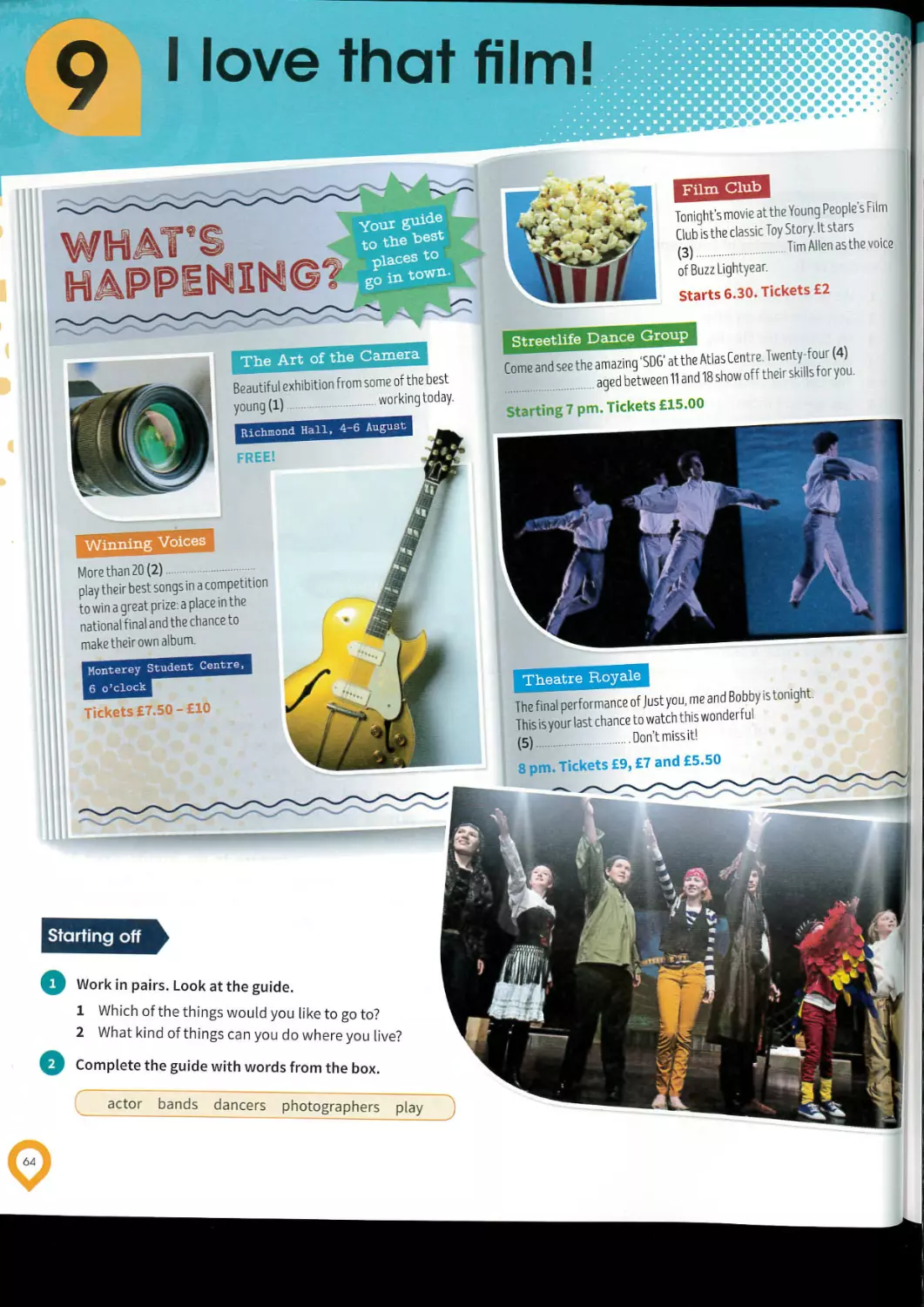
3 1 love that film!	64
10 It’s going to be sunny	70
/ocabulary and grammar review Units 9 and 10	76
11 1 like to keep fit	78
|l2 Have you ever been on a plane?	84
^ocabulary and grammar review Units 11 and 12	90
13 What’s your hobby?	92
^4 Keep in touch!	98
/ocabulary and grammar review Units 13 and 14	104
grammar reference
’hrasal verb builder
rregular verbs
^riting bank
>peaking bank
Extra resources
106
132
134
135
143
149
Map of the units
I 1 1 1 1	Unit title	Reading and Writing	Listening	Speaking
		Part 2: Three English teenagers Part 6: an email	Part 1: Five short conversations	Part 1, Phase 1 	i
	We’re going home	Part 1: signs and notices Part 7: a short story	Part 3: planning a party	Part 1, Phase 2
	Vocabulary and grammar review Units 1 and 2
	Dinnertime	Part 3: A young chef Part 5: completing a short text	Part 2: A cake competition	Part 2, Phase 1
	I I’m shopping!	Part 4: an article about Alek Wek Part 7: a short story	Part5: a fashion show	Part 1, Phase 2
	Vocabulary and grammar review Units 3 and 4
	- It’s my favourite > sport!	Part 3: an interview with a young gymnast Part 6: an email	Part 4: short conversations or monologues	Part 2, Phase 1
	r Have you got any J homework?	Part 2: Student life Part 5: completing short messages	Part 3: starting a new school	Part 2, Phase 2
	Vocabulary and grammar review Units 5 and 6
	Let’s go to the museum	Part 1: signs and notices Part 6: an email	Part 4: five short conversations	Part 2, Phase 1
	Did you get my j message?	Part 2: Three video makers Part 5: completing an email	Part 5: a computer fair	Part 1, Phase 2
	Vocabulary and grammar review Units 7 and 8
	I love that film!	Part 4: Paddington Bear Part 7: a short story	Part 2: a music concert	Part 2, Phase 2
	It’s going to be U sunny	Part 2: Holiday activities Part 5: completing a text	Part 1: five short conversations	Part 1, Phase 2
	Vocabulary and grammar review Units 9 and 10
	.J I like to keep fit	Part 3: A young personal trainer Part 6: an email	Part 4: short conversations and monologues	Part 2, Phase 1
	Have you ever been on a plane?	Part 1: signs and notices Part 7: a short story	Part 2: a park run	Part 1, Phase 2
	Vocabulary and grammar review Units 11 and 12
	What’s your 3 hobby?	Part 3: A teenage Go player Part 6: an email	Part 3: Horse-riding lessons	Part 2, Phases 1 and 2
	y| Keep in touch!	Part 4: Skywriting Part 5: completing a short text	Part 5: discussing website design	Parts 1 and 2
	Vocabulary and grammar review Units 13 and 14

[ Pronunciation	Vocabulary	Grammar	f
Word stress in numbers	Numbers Family members	Present simple Adverbs of frequency
Word stress: two-syllable words	Time Rooms Furniture	Present continuous have got

IslJzl.M	School lunches Food phrases	Countable and uncountable nouns How much / many: a few, a little, a lot
/1/ and /i:/	Clothes and accessories Adjectives Shops	Present continuous and present simple too and enough

schwa /а/	Sports do, play and go with sports Nationalities	Comparatives and superlatives Prepositions of time (at, in, on)
/v/and/f/	School subjects Classroom objects Education verbs	have to Object pronouns

Past simple -ed endings	Buildings Directions	Past simple Imperatives
can / can’t	Technology verbs Music	Past continuous can / can’t, could/ couldn’t

-ing forms	Suggesting, accepting and refusing Adjectives	Verbs with -ing or to infinitive The future with the present simple, present continuous and will
going to	What’s the weather like? Places	going to must / mustn’t

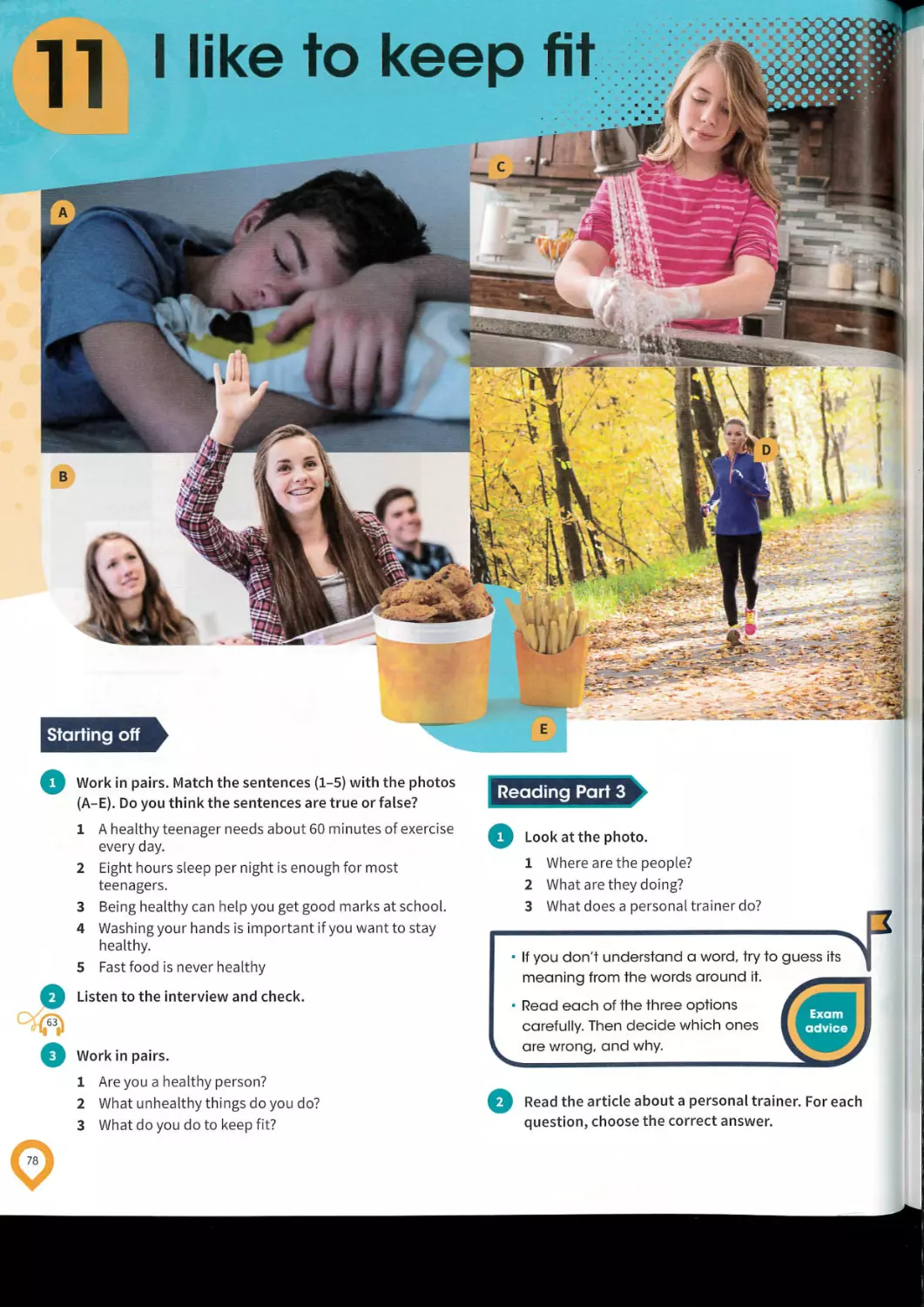
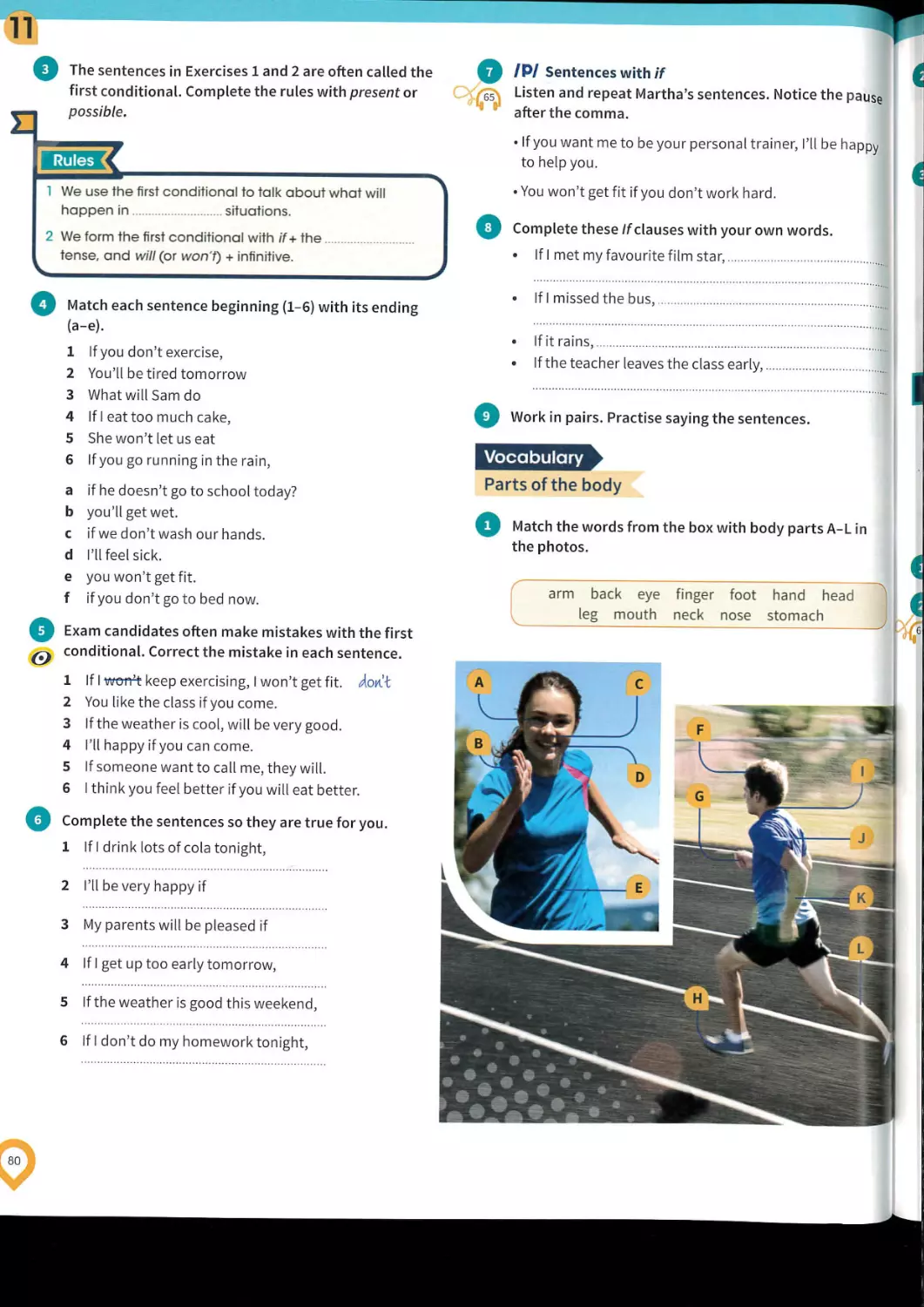
Sentences with if	Parts of the body What’s the matter? (ailments)	First conditional something, anything, nothing, etc.
/J7 and /tJ7	Means of transport Vehicles Travel verbs	Present perfect should / shouldn’t

/w//v//b/	Hobbies Adverbs Jobs	Present perfect with for and since may / might
Sentence stress	Communication verbs -ed / -ing adjectives	The passive Present perfect with Just, already and yet


Introduction
Who this book is for
Complete Key for Schools is a stimulating and thorough preparation course for students who wish to take the A2 Key for
Schools exam from Cambridge Assessment English. It teaches you the reading, writing, listening and speaking skills
which are necessary for the exam, as well as essential grammar and vocabulary. For those who are not planning to take the
exam in the near future, the book provides skills and language which are all highly relevant for school-age learners moving
towards an A2 level of English.
What the Student’s Book contains:
• 14 units for classroom study. Each unit contains:
-	an authentic exam task taken from each of the three papers in the Key for Schools exam. The units provide language
input and skills practice to help you deal successfully with the tasks in each part.
-	essential information on what each part of the exam involves, and the best way to approach each task.
-	a wide range of enjoyable and stimulating speaking activities designed to increase yourfluency and your ability to
express yourself.
-	grammar and vocabulary activities and exercises for the grammar and vocabulary you need to know for the exam.
When you are doing these exercises, you will sometimes see this symbol: (•) These exercises are based on research
from the Cambridge Learner Corpus and they deal with the areas which often cause problems for candidates in the
exam.
-	seven unit reviews. These contain exercises which revise the grammar and vocabulary that you have studied in each
unit.
-	Speaking and Writing reference sections. These explain the possible tasks you may have to do in the Speaking and
Writing papers, and they give you examples and models together with additional exercises and advice on how best to
approach these Speaking and Writing exam tasks.
-	a Grammar reference section which clearly explains all the main areas of grammar you will need to know for the Key
for Schools exam. There are also practice exercises for all grammar points.
-	extra online resources to help you with grammar, vocabulary and exam preparation.
Also available are:
•	Downloadable audio online containing listening material for the 14 units of the Student’s Book plus material for the
Speaking Bank. The listening material is indicated by coloured icons in the Student’s Book.
•	A Teacher’s Book containing:
-	step-by-step guidance for handling the activities in the Student’s Book.
-	a number of suggestions for alternative treatments of activities in the Student’s Book and suggestions for extension
activities.
-	Photocopiable recording scripts from the Student’s Book listening material.
-	complete answer keys including recording scripts for all the listening material. All sections of text which provide
answers to listening tasks are underlined.
-	14 photocopiable word lists (one for each unit) containing vocabulary found in the units. Each vocabulary item in the
word list is accompanied by a definition supplied by the corpus-informed Cambridge Learner's Dictionary.
-	access to extra photocopiable materials online to practise and extend language abilities outside the requirements
of the Key for Schools exam.
•	A Workbook containing:
-	14 units for homework and self-study. Each unit contains further exam-style exercises to practise the reading,
grammar and vocabulary, which also uses information about common exam candidate errors from the Cambridge
Learner Corpus & .
-	Vocabulary Extra sections, at the end of each unit, which contain further revision and practice of the essential Key for
Schools exam vocabulary in the Student’s Book units.
-	downloadable audio online containing all the listening material for the Workbook.
• A Test Generator containing:
-	a grammar and vocabulary test at standard and plus levels of each of the 14 units in the Student’s Book.
-	three Term Tests including grammar, vocabulary and exam tasks for: writing, speaking, listening and reading
-	an end of year test including grammar and vocabulary from all 14 units along with exam tasks for: writing, speaking,
listening and reading.
О
А2 Key for Schools content
and overview
Content
Exam focus
Part 1:	Discrete three-option multiple choice
questions on six short texts.
Part 2:	Matching. There are three short texts with
seven items. Candidates are asked to decide which
textan item refers to.
Part 3:	Three-option multiple choice. Candidates
read a text and are asked to choose the correct
answer from five multiple-choice questions.
Part 4:	Three-option multiple-choice cloze. A text
is followed by six questions. Candidates select the
correct word from each question to complete the
text.
Part 5:	Open cloze. Candidates complete gaps in one
or two short texts.
Part 6:	Writing - short message
Part 7:	Writing - story
Part 1:	Five short dialogues with three-option
multiple-choice questions with pictures.
Part 2:	Longer dialogue. Five gaps to fill with words
or numbers.
Part 3:	Longer informal dialogue with five three-
option multiple-choice items.
Part 4:	Five three-option multiple choice questions
on five short dialogues or monologues.
Part 5:	Matching. There is a longer informal dialogue.
Candidates match five items with eight options.
Part 1 Phase 1: Each candidate interacts with the
interlocutor, giving factual information of a personal
nature.
Part 1 Phase 2: A topic-based interview where the
interlocutor asks each candidate two questions
about their daily life.
Part 2 Phase 1: A discussion based on topic-based
artwork prompts. Candidates discuss the objects and
activities in the artwork with each other.
Part 2 Phase 2: The interlocutor leads follow-up
discussion on same topic as Phase 1. Each candidate
is asked two questions.
Part 1:	Candidates focus on overall understanding
of emails, notices and messages.
Part 2:	Candidates read for specific information
and detailed comprehension.
Part 3:	Candidates read for detailed
understanding and main ideas.
Part 4:	Candidates read and identify the
appropriate word.
Part 5:	Candidates read and identify the
appropriate word with the focus on grammar.
Part 6:	Candidates write a communicative note or
email of at least 25 words.
Part 7:	Candidates write a narrative of at least 35
words describing the people, events and locations
that are shown in three pictures.
Part 1:	Candidates are expected to listen and
identify key information.
Part 2:	Candidates are expected to identify and
write down key information.
Part 3:	Candidates listen to identify specific
information, feelings and opinions.
Part 4:	Candidates listen to identify the main idea,
message, gist, topic or point.
Part 5:	Candidates listen to identify specific
information.
Part 1: Candidates focus on interactional and
social language.
Part 2: Candidates focus on organising a larger
unit of discourse.
What do you see in the photos?
Complete the conversation with phrases from the box.
Listen and check.
Starting off
Do you like school? I’m 13. Nice to meet you.
-What’s your name?
i Hi, how
1 are you?

Thiago: Hey. (1)....
Sophie: My name’s Sophie.
Thiago: I’m Thiago. (2)................
How old are you?
Sophie: (3)............................
What about you?
Thiago: I’m 13, too. (4)...............
Work in pairs. Practise the conversation.
Give true information about yourself.
Sophie: Yes, I do!
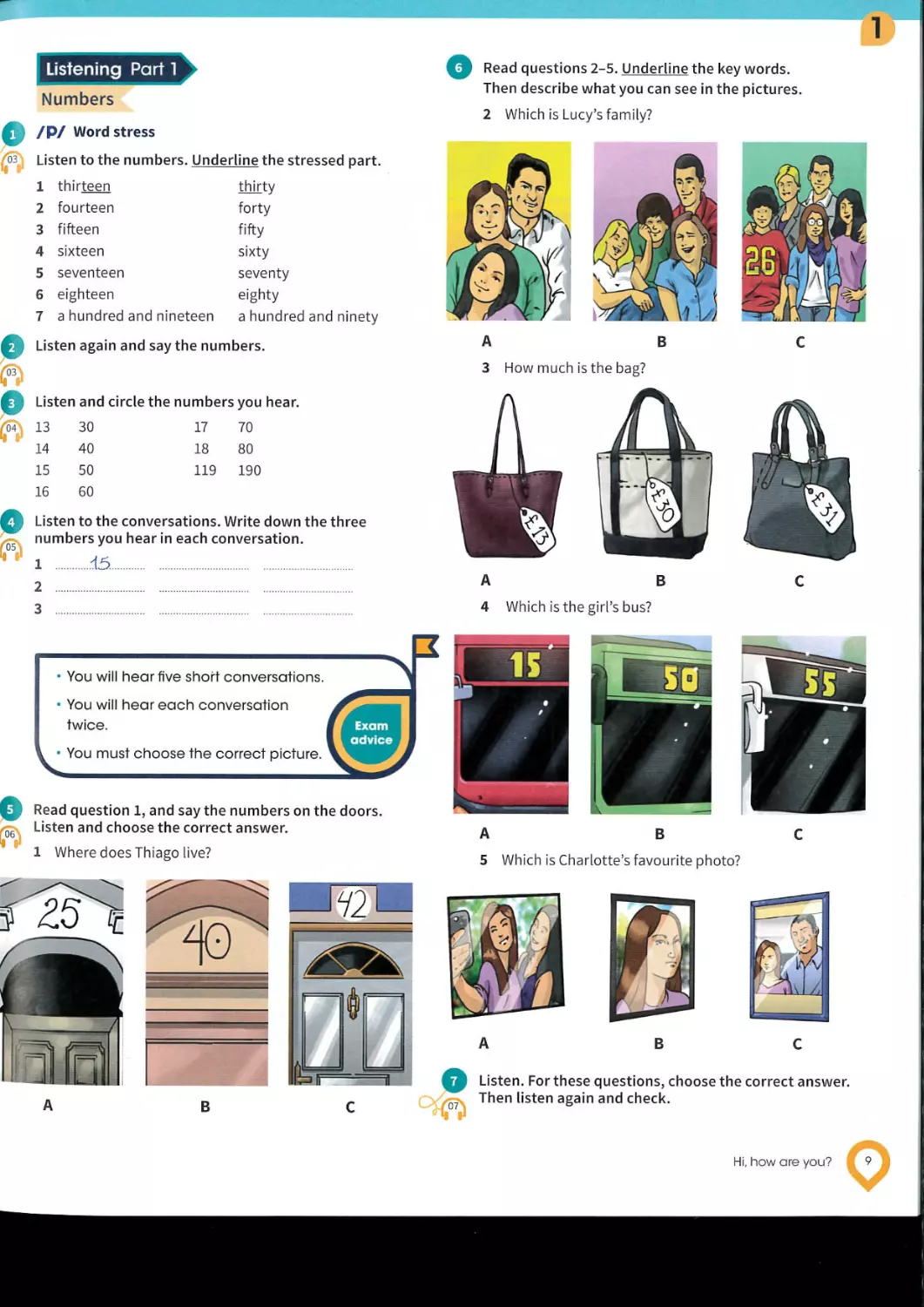
Listening Part 1
Numbers
/Р/ Word stress
Read questions 2-5. Underline the key words.
Then describe what you can see in the pictures.
2 Which is Lucy’s family?
<03
If
о
/04
о
nc
Listen to the numbers. Underline the stressed part.
1	thirteen	thirty
2	fourteen	forty
3	fifteen	fifty
4	sixteen	sixty
5	seventeen	seventy
6	eighteen	eighty
7	a hundred and nineteen	a hundred and ninety
Listen again and say the numbers.
A	В
3 How much is the bag?
Listen and circle the numbers you hear.
13	30	17	70
14	40	18	80
15	50	119	190
16	60
Listen to the conversations. Write down the three
numbers you hear in each conversation.
1 ......15....................................
2 ............................................
3 ............................................
A	В
4 Which is the girl’s bus?
• You will hear five short conversations.
• You will hear each conversation
twice.
• You must choose the correct picture.
Read question 1, and say the numbers on the doors.
Listen and choose the correct answer.
1 Where does Thiago live?
5 Which is Charlotte’s favourite photo?
Listen. For these questions, choose the correct answer.
Then listen again and check.
Hi, how are
Grammar
Present simple
Ask and answer questions with
Do ...?and Are...?
► Page 106 Grammar reference
Present simple
Rules
1	We use the verb to be to talk about age, nationality, etc.
brotker (3
2	We use the present simple to talk about things that are always
true or things that happen regularly.
-He’s vXAII^ ^ооД At footbAll.
-H^ Ito&s к ouv street.
Doyou Uke football? J
( Are you from France? )
7
Look at the photos. Talk about Adrian and Marcia using words
from the box. Then listen and check.
Complete the sentences with the correct
present simple form of the verb in brackets.
Use short forms.
My best friend’s name (1)	(be)
Dexter. He (2)	...(not be) from
England - he’s from America.
13 14 dancing France football
piano Poland tennis
He (3)	(love) sport, especially
football. I (4).........~...(not like) sport
at all, but Dexter and I (5)..........(be)
very good friends. We (6) ...........(live)
in the same street.
AXyiak is from "ToIakX. -H^ likens • • •
Sometimes, I (7)............(go) to his
house and watch films. He (8)............
(not have) any brothers or sisters. His mum
and dad (9)........... (be) really nice.
They both (10)..............(work) at
home. They (11).............(be) a very
happy family. Have you got a best friend?
Work in pairs. Take turns to tell your
partner about one of these people. Then
ask and answer questions about them.
Use the ideas below.
best friend brother father
mother sister teacher
My best friend is from Spain.
She lives in Malaga.
be funny? be tall?
do sport? like music?
( Does she do any sport?
Look at Carl’s family tree.
Complete the sentences with words from the box.
aunt brother cousin daughter granddaughter
grandad -grandma grandson husband sister
son uncle wife
1	Janet is Carl’s..............
2	Tom is Carl’s................
3	Tom is Janet’s...............
4	Janet is Tom’s..............
5	Alan is Carl’s...............
6	Gina is Carl’s...............
7	Bob is Carl’s................
8	Carl is Steve and Mary’s...............
9	Megan is Steve and Mary’s................
10	Megan is Carl’s..............
11	Carl is Megan’s..............
12	Bob is Tom and Janet’s.................
13	Megan is Tom and Janet’s.................
Q Work in pairs. Draw your family tree. Ask and answer
questions about your partner’s tree.
Reading Part 2
•	There are three short texts about a similar
topic, and seven questions.
•	You must match each question with
one of the texts.
The questions are not in the same
order as the information in the text.
Work in small groups. Discuss the questions.
Are you similar or different?
•	How old are you?
•	Where do you live?
•	Who do you live with?
• Do you like sport?
• Do you like music?
Reading Part 2 often asks you to find information.
Look at these extracts. Who has a brother and sisters?
Ellie: I’m 12 and I live in a city with my parents, my two
sisters, Mel and Sue, and my little brother, Mark.
Laura: I live with my mum and dad. I’m nearly 13 and
I don’t have any brothers or sisters.
Chloe: I’m 13 years old - two years older than my little
sister, Monica.... I don’t have any brothers ...
My dad is a mechanic. My mum isn’t from
England ...
Hi, how are you?
1
Look at the questions in Exercise 4 and underline
the key words in each question.
О For each question, choose the correct answer.
	Ellie	Laura	Chloe
1 Who has a brother and sisters?	A	В	С
2 Who doesn’t like sport?	A	В	С
3 Who says she wants to go to university?	A	В	с
4 Who is the oldest?	A	В	с
5 Who has a pet?	A	В	с
6 Who has a friend from another country?	A	в	с
7 Who can play a musical instrument?	A	в	с
Grammar
Adverbs of frequency
► Page 107 Grammar reference
Adverbs of frequency
Look at this information about Ellie’s week. Then
complete the diagram with the underlined words.
1 Ellie always gets up at 7.00 am.
2 She usually does her homework in the evening.
3 She is never late for school.
4 She often goes shopping on Saturday.
5 She sometimes does the washing-up at home.
mdu.
► ELLIE____________________________
I’m 12 years old and I live in London with
my parents, my two sisters Mel and Sue,
and my little brother, Mark - oh, and our
dog, Rufus! I’m the youngest girl in my
family. Mel and Sue are both 19. They are
at university. My best friend is called Stef.
She’s really funny and very good at playing
the guitar. She’s in a band. They’re playing
at the school party tonight.
Listen and complete the sentences about Stevie.
1 Stevie....AlM^.....gets up at 8 o’clock.
2 He...............does	his homework in the morning.
3 He is...........late	for school on Mondays.
4 He..............goes shopping on Wednesdays.
5 He..............does the washing-up.
Complete the rules with before or after.
I live with my mum and dad in a small
LAI/RA
town in the north. I’m nearly 13.1 don’t
have any brothers or sisters. My mum is
a musician, and my dad teaches at the
university. I hope to study there when
I’m older. It’s my birthday next week
1 Adverbs of frequency come
2 Adverbs of frequency come
the verb to be.
other verbs.
and I’m having a party. I’m inviting all my friends. We’re
having lunch then going to a football match. My best
friend Anya is from Poland. She hates sport, but she’ll
Exam candidates often make mistakes with adverbs of
frequency. Correct the mistakes in the sentences.
1 I stay-often at the beach, often «stAbJ
still have fun!
2 You are welcome always in my home.
3 I usually can go out with my friends on Saturdays.
► (нюе
4 Our teacher forgets never our homework.
5 My dad goes often to work by bus.
I’m 13 years old - two years older than
my little sister, Monica. I don’t have any
brothers. We live in a big family house in
a village. I don’t have any pets, but I’d
really like a cat! My dad is a mechanic. My
mum isn’t from England. She’s Spanish
and she teaches languages at my school.
Everyone in my family plays some kind of
sport, but I don’t like sports very much.
All I play is my piano!
6 I usually am a good student.
Write sentences about yourself.
am happy am hungry do sport
do the washing-up ride a bike walk to school
Work in pairs. Ask and answer How often ...? questions
about your sentences from Exercise 5.
Speaking Part 1
Writing Part 6
► Page 146 Speaking Bank
Speaking Part 1
•	There are two main parts in the Speaking
paper.
► Page 139 Writing Bank
Writing Part 6
•	There are two parts in the Writing test.
•	First, you must write a note or an email.
• In Part 1, you will talk with the examiner for
three or four minutes.
• The examiner will first ask you about
your name, your age, and where
you are from.
You must write 25 words or more.
There are three points you need to
write about.
Read this email. Underline the three points you need to
write about.
Hi,
My name is Alex. I’m your new pen friend. I’ve got a
little brother, and I love playing football. Have you
got any brothers and sisters? What things do you like
doing? What kind of music do you like?
Alex
Read two students’ answers to the email. Which student
answers all the points in Alex’s email?
0 What things do you ask a person about when you meet
them for the first time?
Q Match questions 1-6 with answers a-f. Then listen
<10 and check.
1	What’s your name? e.
2	Where are you from?
3	How old are you?
4	How many people are in your family?
5	Who in your family do you like spending time with?
6	How often do you meet your friends?
a I’m from Sao Paulo. In Brazil.
b There are five people.
c I’m 13 years old.
d I like spending time with my grandma.
e My name is Gabriel Silva.
f I meet them every day.
0 Work in pairs. Ask and answer questions 1-6 from
Exercise 2.
Hello Alex
My name is Juan. I’ve got three brothers and one
sister. I love spending time with my friends and I
enjoy sports. I like all kinds of music - but Taylor
Swift is my favourite!
Juan
Hi Alex
Thanks for your email. My name is Stef and I am your
pen friend. Tennis is my favourite sport. I love it. My
mother doesn’t like it.
Stef
Write your own answer to Alex’s email. Write 25 words
or more.
Hi, how are you?
13
We're going hom
Starting off
What kind of home can you see in the photos
Which one would you like to live in? Why?
Work in pairs. Which homes do you think have
these things?
Listening Part3
a door a first floor a garage a gate a lift
a roof stairs a swimming pool windows
Work in pairs. Look at the
party invitation.
1 What kind of party is it?
2 What time does it start?
3 Where is the party?
Invitation
What kind of home do you live in? What does it have?
Use words from Exercise 2.
We’ve got a new house!
Come to the Bakers'party.
Date: July 31
Time: 12.30
Time
Grammar
Listening Part 3 sometimes has a question about time.
Look at the clocks. Match them to the times (1-6).
1
2
3
two o’clock
quarter past four
half past twelve
Present continuous
► Page 108 Grammar reference
Present continuous
It’s Jake’s surprise party. Look at the picture. Are these
things true (T) or false (F)?
4 quarter to ten
5 twenty-five to three
6 ten past eight
• There are five multiple-choice questions.
• You must choose between three
possible answers: A, В or C.
The answers may be
sentences, numbers or words.
For these questions, choose the correct answer. You will
hear Jarred talking to his friend Gemma about a party.
1 How does Jarred feel about Jake’s party?
A worried В excited C surprised
1	Emily is eating a sandwich.
2	Jenny is writing an email.
3	Jarred is singing.
4	Suzy is wearing sunglasses.
5	Simon is enjoying the party.
6	Jake and Rachel are dancing.
7	Martin isn’t taking a selfie.
2 What time does the party start?
Choose the correct option in italics to complete the
rules.
A 2.00	В 2.30	C 3.00
3 Rachel is Gemma’s
A cousin В friend
C brother
Rules
4 The party is at
A 14 Green Street В 24 Green Street C 40 Green Street
5 What sort of music does Jarred think is best for
parties?
A pop	В hip hop C rock
1 We use the present continuous to talk about things that
are happening now / usually happen.
2 We form the present continuous with to be / to have and
the -ing form of the verb.
Do you like parties? What do you like doing at parties?
We're going home
Correct the sentences.
1 He is sleeping, (play)
-He isH/t
-H^
Listen and tick (/) the correct answers.
2 She is writing, (read)
1	Is he running?
A Yes, he is. /
В No, he isn’t.
2	Are they dancing?
A Yes, they are.
В No, they aren’t.
3	Is she typing?
A Yes, she is.
В No, she isn’t.
4 Is he playing?
A Yes, he is.
В No, he isn’t.
5 Are they singing?
A Yes, they are.
В No, they aren’t.
3 She’s watching TV.
(listen / to music)
4 They’re laughing,
(cry)
Vocabulary
Complete the questions. Write true answers.
1		Алт.......you sleeping?
No, I’m not..............................
2		you sitting down?
3		your friends sitting near you?
4		your teacher helping you?
5		it raining?
Student A, look at the picture on Page 149. Student B,
look at the picture on page 150. What is different? Ask
and answer questions.
( What’s David doing in your picture?
Rooms
bathroom -bedroom diningroom garage
garden hall kitchen living room
Label the picture of Jake’s new house.
Listen. What room are they in?
13..
Work in pairs. Take turns to say what you are doing.
Your partner tries to guess what room you are in.
Reading Part 1
Work in pairs. Look at the messages in Exercise 2.
Where are they (in a restaurant, on a phone, etc.)?
1
Mum, I’m in my bedroom
and I’m studying.
Can we have dinner at 8
o’clock after I finish all my
homework? Thanks.
Ben

A Ben wants to do his
homework in the dining
room.
В Ben doesn’t want
dinner before he
finishes his homework.
C Ben has got a lot of
homework and doesn’t
want any dinner.
For each question, choose the correct answer.
You will read short messages (short emails,
text messages, notices,
emails or labels).
• There are three options.
Choose the option which means
the same as the short message.
Hi Steve,
I’ve got the present for Miguel. It cost $12, so can you give me half
of that when you see me?
Thanks,
Chloe
Hi Angela,
Our swimming lesson is at 3 o’clock instead of 3.30.
Mum can pick us up at 2.50. Don’t forget your swimming hat,
Dan.
Chloe wrote this message because
A she wants to borrow money to buy a present.
В she needs ideas about what present to buy.
C she wants to share the cost of a present.
Dan wants Angela to
A take him to swimming classes.
В be ready earlier than usual.
C meet him at the pool.
Seavista Restaurant
Opening this weekend. Free food for children
A The restaurant is old.
В The restaurant has great food.
C Guests don’t have to pay for children’s meals.
Toby, Julie’s party starts at 5pm, but we have football then.
We can go afterwards at about 6pm. Let me know what you think.
Kyle.
What should Toby do now?
A Tell Kyle if he agrees to go to the party late.
В Find out what time the party begins.
C Ask Julie if he can come to the party.
IMPORTANT NOTICE.
Class 5C English is in Room 4 today.
(Z..Z5 start, as usual)
A This lesson is in a different place today.
В This lesson is not happening today.
C This lesson begins a bit later today.
We're going home ’ 17
Grammar
Vocabulary
have got
Furniture
► Page 109 Grammar reference
have got
Match the sentences with the pictures.
Label the picture.
bed bookshelf carpet chair curtains
desk lamp
1 I’ve got the present for Miguel.
2 Ben has got a lot of homework.
Choose the correct option in italics.
1	I have got/has got blue eyes.
2	My dad hasn't got/haven't got dark hair.
3	Have/Has you got a big bedroom?
No, I haven't/hasn't.
4	I hasn't/haven't got a desk in my room.
5	Have/Has your brother got a new smart phone?
Yes, he have/has.
6	This is my cat. It has/have got a long tail.
Write five true or false sentences. Read them to your
partner. Guess if they are true or false.
/Р/ Word stress (two-syllable words)
Listen to the words. Underline the stressed parts.
bedroom	curtain
bookshelf	kitchen
carpet	table
Listen again and repeat the words.
Write sentences to describe your room. Practise saying
them to your partner.
I’ue ^ot пД Ik ж^ ЬеХгоож.
I’ve got four brothers/^
( Yes, I have. It’s true!
( False! You haven’t got four brothers.
18
Speaking Part 1
Writing Part 7
► Page 146 Speaking bank
Speaking Part 1
► Page 141 Writing bank
Writing Part 7
• There are three pictures.
• You must write a short story.
You must write 35 words or more.
In the second part of Speaking Part 1, the
examiner will ask two questions about a
topic.
Then, the examiner will say
Please tell me something about
.... You should say at least
three things.
0
О
Listen to two students doing Speaking Part 1.
1 What does the examiner want to know?
2 How many things does each student say?
3 Which student gives the best answer?
Write three true things for each answer.
1 Please tell me something about your
school.
It’s a big school. It’s got a swimming pool.
I like it.
2 Please tell me something about your
English teacher.
His/Her name is...................
3 Please tell me something about your
favourite hobby.
My favourite hobby is..............
4 Please tell me about a nice day you
spent with your family.
Work in pairs. Look at the pictures. Write down things you can see.
•	How old is he?
•	Where is he?
•	What is he doing?
•	How does the boy feel?
Which idea do you like best? Why?
Jack is walking home from
school.
о
о
о
Discuss the questions.
Picture 1
•	What do you want to
call the boy?
Picture 2
•	Where is the boy?
Picture 3
•	Who can you see?
•	What are they doing?
Read theses ideas for picture 1.
1	This is Jack. He is 13	3
years old.
2	One day, Jack walks
home from school.
Finish writing the story.
Work in pairs. Discuss the topics from Exercise 2.
We're going home 19
Vocabulary and
grammar review
Grammar
Vocabulary
Complete the email with the present simple form of the
verbs in brackets.
Hi,
My name (1) ...Ls... (be) Carla. I (2)............(live)
in England with my family. I (3)..................(have)
a brother called Sam. I (4)..................(not	have)
any sisters. I (5)...........(love) dancing.
Sam (6)...............(love) sports, but he
(7).............(not like) school.
I think school (8)...........(be)	OK, but I
(9).............(not like) sports.
My parents (10)..............(be)	teachers. They
(11)..............(not	work) at our school. I
(12)..............(be)	happy about that!
Write soon!
Carla
Complete the number lists.
1	three, four, five, six,	, eight, nine
2	eight, ten,............,	fourteen, sixteen
3	ninety,.............., seventy, sixty, fifty
4	twenty,.............., thirty, thirty-five, forty
5	thirteen, twelve, ............,	ten, nine, eight
6	one hundred, one hundred and ten,.................
one hundred and thirty
7	twenty-two, thirty-three, ...........,	fifty-five
8	three, six, nine, twelve,............,	eighteen
Complete the crossword with family members.
Put the frequency adverbs in the correct place.
нему*
1	I am л late for school, (never)
2	We go shopping in the evening, (often)
3	My dad has breakfast at 7.30 am. (usually)
4	Dan does the washing-up. (never)
5	Do you do your homework in the morning? (often)
6	I watch TV in the evenings, (sometimes)
7	Maths lessons aren’t fun. (usually)
8	Soraya is happy! (always)
Across
1 My father is my mother’s...
3 My mother’s mother.
5 My dad’s brother.
8 My parents’ daughter.
9 My brother is my mother’s...
Down
2	My parents’son.
3	My brother is my grandfather’s...
4	My mother’s sister.
6 My uncle’s daughter.
7 My mother is my father’s...
Vocabulary and О
grammar review
Grammar
Vocabulary
Put the words in the correct order.
1	three brothers / has / Greg / got
kAS ^0.t tkYZ&.bYDikLYS..............-..................
2	haven’t / your /1 / got / pen
3	got / All my friends / laptops / have
4	black hair / My grandfather / got / hasn’t
5	got I You / a nice room / have
6	you / my book / Have / got ?
7	got / a car / We / haven’t
8	sister / a big desk / got / Has / your ?
Look at the clocks. Write the times.

1 ^uAvter to fouv 2	........
A Look at the pictures. What are the people doing? Write
sentences using words from the box.
laugh listen to music play football
read a book swim write a story
1 \YkeAs listening to wu-sic.
Put the words in the correct order to make words for
rooms and furniture.
Rooms
1 LAHL _........ Ы1
2 MOTHBORA
3 THICNEK
4 MOREBOD
Furniture
5 DEB
6 SKED
7 HARCI
8 BETAL
Vocabulary and grammar review
Starting off
Reading Part 3
Work in pairs. What types of food can you see in the
photos? Write down the English words that you know.
fruit and
vegetables meat and
fish
dairy
other types
of food
Which food in the photos do you like best?
Which is healthy?
What is your favourite meal? Find someone in your class
who has the same favourite meal as you.
• Reading Part 3 tests your understanding
of a long text.
•	There are five multiple-choice
questions.
•	You must choose between three
^^possible answers: A, В or C.
Work in pairs.
•	Do you know any recipes?
•	Do you help in the kitchen? What do you do?
recipe (noun) a set of instructions telling you how to
prepare and cook food, including a list of what food you
need for this

3
Young chef
14-year-old Marc Weiner has
his own cooking show on TV.
Marc, when did you start
cooking?..........................
I started helping my mum in the
kitchen when I was six. I made her
coffee - it was terrible! I was seven
when I made my first meal - a pizza
with four different kinds of cheese.
Do you have a favourite recipe? • •
It’s hard because I have so many. The easy ones are fun - things
with pasta, tomatoes and onions. My favourites are the ones that
include fish. There are so many different things you can do!
What do your parents think of your cooking? • • • ........
When I won my first competition, my mum and dad understood
that I was a real chef. They’re glad that they don’t have to make
dinner every night, and they enjoy my food - usually! But, you
can’t make everyone happy all the time.
What’s the best way to get good at cooking?............  •	•
First, I threw away some of what I made because it was no good
-that’s how you learn. Then, I did it differently the next time. You
need to practise, so if you know a chef, ask if you can help them
in the kitchen sometimes.
Finally, what’s it like being on TV? ......................
It’s interesting. I’m actually a very quiet person, so I’m amazed
that I really enjoy myself making the shows. They’re watched by
millions, but I still find it strange when people I don’t know say
hello to me in the street.
ft For each question, choose the correct answer.
1 How old was Marc when he started cooking?
A four
В six
C seven
2 Marc says that his favourite recipes
A use one kind of food.
В are easy to make.
C include a variety of vegetables.
3 What does Marc say about his parents?
A They are happy that he wins prizes for cooking.
В They get bored of cooking the same things.
C They don’t always like his cooking.
4 What does Marc think is the best way to improve?
A Cook every day.
В Go to cooking classes.
C Learn from your mistakes.
5 How does Marc feel about having a TV show?
A happy that he is now famous
В surprised at how much fun it is
C excited by talking to so many people
Vocabulary
School lunches
Label the lunches with the words from the box.
apple banana biscuits cake cheese chicken
icecream lemonade orange juice
-sandwiches salad rice water
1 ...s^nA^lctos...	8	.............
2 ......................... 9	..............
3 ........................ 10	..............
4 ........................ 11	..............
5 ........................ 12	..............
6 ........................ 13	..............
7 ...............
Listen to three students talking about their school
lunches. Match the names with lunches A-C in Exercise 1.
i
Becky..............
Murray.............
Tina...............
Work in pairs. Say what you have for lunch at school. Use
adverbs of frequency (always, usually, sometimes, etc.).
/Р/ /s/,/z/,/iz/
Listen and underline the end-of-word -s in each word.
Notice how they sound different.
Murray likes his mum’s chicken sandwiches.
Listen and complete the table with words from the box.
apples chips dishes fridges onions wants J
/s/	|	/z/	| /iz/
Illas
mums	sAH.X^(6kes
Dinner time
-
3
Grammar
Countable and uncountable nouns
► Page 110 Grammar reference
Countable and uncountable nouns
Mia and Noah are shopping for food. Look at what
they’ve got in their shopping baskets and read the
statements. Whose basket is full of countable food?
Whose is full of uncountable food?
Rules

Mia: I’ve got some cheese, butter, orange juice and
chocolate in my basket.
Noah: I’ve got three tomatoes, an onion, four carrots,
and six eggs in my basket.
Complete the rules with Countable or Uncountable.
Rules
nouns do not take a/an or a number.
nouns have a singular and a plural torm.
nouns do not have a plural form.
nouns can take a/an or a number.
Complete the table with the words from the box.
biscuit -bf-ead -burger chips grape
milk rice tea
countable
uncountable
Read the conversation. Then complete the rules with
some or any.
Noah: Hi Mum, it’s Noah. I’m in the supermarket.
Have we got any cheese in the fridge?
Mum: Let me see... yes, we’ve got some cheese.
Noah: Have we got any lemons?
Mum: No, we haven’t got any lemons. Can you get
two or three, please?
Noah: Sure. Would you like me to get some chocolate?
Mum: No, thanks. But could you get some biscuits?
Noah: OK.
in positive sentences, otters
We usually use
and requests.
We usually use....
in questions.
in negative sentences and
Complete the conversation with a/an, some or any.
Then listen and check answers.
Mia: Dad, I’m hungry.
Dad: Would you like (1)..............apple?
Mia: No, thanks. I don’t like apples. Can I have
(2)...................cheese?
Dad: No, we haven’t got (3)
Mia: Have we got (4).......
Dad: Oh yes. There are (5)..
Mia: Great! I’ll have (6)..
Dad: Me too!
......., I’m afraid,
biscuits?
.....in the cupboard.
...biscuit, then!
Can I have a orange?
On Sundays, we have great time together.
I start a work at eight o’clock.
I bought a black trousers and a pink T-shirt.
Don’t forget to buy a milk.
Do you know shops near here?
Exam candidates often make mistakes with a/on,
some and any. Correct the mistake in each sentence.
1
2
3
4
5
6
Work in pairs. Choose three things to eat and three
things to drink from this section. Write them on a piece
of paper. Take turns to offer your partner something.


Would you like some milk? J
No, thanks. I don’t like milk. Have you got any... ?
2
Listening Part 2
Grammar
How often do you eat cake? Do you eat it when you have
a special day?
How much / many, a few a little a lot of
► Page 111 Grammar reference
How much/many; a few; a little; a lot of
• There are five questions and an example.
You must write five pieces of information
to complete the notes.
The information can be a number,
time, date, word or spelling.
Mia wants to enter the cake competition. Listen and
complete the conversation with words from the box.
a few (x2) a little a lot much -many j
Mia: I want to make a cake forthe cake competition.
Dad: What do you need?
Mia: Let’s see ... eggs.
Dad: How (1)...............do you need?
Mia: Just (2)..............I Three, I think.
I also need (3).............milk for my recipe.
Dad: How (4)...............do you need?
Mia: I don’t need (5).............of milk. Just half
a cup. And it’s a lemon cake, so I think I’ll need
(6).............lemons.
Dad: Really? How (7)..............?
Mia: Let me see - oh, actually I only need one.
Which phases from Exercise 1 can we use with countable
nouns? Which can we use with uncountable nouns?
Choose the correct options in italics.
1 A: How many / much chocolate have we got?
A Match questions 1-5 in Exercise 3 with the answers
(a-f).
a a day or date 0
b food
c a person’s name
d number
e time
f prize
gj For these questions, write the correct answer in each
'20 gap. You will hear a teacher talking to her class about a
cake competition. Write one word or a number or a date
or a time.
B: We’ve got much / a lot ofchocolate left.
2 A: How many/ much juice is in the fridge?
B: Just a little / a few. Leave some for me.
3 A: How many / much apples do you eat in a week?
B: A few/A little. About three.
4 A: How many/much brothers have you got?
B: I’ve got seven.
A: That’s a little/a lot of brothers!
5 A: How many/much sandwiches do you want?
B: Just a few/a little, please. I’m not very hungry.
When: (0) Monday 3rd May
Time: (1)
Where: (2) Room number
Cakes must include: (3) flour, butter, sugar and
More information from: (4) Mrs.............
Prize: (5)
Work in pairs. Ask questions with How much/many.
Use the ideas in the table and a few, a little, a lot of.
How many aunts and
uncles have you got?
I've got a lot of aunts, but
I haven’t got any uncles.
I have got?	I eat	I drink?
friends	fruit	milk
books	biscuits	bottles of water
music	chocolate	tea
Dinnertime
Vocabulary
Reading Part 5
Food phrases
Look at the menu. What would you like to eat and drink?
cereal
cheese
toast
sausage
cake
fruit
water
milk ПЗ
PM
tea
juice
coffee
Listen to three people talking about breakfast. Write
В (Becky), T (Tina) or M (Murray) next to each menu item.
Look at the photos. Use the words in the circles to say
what you can see.
plate
bowl box
a slice cup can
glass
bottle
bread
tea cereal
of fruit meat cola
cake water
milk
How many other food phrases can you make?
A bo^l of teveAl, А бар of toffa . . .
Work in pairs. Tell your partner what you usually
have for breakfast.
I usuAlltj Mue a slise of toAst акД . . .
•	You must complete a short email
or message.
•	There are six missing words.
•	You must write one word in
each space.
•	You must spell the word
correctly.
Read the text below quickly. What kind of text is it?
Work in pairs. Look carefully at the words before ant
after each gap. What kind of word fits each gap?
•	a verb, e.g. know, //ke, be ...
•	a quantifier, e.g. many, a few, a little
•	a preposition, e.g. on, of, at...
•	a pronoun, e.g. I,you, me...
•	a question word, e.g. When, What, How...
For each question, write the correct answer.
Write one word for each gap.
Hi Sue,
It’s my birthday (0)...on......Friday. Would you
(1).............to come to my house for dinner? My
parents say I can invite a (2).........friends.
Tom and Sophie (3).............coming. It’s going
to be fun! (4)............time	can you get to my
house?
You don’t have to bring anything. There will be lots
(5).............cake and lemonade!
I hope you can come. Please call me (6)...........
my phone when you have time.
Love,
Teri
Speaking Part 2
Page 147 Speaking bank
Speaking Part 2
Now listen to two students talking about
23 one of the pictures. Which picture are they
talking about?
• In Speaking Part 2, you must talk to your partner.
• The examiner gives you some pictures
and a question.
• You and your partner talk together for
about two minutes.
ф Work in pairs. Which things can you see in the pictures?
beach home fast food place restaurant school
Write one question about each picture.
Use Do you like ... ? and Do you think... ?
(ike in
£5o tkiKk	fun?
Look at this part of the conversation and
complete the rules.
A:	Do you like eating in restaurants?
B:	Yes, I do.
A:	Why?
B:	Because restaurants have usually got
different kinds of food. What do you
think?
A:	I don’t like restaurants.
Do you like eating in these different places?
B:	Why not?
A: Because...
Rules
1
2
We use Why / Why not to ask follow-
up questions to positive statements.
We use Why / Why not to ask
follow-up questions to negative
statements.
1
2
3
4
Write Why? or Why not? after each
statement.
I don’t like fast food.
I think picnics are fun..........
My brother doesn’t like school
lunches..............
I love my grandparents’ cooking.
5
I don’t like British food.
Work in pairs. Ask your questions from
Exercise 3. Ask follow-up questions like
Why?I Why not?
Look again at the pictures from Exercise 1.
Which do you think is the best place to eat?
Dinner time 1 ; 27
Match the words (1-12) with the clothes in the pictures.
Listening Part 5
1	belt C	7	shirt
2	boots	8	shoes
3	dress	9	coat
4	hat	10	trousers
5	jacket	11	sweater
6	jeans	12	sunglasses
Work in pairs.
•	How often do you go shopping for clothes?
Do you like it? Why? / Why not?
•	Where do you usually buy your clothes?
•	Do you wear a school uniform?
•	What do you usually wear at the weekend?
•	What’s your friend wearing today?
Look at the information below.
1 Where is the fashion show?
2 Where do the clothes come from?
3 Who are the models?
Park Hill School
Fashion Show
Tickets
Friday 5th May, 5.30-6.30
Come and see student models wearing the latest
fashions from local clothes shops.
28
4
clothing is Pip wearing?
Listen to the first part of a conversation. Which item of
You must match the things in the list on
the right (A-H) with the words or
names in the list on the left (1-5).
Two of the words in A-H are not used.
25
For these questions, choose the correct answer. You will
hear Pip and Sara talking. What is each person wearing?
Then listen again and check.
People
0 Pip
1 Ben
2 Amy
3 George
4 Alice
5 Katy
Clothes
A belt
В boots
C coat
D dress
E hat
F jacket
G jeans
H sweater
Grammar
Present continuous and present simple
Match rules 1-3 with examples a-c.
Rules
1	We use the present simple to talk about things
and actions that happen a lot, or usually.
2	We also use present simple verbs to talk
about states that don't change (not actions).
3	We also use the present continuous to talk
about things that are happening now.
a I'm wearing a suit.
b You usually wear jeans and a T-shirt.
с I think you look great.
4	.________________________________________________/
Choose the correct option in italics.
1	Listen! Olivia plays / is playing the guitar.
2	I don’t usually wear /’m not usually wearing jeans.
3	Do you know / Are you knowing my sister?
4	We have I ’re having a great time on holiday this week.
5	I don’t understand / am not understanding this.
6	Bella can’t speak now. She has / is having her dinner
at the moment.
► Page 112 Grammar reference
Present continuous and present simple
ф Read the online chat. Underline the present continuous
verbs, and(circle)the present simple verbs.
Complete the questions.
1 What music / you / usually / listen to ?
/Окд-t Ao usuaIU) listen -to?
2 your dad / often / wear /jeans ?
3 you / enjoy / this exercise ?
George Jones
is enjoying the school fashion show. $
Jake Thomas
Cool. Are you a model? Or are you watching?
George Jones
I’m a model!
Madison Green
What are you wearing, George?
George Jones
I’m wearing a suit. Look.
Jake Thomas
Ha ha! You look funny. Now I know why you
usually wear jeans and a T-shirt.
Madison Green
I think you look great, George.
4 What time / you / usually /go to bed ?
5 What/you/thinkabout/atthe moment?
6 What I the teacher / do / now ?
Work in pairs. Ask and answer the questions.
Vocabulary
Adjectives
О
Match the adjectives with their opposites.
dirty expensive light new short small
cheap clean dark large long old

Complete the sentences with adjectives from Exercise 1.
1 My jacket was only €3. That’s very....скмр
. I need new ones.
5 When you ride your bike at night, it is not safe to
wear...................colours.
2 These gloves are very
3 I can’t put this sweater on. It’s really......
6 €30 for a pair of socks? That’s...........!
Look around the room. Write three true sentences and
one false sentence about what you see. Use adjectives
from Exercise 1.
'Jke teAckw is ^eAvin^ А jA^ket.
4
Reading Part 4
Look at the photos of Alek Wek. Who do you think she is?
Look at the sentences in the article about Alek Wek.
Try to fill the gaps without looking at options A, В or C.
Use these questions to help you.
What is she doing?
Gapl: Do you think her life was easy?
Read the article below quickly and answer the questions.
1 Where is Alek Wek from?
2 Where did she study?
Gap 2: What word do you use to say how old someone is?
Gap3: Do good students learn slowly?
Gap 4: What word do you use to get money by
working?
3 What does she do now?
Gap 5: Think of a word that goes with very.
Gap 6: Think of a word that is about time.
Read the article about Alek Wek again. For each
• Reading Part 4 mostly tests vocabulary.
• You must complete a short text.
• You must choose the correct
answer (A, В or C) for each space.
wrong
time
already
pay
5
A
excellent
В
favourite
C
beautiful
long	C
wide
A
A
A
A
В
В
В
В
С
С
С
с
heavy
year
quickly
win
difficult
age
early
earn
question, choose the correct answer.
1
2
3
4
6
A
far
В

Alek Wek was born in South Sudan in 1977. She had a
................life there because there was a war. At the
^2)	of 14, she left her family in Sudan and
moved to London to live with her sister.
Alek learned English very (3)	_.__  She^aS|L
good student, and she also worked hard after schoolto
money which she sent home to her mother.
When she was eighteen she went to college and studied fashion,
technology and business.
She was very (5)............and	one day a person from a
model agency saw her in the street and asked her to work. for
thpm it wasn’t (6)	... before she became a rich and
famous model. Now she works to help people in South Sudan.
Grammar
Vocabulary
too and enough
Shops
► Page 112 Grammar reference
too and enough
Read and listen to a conversation in a shop. Complete
the conversation with one word in each gap.
I 26 \
Where can you buy the things in the pictures?
Girl:	Oh dear. I think this hat is too
(1)...............
Assistant:	You’re right. It isn’t (2)............
enough foryou.
Complete the rules with too or enough.
Complete the sentences with an adjective from the box
chemist department store supermarket
and too or enough.
clean -cold expensive fast heavy old
1 Look at the snow! It’s....too..6oU....to go out today.
2 Sam is only 12. She isn’t.............to drive a car.
о
о
3 I can’t carry this. It’s.............
4 He isn’t...............to win this race.
5 I can’t buy that jacket because I’ve only got £10.
It’s.................
6 You can’t wearthosejeans. They aren’t..........
Work in pairs. Imagine you want to buy a birthday
present for your friend. Use too or (not) enough to say
what is wrong with these ideas.
a banana a horse a house a new laptop
I want to buy a horse for my friend. ) (l
No, a horse is too big.
What other things can you buy in these shops?
Work in pairs. How often do you visit these shops? What
do you usually buy there?
/Р/ /i/and/ii/
Listen to this sentence. Underline the /i/sounds and
(circie) the / i: / sounds.
We like the cheese shop. It’s next to the chemist.
Listen to these words. Underline the two words which
have the same /1/ or/ii/sound.
1	free	expensive	clean
2	jeans	jacket	T-shirt
3	department store	swimsuit	cheap
4	aspirin	beans	big
Speaking Part 1

Work in pairs. Ask and answer the questions
from Exercise 1.
► Page 146 Speaking bank
Speaking Part 1
• Listen carefully to
the questions.
Try to give full answers.
Read the exam questions. What words do
you think go in the gaps? Listen and check.
•	Now, let’s talk about (1)	..........
What clothes do you wear at the
(2).............?
•	What (3)	clothes do you like
to wear?
•	What clothes do you wear to
(4) ..............? (5)............helps
you buy your clothes?
•	Now, please tell me something about the
clothes you like to wear to a
(6) ..............
Listen to Maria and Marco. Tick (/) the
correct answers in the table.
1 answers the questions
2 gives full answers,
not only simple words
3 is the best speaker
Writing Part 7
Page 141 Writing bank
Writing Part 7
• Exam candidates often make
mistakes with punctuation and
capital letters.
•	Remember to put a full stop (.)
at the end of every sentence.
•	Use capital letters at the
start of every sentence,
and for names.
Exam
advice
Look at the three pictures. What can you see?
Read the first part of the story. Add the correct punctuation
to make two sentences.
noah is in the park hes feeling hot and wants to go in the pool
Answer the questions in complete sentences to help you write
the rest of the story. Rememberto use correct punctuation!
Picture 2
What happens while Noah is swimming?
Picture 3
What does Noah do when he gets out of the lake?
How many shoes has he got?
How does his mother feel?
Vocabulary and
grammar review
Grammar
Circle the correct option in italics.
1	Have we got any (БгеасГ)/breads?
2	Here’s an/some apple.
3	There’s a/some dog in the garden.
4	Would you like a/some cheese?
5	We haven’t got some/any lemonade.
6	Is there any milk/milks in the fridge?
Write questions with How much or How many.
1 .....................................................—
I’ve got 2 sisters.
2
There’s one litre of milk in the fridge.
3	___________________________________.___________.___
I drink two bottles of water every day.
4	______-
There are 22 students in class 3B.
5		_
She eats a lot of chocolate.
в	________________-
I haven’t got any money.
Choose the correct option (A, В or C).
1	I think this soup needs... A.littlt salt.
A a little В a lot C a few
2	Daniel knows	of people!
A a little	В a lot	C a few
3	Can I have............. biscuits,	please?
A a little	В a lot	C a few
4	Do you want................cheese	on your pasta?
A a little	В a lot	C a few
5	Quick! We haven’t got ............  of	time.
A a little	В a few	C a lot
Exam candidates often make mistakes with countable
nouns. Correct the mistake in each sentence.
1	There are a lot of food on the table, is
2	Can I have a pencil and a paper?
3	I want to buy some new T-shirt..............
4	My house has seven room................
5	Do we have a bread?
6	We haven’t got any homeworks tonight!
Vocabulary
Choose the odd one out.
1	apple mushroom (juice) grape
2	icecream tea lemonade water
3	onion fish carrot tomato
4	sausage bacon burger biscuit
5	cake chocolate pizza icecream
6	meat milk cheese butter
Complete the food diary with words from the box.
cups plate bottles bowl (x2)
s+tees pieces
WEDNESDAY
Breakfast:	two (1) slices one (2) two (3)	of toast 	 of cereal of coffee
Lunch:	a-(4) two (5)	of meat with salad, of mineral water
Dinner*.	one (6) one pizza three (7) 				 of soup 	of cake
Vocabulary and
grammar review
4
Grammar
Choose the correct option in italics.
Hi, Maria
I (1) (am)/am being very happy that you are my
new friend. I (2) am/am being 14 years old and I
(3) live/am living in London. I (4) love/am loving
music. At the moment I (5) listen/’m listening to the
new Little Mix album. I always (6) listen/от listening
to music when I am at home.
(7) Do you like/Areyou liking music? I (8) send/’m
sending you some photos of my family now. Please
send me some of yours.
Jenny
Complete the sentences with the present simple or
present continuous form of the verbs in brackets.
1	Simone......plAj^s..(play) football every day.
2	Look! Your father....................(dance)!
3	I .............._...(not understand) this question.
4	That’s strange. Martin..................  (not	wear)
socks today.
5	.................... (you / like) my new boots?
6	What.....................(Leila	/ read) now?
Rewrite the sentences. Use too or enough and the
adjective in brackets.
1	This shirt is too small, (large)
CAO
2	I’m not tall enough, (short)
3	These exercises are too easy, (hard)
4	It isn’t safe enough, (dangerous)
5	The end of this film is too sad. (happy)
6	This car is too slow, (fast)
Vocabulary
I Complete the sentences with the opposite of the
underlined adjectives.
1 Our new car isn’t large. It’s smAll..
2 That isn’t cheap! It’s.........
3	This room is............It isn’t dark.
4	Put on a clean pair of jeans. Those are too
5	My bike is really old. Can I get a..... one for
my birthday?
6	Sam’s hair is very.........I	prefer it short.
I Complete the words to make items of clothing or shops.
1	hat
2	_h__t
3	_o_k______o_
4	ser_
5	tra_______s
6	ss
7	s_____r_a_k______
8	s_c_s
9	_w____t_r
10	e_i_t
11	hts
12	j_c_e_
Vocabulary and grammar review
sport!
Match the sports with the photos.
badminton basketball football judo table tennis I
Tom is interviewing people about sports. Listen and
complete the table with the person’s favourite.
Work in pairs. Do you know the English words for any
other sports? Make a list.
Starting off
Paulo
Xuan
Work in pairs. What is your favourite sport? Why? Where
do you play it? How often do you play?
Q
5
Grammar
Reading Part 3
• Read the title and look at any pictures
to get an idea of what the text is about.
• Then read the text carefully
Comparatives and superlatives
► Page 113 Grammar reference:
comparatives and superlatives
Complete the conversation between Chris and Sally
with words from the box. Listen and check.
Look at the definition of train. Do you train? What sport
do you train for?
train/trein/ verb SPORT [I, T]
to practise a sport or exercise, often to prepare for a
competition
Look at the photo of a gymnast. Do you like watching
gymnastics? Do you do gymnastics in school?
Read the interview. For each question, choose the
correct answer.
1 Joanna enjoys running in the morning because she
likes to
A get up early.
В talk with her friends.
C be alone in the morning.
2 How does Joanna feel about training at the gym?
A She’s worried about the number of hours she
spends there.
В She’s pleased she does a variety of activities there.
C She’s glad she doesn’t need to go there every day.
3 What does Joanna say about school?
A She has too much work to do.
В She doesn’t like herteachers.
C It’s a pity that she can’t go more often.
4 What does Joanna say about her family?
A They enjoy spending time together.
В They all like sport.
C They help with her homework.
5 Where does she usually meet her friends?
A At the bus stop.
В Intown.
C In a cafe.
loanna.MiUclleton
Do you have to train a lot, Joanna?
Yes! I usually get up at 6 o’clock and go running. I don’t run
with my friends. It’s great to have some time to myself in the
morning. After that, I have breakfast. Then Dad takes me to
the gym. I train for 20 hours over six days and rest on Sunday.
I often spend full days at the gym. I do different things there.
Sometimes I dance or do other exercises. I like it because every
day there’s something different to do.
Is it difficult to do your school work as well?
Yes, it is. My teachers are lovely and they know the situation.
It’s true that I’m not at school every day. But I try to do as much
work as I can. I’m sad that I can’t spend more time with my
classmates. They’re fun.
best -better cooler faster harder
interesting popular
Chris: Why do you like football so much? Basketball
is (1)...........bdta.....!
Sally: No, it isn’t. Football is the (2)..........
game in the world.
Chris: But basketball is (3)..............and
more exciting.
Sally: You’re joking! Football is a much more
(4)................game	than basketball.
Chris: Ha ha! Why do so many football games finish 0-0?
Sally: Because scoring a goal is (5).............than
scoring a basket.
Chris: In basketball, they often score more than
60 points in one game!
Sally: Yes, I know. But football is the most
(6)................game	in the world.
Chris: I don’t understand why! Basketball is
(7)..........*.....
What do you do in your free time?
I love being with my family. My brother also does sport - for
him it’s football - but we both have Sunday afternoons free.
So we often go for picnics with Mum and Dad in the mountains
near my home. We also like watching TV together, and of
course, I always have homework to do.
Tell us more about the things you like.
My friends and I tike shopping! I live in a village, so I get the
bus to town and meet them there. Then we visit our favourite
shops and we usually have a hot chocolate.
It's my favourite sport!
Match the rules (1-2) with the examples (a-b).
Vocabulary
Rules
1
We can use comparatives to compare one person or
thing to another.
2
We can use superlatives to compare one person or thing
to everything in its group.
a
Football is the best game in the world.
b
Scoring a goal is harder than scoring a basket.
Exam candidates often make mistakes with
** comparatives and superlatives. Correct the mistakes in
® each of these sentences.
tke most
1	Rugby is the more exciting sport for me.
2	We can go to the sports centre by car because it’s
more fast.
3	I liked the tennis match because it was between the
better players in the world.
4	Jo is slowest runner in the class.
5	Football is the sport most popular in the world -
everybody likes it.
6	Snowboarding is more easierto learn than
windsurfing.
/Р/ schwa/э/
зз Listen to these sentences. Notice the schwa /э/ sound in
the underlined letters. Then listen and repeat again.
Basketball is better.
Scoring a goal is harder than scoring a basket.
Underline the schwa /а/ sound in these sentences.
Listen and check.
i ।
1	I’m a faster runner than your brother.
2	Mike is a better basketball player than me.
Work in pairs. Think of your favourite things.
Then say why you think your favourites are better
than your partner’s.
book sport sportsteam school subject
TV show singer
do, play and go with sports
Match the sentences (1-3) with the photos (A-C).
1 We play cricket in the summer.
2 They’re doing karate.
3 She goes climbing every weekend.
5
ф Look at the table. Then complete the rules.
play
do
go
cricket
hockey
karate
gymnastics
climbing
skating
Listen to the conversation. Answer the questions.
1 Who says the word comfortable?
2 Does anyone like the colour very much?
What are the shoes for?
1 We use
Rules
2 We use....
in -/ng.
3 We use
with ball games and team sports,
with sports and activities ending
with non-team sports and activities
Put these sports and activities in the correct column in
the table in Exercise 2.
3
9
baseball judo running surfing volleyball yoga
Work in pairs. Ask your partner what sports they do.
Listen again. Choose the correct answer in Exercise 1
(A, BorC).
Yes, I do. I train on Wednesday
and play on Sunday.
No, I don’t. My mum does yoga
on Saturdays with her friends.
Underline the key words in questions 2-5. Listen, and
for these questions, choose the correct answer.
। 36 \
2
You will hear a football manager talking to his team at
half-time. What does he want them to do?
A Keep the ball for longer.
В Try harder to get the ball.
Run faster with the ball.
You will hear a woman talking to her son. Why doesn’t
she want him to go out?
A
C
Which is your favourite sport? )
Listening Part 4
• There is a question for each
conversation.
• You have to choose the best answer.
Running, because it’s cheaperthan
other sports. What about you?
• You will hear five short monologues or
conversations.
Exam
advice
3
4
C
5
Because she wants him to eat first.
В Because it’s not light enough.
Because the weather is bad.
You will hear a woman talking about surfing. What
advice does she give to someone who wants to start
the sport?
A Don’t try to learn without a teacher.
В Don’t spend too much money on a board.
C Don’t think that it is easy to learn.
You will hear a girl talking about running. While she’s
training, what does she think about?
A Running as fast as possible.
How to win the next race.
C Many different things.
В
Look at the first question and underline the key words.
1 You will hear a girl talking to her friend about a pair of
shoes. Why does she buy them?
A Because they are comfortable.
Because she likes the colour.
C Because they are good for sports.
В
It's my favourite sport!
Grammar
Work in pairs. Ask each other When ...? questions.
Prepositions of time: at, in, on
► Page 114 Grammar reference
Prepositions of time
do sports do your homework go on holiday
go to bed have English classes school holidays
wake up your birthday
Read about a swimmer. How often does she train?
On the 6th August, 2016, Yusra Mardini won her first race at
the Rio Olympic Games. She swims in a style called ‘butterfly’,
and she is one of the fastest swimmers in the world.
Yusra is a Syrian refugee who lives in Germany now. When she
was at the Rio Olympics, she was in a team of other refugees.
She hopes to compete again in 2020, when the Olympics are in
Japan. She says she wants to make all refugees proud of her.
Every morning, she wakes up at 6 o’clock in the morning and
goes to the pool to train. ‘When I swim,’ she says, ‘It’s the best
feeling in the world’. She trains again in the afternoon and at
the weekend, too. It’s hard work, but she loves it!
refugee /ref.ju’dsii/ noun
a person who leaves their own country because of a war or
other reasons
Vocabulary
Nationalities

Complete the sentences about people from this unit.
1	Yusra lives in Germany, but she’s not.........
2	Yusra is from Syria. She’s.........
Complete the table.
1 country	I nationality	1 SLJff'x шь
Australia	Australian
India	(1)
(2)	Italian	-ion or-an
Mexico	(3)
(4)	Chinese
Japan	(5)	-ese
Portugal	(6)
Britain	(7)
Ireland	(8)
0)	Spanish	-ish
Sweden	(10)
(ID	French	other
Greece	(12)
Ask and answer questions about these famous people.
Complete the rules with underlined words from
the text.
Rules
1	We use	with clock times, meals, festivals
and the weekend.
2	We use	with parts of the day (the morning,
the afternoon), months (January, February, etc.), seasons
(spring, summer, autumn, winter), years (2012, 2016, etc.).
3	We use .............with	days of the week, dates
(4th July), special days (my birthday).
(Brazil)
5
Writing Part 6
Speaking Part 2
► Page 139 Writing bank
Writing Part 6
► Page 147 Speaking bank
Speaking Part 2
Work in pairs.
• Which of the sports from the box do you like?
• Which do you want to try?
Work in pairs. Read the exam task. Decide how to
follow the instructions.
Write an email to your English friend, Julie.
•	ask her to go surfing with you at the weekend
•	tell her what to bring
•	say when you want to meet
Write 25 words or more.
Look at this email to Julie. Complete it with your
own ideas.
• In this part you talk to your partner.
• The examiner will give you some
pictures with a question.
• Listen carefully to your partner's
answers and ask questions.
Work in pairs. What sports are in the pictures?
I
Hi Julie,
Do you want to go surfing...........?
I’ve got two surfboards, but you should....
a packed lunch. Let’s meet at...........at
my house.
Suzy
Now read this task and write your email.
You want to go horse riding on Sunday with your
English friend, Sam.
Write an email to Sam.
In your email,
•	ask Sam to go horse riding with you.
•	say where you want to go.
•	tell Sam what to bring.
Write 25 words or more.
Listen to two students. What do they say about each sport?
Complete the table with phrases from the box.
I don’t like it. I don’t understand it. I hate it.
I like it. It’s boring. It’s exciting, but...
I really like it. It’s fun. I’ve never tried it.
boy
tennis
football
table tennis
skiing
baseball
Work in pairs. Do you like the different sports in the
pictures? Say why or why not.
.ССуугдЯГ
Work in pairs. Match the words with the pictures.
School subjects
7
8
art biology chemistry English history
geography physics maths music
Match the questions
from Exercise 2 with
the school subjects
in the pictures.
Which is your favourite
school subject?
Which is your least
favourite? Why?
Work in pairs. Do the quiz. Check your answers
on
Have you got any
homework?
W
1 к
л'К
9
1
2
3
4
5
6
page 149.
Which is the highest mountain in the world?
Which animal has the longest nose?
What is the comparative form of bad?
What is 0.75 x 12?
Which falls faster: a melon or a grape?
We often put sodium chloride (NaCl) on our food.
What is another name for this chemical?
When did the First World War end?
In which city can you see Leonardo da Vinci’s
Mona Lisa?
Which popular musical instrument has six strings?
Part3
Grammar
Work in pairs. Answer these questions about your
school. Use words from the box to help you.
a uniform/jeans famous/modern funny/kind
1 What do you wear to school?
2 What are your teachers like?
3
What is your school like?
•	Read the questions and look
carefully at the options.
•	If you don't know the answer,
you can guess.
have to
► Page 115 Grammar reference
have to
Simon is showing Rachel around his new school.
Underline all the examples of have to and (not) have to.
Simon: Welcome to Chester High School, Rachel.
Do you live near here?
Rachel: Yes, I can walk to school from my new house.
Simon: Oh, you’re lucky. You don’t have to get a bus.
I live about an hour away, and I have to get up
early every morning to catch the bus.
Rachel: I don’t like this school uniform very much.
Does everyone have to wear it?
Simon: Yes, except when we are doing sports. But in the
summer, we don’t have to wear a tie. It’s too hot.
Before you listen, read the questions in Exercise 3. What
kind of information do you need to listen for?
1	a sport 5
2	clothing
3	an action
4	a time
Read the conversation again. Are these statements true
(T) or false (F)?
1	It’s necessary for Rachel to get a bus to school.
2	It’s necessary for Simon to get up early every morning.
3	It’s necessary for all students at Chester High School
to wear a uniform.
5 atopic
For these questions, choose the correct answer. You will
hear Louis and Rachel talking about their new schools.
1	What does Louis wear to school?
A jeans and trainers
В the school uniform
C trousers and a T-shirt
2	Lessons at his school start at
A half past eight
В a quarterto nine
C nine o’clock
3	Rachel likes her maths teacher because she
4	It’s not necessary for students to wear a tie in the
summer.
Complete the rules about have to with necessary or
not necessary.
| Rules
1 We use have to and has to to talk about things
that are.......................
2 We use don't have to and doesn't have to
to talk about things that are......................
A speaks quietly
В makes her laugh
C is good at explaining things
4 For her English homework, Rachel is going to
write about
A herfamily
В a famous actor
/Р/ /v/and/f/
Listen and repeat. How do you pronounce have?
Which one sounds longer?
1 I have two sisters.
2 I have to go to school.
3 We don’t have to wear a uniform.
C a sports star
5 What sport is Louis playing at school now?
A basketball
В badminton
C hockey
Listen again and check.
Hove you got any homework?
Work in pairs. Read the rules. Then practise
saying the conversation. Then listen and
check.
Vocabulary
Classroom objects
Label the picture with words from the box.
Rules
board desk dictionary notebook pen pencil
pencil case rubber ruler textbook timetable
We usually say have with a /v/ when it means
‘to own'.
/ have a new phone!
• But we say /hcef/ in have to when we talk
about things that are necessary or not
necessary.
/ have to work.
A:	Have you got any homework?
B:	Yes, I have. But I don’t have to do it now.
A:	When do you have to hand it in?
B:	On Thursday.
A: Then you have to do it now because you have
a piano lesson on Wednesday evening.
What is your school like? Complete the
sentences with hove to or don't have to.
1	We..............wear a uniform.
2	We..............study English.
3	We	do homework every day.
4	We..............do a test every week.
5	We	do sports.
6	We..............turn off our phones in class.
What do you have to do at home? Put the
words in order to make questions.
Then write true answers.
1	you / have to / Do / meals / cook ?
2	the dishes / you / Do / wash / have to ?
3	clean / Do / have to I your room / you ?
4	have to / go / Do / shopping / you ?
5	someone / wake you up / Does /
in the morning / have to ?
jZ)o ^ou Moe -to took wzaLs?
l/Zo, I ДоиЧ. /	( До.
Work in pairs. Ask and answer questions about what you
have to bring to school every day.
Do you have to bring a timetable
to school every day?
Yes. I have one on my phone.
Reading Part 2
• There are three short texts about a similar topic.
• There are seven questions.
Read the title and look at the pictures first to
get an idea of what the texts are about.
Read the article quickly. Match the types of school in each photo
with each student.
Read the article. For each question, choose the correct answer.
1	Who goes to a school that’s in a different country from home?
A Sara В Marian C Freddy
2	Who learns from only two people?
A Sara	В Marian	C Freddy
3	Who has lessons at the weekend?
A Sara	В Marian	C Freddy
4	Who has to wear a uniform?
A Sara	В Marian	C Freddy
5	Who does well in sports competitions?
A Sara	В Marian	C Freddy
6	Who can sometimes decide what to study?
A Sara	В Marian	C Freddy
7	Who starts studying at eight in the morning?
A Sara	В Marian	C Freddy
Work in pairs. Which kind of school do you think is best?
UFE
SARA
I started going to drama
school when I was nine.
I love it! It’s the biggest
drama school in the
country. My dad drives
me there.
The school day begins with
drama lessons at 8 o’clock. In the morning,
we do dance, music, theatre, or project
work. After lunch, we change into our school
uniform and have normal school lessons
until 4.30 in the afternoon. At the weekend,
we sometimes put on shows, or have sports
MAR/AN
My parents decided
to teach me at home
when we moved to the
countryside because
myoid school was too
faraway.
I get up at 8 o’clock,
and begin studying an hour later. In the
morning, my dad teaches me maths and science.
In the afternoon, I do sports or art with my mum.
My weekends are free. I like home schooling
because I can choose my own projects, and I can
wear what I like.
FREDD/
I live at my school during
the term! My parents live in
Spain and I go home to see
them in the holidays.
I often miss them.
We wake up early, at 6.45
in the morning, have breakfast
at 8 o’clock, and start the first lesson at 8.45. There
are six lessons every weekday. We also have two
lessons on Saturday morning. There is no uniform,
but we have to wear smart clothes. I’m not great at
studying - maths is the hardest for me - but I win a
lot of prizes for football and tennis.
Have you got any homework?
45
6
Grammar
Object pronouns
Work in pairs. Write examples of these things. Then ask
and answer what you think about the examples.
► Page 115 Grammar reference
Object pronouns
Look at the pictures and answer the questions.
1 Who or what do her, them, him and it refer to?
2 Do we use me,you, him, her, it, us, them before or after
the verb?
Complete the table.
subject pronoun I object pronoun
I
it
you
we
he
she
they
же.
Complete the sentences with an object pronoun.
1	Geography is my favourite subject, but my sister
hates.........it......
2	We are unhappy when the teacher gives.............
lots of homework.
3	Hala and Sarah are my friends. Let’s go and speak to
4	Mrs Jones is our head teacher. Everyone likes
5	This is my old dictionary. Do you want............
6	I don’t know when your brother’s birthday is.
Why don’t you ask.................
7	Please come here, Monica. I want to talk to.......
8	Help..............!	I can’t do this exercise.
Q
a famous man a famous woman a music group
a school subject a type of food
Vocabulary
Education verbs
Read Rachel’s blog post. What are her best subjects?
^Ililllllllllllllllllilllllllllllllillllllllllllllllllllllllllllllllliillliint
= Well, my new school is great. My favourite teacher is J
E Mrs Roberts. She teaches maths. When I leave school, :
E I want to go to university and study maths. I’m also
= learning how to play the violin.
E We’retakingexamsin June. Maths and science exams :
E are easy, but history is more difficult. I’m not very
E good at it. I never get good marks for my history
= homework.	:
^llllllllllllllllllllllllllllllllllllllllllllllllllllllllllllllllllllllllllllllt
Choose the correct option.
1	Mrs Roberts teaches/learns maths.
2	When did you learn/study how to ride a bike?
3	I have to learn/study for a test.
4	I hope I pass /fail my maths test.
5	We’re taking/learning lots of exams
this summer.
6	She is very clever. She never passes/fails tests.
Complete the sentences with the correct form of the
verbs from the box.
fail learn pass study teach
1	I want to.................how	to drive a car.
2	Good luck! I hope you..................your test.
3	When Dan leaves school, he wants to....................
geography at university.
4	My dad is a teacher. He................science.
5	I don’t want to...............this exam. It’s very
important that I get over 60%.
Work in pairs.
•	What musical instrument, language or sport
would you like to learn?
•	Would you like to go to university?
•	What would you like to study?
•	How many exams do you take every year?
•	What exams do you usually pass?
Reading Part 5
Speaking Part 2
• Read the text first to get an idea of
what it's about.
• The focus is grammar - you often
need to write little words!
In Reading and Writing Part 5, you sometimes need
to use a pronoun to complete a text. Complete the
sentences with pronouns from the box.
► Page 147 Speaking bank
Speaking Part 2
•	In Part 2, the examiner asks two questions
about a topic.
•	Each candidate must answer both
questions.
up question (Why / Why not?).
• The examiner will also ask a follow-
him it my she their you
1	I’m sorry, I forgot to do.........homework!
2	Marco wants you to give.............your	phone
number.
3	Do you know my sister? I think...........has	the
same teacher as you.
4	The kids aren’t enjoying..........dinner	tonight.
Complete the table with the school subjects.
biology English chemistry drama music physics j
science
| arts
5	Lots of people like cheese, but I hate.............
6	Would...............like	to come to my party, Emily?
Read the messages quickly. What does Matt want?
What does his mother say?
For each question, write the correct answer. Write one
word for each gap.
You will hear an examiner ask Claudia and Jorge
these questions. Listen and decide who gives the best
answers.
i >1111
Again?! OK, Matt, I’ll drive to school. I’ll leave
(4)............ trainersand some money at the
reception. (5)	you want those new
pencils for your art class? (6) .........are	on
your bed.
Dad, I have sports after school today and
(0)......I.......forgot my trainers. Can you
bring
(1)	........ to school for me, please? Mrs
Letts, the receptionist, says please leave the
trainers (2).............her. Also, I forgot
my snack, and I haven’t got (3)..............
money. Can you bring a snack - or some money
- as well, please?
Imagine you forget your school bag. Write a text
message to one of your parents, asking for help.
Ask your partner to check your message.
•	Do you prefer studying science or arts subjects?
•	What’s your favourite school subject?
Listen again. Complete Claudia’s sentences with the
linking words from the box.
and because but
1 I prefer the sciences..............I	like to learn about
the world.
2 I like arts too,.............I	don’t like studying them.
3 I tike biology............it’s	interesting,
.............I’d	like to be a doctor when I’m older.
Look at Jorge’s answers. Make them better by adding
linking words.
1	I don’t like science. It’s difficult. I like music.
2	I like my English teacher. She’s nice.
Work in pairs. Ask and answer the questions from
Exercise 2.
Have you got any homework?
47
5
Vocabulary and
grammar review
Grammar
Vocabulary
Complete the sentences with the comparative and
superlative forms of the adjectives in brackets.
1	I think my new dress is pyzttifY (pretty) than my
old one.
2	Tina swims really well. She’s	(good)
swimmer in the school.
Put the letters in order to make sports.
...
1
2
3
4
0
3	This is	(interesting) programme on TV at
the moment.
4	Are you	(happy) than your friends?
5	This book is	(expensive) than that one.
6 I want to try this dress. It’s	(beautiful)
one in the shop!
7 Do you think running is	(hard) than
playing football?
8 This is	(bad) game on my computer.
Complete the blog with at, in or on.
My name is Mason, and I think video games are better
than sports. I play them everyday!
I usually get up (1) At six o’clock (2)
the morning (3)	weekdays, and play on
my computer for an hour before breakfast. When I’m
at school, I play games on my phone (4)
lunchtime. I like school, but we have to play real sports
(5)	Fridays - and I hate that!
When I get home (6)	the afternoon, I go to
my room and play more video games. I stop playing
(7)	the evening to do my homework.
That’s usually very easy.
(8)	the weekend I have lots of time to play.
And sometimes (9)	the summer I play all
day! My parents don’t mind because I do well at school.
(10)	................. my birthday, they never
have a problem buying me presents because I’m always
happy to get a new video game!
5
6
7
8
9
IURGSFN
TRICKEC
GOYA
DOJU
GLYCCIN
SCAMTYNGIS
BOTFLOLA
STINEN
SMIGWIMN
Put the words from Exercise 3 in the correct group.
You play: cvlckrt,
You do:
You go: .........

Complete the sentences with the correct nationalities.
Use the countries in brackets.
1 Sueisn’t English, she’s Ldsk (Ireland).
2 Juan is ..............  (Mexico).
3	(Japan) is a beautiful language.
4	(Sweden) people are often good at
skiing.
5 I think	(France) people speak very fast!
6 My mother loves ....................(Italy)	food.
7	(Greece) music is really interesting.
8 Grant is	(Australia).
Vocabulary and JL
grammar review О
Grammar
л------------------
П Complete the sentences with the correct form of
have to.
1	We can’t wear jeans to school. We	kAue to wear
a uniform.
2	You	buy any milk today. We’ve got a lot
of it.
3	I’d love to stay out late tonight, but I	be
home before 9 pm.
4	Sam	do his homework tonight because
there’s no school tomorrow.
5	Vicky has got a maths test tomorrow, so she
	......... study	this evening.
6	(you) go to school on Saturdays?
7	(your mother) work every day?
Vocabulary
Choose the correct option A, В or C.
1 My mum	English to children.
A teaches В learns C studies
2 You have to	hard at university.
A	teach	В	learn	C	study
3 I want to	how to play the piano.
A	teach	В	learn	C	pass
4 She really wants to	this exam.
A	pass	В	fail	C	study
5 I have to	lots of exams this month.
A	pass	В	fail	C	take
6 He didn’t study. That’s why he	the test.
A	passed	В	failed	C	took
Complete the dialogue with object pronouns.
Lena: There’s a great film on TV. Let’s watch (1) it .
Mario: Is Timothee Chalamet in it? I like (2)
Lena: No, he isn’t. Emily Carey is. She’s good, too. Do
you like (3)	?
Mario: Yes, sure! Or we could watch the music channel.
There’s a boy band competition on.
Lena: Oh no, not boy bands. I hate (4)	!
Mario: OK, let’s go out and walk in the park.
Lena: I don’t want to go to the park with
(5)....................right now, sorry.
Mario: Why don’t you want to go with (6)	?
Lena: Because I want to watch this Emily Carey film!
Complete the crossword with words from Unit 6.
Across
3 You have to wear this in some schools.
5	You write things in this.
6	The teacher writes on this at the front of the class.
7	This is the time when you haven’t got lessons.
Down
1 You look for words in this book.
2
4
You use this when you make a mistake in your work.
This helps you to draw straight lines.
Vocabulary and grammar review
7 Let's go to
the museum
t
Starting off
Reading Part 1
Work in pairs.
•	What can you see in the photos?
•	Which place do you think is better to live in? Why?
Listen to Ellie and Rory talking about where they live.
1	Where do they live?
2	Why do they like it?
Here are some adjectives that Ellie and Rory used.
Match each one with its opposite.
beautiful safe quiet boring
exciting noisy little ugly big dangerous
Work in pairs. What are the good and bad things about
where you live?
( My village is a bit boring. )
i My town is beautiful!
• As you read each text, try to decide
what situation it appears in.
• Always choose one answer, even if
you are not sure it is right.
Are there lots of places to go where you live? Make a list.
Look at this notice. Match the
underlined phrases with their
definitions.
1
something that is cheaper
fora limited time
2	.............
costing 50% less
oome to
^y'sspeciaLoffer:
b<3,f-prjce coffee
9am-1 oom.
Lunch 12-2.30
Choose the correct answer.
A The cafe is only open between 9 am and 10 am today.
В The menu has cheap meals before 12 o’clock.
C There is a time when you can get cheaper coffee.
g For each question, choose the correct answer.
Em,
My class finished late, so I missed the 7.30 bus. Let’s meet
at the bus station at 8.30. We can catch the 8.40 bus.
Lara
A Lara is explaining why she couldn’t catch the 7.30 bus.
В Lara wants Em to get the 8.30 bus.
C Lara is letting Em know that the last bus is at 8.40.
F
Hi Rachel,
Mum bought our tickets online for the museum exhibition.
Can you give me the money in class tomorrow?
They’re £10. Thanks, Jo
What should Rachel do?
A Send an email to Jo’s mum.
В Check the museum website for tickets.
C Take some money to school tomorrow.
Jo,
I hope you’re feeling better now. Our history homework is
to write about a famous building that you like. Bring it to
the next class. Zhang
Why did Zhang send this message?
A He wants to know what Jo is writing about.
В He wants to tell Jo about the homework.
C He wants to know why Jo missed class.
F
Hospital visiting 2-4 pm
Two visitors per bed and no children under 7.
A Children under seven can visit if they come with
an adult.
В No visitors can come into the hospital before 4 pm.
C It’s not possible for three or more people to visit at the
same time.
V
Science Museum Trip
Any students Interested Ln next Wednesdays trip must give their
najnes to Mr Smith before Friday. Only five sea.ts Left on the bus!
A If you want to go on the trip, tell Mr Smith soon.
В The museum is not open on Friday.
C Only science students can go on the trip.
Grammar
Past simple
► Page 116 Grammar reference:
Past simple
Read Sandra’s blog. Where does she live now? Does she
enjoy living there?
Here are two of my favourite photos.
I liked living in our little
village in Spain, so when my
parents (got) new jobs in
AustraliaTTFelt sad. All my
friends were in the village,
and I didn’t want to leave
them. I didn’t know anybody
in Sydney!
Last year we left our old
home and got on a plane to a
new life in a new country.
How did I feel about that?
I hated it at first. My new
school was much bigger
than my old one, and I felt
very small and alone. I didn’t
speak much English, so it was
difficult to make new friends.
I wanted to go back to our
village.
But slowly I began to feel
happier. My parents gave
me a camera for my birthday.
Then I joined the school
photography club and I met
some interesting people.
Last month, there was a
competition called ‘Pictures
of the City’ and I decided to
enter it. I won a prize, and
they showed my photograph
in the city library.
I love living here now. It’s a
beautiful place, and much
more exciting than my old
village.
Numberthese events in the order they happen.
a Sandra joined a photography club.
b Sandra left Spain and moved to Australia.
c Sandra won a photography competition.
d Her parents found new jobs.
e Sandra lived in a village. A
f Her parents gave her a camera.
g Sandra started her new school.
Read the blog and the sentences from Exercise 2 again.
Uriderline all the regular past simple verbs,
(circle) aU the irregular verbs, and и/os and were.
Look at the blog again and find an example of a past
simple question and a negative.
Let's go to the museum
Complete the rules with words from the box.
adding-edor-d did didn’t finished wosandwere
1	We use the past simple to talk about actions that
happened in the past and are now.................
2	We can make regular past forms by.............
3	We use..............before a verb to make questions
in the past.
4	We use..............before a verb to make negatives
in the past.
5		are	the past of is and are. \Ne don’t
use them with did to make questions or negative
sentences.
Exam candidates often make mistakes with past simple
forms. Correct the mistakes in each of these sentences.
1	Last night, I to a disco on the beach,
2	On my last holiday, I went to Miami and I stayied at
a five-star hotel.
Work in pairs. Choose the correct option in italics.
Ask and answer the questions.
1	What time did/were you goto bed last night?
2	Did/ Were you at school yesterday afternoon?
3	What did/were you have for breakfast this morning?
4	Did /Were you go on holiday last year?
5	Did/ Was the weather nice yesterday?
6	How did/were you get to school this morning?
7	Did/Was your last homework easy?
8	Where did/were you at 8 o’clock last night?
/Р/ past simple-ed endings
There are three ways to pronounce -ed endings:
/d/, /t/ and /id/. Listen and repeat the verbs.
/d/	|/t/	|/.d/
showed	finished	started
3 Did you played volleyball and hockey at the lake?
4	The T-shirt costed me £25.
5	He maked her a sandwich.
6	Yesterday, I have watched a tennis competition.
Complete the conversation with the past simple form of
the verbs in brackets.
Tom:	Hi, Sandra. 1 (1)	 (see)	your photo in the library. It’s fantastic.
Sandra:	Thanks, Tom. 1 (2)	(take)	it on New Year’s Eve, when 1 (3)	(go)	into the city with my family.
Tom:	What time (4)	(be)	it?
Sandra:	It was just after midnight. The fireworks (5)	(be) beautiful, so 1 (6)	(decide) to take lots of photos.
Tom:	How many photos (7)	(you	/ take)?
Sandra:	Hundreds! But most of them (8)	 (not be) very good.
Tom:	(9)	(be	/ you) surprised when you won the photo competition?
Sandra: Yes, I was! I (10).........(know)	it was a
good photo, but I (11)..........(not	think) it
was good enough to win a prize.
Use the ideas below to write five questions.
Tom:	(12)............(you	/ have) a party?
Sandra: No, I didn’t. But my parents (13).........
(buy) me a smartphone.
Listen and complete the table with the underlined
verbs.
She lived in a village. She liked it. She wanted to stay there.
Listen and repeat. Then add the words to the table.
asked arrived joined waited worked visited^)
	chat with (anyone)
Did
	get to school
Where	last weekend? watch
What	(did) you (something online) yesterday?
How	go	this morning?
Who	meet
	do
Did you chat with anyone yesterday?^)
Yes, I did. I chatted with my friend.
Work in pairs. Ask and answer your questions.
Be careful with the pronunciation of the verbs!
Vocabulary
Buildings
Have you got any of these buildings where you
live? Have you got more than one?
' Label the photos with words from the box.
Listening Part 4
- church cinema factory
mosque museum post office
hospital
stadium
hotel
train station
• Read the questions carefully
and underline the key words.
• Check your answers on the
second listening.
Work in pairs. Tell your partner about a nice
place you visited recently. What did you see?
Did you enjoy it?
Listen. For these questions, choose the correct
answer.
1 You will hear two friends talking about a place
they visited. What did they think of it?
A It was expensive.
В Itwassmall.
C It was boring.
2 You will hear a teacher talking to her class
about a trip. Where did they go?
A a restaurant
В a factory
C a house
3 You will heartwo friendstalking about their
town. Why do they both like it?
A It’s full of interesting people.
В It has a great sports stadium.
C It’s close to the sea.
4 You will hear a father asking his daughter
about what she did last night. What did she
do?
A She went to the cinema.
В She went online.
C She went to a restaurant.
5 You will hear a boy leaving a message for his
friend. Where does he want to meet?
A the stadium
В the post office
C the supermarket
Listen again and check.
Let's go to the museum
7
Grammar
Vocabulary
Imperatives
► Page 117 Grammar reference
Imperatives
Underline the verbs in the sentence.
Meet me at the main entrance. Don’t be late!
Rules
1 To tell somebody to do something, we use the infinitive
without to.
2 To tell somebody not to do something, we use not + the
infinitive without to.
\____________________________________________________/
Read the commands. Then listen and match them with
47 the sounds (1-7).
a Be quiet!
b Don’t cry.
c Answerthephone. A
d Give it some milk.
e Wakeup.
f Don’t laugh.
g Don’t jump on the bed!
Workin pairs. Imaginea visitor is comingtoyourtown.
Tell them what to do and what not to do. Use verbs from
the box.
Directions
Match the underlined words with the symbols on
the map.
1	Turn left at the traffic lights. A.
2	Go over the crossing.
3	Turn right at the roundabout.
4	Cross the bridge.
5	The square is on the right.
Where does this person want to go from the station?
Read the directions, look at the map, and complete the
question.
1	A: Excuse me, where is the............?
B:	Turn left out of the station. Go straight over the
roundabout, then turn left at the traffic lights. It’s
on Barnley Street.
2	A: Excuse me, where is the............?
B:	Come out of the station and go overthe crossing.
Then turn right. It’s on the left.
3	A: Excuse me, can you tell me where the............
is, please?
B: Yes, turn left out of the station then take the first
turning on the left. It’s on the right.
Work in pairs. Imagine you are a tourist in the square.
Take turns to ask for and give directions to other places
on the map.
же, (dwct is tke акежА?
eat go see visit
Hjusi-t tke GAstie. (t\s beAutiful.
^5окЧ ^o -to expmsiue vestAuvAitts.
Speaking Part 2
► Page 147 Speaking bank
Speaking Part 2
• Be prepared to give reasons for any
answers you give.
Rewrite the sentences using because or The reason.
1	I like going to museums because I’m interested in history.
"Jke, yzasok I like ^ok/j -to is tkAt Гж
k-teyesW in kistonj.
2	The reason I hate the beach is that I don’t like sand.
I hate...........................................
3	I don’t like museums because they’re boring.
The......................................
Listen to the conversation. What places in the pictures
do the students mention?
Talk to your partner about the different places in
Exercise 1. Say why you like or don’t like them.
The reason I like going there is ...
Writing Part 6
► Page 139 Writing bank
Writing Part 6
Read the message quickly. Which questions does Jenny
answer?
1	Where did you go?
2	Why did you go there?
3	Who did you go with?
4	Did you like it?
5	How often do you go there?
Hi Sandra,
Yesterday I go to the car museum in town.
My friend Julie were with me. I didn’t liked
it because I think cars are boring!
Jenny
Read the message again and underline any mistakes.
Rewrite the message without the mistakes.
When you have finished your writing,
always check it for mistakes.
Listen again and complete the sentences with
The reason or because.
1	I don’t like shopping centres..........I	don’t like
shopping.
2		1 love them is that I often meet my
friends there.
3	I don’t go to the stadium............I’m	not really
interested in sport.
Dothetask.
You went to an interesting place in town yesterday.
Write an email to your English friend, Jo.
In your email:
•	tell Jo where you went
•	say who you went with
•	say why you liked or didn’t like it.
Let's go to the museum
Work in pairs. Do the quiz.
0 How much time do you spend on the internet?
0 less than 10 hours a week
0 between 10 and 30 hours a week
@ more than 30 hours a week
0 How often do you upload photos of your food to
social media?
10 never
ф sometimes
0 everyday
0 What is the most important thing to take with
you on a long journey?
0 You want to have a party. How do you invite
your friends?
0 You speak to them.
© You send invitations by post.
0 You email, text, or message them.
0 a book to read
©a film to watch
0 your smartphone
0 What makes you most excited?
0 Your favourite band is coming to town.
© There’s a new computer game you want to try.
0 Your favourite celebrity likes one of your social
media posts.
0 You want to learn how to do something difficult.
What do you do?
0 Ask somebody to teach you.
© Look in a book.
0 Watch a video online.
© A friend invites you to their house for the first
time. What’s your first question?
0 Do you know how many friends and followers
you’ve got on social media?
0 I don’t use social media.
©Yes, more or less.
0 Yes, I know exactly how many!
0 How faraway is it?
© Have you got any computer games?
0 Have you got wi-fi?
Now check your score on page 149. Do you agree with
the results? Compare your score with your partner’s.
8
Listening Part 5
• Always cross out the example answer in the
second column so you don't choose it by
mistake.
For these questions, choose the correct answer. You will
hear Marta talkingto herdad about what she and her
friends bought at the computer fair. Write two things
(A-H) that are mentioned for each person.
• You will often hear two things
mentioned for one question. Only one
of them is correct. Listen carefully to
decide which one to choose.
People	Objects
Marta			£...		A	camera
1	Ollie		6...	..and		В	case
2	Susie			..and		C	computer game
3	Anna			..and		D	keyboard
4	Pedro			..and		E	laptop
5	Miguel			..and		F	memory card
				G	mouse
				H	smartphone
Look at the advertisement. What is a computer fair?
Listen again. What did each person actually buy?
Choose the correct option from the two in Exercise 2.
Vocabulary
Technology verbs
Work in pairs. Look at the technology facts below.
Do you think they are true for you?
Match the words from the advertisement with the
photos. Which object is in the picture but not in the
advertisement? What is it called?
Teenagers and technology
•	Teenagers check their social media
messages up to 100 times per day.
•	95% of teenagers upload selfies to social
media.
•	Most teenagers download music and films
from the internet.
• Teenagers don't email each other very
often.
• A typical teenager sends messages about 15
times per day.
Complete the sentences with the correct form of a word
in bold from Exercise 1.
1 I don’t....emAil...my friends very often because it’s
easier to use social media messaging.
2 My friend.............films from the internet,
because it’s cheaper than going to the cinema.
3 When I want to contact someone, I.............them
a message.
4 I.................two	new selfies yesterday.
5 My sister................her social media page about
30 times yesterday.
Work in pairs. Are the sentences in Exercise 2 true for
you?
Did you get my message?
8
Grammar
Past continuous
Look at the timeline. Did Meg start walking before or after
the song came on the radio?
► Page 119 Grammar reference
Past continuous
Work in pairs. Do you know any videos that
went viral?
viral adjective (INTERNET)
used to describe something that quickly becomes very
popular or well known by being published on
the internet
The video went viral and after a few days millions of people
saw it.
Read Joshua’s blog. Where was he when he got the
surprising news?
^=4 Last month was my little sister Meg’s birthday, and
F ~ we were having a party for her in the garden. Music
was playing, and Meg was walking around eating a biscuit.
Suddenly a new song came on the radio. At that moment,
Meg stopped, dropped her biscuit, and danced! She loved
that song!
Everybody was watching her. While she was dancing, I was
recording her on my phone.
That night, I uploaded the video to the internet and went
to bed. I was sleeping when my phone rang at 7 o’clock the
next morning.
‘Hi Dan, it’s Marco. I saw your funny video of Meg. Do you
know it’s got 100,000 views already?’
My baby sister was a viral video star!
ф Underline the verbs in each sentence below.
Then answer the questions.
• Music was playing and Meg was walking around.
• Meg stopped, dropped her biscuit, and danced.
a song came on the radio.
___________________I____________________________
L	— y_	।
Meg was walking...
Underline the verbs below. Which action started first?
I was sleeping when my phone rang.
Choose the correct words to complete the rules.
Rules
1 We use the past simple / continuous to say what was
happening at a particular time in the past.
2 We use the past simple / continuous to talk about two or
more actions happening at the same time in the past.
3 We use the past simple and continuous together to talk
about an action that happened in the middle of / after
another action.
Complete the sentences with the past continuous or
past simple form of the verbs.
1 The sun „Ms(shine) and we ..^сге..кАа1и^..
(have) lunch in the garden.
2 I................(text) you after I.............(wake up).
3 The baby..................(sleep)	in her room at 1 o’clock.
4 It...............(not rain) yesterday, so we
...............(go) to the park in the afternoon.
5 When Danie’s mother....................(come) home, he
...............(watch) TV.
6 At 8 o’clock last night I..............(read) a book.
7 What..................(you / do) at 7 o’clock this morning?
Write the questions.
1 What I you / do / at 9 o’clock last night?
2 What / you / do / at 1 o’clock yesterday afternoon?
3 What / your parents / do / at 8 o’clock last night?
4 What / you / do / ten minutes ago?
5 you I sleep / at 11 o’clock last night?
6 you / do / your homework / at 7 o’clock last night?
^OMt ^еуг^ои Xoin^ At б o’clock l^st ni^kt?
Work in pairs. First, guess what your partner was doing
at the times from Exercise 8. Then find out.
1 Which sentence describes two actions happening
at the same time?
Which sentence describes one action happening after
another?
8
Reading Part 2
Vocabulary
1
2
3
4
5
• Read all the texts and when you find
the text that has the answer to the
question, underline the part where
the answer is.
Exam
advice
Do you watch videos online? Who is your favourite video
maker? Do you ever make your own videos, or know
someone who does?
Quickly read the texts about the three video makers.
Match them with the topics from the box.
animals daily life games
Read the questions. Then read Davina’s text carefully.
Which questions are about Davina? Underline the parts
of the text which show the answers.
Read Sonja and Joana’s texts and choose the correct
answer.	___________________
Who makes videos which are
funny?
Who began making videos a
year ago?
Who shares something they
can do?
Who likes people to ask
questions?
Who receives good wishes on
special days?
Davina
Sonja
Joana
A
A
A
A
A
В
C
В
C
В
C
В
C
В
C
Music
Listen and match the music you hear with the playlist.
1
2
3
4
classical
jazz
opera
pop
5
6
7
R&B
rock
electronic/dance
What other genres of music do you know? Can you think
of examples of bands or singers for each kind of music?
Do you listen to a lot of music?
What music do you like?
How often do you listen to it?
How do you listen to it?
Work in small groups.
1
2
3
4
What is the most popular kind of music in your group?
Tell the class.

PAVINA
Did you get my
I started my video channel twelve months
ago because I wanted to show the world
the animals on our farm. Then I began to
collect other animal videos and put them
together into one long video. I upload one
of those every month. They’re good fun to make. The animals
in them are from all around the world. The cat videos are the
favourites! Some of my followers are very kind. On my
birthday I get lots of nice messages - and sometimes poems!
6
7
SoNJA
Who earns money from her
videos?
Who posts more than one video
a week?
A
-
from school, indudmedoms my
That doesn’t sound very « but he I
talk about it makes people laugh	У
14- тлГО nftPn!
upload a
JoANA
Computer games are more popular than
Hollywood movies, and every week I make
a video of myself playing one of them. I’m
really good, so millions of people watch
me to learn how to do it. In fact, games
companies pay me to make the videos -
it’s good advertising for them. Game
players sometimes have a problem and
can’t get to the next level. They just need
to ask me, and I can show them what to do.
It makes me feel good to help them.
8
Grammar^
can/can’t, could/couldn’t
► Page 120 Grammar reference:
can/can’t, could/couldn’t
Do you think our lives are easier than our parents’ lives
because of technology? Why? / Why not?
Match sentences 1-8 with photos A-H.
1
2
3
4
5
6
7
8
You couldn’t find information very quickly.
You can carry thousands of songs with you.
You couldn’t put a telephone in your pocket.
You could easily get lost in a strange place.
You can find information very quickly. +
You couldn’t carry thousands of songs with you.
You can put a phone in your pocket.
You can’t easily get lost in a strange city.
Complete the rules with present or past.
Rules
1
2
3
We use can and can't to talk about ability in the
We use could and couldn't to talk about ability in the
We use the infinitive without to / -ing form after all forms
of can and could.
Exam candidates often make mistakes with modals like
can/can’t and could/couldn’t. Correct the mistake in
each sentence.
1 She opened her bag, but she couldn’t to find her
mobile phone.
2	I can playing games on my phone.
3	I couldn’t listened to music on my old phone.
4	You can’t getting the bus - it’s too late.
5	She could used a computer when she was three.
6	Sorry, I can’t helping you.
/Р/ can/can’t
51 Listen and repeat. Notice how can/can’t are
pronounced.
1	My phone can do lots of things.
2	Can it take photos?
3	Yes, it can.
4	But it can’t do my homework.
Match the sounds (a-c) with the rules (1-3).
a /ko:nt/ b /кэп/ с /каеп/
1	In positive sentences and questions, can is
pronounced./кэп/ .
2	In positive short answers, it is pronounced..
3	In negative sentences, can’t is pronounced...
Work in pairs. What things can you do now that you
couldn’t do when you were four years old?
draw play an instrument ride a bike
use a smartphone swim write my name
Reading Part 5
Speaking Part 1
Complete each sentence with a word from the table.
articles	pronouns	verbs
the an a	me him/her they	were have do
prepositions	quantifiers	modals
on in off	many few some	can/can’t could/couldn’t must
► Page 146 Speaking bank
Speaking Part 1
(П Listen to an examiner speaking to two candidates.
52 Complete the examiner’s questions.
1
2
3
4
5
Tell me about your....rompiito..... or...
What do you.................it for?
Do you like................games?
What kind of................do you like?
...............do	you listen to music?
?
1 Dad went to..........Ш........bank, (article)
2 They....................sleeping	at 10 o’clock last night.
(verb)
3 Turn that TV.................and do your homework!
(preposition)
4 There weren’t................people at the party,
(quantifier)
5 Can you help.................? I can’t do this on my own.
(pronoun)
6 Would you like...............cup of tea? (article)
7 ................you	help me, please? (modal)
Work in pairs. Read the email. Decide what type of word
6 Tell me something about the last piece of music you
.............to.
7 What..............the song about?
Which two questions are in the past tense?
• Listen carefully to the examiner's
question and answer it in the
same tense.
• Don't worry if the examiner
stops you.
you need to complete each space.
• Look closely at each sentence and decide
what kind of word goes in each space
Work in pairs. Discuss the questions from Exercise 1.
Ask follow-up questions (e.g Why/Why not?).
(e.g. a verb, a pronoun, etc.).
• Check the tense that each
sentence needs to use.
Complete the email. Write one word in each gap.
Hi Sam,
This morning I (0).............downloading some music to
my phone in my room when (1)...............internet	stopped
completely! I tried to fix it, but I couldn’t. (2).....I	come to
your house and use your wi-fi, please?
I’m trying to download the new song by our favourite band, The
Blue Days. (3).............you	know it? It was (4)..........
the radio yesterday. The DJ announced the band’s tour dates.
I’m really excited! They’re coming in July and I really want to see
(5)..............!	Let’s hope the tickets don’t cost too
(6).............or	I won’t be able to go.
Michelle
Grammar
Vocabulary
Complete the sentences with the past simple form of
the verbs in the box.
not like meet notwin begin jem
not feel give drink not go
1	I Jolmz^ the dance club last week.
2	We	a lot of nice people at the party.
3	Jon	me a football for my birthday.
4	Sondra ......„....... well	yesterday, so she
............ to school.
5	The children	the film - it was boring.
6	I	all the water in the bottle.
7	Dan was sad because he	the race.
8	It	to rain just after two o’clock.
Write the questions for the answers.
1 /Юкл-t AU.^om bity?................
I bought a magazine.
2	____ ?
No, they didn’t enjoy the party.
3 ............................................. ?
She went to the cinema.
4 ............................................. ?
Yes, it rained yesterday.
5	____________________________ ?
I laughed because it was funny.
6	_________ ?
I spoke to my teacher.
7 „„	_____ ?
They got there by bus.
8 ________________—..................?
No, I wasn’t late.
Complete the sentences with an imperative verb.
1	Don’t watch that. ^OAkk this! It’s much better.
2	Write in your notebook. ....... in	your textbook!
3	fast. Walk slowly.
4	to me. Don’t listen to him.
5	Call me now.	me later.
6	Don’t eat the cake now.	a sandwich first.
7	to the cinema. Go to the museum.
Complete the words to make names of buildings and
places.
1	ci utma	6	h	I
2	b	ge	7	r	n_a	ut
3	m	q		8		sp	I
4		ct	у	9	s	re
5	ch		10	s	d	m
Complete the sentences with words from Exercise 4.
1	We visited our uncle in kosplt/AL when he was ill.
2	My dad is an engineer in a car
3	There is a big	over the river in my town.
4 82,000 people can sit in the football club’s new
5	I didn’t enjoy the film because the	was
fullof noisy children.
6	My parents stayed in a	on a beach when
they went on holiday.
Complete the directions with words from the box.
fttm on traffic straight take
second over turn
A: Excuse me. Where is the hospital?
В: (1)	left out of the bus station.
Go (2)	over the roundabout, then
(3)	right into Green Street.
(4)	the first turning on the right and
it’s on your left.
A:	Can you tell me where the supermarket is, please?
B:	Yes. Go down this road. Go (5)	the bridge
and go straight (6)	for about 200 metres.
Turn left at the (7)	lights and take the
(8)	turning on the left.
62
Vocabulary and
grammar review
8
Grammar
Match the beginning of each sentence (1-6) with its
ending (a-f).
1	We were lying in the garden {
2	Someone took my bike
3	My brother hurt his leg
4	When I saw Emily in town
5	The children were sleeping on the sofa
6	You weren’t listening to the teacher
a she was talking to Jenny,
b when he was playing hockey,
c when she told us about the test,
d when I was studying in the library,
e when their parents came home,
f when it started to rain.
Complete the sentences with the past continuous of the
verb in brackets.
1	I .Ms	.....(message) my best friend
in the English lesson.
2	What.......... (you I do') when I
phoned you yesterday?
3	It........................ (not rain) when she left
the house, but it is now.
4	.......................... (your parents/sleep)
when you got home?
5	Dan and Ellie ..........................(have)	dinner
at 7.30 last night.
6	You............................(not watch) that
terrible film, were you?
Complete the conversation with can, can't, could or
couldn't and the verb in brackets.
Jill:	Hi, Adam, is that a new app that you’re using?
Adam: Yes, it’s great. It (1) ... сл^Ао.(do) lots of
things that I (2).........(not do) before.
Jill:	Like what? What (3)............. (you/use) it
for?
Adam: When I’m running, it (4)...........  (show)	me
how far I’m running. And it (5)	(tell)
me how fast I’m going, too.
Jill:	I had an app that (6)...........(do) that, but I
deleted it!
Adam: Why?
Jill:	Because it always posted my information online,
so everyone (7).............(see) how much I
was running. I didn’t like that.
Adam: OK, my app has that, too, but I (8)
(switch) if off, so people (9)	(see) my
private information. Only I (10).........!
Vocabulary
Complete the note with the verbs from the box.
check download email upload send
I love, technology. The, most Important thing In
my bedroom Isn’t my bed - It’s my tablet !
I use, It every day to (1)	things
online and to (2)	films or music. My
parents use their computers to (3)
their friends, but I don’t do that very much. I
(4)	messages to my friends about 50
times a day on my phone or on social media. I
often (5)	photos, too, so other people
can see what l’m doing.
Put the letters in order to make different kinds of music.
1	SCALCALIS dASskAl.
2	OPP
3	ARP	...........
4	PAREO
5	KORC	...........
6	ZAJZ
Vocabulary and grammar review . 63
9 I love that film!
Monterey Student Centre,
6 o’clock I
actor bands dancers photographers play )
Streetlife Dance Group
Starting off
Beautiful exhibition from some of the best
young (1)	working today.
Tonight’s movie at the Young People’s Film
Club is the classic Toy Story. It stars
(3)................ Tim	Allen as the voice
of Buzz Lightyear.
Starts 6.30. Tickets £2
Work in pairs. Look at the guide.
1 Which ofthe things would you like to goto?
2 What kind of things can you do where you live?
Complete the guide with words from the box.
Winning Voices
Film Club
Your guide
to the best
places to
go in town.
The Art of the Camera
Richmond Hall, 4-6 August
FREE!
More than 20 (2)
play their best songs in a competition
to win a great prize: a place in the
national final and the chance to
make their own album.
Tickets £7.50 - £10
Come and see the amazing ‘SDG’ at the Atlas Centre. Twenty-four (4)
............. aged between 11 and 18 show off their skills for you.
Starting 7 pm. Tickets £15.00
Theatre Royale
The final performance of Just you, me and Bobby is tonight.
This is your last chance to watch this wonderful
(5)...............Don’t miss it!
8 pm. Tickets £9, £7 and £5.50
eading Part 4
What is your favourite film? How many times have you
seen it?
Work in pairs. Look at these famous bears.
• Which do you know?
What do you know about them?
Do you know any of their stories?
• Always read the whole text before you try to
answer the questions.
• Look carefully at the words around the
space, and make sure that your answer
goes with them.
Try to think of a word which fits in the
gap before you look at the options.
For each question, choose the correct answer for
each gap.
Michael Bond
Paddington’s
Adventures
Paddington Bear
One day, over 60 years ago, an English writer called Michael Bond went
into a London shop to buy a present for his wife. There he
(])...........a small toy bear, sitting by himself, the last one
(2)	on the shelf. He brought the bear home and, because
they lived near Paddington train station, he (3). to	call
him Paddington.
5
6
1
2
3
4
Later, Michael wrote a story about Paddington Bear, which became a
book. That book (4)...........Michael Bond and his funny little
bear very famous all over the world. Now there are very popular new
films about the adventures of Paddington — and it isn t (5).....
children who enjoy them. Paddington is lots of peoples
(6).............bear,	young and old.	j
О Do
A watched
A went
A decided
A did
A only
A attractive
you like stories
В	saw	C
В	stayed	C
В	thought	C
В	made	C
В	alone	C
В	favourite	C
about animals?
looked
left
took
pushed
first
excellent
What are your favourite ones?
I love that film!
9
Grammar
Find examples of these rules in the interview.
Verbs with -ing or to infinitive
► Page 121 Grammar reference
-ing or to infinitive
Look at the picture. Who is it? What is she doing?
Listen and complete the interview with a clown.
Rules
1
2
3
4
5
6
being doing making talking -to become
to do to laugh to learn to work
David:
Tanya:
Why did you decide (1) ...to..become....
a clown?
Some verbs are followed by the to infinitive.
decide to become
Some verbs are followed by the -ing form.
When a verb follows a preposition (except to),
it is always an -ing form. ............
Would like is followed by the to infinitive.
When a verb follows an adjective, it is usually a
to infinitive.	......................
Some verbs can be followed by either the to infinitive or
the -ing form.
Complete the sentences with the correct form of the
verb in brackets.

1	Do you want......to.^o.....(go) to the rock concert?
2	We enjoy................(work)	with young people.
3	I’d like.............(help)	you, but I’m very busy.
4	Don’t worry about................(clean)	your room.
I’ll do it for you.
5	He doesn’t mind................(sleep)	on the sofa.
6	What job do you hope.................(do)	when you
leave school?
David:
Tanya:
David:
Tanya:
David:
Tanya:
Well, I love (2)...........-everybody
does, don’t they? When I was 11, my
parents got a clown to come to my birthday
party. He was very funny, and I thought, ‘I
want (3).............that,’	so I did!
Is it difficult (4).........to be a clown?
David:
Tanya:
David:
Tanya:
Juggling is the hardest thing. That took
months of practice!
What’s the best thing about
(5).............a clown?
That’s easy -1 love (6)............
people laugh.
Do you make much money?
No, not much! I do children’s parties for
free. It’s just something I enjoy
(7)..............
What about the future?
I’d like (8)...........in	the film
industry when I finish school.
Well, good luck, and thanks for
(9).............to me.
Thanks. It was fun.
о
о
&
7	Thank you for.............(come) to my party.
8	I finished............(read) at 12 o’clock.
9	Dad promised...............(buy)	me a camera.
10	I’m tired of............(wait) for my friend.
/Р/ -ing forms
Underline all the verbs in Exercise 4 ending \n-ing.
How are they pronounced? Listen and check.
Write four true and one false sentence about yourself.
Write about something you:
•	hate doing	• worry about doing
•	are good at doing	• are learning to do
•	hope to do in the future
Work in pairs. Read your sentences to your partner.
Can your partner guess which sentence is false?
Exam candidates often make mistakes with infinitives
and -ing forms. Correct the mistake in each sentence.
1	I don’t like cook. 6ookln^
2	Thank you for to send letter to me.
3	I’d like know what you had for dinner last night.
4	I want invited you to my house.
5	It soon stopped to rain.
Vocabulary
Suggesting, accepting and refusing
Work in pairs. Do the task.
•	Student A: You want to go out with Student В this
evening. Make three suggestions.
Match the words with the definitions.
1 suggest 2 accept 3 refuse
a to agree to something
b to say an idea or a plan for someone to think about
c to say that you will not do something
Work in pairs. Read the conversation. How many
suggestions does Carl make?
Carl: There’s a good film on TV tonight. Why don’t we
stay at home and watch it?
Emma: No, thanks. I’d like to go out.
Carl: OK. How about going to the theatre?
Emma: I’d rather not. Some plays are difficult to
understand.
Carl: OK. Shall we go to the Atlas Centre? The Streetlife
Dance Group are doing a show tonight.
Emma: Good idea. How much are the tickets?
Carl: About £15 each.
Emma: Oh dear. That’s a lot.
Carl: Do you still want to go?
Emma: I don’tthinkso.
Carl: OK. Would you like to go to the school concert?
Emma: Yeah, sure. Good idea.
Complete the table with the underlined phrases from
Exercise 1.
•	Student B: Refuse the first two suggestions and
accept the last one.
Shall we go to the Film Club tonight? )
Listening Part 2
• Look carefully at the form and think about what
type of answers you will have to write.
• You will often hear two or more
possible answers for each gap, but
only one is correct.
Look at the poster for a music concert. Think of things
that you need to know about it.
fakew is Ш concert?
(jj'1 For these questions, write the correct answer in each
55 §aP- You will hear some information about a concert.
Write one word or a number or a date or a time.
suggesting (?) I accepting / I refusing X
/Ofu) ДоиЧ fat
I love that film!
47
9
Grammar
The future with the present simple,
present continuous and will
► Page 122 Grammar reference
The future
Francesca has two tickets for a band competition. Read
her conversation with Daniel. Does he want to go with her
Francesca: Hey, Daniel. They’re having a band
competition at Rock City tonight. It starts at
6 o’clock. Do you want to come?
Daniel:	I don’t know. It’ll probably be boring.
Francesca: It won’t be boring at all! Come on. It finishes
at 10.
Daniel:	OK. Let’s go. I’ll get my coat.
Francesca: Great! I’ll ask my dad to take us. The Jacks
are playing first, and I don’t want to miss
them.
Read the conversation again.
•	(Circle) two examples of the present continuous to
talk about the future.
•	Underline two examples of the present simple to talk
about the future.
•	Underline and (circle) two examples of will to talk
about the future.
Work in pairs. Match the sentence halves to make rules.
Look at the questions. Which form of the future should
you use to answer them?
1	What are you doing this weekend?
2	What time does school finish today?
3	What time will you go to sleep tonight?
4	Your friend says, ‘This exercise is too hard!’ What can
you suggest?
Work in pairs. Ask and answer the questions.
Vocabulary
Adjectives
Francesca writes reviews for the school website.
Complete her reviews with the words in the box.
amazing -awesome boring horrible
interesting terrible
Winning Voices
Winning Voices was great fun last night. The Pictures won first prize.
I’m glad because they were (1)...А^сзоже.......!
The Art of the Camera
Do you like digital photography? This show is quite (2) L..........
but I prefer paintings.
Student art exhibition
I like paintings, but this exhibition isn’t very good. It’s just a bit
(3)b...................
Rules
The King’s Wife
1	The present continuous con be used to talk about
2	The future with will can be used to talk about
3	The present simple can be used to talk about
a what we think will happen in the future, or decisions we
make at the time of speaking.
b something that will happen at an exact time.
c a plan we have for the future.
4
Choose the correct options.
1	This is a great film. I think you 7/ love / ’re loving it.
2	Hurry up. The plane leaving / leaves at 12.30 this
afternoon.
3	The children probably don’t eat / won’t eat anything
tonight because they’re not hungry.
4	A: It’s cold in here.
В: I ’ll close / close the window.
5	Don’t buy him that pink shirt - he isn’t liking / won’t I
it
6	I ’ll play I’m playing tennis afterschool today,
68 so I ’ll be I’m home later than usual.
The acting was bad. The costumes were bad. Everything was bad! Don’t go.
It's (4) t...............!
Star Wars: The Last Jedi
This was the third time I’ve seen this (5) a............film.
It never gets old!
Peter and the Rabbit
I didn’t want to see this film, but my friend did, so I went with her. It was
(6) h.............No	stars. Save your money!
Which adjectives from Exercise 1 mean good? Which
adjectives mean bad?
Work in pairs. Discuss these things.
•	the last film you saw
•	the last book you read
•	the last TV programme you watched
Writing Part 7 .
Speaking Part 2
► Page 141 Writing bank
Writing Part 7
► Page 147 Speaking bank
Speaking Part?
Write the past tense of each verb. Which pictures can
you use these verbs with?
watch
see
arrive
1
2
3
4 go
5
6
decide
eat
Match the nouns with the pictures.
Match words 1-5 with pictures A-E.
In this part, the examiner will ask two questions
about a topic.
• Remember to answer the questions
as fully as possible, and give
reasons.
Exam
advice
bus stop cinema home poster TV
1 classical concert	4 ballet
2 film	5 play
3 rock concert
Which kind of show from Exercise 1 do you like best?
Listen to the conversation and complete the questions
the examiner asks Rita and Mario. Who gives the best
answers?
•	Use the past simple in your story.
•	Look at each picture and decide which verbs
you need to say what happened.
Do you know the past tense of each
verb?
• Decide what nouns you need to tell
Use the pictures to write the story.
1	Do you prefer going to shows with your................
or with your.............?
2	What kind of	would you like to go and
see in the future?
Change Rita’s short answers into fuller ones, using
because.
1	My family. I love them.
I prefer going with..................................
2	A rock concert. It will be exciting.
I’d like to see......................................
Work in pairs. Ask and answer the questions from
Exercise 3. Don’t forget to give reasons with because.
I love that film!
10
A
It's going to
be sunny
Look at the photos.
What can you see?
Starting off
Match the seasons with photos A-D.
spring summer autumn winter
Listen to four students talking about their favourite
^57^ seasons. Which season do they like the most?
1 ......................... 3	.............
2 ......................... 4	............
Work in pairs.
Q
1 How many seasons does your country have?
2 Which months are in which seasons in your country?
3 Which is your favourite season? Why?
Listening Part 1
• Before you listen, look at all three pictures
for each question and think about what
you see.
• If you don't know the answer, you
should choose one anyway - it
might be correct!
Look at questions 1-5 and underline the key words.
10
You will hear five short conversations. For each
- question, choose the correct answer.
1 When is Holly visiting her friend in Japan?
Vocabulary
What’s the weather like?
Match the weather phrases (1-5) with the pictures (A-E).
1 It’s cold.
2 It’s foggy.
3 It’s windy.
4 It’s snowing.
5 It’s hot.
2 What is Frances doing on Sunday evening?
Listen. Write the temperatures for tomorrow on the map.
3 What time does Lynn need to leave her class?
4 How much is the book they buy?
5 Who will meet Lee at the airport?
Work in pairs.
1 What is the weather like now, where you are?
2 What was the weather like yesterday?
3 What is the weather going to be like tomorrow?
It's going to be sunny
71
Grammar
going to
► Page 123 Grammar reference
going to
Work in pairs. Read the conversation.
1 Why does Tony want to go to the park?
2 Why doesn’t Juan want to go out?
Write questions and answers.
Tony: Do you want to come to the park? * * | "Illi
Juan: No, thanks.
Tony: Why not? Millie and Soraya are going to be there!
Juan: I’d like to, but it’s a bit cold. And look at the sky-
it’s going to rain.
Tony: I’ve got an umbrella.
Juan: Sorry, Tony. I’m not going to leave the house today.
1 he/go/outside?
Is ke to Ao outoUe?
ke isn’t. 'He.’s ^oii^ to stAj^ in.
Tony: What are you going to do?
Juan: I’m going to stay in and watch some films.
Tony: OK. Maybe I’ll see you tomorrow.
Match the rules (a-b) with the examples (1-2).
2 he / swim / in the river ?
Rules
1	Millie and Soraya are going to be there.
2	Look at the sky - it's going to rain.
a We use going to + verb when we have information in the
present that tells us what will happen in the future.
b We use going to + verb to talk about plans and intentions.
3 she/climb/a tree?
Match the uses ongoing to from Exercise 1 with rules a and b.
Complete the sentences with (not) going to and the verbs in
brackets.
1
2
3
I think it’s..^o.in^..to.sno^.
Goodnight. I...............
Susan......................
to the party tonight.
.... (snow) tomorrow.
......(go) to bed.
(wear) her new dress
4 they / have / a picnic?
5 it / be sunny/today?
4 It............................(not	rain) this weekend.
Don’t worry!
5 We................................(not	walk) home after
school. It’s going to rain today.
6 You
(like) this. It’s brilliant!
Listen and repeat the two ways of saying going to.
10
Listen and practise saying the sentences.
1	I’m going to be there.
2	Look at the sky. It’s going to rain.
3	I’m not going to leave the house today.
4	What are you going to do?
5	I’m going to stay in and watch some films.
Write four questions to ask your partner. Use going to
and words from each group.
Reading Part 2
• The questions are not in the same order as
they appear in the texts.
• Read each question, and then look
quickly at each text to decide which
one has the answer you need.
	wear	afterschool today
What	do	this evening
Where	Play	tomorrow morning
Who	meet	next summer
When	go	this weekend
	call
^OkAt Ave^oa ^oin^ to До After s^kool £оДа^?
Work in pairs. Ask and answer the questions.
U Do you like going on holiday with your family? What sort
of things do you enjoy doing?
For each question, choose the correct answer.
		Marta	Amy	Clara
1	Who had to go to a shop in the morning?	A	В	С
2	Who did an activity that happens at any time of year?	A	В	С
3	Who didn’t have lunch during her activity?	A	В	С
4	Who ended an activity when she wanted?	A	В	с
5 Who gives advice about what A
to wear?
6 Who left early in the morning? A	В
7 Who went with someone who	A	В
explained things to her?
4y friend and I rented bikes. It was easy,
booked online and we collected the
likes and helmets from the shop after
i late breakfast. The bike shop is only
ipen in the summer -1 guess they
lon't get many customers in the winter,
here’s a beautiful lake to cycle round
with great views of the mountains, but
got pretty tired and hungry. You can
eturn the bike any time you need, so I
vent back at 2.30 and had lunch.
We took a boat trip to a nearby island.
We had to get up before it got light to
catch the boat - it went at 6.30 am. The
captain told us that they only go out
in good weather - and not at all in the
winter months. Although it was July, we
were still pretty cold - so don’t forget a
warm coat. We spent a few hours on the
island, ate the sandwiches we brought
with us, and came back at about 5 pm.
My friends and I love walking, so we went
on a walking tour. It started at 10 am. They
do them in all weathers, all year round.
It was interesting because we needed to
use maps and find our own way! The walk
lasted three hours, through the forest
and along the beach, and we had lunch
too. Our guide was interesting - he knew
everything about the island! At the end,
there's a little shop where you can buy
T-shirtsand stuff.
It's going to be sunny
10
Vocabulary
Grammar
Places
must / mustn't
Complete the quiz questions with the words below.
Then answer the questions. Check on page 150.
beach desert forest islands lake mountain
► Page 124 Grammar reference
must/mustn't
Look at this fact file about the highest mountain in
Wales, Snowdon. Imagine you are going to walk up
Snowdon. Make a list of things you need.
Location:
Height:
Wales
1,085 metres
Read Laura’s blog. Tick (/) the things you must do.
Cross (X) the things you mustn’t do.
I climbed Snowdon - why don’t you?
So, last weekend I finally climbed
Snowdon - the highest mountain
in England and Wales! Here is my
advice if you want to do the same.
First, decide what path to take to
the top. There are a few of them
-some harder than others. You
mustn’t pick one that’s too hard
for you, or you might get into
trouble.
Plan your day carefully. Getting to the top and down again will
take all day, so you must start early. Wear good strong boots
and warm clothes. It can get really cold up there! Oh, and
0 What is Europe’s highest
.............called?
0 Which country has the
most.............?
don’t forget your phone - you might need to call for help.
You need energy to keep going all day, so you mustn’t forget to
bring food and drink with you to have on the way up.
You must check the weather forecast before you start. If it’s
bad, don’t go. If you’re halfway up and the weather turns bad,
don’t be afraid to turn back and come another day.
The mountain will still be there tomorrow!
0 What is the name of the
biggest.............in
the world?
0 Which is the world’s
hottest..............?
•	plan your day
•	choose a good path
•	do it in any weather
•	be afraid to turn back
•	leave your phone
at home
•	wear strong boots
•	start late in the day
Complete the rule and the examples below.
Rules
We use must and mustn't +
to talk about
Do you have any of the places from the box in
Exercise 1 in your country? What are they called?
obligation or strong advice in a tormal way.
You...................start	early.
You
pick one that's too hard for you.
74
Look at the signs. What are they saying? Use You must or
You mustn't and words from the box.
be careful eat -stop use your phone |
.^.ou..mt. л-top.
2
3
4
r) Work in pairs. What things must
or mustn’t you do in these places?
in a hospital in a museum in your school
on a bike on a plane
Speaking Part 1
► Page 146 Speaking bank
Speaking Part 1
• The examiner is speaking to you. Look at the
examiner when you answer. You don't need
to talk to your partner.
If you don't understand, ask the
examiner to repeat the question.
Listen again. Tick the phrases you hear.
Exam
advice
For each question, write the correct answer. Write one
word for each gap.
• When the space is the first word of a
question, it might be a form of do,
have or be.
Look at the email. What kind of text is it?
What does the writer want to say?
Always read the whole text before trying to fill
the spaces.	___
asking someone to repeat something	when you don’t know what to say
Um... let methink.
Well, I guess...
That’s a good question ...
Sorry, could you repeat that?
Once again, please.
Can you say that again,
please?
Work in pairs. Ask and answer the questions from
Exercises 1 and 2.
Reading Part 5
Exam
advice
Complete each question with one word.
1
2
3
4
5
6
you like camping?
you going to watch TV tonight?
Sammy got a computer?
you go to the party last week?
you sleeping when I phoned you?
Marco want to come with us?
Look at these topics. What questions do you think an
examiner will ask? Write two questions for each topic.
holidays school weekends
2
What......
Who.......
What......
What......
What......
Do you have
Listen to an examiner talking to two candidates. Write
down the questions she asks.
1
2
3
4
5
6
.......on holiday?
.......on holiday with?
.......at the weekend?
friends at the weekend?
.......class in school?
.......at school?
Hi Sondra,
(0)....rHctfu... ... are you? I’m writing from the hotel
room. We’re near the beach, but the weather is
terrible! It started raining on (1)...........day	we
arrived, and it looks (2)...........it	isn’t going to
stop. (3)..............you	hear about the storm we
had last night? I thought the hotel was going to blow
away!
Dad’s happy. He likes walking, and he isn’t worried
(4).............getting wet. But Mum isn’t enjoying
herself at all. (5)..............wants	to go home,
and I agree. This isn’t fun!
(6).............you still thinking about where to go
on holiday? Take my advice. Don’t come here!
Love, Carol
It's going to be sunny
О Vocabulary and	|
г grammar review
Grammar
Exam candidates often make mistakes with the -/ng
form and to infinitives. Correct the mistake in each
sentence.
1	I’d like to go to the party because I enjoy
dance. XamzIk^
2	Thank you for help me with this.
3	We decided to bought a new TV.
4	I would like visiting your country.
5	Stefan wants going to the seaside today.
6	I hope hearing from you soon.
7	We’ve got a little table for play cards.
8	After see the film, I will go to the cafe.
Complete the sentences with the -/ng form or to
infinitive of the verb in brackets.
1	I promise to..pkone (phone) you as soon as I get
home.
2	Can you finish..............(wash) the car before Dad
comes back?
3	Do you think Martin would like...............(come)
with us to the beach?
4	I don’t mind	(walk) to school when it’s
sunny.
5	Are you going to learn............  (drive)	when you
are 16?
6	Susan looks really happy about	(pass) all
her exams.
Choose the correct options to complete the email.
Hi, Tim
I’m really looking forward to watchjng the tennis
match with you on Saturday. (1) (tt’TTbe)/ It is great.
(2) /7/ meet / Гт meeting you at the front door at
10.30 am. Don’t worry, I (3) won’t be / am not late this
time! I know the match (4) starts / is starting
at 11!
After the match, (5) I’ll meet/ Гт meeting my mum
at about 2 pm, so I (6) will need / am needing to leave
straight away. I (7) won’t have / am not having time
to have lunch with you, sorry. (8) We go / We’re going
to see my grandparents, who aren’t very well at the
moment.
Put the words in the correct order to make questions.
Then write short answers. Use the correct form of will,
1	snow / Will / tomorrow / it ? *
/Oill.it.sko^ toMO.vw^?	...
bNoTit 4\ott.......................................
2	be / the party / Susan / Will / at ? J
3	the shops / open / Will / on Sunday / be ? *
4	you / to football practice / Will / tomorrow / go ? J
5	Daniel / Will / next week / the race / win ? *
Vocabulary
Circle the correct option in italics to complete the
dialogues.
1	A: Why/ Would don’t we go to the theatre?
B:	I’d think/rather not.
2	A: Shall/ Would you like to go to a cricket match?
B:	Yeah, sure /good.
3	A: How/Shall about having chicken for dinner?
В:	I don’t think/rather so.
4	A: Shall/ Would we watch a DVD?
B: Good thanks/ideal
Complete the sentences with adjectives from Unit 9.
1	I fell asleep in the film because it was so boring.
2	What an a.............goal!
3	This book is quite i..	- why don’t you read
it?
4	What t	weather! Let’s stay at home today
5	Don’t order the soup. It’s h............
Lisa
76
Vocabulary and 1Л
grammar review IU
Grammar
Put the words in the correct order to complete the
conversation.
Jim: Hi, Kerry. What are you doing?
Kerry: I’m packing. (1)	to	to дУбоЙАкА
toiHo.YYo^. (to Scotland / going to / We’re /
tomorrow/go)
Jim: Oh, that’s nice. (2)
(going to I you I fly I Are ?)
Kerry: (3)	(aren’t/No,/
fly/we/going to). I’m afraid of flying!
(4)	......(drive/is/
going to/My dad).
Jim: (5)	(you/stay/
Where / going to / are)?
Kerry: In a tent!
Jim: (6)	....... (fun/going to
/That’s / be)
Kerry: I hope so!
Complete the sentences with must/mustn’t and verbs
from the box.
be drink try ride send
open talk go
1	She failed her test again. She	harder.
2	Hurry up! We	late for school.
3	Shh!You	in the exam.
4	The children	to bed now, or they’ll be
tired in the morning.
5	I’m so thirsty. I .... something.
6	I’ll give you your present now - but you	it
before your birthday!
7 It was nice to meet you. You	me your
email address.
8 You	your bike here - it’s too dangerous.
Vocabulary
3 We couldn’t go skiing because it didn’t
enough.
A	rain	В	snow	C	wind
4 It’s	. Don’t forget your umbrella!
A	foggy	В	snowing	C	raining
5 Please turn on the heating. It’s really	in
here.
A hot В cold C sunny
6 It is so	outside, I can’t see the other side
of the street!
A f°ggy B windy C hot
Complete the crossword with words from Unit 10.
Across
3 This is very high and there is often snow on the top of it.
6 You must travel over water to get to this.
9 Summer, for example.
10 There are a lot of trees in this place.
Choose the correct option, A, В or C.
1 We don’t need to wear our coats because it’s going to
be .............today.
A	hot	В	cold	C	foggy
2 It was so	that my hat came off!
A	sunny	В	windy	C	hot
Down
1 People like to go to this place next to the sea.
2 summer,..., winter
4 winter,..., summer
5 This is water which moves from the land to the sea.
7 An area of water with land all around it.
8
A very hot place where it doesn’t rain much.
Vocabulary and grammar review
Reading Part 3
Work in pairs. Match the sentences (1-5) with the photos
(A-E). Do you think the sentences are true or false?
1	A healthy teenager needs about 60 minutes of exercise
everyday.
2	Eight hours sleep per night is enough for most
teenagers.
3	Being healthy can help you get good marks at school.
4	Washingyour hands is important if you wantto stay
healthy.
5	Fast food is never healthy
Listen to the interview and check.
Work in pairs.
Look at the photo.
1	Where are the people?
2	What are they doing?
3	What does a personal trainer do?
•	If you don't understand a word, try to guess its
meaning from the words around it.
•	Read each of the three options
carefully. Then decide which ones
are wrong, and why.
Exam
advice
1	Are you a healthy person?
2	What unhealthy things do you do?
3	What do you do to keep fit?
Read the article about a personal trainer. For each
question, choose the correct answer.
19-уеаг-оId Martha Larsen has been a personal trainer for over
a year. When she was younger, she wanted to be a footballer,
but she broke her leg at the age of 16, and a football career was
not possible anymore. ‘I was sad at first,’ she says. ‘So my mum
and dad suggested I join a gym. I grew to love that, and soon I
was helping others get started.’
Before long, people were coming to Martha for help. Now she
has over 40 students - some more than twice her age! She
believes she offers something other trainers do not. ‘With me,
it’s not just about getting fitter,’ she says. As well as making
her students train very hard, she helps them think about what
they eat. ‘Eating healthily is so important. If I do my job well, my
students will sleep, work and play better.’
WHAT ADVICE WOULD MARTHA GIVE
SOMEONE WHO WANTS TO GET FIT?
‘The most important thing is not to wait until you can pay for
a personal trainer. The time to begin is now. Start slowly with
short runs, and go further each day. Soon you’ll be ready for
the gym.’
Martha still lives with her parents, but she doesn’t want to stay
there for too long. ‘A lot of personal trainers dream of moving
to Hollywood and getting rich by training the stars,’ she says.
Til be happy if I make enough money to buy my own flat. I don’t
1	Martha became a personal trainer because
A she could no longer be a football player.
В she went to the gym when she was very young.
C she knew other personal trainers.
2	What does Martha believe makes her different from
other personal trainers?
A She makes her students do more difficult exercises.
В She has students who are much older than her.
C She gives her students advice about food.
3	What advice does Martha give to someone who wants
to get fit?
A join a gym
В find a trainer
C start immediately
4	What does Martha hope to do in the future?
A Get her own place to live.
В Move to another country.
C Train famous people.
5	What is the writer doing in this article?
A giving advice about choosing a personal trainer
В describing the life of a personal trainer
C explaining how to become a personal trainer
Would you like a personal trainer to help you? Why?
What would you like them to help you with?
Grammar
First conditional
► Page 125 Grammar reference
First conditional
Look at these sentences. Are they talking about the
present or the future?
1 If I do my job well, my students will sleep, work and
play better.
2 I’ll be happy if I make enough money to buy my own
flat.
Listen and complete the conversation between Martha
Larsen and the journalist who interviewed her.
Journalist: Thank you for the interview, Martha.
That was very interesting.
Martha:	You’re welcome.
Journalist: So, could you be my personal trainer?
I need to get fit.
Martha:	If you (1).............me	to be your
personal trainer, I (2)...........be	very
happy to help you.
Journalist: I should tell you I’m very lazy, and I don’t
like to work too hard.
Martha:	Ha ha! You (3).............get	fit if you
(4).............work hard!
Journalist: Oh well, never mind!
I like to keep fit 79
11
The sentences in Exercises 1 and 2 are often called the
first conditional. Complete the rules with present or
possible.
Rules
1	We use the first conditional to talk about what will
happen in..................situations.
2	We torm the first conditional with if + the............
tense, and will (or won't) + infinitive.
Match each sentence beginning (1-6) with its ending
(a-e).
1	If you don’t exercise,
2	You’ll be tired tomorrow
3	What will Sam do
4	If I eat too much cake,
5	She won’t let us eat
6	If you go running in the rain,
a if he doesn’t go to school today?
Q /Р/ Sentences with if
/gjk Listen and repeat Martha’s sentences. Notice the pause
after the comma.
•	If you want me to be your personal trainer, I’ll be happy
to help you.
•	You won’t get fit if you don’t work hard.
Complete these If clauses with your own words.
•	If I met my favourite film star,.................
.................................................1
•	If I missed the bus,.............................
................................................2
•	If it rains,.....................................
..
•	If the teacher leaves the class early,..............
Work in pairs. Practise saying the sentences.
Vocabulary
Parts of the body
b you’ll get wet.
c if we don’t wash our hands.
d I’ll feel sick.
e you won’t get fit.
f if you don’t go to bed now.
Exam candidates often make mistakes with the first
conditional. Correct the mistake in each sentence.
1	If I won2t keep exercising, I won’t get fit. ДокЧ
2	You like the class if you come.
3	If the weather is cool, will be very good.
4	I’ll happy if you can come.
5	If someone want to call me, they will.
6	I think you feel better if you will eat better.
Complete the sentences so they are true for you.
1	If I drink lots of cola tonight,
2	I’ll be very happy if
3	My parents will be pleased if
4	If I get up too early tomorrow,
5	If the weather is good this weekend,
6	If I don’t do my homework tonight,
Match the words from the box with body parts A-L in
the photos.
arm back eye finger foot hand head
leg mouth neck nose stomach
80
11
Which parts of the body are most important for these
activities?
•	running	• throwing and catching
•	reading	• eating
t Work in pairs. Student A think of a body part. Student В
try to guess what it is by asking questions.
Listening Part 4
• Listen to the whole item before you
choose your answer.
• Remember - you are listening for the
main idea of the communication.
Before listening, match questions 1-5 with pictures A-E.
For these questions, choose the correct answer. Then
listen and check again.
1 You will hear a girl leaving a message about a football
match. Why is she unhappy?
A Shedidn’t play well.
В Her team lost.
C She was hurt.
2 You will hear a father talking to his daughter. Where
have they been?
A in a hospital
В in a cafe
C on a bus
3 You will hear a mother talking to her son about school.
Which subject is he getting better at?
A history
В Spanish
C maths
4 You will hear a mother talking to her son. What does
the boy offer to do?
Grammar
something, anything, nothing, etc.
► Page 126 Grammar reference
something, anything, nothing, etc.
Work in pairs.
1	What can help you concentrate in class?
2	What things can make it difficult to concentrate?
concentrate /konsantreit/ verb
to think very hard about the thing you are doing and nothing
else
Be quiet-Гт trying to concentrate.
A make dinner
В go shopping
C clean the house
5 You will hear a boy leaving a message. Why does he
want a lift home?
A His head hurts.
В His legs are tired.
C He has a temperature.
I like to keep fit
81
Read the article. What is unusual about the
school?
.......
A teacher in Australia has found a way for her students
to keep fit and concentrate - and they don't have to do
anything. They just have to sit at their desks! Instead of
sitting on chairs, everyone in Miss Gray's class sits on
large, soft exercise balls.
Nothing like this has been tried in classrooms before
- but Miss Gray thinks it works. The students study better.
'Someone told me about these balls years ago. It is
something I have wanted to try for a long time,' says Miss
Gray. ’The students are happy, the parents are happy -
everyone loves the new exercise balls! No one wants to sit
on those boring old chairs now.'
Do you know anyone
who uses one of
these balls to sit on?
Write and let us
know!
Complete the table with the underlined pronouns.
positive statements
negative statements
Vocabulary
What’s the matter?
Match the phrases (1-7) with the pictures (A-G).
1	I feel sick. A
2	I’ve got a temperature.
3	I’ve got a cold.
4	I’ve got toothache.
eumjone
5	My leg hurts.
6	I’ve got a headache.
7	I’ve got a broken arm.
Match the words (1-3) to the meanings (a-c).
1 everyone, everything
2 someone/anyone, something/anything
3 no one, nothing
a not all, or it doesn’t matter which
b all
c none
Exam candidates often make mistakes with any-, some-,
Ф no- pronouns. Correct the mistake in each sentence.
1 I’ll find anyone to help you. someone,
2 We are going to get some to eat and drink.
3 We don’t have to bring any thing with us.
4 I only paid 100 euros for everythings.
5 I love my room because I have all I like there.
Complete the sentences with words from the box.
drink down go (x2) nothing rest take
1		an aspirin.
2	Lie...............in	bed for a while.
3	..............to the dentist.
4	There’s.............you can do, except rest.
5	..............some water.
6	..............to the doctor.
7	You need to.................
Work in pairs. Give each other advice about the
problems from Exercise 1.
11
Speaking Part 2
Writing Part 6
► Page 147 Speaking bank
Speaking Part 2
Talk to your partner, not the
examiner!
• Listen carefully to what your partner says
and try to respond to their questions.
► Page 139 Writing bank
Writing Part 6
• Always check your work when
you have finished.
Underline the questions in this email from a friend.
Do you like these healthy activities? Say why or why not.
Hi Mario,
Yes, I would love to come for a run in the park with
you. What time shall we meet at your house? How
are we going to get to the park? What will we do if it
rains?
Gina
Read the replies and answer the questions.
1 Who wrote under 25 words?
2 Who didn’t include all three pieces of information?
3 Who made the most spelling mistakes?
4 Who needs to check their grammar?
5 Who didn’t start their message correctly?
6 Who will get the best mark?
Hi Gina,
Thanks for the message. Let’s meet in 2 o’clock at my
house tomorrow. If it will rain, we will go to the cafe
nearthe park.
Mario
Listen to two students talking about the pictures.
Complete the questions they ask each other.
1	Do you......Mt....a lot of vegetables?
2	What..............you?
3	How...............do you sleep for?
4		you ever go running?
5		not?
6	What do you..............about that?
7		you....................cycling?
8	What...........................?
9		?
Work in pairs. Ask and answer the questions from
Exercise 2. Don’t forget to ask follow-up questions.
Hello Gina,
I’m glad you can come. We’ll meet at 1.30 at my
house. We can walk to the park because it’s not far.
We’ll stay inside and play games if it rains.
Best wishes
Tony
Let’s meet at my haus 1 o’clock. We can run to the
park. If it rains, we will to take the buse
Stefan
What do you think about...?
Why/Why not? J
Work in pairs. Correct the mistakes in Mario’s and
Stefan’s emails.
Write your own email to Gina.
I like to keep fit
Means of transport
John
minutes
Karen
minutes
Jordan
minutes
Listen and match the sounds (1-6) with
the forms of transport in the photos (A-F).
A	boat	В	plane	C	bike
D	bus	E	car	F	train
12
Starting off
How long?
Have you ever been
on
a plane?
A
Listen and tick (/) how the students get to school.
How long does it take?
Work in pairs. Ask and answer the questions.
1 How do you get to school?
2 How long does it take?
12
Reading Part 1
5
Maddie,
• If you don't understand a word, try to guess its
meaning from the words around it.
• Read each option carefully. Decide
which ones are wrong and why.
A new dance class is starting at school. It’s for people our
level, not beginners. I’ll tell you more after music class.
Anna
A There is a new dance school in town.
В Anna and Maddie have done dance before.
C The new dance class begins after the music lesson.
For each question, choose the correct answer.
BOAT TRIPS!
A You will pay more to do this alone.
В You have to be over 10 to do this.
C You will enjoy this more with friends.
6 Lost bike heLmet Cgreen)
I left it at school. It was cheap, but I love it!
Email greg12.1@mailbank.com
Greg wants his bike helmet back because
A He likes it a lot.
В It was expensive.
C It is his favourite colour.
2
Beautiful old skateboard
for sale.
Four years old - needs new wheels!
£10 or nearest offer.
Phone Daniel 09892 393909
Grammar
Present perfect
► Page 127 Grammar reference
Present perfect
Do you like long car journeys? Why? / Why not?
A The skateboard is for a young child.
В The skateboard is ready to ride.
C The price of the skateboard can be changed.
3
Hi Amy,
I’m ill, so I’m staying at home. Could you tell Mrs Jenkins,
the new English teacher? Message me if we have
homework.
Ollie
What does Ollie want Amy to do?
A Goto Ollie’s house.
В Talk to Mrs Jenkins.
C Help Ollie with his homework.

Healthy drinks and snacks.
Closed weekends.
Friendly staff.
A The cafe sells food that is very cheap.
В The cafe is open on Sundays.
C The cafe has nice people working there.
I
Look at the photos. What do you think the article is
about?
DO ГОи LIKE LONG CAR 30URNEKS?
The Zapp family from Argentina do. They started
their journey in 2000, and they are still travelling!
Mr and Mrs Zapp have travelled more than 320,000
kilometres in their old car. Their four children were
all born in different countries: Pampa is a U.S.
citizen, Tehue is Argentinian, Paloma is Canadian,
and Wallaby is Australian. The children have been to
schools in different countries, and they have learned
a lot of things on their journey round the world.
The family has been to more than 75 different
countries, and thousands of people have invited
them into their homes. Maybe they have visited
a place near you. Have you seen them? s
Have you ever been on a plane?
12
Read the sentences and answer the questions.
Mr and Mrs Zapp have travelled more than
320,000 kilometres in their old car.
1 Does this sentence talk about something that started
in the past and continues to now?
The children have been to schools in different
countries, and they have learned a lot of things...
2 Do we know exactly when the Zapp children learned
those things?
Look at the underlined examples of the present perfect
in the article. Then complete the rules .
have past when
Rules
1
We use the present perfect to talk about experiences in
the	with a link to the present.
2
When we use the present perfect to talk about
experiences, we do not say exactly	they
happened.
3
We form the present perfect with
past participle.
/ has +
Complete the sentences with the present perfect form
of the verb in brackets.
1 I	(visit) lots of countries.
2	Most people...............(never/jump) out of
a plane.
3	My brother...............(cook)	lots of meals this year.
4	You..............(not / play) basketball before,
have you?
5	My uncle..............(stay)	in some very expensive
hotels on business.
6	We...............(study) for six hours today, and we
still............(not/finish).
Listen to the Zapp family talking about their
experiences on the road. Choose the correct answer.
1	Have the Zapps ever had problems on their journey?
A Yes, they have.
В No, they haven’t.
2	Has the car ever stopped working?
A Yes, it has.
В No, it hasn’t.
3	Has the car ever travelled faster than 55 kilometres
per hour?
A Yes, it has.
В No, it hasn’t.
4	Have the children seen any wild animals?
A Yes, they have.
В No, they haven’t.
5	Have they ever been to Vietnam?
A Yes, they have.
В No, they haven’t.
Some past participles are irregular. Complete the
sentences with past participles from the box.
Make questions using ever and the present perfect.
Write true answers. Then add two more questions of
your own.
1	you / live in another country?
-{"Uue^ou euer HuM in АкоШг souittn)?
( Мое. / сЛ/о, I клиеМ.
2	you / be /on a plane?
driven drunk eaten (x2)
read stopped swum written
3 you / miss / a train or bus?
1	I have....гмД.......all of the Harry Potter books.
2	Have you ever..............a	car?
3	My teacher has..............a letter to my parents.
4	It hasn’t............raining	for days.
5	I feel bad because I’ve............too	much.
6	Who has.............all the orange juice?
7	Have you ever...............any unusual food?
8	Sonja’s never.............in	the sea.
4 you / go / on a trip without your parents?
Work in pairs. Ask and answer the questions.
12
Vocabulary J
Work in pairs. What are your favourite and least
favourite forms of transport?
Label the pictures with words from the box.
What’s your favourite
form of transport?
coach helicopter motorbike scooter taxi tram )
I love travelling by plane. ’
Listening Part 2
I love flying. Some people are
frightened, but I love it! And you?
• Names are always spelled out. Make sure you
know the alphabet in English!
The answers follow the order of the
recording.
Listen and write the times you hear.
1 ............am 3 ............
2 .............pm	4 ....
5 ....
• Do not waste time writing numbers
as words.
Exam
advice
pm
pm
pm
Imagine you are going to do a 10-kilometre run. What
questions do you want to ask about it? Make questions
using these words.
Rules
1 You can travel, go or be in a taxi, car and helicopter.
2 You can travel, go or be on a coach, plane and scooter.
clothes distance meet time weather when
Look at the notes. What kind of information do you need
in each gap?
FUN RUN
Day:....j4tuxii^....
How far: (1).......
Weather: (2).......
Should wear: (3)...
T-shirt and trainers
Run begins: (4)....
Meeting place: (5) ...
am
..Park
Complete the sentences so they are true for you.
Use words from Exercise 1.
1 I don’t like travelling by ...
2 I prefer going by ...
3 I have often been on/in a ...
4 I have never been on/in a ...
For each question, write the correct answer in the
gap. You will hear a teacher talking to her class about
a countryside run they are doing. Write one word or a
number or a date or a time.
Listen again and check.
Hove you ever been on a plane?
Grammar
should / shouldn’t
► Page 128 Grammar reference
should/shouldn't
Look at the sentences. Which word expresses advice or
something you have to do?
1	You should wear something light and comfortable.
2	You should get there early.
3	You shouldn’t worry.
Complete the bicycle safety notice. Use should or
shouldn't and words from the box.
0 /Р/ZJ7 and ZtJ7
Listen. Which sound is longer?
I /J7
2 /tJ7
Listen and repeat the sentences.
1	You should check your work.
2	You shouldn’t chat during lessons.
3	You should watch this show.
4	You should learn how to catch fish.
Listen again. Underline the /J/ sounds and (circle) the
74 /tJ7 sounds in the sentences.
carry passengers cycle on the pavement-
listen to music look behind you
ride too close to parked cars turn on your lights
use the bike path wear bright clothes-
before you turn right or left.
- that’s the safest place to ride.
at night.
- you need to hear what is happening around you.
- someone might open a car door in front of you.
... .^.ou. .skouUHzt.	. ok. ,-tkc.	.
- it’s more dangerous than on the road!
.....^o.u. д kould. wax.	.do t kts.
so that drivers can see you.
- your bike can carry only one person safely.
Work in pairs. Give each other advice in these situations.
Use should/shouldn’t and your own ideas.
•	You feel very tired all the time.
•	You are always late for school.
•	You get bad marks in English.
•	You don’t understand the lesson.
I feel very tired all the time.
( You should go to bed earlier.
Vocabulary
Travel verbs
Match the vehicles from the box with verbs 1-3. Some
vehicles go with more than one verb.
a bicycle a bus -a-car a coach a helicopter
a motorbike a plane a taxi a train a tram
1 drive A 6AY*
2 fly
3 ride
Choose the correct words in italics.
1	I’m learning to drive / ride a scooter.
2	My mum is a pilot. She flies I drives planes all over the
world.
3	Dan’s uncle rides/drives a taxi in London.
4	I got on my bike and rode / drove home.
5	We got off the bus to the airport and then drove / flew
to Los Angeles in a big plane.
Work in pairs. Think of an interesting place you have
visited. Imagine that your partner is visiting this place.
Take turns to say how your partner should travel there.
Writing Part 7
Speaking Part 1
► Page 141 Writing bank
Writing Part 7
Give your characters names.
► Page 146 Speaking bank
Speaking Part 1
Write something about each picture.
It is better to use past tenses to tell your
story in the exam.
• It your partner does not understand
your question, try to ask it in a
different way.
Write each question in a different way. Use the word in
brackets.
Look at the three pictures below. What words do you
need to say what happened? Make a list of the objects
(nouns) and actions (verbs).
Match the words with the three pictures.
breakfast kitchen eat birthday parents
wait bus stop watch worry arrive bus
friends music party
Now write your story. Write up to 65 words.
1	Where did you go last summer? (anywhere)
Did	..................
2	How did you get there? (plane)
Did...................................................?
3	How do you go to school every day? (bus)
Do....................................................?
4	How long is the journey to school? (far)
Is....................................................?
Listen to an examiner talking to a candidate. Complete
the information.
Lisawentto	with her	. She
went in the	last year, and she travelled by
Write three questions to ask your partner on the topic c
travel and transport.
Workin pairs. Ask and answeryour questions. If you
don’t understand a question, ask your partner to say it
in a different way.
Have you ever been on a plane?
Vocabulary and
grammar review
Grammar
Vocabulary
Choose the correct option in italics,
1	\lyou(study)/ will study hard, you will pass your exams.
2	If you don’t go to school today, your teacher will be/is
angry.
3	She’ll be very happy if her parents will buy/buy her a
bike.
4	If we 7/go/go to the cinema tomorrow, we’ll take Rob
with us.
5	We 7/ get/get another drink if we’re still thirsty later.
6	If we do our homework tonight, we won’t hove/
don’t have to do it at the weekend.
Write first conditional questions.
1	what / you / drink / if / you / be / thirsty / this evening?
/OkAt ^ou	tkiv^
2	what / you / do / if / it / be / sunny tomorrow?
3	what / your parents / do / if / you / pass all your exams?
4	how / you / feel / if / you / eat / too much chocolate?
5	where / you / go / if / it / rain / this weekend?
6	who / you /ask / if / you / need help / with your
homework?
Complete the words with some, any, every or no.
1	Hello? Is there Ak^ body here?
2	I’ve bought Dave	thing great for his
birthday. He’ll love it.
3	We looked	where, but we couldn’t find
our car.
4	body loves good food.
5	A: Where did you go last night?
B:		 where.	I stayed in and watched TV.
6	............ body failed the test. The whole class
passed!
7	I don’t want ........... thing to eat, thank you.
8	We want to go on holiday .........  where	hot and
sunny this year.
Complete the crossword with body words.
Across
3 You wear a shoe on this part of the body.
4 You smell things with this.
6	You use this to pick things up and write.
7	It’s behind you!
8	Your hand is on the end of this.
9	The top part of your body.
Down
1	You put food in here when you eat.
2	This is where the food goes when it’s inside you.
3	You have ten of these on your hands.
4	This is between your body and your head.
5	You use these to see.
Complete the sentences with words from Unit 11.
1	My head hurts. I’ve got a) ktA^Acke .
2	My tooth hurts. I’ve got t....
3	I’m hot. I’ve got at............
4	Ouch! I’ve h	my foot!
5	You can’t go to school today. You’ve got a
c..................
6	I feel s.........-
90
Vocabulary and IO
grammar review 1^
Grammar
Write the past participles of these verbs.
1	drive ............AcivtM...
2	buy	_____________
3	read	.............
4	eat	_____________
5	go	-------------
Mike is going on a camping trip. Look at the list of things
he has and hasn’t done, and write sentences.
Read the sentences, then write advice using should
or shouldn't.
1 I hurt my foot when I was jumping off my desk.
.................
2 Dani is great at football, but he doesn’t practise very
often.
3 I want to finish this book, but I’m tired and my eyes
hurt.
4 These shoes are too small and they hurt my feet.
bug the, train ticket /
make some sandwiches X
clean the tent /
bag a, map X
wash mg clothes /
invite Maria. /
find a. cooking pot X
5 Using a tablet gives me a headache.
6 Steve doesn’t like vegetable soup.
Vocabulary
Put the letters in the correct order to make vehicles.
1 fie/s bou^kt tla tvAin ticket.
2 ________________________________
3 ................................
4 ________________________________
5 ____________________„___________
6	.......................
7 ________________________________
1	AXIT .........lAKi...
2	USB
3	ATBO
4	NAPEL ...............
5	MART ________________
6	RECOSTO
7	OTHILCREPE
8	OMTEROIBK ...........
Choose the correct option, A, B, or C.
Write questions and sentences with the present perfect.
1 You/drive/car?
_____________________________________________________
2	I/never/eat/sushi.
3	My best friend / read / lots of books.
4	My brother / eat / too much chocolate.
5	they / ever / go / to Spain?
6	My dad / buy / a new car.
1 Have you ever.....viddm.....a scooter?
A	gone	В	flown	C	ridden
2 We.................to France in our old car.
A	drove	В	flew	C	rode
3 ................a	plane is really difficult.
A Driving В Flying C Riding
4 I’m learning to	a bike - I have never
learned before!
A fly В drive C ride
5 Uncle Martin	a helicopter when he was
a policeman.
A flew В drove C rode
6 The only vehicle Dad hasn’t.............is	a fire
engine.
A flown В driven C ridden
Vocabulary and grammar review 91
what will you do?
о
Match the words with the pictures.
1	doing puzzles
2	playing computer games
3	makingjewellery
4	snowboarding
5	sailing
Listen to a teacher asking Natasha about her hobbies.
76 1 what were her hobbies when she was younger?
2 What are her hobbies now?
3 What hobby would she like to try?
What are your hobbies? Which hobby would you like to
try? Why?
13
Listening Part3
• Don't choose an answer just because it has a
word you hear in the recording.
• The answer will sometimes
paraphrase something that you
hear.
Work in pairs. Try to think of other ways of saying
these things.
1 I’ll text you. I’ll зелЛ А m^ssA^e,.
2 There were too many people on the bus.
For each question, choose the correct answer. You will
78 hear Rich talking to his friend Jess about horse riding.
3 I did the puzzle in just over 10 minutes.
4	I went to the cinema.
5	I’ll give you riding lessons.
6	My helmet wasn’t big enough.
7	I’m getting much better at snowboarding.
£) You will hear paraphrases of the sentences in
7 Exercise 2. Match the sentences you hear (a-g)
with the sentences from Exercise 1.
Grammar
Present perfect with for and since
► Page 129 Grammar reference
Present perfect with for and since
Look at the photos. What are the people doing? Have
you ever done anything like this?
paraphrase verb [l,T]
to say something that has been said or written in a
different way
‘I’ll send you a message’ is a paraphrase of ‘I’ll text
you’.
Look at questions 1-5. Underline the key words.
1 When did Rich start riding?
A two weeks ago
В earlier today
C last month
2 Rich thought his first lesson was
A a bit boring.
В too short.
C difficult.
3 What did Jess have to borrow at her first
riding lesson?
A some boots
В a hat
C a jacket
4 Jess says her teacher was
A an excellent rider.
В a good teacher.
C kind to children.
5 What does Rich plan to do in the future?
A start another hobby
В keep going to riding lessons
C teach his friend to ride
Read the blog. What is Ben’s hobby?
I live in the city and during the week I go to a place called Adventure
Zone. There are lots of things you can do there. They have indoor
rock climbing, surfing and kayaking. I go indoor climbing every week.
I began climbing last year with my sister. We were on holiday in
France and we made some new friends. They were mountain
climbers, and we joined them. We had an awesome time! When we
got home, my sister and I wanted to do more climbing. That’s when
we found Adventure Zone, which has an indoor climbing wall.
The wall has easy climbs and hard climbs. You practise on the easy
parts first. Then, as you get stronger, you can try the more difficult
ones. I’ve improved a lot since I began and now I can climb most of
the wall easily.
I’ve lived in this town for five years and at first, I thought it was really
boring. But I didn’t know about Adventure Zone! Now I think I live in
the best place! It’s awesome.
What's your hobby?
Match the beginning of each sentence with its ending
to complete the rules.
Rules
I've lived in this town for five years.
I've improved a lot since I began.
1 We use for with the present perfect to
2 We use since with the present perfect to
a talk about a period of time.
b say when something started.
Complete the sentences with for or since.
1 I have known my best friend..........фу......three years.
2 We’ve had the same sailing boat..................2005.
3	My dance partner has been away..................weeks.
4	The riding school has been closed...............June.
5	My friends and I haven’t been on a snowboarding
holiday..............a	longtime.
Choose the correct words in italics to complete the
interview with Ben.
Interviewer: Have you ever had a (1) bad/badly
experience?
Ben:	No, I haven’t, but my friend Jim has. He was
climbing a mountain when he fell
(2) bad/badly. He broke his arm.
Interviewer: How long did it take to get better?
Ben:	It got better quite (3) quick/quickly. He was
lucky!
Interviewer: Is it (4) easy/easily to hurt yourself when
you are climbing?
Ben:	If you’re not (5) careful/carefully you can
get hurt quite (6) easy/easily. You have to
plan each climb (7) careful/carefully.
Interviewer: What advice would you give to someone
who wants to learn to climb?
Ben:	Find a (8) good/well teacher. I’ve never
had a bad experience because my teacher
taught me (9) good/well.
Complete the table.
Complete the sentences so that they are true for you.
1 I have known my best friend for
adjective
regular
bad
adverb
2 My family have lived here since
carefully
3 I have had these shoes for
slowly
quick
4 I haven’t had anything to eat since
easy
happily
5 I have been at this school for
irregular
Work in pairs. Write questions about the sentences from
Exercise 5. Then ask and answer your questions.
How long have you known your best friend?
V—~
I’ve known my best friend for nine years.
Vocabulary
Adverbs
Read the sentences. Which underlined word describes
the noun? Which describes the verb?
^oa pYAsfee ok tke 6A<sij (Wts first.
I 6AK dimb most of tkc ^All eAsilij-
well
Complete each sentence with the adverb form of
adjectives from the box.
bad slow easy sad good -happy
1	The baby laughed.....kAppib)...at her new toy.
2	Please drive................There	are children playing
in the street.
3	Carla speaks English very...............because	she
was born in London.
4	Jake hurt himself..............while	he was snow
boarding.
5	We thought it would be difficult, but everyone
completed the exercise..................
6	‘I can’t come to your party because I’m ill,’ Sam said
ф Work in pairs. Say which things from the box you do well
and which you do badly.
climb cook cycle dance paint run sing swirrT)
13
heading Part 3
If you can't find the answer, try to decide
which options are definitely wrong.
Don't choose an answer just because
it contains the same word as
the text.
Do you play games? What games do you enjoy playing?
What game can you see in the photo? Read and check.
Read the article. For each question, choose the correct
answer.
1 James has lived in South Korea for
A five years.
В eightyears.
C thirteen years.
2 Where did James learn how to play?
A at home
В in a club
C at school
3 What does James like most about playing Go?
A winning prizes
В making new friends
C visiting other countries
4 What does James enjoy watching on TV?
A comedies
В music videos
C adventure films
5 What does James say about his future?
A He wants to be the best player in the world.
В He plans to do something different.
C He wants to keep playing Go.
Teenage
Go Player
James Kwak is a Go
player. He has lived
in South Korea since
he was eight years
old. His parents
moved there with the whole family five years ago.
Now, at the age of 13, many people think James could
become one of the best Go players in the world.
James’ mother is a good Go player, but James didn’t
learn until he was seven. ‘Some of my friends wanted
to join the local Go club even though none of them
knew how to play!’ he says. ‘Luckily the PE teacher is
a fantastic player - she taught us at lunch time.’
James loves to win competitions. In fact, he’s
made quite a lot of money, but that’s not the most
important thing to him. He travels around the world,
too, but he says that can be tiring. ‘The best thing is
meeting lots of lovely people. We have loads of fun
together.’
In his free time, James loves watching TV because he
doesn’t have to think! ‘My friends like pop and rock
videos, or superhero movies. I prefer the funny stuff.
If it doesn’t make me laugh, I’m not interested.’
He’s not sure about what he’ll do in the future. ‘I
don’t think I will be the world’s number-one player,’
he says. ‘But who knows?’ He’s thinking about going
to university and studying to be a doctor. The one
thing he knows for sure is that he’ll never stop
Have you ever played Go? Would you like to?
What's your hobby?
13
Grammar
may/might
Match the students with the jobs they might enjoy doing
in the future.
► Page 129 Grammar reference
may/might
coach journalist mechanic nurse
photographer pHot- vet
Complete the rule with sure or not sure.
Й Rules (<
One day I might be the world's number one player.
I may decide to go to university and become a doctor.
1 Suzy has always loved planes, pilot
2	Daniel likes animals and wants to help them.
3	Julianna is always taking pictures with her phone.
4	Mariann loves football, and enjoys teaching.
5	Stefan is interested in the news and likes writing.
6	Juan wants to help people who are ill.
7	Pat loves fixing things, especially his bike.
I have a lot of homework, so I might not come out tonight.
We use may (not) or might (not) when we are
that something is true.
Complete the sentences with your own ideas. Use
may (not) or might (not).
1	Tony’s hobby is cooking.
He..........ж1^ kt.. be. A	ke.	яр..................
2	There is somebody at the door.
It............................................................
3	Dan isn’t in school today.
He............................................................
4	My friend hasn’t replied to my message.
He/She........................................................
5	I bought a lottery ticket yesterday.
I.............................................................
Vocabulary
Jobs
/Р/ /w/ /V/ /bI
Listen. What is the first sound in each word?
business vet waiter
Complete the rules with /w/, /v/ or /Ь/.
For the	sound, the mouth is closed at first.
For the	sound, the mouth is slightly open.
For the
sound, the bottom lip touches the top teeth.
Listen and repeat the conversations.
1	A: Would you like to work in a bank?
B:	No. That would be very boring. I want to be a vet.
2	A: Vicky was a window cleaner. Now she’s a very rich
businesswoman.
Look at the photos.
•	What are the people doing?
•	What jobs might they do in the future?
3
B: Wow!
A:	Victor makes videos for bands. They’re wonderful!
B:	Yes, he does them very well.
p
I’d like to be a nurse, because I like
looking after people. I wouldn’t like ...
Work in pairs. Which job would you like to do most?
Which would you not like to do?
13
Writing Part 6
Speaking Part 2
► Page 139 Writing bank
Writing Part 6
• Always check your work when you
have finished.
• Make sure you respond to all
three points.
► Page 147 Speaking bank
Speaking Part 2
• Remember there is no right or wrong
answer - just say what you think.
• You can ask the examiner to repeat
something.
Read the exam task and the answer. Find four mistakes
in the answer.
•	one grammar mistake
•	one spelling mistake
•	one punctuation mistake
•	one point which the writer didn’t answer
You want to go shopping with your English friend,
Maddy, on Saturday. Write an email to Maddy.
In your email:
•	ask Maddy to come with you
•	tell Maddy where to meet you
•	say what she should bring
Hi Maddy,
Would you like to come shopping with me on
Saturday. Let’s meet at 10 o’clock outside the libary.
I hope we will have a very nice time.
See you,
Federico.
Dothetask below.
You want to go sailing on Saturday with your English
friend, Bobbie. Write an email to Bobbie.
In your email:
•	ask Bobbie to go sailing with you on Saturday.
•	say where you want to go sailing.
•	tell Bobbie what he should take.

Match the questions (1-3) with the answers (a-c).
1	What are you going to do this weekend?
2	What job do you want to do in the future?
3	Are you going to study English at university?
a I haven’t decided. I might not go to university.
b I don’t know. Maybe I’ll be a police officer.
c I’m not sure. I may go swimming.
Work in pairs.
1	Do you do any of the hobbies in the pictures?
2	Which hobbies do you think you would you like to do?
Listen to an examiner asking two candidates some final
questions. Complete the questions.
1	When you’re older, would you prefer to do an
	or	an...........?
2	What..............do you think you might like to do?
Who gives the best answers, Sonya or Stefan?
Work in pairs. Discuss the questions from Exercise 3.
What's your hobby?
Work in pairs. What are the top three features of a good
website? Think about these ideas, or your own.
Keep in
touch!
IMPORTANT NOTICE
5C EnjUsh i. i„
^00nr) 4 today. (2..Z5
as usual)
•	lots of good pictures and videos
•	easy to use
•	useful and interesting information
•	attractive design
•	modern style
Starting off
When the words in the second column are
adjectives, the speakers might paraphrase
Work in pairs. Look at the pictures.
•	Do you use any of these ways of communicating?
Which ones do you use most?
•	Do you communicate differently with different people?
How?
•	Can you think of other ways of communicating?
them.
The names/words in the first list are in
the order you hear them.
The words in the second list are not
in the order you hear them.
Listening Part 5
Match the adjectives (1-5) with their paraphrases (a-e).
Think about a website that you like or use often.
•	Why do you visit it?
•	Why do you like it?
•	What information does it include?
1	modern	a	She tells jokes.
2	clear	b	This website is bad.
3	funny	c	It’s very 21st-century!
4	slow	d	It’s easy to understand
5	terrible	e	It took a longtime.
14
For these questions, choose the correct answer. You will 5""
hear Billy talking to Sian about a new school website.
What was each person’s opinion about the website?
Rules
Opinion about the website
People
0	Rose A	A	boring
1	Jeremy	В	broken
2	Alex	C	clear
3	David	D	dark
4	Sandra	E	modern
5	Ruth	F	slow
		G	strange
		H	useful
Listen again and check.
srammar
rhe passive
1
2
We use the passive when we know I don't know who did
the action, or it isn't important.
We use the passive with by I on when we want to say
who does the action.
3
The passive is formed with the correct form of the verb
to be I to have + past participle.
Tick (/) the sentences that use the passive.
1
2
3
4
5
6
My phone was made in China. /
Sally sends hundreds of texts every day.
We are given too much homework at this school.
I wrote this email.
Who was this book written by?
People send billions of text messages every year.
Complete the report with the correct form of the pa
► Page 130 Grammar reference
The passive
Look at the language facts. How many did you know?
w do we communicate?
Over 7,000 different languages are spoken in the world.
A new word is added to the English dictionary every two days.
In English, the letter E is used more often than any other.
50X of school time in Luxembourg is spent learning languages
English, French and German).
English is studied by more people than any other language.
In the 19th century, a new, international language called
Esperanto was invented.
Fhe first text message was sent in 1992. It said ‘Merry
Christmas’.
fhe first emoji was created in Japan by Shigetaka Kurita.
ok again at the facts in Exercise 1.
Do we know who sent the first text message?
Do we know who adds new words to the English dictionary?
Do we know exactly who uses the letter E?
Do we know who created the first emoji?
Look at the underlined words. Which facts are in the present
tense and which ones are in the past tense?
oose the correct options in italics.
When people communicate with each other on
social media, they don’t just use words - they
use a variety of tiny pictures. These pictures
(1) .................. (call) emojis.
The first electronic emoji
(2) .................. (make) in Japan by a man
called Shigetaka Kurita in 1999. He got his
ideas from lots of things: street signs, manga
comics, and the weather forecast symbols that
(3) .................. (show) on maps.
But the oldest emoji (4) ..................
(discover) in Turkey in 2017, when scientists
found a 3,700 year old vase with a smiley face
painted on it!
Although emojis (5) ...........
a lot nowadays, sometimes they
(6) .................. (not / understand)
by the people who receive them.
I once sent this emoji © to a friend.
I (7).................(surprise) when
she wrote back: ‘Why are you crying?’
(use)
©@©©@©
1
2
3
4
Work in pairs. Try to choose the correct answers in
italics. Then check your answers on page 150.
Spanish is spoken in 12 /20 / 30 countries.
Writing was invented 32013,200132,000 years ago.
The first email was sent in 1971 /1981 /1991.
820 different languages are spoken in the USA /
Malaysia / Papua New Guinea.
The word most often spelled wrongly by Key students
is because / beautiful / tomorrow.
Smartphones are used most often for texting / phoning
/ checking the time.
5
6
Keep in touch!
14
Vocabulary
Communication verbs
Match the underlined verbs with the definitions (a-h).
1 Will you two please stop arguing with each other. I’m
trying to study.
2 I chatted with my friends all night.
3 Can you describe what the new student looks like?
4 After we watch a film together, we like to discuss it.
5 If you don’t understand it, I’ll be happy to explain.
6 I didn’t want to go, but Anita persuaded me.
7 Can you repeat that please?
8 There’s no need to shout - I can hear you clearly.
a to make someone agree to something by talking to
them about it
b to speak angrily and disagree with someone
c to say or write what someone or something is like
d to say or do something more than once
e to talk with someone in a friendly and informal way
f to make something clear or easy to understand
g to say something very loudly
h to talk about something to someone and share your
ideas and opinions
Listen and match the underlined verbs from Exercise 1
/el) with ^e recordings (a-h).
a ....YZpMt.... e ...................
b ............. f ...................
c ............. g ...................
d ............. h ...................
Complete the sentences with verbs from Exercise 1.
1 Let’s..............the book we read in class.
2 I don’t understand this exercise. Can you..........
it to me, please?
3 I don’t like going to football matches because
everybody................at the players.
4 She doesn’t want to go to the show, and there’s
nothing you can say to...............her.
5 The teacher gets angry if we............to	each
other during the lesson.
6 Listen very carefully, because I’m not going to
.................what	I say.
7 For our English homework, we had to.............
what our bedroom looks like.
8 We..............for	an hour about where to go on
Saturday, but we couldn’t agree.
Work in pairs.
•	What do you usually chat with your friends about?
•	When was the last time you shouted at someone?
•	Have you ever explained something to someone else?
What was it?
•	When was the last time someone persuaded you to do
something you didn’t want to?
•	What subject do you enjoy discussing the most?
Reading Part 4
• When you have finished, read the
whole text again to make sure it
makes sense.
Look at the adverts. What are they trying to
communicate? Which do you think is the best way
to advertise something?
For each question, choose the correct answer.
SKYWRITING
You don’t see much skywriting these days, but many years ago it was a very
(1).................kind of advertising. Drinks companies and car makers
(	2)...............skywriting companies lots of money to get their
messages into the sky.
Skywriting has always been expensive and difficult and you can never
(3)..................what	the weather will be like. ‘We have to have blue
skies,’ says Susan Althгор, who has a skywriting business in France.
‘Customers can (4)...............a flight for next month, but it might
be cloudy or windy!’
There aren’t (5)	skywriters left now. Susan’s customers are
usually companies looking for an unusual (6)...........to advertise
Each job costs around €5,000 - so people have to be quite rich to do it!
1	A popular	В	favourite	C	busy
2	A made	В	paid	C	bought
3	A think	в	hope	c	know
4	A book	в	keep	c	save
5	A some	в	much	c	many
6	A way	в	sort	c	type
14
Srammar
Choose the correct words in italics.
Present perfect with just, already and yet
► Page 131 Grammar reference
Present perfect with just, already and yet
Have you ever written a letter? Who did you
write to?
Look at the pictures below. Then complete the
rules with the underlined words.
A Eva has just written a letter.
1 He’s just/ already fallen in
the river.
2 I’m sure we’ve yet / already
seen this film.
В Eva has already bought a stamp.
3 She hasn’t finished her
project yet / already.
4 They've just/yet missed the
train.
5 I can’t believe you’ve already
/yet eaten everything!
/Р/ Sentence stress
Listen and underline the stressed words.
1 I’ve just finished.
2 I’ve already done it!
3 I haven’t made it yet.
6 Have you tidied your room
already / yet?
Work in pairs. Ask and answer questions with just, already and
yet. Use the ideas in the box.
Rules
We use	for something that
happened before now.
2 We use	for something that has not
happened, but will soon.
build a website do your homework go to another country
have breakfast learn to drive win a prize
Have you had breakfast yet? )
No, I haven’t had breakfast yet.
3 We use	for something that
happened a very short time ago.
Keep in touch!
Vocabulary
-ed / -ing adjectives
Look at the photos. How do you think each person feels?
Why? Use adjectives from the box.
(bored excited interested surprised tired worried^!
Listen to the conversation. Which photo from Exercise 1
is it?
Listen again and answer the questions.
1 Who is bored? 2 What is boring?
Choose the correct endings in italics.
Rules
1
2
Adjectives ending in -ed / -ing describe how we feel.
Adjectives ending in -ed / -ing describe what makes us
feel that way.
Listen to the conversations. Complete the sentences
/ 86^ with the correct form of adjectives from Exercise 1.
1 The result of the tennis match was ...лигруши.^....
Nicky is...................
2 The children are ...............
The long walk is.........
3	Tomorrow’s maths exam is...........for	Jamie.
Jamie is..........about it.
4	Today is an	day for Suzie.
She’s very.............
5	They are..............in	the book.
The book is............
Work in pairs. Imagine you are in these situations.
Describe to your partner how you feel, using -ed and
-ing adjectives.
1	Your friend hasn’t replied to your message. You don’t
know what’s happened to him.
It’s ^oyy^Ik^. (’ж ^oyyW.
2	You’re running in a 10km race and you’re neartheend.
You’re winning!
3	You are doing an exam at school. The fire alarm goes
off very loudly.
4	You suddenly get a message on your phone. It’s from
Taylor Swift!
5	You are writing a story for English homework. A cat
jumps on to your desk.
Reading Part 5
This part of the exam often includes
prepositions.
• When you have filled the gaps, read
the text again to make sure it
makes sense.
• Always check your spelling!
Choose the correct words in italics.
1	We’re going there with / by / in car.
2	I’m going to stay in / of/ at home tonight.
3	Have you written at/ on / to your uncle yet?
4	The film starts at/ by / in half an hour.
5	I’ll meet you at / in / during! o’clock.
6	Dan is leaving at/ in / on Tuesday.
7	Thank you of/ to / for talking to me.
8	I have a picture to / of/ in you on my website.
102
14
Work in pairs.
•	Have you ever been to a summer camp?
•	How do you keep in touch with new friends you make?
keep in touch (phr)
to communicate or continue to communicate with
someone by phoning, or writing to them
Complete the email. For each question, write the
correct answer. Write one word for each gap.
Hi Linn,
It (0)...faAs....great to meet you at the summer
camp in the UK. I really enjoyed learning more
English with you. I’ve never had so (1) ......
fun in a class before!
The examiner will ask you questions on two topics.
Choose two topics and write two questions for each.
food home music school subjects shopping
Work in pairs. Ask and answer your questions.
Look at the pictures. What do you think the examiner
will ask? Listen and check.
(2)............is great that our class has a
Snapchat group, but I also like writing emails.
I wrote (3).............Haru	yesterday. He says
he’s thinking (4)...........going to summer
camp again next year.
I also sent Верре a message, but he hasn’t written
back yet. (5)............you	heard from him?
I have to go now. My Spanish class starts
(6).............five	minutes.
Love, Eva
Listen again. Then work in pairs and discuss the pictures.
peaking Parts 1 and 2
► Page 146 Speaking bank
Speaking Parts 1 and 2
If you don't understand what your
partner (or the examiner) says, say
Can you repeat that please? or
Sorry, I didn't understand.
Look at a student’s answers. Write the questions.
Monica Reis.
Listen to these candidates. Write the missing words.
Examiner: Martin, do you prefer meeting your friends at
your home or in a cafe?
Martin:	I like (1)..........my	friends at my
house.
Examiner: Why?
Martin:	Sometimes they come to my house and
sometimes I go to where they live. In the
(2)............it’s good because we can
(3)...........at my friend’s house.
Examiner: Mina, is it better to write a message or talk on
the phone?
Mina:	It’s (4)...........Sometimes	it’s better to
talkon the phone. But I (5).........send
a message on Whatsapp or text my friends.
We have a group and we can talk there. But
I talk to my (6)...........on	the phone.
That’s (7).............
2 ....................................................
I’m 12 years old.
3
I’m from Spain.
4 ....................................................
I live in Madrid.
Listen and check. Then work in pairs and ask and
answer the questions.
?	Examiner: Do you prefer (8)............your	friends at
your home or in a cafe?
?	Mina:	In a cafe, usually.
Examiner: Why?
?	Mina:	Because I like to (9)..........of the
house sometimes. All my friends do, too.
ф) Work in pairs. Practise asking and answering the
questions from Exercise 7.
Keep in touch!
1 О Vocabulary and
I О grammar review
Grammar
Vocabulary
Complete the second sentence so that it means the
same as the first. Use the present perfect and for or
since.
1	The last time I ate was five hours ago.
I клиек! cAtat fov five hours.
2	We came to live here when I was eight, and we still live
here now.
We	I was eight.
3	Josh met Chloe three months ago.
Josh	three months.
4	The last time I saw the sea was in 2011.
I	2011.
5	My parents bought me this laptop four years ago, and I
still have it.
I	four years.
6	I got to school at eight o’clock this morning, and I’m
still here.
I.	eight o’clock this
morning.
7	The last time it rained here was two weeks ago.
It .......... two weeks.
8	I loved this film when I first saw it and I still love it.
I.................. last June.
Complete the dialogues with might or might not.
1	A: I called Maria twice, but she didn’t answer.
B:	She wii^kt коТ have her mobile phone with her.
2	A: What are you doing tonight?
В:	I don’t know. I................. stay	in and play
computer games.
3	A: I’ll be so happy when I win this race.
B: But you	win!
4	A: What are you going to wear to Marta’s fancy dress
party?
В: I ......~............ go as a pirate.
5	A: Let’s buy a classical music CD for John.
B: But he .............. like classical music.
6	A: How are you getting to the station tomorrow?
В: I	walk.
7	A: Shall we go to Simon’s house?
B: Yes, but let’s call him first. He
be at home.
8	A: I’m going to lie in the sun all day when I’m on
holiday in Spain.
B: It	besunny when you’re there.
Complete the definitions, then find the words in the
puzzle.
1	A coArk teaches people how to do a sport.
2	A	fixes cars.
3	A	writes and reports the news.
4	A	helps the doctors in a hospital.
5	A .......... uses a camera.
6	A	is a doctor for animals.
7	A	flies planes.
p	H	0	T	0	G	R	A	P	H	E	R
D	0	c	в	E	N	S	W	E	T	U	X
G	ft	V	E	T	U	P	P	C	L	R	N
J	1	и	R	N	A	L	1	S	T	S	U
1	A	E	W	К	T	E	L	A	C	E	R
В	c	E	A	L	E	W	0	N	M	X	S
C	У	E	V	N	E	R	T	1	M	c	E
F	D	M	E	c	H	A	N	1	c	M	К
R	T	0	T	R	G	U	1	D	E	G	D
Complete the sentences with the adverb form of the
underlined adjectives.
1	My mum is a wonderful singer. She sings ^oaXerfull^
2	Fred is a good driver. He drives
3	I’m a bad singer. I sing ______
4	You’re a really slow walker. You walk really
5	Dogs are fast runners. They run
6	Tina is a careful cyclist. She cycles .............
7	This is an easy exercise. I can do it	....
8	This baby has a happy laugh. He laughs
Vocabulary and 1Л
grammar review IH1
Grammar
Vocabulary
Complete the sentences with the past participle of the
verbs in the box.
build clean cook give hurt invite
1 You’ll be in trouble if this room isn’t deAMzX by
the time I get home!
2 I think this chicken was	for too long.
3 How many parties are you	to every year?
4 Do you know when this school was	?
5 We weren’t	enough time to finish the
test.
6 There was an accident here yesterday, but fortunately
nobody was .................-
Change the sentences into the passive.
1 Lots of tourists visit this city.
Иш si-Ц is uisHzAlob of Loumb.
2 My grandfather painted this picture.
3 Our teacher wrote this book.
Choose the correct option, A, В or C.
1 Let’s have a meeting to	our
holiday plans.
A chat В discuss C repeat
2 If you don’t understand the question, ask the
examiner to	it.
A describe В shout C repeat
3 We can’t hear you at the back of the room. You’ll have
to..................
A	shout	В	chat	C	ask
4 I’ll	Stefan if he wants to come with us.
A	explain	В	ask	C	discuss
5 Can you	the man who stole your bicycle?
A	explain	В	chat	C	describe
6 It’s very hard to...... the problem.
A	repeat	В	explain	C	shout
7 She spends a lot of time	with her friends
on her mobile.
A chatting В explaining C discussing
Complete the sentences with words from the box.
4 Italians make good pizzas.
5 Nobody heard the noise.
6 My friends laughed at me.
7 Everybody loves you!
Choose the correct words in italics to complete the
conversation.
Patrick: Hi, Sam. Have you finished your homework
Sam:	No. I’ve (2) just/already started it. It looks really
hard.
Patrick: It isn’t. It’s easy. I’ve finished mine (3) already/
yeti Listen, do you want to come to the cinema?
I’ve (4) just/yet heard the new Disney film is on.
Sam:	No thanks, I’ve (5) yet/already seen it.
Patrick: Oh, well come out anyway. We could go to the
new cafe that’s (6) just/yet opened on Queen
Street.
Sam:	I can’t.
Patrick: Why not?
Sam:	I told you -1 haven’t finished my homework
(7) already/yet.
excited exciting interested interesting
surprised surprising tired tiring
1 We’re really extibX about starting our new
school.
2 That was the most	film I’ve ever seen.
3 This book isn’t very
4 Are you
in computers?
5 I don’t like running. It’s really
6 You should go to bed if you’re
7 Mark was very	to see us.
8
I didn’t think that was going to happen! That was
Vocabulary and grammar review
Grammar reference
PRESENT SIMPLE
be
Positive/Negative forms
I	am/’m
	am not/’m not
You/We/They	are/’re
	are not/aren’t
He/She/It	is/’s
	is not/isn’t
13 years old.
Spanish,
happy.
Question forms
Am	I	13 years old? Spanish?
Are	you/we/they
Is	he/she/it
0 Complete each sentence with the correct form of be.
1 My sister__________ 19.
2 I	not very happy this morning.
3 Two of my friends .......... American.
4 A:	your mother a doctor?
B: No, she............  She	a teacher.
5 A: ............you 12 years old?
B;Yes, I.............
OTHER VERBS
We use present simple verbs to talk about:
• things that happen regularly: И/е go to school every day.
• things that are always true: Summer comes after spring.
И/е live in Paris.
Short answers
Yes,	I	am.
	he/she/it	is.
	we/they	are.
No,	I	am not.
	he/she/it	isn’t.
	we/they	aren’t.
We use be to talk about:
•	nationality: Гт French.
•	age: She’s 14.
•	jobs: My mum and dad are teachers.
•	feelings: Are you happy?
•	time: It’s 10 o’clock.
•	where things are: The plates are on the table.
PRACTICE
О Rewrite each sentence with the short forms of the
underlined words.
1 You are 16 years old...^oake...
2 My brother is not very funny.
3 A: Are you French?
B: No, I am not...........
Positive/Negative forms
I/You/We/They	like
	don’t like
He/She/It	likes
	doesn’t like
chocolate.
4 We are not teachers. We are students.
5 She is Australian.
Question forms
Do	you/we/they	like chocolate?
Does	he/she/it

Short answers
Yes,	I/we/they	do.
	he/she/it	does.
No,	I/we/they	don’t.
	he/she/it	doesn’t.
ADVERBS OF FREQUENCY
he he/she/it form of most verbs uses the infinitive + -s.
ometimes we add -es (do > does; go > goes).
the verb ends in a -y, we add -ies (carrg > carries).
RACTICE
I Complete each sentence with the correct form of the verb
in brackets.
1	Paul	the piano every evening, (play)
2	I	at 6 o’clock every day. (getup)
3	My brother..._________football, (like)
4	My friends............_ near me. (live)
5	Hannah ...............to school by bus. (go)
Write the negative form of the sentences from Exercise 3.
1	Paul
2	I
3	My brother..............................
4	My friends
5	Hannah
Underline and correct the mistake in each sentence.
1	My father work in London.
2	Tom don’t play the piano.
3	I plays football every weekend.
4	Does she starts work at 9 o’clock every morning?
5	My parents doesn’t watch TV in the afternoon.
Frequency adverbs tell us how often something happens.
always
usually
often
sometimes
never
I always go to bed at night.
I usually go to bed at 10.00.
I often go to bed at 11.00.
I sometimes go to bed at midnight.
I never go to bed at lunchtime.
•	We use frequency adverbs after the verb be:
They are always happy at the weekend.
•	We usually put frequency adverbs before other verbs:
I often get home at 5 o'clock.
In negative sentences, frequency adverbs come between
don’t/doesn’t and the verb:
We don't always get up early at the weekend.
We can also use expressions like every day, twice a week,
once a yearto say how often something happens. We put
these at the beginning orthe end of sentences.
Every year, we go on holiday to Italy.
I hove piano lessons once a week.
PRACTICE
0 Put the words in order to make sentences.
1	evening. / go /1 / in / never / school / the I to
2	help I homework. / me / My /my / parents / sometimes / with
3	and /1 / brother/ day / every / My / school. / to / walk
4	am / for /1 / late / school. / sometimes
5	always / at / hard /1 / school. / work
Q Make these sentences true for you. Add adverbs or other
frequency expressions.
1 get up at 7 o’clock in the morning
2 have lunch at school
3 go out in the evening
4 go to bed at 10 o’clock
5
sleep for eight hours
Grammar reference
%
PRESENT CONTINUOUS
Positive/Negative forms
I	am/’m am not/’m not
You/We/They	are/’re are not/aren’t	eating.
He/She/It	is/’s is not/isn’t
Spelling
Most verbs	add -ing to the infinitive	watch - watching find- finding
Verbs ending in -e	take off-e, then add -ing	like - liking write - writing
Verbs with one syllable, ending in one voweland one consonant	repeat the last consonant and add -ing	put- putting run - running
Question forms
Am	I
Are	you/we/they	eating?
Is	he/she/it
Short answers
Yes,	I	am.
	he/she/it	is.
	we/they	are.
	I	am not.
No,	he/she/it	isn’t.
	we/they	aren’t.
We use present continuous verbs to talk about things that are
happening now:
Гт watching a film on TV.
PRACTICE
0 Complete the sentences with the present continuous form
of the verbs in brackets.
1	My parents	(not watch) TV. They
(listen) to music.
2	I	(write) an email to my cousin in France.
3	A:	(you, do) your homework?
B: No, I	(not). I	(play) a
computer game.
4	Tom............ (run)	to school because he’s late.
5	Maria	(not wash) her hair.
0 Underline and correct the spelling mistake in each
sentence.
1	Ben is readding one of his school books.
2	Emma and Anna are puting their clothes away.
3	Are you cookeing our lunch?
4	I’m siting in the kitchen.
5	My brother and sister are danceing in the garden.
108
I AVE GOT
forms
I/You/We/They	have got	a phone.
	haven’t got
He/She	has got
	hasn’t got
PRACTICE
0 Choose the correct words in italics.
1	Kelly hasn't /haven't got any shoes to wear for the party.
2	Paul and Liza has / have got two children.
3	My brother and I has / have got black hair.
4	A: Has / Have we got any homework tonight?
B: No, we hasn't / haven't.
ion forms
Have	you/we/they	got a phone?
Has	he/she/it
Drt answers
Yes,	I/we/they	have.
	he/she/it	has.
No,	I/we/they	haven’t.
	he/she/it	hasn’t.
short answers we do not use got.
>, I have. Yes, I have got.
e have got to talk about:
5	All my friends has / hove got smartphones.
О Complete each sentence with the correct form of have got.
1	My family is very large. I	three brothers and
two sisters.
2	We don’t know what the time because we	a
watch.
3	My older brother Ben	a new car.
4	A: I don’t know where my phone is.	you
.........._...it?
B: No, I_____________
5	I’m sorry, but we	any coffee.
things we own:
I’ve got a new smartphone.
how people look.
She’s got blue eyes.
people in our families.
I have got two brothers and a sister.
COUNTABLE AND UNCOUNTABLE NOUNS
	Countable nouns	Uncountable nouns
	• are things we can count: a school, two teachers, three students	• are things we cannot count: air, milk, money
	• can be singular or plural: one student, two students	• can’t be plural e/rs, mHks or informations
	• take a, an or numbers lama student. I have three teachers.	• do not go after a, an or numbers: I like water. I like a water.
	some and any
	Use some	Use any
	•	with plural countable nouns: Some students are talking an exam today. •	with uncountable nouns in affirmative sentences: I’ve got some money in my pocket. •	in offers or requests: Would you like some coffee? Can you lend me some money, please?	•	with plural nouns in negative sentences and questions: We haven’t got any books with us. Hove you got any questions? •	and uncountable nouns in negative sentences and questions: She hasn't got any money. Do we hove any coffee?
Plural forms
For most nouns, add -s	student-students banana - bananas
For nouns which end in -s, -ch, -sh, -x, add -es	bus - buses match - matches dish - dishes box - boxes
For some nouns which end in -for-fe, change -fto-vand add -es	half- halves knife - knives wife - wives
For nouns which end in consonant + -y, change the-y to -/es	family - families city - cities
Some nouns are irregular.	child - children mon - men woman - women person - people
no
RACTICE
Complete the table with nouns from the box.
baby box bread child coffee juice knife man
milk money person rice school strawberry
student tea teacher water
Countable nouns
baby
Uncountable nouns
•	Use a lot of(= a large number) with plural countable nouns
and uncountable nouns.
There ore a lot of people in the supermarket.
We’ve got a lot of money in the bonk.
•	Use no (= not any) with plural countable nouns and
uncountable nouns.
There ore no vegetables in the kitchen.
There’s no milk in the fridge.
PRACTICE
О Choose the correct words in italics.
A:	(1) How much / How many food do we need for the party?
B:	I’m not sure. (2) How much / How many people are
coming?
A:	(3) A lot of / A little adults and (4) a little / о few children.
B:	OK, so we need (5) о lotof/ofew food. And drinks?
A:	We have (6) no / a little drinks at the moment.
B:	OK. Let’s get (7) о few/a little orange juice for the children
and (8) a few/a little other things for the adults.
Write the plural forms of the countable nouns in Exercise 1.
baby...bAbi^s....
Complete the sentences with a, an, some or any.
1	Would you like ..........apple?
2	Do we need............ vegetables?
3	............students are not at school today.
4	Please can I have ............water?
5	We haven’t got ...._...... coffee.
6	There’s ...........phone on the floor.
iOW MUCH/MANY; A FEW, A LITTLE,
I LOT OF
e use these words and phrases to talk about quantity.
Use How much with uncountable nouns.
How much money hove you got?
How much food do we need for our party?
Use How many with plural countable nouns.
How many students ore in your doss?
How many people are coming to our party?
Use a little (= not much) with uncountable nouns.
Can I borrow a little sugar, please?
There’s still a little time left.
Use a few (= not many) with plural countable nouns.
Can I borrow a few cups, please?
There are a few good films on TV tonight.
Grammar reference
PRESENT CONTINUOUS AND PRESENT SIMPLE
We use the present continuous to talk about things that are
happening now:
IVe’re watching television ot the moment.
\Ne use the present simple:
•	to talk about things we do regularly.
I usually watch television in the evening.
I walk to school.
•	with verbs that describe states (things that don’t change)
be, like, hate, have, want, love, know, understand.
I like tea but I hate coffee.
I have three brothers, and Hove them oil.
•	We do not usually use state verbs in the present continuous.
I understand German and Spanish.
I am understanding German and Spanish.
•	The verb have is a state verb when we talk about things that
don’t change.
I have two brothers.
•	We can use the continuous form of have for actions:
И/е’ге having breakfast.
He's having a wash.
• We can also use not enough + plural countable noun or an
uncountable noun.
There aren’t enough drinks for everyone.
PVe don’t have enough money for a new car.
Notice the correct word order:/’m not warm enough. (Hrrnot
enough-worm.)
We don't hove enough money. (We don’t hove money enough
PRACTICE
0 Rewrite these sentences using not enough + the adjective
in brackets.
1	My bike is too slow, (fast) Ь1ке.йи.Ч...............
2	Tom’scoat is too small, (big)......................
3	This exercise is too hard, (easy)..................
4	My tea is too cold, (hot)..........................
5	I’m too young to drive, (old)	...........
6	Thosejeans are too expensive for me. (cheap) ......
PRACTICE
0 Choose the correct words in italics.
1	My brother and I go / ore going to school by bus every day.
2	Dan can’t come out. He does / is doing his homework.
3	I love I от loving school holidays.
4	Oh no! It starts / is storting to rain.
5	My sister and I play / ore ploying tennis every Saturday.
6	In our family, we have / are having a dog and three cats.
0 Underline and correct the mistake in each sentence.
1	After school, we are usually getting home at five o’clock.
2	Ssh! I listen to the news on the radio.
3	Everyone in my family is hating cold weather.
4	Ben is having a brother and a sister.
5	Jon has a shower at the moment.
6	Am I talking too quickly? Are you understanding me?
0 Rewrite these sentences using too + the adjective
in brackets.
1	The sea isn’t warm enough for a swim, (cold)
2	That bag isn’t light enough for me. (heavy)
3	Those plates aren’t clean enough, (dirty)
TOO AND ENOUGH
•	too + adjective means ‘more than we need’ or ‘more than is
possible’.
This food is too hot. (I don’t like it, or I can’t eat it.)
I'm not going swimming because the water is too cold.
(= I would like warmer water.)
•	not + adjective + enough means ‘less than we need’ or ‘less
than is possible’.
I'm not warm enough. (= I’m cold. I want to be warmer.)
This T-shirt is not big enough for me. (=Iam bigger than
the T-shirt.)
4 My computer isn’t fast enough, (slow)
5 I’m not tall enough for basketball, (short)
ОМ PAR ATIVES AN D SUPERLATIVES
? use comparative adjectives to talk about the difference
tween two people or things.
nnah is younger than her sister.
m taller than my best friend.
e superlative adjectives to talk about the difference between
ее or more people or things.
nnah is the youngest child in the family.
m the tallest student in the class.
adjective	comparative	superlative
one syllable (e.g. small), add -er or-est	smaller, colder than	the smallest, the coldest
one syllable ending in-e (e.g. large, nice), add -r or -est	larger, nicer than	the largest, the nicest
short adjectives ending in vowel + consonant (e.g. big, thin), double the consonant and add -er or-est	bigger, thinner than	the biggest, the thinnest
ending in -y (e.g. heavy, pretty), take offthe-t/and add -ier or -iest	heavier, prettier than	the heaviest, the prettiest
with three syllables or more (e.g. difficult, important), add more or most	more difficult, more important than	the most difficult the most important
irregular adjectives (e.g. good, bod)	better, worse than	the best, the worst
PRACTICE
0 Complete the sentences with the comparative form of the
adjectives in brackets.
1 My class is	than my brother’s class, (big)
2 Today’s homework is ........... than yesterday’s
homework, (interesting)
3 My new bike is	than my old one. (heavy)
4 The sea is	than it was last week, (warm)
We often use than after comparative adjectives: I am
younger than her.
We often use the before superlative adjectives: She is the
youngest person in the family.
We often use phrases like these after superlative adjectives:
in the family, in the world, in the class (NOT of the family, of
the world, of the class).
5 The weather today is...............than	it was
yesterday, (bad)
6 These shoes are too small. I need	ones
(large).
0 Underline and correct the mistake in each sentence.
1	lam the better footballer in my class.
2	Anna is happyerthan she was this morning.
3	I want to be fiter so I do lots of exercise.
4	What is the more expensive thing you have?
5	Ben’s apartment is largerer than mine.
6	Tom is taller his father.
Grammar reference

PREPOSITIONS OF TIME: AT, IN, ON
\Ne use at, in and on when we talk about time.
	clock times	I get up at six o'clock. I have lunch at midday.
at	some festivals	We have parties at New Year.
	mealtimes	At lunchtime, we sometimes go to the cafe.
	with weekend and night	What do you do at the weekend? I often work at night.
	other phrases	Гт studying at the moment.
	parts of the day	I go to school in the morning and come home in the evening.
in	months, seasons	My birthday is in May. We go on holiday in summer.
	years	I was born in 2002 and started school in 2007.
	other phrases	I did my homework in two hours.
on	weekdays	I ploy football on Saturdays. Let's meet on Monday evening.
	dates	The match is on 3 April. School starts on 4 September.
PRACTICE
Q Complete each sentence with at, in or on.
1	We don’t go to school .......Sundays.
2	I always go shopping ........ the weekend.
3	Our holiday starts........23 December.
4	I do my homework	the evening.
5	My sister’s birthday is......February.
6	I usually wake up.........7 o’clock.
o Underline and correct the mistake in each sentence.
1	We often go swimming in Tuesday evenings.
2	We always have a big party on the end of the year.
3	My younger brother was born on 2013.
4	What do you eat in breakfast time?
5	Let’s meet on the afternoon tomorrow.
6	I don’t like working in night.
114
\AVETO
use have/has to + infinitive to talk about things that are
:essary:
have to go to school five days о week.
use don’t hove/doesn’t hove to + infinitive to talk about
igs that are not necessary:
don’t have to go to school at the weekend.
jsitive/Negative forms
have to
I/You/We/They
don’t have to goto school
He/She/It	has to	tomorrow.
	doesn’t have to

jestion forms
Do	you/we/they	have to go to
Does	he/she	school tomorrow?
lort answers
Yes,	I/we/they	do.
	he/she/it	does.
No,	I/we/they	don’t.
	he/she/it	doesn’t.
Complete the conversation with the correct form of have
:o and the verbs in brackets.
ft: Hi. Do you want to go swimming?
3: No, I can’t. My sister and I (1)	(help) our
parents.
ft: What (2)	...... (you do)?
B: To start with I (3)	(tidy) my bedroom.
ft: And your sister? (4)	(tidy) her bedroom,
too?
B: Yes, (5)	, and then she (6)
(wash) the car. And you?
ft: I (7)...........(not do) anything!
Choose the correct verbs in italics.
1 Teachers hove to I don’t have to work in schools.
2 Students hove to / don’t have to go to school in the
holidays.
3 Young children hove to / don’t have to go to work every
day.
4 Farmers hove to / don’t hove to work outside.
5 Police officers have to I don’t have to wear uniforms.
OBJECT PRONOUNS
subject pronoun	object pronoun
I	me
you	you
he	him
she	her
it	it
we	us
they	them
•	In most sentences, subject pronouns go before the
main verb. Object pronouns go after the main verb. (The
underlined words in these sentences are subject pronouns.
The bold words are object pronouns.)
She likes you.
IVe ore watching them.
•	We can use object pronouns instead of a noun when we
don’t want to repeat the noun.
My teacher is Mr. Andre. I like him.
•	Object pronouns can also come after prepositions.
He’s reading to them.
The teacher is talking to us.
PRACTICE
0 Rewrite the sentences, starting with the word given.
Do not change the meaning.
1	I like her. She	likes же
2	He’s phoning her.
She’s
3	Wegotoschool with them.
They...
4	They’re watching me.
I’m
5	You’re reading to him.
He’s
6	She’s helping me.
I’m
0 Complete these sentences with pronouns.
1	I have two sisters. I like	very much.
2	My brother is in a different class to me, but I go to school
with........... everyday.
3	Mu mother is always busy. I help	when I
can.
4	Ben and I a re with some friends.	a re
playing football with
5	Mr. Holmes is eating his lunch.	is really
enjoying ..............
Grammar reference 115
PAST SIMPLE
be
Positive/Negative forms
I/He/She/It	was was not/wasn’t	at home
You/We/They	were were not/weren’t	yesterday.
Spelling of past simple regular verbs			pRfl
Most verbs	add -ed	watch - watched	oc
Verbs ending in -e	add -d	like - liked	f<
Verbs with one syllable, ending in one vowel and	repeat the last consonant and add -ed	stop - stopped	1
one consonant			2
Verb ending in a consonant+ -y	change -y to -/ and add -ed	study - studied
Question forms
Was	I/he/she/it	at home
Were	you/we/they	yesterday?
Short answers
Yes,	I he/she/it	was.
	we/they	were.
No,	I he/she/it	wasn’t.
	we/they	weren’t.
We use was/were to talk about the past:
We were at school yesterday. Our new teacher was very
interesting.
Other verbs
Positive/Negative forms
I/He/She/You/We/ They	enjoyed did not/didn’t enjoy	the film last night.
Question forms
Did	you/we/they he/she/it	enjoy the film?
Short answers
Yes,	I/we/they	did.
No,	he/she/it	didn’t.
Irregular verbs
There are many irregular past simple verbs in English. Here are
some common ones.
present simple	past simple	z
break	broke
come	came
do	did
drink	drank
eat	ate
get		got
give	gave
go	went
have	had	0
leave	left
see	saw
take	took
We left home at 8.30.
We went on holiday to France last year.
We use the past simple to talk about finished events in the
past:
We studied a lot today.
I watched TV lost night.
]Ne often use time expressions with past simple verbs, for
example, last year, yesterday, a week ago.
116
ACTICE
Complete the short conversations with the past simple
Form of the verbs in brackets.
1 A: Why	(be) you late for school yesterday?
B: Our bus	(break) down, so we
_____________(walk).
1 A: What	you	(have) for
breakfast this morning?
В: I	(eat) toast and eggs and I
(drink) orange juice.
3 A: What	you	(get) for your
birthday?
B:I	(get) a new phone from my parentsand
my sister ____________(give) me a T-shirt.
IMPERATIVES
We use the imperative form when we tell someone to do
something or not to do something.
Positive sentences
Turn to роде 50.
Be quick!
Negative sentences
Don't be lote!
Don't eat so quicklg.
\Ne can make imperatives sound more polite by adding please.
Turn to роде 50, please.
Please don't eat so quicklg.
lb A:	you ............ (go) out yesterday?
B: Yes, we	(do). We	(go) to
a club.
5 A:	you	(watch) the football
match on TV?
B: No, I	(do not). My dad
(take) me to the game. It	(be) great!
5 A: I	(come) to see you this morning, but you
......... (not be) in.
B: Sorry, I ............ (be) at the dentist.
Complete these sentences with the past simple form of the
rregular verbs in the box.
\Ne do not use subject pronouns with imperatives
Get up! (not You get up!)
Don't be lote! (not Don't gou be late!)
begin buy feel leave make meet win
1 We	home this morning at 7.30.
I I	two races at the weekend but
I	very tired afterwards.
3 My brother and I	lunch for the whole family
yesterday.
+ I	my friends in town on Saturday.
We	some new clothes.
5 I	to do my homework at seven o’clock.
That was three hours ago.
We also use imperatives for:
•	instructions or directions.
Boil a litre of water.
Turn left at the end of the rood.
•	advice.
Rest as much as possible.
Don't worrg!
•	orders or warnings.
Be quiet!
Don't touch that!
•	requests.
Please close the door quietlg.
•	invitations.
Come to mg portg!
Grammar reference
PRACTICE
Q Complete the sentences with the correct form of the verbs
in brackets.
1	... your phone here, (use)
О Write sentences with imperatives. Use verbs from the box
and the words in brackets.
bttg forget go turn wash
1	These jeans are too small for me. (some new ones)
ИЗш лхожг они.	..................
2	My hands are very dirty, (them)
3	It’s Mum’s birthday at the weekend,
(to buy her a present)
4	The radio is really loud, (it off)
5	I’m really tired, (to bed)
2	here, (shout).	quietly, (talk)
3	here, (run)	slowly, (walk)
4	in here, (come)	the other
door, (use)
PAST CONTINUOUS
Dositive/Negative forms
I/He/She/It	was
	was not/wasn’t	listening to music.
You/We/They	were
	were not/weren’t
Question forms
Was	I/he/she/it	listening to
Were	you/we/they	music?
Short answers
Yes,	I he/she/it	was.
	we/they	were.
No,	I he/she/it	wasn’t.
	we/they	weren’t.
We use while to talk about two continuous actions.
I was doing my homework while my parents were watching TV.
We use when to talk about a point of time.
My parents were watching TV when I got home.
PRACTICE
0 Choose the correct verbs in italics.
1	While we hod / were having lunch, we listened /were
listening to the news.
2	I slept I was sleeping when you phoned / were phoning this
morning.
3	At 3 o’clock this afternoon I did I was doing a maths test
at school.
4	When I woke up / was waking up this morning, it rained /
was raining.
5	What are you doing / were you doing at 10 o’clock last
night?
0 Complete the story with past forms of verbs from this list.
You need eight past continuous verbs and two past simple
verbs.
/e use the past continuous:
to talk about something happening over a period of time in
the past.
И/е were watching a film at 8 o'clock lost night.
to talk about two things happening at the same time:
They were watching the film while I was doing my
homework.
with the past simple to talk about one thing happening in
the middle of another.
When I left home, my brother was eating his breakfast.
While I was walking into town, it started to rain.
be come drive listen read see stand stop
tell travel
It was a sunny morning and my parents, my sister
and I (1)	along a busy motorway.
We (2)	to Scotland to spend the weekend
with some family friends. My sister and I (3)
magazines and Mum and Dad (4)	to music
on the car radio. Suddenly we (5)	bright
blue lights on the road in front of us. A policeman in a
yellow jacket (6)	in the middle of the road.
He (7)	........everyone to drive more slowly. After
a few minutes we (8)	the car. There were
two fire engines at the side of the road near to a burning
car. Smoke (9) ............out	of its engine. Luckily, no-
one (10).........„..hurt.
Grammar reference
CAN, CAN’T, COULD/COULDN’T + INFINITIVE
WITHOUT TO
We use can/can’t to talk about present abilities.
I can play the piano.
I can't play the guitar.
Can you speak French?
Yes, I can. /No, I can't.
PRACTICE
Q Complete each sentence with can/can’t or could/couldn’t.
1	I’ve broken my arm, so I	play tennis at the
moment.
2	Some babies	swim before they
............ walk.
3	I	hear what you’re saying. The music is too
loud.
4	My mother says I	walk when I was one year
old, but I	when I was two.
5	A:...... you cook?
B: No, I............
О Write questions starting with can or could and then give
short answers that are true for you.
1 ride a bike when you were five?
CoulA xyou viAe. a bike $ou ww {tue?
I coiaU........
2 swim when you were three?
3 speak more than two languages?
We use could/couldn’t to talk about past abilities.
My sister could talk before she could walk.
I couldn't sleep last night.
Could you hear what I said?
Yes, I could./No, I couldn't.
4 play basketball?
5 both of your parents drive?
The infinitive without to follows con/con’t and could/couldn’t.
The forms of can, can’t, could, couldn’t do not change.
I con (not cans) cook.
ING OR TO INFINITIVE AFTER VERBS,
iDJECTIVES AND PREPOSITIONS I
fe use to-infinitive after:
эте verbs	choose, help, hope, learn, offer, wont	I hope to go to university next year. He wants to help me. Гт learning to speak Italian.
djectives	hoppy, difficult, etc.	They were happy to see me. This exercise isn't difficult to do. She was surprised to hear I was ill.
ould like, etc.	would like/love/ hate,...	We’d like to come and see you later.
fe use the -ing form after:
PRACTICE
О Choose the correct words in italics.
1	I’m pleased to tell / telling you the first prize is yours.
2	My dad offered to help / helping me with my homework.
3	I enjoy to plog / playing the piano.
4	Let’s finish to watch / watching the film before we go to
bed.
5	My brother and I enjoy to ploy / ploying video games.
6	Thankyoufortohe/p/he/p/ngme.
0 Underline and correct the mistake in each sentence.
1	My friends and I always enjoy to meet in town on
Saturdays.
2	I hope visiting Brazil one day.
3	I’m sorry hearing you’re ill
4	All my friends enjoy watch football.
5	Do you mind to wait a little longer?
)me verbs
enjoy, finish, keep,
mind, miss
repositions
for, of, about,...
I enjoy watching
all sports.
We finished doing
our homework.
I miss seeing my
friends.
Thanks for helping
me.

THE FUTURE
WILL
We can use will/won’t + infinitive without to when we talk about
the future.
Positive/Negative forms
I/You/He/She/We/ They	will/’ll will not/won’t	see you tomorrow.
Question forms
Will	I/you/he/she/we/ they	see Ben tomorrow?

Short answers
Yes,	I/you/he/she/we/	will.
No,	they	won’t.
We can use will/won’t with these words and phrases.
•	I think/I don’t think:
I don't think Brazil will win the match.
•	sure
Гт sure you'll pass the English test.
•	maybe/probably/perhaps:
Maybe they'll be late for the party.
I'll probably go to bed quite late tonight.
Perhaps well hove picnic at the weekend.
We can use will/won’t:
•	to talk about things in the future.
I think it will be worm and sunny tomorrow.
Гт sure it won't be cold and rainy.
•	for something we decide at the time of speaking.
A:	The phone’s ringing.
B:	I'll answer it.
PRACTICE
Q Complete the sentences with will or won’t and the verbs in
brackets.
1	We	(not have) time to go shopping before
we leave.
2	There’s someone at the door. I......... (go) and see
who it is.
3	A:..............you	...........(be) away long?
B:No, I .............
Q Put the words in order to make sentences.
1	for / go / holiday / next / our / probably / Spain / to / We’||
I year.
........ ...............
2	be I colder /1 / it / think / tomorrow. / will
......I
3a/ have / new / next / Perhaps / teacher / term. / we’ll
.......................................................
4	Are / be / OK / sure / you / you’ll / ?
5	come / He / our/ party. / probably / to / won’t
PRESENT CONTINUOUS FOR THE FUTURE
We can use the present continuous to talk about things
happening now. We can also use it to talk about future
arrangements:
My parents are picking me up from the station tomorrow
afternoon.
We're having a holiday in Florida next year.
I'm seeing the doctor later this morning.
We use going to and the present continuous to talk about the
future in different ways. We use going to when we talk about
something we have decided:
I'm going to hove a shower tonight.
We use the present continuous when we have an arrangement,
often with other people:
I'm meeting my friends at the cinema tonight.
PRESENT SIMPLE FOR THE FUTURE
We can use the present simple to talk about timetabled events.
The shop closes at 5 pm.
The train leaves at2.45.
The film starts in 10 minutes.
4 I probably	(not pass) the maths test. I think
it..............(be)	really difficult.
5 I’m sure we .............. (meet) again soon.
о
GOING ТО
'ositive/Negative forms
I	am/’m am not/’m not	going to watch TV all evening.
He/She	is/’s is not/isn’t
You/We/They	are/’re are not/aren’t
forms
Am	I	going to stay in tonight?
Is	he/she
Are	you/we/they
hort answers
Yes,	I	am.
	he/she/it	is.
	we/they	are.
	I	’m not.
No,	he/she/it	isn’t.
	we/they	aren’t.
PRACTICE
0 Complete the sentences with going to and a verb from the
box. There is one verb you do not need to use.
do miss (not) need phone ride visit
1	It's nearly 8 o’clock. You	your bus.
2	Tomorrow morning, we	our bikes to school.
3	I ............more	exercise in future.
4	We	ourcoats. The sun is coming out.
5	We	our grandparents at the weekend.
0 Complete the conversations with going to.
1	A: You/have coffee for breakfast?
fat $Q1A	______
B: No/tea.
..J^Io^.Vm .^oi^..tQ..kA\)fL.ttA.....................
2	A: What you/do this evening?
В: I / play a video game.
3	A: It rain tomorrow?
;e going to + infinitive to talk about
future plans:
Гт going to spend all evening on mg homework.
Гт not going to fall asleep.
things we predict because of something we can see or
because of information we have now:
My older sister is going to have a bobg.
It's going to rain. Look at those dork clouds.
B: No. Look at the red sky. It / sunny all day.
4 A: What you / do when you leave school?
В: I / look for a good job.
5 A: your team/win the match?
B: No, the other team is much better. We / lose.
PRACTICE
0 Choose the best verb form in italics.
1	From now on, I’m going to eat / eating less fast food.
2	We’re going to catch / catching the 8.40 train tomorrow. I
have the tickets.
3	I’ve got toothache, so I’m going to see / seeing the dentist
at 9.10 tomorrow.
4	A: What are you going to do / doing when you get home?
B: I’m going to phone / phoning my friend.
5
We’re going to hove / having a party on Sunday. It starts
at 7.30.
Grammar reference
MUST/ MUSTN’T
Use must/mustn’t + infinitive without to
•	to talk about something that is important and when there is
no choice:
We must be at school by 8.30 every morning.
We mustn't be late.
•	to give strong advice:
You must be coreful when you cross the rood.
You mustn't cross without looking.
•	Must does not change its form.
must wear a uniform for
I/You/He/She/We/They school.
mustn’t be late for school.
•	We do not usually use must in questions. We use hove to:
What time do we have to be ot school?
Do you have to wear о uniform for school?
•	To talk about the past, use hod to:
We had to be ot school ot 7.30 yesterday.
И/е had to take on exom.
PRACTICE
Q Complete the sentences with must/mustn't and verbs from
the box.
be finish run talk use wear
1	Be quick! We	late or we’ll miss the start of
the film.
2	You	trainers when you play tennis.
3	You	across the road. It’s very dangerous
4	Shh.You	in the library!
5	Put your phone away. You	it in the cinema.
6	I	my homework by tomorrow.
0 Complete the advice to tourists. Use must or mustn’t and
a verb.
1	the museum. It’s really interesting!
2	the taxis. They’re very expensive. Use the
metro.
3	a pizza restaurant. They have fantastic
food.
4	your passport. Keep it somewhere safe!
5	the cathedral. It’s a beautiful building
IRST CONDITIONAL
We use the first conditional to talk about likely situations/
actions.
conditional clause: if + present simple	main clause/result: will + infinitive
we run,	we’ll catch the bus.
'we don’t run,	we won’t catch the bus.
The conditional clause can start or finish the sentence.
If you work hard, you’ll pass yourexom. (There is a comma
after the conditional clause.)
You’ll pass yourexom if you work hard. (There is no comma
after the main clause.)
We can use the first conditional to talk about the future, but
we use a present tense verb after if.
If you work hard, you’ll pass yourexom.
(NOT If you will work hard, you’ll pass your exam.)
0 Put the words in order to make first conditional sentences.
Don’t forget to add commas to some sentences.
1	earn/get/a holidayjob/I/I’ll/if/money.
If
2	a bike / buy / enough money / have /1 / I’ll / If
I’ll
3	a / bike / to go / have /1 / I’ll / If / use / to school / it
If
4	my bike / fit / get /1 / I’ll / If / ride / to school
I’ll
5	a bike/by bus/don’t have/enough money/for/go/1/
I’ll / If / money I to school
If_	...................	_ ......
6	by bus / fit / get / go /1 /1 / If / to school / won’t
I won’t
ACTICE
Complete the first conditional sentences with the correct
form of the verbs in brackets.
1	If I	(see) my brother, I	(tell)
him to text you.
2	You	(hurt) yourself if you	(fall)
over on the ice.
3	If we	(not catch) the 10 o’clock bus, we
(have) to wait for an hour.
4	You	(be) late for school if you .........
(not leave) soon.
5	If the music	(be) loud, it
(wake) the baby.
Grammar reference 125
SOMETHING, ANYTHING, NOTHING, ETC.
	people	things	places
some	someone/somebody	something	somewhere
any	anyone/anybody	anything	anywhere
every	everyone/everybody	everything	everywhere
no	no one/nobody	nothing	nowhere
PRACTICE
0 Rewrite these sentences using the words in brackets.
1 All the people in my class enjoy football, (everyone)
2 There are no people here, (nobody)
•	We can use someone or somebody for a person we don’t
know.
There’s someone/somebody in the swimming pool. (= I don’t
know who it is.)
•	Use anyone or anybody in questions and negative
sentences.
Is anyone coming swimming with me?
I don’t know anybody in the team, (not I don’t know nobody
in the team.)
3 That is a person I know, (someone)
4 My bag is empty, (nothing)
5 Did you phone a person this morning? (anyone)
6 Where are all the people? (everybody)
•	We can use something for a thing we don’t know.
I’ve got something in my eye. (= I don’t know what it is.)
•	We can also use something to make an offer.
Would you like something to drink?
•	Use anything in questions and negative sentences.
Are you doing anything at the weekend?
Do you wont anything to eat?
•	We use no one/nobody and nothing to talk about ‘no people’
or ‘no things’. We use a positive verb with no one/nobody
and nothing.
No one/Nobody went to school yesterday. (= There were no
people at school yesterday.)
И/е have nothing to do this afternoon.
(not We don’t-have nothing to do this afternoon.)
•	We use everyone/everybody and everything to talk about
‘all people’ and ‘all things’. We use a singular verb with
everyone/everybody, and everything.
Tom is friendly with everyone.
Everybody likes Tom. (not Everyone like-Tom.)
Everything in this shop is expensive, (not Everything in this
О Underline and correct the mistakes in the sentences.
One sentence is correct.
1	Nothing doesn’t worry me.
2	Everything in the garden are beautiful.
3	Nobody didn’t come to see us yesterday.
4	Somebody phoned me yesterday evening.
5	Everyone love summer holidays.
126
RESENT PERFECT
ositive/Negative forms
I/You/We/They	have/’ve have not/haven’t	been to Australia.
He/She/It	has/’s has not/hasn’t	learned to cook.
uestion forms and short answers
Have	I/you/we/they	been to Australia?
Has	he/she/it
Yes.	I/you/we/they	have.
	he/she/it	has.
No,	I/you/we/they	haven’t.
	he/she/it	hasn’t.
The past participle form of regular verbs is the same as the
past simple:
\walk - walked
smile - smiled
^ou will need to learn the past participle form of irregular
verbs. Here are some common examples.
be	been
break	broken
come 	_	1	came
do	done
eat	eaten
find	found
get	got
have	had
meet	met
see	seen
speak	spoken
•	We can use the present perfect to talk about our
experiences:
I’ve seen all the Harry Potter films, but I haven't read the
books.
•	We do not usually say when something happened with the
present perfect:
I’ve been to India, (not I’ve been to India last year.)
•	Use the past simple to say when something happened:
I went to Indio last year.
•	We often use ever in present perfect questions
(ever=in your life):
Have you ever been to India?
Have you ever met someone famous?
•	We can use never to talk about things we have not done in
our life:
She's never been to Indio.
He's never met anyone famous.
PRACTICE
0 Complete the sentences with the present perfect of the
verb in brackets.
1	My father ............ (meet)	the president of our
country.
2	I__......... (never be) in a plane.
3		 you ever	(travel) to another
country?
4	My brother	(win) a prize at school.
5	My sister	(never swim) in the sea.
Q Choose the correct verbs in italics.
Ben: Hi, Tim. (1) I didn't see / haven't seen you last week.
Where were you?
Tim: On holiday in the US. (2) Did you ever go / Hove you
ever been there?
Ben: No, I (3) didn't/ haven't. But my parents (4) went / have
been there three or four times.
Tim: You should go. I (5) went / hove been twice.
Grammar reference 127
SHOULD I SHOULDN’T
PRACTICE
0 Complete the table with this advice to students before
• Use should/shouldn’t+ infinitive to give someone advice:
You should do more exercise.
You shouldn't eat too much before you go to bed.
an exam.
You should ...
You shouldn’t...
We
sor
pre
IV
be:
for
Us
IV
We
sir
Us
sit
I’v
IM
PI
о
0 Complete the sentences with should/shouldn’t and verbs from
the box.
arrive drink eat get ride wear
1	If it’s very hot, you	lots of water.
2	If it’s cold, you	your hat and coat.
3	You	too much sugar. It’s bad for your teeth.
4	You	thatbike. There’s a problem with it.
5	If you’re always tired, you	more sleep.
6	Students	late for school.
Positive/Negative forms
I/He/She/ You/We/ should eat more fruit and vegetables.
They	shouldn’t eat a lot of fast food.
Question forms and short answers
Should	I/you/we/they he/she	ask someone to help me?
Yes,	I/you/we/they he/she	should.
No,	I/you/we/they he/she	shouldn’t.
128
3
’RESENT PERFECT WITH FOR AND SINCE
MAY/MIGHT
e can use the present perfect with since and forto talk about
imething that started in the past and continues up to the
esent.
/e known my best friend for a long time. (= I still know my
?st friend now.)
r
;e the present perfect with forto talk about a period of time.
'e studied English for six years.
e’i/e lived in Berlin for three months.
nee
;e the present perfect with since to talk about when a
:uation started.
studied English since 2015.
e’ve lived in Berlin since June.
?ACTICE
Complete the table with time phrases from the box.
24 hours 6 o’clock 400 years last November
my birthday October 12th ten minutes
the end of May three weeks
12 months yesterday
or	since
Use may and might (not) + infinitive when we are not sure
about something in the present or the future.
Jenny might be too busy to help us at the moment.
It may be sunny tomorrow.
My parents might buy a new cor next week.
It may not rain this evening.
И/е might not go to Jack’s party at the weekend.
PRACTICE
0 Ben asks six of his friends if they are coming to his party.
Here are their replies. Who is going to the party?
1	I might come. I’ll tell you tomorrow. (Suzie)
2	Not sure, I may have to check with my parents. (Hannah)
3	Yes, I’ll be there. (Tom)
4	Probably not. I may have to go out with my parents.
(Mike)
5	Of course. What time does it start? (Julie)
6	I hope so, but I may have to work. (Ryan)
0 Match sentences 1-6 with sentences a-f.
1	I’m feeling really tired.
2	I’m really hungry.
3	I may phone my dad.
4	I might not go to school.
5	My dad has a new job.
6	Don’t call me tonight.
a He might know where
my books are.
b I’m not feeling very well
c We might move house.
d I might be busy.
e I might go to bed early.
f I might have something
to eat.
Choose the correct words or phrases in italics.
1	I haven’t seen my sister for lost weekend / two weeks.
2	My parents have been married for 1999 /14years.
3	I haven’t done any homework since last weekend /
two weeks.
4	I’ve had my bike since January / six months.
5	My father has worked as a doctor for 1994- /23 years.
6	Juan has played the guitar since the age of nine I
nine years.
Grammar reference
THE PASSIVE
We form the passive by using the correct form of be followed
by the past participle.
active	passive
We feed our cat twice a Our cat is fed twice a day.
day._______________________________________________
They built our school in Our school was built in 2012.
2012.
PRACTICE
О Complete the sentences with the present simple passive
form of the verbs in brackets.
1	A lot of tea	(grow) in China.
2	Millions of bottles of water	(sell) every day.
3	Interesting films	(show) at the cinema in
my town.
4	Our furniture	(make) out of wood.
5	The road	(close) today because of the
storm.
© Complete the sentences with the past simple passive
form of the verbs in the box.
build close give send take tell
1	Our house ............ five	years ago.
2	We	how to get out if there was a fire in the
building.
3	The car factory in our town	two years ago.
Nobody works there now.
4	I ......... a new watch for my birthday.
5	These photos	on my phone.
6	I	this email yesterday.
We use passive verbs rather than active verbs when:
•	we don’t know who did the action.
My bike was stolen last week. (I don’t know who stole it.)
•	we are more interested in who or what is affected by the
action of the verb than who or what does the action.
My trainers were made in China. (The focus is on my trainers
rather than where someone made them.)
И/е were given a lot of homework to do in the holidays. (Here,
we are the focus, not the homework or the teachers who
gave the homework.)
•	To say who did something, we use the passive + by + the
person or thing:
My stolen bike was found by the police.
These shoes were made by my grandfather.
RESENT PERFECT WITH JUST, ALREADY and YE
•	use just, already and yet with present perfect verbs to
к about things that have happened before now but have a
nnection with now.
t
Use just to talk about something that happened a short time
ago. We put just between have/has and the past participle.
I’ve just spoken to my friend Paul.
My dad has just got home from school.
eady
Use already to talk about something that happened before
now or before we expected.
IVe’ve already told Mike where the match is. (Mike knows, so
you don’t need to tell him.)
Have you already finished your homework? That was quick!
(The speaker did not expect this.)
I’ve already had my lunch. (I’m not hungry now.)
PRACTICE
0 Put the word in brackets in the correct position in these
sentences.
1	Have you........ tided your bedroom
? (yet)
2	They’ve	finished	their school
project, (already)
3	I’m really hot. I’ve	run home from college
• (just)
4 I don’t want to watch that programme. I’ve
seen it	twice, (already)
5 Tania doesn’t want.......... to go to bed
. She isn’t tired, (yet)
Q Put the words in order to make sentences.
II/ haven’t / my / new / shoes / worn / yet.
2 eating./finished/just/We’ve
3 already / all / friends. / I’ve / my /texted
4 book / finished / Have / reading / that / yet? / you
5 brother. / I’ve / just / my / older / phoned
We put already between have/has and the past participle or
at the end of a sentence.
I’ve already seen him. /I’ve seen him already.
t
yet (= until now) is used in negative sentences and questions
to talk about things we plan to do in the future, but which
are not done. Yet is placed at the end of a sentence:
Have you finished your homework yet?
I haven’t read your email yet.
Grammar reference
Q
Phrasal verb builder
A phrasal verb is a verb with two or three parts. The meaning
of the verb is sometimes different from the meaning of
its separate parts. Phrasal verbs can combine verbs with
prepositions or adverbs.
This section focuses on phrasal verbs related to four topics:
getting about, in the morning, people and communication
and other phrasal verbs.
GETTING ABOUT
О Match the phrasal verbs to the definitions below.
IN THE MORNING
0 Match the phrasal verbs to the definitions below.
getup go out put something on
take something off wake up
.............=	stop	wearing
.............=	stop	sleeping
= get out of bed
........= leave
......	=	start	wearing
come in get back come round
pick (someone) up take off
...........- return
. - leave the ground (a plane)
...........= visit someone’s house
........... = enter a place
- collect someone from somewhere
PRACTICE
© Complete the sentences with the correct form of the
phrasal verbs from Exercise 1.
1	Our plane.........................at three o'clock
tomorrow afternoon.
2	We’re away for a few days, but I’ll call you when we
PRACTICE
0 Complete the sentences with the correct form of the
phrasal verbs from Exercise 1.
1	I usually	at 6.30 and
then listen to music for 20 minutes.
2	My dad calls me at 6.50 and I..........
..............out	of bed.
3	Next I...........................  my	night clothes
and have a shower.
4	Then I	my school uniform
..............and	have breakfast.
5	I usually.......................... at	about 7.45
to catch the bus to school.
0 Write a sentence using each of the phrasal verbs.
3	Yesterday evening my dad............................
from school in his car.
4	You look tired. Why don’t you...........
..............and	sit down.
5	I	to your house yesterday
but you were out.
0 Write a sentence using each of the phrasal verbs.
PEOPLE AND COMMUNICATION
OTHER PHRASAL VERBS
) Match the phrasal verbs to the definitions below.
call someone back find out get on with someone
grow up look after
............= become an adult
............= return a phone call
............= get information about
...........=take care of
............= be friendly with someone
Complete the sentences with the correct form of the
phrasal verbs from the box.
1 I need to...........................my little sister
while my parents are out.
2 I	very well with all my
brothersand sisters.
3 There’s a car outside our house. I want to
who it belongs to.
4 Sorry, I have to hurry. I’ll........you...............
tomorrow.
5 We live in the city now, but my parents
..................in	a small village.
0 Match the phrasal verbs to the definitions below.
fill in give back lie down try on turnoff
= usually something you do before you go to sleep
= stop a machine or light from working
.. ..........=	write information on a form
...... .......= give something to the person who gave it to you
.............=	put on clothes to see if they fit
PRACTICE
0 Complete the sentences with the correct form of the
phrasal verbs from Exercise 1.
1	I’ve got a bad headache, so I’m going to
2	Don’t forget to.......................the lights
when you leave the building.
3	I always	shoes	before I buy
them.
4	To get a passport you have to
	a lot of forms.
5	When are you going to.......................the
book I lent you?
0 Write a sentence using each of the phrasal verbs.
Write a sentence using each of the phrasal verbs.
Phrasal verb builder
Irregular verbs
verb	1 past simple	1 past participle	1 verb	I past simple	I past particif
be	was / were	was / were	send	sent	sent
become	became	become	show	showed	shown
begin	began	begun	shut	shut	shut
break	broke	broken	sing	sang	sung
build	built	built	sit	sat	sat
burn	burnt/burned	burnt/burned	sleep	slept	slept
buy	bought	bought	speak	spoke	spoken
catch	caught	caught	spell	spelt / spelled	spelt/spelled
choose	chose	chosen	spend	spent	spent
come	came	come	stand	stood	stood
cost	cost	cost	steal	stole	stolen
cut	cut	cut	swim	swam	swum
do	did	done	take	took	taken
draw	drew	drawn	teach	taught	taught
dream	dreamt / dreamed	dreamt / dreamed	tell	told	told
drink	drank	drunk	think	thought	thought
drive	drove	driven	throw	threw	thrown
eat	ate	eaten	understand	understood	understood
fall	fell	fallen	wake	woke	woken
feel	felt	felt	wear	wore	worn
find	found	found	win	won	won
fly	flew	flown	write	wrote	written
forget	forgot	forgotten
get	got	got / gotten
give	gave	given
go	went	been / gone
grow	grew	grown
have	had	had
hear	heard	heard
hit	hit	hit
hurt	hurt	hurt
keep	kept	kept
know	knew	known
learn	learnt / learned	learnt / learned
leave	left	left
let	let	let
lie	lied	lied
lose	lost	lost
make	made	made
mean	meant	meant
meet	met	met
РОУ	paid	paid
put	put	put
read	read	read
ride	rode	ridden
run	ran	run
say	said	said
see	saw	seen
sell	sold	sold
i/Vriting bank
HOW TO MAKE YOUR WRITING BETTER:
ADJECTIVES
To make a sentence more interesting, we can use adjectives.
Look at the pairs of sentences. Underline the adjectives in
each b sentence.
1	a There was a chair in the corner of the room.
b There was a comfortable chair in the corner of the
room.
2	a We had lunch in a restaurant.
b We had lunch in a small, friendly restaurant.
3	a A woman showed me the way home.
b A kind woman showed me the way home.
I 4 a I knew I had made a mistake.
b I knew I had made a big mistake.
Look at Exercise 1 again. Decide if the sentences are true
or false.
Adjectives...
1 describe people or things.
2 usually come after the person or thing they describe.
3 can make sentences more interesting because they add
more information.
Complete the sentences with an adjective from the box.
expensive heavy important lovely modern
1 He was carrying a ........ suitcase.
О We often use adjectives to talk about good or nice things.
Choose the two adjectives which can replace good or nice
in each sentence.
1	It was a very good film, (exciting / friendlg / funny)
2	She was wearing a nice dress, (beautiful / lovely / clever)
3	That’s a good idea, (brilliant / famous / great)
4	A nice doctor helped me. (friendly / favourite / kind)
5	The weather was nice, (sunny / clever / pleasant)
6	We had some good food, (great / hungry I excellent)
0 We often use adjectives to talk about very good or very
bad things. Underline the adjectives which mean ‘very
good’ or ‘very bad’ in each sentence. Then add them to
the table.
1	It was a nice day. We had a wonderful meal.
2	We didn’t play tennis because the weather was terrible.
3	I loved the film. It was amazing!
4	I didn’t like the food. It was horrible.
5	We watched a film, but it was awful!
6	I think she’s a fantastic singer. I love her songs.
very good	very bad
2 I have an		message for you
3 She lives in a	apartment.
14 We had a	day in the park.
15 She was wearing an	...jacket.
Writing bank
HOW TO MAKE YOUR WRITING BETTER:
ADVERBS AND INTERESTING VERBS
О Look at the pairs of sentences. Underline the adverbs in
each b sentence.
1	a I ran home.
b I quickly ran home.
2	a The children were playing in the garden.
b The children were playing happily in the garden.
3	a I read the invitation.
b I read the invitation carefully.
4	a She opened the letter.
b She opened the letter slowly.
5	a I couldn't see because it was cloudy.
b I couldn't see well because it was cloudy.
Q Look at Exercise 1 again. Decide if the sentences are true
or false.
1	Adverbs can describe how someone does something.
2	Most adverbs end in -ly.
3	Adverbs always come before the verb.
4	Adverbs can make sentences more interesting,
because they describe actions.
0 Choose the best adverb in each sentence.
1	A man called my name loudly / terribly.
2	The children ate their pizzas kindly / hungrily.
3	He spoke clearly / cheaply.
4	My mum was driving very noisily / fast.
5	She carefully / busily picked up the young bird.
6	We found the boat easily / loudly.
7	Everyone in the team played quickly / we//, and we won
the game!
8	She sang the song beautifully I highly.
0 Complete the sentences with the adverb in brackets.
Choose the correct place to put the adverb.
1	The	police officer spoke to me .............I
(angrily)
'Ske, police officer spoke to же
2	I	read the	letter, (quickly)
3	She closed	the door	.(quietly)
4	He	carried the hot drinks into the
...............sitting	room, (carefully)
5	We walked	through	the park,
(slowly)
6	Mark didn't	sleep	last night.
(well)
0 Sometimes we can use a more interesting verb instead
of a verb and an adverb. Underline the verb in each b
sentence which matches the verb + adverb in the first
sentence.
1	a I went to the bus stop quickly.
b I hurried to the bus stop.
2	a Everyone was speaking loudly at the same time,
b Everyone was shouting at the same time.
3	a They were sitting quietly in the garden.
b They were relaxing in the garden.
4	a We got into the water quickly.
b We jumped into the water.
5	a I put the letter quickly into the bin.
b I threw the letter into the bin.
6	a T’m lost? she said sadly.
b T’m lost,’ she cried.
0 Complete the sentences with the verbs in the box.
jumped ran relaxed shouted threw j
1	She	into the room and picked up the phone.
2	‘Go away!’ he
3	We sat down and	for a few minutes.
4	The girl	onto her bike and rode away.
5	He	the map onto the fire.
USE VERB FORMS CORRECTLY TO TALK ABOUT THE PAST,
PRESENT AND FUTURE |—~M•'
Read the email. Underline six mistakes with verb forms.
0 Use these notes to write an email.
Try to use different verb forms
correctly.
Hi Jo,
I go swimming next Saturday. My cousin are here at the moment, and he
• ask a friend to come to a water park
with you next Saturday
• say where it is
love swimming. Are you want to come too? There’s a swimming pool on
Wood Road. We can to get the bus. I meet you at the bus stop.
Sam
} Write the email from Exercise 1 correctly.
This email has more information. Read it and choose the correct verbs in italics.
Hi Jo,
I (1) goes / ’m going / want go swimming next Saturday. My cousin
(2) is / was / am here at the moment and he (3) is love / loves / loving
swimming. (4) You want/ Does you want/ Do you wont to come too? There’s
a swimming pool on Wood Road. I (5) never been /’ve never been / never
и/ent there, but Max (6) went / has been / been yesterday and he says it’s
great. We can (7) get / getting / gets the bus. I (8) ’m meeting / can to meet /
can meet you at the bus stop.
Look at Exercise 3 again. Find an example of these things.
1	the present continuous for future plans.........
2	the past simple for an action in the past.......
3	the present perfect for an experience at some time in the past ......
4	a modal verb...........
Complete the email below with the correct form of the verbs in brackets.
Hi Sara,
I (1)...........(go) to a concert in Manchester next Saturday. My uncle
(2).............(buy) me two tickets for my birthday last month. The
concert (3).............(start) at eight o’clock. My friend Sam wants
(4).............(come)	too. I think you (5)..........(meet)	him a few
times. We can (6).............(go)	for a pizza first if you want.
Writing bank 137
USE LINKING WORDS AND RELATIVE ISS
PRONOUNS TO MAKE LONGER SENTENCES
0 Read the story. How many sentences are there?
Dan woke up. He got out of bed. He didn’t look at his
clock. He opened the fridge. It was almost empty.
He was hungry. He decided to go out for some food.
He went to a cafe. It was closed. It was only 6.30 in
the morning!
0 Read the same story. This time, the sentences are linked
with linking words. Underline the linking words.
Dan woke up and got out of bed. He didn’t look at
his clock. He opened the fridge, but it was almost
empty. He was hungry, so he decided to go out
for some food. He went to a cafe, but it was closed
because it was only 6.30 in the morning!
0 Choose the correct linking words in italics.
1	I wanted to go to the cinema, but /sol didn’t have any
money.
2	It was late and / because I was very tired.
3	It was cold, but/ so I put on my coat.
4	We couldn’t play tennis but / because it was raining.
5	I invited Sam, because / but he didn’t want to come.
6	It was sunny, but / so we decided to have a barbecue.
0 Look at the a and b sentences. Underline the linking
words that join the sentences in b.
1	a He showed me a photo. It wasn’t very clear,
b He showed me a photo which wasn’t very clear.
2	a I saw a girl. She looked scared,
b I saw a girl who looked scared.
3	a I saw a man in the street. He was singing,
b I saw a man in the street who was singing.
4	a The man was carrying a bag. It looked heavy,
b The man was carrying a bag that looked heavy.
0 Look at Exercise 4 again. Choose the correct words in
italics.
1	We can use who / which and that to write about people.
2	We can use who / which and that to write about things.
0 Choose the correct words in italics to complete the stories.
Emma was on holiday with her family in a new
city, and they wanted to go to a museum. They
were lost. Then they saw a girl (1) which / who was
holding a map. The girl showed Emma her map.
But she gave Emma some directions (2) which /
who were wrong! Emma and her family found the
museum, but it was closed when they arrived!
Martin was in the city centre with his mum. He
wanted to buy some new shoes, so he went to a
shoe shop. He saw some black shoes (3) which /
who he liked. They were very expensive. His mum
didn’t have much money. She spoke to an assistant
(4) which / who worked in the shop. The assistant
showed Martin some cheaper shoes. Martin liked
these ones, too, so he bought them.
WRITING PART 6: A SHORT MESSAGE
) Read the exam task. How many things must you write about in your email?
How many words should you write?
You want to borrow a bike from your English friend, Mike.
Write an email to Mike.
Inyouremail:
•	ask Mike if you can borrow his bike
•	explain why you need it
•	say when you will give it back
Write 25 words or more.
ak ixfomAl pkvAst to stArt tkt mAil
Hi Mike,
Could I borrow your bike next weekend, please? My cousins are coming to
visit, and we’re planning a bike ride in the forest. I had a bike, but it broke last
month. I’ll give it back to you on Sunday evening, and of course I’ll clean it for
you! 4
See you soon,
Tom
AKs^tr tkfc first poixt ik
tkt tAsk
aks^y* tkt зиокД point Ik
tkt tAsk
Answer tkt tkivX point iK
tkt tAsk
ak infomAl pkvAse. to скА
tkt mAil
ODEL ANSWER
KEY LANGUAGE AND IDEAS FOR EMAILS
Opening an email:
\ii, Hi Tom, Hello
Hosing an email:
\.ove, See you soon,
^nviting someone:
{Vould you like to...?
taking a suggestion:
Miy don't you/we...?
-low about...?
Bye, Thanks...
Do you want to...?
You/We could...
Whotabout...?
Let's...
taking an offer or promise:
could... if you like. I can... if you want. I'll...
taking a request:
".ouldl/you...? Can I/you...?	Is it OK if I...?
jiving good news:
\an you believe it?	Great news!	Guess what?
giving bad news:
Tn sorry, but...	I'm afraid...
inking words and phrases:
<nd but so because
nformal language:
contractions: I'm you're she’s
informal words and phrases: amazing brilliant OK
Writing bank 139
0 Complete the suggestions with the words in the box.
could don’t Let’s Shall Why
1	Why..............we get the bus together?
2	We...............meet outside the cinema.
3		we buy the tickets online?
4		.......get the train.
5	don’t we go for a pizza after the show?
0 Match sentence beginnings 1-5 with endings a-e.
1	Could I borrow	a	with my homework?
2	Can you help me	b	laptop?
3	Is it OK	c	your bike?
4	Could I stay	d	if I bring my friend Jack?
5	Can you bring your	e	at your house on Saturday night?
o Write sentences about good or bad news. Use the word in
brackets.
1 I’ve passed all my exams, (believe)
Cak^ou believe, it? Cue puseX All exAxt^l
2 I can’t come to your party, (afraid)
0 Read the exam task. What information should you include
in your email?
Your English friend Laura has invited you to go to a concert
with her on Saturday, but you can’t go. Write an email to
Laura.
In your email:
•	say that you can’t go on Saturday
•	explain why you can’t go
•	suggest another day to meet.
Write 25 words or more.
0 Before you write your email, complete the table with
ideas.
You can’t go on Saturday	Гт sorry, but...
	... because...
Why?
Another day to meet	Why don't we...?
3 I’ll be a bit late, (sorry)
4 I won the competition! (guess)
0 Read the email. Underline five verbs where you can use
contractions.
0 Write your email, using your notes from Exercise 7.
0 Check your email and make changes if necessary.
ГП Have you answered all the points in Laura’s email?
□ Have you used a suitable phrase to open and close
your email?
0 Have you used a range of language?
□ Have you used linking words to make longer sentences?
□ Have you used contractions and informal language?
□ Have you counted your words?
Hi Joe,
My cousin Beth is coming to visit on Saturday, and
I am really excited. She is very good at computer
games. I have got a new game and we are going to
play some games together. Do you want to come
too? I will call you later.
Sam
WRITING PART 7: A STORY
|ead the exam task. How many words should you write?
pok at the three pictures.
/rite the story shown in the pictures.
/rite 35 words or more.
DELANSWER
Mark got up and looked outside. He
was happy because it was a sunny
day. He decided to play football.
He then found his football and
hurried outside. Next, he calieH'rr’rs--
friends. Later, his friends arrived, and
they played together. They had cT\
Wonderful time!
tkis ttlte tkt first pArt of tkt stor^
pAst sintplt utrbs for tkt HtAiK tutnts in tkt stor^
A^jtstiuts aaA Adverbs wzkt tkt stovy wort
inttrtstiK^
tkis ttlls tkt stcoMjt pArt of tkt stonj
tkis ttlls tkt tkirX pArt of tkt storv)
I
EY LANGUAGE AND IDEAS FOR STORIES
Hve the story an interesting title:
\he robbery	A day out
Ise past simple and past continuous verbs:
fork got up It was raining
fse time expressions:
irst	then	later	the next day
Ise adjectives to describe people, places and feelings:
lendly	kind	busy	excited	angry
Ise adverbs:
uickly	slowly	carefully
|se interesting verbs:
urried	ran	shouted

Writing bank
141
0 Complete the story with the post simple or post
continuous form of the verbs in brackets.
A surprise visit
Mary was at home one afternoon. She (1)...........(feel)
bored because it (2)............(rain).
Suddenly, Mary’s friend Sara (3)..........(arrive)
at the house. She (4)...........(carry) a pizza in a box,
and a video game. Mary was very happy! Mary and
Sara (5)............(eat)	the pizza together and
(6)............(play)	the game.
0 Choose the correct time expressions in italics to complete
the stories.
Max decided to make a cake. (1) First/Next, he went to the
supermarket to buy some eggs and butter.
(2) Suddenly/Next\\e mixed everything together quickly
and put the cake in the oven. (3) Finally /First, the cake was
ready! Max ate a big slice, and it was fantastic!
Paula was cycling home. (4) First/Suddenly, she saw a puppy
in the road. It was on its own, and it looked sad.
It was her friend Sam’s dog. Paula called the dog to her.
(5) Then/Finally, she phoned Sam. (6) Finally/Next, Sam
arrived. He was very pleased, and the dog was so excited!
0 Cross out the adjective that is not possible in each
sentence.
1	I was feeling angry / happy / tired / tall.
2	The waiter was very polite / empty / kind / friendly.
3	The town was quite busy / quiet / pleased / old.
4	She was wearing a blue / big / quick / pretty hat.
5	It was a boring / great / high / brilliant film.
6	He was carrying a small / black / ready / new suitcase.
0 Read the exam task. Before you write your story, make
notes on your ideas in the table.
Look at the pictures.
Write the story shown in the pictures.
Write 35 words or more.
Picture 1
Picture 2
Picture 3
0 Write your story, using your notes from Exercise 5.
0 Check your story and make changes if necessary.
Fj Have you written about all three pictures?
□ Have you used past simple verbs?
□ Have you used adjectives and adverbs to make your
story interesting?
Q Have you counted your words?
Speaking bank
GIVING PERSONAL INFORMATION
О Listen to two students giving personal information.
Complete the table.
Pablo
Lucia
TALKING ABOUT HABITS, LIKES AND
DISLIKES
0 Listen to Sophie talking about her habits. Which
activities does she talk about?
Age
From
doing homework going to the cinema
meeting friends playing football playing tennis
watching TV
KEY LANGUAGE AND IDEAS FOR TALKING ABOUT
HABITS
KEY LANGUAGE AND IDEAS FOR GIVING PERSONAL
INFORMATION
Saying your name:
My name is/My name’s...
Saying your age:
Гт... years old.
Saying where you come from:
I come from...
Saging where you live:
I live in...
0 Match the sentence beginnings 1-4 with endings a-d.
Listen again and check.
1
2
3
4
My
I come
I’m fourteen
I live
in Milan,
name’s Pablo,
from Madrid,
years old.
5
6
I sometimes...
I often...
I usually...
I always...
I never...
I... every day/every weekend/on Saturdays.
Use words like sometimes, often, etc. with the present
simple form of verbs:
I sometimes meet my friends.
I often go to the cinema.
I go out with friends every weekend.
Notice that sometimes, often, usually, etc. come before
the main verb, but after the verb be. Phrases such as
every day, every weekend, on Saturdays come at the
end:
I never play football.
Гт never late.
I often play video games.
I play video gomes every day.
0 Choose the correct options in italics. Listen again
& and check.
1
2
3
I always get up / get up always early.
I never am / am never late for school.
I usually do I do usually my homework when I get
home from school.
I don’t often watch / watch often TV.
I usually play tennis in Saturdays / on Saturdays.
I meet sometimes / sometimes meet my friends at
the weekend.
0 Listen to Sam talking about his likes and dislikes.
цЧ What’s his favourite sport?
KEY LANGUAGE AND IDEAS FOR TALKING ABOUT
LIKES AND DISLIKES
Hike...
I don't like...
Hove...
I prefer...
I enjoy...
My favourite (sport, food, etc.) is...
Use like, love and prefer with a noun, an -ing form of a
verb, or an infinitive.
I like/love/prefer adventure films.
I like/love/prefer going shopping.
I like/love/prefer to go out with friends.
Use enjoy with a noun or an -ing form of a verb.
I enjoy basketball.
I enjoy going on holiday.
I enjoy to go shopping.
Say/prefer... to....
I prefer basketball to tennis.
0 Complete the sentences with the words in the box.
& Listen again and check.
don’t favourite like listening prefer
1	I	mathsand science.
2	I .......... like art.
3	I enjoy	to music.
4	I	football to tennis.
5	Basketball is my	sport.
GIVING OPINIONSAND REASONS
0 Listen to a conversation about different activities.
Which activity do both people like?
0 Complete the conversation with words from the box.
52 Listen again and check.
about do do don’t fun going love
prefer think what
0 We often give reasons to explain our opinions. Listen
Л to three people giving reasons for their opinions.
Choose the reason that each person gives.
1 I like travelling because
a you meet interesting people.
b you learn about different countries.
2 I don’t like skateboarding because
a it’s dangerous.
b it’s boring.
3 I love this computer game because
a it’s exciting.
b I’m very good at it.
KEY LANGUAGE AND IDEAS FOR GIVING OPINIONS
AND REASONS
Asking for opinions:
Do you like...?
Do you think... is/are (fun/interesting/exciting ...)?
Do you prefer... or...?
What about you?
What do you think?
Giving opinions:
I think... is/are (boring/difficult...)
I don't think... is/are (dangerous/expensive ...)
Forme,... is (fun/interesting ...)
Giving reasons:
Hike... because...
I think ...is interesting because...
Use is with singular nouns and are with plural nouns:
Do you think camping is fun?
I think video games are fun.
Use I don't think + a positive verb:
I don't think reading is interesting. NOT Ithinkitisn't-
I don't think football is fun. NOT I think football isn't fun.
0 Complete the sentences with your own opinions and
T reasons. Listen and compare your ideas.
1 I like / don't like reading because...
2 I love / hate football because...
3 I like/ don't like shopping because...
Boy: Yes, 1(2)	. It’s fun. What
(3)	....... you?
Girl: No, 1(4)	like swimming. I
(5)	it’s boring. But I love
(6)	to the cinema. It’s really
interesting. (7)	do you think?
Boy: No, I think going to the cinema is expensive. I
(8)	to watch films at home. My
favourite activity is cycling. Do you think cycling
is (9) ---------- ?
Girl: Yes, I do. I (10)	cycling!
Girl: (1)	you like swimming?
DEALING WITH PROBLEMS
AGREEING AND DISAGREEING
0 Listen to a conversation about playing a musical
instrument. What do the people agree about?
1	It’s important to practise.
2	It’s very difficult.
3	Lessons are always very expensive.
KEY LANGUAGE AND IDEAS FOR AGREEING AND
DISAGREEING
Agreeing:
Yes, I agree with you.
I agree with you that...
Exactly!
That’s true.
Disagreeing:
I’m not sure about that. I think...
I don’t know. I think...
Yes, but...
Q Complete part of the conversation with the phrases
Я in the box. Listen again and check.
agree with you not sure about that’s true
yes, but
A:	I think it’s very difficult to learn an instrument.
B:	I’m (1)	that. The guitar isn’t very
difficult, but it’s important to practise every day.
A:	(2)	.1(3)	that it’s
important to practise so that you can get better.
I think that lessons are very expensive, too.
B:	(4)	you can watch lessons online and
teach yourself.
0 Listen to three conversations. Complete the
A sentences with the words you hear.
1	that please?
2	the question, please?
3 Could you	please?
0 Find and underline the mistake in each question.
<T' Listen again and check.
1 Could you repeat again that, please?
2 Can you repeat me the question, please?
3 Could you say again, please?
0 Listen to two people talking. What are they trying to
T5 describe?
Item 1	a	a piece of clothing
Item 2	b	a kind of food
Item 3	c	a game
KEY LANGUAGE AND IDEAS FOR DEALING WITH
PROBLEMS
Asking someone to repeat:
Can/Could you repeat that, please?
Can/Could you repeat the question, please?
Can/Could you soy that again, please?
When you don’t know the word for something:
I’m not sure what the word is, but it’s... (asport, a kind
of food)
It’s something you use when you... (play football, cook)
I don’t know the word, but it’s something you... (wear,
eat)
I’m not sure what this is called, but it’s a kind of...
(animal, plant, game).
0 Complete what the people say with one word in each
% gap. Listen again and check.
1	I’m	sure what the ...........is, but
you often play this on the beach.
2	I’m not sure	this is	, but
it’s something you wear around your neck.
3	I don’t	what the word
but it’s something you eat.
Speaking bank 0 I

SPEAKING PART 1
0 Listen to Ana answering three questions. Does she use full
55 sentences in her answers?
0 Listen again. Notice how she adds extra information.
1	What do you do at weekends?
2	Who do you like spending your weekends with?
3	Where do you like going shopping?
4	What do you like buying?
0 Complete Ana’s answers with or or because. Listen again and
check.
1 I often go shopping,...........I sometimes go to the cinema.
2 I like going shopping in London ..........there	are lots of
good shops.
3 I like buying clothes and shoes...........I’m	interested in
fashion.
0 Lead Ana’s answer to a longer question. Choose the correct verbs
in italics. Listen and check.
Examiner: Now, please tell me something about presents that you
buy for other people.
Ana:	Well, I (1) love I loved buying presents for people. I
usually (2) buy I am buying presents for people when
it’s their birthday. For example, last month I (3) buy /
bought a T-shirt for my brother and he really (4) like /
liked it. It’s my friend’s birthday next week, and I
(5) take / }m going to take her to the cinema as
a present.
0 Choose the best answers to the questions.
1	Where do you usually meet yourfriends?
a I usually meet my friends at the weekend.
b I often meet them at the cinema, or we go for a meal together.
2	Who do you live with?
a I share a flat with three friends.
b I live in a small apartment in the city centre.
3	What sports can you do in your area?
a I play tennis once a week, but I can’t play very well.
b You can play tennis and football at the sports centre near my
house.
4	What time do you usually have lunch?
a I usually have lunch at about one o’clock.
b I usually have a sandwich and some fruit.
5	What did you eat for breakfast this morning?
a I don’t usually have breakfast, but sometimes I have some
cereal.
b I had some eggs and some orange juice.
6	How many rooms are there in your house or flat?
a I like my bedroom because it’s quite big, and you can see the
park from my window.
b There are two bedrooms, a kitchen, a living room and a
bathroom, so five rooms.
0 Choose the correct verbs in italics. Then
decide if each sentence is about the present,
past or future.
I go /(went)shoppinq last weekend. pAst
1	I usually hove I hod dinner with my family.
2	I meet /'m going to meet my friends
tomorrow, because it’s the weekend.
3	I sometimes watch /'m going to watch films
on my laptop because I love watching
films.
4	I cook I cooked a meal for some friends last
night, and it was very good.
5	I play /'m going to ploy tennis next
weekend with my friends.
6	I buy I bought some new shoes yesterday,
and some new jeans too.
Match one piece of extra information (a-e)
with each question and answer (1-5). Listen
and check.
1	A: Tell me something about what you like
doing at home.
В: I like watching films, and I enjoy playing
video games.
2	A: Tell me something about what you like
to eat with friends.
В: I sometimes go to restaurants with my
friends, and I prefer Italian food.
3	A: Tell me something about the clothes you
like to buy.
B: My favourite thing to buy is jeans,
because I like wearing them.
4	A: Tell me something about the places you
like to visit.
В: I like visiting places that are near
the sea.
5	A: Tell me something about the sports you
like to do.
В: I like playing football. I play for a team,
and we have a game every Saturday.
a My team doesn’t often win.
b I love swimming when the weather’s hot.
c I’vejustgota newgame.
d We went to a pizza restaurant last
weekend.
e I bought some really nice jeans last week.
Q Practise answering the questions.
•	What’s your name?
•	How old are you?
•	What do you usually do at weekend?
•	Who do you like going shopping with?
•	Where do you usually meet your friends?
•	What did you eat for breakfast this morning?
•	Tell me something about the clothes you like to buy.
•	Tell me something about the sports you like to do.
SPEAKING PART 2
Listen to two students doing the task. Do they talk about all the pictures?
Do you like these different hobbies? Say why or why not.
Listen to one of the students answering a follow-up question. Does she give reasons for her answers?
Speaking bank
0 Complete the sentences with the words in the box.
Listen and check.
about agree do like sure think
A:	I think video games are exciting. What do you
(1)	?
B:	I’m not (2)	..... about that.
A:	What about taking photos? Do you (3)
taking photos?
В:	I often take photos when I’m with my friends.
A:	I take photos on my phone. What (4)	you?
В:	I like taking photos, too. I’ve got a camera.
A:	I always go cycling at weekends. What (5)
you think about it?
В:	I (6)	with you that it’s fun.
0 Match the opinions (1-5) with the reasons (a-e).
1	I prefer to go on holiday with friends because
2	I prefer to play team sports because
3	I don’t like doing outdoor activities when the weather’s
bad
4	I prefer to watch films at home because
5	I prefer staying in hotels to camping because
a exercising on your own is boring.
b you can have food while you watch.
c it’s more comfortable, and you don’t get cold at night,
d you can have more fun with people of the same age.
e because nothing is fun when it’s raining.
0 Work in pairs. Look at the pictures and complete the task. Then listen and compare your ideas.
Я Did you discuss the same things?
Do you like these different summer activities?
0 Practise answering the follow-up questions. Then listen and compare your ideas.
•	Which of these activities do you like the best?
•	Do you prefer to go on holiday to the beach or the countryside?
•	Do you prefer swimming in the sea or in a swimming pool?
Extra resources
Present continuous
student A
1	Mount Everest	5	a melon
	It’s 8,848 metres high.	6	salt
2	the elephant	7	November 11,1918
3	worse	8	Paris
4	nine	9	the guitar
How did you score?
First, add up your scores.
A = 0, B = 1,C = 2
Results
12 + You love the internet and social media. Maybe you
should spend time doing other things as well.
8-11 You spend a lot of time online. Be careful - don’t
forget to do other things!
4-7 You are sometimes online, but not much. You know it
can be useful, but you also like finding information in
books.
0-3
Being online can be fun! Maybe you should try it
more!
Extra resources
Extra resources
Present continuous
Student в
Places
1	Russia. Lake Baikal’s deepest part is over 1,600 metres
deep.
2	Bangladesh. It’s called Cox’s Bazar and is 125 km long.
3	Mont Blanc. It’s 4,808 metres high.
4	Indonesia. Over 17,000 islands.
5	The Amazon. It’s bigger than western Europe.
6	The Mojave Desert in North America. The temperature
once got to 56.7 °C.
The passive
1 20
2 3,200
3	1971
4	Papua New Guinea
5	because (beautiful is second, tomorrow is third)
6	checking the time
Acknowledgements
The author would like to thank Alison Bewsher, Helen Kuffel and Andrew Reid personally for all their input.
The authors and publishers would like to thank the following contributors:
Grammar reference: Simon Haines
Writing and Speaking bank: Sheila Dignen
The authors and publishers are grateful to the following for reviewing the material during the writing process:
Spain: Kerry Davis, Anahi Eguia Garcia, Karolina Majerova; Italy: Ellen Darling; Portugal: Diana England; Russia:
Liubov Desiatova.
The authors and publishers acknowledge the following sources of copyright material and are grateful for the
permissions granted. While every effort has been made, it has not always been possible to identify the sources
of all the material used, or to trace all copyright holders. If any omissions are brought to our notice, we will
be happy to include the appropriate acknowledgements on reprinting and in the next update to the digital
edition, as applicable.
Key: U = Unit, GR = Grammar Reference, PVB = Phrasal verb builder, WB - Writing bank, SB - Speaking bank
Text
U12: The Zapp family for the text and listening material adapted from the website www.argentinaalsaska.com.
Reprinted with permission.
Photography
The following images are sourced from Getty Images.
Ul: Celia Peterson/Arabian Eye; Image Source; Ariel Skelly/DigitaI Vision; Jonner Images; Photo Alto/Jerome Groin/
Photo Alto Agency RF Collections; SD Productions/Digital Vision; Ron Levine/Digital Vision; Compassionate Eye
Foundation/DigitalVision; Simon Watson/The Image Bank; Kevin Dodge/Blend Images; R.Tsubin/Moment; U2: David
Borland/Lonely Planet Images; Bulgac/iStock/Getty Images Plus; Photography by Abhey Singh/Moment; Spaces
Images/Blend Images; Ray Kachatorian/Photodisc; Hero Images; Ben Pipe Photography/Cultura; Fuse/Corbis;
monkeybusinessimages/iStock/Getty Images Plus; Tim Macpherson/Cultura; DGLimages/iStock/Getty Images
Plus; Alys Tomlinson/Cultura; apomares/E+; xalanx/iStock/Getty Images Plus; sakkmesterkesakkmesterke/iStock/
Getty Images Plus; Odilon Dimier/PhotoAlto Agency RF Collections; U3: fcafotodigital/iStock/Getty Images Plus;
pushlama/iStock/Getty Images Plus; Joff Lee/Photolibrary; Westend61; Thanapa Nachiangmai/EyeEm; George
Coppock/Photolibrary; baibaz/iStock/Getty Images Plus; Andrew Pini/Photolibrary; Creative Crop/DigitalVision;
ClaudioVentrella/iStock/Getty Images Plus; Cipariss/iStock/Getty Images Plus; Kutay Tanir/Photodisc; Dorling
Kindersley; Floortje/E+; MarkGillow/E+; Malorny/Moment; Westend61; Torie Jayne/Moment; cristianl/E+; kcline/
E+; U4: Westend61; Rayman/Photodisc; Imgorthand/E+; Victor VIRGILE/Gamma-Rapho; Nick David/Taxi; Steve
Debenport/E+; YesKatja/iStock/Getty Images Plus; susandaniels/E+; Alexander Feig/StockFood Creative; Dark Horse/
Culture; Jan-Stefan Knick/EyeEm; Rune Hellestad/Corbis Entertainment; Nicholas Eveleigh/Photodisc; fotofermer/
iStock/Getty Images Plus; Science Photo Library/Getty Images Plus; malerapaso/E+; maksime/iStock/Getty
Images Plus; Chuanchai Pundej/EyeEm; Richard Sharrocks/Moment; U5: Visual China Group; Stanley Chou - FIFA;
torwai/iStock/Getty Images Plus; FatCamera/E+; Jupiterimages/Stockbyte; Peoplelmages/E+; Richard Newstead/
Moment; Alexander Hassenstein/Getty Images Sport; Bryn Lennon/Getty Images Sport; Maury Phillips/Wirelmage;
Robbie Jay Barratt - AMA/Getty Images Sport; Scott Barbour/Getty Images Sport; Wavebreakmedia/iStock/Getty
Images Plus; ViewStock; U6: Steve Debenport/iStock/Getty Images Plus; Andrew Luyten/Moment; Luis Diaz Devesa/
Moment; Mark Langridge/OJO Images; Image Source/DigitalVision; tepic; A© Hiya Images/Corbis; Zave Smith/
Corbis; Martin Poole/The Image Bank; kenzaza/iStock/Getty Images Plus; Robert Daly/OJO Images; Westend61;
Steve Prezant/Image Source; Ron Levine/DigitalVision; Steve Debenport/E+; Peoplelmages/iStock/Getty Images
Plus; Jeff Spicer/Stringer/Getty Images Entertainment; Paul Archuleta/Getty Images Entertainment; Marc Espolet
Copyright/Moment; dlerick/E+; Classen Rafael/EyeEm; U7: Sir Francis Canker Photography/Moment; fotoVoyager/
E+; Westend61; RainervonBrandis/iStock/Getty Images Plus; sunstock/iStock/Getty Images Plus; Brad Wilson/The
Image Bank; Westend61; Richard Cummins/Lonely Planet Images; Mike Dow Photography/Moment; View Pictures/
Universal Images Group; Robin Smith/Photolibrary; Anton Petrus/Moment; John Harper/Photolibrary; Josie Elias/
Photolibrary; John Lamb/Photographer's Choice; U8: JGI/Jamie Grill/Blend Images; Katie Cawood/Moment; Paul
Bradbury/OJO Images; JasonDoiy/E+; cglade/E+; Rainer Holz/Corbis; Tim Macpherson/Cultura; Steven Gottlieb/
Corbis Historical; Carlo А/Moment; Jutta Klee/Corbis; fizkes/iStock/Getty Images Plus; Jeremy Maude/DigitalVision;
Marianna Massey/Corbis Documentary; Henrik Sorensen/Iconica; Jacob Ammentorp Lund/iStock/Getty Images
Plus; Creative Crop/DigitalVision; deepblue4you/E+; Tim Grist/EyeEm; Suparat Malipoom/EyeEm; Creative Crop/
Acknowledgements
Acknowledgements
Photodisc; Image Source; U9: Wladimir Bulgar/Science Photo Library; Dorling Kindersley; Julie Lemberger/Corbis
Documentary; Hill Street Studios/Blend Images; Arthur Baensch/Corbis/Getty Images Plus; Hero Images; Magnilion/
DigitalVision Vectors; U10: Education Images/Universal Images Group; Georgijevic/E+; Shobeir Ansari/Moment;
Frank Carter/Lonely Planet Images; Peter Cade/The Image Bank; Stephen Shepherd/Photolibrary; Jordan Siemens/
Iconica; avdeev007/E+; R9_RoNaLdO/E+; AlexSava/iStock/Getty Images Plus; Jones/Shimlock-Secret Sea Visions/
Oxford Scientific; gustavofrazao/iStock/Getty Images Plus; coleong/iStock/Getty Images Plus; Missen/RooM; Martin
Diebel; Riou/DigitalVision; Albrecht WeiAer; rrocio/E+; Philip Lee Harvey/Cultura; Ull: Tetra Images; Halfpoint/
iStock/Getty Images Plus; SuHP/Image Source; Mike Kemp/Blend Images; Bulgac/iStock/Getty Images Plus;
Kolostock/Blend Images; gbh007/iStock/Getty Images Plus; Chris Bennett/Aurora; adventtr/E+; Peoplelmages/
E+; U12: lOOlLove/iStock/Getty Images Plus; Darran Rees/Darran Rees; Beyondlmages/iStock/Getty Images Plus;
Daniel Leal-Olivas/AFP; gbh007/iStock/Getty Images Plus; DarthArt/iStock Editorial/Getty Images Plus; JulNichols/
E+; U12: Blade_kostas/iStock/Getty Images Plus; mladn61/iStock/Getty Images Plus; Vold77/iStock/Getty Images
Plus; Bepsimage/iStock/Getty Images Plus; Nerthuz/iStock/Getty Images Plus; genekrebs/E+; U13: mbbirdy/iStock/
Getty Images Plus; Hero Images; Onne van der Wal/Corbis Documentary; milindri/iStock/Getty Images Plus; Paul
Bradbury/OJO Images; fotokostic/iStock/Getty Images Plus; Blend Images - Jade/Brand X Pictures; alefbet/iStock
Editorial/Getty Images Plus; peacel/A.collection/amana images; Suriyapong Thongsawang/iStock/Getty Images
Plus; fuchs-photography/fuchs-photography; bowdenimages/iStock/Getty Images Plus; Carol Yepes/Moment;
U14: FatCamera/iStock/Getty Images Plus; Jovanmandic/iStock/Getty Images Plus; Qi Yang/Moment; Atlantide
Phototravel/Corbis Documentary; boonchai wedmakawand/Moment; Image Source/Photodisc; Monkey Business
Images/Getty Images Plus; Jose Luis Pelaez Inc/Blend Images; UpperCut Images; Juice Images; Cyndi Monaghan/
Moment; Nick David/Taxi; Caiaimage/Chris Ryan/OJO+; bortonia/DigitalVision Vectors; GR: Dhwee/Moment; Juice
Images Ltd; Hero Images; Dag Sundberg/Photographer's Choice; Frank and Helena Herholdt/Cultura; Robert Daly/
0J0 Images; Zero Creatives/Cultura; monkeybusinessimages/iStock/Getty Images Plus; RusselltatedotCom/
DigitalVision Vectors; bubaone/DigitalVision Vectors; designalldone/DigitalVision Vectors; pop_jop/DigitalVision
Vectors; Jennifer m. ramos/Moment; Imgorthand/E+; Manuela Manuela/EyeEm; Wilfried Feder/Look-foto; SolStock/
E+; Phil Boorman/Cultura; Erik Isakson/Blend Images; moodboard/Brand X Pictures; GlobalStock/E+; Benjamin
Torode/Moment; Johner Images; PVB: BFG Images; Westend61; Eric Audras/Onoky; kaП9/Е+; WB: Aleksander
Rubtsov/Blend Images; Juanmonino/E+; SB: Ryan Smith/Corbis; Xalanx/iStock/Getty Images Plus; Marco Bottigelli/
Moment.
The following photographs have been sourced from other libraries/sources.
U4: Courtesy of UNHCR; U5: Vladimir Vasiltvich/Shutterstock; U6: Courtesy of Emily Carey/Curtis Brown; U9:
Reprinted by permission of HarperCollins Publishers Ltd © 2014 Michael Bond; ©Kung Fu Panda 2008 DreamWorks
Animation LLC. Courtesy of Universal Studios Licensing LLC; U12: Courtesy of The Zapp family.
Front cover photography by Hans Neleman/The Image Bank/Getty Images; Thissatan/iStock/Getty Images Plus.
Illustrations
Amerigo Pinelli and Abel Ippolito
Audio
Produced by Leon Chambers and recorded at The SoundHouse Studios, London
The following audio has been sourced from Getty Images.
U2: Golden Rule Music GmbH/SoundExpress/Getty Images; U8: Short Ton Productions/SoundExpress/Getty
Images; Sergey Sereda/SoundExpress/Getty Images; Francesco Biondi/SoundExpress/Getty Images; Pete Kneser/
SoundExpress/Getty Images; RFM/SoundExpress/Getty Images; Esther Chung/SoundExpress/Getty Images;
shauntoris/SoundExpress/Getty Images.
Page make up
Wild Apple Design Ltd
Acknowledgements
COMPLETE
KEY
for Schools
COMPLETE - covers everything!
Complete Key for Schools is the most thorough preparation for
the revised A2 Key for Schools. Complete is trusted by millions of
candidates worldwide.
Maximise students' performance with the Complete approach to
language development and exam training
Create a stimulating learning environment with eye-catching images,
easy-to-navigate units and fun topics
Build confidence through our unique understanding of the exam and
insights from previous candidate performance
Exploit Complete's unique exam journey through Exam advice and
integrated exam practice
Deliver successful and stress-free outcomes knowing the Complete
formula covers everything
Assessment
Experts together
Official
Cambridge
Exam
Preparation

Cambridge	Cambridge English
English Scale	Qualification
180-199	C1 Advanced
160-179	B2 First for Schools
140-159	B1 Preliminary for Schools
120-139	A2 Key for Schools
Cambridge ВД Cambridge
university press	English
Our aim is to deliver the materials you tell us you need. Exclusive insights
from test development and candidate performance guarantee expert
content. The result is a unique Exam Journey in each course, ensuring
every student is ready on exam day. From skills development to exam
tasks, language discovery to real-world usage, we create better learning
experiences, together.
Experience
Better
Learning