/






















































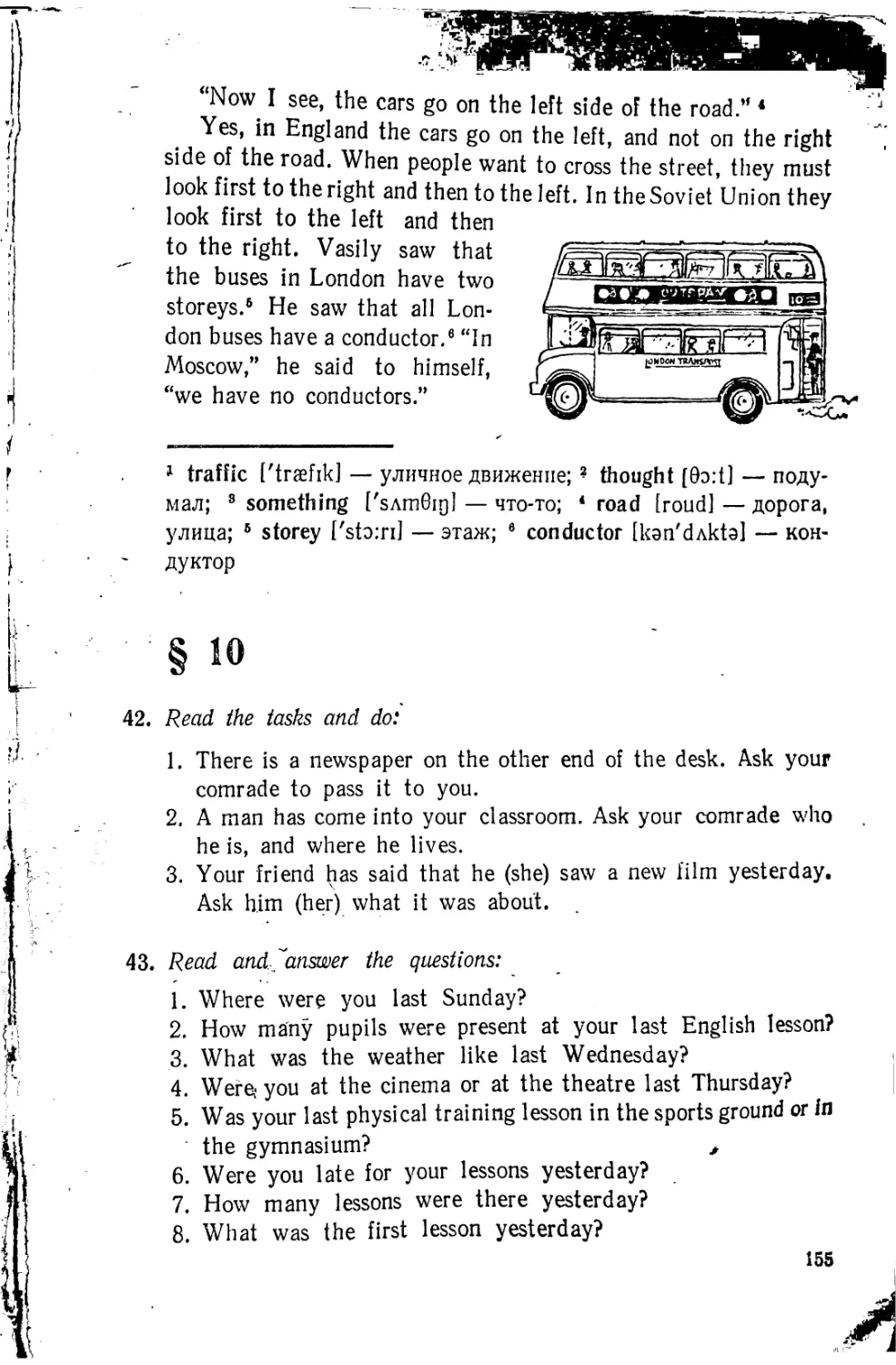












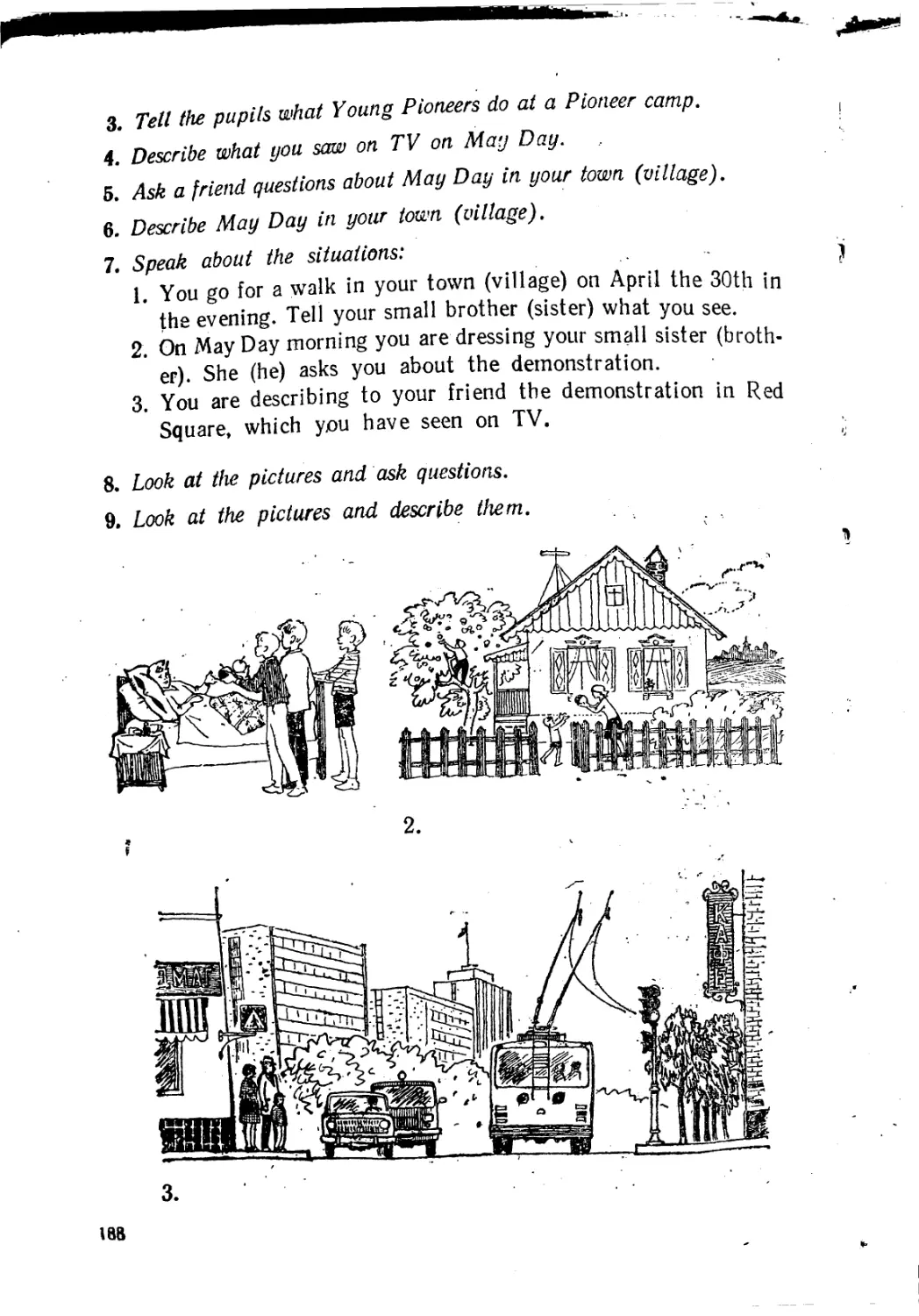
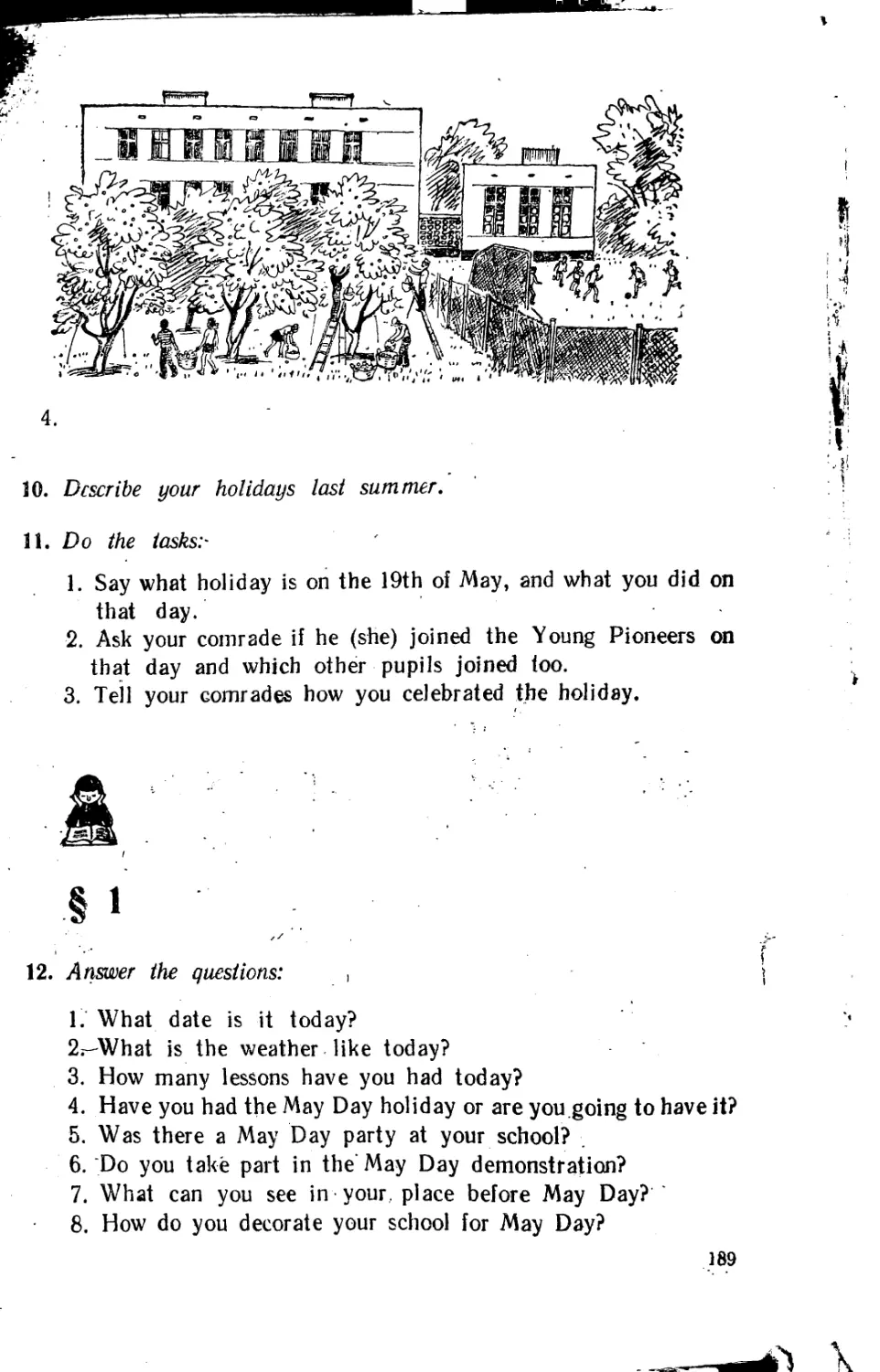
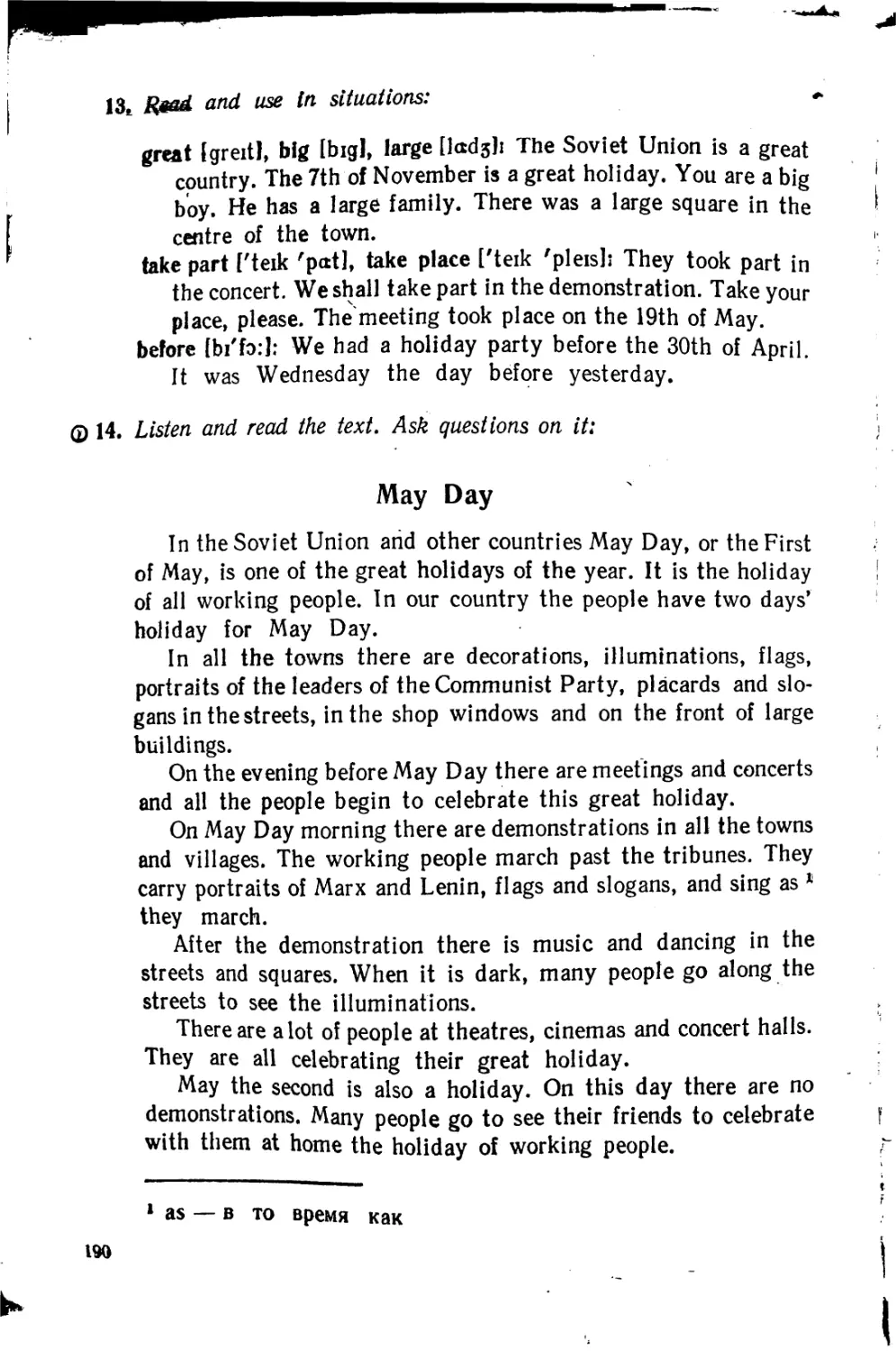


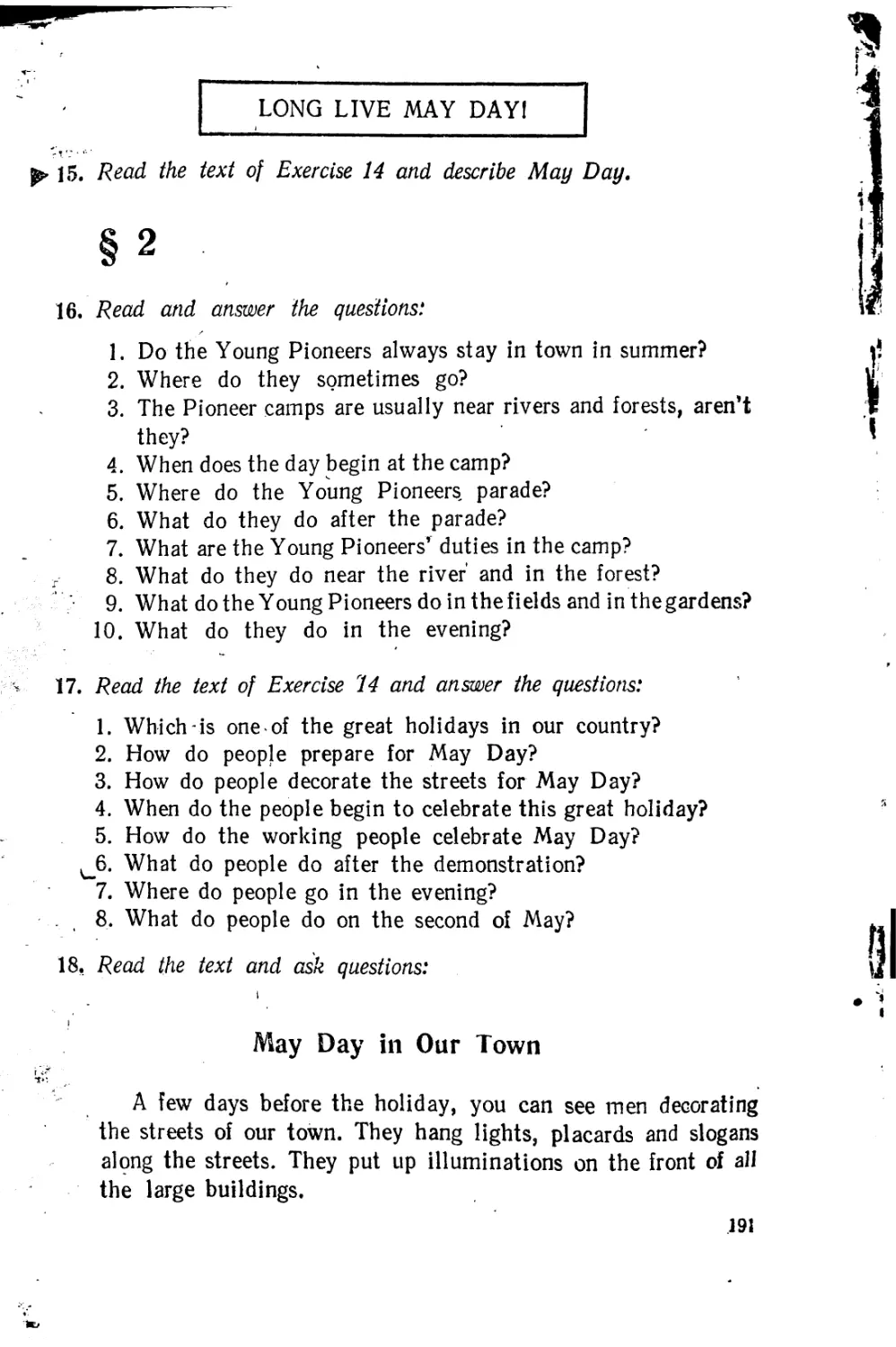













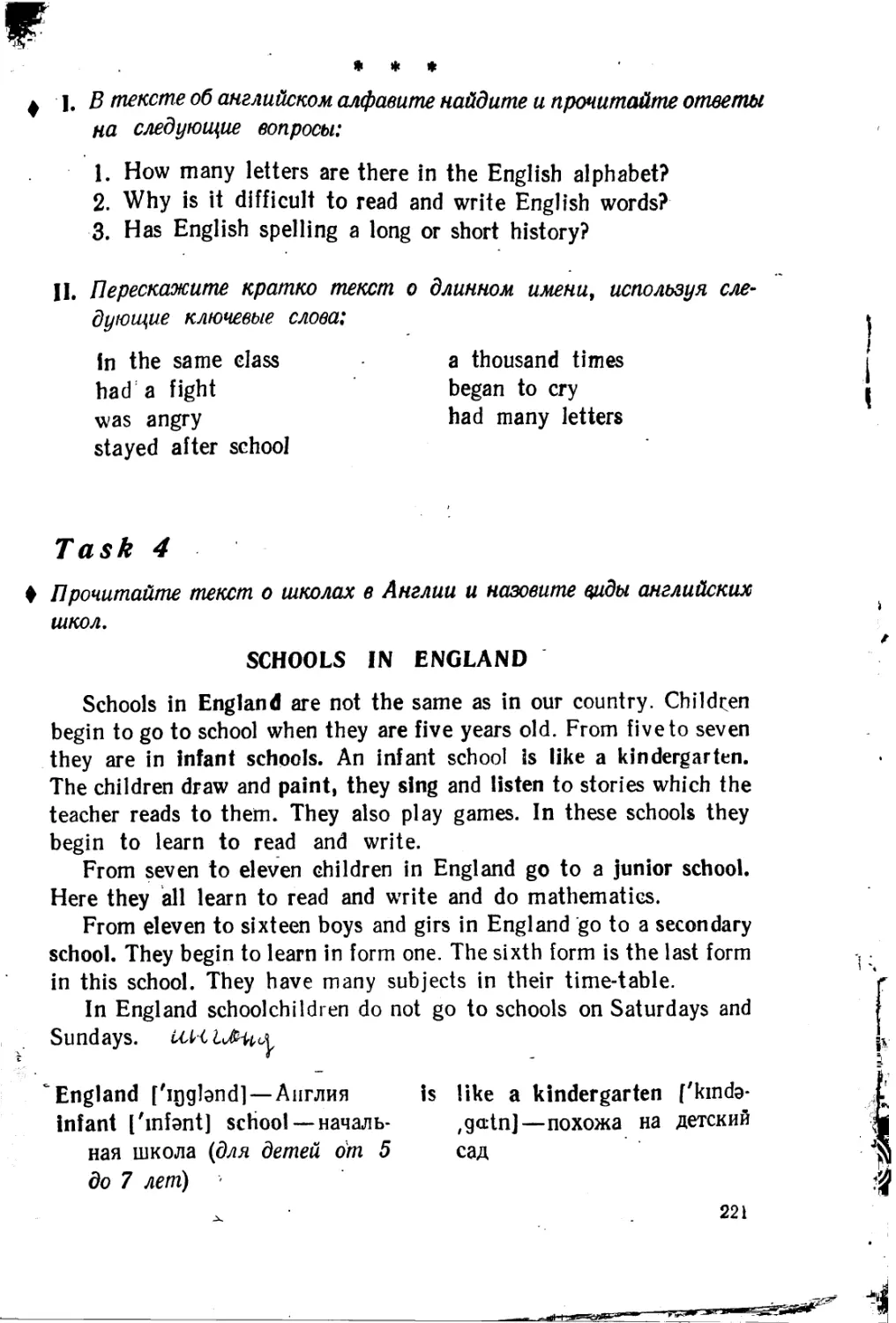
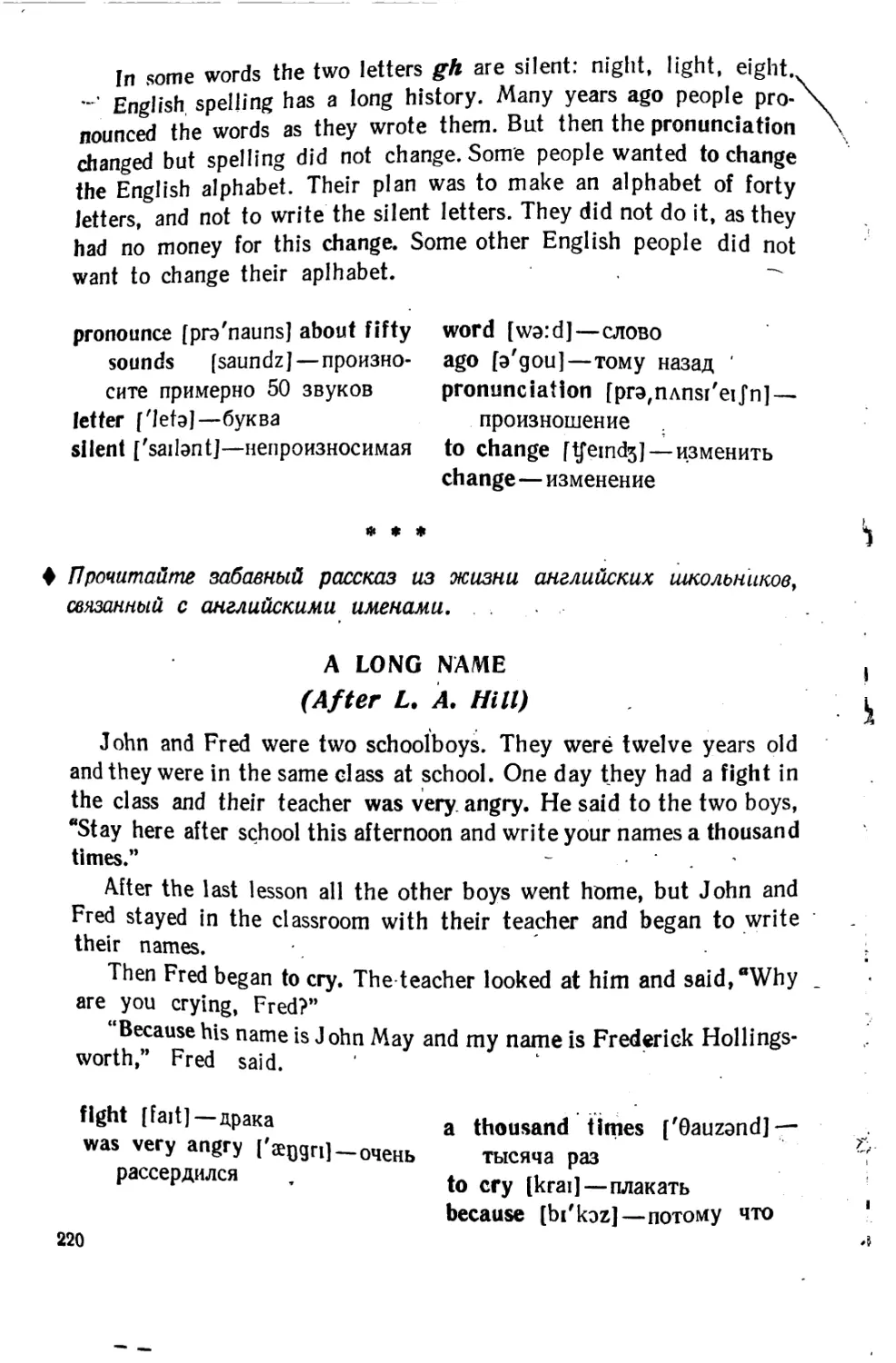
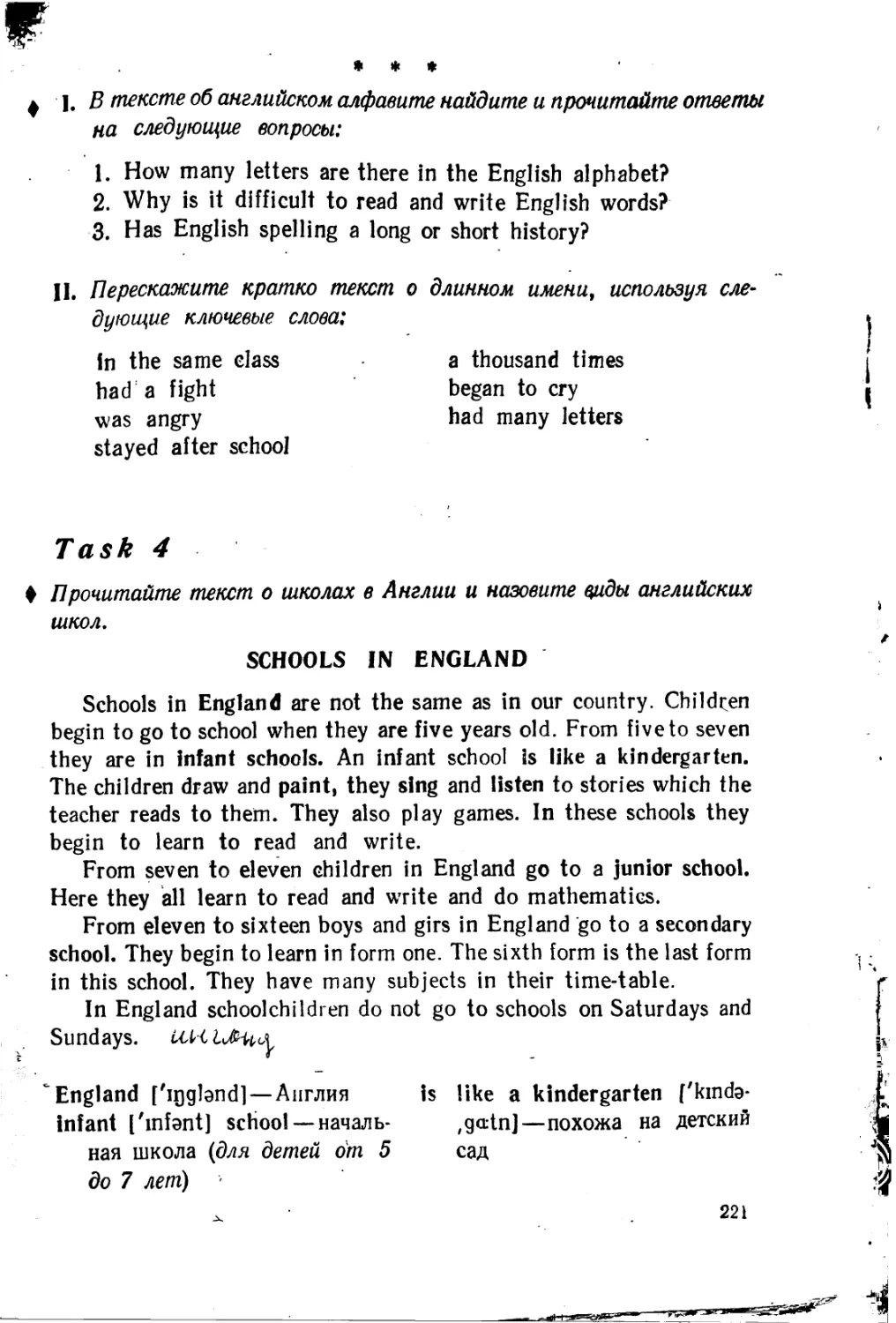
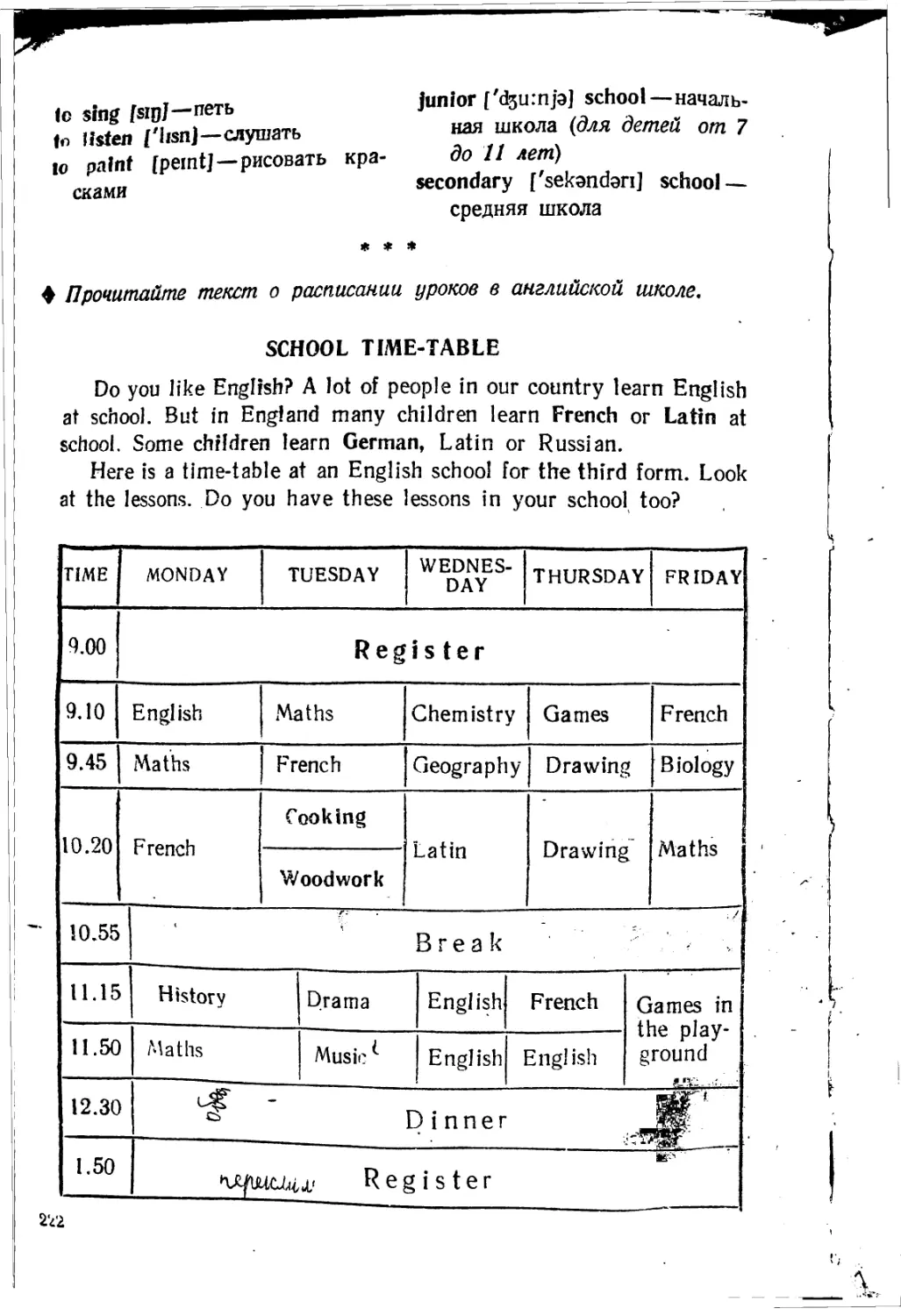























Text
                    WT1
I
f±
A.P.Starkav
R. R. Dixon
!! 1
I:
CD
Hi
г
-I
тахт1
r *♦ A >
>~*Гт7
» *•** 1 'M
£Л5
Ш
’SSi-f
r
Г - -Г '
s.:i
"J
•S .
/ *
• b '
Л£<Як li
L
9 T
fir 4
fh< "*
■
к “
1Ш
>v?
• ••• -i
•*r ,
гж%^
^гГи
i&sl
*Л ■; .
/* I *
/	»/. i
.
3&3i
in»?
&5Q&K»---
% . ’ 'I	/*	'Ч 4. “J', Я
-	•	-'‘-'UtrrJ
TEXTBOOK
li*
READER
'- —
ч Я
Mi
Я
i
.!■ n
4	•	^
- .:'S&
5 ■ •-.
?fen
Sijri-v
Ш’
- ■ "•■;•>:■
; Гг!?:
;-Г.;НГ:
;v^:!
Ш;’
6» *>V
l^l1
ГнлМ
Hti
.
-
?-
•»
1 ’ t
Ж* I
\Ж„/
HR v/T tr*-T
EL4®
• •
’ %/•
r'

ANSCRIPTIO

А. П. Старков
Р Р. Диксон
М. Д. Рыбаков
АНГЛИЙСКИЙ
ЯЗЫК
»
УЧЕБНОЕ
ПОСОБИЕ
ДЛЯ 5 КЛАССА
СРЕДНЕЙ ШКОЛЫ
ИЗДАНИЕ 4«в
КНИГА ДЛЯ ЧТЕНИЯ
-	'	V	.
%
Составители
Е. Г. КОПЫЛ, М, А. БОРОВИК
ИЗДАНИЕ 2-е
Допущено У Г ^ ‘
М цуистъряпвом просвещения слМ*
,ь-рсфор \
с t:; л» 1°	•.
I	,<А»»*Чсй
...	1	о»*®**
«ГРОСВЕЩЕНЯЁ» 198Ф	__	1?Ф
\7
' S _
'k— ""A.,, Г*»"**
.,cv^--C^

13БК 81.2Англ-9
С 77
Книгу бережно храните,
Берегите и любите.
Чтобы жизнь ее продлить,
Аккуратным надо быть,
I
Д- 'S*	^	>t	-	Ч
I *1*1. к
Условные обозначения
О Этим значком отмечены упражнения, которые записаны на
грампластинках.
ЖШ	^	'
(Восклицательный знак, стоящий слева от таблицы, обозначает,
что нужно обратить внимание на чтение слов, которые читаются
• не по правилам.
Стрелка, стоящая рядом с таблицей, указывает на то, что эта
таблица дается в помощь ученику для выполнения упражне¬
ния.
. V	щ 'Ф	9
Таким значком помечены упражнения для домашнего задания
по чтению.
♦ Такой значок в «Книге для чтения» стоит рядом с упражне¬
ниями.
В конце учебного пособия дан англо-русский словарь. Число, стоящее
после слова, обозначает номер цикла (Unit), в котором это слово
впервые встречается в тексте учебника. Слова со звездочками
употребляются только в текстах для чтения.
4306021500-382
С 103 (03)-84 ИНФ' письмо-84, доп. J6 1
т
Издательство «Просвещение», 1981 г.
© Издательство «Просвещение», 1984 г., с изменениями

г
I
v
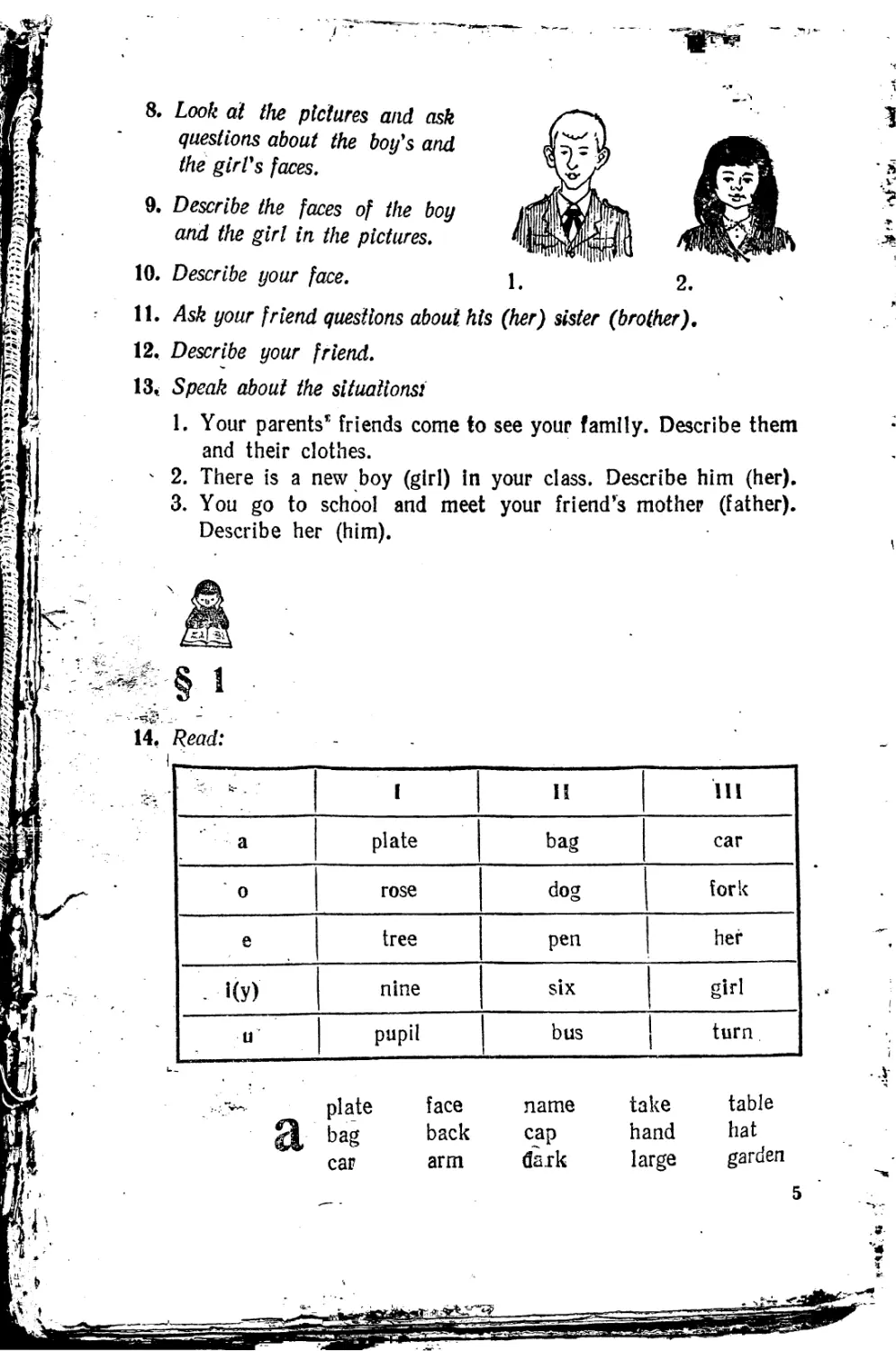
1. Look at the pictures and say what you see
2. Look at the pictures and ask questions.
3. Look at the pictures and say what those things are made of,
4. Look at the pictures, listen and correct.

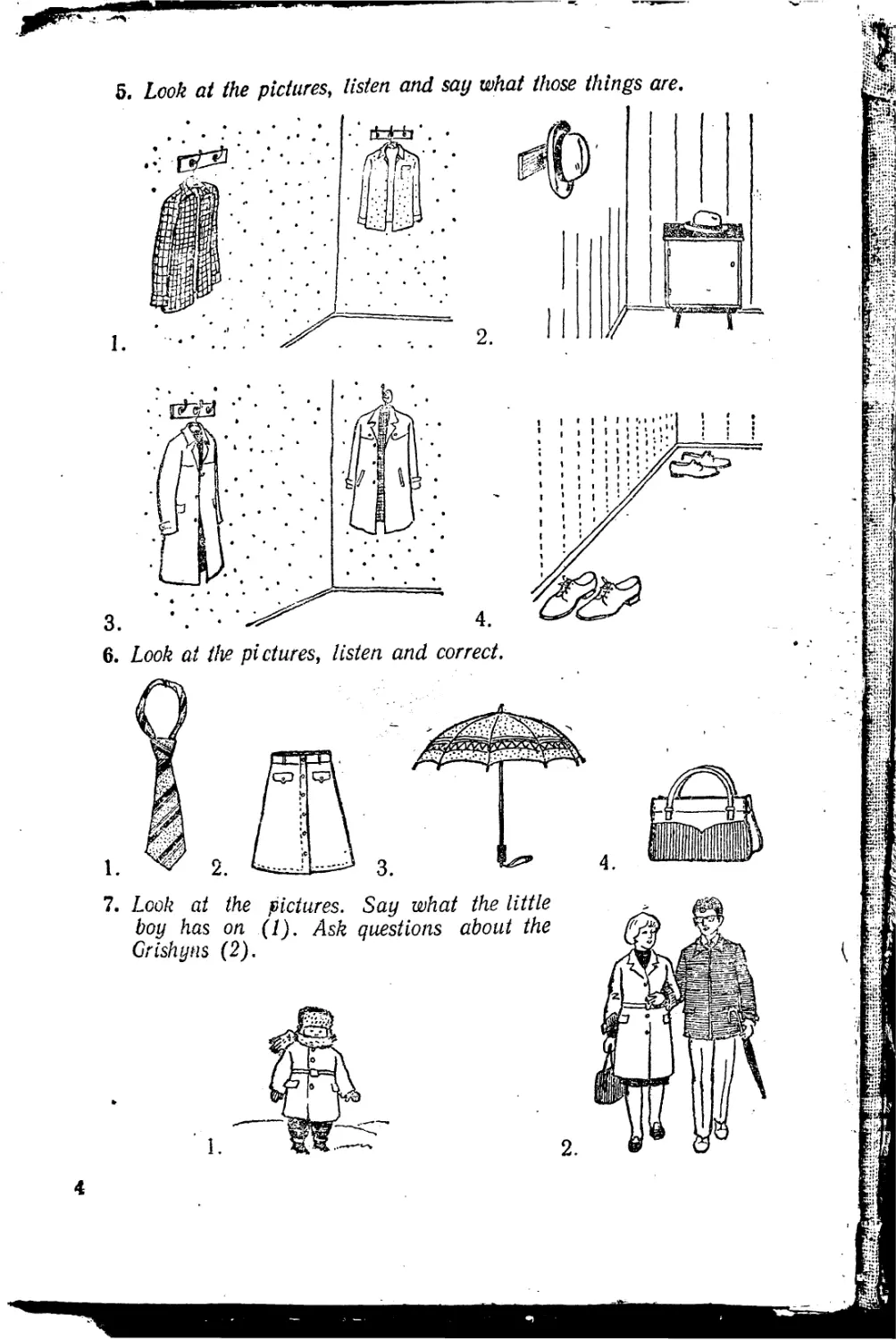
listen	and say what those things are
5. Look at the pictures,
дмяаЁи»
35* Vt ^
*.# Г Jr
»
•
Мл • ‘ •
W* • • Lf
-V» • '!%>
i>fV# I*? *
>.*#♦1 V
6. Look	at (he pictures, listen and correct

%
8. Look at the pictures and ask
questions about the boy's and
the girl's faces,
9. Describe the faces of the boy
and the girl in the pictures.
10.	Describe your face.
*
*
1.
2.
11.	Ask your friend questions about his (her) sister (brother).
12.	Describe your friend.
13,; Speak about the situations:
1.
Your parents’ friends come to see your family. Describe them
and their clothes.
2. There is a new boy (girl) in your class. Describe him (her).
3. You go to school and meet your friend’s mother (father).
Describe her (him).
\
-
. V	-
CJ
• V
1
14.
l
1
. 11
1
H
Ш I
I a
H *
plate
bag
car 1
0
rose
dog
fork I
j e
■
tree
pen
her I
1 ► . В
i(y)
nine
six
girl I
Я
U
pupil
bus
turn
V
- •
plate
bag
car
face
back
arm
name
cap
dark
take
hand
large
table
hat
garden
—	 -
•
%
•
5
jr.

flat
park
place
15* Read:
open
forty
stop
cake
yard
late
farmer
stand
lamp
cat
paper
scarf
rose
nose
sofa
those
dog
sock
long
hot
fork
form
short
comer
doctor
wrong
clock
over
not
home
October
off
no
black
apple
map
*• i
go
stocking
morning
on
Communist
box
16.	Read:
► 17
e
tree
pen
read
see
dress
please
street
ten
teacher
green
left
clean
week
men
we
shelf
these
he
three
bed
feet
then '■
tea
eat
her
• sleep
text
Read:
•
•
•
date
text
home
bench
March
her
me
long
man
corner
feet
cake
cap
paper
arm
sock
scarf
hand
bad
leg
over
face
hat
see
nose
short
home
left
make
doc tor
she
leg
season
§ 2
18.	Read:
t
nine
tie
five ✓
nice
time
SIX
milk
big
spring
winter
girl
first
third
shirt
skirt

all	water	class	may	draw^
wall	what	past	play	daug
small	wardrobe	ask	day	Augusi
son brother mother colour come above one
to Into two who whose shoe woman
head bread eye pioneer engineer ear
child kind right piece friend
suit put picture English
► 21. Read:
. - >/ V
55 '^9 •	£
skirt
form
hand
•
supper
dark
long
feet
children
leg
bag
shirt
large
face
arm
dress
member
like
. summer
cap
winter
his
evening
three
paper
turn
cup
ten
my
tea
fine
22. Read:
dinner	fine
like	middle
minus	fifth
19. Read:
О 20. Listen and read:
little
kitchen
white
Tuesday
June
July
my
tie
thirteen
butter
turn
duster
number
shut
much
drink
lip
Friday
uncle
Sunday
sun

wash
ask
afternoon
classroom
football
warm
tall
draw
day
last
wardrobe
daughter
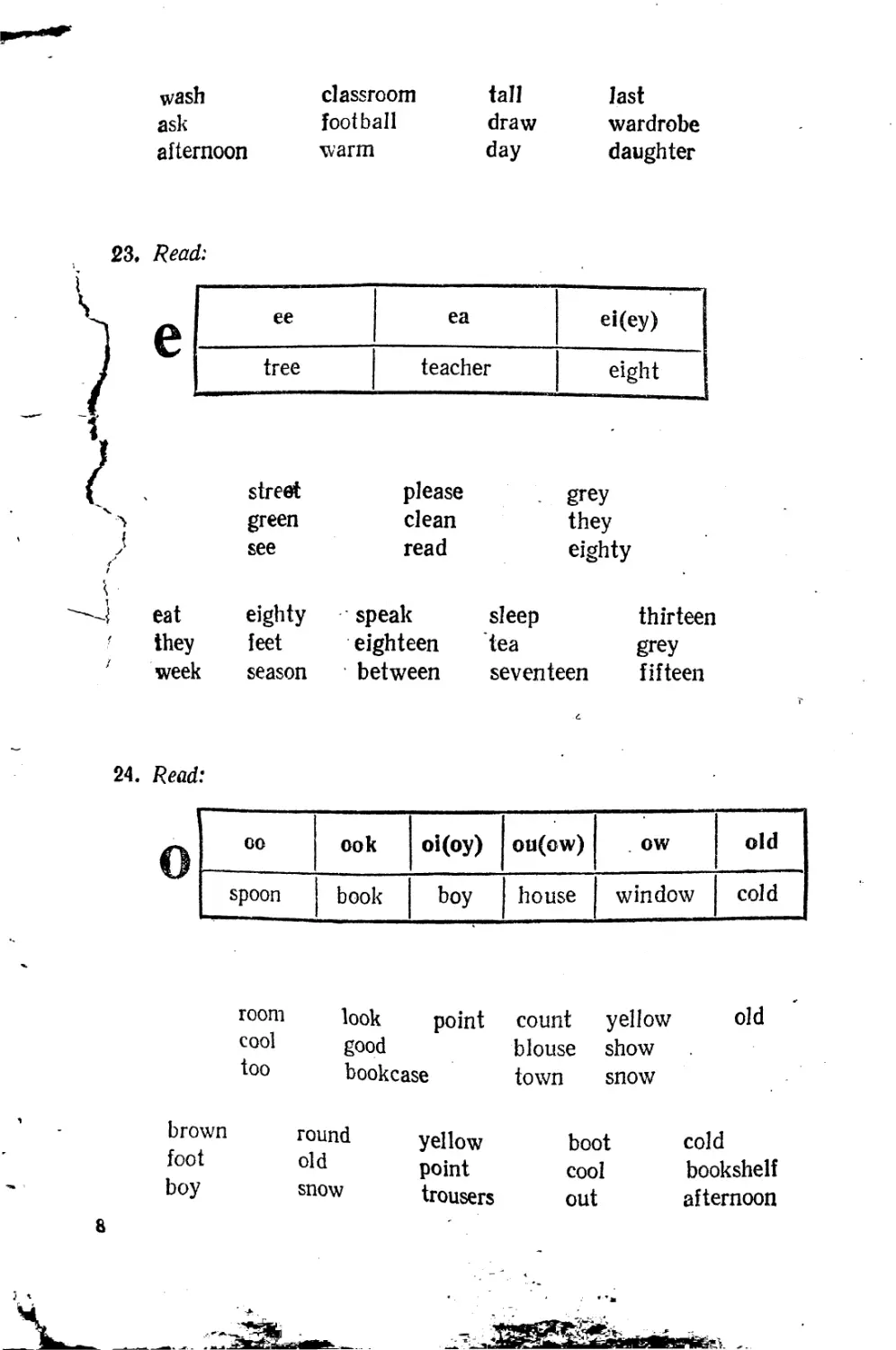
23, Read:
I ee
ea
•
ei(ey) J
J tree
teacher
eight I
л
I
У
I
I
!
eat
they
week
street
green
see
eighty
feet
season
please
clean
read
speak
eighteen
between
grey
they
eighty
sleep
tea
seventeen
thirteen
grey
fifteen
24. Read:
CO
ook
oi(oy)
•
ou(ow)
»
ow
•
old
spoon
book
boy
house
window
cold
room
•m
look
%
point
count
yellow
old
CQOl
good
blouse
show
4 ^ : I
too
bookcase
town
snow
r ’ 1 .J* ^ fe
brown
foot
boy
round
old
snow
yellow
point
trousers
boot
cool
out
cold
bookshelf
afternoon
a

О 25. Listen and read:
Ф
chalk hair fair square aunt
now how young touch
you your four our colour
bread head weather breakfast
present their there here
pioneer engineer new
^ 26, Read:
*	£
down
point
spoon
teacher
play
)
water
flower
feet
grey
blouse
л
\
small
too
count
please
class
\
1
May
green
football
rain
yellow
clean
past
tall
foot
schoolboy
snow
please
wardrobe
brown
eighteen
4
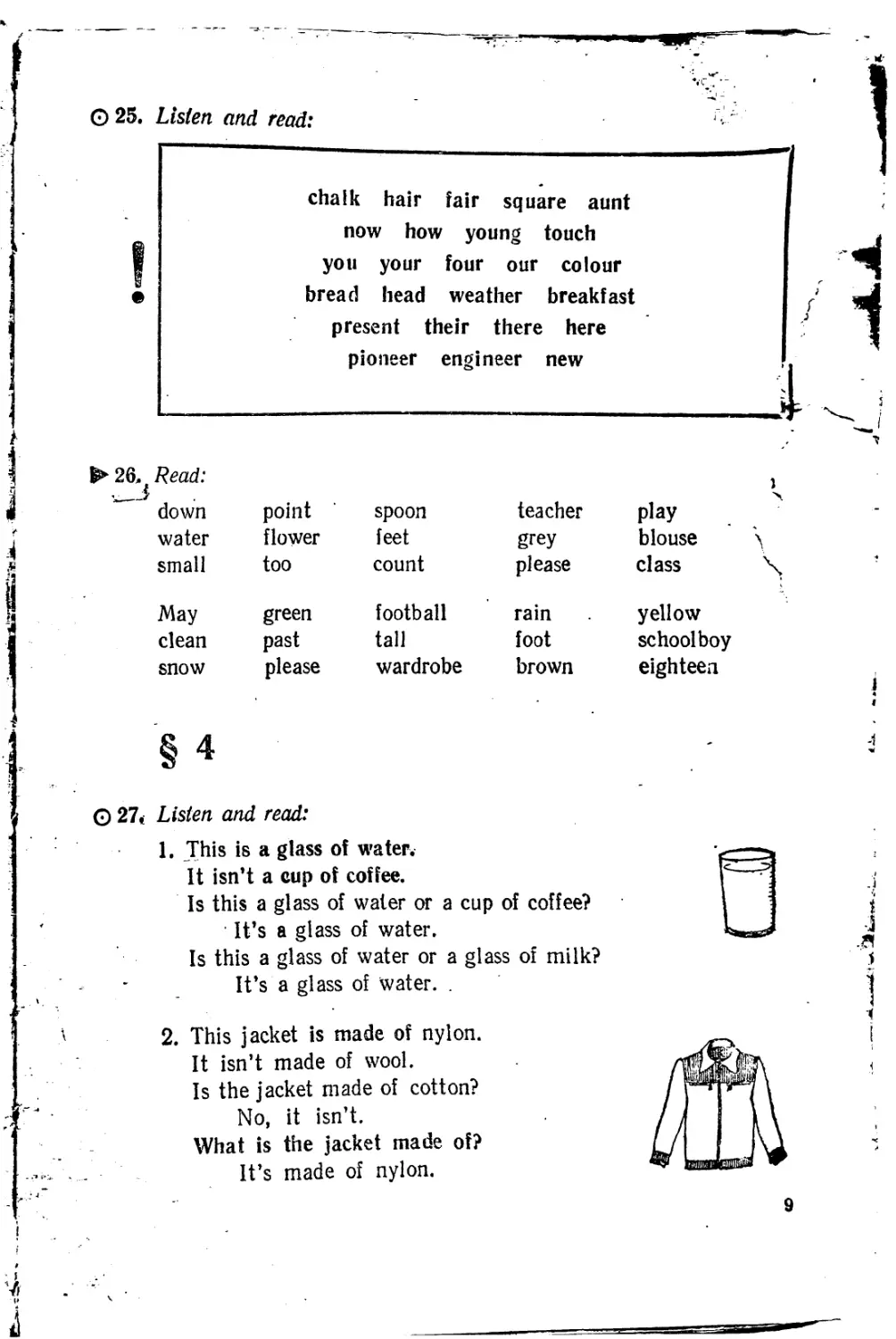
О 27,; Listen and read:
1. This is a glass of water.
It isn’t a cup of coffee.
Is this a glass of water or	a	cup	of	coffee?
• It’s a glass of water.
Is this a glass of water or	a	glass	of	milk?
It’s a glass of water.	.
2. This jacket is made of nylon.
It isn’t made of wool.
Is the jacket made of cotton?
No, it isn’t.
What is the jacket made of?
It’s made of nylon.
9
V

28.	Read and answer the questions:
1. What are tights made of?
2. What are umbrellas made of?
3. What are raincoats made of?
4. What are scarves made of?
5. What are suits made of?
\	6. What are shirts made of?
ч	7. What are clothes made of?
8.	What are handbags made of?
29. Read
the numbers:
101
one hundred and one
113
one hundred and thirteen
1 144
one hundred and forty-four
255
two hundred and fifty-five
f 370
three hundred and seventy
869
eight hundred and sixty-nine
1407
one thousand four hundred and seven
2600
i
two thousand six hundred
t *
► §tX, Read:
1.	What's that? It’s a piece of chalk. 2. Is that a cup of tea or a
cup of coffee? It’s a cup of coffee. 3. Here is a piece of bread and
apiece of butter. 4. Drink a glass of milk or a glass of water. 5. Take
two pieces of cake, please.
1.	Is that handbag made of nylon? No, it isn’t. It’s made of cot¬
ton. 2. Is the umbrella made of silk or of nyion? It’s made of silk.
3. What are these clothes made of? They are made of cotton.
4. Is your raincoat made of wool? Yes, it is. 5. What is your
jacket made of? It’s made of wool.
§ 5
W .
0 31. Listen and read:	df
1.	I have two sisters, Vera and Sveta. Vera is a schoolgirl, Sveta
is a schoolgirl too. Vera’s hair isn’t fair, Sveta’s hair isn’t
fair either.
10

2.	Is that a cup of tea or a cup of coffee? If ’s	nei ther	a	cup of	Iел nof
a cup of coffee. It’s a cup of milk.	Have	you	a	cat	or	a
I have neither a cat nor a dog.
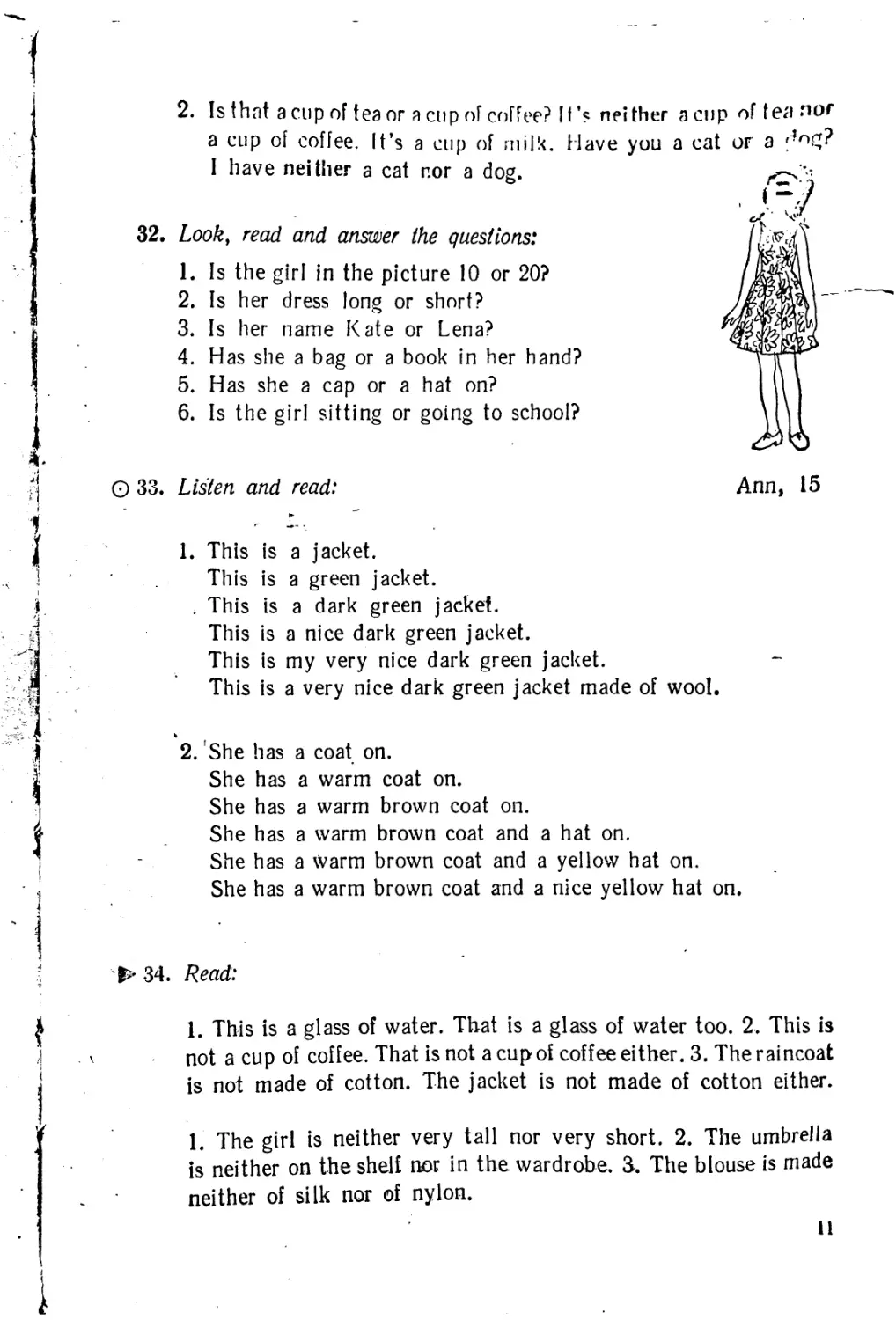
32. Look, read and answer the questions:
1.	Is the girl in the picture 10 or 20?
2.	Is her dress long or short?
3. Is her name Kate or Lena?
4. Has she a bag or a book in her hand?
5. Has she a cap or a hat on?
6. Is the girl sitting or going to school?
•	r
О 33. Listen and read:	Ann,	15
>
r		j
4
1. This is a jacket.
This is a green jacket.
This is a dark green jacket.
This is a nice dark green jacket.
This is my very nice dark green jacket.
This is a very nice dark green jacket made of wool.
2. She has a coat on.
She has a warm coat on.
She has	a	warm brown coat on.
She has	a	warm brown coat and	a	hat	on.
She has	a	warm brown coat and	a	yellow hat	on.
She has	a	warm brown coat and	a	nice	yellow	hat on.
P' 34. Read:
1.	This is a glass of water. That is a glass of water too. 2. This is
not a cup of coffee. That is not a cup of coffee either. 3. The raincoat
is not made of cotton. The jacket is not made of cotton either.
1.	The girl is neither very tall nor very short. 2. The umbrella
is neither on the shelf nor in the wardrobe. 3. The blouse is made
neither of silk nor of nylon.
1	и

§ 6
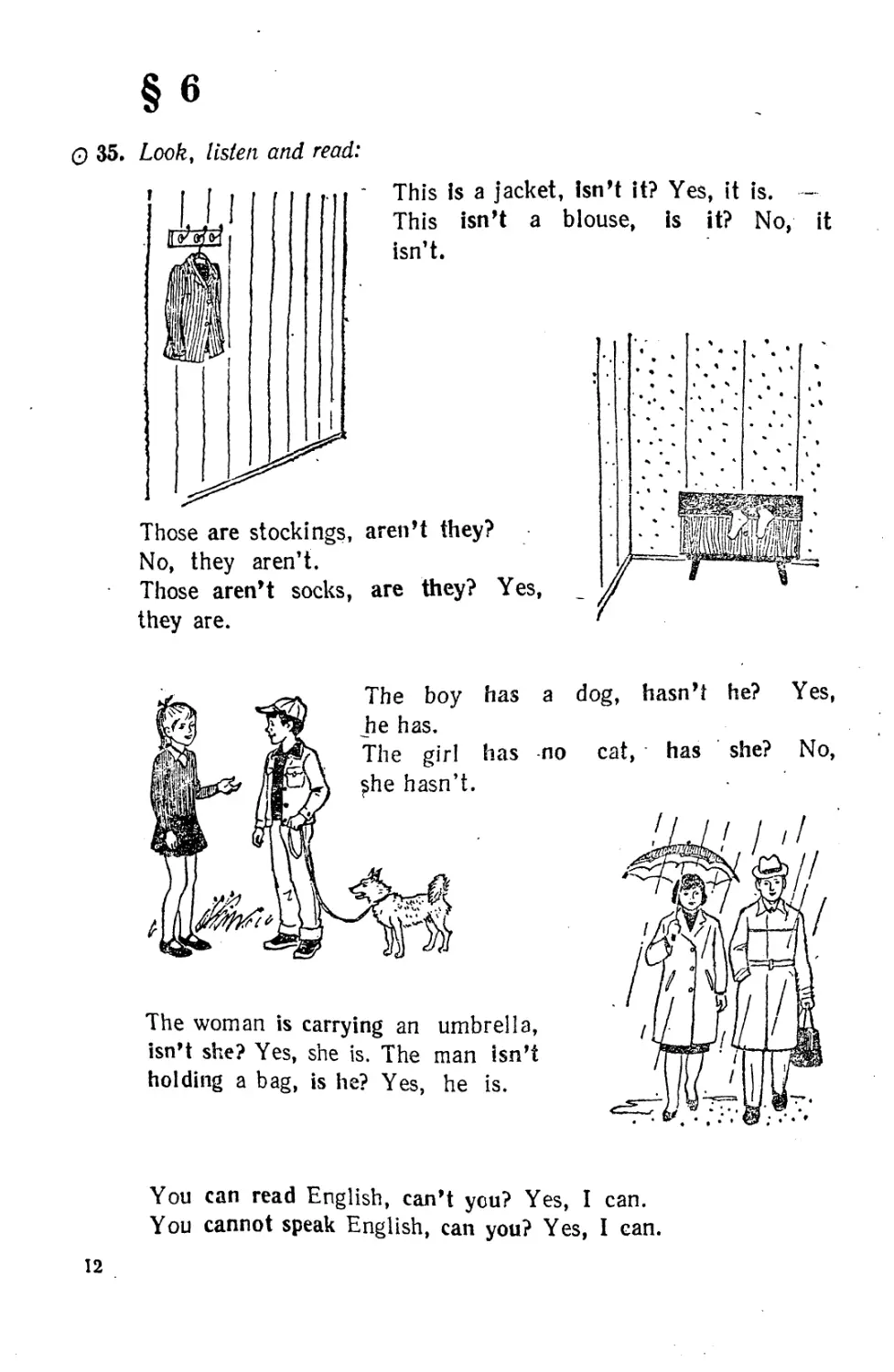
This is a jacket, isn’t it? Yes, it is.
This isn’t a blouse, is it? No, it
isn’t.	'
0 35. Look, listen and read:
Those are stockings, aren’t they?
No, they aren’t.
Those aren’t socks, are they? Yes,
they are.
The woman is carrying an umbrella,
isn’t she? Yes, she is. The man isn’t
holding a bag, is he? Yes, he is.
You can read English, can’t you? Yes, I can.
You cannot speak English, can you? Yes, I can.

This
is
brother
36. Look, read and answer the questions:
1. Y®u can see a table in this picture, can’t
you?
2. The table isn’t square, is it?
3. That is a glass of water, isn’t it?
4. The glass isn’t on the
table, is it?
5. The table has four legs,
hasn’t it?
1. The little girl is sitting,
isn’t she?
2. The little boy isn’t sitting,
is he?
a sister
a sister

3. The girl is wearing a short dress, isn’t she?
4. The children are playing, aren’t they?
5. The children aren’t playing in the yard, are they?
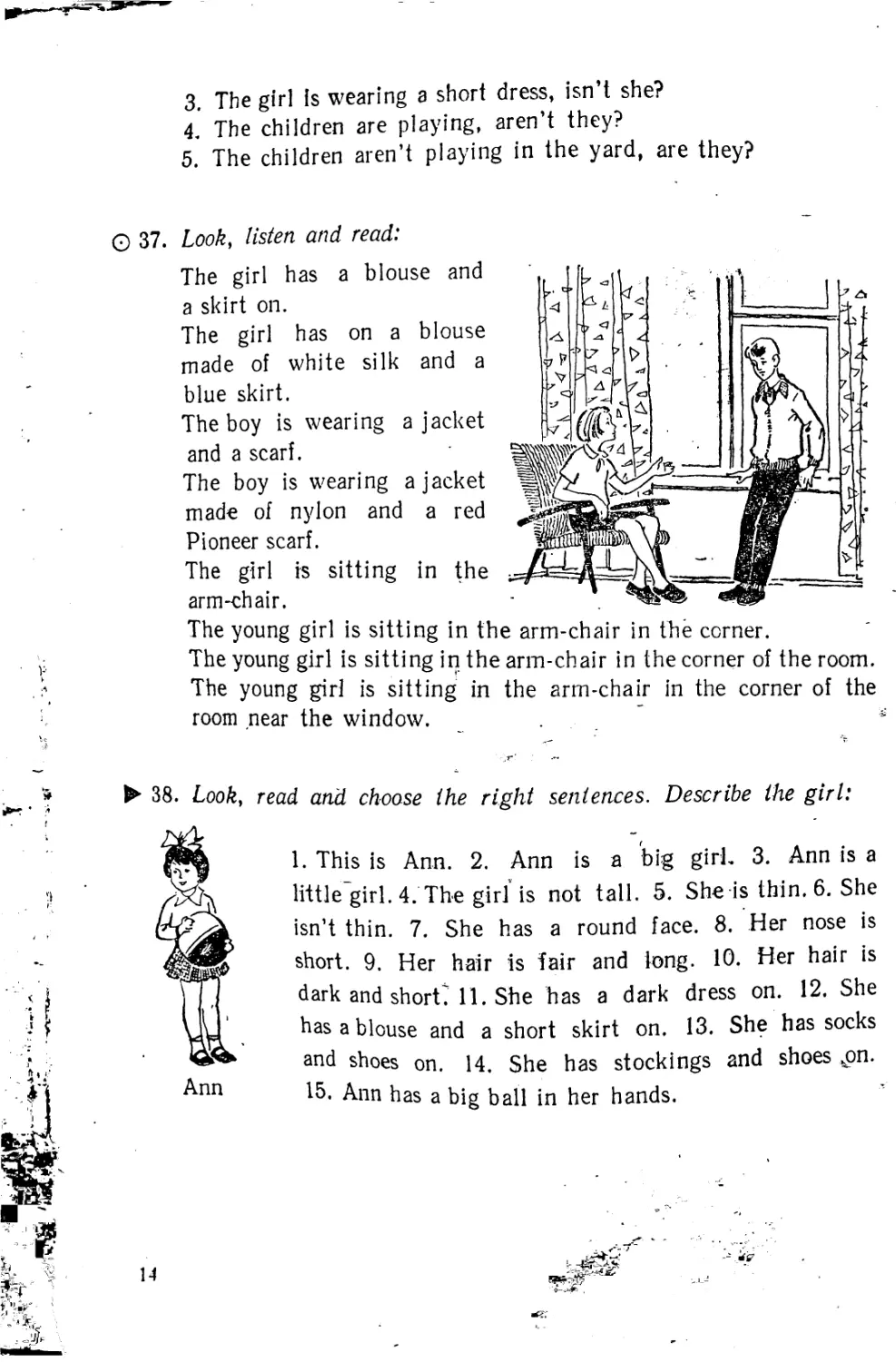
О 37. Look, listen and read:
The girl has a blouse and
a skirt on.
The girl has on a blouse
made of white silk and a
blue skirt.
The boy is wearing a jacket
and a scarf.
The boy is wearing a jacket
made of nylon and a red
Pioneer scarf.
The girl is sitting in the
arm-chair.
The young girl is sitting in the arm-chair in the corner.
The young girl is sitting in the arm-chair in the corner of the room.
The young girl is sitting in the arm-chair in the corner of the
room near the window.
*	*	•	7	/
'	V
^ 38. Looky read and choose the right sentences. Describe the girl:
1.	This is Ann. 2. Ann is a big girh 3. Ann is a
little girl. 4. The girl is not tall. 5. She is thin. 6. She
isn’t thin. 7. She has a round face. 8. Her nose is
short. 9. Her hair is fair and long. 10. Her hair is
dark and short. 11. She has a dark dress on. 12. She
has a blouse and a short skirt on. 13. She has socks
and shoes on. 14. She has stockings and shoes on.
15. Ann has a big ball in her hands.

7
%
G 39. Listen, read and compare:
Let us read the text.
Let us speak English.
Let us do our exercises.
Let's read the text.
Let's speak English.
Let's do our exercises.
Let us clean the blackboard. Let's clean the blackboard.
i
i1
40. Read and use in situations:
let: Let us go to the park. Let me see. Let him come in. Let her
go out. Let them go.
introduce: Let me introduce Comrade Ivanov. Let me introduce
my friend. Introduce me to your brother,
meet: Every day we. meet in the street. Meet my brother Alec.
glad: I am glad to meet you. I am very glad to see you.
/• -
G 41. Listen and read the text. Ask questions on the text:
i
A
'J
‘
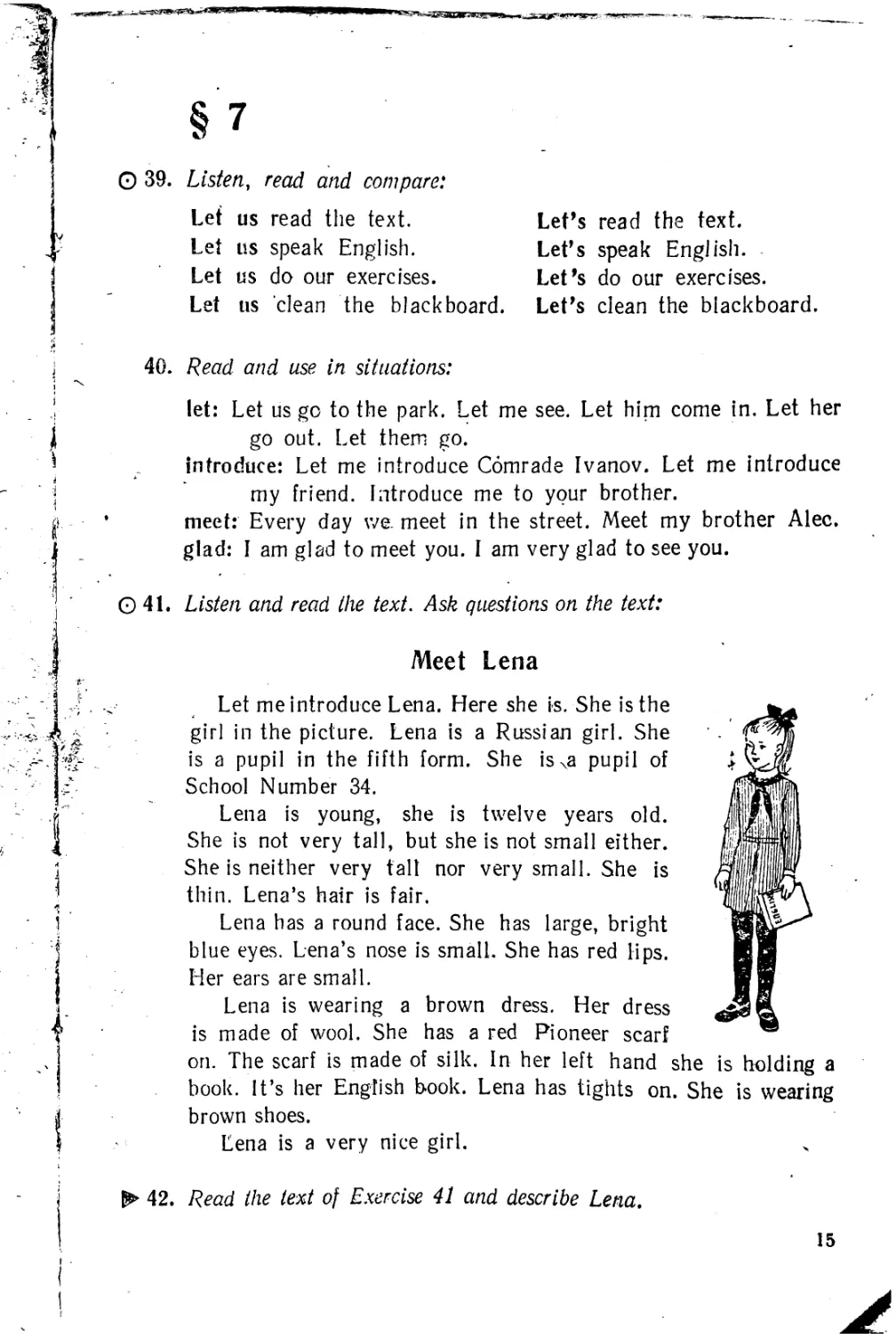
Meet Lena
Let me introduce Lena. Here she is. She is the
girl in the picture. Lena is a Russian girl. She
is a pupil in the fifth form. She is>a pupil of
School Number 34.
Lena is young, she is twelve years old.
She is not very tall, but she is not small either.
She is neither very tall nor very small. She is
thin. Lena’s hair is fair.
Lena has a round face. She has large, bright
blue eyes. Lena’s nose is small. She has red lips.
Her ears are small.
Lena is wearing a brown dress. Her dress
is made of wool. She has a red Pioneer scarf
on. The scarf is made of silk. In her left hand she is holding a
book. It’s her English book. Lena has tights on. She is wearing
brown shoes.
Lena is a very nice girl.
^ 42. Read the text of Exercise 41 and describe Lena.
15

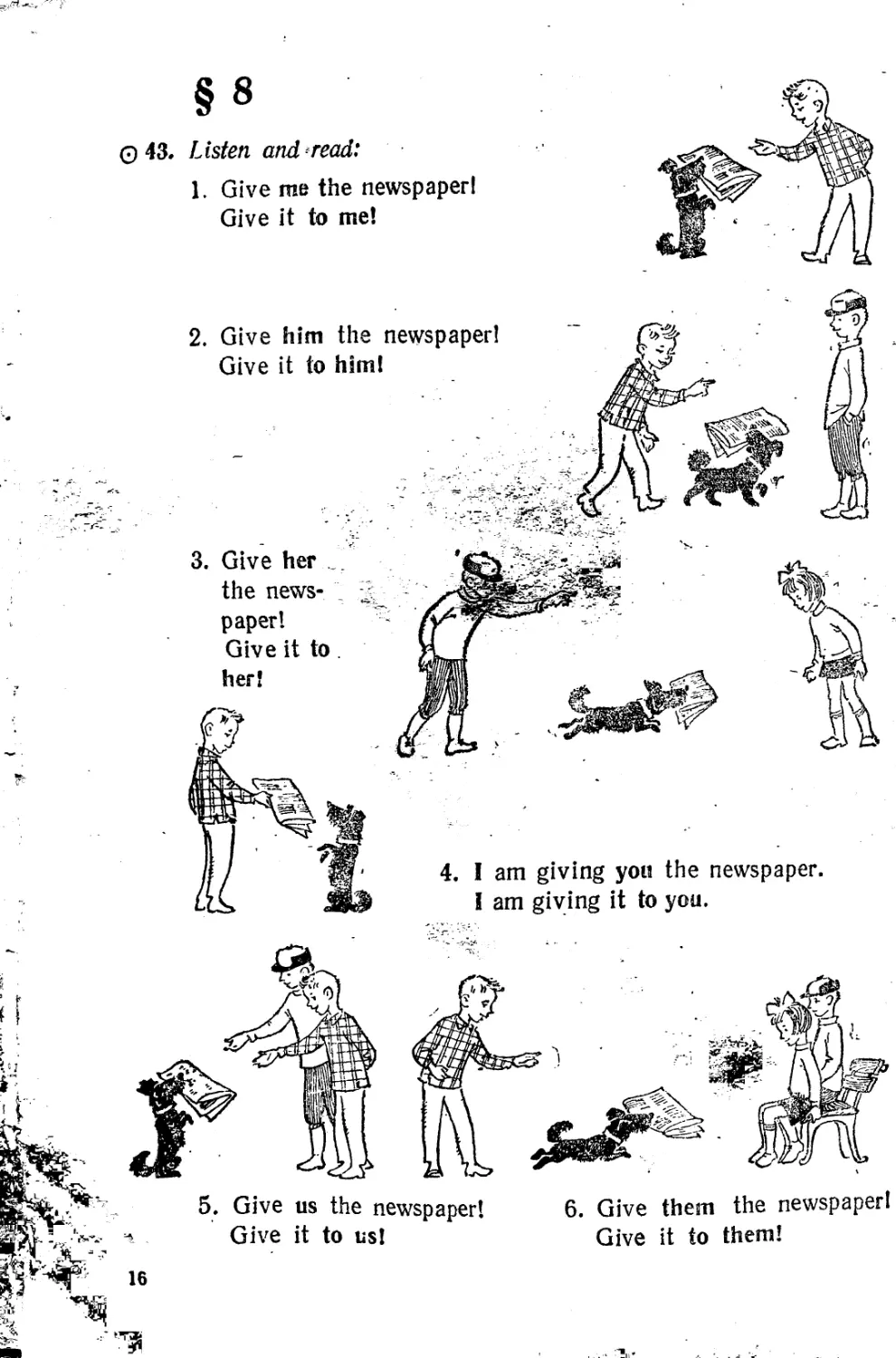
О 43. Listen and read:
1. Give me the newspaper!
Give it to me!
» * • • •	• «
2. Give him the newspaper!
Give it to him!
*■ °iV' .? newspaper[
Give it to us!
•e‘.	-	:v	"
^ . - •«
•	*	(k-	%
3. Give her
the news¬
paper!
Give it to
her!
6.	Give them the newspaper!
Give it to them!
4. I am giving you the newspaper.
I am giving it to you.
M

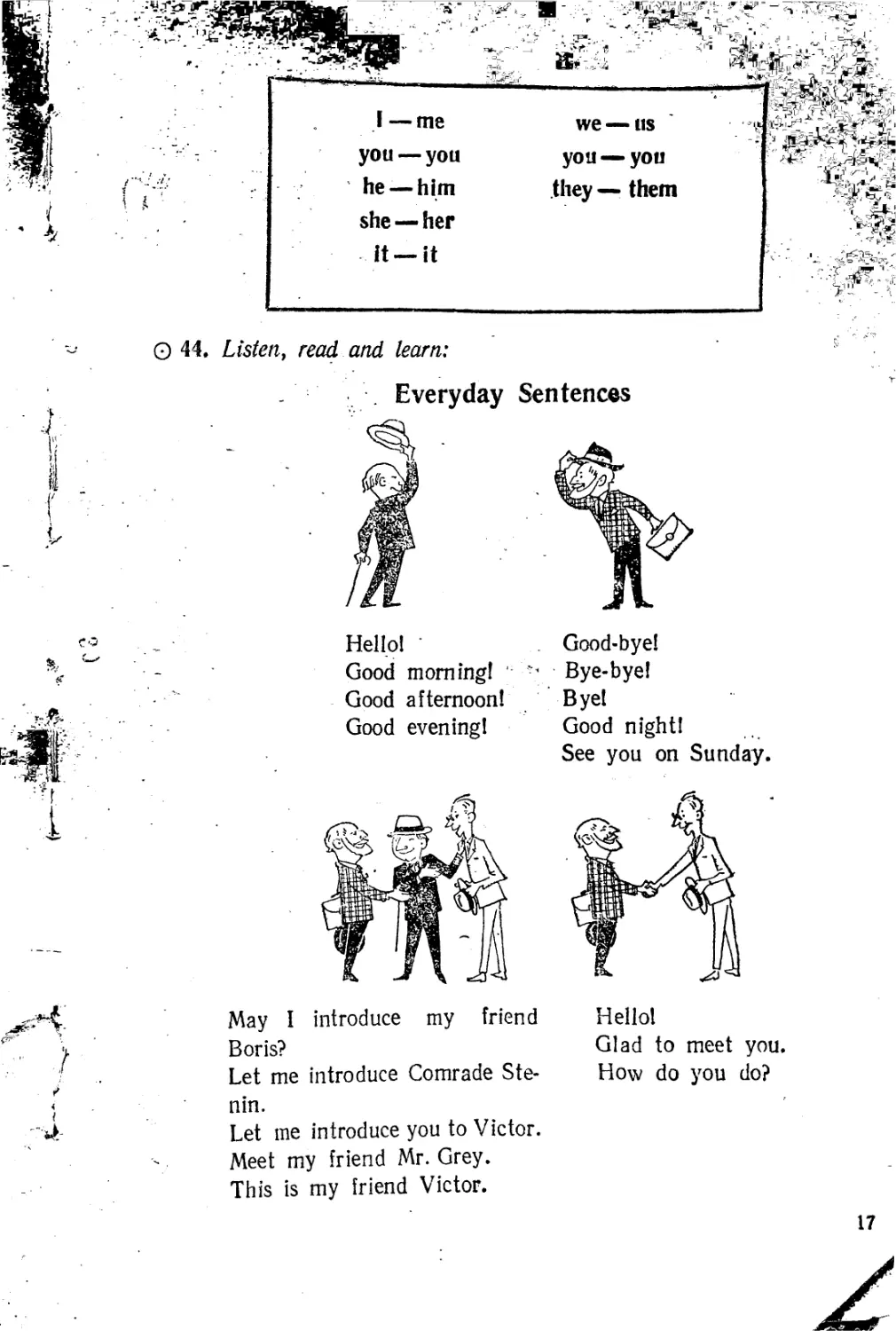
О 44. Listen, read and learn:
li '	*	.
Everyday Sentences
У •	'
Hello! '	-	Good-bye!
Good morning!	Bye-bye!
Good afternoon!	Bye!
Good evening!	Good night!
See you on Sunday.
May I introduce my friend	Hello!
Boris?	Glad	to	meet	you.
Let me introduce Comrade Ste-	How do you do?
nin.
Let me introduce you to Victor.
Meet my friend Mr. Grey.
This is my friend Victor.
17

45* Look at the picture of Lena and answer the questions:
1. Is Lena tall or small?
2. Lena is thin, isn’t she?
3. What colour is her hair?
4. She has long hair, hasn’t she?
5. Lena’s face is round, isn’t it?
6. Has Lena a coat or a raincoat on?
7. What is she wearing?
8. What has she on her legs?
9. Lena is carrying an umbrella, isn’t she?
10. What is she holding in her left hand?
11. What is the girl in the picture doing?
► 46. Read the text and describe the boy:
Boris Stogov, Lena’s Brother
—	44'
This is Boris Stogov. He is Lena’s brother. Boris is
a schoolboy. He is in the second form, he is not a
Young Pioneer. Boris is eight years	old.	He is	tall,
he has long arms and legs. He has dark hair and
brown eyes.
Boris is wearing a dark green jacket and grey
trousers. His socks	are grey, and	his	boots	are
black. Boris’s shirt	is white. It is	made	of cotton.
He has neither a cap	nor a hat on his	head.
§ 9	'	L	■	Щ
О 47. Listen and read:
She is giving me a book. She is not giving you a book. Is she giving
ii/t.00^ *° ?Г *° ^0n' *s §*v*ng a book to me.
о is she giving abook to? She is giving a book to me. He is look¬
ing at the boys. He is not looking at us. Is he looking at us or at
them/ He is looking at them. Who is he looking at? He is looking
at the boys.	г ^

*
•
I
48.	Read:
4
What are you putting the book on? I am putting it on the bookshelf.
Who are you going to the park with? I am going to the park with
my friend.
What is he pointing to? He is pointing to Voronezh on the map.
Whom is the woman putting the jacket on? She is putting it on
her little daughter.
Who is the girl playing with? She is playing with her sister.
What are you writing with? I am writing with a piece of chalk.
49. Read the text of Exercise 46 and ask questions on it.
t
► 50, Read:
Who are you looking at? I am looking at that man.
What is he looking at? He is looking at that nice picture.
Who is she sitting with? She is sitting with her friend.
What are you sitting on? I am sitting on the sofa.
Who is he having breakfast with? He is having breakfast with
his grandmother.
О 51. Listen, read and act:
Short Conversations
1. “Meet Comrade Ivanova. She is my friend. This is my brother.”
“How do you do, Comrade Ivanova?”
“How do you do?”
2. “May I introduce my uncle, Boris Alexeyevich Smirnov? This
is Inna Vasilievna, my teacher.”
“How do you do, Inna Vasilievna? I’m very glad to meet you.”
“Glad to meet you, Boris Alexeyevich/1
Ш	19

S.	“Do you know my friend Lena? This is Zina.”
“Hello, Lena. I’m glad to meet you.”
“Hello, Zina.”
4. “Hello, Boris, how are you?”	(
“I’m very well, thank you. How are you?”'
“I’m fine, thank you.”
щ	>	*	#
5. “Good morning, Inna Vasilievna.”'
“Good morning, Sasha.”
“Is Igor in?”
“Yes , Igor is in his room. Come in, Sasha. Take your coat and
cap off.”
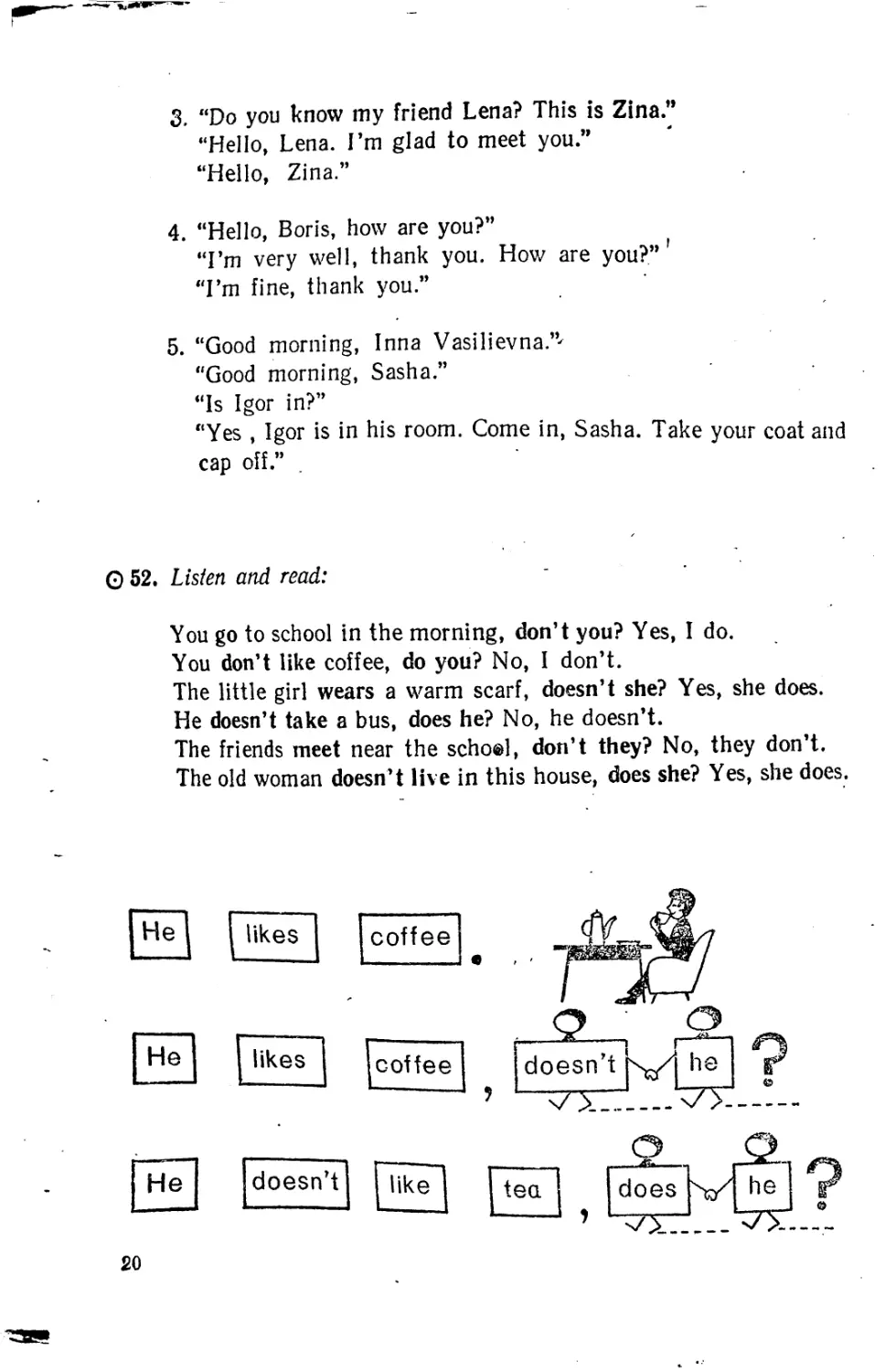
G 52. Listen and read:
*• ^ . • — ' . ^ e 0
You go to school in the morning, don’t you? Yes, I do.
You don’t like coffee, do you? No, I don’t.
The little girl wears a warm scarf, doesn’t she? Yes, she does.
He doesn’t take a bus, does he? No, he doesn’t.
The friends meet near the scho©l, don’t they? No, they don’t.
The old woman doesn’t live in this house, does she? Yes, she does.
He
20
coffee
doesn’t
coffee

^ 53. Read the text and describe Vidor Nikolayevich and Vera Ivanovna:
'S
■
!
! • П Г
The Stogov
In the street you can see a
man and a woman. They are the
Stogovs. The man is Victor Niko¬
layevich Stogov, he is Lena’s fa¬
ther. The woman is his wife, Vera
Ivanovna Stogova. Vera Ivanovna
is a very nice woman. She isn’t
very tall. Her hair is short and
fair. She has large blue eyes. Her
nose is small and her lips are red.
She is wearing a dark green skirt,
a short coat and a yellow blouse.
Her coat and skirt are made of
wool. The blouse is made of silk. She has no hat on. She has
fine nylon stockings on her legs and very nice shoes on her feet.
She is holding a handbag in her hand.
Victor Nikolayevich* Vera Ivanovna’s husband, is tall. His
hair is grey and his eyes are brown. His nose isn’t very long. He has
a dark blue suit on. It is made of wool. He has a white shirt and
a black silk tie on. He has his raincoat over his left arm. He has
a hat on.
11
54.	Read the text of Exercise 53 and answer the questions:
_	I
1. You can see a man and a woman in the picture, can’t
2. Who are the man and the woman?
3. Are they husband and wife?
4. What is Vera Ivanovna like?
5. What is she wearing?
you?
6.
7.
8.
9.
10.
Her skirt and coat are made of nylon, aren’t they?
What is she holding in her hand?
Victor Nikolayevich is not very tall, is he?
Has he a cap or a hat on?
What has he on?
21

55.	Read and answer (he questions:
J. Are you 15 or 16 years old?
2.	Have you a coat or	a raincoat	on?
3.	Are you in the	yard	or in	the street?
4. Is your teacher reading or writing?
5. Are your eyes green or black?
6. Are you Petrov(a) or Ivanov(a)?
• W	*	m	~	V	..	•	••
N
56. Read the numbers:
100; 110; 173; 301; 487; 1017; 1952; 2100; 5464; 6666.
E> 57, Read the text and describe Mr. White:
Шт. White
Mr. White is an Englishman. He works in an office 1 in Lon-
%	v	m	®	^ы	a	.	a
don. He is a tall,	thin	man,	with	blue eyes and	brown hair.
He wears a dark suit, a white shirt with a grey tie, grey socks
and black shoes. When he goes to his office, he wears a hat and
carries an umbrella in his hand. When it is cold, he wears a daik
coat.
1 -office — контора, учреждение
§ 12
Ф
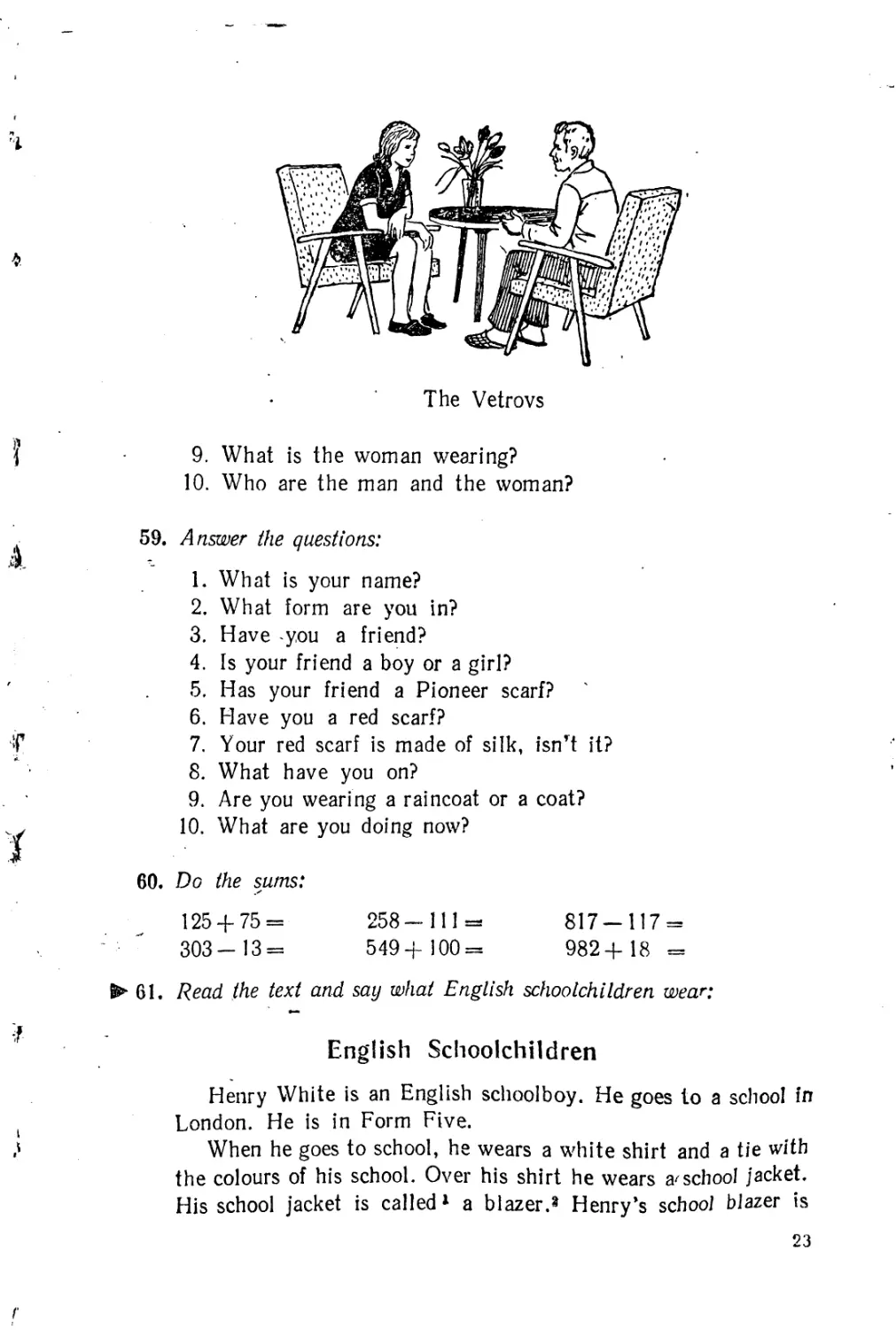
. 58. Look at the man and the woman in the picture and answer the ques-
tions:	-j	g	j	JB
1. Whom can you see in the picture?
2. What is the man’s name?
3. Is the woman his wife?
4. What are they doing?	^	^
5. Where are the man and the woman sitting?
6. What has the man on?
7. The woman has a white blouse on, hasn’t she?
8. Is she holding a handbag or a book in her hand?
22

The Vetrovs
9. What is the woman wearing?
10. Who are the man and the woman?
59. Answer the questions:
1. What is your name?
2. What form are you in?
3. Have -you a friend?
4. Is your friend a boy or a girl?
5. Has your	friend a Pioneer scarf?
6. Have you	a	red scarf?
7. Your red scarf is made of silk, isn’t it?
8. What have you on?
9. Are you wearing a raincoat or a coat?
10.	What are you doing now?
60. Do the sums:
'	vV ’ * 7<T‘ ' ’
125 + 75=	258-111=	817 — 117	=
303-13=	549+100=	982+18	=
61. Read the text and say what English schoolchildren wean
English Schoolchildren
Henry White is an English schoolboy. He goes to a school in
London. He is in Form Five.
When he goes to school, he wears a white shirt and a tie with
the colours of his school. Over his shirt he wears a'school jacket.
His school jacket is called ‘ a blazer.* Henry’s school blazer is
23

blue, the colour of his school. He has the school badge8 on the
pocket 4 of his blazer. He has his school badge on his cap too.
English schoolgirls wear a blouse or shirt arid a skirt. They
wear their school blazer too. Their hat has the school badge on the
front. Schoolgirls wear black stockings and shoes.
In winter English boys and girls wear a coat and a scarf. Winter
in England is not very cold. It does not snow much, but it often
rains. So boys and girls often wear a raincoat.
1 is called
blazer
— называется; ■
спортивная);8 badge — эмблема, значок; 4 pocke
куртка (школьная или
I
карман
BS2I
bright a
handbag n
me pron
tights n pi
carry v
him pron
meet v
umbrella
clothes n
hold v
neither ... nor cj
us pron
coffee n
husband n
nylon n
wear о
comrade n
introduce v
raincoat n
wife ft
cotton n
jacket n
silk n
wool ft
either pron
let v
them pron
•
glad a
made a
• 7 ' * ®
thousand n
I.	Прочитайте слова и перепишите их в S столбика, сгруппировав
по	1, 11 и	III типи ударного
1
grjen, plfce, lmg,
ар, then, c^r.
3
{
na^ne, forip, her,. short. drdss4 see, dgrk, hand, Ixlack, cake, sock
men, farmer, home,
e, n<fee, morning, ami,
II.	Прочитайте слова и перепишите их в 8 столбика, сгруппировав
по /, II и III типу ударнвго слога:
buder, student, like, skirt, lip, drink, much, turn, first, blue,
fine, shirt, number, tie, sum, third, milk.
24

III. Вставьте пропущенные буквы и прочитайте слова*
su-t, ra-ncoat, sma-1, pione-r, windo-, tro-sers, bro-п, gre-, gren,
w-at, wa-ch, bo-kshe!f, po-nt, te-, se-son, e-ghteen, wa-drobe,
ela-sroom.
IV, Перепишите предложения, вставляя, где нужно, артикль:
I. This is . . . jacket. The jacket is made of . . . wool. 2, This
is . . . piece of. . . butter. 3. This blouse is made of. . . cotton.
4.	The raincoat is made of . . . nylon. 5. Give me ... cup of
. . . coffee. 6. Take . . . piece of. . . chalk.
# 4\
V. Перепишите предложения, вставляя, где нужно, either,
neither, и прочитайте написанное:
I have two sisters. Their names are Tanya and Marina. Tanya is
a schoolgirl, Marina is a schoolgirl .... Marina is a pupil in the
third form. She is a Young Pioneer. Tanya is not a Young Pioneer,
she is in the first form. Tanya’s hair is fair and long. Her sister’s
hair is fair ... . Tanya’s nose is not long. Marina’s nose is not
long	Marina	nor	Tanya	has	English	lessons.
VI. Напишите вопросы к предложениям по образцу и прочитайте их:
Образец: This is a dress.— This is a dress, isn’t it?
1. These are new clothes. 2. Kate has a handbag in her right hand.
3.	Pete is not wearing a raincoat. 4. They are not carrying um¬
brellas. 5. He has no umbrella. 6. The schoolchildren are holding
pens.
VII. Напишите ответы на вопросы, используя too, either, neither
... nor, и прочитайте написанное:
1.	Are you in the street or at school? 2. I am not fourteen. How
old are you? 3. My brother is a pupil. Are you a pupil? 4. She
has a red Pioneer scarf on. Have you a scarf? 5. He isn’t wearing
a cap now. Are the pupils of your class wearing caps or hats? 6. Are
you carrying a handbag or an umbrella?

VIII.	Перепишите предложения, вставляя, где нужно, местоимения
те, you, him, her, it, us, them, и прочитайте написанное:
1. My brother is here. You can see ... in the corner of the room,
2. Let ... go home! 3. Introduce ... to your friend, please.
4.	Look at that picture! Do you like . . . ? 5. It is raining, but
the children are in the yard. Take . . . home! 6. I am very glad
to meet ... .7. That’s my sister. Look at . . , .
IX.	Напишите no одному вопросу к каждому предложению, начиная
их словами, данными в скобках. Прочитайте написанное:
1. The teacher is looking at the boys. (Who . . . at?)
2. This suit is made of wool. (What . . . of?)
3. You are sitting at the desk. (What . . . at?)
4. He is playing with a dog. (What . . . with?)
5. The man is pointing to the little girl. (Who	.	.	. to?)
6. The schoolboy is cleaning the blackboard	with the duster.
(What . . . with?)
X.	Напишите вопросы к предложениям по образцу и прочитайте их:
*-
w*	-у	..	.*	—	-	м	' *,	i-* > ■
Образец: Не likes tea.— Не likes tea, doesn't he?
1.	He comes home at four o’clock. 2. They do not have dinner
at home. 3. We have four lessons on Saturday. 4. In the afternoon
the children play in the yard. 5. You do not have milk for supper.
eight
XI Посмотрите
7 (с. 4) и напишите
8 различных вопросов о внешности и одежде мальчика.
ответы на вопросы упражнения

• -V— -
V
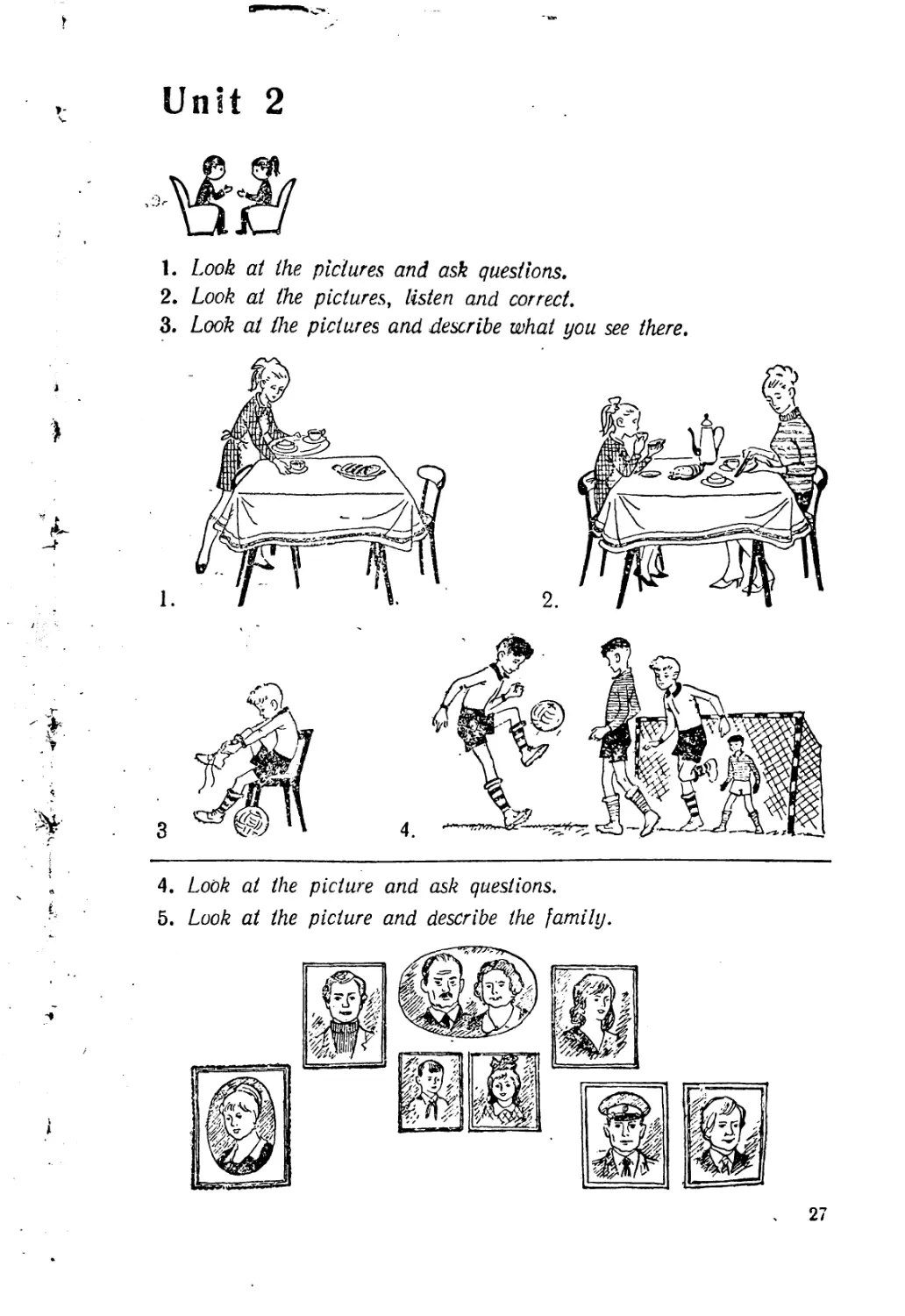
Unit 2
1. Look at the pictures and ask questions.
2. Look at the pictures, listen and correct.
3. Look at the pictures and describe what you see there.
—	■	■	■	I	1	■	—
4. Look at the picture and ask questions.
5. Look at the picture and describe the family.
\
27

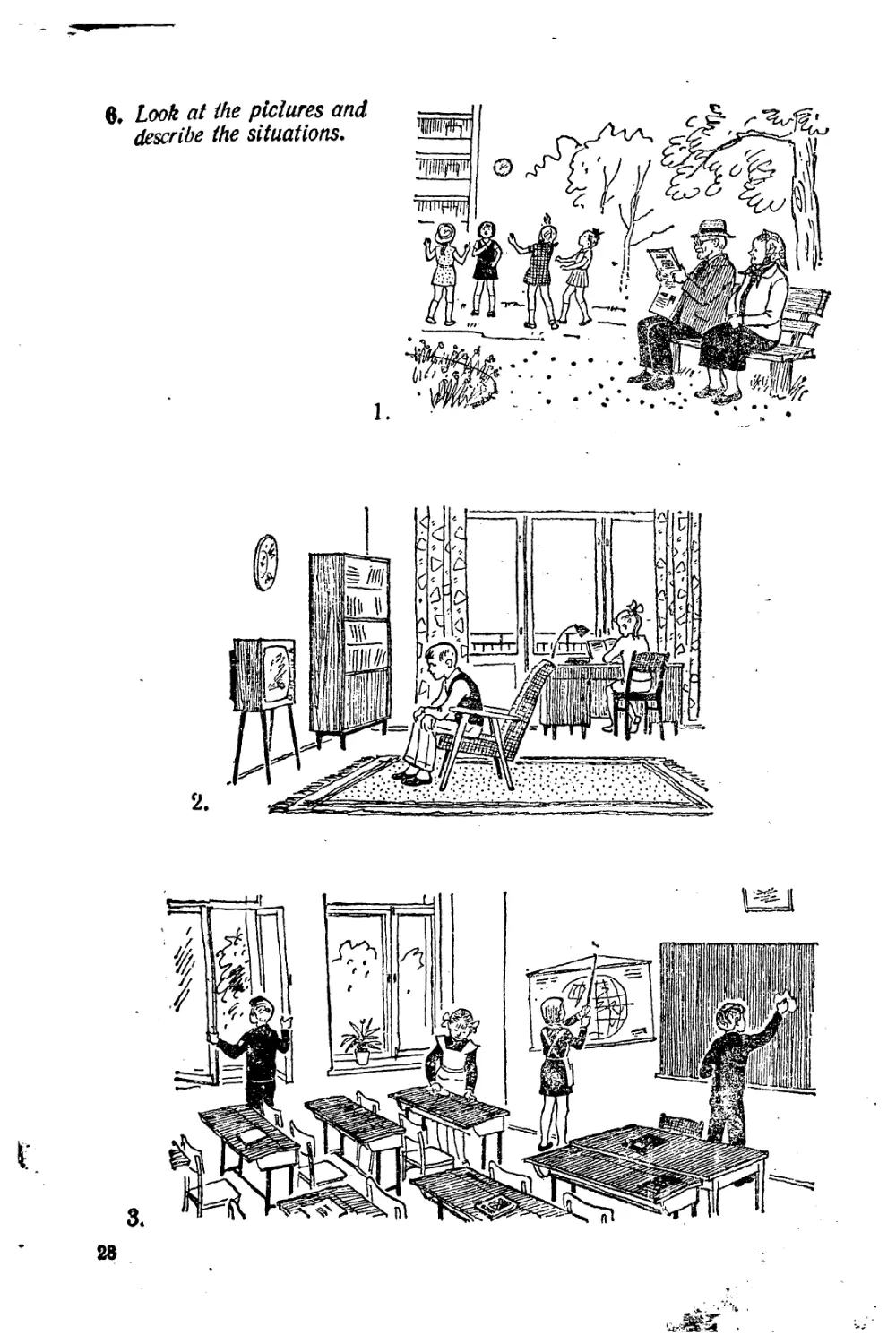
6.

с ЛАЗА
Мжг
15.	Read:
kind — drink	night — m ilk
ch ild — ch ildren	right — ring
behind — dinner	bright — big
nice	silk	right	skirt
behind
' thick	thirty	child	bright
kind
behind

0 16. Listen and read:
The boy is going to open the
window.
He is not going to open the
door.
Is the boy going to open the door?
No, he isn’t.
Is the boy going to open the
door or the window? He is going
to open the window. What is the
boy going to do? He is going to
open the window.
What is he going to open? He is going to open the window.
i
tv
л
t
The little girl is going to be a doctor.
The girl is going to be a doctor, isn’t she? Yes,
she is.
Is she going to be a doctor or a teacher?
She is going to be a doctor.
0	Ш	~	m.
What is she going to be? She is going to be a
doctor.
17.	Read:
t-
J
#
Jf.
He is going to	see a film.
He is going to	see a new	film.
He is going to see a new Soviet film.
He is going to	see a new	Soviet	film about	children.
Victor is going	to see a new Soviet	film	about children.
His brother Victor is going to see a new Soviet film
children.
My friend’s brother Victor is going to see a new Soviet film
children.
about
about
► 18. Read:
32
\
9
Are we going to have a Russian lesson? No, we are not.
he is going to be an engineer, isn’t he? Yes, he is.
i
ii

What are you going to do? I am going to watch TV,
What are. you going to read? I am going to read an English book.
Who are you going to give this box to? I am going to give it to
f A.	[	С	У f * 1 7 /	*
my sister.
Where are they going to live? They are going to live in a village.
Is she going to work at a factory or in an office? She is going to
work at a factory.
What is the weather going to be? It is going to be fine.
C*
ьУ
2
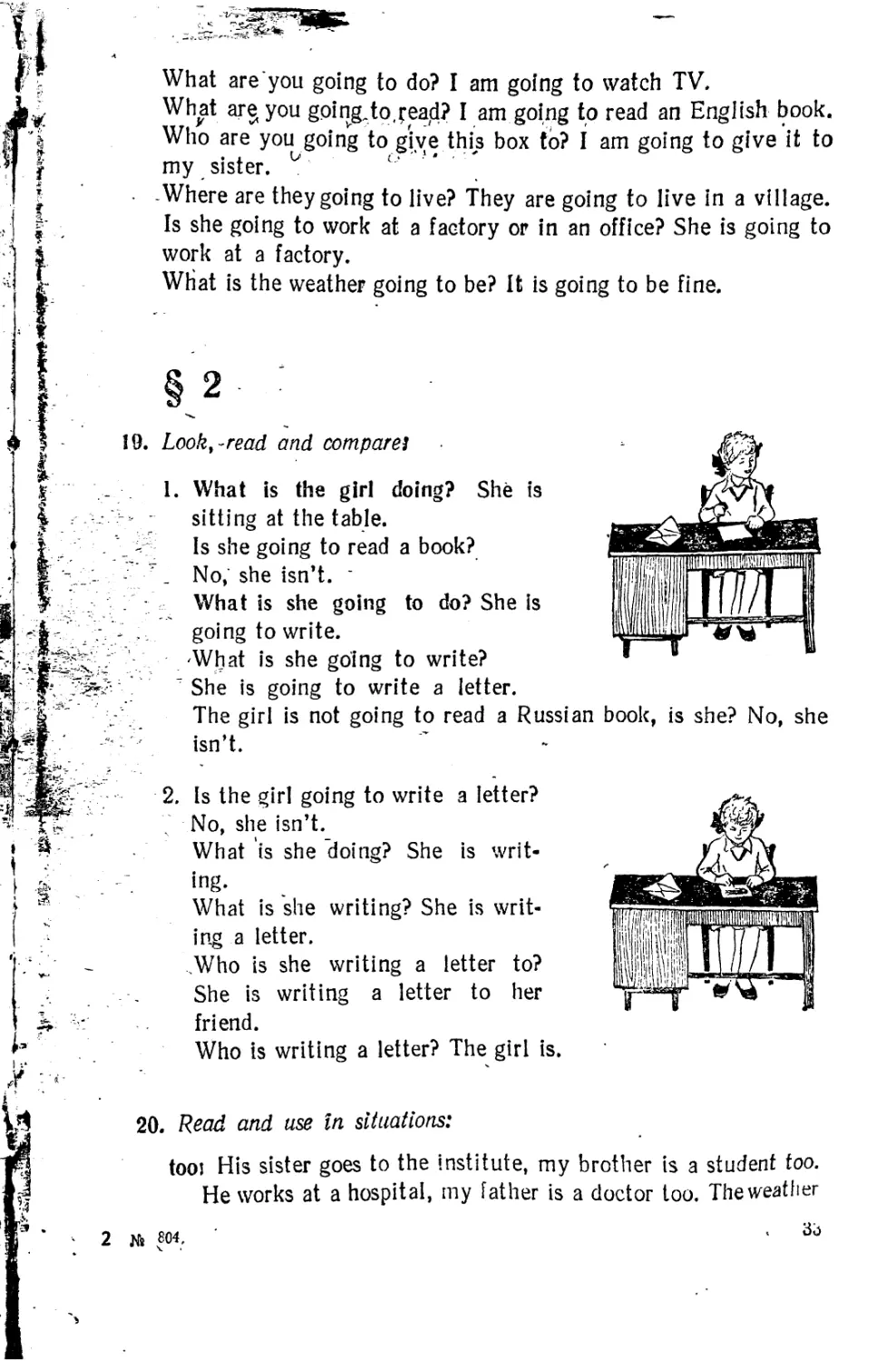
She is
19.	Look, read and compares
1.	What is the girl doing?
sitting at the table.
Is she going to read a book?
No, she isn’t.
What is she going to do? She is
going to write.
What is she going to write?
She is going to write a letter.
• * •	№ • • — . |	^
The girl is not going to read a Russian book, is she? No, she
isn’t.
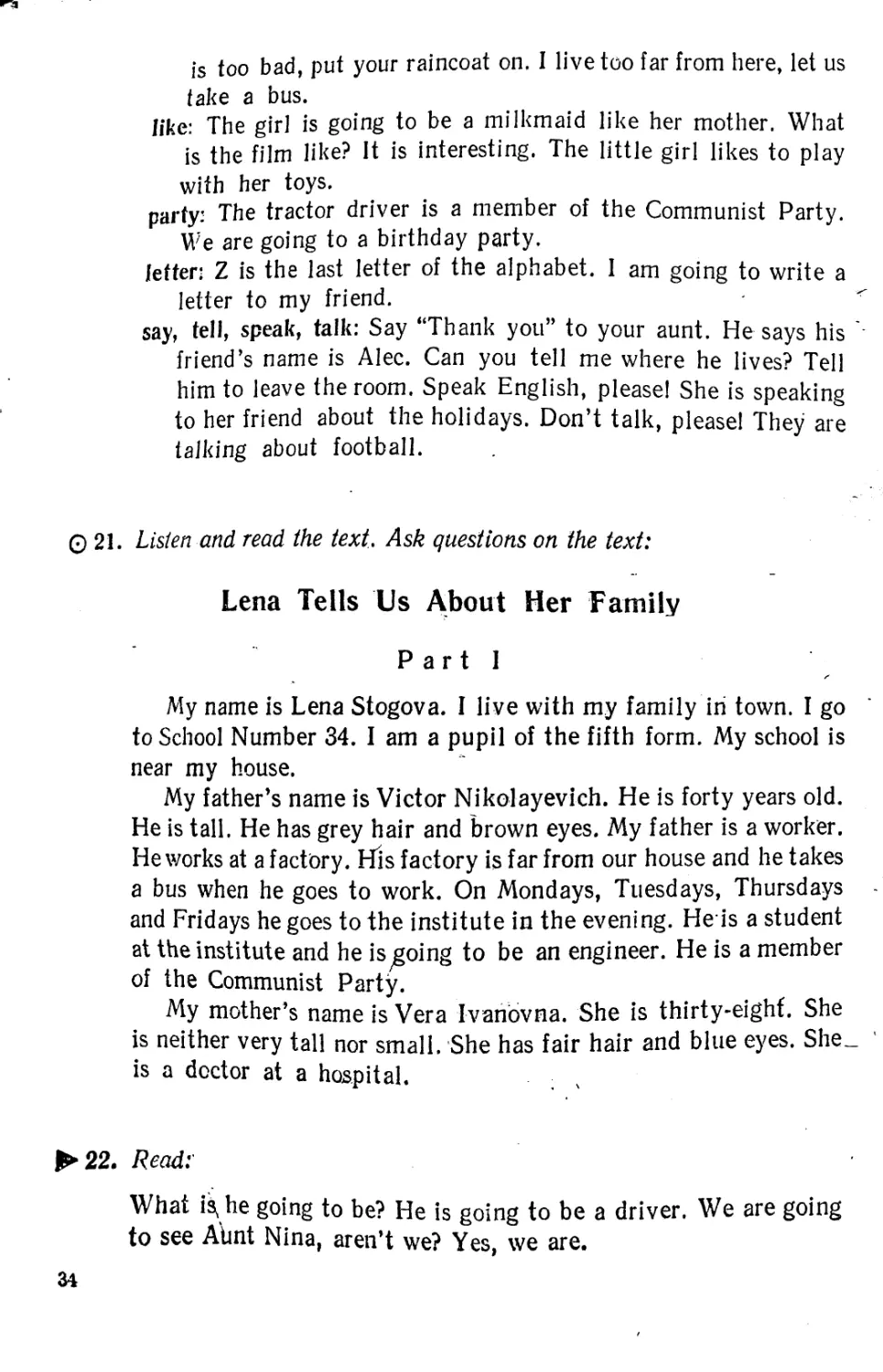
2.	Is the girl going to write a letter?
No, she isn’t.
What is she doing? She is writ¬
ing.
What is she writing? She is writ¬
ing a letter.
Who is she writing a letter to?
She is writing a letter to her
friend.
Who is writing a letter? The girl is.
20.	Read and use in situations:
too! His sister goes to the institute, my brother is a student too.
He works at a hospital, my lather is a doctor loo. The weather
2 Ks ЭД4,
V •
3b

is too bad, put your raincoat on. I live too far from here, let us
take a bus.
like: The girl is going to be a milkmaid like her mother. What
is the film like? It is interesting. The little girl likes to play
with her toys.
party: The tractor driver is a member of the Communist Party.
We are going to a birthday party,
letter: Z is the last letter of the alphabet. I am going to write a
letter to my friend,
say, tell, speak, talk: Say “Thank you” to your aunt. He says his
friend’s name is Alec. Can you tell me where he lives? Tell
him to leave the room. Speak English, please! She is speaking
to her friend about the holidays. Don’t talk, please! They are
talking about football.
0 21. Listen and read the text. Ask questions on the text:
Lena Tells Us About Her Family
Part 1
•*	;	'	yf
My name is Lena Stogova. I live with my family in town. I go
to School Number 34. I am a pupil of the fifth form. My school is
near my house.
My father’s name is Victor Nikolayevich. He is forty years old.
He is tall. He has grey hair and brown eyes. My father is a worker.
He works at a factory. His factory is far from our house and he takes
a bus when he goes to work. On Mondays, Tuesdays, Thursdays
and Fridays he goes to the institute in the evening. He is a student
at the institute and he is going to be an engineer. He is a member
of the Communist Party.
My mother’s name is Vera Ivanovna. She is thirty-eight. She
is neither very tall nor small. She has fair hair and blue eyes. She
is a doctor at a hospital.
22. Read:
•1	•	'T	к	* 9 #	S'	'	„	•	„	-z*+
What is, he going to be? He is going to be a driver. We are going
to see Aunt Nina, aren’t we? Yes, we are.
34

What are you going to give your mother on her birthday? I am
going to give her nice flowers.
What are they going to do after school? They are going to play
football.
Who is she going to speak to? She is going to speak to her parents.
Is it going to rain? No, it isn’t.
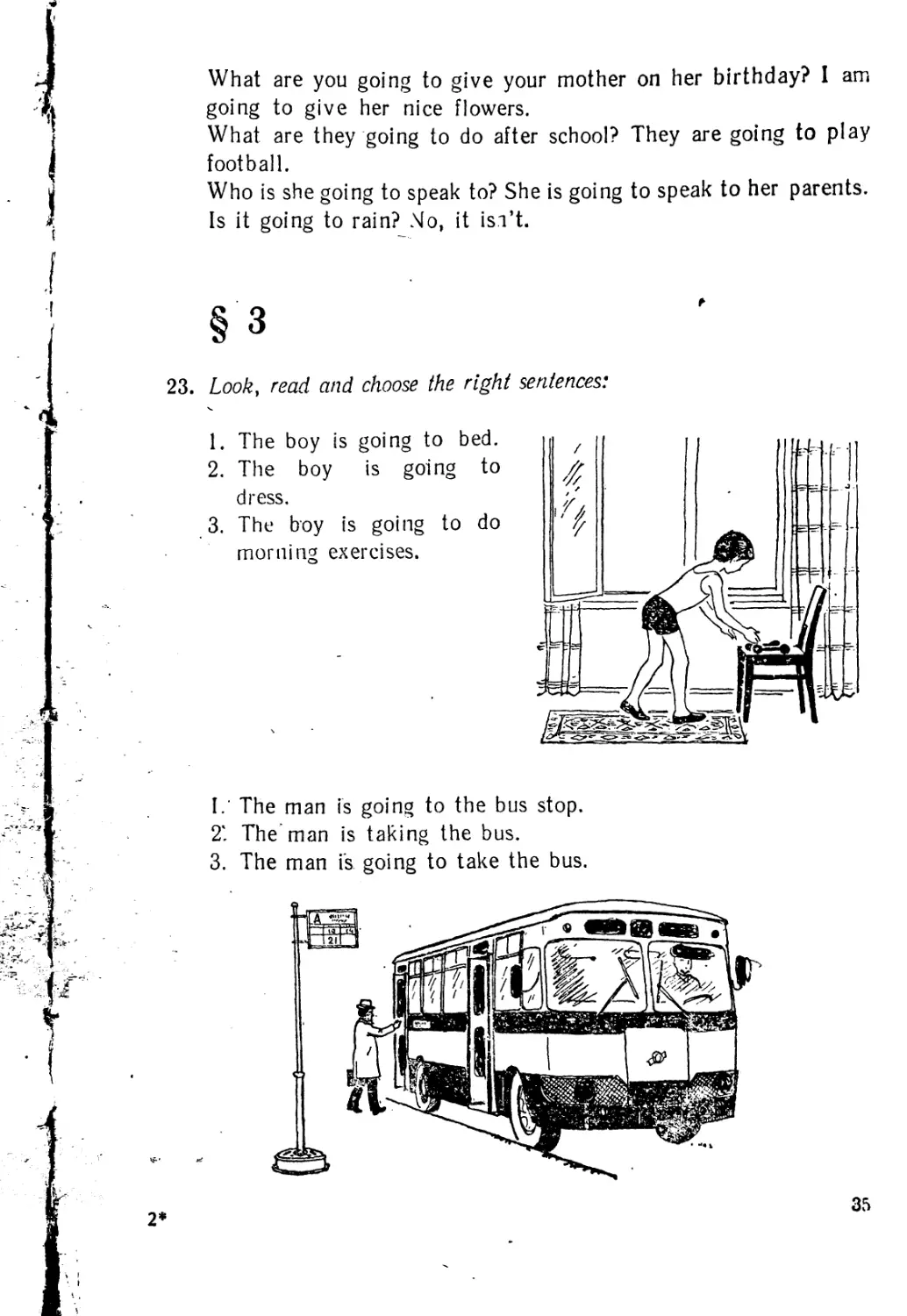
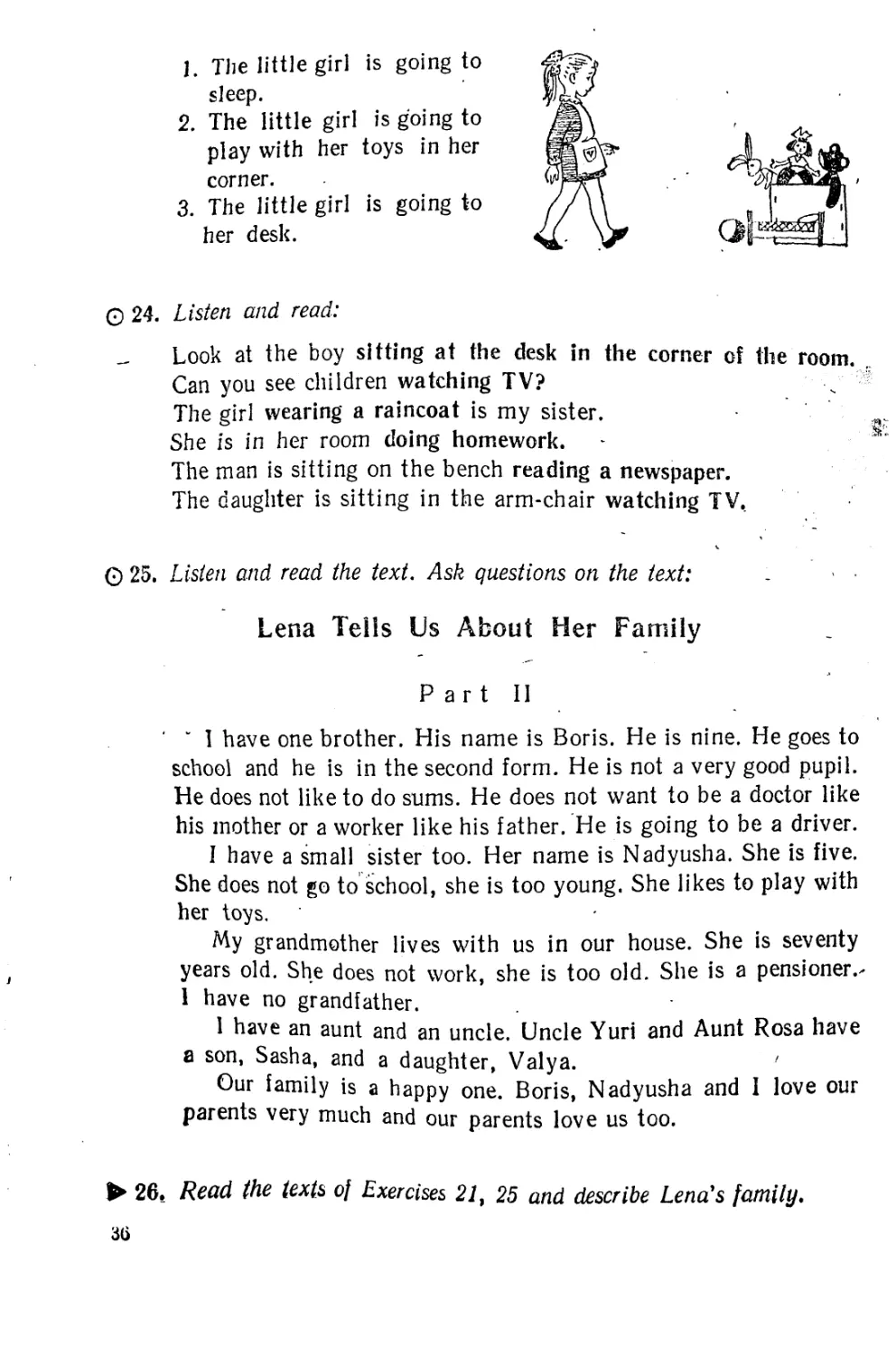
1.' The man is going to the bus stop.
2. The man is taking the bus.
3. The man is going to take the bus.
23. Look, read and choose the right sentences:
1. The boy is going to bed.
2. The boy	is going	to
dress.
3. The boy is going to do
morning exercises.
35

3.	The little girl is going to
her desk.
2.	The little girl is going to
play with her toys in her
corner.
1.	The little girl is going to
sleep.
О 24.	Listen and read:
Look at the boy sitting at the desk in the corner of the room.
Can you see children watching TV?
%
The girl wearing a raincoat is my sister.
She is in her room doing homework.
The man is sitting on the bench reading a newspaper.
The daughter is sitting in the arm-chair watching TV,
Part II
• ^
w I have one brother. His name is Boris. He is nine. He goes to
school and he is in the second form. He is not a very good pupil.
He does not like to do sums. He does not want to be a doctor like
his mother or a worker like his father. He is going to be a driver.
I have a small sister too. Her name is Nadyusha. She is five.
She does not go to school, she is too young. She likes to play with
her toys,	;	| Ш ||.| -1
My grandmother lives with us in our house. She is seventy
years old. She does not work, she is too old. She is a pensioner.
1 have no grandfather.
1 have an aunt and an uncle. Uncle Yuri and Aunt Rosa have
a son, Sasha, and a daughter, Valya.	'	^0.
Our family is a happy one. Boris, Nadyusha and I love our
parents very much and our parents love us too.
© 25. Listen and read the text. Ask questions on the text:
Lena Tells Us About Her Family
► 26. Read the texts of Exercises 21, 25 and describe Lena's family.

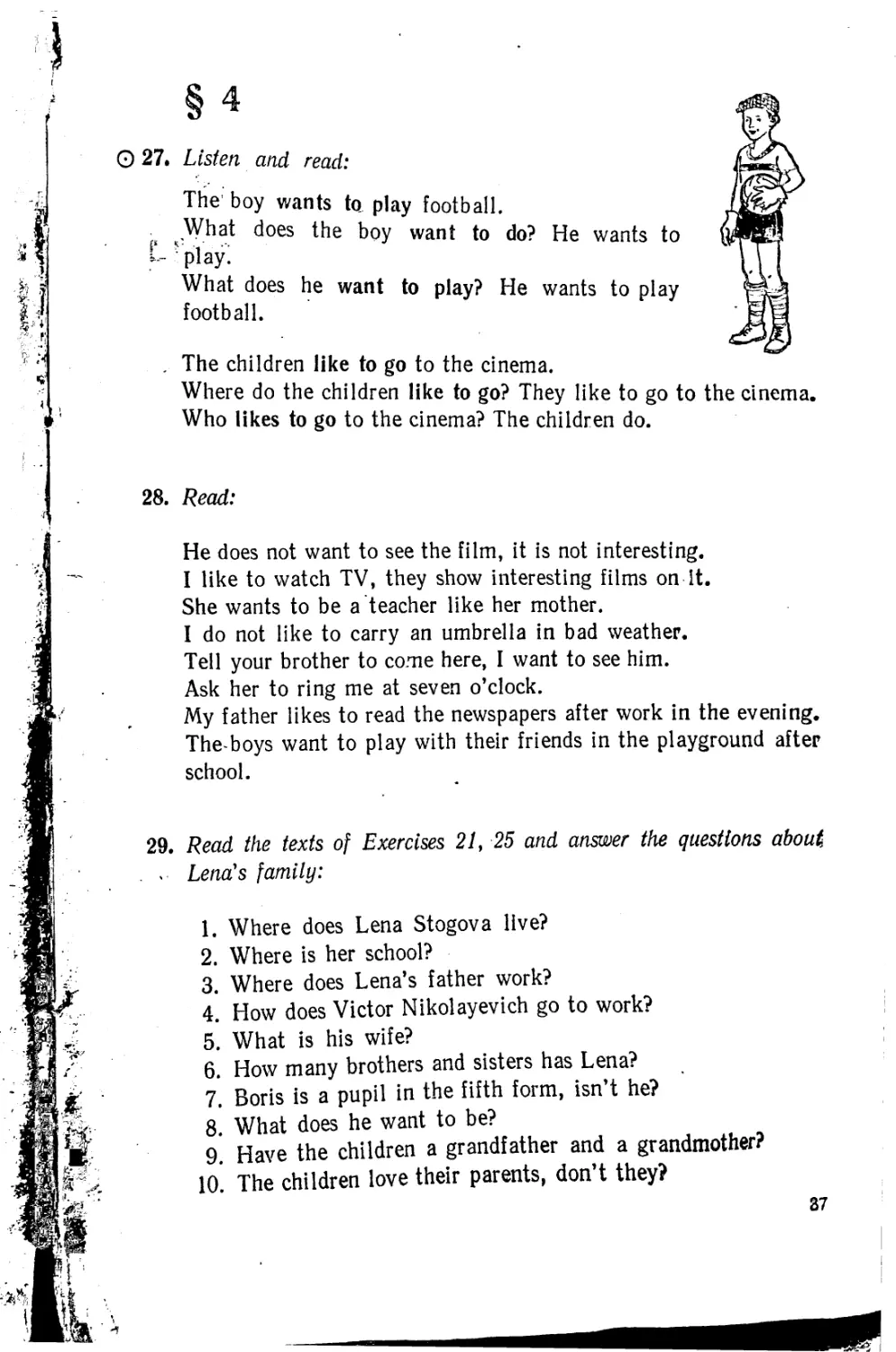
Q 27. Listen and read:
The boy wants to play football.
What does the boy want to do? He wants to
C play.
What does he want to play? He wants to play
football.
The children like to go to the cinema.
Where do the children like to go? They like to go to the cinema,
Who likes to go to the cinema? The children do.
28. Read:
He does not want to see the film, it is not interesting.
I like to watch TV, they show interesting films on It.
She wants to be a teacher like her mother.
I do not like to carry an umbrella in bad weather.
Tell your brother to come here, I want to see him.
Ask her to ring me at seven o’clock.
My father likes to read the newspapers after work in the evening.
The boys want to play with their friends in the playground after
school.
*
* *
29. Read the texts of Exercises 21, 25 and answer the questions about
. Lena's family:
1. Where does Lena Stogova live?
2. Where is her school?
3. Where does Lena’s father work?
4. How does Victor Nikolayevich go to work?
5. What is his wife?
6. How many brothers and sisters has Lena?
1. Boris is a pupil in the fifth form, isn’t he?
8. What does he want to be?
9. Have the children a grandfather and a grandmother?
10. The children love their parents, don’t they?

► 30, Read:	'	■	Я
1.	I like to see new films and I go to the cinema every Saturday
and Sunday. 2. My aunt and uncle want to see us on Sunday.
3.	I want to take a bus and go to the university, it is far from our
house. 4. He does not like to get bad marks. 5. The boys want to
play football with their friends in the playground after school.
6.	The little girl dees not want to put on her warm coat. !
§ 5
A W
0 31. Listen and read:
* Щ
Which book do you want to take, this one or that one?
1 want to take this book.
What do you like to drink, tea or coffee? I .like to drink coffee.
When do you want to ring her? 1 want to ring her after two o’clock.
Who do you want to write this letter to? I want to write this
letter to my friend.
Who wants to go to the park? We do.
^	\	•	f
You do not like to be late, do you? No, I don’t.
•
J
€	m
32. Read and answer the questions:
1. What do you ^ant to be?
2. You do not like to wear a raincoat, do you?
3. Do you like to read books about children?
4. What do you want to do in the evening?
5. Where do you like to go on Sundays?
6. Do you like to read Pionerskaya Pravda?
О За. Listen and read the text. Ask questions on the text:
л-X *	fw
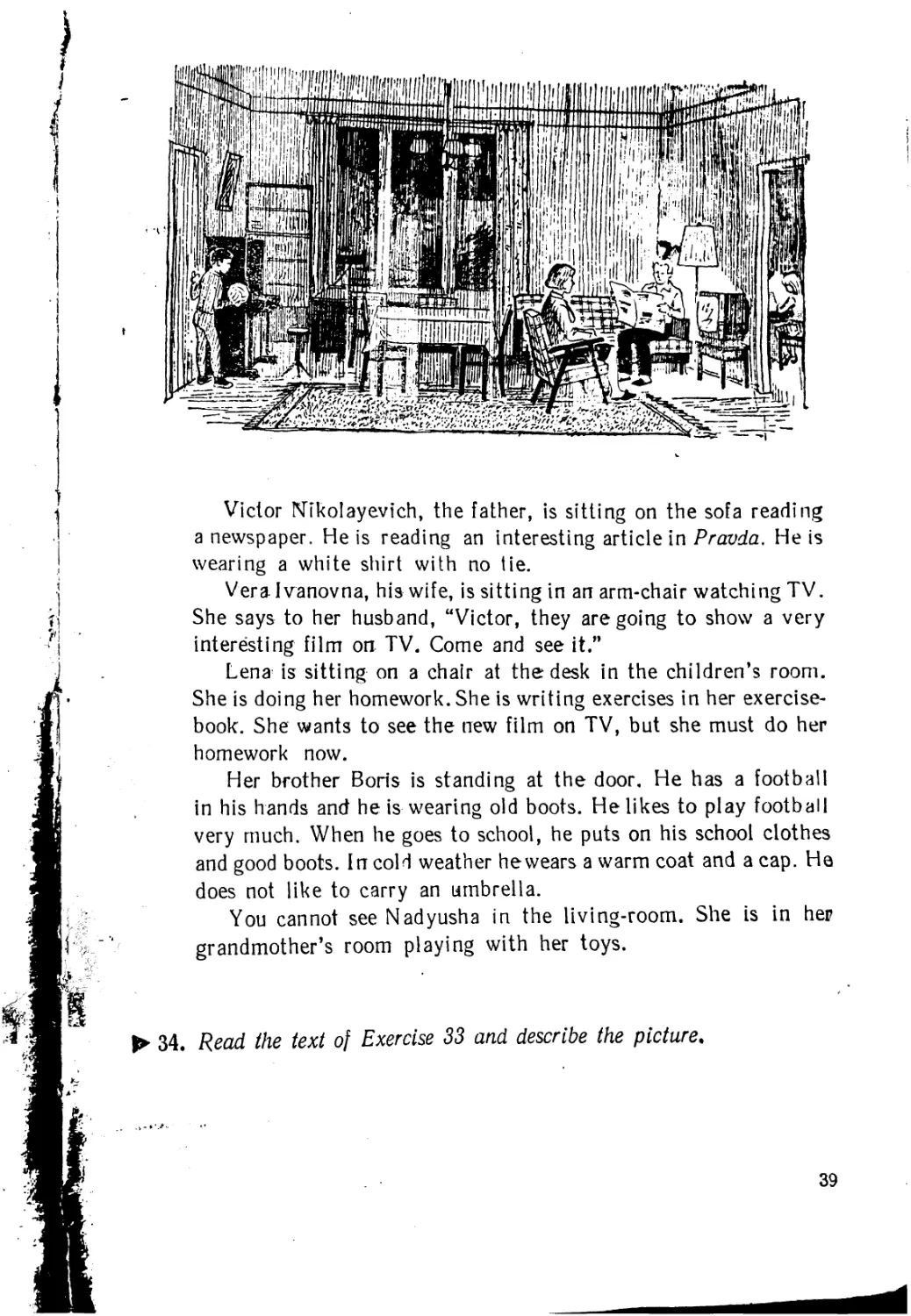
The Stogovs at Home
in the evening after work the Stogovs sit in their living-room.
They are sitting there now. You can see them in the picture.
38	.

•Л • V *• 4	t<4	.W'	/i	>,
Victor Nikolayevich, the father, is sitting on the sofa reading
a newspaper. He is reading an interesting article in Pravda.	He is
wearing a white shirt with no tie.
Vera Ivanovna, his wife, is sitting in an arm-chair watching TV.
She says to her husband, “Victor, they are going	to	show	a	very
interesting film on TV. Come and see it.”
Lena is sitting on a chair at the desk in the children’s room.
She is doing her homework.She is writing exercises in her exercise-
book. She wants to see the new film on TV, but she must do her
homework now.
Her brother Boris is standing at the door. He has a football
in his hands and he is wearing old boots. He likes to play football
very much. When he goes to school, he puts on his school clothes
and good boots. In cold weather hewears a warm coat and a cap. He
does not like to carry an umbrella.
You cannot see Nadyusha in the living-room. She is in her
grandmother’s room playing with her toys.
34. Read the text of Exercise 33 and describe the picture.

§ 6
.4
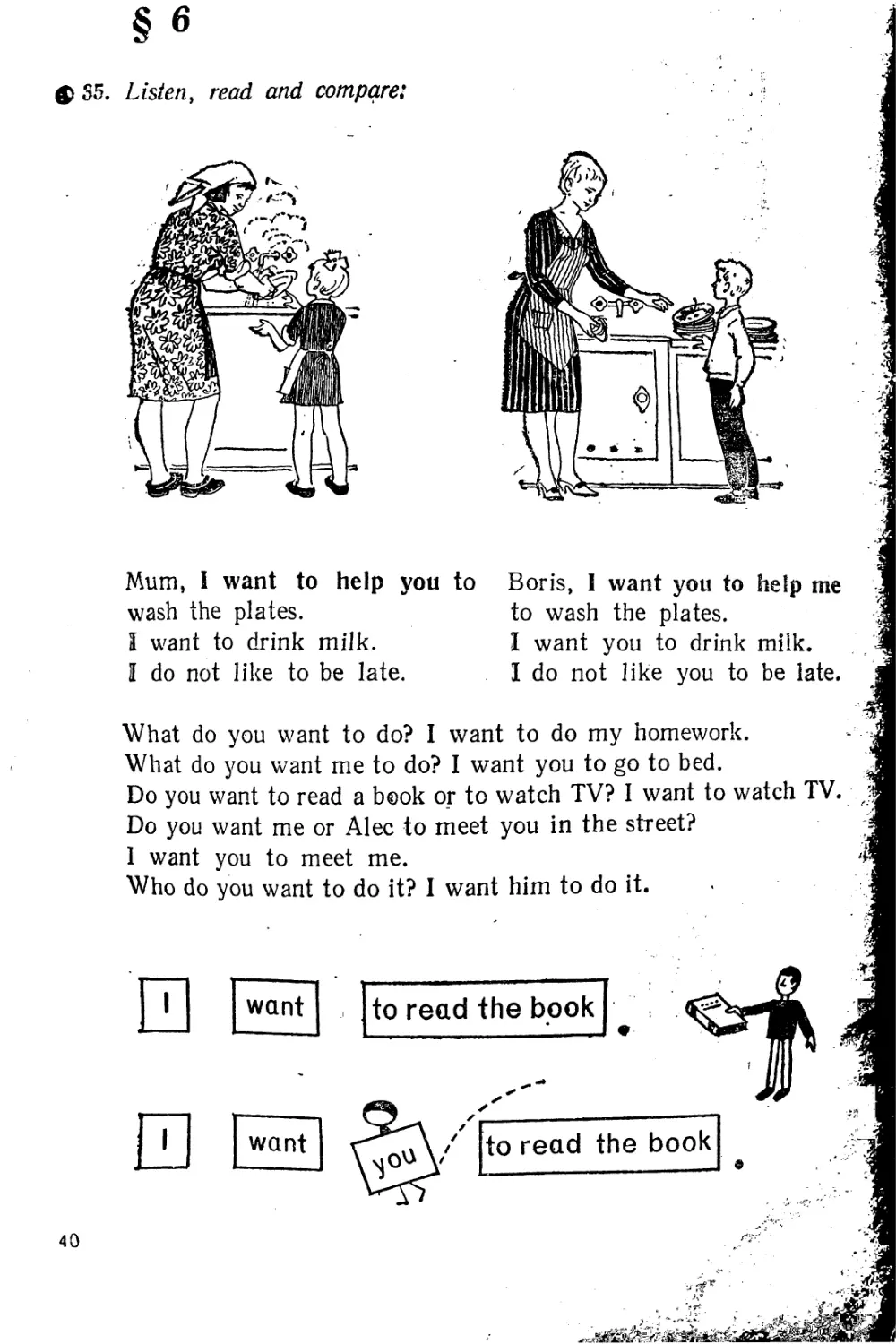
ф 35. Listen, read and compare;	<
J
Ivv
Mum, I want to help you to Boris, 1 want you to help me
wash the plates.
1 want to drink milk.
I do not like to be late.
to wash the plates.
I want you to drink milk.
1 do not like you to be late.
What do you want to do? I want to do my homework.
What do you want me to do? I want you to go to bed.
Do you want to read a book or to watch TV? I want to watch TV.
Do you want me or Alec to meet you in the street?
1 want you to meet me.
Who do you want to do it? I want him to do it.
I
want
read
book
to read the book
9

£
г
ft
ft
л,
I
I
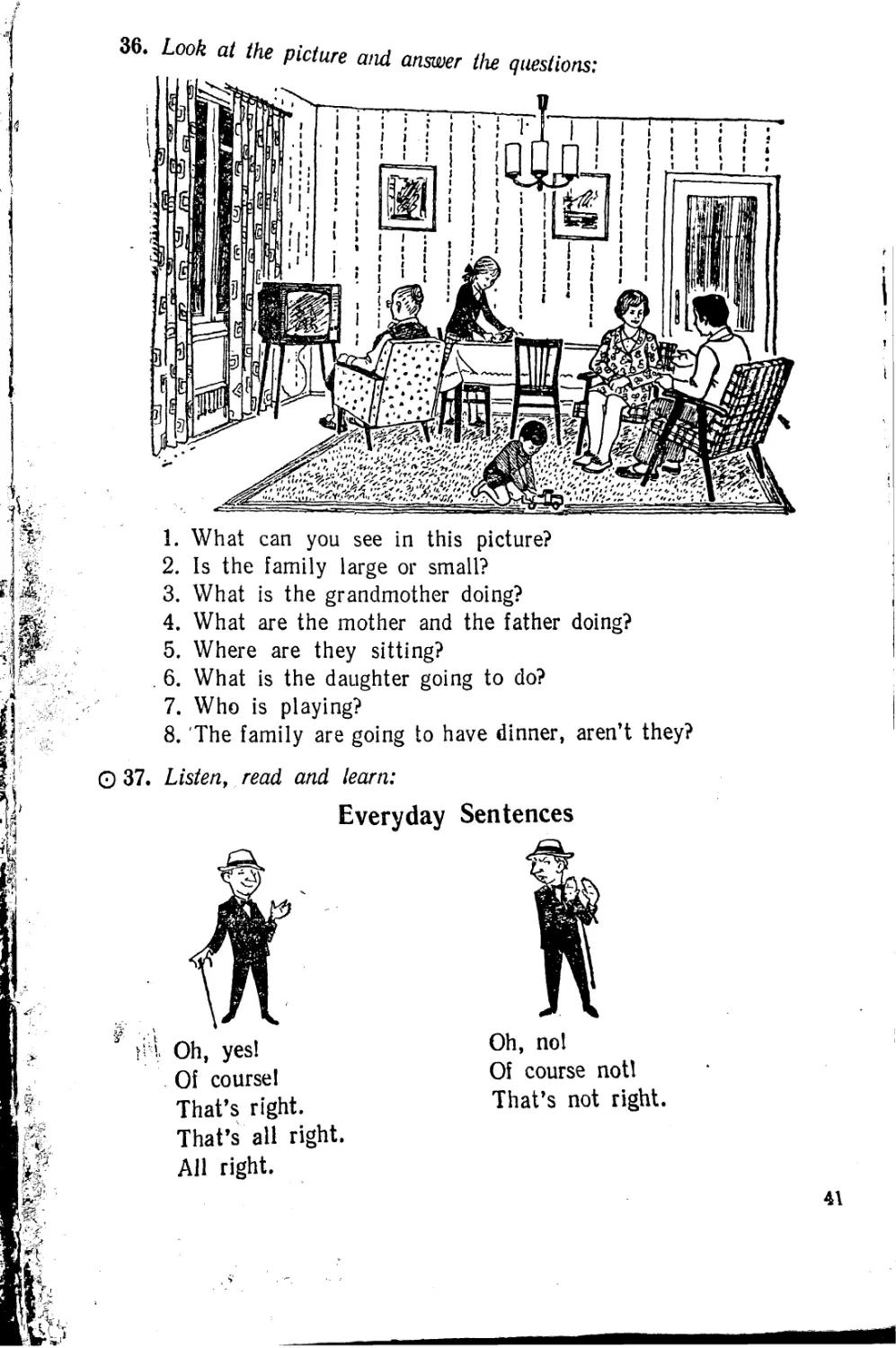
36. Look at the picture and answer the questions:
1. What can you see in this picture?
2. Is the family large or small?
3. What is the grandmother doing?
4. What are the mother and the father doing?
5. Where are they sitting?
6. What is the daughter going to do?
7. Who is playing?
8. The family are going to have dinner, aren’t they?
О 37. Listen, read and learn:
Everyday Sentences
f . t;
a
Oh, yes!
Of course!
That’s right.
That’s all right.
All right.
Oh, no!
Of course notl
That’s not right.

6
ф 35. Listen, read and compare:
V
* •
Mum, I want to help you to Boris, I want you to help me
wash the plates.
1 want to drink milk.
I do not like to be late.
to wash the plates.
I want you to drink milk.
I do not like you to be late.
What do you want to do? I want to do my homework.
What do you want me to do? I want you to go to bed.
Do you want to read a book or to watch TV? I want to watch TV.
Do you want me or Alec to meet you in the street?
1 want you to meet me.
ф
Who do you want to do it? I want him to do it.
I
want
V"

36. Look at the picture and answer the questions:
i»* *M ''	*> f ;V*	'	/>	e/j
c.y: •>',•• v'> ^ ''(V.f's*. ft*''".
Г' ""fry
»!///■ Л **4
I. • /".
1. What can you see in this picture?
2. Is the family large or small?
3. What is the grandmother doing?
4. What are the mother and the father doing?
5. Where are they sitting?
6. What is the daughter going to do?
7. Who is playing?
8. The family are going to have dinner, aren’t they?
О 37. Listen, read and learn:
Evervdav Sentences
Oh, yesl
Of course!
That’s right.
That’s all right.
A t t 4 -L
Oh, no!
Of course not!
That’s not right.

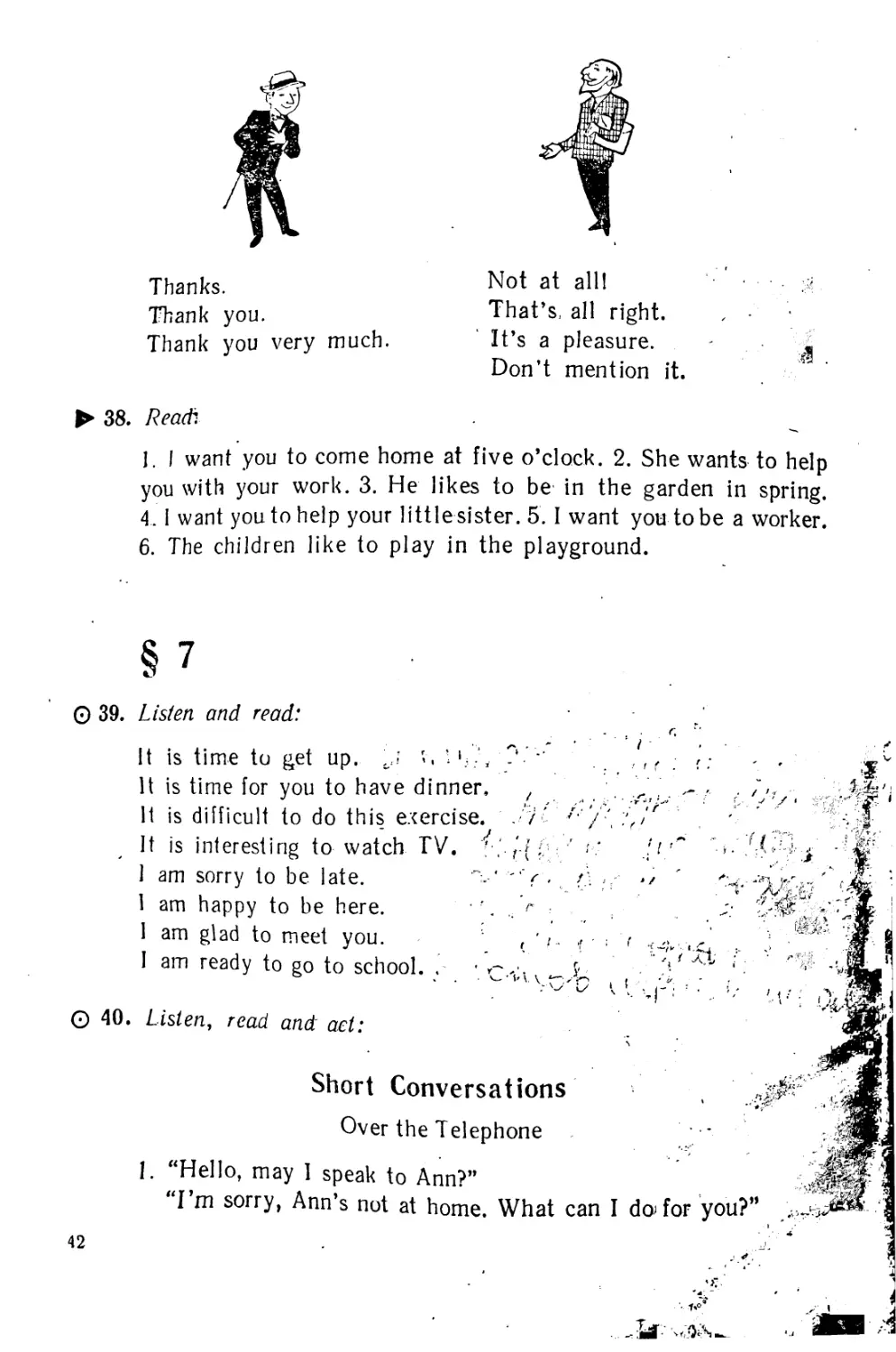
Thanks.
Thank you.
Thank you very much.
Not at all!
That’s all right.
It’s a pleasure.
Don’t mention it.
.
► 38.
1.	I want you to come home at five o’clock. 2. She wants to help
you with your work. 3. He likes to be in the garden in spring.
4.1 want youtohelp your little sister. 5. I want you tobe a worker.
6.	The children like to play in the playground.
7
О 39. Listen and read:
It is time to get up.
j
It is time for you to have dinner,
It is difficult to do this exercise.
It is interesting to watch TV.
I am sorry to be late.
1 am happy to be here.
I am glad to meet you.
I am ready to go to school, i
9 г*-I
/
м
'
•Vv V
A
J
'
r
\
О 40. Listen, read and act:
Short Conversations
Over the Telephone
r.
/ •
♦ *
/
-
Шг
1 Л
H:
. I
V Л
I. “Hello, may I speak to Ann?”
I m sorry, Ann’s not at home. What can I do; for you?”
42

\
I
-
:• ЙбгГ-
nilHlllllllllMltlllltfo
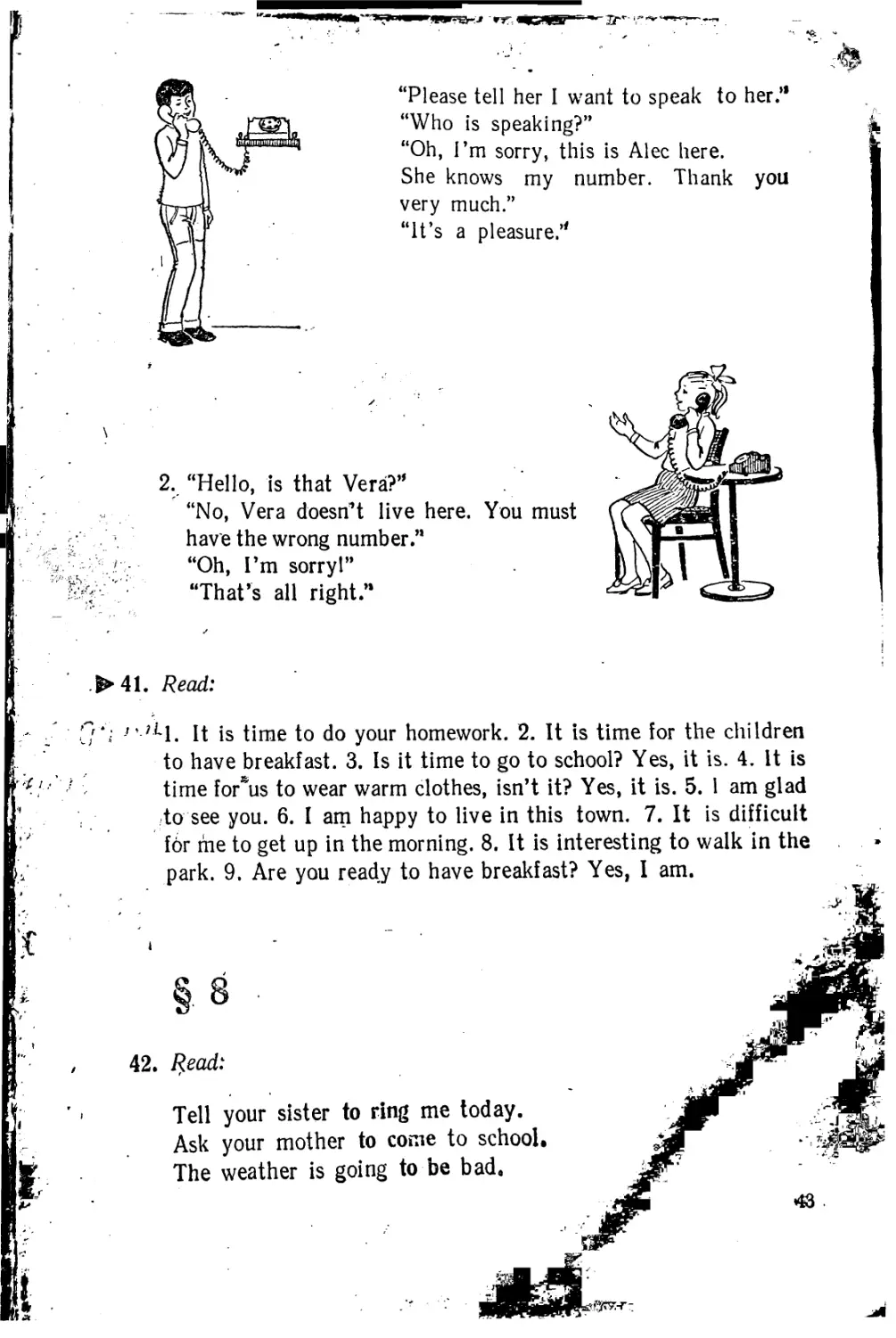
“Please tell her I want to speak to her.*
“Who is speaking?”
“Oh, I’m sorry, this is Alec here.
She knows my number. Thank you
very much.”
“it’s a pleasure.*
A
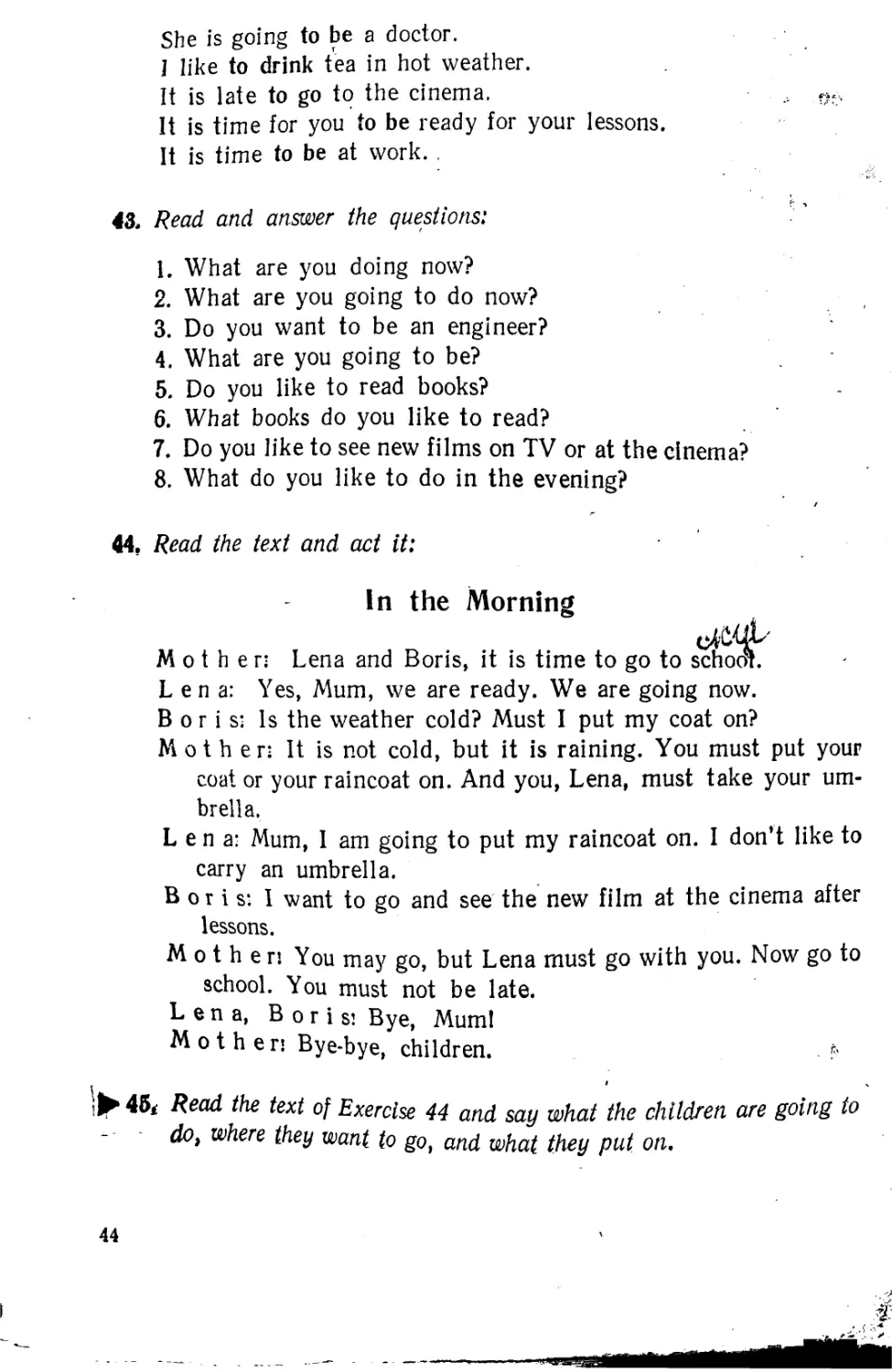
2.	“Hello, is that Vera?”
“No, Vera doesn’t live here. You must
have the wrong number.”
“Oh, I’m sorryl”
“That’s all right”
► 41. Read:
/
s
1.	It is time to do your homework. 2. It is time for the children
to have breakfast. 3. Is it time to go to school? Yes, it is. 4. It is
time for us to wear warm clothes, isn’t it? Yes, it is. 5. 1 am glad
to see you. 6. I am happy to live in this town. 7. It is difficult
for me to get up in the morning. 8. It is interesting to walk in the
park. 9. Are you ready to have breakfast? Yes, I am.
42. Read:
♦
Tell your sister to ring me today.
Ask your mother to come to school.
The weather is going to be bad.

I
!
She is going to be a doctor.
3 like to drink tea in hot weather.
It is late to go to the cinema.
It is time for you to be ready for your lessons.
It is time to be at work. .
»
43, Read and answer the questions:
1. What are you doing now?
2. What are you going to do now?
3. Do you want to be an engineer?
4. What are you going to be?
5. Do you like to read books?
6. What books do you like to read?
7. Do you like to see new films on TV or at the cinema?
8. What do you like to do in the evening?
44. Read the text and act it:
In the Morning
Mother: Lena and Boris, it is time to go to school.
Lena: Yes, Mum, we are ready. We are going now.
Boris: Is the weather cold? Must I put my coat on?
Mother: It is not cold, but it is raining. You must put your
coat or your raincoat on. And you, Lena, must take your um¬
brella.	щ
Lena: Mum, 1 am going to put my raincoat on. I don’t like to
carry an umbrella.
Boris; I want to go and see the new film at the cinema after
lessons.	%	■	■■■'.	I	Pi	'Щ	.8	pit	I
Mother: You may go, but Lena must go with you. Now go to
school. You must not be late.
Lena, Boris: Bye, Mum!
Mother: Bye-bye, children.	;•
E ■,	■/'
^ 45* Read the text of Exercise 44 and say what the children are going to
do} where they want to go, and what they put on.
44

§ 9
46.	Read and compare:
The definite
article — the
The children are in the park now.
He goes to the institute in the eve- 1
ning. J
The indefinite
article—a(an)
fPH * ®
I have a small dog.
I am reading an interesting Eng- 1
lish book.
^0 Pf
No article
l
There are apple-trees in Aunt
Vera’s garden.
1 have bread and butter and tea for
my breakfast. 1
47. Read and say which article we use:
1. The mother works at a hospital. 2. Let us go to the cinema;
the film is going to be interesting. 3. You can see machines and
tractors on the farm. 4. The suit is made of wool. 5. He wants to
be a driver. 6. The boys are going to play football in the play¬
ground,
48. Read and ask questions about the family. Describe the family, giving
details:
Here are the members of a family;
Father, 52, a worker atafactory; hair, grey; eyes, brown; a mem¬
ber of the Communist Party.
His wife, 45, a housewife; hair, fair; eyes, blue.
Their son, 22, a student at an institute; hair, dark; eyes, brown;
a Komsomol member.
49. Read the text and say what the boy is going bei
What Are You Going to Be? -
Sasha is going to leave school this year. He meets his father’s
friend Ivan Alexeyevich. They talk about professions.

Sasha: Good afternoon, Ivan Alexeyevich!
Ivan Alexeyevich: Hello, Sasha! How’s your father?
S.: Very well, thank you, Ivan Alexeyevich. And how are
you?
I A.; All right, thanks. You are leaving school this year, aren’t
you? What are you going to be?
S.: There are so 1 many interesting professions: doctor, teacher,
engineer...
1. A.: Many boys want to be cosmonauts... ‘
S.: Yes, there are many fine professions. But I want to work
at a factory first. Then 1 can go to an institute or a univer¬
sity.	-
I. A.: Well, you must think about it. Good-bye, my boy!
S.: Good-bye, Ivan Alexeyevich!
> so — так; 2 cosmonaut — космонавт
S	1
► 50. Read the text and describe the English family:
An English Family
I
Let me introduce the Whites, an English family.
Mr. White works in an office in London and lives in a small
house not far from London. Mrs. White, his wife, does not go to
✓
work, she looks after 1 the family.
9	^	J
Mr. and Mrs. White have two children, a boy and a girl. The
boy’s name is Henry, the girl’s name is Mary.
Their son Henry is thirteen years old. He goes to school and
is a very good pupil. He likes school very much. He wants to go
to a college 2 when he leaves school. He is going to be a radio
engineer.
Henry s sister, Mary, is very young, she is only six years old.
She goes to school too, but she does not like to learn her lessons.
She likes to play with her doll. 8	•
Mis. Whites mother, the children’s grandmother, lives with
them in their house. She is old, she is sixty-three. She loves Mary
and Henry very much and is very good to 4 them. Mr. White says
40

she is too good to the children. Henry and Mary love their parents
and their grandmother.
x look after — заботиться, ухаживать; 2 college — колледж
(среднее или высшее учебное заведение)\ 3 doll — кукла; 4 be good
to —быть добрым к
51.	Read the text and ask questions on it:
Pavel's Family
Pavel is a village boy. He lives not far from a big town. The
name of the village is Sosino. Pavel goes to the village school, he
is in the sixth form. Pavel is a Young Pioneer. He is a good pupil
and gets fives and fours.
Pavel’s parents are collective farmers. Their collective farm
is very big. It has many tractors and machines. Fyodor Stepanovich
Petrov, Pavel’s father, is a tractor driver. He is a member of the
Communist Party. His wife, Anna Ivanovna, is a nice woman.
She is thirty-seven years old. Anna Ivanovna works on a farm, she
is a milkmaid.
Pavel has two brothers and one sister. His brothers go to school,
but his sister does not go to school. She is too young. They have
a black cat, its name is Blackie. The little girl likes to play with it.
The children help	their mother	and	father	about	the	house.
The Petrovs have	a new car and on	Sundays they	go	to town
and have a nice day.
52.	Read the text of Exercise 51 and answer the questions:
1. Where does Pavel live?
ok	2.	He goes to school,	doesn’t he?
-	3.	The boy is not a	bad pupil, is	he?
4. What is Petrov’s family like?
5. What are Pavel’s parents?
6. What does the little girl like to play with?
7. What do the Petrovs do on Sundays?
47

53.	Read the text of Exercise 51 mid describe Pavel's family.
%
► 54. Read the text and answer the questions on it:
William
Do you see the little boy in this picture? He is an
English schoolboy. His name is William Brown. He
lives in a small town near London with his father,
mother, brother and sister.
William is eleven. He goes to school every day.
But he does not like school. He likes the holidays
better:1 he can play with his friends all the time.
He has many friends: Ginger, Douglas and Henry.
And one of his friends is a little girl. Her name
% • / * * •
is Joan.
In English schools lessons begin 9 at nine o’clock in the morn¬
ing. The children come home at twelve o’clock and have dinner.
Then they go back to school at two o’clock and have lessons again 9
from two to half past four.
William’s father, Mr. Brown, works in London. He goes to
work by train 4 in the morning and comes back at six o’clock In
the evening.	j
William’s mother works at home. She cleans the home and
makes breakfast, dinner and supper for her family. William has
a big brother and a big sister. Robert, his brother, is twenty-
one, and Ethel, his sister, is eighteen.
* better — лучше; 2 begin — начинаться; 9 again — опять; 4 by
train — поездом
1.	What is William? 2. Where does he live? 3. Who are his friends?
4.	Why does William like the holidays? 5. When do William and
his friends go to school and come back from school? 6. Where does
Mr. Brown work? 7. What does William’s mother do? 8. William
has no bi other and sister, has he?	,	'

55.	Reud die text and describe the birthday * 7
■ ^	^	r1	ffl	f	i	Й	j	4
My Birthday
ioday is the 27th of November. It is my birthday. Today I am
ten. It is Sunday and I do not go to school.
fhe weather is fine. I get up at eight o’clock, wash and dress.
Then Mummy and Daddy come into my room and say: “Happy
birthday, happy birthday! Here is a little birthday present for
you.” They give me a nice book with many pictures. I like to read
books with pictures.
My little sister comes to me too and gives me her present.
It is a picture of a cat. I say “Thank you very much” to my mother,
father and sister.
Today we are going to have a birthday party. At twelve o’clock
my friends come to my place. They wish 1 me a happy birthday
and give me their presents: books, toys and pictures. I thank
them all.
My mother comes and asks us to come to the living-room. There
we see a big birthday cake on the table. We eat the cake, drink
tea and speak about our school and our friends. Then we play, sing
and dance. After the party we all go to the cinema and see an in¬
teresting film.
'I am happy to have a nice day with my friends.
Л V
jl —i m ш шшшт—швтш * mm nw ■ ■■ Pa -1—■ ■■■» ■ ■ ■ »■ ■ ■—
1 wish — желать
66. Read and answer the questions about you and your /
1. Is your family large?
2. How many sisters and brothers have you?
3. What street do you live in?
4. Is it far from your school?
5. Where does your father work?
6. What is your mother?

7. How do your parents get to work?
8. You have a grandmother and a grandfather, haven’t you?
9. How many aunts and uncles have you?
10.	When is your birthday?
Я
J
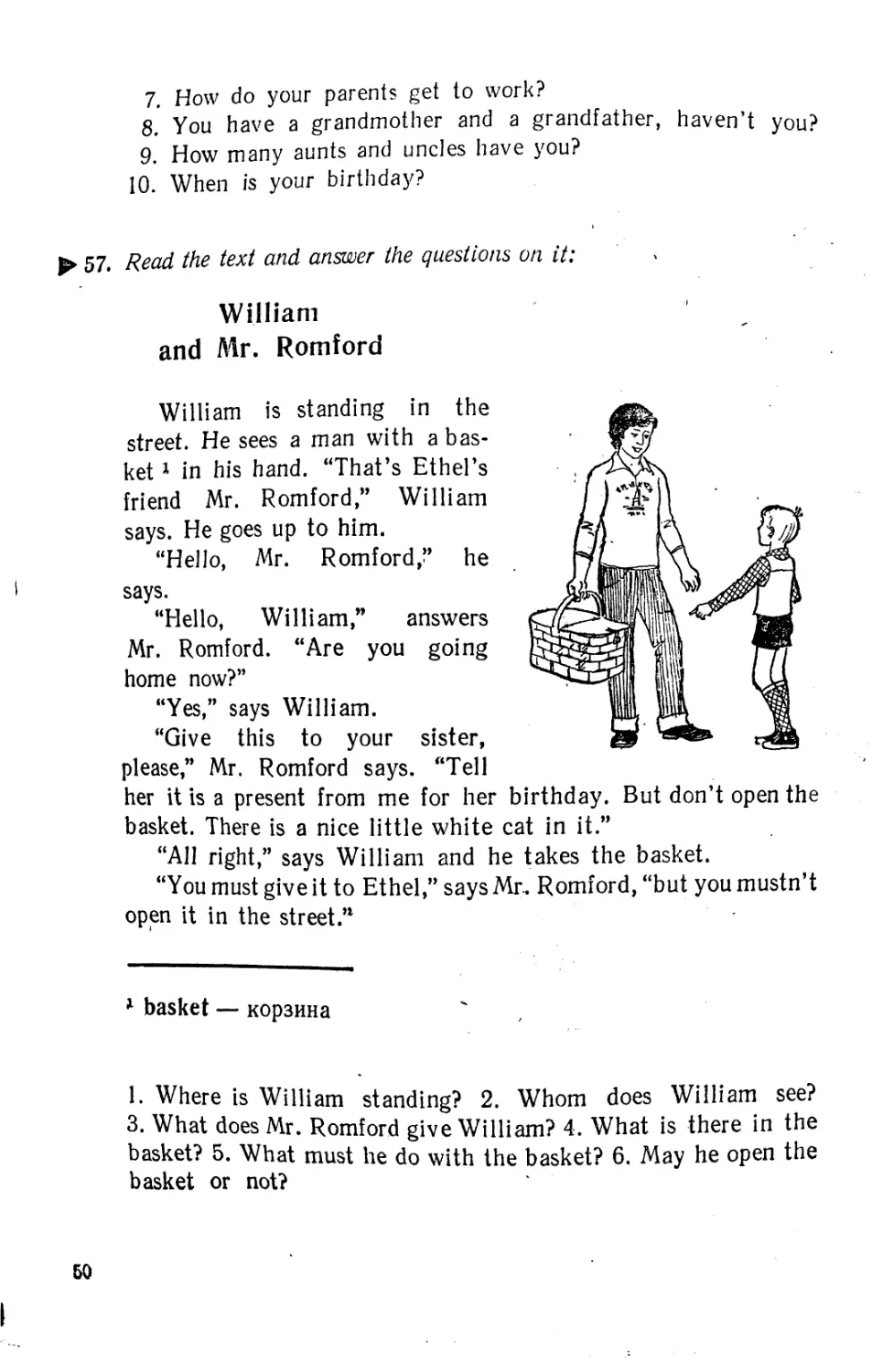
57.	Read the text and answer the questions on it:
л
William
and Mr. Romford
William is standing in the
street. He sees a man with a bas¬
ket 1 in his hand. “That’s Ethel’s
friend Mr. Romford,” William
says. He goes up to him.
“Hello, Mr. Romford,” he
says.
“Hello, William,” answers
Mr. Romford. “Are you going
home now?”
“Yes,” says William.
“Give this to your sister,
please,” Mr. Romford says. “Tell
her it is a present from me for her birthday. But don’t open the
basket. There is a nice little white cat in it.”
“All right,” says William and he takes the basket.
“You must give it to Ethel,” says Mr.. Romford, “but you mustn’t
open it in the street.’1
1 basket — корзина
1. Where is William standing? 2. Whom does William see?
3.	What does Mr. Romford give William? 4. What is there in the
basket? 5. What must he do with the basket? 6. May he open the
basket or not?
50

§ 12
58.	Read the text:
Great October Day
7th of November is a great 1 holiday in the Soviet Union.
All men, women and children celebrate 8 this date in towns and
villages for two days. There are red flags in the streets and on the
houses.
Before this day there are meetings * in factories, on farms, in
offices 4and at schools.
On the 7th of November, in the morning, there are demonstra¬
tions * in all the towns and villages. We can watch TV and see
the parade of the Soviet Army and the demonstration in Red
Square in Moscow. The parade and the demonstration are very
fine.
On the 8th of November we have a holiday too. We go and see
our friends and celebrate the holiday with them at home. We have
a good day.
1 great — великий; 8 celebrate — отмечать; праздновать; 8 meet¬
ing — собрание;4 demonstration — демонстрация
51

LONG LIVE GREAT OCTOBER DAY!
LONG LIVE THE SOVIET UNION!
59.	Read and answer the questions:
I. Is the 7th of November a great Soviet holiday?
^November? " ‘he ^	°"	^	ho“-	« *• ™
3. Do you have a meeting at your school for this day?
4. Do you go to the demonstration on the 7th of November?
o.	You go and see your friends on the 8th of November
don t you?
6.	Do you like the holiday?
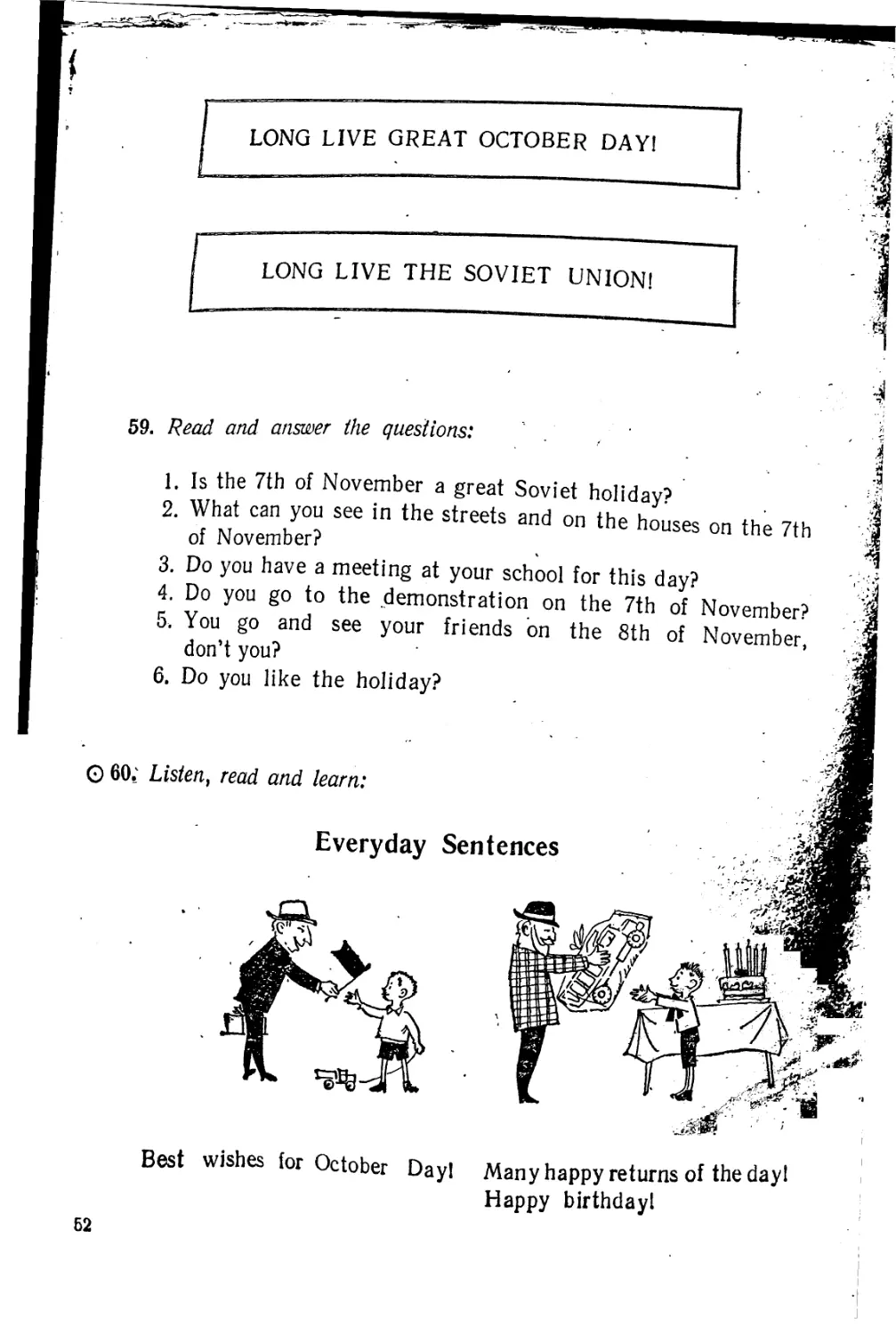
G 60. Listen, read and learn:
Everyday Sentences
52
Best wishes for October Day! Many happy returns of the day!
Happy birthday!

*
Nr
1 wish you a happy New Year! The same to you!
Best wishes for the New Year! Thank you!
I
► 61* Read the text and answer the questions on it:
William and Ginger
William is going home. In his hands he has the basket with
the nice little cat in it. He sees his friend Ginger in the street.
Ginger comes up to him and William asks him: “Can you tell
me what I vhave in this basket?” - -
* _ ■ %
“Apples?” says Ginger.
“No,” says William.
“A cake?” says Ginger.
“No,” says William again. “It is a nice little white cat for my
sister Ethel. It’s a birthday present from her friend Mr. Romford ”
“May I look at it?” asks Ginger.
“No, I mustn’t open the basket. I must give it to Ethel,” answers
William.
am
“All right then. You can have one little look,” says William.
Ginger opens the basket and puts his finger 3 into it.
But the nice little white cat has nice sharp claws. 8 Ginger
pulls out4 his finger, and the cat jumps out5 of the basket and
runs away 8 into a garden.
* have a little look — взглянуть разок; * finger
палец; 8 sharp
claws — острые когти; 4 pull out — вытаскивать; 6 jump out
выпрыгивать; 0 run away — убегать
53

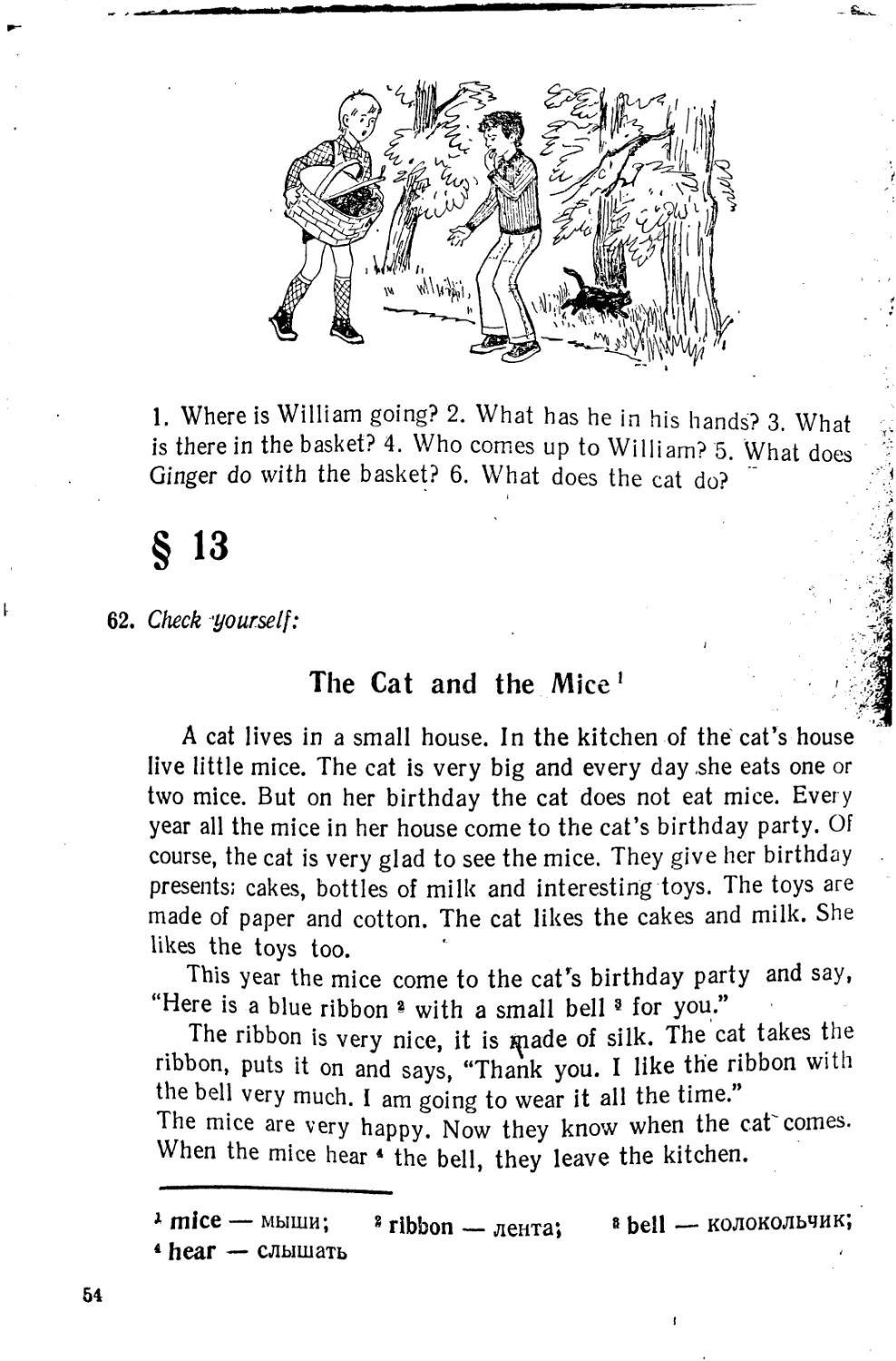
1. Where is William going? 2. What has he in his hands? 3. What
is there in the basket? 4. Who comes up to William? 5. What does
Ginger do with the basket? 6. What does the cat do?
,3
/
62. Check yourself:
The Cat and the Mic
e 1
A cat lives in a small house. In the kitchen of the cat’s house
live little mice. The cat is very big and every day she eats one or
two mice. But on her birthday the cat does not eat mice. Every
year all the mice in her house come to the cat’s birthday party. Of
course, the cat is very glad to see the mice. They give her birthday
presents; cakes, bottles of milk and interesting toys. The toys are
made of paper and cotton. The cat likes the cakes and milk. She
likes the toys too.
«н ^1S '>'ear m'ce come to the cat’s birthday party and say,
Here is a blue ribbon * with a small bell a for you.”
•kk r‘kk°n is very nice, it is made of silk. The cat takes the
” on’ puts ^ on and says, “Thank you. I like the ribbon with
e e 1 very much. I am going to wear it all the time.”
Whm3re very hapPy- Now they know when the cat'comes.
ien e mice hear 4 the bell, they leave the kitchen.
1 т*се мыши; з ribbon — лента} 8 bell — колокольчик;
4 hear — слышать

article n
birthday n
cinema n
difficult a
driver n
4
far adv
film n
football n
happy a
hospital n
institute n
interesting
know v‘
leave v
love v
machine n
a
milkmaid n
%
party n
talk v
toy n
playground n tractor n
present n
university n
profession n want v
ready а
ring v
sorry а
\
I.	Напишите no строчке каждое слово, вставляя пропущенные
буквы:	•	"	'
г-ght, k-nd, ei-ht, nig-t, beh-nd, ch-ld, bri-ht.
II.	Опровергните утверждения и прочитайте написанное:
г
1. I am going to play football. 2. They are going to take a Num¬
ber Five bus. 3. We are going to see a new film. 4. It is going to
snow. 5.. He is going to take off his raincoat. 6. She is going to take
her umbrella'-.
" ' * *
p
III.	Напишите no одному вопросу к каждому предложению, начи¬
ная их словами, данными в скобках. Прочитайте написан¬
ное:
1. You are going to be a teacher. (What. . .)
2. We are going to play in ttjs playground. (Where . . .)
3. The weather is going to be bad. (Is . . . or .. .)
4. You are going to ring your friend. (Who ... to7)
5. You are going to get to the cinema at a quarter to four. (When
' ■ • •>'
6. The teacher is going to speak to my mother. (Who ... to?)

IV. Перепишите предложения, вставляя, где нужно, too, и прочи¬
тайте написанное:
1, She can’t watch this film. She is young. 2. The grandmother
loves the children very much. She is good to them. 3. My friend
likes to play football. I like football. 4. It’s late. You must go
to bed. 5. Victor is a student at the university. His friend Dmitry
is a student. 6. The institute is far from the house. You must take
a bus.	-	:
%
V.	Напишите вопросы к предложениям по образцу и прочитайте их:
Ф
Образец: The film is interesting.— The film is interesting,
isn’t it?
1. This is a fine profession. 2. She does not go to the university.
3.	He is a Communist Party member. 4. His son likes to play with
the dog. 5. The institute is not far from here. 6. I want to put
on this jacket. 7. They live near the cinema. 8. We have many
friends.	-	-	J
VI. Перепишите предложения, вставляя местоимения те, you,
him, her, it, us, them, и прочитайте написанное:
• * *• *
1. The mother has two sons. She loves . . . very much. 2. The book
is interesting. I want to read ... .3. Ivanov is present. You can
see... at the first desk. 4. Tell . . . about the new film. We want
to go to the cinema. 5. I want ... to clean the room. 6. Don t
turn to me. The teacher is looking at . . . .7. My sister is small
and 1 love ....
VII. Напишите ответы на вопросы:
1. Are you going to be a doctor or an engineer? 2. Are you going
to read tmglish texts or to write an exercise today? 3. What are
you going to do at five o’clock? 4. Where are you going to be on
Sunday? 5. What are you going to have for supper? 6. What weath¬
er is it going to be?
56

VIII* Допишите предложения по образцу, вставляя too или either,
и прочитайте написанное:
.. • \
;
, I
Образец: My birthday is in August.— His birthday is in August
too.
1.	I live near the university.— He
• • •
\n ■	2.	He	doesn’t	like	to	take	a	bus.—	/
• • •
3. The children like to play in the playground.— Boris . . Г
4. My father does not work at a hospital.— mother . . .
5. My mother doesn’t like to watch football on TV.— My sister. . .
6. We are not leaving school this year.— They ..
. * •	«
• 4
#•
IX. Напишите no одному вопросу к каждому предложению, начиная
их словами, данными в скобках. Прочитайте написанное;
1. Her daughter is going to leave school. (Who . . .)
2. It is going to rain. (Is. . .)
3. My aunt lives in Voronezh. (Where . . .)
4. He has two uncles. (How many . . .)
5. We learn Russian and English at school. (What . . .)
6. His son is going to be a student at an institute this year.
(When . . .)	'	.
7. My grandmother likes to watch interesting films on TV. (What
kind of . . .)
8. She wants to speak English very well. (How . . .)
X. Напишите ответы на вопросы, данные в упражнении 43 (с. 44).
XI.	Напишите 8 вопросов своему другу о его (ее) дне роясденип.
XII Напишите 8 вопросов своему другу о семье нового ученика.

Unit 3
3. Look at the pictures and say what there is in the cups
4. Look at the pictures, listen and correct,
6; Look at the pictures and ask questions.
1. Look at the picture and ask ques¬
tions.
2. Look at the picture and describe it,
6. Look at the pictures and say what there is on the desks and in the box,
7. Look at the pictures, listen and correct,
4
8. Look at the pictures and ask questions.

5.
10. Look at the picture and describe the living-room.
11, Look at the picture and ask questions about the room.
ж	■	Э-J	.	ж	^	ш	fJm
ф
9.
Look at the pictures and ask questions.
12. Look at the pictures and say what the girl and the boy are going to
do and what they are doing.

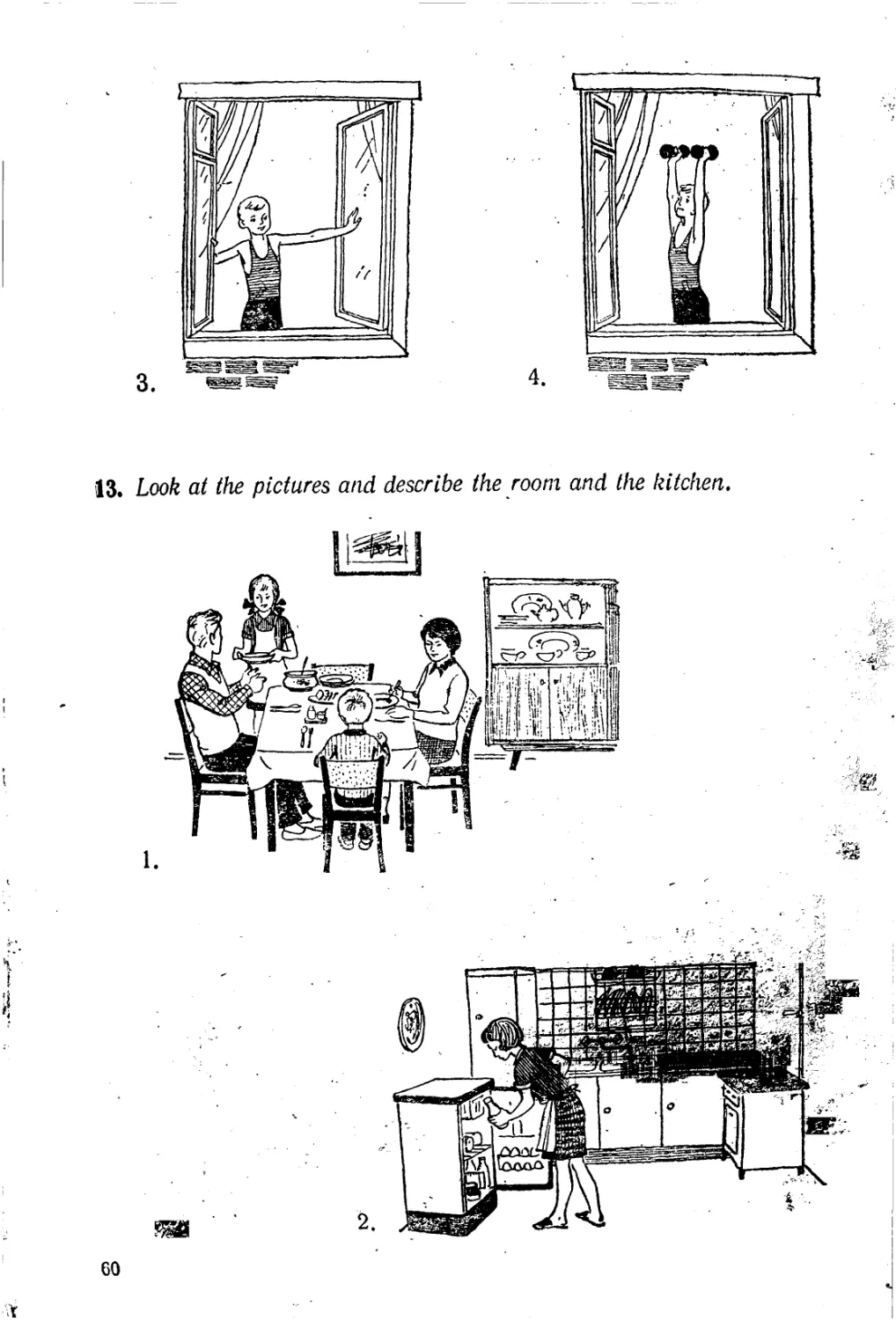
13, Look at the pictures and describe the room and the kitchen.
ф
9
60

14.	Look at the family in the
hall and in the bedroom,
describe them, and say
what they are doing and
going to do,
Л .;7 .	V	f;.	;
. I
1
’ 1	4
15. Look at the house in a village and ask questions about it

16.	Describe your flat (house).
17.	Speak about the situations:
1.	You meet a friend. He (she) says he (she) has a new flat (house).
a)	Ask him (her) to describe his (her) flat (house).
b) Ask him (her) what he (she) has in his (her) room or in one
of the rooms.
2.	You have a new room. Say what things you want to have in
it and how you want to put your things in it.
I
18.	Read:
©
air
air(are)
ai(ay)
ar
cfrai r
rain
• • ■
; car |
>
hair
. may
arm
fair
play
farm
parents
say
park
fair —far
parents — party
hair—arm
chair
car
19. Read:
ear
''
eer
ere

ll
•»
near
read
feet
year
clean
week
here
tea
sleep
ear—eat
year—speak
near—clean
ear
hear
clear
cheer 1
pioneer—coffee
eer
dear
tear
fear I
engineer—meet
О 20. Listen and read:
there
where
their
wear
are
learn
aren’t
i1. Щ
21. Read the transcription:
in
[m]
[men] men
[b]
[bed]
bed
[n]
[in] in
[1J
[lipl lip
[r]
[red]
red
[t]
[it] it
[k]
[milk] milk
[f]
[left]
left
[e]
[ten] ten
[s]
[silk] silk
[g]
[big]
big
[Pi
[pen] pen
[d]
[desk] desk
[w]
[wel]
well
[it]
(ill
[pen]
! ~ [silk]
[film]
[sit]
[milk]
[siks]
1 [tel]
[get]
[tenj
[desk]
[men]
[tekst]
[wen]
22. Read:
There is an arm-chair in the room.
There is an arm-chair in the corner of the room.
There is an arm-chair in the right-hand corner of the room.
There is an arm-chair in the right-hand corner of the living-room.
There is an arm-chair in the right-hand corner of the living-
room near the TV set.
There is a new arm-chair in the right-hand corner of the living-
room near the TV set.
63

► 23. Read:
There is a picture on the wall.
There is a fine picture on	the wail on	the left.	'
There is a table near the	sofa.
►
There is a round table near the sofa on your right.
There are chairs in front	of the TV	set.
There are three arm-chairs in front of the	TV	set in the right-
hand corner of the room.
•	i
There are shelves on the wall.
There are many shelves with Russian and English books on the
left-hand wall of the room.
2
24. Read:
square
question
quarter
25. Read (he transcription:
[3]	[dog] dog
[h]	[hot] hot
quarter—what
square—where
question—when
[Л] [b'AS] bus
[u]	[buk] book
[ou] [nou] no
[z)
[rouz] rose
[oi] [point] point [ai] [nain] nine [ei] fpleit] plate
[ae] [hat] hat
[v] [faiv] five
[au] [haus] house
[э]
['sista] sister
i! '
**1
V
[wot]
[stop]
I'd
[meid]
jkout]
[waif]
[pi AS]
[buk]
[flset]
[haus]
[said]
[kould]
[екл1э!
Rnailan]
riitlj
О 26. Listen and read:
There is a round, table in the middle of the room, isnf« there?
Yes, there is.	"	.	.	Jg
There is no TV set in the bedroom, is there? No, there isn t.
There are ten apple-trees in the garden, aren’t there? No, there
aren’t.	J.
There are no arm-chairs in the living-room, are there? Yes, there
are.
64

IS
a book
no
► 27.	Read and answer the questions:
1.	There is a square table in the middle of your living-room,
isn’t there? 2. There is no sofa in your room, is there? 3. There
are two windows in your room, aren’t there? 4. There is a desk
in your living-room, isn’t there? 5. There is a telephone in your
flat, isn’t there? 6, There is no garden in front of your house, is
there?
3
28.	Read the transcription:
[ 'redi] ready
[hed] head
[liv] live
[nau] now
О 29, Listen and read:
[raitj write
[lisev] have
[Iav] love
[frend] friend
[grv] give
[s.\n] son
[hau] how
[ai] eye
There is some milk in the bottle.
There isn’t any milk in the glass.
There is no milk in the glass.
Is there any milk in the bottle?
Yes, there is (some).
Is there any milk in the glass?
No, there isn’t (any).
3 № ГС4
65
I

4
What is there in the bottle?
There is some milk there.
There are some books on the shelf.
There are not any books on the desk
There are no books on it.
Are there any books on the shelf?
Yes, there are (some).
Are there any books on the desk?
No, there aren’t (any).
What is there on the shelf?
There are some books on it.
30.	Read and answer the questions:
1.	Is there any chalk on the blackboard?
2.	There are some pictures in the classroom, aren’t there?
3.	Are there any girls at the desks in front of you?
4.	There is no paper in your bag, is there?
5.	Are there any maps on the walls of the room?
6.	Are there any books on your desk?
► 31. Read and answer the questions:
1. Is there any paper on your desk? 2. Are there any English
books on your shelves? 3. Are there any flowers in the garden
near your house? 4. Is there any water on the table in the kitch
en? 5. There are no chairs in your room, are there? 6. There is
no tea in the cups in your sideboard, is there?
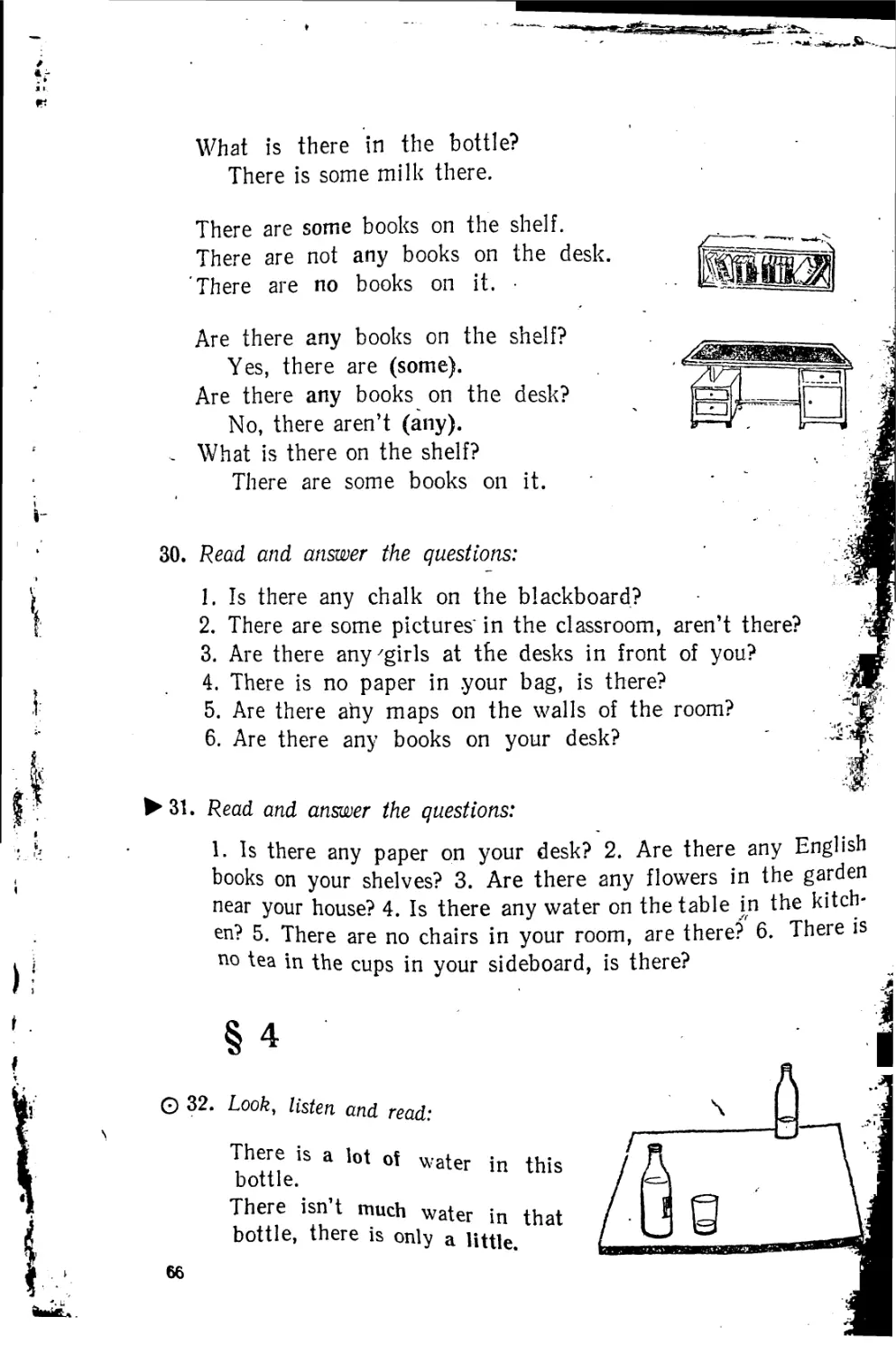
o 32. Look, listen and read:
\
There is a lot of water in this
bottle.
/
There isn’t much water in that
к 1 Л	 _
bottle, there is only a little.
66

There is little water in the glass.
Is there much water in this bottle?
Yes, there is.
Is there much water in that bottle or not much?
There isn’t much water, there is only a little.
How much water is there in the glass?
There is little water in it.
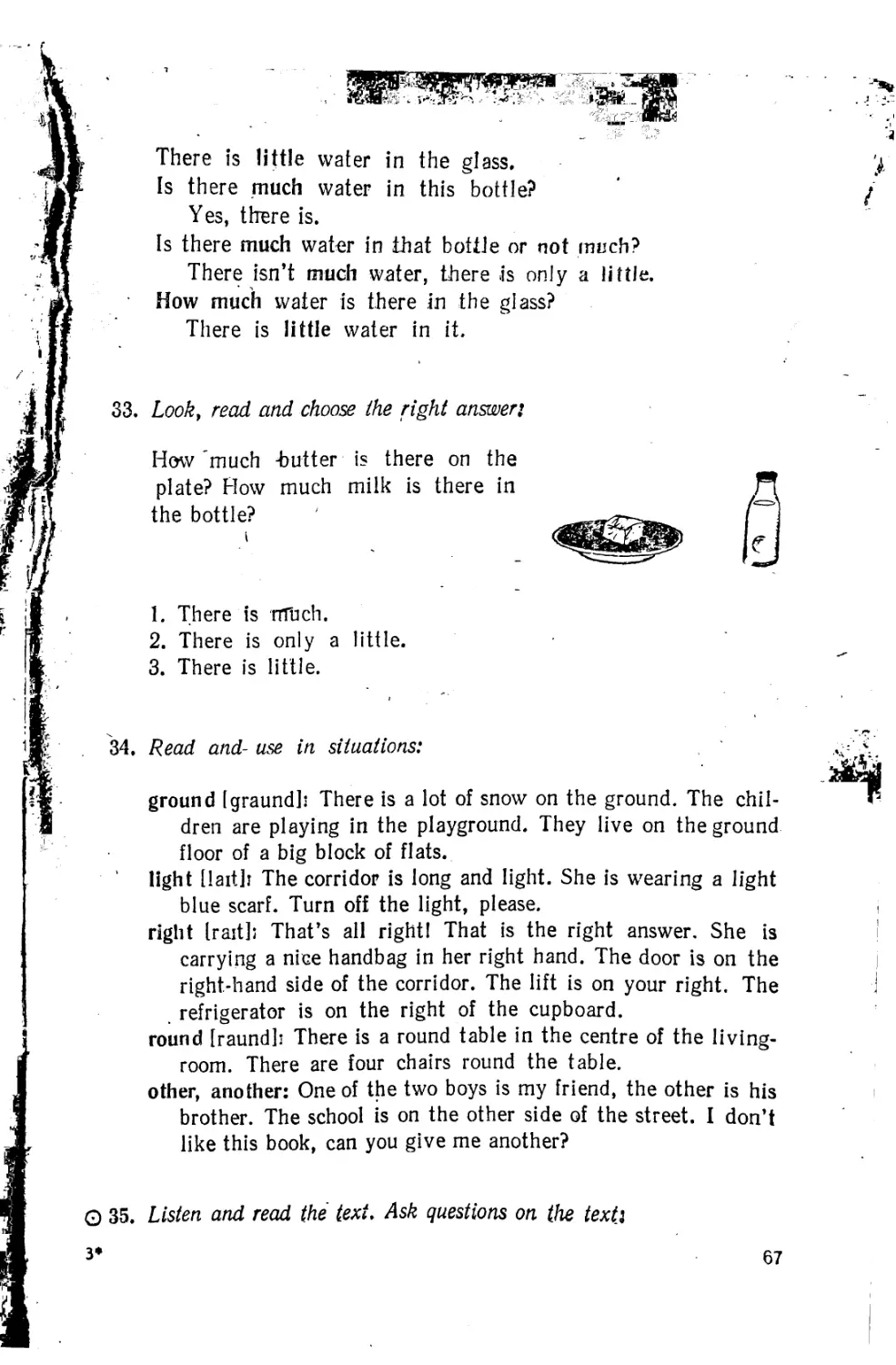
33.	Look, read and choose the right answer:
How much -butter is there on the
plate? How much milk is there in
the bottle?
i
1. There is nTuch.
%
2. There is only a little.
3. There is little.
34.	Read and use in situations:
ground Igraund]; There is a lot of snow on the ground. The chil¬
dren are playing in the playground. They live on the ground
floor of a big block of flats,
light [laith The corridor is long and light. She is wearing a light
blue scarf. Turn off the light, please,
right Iraith That’s all right! That is the right answer. She is
carrying a nice handbag in her right hand. The door is on the
right-hand side of the corridor. The lift is on your right. The
refrigerator is on the right of the cupboard,
round [raundh There is a round table in the centre of the living-
room. There are four chairs round the table,
other, another: One of the two boys is my friend, the other is his
brother. The school is on the other side of the street. I don’t
like this book, can you give me another?
35. Listen and read the text. Ask questions on the texti
Г *	67

The Stogovs’ Flat
Lena Stogova and her family live in town. They have a flat
in a new block of flats in Lenin Street. Their house is in the centre
of the town. There are many flats in the block, a lot of people live
in it. The Stogovs’ flat is Number Ten. It is not on the ground
floor, it is on the second floor.
The Stogovs’ flat has four rooms, a kitchen and a bathroom.
There is a small hall. There they take off their coats and hats
and hang them on the hall-stand. The kitchen and the bathroom
are on one side of the corridor, the living-room, two bedrooms
and the children’s room are on the other side.
The living-room is large, the other three rooms are not very
large. The living-room has a balcony. The other rooms have no
balcony. The rooms are not very high, but they are light, the
windows are large. ■
The Stogovs’ flat has gas and hot and cold water. There is
no lift in the Stogovs’ block of flats.
At the back of the block of flats there is a yard with trees in
it. There are benches under the trees and a playground for the
children.
••	*	Л	/	*7	*	JL	9	m
^ 36. Read the text of Exercise 35 and describe the Stogovs flat.
5
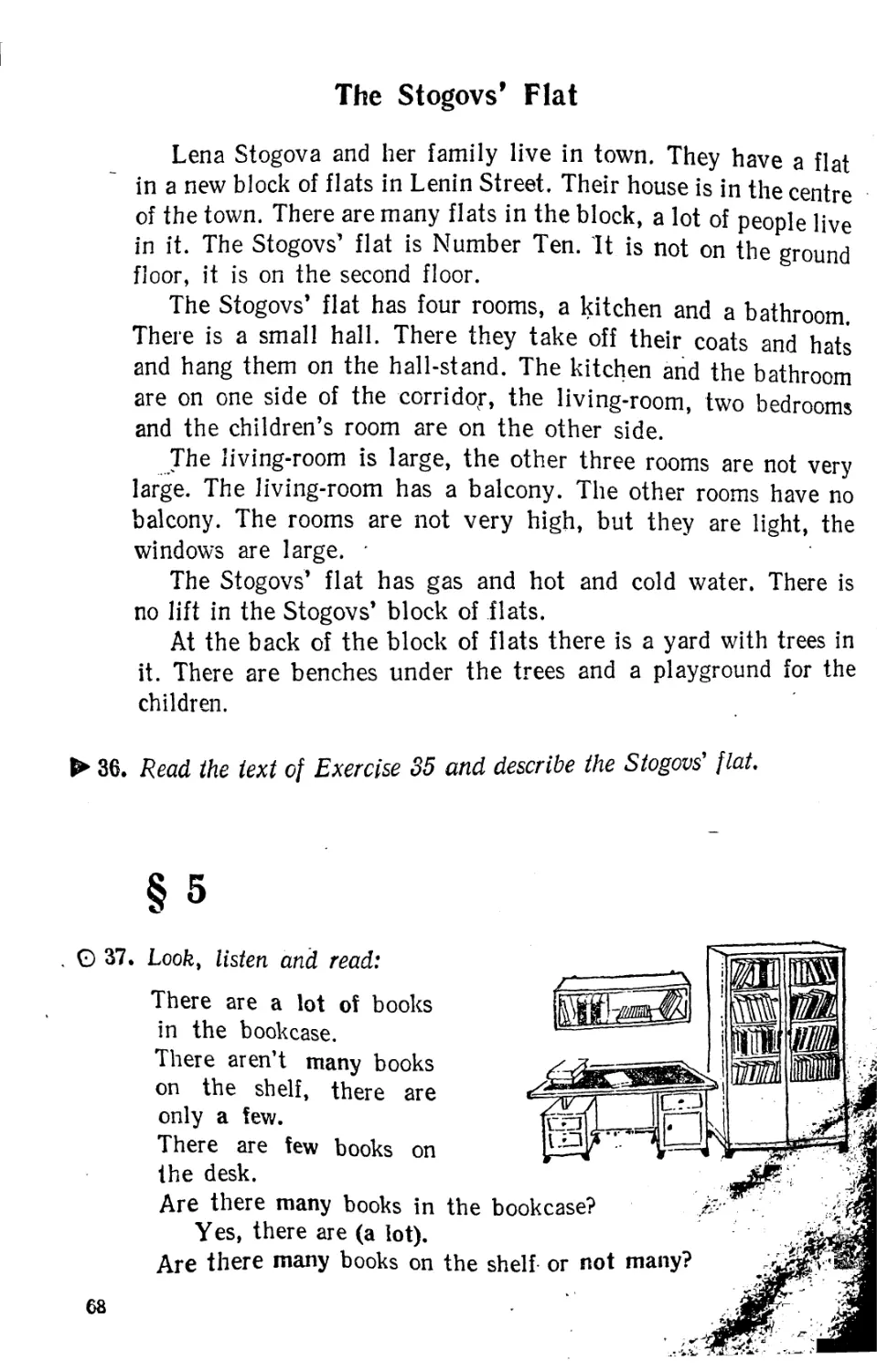
G 37. Look, listen and read:
There are a lot of books
in the bookcase.
There aren’t many books
on the shelf, there are
only a few.
There are few books on
the desk.
Are there many books in the bookcase?
Yes, there are (a lot).
Are there many books on the shelf or not many

There aren t many books on it, there are only a few.
How many books are there on the desk?
There are few books there.
33.	Look, read and choose the right answer:
How many letters are there in the box? How many hats and caps
are there on the shelf?
\
i
ri
There are many.
There are only a few.
3.	There are few.
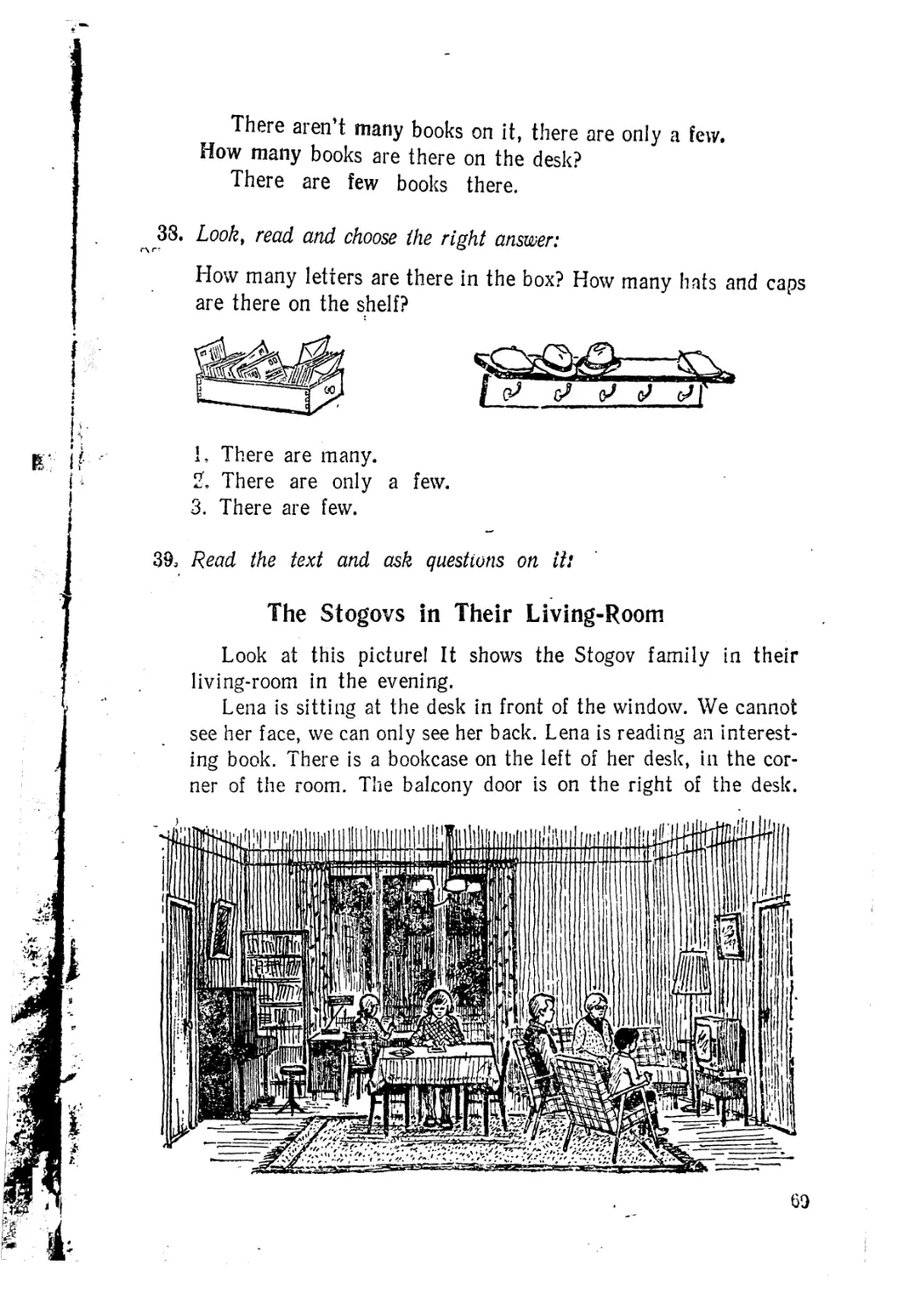
39.	Read the text and ask questions on it:
I
The Stogovs in Their Living-Room
Look at this picture! It shows the Stogov family in their
living-room in the evening.
Lena is sitting at the desk in front of the window. We cannot
see her face, we can only see her back. Lena is reading an interest¬
ing book. There is a bookcase on the left of her desk, in the cor¬
ner of the room. The balcony door is on the right of the desk.

The TV set is on a low table near the wall on the right-hand
side of the room. Lena’s father and brother are sitting in arm¬
chairs in front of the TV set. They are watching TV. The grand¬
mother is watching TV too. She is sitting on the sofa. The sofa
is in the corner near the balcony door,
Vera Ivanovna, Lena’s mother, is sitting on a chair at the'
table in the centre of the room. She is writing a letter. There are
some chairs round the table. Nadyusha is not in the living-room
She is in bed.
»
- There is a piano standing near the wall on the left-hand side
of the room, opposite the TV set. Lena plays the piano every
day, but she is not playing it now.
A picture hangs on the wall over the piano, and there is anoth¬
er one on the opposite wall, over the TV set.	Щ
There is a sideboard on the left of the door, opposite the win¬
dow, but we cannot see it in the picture.
* '
40.	Read the text of Exercise 39 and describe the Stogovs' living-room.
6
41.	Look, read	and compare:
,
u
<>•
ihere is much milk in the bot- There
tie, take it.
in
the
flower-garden.
There is little tea in the glass; There are few lamps in
the
1 like tea.
corridor, it is dark.
There is a little butter on the There are a few books on
plate.	shelf.
the

42, Look at the pictures, read and answer the questions:
1. There is no water in the glass, is
there?
2. Is there a little water in the glass?
3. How much water is there in the
glass?
4„ Is there much water in the bottle or only a little?
* * ✓
1. There are no children in
the room,' are there?
2. How many children are
there in the room?
3. Are there many toys in
the room or only a few?
4. How many balls are there
in the room?
4	•	*	.
G 43. Listeny read and act:
m
Lena Is Telling Her Friend Tamara
About Her Flat
*	w	'	4	•
m
Lenai You know, Tamara, we have a fine new flat.
Tamara: What street is it in?
Lena: Our address is Flat 10, 16, Lenin Street. Our flat is
on the second floor.
Tamara: Tell me about it, please.
Lena: Well, first there is a small hall with a hall-stand. Then
the living-room. There we have the piano and the TV set,
a sofa, arm-chairs and a new table. In my parents’'bedroom
there are two beds, a table and a wardrobe. Then the children’s
room and my grandmother s room.
Tamara: What is your kitchen like?
Lena: The kitchen is small, but it has a large cupboard. There
is hot and cold water and gas. We are going to have a new
refrigerator.	■
T a m a r a:	Have you a lift?
Lena: No.

Tamara: Lena, may I come and see your flat?
Lena: Of course you may! Let me see... Come and see us on
Sunday, and I can show you the flat.
T a m a r a: That’s fine. I must go and do my homework now
Good-bye.	.'iTrl
Lena: Bye, Tamara.
44.	Read the	text and describe the village house:
Ф
My Friend’s House
My friend Kolya Fyodorov is a village boy. He lives in the
village of Pronino, not far from the town of Voronezh.
Kolya and his family live in a house in the centre of the vil¬
lage. Their house is new. It is not small, it has a ground floor
and a first floor. The house has water and gas.
There are two rooms, a hall and a kitchen on the ground floor.
On the first floor there are three bedrooms and a bathroom. The
rooms are large and light. One of the rooms on the first floor is
the children’s room. Kolya lives there with his little brother.
In the yard there is a shed.1 The Fyodorovs have a cow and
a pig, and some hens 2 and ducks 3 too. They are all in the shed.
At the back of the house there is a kitchen-garden and a gar¬
den with apple-trees in it. There is a well 4 too. There are a lot
of flowers in front of the house.
Kolya’s parents are collective farmers. His father is a trac¬
tor driver and his mother is a milkmaid. They work very well,
and they have a Zhiguli car.
Kolya is a schoolboy, lie is in the eighth form. He is a Kom¬
somol member. Kolya helps his parents about the house and
waters the flowers and the trees. He loves his little brother and
likes to look after him. In summer he helps collective farmers
in the field.
Kolya and 1 are good friends. I like to write letters to Kolya
and get letters from him.
■ n ьлш	ЖГТ	M	Д
J shed —сарай; » hen —курица; a duck —утка; 4 well —коло¬
дец
72

45. Look at the picture and	the	questions:
1. Is there any bread on the plate?
2. Is there any tea in the cup?
3. Is there much	butter	on	the
plate?
4. Are there any	glasses	on	the
table?'
5. Are there many forks and spoons on
the table?
6. Are there any bottles on the table?
46. Look, read and answer the questions:
1. This is a bus stop, isn’t it?
2. There are some people standing at the bus stop, aren’t there?
3. Are there any buses coming to the stop?
4. What is there coming tp the stop?
5. Are there any buses standing at the stop?
47.	Read the transcription:
['dokta]	f'redi]	[a'dres]	['kAbad]
['sen to]	['haepi]	['bselkani]	['hAzband]
['nailan]	['kaerij	[!opazit]	['ounli]

О 48. Listen, read and learn:
Everyday Sentences
I’m sorry.
Sorry.
Excuse me.
I’m sorry, I don’t know.
It’s quite all right.
Oh, that’s all right.
Not at all.
Excuse me...
I say...
Just a minute...
Yes?
What can I do for you?
house,
Meeting a Friend
Dmitry Alexandrovich, V. N. Stogov’s friend, has a new
house. One day he meets Vera Ivanovna in the centre of the town.
Vera Ivanovna: Oh, good afternoon, Dmitry Alexand¬
rovich 1 1 don t see you in town now. Where are you all the
time?
74

Dmitry Alexandrovich? Well, Vera Ivanovna, we
don’t live in town now.
V.	1.3 You	don’t live in town?	Where do	you	live	then?
D.	A.: We	have a house	near	the town.
V.	1.2	Is	it	a nice one?
D.	A..f	Very	nice! We all like it	very	much.
V.	I.» Is it	large?
D.	Ал It’s	neither very	large	nor very	small.	It	has	a living-
room,. a dining-room, a bedroom, a children’s room, and,
of course, a kitchen and a bathroom. We have gas and hot
and cold water.
V. 1.2 Have you a garden?
D. A.: Yes, two. A flower-garden in front and a kitchen-garden
at the back with trees in it.
V. 1.2 I must come and see it some day.
D. A.: Yes, my wife and I are very glad to see you.
V. 1.2 What is your address?
D.	A.!	It	is	27, Lesnaya Street.	Take	a Number	25	bus	in	the
centre	and it’s the third stop	after	the factory.	Our	street	is
the second on the left after the stop.
V.	I.s Thank you. Good-bye!
D. A.: Good-bye, Vera Ivanovna!
§ 8
50. Look, read and compare:
There is a bottle on the shelf. | There is milk in the bottle.
He likes coffee for breakfast.
He wants an apple.
She has a nice new hat on.
The flat has hot and coM
water and gas.
75

>ч
¥
51. Read and say why we use or do not use the indefinite article with
the words underlined:	-
1.	The jacket is made of cotton. 2. There is a hall-stand in the
hall. 3. The kitchen has a large cupboard. 4. In the evening he
drinks only tea. 5. There is a lot of snow on the ground and on
the trees. 6. He lives in a village not far from here.
*
О 52. Listeny read and act:
Short Conversations
1.	“Good morning.”
P 0
“Good morning. What can I do for you?”
“Can you tell me my friend’s address? He has a new flat and
I don’t know his address.”
“What is his name?”
“Sokolov.”
“And his first name?’’
76
“Yuri Fyodorovich.”	.
“How old is he?”
“Thirty-two.”
“Where does he work?”
“At a factory.”
“Yes, here it is. Your friend’s address is Plat 41, 37, Gagarin
Street.”
n.
“Thank you.”
“Don’t mention it.”	'
• •	(f
2.	“Just a minute, please. How can I get to this address?” (Shows
an address.)
(Reads the address.) “Flat 10, 27, Lenin Street. Take Bus 15
at that street corner and it is the fourth stop.”
Thank you very much.”
“It’s a pleasure”
3
v-ome and see me some day.”
But I don t know where you live.”
Oh, sorry! I live in Flat 25, on the fifth floor, at 72, Karl
Marx Street.”
“Have you a telephone?”
“Yes. My telephone number is 185-09-34.”
■

53. Read and answer the questions:
1. Is your house in the centre of the town?
2. What is your address?
3. Do you live in a flat?
4. What kind of rooms have you?
5. Have you a flower-garden in front of your house and a kitch-
en-garden?
6. How many balconies have you?
7. You have a lift, haven’t you?
8. Is your living-room light?
9. What is there in your living-room?
10. What is there in your bedroom?
11. Have you gas and hot and cold water in your house?
12. What is your kitchen like?
/ ;
%
54. Read the text and describe the house:
Mr. White’s House
Mr. John White lives at 16, Forest Road,1 Greentown, England.*
His house is not very large, but it is not small either. It has
a ground floor and a first floor.
The hall, the living-room, the dining-room 3 and the kitchen
are on the ground floor. On the first floor there are bedrooms and
a bathroom.	*
In front of the house there is a small garden with flowers in
it. At the back of the Whites’ house there is a k)'tcbe".gM
with trees in it, the children play there in fine weatner. g

den at the back of the house is large, the one at the front is small.
1 Forest Road — Лесная улица; 8 England — Англия; 3 dining-
room — столовая
9
55.	Read and	say why we use or do not use the indefinite article with
• - ,•#!
the words underlined:
1. There is a jacket made of .nylon hanging on the hall-stand.
2. Do you want to drink a cup of tea? 3. Do you like rain? 4. Has
your flat a balcony? 5. They have a cow and a big pig. 6. You
11 И	+ ■— ■
can see a lot of paper in the boxes on the desk.
56.	Read and answer the questions:
1. How many lamps are there in the classroom?
2. Are there any pictures hanging over the blackboard?
3. Is there much snow in the street?
4. Are there any wall newspapers hanging on the walls?
5. Are there any maps on the walls?
6. Is there any chalk on the teacher’s desk?
► 57, Read and describe the roomi
The Whites’ Living-Room
The'Whites’ living-room is not a small one, it is rather 1 large.
Let us look at the picture. We see a large carpet 8 on the floor,
a small round table in the middle of the room and a piano near
the wall on the side opposite the door. There is a picture hanging
on the wall over the piano.
We can see a bookcase with a lot of books in it near the wall
° R e, and a so*a near the wall on the right.
e ween the piano and the bookcase there is a window with
On
is a TV set
and near the TV set is a fire-place.31
Mr. White is sitting in an arm-chair in front of the fire-place,
78

reading a newspaper:, Mrs. White is sitting in an. arm-chair in
front of the TV set watching TV. Henry is watching TV too, but
he is not sitting on a chair, he is sitting on the carpet.
Mary and Grandmother are sitting on the sofa on the right.
Mary is playing with her doll,6 and Grandmother is watching her.
Grandmother likes to sit with Mary when she. is playing.
1 rather — довольно; 2 carpet — ковер; 3 curtain
штора; 4 fire-place — камин; 6 doll —
занавеска,
кукла
address n
corridor n
hang v
opposite a
another pron
cupboard n
high a
other pron
any pron
few pron
lift n
people n
balcony n
floor n
light a
piano n
bathroom n ,
gas n
lot n
refrigerator n
block n
ground n
low a
side n
bottle n
hall n
no pron
some pron
centre n
hall-stand n
only adv
stop n
[. Прочитайте слова и напишите их с транскрипций:
tell, ten, silk, sit, film, milk, set, text, men, let, it, six.

к
Прочитайте
not, toy, made, duster, glad, wife, boys, play, home, good, round,
doctor.	A
111.	а) Опровергните утверждения и прочитайте написанное:.
1. There is some paper in the desk.
2. There are some children in the playground.
3. There is some coffee in the cup.
б) Напишите no одному вопросу к каждому предложению, на¬
чиная их с Is или Are. Прочитайте написанное:
1.	There are some toys in the children’s corner. 2. There are some
boys in the yard. 3. There is some bread on the plate.
IV.	Перепишите предложения, вставляя, где нужно, some или any
»
и прочитайте написанное:
1.	There are . . . newspapers on the table near the TV set. 2. There
isn’t . . . bread on the table. 3. She has . . . toys in the corner of
the room. 4. Is there . . . chalk, children? 5. Are there . . . pic¬
tures in this book? 6. There are . . . arm-chairs round the table.
I
V.	Прочитайте вопросы к картинкам и напишите на них ответы:
\
a). 1. Is there any tea in the cup?
2. Is there any milk in the tea?
3. What is there in the cup?
4. How much tea is there in the cup?
b) 1. Are there any cakes on the plate?
2. What is there on the plate?
3. How many pieces of bread are there on
the plate?
4. How many cakes are there on the
plate?
А. Перепишите предложения, вставляя muck или many, и щ
читайте написо.нное:
ч" ть ч ' Saow *п *'ле streets? 2. There aren’t . .iamf
3.	hue ISP t . . . C0ifee in the cups. 4. There aren’t . . . per'
standing at t le bus stop. 5. Have you . . . friends in your
6, Hcis sue * * • ttomework for todciy?
80

VII.	Перепишите предложения, вставляя little или few, и прочи¬
тайте написанное:
. ’
.
1. There is . . . snow in the street. 2. There is a . . . butter in the
refrigerator. 3. There are . . . lamps in the room. 4. The house
has . . . balconies. 5. There are a . .. apples on the plate in the
cupboard. 6. There are a ... people standing at the bus stop.
VIII.	Напишите no одному вопросу к каждому предложению, начиная
их словами, данными в скобках. Прочитайте написанное:
1. There are three rooms in their flat. (How .. .)
2. There is a lot of coffee in the box. (How ...)
.	'	§m	*»>	'	I	‘
3. There is gas in his flat. (Is . . .)
4. There is a lot of bread on the plate. (How . . .)
5. There are five lessons today. (How . . .)
6; There are a lot of plates, spoons and forks in the cupboard.
(Are there . .	.)
IX. Перепишите предложения, вставляя неопределенный артикль
а (ап), где нужно, и прочитайте написанное:
1.	Таке . . . cup of . . . coffee, please. 2. The raincoat is made
of . . . nylon. 3. I am reading . . . interesting book about cosmo¬
nauts. 4. There is . . . hot and cold water, and . . . gas in this
new block of flats. 5. There is . . . bathroom opposite the hall.
6. He has . . . bread and . . . butter, and . . . glass of . . . tea for
breakfast.

5.	Look at the pictures and say what the boy is going to do (I), what
he is doing (2), and what he has done
2.	Look at the pictures and answer the	questions.
3. Look at the pictures and de¬
scribe them.
4. Look at the pictures, listen and
correct.
5. Look and ask questions.

$
6.	Look at the pictures and ask questions.
come—come
get —got
hold —held
write—written
read —read
7. Look at the picture and describe the family at the breakfast table.
83

I
9.	Ask	your friend questions	about his (her) working	day.
10.	Describe what you do on	a week-day
11. Describe your Sunday.
12. Tell us how you help your mother.
13. Speak about the situations:
1. You are going to school and ask your small sisier (brother)
to clean the room. Say what you want her (him) to do.
2.	Your small brother	(sister) does not do	his	(her)	omew^
very well. He (she)	is at home and you	are	at your men	.
You ring your brother (sister) and ask him (her) what he (
is doing and what he (she) has already done.
3. You meet your friend and ask him (her) what he (she) is going
to do on Sunday.
. Look at the pictures and ask
quest ions.
84

14.	Read the
[i:] [tri:]tree
[a] [ka] car
[o:] [fo:k] fork
fur] [spu:n] spoon
[э:] fga:I]girl
fjesJ yes
three
[bentf] bench
[mi: t]
[fa]
ftfo:k]
[-tf:tfa]
[ho :1]
[fju:]
fja:!]
[ 'naiSa]
[lam]
[li:v]
[nju:]
['pi:pl]
_ ^
© 15. Listen,
•
read and comparei-
Misha, open the window!
[rpati]
['ba:0dei]
['fa3a]
Mum, I have opened the win
dow!
Clean the blackboard!
Count the exercise-booksl
Play the piano!
Point to your hat!
Copy the text!
Stop!
1 have cleaned the blackboard,
^ou have counted the exer-
cise-books.
She has played the piano.
You have pointed to your hat.
We have copied the text.
They have stopped.
85

like
liked
played
copied
stopped
L
18. Read and compare:
TT1U ——1——МИ1Ш1 ДТ"
cleaned [d]
1
• — i ——i—csy-щ- Г -час nmnujc
stopped [t]
I played
j turned
looked
washed
cbunted и
wanted
pointed
ask
asked
dress —dressed
point—pointed
clean
rain
cleaned
rained
want —wanted
snowed
snow
watch —watched
touch —touched
live
lived
count
counted
help
helped
Open
&
• *
* *
.
the window
...
/
Лг
•/ A
> . 'JL
Wt
••И-
17. Read:
>	J.
■	/	‘	0
1. He has asked me some questions.
2. I have answered all his questions.
3. You have helped them much.
4. The girl has washed the plates and cups
5. They have turned to the right.
6. We have watched TV.
I
/
► 13. Read:
1. The girl has thanked her mother. 2. The pupils on duty have
cleaned the blackboard. 3. He has counted all the pupils sitting

at Incir desks. 4. They have listened to the radio. 5. Г have
touched the bottle of water, it is cold. 6. She has played the
piano.
0 20,
\
2
19.	Read the transcription:
[еэ] (рэ] chair
[ю]
[шэ] near
fua] [puaj poor
fD] [brj] long
(51 [ 'piegaj pleasure
№J fpeid3J page
[hie]
[lctd3]
[fo:j
[без]
[haegj
[rOQ]
fnia]
f'aus]
[fa]
[Ju:]
[fed]
f'hffiijii) ]
['intnsiirjJ
[?р!езэ]
Listen, read and compare:
Misha, do your English exer- Dad, I have done my Eng-
eisesl
Do the sums!
Sit down!
Take the duster!
Drink the milk!
Get some chalk!
Shut the door!
0 21. Listen, read and compare:
I have been to Moscow.
He has seen the film.
We have done Exercise 17.
lish exercises.
We have done the sums.
They have sat down.
He has taken the duster.
She has drunk the milk.
I have got some chalk.
You have shut the door.
I have not been to
She has not seen the film.
We have not done Exercise 27
87

They have had breakfast.	He has not had breakfast.
She has put on her jacket.	She has not put on her scarf.
You have got a good mark.	They have not got good marks.
ie window
the door
► 22. Read:
I. You have not helped your small brother. 2. She has done her
morning exercises. 3. I have written a letter to my friend. 4. He
has shown his exercise-book to his mother. 5. They have stopped
at the bus stop. 6. We have not seen him for three days. 7. You
have not shut the door, it is cold. 8. She has got a nice present
for her birthday.
§ з
0 23. Listen, read and compare:
I have just washed my hands
and face.
He has told me about the home¬
work.
We have not had dinner yet.
You have not taken your text¬
book.
They have not gone to school
yet.
She has not slept all night.
88
 ; : ! ! :
I ’ ve just washed my hands
and face.
He’s told me about the home¬
work.
We haven’t had dinner yet.
You-haven’t taken your text¬
book.
They haven’t gone to school
yet.
She hasn’t slept ail night.

О 24. Listen and read:
Have you opened the door? No, I haven’t.
What have you opened? I have opened the window.
You have opened the door, haven’t you? No, I haven’t.
What has the boy done? He has opened the window.
Has he opened the door or the window? He has opened the window.
He hasn’t opened the window, has he? Yes, he has.
has • opened the window
he
opened
the window
What
has
he
done
25. Read and use in situations:
already [osl'redih He has already come from work. I have already
been there.
89

f
yet fjetjs He has not come home yet. They are not here yet. Has
your brother come from school yet? Have you finished your
homework yet?	,
turn (tomb He is going to turn to the right. Please turn the page
over. Turn the light on. He has turned the radio off.
walk [vvoikj, come [клт], go [gouli They like to walk in the park.
Let us go for a walk. Come here. Come and see me on Sunday.
Go and get your hat. He has gone to see his friend,
bring [brig], carry ['kaerd, take away ['teik a'wei]: Bring me a
glass of water. Bring your sister to us on Sunday, fn bad
weather the old man carries an umbrella. Please take the
plates away.
► 26. Read:
Has he given you the newspaper? Yes, he has.
What has she drawn? She has drawn a nice black cat.
Where have you been? We have been to the cinema.
Whom have they seen in the park? They have seen my unci
and my aunt there.
How many books have you read? I have read three books.
Whose scarf have you put on? I have put my scarf on.
They have eaten bread and butter, haven’t they?
No, they haven’t.
Who has come in? My friend has.
a
© 27.
90
§ 4
Listen, read and compare:
1 havs dried myself.
J & *
-л your-
selves. "" hW	-
They have dressed themselves.
r
I — myself
You — yourself
He — himself
She — herself
We — ourselves
You — yourselves
They — themselves
r

28.	Read the transcription:
[su:p] soup	fpri'pea]	prepare
[so:lt] salt	[o:l'redi]	already
fwo:k] walk	[p:'selfj	yourself
[fru:t] fruit	[,ju:m'v3:siti] university
29.	Read:
When I have got up, I do my morning exercises.
When I have washed myself, I dress myself.
After I have dressed myself, I have breakfast.
After I have had breakfast, I go to school.
What do you do when you have put your things in your school-bag?
When I have put my things in my school-bag, I say good-bye
to my mother.
What does he do when he comes to school?
When he conies to school, he has his lessons.
What does he do after he has had his dinner?
After he has had his dinner, he does his homework.
SO. Read:
ring-
-rang -
-rung
take -
-took-
-taken
get -
-got -
-got
give -
-gave-
-given j
do -
-did -
-done
have -
— had -
-had I
go -
-went-
-gone
run -
-ran -
-run
put -
-put -
-put
say -
— said -
-said 1
0 31. Listen and read the text. Ask questions on the text:
ai
%
#
Getting Up in the Morning
At seven o’clock in the morning the alarm-clock * rings, ft
: is time for me to get up. 1 don’t want to get up early, but 1 must.
I jump out of bed and open the window. Then I turn on the
radio and do my morning exercises. I

I
When I have done my morning exercises, I go to the bath¬
room and wash. I clean my teeth,2 wash my hands, face and ears
with cold water and dry myself with my towel.
When I have washed myself, I brush my hair with my hair¬
brush.
Then I dress, I put on my shirt, trousers and jacket, my socks
and my boots. Now I am ready to go to breakfast.
3 My sister Lena has already got up, washed herself, brushed
her hair, put on her dress, tights and shoes. She is sitting at the
table, having her breakfast. I take my place at the table too,
and Mother gives me my breakfast. Father has already had break¬
fast and has gone to work. Mother must get up early to prepare
breakfast for all the family.	,	'	“
Now Lena has finished her breakfast. She is going to put on
her coat and run to school.
“It is eight o’clock, Boris,” Mother says to me. “It is time for
you to go to school.”
I put my things in my school-bag and put my Pioneer scarf
and my coat on.
“Good-bye, Mum!” I say.
“Good-bye. Don’t be late,” answers Mother, and I run out.
'
* alarm-clock ta'lcrmkbk] — будильник; - teeth [ti:9]
зубы
9
^ o2. Read the text of Exercise 31 and say what Boris does in the morning.
i
■
92
I 5
83. fkad, do and answer the questions:
Touch your English textbook!
1.
2.
3.
4.
5.
What have you just done?
it se boo!; have you just touched?
Have you touched your bag?
what have you touched then?
Hav e you or has your friend touched your book
>*

34.	Read the text of	Exercise 31 and answer the questions:
1.	When does	Boris get up? '•
2. He wants to get up, doesn’t he?
3.-What does	he do when he gets	out	of bed?
4.	Does Boris	turn on the radio or	does	his mother?
5.1 What does he do when he has done morning exercises?
6: Boris washes himself with warm water, doesn’t he?
^	i	.v	•	^	hwSZmsS	Я	И Н^И
It Has Lena got up and washed herself when Boris goes to
breakfast?
• # ” ‘ ‘
8.. Who gives Boris his breakfast?
9.	When must the mother get up to prepare breakfast for the
family:
Юг-What does Boris say to his mother when he goes out?
35.	Read:
come—came—come
lay —laid —laid
put — put^gui, ,
bring—brought—brought
take—took — taken
О 36. Listen and read the text. Ask questions on the text:
Dinner
It is two o’clock. Lena and Boris have just come home from
school. Their mother is preparing dinner. Nadyusha is in the
children’s room.
“Can I help you, Mum?” asks Lena.
“Yes,” her mother answers, “you can lay the table.”
So Lena lays the table. She puts a glass, a plate, a knife,4
a fork and a spoon at each place, and bread and salt in the middle
of the table.
Then the mother brings the soup from the kitchen, and the
family take their places at the table.
Vera Ivanovna gives her children soup, and Boris passes the
bread.
93

“I don’t want any soup,” says Nadyusha. “I don’t like soup.”
“But you must have some,” answers Vera Ivanovna. “See,
I have not given you a lot.	'	@
“The soup is very good,” says Boris. “May I have some more,
Mum?”
“Yes, help yourself,” answers the mother. “Do you want some
more, Lena?”
“No, thank you, Mum,” says Lena. “May I go and get the
meat and vegetables from the kitchen?”
“Yes, go and get them, please,” answers Vera Ivanovna.
When they have finished their soup, they have meat and veg¬
etables. The mother has fish, she does not eat meat.
After the meat and vegetables there is fruit.
When they have eaten their dinner, Vera Ivanovna says to
Lena and Boris, “Children, I want you to help me. I must go to
work. So I want you to wash the dishes and clean the kitchen.”
“Yes, Mum,” says Lena. “I can wash the dishes, but I want
Boris to clean the kitchen.”
“All right," Boris says.
1 knife [naif] — нож
-►37. Read ihe text, of Exercise 35 and describe the Stogovs at dinner.
§6
r
38. Read and answer (he questions:
/
t	.	jp I.
you have got up?
you have done your morning exer¬
cises?
What do you do alter I y0U have dressed Уоип5еИ?
you have had your breakfast? f
you have put your things into your
school-bag?
you have had your lessons?
04

О 39. Listen, read and learn:
i
Everyday Sentences
\
A
Have some more cake.
Have another cup of coffee.
With pleasure
Yes, please
V V/ UUUlllw	w.
Let me give you some more No, thank you.
^	rr	 *JL	—	-1
A
meat.
Help yourself to some more
w
I can’t eat any more.
k
#
ЛУ-:
'
I'
;
-
r
I
*
r ' ‘
I have a little more?	lci	шс u*-.k j— — —	, ■.
I have some more cake?	Yes, let me help you to another
May
May
May I have another cup of tea? cup
Let me help you to some more
• +
i ir:
О 40. Listen, read and act:
Short Conversations
■
Г'
1. “Have some more cake?”
“With pleasure. It’s very nice.”
2. “Have another cup of coffee?”
“Yes, please. I like your coffee very much.”
3. “Have some more fish?”
“No, thank you. It’s very nice, but I can’t eat any

4. “May I give you some more meat?”
“Yes, with pleasure. It’s very good.”
5. “This soup is very good. May I have a little more?’’
“Yes, let me help you to some more.”
4
6. “May I have some more cake?”
“Of course. Help yourself.”
7. “Pass me the salt, please.”
“Yes, here you are.”
“Thank you.”
“Don’t mention it.”
► 41. Read and answer the questions:
What do you do after
yduhave had your lessons at school?
you have come home from school?
you have had dinner?
you have done your homework?
you have helped your mother?
you have played with your friends?
§ 7
42.	Look, read and compare:
a
That is a tractor.
■ '-'A
%
Those are tractors.

There is	an arm-chair in front	There are arm-chairs round
of the TV set.	the	table.
The boy has a big dog.	The	girl likes dogs and cats
very much.
43. Read and say why we use or do not use the indefinite article with
the words underlined:
1.	I am going to see a new film. 2. He has dried himself with a
towel. 3. You can see brushes on the shelf. 4. Take an umbrella,
it is going to rain. 5. There are pigs and cows in the farm-yard.
6.	Let me have a pencil, please.
44, Look and answer the questions:
45.	Read:
went
go
come
came
come
gone
do
had
had
did
done
have
sat
sat
put
sit
put
put
read
read
sleep
read
slept
slept
1. What can you see in
this picture?
2. What are the people
doing?
3. Has the girl eaten her
soup? •
4. What is the mother
doing?
5. Are the family going
to eat cake or fruit?
6. Is there any bread on
the table?
7. What has the mother brought?
8. The family have finished their dinner, haven’t they?
№ 804
97

46.	Read the text and ask questions on it:
What the Stogovs Do in the Evening
Victor Nikolayevich comes home from work at half past
five in the evening. He washes, and then all the family have
tea.	Ij
After they have had tea, Victor Nikolayevich sits down in an
arm-chair and reads the evening newspaper. Vera Ivanovna and
Grandmother wash the dishes. Lena and Boris do their homework.
Nadyusha plays with her toys.
Four times a week Victor Nikolayevich goes to the institute.
He is an evening student at the institute. When he does not go
to the institute, he reads books at home.
Sometimes Vera Ivanovna and Victor Nikolayevich go to
the cinema. Vera Ivanovna likes the cinema very much and wants
to see all the films.
In summer, when the weather is fine, all the family go for a
walk in the park. Nadyusha is very glad to go for a walk with her
father and mother, because she does not see them very much.
Lena sometimes goes to see her friend Valya, and Boris likes
to play football with his friends.
When it rains, and in winter when it is cold or it snows, the
children stay at home. Lena and Boris read interesting books,
and Nadyusha sits with Grandmother and plays with her toys.
Nadyusha goes to bed early. Grandmother puts her to bed and
Nadyusha sleeps all night.
Then comes the time for Lena and Boris to go to bed. They
do not like to go to sleep early, but when the time comes, they
wash and go to bed. In a few minutes they are sleeping.
► 47. Read the text of Exercise 46 and say what the Stogovs do in the eve¬
ning.
§ 8
9
48.	Rtad the text of Exercise 46 and answer the questions:
9	^°eS	Nikolayevich	come	home	from	wc
a ^oes d° after the family have had tea?

3. What do the other members of the family do?
4. When does Victor Nikolayevich go to the institute?
5. What does he do in the evening when he doesn’t go to the
institute?
6. When do the family go for a walk?
7. What does Boris like to do in the playground?
8. What do the children do when it is cold or it rains?
9. What does Nadyusha play with?
10. When does she go to bed?
Read and say who is going to do it:
1. 1 want to prepare breakfast. I want you to prepare breakfast.
2. Lena wants to sweep the floor. Lena wants Boris to sweep the
floor.	Cuif	д
3. Mother wants to dust the radio set. Mother wants her son to
dust the radio set.
4. Father wants to go for a walk. Father wants the children to go
for a walk.
Read the text and say what Boris does to help his mother:
Helping Mum
В о r i s i Oh, Mum, you are going to clean the living-room,
aren’t you?
Vera Ivanovna! Yes, I am, Boris. Do you want to helj>
me?
В о r i s i Of course I do, Mum. You must work so much to look
after us and then you have your work at the hospital too.
Vera Ivanovna: All right. You can help me.
Boris: May I clean the kitchen?
Vera Ivanovna: Yes, and when, you have cleaned tins
kitchen, 1 want you to sweep the floor in the living-room arte
in the hall. 1 am going to dust the sideboard, the piano and
the chairs...
В о r i s l All right, Mum. I’m going to do it well. I want our
flat to be nice and clean.
(Vera Ivanovna and Boris clean the flat,)	I
Vera Ivanovna: Have you finished?

Boris.' I have finished now, Mum. Now we have a nice clean
fiat.
Vera Ivanovna: And you are a good boy. You have
helped your mother very well.	>'3
► 51. Read the texts:
Do You Know?
Many Englishmen eat porridge1 with milk for breakfast.
English people often take sugar ? in their porridge. But porridge
is a Scotch 3 dish, and the Scotch always put salt in it, and never
sugar
English people drink a lot of tea. Some English people have
tea for breakfast, tea in the middle of the morning,, tea after din¬
ner, tea in the middle of the afternoon, tea at tea-time and tea
with supper.
At work they take five or ten minutes in the middle of the
morning and the afternoon to have a cup of tea.
At tea-time they have one, two, three or more cups of tea,
bread and. butter, or cakes.
•	9
Some English families have “high tea” or big tea, and no sup¬
per. For high tea they may have cold meat, bread and butter,
cakes, and, of course, a lot of tea.
1 porridge ('poi 1CI3] — овсяная каша; 2 sugar I'Juigo] — сахар;
g Scotch Iskotfj — шотландский; шотландцы
§ 9
►
52.	Read and say why we use or do not use the indefinite article with
(he words underlined:
1.	There is a brush on the shelf in the bathroom. 2. Mother has
prepared coffee lor us. 3. Do you like fish or meat for your break¬
fast 4. Bring dishes and put them on the table! 5. She has put
on a_warm codt, a scarf and a hat. 6. You can have a glass of milk

for your supper. 7. She has put fruit and flowers on the tabie
8.	The kitchen has a balcony.
*
%
53.	Read and answer the questions:
1. You get up early in the morning, don’t you?
2. Do you like to get up early? Why?
3. What do you do when you get up?
4. What do you do after you have washed yourself?
5. Who prepares your breakfast?
6. What do you have for breakfast?
7. What do you do after you have had your breakfast?
8. What do you put into your school-bag when you go to school?
9. What do you put on when you go out in winter?
10.	When do you come home from school?
54. Read the text and act it:
%
You May Go to the Cinema
Mother: Lena, have you done your English exercises?
Lena: Yes, Mum, 1 have finished.
M other: Come and have tea then.
Lena: May I help to put the cups on the table?
Mother: I have put them on the table, but you can bring the
bread and butter from the kitchen.
(When Lena brings the bread and batter in, they sit down and have
tea.)
Lena: May I go to the cinema when we have had tea? I have
not seen the ne^'film.
Moth er.i Have you not seen it? Well, you may go when you
have finished your homework.
Lena: But I have done all my homework.
Mother: Well, you may go then.
Lena: Thank you, Mum.
55. Read the texts:	,
Do You Know?
The English always drink tea out of cups, never 1 out of glasses.
In England many people usually drink tea with sugar and
milk. When you go to an English house for tea, the housewife -
101

г
always asks you, “How many lumps 3 (pieces) of sugar do you
take in your tea?”
The answer is: "1 take one lump (or two lumps)” or sometimes:
“1 don’t take any sugar,”
Tea with lemon 4 in it is called “Russian tea” in England.
* * *
Englishmen always eat bread with their soup. With meat
and vegetables they never eat any bread. Some Englishmen only
eat one thin piece of bread at dinner. v
1 never I'nevo] — никогда; 2 housewife I'hauswaif] — хозяйка;
3 lump [1лтр] — кусок; 4 lemon [Четэп] — лимон
§ to
56.	Check yourself:
What Is the Matter,1 Dad?
It is six o’clock in the evening. Nelly’s father has just come
home from work. Now he wants to have a bath.2 He takes his hair¬
brush and goes to the bathroom. But he cannot get into the bath¬
room. The door is shut. He hears a Nelly talking in the bathroom.
“Nelly,” asks the father, “who are you talking to?” Nelly
does not answer. She opens the door of the bathroom. The father
sees his daughter and the cat there.
The girl says to the cat, “You have had a hot bath and now
you must dry yourself with the towel. You see, Father has
brought us a hairbrush. He is going to help me...”
The lather calls 4 the mother. The mother comes into the
bathroom and says, “Have you already finished, Nelly? Why?
That s your father’s towel! Now stop that and let the cat go.”
The girl puts the cat on the floor and say^~WfryT- Mum?
Puss and I swept the floor in the hall. So we have just had a bath.
hat is the matter, Dad? After a bath I usually dry my cat with
this towel.”
? F^ na*ibS ^ та^ег^ — Что случилось? 2 bath [ba0] — ванна;
lear is слышать; 4 call [ko.T] — звать

early adv
finish v
fish n
fruit ti
jump v
just adv
lay v
meat n
more pron
pass v
prepare v
radio n
ready a
run v
salt n
sometimes adv
soup n
stay v
sweep v
thing rt
towel n
vegetable n
walk v
yet adv
I. а) Прочитайте слова и напишите их с транскрипцией:
see, nor, third, far, yard, shirt, too, three, they, child,
б)	Hanuuutnie III форму глаголов и прочитайте написанное: )
carry, stop, live, rain, work, thank, count, want.
4
II. а) Прочитайте слова и напишите их с транскрипцией:
ear, large, hair, ring, here, bright, made, wife, leave, want,
б)	Опровергните утверждения и прочитайте написанное:
0Р
1. The children have slept well. 2. She has been to Minsk. 3. The
rain has stopped. 4. He has eaten the cake.
III. Напишите no одному вопросу к каждому предложению, начи¬
ная их словами, данными в скобках. Прочитайте написанное;
1. They have lived in Baku. (Where . . .)
2.	She has drunk some	milk. (Has . . .)
3.	Alec has come to see	me. (Y/ho . . .)
4. We have read an interesting article. (What. , .)
5.	You have helped me	very much. (What	. . .)
6.	He has given Vera a	letter. (Whom , ,	.)	$■
IV.	Перепишите предложения, вставляя местоимения myself*
yourself, himself, herself, ourselves,yourselves,them*
selves, и прочитайте написанное:
h She is dressing , v , 2. They have washed , f , , 3. You have
103

washed . . haven’t you? 4. I have dried . . . with a towel.
5.	He is going to wash .... 6. We have already washed ....
7.	Children, you have dressed . . haven’t you?
V.	Перепишите предложения, вставляя глаголы has или have,
и прочитайте написанное:
1. Не . . . given me the towel. 2. You . . . not shut the window,
you? 3. I . . . read a lot of Russian books. 4. It is raining
and the children . . . stayed at home. 5. . . . the mother prepared
breakfast? 6. . . . you hung up the towel?
VI.	Напишите no образцу, что вы выполнили следующие приказа-
ния, и прочитайте написанное:
Образец: Write the exercise! — I have written the exercise.
1. Get up! 2. Go to the bathroom! 3. Wash your hands! 4. Come
to me! 5. Help your mother! 6. Drink your coffee!
Перепишите предложенияi, употребляя глаголы, данные в скоб¬
ках, в нужной форме. Прочитайте написанное:
L I have (to'see) a very interesting film. 2. The boy has (to open)
his eyes. 3. The mother has (to wash) her child and (to put) her
to bed. 4. Where have you (to be) all the time? 5. Has he (to
come) late to school? 6. What have you (to bring), Mum?
^7 *1
VIII.	Перепишите предложения, изменив их по образцу, и прочитайте
VII
их:
Образец: I don’t want to lay the table.
table.
I want you to lay the
I. We don’t want to bring the plates. 2. He doesn’t want to dry
the dishes. 3. She doesn’t want to prepare breakfast. 4. You don’t
want to bring the vegetables from the kitchen. 5. We don’t want
to clean the room. 6. She doesn't want to take the duster.
IX.	Перепишите предложения, употребив нужную форму глагола
из приведенных в скобках. Прочитайте написанное:
II *	И
am . . . my coat on the hall-stana. I have . . . my coat on
ihe^hall-stand. 1 am going to . . . my coat on the hall-stand.
(hang, hung, hanging)
ч ту/ ^еГе* *S * * * me‘ ^as * * * (come, come, coming)
^Pbone is ... . The alarm-clock has . . ., I must get
ri/i in ) ^	'	*	* ^ou UP *n evefdng. (ring, rung,

I
Unit 5
III
1. Look at the pictures and say what the people are going to do, what
л
they are doing and what they have done.
2. Look at the pictures, listen and correct.
• •
3. Look at the pictures and ask questions.
*
♦	r
4.	Look at the picture
ask questions.
5. Look at the picture and
describe it.
and

8.	Look at the pictures and ask questions.
7.	Look at the pictures and describe themt
f4 d
*

*
8. Look at the pictures and describe the schools in the pictures.
9. Look at the pictures and ask questions about the schools.
10. Describe your school.
1!. Ask your comrades questions about your school.
12. Ask questions about your classroom.
13. Describe your classroom.
14. Say what you did yesterday morning.	- j
15. Look at the pictures and say what the children did during their win¬
ter holidays.
16. Look at the pictures and ask questions about the children's winter
holidays.	f"'
гЛШ i i.	Ю7

а
Ci.
со
SS
О
со
о
-3
Q
СО
<\>
3
>-4
О
•>~i
Ci.
<^>
1-0
Q
О
О
-4
СО
£
•ХЬ
• wi
\
СМ
?3
43
S3
со
-к.»
со
Q
43
*«
О
4-4
<3
J3
оо
-S3
о
со
со
Q
о
г-4
К.
О
СО
СО .
СО
со
bjO
si
1-4
СО
сз
о
a
о
-с,
СЗ
СО
S3
о
•*-4
1-0
со
• со
сз~
чз
S3
со
*—-4
V-
3
О
2й
со
о
см
о
со
со
<0>
-si
СО
§>
СЦ
XI
со
<3
о
=s>
СО
-С)
'*-4
со
&
Q
со
S3
О
• --»
1-4
3
3
со
СО
-si
см
о
-о
а
•с?
з
СО
сх
0Q
ч
СМ
СМ
с
<и
V
03
t—
а;
X
>*
тз
03
CD
L_
1а
(Г)
аз
JC
CD
с:
>4
t-H
03
и,
X
О
О
JC
О
со
<D
JC
си
CD
со
~а
а
CD
•1*И
1~4
ь~*
о
Н
a>
X
03
%
H3
Й
JC
CD
ca
ca
-4—1
a
CO
03
03
JC
JC
X
0)
о
JC
о
JC
4/
03
о
о
CD
JC
>
Ч-*
ca
ttO
JC
O-
-4-*
СЛ
-4—>
Uh
CD
JC
a
•
£
I—»
о
t—
QJ
CD
JC
-+—»
X
-+-»
CO
о
>>
CD
ro
03
JC
-Ч-»
CD
С
x С
о
о
*
JC
CD
JC
ca
О
сЛ
»%*~4
и*
<D
х
■О
с
03
>>
03
не
о
<v
X
<
Ю
со
СО
cd
и
а
• т-«
С/)
«V»4
си
С
О
о
о
X
о
со
CL)
-а
ев
.г:
а>
>
ев
JC
>4
а>
со
Й
О
со
со
CD
03
JC
£
03
CD
а)
a
со
£>■>
О
jQ
О
£
н*
см
с
о
X
03
К*
1а
CD
Q-
со
CD
jc
Н
CQ
ю
о
о
X
о
СО
0)
<3
a
•»-ч
jc
”аЗ
С
о
>
о
о
I—I
а
сО
t-
а
о
о
03
-о
'З
>1
CD
X
03
CD
a
о
о
со
03
X
S—«
>>
О
-Q
£
(D
С
О
О
£ <
со
со
С
о
т
з
03
г->
£
ИГ
а>
-С
Е
х
<v
CD х
с
£
s
>
a
JC
s
JC
о
03
0>
<л
о
не
с
03
со
о
X
%
X
с
(D
X
1—4
О
CD
a
о
JC
са
JC
£
-а
с
03
JC
О
t-4
с
T3
CO
о
03
<D
JC
>4
CD
JC
CD
-4-*
С
>
03
-4-*
lH
JC
С
о
С
с
JC
03
><
о
>»
со
см
III11 111I111 I i I I i i 11II11111.1 -, 111111111111111 11111111111 i 11' 1111.1111111111II1111IIIIII   и in мни пп.. M •■"T

page
get
girl
large
ge
gentle general gym
given
begin
gi(y)
German gentleman
24. Read:
ph
telephone
photo phase
physical physics
telephone
given
alphabet
page
give
get
begin
large
25, Read the text and ask questions on it:
Happy New Year!
*
New Year’s Day is a happy holiday. I like it very much.
It is in the middle of winter and there is a lot of snow on the
ground, on the houses and on the trees. My friends and I like to
p ay in the yard, we play snowballs and make a snowman. We
° nl ft? tQ,S?h0r°hbecause we have winter holidays at that time,
г. . . 6 ,s 0 ecember Mother comes home from work early.
She begins to prepare good things fon the New Year party, and
my sister helps her.	'
110
"i
>
' У i
шш

I
Father brings home a green New Year Tree. We put it in the
middle of the living-room and my sister Nelly and I put toys,
small flags and lights of all colours on it. The New Year Tree
looks very nice with red, green, blue and yellow lights on it.
After dinner the door opens and Father Frost1 comes in. He
has a big bag with presents in it. He says, “I wish you a Happy
New Year. Here are New Year presents for you” and gives pres¬
ents to my little sister and me. V/e are happy to get presents
from him.
Then we watch TV and go to bed only at ten o’clock.
On the 1st of January I get up early in the morning and run
to the living-room. There under the tree I see presents for Nelly
and me from Dad and Mum.
Then Father and Mother come into the room. I thank them
for their presents and give them my present—a picture of our
family. I say, “Happy New Year” and they answer “The same to
you.”
In the afternoon my friend comes to see me. We wish each
other a Happy New Year and go for a walk.
1 Father Frost [frost] — Дед Мороз
! . ’ ' 1 ' . .
► 26. Read the text of Exercise 25 and describe New Year's Day.
§ 2 -
I
27.	Read and answer the	questions".
1. When do ycru have your winter holidays?
2. You have a New Year party at home on the 31st of December,
don’t you?
3. Is there a New Year Tree in the centre of the room?
4.	Who comes to see you	on that day?	„:г
5.	What do they say to	you?
6.	What presents do you	prepare for your mother and father?
7.	Are you happy to get	your presents?
8. Why do you like New Year’s Day?
| jj	Ш
ф.
t

28. Read the transcription:	_
['hAzbandl	['sinima]	[,intra'dju:s]
,Ьк“Ьг7	I'tospiiH
Гпа.б,]	1'ЬгкМ
['kofij	[тз'Л:п]	[ргз	fejn]
29. Read and answer the questions:
I
1.	When do you get up on Sundays?
2 What do you do in the morning?
3.	What do you do on Sunday after you have had your breakfast?
4! Do you stay at home or go for a walk in the afternoon?
5. Do you like to listen Ч9 the radio or-watch TV?
6. Where do you play with your friends?
7. How do you help your parents about the house?
8. What do you like to do in the evening?
%
► 30. Read the questions of Exercise 29 and say you usually do on
Sundays.
31.	Look at the picture, read and answer the questions:
ы
1. What season is it?
2. What is the weather like?

3. What is there on the ground, the trees and the houses?
4. Whom can you see in the picture?
5. What are the children doing?
6. Are any of them playing snowballs?
7. Are any other children making a snowman?
8. Who is skating or skiing?
9. Are the children happy to have a nice winter day?
32, Read the text and answer the questions:
V
Winter
Л/Vinter is a nice season.jSome people like summer or autumn,
December. January and February
but other
winter mon
1 winter j
onthsllBut' in s
are
in November
and ends' in March or April. The nights in winter are very long,
and it is dark when we get up in the morning. The days are short.
|The ground, the fields and the trees are white with snow.
Sometimes it is very cold, and people put on their warm clothes
*
when they go out.
Boys and girls like to skate and ski. You can see a lot of chil¬
dren running and jumping in the snow or playing snowballs.jUttle
children like to make snowmen.
Do you like winter? Why?
/ ‘	• ' •
r
О 33. Listen, read and	learn:
Everyday Sentences
What a fine day it is!
What nice flowers!
What a good pupil!
How nicel

► 34. Answer the questions and describe winter in your place:
1. Which are the winter months? 2. When does winter begin in
your place? 3. What is the weather like in winter? 4. Is there
much snow on the ground? 5. What do the children like to play
in winter? 6. Where do they usually play? 7. Do you see many
people skiing in the fields or parks? 8. Why do children like
winter?
§4	:	.
35. Read and answer the questions:
m	•
1. What season is it now?
2. Is it snowing now?
3. It is bright, isn’t it?
4. What is the weather like today?
5. Do you like this weather? Why?
*
6. Can you skate or ski?
7. Do you go for walks in winter?
8. What do you usually do on Sundays in winter?
36. Read and use in situations:
time [taimh What time is it? What is the time? It is time for me
to go. We have come in time. Look at the time-tablel We are
going to have a Russian lesson. We have English three times
JL week.	' Щ Щ
end lend]: The house is at the end of the street. At the end of the
lesson we listened to a text. Read the text to the end. The
concert ends at eight o’clock,
ski [ski:]: I’ve got new skis. Let us ski in the forest.^
skate [skeit]: My father has given me skates for my birthday.
The boy iikes to skate very much.
о 37, Listen and read the text. Ask questions on it:
®ur School	g	fgj	1
Our school is a new one. It is very large. It has five floors.
It stands in a atge yard. In the yard there are many trees. There

1 [
• I V» J
>
I
is a garden with flowers in it in front of the school and a sports
ground behind the school.
When we come to school, we take off our coats and hats,
raincoats and caps.
On the ground floor we can see the gymnasium, where we
have physical training, and the dining-room.
The teachers’ room is on the first floor. On the first floor
/
there are classrooms to: , These classrooms are for the first, sec¬
ond and third forms. The classrooms for the other forms are on
the second and third floors. The school hall is on the fourth floor.
Here we have meetings for the pupils and the parents and con¬
certs. Then there is the Pioneer room for Young Pioneer meetings
and clubs.
In the school there are rooms for English and other subjects
and a library. The workshops are in the yard.
We like our school very much.
.
« »
p. 38, Read the text of Exercise 37 and describe the school.
5
O 39. Listen, read and compare:
USUALLY
YESTERDAY
•	I
In the morning I jump out of I In the morning I jumped out
i	a	«	«	%	it	•	Л
bed and open the window.
of bed and opened the window.
After that I wash my hands j After that I washed my hands
and face and dry myself with
a towel.
Then I turn on the radio and
listen to it.
and face and dried myself with
a towel.
Then I turned on the radio
and listened to it.
helped
ke
liked
play
copy
played
copied 1
topped

40.	Read and compare:
cleaned [dj
stopped [t]
counted [id]
played
looked
wanted
turned
washed
pointed
•' *
	 	 %
ask
live
point
finish
asked
dress — dressed
lived
pointed
clean —cleaned
rained
rain
watch — watched
count —counted
f inished stay — stayed
want —wanted
snow —snowed
touch — touched
help
helped
dust—dusted
41.	Read:
We live in Gorky.
Jt rains much in autumn
1 want to be a driver.
Last summer we lived in Sochi.
It rained much last spring.
I wanted to be a doctor.
He dusts the sofa, the side- He dusted the sofa, the side-
*
board, the table and the chairs board, the table and the chairs
every day.
last Saturday.
They help their parents about They helped their mother to
the house.	clean	the rooms and wash the
/
floor in the afternoon.
You play the piano very well. You played with your friends
in the street.
The children like to walk in The children liked
the park.	snowballs in winter.
to
play
► 42. Read:
1. She worked in the field all the morning yesterday. 2. They
1 inished their last lesson at one o’clock. 3. In the afternoon
I stayed at home. 4. It snowed last Sunday. 5. We watched TV
in the evening. 6. I asked him to ring me up. 7. He stopped at
the corner of the street. 8. You wanted to take an umbrella.
9.	She coped the text and looked at the teacher. 10. The
pupil at the blackboard pointed to Volgograd on the map.
m

О 43, Listen, read and compare:
«	.	"pi	a>. * r - 9'
I get up at seven o’clock usu- I got up at eight o’clock last
ally.
We have five lessons every day.
Sunday.
Yesterday we had an English
I esson.
In the evening he goes to the After dinner he went to the
.
park for a walk.
park for a walk.
In cold weather she puts her She put her raincoat on and
hat and scarf on.
left the room.
44. Read:
45.
I do my morning exercises every Yesterday I did my morning
day.
exercises at half past seven.
She goes to school in the morn- She went to school by bus
yesterday.
We came home from school
ing.
We come home from school in
the afternoon.
at five o’clock.
On Sundays they see films in Last Sunday they saw an in¬
teresting film.
You got a good mark in bot-
our cinema.
You get good marks in all sub¬
jects.
any last week.
Read and say what subjects you have this year and what sul
you had last year:
School Subjects
5th form I
4th form
1. Russian
1. Russian
2. Literature
2. Literature
3. Mathematics
3. Mathematics
4. History
4. History
5. Geography
I 5. Natural History
6. Botany
6. Engl ish
7. Engl ish
7. Labour Training
9 J
8. Labour Training
8. Arts
9. Arts
9. Music
10. Music
10. Physical Training
11. Physical Training
117.

► 46. Read:
1.	Our lessons begin at eight o’clock. 2. The concert began at.
seven o’clock in the evening. 3. The girl slept well all night.
4.	She sleeps in her mother’s bedroom. 5. She makes few mis¬
takes when she speaks English. 6. Yesterday I spoke with my
father about his work. 7. They sit at the desk in the corner of
the room. 8. They sat down at the breakfast table at eight o’clock.
§7
. О
47.	Listen, read and compare:
She liked to eat cakes.
I wanted to go to the cinema
last Monday.
•	• '	•
1 saw two boys in the street.
They had five lessons yesterday.
He did not like to eat cakes.
I did not want to go for a
walk yesterday.
I did not see any girl there.
They did not have a history
lesson yesterday.
t
i
48. Read:
i	y
* cu Vj6j* ^'ie ^throom but did not wash his face.
She did not put her warm scarf on.
л " и e * П+и 2 '3US’ we wen* to the park on foot.
4.	he gave the child a big apple.
-
118

5. They did not sleep last night.
6. We worked in the kitchen-garden in the afternoon.
i.
i i
49* Read the text and ask questions on it:
г
Lena Describes Her Classroom
I am in the fifth form. Our classroom is on the second floor
of the school. There are twenty-one desks in the classroom and
two pupils sit at each desk.
The teacher’s desk is in front of the pupils’ desks. The black¬
board is on the wall on the teacher’s left. The chalk and the dust-
e.r are in a box near the blackboard.
There are four very large windows on the side of the room op¬
posite the door. We open the windows during the break between
lessons.	’	f
There is a portrait of Lenin on the wall' over the blackboard.
There are pictures and maps hanging on the walls in the class¬
room.
There are lamps hanging above the desks. In winter it is
dark early. Then we turn on the light and the classroom is
light.
We begin our lessons at half past eight in the rrrorrTmg, We
have four or five lessons a day. We have a short break' of ten
minutes between lessons, but between the second and third les¬
sons we have a long, break of twenty minutes. During the long
break we go to the dining-room and have lunch.1 We finish our
lessons at ten minutes past twelve,
ж
1 lunch — второй завтрак
► 50. Read and correct the sentences:
1.	You went home by bus yesterday. 2. You had six lessens last
Saturday. 3. Your mother worked last Sunday. 4. Your uncle and
aunt came to see you yesterday. 5. Your friend introduced you
to his (her) sister last Wednesday. 6. We had geography last
year
119

§8
О 51. Listen, read and compare:
The children did not play games The children didn’t play games
during the break.
during the break.
The girl did not want to see The girl didn’t want to see
the school doctor.
the school doctor.
1 did not take my literature 1 didn’t take my literature
book yesterday.
book yesterday.
You did not come to school in You didn’t come to school in
time.
time.
©52. Listen, read and'compare:
%
Did you come late to school? No, I didn’t
You did your English exercises yesterday, didn’t you? Yes, I did.
Did you put a coat or a raincoat on yesterday? I put a raincoat on.
What did you do on Sunday? We stayed at home all day.
Where did they go after school? They went to the club.
When did the mathematics lesson begin? It began at a quarter
to twelve.	£	5	Я M i l
How many lessons did you have on Saturday? We only had four
lessons.	v	II
Whom did you see in the street? I saw my aunt.
Who finished the work first? Vera did.
&
live
©
*

53.	Read the text about Boris:
Getting Up in the Morning
At seven o’clock yesterday morning the alarm-clock rang.
1 did not want to get up early. But I jumped out of bed and opened
the window. Then I turned on the radio and did my morning
exercises.
After my morning exercises 1 went to the bathroom and washed
myself. I washed my hands, face and ears with cold water and
dried myself with my towel. After that I brushed my hair with
my hairbrush.
Then I dressed myself. I put on my shirt, trousers and jacket,
my socks and my boots. Then I took my place at the breakfast
table and Mother gave me my breakfast.
After breakfast I put my things into my school-bag and put
on my Pioneer scarf and my coat.
“Good-bye, Mum'” I said.
“Good-bye. Don’t be late,” answered Mother, and I ran out.
9
U У
54.	Read the text of Exercise 53 and correct the sentences:
^ •
I
1. Boris got up at eight o’clock.
2. He washed his hands with warm water.
3.' He put his things into his bag and went to breakfast.
4. Boris prepared his breakfast.
5. He put on his jacket and went out.
6. He said good-bye to his sister.
55. Read the text of Exercise 53 and answer the questions:
m	щ	#
]. Did the boy want to get up?
2. Why did he open the window?
3. What did he do after his morning exercises?
4. What did he put. on?
5. When did he put his things into his bag?
6. Who said “Don’t be late”?
the morning

Lena, bring plates, please.
67. Look, read and compare:

58.	Read and say why we use or do not use the article with the\words
underlined:	V	'	£
1.	Look at the blackboard. 2. Is there a blackboard in the school
hall? 3. How many sisters and brothers have you? 4. They usu¬
ally drink tea with milk. 5. May I go and get the meat from the
kitchen? 6. He went to bed at ten o’clock. 7. The bed is in the
corner of the room. 8. Let us take a bus.
*■■■ ■ - ■■ «■ ■ ■ ■ ■ ■■■■ ■ • - -
I.	Конкретный смысл. II. Общий смысл.
. 4 hm* ГI j 4 |
59.	Read the text:
•»
%
What the Stogovs Did in the Evening
Yesterday Victor Nikolayevich came home from work at haif
past five in the evening. He washed and then all the family had
tea.	.
After that Victor Nikolayevich sat down in an arm-chair
*
and read the evening newspaper. Vera Ivanovna and Lena washed
the dishes and Boris did his homework. Nadyusha played with
her toys.
Victor Nikolayevich is an evening student, but he did not go
to the institute yesterday because he did not have any lessons.
In the evening Vera Ivanovna and he went to the cinema.
Lena and Boris did their homework and went to see their
friends. Grandmother looked after Nadyusha, who played with her
toys.
The sister and brother came home, had their supper and read
interesting books. Then Grandmother put Nadyusha to bed, and
sat on the sofa to watch TV.
When the time came, Lena and Boris washed and went to
b ed.	Li
p. go. Read	the (ext of Exercise 59 and describe what the Stogovs did yes¬
terday evening.
123

И	'	]
?
61.	Read and say why we use or do not use the article with the words
underlined:
1. They came to a street with trees and flowers in the middle.
2. He liked very much to go by bus. 3. At the back of the house
there is a yard with trees in it. 4. Pass me the salt, please. 5. The
young men are Komsomol members. 6. He went to the school
library and took a book.
62.	Read:
have — had—had
begin — began — begun
go—went— gone
see—saw — seen
read —read — read
taken
meet — met — met
sweep — swept —swept
get — got — got
do —did —done ^
make — made — made
give — gave — given
63, Read the text and say what children did during their winter holidays:
Winter Holidays
Last month we had winter holidays. They began on the 30th
of December and ended on the 10th of January. Schoolchildren
did not have lessons at that time.
' We had good weather all the time. Sometimes it snowed, but
we liked the weather very much.
During the holidays schoolchildren had a good time. They had
New Year parties round the green New Year Trees with concerts
in the school halls and in the House of Pioneers.
During the winter holidays I often went to the cinema and
saw some interesting films for children. I read some books which
I took out from our school library. Every day I met my friends
and we played in the playground or went to the skating-rink1
to skate. Every day I looked after my little sister and helped my

mother about the house, washed the dishes, dusted the sofa and
chairs, swept the floor and cleaned the rooms.
On Saturdays and Sundays my father took me to the town
park for walks.
1 skating-rink I'skeitirjrigk] — каток
64.	Read and answer the questions:
1. What time did you get up yesterday?
2. What did you do after that?
3. Who made your bed, you or your mother?
4. Where did you go after the morning exercises?
5. Did you wash your face and hands with cold or warm water?
6. Who did you have breakfast with?
7. Who gave you your breakfast?
8. You said “Thank you” for your breakfast, didn’t you?
% J’
» ’ * ^ - г л
§ i2
65.	Read, do and say what you have done, or what he (she) has done:
1. Go to the teacher’s desk.
2. Take a piece of chalk.
3. Write a letter on the blackboard.
4. Give the chalk to the teacher.
1. Hold up your right hand.
2. Show your left hand to your friend.
3. Pass your pen to your friend.
4. Leave the room.
go —went—gone
take—took —taken
write — wrote — writ ten
give—gave —given
hold — held—held
show—showed — shown
leave —left — left

66.	Read, do and say what you did:
1. Stand up.
Go to the blackboard.
Take a piece of chalk.
Write the letter X on the
blackboard.
2. Stand up.
Go to the blackboard.
Take the duster.
Clean the blackboard.
3.	Go to the teacher’s desk.
Take the teacher’s book.
Show it to the pupils.
Put it down.
4.	Open your book at page 31.
Read three sentences.
Shut the book.
Repeat these sentences.
stand—stood—stood	write—wrote — written
go — went — gone
take—took — taken
put—put — put
read — read — read
shut — shut—shut
.
67.	Read and answer the questions:
1. What time did	you	go	to school	yesterday?
2. Did you walk	or take	a bus?
3. How many lessons	did	you have	yesterday?
4. What lessons	did	you	have?
5. What marks did you get?
6. Where did you have your physical training	lesson	last	week,
in the gymnasium or in the sports ground?
7. What did you do during the long break yesterday?
8. When did you finish your lessons yesterday?
68.	Read the questions of Exercise 67 and say what	you	did	at	school
yesterday.
13
69.	Read) do and answer the questions:
A.	Take a picture and hang it on the blackboard.
m - a — \	4	4	W	t.	^ \ /
12b
1.	Has he (she) taken a book or an exercise-book?
2* Where has he (she) hung the picture?
/
'	a.-

3. You haven't hung the map, have you?
4. Who has hung the picture?
B.	Stand up.
Go to the window.
Look out.
Say what you see.
1. What did he (she) do first?
2. What did he (she) do then?
3. He (she) looked out, didn’t he (she)?
4. What did he (she) see?
70.	Read:
have—had
come—came—come
stand—stood—stood
say — said—said
go—went—gone
begin — began
know—knew
make—made — made
give—gave—given
speak — spoke—spoken
understand—understood
read — read—read
done
understood
G 71. Listen and read the text. Ask questions on the text:
At the English Lesson
Yesterday Lena had an English lesson When the teacher,
Inna Vasilievna, came into the room, the pupils stood up and
the teacher said, “Good morning, children.”
The pupils answered, “Good morning, Inna Vasilievna.” The
teacher went to her desk and said, “Sit down.”
• All the pupils sat down and the lesson began. First the teacher
asked questions on the last lesson. Some pupils answered very
well, they knew all the answers to the questions. The teacher said
to them, “Very good, I am going to give you a very good mark.
Five”, or “I am going to give you a good mark. Four.”

Some pupils did not know the lesson very well. The teacher
said to them, “I cannot give you a good mark. I give you a three.”
One boy made many mistakes, and the teacher gave him a bad
mark.
Then Inna Vasilievna showed some pictures and the pupils
described them.	Ill
After that, Inna Vasilievna called some boys and girls to the
blackboard one after another. The pupils came to the blackboard,
answered questions or asked the other pupils questions.
The teacher spoke English all the time and the pupils un¬
derstood all and answered all the questions in English.
After these exercises, the pupils read a text in their books
and the teacher asked them to speak about it. At the end of the
lesson the teacher gave them their homework.
Lena liked that English lesson very much.
► 72. Read the text of Exercise 71 and describe the English lesson.
§ 14	I
0
О 73. Listen and read:
1. The boy who is standing near the bus stop is my brother.
2. I have a friend who lives near the cinema.
3. There are a lot of people who like to ski.
4. Look at the boy who is sitting at the last desk.
5. Take the chair which is in the corner of the room.
6. The dress which is in the wardrobe is made of cotton.
4 4	i	*|
7. 1 did not understand the question which you have asked me.
8. The village in which he lives is not very large.
0
74* Read and say why we use or do not use the article with the words
underlined:	I
1. The mother has fish for breakfast, she does not like meat.
2. Pass me thefish, please. 3. The flat has a nice little bedroom.-
4.	Olga is in the bedroom. 5. Let me have a pencil, please. 6. There

are a lot of pencils in the box. 7. Do you have hot water in your
flat? 8. The water is too hot.
75.	Read the text of Exercise 71 and answer the questions:
1. What did the teacher do when she came into the room?
• ‘
2. What questions did the teacher ask first?
3. Did all the children get good marks?
4. What did Inna Vasilievna show the children?
5. What did the children do at the blackboard?
6. What did they read after that?
7. The teacher spoke English all the time, didn’t she?
8. Did the pupils understand the teacher?
* в
76.	Read and	ask
%
1.	Stand up.
Go to the teacher’s desk.
»
Take a piece of paper.
Write an English word on it.
Read the word.
2.	Turn to your comrade.
Ask him (her) to let you
have his (her) book.
Take the book.
Say “Thank you” to him
(her).
Open the book at page 170.
77.	Look at the time-table. Today is Friday. Ask questions about Thurs¬
day's and Wednesday's time-table:
! Wednesday
Thursday 1
1 - I,,,, ,, — — — "
j History
I Russian
English
Music
Labour Training
Mathematics I
Literature 1
Geography
History 1
Physical Training 1
_ _ -1
5 Я2 801

78.	Read and	answer the
/
1. Do you learn Russian?
2. Are you learning Russian now?
3. Did you have a Russian lesson yesterday?
4. Have you finished your botany book?
5. What mark did you get at the last English lesson?
6. What fifth form books have you got?
7. What subjects did you learn last year?
8. What subjects do you learn this year?
9. What subject are you learning?
► 79. Read the questions and say what you did yesterday evening:
V
1.	When did you come home from school yesterday? 2. Did you
have dinner then or go for a walk? 3. What did you have for din¬
ner? 4. Who did you have dinner with? 5. How did you help your
parents yesterday? 6. What did you do in the evening? 7. Did
you watch TV yesterday? 8. When did you go to bed?
16
80.	Read and answer the questions:
1. What is the name of the boy who is sitting in front of you?
2. What do you do with the exercises which the teacher gives you?
3. How do you get to a cinema which is far from your house?
4. What is the number of the bus which takes you to the park?
5. Is there a pupil in your class who is usually late for his (her)
lessons?	f	■:.£	[Щ	I
6. What is the name of the town (village) in which you live?
81.	Read and say
€
-Mr
/
r
Say what you did yesterday
when you got up.
when you finished your morning
exercises.
when you had your breakfast,
when you came to school.

Short Conversations
1.	Asking About the Time-Table
“What lessons are we going to have today?”
“The first lesson is literature, the second is mathematics. Then
we have arts. The fourth lesson is English and the fifth is
physical training.”
“Thank you very much.”
“It’s a pleasure.”
<
N
\
v •' *,
■■
2.	Over the Telephone
“Hellol Lena here. Is that Valya?”
“Yes, what don’t you know today?”
“What homework did the Russian teacher give us?”
“Didn’t you write it in your record book?”
“No, I didn’t.”
“Well, he gave us Exercise 27 on page 51 and Exercise 32 on
page 65.”	-
‘‘Thanks, 'Valya.”	-	...	г	н
“Don’t mention it.”
33, Read the text:
^Henry White Tells Us About His School
I go to school in Greentown, a small town near London
where I live.
School begins at nine o’clock in the morning. We have lour
lessons, each of forty minutes, in the morning. After the second
lesson we have a break of fifteen minutes. After the fourth lesson
we have a break of an hour1 and a half for dinner. Pupils who do
not live far from school go home for their dinner. But some
parents want their children to have dinner at school. These children
have dinner in the school dining-room.
We come to school after the dinner break at half past one.
In the afternoon we have three lessons with a break of ten min¬
utes after the second lesson. During the breaks we play or walk
in the school playground.
5*
131
\
' /

School ends st ten minutes past four. Some pupils stay at
school after lessons for clubs: music, drawing,2 and others. One
afternoon a week is for sports only. We go to a park or a play,
ground for sports. On Saturday afternoon we have no school.
All new schools in England are mixed,3 they are for boys
and girls. But there are some schools for boys only and some for
girls only. All the new schools have good laboratories4 for phys¬
ics, chemistry 6 and biology. They have a gymnasium for phys¬
ical training too.
We also 6 learn English, literature, history, geography, math¬
ematics, French or Russian, German, music and drawing.
1 hour 1'аиэ] — час; 2 drawing ['drong] — рисование; 3 mixed
[mikst] — смешанные; 4 laboratory lla'boratril — лаборатория;
6 chemistry I'kemistri] — химия; 6 also ['o:lsou] — также
17
84.	Read and answer the questions:
1. When did you have your last English lesson?
2. How did the lesson begin?
3. What did the pupil on duty do before the English lesson?
A.	What did you do first at the lesson?
5. What did the teacher ask the pupils about?
6. Whom did the teacher call to the blackboard?
7. How did they answer?
8. What did you read at the lesson?
9. What did you do at the end of the lesson?
10. What did the teacher tell you to do at home?
85.	Read ihe text and ask questions on it:
The Young Pioneers
My friends and 1 are pupils of Form 5A. There are thirty-six
pupils in our class, twenty of them are girls and sixteen are boys.
Some of us like Russian, literature or English, others like mathe-
132

matics, geography or botany. We usually get good marks fn all
subjects. We are good friends and help each other to get fives
and fours.
We are all Young Pioneers. From time to time we have Pio¬
neer meetings in the Pioneer room. There we discuss our ques¬
tions, speak about our lessons and homework, prepare for parties
and concerts.
* * —
When vve are on duty we clean the blackboard, dust the desks,
sweep the floor of the classroom, water the flowers.
Some of our Young Pioneers help old people who live neap
our school. Others look after small schoolchildren.
In summer the Young Pioneers go to the collective farm which
is not far from our town and help the collective farmers in the
fields and gardens. The collective farmers are glad to see us on
the farm.
86.	Read and say why we use or do not use the article with the word
* “stone":
1. The boy shows a stone which he has got in the street.
2. There are a lot of stones in the yard.
3. The stone is big and the ehild eannot carry it away.
4. Take the stones out of your bag, Victor.
5. The wall is made of stone.
87.	Read and answer the questions:
- 1. What do you usually do when you get to school?
2. What is there on the ground floor of your school?
3. Where is the teacher’s room?
4. Do you learn English in the English room?
5. Where	do	you	have your labour training?
6. Where	do	you	have physical training in winter	and	spring?
7. Where	do	you	have meetings and concerts?
8. Where	do	you	go when you want to read a	new	book?

88.	Read the text and ask questions on it:
■oEvhv	;
jjj	*	»,
A Village School
Kolya Orlov is a village boy. He lives in a village not far from
the town of Saratov. In the village there is a new school. The
school is not very large, it has two floors. The teachers’ room,
the school hall and the dining-room are on the ground floor. The
classrooms are on the first floor.
The school stands in a large yard. The gymnasium and the
workshops are in the yard too. There on the left there is a sports
ground. In front of the school there is a garden with fruit-trees
in it. At the back of the school there is a large vegetable garden.
The schoolchildren work in the garden, look after the trees and
vegetables and water the flowers in the yard.
The school has a tractor and other machines. The schoolchil-
dren learn to be tractor drivers and to work on the collective farm
when they leave school. Every year they help the collective farm¬
ers and work in the fields and gardens and on the farms.
L
89.	Read the text of Exercise 88 and describe the village school.
break n
club n
concert n
dining-room ti
during prep
end n
game n
gymnasium n
learn v
library n
meeting n
portrait n
skate v
л
ski v
sport n
subject n
time-table n
understand v
workshop n
yesterday adv
hanuuiume ill форму глаголов и прочитайте написанное:
v	|	у**	^	\	,	1	0	%
to live, to finish, to ask, to prepare, to clean, to copy, to answer,
to count, to point, to learn, to look, to rain, to carry, to snow, to
work.	rlV

II.	Напишите III форму глаголов и прочитайте написанное*
to be, to draw, to have, to hold, to make, to put, to see, to show,
to tell, to shut, to hear, to bring, tosteep, to lay, to go.
III. Напишите no образцу, что вы выполнили следующие приказа¬
ния, и прочитайте написанное:
Образец: Shut your exercise-book!—I have shut my exercise-book.
1. Answer my question! 2. Take a new book from the library!
3. Lay the table! 4. Hang the map on the wall! 5. Write down your
homework! 6. Take off your coat in the hall!
(
i ^	%	e
IV. Напишите ответы на вопросы упражнения 35 (с. 115).
' V« Напишите II форму глаголов и прочитайте написанное:
to dr<^4o point, to want, to jump, to dust, to turn, to like,
to touch, to pass, to stay, to dry, to wash, to walk, to watch, to
love.
VI.	Напишите II форму глаголов и прочитайте написанное:
to begin, to read, to drink, to go, to write, to have, to bring, to
eat, to make, to get, to come, to do, to give, to put, to see, to sit,
to stand, to sleep, to take.
— ~	- • . •
*
VII. Опровергните утверждения и прочитайте написанное!
1.	We learned geography last year. 2. They slept in the afternoon.
3.	The pupils understood the English text. 4. You read the news¬
paper in the library. 5. He worked in the workshop in the after¬
noon. 6. He wore a warm coat in autumn.
*	ft
4Л
VIII. Напишите no одному вопросу к каждому предложению, начиная
их словами, данными в скобках. Прочитайте написанное:
1. The child got up at five o’clock. (When . . .)
2. We saw the portrait of Pushkin in the library. (Where . . .)
3. It rained all day yesterday. (Did . . .)
4. llie teacher gave the boy a bad mark in geography. (Whom.. .)
5. The pupil did his mathematics in the morning. (Who . . .)

6.	The friends spoke over the telephone about the concert. (What
. . . about?)
tf.K'J .y	*	•-	\	*
IX. Напишите аналогичные предложения о событиях, происшедших
в прошлом. Прочитайте написанное.:
Образец: We have five lessons on Monday.— We had five lesson,s
on Monday.
]. The lessons begin at one o’clock. 2. When the teacher comes
into the room, the pupils stand up. 3. Two pupils do not know
their lesson. 4. The pupils read English texts at the lessons. 5. He
  .	jtojp' '''* S ^ Щ
dees not understand his teacher. 6. They do not speak Russian
at English lessens.	••	■'	"•$
0 «
* *	•
‘	/	. i] .v; №Щ|
X. Перепишите предложения, вставляя, где нужно, артикли, и
прочитайте написанное:
"	-	I 4/ * :J
’4
3.	There is . . . break of fifteen minutes after . . . third lesson.
2. You can see ... books on . . . English literature on the
■ . shelves of . . . library. 3. He has got . . . good mark in . . . Rus¬
sian. 4. . . . children read . . . text at . . . end of . . . lesson.
5. . . . colledive farm has • . . fine club for ... "children.
6. When . . . parents went to . . . concerts, . , , children played
. games in . . . playground.	.	|	Я
i	#	*. #	4 ^	.	•
\	i *	Ji	^	4	JW	'чГчу	-fi I "J ,
P	i**
Напишите no одному вопросу к каждому предложению, начиная
их словами, данными в скобках. Прочитайте написанное;
1. Не did not want to get up. (Did . .
4 2. She dried herself with a towel. (What . . . with?)
3. Boris took his place at the dinner table. (Who . . .)
4. He went to school in the afternoon. (When . . .)
5. The teacher gave us Exercise 21. (What exercise . . .)
6. They understood the teacher. (Whom . . .)
p	•	k	**’	лГШ	И ...
XjI. Перепишите предложения, употребляя глаголы, данные в скоб¬
ках, 6 нужной форме. Прочитайте написанное:
* с *	and * * ‘ *° hirn‘ s*a/u1’	8°)
2. She did not ... her daughter to the concert. (7o
3. When did the meeting . . (fo begin)

4. Did	you	. . .	the portrait of Gagarin	in the	room?	(to see)
5. She	did not .	. . her things in the right place,	(to pul)
6. She . . . English and did not . . . any mistakes, (to speak, to
make)
XIII. Перепишите предложения, употребляя нужные с)юрмы глаголов,
данных в скобках. Прочитайте написанное:
1. When ... the literature lesson . . .? (to begin)
2. Did	you	...	a mistake? (to make)
3. You	...	not	... my question, (to	understand)
4. . . . the lesson ... at twelve o'clock? (to end)
5. At the end of the lesson the teacher. . . the homework, (to give)
6. The pupils . . . questions, . ... the teacher’s questions and
. . . texts during the lesson, (to ask, to answer, to read)
XIV. Напишите ответы на вопросы:
•. /
1.	How many lessons did you have yesterday? 2. When did you
have your last English lesson? 3. What did you do at the lesson?
4.	Who answered the teacher’s questions at the lesson? 5. Whom
did the teacher give a good mark? 6. Did you stay at school after
lessons yesterday?
XV.	Напишите по-английски ваше школьное расписание уроков на
всю неделю.
XVI.	Выполните письменно упражнение 81 (с. 130).
XVII. Напишите ответы на вопросы упражнения 84 (с. 132).
XVIII. Напишите 8 вопросов своему другу о сельской школе t в кото-
рой он (она) учится.	-

▼ *
1
V
5
У
L
111
1111
1111
1
1
II
1
1
hi:
НИ
IHI
JJJ1
8
СО
>
4*
*i м
и
со
ЭДЗяБ
го —
о
о
?СГ
о
о
Sr*
»
*~Чч
о
гъ
*53
*-*,
гъ
съ
съ
§
С/э
s:
СО
с>
f^>
&
о
=3
&
I
Со
С5
•Q
съ
Со
<ч'1ч
§
•I “
о
съ
to
Со
СУ*
о
g
Г-О
?з*
;з*
<Ъ
и>
>
а.
С"**.
5Х
о
со
Со
£и
о
ЗДВДМь*
-• — U*~
саи
£ь
С"«
О
о
?сг*
S3
g*
СЪ
с
в
о
,
J — -*v
со
I
о
о
аг
S3
S3*
«Ъ
\
с>
^Чч
S5
Со
а
<-i
S.
SX
%
fe
S
го
о
съ
Ss*
а
S'
о
гчГ
"<3
съ
О
?s
*■»,
Сч
о*
S3
съ
S3
S3
5.
§
S5*
S3
Ду*
5^
О
f
съ
Оо
ГЧч
а
3.

5. Look at the pictures and ask questions about the town.
6. Look at the pictures and describe the town.
\ *=:
У
U I и
3
/"Sll
й'й.1 j |,--i
4
• #
• I
r •
• •
ИТП1ГП
,1
• •
1Ш
M
jJX
1.
J
S-Hr—
T
горсовет*
I»
»sr/VV«
^u\ ^
. z3r r^V
T/4?V "v:
1
Sm
• i
IV'w;;-
' ^	W	•«	^	«	*
LMtmrTT>m^ -»-*< т >
2.
7, Look
from
from
Z	I	jd 5	*	r	P	'
*	*"*'	*	■*	K *f% 4	et 3 g 'Ж *
g/ Me plan of a town. Ask the way and then describe your i
the hotel to the library; from the post-office to the cinet
the Town Soviet to the cafe\ from the museum to the thea
from the school to the hospital.
140

LIBRARY
FACTORY
POST-
OFFICE
SCHOOL
Lenin
Square
TOWN
SOVIET
THEATRE
CINEMA
HOTEL
PARK
8. Look at the picture
9. Look at the picture

5. Look at the pictures and ask questions about the town.
6. Look at the pictures and describe the town.
\ *=:
У
U I и
3
/"Sll
й'й.1 j |,--i
4
• #
• I
r •
• •
ИТП1ГП
,1
• •
1Ш
M
jJX
1.
J
S-Hr—
T
горсовет*
I»
»sr/VV«
^u\ ^
1 '* • j
. z3r r^V
T/4?V "v:
1
Sm
• i
IV'w;;-
' ^	W	•«	^	«	*
LMtmrTT>m^ -»-*< т >
2.
7, Look
from
from
Z	I	jd 5	*	r	P	'
*	*"*'	*	■*	K *f% 4	et 3 g 'Ж *
g/ Me plan of a town. Ask the way and then describe your i
the hotel to the library; from the post-office to the cinet
the Town Soviet to the cafe\ from the museum to the thea
from the school to the hospital.
140

LIBRARY
FACTORY
POST-
OFFICE
SCHOOL
Lenin
Square
TOWN
SOVIET
THEATRE
CINEMA
HOTEL
PARK
8. Look at the picture
9. Look at the picture

10. Ask questions about your town (village).
11. Describe your town (village).
12. Speak about the situations:
1. Your family has got a new flat. Tell how to get to your block
of flats from your school.
2. Your family has got a new flat. Describe what is near your new
block of flats.
3. A friend has come to see you. Say where you are going to take
him (her) and what interesting places you can show him (her)
in your town (village).
4. You are going on a bus (tram, trolley-bus) in the centre of
your town. Describe what you see out of the window.
§ 1
О Mi Listen, read and compare/
NOW
I am ill.
You are late.
It is Sunday.
We are at school.
They are present.
There is a lot of snow on the
ground.
There are a lot of people in the
street.
Read and compare:
It was seven o’clock in the
evening.
He was on duty yesterday.
I was glad to see you.
There was a wall newspaper in
the corridor.
143
YESTERDAY 1
I was ill.
You were late.
It was Saturday.
We were at school.
* «
They were present.
There was a lot of snow on
the ground.
There were a lot of people in
’	•	f .-r
the street.
«
The children were in the yard.
You were at the cinema at
that time.
We were happy to be at the
concert.
There were five lessons last
Saturday.

Alec is absent from the lesson. Vera was absent last Monday.
It is spring. It was early winter.
The family are at the dinner table. The schoolchildren were in
the hall at the meeting.
There are some boys in the garden. There were some workers in
the workshop.
I am a pupil in the fifth form. I was in the fourth form last year.
There is some bread in the cupboard. There was some coffee in
the cup.
► 16. Read:
1. There were a lot of collective farmers working in the field.
2. Last year I was in Leningrad with my parents. 3. He was the
first pupil in his class. 4. They were happy to go to a sports school.
5.	She was in hospital last month. 6. The weather was fine in May.
%3
2
О 17. Listen, read and compare}
I was in the park.
It was Thursday.
He was ill.
We were on duty yesterday.
You were too young.
They were in Novgorod.
1 was not at the cinema.
It was not Friday.
He was not well.
We were not absent yesterday*
You were not very old.
They were not in Gorky.
r

О IS. Listen, read and compare:
There was some milk in the
bottle.
There was an English lesson
on Tuesday.
There were some spoons in the
cupboard.
0 •
There were a lot of flowers in
*
the garden.
О 19. Listen, read and compare:
The child was not in bed.
There was not any salt on the
table.
It was not very cold last week.
The articles were not interesting.
The days were not long in
• •
January.
There were not any toys in the
children’s room.
There was not any milk in
the glass. There was no milk
in it.
There was no English lesson
on Wednesday.
There were not any forks in
the box. There were no forks
in it.
There were no flowers in the
street.
The child wasn’t in bed.
There wasn’t any salt on the
table.
It wasn’t very cold last week.
Thearticles weren’t interesting.
The days weren’t long in
January.
There weren’t any toys in the
children’s room.
• ,
§ 3	IBJ j>
4л - * * * Я	л
G 20. Listen, read and compare:
*
Was he late for his music lesson? No, he wasn’t.
Vas il Monday or Tuesday yesterday? It was Tuesday.
\vhat was the weather like last week? It was fine.
How many lessons were there yesterday? There were five lessons.
Where were you yesterday? I was in the library.
He was ten years old, wasn’t he? Yes, he was.	jjtil;
here v\as no chalk in the box, was there? No, there wasn’t.
Who was absent yesterday? petr0v was.
144

л
he
was
ч
at home
9
21.	Read:
How much butter was there on the plate? There wasn’t much,
there was only a little.
Who was on duty last Friday? Smirnova and I were.
Was your friend with you at eight o’clock yesterday?
No, he wasn’t.
You were present at the club, weren’t you? Yes, I was.
How old were your parents in 1960? They were 19 and 15.
There was a literature lesson on Monday, wasn’t there?
No, there wasn’t.
•	ж	W
22.	Read and answer the questions:
1. What date was it yesterday?
2. Was it Thursday or Wednesday yesterday?
3. What was the weather like yesterday?
4.	How many lessons were there in	your	class yesterday?
5.	When	were	you at the library?
6.	Where	were	you at six o’clock yesterday?
7.	When	was	your last birthday?
28. Read the text and say what the boy did on Sutiday:
On Sunday
•	j	—“	,	-
It was Sunday yesterday. The weather was Fine and it was
not very cold. The ground and the trees were white with snow.
In the morning my mother said to me, “Misha, you must
«ЯнМЬ...	•	J	ив	ИШк	'	3	«Й	И®	'

О IS. Listen, read and compare:
There was some milk in the
bottle.
There was an English lesson
on Tuesday.
There were some spoons in the
cupboard.
0 •
There were a lot of flowers in
*
the garden.
О 19. Listen, read and compare:
The child was not in bed.
There was not any salt on the
table.
It was not very cold last week.
The articles were not interesting.
The days were not long in
• •
January.
There were not any toys in the
children’s room.
There was not any milk in
the glass. There was no milk
in it.
There was no English lesson
on Wednesday.
There were not any forks in
the box. There were no forks
in it.
There were no flowers in the
street.
The child wasn’t in bed.
There wasn’t any salt on the
table.
It wasn’t very cold last week.
Thearticles weren’t interesting.
The days weren’t long in
January.
There weren’t any toys in the
children’s room.
• ,
§ 3	IBJ j>
4л - * * * Я	л
G 20. Listen, read and compare:
*
Was he late for his music lesson? No, he wasn’t.
Vas il Monday or Tuesday yesterday? It was Tuesday.
\vhat was the weather like last week? It was fine.
How many lessons were there yesterday? There were five lessons.
Where were you yesterday? I was in the library.
He was ten years old, wasn’t he? Yes, he was.	jjtil;
here v\as no chalk in the box, was there? No, there wasn’t.
Who was absent yesterday? petr0v was.
144

л
he
was
ч
at home
9
21.	Read:
How much butter was there on the plate? There wasn’t much,
there was only a little.
Who was on duty last Friday? Smirnova and I were.
Was your friend with you at eight o’clock yesterday?
No, he wasn’t.
You were present at the club, weren’t you? Yes, I was.
How old were your parents in 1960? They were 19 and 15.
There was a literature lesson on Monday, wasn’t there?
No, there wasn’t.
•	ж	W
22.	Read and answer the questions:
1. What date was it yesterday?
2. Was it Thursday or Wednesday yesterday?
3. What was the weather like yesterday?
4.	How many lessons were there in	your	class yesterday?
5.	When	were	you at the library?
6.	Where	were	you at six o’clock yesterday?
7.	When	was	your last birthday?
28. Read the text and say what the boy did on Sutiday:
On Sunday
•	j	—“	,	-
It was Sunday yesterday. The weather was Fine and it was
not very cold. The ground and the trees were white with snow.
In the morning my mother said to me, “Misha, you must
«ЯнМЬ...	•	J	ив	ИШк	'	3	«Й	И®	'

clean your room, and then you may go for a walk in the after¬
noon. It is a fine day.”
Soon after breakfast I cleaned my room. I dusted the desk,
the bookcase and the bookshelves, swept the floor and watered
the flowers.	_
Then I went out for a walk in the park. I took my skates and
skated in the park with my friends. At two o’clock I came home.
After dinner my friend Grisha came to see me. We played
games and talked about our school and our class. Then we saw
a new film on TV which was very interesting.
My parents were not at home in the afternoon, they went
to see their friend who had his birthday.
In the evening I read a Russian book. When my parents
came back home, I was glad to see them.
§ 4	■	:	I
24. Read and cor red:
»
1. You were in Yakutsk last summer.
2. There were four lessons in your class yesterday.
3. It was Saturday yesterday.
4. You were ill last week.
5. Your friend was absent from lessons last Wednesday.
6. Your aunt was in hospital last month.
25. Read and use in situations:
\
ago ta'gouh I saw her two days ago. That was not long ago. Two
years ago he was in Moscow,
way [well: Can you show me the way to the library? On her way
to school she met her friend. This way, please,
on [on]: There are a lot of pictures on the wall. Put the warm coat
on! Go on reading the text. They went on with their exercises.
The family walked on in the park.
country I'kAntrih Our country is the USSR. He lives in'the
coumry, his village is not far from here.
^ get Igeth I have got an interesting book. We can get to the muse¬
um by bus. He gets up early in the morning. You have got on
the wrong trolley-bus. Get off at the next stop.

26. Read (he (ext and ask questions on il:
Our Country
> •
We live in the Soviet Union. The USSR is a large country.
When it is morning at one end of the country, it is night at the
other. It is hot in one place, and it is cold in another. There are a
lot of big cities and small towns and villages in our country. The
peoples of the USSR speak a lot of languages/ but they can all
speak Russian.
The capital of the Soviet Union is Moscow. It is a beautiful
city. The Kremlin and Lenin’s Mausoleum ? in Red Square are in
the centre of Moscow.
There are a lot of factories, offices, museums, institutes,
и
theatres and cinemas in Moscow. In the capital you can see large
and beautiful squares and streets with tall modern buildings.
We love our country and its capital.
1 language I'laerjgwidg) — язык; g Mausoleum [.morsa'lism] —
Мавзолей
J	t
► 27. Read the text of Exercise 26 and speak about the country we live in.
§ 5
28. Read and answer the questions!
1. What holiday did we have on the 8th of March?
2. What did you buy for your mother?
3. What did you say to your mother when you gave her your
present?	'	jH?
4. How	did you help	your mother about the	house?
5. Was	your mother	happy on that day?
6. What did you say	to your teachers?
7. You	had a concert	on that day at your school,	didn’t you?
Ш	147

29,	Read the text and say why the mother smiled:
March, 8
The eighth of March was a wonderful day.
Victor got up very early in the morning when his mother was
^ Ж	—	в	I	#	&	Л	^	4	A	^
still in bed. He had a talk J with his father. Then his father put
his coat and hat on and went out. Victor washed his face and
л	■	I	■	ш	L	V	^
hands and went to the living-room to clean it.\;He dusted the sofa
I 4	^	^	t	%	4	&	a
and the chairs, swept the floor of the living-room and washed
the floor of the kitchen.
Soon his father came and brought five roses. It was very dif¬
ficult to buy flowers on the eighth of March, because there were
too many men buying flowers in the flower shops. The father
put the flowers on the table and went into the kitchen. There
Victor and his father put on aprons 2 and began to prepare a pres¬
ent for the mother.	.	1
When the mother got up, breakfast was on the table. Victor
and his father met her at the door, gave her the flowers and said,
“Best wishes for the eighth of March.
The mother thanked them. She was happy to see the clean
room, the flowers and the breakfast on the table.
They all sat at the table and the mother asked them, “What’s
that?
“It’s a cake! It’s our present for you.”
The mother took a piece of the cake and smiled.3
When Victor ate the cake, he did not smile, he did not like
the cake, there was too much salt in it. But the mother was happy
to get the presents.
3 to have a talk — поговорить; 2 apron Beipron] — передник;
*
smile —- улыбаться
30. Read:
The shop was not open.
4	*	W
There were two men in the garden.
l-

There were two men standing in the garden in front of the post-
office.	H
The cinema was in the centre of the town.
The new modern cinema was in the centre of the tcwn opposite
the town park.
; . « • •
q 31. Listen and read the text. Ask questions on the text:
I
■	In	Town
t
Щ
Yesterday the Stogovs went for a walk in the town. They
walked along the new streets to the square in the centre of-the
town.	-
On one side of this square they saw the Town Soviet, a tail
modern building. Here they stopped at a street crossing because
the lights were red. When the lights changed to green the Sto¬
govs crossed the square.
On the other side of the square, opposite the Town Soviet,
the Stogovs saw the theatre, a beautiful grey building. There
was a post-office and a large hotel near the theatre.
The Stogovs walked on. Soon they came to a street with trees
and flowers in the middle. In this street the Stogovs stopped at
many shops to look at the shop windows. On one side of this
street was a large cinema and a new cafe. On the other side they
saw the town library. At the end of the street was the town hos-
pital.	Л.. Ш	ШЖ
After	the hospital, our friends turned	to the right to	go to
the town park. They wanted to cross the street, but there were
too many cars, trams and buses. When there were no cars, trams
or buses,	they crossed the	street and went	into the park.
In the park, the father	and mother sat	down on a bench	under
a big green tree. The children went for a walk in the park.
When the children came back, Vera Ivanovna said, “It’s time
to go home for tea.”	-juk
“Let us take a bus home,” said Victor Nikolayevich.
Boris was very glad. He liked to go by bus very much. So
they took a Number Two bus and got home in a very short time
* ^
► 32. Read the text of Exercise 31 and describe the town where the stogovs
live.

29,	Read the text and say why the mother smiled:
March, 8
The eighth of March was a wonderful day.
Victor got up very early in the morning when his mother was
^ Ж	—	в	I	#	&	Л	^	4	A	^
still in bed. He had a talk J with his father. Then his father put
his coat and hat on and went out. Victor washed his face and
л	■	I	■	ш	L	V	^
hands and went to the living-room to clean it.\;He dusted the sofa
I 4	^	^	t	%	4	&	a
and the chairs, swept the floor of the living-room and washed
the floor of the kitchen.
Soon his father came and brought five roses. It was very dif¬
ficult to buy flowers on the eighth of March, because there were
too many men buying flowers in the flower shops. The father
put the flowers on the table and went into the kitchen. There
Victor and his father put on aprons 2 and began to prepare a pres¬
ent for the mother.	.	1
When the mother got up, breakfast was on the table. Victor
and his father met her at the door, gave her the flowers and said,
“Best wishes for the eighth of March.
The mother thanked them. She was happy to see the clean
room, the flowers and the breakfast on the table.
They all sat at the table and the mother asked them, “What’s
that?
“It’s a cake! It’s our present for you.”
The mother took a piece of the cake and smiled.3
When Victor ate the cake, he did not smile, he did not like
the cake, there was too much salt in it. But the mother was happy
to get the presents.
3 to have a talk — поговорить; 2 apron Beipron] — передник;
*
smile —- улыбаться
30. Read:
The shop was not open.
4	*	W
There were two men in the garden.
l-

There were two men standing in the garden in front of the post-
office.	H
The cinema was in the centre of the town.
The new modern cinema was in the centre of the tcwn opposite
the town park.
; . « • •
q 31. Listen and read the text. Ask questions on the text:
I
■	In	Town
t
Щ
Yesterday the Stogovs went for a walk in the town. They
walked along the new streets to the square in the centre of-the
town.	-
On one side of this square they saw the Town Soviet, a tail
modern building. Here they stopped at a street crossing because
the lights were red. When the lights changed to green the Sto¬
govs crossed the square.
On the other side of the square, opposite the Town Soviet,
the Stogovs saw the theatre, a beautiful grey building. There
was a post-office and a large hotel near the theatre.
The Stogovs walked on. Soon they came to a street with trees
and flowers in the middle. In this street the Stogovs stopped at
many shops to look at the shop windows. On one side of this
street was a large cinema and a new cafe. On the other side they
saw the town library. At the end of the street was the town hos-
pital.	Л.. Ш	ШЖ
After	the hospital, our friends turned	to the right to	go to
the town park. They wanted to cross the street, but there were
too many cars, trams and buses. When there were no cars, trams
or buses,	they crossed the	street and went	into the park.
In the park, the father	and mother sat	down on a bench	under
a big green tree. The children went for a walk in the park.
When the children came back, Vera Ivanovna said, “It’s time
to go home for tea.”	-juk
“Let us take a bus home,” said Victor Nikolayevich.
Boris was very glad. He liked to go by bus very much. So
they took a Number Two bus and got home in a very short time
* ^
► 32. Read the text of Exercise 31 and describe the town where the stogovs
live.

§7
83.	Look, read	and compare:
\
/. Указание на объект. II, Ссылка ка известное. III. Допол¬
нительная конкретизация.
and
underlined,
Щ why we use the definite article with the words
. ft:
150

1.	“Do you like the book, boy?” 2. “Mum, I’ve bought all the
things you wanted.”
3.	“Didn’t I tell you not to play 4. “Take the bag and go home!’1
with the boy?”	\	v:	'л^нН
5.	The number of his flat is twenty-three.
He lives in a village and works on a collective farm. The coN
lective farm is very large.

G 35. Listen, read and learn:
Everyday Sentences
►
Stop when the lights
are red.
Cross the street when
the lights are green.
(
Read the text and say what Greenlown is like:
■ • •
Green town
Greentown, where the Whites live, is a small town not far
L om London. There are no factories in Greentown. The houses
^re not very large, many have only two floors, some have three.
The town square is in the centre of the town. There we can see
the Town Hall, some shops, a cafe and a cinema. There is a hotel
in the centre of the town.
Greentown has no buses, but people come to Greentown from
London by bus..	ШШШПШ
How can I get to the theatre?
Please fell me the way to the
City Soviet.
Which bus goes to the insti¬
tute?	*	’ - ;|v
Which tram goes to the park?

§ 8
37. Read (he sentences- and answer (he questions:
A. There was a beautiful square in the centre of the town.
1. Was there a park in the centre of the town?
2. What was there in the centre of the town?
3. What kind of square was there in the centre of the town?
4. 7 here were two streets crossing in the centre of the town,
weren’t there?
« .
B. The Petrovs were at the town museum on Sunday.
1. Were the Petrovs at the drama theatre on Sunday?
2. They were at the cinema, weren’t they?
3. Where were they?
4. Who was at the museum?
•*	; * £ * '	f	9	ib.	I	шУд	-m	M *	*
V	;	•	*	*
G 38. Listen, read and act:
On the Tram
Nina, a friend from another town, came to see Lena. Lena
wanted to show her friend the town. They took a tram.
■ —
Lena: Here is our tram, Number Four. Let’s get on.
Nina: With pleasure.
Lena: See that building on the right? That is my school. It’s
not far from our block of flats.
*
Nina: No, it’s very near.
Я ЩшЛ	I	л.
Lena: Look, there is the factory where my father works. There
is another big factory near it. Now look on the right. At the end
of that street you can see a yellow building. That is our cine¬
ma. They show wonderful films there.
Nina: It’s a new cinema, isn’t it?
Lena: Yes. Now we are coming to the Town Soviet. Look, is
your Town Soviet like that?
Nina: Yes, it’s big too.
Lena: Oh, is it! And there is the town library. There on the
left is the theatre. And look at that new hotel.
Nina: That’s a fine hotel 1
Lena: Now we are coming to the museum. Have you a museum
in your town?
153

N i n a: Yes, we have two.
Lena: Now, there is the hospital, where my mother works. Sh
is a doctor, you know.
N i n a: Yes, it’s a fine hospital.
Lena: Here’s the park now, let’s get off.
§ 9
%
39. Look, read and say why we use the definite article with the words
underlined:
1. “This isn’t the hat	2.	“Here	is	the	salt.”
I asked you for.”
3. Look at the little pigs. They are nice, aren t they?
4. She was sitting at the desk in the centre of the post-office.
5. What is the weather like today?
6. Take the scarf and put it on.
/. Указание на объект. II. Ссылка на известное. III• Дополни
тельная конкретизация.
40< Read the text of Exercise 38 and say what the girls saw.
£> 41t Read the text:
About Traffic1 in England
Vasily Bogatov is a Russian. Last year he went to London.
When he was in the street in London for the first time, he
thought8 something 8 was wrong with the traffic. He looked, a
the cars and buses and then he saidi

“No\v I see, the cars go on the left side of the road.” 4
Yes, in England the cars go on the left, and not on the right
side of the load. When people want to cross the street, they must
look first to the i ight and then to the left. In the Soviet Union they
look first to the left and then
to the right. Vasily saw that
the buses in London have two
storeys.6 He saw that all Lon¬
don buses have a conductor.6 “In
Moscow,” he said to himself,
“we have no conductors.”
* traffic I'traefik] — уличное движение; ? thought [9o:t] — поду¬
мал; 3 something ['sAmGigl — что-то; * road [roud] — дорога,
улица; 5 storey ['sto:ril — этаж; 6 conductor [kan'dAktel — кон¬
дуктор
42. Read the tasks and do:
1. There is a newspaper on the other end of the desk. Ask your
comrade to pass it to you.
2. A man has come into your classroom. Ask your comrade who
he is, and where he lives.
3. Your friend has said that he (she) saw a new film yesterday.
Ask him (her) what it was about. .	.	tf
43. Read and answer the questions:
•r	t	.
1. Where were you last Sunday?
2. How many pupils were present at your last English lesson?
3. What was the weather like last Wednesday?
4. Were; you at the cinema or at the theatre last Thursday?
5. Was your last physical training lesson in the sports ground or In
' the gymnasium?	,
6. Were you late for your lessons yesterday?
7. How many lessons were there yesterday?
8. What was the first lesson yesterday?
i Ж-	155

N i n a: Yes, we have two.
Lena: Now, there is the hospital, where my mother works. Sh
is a doctor, you know.
N i n a: Yes, it’s a fine hospital.
Lena: Here’s the park now, let’s get off.
§ 9
%
39. Look, read and say why we use the definite article with the words
underlined:
1. “This isn’t the hat	2.	“Here	is	the	salt.”
I asked you for.”
3. Look at the little pigs. They are nice, aren t they?
4. She was sitting at the desk in the centre of the post-office.
5. What is the weather like today?
6. Take the scarf and put it on.
/. Указание на объект. II. Ссылка на известное. III• Дополни
тельная конкретизация.
40< Read the text of Exercise 38 and say what the girls saw.
£> 41t Read the text:
About Traffic1 in England
Vasily Bogatov is a Russian. Last year he went to London.
When he was in the street in London for the first time, he
thought8 something 8 was wrong with the traffic. He looked, a
the cars and buses and then he saidi

“No\v I see, the cars go on the left side of the road.” 4
Yes, in England the cars go on the left, and not on the right
side of the load. When people want to cross the street, they must
look first to the i ight and then to the left. In the Soviet Union they
look first to the left and then
to the right. Vasily saw that
the buses in London have two
storeys.6 He saw that all Lon¬
don buses have a conductor.6 “In
Moscow,” he said to himself,
“we have no conductors.”
* traffic I'traefik] — уличное движение; ? thought [9o:t] — поду¬
мал; 3 something ['sAmGigl — что-то; * road [roud] — дорога,
улица; 5 storey ['sto:ril — этаж; 6 conductor [kan'dAktel — кон¬
дуктор
42. Read the tasks and do:
1. There is a newspaper on the other end of the desk. Ask your
comrade to pass it to you.
2. A man has come into your classroom. Ask your comrade who
he is, and where he lives.
3. Your friend has said that he (she) saw a new film yesterday.
Ask him (her) what it was about. .	.	tf
43. Read and answer the questions:
•r	t	.
1. Where were you last Sunday?
2. How many pupils were present at your last English lesson?
3. What was the weather like last Wednesday?
4. Were; you at the cinema or at the theatre last Thursday?
5. Was your last physical training lesson in the sports ground or In
' the gymnasium?	,
6. Were you late for your lessons yesterday?
7. How many lessons were there yesterday?
8. What was the first lesson yesterday?
i Ж-	155

О 44. Listen, read and act:
Short Conversations
%
Asking the Way
1. “Excuse me, how can I get to the museum?”
“Go straight1 along this street, take the third turning on your
right and then the second on your left.”
“Thank	you	very	much.”	A	%i>-
“Don’t mention it.” ,	'|	Ш	fill-' ■' -щ
r
4	•
2. “Can you tell	me the way to the theatre?”
“Yes. Take the first turning on your left and go straight on for
two blocks. The theatre is there on the right.”
“Thank	you	very	much.”
“It’s a pleasure.”
1 straight [streitl — прямо
•yr
► 45. Read and answer the questions of Exercise 43.
11
•	»	.	j	•	>-%.	Ф-	*	1
46. Read and answer the questions:
1. Have you done your homework?
2. Did you do your homework at seven o’clock in the morning
3. What have you just done?
4. Did you answer the teacher’s questions?
5. 1 want to go to Leningrad. Have you been there?
6. Were you in Leningrad last year?
7. Have you had your breakfast?
8. When did you have your breakfast?
- ’ . \
_ ^	•
’■ •
47* RzQ-d and answer the questions:
1. Where do you live?
2. Is your town (city) large?
3. Is there a theatre in your town (city)?
4. How many cinemas are there in your town (city)?
✓

5.
Is your school far from your house? ■'
6. Are there parks and playgrounds in your town (city)?
7. There are a lot of shops in your town (city), aren’t there?
8. Is there a university or an institute in your town (city}?
8.	What do you do when you want to cross a street?
10.	What do you show your friends in your town (city) when they
come to see you?
48. Read the text and ask questions on it:
In the Village
My uncle lives in the country. The name of the village where he
lives is Krasnoye. It is not far from the Volga. The village is not
small, more than five thousand people live there.
In the village there is a big collective farm, its name is “Zarya”.
N
The office where the head of the collective farm works is near my
uncle’s house.
In the centre of the village there is a large square. The Village
Soviet is on one side of the square with shops and a cafe near it.
The club is on the other side, opposite the Village Soviet. The club
has a big hall, where people see films and listen to concerts. There
is a library in the club. In the evening the people of the village go
to the club and have a good time there. Sometimes they have meet¬
ings there too. There are two schools in the village.
The houses in Krasnoye are new and modern. Some of them have
two floors. There is gas and cold and hot water in every house.
There are a lot of trees and flowers in the yards and in the streets,
1 like to be in this village.
48.	Read the tasks and do:	^
1. Look at your textbook and say where it is.
2. Tell the class the names of the boy and the girl sitting near the
teacher’s desk.
3. You asked your friend to bring Pionerskaya Pravda of Novem¬
ber 7. Ask him (her) if he (she) has brought it.
157

О 50t	Listen, read and act:	|
4
я*
Short Conversations
At the Bus Stop
1.	“Does the Number 1 bus stop here?”	•	*	]	I
“Yes, it does.”	j
“How many stops to the sports ground?”
“The sports ground is the fifth stop.”
“Thank you very much.”
“It’s a pleasure."	Я
2.	“Just a minute, please. How do I get to the “Rossiya” Hotel?”
“Go along this street to the bus stop on the right and take a
Number 3 bus. The third stop is in front of the hotel.”
“Thank you very much.”
“Don’t mention it.”
51, Read and answer the questions:
1. What is the name of your village?
2. What	is it	like?
3. How	many	people live in your	village?
4. What	is the	name of	your collective	farm?
5. Who	is the	head of	the farm?
6. Where Is the Village Soviet?
7. Is there a club in your place?
8. Where is your post-office?
>
13
52. Check yourself<
A Physical Training Lesson
My name is Philip. I have a dog and his name is Benjy.3,
He is brown and not very big, but he has big long ears. In the morn¬
ing benjy and I and some other children all meet in the yard of
our house and then we go to school.
One morning our first lesson was physical training. It was warm
in early autumn and we had our lesson in the sports ground. During

the lesson we ran and jumped. At the end of the lesson we played
games. The teacher watched us, showed us our mistakes, corrected
them and gave us marks.
In the middle of the lesson one of the exercises was to run
around the sports ground. All my friends were good runners, I
ran very well too. I knew I was the first sportsman in the class.
My portrait hung on the wall near the gymnasium door.
We ran very quickly. I ran in front of the other boys all the
time. Soon I finished. My friends and I went to the teacher.
We wanted to know our marks for this exercise. I wanted to hear
\ ~
the teacher say to me, '‘Very good. Your mark is five/’ But the
teacher looked down, picked Benjy up,2 held him above our heads
and said to him, “Bravo! 3 You are the first sportsman in the class.”
For me that was a very good lesson—a physical training lesson.
* Benjy ['bend.31]; 2 pick [pik] up — поднять; 3 bravo Fbravou] —
браво	'	Ql
| ago adv
change v
city n
4 museum n
Vheatre n
along prep
n office n
tram л
beautiful a
\ountrv n
•
pay v
trolley-‘ous n
m
building n
cross V
post-office n
turning n
buy v
**
crossing n
4quiekly adv
way ti
| 4c^fe n
get on (off) v
shop n
wonderful a
| capital n
4 hotel n
square n
1 centre n
1
modern a
£ soon adv
I.	Напишите no образцу аналогичные предложения о событиях,
происшедших е прошлом. Прочитайте написанное:
Образец: The weather is fine.— The weather was fine.
1. He is a pupil in the fifth form. 2. I am a Young Pioneer.
3.	She is seventeen years old. 4. They are very young. 5. We are
good friends. 6. You are wrong.	-идм	"	v
159

О 50t	Listen, read and act:	|
4
я*
Short Conversations
At the Bus Stop
1.	“Does the Number 1 bus stop here?”	•	*	]	I
“Yes, it does.”	j
“How many stops to the sports ground?”
“The sports ground is the fifth stop.”
“Thank you very much.”
“It’s a pleasure."	Я
2.	“Just a minute, please. How do I get to the “Rossiya” Hotel?”
“Go along this street to the bus stop on the right and take a
Number 3 bus. The third stop is in front of the hotel.”
“Thank you very much.”
“Don’t mention it.”
51, Read and answer the questions:
1. What is the name of your village?
2. What	is it	like?
3. How	many	people live in your	village?
4. What	is the	name of	your collective	farm?
5. Who	is the	head of	the farm?
6. Where Is the Village Soviet?
7. Is there a club in your place?
8. Where is your post-office?
>
13
52. Check yourself<
A Physical Training Lesson
My name is Philip. I have a dog and his name is Benjy.3,
He is brown and not very big, but he has big long ears. In the morn¬
ing benjy and I and some other children all meet in the yard of
our house and then we go to school.
One morning our first lesson was physical training. It was warm
in early autumn and we had our lesson in the sports ground. During

the lesson we ran and jumped. At the end of the lesson we played
games. The teacher watched us, showed us our mistakes, corrected
them and gave us marks.
In the middle of the lesson one of the exercises was to run
around the sports ground. All my friends were good runners, I
ran very well too. I knew I was the first sportsman in the class.
My portrait hung on the wall near the gymnasium door.
We ran very quickly. I ran in front of the other boys all the
time. Soon I finished. My friends and I went to the teacher.
We wanted to know our marks for this exercise. I wanted to hear
\ ~
the teacher say to me, '‘Very good. Your mark is five/’ But the
teacher looked down, picked Benjy up,2 held him above our heads
and said to him, “Bravo! 3 You are the first sportsman in the class.”
For me that was a very good lesson—a physical training lesson.
* Benjy ['bend.31]; 2 pick [pik] up — поднять; 3 bravo Fbravou] —
браво	'	Ql
| ago adv
change v
city n
4 museum n
Vheatre n
along prep
n office n
tram л
beautiful a
\ountrv n
•
pay v
trolley-‘ous n
m
building n
cross V
post-office n
turning n
buy v
**
crossing n
4quiekly adv
way ti
| 4c^fe n
get on (off) v
shop n
wonderful a
| capital n
4 hotel n
square n
1 centre n
1
modern a
£ soon adv
I.	Напишите no образцу аналогичные предложения о событиях,
происшедших е прошлом. Прочитайте написанное:
Образец: The weather is fine.— The weather was fine.
1.	He is a pupil in the fifth form. 2. I am a Young Pioneer.
3.	She is seventeen years old. 4. They are very young. 5. We are
good friends. 6. You are wrong.	-идм	"	v
159

И. Опровергните утверждения и прочитайте написанное: ,
1. Не was late for the mathematics lesson. 2. The pupils were in
the gymnasium. 3. There were some good marks in his exercise-
book. 4. The school was in the centre of the town. 5. There was
a meeting in the school hall. 6. It was cold in the morning.
III.	Напашите no одному вопросу к каждому предложению, наминая
их словами, данными в скобках. Прочитайте написанное:
1. All the pupils were present. (Who . . .)
2. There were twenty-eight days in February last year. (How
many . . .)	~
3. The curtains were made of silk. (What . . . of?)
4. He was glad to see his friends. (Was . . .)
•	|
5. It was six o’clock when he came home from work. (What time
-o	il
6. The film was interesting. (What . . .)
IV.	Перепишите предложения, вставляя глаголы was или were, и
прочитайте написанное:
1.	Who. . . absent yesterday? 2. We. . . in the museum last week.
_ %
3.	There ... a shop on the way to the centre of the town. 4. The
weather . . . very fine. 5. There ... a lot of new modern buildings
in Lenin Street. 6. The bus stop . . . not far from the hotel.
V.	Напишите вопросы к предложениям по образцу и прочитайте их:
Образец: It was your friend.— It was your friend, wasn't it?
1.	He was an evening student. 2. You were at the cafe. 3. The
post-office was new and modern. 4. He was not in Rostov last year.
5.	There was no tram at the stop. 6. There were some people in the
trolley-bus.	'
Напишите no одному вопросу к каждому предложению, начи¬
ная их словами, данными в скобках. Прочитайте написанное:
1. She was a Komsomol member. (What . . .)
2. It was a very beautiful and modern hotel. (What kind . . .)
3. The shoe shop was open at that time. (Was . . .)
4. He was in the Soviet Union in 1967. (When . . .)
5. The children were in the library all day. (Where . . .)
6. It was early morning. (Was . . . or . . .)
VI.
160

VII.	Перепишите предложения, употребляя глаголы, данные в скоб¬
ках, в нужной форме. Прочитайте написанное:
1.	They have just .	. .	the	street, (to cross)
2.	. . . they usually	... at	the“Rossiya” Hotel	when they are in
Moscow? (to stay)
3.	They are	. . . flowers for their mother, (to	buy)
4.	In 1965 he ... at the town	hospital, (to work)'
5. He sometimes ... his mother to wash the dishes or to look after
his little	sister, (to help)
6.	I . . . not	... to wash myself	with Gold water	when I was ten.
(to like)
VIII.	Перепишите предложения, употребляя глаголы, данные в скоб¬
ках, в нужной форме. Прочитайте напиоанное:
1.	Yesterday I ...	at	the	cinema, (to be)
2.	How much ... you	...	for this book? (to	pay)
3. Have you ... the new film about the Komsomol? (to see)
4. They have ... on the Number Four bus. (to get)
5. Last Sunday she . . . for a walk in the park, (to go)
6. I ... not ... my breakfast yet. (to have)
IX.	Перепишите предложения, вставляя, где нужно, артикли, и про-
читайте написанное:
1. Go along . . . street and on . . . right you oan see . . . theatre.
2. There are . . . shops and ... new hotel near . . . square.
3. How can I get to . . . post-office, please? 4. In . . . cafe I had
. . . cup of . . . coffee and . . . bread and . . . butter. 5. . . . tea
is not very hot. 6. This is . . . bench on which I like to sit.
X. Перепашите текст, изменяя его так, чтобы в нем описывались
события в прошлом.
After lessons he goes home and has ht§ dinner. For dinner he
has soup, and meat or fish, and some fruit, After dinner he goes
for a walk or plays in the playground with his friends. Theft he
prepares his lessons. He reads texts and writes exercises. In the
evening he watches TV, plays with his brother or reads books. At
ten o’clock he goes to bed.
XI. Напишите 8 вопросов своему другу о городе (селе), в котором
он живет.	!'j
XII. Напишите 6—8 предложений о пюм, что вы видите во время
прогулки по городу (селу), в котором вы живете.

И. Опровергните утверждения и прочитайте написанное: ,
1. Не was late for the mathematics lesson. 2. The pupils were in
the gymnasium. 3. There were some good marks in his exercise-
book. 4. The school was in the centre of the town. 5. There was
a meeting in the school hall. 6. It was cold in the morning.
III.	Напашите no одному вопросу к каждому предложению, наминая
их словами, данными в скобках. Прочитайте написанное:
1. All the pupils were present. (Who . . .)
2. There were twenty-eight days in February last year. (How
many . . .)	~
3. The curtains were made of silk. (What . . . of?)
4. He was glad to see his friends. (Was . . .)
•	|
5. It was six o’clock when he came home from work. (What time
-o	il
6. The film was interesting. (What . . .)
IV.	Перепишите предложения, вставляя глаголы was или were, и
прочитайте написанное:
1.	Who. . . absent yesterday? 2. We. . . in the museum last week.
_ %
3.	There ... a shop on the way to the centre of the town. 4. The
weather . . . very fine. 5. There ... a lot of new modern buildings
in Lenin Street. 6. The bus stop . . . not far from the hotel.
V.	Напишите вопросы к предложениям по образцу и прочитайте их:
Образец: It was your friend.— It was your friend, wasn't it?
1.	He was an evening student. 2. You were at the cafe. 3. The
post-office was new and modern. 4. He was not in Rostov last year.
5.	There was no tram at the stop. 6. There were some people in the
trolley-bus.	'
Напишите no одному вопросу к каждому предложению, начи¬
ная их словами, данными в скобках. Прочитайте написанное:
1. She was a Komsomol member. (What . . .)
2. It was a very beautiful and modern hotel. (What kind . . .)
3. The shoe shop was open at that time. (Was . . .)
4. He was in the Soviet Union in 1967. (When . . .)
5. The children were in the library all day. (Where . . .)
6. It was early morning. (Was . . . or . . .)
VI.
160

VII. Перепишите предложения, употребляя глаголы, данные в скоб¬
ках, в нужной форме. Прочитайте написанное:
1.	They have just .	. .	the	street, (to cross)
2.	. . . they usually	... at	the“Rossiya” Hotel	when they are in
Moscow? (to stay)
3. They are . . . flowers for their mother, (to buy)
4. In 1965 he ... at the town hospital, (to work)'
5. He sometimes ... his mother to wash the dishes or to look after
his little sister, (to help)
6. I . . . not ... to wash myself with Gold water when I was ten.
(to like)
VIII.	Перепишите предложения, употребляя глаголы, данные в скоб¬
ках, в нужной форме. Прочитайте напиоанное:
1.	Yesterday I ...	at	the	cinema, (to be)
2.	How much ... you	...	for this book? (to	pay)
3. Have you ... the new film about the Komsomol? (to see)
4. They have ... on the Number Four bus. (to get)
5. Last Sunday she . . . for a walk in the park, (to go)
6. I ... not ... my breakfast yet. (to have)
IX.	Перепишите предложения, вставляя, где нужно, артикли, и про-
читайте написанное:
1. Go along . . . street and on . . . right you oan see . . . theatre.
2. There are . . . shops and ... new hotel near . . . square.
3. How can I get to . . . post-office, please? 4. In . . . cafe I had
. . . cup of . . . coffee and . . . bread and . . . butter. 5. . . . tea
is not very hot. 6. This is . . . bench on which I like to sit.
X.	Перепашите текст, изменяя его так, чтобы в нем описывались
события в прошлом.
After lessons he goes home and has ht§ dinner. For dinner he
has soup, and meat or fish, and some fruit, After dinner he goes
for a walk or plays in the playground with his friends. Theft he
prepares his lessons. He reads texts and writes exercises. In the
evening he watches TV, plays with his brother or reads books. At
ten o’clock he goes to bed.
XL Напишите 8 вопросов своему другу о городе (селе), в котором
он живет.	!'j
XII.	Напишите 6—8 предложений о том, вы видите во время
прогулки по городу (селу), в мотором вы живете.

1. Look at the pictures and ask questions.
2. Look at the pictures and describe (hem
3, Look at the pictures and ask questions about the Young Pioneers
v life at the camp.
4. Look at the pictures and say what the Young Pioneers do at the camp.
Nf *• Л //#
4
I»».

Б. Look at the pictures and say
what you can about Volodya
Ulyanov, his family and the
Ulyanovs' house.

10. Tell the pupils what you want to do this summer.
•	^	_	p	f	■	.	/	•*	•
— 7V’ r, ^ ' » , '	^	•	r	i	^	1	v * %	,	*', /	.
11. Speak about the situations:
Л iy'/	*’	*	.	-	X	^	• • 1 J’ * * *	•.	«	•	«
.	I	%	%	9	4» • * * ‘ ^ •
• ^	*	•	. ‘	9*	A
- ’ *L « 1 ‘ . e 4 . . • * * - *	, У.. * * ♦ * *
ч__ »	»	|	w!\ ^ '	^	>	, .	•	*	•
1. The telephone rings. It is your school friend who has been ill.
i ^ ф *■* '	*	-	у	^
He (she) asks you what lessons you had and what homework you
have for tomorrow. Make a conversation about this.
/"V « >	Itt >1 -v	,	v	f	.	T	•	.	^
2. You go to see a friend and speak with him (her) about what you
and he (she) will do on Sunday. Make a conversation about this.
• Jf 4c*' * ,	^	v	••	|	. ^	If	I.	« | »	*	•	.	•
3. You come home and tell your parents what lessons you had and
what homework you have for the next day.
4. You ask if you may go for a walk in the town and say where you
will go and how.
6. Look at the pictures and ask
questions.
7. Look at the pictures and de¬
scribe how the schoolchildren
join the Young Pioneers.
8.	Describe your holidays last summer.
9.	Ask your comrades what they will do next summer.

Б. Look at the pictures and say
what you can about Volodya
Ulyanov, his family and the
Ulyanovs' house.

10. Tell the pupils what you want to do this summer.
'	^	_	P	9	‘	.	/	•'	•
— 7V r, ^ ' » , '	^	•	r	i	^	1	v * %	,	*', /	.
11. Speak about the situations:
Л iy'/	*’	*	.	-	X	^	•	• 1 J’ * * *	•.	« • «
.	I	%	%	9	4» • * * ‘ ^ •
• ^	*	•	.	‘	9*	A
- ’ *L « 1 ‘ . e 4 . . • * * - *	, У.. * * ♦ * *
ч__ »	»	|	w!\ ^ '	^	>	, .	•	*	•
1. The telephone rings. It is your school friend who has been ill.
i ^ p *■* '	*	-	у	^
He (she) asks you what lessons you had and what homework you
have for tomorrow. Make a conversation about this.
/"V « >	Itt >1 -v	,	v	f	.	T	•	.	^
2. You go to see a friend and speak with him (her) about what you
and he (she) will do on Sunday. Make a conversation about this.
• Jf 4c* ' 9 ,	и . ^	Ъ	9*	|	. ^	If	I.	« | »	*	•	.	•
3. You come home and tell your parents what lessons you had and
what homework you have for the next day.
4. You ask if you may go for a walk in the town and say where you
will go and how.
6. Look at the pictures and ask
questions.
7. Look at the pictures and de¬
scribe how the schoolchildren
join the Young Pioneers.
8.	Describe your holidays last summer.
9.	Ask your comrades what they will do next summer.

Л»?
жгж
-
1
*
32.	/?ead and answer the questions:
1. When did your spring holidays begin?
2. You had a nice	time during the holidays,	didn’t	you?
3. What did you do during that time?
4. Did you stay at	home all the time?
5. Where did you	go?
6. Did you like the	films which you saw at the end	of	March?
7. Who came to see you last week? -
8. What books did you read during the holidays?
33.	Read and correct the sentences:
1.	It rained all day yesterday.
J
t\
I,
2. The schoolchildren played football during the last break.
3. You took a tram to go to school.
4. Your comrade made a mistake.
5. You had a raincoat on.
6. You were ill yesterday.
7. There were lessons and clubs during our holidays.
8. It was your birthday yesterday.
I
54. Read tne text and ask questions on it:
Lena’s Birthday
Л '*	.	••
V/
. i
i66
. «
Leuas birthday is on the second of April, she is now twel
years о . Can I have a big cake for my birthday this year, Mum
Lena asked. “Yes i „ • a. .	t. •	, r
Wednesday- tu	g01tlg	to	make	a	blS	cake for У°и 1
swered	ursday is the second of April,” her mother a
plareon ThuKdav'at'f She,Was happy> “Can you a]1 come to n
have tea with me” ^Ur.° clock? Please do- You must come ai
> she ^aid to her friends.

On Thursday Lena came home at half past one. She was very
excited,1 so she did not eat much at dinner. After dinner she helped
her mother to lay the table. She brought the cups and spoons,
and put them on the table. Then her mother put the cake in the
middle of the table.
At four her friends came. They all live near Lena’s home.
Two friends live: next door. “Hello, Lenal” they said. “A happy
birthday to you!” They brought presents for her. Lena showed them
her new watch, a present from her father. “What time is it? asked
Alla. “It is twenty-five minutes past four,” Lena answered. “It
isn’t right,” said Boris, “it is twenty-eight minutes past four by the
clock.” “Which is right, Mother?” Lena asked. “Your new watch is
right. Ash your friends to come to the table, Lena. Here is the
knife; 2 cut 3 the cake, please.”
1 excited 1 ik'sait idl — взволнованная; 2 knife [naif] — нож;
8 cut [kAt] — резать
15.	Read the (ext of Exercise 14 and say how you celebrated your birthday
2
16.	Read and say why we use or do not use the definite or indefinite article
\ #V	•	•	m	fl
with the words underlined:
L. Let me have a book for a week. 2. Let me have the book for a
week. 3. I am writing with chalk. 4. I am writing with the chalk.
5.	The tea is too hot. 6. Do you like tea or milk with your cake?
I. Конкретный смысл. II. Общий смысл.
l
17.	Read and answer the questions:
*
1.	Have you been to Volgograd?
2.. Were you in Sochi during your holidays?
3. When did you begin to do your homework yesterday?
4. What books have you brought with you?
!>. What books did you read last week?
6.	Who said “Good-bye” when you left your house?
1: f	\

38, Read the text and ask questions on it:
Spring
Spring is a beautiful season. It begins in March and ends
in May. So March, April and May are spring months. There are
places in our country where spring begins in April or in May, and
it is cold in March there.
The weather is usually fine in spring. Sometimes it rains, but
it is warm. The forests, the fields and the trees in the parks, gardens
and streets are green. There you can see white, red, blue and yellow
flowers.
V-
In spring the collective farmers begin their work in the fields.
There are a lot of tractors and other machines there.
•	/¥	I	•
After the long winter months children like spring time. They
play out in the yards and in the playgrounds.
г г
§«
3$. Read and say why we use or do not use the definite article with the
words underlined:
; .
]., Last summer the Stogov family went to Leningrad. 2. Bring
the dishes from the kitchen, please. 3. H^ve you. done the exercises?
4. The coffee is cold. 5. Put the portrait on the right-hand wall
above the wall newspaper. 6. Did you like the film?
w
L Указание на объект. II. Ссылкй на известное. III.*Дополни
• •
: • . » .
тельная конкретизация.
20.	Read the tasks and do:
A. Say what you usually do on Sundays: when you get up, when
you have your breakfast, where you go in the morning, how you
help your parents, what games you play with your friends,
what you watch on TV and what you do in the evening.
B. Say what you did during your spring holidays:* when they
egan, where you went for walks, what films you saw, what

games you played, what books you read, what clubs or parties
you had at school.
C. Say what you have done in the classroom today: where you have
sat, what you have opened, what you have read.
21. Read the text of Exercise 18 and answer the questions:
1. When did spring begin in your place this year?
2.	Is it usually cold	or	warm in spring	in your place?
3.	Does it often rain	or	snow in April?
4.	Is there any snow	on	the ground?
5. Are there flowers in April in your place?
6. Are the trees green at this time of the year?
7. What is the weather like now?
8. Why do you like spring?
;	I*	1	;	. : «'•- ' •	*	*
22. Read the text of Exercise 18 and describe spring in your place.
%
4
§ 4
Г •
* V
• r* I
23.	Listen, read and compare:	■	’
- • *
з *	.	'	*	.	.
. ^	*i	1	л	•	•	,	e	щ
1 shall go for a walk.	You will come tomorrow.
We	shall	be	glad	to	see	you	on	They will	organize a meeting
Sunday; -	•	j.‘	next week.
%	0 *	* •
I shall ring you tomorrow.	He will help you with youF
homework.
We	shall	have	holidays	next	It will rain	soon.
' *	,	, • * • 4 . -	...	' ♦ |	■ . , .	, * '
month.
;
24.	Read:
.
1. 1 shall prepare dinner next time.
2. You will live with your grandmother for a month.
r*	V П V	j	л	t	А	t	<•*''/	*	1
3. It will be. Tuesday tomorrow.
4.	She will meet	you at the corner of the street	near the cinema.
5.	He will take	you home after lessons.
6.	We shall be	ready at two o’clock.
7.	They will go	to the Pioneer camp this	summer.
jt • ■:	.	-	:	169

38, Read the text and ask questions on it:
Spring
Spring is a beautiful season. It begins in March and ends
in May. So March, April and May are spring months. There are
places in our country where spring begins in April or in May, and
it is cold in March there.
The weather is usually fine in spring. Sometimes it rains, but
it is warm. The forests, the fields and the trees in the parks, gardens
and streets are green. There you can see white, red, blue and yellow
flowers.
V-
In spring the collective farmers begin their work in the fields.
There are a lot of tractors and other machines there.
•	/¥	I	•
After the long winter months children like spring time. They
play out in the yards and in the playgrounds.
г г
§«
3$. Read and say why we use or do not use the definite article with the
words underlined:
; .
]., Last summer the Stogov family went to Leningrad. 2. Bring
the dishes from the kitchen, please. 3. H^ve you. done the exercises?
4. The coffee is cold. 5. Put the portrait on the right-hand wall
above the wall newspaper. 6. Did you like the film?
w
L Указание на объект. II. Ссылкй на известное. III.*Дополни
• •
: • . » .
тельная конкретизация.
20.	Read the tasks and do:
A. Say what you usually do on Sundays: when you get up, when
you have your breakfast, where you go in the morning, how you
help your parents, what games you play with your friends,
what you watch on TV and what you do in the evening.
B. Say what you did during your spring holidays:* when they
egan, where you went for walks, what films you saw, what

games you played, what books you read, what clubs or parties
you had at school.
C. Say what you have done in the classroom today: where you have
sat, what you have opened, what you have read.
21. Read the text of Exercise 18 and answer the questions:
1. When did spring begin in your place this year?
2.	Is it usually cold	or	warm in spring	in your place?
3.	Does it often rain	or	snow in April?
4.	Is there any snow	on	the ground?
5. Are there flowers in April in your place?
6. Are the trees green at this time of the year?
7. What is the weather like now?
8. Why do you like spring?
;	I*	1	;	. : «'•- ' •	*	*
22. Read the text of Exercise 18 and describe spring in your place.
%
4
§ 4
Г •
* V
• r* I
23.	Listen, read and compare:	■	’
- • *
з *	.	'	*	.	.
. ^	*i	1	л	•	•	,	e	щ
1 shall go for a walk.	You will come tomorrow.
We shall be glad to see you	on	They will organize a meeting
Sunday; -	• j .•	next week.
%	0 *	* •
I shall ring you tomorrow.	He will help you with youF
homework.
We shall have holidays next	It will rain soon.
'	*	,	,	•	* • 4 . - ... . . 1 * ' jj	•	.	.	,	*	'	v
month.
J
24.	Read:
.
1. 1 shall prepare dinner next time.
2. You will live with your grandmother for a month.
r*	V П V j ' j   •	t	А	t	<•*''/	*	1
3. It will be. Tuesday tomorrow.
4.	She will meet	you at the corner of the street	near the cinema.
5.	He will take	you home after lessons.
6.	We shall be	ready at two o’clock.
7.	They will go	to the Pioneer camp this	summer.
jt • ■:	.	-	:	169

come
&
will
come
tomorrow
25, Read the text and say what Alec will do on Sunday:
•n Sunday	|	H
It will beSunday tomorrow and I shall be at home. I shall sleep
up to eight o’clock, and then I shall do morning exercises, wash
and dress myself.
Mother has asked me to help her about the house, and after
breakfast we shall clean the rooms. I shall dust the sofa and the
chairs, and sweep the floor in all the rooms. Mother will brush
clothes and prepare dinner.
After that my parents and I will go out for a walk in the
park, which is near our block of flats. Then I shall go to the library
and take out a book of poems 1 by A. S. Pushkin. I like to read
Pushkin’s poems.
After dinner my friend Victor will come to me, and we shall
play chess.2 49JV
In the evening they will show an interesting film or a concert
on TV and 1 shall watch TV with pleasure.
poem I pomml стихотворение; 2 chess Itfesl — шахматы
170	‘'М'ШШ

26. Read:
1.	You will like the new film. 2. We shall have supper at eight
o’clock. 3. It will snow in the evening. 4. They will leave is
next Saturday. 5. He will stay at home all the day. 6. I shall
finish the book tomorrow. 7. She will show you our school.
| shall |
f	0
I shall have soup for dinner.
We shall walk to the centre of
the town.
You will see the film on TV
next week.
He will be here in a minute.
The weather will be fine.
They will wear raincoats or
carry umbrellas.
shall
7
shan
t
28. Read:
1. It will not snow tomorrow.
2. I shall not play in the street any more.
3. You will not have any lessons on Saturday.
4. She will not understand you.
We shall not read the text at the next lesson.
О 27.
Listen, read and
I shall not drink coffee.
We shall not take a trolley¬
bus.
You will not go to the cinema.
He will not be late.
It will not rain.
They will not put on warm
coats and hats.
to the camp

come
&
will
come
tomorrow
25, Read the text and say what Alec will do on Sunday:
•n Sunday	|	H
It will beSunday tomorrow and I shall be at home. I shall sleep
up to eight o’clock, and then I shall do morning exercises, wash
and dress myself.
Mother has asked me to help her about the house, and after
breakfast we shall clean the rooms. I shall dust the sofa and the
chairs, and sweep the floor in all the rooms. Mother will brush
clothes and prepare dinner.
After that my parents and I will go out for a walk in the
park, which is near our block of flats. Then I shall go to the library
and take out a book of poems 1 by A. S. Pushkin. I like to read
Pushkin’s poems.
After dinner my friend Victor will come to me, and we shall
play chess.2 49JV
In the evening they will show an interesting film or a concert
on TV and 1 shall watch TV with pleasure.
poem I pomml стихотворение; 2 chess Itfesl — шахматы
170	‘'М'ШШ

26. Read:
1.	You will like the new film. 2. We shall have supper at eight
o’clock. 3. It will snow in the evening. 4. They will leave is
next Saturday. 5. He will stay at home all the day. 6. I shall
finish the book tomorrow. 7. She will show you our school.
| shall |
f	0
I shall have soup for dinner.
We shall walk to the centre of
the town.
You will see the film on TV
next week.
He will be here in a minute.
The weather will be fine.
They will wear raincoats or
carry umbrellas.
shall
7
shan
t
28. Read:
1. It will not snow tomorrow.
2. I shall not play in the street any more.
3. You will not have any lessons on Saturday.
4. She will not understand you.
We shall not read the text at the next lesson.
О 27.
Listen, read and
I shall not drink coffee.
We shall not take a trolley¬
bus.
You will not go to the cinema.
He will not be late.
It will not rain.
They will not put on warm
coats and hats.
to the camp

6 They will not like to go out in this weathet.
7 We shall have no Pioneer meeting tomorrow.
8.	There will be no concert at the holiday party.
Q 29. Listen, read and compare:
It will be fine tomorrow.
They will live there a month.
She will show you the way to
the library.
We shall not go to the country
next summer.
The concert wili not take place
in the club.
They will not be late for the
lesson.
30. Read and use in situations:
dance [dansl: The children sang songs and danced round the camp¬
fire. Thev saw modern dances on TV.
4* J	'	*
parade [po'reid]: The Young Pioneers paraded in front of the flag.
The Young Pioneers are on parade. There is a parade in Red
Square on the 7th of November,
salute lsa'lu:t): The Young Pioneers gave the Pioneer salute. They
^	TT	j	Я-	p.-
saluted the Pioneer organizer,
report !ri'po:tJ: The leaders of the sections report to the Pioneer
organizer; He made a report on Women’s Day at the meeting,
next (nekstj: I shall see you next week. Who is the next?
duty Tdjuiti]: We are on duty today. What are the Young Pio¬
neers* duties? My duty is to sweep the floor and to water the
flowers.	Щ $ Ш ■’	П
* •
•	t
§ e
Я * # ♦	*	Л	i-.-ч	-r	► i '	%	•	;	.
О 31. Listen,, read and comparei
Shall we go for a walk? No, we shan’t.
Shall I have tea or coffee for breakfast? You will have coffee.
hat will you do at three o’clock tomorrow? 1 shall go to the li¬
brary.
It’ll be fine tomorrow.
They’ll live there a month.
She’ll show you the way to
the library.
We shan’t go to the country
next summer.
The concert won’t take place
in the club.
They won't be late for the
lesson.

Where will he stay? He will stay at the hotel.
Will there be a meeting today? Yes, there will.
You will have five lessons next Friday, wonlt you? Yes, we shall*
Who will go to the theatre? I shall.
32. Read:
1. Shall we have English or Russian tomorrow? We shall have
neither Russian nor English.
2. It won’t rain today, will it? No, it won't.
3. Shall	I live in a tent? Yes, you will.
4. How	shall I get to the post-office? You	will	take	a	Number
Five tram.
5. The section leader will organize a meeting, won’t she? Yes,
*
she will.
6. Who	will sing at the concert? I shall.
7. What will there be at the holiday meeting?	There	will	be	a
report.
8. When will the pupils have physical training? They will have
P. T. on Monday.
9. Who will go to the library? We shall.
10. Who will you go to the cinema with? 1 shall go to the cinema
with my ;friend.
/'%	9	%
9	P	9
4
-	-	ч	\
33, Read: '	•	.
Shall 1 read? — Do, please.
%
Shall 1 ask questions?—Do, please.
to the camp

Shall I answer the questions? Do, please.
Shall I begin?—Do, please.
Shall I go on?—Do, please.
Shall I write the exercise?—Do, please.
Shall I open the window?—Do, please.
Shall I clean the blackboard?—Do, please.
84» Read ihe text and ask Quest ions on it.
*
At the Pioneer Camp
Next summer Boris and Lena will go to a Pioneer camp. They
will live in tents or in houses near a forest and a small river.
The Young Pioneers will get up early in the morning, do their
morning exercises in the playground and wash themselves in the
river.	'
In the middle of the camp there will be a red flag. Every day in
the morning and in the evening the Young Pioneers will parade in
front of the flag. In the morning the leaders of the sections will
report to the Pioneer organizer:
“Comrade Pioneer organizer, the Young Pioneers of section
one (two, three) are on parade. All are present.”
The Pioneer organizer will give the Pioneer salute and say,
“Be ready!” The Young Pioneers will salute him and answer, “Al¬
ways1 ready!”	-4	й
The Young Pioneers will have their duties in the camp. Some
will help to prepare breakfast, dinner and supper. Others will bring
water, milk or vegetables from the collective farm. Some will look
after the camp library, others will look after the wall newspaper.
The boys and girls will make their beds and clean their
tents.
Not far from the camp there is a collective farm. The Young
Pioneers will go to help on that collective farm. They will work
In the fields with the collective farmers.
The collective farm has a good garden with fruit-trees and the
Young Pioneers will help to pick fruit in the garden.
In the morning and in the afternoon the Young Pioneers will
go to the river to swim. Some boys and girls can swim very well.
The others will learn to swim. The children will go for many walks
in the forest.

In the evening there will sometimes be a camp-fire. The chil¬
dren will dance, play games and sing songs at the camp-fire.
The Pioneer camp will be very interesting.
1 always I'o.Twoz] — всегда
£> 35, Read the text of Exercise 34 and describe what the Young Pioneers
do at the camp.
7
36. Look, read and compare'
IV. Называние объекта. V, Указание количества
>75

use
lined:
1 Father will be here in a minute. 2. We shall buy a colour TV
set soon. 3. A week has seven days. 4. My father is a tractor driver.
571Boris took a bag and went out. 6. Give me a glass of milk.
7.	There are twelve months in a year. 8. There is a Pioneer
near the river.
88. Read the text of Exercise 34 and answer the questions:
1. Who will go to a Pioneer camp?
2. When will Boris and Lena get'up and wash themselves?
3. What will the Young Pioneers do in front of the flag?
4. How will the leader of the section report?
5. What does the Pioneer organizer say when he salutes?
6. How will the Young Pioneers help on the collective farm?
7. Will the Young Pioneers have their duties in the camp?
8. What will they look after?
9. What will the Young Pioneers do at the camp-fire?
• Лч	t	Ц	|	i	'	%
► 39. Reed the text of Exercise 34 and speak about the Pioneer camp where
you will go in summer.
§ 8
О 40. Listen, read and compare:
WU1 you pass me the salt? Pass me the salt, will you?
Will you tell me {he homework?
Will you have some more soup?
Will you have another cup of
coffee?
Will you pass me the bread?
Sit down, will you?
Open the window, will you?
Л	I
Come here, won’t you?
Help me to clean the room,
won’t you?
41. Read and correct:
4 m
1. You will be sixteen next year.
2. It will be eleven o’clock when you finish your lessons
3. Your parents will work this Saturday.
4»

4. It will snow tomorrow.
5. You will go up to the seventh form next year.
6. You will learn either French or German next year.
О 42. Listen, read and. act:
Conversation Between Two Young Pioneers
• m
Lena: Hello, Valya/Are you going to a Pioneer camp this year?
« •
Valya: Yes, I shall go next month. Are you going too?
Lena: Yes, but I shall go in August. Where will your camp be?
Valya: Our camp will be near a village not far from the town.
We shall live near a forest and a river.
Lena: I am going to a camp in a forest.
Valya: That will be fine! Our camp will be interesting too.
We shall go for walks in the forest and we shall swim in the
*	V	.	*	■	.	*
river. The water in the river will be warm.
Lena: We shall help on a collective farm. I like to work in the
fields or to pick fruit in the garden. I think we shall like our
camp.	'ЩШШк
Valya: Yes, I think we shall too.
9
43. Look, read and compare:
“Misha, brush your hairt”
This is a hairbrush*

This is a Young Pioneer,
This is a Pioneer room.
“Tanya, open the window.”
The window is open.
О 44. Listen, read and
Everyday Sentence
Come herel
Sit downl
Come here, please.
Please sit down.
m

Show me the wayl	Will you show me the way?
Tell me the time!	Will you, please, tell me the
time?
Bring me a piece of	chalk!	Will you bring me a piece of
chalk, please?
Put on your warm coat!	Won’t you put your warm coat
on?
Get ready!	Get ready, will you?
45. Read and say what the underlined words mean:
4
1	?	.	^ Г
1. At the end of the lesson the teacher gave us homework. Our
lessons end at half past one. 2. The bus stopped at the bus stop
near thehotel, and the people got on the bus. 3. In the evening my
father reads the evening newspaper. 4. There is a table lamp stand¬
ing on the table. 5. The blackboard isn’t clean. Clean it! 6. Vitya,
turn off the electric light, it’s light in the room.
► 48. Read the text of Exercise 34 and describe the Pioneer camp.
/*
10
1 \
47. Read the text.
- :
Lenin s Birthday
Last summer Lena Stogova went to a Pioneer camp. The Young
Pioneers lived near the river, and in the evening they had a camp¬
fire. Lena liked to sit at the fire, listen to interesting stories *
and sing songs.
One evening Lena and the other Young Pioneers were sitting
round the camp-fire listening to Victor, the Pioneer organizer.
He said to themi
f 9
“Today I want to tell you about Vladimir Ilyich Lenin,
the lehder of- all the working people.
“Many years ago the Ulyanovs lived in Simbirsk (now Ulya¬
novsk) on the great Russian river Volga. The family was large,
Volodya was one of six children in the family.
“Volodya learned very well at school and went up from one
form to the next with very good marks in all subjects every year.
1	179

This is a Young Pioneer,
This is a Pioneer room.
“Tanya, open the window.”
The window is open.
О 44. Listen, read and
Everyday Sentence
Come herel
Sit downl
Come here, please.
Please sit down.
m

Show me the wayl	Will you show me the way?
Tell me the time!	Will you, please, tell me the
time?
Bring me a piece of	chalk!	Will you bring me a piece of
chalk, please?
Put on your warm coat!	Won’t you put your warm coat
on?
Get ready!	Get ready, will you?
45. Read and say what the underlined words mean:
4
1	?	.	^ Г
1.	At the end of the lesson the teacher gave us homework. Our
lessons end at half past one. 2. The bus stopped at the bus stop
near thehotel, and the people got on the bus. 3. In the evening my
father reads the evening newspaper. 4. There is a table lamp stand¬
ing on the table. 5. The blackboard isn’t clean. Clean it! 6. Vitya,
turn off the electric light, it’s light in the room.
► 48. Read the text of Exercise 34 and describe the Pioneer camp.
/*
10
1 \
47. Read the text.
- :
Lenin s Birthday
Last summer Lena Stogova went to a Pioneer camp. The Young
Pioneers lived near the river, and in the evening they had a camp¬
fire. Lena liked to sit at the fire, listen to interesting stories *
and sing songs.
One evening Lena and the other Young Pioneers were sitting
round the camp-fire listening to Victor, the Pioneer organizer.
He said to themi
f 9
“Today I want to tell you about Vladimir Ilyich Lenin,
the lehder of- all the working people.
“Many years ago the Ulyanovs lived in Simbirsk (now Ulya¬
novsk) on the great Russian river Volga. The family was large,
Volodya was one of six children in the family.
“Volodya learned very well at school and went up from one
form to the next with very good marks in all subjects every year.
1	179

He was also a very good comrade and helped the other pupils when
they asked him to.
“When Vladimir was 17, he left school and went to Kazan
University. He began his revolutionary * work in Kazan, when he
was studying * at the university.”
Then Victor told the Young Pioneers how Lenin organized 4
the Communist Party, how the Communist Party and the working
people with Lenin at their head prepared the Great October So-
cialist Revolution and how they worked to build 6 Socialism in
our country.
“Lenin,” said Victor, “gave all his life6 to the people. He worked
to make their life happy. Now we are building Communism in our
country and we must always remember1 the great man, Vladimir
Ilyich Lenin, for all he has done for our country and all the work¬
ing people. Lenin’s life is a great example8 for us all.
“April the 22nd is Vladimir Ilyich Lenin’s birthday, and we
celebrate his birthday as a great holiday.”
After Victor’s story, there was a concert at the camp-fire.
The Young Pioneers sang songs about Lenin, the Communist Party
and our Soviet country. -
j	*	t	^	jj	SE	с ^ Г" »_
story I storril — рассказ; 8 revolutionary [угётаТи:/эпп] — ре¬
волюционная; a was studying I'stAdiirjl — учился; 4 organize
o.ganaizj организовать; 5 build [bildl — строить; e life
llaifl — жизнь; ? remember [n'memba] — помнить; 8 example
I ig zamplj — пример

48. Read and answer the questions:.
1. When is Vladimir Ilyich Lenin’s birthday?
2. Where did the Ulyanovs live when Volodya was a boy?
3. How did Volodya learn?
4 * ^ •
4. What university did he go to?
5. Where did he begin to work for the revolution?
6. What did Vladimir Ilyich Lenin organize?
7. Who was at the head of the Communist Party?
8. What has Vladimir Ilyich Lenin done for our country and our
people?
9. How do we celebrate his birthday?
► 49. Read the text о/ Exercise 47 and speak about Vladimir Ilyich Lenin.
If
r
50.	Read and say why we use the indefinite article the words under¬
lined:	'	’
• I	^	• L V	*	•	•
i	•*	•	•	9
1.	What a wonderful day it was! 2. There are four seasons in a
year. 3. She stayed for a week in the country. 4. Please take
a pencil and a piece of paper and write down the address. 5. Lena
—	 —	.	V	;*	’	f	*	l	*	V
sees Kolya, a boy from her form. 6. I have a book with pictures
« •
of our town.
:	r	•	•	■	ч	:	•
N
IV. Называние* объекта. V. Указание количества.
*
И, ;
• У
51. Read and do:
* Г	•	«
•	t	'	*	•	•	I
Щ -• " ' • •	* . . • *	*
1. Ask your comrade to answer your question.
2. Tell your comrade to speak English.
3. Ask your comrade to read the text.
4. Ask your comrade to learn the text at home.
5. Tell your comrade ta answer your questions.
•* ^ • * * •	• ’
6. Ask your comrade to give you his (her) book.
4	л	P	%
4 » , •
. - > . * * . 4
52. Read the text and ask questions on it:
.1
4

ч Ч
Л'
Л
I
They Joined the Young Pioneers
*The 22nd of April was a great holiday in our country/it was
Vladimir Ilyich Lenin’s birthday, and all the people celebrated
that day. ^
It was a holiday for the pupils of the third form of our school
too. On that day they joined the Young Pioneers.
The 22nd of April was a wonderful day. The weather was fine,
ft was very warm. The girls put white blouses on and the boys
white shirts. Some of them brought flowers with them. They all
went to the school museum of Vladimir Ilyich Lenin. There the
children paraded infront of the portrait of Lenin and the red flag.
They promised 1 to be good pupils and comrades, to help each
other, to look after the little ones, to love our country, the Soviet
Union.
f
The Komsomol members of our school put red Pioneer scarves
on them. After that the Pioneer organizer saluted them and said,
“Be ready!” They gave the Pioneer salute and answered, “Always
ready!”
The boys and girls were very happy to join the Young Pioneers.
1 promise I'promisJ — обещать
БЗ. Read and answer the questions:
1. Are you a Young Pioneer?
2. When did you join the Young Pioneers?
3. What are your Pioneer duties?
G
4. What do you do at the Pioneer meetings?
5. When are you going to join the Komsomol?
12
54.	Read and learn•
Lenin
There is a well-known portrait
Upon a classroom wall.
We see the face of Lenin
So dearly loved by all.

His eyes are kind and honest,
With cleverness they burn.
He tells us, Soviet children,
That we must learn and learn.
55.	Read and say what the underlined words mean:
1.	Today we are going to have history, I must take my history
book. 2. We went to see the school doctor. 3. She works much to
look after the family, and then she has her work at the town hospi¬
tal. 4. The town was small, but there were a lot of gardens and
squares in it. 5. That is the Town Soviet. 6. We all live in the
Soviet Union.
56.	Read the text of Exercise 52 and answer the questions:
1. What holiday was the 22nd of April?
2. Why did the people celebrate that day?
3.	ШЯШ	the	bring?
4.	Where did	the pupils of the third	form	go?
5.	What	did	they promise?
6.	What	did	the Komsomol members	put	on them?
7. Who .fatufe# the Young Pioneers?
8. Why were the schoolchildren happy?
1. Are you going to stay in town?
2. Do you want to go to a Pioneer camp?
3. What will you do at the Pioneer camp?
4. Do you like to swim in the river?
5. Do you like to pick fruit?
6. What will your duties be in summer?
7. Will you play games, sing songs and dance at the camp?
8. Will you go to work on a collective farm?
57.	Read and answer the questions:
»
68. Read and answer the questions of Exercise 57. Say what you are going
to do at the Pioneer camp this summer.

camp n
leader n
pick v
sing v
dance v
next a
feport v
song n
fire n
organize v
river n
swim v
forest n
organizer n
salute n, v
tent n
join v
parade n, v
section n
tomorrc
i
I.	Напишите три формы каждого глагола и прочитайте написан¬
ное:
• *
to get, to rain, to do, to help, to make, lobe, to put, to have, to go.
*	,	4
4 f	•
11.	Напишите три формы каждого глагола и прочитайте написан¬
ное:
'S f ’	•	|	v	0	•	I	I
to come, to sit, to lay, to give, to see, to learn, to copy, to bring,
to stand.
J
HI. Перепишите предложения, вставляя, «. где нужно, артикли, и
прочитайте написанное:	•
1.	. . . teacher is going to give you . . . good mark. 2. Take . . .
duster and clean . . . blackboard! 3. There are . . . lot of . . .
parks and . . . gardens in our town. 4. . . . clqb is in. . .centre
of . . . village. 5. . ... name of . . . collective farm is “Pobeda”.
6.	1 have got ... interesting book for you.
• •
• • %
«WjA й ® „ JL a’ F ft *	J	Г	#*л	—' i	^	*
IV.	Перепишите предложения, вставляя глаголы shall или wilt,
и прочитайте написанное:
• в.
v *•
*
1*1 . . . get up early tomorrow morning. 2. It . . . rain soon.
3.	Comrade Serova . . . take part in our meeting. 4. Hjs birthday
... be on the 27th of August. 5. We iM7/sing a lot of songs about
our country at the camp-fire. 6. They go to the village on
their summer holidays.	■	§.	.	..
V.	Опровергните утверо/сдения и прочитайте написанное:
1 They will go to the river to swim. 2. She will get off at the next
stop. 3. We shall cross the street near the turning. 4. It will be

Monday tomorrow. 5. You will be late. 6. I shall eat cake and
drink milk. .
VI.	Перепишите предложения, употребляя краткую отрицатель¬
ную форму глаголов shall, will. Прочитайте написанное:
Образец: I shall eat some bread and butter.— I shan't eat any
bread and butter.
1. I shall not have supper. 2. He will not get up early on Sunday.
3. We shall not stay at home on May Day. 4. I shall not sing
this song. 5. She will not go to the concert. 6. They will be glad
to see you.
VII.	Напишите no одному вопросу к каждому предложению, начи¬
ная их словами, данными в скобках. Прочитайте написанное:
• .. %
1. They will be at the eaf6 at 5.	.)
2. I shall show the way to the workshop. (Who . . .)
■ 3. The teacher will give Nadya a good mark. (What mark . .
4. Victor will help Misha with his English. (Whom . . .)
5. The weather will be bad. (What . . .)
6. We shall meet near the post-office. (Where . . .)
4
VIII.	Напишите no образцу аналогичные предложения о событиях
в будущем времени. Прочитайте написанное:
Образец: She is going to live at a Pioneer camp in the summer.—
She will live at a Pioneer camp in the summer. ..
1. He is.going to wear his warm coat. 2. We are going to learn new
Ч	щ	'
subjects next year. 3. It is going to rain soon. 4. They are going to
live in Novosibirsk. 5. 1 am going to take part in the demonstra¬
tion on May Day. 6. You are going to introduce your friend to me.
IX. Напишите приказания в вежливой форме и прочитайте их:
ГУ	—
ч 1. Bring a piece of chalk! 2. Speak English! 3. Turn your pageover!
4.	Answer his questions! 5. Hang the map on the wall! 6, Read
the text!
x
• *
X. Напишите вопросы к следующим предложениям по образцу и
прочитайте их:
•	•	.	t
Образец: We shall sleep in tents.— We shall sleep in tents., shan't
4	-	*
we?

camp n
leader n
pick v
sing v
dance v
next a
feport v
song n
fire n
organize v
river n
swim v
forest n
organizer n
salute n, v
tent ti
join v
parade n, v
section n
tomorrc
i
I.	Напишите три формы каждого глагола и прочитайте написан¬
ное:
• *
to get, to rain, to do, to help, to make, lobe, to put, to have, to go.
*	,	4
4 f	•
11.	Напишите три формы каждого глагола и прочитайте написан¬
ное:
'S f ’	•	|	v	0	•	I	I
to come, to sit, to lay, to give, to see, to learn, to copy, to bring,
to stand.
HI. Перепишите предложения, вставляя, «. где нужно, артикли, и
прочитайте написанное:	•
1.	. . . teacher is going to give you . . . good mark. 2. Take . . .
duster and clean . . . blackboard! 3. There are . . . lot of . . .
parks and . . . gardens in our town. 4. . . . clqb is in. . .centre
of . . . village. 5. . ... name of . . . collective farm is “Pobeda”.
6.	1 have got ... interesting book for you.
• •
• • %
«WjA й ® „ JL a’ F ft *	J	Г	#*л	—' i	^	*
IV.	Перепишите предложения, вставляя глаголы shall или wilt,
и прочитайте написанное:
• в.
v *•
*
1*1 . . . get up early tomorrow morning. 2. It . . . rain soon.
3.	Comrade Serova . . . take part in our meeting. 4. Hjs birthday
... be on the 27th of August. 5. We iM7/sing a lot of songs about
our country at the camp-fire. 6. They go to the village on
their summer holidays.	■	§.	.	..
V.	Опровергните утверо/сдения и прочитайте написанное:
1 They will go to the river to swim. 2. She will get off at the next
stop. 3. We shall cross the street near the turning. 4. It will be

Monday tomorrow. 5. You will be late. 6. I shall eat cake and
drink milk. .
VI. Перепишите предложения, употребляя краткую отрицатель¬
ную форму глаголов shall, will. Прочитайте написанное:
Образец: I shall eat some bread and butter.— I shan't eat any
bread and butter.
1. I shall not have supper. 2. He will not get up early on Sunday.
3. We shall not stay at home on May Day. 4. I shall not sing
this song. 5. She will not go to the concert. 6. They will be glad
to see you.
VII.	Напишите no одному вопросу к каждому предложению, начи¬
ная их словами, данными в скобках. Прочитайте написанное:
• .. %
1. They will be at the eaf6 at 5.	.)
2. I shall show the way to the workshop. (Who . . .)
■ 3. The teacher will give Nadya a good mark. (What mark . .
4. Victor will help Misha with his English. (Whom . . .)
5. The weather will be bad. (What . . .)
6. We shall meet near the post-office. (Where . . .)
4
VIII.	Напишите no образцу аналогичные предложения о событиях
в будущем времени. Прочитайте написанное:
Образец: She is going to live at a Pioneer camp in the summer.—
She will live at a Pioneer camp in the summer. ..
1.	He is.going to wear his warm coat. 2. We are going to learn new
Ч	щ	'
subjects next year. 3. It is going to rain soon. 4. They are going to
live in Novosibirsk. 5. 1 am going to take part in the demonstra¬
tion on May Day. 6. You are going to introduce your friend to me.
IX. Напишите приказания в вежливой форме и прочитайте их:
ГУ	—
ч 1. Bring a piece of chalk! 2. Speak English! 3. Turn your pageover!
4.	Answer his questions! 5. Hang the map on the wall! 6, Read
the text!
x
• *
X. Напишите вопросы к следующим предложениям по образцу и
прочитайте их:
•	•	.	t
Образец: We shall sleep in tents.— We shall sleep in tents., shan't
4	-	*
we?

I.We shall not stay in town in July. 2. The light will change to
green soon. 3. The children will play, and run, and jump during
the break. 4. The water is too cold, you will not swim in the
river. 5. There will be a parade in Red Square. 6. You will write
a letter to “Pionerskaya Pravda”.
XI.	Перепишите предложения, употребляя глаголы, данные в скоб¬
ках, в нужной форме. Прочитайте написанное:
1. The children .. . and ... in the river when they were at the
camp, (to swim, to play)
2. . . . you ... off at the next stop? (to get)
3. When the traffic light is green, the people ... the street, (to
cross)	-	'
l; I I Г	b	\	#
4. The girl . . . and . . . Russian songs at the concert in the club
last Saturday, (to dance, to sing)
6.	We. . . May Day and .. . part in the demonstration, (to cele¬
brate, to take)
%	>	тИтр	ir
— -*
XII. Напишите ответы на вопросы:	*	—^ /
1.	What are you going to be? 2. When will you leave school?
3.	What did you do last Saturday. 4. What time is it now? 5. What
marks do you get in literature? 6. What day will it be tomorrow?
7.	Where have you been this morning? 8. What are you doing?

t. Look cit the pictures and ask Questions.
2. Look at the pictures and describe them.
\

I.We shall not stay in town in July. 2. The light will change to
green soon. 3. The children will play, and run, and jump during
the break. 4. The water is too cold, you will not swim in the
river. 5. There will be a parade in Red Square. 6. You will write
a letter to “Pionerskaya Pravda”.
XI.	Перепишите предложения, употребляя глаголы, данные в скоб¬
ках, в нужной форме. Прочитайте написанное:
1. The children .. . and ... in the river when they were at the
camp, (to swim, to play)
2. . . . you ... off at the next stop? (to get)
3. When the traffic light is green, the people ... the street, (to
cross)	-	'
l; I I Г	b	\	#
4. The girl . . . and . . . Russian songs at the concert in the club
last Saturday, (to dance, to sing)
6.	We. . . May Day and .. . part in the demonstration, (to cele¬
brate, to take)
%	>	тИтр	ir
— -*
XII. Напишите ответы на вопросы:	*	—^ /
1.	What are you going to be? 2. When will you leave school?
3.	What did you do last Saturday. 4. What time is it now? 5. What
marks do you get in literature? 6. What day will it be tomorrow?
7.	Where have you been this morning? 8. What are you doing?

t. Look cit the pictures and ask Questions.
2. Look at the pictures and describe them.
\

3.	Tell the pupils what Young Pioneers do at a Pioneer camp.
	 *	*	ТГ-Ч
saw
LSCOisi bis vs	   ^
5. Ask a friend questions about May Day in your town (village).
6. Describe May Day in your town (village).
7. Speak about the situations:
1. You go for a walk in your town (village) on April the 30th in
the evening. Tell your small brother (sister) what you see.
2. On May Day morning you are dressing your small sister (broth¬
er). She (he) asks you about the demonstration.
3. You are describing to your friend the demonstration in Red
Square, which you have seen on TV.
8. Look at the pictures and ask questions.
9. Look at the pictures and describe them.
л •
2.
*
f
d .
3.
tee

10. Describe your holidays last summer.
11. Do the tasks:'	“	• '
4
1. Say what holiday is on the 19th of May, and what you did
^ •
that day.
2. Ask your comrade if he (she) joined the Young Pioneers
that day and which other pupils joined too.
3. Tell your Gomrades how you celebrated the holiday.
I ГО ЭВ j
Щ	a	.	|
" . *•	a0~ -
-	•	I	*	^4
^	,<*	*■	-*	4*.
% . r	/	.	*	*	*;*	•-*	v.	r	-
Sj Гд	•	.	*	:	►	'	t	*.	v	i	* '	*	«	г.	•*•/'
ч§?г " ^ ■	*•	.
» • • •
♦	.	4	«I
«
• •
f
on
on
1
У
>
*
12.	Answer the questions:
I
1.	What date is it today?
2.	What is the weather like today?
3.	How many lessons have you had today?
4.	Have you had the May Day holiday or are you going to have it?
5.	Was there a May Day party at your school?
6.	Do you take part in the May Day demonstration?
7.	What can you see in your place before May Day?
8.	How do you decorate your school for May Day?
)89
\

13.	Read and	use in situations:
great Igreitl, big [bigl, large [lad3)i The Soviet Union is a great
country. The 7th of November is a great holiday. You are a big
boy. He has a large family. There was a large square in the
centre of the town,
take part ['teik 'pat], take place ['teik 'pleish They took part in
the concert. We shall take part in the demonstration. Take your
place, please. The meeting took place on the 19th of May.
before (bi'forl: We had a holiday party before the 30th of April.
It was Wednesday the day before yesterday.
ф 14. Listen and read the text. Ask questions on it:
# *
May Day
In the Soviet Union and other countries May Day, or the First
of May, is one of the great holidays of the year. It is the holiday
of all working people. In our country the people have two days’
holiday for May Day.
In all the towns there are decorations, illuminations, flags,
portraits of the leaders of the Communist Party, placards and slo¬
gans in the streets, in the shop windows and on the front of large
buildings.	r
On the evening before May Day there are meetings and concerts
and all the people begin to celebrate this great holiday.
On May Day morning there are demonstrations in all the towns
and villages. The working people march past the tribunes. They
carry portraits of Marx and Lenin, flags and slogans, and sing as 1
they march.
After the demonstration there is music and dancing in the
streets and squares. When it is dark, many people go along the
streets to see the illuminations.
There are alot of people at theatres, cinemas and concert halls.
They are all celebrating their great holiday.
May the second is also a holiday. On this day there are no
demonstrations. Many people go to see their friends to celebrate
with them at home the holiday of working people.
1 as — в то время как

, г
p> 15. Read the text of Exercise 14 and describe May Day.
16. Read and answer the questions:
1. Do the Young Pioneers always stay in town in summer?
2. Where do they sometimes go?
3. The Pioneer camps are usually near rivers and forests, aren’t
they?
4. When does the day begin at the camp?
5. Where do the Young Pioneers parade?
6. What do they do after the parade?
7. What are the Young Pioneers’ duties in the camp?
8. What do they do near the river and in the forest?
9. What do the Young Pioneers do in the fields and in the gardens?
10.	What do they do in the evening?
Bp i * ■	N Ш 4 * ; li- ' f	'	-	'. -
17. Read the text of Exercise 14 and answer the questions:
1. Which is one of the great holidays in our country?
2. How do people prepare for May Day?
3. How do people decorate the streets for May Day?
4. When do the people begin to celebrate this great holiday?
5. How do the working people celebrate May Day?
u6. What do people do after the demonstration?
7. Where do people go in the evening?
8. What do people do on the second of May?
s .	*
18. Read the text and ask questions:
J	. > j ... (	-	./I, • 7 •-	г	j	;	^	^	!
.
May Day in Our Town
A few days before the holiday, you can see men decorating
the streets of our town. They hang lights, placards and slogans
along the streets. They put up illuminations on the front of all
the large buildings.
■ 1	■	.191

13.	Read and	use in situations:
great Igreitl, big [bigl, large [lad3)i The Soviet Union is a great
country. The 7th of November is a great holiday. You are a big
boy. He has a large family. There was a large square in the
centre of the town,
take part ['teik 'pat], take place ['teik 'pleish They took part in
the concert. We shall take part in the demonstration. Take your
place, please. The meeting took place on the 19th of May.
before (bi'forl: We had a holiday party before the 30th of April.
It was Wednesday the day before yesterday.
ф 14. Listen and read the text. Ask questions on it:
# *
May Day
In the Soviet Union and other countries May Day, or the First
of May, is one of the great holidays of the year. It is the holiday
of all working people. In our country the people have two days’
holiday for May Day.
In all the towns there are decorations, illuminations, flags,
portraits of the leaders of the Communist Party, placards and slo¬
gans in the streets, in the shop windows and on the front of large
buildings.	r
On the evening before May Day there are meetings and concerts
and all the people begin to celebrate this great holiday.
On May Day morning there are demonstrations in all the towns
and villages. The working people march past the tribunes. They
carry portraits of Marx and Lenin, flags and slogans, and sing as 1
they march.
After the demonstration there is music and dancing in the
streets and squares. When it is dark, many people go along the
streets to see the illuminations.
There are alot of people at theatres, cinemas and concert halls.
They are all celebrating their great holiday.
May the second is also a holiday. On this day there are no
demonstrations. Many people go to see their friends to celebrate
with them at home the holiday of working people.
1 as — в то время как

, г
p> 15. Read the text of Exercise 14 and describe May Day.
16. Read and answer the questions:
1. Do the Young Pioneers always stay in town in summer?
2. Where do they sometimes go?
3. The Pioneer camps are usually near rivers and forests, aren’t
they?
4. When does the day begin at the camp?
5. Where do the Young Pioneers parade?
6. What do they do after the parade?
7. What are the Young Pioneers’ duties in the camp?
8. What do they do near the river and in the forest?
9. What do the Young Pioneers do in the fields and in the gardens?
10.	What do they do in the evening?
Bp i * ■	N Ш 4 * ; li- ' f	'	-	'. -
17. Read the text of Exercise 14 and answer the questions:
1. Which is one of the great holidays in our country?
2. How do people prepare for May Day?
3. How do people decorate the streets for May Day?
4. When do the people begin to celebrate this great holiday?
5. How do the working people celebrate May Day?
u6. What do people do after the demonstration?
7. Where do people go in the evening?
8. What do people do on the second of May?
s .	*
18. Read the text and ask questions:
J	. > j ... (	-	./I, • 7 •-	г	j	;	^	^	!
.
May Day in Our Town
A few days before the holiday, you can see men decorating
the streets of our town. They hang lights, placards and slogans
along the streets. They put up illuminations on the front of all
the large buildings.
■ 1	■	.191

On the evening of April the thirtieth, the people already begin
to celebrate. There are a lot of men, women and children in all the
streets and squares in the centre of the town. They want to see all
the wonderful illuminations. The Stogovs are also in the street.
On May Day, at ten o’clock, the demonstration of the working
people of Moscow in Red Square begins. The leaders of the Commu¬
nist Party are on the tribune of Lenin’s Mausoleum. You can see
the demonstration in Red Square in Moscow on TV.
The people march past the tribune in the square in the centre
of the town, earrying flags, flowers, placards and slogans. The
Stogovs take part in the demonstration too. After the demonstra¬
tion you can hear musie and see dancing in all parts of the town.
The people stay in the streets to sing, dance, see concerts and the
illumination in the evening.
§ з
19. Read and answer the questions:
« • • •
1. Did you stay in town or go to a Pioneer camp last summer?
2. What did you do there?
3. Where was your Pioneer camp?
4. Who was your Pioneer organizer?
5. Were you the leader of your section?
6. When did you parade in front of the flag?
7. What were your duties at the camp?
8. How did you help the collective farmers?
О 20. Listen, read and act:
Conversations on May Day
“Will you go to Red Square on May Day?”
"Yes, 1 shall. I shall take part in the demonstration in Red
Square in front of the Kremlin. I shall march with the other peo¬
ple. What about you? Will you go to Red Square?”
“Yes, 1 shall go to see the demonstration. I have a ticket 1
for a place near Lenin’s Mausoleum. 1 shall see very well from
there.”	T'~
. • • - * * . • . ' • -
“Yes, it will be very interesting to watch the demonstration.”
192
-
Ш

ИНН
“Did you go to see the demonstration yesterday?'1
“Yes, I did. It was very interesting.”
“Yes, it was a fine demonstration.”
“Did you go to Red Square too?”
“No, I watched the demonstration on TV. My Father marched
with the workers of his factory and I wanted to see him.”
“Well, did you see him?”
“No, I did not see him. And in the evening when we watched
the demonstration on TV, we did not see him either.”
“The demonstration was very interesting, wasn’t it?”
“Yes, very.”
1 ticket ['tikitj — билет
*м
21. Read and answer the questions.■
1. What can you see in Moscow before May Day?
2. Why do people go to Red Square or to Gorky Street?
3.	What	is there on May	Day	in Red Square?
4.	What	do people do	in	Red	Square?
5. What can you see and hear after the demonstration?
6. Where do the people of Moscow go in the evening?
7.	What	can they see	in	the	evening?
8.	What	can you see	on	TV	on May	Day?
*
22. Read the text of Exercise 18 and say what you saw on TV on the first
of May.
23.	Read and say why we use or do not use (he article with the words under¬
lined:
X	i	у	•	d	\	•	•	'
9
1.	What form were you in a year ago? 2. You can see people dec-
orating the streets of our town. 3. You can hear music in the other
room. 4. There are a lot of people at theatres, cinemas and concert
halls. 5. They are carrying flags and slogans. 6. The demonstra¬
tion was interesting, wasn’t it?
• 7 JSTv 804	J	93

On the evening of April the thirtieth, the people already begin
to celebrate. There are a lot of men, women and children in all the
streets and squares in the centre of the town. They want to see all
the wonderful illuminations. The Stogovs are also in the street.
On May Day, at ten o’clock, the demonstration of the working
people of Moscow in Red Square begins. The leaders of the Commu¬
nist Party are on the tribune of Lenin’s Mausoleum. You can see
the demonstration in Red Square in Moscow on TV.
The people march past the tribune in the square in the centre
of the town, earrying flags, flowers, placards and slogans. The
Stogovs take part in the demonstration too. After the demonstra¬
tion you can hear musie and see dancing in all parts of the town.
The people stay in the streets to sing, dance, see concerts and the
illumination in the evening.
§ з
19. Read and answer the questions:
« • • •
1. Did you stay in town or go to a Pioneer camp last summer?
2. What did you do there?
3. Where was your Pioneer camp?
4. Who was your Pioneer organizer?
5. Were you the leader of your section?
6. When did you parade in front of the flag?
7. What were your duties at the camp?
8. How did you help the collective farmers?
О 20. Listen, read and act:
Conversations on May Day
“Will you go to Red Square on May Day?”
"Yes, 1 shall. I shall take part in the demonstration in Red
Square in front of the Kremlin. I shall march with the other peo¬
ple. What about you? Will you go to Red Square?”
“Yes, 1 shall go to see the demonstration. I have a ticket 1
for a place near Lenin’s Mausoleum. 1 shall see very well from
there.”	T'~
. • • - * * . • . ' • -
“Yes, it will be very interesting to watch the demonstration.”
192
-
Ш

ИНН
“Did you go to see the demonstration yesterday?'1
“Yes, I did. It was very interesting.”
“Yes, it was a fine demonstration.”
“Did you go to Red Square too?”
“No, I watched the demonstration on TV. My Father marched
with the workers of his factory and I wanted to see him.”
“Well, did you see him?”
“No, I did not see him. And in the evening when we watched
the demonstration on TV, we did not see him either.”
“The demonstration was very interesting, wasn’t it?”
“Yes, very.”
1 ticket ['tikitj — билет
*м
21. Read and answer the questions.■
1. What can you see in Moscow before May Day?
2. Why do people go to Red Square or to Gorky Street?
3.	What	is there on May	Day	in Red Square?
4.	What	do people do	in	Red	Square?
5. What can you see and hear after the demonstration?
6. Where do the people of Moscow go in the evening?
7.	What	can they see	in	the	evening?
8.	What	can you see	on	TV	on May	Day?
*
22. Read the text of Exercise 18 and say what you saw on TV on the first
of May.
23.	Read and say why we use or do not use (he article with the words under¬
lined:
X	i	у	•	d	\	•	•	'
9
1.	What form were you in a year ago? 2. You can see people dec-
orating the streets of our town. 3. You can hear music in the other
room. 4. There are a lot of people at theatres, cinemas and concert
halls. 5. They are carrying flags and slogans. 6. The demonstra¬
tion was interesting, wasn’t it?
• 7 JSTv 804	J	CJ	з

On the evening of April the thirtieth, the people already begin
to celebrate. There are a lot of men, women and children in all the
streets and squares in the centre of the town. They want to see all
the wonderful illuminations. The Stogovs are also in the street.
On May Day, at ten o’clock, the demonstration of the working
people of Moscow in Red Square begins. The leaders of the Commu¬
nist Party are on the tribune of Lenin’s Mausoleum. You can see
the demonstration in Red Square in Moscow on TV.
The people march past the tribune in the square in the centre
of the town, earrying flags, flowers, placards and slogans. The
Stogovs take part in the demonstration too. After the demonstra¬
tion you can hear music and see dancing in all parts of the town.
The people stay in the streets to sing, dance, see concerts and the
illumination in the evening.
§ 3
19.	Read and	answer the questions:
*
1. Did you stay in town or go to a Pioneer camp last summer?
2. What did you do there?
3. Where was your Pioneer camp?
4. Who was your Pioneer organizer?	<
5. Were you the leader of your section?
6. When did you parade in front of the flag?
7. What were your duties at the camp?
8. How did you help the collective farmers?
G 20. Listen, read and act:	1
192
I	Conversations	on	May	Day
^Will you go to Red Square on May Day?”
Yes, I shall. I shall take part in the demonstration in R
^ in front °t the Kremnn. I shall march with the other p<
pie. What about you? Will you go to Red Square?”
s all go to see the demonstration. I have a ticks
there” ^	ms	Mausoleum. I shall see very well frc
Yes, it will be very interesting to watch the demonstration

2.
"Did you go to see the demonstration yesterday?’*
“Yes, I did. It was very interesting.”
“Yes, it was a fine demonstration.”
“Did you go to Red Square too?”
“No, I watched the demonstration on TV. My father marched
with the workers of his factory and I wanted to see him.”
“Well, did you see him?”
“No, I did not see him. And in the evening when we watched
the demonstration on TV, we did not see him either.”
“The demonstration was very interesting, wasn’t it?”
“Yes, very.”
‘ ticket I'tikitl — билет
21.	Read	and answer the questions'
1. What can you see in Moscow before May Day?
2. Why do people go to Red Square or to Gorky Street?
3. What is there on May Day in Red Square?
4. What do people do in Red Square?
5. What can you see and hear after the demonstration?
6. Where do the people of Moscow go in the evening?
7. What can they see in the evening?
8. What can you see on TV on May Day?
22, Read the text of Exercise 18 and say what you saw on TV on the first
of May.
4
23.	Read and say why we use or do not use the article with the words under¬
lined:
1.	What form were you in a year ago? 2. You can see people dec¬
orating the streets of our town. 3. You can hear music in the other
room. 4. There are a lot of people at theatres, cinemas and concert
' 1 1 *	—	— ■	■ ■
halls. 5. They are carrying flags and slogans. 6. The demonstra-
tion was interesting, wasn’t it?
7	№	304
193

On the evening of April the thirtieth, the people already begin
to celebrate. There are a lot of men, women and children in all the
streets and squares in the centre of the town. They want to see all
the wonderful illuminations. The Stogovs are also in the street.
On May Day, at ten o’clock, the demonstration of the working
people of Moscow in Red Square begins. The leaders of the Commu¬
nist Party are on the tribune of Lenin’s Mausoleum. You can see
the demonstration in Red Square in Moscow on TV.
The people march past the tribune in the square in the centre
of the town, earrying flags, flowers, placards and slogans. The
Stogovs take part in the demonstration too. After the demonstra¬
tion you can hear music and see dancing in all parts of the town.
The people stay in the streets to sing, dance, see concerts and the
illumination in the evening.
§ 3
19.	Read and	answer the questions:
*
1. Did you stay in town or go to a Pioneer camp last summer?
2. What did you do there?
3. Where was your Pioneer camp?
4. Who was your Pioneer organizer?	<
5. Were you the leader of your section?
6. When did you parade in front of the flag?
7. What were your duties at the camp?
8. How did you help the collective farmers?
G 20. Listen, read and act:	1
192
j	Conversations	on	May	Day
^Will you go to Red Square on May Day?”
Yes, I shall. I shall take part in the demonstration in R
^ in front °t the Kremnn. I shall march with the other p<
pie. What about you? Will you go to Red Square?”
s all go to see the demonstration. I have a ticks
there” ^	Lns	Mausoleum. I shall see very well frc
Yes, it will be very interesting to watch the demonstration

2.
"Did you go to see the demonstration yesterday?’*
“Yes, I did. It was very interesting.”
“Yes, it was a fine demonstration.”
“Did you go to Red Square too?”
“No, I watched the demonstration on TV. My father marched
with the workers of his factory and I wanted to see him.”
“Well, did you see him?”
“No, I did not see him. And in the evening when we watched
the demonstration on TV, we did not see him either.”
“The demonstration was very interesting, wasn’t it?”
“Yes, very.”
‘ ticket I'tikitl — билет
21.	Read	and answer the questions'
1. What can you see in Moscow before May Day?
2. Why do people go to Red Square or to Gorky Street?
3. What is there on May Day in Red Square?
4. What do people do in Red Square?
5. What can you see and hear after the demonstration?
6. Where do the people of Moscow go in the evening?
7. What can they see in the evening?
8. What can you see on TV on May Day?
22, Read the text of Exercise 18 and say what you saw on TV on the first
of May.
4
23.	Read and say why we use or do not use the article with the words under¬
lined:
1.	What form were you in a year ago? 2. You can see people dec¬
orating the streets of our town. 3. You can hear music in the other
room. 4. There are a lot of people at theatres, cinemas and concert
' 1 1 *	—	— ■	■ ■
halls. 5. They are carrying flags and slogans. 6. The demonstra-
tion was interesting, wasn’t it?
7	№	304
193

24.	Read and answer (he questions:
1. How did you celebrate May Day?
2. When did you have the May Day meeting?
3. Was there a concert after the meeting?
4. What was there in the streets on May Day?
5. Did you take part in the demonstration?
6. Did you watch the demonstration in Moscow on TV?
7.	What	did	you do after the demonstration?
8.	What	did	you do on May Day evening?
9.	What	did	you do on the second of May?
10.	When	will	you celebrate another holiday	this year?
► 25. Read the text and describe the summer holidays:
v.i	•
Ш	'	Summer
Summer is a fine season. The days in summer are long, the
nights are short. The weather is fine. Sometimes it rains, sometimes
if is hot.	'
Summer brings holidays to schoolchildren, they do not go to
school. In summer some schoolchildren will go to Pioneer camps,
others will stay in town or in the villages.
Those who go to Pioneer camps will have a good time. They
will live near a forest or a river. They will go for walks in the for¬
est, fish and swim in the river/play games, sit at the camp-fire in
the evening and sing songs.
In the day time they will help the collective farmers on the
farms, in the fields and gardens.
Those who stay in town will help their parents, look after small
children, read books, play games, go for walks in the parks, go to
the cinema and theatre.'Some of them will go to town Pioneer
camps.	4
All the children are happy to have summer holidays.
§ 5
194

27. Read, and answer the questions:
1.	Where do you live?
О
What is your address?
| 3. fs your family a large one?
4. What are your parents?
5. Have you a house or a flat?
6. How many rooms have you?
7. What	is there in	your	living-room?
8. How do you help	your	parents?
9. Who are your friends?
10. What	do you do	when	they come to see	yon?
11. What	do you do	in the evening when	you	have clone your
homework?
12. What time do you usually go to bed?
28, Read the text and say what it is about:
Betty Bunter
t
Betty
in her uniform
7"
Part I
<Tn the picture you can see Betty Bunter,
an English schoolgirl, in her school uni¬
form: 1 a blue hat, a white shirt, a dark
blue blazer with her school badge on the
pocket, a dark blue skirt and black stock¬
ings and shoes.
|Betty is a good pupil, she learns her
lessons well, but she is often inattentive.2
She does not always think before she says
or does something.3
One day, Betty had English, mathematics and history at school
in the morning and sports in the afternoon. iHer mother prepared
her sports clothes and Betty put out her books for school and put her
sports clothes into her bag.
At the beginning of the English lesson, the teacher said, “Take
your English books and open them at page twenty-three.” Betty
opened her school-bag and took out her white sports shoes. All
the pupils laughed.4
\Another day, Betty’s mother said to her, “Betty, go and get
some bread for tea.’\ Betty ran out into the street where the shops
195

were. Then she thought, "What did Mum want me to get?” She
looked to the right and saw a milk shop. “Oh yes, milk for tea,”
she said. And she went in and got a bottle of milk.
“Oh, Betty!” said her mother when she came home. “Can’t you
pay attention to 8 what I say? I wanted you to get some bread
for lea!”
“Oh, well," said Betty, “we must have milk for tea too.”
» uniform (,ju:ni'fo;mJ — форма; * inattentive [,ma'tentivl —
невнимательная; 8 something I'sAmGig] — что-либо; 4 laugh
[laf] — смеяться;8 pay attention la'tenjnl (to)— обращать вни¬
мание (на)
§ 6
29. Read and say why we use or do not use the article with the words un¬
derlined:
1. There are a lot of buses and trolley-buses in the street. 2. They
took a Number Five bus. 3. The bus will take you to the Town So¬
viet. 4. Were you at a Pioneer camp two years ago? 5. Was the
Pioneer camp very interesting? 6. There were Pioneer camps near
the river.
0	•
30, Read and answer the questions:
1. What form are you in?
2. Is your school large or small?
3. How many lessons do you have every day?
4. What lesson are you having?
5. What are you doing now?
6. Which subjects do you like?
7. How long are the breaks at your school?
о ш°Л10П§ d° y°U prePare ,essons?
,n A. u y0U usua!ly do at your English lessons? ,
0.	At what time do your lessons finish?
ю‘ \л?и d0y0U ge< home from school?
12.	When will the lessons be over?

31. Read and say what school subjects you will have next school year;
School Subjects
1. Russian
2. Literature
3. Algebra ['aeldsibre]
4. Geometry [cfei'omitri]
5. Physics f'fiziksj
6. History
7. Geography
of the Sixth Form
8. Biology [bar'ol3d3i]
9. English
10. Labour Training
11. Arts /J
12. Music
13. Physical Training
► 32. Read the text and say what It is about:
Г	Betty	Bunter
ИрГ	P	a	r t II
UbI У	I ' Si i Elll* I iHJi
Betty has an aunt who lives not far from the town. This aunt !
asked her to come and see her one Sunday. Betty went to the stop
and got on the bus. When the bus stopped near Betty’s school, :
Betty got out and went to the school door. But the door was
closed,^ and Betty went home.
“School is closed today,” she said to her mother.
“School?” said her mother. “You wanted to go to your auntl”
The next Saturday Betty made a cake to take to her aunt.
On Sunday, she took the bus and went to her aunt’s house. It is a
very nice house in a beautiful garden where there are apple-trees.
' She gave the cake to her aunt.
“What a beautiful cake!” said her aunt.
“I made it myself,” said Betty.
“Well, I shall lay the table and then we shall have some tea
and eat some cake. You go and play in the garden. I shall call
you when tea is ready.”
Betty went to play in the garden. There she saw a small tree
with many, many flowers. “What nice flowers,” Betty thought.
So she took a lot of the nice flowers to her aunt.
“Look, Auntie," she said, “here are some nice flowers for the
tea-table.”
“They are not flowers," said her aunt, “they are the blossoms <<
from my young apple-tree. Now I shall have no apples!” j
•- Jk r MMHfg	I	кЯН	t	"	^	\
'I I I *	197

were. Then she thought, "What did Mum want me to get?” She
looked to the right and saw a milk shop. “Oh yes, milk for tea,”
she said. And she went in and got a bottle of milk.
“Oh, Betty!” said her mother when she came home. “Can’t you
pay attention to 8 what I say? I wanted you to get some bread
for lea!”
“Oh, well," said Betty, “we must have milk for tea too.”
» uniform (,ju:ni'fo;mJ — форма; * inattentive [,ma'tentivl —
невнимательная; 8 something I'sAmGig] — что-либо; 4 laugh
[laf] — смеяться;8 pay attention la'tenjnl (to)— обращать вни¬
мание (на)
§ 6
29. Read and say why we use or do not use the article with the words un¬
derlined:
1.	There are a lot of buses and trolley-buses in the street. 2. They
took a Number Five bus. 3. The bus will take you to the Town So¬
viet. 4. Were you at a Pioneer camp two years ago? 5. Was the
Pioneer camp very interesting? 6. There were Pioneer camps near
the river.
0	•
30, Read and answer the questions:
1. What form are you in?
2. Is your school large or small?
3. How many lessons do you have every day?
4. What lesson are you having?
5. What are you doing now?
6. Which subjects do you like?
7. How long are the breaks at your school?
о ш°Л10П§ d° y°U prePare ,essons?
,n A. u y0U usua!ly do at your English lessons? ,
0.	At what time do your lessons finish?
ю‘ \л?и d0y0U ge< home from school?
12.	When will the lessons be over?

31. Read and say what school subjects you will have next school year;
School Subjects
1. Russian
2. Literature
3. Algebra ['aeldsibre]
4. Geometry [cfei'omitri]
5. Physics f'fiziksj
6. History
7. Geography
of the Sixth Form
8. Biology [bar'ol3d3i]
9. English
10. Labour Training
11. Arts Q,
12. Music
13. Physical Training
► 32. Read the text and say what It is about:
Г	Betty	Bunter
ИрГ	P	a	r t II
UbI У	I ' Si i Elll* I iHJi
Betty has an aunt who lives not far from the town. This aunt !
asked her to come and see her one Sunday. Betty went to the stop
and got on the bus. When the bus stopped near Betty’s school, :
Betty got out and went to the school door. But the door was
closed,^ and Betty went home.
“School is closed today,” she said to her mother.
“School?” said her mother. “You wanted to go to your auntl”
The next Saturday Betty made a cake to take to her aunt.
On Sunday, she took the bus and went to her aunt’s house. It is a
very nice house in a beautiful garden where there are apple-trees.
' She gave the cake to her aunt.
“What a beautiful cake!” said her aunt.
“I made it myself,” said Betty.
“Well, I shall lay the table and then we shall have some tea
and eat some cake. You go and play in the garden. I shall call
you when tea is ready.”
Betty went to play in the garden. There she saw a small tree
with many, many flowers. “What nice flowers,” Betty thought.
So she took a lot of the nice flowers to her aunt.
“Look, Auntie," she said, “here are some nice flowers for the
tea-table.”
“They are not flowers," said her aunt, “they are the blossoms <<
from my young apple-tree. Now I shall have no apples!” j
•- Jk r MMHfg	I	кЯН	t	"	^	\
'I I I *	197

*Tm sorry, Auntie,” said Betty.
"Well sit down, we shall have tea now,” answered her aunt,
Betty’s aunt cut two targe pieces of cake. She gave Betty one
ялН took one for herself*
"We cannot eat this cake,” Betty’s aunt said. “You have put a
lot of salt in it and no sugar.” s
Betty understood. "Oh,” she thought,4 “1 took the salt for
sugar.”
“Well,, you wanted to please me, and 1 thank you for that,
but next time, my dear, you must be attentive.” 5
"Yes,” said Betty, "I shall always be attentive to what I am
doing.”
* was closed [klouzd] — была закрыта; 2 blossom I'bbssml —
цветок (дерева); 8 sugar Г/и:дзР— сахар; 4 thought I0o:t] —
подумала; 6 attentive la'tentad'—внимательная
V
Ф
• ,	| ,
• , 0 " * . ^ _ . 0 .	\ ,
33» Check yourself:	'
r *	*
My name is Sveta. Last summer I was at a Pioneer camp.
One morning the Young Pioneers, of our section went to the
forest. We walked and ran there,, picked flowers; and sang songs.
On our way home suddenly we saw a very small fox 1 sitting under
a tree. It was just2 at our feet. It was on the ground looking at
us with its little bright eyes. The fox was ready to run away.
But we picked it up and put it into a basket.3
Then we looked under the trees near us:, there were no other
e •
foxes there. We took the fox to the camp and gave it some milk.
it was very interesting to watch the fox drinking the milk. The
fox was red and we called it Reddy. For three days Reddy lived at
the camp. On the fourth day we carried it back into the forest.
When weput the basket down and opened it, the fox jumped out of
the basket and ran away. We all said.,, “Good-bye* dear Reddy, go
back home and be happy.’’ We were glad to be Reddy’s friends
during those three days.
[JCX|	лиса;	2	Just	I'djAstJ—как раз, точно; 3 basket
I b as lilt J — корзина

*
before prep
4
decoration n
march v
take (part) v
celebrate v
demonstration n
organization n
tribune n
celebration n
great a
placard n
decorate v
illumination
•
slogan n
I
I. Напишите три формы каждого глагола и прочитайте написан¬
ное:
'ч
to pay, to know, to put, to buy, to dance, to jump, to begin, to
finish, to take, to see, to swim, to pick, to show, to change, to
*	*	К	'fa.
join, to get, to sing, to run, to cross, to hang.
II. Перепишите предложения, употребляя глаголы, данные в скоб¬
ках, я нужной форме. Прочитайте написанное:
• 41
1. On the thirtieth of April we . . . decorations, illuminations,
•	<4	e	*
flags, placards and slogans on all the buildings, (to see)
• • • . » » « « * • •
2. There ... a lot of cities in our country, (to be)
3. . . . you . . . the demonstration in Moscow on TV? I liked it very
much, (to watch)
4. We ... a concert in our school hall before May Day. (to have)
5. We . . . another great holiday on the 7th of November, (to
celebrate)
*’«*• • ^ •
6. I . . . not . . . part in the demonstration, I was ill. (to take)
III. Перепишите предложения, употребляя глаголы, данные в скоб¬
ках, в нужной форме. Прочитайте написанное:
У/
1. Look! The schoolchildren . . . past the tribunes with slogans and
portraits, (to march)
2. . . . you ... to listen to a good concert of Russian songs.
(to like)
3. When . . . you . . . me? (to ring)
4. It . . . all day yesterday, (to rain)
5. I ... not at home when you rang me up. (to be)
6. When . . . your summer holidays . . . ? (to begin)

]V. Напишите ответы на вопросы.
I When did we celebrate Women’s Day? 2. Will you be at
home at four o’clock? 8. You weren’t late for your lessons, were
you? 4. What is your mother doing? 5. What does your teacher
say when she (he) comes into the classroom? 6. What are you going
to do in the evening?
V, Напишите ответы на вопросы:
1.	How can you get to the centre of the town (village)? 2. Where
have you put your textbooks? 3. What day of the week will it
be the day after tomorrow? 4. What do you usually have for
supper? 5. What did you do last Wednesday? 6. What is the
weather going to be like?
ft* .	*	*	*	•	*	-
VI. Перепишите предложения, вставляя глаголы say, tell, talk,
speak в нужных формах. Прочитайте написанное:
1.	She.. . . for ten minutes at the meeting yesterday. 2. He . . .
the water~was very warm. 3. Don’t . . . Russian at your English
lessons. 4. The friends are... about football. 5. Don’t . . . during
lessons. 6. . . . the pupils we shall have an English lesson tomor¬
row. 7. His mother ... to him, “Don’t be late for school.” 8. Can
... me how to get to the museum?

Vi
be fbiij
begin [bi'gm]
bring [brig]
was, were fwoz, wo:]
began [bi'gaen]
•
brought [bro:t]
• *
been [bi:n]
begun [Ы'длп]
brought [bro:t]
I
come [клгп]
• •
came fkeim]
come [клт]
t
do [du:]
draw [dro:]
%
drink [drigk]
did [did]
drew [dru:]
drank [dragk]
• « v'
done [d;\n]
drawn [dro:n]
drunk [drAgk]
eat [i:t]
» • •
ate [et]
» * * •
eaten ['i:tn]
get [get]
go [gou]
got Igot]
went [went]
got [got]
gone [gon]
f ^ #
hang [hseg]
have [lisev]
hear [hia)
hold [hould]
' • * *<4. »
• » 1 • “
hung [Ьлд]
had [hsed]
heard [ho:d]
held [held]
«
• •
hung [Ьлд]
had [hsedj
heard [ho:d]
held [held]
know [nou]
knew [nju:]
•	V
•	»
known [noun]
lay [lei]
leave [li:v]
let [let]
laid [leid]
left [left]
let [let]
laid [leid]
left [left]
let [let]
make [meik]
meet [mi:t]
' made [meid]
met [met]
made [meid]
met [met]
pay [ pei ]
put [put]
ф
paid [peid]
put [put]
paid [peid]
put [put]
read [ri:d]
ring [rig]
run [глп]
read [red]
rang [rseg]
ran [ran]
read [red]
rung [глд]
run [глп]
201
%

say [seij
said [sed]
said [sed]
r # «1
see [si:]
saw [so:]
seen [si:n]
show [fou]
showed [ ,foud]
shown [J’ounJ
shut fXAtJ
shut [J"At]
shut [/At]
sing fsigj
sang [saeg]
sung [sag]
sit {sit ]
sat [saet]
sat [saet]
"i
sleep (sli:pl
slept [slept]
slept [slept]
speak [spi:k]
spoke [spouk]
spoken ['spoukn]
stand [stasnd]
stood [stud]
stood [stud]
sweep [swi:p]
swept [swept]
swept [swept]
swim [swim]
swam [swaem]
swum [swAmJ
*
take [teik]
took [tuk]
•
taken f'teikn]
tel! [tel|
told [tould]
told [tould]
think [Pigk]
thought [0o:t]
•
thought [0a:t]
t
understand
understood
/
understood
[,Anda 'staend]
[,Anda'stud]
[,Anda'stud]
, - fi A, _ ^ e
wear [weal
wore [wa:J
worn [wa:n]
write frait]
wrote [rout]
written f'ritn]
' V
i.
.
*
'
*

I
KEY TO EXERCISES
J ni t 1
ft	1	•	»
• *
Exercise IV
[. a jacket . . . wool; 2. a piece . . . butter; 3. cotton; 4. nylon; 5. a
^up . . . coffee; 6.. a piece . . . chalk.
4*
Exercise V
a schoolgirl too . . . fair too . . . long either . . . Neither Marin..
Exercise VIII
. him; 2. us; 3. me; 4. it; 5. them; 6. you; 7. her.
Exercise IX
*What
are you sitting at? 4. What is he playing with? 5. Who is'' the man
pointing to? 6. What is the schoolboy cleaning the blackboard
with?
U n i t 2
Exercise II
1. am not going; 2. are not going; 3. are not going; 4. is not going;
5.	is not going; 6. is not going.
/
Exercise III
4 •
1. What are you going to be? 2. Where are we going to play? 3. Is
the weather going to be bad or good? 4. Who are you going to ring
to? 5. When are you going to get to the cinema? 6. Who is the teacher
going to speak^to?
203

Exercise IV
I too young; 2. too good; 3. like football too; 4. too late; 5. a student
too; 6. too far.
• ; ‘ 1
f	ц	~
Exercise VI
1. them; 2. it; 3. him; 4. me; 5. you; 6. you; 7. her.
it ,	*	,
Exercise IX
1. Who is going to leave school? 2. Is it going to rain? 3. Where does
your aunt live? 4. How many uncles has he? 5. What do we learn at
school? 6. When is his son going to be a student at an institute?
7. What kind of films does your grandmother like? 8. How does she
want to speak English?
Un i t 3
Exercise III
• / •
a)	I. There is not any	paper in	the desk. (There is no paper	in	the
desk.) 2. There are	not any	children in the playground.	(There
are no children in the playground.) 3. There is not any coffee in
the cup. (There is no coffee in the cup.)
b)	1. Are there any toys in the	children’s corner? 2. Are there	any
boys in the yard? 3.	Is there any bread on the plate?
Exercise IV
1. some newspapers; 2. any bread; 3. some toys; 4. any chalk; 5, any
pictures; 6. some arm-chairs.
^ **	•
#	,1	.	Л-	*
-v*	1-	•
Exercise VI
1. much snow; 2. many lamps; 3. much coffee; 4. many people; 5. many
friends; 6. much homework.
Exercise VI1
1. little snow; 2. a little butter; 3. few lamps; 4. few balconies; 5. a
few apples; 6. a few people.
Exercise VIII
• •
l. How many rooms are there in their flat? 2. How Inuch coffee is
204	,

there in the box? 3. Is there gas in his flat? 4. How much bread is
there on the plate? 5. How many lessons are there today? 6. Are there
any plates, spoons and forks in the cupboard?
Exercise
* W	К
1. a cup . . . coffee; 2. nylon; 3. an interesting book; 4. hot and cold
water . . . gas; 5. a bathroom; 6. bread .. . butter... a glass ... tea.
U n i t 4
Exercise III
1. Where have they lived? 2. Has she drunk any milk? 3. Who has
come to see you? 4. What have you read? 5. What have you (I) done?
6.	Whom has he given a letter?
Exercise IV
1. herself; 2. themselves; 3. yourself; 4. myself; 5. himself; 6. our-
selves; 7. yourselves.
x	«	\	^' *• •' "**-r	■'	‘	.	*	.	i:
Exercise V
1. has; 2. have not . . , have; 3. have; 4. have; 5. has; 6. have.
Exercise VII
1. seen; 2. opened; 3. washed . . . put; 4. been; 5. come; 6. brought
Exercise IX
1. am hanging . . . have hung . . . going to hang; 2. Come . . .js
coining ... has come; 3. is ringing ... has rung . . . going to ring.
Unit 5
) Exercise VII
1. did not learn; 2. did not sleep; 3. did not understand; 4. did not
read; 5. did not work; 6. did not wear.
»	4>
Exercise VIII
1. When did the child get up? 2. Where did we see the portrait of Push¬
kin? 3. Did it rain all day yesterday? 4. Whom did the teacher give
a bad mark in geography? 5. Who did (his) mathematics in the morn¬
ing? 6. What did the friends speak over the telephone about?

Exercise IV
I too young; 2. too good; 3. like football too; 4. too late; 5. a student
too; 6. too far.
• ; ‘ 1
f	ц	~
Exercise VI
1. them; 2. it; 3. him; 4. me; 5. you; 6. you; 7. her.
it ,	*	,
Exercise IX
1. Who is going to leave school? 2. Is it going to rain? 3. Where does
your aunt live? 4. How many uncles has he? 5. What do we learn at
school? 6. When is his son going to be a student at an institute?
7.	What kind of films does your grandmother like? 8. How does she
want to speak English?
Un i t 3
Exercise III
• / •
a)	I. There is not any	paper in	the desk. (There is no paper	in	the
desk.) 2. There are	not any	children in the playground.	(There
are no children in the playground.) 3. There is not any coffee in
the cup. (There is no coffee in the cup.)
b)	1. Are there any toys in the	children’s corner? 2. Are there	any
boys in the yard? 3.	Is there any bread on the plate?
Exercise IV
1. some newspapers; 2. any bread; 3. some toys; 4. any chalk; 5, any
pictures; 6. some arm-chairs.
^ **	•
#	,1	.	Л-	*
-v*	1-	•
Exercise VI
1. much snow; 2. many lamps; 3. much coffee; 4. many people; 5. many
friends; 6. much homework.
Exercise VI1
1. little snow; 2. a little butter; 3. few lamps; 4. few balconies; 5. a
few apples; 6. a few people.
Exercise VIII
• •
l. How many rooms are there in their flat? 2. How Inuch coffee is
204	,

there in the box? 3. Is there gas in his flat? 4. How much bread is
there on the plate? 5. How many lessons are there today? 6. Are there
any plates, spoons and forks in the cupboard?
Exercise
* W	К
1. a cup . . . coffee; 2. nylon; 3. an interesting book; 4. hot and cold
water . . . gas; 5. a bathroom; 6. bread .. . butter... a glass ... tea.
U n i t 4
Exercise III
1. Where have they lived? 2. Has she drunk any milk? 3. Who has
come to see you? 4. What have you read? 5. What have you (I) done?
6.	Whom has he given a letter?
Exercise IV
1. herself; 2. themselves; 3. yourself; 4. myself; 5. himself; 6. our-
selves; 7. yourselves.
x	«	\	^' *• •' "**-r	■'	‘	.	*	.	i:
Exercise V
1. has; 2. have not . . , have; 3. have; 4. have; 5. has; 6. have.
Exercise VII
1. seen; 2. opened; 3. washed . . . put; 4. been; 5. come; 6. brought
Exercise IX
1. am hanging . . . have hung . . . going to hang; 2. Come . . .js
coining ... has come; 3. is ringing ... has rung . . . going to ring.
Unit 5
) Exercise VII
1. did not learn; 2. did not sleep; 3. did not understand; 4. did not
read; 5. did not work; 6. did not wear.
»	4>
Exercise VIII
1. When did the child get up? 2. Where did we see the portrait of Push¬
kin? 3. Did it rain all day yesterday? 4. Whom did the teacher give
a bad mark in geography? 5. Who did (his) mathematics in the morn¬
ing? 6. What did the friends speak over the telephone about?

Exercise SWp 1
I Я break the third lesson; 2. books . . . English literature . . .
L library 's a e»od mark . . . Russian; 4. The children ... a (the)
text ...the end... the lesson: 5. The collective (arm a fine
club . . . children: 6. The parents . . . concerts, the children . . .
games . . . the playground.
Exercise XI
I. Did he want to get up? 2. What did she dry herself with? 3. Who
took his place at the dinner table? 4. When did he go to school?
5. What exercise did the teacher give us? 6. Whom did they understand?
Exercise XII	■
I. stood . . . went; 2. lake; 3. begin; 4. see; 5. put;6. spoke . . . make.
• •
Exercise XIII	' *	1
1. did ... begin;	2. make; 3.	did	. . . understand;	4.	did	.	.	.	end;
5. gave; 6. asked	. . . answered .	. . read. ,
Unit 6
:	‘	•	'I	I
Exercise II
.	". -'Л	-*	•
t.'was not; 2. were	not; 3. were	not	any; 4. was	not;	5.	was no;	6. was
not.
Exercise III
1. Who was present? 2. How many days were there in February las
year? 3. What were the curtains made of? 4. Was he glad to see hi
friends? 5. What time was it when he came home from work? 6. Wha
was the film like?
Exercise IV
1. was, 2. were, 3. was; 4. was; 5. were; 6
was.
/ •
Exercise VI
*
1. What was she? 2. What kind of hotel was it? 3. Was the shoe sho]
open at that time? 4. When was he in the Soviet Union? 5. Wher
were the children all day? 6. Was it early or late morning?
20G

Exercise VII
1. crossed; 2. Do . . . stay; 3. buying; 4. worked; 5. helps; 6. did . ..[
like.
Exercise VIII
1. was; 2. have . . . paid; 3. seen; 4. got; 5. went; 6. have . . . had.
Exercise IX
1. the street ... the right ... the theatre; 2. shops ... a new hotel
.. . the square; 3. the post-office; 4. the cafe ... a cup . . . eoffee
. . . bread . . . butter; 5. The tea; 6. the bench.
Exercise X
went home . .. had his dinner . . . had soup and meat (fish), and
some fruit . . . went for a walk (played in the playground with his
friends) . . . prepared . . . read . . . wrote . . . watched . . . played
with his brother (read books) ... went to bed.
Exercise III	,
1. The teacher ... a good mark; 2. the duster . . . the blackboard;
3.	a lot . . . parks . . . gardens; 4. The elub ... the centre . . . the
village; 5. The name . . . the collective farm; 6. an interesting book.
Exercise IV
1. shall; 2. will; 3. will; 4. will; 5. shall; 6. will.
\ • . . . •
Exercise V
1. will not; 2. will not; 3. shall not; 4. will not; 5. will not; 6. shall not.
I
Exercise VII
1. When will they be at the cafe? 2. Who will show the way to the
workshop? 3. What mark will the teacher give Nadya? 4. Whom will
Victor help with his English? 5. What will the weather be? 6. Where
shall we meet?
В ;vjg. . fl H ;.,4.	'	1ЩIU U	11
Exercise XI
1. swam . . . played; 2. Will . . . get; 3. cross; 4. danced . . . sang;
5.	celebrated . . . took (shall celebrate . . . take).
207

в
Unit 8
Exercise II
1.	saw; 2. are; 3. Have... watched: 4. had: 5. shall celebrate R
... take.	,bdi
did
Exercise III
1.	marched; 2. Do ... like; 3. did ... ring; 4. rained- 5
Mops) _ . . heron.	’	3s’	■	Will
(does) ... begin.
Exercise VI
1.	spoke; 2. said; 3. speak; 4. speaking; 5. talk; 6. Tell; 7. said. 8 (eJ]

READER

To the Readers
' jfe-.	*
Dear boys and girls!
In this English book there are interesting stories about Vladimir
Ilyich Lenin. You can read about his school years and about his fife
in Shushenskoye. There is a text about Lenin’s visit to a Children’s
Home in Sokolniki in 1919.
In this book you can read about English and American boys and
girls. They go to school the same as you do. They like or do not like
some of their lessons. They have good marks and bad marks the same a^
you do. You can read some stories of English and American writers
and some stories about interesting places in London.
This is your first English bookl We hope that you will like this book.
mark — оценка
writer f'raii^l — писатель ;
to hope — надеяться
that you will like — что вам
понравится
dear [dial — дорогие
story ['stori] — рассказ
about [o'baut]—о
life—жизнь
the same as you do—так же,
как и вы

READING in JANUARY, FEBRUARY AND MARCH
Task /
затем прочитайте
щий текст,
s
CONTENTS PAGE
When you want to read a story, you take a book. The contents
page tells you what stories there are in the book and on what page each
Here is the beginning of the contents page. Read the titles of the
# - ^ 9
stories you must read in January.
Task 1. Contents page.  	; •	•	•	•	•
L. M. Alcott	•	•	•	•
Little Women
New Year Resolutions	of	an	English Boy ....	214
Task 2.	On the	Pond	215
Task 3.	English	Alphabet	and	Spelling	219
A Long	Name	220
task [task]—задание	resolution Lrezo'luij'n]—реше-
contents ('kontents)—оглавление	ние, задача
page Ipeidj]—страница	alphabet ['aelfabit)—алфавит
title ['taitl]—заглавие	spellingI'spehg]—правописание,
орфография
,	Ч	Г: *•- . i	1	У
Ф Прочитайте отрывок из книги американской писательницы
Л. М. Олькотт.
X
211

To the Readers
' jfe-.	*
Dear boys and girls!
In this English book there are interesting stories about Vladimir
Ilyich Lenin. You can read about his school years and about his fife
in Shushenskoye. There is a text about Lenin’s visit to a Children’s
Home in Sokolniki in 1919.
In this book you can read about English and American boys and
girls. They go to school the same as you do. They like or do not like
some of their lessons. They have good marks and bad marks the same a^
you do. You can read some stories of English and American writers
and some stories about interesting places in London.
This is your first English bookl We hope that you will like this book.
mark — оценка
writer f'raii^l — писатель ;
to hope — надеяться
that you will like — что вам
понравится
dear [dial — дорогие
story ['stori] — рассказ
about [o'baut]—о
life—жизнь
the same as you do—так же,
как и вы

READING in JANUARY, FEBRUARY AND MARCH
Task /
затем прочитайте
щий текст,
s
CONTENTS PAGE
When you want to read a story, you take a book. The contents
page tells you what stories there are in the book and on what page each
Here is the beginning of the contents page. Read the titles of the
# - ^ 9
stories you must read in January.
Task 1. Contents page.  	; •	•	•	•	•
L. M. Alcott	•	•	•	•
Little Women
New Year Resolutions	of	an	English Boy ....	214
Task 2.	On the	Pond	215
Task 3.	English	Alphabet	and	Spelling	219
A Long	Name	220
task [task]—задание	resolution [,rez3'lu:Jn]—реше-
contents ('kontents)—оглавление	ние, задача
page Ipeidj]—страница	alphabet ['aelfabit)—алфавит
title ['taitl]—заглавие	spelling I'spehg]—правописание,
орфография
,	Ч	Г: *•- . i	1	У
Ф Прочитайте отрывок из книги американской писательницы
Л. М. Олькотт.
X
211

L. M. ALCOTT
<1832—1868)
Louisa May Alcott was an American writer. She lived from 1832 to
1888. Her story “Little Women” tells the readers about an American
family.
The family lives in a small American town. The father of the family,
Mr. March, works in some other country very far from America. His
four daughters, “the little women” as he likes to call them, live with
their mother.
Louisa [lu'i:zaj May Alcott	country f'kAntn]—страна
f'olkatj—Луиза Мэй Олькотт	as he likes to call them —как
to live fliv]—жить	он	их любит называть
LITTLE WOMEN
(After L.	M Alcott)
Parti
On a cold evening in December the girls are sitting near the fire
in the dining-room. Their mother has not come home yet, and the girls
are talking about the New Year and the presents they want to give to
their mother.
Margaret, or Meg, as her sisters eall her, is a very nice girl. She
is sixteen years old. Meg teaches small children in the family of their
riends. She gets some money for her work and helps her family. Meg
is going to be a teacher.
Josephine, or Jo, is fifteen. She is tall and thin with long thick hair,
о wan s to write stories and be a writer. Now she works at the house
° ^ u	^00^s	a^er	the woman, helps her in the house,
reads books to her and gets some money for her work.
в ,, !Z.a e ’ or e*h; is thirteen. She is a tall girl with brown eyes.
music Shp hpln«CtvT 'S 1®arni.f8 to Play the piano. She wants to teach
and thp l l e'r er in the house—dusts the tables, the chairs
and the bookcases, sweeps the floor and washes the plates.

Ш '
Amy is twelve. She has fair hair and large blue eyes. Amy goes to
school. Some girls laugh at her old dresses and she does not like school.
She wants to be an artist. Amy helps her mother in the kitchen.
fire ['faioj— огонь (в намине) gets some money — получает
present — подарок	деньги
to teach — учить	to laugh flafj—смеяться \
artist fatist] —художник \
Part II
It is six o’clock in the afternoon and the time when their mother
* H«C/
comes home. Meg brings the lamp into the dining-room. Jo puts her
mother’s shoes near the fire. She looks at the old shoes and says; “The
shoes are very old. Mother must have new shoes.”--
“I want to give Mother new shoes for the New Year,” says Beth.
“No,” says Amy, “I want to give Mother new shoes.”
“I am the eldest—,” begins Meg, but Jo goes on, “I take the place of
the man in the family now when Father is far from home. / am going
to give Mother new shoes.”
Then Meg looks at her hands and says, “I am going to give Mother
new gloves.”	' .	.c	^
“I have some nice handkerchiefs for Mother,” says Beth. Amy looks
at her sisters and then tells them: “I am going to give Mother a little
bottle of scent. I have a dollar and I can buy it/*
At that time the door in the hall opens and their mother comes in.
She is a tall woman. Her clothes are old, but the girls look at their
mother and see the most beautiful woman.
to bring — приносить
to say — гозорить
(the) eldest—самая старшая
glove fglAvl—перчатка
handkerchief ['haerjkotfif] — носо¬
вой платок
bottle of scent [sent]—флакон
духов
to buy [bai] — покупать
(the) most^beautiful ['bju:tafulJ—
самая прекрасная
I I	213

L. M. ALCOTT
<1832—1868)
Louisa May Alcott was an American writer. She lived from 1832 to
1888. Her story “Little Women” tells the readers about an American
family.
The family lives in a small American town. The father of the family,
Mr. March, works in some other country very far from America. His
four daughters, “the little women” as he likes to call them, live with
their mother.
Louisa [lu'i:zaj May Alcott	country f'kAntn]—страна
f'olkatj—Луиза Мэй Олькотт	as he likes to call them —как
to live fliv]—жить	он	их любит называть
LITTLE WOMEN
(After L.	M Alcott)
Parti
On a cold evening in December the girls are sitting near the fire
in the dining-room. Their mother has not come home yet, and the girls
are talking about the New Year and the presents they want to give to
their mother.
Margaret, or Meg, as her sisters eall her, is a very nice girl. She
is sixteen years old. Meg teaches small children in the family of their
riends. She gets some money for her work and helps her family. Meg
is going to be a teacher.
Josephine, or Jo, is fifteen. She is tall and thin with long thick hair,
о wan s to write stories and be a writer. Now she works at the house
° я*1 u	^00^s	a^er	the woman, helps her in the house,
reads books to her and gets some money for her work.
в ,, !Z.a e ’ or e*h; is thirteen. She is a tall girl with brown eyes.
music Shp hpln«CtvT 'S 1®arni.f8 to Play the piano. She wants to teach
and thp l l e'r er in the house—dusts the tables, the chairs
and the bookcases, sweeps the floor and washes the plates.

Ш '
Amy is twelve. She has fair hair and large blue eyes. Amy goes to
school. Some girls laugh at her old dresses and she does not like school.
She wants to be an artist. Amy helps her mother in the kitchen.
fire ['faioj— огонь (в намине) gets some money — получает
present — подарок	деньги
to teach — учить	to laugh flafj—смеяться \
artist fatist] —художник \
Part II
It is six o’clock in the afternoon and the time when their mother
* H«C/
comes home. Meg brings the lamp into the dining-room. Jo puts her
mother’s shoes near the fire. She looks at the old shoes and says; “The
shoes are very old. Mother must have new shoes.”--
“I want to give Mother new shoes for the New Year,” says Beth.
“No,” says Amy, “I want to give Mother new shoes.”
“I am the eldest—,” begins Meg, but Jo goes on, “I take the place of
the man in the family now when Father is far from home. / am going
to give Mother new shoes.”
Then Meg looks at her hands and says, “I am going to give Mother
new gloves.”	' .	.c	^
“I have some nice handkerchiefs for Mother,” says Beth. Amy looks
at her sisters and then tells them: “I am going to give Mother a little
bottle of scent. I have a dollar and I can buy it/*
At that time the door in the hall opens and their mother comes in.
She is a tall woman. Her clothes are old, but the girls look at their
mother and see the most beautiful woman.
to bring — приносить
to say — гозорить
(the) eldest—самая старшая
glove fglAvl—перчатка
handkerchief ['haerjkotfif] — носо¬
вой платок
bottle of scent [sent]—флакон
духов
to buy [bai] — покупать
(the) most^beautiful ['bju:tafulJ—
самая прекрасная
I I	213

■
* * *
i '	*
читайте текст
мальчик собирается делать в новом году.
NEW YEAR RESOLUTIONS OF AN ENGLISH BOY
The New Year is coming. All people make good resolutions for the
New Year. I want to make some good resolutions too
f am thirteen. My name is Ben. I am in the third form.1 Here
are my resolutions.
1. To get up early and to do morning exercises.
2. To wash in cold water in the morning and in the evening.
3. To help Mother every day.
4. Not to hit my little brother Tim.
5. To take Tim to the park with me every day.
6. To do my homework first and then watch TV.
7. To write down in my exercise-book the titles of books which I
have read.
8. To clean my shoes every evening.
to hit—бить, ударять
to clean—чистить
i
Соответствует о-му классу в советской школе.
I.
214

* * *
I Найдите в первой части текста и прочитайте предложения,
’ в которых дано описание внешности сестер.
II.	Расскажите о каждой из сестер по следующему плану:
1. How old is the girl?
2. What is she going to be?
3. Where does she work (learn) now?
'/<4>	v
Ш Из задач, которые поставил себе английский мальчик, выберите
такие, которые и вы собираетесь выполнить в этом году.
• * « •
Task 2
Ф прочитайте рассказ о том, что случилось с мальчиком Гарри на
льду пруда.
S • 'У.
ON THE POND
(After	M.
'	Parti
•	* U •	•	.	%	^	-	•	•*	>6	#	V
*	"•	9	4'	*	•	•	•	I
Mike looks out of the window at the snow. “There is a lot of snow,”
says to his sister Nancy. “Come out and play!”
They run off to find their mother.
“May we go out with the sledge?” asks A'Uke,
“There is a lot of snow,” says Nancy.
“Yes, you may go,” says Mother, “but it’s a very cold dav, so dress
yourselves well.”
When Mike is ready, he takes the sledge and comes out of the house.
“Are you corning, Nancy?” he calls.
“I am coming,” says Nancy and she runs out too.
“Let’s go and call Richard, if he is at home,” says Mike.
They go up the hill to Richard’s house and see Richard	at	the
window.
‘Get your sledge and come out with us,” calls Mike.
Richard has a small dog, its name is Sally. When Richard comes
out with his sledge, the dog comes out too.
“Are you coming with us. Sally?” asks Nancy. But the dog runs	off
into the garden and runs round and round in the snow.
215
he

"Come here, Sally!” calls Richard.
Sally runs up to him and sits down in the snow.
“She looks very good now,” says Nancy.
“Oh, come quickly,” calls Mike and they all go up the road. Soon
they come to the hill.
to find ffamd]—найти
sledge [sleds]—санки
Is ready ['redi] —готов
let’s (lets]—давай
if—если
hill
гора
round [raund]-кругом, вокруг
quickly ['kwikli]—быстро
roarl [roud]—дорога
Part II
“That is a good place to go down,” says Mike, when they come to th*
top of the hill. He and Nancy sit down on the sledge
Л ?h°; SRichard wh0 is on his sls<iee ,o°: tlM*a"
w”d m°M ?ille" “me With sledEes t0 ri<le the hill
Look, says Mike, there are some children on the pond Le+’s eo
and see how they skate on the ice. They all put their sledges under a
tiee and run down to the pond.
210
I
■i

At that time Mr. Kelly, the school teacher, comes up to
4ome off the ice,” he call out. "You must not skate there. The
ic too thin. ]	.
«It’s not too	thin,” says Harry. He is a big boy.	я
“Yes, it is,” says Mr. Kelly.	"You must not	skate	on	that	pond.
.	. м/ Kellv goes off down	the road.
r “Come on,” calls Richard, and all the children run back up the hill
tn their sledges, only Harry goes back to the pond.
The children ride down the hill. Richard rides on his sledge an
Saiiy rides after	him. When	they come down,	Richard	falls	into	the
snow and Sally	falls on him.	Mike rides down	to help	Richard.;
“Look at Harry,” he says, “he is skating on the pond.”
The children stand and look at Harry.
“I must go down and stop him,” says a little boy and he runs off to
the pond. All the children run	after the boy.
“Come off the pond, Harry,”	they call. “The	ice	is	too	thin!”	But
Harry only laughs at them. Suddenly the ice breaks and Harry falls
into the water.
“Help, help!” calls Harry.
“Oh, he is in the water,” says Mike.
“What can we do?” asks Richard.
“We must get help,” says Nancy and she runs off to the road. Mike
and Richard run with her.
,	t*i
top — вершина	to	call out—кричать
to ride—ехать	’	to fall [fo;lJ—падать
to skate—кататься на коньках	suddenly f'sAdnh] — вдруг
ice [aisj—лед	to	break [breik]—ломаться
.	•	-	’	“	.	*	•	A
»	• •	• * % •
Ш1	P	art	III
mere is mr. rveiiyl says Mike when they come to the road. “Mr.
Kelly, Harry has fallen into the pond,” they call out to him.
“We must get him out,” says Mr. Kelly when the children run up to
him. We must get a long ladder.”
They run down the road to a big house. Mr. Kelly goes to the door->
children™56 3nd S°°n hC C°meS b3Ck WUh 3 ladder‘ He caIIs t0 the
••
“Come over to the pond and help me with this ladder.”
KeUv	ни0	th/ P°nd WUh the ladder and a ^ng rope. Mr.
Kelly puts the ladder down on the ice. Then he looks round.

"Come here, Sally!” calls Richard.
Sally runs up to him and sits down in the snow.
“She looks very good now,” says Nancy.
“Oh, come quickly,” calls Mike and they all go up the road. Soon
they come to the hill.
to find ffamd]—найти
sledge [sleds]—санки
is ready ['redi] —готов
let’s [lets]—давай
if—если
hill
гора
round [raund]-кругом, вокруг
quickly ['kwikli]—быстро
roarl [roud]—дорога
Part II
“That is a good place to go down,” says Mike, when they come to th*
top of the hill. He and Nancy sit down on the sledge
Л ?h°; SRichard wh0 is on his sls<iee ,o°:	tlM*a"
mor„e ,chil*en	to ride down the hill
Look, says Mike, there are some children on the pond Le+’s eo
and see how they skafe on the ice. They all put their sledges under a
tiee and run down to the pond.
210
I
■i

At that time Mr. Kelly, the school teacher, comes up to
4ome off the ice,” he call out. "You must not skate there. The
ic too thin. ]	.
«It’s not too	thin,” says Harry. He is a big boy.	я
“Yes, it is,” says Mr. Kelly.	"You must not	skate	on	that	pond.
.	. м/ Kellv goes off down	the road.
r “Come on,” calls Richard, and all the children run back up the hill
tn their sledges, only Harry goes back to the pond.
The children ride down the hill. Richard rides on his sledge an
Saiiy rides after	him. When	they come down,	Richard	falls	into	the
snow and Sally	falls on him.	Mike rides down	to help	Richard.;
“Look at Harry,” he says, “he is skating on the pond.”
The children stand and look at Harry.
“I must go down and stop him,” says a little boy and he runs off to
the pond. All the children run	after the boy.
“Come off the pond, Harry,”	they call. “The	ice	is	too	thin!”	But
Harry only laughs at them. Suddenly the ice breaks and Harry falls
into the water.
“Help, help!” calls Harry.
“Oh, he is in the water,” says Mike.
“What can we do?” asks Richard.
“We must get help,” says Nancy and she runs off to the road. Mike
and Richard run with her.
,	t*i
top — вершина	to	call out—кричать
to ride—ехать	’	to fall [fo;lJ—падать
to skate—кататься на коньках	suddenly f'sAdnh] — вдруг
ice [aisj—лед	to	break [breik]—ломаться
.	•	-	’	“	.	*	•	A
»	• •	• * % •
Ш1	P	art	III
mere is mr. rveiiyl says Mike when they come to the road. “Mr.
Kelly, Harry has fallen into the pond,” they call out to him.
“We must get him out,” says Mr. Kelly when the children run up to
him. We must get a long ladder.”
They run down the road to a big house. Mr. Kelly goes to the door->
children™56 3nd S°°n hC C°meS b3Ck WUh 3 ladder‘ He caIIs t0 the
••
“Come over to the pond and help me with this ladder.”
KeUv	ни0	th/ P°nd WUh the ladder and a ^ng rope. Mr.
Kelly puts the ladder down on the ice. Then he looks round.

Mfc
• •
il
"Come here, Mike,” he says. “Can you crawl along the ladder and
help Harry?”
“Yes,” says Mike.
The ice is too thin to hold me,” says Mr. Kelly, “but you can do it.”
Mike crawls along the ladder to the boy in the water.
Can you hold on to the ladder?” he asks Harry.
1 am very cold, but I must try,” says Harry and he holds on to
the ladder. When Harry is out of the water with Mike’s help, the two
boys come up to Mr. KelJy.
Good boy, Mike,” says Mr. Kelly. “Harry, you must run home and
change your clothes.”
Thank you very much,” says Harry. He looks very silly, when he
runs along the road to his house.
We must go home too,” says Mike.
They all run up the hill to get their sledges, and the dog Sally
runs after them.
has fallen [Ъ:1эп]
ladder f'lsedo]
горе—веревка
to crawl fkro:l]
упал
лестница
along ja'bg]—вдоль
ползти
2\S
to hold — держался)
to try Jtraij — пытаться
to change ftfemd3] — менять,
сменять
silly ['sili] — глупый; жалкий

* ♦ *
♦
I.
Ответьте no первой части текста
1.
season of the year isit? -	#	^	^	them?
Ю Mike and. Nancy can i
q Who do Mine anu
$ It* * «* children so?
текста
предaq-
"• fZTto описшия следующего
и ы е„ ride down the hill on their sledges.
1, The children ri	ip„cher speaks to the children.
2. Mr- Kelly, the school teacher, p
3 The ice on the pond, brea s.
тЛытиях третьей части текста, использ.
Расскажите о событиях ту*»
дующие ключевые слова:
, • гоПЛрг	crawls	along
must bring a 'aoder ,	^ to the ladder
come and help	.	,
nub the ladder down on the is. cold and ran
ice
Task 3
vt *
•	щ	•	_	•
Прочитайте текст об английском алфавите и обратите
ние на трудности написания английских слов.
\
ENGLISH ALPHABET AND SPELLING
г.*-
When you speak English, you pronouce about fifty sounds, but the
English alphabet ha&only twenty-six letters. It is difficult for you to
read and write in English and it is difficult for English boys and girls
too. Some of them do not like to read English books, and when they
write; they make many mistakes in spelling. •	'•	»
There are many silent letters in English words. You must write
them,, bat yen must net pronounce them when you read
like.Vose^tube**8	P'ate’time' "Whine, cake,
In these	w®ds	the	letter	h	is silent: what, when	where
» S	18 ■“"* car,'scarf 'Jk
n these	words	the	letter	k	is silent: knife know
In some	words	the	letter	w	is silent- writ I	•
H №	sneni. write, wrong, who.
219

In some words the two letters gh are silent: night, light, eight.
English, spelling has a long history. Many years ago people pro¬
nounced the words as they wrote them. But then the pronunciation
changed but spelling did not change. Some people wanted to change
the English alphabet. Their plan was to make an alphabet of forty
letters, and not to write the silent letters. They did not do it, as they
had no money for this change. Some other English people did not
want to change their aplhabet.
pronounce [pra'nauns] about fifty	word [wa:d]—слово
sounds [saundzj—произно-	ago [з'дои]—тому назад
сите примерно 50 звуков	pronunciation fргэ,плпэг'егTn]
letter f'letal—буква	произношение
silent ['sailantj—непроизносимая	to change ftfeind3] — изменить
change—изменение
■
♦ Прочитайте забавный рассказ из жизни английских школьников,
связанный с английскими именами.
A LONG NAME
(After L. A. Hill)
Jit Si	Л	•
John and Fred were two schoolboys. They were twelve years old
and they were in the same class at school. One day they had a fight in
the class and their teacher was very angry. He said to the two boys,
“Stay here after school this afternoon and write your names a thousand
times.”
After the last lesson all the other boys went home, but John and
Fred stayed in the classroom with their teacher and began to write
their names. .	& J . - v
Then Fred began to cry. The teacher looked at him and said, “Why
are you crying, Fred?”
u
worth,” Fred said.
name
fight [fait] драка	a	thousand	times	f'Oauzond]
was very angry [ гецдп]—очень тысяча раз
рассердился .	to	cfy	(krai]
плакать
220
because [bi'koz]—потому что

* # *
a l. В тексте об английском алфавите найдите и прочитайте ответы
на следующие вопросы:
Ш	^
1. How many letters are there in the English alphabet?
2. Why is it difficult to read and write English words?
3. Has English spelling a long or short history?
II.	Перескажите кратко текст о длинном имени, используя сле¬
дующие ключевые слова:
Task 4
♦ Прочитайте текст о школах в Англии и назовите виды английских
школ.
Schools in England are not the same as in our country. Children
begin to go to school when they are five years old. From five to seven
they are in infant schools. An infant school is like a kindergarten.
The children draw and paint, they sing and listen to stories which the
teacher reads to them. They also play games. In these schools they
begin to learn to read and write.
From seven to eleven children in England go to a junior school.
Here they all learn to read and write and do mathematics.
From eleven to sixteen boys and girs in England go to a secondary
school. They begin to learn in form one. The sixth form is the last form
in this school. They have many subjects in their time-table.
In England schoolchildren do not go to schools on Saturdays and
Sundays.
England ['igglandl— Англия is like a kindergarten f'kmda-
infant ['infant] school — началь-	,gatn]—похожа на детский
1	’	L3	•	ft	•	“
ная школа (для детей от 5	сад
до 7 лет)
in the same class
had a fight
was angry
stayed after school
a thousand times
began to cry
had many letters
SCHOOLS IN ENGLAND
221

In some words the two letters gh are silent: night, light, eight.
English, spelling has a long history. Many years ago people pro¬
nounced the words as they wrote them. But then the pronunciation
changed but spelling did not change. Some people wanted to change
the English alphabet. Their plan was to make an alphabet of forty
letters, and not to write the silent letters. They did not do it, as they
had no money for this change. Some other English people did not
want to change their aplhabet.
pronounce [pra'nauns] about fifty	word [wa:d]—слово
sounds [saundzj—произно-	ago [з'дои]—тому назад
сите примерно 50 звуков	pronunciation fргэ,плпэг'егTn]
letter f'letal—буква	произношение
silent ['sailantj—непроизносимая	to change ftfeind3] — изменить
change—изменение
■
♦ Прочитайте забавный рассказ из жизни английских школьников,
связанный с английскими именами.
A LONG NAME
(After L. A. Hill)
Jit Si	Л	•
John and Fred were two schoolboys. They were twelve years old
and they were in the same class at school. One day they had a fight in
the class and their teacher was very angry. He said to the two boys,
“Stay here after school this afternoon and write your names a thousand
times.”
After the last lesson all the other boys went home, but John and
Fred stayed in the classroom with their teacher and began to write
their names. .	& J . - v
Then Fred began to cry. The teacher looked at him and said, “Why
are you crying, Fred?”
u
worth,” Fred said.
name
fight [fait] драка	a	thousand	times	f'Oauzond]
was very angry [ гецдп]—очень тысяча раз
рассердился .	to	cfy	(krai]
плакать
220
because [bi'koz]—потому что

* # *
a l. В тексте об английском алфавите найдите и прочитайте ответы
на следующие вопросы:
Ш	^
1. How many letters are there in the English alphabet?
2. Why is it difficult to read and write English words?
3. Has English spelling a long or short history?
II.	Перескажите кратко текст о длинном имени, используя сле¬
дующие ключевые слова:
Task 4
♦ Прочитайте текст о школах в Англии и назовите виды английских
школ.
Schools in England are not the same as in our country. Children
begin to go to school when they are five years old. From five to seven
they are in infant schools. An infant school is like a kindergarten.
The children draw and paint, they sing and listen to stories which the
teacher reads to them. They also play games. In these schools they
begin to learn to read and write.
From seven to eleven children in England go to a junior school.
Here they all learn to read and write and do mathematics.
From eleven to sixteen boys and girs in England go to a secondary
school. They begin to learn in form one. The sixth form is the last form
in this school. They have many subjects in their time-table.
In England schoolchildren do not go to schools on Saturdays and
Sundays.
England ['igglandl— Англия is like a kindergarten f'kmda-
infant ['infant] school — началь-	,gatn]—похожа на детский
1	’	L3	•	ft	•	“
ная школа (для детей от 5	сад
до 7 лет)
in the same class
had a fight
was angry
stayed after school
a thousand times
began to cry
had many letters
SCHOOLS IN ENGLAND
221

to sing fsioJ—петь
to listen f'hsnj—слушать
to paint (peintj—рисовать кра
снами
♦ Прочитайте текст о расписании уроков в английской школе.
I * '	*	т'	^'	4
SCHOOL TIME-TABLE
Do you like English? A lot of people in our country learn English
at school. But in England many children learn French or Latin at
school. Some children learn German, Latin or Russian.
Here is a time-table at an English school for the third form. Look
at the lessons. Do you have these lessons in your school too?
junior f'd5u:njo] school—началь¬
ная школа (для детей от 7
до 11 лет)
secondary f'sekonclari] school —
средняя школа
Latin
TIME
MONDAY
TUESDAY
WEDNES¬
DAY
THURSDAY
FRIDAY!
9.10
English
9.45
w
Maths
10.20
F rench
10.55
11.15
Historv
11.50
/Maths
12.30
Regis ter
Maths
F renc h
Cooking
"Woodwork
Drama
Chemistry
Games
Geography
Drawing
‘
Drawing
Break
English
French
English
9
English
F rench
Biology
Maths
Games in
the play¬
ground
Dinner

2.00
2.35
З.Ю
3.35
Latin
Geography
Games in the
playground
Games
Singing
H istory
End
French
Physics Geography
Cook
Maths
Woodwork
History
Cookins?
Woodwork
school
English
Freneh
French—французский язык
Latin ['laetinj—латинский язык
register ['redsistoj— перекличка
no классному журналу
German	['фуэмпэп] — немецкий	cooking | 'kukirj] — приготовле-
язык
«‘4	•
ние пищи, кулинария
woodwork—столярное дело
* * *
Ф Прочитайте текст и посмотрите табель успеваемости английского
школьника1.
SCHOOL REPORT
You get good marks and bad marks in your school subjects. School¬
children in England get marks too. You get a three and a schoolboy
in England gets a fifty-five or sixty. You get a four and he gets a sev¬
enty-five or eighty. You get a five and he gets ninety seven or a
hundred. '	'	..	;	-	^	Ж-
I
В	oLlfx uZZH В ШК0ЛаХ НеТ еДГЙ СИСТемы	энаний	учащихся.
ной а пТп Х °иСНК"лТаВЯТСЯ П° 10‘балльной системе, в других по 20-балль-
нои, а в трсiьих по 100-балльной.
223

SCHOOL REPORT
Nam—James Brown
Form — III-R
SUBJECTS
English
English
French
Physics
Chemistry
History
Geography
Biology
Maths
Woodwork
Drawing
Music
language
literature
Marks for all
subjects
Possible
\RKS
PLACE IN
THE FORM
TEACHER’S NOTES
• >'*
i
• |
50
14th
•
He does not work much.
50
16th
\
He does not work much.
39
16th
He does not like French.
27
23rd
His physics is poor.
60
10th
He works well.
90
1st
Very good.
61
11th
Good work.
59 !
16th
His exercise-book is dirty
72
I 8th
Good.

9th
He likes to work.
16
30th
Very poor.
85
3rd
Plays the piano well.
609
1100
Place in the form 13th
There are 30 boys in
the form
Times absent—4
Times late
Form teacher—Jane Clark
Head teacher — George Drake
school report [n'po:tl—табель dirty ['do:ti] —грязный
possible ['posibl] — возможный
успеваемости
note—примечание
language [Taeggwid3j — язык
poor [риэ!—плохой
form teacher — классный руко
водител ь
head teacher
директор
224

I. Найдите и прочитайте в тексте о школах Англии ответы на
следующие вопросы:
%
1. How old are children in England when they begin to go to
school?
2. What do they do in an infant school?
3. What do children learn in a junior school?
4. To what school do the children in England go when they are
eleven?
II.	В тексте о расписании уроков посмотрите время начала и
окончания занятий и заполните пропуски в следующих предло¬
жениях:
1.	The	lesson in an English school is .	. . minutes	long.
2.	The	schoolchildren have dinner at	... .
3.	The	lessons are over at ... .
тексте
которые вы не изучаете в вашей школе
Task 5
*
Ф Прочитайте рассказ об одном дне из жизни английского мальчика.
A DAY IN THE LIFE OF SIMON CARROT
Part I
First I must tell you about myself. I am thirteen and I am in the
third form at a school in Manchester. I have a little sister Bess, who is
very silly and I have a very clever dog. His name is Pal.
What a bad day Monday was for me! I woke up late and did not
have time to eat my breakfast. 1 did not see my books and my school
cap in their places. 1 looked in my room. I looked in the dining¬
room. Then 1 looked into the bathroom and saw my books there.
Then I saw my dog Pal under the table with my cap. I put my books
into my bag, took my cap and ran very quickly to school.
В 801
225

i The first lesson on Monday is maths. What a difficult subject to be¬
gin the week with! Mr. Green, the mathematics teacher, took 0Ur
homework. He saw that my exercise-book was dirty. He gave me a bad
mark for it. Then he gave us tasks to do. I sit behind J ane, who is fat
and silly. But she likes maths very much and has good marks for it. I
asked her to tell me the answers, but she didn’t want to.|
\ The second lesson on Monday is French. I like French. It’s nice to
talk to your friends at the lesson in another language. Then it was elev¬
en o’clock—time for break. Nell gave me a piece of cake to eat with
my milk and then gave me her homework to copy. I think Nell likes
me, and she is a nice girLf
After break we had two lessons in Latin! They are bad lessons:
I do not like Latin. I talked to Nell at the lesson and Mr. Williams
gave me a hundred words to write in my exercise-book after school.
I wrote those words at the lesson when the boys and girls read a Latin
book.
Manchester['nisntfista]—г. Ман- clever ['klevo]—умный
честер	fat	—	толстая
Part II
At half past twelve the long break for dinner begins. I ran to
the dining-room and sat down at the table. They gave us meat and veg¬
etables for dinner. I do not like vegetables and I ate very little at
dinner. Then I went into the playground with my friends Pete Sharp
and John Ford-and we played football.
I After dinner break we had a history lesson. I don’t usually like
history, but I liked this lesson very much. We learned about the
Battle of Hastings in the year 1066. In summer we were at Hastings
and saw all	the places that	the history teacher told	us about. I
! At	three	o’clock we had	the lesson which I like	very much.	It	is
games. We went to the playground and played football! Pete hit John,
but Mr. Temple, the games teacher, did not see.,/
After school, at four o’clock, Pete and I bought some ice-cream
ало I	went	to his house to	listen to his new record. It is a nice record
an	want	to buy it, but	now I have no money.
omea^1a^Past seven. Mum didn’t speak tome. She doesn’t
i e w en come home late after school. I had cold supper in the
u cnen. er supper I did my French homework, but I didn’t do my

№1огу homework because I watched TV. 1 can do it at schooi dur
break • • •	•
Rtt,e of Hastings f'baet! ov	Ice-cream	f'ais'kri.-ml-мороже-
м o.ct>n7l битва при городе	ное
r'Smmc (англачо! с .op- record I'rekoidJ-грампластинка
м
аннами)
* * *
I Найдите в первой части текста и прочитайте 2-3 предложе
" ЛшШШ *	^	  <in	r	noPbtnmtjfj y pptidpr p(XCCKCL3Cl»
Г7 l/w* |	|
Simon Carrot. His dog Pal. Jane, who sits in front of Simon. Nell,
who gave Simon a piece of cake.
II.	Найдите в первой и второй частях текста и прочитайте пред¬
ложения, в которых дано описание следующих уроков в понедель¬
ник:
Maths. French, j History. /Games.
III.	PaccKaofcume о событиях одного дня из жизни Симона, используя
следующие ключевые слова:
woke up late	played football
had no time for breakfast	bought ice-cream
gave a bad mark	listened to
talked French	came home
took and copied	had cold supper
talked to Neil	did French
ate little	watched TV
Task 6
Ф Прочитайте текст о Лондоне, столице Великобритании.
Л
* у
LG N DO N
,, -ondon> the capita! of Great Britain, is a very old town. It is twc
I thousand years old. Many years ago London was a small town on the
names. There were a lot of villages round it and after many years
London and three hundred villages grew into a very large city. Some

of the names of those villages you can find in the names of the streets
in modern London-Kensington, Westminster and others.
There were many wars in those days and people from other countries
came to Great Britain and destroyed London, but new houses of stone
grew up.
• London stands not far from the sea -and many ships from other
countries came to the port of London and brought cotton, food and other
things. Factories grew in London and other cities. Many shops were
opened in the centre of London. In 1863 the first underground railway
be?an to work. It was very short in those days.
Now London is a beautiful city with large squares and parks.
London is one of the biggest cities in the world.
capital ['kaepitalj—столица
Great [greit] Britain ['britnj
Великобритания
Thames [temz]—	p.Темза
sea—море
ship — корабль
food — продовольствие
were opened—были открыты
to grow fgrou] (grew [gru:])— underground ['MidograundJ rail-
расти; становиться
city fsiti] — город
war [wo:]—война
way f'reilwei] — подземная же¬
лезная дорога, метро
(the) biggest—самый большой
to destroy [dis'troi] — разрушать	world [wo:!d]—мир
я* * Я*
♦ Прочитайте текст о Лондонском Тауэре, одном из памятни¬
ков старины.
THE TOWER OF LONDON
The Tower of London is a very old building in London. It is nine
hundred years old. The Tower of London stands on the Thames.
In the early days of the history of England the English kings
lived in the Tower. Then it was a prison where many people died,
black ravens had much food near the walls of the Tower in those years.
The black ravens live in the gardens of the Tower now. The English
people like them very much. A man looks after the ravens and gives
them meat in the morning and in the evening.
Now the Tower of London is a museum and many people from
other countries come to see it. They see the dark stone halls with
small windows and thick doors. The walls of the Tower are five metres
thick. In the museum they can see many old guns.
228

At ten o’clock every evening the guards lock the big doors of the
Tower for the night.
tower ['tauoj—башня
Tower—Тауэр
king — король
prison f'prizn]—тюрьма
to die (daij — умирать
raven ['reivn]—ворон
gun — ружье, пушка
guards [ga:dz]—стража
to lock—закрывать на замок
Ф S. Найдите в первом тексте и прочитайте предложения, под¬
тверждающие следующие факты:
1. London grew into а large city.
2. London is a large port.
3. London is a beautiful city.
13. Найдите во втором тексте и прочитайте ответы на следующие
вопросы:
1. How old is the Tower of London?
2. Why did ravens live near the Tower?
3. Are the walls of the Tower thin or thick?
4.	What can people see at the Tower?
229

Task 7
ф j Прочитайте текст о реке Темзе, ка которой стоит Лондон.
THE THAMES
\
The Thames is not a long river. It is three hundred and thirty
kilometres long and it runs into the sea. The English people call it
"the Father of London”. London began on the Thames. When we go in
a ship up the Thames we pass under London Bridge, the Tower Bridge
and others. There is a museum of old ships on the Thames. These ships
are from the history of Great Britain. One of these ships, the “Dis¬
covery”, went to the South Pole in 1901—1904.
If we go down the Thames we pass the port of London and get to
Greenwich—a very old town. We can see the place where the Green¬
wich Meridian passes.
river ['rival—река	South [sau0] Pole —Южный no¬
bridge Ibndsl—мост	люс
discovery [dis'kAvan]—открытие Greenwich ['grinicfe]— Гринвич
meridian [rno'ridion] — меридиан
* *■*> У-ЯЯВйг	^
* * *
W"am-i ®	“	зэ®	•
$ Прочитайте тексты о некоторых достопримечательностях Лон¬
дона.	-	iv

BIG BEN
The Houses of Parliament is a very large build¬
ing which stands near the Thames. There are two
tall towers at the comers of the building and one of
them is the Clock Tower.
The English people built the tower and the clock
in 1858. The clock has four faces and a very big loud
bell. The bell weighs 13 tons. The man in charge of
the building was Sir Benjamin Hall. This man was
very tall, and the workers and his friends called
him Big Ben. So they called the bell Big Ben too.
Sometimes people call the clock and the Clock
Tower Big Ben.
The people of London who live near the Houses
of Parliament can hear the sound of the bell every
hour. Other people hear it on the radio. On New
Year’s night people come to the Clock Tower to see
the New Year in.
Jt AfiAAil
o:
к
fl.
s'
>
The Houses of Parliament f'pa- weighs fweiz] 13 tons [tAnz]
tamsnt]—здание парламента
to build [bild] (built [bilt])
строить
loud flaud] be! i —
громкий ко¬
локол
весит 13 тонн
in charge [tjads] of the build¬
ing
отвечающий за строи¬
тельство
hour ['auo]— час
LONDON BRIDGE
London Bridge is two thousand years old. The first bridge was of
wood. Then people built the bridge of stone and called it London
Bridge. There were houses and shops on it and people paid money
when they crossed the bridge.
In 1831 a new bridge rose on the place of the first bridge. But the
city grew very quickly and in 1960 the people of London wanted to
build a large new bridge at that place.
A very rich American bought the old London Bridge as people
buy old things. He wanted to show the old bridge in America to people
for money. The people of London liked their old London Bridge, out
the city needed money for the new bridge.
*	231

Task 7
ф j Прочитайте текст о реке Темзе, ка которой стоит Лондон.
THE THAMES
\
The Thames is not a long river. It is three hundred and thirty
kilometres long and it runs into the sea. The English people call it
"the Father of London”. London began on the Thames. When we go in
a ship up the Thames we pass under London Bridge, the Tower Bridge
and others. There is a museum of old ships on the Thames. These ships
are from the history of Great Britain. One of these ships, the “Dis¬
covery”, went to the South Pole in 1901—1904.
If we go down the Thames we pass the port of London and get to
Greenwich—a very old town. We can see the place where the Green¬
wich Meridian passes.
river ['rival—река	South [sau0] Pole —Южный no¬
bridge Ibndsl—мост	люс
discovery [dis'kAvan]—открытие Greenwich ['grinicfe]— Гринвич
meridian [rno'ridion] — меридиан
* *■*> У-ЯЯВйг	^
* * *
W"am-i ®	“	зэ®	•
$ Прочитайте тексты о некоторых достопримечательностях Лон¬
дона.	-	iv

BIG BEN
The Houses of Parliament is a very large build¬
ing which stands near the Thames. There are two
tall towers at the comers of the building and one of
them is the Clock Tower.
The English people built the tower and the clock
in 1858. The clock has four faces and a very big loud
bell. The bell weighs 13 tons. The man in charge of
the building was Sir Benjamin Hall. This man was
very tall, and the workers and his friends called
him Big Ben. So they called the bell Big Ben too.
Sometimes people call the clock and the Clock
Tower Big Ben.
The people of London who live near the Houses
of Parliament can hear the sound of the bell every
hour. Other people hear it on the radio. On New
Year’s night people come to the Clock Tower to see
the New Year in.
Jt AfiAAil
o:
к
fl.
s'
>
The Houses of Parliament f'pa- weighs fweiz] 13 tons [tAnz]
tamsnt]—здание парламента
to build [bild] (built [bilt])
строить
loud flaud] be! i —
громкий ко¬
локол
весит 13 тонн
in charge [tjads] of the build¬
ing
отвечающий за строи¬
тельство
hour ['auo]— час
LONDON BRIDGE
London Bridge is two thousand years old. The first bridge was of
wood. Then people built the bridge of stone and called it London
Bridge. There were houses and shops on it and people paid money
when they crossed the bridge.
In 1831 a new bridge rose on the place of the first bridge. But the
city grew very quickly and in 1960 the people of London wanted to
build a large new bridge at that place.
A very rich American bought the old London Bridge as people
buy old things. He wanted to show the old bridge in America to people
for money. The people of London liked their old London Bridge, out
the city needed money for the new bridge.
*	231

The American brought the parts of the bridge on a ship to AriSona
in the USA. Workers built the old bridge but there was no river undpp
it now, only a street. No ships pass under it now, only people walk
along the street and look at the old bridge. In 1973 the new London
Bridge was opened on tne place of the old biidge over the Thames
♦ I. Назовите достопримечательности Лондона, о которых вы
прочитали в текстах.
П. Найдите во втором тексте предложения, подтверждающие
следующие факты:
1. The Houses of Parliament is a large building.
2. The bell of the clock is very big.
3. The name of the bell is Big Ben.
III.	Найдите в последнем тексте и прочитайте ответы на следую¬
щие вопросы:
1. How old is London Bridge?
2. How did the first stone London Bridge look?
3. Why did the city need a new bridge?
4. Who bought the old London Bridge?
5. Where is the old London Bridge now?
to pay (paid)—платить
to cross [krosj—переходить
to rise (rose)—подниматься
rich—богатый
to need — нуждаться
the USA—США (Соединен
Штаты Америки)
иые
was opened—был открыт
Task 8
♦ Лознакомьтесь с биографией австралийского писателя Алана Мар¬
шалла и прочитайте его небольиюй рассказ о детях.
A. MARSHALL

1»
years. When the boy learned to walk on crutches, he walked for many
hours every day in the fields. He learned to swim and he rode horses
very well. Alan liked horses and dogs, trees and flowers and wanted
to tell people about them. He began to write stories.
When Alan Marshall finished school he wanted to see his country.
He travelled over Australia and learned very much about the history
of his country. In his stories he wrote about the people whom ha
met and the places that he saw in his travels. He wrote many good
stories about children. You can read one of them in this book.
During the Second World War Alan Marshall was a war corre¬
spondent. For many years Alan Marshall has been a good friend of
our country, the Soviet Union. In 1978 the Soviet Union gave him
the Order of the Friendship of the Peoples.
#
Australia [os'treiljo]— Австралия to travel f'traevl] путешествовать
the Order f'orda] of the Friend¬
ship ['frendjipj of the Peo¬
ples ['pirplzj — орден Друж-
was born — родился
fell ill—заболел
could [kud] — мог
crutches ['krAtfizJ — костыли
rode horses—ездил верхом (на
лошади)
бы народов
CROSSING THE ROAD
(After A. Marshall)
Part I
Two little girls and a dog stood at a crossing in a town in Austra¬
lia. They wanted to cross the road. Annie was eight years old. She
was thin with long legs and arms. The girl's cotton dress was old and
her jacket was too large for her. Her little sister was a small girl
with fair hair and a nice face. The dog was very small, but he stood
and looked at the people around him like a very large and important
dog. He had long hair which some time ago was black, but now it
was a dirty grey colour. His black eyes watched the girls.
Cars ran quickly along the street. Trams were slow and very im¬
portant because they carried many people. Annie took her little sister
by the dress and said: “Be ready, Maisie, and run when I say.” She
watched the cars and looked to the right and to the left. When there
were only a few cars on the road Annie said “Come on!” and the girls
ran to the middle of thestreet. Thedogran in front of them. But when
233

/
the children were in the middle of the street they suddenly saw a big
car near them.
“Run back, quickly!” said Annie. She turned round and the girls
ran back. When they stopped, they saw that the dog was not with
them. He was already on the other side of the street.
Important [im'po:tant] — важный to turn [torn] round — повора-
s;ow [slouj—медленный	чиваться, оборачиваться
Щ Щ	Part	II
The dog looked at the girls and did not know what to do. Then
he jumped into the street and began to run back to them. Annie tried
to stop him: “Go back there!” she cried. Maisie called out some w'ords
to the little dog too. The big car stopped in the middle of the road
but it hit the little dog and he fell down.
When Annie saw this, she ran quickly to her little friend. She
did not see the cars, she saw only the dirty little dog on the road,
aisie ran a ter her. Tram bells rang, men from cars and buses called
" t0 Stop’ but {!1еУ did not hear them'and ran on.
hand Г"-!11 (Г‘ СаГПп UP t0 tbe dog’ Annie took him, caught Maisie’s
с rid and they walked to the other side of the street. When the chil-
234
#

dren were there, Annie looked at the dog and touched his legs and his
head. The little dog looked at Annie and licked her hands. Maisie
watched them and touched the dog’s legs too. Annie put the dog down
and he ran in front of the girls as they walked to a food shop.
j	y,'	,c	.	.	x
to catch (caught [lo:tj)—сква¬
йр' тить
to lick—лизать
ik *	*
*
ф 1. Найдите в первом тексте и прочитайте ответы на следующие
вопросы:
1. When and where was AJan Marshall born?
c • 2. Why did he begin to write stories?
3. What	did	Alan Marshall tell people	in his stories?
4. What	did	he do during the war?
W	*	_	—	-	•	«	^
Ш .
I!. Найдите во втором тексте и прочитайте предложения, в ко¬
торых дано описание:
Annie. Her little sister. The little dog.
III.	Найдите во втором тексте предложения, подтверждающие
следующее:
1. The girls’	family was poor. *
2. Annie	and	Maisie loved their little	dog.
J •* -
3. The dog loved the girls.
4
Task 9
Ф Прочитайте рассказ о том, что произошло однажды в
ком американском городке.
FOR WHITE CHILDREN ONLY
Part I
One day in June, 1947, the people of Stanton, a little town in the
South of the USA, read an interesting notice in the newspaper:
A Big Day tor Children!	1
Come to the Park on July 1st!	j
Free Tickets to the Readers of Our	Newspaper!	j
Щ gjj Уд ‘	W	® i	^	^		^ШШI
^ a щ ,w . !-■ к w' m. ^ • d •—••• •> с ^ * **’“ -"»•*■-<» л ^ ■—	-at—
PIT;	235
I
<

Sandy and May Rodgers were two black children. Their father
was a poor worker, but every day he bought a newspaper and read it.
The black man who sold the newspaper knew that Jim Rodgers had
two children and at the end of June he gave him two tickets to the
children’s party in the town park.	v
All the people of Stanton, white and black, talked every day
about the big party and all the children wanted to go there on July 1st.
“The party must be very interesting,” said Sandy. “We can play
and dance and see a film about animals. There is a merry-go-round
in the park too. 1 want to sit on a lion.”
“Oh,” said his sister, “I want to go on the merry-go-round too.
1 want to sit on a horse.”
notice [ noutisj — объявление	party ['pati]—праздник
free tickets [ tikitsj—бесплатные	to dance [da:ns]—танцевать
билеты	animal ['senimoi]—животное
to sell (sold [sould])—прода-	merry-go-round—карусель
вать	lion ['laion]—лев
Part	II
On the day of the party Sandy and May washed their hands and
aces an pu on their new clothes. May put on her blue dress, white
• ocys an Vv me shoes. Sandy put on his brown shoes, a white shirt
236

and black trousers. Then they went to the park with some other black
children. They all had tickets to the party.
When they came to the park there were many black children there
already. They all stood near the gate of the park. There was a big notice
over the gate: Welcome to the Children's Party!
A white man stood at the gate. Each white child gave him a ticket
and then passed through the gate into the park. When Sandy and May
wanted to go in too, the man at the gate said:
“What are you doing here? Go away! This is a party for white
children!”
“But we have tickets,” said Sandy.
“The party is for white children only,” said the man again.
May began to cry. “I want to go or. the merry-go-round," she said.
On the way home Sandy and May met many black boys and girls,
who wanted to go to the party.
“Don’t go there,” Sandy said to them. “The party is for white chil¬
dren only.”
gate—ворота
through [0ru:] — через
again [э'деш]—снова
* * *
❖ I. Найдите в первой части текста и прочитайте ответы на сле¬
дующие вопросы:
%
1. Where is Stanton?
2. What did the people of Stanton read in the newspaper one day?
3. How did Sandy and May get tickets to the park?
II.	Найдите в тексте и прочитайте предложения, в которых опи¬
сывается следующее:
1. Sandy and May talked about the party, f
2, Sandy and May dressed for the party.
HI. Расскажите о том, что произошло у ворот парка, используя
следующие ключевые слова:
stood at the gate	began	to	cry
gave .. . passed ...	met
Go away!	Don’t	go
237

Task Ю
♦ Познакомьтесь с биографией английской писательницы Беатрисы
Поттер и прочитайте
В. POTTER
(1866—1943)
Many years ago there lived a small girl in a large house in London.
Her name was Beatrix. Her parents did not ask other boys and girls
to come and play with their daughter.
Beatrix had only animals for her friends. She had dogs, cats,
i	1^1 «i n _ _ 1 •  _ 1  1  '•111	*	4
lftfgs, 	 .	„
them. The animals understood the girl and loved her very much. Beat¬
rix wrote stories about her animal friends and told those stories to her
little brother, her parents and their friends. She drew pictures for her
stories too.
Time went on. Beatrix was not a little girl, but she sSill wrote
stories about animals and drew pictures for those stories. She knew
her animals so well that they were like people to her.
In 1900 Beatrix published her first book. The title of the first
book was ‘The Tale of Peter Rabbit”. Then she wrote a lot of little
books and she made pictures for them. Children read Beatrix Potter’s
books and liked them verv much.
*
So the hobby of a small girl helped her.to find an interesting pro¬
fession.	-	-J	’
Beatrix f'biatriks] — Беатриса so — так
frog—лягушка	to publish ['рлЬЬЛ — издавать
rabbit ['raebit]—кролик	tale — рассказ
still—все еще	hobby ['hobij—любимое	занятие
THE STORY OF MR. JEREMY FISHER
(After В« Potter)
Part I
, r* A rr ^	?	£	**	*	»	*	*
Once there was a frog. His name was Mr. Jeremy Fisher. He lived
!!! а |'Kjllse Jlear a pond. There was water on the floor of the house
a r. Jeremy s feet were always in the water. But he liked it, and
не was never ill.
2iS
/

One day very early in
the morning, he came out
of his little house and saw
the rain.
“I want to catch some
nice fish for my dinner in
the evening,” said Mr. Je¬
remy. “I have asked my
two friends to come to din¬
ner, they are Mr. Tortoise
and Mr. Newt.”
Mr. Jeremy put on his
raincoat and his galoshes.
He took his rod and a buck¬
et with his breakfast in it and went to the place where his boat
was. The boat was round and green. It was the leaf of a water-lily.
Mr. Jeremy stood in the middle of his boat, and it went out into the
open water.
“I know a good place where there are many fishes,” he said to
himself. When he was in the middle of the pond, he stopped the boat
and sat down in it. Then he put his rod into the water and began
to fish. The rain fell and fell on his back. Soon Mr. Jeremy wanted
to eat.
“I want my breakfast,” said he.
“I am going to eat some flies, I like them very much,” he said.
once [wans] — однажды
floor [fb:] — пол
always [blwiz] — всегда
fish — рыба
tortoise ['b:tas] — черепаха
newt [nju:t] — тритон
raincoat—дождевик, плащ
rod—удочка
bucket ['bAkitJ — ведро
boat fbout]—лодка
leaf [1 i: f]—лист
water-lily ['worts, lili]—водяная
лилия, кувшинка
to fish—ловить рыбу
back [bark]— спина
fly {flai] — муха
Part II
Mr. Jeremy Fisher ate his breakfast and looked at the water in
the pond. Suddenly he saw a black animal in the water.
“It is water-rat,” said Mr. Jeremy, “I must go to some other place.
That rat wants to eat me!”
239

And he went in his boat to another place and put his rod int0
the water. He sat and looked at the watei. Soon lie saw some fishes
near his rod and he quickly ptiiied it up. There was a fish at the end
of it but it was very small and thin, so Mr. Jeremy let it go back into
the water. Then all the other little fishes put their heads out of ihe
l. i J 1 wU л/4 r\4* ЛДг 1 лгптx7
water and laughed at Mr. Jeremy.
Suddenly a very big fish came up quickly to Mr. Jeremy’s little
green boat. The fish opened its big mouth and caught Mr. Jeremy
with his rod and bucket. Then it went down and down into the water
But Mr. Jeremy was in his raincoat and his galoshes and the big
fish did not like the taste of the raincoat and the galoshes. It opened
its mouth because it wanted to drink some water, and Mr. Jeremy
jumped out of the fish’s mouth. Then he got out of the water and went
home.
His friends came to dinner, but Mr. Jeremy had no fish on his table.
The Tortoise brought some salad in his bag, and he ate salad for his
dinner.
But Mr. Jeremy and the Newt did not like salad. They ate a nice
and fat grasshopper for dinner and they liked it very much.
“Fish is good but a grasshopper is good too,” said Mr. Jeremy
Fisher.	’
water-rat —водяная крыса	taste [teist] — вкус
to pull [pul]—тянуть	grasshopper	['gras,hopa]—куз-
let H go—отпустил	нечик
mouth [mau0] — рот
♦
Ответьте no первому тексту на следующие вопросы:
1. When did Beatrix Potter live?
2. Where did she live?
3. Who were her friends?
4. Who did the little girl tell her stories to?
’ S^e wn*e new stories when she was a big girl?
7 Wh^ WaS	^ea^rix	Potter’s first book?
at helped her to find an interesting profession?
во втором тексте (часть I) и прочитайте предложе¬
ния, б1 которых дано описание следующего:
1.	The house of Mr. Jeremy Fisher war near the pond.

2. Mr. Jeremy Fisher wanted to go and fish.
3. Mr. Jeremy Fisher had his breakfast in the boat.
III.	Прочитайте предложения и распределите их по порядку в со¬
ответствии с последовательностью событий второй части
рассказа.
When Mr. Jeremy Fisher let the little fish go back into the water,
all the other fishes laughed at him.
A very big fish caught Mr. Jeremy Fisher in its mouth.
Mr. Jeremy Fisher saw a rat and went to fish to another place.
When the big fish opened its mouth to drink some water Mr.
Jeremy Fisher jumped out.
Mr. Jeremy Fisher and his two friends had salad and a grass¬
hopper for dinner.
Task 11
♦ Прочитайте рассказ про кота} который подружился со школь-
никами.	„	'	'
MR. BLUE
(After M. Embry)
Part I
Miss Trotfs first form had a lesson in reading. Miss Trott called
on Tim to read, but he did not know where to read. He stood and
looked through the window. He saw a cat	there. The cat sat	on	the
balcony and looked into the classroom. He was a big	grey	blue	cat
with large bright eyes. It rained that morning and cats do not like
rain. Miss Trott stood up, came to the window and saw the blue cat
too.
“He wants to come in,” Tim said. “Can	we let him	ln?,f
“No, nol” Miss Trott said.
The blue cat heard the teacher and looked at her with his large
eyes as if he said, “Why not?”
The boys and girls left their desks and went to the window to see
the cat.
“He is cold Г Bess said. “Can he come in?”
“Well,” said Miss Trott, “just for a few minutes then.” She went
I I S Ш l' -	’	24!
9 № 804

to the door and called n,
cat, “Kitty-kitty-kittyi” T,le
cat came to the door
stood there. He did not trv
to come in.
“Come in, Kitty. у0ц
wanted to come in,”
Bess.
The cat walked into the
classroom, went round the
room, looked into the book¬
cases and then went up to
Bess. The girl touched the
said
oess. I he girl touched the
cat and said, “He is thin and he is hungry.”
“May I go to the dining-room and bring some milk for him?” asked
Tim.
“Yes, you may,” said the teacher.
The cat liked the milk. When the saucer was clean he went to Miss
Trott s table and jumped on it. He sat down on the exercise-book and
began to wash his face.
“Go away,” the teacher said. “He can’t sit on my desk,” she said
to her pupils. The cat jumped down when Miss Trott pushed him. He
walked round the room and then sat down in the corner and looked
offended. Miss Trott told the children to take out their books. Then
they began to do sums.
let him in—впустить его
as if—как будто
hungry ['hlAQfjri] — голодный
saucer ['so:s9]—блюдце
to push [puj]—толкать
looked offended [o'fendid]—вы¬
глядел обиженным
to do sums—решать задачи
Part II
%
In the break the children talked about the blue cat. Ann said,
We must know whose cat it is. I can take him to all the rooms and ask.”
^!0, i. want *° take him. I saw him first,” said Tim.
. ,, ro^ the children to write a notice and hang it in
hall. Tim wrote the notice.
th(
V( e hate found a big grey цие large eyes. Room 14.

No boys or girls came to take Mr. Blue, as Bess called the cat. He
sat all day on a low bookcase in the classroom and was a good pupil.
After school Miss Trott asked the children, “Well, what are we going
to do with the cat? He can’t stay here. School is no place for a cat.”
All the children stood round Miss Trott, looked into her face and said,
“Miss Trott, let Mr. Blue stay with us.” Miss Trott looked at her pupils
for some time and then said, “Let him stay!”
In the morning Bess came to school early. Mr. Blue met her in the
playground. She had some fish for him and the cat ate it.
“What have you given him?” That was Tim with the other boys.
“Some breakfast,” Bess answered.
When lessons began, Mr. Blue was in the classroom and jumped
on the children’s desks during the English lesson. Miss Trott did not
like it and asked the blue cat to stay on the balcony.
The children did not see Mr. Blue after school when they went
home. In the morning Mr. Blue was not present at the lessons. During
the reading lesson Miss Trott stood at the window and looked into the
garden, but she did not see Mr. Blue.
At dinner break when the children were in the playground, Mr.
Blue walked into the middle of it and sat down. The children were
happy to see him. They touched him and told him nice words. Tim
had some meat in a paper bag and he gave it to Mr. Blue. The cat liked
the meat very much. Miss Trott was glad to see Mr. Blue too. She let
him stay in the classroom.
to hang (hung, hung)—повесить, вешать
was glad—была рада
Part III
The next morning the children did not bring any fish or meat for
the cat. Mr. Blue looked at them with his large eyes as if he said,
“Where is my breakfast?”
That morning the first form went to the hall to see a film. They
liked the film very much and talked a lot about it when they came
back into their classroom. Mr. Blue met them at the door. He wanted
to go to the garden. Miss Trott opened the door for him. The children
had a lesson in writing and wrote about the film.
In the first form classroom there was an aquarium on a table by
the window. A lot of small fishes lived there. The children looked after
the fishes and liked to watch them. Tim finished his work and went
1 243

to the aquarium io look at the fishes. He did not see the fishes in the
water and told Miss Trott about it. She went to the table and looked
into the aquarium. She saw only two small fishes in it.
The children left their desks and went to the aquarium.
“Where have the fishes gone?" they asked.
“I know where they are, don’t you?” Miss Trott said. “I know
too,” said Bruce, “Mr. Blue has eaten them.”
“And he has run away!” Jean said.
Bess was a good friend, and she said, “Mr. Blue hasn’t had any
breakfast today! We didn’t bring him any food.”
“That’s right!” Miss Trott said, “Mr. Blue has taken his breakfast
himself. What are we going to do now?”
“Let us give the aquarium to the second form,” said Bruce, “they
have no pets and we have Mr. Blue.”
“Bruce and I can carry it there,” Tim said.
Miss Trott told Ann to go to the second form classroom and ask
the boys and girls if they wanted an aquarium with two fishes in it.
The second form was happy to have the aquarium and the two little
fishes. Tim and Bruce took it to their classroom.
Bess said, “Now we must make a time-table with the names of
the boys and girls u'ho must look after Mr. Blue each day.”
After school the time-table hung on the corner of the blackboard.
Mr. Blue sat on the low bookcase and looked at the children with his
large eyes as if he said, “Thank you, my good friendsl”
next—следующий	pet—любимое домашнее живот-
aquarium [s'kweamm]—аква-	ное
риум	if they wanted—не хотят ли они
tic *	*
♦ I. Найдите в первой части текста и прочитайте предложения,
е которых описывается:
Погода, Внешний вид кота. Поведение кота.
1!. Выберите из второй части текста 4—8 предложений, пере¬
дающих основное содероюание.
III.	Найдите в тексте предложения, подтверждающие следующее:
1. Кот как будто понимал речь людей.
2. Учительница считалась с мнением своих учеников.

READING IN APRIL AND MAY
Task	12
♦ Прочитайте отрывок из воспоминаний А. И. Ульяновой-Елизаро¬
вой о школьных годах ее врата.
%
• • •
VOLODYA ULYANOV IN HIS SCHOOL YEARS
(After A. /. Ulyanova-Ellzarova)
■	Parti
Vladimir Ilyich Ulyanov
(Lenin) was born on April
22, 1870, in the town of -
Simbirsk, now Ulyanovsk.
His sister Anna Ilyinichna
Ulyanova-Elizarova tells us
about her brother in her
book.
Our family was large.
There were six children in
it. Our father, Ilya Niko¬
laevich, was an inspector of
schools in Simbirsk. He
worked very much but always
found some time for us. Our
mother, Maria Alexandrov-
na, taught us to read and write, to speak French, German and English
and to play the piano.
Volodya learned to read when he was five. He liked reading
and read all the children’s books and magazines which we had in our
home. Then he read stories from Russian history. He liked games
too. We played games in the yard and in the garden. In winter we

nlaved snowballs and raced down the hills on sledges. Volodya
liked to skate and often went to the skating-rink with his broth*
Alexander.
to teach (taught [to:t])—учить often ['ofn] —часто
magazine hmaega'zim] —журнал skating-rink ['skeitioriQk] Ka
ток
Part II
Volodya prepared for the gymnasium for two years and went to
the first form when he was nine. He liked school very much. Volodya
was very attentive at the lessons and this helped him to do his home¬
work well.
In the evening we all sat round a big table in the dining-room and
did our homework. Volodya always finished his homework first. Then
he played games with his young sister and brother. When Father was
at home, he called Volodya into his room and taught him to play
chess. We all played chess, but Volodya played the game very well;
and he read books on chess. He usually played chess with Sasha.
Volodya often went to fish on the Sviyaga—a river in Simbirsk.
One day, when he was there with his friends, Volodya leaned too far
over the water and fell into the river. His friends tried to help him, but
he could not get out. A worker who was near the river at that time,
jumped into the water and helped Volodya. After that Father did not
let us go to the Sviyaga.
gymnasium [d3im'neizpm] —	chess — шахматы
гимназия	to	lean	[1	i:n]—наклоняться
attentive [a'tentiv]—вниматель-	v
; ный -
, ^ % #
♦	1.	Найдите	в первой части текста и прочитайте 2—3 предло-
жени я, в которых дано описание:
1.	The father of the family.
ч v f mother of the family.	'
3.	Volodya Ulyanov liked reading.
I	W.
Найдите eo второй части текста и прочитайте предложения,
о которых объясняются следующие факты:	'
246

1. Volodya Ulyanov did his homework very quickly.
2. Volodya Ulyanov played chess very well.
3. The father did not let the children go to the Sviyaga.
Task 13
ф Прочитайте рассказ о том, как Владимир Ильич Ленин отмечаК
Первое мая в ссылке.
CELEBRATING MAY DAY IN SHUSHENSKOYE
(Retold from “Reminiscences of V. I. Lenin”
by N. K. Krupskaya)
Part I
In 1895 Vladimir Ilyich Lenin was arrested for his revolutionary
work. For one year he was in prison. Then for three years he was in
exile in the village of Shushenskoye in Siberia.
In Shushenskoye Lenin lived in a peasant house. His room was
small but very clean. When his wife, Krupskaya, and her mother
came to Shushenskoye to live there, the owner of the house gave them
two more rooms.
Lenin made many friends in the village and often went hunting
with them. His wife and her mother planted vegetables near the house v
and flowers in the garden.

.90
In Shushenskoye Lenin and his revolutionary friends celebrated
May Day. In the morning a Polish worker, Prominsky, came to the
bouse where Lenin and Krupskaya lived. They all had tea with pjes
and after that went to the house of another friend, a Russian worker
whose name was Oscar. They took their dog Zhenka with them
celebrating ['selibreitnj] —празд- peasant ['peznt]—крестьянский
новаиие
owner ['оипэ] —владелец
reminiscence [,remi'msns]—вое- two more—еще две
поминание
was arrested—был арестован
revol ut ionary [,reva '1 u: Janar i]
революционный
exile ['egzail]— ссылка
Siberia [sai'biariaj — Сибирь
made many friends—подружился
со многими
went hunting—ходил на охоту
to plant [plant] —сажать
Polish ['pouhj] —польский
pie [pai] — пирог, пирожок
Part II
They walked along the river Shusha and saw that there still was
much ice on it. The dog Zhenka very often ran into the river; she liked
cold water.
Their friend Oscar was very happy to see them. They all sat down
and sang some revolutionary songs together. First they sang a song in
Russian and then repeated it in Polish. One of the songs which they
all liked was “The Internationale”.
After lunch they decided to go out into thefields and celebrate May
Day there. Prominsky took his two little sons with him. In the fields
the little boys ran about and played games. Lenin talked to his friends
about his plans. In the evening they all came back to the house where
Lenin lived, and after dinner again sang revolutionary songs. They
could not go to sleep for a long time that night; they thought about
the days when all the workers and peasants of Russia could celebrate
May Day.
The Internationale Untanseja- to decide [di'said]
nal ] — Интернационал
lunch [1 Antj] — второй завтрак
решать
ran about — резвились, играли
to think (thought [Go:t]) — думать
♦
дующие eon росы;
* * *
текста
!
I
248
1

1. Why was Lenin arrested in 1895?
2. Where was Lenin in exile?
3. Did he have friends in Shushenskoye?
II.	Найдите в первой и второй частях текста и прочитайте 2—
3	предложения,в которых дано описание следующего:
1. Lenin and his friends met in the morning of the First of May.
2. They sang revolutionary songs.
3. They thought about the future days.
Task 14
Прочитайте рассказ о том, как Владимир Ильич Ленин приезжал
к детям в лесную школу на елку.
A NEW YEAR PARTY IN SOKOLNIKI
(After A. Kononov)
Part I
It is January, 1919. There is a Forest School for weak children in
a park in Sokolniki near Moscow.
There is a big green New Year tree in the middle of the playroom.
There are many little toys on it which the children have made.
The weather is very bad. It is snowing and it is very cold but the
children are waiting for Vladimir Ilyich Lenin. He promised to come
to their New Year party.
Many times they ask the director:
“Will Lenin come?”
“What if he does not come?”
The director is an old Petrograd worker. He has known Lenin for
many years.
“If Lenin promised to come, he will come,” he answers.
There are many people in the room, but they do not hear that a car
has come up to the door of the Forest School. Vladimir Ilyich gels
out of the car and goes into the house.
Forest f'forist] School—лесная to wait [weit]— ждать
школа	to	promise	I'promis]—обещать
weak — слабый, ослабленный

Part II
Suddenly the door of the playroom opens and Lenin comes in.
His wife and his sister come in too.
“Good evening, children,” says Lenin.
The children know him because they have seen his picture many
times, but they all feel shy. They stand and look ,at Lenin and do not
say good evening to him.
Lenin does not wait long. He looks at the' children and asks:
“Who knows how to play cat-and-mouse?”
Vera, she is a big girl, answers:
“1 do.”
“And I do too,” a little boy, Lyosha, says.
“Weld, then you will be the eat,” Lenin says, to Lyosha, “and you
will be the mouse,” he says to little Katya, Lyosha runs after Katya
and is just going to catch her when she runs up to Lenin and takes his
hand.
takes her up in his arms.
Leni n
Then Senya is the mouse and Lyosha catches him.
blindman
kerchief over his eyes and fries to catch the children. It is difficult
for him because all the children run very q,uickly.
Then he cvches little Senya and they finish the game.
to feel shy [Jai]—смущаться	blindman’s buff f'blamdmsenz-
cat-and-mouse ['kaetand'mausf—	'ЬлП—жмурки
кошки-мышки
Part III
Little Katya begins to say a poem and does not know the end of
it. She cries and Lenin says to her:
Don t cry, you are a good little girl,”
She stops crying, looks at him and says:
cn go away, Vladimir Ilyich. Live here with usl”
Lenin laughs and saysi
I live in Moscow, you know, so I don’t live far from you.”
I» music eacher plays the piano and the. children dance round
me New Year tree.
Kat\a holds on to Lenin s big warm hand.. She is happy.

Then Lenin’s sister and his wife bring in a big box of presents for
all the children. Katya gets a dolJ, Senya gets a -drum, and Vera gets
a book. The children look at their presents. They are very happy.
Soon Lenin goes out of the room. .He leaves the Forest School in
Sokolniki and goes back to Moscow.
poem ['pommj — стихотворение	doll fdolj—кукла
Don’t go away [o'weij—He	drum — барабан
уезжалте	soon [sum]—вскоре,	скоро
ф
* * *
ф I. Найдите в первой части текста и прочитайте ответы на сле¬
дующие вопросы:
1.	What school is there in Sokolniki?
2. Who are they waiting for?
3. Why are children waiting for Lenin?
II.	Найдите во второй части текста и прочитайте 2—3 предло¬
жения, в которых дано описание следующих событий:
1. The children meet Vladimir Ilyich Lenin.
2. The children play cat-and-mouse.
3. The children play Mindmao’s buff.
третьей частях текс
предложения, подтверждающие следующее:
1. Владимир Ильич Ленин любил детей и понимал их ин¬
тересы.
2. Дети поняли доброту Владимира Ильича Ленина и почувст¬
вовали к нему доверие.'
Task	15
♦ Прочитайте рассказ о преданности собаки.
A FAITHFUL FRIEND
Part I
This ;is a story about a small dog. People in Britain love dogs
and like to read dog stories, but this is a true story.
Bobby was a terrier with long hair. Terriers are very small, u

thev are brave and clever. Bobby was a brave dog and there is a statue
to him in Edinburgh-the capital of Scotland.
Bobby and his master lived in the country near Edinbfirgh about
a hundred years ago. Bobby s master was a farmer. Bobby helped
him to look after the sheep.
When Bobby’s master was very old, he went to live in Edinburgh
But he left the dog on the farm with the new master. Bobby loved his
old master very much and soon he ran away and went to the city to
find his old friend. He looked here and there and ran along the streets
of the city and at last he found his master. The man was poor and ill
Bobby stayed with his friend. He often went with his master to a cate
and Mr. Trail, the owner of it, always had some food for the little doc.
Soon Bobby’s master died and people did not see the dog for some
time. Then one day Mr. Trail saw Bobby near his cafe and gave him
some food. Bobby took the food and ran away. The dog came to the
cafe five or six times. He took the food that Mr. Trail gave him but
did not eat it. He ran away with it in his mouth. One day Mr. Trait
went after Bobby and came to the cemetery. There he found the dog
on the grave of his master. Bobby stayed there every day in good and
bad weather. He sat under a big stone when it rained and Mr. Trail
came and gave_him food there.
Edinburgh ['edinbaro] — 2. Эдин¬
бург (столица Lllотландии)
Scotland [ 'skotiondj — Шотлан-
fai thf ul [ 7fei9ful ] — преданный,
верный
true [tru:] — подлинная, не при¬
думанная
terrier [Чепэ]—терьер (порода
собак)
brave—храбрый
statue ['staetju:]—статуя
дня
master ['masts]—хозяин
owner ['оипз] — владелец
cemetery f'semitri]— кладбище
grave — могила
Part II
г а г i ti
But soon some people began to ask questions. Why did the dog liv
in the cemetery? Did he have a master? Did he have a collar? The
wrote these questions on a paper and gave the paper to the mayc
of Edinburgh. The mayor liked dogs and decided to help brave littl
obby. He himself bought Bobby a collar with the dog’s name 0
it»	e	the	dog	the	freedom	of	the city” which they gave onl
0 very important people. After that Bobby lived in Edinburgh fc
many years. People came to see the dog in the cemetery and childre

played with him. All the people in Edinburgh knew the dog and loved
him.
When Bobby died, they put up a statue on his grave with his
name and dates. Bobby’s collar is now in the museum.
collar ['kola] — ошейник	the	freedom of the city —право
mayor [meo] мэр (города)	свободного передвижения по
городу
* * *
ф 1. Найдите в первой части текста и прочитайте ответы на сле¬
дующие вопросы:
1. What was Bobby’s master?
2. When did Bobby’s master go to Edinburgh?
3. Why	did	Bobby	run	away from the farm?
4. How	did	Bobby	find	his master in Edinburgh?
5. Why	did	people	not	see Bobby for some days?
6. How	many times	did	Bobby come to the cafe?
7. Who found the place where Bobby lived?
• •
II.	Найдите в тексте и прочитайте предложения, в которых
дано описание следующего:
& V	$	•	9
1. Bobby was a terrier.
2. Bobby went to Edinburgh.
3. Bobby was a faithful friend.
Ш Выберите из текста и прочитайте предложения, в которых
' говорится о любви людей к собакам и о преданности собак своим
хозяевам.
Task 16
ф Прочитайте легенду о судьбе английского юноши.
DJCK WHITTINGTON AND HIS САГ
Parti
• Manv many years ago there was a little boy who lived in a village
e"h,s nanse" was Dick Whittington. №
mother died when he was very young and the boy i
• them.
253

The village people often spoke about London, and Dick stood and
listened to them. He wanted very much to go and see London: he
thought that all the people in the capital were rich and that there was
much gold in the streets.
One day a man came to the village. People said that the man was
from London. Dick asked the man to take him to London, so the man
took the boy with him. Jhey walked for many days and at last they
came to London.
Dick wanted very much to see the big city and the streets where
there was much gold, so he ran off very quickly and did not say good¬
bye to the man. He ran and ran in the streets of London, but he did
not see any gold. He saw that some of the people in the streets were
poor and looked hungry.
Dick was also very hungry, but he had no money to buy food. He
went and sat down near the door of a big house. This was the house
of a rich man, Mr. Fitzwarren by name.
to remember [ri'memba]—пом- gold [gould] — золото
нить	at	last	[last]—наконец
P art II
Soon Mr. Fitzwarren came home to dinner, and when he saw that
. 0
there was a poor boy near his door, he asked him:
“What are you doing here? Where do you live?”
“I have come to London, sir, from a little village,” said Dick,
“and 1 am very hungry, I have not eaten for two days.”
Mr. Fitzwarren was a good man. He took Dick into his house and
told him to work in the kitchen and help the cook.
Dick began to live in Mr. Fitzwarren’s house. The cook was a bad
woman and she often hit the boy. Dick slept in a little room on the
ground floor. There were many holes in the floor and the walls of this
room. In the night rats and mice came out of the holes and ran over
Dick’s bed.
One day Mr. Fitzwarren gave the boy a penny and Dick bought
a cat with it. The cat lived in Dick’s little room and every night it
killed a lot of rats and mice. Soon there were no rats and mice in the
house.	-	f
Mr. Fitzwarren had ships which sailed to different countries with
goods from London. For these goods he got different things from other
countries.	v
One day he called all his servants and said to them: “My ship is
r*\	" a Ж Wr . M
%

going to Africa. If you give the captain some of your things he will
bring you back some goods from Africa.”
All the servants had things that they did	not	need	and	they	gave
them to the captain. Only Dick had no things. When Mr. Fitzwarren
asked Dick what he had, the boy said:
“I have a cat which can catch rats and mice.”	The	captain	took
Dick’s cat on the ship and soon the ship sailed to Africa.
hole—дыра	different ['difrantj—разный
mice [mais]—мыши	goods—товары
to kill—убивать	servant f'saivant]—слуга
to sail [seil]—плыть _	captain f'kseptin]—капитан
Part III
■*	Я	I
One day the bad cook hit Dick again and the boy thought, “I must
run away from Mr. Fitzwarren’s house.”
Very early the next morning Dick came out of the house and
walked to the end of the city. There he sat down on a big stone. To
this day the people of London call this stone “Dick Whittington's
stone”.
Then Dick heard the church-bells which began to ring. He listened
and heard these words:
“Turn again, Whittington, ,	.-
“Lord Mayor of London.” 1
“Lord Mayor of London!” said Dick, “I shall be Lord Mayor of Lon-;
don when I grow up. Well, then I must go back to Mr. Fitzwarren’s
house.”
And he turned and ran very quickly back to Mr. Fitzwarren’s
house.
The ship with Dick Whittington’s cat on it sailed for many weeks
and at last it came to Africa. Many black people came to look at the
white people and the king of the country asked the captain to come to
his palace, where he gave him a very good dinner. There were many
rats and mice in the room. They ran over the tables and over the
people who sat at the table.
The captain remembered poor Dick and his cat. He told the king,
“I have an animal on the ship that can kill the rats and mice.
“Bring this animal to me,” said the king, “and I shall give you
much gold for it.”
1 Вернись обратно, Уиттингтон,
Лорд-мэр Лондона.
25$

♦
The captain went to the ship and came back quickly with Dick's
cat in his arms. When the eat saw the rats and mice on the table and
in the room, it jumped down and began to catch and kill them. The
king was very happy and gave the captain much gold for the cat and
some rich presents for Dick. When the ship came back to London,
the captain gave the gold and the presents to Dick. So Dick was a
rich young man now.
After some time Dick Whittington married Mr. Fitzwarren’s
daughter Alice. They were very happy and had many children.
The people of London made Richard Whittington Lord Mayor
and his statue with the cat in his arms stood in London till the year
170Л	w	C
church-bell f'tfortfbel]—церков- palace ['paelisj—дворец
ный колокол	to marry—жениться
Lord Mayor [теэ]—лорд-мэр
(титул главы местных орга¬
нов власти)
1.	паиоитев первой части текста и прочитайте ответы на еле
дующие вопросы:
1. Where did Dick live when he was a little boy?
2. Why did Dick want to go to London?
3. How did Dick go to London?
4. Did Dick find any gold in the streets of London?
П. Найдите во второй части текста и прочитайте предложения,
в которых дано описание следующего:
1. Dick lives in Mr. Fitzwarren’s house.
2. Dick buys a eat.
3. Mr. Fitzwarren’s ship goes to Africa.
следующие предложения и распределите их в
тния событий.
Прочитайте
So Dick was a rich man now.
260
ic< wan ed to run away from Mr. Fitzwarren’s house,
e oeop e of London made Whittington Lord Mayor of London
lc ear 1 e church-bells and came back to the house.
Dick marned Mr. Fitzwarren’s daughter.
The captain got much money for Dick’s cat.	Ц!.	,	;

Task /7
Познакомьтесь с биографией английского писателя P. JI.
и пропитайте отрывок из его романа «
R. L. STEVENSON
(1850—1894)
Robert Louis Stevenson was
born in 1850 in Edinburgh, Scot¬
land.	■
The boy was often ill and
the cold winters stayed
during ■
in the house,
ers or
He had no broth-
sisters. Books were his
only friends. Robert read very
much. He thought about other
countries and drew maps of
different places which he wanted
to see. The boy wrote stories of
adventures on the sea and told those stories to his parents.
In summer when Robert was not he travelled with his father
over Scotland. He saw storms on the sea and described those storms in
his stories. At school he began to write stories and poems and wanted
to be a writer; but his father was an engineer and wanted his son to be
an engineer too. He said that writing poems and stories was only a
hobby, not a profession.
Stevenson went to the Edinburgh university for some time, then
he travelled in different countries and wrote many stories. In
Stevenson published his book “Treasure Island”. Readers liked the
book very much. In 1886 Stevenson published his book “Kidnapped’,
Then other books of adventures came out. People in many countries
read and still read Stevenson’s stories. The hobby of a small boy was
now his profession. But the writer was very ill and in 1894 he died.
Robert Louis [Muis] Steven-
1883
son — Роберт Льюис Сти
венсон
only ['ounhj—единственный
adventure [ad'ventfa]— при¬
ключение
storm [sb:m]—буря, шторы
“Treasure Island” [Чгезэ 'ai-
«Остров сокровищ»
_«no-
land)
“Kidnapped” ['kidnaept]
хищенный»

KIDNAPPED
(After R. L. Stevenson)
Part I
This is a story about the adventures of a Scottish boy
David Balfour. His father and mother died, and he had to
look for work when he was sixteen. David tells his sto
himself.
^kPoifiitJ Ш? ‘	'.'ЛГ \	I j""*	,	-	•
One morning in June, 1751, I left our house and went to see my
uncle, Mr, Ebenezer Balfour. He lived in a big house and had no fam¬
ily. As I had no money, I walked all the way to my uncle’s house
I had a letter from my father to my uncle. I walked for two days and
at last I came to a large house, it was near Edinburgh. I knocked at
the door, but no one came to open it. I knocked again and again and
inen at last I saw an old man with a gun at an open window.
“Who are you?” asked the old man,
I am David Balfour,” I said, “and I have a letter from my father
to Mr. Ebenezer Balfour.”
“Put the letter by the door,” said the old man.
No,” I said, “I shall give it only into Mr. Balfour’s hands.”
The old man did not speak for some time. Then he said, “You
can come into the house,” and I waited.
At last he opened the door and I went in. It was a house with many
rooms and a large kitchen. The old man lived there alone. On the table
in the kitchen stood a plate of porridge and a glass of beer.
Give me the letter,” said the old man and I gave him my father’s
letter.
Yes, it is from my brother Alexander,” said the old man, “so you’re
my nephew. But why have you come? You think I am rich and you
want my help, don’t you?”	•	'
No, said I, “I came to give you my father’s letter. I don’t want
y°Ve>P-I ^have friends who can help me.”
ow don t be angry,” said my uncle. “Eat some porridge, and
then you can go to bed. It is late now/’
Scottish шотландский	he had to look for—он должен
avid Ba four [ baelfua]— Дэбид был искать
элфур	knock [nok]—стучать
268

fl0 one—никто
ружье
alone [a'loun] — один, в одино¬
честве
porridge ['poridjJ—овсяная каша
beer [b 1ЭJ — пиво
nephew [ 'nevju] — племянник
It is late—Поздно
Part II
In the morning for breakfast I again had some porridge. The old
man asked me many questions about my father and mother and then
he said, “I must go to the port now. You will come with me. I must see
the captain of a ship which will soon sail to America.”
We went to the port and there we met a tall dark man. This was
Captain Hoseason.
“You have come in time, Mr. Balfour. That is good,” he said. “We
are going to sail this night.”
My uncle sat down to talk to the captain and he told me to go and
look at the sea and the ships.
* I walked about for some time near the sea and looked at the ships
that were in the port. Then my uncle called me. The captain spoke to
me in a very friendly way. He said:
“You may come on board my ship for half an hour. We shall sail
soon.” '
I wanted very much to see the big ship, so the captain, my uncle
and I got into a boat and it took us to the ship. The captain climbed
up a ladder on to the deck and I climbed up behind him. When we
were on board, I turned back to see where my uncle was, but the boat
was on its way back to the port.
“Where is my uncle? Why is he not coming on board?” I asked
the captain. Suddenly he hit me on the head and I fell down on the
deck.
It was dark when I opened my eyes. I was in a little dark place.
The ship was on its way. Then a door opened and two men came in.
One of them was Captain Hoseason. He told me to get up and to go on
deck. When I asked him to take me back to the port, the captain
laughed and said:
“My ship is going to America. Your uncle has paid me well. I shall
take you to America and there you will work on the tobacco fields.”
I understood that I was kidnapped. I was alone and had no friends
on board the ship, but I decided to run away when the ship came to
America.
H Sill	259

in a very friendly f'frendli] to climb [klaim] — взбираться
way—по-дружески	deck—палуба
on board [bo:dJ—на борт
♦ I. Найдите в первом тексте и прочитайте ответы на следующие
вопросы:
1. When and where was R. L. Stevenson born?
2. How did he begin to write stories?
3. When did he publish his books “Treasure Island” and “Kid¬
napped”?
П. Найдите во втором тексте (часть 1) и прочитайте предложе¬
ния, в которых дано описание следующего:
| /
1. David goes to see his uncle.
2. The uncle meets David.
3. The house where David’s uncle lives.
Ш. Выберите из второго текста (	4—5	предложений,
передающих главные события.
Task 18
•ч ’ ~	-	*	-ч.	х	“	Л	,
т
♦ Прочитайте рассказ о традиционных для Англии соревнованиях
в ловкости.
RACES IN ENGLAND
г
Parti
s /
In England there is a day for pancakes. It is usually in March. At
home families have pancakes for dinner. At school the children and
teachers have pancakes for school dinner.
You know that pancakes are very good to eat, but did you know
that in England people race with pancakes, fight for them...?
In some villages and towns in England there is a pancake race every
year. Mothers of families run these races. First they must make the
pancake and then run four hundred metres with the pancake on the
r^ing pan in their hands. When they are running this race they must
irow the pancake up three times and catch it on the frying pan.
they must not let it fall down.
200	'ii	I	!‘Ш	Щ;

The fathers and the children watch the mothers and call out to
them: “Run, mum, run quickly!”
At some universities and colleges students run pancake races too.
They run with their pancakes on the frying pans and throw them up.
If the university or college is near the sea there are swimming pan¬
cake races. The students take their frying pans with the pancakes into
the cold water and swim with them. They hold the frying pan in one
hand. They must also throw the pancake up and catch it on the pan.
race [reis]—соревнование, гонка
pancake [ 'paenkeik] —блин
to race—соревноваться
to fight [fait]—бороться
frying pan ['franrjpaen]— сково¬
рода
to throw [0rou] (threw [0ru:])
бросать
let it fall down —дать ему
упаоть
college ['kolidsJ — колледж
also ['o.lsou] — также
At Westminster School in London the boys have pancakes for	din¬
ner one day in March. But before-dinner thei e is the pancake fight,	i.e
school cook makes a very large pancake. Then he comes ou о	e
kitchen into the hall with the frying pan and throws the pancakehi*
up. The boys (one from each form) try to catch the pancaae.	У

figfit for it. The winner of the fight is the boy who gets the bigges
piece of pancake.
Jn England there is also an egg-and-spoon race. People wh0
this race, men and women, boys and girls, must carry an ea? j^11
spoon. They must not let it fall down. If the egg falls and breaks tl 3
must pick it up with the spoon, not with their fingers. Usually
are not many winners in the egg-and-spoon race.	ere
In the three-legged race boys or girls run in pairs, with the right
leg of one boy or girl tied to the left leg of the other. They don’t ru
very quickly, because they don’t want to fall. The people who watch
the egg-and-spoon race and the three-legged race always laugh very
much.
Westm i aster	[' west m insta ]	egg—яйцо
School — Вестминстерская finger ['fnjga] —палец
школа ( одна из старейших three-legged [legd] race бег на
частных школ в Лондоне)	трех	ногах
winner [Ч\чпэ]—победитель	pair	[реэ]—пара
(the) biggest—самый большой	tied [laid] — привязанный
* * .*}!
»
♦ I. Найдите в первой части текста и прочитайте 2—3 предло¬
жная, в которых дано описание следующих соревнований:
1. Mothers of families run races.
2. Students run pancake races.
II.	Найдите во второй части текста и прочитайте 2—3 предложе¬
ния, в которых дано описание следующих соревнований:
1. The pancake fight.
2. The egg-and-spoon race.
3. The three-legged race.
HI. Ckcidicume по-английски или по-русски, в каком из описанных
в тексте соревнований вы хотели бы участвовать.
Task 19
$ Прочитайте текст о любимых занятиях английских школьников
в свободное время.	' .	.
HOBBIES
What is a hobby? It |s what you like to do when you are not at
sc oo . ome oys and girls like photography or drawing, wood carv-
262 '
f

ing or growing flowers. Many boys and girls like to make gliders of
paper.4 Girls like to make toys or dresses for dolls.
Hobbies are your friends when Mother and Father are not at home,
or when it is raining. Hobbies help you to learn many interesting
things. When you leave school you may take your hobby as a profes¬
sion. You will read about the hobbies of some children on the pages of
this book.
photography [fo'tografi]—фото- wood carving ['kavigj—резьба
графирование	по	дереву
drawing—рисование	growing—выращивание
■fr .	glider ['glaidaj—планер
BEN'S HOBBY
< *
Ben's hobby is playing chess. He is learning to play the game
and usually plays with his father. It is difficult to play chess. Ben
must know what his father is going to do. When Ben plays chess, he
is learning to think.
Sometimes Ben plays with his friend John. They play chess in
the garden or in John’s house. John plays chess very well and he says
it helps him to play football. He sees the playground as he sees the
chess board.
VC'' *'

‘
ALICE’S HOBBY
Alice likes to have a lot of dresses. She does not like the dresses
• •
in the shops; so she makes her dresses herself. Alice learned to make
dresses when she was a little girl and made dresses for her dolls.
Now she is fourteen. She makes her dresses herself. Alice can make
a blouse and a skirt too. She has a little sister, Sue, who is five. Alice
makes dresses for Sue too.
KITE-FLYING
ч	I
*
Kite-flying is an old hobby in England. Many years ago people
in London liked kite-flying. In our days young men and old men,
women and children take their kites to the parks and threw them up
into the sky. The kites are of many colours. Some of them are square
and others have three corners. Some kites are like boxes, some look like
balls or Flowers. Many people, and children too, make their kites
themselves. They make kites of paper, and fix bright ribbons to them.
Some people buy their kites in the shops.
In some countries kite-flying is a sport. People have competitions
in kite-flying. -

kite-flying — запуск воздушного to fix — укреплять
ribbon ['ribanj—лента
змея
to throw [0rou] (threw [Oru:])
бросать, кидать
sky [skai] — небо
competition [ykomprtiJnJ со
ревнование
* *
ф
тексте
вопросы:
1. Why is it difficult to play chess?
2. What is Ben learning when he plays chess?
3. How does playing chess help John in football?
r
265

II. Найдите в третьем тексте и прочитайте ответы на следую-
щие вопросы’.
1.Why does Alice like to make dresses?
2.	When did Alice learn to make dresses?
III. Перескажите содержание последнего , пользуясь еопро-
сами как планом:
1. In what country do people like kite-flying very much?
2. What do kites look like?
3. What are kites made of?
4. Can you make a kite?
5. Have you ever seen a competition in kite-flying?
Ц	•	1	f	^^1 **-	■	Л	+
IV. Скажите по-английски или по-русски несколько предложений
о вашем любимом занятии.

♦ Прочитайте текст о том, как англичане но традиции отмечают
день 5 ноября, и о происшествииу которое случилось однажды в этот
день.
BONFIRE, NIGHT
(After М. Dnrward)
Bonfire night is on the fifth of November. It is a very interest¬
ing night for English boys and girls. On that evening they make
bonfires and have fireworks. Some days before bonfire night they
make the guy.
They make him of sticks and straw and then put men’s old
clothes on him. They put an old hat on his head and old gloves
on the sticks that are his hands.
I
When the bonfire is ready, children, or their parents, put the
guy on the bonfire and then light it.
*
bonfire ['bonfaia] — костер	stick [stik] — палка
fireworks f'faiawoiks]—фейер- straw [stro:]—солома
верк	to light [lait] (lit)—зажигать
guy [ gai]—чучело
Part I
Л
Tom and Kate ran out of school. “It is bonfire night, said Tom.
“Come on home as quickly as you can.” 1 he brother and sister ran to
ihe bus stop. Soon a bus came along the road. It stopped at the bus
stop. Tom and Kate got on the bus. “We II soon be home now, sai
Kate, as the bus went off down the road.	^
The bus stopped not far from their house. Tom and Kate go 01
the bus and ran home. They ran into the house.
Mother was at the table. “Is tea ready?” asked Tom. It will
ready soon,” said Mother.

When tea was over, Torn went to look at their guy. The guy was
big and fat.
“We’ll put the guy on the bonfire when Father comes home,” said
Tom.
“He will be home soon,” said Mother.
Part II
“Put your coats on, the wind is very cold,” said Mother.
Tom and Kate put on their coats and went out to look for Father.
They went down the road to the bus stop. Soon the bus eame and
Father got off. “Here he is,” said Kate.
“Have you bought the fireworks?” asked Tom.
“Yes, here they are,” said Father.
They all went into the house to get the guy. They took the guy
into the garden. Father put him on the bonfire. Then he lit the fire.
“Can we have the fireworks now?” asked Tom.
“Yes,” said Father.
He took the fireworks out	of the	boxes and	lit	two of them. Soon
"	'	*	-1
the garden was bright with lights. The wind blew and b!ewr.
“Look! My hat!” said Father as the wind blew his hat into the bon¬
fire.
“It looks so funny!” said Tom.
“It is not very funny,” said Father, “now 1 must buy a new hat.”
Then Tom ran up to Father.
“Look! Look! The shed is	on fire.”
Father ran over to the	shed.
“We must find help,” said Father.
So Mother ran off to call the fire-brigade. Tom and Kate ran into
the house with Father. They got buckets of water to put on the fire.
“Hurry up, Tom,” said Father. “The fire is growing.”
to blow [blou] (blew [blu:])— shed [Jed]—сарай
дуть	fire-brigade — пожарная команда
funny [Тлш]—смешной	Hurry up ['Ьлпдр]—Скорее
Part III
They brought more water in the buckets, but the wind blew and
blew. The wind biew the Sire over the house..
Hurry, hurry, said Father, “we must stop the fire. The fire-brigade
will come soon.”
%
208

to hurry ['Ьлп] — торопить(ся)
hose [houz]— шланг
in time—вовремя
I. Найдите во вступительном тексте и прочитайте ответы на
следующие вопросы:
Mother came back. “The fire-brigade will be here soon,” she said.
Tom stopped and listened. “The fire-brigade is coming,” he said.
He ran out to meet them. The firemen jumped down. With hoses in
, /
their hands they ran to the shed.
“We are in time,” said one of the firemen.
“The fire is not very big, but the house is on fire now,” said an¬
other man.
ф
The firemen turned their hoses on the house and soon the fire was
out. Then they went to look at the bonfire.
“The bonfire is out too,” said a fireman. Father went up to the
firemen. “Thank you very much for your help,” he said.
“Good that we were in time,” said the firemen and then they went
back up the street.

2.	What is the guy made of?
3 How do boys and girls dress the guy?
U Найдите в рассказе и прочитайте предложения, в которых
дано описание следующих событий,
1. Тош went to look at the guy.
2. The children met their father.
3. Father lit the fire.
4. The wind blew the fire over to the shed.
5. Mother ran to call the fire-brigade.
I*
III.	Из каждой группы предложений выберите одно, соответству¬
ющее содержанию рассказа,
1. Father and the children put water on the fire and it went out.
The wind stopped and the fire went out.
The wind blew the fire over to the house.
2. The fire-brigade came late.
The fire-brigade came in time.
The fire-brigade went to some other house.
»
3. The firemen turned their hoses on the house, and soon the fire
was out.
The firemen brought water in buckets.
The firemen turned their hoses on the fire but the wind blew
the fire over to other houses.
»	‘	*	щк	•
* * *
♦ Прочитайте рассказ о том, что случилось однажды с мальчиком
• . —
в цирке.	.
RANDY AND THE TIGER
Part I
In summer a circus gave performances in the town park. Randy
was at one of the performances and liked it very much, but he sat very
far and did not see the animals well. When the performance was over,
Randy came out into the park and met two big boys from his school.
They decided to go to the tent where the cages of the animals were
and look at the animals.	-
They went behind the tent and looked into it, but they did not see

the animals well because it was already evening. Then Randy decided
to crawl under the tent and go up to the cages. The boys did not know
that the man who looked after the animals did not lock the tiger's cage.
The animal was tied to the cage with a chain. The chain was long and
the tiger could come out of the cage and walk about near it.
Randy was in the tent when the tiger saw the boy and jumped at
him. Randy fell to the floor and began to call for help. The tiger
stood over the boy and looked at him.
tiger ['taiga]—тигр	cage—клетка
circus ['sa.'kas] — цирк	to crawi [kro:lJ— ползти
gave performances [pa'fo:man-	to lock — запирать на	замок
siz]—даЕал представления	chain [tfein]—цепь
Part II
At that time the animal trainer, who was a young woman, came
into the tent and saw the boy under the tiger. She jumped on the tiger’s
back, caught the chain and pulled the tiger’s head back. The animal
looked at the trainer and left the boy. Randy began to crawl back
away from the tiger. He wanted to get out of the tent. But the tiger
caught the boy by the head and pulled him back.
Blood ran over the boy’s face and hands. Then the tiger began to
play with the boy like a cat plays with a mouse. He caught him by the
hand, then by the leg. Randy cried and cried with pain.
The trainer was a brave woman. She caught the chain again and
pulled the tiger’s head back. Then she put her left hand into the
animal’s mouth and the tiger left the boy. Randy stood up and ran
out of the tent. There was blood all over his head, hands and legs.
Now the trainer had to pull her hand out of the animal s mouth. She
hit the tiger on the head and quickly pulled her hand out of its mouth,
but the animal shut his teeth over her little finger. Blood ran over her
left hand but the trainer pulled the tiger with her right hand into the
cage, and locked the door behind the animal.
People took her and Randy to the hospital where they stayed for
4
some time.
trainer f'treina]-дрессировщица with pain [peinj-от боли
blood [bkd]—кровь	to	shut—сомкнуть

ф I fjfludume в первой части текста и прочитайте ответы на сле¬
дующие вопросы:
1.	Why didn’t Randy see the animals well?
2 Who did he meet in the park?
3. Where did the boys decide to go?
4. How did Randy get into the tent?
5. Why could the tiger come out of the cage?
6. What did the tiger do when it saw the boy?
I
-	.	N
II.	Найдите во второй части текста и прочитайте предложения,
в которых описаны действия следующих
Randy. The trainer. The tiger.
# * *
♦ Прочитайте рассказ о том, как два врата приехали навестить
своего дедушку. ~	~
BLUE BIRD
• ■** ^
0
(After М. Durward)
^HP^t' -	Part	I
W	г	*
Bill and Harry were two English boys. They were brothers. Bill
was thirteen years old and Harry was ten. They lived with their father
and mother in London, but every summer they went to stay with their
grandfather, who lived by the sea.
One summer day Bill and Harry went to see their grandfather.
The boys went into the station. Bill looked at the big elock.
We have got some time and we can look at the train,” he said
to his brother. The boys got their tickets and went along the platform
to the train.	/	|
“It is a big train,” said Harry.
^es, and it is a very fast train,” said Bill.
They saw a porter on the platform with some boxes.
If you are going on this train, boys, you must hurry and get in.”1
the porter said to Bill and Harry.
The boys ran along the platform. They jumped on the train and
sat down by the window.
272	.	;

“We .are going now,” said Bill when the train left the station.
“The train is going very fast,” said Harry, “we shall soon be there.”
“Yes, it is not far,” said Bill, “we can soon be there.”
“1 can see the station where we must get off,” Harry said, when the
train went under a bridge and then stopped at a small station. “Come,
Harry,” said Bill and the two brothers jumped off the train.
The boys walked along the platform and looked for their grand¬
father.
“Therehe is!” said Harry and the boys ran up to an old man.
“Oh, here you are,” said Grandfather. Then they all went to his
little house by the sea.
bluebird	[rblu:ba:d] —	синяя	ticket f'tikit]—билет
птица	platform ['plsetfDrmJ—платфор-
station f'steijn]— станция, вок- . ма, перрон
зал	fast [fast]—быстрый, быстро
train [trein]—поезд	porter ['рэ.Чэ]—носильщик
P	a	r	t	II
When they came to the little house by the sea, Grandfather said:
“Now we are going to have lunch.”
“When can we go out in the boat?” asked Bill when they sat down
to lunch.
“We can go in the boat after lunch,” said Grandfather, “but hurry
up.”
After lunch the boys ran off to their room. They put on their
caps and coats, then they all went to the sea shore and looked at the
boats.
“This is my sailing boat,” said Grandfather. He put up the sails
and together with the boys got into the boat. Soon they were in the
open sea. Suddenly the boys saw a boat with blue sails.
“I like that little blue boat,” said Harry.
“That is Bluebird," said Grandfather. “She is Tony’s new boatl”
“She looks a fast boat,” said Bill.
The wind blew hard and the boat went fast over the water.
“Come over here, Bill, and you can help me with the sails,” said
Grandfather.
shore (for]—берег (моря, озера) sail [seil] — парус
sailing ['seihrjl boat [boutJ— hard—сильно
парусная лодка
27 3
10 Na 804,

“There is Bluebird,” said Grandfather when they saw the little
boat in the open sea. The wind blew hard and Bluebird went fast over
the water.	'
“She has blue sails and she looks like a blue bird,” said Harry.
“Can Tony sail her well?” asked Bill.
“Not very well,” answered Grandfather and he looked up at the
sky.	-
“The wind is getting up,” he said, “I think we must go after Blue¬
bird and help Tony.”
Suddenly Bill said, “Oh, look, Tony is in the water, the boat has
overturned! Can he swim?”
“Yes, he can swim, but we must help him and get Bluebird back,”
said Grandfather.
Grandfather’s sailing boat went very fast and soon it came up to
Tony.
“Get into my boat, Tony,” said Grandfather. “You look very cold,
put my coat on,” he said when the boy got into the boat.
“Thank you very much for ycur help,” said Tony.
“I must teach you to sail Bluebird well,” said Grandfather.
“Oh, thank you,” said Tony.
They sailed back and went up to Grandfather’s house for tea.
to sail — управлять парусной to overturn ['ouvotainj — oripo-
лодкон	кндынагься
sky |skai] — небо
* * *
♦	1.	Ответьте	no	первой	части	текста	на	следующие	вопросы.
1. How old were the boys?
2. AVhere did they live?
3. Where did the boys’ grandfather live?
4. How did the boys go to their grandfather?
5. Did the grandfather meet the boys?
II.	Расскажите о поездке мальчиков к дедушке, используя следую¬
щие ключевые слова:
* 1	,г	*	.	#	*	J
lived	by	the	sea	met	the	boys
went	to	see	hac]	junch
went	by	train	went	to	the	sea

put up the sails
got into the boat
were in the open sea
saw a boat
blew hard
went after ... to help
was in the water
took ... into their boat
sailed back
HR Egf ■ '	*	*	*
♦ Прочитайте рассказ о приключениях мальчиков на берегу моря во
время прилива.
*
THE LIGHT ON THE ROCK
(After M. Darward)
в	Д»	^
# f \
IШ	/	f	Part	I	■
One summer day Bill and Harry took some bread and butter with
them and went down to the sea. They sat on the sand and looked at
the little boats on the water. Soon a boat came up to them.
“Hullo, Tony!” Bill called to the boy in the boat.
“Hullo, Bill!” Tony called back. Then he got out of the boat and
went up to the two boys..
“Tony, will you take us out in your boat?” asked Harry.
“Not today, Harry,” said Tony, “I must help at home this morning.
1 am going home now.”

"Never mind!” said Bill, “we can go to the rocks and see the caves
there. When you finish your work, Tony, will you come there too?”
“AH right!” said Tony and he went down the road.
Bill and Harry began to walk along the sand. It was not far to
the caves and soon they could see them. They left their things on the
sand and went into the first cave. It was very cold and dark there
and they could not see much. The next cave was also dark.
When they came out on the sand again, Bill looked over to the
place where their things were. Suddenly he cried, “Look at that dog!
It’s eating our lunch!” The dog looked up and saw the boys. Then it
ran off along the sand with one of Bill’s sandals in its mouth. Bill ran
after it, but the little dog ran very quickly. Bill began to laugh.
“We left our bread and butter for. that dog,” he said.
rock—скала	Never	['neva]	mind [maind]! —
sand—песок	Ничего! He беда!
cave—пещера
Part II
“Let’s go and see the beacon,” said Bill. The boys left Bill’s other
sandal on the sand and walked along the rocks. Then they came to a
big rock and at the top of it they saw the beacon. It gave out a very
bright light at night. The boys could see it from their grandfather’s
house.	'	-	.
Suddenly it began to rain. Bill looked up at the sky.
“There’s a storm coming up,” he said. “We must run home quickly.”
But Harry looked at the water at his feet. It was the tide which
always came in at this time of the day. He began to cry.
“What shall we do, Bill?” he asked his brother. “There is no way
over the rocks and we cannot swim so far.”
“No, we can’t,” said Bill, “we must go up to the beacon, it is on a
big rock and the water will not get up there.” And the two brothers
began to climb up the big rock to the beacon.
The weather was good when Tony went out after lunch to meet
Bill and Harry. He walked along the rocks and saw that the water
was almost up to the caves.
Where are the boys?” thought Tony and he looked into the caves,
but the boys were not there. He sat down on a rock. Suddenly it began
to rain. Tony looked up at the sky.
276	>»•

7here!S lstorm cominS up,” he said to himself. “But whe,
the boys be?
Then suddenly he saw the light of the beacon. Tony jumped up.
lhey must be on that big rock where the beacon is. They don’t
know that the tide cuts off the rock. Yes, they are there. I can see them.
They are waving something. I must run back and tell their grand¬
father.”
beacon ['Ьккэп]— маяк	to	cut off—отрезать
top—вершина	to	wave—махать
tide — прилив
P a г t III
• % • •
Grandfather saw	Tony from the window	and	askedi
“Have you seen	Bill	and Harry?”
“Yes, they are out on the rock where the beacon is,” said Tony.
“1 saw them there.”
“The beacon rock?” said Grandfather.
“Yes,” said Tony. “My father is in the motor-boat. He will take
us out to the beacon.”
“It will be very difficult to get them off the rock in this wind,”
said Grandfather, as they ran along the sand. Tony showed him where
the big motor-boat was and soon they were on their way to the big
rock. But the motor-boat could not come up to it because there were
many small rocks and stones in the water. The motor-boat went out
to sea again.	•
All this time Bill	and	Harry were on	the	beacon rock.	They were
very cold and hungry. The rain did not stop and the wind blew hard.
Soon they saw a motor-boat on the sea. “It must be Tony and Grand¬
father,” said Bill. “They will find us.” The boys watched the boat.
They saw that the motor-boat could not come up to the big rock.
Soon it went out to sea again. Harry began to cry.
“Don’t cry,” said Bill. “Look, there are people down there on the
sand. They are waving	to us.”
Bill took off his shirt	and began to	wave back. Then the	people
went away.	,
Soon the rain stopped	and the sun came out. Harry looked	up	at
the sky and cried, “A helicopter! Look,	Bill, a helicopter!”
The helicopter was soon over the big rock. Then it stopped. A door
in it opened and a man came down a ladder.
277

“Hullo” he said as he jumped down on the rock. You cn
think that a helicopter could fly here, did you?”
“No,” said Bill and Harry. “But we are very happy you have come.
“How did you know we were here?” asked Bill.
“Some people saw you Irom the sand and told us where you were,
said the man.
Soon they were in the helicopter and flew over the sea.
“Look, Harry. There’s Grandfather and Tony in the motor-bcat
They are going home too,” said Bill.
helicopter ['hehkopto]—вертолет
to fly (flew [flu:])—летать
i
j
{
i
I
•	шЗ
I
f
1
%
1

♦	1.	Найдите	в	первой	части	текста
эпизодов,
1. Bill and Harry walked to the sea.
2. The boys met their friend Tony.
3. The boys went to the caves.
Ш Щ; ,	*	«.-/ . 1 \	..	’ 9 •	&
II.	Выберите из второй части текста предложения, передающие
главные события. Следующие ключевые слова помогут вам;
the rocks
beacon
storm
tide
a big rock
Ответьте no третьей части текста на следующие t
1. Why was it difficult to run in the storm?
2. Where did Tony run?
3. What did Tony tell the boys’ grandfather?
4. How did they go to the rocks?
5. Why couldn’t the motor-boat come up to the rock?
4	-
* * *
детей
THE SECRET OF GREEN DRAGON
(AfterM. Durward)
Parti
Nancy looked down the road.	f
“Here is Richard,” she called to Mike. “He has Sally with him.
She ran down the road to meet him.
“Hullo, Mike!” called Richard when they came into the garden.
Mike looked up.	, .	,	,..
“Hullo, Richard,” he said. “1 am glad you have come; but why did
vou bring that silly little dog with you?
“You said we might go up to Green Dragon and you know Sally
to run about,” said Richard.
“Yes, I know, but she will run about in places where she mus no ,

if we take her up there to the castle,” said Mike. I think she must
sta v » dt home*
“Sally is coming with us,” said
«Well you can look after her then,” Mike said.
“Oh, hurry up,” said Richard. “It’s time to go.” They got their
things together and went to Green Dragon.
Green Dragon was a castle. In the past it was a very big castle
but now it was in ruins. The children called it Green Dragon, as it
had a big green dragon made of stone over the place where the door
once was. It was a good place to play. They went along by the river
and then came to the bridge. Here Mike stopped.
“If we go over the bridge and along that road we can go round by
the farm,” he said.	,
“Yes, I like that road,” said Richard.
“So do I,” said Nancy, “and we can see Danny when we come
to the farm.”
“Look! There is Danny on the tractorl” called Richard when they
came to the farm. They all raced over to Danny.
“Where are you going?” asked Danny.
“We are going up to Green Dragon,” said Richard.
“If you look well, you may find Green Dragon’s secret,” said
Danny.
“There is no secret,” said Mike.
“Oh yes, there is,” said Danny, “and someone will find it one day.”
'ч
secret ['sikrit]—секрет, тайна castle ['ka:sl] — замок
dragon ['draegan]—дракон	hurry up — поторопись
I am glad—Я рад	in ruins [rumz] —разрушен
might [mait] go—может быть, someone ['sAmwAn]—кто-то,
пойдем	кто-нибудь
Part II
4	i	|	—
When they came to Green Dragon, they sat down on the grass
in front of the castle and had lunch. Nancy looked up at the green
dragon.
* 'dbr—. <?' ' ., 1 -ЩнШ. ■ ’Щм	•	Л*.	fi'	"
“Shall we look for the secret after lunch?” she asked.
“You can if you like,” said Mike, “but I am going down to the
river.”	^	.
“I think I shall come with you, Mike,” said Richard. “If there is
a secret, we shall never find it.”
280

Well I am going to look for it,” said Nancy and she went over
to the castle. Sally ran after her.
Mike lay back on the grass. “Girls are silly,” he said.
Nancy came to the castle and looked at the green dragon.
“I think you havegot a secret,” said Nancy. “Come on, Sally. We’ll
look round.” And Nancy went from room to room. Sally raced all over
the place. Then she ran into a hole in the wall. Nancy called and called
to her, but the dog did not come back. So Nancy climbed into the hole
after her.
Behind the wall was a little room and there was Sally. The little
dog was scratching at the stones. She did not see Nancy. Suddenly
there was a crash and a lot of big stones fell down. Nancy was very
frightened. Sally was frightened too and ran up to Nancy. Nancy sat
down by the little dog and looked round the room. Where	was	the
hole? There was no hole now, only stones where the hole	was	once.
“How shall we get out of here?” said Nancy. But there was no way
out. The little girl began to pull the stones one by one, but they were
very big. Suddenly something fell to the floor. She picked it up.
“What a nice little box!” said Nancy. “I must open it.”
But it was difficult to open the box. At last she hit it on a stone
and the box opened.
“Look, Sally! Look!” she called to the little dog. “Look at the
money in the box!”
never f'neva]—никогда	was frightened ['fraitandj— ис-
was scratching ['skraetfiij]—ца- . пугалась
рапалась	something ['sAmGir]]—что-то
crash [kraejl—грохот
Part 111
Nancy put the money back in the box. Then she looked up at the
green dragon over the wall.
“Is that your secret?” she asked. The green dragon did not answer.
Then Nancy went round the room again.
■ “There is no way out,” she said. “I must call Mike. Mike, Mike!
she called, but the boy did not hear her. She called again and again.
At last Mike called back, “Where are you, Nancy?”
“I am in a little room behind the green dragon. Can you get
out?”
9HI

“I think so,” said Mike and soon he and Richard ran up to the
"'"“There are man, big stones here in the room,” sold Nancy,
“Yes” said Mike. “I am coming to you, and he climbed up the
wall and jumped down into the room where Nancy was.
' The children put some big stones near the wall and then they
could climb up over it and jump down on to the road near the castle.
“It was lucky the wall did not fall on you,” said Mike. “This will
teach you not to look for Green Dragon’s secret.” (
“Oh, the secret?” said Nancy, “but here it is.”
“Don’t be sillyl” said Mike.
“1 am not silly,” said Nancy and she showed him the little box
with the money in it. “Sally helped me to find it.”
“It is old money,” said Mike, “we must take it to Mr. Kelly, the
school teacher.”
On the way back they saw Danny on the tractor.
“Hullo!” he called. “Did you find Green Dragon’s secret?”
“Yes,” said Richard, “Nancy found a little box with some old money
In it, we are taking it to Mr. Kelly.”
When Mr. Kelly heard about Green Dragon’s secret, he said:
“This is a very interesting story. 1 shall put this old money in
the school museum and tell my class^how Nancy found it.”
* * *
♦ I. Ответьте
1. Where did Mike and Nancy want to go?
2. Who went with them?
3. Who told them about the secret of Green Dragon?
i
II.	Найдите во второй и третьей частях и прочитайте 2	3	пред¬
ложения по каждому пункту плана:
1. The children have lunch.
2.	Nancy goes Into the	castle	and looks for the secret.
3.	The boys go to the	river.
4.	Big stones fall down	over	the	hole.
R	XT о n r\\ / ft nrlr (U J4 	A
5. Nancy finds the secret.
262

Ф Прочитайте шутки.
Funny Stories
During a geography lesson the teacher is telling the pupils about
the not th, the south, the east and the west. He says that when they
face the north, the south is behind them, the east is on their right
hand and the west is on their left hand. Then he sees that one of the
boys, whose name is Johnny, is not listening.
The teacher asks him: “Johnny, stand up and tell me what is on
your left hand.”
Johnny stands up and says, “There is some ink on it.”
One morning a boy went to school in London by bus. He had a bad
cold and sniffed all the time. The people began to look at him. An
old man sat next to the boy. He looked at the boy then asked him:
“Have you a handkerchief, my boy?”
“Yes, I have a clean handkerchief,” said the boy, “but I can’t
let you have it. Mother says it is not good to ask for a handkerchief.
You must have your own handkerchief.”
the north—север
the south [sauQ]—юг
the east — восток
the west—запад
to face—повернуться лицом
ink—чернила
cold [kould] — простуда
to sniff—сопеть
your own—ваш собственный

H If
VOCABULARY
a— adjective f'aedjiktiv] — прилагательное
adv—adverb f'aedvarbj — наречие
cj— conjunction [кэп'йзддк/п]—союз
tnt—interjection [,inte'dsekJn]—междометие
я—noun fnaun]—существительное
лит—numeral ['njurmoral] — числительное
pi—plural ['pluarai]—множественное число
pr n—proper noun ['ргэрэ'паип] — собственное имя
prep— preposi t i on [ y ргерэ' zi J n ]—п редло r
pron—pronoun ['prounaun]—местоимение
v—verb [va:b]—глагол
A
a fa] неопределенный артикль
(перед согласными)
about1* [a'baut] prep о, об; по
(место
alone* [a'loun] а один, одино¬
кий
along [a'log] prep б вдоль
alphabet* ['selfabit] п алфавит
already [orl'redi] adv 4 уже
also* f'o:lsou] adv тоже, также
about2 [a'baut] adv кругом; при-	always ['o:l\vaz] adv всегда
близительно, около
above [э'Ьлу] prep над
absent I'aebsant] a:
be absent отсутствовать
act [aekt] v исполнять (роли)
address [a'dres] n 3 адрес
after^ [ afta] prep, cj 4 после	    ,
afternoon [ afta'nu:n] n время	another [э'плЗэ] a, pron 3 дру-
am [aem] 1-е л. ед. ч. наст, вре¬
мени глагола be
ап [эп] неопределенный артикль
{перед гласными)
« •
and [aend] cj и
angry* ['aeggnj а сердитый
animal* f'aenimal] животное
после полудня
in the afternoon днем
гой
again* [a'gein] снова, опять
ago* [э'дои] adv тому назад
a most I'xlmoust] adv почти
" Д - A	1
answer ['cunsa] n ответ; v отве¬
чать
any ['em] a 3 любой
apple I'aepl] n яблоко
234

April ['eiprilj П апрель
aquarium* [a'kweamm] n ак-
вариум
are fa] мн. ч. наст, времени
глагола be
arm [am] n рука (от кисти до
плеча)
armchair f'amtfea] п кресло
article f'atikl] п 2 статья
artist* f'atist] п художник
arts fats] п изобразительное
искусство
as* [aez] adv9 cj как; в то время
как
as if* как будто
ask [ask] v спрашивать
at [aet] prep у, в.
ate [et] см. eat
attentive* [a'tentiv] а внима¬
тельный
••
August f'oigast] n август-
aunt [ant| n тетя
autumn ['o:tam] n осень
§f '	?	В
back [bsek] adv назад, обратно;
n задняя или оборотная сто¬
рона; спина
bad [baed] а плохой
bag [Ьгед] п сумка, портфель
balcony ['baelkoni] п 3 балкон
ball [Ьэ:1] п мяч
bathroom ['baOrum] п 3 ванная
%
(комната)
be [bi:] v (was, were, been)
-быть, находиться
beautiful ['bju:taful) a 6 красивый
because [bi'ko:z] adv 1 потому
что
bed [bed] n постель, кровать
beer * [bia] n пиво
before [bi'fo:] p 8 перед
beii * [bel] n звонок
began [bi'gsn] cm. begin
begin [bi'gin] v (began, begun)
4 начинать
begun [ЬГдлп] см. begin
behind [bi'haind] adv, prep по¬
зади, сзади
bench [bentf] n скамья
between [bi'twi:n] prep между
big [big] а большой
bio'ogy [bai'olsc^i] n биология
birthday ['ba:0dei] n 2 день
рождения
black fbl aekj а черный
blackboard ['bigskbo:d] n класс¬
ная доска
block [bbk] n 3 квартал (города)
blouse [blauz] n блузка
blue [blu:] а синий
board* [bo:d] n борт
boat* [bout] n лодка
book [buk] n книга
bookcase f'bukkeis] n книжный
шкаф	7	-	—
boot [bud] n ботинок
born* [bo:n] a:
be born* родиться
bottle f'botl] n 3 бутылка
bought [bo:t] cm. buy
box [boks] n коробка, ящик
boy [boi] n мальчик
brave* [breiv] а храбрый
bread [bred] n хлеб
break [breik] n 5 перемена; v*
(broke, broken) ломать
breakfast [ 'brekfastj n завтрак
bridge* [bridj] n мост
bright [brait] a 1 яркий
285

bring fbrrol v (brought, brought)
4 приносить
broke* (brouk) cm. break
broken* f'broukan] cm. break
brother ['ЬглЗэ) n брат
brought [brortj cm. bring
brown [braun] а коричневый
brush [ЬглЛ ri щетка; v 4 чис-
тить щеткой
bucket* ['Ьлкй] n ведро
build* [bild] v (built, built)
строить
building ['bildiQ] n 6 здание
built [bilt) cm. build
bus [bAs] n автобус
but [bAt] cj HO
butter f'bAta] n масло
buy [bai] u (bought, bought) G
покупать
by [bai] prep при, около
by bus автобусом
w
с
cafe ['kaefei] n6 кафе
cake [kcikj ri торт; пирожное
call * [ko:lj v звать
call out кричать, выкрикивать
came [keim] cm. come
camp [kamp] n 7 лагерь
can [kaen) в мочь
слр fksep) n кепка
capita! f'kaepitl] n 6 столица
captain * [’kaeptm] n капитан
car [ka] n машина, автомобиль
carry ['kaen] v l нести
сzl\ fkaetj n кошка	'•»'
catch'* kkaetf l в (caught, caught)
ловить
caught* [ko;tj cm catch
«6 1
celebrate f'selibreit] v 8 празд¬
новать
celebration ^seh'breijn] n 8 пра¬
зднование
cemetery* ['semitri] кладбище
centre ['senta] n 6 центр
chair [tfeo] n стул
chalk [tj"o:k] n мел
change [tfeinds) v 6 менять(ся),
изменять(ся); n* изменение
chess* [tfes] n шахматы
child (tfaild) n ребенок
children ['tfildronj n (pi от child)
дети
cinema f'simmo] n 2 кинотеатр
city f'siti) n 6 большой город
classroom ['klasrum] n классная
комната
clean [kli:n] а чистый;очистить;
убирать, вытирать (доску)
clever* f'klevo] а умный
climb* [kl?”r,j о лазить; влезать,
подниматься
clock [kbk] п часы (настенные,
настольные)
at 6 o’clock в 6 часов
clothes [klouSz] п 1 одежда
club [kUb] п 5 клуб
• |
coat [koutJ п пальте
coffee ['kofi] п 1 кофе
cold [kould] а холодный
collar* )'Ыэ) п воротник;
>	«	*т	'	*	•
ошейник
collective [ko'lektivj а:
collective farm колхоз
collective farmer колхозник
colour [ 'кд1з] n цвет
i	\
come [клш] в (came, come) при¬
ходить

holiday [ hoi id i ] n праздник;
отпуск; pi каникулы
home [houm] n дом; жилище
at home дома
'*	w
go (come) home идти (прихо¬
дить) домой
„home домой
horse* [ho:s] n лошадь
hospital ['hospital] n 2 больница
hot [hot] а горячий, жаркий
hotel [hou'tel] n 6 гостиница,
отель
• t ~	•
hour* ['aua] n час
house [haus] n дом
how [hau] adv как
how many сколько
how much сколько
How do you do? Рад (а) позна¬
комиться, Здравствуйте,
hundred ['hAndrad] пит сто
hung [Ьлд] см. hang
hungry* ['Ьлддп] а голодный
hunting* ['hAntig]:
go hunting ходить на охоту
hurry* ['Ьлп] v торопить(ся)
husband ['hAzband] n 1 муж
I [ai] pron я
ice-cream* ['ais'kriim] n моро¬
женое
if [if] cj ли; если
ill,[ill а больной
Illumination [i,lju:rni'neijn] n 3
иллюминация
important* [im'paitant] а важный
%
in [in] prep в
be in быть дома
in front of перед
infant* I 'infant] nдитя, малыш
institute f'mstitju:tl n 2 инсти-
тут
interesting 1'intristig] a 2 инте¬
ресный
into ['into, 'intu] prep в
introduce [,intra'dju:s] v 1 пред¬
ставлять, знакомить, вводить
is [iz] 3-г л. ед. ч. наст, вре¬
мени глагола be
it [it] pron он, она, оно
it is four o’clock четыре часа
j
jacket ['c^aekit] n жакет
January ('йзжп juari] n январь
\o\n [djoin] v 7 присоединяться,
вступать (в пионеры, комсо¬
мол)
July [d.3u:'lai] п июль
jump [d3Amp] v 4 прыгать
June [d3u:n] n июнь
junior* ['d3u:nja] а младший,
начальный
just [dsAst] adv 4 только что
Just a minute! Минутку.
К.
kill* [kil] v убивать
kind [kamd] n сорт, вид
What kind of book is this?
Какая это книга?
kindergarten* ['kmda#gatnj n
детский сад
king* [lag] n король
kitchen i'kitfin] n кухня
kitchen-garden	.f	kitjm'gedn j
огород
kite* [kait] n воздушный змеи
kite-flying* запуск воздушного
змея. »
. % '	293	•
#

knew fnju:] см., know
knock* [nokl v стучать
know [nou] v (knew, known)
2 знать
known [noun] cm. know
L
laboratory [la'boretari] лабо¬
ратория
labour ['leibe] n труд
labour training трудовое обу¬
чение
ladder* f'lseds] n лестница; трап
laid [leid] cm. lay
lain* [Jem] cm. lie
lamp [1гетр] n лампа
language* [Maer)gwid3] n язык
large [iccdj] а большой
last [last] а последний, прош¬
лый
at last наконец
late [leit] а поздний; adv поздно
be late опаздывать
Latin* I'lsetin] n латинский язык
laugh* [lad] v смеяться
lay* [lei] cm. lie
lay I lei] о (laid, laid) 4 класть,
положить
4
lay the table накрывать на
стол
leader ['li:da] n 7 вождь; руково- ‘
дигель; командир (звена, от¬
ряда пионеров)
leaf* fli.’fl п лист (pi leaves)
learn [1э:л]
leave []i:v] v (left, left) 2 поки¬
дать, оставлять, уезжать
>>i*ve school оканчивать школу
Ш, i>	.
left [left] а левый
on the left налево
left [left] cm. leave
leg [leg] n нога
lesson ['lesn] ti урок
let [let] v (let, let) 1 поз;
letter [flet3] n буква; письмо
library ['laibrsn] n библиотека
lick* [hk] v лизать
lie* [lai] v (lay, lain)
лежать
life* [laif] n жизнь
lift [lift] ti 3 лифт
light [lait] a 3 светлый; n свет
like [laik] v нравиться; а подоб¬
ный, похожий
What is the weather like
J a -A*
today? Какая сегодня погода?
lion* ['lamn] n лев
lip [lip] n губа
listen |'lisn] v слушать
literature [ -litaritfa] n литера¬
тура
little f'litl] а маленький
live Iliv] v жить
living-room I'hvigrum] n жилая
комната
lock* [lok] v запирать
long [log] а длинный; adv долго
look [luk] v смотреть
look after смотреть за, уха-
' живать
look for* искать
lot [lot] n	3:
a lot of много
loud* [laud] а громкий
love [Iav] n любовь; v 2 любить
low [lou] a 3 низкий
lunch* [lAntf] n второй завтрак
О

м
machine [шэ'/кщ п 2 машина
made ImeidJ см. make; а 1 сде¬
ланный)
magazine* [,maega.'zi:nl п жур¬
нал
make [meik] v (made, made)
делать1
i
make a bed застилать (уби¬
рать) постель
man |тэеп] n {pi men) мужчина,
человек
many |'mem] а многие., много
map [таер] n карта
March [ma:ij] n март
march [matf] v 8 маршировать
mark [mctk] n оценка
jk
marry* I'mseri] v жениться; вы¬
ходить замуж
mathematics [#mae0i'm8etiks] n
математика (тоже maths*
[maeBs])
master* ['ma-sta] n хозяин
may |mei] v мочь
May [mei] n май
May Day Первомай
mayor* [meal n мэр
me [mi:] pron 1 мне
meat Irrii :t] n 4 мясо
meet [rni:t] v (met, met) I встре¬
чаться), знакомить(ся)
meeting ['mi:tiQ] n 5 встреча,
собрание
member I'memba] n член
4 *
Komsomol member комсомо¬
лец
men [men] n {pi cm man) люди
meridian* [ma'ridianl n мери¬
диан
met [met] cm. meet
mice* [mais] cm. mouse
middle [ midi] n середина
milk [milk] n молоко
milkmaid [ milkmeid] n 2 доярка
minute ['mimt] n минута
mistake [mis'teik] n ошибка
modern ['modon] a 6 современ¬
ный
Monday ['mAndi] n понедельник
money ['гпдш] n деньги
month [тлпЭ] n месяц
more [mo:] adv 4 больше; 6 еще
morning ['momirj] n утро
mother ['тлЗэ] n мать
mouse* [maus] n {pi mice) мышь
mouth* [mauB] n рот
much [mAtf]. a, adv много
mum [гпагп] ггмама.
museum [mju:'ziom] n 6 музей
music f'mju:zik] n музыка
must [mAst] v должен
my [mai] pron мой, моя, мое,
мои
myself [mai'self] pron 4 себя;
я сам
N
name [neim] n имя; фамилия
near [nto] prep вблизи, рядом
need* |ni:d] v нуждаться
neither |'nai3a] a, cj 1 никакой;
ни тот ни другой
neither ... nor ни... ни
V	t
nephew* ['nevju] n племянник
new (n/u:J а новый
newspaper ('nju:speipa| n газета
next |nekst] a 7 следующий;
prep рядом
-nice [nais] а хороший
night [nait] n ночь
293 •

nine [nain] пит девять
no [nou]	adv	нет; pron	никакой
nor {no:]	cj	I не; см.	neither
nose fnouz] n hoc
not [not]	adv	не ‘
not at	all	нисколько;	пожа¬
луйста; не стоит (благодар¬
ности)
note* [nout] п записка, заметка
notice* ('noutisl п объявление
ui gani/iai
п 8 организация
organize f'orgsnaiz] 7 органи¬
зовывать
organizer I'oiganaiza] n 7 орга¬
низатор; Еожатый
oiher 1'лбз] pron 3 другой
our |'аиэ] pron наш
ourselves [,aua'selvz| pron 4 себя
nuiltc |	-	~г-5	 ots* lautj prep наружу
November [nou'vemba] n ноябрь	be	out не быть дома; выйти
now [паи] adv теперь	owner*	['оипз]	п	владелец
number ['плтЬз) п номер
nylon ['nailsn] п 1 нейлон
Р
О
October [ok'toubel п октябрь
oi [ov] prep указывает на при¬
надлежность, передается ро¬
дит. падежом
off |of] adv:
take of! снимать
offend* [s'fendj о.обидеть
be offended* быть обиженным
office I'ofisJ n 6 учреждение,
контора
tjften* I'ofn] adv часто
old [ould] а старый
on |on) prep на
once* [w/\ns] adv однажды
one {w лп 1	пит один; n употреб¬
ляется как заменитель ра¬
нее упомянутого существи-
тельного
only ('ouiili] adv 3 только
open 1'оирэп] а открытый; v от¬
крывать
opposite ['op3zit] adv 3 напротив
or |э:] cj или ^
page Ipeidjl п страница
paid [peid] см. pay
paint* [peint] v рисовать крас-
. нами
pair* ]реэ] n пара
palace* ['paehs] n дворец
pancake* ['paenkeik] n блин
paper |'peip3l n бумаг,
parade [pa'reid] n 7 парад; ли
' 8
неика, построение;
иться
стро-
be on parade быть на линеике
parents j'pesrsnts] п pi родители
park ]park] ппарк
parliament* ('palamant] п пар¬
ламент
part fpa:t] п часть
take part 8 принимать участие
party1 1'pffiti] п партия
Communist Party Коммуни¬
стическая партия
party4 ]'pati) п прием гостей,
вечер
' - - 'J : .
pass [pas] v 4 передавать
past (past] prep после, мимо,
*
перед
:

five minutes past two пять
минут третьего
pay [pei] v (paid, paid) 6 пла¬
тить
peasant* ['peznt] n крестьянин
pen [pen] n ручка
pencil ['pensl] n карандаш
pensioner ['penJana| n пенсионер
people ['pi:pi] n 3 люди, народ
peoples pi народы
pet* [pet] n любимое домашнее
животное
photography* [fo'togrofi] n фото¬
графия; фотографирование
physical ['fizikal] а физический
physical training физкультура
piano ['pjaenou] n 2 пианино
pick [pik] v 7 собирать
pick up поднимать, подбирать
picture ['piktfa] n картина
v
picture-book ['piktfabuk] n книж¬
ка с картинками
pie* [pail n пирог, пирожок
piece [pi:s] n кусок
pig [pig] n свинья
pig-farm ['pigfamj n свиноферма
pioneer [,paio'ma] n пионер
Young Pioneef юный пионер
placard ['plaekad] n 8 плакат
place [pleis] n место
plant* [plccnt] v сажать
plate [pleitj n тарелка
play [plei] v играть
playground ['pleigraund] n 2
площадка для игр
please [pli:z] пожалуйста
pleasure l-pleja] n 2 удовольст¬
вие
poem* Грошт] n стихотворение
point [paint] v указывать
pond* fpond] n пруд
poor* [риэ] а бедный
porridge* ['poridj] n овсяная
каша
portrait f po:trit] n 5 портрет
possible* [ posibl] а возможный
post-office ['poustpfisj n б почта
prepare [pri'pea] v 4 приготав¬
ливать
present ['preznt| а присутствую¬
щий; n 2 подарок
prison* f'prizn] n тюрьма
profession [pro'fejn] n 2 про¬
фессия
promise* ['promis] v обещать
pronounce* [pra'nauns] v произ¬
ношение
pronunciation* [pro.nAnsi'eiJn] n
произношение
publish* ['pAbiiJ] v издавать
pull* fpul] v тянуть
pupil ['pju:pl] n ученик
push* [puj] v толкать
put [put] v (put, put) класть
put a scarf on надеть галстук
put down опускать
quarter ['kwo:ta] n четверть
question ['kwestfon] n вопрос
quickly ['kwikli] adv б быстро
R
rabbit* ['raebit] n кролик
race* [reis] n гонки; о бежать
наперегонки
radio ['reidiou] n 4 радио
radio set радиоприемник
raiiway* ['reilwei] я железная
дорога
295“

rain frein] n дождь; v идти
( о дожде)
It is raining. Идет дождь,
raincoat f'reinkout] плащ
ran [raen] cm. run
rang [raeg] cm. ring
rat* (raet) n крыса
raven* f'reivn] n ворон
. read [ri:d] v (read [red], read
[red]) читать
ready ['redij a 4 готовый
be ready быть готовым
record* ['relord] n пластинка
red [red] а красный
refrigerator [ri'fridsareita] n 3
холодильник
register* ['red3ista] n зд. пере- •
кличка по классному журналу
remember* [ri'memba] о помнить
repeat [ri'pirt] v повторять
report [ri'port] n доклад; v до¬
кладывать
school report * табель успевае¬
мости
resolution* [,rez9'lu:Jn] реше¬
ние, намерение
revolutionary* [ reva'lurjnori] a
революционный	v	\
ribbon* ['ribn] n лента
rich* [ntf] а богатый
ridden* ['ridn] cm. ride
ride* [raid] v (rode, ridden)
ехать верхом
right frait] а правый; правиль¬
ный
on the right направо
^
That’s right! Правильно!
All right! Хорошо!
That’s all right. Все в по¬
рядке.
ring rrirj] v (rang, rung) 2 зво¬
нить
rise* [raiz] v (rose, risen) под¬
ниматься
risen* ['rizn] cm. rise
river ['riva] n 7 река
road* [roud] tt дорога
rock* [rok] n скала
#
rod * [rod] n удочка
rode* [roud] cm. ride
room [ru:m] n комната
% •
rose [rouz] n роза
rose* [rouz] cm. rise
round [raund] а круглый; adv
вокруг
run [глп] v (ran, run) 4 бежать,
бегать
rung [глг)] см. ring
Russian ['глХ(э)п] а русский;
n русский язык
S
said [sed] cm. say
sail* [seil] n парус
salt [so:lt] n 4 соль
salute [sa'lu:t] n 7 салют; v ca*.
лютовать
same* [seim] pron такой же
sang [saerj] cm. sing
sat [saet] cm. sit
Saturday ['saetadi] n суббота
saw [so:] cm. see
say [sei] y .(said [sed], said) ска¬
зать
scarf [skaf] n шарф
Pioneer scarf пионерский гал¬
стук
school [sku:l] n школа
school-bag n школьная сумка
J
schoolboy n школьник
296

schoolchildren n pi школь
ники
schoolgirl n школьница
schoolyard n школьный двор
Scotland* ['skotland] Шот¬
ландия
Scottish* f'skotij] а шотланд¬
ский
sea* [si:] n море
season J'sbzn] n время года
second ['selond] пит второй
secondary* ['sekandari] n сред¬
няя (школа)
section f'sekjn] n 7 звено, отряд
(пионеров)
see [si:] v (saw, seen) видеть
seen [si:n] cm. see
sell* [sel] v (sold, sold) прода¬
вать
sentence ['sentans] n предложе¬
ние, фраза
September [sap'temba] «сентябрь
J* *	•*
servant* ['sa:vant] n слуга
seven ['sevn] пит семь
she [J4:] pron она
sheep [Ji:p] n (pi sheep) овца
shelf [Jelf] n (pi shelves) полка
ship* [Jip] n корабль
shirt [Ja:t] n рубашка
shoe [Ju:] n туфля
shop y[Jap] n магазин
shop window витрина
slwpping-bag ['Jopirjbaeg] n сум-
ка для покупок
shore* [J“a:] n берег (моря,
озера)
short [Ja:t] а короткий
show [Jou] v (showed, shown)
показывать
showed [Joud]	cm.show
shown [J“oun] cm. show
shut [/At] v (shut, shut) закры-
вать
side [said] ti 3 сторона
sideboard ['saidbo:d] n сервант
silent* [ sailant] а непроизноси¬
мый (о букве); молчаливый
be silent* молчать
silk [silk] n шелк
silly* ['sili] а глупый
sing [sip] v (sang, sung) 7 петь
sister ['sisto] n сестра
sit [sit] v (sat, sat) сидеть
six [siks] пит шесть
skate [skeit] n конек; v кататься
на коньках
, т*	*	С
ski [ski:]- м лыжа; v 5 кататься
на лыжах
skirt [sko:t] п юбка
sky* [skai] п небо
sledge* [sled3] п санки
sleep [sli:p] v (slept, slepf) спать
slept [slept] cm. sleep
slogan ['slougan] n 8 лозунг
slow* [slou] а медленный
small [smorl] а маленький
1 •
snow [snou] n снег; v идти
(о снеге)
It snows. Идет снег,
snowball ['snoubo:!] n снежок
snowman f'snoumaen] снежная
баба
so [sou] adv так, таким образом
soap [soup] n 4 мыло
sock [sok] n носок
sofa J'soufs] n диван, софа
sold* [sould] cm. sell
some [sMTi] pron 3 некоторые;
несколько
/
Ч

sometimes ['sAtntaimzl adv 4
рногда
son [8ЛП] П сын
song [sntj] П 7 песня
soon [sum] adv б скоро, вскоре
sorry ['son] a 2:
be sorry сожалеть
sound* [saund] n звук; v зву¬
чать, произносить
soup [su:p] л 4 суп
south* [sau0] п. юг
Soviet ['souviat] а советский
Soviet Union Советский Союз
speak fspi :k] v (spoke, spoken)
говорить
spelling* f'spelig] n правописа¬
ние, орфография
spoke fspouk] cm. speak
spoken ['spoukn] cm. speak
spoon [spurn] n ложка
sport [sport] n 5 спорт
spring [sprig] n весна
square [skvvea| а квадратный;
n 6 сквер; площадь
stand [stiend] n стенд; трибуна
stand [staend] v (stood, stood)
стоять
stand up вставать
statue* [’staetju] n статуя
stay [stei] у 4 оставаться
still [stil] adv 4 все еще
stocking | stokig] n чулок
stone [stoun] n камень
stood [stud] cm. stand
stop [stop] n 3 остановка; v
оста назлив аться
storm * [sto.m] n буря, шторм
story f'stori] n рассказ
street [stri:tj n улица
student ['stjurdantj n студент
tse	;	•'/
subject ['sAbd3ikt] n 5 учебный
предмет
suddenly ['sAdnli] adv вдруг,
внезапно
suit [sju:t] n костюм
suni * [saiti] n арифметический
пример
do sums* решать примеры
summer ['злгпэ] n лето
Sunday f'sAndi] n воскресенье
sung [saq] cm. sing
supper ['sApo] n ужин
swam [swaem] cm. swim
sweep [swirp] v (swept, swept)
• 4 мести; подметать
swept [swept] cm. sweep
swim [swim] v (swam, swum)
7 плавать
swum [swAm] cm. swim
** ,
table [' teibl ] n стол; таблица
take [teik] v (took, taken) брать
take off снять
—take part 5 принимать участие
take place иметь место, про-
исходить
taken ['teikn] ем.take
talk [tork] n разговор; v 2 раз¬
говаривать
tall [tori] а высокий, рослый
task * [task] n задание
taste* [teist] ri вкус
taught* [tort] cm. teachj
• ) •
tea [tir] n чай
teach* [tirtf] v (taught, taught)
V4MTU
•V
teacher ['tirtfa] n учитель
telephone ['telifounj n телефон

tell [tel] и (told, told) 2 рас¬
сказывать; сказать
ten [ten] пит десять
teni [tent] n 7 палатка
text [tekst] n текст
Thames* [temz] pr n p. Темза
thank [Baerjk] v благодарить
i 9
thank you спасибо
that [Oaet] proti тот, та
the ([60] перед согласными, [6i]
перед гласными) определенный
артикль
the Stogovs Стоговы (семья
Стоговых)
theatre ['Biota] п 6 театр
their [Зеэ] ргоп их
them [dem] ргоп 1 им, их
themselves [dam'selvz] ргоп 4 их
3? € 1 яН I ЕЯ щ пам11 НИИ Шш эЧ 9 ЯК
then [den] adv затем, потом
there [деэ] adv там
these [3i:z] ргоп эти
they fdei] ргоп они
thick [0ik] а толстый
thin [0in] а тонкий
thing [0io] п 4 вещь
think [0igk] о (thought, thought)
V.
думать^
• ф
third [6a:d] пит третий
thirteen ['Ga:'ti:n] тринад¬
цать
thirty |'Ga:ti] пит тридцать
this [Sis] ргоп этот, эта, это
those [Couz] ргоп те
thought [0a:t] см. think
thousand f'Gauzand] n тысяча
three [6ri:] пит три
threw* [9ru:] cm. throw
through* [0ru:] prep сквозь,
через
throw * [Grou] v (threw, thrown)
бросать, кидать
thrown* [бгоип] см. throw
Thursday [ /0э:zdi J n четверг
ticket ['tikit] n билет
tie [tai] n галстук
tights [tails] n pi 1 колготки
till * [til] prep до
time [taim] n время
time-table ['taim,teibl] n 5 рас¬
писание
title* ['taitl] n заглавие
to [tu:, tu, to] prep к, в
today [ta'dei] adv сегодня
together* Itogeda] adv вместе
told [tould] cm.tell
tomorrow [ta'тютей)-'utbr'T'S
втра
too [tu:] adv тоже, также; слиш¬
ком, очень
took ftuk] см. take
tortoise* f'tortas] n черепаха
touch [tAtf] v дотрагиваться
towel ['taual] n 4 полотенце
tower* {'taual ti башня
town [taun] n город
toy [toi] n 2 игрушка
iractor ['traekta] n трактор
tradition* [tra'dijn] « традиция
tram [ traem ] n 6 трамвай
travel * ['traevl] n путешествие;
v путешествовать
tree [tri:] n дерево
tribune |'tribju:nl n 8 трибуна
trolley-bus I'trohbAsJ n 6 трол¬
лейбус
trousers ('trauzsz] n pi брюки
true* ]tru:] а истинный, на¬
стоящий
try * [tra] v пытаться, стареть я
'Э

Tuesday
W
turn [tarn] v повернуться)
turn back * повернуть обратно
wait* [weit] v ждать
выключать wake [weik] v (woke, waked)
включать
просыпаться, будить
TV set	'set]	n	телевизор	wall	[wo:I]	n	стена
turning ['tamiQ] n 6 поворот walk [work] n прогулка; о гу-
(улицы), перекресток
twelve (twelv] пит двенадцать
лять
go for a walk идти на про-
двадцать
twenty-one ['twenti'wAn] num.
двадцать один
two [tu:] пит два
U
дгг.Ьгс!!а ['m'breh] п 1 зонтик
uncie [!дд1<1] п дядя
under [-Ando] prep под
underground* [!Andagraund] n
метро
underlined [,Anda'laind] а под¬
черкнутый
understand [^nda'staend] v (un¬
derstood, understood) 5 пони¬
мать
university [,ju:m'va:siti] 2 уни¬
верситет
up [др] adv вверх
(#
us | as] pron 1 нам, нас
USA * ['ju/es'ei] pr n США
(Соединенные Штаты Америки)
use [ju:z] v употреблять
usually ['ju5иoll] adv обычно
V
идти (прогуливаться
/
гулку
walk on
дальше)
want [wont] v 2 хотеть
war* [wo:] n война
wardrobe [-wordroub] n гарде¬
роб
warm [wo:m] а теплый
%	/#t|
watch [wotjV] п часы (ручные);
v смотреть
watch TV смотреть телевизор
water f'wo:fo] n вода; v поли¬
вать
way [wei] n 6:
on the way по дорогу, по пути
we [wi:] pron мы
wear- fwEo] v (wore, worn) 1
носить (одежду)
weather ['weda] n погода
Wednesday ['wenzdi] n среда
week [wi:k] n неделя
week-day fwi:kdei] n будний
день
welcome* [welkom] int добро
пожаловать
well [wel] adv хорошо
be well быть здоровым
мГ	"	*	•	*
went |went] cm.
VC'rC‘ * able f'vedjatabl] n 4 овощ	what [wot] pron	что, какой
very j'verij adv очень	when [wen] adv,	cj когда
vi .’age {'vihd^J n деревня	where [wea] adv	где, куда

» •
t
which [witfj pron какой, кото¬
рый
white [wait] а белый
who [hu:] pron кто
whose [hu:z] pron чей
why [wai] adv почему
wife [waif] n 1 экена
wind* [wind] n ветер
window f'windou] n окно
winner* f'wina] n победитель
winter ['wintaj n зима
with [wi3] prep с
*■ *
woke [wouk] cm. wake
woman ['wuman] n (pi women)
женщина
women ['wimin] n (pi от wom¬
an) женщины
wonderful ['wjvndaful] a 6 заме-
чательныи
wood carving ['wud *kavig] ра¬
бота по дереву
wool [wul] n 1 шерсть
word [wo:d] n слово
wore [wo:] cm. wear
work [wo:k] n работа; v рабо¬
тать
worker ['w0:ko] n рабочий
workshop ['work/opj n 5 мастер¬
ская
world* [wa:ld] n мир, свет
worn [wo:n] cm. wear
write [rait] v (wrote, written)
писать
writer* ['гайэ] n писатель
written f'ntn] cm. write
wrong [год] а неверный, непра¬
вильный
wrote [rout] cm. write
Y
yard [jctd] n двор
year [jo:] n год
yellow ['jelou] а желтый
yes [jes] adv да
yesterday ['jestodi] adv 5 вчера
yet [jet] cdv 4 еще; уже (в во-.
просительных предложениях)
you [ju:] pron вы (ты), feaM (тебе)
young []лд] а молодой
your [jo:] pron ваш (твой)
yourself [jo:'self] pron 4 себя,
себе, сам, сами
yourselves [jo:'se!vz] pron 4 (pi
от yourself) себя, себе, сами
* • •
\
..v

   3
Unit 1 . •
••   ; ;
   7
 	  '	•	g
 	 io
§    2
     1
Ъ	IK
§7	 15
C8	  16
 	 ,o
fi  	 18
< ю	 ‘9
§11   21
§12  22
Unit 2 . . .	 27
i  	 31
§2  %
§3	 35
§4	  37
§ 5 ........ .	 38
§ 6	  40
• • • • ,
§8	 43
§9 .  	 45
§ 10 .  	  47
§ 11	i	 49
§ 12	 51
§ 13 . .  	 54
II	 53
Unit 3	 _
§»  62
§ '•-	 64
§3	 65
«4	    66
§5	 68
m
§o
§7
§8
§9
Unit 4
§1
§2
§3
§4
§5
§6
§7
§8
§9
§ 10 .
in
Unit 5
♦
§1
§2
§3 .
§4
§5
§6
§7
§8
§9
§ 10 .
§ И
§ 12
§ 13
§ 14
§ 15
§ to
§ 17
§ 18

Unit 6
85
87;
Г Ук^ШШкШт
.j /j
‘{".'rri'tt.
л t:i
да
W&J.V&I Щ I
f*# /ir'mliRniA
1J*4 *4 W+ !* *▼ *7 *r 'Г Г
Г+JU •	1	V	•	!
• ..
ЫтшЩ*
T.
V . . .	,	•
ШкШс
- ■ : •-•
Л
I*# * *■	*	»- s*Mi
•	*	!	?	.*	A.i	X	J	w•# f
-
‘
::;: § ю
§ it
110
111
112
114
115
117
118
120
121
122
124
125
126
128
129
130
132
133
ия
g®#»
'тш
№
* t/v
-ft.
Unit 8
§ i
4 •
f \
\
5 2
§3
';-:v:; 4^4 •
. s 5
§6
OWji i к ш .
Irregular V
I/	i г-
Key to Exercises . . .
*7	Reader
e Readers
e r b s
т +1
To the
Reading !
168
169
171
172
175
176
177
179
181
182
187
189
191
192
193
194
196
201
203
Reading In January, February and
♦ t
ЙШ
Ml*.
• I ftif
Tas/г
г^Ш'
mil iijinviii о I л о • s.
■ ' 1 VH ift*. .» ^T' V**‘f'V
Ji ‘ : ' •'
/. Contents page . , . .
L. M. Alcott
Little Women
New Year Resolutions cf
an English Boy . » •
210
March
211
212
214
,	№	.Vi"
mM-v.vAM, I
11,1 шин щт\
138
142
Task
Task
2.	On the Pond
3.	English Alphabet and
215
143
a
Spell in-*
219
144
T ask
A Long Name
220
146
4. Schools in England , ,
221
147
School Time-Table . ,
222
148
Task
School Report
223
150
5. A Day in the Life of
153
Simon Carrot
225
154
Task
e- London
227
155
The Tower of London . .
228
156
Task
7. The Thames
230
157
Bi^ Ren
231
158
London Bridge ....
—
162
Task
8. A. Marshall
232
Task
Crossing the Road ... .
9. For White Children
233
166
Only
235
167
Task
10. B. Potter
238
Task
Fisher . .
11. Mr. Blue
• ft
• •
Reading
Task 12.
Task 13.
Task 14.
Task 15.
Task 16.
Task 17.
in April and May
Volodya Ulyanov in
His School Years . .
Celebrating May Day
in Shushenskoye . . .
New Year Party in
Sokolniki	•	■
A Faithful Friend . .
Dick Whittington and
His Cat , . . • • * •
R. L. Stevenson . . . .
Kidnapped
Races in England . . .
Hobbies
Ben’s Hobby . . . . •
Alice’s Hobby ..... •
Kite-Flying
Reading in Summer
Bonlire N.ght . . . .
Randy and the Tiger
Bluebird
The Light on the Rock . .
The Secret of Green Dragon
Funny Stories . . . •
Task 18.
Task 19.
• «
• •
• •
Vocabulary. •••'
#
241
245
247
249
251
253
257
258
260
262
263
264
2 67
270
272
275
279
283
284
303
/4
I
/

Анатолий Петрович Старков
Ричард Ричардович Диксон
Михаил Дмитриевич Рыбаков
АНГЛИЙСКИЙ ЯЗЫК
Учебное пособие для 5 класса средней школы
КНИГА ДЛЯ ЧТЕНИЯ
Составители:
Евгения Георгиевна Копыл
Марина Алексеевна Боровик
I
Редакторы В. А. Верхогляд, А. С. Ефименко
Переплет художника М. К. Шевцова
Рисунки Б. Л. Рытмана9 Я. Т. Щербакова
Художественный редактор Я. М. Ременникова
Технический редактор В. Ф. Коскина
Корректоры Л, Я, Батакова, Р, С. Збарская, О. В. Мокрович
ИБ № 8907
Сдано в набор 23.08.83. Подписано к печати 03.02.84.
раф. № 2. Гарнит. литерат. Печать высокая. Уел. печ.
19,69. Уч.-изд. л. 13,98-1-форзац 0,44. Тираж 1 985 000
Цена 25 коп.
Ордена Трудового Красного Знамени издательство «Просвещение»
комитета РСФСР по делам издательств, полиграфии и книжной
Москва, ГСП-110, 3-й проезд Марьиной рощи, 41.
Формат 60X90Vie- Бум. типог-
л. 19+форзац 0,25. Уел. кр.-отт.
(1—985 000) экз. Заказ № 804.
Г осударственного
торговли. 129846,
Отпечатано с матриц ордена Октябрьской Революции и ордена Трудового Красного
Знамени Первой Образцовой типографии имени А. А. Жданова Союзполиграфпрома
при Государственном комитете СССР по делам издательств, полиграфии и книжной
торговли на Саратовском ордена Трудового Красного Знамени полиграфическом ком¬
бинате Росглавполиграфпрома Государственного комитета РСФСР по делам изда¬
тельств, полиграфии и. книжной торговли. Саратов, ул. Чернышевского, 59.
Сведения о пользовании учебником
Фамилия и имя ученика
Учебный
год
Состояние учебника
в начале в конце
года
года

H TENSES
V'\ •
PRESENT CONTINUOUS
- *
'
1 . f 4' *л Г *	»•'
' ?
? r" 4 •
h'i № f.	Vi Г	H- . v:.
г'

«л*..
- - -Л > иЛяг -А
NGLIS
-
^ % »
14 шщ
» '
rr-fr ”‘ .;а
л
/
I
NSES
I
I
\
о
> .▼
morning exercises
'1 >	’	* Г 1 '' >
*•; 8ГР.;. 5.	'■
1
I -ж 4
• т: ?	*1