/































































































































































































































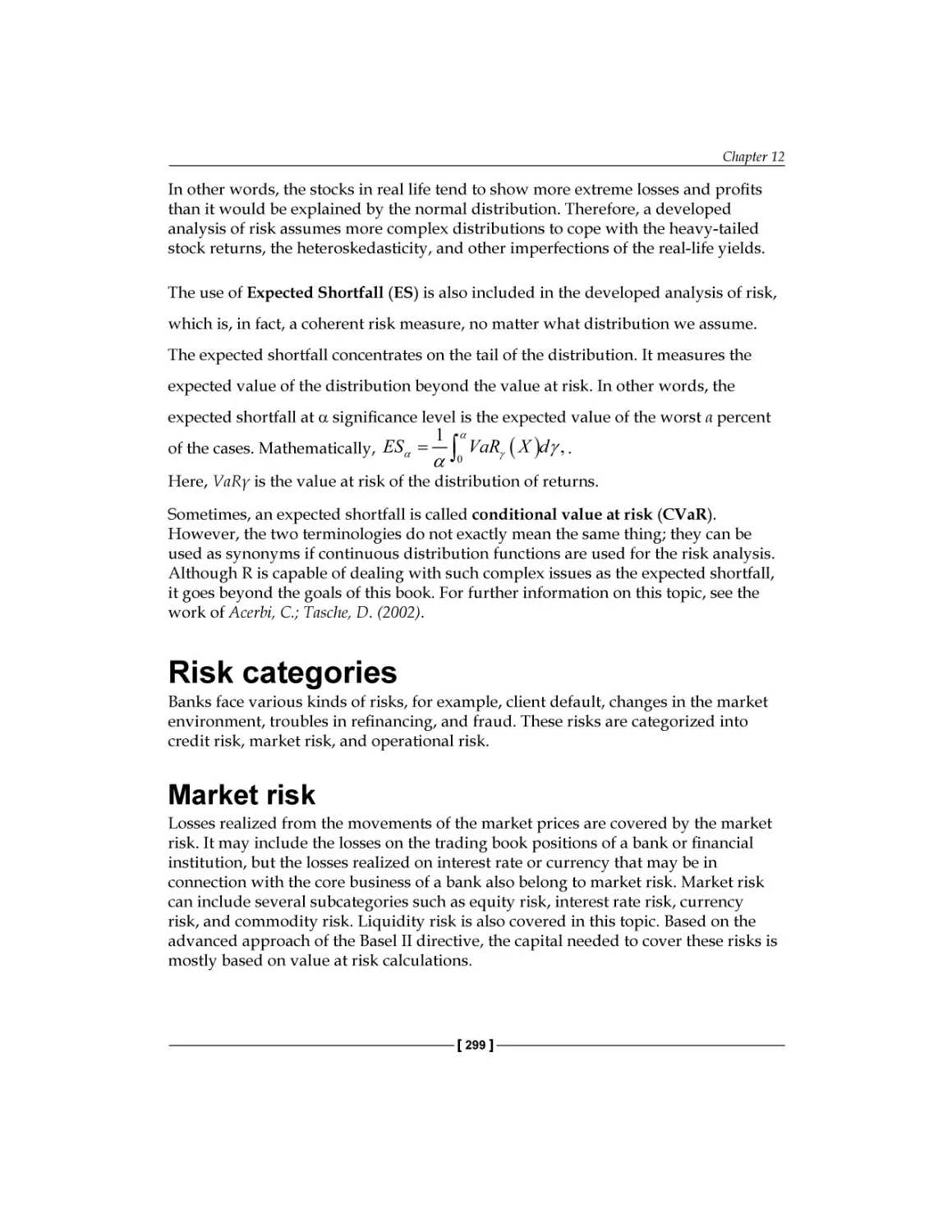































Author: Berlinger E. Illes F. Badics M. Banai A. Daróczi G.
Tags: finance
ISBN: 978-1-78355-207-8
Year: 2015




Text
Mastering R for
Quantitative Finance
Use R to optimize your trading strategy and
build up your own risk management system
Edina Berlinger, Ferenc Illés, Milán Badics, Ádám Banai,
Gergely Daróczi, Barbara Dömötör, Gergely Gabler,
Dániel Havran, Péter Juhász, István Margitai, Balázs Márkus,
Péter Medvegyev, Julia Molnár, Balázs Árpád Szűcs, Ágnes Tuza,
Tamás Vadász, Kata Váradi, Ágnes Vidovics-Dancs
BIRMINGHAM - MUMBAI
Mastering R for Quantitative Finance
Copyright © 2015 Packt Publishing
All rights reserved. No part of this book may be reproduced, stored in a retrieval
system, or transmitted in any form or by any means, without the prior written
permission of the publisher, except in the case of brief quotations embedded in
critical articles or reviews.
Every effort has been made in the preparation of this book to ensure the accuracy
of the information presented. However, the information contained in this book is
sold without warranty, either express or implied. Neither the authors, nor Packt
Publishing, and its dealers and distributors will be held liable for any damages
caused or alleged to be caused directly or indirectly by this book.
Packt Publishing has endeavored to provide trademark information about all of the
companies and products mentioned in this book by the appropriate use of capitals.
However, Packt Publishing cannot guarantee the accuracy of this information.
First published: March 2015
Production reference: 1030315
Published by Packt Publishing Ltd.
Livery Place
35 Livery Street
Birmingham B3 2PB, UK.
ISBN 978-1-78355-207-8
www.packtpub.com
Credits
Authors
Edina Berlinger
Ferenc Illés
Milán Badics
Ádám Banai
Gergely Daróczi
Content Development Editor
Melita Lobo
Technical Editor
Bharat Patil
Copy Editors
Barbara Dömötör
Karuna Narayanan
Gergely Gabler
Alfida Paiva
Dániel Havran
Péter Juhász
Project Coordinator
Kinjal Bari
István Margitai
Balázs Márkus
Péter Medvegyev
Julia Molnár
Balázs Árpád Szűcs
Ágnes Tuza
Tamás Vadász
Kata Váradi
Ágnes Vidovics-Dancs
Reviewers
Proofreaders
Simran Bhogal
Maria Gould
Ameesha Green
Paul Hindle
Clyde Jenkins
Indexer
Priya Sane
Graphics
Matthew Gilbert
Sheetal Aute
Dr. Hari Shanker Gupta
Abhinash Sahu
Ratan Mahanta
Brian G. Peterson
Commissioning Editor
Taron Pereira
Acquisition Editor
Kevin Colaco
Production Coordinator
Nitesh Thakur
Cover Work
Nitesh Thakur
About the Authors
Edina Berlinger has a PhD in economics from the Corvinus University of
Budapest. She is an associate professor, teaching corporate finance, investments,
and financial risk management. She is the head of the Finance department of the
university, and is also the chair of the finance subcommittee of the Hungarian
Academy of Sciences. Her expertise covers loan systems, risk management, and
more recently, network analysis. She has led several research projects in student
loan design, liquidity management, heterogeneous agent models, and systemic risk.
This work has been supported by the Hungarian Academy of
Sciences, Momentum Programme (LP-004/2010).
Ferenc Illés has an MSc degree in mathematics from Eötvös Loránd University.
A few years after graduation, he started studying actuarial and financial mathematics,
and he is about to pursue his PhD from Corvinus University of Budapest. In recent
years, he has worked in the banking industry. Currently, he is developing statistical
models with R. His interest lies in large networks and computational complexity.
Milán Badics has a master's degree in finance from the Corvinus University of
Budapest. Now, he is a PhD student and a member of the PADS PhD scholarship
program. He teaches financial econometrics, and his main research topics are time
series forecasting with data-mining methods, financial signal processing, and
numerical sensitivity analysis on interest rate models. He won the competition of
the X. Kochmeister-prize organized by the Hungarian Stock Exchange in May 2014.
Ádám Banai has received his MSc degree in investment analysis and risk
management from Corvinus University of Budapest. He joined the Financial Stability
department of the Magyar Nemzeti Bank (MNB, the central bank of Hungary) in 2008.
Since 2013, he is the head of the Applied Research and Stress Testing department at the
Financial System Analysis Directorate (MNB). He is also a PhD student at the Corvinus
University of Budapest since 2011. His main research fields are solvency stress-testing,
funding liquidity risk, and systemic risk.
Gergely Daróczi is an enthusiast R package developer and founder/CTO of an
R-based web application at Rapporter. He is also a PhD candidate in sociology
and is currently working as the lead R developer at CARD.com in Los Angeles.
Besides teaching statistics and doing data analysis projects for several years, he has
around 10 years of experience with the R programming environment. Gergely is
the coauthor of Introduction to R for Quantitative Finance, and is currently working
on another Packt book, Mastering Data Analysis with R, apart from a number of
journal articles on social science and reporting topics. He contributed to the book
by reviewing and formatting the R source code.
Barbara Dömötör is an assistant professor of the department of Finance at
Corvinus University of Budapest. Before starting her PhD studies in 2008, she
worked for several multinational banks. She wrote her doctoral thesis about
corporate hedging. She lectures on corporate finance, financial risk management,
and investment analysis. Her main research areas are financial markets, financial
risk management, and corporate hedging.
Gergely Gabler is the head of the Business Model Analysis department at the
banking supervisory division of National Bank of Hungary (MNB) since 2014. Before
this, he used to lead the Macroeconomic Research department at Erste Bank Hungary
after being an equity analyst since 2008. He graduated from the Corvinus University
of Budapest in 2009 with an MSc degree in financial mathematics. He has been a
guest lecturer at Corvinus University of Budapest since 2010, and he also gives
lectures in MCC College for advanced studies. He is about to finish the CFA
program in 2015 to become a charterholder.
Dániel Havran is a postdoctoral research fellow at Institute of Economics,
Centre for Economic and Regional Studies, Hungarian Academy of Sciences. He also
holds a part-time assistant professor position at the Corvinus University of Budapest,
where he teaches corporate finance (BA, PhD) and credit risk management (MSc).
He obtained his PhD in economics at Corvinus University of Budapest in 2011.
I would like to thank the postdoctoral fellowship programme of the
Hungarian Academy of Sciences for their support.
Péter Juhász holds a PhD degree in business administration from the Corvinus
University of Budapest and is also a CFA charterholder. As an associate professor,
he teaches corporate finance, business valuation, VBA programming in Excel,
and communication skills. His research field covers the valuation of intangible
assets, business performance analysis and modeling, and financial issues in public
procurement and sports management. He is the author of several articles, chapters,
and books mainly on the financial performance of Hungarian firms. Besides, he
also regularly acts as a consultant for SMEs and is a senior trainer for EY Business
Academy in the EMEA region.
István Margitai is an analyst in the ALM team of a major banking group in the
CEE region. He mainly deals with methodological issues, product modeling, and
internal transfer pricing topics. He started his career with asset-liability management
in Hungary in 2009. He gained experience in strategic liquidity management and
liquidity planning. He majored in investments and risk management at Corvinus
University of Budapest. His research interest is the microeconomics of banking,
market microstructure, and the liquidity of order-driven markets.
Balázs Márkus has been working with financial derivatives for over 10 years. He
has been trading many different kinds of derivatives, from carbon swaps to options on
T-bond futures. He was the head of the Foreign Exchange Derivative Desk at Raiffesien
Bank in Budapest. He is a member of the advisory board at Pallas Athéné Domus
Scientiae Foundation, and is a part-time analyst at the National Bank of Hungary and
the managing director of Nitokris Ltd, a small proprietary trading and consulting
company. He is currently working on his PhD about the role of dynamic hedging at
the Corvinus University of Budapest, where he is affiliated as a teaching assistant.
Péter Medvegyev has an MSc degree in economics from the Marx Károly
University Budapest. After completing his graduation in 1977, he started working
as a consultant in the Hungarian Management Development Center. He got his
PhD in Economics in 1985. He has been working for the Mathematics department of
the Corvinus University Budapest since 1993. His teaching experience at Corvinus
University includes stochastic processes, mathematical finance, and several other
subjects in mathematics.
Julia Molnár is a PhD candidate at the Department of Finance, Corvinus University
of Budapest. Her main research interests include financial network, systemic risk, and
financial technology innovations in retail banking. She has been working at McKinsey
& Company since 2011, where she is involved in several digital and innovation studies
in the area of banking.
Balázs Árpád Szűcs is a PhD candidate in finance at the Corvinus University of
Budapest. He works as a research assistant at the Department of Finance at the same
university. He holds a master's degree in investment analysis and risk management.
His research interests include optimal execution, market microstructure, and
forecasting intraday volume.
Ágnes Tuza holds an applied economics degree from Corvinus University
of Budapest and is an incoming student of HEC Paris in International Finance.
Her work experience covers structured products' valuation for Morgan Stanley as
well as management consulting for The Boston Consulting Group. She is an active
forex trader and shoots a monthly spot for Gazdaság TV on an investment idea
where she frequently uses technical analysis, a theme she has been interested in since
the age of 15. She has been working as a teaching assistant at Corvinus in various
finance-related subjects.
Tamás Vadász has an MSc degree in economics from the Corvinus University of
Budapest. After graduation, he was working as a consultant in the financial services
industry. Currently, he is pursuing his PhD in finance, and his main research
interests are financial economics and risk management in banking. His teaching
experience at Corvinus University includes financial econometrics, investments,
and corporate finance.
Kata Váradi is an assistant professor at the Department of Finance, Corvinus
University of Budapest since 2013. Kata graduated in finance in 2009 from Corvinus
University of Budapest and was awarded a PhD degree in 2012 for her thesis on the
analysis of the market liquidity risk on the Hungarian stock market. Her research
areas are market liquidity, fixed income securities, and networks in healthcare
systems. Besides doing research, she is active in teaching as well. She mainly teaches
corporate finance, investments, valuation, and multinational financial management.
Ágnes Vidovics-Dancs is a PhD candidate and an assistant professor at the
Department of Finance, Corvinus University of Budapest. Previously, she worked
as a junior risk manager in the Hungarian Government Debt Management Agency.
Her main research areas are government debt management (in general) and
sovereign crises and defaults (in particular). She is a CEFA and CIIA diploma holder.
About the Reviewers
Matthew Gilbert works as a quantitative analyst in a Global Macro group at
CPPIB based out of Toronto, Canada. He has a master's degree in quantitative
finance from Waterloo University and a bachelor's degree in applied mathematics
and mechanical engineering from Queen's University.
Dr. Hari Shanker Gupta is a senior quantitative research analyst working
in the area of algorithmic trading system development. Prior to this, he was a
postdoctoral fellow at Indian Institute of Science (IISc), Bangalore, India. He has
obtained his PhD in applied mathematics and scientific computation at IISc. He
completed his MSc in mathematics from Banaras Hindu University (BHU), Varanasi,
India. During his MSc, he was awarded four gold medals for his outstanding
performance in BHU, Varanasi.
Hari has published five research papers in reputed journals in the field of
mathematics and scientific computation. He has experience of working in the areas
of mathematics, statistics, and computation. These include the topics: numerical
methods, partial differential equations, mathematical finance, stochastic calculus,
data analysis, time series analysis, finite difference, and finite element methods.
He is very comfortable with the mathematics software Matlab, the statistics
programming language R, Python, and the programming language C.
He has reviewed the books Introduction to R for Quantitative Finance and
Learning Python Data Analysis for Packt Publishing.
Ratan Mahanta holds an MSc degree in computational finance. He is currently
working at GPSK investment group as a senior quantitative analyst. He has 3.5
years of experience in quantitative trading and developments for sell side and risk
consulting firms. He has coded algorithms on Github's open source platform for
"Quantitative trading" areas. He is self-motivated, intellectually curious, and hardworking, and loves solving difficult problems that lie at the intersection of market,
technology, research, and design. Currently, he is developing high-frequency trading
strategies and quantitative trading strategies. He has expertise in the following areas:
Quantitative Trading: FX, Equities, Futures and Options, and Engineering
on Derivatives.
Algorithms: Partial differential equations, Stochastic differential equations,
Finite Difference Method, Monte-Carlo, and Machine Learning.
Code: R Programming, Shiny by RStudio, C++, Matlab, HPC, and
Scientific Computing.
Data Analysis: Big-Data-Analytic [EOD to TBT], Bloomberg, Quandl,
and Quantopian.
Strategies: Vol-Arbitrage, Vanilla and Exotic Options Modeling, trend following,
Mean reversion, Cointegration, Monte-Carlo Simulations, Value at Risk, Stress
Testing, Buy side trading strategies with high Sharpe ratio, Credit Risk Modeling,
and Credit Rating.
He has also reviewed the book Mastering Scientific Computing with R, Packt
Publishing, and currently, he is reviewing the book Machine Learning with
R cookbook, Packt Publishing.
www.PacktPub.com
Support files, eBooks, discount offers, and more
For support files and downloads related to your book, please visit www.PacktPub.com.
Did you know that Packt offers eBook versions of every book published, with PDF and ePub
files available? You can upgrade to the eBook version at www.PacktPub.com and as a print
book customer, you are entitled to a discount on the eBook copy. Get in touch with us at
service@packtpub.com for more details.
At www.PacktPub.com, you can also read a collection of free technical articles, sign up
for a range of free newsletters and receive exclusive discounts and offers on Packt books
and eBooks.
TM
https://www2.packtpub.com/books/subscription/packtlib
Do you need instant solutions to your IT questions? PacktLib is Packt's online digital book
library. Here, you can search, access, and read Packt's entire library of books.
Why subscribe?
•
Fully searchable across every book published by Packt
•
Copy and paste, print, and bookmark content
•
On demand and accessible via a web browser
Free access for Packt account holders
If you have an account with Packt at www.PacktPub.com, you can use this to access
PacktLib today and view 9 entirely free books. Simply use your login credentials for
immediate access.
Table of Contents
Preface
Chapter 1: Time Series Analysis
1
7
Multivariate time series analysis
Cointegration
Vector autoregressive models
8
8
12
Cointegrated VAR and VECM
Volatility modeling
GARCH modeling with the rugarch package
19
23
28
Simulation and forecasting
Summary
References and reading list
34
36
36
VAR implementation example
The standard GARCH model
The Exponential GARCH model (EGARCH)
The Threshold GARCH model (TGARCH)
Chapter 2: Factor Models
Arbitrage pricing theory
Implementation of APT
Fama-French three-factor model
Modeling in R
Data selection
Estimation of APT with principal component analysis
Estimation of the Fama-French model
Summary
References
15
28
31
33
39
39
42
42
43
43
46
48
56
57
Table of Contents
Chapter 3: Forecasting Volume
59
Chapter 4: Big Data – Advanced Analytics
77
Chapter 5: FX Derivatives
93
Motivation
The intensity of trading
The volume forecasting model
Implementation in R
The data
Loading the data
The seasonal component
AR(1) estimation and forecasting
SETAR estimation and forecasting
Interpreting the results
Summary
References
Getting data from open sources
Introduction to big data analysis in R
K-means clustering on big data
Loading big matrices
Big data K-means clustering analysis
Big data linear regression analysis
Loading big data
Fitting a linear regression model on large datasets
Summary
References
Terminology and notations
Currency options
Exchange options
Two-dimensional Wiener processes
The Margrabe formula
Application in R
Quanto options
Pricing formula for a call quanto
Pricing a call quanto in R
Summary
References
[ ii ]
59
60
61
63
64
66
67
69
70
72
74
74
78
83
84
84
85
89
89
90
91
91
93
96
99
100
102
106
109
110
113
114
114
Table of Contents
Chapter 6: Interest Rate Derivatives and Models
115
Chapter 7: Exotic Options
137
Chapter 8: Optimal Hedging
177
The Black model
Pricing a cap with Black's model
The Vasicek model
The Cox-Ingersoll-Ross model
Parameter estimation of interest rate models
Using the SMFI5 package
Summary
References
A general pricing approach
The role of dynamic hedging
How R can help a lot
A glance beyond vanillas
Greeks – the link back to the vanilla world
Pricing the Double-no-touch option
Another way to price the Double-no-touch option
The life of a Double-no-touch option – a simulation
Exotic options embedded in structured products
Summary
References
Hedging of derivatives
Market risk of derivatives
Static delta hedge
Dynamic delta hedge
Comparing the performance of delta hedging
Hedging in the presence of transaction costs
Optimization of the hedge
Optimal hedging in the case of absolute transaction costs
Optimal hedging in the case of relative transaction costs
Further extensions
Summary
References
[ iii ]
116
119
122
128
132
134
135
135
137
138
138
139
145
148
160
161
168
174
175
177
178
179
179
185
190
192
194
196
198
199
199
Table of Contents
Chapter 9: Fundamental Analysis
201
Chapter 10: Technical Analysis, Neural Networks,
and Logoptimal Portfolios
227
The basics of fundamental analysis
Collecting data
Revealing connections
Including multiple variables
Separating investment targets
Setting classification rules
Backtesting
Industry-specific investment
Summary
References
Market efficiency
Technical analysis
The TA toolkit
Markets
Plotting charts - bitcoin
Built-in indicators
SMA and EMA
RSI
MACD
201
203
207
208
209
215
217
221
225
226
228
228
229
230
230
234
234
234
236
Candle patterns: key reversal
Evaluating the signals and managing the position
A word on money management
Wraping up
Neural networks
Forecasting bitcoin prices
237
240
241
243
243
245
Logoptimal portfolios
A universally consistent, non-parametric investment strategy
Evaluation of the strategy
Summary
References
249
250
254
255
255
Evaluation of the strategy
Chapter 11: Asset and Liability Management
Data preparation
Data source at first glance
Cash-flow generator functions
Preparing the cash-flow
Interest rate risk measurement
[ iv ]
249
257
258
260
262
265
267
Table of Contents
Liquidity risk measurement
Modeling non-maturity deposits
A Model of deposit interest rate development
Static replication of non-maturity deposits
Summary
References
271
273
273
278
283
283
Chapter 12: Capital Adequacy
285
Minimum capital requirements
Supervisory review
Transparency
287
289
290
Principles of the Basel Accords
Basel I
Basel II
286
286
287
Basel III
Risk measures
Analytical VaR
Historical VaR
Monte-Carlo simulation
Risk categories
Market risk
Credit risk
Operational risk
Summary
References
290
292
294
296
297
299
299
305
311
313
313
Chapter 13: Systemic Risks
315
Index
335
Systemic risk in a nutshell
The dataset used in our examples
Core-periphery decomposition
Implementation in R
Results
The Simulation method
The simulation
Implementation in R
Results
Possible interpretations and suggestions
Summary
References
[v]
315
317
319
321
322
323
324
325
328
332
332
333
Preface
Mastering R for Quantitative Finance is a sequel of our previous volume titled
Introduction to R for Quantitative Finance, and it is intended for those willing to
learn to use R's capabilities for building models in Quantitative Finance at a
more advanced level. In this book, we will cover new topics in empirical finance
(chapters 1-4), financial engineering (chapters 5-7), optimization of trading strategies
(chapters 8-10), and bank management (chapters 11-13).
What this book covers
Chapter 1, Time Series Analysis (Tamás Vadász) discusses some important concepts
such as cointegration (structural), vector autoregressive models, impulse-response
functions, volatility modeling with asymmetric GARCH models, and news
impact curves.
Chapter 2, Factor Models (Barbara Dömötör, Kata Váradi, Ferenc Illés) presents how
a multifactor model can be built and implemented. With the help of a principal
component analysis, five independent factors that explain asset returns are
identified. For illustration, the Fama and French model is also reproduced on a real
market dataset.
Chapter 3, Forecasting Volume (Balázs Árpád Szűcs, Ferenc Illés) covers an intraday
volume forecasting model and its implementation in R using data from the DJIA
index. The model uses turnover instead of volume, separates seasonal components
(U shape) from dynamic components, and forecasts these two individually.
Chapter 4, Big Data – Advanced Analytics (Júlia Molnár, Ferenc Illés) applies R to
access data from open sources, and performs various analyses on a large dataset. For
illustration, K-means clustering and linear regression models are applied to big data.
Preface
Chapter 5, FX Derivatives (Péter Medvegyev, Ágnes Vidovics-Dancs, Ferenc Illés)
generalizes the Black-Scholes model for derivative pricing. The Margrabe formula,
which is an extension of the Black-Scholes model, is programmed to price stock
options, currency options, exchange options, and quanto options.
Chapter 6, Interest Rate Derivatives and Models (Péter Medvegyev, Ágnes
Vidovics-Dancs, Ferenc Illés) provides an overview of interest rate models and
interest rate derivatives. The Black model is used to price caps and caplets; besides
this, interest rate models such as the Vasicek and CIR model are also presented.
Chapter 7, Exotic Options (Balázs Márkus, Ferenc Illés) introduces exotic options,
explains their linkage to plain vanilla options, and presents the estimation of
their Greeks for any derivative pricing function. A particular exotic option, the
Double-No-Touch (DNT) binary option, is examined in more details.
Chapter 8, Optimal Hedging (Barbara Dömötör, Kata Váradi, Ferenc Illés) analyzes
some practical problems in hedging of derivatives that arise from discrete time
rearranging of the portfolio and from transaction costs. In order to find the optimal
hedging strategy, different numerical-optimization algorithms are used.
Chapter 9, Fundamental Analysis (Péter Juhász, Ferenc Illés) investigates how to build
an investment strategy on fundamental bases. To pick the best yielding shares, on
one hand, clusters of firms are created according to their past performance, and on
the other hand, over-performers are separated with the help of decision trees. Based
on these, stock-selection rules are defined and backtested.
Chapter 10, Technical Analysis, Neural networks, and Logoptimal Portfolios (Ágnes Tuza,
Milán Badics, Edina Berlinger, Ferenc Illés) overviews technical analysis and some
corresponding strategies, like neural networks and logoptimal portfolios. Problems
of forecasting the price of a single asset (bitcoin), optimizing the timing of our
trading, and the allocation of the portfolio (NYSE stocks) are also investigated in a
dynamic setting.
Chapter 11, Asset and Liability Management (Dániel Havran, István Margitai)
demonstrates how R can support the process of asset and liability management
in a bank. The focus is on data generation, measuring and reporting on interest
rate risks, liquidity risk management, and the modeling of the behavior of
non-maturing deposits.
Chapter 12, Capital Adequacy (Gergely Gabler, Ferenc Illés) summarizes the principles
of the Basel Accords, and in order to determinate the capital adequacy of a bank,
calculates value-at-risk with the help of the historical, delta-normal, and Monte-Carlo
simulation methods. Specific issues of credit and operational risk are also covered.
[2]
Preface
Chapter 13, Systemic Risk (Ádám Banai, Ferenc Illés) shows two methods that can help
in identifying systemically important financial institutions based on network theory:
a core-periphery model and a contagion model.
Gergely Daróczi has also contributed to most chapters by reviewing the
program codes.
What you need for this book
All the codes examples provided in this book should be run in the R console that is to
be installed first on your computer. You can download the software for free and find
the installation instructions for all major operating systems at http://r-project.
org. Although we will not cover advanced topics such as how to use R in Integrated
Development Environment, there are awesome plugins for Emacs, Eclipse, vi, or
Notepad++ besides other editors, and we also highly recommend that you try
RStudio, which is a free and open source IDE dedicated to R.
Apart from a working R installation, we will also use some user-contributed R
packages that can be easily installed from the Comprehensive A Archive Network.
To install a package, use the install.packages command in the R console, shown
as follows:
> install.packages('Quantmod')
After installation, the package should also be loaded first to the current R session
before usage:
> library (Quantmod)
You can find free introductory articles and manuals on the R home page.
Who this book is for
This book is targeted to readers who are familiar with the basic financial concepts
and who have some programming skills. However, even if you know the basics of
Quantitative Finance, or you already have some programming experience in R, this
book provides you with new revelations. In case you are already an expert in one
of the topics, this book will get you up and running quickly in the other. However,
if you wish to take up the rhythm of the chapters perfectly, you need to be on an
intermediate level in Quantitative Finance, and you also need to have a reasonable
knowledge in R. Both of these skills can be attained from the first volume of the
sequel: Introduction to R for Quantitative Finance.
[3]
Preface
Conventions
In this book, you will find a number of text styles that distinguish between different
kinds of information. Here are some examples of these styles and an explanation of
their meaning.
Any command-line input or output is written as follows:
#generate the two time series of length 1000
set.seed(20140623)
#fix the random seed
N <- 1000
#define length of simulation
x <- cumsum(rnorm(N))
#simulate a normal random walk
gamma <- 0.7
#set an initial parameter value
y <- gamma * x + rnorm(N)
#simulate the cointegrating series
plot(x, type='l')
#plot the two series
lines(y,col="red")
New terms and important words are shown in bold. Words that you see on
the screen, for example, in menus or dialog boxes, appear in the text like this:
"Another useful visualization exercise is to look at the Density on log-scale."
Warnings or important notes appear in a box like this.
Tips and tricks appear like this.
Reader feedback
Feedback from our readers is always welcome. Let us know what you think about
this book—what you liked or disliked. Reader feedback is important for us as it helps
us develop titles that you will really get the most out of.
To send us general feedback, simply e-mail feedback@packtpub.com, and mention
the book's title in the subject of your message.
If there is a topic that you have expertise in and you are interested in either writing
or contributing to a book, see our author guide at www.packtpub.com/authors.
[4]
Preface
Customer support
Now that you are the proud owner of a Packt book, we have a number of things to
help you to get the most from your purchase.
Downloading the example code
You can download the example code files from your account at http://www.
packtpub.com for all the Packt Publishing books you have purchased. If you
purchased this book elsewhere, you can visit http://www.packtpub.com/support
and register to have the files e-mailed directly to you.
Errata
Although we have taken every care to ensure the accuracy of our content, mistakes
do happen. If you find a mistake in one of our books—maybe a mistake in the text or
the code—we would be grateful if you could report this to us. By doing so, you can
save other readers from frustration and help us improve subsequent versions of this
book. If you find any errata, please report them by visiting http://www.packtpub.
com/submit-errata, selecting your book, clicking on the Errata Submission Form
link, and entering the details of your errata. Once your errata are verified, your
submission will be accepted and the errata will be uploaded to our website or added
to any list of existing errata under the Errata section of that title.
To view the previously submitted errata, go to https://www.packtpub.com/books/
content/support and enter the name of the book in the search field. The required
information will appear under the Errata section.
Piracy
Piracy of copyrighted material on the Internet is an ongoing problem across all
media. At Packt, we take the protection of our copyright and licenses very seriously.
If you come across any illegal copies of our works in any form on the Internet, please
provide us with the location address or website name immediately so that we can
pursue a remedy.
Please contact us at copyright@packtpub.com with a link to the suspected
pirated material.
We appreciate your help in protecting our authors and our ability to bring you
valuable content.
[5]
Preface
Questions
If you have a problem with any aspect of this book, you can contact us at
questions@packtpub.com, and we will do our best to address the problem.
[6]
Time Series Analysis
In this chapter, we consider some advanced time series methods and their
implementation using R. Time series analysis, as a discipline, is broad enough
to fill hundreds of books (the most important references, both in theory and R
programming, will be listed at the end of this chapter's reading list); hence, the
scope of this chapter is necessarily highly selective, and we focus on topics that
are inevitably important in empirical finance and quantitative trading. It should
be emphasized at the beginning, however, that this chapter only sets the stage for
further studies in time series analysis.
Our previous book Introduction to R for Quantitative Finance, Packt Publishing,
discusses some fundamental topics of time series analysis such as linear, univariate
time series modeling, Autoregressive integrated moving average (ARIMA), and
volatility modeling Generalized Autoregressive Conditional Heteroskedasticity
(GARCH). If you have never worked with R for time series analysis, you might want
to consider going through Chapter 1, Time Series Analysis of that book as well.
The current edition goes further in all of these topics and you will become familiar
with some important concepts such as cointegration, vector autoregressive models,
impulse-response functions, volatility modeling with asymmetric GARCH models
including exponential GARCH and Threshold GARCH models, and news impact
curves. We first introduce the relevant theories, then provide some practical insights
to multivariate time series modeling, and describe several useful R packages
and functionalities. In addition, using simple and illustrative examples, we
give a step-by-step introduction to the usage of R programming language
for empirical analysis.
Time Series Analysis
Multivariate time series analysis
The basic issues regarding the movements of financial asset prices, technical analysis,
and quantitative trading are usually formulated in a univariate context. Can we predict
whether the price of a security will move up or down? Is this particular security in
an upward or a downward trend? Should we buy or sell it? These are all important
considerations; however, investors usually face a more complex situation and rarely
see the market as just a pool of independent instruments and decision problems.
By looking at the instruments individually, they might seem non-autocorrelated and
unpredictable in mean, as indicated by the Efficient Market Hypothesis, however,
correlation among them is certainly present. This might be exploited by trading
activity, either for speculation or for hedging purposes. These considerations justify
the use of multivariate time series techniques in quantitative finance. In this chapter,
we will discuss two prominent econometric concepts with numerous applications in
finance. They are cointegration and vector autoregression models.
Cointegration
From now on, we will consider a vector of time series yt , which consists of the
elements yt(1) , yt( 2) yt( n ) each of them individually representing a time series, for
instance, the price evolution of different financial products. Let's begin with the
formal definition of cointegrating data series.
The n × 1 vector yt of time series is said to be cointegrated if each of the series are
individually integrated in the order d (in particular, in most of the applications the
series are integrated of order 1, which means nonstationary unit-root processes, or
'
random walks), while there exists a linear combination of the series β yt , which is
integrated in the order d − 1 (typically, it is of order 0, which is a stationary process).
Intuitively, this definition implies the existence of some underlying forces in the
economy that are keeping together the n time series in the long run, even if they all
seem to be individually random walks. A simple example for cointegrating time
series is the following pair of vectors, taken from Hamilton (1994), which we will use
to study cointegration, and at the same time, familiarize ourselves with some basic
simulation techniques in R:
xt = xt −1 + ut , ut ∼ N ( 0,1)
yt = γ xt + vt , vt ∼ N ( 0,1)
[8]
Chapter 1
The unit root in yt will be shown formally by standard statistical tests. Unit root
tests in R can be performed using either the tseries package or the urca package;
here, we use the second one. The following R code simulates the two series of
length 1000:
#generate the two time series of length 1000
set.seed(20140623)
#fix the random seed
N <- 1000
#define length of simulation
x <- cumsum(rnorm(N))
#simulate a normal random walk
gamma <- 0.7
#set an initial parameter value
y <- gamma * x + rnorm(N)
#simulate the cointegrating series
plot(x, type='l')
#plot the two series
lines(y,col="red")
Downloading the example code
You can download the example code files from your account at
http://www.packtpub.com for all the Packt Publishing books
you have purchased. If you purchased this book elsewhere, you can
visit http://www.packtpub.com/support and register to have
the files e-mailed directly to you.
The output of the preceding code is as follows:
[9]
Time Series Analysis
By visual inspection, both series seem to be individually random walks. Stationarity
can be tested by the Augmented Dickey Fuller test, using the urca package;
however, many other tests are also available in R. The null hypothesis states that
there is a unit root in the process (outputs omitted); we reject the null if the test
statistic is smaller than the critical value:
#statistical tests
install.packages('urca');library('urca')
#ADF test for the simulated individual time series
summary(ur.df(x,type="none"))
summary(ur.df(y,type="none"))
For both of the simulated series, the test statistic is larger than the critical value at the
usual significance levels (1 percent, 5 percent, and 10 percent); therefore, we cannot
reject the null hypothesis, and we conclude that both the series are individually unit
root processes.
Now, take the following linear combination of the two series and plot the
resulted series:
zt = yt − γ xt
z = y - gamma*x
#take a linear combination of the series
plot(z,type='l')
The output for the preceding code is as follows:
[ 10 ]
Chapter 1
zt clearly seems to be a white noise process; the rejection of the unit root is
confirmed by the results of ADF tests:
summary(ur.df(z,type="none"))
In a real-world application, obviously we don't know the value of γ ; this has to be
estimated based on the raw data, by running a linear regression of one series on
the other. This is known as the Engle-Granger method of testing cointegration. The
following two steps are known as the Engle-Granger method of testing cointegration:
1. Run a linear regression yt on xt (a simple OLS estimation).
2. Test the residuals for the presence of a unit root.
We should note here that in the case of the n series, the number of
possible independent cointegrating vectors is 0 < r < n ; therefore, for
n > 2 , the cointegrating relationship might not be unique. We will briefly
discuss r > 1 later in the chapter.
Simple linear regressions can be fitted by using the lm function. The residuals can
be obtained from the resulting object as shown in the following example. The ADF
test is run in the usual way and confirms the rejection of the null hypothesis at all
significant levels. Some caveats, however, will be discussed later in the chapter:
#Estimate the cointegrating relationship
coin <- lm(y ~ x -1)
#regression without intercept
coin$resid
#obtain the residuals
summary(ur.df(coin$resid))
#ADF test of residuals
Now, consider how we could turn this theory into a successful trading strategy.
At this point, we should invoke the concept of statistical arbitrage or pair trading,
which, in its simplest and early form, exploits exactly this cointegrating relationship.
These approaches primarily aim to set up a trading strategy based on the spread
between two time series; if the series are cointegrated, we expect their stationary
linear combination to revert to 0. We can make profit simply by selling the relatively
expensive one and buying the cheaper one, and just sit and wait for the reversion.
The term statistical arbitrage, in general, is used for many sophisticated
statistical and econometrical techniques, and this aims to exploit
relative mispricing of assets in statistical terms, that is, not in
comparison to a theoretical equilibrium model.
[ 11 ]
Time Series Analysis
What is the economic intuition behind this idea? The linear combination of time series
that forms the cointegrating relationship is determined by underlying economic
forces, which are not explicitly identified in our statistical model, and are sometimes
referred to as long-term relationships between the variables in question. For example,
similar companies in the same industry are expected to grow similarly, the spot and
forward price of a financial product are bound together by the no-arbitrage principle,
FX rates of countries that are somehow interlinked are expected to move together,
or short-term and long-term interest rates tend to be close to each other. Deviances
from this statistically or theoretically expected comovements open the door to various
quantitative trading strategies where traders speculate on future corrections.
The concept of cointegration is further discussed in a later chapter, but for that,
we need to introduce vector autoregressive models.
Vector autoregressive models
Vector autoregressive models (VAR) can be considered as obvious multivariate
extensions of the univariate autoregressive (AR) models. Their popularity in applied
econometrics goes back to the seminal paper of Sims (1980). VAR models are the
most important multivariate time series models with numerous applications in
econometrics and finance. The R package vars provide an excellent framework for R
users. For a detailed review of this package, we refer to Pfaff (2013). For econometric
theory, consult Hamilton (1994), Lütkepohl (2007), Tsay (2010), or Martin et al. (2013).
In this book, we only provide a concise, intuitive summary of the topic.
In a VAR model, our point of departure is a vector of time series yt of length n . The
VAR model specifies the evolution of each variable as a linear function of the lagged
values of all other variables; that is, a VAR model of the order p is the following:
yt = A1 yt −1 + + A p yt − p + ut
Here, A i are n × n the coefficient matrices for all i = 1 p , and ut is a vector white
noise process with a positive definite covariance matrix. The terminology of vector
white noise assumes lack of autocorrelation, but allows contemporaneous correlation
between the components; that is, ut has a non-diagonal covariance matrix.
[ 12 ]
Chapter 1
The matrix notation makes clear one particular feature of VAR models: all variables
depend only on past values of themselves and other variables, meaning that
contemporaneous dependencies are not explicitly modeled. This feature allows us
to estimate the model by ordinary least squares, applied equation-by-equation. Such
models are called reduced form VAR models, as opposed to structural form models,
discussed in the next section.
Obviously, assuming that there are no contemporaneous effects would be an
oversimplification, and the resulting impulse-response relationships, that is, changes
in the processes followed by a shock hitting a particular variable, would be misleading
and not particularly useful. This motivates the introduction of structured VAR (SVAR)
models, which explicitly models the contemporaneous effects among variables:
Ayt = A1* yt −1 + + A*p yt − p + B ∈t
*
Here, A i = AAi and B ∈t = Aut ; thus, the structural form can be obtained from the
reduced form by multiplying it with an appropriate parameter matrix A , which
reflects the contemporaneous, structural relations among the variables.
In the notation, as usual, we follow the technical documentation of the
vars package, which is very similar to that of Lütkepohl (2007).
In the reduced form model, contemporaneous dependencies are not modeled;
therefore, such dependencies appear in the correlation structure of the error term,
'
that is, the covariance matrix of ut , denoted by ∑ u = E ( ut ut ) . In the SVAR model,
contemporaneous dependencies are explicitly modelled (by the A matrix on the
left-hand side), and the disturbance terms are defined to be uncorrelated, so the
E (∈t ∈t' ) = ∑∈ covariance matrix is diagonal. Here, the disturbances are usually
referred to as structural shocks.
t
What makes the SVAR modeling interesting and difficult at the same time is
the so-called identification problem; the SVAR model is not identified, that is,
parameters in matrix A cannot be estimated without additional restrictions.
How should we understand that a model is not identified? This
basically means that there exist different (infinitely many) parameter
matrices, leading to the same sample distribution; therefore, it is not
possible to identify a unique value of parameters based on the sample.
[ 13 ]
Time Series Analysis
Given a reduced form model, it is always possible to derive an appropriate
parameter matrix, which makes the residuals orthogonal; the covariance matrix
E ( ut ut' ) = ∑u is positive semidefinitive, which allows us to apply the LDL
decomposition (or alternatively, the Cholesky decomposition). This states that
there always exists an L lower triangle matrix and a D diagonal matrix such that
∑ u = LDLT . By choosing A = L−1 , the covariance matrix of the structural model
becomes
∑
∈
(
= E L−1ut ut' ( L' )
−1
) = L ∑ (L )
' −1
−1
u
, which gives
∑
u
LΣ∈ LT . Now, we conclude
that ∑∈ is a diagonal, as we intended. Note that by this approach, we essentially
imposed an arbitrary recursive structure on our equations. This is the method
followed by the irf() function by default.
There are multiple ways in the literature to identify SVAR model parameters,
which include short-run or long-run parameter restrictions, or sign restrictions on
impulse responses (see, for example, Fry-Pagan (2011)). Many of them have no native
support in R yet. Here, we only introduce a standard set of techniques to impose
short-run parameter restrictions, which are respectively called A-model, B-model,
and AB-model, each of which are supported natively by package vars:
•
In the case of an A-model, B = I n , and restrictions on matrix A are imposed
'
'
'
such that ∑∈ = AE ut ut A = A ∑ u A is a diagonal covariance matrix. To
make the model "just identified", we need n ( n + 1) / 2 additional restrictions.
This is reminiscent of imposing a triangle matrix (but that particular structure
is not required).
•
Alternatively, it is possible to identify the structural innovations based on the
restricted model residuals by imposing a structure on the matrix B (B-model),
that is, directly on the correlation structure, in this case, A = I n and ut = B ∈t .
•
The AB-model places restrictions on both A and B, and the connection
between the restricted and structural model is determined by Aut = B ∈t .
(
)
Impulse-response analysis is usually one of the main goals of building a VAR model.
Essentially, an impulse-response function shows how a variable reacts (response) to a
shock (impulse) hitting any other variable in the system. If the system consists of K
variables, K 2 impulse response functions can be determined. Impulse responses can
be derived mathematically from the Vector Moving Average representation (VMA) of
the VAR process, similar to the univariate case (see the details in Lütkepohl (2007)).
[ 14 ]
Chapter 1
VAR implementation example
As an illustrative example, we build a three-component VAR model from the
following components:
•
Equity return: This specifies the Microsoft price index from January 01, 2004
to March 03, 2014
•
Stock index: This specifies the S&P500 index from January 01, 2004 to
March 03, 2014
•
US Treasury bond interest rates from January 01, 2004 to March 03, 2014
Our primary purpose is to make a forecast for the stock market index by using the
additional variables and to identify impulse responses. Here, we suppose that there
exists a hidden long term relationship between a given stock, the stock market as
a whole, and the bond market. The example was chosen primarily to demonstrate
several of the data manipulation possibilities of the R programming environment
and to illustrate an elaborate concept using a very simple example, and not because
of its economic meaning.
We use the vars and quantmod packages. Do not forget to install and load those
packages if you haven't done this yet:
install.packages('vars');library('vars')
install.packages('quantmod');library('quantmod')
The Quantmod package offers a great variety of tools to obtain financial data directly
from online sources, which we will frequently rely on throughout the book. We use
the getSymbols()function:
getSymbols('MSFT', from='2004-01-02', to='2014-03-31')
getSymbols('SNP', from='2004-01-02', to='2014-03-31')
getSymbols('DTB3', src='FRED')
By default, yahoofinance is used as a data source for equity and index price series
(src='yahoo' parameter settings, which are omitted in the example). The routine
downloads open, high, low, close prices, trading volume, and adjusted prices. The
downloaded data is stored in an xts data class, which is automatically named
by default after the ticker (MSFT and SNP). It's possible to plot the closing prices
by calling the generic plot function, but the chartSeries function of quantmod
provides a much better graphical illustration.
[ 15 ]
Time Series Analysis
The components of the downloaded data can be reached by using the following
shortcuts:
Cl(MSFT)
#closing prices
Op(MSFT)
#open prices
Hi(MSFT)
#daily highest price
Lo(MSFT)
#daily lowest price
ClCl(MSFT)
#close-to-close daily return
Ad(MSFT)
#daily adjusted closing price
Thus, for example, by using these shortcuts, the daily close-to-close returns can be
plotted as follows:
chartSeries(ClCl(MSFT))
#a plotting example with shortcuts
The screenshot for the preceding command is as follows:
Interest rates are downloaded from the FRED (Federal Reserve Economic Data)
data source. The current version of the interface does not allow subsetting of dates;
however, downloaded data is stored in an xts data class, which is straightforward
to subset to obtain our period of interest:
DTB3.sub <- DTB3['2004-01-02/2014-03-31']
[ 16 ]
Chapter 1
The downloaded prices (which are supposed to be nonstationary series) should
be transformed into a stationary series for analysis; that is, we will work with log
returns, calculated from the adjusted series:
MSFT.ret <- diff(log(Ad(MSFT)))
SNP.ret
<- diff(log(Ad(SNP)))
To proceed, we need a last data-cleansing step before turning to VAR model fitting.
By eyeballing the data, we can see that missing data exists in T-Bill return series,
and the lengths of our databases are not the same (on some dates, there are interest
rate quotes, but equity prices are missing). To solve these data-quality problems, we
choose, for now, the easiest possible solution: merge the databases (by omitting all data
points for which we do not have all three data), and omit all NA data. The former is
performed by the inner join parameter (see help of the merge function for details):
dataDaily <- na.omit(merge(SNP.ret,MSFT.ret,DTB3.sub), join='inner')
Here, we note that VAR modeling is usually done on lower frequency data.
There is a simple way of transforming your data to monthly or quarterly frequencies,
by using the following functions, which return with the opening, highest, lowest,
and closing value within the given period:
SNP.M
<- to.monthly(SNP.ret)$SNP.ret.Close
MSFT.M <- to.monthly(MSFT.ret)$MSFT.ret.Close
DTB3.M <- to.monthly(DTB3.sub)$DTB3.sub.Close
A simple reduced VAR model may be fitted to the data by using the VAR() function
of the vars package. The parameterization shown in the following code allows a
maximum of 4 lags in the equations, and choose the model with the best (lowest)
Akaike Information Criterion value:
var1 <- VAR(dataDaily, lag.max=4, ic="AIC")
For a more established model selection, you can consider using VARselect(),
which provides multiple information criteria (output omitted):
>VARselect(dataDaily,lag.max=4)
The resulting object is an object of the varest class. Estimated parameters and
multiple other statistical results can be obtained by the summary() method or the
show() method (that is, by just typing the variable):
summary(var1)
var1
[ 17 ]
Time Series Analysis
There are other methods worth mentioning. The custom plotting method for the
varest class generates a diagram for all variables separately, including its fitted
values, residuals, and autocorrelation and partial autocorrelation functions of the
residuals. You need to hit Enter to get the new variable. Plenty of custom settings
are available; please consult the vars package documentation:
plot(var1)
#Diagram of fit and residuals for each variables
coef(var1)
#concise summary of the estimated variables
residuals(var1)
#list of residuals (of the corresponding ~lm)
fitted(var1)
#list of fitted values
Phi(var1)
#coefficient matrices of VMA representation
Predictions using our estimated VAR model can be made by simply calling the
predict function and by adding a desired confidence interval:
var.pred <- predict(var1, n.ahead=10, ci=0.95)
Impulse responses should be first generated numerically by irf(), and then they can
be plotted by the plot() method. Again, we get different diagrams for each variable,
including the respective impulse response functions with bootstrapped confidence
intervals as shown in the following command:
var.irf <- irf(var1)
plot(var.irf)
Now, consider fitting a structural VAR model using parameter restrictions described
earlier as an A-model. The number of required restrictions for the SVAR model that
K K −1
is identified is ( 2 ) ; in our case, this is 3.
See Lütkepohl (2007) for more details. The number of additional
K K + 1)
, but the diagonal elements are
restrictions required is (
2
normalized to unity, which leaves us with the preceding number.
The point of departure for an SVAR model is the already estimated reduced form
of the VAR model (var1). This has to be amended with an appropriately structured
restriction matrix.
For the sake of simplicity, we will use the following restrictions:
•
S&P index shocks do not have a contemporaneous effect on Microsoft
•
S&P index shocks do not have a contemporaneous effect on interest rates
•
T-Bonds interest rate shocks have no contemporaneous effect on Microsoft
[ 18 ]
Chapter 1
These restrictions enter into the SVAR model as 0s in the A matrix, which is
as follows:
1 a12
a13
0
0
1
0 a32
1
When setting up the A matrix as a parameter for SVAR estimation in R, the positions
of the to-be estimated parameters should take the NA value. This can be done with
the following assignments:
amat <amat[2,
amat[2,
amat[3,
diag(3)
1] <- NA
3] <- NA
1] <- NA
Finally, we can fit the SVAR model and plot the impulse response functions
(the output is omitted):
svar1 <- SVAR(var1, estmethod='direct', Amat = amat)
irf.svar1 <- irf(svar1)
plot(irf.svar1)
Cointegrated VAR and VECM
Finally, we put together what we have learned so far, and discuss the concepts of
Cointegrated VAR and Vector Error Correction Models (VECM).
Our starting point is a system of cointegrated variables (for example, in a trading
context, this indicates a set of similar stocks that are likely to be driven by the same
fundamentals). The standard VAR models discussed earlier can only be estimated
when the variables are stationary. As we know, the conventional way to remove
unit root model is to first differentiate the series; however, in the case of cointegrated
series, this would lead to overdifferencing and losing information conveyed by the
long-term comovement of variable levels. Ultimately, our goal is to build up a model
of stationary variables, which also incorporates the long-term relationship between
the original cointegrating nonstationary variables, that is, to build a cointegrated
VAR model. This idea is captured by the Vector Error Correction Model (VECM),
which consists of a VAR model of the order p - 1 on the differences of the variables,
and an error-correction term derived from the known (estimated) cointegrating
relationship. Intuitively, and using the stock market example, a VECM model
establishes a short-term relationship between the stock returns, while correcting
with the deviation from the long-term comovement of prices.
[ 19 ]
Time Series Analysis
Formally, a two-variable VECM, which we will discuss as a numerical example, can
be written as follows. Let yt be a vector of two nonstationary unit root series yt(1) , yt( 2)
where the two series are cointegrated with a cointegrating vector β = (1, β ) . Then, an
appropriate VECM model can be formulated as follows:
∆yt = αβ ' yt −1 +ψ 1∆yt −1 + +ψ 1∆yt − p +1 + ∈t
Here, ∆yt = yt − yt −1 and the first term are usually called the error correction terms.
In practice, there are two approaches to test cointegration and build the error
correction model. For the two-variable case, the Engle-Granger method is quite
instructive; our numerical example basically follows that idea. For the multivariate
case, where the maximum number of possible cointegrating relationships is ( n − 1) ,
you have to follow the Johansen procedure. Although the theoretical framework for
the latter goes far beyond the scope of this book, we briefly demonstrate the tools for
practical implementation and give references for further studies.
To demonstrate some basic R capabilities regarding VECM models, we will use a
standard example of three months and six months T-Bill secondary market rates,
which can be downloaded from the FRED database, just as we discussed earlier.
We will restrict our attention to an arbitrarily chosen period, that is, from 1984 to
2014. Augmented Dickey Fuller tests indicate that the null hypothesis of the unit
root cannot be rejected.
library('quantmod')
getSymbols('DTB3', src='FRED')
getSymbols('DTB6', src='FRED')
DTB3.sub = DTB3['1984-01-02/2014-03-31']
DTB6.sub = DTB6['1984-01-02/2014-03-31']
plot(DTB3.sub)
lines(DTB6.sub, col='red')
We can consistently estimate the cointegrating relationship between the two series
by running a simple linear regression. To simplify coding, we define the variables
x1 and x2 for the two series, and y for the respective vector series. The other
variable-naming conventions in the code snippets will be self-explanatory:
x1=as.numeric(na.omit(DTB3.sub))
x2=as.numeric(na.omit(DTB6.sub))
y = cbind(x1,x2)
cregr <- lm(x1 ~ x2)
r = cregr$residuals
[ 20 ]
Chapter 1
The two series are indeed cointegrated if the residuals of the regression (variable r),
that is, the appropriate linear combination of the variables, constitute a stationary
series. You could test this with the usual ADF test, but in these settings, the
conventional critical values are not appropriate, and corrected values should be used
(see, for example Phillips and Ouliaris (1990)).
It is therefore much more appropriate to use a designated test for the existence of
cointegration, for example, the Phillips and Ouliaris test, which is implemented in
the tseries and in the urca packages as well. The most basic tseries version is
demonstrated as follows:
install.packages('tseries');library('tseries');
po.coint <- po.test(y, demean = TRUE, lshort = TRUE)
The null hypothesis states that the two series are not cointegrated, so the low p value
indicates rejection of null and presence of cointegration.
The Johansen procedure is applicable for more than one possible cointegrating
relationship; an implementation can be found in the urca package:
yJoTest = ca.jo(y, type = c("trace"), ecdet = c("none"), K = 2)
######################
# Johansen-Procedure #
######################
Test type: trace statistic , with linear trend
Eigenvalues (lambda):
[1] 0.0160370678 0.0002322808
Values of teststatistic and critical values of test:
r <= 1 |
r = 0
test 10pct
5pct
1.76
8.18 11.65
6.50
1pct
| 124.00 15.66 17.95 23.52
Eigenvectors, normalised to first column:
(These are the cointegration relations)
[ 21 ]
Time Series Analysis
DTB3.l2
DTB3.l2
DTB6.l2
1.000000
1.000000
DTB6.l2 -0.994407 -7.867356
Weights W:
(This is the loading matrix)
DTB3.l2
DTB6.l2
DTB3.d -0.037015853 3.079745e-05
DTB6.d -0.007297126 4.138248e-05
The test statistic for r = 0 (no cointegrating relationship) is larger than the critical
values, which indicates the rejection of the null. For r ≤ 1 , however, the null cannot
be rejected; therefore, we conclude that one cointegrating relationship exists. The
cointegrating vector is given by the first column of the normalized eigenvectors
below the test results.
The final step is to obtain the VECM representation of this system, that is, to run an
OLS regression on the lagged differenced variables and the error correction term
derived from the previously calculated cointegrating relationship. The appropriate
function utilizes the ca.jo object class, which we created earlier. The r = 1 parameter
signifies the cointegration rank which is as follows:
>yJoRegr = cajorls(dyTest, r=1)
>yJoRegr
$rlm
Call:
lm(formula = substitute(form1), data = data.mat)
Coefficients:
x1.d
x2.d
ect1
-0.0370159
-0.0072971
constant
-0.0041984
-0.0016892
x1.dl1
0.1277872
0.1538121
x2.dl1
0.0006551
-0.0390444
[ 22 ]
Chapter 1
$beta
ect1
x1.l1
1.000000
x2.l1 -0.994407
The coefficient of the error-correction term is negative, as we expected; a short-term
deviation from the long-term equilibrium level would push our variables back to the
zero equilibrium deviation.
You can easily check this in the bivariate case; the result of the Johansen procedure
method leads to approximately the same result as the step-by-step implementation
of the ECM following the Engle-Granger procedure. This is shown in the uploaded R
code files.
Volatility modeling
It is a well-known and commonly accepted stylized fact in empirical finance that
the volatility of financial time series varies over time. However, the non-observable
nature of volatility makes the measurement and forecasting a challenging exercise.
Usually, varying volatility models are motivated by three empirical observations:
•
Volatility clustering: This refers to the empirical observation that calm
periods are usually followed by calm periods while turbulent periods by
turbulent periods in the financial markets.
•
Non-normality of asset returns: Empirical analysis has shown that asset
returns tend to have fat tails relative to the normal distribution.
•
Leverage effect: This leads to an observation that volatility tends to react
differently to positive or negative price movements; a drop in prices
increases the volatility to a larger extent than an increase of similar size.
In the following code, we demonstrate these stylized facts based on S&P asset prices.
Data is downloaded from yahoofinance, by using the already known method:
getSymbols("SNP", from="2004-01-01", to=Sys.Date())
chartSeries(Cl(SNP))
Our purpose of interest is the daily return series, so we calculate log returns from the
closing prices. Although it is a straightforward calculation, the Quantmod package
offers an even simpler way:
ret <- dailyReturn(Cl(SNP), type='log')
[ 23 ]
Time Series Analysis
Volatility analysis departs from eyeballing the autocorrelation and partial
autocorrelation functions. We expect the log returns to be serially uncorrelated, but
the squared or absolute log returns to show significant autocorrelations. This means
that Log returns are not correlated, but not independent.
Notice the par(mfrow=c(2,2)) function in the following code; by this, we overwrite
the default plotting parameters of R to organize the four diagrams of interest in a
convenient table format:
par(mfrow=c(2,2))
acf(ret, main="Return ACF");
pacf(ret, main="Return PACF");
acf(ret^2, main="Squared return ACF");
pacf(ret^2, main="Squared return PACF")
par(mfrow=c(1,1))
The screenshot for preceding command is as follows:
[ 24 ]
Chapter 1
Next, we look at the histogram and/or the empirical distribution of daily log returns
of S&P and compare it with the normal distribution of the same mean and standard
deviation. For the latter, we use the function density(ret), which computes the
nonparametric empirical distribution function. We use the function curve()with an
additional parameter add=TRUE to plot a second line to an already existing diagram:
m=mean(ret);s=sd(ret);
par(mfrow=c(1,2))
hist(ret, nclass=40, freq=FALSE, main='Return histogram');curve(dnorm(x,
mean=m,sd=s), from = -0.3, to = 0.2, add=TRUE, col="red")
plot(density(ret), main='Return empirical distribution');curve(dnorm(x,
mean=m,sd=s), from = -0.3, to = 0.2, add=TRUE, col="red")
par(mfrow=c(1,1))
The excess kurtosis and fat tails are obvious, but we can confirm numerically
(using the moments package) that the kurtosis of the empirical distribution of our
sample exceeds that of a normal distribution (which is equal to 3). Unlike some other
software packages, R reports the nominal value of kurtosis, and not excess kurtosis
which is as follows:
> kurtosis(ret)
daily.returns
12.64959
[ 25 ]
Time Series Analysis
It might be also useful to zoom in to the upper or the lower tail of the diagram.
This is achieved by simply rescaling our diagrams:
# tail zoom
plot(density(ret), main='Return EDF - upper tail', xlim = c(0.1, 0.2),
ylim=c(0,2));
curve(dnorm(x, mean=m,sd=s), from = -0.3, to = 0.2, add=TRUE, col="red")
Another useful visualization exercise is to look at the Density on log-scale
(see the following figure, left), or a QQ-plot (right), which are common tools
to comparing densities. QQ-plot depicts the empirical quantiles against that of
a theoretical (normal) distribution. In case our sample is taken from a normal
distribution, this should form a straight line. Deviations from this straight line
may indicate the presence of fat tails:
# density plots on log-scale
plot(density(ret), xlim=c(-5*s,5*s),log='y', main='Density on log-scale')
curve(dnorm(x, mean=m,sd=s), from=-5*s, to=5*s, log="y", add=TRUE,
col="red")
# QQ-plot
qqnorm(ret);qqline(ret);
[ 26 ]
Chapter 1
The screenshot for preceding command is as follows:
Now, we can turn our attention to modeling volatility.
Broadly speaking, there are two types of modeling techniques in the financial
econometrics literature to capture the varying nature of volatility: the GARCH-family
approach (Engle, 1982 and Bollerslev, 1986) and the stochastic volatility (SV) models.
As for the distinction between them, the main difference between the GARCH-type
modeling and (genuine) SV-type modeling techniques is that in the former, the
conditional variance given in the past observations is available, while in SV-models,
volatility is not measurable with respect to the available information set; therefore, it
is hidden by nature, and must be filtered out from the measurement equation (see, for
example, Andersen – Benzoni (2011)). In other words, GARCH-type models involve the
estimation of volatility based on past observations, while in SV-models, the volatility
has its own stochastic process, which is hidden, and return realizations should
be used as a measurement equation to make inferences regarding the underlying
volatility process.
In this chapter, we introduce the basic modeling techniques for the GARCH
approach for two reasons; first of all, it is much more proliferated in applied works.
Secondly, because of its diverse methodological background, SV models are not yet
supported by R packages natively, and a significant amount of custom development
is required for an empirical implementation.
[ 27 ]
Time Series Analysis
GARCH modeling with the rugarch package
There are several packages available in R for GARCH modeling. The most prominent
ones are rugarch, rmgarch (for multivariate models), and fGarch; however, the
basic tseries package also includes some GARCH functionalities. In this chapter,
we will demonstrate the modeling facilities of the rugarch package. Our notations
in this chapter follow the respective ones of the rugarch package's output and
documentation.
The standard GARCH model
A GARCH (p,q) process may be written as follows:
∈t = σ tηt
q
q
i =1
j =1
σ t2 = ω + ∑ α i ∈t2−i + ∑ β jσ t2− j
Here, ∈t is usually the disturbance term of a conditional mean equation (in practice,
usually an ARMA process) and ηt ~ i.i.d. ( 0,1) . That is, the conditional volatility process
2
is determined linearly by its own lagged values σ t − j and the lagged squared
observations (the values of ∈t ). In empirical studies, GARCH (1,1) usually provides
an appropriate fit to the data. It may be useful to think about the simple GARCH
(1,1) specification as a model in which the conditional variance is specified as a
weighted average of the long-run variance
ω
1−α − β
2
, the last predicted variance σ t −1 ,
2
and the new information ∈t −1 (see Andersen et al. (2009)). It is easy to see how the
GARCH (1,1) model captures autoregression in volatility (volatility clustering) and
leptokurtic asset return distributions, but as its main drawback, it is symmetric, and
cannot capture asymmetries in distributions and leverage effects.
The emergence of volatility clustering in a GARCH-model is highly intuitive; a large
positive (negative) shock in ηt increases (decreases) the value of ∈t , which in turn
increases (decreases) the value of σ t +1 , resulting in a larger (smaller) value for ∈t +1 .
The shock is persistent; this is volatility clustering. Leptokurtic nature requires some
derivation; see for example Tsay (2010).
[ 28 ]
Chapter 1
Our empirical example will be the analysis of the return series calculated from
the daily closing prices of Apple Inc. based on the period from Jan 01, 2006 to
March 31, 2014. As a useful exercise, before starting this analysis, we recommend
that you repeat the exploratory data analysis in this chapter to identify stylized
facts on Apple data.
Obviously, our first step is to install a package, if not installed yet:
install.packages('rugarch');library('rugarch')
To get the data, as usual, we use the quantmod package and the getSymbols()
function, and calculate return series based on the closing prices.
#Load Apple data and calculate log-returns
getSymbols("AAPL", from="2006-01-01", to="2014-03-31")
ret.aapl <- dailyReturn(Cl(AAPL), type='log')
chartSeries(ret.aapl)
The programming logic of rugarch can be thought of as follows: irrespective of
whatever your aim is (fitting, filtering, forecasting, and simulating), first, you have to
specify a model as a system object (variable), which in turn will be inserted into the
respective function. Models can be specified by calling ugarchspec(). The following
code specifies a simple GARCH (1,1) model, (sGARCH), with only a constant µ in
the mean equation:
garch11.spec = ugarchspec(variance.model = list(model="sGARCH",
garchOrder=c(1,1)), mean.model = list(armaOrder=c(0,0)))
An obvious way to proceed is to fit this model to our data, that is, to estimate
the unknown parameters by maximum likelihood, based on our time series of
daily returns:
aapl.garch11.fit = ugarchfit(spec=garch11.spec, data=ret.aapl)
The function provides, among a number of other outputs, the parameter estimations
µ , ω , α1 , β1 :
> coef(aapl.garch11.fit)
mu
omega
alpha1
beta1
1.923328e-03 1.027753e-05 8.191681e-02 8.987108e-01
[ 29 ]
Time Series Analysis
Estimates and various diagnostic tests can be obtained by the show() method of the
generated object (that is, by just typing the name of the variable). A bunch of other
statistics, parameter estimates, standard error, and covariance matrix estimates
can be reached by typing the appropriate command. For the full list, consult the
ugarchfit object class; the most important ones are shown in the following code:
coef(msft.garch11.fit)
#estimated coefficients
vcov(msft.garch11.fit)
#covariance matrix of param estimates
infocriteria(msft.garch11.fit)
#common information criteria list
newsimpact(msft.garch11.fit)
#calculate news impact curve
signbias(msft.garch11.fit)
#Engle - Ng sign bias test
fitted(msft.garch11.fit)
#obtain the fitted data series
residuals(msft.garch11.fit)
#obtain the residuals
uncvariance(msft.garch11.fit)
#unconditional (long-run) variance
uncmean(msft.garch11.fit)
#unconditional (long-run) mean
Standard GARCH models are able to capture fat tails and volatility clustering, but to
explain asymmetries caused by the leverage effect, we need more advanced models.
To approach the asymmetry problem visually, we will now describe the concept of
news impact curves.
News impact curves, introduced by Pagan and Schwert (1990) and Engle and Ng
(1991), are useful tools to visualize the magnitude of volatility changes in response to
shocks. The name comes from the usual interpretation of shocks as news influencing
the market movements. They plot the change in conditional volatility against shocks
in different sizes, and can concisely express the asymmetric effects in volatility. In
the following code, the first line calculates the news impacts numerically for the
previously defined GARCH(1,1) model, and the second line creates the visual plot:
ni.garch11 <- newsimpact(aapl.garch11.fit)
plot(ni.garch11$zx, ni.garch11$zy, type="l", lwd=2, col="blue",
main="GARCH(1,1) - News Impact", ylab=ni.garch11$yexpr, xlab=ni.
garch11$xexpr)
[ 30 ]
Chapter 1
The screenshot for the preceding command is as follows:
As we expected, no asymmetries are present in response to positive and negative
shocks. Now, we turn to models to be able to incorporate asymmetric effects as well.
The Exponential GARCH model (EGARCH)
Exponential GARCH models were introduced by Nelson (1991). This approach
directly models the logarithm of the conditional volatility:
∈t = σ tηt
q
(
log σ t2 = ω + ∑ α iηt −i + γ ( ηt −i − E ηt −i
i =1
q
) ) +∑ β
j =1
j
log (σ t2− j )
where, E is the expectation operator. This model formulation allows multiplicative
dynamics in evolving the volatility process. Asymmetry is captured by the α i
parameter; a negative value indicates that the process reacts more to negative shocks,
as observable in real data sets.
[ 31 ]
Time Series Analysis
To fit an EGARCH model, the only parameter to be changed in a model specification
is to set the EGARCH model type. By running the fitting function, the additional
parameter will be estimated (see coef()):
# specify EGARCH(1,1) model with only constant in mean equation
egarch11.spec = ugarchspec(variance.model = list(model="eGARCH",
garchOrder=c(1,1)), mean.model = list(armaOrder=c(0,0)))
aapl.egarch11.fit = ugarchfit(spec=egarch11.spec, data=ret.aapl)
> coef(aapl.egarch11.fit)
alpha1
beta1
gamma1
0.001446685 -0.291271433 -0.092855672
mu
omega
0.961968640
0.176796061
News impact curve reflects the strong asymmetry in response of conditional
volatility to shocks and confirms the necessity of asymmetric models:
ni.egarch11 <- newsimpact(aapl.egarch11.fit)
plot(ni.egarch11$zx, ni.egarch11$zy, type="l", lwd=2, col="blue",
main="EGARCH(1,1) - News Impact",
ylab=ni.egarch11$yexpr, xlab=ni.egarch11$xexpr)
[ 32 ]
Chapter 1
The Threshold GARCH model (TGARCH)
Another prominent example is the TGARCH model, which is even easier to interpret.
The TGARCH specification involves an explicit distinction of model parameters
above and below a certain threshold. TGARCH is also a submodel of a more general
class, the asymmetric power ARCH class, but we will discuss it separately because of
its wide penetration in applied financial econometrics literature.
The TGARCH model may be formulated as follows:
∈t = σ tηt
q
q
i =1
j =1
σ t2 = ω + ∑ (α i + γ i I t −i ) ∈t2−i + ∑ β jσ t2− j
where
1 if ∈t −1 < 0
I t −i =
0 if ∈t −1 ≥ 0
The interpretation is straightforward; the ARCH coefficient depends on the sign of
the previous error term; if γ 1 is positive, a negative error term will have a higher
impact on the conditional volatility, just as we have seen in the leverage effect before.
In the R package, rugarch, the threshold GARCH model is implemented in a
framework of an even more general class of GARCH models, called the Family
GARCH model Ghalanos (2014).
# specify TGARCH(1,1) model with only constant in mean equation
tgarch11.spec = ugarchspec(variance.model = list(model="fGARCH",
submodel="TGARCH", garchOrder=c(1,1)),
mean.model = list(armaOrder=c(0,0)))
aapl.tgarch11.fit = ugarchfit(spec=tgarch11.spec, data=ret.aapl)
> coef(aapl.egarch11.fit)
mu
omega
alpha1
beta1
gamma1
0.001446685 -0.291271433 -0.092855672
0.961968640
0.176796061
[ 33 ]
Time Series Analysis
Thanks to the specific functional form, the news impact curve for a
Threshold-GARCH is less flexible in representing different responses, there is
a kink at the zero point which can be seen when we run the following command:
ni.tgarch11 <- newsimpact(aapl.tgarch11.fit)
plot(ni.tgarch11$zx, ni.tgarch11$zy, type="l", lwd=2, col="blue",
main="TGARCH(1,1) - News Impact",
ylab=ni.tgarch11$yexpr, xlab=ni.tgarch11$xexpr)
Simulation and forecasting
The Rugarch package allows an easy way to simulate from a specified model. Of
course, for simulation purposes, we should also specify the parameters of the model
within ugarchspec(); this could be done by the fixed.pars argument. After
specifying the model, we can simulate a time series with a given conditional mean
and GARCH specification by using simply the ugarchpath() function:
garch11.spec = ugarchspec(variance.model = list(garchOrder=c(1,1)),
mean.model = list(armaOrder=c(0,0)),
fixed.pars=list(mu = 0, omega=0.1, alpha1=0.1,
beta1 = 0.7))
garch11.sim = ugarchpath(garch11.spec, n.sim=1000)
[ 34 ]
Chapter 1
Once we have an estimated model and technically a fitted object, forecasting the
conditional volatility based on that is just one step:
aapl.garch11.fit = ugarchfit(spec=garch11.spec, data=ret.aapl, out.
sample=20)
aapl.garch11.fcst = ugarchforecast(aapl.garch11.fit, n.ahead=10,
n.roll=10)
The plotting method of the forecasted series provides the user with a selection menu;
we can plot either the predicted time series or the predicted conditional volatility.
plot(aapl.garch11.fcst, which='all')
[ 35 ]
Time Series Analysis
Summary
In this chapter, we reviewed some important concepts of time series analysis, such as
cointegration, vector-autoregression, and GARCH-type conditional volatility models.
Meanwhile, we have provided a useful introduction to some tips and tricks to start
modeling with R for quantitative and empirical finance. We hope that you find these
exercises useful, but again, it should be noted that this chapter is far from being
complete both from time series and econometric theory, and from R programming's
point of view. The R programming language is very well documented on the
Internet, and the R user's community consists of thousands of advanced and
professional users. We encourage you to go beyond books, be a self-learner, and do
not stop if you are stuck with a problem; almost certainly, you will find an answer
on the Internet to proceed. Use the documentation of R packages and the help files
heavily, and study the official R-site, http://cran.r-project.org/, frequently.
The remaining chapters will provide you with numerous additional examples to
find your way in the plethora of R facilities, packages, and functions.
References and reading list
•
Andersen, Torben G; Davis, Richard A.; Kreiß, Jens-Peters; Mikosh, Thomas
(ed.) (2009). Handbook of Financial Time Series
•
Andersen, Torben G. and Benzoni, Luca (2011). Stochastic volatility.
Book chapter in Complex Systems in Finance and Econometrics,
Ed.: Meyers, Robert A., Springer
•
Brooks, Chris (2008). Introductory Econometrics for Finance, Cambridge
University Press
•
Fry, Renee and Pagan, Adrian (2011). Sign Restrictions in Structural Vector
Autoregressions: A Critical Review. Journal of Economic Literature,
American Economic Association, vol. 49(4), pages 938-60, December.
•
Ghalanos, Alexios (2014) Introduction to the rugarch package
http://cran.r-project.org/web/packages/rugarch/vignettes/
Introduction_to_the_rugarch_package.pdf
•
Hafner, Christian M. (2011). Garch modelling. Book chapter in Complex
Systems in Finance and Econometrics, Ed.: Meyers, Robert A., Springer
•
Hamilton, James D. (1994). Time Series Analysis, Princetown, New Jersey
•
Lütkepohl, Helmut (2007). New Introduction to Multiple Time Series
Analysis, Springer
[ 36 ]
Chapter 1
•
Murray, Michael. P. (1994). A drunk and her dog: an illustration of
cointegration and error correction. The American Statistician, 48(1), 37-39.
•
Martin, Vance; Hurn, Stan and Harris, David (2013). Econometric Modelling
with Time Series. Specification, Estimation and Testing, Cambridge
University Press
•
Pfaff, Bernard (2008). Analysis of Integrated and Cointegrated Time Series
with R, Springer
•
Pfaff, Bernhard (2008). VAR, SVAR and SVEC Models: Implementation
Within R Package vars. Journal of Statistical Software, 27(4)
•
Phillips, P. C., & Ouliaris, S. (1990). Asymptotic properties of residual based
tests for cointegration. Econometrica: Journal of the Econometric Society, 165-193.
•
Pole, Andrew (2007). Statistical Arbitrage. Wiley
•
Rachev, Svetlozar T., Hsu, John S.J., Bagasheva, Biliana S. and Fabozzi, Frank
J. (2008). Bayesian Methods in Finance. John Wiley & Sons.
•
Sims, Christopher A. (1980). Macroeconomics and reality. Econometrica:
Journal of the Econometric Society, 1-48.
•
Tsay, Ruey S. (2010). Analysis of Financial Time Series, 3rd edition, Wiley
[ 37 ]
Factor Models
In most of the cases in finance, valuation of financial assets is based on the
discounted cash flow method; hence, the present value is calculated as the
discounted value of the expected future cash flows. Therefore, in order to be able to
value assets, we need to know the appropriate rate of return that reflects the time
value of money and also the risk of the given asset. There are two main approaches
to determine expected returns: the capital asset pricing model (CAPM) and the
arbitrage pricing theory (APT). CAPM is an equilibrium model, while APT builds
on the no-arbitrage principle; thus, these approaches have quite different starting
points and inner logic. However, the final pricing formula we get can be quite
similar, depending on the market factors we use. For the comparison of CAPM and
APT, see Bodie-Kane-Marcus (2008). When we test any of these theoretical models on
real-world data, we perform linear regressions. This chapter focuses on APT, since
we have discussed CAPM in more detail in Daróczi et al. (2013).
This chapter is divided into two parts. In the first part, we introduce the theory of
APT in general, and then we present a special three-factor model published in a
seminal paper of Fama and French. In the second part, we show how to use R for data
selection and how to estimate the pricing coefficients from real market data, and
finally we re-examine the famous Fama-French model on a more recent sample.
Arbitrage pricing theory
APT relies on the assumption that asset returns in the market are determined by
macroeconomic and firm-specific factors, and asset returns are generated by the
following linear factor model:
ri = E ( ri ) + ∑ j =1 βij Fj + ei
n
Equation 1
Factor Models
Here, E(ri) is the expected return of asset i, Fj stands for the unexpected change of
the jth factor, and bij shows the ith security's sensitivity for that factor, while ei is the
return caused by unexpected firm-specific events. So
∑
n
j =1
βij Fj represents the random
systemic effect, and ei represents the non-systemic (that is idiosyncratic) effect, which is
not captured by the market factors. Being unexpected, both
∑
n
j =1
βij Fj and ei have a zero
mean. In this model, factors are independent of each other and the firm-specific risk.
Thus, asset returns are derived from two sources: the systemic risk of the factors that
affect all assets in the market and the non-systematic risk that impacts only that special
firm. A non-systemic risk can be diversified by holding more assets in the portfolio. In
contrast, a systemic risk cannot be diversified, as it is caused by economy-wide sources
of risks that affect the overall stock market (Brealey-Myers, 2005).
As a consequence of the model, the realized return of an asset is the linear
combination of multiple random factors (Wilmott, 2007).
Other important assumptions of APT are as follows:
•
There are a finite number of investors on the market who optimize their
portfolio for the next period. They are equally informed and have no
market power.
•
There is a riskless asset and an infinite number of risky assets traded
continuously; thus, firm-specific risks can be totally eliminated by
diversification. A portfolio that has zero firm-specific risks is called
a well-diversified portfolio.
•
Investors are rational in the sense that if an arbitrage opportunity
occurs (financial assets are mispriced relative to each other), then investors
immediately buy the underpriced security/securities and sell the overpriced
one(s), and they will take an infinitely large position in order to earn as much
riskless profit as possible. Consequently, any mispricing will disappear
on the spot.
•
Factor portfolios exist, and they are continuously tradable. A factor
portfolio is a well-diversified portfolio that reacts only to one of the factors;
specifically, it has a beta of 1 for that specified factor and a beta of 0 for all
other factors.
[ 40 ]
Chapter 2
From the preceding assumptions, it can be shown that any portfolio's risk
premium equals the weighted sum of the factor portfolios' risk premium
(Medvegyev-Száz, 2010). The following pricing formula can be derived in the
case of a two-factor model:
E ( ri − rf ) = βi1 ( r1 − rf ) + βi 2 ( r2 − rf
)
Equation 2
Here, ri is the return of the ith asset, rf is the risk-free return, bi1 is the sensitivity of
the ith stock's risk premium to the first systemic factor, and (r1-rf) is the risk premium
of this factor. Similarly, bi2 is the sensitivity of the ith stock's risk premium to the
second factor's excess return (r2-rf).
When we implement APT, we perform a linear regression in the following form:
(r − r ) = α
i
f
+ βi1 ( r1 − rf ) + βi 2 ( r2 − rf ) + ε i
i
Equation 3
Here, ai stands for a constant and εi is the asset's non-systemic, firm-specific risk.
All other variables are the same as mentioned previously.
If there is only one factor in the model, and it is the return of the market portfolio,
the pricing equation of the CAPM model and APT model will coincide:
E ( ri − rf ) = βi ( rm − rf
)
Equation 4
In this case, the formula to be tested on real market data is as follows:
(r − r ) = α
i
f
i
+ βi ( rm − rf ) + ε i
Equation 5
Here, rm is the return of a market portfolio represented by a market index (like the
S&P 500). This is why we call Equation (5) the index model.
[ 41 ]
Factor Models
Implementation of APT
The implementation of APT can be split into four steps: identifying the factors,
estimating the factor coefficient, estimating the factor premiums, and pricing with
APT (Bodie et al. 2008):
1. Identifying the factors: As APT mentions nothing about the factors, they
have to be identified empirically. These factors are usually macroeconomic
factors, like stock market return, inflation, business cycle, and so on. The
main problem in using macroeconomic factors is that factors are usually not
independent of each other. The identification of the factors is often carried
out by factor analysis. However, factors identified by factor analysis cannot
necessarily be interpreted in an economically meaningful way.
2. Estimating factor coefficients: In order to estimate the coefficients in a
multivariate linear regression model, a general version of Equation (3)
is used.
3. Estimating the factor premiums: The estimation of the factor premiums
is based on historical data, taking the average of the historical time-series
data of the premiums of the factor portfolios.
4. Pricing with APT: Equation (2) is used for calculating the expected return of
any asset by substituting the appropriate variables into the equation.
Fama-French three-factor model
Fama and French proposed a multifactor model in 1996, in which they used
corporate indicators as factors instead of macroeconomic factors, since they found
that these factors better describe the systemic risk of assets. Fama and French (1996)
extended the index model by adding the firm size and the book-to-market ratio as
return-generating factors to the market portfolio returns (Fama and French, 1996).
The firm size factor was constructed by taking the difference between the returns of
small and large firms (rSMB). The name of the variable was SMB, which is derived from
"small minus big". The book-to-market factor was calculated by taking the difference
between firms' returns that have a high and low book-to-market ratio (rHML). The name
of the variable was HML, which is derived from "high minus low".
[ 42 ]
Chapter 2
Their model was the following:
ri − rf = α i + βiM ( rM − rf ) + βiHML rHML + βiSMB rSMB + ei
Equation 6
Here, ai is a constant, which shows the abnormal rate of return, rf is the risk-free
return, and biHML is the ith asset's sensitivity to the book-to-market factor, while biSMB
is the ith asset's sensitivity to the factor of size, biM is the sensitivity of the ith stock's
risk premium to the market index factor, (rM-rf) is the risk premium of this factor, and
ei is the asset's non-systemic, firm-specific risk with zero mean.
Modeling in R
In the following section, we will learn the implementation of the previously
described models with the help of R.
Data selection
In Chapter 4, Big Data – Advanced Analytics, we will discuss in detail the aspects and
methods of getting data from open sources and working with them efficiently. Here,
we only present how the time series of stock prices and other relevant information
can be acquired and used for the factor model's estimations.
We used the quantmod package to collect the database.
Here is how it works in R:
library(quantmod)
stocks <- stockSymbols()
As a result, we need to wait for a few seconds while data is fetched, and then we can
see the output:
Fetching AMEX symbols...
Fetching NASDAQ symbols...
Fetching NYSE symbols...
[ 43 ]
Factor Models
Now, we have a data frame R object that contains about 6,500 stocks that are traded
on different exchanges such as AMEX, NASDAQ, or NYSE. In order to see the
variables that the dataset contains, we can use the str command:
str(stocks)
'data.frame':
6551 obs. of
8 variables:
$ Symbol
: chr
"AA-P" "AAMC" "AAU" "ACU" ...
$ Name
: chr
"Alcoa Inc." "Altisource Asset Management Corp"...
$ LastSale : num
87 1089.9 1.45 16.58 16.26 ...
$ MarketCap: num
0.00 2.44e+09 9.35e+07 5.33e+07 2.51e+07 ...
$ IPOyear
: int
NA NA NA 1988 NA NA NA NA NA NA ...
$ Sector
: chr
"Capital Goods" "Finance" "Basic Industries"...
$ Industry : chr
"Metal Fabrications" "Real Estate"...
$ Exchange : chr
"AMEX" "AMEX" "AMEX" "AMEX" ...
We can drop the variables that we don't really need and include the information
about market capitalization and the book value of the company coming from
a different database as new variables since we will need them to estimate the
Fama-French model:
stocks[1:5, c(1, 3:4, ncol(stocks))]
Symbol LastSale
87.30
MarketCap BookValuePerShare
1
AA-P
0
0.03
2
AAMC
985.00 2207480545
-11.41
3
AAU
1.29
83209284
0.68
4
ACU
16.50
53003808
10.95
5
ACY
16.40
25309415
30.13
We will also need the time series of the risk-free return, which will be quantified in
this calculation by the one-month USD LIBOR rate:
library(Quandl)
Warning message:
package 'Quandl' was built under R version 3.1.0
LIBOR <- Quandl('FED/RILSPDEPM01_N_B',
start_date = '2010-06-01', end_date = '2014-06-01')
Warning message:
[ 44 ]
Chapter 2
In Quandl("FED/RILSPDEPM01_N_B", start_date = "2010-06-01", end_date
= "2014-06-01") : It would appear you aren't using an authentication
token. Please visit http://www.quandl.com/help/r or your usage may be
limited.
We can ignore the warning messages as data is still assigned to the LIBOR variable.
The Quandl package, the tseries package, and other packages that collect data are
discussed in Chapter 4, Big Data – Advanced Analytics, in more detail.
This can also be used to get the prices of stocks, and the S&P 500 index can be used
as the market portfolio.
We have a table with stock prices (a time series of approximately 5,000 stock prices
between June 1, 2010 to June 1, 2014). The first and last few columns look like this:
d <- read.table("data.csv", header = TRUE, sep = ";")
d[1:7, c(1:5, (ncol(d) - 6):ncol(d))]
Date
SP500
AAU
ACU
ACY
ZMH
ZNH ZOES
ZQK ZTS
ZX
1
2010.06.01 1070.71 0.96 11.30 20.64 54.17 21.55
NA
4.45 NA NA
2
2010.06.02 1098.38 0.95 11.70 20.85 55.10 21.79
NA
4.65 NA NA
3
2010.06.03 1102.83 0.97 11.86 20.90 55.23 21.63
NA
4.63 NA NA
4
2010.06.04 1064.88 0.93 11.65 18.95 53.18 20.88
NA
4.73 NA NA
5
2010.06.07 1050.47 0.97 11.45 19.03 52.66 20.24
NA
4.18 NA NA
6
2010.06.08 1062.00 0.98 11.35 18.25 52.99 20.96
NA
3.96 NA NA
7
2010.06.09 1055.69 0.98 11.90 18.35 53.22 20.45
NA
4.02 NA NA
If we have the data saved on our hard drive, we can simply read it with the
read.table function. In Chapter 4, Big Data – Advanced Analytics, we will discuss
how to collect data directly from the Internet.
Now, we have all the data we need: the market portfolio (S&P 500), the price of
stocks, and the risk-free rates (one-month LIBOR).
We have chosen to delete the variables with missing values and 0 or negative prices,
in order to clean the database. The easiest way to do this is the following:
d <- d[, colSums(is.na(d)) == 0]
d <- d[, c(T, colMins(d[, 2:ncol(d)]) > 0)]
To use the colMins function, we apply the matrixStats package. Now, we can start
working with the data.
[ 45 ]
Factor Models
Estimation of APT with principal component
analysis
In practice, it is not easy to carry out a factor analysis, because identifying the macro
variables that have an effect on the securities' return is difficult (Medvegyev – Száz,
2010, pp. 42). In many cases, the latent factors that drive the returns are searched by
principal component analysis.
From the originally downloaded 6,500 stocks, we can use the data of 4,015 stocks;
the rest were excluded because of missing values or 0 prices. Now, we omit the first
two columns because we do not need the dates in this section, and the S&P 500 is
considered as a separate factor in itself; hence, we do not include it in the principal
component analysis (PCA). After this, the log returns are computed.
p <- d[, 3:ncol(d)]
r <- log(p[2:nrow(p), ] / p[1:(nrow(p) - 1), ])
There exists another way to calculate the log returns of a given asset, that is, by using
return.calculate(data, method="log") with the PerformanceAnalytics library.
As we have too many stocks, in order to carry out PCA, either we have to have data
of at least 25 years, or we need to reduce the number of stocks. It's hopeless for factor
models to remain stable for decades; hence, for illustration purposes, we choose to
select 10 percent of the stocks randomly and compute the model for this sample:
r <- r[, runif(nrow(r)) < 0.1]
runif(nrow(r)) < 0.1 is a 4,013 dimension 0-1 vector, which chooses
approximately 10 percent of the columns (in our case, 393) from the table. We can
also use the following sample function for this, on which you can find further details
at http://stat.ethz.ch/R-manual/R-devel/library/base/html/sample.html:
pca <- princomp(r)
As a result, we receive a princomp class object, which has eight attributes, of which
the most important ones are the loading matrix and the sdev attributes, which
contain the standard deviations of the components. The first principal component is
the vector on which the data set has the maximum variance.
Let's check the standard deviations of the principal component:
plot(pca$sdev)
[ 46 ]
Chapter 2
The result is as follows:
We can see that the first five components are separated; consequently, five factors
should be chosen, but other factors also have significant standard deviations, so the
market cannot be explained by a few factors.
We can confirm this result by calling the factanal function, which estimates the
factor model with five factors:
factanal(r, 5)
We notice that it takes much more time to perform this computation. Factor analysis
is related to PCA, but is a little more complicated from a mathematical aspect. As a
result, we get an object of class factanal, which has many attributes, but now, we
are only interested in the following part of the output:
Factor1 Factor2 Factor3 Factor4 Factor5
SS loadings
56.474
23.631
15.440
12.092
6.257
Proportion Var
0.144
0.060
0.039
0.031
0.016
Cumulative Var
0.144
0.204
0.243
0.274
0.290
Test of the hypothesis that 5 factors are sufficient.
The chi square statistic is 91756.72 on 75073 degrees of freedom.The
p-value is 0
[ 47 ]
Factor Models
This output shows that the factor model with five factors fits, but the explained
variance is only approximately 30 percent, which means that the model should be
extended with other factors as well.
Estimation of the Fama-French model
We have a data frame with prices of the 4,015 stocks for five years, and the LIBOR
data frame with the LIBOR time series. First, we need to compute the returns and
combine them with the LIBOR rate.
As a first step, we omit the dates that are not for mathematical computations, and
then we compute the log returns for each of the remaining columns:
d2 <- d[, 2:ncol(d)]
d2 <- log(tail(d1, -1)/head(d1, -1))
After calculating the log returns, we put back the dates to the returns, and then, as a
last step, we combine the two data sets:
d <- cbind(d[2:nrow(d), 1], d2)
d <- merge(LIBOR, d, by = 1)
It is worth mentioning that the merge function operates on data frames equivalent to
the (inner) join SQL statement.
The result is as follows:
print(d[1:5, 1:5])]
Date
LIBOR
SP500
AAU
ACU
2010.06.02
0.4
0.025514387
-0.01047130
2010.06.03
0.4
0.004043236
0.02083409
2010.06.04
0.4
-0.035017487
-0.04211149
-0.017865214
2010.06.07
0.4
-0.013624434
0.04211149
-0.017316450
2010.06.08
0.4
0.010916240
0.01025650
We adjust the LIBOR rate to the daily returns:
d$LIBOR <- d$LIBOR / 36000
[ 48 ]
0.034786116
0.013582552
-0.008771986
Chapter 2
As the LIBOR rates are quoted on a money-market basis - (actual/360) day-count
convention - and the time series contain the rates in percentage, we divided the
LIBOR by 36,000. Now, we need to compute the three variables of the Fama-French
model. As described in the Data selection section, we have the stocks' data frame:
d[1:5, c(1,(ncol(d) - 3):ncol(d))]
Symbol LastSale
MarketCap BookValuePerShare
1
AA-P
2
AAMC
0
0.03
985.00 2207480545
87.30
-11.41
3
AAU
1.29
83209284
0.68
4
ACU
16.50
53003808
10.95
5
ACY
16.40
25309415
30.13
We have to drop the stocks for which we do not have price data:
> stocks = stocks[stocks$Symbol %in% colnames(d),]
We have the market cap as a variable; we still need to compute the book-to-market
ratio for each:
stocks$BookToMarketRatio <stocks$BookValuePerShare / stocks$LastSale
str(stocks)
'data.frame':
$ Symbol
72...
3982 obs. of
5 variables:
: Factor w/ 6551 levels "A","AA","AA-P",..: 14
$ LastSale
: num
1.29 16.5 16.4 2.32 4.05 ...
$ MarketCap
: num
8.32e+07 5.30e+07 2.53e+07 1.16e+08...
$ BookValuePerShare: num
0.68 10.95 30.13 0.19 0.7 ...
$ BookToMarketRatio: num
0.5271 0.6636 1.8372 0.0819 0.1728 ...
Now, we need to compute the SMB and HML factors. For simplification, we will
define companies as BIG if they are bigger than the average. The same principle is
applied for the book-to-market ratio:
avg_size <- mean(stocks$MarketCap)
BIG
<- as.character(stocks$Symbol[stocks$MarketCap > avg_size])
SMALL <- as.character(stocks[stocks$MarketCap < avg_size,1])
[ 49 ]
Factor Models
These arrays contain the symbols of the BIG and SMALL companies. Now, we can
define the SMB factor:
d$SMB <- rowMeans(d[,colnames(d) %in% SMALL]) –
rowMeans(d[,colnames(d) %in% BIG])
We define the HML factor as follows:
avg_btm <- mean(stocks$BookToMarketRatio)
HIGH <- as.character(
stocks[stocks$BookToMarketRatio > avg_btm, 1])
LOW <- as.character(
stocks[stocks$BookToMarketRatio < avg_btm, 1])
d$HML <- rowMeans(d[, colnames(d) %in% HIGH]) –
rowMeans(d[, colnames(d) %in% LOW])
The third factor is calculated:
d$Market <- d$SP500 - d$LIBOR
After defining the three factors, we test it on the stock of Citigroup Inc. (Citi) and on
Exelixis, Inc. (EXEL):
d$C
<- d$C - d$LIBOR
model <- glm( formula = "C ~ Market + SMB + HML" , data = d)
The GLM (general linear model) function works as follows: it takes the data and
formula as arguments. The formula is a string in the form of response ~ terms, where
the response is a variable name in the data frame and terms specify the predictors in
the model, so it consists of variable names in the data set separated by + operators.
This function can also be used for logistic regression, but the default is linear.
The output of the model is as follows:
Call:
glm(formula = "C~Market+SMB+HML", data = d)
Coefficients:
(Intercept)
Market
SMB
HML
0.001476
1.879100
0.401547
-0.263599
Degrees of Freedom: 1001 Total (i.e. Null);
Null Deviance:
5.74
Residual Deviance: 5.364
AIC: -2387
[ 50 ]
998 Residual
Chapter 2
The output of the model summary is as follows:
summary(model)
Call:
glm(formula = "C~Market+SMB+HML", data = d)
Deviance Residuals:
Min
1Q
Median
3Q
Max
-0.09344
-0.01104
-0.00289
0.00604
2.26882
Coefficients:
Estimate Std. Error t value Pr(>|t|)
(Intercept)
0.001476
0.002321
0.636
0.525
Market
1.879100
0.231595
8.114 1.43e-15 ***
SMB
0.401547
0.670443
0.599
0.549
HML
-0.263599
0.480205
-0.549
0.583
--Signif. codes:
0 '***' 0.001 '**' 0.01 '*' 0.05 '.' 0.1 ' ' 1
(Dispersion parameter for gaussian family taken to be 0.005374535)
Null deviance: 5.7397
Residual deviance: 5.3638
on 1001
degrees of freedom
on
degrees of freedom
998
AIC: -2387
Number of Fisher Scoring iterations: 2
The results show that the only significant factor is the market premium, which
means that the stock return of Citigroup seems to moves together with the whole
market itself.
To plot the results, this command should be used:
estimation <- model$coefficients[1]+
model$coefficients[2] * d$Market +
model$coefficients[3]*d$SMB +
model$coefficients[4]*d$HML
plot(estimation, d$C, xlab = "estimated risk-premium",
ylab = "observed riks premium",
main = "Fama-French model for Citigroup")
lines(c(-1, 1), c(-1, 1), col = "red")
[ 51 ]
Factor Models
The following screenshot shows an estimated risk premium of the Fama-French
model for Citigroup:
If we have a look at the graph we can see that we have an outlier in the returns.
Let’s see what happens if we get rid of it, by replacing it with 0.
outlier <- which.max(d$C)
d$C[outlier] <- 0
If we run the same code again to create the model, and calculate the estimated and
observed returns again we get the following results:
model_new <- glm( formula = "C ~ Market + SMB + HML" , data = d)
summary(model_new)
Call:
glm(formula = "C ~ Market + SMB + HML", data = d)
[ 52 ]
Chapter 2
Deviance Residuals:
Min
1Q
Median
3Q
Max
-0.091733
-0.007827
-0.000633
0.007972
0.075853
Coefficients:
Estimate Std. Error t value Pr(>|t|)
(Intercept) -0.0000864
0.0004498
-0.192 0.847703
Market
2.0726607
0.0526659
39.355
SMB
0.4275055
0.1252917
3.412 0.000671 ***
HML
1.7601956
0.2031631
8.664
< 2e-16 ***
< 2e-16 ***
--Signif. codes:
0 ‘***’ 0.001 ‘**’ 0.01 ‘*’ 0.05 ‘.’ 0.1 ‘ ’ 1
(Dispersion parameter for gaussian family taken to be 0.0001955113)
Null deviance: 0.55073
Residual deviance: 0.19512
on 1001
degrees of freedom
on
degrees of freedom
998
AIC: -5707.4
Number of Fisher Scoring iterations: 2
According to the results, the all the three factors are significant.
The GLM function does not return R2. For linear regression, the lm function can be
used exactly the same way, and we can get from model summary r.squared = 0.6446.
This result indicates that the variables explain more than 64 percent of the variance
of the risk-premium of Citi. Let’s plot the new results:
estimation_new <- model_new$coefficients[1]+
model_new$coefficients[2] * d$Market +
model_new$coefficients[3]*d$SMB +
model_new$coefficients[4]*d$HML
dev.new()
plot(estimation_new, d$C, xlab = "estimated risk-premium",ylab =
"observed riks premium",main = "Fama-French model for Citigroup")
lines(c(-1, 1), c(-1, 1), col = "red")
[ 53 ]
Factor Models
The output in this case is the following:
We test the model on another stock, EXEL, as well:
d$EXEL <- d$EXEL – d$LIBOR
model2 <- glm( formula = "EXEL~Market+SMB+HML" , data = d)
Call:
glm(formula = "EXEL~Market+SMB+HML", data = d)
Coefficients:
(Intercept)
Market
SMB
HML
-0.001048
2.038001
2.807804
-0.354592
Degrees of Freedom: 1001 Total (i.e. Null);
Null Deviance:
1.868
Residual Deviance: 1.364
AIC: -3759
[ 54 ]
998 Residual
Chapter 2
The output for the model summary is as follows:
summary(model2)
Call:
glm(formula = "EXEL~Market+SMB+HML", data = d)
Deviance Residuals:
Min
1Q
Median
3Q
Max
-0.47367
-0.01480
-0.00088
0.01500
0.25348
Coefficients:
Estimate Std. Error t value Pr(>|t|)
(Intercept) -0.001773
0.001185
-1.495
0.13515
Market
1.843306
0.138801
13.280
< 2e-16 ***
SMB
2.939550
0.330207
8.902
< 2e-16 ***
HML
-1.603046
0.535437
-2.994
0.00282 **
--Signif. codes:
0 ‘***’ 0.001 ‘**’ 0.01 ‘*’ 0.05 ‘.’ 0.1 ‘ ’ 1
(Dispersion parameter for gaussian family taken to be 0.001357998)
Null deviance: 1.8681
Residual deviance: 1.3553
on 1001
degrees of freedom
on
degrees of freedom
998
AIC: -3765.4
Number of Fisher Scoring iterations: 2
According to the results, all of the three factors are significant.
The GLM function does not contain R2. For linear regression, the lm function can be
used exactly the same way, and we get r.squared = 0.2723 from model summary.
Based on the results, the variables explain more than 27 percent of the variance of the
risk premium of EXEL.
To plot the results, the following command can be used:
estimation2 <- model2$coefficients[1] +
model2$coefficients[2] * d$Market +
model2$coefficients[3] * d$SMB + model2$coefficients[4] * d$HML
plot(estimation2, d$EXEL, xlab = "estimated risk-premium",
ylab = "observed riks premium",
[ 55 ]
Factor Models
main = "Fama-French model for EXEL")
lines(c(-1, 1), c(-1, 1), col = "red")
Summary
In this chapter, we saw how a multifactor model can be built and implemented. As a
result of a principal component analysis, we identified five independent factors that
explained asset returns, but they seemed to be insufficient, given that they explained
only 30 percent of the variance. For illustration, we also reproduced the famous
Fama-French model on real market data, where, apart from the market factor, two
additional firm-specific factors (SMB and HML) were also used. We used built-in
functions for principal component analysis and factor analysis, and we have shown
how to use a general linear model for regression analysis.
We found that the three factors were significant. Hence, we can conclude that on a
more recent sample, the Fama-French factors have explanatory power. We encourage
you to develop and test new multifactor pricing formulas that work as the classical
ones, or even better.
[ 56 ]
Chapter 2
References
•
E.F. Fama, and K.R. French (1996), Multifactor Explanations of asset Pricing
Anomalies, Journal of Finance 51, pp. 55-84
•
Z. Bodie, A. Kane, and A. Marcus (2008), Essentials of Investment, Edition 7,
McGraw-Hill Irwin
•
P. Medvegyev, and J. Száz (2010), A meglepetések jellege a pénzügyi
piacokon, Bankárképző, Budapest
•
P. Wilmott (2007), Paul Wilmott Introduces Quantitative Finance, Edition 2,
John Wiley & Sons Ltd, West Sussex
•
G. Daróczi, M. Puhle, E. Berlinger, P. Csóka, D. Havran, M, Michaletzky,
Zs. Tulassay, K. Váradi and A. Vidovics-Dancs (2013), Introduction to R for
Quantitative Finance, Packt Publishing, Birmingham-Mumbai
•
S.A. Ross (1976), Return, Risk and Arbitrage: in: Risk and Return in Finance,
Cambridge, Mass, Ballinger
•
Gy .Walter, E. Berlinger (1999), Faktormodellek az értékpapírpiacokon
(Factormodels on securities' markets), Bankszemle, 43(4), pp. 34-43. ISSN
0133-0519
[ 57 ]
Forecasting Volume
Price formation on stock exchanges has been the center of attention of many
researchers for several decades now. As a result, there is an abundance of theories,
models, and empirical evidence on the price, and although there are always new
aspects to discover, we believe that the financial knowledge is fairly comprehensive
on the subject. We understand the dynamics of the price reasonably well, and most
of us agree that it is rather difficult to forecast.
In contrast, the trading volume, which is another fundamental measure of the
trading process on stock exchanges, has been much less researched. The most
common equilibrium models on price do not even include volume in their
framework of explaining trading activities. It is only recently that researchers appear
to be paying increasing attention to volume, and they have already found that its
stylized facts allow for much better forecasts compared to price.
This chapter aims to introduce an intra-day forecasting model selected from the
available literature, and to provide its implementation in R.
Motivation
The motivation behind gaining a better understanding of volume is not merely
theoretical, but it equally has a great practical relevance. On order-driven markets,
if a submitted buy (sell) market order is relatively large compared to the market, it
will possibly swipe out several price levels; thus, the achieved average price on the
entire trade will be higher (lower) than the best price level at the moment of order
submission, and the submitter loses money. This phenomenon is often referred to as
price impact, and it is well worth making an effort to avoid or at least minimize it.
Forecasting Volume
One way to do this is to perform order splitting, that is, splitting a market order into
smaller chunks and submitting them gradually. Among the numerous logics behind
splitting, a popular one is the volume weighted average price (VWAP) strategy that
aims to obtain the daily weighted average price where weights are determined by
the volume transacted relative to the total daily volume. Long-term investors would
happily settle for an average execution price equal to the daily VWAP, which is
considered to be a neutral trading result. However, some investors find it tricky to
split their trades throughout the day in a fashion that results in reaching the VWAP,
which can only be calculated at the end of the day, so they delegate the problem to
brokers. Brokers guarantee to trade on the VWAP, and are paid a fee for this service.
This fee also serves as a buffer for tracking errors, which means that the broker that
has the most precise forecast of the daily volumes will be the one who can charge the
clients the least, because all they have to do is split their trades in similar proportions
to their forecasts, and then (assuming the forecasts are perfect) the VWAP will be
reached regardless of the price evolution. For brokers, therefore, accurate volume
forecasts are considered a valuable business asset that directly affects their profits.
The intensity of trading
The intensity of trading activities can be measured in a number of ways. The most
common measure in use is volume, which is simply the number of shares traded
during a certain time interval. Given that the liquidity (which shows how easy it is to
trade an asset) and therefore the absolute trading activity in each stock is different,
the volume expressed in percentage form is a more convenient choice for modeling
purposes. This measure is called turnover, which is formally computed from volume,
as follows:
xi ,t =
Vi ,t
TSOi ,t
(1)
Here, x stands for turnover, V for volume, and TSO for the total shares outstanding;
the latter indicates the total number of shares available for public trading. The index i
indicates the actual stock, and index t indicates the time interval.
As mentioned earlier, there are several stylized facts documented in volume. An
obvious one is that volume is non-negative, given that it measures the number
of traded shares. This number is zero, if there are no trades at all, and positive
otherwise. Another important stylized fact is the intra-daily U shape registered on
several different markets (see Hmaied, D. M., Sioud, O. B., and Grar, A. (2006) and
Hussain, S. M. (2011) for a good overview).
[ 60 ]
Chapter 3
This means that the trading activity tends to be more intense after opening and
before closure of the market, than during the rest of the day. There are several
possible explanations for this phenomenon, but its existence is very clear.
The enthusiastic reader might be interested in Kaastra, I. and Boyd,
M. S. (1995) and Lux, T. and Kaizoji, T. (2004), which propose
volume-forecasting models using monthly and daily data respectively.
Brownlees, C. T., Cipollini, F., and Gallo, G. M. (2011) builds a volume
forecasting model for intra-day data, which is of direct relevance
to this chapter. Our empirical investigations found that the model
detailed in the following section (proposed by Bialkowski, J., Darolles,
S., and Le Fol, G. (2008)) provides a more precise forecast, so merely
due to length limitations, this chapter only elaborates on the latter.
This chapter addresses the intra-day forecasting of stock volumes. There are a few
models that can be found in the literature, among which we found that the one
presented in Bialkowski, J., Darolles, S., and Le Fol, G. (2008) is the most accurate.
The following section briefly summarizes the model, providing enough detail to
understand the implementation later on.
The volume forecasting model
This section explains the intra-day volume forecasting model proposed by
Bialkowski, J., Darolles, S., and Le Fol, G. (2008).
They use CAC40 data to test their model, including the turnover of every stock in
the index as of September 2004. Trades are aggregated into 20-minute time slots,
resulting in 25 observations each day.
Turnover is decomposed into two additive components. The first one is the seasonal
component (the U shape) that represents the expected level of turnover on an
average day for each stock. Given that every day is a little different from the average,
there is a second one, the dynamic component, which shows the expected deviation
from the average on a specific day.
The decomposition is carried out using the factor model of Bai, J. (2003). The initial
problem is as follows:
X = F Λ′ + e = K + e ( 2)
[ 61 ]
Forecasting Volume
Here, the X (TxN)-sized matrix contains the initial data, F (Txr) is the factor matrix,
Λ' (Nxr) is the matrix of factor loadings, and e (TxN) is the error term. K stands for
the common term, T stands for the number of observations, N stands for the number
of stocks, and r stands for the number of factors.
The dimension of the XX' matrix is (TxT). After determining its eigenvalues
and eigenvectors, Eig contains the eigenvectors that are related to the r largest
eigenvalues. The estimated factor matrix is then determined as:
F = T Eig ( 3)
The transpose of the estimated loadings matrix is calculated as:
FX
Λ ′ =
( 4)
T
Finally, the estimated common component will be:
K = F Λ ′ ( 5 )
Given that the model is additive, the estimated dynamic component simply becomes:
e = X − K ( 6 )
Now that the estimated common and dynamic components are both obtained,
the next step is to generate their forecasts. The authors assume that the seasonal
(U shape) component is constant throughout the 20-day estimation period
(but differs among stocks), so they forecast it according to:
1 L
K t +1,i = ∑ K t +1− 25⋅l ,i ( 7 )
L l =1
Knowing that 25 is the number of time slots (data points) each day, this means
that for stock i, the forecast for the first time slot tomorrow will be the average of
the first time slots during the last L days.
[ 62 ]
Chapter 3
The forecast of the dynamic component is obtained in two different ways. One way
is by fitting an AR(1) model, specified as follows:
e t ,i = c + φ1e t −1,i + ε t ,i ( 8 )
Another way is by fitting a SETAR model, specified as:
(
)
e t ,i = ( c1,1 + φ1,2 e t −1,i ) ⋅ I ( e t −1,i ) + ( c2,1 + φ2,2 e t −1,i ) ⋅ 1 − I ( e t −1,i ) + ε t ,i ( 9 )
Here, the indicator function is the following:
1 if x ≤ τ
I ( x) =
(10 )
0 if x > τ
This means that if the previous observation does not exceed the τ threshold
specified within the model, then the forecast is carried out by using one AR(1)
model, and if it does, then the other AR(1) model is used.
After having forecasted both the seasonal and the dynamic components, the
forecasted turnover will be the sum of the two:
X t +1,i = K t +1,i + e t +1,i (11)
Note that we have forecasted the dynamic component in two different ways;
therefore, we will have two different forecast results depending on which one
we add to the forecast of the seasonal component.
Implementation in R
In this section, we show how to implement the model of Bialkowski, J., Darolles, S.,
and Le Fol, G. (2008) in R. We cover every detail, from loading the data to estimating
the model parameters and producing the actual forecasts.
[ 63 ]
Forecasting Volume
The data
The data we use consists of 10 different stocks from the Dow Jones Industrial
Average index (see the next table for an overview). We use the 21 trading days
between 06/01/2011 and 06/29/2011. Trading on NYSE and NASDAQ is continuous
between 09:30 and 16:00. After aggregating the data into 15-minute time slots, we
receive 26 observations every day, and a total of 26 * 21 = 546 observations overall.
We divided the trading day into 26 time slots, whereas the original
article defined 25. This is due to the difference in the opening hours
of the different markets from where data was drawn. This only
changes one single parameter in the model, but some attention must
be paid to this detail.
All the used stocks are liquid enough to have positive turnover in each time slot
throughout the observed period. However, it should be noted that since the model
has an additive structure, zero turnover in some of the slots would not cause
any difficulties.
The following table is taken from the source http://kibot.com/:
Ticker
Company
Industry
Sector
Exchange
1
AA
Alcoa, Inc.
Aluminum
Basic
Materials
NYSE
2
AIG
American International
Group, Inc.
Property and Casualty
Insurance
Financial
NYSE
3
AXP
American Express
Company
Credit Services
Financial
NYSE
4
BA
Boeing Co.
Aerospace/Defense
Products and Services
Industrial
Goods
NYSE
5
BAC
Bank of America
Regional - MidAtlantic Banks
Financial
NYSE
6
C
Citigroup, Inc.
Money Center Banks
Financial
NYSE
7
CAT
Caterpillar, Inc.
Farm and
Construction
Machinery
Industrial
Goods
NYSE
8
CSCO
Cisco Systems, Inc.
Networking and
Communication
Devices
Technology
NASDAQ
[ 64 ]
Chapter 3
Ticker
Company
Industry
Sector
Exchange
9
CVX
Chevron Corporation
Major Integrated Oil
and Gas
Basic
Materials
NYSE
10
DD
E.I. Du Pont De
Nemours and
Company
Chemicals - Major
Diversified
Basic
Materials
NYSE
Stocks included in the data set
Out of the 546 observations, we will use the first 520 (20 days) as the estimation
period, and the last 26 (one day) as the forecast period. It is important to keep the
actual data for the forecast period so that we can assess the precision of our forecast
and compare it to the actual realizations.
As an illustration of the data, see Figure 3.1 that depicts the first five days
(130 observations) of Alcoa.
Figure 3.1: First five days of Alcoa turnover
Although every day is a little different, we can clearly see the five separate days
indicated by the five U shapes in the turnover graph.
[ 65 ]
Forecasting Volume
Loading the data
We organized the data in a .csv file with the tickers in the header field.
The dimension of the data matrix is 546 x 10. The following code loads the data
and prints the first five rows and six columns:
turnover_data <- read.table("turnover_data.csv", header = T, sep = ";")
format(turnover_data[1:5, 1:6],digits = 3)
The output for the top-left segment of the data matrix is shown below. Given that
our data shows turnover values (in a percentage form), and not volume, each value is
below unity. We can see, for example, that within the first 15 minutes of the sample,
0.11 percent of the total shares outstanding of Alcoa were traded (see Equation (1)).
1
2
3
4
5
AA
0.1101
0.0502
0.1157
0.0440
0.0514
AIG
0.0328
0.0289
0.0715
0.1116
0.0511
AXP
0.0340
0.0205
0.0461
0.0229
0.0202
BA
0.0310
0.0157
0.0344
0.0228
0.0263
BAC
0.0984
0.0635
0.1027
0.0613
0.0720
C
0.0826
0.0493
0.1095
0.0530
0.0836
The following code plots the first day of Alcoa turnover. The graph is shown
in Figure 3.2.
plot(turnover_data$AA[1:26], type = "l", main = "AA", xlab = "time",
ylab="turnover")
We can recognize the U shape of the first day, but we need to rely a little on our
imagination at this point. This is because the U shape is a stylized fact that is only
observed on a statistical basis.
Figure 3.2: First day of Alcoa turnover
[ 66 ]
Chapter 3
We therefore expect the U shape to be more definite on average. The following code
plots the average Alcoa turnover throughout the 21 days of the sample. To this end,
we transform the first column of the data matrix into a 26*21 matrix, and plot the
row averages.
AA_average <- matrix(turnover_data$AA, 26, 546/26)
plot(rowMeans(AA_average), type = "l", main = "AA" , xlab = "time", ylab
= "turnover")
The result is shown in Figure 3.3, where the U shape is very clearly drawn.
Figure 3.3: 21-day average of Alcoa turnover
Now that the data is loaded, we are ready to implement the model.
The seasonal component
The first step is to determine the seasonal component. As mentioned earlier,
we will use the first 520 observations for estimation. The following code creates
the appropriate sample matrix from the data frame:
n <- 520
m <- ncol(turnover_data)
sample <- as.matrix(turnover_data[1:n, ])
[ 67 ]
Forecasting Volume
Now, we can start the factor decomposition (see Equations (2) to (6)) of Bai, J. (2003).
After creating the S = XX ′ matrix (of dimension 520 x 520), we find its eigenvalues
and eigenvectors.
S <- sample %*% t(sample)
D <- eigen(S)$values
V <- eigen(S)$vectors
Next, we have to determine the number of factors to use (r). The following code plots
the eigenvalues in diminishing order:
plot(D, main = "Eigenvalues", xlab = "", ylab = "")
The result is shown in Figure 3.4, where the first eigenvalue clearly dominates all the
others. This means that the variance explained by the first eigenvector explains the
majority of the variance, so we choose to use a single factor in our model ( r = 1 ).
As a rule of thumb, we can use as many factors as the number of eigenvalues that
are greater than one, but it always remains a subjective decision.
Figure 3.4: Eigenvalues of XX'
[ 68 ]
Chapter 3
Using the eigenvector that corresponds to this largest eigenvalue, we can now
compute the estimated factor matrix (see Equation (3)).
Eig <- V[, 1]
F <- sqrt(n) * Eig
Then, we calculate the transpose of the estimated loadings matrix according to
Equation (4), and the estimated common (seasonal) component according to
Equation (5). Finally, the dynamic (idiosyncratic) component is also calculated
(see Equation (6)).
Lambda <- F %*% sample / n
K <- F %*% Lambda
IC <- sample - K
The dynamic component will be forecasted in the following two subsections,
but we still need to forecast the seasonal component here. This will be done
according to Equation (7).
K26 <- matrix(0, 26, m)
for (i in 1:m) {
tmp <- matrix(K[,i], 26, n/26)
K26[,i] <- rowMeans(tmp)
}
The previous code calculates 20-day averages for all 26 slots, dealing with one
stock at a time, resulting in a 26 x 10 matrix, including one-day seasonal component
forecasts for all 10 stocks.
Now, we have the forecasts of the dynamic component left, which will be done in
two different ways: by fitting an AR(1) and a SETAR model.
AR(1) estimation and forecasting
In this subsection, we fit AR(1) models to the dynamic component. We will
need to specify 10 models, one for each stock. The following code performs the
parameter estimations:
library(forecast)
models <- lapply(1:m, function(i)
Arima(IC[, i], order = c(1, 0, 0), method = "CSS"))
coefs <- sapply(models, function(x) x$coef)
round(coefs, 4)
[ 69 ]
Forecasting Volume
Coefficients are collected in the coefs variable and printed in the following output,
rounded to 4 digits. Coefficients need not necessarily be saved (saving the model
would be sufficient) because the forecast package has a built-in forecast function,
and we will make use of this in the following example:
[,1]
[,2]
[,3]
[1,] 0.4745 0.4002
[,4]
[,5]
0.3171 0.4613 0.4139
[,6]
0.5091
[,7]
[,8]
0.4072 0.4149
[,9]
0.2643
[,10]
0.3940
[2,] 0.0000 0.0004 -0.0007 0.0000 -0.0005 -0.0005 0.0002 0.0017 -0.0004 -0.0007
AR coefficients for each stock
There are several ways to estimate an AR(1) model in R. Apart from
the method mentioned earlier, which is suitable for any ARIMA model,
the code below (using the example of Alcoa only) reproduces the same
results, but with the use of a different package, which can only handle
ARMA (and not ARIMA) models.
library("tseries")
arma_mod <- arma(IC[, 1], order = c(1, 0))
So the next step is to produce the forecasts for the next day, that is, for the next
26 time slots using the AR(1) models estimated previously. The following code
performs this for us:
ARf <- sapply(1:m, function(i) forecast(models[[i]], h = 26)$mean)
In order to receive the complete forecasts (including both the seasonal and the
dynamic components), we simply refer to Equation (11).
AR_result <- K26+ARf
The full forecasts are now stored in the AR_result variable.
SETAR estimation and forecasting
The second method for obtaining forecasts of the dynamic component is through
a SETAR model. Again, we need 10 different models for each stock. There is also a
package in R for SETAR estimation, so the code becomes as simple as this:
library(tsDyn)
setar_mod <- apply(IC,2,setar, 1);
setar_coefs <-
sapply(setar_mod, FUN = coefficients)
round(setar_coefs, 4)
[ 70 ]
Chapter 3
Unlike the AR model, we do have to save the coefficients explicitly for the forecast,
which is also done by the previous code. The 4-digit rounded values are printed
in the following output:
[,1]
[,2]
[,3]
[,4]
[,5]
[,6]
[,7]
[,8]
[,9]
[,10]
[1,]
0.0018 -0.0003 -0.0004 0.0001 -0.0163 -0.0062 -0.0067
0.0016 -0.0003 -0.0001
[2,]
0.5914
0.5843
0.4594 0.6160 -0.1371
0.3108
0.1946
0.4541
0.3801
0.5930
[3,] -0.0016
0.0180
0.0086
0.0046 0.0061
0.0001
0.0033
0.0011 -0.0040
0.0021
[4,]
0.4827 -0.0720 -0.0003 0.1509
0.4315
0.3953
0.3635
0.5241
0.0441 -0.0854
[5,]
0.0063
0.0026 0.0036 -0.0141 -0.0054 -0.0103
0.0130
0.0018
0.0092
0.0057
SETAR coefficients for each stock
The five parameters from top to bottom are the following (see Equation (9)
for details):
1. Intercept (lower regime).
2. AR coefficient (lower regime).
3. Intercept (upper regime).
4. AR coefficient (upper regime).
5. Threshold.
Now, all we have left to do is to forecast the dynamic component for the next 26
time slots using the SETAR model we just described. This is done using the
following code:
SETARf <- matrix(0, 27, m)
SETARf[1,] <- sample[520,]
for (i in 2:27){
SETARf[i,] <(setar_coefs[1,]+SETARf[i-1,]*setar_coefs[2,])*
(SETARf[i-1,] <= setar_coefs[5,]) +
(setar_coefs[3,]+SETARf[i-1,]*setar_coefs[4,])*
(SETARf[i-1,] >
setar_coefs[5,])
}
Although we are looking to have forecasts for 26 time slots (that is, for one entire
day) for each stock, the SETARf variable has 27 rows because we have to store the last
known observation in the first one in order to be able to calculate recursively. Also,
note that we calculate row-by-row here, that is, we calculate the next forecast for
every stock at the same time, and only then do we move on to the next time slot.
[ 71 ]
Forecasting Volume
Finally, referring to Equation (11) again, the full forecast for the turnover is
as follows:
SETAR_result = K26 + SETARf[2:27,]
The full forecasts are now stored in the SETAR_result variable.
Interpreting the results
We have obtained the turnover forecasts of all 10 stocks for the next day based on the
last 20 days. Depending on how we forecast the dynamic component, we have two
different results for each stock.
We excluded the last day of our data set from the estimation in order to be able
to compare the actual values to the forecasts. The following code helps us do this
by generating 10 different plots, one for every stock, using AR(1) for the dynamic
component forecasts. The output is shown in Figure 3.5.
par(mfrow = c(2, 5))
for (i in 1:10) {matplot(cbind(AR_result[, i], turnover_data[521:546,
i]), type = "l", main = colnames(turnover_data)[i], xlab = "", ylab = "",
col = c("red", "black"))}
On each plot, the black dotted line depicts the realized turnover of that specific stock,
while the red solid line shows the forecasted turnover. As mentioned before, the
actual realizations can notably deviate from the stylized fact of the U shape.
Figure 3.5: Turnover forecasts and realizations for the next day
AR(1) is used on the dynamic component
[ 72 ]
Chapter 3
We can conclude that the forecasts appear fairly precise visually. When the
realization resembles a more regular U shape, the forecasts can better approximate it
(Alcoa, Caterpillar, Chevron, and Du Pont De Nemours), but the one-off large values
will always be unpredictable (like the fifth observation in Chevron). The forecasts
perform poorly when the realization becomes unusually asymmetric; that is, either
the first few or the last few trades are much larger than the rest (American Express,
Bank of America, and Citigroup), but even in those cases, the rest of the day is
reasonably well approximated.
This time, we refrain from numerically evaluating the errors of the
estimation because we will first need a benchmark to do it, and
more importantly, because we only forecasted for one single day;
therefore, the results will not be robust anyway.
We can use some code similar to what we used earlier in order to plot the results of
the SETAR-based estimation. The output is shown in Figure 3.6.
Figure 3.6: Turnover forecasts and realizations for the next day
SETAR is used on the dynamic component
At first glance, the results appear very similar to the previous case, which is
understandable, because the forecast of the seasonal component is the same in
both of them, and apparently, this dominates the forecast; the rest is merely due
to individual deviations. The difference between the AR-based and SETAR-based
forecasts is more pronounced towards the beginning of the day.
[ 73 ]
Forecasting Volume
If we observe the first and the last data points of the day in Figures 3.5 and Figure
3.6, we can find a number of stocks (Alcoa, Bank of America, Citigroup, Caterpillar,
Cisco, and Du Pont De Nemours) where the forecast for the last point (and mostly
throughout the day) is similar, while the forecast for the first point is significantly
larger in the case of SETAR. The most noticeable difference between the two
forecasts is in the American International and Boeing stocks, where SETAR produces
higher values throughout the day.
Summary
In this chapter, we presented an intra-day volume forecasting model and its
implementation in R using data from the DJIA index. Due to length limitations,
we selected the one model from the literature that we believe is the most accurate
when used to predict stock volumes. The model uses turnover instead of volume
for convenience, and separates a seasonal component (U shape) and a dynamic
component, and forecasts these two separately. The dynamic component is
forecasted in two different ways, fitting an AR(1) and a SETAR model. Similarly
to the original article, we do not declare one to be better than the other, but we
visually show the results and find them to be acceptably accurate. The original article
convincingly proves the model to be better than a carefully selected benchmark, but
we leave it to the reader to examine that, because we only used a short data set for
illustration, which is not suitable to obtain robust results.
References
•
Bai, J. (2003): Inferential theory for factor models of large dimensions.
Econometrica, 71:135-171.
•
Bialkowski, J., Darolles, S., and Le Fol, G. (2008): Improving VWAP
strategies: A dynamic volume approach. Journal of Banking & Finance,
32:1709-1722.
•
Brownlees, C. T., Cipollini, F., and Gallo, G. M. (2011): Intra-daily volume
modeling and prediction for algorithmic trading. Journal of Financial
Econometrics, 9:489-518.
•
Hmaied, D. M., Sioud, O. B., and Grar, A. (2006): Intra-daily and weekly
patterns of bid-ask spreads, trading volume and volatility on the Tunisian
Stock Exchange. Banque & Marchés, 84:35-44.
[ 74 ]
Chapter 3
•
Hussain, S. M. (2011): The intraday behavior of bid-ask spreads, trading
volume, and return volatility: Evidence from DAX30. International Journal of
Economics and Finance, 3:23-34.
•
Kaastra, I. and Boyd, M. S. (1995): Forecasting futures trading volume using
neural networks. The Journal of Futures Markets, Vol. 15, No. 8,:953-970.
•
Lux, T. and Kaizoji, T. (2004): Forecasting volatility and volume in the Tokyo
stock market: The advantage of long memory models. Economics working
paper, Christian-Albrechts-Universität Kiel, Department of Economics.
[ 75 ]
Big Data – Advanced
Analytics
In this chapter, we will deal with one of the biggest challenges of high-performance
financial analytics and data management; that is, how to handle large datasets
efficiently and flawlessly in R.
Our main objective is to give a practical introduction on how to access and manage
large datasets in R. This chapter does not focus on any particular financial theorem,
but it aims to give practical, hands-on examples to researchers and professionals on
how to implement computationally - intensive analyses and models that leverage
large datasets in the R environment.
In the first part of this chapter, we explained how to access data directly for multiple
open sources. R offers various tools and options to load data into the R environment
without any prior data-management requirements. This part of the chapter will
guide you through practical examples on how to access data using the Quandl and
qualtmod packages. The examples presented here will be a useful reference for the
other chapters of this book. In the second part of this chapter, we will highlight the
limitation of R to handle big data and show practical examples on how to load a
large amount of data in R with the help of big memory and ff packages. We will also
show how to perform essential statistical analyses, such as K-mean clustering and
linear regression, using large datasets.
Big Data – Advanced Analytics
Getting data from open sources
Extraction of financial time series or cross-sectional data from open sources is one of
the challenges of any academic analysis. While several years ago, the accessibility of
public data for financial analysis was very limited, in recent years, more and more
open access databases are available, providing huge opportunities for quantitative
analysts in any field.
In this section, we will present the Quandl and quantmod packages, two specific tools
that can be used to seamlessly access and load financial data in the R environment. We
will lead you through two examples to showcase how these tools can help financial
analysts to integrate data directly from sources without any prior data management.
Quandl is an open source website for financial time series, indexing over millions
of financial, economic, and social datasets from 500 sources. The Quandl package
interacts directly with the Quandl API to offer data in a number of formats usable in
R. Besides downloading data, users can also upload and edit their own data, as well
as search in any of the data sources directly from R.upload and search for any data.
In the first simple example, we will show you how to retrieve and plot exchange rate
time series with Quandl in an easy way. Before we can access any data from Quandl,
we need to install and load the Quandl package using the following commands:
install.packages("Quandl")
library(Quandl)
library(xts)
We will download the currency exchange rates in EUR for USD, CHF, GBP, JPY,
RUB, CAD, and AUD between January 01, 2005 and May 30, 2014. The following
command specifies how to select a particular time series and period for the analysis:
currencies <- c( "USD", "CHF", "GBP", "JPY", "RUB", "CAD", "AUD")
currencies <- paste("CURRFX/EUR", currencies, sep = "")
currency_ts <- lapply(as.list(currencies), Quandl, start_date="2005-0101",end_date="2013-06-07", type="xts")
As the next step, we will visualize the exchange rate evolution of four selected
exchange rates, USD, GBP, CAD, and AUD, using the matplot() function:
Q <- cbind(
currency_ts[[1]]$Rate,currency_ts[[3]]$Rate,currency_
ts[[6]]$Rate,currency_ts[[7]]$Rate)
[ 78 ]
Chapter 4
matplot(Q, type = "l", xlab = "", ylab = "", main = "USD, GBP, CAD, AUD",
xaxt = 'n', yaxt = 'n')
ticks = axTicksByTime(currency_ts[[1]])
abline(v = ticks,h = seq(min(Q), max(Q), length = 5), col = "grey", lty =
4)
axis(1, at = ticks, labels = names(ticks))
axis(2, at = seq(min(Q), max(Q), length = 5), labels = round(seq(min(Q),
max(Q), length = 5), 1))
legend("topright", legend = c("USD/EUR", "GBP/EUR", "CAD/EUR", "AUD/
EUR"), col = 1:4, pch = 19)
The following screenshot displays the output of the preceding code:
Figure 4.1: Exchange rate plot of USD, GBP, CAD, and AUD
[ 79 ]
Big Data – Advanced Analytics
In the second example, we will demonstrate the usage of the quantmod package to
access, load, and investigate data from open sources. One of the huge advantages
of the quantmod package is that it works with a variety of sources and accesses
data directly for Yahoo! Finance, Google Finance, Federal Reserve Economic Data
(FRED), or the Oanda website.
In this example, we will access the stock price information of BMW and analyze the
performance of the car-manufacturing company since 2010:
library(quantmod)
From the Web, we will obtain the price data of BMW stock from Yahoo! Finance
for the given time period. The quantmod package provides an easy-to-use function,
getSymbols(), to download data from local or remote sources. As the first argument
of the function, we need to define the character vector by specifying the name of the
symbol loaded. The second one specifies the environment where the object is created:
bmw_stock<- new.env()
getSymbols("BMW.DE", env = bmw_stock, src = "yahoo", from =
as.Date("2010-01-01"), to = as.Date("2013-12-31"))
As the next step, we need to load the BMW.DE variable from the bmw_stock
environment to a vector. With the help of the head() function, we can also show the
first six rows of the data:
BMW<-bmw_stock$BMW.DE
head(BMW)
BMW.DE.Open BMW.DE.High BMW.DE.Low BMW.DE.Close BMW.DE.Volume
2010-01-04
31.82
32.46
31.82
32.05
1808100
2010-01-05
31.96
32.41
31.78
32.31
1564100
2010-01-06
32.45
33.04
32.36
32.81
2218600
2010-01-07
32.65
33.20
32.38
33.10
2026100
2010-01-08
33.33
33.43
32.51
32.65
1925800
32.99
33.05
32.11
32.17
2157800
2010-01-11
BMW.DE.Adjusted
2010-01-04
29.91
2010-01-05
30.16
2010-01-06
30.62
2010-01-07
30.89
2010-01-08
30.48
2010-01-11
30.02
[ 80 ]
Chapter 4
The quantmod package is also equipped with a finance charting ability.
The chartSeries() function allows us to not only visualize but also interact
with the charts. With its expanded functionality, we can also add a wide range of
technical and trading indicators to a basic chart; this is a very useful functionality
for technical analysis.
In our example, we will add the Bollinger Bands using the addBBands() command
and the MACD trend-following momentum indicator using the addMACD()
command to get more insights on the stock price evolution:
chartSeries(BMW,multi.col=TRUE,theme="white")
addMACD()
addBBands()
The following screenshot displays the output of the preceding code:
Figure 4.2: BMW stock price evolution with technical indicators
[ 81 ]
Big Data – Advanced Analytics
Finally, we will calculate the daily log return of the BMW stock for the given period.
We would also like to investigate whether the returns have normal distribution.
The following figure shows the daily log returns of the BMW stock in the form of a
normal Q-Q plot:
BMW_return <log(BMW$BMW.DE.Close/BMW$BMW.DE.Open)
qqnorm(BMW_return, main = "Normal Q-Q Plot of BMW daily log return",
xlab = "Theoretical Quantiles",
ylab = "Sample Quantiles", plot.it = TRUE, datax = FALSE
)
qqline(BMW_return, col="red")
The following screenshot displays the output of the preceding code. It shows the
daily log returns of the BMW stock in the form of a normal Q-Q plot:
Figure 4.3: Q-Q Plot of the daily return of BMW
[ 82 ]
Chapter 4
Introduction to big data analysis in R
Big data refers to the situations when volume, velocity, or a variety of data exceeds
the abilities of our computation capacity to process, store, and analyze them. Big
data analysis has to deal not only with large datasets but also with computationally
intensive analyses, simulations, and models with many parameters.
Leveraging large data samples can provide significant advantages in the field
of quantitative finance; we can relax the assumption of linearity and normality,
generate better perdition models, or identify low-frequency events.
However, the analysis of large datasets raises two challenges. First, most of the tools
of quantitative analysis have limited capacity to handle massive data, and even
simple calculations and data-management tasks can be challenging to perform.
Second, even without the capacity limit, computation on large datasets may be
extremely time consuming.
Although R is a powerful and robust program with a rich set of statistical algorithms
and capabilities, one of the biggest shortcomings is its limited potential to scale to
large data sizes. The reason for this is that R requires the data that it operates on to
be first loaded into memory. However, the operating system and system architecture
can only access approximately 4 GB of memory. If the dataset reaches the RAM
threshold of the computer, it can literally become impossible to work with on a
standard computer with a standard algorithm. Sometimes, even small datasets can
cause serious computation problems in R, as R has to store the biggest object created
during the analysis process.
R, however, has a few packages to bridge the gap to provide efficient support for big
data analysis. In this section, we will introduce two particular packages that can be
useful tools to create, store, access, and manipulate massive data.
First, we will introduce the bigmemory package that is a widely used option for
large-scale statistical computing. The package and its sister packages (biganalytics,
bigtabulate, and bigalgebra) address two challenges in handling and analyzing
massive datasets: data management and statistical analysis. The tools are able to
implement massive matrices that do not fit in the R runtime environment and
support their manipulation and exploration.
[ 83 ]
Big Data – Advanced Analytics
An alternative for the bigmemory package is the ff package. This package allows
R users to handle large vectors and matrices and work with several large data files
simultaneously. The big advantage of ff objects is that they behave as ordinary R
vectors. However, the data is not stored in the memory; it is a resident on the disk.
In this section, we will showcase how these packages can help R users overcome the
limitations of R to cope with very large datasets. Although the datasets we use here
are simple in size, they effectively shows the power of big data packages.
K-means clustering on big data
Data frames and matrices are easy-to-use objects in R, with typical manipulations
that execute quickly on datasets with a reasonable size. However, problems can
arise when the user needs to handle larger data sets. In this section, we will illustrate
how the bigmemory and biganalytics packages can solve the problem of too large
datasets, which is impossible to handle by data frames or data tables.
The latest updates of bigmemory, biganalytics, and biglm
packages are not available on Windows at time of writing this
chapter. The examples shown here assume that R Version 2.15.3
is the current state-of-the-art version of R for Windows.
In the following example, we will perform K-means clustering on large datasets.
For illustrative purposes, we will use the Airline Origin and Destination Survey
data of the U.S. Bureau of Transportation Statistics. The datasets contain the
summary characteristics of more than 3 million domestic flights, including the
itinerary fare, number of passengers, originating airport, roundtrip indicator,
and miles flown, in a csv format.
Loading big matrices
Reading dataset from csv files can be easily executed by the read.csv() file.
However, when we have to handle larger datasets, the reading time of any file can
become quite substantial. With some careful options, however, the data-loading
functionality of R can be significantly improved.
One option is to specify correct types in colClasses = argument when loading
data to R; this will result in a faster conversion of external data. Also, the NULL
specification of columns that are not needed for the analysis can significantly
decrease the time and memory consumed to load the data.
[ 84 ]
Chapter 4
However, if the dataset reaches the RAM threshold of the computer, we need to
adopt more memory-efficient data-leading options. In the following example,
we will show how the bigmemory package can handle this task.
First of all, we will install and load the required bigmemory and biganalytics
packages to perform the K-means cluster analysis on big data:
install.packages("bigmemory")
install.packages("biganalytics")
library(bigmemory)
library(biganalytics)
We used the read.big.matrix function to import the downloaded dataset in R from
the local system. The function handles data not as a data frame but as matrix-like
objects, which we need to turn into a matrix with the as.matrix function:
x<-read.big.matrix( "FlightTicketData.csv", type='integer', header=TRUE,
backingfile="data.bin",descriptorfile="data.desc")
xm<-as.matrix(x)
nrow(x)
[1] 3156925
Big data K-means clustering analysis
The format of the big data K-means function in R is bigkmeans (x, centers), where x
is a numeric dataset (big data matrix object), and centers is the number of clusters to
extract. The function returns the cluster memberships, centroids, within cluster sum
of squares (WCSS), and cluster sizes. The bigkmeans() function works either on
regular R matrix objects or on big.matrix objects.
We will determine the number of clusters based on the percentage of variance
explained by each cluster; therefore, we will plot the percentage of variance
explained by the clusters versus the number of clusters:
res_bigkmeans <- lapply(1:10, function(i) {
bigkmeans(x, centers=i,iter.max=50,nstart=1)
})
[ 85 ]
Big Data – Advanced Analytics
lapply(res_bigkmeans, function(x) x$withinss)
var <- sapply(res_bigkmeans, function(x) sum(x$withinss))
plot(1:10, var, type = "b", xlab = "Number of clusters", ylab =
"Percentage of variance explained")
The following screenshot displays the output of the preceding code:
Figure 4.4: Plot the within cluser sums of squares versus the number of clusters extracted
The sharp decrease from 1 to 3 clusters (with little decrease thereafter) suggests
a three-cluster solution. Therefore, we will perform the big data K-means cluster
analysis with three clusters:
res_big<-bigkmeans(x, centers=3,iter.max=50,nstart=1)
res_big
K-means clustering with 3 clusters of sizes 919959, 1116275, 1120691
[ 86 ]
Chapter 4
Cluster means:
[,1]
[,2]
[,3]
[,4]
[,5]
[,6]
[,7]
[,8]
[1,] 2.663235 12850.78 1285081 32097.61 0.6323662 0.03459393 2.084982
2305.836
[2,] 2.744241 14513.19 1451322 32768.11 0.6545699 0.02660276 1.974971
2390.292
[3,] 2.757645 11040.08 1104010 30910.66 0.6813850 0.03740460 1.989817
2211.801
[,9]
[1,] 1.929160
[2,] 1.930394
[3,] 1.949151
Clustering vector:
[1] 3 3 3 3 3 3 1 1 1 1 1 1 1 1 1 1 1 1 1 2 2 2 2 2 2 2 2 3 3 3 3 3 3 3 3
3
[37] 3 3 3 3 3 3 3 3 3 3 1 1 1 1 1 1 2 2 2 2 3 3 3 3 3 1 1 1 1 1 1 1 1 1
1 1
[73] 1 2 2 2 2 2 2 3 3 3 1 2 2 3 3 3 1 1 1 1 1 1 2 2
Within cluster sum of squares by cluster:
[1] 2.010160e+15 2.466224e+15 2.183142e+15
Available components:
[1] "cluster"
"centers"
"withinss" "size"
The bigkmeans() function also works with ordinary matrix objects, offering a faster
calculation than the kmeans() function.
To test this hypothesis, we will measure the average execution time of the
bigkmeans() and kmeans() functions with different dataset sizes:
size<-round(seq(10,2500000,length=20))
nsize<-length(size)
calc.time <- matrix(NA, nrow=nsize, ncol=2)
for (i in 1:nsize) {
size.i<-size[i]
[ 87 ]
Big Data – Advanced Analytics
xm.i<-xm[1:size.i,]
vec1=rep(0,10)
vec2=rep(0,10)
for (j in 1:10) {
vec1[j]<-system.time(kmeans(xm.i,centers=3,iter.max=50,nstart=1))[3]
vec2[j]<-system.time(bigkmeans(xm.i,centers=3,iter.max=50,nstart=1))[3]
}
calc.time[i,1]<-mean(vec1)
calc.time[i,2]<-mean(vec2)
}
The following screenshot displays the output of the preceding code:
Figure 4.5: Execution time of the kmeans() and bigkmeans() function according to the size of the dataset
Calculating the average execution time of the two functions takes substantial time.
The preceding figure, however, reveals that bigkmeans() works more efficiently
with larger datasets than the kmeans() function, thus reducing the calculation time
of R in the analysis.
[ 88 ]
Chapter 4
Big data linear regression analysis
In this section, we will illustrate how to load large datasets directly from a URL
with the help of the ff package and how to interact with a biglm package to fit a
general linear regression model to the datasets that are larger than the memory.
The biglm package can effectively handle datasets even if they overload the RAM of
the computer, as it loads data into memory in chunks. It processes the last chunk and
updates the sufficient statistics required for the model. It then disposes the chunk and
loads the next one. This process is repeated until all the data is processed in
the calculation.
The following example examines the unemployment compensation amount as
a linear function of a few social-economic data.
Loading big data
To perform a big data linear regression analysis, we first need to install and load
the ff packages, which we will use to open large files in R, and the biglm package,
which we will use to fit the linear regression model on our data:
install.packages("ff")
install.packages("biglm")
library(ff)
library(biglm)
For the big data linear regression analysis, we used the Individual Income Tax ZIP
Code Data provided by the U.S government agency, Internal Revenue Service
(IRS). ZIP code-level data shows selected income and tax items classified by the
state, ZIP code, and income classes. We used the 2012 data of the database; this
database is reasonable in size but allows us to highlight the functionality of the big
data packages.
We will directly load the required dataset into R from the URL with the following
command:
download.file("http://www.irs.gov/file_source/pub/irs-soi/12zpallagi.
csv","soi.csv")
Once we have downloaded the data, we will use the read.table.ffdf function
that reads the files into an ffdf object that is supported by the ff package. The
read.table.ffdf function works very much like the read.table function. It also
provides convenient options to read other file formats, such as csv:
x <- read.csv.ffdf(file="soi.csv",header=TRUE)
[ 89 ]
Big Data – Advanced Analytics
After we have converted the dataset into an ff object, we will load the biglm
package to perform the linear regression analysis.
Leveraging the dataset of almost 1,67,000 observations along 77 different
variables, we will investigate whether the location-level amount of unemployment
compensation (defined as variable A02300) can be explained by the total salary and
wages amount (A00200), the number of residents by income category (AGI_STUB),
the number of dependents (the NUMDEP variable), and the number of married
people (MARS2) in the given location.
Fitting a linear regression model on large
datasets
For the linear regression analysis, we will use the biglm function; therefore, before
we specify our model, we need to load the package:
require(biglm)
As the next step, we will define the formula and fit the model on our data. With
the summary function, we can obtain the coefficients and the significance level of
the variable of the fitted model. As the model output does not include the R-square
value, we need to load the R-square value of the model with a separate command:
mymodel<-biglm(A02300 ~ A00200+AGI_STUB+NUMDEP+MARS2,data=x)
summary(mymodel)
Large data regression model: biglm(A02300 ~ A00200 + AGI_STUB + NUMDEP +
MARS2, data = x)
Sample size = 166904
Coef
(95%
CI)
SE
p
(Intercept) 131.9412 44.3847 219.4977 43.7782 0.0026
A00200
-0.0019 -0.0019 -0.0018 0.0000 0.0000
AGI_STUB
-40.1597 -62.6401 -17.6794 11.2402 0.0004
NUMDEP
0.9270
0.9235
0.9306 0.0018 0.0000
MARS2
-0.1451 -0.1574 -0.1327 0.0062 0.0000
A00200
-0.0019 -0.0019 -0.0018 0.0000 0.0000
summary(mymodel)$rsq
[1] 0.8609021
We can conclude from the regression model coefficient output that all the variables
contribute significantly to the model. The independent variables explain 86.09
percent of the total variance of the unemployment compensation amount, indicating
a good fit of the model.
[ 90 ]
Chapter 4
Summary
In this chapter, we applied R to access data from open sources and perform various
analyses on large datasets. The examples presented here aimed to be a practical
guide to empirical researchers who handle a large amount of data.
First, we introduced useful methods for open source data integration. R has
powerful options to directly access data for financial analysis without any prior
data-management requirement. Second, we discussed how to handle big data in
an R environment. Although R has fundamental limitations in handling large
datasets and performing computationally intensive analyses and simulations, we
introduced specific tools and packages that can bridge this gap. We presented two
examples on how to perform K-means clustering and how to fit linear regression
models on big data. This is the last chapter of the first part in this book. Next we
will look at FX derivatives.
References
•
Adler, D., Nenadic, O., Zucchini, W.,Gläser, C. (2007): The ff package:
Handling Large Data Sets in R with Memory Mapped Pages of Binary
Flat Files
•
Enea, M. (2009): Fitting Linear Models and Generalized Linear Models
with large data sets in R. In book of short papers, conference on "Statistical
Methods for the analysis of large data-sets", Italian Statistical Society,
Chieti-Pescara, 23-25 September 2009, 411-414.
•
Kane, M.,Emerson, JW., Weston (2010): The Bigmemory Project,
Yale University
•
Kane, M.,Emerson, JW., Weston, S. (2013): Scalable Strategies for Computing
with Massive Data. Journal of Statistical Software , Vol. 55, Issue 14
•
Lumley, T. (2009) biglm: bounded memory linear and generalized linear
models. R package version 0.7
[ 91 ]
FX Derivatives
FX derivatives (or foreign exchange derivatives) are financial derivative products
whose payoff is a function of the exchange rate of two (or more) currencies. Like
derivatives in general, FX derivatives can be grouped in three main categories: futures,
swaps, and options. In this chapter, we will only deal with option-type derivatives.
We will start with a straightforward generalization of the basic Black-Scholes model,
and will show how to price a simple European call or put currency option. Afterwards,
we will discuss the pricing of exchange options and quanto options.
Throughout this chapter, we will assume that you have some basic knowledge
about derivative pricing, especially the Black-Scholes model and risk-neutral
valuation. Occasionally, we will refer to some mathematic relationships often
used in quantitative finance (such as Itô's lemma or Girsanov theorem), but a
deep understanding of these theorems is not essential for this chapter. However,
those interested in the pure mathematical background of this topic can check out
Medvegyev (2007).
Terminology and notations
As we will work with FX rates, it is important to clarify some related terms.
Generally, we will denote spot FX rates by S, which measures the price of one
currency (called base currency) in terms of another currency (called variable or
quote currency). In other words, one unit of the base currency is equivalent to S unit
of the variable currency. It is also important to understand how to read FX market
quotes. An FX quote on a currency pair is denoted by the abbreviations of the two
currencies: a three-letter code for the base currency, followed by another three-letter
code for the variable currency. For example, EURUSD=1.25 means that 1 euro is
worth 1.25 dollars. This is equivalent to the quote USDEUR=0.8, which means that
1 dollar is worth 0.8 euros. Usually, it depends on historical market conventions that
decide which currency is treated as the base currency in a given FX-pair.
FX Derivatives
In Chapter 4, Big Data – Advanced Analytics, we have already seen how to download
currency rates from the Internet, so we can use what we have learned to check this
on real data.
This short code plots the EURUSD and USDEUR rates to the same plot window:
library(Quandl)
library(xts)
EURUSD <- Quandl("QUANDL/EURUSD",
start_date="2014-01-01",end_date="2014-07-01", type="xts")
USDEUR <- Quandl("QUANDL/USDEUR",
start_date="2014-01-01",end_date="2014-07-01", type="xts")
dev.new(width = 15, height = 8)
par(mfrow = c(1, 2))
plot(USDEUR)
plot(EURUSD)
Here, we can see the result in the following image:
[ 94 ]
Chapter 5
We can also check out the first few lines of the data:
USDEUR[1:5,]
Rate
High (est) Low (est)
2014-01-01 0.725711
0.73392
0.71760
2014-01-02 0.725238
0.73332
0.71725
2014-01-03 0.727714
0.73661
0.71892
2014-01-06 0.733192
0.00000
0.00000
2014-01-07 0.735418
0.00000
0.00000
EURUSD[1:5,]
Rate
High (est) Low (est)
2014-01-01 1.37791
0.0000
0.0000
2014-01-02 1.37876
1.3949
1.3628
2014-01-03 1.37434
0.0000
0.0000
2014-01-06 1.36346
1.3799
1.3473
2014-01-07 1.35990
1.3753
1.3447
Here, we have to say something about notations. So far, we have denoted FX rates
by S. However, the price of the underlying asset in derivatives pricing is generally
denoted by S, regardless of whether it is a stock or a currency. On the other hand,
FX rates are usually denoted by X or sometimes by E (both come from the word
"exchange"). Furthermore, the strike or exercise price of an option is also abbreviated
by X or E. Now, as the reader, you may have some idea about how challenging it is
to use a consistent notation system in this chapter, where the underlying might be a
stock or a currency as well, and where stock prices, FX rates, and strike prices might
appear at the same time. We decided to adopt the notations of R-functions as much
as possible, so in this chapter, the notations we will follow are as follows:
•
The price of the underlying will always be S, but if it is not necessarily a
currency, we will use numeric or alphabetic indices such as S1 or SA
•
The strike price will always be X
•
The expected value operator will be denoted by E
We strongly recommend that you be careful when reading other literature on this
topic, because their notation might differ from ours.
[ 95 ]
FX Derivatives
Currency options
European currency options grant the holder the right to buy (call option) or sell
(put option) currency at a predetermined exchange rate (strike price or exercise price,
X), on a specified date (maturity, T). These financial assets are also called foreign
exchange options (or FX options), but to avoid confusion with the term "exchange
option", we prefer the "currency option" terminology.
A basic assumption of the original Black-Scholes model (Black and Sholes, 1973,
see also Merton, 1973) is that the underlying is a stock that pays no dividend. More
generally, the results of the model are held only if the underlying does not grant
any kind of yield and does not generate any kind of cost either. However, this
assumption might be relaxed easily, and an extended version of the Black-Scholes
formula is valid for currency options as well, while all the logic and argumentation
of the model is unchanged.
The closed form formula for the price of a European currency call option (c0) is
the following:
( )
( )
c0 = S 0e −qT N d1 − Xe −rT N d2
In the preceding formula, the values of d1 and d2 are as follows:
S
σ2
ln 0 + r − q +
T
X
2
d1 =
σ T
and
S
σ2
ln 0 + r − q −
T
X
2
d2 =
σ T
.
In the preceding formulas, S0 is the spot FX rate (the price of one unit of the base
currency, expressed in the variable currency), X is the strike price, T is the time to
maturity of the option (in years), σ is the volatility of the FX-rate, r and q are the
risk-free log returns of the variable and the base currency respectively, and N
denotes the cumulative distribution function of the standard normal distribution.
It is easy to see from put-call parity that the price of a European currency put
option (p0) with the same parameters is as follows:
( )
( )
p0 = Xe −rT N −d2 − S 0e −qT N −d1
[ 96 ]
Chapter 5
The Black-Scholes formula and other option pricing models are available in
the fOptions package. We can use the BlackScholesOption or the GBSOption
function, both of which are practically the same, and the latter is a shorthand alias
for the prior function.
BlackScholesOption(TypeFlag, S, X, Time, r, b, sigma,...)
Here, TypeFlag is either the character c, which stands for call or p (put). S is the
current price and sigma is the volatility of the underlying. X is the strike price and
Time is the time to maturity.
The other two parameters are a bit tricky because r and b are the risk-free rates,
but the second one is meaningless when pricing options for stocks with the original
BS model. This indicates that we must set b = r to get the BS stock option model,
and set b = r-q to get the currency option model or the stock option model with
continuous dividend yield. The other parameters of the function are optional and
we do not need them.
To see how it works, let's say we have an option for EUR with five years' maturity,
and the strike price is 0.7. The USD risk-free rate is r = 3% and the EUR risk-free rate
is q = 2%. 1 USD is currently 0.7450 EUR, so this is the spot price of the underlying.
Let the EUR volatility be 20 percent. If we call the BlackSholesOption function with
the given parameters, we will get the following result:
BlackScholesOption ("c", 0.7450, 0.7, 5, 0.03, 0.01, 0.2)
Title:
Black Scholes Option Valuation
Call:
GBSOption(TypeFlag = "c", S = 0.745, X = 0.7, Time = 5, r = 0.03,
b = 0.01, sigma = 0.2)
Parameters:
Value:
TypeFlag c
S
0.745
X
0.7
Time
5
r
0.03
b
0.01
sigma
0.2
Option Price:
0.152222
[ 97 ]
FX Derivatives
Description:
Thu Aug 07 20:13:28 2014
We can also check out the price of the put option:
BlackScholesOption("p", 0.7450, 0.7, 5, 0.03, 0.01, 0.2)
Title:
Black Scholes Option Valuation
Call:
GBSOption(TypeFlag = "p", S = 0.745, X = 0.7, Time = 5, r = 0.03,
b = 0.01, sigma = 0.2)
Parameters:
Value:
TypeFlag p
S
0.745
X
0.7
Time
5
r
0.03
b
0.01
sigma
0.2
Option Price:
0.08061367
Description:
Thu Aug 07 20:15:11 2014
Then, we can also check the consistency with the put-call parity, which takes the
following form for the currency options:
c - p = S*exp(-r*T)–X*exp(-q*T)
Substituting the data, on the left hand-side we have:
c - p = 0.152222 - 0.08061367 = 0.07160833,
On the right-hand side, we have:
0.745*exp(-0.02*5)-0.7*exp(-0.03*5) = 0.07160829.
[ 98 ]
Chapter 5
Prices of options are rounded to eight digits, so there is a
slight difference.
It is important to mention that pricing a currency option is equivalent to pricing an
option with any kind of underlying asset that grants continuous yield. For example,
if the underlying is a stock or stock index with dividend yield q per annum, then the
pricing formulas are the same as mentioned earlier.
Exchange options
Exchange options grant the holder the right to exchange one risky asset to another
risky asset at maturity. It is easy to see that simple options are special forms of
exchange options where one of the risky assets is a constant amount of money
(the strike price).
The pricing formula of an exchange option was first derived by Margrabe, 1978. The
model assumptions, the pricing principles, and the resultant formula of Margrabe
are very similar to (more precisely, the generalization of) those of Black, Scholes, and
Merton. Now we will show how to determine the value of an exchange option.
Let's denote the spot prices of the two risky assets at time t by S1t and S2t.
We assume that these prices under the risk neutral probability measure (Q) follow
geometric Brownian motion with drifts equal to the risk-free rate (r), shown as
dS1 = rS1dt + σ 1S1dW1 and dS 2 = rS 2dt + σ 2S 2dW2 .
Here, W1 and W2 are standard Wiener processes under Q, with correlation ρ.
You may observe that here, the assets have no yield (for example, stocks that
pay no dividend). It is well known (and easy to see with Itô's lemma) that
the solutions of the earlier mentioned stochastic differential equations are
(
(
)
)
2
S1t = S10 exp r − σ 12 / 2 t + σ 1W1t and S 2t = S 20 exp r − σ 2 / 2 t + σ 2W2t (1)
We assume that you are familiar with the basics of stochastic processes in one
dimension. However, in the case of exchange options, we have a two-dimensional
Wiener process, so it is useful to illustrate how this looks.
[ 99 ]
FX Derivatives
Two-dimensional Wiener processes
The 2D Wiener process is like a random walk in two dimensions and continuous
time. We can easily generate such a process with a few lines of code when the
coordinates are independent Wiener processes (not bothering ourselves with
scaling the process because it looks the same).
D2_Wiener <- function() {
dev.new(width = 10, height = 4)
par(mfrow = c(1, 3), oma = c(0, 0, 2, 0))
for(i in 1:3) {
W1 <- cumsum(rnorm(100000))
W2 <- cumsum(rnorm(100000))
plot(W1,W2, type= "l", ylab = "", xlab = "")
}
mtext("2-dimensional Wiener-processes with no correlation",
outer = TRUE, cex = 1.5, line = -1)
}
If we call this function, the output is something like this:
D2_Wiener()
Here, we can see the result in the following image:
Correlation between the Wiener processes changes the picture dramatically. In the
case of positive correlation, the two Wiener processes look like they are moving in
the same direction; in the case of negative correlation, they look like they are moving
in the opposite direction.
[ 100 ]
Chapter 5
We can modify our function to get correlated Wiener processes. It is easy to see that
the following code does the job:
Correlated_Wiener <- function(cor) {
dev.new(width = 10, height = 4)
par(mfrow = c(1, 3), oma = c(0, 0, 2, 0))
for(i in 1:3) {
W1 <- cumsum(rnorm(100000))
W2 <- cumsum(rnorm(100000))
W3 <- cor * W1 + sqrt(1 - cor^2) * W2
plot(W1, W3, type= "l", ylab = "", xlab = "")
}
mtext(paste("2-dimensional Wiener-processes (",cor," correlation)",
sep = ""), outer = TRUE, cex = 1.5, line = -1)
}
The result depends on the generated random numbers, but it is pretty much like this:
Correlated_Wiener(0.6)
Here, we can see the result in the following image:
In the previous example, we set the correlation coefficient to 0.6. Now, let's see what
happens when it is -0.7:
Correlated_Wiener(-0.7)
[ 101 ]
FX Derivatives
Here, we can see the result in the following image:
We can clearly see the difference between the processes with different correlations.
Now, let's turn our attention back to exchange options.
The Margrabe formula
(
)
The payoff HT of the exchange option at maturity is defined by H T = max S1T - S2T ; 0 .
According to the basic risk-neutral pricing principle, the value of this payoff
(or equivalently, the price of the exchange option, denoted by π(HT)) is as follows:
(
)
π ( HT ) = exp ( −rT ) EQ max S1T - S 2T ; 0
= exp -rT EQ max S 2T
(
)
(
)
S1T
- 1 ; 0 =
S 2T
( (
) ) ()
= exp -rT EQ max S 2T ST - 1 ; 0 2
[ 102 ]
Chapter 5
In Equation (2), St (without number 1 or 2 in the index) is defined as the S1t /S2t
quotient. In other words, S is the price of S1 in terms of S2. If the two risky assets
are two currencies, then S is an FX rate, and that is why we use this notation.
To calculate the earlier mentioned expected value, we need to introduce a new
measure (R), defined by the following Radon-Nikodym derivative:
S
1
dR
= exp σ 2W2T − σ 22T = exp ( −rT ) 2T
2
dQ
S 20
Here, the right-hand side of the earlier equation comes from Equation (1) for S2.
Then, the price of the exchange option will take the following form:
(
π ( HT ) = exp ( −rT ) E R max S 2T (ST − 1) ; 0
) ddQR =
= S 20 E R max ( ST − 1;0 ) ( 3)
Now, we have to determine what kind of process S follows under R. From Girsanov's
theorem, we know that Wˆ1t = W1t − σ 2 ρt and Wˆ2t = W2t − σ 2t are Wiener processes
under R, and their correlation is still ρ. Let's introduce the following two notations:
σ = σ 12 + σ 22 − 2σ 1σ 2 ρ
Wt =
1
σ
(σ Wˆ
1
1t
[ 103 ]
− σ 2Wˆ2t
)
FX Derivatives
From Lévy's characterisation, we know that W is a Wiener process under R. Now we
can determine the equation of S:
St =
=
=
S1t
S 2t
(
(
)
)
S10exp r − σ 12 / 2 t + σ 1W1t
=
=
2
S 20exp r − σ 2 / 2 t + σ 2W2t
1
exp − σ 12 − σ 22 t + σ 1W1t − σ 2W2t =
S 20
2
S10
(
)
1
exp − σ 12 − σ 22 − σ 2 + σ 2 t + σ 1W1t − σ 2W2t =
S 20
2
S10
=
(
)
1
exp σ 12 − σ 1σ 2 ρ − σ 2 t + σ 1W1t − σ 2W2t =
S 20
2
S10
=
1
exp − σ 2t + σ 1Wˆ1t − σ 2Wˆ2t =
S 20
2
S10
=
1
exp − σ 2t + σWt
S 20
2
S10
This means that S under R is a geometric Brownian motion with zero drift, that is
dS = σ SdW .
Now, if you remember, in Equation (3), we had the following equation for the price
of the exchange option:
π ( HT ) = S 20E R max (ST − 1; 0 )
[ 104 ]
Chapter 5
Using this relationship for S, the expected value at the right-hand side is the value
of a simple call option with an underlying asset S, r is equal to 0, and X is equal to 1.
Let's denote the price of this call option simply with c0. Then π ( HT ) = S 20c0 .
Here, c0 might be determined with the help of the basic Black-Scholes formula,
substituting the parameters we just discussed:
( )
( )
c0 = S 0N d1 − 1e −0T N d2 =
=
( )
( )
S10
S 20
( )
( )
N d1 − N d2
( )
Hence π HT = S10N d1 − S 20N d2
S σ2
S σ2
ln 10 −
T
ln 10 +
T
S 20 2
S 20 2
where d1 =
and d2 =
σ T
σ T
The previously mentioned formula for π(HT), which is the pricing formula for
the exchange option, is called the Margrabe formula. Continuous dividend yields,
if applicable, might be inserted into the formula as simply as in the case of the
Black-Scholes formula. Without repeating the calculations, we give only the
results for this case.
So, let's assume that the risky assets to be exchanged have positive continuous
dividend yields denoted by δ1 and δ2 respectively. In this case, the processes of
their prices under measure Q are as follows:
(
)
(
)
dS1 = r − δ1 S1dt + σ 1S1dW1 and dS2 = r − δ 2 S2 dt + σ 2S2 dW2
In this case, the Margrabe formula will take the following form:
π ( HT ) = S10e −δ T N (d1 ) − S 20e −δ T N (d2 ) ( 4 )
1
2
S
S
σ2
σ2
ln 10 + δ 2 − δ1 −
ln 10 + δ 2 − δ1 +
T
T
S
2
S
2
Here, d1 = 20
and d2 = 20
.
σ T
σ T
[ 105 ]
FX Derivatives
Application in R
R has no built-in function for the Margrabe formula. However, it is much more
difficult to understand the complex theory behind it than implement the result.
Here, we present the Margrabe function only in a few lines, which calculates the
price of the exchange option based on the parameters shown in the following code:
Margrabe <- function(S1, S2, sigma1, sigma2, Time, rho, delta1 = 0,
delta2 = 0) {
sigma <- sqrt(sigma1^2 + sigma2^2 - 2 * sigma1 * sigma2 * rho)
d1 <- ( log(S1/S2) + ( delta2-delta1 + sigma^2/2 ) * Time ) /
(sigma*sqrt(Time))
d2 <- ( log(S1/S2) + ( delta2-delta1 - sigma^2/2 ) * Time ) /
(sigma*sqrt(Time))
M <- S1*exp(-delta1*Time)*pnorm(d1) - S2*exp(-delta2*Time)*pnorm(d2)
return(M)
}
This is the core body of the function. If we are more demanding or want to develop
a user-friendly application, we need to catch possible errors and exceptions. For
example, we should include something like this:
if min(S1, S2) <= 0) stop("prices must be positive")
The execution should also be stopped when volatility is negative, but user-experience
and related software design are beyond the scope of this book. We can use this
function with valid parameters to see an example of how it works. Let's say we have
two risky assets that pay no dividend, one with a price of 100 USD and 20 percent
volatility, and the other with a price of 120 USD and 30 percent volatility, and the
maturity is two years. At first, let the correlation be 15 percent.
We simply call the Margrabe function with the given parameters:
Margrabe(100, 120, .2, .3, 2, .15)
[1] 12.05247
The result is 12 USD. Now, let's see what happens if one of the assets is riskless,
that is, its volatility is 0. Let's call the function with the following parameters:
Margrabe(100, 120, .2, 0, 2, 0, 0, 0.03)
[1] 6.566047
[ 106 ]
Chapter 5
What does this mean? This product grants us the right to change the first risky asset,
which is a stock that costs 100 USD with 20 percent volatility, to the second "risky"
asset, which has a price of 120 USD, pays a 3 percent dividend, and has 0 volatility,
(so it is a fixed cash amount) with 3 percent interest. Practically, in two years, it
would be the right to buy the stock for 120 USD when the risk-free rate is 3 percent.
Let's compare the price to the BS price of this call option:
BlackScholesOption("c", 100, 120, 2, 0.03, 0.03, .2)
Title:
Black Scholes Option Valuation
Call:
GBSOption(TypeFlag = "c", S = 100, X = 120, Time = 2, r = 0.03,
b = 0.03, sigma = 0.2)
Parameters:
Value:
TypeFlag c
S
100
X
120
Time
2
r
0.03
b
0.03
sigma
0.2
Option Price:
6.566058
Description:
Tue Aug 05 11:29:57 2014
Yes, they are indeed the same. If we set the volatility of the first asset to 0,
this practically means that we have a put option for the second asset.
Margrabe(100, 120, 0, 0.2, 2, 0, 0.03, 0)
[1] 3.247161
The result of the BS formula is as follows:
BlackScholesOption("p", 120, 100, 2, 0.03, 0.03, .2)
[ 107 ]
FX Derivatives
Title:
Black Scholes Option Valuation
Call:
GBSOption(TypeFlag = "p", S = 120, X = 100, Time = 2, r = 0.03,
b = 0.03, sigma = 0.2)
Parameters:
Value:
TypeFlag p
S
120
X
100
Time
2
r
0.03
b
0.03
sigma
0.2
Option Price:
3.247153
Description:
Fri Aug 08 17:38:04 2014
In both cases, there is only a numeric error from the fifth digit.
We can also use the Margrabe formula to get the price of the currency option we
discussed in the section Currency Options. We can check whether the BS formula
provided the same price:
Margrabe(0.745, 0.7, 0.2, 0, 5, 0.15, 0.02, 0.03)
[1] 0.152222
The last thing we need to discuss is how correlation affects the price of the option.
To illustrate this, we calculate the Margrabe price of the option for different values of
correlation. This can be done with a few lines of code:
x <- seq(-1, 1, length = 1000)
y <- rep(0, 1000)
[ 108 ]
Chapter 5
for (i in 1:1000)
y[i] <- Margrabe(100, 120, .2, 0.3, 2, x[i])
plot(x, y, xlab = "correlation", ylab = "price",
main = "Price of exchange option", type = "l", lwd = 3)
Here, we can see the result in the following image:
The result is not surprising. When correlation is high, we have the right to switch
between identical stocks, which, clearly, is worth nothing. When the correlation
is high on the negative side, we have better chances to make a good deal with the
option if things go wrong (which means that if our asset decreases, the higher the
negative correlation, the higher the chance that the price of the other asset increases
and saves us from loss). In other words, in this case, the option is for insurance rather
than speculation; we do not have to bear the risk from the price change of the other
asset. This is why the option is more valuable when correlation is negative.
Quanto options
The term "quanto" is the abbreviation of quantity adjusting option. The payoff of
quanto derivatives is determined by an asset denominated in one currency, but is
paid in another currency.
[ 109 ]
FX Derivatives
The best way to understand a quanto product (or any kind of derivative) is to
examine its payoff function. It is well known that assuming the underlying asset is a
stock that pays no dividend, the payoff of a European call option is as follows:
(
cT = max S AT − X ; 0
)
Here, SA is the price of the stock and X is the strike price. Here, c, SAT, and X are
denominated in the same currency; let's call it domestic currency.
The payoff of a European call quanto is as follows:
(
)
HT = max ST S AT − X ; 0
Here, S is a foreign exchange rate. Thus, a call quanto pays the same "quantity" of
money as a simple call option, but in another currency—let's call it foreign currency.
So, this quantity paid has to be multiplied by an FX rate so that we get the payoff's
value in domestic currency. Of course, S has to be the price of the foreign currency in
terms of domestic currency. In other words, in the quotation of S, the base currency
is the foreign one.
Pricing formula for a call quanto
Pricing a call quanto means determining the value of the earlier payoff. As usual, we
will assume that the price of the underlying asset under the risk neutral measure (Q)
follows geometric Brownian motion with drift equal to the risk-free domestic rate (r),
that is:
dS A = rS Adt + σ 1S AdW1
Furthermore, we assume that the FX rate follows a similar process:
dS = µSdt + σ 2SdW2
[ 110 ]
Chapter 5
In these equations, W1 and W2 are standard Wiener processes under Q, with
correlation ρ. Let q denote the risk-free foreign rate. This means that the value of one
unit of foreign bank deposit at time t is exp(qt). In terms of the domestic currency,
this value is as follows:
1
Stexp qt =S0 exp µ + q − σ 22 t + σ 2 W2t
2
( )
Supposing that this is a traded product in the domestic market, its discounted value
has to be a martingale under Q. Let's calculate this discounted value:
1
exp −rt Stexp qt =S0 exp µ + q-r- σ 22 t + σ 2 W2t
2
( )
( )
This process is martingale only if
µ = r − q , which is under Q.
(
)
dS = r − q Sdt + σ 2SdW2
Now, we will calculate the SSA product, which we will denote by Y.
(
Yt = SSA
)
t
=
σ2
σ2
= S0SA0 exp r − q − 2 t + σ 2 W2t + r − 1 t + σ 1W1t =
2
2
σ 32
= S0SA0 exp 2r − q+σ 1σ 2 ρ −
t + σ 3 W3t
2
2
2
Here, σ 3 = σ 1 + σ 2 + 2σ 1σ 2 ρ and W3t =
σ 1W1t + σ 2W2t
.
σ3
[ 111 ]
FX Derivatives
The correlation ρ̂ between W2 and W3 is ρˆ =
(
σ 1ρ + σ 2
.
σ3
)
Consequently, dY = 2r − q + σ 1σ 2 ρ Ydt + σ 3YdW3 .
Now, it is important to notice that the call quanto is a special exchange option, and
hence, might be priced with Margrabe's formula. We only have to identify the two
risky assets to be exchanged upon exercising the option, and the related parameters.
From the payoff function of the quanto, it is easy to see that the first risky asset is SSA
= Y, while the second one is XS (both expressed in domestic currency). Since the drift
components of these processes under Q are not simply the risk-free domestic rate, we
have to use the Margrabe formula with dividend yields. From the earlier calculations,
we can see that the Y process should be handled as if the dividend yield was
q − r − ρσ 1σ 2 , while in case of XS, it is simply q. The only remaining parameter to be
determined is σ. With straightforward substitutions, we have the following calculation:
σ = σ 32 + σ 22 − 2σ 3σ 2 ρˆ =
(
)
= σ 12 + σ 22 + 2 ρσ 1σ 2 + σ 22 − 2σ 2 σ 1 ρ + σ 2 =
= σ 12 = σ 1
Summarizing all these results, we have to use the Margrabe formula (given in
Equation (4)) with the substitutions S1 = Y = SS A , S 2 = XS , δ1 = q − r − ρσ 1σ 2 , δ 2 = q ,
and σ = σ 1 .
Hence, the price of the call quanto is as follows:
− q −r − ρσ σ )T
π ( HT ) = S 0S A0e (
N (d1 ) − XS 0e −qT N (d2 )
1 2
[ 112 ]
Chapter 5
In the earlier equation, d1 and d2 were as follows:
S
S
σ2
σ2
ln A0 + r + ρσ 1σ 2 − 1 T
ln A0 + r + ρσ 1σ 2 + 1 T
2
X
2
X
and d2 =
.
d1 =
σ1 T
σ1 T
Pricing a call quanto in R
Let's see an example to price a call quanto in R. Our favorite stock is priced at 100
USD and 20 percent volatility. We need a call option with 90 USD, which is paid in
EURs in three years. The USD risk-free rate is r = 2% and the EUR risk-free rate is
q = 3%. Currently, 1 USD is equal to 0.7467 EUR. The EUR volatility is 15%, and the
correlation between the stock price and the USDEUR exchange rate is 10%.
If in three years the price of the stock is higher than 90 USD, the difference is paid
in EUR. If, for instance, the price is 110 USD in 3 years, we will get 20 EURs. On the
current FX rate, it is 20*0.7467 = 26.78093 USD, but if the EURUSD exchange rate
is different in three years, for example, USDEUR is equal to 0.7, this equals 28.57143
USD. So the payoff can be different in USD, but we eliminated the FX rate risk if we
want to be paid in EUR.
This seems complicated, but fortunately, we can use the Margrabe formula and our
Margrabe function to calculate the price of the option.
Margrabe = function(S1, S2, sigma1, sigma2, Time, rho, delta1 = 0, delta2
= 0)
We need these substitutions S1 = Y = SS A , S 2 = XS , δ 1 = q − r − ρσ 1σ 2 , δ 2 = q ,
and σ = σ 1 .
S1 is the stock price in EUR, and S2 is the strike price in EUR. delta1 and delta2
can be calculated easily: delta1 = 0.03-0.02-0.2*0.15*0.1 and delta2 =
0.03. The only problem is that we need to set sigma = sigma1, but sigma is not
a parameter of the Margrabe function; it is calculated inside the function body.
Consider the following command:
sigma = sqrt(sigma1^2 + sigma2^2 - 2 * sigma1 * sigma2 * rho)
To get the sigma = sigma1 result, we need to set sigma2 = rho = 0.
[ 113 ]
FX Derivatives
Now, we can call the Margrabe function with the given parameters.
Margrabe(74.67, 90*0.7467, 0.2, 0,3, 0, 0.007 , 0.03)
[1] 16.23238
The result is 16.23. This is the price of the quanto.
Summary
In this chapter, we met the challenge of discussing one of the most beautiful and
most difficult parts of financial math: derivative pricing. We learned in theory and in
practice about generalizations of the Black-Scholes model for related problems.
We learned how to use R and the Black-Scholes formula for currency options. We
saw how easy it is to implement our own code for the Margrabe formula, which is
an extension of the Black-Scholes model. We used this formula to price stock options,
currency options, and exchange options. Finally, we discussed quanto options and
realized that quantos can also be priced with the Margrabe formula.
If you found this chapter exciting, you will be enthusiastic about the next one,
which is about a related topic, that is, interest rate derivatives.
References
•
Black, F. and Scholes, M. (1973): The Pricing of Options and Corporate
Liabilities. The Journal of Political Economy, 81(3), pp. 637-654.
•
Margrabe, W. (1978): The Value of an Option to Exchange One Asset
for Another. Journal of Finance, 33(1), pp. 177-186.
•
Medvegyev, Péter (2007): Stochastic Integration Theory. Oxford
University Press.
•
Merton, R. (1973): Theory of Rational Option Pricing. The Bell Journal of
Economics and Management Science, 4(1), pp. 141-183.
[ 114 ]
Interest Rate Derivatives
and Models
Interest rate derivatives are financial derivative products whose payoff is dependent
on the interest rates.
There is a wide range of such products; the basic types include interest rate swaps,
forward rate agreements, callable and puttable bonds, bond options, caps and floors,
and so on.
In this chapter, we will start with the Black model (also referred to as the Black-76
model), which is a generalized version of the Black-Scholes model, and is often used
to price interest rate derivatives. Then, we will show how to apply the Black model
to price an interest rate cap.
A shortcoming of the Black model is that it assumes lognormal distribution for
some underlying asset (for example, bond price or interest rate), and it neglects how
interest rate changes across time. Consequently, Black's formula cannot be used for
all kinds of interest rate derivatives. Sometimes, it is necessary to model the term
structure of interest rate models. There are plenty of interest rate models that try to
capture the main features of this term structure. In the second part of this chapter, we
discuss two basic and frequently used interest rate models, namely the Vasicek and
the Cox-Ingersoll-Ross models. As in the previous chapter, we will assume that you
are familiar with the Black-Scholes model and the basics of risk-neutral valuation.
Interest Rate Derivatives and Models
The Black model
We started this chapter by defining interest rate derivatives as assets with
interest-rate-dependent cash flows. It is worth noting that the value of financial
products is almost always dependent on some interest rates because of the need to
discount the future cash flows. However, in the case of interest rate derivatives, not
only the discounted value but the payoff itself depends on the interest rates. This
is the main reason why interest rate derivatives are more complicated to price than
stock or FX derivatives (Hull, 2009 discusses these difficulties in detail).
The Black model (Black, 1976) was developed to price options on futures contracts.
Futures options grant the holder the right to enter into a futures contract at a
predetermined futures price (strike price or exercise price, X) on a specified date
(maturity, T). In this model, we keep the assumptions of the Black-Scholes model,
except that the underlying is the futures price instead of the spot price. Hence, we
assume that the futures price (F) follows a geometric Brownian motion:
dF = µ Fdt + σ FdW
It is easy to see that futures contracts might be handled as products with a
continuous growth rate that is equal to the risk-free interest rate (r). Thus, it is
not surprising that Black's formula for futures options is exactly the same as the
Black-Scholes formula for currency options (discussed in the previous chapter),
with q equal to r (as if the domestic and foreign interest rates were the same).
So, Black's formula for a European futures call option is as follows:
c = e − rT FN ( d1 ) − XN ( d 2 )
2
2
F σ
σ
ln − T
T
+
X 2
2
and d 2 =
.
σ T
σ T
F
ln
X
Here, d1 =
The price of a similar put option is as follows:
p = e − rT XN ( −d 2 ) − FN ( − d1 )
It is not a surprise that the GBSOption function (or the BlackScholesOption
function) is useful for the Black model too. It is time to have a closer look at
how it actually works.
[ 116 ]
Chapter 6
When a function's name is typed in the R console without parenthesis, the function
will not be called, but the source code is returned (except for byte-compiled
code). This is not recommended for beginners, but it can be extremely useful for
programmers with some experience because these details are usually not included in
package documentation. Let's try it:
require(fOptions)
GBSOption
function (TypeFlag = c("c", "p"), S, X, Time, r, b, sigma, title = NULL,
description = NULL)
{
TypeFlag = TypeFlag[1]
d1 = (log(S/X) + (b + sigma * sigma/2) * Time)/(sigma * sqrt(Time))
d2 = d1 - sigma * sqrt(Time)
if (TypeFlag == "c")
result = S * exp((b - r) * Time) * CND(d1) - X * exp(-r *
Time) * CND(d2)
if (TypeFlag == "p")
result = X * exp(-r * Time) * CND(-d2) - S * exp((b r) * Time) * CND(-d1)
param = list()
param$TypeFlag = TypeFlag
param$S = S
param$X = X
param$Time = Time
param$r = r
param$b = b
param$sigma = sigma
if (is.null(title))
title = "Black Scholes Option Valuation"
if (is.null(description))
description = as.character(date())
new("fOPTION", call = match.call(), parameters = param, price =
result,
title = title, description = description)
}
<environment: namespace:fOptions>
[ 117 ]
Interest Rate Derivatives and Models
Do not worry if this is not totally clear; we are only interested in the computation
of the price of the call option. First, d1 is calculated (we will check the formula in
a minute). The BS formula has different forms (for stock options, currency options,
and stock options with dividend), but the following equation always holds:
d1 − d 2 = σ T
In the function, d2 is calculated based on this equation. The final result has the form
aN ( d1 ) − bN ( d 2 ) , where a and b are dependent on the model but are always the
discounted value of the price of the underlying and the strike price.
Now, we can see the role of the b parameter in the calculation. As we mentioned
in the previous chapter, this is how we can decide which model we want to use.
If we carefully check the formulas, we can conclude that by setting b = r, we get
the Black-Scholes stock option model; with b = r-q, we get Merton's stock option
model with continuous dividend yield q (which is the same as the currency option
model, as we saw in the previous chapter); and with b = 0, we get Black's futures
option model.
Now, let's see an example of the Black model.
We need an option for an asset with 100 strike price in 5 years. The futures price
is 120. Volatility of the asset is assumed to be 20%, and the risk-free rate is 5%.
Now, simply call the BS option pricing formula with S = F and b = 0:
GBSOption("c", 120, 100, 5, 0.05, 0, 0.2)
We get the results in the usual form:
Title:
Black Scholes Option Valuation
Call:
GBSOption(TypeFlag = "c", S = 120, X = 100, Time = 5, r = 0.05,
b = 0, sigma = 0.2)
Parameters:
Value:
TypeFlag c
S
120
X
100
Time
5
r
0.05
[ 118 ]
Chapter 6
b
0
sigma
0.2
Option Price:
[1] 24.16356
The price of the option is about 24 USD, and we can also check from the output that
b = 0, from which we must know that the Black model for futures options was used
(or we made a serious mistake).
Although it was originally developed for commodity products, the Black model
turned out to be a useful tool for pricing interest rate derivatives such as options on
bonds or caps and floors. In the next section, we show how to use this model to price
an interest rate cap.
Pricing a cap with Black's model
Interest rate caps are interest rate derivatives where the holder receives positive
payments throughout a number of time periods if the interest rate exceeds a certain
level (the strike price, X). Analogously, the holder of an interest rate floor receives
positive payments in each period if the interest rate is below the strike price. It is
obvious that caps and floors are efficient products to hedge against interest rate
volatility. In this section, we will discuss the pricing of a cap. Let's assume that the
underlying rate is the LIBOR, L.
As we discussed in the previous chapter, the best way to understand derivatives is
to determine their payoff structure. The payoff of a cap (with one unit of notional
amount) at the end of the nth period is as follows:
τ max ( Ln −1 − X ;0 )
Here, τ is the time interval between two payments. This single payment is called
a caplet, and the cap is, of course, a portfolio of sequential caplets. When pricing
a cap, all the caplets must be valued and then their prices have to be summed.
Furthermore, the earlier mentioned payoff shows us that pricing the nth caplet is
nothing but pricing a call option with the underlying asset of the Libor, strike price
X, and maturity τn.
[ 119 ]
Interest Rate Derivatives and Models
If we assume that the Libor rate at time n-1 (Ln-1) is a random variable that has
lognormal distribution and the volatility is
σ n −1 , then we can use Black's formula
to price the caplet:
cn = τ e − rτ n Fn −1 N ( d1 ) − XN ( d 2 )
2
2
F σ
F σ
ln n −1 − n −1 τ ( n − 1)
ln n −1 + n −1 τ ( n − 1)
2
X
2
X
Here, d1 =
and d 2 =
.
σ n −1 τ ( n − 1)
σ n −1 τ ( n − 1)
Here, Fn-1 is the forward Libor rate between τ(n-1) and τn, and r is the risk-free spot
log return with maturity τn. Once we have the value of one single caplet, we can
price all of them to get the price of the cap.
Let's see an example to understand this in depth. We have to pay USD LIBOR for 6
months to a business partner between May 2014 and November 2014. A caplet is an
easy way to avoid the interest rate risk. Assume that we have a caplet on the LIBOR
rate with 2.5% strike price (using the usual terminology).
This means that if the LIBOR rate is higher then 2.5%, we will receive the difference
in cash. If, for example, the LIBOR rate turns out to be 3% in May, our payoff on one
unit of notional amount is 0.5*max(3% -2.5%, 0).
Now, let's see how to price the caplet. There is nothing new in it; we can simply use
the Black-Scholes formula. It is clear that we need to set S = Fn-1, Time = 0.5, and b
= 0. Assuming that the LIBOR rate follows the geometric Brownian motion with 20%
volatility, the forward rate between May 1st and November 1st is 2.2%, and the spot
rate is 2%. In this case, the price of the caplet is as follows:
GBSOption("c", 0.022, 0.025, 0.5, 0.02, 0, 0.2)
Title:
Black Scholes Option Valuation
Call:
GBSOption(TypeFlag = "c", S = 0.022, X = 0.025, Time = 0.5, r = 0.02,
b = 0, sigma = 0.2)
Parameters:
Value:
TypeFlag c
S
0.022
X
0.025
Time
0.5
[ 120 ]
Chapter 6
r
0.02
b
0
sigma
0.2
Option Price:
0.0003269133
The price of the option is 0.0003269133. We still need to multiply it with τ = 0.5,
which makes it 0.0001634567. If we measure everything in million USD, this means
that the price of the caplet is about 163 USD.
A cap is simply a sum of caplets, but we can combine them with different parameters
if needed. Let's say we need a cap that pays if the LIBOR rate goes above 2.5% in
the first 3 months, or if it is higher than 2% in the following 3 months. The forward
LIBOR rate can also be different in the May and August period (let's say it is 2.1%),
and in the August and November period (let's say it is 2.2%). We simply price both
caplets one by one and add their prices:
GBSOption("c", 0.021, 0.025, 0.25, 0.02, 0, 0.2)
GBSOption("c", 0.022, 0.02, 0.25, 0.02, 0, 0.2)
We do not include all the outputs here, only the prices:
Option Price:
3.743394e-05
Option Price:
0.002179862
Now, we need to multiply both with τ = 0.25 and take the sum of their prices:
(3.743394e-05 + 0.002179862 ) * 0.25
0.000554324
The price of this cap with a notional amount of 1 million is about 554 USD.
Pricing a floor is very similar. First, we divide the asset's cash flows into single
payments, called floorlets. Then, we determine the value of each floorlet with the
help of the Black model; the only difference is that floorlets are not call but put
options. Finally, we add up the prices of the floorlets to get the value of the floor.
Black's model is applicable when we can assume that the future value of the
underlying asset has lognormal distribution. Another approach to value interest rate
derivatives is by modeling the term structure of interest rates. Here, we continue by
presenting two basic interest rate models and their main characteristics.
[ 121 ]
Interest Rate Derivatives and Models
The Vasicek model
The Vasicek model (Vasicek, 1977) is a continuous, affine, one-factor stochastic
interest rate model. In this model, the instantaneous interest rate dynamics are
given by the following stochastic differential equation:
drt = α ( β − rt ) dt + σ dWt
Here, α, β, and σ are positive constants, rt is the interest rate, t is time, and Wt
denotes the standard Wiener process. In mathematics, this process is called the
Ornstein-Uhlenbeck process.
As you may observe, the interest rate in the Vasicek model follows a mean-reverting
process with a long-term average β; when rt < β, the drift term becomes positive, so
the interest rate is expected to increase and vice versa. The speed of adjustment to the
long-run mean is measured by α. The volatility term is constant in this model.
Interest rate models are implemented in R, but to understand more deeply what is
behind the formulas, let's write a function that directly implements the stochastic
differential equation of the Vasicek model:
vasicek <- function(alpha, beta, sigma, n = 1000, r0 = 0.05){
v <- rep(0, n)
v[1] <- r0
for (i in 2:n){
v[i] <- v[i - 1] + alpha * (beta - v[i - 1]) + sigma * rnorm(1)
}
return(v)
}
That's it. Now, let's plot some trajectories to see how it looks:
set.seed(123)
r <- replicate(4, vasicek(0.02, 0.065, 0.0003))
matplot(r, type = "l", ylab = "", xlab = "Time", xaxt = "no",
"Vasicek modell trajectories")
main =
lines(c(-1,1001), c(0.065, 0.065), col = "grey", lwd = 2, lty = 1)
[ 122 ]
Chapter 6
The following screenshot gives the output of the preceding command:
To understand the role of parameters, we plot the same trajectory (that is, the
trajectory generated by the same random numbers) with different values of sigma
and alpha:
r <- sapply(c(0, 0.0002, 0.0006),
function(sigma){set.seed(102323); vasicek(0.02, 0.065, sigma)})
matplot(r, type = "l", ylab = "", xlab = "Time" ,xaxt = "no",
"Vasicek trajectories with volatility 0, 0.02% and 0.06%")
main =
lines(c(-1,1001), c(0.065, 0.065), col = "grey", lwd = 2, lty = 3)
[ 123 ]
Interest Rate Derivatives and Models
The following is the output of the preceding code:
r <- sapply(c(0.002, 0.02, 0.2),
function(alpha){set.seed(2014); vasicek(alpha, 0.065, 0.0002)})
Trajectories have the same shape but different volatility:
matplot(r, type = "l", ylab = "", xaxt = "no",
trajectories with alpha = 0.2%, 2% and 20%")
main = "Vasicek
lines(c(-1,1001), c(0.065, 0.065), col = "grey", lwd = 2, lty = 3)
[ 124 ]
Chapter 6
The following is the output of the preceding command:
We can see that the higher the value of α, the earlier the trajectory reaches the
long-term average.
It can be shown (see, for example, the original paper of Vasicek already cited) that
the short rate in the Vasicek model is normally distributed with the following
conditional expected value and variance:
(
E [ rT | rt ] = rt e −α (T −t ) + β 1 − e −α (T −t )
Var [ rT | rt ] =
σ2
1 − e −2α (T −t )
2α
(
[ 125 ]
)
)
Interest Rate Derivatives and Models
It is worth observing that the expected value converges to β when T or α goes to
infinity. Furthermore, the variance converges to 0 when α goes to infinity. These
observations are in line with the parameters' interpretations.
To demonstrate how the coefficients of the equation determine the parameters of the
distribution, let's plot the conditional probability density function for different values
of α, β, and σ, and see how it changes over time:
vasicek_pdf = function(x, alpha, beta, sigma, delta_T, r0 = 0.05){
e <- r0*exp(-alpha*delta_T)+beta*(1-exp(-alpha*delta_T))
s <- sigma^2/(2*alpha)*(1-exp(-2*alpha*delta_T))
dnorm(x, mean = e, sd = s)
}
x <- seq(-0.1, 0.2, length = 1000)
par(xpd = T ,mar = c(2,2,2,2), mfrow = c(2,2))
y <- sapply(c(10, 5, 3, 2), function(delta_T)
vasicek_pdf(x, .2, 0.1, 0.15, delta_T))
par(xpd = T ,mar = c(2,2,2,2), mfrow = c(2,2))
matplot(x, y, type = "l",ylab ="",xlab = "")
legend("topleft", c("T-t = 2", "T-t = 3", "T-t = 5", "T-t = 10"), lty =
1:4, col=1:4, cex = 0.7)
y <- sapply(c(0.1, 0.12, 0.14, 0.16), function(beta)
vasicek_pdf(x, .2, beta, 0.15, 5))
matplot(x, y, type = "l", ylab ="",xlab = "")
legend("topleft", c("beta = 0.1", "beta = 0.12", "beta = 0.14", "beta =
0.16"), lty = 1:4, col=1:4,cex = 0.7)
y <- sapply(c(.1, .2, .3, .4), function(alpha)
vasicek_pdf(x, alpha, 0.1, 0.15, 5))
matplot(x, y, type = "l", ylab ="",xlab = "")
legend("topleft", c("alpha = 0.1", "alpha = 0.2", "alpha = 0.3", "alpha =
0.4"), lty = 1:4, col=1:4, cex = 0.7)
y <- sapply(c(.1, .12, .14, .15), function(sigma)
vasicek_pdf(x, .1, 0.1, sigma, 5))
[ 126 ]
Chapter 6
matplot(x, y, type = "l", ylab ="",xlab = "")
legend("topleft", c("sigma = 0.1", "sigma = 0.12", "sigma = 0.14", "sigma
= 0.15"), lty = 1:4, col=1:4, cex = 0.7)
The following screenshot is the result of the of preceding code:
We can see that the variance of the distribution increases over time. β affects only
the mean of the probability distribution. It is clear that with a higher value of α, the
process reaches its long-term mean sooner and has less variance, and with greater
volatility, we get a flatter density function, that is, greater variance.
[ 127 ]
Interest Rate Derivatives and Models
Pricing a zero-coupon bond when the interest rate follows a Vasicek model
results in the following formula (for a derivation of this formula, see, for example,
Cairns [2004]):
P ( t , rt , T ) = e A(T −t )− B(T −t )rt
Here, B (τ ) =
1 − e −ατ
α
and A (τ ) = ( B (τ ) − τ ) β −
2 2
σ 2 σ B (τ )
−
.
2α 2
4α
In the preceding formula, P denotes the price of the zero-coupon bond, t is the time
when we price the bond, and T is the maturity (hence, T-t is the time to maturity).
If we have the zero-coupon bond prices, we can determine the spot yield curve
with the following simple relationship:
R (t,T ) = −
A (T − t ) B (T − t )
1
+
lnP ( t , T ) = −
rt
T −t
T −t
T −t
The Cox-Ingersoll-Ross model
Like the Vasicek model, the Cox-Ingersoll-Ross model (Cox at al., 1985), which is
often cited as the CIR model, is a continuous, affine, one-factor stochastic interest
rate model. In this model, the instantaneous interest rate dynamics are given by the
following stochastic differential equation:
drt = α ( β − rt ) dt + σ rt dWt
Here, α, β, and σ are positive constants, rt is the interest rate, t is the time, and Wt
denotes the standard Wiener process. It is easy to see that the drift component is the
same as in the Vasicek model; hence, the interest rate follows a mean-reverting process
again, β is the long-run average, and α is the rate of adjustment. The difference is that
the volatility term is not constant but is proportional to the square root of the interest
rate level. This 'small' difference has dramatic consequences regarding the probability
distribution of the future short rates. In the CIR model, the interest rate has non-central
chi-squared distribution, with the following density function (f):
f [ rT | rt ] = 2c ∗ χ 22q + 2,2u [ 2crt ]
[ 128 ]
Chapter 6
2αβ
Here, q = σ 2 − 1 ,
u = crt e
−α ( T − t )
, and c =
(
2α
σ 1 − e −α ( T − t )
2
).
Here, χ n , m denotes the probability density function of the chi-squared distribution
with n degrees of freedom and m denoting the non-centrality parameter. As the
expected value and the variance of such a random variable is n+m and 2(n+2m)
respectively, we have the following moments for the interest rate:
2
E [ rT | rt ] = rt e −α (
T −t )
(
+ β 1 − e −α (
T −t )
)
σ 2 rt −α (T −t ) −2α (T −t ) σ 2 β
−e
+
1 − e −α ( T − t )
Var [ rT | rt ] =
e
α
2α
(
)
(
)
2
We might observe that the conditional expected value is exactly the same as in the
Vasicek model. It is important to notice that the short rate, as a normally distributed
variable, might become negative in the Vasicek model, but this cannot happen in the
CIR model.
Like in the case of the Vasicek model, we can see how the coefficients determine the
shape of the probability density function if we plot it with different parameter sets.
The following code does this job by comparing the probability density functions
under various parameter specifications:
CIR_pdf = function(x, alpha, beta, sigma, delta_T, r0 = 0.1){
q = (2*alpha*beta)/(sigma^2) - 1
c = (2*alpha)/(sigma^2*(1-exp(-alpha*delta_T)))
u = c*r0*exp(-alpha*delta_T)
2*c*dchisq(2*c*x, 2*q+2, ncp = 2*u)
}
x <- seq(0, 0.15, length = 1000)
y <- sapply(c(1, 2, 5, 50), function(delta_T)
CIR_pdf(x, .3, 0.05,0.1,delta_T))
[ 129 ]
Interest Rate Derivatives and Models
par(mar = c(2,2,2,2), mfrow = c(2,2))
matplot(x, y, type = "l",ylab ="",xlab = "")
legend("topright", c("T-t = 1", "T-t = 2", "T-t = 5", "T-t = 50"), lty =
1:4, col = 1:4, cex = 0.7)
y <- sapply(c(.2, .4, .6, 1), function(alpha)
CIR_pdf(x, alpha, 0.05,0.1,1))
matplot(x, y, type = "l",ylab ="",xlab = "")
legend("topright", c("alpha = 0.2", "alpha = 0.4", "alpha = 0.6", "alpha
= 1"), lty = 1:4, col = 1:4, cex = 0.7)
y <- sapply(c(.1, .12, .14, .16), function(beta)
CIR_pdf(x, .3, beta,0.1,1))
matplot(x, y, type = "l",ylab ="",xlab = "")
legend("topleft", c("beta = 0.1", "beta = 0.12", "beta = 0.14", "beta =
0.16"), lty = 1:4, col = 1:4, cex = 0.7)
x <- seq(0, 0.25, length = 1000)
y <- sapply(c(.03, .05, .1, .15), function(sigma)
CIR_pdf(x, .3, 0.05,sigma,1))
matplot(x, y, type = "l",ylab ="",xlab = "")
legend("topright", c("sigma = 1", "sigma = 5", "sigma = 10", "sigma =
15"), lty = 1:4, col = 1:4, cex = 0.7)
Here, we can see the result. We come to the same conclusion as we did in the case of
the Vasicek model, except that here, β changes the shape of the density function and
not just shifts it.
[ 130 ]
Chapter 6
Pricing a zero-coupon bond in the CIR model yields the following formula
(see, for example, Cairns [2004]):
P ( t , rt , T ) = e A(T −t )− B(T −t )rt
Here, B (τ ) =
2 ( eγτ − 1)
(γ + α ) ( e
γτ
− 1) + 2γ
, A (τ ) = 2αβ2 ln
σ
2γ e
( γ + α )τ
2
, and
(γ + α ) ( e − 1) + 2γ
γτ
γ = α 2 + 2σ 2 .
Determining the yield curve from the bond prices is exactly the same as in the
Vasicek model.
[ 131 ]
Interest Rate Derivatives and Models
Parameter estimation of interest rate
models
When using the interest rate models for pricing or simulation purposes, it is
important to calibrate their parameters to real data properly. Here, we present a
possible method to estimate the parameters. This method was developed by Chan et
al, 1992, and is often referred to as the CKLS method. The procedure was elaborated
to estimate the parameters of the following interest rate model with the help of the
econometric procedure called Generalized Method of Moments (GMM; see Hansen,
1982, for more details):
drt = α ( β − rt ) dt + σ rtγ dWt
It is easy to see that this process gives the Vasicek model when γ=0, and the CIR
model when γ =0.5. As the first step of the parameter estimation, we discretize this
equation with the Euler approximation (see Atkinson, 1989):
rt = αβδ t + (1 − αδ t ) rt −1 + σ rtγ−1 δ t et
Here, δt is the time interval between two observations of the interest rate and et is
independent, standard normal random variables. The parameters are estimated with
the following null hypothesis:
rt − rt −1 = αβδ t − αδ t rt −1 + ε t
E (ε t ) = 0
E ( ε t 2 ) = σ 2δ t rt 2−γ1
Let Θ be the vector of the parameters to be estimated, that is, Θ = (α , β , σ , γ ) .
[ 132 ]
Chapter 6
We consider the following function of the parameter vector:
εt
ε t rt −1
M t (Θ) =
ε t2 − σ 2 rt 2−γ1
2
2 2γ
( ε t − σ rt −1 ) rt −1
It is easy to see that under the null hypothesis, E ( M t ( Θ ) ) =0.
(
)
The first step of GMM is that we consider the sample corresponding to E M t ( Θ ) ,
which is mt ( Θ ) :
∑
m (Θ) =
t
n
t =1
M t (Θ)
n
Here, n is the number of observations.
Finally, GMM determines the parameters by minimizing the following
quadratic form:
mt , ( Θ ) Ω ( Θ ) mt ( Θ )
Here, Ω is a symmetric, positive definite weight matrix.
There is a quadprog package in R for these kinds of problems, or we can use general
methods for optimization with the optim function.
[ 133 ]
Interest Rate Derivatives and Models
Using the SMFI5 package
After discussing the math behind interest rate models and after hard programming,
let's recommend the SMFI5 package, which provides user-friendly solutions to
model and simulate interest rate models (if it is modeled by an Ornstein-Uhlenbeck
process), price bonds, and many other applications.
We cannot discuss it in detail, but as a short demonstration, let's call a function that
simulates bond prices for different maturities:
bond.vasicek(0.5,2.55,0.365,0.3,0,3.55,1080,c(1/12, 3/12, 6/12, 1),365)
This returns a spectacular result:
[ 134 ]
Chapter 6
Summary
This chapter was about interest rate models and interest rate derivatives.
After introducing the Black model, we used it to price caps and caplets.
We also examined the R code for the Black-Scholes model.
Then, we turned our attention to interest rate models such as the Vasicek and CIR
models. We discussed the theory of parameter estimation as well. At the end, we
briefly demonstrated how the SMFI5 package works. Interest rate models were
important for us in this chapter because the pricing of interest rate derivatives
starts with assuming something about interest rates and yield curves in the future.
With the help of a properly chosen and calibrated model, we have the opportunity
to analyze possible future scenarios of the interest rates. Interest rate models are,
of course, a much wider topic, which is worth studying in more detail. However,
learning the most popular and well-known models is a good start, and we encourage
you to study them further or check out the next chapter because some options still
have some surprises for us.
References
•
Atkinson, K. [1989]: An Introduction to Numerical Analysis. John Wiley &
Sons, New York.
•
Black, F. [1976]: The Pricing of Commodity Contracts. Journal of Financial
Economics, 3(1-2), pp. 167-179.
•
Cairns, A. [2004]: Interest Rate Models: An Introduction. Princeton University
Press, Princeton-Oxford.
•
Chan, K., Karolyi, A., Longstaff, A. and Sanders, A. [1992]: An Empirical
Comparison of Alternative Models of the Short-Term Interest Rate. The
Journal of Finance, No. 3. pp. 1209-1227.
•
Cox, J., Ingersoll, J. and Ross, S. [1985]: The Theory of the Term Structure of
Interest Rates. Econometrica, No. 53. pp. 385-407.
•
Hansen, L. [1982]: Large Sample Properties of Generalized Method of
Moment Estimators. Econometrica, No. 4. pp. 1029-1054.
•
Hull, J. [2009]: Options, Futures, and Other Derivatives. Pearson Prentice Hall,
New Jersey.
•
Vasicek, O. [1977]: An Equilibrium Characterisation of the Term Structure.
Journal of Financial Economics, 5(2), pp. 177-188.
[ 135 ]
Exotic Options
All derivatives are financial contracts, and in these contracts, there are far more
features that can be agreed on than a simple right to buy or to sell. Complex payout
structures can be engineered based on what-if scenarios; thus, the final payout of an
exotic contract can be dependent on a whole set of circumstances. Often, even the
path of the underlying has a serious influence on the final payout. Compared to these
derivatives, the good old call and put options were soon seen simple, earning them a
not too impressive nickname: plain vanilla.
Vanilla call and put options are like plain vanilla ice-creams, the simplest possible
ice-cream without any fancy optional toppings. The expression "plain vanilla" is so
strongly embedded in finance that it is even used in the bond market, where a vanilla
bond is the simplest possible coupon-paying bond.
Any option that has some extras over the basic plain vanilla options belong to
a very numerous group called exotic options. Exotic options are popular because
sell-side bankers are in fierce competition to offer tailor-made products for the
clients. Another reason behind the fact that exotics are widely spread is that,
interestingly enough, most of the time, quoting a price on an exotic structure is
not a much more difficult task for market makers than quoting vanilla prices.
A general pricing approach
Exotic or not, there is one intrinsic feature that is always the same in every derivative
product, that is, it is a function of other instruments, hence the name derivative.
Thus, the price of a derivative is not independently developed as the outcome of a
direct supply and demand; rather, it is given as an estimated construction cost. For
example, the one month forward dollar price of a euro is highly dependent on the
spot dollar price of the euro; the forward price is just the function of the spot price
(and the interest rates).
Exotic Options
If exactly the same benefits that are granted by holding a derivative can be
constructed by a trading strategy that involves less complex instruments, then the
derivative can be replicated. Derivatives are not like unique paintings; the forgery of
a derivative has the very same value, while replicas are as good as the original. By
using the no-arbitrage argument, Black and Scholes (1973) and Merton (1973) showed
that the price of a derivative should be equal to the expected sum of expenses that
arise during the proper implementation of the dynamic replication strategy. Taleb
(1997) extensively describes that implementing a proper replication strategy under
real market circumstances could often be really tricky.
The role of dynamic hedging
Most of the time, replication is a dynamic strategy. You should do more or less
trading almost continuously during the lifetime of the derivatives. Haug (2007b)
shows that the hedging error of non-continuous hedging could be significant even
for plain vanilla options. Anyway, continuous hedging is a huge effort, which is
often not seen explicitly in the pricing formulas; however, most pricing functions are
based on the assumption that dynamic hedging should be done in the background
properly all the time. This is also the case whenever we talk about risk-neutral world
or the risk-neutral pricing. For further references, see Wilmott (2006).
Luckily, no matter how hard dynamic hedging could be, running an option book is
at least a scalable business; hedging thousands of options is not much more difficult
than hedging just a couple of them. All options can be decomposed into certain
sensitivities, the so-called Greek letters (or simply Greeks). This nickname came
from the fact that some crucial sensitivity was named with a letter from the Greek
alphabet (delta, gamma, rho, and theta). They are partial derivatives and thus they
are additive. Summing up the deltas of the individual options gives the delta of the
portfolio and so on. This works not only for the plain vanillas but for the exotics too,
thus creating a very strong link between the vanillas and the exotics.
How R can help a lot
We start this chapter by showing some examples for exotic options, giving one
possible classification. We will show examples from the fExoticOptions package
and how the so-called Black-Scholes surface can be created for any derivative-pricing
function. Afterwards, we will focus on the numerical estimation of the Greeks of any
exotic derivative. Next, we will show the pricing of an exotic option that is not yet
included in the fExoticOptions package.
[ 138 ]
Chapter 7
We have chosen the Double-no-touch (DNT) binary option mainly because of its
popularity on the foreign exchange (FX) markets and the many conclusions that are
relevant even for other exotics. We will use AUDUSD as underlying because at the
time of writing this chapter, there is a significant interest differential between the
AUD and the USD interest rates, and we can show how to put these rates into the
pricing functions. We will show a second way of calculating the price of a DNT by
using static option replication arguments. We will show a real-life example of a DNT,
and in a simulation, we will show a way to estimate the survivorship probability
of a DNT. Using this, we can discuss the relationship of real-world and risk-neutral
probabilities and the role of risk premium. Finally, we will show some practical
fine-tuning tricks to embed exotic options into structured products.
Besides seeing examples to implement complex exotic option-pricing functions and
simulations in R, as a side effect, understanding the Greeks as links between exotics
and vanillas will be the learning outcome of this chapter. We will use the same
terminology that was introduced in Chapter 5, FX Derivatives, which also includes
much more about currencies and plain vanilla options.
A glance beyond vanillas
Haug (2007a) comprehensively covers the collection of pricing formulas for around
100 exotic derivatives. The fOptions and fExoticOptions packages are based on
this book. Wilmott (2006), Taleb (1997), and DeRosa (2011) describe a lot of practical
issues about them.
The first impression could be that there are way too many exotic options. There
are many ways of classification. Market makers talk about different generations of
exotics, such as first generation, second generation, and so on. Their approach is
from a hedging point of view. We will use a slightly different angle, the end-user
approach, and classify the options based on their main exotic feature.
Asian type exotics are about the average. It could be an average rate or an average
strike, and it could also be an arithmetic or geometric average. These options are path
dependent; that is, their value at expiry is not purely a function of the underlying
price at expiry but the total path. Asian options are cheaper than the vanillas since
the volatility of the average price is lower than the volatility of the price itself:
library(fOptions)
library(fExoticOptions)
a <- GBSOption("c", 100, 100, 1, 0.02, -0.02, 0.3, title = NULL,
description = NULL)
(z <- a@price)
[ 139 ]
Exotic Options
[1] 10.62678
a <- GeometricAverageRateOption("c", 100, 100, 1, 0.02, -0.02, 0.3,
title = NULL, description = NULL)
(z <- a@price)
[1] 5.889822
Barrier type exotics are also path-dependent options. There could be one or two
barriers. Each barrier could be either knock-in (KI) or knock-out (KO). During the
lifetime of the option, the price of the underlying is monitored, and if it is traded
at or over the barrier, there will be a knock event. Options with KI barriers become
exercisable if the knock event occurs. Options with KO barriers start their life as
exercisable options, however, they become non-exercisable if the knock event occurs. If
there are two barriers, both of them could be the same type: double-knock-out (DKO)
and double-knock-in (DKI), or it could be a knock-in-knock-out (KIKO) type.
If all other parameters are set to be the same, then the following equation holds:
KI + KO = vanilla.
This is because in this case, KI and KO options are mutually exclusive, but one of
them will be exercisable for sure. The first parameters cuo and cui are flags for
call-up-and-out and call-up-and-in. Next, we check for the following condition:
vanilla - KO - KI = 0.
The following code illustrates the preceding condition:
library(fExoticOptions)
a <- StandardBarrierOption("cuo", 100, 90, 130, 0, 1, 0.02, -0.02, 0.30,
title = NULL, description = NULL)
x <- a@price
b <- StandardBarrierOption("cui", 100, 90, 130, 0, 1, 0.02, -0.02, 0.30,
title = NULL, description = NULL)
y <- b@price
c <- GBSOption("c", 100, 90, 1, 0.02, -0.02, 0.3, title = NULL,
description = NULL)
z <- c@price
v <- z - x - y
v
[1] 0
[ 140 ]
Chapter 7
Based on the same logic of DKO + DKI = vanilla, we can even state that KO - DKO =
KIKO. So, the KIKO options start as non-exercisable, and as long as both the short
DKO and the long KO are alive, they neutralize each other. Should the short DKO
die and the long KO survive, then it is a KI event for the KIKO option. However, the
KIKO can still die even after being knocked-in. Naturally, the KIKO + DKO = KO
approach leads to the same conclusion.
Also, there are some important convergence features among barrier options. Based
on the KO + KI= vanilla equation, the KO converges into vanilla as we push the
barrier further from the spot, since KI converges into zero if we push the barrier
further from the spot. The next chart will to demonstrate this feature.
vanilla <- GBSOption(TypeFlag = "c", S = 100, X = 90, Time = 1,
r = 0.02, b = -0.02, sigma = 0.3)
KO <- sapply(100:300, FUN = StandardBarrierOption, TypeFlag = "cuo",
S = 100, X = 90, K = 0, Time = 1, r = 0.02, b = -0.02, sigma = 0.30)
plot(KO[[1]]@price, type = "l",
xlab = "barrier distance from spot",
ylab = "price of option",
main = "Price of KO converges to plain vanilla")
abline(h = vanilla@price, col = "red")
The following output is the result of the preceding code:
[ 141 ]
Exotic Options
Similarly, double barrier options converge into single barrier ones if one of the
barriers starts to get unimportant and converges towards plain vanillas if both the
barriers are getting unimportant.
Thanks to the preceding mentioned parities, most of the time, finding pricing formulas
for KO options is enough. Although this is of huge help, often, pricing a KO could be
still very tricky. Replicating the KO event is based on a technique that tries to build a
portfolio made of vanillas that have exactly zero worth when the knock event occurs,
so at that point, they can be closed for free. There are two famous methods for this,
explained by Derman-Ergener-Kani (1995) and Carr-Ellis-Gupta (1998).
The so-called Black-Scholes surface is a 3D chart where the option price can be shown
as a function of time to maturity and the underlying price. Since some of the exotic
pricing functions can go crazy under extreme input circumstances, it is advisable to
use our financial knowledge that an option price can never go below zero.
The following is the code for the Black-Scholes surface:
install.packages('plot3D')
BS_surface <- function(S, Time, FUN, ...) {
require(plot3D)
n <- length(S)
k <- length(Time)
m <- matrix(0, n, k)
for (i in 1:n){
for (j in 1:k){
l <- list(S = S[i], Time = Time[j], ...)
m[i,j] <- max(do.call(FUN, l)@price, 0)
}
}
persp3D(z = m, xlab = "underlying", ylab = "Remaining time",
zlab = "option price", phi = 30, theta = 20, bty = "b2")
}
BS_surface(seq(1, 200,length = 200), seq(0, 2, length = 200),
GBSOption, TypeFlag = "c", X = 90, r = 0.02, b = 0, sigma = 0.3)
[ 142 ]
Chapter 7
The preceding code yields the following output:
First, we prepared the Black-Scholes surface of a plain vanilla call option.
However, the BS_surface code can be used for many more purposes. Just like
the fact that the concept of the Black-Scholes surface can be used for any kind of
single underlying dependent derivative, if we have a pricing function, it can be
used as the FUN argument:
BS_surface(seq(1,200,length = 200), seq(0, 2, length = 200),
StandardBarrierOption, TypeFlag = "cuo", H = 130, X = 90, K = 0,
r = 0.02, b = -0.02, sigma = 0.30)
[ 143 ]
Exotic Options
The following screenshot is the result of the preceding code:
It is easy to see that compared to the plain vanilla call, the up-and-out call option
has a limited value.
On [page 156], we use this same function to chart the BS Surface for a
Double-no-touch option.
Binary options are exotics that have a fixed contingent payout. The name comes
from the feature that they have only two possible outcomes: either pay a fixed
amount or don't pay at all. They have the 0-1 relationship in the options world.
Binary features could be mixed with the barrier feature; thus, they become path
dependent. A One-Touch (OT) option pays only if a knock event occurred during
its lifetime, while a No-Touch pays only if no knock event occurred.
[ 144 ]
Chapter 7
There could be two barriers associated with the binaries, thus getting the
Double-One-Touch and Double-No-Touch options. Based on no arbitrage
arguments, the following equations must hold:
NT + OT = T-Bill
DNT + DOT = T-Bill
Convergence can be seen here too, similar to the cases we have shown for the
barriers. A DNT converges to an NT if one of the barriers is far enough, and
converges to a T-Bill if both the barriers are far enough. A pricing function for a DNT
is the Jack-of-all-trades of the binaries, similar to the DKO option for the barrier type.
Lookback options are also path dependent. The lookback feature is very convenient.
At expiry, the holder of the position can look back and choose the best price from
the path of the underlying. For a floating rate lookback, the option holder can look
back for the strike price. For a fixed rate lookback, the holder can exercise the option
against any price on which the underlying was traded during the lifetime of the
option. Taleb (1997) shows how lookbacks can be replicated by an infinite chain of
KIKO options. In this sense, this is at least second generation exotic, since we need
exotics as building blocks to be able to replicate a lookback.
More than one underlying is also a common exotic feature. Two examples
have already been discussed in the exchange options and quanto options sections of
Chapter 5, FX Derivatives. However, there are plenty more. Best-of and worst-of
(also called rainbow) options are give the best or the worst performing underlying
from a basket. The spread option is very similar to a vanilla option with the twist
that the underlying of this option is the difference of two assets. These are just a
few examples, which are enough to show that not surprisingly, in all of these cases,
correlation plays an important role. Also, these features can be mixed with barrier or
lookback or Asian features that result in an almost endless number of combinations.
In this chapter, we will not be discussing these types any further.
Greeks – the link back to the vanilla
world
As we explained in the introductory part of this chapter, Greeks are partial
derivatives. Some important Greeks are as follows:
•
delta: This denotes the DvalueDspot, which is the change of the option price
with respect to the change of the underlying spot price
•
gamma: This denotes the DdeltaDspot
[ 145 ]
Exotic Options
•
vega: This denotes the DvalueDvolatility
•
theta: This denotes the DvalueDtime
•
rho: This denotes the DvalueDinterest rate
In some simple cases, these partial derivatives can be found analytically.
For example, the fOptions package includes the GBSGreeks function that gives
the Greeks for vanillas.
Analytical Greeks are convenient; however, there are two problems with them.
The first problem is that market-traded parameters are not changing in infinitesimal
small increments. For example, on the New York Stock Exchange, the smallest
possible change in the stock price is one cent. The stock price either changes at least
one cent or there is no change at all. On the OTC (over-the-counter), FX market
traders are quoting volatility as an integer multiple of 0.0005. The second problem
with analytical Greeks comes from the fact that for many exotics, we have no closed
formula. We still need to know the Greeks anyway, because we would like to
sum them up to get the Greeks for the portfolio. Adding up analytical Greeks and
numerical ones can lead to errors, so using numerical Greeks is a much safer way.
The GetGreeks function calculates any Greeks for any pricing function:
GetGreeks <- function(FUN, arg, epsilon,...) {
all_args1 <- all_args2 <- list(...)
all_args1[[arg]] <- as.numeric(all_args1[[arg]] + epsilon)
all_args2[[arg]] <- as.numeric(all_args2[[arg]] - epsilon)
(do.call(FUN, all_args1)@price do.call(FUN, all_args2)@price) / (2 * epsilon)
}
OTC market makers do not quote FX volatility in any quantities, but normally,
as an integer multiple of 0.0005, a typical quote for AUDUSD at-the-money volatility
is 5.95 percent/6.05 percent. Of course, for exchange-traded derivatives that are
quoted in price instead of volatility, the price-change-implied volatility change could
be smaller than 0.0005.
[ 146 ]
Chapter 7
So when we calculate vega numerically, we should set epsilon to 0.0005 as a market
consistent smallest possible change; for example, to calculate a delta of an AUDUSD
option, we can set epsilon as 0.0001 (one pip), or for a stock, we can set epsilon as
0.01 (one cent). It is also useful to adjust epsilon to 1/365 (one day) for theta, and to
0.0001 (one basis point) for rho.
The following code plots the delta, vega theta, and rho for a
FloatingStrikeLookbackOption:
x <- seq(10, 200, length = 200)
delta <- vega <- theta <- rho <- rep(0, 200)
for(i in 1:200){
delta[i] <- GetGreeks(FUN = FloatingStrikeLookbackOption,
arg = 2, epsilon = 0.01, "p", x[i], 100, 1, 0.02, -0.02, 0.2)
vega[i] <- GetGreeks(FUN = FloatingStrikeLookbackOption,
arg = 7, epsilon = 0.0005, "p", x[i], 100, 1, 0.02, -0.02,
0.2)
theta[i] <- GetGreeks(FUN = FloatingStrikeLookbackOption,
arg = 4, epsilon = 1/365, "p", x[i], 100, 1, 0.02, -0.02,
0.2)
rho[i]
<- GetGreeks(FUN = FloatingStrikeLookbackOption,
arg = 5, epsilon = 0.0001, "p", x[i], 100, 1, 0.02, -0.02, 0.2)
}
par(mfrow = c(2, 2))
plot(x, delta, type = "l", xlab = "S", ylab = "", main = "Delta")
plot(x, vega,
type = "l", xlab = "S", ylab = "", main = "Vega")
plot(x, theta, type = "l", xlab = "S", ylab = "", main = "Theta")
plot(x, rho,
type = "l", xlab = "S", ylab = "", main = "Rho")
[ 147 ]
Exotic Options
The preceding code gives the following output:
Pricing the Double-no-touch option
A Double-no-touch (DNT) option is a binary option that pays a fixed amount of cash
at expiry. Unfortunately, the fExoticOptions package does not contain a formula
for this option at present. We will show two different ways to price DNTs that
incorporate two different pricing approaches. In this section, we will call the function
dnt1, and for the second approach, we will use dnt2 as the name for the function.
[ 148 ]
Chapter 7
Hui (1996) showed how a one-touch double barrier binary option can be priced.
In his terminology, "one-touch" means that a single trade is enough to trigger the
knock-out event, and "double barrier" binary means that there are two barriers and
this is a binary option. We call this DNT as it is commonly used on the FX markets.
This is a good example for the fact that many popular exotic options are running
under more than one name. In Haug (2007a), the Hui-formula is already translated
into the generalized framework. S, r, b, σ, and T have the same meaning as in
Chapter 5, FX Derivatives. K means the payout (dollar amount) while L and U
are the lower and upper barriers.
α
S α
i S
2
1 iπ
−
−
1
( )
− − β σ 2T
∞
2π iK L
π
i
U
2 Z
c=∑ 2
× sin ln ( S / L ) e
2
Z
Z
i
π
i =1
α2 +
Z
(
)
Where, z = ln U / L ,
2
1 2b
1 2b
r
− 1 β = −
− 1 − 2 2
2
2
2 σ
,
.
4
σ
σ
α =−
Implementing the Hui (1996) function to R starts with a big question mark: what
should we do with an infinite sum? How high a number should we substitute as
infinity? Interestingly, for practical purposes, small number like 5 or 10 could often
play the role of infinity rather well. Hui (1996) states that convergence is fast most of
the time. We are a bit skeptical about this since α will be used as an exponent. If b is
negative and sigma is small enough, the (S/L)α part in the formula could turn out to
be a problem.
First, we will try with normal parameters and see how quick the convergence is:
dnt1 <- function(S, K, U, L, sigma, T, r, b, N = 20, ploterror = FALSE){
if ( L > S | S > U) return(0)
Z <- log(U/L)
alpha <- -1/2*(2*b/sigma^2 - 1)
beta <- -1/4*(2*b/sigma^2 - 1)^2 - 2*r/sigma^2
v <- rep(0, N)
for (i in 1:N)
v[i] <- 2*pi*i*K/(Z^2) * (((S/L)^alpha - (-1)^i*(S/U)^alpha ) /
[ 149 ]
Exotic Options
(alpha^2+(i*pi/Z)^2)) * sin(i*pi/Z*log(S/L)) *
exp(-1/2 * ((i*pi/Z)^2-beta) * sigma^2*T)
if (ploterror) barplot(v, main = "Formula Error");
sum(v)
}
print(dnt1(100, 10, 120, 80, 0.1, 0.25, 0.05, 0.03, 20, TRUE))
The following screenshot shows the result of the preceding code:
The Formula Error chart shows that after the seventh step, additional steps were not
influencing the result. This means that for practical purposes, the infinite sum can
be quickly estimated by calculating only the first seven steps. This looks like a very
quick convergence indeed. However, this could be pure luck or coincidence.
What about decreasing the volatility down to 3 percent? We have to set N as 50 to
see the convergence:
print(dnt1(100, 10, 120, 80, 0.03, 0.25, 0.05, 0.03, 50, TRUE))
[ 150 ]
Chapter 7
The preceding command gives the following output:
Not so impressive? 50 steps are still not that bad. What about decreasing the volatility
even lower? At 1 percent, the formula with these parameters simply blows up. First,
this looks catastrophic; however, the price of a DNT was already 98.75 percent of the
payout when we used 3 percent volatility. Logic says that the DNT price should be a
monotone-decreasing function of volatility, so we already know that the price of the
DNT should be worth at least 98.75 percent if volatility is below 3 percent.
Another issue is that if we choose an extreme high U or extreme low L, calculation
errors emerge. However, similar to the problem with volatility, common sense helps
here too; the price of a DNT should increase if we make U higher or L lower.
There is still another trick. Since all the problem comes from the α parameter, we can
try setting b as 0, which will make α equal to 0.5. If we also set r to 0, the price of a
DNT converges into 100 percent as the volatility drops.
[ 151 ]
Exotic Options
Anyway, whenever we substitute an infinite sum by a finite sum, it is always good
to know when it will work and when it will not. We made a new code that takes into
consideration that convergence is not always quick. The trick is that the function
calculates the next step as long as the last step made any significant change. This is still
not good for all the parameters as there is no cure for very low volatility, except that
we accept the fact that if implied volatilities are below 1 percent, than this is an extreme
market situation in which case DNT options should not be priced by this formula:
dnt1 <- function(S, K, U, L, sigma, Time, r, b) {
if ( L > S | S > U) return(0)
Z <- log(U/L)
alpha <- -1/2*(2*b/sigma^2 - 1)
beta <- -1/4*(2*b/sigma^2 - 1)^2 - 2*r/sigma^2
p <- 0
i <- a <- 1
while (abs(a) > 0.0001){
a <- 2*pi*i*K/(Z^2) * (((S/L)^alpha - (-1)^i*(S/U)^alpha ) /
(alpha^2 + (i *pi / Z)^2) ) * sin(i * pi / Z * log(S/L)) *
exp(-1/2*((i*pi/Z)^2-beta) * sigma^2 * Time)
p <- p + a
i <- i + 1
}
p
}
Now that we have a nice formula, it is possible to draw some DNT-related charts
to get more familiar with this option. Later, we will use a particular AUDUSD
DNT option with the following parameters: L equal to 0.9200, U equal to 0.9600, K
(payout) equal to USD 1 million, T equal to 0.25 years, volatility equal to 6 percent,
r_AUD equal to 2.75 percent, r_USD equal to 0.25 percent, and b equal to -2.5
percent. We will calculate and plot all the possible values of this DNT from 0.9200
to 0.9600; each step will be one pip (0.0001), so we will use 2,000 steps.
The following code plots a graph of price of underlying:
x <- seq(0.92, 0.96, length = 2000)
y <- z <- rep(0, 2000)
[ 152 ]
Chapter 7
for (i in 1:2000){
y[i] <- dnt1(x[i], 1e6, 0.96, 0.92, 0.06, 0.25, 0.0025, -0.0250)
z[i] <- dnt1(x[i], 1e6, 0.96, 0.92, 0.065, 0.25, 0.0025, -0.0250)
}
matplot(x, cbind(y,z), type = "l", lwd = 2, lty = 1,
main = "Price of a DNT with volatility 6% and 6.5%
", cex.main = 0.8, xlab = "Price of underlying" )
The following output is the result of the preceding code:
[ 153 ]
Exotic Options
It can be clearly seen that even a small change in volatility can have a huge impact
on the price of a DNT. Looking at this chart is an intuitive way to find that vega
must be negative. Interestingly enough even just taking a quick look at this chart can
convince us that the absolute value of vega is decreasing if we are getting closer to
the barriers.
Most end users think that the biggest risk is when the spot is getting close to the
trigger. This is because end users really think about binary options in a binary way.
As long as the DNT is alive, they focus on the positive outcome. However, for a
dynamic hedger, the risk of a DNT is not that interesting when the value of the DNT
is already small.
It is also very interesting that since the T-Bill price is independent of the volatility
and since the DNT + DOT = T-Bill equation holds, an increasing volatility will
decrease the price of the DNT by the exact same amount just like it will increase the
price of the DOT. It is not surprising that the vega of the DOT should be the exact
mirror of the DNT.
We can use the GetGreeks function to estimate vega, gamma, delta, and theta.
For gamma we can use the GetGreeks function in the following way:
GetGreeks <- function(FUN, arg, epsilon,...) {
all_args1 <- all_args2 <- list(...)
all_args1[[arg]] <- as.numeric(all_args1[[arg]] + epsilon)
all_args2[[arg]] <- as.numeric(all_args2[[arg]] - epsilon)
(do.call(FUN, all_args1) do.call(FUN, all_args2)) / (2 * epsilon)
}
Gamma <- function(FUN, epsilon, S, ...) {
arg1 <- list(S, ...)
arg2 <- list(S + 2 * epsilon, ...)
arg3 <- list(S - 2 * epsilon, ...)
y1 <- (do.call(FUN, arg2) - do.call(FUN, arg1)) / (2 * epsilon)
y2 <- (do.call(FUN, arg1) - do.call(FUN, arg3)) / (2 * epsilon)
(y1 - y2) / (2 * epsilon)
}
x = seq(0.9202, 0.9598, length = 200)
delta <- vega <- theta <- gamma <- rep(0, 200)
[ 154 ]
Chapter 7
for(i in 1:200){
delta[i] <- GetGreeks(FUN = dnt1, arg = 1, epsilon = 0.0001,
x[i], 1000000, 0.96, 0.92, 0.06, 0.5, 0.02, -0.02)
vega[i]
<-
GetGreeks(FUN = dnt1, arg = 5, epsilon = 0.0005,
x[i], 1000000, 0.96, 0.92, 0.06, 0.5, 0.0025, -0.025)
theta[i] <- - GetGreeks(FUN = dnt1, arg = 6, epsilon = 1/365,
x[i], 1000000, 0.96, 0.92, 0.06, 0.5, 0.0025, -0.025)
gamma[i] <- Gamma(FUN = dnt1, epsilon = 0.0001, S = x[i], K =
1e6, U = 0.96, L = 0.92, sigma = 0.06, Time = 0.5, r = 0.02, b =
-0.02)
}
windows()
plot(x, vega, type = "l", xlab = "S",ylab = "", main = "Vega")
The following chart is the result of the preceding code:
[ 155 ]
Exotic Options
After having a look at the value chart, the delta of a DNT is also very close to
intuitions; if we are coming close to the higher barrier, our delta gets negative,
and if we are coming closer to the lower barrier, the delta gets positive as follows:
windows()
plot(x, delta, type = "l", xlab = "S",ylab = "", main = "Delta")
This is really a non-convex situation; if we would like to do a dynamic delta hedge,
we will lose money for sure. If the spot price goes up, the delta of the DNT decreases,
so we should buy some AUDUSD as a hedge. However, if the spot price goes down,
we should sell some AUDUSD. Imagine a scenario where AUDUSD goes up 20 pips
in the morning and then goes down 20 pips in the afternoon. For a dynamic hedger,
this means buying some AUDUSD after the price moved up and selling this very
same amount after the price comes down.
[ 156 ]
Chapter 7
The changing of the delta can be described by the gamma as follows:
windows()
plot(x, gamma, type = "l", xlab = "S",ylab = "", main = "Gamma")
Negative gamma means that if the spot goes up, our delta is decreasing, but if
the spot goes down, our delta is increasing. This doesn't sound great. For this
inconvenient non-convex situation, there is some compensation, that is, the value
of theta is positive. If nothing happens, but one day passes, the DNT will
automatically worth more.
[ 157 ]
Exotic Options
Here, we use theta as minus 1 times the partial derivative, since if (T-t) is the time
left, we check how the value changes as t increases by one day:
windows()
plot(x, theta, type = "l", xlab = "S",ylab = "", main = "Theta")
The more negative the gamma, the more positive our theta. This is how time
compensates for the potential losses generated by the negative gamma.
Risk-neutral pricing also implicates that negative gamma should be compensated by
a positive theta. This is the main message of the Black-Scholes framework for vanilla
options, but this is also true for exotics. See Taleb (1997) and Wilmott (2006).
We already introduced the Black-Scholes surface before; now, we can go into more
detail. This surface is also a nice interpretation of how theta and delta work. It shows
the price of an option for different spot prices and times to maturity, so the slope of
this surface is the theta for one direction and delta for the other. The code for this is
as follows:
BS_surf <- function(S, Time, FUN, ...) {
n <- length(S)
[ 158 ]
Chapter 7
k <- length(Time)
m <- matrix(0, n, k)
for (i in 1:n) {
for (j in 1:k) {
l <- list(S = S[i], Time = Time[j], ...)
m[i,j] <- do.call(FUN, l)
}
}
persp3D(z = m, xlab = "underlying", ylab = "Time",
zlab = "option price", phi = 30, theta = 30, bty = "b2")
}
BS_surf(seq(0.92,0.96,length = 200), seq(1/365, 1/48, length = 200),
dnt1, K = 1000000, U = 0.96, L = 0.92, r = 0.0025, b = -0.0250,
sigma = 0.2)
The preceding code gives the following output:
We can see what was already suspected; DNT likes when time is passing and the
spot is moving to the middle of the (L,U) interval.
[ 159 ]
Exotic Options
Another way to price the
Double-no-touch option
Static replication is always the most elegant way of pricing. The no-arbitrage
argument will let us say that if, at some time in the future, two portfolios have the
same value for sure, then their price should be equal any time before this. We will
show how double-knock-out (DKO) options could be used to build a DNT. We will
need to use a trick; the strike price could be the same as one of the barriers. For a
DKO call, the strike price should be lower than the upper barrier because if the strike
price is not lower than the upper barrier, the DKO call would be knocked out before
it could become in-the-money, so in this case, the option would be worthless as
nobody can ever exercise it in-the-money. However, we can choose the strike price
to be equal to the lower barrier. For a put, the strike price should be higher than the
lower barrier, so why not make it equal to the upper barrier. This way, the DKO call
and DKO put option will have a very convenient feature; if they are still alive, they
will both expiry in-the-money.
Now, we are almost done. We just have to add the DKO prices, and we will get a
DNT that has a payout of (U-L) dollars. Since DNT prices are linear in the payout,
we only have to multiply the result by K*(U-L):
dnt2 <- function(S, K, U, L, sigma, T, r, b) {
a <- DoubleBarrierOption("co", S, L, L, U, T, r, b, sigma, 0,
0,title = NULL, description = NULL)
z <- a@price
b <- DoubleBarrierOption("po", S, U, L, U, T, r, b, sigma, 0,
0,title = NULL, description = NULL)
y <- b@price
(z + y) / (U - L) * K
}
Now, we have two functions for which we can compare the results:
dnt1(0.9266, 1000000, 0.9600, 0.9200, 0.06, 0.25, 0.0025, -0.025)
[1] 48564.59
dnt2(0.9266, 1000000, 0.9600, 0.9200, 0.06, 0.25, 0.0025, -0.025)
[1] 48564.45
[ 160 ]
Chapter 7
For a DNT with a USD 1 million contingent payout and an initial market value of
over 48,000 dollars, it is very nice to see that the difference in the prices is only 14
cents. Technically, however, having a second pricing function is not a big help since
low volatility is also an issue for dnt2.
We will use dnt1 for the rest of the chapter.
The life of a Double-no-touch option – a
simulation
How has the DNT price been evolving during the second quarter of 2014?
We have the open-high-low-close type time series with five minute frequency for
AUDUSD, so we know all the extreme prices:
d <- read.table("audusd.csv", colClasses = c("character",
rep("numeric",5)), sep = ";", header = TRUE)
underlying <- as.vector(t(d[, 2:5]))
t <- rep( d[,6], each = 4)
n <- length(t)
option_price <- rep(0, n)
for (i in 1:n) {
option_price[i] <- dnt1(S = underlying[i], K = 1000000,
U = 0.9600, L = 0.9200, sigma = 0.06, T = t[i]/(60*24*365),
r = 0.0025, b = -0.0250)
}
a <- min(option_price)
b <- max(option_price)
option_price_transformed = (option_price - a) * 0.03 / (b - a) + 0.92
par(mar = c(6, 3, 3, 5))
matplot(cbind(underlying,option_price_transformed), type = "l",
lty = 1, col = c("grey", "red"),
main = "Price of underlying and DNT",
xaxt = "n", yaxt = "n",
ylim = c(0.91,0.97),
ylab = "", xlab = "Remaining time")
abline(h = c(0.92, 0.96), col = "green")
[ 161 ]
Exotic Options
axis(side = 2, at = pretty(option_price_transformed),
col.axis = "grey", col = "grey")
axis(side = 4, at = pretty(option_price_transformed),
labels = round(seq(a/1000,1000,length = 7)), las = 2,
col = "red", col.axis = "red")
axis(side = 1, at = seq(1,n, length=6),
labels = round(t[round(seq(1,n, length=6))]/60/24))
The following is the output for the preceding code:
[ 162 ]
Chapter 7
The price of a DNT is shown in red on the right axis (divided by 1000), and the actual
AUDUSD price is shown in grey on the left axis. The green lines are the barriers of
0.9200 and 0.9600. The chart shows that in 2014 Q2, the AUDUSD currency pair was
traded inside the (0.9200; 0.9600) interval; thus, the payout of the DNT would have
been USD 1 million. This DNT looks like a very good investment; however, reality
is just one trajectory out of an a priori almost infinite set. It could have happened
differently. For example, on May 02, 2014, there were still 59 days left until expiry,
and AUDUSD was traded at 0.9203, just three pips away from the lower barrier. At
this point, the price of this DNT was only USD 5,302 dollars which is shown in the
following code:
dnt1(0.9203, 1000000, 0.9600, 0.9200, 0.06, 59/365, 0.0025, -0.025)
[1] 5302.213
Compare this USD 5,302 to the initial USD 48,564 option price!
In the following simulation, we will show some different trajectories. All of them
start from the same 0.9266 AUDUSD spot price as it was on the dawn of April 01,
and we will see how many of them stayed inside the (0.9200; 0.9600) interval. To
make it simple, we will simulate geometric Brown motions by using the same 6
percent volatility as we used to price the DNT:
library(matrixStats)
DNT_sim <- function(S0 = 0.9266, mu = 0, sigma = 0.06, U = 0.96,
L = 0.92, N = 5) {
dt <- 5 / (365 * 24 * 60)
t <- seq(0, 0.25, by = dt)
Time <- length(t)
W <- matrix(rnorm((Time - 1) * N), Time - 1, N)
W <- apply(W, 2, cumsum)
W <- sqrt(dt) * rbind(rep(0, N), W)
S <- S0 * exp((mu - sigma^2 / 2) * t + sigma * W )
option_price <- matrix(0, Time, N)
for (i in 1:N)
for (j in 1:Time)
[ 163 ]
Exotic Options
option_price[j,i] <- dnt1(S[j,i], K = 1000000, U, L, sigma,
0.25-t[j], r = 0.0025,
b = -0.0250)*(min(S[1:j,i]) > L & max(S[1:j,i]) < U)
survivals <- sum(option_price[Time,] > 0)
dev.new(width = 19, height = 10)
par(mfrow = c(1,2))
matplot(t,S, type = "l", main = "Underlying price",
xlab = paste("Survived", survivals, "from", N), ylab = "")
abline( h = c(U,L), col = "blue")
matplot(t, option_price, type = "l", main = "DNT price",
xlab = "", ylab = "")}
set.seed(214)
system.time(DNT_sim())
The following is the output for the preceding code:
[ 164 ]
Chapter 7
Here, the only surviving trajectory is the red one; in all other cases, the DNT hits
either the higher or the lower barrier. The line set.seed(214) grants that this
simulation will look the same anytime we run this. One out of five is still not that
bad; it would suggest that for an end user or gambler who does no dynamic hedging,
this option has an approximate value of 20 percent of the payout (especially since the
interest rates are low, the time value of money is not important).
However, five trajectories are still too few to jump to such conclusions. We should
check the DNT survivorship ratio for a much higher number of trajectories.
The ratio of the surviving trajectories could be a good estimator of the a priori
real-world survivorship probability of this DNT; thus, the end user value of it. Before
increasing N rapidly, we should keep in mind how much time this simulation took.
For my computer, it took 50.75 seconds for N = 5, and 153.11 seconds for N = 15.
The following is the output for N = 15:
Now, 3 out of 15 survived, so the estimated survivorship ratio is still 3/15, which
is equal to 20 percent. Looks like this is a very nice product; the price is around 5
percent of the payout, while 20 percent is the estimated survivorship ratio. Just out of
curiosity, run the simulation for N equal to 200. This should take about 30 minutes.
[ 165 ]
Exotic Options
The following is the output for N = 200:
The results are shocking; now, only 12 out of 200 survive, and the ratio is only 6
percent! So to get a better picture, we should run the simulation for a larger N.
The movie Whatever Works by Woody Allen (starring Larry David) is 92 minutes long;
in simulation time, that is N = 541. For this N = 541, there are only 38 surviving
trajectories, resulting in a survivorship ratio of 7 percent.
[ 166 ]
Chapter 7
What is the real expected survivorship ratio? Is it 20 percent, 6 percent, or 7 percent?
We simply don't know at this point. Mathematicians warn us that the law of large
numbers requires large numbers, where large is much more than 541, so it would
be advisable to run this simulation for as large an N as time allows. Of course,
getting a better computer also helps to do more N during the same time. Anyway,
from this point of view, Hui's (1996) relatively fast converging DNT pricing formula
gets some respect.
So far, we have used the very same stochastic process for pricing that we used for the
simulation. Common sense says that in some cases, market-implied volatility could
be biased as either higher or lower than the expected volatility. Not surprisingly,
running the simulation for these two conditions, N = 200 and sigma = 5.5 percent,
results in more surviving trajectories, 15 for this seed. Running the simulation for
N = 200 and sigma = 6.5 percent results in fewer surviving trajectories: nine for this
seed. This again shows the high impact of vega in a very intuitive way. The number
of surviving trajectories, which can be 9, 12, or 15, mostly depends on the volatility
of the process. Survivorship rates are 4.5 percent, 6 percent, or 7.5 percent. This also
raises a more philosophical question: what about risk premium? If the market needs
vega, it could happen that we can purchase a DNT based on 6 percent volatility even
if we expect 5.5 percent volatility. In some tense circumstances, the market could be
really vega-thirsty. In these cases, risk premium is included.
Derivative pricing always assumes dynamic hedging because we are looking for
the marginal cost of producing such an instrument then we use the no-arbitrage
argument. Some market players are actually trying to play this strategy and become
providers for the derivatives, like a factory. They are willing to take any side of a
deal, since they will eliminate almost all of their risks by almost continuous dynamic
hedging. They are the market makers. However, not all market players are derivative
factories; there are many of them who deliberately seek sensitivities; thus, they are
not hedging their derivative position. This second group is called the market takers
or end users. Some of them are looking for sensitivities because they already have
some and they want to decrease those (natural hedgers). Some others don't have any
sensitivities at the beginning, but would like to make a financial bet (speculators).
Interestingly, there could be a significant difference between the price of the
derivative and its value for the end user. By purchasing a DNT, an end-user can
make a bet and eventually either get nothing, or win much more than the initial
price. Is there any risk premium for this bet, or is it similar to a casino? Is the real-life
expected value of a DNT higher than the risk-neutral expected value (which equals
the price)? The value in use or the "user experience" could be different because the
market maker will quote a price based on the implied volatilities. In the case of a
tense market situation, the demand for vega could push its price (that is, the implied
volatility) higher than the expected volatility.
[ 167 ]
Exotic Options
In this case, anyone who can still sell volatility will get a premium. In the case of
DNT, getting a premium means that its price will be lower than the real life expected
value of its payout.
What about a Double-one-touch (DOT)? Since the Treasury Bill can be seen as
the sum of a DNT and a DOT, if the DNT is too cheap, then the DOT must be too
expensive. Thus, these exotic options are easy bets on volatilities; if a speculator
thinks volatility will be significantly lower than the implied, purchasing a DNT is
a straightforward bet. If the speculator expects higher volatility than the implied,
a DOT is the proper bet.
In this sense, DNT is similar to a short straddle and DOT is to a long straddle;
however, binary options are much easier to calibrate to the desired size. A long
straddle is a long call and long put in the same size, strike price, and expiry. A short
straddle is the mirror picture: short call and short put. A strangle is very similar to
a straddle; the only difference is that the strike price of a call is not equal but higher
than the strike price of the put. Compared to a short straddle or a short strangle,
betting on volatility is much more convenient by purchasing a DNT, because holding
a long DNT option position requires no further collateral adjustment. DNT is a
highly-leveraged product; however, the total amount that can be lost is already paid
upfront, so it fits to the menu of online trading platforms where the typical client is a
small retail speculator.
Based on this logic, the risk premium goes only to players who are willing to take a
position that is less favorable by other market players. If there is an extra demand for
volatility, then DNTS will include risk premium, but if there is an extra supply for
volatility then DOTs will include risk premium. It could also happen that the market
is in a stable equilibrium and neither DNTs nor DOTs include any risk premium.
Exotic options embedded in structured
products
Most of the time, exotic options are traded in camouflage; they are embedded
in structured bonds or certificates. The exotic behavior is translated into a much
more user-friendly language that is easier to understand by an everyday investor.
For example, a binary payout can be calculated into a coupon yield; the investor
gets a higher coupon if the circumstances let the binary option give its payout.
A structure that includes a knock-out option could be called an airbag certificate,
since as far as a long KO option is not knocked-out, it gives some protection
against market losses, similar to an airbag that protects the driver in case of a
less serious accident.
[ 168 ]
Chapter 7
Another example is a turbo certificate, which, most of the time, is just a securitized
form of a knock-out option with a deep in-the-money strike and a KO close to the
strike. Lookback options can be found in capital guarantee products with coupons
linked to the extreme values of stock indices.
As a numerical example, let's take a look at a three-month maturity certificate of
deposit (CD) that either pays a 3 percent coupon or 0 percent, conditionally on the
FX market behavior. This capital-guaranteed product can be seen as a portfolio of a
T-Bill and a binary option. If the 3-month T-bill can be purchased at 99.75 percent,
then there is 0.25 cent on each dollar that can be spent on a binary option. The
capital at maturity will be granted by the T-Bill part, while the binary option will be
responsible for the contingent 3 percent coupon.
At this point, any binary option would do the trick; purchasing a DNT would work
too, but there are way too many parameters. Banks must fine-tune all the parameters
to make the whole construction attractive. In the risk-neutral world from the market
makers' point of view, a lower trigger of L=0.9200 with a 3-month maturity is almost
the same as L=0.9195, with a bit more than a 3-month maturity:
dnt1(0.9266, 1000000, 0.9600, 0.9200, 0.06, 90/365, 0.0025, -0.025)
[1] 50241.58
dnt1(0.9266, 1000000, 0.9600, 0.9195, 0.06, 94/365, 0.0025, -0.025)
[1] 50811.61
This is a very common feature among options, including knock-out events; some
extra time can most of the time compensate for pushing the barrier a bit further from
the spot. In the risk-neutral world, the S/L distance is always divided by a factor
of σ (T − t ) , so there is a trade-off; we can make L lower, but in return, we should
increase the maturity. In the real world, the expectations of end users are driven
by their subjective or perceived probabilities. Provided that we are not planning
to dynamically hedge our DNT, we would prefer L = 0.9195 and T = 94 days over
L = 0.9200 and T = 90 days.
That is why L, U, and T should be set in a way that helps the product look attractive
to end users. Also, if the exotic option is embedded into a structure, the structure
itself should be easy to sell. At the end, most of the structures will be cut into smaller,
retail-sized pieces, like 1000 USD notional. Of course, each slice of the cake will be
the same, so for the bank, it can be seen as one huge product.
Coming back to setting L, U, and T, it is easy to see that the price of a DNT is strictly
a monotone function of L, U, and T (and also a monotone for volatility). Under
certain market conditions (S, r, b, and volatility), we set, say, L = 0.9195 and T = 94
days. Now, we can ask the following inverse pricing question: for what U will the
price of the DNT be 33 percent of the payout?
[ 169 ]
Exotic Options
This will be the implied upper barrier, implied in a sense that the price is already
given. Here comes a strange answer: it is not certain that such an implied U exists!
This is because if we start increasing the upper barrier, the DNT price will converge
to the price of a No-Touch (NT) option. If this NT is worth less than 33 percent, no
U will make our DNT worth 33 percent. We use the BinaryBarrierOption function
from the fExoticOptions package to price the No-Touch option which is depicted
in the following code:
dnt1(0.9266, 1000000, 1.0600, 0.9200, 0.06, 94/365, 0.0025, -0.025)
[1] 144702
a <- BinaryBarrierOption(9, 0.9266, 0, 0.9200, 1000000, 94/365,
0.0025, -0.025, 0.06, 1, 1, title = NULL, description = NULL)
(z <- a@price)
[1] 144705.3
In the risk-neutral world, if we push U 1000 pips higher, it will become almost
completely irrelevant, so DNT behaves like an NT.
So, in this case, if we want the DNT to cost 33 percent, we should choose an L that is
lower than 0.9195. Next, we set L = 0.9095 and find a U that makes the DNT worth
33 percent. At the end of this part, we will show a way to find an implied U by using
the implied_U_DNT function which is shown in the following code. Now, suppose
we use U = 0.9745 for other reasons.
dnt1(0.9266, 100, 0.9705, 0.9095, 0.06, 90/365, 0.0025, -0.025)
[1] 31.44338
This DNT costs only 31.44 percent of the payout, so there will still be some room for
the bank to have some profit for all the hard work of structuring. Suppose the bank
can sell a total of USD 100 million of this CD, then 3 months later, the bank has to pay
to the clients either USD 100 million (0 percent per annum) or USD 100.75 million
(approximately 3 percent per annum). This contingent promise can be hedged by
purchasing T-Bills in 100 million USD notional and DNT options with 0.75 million
USD payout. At the beginning, these instruments cost the bank 99.75%*100.000.000+31.
44338%*750.000 = USD 99.985.825,35; thus, the bank makes a profit of 14,174.65 USD.
In other cases, the implied time to maturity could be an interesting question. Under
certain market conditions (where S, r, b, and volatility are given) for a given (L,U)
pair, what is the T that makes the DNT cost, say, 50 percent? Even for a very tight
(L-U) interval, we can find a T small enough to make the DNT price go up to 50
percent; this is also true the other way round; even a very wide (L,U) pair will
make a DNT worth only 50 percent if there is enough time. See implied_T_DNT
at the end of this section.
[ 170 ]
Chapter 7
Unlike L, U, or T, we cannot choose the volatility parameter deliberately; however,
calculating the implied volatility could be useful to price other derivatives. This is
a key pricing concept; risk-neutral pricing is based on comparison. If we know the
price (and all other parameters) of a DNT, we can find out what volatility was used
for pricing. See implied_vol_DNT at the end of this section.
Next, we will show a lot of implied functions and finally draw the implied charts:
implied_DNT_image <- function(S = 0.9266, K = 1000000, U = 0.96,
L = 0.92, sigma = 0.06, Time = 0.25, r = 0.0025, b = -0.0250) {
S_ <- seq(L,U,length = 300)
K_ <- seq(800000, 1200000, length = 300)
U_ <- seq(L+0.01, L + .15, length = 300)
L_ <- seq(0.8, U - 0.001, length = 300)
sigma_ <- seq(0.005, 0.1, length = 300)
T_ <- seq(1/365, 1, length = 300)
r_ <- seq(-10, 10, length = 300)
b_ <- seq(-0.5, 0.5, length = 300)
p1 <- lapply(S_, dnt1, K = 1000000, U = 0.96, L = 0.92,
sigma = 0.06, Time = 0.25, r = 0.0025, b = -0.0250)
p2 <- lapply(K_, dnt1, S = 0.9266, U = 0.96, L = 0.92,
sigma = 0.06, Time = 0.25, r = 0.0025, b = -0.0250)
p3 <- lapply(U_, dnt1, S = 0.9266, K = 1000000, L = 0.92,
sigma = 0.06, Time = 0.25, r = 0.0025, b = -0.0250)
p4 <- lapply(L_, dnt1, S = 0.9266, K = 1000000, U = 0.96,
sigma = 0.06, Time = 0.25, r = 0.0025, b = -0.0250)
p5 <- lapply(sigma_, dnt1, S = 0.9266, K = 1000000, U = 0.96,
L = 0.92, Time = 0.25, r = 0.0025, b = -0.0250)
p6 <- lapply(T_, dnt1, S = 0.9266, K = 1000000, U = 0.96, L =
0.92, sigma = 0.06, r = 0.0025, b = -0.0250)
p7 <- lapply(r_, dnt1, S = 0.9266, K = 1000000, U = 0.96, L =
0.92, sigma = 0.06, Time = 0.25, b = -0.0250)
[ 171 ]
Exotic Options
p8 <- lapply(b_, dnt1, S = 0.9266, K = 1000000, U = 0.96, L =
0.92, sigma = 0.06, Time = 0.25, r = 0.0025)
dev.new(width = 20, height = 10)
par(mfrow = c(2, 4), mar = c(2, 2, 2, 2))
plot(S_, p1, type = "l", xlab = "", ylab = "", main = "S")
plot(K_, p2, type = "l", xlab = "", ylab = "", main = "K")
plot(U_, p3, type = "l", xlab = "", ylab = "", main = "U")
plot(L_, p4, type = "l", xlab = "", ylab = "", main = "L")
plot(sigma_, p5, type = "l", xlab = "", ylab = "", main =
"sigma")
plot(T_, p6, type = "l", xlab = "", ylab = "", main = "Time")
plot(r_, p7, type = "l", xlab = "", ylab = "", main = "r")
plot(b_, p8, type = "l", xlab = "", ylab = "", main = "b")
}
implied_vol_DNT <- function(S = 0.9266, K = 1000000, U = 0.96, L =
0.92, Time = 0.25, r = 0.0025, b = -0.0250, price) {
f <- function(sigma)
dnt1(S, K, U, L, sigma, Time, r, b) - price
uniroot(f, interval = c(0.001, 100))$root
}
implied_U_DNT <- function(S = 0.9266, K = 1000000, L = 0.92,
sigma = 0.06, Time = 0.25, r = 0.0025, b = -0.0250, price = 4) {
f <- function(U)
dnt1(S, K, U, L, sigma, Time, r, b) - price
uniroot(f, interval = c(L+0.01, L + 100))$root
}
[ 172 ]
Chapter 7
implied_T_DNT <- function(S = 0.9266, K = 1000000, U = 0.96, L =
0.92, sigma = 0.06, r = 0.0025, b = -0.0250, price = 4){
f <- function(Time)
dnt1(S, K, U, L, sigma, Time, r, b) - price
uniroot(f, interval = c(1/365, 100))$root
}
library(rootSolve)
implied_DNT_image()
print(implied_vol_DNT(price = 6))
print(implied_U_DNT(price = 4))
print(implied_T_DNT(price = 30))
The following is the output for the preceding code:
[ 173 ]
Exotic Options
Summary
We started this chapter by introducing exotic options. In a brief theoretical summary,
we explained how exotics and plain vanillas are linked together. There are many
types of exotics. We showed one possible way of classification that is consistent with
the fExoticOptions package. We showed how the Black-Scholes surface (a 3D chart
that contains the price of a derivative dependent on time and the underlying price)
can be constructed for any pricing function.
Pricing of exotic options is just the first step. Market makers keep thousands
of different options in their trading books. This is possible only because each
option can be decomposed into certain sensitivities, the so-called Greeks. Being
partial derivatives, Greeks are additive; thus, the portfolio of derivatives has the
sum of the Greeks of its elements. The next step was estimating Greeks for any
derivative-pricing functions. Our numerical method can be calibrated to the real
market conditions; for many parameters, we already know what the smallest
possible change is. For example, the smallest change for an interbank AUDUSD
fx rate is 0.0001. Even multiple partial derivatives such as gamma or vanna can be
calculated with this numerical method.
In the second half of this chapter, we focused on one particular exotic option: the
Double-No-Touch (DNT) binary option. The reason behind this focus is based on
the popularity of DNT options and also because there are many tricks that can be
shown on DNTs with conclusions relevant to many other exotic options. We showed
two different ways to price DNT options. First, we implemented the Hui (1996)
closed form solution, where the price is a result of an infinite sum. The speed of
convergence is often very quick; however, this is not always the case. We showed
a practical way of how convergence issues can be handled without wasting too
much computing time. Another way to price a DNT is a static replication from
one DKO call and one DKO put option. To price these DKO options, we used the
fExoticOptions package. We found very little difference between the results of the
two DNT pricing methods.
We showed how the DNT option behaves on real-life data by using 5 minutes
frequency open-low-high-close type time series of AUDUSD fx rates from the
second quarter of 2014. We estimated the survivorship probability of a DNT by
simulation to show how risk premium can be included in DNTs or DOTs based
on the supply-demand tensions for volatility. Finally, we showed some practical
fine-tuning methods to find missing parameters for DNT with a certain price
in the case of building a structured product by introducing functions to find
implied parameters.
[ 174 ]
Chapter 7
References
•
Black, F. and Scholes, M. [1973]: The Pricing of Options and Corporate
Liabilities, The Journal of Political Economy, 81(3), pp. 637-654
•
Carr, P., Ellis, K. and Gupta, V. [1998]: Static hedging of exotic options,
Journal of Finance, 53, 1165-1190
•
Derman, E., Ergener, D. and Kani, I. [1995]: Static Options Replication,
Journal of Derivatives, 2 (4), 78-95
•
DeRosa, D. F. [2011]: Options on Foreign Exchange. Wiley Finance
•
Haug, E. G. [2007a]: The Complete Guide to Option Pricing Formulas,
2nd edition. The McGraw-Hill Companies
•
Haug, E. G. [2007b]: Derivatives Models on Models. John Wiley & Sons
•
Hui, C. H. [1996]: One-touch Double Barrier Binary Option Values,
Applied Financial Economics, 1996, 6, pp. 343-346
•
Merton, R. [1973]: Theory of Rational Option Pricing, The Bell Journal of
Economics and Management Science, 4(1), pp. 141-183
•
Taleb, N. N., [1997]: Dynamic Hedging. John Wiley & Sons
•
Wilmott, P., [2006]: Quantitative Finance, 2nd edition. John Wiley & Sons
[ 175 ]
Optimal Hedging
After discussing the theoretical background in the previous chapters, we will now
focus on some practical problems of derivatives trading.
Derivatives pricing, as detailed in Daróczi et al. (2013), Chapter 6, Derivatives Pricing,
is based on the availability of a replicating portfolio that consists of traded securities
that offer the same cash flow as the derivative asset. In other words, the risk of a
derivative can be perfectly hedged by holding a certain number of underlying assets
and riskless bonds. Forward and futures contracts can be hedged statically, while the
hedging of options needs a rebalancing of the portfolio from time to time. The perfect
dynamic hedge presented by the Black-Scholes-Merton (BSM) model (Black and
Scholes, 1973, Merton, 1973) has several limitations in reality.
In this chapter, we are going to go into the details of the hedging of derivatives in
a static as well as a dynamic setting. The effects of discrete time trading and the
presence of transaction costs are presented. As in the case of discrete time hedging,
the cost of the synthetic reproduction of an option becomes stochastic; hence, there is
a sharp trade-off between risk and transaction costs. The optimal hedging period is
derived according to the different goals of the optimization and is affected not only
by market factors, but investor-specific parameters such as risk aversion as well.
Hedging of derivatives
Hedging means to create a portfolio that offsets the risk of the original exposure.
As risk is measured by the fluctuation of the future cash flow, the goal of hedging is
usually the reduction of the variance of the total portfolio's value. The first chapter
of Daróczi et al. (2013) presents the optimal hedging decision in the presence of the
basis risk, when the hedging instrument and the position to be hedged are different.
This often happens at the hedging of commodity exposure, because commodities
are traded on exchanges, where only standardized (maturity, quantity, and quality)
contracts are available.
Optimal Hedging
The optimal hedge ratio is the proportion of the hedging instrument as a percentage
of the exposure that minimizes the volatility of the whole position. In this chapter,
we will deal with the hedging of derivative positions, assuming that the underlying
is also traded in the OTC market; therefore, there will be no mismatch between the
exposure and the hedging derivative, so no basis risk arises.
Market risk of derivatives
The value of a forward or futures contract depends on the spot price of the
underlying asset, the time to maturity, the risk-free rate, and the strike price; in the
case of plain vanilla options, the volatility of the underlying asset also has an effect on
the option price. This statement holds only if the underlying asset provides no cash
flow (no income and no cost) till the maturity of the derivative transaction; otherwise,
this (both incoming and outgoing) cash flow also has an effect on the price. For the
purpose of simplicity, here we will discuss derivatives pricing under the assumption
of no cash flow (non-dividend-paying stocks), although an extension of the model to
other underlying assets (like currencies and commodities) needs some modifications in
the formulas, but it has no impact on the basic logic. As the strike price is stable during
maturity, only changes to the other four factors can cause a change in the value of the
derivative. The sensitivity of the derivative towards the mentioned variables is shown
by the Greeks, the first partial derivatives according to the given variable, as presented
in detail in Daróczi et al. (2013) Chapter 6, Derivatives Pricing.
The Black-Scholes-Merton model assumes that both the risk-free interest rate and the
volatility of the underlying are constant, so as the change of time is deterministic,
the only stochastic variable that affects the value of the derivative is the spot price of
the underlying asset. The risk that is derived from the fluctuation of the spot price
can be eliminated by holding the exact delta amount, which is the sensitivity of the
derivative's price to the spot price (see Equation 1) of the underlying asset:
∆=
∂c
∂S
Equation 1
Whether delta is stable or changes over time depends on the derivative, and leads
to different (static or dynamic) hedging strategies (Hull, 2009) presented in the
following section.
[ 178 ]
Chapter 8
Static delta hedge
Hedging of a forward agreement is straightforward as it is a binding obligation
for both parties. Being in a long-forward position, we are sure that we will buy at
maturity, while a short position means a sale of the underlying asset with certainty.
So we can perfectly hedge our forward position by selling (long forward) or buying
(short forward) the underlying at the amount of the derivative. We can check the
delta of the forward by differentiating the value of the long-forward position:
( )
LF = S − PV K
Equation 2
Here, LF stands for the long forward, S denotes the spot price, and K is the strike
price, which is the agreed forward price. The present value is denoted by PV.
So delta equals one, and it is independent of the actual market circumstances.
However, the value of a futures contract is the difference between the actual futures
price (F) and the strike (S), because of the daily settlement of the position; hence,
its delta is F/S and it changes with time. Consequently, a slight rebalancing of the
position is needed, but in the absence of stochastic interest rates, the process of delta
can be foreseen (Hull, 2009).
Dynamic delta hedge
In the case of options, the delivery of the underlying is uncertain. It depends on
the decision of the party in a long position; this is the party that bought the option.
Not surprisingly, the hedging of a contingent claim cannot be achieved by a static
buy-and-hold strategy presented in the previous point. In the framework of the
binomial model, an option position is always hedged for the next Δt period, while
in the Black-Scholes-Merton model, Δt converges to zero; thus, the hedging position
is to be rebalanced in every instant. However, in the real world, practice assets can
only be traded at discrete points of time, so the hedging portfolio is adjusted also at
discrete time points. Let's look at the consequences of this in the example of a plain
vanilla ATM (at-the-money) call option written on a non-dividend paying stock.
R contains a package, OptHedge, for the estimation of the value of an option and
hedging strategy of call and put options on a grid at discrete time intervals; however,
our aim is to illustrate the effect of the length of the trading periods. Therefore, we
will use our own functions for the calculations.
[ 179 ]
Optimal Hedging
First, we install the package to be used:
install.packages("fOptions")
library(fOptions)
Then, we can check the BS price of the call by using the already known code on a
chosen parameter set:
GBSOption(TypeFlag = "c", S = 100, X = 100, Time = 1/2, r = 0.05, b =
0.05, sigma = 0.3)
We receive the given parameters and the price of the call option according to the
Black-Scholes formula:
Parameters:
Value:
TypeFlag c
S
100
X
100
Time
0.5
r
0.05
b
0.05
sigma
0.3
Option Price:
9.63487
Based on the BS model, the price of the call is 9.63487.
In practice, usually, the prices of the options are quoted in the standardized markets,
and the implied volatility can be inferred from the Black-Scholes formula. A trader
who expects lower volatility in the future than the implied volatility can make a profit
by selling the option and simultaneously delta hedging it. In the following scenario, we
present delta hedging of the short position in the preceding option on a stock following
a geometric Brownian motion (GBM). We assume that all assumptions of the BSM
model, except for the continuous-time trading, hold. In order to hedge the short option,
we have to have delta amount of the stock, and as delta changes, we have to rebalance
our portfolio regularly, in the following case, weekly, which makes it 26 times during
the lifetime of the option. The frequency of the rebalancing should adjust to the
liquidity and volatility of the underlying asset.
[ 180 ]
Chapter 8
Let's look at a possible future path of the stock price and the development of
the delta. The price_simulation function generates the price process with the
given parameters: initial stock price (S0), drift (mu), and volatility (sigma) of the
GBM process and the remaining parameters of the call option (K, Time) and the
chosen rebalancing period (Δt). After simulating the spot price process, the function
calculates the delta and the price of the option for every interim date, and also plots
them. By using the set.seed function, we can create reproducible simulations:
set.seed(2014)
library(fOptions)
Price_simulation <- function(S0, mu, sigma, rf, K, Time,
FALSE) {
dt, plots =
t <- seq(0, Time, by = dt)
N <- length(t)
W <- c(0,cumsum(rnorm(N-1)))
S <- S0*exp((mu-sigma^2/2)*t + sigma*sqrt(dt)*W)
delta <- rep(0, N-1)
call_ <- rep(0, N-1)
for(i in 1:(N-1) ){
delta[i] <- GBSGreeks("Delta", "c", S[i], K, Time-t[i], rf, rf,
sigma)
call_[i] <- GBSOption("c", S[i], K, Time-t[i], rf, rf,
sigma)@price}
if(plots){
dev.new(width=30, height=10)
par(mfrow = c(1,3))
plot(t, S, type = "l", main = "Price of underlying")
plot(t[-length(t)], delta, type = "l", main = "Delta", xlab =
"t")
plot(t[-length(t)], call_ , type = "l", main = "Price of option",
xlab = "t")
}
}
We then set the parameters of our function:
Price_simulation(100, 0.2, 0.3, 0.05, 100, 0.5, 1/250, plots = TRUE)
[ 181 ]
Optimal Hedging
We will get a potential path of the stock price, the actual delta, and the
corresponding option price:
We can see a possible future scenario, according to which the spot price rises and
quickly arrives at an in-the-money level, so the option is exercised at maturity. The
delta of the call follows the stock price's fluctuations and converges to one. The
probability of exercising the call option increases if the spot price moves up, and
in order to replicate the call, we have to buy some more stock, while the falling
stock price leads to a lower delta, indicating a sale. All in all, we buy if the stock is
expensive, and sell if the price is low. The price of the option derives from this cost of
the hedging. The shorter the rebalancing period, the less the price movement that we
have to follow.
The cost of hedging is defined as the present value of the cumulative net costs of
buying and selling the stock (see Hull, 2009) needed to hedge the position. The
total cost will have two parts, the amount paid to buy shares and the interest of
financing the position. Following the BSM model, we use the risk-free interest rate
for compounding. We will see that the cost of hedging depends on the future price
movements, and by simulating several stock price paths, we can draw the cost
distribution. Higher stock price volatility causes higher volatility of the cost of hedging.
The Cost_simulation function calculates the cost of hedging for the written call:
cost_simulation = function(S0, mu, sigma, rf, K, Time,
t <- seq(0, Time, by = dt)
N <- length(t)
W <- c(0,cumsum(rnorm(N-1)))
S <- S0*exp((mu-sigma^2/2)*t + sigma*sqrt(dt)*W)
delta <- rep(0, N-1)
call_ <- rep(0, N-1)
[ 182 ]
dt){
Chapter 8
for(i in 1:(N-1) ){
delta[i] <- GBSGreeks("Delta", "c", S[i], K, Time-t[i], rf, rf, sigma)
call_[i] <- GBSOption("c", S[i], K, Time-t[i], rf, rf, sigma)@price
}
In the following command, share_cost represents the cost of buying the underlying
asset to maintain the hedge position, and interest_cost is the cost of financing
the position:
share_cost <- rep(0,N-1)
interest_cost <- rep(0,N-1)
total_cost <- rep(0, N-1)
share_cost[1] <- S[1]*delta[1]
interest_cost[1] <- (exp(rf*dt)-1) * share_cost[1]
total_cost[1] <- share_cost[1] + interest_cost[1]
for(i in 2:(N-1)){
share_cost[i] <- ( delta[i] - delta[i-1] ) * S[i]
interest_cost[i] <- ( total_cost[i-1] + share_cost[i] ) *
(exp(rf*dt)-1)
total_cost[i] <- total_cost[i-1] + interest_cost[i] + share_cost[i]
}
c = max( S[N] - K , 0)
cost = c - delta[N-1]*S[N] + total_cost[N-1]
return(cost*exp(-Time*rf))
}
We can use the preceding defined function to generate different future price processes,
based on which the cost of hedging can be calculated. Vector A collects several possible
hedging costs and draws their histogram as a probability distribution. Next, we
present hedging strategies, which rebalance weekly (A) and daily (B):
call_price = GBSOption("c", 100, 100, 0.5, 0.05, 0.05, 0.3)@price
A = rep(0, 1000)
for (i in 1:1000){A[i] = cost_simulation(100, .20, .30,.05, 100, 0.5,
1/52)}
B = rep(0, 1000)
for (i in 1:1000){B[i] = cost_simulation(100, .20, .30,.05, 100, 0.5,
1/250)}
[ 183 ]
Optimal Hedging
dev.new(width=20, height=10)
par(mfrow=c(1,2))
hist(A, freq = F, main = paste("E = ",round(mean(A), 4) ,"
",round(sd(A), 4)), xlim = c(6,14), ylim = c(0,0.7))
sd =
curve(dnorm(x, mean=mean(A), sd=sd(A)), col="darkblue", lwd=2, add=TRUE,
yaxt="n")
hist(B, freq = F, main = paste("E = ",round(mean(B), 4) ,"
",round(sd(B), 4)), xlim = c(6,14), ylim = c(0,0.7))
sd =
curve(dnorm(x, mean=mean(B), sd=sd(B)), col="darkblue", lwd=2, add=TRUE,
yaxt="n")
The output is the histogram of the generated cost outcomes:
The histogram on the left side shows the cost distribution of the weekly strategy,
while the histogram on the right side belongs to the daily rebalancing strategy.
As we can see, the standard deviation of the cost of hedging can be reduced by
shortening Δt, which indicates more frequent rebalancing of the portfolio. It is worth
noticing that it is not only the volatility of the hedging cost that decreases with the
shorter period, but the expected value is also lower, approaching the BS price.
[ 184 ]
Chapter 8
Comparing the performance of delta hedging
We can further investigate the effect of the rebalancing period by making a slight
modification to the cost simulation function by which the same future paths will be
selected. In this way, we can compare strategies with a different rebalancing period.
The performance measure of delta hedging is defined by Hull (2009) as the ratio
of the standard deviation of the cost of writing the option and hedging it to the
theoretical price of the option.
The Cost_simulation function needs to be modified so that we can calculate several
rebalancing periods together:
library(fOptions)
cost_simulation = function(S0, mu, sigma, rf, K, Time, dt, periods){
t <- seq(0, Time, by = dt)
N <- length(t)
W = c(0,cumsum(rnorm(N-1)))
S <- S0*exp((mu-sigma^2/2)*t + sigma*sqrt(dt)*W)
SN = S[N]
delta <- rep(0, N-1)
call_ <- rep(0, N-1)
for(i in 1:(N-1) ){
delta[i] <- GBSGreeks("Delta", "c", S[i], K, Time-t[i], rf, rf, sigma)
call_[i] <- GBSOption("c", S[i], K, Time-t[i], rf, rf, sigma)@price
}
S = S[seq(1, N-1, by = periods)]
delta = delta[seq(1, N-1, by = periods)]
m = length(S)
share_cost <- rep(0,m)
interest_cost <- rep(0,m)
total_cost <- rep(0, m)
[ 185 ]
Optimal Hedging
share_cost[1] <- S[1]*delta[1]
interest_cost[1] <- (exp(rf*dt*periods)-1) * share_cost[1]
total_cost[1] <- share_cost[1] + interest_cost[1]
for(i in 2:(m)){
share_cost[i] <- ( delta[i] - delta[i-1] ) * S[i]
interest_cost[i] <- ( total_cost[i-1] + share_cost[i] ) *
(exp(rf*dt*periods)-1)
total_cost[i] <- total_cost[i-1] + interest_cost[i] + share_cost[i]
}
c = max( SN - K , 0)
cost = c - delta[m]*SN + total_cost[m]
return(cost*exp(-Time*rf))
}
In the following command, the modified cost_simulation function is used for
different rebalancing periods, and a table is generated that contains the expected
value (E) with the lower and upper bound of the confidence level, the volatility
of the cost of hedging (v), and the performance measure (ratio) ordered to the six
rebalancing periods (0.5, 1, and 2 days, and 1, 2, and 4 weeks). We also receive two
plots, the histograms of each strategy, and a chart that contains the normal curves
fitted to the distributions:
dev.new(width=30,height=20)
par(mfrow = c(2,3))
i = 0
per = c(2,4,8,20,40,80)
call_price = GBSOption("c", 100, 100, 0.5, 0.05, 0.05, 0.3)@price
results = matrix(0, 6, 5)
rownames(results) = c("1/2 days", "1 day", "2 days", "1 week", "2
weeks", "4 weeks")
colnames(results) = c("E", "lower", "upper", "v", "ratio")
for (j in per){
i = i+1
A = rep(0, 1000)
set.seed(10125987)
[ 186 ]
Chapter 8
for (h in 1:1000){A[h] = cost_simulation(100, .20, .30,.05, 100,
0.5, 1/1000,j)}
E = mean(A)
v = sd(A)
results[i, 1] = E
results[i, 2] = E-1.96*v/sqrt(1000)
results[i, 3] = E+1.96*v/sqrt(1000)
results[i, 4] = v
results[i, 5] = v/call_price
hist(A, freq = F, main = "", xlab = "", xlim = c(4,16), ylim =
c(0,0.8))
title(main = rownames(results)[i], sub = paste("E = ",round(E, 4)
," sd = ",round(v, 4)))
curve(dnorm(x, mean=mean(A), sd=sd(A)), col="darkblue", lwd=2,
add=TRUE, yaxt="n")
}
print(results)
dev.new()
curve(dnorm(x,results[1,1], results[1,4]), 6,14, ylab = "", xlab =
"cost")
for (l in 2:6) curve(dnorm(x, results[l,1], results[l,4]), add =
TRUE, xlim = c(4,16), ylim = c(0,0.8), lty=l)
legend(legend=rownames(results), "topright", lty = 1:6)
In our simulation model, the output is as follows:
E
lower
upper
v
ratio
1/2 days 9.645018 9.616637
9.673399 0.4579025 0.047526
1 day
9.638224 9.600381
9.676068 0.6105640 0,06337
2 days
9.610501 9.558314
9.662687 0.8419825 0,087389
1 week
9.647767 9.563375
9.732160 1.3616010 0,14132
2 weeks
9.764237 9.647037
9.881436 1.8909048 0,196256
4 weeks
9.919697 9.748393 10.091001 2.7638287 0,286857
[ 187 ]
Optimal Hedging
The standard deviation of the cost of hedging becomes smaller as we rebalance
the hedge position more often. The difference in the expected value is also
significant at 95 percent significance level between the weekly and the monthly the
rebalancing. Among the shorter periods, we did not find significant differences in
the expected value:
[ 188 ]
Chapter 8
The charts shown in the preceding image are similar to the previous analysis
(with weekly and daily rebalancing), but here, we have more rebalancing periods.
The effect of rebalancing frequency is presented by the distribution of the cost
of hedging.
We can compare the cost distributions of the given rebalancing periods on a single
chart, as illustrated in the preceding section.
The time consumption can be reduced by decreasing the number of simulations.
[ 189 ]
Optimal Hedging
Hedging in the presence of transaction
costs
As we shown earlier, increasing the number of portfolio adjustments leads to
a decrease in the volatility of the hedging cost. As Δt approaches 0, the cost of
hedging approximates the option price derived from the BS formula. Until now, we
have disregarded the transaction costs, but here, we remove this assumption and
analyze the effects of transaction costs on option hedging. As rebalancing becomes
more frequent, transaction costs increase the cost of hedging, but at the same time,
shorter rebalancing periods reduce the volatility of the hedging cost. Hence, it
is worth examining this trade-off in more detail, and based on this, defining the
optimal rebalancing strategy. An absolute (fixed for each transaction) or a relative
(proportional to the transaction size) transaction cost can be added to the code by
modifying the parameters when we define the function:
cost_simulation = function(S0, mu, sigma, rf, K, Time, dt, periods,
cost_per_trade)
Then, the cost calculation method for the absolute transaction cost can be
programmed as follows:
share_cost[1] <- S[1]*delta[1] + cost_per_trade
interest_cost[1] <- (exp(rf*dt*periods)-1) * share_cost[1]
total_cost[1] <- share_cost[1] + interest_cost[1]
for(i in 2:m){
share_cost[i] <- ( delta[i] - delta[i-1] ) * S[i] + cost_per_trade
interest_cost[i] <- ( total_cost[i-1] + share_cost[i] ) *
(exp(rf*dt*periods)-1)
total_cost[i] <- total_cost[i-1] + interest_cost[i] + share_cost[i]
}
In the case of relative costs, the program code is as follows:
share_cost[1] <- S[1]*delta[1]*(1+trading_cost)
interest_cost[1] <- (exp(rf*dt*periods)-1) * share_cost[1]
total_cost[1] <- share_cost[1] + interest_cost[1]
for(i in 2:m){
share_cost[i] <- (( delta[i] - delta[i-1] ) * S[i]) + abs(( delta[i]
- delta[i-1] ) * S[i]) * trading_cost
interest_cost[i] <- ( total_cost[i-1] + share_cost[i] ) *
(exp(rf*dt*periods)-1)
total_cost[i] <- total_cost[i-1] + interest_cost[i] + share_cost[i]
}
[ 190 ]
Chapter 8
When referring to the cost_simulation function, the absolute or relative cost has to
be given. Let's check the effect of an absolute cost of 0.02 per transaction (we suppose
that the unit of the cost and the extent of the trade are the same). In order to shorten
the time consumption, we used only 100 simulated paths here.
We have to change the parameters of the cost_simulation function in the cycle:
for (i in 1:100)
A[i] = cost_simulation(100, .20, .30,.05, 100, 0.5, 1/1000,j,.02)
Then, we get the table shown as follows:
E
lower
upper
v
ratio
1/2 days 12.083775 11.966137 12.20141 0.6001933 0.06229386
1 day
10.817594 10.643468 10.99172 0.8883994 0.09220668
2 days
10.244342
9.999395 10.48929 1.2497261 0.12970866
1 week
9.993442
9.612777 10.37411 1.9421682 0.20157700
2 weeks
10.305498
9.737017 10.87398 2.9004106 0.30103266
4 weeks
10.321880
9.603827 11.03993 3.6635388 0.38023748
Calculating with a fixed transaction cost of 0.02, the expected value of the hedging
cost increases considerably. The shorter rebalancing periods are most affected as
more trading enhances the costs. The standard deviation is also higher, mainly in
cases of periods shorter than one week.
We can see the effect of the relative transaction cost of 1 percent by applying the
following change in the code:
for (i in 1:100)
A[i] = cost_simulation(100, .20, .30,.05, 100, 0.5, 1/1000,j, 0.01)
The expected hedging cost has increased further in the case of the shortest (daily or
even more frequent) rebalancing periods, but we also found a more significant rise of
the volatility (as shown in the following output table):
E
lower
upper
v
ratio
1/2 days 13.56272
13.26897
13.85646 1.498715 0.1555512
1 day
12.53723
12.28596
12.78850 1.282005 0.1330589
2 days
11.89854
11.59787
12.19921 1.534010 0.1592144
1 week
11.37828
10.96775
11.78880 2.094506 0.2173881
2 weeks
11.55362
10.95111
12.15612 3.073993 0.3190487
4 weeks
11.43771
10.69504
12.18038 3.789128 0.3932724
[ 191 ]
Optimal Hedging
The presence of transaction costs offsets the volatility reduction effect of the more
frequent rebalancing, so the optimal rebalancing period is to be determined by
weighting these effects relative to each other.
Optimization of the hedge
In order to find the optimal length of the rebalancing period, we have to define the
optimization criterion and the measure that is to be maximized or minimized. The
usual aim of hedging is the reduction of the risk, measured by the variance of the
cost of the hedge. According to this, the optimal hedge minimizes the volatility of
the cost of hedging. Another aim of the optimization can be the minimization of
the expected value of the cost. As we have seen, in the absence of transaction costs,
these goals can be achieved simultaneously by rebalancing the hedging portfolio
more and more frequently. On the other hand, transaction costs boost not only the
expected value of the cost but also the volatility, which can rise drastically when the
readjustment is too frequent.
It is a widespread method in finance when trade-off between the expected value and
volatility has to be considered in order to define a utility function and an optimum
as the maximum utility. For example, in the portfolio theory, an individual utility
function is assumed, which is positively affected by the expected value of the return
and negatively affected by its variance. We can use the same technique by defining
a utility function that contains the expected value of the cost of hedging and its
variance. However, in our case, both factors have a negative impact on the utility of
the trader; therefore, both parameters must have a positive sign, and the function is
to be minimized. Accordingly, the objective function will be a utility function defined
as follows:
( )
( )
( )
U x = E x + α Var x
Equation 3
Here, x is the cost of the hedge as a random variable, E denotes its expected value,
Var stands for its variance, and α is the risk aversion parameter. A higher α indicates
a more risk averse investor/trader.
An alternative solution to the mean-variance optimization can be setting the expected
(cost) value minimization as the main goal with the boundary condition that keeps a
chosen risk measure under a predefined value. Here, we chose Value-at-Risk as the
control variable, which is a type of downside risk measure, defined as the maximal loss
or worst outcome at a predefined probability and over a selected time horizon.
[ 192 ]
Chapter 8
The following code calculates the cost distribution based on 1,000 simulations for
different rebalancing periods from 1-80 Δt. The unit of Δt is a quarter of a day, so
Δt of 1 means four readjustments a day; the longest Δt of 80 refers to a 20-day long
period. The function collects the expected value, the standard deviation, and the 95
percentile of the distribution, and gives the result of the four different optimization
scenarios in text format and also plots the results:
n_sim <- 1000
threshold <- 12
cost_Sim <- function(cost = 0.01, n = n_sim, per = 1){a <- replicate(n,
cost_simulation(100, .20, .30,.05, 100, 0.5, 1/1000,per,cost));
l <- list(mean(a), sd(a), quantile(a,0.95))}
A <- sapply(seq(1,80) ,function(per) {print(per); set.seed(2019759);
cost_Sim(per = per)})
e <- unlist(A[1,])
s <- unlist(A[2,])
q <- unlist(A[3,])
u <- e + s^2
A <- cbind(t(A), u)
z1 <- which.min(e)
z2 <- which.min(s)
z3 <- which.min(u)
(paste("E min =", z1, "cost of hedge = ",e[z1]," sd = ", s[z1]))
(paste("s min =", z2, "cost of hedge = ",e[z2]," sd = ", s[z2]))
(paste("U min =", z3, "u = ",u[z3],"cost of hedge = ",e[z3]," sd = ",
s[z3]))
matplot(A, type = "l", lty = 1:4, xlab = "Δt", col = 1)
lab_for_leg = c("E", "Sd", "95% quantile","E + variance")
legend(legend = lab_for_leg, "bottomright", cex = 0.6, lty = 1:4)
abline( v = c(z1,z2,z3), lty = 6, col = "grey")
abline( h = threshold, lty = 1, col = "grey")
text(c(z1,z1,z2,z2,z3,z3,z3),c(e[z1],s[z1],s[z2],e[z2],e[z3],s[z3],u[z3]
),round(c(e[z1],s[z1],s[z2],e[z2],e[z3],s[z3],u[z3]),3), pos = 3, cex =
0.7)
e2 <- e
e2[q > threshold] <- max(e)
z4 <- which.min(e2)
[ 193 ]
Optimal Hedging
z5 <- which.min(q)
if( q[z5] < threshold ){
print(paste(" min VaR = ", q[z4], "at", z4 ,"E(cost | VaR < threshold = "
,e[z4], " s = ", s[z4]))
} else {
print(paste("optimization failed, min VaR = ", q[z5], "at", z5 ,
"where cost = ", e[z5], " s = ", s[z5]))
}
The last optimization searches for the minimal cost that can be achieved with the
condition that Value-at-Risk at the q significance level (the q percentile) does not
exceed the predetermined threshold. As it is not necessary that this minimum exists,
if the optimization fails, the minimum of q-VaR is given as the result.
Optimal hedging in the case of absolute
transaction costs
The task is to find the optimal length of the rebalancing period in the case of
transaction costs and for a vanilla call option with the already investigated
parameters. Let's suppose that the transaction cost is 0.01 per trade.
The output of the earlier function is a matrix A that contains the parameters of the
distribution that belong to different rebalancing periods, and the optimum according
to different criteria.
The first and last rows of the matrix A are shown next:
[,1]
[1,] 14.568
[,2]
[,3]
[,4]
0.3022379 15.05147 14.65935
[2,] 12.10577 0.4471673 12.79622 12.30573
...
[79,] 10.00434 2.678289
14.51381 17.17757
[80,] 10.03162 2.674291
14.41796 17.18345
The number in the square brackets stands for the rebalancing period expressed in Δt.
The next columns contain the expected value, the standard deviation, the 95 percent
quantile, and the sum of the expected value and standard deviation. The results of
the four optimization processes are summarized in the next output:
"E min = 50 cost of hedge =
"s min = 1 cost of hedge =
9.79184040508574
14.5680033393436
[ 194 ]
sd =
sd =
2.21227796458088"
0.302237879069942"
Chapter 8
"U min = 8 u = 11.0296321604941 cost of hedge =
0.860103467694771"
10.2898541853535
sd =
" min VaR = 11.8082026178249 at 14 E(cost | VaR < threshold =
10.0172915117802 s = 1.12757856083913"
The following figure depicts the results in the function of the rebalancing periods
(in Δt). The dashed line shows the standard deviation and the solid line is the
expected cost, while the dot dash and dotted lines stand for the value of the utility
function (Equation 3) with an alpha parameter of 1 and 95 percentile respectively.
Although the optimization depends on the parameters, the chart illustrates
the trade-off between the expected cost and the volatility in the presence of
transaction costs:
[ 195 ]
Optimal Hedging
The minimum of the expected cost (9.79) is not far away from the BS price of 9.63.
The optimal rebalancing period is then 50 Δt, that is, 12.5 days long. At the lowest
expected cost, the standard deviation is 2.21.
The volatility minimization results in the most frequent rebalancing, which means
rebalancing 4 times a day; then, the minimum of the standard deviation is 0.30, but
the frequent trading increases the costs drastically. The expected cost is 14.57, which
is about 50 percent higher than in the previous case.
The optimization model based on the utility function defined in Equation 3 considers
both aspects of the hedge, and the earlier output shows 8 Δt long rebalancing periods
as optimal, that is, exactly 2 days. We can achieve an expected value of 10.29, which
only somewhat exceeds the minimum, and the standard deviation is 0.86.
The last row of the preceding output presents the results of the optimization
using Value-at-Risk limits. We applied a 95% VaR and searched for the minimal
expected cost at which, in 95% of the cases, the cost remains under a threshold of 12.
According to this, the optimal length of the readjustment is 14 Δt, that is, 3.5 days.
The expected value of the cost is slightly lower (10.02) than in the previous case,
where the result is offset by a slightly higher standard deviation (1.13).
Optimal hedging in the case of relative
transaction costs
In this section, the same optimization problem is solved as in the previous section,
with the exception that now the transaction cost is 1 percent of the deal. All other
parameters are the same.
The output contains the matrix A with the same data:
[,1]
[,2]
[,3]
[,4]
[1,] 16.80509 2.746488 21.37177 24.34829
[2,] 14.87962 1.974883 18.20097 18.77978
...
[79,] 11.2743
2.770777 15.89386 18.9515
[80,] 11.31251 2.758069 16.0346
18.91945
Given that costs depend on the transaction size, we got a U-shape not only in the
expected value, but also in the standard deviation. This indicates that too frequent
trading is suboptimal also in regards to volatility minimization.
[ 196 ]
Chapter 8
The other main difference compared to the previous optimization is that the
threshold of VaR cannot be held (as shown in the following code):
"E min = 56 cost of hedge =
"s min = 9 cost of hedge =
11.1495374978655
12.4747301348104
sd =
sd =
"U min = 14 u = 13.9033123535802 cost of hedge =
1.37633671701175"
2.40795704676431"
1.28919873150291"
12.0090095949856
"optimization failed, min VaR = 14.2623891995575 at 21 where cost =
11.7028044352096 s = 1.518297863428"
The following screenshot gives the output of the preceding command:
The lowest expected cost is 11.15 with a standard deviation of 2.41 at 56 Δt,
indicating an optimal rebalancing period of 14 days.
The lowest volatility is 1.23 at Δt of 9, and the expected value is 12.47. The
mean-variance optimization results in a rebalancing period of 14 Δt (3.5 days),
the standard deviation is 1.38, and the expected value is 12.01.
[ 197 ]
sd =
Optimal Hedging
As mentioned, the fourth optimization fails; the minimum of the 95% VaR is 14.26,
which can be achieved at 21 Δt (5.25 days); the expected cost is 11.7, and the standard
deviation is 1.52.
The optimization shows that in the presence of the transaction cost, the simple aim
of volatility reduction causes a huge rise in the costs; therefore, an optimal hedging
strategy has to take into consideration this effect as well.
Further extensions
The model can be further generalized by investigating other price processes.
The returns of financial assets are usually not normally distributed as assumed in
the BSM model, but their tails are fatter than predicted by the Gauss curve. This
phenomenon can be described by the GARCH model (General Autoregressive
Conditional Heteroscedasticity), where the variance is autocorrelated, which causes
a clustering of volatility. Another way of catching the higher probability of extreme
returns can be building random jumps into the process. Applying these processes
in the model will make the hedging of the derivative even more expensive, thereby
increasing the expected value and also the variance of the cost distribution.
We can see that changing the spot price causes the change of the delta that can
be measured by the gamma, which is the second derivative of the option price
with respect to the spot price. A gamma-neutral portfolio cannot be achieved by
exclusively holding the option and the underlying asset, as the gamma of the latest is
zero, but we have to buy options for the same underlying asset with any maturity or
strike price.
Furthermore, if we disregard the assumption of constant volatility, the value of the
derivative will be affected not only by the change of the underlying asset's spot
price and the change of the remaining time to maturity, but also the change of the
underlying asset's volatility. The effect of the changing volatility can be measured
by the vega, the first derivative of the option price according to the volatility. A high
value of vega causes a notable effect of the volatility on the option price (Hull, 2009).
This can cause a situation where the price of the underlying asset is increasing, so
the value of a call option should increase while the implied volatility has decreased,
and the price of the option may decrease as well. In order to offset the effect of vega,
either other options for the same underlying asset are to be bought, or we can hedge
volatility with an index called the VIX index, which is a traded index that contains
the implied volatilities of options.
This chapter was dedicated to analyzing delta hedging; detailing gamma and vega
neutralization is beyond our focus.
[ 198 ]
Chapter 8
Summary
In this chapter, we have shown some practical problems that arise in the hedging
of derivatives. Although the Black-Scholes-Merton model assumes continuous
time trading, resulting in continuous rebalancing of the hedging portfolio without
transaction costs, in reality, trading occurs in discrete time, and it does have costs.
Consequently, the cost of hedging depends on the future path of the spot price of
the underlying asset; thus, it is not a single value presented by the analytical formula
any more, but it is a stochastic variable that can be described by its probability
distribution. In this chapter, we simulated different paths, calculated the cost of
hedging, and presented the probability distribution assuming different rebalancing
frequencies. We received that in the absence of transaction costs the volatility reduces
with the shortening of the rebalancing period. On the other hand, transaction costs
can boost not only the expected value of the cost of the hedge but also its variance.
We presented several optimization algorithms to find the optimal hedging strategy.
We created several user-defined functions in R to simulate price movements and to
generate the cost distribution. Finally, we applied numerical optimization according
to the given optimization model.
References
•
Black, F. and Scholes, M. [1973]: The Pricing of Options and Corporate
Liabilities. The Journal of Political Economy, 81(3), pp. 637-654.
•
Hull, J. C. [2009]: Option, Futures and other Derivatives. Pearson,
Prentice Hall.
•
Merton, R. [1973]: Theory of Rational Option Pricing. The Bell Journal of
Economics and Management Science, 4(1), pp. 141-183.
•
Száz, J [2009]: Devizaopciók és Részvényopciók Árazása, Jet Set, Budapest.
[ 199 ]
Fundamental Analysis
Now that the global financial crisis seems to come to an end, most of the investors
are moving back to equity markets. By doing so, you face the problem of choosing
the stocks that will outperform the other shares during the upcoming time period.
To find the right investment asset to purchase, you have two basic options. On one
hand, you may rely on any trends and patterns in the development of the historical
prices. When developing an investment recommendation based on trends and
patterns, you do a technical analysis. On the other hand, you may try to figure
out which firms will exceed the market by analyzing their financial performance,
strategic position, or future plans. This is called fundamental analysis.
This chapter provides you an aid on how to use R to identify successful fundamental
trading strategies for equity investments. We will start by applying basic statistical
methods and move on to advanced and more complex ones while we cover how to
translate your fundamental investment ideas into statistically testable hypotheses.
The basics of fundamental analysis
When looking for possible investment assets, a wide range of choices is offered
to you by the market. You may pick bonds, pieces of art, real estate, currencies,
commodities, derivatives, or probably, the most well-known asset class, equity.
Equities represent ownership right over a certain part of the given firm (issuer).
However, which shares shall we buy? When should we purchase and sell them?
These decisions are of key importance as they will determine the return on your
portfolio. There are two different views out there on these problems.
Fundamental Analysis
Technical analysis is built on historical price developments and believes that certain
patterns may be identified that help predict the future movements of the quotes.
Fundamental analysis, on the contrary, focuses on the firm and the value of the
ownership right itself rather than on the market price of it. Here, we believe that
sooner or later, market price has to reflect the fair value of the share that can be
calculated from the future cash flows we collect when owning it, just like in the case
of any other kind of investments.
While technical analysis focuses on how investors' behavior might push prices in
the future based on historical patterns, fundamental analysis identifies the trends
that prices should follow due to the predicted future performance of the firm. So,
when performing fundamental analysis, we have to recall our corporate finance and
accounting knowledge.
Even when checking for the fair price of just one given share, we may spend several
days on modeling future performance and estimating sales growth, expenses,
investments, changes in financing strategy, and cost of capital to get a valid discount
rate for our cash-flow prediction. When developing a trading strategy, we need
to review several thousands of potential investments, so there is no chance we
could do such an in-depth analysis. Even trying it may be tricky. If you create large
spreadsheet models for all equities, by the time you finish, your assumptions for
the first firm could be outdated, and you have to restart the process without even
considering your results from the first version of the model. So, instead of really
predicting future financial statements, we have to build on historical experience to
identify good investment patterns. We will try to connect previous fundamental
ratios to historical price developments and expect that these connections will also
hold in the future.
This is the key to understand that we do not want to find good companies to invest
in; we rather have to find shares that are very likely to be mispriced. So, we want to
find undervalued stocks to buy, or if shorting is allowed on the market, we want to
find overvalued ones to sell. For the rest of this chapter, we will focus only on the
upward potential, but you may use exactly the same techniques to identify shares
to sell that have a huge downward potential. Finding the fundamental characteristics
of firms for which we have seen the share price increase during the last 12 months
may help us identify good investments for the next year based on the current
financial statements.
[ 202 ]
Chapter 9
So, when building a fundamental equity strategy, we need to follow these steps:
1. Collect financial statement data for possible equity investments.
2. Calculate fundamental ratios to standardize data.
3. Identify connections between ratios and future price development.
4. Follow the testing strategy that is, calculate results on another set of
possible equities for the same period and/or same set of shares for a
different period of time.
It is not enough to perform these steps once in a lifetime. Applying a strategy that
would have performed well during the last year(s) assumes that there were no
radical changes, neither within the firm nor in the economy that the company is
active in. As markets tend to change, firm have to do so too. This means that what
was the best practice last year may be just fine or average now. As a result of this,
even if our investment strategy worked well for several years, we may see a gradual
or even radical change in its effectiveness. So, a regular recheck and update is vital.
Collecting data
Building the required database could be one of the biggest challenges. Here, we do
not only need dividend-adjusted price quotes but also financial statements data.
Chapter 4, Big Data – Advanced Analytics described how to access some of the open
data sources, but those rarely offer you all the required information in a package.
Another option might be to use professional financial data providers as a source.
These platforms allow you to create tailor-made tables that can be exported to
Microsoft Excel. For the sake of this chapter, we used a Bloomberg terminal. As a
first step, we exported the data to Microsoft Excel.
Spreadsheets may be an excellent tool to build a database of data collected from
different sources. No matter how you got your data ready on a spreadsheet, you
need to notice that due to the changing output formats (xls, xlsx, xlsm, xlsb) and
the advanced formatting features (for example, merging cells), this is not the best
form to feed R with your data. Instead, you may be far better off with saving your
data in a file in the comma-separated format or as CSVs. This can be easily read
using the following commands:
d <- read.table("file_name", header = T, sep = ",")
[ 203 ]
Fundamental Analysis
Here, the = T header indicates that your database has a header row, and sep = ","
indicates that your data is separated by commas. Note that some localized versions
of Excel may use different separators, such as semicolons. In this case, use sep = ";".
If your file is not located in your R working directory, you have to specify the whole
path as part of file_name.
If you want to stick to your Excel file, the next method might work in most of the
cases. Install the gdata package that extends the capabilities of R so that the software
can read information form the xls or xlsx file:
install.packages("gdata")
library(gdata)
After that, you may read the Excel file as follows:
d <- read.xls("file_name", n)
Here, the second argument marked as n indicates the worksheet in the workbook
from which you want to read.
To illustrate the process of building a fundamental trading strategy, we will use the
NASDAQ Composite Index member firms. At the time of writing this chapter, 21,931
firms are included.
To create a solid base for our strategy, we should first clean our database. Extreme
values may create a serious bias otherwise. For example, no one would be surprised
if a firm with a P/E (Price/Earning per share) ratio of 150 a year ago showed a
quick price increase during the last 12 months, but finding such a share now may
be impossible, so our strategy might be worthless. The strategy should help us find
what shares to invest in once the choice is not trivial (of course, you may also lose
with high P/E shares), so we will only keep shares without extreme values. The
following limitations were applied:
•
P/E (Price/Earning per share) lower than 100
•
The yearly Total Return to Shareholders (TRS), which is equal to price gain
plus dividend yield, less than 100 percent
•
Long Term Debt / Total Capital less than 100 percent (no negative
shareholder capital)
•
P/BV (Price per Book value) of equity for one piece of share bigger than
1, so the market value of equity is higher than the book value (no point in
liquidating the firm)
•
Operating income/sales less than 100 percent but bigger than 0 (historical
performance can be held in the long run)
[ 204 ]
Chapter 9
This way, only those firms remained that are not likely to be liquidated or go
bankrupt, and they have shown performance that is clearly sustainable in the long
run. After applying these filters, 7198 firms remained from all over the world.
The next step involves selecting the ratios we will potentially use when defining
the strategy. Based on historical experience, we picked 15 ratios from the financial
statements a year earlier, plus the name of the sectors the firms operate in and the
total shareholder return for the last 12 months.
It may prove wise to check whether the remaining data is appropriate for our aims.
A boxplot diagram would reveal whether, for example, most of our stocks show
huge positive or negative return or whether there are heavy differences across
industries due to which we would end up describing one given booming industry as
not a good investment strategy. Luckily, here, we have no such issues: (Figure 1)
d <- read.csv2("data.csv", stringsAsFactors = F)
for (i in c(3:17,19)){d[,i] = as.numeric(d[,i])}
boxplot_data <- split( d$Total.Return.YTD..I., d$BICS.L1.Sect.Nm )
windows()
par(mar = c(10,4,4,4))
boxplot(boxplot_data, las = 2, col = "grey")
The following figure is the result of the preceding code:
Figure 1
[ 205 ]
Fundamental Analysis
It could be also a good idea to check whether we should introduce new variables.
One possible yet missing categorization could control for firm size, as many models
assume higher required return for low capitalization stocks due to them being less
liquid. To control this, we may apply a scatter diagram, the code and output for this
is as follows:
model <- lm(" Total.Return.YTD..I. ~ Market.Cap.Y.1", data = d)
a <- model$coefficients[1]
b <- model$coefficients[2]
windows()
plot(d$Market.Cap.Y.1,d$Total.Return.YTD..I., xlim = c(0, 400000000000),
xlab = "Market Cap Y-1", ylab = "Total Return YTD (I).")
abline(a,b, col = "red")
We cannot see a clear trend for capitalization and TRS. We may also try to fit a
curve on the data and calculate R2 for the goodness of the fit, but the figure does
not support any strong connection. R square indicates the percentage of variance
explained by your estimation, so any value above 0.8 is great, while values bellow
0.2 mean weak performance.
[ 206 ]
Chapter 9
Revealing connections
To start our investigation for shares with huge upside potential, we have to check
the connections between individual ratios quantified a year ago and the total return
of the next year. For the sake of this chapter, we picked the following ratios. We took
the values from 1 year earlier so that we can contrast these with last year's TRS:
•
Cash/assets 1 year ago
•
Net fixed assets/total number of assets 1 year ago
•
Assets/1000 employees 1 year ago
•
Price/cash flow average of last 5 years 1 year ago
•
Price/cash flow 1 year ago
•
Operating income/net sales 1 year ago
•
Dividend payout ratio 1 year ago
•
Asset turnover 1 year ago
•
P/BV 1 year ago
•
Operating income/net sales 1 year ago
•
Revenue growth in the last 1 year 1 year ago
•
Long-term debt/capital 1 year ago
•
Debt/EBITDA 1 year ago
•
Market capitalization 1 year ago
•
P/E 1 year ago
Calculating Pearson's correlation coefficients may be a good start:
d_filt <- na.omit(d)[,setdiff(1:19, c(1,2,18))]
cor_mtx <- cor(d_filt)
round(cor_mtx, 3)
When looking at the correlation table, there are two important conclusions to draw.
They are as follows:
•
There are only four financial ratios that show a significant correlation with
TRS, but even there, the connections are very weak; that is, they remain in the
range between -0.08 and +0.08. This means there is no clear linear connection
between any of our ratios and the TRS.
[ 207 ]
Fundamental Analysis
•
The financial ratios chosen are quite independent. Out of the 105 (15*14/2)
potential connections, only 15 are significant. Even all those fit into the
interval of -0.439 and +0.425, and only eight of them have a bigger absolute
value than 0.2.
So, we see that it is not easy to set up a good strategy. Just relying on one single ratio
would lead us nowhere. We shall go for more complex methods.
Including multiple variables
One method to build a performance-prediction model could be using multiple
variable regression models. A linear estimation should only include variables with
minimal linear connection among them. As we have just seen, our explanatory
variables are more or less independent of each other, which is great. It is bad
news, though, that these variables individually also have low correlation with the
dependent variable, TRS.
To get the best linear estimation, we may choose from several methods. One option
is to first include all variables and ask R to drop step by step the one with the lowest
significance (step-wise method). Under another widely used method, R could start
with one variable only and enter stepwise the next one with the highest explanatory
power (the backward method). Here, we picked the latter, as the first method could
not end with a significant model:
library(MASS)
vars <- colnames(d_filt)
m <- length(vars)
lin_formula <- paste(vars[m], paste(vars[-m], collapse = " + "), sep = "
~ ")
fit <- lm(formula = lin_formula, data = d_filt)
fit <- stepAIC(object = fit, direction = "backward", k = 4)
summary(fit)
Coefficients:
Estimate Std. Error t value Pr(>|t|)
(Intercept)
***
Cash.Assets.Y.1
**
6.77884
1.11533
-0.08757
0.03186
[ 208 ]
6.078
1.4e-09
-2.749 0.006022
Chapter 9
Net.Fixed.Assets.to.Tot.Assets.Y.1
***
0.07153
0.01997
3.583 0.000346
R.D.Net.Sales.Y.1
***
0.30689
0.07888
3.891 0.000102
-0.09746
0.02944
-3.311 0.000943
P.E.Y.1
***
--Signif. codes:
0 '***' 0.001 '**' 0.01 '*' 0.05 '.' 0.1 ' ' 1
Residual standard error: 19.63 on 2591 degrees of freedom
Multiple R-squared:
0.01598,
Adjusted R-squared:
F-statistic: 10.52 on 4 and 2591 DF,
0.01446
p-value: 1.879e-08
The backward method ended up with an R squared of 1.6 percent, only meaning
that the regression cannot explain more than 1.6 percent of the total variance of the
TRS. In other words, the model's performance is extremely bad. Notice that the poor
performance is due to the weak (linear) connection between explanatory variables
and TRS. Should you have some variables with stronger connection, your linear
regressions will show better results. With an R squared above 50 percent, you are
very likely to build a great stock-selection strategy by buying shares that have high
values for significant explanatory variables with a positive sign in the model, while
they have low values for variables with a negative sign in the model. As we cannot
use this method here, we have to follow a different logic.
Separating investment targets
An alternative method to build an investment strategy could be to separate good
investment targets and check what is common between them. A good way to find
similarities among stocks that performed well could be to create groups based on
the TRS values and compare low- and high-performer clusters. The first step to this
should be to analyze the following code:
library(stats)
library(matrixStats)
h_clust <- hclust(dist(d[,19]))
plot(h_clust, labels = F, xlab = "")
[ 209 ]
Fundamental Analysis
The following dendogram is the output for the preceding code:
Based on the dendrogram, three clusters separate very well, but to cut the biggest of
them into two subgroups, we may need to increase the number of clusters up until
seven. To keep the overview, we should try to keep the number of cluster to the lowest
possible, so first, we will try to create three clusters only using the k-means method:
k_clust <- kmeans(d[,19], 3)
K_means_results <- cbind(k_clust$centers, k_clust$size)
colnames(K_means_results) = c("Cluster center", "Cluster size")
K_means_results
Our results are pretty encouraging. Our three clusters have 1000 to 4000 elements,
and we can very clearly identify the overperformers, underperformers, and,
mid-range performers:
Cluster center Cluster size
1
9.405869
3972
2
48.067540
962
3
-16.627188
2264
[ 210 ]
Chapter 9
Next, we have to check whether there are significant differences regarding the
average ratio values among these three groups. For this, we will use the Anova
table. This statistical tool would compare the deviation across group averages and
the standard deviation within the individual groups. Once the classification is valid,
you would find huge differences among group averages but lesser differences when
comparing firms within the same clusters:
for(i in c(3,4,6,10,12,14,16,17)) { print(colnames(d)[i]); print(summary(
aov(d[,i]~k_clust$cluster
, d))) }
Output:
[1] "Cash.Assets.Y.1"
Df
k_clust$cluster
Residuals
Sum Sq Mean Sq F value Pr(>F)
1
7491
7491
7195 1285207
179
41.94
1e-10 ***
--Signif. codes:
0 '***' 0.001 '**' 0.01 '*' 0.05 '.' 0.1 ' ' 1
1 observation deleted due to missingness
[1] "Net.Fixed.Assets.to.Tot.Assets.Y.1"
Df
k_clust$cluster
Residuals
Sum Sq Mean Sq F value
1
19994
19994
7106 3529208
497
Pr(>F)
40.26 2.36e-10 ***
--Signif. codes:
0 '***' 0.001 '**' 0.01 '*' 0.05 '.' 0.1 ' ' 1
90 observations deleted due to missingness
[1] "P.CF.5Yr.Avg.Y.1"
Df
k_clust$cluster
Residuals
Sum Sq Mean Sq F value Pr(>F)
1
24236
24236
4741 95772378
20201
1.2
0.273
2455 observations deleted due to missingness
[1] "Asset.Turnover.Y.1"
Df Sum Sq Mean Sq F value
k_clust$cluster
Residuals
1
7
6.759
7115
4133
0.581
Pr(>F)
11.64 0.00065 ***
--Signif. codes:
0 '***' 0.001 '**' 0.01 '*' 0.05 '.' 0.1 ' ' 1
[ 211 ]
Fundamental Analysis
81 observations deleted due to missingness
[1] "OI...Net.Sales.Y.1"
Df
k_clust$cluster
Residuals
1
Sum Sq Mean Sq F value
1461
1461.4
7196 1038800
144.4
Pr(>F)
10.12 0.00147 **
--Signif. codes:
0 '***' 0.001 '**' 0.01 '*' 0.05 '.' 0.1 ' ' 1
[1] "LTD.Capital.Y.1"
Df
k_clust$cluster
Residuals
1
Sum Sq Mean Sq F value Pr(>F)
1575
1574.6
7196 2740845
380.9
4.134 0.0421 *
--Signif. codes:
0 '***' 0.001 '**' 0.01 '*' 0.05 '.' 0.1 ' ' 1
[1] "Market.Cap.Y.1"
Df
k_clust$cluster
Residuals
Sum Sq
Mean Sq F value Pr(>F)
1 1.386e+08 138616578
7196 3.922e+11
2.543
0.111
54501888
[1] "P.E.Y.1"
Df
k_clust$cluster
Residuals
1
Sum Sq Mean Sq F value
1735
1735.3
7196 1441046
200.3
Pr(>F)
8.665 0.00325 **
--Signif. codes:
0 '***' 0.001 '**' 0.01 '*' 0.05 '.' 0.1 ' ' 1
In the output, R marks significance with an asterisk (*) after the F test probabilities
(Pr). So, you learned from the previous table that six of the variables show significant
differences across clusters. To see the average values per cluster, you need to type
the following code:
f <- function(x) c(mean = mean(x, na.rm = T), N =
length(x[!is.na(x)]), sd = sd(x, na.rm = T))
output <- aggregate(d[c(19,3,4,6,10,12,14,16,17)],
list(k_clust$cluster), f)
rownames(output) = output[,1]; output[,1] <- NULL
output <- t(output)
output <- output[,order(output[1,])]
output <- cbind(output, as.vector(apply(d[c(19,3,4,6,10,12,14,16,17)], 2,
f)))
[ 212 ]
Chapter 9
colnames(output) <- c("Underperformers", "Midrange",
"Overperformers", "Total")
options(scipen=999)
print(round(output,3))
Our output was as follows. As you see, each variable has three rows (mean, number
of elements, and standard deviation). That is why, the table is so long.
Total.Return.
YTD..I..mean
Total.Return.
YTD..I..N
Total.Return.
YTD..I..sd
Cash.Assets.
Y.1.mean
Cash.Assets.
Y.1.N
Cash.Assets.
Y.1.sd
Underperformers
Midrange
Overperformers
Total
-16.627
9.406
48.068
6.385
2264.000
3972.000
962.000
7198.000
12.588
8.499
17.154
23.083
15.580
13.112
12.978
13.870
2263.000
3972.000
962.000
7197.000
14.092
12.874
13.522
13.403
26.932
29.756
31.971
29.160
2252.000
3899.000
957.000
7108.000
21.561
22.469
23.204
22.347
18.754
19.460
28.723
20.274
Net.Fixed.
Assets
.to.Tot.Assets.
Y.1.mean
Net.Fixed.
Assets.to.
Tot.Assets.
Y.1.N
Net.Fixed.
Assets.to.
Tot.Assets.
Y.1.sd
P.CF.5Yr.Avg.
Y.1.mean
[ 213 ]
Fundamental Analysis
P.CF.5Yr.Avg.
Y.1.N
P.CF.5Yr.Avg.
Y.1.sd
Asset.Turnover.
Y.1.mean
Asset.Turnover.
Y.1.N
Asset.Turnover.
Y.1.sd
OI...Net.Sales.
Y.1.mean
OI...Net.Sales.
Y.1.N
OI...Net.Sales.
Y.1.sd
LTD.Capital.
Y.1.mean
LTD.Capital.
Y.1.N
LTD.Capital.
Y.1.sd
P.E.
Y.1.mean
P.E.
Y.1.N
P.E.
Y.1.sd
Underperformers
Midrange
Overperformers
Total
1366.000
2856.000
521.000
4743.000
57.309
132.399
281.563
142.133
1.132
1.063
1.052
1.083
2237.000
3941.000
939.000
7117.000
0.758
0.783
0.679
0.763
13.774
14.704
15.018
14.453
2264.000
3972.000
962.000
7198.000
11.385
12.211
12.626
12.023
17.287
20.399
17.209
18.994
2264.000
3972.000
962.000
7198.000
18.860
19.785
19.504
19.521
20.806
19.793
19.455
20.067
2264.000
3972.000
962.000
7198.000
14.646
13.702
14.782
14.159
[ 214 ]
Chapter 9
As we have seen in our preceding Anova table, in the case of six out of eight financial
ratios, we find significant differences among the three groups. This method helps to
find even nonlinear connections (in contrast to correlation ratios). A good example
of this is Cash.Assets; Overperformers and mid-range shows very similar values, but
underperformers have a significantly higher amount of (probably unused) cash. This
means that being below a certain level, cash/asset gives us the hint that the given share
is not a good investment. We will find the same pattern with the asset turnover.
The 5-year average of Price/Cash flow (P/CF) is another good example of how we
may discover connections that remain hidden when only checking correlations.
This ratio shows the J form, that is, the lowest value is with the mid-range group,
and the highest with the overperformers.
Based on these results, the best investment targets may have, at the same time, lower
cash ratio and financial leverage (LT debt / capital) but higher fixed asset rate and
P/CF ratio, while P/E and asset turnover are just average. In short, the best firms use
their current capital efficiently; they average the asset turnover with not too much free
cash. They have further room to increase their leverage and have a good cash flow
growth outlook reflected by the higher P/CF rate. Before testing this selection method,
we shall check whether we may refine this by either adding more exact rules to
separate potential investment or by simplifying it by removing some of these criteria.
Setting classification rules
Let's follow a different logic to develop decision rules so that we can contrast
the two results later. Let's select which shares offered the best returns. Decision
or classification trees are great for this purpose. Here, R will pick from the given
list of variables those that can create the most effective decision rules. Instead of
building joint rules, like we did previously, first, it selects the variable using which
we may create subgroups of the shares regarding their TRS. Then, for each of these
subgroups, it will choose the second most effective variable and so on. The output is
a kind of decision tree:
d_tree <- d[,c(3:17,19)]
vars <- colnames(d_tree)
m <- length(vars)
tree_formula <- paste(vars[m], paste(vars[-m], collapse = " + "), sep = "
~ ")
library(rpart)
tree <- rpart(formula = tree_formula, data = d_tree, maxdepth = 5 ,cp =
0.001)
[ 215 ]
Fundamental Analysis
tree <- prune(tree, cp = 0.003)
par(xpd = T)
plot(tree)
text(tree, cex = .5, use.n = T, all = T)
In our case, the resulting tree has five levels, as you can see in the next figure. In
each node, we get the indication of the average TRS for the created subgroups. The
decision rule is also indicated: if the logical statement is true, go down on the branch
to the left; if it is false, you will follow the right branch. As seen here, we will focus
only on high return possibilities. We have to check the bottom of the tree to see what
subgroups were created and which of them would show a particularly high TRS:
Our database ended up with three subgroups with particularly high-average TRS.
Based on the tree, we have to check the Cash/Assets ratio first.
Firms with a ratio higher than (or equal to) 1.6 percent should be divided further
based on the net fixed assets / total assets. If the ratio is above 12.3 percent and the
asset/employee rate is below 398, plus the asset turnover is lower than 1.66, we only
need to be sure that the 1 year growth of the revenue for the previous year was above
43.5 percent to get a subgroup of 63 firms with an average TRS of 19 percent.
[ 216 ]
Chapter 9
If the Cash/Assets is above (or equal to) 1.6 percent and the net fixed assets / total
assets ratio is below 12.3 percent, we need to look for the yearly growth of the
revenue for the previous year. For the 11 companies where that ratio is above 3.77
percent and the market capitalization exceeds 2874 billion dollars, we will find an
average TRS of 34.6 percent.
There is also a third group of overperformers. The 348 firms with a cash ratio lower
than 1.6 and the companies with an asset/employee rate higher than 2156 generated
an average TRS of 19 percent.
Considering the number of elements in these three groups compared to the total
number of firms being analyzed, the first and the last one may offer us a realistic
investment strategy. The group with 11 companies only represents 0.15 percent of
the total, and so, it may be the result of random or unexpected events.
So, to sum this up, a high cash ratio (over 1.6) should go hand in hand with higher
than 12.3 percent fixed asset ratio, an asset/employee value below 398, an asset
turnover below 1.66, and a yearly revenue growth for the previous year exceeding
43.5 percent. If your cash ratio is lower than 1.6, asset/employee should be higher
than 2156 to pick shares from our portfolio.
Notice that here, only five variables are included in our investment decision
program, while previously, a constellation of eight variables was set up. Also, note
that there are only three ratios (Cash/Assets, fixed assets ratio, and asset turnover),
which are used in both of these decision processes. Our next step may be comparing
the efficiency of the two methods.
Backtesting
The word "backtesting" refers to calculating the results of a trading strategy on a
historical dataset. In our case, we will use the same dataset because of which we will
overestimate the effectiveness, as our statistical models were optimized on exactly
the same data. In the real life, we might go for a different time period or a different
group of equities (or both) to measure efficiency more objectively.
No matter how we got the best performers separated, testing the investment idea
follows the same logic. You translate the result into rules, pick the firms (normally
from a different sample) that fulfill the requirements and place them into one cluster,
and then create another cluster to contain all the other companies. Finally, compare
the mean and/or median performance of the two groups.
[ 217 ]
Fundamental Analysis
To test the selection rules of the decision tree, we have to create a subset of firms that
fulfil the requirements of having a cash ratio above 1.6, fixed asset ratio exceeding
12.3 percent, an asset/employee rate below 398, and 1 year growth of the revenue for
the previous year at least 43.5 percent. Then, we have to add the firms with a cash
ratio below 1.6 and an asset/employee above 2156:
d$condition1 <- (d[,3]
>
1.6)
d$condition2 <- (d[,4]
>
12.3)
d$condition3 <- (d[,5]
<
398)
d$condition4 <- (d[,10] <
1.66)
d$condition5 <- (d[,13] >
43.5)
d$selected1 <- d$condition1 & d$condition2 & d$condition3 & d$condition4
& d$condition5
d$condition6 <- (d[,3]
<
1.6)
d$condition7 <- (d[,5]
>
2156)
d$selected2
<- d$condition6 & d$condition7
d$tree <- d$selected1 | d$selected2
To do this, we will create two new variables (one for both subsets) that are equal
to 1 if requirements are fulfilled; otherwise, they will be equal to 0. Next, we will
calculate a third variable that is the sum of the previous two. This way, we will end
up with two clusters: 1 for firms qualifying for investment and 0 for all others:
f <- function(x) c(mean(x), length(x), sd(x), median(x))
report <- aggregate( x = d[,19], by = list(d$tree), FUN = f )$x
colnames(report) = c("mean","N","standard deviation","median")
report <- rbind(report, f(d[,19]))
rownames(report) <- c("Not selected","Selected","Total")
print(report)
Once we are ready with the reclustering, an ANOVA table will help us compare the
performance of the firms selected and not selected. To assure that it is not due to
outliers that we have significantly different averages, it is always wise to compare
medians too. In our case, the categorization seems to work just fine, as even among
the medians, we have a huge difference:
mean
Not selected
Selected
Total
N standard deviation
5.490854 6588
19.620651
260
6.384709 7198
22.21786
median
3.601526
24.98839 15.412807
23.08327
[ 218 ]
4.245684
Chapter 9
Testing the cluster-based investment idea is slightly more complicated. Here, we only
see that the cluster of the better firms is different in average in some respect from the
other two groups. It is important to notice that these were not the differences that we
used to create the clusters; it is simply us turning the logic over and saying that criteria
on the financial ratios may result is separating the better performers.
We need to go through all the eight variables that showed significant differences
and create a range of acceptance. Using very narrow ranges may lead to a very small
number of shares to pick; applying a range far too wide will make the difference
between groups in TRS disappear. Once again, checking medians may help.
To get the means and medians for the three clusters that we identified previously,
we will use the following code. To save space when printing the table instead of
using the original names, we numbered the three groups as follows:
1. Underperformers
2. Mid-range performers
3. Overperformers.
Here is the code:
d$cluster = k_clust$cluster
z <- round(cbind(t(aggregate(d[,c(19,3,4,6,10,12,14,16,17)],
list(d$selected) ,function(x) mean(x, na.rm = T))),
t(aggregate(d[,c(19,3,4,6,10,12,14,16,17)], list(d$selected) ,function(x)
median(x, na.rm = T))))[-1,], 2)
> colnames(z) = c("1-mean","2-mean","3-mean","1-median", "2-median",
"3-median")
> z
1-mean 2-mean 3-mean 1-median 2-median
3-median
Total.Return.YTD..I.
42.28
-16.62
9.41
48.07
-13.45
8.25
Cash.Assets.Y.1
8.95
15.58
13.11
12.98
11.49
9.07
Net.Fixed.Assets.to.Tot.Assets.Y.1
26.78
26.93
29.76
31.97
21.87
24.73
P.CF.5Yr.Avg.Y.1
10.08
18.75
19.46
28.72
11.19
10.09
1.13
1.06
1.05
0.96
0.89
Asset.Turnover.Y.1
0.91
[ 219 ]
Fundamental Analysis
OI...Net.Sales.Y.1
11.49
13.77
14.71
15.02
10.59
11.23
LTD.Capital.Y.1
10.59
17.28
20.41
17.21
11.95
16.55
278.06 659.94 603.10
3.27
4.97
16.87
15.93
Market.Cap.Y.1
4.43
P.E.Y.1
14.80
20.81
19.79
19.46
The following table shows our rules developed based on the Anova table for the
clusters. Due to the small differences or overlapping ranges, we dropped three
variables from the criteria rules. Remember that your main task is to separate
overperformers from underperformers, so an overlap with the mid-range is more
acceptable (set wider ranges of acceptance where mid-range is really in the middle)
than any with the underperformers.
Cash/
Assets
Net
Fixed
Assets
to Total P/CF 5Yr
Assets Average
Min
none
23
Max
14
none
Asset
Turnover
OI /
Net
Sales
LTD/
Capital
Market
Cap (M)
P/E
dropped
none
11
dropped
dropped
none
dropped
1,7
none
dropped
dropped
20
Table 1
With the following code, we will first arrange all the requirements into one variable.
Then, a final comparison table is created:
d$selected <- (d[,3] <= 14) & (d[,4] >= 23) & (d[,10] <= 1.7) & (d[,12]
>= 11) & (d[17] <= 20)
d$selected[is.na(d$selected)] <- FALSE
h <- function(x) c(mean(x, na.rm = T), length(x[!is.na(x)]), sd(x, na.rm
= T), median(x, na.rm = T))
backtest <- aggregate(d[,19], list(d$selected), h)
backtest <- backtest$x
backtest <- rbind(backtest, h(d[,19]))
colnames(backtest) = c("mean", "N", "Stdev", "Median")
rownames(backtest) = c("Not selected", "Selected", "Total")
print(backtest)
mean
N
Stdev
Median
Not selected 5.887845 6255 23.08020 3.710650
Selected
9.680451 943 22.84361 7.644033
Total
6.384709 7198 23.08327 4.245684
[ 220 ]
Chapter 9
As you can see, our selected firms have an average return of 9.68 percent, while
the median amounted to 7.6 percent. Here, we may draw the conclusion that the
strategy developed based on the decision tree performed better with respect to
both the mean (19.05 percent) and median (14.98 percent). To check the overlap,
we will calculate a crosstab:
d$tree <- tree$where %in% c(13,17)
crosstable <- table(d$selected, d$tree)
rownames(crosstable) = c("cluster-0","cluser-1")
colnames(crosstable) = c("tree-0","tree-1")
crosstable <- addmargins(crosstable)
crosstable
tree-0 tree-1
cluster-0
5970
cluser-1
817
Sum
6787
Sum
285 6255
126
943
411 7198
Here, we see that the two strategies are pretty different: only 126 firms got selected
under both strategies. But are they something extraordinary? Indeed. These shares
achieved an average TRS of 19.9 percent with a median of 14.4, which is calculated
as follows:
mean(d[d$selected & d$tree,19])
[1] 19.90455
median(d[d$selected & d$tree,19])
[1] 14.43585
Industry-specific investment
Until this point, we considered the entire sample as one. It could be a logical
decision to focus only on some industries. Note that choosing the right industry to
invest should not be based on past performance pattern; we rather have to analyze
comovements with global economic trends over a number of years, and then, based
on our prediction for the coming periods, we should pick the one with the best
outlook. This method helps you to determine the right weights of the industries
in your portfolio, but then, you still need to select individual shares that may
overperform the others.
[ 221 ]
Fundamental Analysis
Of course, once one given industry is selected, we may end up with different
investment rules than those on the whole sample. So, we may further improve
our investment performance by performing the previously shown steps for
each industry separately.
At the same time, recall that the more specific you are in data selection (time
period, industry, and firm size), the less likely will the strategy created show good
performance on other samples or in the future. By increasing the degree of freedom
of your strategy building (rerunning all statistical tests for subsamples), you make
recommendations fit nearly perfectly to the given sample that may reflect the effects
of a number of random events. As these random effects never occur again, adding
more and more flexibility after a certain limit will actually worsen the end result.
For the sake of the example, we picked Communications. If we apply the decisiontree technique here, we would end up with the following figure. After that, we have
to invest into firms that have seen their revenue growing by less than 21 percent but
more than 1.31 percent during the last year, while the net fixed assets ratio was at
least 8.06 percent:
d_comm <- d[d[,18] == "Communications",c(3:17,19)]
vars <- colnames(d_comm)
m <- length(vars)
tree_formula <- paste(vars[m], paste(vars[-m], collapse = " + "), sep = "
~ ")
library(rpart)
tree <- rpart(formula = tree_formula, data = d_comm, maxdepth = 5 ,cp =
0.01, control = rpart.control(minsplit = 100))
tree <- prune(tree, cp = 0.006)
par(xpd = T)
plot(tree)
text(tree, cex = .5, use.n = T, all = T)
print(tree)
[ 222 ]
Chapter 9
At the same time, building a strategy based on a general sample of a given period
may end up overweighting certain industries that show great performance during
the given year(s), while, of course, there is no guarantee that the coming years will
also prefer the same sectors. So, after building our strategy, we should crosscheck
whether there is a serious industry dependency behind that strategy.
A cross-table controlling for the connection of the industry and decision-tree-based
investment strategy reveals that we heavily overweighted the Energy and Utilities
sectors. The cluster-based strategy, at the same time, gives an extra weight to
materials. The code for the latter is shown here:
cross <- table(d[,18], d$selected)
colnames(cross) <- c("not selected", "selected")
cross
not selected selected
Communications
Consumer Discretionary
488
11
1476
44
Consumer Staples
675
36
Energy
449
32
[ 223 ]
Fundamental Analysis
Financials
116
1
Health Care
535
37
Industrials
1179
53
Materials
762
99
Technology
894
7
Utilities
287
17
prop.table(cross)
not selected
Communications
selected
0.0677966102 0.0015282023
Consumer Discretionary 0.2050569603 0.0061128091
Consumer Staples
0.0937760489 0.0050013893
Energy
0.0623784385 0.0044456794
Financials
0.0161155877 0.0001389275
Health Care
0.0743262017 0.0051403168
Industrials
0.1637954987 0.0073631564
Materials
0.1058627396 0.0137538205
Technology
0.1242011670 0.0009724924
Utilities
0.0398721867 0.0023617672
We may also be interested in how good our strategy performs across industries.
For this, we should see the average TRS of firms chosen and not chosen for all
the individual sectors. To create a table like this, we need to use the following
command. The output illustrates how the decision-tree-based strategy performs
(0 not selected, 1 selected):
t1 <- aggregate(d[ d$tree,19], list(d[ d$tree,18]), function(x)
c(mean(x), median(x)))
t2 <- aggregate(d[!d$tree,19], list(d[!d$tree,18]), function(x)
c(mean(x), median(x)))
industry_crosstab <- round(cbind(t1$x, t2$x),4)
colnames(industry_crosstab) <- c("mean-1","median-1","mean-0","median-0")
rownames(industry_crosstab) <- t1[,1]
industry_crosstab
[ 224 ]
Chapter 9
mean-1 median-1 mean-0 median-0
Communications
10.4402
11.5531 1.8810
2.8154
Consumer Discretionary 15.9422
10.7034 2.7963
1.3154
Consumer Staples
14.2748
6.5512 4.5523
3.1839
Energy
17.8265
16.7273 5.6107
5.0800
Financials
33.3632
33.9155 5.4558
3.5193
Health Care
26.6268
21.8815 7.5387
4.6022
Industrials
29.2173
17.6756 6.5487
3.7119
Materials
22.9989
21.3155 8.4270
5.6327
Technology
43.9722
46.8772 7.4596
5.3433
Utilities
11.6620
11.1069 8.6993
7.7672
As shown in the preceding output, our strategy performs pretty well in all sectors;
though in Consumer Staples, the median of the selected firms is somewhat near to
that of not selected. In other cases, we may end up seeing that in some sectors, we do
not get very good results, and the TRS of the chosen firms may even be lower than
that of the other group. In this case, we would build a separate stock-selection model
for those sectors where our model performed weaker.
Summary
In this chapter, we investigated how to use R to build an investment strategy on
fundamental bases. After building and loading our database to R, we first checked
whether some of our variables show a strong connection with TRS. Then, we checked
whether some linear combinations of them would perform well and controlled them.
As neither method led to an acceptable result, we turned the logic upside down. We
created clusters of firms based on TRS performance; then, we checked what is typical
for overperformers. We also used decision trees to look for the best way to separate
the firms with the highest TRS. Then, based on the results, we described stockselection rules and performed backtesting.
Our example showed that even if individual explanatory variables show no strong
linear connection to performance, it is possible to build an effective fundamental
stock-selection strategy. When applying these techniques, recall the limitations: too
much flexibility may hurt. A model with a nearly perfect fit for a historical dataset
may perform very badly in the future if you achieved the good fit by providing too
much freedom to your model.
[ 225 ]
Fundamental Analysis
References
•
Brealey, Richard – Myers, Stewart – Marcus, Alan (2011): Fundamentals
of Corporate Finance, McGraw-Hill/Irwin; 7th edition
•
Ross, Stephen – Westerfield, Randolph – Jordan, Bradford D. (2009):
Fundamentals of Corporate Finance Standard Edition McGraw-Hill/Irwin;
9th edition
•
Koller, Tim – Goedhart, Marc – Wessels, David (2010): Valuation,
Measuring and managing the value of companies, 5th edition, John Wiley
& Sons, New York
•
Damodaran, Aswath (2002): Investment Valuation, Tools and Techniques
for Determining the Value of Any Asset, John Wiley & Sons, Inc., New York
[ 226 ]
Technical Analysis, Neural
Networks, and Logoptimal
Portfolios
In this chapter we give a brief introduction to different methods that may help to
improve the performance of your portfolio: technical analysis, neural networks and
log-optimal portfolios. The common idea behind these methods is that past price
movements may help in forecasting future trends. In other words, we implicitly
assume that prices do not follow a Markov process (for example random walk),
but they have some kind of long lasting memory, hence patterns from the past
may reoccur also in the future, all in all markets are not efficient.
In the first part we introduce the most common tools of technical analysis and
present some indicative examples of how to program them in the R environment.
In the second part we outline the concept of neural networks and their design by
R's built-in function. Technical analysis and neural network are applied on the
bitcoin database, thus we focus on a single asset and investigate for reliable signals
of buying and selling. Finally, in the third part we discuss the so called log-optimal
portfolio strategies that enable us to optimize our portfolio of several assets
(in our example some NYSE stocks) for the long run.
The main goal of this chapter is just to give a helicopter view on the concepts,
the most common tools that are used and to provide some examples of their
programming. Therefore we would like to underline here that, by need of being
concise, we only intend to give you some insight into the field and to entice you
to check the references, learn more and try further tools yourself.
Technical Analysis, Neural Networks, and Logoptimal Portfolios
Market efficiency
Markets are efficient to the extent that all information is built into the current prices.
The weak form of market efficiency requires that the latest price already incorporates
all the information which can be obtained from the chart of past prices and trading
volumes. Clearly, if markets were efficient at least in this weak sense, returns would
be totally independent over time and strategies based on technical analysis, neural
networks and the logoptimal portfolio theory would be completely worthless, see
Hull (2009), Model of the behavior of stock prices.
However, the efficiency of a given market is purely an empirical question. You can
never be sure that asset returns in the real world are really completely independent in
time. Therefore, you should not take market efficiency as a fact but you are encouraged
to test it on your own by inventing and implementing new technically inspired
strategies. If your strategy calibrated on past trading data proves to be robust enough
and works well in the future, then the market will generously honor your efforts by
enhancing the risk/return profile of your portfolio, and, as a result, you will earn an
extra profit. Studies have shown that emerging currency markets, for instance, are less
efficient due to illiquidity and to central bank interventions, see Tajaddini-Crack (2012);
whereas most technicist strategies do not hold on the more developed American
stock market Bajgrowicz-Scaillet (2012), Zapranis-Prodromos (2012). Furthermore, the
same studies indicate that when technical trading is successful, its combination with
fundamental analysis is even more so. Zwart et al. (2009).
Despite being sort of an apocrypha still today, technical analysis is widely used
even among fundamental investors. This is mainly due to its self-fulfilling nature: as
market players know that more and more of their peers are using the TA tools they
keep an eye on them, too. If, for instance, a 200-day moving average is breached on a
main index chart, it is likely to make the headlines and cause a selling wave.
Technical analysis
Technical analysis (TA) can help you achieve better results if you do not
overestimate its predictive power. Technical analysis is especially good at predicting
short-term trends and at indicating market sentiment. Fundamental investors (and
one of the writers of this chapter) use them to choose their buy-in and sell-out point:
given their fundamentally backed view on the direction of the market technical
analysis is a valuable help in choosing the short-term optimum. It can also eliminate
such common trading flaws as badly chosen position size (indication on the strength
of the trend), shaky hands (only sell when there is a sign) and inability to press the
button (but when there is a sign, do sell).
[ 228 ]
Chapter 10
Three golden rules to remember before we jump to technicalities:
1. Each market has its own mix of tools that work: For example head-andshoulders mostly appear on stock charts whereas support-resistance levels
temper the trading on forex markets, and within the markets each asset can
be specific. Therefore, as a rule of thumb, use tailor-made sets of indicators
and neural networks specific to the actual asset you are looking at.
2. No pain, no gain: Keep in mind that there is no holy grail, if one achieves
to sustain winning on 60% of the trades then she has found a viable and
well-rewarding trading strategy.
3. Avoid impulsive trading: Maybe this is the most important above all. It might
hurt that you lost on your last trade but do not let it influence your future
decisions. Trade only when there is a sign. If you consider opening a live trade
account read extensively on money management (handling risk and position
size, leverage) and on psychology of trading (greed, fear, hope, regret).
The TA toolkit
Technical analysis abounds of tools but most of them can be categorized into
four main groups. We advise you to use the old ones as these are more followed
by professionals and are more likely to trigger price movements themselves
(being self-fulfilling) besides being usually more user-friendly.
1. Support-resistance and price channels: Price levels often influence trading:
strategic levels may act either as support, keeping price levels from falling
below, or as resistance, an obstacle to further rises. Parallel lines applied to
the primary conditions of a trend (bottoms for an increasing trend, tops for
a decreasing trend) define price channels - they are tools of the top-bottom
analysis, just like the next category, the chart patterns. As these are usually
harder to program we do not deal with them in detail.
2. Chart patterns – Head-and-shoulders, saucers: sound familiar? Perhaps, due
to their easily recognizable nature, chart patterns are the most widely known
tools of technical analysis. They have three categories: trend makers (mast,
flag), trend breakers (double tops) and decision point signals (triangles).
These, too, are rather intuitive, hardly programmable, and thus fall out of the
scope of this chapter.
3. Candle patterns: As candlestick charts are the most widespread technicists
started to spot signals on these and have given those names like morning
star, three white soldiers or the famous key reversal. More than any other TA
tool, they are significant only if combined with other signals, in most cases
strategic price levels. They can be a combination of two-five candles.
[ 229 ]
Technical Analysis, Neural Networks, and Logoptimal Portfolios
4. Indicators: This is the type we will deal with the most in the following
pages. Easy to program, technical indicators serve as basis of high frequency
trading (HFT), a strategy based on algorithmic decisions and rapid market
orders. These indicators have four categories: momentum-based, trend
follower, money flow (based on volume) and volatility-based.
In this chapter we are going to present a strategy that combines elements from types
(3) and (4), we will be looking for potential trend changes by the help of indicators
and signal key reversals there.
Markets
Although everyone should explore by her own the TA tools that best work on the
respective markets some general observations can be formulated.
1. Stocks usually form nice chart patterns and are sensitive to candle patterns
and to strategic moving average crossings, too. Asymmetric information is an
important issue, although less than in the case of commodities, for instance,
and unpredictable spikes can alter the course of the prices at news releases.
2. FX is traded continuously around the globe and is strongly decentralized
which implies two things. First, no overall volume data is available, so one
should have a general idea about the liquidity of the markets to weigh the
importance of price changes – for example in summer liquidity is lower,
therefore even a smaller buy-in can generate volatility. Second, different
people trade at different times and each of them has different habits. In
EURJPY, for instance, during the US and European trading hours the tens
and round numbers tend to be psychological supports, whereas there is a
switch to the 8s during the Asian trading (8 being a lucky number). From a
TA toolkit perspective: no characteristic chart patterns besides triangles and
masts, important support-resistance levels and price channels, zone-thinking,
stuck-launch dynamics and Fibonacci proportions are mostly used.
Plotting charts - bitcoin
Charting programs, if not provided by brokerages in the trading program, can
get expensive and not always provide sophisticated TA tools. To circumvent this
problem you can use R to trace your charts and can program all the indicators you
like – if they are not yet built in.
[ 230 ]
Chapter 10
Let's look at an example now: plotting charts for bitcoin. Bitcoin is a crypto currency
that got popular in the summer of 2014 where its price was up to $1162 from below
$1 and is traded on many freshly founded and therefore rudimentary exchanges.
This posed a problem to many small investors: how to trace the chart? And, even if
they were okay with BitStamp's uneasy platform, granular data was only available in
spreadsheet format and is still today.
You can source data from http://bitcoincharts.com/. Herein we included a code
that draws in live data and thus acts as if it was a live charting tool. With this useful
trick you can avoid paying hundreds of dollars for a professional software. We plot
candlestick charts (also called OHLC), the commonly used type. Before we start here
is a graphic that explains how they work.
Here we provide the program code of the live data fetcher that draws OHLC chart.
We will use the RCurl package to get data from the Internet. First let's have a look at
the following function:
library(RCurl)
get_price <- function(){
First we use the getURL function from the RCurl package to read the whole website
as a string:
a <- getURL("https://www.bitcoinwisdom.com/markets/bitstamp/btcusd",
ssl.verifypeer=0L, followlocation=1L)
[ 231 ]
Technical Analysis, Neural Networks, and Logoptimal Portfolios
If we have a look at the HTML code we can easily find the bitcoin price we are
looking for. The function returns it as a numeric value.
n <- as.numeric(regexpr("id=market_bitstampbtcusd>", a))
a <- substr(a, n, n + 100)
n <- as.numeric(regexpr(">", a))
m <- as.numeric(regexpr("</span>", a))
a <- substr(a, n + 1, m - 1)
as.numeric(a)
}
Or we can grab the exact same information with the help of the XML package,
which was created to parse HTML and XML files and to extract information:
library(XML)
as.numeric(xpathApply(htmlTreeParse(a, useInternalNodes = TRUE),
'//span[@id="market_bitstampbtcusd"]', xmlValue)[[1]])
This practice of getting price data is of course only for demonstration purposes.
Live price data should be provided by our broker (for which we can still use R).
Now let's see, how to draw a live candle chart:
DrawChart <- function(time_frame_in_minutes,
number_of_candles = 25, l = 315.5, u = 316.5) {
OHLC <- matrix(NA, 4, number_of_candles)
OHLC[, number_of_candles] <- get_price()
dev.new(width = 30, height = 15)
par(bg = rgb(.9, .9, .9))
plot(x = NULL, y = NULL, xlim = c(1, number_of_candles + 1),
ylim = c(l, u), xlab = "", ylab = "", xaxt = "n", yaxt = "n")
abline(h = axTicks(2), v = axTicks(1), col = rgb(.5, .5, .5), lty = 3)
axis(1, at = axTicks(1), las = 1, cex.axis = 0.6,
labels = Sys.time() - (5:0) * time_frame_in_minutes)
axis(2, at = axTicks(2), las = 1, cex.axis = 0.6)
box()
allpars = par(no.readonly = TRUE)
while(TRUE) {
start_ <- Sys.time()
while(as.numeric(difftime(Sys.time(), start_, units = "mins")) <
time_frame_in_minutes) {
OHLC[4,number_of_candles] <- get_price()
[ 232 ]
Chapter 10
OHLC[2,number_of_candles] <- max(OHLC[2,number_of_candles],
OHLC[4,number_of_candles])
OHLC[3,number_of_candles] <- min(OHLC[3,number_of_candles],
OHLC[4,number_of_candles])
frame()
par(allpars)
abline(h = axTicks(2), v=axTicks(1), col = rgb(.5,.5,.5),
lty = 3)
axis(1, at = axTicks(1), las = 1, cex.axis = 0.6,
labels = Sys.time()-(5:0)*time_frame_in_minutes)
axis(2, at = axTicks(2), las = 1, cex.axis = 0.6)
box()
for(i in 1:number_of_candles) {
polygon(c(i, i + 1, i + 1, i),
c(OHLC[1, i], OHLC[1, i], OHLC[4, i], OHLC[4, i]),
col = ifelse(OHLC[1,i] <= OHLC[4,i],
rgb(0,0.8,0), rgb(0.8,0,0)))
lines(c(i+1/2, i+1/2), c(OHLC[2,i], max(OHLC[1,i],
OHLC[4,i])))
lines(c(i+1/2, i+1/2), c(OHLC[3,i], min(OHLC[1,i],
OHLC[4,i])))
}
abline(h = OHLC[4, number_of_candles], col = "green",
lty = "dashed")
}
OHLC <- OHLC[, 2:number_of_candles]
OHLC <- cbind(OHLC, NA)
OHLC[1,number_of_candles] <- OHLC[4,number_of_candles-1]
}
}
To fully understand this code some time and some programming experience is
probably needed. To summarize the algorithm does the following: in an infinite
loop, reads price data and stores it in a matrix with four rows as OHLC. Every time
the last column of this matrix is recalculated to assure that H is the highest and L
is the lowest price observed in that time interval. When the time determined by
the time_frame_in_minutes variable is reached matrix columns roll, the oldest
observations (first column) are dropped, and each column is replaced by the next
one. The first column is then filled with NAs except the O (open) price, which is
considered as the close price of the previous column, so the chart is continuous.
[ 233 ]
Technical Analysis, Neural Networks, and Logoptimal Portfolios
The remaining code is only for drawing the candles with the "polygon" method.
(We can do it with built-in functions as well, as we will see later.)
Let's call this function and see what happens:
DrawChart(30,50)
See more on data manipulation in Chapter 4, Big Data – Advanced Analytics.
Built-in indicators
R has many built-in indicators, such as the simple moving average (SMA), the
exponential moving average (EMA), the relative strength indicator (RSI), and the
famous MACD. These constitute an integral part of technical analysis, their main
goal is to visualize a relative benchmark so that you could get an idea whether your
asset is overbought, relatively well-performing or at a strategic level compared to
some reference period. Here you find a brief explanation to what each of them does,
and how you can put them on your chart.
SMA and EMA
Moving averages are the simplest among all indicators: they show the average price
level for you on a rolling basis. For example, if you trace the 15-candle SMA, it will
give you the average price level of the 15 preceding candles. Obviously, if your
current candle's time is up and a new candle starts, the SMA will calculate a new
average leaving out the previously first candle and taking in the newest one instead.
The difference between SMA and EMA is that SMA weighs all candles equally
whereas EMA gives exponential weights – hence the name: it overweighs current
candles to previous ones. This is a good approach if you want a benchmark that is
more tied to current price levels and that reacts more quickly where there are shifts
in price levels. These are overlay indicators that are directly plotted on the chart.
RSI
The relative strength index is a band-indicator: its value can vary between 0 and 100
with three bands within this range. With an RSI between 0 to 30 the asset is oversold,
between 70 to 100 it is overbought. RSI endeavors to judge upon price variations'
intensity by using the relative strength ratio: average price of up closes divided by
the average price of down closes (aka green candles' average close per red candles'
average close). The average's summing period may vary, 70 is the most used.
RSI = 100 −
100
(1 + RS )
; where RS =
[ 234 ]
average of upcloses
average of downcloses
Chapter 10
As the formula suggests this indicator often gives signals, mostly in strong trends.
As prices might remain at overbought or oversold levels use this indicator carefully,
always in combination with some other type of indicator, or chart pattern like a trend
breaker, also called failure swing. You might also consider diminishing your position
size or looking for warning signs if, for instance, it shows that the asset you are long
on is overbought.
Here you can see how to trace this indicator and a moving average:
library(quantmod)
bitcoin <- read.table("Bitcoin.csv", header = T, sep = ";", row.names =
1)
bitcoin <- tail(bitcoin, 150)
bitcoin <- as.xts(bitcoin)
dev.new(width = 20, height = 10)
chartSeries(bitcoin, dn.col = "red", TA="addRSI(10);addEMA(10)")
By looking at the above chart we can conclude that during this period the market
became rather oversold as the RSI tended to remain at low territories and it has hit
the extreme levels several times.
[ 235 ]
Technical Analysis, Neural Networks, and Logoptimal Portfolios
MACD
MACD (Mac Dee) stands for Moving Average Convergence-Divergence. It is a
combination of a slow (26-candles) and a quick (12 candles) exponential moving
average, a trend follower indicator: it gives signals rarely, but these tend to be more
accurate. MACD gives signals when the quick EMA crosses the slow one. This is a
buy if the quick crosses from below and a sell if it crosses from above (the 12-canlde
average price being lower than the 26-candle, long-term average). The position of
the EMA(12) marks the general direction of the trend – for example if it is above
the EMA(26) the market is bullish. Important restriction: MACD gives false alarms
in ranges, use only in strong trends. Some use the direction of the changes of the
distance between the two lines, too, plotted in red or green histograms: once there
are four bars in the same color, the strength of the trend is confirmed.
For technical analysis, you can use different R-packages: quantmod, ftrading, TTR,
and so on. We mostly rely on quantmod. Here you can see how to trace the MACD
on a previously saved dataset, named Bitcoin.csv:
library(quantmod)
bitcoin <- read.table("Bitcoin.csv", header = T, sep = ";", row.names =
1)
bitcoin <- tail(bitcoin, 150)
bitcoin <- as.xts(bitcoin)
dev.new(width = 20, height = 10)
chartSeries(bitcoin, dn.col = "red", TA="addMACD();addSMA(10)")
You can see the MACD under the chart, in the strong downwards trend it gives
valid signals.
[ 236 ]
Chapter 10
Candle patterns: key reversal
Now that you got a general grasp of R's TA features let us program a rather easy
strategy. The following script recognizes key reversals, a candlestick pattern,
at strategic price levels.
To do this, we applied the following dual rationale: first, we gave a discretional
definition to what a strategic price level is. For instance, we recognized as mature
increasing trend the price movement whose bottoms are monotonously increasing
(bottom being the candle body's lowest point) and whose current MA(25) level is
higher than the MA(25) measured 25 candles before. We underline here that this
does not constitute part of the standard TA tools and that its parameters have been
chosen to best fit the actual chart we deal with, that of bitcoin. If you would like to
apply it to other assets we advise you to adjust it to provide the best fit. This is not a
trend recognition algorithm on itself: it only serves as part of our signal system.
If this algorithm recognized a strategic price level in a mature trend that would be
likely to break down if a candle pattern appeared, we started to look for key reversals.
The key reversal is a trend breaker candlestick pattern, it occurs when the previous
trend's last candle that points to the same direction as the trend itself (it is green for a
rising trend, red for a falling one), but suddenly prices turn and the next candle points
in the opposite direction of the trend with a bigger candle body than the previous one.
The trend breaker candle should start at least as high as the previous one, or, if the
quotes are not continuous, a bit above the close for a rising trend, and a bit below for a
falling one. See our graphic below for a key reversal in a rising trend:
[ 237 ]
Technical Analysis, Neural Networks, and Logoptimal Portfolios
Here you find the code of the function that recognizes this pattern.
Earlier in the bitcoin section we used the polygon method to create candle charts
manually. Here we are using the quantmod package and the chartSeries function
to do the same more easily wrapped in the OHLC function to make it more flexible.
library(quantmod)
OHLC <- function(d) {
windows(20,10)
chartSeries(d, dn.col = "red")
}
The following function takes the time series and two indices (i and j) as arguments,
and decides, weather it is an increasing trend from i to j or not:
is.trend <- function(ohlc,i,j){
First: if the MA(25) is not increasing then it is not an increasing trend so we
return FALSE.
avg1 = mean(ohlc[(i-25):i,4])
avg2 = mean(ohlc[(j-25):j,4])
if(avg1 >= avg2) return(FALSE)
In this simple algorithm a candle is called a valley, if the bottom of the candle body
is lower than the previous one and the next one. If the valleys make a monotonous
non-decreasing series we have an increasing trend.
ohlc <- ohlc[i:j, ]
n <- nrow(ohlc)
candle_l <- pmin(ohlc[, 1], ohlc[, 4])
valley <- rep(FALSE, n)
for (k in 2:(n - 1))
valley[k] <- ((candle_l[k-1] >= candle_l[k]) &
(candle_l[k+1] >= candle_l[k]))
z <- candle_l[valley]
if (all(z == cummax(z))) return(TRUE)
FALSE
}
[ 238 ]
Chapter 10
This was the trend recognition. Let's see the trend reversal. First we use the previous
function to check the conditions of the increasing trend. Then we check the last two
candles for the reversal pattern. That's it.
is.trend.rev <- function(ohlc, i, j) {
if (is.trend(ohlc, i, j) == FALSE) return(FALSE)
last_candle <- ohlc[j + 1, ]
reverse_candle <- ohlc[j + 2, ]
ohlc <- ohlc[i:j, ]
if (last_candle[4] < last_candle[1]) return(FALSE)
if (last_candle[4] < max(ohlc[,c(1,4)])) return(FALSE)
if (reverse_candle[1] < last_candle[4] |
reverse_candle[4] >= last_candle[1]) return(FALSE)
TRUE
}
We are out of the woods. Now we can use this in real data. We simply read the
bitcoin data and run the trend reversal recognition on it. If there is a reversed trend
with at least 10 candles we plot it.
bitcoin <- read.table("Bitcoin.csv", header = T, sep = ";", row.names =
1)
n <- nrow(bitcoin)
result <- c(0,0)
for (a in 26:726) {
for (b in (a + 3):min(n - 3, a + 100)) {
if (is.trend.rev(bitcoin, a,b) & b - a > 10 )
result <- rbind(result, c(a,b))
if (b == n)
break
}
}
z <- aggregate(result, by = list(result[, 2]), FUN = min)[-1, 2:3]
for (h in 1:nrow(z)) {
OHLC(bitcoin[z[h, 1]:z[h, 2] + 2,])
title(main = z[h, ])
}
[ 239 ]
Technical Analysis, Neural Networks, and Logoptimal Portfolios
Evaluating the signals and managing the
position
Our code successfully recognizes four key reversals, including the historical turning
point in the bitcoin price giving us a nice short selling signal. We can conclude that
the signaling was successful, the only thing left to do is to use them wisely.
Aware of the fundamentals of bitcoin (its acceptance as money undermined, ousting
from such previously core markets as China), one could have made a nice profit
whilst following the signal (the last candle on the chart) which is as follows:
TA is useful while setting take profits and stop losses, in other words managing your
position. If you chose to sell at the signal, you could have set these as follows.
The system signals that you might want to sell at $1023,9 on December 5, 2013, in
the last candle of the above chart, highlighted with an arrow on the next chart. You
decide to proceed and open a position. Since bitcoin prices fluctuate quite much,
especially after an exponentially increasing previous trend, you decide to put your
stop loss to the historical high, to 1163, because you don't want false spikes to close
you out of the position.
[ 240 ]
Chapter 10
On the next chart, here below, you can see that this approach is justified, after the fall
in prices volatility increases significantly and shadows grow.
By the end of 2013 a supposed trend line can be traced if you connect the tops of the
candles bodies (in white, drawn manually). This seems to hold and a lower trendline
forms on the bottoms, with a lower slope, giving a triangle. We say that a triangle is
valid on a chart if the price leaves it before it reaches 3/4 of its length.
This is what happens: on December 26, 2013 the daily chart breaks the line upwards
with a big green candle (pointed at by an arrow). The MACD crosses, giving a strong
bullish signal, and we close the position on the top of the body, at 747.0 – if not
before. So, we earned $276.9, or a 27% return on the trade.
A word on money management
Let's look at the risk profile of this trade to show how technical analysis can be used
to manage your exposure. The best way to do so is to calculate your risk-reward
ratio, given by the below formula:
Risk − reward ratio =
[ 241 ]
Expected gain
Units at risk
Technical Analysis, Neural Networks, and Logoptimal Portfolios
The denominator is easy to define, this is the possible loss on the position,
(1163.0-1023.9) = $139.1 in the case of the activation of the stop loss. The numerator,
the possible gain can be approximated by a Fibonacci retracement, a tool that uses
the golden section to predict possible price reversions, particularly useful in this
exponential trend. You can see it below on a graph from https://bitcoinwisdom.
com/:
If you take the height of the trend as 100%, you can expect prices to touch Fibonacci
levels when the trend breaks. Since a key reversal is a strong sign, let's take the
38.2%, which equals $747.13, so we expect prices to go down there. So the numerator
of the risk-reward ratio is (1023.9-747.1) = $276.8, giving a final result of 276.8 /139.1
= 1.99, meaning that there is an ex-ante profit potential of $1.99 per one dollar at risk.
This is a just fine potential, the trade should be approved.
[ 242 ]
Chapter 10
Whenever you consider entering into a position, calculate how much you risk
compared to how much you expect to gain. If it is below 3/2, the position is not the
best, if below 1, you should forget the trade altogether. The possible ways to improve
your risk/reward ratio are a tighter stop loss or the choice of a stronger sign.
Technical analysis provides you with useful risk management tactics if you wish to
be successful at trading, do not forget about them.
Wraping up
Technical analysis, and particularly the presented chartist approach, is a highly
intuitive, graphical way of analyzing financial assets. It uses support-resistance
levels, chart- and candle patterns and indicators to predict future price movements.
R enabled us to fetch live data for free and plot it as an OHLC chart, plot indicators
on it and receive automated signs for key reversals, a candlestick pattern. We used
one of these to show how a real position could have been managed manually and
have shown that the appeal of TA is that it not only tells you when to open a position
but also when to close it and calculate the strength of the signal by using risk
management practices.
Neural networks
After remaining a long time in academic circles due to their advanced mathematical
background, neural networks (NN) rapidly grew in popularity as more practically
usable formats are available – like the built-in function of R. NNs are artificial
intelligence adaptive software that can detect complex patterns in data: it is just
like an old trader who has a good market intuition but cannot always explain
to you why he is convinced you should go short on the Dow Jones Industrial
Average index (DIJA).
The network architecture consists of a number of nodes connected by links.
Networks usually have 3 or 4 layers: input, hidden and output layers, and in each
layer several neurons can be found. The number of first layer's nodes corresponds
to the number of the model's explanatory variables, while the last layer's equals
to the number of the response variables (usually 2 neurons in case of binary target
variable or 1 neuron in case of continuous target variable). The model's complexity
and forecast ability is determined by the number of nodes in the hidden layer(s).
Normally, each node of one layer has connections to all the other nodes of the next
layer, and these edges (see the figure) represent weights. Every neuron receives
inputs from the previous layer and, by the use of a non-linear function, it transforms
to the next layer's input.
[ 243 ]
Technical Analysis, Neural Networks, and Logoptimal Portfolios
A feed-forward NN with one hidden layer can be useful almost in case of any
kind of complex problems (Chauvin-Rumelhart, 1995), that is why it often used by
researchers. (Sermpinis et al., 2012; Dai et al, 2012) Atsalakis-Valavanis (2009) pointed
out, that the multi-layer precepton (MLP) model that belongs to the family of
feed-forward neural networks (FFNN) can be the most effective to forecast financial
time series. The next graph depicts the structure of a 3 layer MLP neural network,
according to (Dai et al, 2012).
The connection weights (the values of the edges) are assigned initial values first.
The error between the predicted and actual output values is back-propagated via
the network for updating the weights. The supervised learning procedure then
attempts to minimize the error (usually MSE, RMSE or MAPE) between the desired
and forecasted outputs. Since the network with certain number of neurons in the
hidden layer can learn any relationship on the learning data (even the outliers and
noise), by halting the learning algorithm early the prevention of the over-learning
is possible. The learning process of the network stops when the test segment has
reached its minimum. Then, with the given parameter the network has to be run on
the validation segment, see (Wang et al., 2012).
[ 244 ]
Chapter 10
There are many practical problems to solve when you create and perform your own
neural network, for example, the selection of appropriate network topology, the
selection and the transformation of input variables, the reduction of output variance
and most importantly the mitigation of over fitting which refers to the situation
when the error on the training set is very small, but when we fit the network on
new data the error is large. It means that the network has just memorized the
training examples but was not successful in understanding the general structure
of the relationships. In order to avoid overfitting, we need to split the data into
three subsets: train, validation, test. The training set usually accounting for the
60-70% of the total data is used for learning and fitting the network parameters. The
validation data set (10-20%) is used for minimizing the overfitting effect and tuning
the parameters, for example to choose the number of hidden nodes in a NN. The test
data (10-20%) set is used only for testing the final solution in order to confirm the
predictive power of the network.
Forecasting bitcoin prices
Let us see how it works in practice. This example applies trading strategies based on
the forecasting of the closing prices of Bitcoin. The period between 3 August 2013
and 8 May 2014 were selected for analysis. There were totally 270 data points in
the dataset and the first 240 data points was used as the training sample while the
remaining 30 points was used as the testing sample (the forecasting models were
tested on the last one months of this time series of 9 months).
First we load the dataset from Bitcoin.csv which can be found on the website of
the book.
data <- read.csv("Bitcoin.csv", header = TRUE, sep = ",")
data2 <- data[order(as.Date(data$Date, format = "%Y-%m-%d")), ]
price <- data2$Close
HLC <- matrix(c(data2$High, data2$Low, data2$Close),
nrow = length(data2$High))
In the second step we calculate the log returns and install the TTR library in order to
generate technical indicators.
bitcoin.lr <- diff(log(price))
install.packages("TTR")
library(TTR)
[ 245 ]
Technical Analysis, Neural Networks, and Logoptimal Portfolios
The six technical indicators selected for modeling have been widely and successfully
used by researchers and professional traders as well.
rsi
<- RSI(price)
MACD
<- MACD(price)
macd
<- MACD[, 1]
will
<- williamsAD(HLC)
cci
<- CCI(HLC)
STOCH
<- stoch(HLC)
stochK <- STOCH[, 1]
stochD <- STOCH[, 1]
We create the Input and Target matrix for training and validation dataset.
The training and validation dataset include the closing prices and technical
indicators between August 3, 2013 (700) and April 8, 2014 (940).
Input <- matrix(c(rsi[700:939], cci[700:939], macd[700:939],
will[700:939], stochK[700:939], stochD[700:939]), nrow = 240)
Target <- matrix(c(bitcoin.lr[701:940]), nrow = 240)
trainingdata <- cbind(Input, Target)
colnames(trainingdata) <- c("RSI", "CCI", "MACD", "WILL",
"STOCHK", "STOCHD", "Return")
Now, we install and load the caret package order to split our learning dataset.
install.packages("caret")
library(caret)
We split the learning dataset in 90-10% (train-validation) ratio.
trainIndex <- createDataPartition(bitcoin.lr[701:940],
p = .9, list = FALSE)
bitcoin.train <- trainingdata[trainIndex, ]
bitcoin.test <- trainingdata[-trainIndex, ]
We install and load the nnet package.
install.packages("nnet")
library(nnet)
[ 246 ]
Chapter 10
The appropriate parameters (number of neurons in hidden layer, learning rate) are
selected by means of the grid search process. The network's input layer comprise
six neurons (in accordance with the number of explanatory variables), whereas
networks of 5, 12, …, 15 neurons were tested in the hidden layer. The network has
one output: the daily yield of the bitcoin. The models were tested at low learning rates
(0.01, 0.02, 0.03) in the learning process. The convergence criterion used was a rule
that the learning process would be halted if the 1000th iteration has been reached.
The network topology with the lowest RMSE in the test set was chosen as optimal.
best.network <- matrix(c(5, 0.5))
best.rmse <- 1
for (i in 5:15)
for (j in 1:3) {
bitcoin.fit <- nnet(Return ~ RSI + CCI + MACD + WILL + STOCHK +
STOCHD, data = bitcoin.train, maxit = 1000, size = i,
decay = 0.01 * j, linout = 1)
bitcoin.predict <- predict(bitcoin.fit, newdata = bitcoin.test)
bitcoin.rmse <- sqrt(mean
((bitcoin.predict – bitcoin.lr[917:940])^2))
if (bitcoin.rmse<best.rmse) {
best.network[1, 1] <- i
best.network[2, 1] <- j
best.rmse <- bitcoin.rmse
}
}
In this step, we create the Input and Target matrix for the test dataset. The test
dataset include the closing prices and technical indicators between April 8, 2013
(940) and May 8, 2014 (969).
InputTest <- matrix(c(rsi[940:969], cci[940:969],
macd[940:969], will[940:969], stochK[940:969],
stochD[940:969]), nrow = 30)
TargetTest <- matrix(c(bitcoin.lr[941:970]), nrow = 30)
Testdata <- cbind(InputTest,TargetTest)
colnames(Testdata) <- c("RSI", "CCI", "MACD", "WILL",
"STOCHK", "STOCHD", "Return")
[ 247 ]
Technical Analysis, Neural Networks, and Logoptimal Portfolios
Finally, we fit the best neural network model on test data.
bitcoin.fit <- nnet(Return ~ RSI + CCI + MACD + WILL +
STOCHK + STOCHD, data = trainingdata, maxit = 1000,
size = best.network[1, 1], decay = 0.1 * best.network[2, 1],
linout = 1)
bitcoin.predict1 <- predict(bitcoin.fit, newdata = Testdata)
We repeat and average the model 20 times in order to eliminate the outlier networks.
for (i in 1:20) {
bitcoin.fit <- nnet(Return ~ RSI + CCI + MACD + WILL + STOCHK +
STOCHD, data = trainingdata, maxit = 1000,
size = best.network[1, 1], decay = 0.1 * best.network[2, 1],
linout = 1)
bitcoin.predict <- predict(bitcoin.fit, newdata = Testdata)
bitcoin.predict1 <- (bitcoin.predict1 + bitcoin.predict) / 2
}
We calculate the result of the buy-and-hold benchmark strategy and neural network
on the test dataset.
money <- money2 <- matrix(0,31)
money[1,1] <- money2[1,1] <- 100
for (i in 2:31) {
direction1 <- ifelse(bitcoin.predict1[i - 1] < 0, -1, 1)
direction2 <- ifelse(TargetTest[i - 1] < 0, -1, 1)
money[i, 1] <- ifelse((direction1 - direction2) == 0,
money[i-1,1]*(1+abs(TargetTest[i - 1])),
money[i-1,1]*(1-abs(TargetTest[i - 1])))
money2[i, 1] <- 100 * (price[940 + I - 1] / price[940])
}
We plot the investment value according to the benchmark and the neural network
strategy on the test dataset (1 month).
x <- 1:31
matplot(cbind(money, money2), type = "l", xaxt = "n",
ylab = "", col = c("black", "grey"), lty = 1)
legend("topleft", legend = c("Neural network", "Benchmark"),
pch = 19, col = c("black", "grey"))
axis(1, at = c(1, 10, 20, 30),
[ 248 ]
Chapter 10
lab = c("2014-04-08", "2014-04-17", "2014-04-27", "2014-05-07"))
box()
mtext(side = 1, "Test dataset", line = 2)
mtext(side = 2, "Investment value", line = 2)
Evaluation of the strategy
We note that in this illustrative example NN strategy has outperformed the
"buy-and-hold" strategy in terms of the realized return. With neural network
we achieved a return of 20% in a month, while with the passive buy and hold
strategy it was only 3%. However, we didn't take into account the transaction
costs, the bid-ask spreads and the price impacts and these factors may reduce
the neural network's profit significantly.
Logoptimal portfolios
Contrary to the previous points, let us suppose that there are a finite number of risky
assets available on the market. These assets are traded continuously without any
transaction costs. The investor analyses historical market data and based on this, can
reset her portfolio at the end of each day. How can she maximize her wealth in the
long run? If returns are independent in time, then markets are efficient in the weak
sense and the time series of returns have no memory. If returns are also identically
distributed (i.i.d), the optimal strategy is to set portfolio weights for example,
according to the Markowitz model (see Daróczi et al. 2013) and to keep portfolio
weights fixed over the whole time horizon. In this setting, any rearrangements
would have negative effects on the portfolio value in the long run.
[ 249 ]
Technical Analysis, Neural Networks, and Logoptimal Portfolios
Now, let us suspend the assumption of longitudinal independency, hence let us
allow for hidden patterns in the asset returns, therefore markets are not efficient and
it is worth analyzing historical price movements. The only assumption we keep is
that asset returns are generated by a stationary and ergodic process. It can be shown
that the best choice is the so called logoptimal portfolio, see Algoet-Cover (1988).
More precisely, there are no other investment strategies which have asymptotically
higher expected return than the logoptimal portfolio. The problem is that in order to
determine logoptimal portfolios one should know the generating process.
But, what can we do in a more realistic setting when we know nothing about the
nature of the underlying stochastic process? A strategy is called universally consistent
if it ensures that asymptotically the average growth rate approximates that of the
logoptimal strategy for any (!) generating process being stationary and ergodic.
It is surprising, but universally consistent strategies exist, see Algoet-Cover (1988).
Thus, the basic idea is to search for patterns in the past that are similar to the most
recently observed pattern, and building on this, to forecast the future returns and
to optimize the portfolio relative to this forecast. The concept of similarity can be
defined in different ways, therefore we can use different approaches, for example
partitioning estimator, core function based estimator and nearest neighbor estimator.
For illustration purposes, in the next point we present a simple universally consistent
strategy which is based on the core function approach according to Györfi et al. (2006).
A universally consistent, non-parametric
investment strategy
Let us suppose that there are d different stocks traded on the market. Vector b
containing portfolio weights can be rearranged every day. We suppose that portfolio
weights are nonnegative (short selling is not allowed) and the sum of the weights is
P
always 1 (the portfolio must be self-financing). Vector x contains price relatives Pi +1
i
where P stands for the closing price on the ith day. The investor's initial wealth is S0,
hence her wealth at the end of the nth period is as follows:
S n = S0 ∏ j =1 b( j ) x ( j ) = S0 〈 b, x 〉 = S0 e nWn ( B )
d
[ 250 ]
Chapter 10
where 〈 b, x 〉 is the scalar product of the two vectors, n is the number of the days
we followed the investment strategy, Wn is the average log return over the n days
and B represents all the b vectors applied. Therefore, the task is to determine a
reallocation rule in a way that Wn be maximal in the long run. Here we present a
simple universally consistent strategy which disposes this attractive property. Let Jn
denote the set of days which are similar to the most recently observed day in terms
of the Euclidean distance. It is determined by the formula
J n = {i ≤ n | xi −1 − xn −1 ≤ rl }
where rl is the maximum allowed distance (radium) selected by the lth expert.
The logoptimal portfolio according to the lth expert on day n can be expressed
in the following way:
h(1) = arg max ∑ ln〈 b, x 〉
b
i∈J n
In order to get a well-balanced and robust strategy we define different experts
(portfolio managers) with different radium, and we allocate our wealth to different
experts according to a weight vector q. Weights can be equal; or can depend on
the previous performance of the experts or on other characteristics. This way we
combine the opinion of several experts and our wealth on the nth day is
( )
S n ( B ) = ∑ ql S n h(1)
l
Let us suppose that we are an expert and we follow the above strategy between 1997
and 2006 on the market of four NYSE stocks (aph, alcoa, amerb, and coke) plus a U.S.
treasury bond and we use a moving time-window of one year. Data can be collected
for example from here: http://www.cs.bme.hu/~oti/portfolio/data.html.
Let us first read the data in.
all_files <- list.files("data")
d <- read.table(file.path("data", all_files[[1]]),
sep = ",", header = FALSE)
colnames(d) = c("date", substr(all_files[[1]], 1,
nchar(all_files[[1]]) - 4))
for (i in 2:length(all_files)) {
[ 251 ]
Technical Analysis, Neural Networks, and Logoptimal Portfolios
d2 <- read.table(file.path("data", all_files[[i]]),
sep = ",", header = FALSE)
colnames(d2) = c("date", substr(all_files[[i]], 1,
nchar(all_files[[i]])-4))
d <- merge(d, d2, sort = FALSE)
}
This function calculates the expected value of the portfolio in line with the portfolio
weights depending on the radium (r) we set in advance.
log_opt <- function(x, d, r = NA) {
x <- c(x, 1 - sum(x))
n <- ncol(d) - 1
d["distance"] <- c(1, dist(d[2:ncol(d)])[1:(nrow(d) - 1)])
if (is.na(r)) r <- quantile(d$distance, 0.05)
d["similarity"] <- d$distance <= r
d["similarity"] <- c(d[2:nrow(d), "similarity"], 0)
d <- d[d["similarity"] == 1, ]
log_return <- log(as.matrix(d[, 2:(n + 1)]) %*% x)
sum(log_return)
}
This function calculates the optimal portfolio weights for a particular day.
log_optimization <- function(d, r = NA) {
today <- d[1, 1]
m <- ncol(d)
constr_mtx <- rbind(diag(m - 2), rep(-1, m - 2))
b <- c(rep(0, m - 2), -1)
opt <- constrOptim(rep(1 / (m - 1), m - 2),
function(x) -1 * log_opt(x, d), NULL, constr_mtx, b)
result <- rbind(opt$par)
rownames(result) <- today
result
}
[ 252 ]
Chapter 10
Now we optimize the portfolio weight for all the days we found similar. At the same
time we also calculate the actual value of our investment portfolio for each day.
simulation <- function(d) {
a <- Position( function(x) substr(x, 1, 2) == "96", d[, 1])
b <- Position( function(x) substr(x, 1, 2) == "97", d[, 1])
result <- log_optimization(d[b:a,])
result <- cbind(result, 1 - sum(result))
result <- cbind(result, sum(result * d[b + 1, 2:6]),
sum(rep(1 / 5, 5) * d[b + 1, 2:6]))
colnames(result) = c("w1", "w2", "w3", "w4", "w5",
"Total return", "Benchmark")
for (i in 1:2490) {
print(i)
h <- log_optimization(d[b:a + i, ])
h <- cbind(h, 1 - sum(h))
h <- cbind(h, sum(h * d[b + 1 + i, 2:6]),
sum(rep(1/5,5) * d[b + 1 + i, 2:6]))
result <- rbind(result,h)
}
result
}
A <- simulation(d)
Finally, let us plot the investment value in time.
matplot(cbind(cumprod(A[, 6]), cumprod(A[, 7])), type = "l",
xaxt = "n", ylab = "", col = c("black","grey"), lty = 1)
legend("topright", pch = 19, col = c("black", "grey"),
legend = c("Logoptimal portfolio", "Benchmark"))
axis(1, at = c(0, 800, 1600, 2400),
lab = c("1997-01-02", "2001-03-03", "2003-05-13", "2006-07-17"))
[ 253 ]
Technical Analysis, Neural Networks, and Logoptimal Portfolios
We got the following graph:
Evaluation of the strategy
We can see on the above graph that our log-optimal strategy outperformed the
passive benchmark of keeping portfolio weights equal and fixed over time. However,
it is notable that not only the average return, but also the volatility of the investment
value is much higher in the former case.
It is mathematically proven that there exist non-parametric investment strategies
which are able to effectively reveal hidden patterns in the realized returns and to
exploit them in order to achieve an "almost" optimal growth rate in the investor's
wealth. For this, we do not have to know the underlying process; the only
assumption is that the process is stationary and ergodic. However, we cannot be
sure that this assumption holds in reality. It is also important to emphasize that these
strategies are optimal only in the asymptotic sense, but we know little about the
short run characteristics of the potential paths.
[ 254 ]
Chapter 10
Summary
In this chapter we overviewed not only technical analysis but also some
corresponding strategies, like neural networks and log-optimal portfolios. These
methods are similar in the sense that when applying them, we implicitly suppose
that past situations may reappear in the future; therefore we took the courage to
challenge the concept of market efficiency and to build up an active trading strategy.
In this setting, we discussed the problems of forecasting the price of a single asset
(bitcoin), optimizing the timing of our trading, and also optimizing our portfolio of
several risky assets (NYSE stocks) in a dynamic manner. We demonstrated that some
simple algorithms based on the toolkit available in R can produce significant extra
profit relative to the passive strategy of buying-and-holding. We also note however,
that a comprehensive performance analysis focuses not only on the average returns,
but also on the corresponding risks. Therefore, we suggest that when optimizing
your strategy take care of the downturns, the volatility and other risk measures as
well. And, of course, you must be aware of the limitations of the presented methods:
you cannot be sure to know the return generating process; if you trade frequently,
you have to pay a lot of transaction costs; and the more you get rich, the more you
suffer from the adverse price impact and so on. However, we do hope you got new
inspirations and useful hints to develop your own sophisticated trading strategy.
References
•
Algoet, P.; Cover, T. (1988) Asymptotic optimality, asymptotic equipartition
properties of logoptimal investments, Annals of Probability, 16, pp. 876-898
•
Atsalakis, G. S. Valavanis, K. P. (2009) Surveying stock market forecasting
techniques-Part II. Soft computing methods. Expert Systems with
Applications, 36(3), pp. 5932-5941
•
Bajgrowicz, P; Scaillet, O. (2012) Technical trading revisited: False
discoveries, persistence tests, and transaction costs, Journal of Financial
Economics, Vol. 106, pp. 473-491
•
Chauvin, Y.; Rumelhart, D. E. (1995) Back propagation: Theory, architectures,
and applications. New Jersey: Lawrence Erlbaum associates.
•
Dai, W.; Wu, J-Y.; Lu, C-J. (2012) Combining nonlinear independent
component analysis and neural network for the prediction of Asian stock
market indexes. Expert Systems with Application, 39(4), pp. 4444-4452
[ 255 ]
Technical Analysis, Neural Networks, and Logoptimal Portfolios
•
Daróczi, G. et al. (2013) Introduction to R for Quantitative Finance, Packt
•
Györfi, L.; Lugosy, G.; Udina, F. (2006) Non-parametric Kernel-based
sequential investment strategies, International Journal of Theoretical and
Applied Finance, 10, pp. 505-516
•
Sermpinis, G.; Dunis, C.; Laws, J.; Stasinakis, C. (2012) Forecasting and
trading the EUR/USD exchange rate with stochastic Neural Network
combination and time-varying leverage. Decision Support Systems, 54(1),
pp. 316-329
•
Tajaddini, R.; Falcon Crack, T. (2012) Do momentum-based trading strategies
work in emerging currency markets?, Journal of International Financial
Markets, Institutions & Money, Vol. 22, pp. 521-537
•
Wang, J. J.; Wang, J. Z.; Zhang, Z. G.; Guo, S. P. (2012) Stock index forecasting
based on a hybrid model. Omega, 40(6), pp. 758-766
•
Zapranis, A.; T. E. Prodromos (2012) A novel, rule-based technical pattern
identification mechanism: Identifying and evaluating saucers and resistant
levels in the US stock market, Expert Systems with Applications, Vol. 39,
pp. 6301-6308
•
Zwart, G.; Markwat, T.; Swinkels, L.; van Dijk, D. (2009) The economic value
of fundamental and technical information in emerging currency markets,
Journal of International Money and Finance, Vol. 28. pp. 581-604
[ 256 ]
Asset and Liability
Management
This chapter introduces the usage of R for commercial bank asset and liability
management (ALM) purposes. The ALM function in a bank is traditionally
associated with interest rate risk and liquidity risk management of banking book
positions. Both of the interest rate positioning and liquidity risk management require
the modeling of banking products. Nowadays, professional ALM units use complex
Enterprise Risk Management (ERM) frameworks, which are able to incorporate
the management of all risk types and provide an adequate tool for ALM to steer the
balance sheet. Our general objective is to set up a simplified framework of ALM to
illustrate the use of R for certain ALM tasks. These tasks are based on the interest
rate and liquidity risk management and the modeling of non-maturing accounts.
This chapter is structured as follows. We start with the data-preparation process of
ALM analysis. The process of planning and measurement needs special information
about the banking book, market conditions, and the business strategy. This part
establishes a data-management tool that consists of the major input datasets, and
extracts data into the form that we use in the rest of this chapter.
Next, we will be dealing with the measurement of the interest rate risk. There are
two common approaches in the banking industry to quantify interest rate risk in
the banking book. Simpler techniques use repricing gap table analysis to manage
the interest rate risk exposure and calculate parallel yield curve shocks to forecast
the net interest income (NII) and calculate the market value of equity (MVoE).
More advanced methods use dynamic simulation of balance sheets and stochastic
simulation of interest rate development. Choosing which tool to use depends on the
targets and the balance sheet structure.
Asset and Liability Management
For example, a savings bank (with client term deposits on the liability side and fix
bond investments on the asset side) focuses on its market value of equity risk, while
a corporate bank (with floating interest position) concentrates on the net interest
income risk. We illustrate how to efficiently provide a repricing gap table and net
interest income forecasts with R.
Our third topic is related to the liquidity risk. We define three types of liquidity
risks: structural, funding, and contingency risks. Structural liquidity risks arise from
the different contractual maturities on the asset and liability side. Commercial
banks usually collect short-term client deposits and place the acquired funding into
long-term client loans. As a result, the bank is exposed to a roll-over risk on the liability
side as it is uncertain how much of the maturing short term client funding will be
rolled over, which endangers the solvency of the bank. Funding liquidity risks occur
during the roll-overs; it refers to the uncertainty of the cost of renewed funding. In
ordinary course of business, even though a bank can roll over its maturing interbank
deposits, the cost of the deals highly depends on the available liquidity on the market.
Contingency risk refers to the behavior of the clients in unforeseen scenarios. For
example, a contingency risk appears as sudden withdrawals of term deposits or
premature repayments among the client loans. While ALM appropriately handles
the structural and funding liquidity risks by regulating bank positions, contingency
liquidity risks can only be hedged by buffering liquid assets. We show how to build up
liquidity gap tables and forecast net financing needs.
In the last section of this chapter, we will concentrate on the modeling of non-maturing
products. Client products can be classified by their maturity structure and interest
rate behavior. Examples of typical non-maturing liability products are on-demand
deposits and savings accounts without any notice period of withdrawal. The clients
can withdraw their money at any time, while the bank has the right to modify the
offered interest rate. On the asset side, overdrafts and credit cards show quite similar
characteristics. The complex models of non-maturing products make the work of ALM
quite challenging. Practically, the modeling of non-maturing products means
the mapping of the cash-flow profiles, estimating the interest rate elasticity of the
demand, and analyzing the liquidity-related costs in the internal funds transfer
pricing (FTP) system. Here, we demonstrate how to measure the interest sensitivity
of the non-maturing deposits.
Data preparation
Complex ERM software are essential tools in the banking industry to quantify the
net interest income and the market value of equity risks, and to prepare reports
particularly on the asset and liability portfolio, the re-pricing gaps, and the liquidity
positions. We set up a simplified simulation and reporting environment using R,
which reproduces the key features of the commercially used ALM software solutions.
[ 258 ]
Chapter 11
Typical ALM data processes follow the so-called extract, transform, and load
(ETL) logic.
Reporting
cube
Market
Dataset
ALM
Datamart
Local DWH
Reconciliation
Portfolio
Dataset
Strategy
Dataset
Analytical processing:
Cash-flow generation
Yield curve building
REUTERS
Bloomberg
Report definition
Front office systems
Extraction
CSV
Scenario definition:
New business evoluion
Non-maturity models
Coupon index definitions
Yield curve shocks
Extraction, which is the first phase, means that the bank has already collected the
deal-level and account-based source data from the local data warehouse (DWH),
the mid-office, the controlling or the accounting systems. The source data of the total
balance sheet (here called a portfolio) is also extracted in order to save calculation
time, memory and storage space. Moreover, single deal-level data is aggregated by
the given dimensions (for example, by currency denomination, interest behavior,
amortization structure, and so on). Market data (such as yield curves, market prices,
and volatility surfaces) is also prepared in a raw dataset. The next step is to set the
simulation parameters (for example, yield curve shocks and volume increments of
the renewed business), in which we call strategy. For the sake of simplicity, here we
reduce this strategy to keep the existing portfolio therefore the balance sheet remains
the same forecasted period.
At the stage of transformation, the portfolio, market, and strategy datasets are
combined and used for further analysis, and are transformed into new structures.
In our terms, this means that the cash-flow table is generated by using the portfolio
and market descriptors, and it is converted into a narrow data form.
At the time of loading, the results are written into a reporting table. Usually, users
can define what dimensions of the portfolio and values of risk measures should be
loaded into the result database. We will show how liquidity risk and interest rate risk
can be measured and documented in the following sections.
[ 259 ]
Asset and Liability Management
Data source at first glance
We call the data source that lists the balance sheet items "portfolios". Market data
(such as yield curves, market prices, and volatility surfaces) is also prepared in a
raw dataset. Let's import our initial datasets into R. First of all, we need to download
the datasets and the functions to be used in this chapter from the link of Packt
Publishing. Now, let's import the sample portfolio and market datasets that are
stored in standard csv format in a local folder that is used in the code as follows:
portfolio <- read.csv("portfolio.csv")
market <- read.csv("market.csv")
The selected datasets contain dates that have to be converted into the appropriate
format. We transform the date formats with the as.Date function:
portfolio$issue <- as.Date(portfolio$issue, format = "%m/%d/%Y")
portfolio$maturity <- as.Date(portfolio$maturity, format =
"%m/%d/%Y")
market$date <- as.Date(market$date, format = "%m/%d/%Y")
Print the first few rows of the imported portfolio dataset with the
head(portfolio) command. It results the following output:
head(portfolio)
id account
account_name volume
1
1
cb_1 Cash and balances with central bank
2
2
mmp_1
Money market placements
1404
3
3
mmp_1
Money market placements
996
4
4
cl_1
Corporate loans
515
5
5
cl_1
Corporate loans
655
6
6
cl_1
Corporate loans
560
ir_binding reprice_freq spread
issue
930
maturity
1
FIX
NA
5 2014-09-30 2014-10-01
2
FIX
NA
7 2014-08-30 2014-11-30
3
FIX
NA
10 2014-06-15 2014-12-15
4
LIBOR
3
301 2014-05-15 2016-04-15
5
LIBOR
6
414 2014-04-15 2016-04-15
6
LIBOR
3
345 2014-03-15 2018-02-15
repayment payment_freq yieldcurve
1
BULLET
1
EUR01
[ 260 ]
Chapter 11
2
BULLET
1
EUR01
3
BULLET
1
EUR01
4
LINEAR
3
EUR01
5
LINEAR
6
EUR01
6
LINEAR
3
EUR01
The columns of this data frame refer to the identification number (the number of
the row), the account type, and the product characteristics. The first three columns
represent the product identifier, the account identifier (or the short name), and the long
name of the account. Using the levels function, we can easily list the type of accounts
that are related to the typical commercial bank products or balance sheet items:
levels(portfolio$account_name)
[1] "Available for sale portfolio"
[2] "Cash and balances with central bank"
[3] "Corporate loans"
[4] "Corporate sight deposit"
[5] "Corporate term deposit"
[6] "Money market placements"
[7] "Other non-interest bearing assets"
[8] "Other non-interest bearing liabilities"
[9] "Own issues"
[10] "Repurchase agreements"
[11] "Retail overdrafts"
[12] "Retail residential mortgage"
[13] "Retail sight deposit"
[14] "Retail term deposit"
[15] "Unsecured money market funding"
The portfolio dataset also contains the notional volume in EUR, the type of the
interest binding (FIX or LIBOR), the repricing frequency of the account in the
number of months (if the interest binding is LIBOR), and the spread component of
the interest rate in basis points. Furthermore, other columns describe the cash-flow
structure of the products. The columns are issue date (this is the first repricing day),
maturity date, the type of principal repayment structure (bullet, linear, or annuity),
and the repayment frequency in number of months. The last column stores the
identifier of the interest rate curve, what we use for the calculation of future floating
rate payments.
[ 261 ]
Asset and Liability Management
Actual interest rates are stored in the market dataset. Let's list some of the first few
rows to check the content:
head(market)
type
date
rate comment
1 EUR01 2014-09-01
0.3000000
1M
2 EUR01 2014-12-01
0.3362558
3M
3 EUR01 2015-03-01 -2.3536463
6M
4 EUR01 2015-09-01 -5.6918763
1Y
5 EUR01 2016-09-01 -5.6541774
2Y
6 EUR01 2017-09-01
3Y
1.0159576
The first column indicates the yield curve type (for example, yields are from the
bond market or the interbank market). The type column has to be the same as in
portfolio to connect the two datasets. The date column shows the maturity of the
current rate, and rate indicates the value of the rate in basis points. As you can see,
the yield curve is very unusual at this time as there are negative yield curve points
for certain tenors. The last column stores the label of the yield curve tenor.
The datasets reflect the current state of the bank portfolio and the current market
environment. The actual date is September 30, 2014 in our analysis. Let's declare
it as a date variable called NOW:
NOW <- as.Date("09/30/2014", format = "%m/%d/%Y")
Now, we finished the preparation of our source data. This is a sample dataset created
by the authors for illustrative purposes, and demonstrates the simplified version of a
hypothetical commercial bank balance sheet structure.
Cash-flow generator functions
After we import the static data of our balance sheet and the current yield curve, we
use this information to generate the total cash-flow of the bank. First, we calculate
the floating interest rates using the forward yield curve; after that, we can generate
separately the principal and interest cash-flows. For this purpose, we predefine the
basic functions to calculate principal cash-flows based on payment frequencies and
to extract floating interest rates for variable interest rate products. This script is also
available on the link provided by Packt Publishing.
[ 262 ]
Chapter 11
Copy it into the local folder and run the script of the predefined functions from the
working directory.
source("bankALM.R")
This source file loads the xts, zoo, YieldCurve, reshape, and car packages,
and if necessary, it installs these required packages. Let's take a look at the most
important functions we use from this script file. The cf function generates a
predefined cash-flow structure. For example, generating a bullet payment structure
loan with the nominal value of EUR 100, a maturity of three years, and a fixed
interest rate of 10 percent looks like this:
cf(rate = 0.10, maturity = 3, volume = 100, type = "BULLET")
$cashflow
[1]
10
10 110
$interest
[1] 10 10 10
$capital
[1]
0
0 100
$remaining
[1] 100 100
0
The function provides the entire cash-flow, the interest and capital
repayment structure, and the value of the remaining capital in each period.
The get.yieldcurve.spot function provides a fitted spot yield curve on a certain
sequence of dates. This function uses the YieldCurve package, what we have
already loaded before. Let's define a test variable of dates, as follows:
test.date <- seq(from = as.Date("09/30/2015", format = "%m/%d/%Y"),
to = as.Date("09/30/2035", format = "%m/%d/%Y") , by = "1 year")
Get and plot the fitted spot yields on the specified dates using the market data:
get.yieldcurve.spot(market, test.date, type = "EUR01", now = NOW,
showplot = TRUE)
[ 263 ]
Asset and Liability Management
The following screenshot is the result of the preceding command:
The preceding graph draws the observed yield curve (points) and the fitted yield curve
(line). Looking at the get.yieldcurve.forward and get.floating functions, we see
that both of them use the repricing date of the balance sheet product. The following
example generates a sequence of repricing dates for a period of 20 timepoints.
test.reprice.date <- test.date[seq(from = 1,to = 20, by = 2)]
Extract the forward yield curve using the market data:
test.forward <- get.yieldcurve.forward(market, test.reprice.date,
type = "EUR01", now = NOW)
Now, let's generate the floating rates and illustrate the difference between the
forward curve and the test.floating variable by setting the showplot option to
TRUE.
test.floating<-get.floating(test.date, test.reprice.date, market,
type = "EUR01", now = NOW, shoplot = TRUE)
[ 264 ]
Chapter 11
The following screenshot gives the output for the preceding command:
As you can see, the floating rate forecast consists of a step-wise function. For pricing
purposes, the floating rate is substituted by the actual forward rate; however, the
floating rate is only updated at the time of repricing.
Preparing the cash-flow
In the next steps, we will demonstrate the cash-flow table that we produce from our
portfolio and market datasets. The cf.table function calls the functions detailed
earlier and provides a cash-flow of the exact product, which has the id identification
number. In the portfolio dataset, identification numbers have to be integers, and
they have to be in an increasing order. Practically, each of them should be the line
number of the given row. Let's generate the cash-flow of all products:
cashflow.table <- do.call(rbind, lapply(1:NROW(portfolio),
function(i) cf.table(portfolio, market, now = NOW, id = i)))
[ 265 ]
Asset and Liability Management
As the portfolio dataset contains 147 products, the running of this code might take
a few (10-60) seconds. When we are ready, let's check the result that shows the first
few lines:
head(cashflow.table)
id account
date
cf interest capital remaining
1
1
cb_1 2014-10-01
930.0388
0.03875
930
0
2
2
mmp_1 2014-10-30
0.0819
0.08190
0
1404
3
2
mmp_1 2014-11-30 1404.0819
0.08190
1404
0
4
3
mmp_1 2014-10-15
0.0830
0.08300
0
996
5
3
mmp_1 2014-11-15
0.0830
0.08300
0
996
6
3
mmp_1 2014-12-15
996.0830
0.08300
996
0
Now we are done with the creation of the cash-flow table. We can also calculate
the present value of the products and, the market value of the equity of the bank.
Let's run the pv.table function in the following loop:
presentvalue.table <- do.call(rbind, lapply(1:NROW(portfolio),
function (i) pv.table(cashflow.table[cashflow.table$id ==
portfolio$id[i],], market, now = NOW)))
Print the initial rows of the table to check the results:
head(presentvalue.table)
id account
date presentvalue
1
1
cb_1 2014-09-30
930.0384
2
2
mmp_1 2014-09-30
1404.1830
3
3
mmp_1 2014-09-30
996.2754
4
4
cl_1 2014-09-30
530.7143
5
5
cl_1 2014-09-30
689.1311
6
6
cl_1 2014-09-30
596.3629
The results might differ slightly because the Svensson method may produce different
outputs. To get the market value of equity, we need to add the present values.
sum(presentvalue.table$presentvalue)
[1] 14021.19
The cash-flow table handles liabilities as negative assets; hence, adding up all the
items provides us with the appropriate results.
[ 266 ]
Chapter 11
Interest rate risk measurement
Managing interest rate risk is one of the most important components of asset and
liability management. Variation of the interest rate could affect both the interest
earnings and the market value of equity. Interest rate management focuses on the
sensitivity of net interest income. Net interest income (NII) equals the difference
between interest revenues and interest expenses:
NII = ( SA + NSA ) iA − ( SL + NSL ) iL
Here, SA and SL denote the interest sensitive assets and liabilities, and NSA and
NSL refer to the non-sensitive ones. Interest rate of assets and liabilities are noted
with iA and iL . The traditional approach of interest rate risk positioning of the
balance sheet is based on gap models. Interest rate gap refers to the net asset position
for a certain time period between interest-bearing assets and liabilities, which are
repriced at the same time. The interest rate gap (G) equals:
G = SA − SL
The re-pricing gap table shows these interest-bearing items in the balance sheet
grouped by the time of repricing and the basis of repricing (that is, 3 months EURIBOR
or 6 months EURIBOR). Interest earnings variation can be characterized as the
risk-bearing items multiplied by the change of interest rate (Δi), shown as follows:
∆NII = ( SA − SL ) ∆i = G∆i
The sign of the gap is crucial from an interest rate risk point of view. A positive
gap indicates increasing earnings when interest rates rise, and indicates decreasing
earnings when interest rates decline. The repricing gap table can also capture the
basis risk by aggregating the interest-bearing assets and liabilities based on their
reference interest rate (that is 3 months or 6 months EURIBOR). Interest rate gap
tables can be sufficient tools to determine the risk exposure from the earnings
perspective. However, gap models cannot be used as a single risk measure to
quantify rather the net interest income risk of the total balance sheet. Interest rate
gaps are management tools, which provide guidance on interest rate risk positioning.
[ 267 ]
Asset and Liability Management
Here, we show how to build up net interest income and repricing gap tables and
how to create figures about the net interest income term structure. Let's construct the
interest rate gap table from the cashflow.table data. Continuing from the previous
section, we use the predefined nii.table function to produce the desired data form:
nii <- nii.table(cashflow.table, now = NOW)
Considering the net interest income table for the next 7 years, we get the
following table:
round(nii[,1:7], 2)
afs_1
2014
2015
2016
2017
2018
2019
2020
6.99
3.42
0.00
0.00
0.00
0.00
0.00
cb_1
0.04
0.00
0.00
0.00
0.00
0.00
0.00
cl_1
134.50
210.04
88.14
29.38
0.89
0.00
0.00
-3.20
-11.16
-8.56
-5.96
-3.36
-0.81
0.00
cor_sd_1
cor_td_1
is_1
-5.60
-1.99
0.00
0.00
0.00
0.00
0.00
-26.17
-80.54
-65.76
-48.61
-22.05
-1.98
0.00
mmp_1
0.41
0.00
0.00
0.00
0.00
0.00
0.00
mmt_1
-0.80
-1.60
0.00
0.00
0.00
0.00
0.00
oth_a_1
0.00
0.00
0.00
0.00
0.00
0.00
0.00
oth_l_1
0.00
0.00
0.00
0.00
0.00
0.00
0.00
rep_1
-0.05
0.00
0.00
0.00
0.00
0.00
0.00
ret_sd_1
-8.18
-30.66
-27.36
-24.06
ret_td_1 -10.07
-13.27
0.00
0.00
-20.76 -17.46 -14.16
0.00
0.00
0.00
rm_1
407.66 1532.32 1364.32 1213.17 1062.75 908.25 751.16
ro_1
137.50
total
633.04 1794.05 1350.78 1163.92 1017.46 888.00 736.99
187.50
0.00
0.00
0.00
0.00
0.00
It is easy to read what account brings interest revenues or costs for the bank.
The net interest rate table can be plotted as follows:
barplot(nii, density = 5*(1:(NROW(nii)-1)), xlab = "Maturity",
cex.names = 0.8, Ylab = "EUR", cex.axis = 0.8,
args.legend = list(x = "right"))
title(main = "Net interest income table", cex = 0.8,
sub = paste("Actual date: ",as.character(as.Date(NOW))) )
par(fig = c(0, 1, 0, 1), oma = c(0, 0, 0, 0),mar = c(0, 0, 0, 0),
new = TRUE)
plot(0, 0, type = "n", bty = "n", xaxt = "n", yaxt = "n")
legend("right", legend = row.names(nii[1:(NROW(nii)-1),]),
density = 5*(1:(NROW(nii)-1)), bty = "n", cex = 1)
[ 268 ]
Chapter 11
The result is shown in the following graph:
Now, we can explore the re-pricing gaps by composing the re-pricing gap table.
Let's use the predefined repricing.gap.table function and get the monthly gaps,
and then plot the results with barplot.
(repgap <- repricing.gap.table(portfolio, now = NOW))
1M
2M
3M
4M
5M
6M
7M
8M
9M
10M
11M
12M
volume 6100 9283 725 1787 7115 6031 2450 5919 2009 8649 6855 2730
barplot(repgap, col = "gray", xlab = "Months", ylab = "EUR")
title(main = "Repricing gap table", cex = 0.8,
sub = paste("Actual date: ",as.character(as.Date(NOW))))
[ 269 ]
Asset and Liability Management
With the preceding code, we can illustrate the marginal gaps for the next 12 months:
We have to mention that there are more sophisticated tools for interest rate risk
management. In practice, simulation models are applied for risk management
purposes. However, the banking book risks are not explicitly subjected to capital
charge under Pillar 1 of the Basel II regulations; Pillar 2 covers the interest rate
risk in the banking book. Regulators lay particular emphasis also on the risk
assessment regarding the market value of equity. Risk limits are based on specific
stress scenarios, which could be either deterministic interest rate shocks or historical
volatility-based earnings at risk concepts. Therefore, risk measurement techniques
stand for scenario-based or stochastic simulation approaches, focusing on the interest
earnings or the market value of equity. Net interest income simulation is rather a
dynamic, forward-looking approach, while calculation of the market value of equity
provides a static result. Equity duration is also a widely used measure for interest
rate risk of the banking book. Duration of the assets and liabilities are calculated
to quantify the duration of equity. ALM professionals often use effective duration,
which incorporates embedded options (caps, floors, and so on) in the interest rate
sensitivity calculation.
[ 270 ]
Chapter 11
Liquidity risk measurement
Traditional liquidity risk measurement tools are the so-called static and dynamic
liquidity gap tables. A liquidity gap table gives a cash-flow view of the balance
sheet, and organizes the balance sheet items according to their contractual
cash-inflows and cash-outflows into maturity buckets. The net cash-flow gap in
each bucket shows the bank structural liquidity position. The static view assumes
a rundown balance sheet while the dynamic liquidity table also takes into account
the cash-flows from rollovers and new businesses. For the sake of simplicity, we
demonstrate here only the static view of the liquidity positions.
Starting with the preparation of daily cash-flow positions. Sometimes, we need to
know what the forecasted liquidity position is on a given date. It is easy to aggregate
the cashflow.table by date.
head(aggregate(. ~ date, FUN = sum,
data = subset(cashflow.table,select = -c(id, account))))
date
cf
interest
1 2014-10-01
930.0387500
0.0387500
0.6246667
2 2014-10-14
capital remaining
930.0000
0.00
0.6246667
0.0000
3748.00
3 2014-10-15
2604.2058990 127.5986646
2476.6072
13411.39
4 2014-10-28
390.7256834 124.6891519
266.0365
23444.96
5 2014-10-30 -3954.2638670
52.6149502 -4006.8788 -33058.12
6 2014-10-31
-0.1470690
-0.1470690
0.0000
-2322.00
Secondly, let's prepare a liquidity gap table and create a chart. We can also use a
predefined function (lq.table) and check the resulting table.
lq <- lq.table(cashflow.table, now = NOW)
round(lq[,1:5],2)
1M
afs_1
3-6M
6-12M
1-2Y
2.48 3068.51 14939.42
2-3M
0.00
0.00
cb_1
930.04
0.00
0.00
0.00
0.00
cl_1
3111.11
0.00
649.51
2219.41
2828.59
cor_sd_1
-217.75 -217.73
-653.09 -1305.69 -2609.42
cor_td_1
-1.90 -439.66 -6566.03
is_1
-8.69
mmp_1
mmt_1
oth_a_1
oth_l_1
rep_1
0.00
0.00
-319.80
-589.04
0.00
0.00
-0.80 -1201.94
0.00
-17.48 -2405.31
0.16 2400.25
0.00
-0.12
-0.54
0.00
0.00
0.00
0.00
0.00
0.00
0.00
0.00
0.00
0.00
-500.05
0.00
0.00
0.00
0.00
[ 271 ]
Asset and Liability Management
ret_sd_1
-186.08 -186.06
ret_td_1 -4038.96
-558.04 -1115.47 -2228.46
-5.34 -5358.13 -3382.91
0.00
rm_1
414.40
808.27
1243.86
2093.42
4970.14
ro_1
466.67
462.50
1362.50
2612.50
420.83
total
-28.69 5872.72
2653.89
-400.48
2792.63
To plot the liquidity gap figure, we can use the barplot function, which is as follows:
plot.new()
par.backup <- par()
par(oma = c(1, 1, 1, 6), new = TRUE)
barplot(nii, density=5*(1:(NROW(nii)-1)), xlab="Maturity",
cex.names=0.8, ylab = "EUR", cex.axis = 0.8,
args.legend = list(x = "right"))
title(main = "Net interest income table", cex = 0.8,
sub = paste("Actual date: ",as.character(as.Date(NOW))) )
par(fig = c(0, 1, 0, 1), oma = c(0, 0, 0, 0),mar = c(0, 0, 0, 0),
new = TRUE)
plot(0, 0, type = "n", bty = "n", xaxt = "n", yaxt = "n")
legend("right", legend = row.names(nii[1:(NROW(nii)-1),]),
density = 5*(1:(NROW(nii)-1)), bty = "n", cex = 1)
par(par.backup)
The output of the barplot function is as follows:
[ 272 ]
Chapter 11
The bars on the plot show the liquidity gap in each time bucket. The dashed line with
squares represents the net liquidity position (financial need), while the solid black
line shows the cumulative liquidity gap.
Modeling non-maturity deposits
The importance of non-maturity deposits (NMD) in banking is substantially high
as the large part of commercial banks' balance sheets consist of client products with
non-contractual cash-flow features. Non-maturity deposits are special financial
instruments as the bank has an option to change the paid interest on the deposit
account at any time, and the client has the option to withdraw any amount from
the account without a period of notice. The liquidity and interest rate risk
management of these products are a crucial part of ALM analysis; therefore,
modeling of non-maturity deposits needs special attention. The uncertain maturity
and interest rate profile generates a high level of complexity in their hedging,
internal transfer pricing, and risk modeling.
A Model of deposit interest rate development
In the following code, we use Austrian non-maturity deposit time series data that
we queried from the ECB Statistical Database, which is publicly available. We have
monthly deposit interest rates (cpn), end-of-month balances (bal), and the 1 month
EURIBOR fixing (eur1m) in our dataset. The time series are stored in a csv file in the
local folder. The command for that is ads follows:
nmd <- read.csv("ecb_nmd_data.csv")
nmd$date <- as.Date(nmd$date, format = "%m/%d/%Y")
First, we plot the 1 month EURIBOR rate and the deposit interest rate development
by using the following command:
library(car)
plot(nmd$eur1m ~ nmd$date, type = "l", xlab="Time", ylab="Interest rate")
lines(nmd$cpn~ nmd$date, type = "l", lty = 2)
title(main = "Deposit coupon vs 1-month Euribor", cex = 0.8 )
legend("topright", legend = c("Coupon","EUR 1M"),
bty = "n", cex = 1, lty = c(2, 1))
[ 273 ]
Asset and Liability Management
The following screenshot displays the graph of Deposit Coupon vs 1-month
EURIBOR:
Our first goal is to estimate an error correction model (ECM) to describe the
long-term explanatory power of 1 month EURIBOR rate on the non-maturity deposit
interest rate. Measuring the pass-through effect of market rates into deposit interest
rates has gained high importance in recent years from the regulatory point of view
as well. ECB required euro-zone banks to estimate the pass-through effect in certain
stress-test scenarios. We use the Engle-Granger two-step method to estimate the
ECM model. In the first step, we estimate the cointegrating vector with a regression
model. We take the residuals, and in the second step, we estimate the long-term
and short-term effects of EURIBOR on deposit rates using the error-correction
mechanism. Before the first step, we have to test whether both time series are
integrated in the same order. Therefore, we run Augmented Dickey-Fuller (ADF)
and the KPSS tests from the urca package on the original and the differentiated time
series. The script is as follows:
library(urca)
attach(nmd)
#Unit root test (ADF)
cpn.ur <- ur.df(cpn, type = "none", lags = 2)
dcpn.ur <- ur.df(diff(cpn), type = "none", lags = 1)
[ 274 ]
Chapter 11
eur1m.ur <- ur.df(eur1m, type = "none", lags = 2)
deur1m.ur <- ur.df(diff(eur1m), type = "none", lags = 1)
sumtbl <- matrix(cbind(cpn.ur@teststat, cpn.ur@cval,
dcpn.ur@teststat, dcpn.ur@cval,
eur1m.ur@teststat, eur1m.ur@cval,
deur1m.ur@teststat, deur1m.ur@cval), nrow=4)
colnames(sumtbl) <- c("cpn", "diff(cpn)", "eur1m", "diff(eur1m)")
rownames(sumtbl) <- c("Test stat", "1pct CV", "5pct CV", "10pct CV")
#Stationarty test (KPSS)
cpn.kpss <- ur.kpss(cpn, type = "mu")
eur1m.kpss <- ur.kpss(eur1m, type = "mu")
sumtbl <- matrix(cbind( cpn.kpss@teststat, cpn.kpss@cval,
eur1m.kpss@teststat, eur1m.kpss@cval), nrow = 5)
colnames(sumtbl) <- c("cpn", "eur1m")
rownames(sumtbl) <- c("Test stat", "10pct CV", "5pct CV", "2.5pct
CV", 1pct CV")
print(cpn.ur@test.name)
print(sumtbl)
print(cpn.kpss@test.name)
print(sumtbl)
As a result, we get the following summary tables:
Augmented Dickey-Fuller Test
cpn diff(cpn)
eur1m diff(eur1m)
Test stat -0.9001186 -5.304858 -1.045604
-5.08421
1pct CV
-2.5800000 -2.580000 -2.580000
-2.58000
5pct CV
-1.9500000 -1.950000 -1.950000
-1.95000
10pct CV
-1.6200000 -1.620000 -1.620000
-1.62000
KPSS
cpn
eur1m
Test stat 0.8982425 1.197022
10pct CV
0.3470000 0.347000
5pct CV
0.4630000 0.463000
2.5pct CV 0.5740000 0.574000
1pct CV
0.7390000 0.739000
[ 275 ]
Asset and Liability Management
The null-hypothesis of the ADF test cannot be refused for the original time series,
but the test results show that the first difference of the deposit rate and 1 month
EURIBOR time series does not contain the unit root. This means that both series are
integrated at the first order, and they are I(1) processes. The KPSS test has a similar
result. The next step is to test the cointegration of the two I(1) series by testing the
residuals of the simple regression equation, where we regress the deposit interest
rates on the 1 month EURIBOR rate. Estimate the cointegrating equation:
lr <- lm(cpn ~ eur1m)
res <- resid(lr)
lr$coefficients
(Intercept)
eur1m
0.3016268
0.3346139
Do the unit root test of residuals as follows:
res.ur <- ur.df(res, type = "none", lags = 1)
summary(res.ur)
###############################################
# Augmented Dickey-Fuller Test Unit Root Test #
###############################################
Test regression none
Call:
lm(formula = z.diff ~ z.lag.1 - 1 + z.diff.lag)
Residuals:
Min
1Q
Median
3Q
Max
-0.286780 -0.017483 -0.002932
0.019516
0.305720
Coefficients:
Estimate Std. Error t value Pr(>|t|)
z.lag.1
-0.14598
0.04662
-3.131
0.00215 **
z.diff.lag -0.06351
0.08637
-0.735
0.46344
--Signif. codes:
0 '***' 0.001 '**' 0.01 '*' 0.05 '.' 0.1 ' ' 1
[ 276 ]
Chapter 11
Residual standard error: 0.05952 on 131 degrees of freedom
Multiple R-squared:
0.08618,
Adjusted R-squared:
F-statistic: 6.177 on 2 and 131 DF,
0.07223
p-value: 0.002731
Value of test-statistic is: -3.1312
Critical values for test statistics:
1pct
5pct 10pct
tau1 -2.58 -1.95 -1.62
The test statistic of the ADF test is lower than the 1 percent critical value, so we
can conclude that the residuals are stationary. This means that the deposit coupon
and 1 month EURIBOR are cointegrated, as the linear combination of the two I(1)
time series gives us a stationary process. The existence of cointegration is important
because it is a prerequisite for the error-correction model estimation. The basic
structure of an ECM equation is as follows:
∆Yt = α + β1∆X t −1 + β 2 ECt −1 + ε t
We estimate the long-term and short-term effect of X on Y; the lagged residuals
from the cointegration equation represent the error-correction mechanism. The β1
coefficient measures the short-term correction part, while β 2 is the coefficient of the
long-term equilibrium relationship, which captures the correction of deviations from
the equilibrium of X. Now, we estimate the ECM model using the dynlm package,
which is suitable to estimate dynamic linear models with lags:
install.packages('dynlm')
library(dynlm)
res <- resid(lr)[2:length(cpn)]
dy <- diff(cpn)
dx <- diff(eur1m)
detach(nmd)
ecmdata <- c(dy, dx, res)
ecm <- dynlm(dy ~ L(dx, 1) + L(res, 1), data = ecmdata)
summary(ecm)
[ 277 ]
Asset and Liability Management
Time series regression with "numeric" data:
Start = 1, End = 134
Call:
dynlm(formula = dy ~ L(dx, 1) + L(res, 1), data = ecmdata)
Residuals:
1Q
Median
3Q
Max
-0.36721 -0.01546
Min
0.00227
0.02196
0.16999
Coefficients:
Estimate Std. Error t value Pr(>|t|)
(Intercept) -0.0005722
0.0051367
L(dx, 1)
0.2570385
0.0337574
-0.111
7.614 4.66e-12 ***
0.911
L(res, 1)
0.0715194
0.0534729
1.337
0.183
--Signif. codes:
0 '***' 0.001 '**' 0.01 '*' 0.05 '.' 0.1 ' ' 1
Residual standard error: 0.05903 on 131 degrees of freedom
Multiple R-squared:
F-statistic:
0.347,
Adjusted R-squared:
34.8 on 2 and 131 DF,
0.337
p-value: 7.564e-13
The lagged changes in 1 month EURIBOR are corrected in the deposit interest rates
by 25.7 percent ( β1 = 0.2570385 ) on the short run. We cannot conclude that deviations
from the long-term equilibrium are not corrected as beta2 is not significant and has
a positive sign, meaning that the errors are not corrected but boosted by 7 percent.
The economic interpretation of the results is that we cannot identify a long-term
relationship between NMD coupons and 1 month EURIBOR rate, but deviations in
the EURIBOR are reflected in the coupons by 25.7 percent in the short term.
Static replication of non-maturity deposits
A possible method to hedge interest-rate-related risks of non-maturity deposits is
to construct a replicating portfolio of zero-coupon instruments to mimic the interest
payment of non-maturity deposits, and earn a margin on the higher-yielding
replicating instruments over the low interest on deposit accounts.
[ 278 ]
Chapter 11
Let's assume that we include 1-month and 3-month EUR money market placements
and 1Y, 5Y, and 10Y government benchmark bonds in our replicating portfolio. We
queried the historical time series of the yields from ECB Statistical Data Warehouse
and stored the data in a csv file in the local folder. We will call the csv file using the
following command:
ecb.yc <- read.csv("ecb_yc_data.csv")
ecb.yc$date <- as.Date(ecb.yc$date, format = "%d/%m/%Y")
Plot the results:
matplot(ecb.yc$date, ecb.yc[,2:6], type = "l", lty = (1:5), lwd = 2,
col = 1, xlab = "Time", ylab = "Yield", ylim = c(0,6), xaxt = "n")
legend("topright", cex = 0.8, bty = "n", lty = c(1:5), lwd = 2,
legend = colnames(ecb.yc[,2:6]))
title(main = "ECB yield curve", cex = 0.8)
axis.Date(1,ecb.yc$date)
The following screenshot shows the ECB yield curve:
[ 279 ]
Asset and Liability Management
Our goal is to calculate those portfolio weights of the five hedging instruments in
the replicating portfolio, which ensures that the minimum volatility of the margin
compared to the deposit coupon (cpn) in the given time horizon. In other words,
we would like to minimize the tracking error of the interest earning of our
replicating portfolio. The problem can be formulated in the following least
squares minimization formula:
min Ax − b
2
This is subject to:
∑ x =1
x≥0
x 'm = l
Here, A is the ( t × 5 ) matrix's historical rates, b is the vector of the deposit coupons,
and x is the vector of portfolio weights. The function to be minimized is the squared
difference between the vector b and the linear combination of x with the columns of
matrix A. The first condition is that the portfolio weights have to be non-negative and
summed up to 1. We introduce an additional condition on the average maturity of the
portfolio, which should be equal to the l constant. The vector m contains the maturity
in months of the five hedging instruments. The rationale behind this constraint is
that banks usually assume that the core base of non-maturity deposit volume stays
in the bank for a longer term. The tenor of this long-term part is usually derived
from a volume model, which could be the ARIMA model or a dynamic model with
dependency on market rates and the deposit coupon.
To solve the optimization problem, we use the solve.QP function from the quadprog
package. This function is suitable to solve quadratic optimization problems with
equality and inequality constraints. We reformulate the least squares minimization
problem in order to derive the proper parameter matrix (A'A) and parameter vector
(b'A) of the solve.QP function.
[ 280 ]
Chapter 11
We also set l = 60 , assuming 5 year final maturity for the replicating portfolio, which
mimics the liquidity characteristics of the core part of the NMD portfolio through the
following command:
library(quadprog)
b <- nmd$cpn[21:135]
A <- cbind(ecb.yc$EUR1M, ecb.yc$EUR3M,
ecb.yc$EUR1Y, ecb.yc$EUR5Y, ecb.yc$EUR10Y)
m <- c(1, 3, 12, 60, 120)
l <- 60
stat.opt <- solve.QP( t(A) %*% A, t(b) %*% A,
cbind( matrix(1, nr = 5, nc = 1),
matrix(m, nr = 5, nc = 1),
diag(5)),
c(1, l, 0,0,0,0,0),
meq=2 )
sumtbl <- matrix(round(stat.opt$solution*100, digits = 1), nr = 1)
colnames(sumtbl) <- c("1M", "3M", "1Y", "5Y", "10Y")
cat("Portfolio weights in %")
Portfolio weights in % > print(sumtbl)
1M
[1,]
3M 1Y 5Y
0 51.3
0
10Y
0 48.7
Our result suggests that based on historical calibration, we should keep 51 percent
in 3 month money market placement and 49 percent in a 10 year government bond
instrument in our replicating portfolio to replicate the coupon development of
NMDs with the smallest tracking error. With these portfolio weights, the income on
our replicating portfolio and the expense on deposit accounts are calculated by the
following code:
mrg <- nmd$cpn[21:135] - stat.opt$solution[2]*ecb.yc$EUR3M +
stat.opt$solution[5]*ecb.yc$EUR10Y
plot(mrg ~ ecb.yc$date, type = "l", col = "black", xlab="Time", ylab="%")
title(main = "Margin of static replication", cex = 0.8 )
[ 281 ]
Asset and Liability Management
The following graph displays Margin of static replication:
As you can see, due to the replication with this static strategy, a bank was able
to earn more profit around 2010, when the term spread between the short- and
long-term interest rates was unusually high.
[ 282 ]
Chapter 11
Summary
In this chapter, we demonstrated how R can support the process of asset and
liability management in a commercial bank. There is a wide range of tasks from
data preparation to reporting, where the R programming language can help or
solve repeating problems. However, we only gave a brief introduction about how
to solve problems of interest rate and liquidity measurement. We also provided
some examples about the statistical estimation of the interest rate sensitivity of
non-maturity deposits. You can find practical knowledge about the following:
•
Generating cash-flow from bank portfolios and market data
•
Measuring and reporting tools for basic interest rate risk management
•
Measuring and reporting tools for basic liquidity risk management
•
Modeling the behavior of non-maturity deposits
We think that this chapter is an organic part of the bank management topics in this
book. Asset and liability management brings a particular problem set of the bank
management, and R, as an open-source language with a versatile package library,
can effectively add valuable tools for practitioners.
References
•
Bessis, Joel (2011): Risk management in banking, John Wiley & Sons.
•
Choudhry, Moorad (2011): Bank asset and liability management: strategy,
trading, analysis, John Wiley & Sons.
•
Matz, Leonard and Neu, Peter (2006): Liquidity risk measurement
and management: A practitioner's guide to global best practices,
John Wiley & Sons.
[ 283 ]
Capital Adequacy
As we learned in the previous chapter, banking is a specifically risky industry and
the safety of the clients' money is a top priority. In order to ensure that banks meet
this primary objective, the industry is under strict regulation. It has always been a
very important task for supervisors to build rules to avoid the collapsing of banks
and to protect clients' wealth. Capital adequacy or capital requirement is one of, if
not, the most, important regulatory tool to serve this goal. Given the high leverage
in the financial sector, banks and other financial institutions are not allowed to freely
use all their assets. These firms need to hold enough capital to ensure safe operation
and solvency even if things turn bad.
Different countries have different banking supervisory bodies (financial watchdog,
central bank, and so on) and regulation standards. However, as the banking
system became more and more globalized, a common worldwide standard became
necessary. In 1974, the Basel Committee on Banking Supervision (BCBS) was set
up by the G-10 central banks to provide banking regulatory standards that can be
applied to different countries around the globe.
This area of economics has developed quite fast since then, and more and more
complex mathematical methods are used in risk management and capital adequacy
calculation. R is such a powerful tool that it is perfectly capable of solving these
complex mathematical and analytical problems. Therefore, it is not surprising that
many banks use this as an important tool for risk management.
Capital Adequacy
Principles of the Basel Accords
In 1988, the BCBS published a regulatory framework in Basel, Switzerland, to set the
minimum capital that a bank needs to hold to minimize the risk of insolvency. The
so-called First Basel Accord, which is now referred to as Basel I, was enforced by the
law in all of the G-10 countries by 1992. By 2009, 27 jurisdictions were involved in
the Basel Regulatory Framework (the history of the Basel Committee can be read
at http://www.bis.org/bcbs/history.htm).
Basel I
The first Basel Accord mainly focuses on credit risk, and formalizes the appropriate
risk weighting considering different asset classes. Based on the Accord, the assets of
banks should be classified into categories regarding credit risk, and the exposure of
each category should be weighted with the defined measures (0 percent, 20 percent,
50 percent, and 100 percent). The resulted value of risk-weighted assets (RWA) is
used for the determination of capital adequacy. According to the Basel I legislation,
banks that are present on international markets are required to hold capital of at least 8
percent of their RWA. This is called the minimum capital ratio (refer to Basel Committee
on Banking Supervision (Charter) http://www.bis.org/bcbs/charter.htm).
The so-called off-balance sheet items such as derivatives, unused commitments,
and credit letters are included in RWA, and should be reported as well.
The Accord was intended to amend and refine over time in order to address risks
other than credit risk as well. Furthermore, it was revised to give more appropriate
definitions to certain asset classes included in the capital adequacy calculation and to
recognize subsequently identified effects.
Basel I defines other capital ratios as well, in order to quantify the banks' capital
adequacy. The capital ratios are considered as certain so-called tier-capital elements
relative to all RWA. Tier-capital elements include types of capital grouped based on
the definition of Basel I. However, each country's banking regulator might revise the
classification of the financial instruments considered in capital calculation due to the
different legal frameworks of the countries.
The tier 1 capital includes core capital, which is composed of common stock, retained
earnings, and certain preferred stocks, which meet the defined requirements. Tier 2 is
considered supplementary capital, which involves supplementary debts, undisclosed
reserves, revaluation reserves, general loan-loss reserves, and hybrid capital
instruments, while tier 3 is deemed as the short-term additional capital. (Committee on
Banking Regulations and Supervisory Practices (1987): Proposals for international convergence
of capital measurement and capital standards, Consultative paper, December 1987,
http://www.bis.org/publ/bcbs03a.pdf.)
[ 286 ]
Chapter 12
Basel II
Basel II was issued in 1999 as a new capital adequacy framework proposed to
succeed Basel I, and was published in 2004 in order to ensure resolutions to certain
issues, which was slightly regulated by the former Basel Accord.
The main objectives of Basel II were to:
•
Provide more risk-sensitive capital allocation
•
Implement appropriate calculation methods for not only credit risk but
market risk and operational risk as well
•
Improve the disclosure requirement in order to make capital adequacy more
perceptible for market participants
•
Avoid regulatory arbitrage
The framework of Basel II is based on the three following pillars:
•
The minimum capital requirements by which the Committee intended to
develop and expand the standardized capital adequacy calculations
•
A supervisory review of a financial institute's capital adequacy and internal
assessment process
•
Effective disclosure to enhance market discipline
Minimum capital requirements
The required capital on credit risk can be calculated according to the standardized
approach. Based on this method, credit exposures should be weighted by measures
considering primarily the related ratings by External Credit Assessment Institutions
(ECAI). Claims on sovereigns, corporates, and banks or securities companies can be
weighted by 0 percent, 20 percent, 50 percent, 100 percent, or 150 percent according
to their ratings; however, based on the claims by international associations such as
IMF, BIS, or EC, the risk weight should consistently be 0 percent.
Regarding secured claims, cash, and other assets, there are constant weights defined
by the Committee and implemented by local regulators who are considering risk
mitigation techniques. Eligibility can be considered on different levels regarding
the different asset classes, and is regulated in local acts and decrees of the countries.
Furthermore, real estate is not deemed as cover but as exposure according to the
standard approach; therefore, it is included in the regulation on asset classes as well.
[ 287 ]
Capital Adequacy
Minimum capital requirement is defined as 8 percent of the RWA, considering
conversion factors in case of off-balance sheet items. Capital requirement determined
by this method should be appropriate to cover credit risk, market risk, and
operational risk as well.
Other methods for the calculation of credit risk are the so-called Internal
Ratings-Based (IRB) approaches, including Foundation IRB and Advanced IRB.
IRB approaches are allowed to use only the approved banks by their local regulator.
IRB approaches apply a capital function to determine the required capital. There are
key parameters that influence the capital function, such as probability of default
(PD), loss given default (LGD), exposure at default (EAD), and maturity (M).
Probability of default is considered the likelihood that the client will not (entirely)
meet its debt obligation over a particular time horizon. By IRB methods, the bank is
allowed to estimate the PD of its clients based on either own developed models or by
applying the ratings of ECAI.
Loss given default is the percentage of a relating asset when the client defaults. LGD
is related tightly to EAD. Exposure at default is the value of the outstanding liability
towards the client at the time of the event of its default. Applying Foundation IRB,
the calculation method of EAD is determined by the local regulator; however, by
Advanced IRB, the banks are allowed to develop their own methodology.
Maturity is a duration type parameter, which indicates the average remaining part of
the credit period.
Advanced IRB enables another classification of exposures and assets, which may
reflect more on the characteristics of the bank's portfolio. Furthermore, the range of
the possibly applied credit risk mitigation actions expands as well.
Although RWA can be determined by various methods by applying either
Foundation IRB or Advanced IRB, according to Basel II, the minimum capital
requirement is the 8 percent of RWA in both cases.
Determination of the operational risk can be executed by different methods. The
simplest way of the calculation is the so-called Basic Indicator Approach (BIA).
Based on this approach, the capital requirement is defined as the average of gross
incomes (GI) of the previous 3 years of the bank multiplied by a given measure,
Alpha, which is determined as 15 percent by the legislation.
[ 288 ]
Chapter 12
The Standardized Approach (STA) is a little bit more complex. This approach
adopts certain methods of BIA; however, using STA, it is required to determine the
gross income regarding the lines of business (LoB). The GI of each LoB should be
multiplied by a fixed measure, Beta (12 percent, 15 percent, or 18 percent, depending
on the LoB). The capital requirement is the sum of the products of GIs and betas that
refer to the LoBs.
The aim of the Alternative Standard Approach (ASTA) is to avoid double
imposition due to credit risk. ASTA adopts the methodology of STA; however, in the
case of two LoBs (Retail and Commercial banking), the calculation differs from the
standardized approach. Regarding these LoBs, GI is replaced by the product of the
value of loans and advances (LA) and a fixed factor (m is equal to 0,035).
The most complex methodology of the determination of operational risk is the
Advanced Measurement Approach (AMA). This approach has both quantitative
and qualitative requirements, which should be met. The internal model developed
for the estimation of the operational risk has to correspond to the standards of safe
operation, such as risk measurement on 99.9 percent possibility regarding the period
of 1 year. Furthermore, banks that apply the AMA have to provide data of the past 5
years in relation to their losses.
Risk-mitigation techniques can be applied for up to 20 percent of the capital
requirement only by banks that use the advanced measurement approach. The
banks also have to meet certain strict requirements to be allowed to adopt the
risk-mitigation effects.
Regarding the calculation of capital requirement for market risk, the standardized
approach is based on the measures and techniques defined by regulators. For more
advanced approaches, determination of Value at Risk (VaR) is considered the
preferred methodology.
Supervisory review
Basel II defines the supervisory and interventional responsibilities of local regulators.
It enables them to prescribe a higher capital requirement than what is determined in
Pillar I. Furthermore, it allows regulating and managing the remaining risks that are
not described in Pillar I, such as liquidity, concentration, strategic, and systemic risks.
The International Capital Adequacy Assessment Process (ICAAP) is meant to
ensure that the bank operates an appropriately sophisticated risk management
system, which measures, quantifies, summarizes, and monitors all the potentially
occurring risks. Furthermore, it should oversee whether the banks have enough
capital determined, based on internal methods, to cover all the mentioned risks.
[ 289 ]
Capital Adequacy
The Supervisory Review Evaluation Process (SREP) is defined as the procedure for
the examination of risk and capital adequacy of the institutes executed by the local
regulator. Moreover, considering Pillar II, the regulator has to regularly monitor
the capital adequacy according to Pillar I, and intervene in order to ensure the
sustainable level of capital.
Transparency
Pillar III of Basel II focuses on the disclosure requirements of banks. It refers mainly
to the listed institutes, which are required to share information regarding the scope
of application of Pillar I-II, risk assessment processes, risk exposure, and capital
adequacy. (Basel Committee on Banking Supervisions (1999): A New Capital Adequacy
Framework; Consultative paper; June 1999; http://www.bis.org/publ/bcbs50.pdf.)
Basel III
Even before the financial crisis, the need for review and the fundamental
strengthening of Basel II framework became evident. During the crisis, it was
apparent that the banks had inadequate liquidity position and too much leverage.
Risk management should have been more significant, while credit and liquidity risks
have usually been mispriced.
The third installment of Basel Accords was developed in 2010 with the aim of
providing a more stable and safe operation framework for the financial sector.
Basel III and the relating Capital Requirements Directive (CRD IV) are supposed
to be implemented into the local legislation by 2019.
Although the implementation will be executed in several steps, the financial
institutions are required to commence the preparation for the application of new
capital standards even years before the deadline.
The areas concerned in the regulation of Basel III are the following:
•
The elements of the required capital—implementing a capital conservation
buffer and a counter-cyclical buffer
•
Introduction of leverage ratio
•
Implementation of liquidity indicators
•
Measurement of the counterparty risk
•
Capital requirement of credit institutions and investment companies
•
Implementation of global prudential standards
[ 290 ]
Chapter 12
In order to improve the quality of capital, Basel III regulates the composite of
required capital. Core Tier 1 is defined within Tier 1 capital, and a so-called capital
conservation buffer is implemented with the constant measure of 2.5 percent.
A discretionary counter-cyclical buffer is introduced as well, which is considered
an additional 2.5 percent of capital during periods of high-credit growth.
A leverage ratio was also defined by Basel III, as a minimum amount of
loss-absorbing capital compared to all assets and off-balance sheet items
regardless of risk weighting.
The most significant provision of Basel III is the introduction of two liquidity
indicators. The first one, considered on a short-term horizon, is the liquidity
coverage ratio (LCR), which should be implemented in 2015. LCR is the value of
liquid assets relative to the cumulated net cash flow within a 30-day period. At the
beginning, the minimum value of LCR should be 60 percent; however, it is intended
to be raised to 100 percent by 2019. The formula for the LCR is as follows:
LCR =
Liquidassets
Totalnetcash - flowwithin30days
The Net stable funding ratio (NSFR) is going to be implemented in 2018. The aim of
this indicator is to avoid maturity gaps between the assets and liabilities of financial
institutions. The objective is to provide financing of long-term assets that concern the
stability of liabilities. Consequently, NSFR is defined as the stable liabilities on stable
assets to be financed. The measure of NSFR should be a minimum 100 percent in
2019 as well.
NSFR =
Stablefunding
Long - termassets
To avoid systemic risks, capital requirement is implemented also with regard to
counterparty risk. Expectations regarding the capital adequacy and liquidity position
of counterparties are framed according to the Basel III regulation. Regarding the
capital adequacy, institutes that mainly apply internal calculation methods are
involved in the new regulation, since the regulation takes into consideration the
more detailed examination of potential risks that occur and the exposures towards
Systematically Important Financial Institutions (SIFI). Based on the third installment
of Basel Accords, the institutions should identify the SIFI based on an indicator than
apply the requirements determined by the regulator regarding them (refer to History
of the Basel Committee).
[ 291 ]
Capital Adequacy
The main measures and phase-in arrangements of Basel III are included in the
following table:
Risk measures
Financial risk is a tangible and quantifiable concept, a value that you can lose on
a certain financial investment. Note that here, we strictly differentiate between
uncertainty and risk, where the latter is measurable with mathematical-statistical
methods with exact probabilities of the different outcomes. However, there are
various kinds of measures for financial risks. The most common risk measure is the
standard deviation of the returns of a certain financial instrument. Although it is
very widespread and easy to use, it has some major disadvantages. One of the most
important problems of the standard deviation as a risk measurement is that it treats
upside potential the same way as downside risk. In other words, it also punishes a
financial instrument that might bring huge positive returns and little negative ones
than a less volatile asset.
[ 292 ]
Chapter 12
Consider the following extreme example. Let's assume that we have two stocks on
the stock market and we can exactly measure the stocks' yields in three different
macroeconomic events. Next year for stock A, a share of a mature corporation
brings 5 percent yield if the economy grows, 0 percent if there is stagnation, and
loses 5 percent if there's a recession. Stock B is a share of a promising start-up firm;
it skyrockets (+ 50 percent) when there's a good economic environment, brings 30
percent if there's stagnation, and has a 20 percent annual yield even if the economy
contracts. The statistical standard deviations of stock A and B's returns are 4.1
percent and 12.5 percent respectively. Therefore, it is riskier to pick stock A than
stock B if we make our choice based on the standard deviation. However, using our
common sense, it is obvious that stock B is better in every case than stock A as it
gives a better yield in all different macroeconomic situations.
Our short example perfectly showed the biggest problem with standard deviation as
a risk measure. The standard deviation does not meet the most simple condition of
a coherent risk measure, the monotonicity. We call the σ risk measure coherent if it
is normalized and meets the following criteria. See the work of Artzner and Delbaen
for further information on coherent risk measures:
•
Monotonicity: If portfolio X1 has no lower values than portfolio X2 under
all scenarios, then the risk of X1 should be lower than X2. In other words,
if an instrument pays more than another one in every case, it should have
a lower risk.
If X 1 ≥ X 2 then σ ( X 1 ) ≤ ( X 2 ) , X 1 , X 2 ∈ R n
•
Sub-additivity: The risk of two portfolios together should be less than the
sum of the risks of the two portfolios separately. This criterion represents
the principle of diversification.
σ ( X1 + X 2 ) ≤ σ ( X1 ) + σ ( X 2 ) , X1, X 2 ∈ Rn
•
Positive homogeneity: Multiplying the portfolio values by a constant
multiplies the risk by the same extent.
σ ( λ X ) = λσ ( X ) , X ∈ R n , λ ∈ R
[ 293 ]
Capital Adequacy
•
Translation invariance: Adding a constant value to the portfolio decreases
the risk by the same amount. See the following formula:
σ ( X + ε ) = σ ( X ) − ε , X ∈ Rn , ε ∈ R
If the standard deviation is not a reliable risk measure, then what can we use?
This question popped up at J.P. Morgan by CEO Dennis Weatherstone in the early
1990s. He called the firm's departments for the famous 4:15 report, in which they
aggregated the so-called values at risk 15 minutes before the market closed. The CEO
wanted an aggregated measure that showed what amount the firm might lose in the
next trading day. As this cannot be calculated with full certainty, especially in the
light of the 1987 Black Monday, the analysts added a probability of 95 percent.
The figure that shows what a position might lose in a specified time period with a
specified probability (significance level) is called the Value at Risk (VaR). Although
it is quite new, it is widely used both by risk departments and financial regulators.
There are several ways to calculate value at risk, which can be categorized into
three different methods. Under the analytical VaR calculation, we assume that we
know the probability distribution of the underlying asset or return. If we do not
want to make such assumptions, we can use the historical VaR calculation using the
returns or asset values realized in the past. In this case, the implicit assumption is
that the past development of the given instrument is a good estimator for the future
distribution. If we would like to use a more complex distribution function that is
hard to tackle by analytics, a Monte-Carlo simulation could be the best choice to
calculate VaR. This can be used by either assuming an analytical distribution of the
instrument or by using past values. The latter is called historic simulation.
Analytical VaR
When calculating Value at Risk (VaR) in an analytical approach, we need to
assume that the return of a financial instrument follows a certain mathematical
probability distribution. The normal distribution is used most commonly; that is
why we usually call it the delta-normal method for VaR calculation. Mathematically,
X ~ N (μ,σ), where μ and σ are the mean and the standard deviation parameters of
the distribution. To calculate the value at risk, we need to find a threshold (T) that
has the ability that the probability of all data bigger than this is α (α is the level of
significance that can be 95 percent, 99 percent, 99.9 percent, and so on). Using the
standard normal cumulative distribution for function F:
T −µ
= F (T ) = 1 − α
P X ≤
σ
[ 294 ]
Chapter 12
This indicates that we need to apply the inverse cumulative distribution function
to 1- α:
T −µ
σ
= F −1 (1 − α ) → T = µ + σ ⋅ F −1 (1 − α )
Although we do not know the closed mathematical formula of neither the
cumulative function of normal distribution nor its inverse, we can solve this
by using a computer.
We use R to calculate the 95 percent, 1 day VaR of the Apple stocks using the delta
normal method, based on a two-year dataset. The estimated mean and standard
deviation of Apple returns are 0.13 percent and 1.36 percent.
The following code calculates that VaR for Apple stocks:
Apple <- read.table("Apple.csv", header = T, sep = ";")
r <- log(head(Apple$Price,-1)/tail(Apple$Price,-1))
m <- mean(r)
s <- sd(r)
VaR1 <- -qnorm(0.05, m, s)
print(VaR1)
[1] 0.02110003
The threshold, which is equal to the VaR if we apply it to the returns, can be seen
in the following formula. Note that we always take the absolute value of the result,
as VaR is interpreted as a positive number:
VaR = T = 0.14 + 1.36 ⋅ ( −1.645 ) = 2.11
The VaR (95 percent, 1 day) is 2.11 percent. This means that it has 95 percent
probability that Apple shares will not lose more than 2.11 percent in one day.
We can also interpret this with an opposite approach. An Apple share will only
lose more than 2.11 percent in one day with 5 percent probability.
[ 295 ]
Capital Adequacy
The chart shown in the following figure depicts the actual distribution of Apple
returns with the historic value at risk on it:
Historical VaR
The simplest way of calculating the value at risk is by using the historical approach.
Here, we assume that the past distribution of the financial instrument's return
represents the future too. Therefore, we need to find the threshold above which the
α portion of the values can be found. In statistics, this is called the percentile. If we
use a VaR with a 95- percent level of significance, for instance, then it will imply the
lower fifth percentile of the dataset. The following code shows how to calculate the
percentile in R:
VaR2 <- -quantile(r, 0.05)
print(VaR2)
5%
0.01574694
Applying this to the Apple shares, we get a lower fifth percentile of 1.57 percent.
The value at risk is the absolute value of this percentile. Therefore, we can either say
that it has only 5 percent probability that Apple shares lose more than 1.57 percent in
a day, or the stock will lose less than 1.57 percent with 95 percent likelihood.
[ 296 ]
Chapter 12
Monte-Carlo simulation
The most sophisticated approach to calculate the value at risk is the Monte-Carlo
simulation. However, it is only worth using if other methods cannot be used.
These reasons can be the complexity of the problem or the assumption of a difficult
probability distribution. Nevertheless, this is the best method to show the powerful
capabilities of R that can support risk management.
A Monte-Carlo simulation can be used in many different fields of finance and other
sciences as well. The basic approach is to set up a model and to assume an analytic
distribution of the exogenous variable The next step is to randomly generate the
input data to the model in accordance with the assumed distribution. Then, the
outcomes are collected and used to gather the result and draw the conclusion. When
the simulated output data is ready, we can follow the same procedure as we would
do if we used the historical approach.
Using a 10,000 step Monte-Carlo simulation to calculate the value at risk of Apple
shares may seem to be an overkill, but it serves for the demonstration. The related R
code is shown here:
sim_norm_return <- rnorm(10000, m, s)
VaR3 <- -quantile(sim_norm_return, 0.05)
print(VaR3)
5%
0.02128257
We get a result of 2.06 percent for the value at risk as a lower fifth percentile of
the simulated returns. This is very close to the 2.11 percent estimated with the
delta-normal method, which is not a coincidence. The basic assumption that the
yield follows a normal distribution is the same; thus, the minor difference is only
a result of the randomness of the simulation. The more steps the simulation takes,
the closer the result is to the delta-normal estimation.
A modification of the Monte-Carlo method is the historical simulation when
the assumed distribution is based on the past data of the financial instrument.
The generation of the data here is not based on an analytical mathematical function
but the historical values are selected randomly, preferably via an independent
identical distribution method.
[ 297 ]
Capital Adequacy
We also use a 10,000 element simulation for the Apple stock returns. In order to
select the values from the past randomly, we assign numbers to them. The next step
is to simulate a random integer between 1 and 251 (the number of historic data) and
then use a function to find the associated yield. The R code can be seen here:
sim_return <- r[ceiling(runif(10000)*251)]
VaR4 <- -quantile(sim_return, 0.05)
print(VaR4)
5%
0.01578806
The result for the VaR is 1.58 percent, which is not surprisingly close to the value
derived from the original historic method.
Nowadays, value at risk is a common measure for risk in many fields of finance.
However, in general, it still does not fulfill the criteria of a coherent risk measure
as it fails to meet sub-additivity. In other words, it might discourage diversification
in certain cases. However, if we assume an elliptically distributed function for the
returns, the VaR proves to be a coherent risk measure. This essentially means that
the normal distribution suits the estimation of VaR perfectly. The only problem is
that the stock returns in real life are rather leptokurtic (heavy-tailed) compared to
the Gaussian curve as it is experienced as a stylized fact of finance.
[ 298 ]
Chapter 12
In other words, the stocks in real life tend to show more extreme losses and profits
than it would be explained by the normal distribution. Therefore, a developed
analysis of risk assumes more complex distributions to cope with the heavy-tailed
stock returns, the heteroskedasticity, and other imperfections of the real-life yields.
The use of Expected Shortfall (ES) is also included in the developed analysis of risk,
which is, in fact, a coherent risk measure, no matter what distribution we assume.
The expected shortfall concentrates on the tail of the distribution. It measures the
expected value of the distribution beyond the value at risk. In other words, the
expected shortfall at α significance level is the expected value of the worst α percent
of the cases. Mathematically, ESα =
1
α∫
α
0
VaRγ ( X )d γ , .
Here, VaRγ is the value at risk of the distribution of returns.
Sometimes, an expected shortfall is called conditional value at risk (CVaR).
However, the two terminologies do not exactly mean the same thing; they can be
used as synonyms if continuous distribution functions are used for the risk analysis.
Although R is capable of dealing with such complex issues as the expected shortfall,
it goes beyond the goals of this book. For further information on this topic, see the
work of Acerbi, C.; Tasche, D. (2002).
Risk categories
Banks face various kinds of risks, for example, client default, changes in the market
environment, troubles in refinancing, and fraud. These risks are categorized into
credit risk, market risk, and operational risk.
Market risk
Losses realized from the movements of the market prices are covered by the market
risk. It may include the losses on the trading book positions of a bank or financial
institution, but the losses realized on interest rate or currency that may be in
connection with the core business of a bank also belong to market risk. Market risk
can include several subcategories such as equity risk, interest rate risk, currency
risk, and commodity risk. Liquidity risk is also covered in this topic. Based on the
advanced approach of the Basel II directive, the capital needed to cover these risks is
mostly based on value at risk calculations.
[ 299 ]
Capital Adequacy
Currency risk refers to the possible loss on the movements of the foreign exchange
rates (for example, EUR/USD) or on its derivative products, while commodity risk
covers the losses on the movements of commodity prices (for example, gold, crude
oil, wheat, copper, and so on). Currency risk can also affect the core business of a
bank if there is a mismatch between the FX exposure in funding and lending. FX
mismatch can lead to a serious risk in a bank; thus, regulators usually have strict
limitations on the maximum amount of the so-called open FX positions. This results
in a mismatch of the FX exposure between the liability and the asset side of the bank.
This can be tackled by certain hedging deals (such as cross-currency swaps, currency
futures, forwards, FX options, and so on).
Equity risk is the possible loss on stocks, stock indices, or derivative products with
equity underlying. We saw examples on how to measure the equity risk using either
the standard deviation or the value at risk. Now, we will show examples on how the
risk of the equity derivative portfolio can be measured using the already mentioned
techniques. First, we look at a single call option's value at risk, and we then analyze
how a portfolio of a call and a put option can be dealt by this method.
First, let's assume that all the conditions of the Black-Scholes model consist of the
market. For more information on the Black-Scholes model and its condition, refer to
the book of John. C. Hull [9]. A stock is currently traded at S = USD 100, which pays
no dividend and follows a geometric Brownian motion with μ equal to 20 percent
(drift) and σ equal to 30 percent (volatility) parameters.
An ATM (at-the-money) call option on this stock matures in two years from now,
and we would like to determine the 95 percent one year value at risk of this option.
We know that the stock price follows a lognormal distribution, while the logarithmic
rate of return follows a normal distribution with the following m and s parameters:
If dS = µ Sdt + σ SdW ( t )
then ln ( S ) ~ N ( m, s )
where m = µ −
σ2
2
= 15.5 and s = σ = 30.
[ 300 ]
Chapter 12
Now, let's calculate the current price of the derivative given that the Black-Scholes
conditions exist. Using the Black-Scholes formula, the two-year option is trading at
USD 25.98:
c = S0 ⋅ N ( d1 ) − PV ( X ) ⋅ N ( d 2 ) = 25.98
Note that the price of the call option is a monotone-growing function of the spot
price of the underlying.
This characteristic helps us a lot in solving this problem. What we need is a threshold
of the option price below which it goes with only a 5-percent probability. However,
because it is a monotone growing function of S, we only need to know where this
threshold is for the stock price. Given the m and s parameters, we can easily find this
value using the following formula:
T = S0 ⋅ e
µ +σ ⋅ F −1 (1−α )
= 100 ⋅ e
0.155+ 0.3⋅( −1.645)
= 71.29
Therefore, we now know that there is only a 5 percent chance that the stock price
goes below USD 71.29 in one year (the time period for m and s parameters is one
year). If we apply the Black-Scholes formula on this price and with a one year less
maturity of the option, we get the threshold for the call option price.
c = ST ⋅ N ( d1 ) − PV ( X ) ⋅ N ( d 2 ) = 2.90
Now, we know that there is a 95 percent likelihood that the option price goes above
USD 2.90 in one year. So the value that we lose at most with 95 percent probability is
the difference between the actual option price and the threshold. So the call option's
95 percent VaR for one year is as follows:
VaR = 25.98 − 2.90 = 23.08
VaR =
25.98 − 2.90
= 88.82%
25.98
[ 301 ]
Capital Adequacy
Therefore, the call option on the given stock may only lose more than USD 23.08 or
88.82 percent with 5 percent probability in one year.
The calculations can be seen below in the following R codes. Note that before
running the code, we need to install the fOptions library using this command:
install.packages("fOptions")
library(fOptions)
X <- 100
Time <- 2
r <- 0.1
sigma <- 0.3
mu <- 0.2
S <- seq(1,200, length = 1000)
call_price <- sapply(S, function(S) GBSOption("c", S, X, Time, r, r,
sigma)@price)
plot(S, call_price, type = "l", ylab = "", main = "Call option price
in function of stock prompt price")
The following screenshot is the result of the preceding command:
[ 302 ]
Chapter 12
The situation is not that simple if we would like to find the value at risk of a certain
portfolio of call and put options. Let's use the previous example with the stock
trading at USD 100. Now, we add an ATM put option to the portfolio besides the
ATM call option to form a complex position known as straddle in finance. From our
point of view, the problem with this portfolio is the non-monotonicity of the function
of the stock price. As seen in the chart shown in the next image, the value of this
portfolio as a function of the stock price is a parabola or is similar to a V if the option
is just before its maturity.
Therefore, the previous logic of finding the appropriate stock price threshold to
calculate the option price threshold does not work here. However, we can call the
Monte-Carlo simulation method to derive the desired value.
First, let's use the so-called put-call parity to gather the put option's value using
the call price that has been calculated previously. The put-call parity is calculated
as follows:
c − p = S − PV ( X ) →
→ p = c − S + PV ( X ) = 7.85
Here, c and p is the call and put option prices, both with a strike price of X, and S
is the actual stock price Hull (2002). The value of the full portfolio is USD 33.82
as a consequence.
Now, we use the simulation to gather 10,000 realizations of a possible portfolio
value derived from a randomly generated set of input data. We ensure that the
stock follows a geometric Brownian motion and that the logarithmic rate of return
follows a normal distribution with the m and s parameters (15.5 percent and 30
percent). Applying the generated logarithmic return on the original stock price
(USD 100), we will reach a simulated stock price for 1 year from now. This can be
used to recalculate the value of both the call and put options using the Black-Scholes
formula. Note that here, we replace the original stock price with the simulated one,
while we also use a one year less maturity for the calculations. As the last step, we
create 10,000 realizations of the simulated portfolio value (c + p), and then find the
lower fifth percentile. This will be the threshold below which the option portfolio
value goes only in 5 percent of the cases. The steps can be seen in the following code:
X <- 100
Time <- 2
r <- 0.1
sigma <- 0.3
[ 303 ]
Capital Adequacy
mu <- 0.2
S <- seq(1,200, length = 1000)
call_price <- sapply(S, function(S) GBSOption("c", S, X, Time, r, r,
sigma)@price)
put_price <- sapply(S, function(S) GBSOption("p", S, X, Time, r, r,
sigma)@price)
portfolio_price <- call_price + put_price
windows()
plot(S, portfolio_price, type = "l", ylab = "", main = "Portfolio
price in function of stock prompt price")
# portfolio VaR simulation
p0 <- GBSOption("c", 100, X, Time, r, r, sigma)@price +
GBSOption("p", 100, X, Time, r, r, sigma)@price
print(paste("price of portfolio:",p0))
[1] "price of portfolio: 33.8240537586255"
S1 <- 100*exp(rnorm(10000, mu - sigma^2 / 2 , sigma))
P1 <- sapply(S1, function(S) GxBSOption("c", S, X, 1, r, r,
sigma)@price + GBSOption("p", S, X, 1, r, r, sigma)@price )
VaR <- quantile(P1, 0.05)
print(paste("95% VaR of portfolio: ", p0 - VaR))
The preceding command yields the following output:
[ 304 ]
Chapter 12
The desired threshold came out at USD 21.45; thus, the value at risk of the portfolio
is 33.82 - 21.45 = USD 12.37. Therefore, the probability that the portfolio loses more
than 12.37 in one year is only 5 percent.
Interest rate risk arises from the core business, that is, the lending and refinancing
activity of a bank. However, it also includes the possible losses on bonds or fixed
income derivatives due to unfavorable changes in interest rates. The interest rate risk
is the most important market risk for a bank, given the fact that it mostly uses shortterm funding (client deposits, interbank loans, and so on) to refinance long-term
assets (such as mortgage loans, government bonds, and so on).
Calculating the value at risk of a position or the whole portfolio can be a useful
tool to measure the market risk of a bank or financial institution. However, several
other tools are also available to measure and to cope with the interest rate risk for
example. Such a tool can be the analysis of the mismatch of the interest-sensitivity
gap between assets and liabilities. This method was among the first techniques in
asset liability management to measure and tackle interest-rate risk, but it is much
less accurate than the modern risk measurement methods. In the interest-sensitivity
gap analysis, asset and liability elements are classified by the average maturity or the
timing of interest-rate reset in case the asset or liability is a floater. Then, the asset
and liability elements are compared in each time period class to give a detailed view
on the interest-rate sensitivity mismatch.
The VaR-based approach is a much more developed and accurate measure for the
interest rate risk of a bank or financial institution. This method is also based on the
interest rate sensitivity and is represented by the duration (and convexity) of a fixed
income portfolio rather than the maturity mismatch of asset and liability elements.
Credit risk
The primary risk that a bank faces is the possible default of the borrower, where
the required payment is failed to be made. Here, the risk is that the lender loses the
principal, the interest, and all related payments. The loss can be partial or complete
depending on the collateral and other mitigating factors. The default can be a
consequence of a number of different circumstances such as payment failure from
a retail borrower on mortgage, a credit card, or a personal loan; the insolvency of a
company, bank, or insurance firm; a failed payment on an invoice due; the failure of
payment by the issuer on debt securities, and so on.
[ 305 ]
Capital Adequacy
The expected loss from credit risk can be represented as a multiple of three different
factors: the PD, LGD, and EAD:
Expectedloss = PD ⋅ LGD ⋅ EAD
Probability of default (PD) is the likelihood that the event of failed payment
happens. This is the key factor of all credit risk models, and there are several types of
approaches to estimate this value. The loss given default (LGD) is the proportion that
is lost in percentage of the claimed par value. The recovery rate (RR) is the inverse
of LGD and shows the amount that can be collected (recovered) even if the borrower
defaults. This is affected by the collaterals and other mitigating factors used in
lending. The exposure at the default (EAD) is the claimed value that is exposed to the
certain credit risk.
Banks and financial institutions use different methods to measure and handle credit
risk. In order to reduce it, all the three factors of the multiple can be in focus. To keep
the exposure under control, banks may use limits and restrictions in lending towards
certain groups of clients (consumers, companies, and sovereigns). Loss given default
can be lowered by using collaterals such as mortgage rights on properties, securities,
and guarantees. Collaterals provide security to the lenders and ensure that they get
back at least some of their money. Other tools are also available to reduce loss given
default, such as credit derivatives and credit insurance.
A credit default swap (CDS) is a financial swap agreement that works as insurance
against the default of a third party. The issuer or seller of the CDS agrees to
compensate the buyer in an event that the debt holder defaults. The buyer pays a
periodical fee for the seller set in percentage of the par value of the bond or other
debt security. The seller pays the par value to the buyer and receives the bond in the
case of a credit event. If there is no default by the debtor, the CDS deal terminates at
maturity without any payment from the seller.
[ 306 ]
Chapter 12
The probability of default can be mitigated by due diligence of the business partners
and the borrowers, using covenants and strict policies. Banks use a broad variety
of due diligence, ranging from the standardized scoring processes to more complex
in-depth research on clients. By applying these methods, banks can screen out those
clients who have too high probability of default and would therefore hit the capital
position. Credit risk can also be mitigated by risk-based pricing. Higher probability
of default leads to a higher expected loss on credit risk that has to be covered by the
interest rate spread applied to the specific client. Banks need to tackle this in their
normal course of business and only need to form capital to the unexpected loss.
Therefore, the expected loss on credit risk should be a basic part of product pricing.
Estimating the probability of default is a very important issue for all banks and
financial institutions. There are several approaches, of which we examine three
different ones:
•
An implicit probability is derived from the market pricing of risky bonds or
credit default swaps (for example, the Hull-White method)
•
Structural models (for example, the KMV model)
•
Current and historic movements of credit ratings (for example,
CreditMetrics)
The first approach assumes that there are traded products on the market related to
the instruments as an underlying that have credit risk. It is also assumed that the risk
is perfectly shown in the market pricing of such instruments. For example, if a bond
of a risky company is traded on the market, the price of the bond will be lower than
the price of a risk-free security. If a credit default swap is traded on the market on a
certain bond, then, it also reflects the market's evaluation of the risk on that security.
If there is enough liquidity on the market, the expected credit risk loss should be
equal to the observed price of the risk. If we know this price, we can determine the
implicit probability of the default price.
Let's take a look at a short example. Let's assume that a 1 year maturity zero-coupon
bond with a par value of USD 1,000 issued by a BBB-rated corporation trades at
a YTM (yield-to-maturity) of 5 percent. An AAA-rated government T-Bill with
similar characteristics but without credit risk trades at 3 percent. We know that if the
corporate bond defaults, 30 percent of the par value will be recovered. What is the
probability of the bond defaulting if the market prices properly?
[ 307 ]
Capital Adequacy
First, we need to calculate the current market price of both the corporate and the
government bond. The corporate bond should trade at Pc =
Similarly, the government bond should trade at Pg =
CF
(1 + r )
1, 000
(1 + 0.03)
1
t
=
1, 000
(1 + 0.05)
1
= USD 952.4 .
= USD 970.9 .
The price difference between the two bonds is USD 18.5. The expected credit loss
is PD∙LGD∙EAD in one year. If we wanted to take a hedge against the credit loss
through insurance or CDS, the present value of this amount would be the maximum
that we would pay. As a consequence, the price difference of the two bonds should
equal to the present value of the expected credit loss. The LGD is 70 percent as 30
percent of the par value is recovered in the case of a default.
Therefore, PV ( PD ⋅ LGD ⋅ EAD ) =
PD ⋅ 0.7 ⋅1, 000
1.03 ⋅18.5
= 2.72% .
= 18.5 or PD =
0.7 ⋅1, 000
1.03
So the implicit probability of default is 2.72 percent during the next year, if the
market prices are proper. This method can also be used if there is a credit derivative
traded on the market related to the specific bond.
Structural methods create a mathematical model based on the characteristics of
the financial instrument that is exposed to the credit risk. A common example is
the KMV model created by the joint company founded by three mathematicians,
Stephen Kealhofer, John McQuown, and Oldřich Vašíček. Currently, this company
runs under the name of Moody's Analytics after having been acquired by Moody's
rating agency in 2002.
The KMV model is based on Merton's credit model (1974), which regards both the
debt and equity securities of a corporation with credit risk as derivatives similar
to options. The basic idea is that if a company is solvent, then the market value of
its assets (or enterprise value) should exceed the par value of the debts it holds.
Therefore, just before the maturity of the corporate bonds, they estimate their par
value and the value of the equity (market capitalization of a public company).
However, if the value of assets misses the par value of debt at maturity, the owners
might decide to raise the capital or go bankrupt. If the latter is the case, the market
value of corporate bonds will equal the asset value, and the equity holders will get
nothing during liquidation.
The choice between the bankruptcy and capital raising is called the bankruptcy option,
which has the characteristics of a put option. This exists because the equity holders
have no more responsibility on the company than the value they invested (the share
price cannot go to negative). More specifically, the value of the corporate bond is the
combination of a bond without credit risk and a bankruptcy option, which is a short
put option from the point of view of the bondholder (long bond + short put).
[ 308 ]
Chapter 12
The equity of the company can be treated as a call option (long call). The asset
value of the company is the sum of all the equations, as shown in this formula:
V = PV ( D ) − p + c , where D is the par value of the corporate debt, V is the asset value, c
is the market value of the equity (the call option in this regard), and p is the value of
the bankruptcy option.
The KMV model
In practice, the volatility of both the asset value and the equity is necessary
to calculate the actual value of the risky corporate bond. A public company's
equity volatility can easily be estimated from stock price movements, but the asset
volatility is not available as real economy goods are usually not traded publicly.
The market value of assets is also a tricky one due to the same reason. Therefore,
the KMV has two equations and two unknown variables. The two equations are
the conditions of the Black-Scholes theory E = V ⋅ N ( d1 ) − PV ( D ) ⋅ N ( d 2 ) , which is based
on the Black-Scholes equation, and σ E ⋅ E =
∂E
⋅ σ V ⋅ V , which is based on Itō's lemma,
∂V
where E and V are the market values of equity and assets, D is the par value of
the bond, σE and σV are the volatilities of the equity and the assets. The
∂E
∂V
is the
derivative of E with respect to V, and it equals to N(d1), based on the Black-Scholes
theory. The two unknown variables are V and σV.
Now, let's take a look at an example where the market value of a company's equity
(market capitalization) is USD 3 billion with 80 percent volatility. The company has a
single series of zero-coupon bonds with a par value of USD 10 billion, which matures
exactly in one year. The risk-free logarithmic rate of return is 5 percent for one year.
[ 309 ]
Capital Adequacy
The solution of the preceding equation in R can be seen as follows:
install.packages("fOptions")
library(fOptions)
kmv_error <- function(V_and_vol_V, E=3,Time=1,D=10,vol_E=0.8,r=0.05){
V <- V_and_vol_V[1]
vol_V <- V_and_vol_V[2]
E_ <- GBSOption("c", V, D, Time, r, r, vol_V)@price
tmp <- vol_V*sqrt(Time)
d1 <- log(V/(D*exp(-r*Time)))/tmp + tmp/2
Nd1 <- pnorm(d1)
vol_E_ <- Nd1*V/E*vol_V
err <- c(E_ - E, vol_E_ - vol_E)
err[1]^2+err[2]^2
}
a <- optim(c(1,1), fn = kmv_error)
print(a)
The value of the aggregate of the corporate bonds is USD 9.40 billion with a
logarithmic of yield to maturity at 6.44 percent, and the value of the assets are USD
12.40 billion with 21.2 percent volatility.
The third way of estimating the probability of default is the rating-based approach.
This method of estimation starts from the credit rating of different financial
instruments or economic entities (companies, sovereigns, and institutions).
CreditMetrics analytics was originally developed by JP Morgan's risk management
division in 1997. Since then, it has evolved further, and now, it is widely used
among other risk management tools. The basic idea of CreditMetrics is to estimate
probabilities on how the credit rating of an entity can change over time and what
effect it can have on the value of the securities issued by the same entity. It starts
with the analysis of the rating history and then creates a so-called transition matrix
that contains the probabilities of how the credit rating might develop. For further
information on CreditMetrics, see the technical book published by MSCI (Committee
on Banking Regulations and Supervisory Practices (1987)).
[ 310 ]
Chapter 12
Operational risk
The third major risk category is the operational risk. This refers to all the possible
losses that can arise during the operation of a bank, financial institution, or another
company. It includes losses from natural disasters, internal or external fraud (for
example, bank robbery), system faults or failures, and inadequate working processes.
These risks can be categorized into four different groups seen below:
•
Low impact with low probability: If the risk as well as its potential impact
on the operation is low, then it is not worth the effort to handle it.
•
Low impact with high probability: If a risk event happens too often, it
means that some processes of the company should be restructured, or it
should be included in the pricing of a certain operation.
•
High impact with low probability: If the probability of a high-impact event
is low, the most suitable method to mitigate the risk is to take insurance on
such events.
•
High impact with high probability: If both the impact and the probability
of such a risk are high, then it's better to shut down that operation. Here,
neither the restructuring nor the insurance works.
This part of the risk management belongs rather to the actuarial sciences than
financial analysis. However, the tools provided by R are also capable of handling
such problems as well. Let's take an example of the possible operational losses on the
failures of an IT system. The number of failures follow a Poisson distribution with λ
= 20 parameter, while the magnitude of each loss follows a lognormal distribution
with m equal to 5 and s equal to 2 parameters. The average number of failures
in a year is 20 based on the Poisson distribution, while the expected value of the
magnitude of a loss is:
e
s2
m +
2
= 1097 .
However, we need to determine the joint distribution, the expected value, and
the quantile of 99.9 percent of the aggregate annual loss. The latter will be used to
determine the necessary capital set by the advanced measurement approach (AMA) of
Basel II. We use a 10,000 element Monte-Carlo simulation. The first step is to generate
a discrete random variable that follows a Poisson distribution. Then, we generate
independent variables with lognormal distribution in the number of the previously
generated integers, and we aggregate them. We can create the distribution of the
aggregated losses by repeating this process 10,000 times. The expected value of the
aggregate losses is USD 21,694, and the quantile of 99.9 percent is USD 382,247.
[ 311 ]
Capital Adequacy
Therefore, we will only lose more than USD 382 thousand in a year by the failure of
the IT system in 0.1 percent of the cases. The calculations can be seen in R here:
op <- function(){
n <- rpois(1, 20)
z <- rlnorm(n,5,2)
sum(z)
}
Loss <- replicate(10000, op())
hist(Loss[Loss<50000], main = "", breaks = 20, xlab = "", ylab = "")
print(paste("Expected loss = ", mean(Loss)))
print(paste("99.9% quantile of loss = ", quantile(Loss, 0.999)))
The following is the screenshot of the preceding command:
We see the distribution of the aggregated losses in the chart shown in the preceding
figure, which is similar to a lognormal distribution but is not necessarily lognormal.
[ 312 ]
Chapter 12
Summary
In this chapter, we learned the basic principles of the Basel Accords, the capital
adequacy requirements in banking regulation, the risk measures and different risk
types, and most importantly, the powerful tools of R used in risk management.
We saw that the Basel Accords are a world wide harmonized banking regulatory
framework, and we learned the ongoing development and more sophisticated
approaches of the financial regulations. Furthermore, we provided insights on risk
measures, starting from the most simple standard deviation of returns to the more
sophisticated ones, most importantly, Value at Risk (VaR). However, we saw that
VaR is not necessarily a coherent risk measure, but it is still one of the most widely
used figures in both regulation and risk management.
We went through the main risk types a bank or financial institution faces, that is, the
credit risk, the market risk, and the operational risk. You can see how the different risk
management approaches can be used to calculate the possible losses of the different
risk types and the related capital adequacy. Finally, we presented several examples to
show how R can be used to easily solve complex problems in risk management.
References
[1] History of the Basel Committee
[2] Basel Committee on Banking Supervision (Charter)
[3] Committee on Banking Regulations and Supervisory Practices (1987): Proposals
for international convergence of capital measurement and capital standards;
Consultative paper; December 1987
[4] Basel Committee on Banking Supervisions (1999): A New Capital Adequacy
Framework; Consultative paper; June 1999
[5] Artzner, P.; Delbaen, F.; Eber, J. M.; Heath, D. (1999). Coherent Measures of Risk.
Mathematical Finance, 9 (3 ed.): p. 203
[6] Wilmott, P. (2006). Quantitative Finance 1 (2 ed.): p. 342
[7] Acerbi, C.; Tasche, D. (2002). Expected Shortfall: a natural coherent alternative to
Value at Risk. Economic Notes 31: p. 379–388
[ 313 ]
Capital Adequacy
[8] Basel II Comprehensive Version
[9] Hull, J. C. (2002). Options, Futures and Other Derivatives (5th ed.)
[10] Principles for the Management of Credit Risk - final document. Basel Committee on
Banking Supervision. BIS. (2000)
[11] Crosbie, P., Bohn, J. (2003): Modeling default risk. Technical Report, Moody's KMV
[12] Crouhy, M., Galai, D., Mark, R. (2000): A comparative analysis of current credit risk
models. Journal of Banking & Finance, 24:59–117
[13] MSCI CreditMetrics Technical Book
[ 314 ]
Systemic Risks
One of the main lessons of the current crisis is that some institutions bear an
outstanding risk for the financial system due to their size or special role. During
a crisis, these institutions usually get state aid to prevent the whole system from
collapsing, which would mean higher costs for the state and the real economy as
well. One of the best examples is the AIG. Due to its activity on the CDS market,
the Federal Reserve helped the insurer company to avoid defaulting since nobody
knew the possible effects of the collapse of the institution.
These lessons motivated central banks and other regulators to put more emphasis on
the examination and the regulation of systemically important financial institutions
(SIFI). To do this, sophisticated identification of SIFIs is getting more and more
important in financial literature. Expanding the former simple techniques, central
banks and supervisory authorities tend to use more complicated methodologies
based on network theory approaches using transaction data of financial markets.
This information is important for investors as well because it helps to diversify their
exposure towards the financial sector.
This chapter aims to introduce two techniques based on network theory, which can
be used in the identification of SIFIs beyond the commonly used centrality measures.
Systemic risk in a nutshell
The global financial crisis highlighted that the size of some financial institutions
was too big compared to the real economy, or they had too many connections with
important counterparties. Because of this, any problems that affect these institutions
can have fatal results on the whole financial system and the real economy. For this
reason, governments spared no effort in saving these institutions. There are several
global examples where governments or central banks give guarantees, inject capital,
lend funding, or support the acquisition of their most important financial institutions
(for example, Northern Rock, AIG, or Bear Stearns).
Systemic Risks
Without these steps, the chance for a collapse seemed to be too high, which
would have been accompanied with extreme high costs because of bailouts. All
in all, identification of systemically important financial institutions again became
a hot topic. One of the main lessons of the crisis was that the biggest and most
interconnected institutions have to be handled differently even during normal times.
According to the new Basel framework, systemically important institutions have to
be more strictly regulated than their less important partners. Due to their central role
and their interconnectedness, the failure of these institutions can send shock waves
through the financial system, which, in turn, can harm the real economy. The rational
choices of individual institutions, which target the maximum possible profit, may
be suboptimal on a system-wide level because they do not take into account their
possible negative effects during stress periods.
Before the crisis, the systemic role of individual financial institutions was mainly
assessed during the decision about the lender-of-last-resort support. Central banks
took into account a bank's systemic role in their decision on lending to this bank
in case of serious problems. A survey about analysis techniques used in different
countries found that in many cases, authorities applied a similar methodology in the
assessment of systemic importance. A wide variety of methods exist in practice, from
traditional techniques (for example, indicator-based approaches that focus on market
shares) and complex quantitative models to qualitative criteria, which include
market intelligence (FSB (2009)). Several different types of ratios might be included
in indicator-based methods (BIS (2011)). Usually, financial markets, financial
infrastructure, and financial intermediation are in the focus of the examination,
but the actual set of indicators can vary from country to country, depending on the
special characteristics of the investigated banking system.
Indicator-based methods mainly focus on each bank's market share in different parts
of banking (from assets to liabilities and from notional values of OTC derivatives
to payments cleared and settled, it may cover several fields, BIS (2011)). These
indicator-based methodologies sometimes don't contain information about the
interconnectedness of the institution on financial markets. Daróczi et al. (2013)
provided some suggestions on how to include this information in the identification
of systemically important banks. Simple measures of networks applied for each bank
can expand the traditional indicator-based methods. In the financial literature, many
different measures are used to evaluate the stability of the network or assess the role of
individual institutions. Iazetta and Manna (2009) used the so-called geodesic frequency
(also known as "betweenness") and degree to assess the resilience of the network.
[ 316 ]
Chapter 13
They found that the use of these ratios helps in the identification of the big players in
the system. Berlinger et al. (2011) also used network measures for the examination of
individual institutions' systemic role.
In this chapter, we won't include these methods since Daróczi et al. (2013) showed
the theory and its application in R. Our focus will be on two different methodologies
of network theory, which are relevant in the identification of systemic importance
and can be easily applied. First, we will show the core-periphery decomposition of
financial markets. Second, we will show a simulation method that helps us to see the
contagious effects in case any individual institution defaults.
The dataset used in our examples
In this chapter, we will use a fictional banking system and its interbank deposit
market. We use this market as it usually has the biggest potential loss because these
transactions are not collateralized.
For this analysis, we need a connected network, so we constructed one. This network
should contain information on the exposure of banks against each other. Usually,
we have data on the transaction, like in Table 13.1. Since the average maturity of
transactions is very low on the interbank market, it is also possible to use this data.
For example, we can construct the network by using the average monthly transaction
size between every pair of banks. For this type of analysis, only the partners of each
transaction and the contract sizes matter.
Table 13.1: The data set of the transaction
[ 317 ]
Systemic Risks
With all this information, we can put together the matrix of a financial market
(which can be visualized as a network).
The matrix used
The first step will be the core-periphery decomposition of the matrix. In this case,
1, i bank lends to j
otherwise .
we will only need the so-called adjacency matrix A where Ai , j = 0,
The simulation method will be a bit more complicated since we will need some
more information, both about the banks and the transactions. Instead of using the
adjacency matrix, we will need a weighted matrix W, where the weights are the
transaction sizes:
w, sum i lends to j
Wi , j =
otherwise
0,
Figure 13.2 shows the weighted network of the examined market in the sample period:
Figure 13.2: The network of the interbank deposit market
[ 318 ]
Chapter 13
We will also need some bank-specific information. Vector C will contain the
information about the bank's capital position. Ci shows the capital buffer of bank
i over the regulatory minimum in the given currency. Of course, it is a matter of
decision whether the capital buffer or the whole regulatory capital is considered
during these exercises. In our view, it is better to use capital buffer since if a bank
loses the entire buffer, the supervisory institution will make some steps. Vector S
will contain the size of each bank. Si will then be the balance sheet total of bank i.
Figure 13.3: Vectors of capital position and size
Core-periphery decomposition
Interbank markets are tiered and operate in a hierarchical fashion. It is a wellknown characteristic of these markets that many banks are dealing with only a small
number of big institutions, while these big institutions are acting like intermediaries
or money-center banks. These big institutions are considered to be the core of the
network, and the others are the periphery.
Many papers focused on this characteristic of real-world networks. For example,
Borgatti and Everett (1999) examined this phenomenon on a network made of citation
data, and found three journals to be the members of the core. Craig and von Peter
(2010) used this core/periphery structure for the German interbank market. Their
findings suggest that bank-specific features help to explain how banks position
themselves in the interbank market. There is a strong correlation between the size
and position in the network. As tiering is not random but behavioral, there are
economic reasons (for example, fixed costs) why the banking system organizes itself
around a core of money-center banks. This finding also implies that coreness can be a
good measure of systemic importance.
[ 319 ]
Systemic Risks
A perfect core-periphery structure of a network can be presented easily by the matrix
in Figure 13.3. Core banks are in the upper-left corner of the matrix. All of these
banks are connected to each other. They can be considered as intermediaries. They
are responsible for the stability of the market, and other banks are connected to each
other through these core institutions. In the lower-right corner, there are periphery
banks. They have no connection with other periphery institutions. They are only
connected to the core as shown in the following screenshot:
Figure 13.4: The adjacency matrix in a core periphery structure
Craig and von Peter (2010) also suggest that not only the core-core or the
periphery-periphery part of the matrix is important but the core-periphery part
is important as well (the upper-right and the lower-left part). They emphasize that
all of the core banks should have at least one connection with a periphery institution.
This characteristic means that this periphery bank has no other possibility to be on
this market but through a core bank. Although it is an important issue, we think
that due to possible contagious effects, being a core bank in itself can result in
systemic importance.
In many cases, it is impossible to get pure core/periphery decomposition in the case
of real-world networks. This is true especially when we also have requirements for
the core-periphery part of the matrix. For this reason, in the first step, we will try
to solve the maximum clique problem (for example, by using the Bron-Kerbosch
algorithm, Bron and Kerbosch 1973), and then, in the second step, we will choose the
result with the lowest average degree in the periphery-periphery part. There are
many other different methods to make a core-periphery decomposition. Due to its
simplicity, we have chosen this one.
[ 320 ]
Chapter 13
Implementation in R
In this subsection, we show how to program the core-periphery decomposition.
We will cover all the relevant information, from downloading essential R packages
to loading the data set, and from the decomposition itself to the visualization of the
results. We will show the code in small parts, and will give a detailed explanation on
each of them.
We set the library that we will use during the simulation. The code will look for
the input data files in this library. We download an R package igraph, which is an
important tool in the visualization of financial networks. Of course, after the first run
of this code, this row might be deleted since the installation process should not be
repeated again. Finally, after the installation, the package should also be loaded first
to the current R session.
install.packages("igraph")
library(igraph)
As the second step, we load the dataset, which is only the matrix in this case. The
imported data is a data frame that has to be converted in a matrix form. As we
have shown before (Figure 13.1), the matrix doesn't contain data when there are no
transactions between two banks. The third row fills those cells with a 0. Then, since
we only need the adjacency matrix, we change all the non-zero cells to 1. Finally, we
create a graph as an object from the adjacency matrix.
adj_mtx <-
read.table("mtx.csv", header = T, sep = ";")
adj_mtx <- as.matrix(adj_mtx)
adj_mtx[is.na(adj_mtx)] <- 0
adj_mtx[adj_mtx != 0] <- 1
G <- graph.adjacency(adj_mtx, mode = "undirected")
The igraph package has a function called largest.clique, which results in a list
of the solutions of the largest clique problem. CORE will contain all the sets of the
largest cliques. The command is as follows:
CORE <- largest.cliques(G)
[ 321 ]
Systemic Risks
The largest clique will be the core of the graph and its complement will be the
periphery. We create this periphery for every resulted largest clique. Then, we set
different colors for the core nodes and for the periphery. This helps to distinguish
them on the chart.
for (i in 1:length(CORE)){
core <- CORE[[i]]
periphery <- setdiff(1:33, core)
V(G)$color[periphery] <- rgb(0,1,0)
V(G)$color[core] <- rgb(1,0,0)
print(i)
print(core)
print(periphery)
Then, we count the average degree of the periphery-periphery matrix. For the
identification of systemically important financial institutions, the best solution is
when this average degree is the lowest.
H <- induced.subgraph(G, periphery)
d <- mean(degree(H))
Finally, we plot the graph in a new window. The chart will also contain the average
degree of the periphery matrix.
windows()
plot(G, vertex.color = V(G)$color, main = paste("Avg periphery
degree:", round(d,2) ) )}
Results
By running the code, we get the charts of all the solutions for core-periphery
decomposition. In every case, the average periphery degree will be presented on
these charts. We have chosen the solution with the smallest average periphery
degree. This means that in this solution, the periphery banks have very limited
connection with each other. A problem in the core might make them unable to access
the market. On the other side, as the core is completely connected, the contagion
process might be fast and can reach every bank. All in all, the default of any core
banks jeopardizes the access of periphery banks to the market and may be the source
of a contagious process. Figure 13.5 presents the best solution of core-periphery
decomposition with this simple method.
[ 322 ]
Chapter 13
According to the results, 12 banks can be considered as systemically important
institutions, namely 5, 7, 8, 11, 13, 20, 21, 22, 23, 24, 28, and 30.
Figure 13.5: Core-periphery decomposition with the smallest periphery degree
The simulation method
The best way to understand the role of a bank from a systemic point of view is
to simulate the effects of its default. We can get this way the most precise results
on a bank's systemic importance. Usually, the main problem with these methods
is its data need. The main characteristics of individual institutions (for example,
capital buffers or size) are not enough for this kind of exercise. We also have to
precisely know its exposures to other banks through financial markets since the
most important contagious channels are financial markets.
[ 323 ]
Systemic Risks
In this section, we will show a simple method to identify systemic importance
of a financial institution. To make it as simple as possible, we have to make
some assumptions:
•
We will investigate the effect of idiosyncratic defaults. After the default,
all the contagious effects go through the network abruptly.
•
Since all the effects go through abruptly, there won't be any adjustment
procedure by banks.
•
LGD is constant for all the banks. There are models that take into account
the fact that the LGD can change from bank to bank (for example, Eisenberg
and Noe, 2001), but this would make our model too complicated.
•
We don't take into account the length of the legal procedure after the default.
In practice, it should be considered in the LGD.
As we mentioned in the data section, we will need three datasets. First, we need
the matrix that contains the exposures of the banks to each other on the interbank
deposit market. Since these transactions are not collateralized, the potential losses are
the biggest on this market. Second, we need the size of the capital buffers for each
bank. The possibility of contagious effects can be significantly mitigated by a high
capital buffer. For this reason, it is always important to check what can be considered
as a capital buffer. Our opinion is that only the capital that exceeds the regulatory
minimum should be taken into account in this exercise to be as prudent as possible.
Third, we need the size of each bank. To evaluate the effect of one bank's default, we
need the size of infected banks. In our example, we use the balance sheet total, but
other measures can be used as well. The chosen measure has to proxy the effects on the
real economy (for example, it can be the size of the corporate loan portfolio or the stock
of deposits and so on).
The simulation
As a first step, we randomly choose a bank (any of them, since we will do this for
every bank), and we assume that it is defaulted after an idiosyncratic shock. The
matrix contains all the information about the banks that were lending to this one. Wij
is the size of the loan that was borrowed by bank j from bank i. L is the LGD, that is,
the size of the loss proportional to the exposure. When the following inequality stays,
that is, the loss of bank i from the default of bank j exceeds the capital buffer of bank
i, bank i has to be considered as defaulted.
Eij L > C i
[ 324 ]
Chapter 13
As a result, we get all those partner banks of bank j, which defaulted after the
collapse of bank j. We make the first step in case of the partner banks of all the newly
defaulted banks. We continue this simulation until we reach an equilibrium situation
where there are no new defaults.
We make this simulation for every bank, that is, we try to find out which banks
will default after their collapse due to contagious effects. Finally, we aggregate the
balance sheet total of the defaulted banks in each case. Our final result will then be a
list that contains the potential effect of the default of each bank based on the market
share of the affected banks.
Implementation in R
In this section, we will show how to implement this simulation technique in R.
We will present the whole code as before. Some parts of the code were also used
in the core-periphery distinction as well, so we won't give a detailed explanation
for them.
In the first few rows, we set some basic information. There are two rows where
explanation is needed. First, we set the value of the LGD. As we will see later,
it is important to make our examinations by using different LGDs since our
simulation is sensitive on the level of the LGD. The value can be anything from
0 to 1. Second, those algorithms that plot the network use a random number
generator. The Set.seed command sets the initial value of the random number
generator to ensure that we get graphs with the same outlook.
LGD = 0.65
set.seed(3052343)
library(igraph)
In the next part of the code, we load the data, which will be used in the model,
namely the matrix of the network (mtx.csv), the vector of the capital buffer
(puf.csv), and the vector of the bank's size (sizes.csv).
adj_mtx <-
read.table("mtx.csv", header = T, sep = ";")
node_w <-
read.table("puf.csv", header = T, sep = ";")
node_s <- read.table("sizes.csv", header = T, sep = ";")
adj_mtx <- as.matrix(adj_mtx)
adj_mtx[is.na(adj_mtx)] <- 0
[ 325 ]
Systemic Risks
During the simulation, the adjacency matrix is not enough, contrary to the
core-periphery distinction. We need the weighted matrix G.
G <- graph.adjacency((adj_mtx ), weighted = TRUE)
The next step is technical rather than essential, but it helps to avoid any mistakes
later. V is the set of the graph's nodes. We put together all the relevant information
about each node, that is, in which step it has defaulted (non-defaulted banks get 0),
the capital buffer, and the size.
V(G)$default <- 0
V(G)$capital <- as.numeric(as.character(node_w[,2]))
V(G)$size <- as.numeric(as.character(node_s[,2]))
Then, we can easily plot the network. We have used this command to create Figure
13.2. Of course, it is not essential for the simulation.
plot(G, layout = layout.kamada.kawai(G), edge.arrow.size=0.3,
vertex.size = 10, vertex.label.cex = .75)
As we mentioned, our goal is to get a list of banks and the effect of their collapse on
the banking system. However, it is also worth seeing the process of the contagion in
every case. For this reason, we use a function that can generate a chart about it. The
sim function has four attributes: G is the weighted graph, the starting node that is
the first defaulted bank, the LGD, and finally a variable to switch the plotting of the
graph on or off. The last two attributes have a default value, but of course, we can
give them a different value during each run. We also set different colors for each
node depending on in which step it has defaulted.
sim <- function(G, starting_node, l = 0.85, drawimage = TRUE){
node_color <- function(n,m) c(rgb(0,0.7,0),rainbow(m))[n+1]
We create a variable that helps us know whether the contagion has stopped or not.
We also create a list that contains the defaulted banks. The jth component of the list
contains all the banks collapsed in the jth step.
stop_ <- FALSE
j <- 1
default <- list(starting_node)
The next part is the essence of the whole code. We start a while loop and check
whether the contagion goes on or not. Initially, it goes on for sure. We set the default
attribute to j for those banks that collapse in the jth step.
[ 326 ]
Chapter 13
Then, in a for loop, we take all the banks that have connections with bank i, and
deduct exposure*LGD from their capital. The banks that default after this will be on
the default list. Then, we start again with the exposure to the newly defaulted banks
and continue with it until there won't be any new defaults.
while(!stop_){
V(G)$default[default[[j]]] <- j
j <- j + 1; stop_ <- TRUE
for( i in default[[j-1]]){V(G)$capital <- V(G)$capital - l*G[,i]}
default[[j]] = setdiff((1:33)[V(G)$capital < 0], unlist(default));
if( length( default[[j]] ) > 0) stop_ <- FALSE
}
When drawimage is equal to T in the sim function, the code will plot the network.
The color of each node depends on the time of default, as we mentioned before.
Banks that defaulted later get a lighter color, and those that have not defaulted
get a green color.
if(drawimage) plot(G, layout = layout.kamada.kawai(G),
edge.arrow.size=0.3, vertex.size = 12.5,
vertex.color = node_color(V(G)$default, 4*length(default)),
vertex.label.cex = .75)
Then, we count the proportion of the collapsed banks that are contained in the
default list.
sum(V(G)$size[unlist(default)])/sum(V(G)$size)}
Using the function sapply, we can run the same function for every component
of a vector and collect the results in a list.
result <- sapply(1:33, function(j) sim(G,j,LGD, FALSE))
Finally, we make a barplot that contains the result of every bank in the system.
This chart makes it possible to decide about systemic importance.
dev.new(width=15,height=10)
v <- barplot(result, names.arg = V(G)$name, cex.names = 0.5,
ylim = c(0,1.1))
text(v, result, labels = paste(100*round(result, 2), "%", sep = ""),
pos = 3, cex = 0.65)
[ 327 ]
Systemic Risks
Results
Our main question during this exercise was: which banks were the systemically
important financial institutions. After running the code we have shown in the last
subchapter we get an exact answer on our question. The chart pops up after the run
summarizes the main results of the simulation. The horizontal axis has the codes of
the banks, while the vertical axis has the proportion of the banking system affected
by the idiosyncratic shock. For example, in figure 13.6., 76 percent at X3 means that
if bank number 3 defaults due to an idiosyncratic shock, 76 percent of the whole
banking system will default as a result of contagion. It is a matter of decision to
set a level above which a bank has to be considered as systemically important. In
this example, it is easy to distinguish between institutions that have to be taken as
SIFIs and those that have minor relevance for the system. According to Figure 13.6.,
10 banks (with codes 3, 7, 12, 13, 15, 18, 19, 21, 24, and 28) can be considered as
systemically important.
Figure 13.6: Proportion of the banking system based on the balance sheet total affected by the
idiosyncratic shock LGD = 0.65
[ 328 ]
Chapter 13
It is important to mention that the result is dependent on the LGD parameter,
which has to be set in the code. In this first run, the LGD was set to 65 percent, but
it can differ significantly in different cases. For example, if the LGD is 90 percent,
the result will be much worse. Five more banks (their codes are 2, 8, 11, 16, and 20)
will also have a significantly negative effect on the banking system in the case of
an idiosyncratic shock. However, with a much lower LGD, the result will also be
milder. For example, if the LGD level is set to 30 percent bank number 13 will have
the biggest effect on the banking system. However, by comparing this to the former
examples, this effect will be very limited. 36 percent of the banking system will
default in this case. Using the 30 percent LGD level, only 4 banks will have more
than 10 percent effect on the system (Figure 13.7).
Figure 13.7.: Proportion of the banking system based on balance sheet total affected by the
idiosyncratic shock LGD = 0.3
[ 329 ]
Systemic Risks
This R code is also able to show us the process of contagion. By running the sim
function, it is possible to find out which banks are affected directly by the default
of an examined bank and which banks are affected in the second or third or later
step of the simulation. For example, if we want to know what happens when bank
15 defaults, we write in the R console the following command: sim(G, 13, 0.65),
where G is the matrix, 13 is the ordinal number of bank number 15, and 65 percent
is the LGD. As a result, we get figure 13.8. We sign the bank that launches the
contagion with a red color. Orange is the color of those institutions that are affected
directly by the idiosyncratic shock of bank number 15. Then, when the color is
lighter, the bank is affected later. Finally, banks with green nodes are the survivors.
LGD was set at 65 percent in this example. It can be seen that the collapse of bank
number 15 will result directly the default of five other banks (with codes 8, 18, 20, 21,
and 36). Then, with the default of these banks, many more will also lose their capital.
At the end, more than 80 percent of the banking system will be in default.
Figure 13.8: The contagion process after the default of bank number 15
[ 330 ]
Chapter 13
It has to be emphasized that with this simulation method, not only were the
interbank exposures taken into account but also the size of the main partners
and the capital buffer of them. In this case, systemic importance can be a result of
undercapitalized partners. Or on the contrary, it is possible that a bank with many
partners and borrowed money won't have any negative effect on the market since
its direct partners have a high enough capital buffer. Bank number 20 is a good
example of this. In the core-periphery decomposition, it is definitely in the core.
However, when we run the sim function with a 65 percent LGD, the result will be
very different. Figure 13.9 presents that none of the other banks will default after its
idiosyncratic shock.
Figure 13.9: Contagion process after the default of bank number 20
[ 331 ]
Systemic Risks
Possible interpretations and suggestions
The main difficulty of the examination of systemic importance is always its huge
data need. From this point of view, core-periphery decomposition is an easier
method because we only need the exposure of the banks on the interbank market.
Although in many cases this may also result in some difficulty since direct linkages
between banks are often unknown. However, in the literature, we can find some
good solutions to fill these gaps, for example, the minimum density approach by
Anand et al. (2014). Alternatively, there are some other suggestions on how to create
a network from market data (for example, Billio et al., 2013).
Due to the differences between the two methods, the results can be confusing.
We will give you some ideas on how to interpret the results. The core-periphery
decomposition focuses only on one market. It implies that being in the core means
that the bank is important on this market. The importance for the whole banking
system then depends on the importance of this market. Without this information,
we might only say that the core banks are important for the operation of the market.
On the contrary, the simulation method strictly focuses on the banking system's
stability. As a result, we get those banks that may trigger a severe crisis. However,
it doesn't mean that other banks won't have a crucial effect on the operation of the
interbank market. A bank that has well-capitalized partners may freeze the market
without jeopardizing the stability of the whole banking system. On the longer horizon,
the lack of a well-functioning market will result in ineffective liquidity management.
Summary
Systemic importance of financial institutions is a crucial information for supervisory
authorities and central banks since maintaining the stability of the financial system
is their responsibility. However, this information is important for investors as well
because it helps to diversify their exposure towards the financial sector.
In this chapter, we have shown two of the several different methods that can help
in the identification of systemically important financial institutions. These two
methods are based on the tools of network theory. The first was focusing only on
the position of each institution in a financial network. So it doesn't take into account
the structure of the balance sheet at each institutions. The second was a simulation
method that took into account some important data on the bank's capital position as
well. The results of these two methods should be taken into account subsequently to
get a clear picture.
[ 332 ]
Chapter 13
References
•
Anand, Kartik, Ben Craig and Goetz von Peter (2014): Filling in the blanks:
network structure and interbank contagion, Discussion Paper Deutsche
Bundesbank, No. 02/2014
•
Berlinger, E., M. Michaletzky and M. Szenes (2011): A fedezetlen bankközi
forintpiac hálózati dinamikájának vizsgálata a likviditási válság előtt és után
(Network dynamics of unsecured interbank HUF markets before and after
the liquidity crisis). Közgazdasági Szemle, Vol LVIII. No. 3
•
Billio, Monica, Mila Getmansky, Dale Gray, Andrew W. Lo, Robert C.
Merton and Loriana Pelizzon: Sovereign, Bank, and Insurance Credit
Spreads: Connectedness and System Networks, Mimeo, 2013
•
BIS (2011): Global systemically important banks: assessment methodology
and the additional loss absorbency requirement, Rules text November 2011
•
Borgatti, Stephen, and Martin Everett (1999): Models of core/periphery
structures, Social Networks 21
•
Bron, Coen and Kerbosch, Joep (1973): Algorithm 457: finding all cliques of
an undirected graph, Communications of the ACM volume 16 (9): 575–577
•
Craig, Ben and Goetz von Peter (2010): Interbank tiering and money center
banks – BIS Working Papers No 322, October 2010
•
Daróczi, Gergely, Michael Puhle, Edina Berlinger, Péter Csóka, Daniel
Havran, Márton Michaletzky, Zsolt Tulassay, Kata Váradi, Agnes
Vidovics-Dancs (2013): Introduction to R for Quantitative Finance, Packt
Publishing (November 22, 2013)
•
Eisenberg, L., Noe, T.H. (2001): Systemic risk in financial systems.
Management Science 47 (2), 236–249
•
FSB, IMF, BIS (2009): Guidance to Assess Systemic Importance of Financial
Institutions, Markets, and Instrument: Initial Considerations – Background
Paper, Report to the G-20 Finance Ministers and Central Bank Governors,
October 2009
•
Furfine, C.H. (2003): Interbank exposures: quantifying the risk of contagion.
Journal of Money, Credit, and Banking 35 (1), 111–128
•
Iazzetta, I. and M. Manna, (2009): The topology of the interbank market:
developments in Italy since 1990, Banca d'Italia Working Papers No. 711,
May 2009
[ 333 ]
Index
A
absolute transaction costs
optimal hedging 194-196
analytical VaR 294, 295
application, in R 106-109
APT
about 39-41
assumptions 40
estimating, with principal component
analysis 46-48
Fama-French three-factor model 42
implementing 42
AR(1) model
estimating 69, 70
forecasting 69, 70
Arbitrage pricing theory. See APT
Asian options 139
asset and liability management (ALM) 257
ATM (at-the-money) 179
B
backtesting 217-221
Basel Accords
Basel I 286
Basel II 287
Basel III 290, 291
principles 286
Basel Committee on Banking Supervision
(BCBS) 285
Basel I 286
Basel II
about 287
minimum capital requirements 287-289
objectives 287
supervisory review 289
transparency 290
Basel III 290, 291
Basel Regulatory Framework
URL 286
Basic Indicator Approach (BIA) 288
big data
loading 89, 90
big data analysis, in R 83
big data linear regression analysis
about 89
big data, loading 89, 90
linear regression model, fitting on
large datasets 90
big matrices
loading 84, 85
binary options 144
bitcoin prices
forecasting 245-247
strategy, evaluating 249
Black model
about 116-119
cap, pricing with 119-121
Black-Scholes-Merton (BSM) model 177
Black-Scholes surface 138
C
call quanto
pricing formula, used for 110-113
pricing, in R 113
candle patterns, key reversal 237-239
cap
pricing, with Black model 119-121
capital asset pricing model (CAPM) 39
cash-flow
generator functions 262-265
preparing 265, 266
charts, bitcoin
plotting 230-233
URL 231
classification rules
setting 215, 216
cointegration 8-12
connections
revealing 207
contingency risk 258
core-periphery decomposition
about 319, 320
implementation, in R 321, 322
results 322
Cox-Ingersoll-Ross model 128-131
credit default swap (CDS) 306
credit risk 305-310
currency options 96-99
D
data
about 64, 65
collecting 203-206
loading 66, 67
obtaining, from open sources 78-82
data preparation
about 258, 259
cash-flow, generator functions 262-265
cash-flow, preparing 265, 266
data source, calling 260-262
data selection 43-45
dataset
using 317-319
data source
calling 260-262
data warehouse (DWH) 259
delta hedge performance
comparing 185-189
derivatives
delta hedge performance,
comparing 185-189
dynamic delta hedge 179-184
hedging 177, 178
market risk 178
static delta hedge 179
double-knock-in (DKI) 140
double-knock-out (DKO) 140
double-no-touch option
defining 161-168
pricing 148-159
pricing, alternate way 160
double-one-touch (DOT) 168
dynamic delta hedge 179-184
dynamic hedging 138
E
EGARCH model 31, 32
EMA 234
Enterprise Risk Management (ERM) 257
exchange options
about 99
application, in R 106-109
Margrabe formula 102-105
two-dimensional Wiener processes 100-102
exotic options
about 137-145
embedded, in structured products 168-173
Expected Shortfall (ES) 299
Exponential GARCH model. See EGARCH
model
exposure at default (EAD) 288
External Credit Assessment Institutions
(ECAI) 287
extract, transform, and load (ETL) 259
F
Fama-French model
estimating 48-54
Fama-French three-factor model 42
Federal Reserve Economic Data (FRED) 80
feed-forward neural networks (FFNN) 244
fundamental analysis 201-203
[ 336 ]
fundamental equity strategy
building 203
funding liquidity risk 258
funds transfer pricing (FTP) 258
FX derivatives
about 93
futures 93
options 93
swaps 93
FX rates 93-95
G
GARCH modeling, with rugarch package
about 28
EGARCH model 31, 32
Standard GARCH model 28-31
TGARCH model 33
general pricing approach 137, 138
geometric Brownian motion (GBM) 180
GLM (general linear model) 50
Greeks
about 145-147
delta 145
gamma 145
rho 146
theta 146
vega 146
gross incomes (GI) 288
SETAR model, estimating 70-72
SETAR model, forecasting 70-72
industry specific investment 221-225
intensity of trading 60, 61
interest rate derivatives 115
interest rate models
parameter, estimating of 132, 133
interest rate risk measurement
managing 267-270
Internal Ratings-Based (IRB) 288
Internal Revenue Service (IRS) 89
International Capital Adequacy
Assessment Process (ICAAP) 289
investment strategy
about 250-253
evaluating 254
investment targets
separating 209-215
K
k-means clustering, on big data
about 84
analysis 85-88
big matrices, loading 84, 85
KMV model 308
knock-in (KI) 140
knock-in-knock-out (KIKO) 140
knock-out (KO) 140
H
L
hedge optimization 192-194
high frequency trading (HFT) 230
historical VaR 296
large datasets
linear regression model, fitting on 90
linear regression model
fitting, on large datasets 90
lines of business (LoB) 289
liquidity coverage ratio (LCR) 291
liquidity risk
contingency risk 258
funding liquidity risk 258
measurement, managing 271-273
structural liquidity risk 258
logoptimal portfolios 249, 250
lookback options 145
loss given default (LGD) 288
I
identification problem 13
implementation, in R
about 63
AR(1) model, estimating 69, 70
AR(1) model, forecasting 69, 70
data 64, 65
data, loading 66, 67
results, interpreting 72, 73
seasonal component 67-69
[ 337 ]
M
Margrabe formula 102-105
market efficiency 228
market risk 299-305
market risk, of derivatives 178
market value of equity (MVoE) 257
maturity (M) 288
minimum capital requirements 287-289
modeling, in R
about 43
APT, estimating with principal
component analysis 46-48
data selection 43-45
Fama-French model, estimating 48-54
model, of deposit interest rate
development 273-278
money management 241, 242
Monte-Carlo simulation 297-299
multiple variables
including 208, 209
multivariate time series analysis
about 8
cointegration 8-12
VAR 12-14
VAR and VECM, cointegrated 19-22
N
net interest income (NII) 257
net stable funding ratio (NSFR) 291
neural networks (NN) 243-245
non-maturity deposits (NMD)
modeling 273
model, of deposit interest rate
development 273-278
static replication, of non-maturity
deposits 278-282
O
open sources
data, obtaining from 78-82
operational risk
about 311, 312
high impact with high probability 311
high impact with low probability 311
low impact with high probability 311
low impact with low probability 311
P
pair trading 11
parameter
estimating, of interest rate models 132, 133
position, TA
managing 240, 241
pricing formula
for call quanto 110-112
principal component analysis
APT, estimating with 46-48
Q
quanto options
about 109
call quanto, pricing in R 113
pricing formula, for call quanto 110-112
R
recovery rate (RR) 306
relative strength indicator (RSI) 234
relative transaction costs
optimal hedging 196, 197
results
interpreting 72, 73, 332
risk categories
about 299
credit risk 305-310
market risk 299-305
operational risk 311, 312
risk measures
about 292-294
analytical VaR 294, 295
historical VaR 296
monotonicity 293
Monte-Carlo simulation 297, 298
positive homogeneity 293
sub-additivity 293
translation invariance 294
risk-weighted assets (RWA) 286
RSI 234, 235
[ 338 ]
S
seasonal component 67-69
SETAR model
estimating 70-72
forecasting 71, 72
signals
evaluating 240, 241
simple moving average (SMA) 234
simulation method
about 324
implementation, in R 325-327
results 328-330
simulation 324, 325
simulations, in R 138, 139
SMA 234
SMFI5 package
using 134
Standard GARCH model 28-31
Standardized Approach (STA) 289
static delta hedge 179
static replication, of non-maturity
deposits 279-282
statistical arbitrage 11
stochastic volatility (SV) models 27
stocks 230
structural liquidity risk 258
structured products
exotic options, embedded in 168-173
supervisory review 289
systemic risk, in nutshell 315-317
T
TA
about 228
rules 229
toolkit 229
TA, tools
about 229
built-in indicators 234
candle patterns 229, 237-239
chart patterns 229
charts, plotting 230-233
EMA 234
indicators 230
MACD 236
markets 230
position, managing 240, 241
price channels 229
RSI 234, 235
signals, evaluating 240, 241
SMA 234
support-resistance 229
TGARCH model 33
transaction costs
hedge optimization 192-194
hedging 190, 191
optimal hedging, of absolute transaction
costs 194-196
optimal hedging, of relative transaction
costs 196, 197
two-dimensional Wiener processes 100-102
U
universally consistent 250
V
VAR model
about 12-14
and VECM, cointegrated 19-22
implementing 15-18
Vasicek model 122-128
VECM
and VAR, cointegrated 19-22
volatility modeling
about 23-27
forecasting 34, 35
GARCH modeling, with rugarch
package 28
simulation 34, 35
volatility modeling, empirical observations
leverage effect 23
non-normality of asset returns 23
volatility clustering 23
volume 59, 60
volume forecasting model 61-63
volume weighted average price (VWAP) 60
W
within cluster sum of squares (WCSS) 85
[ 339 ]
Thank you for buying
Mastering R for Quantitative Finance
About Packt Publishing
Packt, pronounced 'packed', published its first book, Mastering phpMyAdmin for Effective
MySQL Management, in April 2004, and subsequently continued to specialize in publishing
highly focused books on specific technologies and solutions.
Our books and publications share the experiences of your fellow IT professionals in adapting
and customizing today's systems, applications, and frameworks. Our solution-based books
give you the knowledge and power to customize the software and technologies you're using
to get the job done. Packt books are more specific and less general than the IT books you have
seen in the past. Our unique business model allows us to bring you more focused information,
giving you more of what you need to know, and less of what you don't.
Packt is a modern yet unique publishing company that focuses on producing quality,
cutting-edge books for communities of developers, administrators, and newbies alike.
For more information, please visit our website at www.packtpub.com.
Writing for Packt
We welcome all inquiries from people who are interested in authoring. Book proposals should
be sent to author@packtpub.com. If your book idea is still at an early stage and you would
like to discuss it first before writing a formal book proposal, then please contact us; one of our
commissioning editors will get in touch with you.
We're not just looking for published authors; if you have strong technical skills but no writing
experience, our experienced editors can help you develop a writing career, or simply get some
additional reward for your expertise.
Introduction to R for
Quantitative Finance
ISBN: 978-1-78328-093-3
Paperback: 164 pages
Solve a diverse range of problems with R, one of the
most powerful tools for quantitative finance
1.
Use time series analysis to model and
forecast house prices.
2.
Estimate the term structure of interest rates
using prices of government bonds.
3.
Detect systemically important financial
institutions by employing financial
network analysis.
R Object-oriented Programming
ISBN: 978-1-78398-668-2
Paperback: 190 pages
A practical guide to help you learn and understand
the programming techniques necessary to exploit the
full power of R
1.
Learn and understand the programming
techniques necessary to solve specific problems
and speed up development processes for
statistical models and applications.
2.
Explore the fundamentals of building objects
and how they program individual aspects of
larger data designs.
3.
Step-by-step guide to understand how OOP
can be applied to application and data models
within R.
Please check www.PacktPub.com for information on our titles
Learning Data Mining with R
ISBN: 978-1-78398-210-3
Paperback: 314 pages
Develop key skills and techniques within R
to confidently create and customize data
mining algorithms
1.
Develop a sound strategy for solving
predictive modeling problems using the
most popular data mining algorithms.
2.
Gain understanding of the major methods
of predictive modeling.
3.
Packed with practical advice and tips to
help you get to grips with data mining.
Advanced Quantitative Finance
with C++
ISBN: 978-1-78216-722-8
Paperback: 124 pages
Create and implement mathematical models in C++
using Quatitative Finance
1.
Describes the key mathematical models used
for price equity, currency, interest rates, and
credit derivatives.
2.
The complex models are explained
step-by-step along with a flow chart
of every implementation.
3.
Illustrates each asset class with fully solved
C++ examples, both basic and advanced,
that support and complement the text.
Please check www.PacktPub.com for information on our titles