/


Text
                    VOLUME

Heinz-Wolfgang

i

SCHNAUFER

oN

Rudolf
WINNERL

!=F
a:

cet
~~

;

Hermann

GRAF

Hans-Georg
SCHIERHOLZ

want KA

e Schiffer

Ralf Schumann

KMIGHT'S CROSS 7%
~ PRORILES

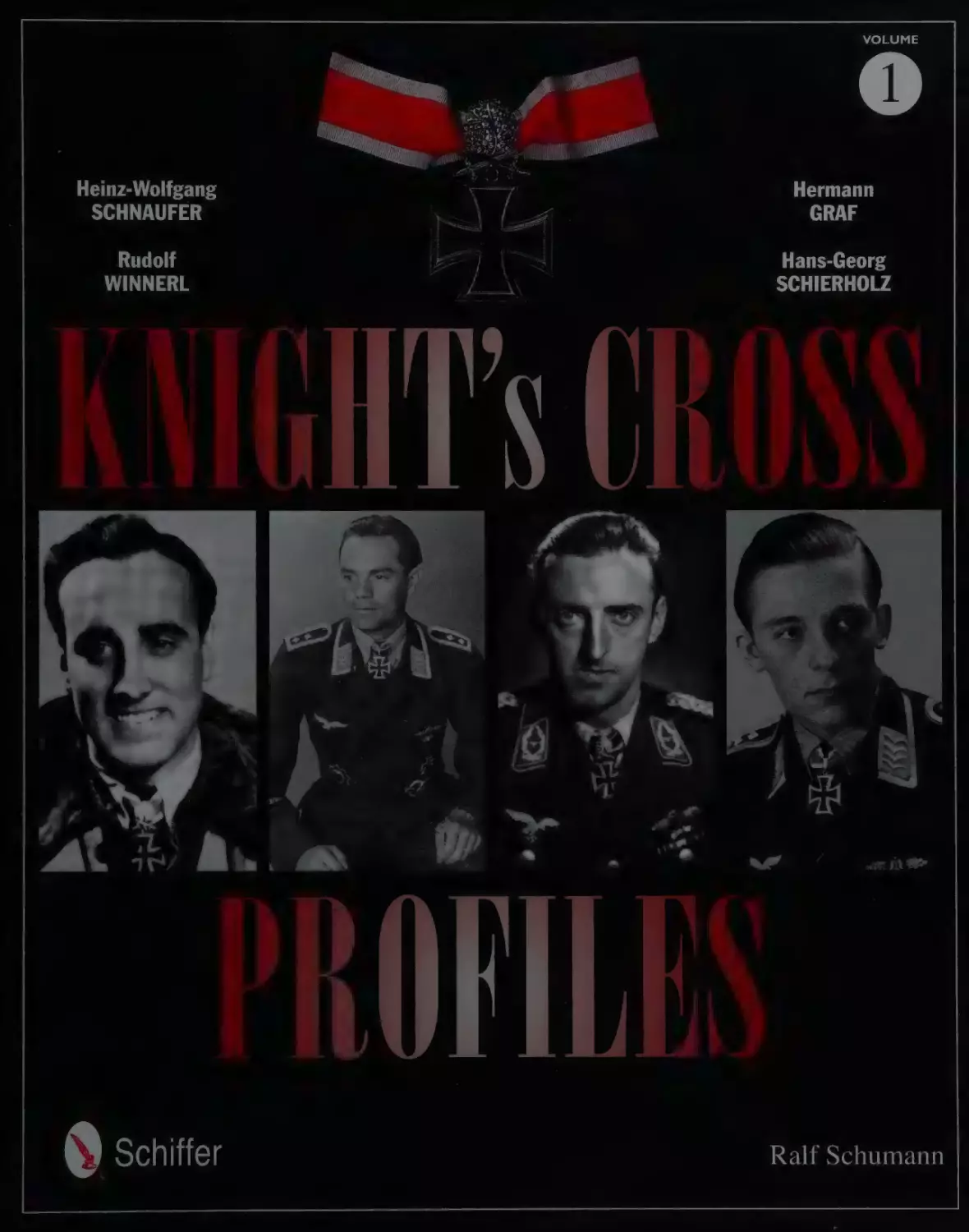
This book is the first in a new series profiling the Knight's Cross
holders of the Wehrmacht in World War Il. Concise biographies,
rare photographs of personalities, aircraft, and award documents
cover not only known soldiers and airmen, but lesser known KC
holders as well. This initial volume covers four Luftwaffe fighter,
and bomber pilots.

Knight’s Cross Profiles Volume 1

a

KNIGHTS CROSS
PROFILES
Volume |
Heinz-Wolfgang Schnaufer ¢ Rudolf Winnerl
Hermann Graf ¢ Hans-Georg Schierholz

Ralf Schumann

Schiffer Military History
Atglen, PA

Book translation by Dr. Edward Force
Book Design by Ian Robertson.
Copyright © 2012 by Schiffer Publishing.
Library of Congress Control Number: 20122931291

All rights reserved. No part of this work may be reproduced or used in any forms or by
any means — graphic, electronic or mechanical, including photocopying or information
storage and retrieval systems — without written permission from the copyright holder.
This book is a combination of works originally published in German under the series title
Ritterkreuztrdger Profile (1-4) by Flugzeug Publikations GmbH.
Printed in China.

ISBN: 978-0-7643-4057-4

We are interested in hearing from authors with book ideas on related topics.

Published by Schiffer Publishing Ltd.
4880 Lower Valley Road

Atglen, PA 19310
Phone: (610) 593-1777

FAX: (610) 593-2002
E-mail: Info@schifferbooks.com.
Visit our web site at: www.schifferbooks.com
Please write for a free catalog.
This book may be purchased from the publisher.
Try your bookstore first.

In Europe, Schiffer books are distributed by:
Bushwood Books
6 Marksbury Avenue
Kew Gardens
Surrey TW9 4JF, England
Phone: 44 (0) 20 8392-8585
FAX: 44 (0) 20 8392-9876
E-mail: Info@bushwoodbooks.co.uk.
Visit our website at: www.bushwoodbooks.co.uk

Try your bookstore first.

ay

Contents

Peete NMOS ANIC TIAL
RITE
CyUTATT
1SPENMAN

GYBaars

eee

eee

acer
ee

char ccs cewe cob uaiaone ia else ease eect eaceae ak Papa I ov sue dariiuicp ins emesoenseanePersannctedeass 6
tne

sore cece ner See

ET

Pe ire

Cane

amie ae an ah, PSs i

ne FURIE RC aA, ANN aly h Nae vasa aweriadvayeetetartesomecee 53
el

GRRE

arr

ee Oe COMER TTSEre

nC ONeS 104

Heinz-Wolfgang Schnaufer
The Most Successful Night-fighter Pilot of World War II

Heinz-Wolfgang Schnaufer ¢ Rudolf Winnerl « Hermann Graf * Hans-Georg Schierholz
Decorations:
6/2/1942
9/9/1942
7/26/1943
8/16/1943
12/31/1943
6/27/1944
7/30/1944
10/16/1944

Iron Cross 2nd Class
Iron Cross 1st Class
Cup of Honor for special accomplishment in air war
German Cross in gold
Knight’s Cross of the Iron Cross
507" Oak Leaves to Knight’s Cross of the Iron Cross
84" Swords to Knight’s Cross of the Iron Cross
21’ Diamonds to Knight’s Cross of the Iron Cross

Promotions:
4/1/1940
4/1/1941
7/1/1940
9/1/1940
2/1/1941
4/1/1941
7/1/1943
5/1/1944
12/1/1944

Fahnenjunker
Fahnenjunker-Gefreiter
Fahnenjunker-Unteroffizier
Fahnrich
Oberfahnrich
Leutnant
Oberleutnant
Hauptmann
Major

Combat Missions:
164
Kills:
121 at night, including 114 four-engine bombers

A Messerschmitt Bf 110 of NJG | with black night paint. The beginning of a night mission. By the war's end, some 6150 ofthe Bf | 10 had been built.

Knight’s Cross Profiles « Volume 1

On November 15, 1939, Heinz-Wolfgang Schnaufer entered Pilot Training
Regiment 42 in Salzwedel. He suspected nothing then of his comet-like
career in the Luftwaffe.

“Night fighting
—itwill never come to that!”
Kommandeur

of the German

1?

Hermann Goring,

Luftwaffe, made that assertion in

1939. But he was mistaken, for in 1940 the first enemy missions of
British bombers into German territory were made. A new weapon
was created: Night fighting, and with it came the night fighter
pilots. Just as in daytime combat, aces were to rise from it and
become just as renowned as MOlders, Galland, and Marseille.

One of them was Heinz-Wolfgang Schnaufer.
He was the most successful night fighter pilot of World War
II. The rudder of his Messerschmitt

110, with markings for 121

kills, can still be seen in the Imperial War Museum in London to
this day.
Respectfully dubbed “The Night Ghost” by the British, HeinzWolfgang Schnaufer incorporated all the virtiis of a good soldier.
For him soldiering was not reflected in blind obedience, but in

preparation of details. In discipline and order and in respect for
human rights and laws, as well as love for his country. Through

the application of his own person, he became a symbol for many
young Germans who strove for such ideals toward the end of
World War II.
He was the outstanding man of German night fighting. The
best flying ability, exemplary tactics, and bold pluck were the
decisive elements in a series of successful actions for this extremely
brave aerial officer. Night by night he went at the foe, never
resting in action against the British bomber fleets, and his combat
achievements made him an exemplary symbol of a new service
arm, bringing very high sacrifice and gaining high regard, as well
as inspiring fear among the enemy through his achievements.
But not just he alone, his crew as well belonged among the
best that German night fighting had brought out; a dedicated team
in which one had to rely blindly on one another.
Schnaufer took part in 164 missions, scoring twice as many

kills at night as the greatest Allied ace, Colonel Ivan Koschedub of
the Russian fighter corps, scored by day.
Ralf Schumann

Heinz-Wolfgang Schnaufer ¢ Rudolf Winnerl ¢ Hermann Graf * Hans-Georg Schierholz
Heinz-Wolfgang Schnaufer was born in Calw, Wiirttemberg,
on February 16, 1922, the first son of the engineer and merchant
Alfred Schnaufer and his wife, the former Elisabeth Frey, and

belonged to that vintage that had to pay an immeasurable price of
blood in World War II.
At the age of fourteen he expressed the wish to become an
officer. He was able to demonstrate his scholarly and human
abilities at, among others, the National Political Training Center
(NAPOLA), the successor to the Cadet Academy in the Third
Reich. He ranked highest in every school class. Here he won the
Reich Youth Sport Medal, the basic certificate of the D.L.R.G.,
the bronze Hitler Youth Certificate, and passed the B Test in
gliding. Before he finished his schooling, he volunteered for the
Luftwaffe.
At the age of seventeen,

in November

1939, he gained his

school diploma with honors as one of the best.
He passed the entrance examination as an officer’s aide in the
Luftwaffe and entered Pilot Training Regiment 42 in Salzwedel on
November 15, 1939. Transferred then to the Training Company of
the Aircraft Pilot School (FFS) A/B 3 in Guben, he went through

After finishing his training he was promoted to
Leutnant on April |, 1941.

the A/B pilot’s license training there by August 20, 1940. This
school had its origin in the flight drill center at Guben, northeast of
Cottbus. A planned transfer to Sprottau in April 1939, though, was

not made, so that as of September 1939 his A/B pilot training took
place at the main center in Guben.
During his training as an airplane pilot, the opportunity to fly
almost all types of German aircraft was offered to him. Thus, he
was trained in the following models: Focke Wulf 44, 56 and 58;
Heinkel 72, 41 and 51; Biicker 131; Klemm 35; Arado 66 and 96;
Dies ed

Gotha 145; and Junkers types W 34 and 35. From August 1940
to May 1941 he gained the C 3 air pilot’s license at the FFS E®
in Alt-Loennewitz, near Turgau. There he received outstanding
fighter-pilot training, was trained on dive-bombers, and had blind-

flying training for fighters and destroyers in lone and group flying
at the Blind Flying School 2 in Neuburg, on the Danube. Here the
knowledge of how to master the high school of flying—a prerequisite
for a pilot’s assignment to a combat, long-range reconnaissance,
night fighter, or glider unit—was gained.
During his training at the Night Fighter School in Schleissheim,
his skills to date were completed through night blind-flying and
tactical night-flying training. There he finished his training as a
night-fighter pilot in November 1941.
With

certification

on April

1, 1941,

he was

promoted

to

Leutnant and assigned to a front unit. Schnaufer was transferred
to the II. Group of Nachtjagdgeschwader (Nachtjagdgeschwader,
NJG)

1 and

became

the technical

officer

of the unit.

This

group had developed from the 1. Group of Destroyer Squadron
(Zerst6rergeschwader, ZG) 76 and had been established in October
1940 as the newly formed II./NJG 1.
NJG 1, though, then at Venlo-Herongen airfield, was to
produce the most successful night fighters: names like Helmut
Lent (1918-1944), Heinz Striining (1912-1944), Werner Streib
(1911-1986), Giinther Radusch (1912-1988), Manfred Meurer
(1919-1944), Hans-Joachim Jabs (born 1917), Walter Ehle (19131943), and Martin Drewes (born 1918), to name only a few, were

closely linked with the success of this squadron and ranked among
the elite of their service arm.
Wolfgang Falck (born 1910), at right, set up Nachtjagdgeschwader | as of
June 26, 1940 and was its first Kommodore. He earned the Knight's Cross
October |, 1940, and commanded the squadron until June 30, 1943. An
Oberst at the war's end, Falck then saw service with various staffs in the
Luftwaffe. At left in the picture is the later Oak-Leaf bearer and successful
night fighter Hermann Greiner.

Knight’s Cross Profiles « Volume 1
In mid-January

Belgium. From
began; at that
Leutnant in the
During the
scored his first

1942 II./NJG 1 was transferred to St. Trond,

there Heinz-Wolfgang Schnaufer’s victory parade
time he was still an unknown twenty-year-old
German Luftwaffe.
night of June 1-2, 1942, on his 13" mission, he
night kill on a four-engine British Handley-Page

“Halifax” heavy bomber near Grenz-Donau, 15 kilometers from
Louvain. But in his attempt to shoot down a second bomber,

Schnaufer was struck in the left thigh by an anti-aircraft shot at the
start of the attack. The plane—his “Dora-Casar”
—had taken 19
hits, which resulted in one rudder failing because a cable duct was

shot through; the left engine was on fire and the spotlight, damaged
from the enemy fire, would not turn off. So Schnaufer had to break

off the attack and return to St. Trond.
His patience had been rewarded and he had scored his first
kill, for which he and his radioman

(bordfunker)

Rumpelhardt

were awarded the Iron Cross Second Class.
Schnaufer hoped that the bullet in his left thigh would
encapsulate and he could go on flying missions, but on 8 June he
was sent to a hospital in Brussels.
Recovered again, he was able to shoot down five more enemies
within a short time, which was recognized in his decoration with
the Iron Cross First Class on September 9, 1942. He had shot down

Handley-Page “Halifax”, Vickers “Wellington”, and Armstrong
Whitworth “Whitley” bombers.
Schnaufer had scored seven kills by the end of 1942 and begun
to become an ace in his craft.
But familiarity and experience with his plane could not alone
account for his success and return from a night mission. Along with
the nerve-wracking problems of spotting an enemy in the darkness
came the danger from the alert British gunners. Sometimes the
German night fighters were spotted by them before they had been
seen. There were also the defensive weapons manned by the planes’
gunners, weapon mounts with coupled machine guns, and later
even heavier guns that allowed the night fighters to be attacked
before they could get into attack positions. The gunners had a task
of spotting the night fighters and shooting them down as quickly as
possible. The gunners also knew they were fighting for their lives,
since they were the first to have machine-gun bursts aimed at them

General Josef Kammbhuber
Kommandeur
of the
|*
Night Fighter Division. He
organized the night fighters
and created bright night
fighting, the canopy process,
and the Kammhuber Bolt.

from the night fighters. German survivors still hold great respect
for the Royal Air Force gunners to this day.
Their own anti-aircraft fire was also a danger. In many cases
German night fighters were shot down by their own side, while
others fell to the British night fighters, who also knew their
craft and escorted the bomber packs. The British night fighters,
equipped at first with the Bristol “Beaufighter” apd later with the
faster, more agile “Mosquito”, were an unpleasant disturbance for
the German night-fighter crews. The German pilots paid a high
price in physical and nervous systems while taking off, flying, and
landing at night. These constant dangers made the night-fighters’
work some of the most demanding in World War II.
In the summer months of 1943 Schnaufer’s climb to the
highest rank of night-fighter aces began. On the night of May 2930, 1943, he shot down three enemies (10" and 11" air kills).
On July 26, 1943, he was awarded the Cup of Honor for
special achievement in air warfare, and on August 16, 1943, he

was decorated with the German Cross in gold.

The creators of German night fighting, from left to right: Werner
Streib, here as Hauptmann and Kommandeur of |./NJG |,Major
Wolfgang Falck, Kommodore of NJG |, and Generalmajor Josef
Kammhuber.

Heinz-Wolfgang Schnaufer ¢ Rudolf Winnerl « Hermann Graf * Hans-Georg Schierholz
Leutnant Schnaufer, a still-unknown beginner in night fighting, gets into his
Meanet

Schnaufer prepares for one of his first missions with NJG | and closes
his plane’s canopy. No one knew then that he would become the most
successful night fighter of all times and nations.

Be

Knight's Cross Profiles ¢ Volume 1
Three more kills, the 15" to 17", followed on the night of June

28-29, 1943. His twentieth kill was scored on the night of July
8-9, 1943, and his thirtieth on October 8-9, 1943. The outstanding

event of the year was the victory over four enemies in one night on
December 16-17, 1943, which brought his score up to 40 kills.
Schnaufer felt called more and more to fighting, and requested
to be released as a technical officer and named the leader of a
squadron. His superior officers had recognized his abilities for
some time. At that time he was transferred to night fighting and his
wish was fulfilled.
A squad captain as of August 1943 in the most successful
German night-fighter group, IV./NJG 1, he now led the 12.Staffel,
based at Quakenbriick. To date he had been able to score 21 kills.
His Gruppenkommandeur was Hauptmann Hans-Joachim Jabs.
On Novemver 27, 1943, at 6:07 P.M., Schnaufer took off from
Leeuwarden, where he had recently moved for Zahme Sau (“Tame
Boar”) action against an expected stream of bombers. His decision
to attack the enemy planes from there proved to be right. By 6:50
P.M. and again at 7:00 he shot down planes northwest of Meppen
and northwest of Cloppenburg. He landed back at Quakenbriick at
7:40 P.M.
By December

16, 1943, he was able to raise his score to 36

kills. On 29 December he took off in bad weather in the “Polar
Bear” area, where he was able to shoot down a Handley-Page
“Halifax” near Dijkhuizen and an Avro “Lancaster” near Lingen.
After a total of 42 kills, he was decorated with the Knight’s
Cross of the Iron Cross on December

31, 1943, at the rank of

Oberleutnant.
From now on, scarcely a night’s action took place from which
he did not return with one or more aerial victories. From then on,
a series of unending victories continued. On 27 and 30 January he
scored two more kills.
His fiftieth score on the night of February 15-16, 1943, in
which he overcame three enemies, was also the group’s 500" aerial
victory, which was celebrated appropriately.
On March

17, 1944, IV./NJG

1 was transferred back to St.

Trond, Belgium.
By May 1, 1944, Schnaufer had been able to shoot down 61
enemy planes.
On the night of May 25, 1944, he shot down five Avro
“Lancasters” within fourteen minutes. His stellar career continued
nonstop.

The action did not leave Schnaufer unmarked. Visibly tired and with dark
rims under his eyes, he flew his first missions as Technical Officer of NJG
he

Schnaufer now stood at the zenith of German night fighters.
Only Major Helmut Lent, who was awarded the 32™ swords on
August 2, 1943, after 93 night kills, and Hauptmann

Heinrich

Prince of Sayn-Wittgenstein (1916-1944), who was to become the
44" Wehrmacht soldier to receive the Swords when he died, had

scored more kills than he.
On August 13, 1943, he scored another series of four kills
within 31 minutes.

On the night of June 16-17, 1944, he was able to shoot down

On March 1, 1944, he took command of IV./NJG 1 in St. Trond,

his 79" and 80" enemy planes. Just seven days later he celebrated

Belgium, replacing Major Jabs, who now succeeded Werner Streib
as Squadron Kommodore. On May 1, 1944, he was promoted to
Hauptmann. Streib was named inspector of the Night Fighters.
Filled with the unquenchable desire to see action, he scored

his 84™ success.
After this 84" kill, he became the German Wehrmacht’s
507" soldier to be decorated with the Oak Leaves of the Knight’s
Cross.
Barely a month later, after his 87" to 89" kills on July 28-29,
1944, he became the 84" soldier to receive the swords to the Oak

Leaves, given directly by Adolf Hitler on August 2, 1944, when he
visited the Fiihrer’s headquarters to receive the Oak Leaves.

2

one success after another, even at a time when the star of German

night fighting began to dim.
His iron nerve, the overwhelming quality of always finding
new ways to attack enemy bombers, and his lightning fast reaction
time made him not only an ace, but also an example to the group he
led, which under his leadership had scored over 700 night kills.

QARCee
wes:

m7

is
oh
mi
gt

ty

As of the spring of 1941, the so-called“‘canopy process", with one Freya
early warning radar set (above) and two Wurzburg devices (below)
each, operated to locate enemy planes, formed a belt of positions for
precise direction of night fighters. At the air traffic headquarters the
arriving information was combined. Enemy and German planes were
made visible by lights on a card table, and thus the German planes, via
special radio signals, could be directed at the enemy.

13

Knight's Cross Profiles « Volume 1

The equipment of the Bf | 10 night fighter was constantly improved throughout its use, so that long-term problems involving the short range of the SN-2
device could be solved and the Bf | 10 could remove the single-pole A-| antenna.

On June 12, 1944, Schnaufer shot down three Avro “Lancaster”

bombers within seven minutes at an altitude of only 1000 to 1500
meters

near Cambrai,

France.

After landing in St. Trond,

the

armorers found that for all three kills with two MK 108 machine
cannons only 18 shells had been fired. This may well have been an
unequaled record.
In a bomb attack on Lille on June 16, 1944, Heinz-Wolfgang

Schnaufer attained his 75" aerial victory near Arras.
The crew scored four kills on June 22, 1944, three of them

within eleven minutes while flying at 5000 to 5200 meters between
Eindhoven and Maastricht, while the fourth came on its exit from

German air space at only 2900 meters.
The British intelligence service was very well informed about
this man who, night after night, shot down one plane after another

from its streams of bombers. All efforts to put him or his group
out of action failed. The British High Command sent De Haviland
“Mosquito” MK II night fighters to fire on him, and they sent
De Haviland “Mosquito” MK VI high-speed bombers ahead of
the bomber streams; they were supposed to shower the St. Trond
airfield with bombs and make it impossible for his group to takeoff. Nothing helped. Schnaufer always found a way to attack the
bombers and continued to shoot down one enemy bomber after
another.

The British Marshal of the Royal Air Force, Sir Arthur Traves Harris, known as
“Bomber Harris”. He led the night attacks of British bomber units against German
cities and industrial targets. He served in the Air Ministry from 1940 to 1942
and, as of February 1942, as commander of the RAF Bomber Command, being
partly responsible for the forced air war (surface bombardment) against Germany,
particularly against the civilian population.

14

He INZ Wolfgang Schnaufer ¢ Rudolf Wi nnerl

Hermann Graf ¢ Hans-Georg Schierholz

to
fly
over
Berlin.
They
had
five-man

crews
and
a
range
of
2400
km,
were
armed
with
five
7.7
mm
machine

guns,
and
could
carry
a
bomb
load
of
3180
kg.

A
Armstrong
‘Whitley’
by
powered
type,
engines,
Rolls-Royce
|2-cylinder
1944,
British
bombers
first
Whitworth
bomber.
the
were
and
of
Planes
to
|939
this
two
from
action
saw
X
Merlin

1S)

Kn ight’s Cross Profiles e Volume |

H
pey

SOUISUS
Je}S

L
OF c

‘sun oUIYDeWW BUIUMOUgG LU /"/ 1YBIa PUR B84 OSEO JO PeOfsqQuIOg eB palued pur ‘Ydy 9] + Jo peeds do} e ‘Wr O6OE JO aBUBI B ‘USL JUSIa JO UAASS JO Madd B
SIGNOP [K S9INUSH [OSU dH 06S] 4NO} Aq PEvaMOd Eh | JUN S}OBIE}. ULUIED ISUIPBE SUOISSIL JYBIU MAL} PUB YEqUUOG Pali|\7 @UISUBINO} 4s OU} SEM BUI|dIS WOUS,, UL
at

Heinz- Wolfgang Schnaufer ¢ Rudolf Winnerl « Hermann Graf ® Hans-Georg Schierholz
On July |, 1943, the Kommandeur ofI./NJG |,Werner Streib (1911-1986), became Kommodore
of NJG |.A destroyer pilot when the war began, he scored the first official German night kills on
the night ofJuly 19-20, 1940, and helped night fighting break through with his further success in
the ensuing months. On October 6, 1940, he received the Knight's Cross, on February 26, 1943,
the 197 Oak Leaves, and on March | 1, 1944, the 54 Swords. Streib ended the war as Oberst
and Inspector of Night Fighters. On some 150 missions he was able to shoot down 67 planes
by night and one by day. He can rightfully be called the “'spiritus rector’ of the German night
fighters.

In July 1943 the RAF began to use so-called “window' in a series of effective attacks on Hamburg.
It consisted of billions of small strips of reflective metal foil tuned to the wave length of the
German C-| radar The night fighters were disturbed by it, which resulted in fewer kills. After
that the Bf | 10 G-4b was equipped with the Lichtenstein SN-2 device, which tuned out this
disturbance by using a different wave length.

17

Knight’s Cross Profiles « Volume I
At the beginning of September 1944 the group moved to
Dortmund-Brakel. Once again Schnaufer was able to score four

The Crew

kills within 32 minutes on 23 September, this time over the border

But this success cannot be attributed to him alone.
His crew, the sworn and experienced team of the Me 110,
which had a significant share in this success, consisted of the
bordunker Friedrich Rumpelhardt and gunner (bordschiitzen)
Wilhelm Gansler.

area on the Arnheim-Rhine Heights.
On five nights in a row he shot four four-engine planes down.

On the night of 9-10 October he scored his 100" kill.
Then, on October 16, 1944, he became the 21“ soldier of the

German Wehrmacht and the 11" member of the Luftwaffe to be
awarded the Diamonds to the Oak Leaves and Swords. HeinzWolfgang Schnaufer was the ninth Luftwaffe member of the flying
groups and the second night fighter, after Colonel Helmut Lent,
who received this high honor.
On October 18, 1944, the General Command

of I.Jagdkorps

issued the following corps order:
~

“The Fiihrer and Supreme Kommandeur of the Wehrmacht
has awarded Hauptmann Schnaufer, Kommandeur of IV./NJG 1,
as the 21" soldier of the German Wehrmacht, the
OAK LEAVES WITH SWORDS AND DIAMONDS
TO THE KNIGHT’S CROSS OF THE IRON CROSS.
In a stormy course of victories, borne with the highest fighting
spirit, Hauptmann Schnaufer has scored success on success in
high multiple aerial victories during a single night mission. The
attaining of 100 night-fighter kills, among which victories over
92 large enemy combat aircraft are included, has now led to the
awarding of this highest German war decoration. I congratulate
Hauptmann Schnaufer in grateful recognition of his undying
heroic service and extend to him and his proven crew, Knight's
Cross bearers Leutnant Rumpelhardt and Oberfeldwebel Gdnsler,
my fullest recognition. The entire I. Jagdkorps looks with proud joy
upon Hauptmann Schnaufer today.”
(signed) Schmid”

Radioman Friedrich Rumpelhardt
Friedrich Rumpelhardt was born on June 19, 1920, in Nordhalden,

near Constance on Lake Constance. Since July 1941 he had
flown with Heinz-Wolfgang Schnaufer, at first at the Destroyer
School in Wunsiedel, then at the Night Fighter School in
Schleissheim. In November 1941 they both joined the 5" Staffel
of Nachtjagdgeschwader 1, where Rumpelhardt was promoted to
Unteroffizier. He accompanied his plane leader on his steep course
to become the most successful night fighter over the II. Group of
Nachtjagdgeschwader 1, the 12" Staffel of the Geschwaders, its
staff, and the staff of Nachtjagdgeschwader 4.
On

October

1,

1943,

aerial victories.

was

promoted

to

1, 1944, and he was also Intelligence Officer of the Group and

Geschwaderstab.
On March 20, 1944, he was honored with the trophy for
outstanding achievement in aerial war, and on April 16, 1944, he

was decorated with the German Cross in Gold. For taking part in
68 night-fighter kills he was awarded the Knight*s Cross on August
8, 1944.
On March 7, 1945, he celebrated his 100" participation, and
on March 8, 1945, he was awarded the Oak Leaves to the Knight’s

Cross. The most successful bordfunker of the German night fighters
flew his last combat mission on April 9, 1945.
In the period from May

On the night of November 6-7, 1944, within fifteen minutes in
the time from 7:26 to 7:41 P.M., Schnaufer shot down three more
Avro “Lancaster” bombers and thus recorded his 101* to 103"

Rumpelhardt

Fahnenjunker-Feldwebel and trained to be an officer at the
War School. His promotion to Leutnant took place on March

14 to October

3, 1943, Friedrich

Rumpelhardt took various courses of study. During this time HeinzWolfgang Schnaufer scored 21 kills with the following gunners:
- 12 with Leutnant Dr. Leo Baro,

- 5 with Oberfeldwebel Erich Handke (Knight’s Cross
July 27, 1944),
- 2 with Oberleutnant Freymann, and
- 2 with Unteroffizier Barwolf.

Rumpelhardt took off as Heinz-Wolfgang

Schnaufer’s

bordfunker 123 times, 119 of them with combat missions and

four times with other targets. In all there were 44 successful

The wreckage of a shot-down “Wellington” bomber.

Heinz-Wolfgang Schnaufer ¢ Rudolf Winner! « Hermann Graf * Hans-Georg Schierholz

a

.

“a

Ly
ahaa

Reichsmarschall Goring visits NJG | in the autumn of 1943.
To the left of him is General Kammhuber; in the center, with
the Knight's Cross, is Kommodore Oberstleutnant Streib.
To the joy of all, Goring is reported to by successful crews,
including that of Knight's Cross bearer Meurer, seen here.

Earnest faces during the Reichsmarschall’s speech. Next to
Hauptmann Jabs (Knight's Cross on October |, 1940, 430"
Oak Leaves on March 24, 1944), Kommandeur of IV./NJG
|, are Oberleutnant Schnaufer, already a bearer of the
German Cross in Gold, Oberleutnant Drewes (Knight's
Cross on July 27, 1944, 839" Oak Leaves on April |7, 1945),
and Oberfeldwebel
Vinke (Knight's Cross on September 19,
1943, 465" Oak Leaves on April 25, 1944).

Knight’s Cross Profiles * Volume I

srepenaabennes

PS

The Avro “Lancaster”, here a Mark II, reached the troops early in 1942 and flew its first air raid in March of that year With a range of 2660 km and a bomb
load of up to 6350 kg, the “Lancaster” was the most renowned bomber ofthe British Bomber Command. On the night of May 17, 1943, Lancasters flew,
among others, raids on the Moehne, Eder, and Sorpe dams and destroyed them later. On November 12, 1944, “Lancaster” bombers sank the German
battleship Tirpitz in Tromso Fjord. Fittéd with four |2-cylinder Rolls-Royce Merlin engines, the “Lancaster” reached a top speed of uppto 460 kph. Armed
with Browning 303 machine guns and with a seven-man crew, these planes, 7374 of which were built, were among the bombers constantly over Germany
by night.

On October 22, 1943, Schnaufer shot down this
Lancaster on the return flight from a raid on Kassel,
in the vicinity of Héxter.

20

Heinz-Wolfgang Schnaufer ¢ Rudolf Winnerl ¢ Hermann Graf * Hans-Georg Schierholz

On January 3, 1944, Generalmajor Joseph Schmid,
General Kammbhuber'’s successor as Commanding
General of
the XII. Flying Corps, decorates
Oberleutnant Schnaufer with the Knight's Cross
awarded on December 31, 1943.

missions:

14 of them with one kill, 15 with two, eight with three,

five with four, one with five, and one with seven kills. His flight
book registers a total of 636 flights, 119 training flights, in wartime.
He flew with Heinz-Wolfgang Schnaufer a total of 549 times.

Bordschiitze Wilhelm Gansler
Wilhelm Gansler, the gunner in Schnaufer’s crew, was born on
May 22, 1919, in Arnstadt, Thuringia. He attended public school
and completed training as a machinist. Then he volunteered for the
Luftwaffe and passed the test for acceptance as an aspiring pilot.
After completing his Reich work service, he was sworn into the
Luftwaffe in Stade in 1938. In the spring of 1941 Gansler joined
the 4" Staffel of Nachtjagdgeschwader | and flew from November
1, 1941, to the summer of 1942 as the gunner in a Dornier Do 215
in the crew of Ludwig Becker (1911-1943).
Hauptmann Becker, likewise an experienced night-fighting
ace, received the Oak Leaves to his Knight’s Cross on February
26, 1943, after shooting down 44 enemy planes. On the same day
he fell in daytime action against American bombers over the North
Sea. His radioman, Sergeant-Major Straub, was lost with him.
Gansler, who now belonged to Schnaufer’s crew, in which he
was to remain until the war ended, was famous for his excellent
vision.

The first official photo after the awarding of the Knight's Cross.

Knight’s Cross Profiles * Volume I
Named Staffelkapitan of |2./NJG |, Schnaufer had
to take on unpleasant duties. Here he speaks the
last words at the graves of Leutnant Ruhle’s crew.

His ability gained appropriate recognition in the awarding of
the trophy of honor for outstanding achievement in the air waron

After taking part in shooting down 80 planes, Oberfeldwebel
Wilhelm Gansler was decorated with the Knight’s Cross of the

January 17, 1944, and of the German Cross in Gold on March 20,

Iron Cross on July 27, 1944. In over 150 combat missions, he was

1944. Just like Rumpelhardt, he followed his plane leader through
all the steps of his military and aviation career.

able to participate in 115 night kills: 17 credited to Ludwig Becker
and 98 to that of Heinz-Wolfgang Schnaufer. On March 8, 1945,
he was also awarded the Oak Leaves.

British Handley Page Halifax bombers, here Mark Il Series | models, more and more of which reached the bomber commands from 1940 on and flew night
missions over Germany and France. These four-engine planes had seven-man crews and could carry a 5900-kg bomb load.

ZZ

Heinz-Wolfgang Schnaufer ¢ Rudolf Winnerl ¢ Hermann Graf * Hans-Georg Schierholz
Wilhelm Gansler, the most successful radioman of the German

night fighters, died on November 22, 1985, in Calw, Wiirttemberg,
Heinz-Wolfgang Schnaufer’s birthplace.
Promotion to Kommodore
On November 20, 1944, Heinz-Wolfgang Schnaufer was named
Kommodore of Nachtjagdgeschwader 4, stationed in Giitersloh,
It had been established on May

1, 1942, at first with the task of

protecting southern Germany from the large-scale night air raids
that were beginning then. He was also promoted to Major effective
December 1, 1944. Thus he became a Staffelkapitén at the age of
twenty-two.
Along with the squadron staff, II/ Group was stationed there.
The I. Group was at Frankfurt Rhein-Main Airport and the III.
Group in Kassel-Rothwesten.
The staff consisted, besides Schnaufer, of Oberleutnant
Eberhardt Koltermann as Adjutant, Leutnant Falk von Tettenborn as
Technical Officer, and Friedrich Rumpelhardt as Radio Intelligence
Officer. Gruppenkommandeurs were Hauptmann Hubert Rauh of
I. Group and Hauptmann Kurt Fladrich of HI. Group. With these
officers, Schnaufer had experienced night-fighter pilots at his
side. In the spring of 1945 Rauh and Fladrich were to receive the
Knight’s Cross.
On November 22, 1944, Schnaufer and his crew flew from
Schnaufer, Staffelkapitan of |12./NJG |, talks with a crew that has returned
from a mission.

After the war he returned to his home in Thuringia, but did
not find good living or working conditions there. In 1949 HeinzWolfgang Schnaufer set him up in his father’s business. He was
retained there after Schnaufer’s death and the employees were
made available to expand the enterprise until he retired.

The rudder of Schnaufer's Me 110 is adorned with 46 kill
markings. From left to right: Leutnant Matzak, Leutnant Rolland,
Schnaufer, and Oberleutnant Weissflog (Knight's Cross on June
Das Ee):

Giitersloh to the Dortmund area on their first mission, and at once
scored two victories.
On November 27, 1944, the Schnaufer crew flew to BerlinStaaken, where Schnaufer was awarded the Diamonds by Hitler.

After a photo shoot by Hitler’s photographer Heinrich Hoffmann,
and a visit to Colonel

von Below,

Hitler’s personal Luftwaffe

Adjutant in the Reich Air Ministry, where among other things, a
film of the crew was made and later shown in weekly newsreels, the
crew had a small party and returned to Giitersloh the third day.

Knight’s Cross Profiles * Volume I

The “Night Ghost” of St. Trond prepares for a new mission.

Ready for the next mission, Schnaufer gives a friendly wave
to his comrades, confident of victory.

*

si

ioe

espe

ae

“e

:

i”

.

> al

a

:

:

Se

A British bomber of the Vickers Armstrong “Wellington” Mark IC type. Used for night missions from September |939 on, the “Wellington” was among
the most notable planes of World War II. Powered by two 1585 HP Bristol Hercules VI double-star engines, which gave it a top speed of 408 kph, the
“Wellington”, thanks to its geodetic structure, could bear great shot damage. It carried a six-man crew and up to 2720 kg of bombs.'“Wellington” bombers
flew the war's first air raid on Wilhelmshaven on September 4, 1939. From September 1939 to the advent of the heavy bombers, it was the RAF's most
important night bomber

24

Heinz-Wolfgang Schnaufer ¢ Rudolf Winnerl ¢ Hermann Graf * Hans-Georg Schierholz
ee

4

f Paes
|

Serious
(center),
and the
Wolfgang

expressions for Kommodore
Streib
his Intelligence Officer Weissflog (left),
Staffelkapitan of the |2/NJG |, HeinzSchnaufer.

RIOR
ost
ANN
BL
haRAOL
AAOO
in

Bottom left: Oberstleutnant Lent, Kommodore

of

NJG 3,visits IV./NJG | in St. Trond, Belgium.

Bottom right: Lent and Schnaufer, now leaving |V/
NJG | as its Kommandeur have a serious talk.

Knight’s Cross Profiles « Volume 1
Second from right is Wilhelm
Hauptmann Schnaufer's crew.

Gansler, gunner in

the bomber packs and attack them without being seen. On his own
initiative he had such a plane assembled, and flew his first mission

with it shortly thereafter. The effect was astounding; after the first
bursts of fire Schnaufer had scored his kills without being seen by
the enemy.
With his 106" kill on December 12-13, 1944, he ranked at the

head of the night fighters. Thus Heinz-Wolfgang Schnaufer had
exceeded the achievements of the formerly leading German night
fighter, Oberstleutnant Helmut Lent.
Lent, who had been the first night fighter and 15™ soldier of
the German Wehrmacht to receive the Diamonds to the Knight’s
Cross with Oak Leaves and Swords on July 31, 1944, after the

102™ of his 105 kills, including eight on one day, crashed while
landing at Paderborn during a daylight transfer flight on 7 October
and died in hospital of his wounds on October 11, 1944. Lent
was posthumously promoted to Oberst. His longtime radioman,
Knight’s Cross bearer Walter Kubisch (born 1918), also lost his

life. Thus Heinz-Wolfgang Schnaufer became his heir as the most
successful German night fighter.

But when he took over as Kommodore of the squadron, his
areas of tasks and responsibility also changed; thus Schnaufer could
not fly every night. Yet when the tasks of a Squadron Kommodore
allowed, he flew further missions against the numerically superior
bombers. Thus he could inspire the individual crews of the
squadron, hold task discussions, and deal with paperwork.
With this position, though, Schnaufer fulfilled his wish to fly
the Me 110 with the four upward-pointing 2 cm guns, later known
as “Slanted Music”, on his own missions. Now he could fly below

Leutnant Helmut Lent, member of NJG | from September |940 to November
1941, was the most successful German night fighter until his death. After his
102°¢ night kill, he was the first night fighter and |5"* Wehrmacht soldier to

receive the diamonds. In all he scored | 13 aerial victories, including eight in
one day. He was promoted to Oberst posthumously.

26

Heinz-Wolfgang Schnaufer * Rudolf Winnerl ¢ Hermann Graf * Hans-Georg Schierholz

Hauptmann Schnaufer, ready for his next mission,
is belted in by his first assistant, N.C.O. Ulrich.

Leutnant Rumpelhardt, radioman in the Schnaufer crew, prepares to come aboard.

Schnaufer's plane prepares to take off.

Knight's Cross Profiles ¢ Volume I
spoke fluent German, spoke directly to the soldiers of NJG 4 in
Giitersloh. Shortly thereafter, the voice praised the Kommodore as
the world’s best and most successful night fighter, and congratulated
him on his birthday, calling his actions fair and recognizing him
as a respected opponent. After that a dance band played the song
“The Night Ghost, the Night Ghost, walks in our castle” as a song
of praise, giving him the title of “Night Ghost” of St. Trond from
the British bomber crews. Schnaufer himself did not hear the radio
broadcast, but comrades told him of it.
Meanwhile, his score of successful missions continued. On the
night of February 21-22, 1945, he was able to crown his career by
shooting down eight Avro “Lancaster” bombers within 26 minutes,
scoring his 110" to 116" kills. In a second action he shot down two
more bombers, raised his score to 118, and thus shot down a whole

squad of British bombers alone in one night.
After he scored his 119" to 121* aerial victories on March 7-8,

1945, he was forbidden to fly. His experience and ability were not
to be put at risk. Those were his last victories.
In March 1945, on orders from the High Command, he tested

the Dornier 335 for night use. His last mission took place on April
9, 1945. Taking off from Fassberg at 10:00 P.M., he landed 79
minutes later at 11:19 P.M. He had tried in vain to attack an Avro
“Lancaster” that was heavily protected.

Generalmajor Walter Grabmann (1905-1992), Kommandeur of the 3”
Fighter Division since November 7, | 943, visits NJG | at St. frond. Grabman
received the Knight's Cross on September |4, 1940, and was FighterPilot
Leader and Division Kommandeur in the Reich's defense as of August |942.
As of April |, 1945, he commanded the |* Fighter Division.

On

February

8, 1945,

Heinz-Wolfgang

Schnaufer

was

summoned to “Karinhall”, the headquarters of the Reichsmarschall,

who had announced his intention of appointing Schnaufer
Inspector of the Night Fighters. At that time Colonel Streib held
that position. But Schnaufer declined this promotion, as it was

against his nature to push one of his best friends and mentors
out of the position. Schnaufer, who thus made his refusal known,

saying that he wanted to continue to apply his knowledge and all
his ability in action, was able to persuade Goring to leave him in
his present position.
On February 16, 1945, his 23" birthday, he received a very
special honor. While listening to the radio in the officers’ home,
another officer had turned on the forbidden Calais army station,

and the British wished him a happy birthday. The voice, which

The Kommodore, Major Jabs, visits IV. Group of NJG |
and is greeted by Gruppenkommandeur Schnaufer

28

“

Heinz-Wolfgang Schnaufer ¢ Rudolf Winnerl ¢ Hermann Graf * Hans-Georg Schierholz

i Wi se
pi

Re eRe,

an

a,

a

The Castle of St. Trond, housing for the elite of
the German night fighters.

The St. Trond airfield, Belgium, by day. Between
necessary servicing work was done to the planes.

missions,

Summer 1944 at St. Trond, from left to right: Generalmajor
Grabmann (Kommandeur of the 3° Fighter Division), Schnaufer
and Jabs.

Knight’s Cross Profiles « Volume I
Night-fighter crews spend time between missions playing cards.
On April 11, 1945, Schnaufer took over the defense of

the Eggeberg field, about halfway between Schleswig and
Flensburg, to defend the transfer of part of the squadron to
Fassberg. Barracks in the town of Bolingstedt, some 5 km
from the field, offered lodging to the crews. On April 13,
1945, almost all the planes were destroyed or damaged by
fighter-bombers. The Hungarian anti-aircraft troops were
undefended against the rolling attacks. Schnaufer’s “BA”
was fully destroyed. As the only crew of the squadron, he
still flew the Bf 110. After a short time G9+DX was flown
to him by the Kommodore of NJG 1, Leutnant Colonel
Jabs, and he flew it on his last mission on the night of

April 19-20, 1945, with the squadron’s only crew.
When the war ended, Major Heinz-Wolfgang
Schnaufer gave his last daily order to NJG 4. With
this document the ace of aces among the night fighters
expressed all that was still to be said:
To my tried and true NJG 4
Command post, May 8, 1945
Men of my Squadron!
The enemy is in our land, our proud airplanes are
surrendered. Germany is occupied and has capitulated
unconditionally.
La

The Lichtenstein SN-2 antennas of the later Bf | |OG-AC were
mounted at an angle to improve their reception.
The gun mounts
for the 20 mm caliber MG |51 and 30 mm caliber MK 108 can
be seen clearly.

The Fu 212 “Lichtenstein” radar

30

Heinz-Wolfgang Schnaufer ¢ Rudolf Winnerl * Hermann Graf * Hans-Georg Schierholz

crews to take off. With a top speed of up to 635 kph, the lightly built “Mosquito” was powered by two Rolls-Royce Merlin |2-cylinder engines producing up to 1635 HP From 1940 to the

The De Havilland “Mosquito”. Used as a night fighter and fitted with A.|. radar, the Mosquito was feared by the German night-fighter crews. At first the British night-fighter groups still used
The British High Command sent De Havilland “Mosquito” Mark II night fighters to shoot down Heinzthe Bristol “Beaufighter’’, later being supplied with the faster and more agile “Mosquito”.
Wolfgang Schnaufer, while De Havilland “Mosquito” MarkVIfast bombers were sent to precede the bomber packs and bomb the St. Trond airfield to make it impossible for Schnaufer and his
war's end, 6710 of them were built.

3]

Knight’s Cross Profiles ¢ Volume 1
the strength we need when we are abased, it will straighten our
backs and let us look into the future with pride.

Once again I want to call back to your minds the history of
our renowned squadron, feared by the enemy. Just three years ago,
on May 1, 1942, the NJG 4 Squadron was founded and, at first,
given the task of defending southern Germany from the beginning
large-scale night raids. Mainz-Fintheim, Laupheim, Jovincourt
and Laon-Athies were our first bases, then in 1943 Florennes, St.
Dizier and Coulommieres.
But we did not need to define our development only by empty
names. There where we rose night after night, the soil of France
and southern Germany is covered by many small scars from the
pyres of the big bombers we shot down.
579 bombers, three complete bomber divisions, were shot
down by NJG 4 in tough air battles under the hardest conditions.
Successful night missions in all weather against Avranches,
Nijwegen, vehicle columns and rail lines in the backlands have
cost the enemy hundreds of vehicles and locomotives. Thus the
names of “Wild Bird” and “Whirlwind” sound good to us.

“Christmas trees,’ glowing markers ejected by British pathfinder planes
that preceded the bomber packs, marked the attack targets onto which
the following bombers dropped their deadly loads.

Comrades, this depressing fact brings tears to our eyes. The
future lies before us, unknowable and undeniable, it can bring us
only sorrow and pain.
But something will always live on in us, my men—the tradition
of our squadron and our achievements. This tradition will give us

A British bomber, shot down by a German night fighter,
goes down in flames.

32

Long-distance raids over Britain were among our squadron's
last strikes. The destruction of the pontoon bridges at Wesel meant
for us the renowned conclusion of our renowned hard fight.
Comrades, these great achievements were gained only
through your unshakable steadfastness, your energy and your faith
in Germany.
Through the hard blows of the enemy air forces, we were
often not far from being crushed by their overwhelming material
strength, but we have struck back in a cold fury until the end.

Heinz-Wolfgang Schnaufer ¢ Rudolf Winnerl * Hermann Graf * Hans-Georg Schierholz
i

es

c.*

res *

MaRS!

ry

‘

eB

rad

ts, “a
a
*

the planes stand at the edge of the airfield by day. This plane has Ristsatz (Equipment Set) 3, with four forward-firing MG 17 machine
Well camouflaged,
guns replaced by two MK |08 30 mm cannons.
a

This unequal battle has cost us the most serious sacrifices.

’
102 flying crews with 400 officers and men did not return.
Fifty officers and men fell while willingly doing their duty, some on
the ground, some in our defense against enemy air raids.
They gave all for Germany and our squadron and have the
right to ask of us at this moment that we remain true and straight
German men.
With a feeling of sorrow—but also with a feeling of pride, I
take leave of my squadron today and thank you for the trust that
you have had in me in times of crisis. If you now must endure hard
work in a different Germany, then you, my men of NJG 4, can bear
within you the feeling that you did all that was humanly possible
to win this war for Germany.
Long live our beloved fatherland!
(signed) Schnaufer
Squadron Kommodore, NJG 4

On May |, 1944, Schnaufer was promoted to Hauptmann. No one yet knew that
he would begin an unequaled series of victories in German night fighting. As of
March |, 1944, he led IV./NJG as tts commander.

33

Knight’s Cross Profiles « Volume 1

The leadership of NJG |, from left to right:
Oberleutnant Weissflog (Intelligence Officer, staff
of NjJG 1), Schnaufer (Kommandeur, IV./NJG 1),
Major Drewes (Kommandeur, IIl/NJG 1), Major
Sutor, Leutnant Colonel Jabs (Kommodore, NJG
|), Hauptmann Dormann (Geschwaderstab), Major
Forster (Kommandeur, |./NJG |), Major von Bonin
(Kommandeur, Il./NJG 1), Hauptmann Knickmeier
(Squadron Action Leader) and, lying, Hauptmann
Greiner (Staff Hauptmann, |2./NJG 1).

His flight book recorded 2300 takeoffs, 1133 hours in flight,
and

164 combat

missions

to date. Of his 121 kills, 114 were

four-engine bombers. The awarding of the three highest German
decorations for bravery between June and October 1944 indicates
the overwhelming uniqueness of his success in German form.
Thus, the most successful night fighter ended his career as a flight
officer.
Nachtjagdgeschwader 4, with its Kommodore
HeinzWolfgang Schnaufer, surrendered to the British. Finally they had
the “Night Ghost’, that legendary night fighter who had become a
terror to their bomber crews. Along with other air officers, he was
brought to Britain to be questioned.
He was something like a miracle man. One questioning was
followed by another. Allied flight officers came and looked at
Schnaufer. This young, good-looking man was the one who had

on the rudder, was displayed in Hyde Park, London, and could
be gawked at by the British for weeks. To this day the rudder is
permanently on display at the Imperial War Museum in London in
memory of the German night fighter who was the most effective
and respected opponent of the Bomber command.

shot 121 of their planes out of the skies! During the war, British

propaganda had claimed that before his missions Schnaufer had
been drugged with Lactal-B, for normally no man could hold out
under such pressure. In British eyes it was abnormal that one man
in one night could shoot down four or more bombers. Despite all
the questioning and all of Schnaufer’s denials, they could not and
would not believe that his accomplishments were made without
medicines or drugs.
But not only was Heinz-Wolfgang Schnaufer brought to
Britain. The Messerschmitt 110 G-4/U 8 flown by him also made
its last flight to Britain. The historic plane, with its 121 kill stripes

On July |, 1944, Hans-Joachim Jabs (born 1917) succeeded Werner Streib as Kommodore of
NJG |.Jabs, originally trained as a combat pilot, was at first a fighter pilot, then a destroyer pilot,
and began night fighting in November 1941. On October |, 1940, he was honored with the
Knight’s Cross, and on March 3, 1944, with the 430" Oak Leaves. Jabs, an Oberstleutnant at the

war's end, flew 510 missions, scored 28 night kills, and 19 victories with a destroyer and three
in day combat.

34

Ea)

Heinz-Wolfgang Schnaufer ¢ Rudolf Winnerl * Hermann Graf * Hans-Georg Schierholz

7
i

OnJuly 27, 1944,Wilhelm Gansler received the Knight's Cross
ofthe Iron Cross for taking part in shooting down 80 planes,
63 of them in Schnaufer's crew. With | 15 participations, he
was the most successful gunner in night fighting,

Experts among themselves: Hauptmann Schnaufer,
Hauptmann Breves, Hauptmann Augenstein (with
head bandage), and Hauptmann Greiner.

Schnaufer is probably checking the genuineness of the Knight's Cross awarded to
Gansler on July 27, 1944.

of)

Knight’s Cross Profiles * Volume 1
Hauptmann Martin Drewes congratulates Schnaufer on his 100" kill.
At right is Helmut Lent.

2:

August 2, 1944: Awarding of the Oak Leaves assigned on June 24, 1944, plus the swords won on July 30, 1944, by Heinz-Wolfgang Schnaufer and by Adolf
Hitler at the Fuhrer’s “Wolf’s Den” headquarters in East Prussia. Hitler, who had barely escaped the assassination attempted by Stayffenberg on July 20,
1944, could offer only his left hand because of an injury. From left: Friedrich Lang (SG 4), Erich Hartmann (jG 52), the most successful fighter pilot of all
time, Schnaufer, Josef Fitz, (‘Hermann Goring” Division), Eduard Skrizpek (KG 27), and Adolf Glunz.

Heinz-Wolfgang Schnaufer ¢ Rudolf Winnerl ¢ Hermann Graf * Hans-Georg Schierholz
:

x

pees

>

oR

ae

aR

2

&

cL!

| i

ra

Schnaufer’s comrades give him a
“good luck pig” for being awarded
the swords. From left: Hauptmann
Drewes,
Leutnant
Grdfe, Staff
Doctor Schreiber, Schnaufer and
Major Rotter.

After catching diphtheria, Schnaufer
imprisonment in November 1945.

was

released

from

wine cellar, into a significant business.

He founded his own

branch offices. Former members of NJG 4, including his mechanic

But when he returned from imprisonment to his homeland,

Schnaufer did not rest on his laurels, but used his will power and
energy to found a transport business with a North German friend
on January 1, 1946, though he soon gave it up.
His creative powers seemed unbroken, as he then set out to
build up his father’s business, a wholesale liquor company and

Wilhelm Ginsler and others who could not return to their homes
in eastern Germany, were given jobs in the paternal business.
Heinz-Wolfgang Schnaufer had only the goal of building up and
expanding his father’s firm, which he was able to do within two
years. The small liquor factory became a large business with
foreign contacts and partners, as well as its own sales facilities.
And Heinz-Wolfgang Schnaufer was its leading spirit.
On July 13, 1950, Heinz-Wolfgang Schnaufer drove his
Mercedes convertible along the road from Biarritz to Bordeaux.
He was in France on business to supply and set up new business
contacts. The speedometer indicated 80 kph. Out of a side road, its

entrance concealed by a forest café, there suddenly came a truck at
considerable speed that tried to cross the road without recognizing
the right of way. All braking and steering maneuvers that Schnaufer
tried could not prevent the accident. With a dull thud Schnaufer ran
into the truck and his Mercedes caved in. At the same moment, the

illegally loaded cargo of oxygen tanks tore loose from the bed of
the truck, fell onto the road, and rolled into the ditch into which

Heinz-Wolfgang Schnaufer had been thrown by the collision of his
car, and in which he lay unconscious. The firefighters who were
summoned rescued the badly injured man and an ambulance took
him to a nearby clinic. There his identity was determined.

Fritz Rumpelhardt was decorated with the Knight's Cross on August 8, 1944, after taking part
in 68 kills. He had flown with Schnaufer since July 1941 and was to become the most successful
radioman of the night fighters with a total of 100 participations.

Ewe

Knight’s Cross Profiles « Volume 1

Oberstleutnant Lent, Heinz-Wolfgang Schnaufer,
and Major Jabs, who together won 284 aerial
victories.

Jabs and Schnaufer examine a P 47 Thunderbolt
that was shot down by anti-aircraft guns on a
low-flying raid.

Helmut Lent and Walter Kubisch. Kubisch, Lent’s
radioman since the war began, crashed with him in
Paderborn on October 5, 1944, because of engine
failure, and succumbed to his injuries the next day.

38

Heinz-Wolfgang Schnaufer ¢ Rudolf Winnerl « Hermann Graf * Hans-Georg Schierholz

__ Abschisse der W/%1.5.G.1
23.843

34045
Swes

3.043

ie

SC. Of, Diente

(ancastee
fax

=o

T1045

wo re
$2.4

Cancaster
Cancoster

$92. Ct. Schnaufer
$53 Ont Xtmaufer

$06. <2. Matar

tt Let

Cancaarer

$95. OME. Schroufer

tt. i.

tancaster

ot. LA

S04, Often Minty

S06 Oht Ktmaiger

omes

ames

emes

18.10.45

paper
ape

ante

2.043

(Unncastes

20.043
20.mas

tte

1%

potthad

+e

fancaster

tte

Rutifax

29. Lek

foncower

S57. Opt. hugenstein

%

tt:

fatifax

506. OF. Pinte

t. Lhe

fancester

$58 Obit. Seager

%.

+

tancaster

S08 Om. Birt

ma Lh

fancaser

7a

te

hatifow

Sian
ove. eae
5h

$1)CL.Arapenat

ot im
LM

(ancoster
fancaster

earth
% 5
82

Aalifun“

St. Ov. Tarte

wm

MLM

LA

Bocing

$9.

fimaler

tor
A ee.oreimer
505 Ob. Augenstels

tancaster

hte

tA

$86. dott. Sreiner

i;

a

Se

Ratio

a 5%

hatifax

©

S15. Cott. Oreiner

m oH

Boeing

Smeohm stare

SB 2M

(ancaster

565. ett. Orvinar

9

Rt

Sanfoa

SeRhest

me

oh

tencester

a oH
Ss LH

Si. Spt. Sreses
Sotthose
$a.

fancaster
Cancasier

€ &%
23%

ake rte

$28 ore, Schnauefor

6. Lk

tancoster

ST OM. Oreiner

aoe

Fahne

261.43
ab

focing
pO

ppt

oo
2
2.
$0 RM

tee
Conomer
Cancomter |
fancoster
Golfo

oe ce eee
Ste
i ka
poo
Schaenfer = 13. S44
&¥s
1%
xmerged = aM
efpeoy,
Ke soe.

Garaster

icc ca:

meth ad

+e

omc emer

ec

aes woe

art

one

26ner

2
a }——
7
ane
2i/*
(are amber

Soeur

2,

Mth
=

Lh

$30. Gott.Sreiner
Ona. Gromer

532.(1. Palliyaet

& SM

lM

& AA

ferarer

+

foaming

2

oe
% ee

memneee
fae

FS, tlt. fegenatein

oy 4

Pe sonra

$22. Mk

Ahnanfer

Rt

—_—

Gaver

Senaefier

Th St

toncaster

oN. Ohh

Grower

Ft
cs. 3.

emacs ne

343. Om Gcherfling

ke
8-4. He

Gancaaeen
@ncaster

ore
aia
Sia
:

$b dhe. Schaerer

i

pooner

$45. PR, deviner
ee
a

wh + oR
= babe

ax
fancustor

folfur

$82. Yes Brats

th & ¥

fancastes

=

3

FAL Ob

oe ce
Schnaefer
$= Oh

$4t. Om Grafe

wan

forester
fancester

lamreter
Camaster

Hauptmann Hermann Greiner (born 1920)
succeeded Schnaufer on November |, !1944,
as Kommandeur of IV/NJG |. Decorated
with the Knight's Cross on July 27, 1944, and
with the 840" Oak Leaves on April 17, 1945,
Greiner took part in 204 combat missions and
51 aerial victories, including four on one day.

io
ae on aoe.

Con oster

|prs

8.

hatin
sald

4% £44
Ts. Sv

a. oe
S 3.6

tear

ee x
Sais
Satifax

th Sth

4 reg

Ey Seg

Camcagter

fancemcr

$4. Oh Schnanfer
fotland
st

oe.

Si suger

=k BA

$43. OM Schauer

$3). Ors.
SHR

oa ore.

3%

fancester
fest

teeing

Cancaster
fans seter

Soucaster
fancaster

Le
1.

pnp feqemcin

Cancaster
— ‘ancester

fh ee
dh +

™
wm

50. &%.

fancoster

toncastor

s+. ond, Atwater
$95. Las, Fischer

per

*

Le.
i.

woe

emt

a

parenrrend

a

as)

1.205

$71of. ine
$M

(uneester
.

i. Le.

Ohm, Shae

oe

wo

i

=.

909.0.

nee
uae

i”

6. 2.

ft. Setthaat

Pee

Par)

$16. 008. Sreiner

Sti Ott.schooner

FOG. Ofte. Sieate

+24)

cancamher

50%. Obit, Schnanfer

unas

26 as

tancoster

SS. ct. Gengier

—

anes

fancaster

a.
m

$1. Ct. Matjpak
$14 &O. KQnower

t.m4s
Petes

Cameaster
famester
(omcester

S01. Om. Dinke

346 00. Orsimer

papers

5M Ct.

& tb
+’

%
a

SS. Ott. Shnasfer

Cancacter

&%.

$s.

$81. oom. Schauer

$F. Fe. Dinte
S73. Gee Sreuwe

fancaster
Baitfox

a(S
§.%4

26,

SE
:

HAE

tomas
foucaster

aneester

Uhener:

Knight's Cross Profiles « Volume 1

DIE BRILLANTEN ==="

By

On October 16, 1944, Schnaufer was awarded the 21*
Diamonds to the Oak Leaves with Swords. He was the
second night fighter, after Helmut Lent, to attain this high
honor. The corps newspaper of the |* Fighter Division,
Pauke Pauke, reported on it in this special article.

The first official photo of the Schnaufer crew when he
was awarded the Diamonds.

40

Heinz-Wolfgang Schnaufer ¢ Rudolf Winnerl ¢ Hermann Graf * Hans-Georg Schierholz

;
me
*

s

™,

bi

“

‘

Los

a ”

=

October

1944 in Dortmund: Schnaufer and his crew with some mechanics from a Dornier Do 215.

Kommodore of NJG 4 and his crew,
Oberfeldwebel Gansler and Leutnant
Rumpelhardt, study theory.

4]

Knight’s Cross Profiles * Volume 1

Between night missions the young Kommodore Schnaufer also had to handle administrative duties, such as telephone calls, action reports, and talks with
superior offices.
Two days later, on July 15, 1950, the most successful German

after long negotiations. But the suspicions turned out to be false.

night fighter died of the injuries he had suffered in the accident.
After two more days his mother learned of the death of her son. His
life had lasted only 28 years. He had mastered couniless dangerous
situations successfully. With death before his eyes daily in combat
situations, he had risen from a young Leutnant to a mature major
and squadron Kommodore in a very short time. Now his life had
ended in a tragic manner.
In his home town of Calw the news of Heinz-Wolfgang
Schnaufer’s death spread like wildfire. Rumors circulated.

After the scene of the crash had been examined and the accident
reconstructed, no evidence of an assassination or attack were
found.
*

A murderous attack, belated revenge by the French Resistance,
lured into a trap... .

Here lies the best and never defeated night fighter
of World War II
Major and Squadron Kommodore
Heinz Wolfgang Schnaufer
1922-1950

Actually the rumors lasted for a time, while the French
police sealed the coffin and turned it over to the next of kin only

The population of the small Black Forest town of Calw
accompanied the dead man to his last rest. The main street in a
newly-built residential district was named in his honor.
On his tombstone can be read:

Group picture with Kommodore:the most successful
night-fighter crew, Rumpelhardt, Schnaufer, and
Gansler.

Hermann Graf * Hans-Georg Schierholz
Heinz-Wolfgang Schnaufer ¢ Rudolf Winnerl *«

The mission order has arrived. The
route of the approaching bomber
packs is quickly studied on the map.

Schnaufer, as Major and Kommodore,
never missed a chance to talk with
the squadron's technicians.

43

Knight’s Cross Profiles * Volume I

.

In this photo one can see the flame-extinguisher tubes of the
Bf 110. This apparatus served to make the exiting exhaust
flames unseen by British bomber crews at night.

7.

On this Bf 110 G4, which
Schnaufer and his crew and
technicians are pushing into a
hangar, the “slanted music,’ two
MG I51 guns aimed diagonally
upward, can be seen very well.
With them the pilot could fly
under the bombers and attack
them with his upward-pointing
weapons without coming under
fire from their tail gunners.

44

Ne

j

Heinz- Wolfgang Schnaufer ¢ Rudolf Winnerl ¢ Hermann Graf * Hans-Georg Schierholz

on the planes. This system, developed by Telefunken and tested in the
Night fighter planes of the Bf 110 G-4 type. The antennas of the FuG 212 “Lichtenstein” night locating device can be seen
at a range of 200 to 3000 meters. After increasing combat results it
surmmer of 1941, was the first on-board searching radar of the German night fighters. It worked on a 60-cm wavelength
fighters.
was established and was introduced to the troops as of |942, although it affected the speed of the night

45

Knight’s Cross Profiles « Volume 1

Schnaufer and his crew smile for a

photographer.

A Bf | 10 G-4 with the FuG 220 and SN-2 wide-angle location
devices. They operated on a wavelength of 3.30 meters and
were a further development of the FuG 212, which fell into
British hands unharmed on May 9, 1943, and resulted in the
deliberate throwing of “window” (metal foil strips) to cause
orientation disturbances. On July 13, 1944, by a navigation error,
an SN 2 also fell into British hands unharmed.

46

Hermann Graf ¢ Hans-Georg Schierholz

Heinz-Wolfgang Schnaufer ¢ Rudolf Winnerl

A Bf 110 G-4c with SN-2 radar and FuG 212, plus a 20 mm caliber MG 151 gun in the fuselage gondola.

47

Knight’s Cross Profiles ¢ Volume 1

From

left: Gansler

Schnaufer, and

Rumpelhardt.

#,

A Junkers Ju 88 G-2 with the
antenna of the “Lichtenstein SN
2" night-fighting search device.

48

Heinz-Wolfgang Schnaufer « Rudolf Winnerl ¢ Hermann Graf * Hans-Georg Schierholz
Held,

Bibliography:
Ries, Karl, & Ernst Obermaier, Bilanz am Seitenleitwerk, Verlag
Dieter Hoffmann, 1970.

Obermaier, Ernst, Die Ritterkreuztrdger der Luftwaffe, Jagdflieger
1939-1945, Verlag Dieter Hoffmann, 1989.
Lenfeld, Erwin

& Franz Thomas,

Die Eichenlaubtrdger

1940-

1945, Weilburg Verlag, 1983.
Toliver, R. F, & T. J. Constable, Das waren die deutschen
Jagdfliegerasse, Stuttgart, Motorbuch-Verlag, 1977.
Rumpephardt, Friedrich, Meine Geschichte und die meiner
Familie, privately published, no date.

Werner,

&

Holger

Nauroth,

Die

deutsche

Nachtjagd,

Stuttgart, Motorbuch-Verlag, 1995.
Hinchcliffe, Peter, Luftkrieg bei Nacht 1939-1945, Stuttgart,
Motorbuch-Verlag, 1998, Ralf Schumann Archives.

Private papers of retired Leutnant Friedrich Rumpelhardt, Mrs.
Luise Schierholz
Federal Archives, Kornelimiinster
Text & Research: Ralf Schumann

Photos: R. Schumann, F. Rumpelhardt, H. Growe, Mrs. Luise
Schierholz, H. Diener, H.-J. Jabs, H. Greiner, J. Kammbhuber,
W. Streib, R. Fetzer, and J. Kraft

The most successful night-fighter team:
Gansler, Schnaufer, and Rumpelhardt
stand before their plane. On 164 combat
missions Schnaufer scored |21 night kills.
His crew played a large part in them.

Schnaufer (second from right) with
Streib (center), Augenstein, and
Greiner at St. Trond.

——

Knight’s Cross Profiles « Volume 1
The most successful German Night Fighters with 45 or more kills
Victories
121
113

Birth-Death

Oberst

Squadron
NJG 1,4
NJG 1,3

Major
Major
Oberst
Hauptmann
Oberst
Major
Hauptmann
Oberlt.
Oberstlt.
Major
Hauptmann
Hauptmann
Oberlt.
Hauptmann
Hauptmann
Hauptmann
Oberfeldw.
Hauptmann
Major
Hauptmann

NJG 2, 100
NJG 4
NJG 1
NJG 1,5
NIG [2,355
NJG 1,5,10,100
NJG 2
NJG 11
MJG 3, 5
MJG 3,5,100
NJG 6
NJG 2, 3
NJG 100
NJG 5, 6
NJG 1
NJG 1
NJG 1
NJG 1
NJG5
NJG 1

83
73
68
65
65
65
64
63
59
ou
58
58
56
56
56
55
54
53
Sy)
oii

1916-1944
1910-1974
1911-1986
1919-1944
1912-1988
1911-1985
19201916-1949
1916-1945
192019161920-1977
1914-1961
1921-1994
1912-1944
1919-1943
1920-1944
1920-1943
19181920-

Major
Oberstlt.
Oberstlt.
Major
Stabsfeldw.
Hauptmann
Hauptmann
Hauptmann
Hauptmann
Hauptmann
Leutnant
Major

NIG
NJG
NJG
NJG
NJG
NJG
NJG
NJG
NJG
NJG
NJG
NJG

Sl
50
50
49
49
48
47
46
46
46
45
45

1918-1944
19171918-1967
19181915-1980
1920-1993
19201921-1944
1911-1943
1915-1945
1920-1944
1911-1944

Name
Schnaufer, Heinz-Wolfgang

Rank

Lent, Helmut

Prince zu SaynWittgenstein, Heinrich
Hergert, Wilhelm
Streib, Wolfgang
Meurer, Manfred
Radusch, Gtinther
Schoenert, Rudolf
Roekker, Heinz
Welter, Kurt
Borchers,-Walter
Zorner, Paul
Becker, Martin
Rath, Gerhard
Fransci, Gustav
Kraft, Josef

Striining, Heinz
Frank, Hans-Dieter

Vikne, Heinz

Geiger, August
Hofmann, Werner
Greiner, Hermann

Major

Prinz zu Lippe-Weissenfeld,
Egmont
Jabs, Hans-Joachim
Liitje, Herbert
Drewes, Martin
Kollak, Reinhard

Hager, Johannes
Drinkler, Ernst-Georg
Augenstein, Heinz
Becker, Ludwig
Semrau, Paul
Frank, Rudolf
Lechner, Alois

A3
1
1,6
1
1,4
1
5, 3
1
1
2,6
3
2, 5, 200

R = Knight’s Cross; RE = R with Oak Leaves, RES = R with E and Swords, RESB = R with E, S, and Diamonds

50

Orders
RESB
RESB

1922-1950
1918-1944

RES
RE
RES

&

Bad

WP
Bae
haa
PEG
SGGe
SSGG

Heinz-Wolfgang Schnaufer * Rudolf Winnerl ¢ Hermann Graf * Hans-Georg Schierholz

.
tae

‘

Po

ea

Wet

%«

wa

]
P

o_O

x
rs

‘

4
am

et

ae. m

"

~

a

»

ana t

SN
:

tag

Deer?

r%

New!

7

™

1
Pe
ee
Net

ee’

7

””

T

ee

ee

-

Sat

4

;

s

er kill markings. It can still be
The rudder of Major Schnaufer’s Messerschmitt Bf | 10 G-4 with the 121 night-fight
seen at the Imperial War Museum in London.

ep

Knight's Cross Profiles * Volume 1
'Gy6|
JOquaAoN]

puke
J9qoPO

Ul
Yysnovoquuey

ye
pade|dsip

‘supe

feuOZeU
PUe
sjapUNOI

YsiUg

‘es

8uUlUeAg
‘pUe
UeM
aU}
JO
PU
dU}
Je
USitIUg
ayi
Aq
UaxE]
SEM
|
ON
JO
AY/GL-H

O|
|JG
SIULL
pedeidsip
ul
au}
JaYZO
‘pueY
aPAH
SJ2q
‘UOPUOT
sJa!NeUYDS
‘auR|d
sem
UO

OVA

Rudolf Winner!
An Oberfeldwebel of the Fighter Pilots with the Knight’s Cross

ae!

Knight’s Cross Profiles ¢ Volume I

4/29/1939
4/30/1939
5/1/1939
6/25/1940
3/31/1941
7/5/1941
7/13/1941
10/4/1941
2/23/1942
4/20/1942
5/25/1942
7/16/1942
7/27/1942
10/13/1942
4/20/1943
12/31/1943
12/1/1944

Decorations:
Luftwaffe Pilot’s License: Land
Airplane Pilot’s Badge
Service Medal 4" Class
Iron Cross Second Class
Blind Flying Certificate IT (K)
Front Flight Medal for Combat Pilots in Bronze
Iron Cross First Class
Front Flying Medal for Combat Pilots in Silver
Honor Trophy for Special Achievement in Air War and Inclusion in the Luftwaffe Honors List
Front Flight Medal for Combat Pilots in Gold
German Cross in Gold
Eastern Medal (Winter Combat in East 1941-42)
Wound Medal in Black
Front Flight Medal for Combat Pilots in Gold with Pendant
Knight’s Cross of the Iron Cross (presented on 4/27/1943)
Demyansk Shield
Wound Medal in Gold
Promotions:

5/2/1936
10/1/1937
4/10/1939
10/1/1941
8/1/1942

Gefreiter
Obergefreiter
Unteroffizier
Feldwebel
Oberfeldwebel

Combat Flights:
355 combat flights, 10 of them against France and 10 against Britain

Lad

Airplanes Flown:
Fw 44, He 72, Go 145, Ar 66, Ar 76, Fw 56, Ar 65, He 45, He 46, He 51, Fw 58, W 33, W 34, Ju 52, Do 17, Ju 86, He 111, and Ju 88,

plus foreign Caudron, Saiman, and Vercelli L 3

Heinkel

J4

He |||

H-6, the Kommodore's plane of Oberst Angerstein (Marking V4 + AA).

Heinz-Wolfgang Schnaufer * Rudolf Winnerl ¢ Hermann Graf * Hans-Georg Schierholz

Rudolf Winnerl

Bomber pilots were seldom exposed to glory, as were, for

example, fighter pilots, which were almost too much. It was not

high kill scores or bold air battles that led them to win the Knight’s
Cross. A burden was more likely to be put on them in long-range
flying, which often went to the limit in the loads they carried,
with difficult navigation, fighting with the powers of navigation—
without the enemy having a hand in it—and it demanded sacrifice
before their actual tasks had begun. Through belts of searchlights
on
_ by night and flying through anti-aircraft fire, concentrating only
the ordered target, they had just as hard a job to do as the fighters’
duels in the sky demanded. They had to trust each other completely,
and one was sacrificed to the other, but the combat pilots, whose
team.
crews consisted of three or more soldiers, were an effective

The type of their action over long stretches, often without armed

over
escorts, into the enemy’s hinterlands, at night, in bad weather,

the sea, the attack formation in pack flying, the very quality of
the slow bomber flight; all of that defined the face of a bomber

flyer, who seemed quieter, with more stamina, and more settled

externally than a fighter pilot. The bomber flyer always had to be
on the lookout not to be cut off. Always keeping watch, always
ready to jump in to help out or drop away. He must never lose sight
of his actual task of delivering his bombs to the target.
Whether in horizontal flight or a dive, or on low-level raids
on carpet-bombing, for the airman, as he was called in the jargon,
there was only one thing: to fulfill the task and come safely back.
There were men with outstanding individual performances.
Men with 300, 400 or more missions, who ranked among the aces
of their service arm. The bomber packs of the German Luftwaffe,
at the beginning of World War II, had a decisive role in the success

of the German Wehrmacht. They never stood in the limelight of the
public, and yet their accomplishments are not forgotten.
One of them was Oberfeldwebel Rudolf Winnerl, who received
honor of the Knight’s Cross of the Iron Cross for his flying
high
the
and fighting success.
Ralf Schumann

Bye)

Knight’s Cross Profiles ¢ Volume 1
Childhood and Family
Rudolf Winnerl, the son of miner Jacob Winnerl and his
wife Anna, nee Schmalz, was born on March 15, 1916, in Lugau,

Stolberg Borough, Chemnitz County, Kingdom of Saxony in the
Erzgerbirge. After attending elementary school he learned the trade
of a farmer. Entering the Hitler Youth in 1930, he was a leader in

the Hitler Youth a year later. On June 5, 1935, he volunteered for
the State Police in Chemniz, and was later transferred to the Army.
There his military and infantry training took place. On May 2,
1936, he was promoted to Corporal.
Meanwhile a start had been made in the Luftwaffe, to a great

degree in quickly increasing the flying units, at first with camouflage
names, like “Traffic Inspection of the German Luft Hansa”, and
with makeshift warplanes. As of March 15, 1936, the formation of
Kampfgeschwader 152 began; effective May 1, 1939, it officially
was to be renamed Kampfgeschwader 1 “Hindenburg”. Since
personnel from the other armed forces were also heeded there,
Winnerl, an Obergefreiter since October 1, 1937, volunteered for
the Luftwaffe, as he was very interested and talented technically.
At the beginning of 1938 he was transferred to Pilot Training
Regiment 21 in Magdeburg.

On April 10, 1949, Winnerl was promoted to
Unteroffizie; and on June 25, 1940, he was
awarded the Iron Cross II.

oa)

Summer |1936:Winnerl (X) marches as an Army Gefreiter With blisters on his feet, he began to wish to travel by air.

56

ae

=

~)

WYS)clso MN

20
D Ss

SS A
e@

=
>
Ga MN
dS SS Ne

S
Nw

Sa Y Nw=

@

=
+

S
e@

re BS)3Sis)

>

5
WYiS)PineSS Ss

a

Ss

=

= oY)
1

Ss Ww)

=

|COUDS Oli YeOuUIY Je JUSWUBISse LOYs
OF6| ‘7 Avenuef uo , ZunquapulH,, | Jepemupsedjduuey Jo Jequialu B aLUeIEq OY BOMYOZ Ul| D
BUIUIEJ| p.Z OY} U! JOIIG 49,YBl} B Se PEUTes} SPM OUUIAA Bululeuy yojid jnysse2ons JOY
eB JOY PUR EE] ‘OE 4OQuUE2eC O} Z JEGOPO WO.4 MOAN]JO jooUps BuIAly Fequio> Ziq au ye Auedio>

Knight’s Cross Profiles ¢ Volume 1
Combat Pilot Training and Front Service
On May 2, 1938, his pilot training began at Airplane pilot
School 4 in Zeltweg. After that he was ordered to the Replacement
Fighter Group 2 in Quedlinburg, and on April 10, 1939, he was
promoted to Unteroffizier.
After successfully completing his aircraft pilot’s training on
single-engine planes, which Winnerl completed on April 29, 1939,
he received a pilot’s badge on 30 April and the 4 Class Service
Medal on May 1, 1939. From October 2 to December 30, 1939, he

was trained as a combat pilot at the Great Combat Pilot School in
Tutow, where for the first time he flew multi-engine planes. Thus
he was trained in planes like the Dornier Do 17, Junkers Ju 86, and

Heinkel He 111, and introduced to the basis of combat flying. After
being sent briefly to Air Pilot School C in Zeltweg, he became a
member of the 9" Staffel of Kampfgeschwader 1 “Hindenburg” on
January 2, 1940.
Here his front service began. On May 16, 1940, Winner] took

off from Ettinghausen at 3:15 P.M. in a Heinkel He 111 on his first
combat mission. The target was the railroad station and troops in
Berlagmont, France.

His second combat flight followed one day later. The target
was the station at Perame. After being transferred back to the
Cologne-Butzweilerhof airfield, he took off for his third mission,
against troops in Armentieres, at 2:15 P.M. on 27 May.
After the British Expeditionary Forces that were located in

First combat missions against targets in France. Winnerl at the controls of
his Heinkel He | 1 |H-6.

F

France had withdrawn to Dunkirk, an attack on these troops in

Dunkirk, Ostend, and Bruges took place on 28 May. This was
Winnerl’s fourth combat mission. He made two more flights with
the 9" Staffel. On June 25, 1940, he was awarded the Iron Cross

Second Class.
On July 6, 1940, he was transferred to the 7" Staffel. On the

same day he took part in an attack on troops, but had to return to
the airfield when his right engine failed.
On July 16, 1940, after he had flown another mission with the
7" Staffel on 10 June, he was finally moved to II. Gruppe of the
4" Staffel of the Geschwaders. The commander of the group was
Major Benno Kosch (1900-1969).
The 4" Staffel of Kampfgeschwader 1 “Hindenburg”, which
was allowed to bear the traditional name since April 20, 1936, was

the oldest fighter squadron in the Luftwaffe. Its origin went back to
the Radio Navigation Institute at Tutow near Demmin, Pomerania.
Established on April 1, 1934, this was the origin of combat flying.
From then on Wimmer! was to be in this Staffel as a fighter
pilot. On December 22, 1940, he received his first home furlough.
He had already carried out ten missions against targets in
France when he was sent to Blind Flight Training 2 at Neuburg on
the Danube for blind flight training from January 13 to May 31,
1941. After returning to the squadron, Winner] saw constant action

with the 4" Staffel.
On July 17, 1940, Colonel Karl Angerstein, already a bomber

pilot in World War I, took command of the “Hindenburg” Squadron

58

Rudolf Winner! (right) with members of his crew before a new mission
during the French campaign.

as its Kommodore. On November 2, 1940, he was to receive the
Knight’s Cross for the outstanding achievements of the squadron
and be promoted to Major General. He led the squadron until the
Russian campaign began. In 1943 the squadron was again under
his leadership when he took command of the 1‘ Flying Corps in
Russia.
“Eagle Day”, the beginning of the air war on Britain (August
13, 1940), began at 9:00 A.M. Kampfgeschwader 1 “Hindenburg”
took part in the first attacks on targets in Britain with the 1“ Flying
Corps of Senior General Ulrich Grauert (1899-1941) as part of
Air Fleet 2, under the command of Generalfeldmarschall Albert

Heinz-Wolfgang Schnaufer * Rudolf Winnerl * Hermann Graf * Hans-Georg Schierholz

First long-range flight over the ocean in a Heinkel | | IRE

Kesselring (1885-1960). During the course of the air raids on
Britain, Winnerl could record ten more combat missions, including

attacks on the British fleet, large daylight raids on the mouth of the

Thames, London, and ships in the Port of London.
On October 1, 1940, the success of the group,

under the

command of Benno Kosch, meanwhile promoted to Oberstleutnant,
and always flying at the head of his group, could be suitably
recognized with the awarding of the Knight’s Cross.

In November 1940 II. Gruppe transferred to Miinster-Handorf
to be supplied with the Junkers Ju 88 plane.
On November 8, 1940, Oberleutnant Schlecht, nicknamed
“Zack Zack’, took command of the Staffel.
On March 10, 1941, the Staffel was moved back to France

and to Rosieres field. As of January Hauptmann Otto Stams (19091976), formerly Staffelkapitan of the 7" Staffel , was in command of
the group. Badly injured at the beginning of the Russian campaign,

Preparations for a mission against targets in France.
Winner's plane is loaded with explosive bombs.

59

Knight’s Cross Profiles * Volume 1
he was honored for the success of his group by being awarded the
Knight’s Cross on August 1, 1942.
From now on came missions against Birmingham, Hull,
Belfast, Portsmouth, and London again and again. In one of these
raids on April 17, 1941, Oberfeldwebel Hermann’s crew, with the

Staffelkapitain Oberleutnant Schlecht flying as an observer, did not
return.

On April 20, 1941, Knight’s Cross bearer Oberleutnant
Johannes Brandenburg (1910-1942) became Staffelkapitan of the
4" Staffel. Brandenburg, who had received the Knight’s Cross
on September 18, 1940, as Staffelkapitan of the 2./Dive Bomber
Squadron “Immelmann”, was highly esteemed by the crews and
regarded as an outstanding pilot. Winnerl became his watchdog
from then on.
In June 1941 II. Gruppe was withdrawn from British action
and transferred to East Prussia, at Powunden, north of KGnigsberg.
No one knew the reason for the transfer. On June 18, 1941, the

Benno Kosch,
campaign and
to receive the
of KG 26 and

Kommandeur of Il/KG | “Hindenburg” during the western
the Battle of Britain. Kosch was one of the first fighter pilots
Knight's Cross on October |, 1940. He was later Kommodore
KG 55.

flight personnel of the 4" Staffel arrived at Powunden. It had stayed
longer in France to support the hard-fighting battleship “Bismarck”
with attacks on the pursuing British warships. These attacks had to
be given up after the “Bismarck” had ventured too far out into the
Atlantic. There was just enough time to overhaul the planes. From
Powunden the Staffel flew missions in the east after the Russian
campaign began on June 22, 1941.

By

1!
a
+

i)
)
ie»
ee
§i

wee
ene
‘

The “Black Gang" services a He ||| and changes its engine.

60

Heinz-Wolfgang Schnaufer ¢ Rudolf Winnerl ¢ Hermann Graf * Hans-Georg Schierholz

French campaign, |940: Heinkel He | 11 of the 9* Staffel flying against targets in France.

On French soil for the first time: destroyed French aircraft are examined.

Te

NT

Kn lg ht’s Cross Profiles * Volume 1

<a S uv is Za) s reYn 0 ‘ a7) 2 = 0) co)

Heinz-Wolfgang Schnaufer * Rudolf Winnerl « Hermann Graf * Hans-Georg Schierholz
Winnerl’s crew and their He | 11 (V4 + AT) after taking the
Amiens airfield.

Winnerl, who had meanwhile married Hildegard
Kraekitz, the daughter of a tax secretary from Syke,
near Bremen, had moved his residence there and felt

very close to the native population.

The Junkers Ju 52 of the squadron staff. On the fuselage are the family arms
was
of Generalfeldmarschalls von Hindenburg, after whom the squadron
named. Until 1940 they served as the squadron's coat of arms.

France has capitulated. Winner! and members ofthe Hindenburg Squadron
are seen on their way to Compienne.

Knight’s Cross Profiles « Volume I

A destroyed and abandoned French tank is examined on the road.
Beaten: French prisoners pass through the town.

CATE
aE
hitttiic.

Heinz-Wolfgang Schnaufer * Rudolf Winnerl ¢ Hermann Graf * Hans-Georg Schierholz

In December 1940, Oberleutnant Erich Schlecht
took command of 4./KG | as Staffelkapitan and
led it until April 1941.

In January 1941 Captain Otto Stams (19091976) took command of II./KG | “Hindenburg”.
Seriously wounded on June 27, 1941,Stams was
decorated with the Knight's Cross on August
|, 1942, for the success of the group under his
command.

On July 17, 1940, Oberst Karl Angerstein (1 8901985) took command of the “Hindenburg”
Squadron as Kommodore: On November 2,
1940, he received the Knight's Cross for the
outstanding achievements of the squadron.

The French campaign has ended, faces are happy, and
Winnerl (sitting second from left) enjoys a smoke.

The rest period after the French missions is
. Battle of Britain is yet to come.
utilizedThe

build up their strength
Rest and recreation on the Baltic Sea, Winner! (second from left) and his crew
before their missions against Great Britain.

65

Knight's Cross Profiles « Volume I

The plane of the Staffelkapitan of 4./KG | takes off for Britain.

Firebombs are dropped over the target area.

This He | 11 crashed short of its field because of heavy shot damage.

Heinz-Wolfgang Schnaufer ¢ Rudolf Winnerl « Hermann Graf * Hans-Georg Schierholz

This He || | of KG | crashed while flying over Cologne.

Knight's Cross Profiles * Volume I

On April 20, 1941, Knight's Cross bearer Oberleutnant Johannes Brandenburg (born 1910) became
Staffelkapitan of 4/KG | “Hindenburg”. Brandenburg had already received the Knight's Cross on
September 18, 1940, as Staffelkapitan of 2./Dive Bomber Squadron 2 “Immelmann”’. He fell south of
Dobrow, Russia, on February 28, 1942.
A Heinkel He | |-| of the 4" Staffel is loaded with

a 500 kg bomb. At left in the picture is Artur
Schumann, the author's father.

*y

A crew returns from a night mission against Britain.
The men's faces show the relaxed tension of the
completed mission.

Heinz-Wolfgang Schnaufer ¢ Rudolf Winnerl * Hermann Graf ¢ Hans-Georg Schierholz
Russian Campaign and Knight’s Cross
From the first day of the eastern campaign on, as of
June 22, 1941, KG | “Hindenburg” was subordinate to
the 1“ Flying Corps in Gumbinnen, under the command
of Generaleutnant Forster, subordinated in turn to Air
Fleet 1 under Generaloberst Keller.
From then on the squadron was in the northern
sector, making constant day and night missions against
the air bases in Libau, Windau, Mittau, and Riga-Spilve,
rail lines, troop movements

and coastal fortifications,

fighting the Soviet Baltic Sea Fleet, and against the
Russian supply lines.
In action mainly in the northern sector, then in
the central and southern sectors, Winnerl flew raids
on Rshev, Moscow, and Stalingrad as the watchdog
of Staffelkapitan and Knight’s Cross bearer Johannes
Brandenburg. In one mission against Stalingrad,
Winnerl’s plane was so badly damaged that he had to
crash-land behind the Russian lines. In several night
marches he and his crew fought their way back to their
own lines.
In one of these raids, the Gruppenkommandeur,
Captain Stams, was badly wounded on June 27, 1941,
so that he was hospitalized and out of action for a long
time.
Decorated on July 5, 1941, with the front flight
medal in bronze for combat pilots and on July 13,

June 1941, the calm before the storm. One day before “Operation Barbarossa’, the
beginning of the Russian campaign. Members of 4./KG | “Hindenburg” wait for the
order to take action. At left with a newspaper is the Staffelkapitan, Oberleutnant
Johannes Brandenburg.

1941, with the Iron Cross First Class, Winnerl was promoted to

Feldwebel effective October 1, 1941. Just three days later, on 4
October, he received the Front Flight Medal in silver.
On September 2, 1941, II. Gruppe was transferred to Insterburg,
East Prussia, for retraining on the Junkers Ju 88 A-4, after having

been in action against targets in Leningrad harbor and supply trains
in the hinterlands after the closing of the ring around Leningrad. At
this time Major Hans Keppler, who came from Kampfgeschwader
51 and had been Adjutant to Generaloberst Jeschonnek before
his transfer to the Squadron, became Gruppenkommandeur. On
August 20, 1942, while he was Geschwaderkommodore,

he was

awarded the Knight’s Cross for the success of the group. A few
days later, on September 3, 1942, he fell at Mag, Russia.

At the beginning of October the group was in front action
again. Also in October the weather necessitated a transfer of III.
» Pe

Gruppe to Dno and II. Gruppe to Staraja-Russa. Now the costly
winter war began, in which the focal points of the action consisted
of fighting supply lines across the frozen Lake Ladoga and army
support. In December II. Gruppe was also moved to Dno.
The year 1942 began with large-scale Soviet attacks east of
Lake Ilmen. Ceaseless missions were required to support the Army.
Now Winnerl was constantly in front service over Russia and flew
on all the Staffel’s missions. His front-flight numbers grew quickly,
and he now ranked among the most experienced pilots in the group.
On February 23, 1942, he was awarded the Trophy of Honor for
special achievement in the air war by the Supreme Commander of
the Luftwaffe and accepted in the Luftwaffe Honors List.
On February 27, 1942, the 4" Staffel of Kampfgeschwader 1
“Hindenburg” could record their 1000" combat mission.

od

Junkers Ju 88s of 4./KG | “Hindenburg” fly toward
Russian targets on June 23, 1941.

69

Knight’s Cross Profiles « Volume 1
One day later a serious blow struck them. On 28
February the Staffel took off to attack troops in the
Kastenwald,

southeast

of

Dobrovo,

ten

kilometers

southwest of Cholm. Winnerl flew that day, as always
before, as Staffelkapitin Oberleutnant Brandenburg’s
watchdog. After a successful attack, a crew reported by
radio that they still had bombs on board. Brandenburg
ordered a new attack and accompanied that plane. At
this time the attack of Ju 87 dive bombers was already
underway, just five minutes away to the side of the
Staffel’s attack. Brandenburg’s Ju 88 was hit by a bomb
from a dive-bomber and his plane was torn to pieces.
Oberleutnant Brandenburg and his crew were killed.
Winnerl, who had to see the fate of his captain, could not

prevent the attack of the dive bombers because of their
different radio frequencies. All warnings that he cried
A new mission is before them. Rudolf Winnerl (second from left) and his crew stand
before theirJu 88 A-4.

out to his leader met without success. Later, advancing

army troops found the wreckage of the plane and could
identify Brandenburg by his Knight’s Cross. This loss
was a severe blow for the Staffel and the squadron.
On March 1, 1942, Oberleutnant Wachholz took
command of the Staffel. Winnerl remained in action, and

his front flights increased. During the month of March
the Staffel’s attacks to support the Army continued.
Flights often had to be made in bad weather, since the

Army urgently needed support. On 20 March the attack to
relieve the troops encircled by the Russians at Demyansk
and Cholm began.
On March 29, 1942, Winnerl already had made his
200" combat flight against targets in Russia. On 20 April
he received the Front Flight Medal in Gold.
Among his crew were his radioman Christian Heil,
his mechanic Johann Giirtler, and his observer Kurt

Seidel, always his loyal companions. Heil and Giirtler
later received the German Cross in Gold.
On April 24, 1942, the former Technical Officer of
II. Gruppe, First Leutnant Klaus Mohr, took command of
the Staffel, after Oberleutnant Wachholz had been sent to
A mission over Russia—all nerves are tense.

Air view of damaged Novgorod.

70

the Flight School at Graz. Mohr was to command it until
June 1943.

Heinz-Wolfgang Schnaufer ¢ Rudolf Winner! ¢ Hermann Graf * Hans-Georg Schierholz

Riga Spilve, where the extent of the German air raids can be seen.

A shot-down Russian Li-2 transport plane.

ip

Knight’s Cross Profiles ¢ Volume I

An idyllic scene at an airfield in the east.

At Easter 1942 Winnerl took part in a large-scale
daylight attack on ships in the harbor of Leningrad,
where he was able to damage a 5000-ton troop transport.
On further missions he was able to sink three other ships
on June 25 and July 5 and 6, 1942. On July 25, 1942, he
was able, despite severe shot damage to his Junkers Ju

88 and a head wound, to fly safely back to his takeoff
point.
On June 27, 1942, he received the Wound Medal
in Black. The awarding of the German Cross in Gold,

already conferred on May 25, 1942, and his promotion
to Oberfeldwebel on August 1, 1942, were the rewards

for his heroic actions. Meanwhile he and his crew had
succeeded in sinking a Soviet submarine during their
attacks on ships in the Gulf of Finland.

Summer
in tents.

1941 in Russia: the men of 4./KG | “Hindenburg” live

On August 20, 1941, Winnerl, at left with his comrades, was
honored with the lron Cross |,and on October |, 1941,he was
promoted to Feldwebel.

Heinz-Wolfgang Schnaufer * Rudolf Winnerl ¢ Hermann Graf ¢ Hans-Georg Schierholz

Autumn 1941: Rudolf Winner's Ju 88 is refueled. The steady rain that not only made missions difficult also softened the ground so much that taking off with the heavy fully fueled and
munitioned plane was sometimes impossible.

eS

Knight’s Cross Profiles * Volume I
In July 1942, Major Herbert Lorch (1913-1942)

had taken command of II. Gruppe. Lorch, who had been
familiar with the command of the group from March 2
to June 30, 1942, did not return from a combat mission

against targets near Bryansk. He has been listed as
missing since then. He was posthumously awarded the
Knight’s Cross.
Then came further raids from the Bryansk field
into the Kaluga, Rshev, and Orel areas, where enemy

breakthrough attempts were shattered.
On 10 September the Staffel was transferred to
Siverskaya field in the Leningrad area. At the end of
December 1942 II. Gruppe was sent to K6nigsbergNeuharsen for refreshment.
On October 23, 1942, Rudolf Winnerl received the

Front Flight Medal in gold with pendant for his combat
missions to date. Because of his already attained
success and his experience as a pilot, in which he had
brought his plane safely back to the field on one engine,
he was appointed lead pilot.

October 28, 1941, 8:30 A.M.:A photo of a target for Sergeant Winner|’s crew, a railroad
break 20 km east of Point 792.

Pit

Taare

A Ju 88 of 4./KG | “Hindenburg” is loaded with a 500 kg bomb for the next mission.

74

=

poi

Heinz-Wolfgang Schnaufer ¢ Rudolf Winnerl ¢ Hermann Graf * Hans-Georg Schierholz

Winter |941:Winnerl in the cockpit of hisJu88 A-4.
The plane has been given temporary winter paint.

Brandenburg and Winner! discuss the next mission.

Last instructions to the crew.

The Staffelkapitan, Oberleutnant Brandenburg
(second from right), is reported to by the
other crews after their return from a mission.
Rudolf Winnerl, second from left, flew as
Brandenburg’s wingman at that time.

75

Knight’s Cross Profiles *« Volume I
ee

Christmas in the east, 1941.

InApril 1942 First Lieutenant
Klaus Mohr took command

of 4/KG

|. As Hauptmann

and Kommandeur of II./KG
|, Mohr was

lost in 1943

during a combat flight over
the Mediterranean Sea.

76

| eae

\

4

Lae

On February 25, 1942, 4/KG
mission,
;

é

Lome thrttd”” SPMD S a. é A

| “Hindenburg” flew their 1000 combat

Heinz-Wolfgang Schnaufer * Rudolf Winnerl ¢ Hermann Graf ¢ Hans-Georg Schierholz

Oberfeldwebel Alfred Behrendt, Chief of 4./KG

|

“Hindenburg”.

At the end of October 1943 he had to make an emergency
landing behind enemy lines because of enemy shot damage
during a combat mission against Leningrad. He and his crew
remained unharmed and undiscovered by Russian troops.
Utilizing the darkness, the crew fought its way through to its
own lines after several days of traveling on foot and reached
their takeoff point. Their comrades were delighted to see
them again. This new “birthday” was followed by a fourweek recovery furlough in Kitzbihl. Then it was back to the
front for one mission after another.
On March

19, 1943, Oberstleutnant Horst von Riesen

took over as the new Kommodore of the squadron after the
former

commander,

Heinrich

Lau

(1911-1956),

who

was

awarded the Knight’s Cross in that position on May 10, 1943,
had been transferred to the staff of the Attack Leader England
(General Peltz).

On April 20, 1943, Winnerl’s fighting and flying success
were recognized by the awarding of the Knight’s Cross. By
that time he had made some 300 combat flights and sunk one

The flag of 4./KG | “Hindenburg”,
the “Bull Staffel”.

Td

Knight’s Cross Profiles * Volume I

At Lake Pelpus.

CVFEOD

The field air base by Lake Pelpus.AJu 88 is being serviced.

A Junkers Ju 88 of 4./KG | “Hindenburg” comes in to land.on the airfield by Lake Pelpus.

78

Heinz-Wolfgang Schnaufer ¢ Rudolf Winnerl * Hermann Graf ¢ Hans-Georg Schierholz

Camp life by Lake Pelpus for Winner! and his crew.

ger
U-boat and two observation craft, destroyed four anti-aircraft and
artillery positions, ten tanks, nine bunkers, three ammunition and
one supply depot, eleven transport trains and damaged a 5000-ton
troop transport, temporarily cut 19 rail lines, and supported the
Army’s hard fighting by attacking enemy troop assemblies and
supply lines, as well as supply trips into the pocket at Demyansk
and Cholm.

Thus Rudolf Winnerl became the second Knight’s Cross
bearer of the 4" Staffel, and one of seven members of II. Gruppe
of the “Hindenburg” Squadron to receive this high honor.
On

December

31, 1943, he was

also decorated

with the

Demyansk Shield for his combat flights into the Demyansk pocket,
in which he had flown supplying, relief, and disturbing missions.

Knight’s Cross Profiles « Volume 1

February 1942, south of Leningrad: A
crew is greeted with honors after their
200" combat flight.

March 29, 1943: Rudolf Winnerl’s 200" combat mission is celebrated.
The
comrades.and Oberleutnant Wachholz congratulate them appropriately.

Heinz-Wolfgang Schnaufer * Rudolf Winnerl * Hermann Graf ¢ Hans-Georg Schierholz

March 15, 1942:Winnerl was able to bring his crew and plane home and
land safely on one engine after heavy shot damage.

On their “birthday” the crew is congratulated by Oberleutnant Wachholz
and their comrades.

A Ju 88 A-4 of the 8" Staffel.

8]

Knight’s Cross Profiles « Volume 1

“=

A burden that brings death.

Easter 1942: A target photo for Winnerl’s crew. A Russian
5000-ton troop transport which they sank in Leningrad
harbor.
:

In May 1942 Generaloberst Alfred Keller visits the group at Pleskau. Here he —
talks with members of the 4" Staffel.

82

Heinz-Wolfgang Schnaufer * Rudolf Winnerl ¢ Hermann Graf * Hans-Georg Schierholz

On May 25, 1942,Winnerl was decorated with the German Cross in Gold.

The Group Commander, Major Lorch, presents the medal to him.

Winnerl (second from right) with his
crew, gunner Unteroffizier Gurtler
(right), Unteroffizier Seidel (second
from left), and radioman Unteroffizier
Heil (left) after Giirtler (on June 5,
1942) and Heil (on May 27, 1942)
had also received the German Cross
in Gold.

Best wishes on his attainment also come from Oberleutnant Klaus Mohr.

Knight’s Cross Profiles * Volume I

Winnerl before taking off for the Gulf of Finland with the task of attacking
ships.

The Staffel painter keeps score on Winner|’s plane. Four A-A batteries and
three ships are the score to date on the rudder.

84

Heinz-Wolfgang Schnaufer * Rudolf Winnerl * Hermann Graf * Hans-Georg Schierholz
S¥T

7

=

.

ines aS

.

wa

x

3

—

i

—

'

BE

os

ak.

Pity

S

=

=

e

5S:

=:

Sa

18

3

—

;

ne

a

On July 25, 1942,Winnerl, despite his head wound and severe shot damage, was able to land his plane at his home field in Dno. On the occasion of an
honor by the group's Kommandeur, Major Lorch, and the conferring of the Wound Medal on Winnerl, as well as awards to other worthy crews, the group
the traffic sign is Rudolf Winner! with one eye bandaged.
To the left of
turned out before their quarters.
Major Lorch congratulates Winner! on
his flying achievements and awards him
the Wound Medal in Black, which was
assigned to him on July 27, 1942. He
was also promoted to Oberfeldwebel
effective July 25, 1942.

In July 1942 Major Herbert Lorch (1913-1942) took command
of Il. Gruppe. Lorch, who led the squadron from March 2 to June
30, 1942, did not return from a combat mission near Bryansk on
August 19, 1942, and has been listed since then as missing. He was
posthumously awarded the Knight's Cross on January yb vase

8&5

Knight’s Cross Profiles ¢ Volume I
This occasion was also celebrated.
The Staffelkapitan, Oberleutnant
Mohr, takes the occasion to
congratulate Winnerl personally.

Winner after his 300" combat flight.

Winnerl with his crew.

On this occasion, a good drink from the bottle.

Heinz-Wolfgang Schnaufer * Rudolf Winnerl * Hermann Graf * Hans-Georg Schierholz

On September 30, 1942, Oberfeldwebel Adolf
Kraus (born 1916) crashed fatally in bad weather
on takeoff for his 351% combat flight. His whole
crew was lost with him. Kraus, one of the most
experienced pilots of the squadron, had belonged
to the 4% Staffel since May 1941 and was
posthumously awarded the Knight's Cross.
After the death of Major Lorch, Major Hans
Keppler (born 1912) succeeded him. He too
would be rewarded for the success of the group
with the Knight's Cross on August 20, 1942.A few
days later, on September 3, 1942, Keppler fell near
Mag, Russia.

Ny Wiig
a Ta

Winter 1942-43: The lodging of 4/KG I. At left in
the picture is the author's father.

ema

oe

Knight's Cross Profiles ¢ Volume 1

Schaulen, Russia, January 1943, Lake Ladoga, Russia: Winnerl takes off on another combat mission ...

Bullenflaffel

~Segen die Sowjets.
ak

ite

ene

...and later returns successfully,

The Staffel’s 2000" combat flight is also observed suitably.

&&

Heinz-Wolfgang Schnaufer * Rudolf Winnerl ¢ Hermann Graf ¢ Hans-Georg Schierholz
Oberfeldwebel and Knight's Cross bearer ‘Rudi

Winnerl.

The N.C.O. Corps of 4./KG |, led by Spiess Oberfeldwebel Alfred
Behrendt, on the way to the ceremony. Second from left is Artur
Schumann,
the author's father.

Knight’s Cross Profiles ¢ Volume 1

A sip from the Cup of Honor after its awarding
by the Staffelkapitan, Oberleutnant Klaus Mohr.

bad

After the award ceremony, Rudolf Winner! marches with Oberleutnant Mohr between the comrades in attendance.

90

Heinz-Wolfgang Schnaufer * Rudolf Winnerl « Hermann Graf * Hans-Georg Schierholz

His comrades honor their new “hero” appropriately.

Knight's Cross Profiles « Volume 1

/

( %

=>

a

ca

f

:

4

‘

:

"a" ee
‘ ele rx
é

|

“2

* \,

up (B

' rl" ® a}

”

wii

*

The group turns out for the conferring of the Knight's Cross on Oberfeldwebel Winnerl.

The band greets the new Knight's Cross bearer at the railroad station.

4

Heinz-Wolfgang Schnaufer ¢ Rudolf Winnerl * Hermann Graf * Hans-Georg Schierholz

The Knight's Cross is awarded on April 18, 1943.

Laid

Knight's Cross bearer Rudolf Winnerl among his comrades.

93

Knight’s Cross Profiles « Volume I
In the ranks of his comrades, wearing the Knight's Cross.

Knight's Cross bearer Oberleutnant Otto Edler von Ballasko (born 1919),
Staffelkapitan of 9./KG |, congratulates Rudolf Winnerl for his high honor.

Heinz-Wolfgang Schnaufer * Rudolf Winnerl ¢ Hermann Graf * Hans-Georg Schierholz

On the evening when the Knight's Cross was awarded a banquet took place.
Winner! (left), an Army general (unknown), and Oberleutnant Mohr dine
among their comrades.

From left: Heil, Winnerl, and Gurtler

95

Knight’s Cross Profiles ¢ Volume 1

Captain PeterHeinz Nolte served as Captain of
4./KG | after Oberleutnant Mohr.

A crew ofthe “Bull Staffel” after returning from their 300" combat flight. The members congratulate
them appropriately.

In the east, 1943: A crew of 4./KG |, from left to right: the pilot, Unteroffizier Kurzweil; radioman Corporal Oldag; observer Unteroffizier Steiner; and
mechanic Gefreiter Ruickes.

96

Hermann Graf * Hans-Georg Schierholz
Heinz-Wolfgang Schnaufer ¢ Rudolf Winnerl *«
ae

A dae ne

-

-

ee

ee

BE

iol

Farewell from Hauptmann Nolte on the planned
transfer
to Italy. Here he says farewell to Hauptmann
Behrendt
...

Italian Theater of War, Wounding and War’s End
On September 11, 1943, I. and II. Gruppe were transferred
to Italy. There they were supposed to see action against the Allied
landing troops on Sicily. Then came joint actions from the Viterbo
takeoff base against the landing fleet and the supply traffic, which
caused heavy losses. Since the superior forces were too numerous,
the squadron moved again to their new base, Foggia.
Now came difficult and costly actions against supply shipping
and support points in North Africa from Bizerte and Algiers, as
well as on Siracusa, Palermo, and Augusta in Sicily and Allied

air bases. After Italy had capitulated on September 8, 1943, the
squadron moved to Airasca after turning the remaining planes over

to Kampfgeschwaders

54 and 76, and at first took on defensive

tasks for two months, plus the protection of military facilities in
the area of the former 1. Squadra Aera in the Turin-Milan area.
Winnerl, who had been on furlough since 11 September, returned

directly to Italy.
On

November

13, 1943,

Oberfeldwebel

Winnerl,

as the

officer on duty, was making a nightly guard check on the edge
of an airfield in Italy when he was lured into a trap and shot in
the head, which left him almost completely crippled, so badly so
that he was no longer capable of service. For him the non-flying
task had become his fate, for he had not been able to fly a single
mission there.

i, ‘ss

Until that fateful day Rudolf Winnerl had

a

flown the following types of airplanes during
-__..

his training and service: Fw 44, He 72, Go 145,

4) Ar 66, Ar 76, Fw 56, Ar 65, He 45, He 46, He

51, Fw 58, W 33, W 34, Ju 52, Do 17, Ju 86,
®

He 111, and Ju 88, plus the foreign Caudron,
Saiman, and Vercelli L 3 models.

He had also flown 355 missions against
®

targets in France, Great Britain, and Russia

~ successfully.

...and here to Rudi Winnerl.

a7,

Knight’s Cross Profiles ¢ Volume 1
Bibliography:
Acknowledgments:
Ralf Schumann Archives (all rights reserved by author)
The author’s thanks go particularly to Frau Hildegard Winnerl,
Estate of Rudolf Winnerl, privately owned
who made it possible, through her permission and search of the
Ralf Schumann, Die Ritterkreuztrdger des Kampfgeschwader I _ estate of her late husband, for this book to be written. Likewise
“Hindenburg” 1933-1945, Zweibriicken, Verlag VDM-Nickel,
Herr Franzke of UNITEC Medienvertrieb, who made it possible to
2000
reach a broad spectrum of readers by publishing this documentation
in his publishing house. Also to my wife and two sons, who did
Photos:
without me in my free time so this book could come into being.
Ralf Schumann Archives (all rights reserved by author)
Estate of Rudolf Winnerl

bad

Artur Schumann (born |920), the author's father, flew as
Russia, and Sicily. As a sergeant he came in the autumn
squadron was disbanded, and took part in the fighting
Regiment 477, fighting against the Allied invasion troops

Before the transfer to Italy, a few days of rest on
the Moselle.

98

a mechanic in 4./KG | against targets in Britain,
of 1944 to the Berlin Bear Division after the
in the west as a platoon leader in Grenadier
in the Ardennes offensive.

Heinz-Wolfgang Schnaufer ¢ Rudolf Winnerl ¢ Hermann Graf * Hans-Georg Schierholz

‘TOPIP¥990
yuvUINI]I9GO
-LI6I/ST/9
"{NIT ‘ASO
uueundney
uueundney
‘ypsIoqO
yuvUINI[IIGO
uueundney
juvuINs[I9qQ
uueundney
Jofey

J2qeMPpleJtoqO
juvUINIT}Ss19qO

“‘MPTE}19qGO
‘jnNaT}s19qO
juvUINI]10GO
uueundney,
uueundney

yuey ise]

‘jna]~eINUIH

yyejs ‘uueundnepy

1 OM/L OT “IT

T ON/'9 10[ld “MPIA4-fA
I OM/'L 1de_D ‘III2GO
1 om/'¢ 1de— ‘I0g0
| OM/ ToD “wydney

1 OM/P Ol! “MPHOGO
1 OM/'6 1T!d 4940
‘MPLEF19G0 | OM/"6 UUPY “ApJtoqO

4s19qQ

1 OM/'6 10Tld “PISA
1 OM/'6 ureideD
bp OM/E3deD I9GO
| ON/TrummoD aoleyy
1 OWL 10Tld “MPP
1 DM ‘puoD ‘soley
1 OM/'P 10lld “AxPJ9qGO
1 OM/TI PUD Is19qO
1 OM/TI Apulp “role
1 OM/'6 10Tld “NIT
1 om/'¢ “3deD yW19qg0
1 ON/'6 1deD “WEqO
1 OM ‘PuloD 2 ys19qO
yuey iV

€v61/6/01
CV61/61/6
vrol/9/Cl
Cr6l/91/TT
€v6l/S/T
cr61/6/CI
EV6l/OL/S
CrOl/SC/TI
Or6l/1/O1
Cr61/07C/8
Cv6l/ST1/Ol
€Vvol/S/CI
CrOL/ET/8
Ov6l/C/TT
popieay

CVvel/81/V
vr6l/6c/O1
vrol/8I/TT
vr6l/S/6
cr6l/Cc/OL
CV61/07/8
Cr6l/T/8
evel/Cl/Il

“UdSSTASII

[rey ‘UlaysIosuy
suv]

JOY Ve
SuvsJ[OM “Jouyoonig
UOA J9IPA ONO ‘Oyseye_

suvyY ‘“ajddoy

YOLUIoH “ney
J[Opy ‘snery
ouudg ‘yosoy

pienpg ‘Josurpury

YaqIoH ‘Yo10'T

yNny “Tow

SABI] ALO whL9

Ny

UULULIOH ‘[OeyoI

1 OM/'8 ureided

uuvyor ‘oyUoLL,
your “Iason,
suey ‘jduins
ONC ‘sure1S
jnwySH ‘sunids

ATILAA “SUTUTOYOST,

Jjopny “POuuTA,
wuTyoRos-suBH “WTOUTEM

‘INOpUBLIWIOY = “WUIOD :9}0N]
fueumMapsiag(¢ = JULUINEPsI9qO ‘JURUDINITT ,.[ = JULUINE]IOqQ ‘UeWOIPeY = UWpPY ‘“oyunfuouyey = fy “SFOpOUWOY = “Pulo,)
1661 /9C/C-9IOI/ST/E
Sv6L/EI/P-CCOL/STC/S

LS61/67/v-6161/€/8
6161/S/8
CVOT/9T/E-STOIL/LT/E
9L61/L1/S-6061/S/7
CC6L/PI/OI-1C6I/LC/T1

€v6l/S/L-9161/€1/T1
CS61/67/OI-LI61/67C/€
CSOI/TI/C
~LT61/1C/1
CV6L/61/8-E161/EL/V
SI6I/LI/1
9S6I/PI/6-1161/S1/6
TH6L/0E/6-9161/9C/CI
6961-0061/CI/€
Ev6l/C/6-CI6l/T T/C
€v6l/6/E-1C6L/EL/V
€V6I/PI/L-OC61/9C/S
6161/67/6
[861/07/6-0681/V/CI
yea /Wylg

“S[2Aa] JOYSIY SP PUL SSOID UOIT IY} JO SSOAD S,JYSIUY BY} PIAlooo.1 uorpenbs ay} 0} pesuojaq Ady) afiy OYA
, SaAnquapulpy,, | JopeMyosadjdurey JO s.1vwIg SsO1D SJYsUy 9 L

Spe)

Knight's Cross Profiles « Volume 1
Reserve Hospital and War’s End
On November

27, 1943, he was taken to the Luftwaffe

Officers’

Hospital 39779 and was transferred to the Reserve Hospital in Nortlingen
on July 8, 1944. After further treatment, he was transferred again to

Reserve Hospital IV Bertholdschule in Wiirzburg. Sent to Reserve
Hospital V in Bamberg on September 23, 1944, he was awarded the
Wound Medal in gold on December 1, 1944, because of his severe
wound. Then on February 13, 1945, his wife Hildegard picked him up

there and took him by train to Syke. Accompanied by her mother and an
assigned medic, they traveled from Bamberg via Schweinfurt, Wiirzburg,
and Hannover to Bremen, surviving several Allied bomb attacks on the

cities and depots they passed through. After five days they reached Syke,
where they experienced the arrival of the Canadian and later British
troops. Because of his condition and the resulting care that he needed he
was spared imprisonment.
Successful

on 355 missions, the war ended for him in his home

town in the care of his wife Hildegard. Their marriage produced two
daughters.
Rudolf Winnerl, despite his physical disability, never lost contact
with his comrades. He died on February 26, 1991, in Syke, Diepholz
County, Hannover

Government

District, State of Niedersachsen,

and

found his last resting place there.
The Tradition Organization “Kampfgeschwader Hindenburg” placed

a wreath on his grave in memory of their former squadron comrade, pilot,
and bearer of the Knight’s Cross.

100

September

|1, 1943, in Speyer before the

transfer flight to Italy. Winnerl

(center) and

members of the unit wait for loading. This was
to be-his last flight

Heinz-Wolfgang Schnaufer ¢ Rudolf Winnerl ¢ Hermann Graf * Hans-Georg Schierholz
Some Planes Flown by Rudolf Winner] during his Training

Focke Wulf Fw 44 “Stieglitz”

Heinkel He 72 ‘‘Kadett”’

Arado Ar 66

Focke Wulf Fw 58 “Weihe”’

101

Knight's Cross Profiles ¢ Volume 1

Heinkel He 72

Dornier Do |7

Caudron C 445 ''Goeland”

Heinz-Wolfgang Schnaufer ¢ Rudolf Winnerl * Hermann Graf * Hans-Georg Schierholz

left: Radioman Feldwebel Christian Heil, Pilot
Above:A Ju 88 A-4 of the 8" Staffel. Below: The Winner! crew in Kaunas (Kovno) on April 24, 1943 from
Nagel.
NCO
Observer
and
Giirtler,
Johann
Oberfeldwebel Winnerl, Mechanic Unteroffizier

a

Hermann Graf
The First Fighter Pilot with 200 Air Victories

Heinz-Wolfgang Schnaufer * Rudolf Winnerl * Hermann Graf * Hans-Georg Schierholz
Decorations:
Cup of Honor for Special Achievement in Air War
Knight’s Cross of the Iron Cross
German Cross in Gold
93" Oak Leaves to the Knight’s Cross of the Iron Cross
11" Swords to the Oak Leaves of the Knight’s Cross
5 Diamonds to the Oak Leaves of the Knight’s Cross

12/15/1941
1/24/1942
4/0/1942
5/17/1942
5/19/1942
6/19/1942

Promotions:
Leutnant der Reserve (effective)
Oberleutnant der Reserve
Hauptmann der Reserve
Major
Oberstleutnant
Oberst

5/1/1940
5/19/1942

6/0/1942
10/1/1942
5/1/1944
0/0/1945

Combat Flights:
eastern and western fronts
the
on
830
Kills:
unconfirmed aerial victories
40
and
212 confirmed
bombers and 1 Mosquito)
four-engine
6
west,
the
(including 10 in

Commander
Commodore
Commodore
Commodore

of Fighter Group 50
of JG 1 “Oesau”
of JG 11
of JG 52

Commodore Positions:
3/43-10/43
10/43-11/10/43
11/16/43-3/29/44
10/1/44-5/8/45

of the time; their
The pictures in this book come mainly from war literature
Despite the
years.
war
last
the
of
paper
ality
poor quality is due to the poor-qu
attain good
to
e
possibl
always
not
was
it
most modern computer reworking,
ize the
emphas
to
as
so
them,
publish
to
quality. Despite this we have decided
Graf.
n
Herman
of
lity
historical associations with the persona
105

Knight’s Cross Profiles ¢ Volume 1

Ca)

With his 81 aerial victories, Baron Manfred von Richthofen

ranked highest among the fighter pilots of all participating nations
at the end of World War I. He was the model for all German fighter
pilots in World War II. When the war began in 1939, it was never
imagined that his success would be repeated, much less exceeded
with higher totals.
When Werner Molders became the first fighter pilot to
achieve 100 aerial victories, this was a splendid achievement for
most fighter pilots. But as the war’s actions expanded into various
theaters of war, the German Luftwaffe had to face new and greater

opponents.
So it was finally Hermann Graf who became the first fighter
pilot to attain the unimaginable total of 200 aerial victories, and
in only thirteen months. He himself had never thought that he
would be the one to write aerial history and rank among the ten
best fighter pilots.
Still a Reserve Unteroffizier when the war began, he was to rise

from a simple pilot to an Oberst and a squadron Kommodore—a

picture-book career. Despite all the honors and the awarding of the
highest medals for bravery, he preferred the daily battle to staff
activity. Thus he was the only bearer of the Diamonds in daylight
missions who flew as a unit leader in the defense of the Reich and,

despite a ban on flying, could score a string of kills.
Along with a handful of other experts in their service arm,
he formed a cadre of successful fighter aces who understood their
craft in JG 52, the squadron of the German Luftwaffe with 10,800
confirmed aerial victories and thus the most kills in World War
II. Names like Alfred Grislawski (1919-2003), Walter Siiss (19121943), Leopold Steinbatz (1918-1942), and Heinrich Fillgrabe
(1916-1945) are closely linked with Hermann Graf’s success.

Together they scored 579 confirmed aerial victories.
The 9" Staffel of Jagdgeschwader 52, the “Karaya Squad”
or “Red Hunters”, in which these men flew, was respected and
feared by their Soviet opponents. Hermann Graf, rising from
Unteroffizier to Jagdfliegeroffizier, ranks ninth in the list of the
best fighter pilots of all wars and nations, and thus ranks among
the aces of this service.
Ralf Schumann

106

Heinz-Wolfgang Schnaufer * Rudolf Winnerl ¢ Hermann Graf * Hans-Georg Schierholz
Training and First Action as a Fighter Pilot
Hermann Graf was born in Hegau, Baden on October 24, 1912,

as the youngest son of a smith. What with the poor conditions in
which he grew up, he could not attend a high school. This meant
that later, when he joined the Wehrmacht, he could not become

a career Officer. From 1933 on he was interested in glider flying,
and as of 1936 he turned to powered flight. After he finished his
schooling he was an apprentice smith, later worked in a factory,
and then took additional administrative training with the Engen
city government, finishing it as an administrative assistant. After
he had passed all glider tests and made a name for himself as a
soccer player he joined the Wehrmacht in 1936.
When he finished his military service, he joined the Reserve
with the goal of attending the Flying School at Karlsruhe.
Afterward, as a Gefreiter in the Reserve, he returned to the social
service department of the city of Engen and continued his work as
an administrative assistant. After further Reserve service, in which

he gained a Stunt Pilot’s License 1, Civilian Flight License and B-2
Certificate, he was a fully qualified pilot in the German Luftwaffe
in the spring of 1938. In April 1939 he saw more Reserve service,
took Unteroffizier training, and became a Reserve officer’s aide.
Deciding to be a fighter pilot, Graf volunteered for the
Luftwaffe on July 15, 1939. With a lot of luck, for at that time
there was an order not to admit any more Reserves into the active
fighter units, Hermann Graf was assigned to the Abling Fighters
on July 31, 1939. He joined I.Gruppe of JG 51, where he was

promoted to Feldwebel of the Reserve and assigned to the 24
Staffel. After World War II began on September 1, 1939, Graf flew

21 front missions on the western border without firing a single
shot. On January 18, 1940, he was transferred to the Merseburg
Replacement Group as a fighter-pilot trainer.
In July 1940 Graf, promoted to Leutnant on May 1, 1940, went

to the 9" Staffel of JG 52. He owed this move to the new Group
Kommandeur, who commanded the 2" Staffel of JG 51. This was
Major Gotthard Handrick, Olympian Pentathlon athlete in 1936,

Engen, the birthplace of Hermann Graf.

who was impressed by the 28-year-old Reserve’s soccer skills and
allowed him to move to a front unit. With two pilots from among
his students, Graf now went to Berlin. These two pilots were to
accompany him on his future career as a fighter pilot. They were
Alfred Grislawski and Leopold Steinbatz.
But the unit’s planned transfer to the Channel coast of
France was canceled, and Graf moved to Romania with JG 52.

There he served as an instructor with the military mission, and
then took part in Operation “Merkur”, the action on the Greek
Mediterranean island of Crete. By this time Graf had entered some
50 front missions in his flight book without firing a single shot at
an enemy plane. In July 1941, when Graf came to the eastern front
as a Feldwebel in the 9" Staffel of JG 52, his remarkable career
began.

His long-awaited first aerial victory came on August 3, 1941,
during the recently begun Russian campaign. After this step
success came rapidly. In the ensuing months Graf learned how to
beat the Russian pilots with their own weapons. Graf specialized

as

Flight Student Hermann Graf, in winter attire,
stands before a Focke Wulf Fw 44 “Stieglitz”.

107

Knight's Cross Profiles « Volume I

Hermann Graf with his mechanics and helpers.
Hermann Grafinsummer attire by the propeller
of a Focke Wulf Fw 44 “Stieglitz”.

in defeating the Russian pilots where they liked best to fight, at
low altitudes. That won him the nickname “King of the HedgeHoppers”. His rapidly increasing string of victories won Graf a
promotion to Leutnant of the Reserve in December, plus the Cup
of Honor for special achievement in aerial war on December 15,
1941, because of his bravery before the enemy.
Along with his friend and wingman “Bazi” Steinbatz, he
gained great success in the next weeks against Russian fighters
and bombers. Within the next nine months he was to win the
four highest awards of the German Wehrmacht and become the
nightmare of the Soviet pilots. On January 24, 1942, Graf gained
the Knight’s Cross of the Iron Cross for his 45 aerial victories.
Feldwebel Steinbatz followed his example and was likewise
awarded the Knight’s Cross on February 24, 1942, after 42 kills.
In the spring Hermann Graf’s meteoric rise finally began; it was to
make him the most spectacular member of the Luftwaffe.

Munich-Neubiberg Airfield: After finishing flight
training, pilot Hermann Graf stands beside a
Focke Wulf Fw 54 “Weihe”’.

On August 4, 1941, Graf shot down a Polikarpov I-16
a kilometer southeast of Kiey, his first aerial victory.

108

Heinz-Wolfgang Schnaufer * Rudolf Winnerl « Hermann Graf

Hans-Georg Schierholz

) led
Alfred Grislawski (1919-2003), seen here as an = Major Hubertus von Bonin (1911-1943
In July 1940, after briefly belonging to JG 51, Graf
been
had
Graf
which
to
52,
JG
of
Gruppe
Ill.
Graf.
with
52
JG
was transferred to JG 52. This is the squadron's _—_Unteroffizier, was transferred to
from October |, 1941, to July 5, 1943.
best German _ transferred,
the
of
one
become
to
also
was
He
emblem.
On December 21, 1942, he received the Knight's
fighter pilots.
Cross. He fell near Gorodok, in the Soviet Union,
on December 15, 1943.

el

Fal

cl

le

al

ee him SRE

*

oe

Planes of JG 52 on an airfield in Russia.

109

Knight's Cross Profiles ¢ Volume 1
On December
15, 1941, Hermann
Graf
was awarded the Cup of Honor for special
achievement in aerial wan At this time he had
already shot down 37 enemy planes.

Major Herbert lhlefeld (1914-1995), Kommodore
of JG 52, treasured the unique ability of an
exceptional pilot. Ihlefeld was awarded the 9°
Swords to the Oak Leaves on April 24, 1942.

Pilots of JG 52 relax with a round of Skat
between missions.

Soviet MiG 3 fighters. At least 20 planes of this
type were shot down by Graf.

110

Heinz-Wolfgang Schnaufer ¢ Rudolf Winnerl * Hermann Graf * Hans-Georg Schierholz
Staffelkapitin of 9./JG 52
Jagdgeschwader 52
After his 50" aerial victory on March 23, 1942, he became

Staffelkapitin of 9./JG 52, known as the “Karaya Squad” in the
history of German fighter flying. Under his leadership it produced
a series of successful fighter pilots. In a unique run, he flew to the
top of German fighters in the following months. Graf scored one
victory after another and matured as an aerial warfare specialist.
Within three weeks he scored 48 aerial victories (his 61* to
108"), including six each on April 30 and May 13, seven each on
May 2 and 8, and eight on May 14, 1942 (his 97" to 104"). His
Squadron Kommodore at that time, Herbert Ihlefeld (1914-1995),
the 9" recipient of the Swords, valued the unique ability of this
exceptional pilot. Graf’s Commander, Hubertus von Bonin (19111943), who led III. Gruppe of JG 52 from October 1, 1941, to July

5, 1943, also knew that Graf was an exceptional fighter pilot and
aerial battle strategist.
On May 3, 1942, the Wehrmacht report announced:
“on the previous day on the eastern front, Leutnant Képpen

Scored his 80" to 84, Leutnant Graf his 70" to 76", and
Feldwebel Steinbatz his 44" to 49" aerial victories.”
On May 14, 1942, Graf had already been able to report his 100"
aerial victory as the seventh fighter pilot to do so. In all, he shot
down eight MiG 3 planes, totaling 104 kills. For this he became the
40 Luftwaffe member and first Reserve officer to receive the 93"
Oak Leaves on May 17, 1942. Only two days later, after his 105"
aerial victory, which he scored in the Kharkov area on 15 May,
he was awarded the 11 Swords to the Knight’s Cross with Oak
Leaves and was promoted to Oberleutnant of the Reserve.
On May 24, 1942, Graf, along with Leutnant Adolf Dickfeld
(born 1910), flew to the Fiihrer’s “Wolf’s Den” headquarters,

where he was to be decorated with the Oak Leaves with Swords and
Dickfeld the 94" Oak Leaves by the Supreme Commander. Then
he began a home furlough, became one of the most photographed
personalities, and was “passed around” for talks and visits.
On June 15, 1942, Graf’s comrade Leopold Steinbatz was
shot down. Graf, who was still on furlough at the time, learned of

this from a newspaper article in Vienna. His loyal colleague and
companion in countless aerial battles was shot down by Russian
anti-aircraft fire near Woltschansk,

beyond the front, after his

99" aerial victory. Oberfeldwebel Steinbatz was posthumously
awarded the 14 Swords and promoted to Leutnant.
Graf returned to the front and the battle went on. For Graf
there were further missions and further victories. Over the infantry
battlefields and the enemy hinterlands he was able between r
August and 3 September to score a total of 39 kills.
In the advance to Stalingrad, Graf volunteered for the
“Stalingrad Battle Group” and flew under the command of
Hauptmann Wolf-Dietrich Wilcke (1913-1944, 23% Swords on
12/23/1942). Here Graf topped all that he had done before. It began
140"
with four kills (his 112" to 115") on August 13, 1942, and his

Emblem of the 9" Staffel
“Karaya Squad”

On March 24, 1942, Oberleutnant Graf became the Staffelkapitan of 9./
JG 52, the “Karaya Squad’. He was also to lead it in the fighting around
. is the squadron's emblem.
Stalingrad
This

opponent fell on 30 August. Flying to the limits of physical and
mental ability, he shot down 62 enemies in August and September.
On September 4, 1942, a Yak-1 became his 150" victim.

Nothing

shows

the toughness of this fighting more

the fact that his “Yellow

than

1”, with which he had scored 75 aerial

victories, showed over 100 bullet holes in
On 15 September he was hit in the cabin
16 September his plane took 30 shots, on
aircraft hit in the wing, and on the evening
his rudder was shot away.
Then the group was moved to Pitomnik

its fuselage at the end.
by a cannon shell, on
19 September an antiof the same day half of
airfield near Stalingrad.

After his 172™ kill on September 16, 1942, he was awarded the

Diamonds to the Oak Leaves. As the propaganda machine became
aware of him, he became one of the most often-photographed and
best-known soldiers in the war. This was not always an advantage
for him. Graf would not be limited by what he had achieved, but
kept flying up to four missions daily and allowed himself no rest.

tne

Knight's Cross Profiles * Volume I

On May 14, 1942, Leutnant Graf was able to report his
as the 7* pilot to do so, for which he became the 40"
and first Reserve officer to be awarded the 93 Oak
1942. In all, he shot down eight MiG 3s that day for a
victories.

100" aerial victory
Luftwaffe member
Leaves on May 17,
total of 104 aerial

Only one day later he scored his 105* kill, for which he received the | |*
swords to the Knight's Cross with Oak Leaves and was promoted to ~
Oberleutnant of the Reserve.

di2

Hermann Graf * Hans-Georg Schierholz
Heinz-Wolfgang Schnaufer * Rudolf Winnerl *«

On

July |, 1942, Feldwebel

Grislawski

was

honored with the Knight's Cross after 43 kills.

On May 24, 1942, Graf flew with Leutnant Adolf
Dickfeld (om 19 0), pilot in 7.JG 52, to the
Fiihrer’s “Wolf's Den” headquarters, where he
was awarded the Oak Leaves with Swords and
Dickfeld received the 94" Oak Leaves, presented
by the Supreme Commander.

Adolf Dickfeld (right) and Hermann Graf visited
Oberst Angermund in the Berlin Air Office during
their stay in Berlin after Graf was awarded the Oak
Leaves and Swords.

WINE)

Knight’s Cross Profiles * Volume 1
Sergeant-Major Ernst Stiss. In the wake of Hermann Graf, he soon ranked

among the aces of the “Karaya Squad”. After 50 aerial victories he was
awarded the Knight's Cross on September 4, 1942. Promoted to officer's
rank, Graf summoned him to JG 50. Stiss fell south of Oldenburg on
December 20, 1943, as Oberleutnant and Staffelkapitan of 9/JG |! when
he was shot by American fighters while hanging from his: parachute.

s,

Planes of JG 52 at Gomel airfield in Russia.

Heinz-Wolfgang Schnaufer * Rudolf Winnerl « Hermann Graf Hans-Georg Schierholz

Feldwebel Leopold Steinbatz, comrade-in-arms of Hermann
Graf, joined KG 52 with Graf in November 1940 and became his
wingman. After 42 aerial victories he was awarded the Knight's
Cross on September |4, 1942.

Summer 1941: “Poldi’” Steinbatz
crewmen of his “Yellow 8”.

A shot-down |I-2 ‘Sturmovik’.

with

ground

Knight's Cross Profiles ¢ Volume I

German soldiers examine
shot-down I-16 ‘Rata’.

a

With the Yak-9, a strong fighter was available to
the Soviet armed forces.
On September 21, 1941, the fighting for the
peninsula of Crimea, in the Black Sea, began. It
was to last until the Russian forces had been
defeated on July 4, 1942. Here Graf encountered
bitter opponents.
The picture shows Yak-9 planes
in action over Crimea.

116

Heinz-Wolfgang Schnaufer * Rudolf Winnerl ¢ Hermann Graf * Hans-Georg Schierholz
In the advance toward Stalingrad, Graf volunteered
for the ‘Stalingrad Battle Group” and flew under
the command of Hauptmann Wolf-Dietrich
Wilcke (1913-1944, 23" Swords on |2/23/1942).

After his promotion to Hauptmann, in the late
summer of 1942 Graf flew over Stalingrad again
after his missions over the peninsula of Crimea.

September 1942, Pitomnik airfield near Stalingrad:
Graf (center) with pilots of the 9/JG 52 during a

~

break in the action. At left is Oberfeldwebel Suss

e*

and second from right is Oberfeldwebel Fullgrabe.

a

Oo

Pitomnik airfield, just outside Stalingrad, from
which Graf’s squad flew missions over Stalingrad
to support the Army units.

Knight's Cross Profiles * Volume I
Gumrak airfield in Stalingrad. Here Graf and his
squad supported the units of the 6" Army in their
fight for the city on the Volga.

On the horizon is Gumrak airfield.

A shot-down Me 109 in Stalingrad.

|

Heinz-Wolfgang Schnaufer ¢ Rudolf Winnerl « Hermann Graf Hans-Georg Schierholz

The destruction in southern Stalingrad.

The destruction of Stalingrad as seen from the air.

Grislawski, Fillgrabe, and Gratz (left to right)
during the Stalingrad action.

ive, with the
The destruction in Stalingrad from a different perspect
page.
s
previou
the
destroyed Bf 109 from

Knight’s Cross Profiles ¢ Volume 1

The rudder of Graf's “Yellow |” at Kharkov-Rogan airfield on May 14, 1942.
To date 104 kills had been recorded.

Higy

“Teese

t

nettaany
lee AR

Hay|

eeltyy

bing
Ee

Only two days later, on May 20, 1942, Graf shot
down a Pe-2 bomber and was decorated with the
Swords to the Oak Leaves. Group Commander
von Bonin wishes the ‘new’ Swords-bearer luck
on his return to the squadron.

Heinz-Wolfgang Schnaufer * Rudolf Winnerl ¢ Hermann Graf * Hans-Georg Schierholz

May 1942, Crimea, Russia: The rudder of Graf's Bf
109 F-4 after 108 kills.

Left: May 1942. 9./JG 52 on a mission over Crimea. Hermann Graf took
The yellow recognition stripe on Graf’s wing
this picture from his cockpit.
is easy to see.

An Ilyushin I-2 “Sturmovik”. Eleven of these planes fell victim to Graf's
weapons. Alfred Grislawski was a specialist in fighting these planes. He
showed Erich Hartmann, among others, where they were vulnerable.

Knight’s Cross Profiles * Volume I

A unique picture made by Graf during a flight over
the Caucasus. At right is the reflex visor of his Me
|09, and ahead of him to the left are three Russian
fighters, two of which he was soon able to shoot
down.

Graf climbs from his plane after
returning from a successful mission.

Graf was a more and more desired subject of
photographs. Here he faces the camera with a
Luftwaffe Feldwebel and an Army official.

w22

Heinz-Wolfgang Schnaufer ¢ Rudolf Winnerl « Hermann Graf Hans-Georg Schierholz

The Captain of 9./JG 52, Hermann Graf, scored his
|72"4 aerial victory near Stalingrad on September
15, 1942, and is greeted jubilantly by his men.

First Fighter Pilot with 200 Aerial Victories
When he became the world’s first pilot to shoot down 172
enemies on September 9, 1942, Graf finally received the =}.
Diamonds to the Knight’s Cross with Oak Leaves and Swords.
Within 235 days the officer had been decorated with all the medals
of bravery and had become the hero of the Luftwaffe. On the very
next day he shot down five more planes. In the late summer of
1942 Graf, having flown missions over the peninsula of Crimea,

once again flew over Stalingrad. There Graf experienced the
toughness of the fighting and the unbroken fighting spirit of some
Soviet fighter pilots with his own body.
His squad was the last to hold out in the pocket of Stalingrad,
and many soldiers lost hope when Graf’s voice resounded from the
air on the army radio:

“Farewell, Comrades
out—on higher command!”

of Stalingrad!—Karaya

One

signs

On September 23, 1942, he was able to score ten aerial
victories (his 188" to 197"), and on 26 September he became the

first fighter pilot to exceed the score of 200 planes (his 200" to
202") shot down. He had amassed this total in only 13 months. On
October 1, 1942, he was promoted to Major. In three years he had
risen from Feldwebel to Major. In 1942 he was also taken into the
active officer corps.
Now Graf was forbidden to fly and could work more intensively
on the “Red Hunters” Luftwaffe soccer team he had founded, to
which, among others, Fritz Walter belonged.

By shooting down a LaGG 3
fighter on September 15, 1942,
Hermann Graf scored his |72°°
aerial victory. He was able to
shoot down twenty planes of
this type in all.

123.

Knight’s Cross Profiles ¢ Volume 1

_IMN AMEN
DES

DEUTSCHEN

VOLKES

VERTEDIE ICH
DEM OBERLEUINANT

HERMANN GRAF
DAS EICHENLAUB
MIT
SCHWERTERN
UND BRILLANTEN
ZUM RITTERKREUZ

DES EISERNEN KREUZES
FUHRERHAUPTQUARTIER
DENS SEPIEMBER

DER. FUHRER
UND OBERSTE BEFEHISHABER
DER WEHRMACHT

s at
On September 15, 1942, Hermann Graf became
the 5" fighter pilot, as well as the 5 Army soldier,
to be decorated with the Oak Leaves with Swords
and Diamonds to the Knight's Cross. Here is the
award certificate, with the text printed in gold.

On September 15, 1942, Hermann Graf as Staffelkapitan in 9./JG 52
scored his |72"? aerial victory near Stalingrad and was decorated with
the Diamonds to the Knight's Cross with Oak Leaves and Swords, and
on | October he was promoted to Major

On September 25, 1942, Graf
scored his 198" and 199% kills,
shooting down two La-5 planes.

124

Heinz-Wolfgang Schnaufer * Rudolf Winnerl ¢ Hermann Graf ¢ Hans-Georg Schierholz

The Fiihrer's “Wolf's Den” headquarters, where the Oak Leaves and
Swords are being awarded (from left to right) to Hermann Graf, Werner
Baumbach (16 Swords as Hauptmann and Commander of |./JG 30), and
Heinz Bar (1913-1957, 7" swords as Hauptmann and Staffelkapitan of |./
JG 51 “Mélders”’) by Adolf Hitler.

On October
Major

|, 1942, Graf was promoted to

The Bf 109 G of Hermann Graf.

The Diamond-wearer visits his military comrades:
Knight's Cross bearer Erich Vielwerth, right (19121997, Knight's Cross as Oberfeldwebel and Platoon
Leaderin |./Inf/Reg.87 (mot.) on 10./18/1041);and
Pour-le-Merite bearer Siegfried Rungs (1884-1945,
Knight's Cross as Oberst and Commander of Inf.
Reg. 297) on 12/20/1941.

HS

Knight’s Cross Profiles * Volume 1
On November |, 1942, Oberstleutnant Dietrich Hrabak (1914-1995)
succeeded the retiring Kommodore Herbert Ihlefeld.

From left to right: Grislawski, Graf, Fullgrabe and
Siiss, the aces of the “Karaya Squad”.

Leutnant Grislawski and young Erich Hartmann.
Grislawski
showed
Hartmann
where
the
“Stormoviks’’ were vulnerable. At left is Edmund

“Paule’’ Rossmann (Knight's Cross on 3/19/1942).

126

Heinz-Wolfgang Schnaufer * Rudolf Winnerl ¢ Hermann Graf ¢ Hans-Georg Schierholz

Diamond bearer Graf as a guest of Reichsmarschall
Hermann Goring,

During his home furlough, Graf had the chance to examine the Me 262
while it was being developed. Here he sits in the cockpit of atest model.

After a demonstration flight with an Me 109.

127

Knight’s Cross Profiles ¢ Volume I

The Luftwaffe journal Der Adler also reported on
Graf's visit to Messerschmitt.

Hermann Graf and Prof. Willy Messerschmitt.

128

Heinz-Wolfgang Schnaufer ¢ Rudolf Winnerl ¢ Hermann Graf * Hans-Georg Schierholz
yt

RR

NGS

Arriving in his home town, Graf is warmly greeted at the Engen railroad station.
Hermann Graf and his mother.

He signs the Golden Book of the City of Engen.

Knight’s Cross Profiles * Volume I

Hermann Graf and Major Werner Bradel (191 |1943), Kommodore of JG 2"Holzhammer’, during
the visit of flying units to the west. Bradel received
the Knight's Cross on September 17, 1941, as
Hauptmann and Staffelkapitan in KG 2.

Two successful fighter pilots and idols of young
people: Graf and the later Oberstleutnant Egon
Mayer (1917-1944).

130

Heinz-Wolfgang Schnaufer * Rudolf Winnerl * Hermann Graf * Hans-Georg Schierholz
The Comrades-in-Arms
Leopold Steinbatz, the only Unteroffizier with the Swords
Leopold Steinbatz was born in Vienna on October 25, 1918. “Bazi” entered the Pilot
Training Regiment of the Austrian Army in 1937. His flight training began in August
1939.
In November 1940 he joined the 9" Staffel of JG 52 and became a wingman to
Hermann Graf. During the Balkan campaign and the Cretan operation he stood out in
successful low-level raids. On August 4, 1941, he scored his first aerial victory on the

eastern front. In the wake of his squad leader, he quickly became an ace in his service
arm. On November 29, 1941, he scored his 25" aerial victory, and on December 27, 1941,
his 32", On December 8, 1941, he received the Cup of Honor for special achievement in
aerial war. After his 42™ kill on January 8, 1942, at the rank of Feldwebel he received the
Knight’s Cross. On January 25, 1942, he was also awarded the German Cross in Gold, for

>}

“ee

Ww

|

which he had previously been nominated. But because of his quick success, the Knight’s
Cross was awarded to him sooner.
At the end of April 1942, after a well-earned home furlough, he returned to the front

and performed splendidly again, quickly shooting down six enemies (his 44" to 49"),
On May 5, 1942, his 50" and 51* victims fell to him, and on May 8, 1942, he was able

to record seven aerial victories. These were opponents 52 to 58. Steinbatz scored his 75"
aerial victory on May 20, 1942, and was able to defeat four enemies each on June | and 2,
1942 (numbers 84 to 91), for which he was, as an Oberfeldwebel, decorated with the 96"

After 75 aerial victories, Oberfeldwebel
Steinbatz was decorated with the 96” Oak
Leaves to the Knight's Cross. On June 15, 1942,
after his 99° aerial victory, Leopold Steinbatz
fell victim to anti-aircraft fire near Woltschansk,
in the southern sector of the eastern front. He
was posthumously awarded the |4" Swords and
promoted to Leutnant. He was the only NCO
who received this high honor.

Oak Leaves.
Flying to exhaustion, he allowed himself only a brief pause, for he absolutely wanted
to achieve his 100" kill before taking a well-earned furlough. On June 11, 1942, he reported
his 95" aerial victory, and on 15 June his 97" to 99" kills, but on his return flight he was

hit by anti-aircraft fire and crashed over a wooded area northwest of Schtebelaino near
Woltschansk, in the Soviet Union, where he presumably died (Bf 109 F-4, 13357, “Yellow

2”). Since that day Leopold Steinbatz, who had flown some 300 missions successfully, has
been listed as missing.
He was posthumously honored with the Swords to the Oak Leaves and also promoted
to Leutnant. He was the only Unteroffizier who earned this high honor.

Heinrich Fiillgrabe, Flying Ace in Hermann Graf’s Wake
Heinrich Fellgrabe, born in Witzenhausen, Hesse, on July 26, 1916, was an Unteroffizier
in the 9" Staffel of JG 52 beginning in the spring of 1941. His career as a fighter pilot is
closely linked with the rise of Hermann Graf, in whose famed “Karaya Squad” he steadily
rose higher. On February 25, 1942, he received the German Cross in Gold, and on March
30, 1942, the Cup of Honor for special achievement in the air war. Most of his aerial
victories were won in the summer of 1942. After 52 kills he was awarded the Knight’s
Cross as an Oberfeldwebel on October 2, 1942. In the spring of 1943 he returned to his old
unit after a long pause and raised his score to 65. In June 1943 Graf called him to JG 50;

Heinrich Fullgrabe (1916-1945) came to 9,/
JG 52 as an Unteroffizier in the spring of 1941.
His career as a fighter pilot is closely linked
with Hermann Graf. He scored most of his
aerial victories in the summer of 1942. After 52
kills he was awarded the Knight's Cross as an
Oberfeldwebel on October 2, 1942. On January
30, 1945, he was shot down fatally by Russian
anti-aircraft fire during a low-level attack on
Soviet tanks.

131

Knight’s Cross Profiles * Volume I
as of December 1943 he became a flight instructor in Replacement
Group East. When Hermann Graf became Kommodore of JG 52,
he called Fiillgrabe to the squadron’s staff at the end of 1944. On

January 30, 1945, his plane (Bf 109 G-14, works number 511012,

“Green 2”) was hit fatally by Russian anti-aircraft fire in a low-level
attack on Soviet tanks. Before his death, Oberleutnant Heinrich
Fiillgrabe had won 67 aerial victories in the east.

Alfred Grislawski, Ranking 51 on the List of the Best
with 133 Aerial Victories
Alfred Grislawski was born in Wanne-Eickel, in the Ruhr district,
on February 11, 1919. He joined the 9" Staffel of JG 52 in Romania

in November 1940, and took part in the Balkan campaign and
Cretan operation. He was one of Hermann Graf’s best students
and, in his wake, slowly made his way upward. On September 1,
1941, he scored his first aerial victory, and scored about ten by
the end of 1941. On May 30, 1942, he was honored with the Cup

of Honor, was especially successful in May and June 1942, and
after 43 aerial victories, as a Feldwebel was awarded the Knight’s

Cross on July 1, 1942. He was ordered to Replacement Group
East for several months as a flight instructor. In October 1942 he
returned to the eastern front and joined the 7 Staffel of JG 52. On
November 6, 1942, he scored his 63" to 68" kills; on December 12,

1942, his 79™ to 82"4; and was promoted to Leutnant. On February

3, 1943, he shot down his 93% opponent, his 100 on April 27,
1943, and his 108" and 109" on June 3, 1943. The next day he

was wounded in the explosion of a land mine. After his recovery
Graf called him to his special unit (JG South, leter JG 50), where
on August 17, 1943, he shot down his first two four-engine U.S.

planes. On November 6, 1943, he was named Staffelkapitian of the
1“ Staffel of JG 1. On January 24, 1944, Alfred Grislawski was
wounded in an air battle (FW 190 A-7, works number 430167,

“White 1”). After he recovered he became Staffelkapitan of the
8" Staffel of JG 1 on March 13, 1944. His ruthless action against
four-engine U.S. planes was honored on April 11, 1944, with the
conferring of the 446" Oak Leaves. He was a Hauptmann at that
time and had scored about 122 aerial victories. At the end of July
1944 he became the Staffelkapitaén of 11./JG 53. On September
On December |, 1942, Grislawski was promoted to Lieutenant.
The joy is
obviously great.

26, 1944, he was badly wounded in an aerial battle near Miinster

and parachuted out. After the war Grislawski returned to his home
town and worked successfully as a master artisan until he retired.
The rudder of one of his Me 109s, showing 114 scores from his

. missions, survived the war, and he kept it in his cellar for years
before donating it not many years ago to the Air Travel Museum in
Hannover-Laatzen, where it found a worthy home. On March 19,
2003, he died in his home town of Wanne-Eickel as the last living

ace of the “Karaya Squad” of JG 52.

sp

Heinz-Wolfgang Schnaufer ¢ Rudolf Winnerl ¢ Hermann Graf * Hans-Georg Schierholz
New Tasks
Early in 1943 Graf was wounded in the arm and ordered
to Germany for propaganda appearances. The “Hero of
Stalingrad” was to be seen at numerous soccer games then,
and in almost all front-page pictures. After more than two
years of constant action, this was his first real recovery time.
During the combat in the east, Graf had had no spare time
for his favorite sport, soccer. He himself was an enthusiastic
and above-average amateur goalie. Over time Graf used his
popularity and his rank to organize a renowned and also very
well-manned soccer team in his squadron. Many famous
pre- and postwar soccer players belonged to this team,
sarcastically called “The Red Hunters”. When the German
Soccer League complained that Graf often had good soccer
players transferred to his squadron, Reichsmarschall Goring
replied coolly, “As long as he is so successful, he can play
soccer as much as he wants.”
At this time a friendship that outlasted everything began.
Sepp Herberger, then the Reich coach, and Hermann Graf
became close friends. After the war this friendship remained
firm, and it was Herberger who helped Graf, coming home
after imprisonment, to get a start in civilian life. Graf also
became close friends with Fritz Walter, the later honorary
leader of the German National Team and Captain of the
German Eleven during the 1956 World Championship
games in Switzerland.
After his recovery, Graf was named Commander of
Fighter Replacement Group East in southern France. In
March 1943 the Major was assigned to develop a high-level
fighter group to fight against “Mosquitoes” (Fighter Group
South), from which JG 50 was later formed, and which he
later commanded in defending the Reich against the streams

of American bombers. The second high-altitude squadron
of the Luftwaffe was then commanded by Graf’s former
Kommodore, Oberstleutnant Ihlefeld.

pe

A friendship that outlasted the war: Graf and Sepp Herberger, then the Reich
coach.

Hermann

Graf played goalie on the Luftwaffe

soccer team, ‘The Red Hunters”.

133

Knight's Cross Profiles * Volume I
Thus, the Diamond-holder of the squad
had risen to be a squadron leader without
ever having commanded a front fighter unit.
He shot down a “Mosquito” over Groningen,
plus two Boeing B-17s (his 204" and 205")
on September 6, 1943.
On December 16, 1943, Hermann Graf

became Kommodore of JG 11. Although
he flew relatively seldom because of
his irreplaceable activity as Squadron
Commander, he was able to shoot down ten
U.S. bombers at that time.
JG 11 was on the so-called “Road of
the Bombers”, the main approach route of
the heavy American four-engine bombers.
Graf’s I. Gruppe was led by the successful
bomber-killer Major Rolf Hermichen (born

Hermann Graf (center) as goalie in Hannover in 1943 with Fritz Walter (right). At left, in a Navy
uniform, is national player Paul Janes of Fortuna Dusseldorf.

>¥

eo
&

>

oe

ees

s

=

4

eM

oe

|

*

:

:

ss

XS

SORE:

Hermann Graf was an enthusiastic soccer player. He founded the Luftwaffe soccer team “The Red Hunters”, on which he played goalie.

134

Heinz-Wolfgang Schnaufer * Rudolf Winnerl ¢ Hermann Graf * Hans-Georg Schierholz

On March 6, 1943, Major Gunther Rall (born
1918) took over as Kommandeur of Ill. Gruppe
from the late Major von Bonin. With 275 aerial
victories, Rall became the third most successful
fighter pilot in history. On September 12, 1943,
he received the 34% Swords to the Oak Leaves.

Summer |943, from left to right: Gunther
Rall, Graf, and Adalbert Sommer.

. also nicknamed the''Wooden Wonder",
The “Mosquito,
itoes”
In March 1943 Graf was empowered to organize a high-altitude fighter group to fight “Mosqu
able to shoot down a “Mosquito”.
was
Graf
1943
June
was extremely fast and, because oftheir light wooden structure, could fly extremely high. In

Knight's Cross Profiles ¢ Volume 1

In April 1943 Graf took command of Fighter
Replacement Group East. By that time he was
the first German fighter pilot who had shot
down 200 opponents in air combat.
April 1943: Several weeks of the toughest action as a fighter pilot in surrounded
Stalingrad are suitably honored. Hermann Graf, Kommandeur of Replacement
Group East, decorates Feldwebel Kurt Ebner (1920-1975) with the Knight's
Cross conferred on April 7, 1942. Ebner finished the war as an Oberleutnant
and Staffelkapitan in JG 11.

2.0 Sep. 19g:
1918), and III. Gruppe by Swords-bearer Major Anton Hackl (1915-

Jagdgeschwader 50

1984). On March 29, 1944, Graf ran out of ses

Besngs Beat, Bt bi At Sa pawetant “Cio “Fie wee

on during

an air fight for victory over two “Flying Fortresses”. Attacked
by several escort fighters, Graf used his only remaining chance,

0.U., den 15. Sept. 1943
gerwe

Betr.: Obit, (Kr.0.) ¢ 7 i Lede 1, Agnes, ged. 2.11449
re
12 ea 72.4a3

faced one of the American “Mustangs”, and rammed his opponent.

Aetna oe

PERSE

&

yee

‘

ser

i as

He was badly wounded, but was able to get out of his plane (Bf
109 G-6, works number 26020, “Black Angle”) by parachute at
the right time, and was taken to a hospital. This unconventional
victory was the last of his total of 212 confirmed kills. The high

dung in einem Iw, Lazarett.

price for it was six months of hospital and recovery time—after

coknds Mos ae

which the Diamond-holder was strictly forbidden to fly. JG 11

mit der Pibrung eines Kommandos von 15 Maschinen in den Kampf

was taken over by Oberstleutnant Giinther Specht (1914-1945), a

ere

Valarie

ote shanty

Teun Stalingrad decnlert: Wihrend dieser Sait. (oa. 8 een!

fihrte der anelice Feide. Grislewski dereits

Knight’s Cross bearer who was awarded the Oak Leaves after his
death in January 1945.

LTi.

zu mir hatte er.

nem Binsatz als Steffelkapitin

rer

:

der I.wre&, 50 romelele” Oblt..

Gr, mit dem Abschuss zweier Boeing Yortress II (fliegende
Be

Festung) seinen 110. u. jBdedotisren.
,Ov1t, Gr. fihrt seine Staffel nich pur: fliegerisch sondern

© imBesonderem als Staffelkapitan ausgezeichnet, Ich halte Obit].
Gr. suv BefSrderung sum Hauptmann, nach Ablauf der vorgeechri
:
benen: twischenseit, fir

On September 15, 1943, Graf recommended the promotion of
Alfred Grislawski to Hauptmann.

136

Heinz-Wolfgang Schnaufer * Rudolf Winnerl * Hermann Graf * Hans-Georg Schierholz

Two successful fighter pilots and idols of young people: Graf and the subsequent Oberstleutnant
Egon Mayer (1917-1944), who was very successful in fighting against four-engine American bombers.
Mayer, to whom the 51* Swords were awarded on March 21, 1944, died on the same day In an
aerial battle near Montmedy after |02 aerial victories in the west, including 25 four-engine and two
two-engine bombers.

Alfred Grislawski was promoted to Captain
on October |, 1943. He flew in Graf's JG 50
until the unit was disbanded. On November 6,
1943, he became the Staffelkapitan of I./JG | in
Dortmund.

Bf 109 G-6 (Cannon Boat) “Red |" with WGr 21 equipment. Here the dark
October 3, 1943,JG 50: Graf and Oberfeldwebel Fullgrabe in front of Graf's
see.
red tulip design with yellow and white borders is easy to

137,

Knight’s Cross Profiles « Volume I

October 3, 1943,JG 50. Hermann Graf’s Bf 109 G-6. The spotty camouflage on the fuselage is easy to see, as is the sawtooth pattern on the wings. Graf
rides his BMW “Commander's Cycle”.

October 1943: Graf in the cabin of his Bf 109 G-6 “Red |” of JG 50.
Under the sill is the emblem of the ‘Red Hunters’, which Graf used
only on this plane. The symbol was applied to the port side by many
pilots, but each emblem was different.

138

Heinz-Wolfgang Schnaufer * Rudolf Winnerl ¢ Hermann Graf * Hans-Georg Schierholz

Graf at the tail of his (all-white) Me 109 G-6, with 205 kill symbols
on the rudder. On the upper part are the initials HG, enclosed by the
ribbon of the Knight's Cross with Oak Leaves and Swords, plus the
number |72, the number of kills for which he received the Diamonds.

emblem.At left is Heinrich Fillgrabe.
Grislawski's Bf 109 G-6, which also bears spot camouflage and the “Red Hunter’

TS9

Knight's Cross Profiles ¢ Volume I

Again we see the rudder of Graf’s Me 109 G-6.

Grislawski's rudder was painted
in the same scheme as Graf's.

Wiesbaden-Erbenheim:

Graf,

Grislawski

Fullgrabe (from left) wait for action.

and

-

Heinz-Wolfgang Schnaufer ¢ Rudolf Winnerl ¢ Hermann Graf * Hans-Georg Schierholz
Also at Wiesbaden-Erbenheim: Graf with Heinrich Fullgrabe.

Graf and Grislawski
Erbenheim.

with

JG 50

in Wiesbaden-

14]

Knight's Cross Profiles * Volume I

Reichsmarschall Géring visits |G 50 in WiesbadenErbenheim. At left in the picture is General
Loerzen

142

Heinz-Wolfgang Schnaufer ¢ Rudolf Winnerl « Hermann Graf * Hans-Georg Schierholz
JG 11
JG 11 was established in Jever on April 1, 1943, from the I. and
Ill. Gruppe of JG 1 and formed the basis of this new squadron as
the I. and II. Gruppe, with the 10" and 11" Staffels. Equipped with
the Focke-Wulf Fw 190 A and II. Gruppe with the Messerschmitt
Me 109 G, it was enlarged in 1944 to three groups of four squads
each. On December 16, 1943, Oberstleutnant Hermann Graf took
over the leadership of the squadron, succeeding Kommodore
Major Anton Mader (1913-1984).

In 1943 and 1944 the squadron flew missions in the Reich
Airspace Defense under Luftwaffe Commander Berlin. In April
1944 Major Anton Hackl (1915-1984) succeeded Hermann Graf and

took on the work of the Kommodore. After the Allied invasion of
France it was subordinated to the 5" Fighter Division. In June 1944
the Staff and I. Gruppe moved to Le Mans; II. Gruppe remained
with the 4" Fighter Division in Monsen-Chaussee. In September
1944 I. Gruppe was located in Gelnhausen and II. in Gymnich. IIL.
Gruppe saw service in the east with Air Fleet 6 and was stationed
in Dokudevo with Fighter Sector Leader 6 in June 1944. As of July
1944 in Radom and as of September in Nermakseiai, it saw service

on the eastern front with Air Fleet 6 in 1945. On 5 February the
staff was with IL. Gruppe in Straussberg, I. Gruppe in Finow, and
III. Gruppe in Neuhardenberg. Then the war ended for JG 11.

A B-17

On November 16, 1943, Graf took command of JG || as its Kommodore,
and was promoted to Oberstleutnant on May |, 1944.

formation unloads its deadly freight over Germany.

Knight’s Cross Profiles * Volume I

Front view of a four-engine American B-| 7 bomber Hermann Graf was able to shoot down three of these ‘Flying Fortresses”’.

A Focke-Wulf Fw 190 daylight fighter of JG ||.

144

Heinz-Wolfgang Schnaufer * Rudolf Winnerl ¢ Hermann Graf * Hans-Georg Schierholz
Kommodore of JG 52
In October 1944 Oberstleutnant Graf returned to the eastern front and succeeded
the legendary Oak-Leaf bearer Colonel Dietrich Hrabak (1914-1995) to lead his old
squadron, JG 52, which was still in the southern sector of the eastern front. Along with
Army units, the elite squadron moved farther and farther back to the west. In January
1945 the highly decorated Squadron Kommodore took part, along with Swords bearers
Oberst Giinther Liitzow (1912-1945), Oberst Josef Priller (1915-1961), and Oberst
Johannes Steinhoff (1913-1994) in the so-called “Mutiny of the Fighter Pilots” against
the Supreme Commander of the Luftwaffe, Reichsmarschall Hermann Goring (18931946). Unlike many others, Hermann Graf remained unsuspected after its failure.
In May Graf’s pilots flew their last missions over Czechoslovakia. When the order
to surrender arrived, Graf, now Oberst, had the last planes blown up and all other
equipment destroyed.
JG 52, thanks to its outstanding pilots, became the most successful Luftwaffe
unit. Along with such well known aces as Erich Hartmann (1922-1993) with 352
aerial victories, Gerhard Barkhorn (1919-1983) with 301, Giinther Rall (born 1918)

with 275, Wilhelm Batz (1916-1988) with 237, Helmut Lipfert (1916-1990) with

203, Walter Krupinski (1920-2000) with 197, Karl Gratz (1919-2002) with 138, and
Adolf Dickfeld with 136, Graf with his more than 200 aerial victories contributed to

the unforgettable fame of the squadron. In all, the
pilots of the squadron scored no fewer than 10,800

confirmed aerial victories between 1939 and 1945.
Seventy of them were decorated with the Knight’s
Cross or its higher degrees.

A Focke-Wulf Fw 190 G-3. Graf's squadron flew planes of
this type in the defense of the Reich.

A band of American B-24 ‘Liberator’ bombers flying to
a new target. Three of these large bombers fell victim to
Graf's weapons.

145

Knight's Cross Profiles « Volume 1
The Aces of

Name
Hartmann, Erich
Barkhorn, Gerhard

Kills
352
301

Born/Died
1922-1993
1919-1993

Decorations
RESB
RES

Dag)

1918

RES

Oberst

237
DD,

1916-1988
1912-1988

RES
RESB

Lipfert, Helmut
Krupinski, Walter

Hauptmann
Hauptmann

203
197

1916-1990
1920-2000

RE
RE

Steinhoff,

Rall, Giinther
Batz, Wilhelm
Graf, Hermann

Johannes

Rank
Major
Major
Major
Major

JG 52 with more than 100 Aerial Victories

Oberst

178

1913-1994

RES

Schmidt, Heinz
Sturm, Heinrich
Duettmann, Peter

Hauptmann
Hauptmann
Leutnant

173
158
150

1920-1943
1920-1944
1923-2001

RE
R
R

Gratz, Karl

Leutnant

138

1919-2002

R

Trenkel, Rudolf
Wolfrum, Walter
Foennekold, Otto
Waldmann, Hans
Grislawski, Alfred
Schall, Franz
Wiese, Johannes
Borchers, Adolf
Dickfeld, Adolf
Thlefeld, Herbert
Hoffmann, Gerhard
Zwernemann, Josef

Hauptmann
Oberleutnant
Oberleutnant
Oberleutnant
Hauptmann
Hauptmann
Major
Major
Oberst
Oberst
Leutnant
Oberleutnant

138
137
136
134
133
133
133
132
132
12)
130
126

19181923
1920-1944
1922-1945
1919-2003
1918-1945
1915-1991
1913
1910
1914-1995
1919-1945
1916-1944

R
R
R
R
RE
R
RE
R
RE
RES
R
RE

Hrabak, Dieter

Oberst

125

1914-1995

RE

Wachowiak, Friedrich

Leutnant

120

1920-1944

R

Obleser, Friedrich
Birkner, Hans-Joachim
Dammers, Hans
Korts, Berthold

Oberleutnant
Leutnant
Leutnant
Leutnant

120
INUY/
117
113

1923
1921-1944
1918
1912-1943

R
R
R
R

Woidich, Franz

Oberleutnant

110

1921

R

Sachsenberg, Heinz

Leutnant

104

1922-1951

R

Miethig, Rudolf

Hauptmann

101

1921-1943

R

R = Knight’s Cross
RE =R
with Oak Leaves
RES = R with E and Swords
RESB = R with Oak Leaves, Swords and Diamonds

146

a)

Heinz-Wolfgang Schnaufer * Rudolf Winnerl « Hermann Graf * Hans-Georg Schierholz

Visibly exhausted
defense.

after service

in homeland

An American P-47 “Thunderbolt”. Used as
escorts of American fourengine bombers, they
shot down several German fighters.

Flying Fortresses’’ flies toward their next target.
A daily scene in 1944-45:Vap or trails in the sky over Germany.A squadron of B-| 7

147

winkz]

voullly

Youloy

ROW

Yooy
vow

OL/'6ZS

OL/'6ZS
OL/'6ZS
OL/'6ZS
OL/'6ZS
OL/'6ZS
OL/'6Z9
OL/'6ZS
OL/'6ZS
OL/'6ZS
OL/'6ZS
OL/'6ZS
OL/'6ZS
OLI'6ZS
OL/'6ZS
OL/'6ZS
OL/'6ZS
OL/'6ZS
OL/'6ZS
OL/'6ZS
OL/'6ZS
OM/'6
ZS
€-OlN

9I-I
e/A

e/a
e/7
€-SII

SI-IT

e/a
e/a
e/a

e/a

OS:91
ch:91
LV:91

€-DIN

e/a

ECr
9I-I
9I-I
9I-I
e/a
e/a

e/a
ie
|

oT-RA
ETA
o1-RA

€-DIN
T-1RA

I-A
1-4eA
Z-Ng
Tye
TRA
Gus

ouel[d

80:LI
81:9 Iv-LI c0:9

e/a
e/a

9I-I
9I-I
€-DIN
9I-I

9I-I
€-DIN

9I-I
e/a
9I-I
9I-I
90:€1 9¢-LI

eOWLID
voulllD
eoullia
00
La)Yoloy
a)

OL/'6
ZS

ZS
OL/'6
OL/'6
ZS

OL/'6ZS

ZS
Of/'6
DL/'6
ZS

ZS
OL/'6
OL/'6
ZS
Of6
ZS
OL/'6
ZS
Of/'6
ZS
OL/'6
ZS
OLI'6
ZS

OL/'6ZS

MA M
Wy WY
Areig
aoyes
CT
Ff ysuBYyo[OA
CT ynying
ULY
FY
OT € € ¢Aoyes
Wy
AN
ynyping
CT
Wy
A Aoyes
OT Yolgyy
FWY
1AIeIg
g ynping
WY
AS
BZITIUD
¢ BYAOIOY
ury
qs
YUL
Z AOS
Wy
AN
1AIeIS
OANN
FA WY
TeoNy
BZITIUD
Yolay
Yolayy
Yolay
yoloy
YoIayJ
Yoloyy
yy
Yolo
y
Yoga
Yoloy
y
Yolo
Yoloy
Youloy
Youoy
Youoy

OL/'6ZS
OL/'6ZS
Of/'6ZS

‘908g
SdJON

BYAOION
yNpINg

DL/'6
ZS

OT WyYJ

wun
DLI'6
ZS
aXousues
OL/'6ZS BYpOgo[S
eABAON
Atdopiid
OL/'6ZS Y

Knight's Cross Profiles ¢ Volume 1

UURULIOx]
jeis)

OSV
cs-vI
cc-Il
CHI
8I-LT
C0:71 v0-9
S0:01
TT LO:
CO:
IT
CeEl
8c:LI
oUuIL],
So:6 Viel Sc:9IT-O1
eS:¢
00:700-700-7 SI-IT
CVOI/ET/E
CVOI/SC/E
CVOL/LT/E
CVOL/LZ/E
CVOI/8C/ECVOL/8C/E
CVOI/EC/E
CVOI/ET/E
CV61/OE/E
Cr61/6C/P
CVOL/6C/7
CV61/6C/V
CrOI/0E/P
CVOL/OE/V
CVOL/OE/V
CrOI/OE/V
CVOT/L/T
CV61/8/T
CV61/E/C
Cr61/9/¥
CV6I/C/S
CSOL/C/S
CV6I/C/S
CVOL/C/S
CVOT/C/S
CVO1/T/S
CVOL/C/S
CVOL/E/S
CV61/S/S
CV61/8/¢
CV61/8/S
CV61/8/S
CV61/8/S

978d
CV6T/L/T
CrOI/SC/T

CV61/OE/V
CV61/0€E/P7

CV61/8/¢

CV61/8/S
CV61/8/¢

ev
vv
SV
9V
ysaonodoidouq
SnyousWory LV
CT WY MN
doyared
8V
vAIPEe
6V
OS UY M SY
AOWTeY
OS
OT WYA
AOWeYY
TS
cs
seqJO
AOYIeYY
OT WYH
ByeAOzO'T
eS
vs
QZ WYFY
eABAOZO'T
OT UYN
DTPA
cs
OT WIN
DTPA
9¢
LS
eyaoskog
8S
eyAoshog
10AO JeQry [-ARA)
JO
dVI'ZE 6S
“FUO-SAA
30[!d
Teyor
09
‘AoAaopay
LT (SITP]
[)
OT Uy§
ouyosnf
co
oo
v9
g9
99
S
AO}SOY
OT WyW
nyoeyos
L9
PUSAN
89
Ol
FWY AOsOy
69
OL
OZ UY AN
BYAOUDVISY
we
S
AO\SOY
OT WF AN
AOSOY
CL
ce
ysreyeq
§
vL
SL
OZ WYS$
Soiuesel,
Of
Js
8L
6L
08
MS
eyaogead
18
6.)
UNG BIIEq
O¢
FWY
soluesel
OT WYHf
€8
A0ZY
v8
68

CVO1/8C/E
CVOI/8C/ECr61/9/V

cS cs cS cS cs
OL/'6
Df/
OL/6
OL/'6
OL/'6

CSI
Tv61/vZ/01
Iv6I/SZ/O1
1-ST

€l-9l
Tv6l/71/O1

1/01

Iv6l/Pc/Ol
OS:CI

Iv61/IT/O1
Tv61/T1/01
OI-9T
Iv6l/r

Iv61/LC/6

vv:6cS:610-C1 Sc-v1 ce-el

IP6T/LZ/TI
IP6L/LUTI
IP6L/LU/TI
IP6T/LT/ZI
IP61/S/ZI
Iv61/8/Z1
IP61/S/ZI

1g

S0:7I 0€:71

Iv61/8Z/ZI

ayeqg

ByAdkepojoy
AN eyAdkepoloy
OZ
MS
SoIUeseL
AN WY

IP6L/9/Z1

6C O€

cv'6
ce-v1

Lé 8C

Iv61/9/Z1

CC €C VC-Sc 9C

IP6l/Z/ZI

IC

IP61/9/Z1
Sc-v1
cS:Tl

81 61 0c

IP61/6Z/11
1P61/62/11

SO!
A) co Sh ln Se
Sane
ae
eS

J AOZY
eAeysiososKy]
SoIULseL
OZ
A AOZY
7 FWY
SZ
AWY
Soluesel,
cs
Of/'6

61-71
LO-€1

OD

IP6L/EZ/TI

OM

Lé-01
17-01
IP61/67/11

TN

1P61/0Z/T1
IP6T/LI/TI
IV6I/IU/TI
IP61/6/11
Ip61/8/TI
Iv6L/T/TI

NM

oft
cS:e1
8e-V1
Se-v1
ce-v1

Se-v1
9r-01
OI-cl
1cc-v
00-LT OILSI-L
OV:8€c-81

1761/87/01

148

SO-LT

SO"Y
ANA
AO

OL/6
cs
OL/6
cS
OL/6
cs
OL/6
cS
OL/6
cs
OL/6
cs
DI/6
cS
OL/6
cS
Of/'6 cS
cs
OL/'6
Of/'6
cS
OL/'6
cs
Of/'6
cs
OL/6
cS
Of/'6
cS
OL/'6
cS cS
Of/'6
Of/'6
cS
Of/'6
cS
6cs
OL/

89-11
CI-91

Rea

OL/'6
cs
OL/6
cS
DIL/6
cS cS
OL/6

IP61/8Z/01
cO0-01
IP61/LZ/OI
8E:S1

1v61/v/8 0¢:9
TVOT/S/8 0c:9
Iv61/11/8
TV61/0€/8
TV61/8/6
IP61/€1/6
Iv61/PT/6

OL/°6
cs
OL/'6
cS
Of/'6
cS

€0:01

UI],

6

AS Teqry
Teqry
AS Jodoiseass
N
cs cS cS cg
OM/'6
OM/'6
OM/'6
OL/6

cS cS cg cs cs
OL/'6
OL/'6
OL/6
DL/6
OL/°6

Tv6T/€/01
Iv6l/€/01

yuyy

q
T
¢€
7
09

‘BIBI SIJON
AY AS ATH
Uy MS AST
UDH
Aoue’y
Uy FN
UYOE-SZ
FY

poulmyuod
SIFYJO

#

ce ce ve GE oF

LE

8e 6€

OV Iv

(Gy

orenbg
srenbs
czenbs
Srenbg
oenbg
orenbg
orenbs
arenbg

arenbs
azenbs
orenbs
orenbs
orenbs
orenbs
orenbs

dey
dey
dey
dew
dew
dey
dew
dey

dep
dey
dey
dep
dey
dey
dey

yuy)

6b
6b
Op
Op
Or
6p
6p
6S

Ibp 6p cenbs depy

IvZ
PET
IL
ZS8
ZL
19€
Ely
EPI
LOE 6p crenbs depy

ZOE 6p OLeNbs dey

€19 6b arenbs dey
ELI 6S orenbg dey
Zip 6p crenbg dew

ZIv 6p senbs depy
CPT 6b cenbs dey

ILZ 6p orenbs depy

IZ 6p renbs dew
P6l 6h arenbg dey
P6l 6h aenbs dey
Ely 6p orenbg dey
PSI 6b orenbs deyy

Sg
S6
SB
Sg
Sg
S6
Sg

768 OE sreNbg dey
por Sg crenbs dey
€SZ
18S
€€p
€TZr
PIE
PLI
Ivz

PTZ Sg srenbs dew
ELT $6 orenbg dey

cS OL/6
cs OL/'6
cS Of/'6
cS Of/'6
cS OL/6
cS DL/6
cs Of/"6
cS OL/6
cr OL/6
cS Of/'6
cS Of/'6
cS OL/6
cS OL/'6
cS Of/'6
cS Of/'6
cS OL/'6
cS Of/'6
cS Of/'6
cS OL/'6
cS Of/'6
cS OL/'6
cS Of/'6
cS Of/'6
cS Of/'6
cS Of/'6
cS OL/6
cS OL/'6
cS OL/'6
cS Of/'6
cS OL/'6
cS Of/'6
cS OL/'6
cS OL/'6
cS DL/'6
cS Of/'6
cS Of/'6
7S Of/'6
cS OL/'6
cS Of/'6
cS OL/'6
cs DI/6
cS Of/'6
cS OL/'6

TRA
LIRA
[>IRA
TARA
toed
€-DDeFT
Ov-d
L-dd
cil
Ov-d
cil
ca
8 al!
Su
€-D0F1
€-D0F'T
cil
O8I-1
cOorl
COOP I
O8I-I
eDoOrd
T-ARA
cil
ca
coil
eSI-I
eSI-I
eSI-I
Al
TARA
C-D0P1
oueoLny
TARA
91-1
9I-I
ba |
TARA
bowed
cil
e/A
e/a
e/A
91-1
oueld

Cr61/¢/6
cL:01
Cr61/€/6
eI-LI
CV61/€/6
90:LI
IS-€1CV61/€/6
CV61/€/6
Brel
Cr61/C/6
SI-LI
CV61/C/6
CI-LI
CV61/C/6
Cce-el
CV6T/C/6
S1-6
Cr61/C/6
C16
CH6T/OE/8
LO:LI
CV61/OE/8
cs-91
CV61/67/8
COI
CVO6I/SC/8
Le-Lt
CV6I/ST/8
IS-T]
CrOL/VT/8
8S:6
CVOI1/VC/8
87:6
CH6I/ET/8
Te-el
CHOI/ET/8
8c-E1
CHOL/ET/8
LOL
CVOI/ET/8
CO-L
CV61/CT/8
€0-VI
CV61/CC/8
CS:El
CV6I/81/8
ev-91
CV61/81/8
ev:9l
CV6T/LI/8
Iv-SI
CrOL/LI/8
OSI
CHOI/LI/8
CV IT
CrOL/9T/8
yS:91
CrOL/ST/8
Iy:91
Cr6L/V1/8
LS:¢l
Cr6L/V1/8
CS-El
LustCr6L/P1/8
Cr6l/71/8
0c:01
CrOL/PI/8
vI-Ol
CHOL/EL/8
ce:SI
CV6I/C1/8
ce-vl
CrOI/S/8
LE:6
CV61/€/8
0¢:81
Cr61/0€/9
Cv61/0€/9
Cv61/0E/9
CHOL/ET/S
978d

87:9]
oul],

Lil

Tcl
OcT
6ll

vel

Eel

OST
6r1
srl
Lvl
orl
Srl
vrl
eri
cl
IvI
Or!
6cI
sel
oct
Sel
cel
cel
Tel
Oe!
6cI
8cl
Lol
91
Scl
vel
ecl
CCl

8IT
OTT
SII
vit
cll
cll
II
Ol
601
801

vole AOYILYYY
vole AOWeYyy
BYAOJOY-AOIES-TAIVIS
BYAOJOY-AOIES-1AILIS
BYAOJOY-AOYLS-1TAIEIS
BYAOJOY-AOILS-1AILIS
BYAOJOY-AOIES-LAILIS
vole AOYLYY
vole AOYLY |
vole AOYIeYY
vole AOYIeYYS
vole AOYIRYY
vole AOYLYY
vale AOYLYY
vole AOYLYY
vole AOYLYYY
uvdOY-AOYILYYY
Yoox
Yo1dyJ
vou
vow
SdJON ‘dvd

cS Of/'6
cS Of/'6
cS DOf/'6
cS OL/'6
cs OL/6
TS Of/'6
cS Of/'6
cS Of/'6
cs OL/6
cS Of/'6
cS Dr6
cS Of/'6
cs Of/'6
cS Of/"6
cS Of/'6
cS Of/'6
cS Of/'6
cS Of/'6
cS Of/'6
cs Of/'6
cS OL/'6
cS DI/6

€-DIN
€-9d
e/A
¢-DIN
€-DIN
€-DIN
€-DIN
€-DIN
e/a
b/d
e/a

e/a
b/d
e/a
e/A
e/a
91-1
OEY

e/A

e/a
e/a

e/a
aueid

Lett

cr:91
cy:91
cV:91
SV:91

aul,

CVOL/TC/S
CV61/0C/S
CHOT/ST/S
CrOI/VI/S
CHOL/PT/S
CrOT/VI/S
CrOL/VI/S
CHOL/PI/S
CHOL/PI/S
CHOT/PI/S
CHOL/PI/S
CHOT/ET/S
CrOL/EL/S
CrOT/ET/S
CrOL/ET/S
CrOI/ET/S
CrOT/ET/S
CrOL/CT/S
CrOL/TI/S
CVOL/TT/S
CV61/6/S
CV61/6/S
978

98 L8 88 68 06 16 c6 €6

OOTTolcolcOlyorSOI901
LOI
$6 96 L6 86 66

v6

€97 Sg osenbs dey

ZIL $6 ozenbs dey
€ZI Sg orenbs dep

PSL 98 srenbs dew

SIJON ‘99V[d

09L 90 asenbs dey
0L9 90 arenbs dey]
AOL
AOYIeYyy
uvsOoy-AOWeYyy
vole AOU

#

yery) UUBULIDF JO SIFY pewayuosy

yu)

Heinz-Wolfgang Schnaufer * Rudolf Winnerl ¢ Hermann Graf * Hans-Georg Schierholz

149

OL/6
cS
€-DDPTOf/'6
cS
€-DODPT
6 Of/cS
OL/'6
cS
OL/6
cS
OL/'6
cs
DL/6
cs
OL/'6
cS
OL/6
cS
OL/'6
cS
OL/6
cs
OL/6
cS
DL/'6
cS
OL/6
cs
HRS
Of
OS
UdSUTUOIDH
BRS
Of
OS
CT Wy AN
yWesyms
BRSOf OS
Jos yortg Jsol0,J
BBsOf IT
ATqeuinsoid
yc-q
BBSOf IT
38S
Df
Il
Bes
Of
Il
BS
Df
IT
Bes
Df
IT
BBsOL IT

Knight’s Cross Profiles ¢ Volume 1

10 POL
6h 6p
erenbscreNbg

A4A-VA

dey dey

Bale
¢12D
UL
§ UISSaINy
vole
N IPo}SUIeMYIS
JO
Joaouuey

CV61/9C/6

CV61/ST/6
CV6I/STC/6

CVOI/ET/6

CV61/ET/6
Cr61/ET/6

CV6I/ET/6

NT

oUIL],
cr:
O1
CVOI/EC/6
€0:TT
S0:IT
CV61/€T/6
LO-TT
Oe-VI
CrO61/€T/6le-v1
CVO6I/ET/6ce-v1
6¢:91
CV61/ET/6
cy:91
GS-91
CV61/ET/6
Iv-vI
or-VI
CV61/9C/6
LS:8

orenbg
6 ‘TI

dew‘bs Or ‘P88 Ob-dJO
TEL ‘AVI “SAA
pressu
Bale
res

dey
OL/6
cs

Of/cs
6

OL/'6
cs
CV61/11/6

OL/6
cs

‘I8L Z-2dJO

“CV “SAA
PRISUTTRIS
BoIe

dew‘bs Or

OLZ

‘pr C-P'TJO

dew‘bs 67
OL/6
cS

deyy
dey
dey
dey
dey
dey
dey
dey
de
cs
Of/'6

cs
Of/'6

cg
OL/'6

TARA
9IT-I
TRA
cil
TRA
TRA
€-D0P'T
cil
CODE]
ecODP I
ae ao |
TRA
TRA
Ov-d
ous
€DDePT
eSiat
BS |
TRA

241A
or

eSI-I

Cr61/O1/6

crenbg
Sends
aenbg
eenbs
cAeNbg
orenbs
orenbg
ceNbs
cenbg

dey
eenbgs
6p
PTI
dey
orenbg
6¢
ITT

cS
cs
OL/ OL/6

Se-9

9¢-V1
6S: CLL ce OV: cO-L1
Le-Tl
Oc:
0C:8
IT
TT IT
TT
cc-91
87:8CS:8
cr-91
CVO6I/L1/6
Cr6l/1C/6
Cr6I/1C/6

Ge:L6¢:L

60:91 Ly:91 €I-LI 00:8v0-860:8 6€:9S0:L
cr6l/v1/6

Cv6I/T1/6
Cr6I/C1/6
Cr6I/C1/6
Cr6l/71/6
Cr6l/v1/6
Cv6l/S1/6
1/6 Cv6I/S1/6
CV6I/S
Cr6I/91/6
Cv61/91/6
CVO6I/LI/6
CV6I/L1/6
TV61/81/6
Cv61/81/6
Cr61/81/6
Cv61/0C/6
Cr6I/TC/6
Cr6I/TT/6
CV61/CC/
Cr61/
LOL891691 ILI ELI
9LIcH
O81 c8I rslS8I981
OLI CLI vLISLI
8LI6LI 181 esI
L8I

991

vol

c9l

col

cOl

Cv61/6/6
a7eq
Cr6I/O1/6
LSI
ISTcI ESI
vSISSI91 81 6S1O9T19]

8S:S1

Ge-SI

Cd

cs
OL/'6

6
OL/'6
cs
OL/6
cs
OL/6
cs
Of/'6
cS
OL/6 OL/6
cS
cs
OL/'6
cs
Of/'6 cs
cS
OL/6
Of/'6 cS
cS
Of/'6
Of/'6
cs
OL/'6 cS
cS
Of/'6
OL/'6
cS
Ho |

c-e'T

Ov-d

a2|
Swe Tt
ce
cel
ce
cll
ae |
TRA
TRA
TRA

Ov-d
ould

CV61/6/6
CV61/8/6
Cv61/8/6
CV61/S/6
CV61/9/6
CV61/9/6
Cv61/9/6
CV61/8/6
CV61/6/6

pelsulye}s
vole
vole
crenbs
6p
‘TOT
deypeIsulyeys

PRISUTTRIS
Bole L8Z
pelsulyeis
vole
“AVI
‘SAA

6p
6p
OF
6p
6h
6p
Op
6
6p

L87

197
ZLT
ZOI
ZIP
ZEIT
IST
POL
PEI
IZI

“CVI

TLE Op erenbs dey
Z8L Ov esenbs dey
788 Op orenbs dep

‘SAA

‘9

dey
erenbg
6p
ILZ
dey
erenbg
6p
ZLT
dey
arenbg
6b
ESP
dey
aenbg
6p
ETr
dey
crenbg
6p
Il
OCb
dep
crenbg
6p
dey
orenbg
6p
ESP

yu)
‘9dVI SdJON
OL/6
cs
dey orenbs
9p 188
OL/6
cs
dep crenbs
6h €91
DL/6
cs
6 PTL
dey cAenbs
6 DL/cS
depy
orenbs
Op PSL
Z6L
oTenbg
6p
dey
OL/6
cs
OL/6
dey
arenbs
6h
cg v6
OL/'6
cS
dep orenbs
6h €ST7
6 DI/cs
depy
arenbs
6p ZIv
OL/6
cs
dep orenbg
6p tbr
OL/6
cs
dey erenbs
pp 19
Of/'6
cS
dep‘bs 6p ‘pr
JOC-&'T

|¢

uueUuliay
jery
powiayuog
S][Fy
JO

IS-d
IS-d
IS-d
SSHVC-a

OV-e1

cr-91

LI-d
TT
OS:
‘BUd-p
(LEI 80:11
L1-d OS-O1
oynbsoy
TARA

€SI-I
Cc-e|
ce]

T-TRA
T-YRA
cus
cus
T-YRA

volS6l961
90¢LOC
10¢
881
061
L6l
661
681
16]
col
c6l
861
00C
COC
c0C
vOc
SOC
80¢60COI?IIéclc
#

VE-Sl
6c: I¢-€l
9r-91
8c-1T
Ic-€1 Lé-€1
1T
Se-IT
OS:91 €C-1
ve-SI
ou],

150

vVC-d

€-DODeT

€-DdDeT

TRA
CI
oueld

CV61/97/6
8S:9]
EVOT/Lé/9
€v61/9/6
€v61/9/6
vr-crel
vrol/TT/c
vrol/VC/C
VrOl/9/E
Vr6l/8/E
Vr6l/6C/¢
VV61/6C/€

OL/'6
cS

yup

dep6h
erenbg
6S
P87p67
dey
erenbg
deyLIZ
creNnbs
6p
depSp
orenbg
6p
dey
crenbg
6p
deyZ8L
erenbg
Op
erenbg
Op
dey€9L
deyETP
aenbs
Op
orenbg
6p
deyprl
crenbs
6p
deyP6L
‘99eId
S3JON
6h
PLT
dey Z6L
erenbg
dey VT
erenbs
Op
dey8EI
erenbs
6p

Heinz-Wolfgang Schnaufer * Rudolf Winnerl « Hermann Graf * Hans-Georg Schierholz
War’s End and Imprisonment

Erich Hartmann (1922-1988), the must successful
fighter ‘pilot of all nations, began his series of
victories as a pilot of JG 52 and was there as a
Gruppenkommandeur when the war ended.
Hartmann, awarded the 18" Diamonds on
August 25, 1944, was able to score 352 kills.
With Hermann Graf and the squadron members,
he shared the lot of Soviet imprisonment and
returned home only in 1955. The picture shows
Hartmann and his wingman, Unteroffizier Stumpf,
during a mission discussion.

On orders from the Luftwaffe

High Command,

ee

Hermann

Graf and his Group Commander Hartmann were to escape
Russian imprisonment and fly to Dortmund to surrender to the
Americans. Since this, in their eyes, would have been betrayal of
their men, both firmly denied this order and, with their pilots and

ground personnel, marched westward on foot. The “Graf Assault
Regiment”, badly armed and scrounging for food, marched through
Bohemia toward Bavaria and finally reached the American lines
unharmed. On May 8, 1945, Graf and his men surrendered to
U.S. troops near Pisek. The Americans treated the men well. But
because of a Soviet-American agreement, the entire squadron was
after
turned over to the Red Army ten days later. Hermann Graf,

the Russians had identified him as the famous German flying hero,
was badly mistreated, as was Erich Hartmann.

On December 8, 1945, Hermann Graf was transferred from

War Prisoner Camp 150 in Gryazovets to War Prisoner Camp 20,
in Krasnogorsk. He arrived there on December 9, 1945. The camp
had existed since 1942 and was the largest Soviet prisoner-of-war
camp for special prisoners. It could hold 60,000 prisoners in all.
While in Soviet imprisonment, Graf publicly expressed
the opinion that the war had been wrong and the SS units had
committed atrocities. Graf personally had to watch the shooting of
Russian civilians by these units at a Russian airfield. He also said
during his imprisonment-badly shaken by the outcome of the war,
and what later caused him a great problem-he told his comrades
that he would also fly in the Soviet air force, since the German

Luftwaffe would never exist again.
This view, after his discharge from imprisonment, led to his
exclusion from the Organization of Fighter Pilots and to unjustified
suspicions that he had spied for the Soviets and wanted to convert
to Communism.

Despite this, many of his former comrades and

friends remained loyal to him.

Acknowledgments:
The author’s special thanks go to Mr. Franzke of UNITEC
by
tion
publica
Medienvertrieb, who made it possible, through its
m
spectru
his firm, to make this documentation available to a broad

him in
of readers, and to his wife and two sons, who did without

his free time so this book could be written.

Bibliography:
Author’s Archives; Jaegerblatt No. 5/xxxvii November 1988.
Holl, Hans, Landesr-Grossband 877, Rastatt, Pabel Verlag.

ge in 13
Jochim, Berthold K., Oberst Hermann Graf: 200 Luftsie
Monaten, Rastatt, Pabel Verlag.
45,
Obermaier, Ernst, Die Ritterkreuztraeger der Luftwaffe 1939-19
nn.
Hoffma
Dieter
Verlag
eger,
Vol. 1 Jagdfli

Schreier, Hans, JG 52—Das erfolgreichste Jagdgeschwader des
II. Weltkriegs, Kurt Vowinckel Verlag.
Held, Werner, Die Deutschen Jagdgeschwader im Russlandfeldzug,
Podzun-Pallas-Verlag.
Fraschka, Guenter, Mit Schwertern und Brillanten, Universitas.
Text and Research:
Ralf Schumann

Photos:
Ralf Schumann archives, Oberst Hermann Graf (ret.), Hauptmann
Alfred Grislawski
deceased).

(ret.), Rudolf Fetzer, and Horst Growe

(all

151

Knight’s Cross Profiles ¢ Volume 1
After the War
On December 25, 1949, meanwhile transferred from Prison

Camp 27 to Camp 69 in Frankfurt an der Oder, Hermann Graf
returned from imprisonment a human wreck.
The ex-Oberst, with 212 confirmed and 40 unconfirmed aerial

victories in 830 missions on the eastern and western fronts, and
listed in ninth place among the “best” fighter pilots of all nations,
began a period in the years after 1950 in which the personal success
of his days as a fighter pilot had only a sentimental value.
He did not find it easy to find a place in civilian life, but in the
end he succeeded. The former soccer coach Sepp Herberger and
the German Soccer League provided valuable help for him.
On July 21, 1970, Hermann Graf appeared publicly for the first
time when he presented to the Military History Museum in Rastatt
the rudder from his Me 109 from the Stalingrad period, with the
202 kill markings on it. Until his retirement, the world-famous
fighter pilot worked again for the city government in Engen.
Hermann Graf died a few days after his 76" birthday on
November 4, 1988, in the town of his birth in Baden. With great

participation from the population and his former comrades, the
honored citizen of Engen was accompanied to his last resting
place.

Meeting after the war Hermann Graf and Fritz Walter, the honorary
leader of the German National Soccer Team. Fritz Walter was team
captain of the West German National Team which won the final game
of the 1954 World Soccer Championship in Bern. He died on June 17,
2002, at the age of 81.

The rudder of Graf's Me 109 with 202 kill markings. On July 21, 1970, he
donated the rudder of his Me 109 from the Stalingrad days to the Director
of the Military History Museum in Rastatt.

152

Heinz-Wolfgang Schnaufer ¢ Rudolf Winnerl ¢ Hermann Graf * Hans-Georg Schierholz

On November 4, 1988, a few days after his 76" birthday, Hermann Graf
died in his home town in Baden-Wiurttemberg.

Wolf-Dietrich Huy (born 1917), bearer of the 83 Oak Leaves, and
Gerhard llle lay a wreath from the Organization of Fighter Pilots on
Hermann Graf's grave.

Hermann's Graf's coffin, richly decorated
flowers, lies in the mourning hall in Engen.

with

153

2204 JINAAM4 0617

SIM) JEQUUNU(FESTYUM ZOZI>}

sBUPeW
UO Sy

YEPPNI

Knight ’s Cross Profiles « Volume 1

6
94}
JO
We|quiy

‘s1ydeud
€€
IID,
sBuUPELU
JG
601
SU/S-D
YUM
ZZ]
Payuepy
Jala)
ay}
yappns
yeid
Ss
WiwUdssassal
UURWWA}
+UO
penbs
aye1S
eAeiey,,

ZS Of JO wajquiy

154

Hans-Georg Schierholz
A Radioman of the Night Fighters with a Knight’s Cross

wesw”

onc

aime

8saree

asa

haaa
:
4

Knight's Cross Profiles « Volume 1
Decorations:

10/00/1940
04/16/1941
07/04/1941
08/13/1941
05/01/1942
07/06/1942
08/28/1942
03/20/1944
03/20/1944
10/29/1944
11/29/1944

Rideau Honors
Pilot Protection Medal
Iron Cross II. Class
Front Flight Badge for Night Fighters in Bronze
Tron Cross I. Class
Front Flight Badge for Night Fighters in Silver
Front Flight Badge for Flyers in Gold
Cup of Honor for Special Achievement in Air War
German Cross in Gold
Knight’s Cross of the Iron Cross
Wounded Medal in Black
Promotions:

03/01/1941
09/01/1941
02/01/1944
08/18/1944

Gefreiter
Unteroffizier
Feldwebel
Oberfeldwebel
Missions:

Approximately 250 missions
Participation in Shooting Down:
bad

57 Night Participations

156

Heinz-Wolfgang Schnaufer * Rudolf Winnerl « Hermann Graf * Hans-Georg Schierholz

Foreword
In 1940 Wolfgang Falck, Commander of I. Gruppe of
Zerstorergeschwader 1, received an order from Hermann Goring to
set up Nachtjagdgeschwader (NJG) 1 and named him Kommodore
of this new service arm. Since the strategic bomber offensive of
the Royal Air Force began in April 1940 and, because of the heavy
losses by day, was now carried out by night, the German Luftwaffe
command had to react. Thus destroyer units were gradually
restructured into NJGs, and the systematic buildup of the German
NJGs took place.
Within a short time, names like Streib, Eckhardt, Herget,
night
Becker, Lent, and later Schnaufer became the basis of

fighters. They achieved great successes fighting the British bomber
packs and soon ranked among the aces of their service arm.

But it was not the pilots alone who served decisively in these
nightly battles. They flew two-engine planes like the Messerschmitt
Bf 110 and Dornier Do 217, and later the Junkers Ju 88 or Heinkel
He 219, and their radiomen were on board with them. These

specialists guided them to the arriving or departing bomber
packs, and directed them, so to speak, to them. Equipped with
the most modern technology, they had a vital share in the success
of their “coachmen”. One of them was Hans-Georg Schierholz,
who shared with him in shooting down 44 planes at night, and
was able, after Frank’s death, to share in another 13 kills with his

Gruppenkommandeur, Werner Husemann.
As one of the few radiomen

of the night fighters, he was

honored with the Knight’s Cross in October 1944 for his important
share in this success. Thus he was one of only thirteen radiomen
of this service arm who received this high honor for their nightly
service.
Ralf Schumann

157.

Knight’s Cross Profiles « Volume I
School Days and Training
Hans-Georg Schierholz was born in Lage on the Werra, Lipper Bergland, on August
16, 1921, the son of savings bank director Georg Schierholz and his wife Hermine.
From 1927 to 1931 he attended public school in Lage, moving then to the Realschule
in Detmold, where he attained the medium diploma. At the Oberrealschule in Detmold
he received his diploma on February 24, 1939.

Schierholz had already begun his glider training on August 15, 1936, finishing
by passing an examination on September 10, 1936. Directly after his graduation from
school he volunteered for the Luftwaffe. After his application to join the General Goring
Regiment in the Luftwaffe had been declined, his application to the Sea Luftwaffe, as the
sister force to the Navy was then called, was forwarded.
On March 7, 1939, he was informed by the Command of the Flight Schools and Sea

Replacement Department in Warnemiinde that he was not suitable for this use, and the
acceptance form of December 10, 1938, was declared invalid. The alternative use in the

6" Company of the Air Intelligence Regiment Sea in Liibeck-St. Hubertus could not be
done either, since all volunteer school graduate positions were already filled. Thus his
application was forwarded to the volunteer equalization position of Air Region Command
VI in Minster. But here, too, he was rated as not suitable for use as a pilot or observer,

and instead he was entered in the Air Intelligence Troop as a two-year volunteer.
From April 1 to October 25, 1939, he was trained as a workman, finally putting in
his Reich Work Service in Department W 60 and working on the building of the West
Wall.
On December |, 1939, Hans-Georg Schierholz was accepted as
a recruit in the Intelligence-Radio Replacement Company 1|8/3 in
Berlin-Kladow.,
Messerschmitt Bf | 10 planes begin a night mission without radar equipment.

Heinz-Wolfgang Schnaufer * Rudolf Winnerl ¢ Hermann Graf * Hans-Georg Schierholz

Hithruugszeugnis

(Dienftgrad)

(Bor= wnb Familiennnme)

geboren am........... . OE

:

IG

i

cos es

La. 72. hed Sires)

hat bem Arbeitsdienft vom..... 4 HK 1959 vis... £5..10..29....

. ena07
W b0.,..%
wich. Aobediuag

angebdrt.

4.¥~WY. a--igefiigtt
mic
Er hat fic) wahrend feiner Arbeitsdten|tgeit.......
(Hilhrunganoge)
und ift in Ehren aus dem Scbdtobient ausgelcdieden.

1
Hbte
Og
A.
r
YELEN
TIAAAGEfeate
CA.v:
(Dieriftarad, Dienftftelung)

His certificate from the Reich Work Service, October 25, i939)

159

Knight’s Cross Profiles ¢ Volume 1
Training as a Radioman (Bordfunker)
On December 1, 1939, he was assigned to the Air Intelligence-

Radio Replacement company 18/3 in Berlin/Kladow. On February
27, 1940, he was

then transferred to the intelligence office in

Neubrandenburg.
He did his aircraft radioman training in the Aircraft Radio
School in Halle on the Saale from April 1 to September 13, 1940.
After he made his first flight in a Junkers Ju 52 for familiarization
on 26 April, Schierholz went to the Blind Flight School in Stargard,
Pomerania, on September 14, 1940. He then went to the Destroyer
School in Schleissheim on October 16, 1940, to finish his training
under the Staffelkapitan, Oberleutnant Specht; it was to conclude
on February 4, 1941.

Meanwhile, he had made training flights and was trained in
tactical FT traffic, flight security, targeting practice and orientation
flights, air gunnery, base flights, and home and enemy navigation
for his work as an aircraft radioman.

Hans-Georg Schierholz in
full “Star” dress during his
training to be a radioman
at the Destroyer School in
Schleissheim, near Munich.
He stands behind the
quarters building (winter
1940-41).

Winter 1940-41: During his radioman training at the Destroyer School
in Schleissheim, near Munich. Hans-Georg Schierholz (right) with his
predecessor with Willinowski, “Coachman” Rudolf Frank.

Stuttgart-Echterdingen, 1941: During night fighter training, Messerschmitt Bf | !Os swarm in close-order group flight.

160

Heinz-Wolfgang Schnaufer * Rudolf Winnerl ¢ Hermann Graf * Hans-Georg Schierholz

Hans-Georg Schierholz and Oberleutnant Walter Milius at Stuttgart-Echterdingen in 1941.

Stuttgart-Echterdingen, 1941:
Hans-Georg Schierholz in the barracks.

Blarius, Backhaus, Krause, Brackmann, Hans-Georg Schierholz, Rudolf Frank, Poschel,
(
Night fighter training at Stuttgart-Echterdingen in 1941.From left rear)
Walter Milius, and Thal.
(center) Theines, (front) Schlobinski, Spangl, Langer Oberleutnant

161

Knight’s Cross Profiles * Volume 1

The “Flying Corporals’ of |. (Replacement) Staffel
of NJG 3. From left: Spangl, Fast, Schierholz, and Frank,

162

Heinz-Wolfgang Schnaufer * Rudolf Winnerl * Hermann Graf Hans-Georg Schierholz
8

Transfer to NJG 3

ee

On February 5, 1941, he was transferred to 1. (Replacement)
Staffel of NJG 3 in Echterding. Here he flew with the instructor
assigned to him, Gefreiter Rudolf Frank, with whom he had
already been trained as crewmen at Schleissheim, on further
training and drill flights.
On March 1, 1941, Hans-Georg Schierholz was promoted
to Gefreiter and the Frank crew was sent to 1 Staffel of 1*
Gruppe of NJG 3, under the Staffelkapitan, Oberleutnant Walter
Milius, at the Vechta Auxiliary Airport. On February 16, 1941,
after finishing his training he received his radioman’s license of
the Flight Gunners’ Emblem.
On May 9, 1941, the Frank crew took off from Vechta on
their first night mission with a Messerschmitt Me 110 (L1+GH).
But several weeks were to pass before the first night victory
resulted.
On July 4, 1941, the crew took off from Oldenburg at
10:45 P.M. At 12:54 A.M. Rudolf Frank shot down a British
“Wellington”. For this first night victory participation HansGeorg Schierholz, along with Rudolf Frank for his first night
kill, was awarded the Iron Cross 2"! Class on July 4, 1941.
Just eleven days later they shot down a Handley-Page
“Halifax” at 1:05 A.M. for their second kill, but it was not
attributed to them, but rather to anti-aircraft fire.
As of August 13, 1941, Schierholz and his pilot had carried

out 20 night missions, for which he was awarded the Front Flight
Medal in bronze and promoted to NCO effective September ie
1941. But it was not until the beginning of 1942 that they were
able to shoot down another enemy plane.
On January 21, 1942, at 9:03 P.M., they were able to shoot

down a Handley-Page “Hampden” northeast of Lingen, and
five days later they downed an Armstrong “Whitley V” west of
Quakenbriick at 8:36 P.M.

On May 1, 1942, he was awarded the Iron Cross 1* Class.

a as een

On March |, 1941, Hans-Georg Schierholz was promoted to Corporal, and

the trained crew was transferred as the |* Gruppe of NjG 3 at Vechta airfield,

F
:
= so Ame eee received the der the command of Staffelkapitan, Oberleutnant Walter Milius (eft).

edal in silver for sixty night missions.
Fli
On ae 30, 1942, at 1:29 A.M., the Frank crew took off from
Vechta to attack approaching bombers. On this mission Schierholz
had to jump out with a parachute for the first time after the plane
ront

had been hit by enemy fire at 2:40 A.M. and both radiators were
destroyed.

On July 3, 1942, they took off at 12:41 A.M. from the Vechta

field again for an “S” in the Bremen area. Here for the first time
they succeeded in shooting down two bombers in one light. At
1:45 A.M.

Rudolf Frank

shot down

a “Wellington”

north of

with a Dornier Do 217 J (D5+GH). With this new type of plane
they took off from Rheine at 2:05 A.M. on September 14, 1942, for
the Osnabriick area, where enemy bomber packs were expected.
They were able to pick up a bomber pack and attack a “Wellington”
bomber. At 1:45 A.M. this plane crashed five kilometers east of
Lingen on the Ems. This was their seventh kill.

In January, again stationed in Vechta and now equipped with
an Me 110 C2 (D5+BH), they were able to shoot down a “Short
Stirling” south of Delmenhorst on March 3, 1942, as their fifth

of
Cloppenburg, and at 2:13 A.M. another “Wellington” south

aerial victory.

Vechta.

to 2™ Staffel of NJG 3, commanded by Hauptmann Becker, in
Wittmundhaven, and introduced to the Junkers Ju 88 6C. The
missions they flew, though, gained no success.

On July 28, 1942, the group had been transferred to Rheine in
Westphalia, and the Frank-Schierholz crew flew further missions

Schierholz and his crew were transferred on April 1, 1943,

163

Knight's Cross Profiles « Volume 1

Verleihungsurkunde
Sch verleibe dem
Seeden.

8.4

Sac

4..0 baer See ec

sesMon

das Whyeidhen fiir

Sliegerfcdtigen
Berlin, den

16. april. 1941

Der Neidhsminifter der Luftfahre
und Oberbefehlshaber der Luftwaffe
3. QU.:
Der Chef des Luftw enperfonalamts

Re, 74356... alt fy / hiekesds

On April 16, 1941, Schierholz was awarded the Aircraft Gunner Medal.

164

Ne ele Go) ih

Heinz-Wolfgang Schnaufer ¢ Rudolf Winnerl « Hermann Graf * Hans-Georg Schierholz

Corporals Schierholz, Frank, Fast,
and Spangl (left to right) during
the celebration of the first kill of
the |* (Replacement) Staffel of
NJG 3 by the Schmolinski-Spangl
crew at the end of May 1941.

Meanwhile, the group had transferred to Gilze-Rijen and been
equipped with Me 110 G4 planes. The Frank-Schierholz crew
was assigned plane D5+CH. By shooting down a “Lancaster”
near Antwerp on June 15, 1943, they increased their score of
successes. On June 17, 1943, kills 10 to 12 took place in one
night. A “Lancaster” pack was spotted over the Schelde estuary
on its way home, and Rudolf Frank was able to shoot down three
opponents within 41 minutes. Two more enemies, a “Wellington”
on 22 June and a “Halifax” on 4 July, fell victim to their guns
north of Antwerp.
Transferred to Juvincourt

on

16 July, they flew further

missions with the Me 110, but they remained without success.

After the crew, now flying a Ju 88 C6 (D5+EK) as their
combat plane out of Wittmundhafen field, scored another double
on August 24, 1943, of which only a “Short Stirling” at 12:47 A.M.
in the Berlin area was credited to them. Hans-Georg Schierholz
1943,
was awarded the Front Flight Medal in Gold on August 28,

after 100 night missions.

Schierholz and Frank at Bokern, near Lohne.

|

Knight’s Cross Profiles ¢ Volume 1

Hans-Georg Schierholz in the turning ring of aMachine Gun 15, the defensive armament in the rear turret of the Messerschmitt Bf | 10, during shooting
practice.

Just three days later, on 31 August, they were able to shoot
down two more British bombers, a “Halifax” northwest of Venlo
and a “Lancaster” east of Diepholz, in two missions.
By the end of 1943 they had raised their score to 26 night kills.
In the night of January 21, 1944, two more planes, a “Lancaster”
and a “Wellington”, fell victim to their guns.
On February 1, 1944, Schierholz was promoted to Sergeant.
After the 6" Staffel of NJG 3 had been changed to the 12" Staffel
of NJG 1, the Frank-Schierholz crew was moved to the Staff of
NJG 3, commanded

by Oberleutnant Helmut Lent (1918-1944),

at that time the most successful night fighter and the bearer of the
32" Oak Leaves to the Knight’s Cross of the Iron Cross. Lent was
later to become the 15" German soldier and first night fighter to be
awarded the Diamonds to the Knight’s Cross. He died on October
7, 1944, from the results of a plane crash.

For their first joint night victories Corporals Frank (right) and
Schierholz were awarded the Iron Cross 2™ Class on July 4, 1941.
The awards were proudly documented in this photo.

Heinz-Wolfgang Schnaufer * Rudolf Winnerl « Hermann Graf Hans-Georg Schierholz

me
—ImTlamen des fiihrers
und Oberften Befehlshabers
der Wehrmacht
verleihe ich
dem
Gefreiten

Soc

nh.

6p

ho

1g

1./Nacht jagdgeschwader

3

das

Fiferne Kreuz 2.Klaffe.
ee Im iFelde

den...

id
....19t
SUth

Generalmajor
Ut

omméndeur

der Nacht jagddivision/Jaftii Mitte.
(Dienftgrad und Dientftellung)

The award certificate for the Iron Cross Il on July 4, 1941

167

Knight’s Cross Profiles ¢ Volume 1
The Frank crew continued to fly the Me 110 G4 (D5+HL). For taking part in 15 kills,
Hans-Georg Schierholz had been honored on March 20, 1944, with the Cup of Honor

for special achievement in air war. But since the crew’s score had risen so quickly —in
the night of February 20, 1944 alone, between

1:53 and 5:04 A.M., they were able to

shoot down five Avro “Lancaster” bombers headed for Leipzig, and on the same day the
German Cross in Gold was awarded to him for participation in shooting down ten planes.
This score went up until March 25, 1944, when they shot down three more enemies in

one night, making their total 39.
On 31 March three more enemies, numbers 40 to 42, fell victim to them in one night.
On two more missions on 23 March they were able to shoot down a “Halifax” north of
Geldern at 2:11 A.M., plus a “Short Stirling” minelayer over the island of Laaland at
11:47 P.M.

On September |, 1941, Schierholz was promoted
to NCO.

Verlethungsurkunde
By

Jm flamen des
Oberbefehlshabers der Luftwaffe
verlethe ich dem

Gefreiter

IHoene-Georg

der

Schierhol

Taf

Nido Gs

Zz,

3

die

frontflug -Spange fiir Jager
in Bronze

im

Major

cl

und

dim.

A den 1.3.Aupust

1941.

Geschwadorkommodore

Documentation of the Front Flight Medal
Fighters in Bronze of August |3, 1941.

168

for

~

Heinz-Wolfgang Schnaufer * Rudolf Winnerl * Hermann Graf * Hans-Georg Schierholz
The Airplane Pilot
Rudolf Frank, with whom Hans-Georg Schierholz
formed a team during his training time, was born in
Karlsruhe-Griinwinkel on August 19, 1920. In the spring
of 1941, as a Gefreiter, he came with Schierholz to NJG 3.

At first the space to be defended offered few opportunities
for success, and by the end of 1942 Frank had scored only

seven kills. This changed suddenly as of the summer of
1943. On August 9, 1943, he received the Cup of Honor
for special achievement in air war, followed on October
17, 1943, by the German

Cross in Gold. By the end of

1943 his score had already risen to 26 kills.
On one mission in a Ju 88 C6 (D5+HP)
bombers

in the Berlin area on December

against

24, 1943, the

crew was shot down over Berlin by a British long-range
night fighter and had to parachute out. This incident, for
which God must have sent a special angel to protect them
on Christmas Eve, remained without further results for the

crew.
On April 6, 1944, after the score had risen to 42
opponents shot down, Rudolf Frank was honored with the
Knight’s Cross of the Iron Cross. Hans-Georg Schierholz
had played an important role in this success, as had their
aide, Sergeant Heinz Schneider.

With

|./NJG 3: Rudolf Frank is at right and Hans-Georg Schierholz is beside him

with other crewmen.

The right engine and running gear of a‘Wellington”
that was shot down on June 26, 1942, by the crew
of Feldwebel Stehling and Unteroffizier Hegemann
of |./NJG 3 which fell near their field.

169

Knight's Cross Profiles « Volume 1

me
Je amen des fiihrers
und Oberften Befehlshabers
der Wehrmacht
verleihe ich
dem
Unteroffizier
Hans-Georg
Tes

S.chierhoilg
Newet.

5

das

Fiferne Kreuz 1. Klaffe.
aye

4

2

ate

y %

es BerLin.......den...15.Mai........1942

WPD™.

ne

(Dtenffiegel) =”

wit :wit ers <

=

(Dienftgrad und Dien({tftellung)

Generaloberst

Document of award for the lron Cross | on May |, 1942.

170

Heinz-Wolfgang Schnaufer * Rudolf Winnerl « Hermann Graf * Hans-Georg Schierholz
On the night of April 26-27, 1944, the Frank-Schierholz crew
took off from Vechta field for a new mission against returning
bombers that had attacked Essen. The Messerschmitt Bf 110 G4
with works number 720074 and registration DS+CL was hit by
wreckage from a “Lancaster” that Rudolf Frank had shot down
(his 45" aerial victory) which caused them to crash. Hans-Georg
Schierholz and Feldwebel Heinz Schneider were able to parachute
out and save themselves, but Oberfeldwebel Rudolf Frank met his
death in the crash of the plane. As the 531 Wehrmacht soldier, he

was posthumously awarded the Oak Leaves to the Knight’s Cross
and promoted to Leutnant.

In all, Rudolf Frank had flown

183

missions and shot down 45 planes at night.
On October 1, 1944, the aide, Feldwebel Heinz Schneider, was
honored for his share of Rudolf Frank’s success with the German
Cross in gold, after having been awarded the Cup of Honor for
special achievement in air war.
But it was not only the loss of experienced crews that increased
steadily; the loss of planes led more and more to the squadrons not
being able to maintain their full combat strength. Slow supplying
was also a problem, involving both materials and experienced
personnel, the latter being hard to replace. The German aircraft
industry had suffered much from the destructive attacks of the
Allied bomber offensive since the start of 1944. The efforts of the
fighter stall in the Ministry of War Production under Armament
Minister Albert Speer had nevertheless succeeded in raising the
production of fighter planes and night fighters to higher numbers
than before. Through the expansion from 27 main factories for
aircraft production to almost ten times as many smaller production
firms all over the Reich and the occupied areas, the vulnerability

of the aircraft industry to Allied air raids had been considerably
reduced. But what could the squadrons do with airplanes minus
crews, since the production and transport of the planes by day
also included further dangers from the ever-increasing Allied air
superiority?

For participation in four kills, Hans-Georg Schierholz was honored with
the Iron Cross |* Class on May |, 1942.

Wall paintings in the readiness
room at Vechta airfield.

Knight's Cross Profiles ¢ Volume 1
Thus NJG 3 had the following numbers of airplanes to report
on May 31, 1944:

The Squadron Staff, equipped with the Ju 88 and Bf 110,
reported three planes; I. Gruppe, 23 of 26 Bf 110s; II. Gruppe, only
13 of 37 Ju 88s; II. Gruppe, 20 of 29 Bf 110s; and IV. Gruppe, 21

Bf 110s and Ju 88s of their full strength of 32 planes.

2.XOGRRRIE AGDDIVISION
a

tt
KOMMANDEUR

ST. QU.

den

5, Juli

e1942

Herrn

Unteroffizgier

Socohierhol

1,/Nachtjagdgeschwader

2

3

i
cooisasadl-oos
cessdieapadioenatmantbensinanedl
cmmtbasatbcondbessettonstenntbassiaantcaasttesedeamedbumetemdiesteeedl
Ree
ee Seell
ere
ee ane
a
Se ae Se
ee

a,

Zu Ihren
Bordfunker

ligt

waren,

sche

und

beim

Luftsiegen
Abschu8

spreche

meine

ich

besondere

am

3.7.1942,

zweier

Ihnen

an

denen

Sie

Vickers-Wellington

meine

Anerkennung

herzlichen

als

betei-

Gliickwiin-

aus.

H

@

Tab

bp Aes

beens

Congratulatory letter from the Commander of the 2"? Fighter Division, Generalmajor Schwabendissen, for shooting down two Vickers “Wellingtons” on
the night ofJuly 3, 1942.

t72

~

Heinz-Wolfgang Schnaufer * Rudolf Winnerl « Hermann Graf * Hans-Georg Schierholz
In the other NJGs it was much the same. The
constantly growing stream of bombers, both by day and
by night, quickly resulted in more missions and, with the
crews trained hastily, to losses that sometimes came on
the first or second mission. Even experienced crews with
more than 50 or 60 missions and notable kill scores fell
victim to the gunners in the bombers, British long-range
night fighters, or their own desire to attack. There was
also a risk from their own anti-aircraft fire; not rarely were
German night fighters shot down by their own flak.
But experienced individual pilots and their crews were
able to score success after success despite all hindrances.

—

German
was the first four-engine Allied bomber and flew night missions against
The ‘Short Stirling’, three of which Schierholz took part in shooting down,
With a
bombs.
of
kg
6350
carry
could
and
ar motors, it had a range of 3090 km
targets until 1943. Fitted with four 1590 HP Bristol Hercules XI double-st
kph. Three of these planes were shot down in night action
guns, their top speed was 416
crew of seven or eight men and eight 7.7 mm Browning machine
by the Frank/Schierholz crew.

173:

Knight’s Cross Profiles ¢ Volume 1

Wall paintings in the readiness room at Vechta airfield.

On June 30, 1942, the Frank/Schierholz crew had to parachute out after
they had shot down a‘'Wellington” and a Handley Page ‘‘Halifax” and their
own plane's two radiators were destroyed. After their fortunate escape,
they are seen in the garden of Night Fighter command Post “3 C” in
Emsland.

Heinz-Wolfgang Schnaufer * Rudolf Winnerl * Hermann Graf * Hans-Georg Schierholz

Derleihungsurkunde
Jin Jlamen des
Oberbefehlshabers der Luftwaffe
verleihe ich dem

Uffz.

Hans-Georg

Sc hierhols

1./N.5.G.3
die

Frontflug-Spange fiir Jlacht-Jager
in Silber
Gefechtsstand , den.....6.7........ 1942.

Award certificate for the Front Flight Medal in silver
on July 6, 1942.

Opposite: British Handley Page “Halifax”
which reached
bombers, here of Mark Il Series |,
the Bomber Command gradually from 1940
on and flew night missions over Germany and
France. These four-engine planes could carry a
bomb load of 5900 kg and had crews of seven
men. Schierholz took part in shooting down
nine bombers of this type. After an attack
on such a plane, the crew had to parachute
out after the tail gunner of the “Halifax” had
destroyed both of their radiators.

Here they are with the Chief Fighter Officer of
Region “3 C’.

17)

Knight’s Cross Profiles ¢ Volume 1

A British Armstrong Whitworth ‘Whitley bomber Planes of this type, fitted with two Rolls-Royce Merlin X V-|2-cylinder engines, were in action from
1939 to 1944 and were the first bombers to fly over Berlin. They had a five-man crew and a range of 2400 km. Armed with five 7.7 mm machine guns, the
“Whitley” could carry a 3018 kg bomb load. Among the planes that Hans-Georg Schierholz took part in shooting down was a “Whitley”.

On the return with “luggage” from Emsland
to Vechta airfield. At right is Hans-Georg
Schierholz, at left Rudolf Frank.

176

Heinz-Wolfgang Schnaufer * Rudolf Winnerl * Hermann Graf ¢ Hans-Georg Schierholz
Oberfeldwebel Gerhard Scheibe (1917-1944) was the first radioman ofthe night fighters
to be honored with the Knight's Cross. He received this high honor on December 10,
|943, after taking part in shooting down 59 enemy planes. Scheibe lost his life on January
22, 1944, after taking part in 65 kills, along with his pilot, Oak Leaves wearer Manfred
Meurer (born 1919), when their plane was hit by the wreckage of an already shot-down
bomber.

5

La
Gates
PaaiORa

s)

i

Oat
th

"

Eee

.

Be.
ey

2 and flew its first air raid that March. With a range of 2660 km and a bomb load of up
The Avro “Lancaster”, here a Mark Il, reached the troops early in 194
flew raids on, among
h Bomber Command, On the night of May |7, 1943,"'Lancasters'
to 6350 kg, the “Lancaster” was the most famous bomber of the Britis
battleship Tirpitz in
German
the
sank
bombers
ter”
1944,‘Lancas
12,
November
On
them.
others, the Moehne, Eder, and Sorpe dams, and later destroyed
ten Browning 303
with
Armed
kph.
460
of
speed
top
a
“Lancaster” reached
the Tromso Fjord. Fitted with four Rolls-Royce Merlin |2-cylinder motors, the
night. Hans-Georg
by
Germany
over
bombers
usual
the
among
ranked
built,
were
which
machine guns and with a seven-man crew, these planes, 7374 of
and Husemann.
Schierholz took part in shooting down 31 of this type with pilots Frank

a

Knight’s Cross Profiles * Volume I

2. WEEE) AGDDIVISION
st.aqu,

£9.

G.

OAR.

KOMMANDEUR

Unteroffinrier

Tiena--Geore

”

dem

mu
ie

7

Threm

ter

Inttisies

als

Wellington

ol

in

Rordfunker

beteilict

herzlichsten

ho

dos

der

Nacht

an

dem

waren,

Gliickynnseh

und

vom

Abschuk

spreche
meine

13.14.
einer

ich

9

1O4?,

Aan

Vichers—

Jlnen

besondere

meinen
Anerkennung

ANS,

L Lok

2, ys
ey,

Generalleutnant.

Congratulatory letter of September 15, 1942,
from the commander of the 2°¢ Fighter Division,
Generalleutnant Schwabendissen, for taking part in
a night mission against a Vickers “Wellington” on
the night of September |3-14, 1942.

June 1943: Gathering of the most successful night-

fighter crews in the west. The crews, including that
of Frank and Schierholz, have arrived in GilzeRijen, Holland.

178

Heinz-Wolfgang Schnaufer * Rudolf Winnerl ¢ Hermann Graf * Hans-Georg Schierholz
June 1943, Gilze-Rijen, Holland, with his pilot Rudolf Frank.

A British Handley-Page “Halifax” bomber is prepared by aircraft mechanics
and bomb personnel for a night raid over Germany.

Knight's Cross Profiles ¢ Volume 1
2. JAGDDIVISION
:

st. QU. den 7.M&rz

1943.

KOMMANDEUR

Unteroffizier
Hans-Georg

VEN

Schierholgs,

Gse3s

Zu dem Luftsieg
Be

Marz

als

1943

tiber

Bordfunker

meine

eine

vom

Short-Stirling,an

beteiligt

herzlichsten

besondere

in der Nacht

waren,spreche

Gltickwtinsche

Anerkennung

und

3./4.

dem

Sie

ich

meine

Ihnen
ganz

aus,

Heil

Hitler

ele

!

Lc clrrectt

Generalleutnant.

Congratulatory letter from the Kommandeur
of the 2° Fighter Division, Generalleutnant
Schwabendissen,on March 7, k943, for participation
in shooting down a ‘Short Stirling” on the night of
March 3-4, 1943.

Streib congratulates Hans-Georg Schierholz on his success to date.

Colonel Werner Streib (1911-1986), as Kommodore of NJG |, visits the
“night fighter experts’ in June |943. Streib was the 54 Wehrmacht recipient
of the Swords to the Oak Leaves on March ||, 1944, after shooting down 67
enemy planes at night. From March 1944 to the war's end he was Inspector
of the Night Fighters.

180

~

Heinz-Wolfgang Schnaufer ¢ Rudolf Winnerl ¢ Hermann Graf * Hans-Georg Schierholz
Award letter for the Front Flight Medal for Night
Fighters in Gold of August 28, 1943.

Derleihungsurkunde
Jm Jlamen des
Oberbefehlshabers der Luftwaffe
verleihe ich dem
Uffz.

Hans-Georg

S.f8.3.8.

Schierholz

3

die

Frontflug-Spange fiir flacht-Jager
in Gold

Ea teemsaerese

196

ee a ey Bs at ry rene eee Oy ar
es ae
Ra jor aa cia
i
ge

In July 1943, the RAF began to use so-called
“window” in a series of overwhelming attacks on
Hamburg. These were billions of small strips of
reflective metal foil tuned to the wave length of
the German C-| radar The night fighters were
disturbed by them, which resulted in a decrease of
success in shooting down opponents. Afterward the
Bf 110 G-4b was fitted with the Lichtenstein SN-2,
which switched out these disturbances by means of
a different wave length.

18]

Knight's Cross Profiles ¢ Volume 1
On October |7, 1943, Rudolf Frank received the German Cross in
Gold. By the end of 1943 he had raised his score, shooting down 26
opponents at night.

British Vickers Armstrong “Wellington” Mark IC. Used for night attacks as of September |939, the
“Wellington” ranked among World War II's most remarkable aircraft. Fitted with two 1585 HP Bristol
Hercules VI double-star motors that gave it a top speed of 408 kph, the “Wellington” could absorb
enormous shot damage thanks to its geodetic structure. With a six-man crew, it carried a bomb load
of up to 2720 kg."“Wellington” bombers flew the first air raids of the war against Wilhelmshaven on
September 4, 1939. From September |939 to the advent of the heavy bomber, it was the RAF's most
important night bomber Hans-Georg Schierholz took part in shooting down eight “Wellingtons”.

A'Wellington’ bomber shot down nearWilhelmshaven
is raised from the North Sea by a floating crane.

182

Heinz-Wolfgang Schnaufer * Rudolf Winnerl ¢ Hermann Graf * Hans-Georg Schierholz

Der

Unaterorrizier
(Dienftqrad)

der

6./Ngchtjagdgeschwader

Hans-Georg

3

Schierholgz
(Dor: und Suname)

ift mit Wirkung vom.

1.

Februar

1944

FELDWEBEL

befordert worden.

Ortsunterkunft
ee

pel

<i.

(Ort)

tebe.

6

10a

(Cag)

II ./Nachtjagdgeschwader

M.

do W.

.

Np

3

d. G. b.

(Dlenflgrad und Dienftftellung)

Beftallung
fiir den

Feldwebel

Hans-Georg Sohierholz

(Dienfigrad, Dorr und Suname)

bo ®

4635

Laporte

6./Nachtjagdgeschwader 3 _

& Dosse,

Amsterdam-W,,

Sloterdiik

Document for the promotion to Feldwebel effective February |, 1944.

183

Knight's Cross Profiles * Volume I
After the 6" Staffel of NJG 3 had become the |2" Staffel of NJG |, the Frank-Schierholz crew was
transferred to the Staff of NJG 3, commanded by Lieutenant Colonel Helmut Lent (1918-1944), the
most successful night fighter at that time and the bearer of the 32"? Oak Leaves with Swords to the
Knight's Cross of the lron Cross. Lent was later the 15" member of the German Wehrmacht and
first night fighter to be decorated with the Diamonds to the Knight's Cross. He died on October 7,
1944, from the results of aplane crash two days before.

*

During a mission discussion, Feldwebel HansGeorg Schierholz holds Frank, the mascot of the ~
crew.

184

Heinz-Wolfgang Schnaufer * Rudolf Winnerl * Hermann Graf * Hans-Georg Schierholz

Jch verleihe
dem
Unteroffizier
Hans-Georg

in Anerkennung
und

der

Schierholgsz

seiner

besonderen

hervorragenden

Erfolge

als

Tapferkeit

Nachtjagdflieger

den £Ehrenpofal
fiir befondere Leiftung
im LuftFrieg
Garstqnartie: des Ob. a.f., den 20.lare 1944

Der Reichsminifter der Luftfahrt
und Oberbefehlshaber der Luftwaffe
"4

Reichsmarfchall
Die erfolgte Derleiung wird beglaubigt:
Der Chef des Cuftwaffenperfonalamts

Generalober{t

air war of March 20, 1944.
The award documentation for the Cup of Honor for special achievement in the

185

Knight’s Cross Profiles « Volume 1

An Avro “Lancaster” in flight.
Honored with the German Cross in Gold on March 20, 1944, for
taking part in shooting down 25 opponents at night, Schierholz
was promoted to Oberfeldwebel on August 18, 1944.

With Rudolf Frank, born in Karlsruhe on August 19, 1920,
Schierholz flew as his radioman since his training. Frank received
the Knight's Cross on April 6, 1944, at the rank of Obergefreiter,

186

nad

Heinz-Wolfgang Schnaufer * Rudolf Winnerl * Hermann Graf * Hans-Georg Schierholz
Generalmajor Walter Schwabendissen (18961989) commanded the 2. Night Fighter
Division, to which NJG 3 was subordinate,
from January to September |942.

Shot down by a German night fighter, this British
bomber plunges burning into the depths.

Knight's Cross Profiles ¢ Volume I
On the night of April 26-27, 1944, the plane of the Frank-Schierholz crew
was struck by the debris of an already shot-down “Lancaster”. Schierholz
and the gunner were able to parachute out, but Oberfeldwebel Rudolf
Frank lost his life. He was posthumously honored with the 531* Oak
Leaves on July 20, 1944, and promoted to Leutnant.

*

Hans-Georg Schierholz (left) and Sergeant
Heinz Schneider (2° from right), visibly moved,
take leave of their pilot and comrade-in-arms,
with whom they were close friends.

Besides Rudolf Franks’ parents, Generalmajor
Walter
Grabmann
(1905-1992, __ right),
Commander of the 3% Fighter Division, also
took part in the burial. Behind the parents and
the Gruppenkommandeur, Hauptmann Werner
Husemann (left), are Frank's crewmen Schierholz
and Schneider

188

Heinz-Wolfgang Schnaufer ¢ Rudolf Winnerl ¢ Hermann Graf * Hans-Georg Schierholz
The burial ceremonies for Rudolf Frank.

189

Knight’s Cross Profiles « Volume I
In the Gruppenkommandeur’s Crew
After Rudolf Frank’s crash in May 19044, Hans-Georg
Schierholz was sent to a spa in Austria. Afterward he flew further
missions from the Jagel airfield near Schleswig as of June 18,
1944, with Major Walter Husemann, the commander of I. Gruppe
of NJG 3 since January 5, 1944. At first they flew the Me 110
(D5+XB), later only the Ju 88 G6. On August 16, 1944, he was
promoted to Oberfeldwebel.
On June 24, 1944, the crew scored its first kill together. Five
days later they shot down a four-engine bomber they had attacked;
the plane was broken up by 15%. But then the success multiplied.
On 5 July a “Lancaster” fell victim to their weapons in France
near Calais. On 23 July it was another “Lancaster” that was shot
down at 1:34 A.M. over the Ruhr district and added to their mutual
score. On the night of 29 July, they took off from Liineburg on a
mission and shot down another “Lancaster” near Hamburg at 1:47
A.M. At 12:47 A.M. on 12 August another “Lancaster” fell to their
weapons from the night sky near Braunschweig.
On the night of August 29-30, 1944, the Husemann crew,
including second radioman Hein Fehmann and gunner Willi MGller,
took off from the Jagel field at 11:20 P.M. heading northward.
Guided by the division command post in Stade, Schierholz spotted
the first targets by radar over Jutland around midnight. In pursuing
one of the targets, the crew found that it was flying from west to
east over the southern Kattegat to undarkened and neutral Sweden.
Just before it reached the Swedish coast, the Husemann crew came

in sight of the target and made it out to be a “Lancaster”. They
did not pursue it, for their orders were not to leave the German
sphere of influence with radar equipment. After they had witnessed
several flights into Sweden, Major Husemann asked the division
command post for permission to pursue the enemy over Swedish
territory. After several inquiries, they received permission via

Werner Husemann, likewise from Lippe, Gruppenkommandeur of |./NJG 3.
Schierholz flew with him as a radioman after the death of Rudolf Frank, and
together they shot down |2 enemy planes. On September 30, 1944, after
30 night kills, Husemann received the Knight's Cross. He finished the war
with 34 night kills and over 250 missions.

radio around 12:30 A.M. The crew soon spotted a target, which
then turned out to be a “Lancaster”. In an attack from below, the

bomber was shot into flames without defending itself and crashed
at 12:48 A.M. in Sweden, east of Halsingborg. A few kilometers
into Sweden, they could observe that the enemy airplanes took a
southeast course, which they reported to their command post. After
further searching they found another “Lancaster”, which they also

after sharing in shooting down 50 planes. On 29 October this high
honor was conferred on him.
His pilot and Gruppenkommandeur, Major Werner Husemann,
born in Schétmar, Lippe, on November 10, 1919, had already

shot down, and which crashed north of Ystad at 1:19 A.M. Since

received this decoration on September 30, 1944, after shooting

further searching was unsuccessful, the Husemann crew landed at
Copenhagen-Kastrup at 1:35 A.M. on 30 August. After refueling,
they took off from Kastrup at 2:30 A.M. and tried to find enemy
planes returning from the attacked Stettin-KGnigsberg area, but did
not succeed. At 4:35 A.M. they landed at their point of departure
in Jagel.
Also successful in constant night action in the Husemann

down 30 opponents. From 1941 to 1942 Husemann flew in a
weather observation squad and joined the squadron staff of NJG 1
at the end of 1942. On 24 October he received the German Cross in

crew, Hans-Georg Schierholz was awarded the Knight’s Cross

190

Gold. Since October 1, 1943, he was Staffelkapitin of the 7" Staffel
of this squadron, and since January 5, 1944, he was commander of

I. Gruppe of NJG 3. On July 1, 1944, he was promoted to Major. In
more than 250 missions as a scout and night fighter pilot, Werner
Husemann was able to score 34 kills.

Heinz-Wolfgang Schnaufer ¢ Rudolf Winnerl ¢ Hermann Graf * Hans-Georg Schierholz

Oberfeldwebel Heinz Schneider, gunner in the Frank crew. He was
also able to parachute out after their plane was hit by rubble from an
already shot-down “Lancaster”.

reconnaissance plane, which was rejected and developed
A Heinkel He 219 “Uhu” night fighter This model was conceived in 1940 as a long-distance
had good flying performance and was armed with two 30
219
He
The
began.
production
series
1943
August
In
fighter.
further in 1942, especially as a night
personal and political disagreements in the Air Ministry,
of
victim
the
mm and four 20 mm guns, plus two 15 mm machine guns. Since this model was also
A7 version reached a speed of 665 kph at an altitude
the
motors,
der
GV-12-cylin
603
DB
two
with
Fitted
built.
only 268 planes of various models were
of 7000 meters.

19]

Knight’s Cross Profiles * Volume I

A belated celebration for the awarding of the Knight's Cross to Hans-Georg Schierholz.
Gruppenkommandeur and pilot Major Husemann brings him congratulations from superior officers
and the squadron, as well as the group.

*,

For taking part in shooting down 50 planes, 45 of
them with Rudolf Frank, Hans-Georg Schierholz,
Oberfeldwebel as of August 18, 1944, was
decorated with the Knight's Cross of the lron
Cross on October 29, 1944.

Der Korpsfthrer

An

Berlin

415,

am 21.Dez.1314

den

Oberfleldvebel

tans

Goorg

Sechierhols

Feldpostnummer L 18 698_
Luft yvanpostamt

bieber
an

Krenses

S

Hanbaurgs

6° ho 4c.

der

hohe

nation

Toe!

Ausgoichnuns

themaittle

NS-Flieserkorns
In

wale

1

ich

meine

Ihnen

herglich=:ten

sleowiolistischer

Heil

The congratulatory letter on the occasion
of awarding the Knight's Cross to HansGeorg Schierholz from Generaloberst Keller,
Commander of the NSFK Flying Corps.

192

mit

;

dem

Ritterkrenn

glaiechseibip

auch

G@liiekwiinsehe.

Verbundecnheit

Reb

abet

de>

bisernen

im Nanen

des

Heinz-Wolfgang Schnaufer ¢ Rudolf Winnerl * Hermann Graf * Hans-Georg Schierholz
On November 11, 1944, the group moved from
Jagel to Grove, the former site of a fighter pilot school,
in Denmark. Since Hans-Georg Schierholz was on home
furlough at the time because of the conferring of his
Knight’s Cross he followed the group by rail. The group
was to remain in Grove until the war ended.
On November 26, 1944, the Husemann crew took off
from Grove, Denmark, on a mission to the “Ringelnatter”

(ring snake) action area to fight “Agent Providers”. There
they made contact with a “Short Stirling” at 100-meter
altitude over the waters near Assens. During the attack on
this bomber in the area between Herning and Grindsted, the
Ju 88 G6 (D5+XB) took a shot from the alert tail gunner,
who succeeded in destroying both radiators. Both engines
failed. Hans-Georg Schierholz was wounded in the upper
right leg by splinters from the exploding shot. Because of
the low altitude, the crew’s last hope was a belly landing
in the bright moonlight. Major Husemann was able to land
at 11:10 P.M. in the area south of Herning, outside the
Grove airfield; the plane was 45% destroyed. Except for
Schierholz’s wound the crew escaped unharmed. HansGeorg Schierholz was taken to the hospital in Silkeborg
for treatment. For this first and only wound he received the
Wound Medal in Black on November 29, 1944. He flew
his next mission on February 14, 1945, again from Grove.
This time he helped his pilot shoot down two planes. The
first crashed on the island of Seeland at 9:17 P.M., the

second on the island of Moen at 9:41 P.M.

“=

«~The new Knight's Cross
formation.

bearer paces down

the honor

193

Knight’s Cross Profiles * Volume I
Radiomen of the Night Fighters Decorated with the Knight’s Cross

Rank

Squadron

Kills

Missions

Born-Died

Awarded

Bundrock, Kurt
Handke, Erich
Heinemann, Anton

Oberfeldwebel
Oberfekldwebel
Leutnant

NJG 1
NJG 1
NJG 3, 2

49
59
56

130
129
170

1917-1998
1920-1987
1921-

6/24/1944
7/27/1944
4/17/1945

Johanssen, Karl-Ludwig
Kubisch, Walter
Liebherr, Hans

_Leutnant
Leutnant
Oberfeldwebel

NJG 4, 6
NJG 1, 2
NJG 1,3,4

59
89
68

68
300
TAO

1921
1918-1944
1919-1968

3/20/1945
12/31/1943
7/27/1944

Nugent, Carlos
Richter, Johannes

FJ-Feldwebel
Oberfeldwebel

NJG 2
NJG 2, 5, 100

62
68

Leutnant
Oberfeldwebel
Oberfeldw.
Oberleutnant

NJG
NJG
NJG
NJG

1,4
1
3
1, 3

100
65
7
48

1921-2000
1917
1920

4/17/1945
9/30/1944

Rumpelhardt, Fritz
Scheibe, Gerhard
Schierholz, Hans-Georg
Weissflog, Erich

1917-1944
1921-1996
1918-1999

12/10/1943
10/29/1944
6/24/1944

Wilke, Heinrich

Oberfeldwebel

NJG

2, 3, 5, 100

58

174
»
130
140
250
y
110

Name

8/8/1944

1921-1983

11/25/1944

By,

At home in Lage, Lippe on furlough
after receiving the Knight’s Cross.
Hans-Georg Schierholz poses with
his mother.

194

Heinz-Wolfgang Schnaufer ¢ Rudolf Winnerl ¢ Hermann Graf * Hans-Georg Schierholz

Generalleutnant Josef Schmid (1901-1956) became Commanding General of the Il.
Flying Corps on September 15, 1943, succeeding General Josef Kammhuber (1 8961986), and took command of the |. Flying Corps on April |, 1944. From September
1943 to November 1944 he was Commanding General of the |. Fighter Corps. He was
awarded the Knight's Cross as a Generalmajor and Leader of the Battle Group Armored
Division “Herman Goring” in Africa on May 21, 1943.

field after taking enemy fire.
This Dornier Do 217 N-2 of NJG 3 had to make an emergency landing on its own

195)

Knight’s Cross Profiles * Volume 1

A Junkers Ju 88 R-|. This plane (works number 360043) belonged to | |./NJG 3 and is today in the RAF Museum in St.Athan. Its crew, led by Oberleutnant
Schmidt as pilot, landed at Dyce, near Aberdeen, on May 9, 1943. From it, the Royal Air Force command was able to acquire precise information about
German radar equipment.

Bibliography:
Ralf Schumann Archives
Estate of H.-G. Schierholz, privately owned

Obermaier, Ernst, Die Ritterkreuztraeger der Luftwaffe, Jagdflieger
1939-45, Verlag Dieter Hoffmann, 1989.

Hildebrand, K./ F., Die Generale der Deutschen Luftwaffe 19351945, Biblio-Verlag, 1992.

Photos:
Ralf Schumann Archives
Estate of H.-G. Schierholz.
Text and Research:
Ralf Schumann

196

Acknowledgments:
The author extends his special thanks to Mrs. Luise Schierholz, who
allowed him to examine the estate of her late husband, allowing this
book to be written; Mr. Franzke of Unitec, who by publishing the
book in his publishing house made this documentation available to
a broad spectrum of readers; as well as his wife and two sons, who
did without him in his already brief spare time so that this book
could be written.

Heinz-Wolfgang Schnaufer * Rudolf Winnerl ¢ Hermann Graf ¢ Hans-Georg Schierholz
On February 24, 1945, the crew flew a mission against
minelayers in the Skaggerak, but without success. Schierholz
scored his last share in shooting down a plane on March 3, 1945,
when they were deployed against supply planes. At 8:29 P.M.
Major Husemann shot down a “Lancaster” east of Aarhus. After
that they made only short and unsuccessful missions on March 6,
April 22, and May 4, 1945.
After 861 flights that are noted in his flight book, with about
250 missions, 212 of them at night, with participation in 57 kills,
13 of them in the Husemann crew, in which Oberfeldwebel HansGeorg Husemann had to parachute out four times, the war ended
for him at Grove, Denmark, on May 4, 1945. Placed in a prisonerof-war camp at Elpersbuetteldonn the next day, he was released
from imprisonment on June 20, 1945. He returned to his home in
Lippe, and on July 18, 1945, he obtained a position as an assistant
mason for the Baugeschaeft Schulte in Lage.
He studied construction at the Bauschule Lippe beginning
September 16, 1946, and worked after that as a building engineer.
Active as a Landesbauoberamtsrat until his retirement, he died on

February 12, 1996, in Lippstadt, Nordrhein- Westfalen.

May |, 1945, in Grove, Denmark. The members of the Husemann crew,
from left: Feldwebel Hein Fehmann, Oberfeldwebel Hans-Georg Schierholz,
and Feldwebel Willi Mller

May |, 1945, in Grove, Denmark. The radiomen
and gunners of |. Gruppe of NJG 3,“the heap of
flying foot-folk’, join for a group photo. Seated
in the front. three from the right, is Hans-Georg
Schierholz.

Knight’s Cross Profiles « Volume I
Participation in Planes Shot Down by Hans-Georg Schierholz
Pilot
Gefr.Rudolf Frank

Unterof. Rudolf Frank
is
=
:
=
es
KE
HPWH
OMmONIAADMA
?
oe

ve
a
Ms
‘
i

Feldw. Rudolf Frank
*
=
=
ss

Plane
Bf 110 C4
Bf 110 D3
Bf 110E2
“
e
2
Do217J
Bf 110 C2
Bf 110 G4
*
i
3
a
y
Ju88 C6
i"
a
“
a
S
Fe
-

Enemy Plane
Vickers Wellington
Vickers Wellington
Handley Page Hampden
Armstrong Whitley
Vickers Wellington
Vickers Wellington
Vickers Wellington
Short Stirling
Avro Lancaster
Avro Lancaster
Avro Lancaster
Avro Lancaster
Vickers Wellington
Handley Page Halifax
Short Stirling
Handley Page Halifax
Avro Lancaster
4-engine
Handley Page Halifax
Avro Lancaster
Handley Page Halifax
Vickers Wellington

Date
7/4/1941
9/15/1941
1/21/1942
1/26/1942
7/3/1942
7/3/1942
9/14/1942
3/3/1943
6/15/1943
6/17/1943
6/17/1943
6/17/1943
6/22/1943
7/4/1943
8/24/1943
8/31/1943
8/31/1943
9/6/1943
9/22/1943
9/23/1943
10/3/1943
10/8/1943

Time

12:54 AM
11:30 PM
3:21 AM
8:36 PM
1:45 AM
2:13 AM
3:42 AM
10:22 PM
1:24 AM
12:58 AM
1:18 AM
1:39 AM
1:24 AM
1:06 AM
12:47 AM
3:43 AM
11:28 PM
12:14 AM
11:25 PM
11:42 PM
9:56 PM
12:16 AM
11:12 PM
10:22 PM
11:30 PM
9:49 PM
10:57 PM

Location
10 km N Grafeld
NW Meppen
near Berge, N of Lingen
W Quakenbrueck

5 km N Cloppenburg

Bremen

20 km SW Vechta

Bremen
Osnabrueck
Bremen
Ruhr district

19 km E Lingen
S Delmenhorst
Antwerp
Schelde Estuary
Schelde Estuary
Schelde Estuary
20 km E Antwerp
N Antwerp
Berlin
NW Venlo
E Diepholz
Saarland
Hannover
Mannheim
NO Bad Zwischenahn

30 km N Norderney
E Lingen
*
Avro Lancaster
11/18/1943
W Quakenbrueck
=
Avro Lancaster
11/26/1943
E Papenburg
i
e
Avro Lancaster
11/26/1943
E Duemmer
4
yi
Avro Lancaster
12/16/1943
Magdeburg
ss
?
Avro Lancaster
1/21/1944
11:19 PM Magdeburg
i
i
Vickers Wellington
1/21/1944
S Wismar
S
Bf 110 G4 4-engine
2/15/1944 7:58 PM
1:53 AM
NW Delmenhorst
ce
:
Avro Lancaster
2/20/1944
2:21 AM
S Bremen
:
s
Avro Lancaster
2/20/1944
2:48 AM
E Celle
e
Avro Lancaster
2/20/1944
4:33 AM
W Vechta
Fs
a
Avro Lancaster
2/20/1944
5:04 AM N Meppen
i
Avro Lancaster
2/20/1944
9:38 PM
N Osnabrueck
Oberfdw. Rudolf Frank “
Avro Lancaster
3/22/1944
W Guetersloh
es
a
Handley Page Halifax
3/22/1944 9:54 PM
12:22 AM E Essen in Oldenburg
*
Avro Lancaster
3/25/1944
=
Ss
Avro Lancaster
3/25/1944
12:39 AM N Quakenbrueck
1:04 AM
S Papenburg
=
a
4-engine
3/25/1944
:
Avro Lancaster
3/31/1944
12:01 AM W Vogelsberg
12:18 AM N Fulda
i.
.
Avro Lancaster
3/31/1944
ra
a
Handley Page Halifax
3/31/1944 12:57 AM Rhoen
N Geldern
“
¥
Handley Page Halifax
4/23/1944 2:11 AM
11:47 PM Laaland Island
.
pi
Short Stirling
4/23/1944
.
ss
Avro Lancaster
4/27/1944
1:58 AM
E Eindhoven
1:15 AM
S Calais BoulogneCapt. W. Husemann
MF
4-engine
6/24/1944
12:17 AM E Dover
Ju88R2
Avro Lancaster
7/6/1944
Maj. W. Husemann
Ju 88 G6
Avro Lancaster
7/21/1944
1:34 AM
W Ghent
1:47 AM
S Helgoland
3
if
Avro Lancaster
7/29/1944
12:47 AM N Steinhuder Meer
ss
#7
Avro Lancaster
8/13/1944
es
M
Avro Lancaster
8/17/1944
12:40 AM S Amrum Island
a
2
Avro Lancaster
8/30/1944
12:48 AM E Halsingborg, Sweden
a
a
Avro Lancaster
8/30/1944
1:19 AM
N Ystad, Sweden
8:41 PM
i:
*
Handley Page Halifax
2/14/1945
Seeland, Denmark
ne
na
Handley Page Halifax
2/14/1945 9:17 PM
Moen, Denmark
ss
e
Avro Lancaster
3/3/1945
8:09 PM
E Aaarhus, Denmark
6
Avro Lancaster
4/4/1945
11:32 PM Bourtanger Moor
AD
RRSP
ANnNNAAnNnNnnbp
eS
Pee
See
HEP
oO
Oo
SOUS
SaeaaanRobros
RPWWWWWWWHWWWNNNNNNNNNDNYP
RRR
koe
mG
LAV
Cea
ORES
oC
SAAR
RAAR
ODE

198

Area
NW Germany

Cologne
Cologne
Cologne
Duisburg
Cologne
Berlin

Moenchengladbach
Hannover
Mannheim
Hannover
Mannheim
. Hannover

Minelayer, Deutsche Bucht
Berlin
Berlin
Berlin
Berlin
ry
Magdeburg
Magdeburg
Berlin
Leipzig
Leipzig
Leipzig
Leipzig
Leipzig
Frankfurt am Main
Frankfurt am Main
Berlin
Berlin
Berlin
Nuernberg
Nuernberg
Nuernberg
Duesseldorf
Minelayer W Baltic
Essen
Lille
Calais
Ruhr district
Hamburg
Braunschweig
Kiel
Koenigsberg
Koenigsberg
Seeland, Denmark
Seeland, Denmark
Kattegat, Minelayer

Hamburg

Heinz-Wolfgang Schnaufer * Rudolf Winnerl ¢ Hermann Graf ¢ Hans-Georg Schierholz
May 1945, in Grove, Denmark: The Husemann crew, from
left: 1* assistant Meisolle; Radioman Hans-Georg Schierholz,
Pilot, Major and Gruppenkommandeur |./NJG 3 Werner
Husemann; Mechanic Willi Méller; and 2°? radioman Hein
Fehmann.

Oberfeldwebel Hans-Georg Schierholz, who flew some 250
missions as radioman in two crews and took part in shooting down
57 planes by the war's end.

Knight's Cross Profiles ¢ Volume 1

May 1945, Grove, Denmark. The members
of|.Gruppe NJG 3 on the day ofcapitulation.
From left: Kurt Ulrich, Sepp Kinnner ?, H.G, Schierholz, ?, ?, Hans Paul, ?, ?, ?, 2, Hans
Honer, Fritz Hartig, Gruppenkommandeur
Knight's Cross Bearer Werner Husemann,
?, Heinz Krause, Richard Mrosik, Willi Méller
(Husemann-Schierholz crew), ?, ?, Hein
Fehmann
(Husemann-Schierholz
crew),
Heinz

:
Se

A Junkers Ju 88 G night fighter taken by the British in
Denmark after the surrender,

August 23, 1987: Hans-Georg Schierholz and Heinz
Schneider, former members of Rudolf Frank’s crew,
at Frank's grave in the military cemetery at Ysselstein,
Holland.

200

Schneider

(Frank-Schierholz

crew),

Heinz Schadowski, ?, Ludwig Fischer, ?, ?, ?,
Bernhard Brink, and Maisolle, first aide on
the Commander's plane.

Also from the Publisher
In the Skies Over Europe: The Memoirs of Luftwaffe Figher Pilot Giinther Scholz Ingo
Mobius. When WWII started, Scholz was in JG 54 where he flew in the Polish and Western Cam-

paigns, the Battle of Britain, and with JG 5 in the war against Russia. Scholz is also one of last
surviving members of the “Legion Condor” able to tell of his experiences.
Size: 6x9” +100 bw images « 304pp.
ISBN: 978-0-7643-3760-4 « hard « $35.00
A Luftwaffe Bomber Pilot Remembers: WWII from the Cockpit Klaus Haberlen. A bomber
pilot's story from his early life prior to the ascension of the Nazi Party to power in Germany, his
education and rise through the ranks of the Luftwaffe as a decorated bomber pilot, and even
through his demotion at the hands of Goring late in the war. This book offers a unique first person
perspective on the development of the war and its effect on those that were not in the highest
realms of power.
Size: 6’x 9”+over 100 bw photos » 208pp.

ISBN: 0-7643-1393-2 hard « $29.95
The War Diary of Hauptmann Helmut Lipfert: JG 52 On the Russian Front 1943-45
Lipfert & Girbig. Aerial combat over the Russian front from one who knew it first hand. Lipfert’s
vivid portrayal of his experiences in JG 52 during the last three years ofWWII will stand as one of
the truly classic chronicles of the Jagdwaffe over Russia.
Size: 6’x9" »67 bw photos « 224pp.
ISBN: 0-88740-446-4 » hard « $35.00
Helmut Wick: An Illustrated Biography of the Luftwaffe Ace and Commander of
Jagdgeschwader 2 during the Battle of Britain Herbert Ringlstetter. In just three months
Wick had risen from Oberleutnant and Staffelkapitan to Kommodore of the tradition-rich JG 2
and with fifty-six victories had become the leading German fighter pilot. At the time he was the
youngest Major and Geschwaderkommodore in the Luftwaffe.
Size: 8.5’x11” « 220 bw/color photos + 160pp.

ISBN: 0-7643-2217-6 « hard + $45.00
Luftwaffe Efficiency & Promotion Reports for the Knight's Cross Winners French L.
MacLean. Some 1,785 Luftwaffe officers and enlisted men won the Knight's Cross of the Iron
Cross — WWII Germany's highest decoration for bravery. This is their story through the eyes of the
commanders of 113 of these men, as recorded in their official efficiency reports.
Vol.1: detailed biographies and official efficiency and promotion reports for fifty-three Knight's
Cross winners, as well as biographies for sixty-seven rating commanders.
Size: 8.5"x11"+ 150 bw photos - 272 pp.

ISBN: 978-0-7643-2657-8 « hard - $59.95
Vol.2: detailed biographies and official efficiency and promotion reports for sixty Knight's Cross
winners, as well as biographies for seventy-nine rating commanders.
Size: 8.5"x11” +150 bw photos - 272pp.

ISBN: 978-0-7643-2658-5 « hard - $59.95
Fighter Aces of the Luftwaffe Toliver & Constable. The most successful fighter pilots of all time
spring to vibrant life again in this revised and updated edition of the classic account of Germany's
greatest aces in action. The great aces, even in Germany's revolutionary Me 262, could not win,
yet they fought to the final hour in an unforgettable combat saga. All of it is here, exactly as it
was lived by the German aces.
Size: 8.5°x11” +600 photos « 352pp.

ISBN: 0-88740-909-1 = hard « $49.95
Luftwaffe Generals: The Knight's Cross Holders + 1939-45 Jeremy Dixon. This book presents
detailed biographies of 115 Luftwaffe officers who reached the rank of general and who were
awarded the Knight's Cross, and higher grades of the award during their career.
Size: 8.5x11”» 280 bw images « 352 pp.

ISBN: 978-0-7643-3243-2 hard » $69.99
Fighter General: The Life of Adolf Galland - The Official Biography Toliver & Constable.
Fighter General recounts the career of an outstanding combat leader torn from the fighter
cockpit to defend his country — and sometimes his own pilots — in the bizarre bureaucracy of
the Luftwaffe High Command. Here in this official biography is real-life adventure to shame the
wildest fiction.
Size: 8.5"x11” » 140 bw photos, profiles » 216pp.
ISBN: 0-7643-0678-2 « hard + $45.00

Cover design by Robert Biondi.

Published by
Schiffer Publishing Ltd.
4880 Lower Valley Road, Atglen, PA 19310
Printed in China.

USA

] "y
oe

é

j Be

—e

*

Uv

nt

ee)

US $35.00

WN wi

.

9°780764°340574
ISBN: 978-0-7643-4057-4

=
D

oO
©
*

==
—=
—
=
_——
——.
===
_
—
———_
—
—
——
—=
—
—
==
—
ES
=e
—=
==
n