/
















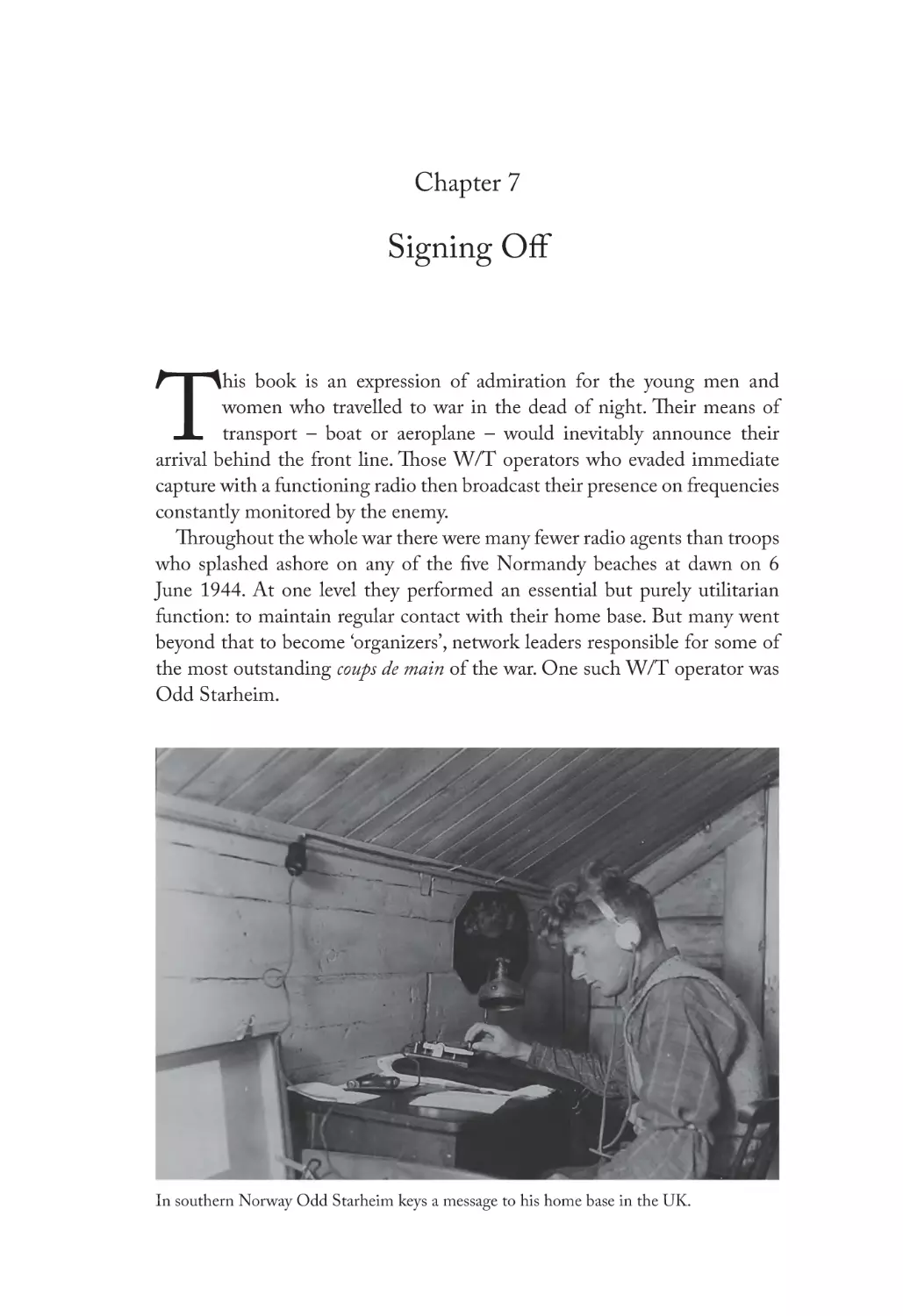


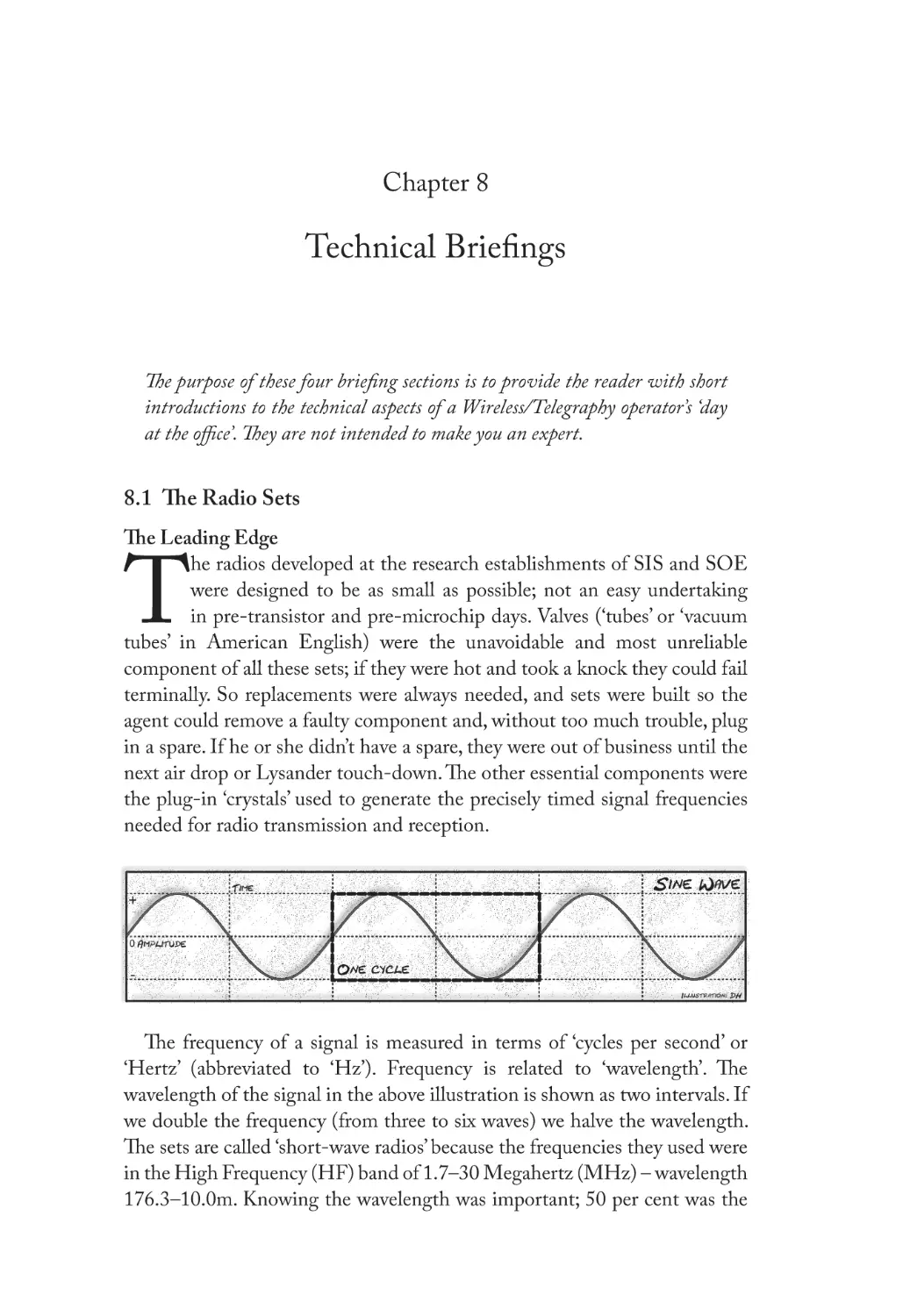







Author: Hebditch D.
Tags: intelligence history electrical engineering radio engineering second world war
ISBN: 978-1-52679-494-9
Year: 2021


Text
                    Covert Radio Agents,
1939–1945

Covert Radio Agents.indd 1

09/12/2020 18:06

Covert Radio Agents.indd 2

09/12/2020 18:06

Covert Radio Agents,
1939–1945
Signals From Behind Enemy Lines
David Hebditch

Covert Radio Agents.indd 3

09/12/2020 18:06

First published in Great Britain in 2021 by
Pen & Sword Military
An imprint of
Pen & Sword Books Ltd
Yorkshire – Philadelphia
Copyright © David Hebditch 2021
ISBN 978 1 52679 494 9
The right of David Hebditch to be identified as Author of this work has
been asserted by him in accordance with the Copyright, Designs and
Patents Act 1988.
A CIP catalogue record for this book is
available from the British Library.
All rights reserved. No part of this book may be reproduced or
transmitted in any form or by any means, electronic or mechanical
including photocopying, recording or by any information storage and
retrieval system, without permission from the Publisher in writing.
Typeset by Mac Style
Printed and bound in the UK by TJ Books Ltd,
Padstow, Cornwall.

Pen & Sword Books Limited incorporates the imprints of Atlas,
Archaeology, Aviation, Discovery, Family History, Fiction, History,
Maritime, Military, Military Classics, Politics, Select, Transport,
True Crime, Air World, Frontline Publishing, Leo Cooper, Remember
When, Seaforth Publishing, The Praetorian Press, Wharncliffe
Local History, Wharncliffe Transport, Wharncliffe True Crime
and White Owl.
For a complete list of Pen & Sword titles please contact
PEN & SWORD BOOKS LIMITED
47 Church Street, Barnsley, South Yorkshire, S70 2AS, England
E-mail: enquiries@pen-and-sword.co.uk
Website: www.pen-and-sword.co.uk
Or
PEN AND SWORD BOOKS
1950 Lawrence Rd, Havertown, PA 19083, USA
E-mail: Uspen-and-sword@casematepublishers.com
Website: www.penandswordbooks.com

Covert Radio Agents.indd 4

09/12/2020 18:06

Contents

Acknowledgementsvi
Introduction: Unsung Heroes?vii
Chapter 1

How to Make a Radio Agent

1

Chapter 2

SIS in Norway

17

Chapter 3

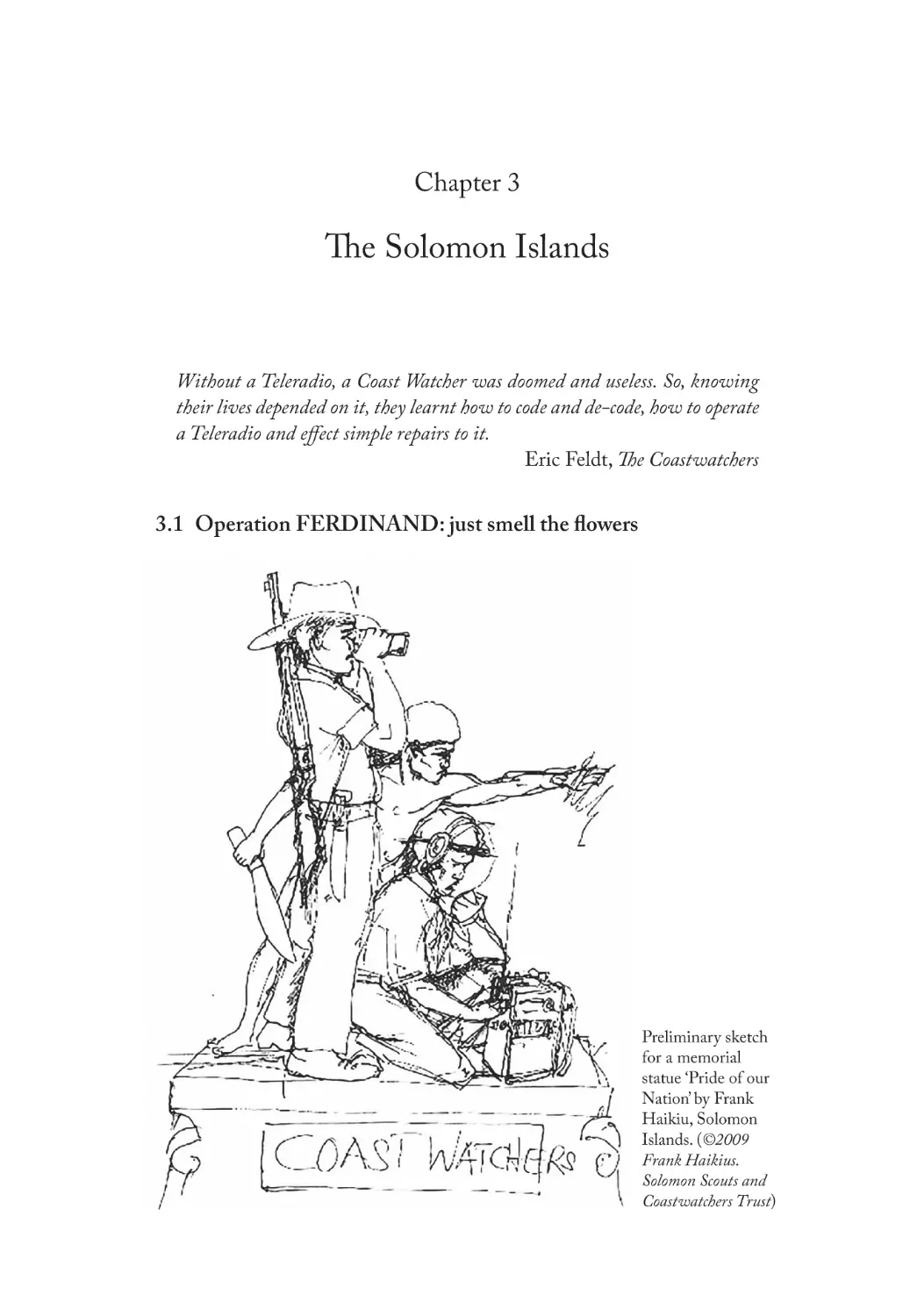
The Solomon Islands

53

Chapter 4

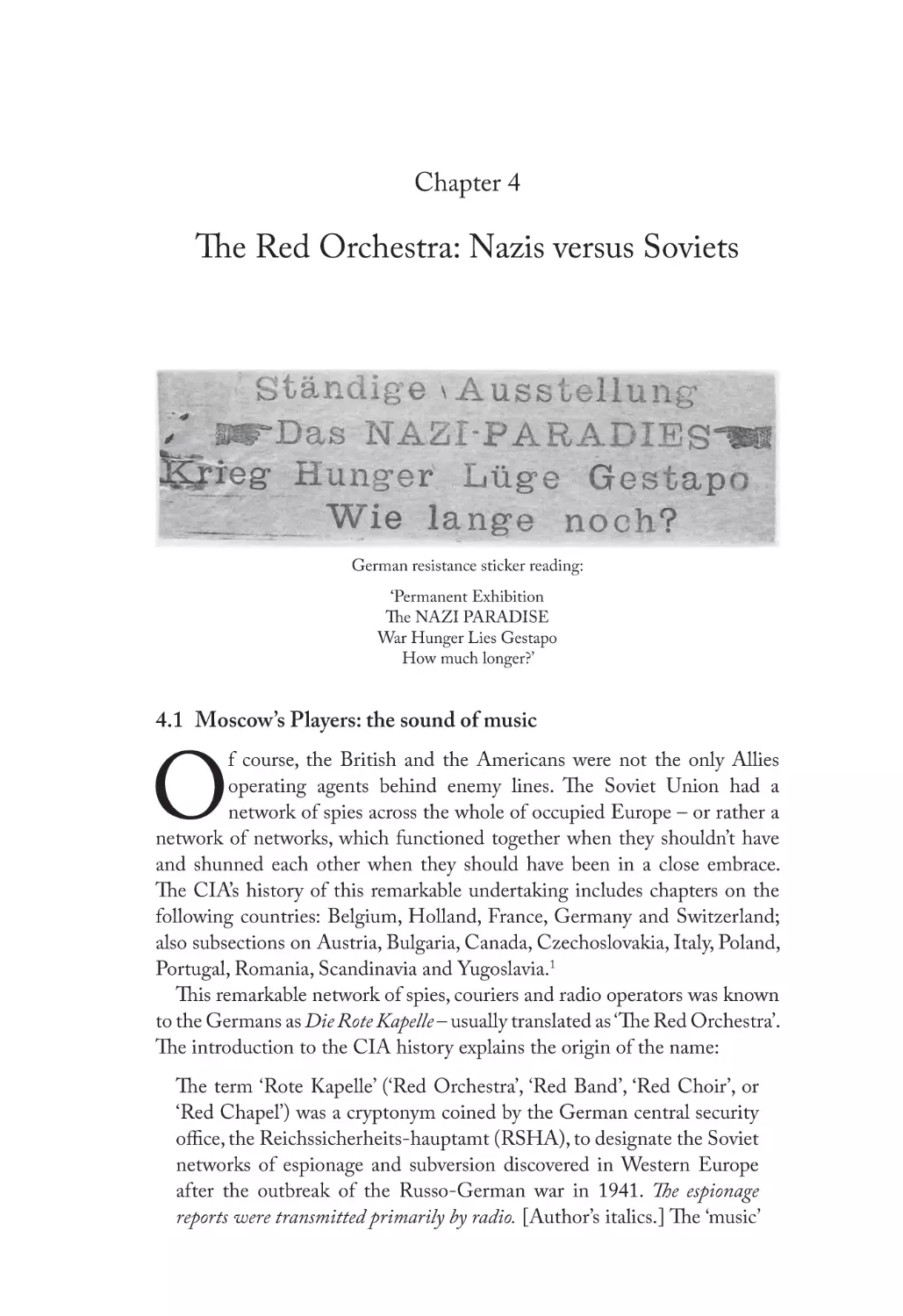
The Red Orchestra: Nazis versus Soviets

97

Chapter 5

SOE and OSS in Sweden and Norway

127

Chapter 6

France: ‘Votre place n’est pas ici!’

171

Chapter 7

Signing Off

219

Chapter 8

Technical Briefings

222

Notes279
Bibliography and Further Reading286
Index288

Covert Radio Agents.indd 5

09/12/2020 18:06

Acknowledgements

D

r Ian Herrington provided an invaluable guiding hand through his
remarkable research into the activities of the Special Operations
Executive in Norway. My friend, historian and author Ola Flyum
on Sula Island, Trøndelag made sure the Scandinavian perspective was kept
in focus. I am grateful to veteran radio-interceptors Geoffrey Pidgeon and
Bob King for trying to locate a legible version of the Radio Security Service’s
plotting map. I am indebted to Henry Wilson of Pen & Sword for his
wise advice on the development of the book. And many thanks to military
historian Dan Hebditch for his guidance on the key events of the Second
World War, especially in Australia and the South Pacific. In all cases any
errors are entirely of my own making.
Unless otherwise credited, all images used are freely available in the public
domain.
Four ‘Technical Briefings’ are included in Chapter 8. These are tutorials
covering: (8.1) the radios and how they worked; (8.2) how enemy radio
intelligence could monitor and locate wireless transmissions; (8.3) the use
of Morse code and the format of messages and (8.4) how messages were
encrypted by the agent and the home station to make them as difficult as
possible for the enemy to read. If you are confident in your knowledge of
these topics, it is fine to skip the briefings selectively. Otherwise you might
even consider reading them first – they include many more accounts of the
exploits of the Second World War’s radio agents.

Indigenous content warning
Aboriginal and Torres Strait Islander peoples should be aware this book
contains the images and names of people who have passed away.

Covert Radio Agents.indd 6

09/12/2020 18:06

Introduction: Unsung Heroes?

Radio agents, who appeared for the first time during World War II, decisively
influenced the entire course of the unhappy struggle.
Wilhelm F. Flicke, cryptanalyst, German High Command

A

short-wave radio’s rate of fire was agonisingly slow. There was no
nose-art on the transmitter, no swastikas bragging of each kill. But
a single message of a few words from these boxes could obliterate
hundreds of the enemy. A different signal at another time might ensure
fighters on your side would get home to their families, alive and well.
‘Wireless operator’ was a perilous occupation; at times, life expectancy
behind enemy lines was six weeks. The truth was bleak: to do their job they
had to announce their whereabouts to the enemy.
These are the actions a well-trained radio agent would undertake in order
to transmit a message. First, he or she would extend the correct length of
wire aerial up a nearby tree or other structure. Then they would double check
the planned time of contact and tune to the next scheduled frequency. After
connecting the battery, headphones would be pulled on and the Morse
key plugged in. Turning the set on and flipping a switch to ‘transmit’ was
the instant the agent effectively announced ‘Hello, I’m here’ to an enemy
impatient to shoot them dead with machine-pistols.
Next to the radio would be the messages ready for transmission. They
would consist of neat arrays of seemingly random combinations of letters in
‘five-letter groups’: KXJEY, UREBA, ZWNHE, and so on. The first message
might be a report on the movement of warships not far off the coast. It had
been enciphered as carefully as possible; if it couldn’t be read at home base the
operator would be asked to transmit it again, giving the Funkabwehr (Radio
Intelligence) a second chance to locate them. Other messages might be sent
on behalf of a network whose radio had given up the ghost; these still had to
be sent with 100 per cent accuracy.
Agents were urged to keep transmission times below five minutes.
Instructors taught that the enemy’s signals intelligence units – the ‘directionfinders’ (D/F) – would orientate their antennae to pin the transmitter’s

Covert Radio Agents.indd 7

09/12/2020 18:06

viii

Covert Radio Agents, 1939–1945

location down to a radius of 30–50km (18–30 miles). Each station would
send via teletype the bearing in degrees to a central location, where it would
be plotted on a map. Mobile D/F trucks, boats and aircraft in the vicinity
would then become active, narrowing the triangulation down to one or two
kilometres. Each extra bearing made the radius smaller; the agent was at the
centre of a noose tightening remorselessly around their neck.
Once the radio’s location had been pinpointed, military units and civilian
police would be alerted. If the wireless was still transmitting, the operator’s
fate would be sealed. Infantry sweeping the area would look out for likely
hiding places, poorly concealed aerials, unattended bicycles or cars.
In urban areas they used D/F sets that could be carried in suitcases or
strapped to their bodies under a topcoat as they walked the streets trying to
narrow their focus to an individual building that could be stormed by soldiers.
If the target was an apartment block, one of the assault team would enter and
disconnect the electricity supply to each floor, one at a time, until the signal
stopped. Then, fingers on triggers, they would start kicking doors in.
Pushing such threats from their mind, agents watched the seconds tick
down. At a predetermined interval before the scheduled time they switched
the radio on; the set needed to warm up before it could operate at full power.
The agent adjusted the headphones and pulled the Morse key a little closer.
The instant the second hand reached twelve, a short sequence was
transmitted: ‘Hello, this is AJR, AJR. I have three messages. Over.’ A hiss of
noise took over the radio channel. It seemed an eternity, but the frequency
came to life in seconds: ‘This is NDE. Go ahead.’ ‘NDE’ was home-base call
sign for the day. (See Chapter 8.3)
The agent’s thumb and forefinger gripped the top of the Morse key again,
and they began sending the first message. Each letter had to be correct, with
no transpositions; getting anything wrong could require the whole message
to be sent again. The delay of a signal about the movements of an enemy
submarine could result in the death of scores of merchant mariners. After
sending the last five-letter group the agent signalled the message was finished.
After the third it was time to move.
The radio, aerial, headset and Morse key went into a metal box to be
returned to their hiding-place – everything except the battery; that needed
to be recharged. The agent put the heavy unit into a backpack and surveyed
the surrounding landscape. Nothing moved, but was that the engine of a
distant car?
A woman who lived a nearby village regularly recharged batteries from the
mains electricity supply. It took an hour to reach her house, and the agent sat
exhausted behind the dwelling, watching and waiting. Caution was dictated

Covert Radio Agents.indd 8

09/12/2020 18:06

Introduction: Unsung Heroes?

ix

not merely by the danger of being spotted by enemy patrols but by concern
about the woman. Just 24 hours earlier, her husband had been seen talking
to an enemy intelligence officer. It could have been innocent; he might have
been stopped randomly in the street. However, the depressing fact was that
nobody could be trusted.
*

*

*

The notional covert radio operator portrayed in this sketch could have been
located anywhere in the world. The stresses under which he – or she – had to
work were universal, defined by the job itself. Some of the pressures, especially
the technical problems, agents could tackle themselves, but others, the coldblooded determination of the enemy to track their location and the risk of
betrayal by the local population, were in the hands of the gods.
This book tells the stories of the remarkably courageous radio operators
whose work was indispensable to the circuits of agents who operated covertly
behind enemy lines throughout the Second World War. The radio specialists
were the first in, the first out and, if caught with their equipment, the first to
be killed.

Covert Radio Agents.indd 9

09/12/2020 18:06

x

Covert Radio Agents, 1939–1945

Les Marguerites Fleuriront Ce Soir (‘The Daisies Will Flower Tonight’). A CIA artist’s postwar romanticized imagining of an OSS radio operator at work.

Covert Radio Agents.indd 10

09/12/2020 18:06

Chapter 1

How to Make a Radio Agent

Espionage has always played a great role in wartime. The difficulty in
carrying it on successfully lay less in the procurement of information than in
passing the information in good season to the military or political leaders of
the country involved.
Wilhelm F. Flicke, cryptanalyst, German High Command

1.1 Infiltration: unusual arrangements

C

ompared with the First World War, the conflict of 1939–45 was far
more global. But its defining characteristic was the way in which
so many countries were occupied by the enemy, in terms of their
geography, natural resources, infrastructure, economic assets and those
members of the population who could not or would not flee. Every square
kilometre seized was available for exploitation and plunder. In Europe the
main occupying power was Germany; its change of name in 1943 from
‘Deutsches Reich’ to ‘Großdeutsches Reich’ (‘German Realm’ to ‘Greater
German Realm’) reflected the scale of its territorial expansion. In the Far
East, Imperial Japan added some twenty-eight countries to the domain it
occupied in 1939. Italy did its bit by taking over only marginally important
Abyssinia and Albania.
The situation in lands occupied by the enemy was of vital significance to
the Allies’ conduct of the war. France’s Atlantic coast, especially Brittany,
provided the Kriegsmarine with a fine choice of lairs for the U-boat ‘wolfpacks’ which, during the early years, wrought havoc on merchant shipping
supplying an isolated Britain. Northern France, Belgium and the Netherlands
offered excellent ground for airfields which put Luftwaffe bombers within
easy range of southern England and London. This was an advantage denied
to the Royal Air Force and, from 1942, the United States Army Air Corps
targeting Hitler’s industrial centres and, later, his major cities. Taking a longer
view, the geographical deployment of ground forces influenced where and
when the Allies would start the lengthy and bloody undertaking of liberating
continental Europe.

Covert Radio Agents.indd 1

09/12/2020 18:06

2

Covert Radio Agents, 1939–1945

The islands and fjords of Norway’s 2,650km (1,650 mile) coastline –
especially the stretch facing the North Atlantic – could have been designed
to meet the German Navy’s requirements. A total of 239,057 islands and
some 1,200 fjords gave unlimited – but not impenetrable – cover to warships
being repaired and provisioned before striking out west above the British
Isles to the North Atlantic and up around Nordkapp (North Cape) towards
the Soviet Union. The disadvantage of Norway was its mountainous terrain;
Galdhøpiggen is, at 2,469m (8,100ft), the tallest European peak north of
the Alps. Consequently, roads have to follow the difficult, twisty contours of
this landscape. Even in the twenty-first century Norway boasts only 500km
(310 miles) of motorway (freeway), and almost all of this is in the east,
serving the capital of Oslo. For the German occupying forces this logistical
nightmare could be solved only by sending troops and materiel up and down
the country by train or sea.
When Japan extended its reach south through Indo-China, Indonesia
and the islands of the South Pacific towards Australia and New Zealand,
its logistics inevitably became stretched and totally dependent on sea-borne

CHIFFCHAFF was an SOE operation in Norway in early 1945 to support the arming and
training of Milorg resistance fighters.

Covert Radio Agents.indd 2

09/12/2020 18:06

How to Make a Radio Agent

3

support and supplies. On some islands, the jungle was so impenetrable that
distances were measured in days of travel rather than miles or kilometres.
There, even a Norwegian road would have been viewed as an extravagant
luxury.
*

*

*

Co-operation between Allied special operations units was a marked
feature of the clandestine effort in this war. The first nine hundred Office
of Strategic Services (OSS) agents were trained at SOE’s Camp X (Special
Training Station 103) on the shores of Lake Ontario in Canada, just 48 km
(30 miles) from the border with the United States. Even more American
radio operators were taught in the UK at a dedicated school (STS 53c) in
Poundon, Buckinghamshire.
The scale of this co-operation – and, indeed, the indebtedness of OSS
to the SOE – may come as a surprise to many readers on both sides of
the Atlantic. Most Hollywood screenwriters and, less forgivably, some
military historians must shoulder
the responsibility for this, having
depicted major events like Operation
OVERLORD as all-American actions
without mentioning the presence
on the Normandy battlefields of
Canadian or British forces. In 2006
the balance was redressed a little when
the US Army Special Operations
Command (USASOC) History Office
published a biography of one of its
most distinguished and long-serving
officers, Herbert R. Brucker.1 This is
of interest in the immediate context of
this book because Brucker was a W/T
operator who was trained by SOE for
Operation JEDBURGH.
Herbert Brucker was born in
Newark, New Jersey on 10 October
1921 to a French-American father and
a German-American mother, but grew
up in the French province of Alsace- Private Herbert R. Brucker aged nineteen,
Lorraine, which borders Belgium, US Army, 1940.

Covert Radio Agents.indd 3

09/12/2020 18:06

4

Covert Radio Agents, 1939–1945

Luxembourg, Germany and Switzerland. He was seventeen when his family
brought him back to the US, and two years later, he enlisted in the army
as a private soldier, long before America entered the war. Understandably,
his English was not very good, but while training as a radio operator he
demonstrated considerable skill in Morse code and rose to the rank of
Technician/4 (T/4). When the OSS was created, he volunteered for special
operations, and the combination of prior military training with fluent Morse
and French made him a candidate the new agency could not ignore. In fact,
he was recruited at the time of Operation JEDBURGH’s gestation, when
there was pressure on OSS to find operators they were prepared to serve up
to the SOE. Briscoe’s 2006 article (written a year before Brucker’s death)
explains in no uncertain terms why the British were doing the training:
British SOE had been putting agents into the German-occupied
countries of Europe since 1940. This was almost three years before the
United States formed the Office of Strategic Services. As such, British
field training for special operatives far surpassed anything that the OSS
could provide. Colonel Charles Vanderblue, Chief, Special Operations
Branch, OSS, knew this because he had detailed one of his training
officers, Captain John Tyson, to evaluate SOE instruction. Tyson
reported on 30 July 1943: ‘The training any prospective SO agent has
received in our Washington schools prior to his arrival in this theater
is entirely inadequate and no trainees should be considered for field
operations until they have had further training in this theater, which in
many cases will involve a period of three months.’
On completion of his OSS courses Brucker was sent to New York, where
he boarded a troop-transporter (a converted Australian cattle boat) for an
unpleasant and hazardous winter voyage across the North Atlantic. He and
his fellow passengers landed in Glasgow on 23 December 1943 and headed
south by train to London. On the drive to a US Army ‘Replacement Center’
they were appalled by the sight of the damage the Luftwaffe had inflicted
on the capital – but they must also have noticed most of the pubs were still
open. Early on 26 December, a car collected Brucker and took him to ‘a
headquarters’ – presumably that of SOE F section, Norseby House, 83 Baker
Street. There he was informed he had a few more days off before, on 2 January
1944, he was sent for further training.
Having been told nothing about the exact nature of his deployment, the
young American protested he had already been trained by the OSS ‘and was
ready for combat’. The Commander of F section, Maurice Buckmaster, told
him, ‘It would simply be murder to send you on an operation with just OSS

Covert Radio Agents.indd 4

09/12/2020 18:06

How to Make a Radio Agent

5

training.’ At the time, Brucker was not happy, but he was just one of sixtyfive other OSS operators to endure this indignity. However, on completing
the course at Special Training School 7 in Surrey (home to the Students
Assessment Board) he was forced to concede that ‘SOE training was far
superior. It made most of my OSS/SO stateside training seem amateurish.’
His next stop was STS 54, the Special Radio and Wireless School at Thame
Park in Oxfordshire. He later described the training there in admiring terms:
The shed [one of many dotted about the grounds] was just big enough for
table, chair, electric lamp, and radio transmitter and receiver. Antennas
were set up to limit transmissions to a couple hundred yards … ‘We
transmitted and received using the large Type 3 Mark II suitcase radio
(fifty pounds with transformer), the little Type A Mark III radio, and the
cigarette pack-sized “Biscuit” receiver with an earplug,’ said Brucker.2
(See Briefing Chapter 8.1 for more on the radios.)
*

*

*

This co-ordinated transatlantic effort bore fruit when, in the late evening of
5 June 1944 – the day before the D-Day landings in Normandy – Operation
HUGH parachuted into central France near Châteauroux on the banks of the
River Indre. The three-man team was the first of ninety-three units tasked
to rally, train and supply resistance groups in support of the invasion. They
operated under the banner of Operation JEDBURGH. Each team’s members
were carefully selected from the British SOE, the US OSS and the French
Bureau Central de Renseignements et d’Action (Central Bureau of Intelligence
and Operations). One agent would be a British or American officer, a second
would be a French interpreter and the third a radio agent, an NCO of any
nationality. The wireless operator played an essential role in providing liaison
with other units and communications with Special Forces HQ in London
to schedule the airdrops of the arms, ammunition and explosives needed to
sabotage and delay the German defences against Operation OVERLORD.
JEDBURGH teams also operated in the Low Countries (where they
worked in concert with the Special Air Service) and in the Far East.

1.2 Irregular Warfare: cogs in a very large machine
After the failure of the British Expeditionary Force (BEF) and the French
Army to repulse Germany’s westward onslaught in 1940, Allied commanders
looking on nervously from the other side of the Channel needed to get creative.

Covert Radio Agents.indd 5

09/12/2020 18:06

6

Covert Radio Agents, 1939–1945

The Secret Intelligence Service (SIS) was originally established in 1909 with
the specific objective of gathering and analysing foreign human intelligence
(HUMINT). It took its present formal name after the First World War;
‘MI6’ became one of its cover names in the Second World War and stuck.
SIS contributes another acronym to this story: GC&CS (the Government
Code & Cypher School) at Bletchley Park was part of the same organization
but specialized in the highly technical field of signals intelligence (SIGINT).
It has now been renamed the Government Communications Headquarters
(GCHQ).
However, the SOE and the SAS were responses to the immediate
circumstances of 1940. SOE was formed specifically to implement Winston
Churchill’s edict to put the torch to occupied Europe. It set up shop in
London’s Baker Street in 1940, and the SAS began its behind-the-lines
attacks on the Afrika Korps in the Libyan Desert the following year.
For SOE the disadvantage of starting with no agents was turned into
the advantage of being able to train all its recruits in its own evolving
doctrine. SOE’s training manual sets out the objectives of irregular warfare,
specifically: ‘to undermine enemy’s morale’; ‘to raise morale of Occupied
Territories’; ‘to damage enemy’s materiel’; ‘to infiltrate weapons, explosives,
sabotage equipment’; ‘to damage enemy’s man-power and communications’;
and ‘to improve our own man-power and communications by infiltration of
“organizers”, radio sets and operators’.
The manual goes on to state that:
All these methods are interdependent. Each one singly has its relation
to our fundamental objectives; but, if each is used singly, the objectives
can never be attained … You will be a cog in a very large machine whose
smooth functioning depends on each separate cog carrying out its part
efficiently.3
These edicts are clearly directed at students who will graduate to become
members of SOE; SIS/MI6 disliked any activities that would draw attention
to its spies.

1.3 Recruitment: ‘don’t want them overburdened’
In the UK, an initial obstacle to the urgent recruitment of agents was the MI6
and MI5* tradition of only employing candidates who were British born and
* ‘MI5’ is more correctly called the Security Service. In the USA its equivalent counter-intelligence role
is played by the FBI.

Covert Radio Agents.indd 6

09/12/2020 18:06

How to Make a Radio Agent

7

bred (and preferably educated at a Jolly Good School). SOE was expected to do
the same. Dual citizenship offered an exception to the rule, but an agreement
with General Charles de Gaulle’s Free French prohibited the signing up of
French nationals, so the hunt for fluent speakers of French tended to focus on
people with one British parent or who were raised in France.
A primary source of recruits, especially in the first year, was the stream of
refugees arriving in the UK from occupied Europe. All were interrogated
to filter out any agents Germany attempted to infiltrate behind our lines.
Everyone was asked what languages they could read, write and speak, and
how well. If the box next to ‘Military experience?’ was also ticked, they joined
a long short list. If questions like ‘Special skills?’ resulted in answers such as
‘Radio amateur’ or ‘Military signals officer’, the short list got even shorter,
and they would be earmarked for further screening. But for SIS and SOE the
requirement for linguistic fluency was prime: it might take only a few weeks
to teach someone how to key Morse code at twenty words per minute; but a
convincing rendition of the Bordeaux accent might require a lifetime.
Word soon got around that a new agency was looking for native speakers –
exact job specification unknown. Commanders in the armed services became
talent-spotters. Someone overheard speaking a foreign language in a café or
at a party might then receive an unexpected telephone call.
In some cases it was very difficult to pass off even the most fluent speaker
of a language as local. For example, the Atlantic coast of Norway contains a
string of settlements, villages and towns where everyone knows everyone else.
They also speak dialects that vary from place to place. Only one foreigner was
sent into Norway as an agent throughout the whole war.

1.4 Training: ‘everything’s highly embryonic here’
SOE’s training programme is probably the best example of how to turn raw
recruits into clandestine agents who could survive behind enemy lines and
make a contribution to winning the war as they did so. It remains a model for
training plans used in the twenty-first century.
It came in three parts: the preliminary course, sometimes called ‘commando’
training; specialist courses such as demolition and radio operation; and then
the ‘finishing school’, which taught how to operate in occupied territories
secretly and securely – including grim guidance on how to behave if you
fell into the hands of the Gestapo. The commando course, which centred
on physical fitness, determination and grit, always came first because it was
what soldiers call a ‘bottle tester’: let’s see if you’ve got what it takes before
we invest too much time and effort in you. Failure here was the moment at

Covert Radio Agents.indd 7

09/12/2020 18:06

8

Covert Radio Agents, 1939–1945

which trainees climbed on to a truck for the ride back to the railway station,
without any choice in the matter.
Specialist courses could come before or after finishing school. The acronym
‘STS’ appears a lot on the contemporary paperwork; it means ‘Special Training
School’ and is followed by a number indicating which school. Sometimes
there are references to ‘A-Group’ and ‘B-Group’, but this is not the start of a
sequence that ran up to ‘Z-Group’. B-Group referred to the training schools
in and around the Beaulieu estate of Lord Montagu in Hampshire; A-Group
comprised the schools around the isolated village of Arisaig on the west coast
of Scotland. There were also training establishments in central England,
specifically in the counties of Oxfordshire, Gloucestershire, Leicestershire
and Buckinghamshire.
A-Group was chosen as the main centre for training in the use of firearms
and explosives because it was remote and sparsely populated; locals puzzled
by all the noise could be palmed off with stories of ‘commando training’ and
they quickly learned not to ask too many questions. B-Group taught recruits
how to work under cover, the courses using the many large country houses
in the area; the teaching staff lived in thirteenth century Palace House, the
present home of the Montagu family. All W/T operators would have passed

The house at Thame Park, Oxfordshire, home to STS 52, SOE’s main training school for
wireless telegraphy operators.

Covert Radio Agents.indd 8

09/12/2020 18:06

How to Make a Radio Agent

9

through B-Group for ‘finishing’, some also taking tuition in coding and
decoding at STS 34.
Skills in the use of radio were taught at a number of locations away from
A- and B-Groups. STS 54a was at Fawley Court, Henley-on-Thames, an
impressive house that stands on land once owned by Edward the Confessor.
STS 54b was not in the vicinity of 54a but on the other side of Scotland at
Belhaven School, Dunbar, East Lothian, 40km (25 miles) from Edinburgh.
The most important school for SOE’s wireless operators was STS 52 at
Thame Park in Oxfordshire. Historical references to the location date back
to 1130 CE, when Alexander de Blois, Bishop of Lincoln, is recorded as

A page of the W/T course notes Finn Berger wrote in Norwegian for fellow agent Eivind
Viken, showing part of the transmitter circuit in the Paraset radio.

Covert Radio Agents.indd 9

09/12/2020 18:06

10

Covert Radio Agents, 1939–1945

planning to use the land for hunting deer. The present building dates from
the eighteenth century and boasts a crenellated exterior.
It is worth noting that SOE’s W/T course was more than a guided tour
of the dials and switches on the set’s control panel. If you were going to
diagnose faults, make repairs when possible and teach operators in the
field, you had to know how it worked. In the Operation DELIA file in the
Norwegian archives are some thirty pages of student notes in Norwegian,
some sections hand-written, others typed.4 A note on the cover in Norwegian
dated 6 November 1984, when the ‘textbook’ was originally archived, states,
‘This is an instruction book by Finn Berger written for Eivind Viken during
the war.’ Eivind Viken was a member of SIS Operation DELIA in Florø
during November/December 1943; he may have been struggling to follow
the course in English. A glance at one of these pages makes it clear why some
trainees preferred to focus on acquiring the skills needed to slit the throats
of German sentries.
Station 53c was at Poundon in Buckinghamshire, a brisk walk south
through the village from the Sow and Pigs pub. This station was established
to train American OSS agents in SOE radio operations. Obviously, this was
an activity which needed to expand as the war progressed and, before long,
Station 53b was set up in other buildings close nearby. But probably not in
the Sow and Pigs.5
For the first two years of its existence SOE was totally dependent upon SIS
for the supply of portable short-wave radios and for the handling and coding
of wireless traffic. Given the strained relations between the two organizations,
the ‘Baker Street Irregulars’* (SOE) could be forgiven for suspecting the
‘Bastards of Broadway’ (SIS) were reading their communications. It was an
unsatisfactory situation, and the divorce came in June 1942. Until that date, all
traffic from Scandinavia had been received at an SIS facility in the tiny village
of Nash, only 8km (5 miles) west of Bletchley Park. Nash is even closer to
Whaddon Hall – 2.5km (1.6 miles) – MI6’s base for W/T communications
with spies in the field.
It seems the Nash station was set up in February 1940, the same time that
SIS Section VIII (radio communications) was moved out of Bletchley Park
and into Whaddon Hall. Both Nash and Whaddon communicated with
Bletchley via secure telegraph lines. Once messages had been decrypted they
were transmitted to SOE in Baker Street by the same means. So, from June
1942, SOE had to set up its own stations for handling radio traffic with agents.
* See the Sherlock Holmes books of Sir Arthur Conan-Doyle.

Covert Radio Agents.indd 10

09/12/2020 18:06

How to Make a Radio Agent

11

A rare photograph taken inside SIS’s radio station in the village of Nash, west of Bletchley
Park.

Of the four they commissioned the most important was Grendon Hall, at
Grendon Underwood, some 75km (47 miles) north-west of Baker Street.
Known as Station 53, it had two operational departments, communications
and coding, the latter coming under the protective and nurturing wing
of SOE’s brilliant young head of cryptology, Leo Marks. Having both

A remarkable photograph taken at STS 51 RAF Ringway during 1944 (the original is in
colour). All agents needed to be parachute-trained, and there are probably over 200 of them
here. In the background are a number of converted RAF Whitley medium bombers and, to
the right, a single-engined STOL Lysander.

Covert Radio Agents.indd 11

09/12/2020 18:06

12

Covert Radio Agents, 1939–1945

FANY Radio Operators sending messages to and receiving messages from agents in the
field. They are using Marconi CR100 wireless transceivers. Note the very chunky Morse keys
(bottom right).

departments in the same building overcame the time delay inherent in SIS’s
arrangement of having radio operations in locations like Whaddon and Nash
and encryption and decryption at Bletchley Park. Landline telegraphy was
only needed to get the traffic to and from London.
Grendon was staffed mostly by young female volunteers from the First
Aid Nursing Yeomanry, known as FANYs.* Their work was challenging and
demanded unrelenting attention to detail. Thirty-nine of them – those with

German radio operators
learning Morse code.
The woman at the rear
appears to be pedalling a
generator. (Bundesarchiv)
* The FANYs still exist: www.fany.org.uk

Covert Radio Agents.indd 12

09/12/2020 18:06

How to Make a Radio Agent

13

language skills to add to their radio and coding experience – were among fifty
female agents sent into occupied Europe; of these, thirteen were caught and
murdered by the Gestapo.
Of course, the enemy was also training female W/T operators.

1.5 Assessment: steady courage
The evaluation of SOE recruits could be brutal – especially if you were
a woman. See for example this report on Noor Inayat Khan. She had
just completed a wireless security course (W/X) being run by STS-36 at
Boarmans, Beaulieu on 21 May 1943.

Noor Inayat Khan’s W/X course finishing report. (UK National Archives)

Covert Radio Agents.indd 13

09/12/2020 18:06

14

Covert Radio Agents, 1939–1945

Signing himself ‘F’, Buckmaster has angrily underlined passages and
scrawled comments. Against ‘Not over-burdened with brains’ he has
written, ‘We don’t want them overburdened with brains’; next to ‘She has
an unstable and temperamental personality’ he writes, ‘Nonsense’; and below
the report are the words, ‘Makes me cross’. Buckmaster was dead right in his
assessment. Noor was the first to break out of the ‘courier’ straightjacket for
women and undertake a dangerous mission in France as a W/T operator. She
certainly made mistakes in the field, but that is not why she was caught; she
was betrayed by a double agent and arrested on 13 October 1943. The Nazis
murdered her and three other agents at Dachau concentration camp at dawn
on 13 September 1944. She was posthumously awarded the Military Cross
and the Croix de Guerre. In 2020 a blue memorial plaque was added to the
front of her former family home in Bloomsbury, London.
A similar negative report was written three months later about 22-yearold Eileen Mary Nearne, known as ‘Didi’, the daughter of an English father
and Spanish mother who was raised in Paris and spoke fluent French. (Her
brother and sister were also SOE agents.) Over a period of some twenty-one
weeks she sent 105 coded messages from the French capital. Then her luck
ran out. On 22 July 1944 the Germans pinpointed her radio. At Gestapo HQ
in Rue des Saussaies she was tortured but refused to give up her contacts.
After some months in Ravensbrück concentration camp she was transferred
to a camp in Poland, from which she escaped. She was awarded the MBE.
Two examples don’t exactly make a trend, but women agents were battling
the misogyny of the day typified by the remarks of a Lance Corporal Gordon:
‘Nice girl, darned the men’s socks and would make an excellent wife for an
unimaginative man, but not much more than that.’ However, the remarkable
achievements of female radio agents were finally recognized by the awards
they received as the war progressed.
*

*

*

Wireless-telegraphy (W/T) operators of both genders were indispensable
members of the ‘circuits’ or ‘networks’ of agents deployed behind enemy lines.
‘Organizers’, usually men, bore the responsibility for the planning and coordination of operations. In effect, they were the leaders of the groups, but
care was taken not to call them ‘commanders’ because of the presence of
civilians in each team. ‘Couriers’ were more often female than not.
In 1942, approval was given for women to be sent into France. Since
all able-bodied French men were expected to be part of the wartime
labour force, the Germans would be suspicious of men moving about

Covert Radio Agents.indd 14

09/12/2020 18:06

How to Make a Radio Agent

15

the countryside, apparently unemployed. Women, however, would not
raise these suspicions, and therefore SOE felt that women would be
better able to act as couriers (individuals who carried both information
and materials) for the wireless operators, saboteurs and intelligence
operatives they sent into France, and to organize regional resistance
groups.6
‘Weapons trainers’ were charged with ensuring that the pistols, sub-machine
guns and explosives handed out to supporters were kept in working order
and put to deadly use. ‘Scouts’ undertook the hazardous job of observing
the location and activities of the enemy. The ‘couriers’ would ensure their
intelligence reached organizers and radio operators.
Often there was overlap in the allocation of jobs. Sometimes the W/T
operator would also encrypt and decrypt messages; sometimes the organizer
would do it. But the radio man or woman’s work was so essential to the
success of the circuit that he or she was always first into the field and last out.
The initial radio contact was the way in which home base was informed that
the group was in place and ready to start operations.
Although SOE was charged with ‘setting Europe ablaze’, MI6 preferred a
quiet life, and not to attract the attention of the enemy. The two organizations
squabbled in the corridors of Whitehall and also ran foul of each other
operationally. From the start, SIS and SOE agents were forbidden to get in
touch directly; this edict, however, was often breached in the field when, for
example, common sense dictated that the most likely source of a replacement
valve for a radio would be the nearest agent using the same type of set.
However, in London, MI6 would routinely veto any SOE operations it
thought might compromise its own activities; in at least one case it is thought
to have sabotaged an SOE venture, thus earning themselves the sobriquet
‘The Bastards of Broadway’.
To achieve Churchill’s incendiary edict required SOE to support resistance
movements. Indeed, it is evident that SOE’s most spectacular successes were
operations carried out in close co-operation with partisan groups: Operation
ANTHROPOID was the assassination of SS-Obergruppenführer Reinhard
Heydrich in Prague, May 1942; Operation HARLING, the November
1942 destruction of a railway viaduct at Gorgopotamos in central Greece;
and Operation BRICKLAYER, the kidnapping of Generalmajor Heinrich
Kreipe on Crete in February 1944.
All these actions depended on the deployment of W/T operators. The
SOE team parachuted into Greece for Operation HARLING comprised
three groups of four men: a leader, an interpreter, a combat engineer and
a radio operator. In the first group to land was Lieutenant Colonel Eddie

Covert Radio Agents.indd 15

09/12/2020 18:06

16

Covert Radio Agents, 1939–1945

Myers, CO of the mission, Captain Denys Hamson, the interpreter, Captain
Tom Barnes (a New Zealander), the sapper, and Sergeants Len Willmott
and Frank Hernen as wireless operators. This command group may have had
two radio men in order to split the signals burden between calls to HQ in
Egypt and calls between the three other groups in the field. Willmott, just
twenty-one at the time, was later awarded the Military Medal and the British
Empire Medal.
*

*

*

SOE had plenty of problems but, much to the fury of other irregular
forces, money was never one of them. Recruiting and training enough W/T
operators to support its expanding activities throughout the world was its
priority. It wasn’t a job for everyone. Not because of the perils associated
with the assignment but because of the concentration and attention to detail
demanded by the three critical aspects of the training: radio operation, Morse
and cryptography. When a semi-qualified candidate fell into SOE’s laps,
their delight was undisguised:
Vita left Shetland on 10th September [1941] to pick up the Sorlie
[Sørli] Gang at a certain point on the Norwegian Coast. This meant
a very long trip to latitude 64° 409 [Namsos], from which she returned
successfully on 16th September bringing 10 men …
In the meanwhile it was discovered that one of the men with the
Sorlie gang is a trained wireless operator. He is being rushed south for
ten days intensive training and will then return to Norway.7
Consolidated Progress Report for S Section
(No. 41)b for the week ended 17 September, 1941

Covert Radio Agents.indd 16

09/12/2020 18:06

Chapter 2

SIS in Norway

During the raid on Florø there were no boats badly damaged, or sunk. Three
private houses and two warehouses slightly damaged. No people were hurt.
The inhabitants are disappointed. Much ado about nothing.
Radio message sent by Atle Svardal, 12 January 19421

2.1 Operation ERIC: ‘intrepid, sensible, quick’

A

tle Svardal was twenty-four years old on 9 April 1940 when Norway
surrendered to the Germans. At the time, he was training to be an
army officer, but the occupying forces closed the military college,
putting an abrupt end to that ambition. His commanding officer wrote on
his discharge papers that he was ‘intrepid, sensible, quick and immensely
persistent’.2
Somewhat at a loss, he joined the police, wrongly believing that Norway’s
civilian force would have some sway over the occupying power and ensure
that they acted within the law. Atle’s illusions were shattered when the
Germans took direct control of the police and made it mandatory for officers
to become members of the Nasjonal Samling (NS, or ‘National Union’),
the Nazi-supporting organization led by the notorious Vidkun Quisling.
The young man drew the line at swearing allegiance to a political party he
despised. He would have to find a different way of resisting the occupiers.
Florø is the westernmost town in Scandinavia. This centre of herring
fishing was Atle Svardal’s home town, and it was where he headed after
bidding farewell to his law enforcement colleagues. There, along with seven
other young men, Atle boarded a motorboat called the Notbas. The skipper
was Dagfinn Ulriksen, a local fisherman very familiar with Florø waters. They
left on 29 April 1941 in the dead of night and arrived at Lerwick in the
Shetland Islands on 4 May. That’s five days, 400km (245 miles) in choppy sea
conditions, a constant lookout being maintained for prowling Kriegsmarine
warships.
All arrivals from Norway were interviewed by Royal Navy intelligence
officers, with the support of their Norwegian opposite numbers. Their

Covert Radio Agents.indd 17

09/12/2020 18:06

18

Covert Radio Agents, 1939–1945

primary job was to weed out German spies sent to Britain posing as refugees,
but they were also responsible for talent-spotting. Which of the newcomers
might play a part in fighting the Nazi occupation of their homeland and thus
speed the end of the war?
Atle Svardal, as a former policeman and officer cadet, was an obvious
candidate. Dagfinn Ulriksen was also noted to have potential. Such recruits
were immediately flown to the Scottish mainland, from where they would
take an overnight train to London and report to the War Office in Whitehall.
Next stop was the Royal Victoria Patriotic School, a gruesome building on
Wandsworth Common, south of the Thames. Originally established as an
asylum for girls orphaned during the conflict in Crimea, it had been taken
over by the Security Service (MI5) at the outbreak of war. After a round of
background checks lasting two or three days, it was decided that Svardal and
Ulriksen would join the Secret Intelligence Service (MI6), and they were
sent for training.
Barely three months later, they were back in Norway. In that short period
MI6 had taught them how to be spies: fluency in Morse code, how to operate
a short-wave radio and how to encrypt and decrypt messages. Their mission
was initially code-named Operation ERIC (almost certainly as a nod to
Commander Eric Welsh, the head of SIS’s Norwegian Section) and it was
the Service’s first ‘coast-watching’ mission. The name was soon changed to

Main SIS (MI6) coast-watching operations in the Florø area, 1941-45. (Author)

Covert Radio Agents.indd 18

09/12/2020 18:06

SIS in Norway

19

Operation CRUSOE, probably when Commander Welsh heard his name
was being taken in vain.
The two-man team was based on the island of Gåsøy, a sliver of land
1km (1,093 yards) in length and 300m (328 yards) at its widest. But it was
perfectly positioned for them to observe all shipping – merchant and naval
– sailing north out of or south into the Florø archipelago. They established
radio contact with home base on 26 August 1941 and were soon sending
regular reports. The messages were terse and the working content followed a
predetermined pattern: time and date of sighting; type and size of vessel or
vessels; speed and direction of travel, north or south.

An early radio message from Operation CRUSOE (née ERIC). (Norges Hjemmefrontmuseum)

The ability to distinguish between destroyer, tanker and armed trawler was
the result of good training. However, determining the size of a vessel and
whether a merchantman was carrying cargo or not was more challenging.
As a former fisherman, Dagfinn Ulriksen was probably good at this. But
Operation CRUSOE had one very marked advantage. Positioned as it was
on an island in the middle of a narrow channel, no vessel was ever more than
500m away from their observation post. That was close enough to see through
binoculars the Plimsoll line on the bows of a merchant ship and from that to
ascertain whether it was loaded. Also, the background of the mainland coast
(when looking east) and the island of Hovden (looking west) gave reference
points which would help determine the length of vessels.
*

Covert Radio Agents.indd 19

*

*

09/12/2020 18:06

20

Covert Radio Agents, 1939–1945

The urgency of intelligence for naval forces trying to protect merchant
convoys in the North Sea and English Channel soon became obvious.
Clearly, the repositioning of three U-boats to the south of Florø would have
been of immediate interest to the Royal Navy. The submarines were sighted
on 29 September; however, the message wasn’t radioed in until 9 October, a
delay of ten days.

A 9 Oct 1941 radio message from Operation CRUSOE. (Norges Hjemmefrontmuseum)

It could be that this message indicates that Svardal and Ulriksen were
having technical problems, but the observation might have been made by
one of their support team on the mainland, and the information may not
have reached them on Gåsøy until much later, perhaps brought by someone
delivering food.
In addition to shipping movements, Svardal and Ulriksen would report on
the effect of RAF bombing attacks on German assets in the Florø region. On
12 January 1942 they sent information they had received the previous day:
During the raid on Floro there were no boats badly damaged, or sunk.
Three private houses and two warehouses slightly damaged. No people
were hurt. The inhabitants are disappointed. Much ado about nothing.
This has been reported to me from one of my connections.3
That line from Shakespeare must have hurt back at the squadron’s base.

Covert Radio Agents.indd 20

09/12/2020 18:06

SIS in Norway

21

The two SIS agents were to
suffer a particularly bleak winter,
and their flimsy hut offered little
shelter. Dagfinn later joked that
the only way they kept warm was
by fighting each other. Their sole
neighbours, a flock of sheep, did
little to raise morale. In fact, the
sheep were a problem because
they belonged to a farmer on the
mainland, and one day, when a
young girl arrived by boat to check
on the welfare of the animals, she
spotted the agents. MI6 could not
afford to take a chance on her being
friendly, and Svardal and Ulriksen
were immediately evacuated back Atle Svardal shortly after meeting King Haakon
in London, 26 March 1942.
to the UK:
In early March 1942, it was found necessary to remove these Agents
owing to Gestapo activities in the neighbourhood. The two men were
therefore collected in great haste and arrived safely back [in the UK]
again on the 20th March 1942.4
On 26 March Svardal and Ulriksen were rushed to meet King Haakon in
London. They hadn’t had a chance to clean up. There was no sauna and no
barber’s shop on Gåsøy, and on his own admission, Svardal hadn’t washed for
six months; his hair and beard were infested with lice. The King must have
been relieved to see the back of him.

2.2 Operation PI II: ‘bravely into action’
While Svardal and Ulriksen were recovering from the rigours of winter on
Gåsøy, Eric Welsh was putting together a new team to handle observations
at the southern limits of Sunnfjord. Twenty kilometres due south of Florø
lies a long, rocky peninsula, at the tip of which the village of Stavenes offers
excellent views to the north-west over the open waters of Frøysjøen. MI6 and
naval intelligence agreed that this would provide an excellent observation
post from which to monitor the movement of German warships.

Covert Radio Agents.indd 21

09/12/2020 18:06

22

Covert Radio Agents, 1939–1945

One of the radio agents was Eivind Viken; more about him later. The
other was 25-year-old army officer Ole Hoff Snefjellå.* He had fought the
Germans in the far north of the country, and when surrender came in May
1940 he switched to the resistance and continued to fight. Taking his new
underground role to heart, Snefjellå even acquired a stencil copying machine
and used it to produce illicit flyers containing news he had heard on the
BBC. His small unit, made up of a handful of friends, operated in Helgeland
independently from other groups. In spite of this isolation, he managed to
obtain a shipment of arms and explosives from the UK. In the autumn of
1941 he moved to Ålesund, about halfway between Florø and Trondheim,
and continued to serve in the resistance there.
On 1 January 1942 he and some colleagues boarded the fishing boat
Trygve and set off west, arriving at Lerwick three days later. After passing
through the screening process he was recruited by SIS and trained as a radio
operator. His first mission as an MI6 agent started in March 1942, when
he and Eivind Viken were delivered to Sunnfjord to set up the Operation
PI II radio station on Stavenes. The observation post was concealed under a
stone slab and gave them an excellent view over Frøysjøen. Commander Eric
Welsh’s number two at SIS was John M. Turner, a Norwegian-British officer
whose grandmother, coincidentally, lived near Stavenes.
Radio reports from PI II were the basis for a number of British air and sea
attacks against German vessels, including the 19,000-ton Hipper class Prinz
Eugen on 17 May 1942. Twelve months earlier, Prinz Eugen had accompanied
the 40,000-ton battleship Bismarck on a breakout into the North Atlantic to
attack Allied shipping. Radio played an important part in foiling the attempt
of these vessels and their escort of destroyers and minesweepers to sneak
undetected out of the Baltic. First they were spotted and followed by the
Swedish cruiser HSwMS Gotland, which signalled Naval HQ in Stockholm as
follows: ‘Two large ships, three destroyers, five escort vessels, and 10–12 aircraft
passed Marstrand, course 205° 209.’5 The Kriegsmarine wasn’t too concerned;
after all, Sweden was a neutral country. However, within hours of it being
received, the signal was on the desk of the British naval attaché at the legation
in Stockholm, Captain Henry Denham. Denham had the message urgently
recoded and radioed to Naval Intelligence at the Admiralty in London.
In spite of GC&CS at Bletchley Park monitoring German radio traffic
(and reconnaissance Spitfires carrying out sorties along the Norwegian coast)
Bismarck and Prinz Eugen reached Bergen unscathed. They sailed again on
21 May 1941 and headed in a wide arc across the Atlantic to the north of
* This must be the perfect surname for a Norwegian: snefjellå means ‘snow mountain’.

Covert Radio Agents.indd 22

09/12/2020 18:06

SIS in Norway

23

Iceland. They were next spotted by the old Kent-class heavy cruiser HMS
Suffolk, which was on picket duty in the Denmark Strait. What followed is
well documented as ‘The Battle of the Demark Strait’ and vividly depicted in
the film Sink the Bismarck! In the ensuing engagement the British battleship
HMS Hood was sunk on 24 May with the tragic loss of 1,415 men. But
Bismarck was later attacked by the aircraft carrier Ark Royal’s slow and
obsolete Fairey Swordfish torpedo-bombers, which managed to disable her
steering. After further attacks, Bismarck’s captain ordered her to be scuttled.
It was 27 May 1941.
Prinz Eugen escaped, heading south. But she encountered engine problems
and was ordered to head east to France for repairs, arriving at the port of
Brest on 1 June. The RAF immediately attacked the port, dropping a total of
1,200 tons of bombs on its ship-building and repair facilities. She was again
severely damaged on 1 July, when a direct hit from an armour-piercing bomb
destroyed the control centre and killed sixty sailors. This was a serious setback
for the Germans. On 23 February 1942 the Royal Navy submarine Trident
attacked Prinz Eugen off Trondheim and a torpedo killed fifty crew and
destroyed her ability to manoeuvre. Once more she was in desperate need

Under repair in Lofjord, near Trondheim: the Prinz Eugen (centre with repair ship Huscaran).
Below, under headland, the cruiser Admiral Scheer. Aerial reconnaissance photograph, March
1942. (Imperial War Museum)

Covert Radio Agents.indd 23

09/12/2020 18:06

24

Covert Radio Agents, 1939–1945

of repairs. After limping towards Trondheim she was towed into Lofjord,
a branch of Trondheimsfjord, well away from prowling British submarines,
where she was joined by the Admiral Scheer and the repair ship Huscaran.
The engineers of the Huscaran did a remarkable job of cutting away the
damaged stern of the Prinz Eugen and replacing it by an improvised aft end
with two rudders that could be operated from capstans on the deck.
On 10 May 1942 Admiral Scheer left Lofjord and resumed her journey
north to Narvik. Prinz Eugen left six days later, making a course south for
the Baltic. Concerned that rough seas offshore might result in damage to her
jury-rigged stern, she was hugging the coast when she arrived in Frøysjøen
and became framed in the binoculars of Ole Snefjellå and Eivind Viken.
What a prize! A notorious heavy cruiser, clearly damaged, limping south
and ever closer to Allied air bases in Britain. They lost no time in tuning
their radio to an emergency frequency for a signal outside Operation PI II’s
regular ‘sked’ (transmission schedule).
Prinz Eugen was unfinished business, and RAF Coastal Command’s 42
Squadron was tasked with putting an end to her streak of good fortune.
On 17 May 1942 the squadron spearheaded a force of forty-eight Bristol
Blenheims, Beauforts, Hudsons and Beaufighters which took off from RAF
Leuchars on the east coast of Scotland. The lead aircraft was piloted by Wing
Commander Mervyn Williams. The attack was to take place using torpedoes
under cover of darkness. Just locating the Prinz Eugen at night was quite an
achievement, but her flotilla was found at the south-western tip of Norway
off the Cape Lista lighthouse.
The attack itself, skimming the wave-tops at night towards a barrage of
fire from the cruiser and her four destroyer-escorts, while hounded by Me109
fighters, took remarkable courage. But the Prinz Eugen escaped yet again,
and Williams’ aircraft was downed. The only survivor from his Beaufort, he
was taken prisoner by one of the German destroyers.*
*

*

*

Even before the sighting of Prinz Eugen, Ole Snefjellå and Eivind Viken had
been receiving alarming reports from Bergen about an incident in the village
of Telavåg on the island of Sotra, 130km south of Sunnfjord. In mid-1942
the determination of the Nazis to put an end to clandestine wireless stations
and the running of agents and resistance fighters, weapons and equipment to
* Williams ended up in Stalag Luft III for the rest of the war. He became intelligence officer for the
camp and was a planner of ‘The Great Escape’. In August 1942 he was awarded the DSO.

Covert Radio Agents.indd 24

09/12/2020 18:06

SIS in Norway

25

and fro across the North Sea had been stepped up along Norway’s western
coast; threats of the death penalty were not working. Telavåg had become an
important terminal for the Shetland Bus (the regular link between Shetland
and Norway), but the Germans only learned about this by chance. In an act
of revenge, a local man who had got into a petty dispute with Lauritz Telle
over the sale of a boat, reported him for having an illegal radio.
On 26 April senior Gestapo officers Gerhard Berns and Henry Bertram
led a force of SS soldiers and Norwegian NS police in a dawn raid on the
island of Sotra. When this considerable unit surrounded Lauritz and Martha
Telle’s house they were unaware that the elderly couple were sheltering
two resistance fighters, Arne Værum and Emil Hvaal from Kompani Linge
(Norwegian Independent Company No. 1). Woken by the raiders, Værum
and Hvaal put up a fierce fight and shot and killed the Gestapo officers. In
the ensuing close-quarters struggle Værum was killed and Hvaal seriously
wounded. Twelve villagers were immediately rounded up and taken to
Bergen, where they were brutally interrogated and tortured. Included among
them were Lauritz and Martha Telle, both in their sixties.
For the whole period of occupation the governor of Norway was
Reichskommissar Josef Terboven; it was a role for which he was singularly
unqualified in every respect except one. In the military (during the Great

Josef Terboven (front 2nd right) with Vidkun Quisling, Heinrich Himmler and Generaloberst
Nikolaus von Falkenhorst in 31 January 1941 at an oath-taking ceremony for Norwegian
volunteers in the Waffen-SS.

Covert Radio Agents.indd 25

09/12/2020 18:06

26

Covert Radio Agents, 1939–1945

War) he had failed to get beyond the rank of lieutenant; he had studied law
at Munich University and political science (an oxymoron if there ever was
one) at Freiburg, but failed to graduate from either seat of learning. When
he got a mundane clerical job in a bank he was sacked in short order. The
exception to this disastrous string of failures was that he proved to be a nasty
enough thug to qualify for a full-time job with the Nationalsozialistische
Deutsche Arbeiterpartei, the Nazi Party. In the 1930s he reached the rank
of Obergruppenführer and even married Ilse Stahl, one of Joseph Goebbels’
discarded mistresses. Maybe she liked weedy fascists? However, she refused
to join him in Oslo despite the fact he was living in the crown prince’s official
residence at Skaugum.
The people of Telavåg must have been terrified to see Terboven arrive in
their village. The despised tyrant had decided the whole community would pay
dearly for the death of his two Gestapo officers. While General Nikolaus von
Falkenhorst was the commander of the 400,000 Wehrmacht troops stationed
in Norway, Terboven exercised civilian power through the Quisling cabinet,
but this arrangement was balanced in his favour by a personal force of about
6,000 SS men and 800 Gestapo agents. From the start, von Falkenhorst,
a professional soldier, had demanded that his men extend politeness and
respect to Norwegian civilians. He hated Terboven. It was hardly surprising,
therefore, that it was the Reichskommissar who determined and carried out
the punishment against Telavåg.
His revenge was swift; on 30 April 1942 all men aged between sixteen and
sixty were arrested and transported to Sachsenhausen concentration camp,

The razing of
Telavåg, May 1942.
(Bundesarchiv)

Covert Radio Agents.indd 26

09/12/2020 18:06

SIS in Norway

27

north of Berlin. Seventy-two of them died in captivity. During May the SS
systematically destroyed every single building in Telavåg. All the fishermen’s
boats were sunk and all the farmers’ cows and sheep were slaughtered. The
following year, Emil Hvaal, the surviving Kompani Linge fighter, and Lauritz
and Martha Telle’s son, Lars, were both executed.
At the secret Trandum Forest death camp near Oslo, set up by Terboven,
eighteen prisoners with no connection to Telavåg were executed in revenge
for the death of the two Gestapo officers. The remaining population of the
settlement, mostly women and children, were detained until the end of the
war.
It was against this background that the MI6 agents of Operation PI II
received reports that the SS and Quisling police were continuing their sweep
along the peninsula towards their vantage point at Stavenes, searching every
farm and every possible location for a radio station. Then Chester Saltskår, the
farmer sheltering the agents, learned that other operatives had already been
arrested on the islands to the west of Askvoll. Eivind Viken and Ole Snefjellå
could see no easy means of escape and they feared for Chester Saltskår and
his family. Eric Welsh and John Turner were equally determined to get their
agents back to the UK, but there was no time for them to be reached by a
Shetland Bus gunboat or torpedo boat.

The Norwegian Catalina flying boat ‘Vingtor’ during a winter sortie, 1942.

Covert Radio Agents.indd 27

09/12/2020 18:06

28

Covert Radio Agents, 1939–1945

A call was made to RAF Coastal Command’s Norwegian Detachment at
Woodhaven on the south coast of the Firth of Tay, opposite Dundee. Formed
only three months earlier, the unit had acquired four Consolidated PBY-5
Catalina flying boats.6
The Norwegian crews were still in training, but the unit’s commander
told Welsh he had an aircraft and crew ready to depart immediately on the
hazardous mission. The Norwegian flyers had received the plane, ‘Vingtor’,
from the Royal Canadian Air Force in February, and it had carried out its
first special operations mission for the SIS overnight on 1/2 May, when it
successfully inserted two W/T agents at Leka, 220km north of Trondheim.
When, on the afternoon of 22 May 1942, pilot Finn Lambrechts pushed
the Catalina’s throttles forward to take off from the Firth of Tay, Welsh’s
second-in-command, John Turner, was a passenger. It is not known if he had
plans to make a surprise visit to his family in the area. Lambrechts and his
navigator, Per Wåge Lea, did a brilliant job of landing at Stavenes in the dark.
Waiting for them with Viken and Snefjellå were farmers Chester and Petrine
Saltskår and their two-year-old son Harald – the family who had sheltered
the agents in the previous weeks. After the events at Telavåg it was far too
dangerous for them to be left behind.
Chester had acted as a courier for Viken and Snefjellå. On one occasion he
took his fishing boat to Askvoll harbour and told the German harbourmaster
he wanted to catch some mackerel. Please could he mark on his sea chart the
boundaries of the minefields? The harbourmaster fell for it and obligingly
outlined the danger areas for him. Chester took the chart back to the agents,
who radioed this valuable intelligence to the SIS.7
As they climbed on board Vingtor and the crew got ready to take off
for Scotland, a Kriegsmarine patrol boat appeared around the headland.
Fortunately, it kept going, presumably thinking the aircraft must be German.
As the evacuees scrambled on board they left the radio equipment in the
rowing boat. It was later found by Norwegians who had the sense to dump
it before it was discovered by the Germans. After their successful return,
every member of Vingtor’s crew were awarded the War Cross with Swords,
Norway’s highest military medal for bravery.

2.3 Operation ERICA: if he couldn’t write, he couldn’t code
Atle Svardal arrived off the island of Batalden near Florø on 15 January 1943
aboard a fishing vessel called the Kvalsund. For this operation his fellow radio
operator was Eivind Viken, another interesting and resourceful character
who, with Ole Snefjellå, had been rescued from Stavenes by the crew of
Vingtor eight months earlier.
Covert Radio Agents.indd 28

09/12/2020 18:06

SIS in Norway

29

When barely more than a
teenager, Viken had gone to fight
in the 1939–40 Winter War against
the Red Army occupying Finland’s
eastern border region. When he got
back to Norway in April 1940, spring
had arrived and so had the German
military. He enlisted and fought for
a while, before escaping across the
border into Sweden.
From there he travelled to Finland
again, then – somewhat audaciously
– to the Soviet Union and through
Turkey to Iran. At a Gulf port he
signed up as a deckhand on a cargo
ship headed for the UK via South
Africa. Such determination must
have impressed his MI5 interrogator;
less so his inability to read and write, SIS W/T Operator Eivind Viken. Photo
probably taken in 1945.
an affliction blamed on an interrupted
schooling. He was recommended to
MI6 so long as he first filled the gaping holes in his education; if he couldn’t
write, he couldn’t code.
Svardal and Viken’s new mission was Operation ERICA, and it was to be
based at Husefest on the mainland to the east of Gåsøy Island but overlooking
the same stretch of water, the northern access to Florø. However, the plan to
put them ashore at Breivik near Husefest was stymied by a warning to be on
the lookout for the German patrols in the area. Instead, they stepped ashore
on Batalden, an outer island of the Florø group. A crew member of their boat
put them in touch with Sigurd Langøy, his wife, mother, and two sons. In
his post-operation report, Svardal recorded that ‘All of these were excellent
people, with the exception of Sigurd Langøy himself, who was nervous
[scared] and an extremely scatter brained type.’ Word must have got out that
they’d arrived, because more assistance was offered by less nervous locals:
All our equipment and stores were taken over in [Langøy’s] dinghy.
During this work, Saron Karstensen and his son Oddsund came and
offered help, which we gladly accepted … They live on Little Batalden
and look after the telephone exchange there. (Because of their large
family of youngsters, it would be inexcusable to think of living with

Covert Radio Agents.indd 29

09/12/2020 18:06

30

Covert Radio Agents, 1939–1945
them.) Before daylight all our equipment, with the exception of the
wireless sets, was hidden at an out of the way spot on Skorpa [Island].
On the evening of 16th January, we rowed with all our wireless
equipment, accumulators [batteries] and weapons to Solberg, the
original contact used by Ulriksen and Svardal. There was an east [head-]
wind blowing, so this took us six hours. We were well-received. We sent
a message to Dagfinn Hjertenes, an old contact in Florø of Ulriksen and
Svardal’s. He came on the 18th January with his 17ft motor boat (petrol
driven, speed 8 knots). He took us over to [the] Bredvik [farm].8

The farm of Isak Bredvik was where they would stay. Svardal’s post-operation
report includes an interesting section headed ‘The Setting Up of the Wireless
Station’. It began:
In Brevik there are two farms separated about 50 yards from each other.
We had therefore to restrict as much as possible our use of the motor
[generator]. We set up our battery-driven set. Bredvik had a 12-volt
windmill apparatus of which we made use for accumulator charging.
Apart from being a splendid observation point, this was the most
important reason for our decision to set up station here …
In the farm the old aerial, in spite of confiscation of wireless sets, was
still erected, in a South-North direction. So that the neighbours should
not notice any change, we took this down and set up our own aerial in
the same direction. The electric light lead from the windmill ran at a
distance of 3 metres. We could not make W/T contact, and therefore
put up the aerial in an East-West direction. (We had the whole time
appreciated that this was the best direction.) All this work could be
done only at night.9
The post-operation report continues with an account of some important
improvisations:
On the 25th January, wireless contact was in order. In case of any trouble,
we placed the motor straightaway in the cellar. After various trials, we
filled a barrel with wool, cellulose shavings, and asbestos, and passed the
exhaust pipe into the barrel. From the barrel there was an exhaust pipe
to the chimney. We also built a house [hut?] for the motor. In order to
achieve cooling off, the motor house was built comparatively big with
air ventilators.
The report includes a hand-drawn sketch of this arrangement.

Covert Radio Agents.indd 30

09/12/2020 18:06

SIS in Norway

31

Operation ERICA: concealment of generator exhaust.

At first, the danger of the generator betraying them became something of
a preoccupation. It was a few weeks before they could settle into their job:
We noted that if the motor was used each day it was necessary to
moisten the barrel every morning with water, otherwise fire could break
out. During entirely calm weather, we could hear the noise of the motor
about 20 metres from the house. If there was a wind, the distance was
only about 3 metres. It was at any rate impossible to tell where the
noise came from. We had a certain amount of trouble with the motor,
which had been used before. The voltage was never constant, but varied
between 5 and 10 volts.
We tried out the motor-driven wireless set at the beginning of
February, and apart from motor stoppages, it was O.K. both on day and
night frequencies. We kept watch throughout the 24 hours more or less
for the whole of this period. We fetched the rest of our equipment with
Bredvik’s boat. Everything was carried up to the living house and put in
a large clothes closet – in all about 2 tons.
From the 1st February, we kept a record of all shipping that passed
both North and South. At the end of every month we sent a review of
how much had passed, and how much we had reported.
There was some light relief when, on 15 March 1943, Ingrid Kjørlang, a niece
of Isak Bredvik, arrived to work on the farm. Obviously they had to tell her
what they were up to, and she must have taken an interest:
We intended to train Miss Kjørlang as [a] telegraphist. We got her
up to speed 30 [words per minute], but then had to move up into the

Covert Radio Agents.indd 31

09/12/2020 18:06

32

Covert Radio Agents, 1939–1945
mountains, which made further training impossible. Miss Kjørlang was
indeed very intelligent.10

Svardal and Viken must have shown Ingrid the basics of operating the radio
to have moved on to Morse. She missed out on the rigours of encryption,
but her transmission speed was excellent. Twenty words per minute was the
minimum expected of a specialist W/T operator, and most could achieve
25 wpm.
The report moves on to comment on some of their sightings:
It seems certain that in February there passed a battle cruiser and a
cruiser. They went out from Frøysjøen [south of Florø] and into
Hellefjord [between Hoveden and Batalden islands] without air escort
(in contrast to the cruiser “Nürenburg” [sic] on 1st May which followed
the usual lead and was escorted by six aircraft).
Most shipping entering or leaving Florø on the north side of the archipelago
was clearly visible from the agents’ observation post. But they started to
worry about warships moving beyond the islands of Hovden, Batalden and
Skorpa, which blocked their view. They needed to recruit coast-watchers
who had a clear view west from those islands. But how could they share the
information with Svardal and Viken so they could radio it back to home
base? They decided that the telephone was the only option — so long as they
could come up with a smart way of fooling the Germans and the Norwegian
police listening in to the conversations:
To make certain we developed a code for use on the telephone and went
out to talk it over with Saron Karstensen who had a telephone. [He also
ran the telephone exchange on the island of Little Batalden.] He was to
report to us any warships which passed outside the Skerries. We give full
details (Appendix A attached) of the code we proposed to use should
any warship pass outside the Skerries. The conversation is of course held
in dialect.11
Sadly, Appendix A is now missing from the report – but we can guess what
it might have been like. The use of codebooks is a centuries-old method
employed to conceal from the enemy the real meaning of sensitive messages.
Essentially it’s a look-up table containing innocuous words (or random
numbers) to substitute for incriminating ones. For example, ‘mackerel’ might
be used to mean ‘destroyer’, and ‘heavy cruiser’ be replaced with ‘shark’. (For
more on this, see 8.4, the Briefing on Cryptology.)
But the nice twist is in the last sentence. Norway is a country that seems
unable to agree what its national language should be. The situation at the

Covert Radio Agents.indd 32

09/12/2020 18:06

SIS in Norway

33

time of writing is that there are two official written languages, Bokmål and
Nynorsk – plus Sami, the language of the indigenous Sami population in the
north. Bokmål has its origins in Danish (Norway used to be part of Denmark).
Nynorsk is more rooted in the dialects of Old Norse, the language of the
Vikings, if you will. Both languages are taught in school, but the majority
(87 per cent) of Norwegians prefer to write in Bokmål.
A lot of countries have more than one official language: Canada (English
and French); Belgium (French and Flemish); Switzerland (German, French,
Italian and Romansh), and so on. Then there are dialects; not just regional
accents but variations in which vocabulary, grammar and pronunciation are
different enough to make a dialect unintelligible to someone raised in the
next valley. The brilliantly funny French writer Lorelou Desjardins explains
in her blog12 that her adopted country has four families of dialects: Østnorsk
(Eastern Norwegian, spoken in Oslo and the surrounding area), Nordnorsk
(Northern Norwegian), Trøndersk (Central Norwegian) and Vestlandsk
(Western Norwegian). Within these dialect families are marked variations –
although the differences have faded over time.
Florø lies in Sogn og Fjordane, the only county in Norway where 100 per
cent of the town and village councils have chosen Nynorsk over Bokmål as
the official written form of Norwegian. But many dialects are spoken – one
every 20 km, according to Lorelou, who does her field research by asking a
test question: ‘How do you say “woollen socks”?’ So far her count has reached
one hundred variations. In the unlikely event that any of Operation ERICA’s
messages included the words ‘woollen socks’, no Germans – or Norwegians
who didn’t speak the Florø dialect at the kitchen table – would have made any
sense of Svardal’s conversations. Even if they could, the puzzle of a ‘destroyer’
wrapped inside the enigma of a ‘mackerel’ would have had them baffled.
*

*

*

Despite the remoteness of their location, the radio agents of Operation
ERICA were under unrelenting threat from the Germans:
During the first four months of our stay in Norway, there were constantly
razzias* in the district. The Germans seemed to favour Sundays especially
for this pastime, which seemed to us a pity, as we considered Sunday a
day of rest.
* Raids. The word originates from the Italian via French and is based on an Arabic word referring to
mid-nineteenth century kidnapping raids by Moorish pirates along the Barbary Coast of North Africa.
It has now disappeared entirely from everyday use in English.

Covert Radio Agents.indd 33

09/12/2020 18:06

34

Covert Radio Agents, 1939–1945
According to our contacts there were at this time razzias on all the
Islands … Every single house in Florø was searched …
When an M.T.B. [motor torpedo boat] was lost in Florø, the
Germans assumed that the crew had escaped to some place or other on
the mainland. More or less the whole district round about was searched.
The father of Dagfinn Hjertenes was skipper on board the Germans’
launch in Florø, and he often had to act as pilot during night razzias
… Skipper Hjertenes was ordered to pilot the Gestapo to Hovden. He
thereupon was ordered to go to Berle [a village on the south coast of
Bremanger] where people had been landed in rubber boats. The Germans
this time searched only around the houses, and the local inhabitants saw
nothing of them. We heard about this, but understood it had happened
at Botnane. [Botnane was only 5km north of the Operation ERICA
observation post.] Because of the nature of the razzia, and because
Skipper Hjertenes believed that further searches were likely, we decided
that London should be informed.

As if the attention of the Germans wasn’t enough, the locals were starting
to make Svardal and Viken nervous: ‘There flourished a rumour in Florø of
a certain SVARDAL who was “in the Secret Service” etc. There was even
a message of greetings sent to one of his relations. Who had spread these
rumours, we do not know, but think it was probable that Sigurd Langøy is
to blame.’ Then, at Easter 1943, a 13-year-old girl, a relative of the farmer,
arrived for a visit and ‘nosed around in every corner’. The agents decided
it was time to relocate. They spent two days on a reconnaissance mission
and found a suitable cave in the mountains two hours walk above Bredvik
farm. The move was made by moonlight and took three trips, each lasting
three hours, to avoid houses near the route. Remarkably, they achieved this
without interrupting the flow of radio messages to MI6. During the day they
maintained watch themselves; after dark a local farm worker kept a lookout
and signalled them with a light if he saw anything.
We were taking no chances a warship could pass unobserved. Before our
move, we tested the radio set in the mountains. There was the possibility
that some metal content in the mountain might cause disturbance. For
this reason, London was asked to listen for us on two frequencies at one
period. One frequency being used from the farm, the other from the
mountains. In this way, warships could not pass without being reported
immediately. It took rather a long time to arrange all this; rainy weather
was to blame. A single drop in the wireless apparatus could have resulted
in a short circuit.

Covert Radio Agents.indd 34

09/12/2020 18:06

SIS in Norway

35

By the 17th May, we had moved with our wireless apparatus to the
mountains, with the most essential part of the provisions and clothes.
Wireless contact was better than ever before. The remainder of our
stores, over one ton, remained at the first stage well hidden in the woods.
We carried by night, and worked by day.13
In a letter, the Deputy Director of Naval Intelligence, Captain Charles A. G.
Nichols, conveyed his thanks: ‘I would like to express my appreciation of the
invaluable reports received from this station. The reliability of the reports and
the speed of transmission make them of great value.’
*

*

*

Lines were drawn for anyone who knew what the agents were doing and the
consequences for overstepping them were dire:
Relations between the servant Martin and the womenfolk on the farm
were very bad. The boy was badly treated, and since he was pretty cheeky,
there was always a lot of back chat. The result was that the boy went
away on the 1st July. Martin is about 16 years old, and of undeveloped
intellect … He came several times to us with the threat of betraying us,
but we managed to cure him of such talk. When we left Norway, he
had gone to live at his home in Tradsøy. Dagfinn Hjertenes and Ragnar
Svardal were asked to watch the boy, and if necessary to dispose of him.14
Svardal’s report includes an assessment (partially post-mortem) of the radio
equipment they used:
The wireless sets were excellent, and worked without trouble the whole
time. We used the accumulator-driven set up to our last week in Norway,
when the set refused to work. We know now from the experts in London
that the fault was due to salt in the clips. If the set had gradually become
worse, we should possibly have discovered the fault, but there came an
abrupt stop. At the beginning, the vibrator worked, but otherwise there
was no sound from the set. We examined all the leads and coils, and
changed all the valves, but in vain. In the end we changed the vibrator
valve, with the result that the vibrator ceased to function.
The [exhaust system] for the motor had been burnt out two months
earlier. Fire broke out in the barrel which acted as silencer. Twenty timber
logs and fifteen boxes of moss caught fire. It was a long way to any water
and everything was absolutely dry, and that we were not discovered was
pure luck for which my lucky hat was probably responsible.

Covert Radio Agents.indd 35

09/12/2020 18:06

36

Covert Radio Agents, 1939–1945
The motor [generator] was carried away and hidden (at the end of
August). Within 24 hours we had fixed up a temporary hole in which
the motor was placed. Wireless contact was established immediately.
The motor had apparently already been used when we got it. We had
trouble with it the whole time. It worked after a fashion, but noise from
the motor came through on the radio set so that it was nearly impossible
to hear signals.

What finally determined they should be evacuated was the onset of winter,
and thus the likelihood of leaving tracks in the snow as they travelled up
and down the mountain. They decided to leave all their radios behind for
when they returned in the spring of 1944. Word came on 3 September telling
them to get ready, and they set to wrapping the equipment in tarred paper
and placing it in tin boxes. A layer of oilskins provided further protection,
before they concealed everything ‘in a large rocky slope 300 metres from
[our] working place’. They then searched the whole area, making certain they
had expunged all evidence of their presence.
Isak Bredvik took us over in his rowing boat to Botnene where we
arrived at 2230 GMT. At 0100 GMT the MTB arrived … We were
well received. Mines were laid at Botnene, and we returned to Lerwick,
where we were met by Lt. Cdr. [Eric] Welsh on the 7th September after
an eight months’ absence.
The presence of Lieutenant Commander
Welsh waiting to greet them on the
Lerwick pierside demonstrated how much
importance MI6 attached to these missions.
Hopefully he will have extended the Royal
Navy’s renowned hospitality by buying them
large whiskies at the nearest officers’ mess.
That wouldn’t have taken much
encouragement; Welsh was a notorious
boozer.15 He would certainly have warmly
greeted Atle Svardal and Eivind Viken
in fluent Norwegian, for in the twenty
years between the wars he had lived and A rare photograph of Eric Welsh,
worked in Bergen for the British company head of MI6’s Norway Branch.
c.1945.
International Paints Ltd, and his wife was
Norwegian. Arguably his greatest legacy lies in his determination to end the
production of heavy water at Norsk Hydro’s Vemork plant. Before the war he
had provided waterproof paint for the plant’s floors.

Covert Radio Agents.indd 36

09/12/2020 18:06

SIS in Norway

37

2.4 Operation CYGNUS: ‘persistence and initiative’
That day, waiting on the dock at Lerwick, Eric Welsh already knew Svardal
and Viken were not going back to Norway as soon as April 1944. He had a
new team poised to take over the observation of German shipping around
Florø – in the area called Sunnfjord. Dagfinn Ulriksen and Ivar Møller
would be known as Operation CYGNUS. Ulriksen was, of course a veteran
of coast-watching in the region, having shared a Morse key and a freezing
hut with Atle Svardal in Operation CRUSOE (née ERIC) on the bleak
island of Gåsøy during the winter of 1941/2.

SIS (MI6) locations in Florø and Sunnfjord.

The first of the SIS documents in the Norwegian archives is a letter dated
24 August 1943 from Eric Welsh to Major Knut Ås, his opposite number
in the ‘E’ office of Norwegian intelligence. The note informed Ås that on
21 August an MTB had successfully delivered agents Møller and Ulriksen
to Alden (a hump-backed, crab-shaped island 33km south of Florø), where
they would set up a W/T station to report shipping movements in the area.
Welsh’s claim was somewhat over-optimistic, however, and on 3 September
he had to write to Knut Ås again telling him that the radio equipment had
been damaged during the landing and the agents were already back in the
UK securing a new set. It was not until 10 October that Ås learned the agents
had now been delivered to a different island, Skorpa, much closer to Florø
and probably easier to support.
Covert Radio Agents.indd 37

09/12/2020 18:06

38

Covert Radio Agents, 1939–1945

Oddly, the first report from CYGNUS is a 12 November 1943 signal about
the sighting of two escorted cargo vessels on 11 October – but ‘November’
looks suspiciously like an error. The next two messages are dated 21 October
and report that the ‘lead’ (passage) between Roten and Botnavaagen has been
‘closed with wire obstacles fastened to buoys’. But Møller and Ulriksen soon
fell into a routine, most detailed signals being sent on the same day as the
observation.
Radio signal
from Operation
CYGNUS, 24
October 1943.
(Norwegian archives)

Sometimes, however, the radio station was acting as a relay for critical
intelligence gathered by both resistance fighters and civilians determined to
support the fight against the occupying forces.

Radio signal
from Operation
CYGNUS, 28
October 1943.
(Norwegian archives)

Covert Radio Agents.indd 38

09/12/2020 18:06

SIS in Norway

39

Clearly, the information that German convoys lay up overnight at Svelgen,
north-east of Florø, identifies potential targets for RAF Coastal Command
bombers and Royal Navy motor torpedo boats. But more alarming for MI6’s
radio operators is the presence of the three fishing boats fitted with ‘D/F’ –
direction-finding equipment – which could be used to triangulate the location
of their wireless set. (See 8.2 Briefing on Countermeasures.) Eight days later,
there was more intelligence about enemy defences: ‘On Ytteroy there are now
25 Germans and no Norwegians. There is a gun position, an A.A. [antiaircraft] gun and barbed wire entanglements around the whole island.’ And
on 24 November: ‘A sub-source reports that about 11,000 Germans are to be
moved from North Norway to Trondheim by express coastal steamer: about
200 at a time. At present there are three R boats in Florø.’ R boats were
smaller vessels (40m, 160 tons) used for mine-sweeping, escort duties and the
rescue of downed airmen.
But after four weeks of excellent signals, Ulriksen and Møller started to hit
technical problems. In a letter of 30 November (N/873), Eric Welsh briefed
Knut Ås, quoting from the agents’ urgent message:
Tiny Tim [small generator] will not work, and has been bad from the
beginning. We have repaired it twice. If possible can we have another?
At the same time we would like 50 gallons of paraffin, 10 of petrol, a
paraffin stove, 2 reserve burners for a primus, round flashlight batteries
and bulbs, white sugar and syrup, one barrel of Solar oil 50 kilo of
lubricating oil, and extra lead for Tiny Tim.
If possible, a frequency between 7 and 7.5 for home station and
Cygnus as contact is difficult. We cannot hear the home station on the
night frequency. We have tried the aerial at different lengths.
Welsh wrote ‘We are attending’ below his signature. The suggestion of a
night-time frequency of 7 – 7.5 MHz would be a routine request for
a change to the transmission schedule (‘sked’) based on their experience
operating from their present observation post.
But this wasn’t their only problem. Later the same day, Major Ås received
letter N/874 from Welsh quoting another message from the Cygnus agents:
We have lately had considerable interference from another station. In
the last few days, it has been using the same call sign as Central. Thus
it is difficult to say who is who, when one hears two stations with the
same call sign.16
By late 1943 the allocation and management of call-signs had become more
burdensome because of the sheer number of radio operators in the field – not all

Covert Radio Agents.indd 39

09/12/2020 18:06

40

Covert Radio Agents, 1939–1945

of them working for MI6, of course. What made the problem even more acute
was the fact that call-signs had to be transmitted in clear-text (not enciphered),
and this helped German radio intelligence keep track of who was on the air.
Therefore good practice dictated that call-signs be changed as frequently as
practicable. Welsh had scrawled a PS on the letter: ‘This is OK. EW.’ Clearly it
wasn’t OK, so presumably he meant the problem had been fixed.
Tales of woe resumed within 24 hours when Ulriksen and Møller
complained it had become almost impossible to establish contact with the
UK. They blamed this on weather conditions and asked for a more powerful
‘Mark V’ set and a new generator. During the first week of December
they were given a date and place of delivery for the new equipment. On 6
December they replied, ‘We will be on the spot when it arrives. The Germans
often make searches around here so we have got to get the stuff away at once.’
A few days later, they seemed to be back in business again.

Radio signal from Operation CYGNUS, 13 December 1943. (Norwegian archives)

However, searches by the Kriegsmarine and the Luftwaffe were clearly
making them nervous:
Recently the Germans have been extremely active in searches both with
gunboats and patrol boats. There has also been lively air activity around
the Islands and in the Lead here. We need the motor badly.17
The next day Welsh wrote to Ås informing him the equipment had been
delivered and the MTB had returned safely. On 16 December they confirmed
safe receipt:

Covert Radio Agents.indd 40

09/12/2020 18:07

SIS in Norway

41

We received our stores and everything O.K. The motor is working fine.
When does Cygnus II start? Is Cygnus I plan now cancelled? Will the
broadcast at 1330 G.M.T. continue? There was one Christmas tree sent
for King Haakon and one for Welsh.18
No genuine Norwegian Christmas tree for Major Knut Ås? What is not
mentioned in the radio traffic is that the two agents took great risks (somewhat
reluctantly) to add eleven civilian refugees to the two conifers loaded on the
MTB.19 It didn’t help that Ulriksen had been ill for most of the month.
Operation CYGNUS’s messages continued through Yuletide and the New
Year, but the Germans’ determination to track them down did not let up.

Radio message from Operation CYGNUS, N/0228, 10 January 1944.

A few days later, the weather became so bad that they could no longer
operate from the hills of Skorpa and had to relocate the station to the house
of a friendly family. Unable to get a good view of the sea passages around the
islands, they warned home base that future signals might not be so good but
promised to do their best. At the end of February 1944 Operation CYGNUS
was re-designated CYGNUS II.
On 1 March 1944 they signalled that a 10,000-ton cargo ship carrying
coal had gone aground in a snowstorm near the Årebrot lighthouse and
implored the RAF to ‘Smash her up!’ The same snow caught out ‘a small
destroyer’, which went aground close to Stavang Light in Florø waters: this

Covert Radio Agents.indd 41

09/12/2020 18:07

42

Covert Radio Agents, 1939–1945

time they begged Coastal Command to ‘Blow her up!’ According to a 4 April
letter from Welsh to Knut Ås, CYGNUS II was now CYGNUS III and
a fresh stock of supplies had been delivered to the station on 27 March.
The confirmatory signal reported that the shipment included a prized item:
‘Thanks for the fine broadcast receiver.’ But a signal dated 11 April confirmed
that the Germans were still looking for them: ‘A D/F fishing boat has come
here, and is lying about 400 metres away. We shall close the station for a
while.’ Three days later, they reported that the D/F boat had moved off to
Skorpevågen, south of Florø, but added, ‘There are eight such fishing vessels
stationed between Stadt and Haugesund, three of them are between Stadt
and Florø.’ Every time Dagfinn Ulriksen and Ivar Møller switched their radio
to ‘transmit’, their hearts must have beat faster, all too aware that directionfinding antennae were being turned to find the strongest point of reception.
Another signal dated 11 May reported that the D/F cutter was back and
anchored 500m off their position. An error in decryption (at Bletchley Park)
delayed delivery of the message by a week. By this time the news was added
that ‘The Germans are building an RDF station on Liset outside Kalvåg.’20
In April 1944 it was Møller’s turn to fall ill with ‘a great pain in the ear and
head’. In fact, he was so unwell that Ulriksen requested his urgent evacuation.
However, a local doctor was found for him and he was soon back at the
Morse key. But their days were numbered:
In May 1944, extensive razzias took place in the area and owing to the
arrests of some of their contacts, the ‘CYGNUS’ station was in great
danger. We decided to close down the station and an M.T.B. successfully
evacuated the two Agents with their main helpers, in all eleven persons.21
According to Ulriksen’s own account of Operation CYGNUS, the MTB
arrived at 0110 GMT on Monday, 29 May 1944, and they rendezvoused
in Lerwick at noon the same day. By Wednesday he and Møller were in
London. Lieutenant Commander Eric Welsh was clearly determined the
courage of his agents in Norway should be recognized:
They sent in regular and valuable shipping reports, totally nearly 300 …
Great credit is due to Ulriksen’s persistence and initiative, which enabled
this valuable Coast Watching Station to continue for so long a period.
Sometime in the second half of 1944 Dagfinn Ulriksen and Ivar Møller
again deployed to Sunnfjord. Two years on from the crisis that had forced
the evacuation of Eivind Viken, Ole Snefjellå and Chester Saltskår’s family
on the Catalina Vingtor, it was deemed safe enough to re-establish the
observation and radio post at Stavenes. The Saltskår farm had been taken

Covert Radio Agents.indd 42

09/12/2020 18:07

SIS in Norway

43

Hans Hollevik, Oddny
Saltskår and Anton
Hollevik after their
release in 1945.

over by Chester’s sister, Oddny, and her boyfriend, Anton Hollevik. Chester
had persuaded them to play host to the new agents.
Unfortunately, rumours soon spread in the area that the station had
reopened. A plan to exfiltrate Møller and Ulriksen was quickly put into
effect. Oddny and Anton were given the opportunity to leave with them,
but they decided to stay because they were worried the Germans would
exact retribution on Anton’s family. A short time later, they were informed
on by one of their neighbours. At this stage of the war, when the defeat of
Germany appeared inevitable, it is difficult to understand why anyone would
believe they could profit by turning informer. But they did. On 17 March
1945 Oddny Saltskår and Anton Hollevik were arrested by the Gestapo.
They were beaten and tortured before being sent to a concentration camp at
Espeland near Bergen. There they were kept in solitary confinement for the
few remaining weeks of the war.22

2.5 Operation DEHLIA: ‘the Soviet spy and the submarine’
DEHLIA* was an odd operation about which there is little documentation
in the archives. A two-page report23 on the assignment states the bare facts
but provides no background information.
The team comprised three radio agents. Eivind Viken and Atle Svardal
were of course veterans of Operations ERIC/CRUSOE, PI II and (together)
ERICA. This time 25-year-old Norwegian army officer Alfred Henningsen
was added to the group. The agents flew from London on 11 November
* Eric Welsh spelled the name ‘Delia’, the Norwegians spelt it as ‘Dehlia’. I have no idea which is correct.

Covert Radio Agents.indd 43

09/12/2020 18:07

44

Covert Radio Agents, 1939–1945

1943, reaching Lerwick the following day. Bad weather in the North Sea
delayed the departure of their MTB until 1000 on 16 November. Their boat
arrived at 2300 at Hovden Island, west of Gåsøy.
They were amazed to find snow on the ground: ‘The temperature was below
freezing, and it turned out that the snow had come. On the islands, there
was very little, and only on the east side. The mainland, on the other hand,
was covered with snow right down to the beach.’ It may seem surprising
that Norwegians should be caught unawares by snow. However, on the west
coast, November temperatures usually range between 3° and 7° Celsius, and
precipitation arrives in the form of rain (an average of 260mm over twentytwo days of the month). The snow doesn’t usually start until January. At 0030
on 17 November, now carrying three resistance fighters and five civilian
refugees, they set a course back to Lerwick, arriving at 1200. Remarkably,
they had been in Norway for only 90 minutes; they had concluded that
they could not transport their equipment while travelling on skis, and any
movement on foot would have left clear traces.
Instead of flying back to London, the agents were told to stay in Lerwick
while discussions took place about a second attempt. During the post mortem
it was pointed out that it had been ‘clearly stated in the plan’ that, should there
be snow on the ground, the operation was undoable. ‘We were now asked,’ the
report continues, ‘if we could make the trip to [location] “Arne” and only act as
observation and message station, i.e. without any dealings with the submarine
crew.’ What submarine crew? What submarine? A double check of the
translation confirms that ‘ubåtmannskap’ does indeed mean ‘submarine crew’.
On 14 December 1943 Eric Welsh wrote to Knut Ås informing him that
the DEHLIA agents had been evacuated but not mentioning any plans to
send them out again. So what were the objectives of Operation DEHLIA? A
flaw in the way the system had been operating until late 1943 had been the
inherent delay between the sighting of a potential target and the launch of an
attack. The sequence went something like this:
1. A destroyer is seen heading south at a speed of 12 knots with an
escort of two R-boats. A note to that effect is written and carefully
encrypted.
2. At the next scheduled transmission (or on an emergency frequency)
the coded message is sent in Morse as five-letter groups and received
at Whaddon Hall.
3. From Whaddon the message is forwarded, unaltered, via a secure
telegraph line to Hut 10 at Bletchley Park.
4. At Bletchley the message is decrypted, the call-sign indicating which
key words to use. It is now in clear-text.

Covert Radio Agents.indd 44

09/12/2020 18:07

SIS in Norway

45

5.
Next, the message needs to be translated from (in this case)
Norwegian into English. Mostly, this will be done by the same team
doing the decryption.
6. A dedicated telegraph line is again used to get the message to London,
where a decision has to be made about the armed response to put into
effect. Does the Royal Navy have a warship within striking distance?
Or is it a job for RAF Coastal Command?
7. Once the decision is made, the response has to be activated, with
ship or aircraft being dispatched to the most likely location of the
destroyer so an attack can be launched.
There were few ways in which this process could be accelerated; army
motorcycle dispatch riders had already been replaced by telegraph lines. So
why not cut out the middle men and women entirely and deploy a submarine
to the Florø/Sunnfjord region? Fjords are plenty deep enough. Sognefjord
itself, for example, is over 1,000m deep for 100km of its length, between
Rutledal and Leikanger. If coded radio contact can be established between
the observing station and the submarine, the checklist can be shortened to
this:
1. A destroyer is seen heading south at a speed of, say, 12 knots with an
escort of two R-boats. A note to that effect is written and carefully
encrypted.
2. The signal is sent to the submarine, not the UK.
3. The submarine attacks the destroyer.
The Royal Navy T class submarine carried sixteen 21-inch torpedoes but
would need to be rotated to replenish these and allow for refuelling and
provisioning. The idea must have occurred to someone at the time.
*

*

*

Alfred Henningsen was a man of the north. The son of a fisherman, he was
born in 1918 in Kirkenes in Finnmark, the northernmost county of Norway,
well within the Arctic Circle. In the south Finnmark borders Finland, and
the frontier with Russia is only 35km to the east of Kirkenes. Politically, the
Henningsen family was on the left, and Alf was a member of the Labour
Party’s Workers’ Youth League as a teenager.
In May 1940, after the royal family and government had been evacuated
from the northern port of Narvik to the UK, Alf Henningsen and his friend
Torstein Råby became agents of Soviet intelligence (probably the GRU) in
Murmansk, with the job of reporting on German troop movements. They

Covert Radio Agents.indd 45

09/12/2020 18:07

46

Covert Radio Agents, 1939–1945

were soon in the sights of German counter-intelligence – probably as a result
of a lack of training – and sensibly decided it was time to make themselves
scarce. They took to the mountains, heading south into Sweden. From there,
probably with the help of recruiters at the British legation, they were flown
to the UK. Their former allegiance to the Russians would have been an issue,
but it was trumped by their proven willingness to fight the forces occupying
their homeland. After a visit to the salubrious Royal Victoria Patriotic School
(see Chapter 1) they were recommended to the Secret Intelligence Service,
which trained them both as wireless telegraphy operators.
At the end of 1943 MI6 sent Torstein Råby back to his home territory
of Finnmark with fellow-agent, Karl Rasmussen; this was Operation IDA.
They settled into the coastal village of Alta, successfully staying hidden while
they kept a close eye on the Tirpitz which, at the time, was anchored in
Kåfjord and poised to strike out north into the Barents Sea to wreak havoc
among the supply convoys sailing between Britain and Murmansk in Russia.
Råby cheekily hid his wireless in a location that enabled him to connect to
an antenna set up by a German officer for his own radio. Resistance fighters
made numerous attempts to sink the feared battleship but only damaged her,
and she had to be moved to Tromsø for repairs. It was there that she was sunk
by the RAF on 12 November that year. In May 1944 Karl Rasmussen was
captured and tortured, before committing suicide. The SS burned the village
of Alta to the ground, while Råby was successfully exfiltrated. In recognition
of the important role his messages played in tracking the location of Tirpitz
and her ultimate sinking, he was awarded the highest Norwegian decoration
for military gallantry, the War Cross with Sword; the British awarded him
the DSO and the French the Croix de Guerre.
Alf Henningsen carried out four operations in the remaining years of the
war. The last year of the war found him back in Finnmark, where the Red
Army had crossed the border to help the Norwegian Army drive out the
remaining Germans. One day he was relocating his radio station, alone in
a rowing boat on the 123km-long Porsanger Fjord, when he was spotted
by a Kriegsmarine patrol. As they stopped him at gunpoint, he dumped the
wireless set overboard and dived after it into the freezing water. The Germans
opened fire and wounded him, but he managed to swim to shore, where he
was caught and taken prisoner. The approach of the war’s end was probably
the only thing that stopped the Germans shooting him out of hand. Instead,
he was flown south to Oslo and interned in Akershus Fortress; he and the
other prisoners were liberated in a matter of days.
After the war, Henningsen was approached by an academic from the
University of Oslo who was looking for a radio operator. Alf had met the

Covert Radio Agents.indd 46

09/12/2020 18:07

SIS in Norway

47

man before, a member of the Free
Norwegian Forces who had fought
in Finnmark from 1944 to the end
of the occupation. Would Alf be
interested in going on a sailing voyage
across the Pacific Ocean? At the time
Henningsen was settling into a career
in the regular army (he rose to the rank
of lieutenant colonel before moving
into politics) so he declined, but he
vouched for another experienced W/T
operator – Torstein Råby.
And so it was that Råby took part in
Thor Heyerdahl’s Kon-Tiki expedition, Torstein Råby, SIS and Kon-Tiki radio
an 8,000km voyage on a raft to operator. Probably from the end of the war.
determine whether the Polynesians
could have originated from South America rather than South-East Asia.
During the voyage he made contact with radio hams around the world. After
Kon-Tiki he worked as a radio operator on Bear Island and Jan Mayen Island
in the Arctic. All this time, Råby had been nursing a heart condition and,
sadly, he died in 1964 (aged forty-five) while on an attempt to reach the
North Pole on skis.

2.6 Operation ROSKA: ‘magnificent work’
After the failed Operation DEHLIA it was eight months before Atle
Svardal got back to Norway, this time partnered with Fredrick Persen. On 20
August 1944 they arrived at the island of Hovden on board the Shetland Bus
MGB Hessa (skippered by Petter Salen) to set up Operation ROSKA. They
got ashore with a radio, personal gear and two weeks of provisions, using a
rowing boat they had brought with them, but needed the help of the Hessa’s
power boat to land an additional 120 packages. They concealed everything
in a nearby forest, a task that took them several hours. Good fortune was on
their side. Just as they completed the offloading, two German patrol boats
were spotted, and the MGB had to take off fast, back to Scotland.
While it was still dark they got in their little rowing boat with a radio and
some provisions, set off again – concerned the patrol boats might return –
and headed east past Gåsøy to Breivik on the mainland. There was a strong
northerly blow for the whole crossing. The boat was leaking, and with the
spray coming over the side they had to bail; but their equipment still got

Covert Radio Agents.indd 47

09/12/2020 18:07

48

Covert Radio Agents, 1939–1945

Motor Gun Boat Hessa leaving Scalloway in Shetland in 1943. With two similar ‘sub-chasers’
it made 116 crossings to Norway. One of these, the Vigra, was later restored and is still operated
by the Royal Norwegian Navy for promotional and training purposes.

drenched, and a range-finder never worked again. It was dawn by the time
they reached their destination. From Operation ERICA, Svardal knew
exactly who to make contact with: first Isak Bredvik at the farm and then
his trusty supporters, Dagfinn Hjertenes, Magne Sørbotten, Magnus Uren,
Sigrun Solberg, Torbjørn and Arne Øvrebotten. All of them volunteered to
risk their lives and help once more.
A quick inspection showed that the cave Svardal and Viken had used
during Operation ERICA had been compromised. With Bredvik’s help, the
agents found another location for the observation post. A ledge 200m (about
600ft) up a rocky cliff a few hundred metres from the coastal trail gave them
a great view and would be almost impossible to spot from land. And, no
doubt, being close to the farm would help with the supply of provisions.
After a trip in Bredvik’s boat to retrieve the rest of their boxes from Hovden,
they set to building a hytte (wooden hut) and carefully camouflaged it so it
would also be difficult to spot from the sea. (The agents themselves avoided
going out during daylight hours.) Getting all their equipment to the ledge
required the rigging of lines to enable them to hoist each box up from below.
Aerials pre-set to different lengths ran up the cliff from the hut.
*

*

*

Over the next six months Svardal and Persen sent more than 300 messages
to England. The priority sightings – warships, fuel tankers and troop-carriers
– were often the subject of attack when they emerged from the shelter of
Norway’s coastal islands. They would be targeted by the Royal Navy if it

Covert Radio Agents.indd 48

09/12/2020 18:07

SIS in Norway

49

Consequences: RAF Mosquitoes attack a convoy evacuating troops from Norway on 5 April
1945.

had patrols in the right area. Otherwise, the job would fall to RAF Coastal
Command’s bombers.
After D-Day the Germans were desperate to relocate troops from Norway
to mainland Europe to bolster the defence of their homeland; preventing ship
movements being targeted by MI6’s coast watchers had therefore become an
urgent undertaking. From early 1944 agents had noted a steady increase in
the number of vessels in the Florø and Sunnfjord areas that were fitted with
radio direction-finding antennas – the maximum recorded was eight, and
only three were needed to get a decent fix on a covert transmitter.
There is a key archive document which tells us how the previously
successful Operation ROSKA came to a tragic end. Shortly after the war,
Fredrick Persen wrote a detailed six-page account of the mission. In 2017 his
daughters, Anne Kristi Persen and Kari Persen, posted this report on a local
history website.24 According to them, Persen made it clear he and Svardal
were cautious about prowling ‘D/F’ boats:
We were soon aware that the Germans knew about our transmitter.
Throughout December [1944] they answered our own call sign when
we called [home base in England]. They only did this in cases where
[Whaddon Hall] did not hear us. Immediately before Christmas, they

Covert Radio Agents.indd 49

09/12/2020 18:07

50

Covert Radio Agents, 1939–1945
started raiding on Hovden and Kallvåg [to the north of Hovden], and
we learned they were looking for people who had come from outside.
When they later started jamming on the central station’s frequency, we
realized how eager they were to stop us.
All this made us, if possible, more careful. All boats were suspected of
being a D/F boat, and we were never on the air when a boat passed by.25

Then they received another alert to the Germans’ attempts to track them
down:
One time before we were captured, we were notified that the Germans
had gone farther north with patrols of two men. The week before, we
also received a message that they had mounted bearing [antennae] on
board two small boats and were working in the district. On Saturday
evening (March 10) Dagfinn Hjertenes arrived with the news that the
harbour boat in Florø had been equipped with some D/F equipment
and was located at Hovden just west of us. Hjertenes’s father, who
worked aboard [the boat], had said that some of the crew had access to
the cabin and could see this equipment.
What made the agents even edgier was the fact they had received a number
of messages from Whaddon Hall earlier that day. They assumed these had all
been intercepted.
Then at noon on Sunday we saw a German boat go from Hovdevågen
to Husefest and later got a message that soldiers had been put ashore,
supposedly to look at a mine. Furthermore, we were notified that they
had gone ashore at Urene. This day we stayed away from the air, but on
Monday we were on the air for fifty minutes.
The last sentence is alarming. Persen probably means they were on air for
a total of 50 minutes rather than one message took that long (at the time
the recommended maximum was five minutes). Even so, it is a long time to
be transmitting when you know you are being D/F-ed. There was a certain
inevitability about what happened the following day:
On Tuesday March 13th we were captured. It happened like this. We
were to send a signal at 9:35 am and I went outside the cabin to look
for boats. Then I was shouted at by a German squatting about 20–30 m
away. I turned and ran into the cabin for weapons. I told Svardal there
was a German right next to the hut. Svardal immediately fired a shot
to make a hole in the wall, and the Germans began shooting back with
several sub-machine guns. The incoming fire was so overwhelming that

Covert Radio Agents.indd 50

09/12/2020 18:07

SIS in Norway

51

we immediately realized that we had no hope. We wondered about
escaping through the window in the north wall, but discovered that
that side was covered by a soldier who was posted right above the hut.
Svardal was hit almost immediately in the left side, and the bullet must
have passed through both lungs. We then cried out that we surrendered
and were told that if we didn’t come out, they’d throw hand grenades.
We then went out, and after we were body-searched, Svardal was given
first aid. He was laid on the ground on his sleeping bag. My feet were
tied and I had to lie down with a Gestapo officer as guard.26
Persen was taken down from the cliff while the soldiers started to recover all
the equipment; they forced thirty men from the village of Botnane to do the
heavy lifting. These included Torbjørn Øvrebotten’s brothers Odd, Halvdan
and Abraham, as well as his father, Nils.
After Persen had been beaten with shovels, the Gestapo officer – believed
to be notorious torturer Willie August Kesting – started to interrogate him
about his contacts. In particular, he wanted to know the whereabouts of
Dagfinn Ulriksen and Yvar Möller. When the last of the soldiers came down
they told him Atle Svardal was dead. They had dumped his body in the hut
before burning the observation post down.

Fredrick Persen pictured in 1949 at the location of Operation ROSKA’s observation hut. The
words ‘ATLE SVARDAL 13-3-1945’ were carved into the rock by Svardal’s brothers, Ragnar
and Per.

Covert Radio Agents.indd 51

09/12/2020 18:07

52

Covert Radio Agents, 1939–1945

Isak Bredvik, Magnus Uren and Dagfinn Hjertenes were also arrested and,
with Fredrick Persen, taken to the regional Gestapo headquarters in Bergen.
They were interrogated there by Kesting until 4 May 1945, when all the
prisoners were released. After a few days in a civilian prison they were freed
to make their own way home. Willie August Kesting was sentenced to death
for war crimes (ill-treatment and murder) in the Gulating Court of Appeal
on 18 March 1946. After the judgment was confirmed in the Supreme Court,
he was executed at Sverresborg, Bergen on 8 August 1946.
According to Fredrick Persen’s daughters, he remained, until his death in
1990, saddened by the callous way his friend Atle Svardal’s body had been
treated by the Germans.
The report recommending Svardal for a British medal, a few days after his
return from Operation ERICA, was summarized as follows:
From the point of view of the Intelligence Service [MI6], we are
particularly pleased with the magnificent work of this agent, in that
on both his expeditions owing to his cool courage and administrative
abilities, he has been able to cover up his traces in such a manner that
the field has been left open for future operations of a similar nature in
the same most important area.27
Atle Svardal, Dagfinn Ulriksen and Eivind Viken were all awarded
Distinguished Service Crosses by the British. (See Chapter 8.2 Briefing:
Countermeasures for a description of how the Germans probably found the
Operation ROSKA station.)
According to various sources, there were about 100 SIS radio stations in
Norway during the Second World War, involving about 190 agents in total.
The most present at any one time (the start of 1945) was over 40. Some
127 of these agents received awards from the Norwegian, British and French
governments.

Covert Radio Agents.indd 52

09/12/2020 18:07

Chapter 3

The Solomon Islands

Without a Teleradio, a Coast Watcher was doomed and useless. So, knowing
their lives depended on it, they learnt how to code and de-code, how to operate
a Teleradio and effect simple repairs to it.
Eric Feldt, The Coastwatchers

3.1 Operation FERDINAND: just smell the flowers

Preliminary sketch
for a memorial
statue ‘Pride of our
Nation’ by Frank
Haikiu, Solomon
Islands. (©2009
Frank Haikius.
Solomon Scouts and
Coastwatchers Trust)

Covert Radio Agents.indd 53

09/12/2020 18:07

54

Covert Radio Agents, 1939–1945

W

ith respect to irregular operations in the early years of the Second
World War, there was a significant difference between Europe
and the region of Australia, New Zealand, the Indonesian
archipelago and the South-West Pacific. The deployment of behind-thelines intelligence and sabotage agents in Europe was very much a reaction

The threat to Australia from Japan in November 1941 is starkly illustrated in this map. (Louis
Morton, United States Army in World War II: The War in the Pacific, Center of Military
History, United States Army, Washington DC, 1953)

Covert Radio Agents.indd 54

09/12/2020 18:07

The Solomon Islands

55

to the onslaught of German forces. When it came to the threat from Japan,
however, Australia was well ahead of the game.
In 1940 the population of Australia was 7 million (less than the Netherlands’
8.8m) and 80 per cent of those lived in the south-eastern states of Victoria
and New South Wales. This left most of the country’s 36,000km (22,400
miles) of coastline unprotected. The idea of a ‘coast-watching’ organization
was first proposed in 1919 by a senior Royal Australian Navy (RAN) officer,
Captain J. G. Clare. Government officials, initially on a voluntary basis,
were given the responsibility of monitoring any dubious ship movements
along the north coast – essentially the ‘top end’ of Western Australia, the
Northern Territories and Queensland. Even then, the objective was to keep
the Japanese out. However, in line with Australia’s longstanding policy of
‘selective immigration’, other peoples of Asian origin were soon included in
this ban. Clare’s proposal was accepted, and the scheme was extended to New
Guinea, Papua and the Solomon Islands.
Consequently, when war broke out in Europe in 1939, Australia already
had a defensive intelligence network in place. For a number of reasons,
however, it had to be beefed up: the Solomons alone comprised some 1,000
mostly unoccupied islands, and many more watchers needed to be recruited
and trained: teachers, district commissioners, fishermen.
The ‘Teleradios’ the Coastwatchers used were very bulky, and the full kit
including batteries and generators required ‘12 to 16 porters’1 to relocate it.
It is estimated they had to carry 168kg (370lbs), plus the weight of the jerry
cans of petrol at about 20kg each, including the can. (See 8.1 Briefing: The
Radio Sets.) Also, procedures needed to be introduced to ensure messages
were relayed, island-hopping to cover the long distances involved in reaching
operational headquarters on the Australian mainland. The range for voice
was about 650km (400 miles), and 960km (600 miles) for Morse.
Eric Feldt, a former Royal Australian Navy officer, was brought out of
retirement to tackle these problems. Feldt had worked for many years as a civil
servant in New Guinea; he knew the other islanders, government officials,
planters and missionaries, and they trusted him. The name ‘Coastwatchers’
was a bit too obvious, so Feldt opted for ‘Ferdinand’, from an American
children’s book,2 as a code name:
I chose Ferdinand … who did not fight but sat under a tree and just
smelled the flowers. It was meant as a reminder to Coastwatchers that
it was not their duty to fight and so draw attention to themselves, but to
sit circumspectly and unobtrusively, gathering information. Of course,
like their titular prototype, they could fight if they were stung.

Covert Radio Agents.indd 55

09/12/2020 18:07

56

Covert Radio Agents, 1939–1945

A Coastwatcher Teleradio being relocated. Fourth in line is the generator.

So the doctrine was that of SIS rather than SOE. Feldt then set off on an
extraordinary expedition to get Operation FERDINAND ready for the
Japanese:
On 21 September 1939, with the war sixteen days old, I set out with
a sheaf of printed coastwatcher instructions to visit every man in the
islands who had a Teleradio. My travels took me by ship, motor boat,
canoes, bicycle, airplane and boot throughout the Solomons, the New
Hebrides, Papua, New Guinea, New Britain, New Ireland, and their
satellite specks of land. I saw nearly everybody and nearly everybody
saw me. I already knew more than half of those I met and all were very
helpful.*
By December 1939 I had enrolled all existing Teleradio operators,
taught them how to code, what to report, and that speed in reporting
was the prime essential. With an eye to the future, I also instructed
about a hundred others in reporting, although most of these had no
means by which a message could be passed to us except by runner to the
nearest Teleradio – often a matter of days.3
When Feldt started, there were about 600 coastwatchers, but most of those
were on the Australian mainland. By 1943 there were over 100 radio stations
on the islands, all communicating on a network that employed a special,
* The British had passed administrative control of its territories in the Pacific to Australia in 1905.

Covert Radio Agents.indd 56

09/12/2020 18:07

The Solomon Islands

57

rarely-used frequency (the ‘X-frequency’, 6.675 MHz). By that stage, in June
1942, Feldt’s organization had become Section C of the Allied Intelligence
Bureau (AIB), a co-ordinating centre for United States, Australian, British
and Dutch intelligence and special operations agencies. (Section A was
Special Operations Australia, a distant outpost of the British SOE.)

3.2 Solomon Islands: the mythical coastwatchers
Wars are won only by fighting, a truth too often forgotten. No claim is made
by the Coastwatchers to have done more than to put the fighting man in a
position of advantage.
Eric Feldt
On Malaita Island in the Solomons Feldt met with the 24-year-old trainee
commissioner, Martin Clemens. Born in Aberdeen, Clemens had won a
scholarship to Bedford School in England and later graduated from Christ’s
College, Cambridge with a degree in agriculture and natural sciences. In 1938
he joined the Colonial Service (long since absorbed into the UK Foreign
and Commonwealth Office) and was sent to serve a three-year cadetship on
Malaita. He was promoted to district officer of San Cristobal, in the south,
in November 1941. After the Japanese attack on Pearl Harbor Clemens
volunteered for the military but was refused on the grounds that he was in a
reserved occupation.
On 28 February 1942 he became the District Officer and Coastwatcher
assuming responsibility for some 15,000 native islanders and the handful of
Europeans who had decided to remain. He was also a captain in the British
Solomon Islands Protectorate Defence Force but had no uniform or military
accreditation. In addition to his duties on behalf of the British government,
he was soon sending radio reports on Japanese activities to Australian naval
intelligence.
Clemens was on leave in Australia when the RAN sent a commercial
passenger ship, the Morinda, to rescue the Europeans and Chinese on
Guadalcanal and Tulagi. Clemens hitched a ride and, on reaching the island
as the only passenger, stayed there. (He nearly didn’t make it; as the Morinda
approached its destination harbour it was bombed – unsuccessfully – by a
Japanese flying boat.)
It was 8 February 1942. Clemens’ first call was to pay his respects to the
Resident Commissioner, ‘a bewildered elderly Englishman named William
Marchant’.4 Marchant dispatched him to take over the district office on the
island of Gizo, but Clemens wanted to go to the more strategic Guadalcanal,
where he thought his presence as a W/T operator could make a difference.

Covert Radio Agents.indd 57

09/12/2020 18:07

58

Covert Radio Agents, 1939–1945

Coastwatcher W.F.M. Clemens and six scouts on Guadalcanal, 1942. Right of Martin
Clemens is Daniel Pule (his clerk), left is Corporal (later Sergeant) Andrew Langabaea.

And that’s where he went, arriving on 11 February 1942. District Officer
Dick Horton and assistant Henry Josselyn in the village of Aola east along
the north coast were delighted to see him – both wanted to get back to
Australia and join the military. (They were probably unaware that they too
would be considered to be in reserved occupations.) The two colleagues
briefed him, showed him the radio and promptly disappeared, leaving him
in charge.
Meanwhile, Marchant – probably still bewildered – was moved east 100
miles to Malaita, and Feldt ordered his navy liaison officer, Lieutenant D. S.
MacFarland, to relocate to a radio station midway along the northern coast
of Guadalcanal. Feldt’s next move was to order Coastwatcher F. Ashton
Rhoades to cover the western reaches of the island from his present position
managing a copra plantation at Lavoro.
Eric Feldt had recruited Rhoades twelve months earlier but had been
unable to supply him with a Teleradio. Now supplies were coming through
from AWA (makers of radios), Don MacFarland, Martin Clemens and a
resolute old stay-behind planter called Kenneth Houston Dalrymple Hay

Covert Radio Agents.indd 58

09/12/2020 18:07

The Solomon Islands

59

teamed up on 24 March 1942 for a trip across the island; together, they
assembled ‘Snowy’ Rhoades’ shiny new wireless and rigged the aerial. After
he was taught the rather useless Playfair code and how to send in Morse,
Rhoades was nearly a fully fledged Coastwatcher.
For the time being at least, these three men – Clemens, MacFarland and
‘Snowy’ – had Guadalcanal covered.
*

*

*

Martin Clemens first alerted Eric Feldt to a Japanese presence on Tulagi
early in May 1942. April had been a tense month; the enemy had taken Buka,
Bougainville and the Shortland Islands. Clemens was still trying to perform
his duties as district commissioner for the island while he watched from afar
as Japanese bombs rained down on the RAAF base at Tulagi; the defending
Australian Imperial Force (AIF) platoon had no anti-aircraft weapons. The
arrival of the Imperial Navy and its force of marines seemed imminent – so,
on 21 April 1942, he organized a cricket match. This was still, after all, a
British protectorate.
In June he radioed another urgent message to Townsville saying the enemy
had now arrived on Guadalcanal itself and were already busy constructing an
airfield. They had landed unopposed. This was a heads-up the Allies could
not afford to ignore; Japanese fighters and bombers based in the southern
Solomons would create havoc among the defensive forces and the supply
routes between America, Australia and New Zealand. Allied generals
immediately planned what would become the first major assault of the war
against Imperial forces.
Meanwhile, Clemens disassembled his bulky Teleradio and, on 19 May
1942, with his team of scouts and porters, headed for a new vantage point at
Paripao high in the mountains, well away from enemy patrols. It was a huge
procession, twelve men carrying the Teleradio and another twenty burdened
with the bullion-laden office safe. The arduous trek would sometimes be along
well-worn paths, but at higher altitudes they had to labour through dense
jungle – the ‘long bush’. They were reassured, however, by the knowledge that
the Japanese would have to do the same to locate them.
Don MacFarland was also on the move. With the help of Ken Hay and a
dozen native porters he loaded his Teleradio and other essentials into a truck
and headed inland to Bamboo Creek, then travelled on foot up to a prepared
location at Gold Ridge. Hay returned to the coast, planning to join them later.
The go-ahead for Operation CACTUS came from Washington DC.
The assault would be led by the 1st Marine Division under the command

Covert Radio Agents.indd 59

09/12/2020 18:07

60

Covert Radio Agents, 1939–1945

of Major General Alexander A. Vandegrift, but Operation FERDINAND
would provide the intelligence. While responding to the pressure to
maintain a steady flow of reports from his lofty hideout on the whereabouts
of Japanese forces, Martin Clemens and his team were running out of lifesustaining essentials: food, medical supplies and, most importantly, fuel for
his generator, were in desperately short supply; without the generator his
Teleradio would soon be no more than dead weight. But his intelligence
system was working. Unarmed scouts around the island were keeping an eye
on the enemy. Whenever they were repositioned or reinforced, the scouts
would tell the armed island policemen; the police would then relay the
information up the mountain to Clemens, who would encode and transmit
a signal to Coastwatcher home base in Townsville on the Queensland coast.
Consequently, when the landings came, the Marines pretty much knew
where all the Japanese were.
Clemens’ morale must have been boosted by the arrival in June 1942 of
Sergeant Major Jacob Vouza, who had just returned from a visit to Malaita.
Vouza, his senior police officer, was a stalwart character.
Early in August, the Japanese got a hint that their building of an airstrip
at Henderson Field was about to be interrupted:
Beginning on 5 August 1942, Japanese signal intelligence units
began to pick up transmissions between Noumea on New Caledonia
and Melbourne, Australia. Enemy analysts concluded that Vice
Admiral Richard L. Ghormley, commanding the South Pacific Area
(ComSoPac), was signalling a British or Australian force in preparation
for an offensive in the Solomons or at New Guinea. The warnings were
passed to Japanese headquarters at Rabaul and Truk, but were ignored.5
The Marine Raiders’ landing craft touched the beaches on 7 August 1942, and
they headed inland unopposed. On 8 August 1942, Coastwatcher Jack Read on
Bougainville – 550km (342 miles) to the north-west of Guadalcanal – alerted
American forces to an upcoming raid by forty Japanese ‘Betty’ bombers, and
thirty-six of these enemy planes were destroyed by fighters waiting to pounce
on them.
It was 15 August before Martin Clemens and his team of Coastwatchers
came down from their mountain hideaway and walked into the beachhead
at Henderson Field. Clemens was barefoot; his boots had long since
disintegrated. There they were able to get their malaria, dysentery and tropical
abscesses treated, and rebuild their strength. But Jacob Vouza was missing.
He had been caught by a Japanese patrol in possession of a US flag given to
him by the Marines. They beat him brutally with rifle butts and bayoneted

Covert Radio Agents.indd 60

09/12/2020 18:07

The Solomon Islands

61

US Marine Corps map showing progress of advance against the Japanese through the
Solomon Islands.

Jacob Vouza with US Marine sergeant on Guadalcanal,15 September 1943.

Covert Radio Agents.indd 61

09/12/2020 18:07

62

Covert Radio Agents, 1939–1945

Down from the hills, Coastwatcher Martin Clemens (left) briefs Lt. Col. Buckley (2nd left),
Commanding Officer Division 2 (Intelligence), US 1st Marine Division, Lt. F. Kidd (3rd left),
Division 2, United States 1st Marine Division, Flight Lt. Charles Widdy (right), RAAF,
a guide with the 1st Marine Division. Photograph taken on 18 August 1942, Guadalcanal.
(Australian War Memorial archive PO2803.00)

W/T operator Sergeant William Bennett MM, British Solomon Islands Protectorate Defence
Force, operating an AWA 3BZ Teleradio at Coastwatchers’ station ZFJ5.

Covert Radio Agents.indd 62

09/12/2020 18:07

The Solomon Islands

63

him seven times, before leaving him for dead; he obviously wasn’t going to
talk. But he wasn’t ready to die, either, and he crawled in agony to Henderson
Field. Clemens said Vouza was in such bad shape that he could hardly stand
to look at him.
After treatment in the US Navy field hospital, the islander declared himself
fit for duty and volunteered to deploy again as a guide for the Marine Raiders.
Clemens and his intelligence network also went back to work reporting the
movements of the enemy.
Later that year, Clemens was awarded the Military Cross by the British
and, in 1944, the Legion of Merit by the US. The Americans gave Jacob
Vouza the Silver Star for refusing to reveal information under torture and
the Legion of Merit for his outstanding service with the Marines. The British
gave him the George Medal for gallantry, the MBE for public service in the
Solomon Islands and, on the recommendation of Clemens, a knighthood.
Both men lived into their nineties.
Other Coastwatchers who served on Guadalcanal were Ken Hay, Leif
Schroeder (a Norwegian trader), William Bennett, Donald MacFarland
and Ashton ‘Snowy’ Rhoades. With the help of native islanders, they helped
locate and rescue an increasing number of downed Allied pilots.
So frequent were Japanese bombing raids on Lunga – now renamed
Henderson Field – that the Coastwatchers had to bury their home radio
station.

Coastwatcher Donald S. MacFarland at Lunga Point, Guadalcanal. (Australian War Memorial
archive)

Covert Radio Agents.indd 63

09/12/2020 18:07

64

Covert Radio Agents, 1939–1945

The Coastwatcher dugout radio station KEN at Henderson Field airstrip (Lunga). The
operator has a 3B Teleradio on the right and a US military set on the left. From 16 August
1943 all Operation FERDINAND traffic in the Solomons was routed through here. The fact
that the operator is not wearing a shirt suggests conditions in the dugout were horribly sweaty.
(Australian War Memorial archive)

3.3 Buka Island: Coastwatchers open for business
Bougainville is at the northern end of the Solomons group of islands;
mountainous and enveloped in dense jungle, two live volcanoes add to its
drama. English, French and German place names document its colonial
history. It was originally discovered by the Spanish in 1567, but they did not
stay long enough to establish settlements. The presence of a golf course and –
as on Guadalcanal – a cricket pitch confirmed the British had been its most
recent rulers (since 1893).
William John ‘Jack’ Read and Paul Edward Allen Mason were deployed
there in December 1941. Both men had been recruited as Coastwatchers
by Lieutenant Commander Eric Feldt. Aged forty-one, Mason was a short,
quiet man who wore spectacles and was a little deaf. What made him a key
recruit for Feldt was the fact he had spent most of his working life managing
a plantation on Bougainville and was familiar with every nook and cranny of
the island. He knew the native islanders and spoke the local Pidgin fluently;
the 250km (160 miles) long island boasts twenty-six languages. An added
bonus for Feldt was Mason’s invaluable skill as a radio technician.

Covert Radio Agents.indd 64

09/12/2020 18:07

The Solomon Islands

65

Jack Read was born in Sydney
in 1905. He joined the Australian
Administration as a Cadet Patrol
Officer and was twenty-three years old
when posted to New Guinea. For most
of 1931 he had been back in Sydney
for additional training, including
instruction in tropical medicine. This
proved useful, for on his return to
New Guinea he contracted amoebic
dysentery.
Once fully qualified as a patrol officer,
Jack Read progressed through the ranks
and, when Japan attacked Pearl Harbor,
he had been an Assistant District Coastwatcher Sub-Lt. Paul Mason
Officer for five years and was currently RANVR (Australian War Memorial
serving as the top man on Buka Island, archive)
off Bougainville’s northern cape.
Separating Buka and Bougainville was the 350m-wide Buka Passage; Eric
Feldt described it eloquently:
Read’s headquarters was set in the Passage itself, on Sohano, a small island
[at the western entrance to the passage] containing two bungalows, an
office, quarters for native police and labourers, a jail, a native hospital,

Lt. Jack Read,
RANVR,
Coastwatcher.
(Australian War
Memorial archive)

Covert Radio Agents.indd 65

09/12/2020 18:07

66

Covert Radio Agents, 1939–1945
and a storehouse. To the north lay Buka, 30 miles long and 10 miles
wide, a flat island with low hills near its western shore. To the south
was the flat, mangrove-fringed shore of Bougainville, stretching away to
high mountains in the blue distance.

The demographic make-up of Bougainville and Buka Island was typical
of the south-west Pacific – the ‘North-East Islands’ if you are Australian
– at that time. Europeans owned the plantations, with the local population
providing the labour. Chinese families ran import-export businesses and
operated the local utility stores. More Europeans and North Americans were
there to bring their preferred god into the lives of the people, while running
schools and clinics. Feldt continued:
To the west of the village, a small huddle of Chinese stores and
dwellings was dignified by the title of Chinatown. Here Cantonese and
their descendants sold cloth, knives, peroxide, lamps, and such items to
the natives, and in return bought copra and ivory nuts. By day there was
little movement in the drowsy Passage. Sometimes a motor schooner
passed through with a muffled throb of engines and a white moustache
of wave beneath its bow.
However these idyllic days in the tropical sun were numbered:
But now the inhabitants of Buka Passage tensely watched war approach.
Twenty-five soldiers of the Australian Imperial Forces, under the
command of Lieutenant J. H. Mackie, had been stationed at the Passage
to guard a partly completed airfield and its fuel and bomb stores. At
Soraken, a plantation ten miles to the west, two of our Catalinas were
temporarily based for carrying out daily searches to the north. Mackie’s
men were members of the 1st Independent Company, trained as
Commandos, hard-bitten men, most of them older than their officer,
which made his command no easier.
Australian Imperial Forces (more correctly, the Second AIF) were volunteer
soldiers in the Second World War. By law, only volunteers could serve outside
Australia. With the bulk of the Second AIF deployed in the Middle East,
several companies were trained as ‘commandos’ to fight in Bougainville, New
Guinea and elsewhere in the South West Pacific as the main force returned to
Australia.. The Second AIF was disbanded after the war, and today’s regular
army was formed in 1948.
Tough though they were, Mackie’s AIF platoon was a token force compared
with what the approaching Japanese could throw into the fray. He decided

Covert Radio Agents.indd 66

09/12/2020 18:07

The Solomon Islands

67

Lt. J. H. Mackie (back row, 3rd left) with members of his platoon of AIF soldiers and armed
scouts, Bougainville, early 1944. (RAN Historical Collection)

they needed to abandon the unfinished airfield and go into hiding for the
time being. Feldt described what happened:
The first sign of the Japanese was their reconnaissance aircraft, lazily
circling over the two islands from time to time. On 21 January 1942,
the crews of our two Catalinas took off suddenly, carrying with them
the bits of personal gear normally left ashore. This was an ominous sign,
not lost on Read and Mackie. Read, determining that he would not be
tamely caught when the enemy arrived, took advice from those who
knew the local geography and selected a place called Aravia as a retreat.
To reach it, it was necessary to travel twenty miles eastward along the
Bougainville coast and then to walk inland for two hours, climbing a
thousand feet.
Read urged all the Europeans he could contact to make themselves scarce
but, strangely, most resisted his advice and decided to stay put. The Cantonese
families did not: ‘The Chinese, well aware that a corpse has no dignity,
followed the advice,’ wrote Eric Feldt, and continued:
The night after word reached Read and Mackie of the fall of Rabaul [a
port at the easternmost tip of New Britain Island, only 300km, 185 miles,

Covert Radio Agents.indd 67

09/12/2020 18:07

68

Covert Radio Agents, 1939–1945
to the north-west], they set their natives to work. In the darkness,
surefootedly picking their way along the familiar paths to the beach, the
workers carried rice, tinned meat, clothing, benzine, cooking utensils,
and trade goods, and loaded them into boats that made trip after trip to
the Bougainville shore of the Passage. There other natives unloaded the
boats, and began transporting the supplies to Baniu, farther along the
coast. Read set off for Baniu by launch, taking with him a native crew,
two police-boys, cash, office records, and the Teleradio.
He had made his preparations only in the nick of time. It was daylight
when he started for Baniu in the launch, and he had gone about a mile
when he sighted a plane at great height. As he headed for shore, the
plane turned and pointed low toward the defenceless launch. Machine
guns stuttered and a crop of white splashes jumped on the water. Then
the plane banked, disappeared for a moment over Buka Passage, and
reappeared leading a formation of five. Bombs dropped over Read’s
headquarters, Chinatown, and the airfield, and machine guns strafed
the native houses.
At the airfield, Mackie’s men turned their machine guns on the planes
and apparently brought one down in the sea. Then the guards blew up
the fuel and bombs and left for the Bougainville shore.

Meanwhile, Read and two government employees managed to reach a quiet
place on the coast and, with help of local islanders, carried the Teleradio and
supplies up the steep slope to Aravia. There they built a camp using local
materials. Some islanders brought them wild fruit; their own supplies mainly
comprised tinned meat and rice.
While their wood and kunai grass huts were being built, Read got the
Teleradio working. As he listened to the depressing broadcasts about Japanese
advances, two scouts arrived with more bad news – this time about events at
the port of Kieta, further down the east coast. Planters and missionaries in
the area had panicked and left aboard a sailing schooner with the intention
of reaching Australia. They had brazenly stolen the Teleradio of aging
Coastwatcher Tom Ebery, who was based south of Kieta. Once they had
departed, the town had been looted. Regardless of his own safety, Read got
back into his motor launch and headed to Kieta under cover of darkness.
At the dock he was greeted by Dr Bruno Kröning, who had been a district
commissioner during the German administration of Bougainville, a post that
naturally ended at the conclusion of First World War. Kröning now informed
Read he was in charge again. We do not know the Australian’s exact reaction
at hearing this claim, but it seems the German’s self-awarded promotion was

Covert Radio Agents.indd 68

09/12/2020 18:07

The Solomon Islands

69

Many volunteer soldiers of the Australian Imperial Force served with the Coastwatchers,
performing close protection and reconnaissance duties. Some also trained in the field as radio
operators.

Covert Radio Agents.indd 69

09/12/2020 18:07

70

Covert Radio Agents, 1939–1945

both optimistic and short-lived. After taking control, Read found some of
the native police he knew and sent them to recover all the goods, mostly
food, that had been looted. He had this transported to concealed inland
dumps as a contingency. Eventually, most of the planters and missionaries
changed their minds and agreed to leave. Read added Dr Kröning and his
wife to the passenger list, and they duly set off for Australia and a few years
of internment.
Read’s and Mackie’s next objective was to redeploy their coast-watching
assets to reflect the fact the Japanese were not just offshore but on terra firma.
Feldt takes up the story again:
Read and Mackie now decided to set up watching stations, each with
a Teleradio: at Kieta; at Numa, which was on the east coast north of
Kieta; at Buin, on the southern shore of Bougainville; at the Aravia
camp; and at the northern tip of Buka Island. This would cover the two
islands except for the undeveloped west coast of Bougainville, which
was unlikely to be visited by the enemy first.
Four of Mackie’s men were sent to man the station at Buin, and
another four were sent to Numa. Read himself manned Aravia.
Paul Mason was assigned to the observation post covering Kieta on the east
coast of Bougainville. Like Percy Good, he was skilled with a soldering iron:
Radio had been one of his hobbies, and he had taught himself all that was
to be known of frequencies, condensers, inductions, and circuits. He could
wind his own coils, make his own repairs, send and receive in Morse. He
had maintained communication with Port Moresby [on the south coast
of New Guinea] and Tulagi when others in his vicinity were unable to do
so, and while Read was in Kieta he had sent and received all signals for
Bougainville. It was he who gave Tulagi warning of its first bombing.
However, there was a radio station to the far north where Read faced a tough
decision:
Percy Good, a coastwatcher planter, was already at Kessa near the
northern tip of Buka. He was a man of fifty or more who, before he
became a plantation owner, had been a radio mechanic for Amalgamated
Wireless. Because of his age, it had been expected that he would
evacuate, and we had instructed him from coastwatcher headquarters
to cease reporting.
He felt this decision keenly and, remaining in spite of it, offered his
services to Read. Read arranged that his Teleradio should be moved to
high land near Cape Henpan, at the very tip of the island, above Good’s

Covert Radio Agents.indd 70

09/12/2020 18:07

The Solomon Islands

71

low, exposed plantation, and he sent four of Mackie’s soldiers to man
it. Good was hurt by this decision but acquiesced and remained at his
plantation, leaving his offer of service still open.
Percy Good had done an excellent job as a civilian Coastwatcher since he
joined the group in 1939, but Read was clearly concerned about his safety
once the Japanese arrived and began hunting radio operators. Read was unable
to force him to leave his copra plantation but would have been pleased about
his ‘offer of service’ – clearly a reference to the fact he would be available to
fix any broken 3B radios; Good even had a workshop and spare parts, so he
could do just that. This would have dire consequences for him:
On the morning of 8 March [1942], six Japanese cruisers and two
destroyers anchored in Carola Haven, near Kessa, and a Japanese
landing party debarked at Good’s plantation. For the time being, they
put Good on parole. News of this reached Read by native runner, and
he immediately signalled it to Port Moresby [the capital of what was
then Papua]. He was mystified about why he had not received a radio
message from the party of soldiers stationed at Cape Henpan, and when
he could not make contact with them through his Teleradio, he set off
to find out what had happened. When he reached Buka Passage, he
met the soldiers, who were on their way to the Aravia camp. For some
reason they had been unable to work the radio properly and, upon being
warned by natives that some Japanese were approaching, had dismantled
and hidden it and then left the post. Natives were sent to retrieve the
radio and the party was reinstalled near its original place, with hopes
that it would do better next time.
Without the immediate re-establishment of the Cape Henpan observation
post the Coastwatchers would have no eyes on the Imperial Japanese Navy’s
activities around Buka Island. But something unexpected – and disastrous –
now happened:
Our [radio] news broadcasts now took a hand, and announced that
Japanese warships had been seen off Cape Henpan. The Japanese,
listening in, rubbed their eyes. They knew none of our aircraft had seen
the ships. Their presence, they reasoned, must have been reported by
Good, the man who apparently had no workable radio but did have
a room full of radio bits and pieces. Two days after the broadcast, the
Japanese ships returned to Kessa. A party landed, killed Good, then
marched up the coast, took a missionary prisoner, and carried him off on

Covert Radio Agents.indd 71

09/12/2020 18:07

72

Covert Radio Agents, 1939–1945
board ship. Once again, someone in ignorance had effectively betrayed
a coastwatcher.

The Japanese shore party tortured Percy Good before murdering him,
presumably in an attempt to get him to reveal the location of the radio. There
are no reports of any attempts to search the Cape Henpan area, so we can
assume he did not tell them. Good was honoured posthumously, and his wife
received a full military widow’s pension for the rest of her life.
*

*

*

Paul Mason, as the Coastwatcher in charge of the important Kieta area with
its harbour, was also having a difficult time. Not only was he under threat
from the Japanese, he was also having trouble with unfriendly islanders and
hostile missionaries. On 26 March 1943 he wrote a letter to Lieutenant
Commander Feldt in Townsville about his experiences over the previous
twelve months:
I was just out of Kieta when the first raid was made there. Four large
destroyers and a cargo vessel attacked at 3 a.m. 31st March or 1st April
[1942. Three weeks after the Japanese Navy arrived off Buka Island.]
One force was landed on the N. W. side of the Peninsula whilst another
went into Kieta Harbour and landed there attempting to cut off all on
the Peninsula. There had been four A.I.F. there, but two were out on
patrol, and the other two were saved by a warning, circular message
received from Macfarlan which I received and sent to them. They
climbed the wireless hill at 3 a.m. to see if their native watchers were on
the job and ran into a party of Nips. They raced down the hill to get their
packs and finding another party in possession of the town, promptly got
into the bush.6
The Japanese soldiers exploring the town probably headed to the Catholic
Mission, because it was the biggest building in Kieta:
At the Mission were an old French Father and a young German one,
together with three brothers. I had visited the Mission a few days
previously and heard that Bishop Wade’s orders were that they were all
to leave their stations in the event of a raid; but all excepting one brother,
a Luxembourger, remained although I sent warning the night before of
the impending raid. As soon as the ships left I went into Kieta to see
that the A.I.F. were safe, and the missionaries admitted that they had
told the Nips where I was, and what I was doing, also when questioned

Covert Radio Agents.indd 72

09/12/2020 18:07

The Solomon Islands

73

about the A.I.F. Buin party, disclosed there were four men there. I
immediately let the boys there know that their position was known,
but they failed to move out until a landing was made at Buin [near the
southern capes of Bougainville], and they lost their equipment …
Then the four A.I.F. from Buin and I asked permission from
Mackie to take Wigley and Otter to Buin. Our trip there was delayed
by unfriendly natives and we arrived there as the enemy ships were
leaving for Tulagi and the Coral Sea Battle. I myself went to Kaiserina
Augusta Bay [Empress Augusta Bay] to try and find the first stores
dropped, and whilst I was away the Nip fleet came back from the
Coral Sea Battle (I presume that is where they came from), the set
broke down and no one knew how to get it going again until my
return. From this time on, except for a food shortage we had an easy
time as Read sent police boys and cash and the natives in this district
remained friendly. The Mission was also friendly and helpful here,
until the Nips grabbed them.
Buin, high in the south of the island, provided the Coastwatchers with a good
sight of the many Japanese warships passing around the cape or anchoring in
Tonolei Harbour. In the north, on 28 August 1942, Jack Read heard a sound
indicating that the nearby airstrip was finally operational and signalled KEN:
FIGHTERS NOW TAKING OFF, CIRCLING, LANDING BUKA
DROME. SAW FOURTEEN UP SAME TIME THIS MORNING.7
It was an ominous signal. Japanese pilots could now operate from a base
300km (190 miles) nearer to Guadalcanal than their previous airfields at

Australian Coastwatchers (probably AIF) on Bougainville. Date uncertain.

Covert Radio Agents.indd 73

09/12/2020 18:07

74

Covert Radio Agents, 1939–1945

Rabaul on New Britain Island. They would be a similar amount closer again
when the airfield at the south cape of Bougainville was completed.
On 9 October Read radioed in an alert to warn of the Imperial Navy’s third
(and penultimate) attempt to recapture Henderson Field and Guadalcanal.
Mason and his team had eyes on a large fleet poised to head south-east down
the Slot:
SHIPS VISIBLE BUIN AREA: 3 NATI, 1 KAKO, 1 SENDAI,
1 TATUA CLASS CRUISER, 17 DESTROYERS, 13 CARGO
SHIPS, 1 TANKER, 3 MYSTERY SHIPS—COULD BE LARGE
SEAPLANE CARRIERS. AT 11 A.M. 1 TATUTA CLASS CRUISER
AND 5 DESTROYERS WENT SOUTHEAST.8
On the night of 13/14 October the Japanese remorselessly shelled Lunga,
damaging 85 of 90 aircraft at Henderson Field and blowing up the fuel
dumps. The KEN radio dugout was also destroyed and had to be re-excavated
further from the runway. The build-up to a further (and final) naval assault
took place early in November 1942. On the 10th of that month, when KEN
decoded Mason’s priority signal, it read as follows.
AT LEAST 61 SHIPS THIS AREA, VIZ 2 NATI, 1 AOBAI, 1
MOGAMI, 1 KISO, 1 TATUA, 2 SLOOPS, 33 DESTROYERS, 17
CARGOES, 2 TANKERS, AND 1 PASSENGER LINER OF 8,000
TONS.
Meanwhile, Mason reported that the population in the south of Bougainville
was proving friendlier than those at Kieta on the east coast:
To give you an idea of the natives’ attitude here, they were ordered to go
to work on [an aerodrome, probably the airstrip at Kahili], which they
did from all around where we were, as well as from elsewhere. Our cookboy went with them to work on the ’drome and get information. After
this we had more trust in the natives as they told the Nips repeatedly we
were not anywhere in the district. We got them to search for dropped
supplies. So they worked for the Nips by day and for us by night.
After the torture and killing of Percy Good, Paul Mason was acutely aware of
the risk of exposure. The situation on the island was now dire, and there was
no mercy for any captured Coastwatchers.
I suspect the Kieta natives told Tashira that I was still in Buin. [Tashira
was a Japanese expatriate who had lived in Kieta before the war. He
was with the raiding force when it landed.] They sent many patrols and
enquiries were made about me; but out of thousands of natives none

Covert Radio Agents.indd 74

09/12/2020 18:07

The Solomon Islands

75

betrayed us. We had given the stick to some beach natives who told the
Nips about us previously, before the Nips actually occupied Buin. These
same natives told us to move, as the Japs meant business this time ‘as
they were bringing their beds ashore’ just before they occupied Kihili.
When we moved out of Buin about 21st December, some natives from
the Korimina district heard where we were from others at a Christmas
gathering, and all the Kieta natives with Japs came after us. The Kieta
natives called themselves black dogs, raping, killing and looting as they
came. Tom Ebery was caught, taken to Kieta and made to accompany the
‘black dogs’. It was thought he knew where we were, but he didn’t, he had
just recovered from twelve months illness and was forced over gorges and
mountains. Beaten with sticks and rifles most of the time, he died near
the headwaters of the Mailal River in Buin. The local natives found the
body and buried him on the banks of the river, marking the spot so that
they could show us when we came back, but we did not return that way.
The reign of terror has spread across the island and along the coast as
far as Numa and South to Taimonapu.
Giving cash to the islanders was a reliable way of securing some form of
loyalty. Paul Mason had funds available for such purposes – but there was
never enough. Feldt recalled:
Fortunately, money still held its value, as the natives used it among
themselves even when there were no trade articles to buy. Read had not
only saved the Government’s cash at Buka Passage but on his second
visit to Kieta had called a miner to his aid to dynamite the office safe
there and had added those funds to his money for carriers and food.

Coastwatchers in a high observation post. Such nests were often reinforced with additional
leaves and branches. (Australian War Memorial archive)

Covert Radio Agents.indd 75

09/12/2020 18:07

76

Covert Radio Agents, 1939–1945

Meanwhile, far to the north on Baku Island, local AIF officer commanding,
Lieutenant Mackie, and some of his men were also in a perilous situation.
Eric Feldt described the crisis they faced and how a friendly priest came to
their rescue:
Before taking any measures to escape, Mackie signalled the arrival of
more Japanese warships off Cape Henpan. He and his four men were
in a very serious position. Their retreat through the island was blocked
at Buka Passage, and the coastal waters were patrolled by enemy picket
boats. In this extremity, a Fijian missionary, the Reverend Usaia Sotutu,
came to their aid. He provided them with canoes and guides and
slipped them through the patrolled waters by night, until they reached
Bougainville.
But Feldt knew there would be no more intelligence on Japanese naval
movements around Buka for the time being.
The situation was no better to the south, as Feldt reported:
Read, accompanied by Sali, in the meantime walked across Bougainville
to the east coast. Crouched in the mangroves by the shore, the two men
watched hundreds of Japanese troops being disembarked by launches
and landing barges from a transport and destroyers. As they watched two
cruisers head in from the east, they knew that this was no mere raid, but
a permanent occupation. To the south, below Bougainville, the Japanese
meantime occupied Faisi in the Shortland Islands [15km (9 miles) off
the southern tip of Bougainville].The Buin party of soldiers reported the
landing but, in spite of warnings from headquarters, remained in their
house near the beach.
Within a week, the Japanese landed at Buin. The soldiers escaped
with only their lives, losing their supplies and Teleradio.
When Paul Mason moved away from Kieta to the safety of a supply dump
further south he fell victim to tropical disease. Feldt again:
On his arrival there, he was laid up for several days by a severe attack of
malaria. The soldiers who had been with him at Kieta had moved on to
the Aravia camp, and he was alone except for two native houseboys. After
a few days, however, he was joined by the four hungry and bedraggled
soldiers who had fled Buin. Fortunately, his fever abated until, as he said,
he ‘could eat nearly as much as the soldiers’, this being, in his experience,
the ultra in superlatives.

Covert Radio Agents.indd 76

09/12/2020 18:07

The Solomon Islands

77

Realizing that Buin should be covered, he applied to coastwatcher
headquarters for permission to move his station there. Air reconnaissance
had shown us that the Japanese landing in the Shortland Islands was
a permanent occupation, so his request was quickly approved. Two of
Mackie’s soldiers and two native police were added to his own natives
to make up the party.
On the night of their arrival in Buin, Mason and his party heard the
welcome sound of bombs being dropped by our aircraft on enemy ships
at anchor …
For his observation post, Mason selected Malabita Hill [half-way
between Buin and Kangu on the coast], from which he could see
the whole area enclosed by the Shortland Islands, Fauro Island, and
Bougainville—an area which was to become a principal anchorage for a
large part of the Navy of Japan. A few miles inland from his observation
post, in very rough country, he set up his camp.
As the Japanese tightened their grip on the island, with more warships at
anchor, airstrips under construction and Marine and army troops seizing
much of the coast, the Coastwatchers – with their AIF soldiers, island police
and native helpers – settled into observation posts and radio bases, from
which they could keep a watch on the enemy and report his every movement:
[ Jack] Read, meanwhile, was searching for an observation post from
which to keep watch on Buka Passage. He first tentatively selected
a mountain from which he could see the whole of Buka Island and
the sea to east and west in fine weather, but from which nothing was
visible when the clouds descended in a damp, grey mist. Further search
disclosed a better site, named Porapora, not so high and closer to the
Passage. Knowing that his location could not long be kept secret from
the natives, Read, with foresight that was part of his nature, did not
use this second location but reserved it for the future. His principal
nightmare at this time was the thought of a Teleradio breakdown.
Mason, the only technician, was more than a hundred miles to the
south. So Read developed a mild phobia about the care of his set.
After the sad loss of Percy Good and Tom Ebery, the situation on Bougainville
had shifted a little, from dangerous chaos to something closer to settled:
The pieces were now set on the board; the Japanese at their bases with
their ships visiting the coast; Read and Mason at their observation posts;
Mackie and most of his men in their camp near Aravia; the planters and
missionaries at their homes; the natives in their villages.

Covert Radio Agents.indd 77

09/12/2020 18:07

78

Covert Radio Agents, 1939–1945

During this period, eyes constantly on their personal safety, the Coastwatchers
continued to do their invaluable jobs: signal updates on enemy activities and
rescue downed pilots:
All this time, Mason and Read had been reporting the arrivals and
departures of ships, the position of Japanese supplies and troop barracks,
and the building of installations. This information was passed on to the
Air Force to guide its bombers. Sometimes, after one of our air raids
on Buka Passage, Read would signal back to us [at Coastwatchers HQ
in Townsville] the results of our strikes, information which had been
passed on to him by [the missionary] Usaia’s scouts.
But Feldt also raised a legitimate question: why weren’t the Japanese more
successful at hunting down these active radio stations?
The Japanese, of course, were not ignoring the presence of the
coastwatchers during this period. The enemy knew they were in
the jungle, but not exactly where. The presence of Mackie’s soldiers,
even though they had made many blunders and had not yet adapted
themselves to conditions, also gave our watchers a distinct advantage.
Simply because of the numbers on the coastwatchers’ side, the Japanese
commander knew that if he sent out a patrol to kill or capture our men,
it would need to be a strong one. The larger the patrol, the more slowly it
would move, and the less likelihood it would have of catching our men.
In the meantime, the commander had his bases to build up and defend,
and he could not spare a large patrol for any length of time.
That Japanese commander must later have realized that his toleration
of Read and Mason was the most serious blunder he could have made.
At coastwatcher headquarters, we already knew that before the summer
was out Read and Mason would be filling a vital niche in the Allies’
plans. We could not even hint of this to our two men, of course, but we
knew that up to now they had filled in the blanks themselves and that
they had allowed no consideration to divert them from their intelligence
role. So, without any portentous insinuations of what was to come, we
simply continued to depend on them.
During January, February and March of 1943 the Coastwatchers settled
into a well-ordered routine of keeping KEN and the Allied commanders
on Bougainville supplied with intelligence on the enemy’s activities at the
northern end of the Slot. In the middle of March, they were delighted to
get a morale-boosting visit from Lieutenant Commander Eric Feldt. Sadly,
though, he fell ill on the 20th, suffering a stroke. He could no longer continue

Covert Radio Agents.indd 78

09/12/2020 18:07

The Solomon Islands

79

in his important job and was replaced by RAN Lieutenant Commander J. C.
McManus, an intelligence officer with long experience in the Islands.
It would be a long and hard battle to gain total control of Guadalcanal,
but Allied commanders had already decided that the next objective in the
campaign to drive the Japanese back north towards their home islands would
be Bougainville.

3.4 Bougainville: climbing through the ‘long bush’
So secret was this organization of Coastwatchers, operating behind enemy
lines, that its existence was never admitted during the war.
Eric Feldt
The messages which saved so many American lives were coming from
Coastwatchers on Bougainville. Japanese planes were operating from
airstrips at Kavieng on New Ireland and Rabaul on New Britain, and the
contemporary map shown below illustrates how their routes took them over
the enemy-occupied island of Bougainville, where they were spotted by
Australian Coastwatchers Jack Read and Paul Mason (see 3.3 above). From
their concealed radio positions they would then use their 3B Teleradios to
alert the Marines on Guadalcanal.

Coastwatcher map showing air routes of Japanese bombers attacking US Marine Corps
positions on Guadalcanal. (Australian War Memorial archive)

Covert Radio Agents.indd 79

09/12/2020 18:07

80

Covert Radio Agents, 1939–1945

These invaluable warnings of imminent aerial onslaught were often
picked up first by other W/T operators closer to Guadalcanal and relayed.
Coastwatchers Donald Kennedy on New Georgia (300km, 190 miles distant),
and Geoffrey Kuper on Santa Isabel (190km, 120 miles distant) were able to
relay the signals ahead to KEN. If one didn’t pick up the transmission, another
would see the incoming squadron and send his own alert to Henderson Field,
giving the US fighters time to take off and climb to an attacking altitude.
As the Allies slowly but surely gained control of Guadalcanal – it would
take a year – planners at combined operations were considering the next
target. A key decision was made to avoid getting tied up in too many deadly
skirmishes on the beaches of the smaller islands in the archipelago and
leapfrog these to take the next big island, Bougainville, which would position
them well for attacks on occupied New Britain and New Ireland.
Lieutenant Commander Hugh Mackenzie, now Supervising Intelligence
Officer (SIO) for the Solomon Islands, ordered Jack Read to make
recommendations for the deployment of additional Coastwatchers on
Bougainville; no Japanese soldier was to visit the heads without the fact being
signalled back to HQ. Read filed his report to Lieutenant Commander PryceJones, who had taken over as Deputy SIO from Mackenzie. The document,
dated 26 April 1943, was copied all the way up to the Director of Naval
Intelligence in Melbourne. At the bottom of the cover sheet is a handwritten
note: ‘After you have finished with this may I have it for historical records?’
Gratitude should be extended to whoever wrote that note; Jack Read’s
report is a case study in how to plan a comprehensive surveillance operation
incorporating the use of covert radio agents. It includes a sketch map of the
islands (see opposite).
Read’s report starts like this:
Sub-Lt. Keenan, with 2 AIF personnel, will cover Buka Passage area.
He will have a 3B Teleradio based somewhere near Lumsis Village; and
a 208 Field W.T. Set will report back to him from the observation post
formerly occupied by BTU, and which commands an uninterrupted
view from Soraken on the west to Baniu on the east. It takes in the
whole of Buka Passage, Buka Island and the airfield thereon, and all that
area north of an imaginary line Soraken to Baniu. This lookout position
is 2,400ft. a.s.l. [above sea level]. It is seldom clouded in. Any activity
on the airfield [on the north side of the Buka Passage] can always be
seen or heard. All shipping entering or leaving Buka Passage can be
observed; and any shipping passing 50 miles or more to the east or west
can be seen. It covers also the nearer enemy outposts of Porton, Chabai,
Tarlena and Chundawan.

Covert Radio Agents.indd 80

09/12/2020 18:07

The Solomon Islands

81

Jack Read’s sketch map of Bougainville and Buka. Enhanced by the author because the
original in the archives lacks legibility.

Covert Radio Agents.indd 81

09/12/2020 18:07

82

Covert Radio Agents, 1939–1945
The position of the 3B Teleradio itself commands a full view of the
East Coast extending from a point just north of Baniu as far south as
Teop Harbour. Its height is 1,500ft. a.s.l. affording an horizon as far as
the Cartaret Islands [110km, 70 miles]; and its nearness to that section
of the East Coast abovementioned enables a close contact with the
beach road for quick information of any enemy movements thereon.9

An Australian soldier using a Model 208 field radio set. The small box is the battery. Note the
aerial lead. (Australian War Memorial archive)

The ‘208 Field W.T. Set’ Read refers to is the standard portable radio used
by the Australian Army. This was manufactured by AWA, the same company
that produced the 3B Teleradio. The 208 was Morse-only and operated
between 2.5 and 3.5 MHz. With all its accessories and the battery it weighed
8kg (18lbs) and could be carried in a backpack, but had to be removed for
operation.
With a very clear and easy-to-use control panel (see below), it was very
popular with both soldiers and Coastwatchers. Read later wrote:
We have four of these mobile sets; and we have asked for four more. So
far they have withstood satisfactory tests here; and I am certain they will
be of great value to us. The unwieldy 3B Sets can be safely based while
these small jobs are used by scouting parties to report the information

Covert Radio Agents.indd 82

09/12/2020 18:07

The Solomon Islands

83

The control panel of the Australian WS 208 Mk II short-wave radio set.

back. They have worked well here over a distance of 30 miles which is
more than we ask.
Lieutenant Read’s report moves on from the northernmost of the four
observation posts south to the next – his own mountain retreat:
Lt. Read together with Capt. Robinson and Lt. Bedkober will be based
at Aita. As yet I am not in possession of any first-hand facts re Aita; but
I understand that its altitude is about 3,000 feet [900 m] a.s.l., and that
it commands an uninterrupted view of the East Coast from Inus Pltn
[Plantation] as far south as Kieta. Thus it overlooks the enemy occupied
area extending from Numa Numa Pltn south to Marbiri Pltn. I propose
to move to Aita immediately following the arrival of the balance of the
new AIF Section.
A 3B Teleradio will be established at Aita; and it will have
communication with 208 Field W.T. Sets at the following points:
[Namatoa; Dariai; the West Coast; and Numa Numa].
Thus, so far as the Aita Base is concerned the proposed plan will leave 4 AIF
personnel on hand there for any job arising.
Read’s sketch map (above) is a little misleading; the Buka Passage is only
360m wide at its narrowest. Buka Town and the airfield are on its north bank,

Covert Radio Agents.indd 83

09/12/2020 18:07

84

Covert Radio Agents, 1939–1945

with what looks like a suburb on the south bank (reachable only by boat). But
this shortcut was frequently used by Japanese warships. An undated signal by
Lieutenant Read reported:
A ship, which may be a cruiser, and probably another, entered Kessa
1 p.m. believe from north. Heavy destroyer and light cruiser, derrick
on stern, just entered Buka Passage. Unusual air activity today; nine
fighters landed at drome. Believe about twenty fighters and bombers
now here. First mentioned ship now leaving Kessa believe may come
this way.
In fact, it could be argued that by funnelling its ships through the Buka
Passage the Japanese Navy made it easy for the Coastwatchers to keep eyes
on them, count them and report their movements.
Read’s 26 April 1943 report went on to describe the deployment of two
further observation posts in the south of Bougainville:
Sub-Lt. Mason and Lt. Stevenson accompanied by 8 AIF personnel
will cover the Kieta-Buin area. That party will leave Aita equipped
with two 3B Teleradios and three 208 Field W.T. Sets and move
south through the centre of the island … The subsequent disposition
of the party personnel is dependent on what progress is achieved as it
penetrates towards the two objectives of Kieta and Buin. However, it
is very probable that Stevenson will base a 3B Teleradio somewhere as
indicated on the sketch map, using the 208 Field W.T. Set to cover at
closer range whatever enemy activity is current around Kieta, Marbiri,
Arigua, etc; and that Mason will be able to get back again to the Buin
area, basing his 3B Teleradio and using two 208 Field W.T. Sets to
the best advantage. Such is the plan in general for this party – future
developments depend entirely on its progress.
Read’s suggestions are sensible, practical and well thought out:
Subject to any instructions to the contrary, as soon as the evacuation of
the old AIF Section has been accomplished, and the incoming personnel
are to hand, the plan as outlined above will be put into effect. By the
end of May [1943] it should be in full working order; and it will mean
that the whole of Bougainville will then be covered to the maximum
advantage. We will then be in a position to give maximum compliance
to any order from Headquarters as to any specific information required.

Covert Radio Agents.indd 84

09/12/2020 18:07

The Solomon Islands

85

AIF commandos on Bougainville taking a meal break. Model 208 radio front right.

After setting out his plan for the pre-invasion phase of Coastwatcher
activities, Read added a few more pages of comments and a number of special
requests.
The first of these was a bid for ten additional soldiers – ‘preferably signalmen’
– to boost his available manpower. He also revealed that regular air-drops
had been taking place into Bougainville: ‘We now know by experience that
the stores drop on the present basis will feed another ten men.’
We are very appreciative of the organization which has enabled regular
drops those past months; and, often under unfavourable conditions, the
pilots have made our ground work easy by their skilful and accurate
placing of the parachutes. Occasionally ’chutes have failed to open; but
our loss in that respect has been only slight.
At present we have two approved drop sites available to us, viz, Aita
and Dariai. While present circumstances hold it is intended to prepare
still more drop sites for use should same ever be necessary. Thus, by
maximum conservation of stores we should eventually have emergency
food dumps dispersed without the difficulty of ground transport.
There will never be any difficulty for us to forward stores, as required,
to Keenan and party covering the northern end of the island, from the

Covert Radio Agents.indd 85

09/12/2020 18:07

86

Covert Radio Agents, 1939–1945
drops at Aita, Dariai, or such other central site as may be used, but
the Mason-Stevenson party comprising 10 units all told cannot be so
served – it would not be practical to carry stores for so large a party over
the arduous and sparsely populated mountain route intervening. The
alternative is for that party to arrange its own drop site for direct supply
as required. If not practical to give them a monthly drop, then one every
two months should suffice.
The selection of stores comprising each drop is most satisfactory.
Flour is about the only item which usually runs out before the end of
the period. Our enforced move to the interior has meant the curtailment
of our fresh meat supply hitherto provided by plantation cattle on the
coast. That means so will need more tinned stuff than in the past. I have
heard mention of Dehydrated Meats – such as, that 1lb of dehydrated
mutton is equal to 7lbs of fresh mutton, etc. What are the possibilities
of more dehydrated foods being included in each drop, please – and,
presumably, there should be a considerable saving of space in the plane?
Quinine Tablets – we need 1,000 five-grain tablets each month,
please. In the past the drop has included only a couple of hundred or so
– not enough for the existing personnel. The original supplies of quinine
which we were able to retrieve from Buka Passage and Kieta prior to
enemy occupation have enabled us to carry on to date; but these supplies
are now just about exhausted.
Regarding Teleradio requirements: Each drop should include 2
gallons S.A.E.20 Engine Oil, and two 5-gallon drums of Benzine.

The Coastwatchers did not seem to have an equivalent to the well-regarded
portable sets of SIS and SOE.
Eric Feldt’s respect for Jack Read’s attention to detail was not misplaced.
Read wanted extra writing paper for the AIF soldiers who would be using
the 208 radios, since single sheets are easy to destroy, but a lost notebook
would provide Japanese radio intelligence with an unwelcome insight into
Operation FERDINAND’s activities.
*

*

*

Like Paul Mason, Jack Read was appalled by the treatment meted out to
Europeans and Chinese by Japanese soldiers. However, he placed much of
the blame on the enemy’s local native allies and used the opportunity of his
report to HQ to put some of the worst incidents on record:

Covert Radio Agents.indd 86

09/12/2020 18:08

The Solomon Islands

87

There is the more recent case of Roche. Native betrayers led the Japs to
his place in the Kieta hinterland. He was brutally handled by the natives
before the Japs took charge of him. They forced him to walk for a whole
day, having first tied his head forward and down between his legs. When
Roche was at the stage of exhaustion they beheaded him. Fr. Muller is
said to have located the body the next day and performed the burial rite.
The same natives first introduced the Japs to the Numa Numa area
where a number of Chinese were in hiding. One, Jack Lee, was caught
and murdered after being subjected to such torture as having fire-sticks
poked in his eyes and mouth.
There are other numerous incidents which could be quoted concerning
the misuse of Chinese women by both Japs and natives – however, they
are but victims to the Jap method of instigating them to acts of selfincrimination as the best means of divorcing them from the European …
Our contra-propaganda, to the effect that drastic action will be taken
against any natives collaborating with the Japs against us, is having good
results hereabouts. The same attitude will be adopted by the MasonStevenson party when moving to the other end; and I have no doubt
that results will be commensurate. In our circumstances, the Japs by
themselves are no real menace to us; but with the help of natives they
become a serious danger.
However, it wasn’t all bad news. Some of the native islanders may have been
torn between acknowledging the British and Australians or the Japanese as
their masters, but most remained loyal to the regime they knew:
Practically the whole of the peace-time native police force is with us. In
accordance with early instructions they were duly attested [sworn in];
and I presume their position is alright officially.
In addition, we also have many natives with us who were indentured
to the Administration in peace-time. Two of these lads are very good
W.T. operators and will prove very valuable with these small 208 Field
W.T. Sets we now have. They are Tomaira and Tamti. I would like to
see whatever is needed to be done to place them on an official footing
please.10
Read goes on to add a brief update on the situation regarding enemy forces
in the north of the island:
Jap. Situation: There is little of any value that can be stated in furtherance
to our signals. I would say that there is anything from two to three
thousand troops, ground staff, etc, at Buka Passage – which includes the

Covert Radio Agents.indd 87

09/12/2020 18:08

88

Covert Radio Agents, 1939–1945
outposts of Karoola, Tarlena, Chabai, Porton, Chundawan; and also the
hundred or so at Tinputz [see sketch-map above]. We know that there
has not been a ship of any size at the Passage for at least two months
past. We know also that they are having difficulty in getting enough
native foods. A system is in vogue whereby certain villages provide food
on certain days; but due to the strain on their own supplies, and also
because the payment, if any, is poor, the natives are tending to dodge
the issue. Every indication is that the Japs are hard pressed for food …
Unfortunately I am not able to include much concerning the KietaBuin area [central and south Bougainville] – we’ve been cut off from
that part ever since Mason was forced to get out some four months ago.
I am certain that in the near future we can furnish some information
about that area when Mason and Stevenson get on the job.11

Read took a particular interest in the airfields north and south of the Buka
Passage. Before the Japanese arrived he had a comfortable base for his radio
station on Sohano Island in the western entrance to the passage. At that time

Buka Passage seen from the north-east, early November 1943. This photograph was taken
as Grumman F6F Hellcats from the USS Saratoga bombed the airstrips at Buka (right)
and Bonis (left). The triangular island at the far entrance to the passage is Sohano, where
Coastwatcher Jack Read had his HQ before the Japanese arrived on 31 March 1942.

Covert Radio Agents.indd 88

09/12/2020 18:08

The Solomon Islands

89

the Royal Australian Air Force was building the airstrip on the north side,
the workers, fuel and munitions being guarded by twenty-five AIF soldiers
commanded by Lieutenant John H. Mackie. This platoon had time to blow
up much of the equipment, fuel and bombs before heading for the hills with
Read, but the Japanese completed the airfield and made it operational. Read
continues:
Regarding Buka Passage airfield it is reliably reported that the 98 planes
which raided the Solomons about three weeks ago all took off from
there. Intelligent natives counted them as they took off, and they made
the number 98 – which was the figure subsequently stated over the air.
I believe it to be correct – in which case the ground activity at Buka is
more than I thought …
We know that the Japs are well aware of our existence in the bush.
They even know that we are operating a Teleradio and that its callsign is
BIO – and yet to date no serious attempt has been made to contact us.
We prefer the opinion that the frequent coastal patrols although out to
get information are reticent about venturing into the hills. They know
of our stores drops. In my opinion we need not expect much danger of
them coming after us. It would be a big operation for them to keep up a
supply line, etc; and they could not hope for any success without native
guides. The latter were eager to lead the Japs to unarmed individual
civilians; but I am certain they will never exhibit the same eagerness
against our number and arms.
Jack Read concludes his report by making some practical suggestions about
how the anticipated increase in radio traffic from Bougainville should be
organized:
Three, and probably four, 3B Teleradios will shortly be in operation
throughout the island; and my object is to do the work necessary with
as little traffic as possible.
Present instructions are that in addition to sending all coast-watch
reports to KEN [Coastwatcher HQ at Lungi, Henderson Field] it is
also necessary to keep VIG informed. That has been easy in the past few
months, and has not entailed any material increase in traffic, because
BTU [near Lumsis village in the north of the island] has been more
or less the only station on the air here. But when these other stations
get going a continuation of the same order must mean somewhat of
a cluttering up of the air in so small an area. I would suggest that all
stations continue to report direct to KEN in the matter of coast-watch
reports; but that whatever is necessary to be passed on to VIG be decided

Covert Radio Agents.indd 89

09/12/2020 18:08

90

Covert Radio Agents, 1939–1945
and done by KEN. KEN has better facilities to do that than we have
here. Approval of that suggestion would make things much easier here;
and would leave BTU only to keep the usual daily skeds with VIG for
any emergency purpose arising in the island.

It is interesting to compare Operation FERDINAND with the behind-thelines operations of the SIS and SOE in Europe. Eric Feldt laid down strict
rules from the start that the Coastwatchers should just do what their name
implies – monitor and report the activities of the enemy, but try hard to do
that without letting them know you exist. Ferdinand the bull is only allowed
to fight to defend himself if in danger of being stung. However, the isolation
of the radio agents in the South Pacific probably made it harder for them to
stick to the rules.
New Zealander Donald Kennedy and his Coastwatcher team on the island
of New Georgia, north-west of Guadalcanal, was responsible for keeping
eyes on the heavy Japanese marine traffic travelling up and down the ‘Slot’ or
‘Cut’ through the Solomon Islands. Warships were unable to move along this
crucial waterway without being seen and reported by Read and Mason on
Bougainville, Waddell on Choiseul, Keenen on Vella Lavella and Kennedy

US troops inspect Japanese Navy supply barge beached on Guadalcanal in 1942. (Australian
War Memorial archive)

Covert Radio Agents.indd 90

09/12/2020 18:08

The Solomon Islands

91

on New Georgia. Japan had, as usual, overstretched its logistics in this theatre
and was forced to use barges to transport munitions and supplies.
The barges comprised little more than a sturdy hull, an inboard diesel
engine in the stern and, at the bow, a ramp for loading and unloading on
beaches. But they were vulnerable to air attack and assault by PT boats
during daylight. As the sun rose, Coastwatchers would see them heading for
the nearest island to conceal themselves close to shore or even right in the
mouth of a creek. One day, when watching this happen, the temptation grew
too much for Kennedy. Eric Feldt describes what happened:
One day, a Japanese barge, straggling from its course, headed for Segi
[New Georgia]. Kennedy, reasoning that the secret of Segi could be
kept inviolate only by wiping out the Japanese, waylaid the barge at an
anchorage with his native force, and killed every Japanese in the party.
From the barge, he obtained Japanese arms and ammunition, which
he issued to his expanded force. Later, two more barges were reported
approaching and again Kennedy ambushed them and wiped out all
except two men, whom he captured.
Kennedy was ticked off by Feldt and reminded of the FERDINAND rules:
agents were supposed to operate like SIS, not SOE. It is not known what the
former civil servant’s reaction was, but not long afterwards, this happened:
Then his scouts at Viru [on New Georgia] reported a patrol of twentyfive enemy soldiers moving overland in the direction of Segi. Kennedy
attacked them in their camp at night, but they escaped in the darkness.
Their equipment and diaries were captured, the latter showing that the
coastwatcher [Kennedy] was the object of the patrol. In this last action,
Kennedy was wounded by a bullet in the thigh, and two of his scouts
were also wounded. But in all the affrays there were no other casualties
in Kennedy’s forces, while fifty-four Japanese were killed. Kennedy
treated his own wound and continued on duty.
There was no reprimand after this incident; the radio station had been under
serious threat, and Kennedy had responded appropriately.
One thing is clear: the level of cooperation between the radio agents in the
field and the Australian and US forces they were there to support was much
higher than in Europe. There was little or no bickering between agencies as
there was between the Free French and SOE F-Section, between the RAF
and SOE (over bombing versus sabotage) and of course between SOE and
the SIS. Today’s documentary film-makers prefer to depict the conflict in the
Solomon Islands as an all-American affair, but the commanders of US forces

Covert Radio Agents.indd 91

09/12/2020 18:08

92

Covert Radio Agents, 1939–1945

Dinner for VIP guests at Captain Donald Kennedy’s Segi Coastwatcher station (ZGJ5). Left
to right: Lt. Carson, United States Navy Reserve; Capt. Boyd, United States Marine Corps;
Capt. D. G. Kennedy, British Solomon Islands Protectorate Defence Force; unknown US
Marine; Lt. William Ferrell Coultas, USNR. New Georgia, Solomon Islands, March 1943.
(Australian War Memorial archive)

at the time knew the truth – Operation FERDINAND was indispensable
to them. Many of the downed pilots rescued by the Coastwatchers expressed
amazement that there were Allied units active on enemy-occupied islands.
They were even able to entertain them to dinner – see the photograph below.
The liberation of Bougainville was dependent on the Allies’ ability to break
the Japanese grip on Guadalcanal. Operation WATCHTOWER began on
7 August 1942, when the US Marine Corps landed a considerable force on
Guadalcanal, Tulagi and the Florida islands. But it would be 184 days before
the Japanese withdrew the last of their forces, on 9 February 1943.
During that time the US Navy’s Construction Battalions, the ‘Seabees’,
threw everything at completing the airfield, even using captured enemy
plant. But the Japanese were determined to recapture this valuable asset, and
there followed four failed invasion attempts, three land battles, seven naval
engagements (including two between carrier battle-groups), and regular
daily bombing raids from the north. Fighters based at the newly-completed
Henderson Field wrought havoc on the Japanese air force, and it never really
recovered from the losses.

Covert Radio Agents.indd 92

09/12/2020 18:08

The Solomon Islands

93

Once Allied commanders considered Guadalcanal secure, it was time to
drive north; after securing the Solomons they would be poised to pounce on
the significant Japanese airbase and naval station at Rabaul in New Britain.
By 25 September 1943 the Coastwatchers on the key islands of Tulagi, the
nearby Russel Group, New Georgia, Santa Isabel, Kolombangara, Rendova
and Vella Lavella had all seen US Marine Corps landing craft drop bow
ramps on their beaches. Any pockets of resistance had been left for Australian
forces to mop up.
Jack Read and Paul Mason on Bougainville had only another five weeks to
wait. The amphibious assault came on 1 November 1943 at Cape Torokina,
north of Empress Augusta Bay on the western coast of the island.

Landing craft circle, waiting for the signal to head for the beach at Cape Torokina (still being
shelled), 1 November 1943. The high mountain in the distance is the volcanic Mt Bagana,
Bougainville. (US Navy archive)

A US Navy historical account of that day’s events sums up its significance:
The beachhead on Bougainville, established on 1 November 1943,
represented not so much an advance of the South Pacific frontier against
the Japanese as it did a leap beyond the frontier into enemy territory.
The landings at Cape Torokina were made some 80 miles behind the
heaviest concentrations of enemy land forces in the area – those in the
Shortland Island area and Southern Bougainville. To the rear of the
beachhead also lay enemy airfields, seaplane bases, and fighter strips at

Covert Radio Agents.indd 93

09/12/2020 18:08

94

Covert Radio Agents, 1939–1945
Ballale, Porporang, Kieta, and Kara. About 70 miles beyond and to the
northwest of our newly established holdings at Empress Augusta Bay
were located the two active airfields of Buka and Bonis, lying parallel
to each other on opposite sides of Buka passage at the northern end
of Bougainville Island. Farther to the northwest, but still within easy
bombing range was the great Japanese sea and air base of Rabaul, which
the enemy had elected to make the main bastion of his position in the
New Britain-New Ireland-Solomons area.12

Once the beachhead had been established, there were a number of
key objectives if the Allies were to progress across the island. The
first of these was the establishment of effective and reliable radio
communications between the newly-arrived Marines and the Coastwatchers
with eyes on the Japanese airfields, and naval bases and ground forces
(primarily the US Marine Corps 6th Division at Buin).

US Marine signallers reinforce their radio base near the Cape Torokina beachhead c.1–9
November 1943. See long aerials reaching up into the trees. (USN NHHC)

The days following the initial landing at Cape Torokina were the most
critical period for the new operation. While the enemy forces were strongly
emplaced to the southeast, with several well-developed airfields, the position
of the Marines at Torokina was precarious and undeveloped. Allied airfields

Covert Radio Agents.indd 94

09/12/2020 18:08

The Solomon Islands

95

USMC Cpl.
Henry Bake
Jr. and PFC
George H.
Kirk, NativeAmerican
Navajo codetalkers, on
Bougainville,
December 1943.
(USN NHHC)

Australian Coastwatchers arrive on Bougainville by PT boat from New Ireland, 30 November
1943. (USN NHHC)

Covert Radio Agents.indd 95

09/12/2020 18:08

96

Covert Radio Agents, 1939–1945

were yet to be cut out of the jungle and built up from mangrove swamp,
and American forces were crowded into a narrow strip of beach between
swamp and sea. Reinforcements and supplies for the beachhead had to be
convoyed over a route that was patrolled from enemy airfields and invited
attack from enemy bombers. The threat of superior surface forces descending
from Rabaul had to be guarded against constantly.13
Jack Read did not immediately get the ten additional signallers he had
requested in his letter of 26 April 1943, but he did get a delivery on 30
November of five Coastwatcher radio operators with no fewer than nine
armed scouts. They had been relocated from New Ireland in the north,
transported by PT boat. They were to be kept busy; fighting continued on
Bougainville, with pockets of resistance staying dug in, until Japan surrendered
on 2 September 1945.
Once again, the Americans moved on when the situation was stable
and left Australian forces to ensure the remaining Japanese soldiers were
unable to hinder the Allied attack on Rabaul and its five airfields. Many
Pacific Islanders fought courageously with them to free their homes from
the Japanese.

Covert Radio Agents.indd 96

09/12/2020 18:08

Chapter 4

The Red Orchestra: Nazis versus Soviets

German resistance sticker reading:
‘Permanent Exhibition
The NAZI PARADISE
War Hunger Lies Gestapo
How much longer?’

4.1 Moscow’s Players: the sound of music

O

f course, the British and the Americans were not the only Allies
operating agents behind enemy lines. The Soviet Union had a
network of spies across the whole of occupied Europe – or rather a
network of networks, which functioned together when they shouldn’t have
and shunned each other when they should have been in a close embrace.
The CIA’s history of this remarkable undertaking includes chapters on the
following countries: Belgium, Holland, France, Germany and Switzerland;
also subsections on Austria, Bulgaria, Canada, Czechoslovakia, Italy, Poland,
Portugal, Romania, Scandinavia and Yugoslavia.1
This remarkable network of spies, couriers and radio operators was known
to the Germans as Die Rote Kapelle – usually translated as ‘The Red Orchestra’.
The introduction to the CIA history explains the origin of the name:
The term ‘Rote Kapelle’ (‘Red Orchestra’, ‘Red Band’, ‘Red Choir’, or
‘Red Chapel’) was a cryptonym coined by the German central security
office, the Reichssicherheits-hauptamt (RSHA), to designate the Soviet
networks of espionage and subversion discovered in Western Europe
after the outbreak of the Russo-German war in 1941. The espionage
reports were transmitted primarily by radio. [Author’s italics.] The ‘music’

Covert Radio Agents.indd 97

09/12/2020 18:08

98

Covert Radio Agents, 1939–1945
on the air had its pianists (radio operators), a maestro in the field
(the Grand Chef ), and its conductor in Moscow (the Director).This
analogy was not new to German counterintelligence. ‘Kapelle’ was, in
fact, an accepted Abwehr term for secret wireless transmitters and the
counterespionage operations against them.2

The expression Rote Kapelle first came into play in August 1941, when a
Soviet intelligence radio station was detected in Brussels by the Funkabwehr,
the W/T intercept and cryptanalysis unit of German military counterintelligence. Their investigation, however, soon extended into Holland,
France, Switzerland, Italy and Germany, and the designation Rote Kapelle was
also adopted for these expanded operations. In November 1942 the Gestapo
set up a counter-espionage unit called Sonderkommando Rote Kapelle (Task
Force Rote Kapelle), headquartered in Paris. It seems that Gestapo officers
referred to this unit, confusingly, as ‘die Rote Kapelle’. Everyone else just called
it the ‘Sonderkommando’.
There were three phases in the life of the Rote Kapelle: the ‘COMINTERN’
pre-war era, when Moscow was trying to spread the message of communism
and recruit adherents abroad;* the period of the ill-fated Molotov-Ribbentrop
Pact (the Treaty of Non-Aggression), which ran from 23 August 1939; and

The Rote Kapelle (based on CIA report, 1979).
* Perhaps its greatest success was the recruitment of the ‘Cambridge Five’, including Kim Philby, who
became a senior MI6 officer during the war while working as an agent for the Soviets. He later defected
to Moscow.

Covert Radio Agents.indd 98

09/12/2020 18:08

The Red Orchestra: Nazis versus Soviets

99

finally, from the end of the Pact on 22 June 1941 when the Germans launched
Operation BARBAROSSA (the invasion of the Soviet Union) to the end of
the war in the summer of 1945.
The Rote Kapelle’s most active area of operation pre-war was in Spain
during the 1936–39 Civil War, when the Soviets supported the left-leaning
Republican Government against General Francisco Franco’s nationalist
insurgents. On their return home, many of the French volunteers – socialists,
anarchists and communists – who had supported the defeated Republicans
joined the Maquis* resistance units and took to the hills to fight the Nazi
occupiers. Their longstanding affinity with the Soviets did not dissuade
SOE from supplying weapons and training to the Maquis, and in 1944 the
American OSS worked jointly with these resistance units during Operation
JEDBURGH. (See Chapter 6.3 on Western Europe.) The success of Europe’s
communist parties in the first post-war elections had a lot to do with the
contribution they had made to the Resistance, particularly in France and
Italy, where voters repaid their endeavours. The author of the CIA’s history
of the Rote Kapelle even pays this unexpected tribute to the network’s agents:
The leading Soviet Rote Kapelle officers independently gave
corroborating testimony to the effect that Moscow began to set up the
first Rote Kapelle nets in Europe as early as 1935 and 1936. For this
purpose, specially trained and first-rate Red Army intelligence officers
were employed. Some matriculated as students in European universities,
whereas others applied for positions as technicians and as merchants in
need of practice and experience abroad.3
However, there is ample evidence of disruptive infighting behind embassy
walls and of weeks off sick – all stories with a vodka-fuelled theme in a
Russian context. And the network was far from being tight-knit; the French,
Dutch and Belgian groups were rarely, if ever, in contact with each other.
*

*

*

With Stalin as its primary client, the Rote Kapelle was controlled from
‘Moscow Centre’. If the Centre had a leg-man in the field it was Leopold
Trepper. Code-named ‘Otto’, he was born in 1904 into a Jewish family
living in Nowy Targ, Poland (then part of the Austro-Hungarian Empire).

* The name adopted by the Resistance, referring to the dense and tough scrub vegetation characteristic
of Mediterranean coastal regions.

Covert Radio Agents.indd 99

09/12/2020 18:08

100

Covert Radio Agents, 1939–1945

As a teenager he closely followed the revolutionary events in Russia, and
after leaving school he went to Kraków to study history and literature. This
background is reflected in the quality of writing in his book4 but, sadly, his
parents could not afford the fees and he ended up working in a Silesian coal
mine, where he joined the Polish Communist Party. The strike he organized
in 1923 earned him an eight-month jail term. On his release, Trepper went
to Palestine and transferred his allegiance to the Palestine Communist Party
and the Zionist socialist movement Hashomer Hatzair. The occupying British
objected to his presence and expelled him in 1929. He then travelled to
France and joined a subversive political organization (Rabcors), which was
dismantled by French security in 1932.
Trepper then left for Moscow, where he was recruited and trained by the
GRU. Under a new identity he spent the next six years travelling between
Moscow and Paris. This work bore fruit and, when war started, he had
already set up the Rote Kapelle; underground operations were well under way
in Germany, France, Switzerland and the Netherlands. Former MI5 officer
Peter Wright described Trepper as one of
the ‘great illegals’, a group that included
Richard Sorge (working as a German
diplomat in Tokyo) and Alexander Radó
(in Switzerland, see Chapter 4.2):
They were often not Russians at all,
although they held Russian citizenship.
They were Trotskyist Communists who
believed in international Communism
and the COMINTERN. They worked
undercover, often at great personal risk,
and travelled throughout the world in
search of potential recruits. They were
the best recruiters and controllers the
Russian Intelligence Service ever had.5
But the Rote Kapelle was more than a Leopold Trepper, the Rote Kapelle.
loose collective of GRU* and NKVD† Code name ‘Otto’.
* GRU (Glavnoje Razvedyvatel’noje Upravlenije): the Main Directorate of the General Staff of the
Armed Forces of the USSR (now the Russian Federation). In other words, ‘Military Intelligence’.
† NKVD (Naródny komissariát vnútryennikh dyél): the People’s Commissariat for Internal Affairs. The
name is misleading, because before the Second World War it had been responsible for COMINTERN
operations and was Moscow Central for the Rote Kapelle. It was the predecessor of the KGB, now the
FSB.

Covert Radio Agents.indd 100

09/12/2020 18:08

The Red Orchestra: Nazis versus Soviets

101

officers stationed overseas. Although much of its activity involved espionage
targeting the highest levels of the Nazi regime (the resulting intelligence
being routed to Moscow via radios located outside Germany), it also included
sabotage, aid to persecuted minorities, the printing and distribution of antiNazi pamphlets and assassination attempts against Hitler.
A lot of the high-quality intelligence traffic went through Belgium, but
the German underground was fairly dependent on the Swiss branch of this
Europe-wide network. (See Chapter 4.2 Die Rote Drei)

The Soviet ‘Tensor’ (or ‘Tenzor’) portable radio was introduced in 1942. The designers opted
for a modular approach, with each component packaged in almost identical containers. The
round-cornered boxes and clever use of colour components make this device look remarkably
modern. It even came with a leather shoulder-bag. Of course, none of this says anything
about its functionality or reliability. For a brilliant explanation of how it worked, go to www.
cryptomuseum.com/spy/tensor/index.htm. (Photograph by permisssion of Crypto Museum)

4.2 Die Rote Drei: oder vier… oder fünf …
I must pay the Russians a compliment: in this war Russia was the only country
whose cryptographic systems remained practically unbreakable throughout,
although first-rate experts in other countries were attempting their solution.6
Wilhelm F. Flicke, German cryptanalyst
Rudolf Rössler was born in the Black Forest town of Kaufbeuren, 75km west
of Munich, in 1897. He was thus old enough to be conscripted into the
German Army in the First World War. That conflict over, he went to college
in Augsburg and on graduation became a journalist on a local paper in the

Covert Radio Agents.indd 101

09/12/2020 18:08

102

Covert Radio Agents, 1939–1945

city. He did not long endure the brainnumbing grind of reporting weddings
and funerals and soon relocated to Berlin,
where he got a job as a literary critic.
Weimar Berlin was an exciting place
for all the right and wrong reasons. Film,
literature, music, architecture, the visual
and performing arts all flourished.7 This
liberal – if not a little raunchy – culture
existed alongside (but did not survive)
the growth of the Nazi party. Rössler’s
work as a journalist inevitably brought
him into contact with the denizens of the
Rudolf Rössler, founder of the Lucy
scene; some were Jewish, many were left- Network.
inclined, all hated Hitler. As the twenties
drew on, his friends and acquaintances realized their days were numbered
and many fled the country. Hitler’s manipulated rise to Chancellor on 30
January 1933 was the last straw for Rössler. The following year, he and his
wife departed south and set up a business publishing anti-fascist books in
Lucerne, Switzerland; the city gave him his cover name, ‘Lucy’ or ‘Lucie’.
The company performed well enough financially for him to be able to afford
regular and – considering the propaganda he was turning out – somewhat
hazardous trips back to Germany. He had kept his contacts alive and was
able to secure discreet meetings with senior people in the arts, politics and
even the military who felt the same way he did about the direction in which
their country was heading. Some agreed to supply him with information
that would help the Allied cause. Rössler would later claim he had sight of
German military plans within 24 hours of their being drafted.
The intelligence he obtained was of the highest strategic significance and
included detailed plans for the invasion of Poland and, later, France, Belgium
and the Netherlands. But at this stage Rössler had no means of conveying
the information to Moscow by radio. He was forced instead to make use of
the services of Dr Xavier Schneiper, a Marxist who was already working for
Swiss Federation Intelligence Service (FIS). The cut-out between Schneiper
and the FIS was a front company called ‘Bureau Ha’, which posed as a presscuttings agency. So Rössler’s valuable intelligence was only reaching the
Swiss, who may or may not have been sharing it with MI6.
Rössler’s risky networking in Berlin really paid off when he was contacted by
two senior Wehrmacht staff officers, Rudolph von Gersdorff and Fritz Thiele.
Along with Thiele’s commanding officer, Erich Fellgiebel, they were part of

Covert Radio Agents.indd 102

09/12/2020 18:08

The Red Orchestra: Nazis versus Soviets

103

a conspiracy to assassinate Hitler. Neither was
a minor player: Thiele, a Great War veteran,
was chief of staff of OKW communications;*
Von Gersdorff ’s regiment had recently been
involved in the invasion of Poland and would
later be engaged in the Blitzkrieg against
France and the Low Countries; at the time of
the approach to Rössler he had been posted as
an intelligence liaison officer to the Abwehr
Army Group Centre, where Thiele worked.
The group resented being under the command
of a supreme leader who had ordered war
General Fritz Thiele, a leader of
crimes and mass murders in Poland and the anti-Nazi resistance. He was
would later do the same in Ukraine.
hanged on 4 September 1944 at
These veteran commanders approached Berlin’s Plötzensee prison.
Rudolf Rössler because they wanted him to
channel the detailed military intelligence that crossed their desks every day
to any Allied power engaged in the fight against the Nazis. Rössler was more
than willing to help, but they faced the usual problem: how were they to get
the intelligence from Berlin to Lucerne?
As a senior officer in OKW communications, the solution was in the
hands of General Fritz Thiele. Brazenly, he supplied Rössler with a standard
issue army radio set and an Enigma machine. He had him listed as a military
signals station with the call-sign ‘RAHS’. This was ‘hiding in plain sight’
with a vengeance; he was even able to get an Army W/T signaller to work for
them, because the operator would be ignorant of the incriminating contents
of the messages.
All this plotting and intrigue took place in the massive Bendlerblock†
building just south of Berlin’s Tiergarten (Zoo) on Stauffenbergstraße.
Originally constructed at the start of the First World War, and expanded
by the Nazis, it was occupied by the OKW, the Abwehr and the Defence
Ministry’s communications centre. So as well as being clever, Thiele’s means
of communicating with Rössler in Switzerland was also highly convenient.
*

*

*

* Oberkommando der Wehrmacht (OKW), ‘High Command of the Armed Forces’, oversaw the Heer
(Army), the Kriegsmarine (Navy) and the Luftwaffe (Air Force).
† In the aftermath of the 20 July 1944 attempt on Hitler’s life, many of the leaders of the conspiracy
were summarily shot in the courtyard of the Bendlerblock. They included Claus Count Schenk von
Stauffenberg, Werner von Häften, Ludwig Beck, Albrecht Ritter Mertz von Quirnheim and Friedrich
Olbricht. The Bendlerblock is now the site of a memorial to the German Resistance.

Covert Radio Agents.indd 103

09/12/2020 18:08

104

Covert Radio Agents, 1939–1945

The veritable flood of intelligence traffic coming into the Lucy Ring from the
Bendlerblock put pressure on Rudolf Rössler to ensure that his own lack of
wireless resources did not delay its onward transmission to Allied command
headquarters. This was where the Rote Drei (Red Three) branch of the Rote
Kapelle joined the chorus.
The leader of the Red Three was Hungarian-born Alexander (Sándor)
Radó. Born in 1899 to Jewish parents, he became a socialist while a student
at the Budapest Gymnasium (high school) and later joined the Communist
Party during the Russian Revolution of 1917. In 1919, when the shortlived communist government in Hungary was overthrown, Radó fled his
homeland for Austria and then Germany. He was brilliant enough (and his
family was wealthy enough) for him to secure a place at the University of
Jena. He originally enrolled to study law but switched to a geography and
cartography course. Before he had drawn more than a few contour lines he was
whisked off to Moscow to join the Secretariat of the COMINTERN. After
receiving his first training in espionage he was posted to Soviet organizations
in Sweden and Austria. After three years away from his studies he was
allowed to return to Jena, and graduated in 1925. Next, he was dispatched to
Berlin, where he harvested political and military intelligence while working
as a cartographer for Lufthansa. He
then undertook further assignments
in France and Italy, before he and his
family relocated to Switzerland.*
It was 1936 when Radó, his wife
Helene, his two sons and his motherin-law settled in Geneva. He had been
on Moscow’s payroll since 1919, but
now, with no Russian legation in Bern
(the capital) and no way of transferring
his stipend into his account each
month, the family was in dire financial
straits. His only sources of income were
intermittent consultancy work with
the International Labour Office† and Alexander Radó, Soviet agent and head of
whatever cash the Soviets could get the Swiss resistance group, the Red Three.
to him by hand. He urgently needed (Chronos)
* For a more detailed account of Radó’s inter-war exploits see: Louis Thomas, Alexander Radó, Central
Intelligence Agency, Center for the Study of Intelligence.
† A League of Nations body.

Covert Radio Agents.indd 104

09/12/2020 18:08

The Red Orchestra: Nazis versus Soviets

105

money, and while in Paris he had run a news agency called ‘Inpress’, which
specialized in ‘maps and geographic data related to current events’.8 Inpress
had not been particularly successful, but Moscow agreed to let him try again
and provided the funds to establish a new business called ‘Geopress’. Now
Radó was a Fellow of the Royal Geographical Society, this business worked
out better for him. The CIA recorded:
Geopress was more successful than Inpress because of better
organization and the increased demand for news maps in the advancing
shadows of World War II. As cover for an intelligence operation it
proved ideal. Its normal activity – news collection and dissemination –
provided justification for contacts with businessmen, officials, diplomats,
journalists, and military leaders, some of whom became intelligence
sources. It also justified a large volume of telephone and telegraph traffic,
extensive postal business, and the maintenance of a courier system.
As he expanded his network of contacts and his options for getting intelligence
to Moscow, Radó also worked on strengthening his own cover. This included
preparing (with Marthe Rajchman) an Atlas of Today and Tomorrow.9 At this
time he added Rudolf Rössler as a major source, thus giving him access to the
valuable intelligence flowing from the Operation VALKYRIE conspirators
in the Bendlerblock HQ of the Wehrmacht. Distrustful of a conduit not of its
own making, Moscow Centre expressed its displeasure with this arrangement,
but Radó ignored them and paid Rössler for whatever intelligence he passed
over. Initially, he got this material to Moscow by sending it via courier to
Paris, from where it could complete the rest of the journey in the diplomatic
bag (a method used extensively by the
Rote Kapelle before short-wave radios
became more readily available), but that
route closed with the fall of France.
Another early member of the Red
Three was German communist Ursula
Hamburger (née Kuczynski).10 Born
in Poland to a Jewish family, her code
names were ‘Sonja’ or ‘Sonja Schultz’.
She had been trained in Moscow by
the GRU and was the Lucy Ring’s
radio operator from autumn 1938 to
December 1940. During that time
Allan Alexander Foote (1905–57), British
she divorced her first husband, Rudolf radio operator of the Red Three spy
Hamburger, and married a British GRU network.

Covert Radio Agents.indd 105

09/12/2020 18:08

106

Covert Radio Agents, 1939–1945

agent called Leo Charles Beurton (or Len Burton), enabling her to become
a British citizen and move to the UK.
Sonja had met Beurton through another Englishman, Allan Alexander
Foote.11 Foote was born in Kirkdale, Liverpool in 1905 to a Scottish father
and English mother but was raised across the county border in Yorkshire.
In the 1930s he was one of some 2,000 British volunteers who fought in
the International Brigades supporting the Republican cause in Spain; 500
of them were killed. Late in 1938, he returned to the UK, where he was
recruited to work for Soviet military intelligence (the GRU) by his former
‘political commissar’ in Spain, Douglas Springhall. His role was not that of
agent – he had no intelligence to give them – but as a full-time officer on a
monthly wage of US$150.
In his briefing at an apartment in St John’s Wood, North London, Foote
was ordered to travel to Lausanne in Switzerland, thus avoiding conscription
(‘the call-up’). In Lausanne he was to make contact with a woman at 12 noon
outside the central post office. He was to carry a belt in his hand and be ready
to answer a question about where he had bought it. His contact would be
carrying a bag containing a green parcel and holding an orange in her free
hand. Foote arrived in good time, but at first he could not see anyone who
fitted the bill.
Then I noticed her. Punctuality may be the politeness of princes but
it is certainly a perquisite of Soviet spies. Slim, with a good figure and
even better legs, her black hair demurely dressed, she stood out from
the Swiss crowd. In her early thirties, she might have been the wife
of a minor French consular official. Her bag contained a green parcel
and she held an orange. ‘Excuse me, but
where did you buy that belt?’12
Contact had been established. It was Sonja
Schultz.
When he joined the Lucy Ring, Foote
expected to be sent to Moscow for training.
However, he was told the political situation
was escalating too rapidly and he was going
to have to learn on the job. Sonja taught
him and Beurton W/T operation and
encryption, so they could take over those
roles after she had departed for England.
In his book he describes his cover as Career Soviet spy Ursula Maria
that of ‘a gentleman of leisure’ and an Kuczynski. Code name Sonja Schultz.

Covert Radio Agents.indd 106

09/12/2020 18:08

The Red Orchestra: Nazis versus Soviets

107

‘embusqué’* Englishman. On a practical level, Foote did not get off to a good
start because he had difficulty concealing his radio’s long antenna. To resolve
this, he approached a sympathetic electrical engineer in Geneva, Edmond
Hamel, and trained him to operate the transmitter. Hamel’s wife performed
the encoding. Happy with this cosy arrangement, Radó paid them 1,000 Swiss
francs a month. Radó even roped in his mistress, Marguerite Bolli, to provide
a further channel. Her radio was concealed in a portable gramophone, and she
transmitted pre-encrypted messages three times a week between midnight
and 1.00 am. The 800 francs he paid her was probably a nice supplement to
the pay she got serving tables at a Geneva restaurant.
After training the Hamels and Marguerite, Alexander Foote eventually got
his own station operational. It must have been a fairly new radio set – maybe
the Tensor shown above – because he was able to conceal it in a typewriter.
Radó paid him too – 1,300 francs a month. Foote was officially a captain in
the Red Army, but his pay probably reached him infrequently, if at all.
It was now the summer of 1941 and the Rote Drei had three ‘pianists’ and
plenty of traffic to keep the frequencies humming with valuable intelligence
for Moscow Central. However, the fact they were transmitting from
Switzerland did not mean they were avoiding the attentions of German radio
intelligence officers, especially Wilhelm Flicke, a cryptanalyst, who recalled:
One such agent center had been organized in the summer of 1941 in
Switzerland. This network, which spread from Switzerland to Germany,
had three radio stations, all located in Swiss territory. The traffic was
soon spotted and monitored currently by the German intercept service
but for a long time it was not possible to decipher the radiograms. This
radio net was called the ‘Rote Drei’ …
The first messages were intercepted in September 1941 and they had
[sequence] numbers running from 200 up; i.e., the first 200 radiograms
escaped the German intercept service. Probably this organization began
to function immediately after 22 June 1941.
While the German troops were storming forward in the east and
special reports of their victories were being broadcast, in Switzerland
(and in other countries) an intensive Russian espionage activity began.
Day by day radiograms went to Moscow and supplied the intel1igence
section of the Russian General Staff with the basis for conducting its
operations. It was an invisible struggle that was developing here.
* The French term for a draft-dodger, someone seeking to avoid military service or, more generally, a
work-shy individual.

Covert Radio Agents.indd 107

09/12/2020 18:08

108

Covert Radio Agents, 1939–1945

Flicke’s 1953 account of the Rote Kapelle for the NSA includes some statistics
for the network’s call signs. The level of traffic going east out of Switzerland
was unquestionably high. He estimated it at 5,500 messages in total, an average
of five per day over a period of three years. A lower estimate – made in the
Trepper Report – put it at 2,000 over two years. The matter was resolved in
1993, when the CIA Library analysed the Red Three’s signals in their files and
came up with a figure of 5,000, suggesting Flicke was right all along.
Arguably, quality is more important than quantity, so what did the messages
contain? Flicke again:
Through confidential agents in Switzerland and the German
counterintelligence office in Dijon, France, an attempt was made to get
at this organization, above all to get some clue to the cryptographic
system, so as to be able to read the tremendous volume of traffic over
this net. Not until the summer of 1944 was Germany able to read those
messages. The contents were enough to take a person’s breath away.
Flicke included a useful sample in his report for the NSA. These mostly come
from post-summer 1944:
• ‘According to a High German Officer in Brittany, 30 divisions are
being transferred from the West to the East Front.’
• ‘400,000 Germans are holding strategic points in Italy as guarantee against
a separate peace by Italy. Feeling in Italy increasingly anti-German.’
• ‘Swiss Military Attaché in Italy reports increasing tension between
Italian Army and Fascist Party.’
• ‘All information of Swiss General Staff comes from a German Officer
located at OKW.’
• ‘Due to losses most German divisions on the eastern front have lost
homogeneity. Along with people completely trained they have men
with four to six months training and less.’ [Another signal reports that
military training camps across Germany were deserted. They were
running out of men.]
• ‘Stock of German Aircraft now 22,000 machines of first and second
line, also 6,000 – 6,500 Ju 52 transport planes.’ [By 1941 Britain and
America had already far outdone Germany in aircraft production.]
• ‘Number of planes lost on east front averaged 45 daily from 22 June
till end of September.’
• ‘New Messerschmitt ground attack plane has two cannon and two
machine guns. All four mounted laterally on wings. Speed 600 km
per hour.’ [This may refer to the Focke-Wulf Fw 190, introduced in
August 1941.]

Covert Radio Agents.indd 108

09/12/2020 18:08

The Red Orchestra: Nazis versus Soviets

109

• ‘High officers of German occupation in Paris estimate duration of
war at two more years and expect defeat of Germany … Masses
still believe in final victory but intellectuals and high military circles
skeptical regarding outcome in east.’
• ‘Victories on east front cost elite of German army. Russian tanks often
superior. Lithuanians and Estonians convinced Soviets are coming
back.’ [They did indeed come back. On 22 September 1944 Red Army
troops entered the Estonian capital of Tallinn.]13
Breathtaking indeed; this is intelligence of the highest order. But how were
the Rote Kapelle’s codes broken? Before we consider that, you might need
to read the Chapter 8.4 Briefing on Codes and Cryptology. This section is
important, because only when the codes were broken could the Funkabwehr
slowly but surely arrest the members of the network and hang them.

4.3 The Brussels Suburbs: a basket of rabbits
Leopold Trepper’s job as trouble-shooter
was to keep the agents safe and ensure
the intelligence kept flowing. In reality, he
spent at least as much time mopping up
after the mistakes made by the Centre. If
the high command in Moscow had trusted
him, he would have been more successful
and the Rote Kapelle would have lasted
longer. His very readable book14 – written
in 1977 while he was in retirement in Israel
– is critical of Red Army intelligence and
its refusal to take seriously his reports from
the field. So confident was the Centre of
the group’s safety that they sent ‘Otto’ to
Brussels to make sure that network kept Johann Wentzel, Soviet radio specialist.
sending.
For many years the head of the Belgian branch of the network had been
Johann Wenzel. Born in 1902 in Niedau (or Nidowo), 40km south-east
of the port of Gdańsk in Poland, he took an active interest in left-wing
politics throughout his youth. On leaving school he moved to the Ruhr in
Germany, where he started an apprenticeship with a coal-mining company,
before securing a job with the industrial giant Krupp. After joining the KPD
(Kommunistische Partei Deutschlands, Communist Party of Germany), he was
sent to the USSR for training. He worked in the field for several years under

Covert Radio Agents.indd 109

09/12/2020 18:08

110

Covert Radio Agents, 1939–1945

the cover names of ‘Horst’ and ‘Hermann’ before, in 1935, being recalled to
Moscow for an intensive course as a specialist W/T operator. He would act as
an instructor, radio repairman and adviser to other agents when he returned
the following year to set up the networks in Belgium and the Netherlands.
For two years he was an invaluable member of the team, who knew him as
‘The Professor’, and he regularly shared the workload on the Morse key.
The disbandment of the circuit began in Belgium, in the summer of 1941.
Trepper had been concerned for some time by the number of arrests being
made and argued with the Centre that the three stations in Brussels urgently
needed to be closed down. The Centre refused, thus giving German radio
intelligence more time to locate the primary station. Wilhelm Flicke was an
eyewitness to some of what happened:
The radio traffic itself was soon intercepted by German stations, for
the first time on 26 June [1941]. However, it was not possible to solve
the cryptographic system and read the contents. Furthermore, it was a
long time before the German D/F service was able to fix the station
[geographically].
Not until November 1941 was it ascertained that the station was
certainly in Brussels. Now the close-range search began. On 12 December
the transmitter was fixed definitely so that steps could be taken for
picking it up. On 13 December it was captured by representatives of
German counterintelligence in Brussels. This was the first transmitter
of its type that had been spotted in Western Europe.
The villa* in which it had been set up and from which it operated had
been rented during the summer of 1941 by the Russian espionage service
and was cared for by a Belgian housekeeper. The building served not
only as the location of the radio station but also as shelter for members
of the agent group and as calling point for agents and informers.
What happened in Brussels on that day was even more dramatic than
suggested by Flicke’s account. Sharing Otto’s concerns about security, Wenzel
had already shut down transmissions from 101 Rue des Atrébates. Trepper
arrived in the city from Paris on 11 December and assessed the situation as
dangerous. At midday on the 12th he went to the house, where Polish cipher
clerk Sofie Poznanska described how bad security was. An agent (Mikhail
Makarov) who operated with a Uruguayan passport in the name ‘Carlos
Alamo’ had been bringing to the house men and women who were unknown
to the group. Otto made a quick decision to send Sofie – whom he had
* The use of the word ‘villa’ in this translation is misleading. The location (which still exists) is a fivestorey terraced town house on a narrow street.

Covert Radio Agents.indd 110

09/12/2020 18:08

The Red Orchestra: Nazis versus Soviets

111

known in Palestine – and another agent called ‘Kamy’ to Paris as soon as
possible. Wenzel would have to find replacements. He arranged for them all
to meet at 101 Rue des Atrébates at noon the following day, 13 December.
When the raid came, it was led by Abwehr Hauptmann (Captain) Harry
Piepe. Greeting him inside on the ground floor was housekeeper Rita Arnould,
a Dutch sympathizer who had rented the group the building but knew nothing
about their activities. On the first floor, Sofie Poznanska was busy deciphering
traffic when she heard the commotion below. Realizing she was about to be
caught red-handed, she scooped up all the papers and threw them on the fire.
A German soldier managed to retrieve half of one page. Next to be arrested
was Kamy. He was caught listening to a radio, monitoring the outgoing traffic
of another station. Somehow he managed to duck past the Germans and reach
the street, but was caught after what Trepper called ‘a wild chase’.15
At 11.30 the following morning (the 14th) the eccentric Carlos Alamo
turned up in good time for the meeting called by Otto. He must have looked
quite a sight to the Germans who opened the door to him; he was scruffy,
unshaven and carrying ‘a basket of rabbits for dinner’. He told the men
behind the rifles he was a black marketeer selling rabbits door-to-door, but
his Uruguayan passport failed to convince them, and he was detained.
An equally unsuspecting Leopold Trepper rang the doorbell dead on
12 noon. It was easy for him to show genuine surprise when a uniformed
German opened the door. He said he hadn’t expected the house to be used
by the Wehrmacht and that he must have come to the wrong address, but he
was unceremoniously dragged inside. The Abwehr had caught its arch enemy,
the head of the Rote Kapelle spy network.
What happened next was quite remarkable. Wilhelm Flicke describes the
arrest of R/T operator Carlos Alamo (he of the rabbits) on 14 December
but makes no mention of the far more important Trepper. The Germans
had already trashed 101 Rue des Atrébates in their search for incriminating
materials, and Otto could see Alamo detained in another room. Before the
soldiers could demand his papers, he calmly produced them and handed them
over. They were stunned. The papers, complete with official German stamps
and signatures, stated that ‘Monsieur Gilbert’ had been commissioned by
the head of Organisation Todt* in Paris to secure vital material and supplies
for the Wehrmacht. The documents requested that all German military give
Monsieur Gilbert every necessary support in the completion of his task.
* The Organisation Todt, named after its founder Fritz Todt, was a massive industrial and military
engineering group which operated between 1933 and 1945. It started with construction of the autobahn
and ‘graduated’ to building the concentration camps that housed the 1.4 million slave labourers it had
grown to depend on as the war progressed.

Covert Radio Agents.indd 111

09/12/2020 18:08

112

Covert Radio Agents, 1939–1945

Trepper spun a tale that he had come to check the availability of scrap
metal at a garage across the road, but the place was closed and so he was
enquiring at Number 101 about when it usually opened. With Monsieur
Gilbert’s convincing credentials in his hand, the soldier reassured him but
said he would have to wait until Hauptmann Piepe arrived. Otto protested,
saying he had to catch a train back to Paris and couldn’t wait. The soldier
did not like the way things were developing and telephoned Piepe, who
reprimanded him, called him an idiot and ordered him to release Trepper.
Back on the street – fifteen minutes later – Otto’s relief was tempered by
the knowledge that the work of the Belgian branch of the Rote Kapelle was
at an end. He had to assume the Germans had their hands on paperwork
that would help them crack the group’s codes, and his concerns were welljustified. Wilhelm Flicke later wrote:
Among the material found were some 500 enciphered radiograms
forwarded by this transmitter, hence there was no doubt that the
encipherment and decipherment had been done in the house and that the
cipher keys must be there somewhere. Until these were found, nothing
could be done with the traffic. It was only possible to learn that a grille
[grid?] system was involved which was obviously re-enciphered with a
so-called book key. As book key, any book may be used by agreement
between sender and recipient. From the text an ‘additive sequence’ is
derived and decipherment is not possible without having the book used.
These assumptions were to prove correct, as we shall see later. Trepper rushed
off to find ‘Kent’ (see below) and other agents still at large to get them out
of the country. But Wenzel stayed behind, changed his identity, relocated
his radio and continued transmitting intelligence to the Centre. It was an
act of remarkable courage. Among the warders at Brussels’ St Gilles Prison*
were a number of resistance supporters who kept Wenzel informed about
the interrogations of the captured Rote Kapelle members. When they started
talking, he might have to move again.

4.4 A Scrap of Paper: how the code was cracked
Although the Funkabwehr’s D/F people deserved credit for pinning down
the location of the radio station at Rue des Atrébates, the Brussels office
of counter-intelligence refused to let them anywhere near the place after
the transmitter had been seized. Of those arrested only the housekeeper,
* This notorious jail was a military prison under German control during the war. It has been estimated
that 30,000 Belgian men, women and children were interned there between 1940 and 1944.

Covert Radio Agents.indd 112

09/12/2020 18:08

The Red Orchestra: Nazis versus Soviets

113

Rita Arnould, talked under interrogation, and it was soon concluded that
she knew nothing about the spy ring she was making coffee for. Counterintelligence said their actions were ‘for security reasons’; Flicke said they were
about ‘egotism’ and a desire to take all the credit. The ‘villa’ was even released
back to its original owners in a matter of days.
However, six weeks later, counter-intelligence sent a report to the radio
security team. It boldly declared that an attempt by the cipher section of
OKW to decrypt the radiograms had proved successful. This was a bit rich
considering that the cryptanalysts had not been given access to the cipher
text of the messages. But tucked into the back of the report were photographs
of all the material found. The code-breakers could now get to work. Flicke
explained what happened:
These photographs were subjected to a careful check at the central office
of ‘Radio Defense’ and it was discovered that one of the scraps of paper
which had been photographed contained a so-cal1ed ‘Caesar’ key,* such as
is employed by the Russians for enciphering plain text. [This doesn’t make
sense; the Caesar code is trivial.] This scrap of paper showed several rows of
the encipherment of the radiogram and this proved that encipherment had
been carried on within the house. Hence the books used must also be there.
Flicke also recalled that ‘Some notes in secret ink and certain letters contained
hints that the organization had branches in France and Holland.’ This implies
that some of the original documents must have been included with the report;
text written with secret ink cannot be revealed from a photograph. Some of
the analysts worked with other scraps of cipher text and discovered (probably
statistically) that the book being used must have been in French. This was a
small breakthrough, but they would still need to identify the title and secure
the same edition.
Another Russian agent, Alexander Foote, although he did not work in
Belgium, describes in detail in Appendix A of his book the way in which he
prepared his messages for transmission:
The process of enciphering messages for the Centre was divided into
two parts. The first stage is comparatively simple and can easily be
carried in the head, and … I frequently made notes in this First Stage
Cipher for ease and convenience. The second stage involves the ‘closing’
of the first simple encipherment against the text of a code book. (In this
case, a ‘code book’ is any ordinary published book that may be selected.)

* See briefing: Chapter 8.4 Codes and Crypto.

Covert Radio Agents.indd 113

09/12/2020 18:08

114

Covert Radio Agents, 1939–1945

Foote says that the book he used was a Swiss volume of trade statistics.
At first it looks as though the initial stage of the encryption is going to
be some kind of transposition based on the Playfair method. (See briefing:
Chapter 8.4 Codes and Crypto.) The keys have six letters and are changed
periodically by Moscow Centre. Foote’s example uses the word ‘PLAYER’
(equivalent to Sørli’s key, ‘TRØNDELAG’). This is how a 6 x 5 table is created;
the key is followed by the remaining letters of the alphabet in sequence.
P

L

A

Y

E

R

B

C

D

F

G

H

I

J

K

M

N

O

Q

S

T

U

V

W

X

Z

@

.

The Rote Kapelle code. Stage 1 (Left to right, top to bottom)

Now forget about Playfair. The next stage is to convert the letters to
numbers. Some are converted to 1 to 9 (excluding 4), others to 00 to 09, then
40 to 49. This is a fairly clever way of introducing an additional key (also
changed frequently by the Centre). In his example, Foote has to designate
A, S, I, N, T, O, E and R as the letters to be replaced – the sequence doesn’t
matter. He calls ‘ASINTOER’ the ‘mnemonic’, and it can be changed at
any time by Moscow. After the 1 to 9 (without 4) substitution the table
looks like this.
3

6

8

P

L

A

Y

E

R

B

C

D

F

G

H

7

9

M

N

O

V

W

1
I

J

K

2

5

Q

S

T

U

X

Z

@

.

The Rote Kapelle code Stage 2. (Top to bottom, left to right)

Starting at the top left corner and going down each column, the letters
of the mnemonic have been numbered 1 to 3 and then 5 to 9 as they occur.
Next, the agent fills in the blanks in the same order from top left numbering
Covert Radio Agents.indd 114

09/12/2020 18:08

The Red Orchestra: Nazis versus Soviets

115

them 00 to 09 and then (from ‘@’) 40 to 49. (Now you know why the first
sequence cannot include ‘4’.)
00

04

3

41

01

05

08

42

46

48

1

06

09

43

7

9

02

2

5

44

40

45

P

L

B

A

C

I

Q

07

X

Z

H

N

O

47

U

@

R

G

M

T

8

E

F

K

S

03

Y

D

J

6

49

V

W

.

The Rote Kapelle code. Stage 3. (Top to bottom, left to right)

The result is a substitution table for a 26-letter alphabet plus ‘@ and ‘.’. Here
is the message Foote uses in his example:
‘D IRECTOR.HAVERECEIVEDYOURNRS.@68.69.70@.JIM.
NR.@41@.’
This is a simple acknowledgement to the Centre that he has received message
numbers 68, 69 and 70. The @-signs are used to left- and right-bracket any
numbers. Now the substitution can take place, each character of the plain text
being replaced with a number of one, two or three digits. Note that plain text
numerals are repeated twice: ‘2’ becomes ‘222’, ‘8’ becomes ‘888’, and so on.
D

I

R

E

C

T

O

R

.

H

A

V

E

R

E

08

1

8

6

05

5

9

8

45

48

3

47

6

8

6

C

E

I

V

E

D

Y

O

U

R

S

N

R

S

@

05

6

1

47

6

08

41

9

44

8

2

7

8

2

40

6

8

.

6

9

.

7

0

@

.

J

I

M

.

N

45

06

1

43

45

7

666 888
R

@

8

40

Covert Radio Agents.indd 115

45
4

666 999 45 777 000 40
1

444 111

@

.

40

45

09/12/2020 18:08

116

Covert Radio Agents, 1939–1945

Now forget about the plaintext and write down the cipher text as five-number
groups.
08186

05598

45483

47686

05614

76084

19448

78245

40666

88845

66699

94577

70004

04506

14345

78454

04441

11404

50000

The third and sixteenth groups have been left blank for the ‘designator’
groups. SOE and SIS put their designators at the beginning of messages,
but this variable method is obviously safer. The final group has been filled out
with zeros.
At this point – halfway through the process – the reader is entitled to take
the view that the Soviet system used by Rote Kapelle is complicated enough for
any agent under pressure from Funkabwehr search teams. Two, possibly three
variables are involved: the keyword (‘PLAYER’ in this case); the ‘mnemonic’
(‘A, S, I, N, T, O, E and R’), 00-09 and 40-49 could be changed to something
like 10-19 and 70-79. In the last case, the ‘7’ would have to be omitted from
the initial 0-9 instead of ‘4’.
Even at that level of complexity, the Soviet cryptologists obviously did
not think it was secure enough and added a further level of encoding, which
Alexander Foote described as follows:
At this point the first stage of encipherment is complete. It is now
necessary to ‘close’ the message by re-enciphering it against the selected
portion of the ‘code book’.16
Here comes another variable: the page number, line number and first word
of the ‘selected portion’ of the text (Foote’s Swiss book of trade statistics).
The second stage consisted of putting that random piece of text through
exactly the same encipherment process of the clear-text message and then
combining the resulting cipher text with that of the message. The latter was
done by adding the five-figure groups without carrying the tens. All that
remained to be done then was to calculate and insert the two ‘recognition’
groups. Foote’s final cipher text looked like this:
52911

69255

79920

59637

23984

43290

49168

45878

84069

29006

28621

08031

59434

16340

65236

89482

83516

23491

95112

57784

94110

Covert Radio Agents.indd 116

09/12/2020 18:08

The Red Orchestra: Nazis versus Soviets

117

This, then, was what a Funkabwehr W/T operator monitoring Foote’s
transmitter would have written down as the cipher text of his message. Along
with the call-signs, frequency, and time of day, it would represent the starting
point for German code-breakers. If Wilhelm Flicke was right in claiming
that ‘Russia was the only country whose cryptographic systems remained
practically unbreakable throughout’, it is clear that outcome was not achieved
without some considerable ingenuity by Soviet cryptologists and hard work
by radio agents in the field.
*

*

*

The scraps of paper found at the Rue des Atrébates were going to help the
Germans, but they urgently needed the book that was being used in the
second stage of the encryption. As Flicke records, they went back to the
housekeeper:
By carefully questioning the Belgian lady [Rita Arnould, the Dutch
supporter] who had run the house it was possible to learn little by little
the titles of eight or nine books which might have been used by the
Russian agents. Now it was a question of getting these nine books. The
only way was to purchase them on the open market, since the villa had
meanwhile changed hands and the entire library had disappeared. Even
though the titles of the books were now known, there was no guarantee
that the proper edition would be found in a book store, i.e. the edition
which corresponded exactly in pagination and in text to the one used.
Although Alexander Foote boasted he could write notes holding the first
stage of the encipherment in his head, that skill was clearly beyond the
talents of the Soviet agents working in the Belgian villa. For example, when
they needed to add the five-figure groups from the book text to the fivefigure groups from the message, they wrote it down. And, fatally, they failed
to destroy the pencil notes that revealed their workings. Flicke takes up the story:
A half destroyed sheet used in encipherment was the critical factor.
After some six weeks of work the make-up of the additive sequence
was learned. On the basis of other agent traffic it was finally possible to
turn these digits into letters and the short sentence obtained contained
a significant name ‘Proctor’. This name was found in one of the novels
which had been procured and thus the key book was revealed and the
system was broken.

Covert Radio Agents.indd 117

09/12/2020 18:08

118

Covert Radio Agents, 1939–1945

According to Trepper’s account there were just five books that sat permanently
on the desk of the cryptographer, Sofie Poznanska. The only one containing
the word ‘Proctor’ was a French novel titled Le Miracle du Professeur Wolmar.17
Diligence and patience had paid off.This meant that it would be considerably
easier to break future radio traffic from the Rote Kapelle to Moscow Centre,
but they could also return to message 201, the point at which they had started
recording the transmissions. Flicke wrote about the prospects of this work:
Now some [but NB not all] of the captured radiograms could be
deciphered. The addresses of a number of agents were disclosed and
an opportunity was opened for penetrating a widely ramified Russian
agent network extending over the west and into Germany itself. The
deciphered messages proved that ‘Radio Defense’ [Funkabwehr] was on
the trail of a very clever man who must have connections in the very
highest command, since he transmitted in November 1941 the intention
of the German command to carry out an attack in the Caucasus in the
spring of 1942. Furthermore, his reports on gasoline consumption and
existing stocks of fuel and planes showed that he must have contact
with the Air Ministry or with the High Command of the Air Force. He
even transmitted to Moscow the prediction of an impending extremely
cold winter which had been made by German astronomers and weather
experts. He even gave a clear calculation of the time when German fuel
reserves would be exhausted.
But the Germans had not finished tracing
the other two transmitters operating out
of Brussels. On 30 July 1942, using streetlevel receivers, the Funkabwehr’s D/F team
pinpointed a busy signal emanating from
12 Rue de Namur, a small house in an
narrow street in the district of Laeken only
200m from the Royal Palace. It was Johann
Wenzel’s new base, and he was actually
sending at the time his door was broken
in by an Abwehr entry team commanded,
again, by Hauptmann Harry Piepe and
supported by local police and Luftwaffe.
As boots thundered up the stairs of
the multi-storey building, the Soviet
agent jumped out of an attic window and Hauptmann Harry Piepe. He had a
scrambled across the roof to the adjacent background as a public prosecutor.

Covert Radio Agents.indd 118

09/12/2020 18:08

The Red Orchestra: Nazis versus Soviets

119

house, bravely firing back at his pursuers with a hand gun. He entered his
neighbour’s house and ran down through the building to the basement. But
Piepe had the place surrounded, cutting off the agent’s escape routes and
capturing him.
Meanwhile, Hauptmann Piepe caught his breath after the race upstairs
– he was forty-nine years old – and searched the room containing Wenzel’s
radio. Next to the set he found a stack of cipher texts awaiting transmission
and two clear-text messages awaiting encryption. They were in German, and
Piepe, a veteran cavalry officer of the Great War who had been seconded to
the Abwehr from a tank regiment in France, was shocked by what he saw:
the intelligence in the messages could only have come from the highest Nazi
sources in Berlin. Piepe was immediately ordered to drive to the German
capital and to report the findings personally to Abwehr chief Admiral
Wilhelm Canaris. The admiral brought in Field Marshal Wilhelm Keitel,
who headed the OKW at the time. It seemed the Germans didn’t entirely
trust Enigma to protect the intelligence on their telegraph or radio links.
By this time the ‘Professor’ was in the hands of Karl Giering, director of
the Brussels office of the Gestapo; Wenzel was known to them as a wanted
Communist agent. Giering also
knew he was responsible for getting
him to talk about the Rote Kapelle
and the code systems the network
was using. But who was supplying
the intelligence?
There was no ‘good cop’ during
the interrogation. The torture
was brutal and unrelenting. It is
to Wenzel’s huge credit that it
took more than six weeks of cruel
beatings for the goons to break
him – long enough for vulnerable
members of the network to make
themselves scarce. After telling
the Gestapo all he knew, he
agreed to co-operate in a funkspiel
(‘radio game’) operation, using his
own radio at a safe house of the
Sonderkommando Rote Kapelle.
Leopold Trepper was an The first edition of Le Miracle du Professeur
aggressive and bold commander of Wolmar by Guy de Téramond, 1910.

Covert Radio Agents.indd 119

09/12/2020 18:08

120

Covert Radio Agents, 1939–1945

espionage field commanders. After moving the agents still at liberty over
the border, he took a short trip to Paris himself before returning to the
Belgian capital, where he had unfinished business. He had left in place a
surveillance team – ‘watchers’ in the jargon – and they were reporting that
the Germans seemed to have lost all interest in 101 Rue des Atrébates. Otto
had personally seen the mess created by the entry team’s search and did not
trust their thoroughness. In another audacious plan he had Gestapo identity
papers made for two of his men and sent them into the house to undertake a
more painstaking search for Sofie Poznanska’s five code books. Nothing was
found, and it was only in May 1942 that a copy of Le Miracle du Professeur
Wolmar was located in a bookshop.18
Johann Wenzel had the last of very few laughs emanating from these
events. The Gestapo guards at the safe house on Rue de l’Aurore became
careless. After all, their prisoner was co-operating, so everyone could – and
did – relax. On 17 or 18 November 1942 Wenzel noticed that a Gestapo
officer had closed the front door without turning the key in the lock. The
instant his minders looked the other way, Wenzel dashed outside, taking the
key with him and locking them in. He survived, and died in East Berlin in
1969.

4.5 Following the Links: to a deadly outcome
The head of the cryptanalysis section of the Funkabwehr was a mathematician,
Dr Wilhelm Vauck. With a small team of fellow mathematicians he was
responsible for breaking the codes used by the W/T operators sending traffic
out of Belgium to Moscow. Their starting points were: the cipher traffic
recorded by the monitors; the messages and working notes seized during
the raids on the stations in Brussels; and the information beaten out of
Johann Wenzel by the Gestapo. It was enough to enable Vauck’s team to
start breaking the intercepted traffic from Brussels to Moscow dating from
October 1941. Of 300 such messages about one-third were encrypted using
a sentence from Le Miracle du Professeur Wolmar.19
What they harvested from a high volume of messages was useful, but
inevitably somewhat out of date. It was clear that the lead agent in Belgium
used the cover name ‘Kent’, at least during 1940 and 1941. He was a veteran
Red Army intelligence agent who moved to Marseilles in 1942 after the
Brussels network was broken. His full name was usually given as ‘Victor
Sokolov’ but he also used the aliases Sukoloff, Fritz Kent, Arthur Barcza (his
mistress, later his wife, was Margaret Barcza), Victor Gurevich (possibly his
real name), Fritz Fritsche, Vincente Sierra and Simon Urwith. Colloquially

Covert Radio Agents.indd 120

09/12/2020 18:08

The Red Orchestra: Nazis versus Soviets

121

he was referred to as ‘Petit Chef ’, the
‘Grand Chef ’ in the Rote Kapelle being
Leopold Trepper, Otto.20 ‘Kent’ was
the code name used mostly in radio
traffic. His travels around Europe
underscored the importance of the
little boss. The new decrypts detailed
his journeys to most parts of Germany
and south into Czechoslovakia and
Switzerland.
More importantly, it was revealed
that Kent’s main source was a member
of the German resistance referred to
in messages as ‘Coro’. This was an Passport photograph of Red Army
intelligence agent Anatoly Markovich
important breakthrough, because the Gurevich, alias ‘Victor Sokolov’ or ‘Fritz
identification of Coro could lead to Kent’.
the naming of his co-conspirators. A
serious and unforgivable blunder by Moscow Centre made this task far
easier for Wilhelm Vauck’s team than it should have been. The ‘skeds’ used
by the British were worked out well in advance, and these dictated which
call signs should be used and the exact dates and times of transmissions. If
you missed a transmission it didn’t matter; the ‘sked’ told you the time and
call sign to use on the next upcoming
date. (See Chapter 8.3) The Soviets
did it differently, indicating in each
message when the next radio exchange
should take place; in other words there
was no advance ‘sked’ but a daisychain. The problem with this lay in the
difficulty of reconnecting the chain if
it broke. It was rather like putting bus
timetables on the buses instead of the
bus stops.
In October 1941 Moscow Centre
lost radio contact with the three
main agents in Berlin and sent Kent
a message ordering him to travel to
the German capital to sort the mess
out. He was required to speak to each Dr Wilhelm Vauck, head of the
agent and help them re-establish their cryptanalysis section of the Funkabwehr.

Covert Radio Agents.indd 121

09/12/2020 18:08

122

Covert Radio Agents, 1939–1945

regular W/T traffic with the Centre. But Kent didn’t know who these agents
were or where they lived.
For nine months Vauck’s team slogged its way through an in-tray piled
with cipher texts sent from Brussels to Moscow. On Tuesday, 14 July 1942, a
critical signal was broken, a shocking message that spelled the end of the Rote
Kapelle group at the heart of the Nazi hierarchy. Dated 18 October 1941, the
clear text of the message read:
KL 3 DE RTX 1010-1725 WDS GBT FROM DIRECTOR TO
KENT/PERSONAL PROCEED IMMEDIATELY BERLIN
THREE ADDRESSES INDICATED AND DETERMINE
CAUSES
FAILURE
RADIO
COMMUNICATIONS. IF
INTERRUPTIONS RECUR, TAKE OVER BROADCASTS.
WORK THREE BERLIN GROUPS AND TRANSMISSION
INFORMATION TOP PRIORITY.ADDRESSES: NEUWESTEND,
ALTENBURGER ALLEE 19, THIRD FLOOR RIGHT—CORO;
FREDERICIASTRASSE26A, CHARLOTTENBURG, SECOND
FLOOR LEFT—WOLF; 18 KAISERALLEE, FRIEDENAU,
FOURTH FLOOR LEFT—BAUER. REMIND BAUER OF A
BOOK WHICH HE GAVE TO ERDBERG AS A PRESENT
NOT LONG BEFORE THE WAR. CALL NAME HERE
‘EULENSPIEGEL’.
PASSWORD:
DIRECTOR.
REPORT
PROGRESS BY OCTOBER 20. NEW PLAN, REPEAT NEW, IN
FORCE FOR THREE STATIONS GBT AR KLS RTX.21

Through either arrogance or ignorance,
Moscow Centre had assumed that its
encryption procedures were rock solid and
they could write anything they liked inside
their signals. Not only did this idiocy
result in the destruction of an invaluable
group of sources – Coro, Wolf and Bauer –
it cost them their lives. Seeing their exact
addresses, right down to the number of the
floor if they lived in an apartment building,
is quite chilling. Within two days the three
locations were under close surveillance by
undercover Gestapo officers.
The first address, 19 Altenburger
Allee in the residential area of Neu- Luftwaffe 1st Lieut. Harro SchulzeWestend, was the home of Luftwaffe First Boysen (‘Coro’).

Covert Radio Agents.indd 122

09/12/2020 18:08

The Red Orchestra: Nazis versus Soviets

123

Lieutenant Harro Schulze-Boysen, who worked in the PR section of the
Air Ministry and, later, in the ministry’s Attaché Group. He was considered
to be highly intelligent, before the war had taught law at the University of
Berlin and had played an active part in left-wing politics before Hitler came
to power. He had retained an extensive network of friends with like opinions
and similar contacts with the USSR. Given his open hostility to the Nazis,
it is not unreasonable to ask how he managed to secure a position at the Air
Ministry (although not a rank of any significance). His family and social
connections might have had something to do with that: he was a member
of the family of Grand Admiral Alfred von Tirpitz, Secretary of State of the
German Imperial Naval Office until he fell out of favour during the Great
War.* Schulze-Boysen was not merely a whistle-blower on German military
planning, he was an active organizer of the resistance movement.
The Gestapo was soon able to sketch out Coro’s circle of contacts. He was
followed by plain-clothes officers to meetings in the nearby Berlin Tiergarten
with Councillor Dr Arvid Harnack of the Ministry of Economics and openly
exchanged information with him. (Surprisingly, Harnack used his first name,
Arvid, as his cover name in radio traffic.) The Gestapo’s investigation led them
on to an agent Flicke calls ‘Z’. A skilled
engineer who worked at the Loewe
Radio Company, Z was a committed
Communist. His usefulness stemmed
from the fact he headed research and
development into radar and electronic
navigation aids for the Luftwaffe. Such
was the importance of his role that the
ability of the German Air Ministry to
exploit this important new technology
lay largely in Z’s hands. His freedom to
hire and fire the engineers on his team
enabled him to sabotage the R&D
operation. The best radar engineers
were transferred to other, supposedly
more important, jobs or even sent to
the military for service on the Eastern Dr Arvid Harnack, Ministry of
Front. They would be replaced by less Economics and member of the Rote
experienced, less competent technicians. Kapelle.
* Tirpitz was something of an anglophile and spoke English fluently. His two daughters attended the
exclusive Cheltenham Ladies’ College in Gloucestershire.

Covert Radio Agents.indd 123

09/12/2020 18:08

124

Covert Radio Agents, 1939–1945

And all the while, this technology moved
ahead in leaps and bounds in Britain and
the USA. 22
For as long as they could, the Gestapo
held off from arresting Harro SchulzeBoysen, Arvid Harnack and the third
leader of the Berlin network, journalist
Adam Kuckhoff. They wanted to keep
watching them closely so they could
trace the extent of their network; but that
plan came to nought by accident.
Another agent in the Berlin network
was Corporal Horst Heilmann. He was
a member of Dr Wilhelm Vauck’s codebreaking team but had no knowledge
Corporal Horst Heilmann, a member of
of Moscow Centre’s compromising Dr Wilhelm Vauck’s code-breaking team
signal of 18 October 1941. According and a radio operator in the Rote Kapelle’s
to Wilhelm Flicke, Schulze-Boysen had Berlin network. Reputedly he was also
invited Heilmann to go sailing with him one of Libertas Schulze-Boysen’s young
lovers. On 22 December 1942 Heilmann
one weekend on the Wannsee, a long, was hanged at Plötzensee Prison, aged
narrow lake about 20km south-west nineteen, alongside eight other members
of the Brandenburg Gate. At the last of the group.
moment, Heilmann was detained at his
office and had to cancel; he found a newly-installed phone and rang Coro’s
house. A servant answered – Coro had already set off. Heilmann left his
apologies and the number of the phone he had used and went back to work.
On his return home the next day, Coro saw the message and dialled
the number. As luck would have it, Dr Vauck was walking past the phone
when it rang. He heard a voice say it was Schulze-Boysen returning his call.
Vauck panicked, thinking the Luftwaffe officer had discovered he was under
investigation. They could not afford to delay any longer, and a few hours later
Coro was arrested by the Gestapo. It was Sunday, 30 August 1942.
Within one month sixty members of the Berlin network had been
detained. Schulze-Boysen was talking – but only to scoff at the allegations
and demand he be released without delay. At first, his self-confidence and
superior intelligence reassured his supporters that he would soon be freed.
However, others were not so resilient, and names were being named. That
group may have included Arvid Harnack. By 30 October the total of arrestees
had reached 130, many of them completely innocent. One hundred and fifty
suspects were in Gestapo cells by the end of the year. In December the first

Covert Radio Agents.indd 124

09/12/2020 18:08

The Red Orchestra: Nazis versus Soviets

125

sixty suspects were dragged before the
Nazi puppet judges and condemned to
death.
The funkspiel was soon brought into
play, with fake intelligence being sent to
Moscow. Some incoming agents were
caught on arrival. Outside Germany,
more arrests were being made. Kent
was captured in Marseilles and Leopold
Trepper was arrested on 24 November
1942 in his dentist’s chair in Paris.
In the hope that he could be ‘turned’,
he was not executed and, in 1943, he Libertas Schulze-Boysen, a member of
managed to escape. He kept his head the Rote Kapelle executed by the Nazis.
down until the Liberation, and after the
war went to the USSR, where Stalin promptly imprisoned him, on the false
charge of betraying other agents. Released in 1955, he went to Poland, but
in 1975 he settled in Israel and died there in 1982 at the age of seventyseven.

4.6 CODA: doubts and diversions
The preceding description of the work of the Rote Kapelle during the war
is primarily based on the near-contemporaneous accounts of a participant
from each side: Leopold Trepper for the Soviets and Wilhelm Flicke for the
Germans. But it should not be assumed that such accounts are 100 per cent
reliable, and it is not difficult to find the occasional anomaly. For the sake
of completeness, it may be worth adding a few short comments about more
recent research.
Unsurprisingly, it has been suggested that the Red Three’s British radio
operator Alexander Foote was in reality an SIS agent and that he was
copying to London all the signals traffic that went through his hands. After
his network was closed down by the Swiss authorities, Foote was detained
for a while. On release he went to live in the Soviet bloc. He trained to
undertake a GRU mission in South America to hunt down escaped Nazi
leaders, but seemed uninspired by life in East Berlin and defected to Britain
with the help of the SIS. It seems that MI6 took no further interest in
him – although he is sure to have been thoroughly debriefed on his time
as a Russian agent – and he settled into a job at the Ministry of Food and
Fisheries. During this period he made friends with former communist and

Covert Radio Agents.indd 125

09/12/2020 18:08

126

Covert Radio Agents, 1939–1945

SIS officer, writer Malcolm Muggeridge. Muggeridge firmly took the view
that the intelligence Foote was sending to Moscow Centre ‘could only, in fact,
have come from Bletchley’.23 This is a reasonable assumption but does not
exclude the possibility that GC&CS might have delivered the intelligence
directly to Alexander Radó or Rudolf Rössler. There is no definitive answer
to this question, but if SIS did recruit Alexander Foote, Switzerland would
have been the perfect place to do it.
In the same year that Muggeridge’s book was published it was also alleged
that the Rote Kapelle was no more than a channel used by the SIS to get
Ultra intelligence to Stalin.24 The Soviet leader was notoriously blind to any
material originating from Western sources; it was postulated that he might
have been more inclined to believe it if he thought it originated in Germany.
However, a number of prominent authors have dismissed these claims. Harry
Hinsley, the official historian of the British intelligence services in the Second
World War, has stated that there is no truth in the theory. Phillip Knightley
makes the practical point that the intelligence was reaching Moscow within
24 hours – far too fast for it to have gone through Bletchley Park en route.
In his book, Knightley proposes that a key figure in the conduit between
the Bendlerblock and Switzerland was a Czech military intelligence officer
called Karel Sedlacek. Sedlacek admitted he had received information from
dissidents within German High Command.25 Maybe, one day, SIS will reveal
the truth?
The dispute was not resolved until 2009, when the German Bundestag
(Parliament) annulled the Nazi accusations of ‘treason’ against them and
rehabilitated all members of the Rote Kapelle. A plaque in their memory now
stands in the grounds of the notorious Bendlerblock building in Berlin.

Covert Radio Agents.indd 126

09/12/2020 18:08

Chapter 5

SOE and OSS in Sweden and Norway

The Norwegians impressed him the most, for bravery, for readiness to run
risks, and for steadiness in facing the dangers of sabotage.
George Rheam, Head of SOE Station XVII, Industrial Sabotage1

5.1 The Rickman Affair: gelignite, detonators and timers

T

he Nazi invasion of Norway pushed Britain into an ambivalent
position regarding Sweden’s neutrality. Norwegian resistance fighters
and Allied agents had a lightly-policed border over which they could
infiltrate and exfiltrate the occupied territory, and Stockholm provided a more
convenient headquarters than London for irregular operations in Scandinavia.
However, Sweden’s interpretation of neutrality gave the Germans freedom to
move troops and materiel wherever they wished.
At the start of the conflict, Britain’s intelligence services were in something
of a muddle. Under one wing of the Foreign Office, SIS (MI6) was responsible
for espionage. Under another wing was Section D, a unit responsible for
irregular warfare against the enemy. Across Whitehall at the War Office was
Military Intelligence Research (MIR), a small unit charged with studying
the means of guerrilla warfare (but not with actually carrying it out). The
Political Intelligence Department at Electra House in the City of London
specialized in propaganda. On 19 July 1940, Section D, MIR and Electra
House were combined into the Special Operations Executive (SOE) – the
agency created by Winston Churchill to ‘set Europe ablaze’. This was much
to MI6’s annoyance; its previous dominance of the secret services had been
undermined.
Watching events from the British Legation* in Stockholm was a diplomat
called Peter Tennant. This graduate of Cambridge University was a brilliant
linguist, reputedly able to speak most European languages fluently. Married
to a Swedish woman, he specialized in Scandinavian tongues, could speak
* Until the end of the war most diplomatic outposts around the world were called ‘legations’; only those
in major capitals were ‘embassies’.

Covert Radio Agents.indd 127

09/12/2020 18:08

128

Covert Radio Agents, 1939–1945

Peter Tennant, Alexandra Jartseva (Soviet Union) and Carl Jensen (US): three press attachés
sailing in 1944.

Swedish like a native and could give a
passable rendition of many of its dialects.
These talents had already had him
marked out as a candidate for espionage
work should war break out. In the
meantime, he was Press Attaché, perfect
cover for this sociable character to build
an extensive network of useful contacts
in Sweden’s capital.2
An office not too far from Tennant’s
was shared by renowned Arctic explorer
and adventurer Andrew Croft3 and
Malcolm Munthe, the son of the Swedish
queen’s doctor and lover, Axel Munthe.
(Supposedly, King Gustaf V preferred
male Russian tennis players.) At the Major Malcolm Munthe MC, son of Dr
outbreak of war Malcolm had gone to Axel Munthe.
London and become a UK citizen so that
he could join the Gordon Highlanders and fight Germans. In 1940 Tennant
knew these two characters were more than just great dinner companions; they
were members of Military Intelligence Research and were busy breaching
Covert Radio Agents.indd 128

09/12/2020 18:08

SOE and OSS in Sweden and Norway

129

Swedish neutrality by transporting arms from ports in northern Norway, across
Sweden to Finland. So a precedent for many further infractions had been set.
By virtue of their jobs in MIR, Croft and Munthe joined SOE by default;
Peter Tennant had to be formally recruited, a simple task undertaken by
Charles Hambro. Although of Danish origin, this Old Etonian member
of the banking family had been awarded the Military Cross in the First
World War as a 19-year-old Coldstream Guards officer. After the war he
had resigned his commission, joined the family business and was appointed
a director of the Bank of England at the age of just thirty. After the second
war broke out he was put in charge of Scandinavian operations, essentially
sabotage and smuggling. Tennant would be part of the team he selected.
There were a couple of early setbacks. Before the war, Canadian Bill
Stevenson, the head of the British Security Co-ordination Organization in
New York, came up with a plan to stymie the German war effort by sabotaging
the port of Oxelösund in Northern Sweden and thus interrupting the export
of Swedish iron ore. When the security police searched the premises of a
British engineer called Freddie Rickman they discovered a hoard of gelignite,
limpet mines, detonators and timers. Rickman was sent to prison for eight
years. This was an embarrassing matter for Peter Tennant: while busy working
with Charles Hambro to set up SOE Scandinavia, he was having to bat off
accusations that he was involved in the conspiracy. He wasn’t; it was an MIR
operation funded locally by the SIS.4
While all this was going on – and their agents were being put through the
ropes at the Special Training Schools in Britain – Hambro and Tennant were
tackling a problem that would seriously hobble any operations undertaken
by the SOE. It seems that the radios they had been sent were intended for
fixed locations (e.g. in a legation or consulate building) and were far too
cumbersome for concealed transport and use behind enemy lines. The solution
came when a socialite friend of Tennant’s told him she knew someone who
could make radios, and this man and his wife were soon turning out the
compact and light short-wave radios that were needed.
What was more, this came with a bonus: the man also invented a device
for the super-fast transmission of Morse signals. This used a rod on which
metal rings could be threaded. The rings had two lengths, short for a dot,
long for a dash, and Bakelite insulators kept them apart. Electrical contacts
connected to the radio set via the socket for the Morse key could then be
stroked quickly and smoothly along the rods. Done in a few seconds, this
would shorten transmission times so much that it would make life difficult
for the D/F teams of the Swedes and the Funkabwehr.
One assumes the new radios – including the Paraset – being issued to
agents across Europe were also sent to Stockholm as diplomatic cargo.
Covert Radio Agents.indd 129

09/12/2020 18:08

130

Covert Radio Agents, 1939–1945

Without them Peter Tennant would have problems with another activity,
the planning and establishment of a ‘stay-behind’ network in case Germany
decided to invade Sweden. This involved the installation of hidden radios in
pre-determined locations across the country, and the training of local agents
in using them. Tennant’s book does not reveal how far these plans went.
From the summer of 1940 to the summer of 1941 the SOE in Stockholm
settled down to supporting its operatives in the neighbouring occupied
countries, especially Norway, from where exhausted agents would often
arrive after walking and skiing over the snow-capped, mountainous border
region. They also recruited new agents among Norwegian refugees and
Swedish volunteers, sometimes sending them westward over the hills to
catch a ‘Shetland Bus’ fishing boat for Scotland. The Swedish Security Police
(Säpo) was especially suspicious of Peter Tennant; his telephone was tapped
throughout the war, and at one time he was followed 24/7 by a team of
watchers. Tennant dealt with the latter annoyance by having a colleague sneak
out of the legation on Strandvägan and photograph the watchers hiding in
the bushes in the Nobel Park opposite. He then gave the photographs to a
newspaper, claiming he was being followed by the Nazis. Embarrassed, the
Säpo withdrew its watchers.

5.2 Olga and Lisbeth: the home-brew plan
SOE Sweden’s home-brew wireless wasn’t the only portable short-wave radio
manufactured secretly for use by resistance fighters. Across the border was a
Norwegian set nicknamed ‘Olga’. Early in 1941, scores of insurgent groups
had sprung up around Norway, and it soon became clear they would be more
effective if they co-operated; the government-in-exile therefore ordered them
to work together as the ‘military organization’, or ‘MILORG’. By operating
as a single fighting force they would be more effective in supporting the
hoped-for Allied invasion of Norway.
Once this reorganization had taken place, a further problem had to be
addressed. It was crucial that MILORG and the SOE did not trip over
each other during sabotage operations against the Germans. With the
agreement of the Norwegian high command in London, MILORG was
brought under SOE control. That left the issue of communications. The
various geographically widespread units of this fighting force needed to be
able to co-ordinate their operations by radio. But SOE was concerned that
the wireless traffic with its agents should not be cluttered with MILORG’s
traffic on the short-wave frequencies. It also had to get its hands on a lot
more radios as quickly as possible.

Covert Radio Agents.indd 130

09/12/2020 18:08

SOE and OSS in Sweden and Norway

131

Stepping into the breach was Salve Staubo, a native of Oslo and the
director of a company which manufactured domestic radio receivers, the kind
that would sit in your living room in a nice polished wooden box and enable
you to receive the broadcast news, documentaries and music. (He had worked
in England and the USA between 1924 and 1928.) Staubo recruited friends
and employees to make short-wave radios for MILORG. They worked
in twos and threes in their cellars and on their kitchen tables. The power
transformer and a few other components were made at the factory, using
parts which were used in home receivers and therefore would not attract
the attention of the Germans. Coils were wound by hand in Staubo’s nearby
home. Harry Kongshavn built the transmitter and the power supply in his
cellar. The receiver units were assembled by Staubo and his cousin, John
Gundersen, on his kitchen table. The components were all married together
in Kongshavn’s basement cellar and then moved to the factory, so that Arne
Hannevold could carry out final testing.

Salve Staubo
(left) and his
cousin John
Gundersen
assembling
radios for the
Norwegian
resistance.
Post-war reenactment.
(Used by kind
permission
of the Staubo
family)

Covert Radio Agents.indd 131

09/12/2020 18:08

132

Covert Radio Agents, 1939–1945

The Norwegian OLGA radio set. It could operate in the frequency ranges 3–7 MHz and 7–16
MHz and weighed 12kg. (Used by kind permission of the Staubo family)

Some cover for the factory was afforded by the fact that the Germans gave
Staubo’s company the job of collecting confiscated radios. This enabled the
firm’s van to drive around the city unmolested by Abwehr patrols, a fact that
after the war caused him to be accused (wrongly) of collaboration.
The OLGA radio set was mostly built from components Salve Staubo
already had in stock, but SOE was able to supply him with any parts he was
missing. Finn Willoch designed and built a Morse key. The finished product
appeared early in 1943, and it wasn’t pretty. Indeed, it was deliberately made
to look like a radio ham’s home-build. Over a hundred of them were built
in the last two years of the war – a remarkably brave undertaking for half a
dozen men and their families.*
* Much of this account is based on a December 2002 report written by Salve Staubo’s son, John Peder
Staubo. It can be found in full on the website of the Norsk Radiohistorisk Forening (Norwegian Radio
History Association), http://nrhf.no/radiohistorie/SalveStaubo/forord.php

Covert Radio Agents.indd 132

09/12/2020 18:08

SOE and OSS in Sweden and Norway

133

5.3 Operation LARK: storms along the Norwegian coast
Dina Mohr Ås is a splendid woman, who hates the Germans just as much
as she loves her son, and is willing to sacrifice everything for our sake. She
naturally got to know where I came from, but not, of course, what my work
consisted of. I lived on the fat of the land, and was invited the stay as long as
possible.5
Olav Krause Sætten
Agents were able to operate into and out of France with relative ease. It
is not too far across the English Channel (La Manche), and there is plenty
of flat countryside on which to land a small aircraft or for a parachutist to
arrive without breaking their ankle, an occupational hazard. The Westland
Lysander, with a cruising speed of about 300kph (185mph), could get from
southern England to northern France in two or three hours and touch down
and take off again in 300m (1,000ft). Clearly, such a trip would not be without
its discomforts and its heart-stopping moments, but Norway was a different
matter; getting there and back was much more of a challenge.
Take the case of SOE Operation LARK and its offspring LARK BLUE
and LARK DUMP. The first team included two organizers, Odd Sørli and
Herluf Nygaard, with an all-important W/T operator, Ewald Hansen. In
addition were three men whose jobs made it clear this was no coast-watching
operation – Arthur Henry Pevik, Arne Christiansen and Olav Krause Sætten

Left to right: brothers Kjell, Odd and Øivind Sørli.

Covert Radio Agents.indd 133

09/12/2020 18:08

134

Covert Radio Agents, 1939–1945

were arms instructors. These men were trained in Scotland and England,
and their objective was to help local resistance fighters to kill the Germans
occupying their home county of Trøndelag and its capital, Trondheim.
Part of the operation was to build up a stockpile of explosives and weapons
so that the resistance was well armed enough to support any invasion by the
Allies. In addition to a Mark III suitcase radio with two batteries and a rotary
converter (weighing 90kg), the March 1942 shipment comprised: a hundred
Sten guns, ten Bren guns and fifty 9mm automatic pistols (plus ammunition
and maintenance kits for these); ten Mark I compasses; 4,000 hand grenades;
six Torpedo limpet mines and six ‘Maundy’ mines; 250 gallons of petrol and
twenty drums of lubricating oil. The ‘Maundy’ mines were small enough to
be laid in rivers from rowing boats and were intended to encourage enemy
vessels to take to the open sea, where they would be easier to attack.
This cargo, plus the SOE agents – and quite often SIS agents – would travel
on one of the Norwegian fishing boats anchored in Shetland waters across
to the many offshore islands guarding the entrance to Trondheimsfjord. (See
map below)

Covert Radio Agents.indd 134

09/12/2020 18:08

SOE and OSS in Sweden and Norway

135

In October 1942, Olav Krause Sætten, one of the arms instructors, wrote a
report describing how the Operation LARK team concealed their radios and
weapons.6 It is an excellent illustration of the intimacy of Norway’s coastal
communities and demonstrates why British-born agents would not have
survived there more than a few days.
We left Shetland on the 17th April [1942] and came to Frøya on the
afternoon of the 19th. The vessel anchored by a little island belonging to
Lars Johansen [Arthur Pevik’s uncle], lying about half-an-hour’s rowing
distance from his home. We lay there and waited for darkness while
Arthur Pevik got into contact with his uncle. Pevik came back a few
hours later and was able to tell us that Lars was willing [to help], and
that he was now looking for a suitable hiding place for the arms. He
found an excellent place in a mountain cleft on the above-mentioned
island, that is to say, just where we were lying.7
Note how quickly family connections came into play. Now they had a nearby
hiding place they faced the hard graft of unloading the boat.
When darkness fell we lay-to and began to discharge the cargo. We had
landed about ten cases of explosives, 160 cases of hand grenades, 100
Sten gun and ammunition cases and also 10 Bren guns and 60 rifles,
when we discovered that there was no room for any more at that spot.
After having well covered the depot with tarpaulins and some blankets
and camouflaged the lot with heather and stone, Lars Johansen, Arne
Christiansen and myself left the vessel and rowed with the provisions by
the shortest way between the islands to Lars’ home.
And of course relatives had relatives, some of them in very useful jobs.
The [fishing] vessel sailed round and into Dyrøysundet, and Pevik went to
see his cousin, a nephew of Lars Johansen, who is the postman at Dyrøya
[‘Animal Island’, off the north coast of Frøya]. The latter showed them
a place on an island further out to sea suitable for the remainder of the
shipment, that is to say, about 130 crates of explosives and the Luger pistols.
This was Sunday night, the 19/20th April. It turned out that the
[coastal] line-steamer, ‘Hitra’ or ‘Frøya’, had returned to Trondheim on
Sunday morning, so Arne and myself had to wait a whole week out
there for the next steamer.
After a quiet week on Frøya they caught the next ferry. When they reached
the dock at Trondheim they were welcomed by a familiar face, Øivind Sørli
(Odd’s brother), who turned out to be an old classmate of Sætten’s.

Covert Radio Agents.indd 135

09/12/2020 18:08

136

Covert Radio Agents, 1939–1945

So, everyone had relatives, knew people across the community and had a
good idea whether they could be trusted not to betray them. The radios were
established in a matter of days, and London was reassured that the agents of
Operation LARK were getting the job done.
Operation LARK’s first real setback came later in 1942. Having trained a
local recruit to operate one of the radios, W/T operator Ewald Hansen left
for Sweden with Odd Sørli, Olav Krause Sætten and Arne Christiansen,
reaching Stockholm on 12 September 1942. They were no doubt looking
forward to getting back to London; they were safe from the Gestapo in
Sweden, although the Security Police, the Säpo, could throw them into jail as
undesirable aliens. But when Sætten, Christiansen and Sørli got on the UKbound plane, Ewald Hansen was not with them. Reports had come in saying
the new operator he had trained was unable to make his wireless function.
On 28 September Hansen set off on the long trek north and across the
border back to Trondheim. It didn’t take him long to get the troublesome set
humming again and, no doubt, he gave the trainee some additional tuition.
Then his luck ran out. On 16 December 1942 Ewald Hansen and Herluf
Nygaard were arrested by the Gestapo after the Funkabwehr discovered their
location through radio direction-finding.8 A few days later, Nygaard managed
to escape and alert the other LARK agents before heading back over the
border into Sweden. He spent Christmas in Stockholm and was flown back

F/V Arthur departing Shetland for Norway. Date uncertain.

Covert Radio Agents.indd 136

09/12/2020 18:08

SOE and OSS in Sweden and Norway

137

to the UK in January 1943.9 The Gestapo tortured Hansen until he died in
Falstad concentration camp on 4 April 1943. He was twenty-six years old.
While in Stockholm in August 1943 Odd Sørli wrote a remarkable account
of his attempt in February that year to get two urgently-needed radio sets
and a further shipments of arms to the Trondheim area. With him was new
wireless operator, Erik Gjems-Onstad; they were Operation LARK BLUE.
Left London February 9th, ’43. Arrived at Shetland on the 11th. The
intention was for the journey to be made by a fishing vessel [Harald
II from Scalloway], changing over to a small boat outside Godøy near
Ålesund, and then row to a certain address at Godøy.10
From Shetland due east to the nearest point of Norway’s western coast is
about 320km (170 nautical miles). Godøy is 240km south of the entrance to
Trondheimsfjord. The weather was not very promising on 9 February 1943,
but they cast off with some optimism:
The weather was not too good, but the crew thought it might improve,
and we left on February 14th. When we had reached the most northern
part of Shetland the skipper decided that it was no good going on, so
we returned to Haroldswick. As the weather improved during the night
we made a fresh start the following morning at 8. But the weather got
worse and worse and when we were 50 nautical miles off the coast, we
were forced to turn and go back to Lerwick, as the weather forecast we

Crossing the
North Sea in rough
conditions. At the
centre is Sgt. Åsmund
Wisløf, left is Arthur
Pevik. Date uncertain.

Covert Radio Agents.indd 137

09/12/2020 18:08

138

Covert Radio Agents, 1939–1945

received indicated that it was storms along the Norwegian coast. We
had been out for 7 days.11
The diesel engine in a 1940s fishing boat probably pushed it along at no more
than 10 knots (nautical miles per hour), so crew and passengers must have
been bounced around all day, and they would not have arrived back until after
dark. Sørli continued:
After a week’s rest we started again. This time we got as far as seeing
German searchlights on the waters outside Godøy. But there was a
considerable storm which made it quite impossible to reach the shore
without being caught by the searchlights. It would of course have been
impossible to change over to the small boat. The skipper therefore
decided that we should return to Shetland. The fact that we got back
safely was only due to the crew, they did a marvellous job. Thoroughly
wet and practically without sleep they worked continuously for 8 days.
When we were approx. 50 miles from Shetland the situation was,
however, so hopeless that we had to call for assistance. The boat was
leaking and the storm was as fierce as ever.
Shetland has two lifeboat stations, one in Lerwick and another in Aith which
covers the Atlantic coast.* There is no question that the Lerwick crew would
have gone out to rescue them – regardless of conditions – but there was
certain to be doubt about their exact location.
Towards evening the weather improved and we were able to go on
slowly. By midnight we could see a lighthouse off the north coast of
Shetland. We proceeded the whole night in a southerly direction. At 7
am the following morning 3 Spitfires flew across looking for us. Three
boats had also been sent to our assistance. We managed, however, to get
to Lerwick without any help. All our equipment, which was stored in
the hold, including two wireless sets was destroyed by water. The small
motorboat which was to have been used for getting ashore had been
smashed.12
They probably saw the Muckle Flugga lighthouse and that would have
reassured them a little. Just as comforting would have been the sight of
the Spitfires, which could have been photo-reconnaissance aircraft of 602
Squadron from RAF Sumburgh at the southern end of the archipelago. The
fact that these planes and three vessels were sent to look for the fishing boat
* UK lifeboat services are provided by the volunteer Royal National Lifeboat Institution (RNLI).

Covert Radio Agents.indd 138

09/12/2020 18:08

SOE and OSS in Sweden and Norway

139

underscores the importance placed on their mission. However, the destruction
of their equipment and the radio set meant there was going to be a further
delay while everything was replaced.
According to the Meteorological Office’s Monthly Weather Report for
Shetland in February 1943 the wind was averaging 60mph (96km/h) and
gusting up to 95mph (150km/h) from 280° for nineteen days.13 They set
off again a week later and arrived at Bjørnør, 60km north of Trondheim, at
11.00 pm on 12 March. It had taken them thirty-one days to travel 320km.
Determination and courage had seen them through. Now they were in
Norway, but still had to get the radio sets and other equipment from the little
fishing village of Bjørnør south to Trondheim.

5.4 Erik Gjems-Onstad: the telegraphist’s tale
With Odd Sørli on the February 1943 North Sea odyssey was radio agent
Erik Gjems-Onstad, another of the many colourful characters among SOE’s
Norwegian section. Erik-Ørn Gjems-Onstad (to give him his full name) was
born to a lawyer and an architect in Oslo on 22 February 1922. At the age of
fifteen he bunked off school and ran away to sea, working as a cabin boy on
voyages to ports in Asia and Africa. He returned to complete his education in
1940, winning all the Scout badges for orienteering with map and compass.
When, on 9 April 1940, Norway was invaded, he and a friend headed north
to evade the advancing Nazis, but gave up south of Trondheim and returned
to Oslo. Back home, he enrolled at university and immediately started
making contact with other students eager to begin a resistance movement.
After becoming involved in the disruption of a Nasjonal Samling (NS) fascist
party meeting he was arrested and fined. Undeterred, he got into a fight with
some other NS members and was beaten up.
Erik’s group of young and bruised resisters included an engineer who had
come up with some bright ideas for new weapons, and four of them crossed
the border to try these out on the Norwegian military attaché’s office on
Skeppargatan in Stockholm; but the legation expressed no interest in the
inventions.14
Someone, probably an official at the Norwegian legation, suggested to
Gjems-Onstad he should go down the road to the British legation near the
Nobel Park and ask for Major Malcolm Munthe, head of SOE Scandinavia.
Munthe was certainly interested in the inventions but was probably even more
interested in Gjems-Onstad as a potential recruit. However, before Munthe
could get the young man to the UK for training, the Swedish police did the
job for him. He was arrested on 25 March, jailed until 23 May 1941 and

Covert Radio Agents.indd 139

09/12/2020 18:08

140

Covert Radio Agents, 1939–1945

then transferred to a refugee camp
at Öreryd, 100km east of Göteborg
(Gothenburg).15
Malcolm Munthe must have
been annoyed that his promising
new recruit had been detained by
the Swedish authorities. In October
1941 he got a message to GjemsOnstad telling him to escape from
Öreryd refugee camp and head
north the 325km to Oslo. Munthe
probably assumed it would be easier
to get him to Britain if he started
from a different place. The camp
was far from being a ‘maximum
security’ facility, and Gjems-Onstad
was soon on foot, heading home. He
didn’t make it. He was surveying his A Norwegian ID card for Erik Gjems-Onstad
options for getting across the border showing his name as ‘Rolf Knutzon’ and his
age as twenty-three. (He was actually nineteen
when the Swedish Home Guard on the date of issue.) The card is a complete
caught him. This time the Swedes fake; on 27 March 1941, Gjems-Onstad was
had had enough; they formally in a Swedish police cell.
barred him from ever entering
Sweden again and put him on one of their own planes to Britain.

SOE W/T agent Erik Gjems-Onstad with B2 set.

Covert Radio Agents.indd 140

09/12/2020 18:08

SOE and OSS in Sweden and Norway

141

Gjems-Onstad had no experience of armed combat. So, after landing in
the UK, he joined the Norwegian Independent Company 1 (Kompani Linge)
and undertook British military instruction. Then he transferred to SOE for
training as an agent and W/T operator. By the end of 1942 he was considered
ready to go behind enemy lines, and it was decided to send him to Trøndelag
with Odd Sørli, Johnny Pevik and Nils Uhlin Hansen. The arrival of Tirpitz
in Trondheimfjord had added urgency to the operation.
*

*

*

In his account of LARK BLUE Erik Gjems-Onstad offers little detail about
the crossing from Shetland; perhaps his experience as a youthful merchant
mariner enabled him to take it all in his stride?
The third time Odd and I attempted to get to Norway from Shetland
we succeeded in landing on the evening of March 14th, having spent
in all a fortnight at sea [excluding the time spent ashore recuperating]
making the three attempts. We had, however, altered our original course
and as it was difficult to land at the place where it was planned and
as one of the crew had some friends at the place where we ultimately
arrived, we went ashore there and met Petter Løfsnes, a merchant on
Bjørøy. He was a good man and willing to help but gave the impression
of being a little nervous.16
As with other agents, they were helped by the friendly skippers and crews of
the many ferries that ply the west coast of Norway:
On March 16th we left Bjørøy by coastal steamer Bjørnør to Namsos.
The captain, Roman from Trondheim, was very nice and anxious to help
us in every way. He arranged about most of our luggage, including two
W/T sets to Trondheim, we ourselves were only carrying our personal
equipment. The third W/T set was brought by Johnny [Pevik] and Nils
[Uhlin Hansen]. Captain Roman said that none of his crew were Nazis
or ‘contaminated’ and on the other boat Kysten which covers the same
route he could vouch for the captain.
We arrived at Namsos at noon and went by train to Trondheim
in the afternoon. At Grong [in Medjå] frontier police inspected our
legitimation [ID] cards. They made a thorough examination of the cards
and asked for ‘grensepass’ [border passport] but this was not necessary
for a through journey here. We arrived in Trondheim at 8 p.m. on March
17th.

Covert Radio Agents.indd 141

09/12/2020 18:08

142

Covert Radio Agents, 1939–1945

The men were carrying ID cards hot off the presses at SOE’s forgery mill –
see the example above – so it would have been a relief when the police moved
on down the train. They reached Trondheim safely; but where next?
It appeared that the organization had not arranged … a room for
me, so for the first few days I stayed with one of the members of the
organization. Then I moved to a farm just outside the town. But it was
impossible to install the [radio] station there permanently as I had no
key to my room, and all the people on the farm thought while I was
staying there that I was an ordinary office clerk, and no one had any
suspicion that I was doing illegal work .
At the beginning, therefore, the working conditions were difficult
but after a few weeks Odd put me in touch with [an] N.T.H.* student
[Svend B. Svendsen] who had his own room, and here I installed the
W/T (Station A).
According to plan I was to establish three stations, one in Trondheim,
one some miles east or west of the town, and one on the north side of the
fjord, and transmit alternatively in order to avoid D/F’ing. It appeared,
however, that the boat across the fjord only ran a few times a week and
it was difficult to get hold of any private boats. It would therefore be
very difficult to have a station on the north side of the fjord. Just at that
time the traffic restrictions on the railways were put into force, and as the
position was rather vague and further restrictions might be expected, I did
not want to be dependent on a car, boat or railway to get to my stations.
Erik spent a lot of his time pounding the streets looking for the perfect
locations for his radios (and somewhere to live). However, he also found
time to help Johnny Pevik and Nils Uhlin Hansen with the dangerous task
of shifting no less than five tons of arms and explosives from one of the outer
islands to the city. But getting the radio stations established was his priority,
and this was proving to be increasingly difficult:
During Easter, restrictions and controls were established making it
very difficult to get to or leave the town. On account of all this I had
a conference with Odd, and we decided that the easiest would be to
establish the [radio] stations in or near the town.
It was extremely difficult to find a room in Trondheim to live and
[another] room for the station, but in the beginning of May I managed
to establish No. 2 station (Station B). Station B was also placed in a
* Norges tekniske høgskole, the Norwegian Institute of Technology. It is estimated that the students and
faculty at NTH included 130 resistance supporters.

Covert Radio Agents.indd 142

09/12/2020 18:08

SOE and OSS in Sweden and Norway

143

room belonging to a student. The aerial arrangements were excellent
here, and we made an extension from an old outdoor aerial, down
through the [flue] pipe to the stove in the room, and this seemed very
satisfactory. But after a few weeks it was discovered by accident. The roof
was being repaired and the workman found the extension and told the
owner of the house about it. The latter became hysterical and threatened
to report the student and myself for listening to the W/T – that was the
finish of Station B.
After this I had a very difficult time as the person who [was looking
after] Station A had gone away for some time and while he was away I
did not want to use the station more than absolutely necessary. I looked
at several places and in the beginning of July I found a place which
could be used (Station C). Station C was in a flat in the town, and
had a good outdoor aerial. The owner was, however, rather nervous and
the arrangement was somewhat clumsy. I nevertheless kept Station C
going and had the W/T there until I left, although I used it very seldom
towards the end. From Station C I had good contact, only once or twice
did I fail to get contact.17

On 25 May 1943 Erik Gjems-Onstad obtained a Grenseboerbevis (Border Pass) in the name of
‘Egil Strand’, born 20 January 1917. His real date of birth was 22 February 1922. (Norwegian
archives)

Covert Radio Agents.indd 143

09/12/2020 18:08

144

Covert Radio Agents, 1939–1945

Because Odd Sørli had wider responsibilities, Gjems-Onstad increasingly
took over the leadership of Operation Lark and of the armed Milorg
resistance units in the area. SOE and Milorg had always worked closely
together, but at this stage in 1943, according to Gjems-Onstad, they had
become fully integrated.
In spite of the pressure on him to keep up the frequency of signals to
London and Stockholm, Gjems-Onstad was always conscious of the need to
take care of his personal security:
During the spring and early summer I stayed on the same farm and they
had no suspicion. I considered, however, three months at the same place
quite sufficient and besides I wanted to live in a place where I could
listen, especially after it had been arranged that I should listen in every
day. It was very inconvenient to be absent from the farm every day. I
therefore started looking for another place to live, but it appeared very
difficult especially as I had to find a fami1y who were [relaxed] enough
not to report on letting a room.
In the beginning of July I therefore moved to one of the members
of the organization and told the family that I had rather ‘odd habits’.
I could then work in peace, listen and encode the correspondence via
Sweden which I have done entirely alone the whole time. By moving
to this family the problem of company was solved. Even though I
had sometimes visited Odd at the hut outside the town, had done the
encoding and took a correspondence course on Odd’s recommendation,
it was rather lonely at times.
The idea of being able to undertake a correspondence course whilst trying to
stay hidden from the Gestapo is inspiring. He does not mention what he was
studying, but I suspect it may have been law; Erik became a lawyer – like his
father – and a judge after the war. He may have been bored, but he had two
stations (A and C) humming with traffic and a third (D) which he used for
listening. This period presented an opportunity for him to think through the
operating procedures he had to follow as a radio agent:
The arrangement that I was not to answer Home Station when they
called if I had nothing to report was ideal for me, as I could use Station
D at home where I only had a small indoor aerial.* In this way I avoided
appearing at the places from which I was transmitting … I think it
would be an advantage to state during the calling period how many
* Home station radios were far more powerful than the portable sets used by agents. Their signals,
therefore, could be picked up by smaller aerials than those needed for transmission.

Covert Radio Agents.indd 144

09/12/2020 18:08

SOE and OSS in Sweden and Norway

145

messages will be sent, in order to let the agent know at once if he will
have to listen. This can be done by for instance putting in Q.T.C. 3 in
the calling period if 3 messages are to be transmitted.* I think it might
also be advantageous for recent messages to be always transmitted
before older ones, to enable the agent to switch off as soon as the older
messages are being transmitted. This is chiefly for the reason that it
looks rather suspicious when a man locks himself regularly in his room,
and the chances of his being discovered are naturally greater the longer
he stays in the room.†
As previously mentioned, the arrangement with the 3 W/T sets was
difficult to accomplish on account of the lack of rooms. Another danger
is that when handling several sets it is necessary to get in contact with
more people, and more danger of being mixed up in the work of the
organization. I think the best would be to have two sets: one to be used
as a good station with regular contact, and the other to be kept in reserve
or for use at home for reception as I did, provided the arrangement is
made that it is not always necessary to answer the Home Station. In
order to diminish the danger of D/F’ing … it might be better to change
the crystals more frequently. [Thus making life more difficult for the
Funkabwehr’s direction-finding teams. See Briefing Chapter 8.1 below.]
When Odd Sørli came up with an idea that promised more action, Erik
responded with enthusiasm; he needed a change of scenery:
I had by now got used to conditions and everything [was going] well.
When therefore Odd suggested starting an organization in Kristiansund
N,‡ I was [eager] to join in and we began making plans. Soon after, Odd
left for Stockholm in order to report and receive new instructions …
In the beginning of September [1943], Odd told me to arrange for
a W/T set and Sten gun to be sent Kristiansund N. [Operation LARK
BROWN.] For this purpose I had been given two addresses there, one
of them with a password. I sent a man known as Knut Berg by coastal
steamer to Kristiansund N. He got in touch with the man at Averøya
using the password. The man was rather surprised at first, but I got the
*

‘QTC’ is the international radio Q-code for ‘I have . . . telegrams for you’. See Briefing Chapter 8.3
below.
† The messages were numbered sequentially. Using Gjems-Onstad’s suggested system would enable the
agent to stop listening as soon as he heard the number of a message he had already received.
‡ 	Kristiansund is on the coast in the county of Møre og Romsdal 140km to the south of Trondheim.
There is a town called Kristiansand on the south coast of Norway, and even the locals get them
confused. A longstanding convention has arisen to name them Kristiansund N and Kristiansand S for
north and south.

Covert Radio Agents.indd 145

09/12/2020 18:08

146

Covert Radio Agents, 1939–1945

impression that he had full confidence in the courier, who asked him
to keep the [set] and try to find a room for two men who would arrive
some time in the autumn. The contact explained to Berg how he had
organized a military group and also produced some interesting plans
in case of invasion. He said that the only thing he lacked was arms and
contact with England. From messages received later it appeared that he
had made investigations about Knut Berg and that he had connections
with the [Secret] Intelligence Service. I think, however, that he and his
group will be of more use to our organization than to the Intelligence
Service.
Gjems-Onstad’s poaching of this unnamed asset of SIS in Averøya might
seem cheeky, but the organization of military groups was more in the remit
of SOE than MI6. Indeed, the reason Odd Sørli wanted to send Erik to
Kristiansund was to get a fighting unit started in the area; it looked as though
they now had a head start. But before he could relocate, he had unfinished
business in Trondheim:
It was intended that I should train a new W/T operator at home instead
of having a new one brought over [from the UK] when I left Trondheim.
It appeared, however, very difficult to find anyone who was willing and
could spare the time. I got in contact with a student [at NTH] who
was an amateur W/T operator with a speed of 20 [words per minute
in Morse]. He was in addition a W/T technician. He was willing, but
it was very awkward for him to listen in daily and he had to leave town
during the holiday seasons.
When Odd arrived at the beginning of October with instructions
and a message that I was to leave for Kristiansund N as soon as possible,
I was not able to do so at once but sent a message [to London] asking
for a new W/T operator for Trondheim.
At that time the new arrangement with daily broadcasting and
ordinary skeds four times a week was put into force. This was not difficult
for me, but it would not be possible for anyone doing ordinary work.
Restrictions in the schedules led to limitations in wireless communications
with SOE Scandinavia’s HQ at the British Legation in Stockholm. However,
Operation LARK had a useful fall-back. A railway line ran all the way from
the mining town of Meråker just inside the Norwegian border south to
Stockholm. Obviously, the border police and the Germans thoroughly checked
the credentials of anyone making that journey – but the crew manning the
train were not checked or searched. It is thought that friendly engine drivers

Covert Radio Agents.indd 146

09/12/2020 18:08

SOE and OSS in Sweden and Norway

147

and conductor-guards carried Lark messages
and documents on every return trip between
Meråker and the Swedish capital.
A serious setback for Erik’s smoothlyrunning radio operations came in October
1943, when one of the stations was
compromised by an attempt to assassinate
the notorious Gestapo agent Henry Rinnan.
The members of Rinnan’s group, known as
Sonderabteilung Lola (Special Section Lola,
but called ‘Rinnanbanden’ by Norwegians)
systematically tried to trick Norwegians
into betraying themselves by claiming to
be members of the resistance. They would
then be beaten and tortured, before being
handed over to the Nazis. Rinnan had his Gestapo collaborator Henry Rinnan.
own permanent office in the Misjonshotel
(Mission Hotel), the Gestapo’s headquarters in Trondheim, and a telephone
on which to receive tips from informers: the number was 6505 extension 4.
Considering that Rinnan’s 50-strong gang was later found guilty of causing
the deaths of over a hundred Milorg resistance fighters and SOE agents,
and torturing hundreds more prisoners – many of them totally innocent – it
is hardly surprising that he and his associates were considered fair game for
assassination. In September 1943 a team
of four SOE agents, Johnny Pevik, Knut
Brodtkorp Danielsen, Ole Halvorsen and
Frederick Brekke (Operation WAGTAIL),
were sent in from Sweden with the
objective of reconnoitring the Namdalen
railway north of Trondheim as part of a
plan to sabotage it. However, Odd Sørli retasked them to carry out an assassination
attempt on Rinnan.18 The gunmen, led by
Halvorsen, caught up with the Rinnan
gang on 7 October but ended up shooting
the wrong man. In the aftermath, Frederick
Brekke and Johnny Pevik, Arthur’s brother,
were arrested. Johnny was imprisoned and SOE agent Johnny Pevik, born
Oregon, USA, 18 February 1913.
tortured for over a year before being hanged Killed by the Gestapo, Trondheim, 19
November 1944.
in the cellars of the Mission Hotel.

Covert Radio Agents.indd 147

09/12/2020 18:08

148

Covert Radio Agents, 1939–1945

Erik and Odd Sørli were still planning his move to Kristiansund N, but
the situation in Trondheim now got even worse, as he explained in his report:
Odd went to Oslo on October 16th and on the 17th I met the wife of
the man with whom he had stayed and she told me that her husband
had been arrested that morning. She thought that he was suspected of
having a W/T receiver. On October 20th the family of Odd’s fiancée
were arrested, and at Odd’s home the police made enquiries as to whether
he had been back. According to the information we now have, it is most
likely that the man with whom Odd stayed was arrested in another
connection, but that he nevertheless revealed the fact that [Odd] stayed
with him and mentioned the name of Odd’s fiancée and the sister is as
far as we know also free, but the fiancée and her brother are still under
arrest. They know nothing of the members of the organization.
In the course of these arrests I had no fear for myself nor for the
W/T stations, but in order to be quite safe, I went into hiding, though I
arranged it in such a way as to be able to keep up the contact.19
The circumstances were now so dangerous that SOE decided Erik’s situation
in Trondheim was untenable, and he was ordered to leave Norway and
head to Stockholm. Characteristically he held off for as long as he could,
continuing the training of an NTH student to take over and suggesting he
(Erik) relocate to Kristiansund N instead of Sweden:
Both these suggestions were rejected, and I hid the W/T sets and made
arrangements to the effect that the W/T operator can take over in case
he is told to do so – in that case he will be using the Lark Green plan
and the silk code marked B. He must however leave Trondheim during
the Christmas holidays, i.e. from December 1st until the beginning of
February, so it will be necessary to wait [for transmissions during that
time] until he comes back.
The code marked A and all the plans for Kristiansund N, with the
Lark Brown plan, I have concealed, so everything is in order, Kr.8,000
which I received from Odd for work in Kristiansund, I left with the
organization in Trondheim.
In the beginning of October I trained a man in my original code
which is being used for the correspondence via Sweden and the code
with Stockholm, and when I got orders to leave for Sweden, it was
an easy matter to clear out. I left Trondheim on October 28th in the
afternoon.
He made his way to Meråker without being troubled by German patrols and
then crossed the border at night over the 1,000m (3,280ft) Store Kluken
Covert Radio Agents.indd 148

09/12/2020 18:08

SOE and OSS in Sweden and Norway

149

mountain range. Arriving in Storlien on the evening of 29 October, he
handed himself in to the Swedish frontier police, claiming to be a refugee.
‘At Storlien I was interrogated and searched,’ he recorded. ‘The search both
of myself and of my luggage, was very thorough.’ They released him on
1 November, and three days later he reported to the British Legation in
Stockholm.
*

*

*

First to recognize Erik Gjems-Onstad’s service in the war against the Nazis
were the British; he was made a Member of the Order of the British Empire
(MBE) in 1941. Another six medals followed from the Norwegian and
British governments, making him one of the most decorated heroes of the
conflict. In the early years of peace he combined service in the Norwegian
Home Guard with a day job as lawyer and judge. He then moved into politics
– right-wing politics – with an anti-immigrant, anti-Muslim flavour; clearly,
the German occupation had put him off the idea of immigration. He died
in 2011.
Henry Rinnan and forty-one members of his pro-Nazi group were
tried, convicted and sentenced in September 1946. Ten were condemned
to death, the rest to long prison sentences. Rinnan himself, convicted of
personally murdering thirteen people, was shot by a firing squad on 1
February 1947.

Henry Rinnan under
arrest, shortly after
running into a door …

Covert Radio Agents.indd 149

09/12/2020 18:08

150

Covert Radio Agents, 1939–1945

5.5 Operation RYPE: the OSS versus the Nordland Railway
NO GERMANS WITHIN TWENTY MILES STOP WE MUST HAVE
MORE AMERICANS TO DO JOB STOP.*
William E. Colby
William Colby graduated from Princeton University in 1940 and went on
to study at Columbia Law School. He had been there a year when the US
entered the war, and he volunteered for the army, eventually transferring to
the OSS.
Founded on 13 June 1942, the Office of Strategic Services (OSS) was
charged with gathering intelligence and carrying out special operations. It
was not by chance that the OSS embraced these sometimes conflicting briefs:
President Franklin D. Roosevelt had ordered William J. Donovan (its first
director) to organize a service based on the Secret Intelligence Service (MI6)
and the Special Operations Executive (SOE). In its early months the OSS
was toothless. With few agents of its own, it got most of its intelligence from
the British via British Security Co-ordination (BSC), a group set up by MI6
in New York City in May 1941. In fulfilment of its objective to encourage the
US to join the war against Germany, BSC was more than willing to help the
nascent OSS. When Japan’s attack on Pearl Harbor brought America into
the conflict, the need to boost the manpower and capabilities of the OSS
became urgent.
SOE immediately gave access to its global short-wave radio network
and provided the OSS with helpful technical information and equipment.
Fortuitously, BSC was also able to offer a convenient training facility it had
set up in December 1941. This was ‘Camp X’, more correctly SOE Special
Training School 103. Its location was perfect: on the north-west shore of
Lake Ontario (between Whitby and Oshawa), it was in Canada but just
over the border from New York state. Not only was it convenient, it also
counted as an overseas posting for US servicemen and women and thus
attracted extra pay. The training was just what was needed for OSS recruits:
intelligence and subversion; explosives and sabotage; lock-picking; radio
communications, Morse code and encryption/decryption; unarmed combat
and the ‘art’ of silent killing. The scheme was so successful that the first 900
OSS agents were trained at SOE’s Camp X. Later, specialist American radio
operators were taught in the UK at a dedicated school (STS 53c) in Poundon,
Buckinghamshire.
* Contained in a message sent from Operation RYPE, Jævsjø Lake, Norway to London, 18 April 1945.
The ‘job’ was to destroy the railway bridges between Jørstad and Valøy.

Covert Radio Agents.indd 150

09/12/2020 18:08

SOE and OSS in Sweden and Norway

151

SOE Camp X, Lake Ontario, Canada, 1943. Not even the Canadian prime minister was aware
of its real purpose.

Over the following three years the OSS grew in independence and was
able to deploy agents to China, SE Asia, India, Ceylon (Sri Lanka), the
Dutch East Indies, Australia and, of course, Europe and the Mediterranean.
With an eye to SOE’s national sections, the OSS started to set up what
it called ‘operational groups’ (OG) for Italy, Greece, Yugoslavia, France and
Norway. The first ethnic Norwegian recruits (drawn from the 99th Infantry
Battalion) were trained at Camp Hale, Colorado from the summer of 1943
and transferred in December that year for further training at Forest Lodge,
part of STS 26 near Aviemore in Scotland. But rather than shooting Germans
they were left kicking their heels; their first mission did not come until the
summer of 1944, when they were deployed to France in support of D-Day
operations.
But once France had been freed, the officers and NCOs of the OGs were
at a loose end again. Fifty men with fluent language skills were selected to

Covert Radio Agents.indd 151

09/12/2020 18:08

152

Covert Radio Agents, 1939–1945

Alert German troops
southbound on the
Nordland Railway,
1944.

form NORSO I (Norwegian Special Operations) and NORSO II, a smaller
reserve unit. Now twenty-four years old, Major William E. Colby, who had
served in France as a Jedburgh,* was made commanding officer. And they
were finally given a mission. After the liberation of France and the Low
Countries the Allied commanders were even more concerned that the
150,000 German troops in the Trondheim-Narvik area of northern Norway
would be redeployed to their homeland to delay the inevitable downfall of
the Nazis. It was the winter of 1944/45 and the roads were snowed in. The
Royal Navy and RAF Coastal Command now controlled the maritime routes
down the Norwegian coast, removing that option for the Germans.
All that remained for the movement of troops and armaments was the
Nordland Railway, which had been built by the Germans using Soviet
* See Chapter 6.3 on Operation JEDBURGH.

Covert Radio Agents.indd 152

09/12/2020 18:08

SOE and OSS in Sweden and Norway

153

The Nordland Railway.

prisoners of war as slave labour; over 1,000 died as a result of cold, starvation
and exhaustion between 1942 and 1945. Sabotaging the line and blocking
the Wehrmacht’s exit became the object of Operation RYPE.
Colby wrote an account of Operation RYPE in the form of an article, but
this only came to light after peace broke out. The CIA said this about it:
Recently [c.2010?], while researching some old CIA files, a CIA
historian chanced upon the following account by Maj. William E.
Colby of behind-the-lines OSS sabotage operations in Norway during
World War II. In November 1945, the War Department’s Bureau of
Public Relations posed no objection to the article’s publication. There is
no record, however, that the article was ever published. The first page of

Covert Radio Agents.indd 153

09/12/2020 18:08

154

Covert Radio Agents, 1939–1945

the memoir is missing. As Major Colby begins his story, he and his team
are being flown to their drop site in Norway.20
In November 1945 Colby was still in the OSS; he was destined to become
director (in September 1973) of its successor, the CIA. Page 2 of his memoir
starts as follows:
The eight planes continued north, across the North Sea, over the stark
fjords and the white mountains, then up the Norway-Sweden coast
[sic] past Trondheim, Namsos – almost to the Arctic Circle. By now,
night had fallen and the moon was coming up. Below, a faint mist was
spreading, taking the sharpness off the rocks, but meaning trouble later.
Then it was midnight, and the pilot called to say that we were 25 miles
off course over neutral Sweden. I told the men, and they began to buckle
on their white equipment. The pilot veered left and angled earthward.
Now I could see the swath of shaved forest demarcating the two
countries. ‘This is it,’ I told the pilot. Paulsen and Aanonson pulled up
the trap door, and I went through into the awful quiet that closes in
when the engines recede. Then there was the cold and the wonder if
there are friends below – and above. Dimly, I counted the others slipping
into the air – one, two, three – formation perfect, five seconds apart.
Then my chute opened, now the others’.
At 500 feet, the underground’s landing fires pierced the haze, and
with them came the sure knowledge we were at the rendezvous. Step
one had come off according to plan; but it was the last thing to go right
until we blew up the Nordland railway.
This reads a lot more like an action-packed thriller than a magazine article.
The idea of Colby and his Norwegian comrades flying past Namsos ‘almost to
the Arctic Circle’ is puzzling. Their drop zone, Jævsjø [Gjevsjøen], was a lake
300 miles south of the Arctic Circle and south-east of Namsos (see map above).
And the major’s ability to look out of the plane on a winter midnight over
remote Scandinavian countryside and tell both pilot and navigator, ‘This is it’
is astonishing. Only when they were at 500ft, swinging from their parachutes,
could they see the signal fires through the mist covering the ground.
Explaining the justification for the raid, Colby says, ‘Large-scale operations
were eminently possible south of Trondheim by this time, but SHAEF
[Supreme Headquarters Allied Expeditionary Force] had been warned
that such landings would risk utter extermination of the trigger-fingered
Norse underground. As a result, sabotage was to keep the descending armies
bottled up until the heart of Germany stopped.’ Frankly, this is nonsense. It
is improbable that the ‘Norse underground’ – by which I assume he means

Covert Radio Agents.indd 154

09/12/2020 18:08

SOE and OSS in Sweden and Norway

155

Milorg – would, accidentally or otherwise, get in the way of an Allied invasion
force. Milorg was in regular contact with London; its commanders would
have been well aware of any such planned incursion and would have eagerly
deployed their forces in its support. Colby goes on:
That is why, in March of this year [1945], 35 tight-lipped, white-clad,
tall, somber men climbed into eight converted B-24s at Harrington
[RAF Harrington, home of the USAAF 801st Bombardment Group],
southern England [actually in the East Midlands], and flew off into
the clear mid-afternoon sky, their giant craft pointed north [initially to
RAF Kinloss in north-east Scotland for refuelling].
Inside the Liberators’ spacious but uncomfortable cabins, they said
nothing, revealed no excitement. They simply sat still and waited with
the patience of men matured by long, bitter winters or by the quiet sea …
However, their names read like heroes from some Norse saga –
Paulsen, Johansen, Iversen, Eliasen, Oistad – as indeed they were, for
the bulk of them had been stranded off Norwegian ships in the early
war days and one way or another found their way into the US Army.
Lieutenant Langeland had been a ship’s radio man. Sergeant Listeid
had been a seaman. Raivio, a Lapp, had fought the Russians in Finland
and escaped to America as a ship’s crew member. Sergeant Andreasen
had been a first mate and talked of nothing but the sea.

801st Bomb Group (Special Operations) B-24D Liberator ‘Miss Fitts’ takes off from RAF
Harrington. Note the black paintwork.

Covert Radio Agents.indd 155

09/12/2020 18:08

156

Covert Radio Agents, 1939–1945

The 801st Bomb Group – the ‘Carpetbaggers’ – didn’t do bombs. This joint
USAAF/OSS squadron was set up to support special operations in occupied
territories. The 801st BG’s B-24s were stripped of their nose gunner, and belly
turret and bomb shackles were replaced with British-designed restraints
designed to hold C-type supply canisters. Oxygen bottles and back-up radios
were removed. The interior used red lighting to preserve night vision.

USAAF personnel loading jerry cans of fuel into C-type drop containers. An estimated 60,000
littered Europe by the end of the war. Photograph probably taken at RAF Harrington,1944.

Covert Radio Agents.indd 156

09/12/2020 18:08

SOE and OSS in Sweden and Norway

157

However, Operation RYPE didn’t start well:
Of the eight planes that set out, only four were able to make their drops.
One ship, named Lief for S/Sgt. Lief Oistad (aboard in charge of four
corporals), wound up 50 miles inside Sweden, scattering personnel
and equipment over an unidentified lake. The men were interned after
barely escaping a full-dress skirmish with the local gendarmes. We were
heavily armed.
The transports that succeeded in dropping at Jaevsjo [ Jævsjø] also
succeeded in spreading the party and materiel over a 36-square-mile
area, some of the stuff kilometers into the surrounding woods. Many
packages had no static cords attached and plummeted to Earth without
chutes, burying themselves in the snow …
That first bitter cold night (it was 20 below there, 1,950 miles south
of the Circle) was spent gathering up the packages with their colored
chutes and hiding them under trees and under snow.
Major Colby’s geography left a lot
to be desired. They were about 1,950
miles south of the North Pole, not 1,950
miles south of the Arctic Circle – that
would have placed them in Sardinia
rather than Scandinavia. Perhaps it was
fortunate that this fanciful article was
never published?
A more reliable account of Operation
RYPE’s arrival in Norway was written
later by the group’s W/T operator,
Lieutenant (then an NCO) Borge
Langeland. Norwegian-born Langeland, Major William Colby and Lt. Borge
a former merchant marine radio officer, Langeland at the end of the war. (US Army
archive)
picks up the story the following morning,
25 March 1945. He desperately needed his radio:
There had been no sleep during the night and everyone was kept busy,
with equipment that had to be found, unpacked and stored. The radio
transmitter and battery were found, but no generator to charge the
battery. It was found the next day deeply buried in the snow. It had
been thrown out of the plane from about 600-foot altitude without a
parachute but, fortunately, it landed in a deep snow drift and was only
slightly damaged.

Covert Radio Agents.indd 157

09/12/2020 18:08

158

Covert Radio Agents, 1939–1945

The radio station consisted of a British type B-Mark 2 radio
transceiver [probably an SOE Type 3 Mk II, usually called the ‘B2’]
that was powered by a 6-volt wet cell battery, fitted in a small suitcase
for easy transportation. The transmitter had crystal control for each
frequency. Five or six different frequencies were assigned to the station
to be altered for each scheduled transmission [‘sked’ – see Chapter 8.3].
This little unit was used for all radio communication with England
during the entire mission.21
Once he had assembled his radio, Langeland tried to make contact with
London:
Radio communication with England was difficult at times due to
atmospheric conditions and other circumstances. The first few days’
transmissions were made out on the open ground in the daytime and
from a pup tent at night. A rock was tied to a piece of wire which
was thrown up in a tree to make an antenna and, at night, the radio
operator had to lay on his stomach in the pup tent with a flash light in
one hand and send or write down the received message with the other.
Later, a more comfortable station was set up at the Jaevsjø farm house …
However, despite these circumstances, communication was maintained
with England nearly every day.
But on 25 March his signals remained unanswered. At noon on the 26th,
however, he got through and sent Operation Rype’s first message:
ONE OF TWO FIVE STOP PLANES BILL, SAETHER, GLENN,
EINER ARRIVED STOP OTHERS NOT REPORTED STOP
EQUIPMENT BADLY SCATTERED AND MUCH WILL BE
LOST STOP DETAILS LATER STOP CORRECT RECEPTION
WITH EURICA STOP MUST HAVE AT LEAST TWO MORE
PLANE LOADS BEFORE ATTACKING OBJECTIVE STOP
CONDITIONS FAVORABLE FOR RECEPTION TONIGHT.
A few notes about the format of these messages: the signals are numbered
consecutively by each station and tied to the date of transmission for clarity.
So ‘ONE OF TWO FIVE’ means ‘Our message number one sent on 25
March’ (Langeland had started sending it on the 25th but only succeeded
in getting it through on the 26th). It was unusual for messages to include
punctuation – commas, full stops (periods) and question marks don’t encrypt
– but Langeland has included them for clarity. He also added this comment
about the chore of encoding and decoding:

Covert Radio Agents.indd 158

09/12/2020 18:08

SOE and OSS in Sweden and Norway

159

All radio messages had to be encoded before they were transmitted
and, of course, all messages received had to be decoded after they were
received. This was a slow and tedious procedure since they had to be
coded and decoded letter by letter. No machine was used.
Home base had tried to send RYPE a message on 25 March but cancelled
it when they received Langeland’s message. So the first message he received
from London was numbered ‘2’:
WE HEAR YOU STOP THREE PLANES RETURNED, ONE
DROPPED SWEDEN NEAR BORDER STOP REPORT YOUR
CONDITION STOP TWO OF TWO SIX.
He was through to the home station at last! But now a long message had to
be sent ‘reporting their condition’. It probably took a long time to encrypt:
TWO OF TWO SEVEN STOP RECEIVED YOUR TWO STOP
STAYING AT JAEVSJOEN [ Jævsjø] REPEAT JAEVSJOEN FARM
STOP ESTABLISHING DUMPS AROUND THE LAKE STOP
REQUEST FOOD BE SENT TO SWEDISH SIDE OF LAKE AS
ARRANGED IN STOCKHOLM STOP MANY PACKAGES LOST
STOP DROP WAS SCATTERED OVER EIGHT KILOMETERS
STOP SEND TWO CONTAINERS BRENS, ONE CONTAINER
[M1] GARAND MANE RIFLES, GASOLINE GENERATOR
BAKER MARK TWO [B2] RADIO AND BATTERY, MEDICAL
KIT TWELVE PAIR SKIIS AND SLEEPING BAGS, SPARE
CLOTHING STOP SEND SGT KYLLO, SGT AUSEN AND
HAROLD ANDERSEN TO OPERATE BASE STOP RPT
KYLLO, AUSEN, ANDERSEN STOP NEED MORE MEN FOR
BRIDGE JOB STOP WONDERFUL WEATHER STOP NO
ALARM BY GERMANS YET BUT ARE MOVING TO WOODS
TO AVOID VACATIONISTS UNTIL MONDAY STOP HOPE
TO LEAVE FOR BRIDGE THEN STOP SEND SALT, PEPPER
AND CONDENST [sic] MILK.
[Sent 27 March 1945]
This was almost certainly written by Colby who, as we will see, never
composed a signal without including demands for more men and weapons
to be sent instantly. He was very pushy for a 24-year-old officer of limited
experience, and certainly ignored the fact that his was not the only combat
unit in the field. The reply from the home station is terse:

Covert Radio Agents.indd 159

09/12/2020 18:08

160

Covert Radio Agents, 1939–1945

NOTHING TONIGHT STOP CONTINUE “AREEVE”WEATHER
REPORTS STOP SENDING FOUR PLANES SOONEST STOP
THREE OF SEVEN.
And Langeland duly transmitted a report of the local weather:
THREE OF TWO EIGHT STOP BAROMETER 2725
TEMPERATURE PLUS 6 DEGR. CELCIUS, VISIBILITY 10
KILOMETERS, OVERCAST, ALTITUDE OF CLOUDS 4500
FEET, WIND CALM, NO PRECIPITATION THE LAST 24
HOURS.
[Sent 28 March 1945]
These reports, sent on a daily basis, contained information that was critical
for the pilots of incoming Carpetbagger B-24s. For example, the barometric
pressure was needed to calibrate the aircraft’s altimeter, and the altitude of
the cloud base determined whether they could fly at the right height for the
parachute drops.
It was not until the following day that the home station told Operation
RYPE what happened to the team dropped over Sweden by mistake:
LEIFS PLANE DROPPED FIVE MEN IN SWEDEN NOW
INTERNED STOP EXTENSIVE PUBLICITY, GERMANS MAY
SEND PATROLS STOP “KNUTS” CODE AND KRYSTALS
SAFE WILL BE DELIVERED TO YOU BY H.G.W.S.T.
COURIER STOP ORDERING PETROL GENERATOR FOR
YOU IN SWEDEN STOP REQUESTING STOCKHOLM TO
MAINTAIN TWO WEEKS FOOD LEVEL STOP NOTHING
TONIGHT STOP FIVE OF TWO NINE.
[Message received 29 March 1945]
Apart from the obligatory de-lousing – being scrubbed naked by female
nurses of the Swedish Army – their time on the wrong side of the border
was not too painful. The five men were given the equivalent of US$300 each
and $5 a day each to spend as they wished in the nearby town of Falun in
Dalarne county. Of course, most of this was spent in a local bar. But even that
soon became boring, and one day Knut Andreassen put down his aquavit and
muttered, ‘This damned war isn’t going to last much longer. We have to get
out asses out of here because I should hate to sit here when the war ends.’22
There was really nothing to stop them escaping so they did just that –
probably with the help of SOE Stockholm – to travel the 450km (280 miles)
back to the border. It was a journey that was going to take them some time.

Covert Radio Agents.indd 160

09/12/2020 18:08

SOE and OSS in Sweden and Norway

161

Meanwhile, at Jævsjø Farm, Colby and Langeland were still waiting for
reinforcements and an air drop of the supplies replacing those lost on 24
March. It was the end of the month before the next attempt:
SEVEN OF THREE ONE STOP THREE PLANES HEARD
OVERHEAD STOP MOMENTARY CLOUDS PREVENTED
DROP STOP ONLY ONE USED REBECCA STOP WILL HOLD
ATTACK UNTIL END OF MOON PERIOD STOP [Weather
report follows].
[Message sent 31 March 1945]
Rebecca/Eureka was a British Air Ministry innovation* which made is easier
for aircraft to locate reception parties. A direction-finding device installed on
the plane (‘Rebecca’) guided the pilot to a transmitter (‘Eureka’) marking the
drop-zone. In the case of the 31 March drop, it seemed the lead pilot did not
entirely trust it.
PLANES RETURNED UNSUCCESSFUL STOP TWO
ACCUMULATORS AND BAKER MARK TWO RADIO
ORDERED SENT TO YOU FROM SWEDEN STOP
TWINKLE† STORES AVAILABLE TO YOU NOW ARE
CARBINES, BARS [Browning Automatic Rifles], STENS,
PISTOLS, MARLINS, ONE BREN STOP SENDING
SPRINGFIELDS TO TWINKLE SOONEST STOP TEN OF
ONE.
[Message received1April 1945]
Nothing seemed to be going to plan for Operation RYPE; they had not
been anywhere near a railway line yet. On 6 April, over two weeks after their
arrival in Norway, a courier arrived from Stockholm:
TWENTY OF SIX STOP COURIER ARRIVED WITH BAD
NEWS, SWEDISH MONEY AND RADIO PLANS STOP
REQUEST OPENING OF COMMUNICATION WITH
WAXWING ON TWELVE APRIL TO PLAN FOR LIERNE STOP
HAVE FOUND BRENS, ALL RUCKSACKS STOP WILL LEAVE
MONDAY FOR BRIDGE STOP SEND SECOND GROUP HERE
STOP WILL NEXT MOON BE THE LAST FOR DROP? STOP
* Credit for Rebecca/Eureka must go to Robert Hanbury Brown, an astronomer and physicist who
worked at the Air Ministry’s Experimental Station (AMES) group at Bawdsey Manor.
† Operation TWINKLE was the shipment of supplies (including arms) to Stockholm in the diplomatic
bag for onward delivery to Norway or Denmark.

Covert Radio Agents.indd 161

09/12/2020 18:08

162

Covert Radio Agents, 1939–1945

USAAF flight engineer Sgt. William T. Alexander with a B-24D of 801st Bomb Group
‘Carpetbaggers’ in 1944, showing the Yagi antenna (above the ‘A’ in ‘PLAYMATE’) for a
Rebecca receiver.

DETAILED REPORT AND RECOMMENDATIONS LEFT VIA
STOCKHOLM TODAY.
[Message sent 6 April 1945]
The bad news was about the B-24, which had crashed in Orkney on 24
March. The plane first experienced technical problems on the flight from
RAF Harrington to RAF Kinloss, but had decided to push on after refuelling.
When the problems recurred over the North Sea, the pilot turned back,
hoping to reach an airfield in Orkney. He crashed. Sadly, the jumpers had
taken their parachutes off when they heard the flight had been aborted; they
all died. Finally, Langeland decoded the message they were waiting for:
FOUR PLANES COMING TONIGHT STOP TWO WITH
PERSONNEL AND REBECCAS, TWO WITH SUPPLIES BUT
NO REBECCAS STOP DAWN DROP ABOUT ZERO THREE
THREE ZERO GMT LILLEFJELL STOP “P” FOR PETER BBC
MESSAGE FOXTROTT I MASTETOPP STOP SEVENTEEN
OF SIX.
[Message received 6 April 1945]

Covert Radio Agents.indd 162

09/12/2020 18:08

SOE and OSS in Sweden and Norway

163

A torch (flashlight) was to be used to signal the letter ‘P’ in Morse – two long,
one short – to the aircraft overhead. The flight would be confirmed by the
BBC broadcasting the message ‘Foxtrott i mastetoppen’ (‘Foxtrot on the masttop’) in the personal announcements after the evening news in Norwegian.
But disaster struck again:
TWO TWO OF SEVEN STOP THREE PLANES HEARD
OVERHEAD AND IN EURIKA BUT NOTHING DROPPED
STOP POSSIBLE ONE PLANE CRASHED ABOUT FIFTEEN
MILES FROM HERE STOP PATROL OUT TO INVESTIGATE
STOP WEATHER WAS BAD AS IT ALWAYS IS HERE STOP.
[Message sent 7 April 1945]
The next message from the home station informed them that the plane ‘Jones’
had failed to return to RAF Kinloss. It was later confirmed that the aircraft
had crashed into a mountainside, killing all eleven people on board instantly.
Colby had written an angry signal complaining they were unable to meet
their objectives without reinforcements. He even specified that ‘We must
have more Americans to do job.’ In the end he had to make do with a few
Norwegians. Langeland described their first success in his report:
On April 8, the group left Jaevsjø farm on a mission to blow up
railway bridges between Jørstad and Valøy. [A stretch of line between
Trondheim and Grong, near Namsos: see map above.] At that time
there were 15 Americans* in Norway. Leif Olstad and his four men were
still in Sweden and Stiansen had gone to Stockholm for medical care.
Lt Helgesen, the Norwegian liaison officer who came from England
with the group, was still there [in Norway] and he had recruited four
Norwegians from the Home Forces who participated in the attack.
Three Americans were left to guard the base at Jaevsjo, so it was a small
force who set out for the railroad on that day. In addition to his weapons
and ammunition, every man carried a heavy rucksack on his back with
explosives and provisions …
Great plans had been made to capture a freight train at a small
railroad station north of Steinkjer, to run it a few miles to a large bridge.
This bridge had been closely inspected a few days earlier by one of the
Norwegian members of the party, Lt Harold Larsen. In civilian clothes,
he walked up to the bridge and bummed a cigarette from the German
officer in charge of the guards, all the time observing the location of
* Langeland is probably referring to Norwegian-Americans.

Covert Radio Agents.indd 163

09/12/2020 18:08

164

Covert Radio Agents, 1939–1945

the guards, both on and off duty, barbed wire fences and machine gun
nests. The bridge had a guardhouse at each end. The plan was to stop the
train on the bridge, take out the guards on each side, place the explosive
changes and back the train off, then blow the bridge and proceed back
to the station where the train was captured, blowing a few smaller
unguarded bridges on the way back. However, planning something and
doing something is not the same thing, as we soon found out.23
What Larsen, Sæther and Langeland soon found out was that they could
not just walk up to the railway track and start planting explosive charges. The
Germans had cut back the trees and foliage for 200m and set up observation
posts with a clear view up and down the line. The three scouts were spotted
before they got anywhere near the track, and a troop of Wehrmacht soldiers
were soon chasing them. They ran for the hills, before reporting to Colby that
his plan would not work. But Harold Larsen – one of the Norwegians Colby
said he didn’t need – had another idea.
Larsen had reconnoitred a bridge at Tangen and found it to be relatively
unguarded. So, on 15 April, Operation RYPE had its first success. The bridge
was blown, and they cut the telegraph and telephone lines running alongside
the track.* The group then escaped south of Jævsjø into Sweden, before
circling back to their base at the farm on the north bank of the lake. That
took them three days, and the first thing Langeland did on arrival was signal
London:
Msg. Nr. 25. Sent 4/18/45.
TWO FIVE OF ONE EIGHT STOP BLEW TANGEN BRIDGE
COORDINATES ZERO FOUR ZERO SEVEN SUNDAY
MORNING STOP WITHDREW TO WOODLARK AND
THEN TO JAEVSJON STOP NO CASUALTIES NO CONTACT
WITH GERMANS STOP COMPLETE REPORT LEAVING BY
COURIER [to Stockholm] STOP OISTAD GROUP ARRIVED
THANKS STOP …
[Message sent 18 April 1945]
Their five ‘misplaced’ comrades had finally made it from the detention camp
at Falun, just missing the sabotage of Tangen Bridge. But Colby now had
reinforcements, and they had arrived in time for Operation RYPE’s next
* This was in keeping with an SFHQ edict that telecommunications were to be sabotaged as a means
of forcing message traffic on to radio, where it could be intercepted by the ‘Y service’. Colby and the
Operation RYPE team would be unaware that the Allies were reading the Nazis’ encrypted radio
messages.

Covert Radio Agents.indd 164

09/12/2020 18:08

SOE and OSS in Sweden and Norway

165

and final assault on the Nordland Railway. They only had to wait a few days.
Colby takes up the story:
On Monday, 23 April, the unit left Jaevsjø Farm and pushed through
soft snow to Seisjoen Lake, going via Lillefjeldet and Seisjoen.
There, we broke into a hut and passed the night. Tuesday, we moved
north via Andorsjoen Lake and Goas Lake and broke into a hut at
Skjorsjohaugen …
Next morning, a reconnaissance party of myself, Technical Sergeant
Langeland (now a lieutenant) and our excellent local guide, Hans
Lierma, skied six hours until we met our old acquaintance, the Nordland
railway, where it snakes through Snåsa.
It was vastly quiet as we three reached the area. Nothing moved,
except the shimmer of sunlight on virgin snow, but Helgesen’s spies
had told us there were 112 Germans guarding the 5-mile strip under
observation … We counted off the spots we would attack and slipped
quietly back to our rendezvous – a hut at Skartnes that the main body
had broken into and where it now was waiting.
At moonrise, we quit the shack, 24 men divided up into eight teams,
each carrying 30 pounds of rail demolition [explosives]. As was our
custom, it was midnight when we deployed along the right of way …
The men fanned out for 2.5 kilometers and set the bombs. The plan
was to detonate at 0005 on a green signal flare from me or, failing that,
five minutes later. The nearness of an unsuspected German guardhouse
prevented the flare plan and, at 0010, one tremendous crescendo rocked
the valley. It was not one explosion here, one there, but the whole works
right on the nose. Frightening coordination …
We ran. Someone fired at my team, but we ignored him. In the
distance, a Garand rattled. It was Sæther, hoping to get one of the hated
enemy.
The unit assembled at the hut, fresh, joking, exuberant as freshmen
despite 18 hours of solid going. There was no rest time, only 50 miles
of fairly decent terrain to cover. We were at Jaevsjø Farm in 16 hours,
retreating without a break.
The Germans forced Russian slaves to patch up the ruined railway,
but it never was much use to them after that. As it worked out, we had
completed the mission.24
As soon as they got back to the farm, Langeland signalled London with the
news:

Covert Radio Agents.indd 165

09/12/2020 18:08

166

Covert Radio Agents, 1939–1945

THREE TWO OF TWO SIX STOP TWO HUNDRED
EIGHTEEN RAILS EQUALLING TWO AND ONE HALF
KILOMETERS OF RAIL DESTROYED BETWEEN LURUDAL
AND LANDSEM MIDNIGHT LAST NIGHT STOP NO
CASUALTIES SLIGHT CONTACT WITH GERMANS STOP
HAVE WITHDRAWN TO JAEVSJO FARM STOP PLANE
JONES DISCOVERED PLUKKEFJERN FJELL COORDINATES
FIVE EIGHT ZERO SIX STOP WILL VISIT STOP …
[Message sent 26 April 1945]
The number ‘218’ is probably a guess. It is hard to believe they had the time
or inclination to actually count the number of track sections destroyed.
London’s reward for the success at Skartnes was to redeploy twenty of Colby’s
Norwegian fighters to other operations. ‘Other strange things happened,’ he
wrote. ‘We practically lost contact with headquarters and our food ran out.
My frantic pleas brought only orders to remain in hiding.’ It seems he had
changed his mind about the capabilities of the Norsemen; he later asked if
Norwegians could be put on the OSS payroll. With reduced numbers, he
may have had to cut back on the lookouts posted around the farm:
Then the Germans hunting us came perilously close. One five-man
enemy patrol stumbled on the camp. They were armed with machine
pistols. We almost talked them into surrender, but characteristically
one started shouting as soon as we lowered our guns. We eliminated
the entire detail with tommy-guns, but one Norwegian courier was
wounded in the stomach.25
Could these few sentences suggest another reason why Colby’s ‘article’ was
never published? It sounds ominously as if he is confessing to a war crime,
since killing captured soldiers in uniform breaches the Geneva Convention.
Borge Langeland’s report does not mention the incident at all, but in 2012 an
article appeared in a Norwegian daily newspaper, Dagbladet:
On May 2, the Norwegian-American force at Jævsjø farm was discovered
by five German soldiers who had been sent into the terrain to look for them.
The explanations of what actually happened to the five Germans
are different and very varied. However, anyone who has subsequently
commented seems to agree that the Germans were soon surrounded
and disarmed by the Americans.26 [Author’s translation]
The article then goes on to quote an interview with a documentary filmmaker who had found an eye-witness to the shooting:

Covert Radio Agents.indd 166

09/12/2020 18:08

SOE and OSS in Sweden and Norway

167

The journalist and TV producer Ola Flyum,* who has for many years
been the author of books and reports about the war in Trøndelag, tells
Dagbladet that he has succeeded in getting a television interview with
an eyewitness.
‘The last of the seven [resistance fighters] from the local area who
participated in Operation Rype agreed to tell his story just before he
died,’ says Ola Flyum …
Flyum confirms the Americans were trying to put a veil of silence on
what had really happened. ‘The participants agreed to shut up. I think
it was the Americans who did the shooting themselves,’ says Flyum …
‘As far as I have been able to bring it to light, the Americans first tried
to force the Germans to dig their own graves. But this was high in the
mountains, and it was in winter, so it was impossible. After they were
killed, they were buried in the milk cellar under the sheep barn,’ says
Flyum.
Several witnesses have said that immediately after the Germans were
shot, they were asked by the US commander to urinate on the bodies.
Whether Americans did this is still an open question.27
There is no suggestion that the Germans were SS or Gestapo; they were just
ordinary soldiers, now disarmed. Hitler had committed suicide on 30 April,
and the unconditional surrender of the Nazi regime became effective on 8
May 1945, only six days after the incident. Hitler’s infamous ‘Commando
Order’ had required his military to summarily execute any soldiers or agents
caught operating behind German lines. But Colby must have known that
the Red Army was at the gates of Berlin and Hitler was already dead by his
own hand. Illegal or not, it was a cruel and unnecessary act and certainly did
nothing to further ‘the entire reputation of America and its future in the
Baltic area’.28
On 12 May 1945 Colby was ordered to take the RYPE team to Steinkjer,
where they remained before going on to Trondheim. Upon their arrival in
the city they accepted the surrender of the remaining Wehrmacht troops
and celebrated with a parade through the city centre, Stars and Stripes rather
than the Norwegian flag to the fore. The local people turned out in strength
to applaud the arrival of the first foreign flag not emblazoned with a swastika.
Major Colby was honoured with the Silver Star and Norway’s St Olaf ’s
Medal. Later, all members of the team received Bronze and Silver Stars, and
Operation RYPE was acclaimed as a major success.

* Declaration: Ola Flyum is a friend and colleague of the author.

Covert Radio Agents.indd 167

09/12/2020 18:08

168

Covert Radio Agents, 1939–1945

The NORSO soldiers of Operation RYPE parade in Trondheim, May 1945. Note the huge
crowd, with some people watching from the rooftops. (CIA archive)

But was Operation RYPE really such a great achievement? Both Major
William Colby and W/T operator Lieutenant Borge Langeland give the
impression that they were leaders of a very special independent irregular
warfare unit dropped into Norway to fulfil the major strategic objective of
stopping the movement of German troops from Finland to the north back to
their imperilled homeland. That was not the case.
During 1944 Finland’s military had gained the upper hand in the Lapland
War and driven the Germans across the border into northern Norway. There
were no regular Allied forces available to stop them heading south to join the
war in mainland Europe, so that job fell to the under-armed Milorg. SOE –
then overseeing the activities of Milorg – got the agreement of the Swedish
intelligence service to establish bases within Sweden to try and redress that
problem. But, ironically, there were problems with rail connections to these
locations, and it was decided that air-drops were the preferred option. In
fact, two bases and three raiding parties set in the north opposite Narvik
were mainly funded by the OSS, which also stocked them with 2.5 tons of
weapons and materiel. A further six support bases were established along the
border with the county of Nordland.29
So, the big picture included SOE, Milorg, the Norwegian intelligence
services and the OSS NORSO Operation RYPE. SOE was sending the
weapons and explosives Colby was demanding to Milorg. Although the young
American major was sniffy about the capabilities of the resistance fighters,
they were sabotaging the railways long before he arrived on the scene.
Covert Radio Agents.indd 168

09/12/2020 18:08

SOE and OSS in Sweden and Norway

169

The aftermath of the 7 October 1943 sabotage by Milorg of a German troop train at
Ryghkollen, 40km south-west of Oslo. Most of the carriages are below the bank, some in the
water.

On 13 January 1945 a local SOE and Kompani Linge unit destroyed the
rail bridge at Jørstad, a little south of Snåsa. This was three months before
Major Colby and Operation RYPE blew up the Tangen Bridge. If the
Norwegians were good at destroying railway lines and bridges, the Germans
were, arguably, even better at repairing them. Tangen Bridge was operable
again even before the RYPE team got back to its base at Jævsjø Farm.30

Six hours after the destruction (on 13 January 1945) of the Jørstad Bridge near Snåsa, a
German troop train was derailed, killing over seventy people (including two Norwegians) and
injuring another hundred. Local people helped the survivors.

Covert Radio Agents.indd 169

09/12/2020 18:08

170

Covert Radio Agents, 1939–1945

In his controversial pre-war pamphlet ‘The Art of Guerrilla Warfare’,
Colin Gubbins (founder of SOE) wrote this about sabotaging railways: ‘It is
not sufficient to shoot at the train. First derail the train and then shoot the
survivors.’ In the aftermath of the troop train crash at the Jørstad Bridge, rail
workers – many of whom were XU intelligence agents – and local people
rushed to the scene. They had gone, not to shoot the survivors, but to get
them out of the wreckage and administer first aid. This was both a humane
and an intelligent decision; no retribution was exacted against civilians for
the destruction of the bridge in the first place.
In fact, the official history of Norwegian State Railways (NSB) lists no
fewer than eighty-nine instances of rail sabotage in the first five months of
1945 alone. It is uncertain whether that number includes the destruction of
NSB’s own administrative headquarters in Oslo. On 14 March1945 an SOE
team led by Gunnar Sønsteby and Arthur Pevik (previously with Operation
LARK) seized and destroyed the city centre building with 80kg of dynamite.
The result was as shown below.

The morning after the 14 March 1945 destruction of the Norwegian State Railway’s
administrative headquarters in the centre of Oslo.

Covert Radio Agents.indd 170

09/12/2020 18:08

Chapter 6

France: ‘Votre place n’est pas ici!’
6.1 Georges Bégué: ‘Esculape n’aime pas le mouton’
Landed OK. Contact with Frederic. Frederic introduced me to Henri Renan
at 54 rue des Marins, Chateauroux. Renan will be my mailbox.
First message of Georges Bégué, SOE W/T Operator, May 1941

G

eorges Bégué distinguished his early service with the Special
Operations Executive in three ways: he was the first agent to be
parachuted into occupied France (overnight on 5/6 May 1941);
he was the first W/T operator to be inserted; and he conceived the idea of
sending messages to agents and resistance fighters via the ‘personal messages’
(‘messages personnels’) which followed the evening news in French on BBC
Radio Londres. M. R. D. Foot quotes the following examples: ‘Esculape
n’aime pas le mouton’, ‘La chienne de Barbara aura trois chiots’ and ‘La voix du
doryphore est lointaine’.1
Bégué, the son of a railway engineer, was born on 22 November 1911 in
the picturesque town of Périgueux in the Dordogne, 110km east of Bordeaux.
His father’s work took the family to Egypt. When he came of age he went
to England to study engineering at the University of Hull. (The port of Hull
in the 1930s must have come as quite a contrast to Périgueux ‒ and would
have been nothing like Egypt, come to think of it.) He worked hard; in
addition to learning engineering he picked up enough English to acquire a
wife, Rosemary. When he was called up for military service in the French
army he opted for a signals regiment and learned how to be a W/T operator.
On the advent of war he was recalled to the army but, instead of serving as a
signaller, he was tasked with using his English to liaise with troops of the 44th
Division of the British Expeditionary Force. When France fell, Bégué stayed
with the British and was evacuated to England from Dunkirk. His time with
the British may have influenced his decision not to join de Gaulle’s Free
French military, and he signed up instead with the Royal Corps of Signals as
a private soldier. While training at Catterick Camp in North Yorkshire in the
summer of 1940 he met Thomas Cadett, formerly a foreign correspondent
with The Times (later joining the BBC). At the time Cadett was a member of
SOE and he instantly saw Bégué’s potential as an agent for F section.

Covert Radio Agents.indd 171

09/12/2020 18:08

172

Covert Radio Agents, 1939–1945

SOE F section W/T operator Georges Bégué in French army uniform.

Baker Street agreed, and the Frenchman with a Yorkshire accent, now
bearing the field name of ‘George Noble’, was put through a very short
version of the SOE agent’s course. He was already a trained soldier – in both
the French and the British army – but he almost certainly needed to learn
the art of jumping out of perfectly good aeroplanes at STS 51 (Dunham
House, Altrincham) or STS 51b (Fulshaw Hall, Wilmslow), both close by
RAF Ringway, now Manchester Airport. He would also have had instruction
at Beaulieu on how to operate as a behind-the-lines agent. His training as a
W/T operator would have been truncated to cover just the use of whichever
set he was to be issued with – a ‘B2’ for his first sortie.
On the moonlit night of 5 May 1941 an RAF Whitley dropped Georges
Bégué ‘blind’ into a field between Valençay and Vatan (about 200km –
124 miles – south of Paris, in the unoccupied Vichy zone); there was no
reception committee there to meet him. Held in his head was a ‘poem
code’; connected to his harness was a ‘B2’ wireless. The additional weight
of the set may have given him a hard landing, but B2s rarely worked after
being dropped with their own parachute and, of course, they sometimes
got lost.* But the radio was essential – the lack of reliable communication
with London was preventing SOE from establishing co-ordinated networks
(‘réseaux’ in French) in that part of the country. Burdened with the radio
* Today’s paratroops carry their heaviest packs strapped to the front of their harnesses. The pack is
released on a long strap just above the ground so the total weight is delivered in two smaller instalments.

Covert Radio Agents.indd 172

09/12/2020 18:08

France: ‘Votre place n’est pas ici!’ 173

An SOE agent ‘goin’ thro’ the ‘ole’ of an RAF Whitley converted medium bomber. Note the
static line.

and his clothes, he set off on a long trek into the night to find an isolated
house, the home of Max Hymans (‘Frédéric’), a local leftist politician and
member of the Resistance. It was dawn by the time he got there. Hymans
was not at home and, when they did meet, his first reaction was to distrust
the unexpected visitor; it was some time before Bégué convinced his host he
wasn’t a German agent provocateur. What helped was that fact that Hymans
was a friend of a friend of Thomas Cadett. Finally, his contact decided he was
genuine, and Hymans took Bégué and his transceiver to a more permanent
location in Châteauroux, 30km (19 miles) south of Vatan. There he was to be
looked after by a pharmacist called ‘Renan’ and a garage-owner by the name
of ‘Fleuret’.
Bégué didn’t waste any time; he got the wireless connected up and sent his
first signal to London on 9 May 1941. Happy that everything was secure, F
section told him they would send three more agents immediately. He went
to the designated drop-zone nearby and on the night of the following day,
10 May, he heard the engines of a Whitley overhead and saw two parachutes
descending. Swinging below them were Pierre de Vomécourt (‘Lucas’, a minor
French aristocrat) and ‘Bernard’. The third man, Roger Cottin (‘Albert’), was
delivered two days later. Bernard didn’t last long. Shortly after handing over

Covert Radio Agents.indd 173

09/12/2020 18:08

174

Covert Radio Agents, 1939–1945

a supply of cash to Bégué he was arrested
by the Vichy French police and eventually
changed sides, becoming a civil servant in
the Vichy government.
While they recruited team members
they received air-drops of agents, arms and
other supplies; the first two arrived after
four attempts on 13 June close to Philippe
de Vomécourt’s château of Bas Soleil, 16km
(10 miles) east of Limoges. (Philippe was
the brother of Pierre de Vomécourt.) For
six months, Bégué transmitted an average
of three messages a day; he knew this was a
dangerous level of activity but compensated
by keeping the signals short. He must have
realized, however, that he was in trouble; the
Funkabwehr had picked up his transmissions
almost immediately and were jamming
them after a few days. The Milice, the Vichy
paramilitary police, had been alerted to the
presence of a W/T operator in the area of Lieut. Noel Burdeyron in French
Army uniform,1940. He later became
Châteauroux, and direction-finding vans SOE agent ‘Gaston’ and organizer of
soon joined in the search. That, though, was the ‘Autogiro’ network in Paris.
not what caused him to be arrested.
Priority one for the remaining agents was the establishment of a muchneeded réseau in Paris: ‘AUTOGIRO’. Pierre de Vomécourt was the network’s
organizer, and Georges Bégué went north with him, continuing in his
essential role as W/T operator. Marcel Clech was a second radio agent.* Also
in the team were Noel Fernand Raoul Burdeyron† (‘Gaston’, or ‘Norman
Burley’), Christopher Burney (Burdeyron’s assistant) and Raymond Flower.
Burdeyron, the network’s third radio agent, soon distinguished himself in
single-handedly derailing a German supply train by removing a single rail. It
proved to be AUTOGIRO’s only successful attack and earned Burdeyron a
Mention in Dispatches.
Only five months after Georges Bégué’s arrival in France, the inexperienced
group suffered its first – and terminal – setback. Early in October 1941, a
number of SOE agents walked into a trap set by the Milice in Marseilles and
* This former London taxi-driver was later captured and executed at Mauthausen concentration camp.
† Previously head waiter at London’s Dorchester Hotel, which is where SOE’s senior officers may have
first encountered him.

Covert Radio Agents.indd 174

09/12/2020 18:08

France: ‘Votre place n’est pas ici!’ 175
over ten were arrested; someone was talking. Bégué himself was apprehended
on the 24th of that month, also in Marseilles. The whole group was interned
in the notorious nineteenth century Beleyme prison in the town of Périgueux,
Bégué’s birthplace. They were still in this dreadful institution in March 1942
when, for no clear reason, Hugh Fullerton, military attaché at the US Embassy
in Vichy lobbied the government to have them relocated to the equally filthy
and unheated Mauzac internment camp, not far to the south of Périgueux.
A former army camp, its huts were mainly used to accommodate Roma,
communists, homosexuals and deserters. It may be that the Americans were
acting on behalf of the British, and it could have been known that Beleyme
was a much easier place from which to escape.
A sympathetic French guard helped them assemble a radio so Bégué could
send a signal from inside the camp. In the small hours of 16 July 1942, using
a duplicated key, ten SOE agents and the guard slipped through the gate
and away into the darkness. A short distance away, they were picked up by
a truck driven by a French agent and taken to a well-concealed shelter in a
forest 40km (25 miles) to the east. For a week they kept their heads down,
undetected by Milice search parties. Starting on 23 July, they were taken
in smaller groups to Lyon and into the care of the ‘VIC’ network, which
specialized in getting downed Allied airmen over the Pyrenees to Spain.*
VIC’s experienced agents guided them safely over the border, but they were
all arrested on a train to Barcelona by the paramilitary Guardia Civil. They
ended up in another camp, this one at Miranda de Ebro, a 5,000-bunk facility
built to house the political enemies of the fascist dictator, Franco.
Negotiations to secure their release took some time, and it was October
before Georges Bégué arrived back in the UK. Maurice Buckmaster, head of
F section, immediately grounded him; he was far too valuable a resource to
be sent back to France. He was awarded the Military Cross and appointed
Signals Officer for the section. Later, he was awarded the MBE and received
the Légion d’Honneur and the Croix de Guerre from the French. He died in
Falls Church, Virginia in 1993 at the age of eighty-two.

6.2 Eccentric Lives: Denis Rake and Nancy Wake
He states that he has no fear of death and I believe him.
SOE instructor, about Denis Rake, 1941
The very nature of the perilous job dictated that it would attract a variety of
devil-may-care eccentrics, and Nancy Wake probably heads the list of such
* See also Chapter 6.2 ‘Eccentric Lives’ below.

Covert Radio Agents.indd 175

09/12/2020 18:08

176

Covert Radio Agents, 1939–1945

recruits to SOE. If she had a rival for the title, it would be her radio operator,
Denis Rake.
Nancy Wake was born in Wellington, New Zealand in 1912 and was of
part-Māori descent. When she was only two years old, the family (including
her five sisters) moved to Sydney, Australia. Her father soon departed the
scene, leaving her mother to struggle bringing up a lively brood of girls. Nancy
left school at sixteen and disappeared from home. The lack of excitement and
glamour in her life depressed her; it was the third time she had run away.
She took a job as a trainee nurse at the health clinic of a gold mining
community in the outback, but that only lasted two years. Back in Sydney,
working for a Dutch shipping company, Nancy came into money; she
inherited £200 from an aunt, something like Aus$15,000 at 2020 value. In
December 1932 she lashed out on a first class cabin in a passenger ship across
the Pacific to Vancouver, Canada, arriving in New York in time to experience
the speakeasies and rotgut liquor of the final year of Prohibition. She was still
only eighteen.
Before her money ran out, Nancy moved to London. Switching from hotels
to a boarding house, she decided to become a reporter like her estranged
father. She joined a journalism course – or taught herself journalism, or passed
herself off as a journalist, depending on the source. She lied her way through
an interview for a posting as a Middle East correspondent, claiming she was

Nancy Wake’s forged identity card, 1942. Reputedly, she could drink a man under the table. It
is not reported what might have happened next.

Covert Radio Agents.indd 176

09/12/2020 18:08

France: ‘Votre place n’est pas ici!’ 177
an experienced traveller in the region and could even ‘write Egyptian’. She
got the job, but her employer may have smelled a rat – and in 1934 sent her
to Paris to gain some experience.
It is unclear whether she ever developed a talent for reporting, but she
certainly had a gift for landing with both feet on any spot with great nightlife.
She learned French, toured the countryside during the day looking for
stories and partied hard at night in the bars of the Rive Gauche. Regarding
the language lessons, she wrote:
I never worried too much about all that bloody feminine/masculine
stuff, all the le this and la that – it would give you the shits – but it
wasn’t too long before I could communicate what I wanted to say, and I
got better from there.2
To her credit, she expanded the scope of her writing into the field of politics,
in particular the rise of Adolf Hitler and the spread of National Socialist
ideology. With friends she took a field trip to Austria and there witnessed,
for the first time, the Nazi persecution of the Jewish community: ‘Roving
Nazi gangs [were] randomly beating Jewish men and women in the streets.’3
‘It was in Vienna’, she wrote, ‘that I formed my opinion of the Nazis. I
resolved there and then that if I ever had the chance I would do anything,
however big or small, stupid or dangerous, to try and make things more
difficult for their rotten party.’
And she certainly lived up to that resolution.
In 1937, Wake’s financial problems were solved when she met a prosperous
French businessman, Henri Fiocca. They married on 30 November 1939 and
were living in Marseille on the Mediterranean coast when the Germans
overran the north and west of the country. She became a courier for the
Resistance, working undercover as an ambulance driver and becoming a guide
for downed British, Polish and Canadian airmen attempting to escape back
to Britain via Spain and Portugal.4 Nancy was suspected by the authorities of
involvement with the Resistance and, if she hadn’t been married to a wealthy
French industrialist, she would have been arrested on a whim. The Gestapo
and the Vichy French police held off from detaining her but put her under
surveillance, opened her mail and monitored her telephone calls. They even
put a reward of 5m francs on her head; but her ability to stay ahead of them
earned her the code name ‘White Mouse’. As she recalled:
A little [face] powder and a little drink on the way, and I’d pass the
[German sentry] posts and wink and say, ‘Do you want to search me?’
God, what a flirtatious little bastard I was.

Covert Radio Agents.indd 177

09/12/2020 18:08

178

Covert Radio Agents, 1939–1945

Early in 1942, the escape network Nancy
was working for suffered a setback when its
33-year-old Scottish organizer was arrested.
He was Captain Ian Garrow of the 51st
Highland Division. Garrow had been with
the British Expeditionary Force when France
was invaded. His unit was unable to get to
Dunkirk and most ended up as prisoners of
war. But Garrow went on the run, established
contact with the Resistance and made himself
useful by helping other soldiers and airmen
back to Britain.
Nancy paid for a lawyer to represent Garrow
during his trial before Vichy judges; but to no
avail. In May 1942 he was sentenced to three
and a half years in prison at Mauzac-et-SaintMeyme-de-Rozens on the Dordogne River,
some 100km inland from Bordeaux. She
sent him letters and food while plotting his Nancy Lake, Capt. Ian Garrow
escape. A guard she had bribed gave Garrow (centre) and Nancy’s husband
Henri Fiocca. The photograph
a uniform and, on 8 December 1942, he put it may have been taken in May 1941,
on and mingled with other guards ahead of a when Garrow was living with the
shift-change. According to Nancy, he should Fioccas at 13 rue des Phocéens,
Marseilles.
really have had no chance: ‘He was too tall,
too handsome to be anything but a British
officer.’5 But he walked out of the prison unchallenged. Resistance fighters
were waiting for him and got him to a hiding place in Toulouse.
It was not a good time to hang around. German troops had occupied
Vichy France in response to Operation TORCH, the November 1942 Allied
invasion of the French territories in North Africa. A determined team of
helpers smuggled Garrow to the Pyrenees before waving him off at the
border. From there he followed the footprints of the many escaping flyers he
had helped reach the British consulate in Barcelona. By 4 February 1943 he
was in Gibraltar and, two days later, on a plane heading for England. Having
acted as Garrow’s courier, Nancy replaced him as head of the network.
But Nancy’s own luck (if that’s what it was) ran out when her husband,
Henri, was also arrested. The Resistance had to assume he would be tortured to
force him to disclose his wife’s whereabouts; it was time for her to leave France,
too. This proved challenging. The plan was to send her by the same route over
the Pyrenees used by Garrow. But it took six attempts over many weeks to

Covert Radio Agents.indd 178

09/12/2020 18:08

France: ‘Votre place n’est pas ici!’ 179
ensure that she was safely across the border. She did not arrive in London until
June 1943, but she instantly focused on getting back again. She wanted to
continue the fight against the Germans and be closer to her husband.
Her first port of call was the Free French Forces, where she was interviewed
by a ‘Colonel Passy’ (André Dewavrin). Nancy was stunned when Passy
turned her down. No explanation was forthcoming, but the most generous
excuse was perhaps that, as a French-speaking foreigner, she was considered
more suitable for SOE. If that was the case, Passy could have at least given
her the telephone number of the redoubtable Vera Atkins. Atkins was No. 2
to Maurice Buckmaster, head of SOE’s F Section, and was in charge of the
recruitment of agents to be sent into France. She was mightily impressed by
Nancy and later described her as ‘a real Australian bombshell. Tremendous
vitality, flashing eyes. Everything she did, she did well.’6
Although it was Vera Atkins’ intention to recruit Nancy as a courier – SOE
was looking for French-speaking women for that role – it soon became clear
that she had far more to offer. Her training reports, probably from F Section’s
STS 5 at Wanborough Manor near Guildford in Surrey, indicated that she
had ‘excellent fieldcraft’ and was ‘a very good and fast shot’. She also ‘put the
men to shame by her cheerful spirit and strength of character’.
That ‘strength of character’ came to light during Nancy’s W/T operator’s
training. While on this course she met radio specialist Denis Rake, who was
monitoring the progress of recruits through their training. He was someone
with a background almost as colourful as her own. One thing they had in
common was that both had fathers who were newspaper reporters. Rake
claimed to have been born in 1901 in Brussels to Times correspondent
Francis Rake and Belgian opera singer Emma Luart. In itself, this would
have been remarkable, because Emma was only nine years old at the time. In
fact, his mother was one Margaret Jones – another thing Nancy and Denis
had in common is that both were inveterate liars. However, one source claims
his Welsh mother was a soprano with the Opéra de La Monnaie.7 The same
source suggests that when he was still a toddler he was given to the Circus
Sarazini, who employed him as a child acrobat in performances around
Europe. Nine years later, the outbreak of the First World War put an end to
touring and the circus returned Denis to his mother. When his father died in
1915, mother and son moved to London.
At the war’s end Denis, then aged sixteen, returned to Brussels, where
a British diplomat seduced him and whisked him off to Athens. Their
relationship did not last long, and Denis was soon paired up with a royal
prince. When the Greek press found out, the young Englishman went on the
road again, this time to Venice.

Covert Radio Agents.indd 179

09/12/2020 18:08

180

Covert Radio Agents, 1939–1945

His return to Britain marked the start of the first period of some stability in
his life. From 1924 to the outbreak of the next war Denis worked in London’s
West End, performing in plays and musical comedies. In 1939 he left the
stage and put his perfect French to good use by joining the Royal Army
Service Corps (RASC) as a translator. His unit became part of the British
Expeditionary Force (BEF) posted to the Bordeaux region.
When the Germans invaded Northern France, Denis’s unit was ordered to
relocate to Saint-Nazaire on the southern coast of Brittany for repatriation.
There they boarded the Cunard cruise liner Lancastria, one of nineteen vessels
which had been sent to the port to evacuate as many as possible of the BEF
troops who had failed to escape through Dunkirk and the Pas de Calais two
weeks earlier. Some 8,000 soldiers were crammed aboard, with a few dozen
civilians. But twenty minutes after the Lancastria left harbour on 17 June 1940
she was bombed by the Luftwaffe and sank, with the shocking loss of over
4,000 men, women and children.* Denis Rake was one of the survivors. It
may seem odd that someone just plucked from the sea after such a nightmare
should be transferred from the army to the Royal Navy Volunteer Reserve,
but that’s what happened to Rake. A few weeks later, after being posted as an
interpreter to a French minesweeper, the Pollux, he was in the freezing water
once more, clinging to a piece of wreckage. He couldn’t swim.
The combination of his claimed teenage radio training and fluent French
meant that a W/T operator’s role with SOE F section was the obvious next step
for Wake. Supposedly, in the summer of 1941, he overheard two men in a pub
talking about a secret organization that was putting agents behind enemy lines:
Calling on a well-placed friend to pull some strings for him, Rake’s
enquiries led to the War Office, then to an interview with Lewis
Gielgud (elder brother of actor John Gielgud), the recruiter for SOE’s
French section.8
One has to speculate that the ‘well-placed friend’ might have been Sir John
Gielgud himself; he was an actor and could well have met Rake in London’s
theatreland. He was also gay, but not as overtly as Rake:
In the autumn of 1953 the newly knighted actor was at the height of his
fame and about to direct himself in a prestigious West End production
when he was arrested in a public lavatory in Chelsea. Gielgud was charged
with ‘persistently importuning men for immoral purposes’, a crime that
transgressed the social taboos of the era and threatened to ruin him.9
* Historically, the biggest loss of life in the sinking of a single British ship.

Covert Radio Agents.indd 180

09/12/2020 18:08

France: ‘Votre place n’est pas ici!’ 181
Although a police officer had tried to
disguise the recently-knighted actor’s
identity by naming him as ‘John Smith’
on the charge sheet, he was recognized
in court by a newspaper reporter.
Gielgud pleaded guilty and was fined
£10.
Although homosexual acts were
illegal at the time, Lewis Gielgud
passed Rake on for assessment.
Whoever interviewed him took the
view that the candidate was ‘a trifle
effeminate’ and ‘a drug addict’ because
of his dependence on sleeping pills.10 It
may well be that his sleeping problem
was caused by what is now called ‘post- Denis Rake in uniform of the Royal Navy
Volunteer Reserve, c. 1940.
traumatic stress disorder’.
Any hope that Denis Rake would
allay the fears of his interviewer and distinguish himself in training soon
disappeared at SOE’s boot camp. He refused to undertake any explosives
training and did the minimum on the firearms part of the course. He also
rejected the idea of undertaking anything too physical – a strange decision
for someone who allegedly spent nine years of his youth working as a circus
acrobat. He quit SOE after a few weeks of training but was enticed back, on
condition that he gave up the sedatives and with the promise of a pass on the
commando training.
Early in 1942, with strict warnings about security ringing in his ear, Rake
boarded a flight to Gibraltar. On the night of 13/14 May he and another
agent, Charles Hayes, arrived off the coastal resort of Juan‐les‐Pins between
Cannes and Nice. They had sailed there in a felucca, one of a class of a wooden
fishing or cargo boats with single or double masts and lateen (triangular)
sails. The two agents were ferried ashore in an inflatable dinghy and headed
off in different directions.11
After failing to convince his primary contact of his bona fides he headed
for a bar in the centre of Antibes. He had been told to look for a man in a
beret, sitting at the back, reading a copy of Nice-Matin and smoking a short,
black cigar. The man in the beret was ‘Clément’, a resistance agent who was
to accompany Rake 300km (190 miles) north to Lyon.
There he was taken to meet Virginia Hall, a W/T operator who had
completed SOE’s tough training in spite of her left leg having been amputated

Covert Radio Agents.indd 181

09/12/2020 18:08

182

Covert Radio Agents, 1939–1945

below the knee after a 1933 hunting accident in Turkey. The French called
her ‘La dame qui boite’ (‘The lady who limps’). Hall, an American from
Baltimore, arranged for Denis to lodge with a prostitute. Such arrangements
with brothels and ladies of the night were common; you got a bed and were
not required to complete the fiche used by hotels to register a guest’s presence
with the police. But Rake’s radio connection with the UK did not work well,
and he was relocated to work with the SPRUCE network’s radio operator,
Edward Zeff. They sent a regular stream of useful messages to England
during the day. At night, supposedly, Rake sang at Lyon’s La Cigogne cabaret
club. It seems you can take the short-wave radio operator out of showbiz, but
you can’t take ‘cabaradio’ out of the clandestine agent …
Rake’s work for SPRUCE didn’t last; after a few weeks he was betrayed.
Virginia Hall had introduced him to a young agent recently parachuted into
France. But the youngster made the grievous mistake of telling a Vichysupporting relative he had been in England. The relation immediately
denounced him to the police. Under interrogation, he told the cops about a
British radio operator called ‘Justin’ (Rake’s field name). Hall discovered what
had happened and alerted Rake to the fact that the Gestapo must have his
description; he needed to get out of France immediately. It was the finale for
show-stopping performances at La Cigogne.

SOE radio agent Virginia Hall somewhere in the French countryside, 1943.

Covert Radio Agents.indd 182

09/12/2020 18:08

France: ‘Votre place n’est pas ici!’ 183
Rake, however, was reluctant to leave;
there was still work to be done. He
insisted on staying in the country but said
he would move on to another network in
need of a W/T operator.
Hall told him that SOE agents Edward
Wilkinson and Ben Cowburn* had
recently set up a new circuit in Paris but
were unable to go operational until they
could add a radio specialist to the team.
She gave him his only means of making
contact with Wilkinson, a photograph,
and the name of a bar where he might
find him, the Café Napoléon.
Rake headed north to the demarcation
line. He was stopped by a German soldier
at the border with the occupied zone and
had to bribe him with most of the cash
he was carrying to get through. Once in
Paris, it took five nervous visits to the
Café Napoléon before he made contact.
Wilkinson was relieved to see him. When
he asked where Rake had been staying for
nearly a week, he replied that he had met
an anti-Nazi SS officer in a restaurant
and was staying at his apartment.
According to a French source, ‘C’était le
coup de foudre’ (‘It was love at first sight’).
Wilkinson was appalled at this blatant
breach of security and demanded Rake
quit a liaison that was putting the whole
circuit at risk. Of course, Rake might have
been lying or, at least, exaggerating, and
the encounter is mentioned in Maurice
Buckmaster’s memoirs as no more than
a casual meeting. However, Buckmaster’s
book on the history of F section makes no
mention of Rake’s homosexuality at all.12

German Funkabwehr D/F team
operating from a Paris rooftop, 1943.
(Bundesarchiv)

SOE agent Edward Wilkinson
(‘Alexandre’), c. 1941. He was executed
on 7 September 1944 at Mauthausen
concentration camp in Austria.

* Later famous among SOE agents for putting itching powder in the underwear of U-boat crews.

Covert Radio Agents.indd 183

09/12/2020 18:08

184

Covert Radio Agents, 1939–1945

There was another problem – Rake didn’t have his radio with him. The
wireless set had been sent via another route and had failed to arrive. With
no other option available, Rake and Wilkinson travelled back to Lyon to get
a spare radio from Virginia Hall.* With another circuit organizer, Richard
Heslop, he again faced the challenge of getting through to the occupied zone.
When they reached the demarcation line, Rake complained of feeling
tired and ill from the journey. They decided to find somewhere to stay and
to attempt the border the following day. Rake checked into the Café des
Faisans; Heslop and Wilkinson found rooms in another place nearby. They
arranged to meet up the next day, but when Heslop and Wilkinson arrived
at 11.00 the following morning they were arrested by the Vichy police. Rake
had been given away by the café manager and was being detained in his
room. The two agents were furious, assuming that Rake had betrayed them.
All three were transferred to the prison at Castres for questioning.
Conditions in the jail were dreadful, and Rake caught dysentery. He was
brutalized during questioning, and one particularly vicious interrogator
smashed the bones in his foot. After three months’ solitary confinement the
men were transferred south of Lyon, to a prisoner-of-war camp at Chambaran.
It was a fortuitous move: the French commandant was sympathetic and told
them his guards would look the other way if they wanted to escape. Once out
of the jail, Heslop and Wilkinson headed north back to Paris, still believing
Rake had ratted on them to the police. Rake teamed up with some British
NCOs and went south-west to the Pyrenees.
The hard trek over the mountains was a nightmare for Rake, in agony from
his broken foot. On arrival in supposedly neutral Spain they were arrested by
the ‘Benemérita’, Franco’s notorious paramilitary Guardia Civil, and thrown
into a prison at Figueras, just south of the border. Next stop was the Miranda
de Ebro concentration camp 50km (31 miles) inland from Bilbao. It took
some months for the British Embassy to secure his release, and he finally
arrived back in the UK in May 1943.
Denis Rake was a wreck. He needed surgery to insert a metal plate into his
foot; fractured bones in the foot can take three months to heal – but longer
if you have been walking over mountainous terrain. He was also mentally
exhausted by the rough interrogation and maltreatment he had suffered in
France and Spain. His rejection by fellow agents Wilkinson and Heslop had
damaged his morale, and he had a nervous breakdown. After recuperating

* The UK awarded Virginia Hall the MBE in 1943. She joined the OSS in March 1944. After the war
she was awarded Distinguished Service Cross (US) and the Croix de Guerre (France).

Covert Radio Agents.indd 184

09/12/2020 18:08

France: ‘Votre place n’est pas ici!’ 185
from surgery he was given light duties as a ‘conducting officer’, mentoring
recruits through their courses and reporting on their progress at SOE’s
‘finishing school’ at Beaulieu.
It was here that Nancy Wake happened on Rake being berated by another
female recruit for ‘being rude to her’. The angry woman insisted she was
going to report Rake and demanded the New Zealander support her. Nancy
refused, insisting she had heard nothing. Now Nancy became the focus of
the woman’s ire and was told that she would be reported too – for being a
drunk. Nancy ended up being fired – a decision that was quickly overruled
by Maurice Buckmaster when he found out. She was soon back in uniform
and heading to Scotland for training in explosives, weapons and silent killing.
After graduation, Wake boarded a converted Liberator bomber and was
parachuted into the Auvergne region (125km, 78 miles west of Lyon) on 31
April 1944 on her first operation. SOE knew her by the code name ‘Hélène’,
and her cover name in France was ‘Madame Andrée’. Jumping from the plane
with her were Major John Farmer and the hangover from her farewell party.
From Auvergne they headed south, 750m (2,500ft) up the mountains of the
Massif Central, to the spa town of Chaudes‐Aigues, where they were to meet
up with the STATIONER circuit and the local Resistance. April 1944 was a
critical time for SOE’s plans to severely disrupt Germany’s ability to respond
to the D-Day invasion.
However, their intelligence was bad. The organizer of STATIONER,
Maurice Southgate, had been arrested, and his role taken over by Pearl
Witherington, a courier born in Paris, the daughter of British parents. If that
wasn’t bad enough, they discovered from Witherington that ‘Gaspard’, the
leader of the local Maquis, was unfriendly. He had said that he didn’t want to
work with the British and that the two new arrivals were useless because they
hadn’t brought a W/T operator with them.
Outside the building, Wake and Farmer discussed what they were going
to do next; Gaspard had about 10,000 fighters under his command but the
man seemed determined to cut off his primary supply of materiel. Wake
and Farmer overheard the Resistance members speculating about how much
money the SOE agents had with them. One suggested someone should
seduce Wake, steal the money and then kill her. Nancy was livid and went
back inside, no doubt to teach the men a few new expletives in both French
and English. Where the hell was the radio agent?
They moved on, 8km (5 miles) to the west, to make contact with a Resistance
group commanded by Henri Fournier. Here they met with a much warmer
reception, and Fournier found them a secure hotel in the pretty village of
Lieutadès, where they could rest and wait for their missing W/T operator to
turn up.
Covert Radio Agents.indd 185

09/12/2020 18:08

186

Covert Radio Agents, 1939–1945

It was well into May 1944 when Nancy spotted her friend Denis Rake
getting out of a car in front of the cemetery. (The church is directly opposite
the village bar.) She and Farmer were angry with him. They knew he had
refused to be infiltrated by parachute – more damage to his fractured foot
would have rendered him useless. Instead, he had been flown by Lysander to
the nearest available landing site, which was near Clermont-Ferrand, much
further north. They accused him of having gone off with someone he fancied,
but he protested that he didn’t know where his colleagues had disappeared to
after escaping the malign attentions of Gaspard. Although Wake and Farmer
were furious with Rake they were extremely relieved to see him.
Fournier was even more excited; Gaspard’s idiocy was his good fortune.
He had not been expecting a radio operator to arrive out of the blue, but
now he would be in contact with the UK at last. He set to and drafted lists

SOE agent Nancy Wake with the Maquis, France 1944.

Covert Radio Agents.indd 186

09/12/2020 18:08

France: ‘Votre place n’est pas ici!’ 187
of the weapons and explosives they needed. Nancy encrypted the detailed
requisitions, and Denis Rake’s thumb and forefinger were soon working
his Morse key. Within days the team was manning the carefully chosen
dropping-points, and listening out for the distinctive sound of four Pratt &
Whitney radial engines. This told them to light the signal fire before ducking
into cover; no one wanted one of the heavy containers dropped by the RAF’s
Liberators to land on their head. The supply drops were so successful that a
repentant Gaspard turned up, begging Nancy and Dennis for a share of the
new weapons.13
They even took delivery of a new arms instructor to help with the training
of recruits. By the time the Germans started pouring more troops into the
region it was too late. On 6 June 1944, Operation OVERLORD had begun,
and Allied forces were taking control of the beaches of Normandy. In coordination, the Resistance forces of the Massif Central had sabotaged key
railway junctions, destroyed several factories and cut many underground
telephone cables in the area.

6.3 Operation JEDBURGH: Overlord and the Reivers
The disruption of enemy rail communications, the harassing of German road
moves and the continual and increasing strain placed on German security
services throughout occupied Europe … played a very considerable part in our
complete and final victory.
General Dwight D. Eisenhower,
Supreme Allied Commander, May 1945
The planning for D-Day had started early in 1942, some six months after the
collapse of the disastrous Molotov-Ribbentrop Pact and the Nazis’ invasion
of the Soviet Union. Roosevelt and Churchill did not hurry to meet Stalin’s
demands for the opening of a ‘second front’; they were already fighting on
other ‘second fronts’ in the Western Pacific and North Africa and, arguably, it
would have been a huge mistake to go too soon.
By the spring of 1943, plans to cross the English Channel in force were
well advanced. It was decided in April that French Resistance forces should
play a key part in disrupting and diverting the German military from the
rear. But how? The French underground was too fragmented, under-trained
and under-equipped to be left to its own devices. SHAEF decided that
Allied support teams needed to be inserted at the same time as the execution
of OVERLORD – acting too soon would risk revealing the timing and
location of the landings. Operation JEDBURGH was named after the

Covert Radio Agents.indd 187

09/12/2020 18:08

188

Covert Radio Agents, 1939–1945

Scottish border town notorious in the fifteenth and sixteenth centuries for
the activities of lawless raiders known as the Border Reivers; both English
and Scots, they plundered both sides of the frontier. (It should be said that
many historians insist the choice of name for the operation was entirely
random.)
Selection and training of the three-man JEDBURGH teams got under
way in good time. In the second half of 1943 the units with most experience
of irregular warfare were the SOE and the Royal Marine Commandos (both
in Europe), as well as the Special Air Service (SAS) in North Africa. But
it was impossible to keep the Americans out of the mix, and the best OSS
agents were put through selection. The essential third member of each team
would be French, not just for political reasons, but because of their language
skills and local knowledge; they were mostly recruited from the Free French
BCRA (Bureau Central de Renseignements et d’Action, Central Bureau of
Intelligence and Action). It was further determined that two of the team
would be officers and the third an NCO trained as a W/T operator. In all,
300 men served as ‘Jedburghs’ or ‘Jeds’.
These were very much rules of thumb; some teams were duos, others
comprised four or more. They also varied in the mix of nationalities. Long
after the war, Sir Richard Brook of SOE said this:
These teams were in theory tripartite but in practice mainly bipartite.
The tripartite concept meant three members from three different
participating countries. The original idea, for example, mandated that a
Jedburgh team working in France would have one American, one British,
and one French member. Likewise, a team working in Italy would be
composed of an American, a British, and an Italian member. In practice,
however, only 10 of about 100 Jedburgh teams had members from
three participating countries. Jedburgh teams were frequently unable to
find a local representative. In many cases, particularly because of U.S.
preference, the Jedburgh teams had one British and two American
members or one British and two French members.14
At the time, Richard Brook was regional director for France and the Low
Countries at Special Force Headquarters (SFHQ). One can only speculate
why the OSS was averse to working with the French. Could it be because
French communists were at the heart of the Resistance?
Totally indispensable to the operation were the B-24D Liberators of 801st
Bomb Group, the ‘Carpetbaggers’, and the Lysanders of RAF 138 Squadron
(Special Duties). The Carpetbaggers had the range and capacity for the
insertion of men and equipment by parachute; the Lysanders had stealth and

Covert Radio Agents.indd 188

09/12/2020 18:08

France: ‘Votre place n’est pas ici!’ 189

A Special Duties RAF Lysander, an aircraft of great character. Note the long-range fuel tank
below the belly and the permanent access ladder. Extraneous equipment like machine guns
was stripped out, increasing the aircraft’s range.

The training staff at ME65 Milton Hall, 1944–5. Identities are unknown, but they all seem to
be wearing British Army battle dress.

a short landing and take-off (STOL) capability enabling them to exfiltrate
agents from the field.*
A training school was set up in Cambridgeshire at (another) stately home,
Milton Hall (ME65) near Peterborough. The house, stables and extensive
* In late 1943 the SOE had access to twenty-three Handley Page Halifax B Mk II Series 1 (Special)
converted four-engined bombers for dropping agents and stores and towing gliders. These were
considered barely enough to support existing operations.

Covert Radio Agents.indd 189

09/12/2020 18:08

190

Covert Radio Agents, 1939–1945

grounds were all available for the
broadly based programme aimed at
raising all the recruits to the same level
of skills needed if they were to work
closely together. Shown above is a rare
photograph of Milton Hall’s directing
staff (trainers). The size of the facility is
a good indication of the commitment
made to the irregular warfare dimension
of D-Day.
Instruction started with two weeks
of tough commando training at bases
in northern Scotland. This was not a
problem for the many SAS operators
recruited to Operation JEDBURGH,
but others not considered fit enough
for the rigours of behind-the-line
operations would be ‘returned to
unit’. The rest were transported south Sgt. Arthur Brown, Operation
to Milton Hall, where they received JEDBURGH W/T Operator, 1945.
further firearms and sabotage training.
The standard-issue personal weapons were the Colt .45 semi-automatic
pistol and the M1 carbine.
During their courses the W/T operators were sent to STS 54b at Belhaven
School in Scotland15 for practice in long-range communications. This took
the form of exchanging messages with STS 54a at Fawley Court, just north
of Henley-on-Thames, some 390 miles distant. One of the radio agents was
Arthur Brown from the Royal Tank Regiment. He later recalled:
The training at Dunbar from March 1944 onwards was, I believe, largely
a confidence building exercise to enable W/T operators to test the kinds
of radio equipment they would be using in the field, and over the same
distances. The rotation of the 100 or so Jed operators through Dunbar
was done in groups for about a week or ten days per group.16
Arthur Brown, a Londoner who had not been in combat before but was
rated highly competent, became Tommy Macpherson’s radio operator (see
below).17Another Jed who went to Belhaven School was Ron Brierley. He
wrote this about his experiences:
Small groups of us occasionally went to Belhaven when we were
stationed in Scotland on exercises – we worked our radio scheds back to

Covert Radio Agents.indd 190

09/12/2020 18:08

France: ‘Votre place n’est pas ici!’ 191
[STS 54a at] Henley, simulating the distances we should have to cover
from France. I went there on two occasions but only for a few days at a
time and memory is pretty vague.
I do know I was there at New Year 43/44 with a small group – we
went into Dunbar in the evening and had a high old time – afraid we
were a bit ‘over the top’ and got into bother with the police – one of my
pals ‘Cobber’ Cain was locked up for the night – something to do with
a policeman’s helmet – which they didn’t appreciate. There was quite a
fuss – the telephone lines were buzzing and we were all quite glad to get
back to Milton [Hall].18
In 1944 Ron Brierley was sent to Brittany and Doubs (east of Dijon) on
JEDBURGH operations. His war wasn’t over when France was liberated;
the SOE sent him to the Sittang Valley in Burma (Operation REINDEER)
and then to Sumatra.

Operation
JEDBURGH
agents on the
range with Colt
.45 automatics,
Milton Hall
(apparently
in the walled
garden), 1944.

Covert Radio Agents.indd 191

09/12/2020 18:08

192

Covert Radio Agents, 1939–1945

‘Jed’ trainees practising the receipt of Morse signals. Milton Hall, 1943–4.

These small teams were to be deployed across France (and later the
Netherlands and Denmark), so keeping in touch with SFHQ in London
would be essential. All agents received wireless telegraphy training, not just
those designated as radio operators – if the latter were killed or captured, the
whole team would become incommunicado. It takes a lot longer to teach
someone how to operate a short-wave radio, send and receive Morse, encrypt
and decrypt messages, than it does to strip and clean a Colt .45 or corrupt a
supply of tank engine oil.
So, much of the course was dedicated to the operation and maintenance
of JEDBURGH’s chosen ‘Jed Set’, the Type B Mark II, the workhorse ‘B2’.
They were issued ‘code books’ printed on silk with the 500 phrases they
would use most often in signals replaced with four-letter codes, to save Morse
keying time. One-time pads (OTPs) for the encoding of messages were also
on silk to aid concealment and destruction. The use of OTPs reflects the
growing influence in such matters of SOE’s chief cryptographer, Leo Marks.
From the start, General Charles de Gaulle’s Free French had refused point
blank to use any code system of British origin. Curious about the method
they were using, Marks broke it, but was forbidden by SOE from telling the
French. The code turned out to be a slightly modified version of the unsafe
poem codes being used by SIS; consequently the French would be given no
say in encryption matters.19
Jed groups were given the code names of boys or medicines, and Team
‘Hugh’ was first out of the blocks late on D-Day 1. Their destination was

Covert Radio Agents.indd 192

09/12/2020 18:08

France: ‘Votre place n’est pas ici!’ 193

The CO of Milton Hall bids farewell to newly-graduated American JEDBURGH agents
prior to their transfer to a nearby airfield.

A nervous-looking Jedburgh team (wearing parachutes) waiting to board a B-24D Liberator
of the Carpetbaggers. (CIA archive)

Covert Radio Agents.indd 193

09/12/2020 18:08

194

Covert Radio Agents, 1939–1945

Châteauroux in central France, appropriately the same location where
Georges Bégué made his historic entry as the first W/T operator into France
three years earlier. In the seven months to the end of the year, a further
ninety-two teams arrived in fifty-four départements of France. They would
be dropped under cover of darkness and met mostly – but not always – by a
local resistance group.
On D-Day+3 SHAEF General Eisenhower transferred control of the
Operation JEDBURGH teams already in the field to the French. This was
a political move to placate de Gaulle, but it is unlikely that real operational
control passed from SF Headquarters in London.*
Those early drops were a nightmare for the Jeds’ W/T operators. According
to M. R. D. Foot, a lot of the radios were damaged as a result of faulty packing.20
This was precisely what the Paraset was designed to avoid, and it might be
argued that the time between the start of JEDBURGH training and D-Day –
about a year – was sufficient to get another production line opened.
*

*

*

Baker Street tended to select experienced hands for JEDBURGH, probably
to counterbalance the relative inexperience of the OSS candidates. One
exception was a tall, handsome and genial 18-year-old called John Sharp.
The son of a Scotland Yard detective, he grew up in South-West London.
Sharp had been in the Green Howards regiment long enough to be trained
as a gunner, driver and radio operator on a Bren Gun Carrier, when he
volunteered for ‘special duties’. (Each tank and armoured fighting vehicle has
a radio operator lurking inside it.) Only after he was accepted did he realize
he had become a member of SOE.
After training at Wanborough Manor his first assignment was as W/T
operator to two-man JEDBURGH team ‘Isaac’ headed by 51-year-old
Lieutenant Colonel Sir James Hutchinson, the son of a Scottish shipping
magnate. A baronet, Hutchinson was one of quite a few minor British and
French aristocrats who served in SOE and SIS. Hutchinson spoke French
fluently, whereas Sharp had never been out of England before. On the night
of 10/11 June 1944 Team Isaac was dropped into France at the second
attempt from a Stirling bomber† they were sharing with a 10-man SAS team
* However, once the Normandy beachhead had been established, de Gaulle sacked all the British SOE
agents in France. See Les Réseaux Bordelais below.
† The Short Stirling was the RAF’s first four-engined heavy bomber, entering service in early 1941. It
was replaced by the better-performing Handley Page Halifax and Avro Lancaster in 1943. The Model
IV was a version adopted for parachute-dropping and glider-towing.

Covert Radio Agents.indd 194

09/12/2020 18:08

France: ‘Votre place n’est pas ici!’ 195

SOE W/T Operator Sgt. John Sharp (second left) meets local Maquisards during
JEDBURGH Operation Isaac, Morvan, June 1944.

on a different mission. Their intended destination was Morvan, in the hills
75km west of Dijon. The first attempt had been cancelled and, in view of the
appalling weather, this one should also have been aborted. The pilot and his
navigator hadn’t a clue where they were and saw no signal from the ground.
Descending from 3,000ft, the twelve men were scattered over several square
miles far from the Maquis reception committee. Hutchinson broke his toe,
and Sharp was left swinging from a tree.
As the SAS soldiers disappeared into the night, John Sharp and his
commander managed to extricate themselves and headed into the hills
overlooking the valley where they had landed. At daybreak the two men
had an excellent view of the Vichy Milice collecting the containers of
their equipment – including Sharp’s two radio sets. Later in the day, the
Maquis arrived and – no doubt emboldened by the recent D-Day landings
in Normandy – fought a bloody battle with the Milice over the spoils of the
disastrous insertion. Very short of food, with the burly young radio agent
supporting his older commander, Team Isaac headed towards one of their
predetermined rendezvous points, travelling by night and lying up during
the day.

Covert Radio Agents.indd 195

09/12/2020 18:08

196

Covert Radio Agents, 1939–1945

SOE W/T operator Sgt. John Sharp connecting the battery to his radio set, France, 1944.
Note the aerial.

Three days later, they encountered a Madame Nitler, who took them
into her house, served up a hot meal and sent a message to the Maquis. The
resistance fighters were delighted to see them and were even able to provide
Sharp with a replacement radio, which he described as ‘a lightweight agent’s
suitcase set: very nice’.21
Under Madame Nitler’s care it wasn’t long before Lieutenant Colonel
Hutchinson was able to attend a series of meetings with the leaders of all the
local Maquis groups to record their area of operation, how numerous they
were, what attacks they had carried out against the enemy and the weapons
and explosives they needed. In the meantime, Sharp had familiarized himself
with the new radio – he had been trained on the B2 ‘Jed-set’ – and used his
first transmission to let SFHQ they had arrived and were open for business.
The young W/T operator edited his commander’s overlong signals as he
encoded them. Impressed by what they were receiving, London upgraded
Isaac to Operation VERVEINE. The first sign that Eisenhower had given

Covert Radio Agents.indd 196

09/12/2020 18:08

France: ‘Votre place n’est pas ici!’ 197
command of behind-the-lines operations in France to de Gaulle was when
a French colonel turned up saying he was now the new chef. He was not
particularly helpful, but Hutchinson was experienced and competent enough
to work round him most of the time, using Sharp to call in airstrikes against
trainloads of German troops trying to reach Normandy.
On one occasion the French colonel told them they had to arrange the
destruction of a series of bridges over the River Loire. But Hutchinson and
Sharp were under orders from SOE not to blow the bridges as they might be
needed by advancing Allied forces. Sharp signalled London questioning the
French plan, but while they waited for a reply, the Germans blew the bridges
themselves, abandoning thousands of their own soldiers to be taken prisoner.
In September 1944 the two members of Operation VERVEINE got back to
the UK.
The following year, John Sharp joined SOE’s Force 136 operation in the
Far East and soon found himself teaching the basics of W/T operation to
insurgents fighting the Japanese in the Arakan region of western Burma (now
Myanmar). He was Mentioned in Dispatches and later awarded the Military
Medal. In 2017, belatedly, the French awarded him the Légion d’Honneur.
He died on 14 August 2019.
*

*

*

Views on the effectiveness of Operation JEDBURGH vary. Given that
ninety-three teams were deployed, it would have been absurd to expect a
100 per cent success rate. However, a case could be made that the antics of
Edinburgh-born ‘Tommy’ Macpherson alone, in delaying the arrival of the
2ndSS Panzer Division (‘Das Reich’) in Normandy, were sufficient justification
for the whole venture.
On D-Day the elite Nazi division’s 15,000 men and 209 tanks, halftracks, self-propelled guns and support vehicles were stationed in Valenced’Agen, a short distance north of Toulouse in South-West France. They were
commanded by SS-Gruppenführer Heinz Lammerding. No one expected a
JEDBURGH team – even with the support of substantial resistance forces –
to be able to stop an SS division in its tracks. But that was the challenge given
to Tommy Macpherson.
After a sojourn with the Queen’s Own Cameron Highlanders Macpherson
had transferred to 11th Commando and started an action-packed grand tour
off the coast of Libya. He was captured and spent the next two years as a
PoW or escapee in Italy, Austria, Yugoslavia, Germany and Poland, before
reaching Sweden by boat across the Baltic.

Covert Radio Agents.indd 197

09/12/2020 18:08

198

Covert Radio Agents, 1939–1945

Tommy Macpherson and others landed
at RAF Kinloss in North-East Scotland
on 4 November 1943; he had been on
the run for two years and was awarded
the Military Cross. His resourcefulness
did not go unnoticed and he was, within
a matter of days, recruited to Operation
JEDBURGH and ordered to report to
Milton Hall for training. His course ran
from January to March 1944, and on
graduation he was promoted to the rank
of major. He was to command Team
Quinine, which comprised 18-yearold Lieutenant Michel de Bourbon
(‘Aristide’), and a British radio operator,
Sergeant Arthur Brown. It was revealed
after the war that de Bourbon was actually
‘Prince’ Michel de Bourbon-Parma
who, in the unlikely event of the 1789 SOE agent Lt. Tommy Macpherson,
Revolution being reversed, would have Queen’sth Own Cameron Highlanders
and 11 Commando. Probably 1943.
been a distant claimant to the French
throne.
After dark on 8 June 1944 Team Quinine was dropped into a field north
of Auriac to be met by a Maquis reception committee. It took a while for the
maquisard meeting them to get over the fact that Macpherson had chosen
to jump in the most inappropriate parachute attire – his regimental kilt. It
was fortunate the drop had taken place at night. Any puzzlement was soon
overcome by the gift of arms and explosives which had descended with them.
The best way to move tracked fighting vehicles is on flat-bed rail cars,
and Das Reich assumed this would be the way they would reach Normandy
in good time. Tracked vehicles (especially tanks) are slow, consume huge
quantities of fuel and damage roads; equally, asphalt roads damage tanks.
Forcing Das Reich off the railways and on to the Route Nationale 20 (RN20)
running from Toulouse north through Limoges and Châteauroux would slow
the column down and make it more vulnerable to attack. SFHQ’s strategy
for dealing with the threat from this SS division – hardened in battle on the
Eastern Front – was brilliant.
SFHQ had just the man for the job. Tony Brooks had been born in
Essex but raised in France and Switzerland. When the Germans invaded,
he escaped via Spain to Britain intending to join the British Army; but at

Covert Radio Agents.indd 198

09/12/2020 18:08

France: ‘Votre place n’est pas ici!’ 199
seventeen years old, he was too young to sign up, and so travelled straight
back to the Jura mountains south-east of the city of Dijon to work in the
family business. While he had been away, his aunt had been helping Allied
soldiers and airmen get home to the UK. That looked more exciting than
office paperwork, so he helped with the repatriation efforts for over a year. In
May 1941 it was noticed that the Milice was paying far too much attention
to Brooks’ activities, and he headed for the Pyrenees again. Back in London,
he was recruited by SOE who, on 9 April 1942, commissioned him as a
second lieutenant and promptly sent him off for training.
At the beginning of July that year – now codenamed ‘Alphonse’ – he was
parachuted back into France near the favourite delivery-point of Limoges.
After making contact with SOE’s in-situ agents he helped to set up the

France, June 1944. Operation Jedburgh teams sabotaged rail cars and tracks forcing 2nd SS
Panzer Division on to the road north from Toulouse. Roadblocks and bridge attacks delayed
their arrival by 2–4 weeks. (Map by author)

Covert Radio Agents.indd 199

09/12/2020 18:08

200

Covert Radio Agents, 1939–1945

PIMENTO network covering southern France. An important part of his
brief was to win the support of railwaymen, working through their trade
union.22
Over the following two years Tony Brooks showed such determination
and courage that he became head of the network. Early in 1944 his réseau
successfully sabotaged trains being moved by the Germans from Marseille to
Dijon, and the SOE now let him know that he needed to do the same job on
the lines running north from Toulouse.
The secret of his success was to drain the oil from the axle brakes of the
low-loader rail cars and replace it with a sticky concoction of carborundum
and abrasive provided by London. The rail workers of the PIMENTO
network provided the location of every low-loader in the area, and Brooks
then dispatched teams – including two sisters aged sixteen and fourteen – to
sabotage each one. The disabled carriages would seize up after a few miles
and block the tracks, the damage could not be fixed quickly and the cars were
often stuck in locations such as tunnels and cuttings where it was difficult to
unload the tanks.
Once Tony Brooks had forced the armoured convoy on to the roads, two
other SOE units were in place to harass Das Reich. Team Quinine was
poised to the east, an American-led team to the west. Tommy Macpherson
started with the simplest of
obstacles: large tree trunks placed
across the road stopped the
column and were too heavy to be
pushed aside by armoured cars.
There followed a two-hour delay
while the Germans brought up a
bulldozer from the rear. The next
time, Macpherson booby-trapped
one of the trees with anti-tank
mines and neatly added a crippled
bulldozer to the blockage. In a
further twist, Macpherson had a
resistance fighter with a Sten gun
hidden in the trees. As the SS
column got ready to set off again,
he emptied a magazine at them
and ran off into the woods before
they could figure out where he SOE agent Major Tommy Macpherson CBE,
MC & Two Bars, TD, DL.
was. Yet more delay ensued.23

Covert Radio Agents.indd 200

09/12/2020 18:08

France: ‘Votre place n’est pas ici!’ 201
SOE Radio Operator Sgt.
Arthur Brown DSC, LdH.
1944/5.

Lammerding’s officers kept looking for opportunities to get back on the
railway, but the SOE’s rail workers stayed ahead of the game, blowing bridges
and track wherever they could. Arthur Brown’s regular radio contacts with
SFHQ ensured they were kept supplied with all the explosives, timers and
detonators needed. Brown spoke no French, so at times he must have felt out
of the loop; the best he could do was to keep up with Macpherson, lugging
the heavy ‘B2’ and making sure it didn’t get damaged. After rigging the aerial
at each stopping-point he would brew some tea.24
After a few days, the ploy of denying the SS use of the railway was
beginning to pay off. The head of the column had only travelled 80km (50
miles) and the tracks had started to come off the vehicles, causing even more
delay. Maquis commanders told Macpherson that no fewer than 60 per
cent of the Panzer tanks and one third of the half-tracks had broken down,
disabled by the tarmac they were travelling on.
In a radio signal to his HQ, General Lammerding reported he was facing
a familiar problem; it would take four days to get the tanks mobile again, but
he was out of spares and, with the railway rendered inoperable by ‘terrorists’,
it would take some time to get them.
Using the Resistance, Macpherson now started to destroy the road bridges,
and progress for Das Reich became agonisingly slow. He had done the job
commendably and, when the division reached Tulle, 250km (155 miles)
north of its starting-point near Toulouse, it left his territory and he handed
over to other resistance groups.

Covert Radio Agents.indd 201

09/12/2020 18:08

202

Covert Radio Agents, 1939–1945

By rail the 2nd SS Panzer Division should have been able to reach Normandy
in 72 hours. In fact, it was seventeen days before the first tanks limped into
the region, and weeks more before the rest of the column was able to engage
the forces of Operation OVERLORD; the D-Day beaches had already been
secured.
Tommy Macpherson, the trusty
Sergeant Arthur Brown and his ‘B2’,
and all the Maquisards they could
muster continued to harass the Germans
occupying central and southern France. By
1945 Macpherson had been promoted to
the rank of major and awarded the CBE,
three Military Crosses, the Croix de Guerre
three times, and the Légion d’Honneur.
His exploits continued after the war with
MI5, MI6 and the Foreign Office. He was
eighty-five when he died. Arthur Brown
was awarded the Croix de Guerre for his
service in France. During his time in the
Far East with Operation DILWYN he
was Mentioned in Dispatches and he was SOE W/T operator Roger Landes.
awarded the DSC on his return.

6.4 Les Réseaux Bordelais: ‘wireless operators were precious’
Undoubtedly, there were other W/T operators like Sergeant Arthur Brown.
They would struggle to keep up with the team organizer, make sure the
batteries were kept charged, code and decode diligently and try not to mangle
the Morse. They would even brew the tea. Roger Landes was not one of these.
Born in Paris on 16 December 1916, Landes was the middle son of three.
His father, Barnet Landes, was a naturalized Briton of Polish-Jewish descent,
his mother was a ‘White Russian’. After fleeing the Tsarist pogroms, Roger’s
great-grandfather had founded a jewellery business in Hatton Garden, the hub
of London’s diamond trade. His father set up a similar business in Paris, and
Roger studied architecture at the École Nationale des Arts Décoratifs. In 1938,
when the family business failed, they all moved to London and Roger found
work as a quantity surveyor with London County Council. In March 1941 he
was conscripted, fortuitously as it turned out, into the Royal Corps of Signals.
He was talent-spotted by someone browsing personnel files for potential
candidates for SIS or SOE. Roger Landes had three of the most important

Covert Radio Agents.indd 202

09/12/2020 18:08

France: ‘Votre place n’est pas ici!’ 203

Some of the SOE networks in France, 1942–3. Code names in ITALIC CAPITALS. (Map by
the author)

attributes: military training; fluency in a foreign language; skills in W/T
operation and Morse. His immediate transfer to SOE was requested by the
head of F section, Maurice Buckmaster, and he was sent off for training.
Seven months later, after sunset on 31 October 1942, Roger Landes was
happily swinging under a parachute over central France; it was his seventh
attempt to make the drop. Now code-named ‘Aristide’, his orders were to
work as radio operator for Claude de Baissac (‘David’), organizer of the
SCIENTIST network. Descending from the same aircraft was a second
W/T operator, 27-year-old Gilbert Norman, code-named ‘Archambaud’.
Norman was born in Saint-Cloud, near Paris, to a British father and a French
mother. Educated in both countries, he was bilingual. On the outbreak of
war he joined the Durham Light Infantry and was commissioned but, like

Covert Radio Agents.indd 203

09/12/2020 18:08

204

Covert Radio Agents, 1939–1945

Landes, promptly pinched by SOE. While his colleague headed south to the
German-occupied hinterland of Bordeaux, Norman journeyed up-country to
join the PROSPER network, which sprawled across France from Brittany to
the eastern frontier. Its organizer was Francis Suttill.
It was originally intended that Landes should also join PROSPER, but
that plan was changed when, in July 1942, SCIENTIST’s intended radio
agent Harry Peulevé experienced a heavy parachute landing and fractured a
leg. Network organizer Claude de Baissac had met Landes during training;
he liked the young man and put in a special request for him to be sent as
Peulevé’s substitute.
Roger Landes’ distinguishing feature was that he had no features that
distinguished him at all. He was short and slightly built; perhaps a bit weedy.
Proof of this ‘invisibility’ came on 3 August 1943 when visiting a house where
he kept one of his B2s. The house belonged to a Madame Jardel, who bravely
allowed him to transmit from the maid’s room. He parked his bike in the
garage, removed the radio from under the bed and keyed his messages. As he
was getting ready to leave he was interrupted by Madame Jardel’s daughter,
who told him her mother had been arrested by the Germans earlier that
day. The house had been searched, but the radio set remained undiscovered.
In spite of that, Landes decided to take the radio with him. Then the girl
announced that someone had been watching the house since they had taken
her mother away. Out of the window he could see a fair-haired man in
civilian clothes standing a little way down the street on the opposite side. But
why hadn’t the watcher seen him arrive? Landes concluded that he must have
gone to the local café or taken a comfort break. He resolved to brazen it out.
He perched the case containing the radio on the bicycle’s pannier rack,
donned his béret Basque and pushed his bike out of the garage towards the
German. He bid the man a cheery ‘bon jour’, but as he passed him the radio
fell off the rack. It seems that the dumbest of SD’s* assets must have got the
job of watching houses, for this one helped Landes recover the case, perched
it back on the bike for him and watched the agent pedal away.25
*

*

*

In the following months de Baissac and Landes worked hard together to
develop SCIENTIST into a circuit second only to PROSPER in the north.
On its eastern limits it had easy access to the ‘zone non-occupée’ (ZNO) –
Vichy France – and at its west to the Bay of Biscay.
* SD: Sicherheitsdienst, the intelligence agency of the SS and the Nazi regime.

Covert Radio Agents.indd 204

09/12/2020 18:08

France: ‘Votre place n’est pas ici!’ 205

Comments of Oberst-Leutnant Mettig of OKW/Chi on Funkabwehr interception of radio
traffic between southern France and Spain, September 1945.

To the south was the Spanish border,
high in the Pyrenees, and the agents of
SCIENTIST inevitably had to assist the
passage of escaping servicemen over the
mountains. The planning of this – ensuring
couriers in Spain were aware of their
imminent arrival – demanded advance
radio contact. Also, when communications
with the UK were difficult, it was easier to
relay traffic through Barcelona or Madrid.
This would explain the radio transmissions
detected by the Funkabwehr.26
Mettig’s claims about ‘large scale’
operations by the US in the ZNO should
be taken with a pinch of salt. The OSS SOE W/T operator Major Gilbert
only made a significant impression on Norman.
France with the launch of Operation
JEDBURGH in the summer of 1944. Much of the traffic must have been
the busy SOE escape networks.
SCIENTIST was far too big for just one W/T operator. In May 1942
a new agent, Henri Labit, was parachuted ‘blind’ into the region. It was a
Sunday and he was unable to find a bus heading into Bordeaux. Instead, he

Covert Radio Agents.indd 205

09/12/2020 18:08

206

Covert Radio Agents, 1939–1945

boarded a service to Langon, which crossed the demarcation line between the
ZNO and the occupied northern zone. At a checkpoint he was ordered off to
have his papers examined; he was carrying his radio in a suitcase. When two
Germans instructed him to open it, Labit told them to open it themselves.
As their attention was diverted, he pulled out his pistol and shot them and
five other soldiers, before making a run for it. The gunfire drew in other
troops who gave chase. When he realized he could not escape, the 21-yearold bit on his cyanide pill and died instantly.
More bad news came through in the summer of 1943. Radio agent Gilbert
Norman, PROSPER’s organizer Francis Suttill and a courier called Andrée
Borrel had been arrested on 24 June and taken to the notorious headquarters of
the SD at 84 Avenue Foch in Paris. Norman had been caught red-handed: he
had his radio with him. The Germans saw this as an opportunity to try a funkspiel
(‘radio game’) and they forced him to send fake messages to Baker Street. As

Resistance fighters in SCIENTIST country, SW France, c. 1942.

Covert Radio Agents.indd 206

09/12/2020 18:08

France: ‘Votre place n’est pas ici!’ 207
well as trying to get the British to accept misleading intelligence, it was hoped
that SOE’s replies would betray other agents. Funkspiel had been refined in the
Netherlands by Abwehr Section IIIF under Major Hermann Giskes. He called
it Operation NORDPOL (‘North Pole’); the Allies called it ‘Englandspiel ’.
The head of cryptology at SOE, Leo Marks, first became suspicious
of these messages as a consequence of the way he and his FANY radio
operators tackled the problem of ‘indecipherables’ – signals which could not
be decrypted because of errors made by W/T operators in the field. During
the training of agents a careful record was made of the mistakes they made in
encoding. This information provided useful clues about the errors in illegible
messages. It was a system that worked.27 Hermann Giskes’ team comprised
professional and very competent radio operators who definitely did not make
mistakes. So, over a short period of time, every one of SOE’s agents in the
Netherlands suddenly stopped sending ‘indecipherables’. In Marks’ opinion
that was impossible, and he sounded the alarm.
His superiors at SOE did not believe him and refused to take action.
Even when two agents escaped back to England and reported that the
whole network had been compromised, they were arrested on suspicion that
they had been ‘turned’ by the Germans. As a consequence, some fifty-four
courageous Dutch agents were caught and executed by the Nazis. It was an
unforgivable disaster – and now it was happening in Paris.
When the SD forced Gilbert Norman to compose a message they could
send to SOE, he tried to warn London he had been captured and was working
under duress. The Funkabwehr knew he had to include a security check to
confirm the message was genuine. However, the check was a two-part action
along the lines of ‘make a mistake in the tenth and twentieth characters of
the signal text’. Norman made the first mistake but not the second. Instead
of this being taken as a warning, he received a message telling him to do his
positive check correctly. The Germans tricked F section into sending two
agents to investigate what had happened to PROSPER; one of them was
captured. Norman was eventually sent to Mauthausen concentration camp
and was killed there on 6 September 1944.
*

*

*

By the time de Baissac was recalled to the UK on 16 August 1943, Roger
Landes had proved he was the obvious choice to take over leadership of the
réseau. Second only to the challenge of disrupting the German occupation
was the need to ensure that political infighting within SCIENTIST did not
obstruct that priority objective.

Covert Radio Agents.indd 207

09/12/2020 18:08

208

Covert Radio Agents, 1939–1945

Landes’ network embraced the Organisation
Civiles et Militaire (OCM) on the right of the
political spectrum and the Francs-Tireurs et
Partisans (FTP) on the left. The latter’s base was
among Bordeaux dock workers, while OCM’s
membership comprised right-wing former army
officers and civil servants. These included André
Grandclément, the son of an admiral who had
served in the army between 1928 and 1934, when
he was invalided out after a bad fall from a horse.
He had established the OCM network in SouthWest France in 1941.
Until summer 1943 Grandclément was more
than happy to accept the support of SCIENTIST
(under the leadership of both Claude de Baissac French Resistance leader
and Roger Landes), which provided him with and double agent André
radio links to London and frequent deliveries of Grandclément.
much-needed arms, ammunition and explosives
for the supposed 40,000 résistants under his command. In the period to April
1944 Landes had used his radio to co-ordinate 143 drops at a rate of four
per month.
But disaster struck in August, when the Gestapo arrested Grandclément’s
wife. Searching his house, they discovered a card index revealing the
identities of many OCM leaders, and hundreds were arrested within days.
Grandclément himself was detained in Paris. The local Gestapo chief offered
to release him, his wife and his comrades if he showed them the locations of
the arms dumps SCIENTISTS had helped the group accumulate. He told
them, and later gave them a guided tour of the locations.
With the knowledge of the Germans, Grandclément contacted Roger
Landes and suggested they meet at the house of Bordeaux police inspector,
Charles Corbin. Landes agreed but went to the rendezvous with another
radio operator, Marcel Defence (‘Dédé le Basque’),* both armed. When the
turncoat revealed his intentions, an angry Landes drew his gun. Perhaps it
was the presence of the police officer and his wife and daughter that caused
him to re-holster the weapon and let Grandclément depart in his Gestapo
car. It was to prove a big mistake.

* It is unclear why Defence was known as ‘Dédé le Basque’; he had a Scottish mother and a French
father.

Covert Radio Agents.indd 208

09/12/2020 18:08

France: ‘Votre place n’est pas ici!’ 209
Without weapons and explosives SCIENTIST was impotent.
Grandclément identified Roger Landes to the Germans, and they put a
price on his head; it was time for him to head into Spain, and police officer
Charles Corbin went with him. They left on 1 November 1943 and crossed
the Pyrenees to face the usual sojourn in Franco’s Miranda de Ebro camp.
Landes finally reached England (by air from Gibraltar) on 15 January 1944;
ten weeks of his valuable time lost. Shockingly, he was greeted by MI5 and
accused of being a double agent. The absurdity of this was soon noted, and he
was presented with the Military Cross.
*

*

*

Not bearing any grudges, Roger Landes was soon demanding to be sent back
to France. The head of F section, Maurice Buckmaster, was unhappy with
the idea, concerned that he might be too recognizable by the Gestapo in
Bordeaux. It was March 1944, PROSPER and SCIENTIST had been lost
and SOE now needed to prepare the ground for Operation JEDBURGH.
There would be more, smaller réseaux (see map below), and overall control
would come under command of SHAEF to ensure it worked in support of
OVERLORD.
Landes convinced Buckmaster he was the man to set up the ACTOR
network covering the area from Bordeaux south to the Spanish border. Its
orders were to attack and destroy all communications available to the enemy:
rail, roads and landline telephone and telegraph systems. The imminence of
D-Day was no secret to the French or to the Germans (they just didn’t know
where it was going to take place).
On 28 February 1945 Landes and his fellow passenger, French-Canadian
radio operator Allyre Louis Sirois (‘Gustav’) from Saskatchewan, were at
RAF Tempsford in Buckinghamshire. As darkness fell, they climbed on board
a Halifax of 138 Squadron with their kit and settled in for the uncomfortable
two-hour flight south. Sirois was to move on to Toulouse, where he was to
work for Captain Rechemann, a British-trained Frenchman. But the curse of
Landes continued to plague him. After repeated overflights his pilot, Flight
Lieutenant Johnson, could see no Morse signal from the ground and turned
north again for Tempsford.
They tried once more the next evening, and this time a flashing torch
confirmed he was over the landing zone at Marsac, 60km (37 miles) northwest of Toulouse as the crow flies. But it was windy, and the pilot was
concerned about flying as low as 500ft; he climbed to 1,000ft, and the two
agents jumped through the hole in the belly of the aircraft. Sirois went first,

Covert Radio Agents.indd 209

09/12/2020 18:08

210

Covert Radio Agents, 1939–1945

SOE networks in France after the fall of PROSPER and SCIENTIST. The names of the
networks are shown in ITALIC CAPITALS. The Nazis took over the ‘free zone’ in November
1942 and the Italian zone in September 1943.

closely followed by his radio and then Roger Landes. But as Landes got
closer to the ground the wind caused him to swing violently. He pulled hard
at the suspension lines trying to stabilize his descent, but it was too late, and
he hit the ground hard. Unable to get to his feet and in great pain, it became
obvious he had been seriously injured.28 The shock had badly jarred his spine,
and there was a sharp pain in one of his ankles.
Among the reception committee was a burly farmer called Arthur. Landes
told him to leave and get clear of the landing ground; the sound of the
Halifax’s four engines would have attracted the attention of the Germans or
the Milice. But Arthur leaned down, pulled the diminutive agent up into a
sitting position and slung him – fire-fighter style – over his shoulders. The

Covert Radio Agents.indd 210

09/12/2020 18:08

France: ‘Votre place n’est pas ici!’ 211

SOE W/T operator Roger Landes dressed to jump. Note the parachute by the door behind
him.

SOE man then suffered the indignity of being carried across the fields to a
reception base that had been set up at a farm.
Someone at the farm had the good sense and grace to start cooking
omelettes, while Arthur struggled to get Landes’ boot off. The ankle was
swollen and painful to the touch. Omelettes consumed, Arthur bound up the
damaged ankle, slung Landes over his shoulders again and set off to carry
him the five kilometres to the village of Marsac. Roger Landes was not a big

Covert Radio Agents.indd 211

09/12/2020 18:08

212

Covert Radio Agents, 1939–1945

chap, but he must have weighed a lot more than a newborn calf. The reaction
of Madame Daubeze when they turned up on her doorstep has not been
recorded. She was a member of the local resistance group and lived in the
house with her mother and two daughters; her husband was a guest of the
Germans at a prisoner-of-war camp.
As they got Landes on to a bed, another member of the reception committee
arrived with his suitcase. Landes looked at it in horror; the case had dropped
into a pond and was sodden. But it wasn’t a radio this time. When Landes
opened a concealed compartment, his hosts gasped as he started to peel off
bundles of cash. Madame Daubeze and her family carefully pegged it to
indoor washing lines in the hope it would dry. There was a million francs
there. Meanwhile, Allyre Louis Sirois (Gustav), who had landed with his
radio and both legs intact, had been whisked off to Toulouse. The network
there was awaiting the arrival of Captain Rechemann, who was in the process
of being inserted by sea.
Seeing Landes’ ankle, Madame Daubeze promptly grounded him. When
the doctor arrived he declared that the unfortunate ‘fall’ had wrecked the
tendons in his lower leg but no bones had been broken. The remedy was cold
compresses to get the swelling down, and three weeks of bed rest. It could
have been a lot worse; the agent was now far more worried about the danger
his presence was imposing on Madame Daubeze, her family, the doctor and
the local réseau. The concern was well-founded; 24 hours after his arrival the
same Halifax made the journey from RAF Tempsford and dropped supplies.
Heavy aircraft overhead two nights in succession concerned the Germans
enough for them to start house-to-house searches throughout the village.
That wasn’t the only hazard. Although the local réseaux were doing
their best to make the enemy’s control of the region as uncomfortable as
possible, the level of arrests was high. This attrition was mainly caused by the
continued aid being given by the hated traitor André Grandclément and his
wife, Lucette. This contrasted starkly with the care being heaped on Roger
Landes by the Daubeze family. Every time he tried to get out of bed, they
pushed him back, careless of their own safety. But the enthusiasm with which
the Wehrmacht started its search of the village soon petered out and, when
they reached the Daubezes’ street, they gave up. However, bad news now
arrived: the doctor and Madame Daubeze’s brother-in-law had both been
arrested on 6 March. Landes was appalled, believing he might have been the
cause, but he was reassured that this wasn’t the case. The doctor had given
medical care to a group of injured American flyers who had been trying to
reach Spain. When they were later captured they told the Germans who had
patched them up.29

Covert Radio Agents.indd 212

09/12/2020 18:08

France: ‘Votre place n’est pas ici!’ 213
When the German patrols in Marsac thinned out, the redoubtable Madame
Daubeze started to take her guest for walks under cover of darkness. Maybe
her idea was to convince him that he should stay in bed, but it didn’t work
– as his ankle healed he became even more determined to get to Bordeaux
and start work reorganizing the networks and renewing the attacks on enemy
communications. On 14 March she finally gave in; the doctor’s prescribed six
weeks of bed-rest had barely lasted a fortnight. Landes bade farewell to the
brave Daubeze family and limped off for a 30km (19 miles) walk south-west
to the village of Auch to make contact with a truck driver who had agreed
to take him a further 75km (47 miles) south to Adé, just outside Lourdes.
From there he would be able to catch a train 200km (124 miles) north-west
to Bordeaux.
Everything went to plan, and Roger Landes stepped off the train at
12.30 pm the following day. He mingled with the crowd of arriving passengers
and strolled out of the station unaccosted. His first port of call the following
day was Madame Jacqueline Desport; she was able to bring him up to date
on all his other contacts. Not immediately available were a man who had died
of a heart attack and another who, after sabotaging two flying boats in the
harbour, had taken to the hills with the Maquis. Quite a few others had also
joined the Maquis, leaving Landes short-handed.
Once he had identified the location and size of any active groups which
could form the foundation of ACTOR, he knew exactly what had to be
done next. The first arms drop took place at the end of March at a location
south-west of Bordeaux to a reception
committee drawn from a group of 300
resistance fighters and commanded by
Christian Campet (‘Lancelot’), a police
inspector. The next delivery came ten
days later; the RAF Halifax made one
pass to drop containers and a second to
drop two men. It was a belated start for
Roger Landes, but by D-Day members
of ACTOR were blowing up rail track
and points, cutting overhead power lines
and telephone cables and demolishing
bridges up and down South-West France.
A key factor in the success of these
operations was the negotiating skill
Landes used to persuade the local Maquis
– or Forces françaises de l’interieur (FFI) as Bordeaux Maquis leader Leon Dussarat.

Covert Radio Agents.indd 213

09/12/2020 18:08

214

Covert Radio Agents, 1939–1945

de Gaulle had renamed them – to co-operate in combined operations. Not
only did they co-operate with SOE, they began to work with each other. As
always, the offer of arms drops was a great inducement. In response to an
approach by Landes in early April, Maquis leader Leon Dussarat agreed to
combine his forces of 700 maquisards and arrange no fewer than fifteen drop
zones. Good radio contact with London enabled air deliveries to start in a
matter of days. The RAF needed to confirm the drop sites were viable, and
each was then given a code name, a letter (to be signalled in Morse with a
torch) and a phrase in French to be used by the BBC in its messages personnels
to signal the date of the flight. This arrangement enabled Roger Landes to
stay out of the operational loop for each shipment; the less physical contact
he had with the Maquis in the hills, the better.
The plan worked smoothly until 30 April, when the parachutes on a drop
of twelve standard C-containers and eight other packages failed to deploy.
The wireless sets were wrecked. A report of this serious incident reached the
RAF on 12 May; at that stage of the behind-the-lines attrition against the
occupying forces it was not a critical loss, but something had gone very wrong
at the packing centre, and the next faulty parachute might be attached to an
agent rather than a container. When, at the end of May, Landes informed
London he had 1,220 fighters in ACTOR all ready and willing to support
the impending invasion in the north, they had no hesitation in meeting his
radioed requests for further supplies. He was promoted to the rank of major
a few weeks later.
Throughout the summer of 1944 Landes received alarming reports that
‘Bernard’ – the turncoat André Grandclément
– was using a devious scheme to divert Maquis
resistance fighters to his own group. He had
produced a forged letter, purportedly signed
by the former head of the network, Claude
de Baissac, in which he claimed to support
Bernard’s plan to work with the Germans
against the Bolsheviks. Roger Landes had
become desperate to put Grandclément out
of action, and his luck suddenly changed on
26 July, when he got a message from Alban
Borde (‘George’), the leader of the réseau in
the city of Bordeaux. A fighter had been given
the singular task of hunting down Bernard
Bordeaux Gestapo chief Friedrich
and killing him. This man, ‘Merilhac’, had Dhose. Photograph probably taken
achieved something that had evaded the rest on his arrest.

Covert Radio Agents.indd 214

09/12/2020 18:08

France: ‘Votre place n’est pas ici!’ 215
of ACTOR – he had found Grandclément and his wife Lucette living with
a young bodyguard, Marc Duluguet, near Arcachon on the coast 50km west
of Bordeaux.
The BCRA had already ordered their execution. Bernard may have known
about this, so when ‘George’ offered to help him get to safety in the UK,
where he could make the case for his pro-Vichy stance, Grandclément readily
agreed. There would be a delay, he was told, while they made radio contact
with London and arranged for them to send a Lysander.30
The SOE team agreed that Grandclément’s treachery had resulted in the
death of too many comrades and relatives to justify any action other than
the one they were about to take. André Bouillard shot André Grandclément,
Christian Campet shot the bodyguard Marc Duluguet and Roger Landes
shot Lucette Grandclément in the back of the head with his .45 automatic
pistol. As the network’s commander he could not order anyone else to do it.

Daylight drop of arms, ammunition and explosives from multiple aircraft in Corrèze, near
Tulle, 14 July 1944.

The first thing Landes did on arrival back at Bordeaux was signal London
with news of the executions. The response was, ‘Good work!’31
On Tuesday, 29 August 1944 a newspaper appeared on the streets of
Bordeaux. Entitled Sud-Ouest (‘South-West’), it was published by Jacques
Lemoine. The front-page headline read BORDEAUX A FÊTÉ SA
LIBÉRATION (‘Bordeaux Celebrated its Liberation’) above the subtitle
Les dernières troupes allemandes avaient quitté la ville dimanche dans la nuit

Covert Radio Agents.indd 215

09/12/2020 18:08

216

Covert Radio Agents, 1939–1945

The people of Bordeaux celebrate the departure of German forces, 28 August 1944.

(‘The last German troops have left the city on Sunday night’). The people of
Bordeaux had literally danced in the streets throughout Monday.
ACTOR’s W/T operators continued to co-ordinate with SFHQ in
London to ensure that the Maquis were able to harass the German

General Charles de Gaulle, leader of the Free French forces, arrives on 17 September 1944 at
Mérignac airport for his visit to Bordeaux.

Covert Radio Agents.indd 216

09/12/2020 18:08

France: ‘Votre place n’est pas ici!’ 217
retreat. Roger Landes continued to
be a diligent radio operator and, in
the interests of safety, continually
switched his transmission points
between three locations. At the same
time, his job as chief of ACTOR
was becoming more complicated.
More JEDBURGH agents had been
parachuted into the region, and even
a team of ex-pat Spanish republican
fighters had helped to liberate the
city.
Further to the east, American and
SOE W/T operator and commander of the
French forces had arrived on the ACTOR network Major Roger Landes MC
Mediterranean coast on 15 August & Bar, LdH, CdeG, aged twenty-nine.
1944. Operation DRAGOON had
left from Corsica and landed on the beaches of Cavalaire-sur-Mer, SaintTropez and Saint-Raphaël between Toulon and Cannes. The GARDENER
and JOCKEY networks provided the invaders with local intelligence and
support, and it took only four weeks for them to meet up with General
George S. Patton’s forces near Dijon.
As the fighting ended, French politics took over. Charles de Gaulle saw
votes in claiming a victory that was not solely his, and news came through
that he was due to fly in for a visit on 17 September 1944. Local resistance
groups buried their differences for a while, and Roger Landes graciously took
on a new role as British liaison officer to the FFI. He was invited to attend
official events and dusted off his British Army uniform bearing the crowns of
a major on the epaulettes.
But when Landes was eventually introduced to de Gaulle, the general
peered down at the small Paris-born Briton and said, ‘Vous êtes Anglais? Votre
place n’est pas ici.’ (‘You are English? Your place is not here.’) The men and
women who had fought alongside ‘Aristide’ to resist the Nazi occupation
of their country looked askance. De Gaulle then made matters worse by
ordering Landes to leave the country within 48 hours. Word of the incident
quickly spread among the ordinary folk of Bordeaux, and some 4,000 people
gathered in the street in front of Landes’ base at the Hôtel de Bordeaux. Most
of them were members of the FFI, still armed to the teeth and shouting,
‘Aristide au balcon! Aristide au balcon!’ Landes resisted the urging of his aides
to wave from the balcony, rightly believing London would be unhappy if
he stirred up rebellion against France’s next president. Instead, he went to

Covert Radio Agents.indd 217

09/12/2020 18:08

218

Covert Radio Agents, 1939–1945

his wireless location at Rue de Guynemer and reported the situation to
SFHQ, asking for advice. Getting no immediate reply, he set off on a tour of
the region, meeting many of the résistants for the first time. They expressed
gratitude for his efforts; de Gaulle was not popular in this part of France.
The general’s ingratitude extended to other British officers he came
across, including George Starr (WHEELWRIGHT) and Peter Lake
(FOOTMAN); it was an insult to all those many SOE agents, male and
female, who had been tortured and killed by the Gestapo. In fact, de Gaulle
had sacked all British officers serving in France and French officers who had
co-operated with the SOE and SIS. His objective was clear: Britain was to
be denied any credit for liberation from German rule.
Landes eventually arrived back in London on 10 October 1944. Maurice
Buckmaster took one look at him and sent him to hospital. He thought he had
a liver complaint and had lost over 12kg since D-Day, but he recovered after a
period of rest. In any case, the Japanese were a long way from surrendering, so
he volunteered for SOE’s ‘Force 136’ operating in the Far East. In Malaya he
taught Chinese guerrillas how to encode and decode messages and transmit
and receive them on radio sets.
Back in the UK, a year on, Roger Landes received a bar to his Military
Cross. Decades later, when the French were trying to right the injustices
meted out by Charles de Gaulle, he was awarded the Croix de Guerre and
the Légion d’Honneur.

Covert Radio Agents.indd 218

09/12/2020 18:08

Chapter 7

Signing Off

T

his book is an expression of admiration for the young men and
women who travelled to war in the dead of night. Their means of
transport – boat or aeroplane – would inevitably announce their
arrival behind the front line. Those W/T operators who evaded immediate
capture with a functioning radio then broadcast their presence on frequencies
constantly monitored by the enemy.
Throughout the whole war there were many fewer radio agents than troops
who splashed ashore on any of the five Normandy beaches at dawn on 6
June 1944. At one level they performed an essential but purely utilitarian
function: to maintain regular contact with their home base. But many went
beyond that to become ‘organizers’, network leaders responsible for some of
the most outstanding coups de main of the war. One such W/T operator was
Odd Starheim.

In southern Norway Odd Starheim keys a message to his home base in the UK.

Covert Radio Agents.indd 219

09/12/2020 18:08

220

Covert Radio Agents, 1939–1945

By the age of twenty-three Starheim had already served five years in the
Norwegian merchant navy as a radio operator. When Germany invaded, he
joined the army to fight the occupiers but was captured. He quickly escaped
and crossed the border to Sweden. Unable to find anyone to help him reach
Britain, he returned to Norway, and from there he hitched a ride on a boat
headed across the North Sea. But the appalling weather on 11 August 1940
forced them back. Two days later, they were more successful and reached
Aberdeen.
Before his bones had warmed up Starheim volunteered for ‘special duties’.
The Royal Victoria Patriotic School recommended him to MI6, but there
was no chance such a man would go unnoticed, and he was snapped up by
SOE. Five months later, a Royal Navy submarine surfaced off Norway and
sent the agent and his radio off in a canoe. Starheim paddled hard and bailed
frantically for three miles through choppy waters to reach the shore. From
there he had a 25-mile trek over snow-covered ground to his local base.
It was early days for covert operations in occupied Norway, so his first task
was to recruit scouts to observe enemy warships passing Flekkefjord from
their home ports in the Baltic. It was from one of these observers that a new
courier brought him a report of a battleship heading out to the Atlantic; it
was the Bismarck. Over the next few months he radioed a hundred succinct
and accurately-coded messages; his years of experience as a merchant marine
W/T operator were paying off. ‘Who is this boy? I would serve with him
anywhere’ was scrawled across one of his signals at the Admiralty.
In the summer of 1941 the Funkabwehr was regularly D/F-ing his
radio and, rather than risk their major asset falling into the grasp of the
Gestapo, SOE brought him back to London. However, by October he was
in Norway once more, this time sending intelligence from an apartment in
Oslo. Unfortunately, this new base proved short-lived, and he had to escape
through a window when German search teams surrounded the building.
The 600-ton ship Galtesund worked the south and west coasts, shuttling
passengers and cargo between Kristiansand, Stavanger and Bergen. On
15 March 1942, when she made a routine stop at Flekkefjord, west of
Kristiansand, five new passengers came on board. They had luggage with them,
but that wasn’t unusual. What was exceptional was that they had weapons
concealed in the bags. Once out to sea, their leader, Odd Starheim, produced
a hand gun, forced his way on to the bridge, closed down the Galtesund’s
radio and gave the captain a course for Aberdeen. The first the owners –
and the Germans – knew that something was amiss was when the handling
agents at the ship’s destination reported her overdue. The Luftwaffe failed
to locate her, and three days later she tied up alongside a dock in Aberdeen.

Covert Radio Agents.indd 220

09/12/2020 18:08

Signing Off

221

The reaction of the ship’s crew and passengers to their unanticipated refugee
status is unknown. But in exchange for his audacious action and a cargo of
tobacco, chocolate, margarine, explosives and truck tyres, the British awarded
Starheim the Distinguished Service Order (DSO).
In March 1943, Odd Starheim’s body was discovered on a beach at Tjörn,
just north of Gothenburg on Sweden’s west coast. On 28 February he had
tried to repeat his Galtesund exploit by hijacking another coastal steamer, the
Tromöysund, also from Flekkefjord. But this time the Germans responded
more speedily and sank the ship, killing all forty-four people on board,
including thirteen SOE agents. The Norwegian War Cross was added to
Starheim’s DSO.
*

*

*

American W/T operator Virginia Hall helped repatriate many downed
airmen and escaped PoWs. Alexander Foot and Alexander Radó of the Rote
Kapelle ensured that priceless intelligence on Hitler’s conduct of the war
reached Red Army commanders in Moscow. Martin Clemens, Paul Mason
and William Bennett were just three of the Coastwatchers whose invaluable
support of the US and Australian military stymied a Japanese invasion of
Australia. Through MI6 Atle Svardal kept the RAF and the Royal Navy
informed of German warship movements along Norway’s coast. In France,
Nancy Wake and Denis Rake flirted with gullible Boche officers – but only
one of them was serious. Arthur Brown was central to Tommy Macpherson’s
success in delaying the arrival of the SS Das Reich armoured division at the
Normandy beachheads.
As if in defiance of their original life expectancy, many of these gallant
individuals lived on into their eighties and nineties.

Covert Radio Agents.indd 221

09/12/2020 18:08

Chapter 8

Technical Briefings

The purpose of these four briefing sections is to provide the reader with short
introductions to the technical aspects of a Wireless/Telegraphy operator’s ‘day
at the office’. They are not intended to make you an expert.

8.1 The Radio Sets
The Leading Edge
he radios developed at the research establishments of SIS and SOE
were designed to be as small as possible; not an easy undertaking
in pre-transistor and pre-microchip days. Valves (‘tubes’ or ‘vacuum
tubes’ in American English) were the unavoidable and most unreliable
component of all these sets; if they were hot and took a knock they could fail
terminally. So replacements were always needed, and sets were built so the
agent could remove a faulty component and, without too much trouble, plug
in a spare. If he or she didn’t have a spare, they were out of business until the
next air drop or Lysander touch-down. The other essential components were
the plug-in ‘crystals’ used to generate the precisely timed signal frequencies
needed for radio transmission and reception.

T

The frequency of a signal is measured in terms of ‘cycles per second’ or
‘Hertz’ (abbreviated to ‘Hz’). Frequency is related to ‘wavelength’. The
wavelength of the signal in the above illustration is shown as two intervals. If
we double the frequency (from three to six waves) we halve the wavelength.
The sets are called ‘short-wave radios’ because the frequencies they used were
in the High Frequency (HF) band of 1.7–30 Megahertz (MHz) – wavelength
176.3–10.0m. Knowing the wavelength was important; 50 per cent was the

Covert Radio Agents.indd 222

09/12/2020 18:08

Technical Briefings

223

optimum length of the single-wire aerial for that transmission. If an agent is
transmitting at 30 MHz, his antenna needs to be 5 metres long.
A commonly used radio, the Mk VII Paraset, operated on a range of 3.0
to 7.6 MHz. The range of the human ear is between 20 and 20,000 Hz (20
kHz), so the listener would only know a signal was present if it could be
heard through a speaker or headphones.
Continuous Wave (CW)
Sets could handle either Morse code or voice or both. Each has advantages
and disadvantages. Morse works by switching the constant carrier wave
(CW) on and off. The Morse key (sometimes called a ‘telegraph key’) is a
fancy switch.

When the key, the control at the right (above), is gripped between thumb
and forefinger and pressed down (never tapped), a contact is made and
the carrier wave is transmitted until the key is released again. The knurled
knobs are used to adjust the distance of travel to suit the preferences of the
operator. This is how the dots and dashes of Morse are created: short and
long depressions of the key. CW sets use less power, are more compact and
are faster than voice for sending encrypted messages.
Voice radio is more complicated than CW. Instead of the carrier being
switched on and off, it has to be modulated (bent) to represent the sound
waves of the human voice as received through a microphone.

Covert Radio Agents.indd 223

09/12/2020 18:08

224

Covert Radio Agents, 1939–1945

Of course, at the receiving end, the radio has to extract the audio signal
from the modulated carrier and present it through a pair of headphones
or a speaker (the latter not a wonderful idea for an agent working in some
unsuspecting host’s spare bedroom).
Trop Scatter
The range of portable short-wave radios is an important consideration. The
distance from the coast of central Norway to the receiving stations in the
English Midlands is some 1,200km (750 miles). From the former Yugoslavia
to the same receivers it is over 1,800km (1,100 miles). How does a 6-volt DC
set producing only 5 watts of power cover such distances? The troposphere
comes to the rescue.

The troposphere covers the whole planet at an average altitude of 12,000m
(39,000ft). Signals in the High Frequency band of 1.7 to 30 MHz bounce
off the troposphere back to Earth (preferably to something fairly smooth like
an ocean) and then up again. This cycle can repeat over huge distances. The
schedules (‘skeds’) given to agents would take account of the time of day and
give the best frequencies for each transmission. (See Chapter 8.3 below)
The Components
So, what are the main components of a short-wave radio? A useful illustration
is a CW/voice set called a ‘Teleradio’. This was used by the Australian
Coastwatchers, and each component came in its own very visible box.

Covert Radio Agents.indd 224

09/12/2020 18:08

Technical Briefings

225

Amateur radio enthusiasts (‘radio hams’) call big sets ‘boat anchors’. The
Amalgamated Wireless (Australasia) Ltd (AWA) Model 3B shown above
was more of a ‘boat sinker’. The boxes were all made from steel and had
covers to protect the dials during transportation. The dimensions of the two
main boxes are identical: 41cm wide, 26cm high and 26cm deep (14 by 10
by 10 inches). The whole set weighed over 100kg (220lbs) – think in terms
of five suitcases each right on an airline’s economy-class baggage limit. And
don’t forget the 12-volt lead-acid battery (‘accumulator’) needed to power
the set. That would add a further 18kg (about 40lbs); plus another 18kg if
you are prudently carrying a spare. Mains electricity supply was scarce on
the Pacific islands, especially on the summits of jungle-clad mountains, so
the Coastwatchers recharged their batteries with a ‘portable’ petrol (gasoline)
generator which, according to Commander Eric Feldt, weighed 32kg (70lbs).1
And fuel was needed for that, of course. The total weight was 168kg (370lbs),
plus the weight of the jerry cans of petrol at about 20kg each including the
can.

Covert Radio Agents.indd 225

09/12/2020 18:08

226

Covert Radio Agents, 1939–1945

Cartoon from Alex Perrin’s book The Private War of the Spotters.

Australia’s and New Zealand’s Coastwatchers did not develop the
Teleradio themselves – they inherited it. The set had two characteristics which
distinguished it from the radios being developed in Europe. First, it was able to
handle both Morse and voice traffic. The latter proved to be a great advantage
when sending urgent signals; for example, when Coastwatchers needed to
alert other islands to squadrons of Japanese bombers passing overhead in
their direction. But the ability to pick up a microphone and switch to voice
had an impact on the size and power demands of the Teleradio. Protection
against damp, fungus and mildew were far higher priorities than portability.
The rule of thumb was that it took about twelve sturdy islanders to reposition
one of these sets.
A powerful multifunctional radio in a fixed location was a luxury developers
in Europe could not afford. Portability had to be very high in the list of
design criteria.
Developed in 1941 by Major John Brown of SOE, the Type 3 Mk II
(below, usually called the ‘B2’) was small for its day – especially when
compared with the Teleradio. It sent at frequencies between 3 and 16 MHz
(CW) at 20 watts and had a range of over 1,000km. But it still weighed
15kg in a cardboard suitcase. Trying to carry it through a village as though it

Covert Radio Agents.indd 226

09/12/2020 18:08

Technical Briefings

227

just contained your laundry would be difficult. Later models such as the ‘A3’
(Model A Mk. III) got the weight under 10kg, with a narrower frequency
range of 3.2 to 9.55 MHz and reduced power output of 5 watts.
The Mk VII Paraset was developed by the Royal Signals Special
Communications Unit at Little Horwood and at SIS Section VIII Whaddon
Hall. It was known as the Paraset because it was designed to improve the
chances of surviving a drop by parachute. It is often described as an SOE
radio, but although SOE certainly used it (the Norwegian agent Oluf ReedOlsen had one), it was originally developed for MI6. Its official name was the
‘Whaddon MkVII’.
The lightness of the Paraset made it the ‘must have’ radio for SIS agents,
but there was a cost to be paid. The transceiver had to be physically switched
between transmit and receive and, according to M. R. D. Foot, the noise this
created would cause interference to any other sets within 100m.2 Also, it was
impossible for the agent to hear the Morse he was sending. The signalling

Covert Radio Agents.indd 227

09/12/2020 18:08

228

Covert Radio Agents, 1939–1945

The ‘A3’ (Model A Mk. III) radio set in an attaché case. Note the 12in wooden ruler at front.

An SIS/MI6 Mark 7 Paraset radio concealed in a small suitcase. (Photo by Timitrius – Flickr:
CC BY-SA 2.0)

Covert Radio Agents.indd 228

09/12/2020 18:08

Technical Briefings

229

range was not as good as the ‘B2’ or its smaller successor, the ‘A3’ (see the
comparison table below).
COMPARISON SOE
OF RADIOS
Type 3 Mk II ‘B2’

SOE
Model A Mk III ‘A3’

SIS
Mk VII ‘Paraset’

Receive

3.2–5.25 MHz

3.0–7.6 MHz

Transmit

3–16 MHz

Power

20–30 watts

Range

Weight

3.1–15.2 MHz
800–1,000km
15kg

3.2–9.55 MHz
5 watts

> 800 km

< 4.1kg (ex-PSU)

3.0–7.6 MHz
4–5 watts
700km

2kg (ex-PSU)

Comparison of SOE and SIS radio sets. ‘PSU’ = Power Supply Unit.

The signalling range was very much a function of the care taken by the W/T
operator to get the length and orientation of the aerial right. (See section on
Aerials below.)
SOE and SIS each tended to be most enthusiastic about the radios they
had developed themselves. In the summer of 1943, when SOE started the
training of the agents for Operation JEDBURGH, the preferred short-wave
set was the ‘B2’ – now nicknamed the ‘Jedset’. (See Chapter 6.3 France above.)
Size did matter. Much ingenuity was invested in finding ways to conceal
radios in transit. The smallest were hidden in bundles of kindling, at the
bottom of babies’ prams and even in hollowed-out books. But the suitcase
was the commonest and considered the most convenient means of transport.

Radio set concealed
in bundle of kindling.
(UK National Archive:
HS 7/28)

Covert Radio Agents.indd 229

09/12/2020 18:08

230

Covert Radio Agents, 1939–1945

Aerials
The aerials used by short-wave radios were about as simple as they could be:
an extended piece of insulated wire about half or a quarter of the wavelength
of the frequency being used. For example, the wavelength of 8MHz is 37.5
metres, so a half-length antenna needs to be 18.75m. The length did not have
to be dead accurate, because the radios included a control that enabled them
to be fine-tuned.

Illustration of an externally-rigged aerial from the manual for the SOE Type A Mark 1 radio.
(Marion Hearfield. www.johnhearfield.com/WSA/WSA.htm)

SOE’s early Type A Mark 1 radio was
based on the British Army’s Wireless Set
No. 18 Mk III and could handle both CW
(Morse) and voice communications. On the
outbreak of war in 1939, Norman Hearfield
was working as a radio technician in Leeds.
He immediately joined the RAF and was
issued with the Type A Mark 1. He kept
it. Decades later, his son John found the
operator’s manual in his father’s files and
decided to publish it.
An illustration from the manual (above)
shows how an antenna could be rigged
horizontally, outdoors where possible. It
stresses the importance of ensuring the
aerial is insulated and even suggests an
ingeniously improvised insulator using
the neck of a bottle. The radio’s suitcase
includes 60ft (18m) of aerial as standard
An insulated wire antenna extending
and recommends using a minimum of 25ft. up the trunk of a tree. (UK National
Earthing is important, and the drawing Archive HS 7/49)

Covert Radio Agents.indd 230

09/12/2020 18:08

Technical Briefings

231

shows the transmitter earthed in preferably moist ground. Antennae can also
be deployed vertically, as shown in the photograph opposite.
Any external aerial is going to risk revealing the W/T operator’s location
to a sharp-eyed enemy searcher. The options for concealment are limited, but
one possibility was to disguise it as a washing line.

A wire antenna concealed inside a braided clothes line. (UK National Archive HS 7/49)

Aerials can also be extended indoors, but you would probably need to
be in a dance hall to accommodate 18 metres. Helpfully, the Type A Mk 1
manual has another schematic (see above) showing a possible indoor radio
installation.

Illustration of an internally-rigged aerial from the manual for the SOE Type A Mark 1 radio.
(Marion Hearfield. www.johnhearfield.com/WSA/WSA.htm)

Covert Radio Agents.indd 231

09/12/2020 18:08

232

Covert Radio Agents, 1939–1945

Clearly, this is not something that can be set up in haste; nor would a quick
escape from marauding Funkabwehr troops be possible. Also, the rigging
of the aerial is dependent on the presence of picture rails – not a common
feature of modern homes.
Vertical Delivery
This book contains many accounts of the RAF (and the USAAF) inadvertently
delivering W/T operators and their radio sets to two different locations.
Reuniting the agent with his beloved B2 or Paraset then became an onerous
task, especially if the moon was the sole source of light. The proximity of
enemy patrols sometimes forced agents to vacate the scene in haste, leaving
them to watch from a distant treeline as the enemy harvested the sets.
The SOE had a practical solution: tie the radio to its operator. In his
excellent 1960 book3 agent Ben Cowburn described how this worked when
dropping from a converted Whitley bomber into France in early September
1941:
Only the wireless-transmitter which one of my fellow-passengers was
taking had its own special packing. It hung in a foam-rubber-lined bag
from the roof of the fuselage directly above the exit-hole in the floor. It
was to be attached by strops to its owner’s rigging, so that both George
(all wireless-operators were known as ‘George’ in those days) and his
transmitter would go down together under the same parachute …
Inside the fuselage with us were the R.A.F. sergeants who were to act
as dispatchers. They brought refreshments and gave us information. In
particular, it was the dispatcher’s job to attach the automatic-opening
strop, known as the static line, to your parachute. The principle is that,
as operational parachutists are dropped, for accuracy, from too low an
altitude to have time to open the canopy themselves, the bag containing
the parachute is tethered by means of this strop to a point inside the
fuselage. As the man drops away and the strop is pulled taut, it holds back
the bag, thus liberating the canopy a short distance below the plane …
George IX, the owner of the transmitter, lay forward of the hole, and
I just aft of it, with the four other ‘bodies’ further along the fuselage. The
order of exit was to be: first George and his wireless-set, then myself,
then one more man.
We all seemed to have no difficulty in dropping off to sleep as we
were advised to do by the dispatcher with the assurance that he would
see we did not ‘miss our station’. In fact he had to awaken me from a
nap to say we were passing over Tours and that we should soon reach
the target …

Covert Radio Agents.indd 232

09/12/2020 18:08

Technical Briefings

233

We were losing height and then came the news that the groundsignals had been spotted. George and I moved right up to the opposite
edges of the hole with the radio-bag swaying between us. A little red
light appeared on the wall. George swung his feet down into the hole
and remained poised on the edge by his hands. The dispatcher raised his
arm, the engine note changed, and the floor heaved up and down as the
captain levelled out at the altitude of 500 feet prescribed for dropping.
The red light changed to green, down came the dispatcher’s arm, and
George and his radio-bag vanished with a crash, leaving nothing but the
strop of the static line hanging down through the hole.
Cowburn was next to plunge through the hole and experience the blast of
the slipstream and the sharp tug as the static line pulled his parachute open:
‘I hit the ground with a crack sooner than I expected,’ he wrote. He had been
dropped from just 300ft.
The reception committee included ‘George I’, whom he names as ‘George
Noble’, the first SOE W/T operator to be parachuted into France. George
Noble – real name Georges Bégué – had been delivered ‘blind’ four months
earlier. (See Chapter 6.1 above)

8.2 Counter-measures
Signals intelligence
The problem with radio is that anyone with a suitable receiver (able to tune
to the same frequency as the transmitter) can hear what is being sent. The
objective of signals intelligence (SIGINT) is to receive and record (by hand)
all such broadcasts from a zone of interest and decrypt them into clear text
that can then be analysed. This is what the Royal Signals Corps Y-service
and the Government Code and Cypher School (GC&CS) did in concert
at Bletchley Park, and the GdNA (Oberkommando des Heeres/General der
Nachrichtenaufklärung) did for the Wehrmacht. GdNA was less automated
and less centralized than GC&CS. (See Chapter 8.4 Briefing on Cryptology
below)
German records of counter-intelligence radio operations reveal that the
number of agent-operated stations intercepted in occupied Norway during
the period to the end of 1943 was only seventeen. Two of those were identified
as being controlled from Moscow and the rest from London. Lieutenant
General Albert Praun, Chief of German Army Signal Communications,
said this about the performance of the radio-intercept platoons during the
invasion and eventual occupation:

Covert Radio Agents.indd 233

09/12/2020 18:08

234

Covert Radio Agents, 1939–1945

The mobile operation of an intercept platoon in the Norwegian
Campaign in 1940 suffered from all the defects inherent in inadequately
prepared improvised operations. A few radio operators were picked from
each of six different [German] units in the West, but no translators or
cryptanalysts. The equipment was also inadequate. Later on, there was
no shipping space to move the platoon up in time and close enough to
the German operations staff and the enemy area which war covered, nor
was the platoon given any data or instructions.4
There was constant pressure on agents in the field to get their coding
procedures right; encryption usually took longer than the transmission itself,
but failure to do it properly could render the intelligence illegible at the home
station.

General Erich
Petersen, Field Marshal
Erwin Rommel and
General Albert Praun.
(Bundesarchiv)

Covert Radio Agents.indd 234

09/12/2020 18:08

Technical Briefings

235

German direction-finding
SIGINT activity did not carry the same immediate danger as being detected
by the SS and the Gestapo; the likely outcome of being caught with a radio
strapped to the back of your bicycle was death. The Germans did not rely on
catching agents transporting radios; they were equipped to detect and capture
them in the act of transmitting messages back to the enemy in Britain. For
this task specialist equipment was needed, sets that would not only detect
signals across the short-wave frequency band but also the direction from which
the signal was being sent. This is known as ‘radio direction-finding’, RDF or
sometimes D/F. Shown below is the Fu.NP.E Radio Direction Finder, a
commonly-used set.
RDF sets have antennae which can be rotated. When the aerial is ‘pointing’
directly at the transmitting radio, the signal will suddenly die; this is known
as the ‘null signal’. The bearing of the covert set can then be read off in degrees
and plotted on a map from the known position of the D/F receiver.

An Fu.NP.E RDF set being operated from a fixed base. Note the shape of the antenna.

The sets can be in fixed locations on land, usually as high as possible, in
positions that provide coverage of areas most likely to include an enemy
observation post. In the case of Operation ROSKA (see Chapter 2.6), it was
assumed to be positioned with a clear view across the fairway leading from

Covert Radio Agents.indd 235

09/12/2020 18:08

236

Covert Radio Agents, 1939–1945

A mobile RP2a
unit in a trailer.
Note the different
configuration of the
antenna.

Inside a mobile
RP2a station. The
dial on the right
is the frequencyselector. The
operator’s hand is
on the wheel that
rotates the antenna
until he hears the
signal die. He can
then read off the
bearing from the
scale above the
wheel.

Covert Radio Agents.indd 236

09/12/2020 18:09

Technical Briefings

237

the north into Florø. However, in general terms, fixed-location RDF sets
would be tasked with monitoring a very wide area of interest. Mobile D/F
stations offered much greater flexibility and, if the enemy radio was unwise
enough to stay on the air too long, a chance to reposition to obtain additional
bearings.
RDF stations could also be mounted on warships and patrol boats. In
Norway, the Germans frequently used requisitioned fishing vessels. Directionfinding was also done from the air using Fieseler Storch light aircraft.
The RDF set being used on the aircraft in the photograph above seems to
be a PeilG 5 manufactured by Telefunken. The loop antenna could be manually
controlled from the passenger seat in the cockpit. But a post-war German report
suggested that this apparently excellent idea was useless in the mountains.

A Fieseler Storch Fi 156 landing on a mud track. It appears to be fitted with a D/F antenna
below the rear passenger seat. Eastern Front, 1943.

The use of D/F aeroplanes (Fieseler Storch) in Norway was ineffective.
One can quote the following reasons: owing to the atmospheric and
geographical conditions the aeroplanes could only be used during the
summer. Even during this time the Fieseler Storch, (the only one,
stationed at Fornebu) could not get a single cross-bearing valuable for
the mobile D/F. Besides all [enemy radio] operators were warned to
look out for this sort of aircraft.5

Covert Radio Agents.indd 237

09/12/2020 18:09

238

Covert Radio Agents, 1939–1945

Allied successes in the breaking of ENIGMA, LORENZ and other codes are
well known today. But how good were the Germans at breaking the ciphers
used by the Allies? The British planned a post-war operation to interview all
prisoners of war who had worked in SIGINT. When the Americans learned
about this plan (called TICOM – Target Intelligence Committee), they
insisted on becoming involved. The existence of TICOM remained a secret
for many years (long after ENIGMA became public knowledge), but most of
its interviews and reports are now available.6
Countering the counter-measures
Of particular interest is TICOM /I-148, which concerns Norway.
Most TICOM documents are transcripts of interviews with PoWs.
Occasionally, however, the interrogators would give their subjects ‘homework’
and send them off to write their own accounts of designated topics of interest.
The effectiveness of this was a function of the prisoner’s willingness to

The first page of TICOM/I-148, a German account of RDF operations against SIS and SOE
radio agents in Norway.

Covert Radio Agents.indd 238

09/12/2020 18:09

Technical Briefings

239

co-operate; some were unrepentant Nazis, while others accepted the game
was up and willingly volunteered what they knew.
TICOM/I-148 was homework given to three Germans detained in Oslo,
Dr Richard Novotny, Josef Hockauf and Dr Alexander Grachegg, and they
completed it on 8 August 1945. TICOM records their ‘ranks and units’ as
unknown but, given that they shared two doctorates between them, they were
probably senior technical staff with academic backgrounds. Their 11-page
report seems both thorough and frank about the capabilities and failings of
their organization. It begins by describing the organization of the German
D/F-ing system:
Stationary intercepting units specialised for the different illicit
networks intercepted practically all illicit and suspected wireless traffic.
Intercepting units were connected to long range direction finders either
by direct telephone and teleprinter or wireless links. Whenever illicit
traffic was intercepted all long range D/F were immediately informed
and put into action while the traffic was on the air.7
The tendency of short-wave radio to bounce off the troposphere meant that
many long-range stations across occupied Europe might be able to hear the
illicit signal. However, the shorter the range, the better.
Finding Operation ROSKA
General Praun’s post-war report included a map showing the location of
RDF stations covering Norway.
In 1940 the two long-range RDF stations in Norway were located near
Oslo and Trondheim. These were supplemented by stations at Als in Denmark
and Husum in Germany, just south of the border with Denmark. It seems
from the report that, surprisingly, no further long-range listening posts were
added during the following years. The three technicians’ account continues:
There was a stationary intercepting unit at Oslo and in Trondheim. All
illicit transmitters of the so-called Western net (located in Norway,
Denmark, France, Belgium and Netherlands) had to be intercepted.
Besides, special interceptors had to keep a search watch for the Russian
illicit wireless system and all unknown and suspected traffic.
What happened after an illicit signal was detected they described as follows:
The bearings were immediately reported from the D/F Stations by
teleprinter to the central plotting office in Berlin. There the bearings
were plotted on maps and the resulting cross-bearings indicating the

Covert Radio Agents.indd 239

09/12/2020 18:09

240

Covert Radio Agents, 1939–1945

Long-range RDF Stations in Norway, Denmark and Germany. Based on the Praun Report.

approximate location of the illicit transmitter sent to the interception
and D/F centres of the respective territories.
The accuracy of the bearings shifted between 30km and 50km and
was generally sufficient for the mobile D/F to enter the range of the
ground wave. Generally 2–3 D/F cars were simultaneously put into
action from different places in order to get a cross-bearing as accurate
as possible.

Covert Radio Agents.indd 240

09/12/2020 18:09

Technical Briefings

241

The accuracy of 30–50km would have been enough to pin a transmission
down to, say, the Florø area and to exclude Trondheim and Namsos. Along
Norway’s western coast RDF boats were a much more appealing way of
triangulating an illicit radio than moving cars along the difficult roads of the
area.
The map that follows is the author’s speculation as to how the Germans
might have used such vessels to get the fix on Operation ROSKA’s radio on
13 March 1945. The position of the RDF boats might not be exact, but the
principle applies.

Using RDF-equipped fishing boats to pinpoint the radio of Operation ROSKA, 13 March
1945. (Speculation by the author)

This fix would have been good enough to justify putting boots on the ground
– and this is exactly what happened, the SS finding Operation ROSKA with
disastrous consequences. It is not known whether the searchers possessed
portable D/F devices, but it certainly seems they were available:

Covert Radio Agents.indd 241

09/12/2020 18:09

242

Covert Radio Agents, 1939–1945

When the mobile D/F succeeded in getting a cross-bearing with an
accuracy of about 1–2km, specialists with small-range D/F mounted in
suitcases or in body harness worn under the clothes had to locate the
exact position of the transmitter.
Clearly, these short-range D/F units
were far more suitable for use in urban
areas, where a careful radio operator
might have lookouts watching for trucks
with tell-tale aerials on their roofs.
Using Berlin as a clearing house for
radio intelligence must have slowed
the process down, but it did have some
advantages:
Every night reports arrived by
teleprinter from the HQ in Berlin
about frequencies, call signs,
schedules and characteristics of new
channels, details about channels
already known. In addition new types
of transmitting plans seized in all
German radio intelligence operator
parts of Europe were immediately flashing his portable RDF set.
forwarded to all intercepting units.
For each channel a special card
containing all details was provided which had always to be kept up to
date. The interceptors had at their disposal both the card index and a list
of call signs. Additionally, messages of wireless channels whose codes
were seized were decoded, documents translated, etc.
The German investment in equipment and people dedicated to countering
illicit radio operations in Norway was considerable and may, indeed, have far
exceeded the number of enemy targets:
The German intercepting and D/F in Norway comprised about 120
experts and 20 girl interceptors at the end of 1944.
In the intercepting station in Oslo were: 5 receivers for intercepting
the Western net (4 shifts); 2 receivers for intercepting the WNA-net
(4 shifts) and 1 receiver for intercepting unknown traffic (4 shifts). The
station in Trondheim was smaller.
The mobile D/F consisted of approximately 20 D/F cars and D/F
boats, each for 2–5 men.

Covert Radio Agents.indd 242

09/12/2020 18:09

Technical Briefings

243

In spite of all those ‘experts and girls’, the report’s authors admit they would
rather have spent the war occupying a country that was flatter and, probably,
less Arctic:
The German interception and D/F organization in NORWAY had to
cope with extremely great difficulties.
Owing to atmospheric (northern lights) and geographical
conditions transmitters could better be intercepted on the continent
than in NORWAY. Transmitters situated on the west coast were very
difficult to intercept in OSLO, particularly when using directional
aerials. An additional difficulty was the problem of the silent zones
(skip distance). From OSLO for example a transmitter operating
in the area of ELVERUM [115km to the north] could not be
intercepted …
Owing to great distances the communication system could not be
as good in the other parts of NORWAY as it was in the OSLO area.
In OSLO the D/F cars could easier operate than in the mountainous
country where all unknown cars were regarded with curiosity and
sometimes with suspicion. Besides, the D/F cars in towns were able to
approach the station much easier than in regions with bad roads …
In 1944 about 12 illicit transmitters were seized by D/F.
One of the most fascinating sections of the report by Novotny, Hockauf and
Grachegg comes near the end. It is entitled ‘How the Illicit Operator Could
Escape the German D/F’. The section starts with a six-point checklist:
1) The intelligence of the country for which the illicit W/T operator is
working, has to check up where the intercepting stations are situated
in order to place the W/T station in the dead zone.
2)
Interception is difficult when the home station sends messages
pretending to be in communication with the outstation, thus
deceiving the interceptors who are trying to find the illicit transmitter
in vain.
3) If the home station is operating on a frequency exactly 500 k/c
higher or lower than the frequency of the outstation, the interference
on the frequency of the outstation (when using German intercepting
receivers) is such that it is almost impossible to get the signals …
The interceptor, when using his second receiver to intercept the out
station, gets such a whistle in his earphone that he cannot take the
signals.

Covert Radio Agents.indd 243

09/12/2020 18:09

244

Covert Radio Agents, 1939–1945

4) The use of directional aerials makes intercepting and D/F difficult
but can however not completely stop it. Also the use of reflectors
hampers the D/F people.
5) W/T stations located near rivers, lakes, in mountainous regions are
safer than in open country. If the local interference is not too great,
the transmitter should be located near transformers or electrical
plants in order to deceive the D/F.
6) Traffic during the night. The interceptors are not so diligent as
during day time, also D/F is much more difficult, particularly in
mountainous regions.
It is clear from this ‘homework’ that Novotny, Hockauf and Grachegg were
planning totally new post-war careers once they got back to their families in
Germany:
Work on high frequencies over 12,000 [kHz], as the common D/F sets
only reach the 12,000 limit.
An ideal illicit transmitter is a high speed transmitter with remote
control, automatically destroyed by explosives in case the D/F enter the
room where it is operating.
This idea seems somewhat radical. Moving radios from one location to
another as frequently as possible was challenging enough, but doing it
while carrying plastique (explosive) and fuses would add a certain edge to
proceedings. No suggestions are made about how to time the detonation
and, of course, the agent would need to be long out of the door before the
explosion.
The next piece of advice is far more down to earth:
When the enemy uses D/F aeroplanes, the W/T operator should not
stop the traffic immediately or the aircraft would know the suspected
area. The method of deceiving the enemy consists in off-tuning a little.
Thus the signals intercepted will fade and the aircraft thinks that it is
out of the ground wave.
That is more sensible and easier to achieve, but if the operator off-tunes a
little too much, there is a danger that the home station will lose the signal
completely and have to ask for a retransmission. They continue:
The W/T operator is exposed to more danger than others and should
not have the code. For emergency cases he shall have an emergency
code.

Covert Radio Agents.indd 244

09/12/2020 18:09

Technical Briefings

245

It seems each SIS agent had their own emergency Playfair cipher; this
probably also applied to SOE operators. (See Chapter 8.4 below: Briefing
on encryption) Atle Svardal and Fredrik Persen of Operation ROSKA were
caught by surprise and, according to Persen, before they could destroy their
logs and paperwork. (See Chapter 2.6 above) If the Germans got their hands
on any one-time pads in their possession, this would enable them to send
fake signals (the funkspiel) up to the point where the home station realized
the agents had been captured.
Arguably, it is this paperwork that should be rigged to explode, preferably
with an incendiary device. If the radio station was ship-borne, naval officers
were under orders to dump encryption materials overboard should they come
under attack. One Royal Navy ship failed to do this, and the significant and
widespread consequences were later described by Praun:
In the summer of 1942 a German submarine operating in the eastern
Mediterranean captured a ship on which was found a complete set
of radio codes used jointly by services of the British armed forces in
the Mediterranean theatre from Gibraltar to Egypt. The security
of radio communication in this area was a matter of vital concern in
safeguarding the British supply-line. The submarine, which had been
assigned to other tasks, was immediately recalled after reporting this
valuable prize. Because it was then possible to decrypt rapidly all British
communications using these codes, German countermeasures at sea and
in the air were especially successful for the next two weeks. Then this
traffic ceased entirely. The British had become suspicious and did not
resume radio operations until six weeks later, after couriers had been
able to deliver new codes throughout this far-flung theatre of operations.
Some of Novotny, Hockauf and Grachegg’s advice is geographically very
specific:
Operators in the OSLO area should never send longer than a fortnight
from the same place, and never return to a place where he had already
operated before.
Many people who live in the large cities of Norway – Oslo, Trondheim and
Bergen – occupy apartments rather than houses. German radio intelligence
had a trick up its sleeve to deal with this:
When a transmitter is located in a large building with several floors it
is possible to find out the floor in which the transmitter is operating by
switching off the fuses of each floor successively.

Covert Radio Agents.indd 245

09/12/2020 18:09

246

Covert Radio Agents, 1939–1945

And finally, they advise:
Guards must be posted in such a manner that they can observe in
all directions without being seen themselves. The enemy will come
disguised appropriate to the respective region. Small closed lorries and
people with suitcases, rucksacks etc, are particularly suspected.
Above all: Don’t transmit for too long!
British signals intelligence
The British SIGINT service in the
Second World War was known as MI8,
more usually referred to as the Radio
Security Service (RSS). The main RSS
D/F stations were: St Erth (Cornwall),
Stockland Bristol (at Bridgwater,
Somerset), Weaverthorpe (North
Yorkshire), Wymondham (Norfolk)
and Sandridge (near St Albans), all in
England; Thurso, Clayock and Cupar
(north of Edinburgh) in Scotland; and
Gilnahirk (a few kilometres southeast of Belfast) in Northern Ireland.8
RSS also had a fleet of mobile stations
based around the UK, but these were
quickly relocated into Europe after
D-Day.
A rare contemporary photo of a British D/F
The first three fixed stations were station. This is the RSS station at Thurso
in northern Scotland. There appears to be a
built in the 1930s by the GPO,* second station in an adjacent field.
probably for the Security Service,
MI5. The original model comprised four 10m (33ft) antennae orientated at 0,
90, 180 and 270 degrees, plus a wooden shed for the equipment and operator.
The antennae were fed into the hut, through a radio goniometer (which
determined the direction of incoming radio signals) and from there to an
HRO receiver. The system needed to be orchestrated from a central RSS
headquarters to make sure all participating receivers were listening to the
same transmission. This made the job of the operators particularly challenging.
The stations were linked by a fixed-line telephone network, over which HQ
* The General Post Office was then the public sector body responsible in the UK for post, telegraph and
telephone services.

Covert Radio Agents.indd 246

09/12/2020 18:09

Technical Briefings

247

An RSS Direction-finding log sheet. The bearings are in a narrow range (60–71°) making
a good triangulation difficult. At the bottom it says, ‘NO FIX. General direction through
CENTRAL RUSSIA’.

would feed the operators (through one of their headphones) the frequency
they should listen to as well as the sound of the transmission itself. After
tuning to the target frequency, they had to listen in the other ear as they
turned the goniometer to the ‘null signal’, which indicated the direction of
the transmission. This was then passed back to the D/F control room at HQ
over the telephone net.
The bearings for each station were then recorded on a form; an example
from 1 October 1942 is shown above. Of course, unless you have a very special
brain, it is impossible to picture mentally the co-ordinates of a transmitter
from numerical bearings such as this. The solution conceived by the RSS was
an impressively well-designed map which could be used with a simple ruler,
as shown below.
In this example, a fix has been obtained from three DF stations: Cupar in
Scotland, Stockland Bristol (at Bridgwater in Somerset) and Wymondham
in Norfolk. The map is surrounded by a set of bearing scales, one for each
station. Cupar uses the second scale, Wymondham, the fourth and Stockland
Bristol, the seventh and final scale. The fix, where the three lines intersect,
seems to be near Zagreb in Croatia.

Covert Radio Agents.indd 247

09/12/2020 18:09

248

Covert Radio Agents, 1939–1945

The Radio Security Service plotting map.

A radio message logged by 16-year-old Bob King on the evening of 9 December 1941.

Covert Radio Agents.indd 248

09/12/2020 18:09

Technical Briefings

249

In 1939, at the outbreak of war, the activities of all radio amateurs were
closed down; the concern was that they might provide cover for enemy
infiltrators reporting back to Germany. That concern proved unfounded –
the Germans were hopeless at getting spies into the UK undetected. Of the
120 known to have arrived, thirty became double agents and seventeen were
hanged or shot in HM Prison, Wandsworth. All of them were poorly trained
and carried badly forged identity papers and insufficient cash. One Spanish
agent couldn’t even speak English. It was a disaster.
Soon after silencing the British radio amateurs, the RSS started to recruit
the best of them to work as ‘Voluntary Interceptors’ or VIs. Nearly 1,700
were signed up and they provided a valuable service in boosting the capacity
of RSS’s harvesting of radio traffic in occupied Europe. One of the VIs was
a 16-year-old (many were teenagers) called Bob King. He recently told his
story on-line.9 An example of one of his intercepts is shown above.
Under the heading ‘R.S.S. Log Sheet’, Bob has written ‘BERTIE’.
This means he is monitoring traffic out of Berlin. The first line shows the
Morse Pro-signs he heard. A few lines below that, he reports ‘VY HEAVY
ATMOSPHERICS’, indicating that the signal was difficult to hear. Then
he records the thirty five-letter groups of encrypted text for Bletchley Park’s
cryptanalysts to get their teeth into. A hyphen (-) marks where he was
uncertain about the letter he heard.
The remarkable role played by Bob and the other VIs in the war was not
made known until years after the revelation that Enigma had been broken.

8.3 Morse Code and Pro-signs
If you succeed, you will soon be covered in glory.
The Chappe Brothers, 2 March 1791
The origins of Morse
Samuel Morse was born in Charlestown, Massachusetts, two years into the
presidency of George Washington, when improved communications became
vital to the growth of the newly independent nation.
In this context, most Americans are stirred by the romance of the Pony
Express. This coast-to-coast relay race of well paid teenagers gripped the
imagination of early twentieth century Hollywood, but in reality the service
only lasted between April 1860 and October 1861. The challenge of reliable
transcontinental communications demanded more sophisticated technology
than a mochila (backpack) and a six-shooter. The breakthrough had arrived in
1840, when accomplished artist and inventor Samuel Morse was granted US

Covert Radio Agents.indd 249

09/12/2020 18:09

250

Covert Radio Agents, 1939–1945

Patent 1,647 for ‘Improvement in the mode of communicating information
by signals by the application of electro-magnetism’.
Morse had the foresight to see the potential of electricity flowing along a wire
but recognized that its reach was limited to just a few hundred metres. Chemistry
professor Leonard Gale of New York University came to his rescue with the
‘repeater’, a device that captured the signal before it became unintelligible and
boosted it for transmission along the next leg of its journey. Using repeaters in a
New Jersey demonstration, Gale sent a signal over 16km (9.9 miles).
Credit where it is due: in 1791, the Chappe brothers sent the message, ‘Si
vous réussissez, vous serez bientôt couverts de gloire’ (‘If you succeed, you will soon
be covered in glory’) over exactly the same distance (16km) using a chain of
mechanical semaphore stations. The following year, the French linked Paris
with Lille, a distance of 230km (143 miles). A semaphore network covered
the whole country decades before the Americans had saddled their ponies.
However, the object of the exercise was not to move electricity around but
to propel information.
The early days of telegraphy
The 1824 invention of the electromagnet by English physicist William
Sturgeon spurred on the considerable ingenuity being applied to the solution

Single needle telegraph
instrument from Kennedy,
Rankin Electrical Installations
(1903 edition), Caxton,
London, 1903.

Covert Radio Agents.indd 250

09/12/2020 18:09

Technical Briefings

251

William Fothergill Cooke and Charles Wheatstone’s electric telegraph, 1837. CC-BY-SA
4.0 GFDL.

of this problem in the US and Europe. The use of coils to convert the electrical
signal to magnetism made it possible to flick a needle left or right, as shown
in the illustration above.
This was not very user-friendly, because the operator had to wait for the
needle to stop flicking to and fro before he could write down the corresponding
letter. However, by making the left click sound different to the right (using

Covert Radio Agents.indd 251

09/12/2020 18:09

252

Covert Radio Agents, 1939–1945

one ivory and one metal stop), this simple, robust device became an audible
instrument.
The most elegant electro-mechanical solution (put to work on early British
railways) was devised in 1837 by engineers William Cooke and Charles
Wheatstone. This used the polarity of the electrical current (positive, negative
or zero) to point a pair of needles at an array of letters. Five needles could
point to twenty letters; there was no ‘C’, but ‘S’ could substitute for a soft ‘C’
and ‘K’ for a hard ‘C’. This reduced the number of lines needed from 26 to six.
In the photograph above of one of the Cooke and Wheatstone machines you
can see how, if the first needle (on the left) points north-east and the fourth
points north-west, they intersect at the letter ‘B’. The device was easy to use
after a little practice. However, it still needed too many wires.
The move to Morse
Samuel Morse’s crucial breakthrough was this: he devised a system which
only required a single wire to carry a text message over long distances. It
needed the simplest of devices at each end and came with considerable
versatility, indeed so much so that it would work with no wires at all (but
the invention of radio was needed for that). Taken together, these features
assured its longevity and universal application.
It worked like this: all you can do with an electrical signal on a single wire
is switch it on and off, and the telegraph key was developed to do just that job.
Model J38
‘straight-line’
telegraph key used
by the US military
during the Second
World War and
still popular with
radio amateurs
today. The key is
gripped between
thumb and fingers
– not tapped.

Depression of the key causes a current to be sent, but it stops immediately
on release. This makes it possible for the operator to vary the length of each
transmission. Samuel Morse’s ‘code’ makes the job of the operator easy by

Covert Radio Agents.indd 252

09/12/2020 18:09

Technical Briefings

253

restricting the length he or she
needs to send the ‘short’ (the
dot) and ‘long’ (the dash). Ideally,
the dash should be three times
the length of the dot. This, then,
makes it possible to represent
letters, numbers and punctuation
marks as short patterns of dots and
dashes.
Once you have agreed the coded
representation (recognized by both
sending and receiving parties),
it can be carried via a number of
media: electricity on wires; by
radio; using a signal lamp (still
used by most navies); revealing and
concealing a distinctly coloured
shape; or by making a noise (for
example with a signal horn or by
tapping the water-pipe that runs
through your cell).10
The dots and dashes are no A 1922 version of the International Morse
more than a way of representing Code.10 The current standard (ITU 2009)
Morse on paper. In fact, their use is for word gap is seven units, not the outdated
five units as shown. There are ten languagefrowned on because it encourages specific Morse codes: Arabic, Chinese, Cyrillic,
the learner to think of the code Devanagari (for Sanskrit and Hindi), Greek,
in terms of its component parts Hebrew, Japanese, Korean, Persian and Thai.
rather than as a shape. In other
words, if you hear (or see) ‘di-dah’ don’t write down ‘· –’, always write ‘A’. It’s
all about pattern recognition. Seeing or hearing the pattern ‘di-dah’ needs to
trigger the letter ‘A’ in your brain. Similarly, when sending with a key, seeing
a letter must cause the corresponding movement of your hand. This concept
is emphasized very effectively in a post-war US Army Signals Corps training
film.11 It even stars a J38 telegraph key and a piano-playing blonde!
You can use a personal computer to learn Morse. The ‘DX Zone’, a website
for amateur radio enthusiasts, includes a page of links to downloadable
training applications; there are about eighty of them, mostly free.12 Once you
have found an app you like, the process is then the same as learning a musical
instrument or a foreign language – a little practice, often. Even if you can get

Covert Radio Agents.indd 253

09/12/2020 18:09

254

Covert Radio Agents, 1939–1945

An SOE Frequency Schedule (or ‘sked’) for Operation CROW in 1942. Sometimes called a
‘signals plan’.

Covert Radio Agents.indd 254

09/12/2020 18:09

Technical Briefings

255

tuition at your local radio amateur club, these programmes are still the best
way to practise daily and get your speed up to the target of twenty words (or
five-letter groups) per minute using a straight-line Morse key.
Procedures
Even when fluent in Morse, there was more to learn before a student W/T
operator could be let loose on a live radio set. On a specific frequency it
is possible to transmit or receive but, unlike a telephone, not both at the
same time. Procedures had to be agreed in advance to swap control between
the two communicating parties in an organized manner. This is the Morse
equivalent of an operator on a voice radio link saying ‘Over’ when they have
finished talking.
These are the steps that had to be followed to send a message. The message
will have already been encoded (perhaps by someone else), so the operator
will be looking at a piece of paper containing an array of hand-written fiveletter groups. They will also have to hand a critical document called a ‘sked’ or
‘signals’ plan (see example above).
In order to avoid the likely confusion caused by agents attempting to
contact their home bases at the same time, using the same frequency and
identifying themselves with identical three-letter call signs, each station was
provided with a tailor-made schedule. A copy of this sked was available to the
home station. The plan shown was developed for SOE Operation CROW,
an ill-fated project in 1942 to establish guerrilla forces east of Oslo fjord and
provide them with regular radio contact with the UK. It is worth reading
carefully, because it gives a clear indication of what the station should do and
what it must not do. Transmission is allowed at fixed times on three days a
week, but it explains how that can be varied in emergencies.
1. Once the agent is sure they are sending at the correct day and time
they need to set up the antenna (if not permanently rigged) and get
the radio ready for sending, tuning it to the frequencies specified in
the sked. Using such a plan, operators would know that a ‘signalsmaster’ would be listening out for them at the home station.
2. When the radio set was powered-up and tuned to the right frequency,
the operator would listen to make sure that the frequency was not
already being used by another operator. If it was, they would wait for
it to become clear.
3. W hen confident the frequency was clear the operator would then
attempt to make contact with the home station. This was done by
sending a Morse sequence that looked like this:

Covert Radio Agents.indd 255

09/12/2020 18:09

256

Covert Radio Agents, 1939–1945

CQ CQ CQ DE ABC ABC ABC AR K
   CQ = Call for contact: ‘Seek You’
   DE = From
   ABC = Operator’s call-sign.
     Call-signs were in the form ‘AQS’, ‘NJA’ and ‘ZUA’.
    They should not be confused with Operation Codes such as
‘ERIC’, ‘ERICA’ and ‘ROSKA’.
  AR = End message (might get dropped if the message is urgent)
  K = ‘Over’

4. The W/T operator then switches from ‘transmit’ to ‘receive’ and listens.
The abbreviations used conformed to international standards, but the way
in which they were used could vary, although they would still be legible
to experienced operators. Consider the following real message that was
logged as being transmitted at 17:00 Hours on 19 December 1941.

CZE QSA0 PSE CALL=K
   CZE = The sender’s call-sign.
   QSA0 = Your signal-strength is zero. (Nothing heard.)
   PSE CALL = Please call.
  K = ‘Over’
Later, the same operator sends this:
CZE =SRI QSA0 QRX NEXT NW 5400 73 GB VA
   CZE = The sender’s call-sign.
   SRI = Sorry
   QSA0 = Your signal-strength is zero. (Nothing heard.)
  QRX NEXT 5400 = I will call at the next pre-arranged time on
5.4 MHz.
   73 = Kind regards.
   GB = Goodbye.
   VA = I am closing down.

Covert Radio Agents.indd 256

09/12/2020 18:09

Technical Briefings

257

The significant point here is that CZE is a German W/T operator
attempting to make contact with his base. He fails and tells them he
will make another attempt at a later, pre-scheduled time. No message
has been sent; that will be done later – in code. Radio operators working
for the SIS ‘Y’ Service had no trouble interpreting German procedural
traffic, and the style differences worked like an ‘accent’ distinguishing
their messages from those transmitted by other nationalities.
5. Usually the response from the home station would come back in seconds
and would be in the following terse format:
ABC ABC ABC RST477 GA
   ABC = Operator’s call sign
  RST477 = Signal strength (Readability 1–5, Strength 1–9, Tone
1–9)
   GA = Go ahead (may be followed by K, ‘Over’)
The agent can now proceed to send the encrypted message. The W/T
operator’s message would look something like this.
ABC QTC 327/95 KA ZJGCA WBAAO DRSDN EGTEA ESEPR
ETRAB ERBEY IRNTN RFNEK SEOXZ RDUDV SYNDS
OEYNO TNDGS NEIRL OJOCG SEKET YOWTJ TNPPY AR K
   ABC = Operator’s call sign
   QTC 327/95 = Message number 327, 95 letters in this message.
   KA = Message starts
   ZJGCA = Designator group (see below).
   WBAAO to TNPPY = The cipher-text (underlined for clarity).
   AR = End of message.
  K = ‘Over’
The home station would then acknowledge receipt, and both stations would
sign off. Only rarely would the home station ask for the message to be
repeated.

Covert Radio Agents.indd 257

09/12/2020 18:09

258

Covert Radio Agents, 1939–1945

The nineteen five-letter groups of the message are preceded by a ‘designator
group’, which tells the home station which key to use to decrypt the signal
into clear text. This might indicate a line from a one-time pad if that was the
system being used. (See Chapter 8.4: Briefing on Cryptography)
There are a lot of ‘Q-codes’ and procedural codes, but only a few are used
in practice.

8.4 Codes and Crypto
One of the most singular characteristics of the art of deciphering is the strong
conviction possessed by every person, even moderately acquainted with it, that
he is able to construct a cipher which nobody else can decipher. I have also
observed that the cleverer the person, the more intimate is his conviction.
Charles Babbage, Passages from the Life of a Philosopher, 1864
Cryptography: a long history
This book started with the observation that the very act of sending information
via radio waves makes it vulnerable to being overheard on any radio receiver
tuned to the same frequency as the transmitter. But there is a means of defence
known as ‘cryptography’ (or ‘cryptology’), the science of ‘secret writing’. A
message which could be read by an adversary (‘clear text’) is transformed and
transposed into an apparently meaningless string of letters and/or numbers
(‘cipher text’), which can only be read by someone who knows the set of rules
which the sender used to make the message private.
Cryptography has grown in step with technological change, to protect
the data and images carried on today’s powerful and sophisticated networks
from unwarranted intrusion and corruption. But cryptology is not a
new phenomenon – far from it. About 4,000 years ago, the hieroglyphic
inscriptions on the tomb of Egyptian king Khnumhotep II included strange
characters to conceal the real meaning of the obituaries. First to introduce
some degree of mechanization to the coding process were the Spartans, who
in about 5 BCE devised a system by which a message would be written on
a strip of papyrus wrapped around a cylinder like a thick pencil (a ‘Scytale’).
Only when the papyrus was wrapped around a cylinder of identical diameter
could the message be read. This was a ‘transposition cipher’, because only the
sequence of the letters was changed, not the letters themselves. Meanwhile,
the Romans opted for a system of shifting the letters of the alphabet by a
pre-designated number of places left or right. So the word ‘OCEAN’ would
become ‘RFHDQ’ if the key was ‘three-places-to-the-right’. And thus things
progressed until the 1854 invention of a code used (too much) by radio agents
in the Second World War; the Playfair Cipher.13
Covert Radio Agents.indd 258

09/12/2020 18:09

Technical Briefings

259

The basic stages of encryption and decryption.

Clandestine agents were unable to use machines to encrypt and decrypt
their dispatches. Devices such as the British Typex, American SIGABA
and German Enigma14 were designed for use by radio operators serving in
the military and at their respective operational headquarters; they would be
equipped with the same device and trained to use it in an identical manner.
The sophisticated Lorenz was reserved for communications between the
highest levels of the Nazi command structure, including traffic between
Hitler and his generals.
Covert Radio Agents.indd 259

09/12/2020 18:09

260

Covert Radio Agents, 1939–1945

However, this approach was not practical for agents working in the field
for organizations such as the SIS, the SOE and the OSS. To begin with,
machines like the TypeX were far too big. Illustrated below is the TypeX 22,
introduced by the UK in 1937. It was based on the commercial Enigma, but
with many improvements such as five cipher wheels (the German Enigma
never had more than four), two plug-boards (the German Enigma had one)
and two ‘ticker-tape’ printers, enabling single-person operation. Fred Jones, a
Royal Navy radio operator, compared the commercial Enigma and the fullspecification TypeX:
The major difference, apart from giving a printout of both plain-text and
cipher text, was the requirement for an A.C. mains supply. It was also
very heavy. It used to take two strong Marines to lift the beast off its
table and carry it to a secure area when we entered harbour.15
These machines were considered secure enough to send Ultra traffic to
commanders on the battleground, and there is no convincing evidence the
Germans were ever able to crack it. They gave up trying in 1943, primarily
because, having captured a TypeX in the field, they saw it was a variation of

The TypeX 22 cipher machine. Note the five rotors (above the keyboard) and the two plugboards (front left and right). The large drums are printers: the one of the left for plain text; the
one on the right for cipher text. These are an important means of avoiding transcription errors.
Under the document-holder is a ‘Morse perforator’ enabling messages previously punched on
to paper tape to be transmitted at high speed. CC BY-SA 3.0.

Covert Radio Agents.indd 260

09/12/2020 18:09

Technical Briefings

261

the Enigma. This was true, but they concluded it was not worth the effort
required to crack it. After all, if Enigma was totally secure – as they believed
– TypeX must be totally secure too!

TypeX Mark III: The portable, hand-cranked, version weighing 30lbs (13.6kg). (Christie’s)

The keyboard gives an indication of the size of the device, and it is clearly
not practical for use by an undercover agent. Even the Mark III ‘portable’
version (shown above) is far bigger than the radio sets being used. This was
a mechanical unit; as the left hand typed, the right hand turned the wheel.
Imagine also the predicament of an operator under orders to destroy such a
machine in the event of capture.
Book codes
The idea of book codes is delightfully simple. Each agent and home station
would have an identical copy of the same book or document. (The second text
of the Beale Cypher uses the US Declaration of Independence.) ‘Identical’
means editions in which the pagination was exactly the same.
The Political Warfare Executive (PWE) was set up in August 1941 as
a department of the Foreign Office. Its objective was to undermine the
morale of German forces (and their families at home) by spreading negative

Covert Radio Agents.indd 261

09/12/2020 18:09

262

Covert Radio Agents, 1939–1945

propaganda about the regime through illicit newspapers, leaflets and radio
broadcasts. It proposed that their W/T operators employ book codes and
described their use with great clarity in the document shown below. (This
was for Operation CROW,16 and space has been left for the code name of the
agent and the title of the book to be used.)
The book code system could be used as a source of keys used in a process
of transposition. This was the case with the Rote Kapelle. (See Chapter 4.4
above)

PWE description of the use of book codes. HS 2/152. (UK National Archives)

After the war, Oberstleutnant (Lieutenant Colonel) Mettig, the head of
German army signals intelligence, was debriefed as part of the TICOM
project. His interrogator noted these comments:

Covert Radio Agents.indd 262

09/12/2020 18:09

Technical Briefings

263

PW [prisoner-of-war] states that a special weakness of Allied agents’
ciphers was the use of books for enciphering. Usually only a minor
inroad or other clue was required to reproduce a piece of the cipher
text and conclusions could thence be drawn as to which book was used.
In the case of one Allied transmission in the summer of ’42, five or
six French words of a text were ascertained, leading to the conclusion
that the cipher book dealt with the Spanish civil war. In view of this
assumption, all French books about the Spanish civil war in the State
libraries of Paris, Madrid and Lisbon were read with the object of tying
in these 5–6 words. The book was found. PW always looked on a great
research effort as worthwhile.
The effort invested in this case was considerable. Stage magicians often say
they get away with their acts because the audience will not believe how much
trouble they go to in order to make their tricks work. (See also Chapter 4.4
for a description of how the Funkabwehr found a copy of the book being
used at a radio base in Brussels.)
Manual encryption systems
A different approach to encryption was needed for SIS and SOE agents,
something that did not involve much more than pencil and paper. Searches
in the UK National Archives reveal that SOE radio operators used two
‘manual’ encryption systems. The following is a quote from SOE’s assessment
of Norwegian agent Herluf Nygård’s training:
Codes: Accurate and capable. Has a sound knowledge of both systems
and with further practice should use them effectively. [STS 36: 8 August
1943. Author’s emphasis]
Using a wider variety of sources, we can deduce that the two systems were:
• Poem Codes, later replaced by Worked-out Keys (WOKs), a system
based on One-Time Pads (OTPs)
• Playfair Codes, probably for use in emergencies
Each is described further below.
Poem codes
It’s impossible to consider poem codes and their use by SOE without
considering the work of Leo Marks (the son of Benjamin Marks, owner of the
London antiquarian bookshop Marks & Co which featured in the movie 84,
Charing Cross Road). When, at the age of twenty-two, Marks was conscripted

Covert Radio Agents.indd 263

09/12/2020 18:09

264

Covert Radio Agents, 1939–1945

he trained as a cryptologist. Considered too much of an ‘oddball’ for GC&CS
at Bletchley Park – a place full of oddballs! – he was assigned to SOE. On
arrival he was given a test message to decrypt using the key, to see how fast
he was. The target time was 20 minutes, but Marks took all day … SOE had
forgotten to give him the key, but he had extracted the plain text without it.
His brilliance was undeniable, and he soon became head cryptographer.
At the time he joined SOE it was using ‘poem codes’. This is a system
based on the use of a poem designated for each agent and known to the
person who would decrypt their messages in the UK. In simple terms, five
words would be chosen at random from the poem for each message. The
letters of the alphabet would then be numbered consecutively through the
selected words.
Here’s an example using The Eagle by Alfred, Lord Tennyson (a longer
poem would be more secure):
He clasps the crag with crooked hands;
Close to the sun in lonely lands,
Ringed 17 with the azure world, he stands.

Words 1 to 7
Words 8 to 14
Words 15 to 21

The wrinkled sea beneath him crawls;
He watches from his mountain walls,
And like a thunderbolt he falls.

Words 22 to 27
Words 28 to 33
Words 34 to 39

Five words need to be chosen for the message; for example:
CRAG SUN WORLD SEA LIKE
The nineteen letters are then numbered according to alphabetic sequence
(duplicates from left to right):
C

R

A

G

S

U

N

W

O

R

L

D

S

E

A

L

I

K

E

3

14

1

7

16 18 12 19 13 15 10

4

17

5

2

11

8

9

6

The numbers indicate the order in which the nineteen columns will be
shuffled. The clear-text message is then arranged into columns (ignoring the
spaces) which are five rows deep.
TWO DESTROYERS SEEN IN BERGENFJORD YESTERDAY
STOP NOW BUNKERING AND EXPECTED DEPART SOON
STOP

Covert Radio Agents.indd 264

09/12/2020 18:09

Technical Briefings
1

2

3

4

T

W

O

Y

S

T

O

T

O

P

B

D
S

E

E

R

X

D

5

E

6

7

8

S

T

R

P

N

O

W

M

A

Z

Y

G

E

P

E

N
C

F

T

9

O

J

O

E

D

B

K

265

10 11 12 13 14 15 16 17 18 19
Y

E

R

N

K

J

Y

R

D

D

E

U

G

Y
P

S

E

S

E

N

I

N

G

T

R

S

T

R

T

E

R

V

S

A

E

E
S

I

N

A

N

L

N

R

D

O

O

B

A

N

Cells 5 to 19 of the bottom row are filled randomly to complete the grid.
The cipher text is then created by transposing the columns according to the
numbers derived from the poem: 3, 14, 1, 7, etc.
ORTXO SSRRS TBYDS TFOTZ EENSR IDAOL RYKPY
NANNN SEEAV ETITT YRUDG DGOPP NRGOB EEPEM
WESET EDNEJ RJWEY OOBDK SNNCA
After the message has been prefixed with a code indicating which words
have been chosen from the poem (4, 11, 19, 23 and 35), this is what the
transmitted message would look like if it were intercepted by the Germans
or anyone else listening to the frequency at the time. (Note that, later in the
war, a second transposition was introduced.)
A potential problem was soon spotted by Leo Marks. The poems being
used had all been published in full. If an enemy cryptanalyst could deduce
a phrase from the verse, perhaps only a few words, they could guess which
poem it was from. Once they had the full poem, decipherment would become
simple. Marks’ solution was to create poems which would never be published
– and probably never should be. To render the verse more memorable he
would make it funny and/or obscene. For example:
Is de Gaulle’s prick
Twelve inches thick
Can it rise
To the size
Of a proud flag-pole
And does the sun shine
From his arse-hole?
In his book, Between Silk and Cyanide, Marks claims this poem was written
by the FANYs of Grendon. A further innovation was the ‘One-Time Poem’
(see One-Time Pad, below). This enabled a totally different poem to be used
for each message.
But Christmas 1943 was a sad time for the young cryptographer. On
learning of the death of his girlfriend Ruth (believed to be the goddaughter

Covert Radio Agents.indd 265

09/12/2020 18:09

266

Covert Radio Agents, 1939–1945

of SOE chief, Sir Charles Hambro) in a plane crash in Canada, he sat down
and wrote a poem which has become one of the most famous in the English
language thanks to its use in the film Carve Her Name with Pride (1958).
The life that I have
Is all that I have
And the life that I have
Is yours.
The love that I have
Of the life that I have
Is yours and yours and yours.
A sleep I shall have
A rest I shall have
Yet death will be but a pause.
For the peace of my years
In the long green grass
Will be yours and yours and yours.18
Three months later, Marks gave the poem to SOE agent Violette Szabo as
her personal poem code for use when she was in occupied France. She was
captured, tortured and killed by the Gestapo in early 1945.
Worked-out Keys (WOKs)
Leo Marks gradually replaced poem codes with more secure techniques, often
against opposition from the cryptographers of Bletchley Park, who thought
his new ideas too complicated for field agents. He first invented a method
called Worked-out Keys (WOKs), the use of pre-arranged transposition keys
obviating the need for poems altogether. Even though this was enhanced
using a clever device to make the code look like a poem code (as a time-waster
for German cryptanalysts), it was eventually replaced by invincible one-time
pads (OTPs – see below), and these were used until the end of the war.
If the Germans only suspected the British were using poem codes, Swedish
intelligence (Säpo) knew it for certain. During its April 1943 interrogation
of a contact of Peter Tennant (the head of SOE in Sweden using the cover of
press attaché), the interviewee revealed that Tennant had tried to teach him
a poem he could use to encrypt messages sent to the UK. They were told the
poem started, ‘The owl and the pussycat went to sea in a beautiful sea-green
boat with lots of honey and plenty of money wrapped up in …’ These are
(almost) the words of the first verse of a famous ‘nonsense poem’ by English
poet Edward Lear: The Owl and the Pussy-cat (1871).

Covert Radio Agents.indd 266

09/12/2020 18:09

Technical Briefings

267

The Owl and the Pussy-cat went to sea
	  In a beautiful pea-green boat,
They took some honey, and plenty of money,
	  Wrapped up in a five-pound note.19
If it had never been published, the poem would have been perfect as an
encryption key: the word ‘runcible’, which appears later, does not even exist –
it was invented by the poet.
The Germans struggled with the codes used by Allied agents. Even though
Leo Marks at SOE considered poem codes and book codes too easy to break,
SOE agents often used verses by poets they had been introduced to at school:
Shakespeare, Keats, Byron, Racine, Molière and (as in my example above)
Tennyson. But Lieutenant General Praun wrote this in his post-war report
for OSS:
After the arrest of an agent, it was the task of message evaluation to
solve previously intercepted messages with the help of the captured
records. Cryptanalysis proper, as practiced in field radio intelligence, was
not possible, since the word systems used by the agents were based on
certain books – usually novels – which provided the key.20
And note the comments quoted earlier of Lieutenant Colonel Mettig, head
of German army SIGINT, about the vulnerabilities of book codes.
One-time pads (OTPs)

A numerical one-time pad. (© 2009 Dirk Rijmenants, Cipher Machines & Cryptology. Used
with permission)

Covert Radio Agents.indd 267

09/12/2020 18:09

268

Covert Radio Agents, 1939–1945

Page from an SOE one-time letter pad (‘2012’ is the pad number, not the date). (Clive Bassett,
Harrington Aviation Museum)

Covert Radio Agents.indd 268

09/12/2020 18:09

Technical Briefings

269

OTPs are based on the idea that messages should be encrypted and decrypted
using unique and random sequences of letters or numbers as the keys. The
keys can be used for substitution or transposition and are issued to the agent
in the form of a booklet or pad, from which each key can be torn and destroyed
after use. Leo Marks had his one-time codes (Worked-out Keys – WOKS)
printed on a special silk from which used keys could be torn. He considered
that silk could be more easily concealed under the clothing of agents likely
to be ‘patted down’ when subjected to a random stop and search in the street.
Each page of the one-time pad shown above should be destroyed after use.
The purpose of this is not only to conceal it from the enemy but to prevent the
agent using it again. The emphasis is on the ‘one-time’ part of ‘one-time pad’.
Shown above is a page from an SOE one-time letter pad – in this case
printed on paper and bound into a soft-back book. The name ‘Anne’ has been
written on the cover; she may have been an agent but more probably was a
FANY at one of the home radio stations. Note that the page has been cut
across below the sixth line, leaving the sequence that starts ‘GUZFB’ to be
used next.

Poly-alphabetic substitution ciphers

An SOE poly-alphabetic substitution cipher printed on silk for easier concealment. (http://
people.duke.edu/~ng46/collections/cryptology.htm)

The poly-alphabetic substitution cipher shown above was another innovation
introduced by Leo Marks. The table comprises twenty-six columns headed
by the letters A to Z. The capital letters at the left in each column are the

Covert Radio Agents.indd 269

09/12/2020 18:09

270

Covert Radio Agents, 1939–1945

clear text, the lower-case letters are randomly produced cipher text, usually
printed in red to enhance legibility. If you look across the row for plain-text
‘E’ (the most common letter in the English alphabet) you will see that it can
encrypt as q, a, y, u, n, o, etc, thus making a statistical attack impossible.
This is how it is used: (1) Write out the message. In this case it is ‘ENEMY
TROOPS MOVING WEST’. (2) Below that, write the key repetitively. It
can be a single word, but the longer the better. Let’s assume, ‘SHORTWAVE’.
(3) Look up each letter in the cipher table and write that below. (4) Split into
five-letter groups prior to transmission, it looks like this:
Cleartext

E

N

E

M

Y

T

R

O

O

P

S

M

O

V

I

N

G

W

E

S

T

Key

S

H

O

R

T

W

A

V

E

S

H

O

R

T

S

H

O

R

T

S

H

Ciphertext

R

Q

M

X

T

X

I

J

G

N

M

C

V

U

Y

U

C

F

R

M

A

The cipher text then becomes RQMXT XIJGN MCVUY UCFRM AOZRB.
The last four letters are dummies to make up a five-letter group. If you try
this yourself with your own message and key you will realize how quick and
simple it is. After each message the key can be changed or the silk destroyed
and replaced with another.
It is significant that when SOE switched to OTPs it was to protect
communications between its bases in the UK only. Although OTPs have
been proven mathematically to be 100 per cent secure (and produced fewer
‘indecipherables’), the distribution of pads to agents in the field was the point
at which they were most vulnerable. This was exacerbated by the fact that pads
could not last forever and had to be replaced periodically. Also, the pads needed
to be destroyed if the agent was in danger of being captured (although this
would have been be a lot easier than making a TypeX machine disappear).
In spite of these issues, OTPs were used extensively by field agents in the
latter years of the war.
The Playfair Cipher
This code was invented in 1854 and became a favourite of the British Foreign
Office from the turn of the century. The advantage of this cipher is that the
agent only needs to remember a single word instead of a whole poem. A
reference card for Odd Sørli’s Playfair Cipher is included in his UK National
Archives file (see below). The card was kept on file with the de-coders at
Grendon; Sørli had to memorize its contents.
It is assumed that the name at the top right (Howard) refers to the SOE
decoder responsible for decrypting Sørli’s radio messages from the field. His
dispatches would have been in Norwegian (he didn’t speak English), and so
the Norwegian alphabet is used.

Covert Radio Agents.indd 270

09/12/2020 18:09

Technical Briefings

271

Odd Sørli’s Playfair
Cipher card (front).

The 5 x 5 letter grid in the bottom left corner of the card is fundamental
to how the Playfair Cipher worked. The word Odd had to use to generate his
key was TRØNDELAG. After writing this at the start of the grid as shown,
he would then complete it with the other letters of the Norwegian alphabet:
B, C, F, H, I, J, K, M, O, P, S, U, V, Y, Æ and Å.
Ignoring the spaces, the cipher text of his message would then be broken
down into ‘digrams’ (two-letter groups) as follows:
TWO DESTROYERS SEEN IN BERGENFJORD YESTERDAY
STOP NOW BUNKERING AND EXPECTED DEPART SOON
TW OD ES TR OY ER SX SE EN IN BE RG EN FJ OR DY ES
TE RD AY ST OP NO WB UN KE RI NG AN DE XP EC TE DX
DE PA RT SO ON

Covert Radio Agents.indd 271

09/12/2020 18:09

272

Covert Radio Agents, 1939–1945

A null-X has been used to split double-S and double-D digrams. The code
has been changed to LANZAROTE because the clear text is in English.
(Repeated letters are omitted from the key-word.)
L
O
D
K
U

A
T
F
M
V

N
E
G
P
W

Z
A
H
Q
X

R
B
IJ
S
Y

Each digram of the clear text is now encrypted using a predetermined set of
rules. For example, the letters of TW are on different rows and columns so
they encrypt as the opposite letters of the rectangle it forms.
L
O
D
K
U

A
T
F
M
V

N
E
G
P
W

Z
A
H
Q
X

R
B
IJ
S
Y

In this instance, TW becomes VE. The next digram, OD, is in the same
column so the letters below are chosen: KD.
L
O
D
K
U

A
T
F
M
V

N
E
G
P
W

Z
A
H
Q
X

R
B
IJ
S
Y

The third digram, ES, forms another rectangle:
L
O
D
K
U

A
T
F
M
V

Covert Radio Agents.indd 272

N
E
G
P
W

Z
A
H
Q
X

R
B
IJ
S
Y

09/12/2020 18:09

Technical Briefings

273

The clear-text ES becomes cipher-text BP … and so on through the message.
There are four rules that apply to the substitution, and it can be seen that,
with a little practice and a lot of care, an agent could soon become reasonably
proficient.
The following image is the reverse of Odd Sørli’s Playfair card.
Odd Sørli’s Playfair
Cipher card (reverse).

At the top is a list of agreed abbreviations which enabled commonly
used words to be sent as two letters: one indicating that an abbreviation is
on its way, the second the abbreviation itself. But it also had another use.
Repeated words and phrases can be used by cryptanalysts to crack codes
so the Norwegian word ‘og’ (‘and’) can be coded as ‘O’, ‘M’ or ‘X’. In spite
of the vulnerability of predictable content, German military radio operators
were required to put the local weather conditions at the beginning of their
messages, so Bletchley Park would start by looking out for words like REGEN,

Covert Radio Agents.indd 273

09/12/2020 18:09

274

Covert Radio Agents, 1939–1945

SONNE and WOLKEN (rain, sun and clouds). Particularly stupid Enigma
operators would end all their messages, ‘HH’ or even ‘Heil Hitler’! These
were called ‘cribs’ and were a great short cut to determining the day’s settings
for the machine.
Lower down the card is the heading ‘Security Checks’. Under ‘True’ are
the changes to be made to the coding if the agent wishes to reassure the
receiver that it really is he/she originating the dispatch. The ‘Bluff ’ is to be
used if they have been captured and are sending the message under duress. In
other words it is used to reassure the Germans that they are using the security
check.
The Playfair Cipher could be broken if (a) there was enough text and (b)
there was adequate statistical data on the frequency of digrams in the cleartext language. The latter is fairly easy to undertake today using a computer
with access to text from the web, but doing it by hand in the early 1940s
would have been an onerous task. The Germans must have had access to such
data for English, but for Norwegian …? Playfair was nothing like as secure as
Marks’ OTPs (WOKs) or the more sophisticated variations of poem codes,
but it was probably safe enough if used very infrequently for short messages.
Clever agents – for example Einar Skinnarland – would send dispatches
in a mixture of English and Norwegian, a trick that is a nightmare for
cryptanalysts.

Australian Coastwatcher Sub-Lt. Arthur Evans’ decryption of the radio message alerting
agents in the Solomon Islands to the loss of Lt. John F. Kennedy’s motor torpedo boat
PT-109.

Covert Radio Agents.indd 274

09/12/2020 18:09

Technical Briefings

275

Above is a remarkable message which was sent to Australian Coastwatchers
(see Chapter 3) in the Solomon Islands soon after a Japanese destroyer,
the Amagiri, collided with US Navy motor torpedo boat PT-109, causing
it to explode and sink. Its commander, Lieutenant John F. Kennedy, and
eleven crew members managed to swim to land – but no one knew where.
Coastwatcher Sub-Lieutenant Arthur Evans had seen the explosion from his
observation post high on Kolombangara, an island occupied by over 10,000
Japanese troops.
When the encrypted message came over the radio, he wrote down the
twenty five-letter groups. After decrypting it he wrote the clear text below.
By examining the five-letter groups you should be able to determine easily
which type of encryption the Coastwatchers were using.
Successes and salutary lessons
There was constant pressure on agents in the field to get their coding
procedures right; these usually took longer than the transmission itself,
but failure to use them properly could render the intelligence useless. A
team of about forty FANYs based at Station 53, Grendon Underwood, had
the essential job of encoding messages prior to transmission and decoding
those that had just arrived. Some of them were ‘indecipherables’, and in
those cases they had to work out what mistake the agent had made and
try to correct it – usually by bombarding the cipher text with alternate
keys, sometimes as many as 20,000. If that didn’t work, they would send
the cipher text to Leo Marks, and he would try to break the message using
cryptanalysis techniques.
Marks spent a lot of time staring at messages from Einar Skinnarland,
who seemed incapable of sending a dispatch which wasn’t indecipherable.
But Skinnarland’s traffic had a high priority because he was an engineer
working inside the Norsk Hydro plant at Vermok. He had helped Norway to
build the heavy water plant and was now helping SOE to destroy it.
The job of teaching code procedures to the agents trained to attack the
Norsk Hydro heavy water facility also fell to Leo Marks. The group, codenamed Operation GROUSE, was led by Jens-Anton Poulsson and included
Knut Haugland, Claus Helberg and Arne Kjelstrup. Marks was hugely
impressed when he first met them; they always turned up for classes on
time and operated as a team. During one decoding exercise he noticed that
Haugland had finished long before the others but was pretending to re-check
his work, waiting for them to catch up. In his later assessment Marks graded
three of the agents as ‘excellent’ and Haugland as ‘quite brilliant’. Only one
message from Haugland in the field appeared to be indecipherable; but later

Covert Radio Agents.indd 275

09/12/2020 18:09

276

Covert Radio Agents, 1939–1945

Marks admitted it was his fault – he had misspelled a Norwegian word in
the key.
Marks worked hard within the intelligence community to persuade
the powers that be to change their codes to a system producing fewer
indecipherables. One of the biggest problems was the prevailing – and
dangerous – practice of home stations telling agents to re-transmit unreadable
messages. While giving a motivational talk to the FANY decoders at
Grendon, Marks said this:
There’s an indecipherable down there with your names on it. It’s from
a Belgian agent who’s completely blown. He’s sent us a message telling
us his co-ordinates – that is, where he can be picked up. A Lysander is
standing by to get him out. The message won’t budge. At ten o’clock this
evening he’s due to come on the air and repeat it. If he does, those cars
will close in. We will lose that man – just as a few weeks ago we lost a
young Norwegian named Arne Vaerum, code-name Penguin. The SS
shot him while he was retransmitting an indecipherable message.

8.5 A Suitable Ending
In 1942 the Political Warfare Executive (PWE) came up with an ingenious
method to enable its propaganda agents to shorten their radio messages
whilst simultaneously making them more difficult to decrypt. It involved the
use of a dictionary – but not as a book code. PWE’s explanation of the plan
is shown opposite.

Covert Radio Agents.indd 276

09/12/2020 18:09

Technical Briefings

277

(FO 898/73 UK
National Archives)

Covert Radio Agents.indd 277

09/12/2020 18:09

278

Covert Radio Agents, 1939–1945

By ‘uncompromising publication’ the writer means Norway’s very large
equivalent to the Oxford English Dictionary. In the example cited, letters
are chopped off the end of the word to be used (in this instance words
beginning ‘krig’, ‘war’) until it makes a new word that is meaningless (see
below). The recipient (also with a copy of Norsk Rettskrivningsordbok)
reverses the process. And because the signal now includes many words not
actually in the Norwegian language, the Funkabwehr will be challenged
to decipher it. The worked example (not included here) shows a typical
message in Norwegian. It is about 800 letters in length. After applying
‘cablese’ it reduces to 474, and then to 302 letters with the dictionary trick;
that is a worthwhile shortening.
It is unknown whether PWE’s system was ever used in the field.

A page from the 1940 edition of the Norsk Rettskrivningsordbok showing words shortened
until they become meaningless. ‘Krigførende’ (belligerent) becomes ‘krigf’. (FO 898/73 UK
National Archives)

Covert Radio Agents.indd 278

09/12/2020 18:09

Notes
Chapter 1
1. Charles H. Briscoe PhD, MAJOR HERBERT R. BRUCKER, SF PIONEER, Part
III: SOE Training & ‘Team HERMIT’ into France, 2006. (www.soc.mil/ARSOF_
History/articles/v3n1_bruckner_page_1.html). Briscoe is the Command Historian.
2. Ibid.
3. Syllabus of Lectures at SOE Special Training School STS 103 (Camp X, Canada),
early 1944. (UK National Archives files HS 7/51, HS 7/52, HS 7/55, HS 7/56)
4.
Report from Operation DEHLIA “A”–“B” to Lt.-Cdr. Eric Welsh (SIS) from
Alfred Henningsen, Eivind Viken and Atle Svardal, London, 24 November 1943 (in
Norwegian). The instruction book is inside this file.
5. All SOE training schools had bars. It was important for directing staff to be able to
assess the performance of recruits when under the influence of alcohol – the students,
not the staff.
6. Robyn Walker,The Women Who Spied For Britain, Amberley Publishing, 2014.
7.
(UK National Archives)
Chapter 2
1. Operation ERICA: Post-operation Report by Atle Svardal. Operation DEHLIA
File. (Norges Hjemmefrontmuseum: Norway’s Resistance Museum)
2. Botnane og Årebrot grendalag: www.botnane.no/2018/11/14/atle-svardal/
3. Operation DEHLIA File (Norges Hjemmefrontmuseum)
4. 2/Lt. Atle Svardal, Royal Norwegian Army, Record of Service to this Organization,
Royal Navy Intelligence and the SIS, 25 September 1943.
5. William H. Garzke and Robert O. Dulin, Battleships: Axis and Neutral Battleships in
World War II, Annapolis, Naval Institute Press, 1985.
6. Vera Henriksen, Luftforsvarets historie – Fem år i utlegd (History of the Air Force –
Five years in history), Aschehoug, Oslo, 1996.
7. Ingrid Margrete Thorvaldsen, Lokale krigsheltar får ny merksemd i den nye boka Nødrop
fra Staveneset, 25 August 2015. www.firda.no/nyhende/krigsheltar-heidra-i-nybok/s/1-51-7546571
8. Operation ERICA (10 January 1943 – 4 September 1943) by Atle Svardal. Report
dated London 22 September 1943.Translation by SIS.
9. Ibid. See Chapter 8.1 for more about aerials.
10. Ibid.
11. Ibid.
12. Lorelou Desjardins, A Frog in the Fjord (https://afroginthefjord.com/2015/03/08/
how-to-differentiate-the-norwegian-dialects/)
13. Operation ERICA (10 January 1943 – 4 September 1943) by Atle Svardal. Report
dated London, 22 September 1943.

Covert Radio Agents.indd 279

09/12/2020 18:09

280

Covert Radio Agents, 1939–1945

14. Ibid.
15. M. S. Goodman, MI6’s Atomic Man: The Rise and Fall of Commander Eric Welsh, 2016.
King’s College London, King’s Research Portal. https://kclpure.kcl.ac.uk/portal/
files/53828217/The_Father_of_Atomic_Intelligence_.pdf.
16. Operation CYGNUS file. Letter N/874 dated 30 November 1943 from Welsh to Ås.
Radio message quoted dated 28 November 1943. (Norwegian archives)
17. CYGNUS message N/997, 13 December 1943
18. CYGNUS message N/019, 16 December 1943
19. Petty Officer Dagfinn Ulriksen, Royal Norwegian Navy. Record of Service to this
Organization, Secret Intelligence Service, undated copy.
20. Operation CYGNUS: Dagfinn Ulriksen and Ivar Møller, 1943–44. Secret
Intelligence Service, undated report. (Norwegian Archives)
21. Petty Officer Dagfinn Ulriksen, Royal Norwegian Navy. Record of Service to this
Organization, Secret Intelligence Service, undated copy.
22. Gaute Losnegård, Wartime drama at the headland of Staveneset. Fylkesarkivet i Sogn
og Fjordane. https://resource.fylkesarkivet.no/article/9ce1e258-c56a-466c-a9dd15b886df399.
23. Report from Operation DEHLIA “A” – “B” to Lt. Cdr. Eric Welsh (SIS) from Alfred
Henningsen, Eivind Viken and Atle Svardal, London, 24 November 1943.
24. Botnane Og Årebrot Grendalag, www.botnane.no/2018/11/14/augevitneskildring13-mars-1945/
25.
Fredrick Persen, Report on Station ROSKA, www.firdaposten.no/atle-svardal/
sigrun-solberg/roska/roska-rapporten/g/5-16-208183
26. Ibid.
27. 2/Lt. Atle Svardal, Royal Norwegian Army, Record of Service to this Organization.
The Secret Intelligence Service (MI6), 25 September 1943.
Chapter 3
1. Eric Feldt, The Coastwatchers, Oxford University Press, New York, 1946.
2. Munro Leaf (illustr. Robert Lawson), The Story of Ferdinand, Faber & Faber, London,
2017, Grosset & Dunlap, New York 2011. Originally published in 1936, this book
was banned in Spain and Germany for its ‘pacifist’ message.
3. Eric Feldt, The Coastwatchers, Oxford University Press, New York, 1946.
4. Walter Lord, Lonely Vigil: Coastwatchers of the Solomons, Bluejacket Books, Open
Road Media, Kindle Edition, 1977, 2012.
5. Henry I. Shaw, First Offensive: The Marine Campaign for Guadalcanal, Marines in
World War II Commemorative Series, 2015, via Project Gutenberg.
6. Letter from Sub-Lt. P. Mason RANVR to Commander E. A. Feldt RAN, SIO
North Eastern Area, 26 March 1943.
7. Q uoted in Walter Lloyd, Lonely Vigil: Coastwatchers of the Solomons, Open Road,
New York, 1977.
8. Ibid. Note how huge the numbers are compared with the ships being watched by SIS
radio agents in Norway.
9. Lt. W. J. Read, RANVR, Notes in Explanation of Accompanying Diagram of
Bougainville, 26 April 1943.
10. Ibid.
11. Ibid.

Covert Radio Agents.indd 280

09/12/2020 18:09

Notes

281

12. B
 ougainville Operations and the Battle of Cape St George, 3–25 November 1943, Combat
Narratives Solomon Islands Campaign, Volume XIII, Office of Naval Intelligence,
U.S. Navy, Naval History and Heritage Command, Department of the Navy, 2019.
13. Ibid.
Chapter 4
1. Paul L. Kesaris (ed), The Rote Kapelle: The CIA’s History of Soviet Intelligence and
Espionage Networks in Western Europe, 1936–1945, CIA, 1979.
2. Ibid.
3. Paul L. Kesaris (ed), The Rote Kapelle: The CIA’s History of Soviet Intelligence and
Espionage Networks in Western Europe, 1936–1945, CIA, 1979.
4. Leopold Trepper, The Great Game – Memoirs of a Master Spy, Michael Joseph Ltd,
first English edition 1977. Originally published in French.
5. Peter Wright, Spycatcher, William Heinemann Australia, 1987.
6. Wilhelm F. Flicke, (transl. Ray W. Pettengill), War Secrets in the Ether Part III,
National Security Agency, Washington DC, 1953, declassified 2014.
7. ‘ Weimar Berlin: Berlin 1918–1933, neuralgic center of Europe. Arts, politics,
literature, cinema, lifestyles.’ An excellent website at: www.weimarberlin.com
8. Louis Thomas, Alexander Radó, Central Intelligence Agency, Center for the Study
of Intelligence.
9. Alexander Radó and Marthe Rajchman, Atlas of Today and Tomorrow, Victor Gollancz
Ltd, London 1938. This can still be found on the second-hand book market.
10. Ursula had a picaresque career, some of which was spent post-war in the UK acting
as courier for the Soviet nuclear spy Klaus Fuchs. See: ‘Ruth Werner: Communist spy
who passed the west’s atomic secrets to Moscow in the cause of fighting fascism’ by
Richard Norton-Taylor, Guardian, London, 11 Jul 2000, at www.theguardian.com/
news/2000/jul/11/guardianobituaries.richardnortontaylor
11. Alias ‘Jim’, alias ‘Alfred’, alias ‘Major Granatow’, alias ‘Alfred Feodorovich Capidus’,
alias ‘Alexander Alexandrovich Dymov’, alias ‘John South’, alias ‘Albert Mueller’,
according to The Rote Kapelle: The CIA’s History of Soviet Intelligence and Espionage
Networks in Western Europe, 1936–1945, University Publications of America Inc.
Washington, DC, 1979.
12. Alexander Foote, Handbook for Spies, 1949, Coachwhip Publications, Darke County,
Ohio, 2011.
13. Wilhelm F. Flicke (transl. Ray W. Pettengill), War Secrets in the Ether Part III,
National Security Agency, Washington DC, 1953, declassified 2014.
14. Leopold Trepper, The Great Game – Memoirs of a Master Spy, Michael Joseph Ltd,
first English edition, 1977.
15. Ibid.
16. Alexander Foote, Handbook for Spies, 1949, Coachwhip Publications, Darke County,
Ohio, 2011.
17. Guy de Téramond, Le miracle du professeur Wolmar, Édition du Monde illustré, Paris,
1910.
18. Leopold Trepper, The Great Game – Memoirs of a Master Spy, Michael Joseph Ltd,
first English edition, 1977.
19. Editors of Time-Life Books, The Shadow War, Time-Life, Alexandria, Virginia, 1990.
20. The National Archives, KV 2/2068, Victor Sokolov, declassified 23 June 2005.
21. Leopold Trepper, The Great Game – Memoirs of a Master Spy, Michael Joseph Ltd,
first English edition, 1977.

Covert Radio Agents.indd 281

09/12/2020 18:09

282

Covert Radio Agents, 1939–1945

22. Wilhelm F. Flicke (transl. Ray W. Pettengill), War Secrets in the Ether Part III,
National Security Agency, Washington DC, 1953, declassified 2014.
23. Malcolm Muggeridge, Chronicles of Wasted Time Volume II: The Infernal Grove,
Collins, London, 1981.
24. Anthony Read and David Fisher, Operation Lucy: Most Secret Spy Ring of the Second
World War, Coward, McCann & Geoghegan, New York, 1981.
25. Phillip Knightley, The Second Oldest Profession: Spies and Spying in the Twentieth
Century, Norton, London, 1986.
Chapter 5
1. As quoted by M. R. D. Foot, Resistance, Eyre Methuen, London, 1977.
2. M. R. D. Foot, obituary of Sir Peter Tennant, Independent, London, 11 January 1997.
3. Andrew Croft, A Talent for Adventure, The Self-Publishing Association, 1991. This
autobiography of Colonel Andrew Croft DSO OBE is highly recommended.
4. Peter Tennant, Touchlines of War, University of Hull Press, 1992.
5. Olav Krause Sætten, Report about the organizing of sabotage and guerrilla groups in
the Trondheim District, Stockholm, 16 October 1942, UK National Archives.
6. Ibid.
7. Ibid.
8. Attachment to a letter from UK Foreign and Commonwealth Office SOE Adviser
to Erik Gjems-Onstad MBE, 25 March 1983, Norwegian archives.
9. UK National Archives, HS 9/1114/3.
10. Odd Sørli, Report on work in Trondheim and Trøndelag, Stockholm, August 1943,
UK National Archives.
11. Ibid.
12. Ibid.
13. UK Meteorological Office Monthly Weather Report MWR-1943.
14. Erik Gjems-Onstad, LARK: Milorg i Trøndelag 1940–1945, Midt-Norge Forlag,
Stjørdal, 1990.
15. Ibid.
16. Erik Gjems-Onstad, Report on Operation Lark, Stockholm, 12 November 1943.
17. Ibid.
18. Ian Herrington, The Special Operations Executive in Norway 1940–1945: Policy and
Operations in the Strategic and Political Context, PhD thesis, De Montfort University,
2004.
19. Erik Gjems-Onstad, Report on Operation Lark, Stockholm, 12 November 1943.
20. CIA Featured Story Archive, The Office of Strategic Services, Operation RYPE,
www.cia.gov/news-information/featured-story-archive/2010-featured-storyarchive/oss-operation-rype.html. Retrieved 18 October 2019.
21. Borge Langeland, Operation RYPE (March–June 1945). Retrieved from: www.
cia.gov/news-information/featured-story-archive/2010-featured-storyarchive/ossoperation-rype.html
22. Ibid.
23. Borge Langeland, Operation RYPE (March–June 1945). Retrieved from: www.
cia.gov/news-information/featured-story-archive/2010-featured-storyarchive/ossoperation-rype.html
24. CIA Featured Story Archive, The Office of Strategic Services, Operation RYPE,
www.cia.gov/news-information/featured-story-archive/2010-featured-storyarchive/oss-operation-rype.html. Retrieved 18 October 2019.

Covert Radio Agents.indd 282

09/12/2020 18:09

Notes

283

25. Ibid. The Norwegian courier was transferred to Sweden for treatment and survived.
26. Asbjørn Svarstad, ‘Amerikanere vanæret tyske lik – i Norge (Americans disgraced
German corpses – in Norway)’, Dagbladet, 14 January 2012.
27. Ibid.
28. CIA Featured Story Archive, The Office of Strategic Services, Operation RYPE,
www.cia.gov/news-information/featured-story-archive/2010-featured-storyarchive/oss-operation-rype.html. Retrieved 18 October 2019.
29. Ian Herrington, The Special Operations Executive in Norway 1940–1945: Policy and
Operations in the Strategic and Political Context, PhD thesis, De Montfort University,
2004.
30. Bane Nor, Forgotten war heroes, May 2015. www.banenor.no/Om-oss/arkivjernbaneverket/Jernbanemagasinet-arkiv/Nyheter/mai-2015/Jernbanens-folkimpressed-under-krigen/
Chapter 6
1. M.R.D. Foot, SOE in France: An Account of the Work of the British Special Operations
Executive in France 1940–1944, Whitehall History Publishing in association with
Frank Cass Publishers, London and Portland, Oregon, 2004. Originally published
by HSMO, London, 1966–8.
2. Nancy Wake, The White Mouse, Sun Books, Melbourne, 1985, Macmillan Australia,
2011.
3. Obituary of Nancy Wake, New York Times, 14 August 2011.
4. Peter FitzSimons, Nancy Wake, Australia’s Greatest War Heroine, Harper Collins
Australia, 2001.
5. Robyn Walker, The Women Who Spied for Britain, Amberley Publishing, 2014.
6. David Stafford, obituary of Nancy Wake, Guardian, 8 August 2011.
7. Wikipedia: https://fr.wikipedia.org/wiki/Denis_Rake
8. Nigel Perrin, SOE Agent Profiles, https://nigelperrin.com/denisrake.htm
9. Vanessa Thorpe: ‘Curtain rises on Gielgud’s gay scandal’, www.theguardian.com/
stage/2008/feb/10/theatre.gayrights. The case was believed to have been a factor in
the 1967 decriminalization of homosexual acts in the UK.
10. Nigel Perrin, SOE Agent Profiles, https://nigelperrin.com/denisrake.htm
11. Wikipedia: https://fr.wikipedia.org/wiki/Denis_Rake
12. Maurice Buckmaster, They Fought Alone, Odhams, 1958, Biteback Classics, 2014.
13. Robyn Walker, The Women Who Spied for Britain, Amberley Publishing, 2014.
14. Quoted in George C. Chalou, The Secret War: The Office of Strategic Services in World
War II, Prentice Hall & IBD, 1992. Proceedings of a conference sponsored by and
held at the National Archives in Washington, D. C., July 1991. Papers by veterans of
the OSS, and scholars and archivists expert in the records of the OSS and WWII.
15. See Chapter 1.4 on How To Make A Radio Agent: Training.
16. From a letter he wrote to the website East Lothian at War, 13 October 1998: www.
eastlothianatwar.co.uk/ELAW/SpecialOperationsExecutive.html
17. Max Hastings, Das Reich: The March of the 2nd SS Panzer Division through France,
Holt, Rinehart and Winston, New York, 1981.
18. From a letter he wrote to the website East Lothian at War, 11 October 1998: www.
eastlothianatwar.co.uk/ELAW/Special Operations Executive.html
19. Leo Marks, Between Silk and Cyanide: A Codemaker’s War 1941–1945, Harper Collins,
London, 1998–2000.

Covert Radio Agents.indd 283

09/12/2020 18:09

284

Covert Radio Agents, 1939–1945

20. M. R. D. Foot, SOE in France: An Account of the Work of the British Special Operations
Executive in France 1940–1944, Frank Cass Publishers, London, 1966–2004.
21. ‘Sergeant John Sharp, radio operator who spent three months with the Maquis in
occupied France for Operation Jedburgh’, Daily Telegraph obituary, 30 September
2019.
22. Max Hastings, Das Reich: The March of the 2nd SS Panzer Division through France,
Holt, Rinehart and Winston, New York, 1981.
23. Giles Milton, Churchill’s Ministry of Ungentlemanly Warfare, John Murray, London,
2016.
24. Max Hasting, Das Reich: The March of the 2nd SS Panzer Division through France, Holt,
Rinehart and Winston, New York, 1981.
25. David Nicolson, Aristide: Warlord of the Resistance, Leo Cooper, London, 1994.
(Roger Landes’ official biography)
26. TICOM/I-115. Further interrogation of Oberstleutnant Mettig of OKW/CHI on
the German Wireless Security Service (Funküberwachung), 17 September 1945.
27. Leo Marks, Between Silk and Cyanide: A Codemaker’s War 1941–1945, Harper Collins,
London, 1998–2000.
28. David Nicolson, Aristide: Warlord of the Resistance, Leo Cooper, London, 1994.
(Roger Landes’ official biography)
29. Ibid.
30. Dominique Lormier, Bordeaux brûle-t-il? Ou la libération de la Gironde 1940–1945,
Dossiers d’Aquitaine, 1998. (‘Is Bordeaux burning? Or the liberation of the Gironde’.)
31. David Nicolson, Aristide: Warlord of the Resistance, Leo Cooper, London, 1994.
(Roger Landes’ official biography)
Chapter 8
1. Eric Feldt, The Coastwatchers, Oxford University Press, New York 1946.
2. M. R. D. Foot, SOE: An Outline History of the Special Operations Executive 1940–46,
Bodley Head, London, 2014. See p.127.
3. Benjamin Cowburn, No Cloak, No Dagger: Allied Spycraft in Occupied France,
Frontline Books (an imprint of Pen & Sword Books), 2009, originally published by
The Adventurers Club, London, 1960.
4. ‘German Radio Intelligence’, Lieutenant General Albert Praun, Chief of Army
and Armed Forces Signal Communications (OKW) from 1944. This document is
believed to have been written for the OSS after Praun’s capture in 1946. Declassified
2014.
5. Dr Richard Novotny, Josef Hockauf and Dr Alexander Grachegg, German D/F and
intercepting system against illicit transmitters, TICOM/I-148, Oslo, 8 August 1945.
6. Randy Rezabek, TICOM Archive: Secret Intelligence in Nazi Germany. www.
ticomarchive.com. This is a very thorough source for TICOM materials.
7. Dr Richard Novotny, Josef Hockauf and Dr Alexander Grachegg, German D/F and
intercepting system against illicit transmitters, TICOM/I-148, a German account of
RDF operations against SIS and SOE radio agents in Norway, Oslo, 8 August 1945.
8. The National Archives, files HW41/401.
9. Bob King, G3ASE: The Secret Activities of a Large Number of Radio Amateurs during
World War Two. http://cdmnet.org/RSS/SecretListeners/Bob’s VI Article.pdf
10. Rhey T. Snodgrass and Victor F. Camp, Radio Receiving for Beginners, The MacMillan
Company, New York, 1922.

Covert Radio Agents.indd 284

09/12/2020 18:09

Notes

285

11. International Morse Code, Hand Sending, Department of Defense, Dept. of the Army,
Office of the Chief Signal Officer. www.youtube.com/watch?v=R-petiNdCIY
12.
The DX Zone training apps: www.dxzone.com/catalog/Software/Morse_Code_
Training/
13. For more about the history of cryptology, see David Kahn, TheCodebreakers: The Story
of Secret Writing and Simon Singh,The Code Book: The Secret History of Codes and Codebreaking .
14. An excellent description of how these devices work can be found at Github: https://
github.com/gchq/CyberChef/wiki/Enigma,-the-Bombe,-and-Typex. It was written
by GCHQ, the successor to the Government Code & Cypher School at Bletchley
Park.
15. Petty Officer Fred Jones, Royal Navy Radio Mechanic, quoted in TypeX History/
Development: www.jproc.ca/crypto/typex.html
16. Operation CROW, October 1941–December 1942. PWE and SOE. HS 2/152. (UK
National Archives)
17. This is rendered as ‘Ring’d’ in Tennyson’s original, but it seems unlikely that agents
were required to memorize such poetic abbreviations.
18. Text of poem from Wikipedia: Creative Commons CC BY-SA 4.0 International
License.
19. Edward Lear, The Owl and the Pussycat, first published in 1871 as part of Nonsense
Songs, Stories, Botany, and Alphabets.
20. German Radio Intelligence, Lieutenant-General Albert Praun, Chief of Army and
Armed Forces Signal Communications (OKW), 1946. p.113.

Covert Radio Agents.indd 285

09/12/2020 18:09

Bibliography and Further Reading
Published sources
Buckmaster, Maurice, They Fought Alone, Odhams, 1958, Biteback Classics, 2014
Chalou, George C., The Secret War: The Office of Strategic Services in World War II,
Prentice Hall & IBD, 1992
Connor, Ken, Ghost Force: Secret History of the SAS, Weidenfeld & Nicholson,
London, 1998
Cowburn, Benjamin, No Cloak, No Dagger: Allied Spycraft in Occupied France,
Frontline Books (an imprint of Pen & Sword Books), 2009. Originally
published by The Adventurers Club, London, 1960.
Croft, Andrew, A Talent for Adventure, The Self-Publishing Association, 1991
Denham, Henry, Inside the Nazi Ring: Naval Attaché in Sweden, 1940–45, John
Murray, London, 1984
Editors of Time-Life Books: The Shadow War, Time-Life, Alexandria, Virginia,
1990
Feldt, Eric, The Coastwatchers, Oxford University Press, New York, 1946
FitzSimons, Peter, Nancy Wake, Australia’s Greatest War Heroine, Harper Collins
Australia, 2001
Foot M.R.D., SOE in France: An Account of the Work of the British Special
Operations Executive in France 1940–1944, Whitehall History Publishing in
association with Frank Cass Publishers, London and Portland, Oregon, 2004.
Originally published by HSMO, London, 1966–8.
Foot, M. R. D, Resistance, Eyre Methuen, London, 1977
Foote, Alexander, Handbook for Spies, Coachwhip Publications, Darke County,
Ohio, 1949, 2011
Garnett, David, The Secret History of PWE – Political Warfare Executive 1939–
1945, St Ermins Press, London, 2002
Garzke, William H. and Dulin, Robert O., Battleships: Axis and Neutral Battleships
in World War II, Naval Institute Press, Annapolis, 1985
Gjems-Onstad, Erik, LARK: Milorg i Trøndelag 1940–1945, Midt-Norge Forlag,
Stjørdal, 1990
Hastings, Max, Das Reich: The March of the 2nd SS Panzer Division through France,
Holt, Rinehart & Winston, New York, 1981
Henriksen, Vera, Luftforsvarets historie – fem år i utlegd (History of the Air Force
– five years in history), Aschehoug, Oslo 1996
Howe, Ellic, The Black Game – British Subversive Operations against the Germans
during the Second World War, Michael Joseph, London, 1982

Covert Radio Agents.indd 286

09/12/2020 18:09

Bibliography and Further Reading

287

Jeffery, Keith, The Secret History of MI6, Penguin Press, London, 2010
Kahn, David, The Codebreakers: The Story of Secret Writing, Scribner, New York,
1997
Knightley, Phillip, The Second Oldest Profession: Spies and Spying in the Twentieth
Century, Norton, London 1986
Lord, Walter, Lonely Vigil: Coastwatchers of the Solomons, Bluejacket Books, Open
Road Media, 1977, 2012
Marks, Leo, Between Silk and Cyanide: A Codemaker’s War 1941–1945, Harper
Collins, London, 1998–2000
Milton, Giles, Churchill’s Ministry of Ungentlemanly Warfare, John Murray,
London, 2016
Muggeridge, Malcolm, Chronicles of Wasted Time Volume II: The Infernal Grove,
Collins, London, 1981
Nater, Jenny, Secret Duties of a Signals Interceptor: Working with Bletchley Park, the
SDs and the OSS, Pen & Sword Aviation, Barnsley, 2016
Nicolson, David, Aristide: Warlord of the Resistance, Leo Cooper, London, 1994
(Roger Landes’ official biography)
Pidgeon, Geoffrey, The Secret Wireless War: The Story of MI6 Communications
1939–1945, Arundel Books, Richmond, 2008
Read, Anthony and Fisher, David, Operation Lucy: Most Secret Spy Ring of the
Second World War, Coward, McCann & Geoghegan, New York 1981
Singh, Simon, The Code Book: The Secret History of Codes and Code-breaking,
Fourth Estate, London, 2002
Snodgrass, Rhey T. and Camp, Victor F., Radio Receiving for Beginners, The
MacMillan Company, New York, 1922
Tennant, Peter, Touchlines of War, The University of Hull Press, 1992
Trepper, Leopold, The Great Game – Memoirs of a Master Spy, Michael Joseph
Ltd, 1977 (originally published in French)
Wake, Nancy, The White Mouse, Sun Books, Melbourne, 1985, Macmillan
Australia, 2011
Walker, Robyn, The Women Who Spied For Britain, Amberley Publishing, 2014
Wright, Peter, Spycatcher, William Heinemann Australia, 1987
Available online
Flicke, Wilhelm F, War Secrets in The Ether Part III (transl. Ray W. Pettengill),
National Security Agency, Washington DC, 1953, declassified 2014
Kesaris, Paul L. (ed), The Rote Kapelle: The CIA’s History of Soviet Intelligence and
Espionage Networks in Western Europe, 1936–1945. CIA, 1979
Praun, Lt. Gen. Albert (Chief of Army and Armed Forces Signal Communications
from 1944), German Radio Intelligence. Declassified 2014, www.nsa.gov/
Portals/70/documents/news-features/declassified-documents/friedmandocuments/publications/FOLDER_240/41748999078819.pdf
Shaw, Henry I., First Offensive: The Marine Campaign for Guadalcanal, Marines
in World War II Commemorative Series, 2015, via Project Gutenberg

Covert Radio Agents.indd 287

09/12/2020 18:09

Index
1st Independent Company, 66
1st Marine Division, 59, 62
2nd SS Panzer Division, 199, 202
11th Commando, 197
99th Infantry Battalion, 151
801st Bombardment Group, 155–6, 162,
188
A-Group (SOE), 8
Aberdeen, Scotland, 57, 220
Abwehr Section IIIF, 207
Accumulator, 30, 35, 161, 225
ACTOR, Network, 209, 213–17
Admiral Scheer, 23–4
Admiralty, London, 22, 220
Aerial, vii–viii, 23, 30, 39, 48, 59, 80, 82,
94, 143–144, 196, 201, 223, 229–32,
235, 242–4
Africa, 29, 33, 139, 178, 187–8
Afrika Korps, 6
Agent provocateur, 173
AIB see Allied Intelligence Bureau
AIF, 59, 66–7, 73, 76–7, 80, 83–6, 89. See
also Australian Imperial Force
Airfields, 1, 73, 88, 93–4, 96
Aita, Bougainville, 83–6
Akershus Fortress, Oslo, 46
Alamo, Carlos see Makarov, Mikhail
Albert see Cottin, Roger
Ålesund, 22, 137
Alexandre see Wilkinson, Edward
Alfred, Lord Tennyson, 264, 267
Allied commanders, 5, 78–9, 93, 152
Allied Intelligence Bureau, 57
Allies, 1, 59, 78, 80, 86, 92, 94, 97, 134,
164, 207, 238
Alphonse see Brooks, Tony
Amagiri, 275
Amalgamated Wireless (Australasia) Ltd,
58, 62, 82, 225

Covert Radio Agents.indd 288

Amateur radio, 225, 253. See also Radio
Amateur (Radio Hams)
Ammunition, 5, 91, 134–5, 163, 208, 215
Andorsjoen Lake, Norway, 165
ANTHROPOID, Operation, 15
Aravia, Bougainville, 67–8, 70–1, 76–7
Arctic Circle, 45, 154, 157
Årebrot, 41
Arisaig, Scotland, 8
Aristide see Landes, Roger
Ark Royal, 23
Arms, 5, 22, 89, 91, 129, 134–5, 137, 142,
146, 161, 174, 187, 198, 208, 213–15
arms dumps, 208
arms instructor, 134–5, 187
Arnould, Rita, 111, 113, 117
Art of Guerrilla Warfare, 170
Arthur, fishing vessel, 136
Arvid see Harnack, Dr Arvid
Ås, Major Knut, 37, 41
Askvoll, Norway, 27–8
Atkins, Vera, 179
Atlas of Today and Tomorrow, 105
Australian Imperial Force (AIF), 59, 66,
69
AUTOGIRO, Network, 174
Averøya, Norway, 145–6
AWA, 58, 62, 82, 225. See also
Amalgamated Wireless (Australasia)
Ltd
B-24 Liberators, 155–6, 160, 162, 188,
193
B-Group (SOE), 8–9
Baissac, Claude de, 203–4, 207–8, 214
Baker Street (SOE HQ), 4, 6, 10–11, 172,
194, 206
Baltic Sea, 22, 24, 167, 197, 220
Baniu, Bougainville, 68, 80, 82
BARBAROSSA, Operation, 99

09/12/2020 18:09

Index
Barcelona, Spain, 175, 178, 205
Barcza, Arthur, 120
Barcza, Margaret, 120
Barnes, Capt Tom, 16
Bastards of Broadway, 10, 15
Batalden, Norway, 28–9, 32
Battery, vii–viii, 30, 39, 55, 82, 134, 157–9,
196, 202, 225
BBC (British Broadcasting Corporation),
22, 162–3, 171, 214
BCRA (Central Bureau of Intelligence
and Action), 188, 215
Beale Cypher, 261
Bearing, viii, 50, 172, 209, 217, 235–8,
240–2, 247
Beaulieu Estate, Hampshire, 8, 13, 172,
185
Beaulieu, Lord Montagu of, 8, 13, 172,
185
Bégué, Georges, 171–2, 174–5, 194, 233
Beleyme prison, Périgueux, 175
Belhaven School, Scotland see Special
Training School 54b
Bendlerblock, Berlin, 103–5, 126
Bennett, Sergeant William, 62
Berg, Knut, 145–6
Bergen, Norway, 22, 24–5, 36, 43, 52, 220,
245
Berger, Finn, 9–10
Berlin, Germany, 27, 102–4, 119–26, 167,
240, 242, 249
Bern, Switzerland, 25, 104
Bernard see Grandclément, André
Berns, Gerhard, 25
Bertram, Henry, 25
Betty bomber aircraft, 60
Beurton, Leo Charles, 106
Bilbao, Spain, 184
BIO, Radio callsign, 89
Bismarck, 22–3, 220
Bjørnør, Norway, 139, 141
Bletchley Park, Buckinghamshire, 6,
10–12, 22, 42, 44, 126, 233, 249, 264,
266, 273. See also Government Code
and Cypher School (GC&CS)
Boarmans (SOE, Beaulieu), 13
Bokmål, 33
Bolli, Marguerite, 107
Bonis, Bougainville, 88, 94

Covert Radio Agents.indd 289

289

Borde, Alban, 214
Bordeaux, France, 7, 171, 178, 180, 204–5,
208–9, 213–17
Border passport, 141
Border Reivers, 188
Borrel, Andrée, 206
Botnane, Norway, 34, 51
Bougainville, Solomon Islands, 59–60, 64–8,
70, 73–4, 76–81, 84–5, 88–90, 92–6
Bourbon, Lieutenant Michel de, 198
Bredvik, Isak, 30–1, 34, 36, 48, 52
Breivik, Norway, 29, 47
Brekke, Frederick, 147
Bren gun, 134–5, 159, 161, 194
BRICKLAYER, Operation, 15
Brierley, Ron, 190–1
Briscoe, Charles, 4
Bristol Blenheim bomber aircraft, 24
British Army, 172
44th Division, 171
51st Highland Division, 178
Coldstream Guards, 129
Durham Light Infantry, 203
Gordon Highlanders regiment, 128
Green Howards regiment, 194
Royal Army Service Corps (RASC),
180
Royal Tank Regiment, 190
Special Air Service (SAS), 188
British Empire Medal (BEM), 16
British Expeditionary Force (BEF), 5,
171, 178, 180
British Legation, 46, 127, 139, 146, 149
British Security Co-ordination (BSC),
129, 150
Brittany, France, 1, 108, 180, 191, 204
Brook, Sir Richard, 188
Brooks, Tony, 198, 200
Brown, Arthur, 190, 198, 201–2, 221
Brown, Major John, 226
Brucker, Herbert R., 3
Brussels, Belgium, 98, 109–10, 112,
118–20, 122, 179, 263
BSC,150. See also British Security
Co-ordination
Buckinghamshire, England, 3, 8, 10, 150,
209
Buckmaster, Maurice, 4, 175, 179, 183,
185, 203, 209, 218

09/12/2020 18:09

290

Covert Radio Agents, 1939–1945

Buin, Bougainville, Solomon Islands, 70,
73–7, 84, 94
Buka Island, Bougainville, 64–6, 70–2,
77, 80
Buka Passage, Bougainville, 65–6, 68, 71,
75–8, 80, 83–4, 86–9, 94
Burdeyron, Noel Fernand Raoul, 174
Bureau Central de Renseignements et
d’Action, 188. See also BCRA (Central
Bureau of Intelligence and Action)
Burma (now Myanmar), 191, 197
Burney, Christopher, 174
Burton, Len, 106
C-type supply containers, 156, 159, 187,
195, 213–14
CACTUS, Operation, 59
Cadett, Thomas, 171, 173
Caesar code, 113
Call sign, viii, 39, 49, 108, 121, 242, 255,
257
Cambridge, England, 57, 98, 127
Camp Hale, Colorado, 151
Camp X (SOE, Canada), 3, 150–1. See
also Special Training Station 103
Campet, Christian, 213, 215
Canaris, Admiral Wilhelm, 119
Cannes, France, 181, 217
Cape Henpan, Bougainville, 70–2, 76
Cape Lista, Norway, 24
Cape Torokina, Bougainville, 93–4
Carola Haven, Buka Island, 71
Carpetbaggers, 156, 162, 188, 193. See also
801st Bombardment Group
Carrier wave (CW), 223
Cartaret Islands, Solomon Islands, 82
Catalina flying boat, 27–8, 42, 66–7
Chappe brothers, 249–50
Châteauroux, France, 5, 171, 173–4, 194,
198
CHIFFCHAFF, Operation, 2
Christiansen, Arne, 133, 135–6
Churchill, Winston S., 6, 15, 127, 187
Ciphertext, 270
Circuits, ix, 14, 70
Civil War (Spain), 99, 263
Clare, Captain J. G., 55
Cleartext, 270, 274
Clech, Marcel, 174

Covert Radio Agents.indd 290

Clemens, Martin, 57–60, 62–3, 221
Coastal Command (RAF), 24, 28, 39, 42,
45, 49, 152
Coastal steamers, Norway, 39, 141, 145,
221
Coastwatchers, 53, 55–7, 60, 62–4, 69,
71, 73–5, 77–80, 82, 84, 86, 90–5, 221,
224–6, 275
Codebooks, 32
Coding, 9–11, 13, 235, 258, 274–5
Colby, William, 150, 157, 168
Colt .45 automatic, 190–2
COMINTERN (Communist
International), 98, 100, 104
Commando Order, 167
Commandos, 66, 85, 188
Communist Party of Germany, 109
Conducting Officer (SOE), 185
Consolidated PBY-5 Catalina, 28. See also
Catalina flying boat
Construction Battalions (‘Sea Bees’), 92
Cooke, William, 252
Coral Sea Battle, 73
Corbin, Charles, 208–9
Coro see Schulze-Boysen, First Lieutenant
Harro
Cottin, Roger, 173
Counterintelligence, 98, 108, 110, 113
Courier, 14–15, 28, 97, 105, 146, 160–1,
164, 166, 177–9, 185, 205–6, 220, 245
Cowburn, Ben, 183, 232
Cribs, 274
Crimea, Soviet Union, 18
Croft, Colonel Andrew, 128–9
Croix de Guerre, 14, 46, 175, 184, 202,
218
CROW, Operation, 209, 254–5, 262
CRUSOE, Operation, 19–20, 37, 43
Cryptography (cryptology), 11, 16, 32,
207, 233, 258, 267
Crystals, 145, 222
CW radio sets, 223
CYGNUS, Operation, 37–42
D-Day, 5, 49, 151, 185, 187, 190, 192,
194–5, 197, 202, 209, 213, 218, 246
D/F (Direction-Finding), viii, 39, 42,
49–50, 110, 112, 118, 129, 142, 145,
183, 220, 235, 237–40, 242–4, 246–7

09/12/2020 18:09

Index
Dagbladet, 166–7
Danielsen, Knut Brodtkorp, 147
Dariai, Bougainville, 83, 85–6
David see Baissac, Claude de
Decryption, 12, 42, 45, 150, 259, 274
Dédé le Basque see Defence, Marcel
Defence, Marcel, 208
DELIA (DEHLIA), Operation, 10, 43–4,
47
Denham, Henry, 22
Denmark, 23, 33, 161, 192, 239–40
Desjardins, Lorelou, 33
Desport, Jacqueline, 213
Deutsches Reich, 1
Dewavrin, André, 179
Didi, 14. See also Nearne, Eileen Mary
Die Rote Drei, 101
Die Rote Kapelle, 97–8
Dijon, France, 108, 191, 195, 199–200,
217
DILWYN, Operation, 202
Direction-finders, 39. See also D/F
(Direction-Finding)
District Commissioner, 55, 59, 68
District Officer, 57–8
Donovan, William J., 150
Dordogne, France, 171, 178
DRAGOON, Operation, 217
DSC (Distinguished Service Cross), 52, 184
DSO (Distinguished Service Order), 221
Duluguet, Marc, 215
Dunbar, Scotland, 9, 190–1
Dundee, Scotland, 28
Dunham House, Altrincham, 172
Dunkirk, France, 171, 178, 180
Earthing, 231
Ebery, Tom, 68, 75, 77
Eisenhower, General Dwight D., 187,
194, 196
Electra House, London, 127
Empress Augusta Bay, Bougainville, 73,
93–4
Encryption, 12, 32, 106, 114, 117, 119,
122, 150, 192, 235, 245, 259, 263, 267,
275
Englandspiel, 207
ENIGMA, 33, 103, 119, 238, 249, 260–1,
274

Covert Radio Agents.indd 291

291

ERIC, Operation, 17–19, 21–2, 27, 36–7,
39, 42–4, 53, 55, 57–9, 64–5, 67, 76,
78–9, 86, 90–1, 225, 256
ERICA, Operation, 28–9, 31, 33–4, 43,
48, 52, 256
Espionage, 1, 97–8, 101, 104, 107, 110,
120, 127–8
Eureka see Rebecca/Eureka
Explosives, 5–6, 8, 15, 22, 134–5, 142, 150,
163, 165, 168, 181, 185, 187, 196, 198,
201, 208–9, 215, 221, 244
F section (SOE), 4, 171–3, 175, 179–80,
183, 203, 207, 209
Faisi, Solomon Islands, 76
Falkenhorst, Nikolaus von, 25–6
Falun, Sweden, 160, 164
Farmer, Major John, 185
FARMER, Network, 21, 27–8, 34, 185–6,
210
Fascist Party, Italy, 108, 139
Fawley Court, Henley-on-Thames, 9, 190.
See also Special Training School 54a
Federation Intelligence Service (FIS,
Switzerland), 102
Feldt, Eric, 53, 55, 57–9, 64–5, 67, 76,
78–9, 86, 90–1, 225
Fellgiebel, Erich, 102
FERDINAND, Operation, 53, 55–6, 60,
64, 86, 90–2
FFI (Forces françaises de l’interieur), 213,
217
Fieseler Storch light aircraft, 237
Figueras prison, Spain, 184
Finishing School (SOE, Beaulieu), 7–8,
185
Finland, 29, 45, 129, 155, 168
Finnmark, Norway, 45–7
Fiocca, Henri, 177–8
Firearms, 8, 181, 190
First Aid Nursing Yeomanry (FANYs),
12, 207, 265, 269, 275–6
FIS see Federation Intelligence Service
Five-letter group, vii–viii, 44, 249, 255,
258, 270, 275
Flekkefjord, Norway, 220–1
Fleuret, 173
Flicke, Wilhelm F., vii, 1, 101
Florida Islands, Solomon Islands, 92

09/12/2020 18:09

292

Covert Radio Agents, 1939–1945

Florø, Norway, 10, 17–22, 28–30, 32–4,
37, 39, 41–2, 45, 49–50, 237, 241
Flower, Raymond, 174
Focke-Wulf Fw 190 fighter aircraft, 108
Foot, M. R. D., 171, 194, 227
Foote, Allan Alexander, 105–6, 113–17,
125–6
FOOTMAN, Network, 218
Force 136 (SOE), 197, 218
Forces Françaises de L’interieur, 213
Foreign and Commonwealth Office
(FCO), 57
Section D, 127
Forest Lodge, Scotland see Special
Training School 26
Fournier, Henri, 185–6
Franco, General Francisco, 99
Francs Tireurs et Partisans, 208
Frédéric, 171, 173. See also Hymans, Max
Free French, 7, 91, 171, 179, 188, 192,
216. See also FFI (Forces françaises de
l’interieur)
Frequencies, 31, 34, 70, 107, 130, 158, 219,
222, 224, 226, 242, 244, 255
Fritsche, Fritz, 120
Frøya, Norway, 135
Frøysjøen, Norway, 21–2, 24, 32
FTP, 208. See also Francs Tireurs et
Partisans
Fu.NP.E Radio Direction Finder, 235
Fulshaw Hall, Wilmslow, 172
Fullerton, Hugh, 175
Funkabwehr, vii, 98, 109, 112, 116–18,
120–1, 129, 136, 145, 174, 183, 205,
207, 220, 232, 263, 278
Funkspiel, 119, 125, 206–7, 245
Fuses, 244–5
Gale, Leonard, 250
Galtesund, 220–1
GARDENER, Network, 217
Garrow, Captain Ian, 178
Gaspard, 185–7
Gåsøy Island, Norway, 19–21, 29, 37, 44,
47
Gaulle, General Charles de, 7, 192, 216
GC&CS see Government Code and
Cypher School

Covert Radio Agents.indd 292

GCHQ, 6. See also Government
Communications Headquarters
GdNA (Oberkommando des Heeres/General
der Nachrichtenaufklärung), 233
Generator, 12, 30–1, 36, 39–40, 55–6, 60,
157, 159–60, 225
Geneva, 104, 107, 166
Geneva Convention, 166
Geopress, 105
George Medal, 63
German High Command, vii, 1, 126. See
also GdNA (Oberkommando des Heeres/
General der Nachrichtenaufklärung)
Gersdorff, Rudolph von, 102–3
Gestapo, 7, 13–14, 21, 25–7, 34, 43, 51–2,
97–8, 119–20, 122–4, 136–7, 144, 147,
167, 177, 182, 208–9, 214, 218, 220,
235, 266
Ghormley, Vice Admiral Richard L., 60
Gibraltar, 178, 181, 209, 245
Gielgud, Lewis, 180–1
Gielgud, Sir John, 180
Giering, Karl, 119
Giskes, Major Hermann, 207
Gjems-Onstad, Erik, 137, 139–41, 143,
149
Gjevsjøen, Lake (Norway and Sweden),
154. See also Jævsjø, Norway
Gloucestershire, England, 8, 123
Godøy, Norway, 137–8
Goebbels, Joseph, 26
Good, Percy, 1, 4, 7, 19, 24, 40–1, 47, 68,
70–4, 77, 87, 106–7, 111, 119, 136–7,
141, 143, 145, 169, 172, 178–80, 186,
188, 190, 198, 211, 214–15, 229, 238,
242–3, 247
Gothenburg, Sweden, 140, 221
Gotland, HSwMS, 22
Government Code and Cypher School
(GC&CS), 6, 22, 126, 233, 264
Government Communications
Headquarters (GCHQ), 6
Grachegg, Dr Alexander, 239
Grand Chef see Trepper, Leopold
Grandclément, André, 208, 212, 214–15
Grandclément, Lucette, 215
Grendon Underwood, 11, 275
Grendon Hall, 11

09/12/2020 18:09

Index
Grensepass, 141. See also Border passport
Grong, Norway, 141, 163
GROUSE, Operation, 275
GRU (Soviet military intelligence), 45,
100, 105–6, 125
Grumman F6F Hellcats, 88
Guadalcanal, Solomon Islands, 57–64,
73–4, 79–80, 90, 92–3
Guardia Civil, Spain, 175, 184
Gubbins, Colin, 170
Gulating Court of Appeal, Norway, 52
Gundersen, John, 131
Gurevich, Victor, 120
Gustaf V, King of Norway, 128
Gustav see Sirois, Allyre Louis
Haakon, King of Norway, 21, 41
Hall, Virginia, 181–2, 184, 221
Halvorsen, Ole, 147
Hambro, Charles, 129, 266
Hamburger, Rudolf, 105
Hamburger, Ursula, 105
Hamel, Edmond, 107
Hamson, Capt Denys, 16
Hannevold, Arne, 131
Hansen, Ewald, 133, 136
Hansen, Nils Uhlin, 141–2
Harald II, fishing vessel, 137
HARLING, Operation, 15
Harnack, Dr Arvid, 123–4
Haugland, Knut, 275
Hay, Ken, 59, 63
Hayes, Charles, 181
Headphones, vii–viii, 223–4, 247
Hearfield, Norman, 230
Heilmann, Corporal Horst, 124
Helberg, Claus, 275
Hélène see Wake, Nancy
Helgesen, Lt, 163, 165
Henderson Field, Guadalcanal, 60, 63–4,
74, 80, 89, 92
Henley-on-Thames, Oxfordshire, 9, 190
Henningsen, Alfred, 43, 45
Hernen, Frank, 16
Hertz (Frequency), 222
Heslop, Richard, 184
Hessa, MGB, 47–8
Heydrich, Reinhard, 15
Heyerdahl, Thor, 47

Covert Radio Agents.indd 293

293

Hieroglyphic, 258
High Frequency (HF) band, 222
Hinsley, Harry, 126
Hitler, Adolf, 177
Hitra, 135
Hjertenes, Dagfinn, 30, 34–5, 48, 50, 52
Hockauf, Josef, 239
Hollevik, Anton, 43
Home base, home station, vi–vii, 15, 19,
32, 39, 41, 49, 60, 144–5, 159–60, 163,
219, 235, 243–5, 255, 257–8, 261, 276
Home-brew wireless, 130
Hood, HMS, 23
Horst, 110, 124. See also Wenzel, Johann
Horton, Dick, 58
Hôtel de Bordeaux, 217
HUGH, Team, 5, 80, 175, 192
HUMINT (Human Intelligence), 6
Huscaran, 23–4
Husefest, Norway, 29, 50
Hut 10, 44. See also Government Code
and Cypher School (GC&CS)
Hutchinson, Lt. Col Sir James, 194–7
Hvaal, Emil, 25, 27
Hymans, Max, 173
IDA, Operation, 46
Imperial Japanese Navy, 71
Indecipherables, 207, 270, 275–6
Indonesia (previously Dutch East Indies),
2, 54
Inpress, 105
International Brigades (Spain), 106
International Labour Office (ILO), 104
International Paints Ltd, 36
Irregular warfare, 5–6, 127, 168, 188, 190
ISAAC, Team, 194–6
Italy, 1, 97–9, 104, 108, 151, 188, 197
Japan, 1–2, 54–5, 65, 77, 91, 96, 150
Jed Set short-wave radio, 192
JEDBURGH, Operation, 3–5, 99, 152,
187–8, 190–5, 197–9, 205, 209, 217,
229
JOCKEY, Network, 217
Johansen, Lars, 135
Jones, Fred, 260
Jones, Margaret, 179
Josselyn, Henry, 58

09/12/2020 18:09

294

Covert Radio Agents, 1939–1945

Ju 52 transport aircraft, 108
Justin see Rake, Denis
Jævsjø, Norway, 150, 154, 157, 159, 161,
164, 166, 169
Jørstad, Norway, 150, 163, 169–70
Kaiserina Augusta Bay, Bougainville,
73. See also Empress Augusta Bay,
Bougainville
Karstensen, Saron, 29, 32
Keenan, Sub-Lt. J. H., 80
Keitel, Field Marshal Wilhelm, 119
KEN radio station, Guadalcanal, 59, 63–4,
73–4, 78, 80, 89–90
Kennedy, Donald, 80, 90, 92
Kennedy, Lt. John F, 274–5
Kent, 112, 120–2, 125. See also Sokolov,
Victor
Kessa, Buka Island, 70–1, 84
Kesting, Willie August, 51–2
Khan, Noor Inayat, 13–14
Kieta, Bougainville, Solomon Islands, 68,
70, 72, 74–6, 83–4, 86–7, 94
King, Bob, vi, 248–9
Kjelstrup, Arne, 275
Kjørlang, Ingrid, 31
Knightley, Phillip, 126
Kolombangara, Solomon Islands, 93, 275
Kommunistische Partei Deutschlands, 109.
See also Communist Party of Germany
Kompani Linge, 25, 27, 141, 169
Kon-Tiki Expedition, 47
Kongshavn, Harry, 131
Kreipe, Heinrich, 15
Kriegsmarine, 1, 17, 22, 28, 40, 46, 103
Kristiansand, 145, 220
Kristiansand S, 145
Kristiansund N, 145–6, 148
Kröning, Dr Bruno, 68, 70
Kuckhoff, Adam, 124
Kuper, Geoffrey, 80
Labit, Henri, 205
Labour Party of Norway, 45
Lake Ontario, 3, 150–1
Lake, Peter, 218
Lambrechts, Finn, 28
Lammerding, General Heinz, 197, 201
Lancastria, 180

Covert Radio Agents.indd 294

Lancelot see Campet, Christian
Landes, Barnet, 202
Landes, Roger, 202–4, 207–15, 217–18
Langabaea, Andrew, 58
Langeland, Borge, 157, 166, 168
Langøy, Sigurd, 29, 34
LARK, Operation
LARK BLUE, 133, 137, 141
LARK DUMP, 133
Larsen, Harold, 163–4
Lausanne, France, 106
Le miracle du professeur Wolmar, 118, 120
Lea, Per Wåge, 28
Lear, Edward, 266
Lee, Jack, 87
Légion d’Honneur, 175, 197, 202, 218
Legion of Merit, 63
Lemoine, Jacques, 215
Lerwick, Shetland Islands, 17, 22, 36–7,
42, 44, 137–8
Liberator bomber, 185. See also B-24
Liberators
Libya, 197
Libyan Desert, 6
Lierma, Hans, 165
Limoges, France, 174, 198–9
Loewe Radio Company, 123
Lofjord, Norway, 23–4
Long bush, 59, 79
LORENZ, 238, 259
Luart, Emma, 179
Lucassee Vomécourt, Pierre de
Lucerne, Switzerland, 102–3
LUCY, Network, 102, 104–6
Luftwaffe, 1, 4, 40, 103, 118, 122–4, 180,
220
Luger pistol, 135
Lumsis Village, Bougainville, 80, 89
Lunga Point, Guadalcanal, 63–4, 74. See
also Henderson Field, Guadalcanal
Lyon, France, 175, 181–2, 184–5
Lysander light aircraft, 11, 133, 186,
188–9, 215, 222, 276
Løfsnes, Petter, 141
MacFarland, Lt. D. S., 58–9, 63
Mackenzie, Lt. Cdr. Hugh, 80
Mackie, Lt. J. H., 66–8, 70–1, 73, 76–8,
89

09/12/2020 18:09

Index
Macpherson, Tommy, 190, 197–8, 200,
202, 221
Madame Andrée, 185
Madame Daubeze, 212–13
Madame Jardel, 204
Madame Nitler, 196
Madrid, Spain, 205, 263
Makarov, Mikhail, 110
Malaita Island, Solomon Islands, 57–8, 60
Māori, 176
Maquis, 99, 185–6, 195–6, 198, 201,
213–14, 216
Marbiri plantation, Bougainville, 83–4
Marchant, William, 57–8
Marines (USMC), 59–60, 63, 79, 94, 260
Marine Raiders, 60, 63
Marks, Leo, 11, 192, 207, 263, 265–7, 269,
275
Marsac, France, 209, 211, 213
Marseilles, France, 120, 125, 174–5, 178
Mason, Paul Edward Allen, 64–5, 70, 72,
74–9, 84, 86–8, 90, 93, 221
Maundy mines, 134
Mauthausen concentration camp, 174,
207
Mauzac internment camp, France, 175,
178
MBE (Member of the Order of the
British Empire), 14, 63, 149, 175, 184
McManus, Lt. Cdr J. C., 79
Megahertz (MHz), 222
Mention in Dispatches (MID), 174
Messages Personnels, 171, 214
Messerschmitt ME-109 fighter aircraft, 24
Mettig, Oberst-Leutnant Martin, 205,
262, 267
MI5, 6, 18, 29, 100, 202, 209, 246. See also
Security Service
MI6, 6, 10, 15, 18, 21–2, 27, 29, 34, 36–7,
39–40, 46, 49, 52, 98, 102, 125, 127,
146, 150, 202, 220–1, 227–8. See also
Secret Intelligence Service (SIS)
MI8 see Radio Security Service (RSS)
Microphone, 223, 226
Milice, 174–5, 195, 199, 210. See also
Vichy paramilitary police
Military attaché, 108, 139, 175
Military Cross (MC), 14, 63, 129, 175,
198, 202, 209, 218

Covert Radio Agents.indd 295

295

Military Intelligence Research (MIR),
127
Military Medal, 16, 28, 197
MILORG, 2, 130–1, 144, 147, 155, 168–9
Milton Hall, Cambridgeshire (ME65),
189–93, 198
Miranda de Ebro, 175, 184, 209
Missionaries, 55, 68, 70, 72, 77
Model J38 ‘straight-line’ telegraph key,
252–3
Möller, Yvar, 51
Molotov-Ribbentrop Pact, 98, 187
Montagu, Lord, 8
Morinda, 57
Morse, Samuel, 249, 252
Morse code, vi, 4, 7, 12, 18, 150, 223,
249, 253
Morse key, vii–viii, 12, 37, 42, 110, 129,
132, 187, 223, 255
Moscow, 97–102, 104–7, 109–10, 114,
118, 120–2, 124–6, 221, 234
Moscow Centre, 99, 105, 114, 118,
121–2, 124, 126
MTB (Motor Torpedo Boat), 36–7,
40–2, 44
Muckle Flugga, Shetland Islands, 138
Muggeridge, Malcolm, 126
Muller, Father, 87
Munthe, Axel, 128
Munthe, Malcolm, 128, 139–40
Murmansk, USSR, 45–6
Myanmar (Burma), 197
Myers, Lt. Col Eddie, 15–16
Namdalen railway, Norway, 147
Namsos, Norway, 16, 141, 154, 163, 241
Narvik, Norway, 24, 45, 152, 168
Nash, Buckinghamshire, 10–12
Nasjonal Samling, 17, 139
Nationalsozialistische Deutsche
Arbeiterpartei see Nazi Party
Naval Intelligence, 21–2, 35, 57, 80. See
also Royal Navy
Nazi Party, 26, 102
Nearne, Eileen Mary, 14
Netherlands, 1, 55, 100, 102, 110, 192,
207, 239
New Caledonia, 60
New Georgia, 80, 90–3

09/12/2020 18:09

296

Covert Radio Agents, 1939–1945

New Guinea, 55–6, 60, 65–6, 70
New Ireland, 56, 79–80, 94–6
New Jersey, USA, 3, 250
New York, 4, 129, 150, 176, 250
New Zealand, 2, 54, 59, 176, 226
Nice, France, 14, 32, 107, 131, 141, 181,
196
Nichols, Capt Charles A. G., 35
NKVD, 100
Nobel Park, Stockholm, 130, 139
Noble, George, 172, 233
Nordland Railway, Norway, 150, 152–4,
165
Nordnorsk, 33
NORDPOL, Operation, 207
Norges tekniske høgskole see Norwegian
Institute of Technology
Norman, Gilbert, 203, 206–7
Normandy, France, 3, 5, 187, 194–5,
197–8, 202, 219, 221
Norsk Hydro, 36, 275
Norsk Rettskrivningsordbok, 278
NORSO (Norwegian Special
Operations), 152, 168
North Sea, 20, 25, 44, 137, 139, 154, 162,
220
Norwegian Independent Company No. 1,
25. See also Kompani Linge
Norwegian Institute of Technology see
Norges tekniske høgskole
Norwegian State Railways, 170
Norwegian War Cross, 221
Notbas, 17
Novotny, Dr Richard, 239, 243-5
NS see Nasjonal Samling
NSA (National Security Agency), 108
NSB see Norwegian State Railways
NTH, 142, 146, 148. See also Norges
tekniske høgskole
Numa Numa, Bougainville, 70, 75, 83, 87
Nygård, Herluf, 263
Nynorsk, 33
Oberkommando des Heeres/General der
Nachrichtenaufklärung, 233
Occupied Territories, 6–7, 156
Occupying forces, 2, 17, 38, 214
OCM see Organization Civiles et Militaire

Covert Radio Agents.indd 296

Office of Strategic Services, 3, 37, 99,
150–1, 153–4, 156, 166, 168, 184, 188,
194, 205, 260, 267
Operational groups, 151
Oistad, S/Sgt. Lief, 155, 157, 164
OKW, 103, 108, 113, 119, 205. See also
Oberkommando des Heeres/General der
Nachrichtenaufklärung
Old Norse, 33
Olstad, Leif, 163
Opéra de La Monnaie, 179
Öreryd, 140
Organisation Todt, 111
Organization Civiles et Militaire, 208
Orkney Islands, 162
Oslo, Norway, 2, 26–7, 33, 46, 131,
139–40, 148, 169–70, 220, 239, 242–3,
245, 255
OSS see Office of Strategic Services
OTPs (One-Time Pads), 192, 263, 266–7,
269–70, 274
Otto see Trepper, Leopold
OVERLORD, Operation, 3, 5, 187, 202,
209
Pacific, vi, 2, 47, 54, 56, 60, 66, 90, 93, 96,
176, 187, 225
Pacific islands, 225
Pacific Ocean, 47
Palace House, Beaulieu, 8
Palestine, 100, 111
Papua, 55–6, 71
Paraset radio, 9, 129, 194, 223, 227–9, 232.
See also Mk VII Paraset radio
Passy, Colonel see Dewavrin, André
Patton, General George S., 217
Périgueux, France, 171, 175
Persen, Anne Kristi, 49
Persen, Fredrick, 47, 49, 51–2
Persen, Kari, 49
Personal messages, 171. See also Messages
Personnels
Petit Chef see Gurevich, Victor
Peulevé, Harry, 204
Pevik, Arthur Henry, 133
Pevik, Johnny, 141–2, 147
PI II, Operation, 21–2, 24, 27, 43
Piepe, Hauptmann Harry, 111–12, 118–19

09/12/2020 18:09

Index
PIMENTO, Network, 200
Playfair code, 59, 114, 245, 258, 263,
270–1, 273–4
Poem codes, 192, 263–4, 266–7, 274
Poland, 14, 97, 99, 102–3, 105, 109, 125,
197
Political Intelligence Department, 127
Political Warfare Executive (PWE), 261,
276
Pollux, 180
Port Moresby, Papua, 70–1
Poulsson, Jens-Anton, 275
Poundon, Buckinghamshire, 3, 10, 150
Poznanska, Sofie, 110–11, 118, 120
Praun, Lt. Gen Albert, 234, 239–40, 245,
267
Press Attaché, 128, 266
Prinz Eugen, 22–4
Professor, The see Wenzel, Johann
PROSPER, Network, 204, 206–7, 209–10
Pryce-Jones, Lt. Cdr. I., 80
PT boat, 91, 95–6
PT-109, 274–5
Pule, Daniel, 58
Pyrenees, 175, 178, 184, 199, 205, 209
QUININE, Team, 198, 200
Quisling, Vidkun, 17, 25
R-boats, 44–5
Rabaul, New Britain Island, South Pacific,
60, 67, 74, 79, 93–4, 96
Rabcors, 100
Råby, Torstein, 45–7
Radio Amateur (Radio Hams), 225, 249,
252–3, 255
Radio direction-finding (RDF), 42, 49,
136, 235, 237–42
Radio goniometer, 246
Radio Londres (BBC), 171
Radio operator, ix, 3, 12, 15, 39, 69, 71,
96–8, 150, 192, 207, 234, 257, 259, 263,
273
Radio Security Service (RSS), 246–7, 249.
See also MI8
Radio sets, 6, 34, 36, 82–3, 103, 107, 129,
132, 137, 139, 185, 195–6, 204, 218,
222, 228–9, 232, 255, 261

Covert Radio Agents.indd 297

297

208 Field W.T. Set (208), 80, 82–7
3B radios, 62, 64, 71, 79–80, 82–4, 89,
225
A3 Radio (Model A Mk. III), 227–9
B2 radio set, 140, 158–9, 172, 192, 196,
201–2, 204, 226, 229, 232
Biscuit radio receiver, 5
HRO radio set, 246
Marconi CR100 wireless transceivers,
12
Mark III radio set, 5, 134, 261
Mk VII Paraset radio, 223, 227, 229.
See also Paraset radio
Model 208 radio, 85
Model A Mk. III radio, 227–9
Olga radio set, 130, 132
Tensor (Tenzor), 101
Type 3 Mark II radio, 5, 158, 226, 229
Type A Mark 1 radio, 230–1
Type A Mark III radio, 5
Type B Mark II radio, 158, 192. See also
Jed Set short-wave radio
Wireless Set No. 18 Mk III, 230
Radó, Alexander, 100, 104, 126, 221
Rajchman, Marthe, 105
Rake, Denis, 175–6, 179–181, 184, 186–7,
221
Rake, Francis, 179
Rasmussen, Karl, 46
Ravensbrück concentration camp, 14
Read, Jack, 60, 65, 73, 79–81, 86, 88–9,
93, 96
Rebecca/Eureka, 161
Receiver, 5, 42, 118, 131, 148, 162, 224,
233, 235, 242–3, 246, 258, 274
Recruitment of radio agents, 6, 98, 179
Red Army, 29, 46, 99, 107, 109, 120–1,
167, 221
Red Orchestra, 97, 99, 101, 103, 105, 107,
109, 111, 113, 115, 117, 119, 121, 123,
125. See also Rote Kapelle
Red Three, 104–5, 108, 125. See also Rote
Drei
Refugees, 7, 18, 41, 44, 130
Reichssicherheits-hauptamt (RSHA), 97
REINDEER, Operation, 191
Renan, Henri, 171
Réseau, 174, 200, 207, 212, 214

09/12/2020 18:09

298

Covert Radio Agents, 1939–1945

Resistance fighters, 2, 24–5, 38, 44, 46,
127, 130, 134, 147, 167–8, 171, 178,
196, 206, 213–14
Rheam, George, 127
Rhoades, F. Ashton, 58–9, 63
Rickman, Freddie, 127–9
Rinnan, Henry, 147, 149
Rinnanbanden, 147
Roosevelt, Franklin D., 150, 187
ROSKA, Operation, 47, 49, 51–2, 237,
239, 241–2, 245, 256
Rössler, Rudolf, 101–5, 126
Rote Drei, 101, 104, 107
Rote Kapelle, 97–100, 104–5, 108–9,
111–12, 114–16, 118–19, 121–2, 124–6,
221, 262
Royal Air Force, 1
42 Squadron, 24
138 Squadron, 188
602 Squadron, 138
Coastal Command, 24, 28, 39, 45, 49,
152
Harrington, 155–6, 162
Kinloss, 155, 162–3, 198
Leuchars, 24
Ringway, 11, 172
Sumburgh, 138
Tempsford, 209, 212
Royal Australian Air Force (RAAF), 89
Royal Australian Navy (RAN), 55
Royal Canadian Air Force (RCAF), 28
Royal Geographical Society, 105
Royal Navy, 17, 20, 23, 36, 39, 45, 48, 152,
180–1, 220–1, 245, 260
Royal Marine Commandos, 66, 85, 188
Royal Signals Corps, 233
Royal Signals Special Communications
Unit, 227
Y-service, 233
Royal Victoria Patriotic School, 18, 46,
220
Russia, 45–6, 100–1, 117, 247
Russian Revolution, 104
RYPE, Operation, 150, 153, 157–61, 164,
167–9
Sabotage, 5–6, 54, 91, 101, 123, 127,
129–30, 147, 150, 153–4, 164, 169–70,
190, 200

Covert Radio Agents.indd 298

Sachsenhausen concentration camp, 26
Salen, Petter, 47
Saltskår, Chester, 27, 42
Saltskår, Petrine, 28
Säpo, 130, 136, 266. See also Swedish
Security Police
Scalloway, Shetland Islands, 48, 137
Scheduled frequency, vii. See also Sked
(Transmission Schedule)
Schneiper, Dr Xavier, 102
Schroeder, Leif, 63
Schultz, Sonja, 105–6. See also Hamburger,
Ursula
Schulze-Boysen, First-Lieutenant Harro,
122–4
SCIENTIST, Network, 203–10
Scouts, 15, 53, 58–60, 67–8, 78, 91, 96,
164, 220
Scytale, 258
Sea Bees, 92. See also Construction
Battalions
Secret Intelligence Service (SIS), 6–7,
10–12, 15, 17–19, 21–3, 25, 27–9, 31,
33, 35, 37, 39, 41, 43, 45, 47, 49, 51–2,
56, 86, 90–1, 116, 125–7, 129, 134, 146,
192, 194, 202, 218, 222, 227–9, 238,
245, 257, 260, 263. See also MI6
Security Service, vi, 6, 18, 187, 246, 248.
See also MI5
Sedlacek, Karel, 126
Segi, New Georgia, South Pacific, 91–2
Seisjoen Lake, Norway, 165
Semaphore, 250
Sharp, John, 194–7
Shetland Islands, 16–17, 25, 48, 134–9,
141
Shetland Bus, 25, 27, 47, 130
Short-wave radios, 10, 105, 129, 131, 222,
224, 230
Shortland Islands, Solomon Islands, 59,
76–7
Sierra, Vincente, 120
SIGABA, 259
Signals intelligence (SIGINT), 6, 233,
235, 238, 246, 267
Silver Star, 63, 167
Sink the Bismarck!, 23
Sirois, Allyre Louis, 209, 212
Skartnes, Norway, 165–6

09/12/2020 18:09

Index
Sked (Transmission Schedule), 24, 39, 90,
121, 146, 158, 224, 254–5
Skinnarland, Einar, 274–5
Skorpa Island, Norway, 30, 32, 37, 41
Slot, The, 74, 78, 90
Snåsa, Norway, 165, 169
Snefjellå, Ole Hoff, 22
Snowy Rhoades, 59. See also Rhoades, F.
Ashton
Sogn og Fjordane, Norway, 33, 45
Sohano Island, Bougainville, 65, 88
Sokolov, Victor, 120–1
Solomon Islands, South Pacific, 53, 55,
57, 59, 61–3, 65, 67, 69, 71, 73, 75, 77,
79–81, 83, 85, 87, 89–93, 95, 274–5
Sonderabteilung Lola, 147
Sonderkommando Rote Kapelle, 98, 119
Soraken Island, Bougainville, 66, 80
Sorge, Richard, 100
Sotra Island, Norway, 24–5
Sotutu, Revd Usaia, 76
South Pacific, vi, 2, 60, 90, 93
Southgate, Maurice, 185
Soviet prisoners of war, 152–3
Soviet Union, 2, 29, 97, 99, 128, 187
Sow & Pigs pub, 10
Spain, 99, 106, 175, 177, 184, 198, 205,
209, 212
Speaker (loud speaker), 223–4
Special Force Headquarters (SFHQ), 164,
188, 192, 196, 198, 201, 216, 218
Special Operations, vi, 3–4, 28, 57, 127,
150, 152, 155–6, 171
Special Training School (STS), 5, 8, 129,
150
Special Radio and Wireless School, 5
STS 5, 179
STS 7, 5
STS 26, 151
STS 34, 9
STS 36, 13, 263
STS 51, 11, 172
STS 51b, 172
STS 52, 8–9
STS 53c, 3, 10, 150
STS 54, 5
STS 54a, 9, 190–1
STS 54b, 9, 190
STS 103, 3

Covert Radio Agents.indd 299

299

Spitfire fighter aircraft, 22, 138
Springhall, Douglas, 106
SPRUCE, Network, 182
St Gilles Prison, Brussels, 112
St. Olaf ’s Medal, 167
Stahl, Ilse, 26
Stalin, Josef, 99, 125–6, 187
Starheim, Odd, 219–21
Starr, George, 218
STATIONER, Network, 185
Staubo, Salve, 131–2
Stavenes, Norway, 21–2, 27–8, 42
Stay-behind (networks), 130
Steinkjer, Norway, 163, 167
Sten machine pistol, 134–5, 145, 161, 200
Stevenson, Lt., 84, 86–8
Stirling bomber, 194
Stockholm, Sweden, 22, 127, 129–30,
136–7, 139, 144–6, 148–9, 159–64
Strandvägan, Norway, 130
STS, 3, 5, 8–9, 11, 13, 150–1, 172, 179,
190–1, 263. See also Special Training
School
Sturgeon, William, 250
Sub-machine guns, 15, 50
Submarine, viii, 20, 23–4, 43–5, 220, 245
Subversion, 97, 150
Sud-Ouest, 215
Suffolk, HMS, 23
Suitcase radio, 5, 134
Sunnfjord, Norway, 21–2, 24, 37, 42, 45,
49
Suttill, Francis, 204, 206
Svardal, Atle, 17–18, 21, 28, 36–7, 43, 47,
51–2, 221, 245
Swedish Security Police, 130. See also Säpo
Switzerland, 4, 33, 97–8, 100, 102–4,
106–8, 121, 126, 198
Szabo, Violette, 266
Sætten, Olav Krause, 133, 135–6
Sønsteby, Gunnar, 170
Sørbotten, Magne, 48
Sørli, Odd, 133, 136–7, 139, 141, 144–8,
270–1, 273
Tangen Bridge, Norway, 164, 169
Target Intelligence Committee see
TICOM
Telavåg, Norway, 24–8

09/12/2020 18:09

300

Covert Radio Agents, 1939–1945

Telefunken, 237
Telegraph key, 223, 252–3. See also Morse
key
Teleradio, 53, 55–6, 58–60, 62, 64, 68,
70–1, 76–7, 79–80, 82–4, 86, 89, 224,
226
Telle, Lauritz, 25
Telle, Martha, 25, 27
Tennant, Peter, 127–30, 266
Terboven, Reichskommissar Josef, 25–7
Thame Park, Oxfordshire, 8–9
Thiele, 102–3
TICOM, 238–9, 262. See also Target
Intelligence Committee
Tiergarten, Berlin, 103, 123
Tiny Tim (Generator), 39
Tirpitz, 46, 123, 141
TORCH, Operation, 178
Torpedo boat, 27, 34, 39, 274–5
Toulouse, France, 178, 197–201, 209, 212
Townsville, Australia, 59–60, 72, 78
Transformer, 5, 131, 244
Transmission schedule, 24, 39. See also
Sked (Transmission Schedule)
Transmission times, vii, 129. See also Sked
(Transmission Schedule)
Transmitter, vii–viii, 5, 9, 49, 98, 107, 110,
112, 117–18, 131, 157–8, 161, 231–3,
239–40, 242–5, 247, 258
Trepper, Leopold, 99–100, 109, 111, 119,
121, 125
Triangulation, viii, 247. See also Radio
direction-finding (RDF)
Trident, 23
Tromsø, Norway, 46
Trondheim, 22–4, 28, 39, 134–7, 139,
141–2, 145–8, 152, 154, 163, 167–8,
239, 241, 243, 245
Trondheimsfjord, 24, 134, 137
Troposphere, 224, 239
Trøndelag, Norway, vi, 114, 134, 141, 167,
271. See also Trondheim
Tulagi, Solomon Islands, 57, 59, 70, 73,
92–3
Tulle, France, 201, 215
Turner, John, 27–8
Typex, 259–61, 270
Tyson, Captain John, 4

Covert Radio Agents.indd 300

U-boat, 1, 20, 183
Ulriksen, Dagfinn, 17–19, 37, 42, 51–2
ULTRA, 76, 126, 260
Uren, Magnus, 48, 52
Urwith, Simon, 120
US Army, 3–4, 155, 157, 253
United States Army Air Corps, 1
US Army Special Operations
Command, 3
US Navy, 63, 92–3, 275
US Marine Corps, 61, 79, 92–4
USAAF, 155–6, 162, 232
USASOC see US Army Special
Operations Command
USS Saratoga, 88
USSR, 100, 109, 123, 125. See also Russia
Vacuum tubes, 222. See also Valve
Valence-d’Agena, France, 197
VALKYRIE, Operation, 105
Valve, 15, 35, 222. See also Vacuum tubes
Vandegrift, Maj Gen Alexander A., 60
Vanderblue, Col Charles, 4
Vatan, France, 172–3
Vauck, Dr Wilhelm, 120–1, 124
Vella Lavella, Solomon Islands, 90, 93
Vemork, Norway, 36
VERVEINE, Operation, 196–7
Vestlandsk, 33
VIC, Network, 175
Vichy French, 172, 174–5, 177–8, 184,
195, 204, 215
Vichy paramilitary police, 174
VIG, Radio station, 89–90
Viken, Eivind, 9–10, 22, 24, 27–9, 36,
42–3, 52
Vingtor, 27–8, 42
Vita, 16
Voice traffic, 226
Voluntary Interceptors, 249
Vomécourt, Pierre de, 173–4
Vouza, S/Maj Jacob, 60–1, 63
Værum, Arne, 25
W/T (and W/T operator), 3, 8–10, 13–16,
28–30, 32, 37, 47, 57, 62, 80, 98, 103,
106, 110, 117, 120, 122, 133, 136,
140–3, 145–6, 148, 157, 168, 171–2,

09/12/2020 18:09

Index
174, 179–81, 183, 185, 188, 190, 194–7,
202–3, 205, 207, 211, 216–17, 219–21,
229, 231–3, 243–4, 255–7, 262
WAGTAIL, Operation, 147
Wake, Nancy, 175–6, 185–6, 221
Wanborough Manor, Guildford, Surrey,
179, 194. See also Special Training
School 5
Wannsee, Berlin, 124
War Cross with Sword, 28, 46
War Office, London, 18, 127, 180
WATCHTOWER, Operation, 92
Wavelength, 222, 230
Wehrmacht, 26, 102–3, 105, 111, 153, 164,
167, 212, 233
Weimar Republic, 102
Welsh, Eric, 18, 21–2, 27, 36–7, 39, 42–4
Wenzel, Johann, 109, 118, 120
Westland Lysander, 133. See also Lysander
light aircraft
Whaddon Hall, Buckinghamshire, 10, 44,
49–50, 227
Wheatstone, Charles, 251–2
WHEELWRIGHT, Network, 218

Covert Radio Agents.indd 301

301

White Mouse see Wake, Nancy
Whitehall, London, 15, 18, 127
Whitley bomber, 11, 172–3, 232
Wilkinson, Edward, 183
Williams, Mervyn, 24
Willmott, Len, 16
Willoch, Finn, 132
Winter War, Finland, 29
Wireless operator, vii, 5, 9, 15–16, 137,
202. See also W/T (and W/T operator)
Wireless security course (W/X), 13
Wireless telegraphy operators, 8, 46. See
also W/T (and W/T operator)
Wireless traffic, 10, 130, 239
Witherington, Pearl, 185
Worked-out Keys (WOKs), 263, 266
Workers’Youth League (Norway), 45
Wright, Peter, 100
Zone non-occupée (ZNO), 204
Østnorsk, 33
Øvrebotten, Arne, 48
Øvrebotten, Torbjørn, 51

09/12/2020 18:09

Covert Radio Agents.indd 302

09/12/2020 18:09