/
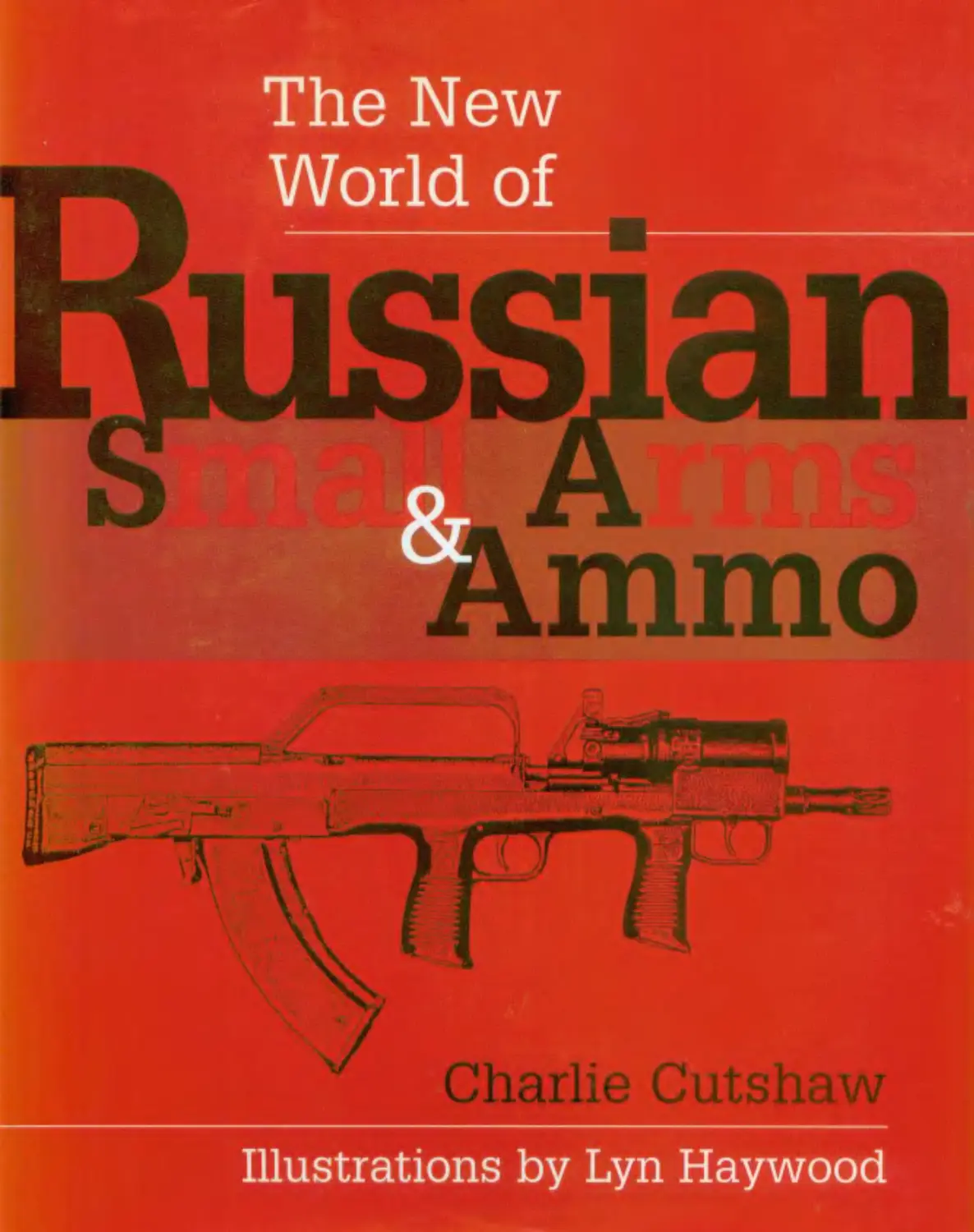


Author: Cutshaw C.
Tags: small arms military science military weapons
ISBN: 0-87364-993-1
Year: 1998



Text
                    The New
World of
--------
Kussian
Г Ammo
Illustrations by Lyn Haywood
ЖЖ hen Russian
Жж Ш arms come to mind,
Ж Ж Ш one usually thinks of
1 ЖЖ the ubiquitous
ЖР IV Kalashnikov AK-47 or
one of its successors that have been the
mainstay of Soviet and Russian small
arms since 1949. Until recently, if one's
interest went beyond SKS carbines, AK-
type assault rifles, certain machine
guns, and pistols such as the TT-33, PM
Makarov, and APS Stechkin, little else
was known. There was no information
available in the West regarding new
and developmental firearms, much less
details on the latest ammunition both in
traditional and new calibers.
With the demise of the Soviet
Union, however, information began to
trickle out to a small cadre of intelli-
gence and defense analysts. It soon
became obvious that Russian small
arms designers had not been idle under
Soviet rule, but had developed, and in
several instances fielded, some of the
most innovative small arms and
accompanying ammo in history: under-
water weapons; weapons that used
silent ammunition; unknown families
of submachine guns, pistols, and
revolvers that demonstrated truly
advanced thinking and design; and
revolutionary new assault rifles, one of
which appears destined to replace the
Kalashnikov.
Several of these innovative
weapons have been in Soviet military
service since the early 1970s, complete-
ly unknown to the West or any of its
intelligence sendees. At least one was
actually used operationally in
Afghanistan and Central America. The
lack of knowledge concerning these
weapons should come as no great sur-
prise, as most of them were designed
for use by special-operations forces—
SPETsNAZ—whose use of them was
understandably kept classified.
Little has been written about these
remarkable new weapons outside the
military small-arms community—until
now. the New World of Russian Small
Arms and Ammo throws open the doors
on Russia's small-arms arsenals to all
those aficionados who've been dying to
get their hands on these weapons.
The New
Ammo
The New
Ammo
Charlie Cutshaw
Illustrations by Lyn Haywood
Paladin Press  Boulder, Colorado
Copyright © 1998 by Charlie Cutshaw
ISBN 0-87364-993-1
Printed in the United States of America
Published by Paladin Press, a division of
Paladin Enterprises, Inc., P.O. Box 1307,
Boulder, Colorado 80306, USA.
(303) 443-7250
PALADIN, PALADIN PRESS, and the “horse head” design
are trademarks belonging to Paladin Enterprises and
registered in United States Patent and Trademark Office.
г
л
CONTENTS
INTRODUCTION • 1
CHAPTER ON	E • 5
RIFLES
AN-94 Assault Rifle
Tula KBP 7.62x39mm A-91M Bullpup Assault Rifle
Kalashnikov AK-100 Series and Other Kalashnikov Derivatives
OTs-14 Groza (Thunderstorm)
SVD, SVDS, and SVU Dragunov Systems
AS Vai (Rampart) Silent Assault Rifle and the VSS Vintorez (Thread Cutter) Silent Sniper Rifle
VSK-94 Sniper Rifle
A-91 Compact Assault Rifle
MA Vikhr (Whirlwind) Compact Assault Rifle
APS Underwater Assault Rifle
12.7x108mm V-94 and OSV-96 Heavy Sniper Rifles
6mm “Unified” Assault Rifle and Machine Gun
CHAPTER TW	O • 49
PISTOLS AND REVOLVERS
Pistolet Makarovka and Its Derivatives
PSM “Miniature Self-Loading Pistol”
Baikal 441 Compact Pistol
Д The New WoriLd of Russian Small Arms and Ammo
Baikal 442 Pistol
9x21mm Gurza (Viper) Pistol
7.62x42mm PSS Silent Pistol
7.62x35mm MSP Silent Pistol
7.62x62.8mm S4M Silent Pistol
OTs-21 Malysh (Fly) 9x18mm Pistol
OTs-27 Berdysh (Poleax) Pistol
5.45x18mm OTs-23 Drotik (Javelin) Pistol
OTs-33 Pemach Pistol
5.45x18mm Drel (Drill) Pistol
P-96 9x19mm Pistol
9x18mm OTs-Ol KobaltlRevolver Stechkina Avramova (RSA)
9x18mm R-92/R-92KS Revolver
12.3mm Udar (Blow) Large-Caliber Revolver (Versions 1 and 2)
OTs-20 Gnom (Gnome) 12.5x40Rmm Revolver
4.5x39mm SPP-1/SPP-1M Underwater Pistol
CHAPTER TH	REE • 85
SUBMACHINE GUNS
A-9 and A-7.62 Submachine Guns
AEK-919 and AEK-919K Kashtan (Chestnut)
Baksan (aka “Bucksun”)
Bizon (Bison), Bizon-2, and Bizon-3
Gepard (Cheetah)
PP-91 Kedr (Cedar) and Klin (Wedge)
OTs-02/PP-891 Kiparis (Cypress)
OTs-22 Submachine Gun
PP-90/PP-90M/PP-90M1 9xl8mm/9xl9mm Submachine Gun
PP-93 9x18mm Submachine Gun
CHAPTER FO	UR ’ 109
TACTICAL SHOTGUNS
KS-23/KS-23M “Special Carbine”
RM/RMB-93/94/96 Tactical Shotgun
Saiga-12 (Steppe Antelope) and Saiga-20 Tactical Shotguns
CHAPTER FI	VE • 117
GRENADE LAUNCHERS
AGS-30 Automatic Grenade Launcher
DP-61 “Antisaboteur Rocket Grenade Launcher”
Contents И
DP-64 Nepryadva Antisaboteur Grenade Launcher
GP-25/GP-30 Underbarrel Grenade Launchers
GP-95/GP-97 Grenade Launcher
RG-6 Grenade Launcher
GM-94 Magazine Grenade Launcher
BS-l/RGA-86 Silent Grenade Launcher
CHAPTER SI	X • 131
AMMUNITION
4.5x39Rmm SPS Underwater Pistol Cartridge
5.45x18mm MPTs (7N7) Cartridge
5.45x39mm Cartridge
5.66x39mm MPS Underwater Rifle Cartridge
6x49mm and 6x53mm Cartridges
7.62x35mm, 7.62x42mm, and 7.62x62.8mm Silent Cartridges
7.62x39mm Ml943 Cartridge
7.62x54Rmm Cartridge
9x18mm Makarov, PMM, and SP-8
9x21mm Russian
9x3 Omm Grom (Thunder)
9x39mm SP-5 and SP-6
12.3x50Rmm, 12.3x46Rmm, 12.3x40Rmm, 12.3x22Rmm, and 12.5x50Rmm Cartridges
When Russian small arms come to mind, one usually
thinks of the ubiquitous Kalashnikov AK-47 or one
of its successors that have been the mainstay of
Soviet and Russian small arms since 1949. In recent years,
especially in the United States, millions of Simonov (SKS)
carbines have been sold commercially, and the little rifle is
familiar to anyone who reads the firearms press. If one’s
interest went beyond SKS carbines, AK-type assault rifles,
certain machine guns, and such pistols as the TT-33, PM
Makarov, and APS Stechkin, little else was known. There was
nothing available in the West regarding new and developmen-
tal firearms, much less details on new ammunition both in
traditional and new calibers.
With the demise of the Soviet Union, however, things
changed. It soon became obvious that Russian small-arms
designers had not been idle under Soviet rule, but had devel-
oped, and in several instances fielded, some of the most inno-
vative small arms in history. Included were underwater
weapons; weapons that used silent ammunition; unknown
families of submachine guns, pistols, and revolvers that
demonstrated truly advanced thinking and design; plus innov-
ative new assault rifles, one of which appears destined to
replace the Kalashnikov in Russian service. During the same
period, Russian designers also developed a variety of new
types of ammunition to accompany their weapons.
The New World ,of Russian Small Arms and Ammo
What is remarkable is that several of these innovative weapons have been in
Soviet military service since the early 1970s, completely unknown to the West or
any of its intelligence services. One, at least, was actually used operationally in
Afghanistan and Central America. Why this never came to light will become appar-
ent to the reader upon perusal of the section on that peculiar weapon. The lack of
knowledge concerning these weapons should come as no great surprise, as most of
them were designed for use by special operations forces—SPETsNAZ, or special
direction forces—whose use of them was understandably kept classified so that
Western adversaries would be kept unaware of their potential opponents’ armament.
Despite their secrecy, there were usually hints in the West of new Soviet weapons
development, but the existence of these remarkable small arms was successfully
kept under wraps until the Russians chose to release information on them to sell
them overseas to raise capital. Even so, there is still a sense of secrecy on the part of
the Russian arms industry. For example, as of this writing, certain aspects of the
new AN-94 assault rifle are still classified as state secrets, although the rifle has
been seen and examined by several Westerners. The same is true with many of the
other weapons described in this book; although the Russian small-arms industry
desperately needs capital, its members are reluctant to divulge any more information
than absolutely necessary to members of the press, authors, or visitors from Western
small-arms manufacturers. The reader will, therefore, find a plethora of information
on some weapons, but little more than brief outlines on others.
It is also difficult to differentiate between weapons that are merely prototypes
or “trial balloons” for potential joint projects with Western manufacturers and
weapons that are actually in service with Russian military or interior ministry
forces. When asked, representatives of Russian arms makers will almost invariably
state that the firearm in question is in use by the army or Ministry of Internal
Affairs (MVD) or SPETsNAZ, yet personnel of these organizations may never be
observed with them. This does not mean that a weapon in question is not in use as
claimed; only that it has never been observed. Nonetheless, true confirmation of use
comes only when a weapon is actually observed in the hands of operational forces. I
will make every attempt in this volume to differentiate and categorize weapons.
New weapons are the subject of this book, although I will discuss the latest
and probably final Russian versions of the venerable Kalashnikov series assault
rifles. The Russian military’s new assault rifle, the AN-94, has created a great deal
of interest in the West, but little has been written about it outside the military
small-arms community. This significant new weapon will be covered in as much
detail as possible. I will also discuss several prototype weapons that never entered
production, but which are important for the contribution they made to overall
weapons design. The final portion of this book will cover Russian ammunition
developments, which are every bit as fascinating and innovative as the firearms
that use them.
A book such as this one is the product of many people besides the author
whose name appears on the title page. First, I must thank Dave Markov, who first
suggested the project and who provided much of the data that made this book possi-
ble. I also wish to thank my friend and colleague Valery Shilin without whose assis-
Introduction
tance this book would never have been written. I also owe a deep debt to Cookie
Sewell and Les Grau, who willingly translated many Russian-language documents
for me at no cost. Again, I couldn’t have done this without these gentlemen. Maj.
Marc Moo Sang of the Canadian army is yet another without whose assistance this
book would not have been possible. I owe Col. Rex Applegate a word of thanks for
encouraging the project and using his good offices to help get the book published.
Don Wood is yet another gentleman whose generous assistance made this book pos-
sible. My friend and colleague Terry Gander also gave inestimable help. I’d also like
to thank my editor at Paladin, Donna Du Vail, whose efforts and competence made
the publication process painless for me. (I suspect that it was not so for her.) And
finally, I must thank my wife, Dianne, whose encouragement and confidence in my
abilities made possible not only this book but everything else.
RIFLES
AN-94 ASSAULT RIFLE
In 1993, a mysterious new assault rifle appeared at an arms
display at the elite Taman Guards Division outside
Moscow. The strange new rifle was displayed alongside the
common AK-74 assault rifles and RPK-74 light machine guns
that made up the standard light-weapons armament of the divi-
sion and was labeled “ASN,” which was subsequently learned
to be a Russian abbreviation for Avtomat Spetsialnyi Nikonov.
Soldiers at the show could give no meaningful informa-
tion on the weapon other than the basic data on the placard
above the rifle displayed on the table. Shortly thereafter, more
information began to emerge regarding the ASN, indicating
that it was a developmental advanced combat rifle in the true
sense of the word, but its official status remained a mystery.
The Russian Ministry of Defense cleared up the mystery in
1996, however, by announcing that the ASN had passed all its
troop trials and had officially been type-classified as the
Avtomat Nikonova-94 (AN-94), named for the head of the
team that designed it, Gennady Nikonov. The number 94 indi-
cates the year that the rifle was officially type-classified and
adopted for military service to eventually replace the AK-
47/АКМ/AK-74 series rifles.
Rumors from Russia had it that the “grand old man” of
 The New World of Russian Small Arms and Ammo
Russian small arms, Mikhail Kalashnikov, was not pleased by the new rifle, espe-
cially since a design team headed by his son had been contending for the honor of
designing Russia’s next assault rifle. Nonetheless, as time passed, it was clear that
The 5.45mm ASN.
This 1980s design
the AN-94 would almost certainly be the next Russian combat rifle, Kalashnikov’s
protestations notwithstanding.
The genesis of the AN-94 actually begins with the adoption of the AK-74 more
than 20 years ago. At the time, the 5.45x39mm cartridge of the AK-74 was tacit
acknowledgment by the Soviet military of the combat effectiveness of small-caliber
high-velocity projectiles at normal battlefield ranges that had been proven in Vietnam
by the 5.56x45mm M16A1. The new cartridge was derived from the M1943
7.62x39mm cartridge. Although the 5.45mm’s terminal effects were sufficiently
lethal to earn it the nickname “the poison bullet” by the Mujahideen in Afghanistan,
the Soviet military was not completely satisfied with the overall performance of the
AK-74. The military had probably concluded that the AK-74 effectively represented
the end of the practical development life of the Kalashnikov assault rifle design and
that a new rifle would be necessary by the turn of the century.
The primary requirement of a new rifle was that it would achieve a probability
of hit (or effectiveness) of 1.5 to 2.0 times that of the AK-74. The military had also
apparently felt that a reduction in recoil was necessary to improve hit probability—
ironically, a consideration in light of the fact that reducing recoil and improving
control and hit probability had been part of the reason for the development of the
AK-74. The AK-74 had reduced recoil in comparison with the older 7.62x39mm
AK-47s and AKMs, but the reduction was due to the ammunition change and, to a
lesser extent, the extremely effective AK-74 compensator/flash suppressor design.
However, the reduction was considered inadequate, and a program was initiated to
develop a new, advanced-technology assault rifle to replace the entire Kalashnikov
family. In addition to increased effectiveness and reduced recoil, the new rifle would
also have to meet stringent increased reliability requirements.
The development program was nicknamed Abakan for a village in Siberia
where a great deal of the testing of the candidate rifles was conducted. This led to
the AN-94’s being mistakenly called Abakan when it was first observed in the
hands of Russian troops several years ago. Abakan was also used by the Russians
as a generic term for all rifles that were competing to be the next Russian combat
rifle, further confusing the issue. According to Gennady Nikonov, designer of the
AN-94, every official Soviet firearms designer submitted a candidate for consider-
the latter completed
Rifles Д
ment program oerore me automatic (ririe)
system Nikonova (ASN) was eventually selected and type-classified as the AN-94.
Interestingly, in 1992 the usually plain-spoken Mikhail Kalashnikov refused
to comment on the ASN, then undergoing troop trials. He was quoted as saying, “I
don’t feel I am entitled to give an assessment of the new product.” Kalashnikov
went on to state that his son Viktor had a design in the Abakan competition, hence
his reluctance to comment. The senior Kalashnikov’s reluctance to comment appar-
ently disappeared after Viktor’s candidate lost. No direct quotes have been made
public, but informal information from Russia was to the effect that the elder
Kalashnikov was furious that his son’s rifle had lost and that Kalashnikov senior
did everything in his power to reverse the decision. It is thus apparent that the
Kalashnikov design was a “loser” in the competition, especially given
Kalashnikov’s protestations about adoption of the AN-94. Viktor Kalashnikov’s
design has yet to be made public.
As of early 1998, the AN-94 was in limited production at the Izmash Joint
Stock Company and is truly a complete departure from earlier Soviet/Russian
designs. For that matter, it can truly be stated that the AN-94 is unique. The
weapon shares only five components with the AK-74: the magazine, folding stock
hinge, pistol grip, optical sight base, and cleaning kit. Full production of the AN-
94 has been delayed by lack of funds and perhaps by political efforts of Mikhail
Kalashnikov to have his son’s rifle replace the AN-94. Despite Kalashnikov’s
efforts, authoritative Russian sources have stated that the AN-94 will eventually
enter Russian military service and replace the AK series. The AN-94 can essential-
ly be considered as a Russian version of the U.S. advanced combat rifle—perhaps
even the objective individual combat weapon without all the bells and whistles of
the latter. This becomes apparent when the capabilities of the AN-94 are compared
with any other combat rifle in the world, either in service or in development.
It is possible that the Kalashnikov-derived 6x49mm rifle and machine gun,
which were shown by the Precision Mechanical Engineering Central Research
Institute (TsNIITochmash) at numerous international arms shows in the mid-1990s
for potential joint production with overseas partners, were among the losers in the
Д The New World of Russian Small Arms and Ammo
Abakan competition. Losing in the Abakan competition was probably due to the
Kalashnikov weapons’ being no better in performance than the AN-94 and their
having to use a new cartridge to achieve their proclaimed superiority.
Although the Kalashnikov derivatives would have led to simplified training
because of their being based on existing designs, they would have placed a tremen-
dous, probably unacceptable, demand on an ammunition program that already has
three rifle and light/general-purpose machine gun calibers. The advantage of the
AN-94 over the Kalashnikov designs is that it achieves the same or better perfor-
mance while simplifying logistics by using existing ammunition, not to mention
claimed AN-94 reliability improvements over the Kalashnikov rifles. Moreover, the
capabilities and overall design of the AN-94 indicate that the Russian military has
undergone a change in its small-unit tactical thinking, as will be elaborated upon.
Construction methods of the AN-94 were likely another reason for its adop-
tion over its competitors. Unlike the Kalashnikov designs, the AN-94 is a far more
modern rifle, using state-of-the-art manufacturing techniques. The AN-94’s furni-
ture is completely manufactured of polymer, as is that of the AK-100 series, but
there the similarity between the two weapons ends. What appears to be a gas tube
beneath the barrel of the AN-94 is actually a fixed rod extending from the stock
group. This rod incorporates a guide for the rifle’s firing unit (barrel-receiver
assembly) at the front and a dual-purpose stud at its center. One purpose of the
stud is to stabilize the rifle when it is being fired in fully automatic mode. The bar-
rel and gas tube of any fully automatic firearm tend to resonate, and the stud coun-
ters this tendency, thereby increasing accuracy. A second purpose of the stud is to
prevent the rifle from sliding out of place while it is engaged in the firing port of
an infantry fighting vehicle. The actual gas cylinder of the AN-94 is located above
the barrel and underneath the handguard and is quite short. The reason for this will
become apparent as I discuss the functioning of the AN-94.
The entire operating mechanism of the AN-94 is inside the stock, referred to
in Russian documents as a “carrier-stock.” The reason for this is that the barrel and
Rifles Д
receiver are integrated into a firing unit that reciprocates on guide rails inside the
stock. The bolt carrier and bolt are carried by and operate inside the rifle’s internal
receiver. The AN-94 has two internal buffers, one in the forearm and another in the
rear of the receiver. The forearm buffer not only absorbs shock, but also accelerates
return travel of the firing unit as it moves forward in counterrecoil. The rear buffer
boosts forward acceleration of the bolt carrier and also prevents the receiver-firing
unit from striking the rear of the stock as it recoils. The magazine, which is inter-
changeable with those of the AK-74 and RPK-74, is offset to the right and inserted
at a slight angle.
One of the key principles of the AN-94’s operation is referred to as a blow-
back shifted pulse, or BBSP. This stems from the fact that the receiver-barrel
assembly reciprocates independently from the bolt and its carrier, although the lat-
ter reciprocate in the receiver-barrel assembly. A simplified functional explanation
of the two-round burst feature of the AN-94 will clarify the BBSP principle.
When the first round is fired, the entire barrel-receiver assembly begins mov-
ing to the rear under recoil forces, taking the bolt carrier with it and compressing
the forward buffer. The bolt is still locked to the barrel at this point. As the bullet
passes the gas port, gas is bled off into the gas cylinder, driving the bolt carrier to
the rear inside the receiver-barrel assembly, and at the same time unlocking the
bolt and extracting and ejecting the spent cartridge case. The bolt carrier is moving
much faster than the barrel-receiver assembly and strikes against the rear buffer,
which in conjunction with the return spring propels it forward, temporarily inacti-
vating the sear while stripping a fresh round from the magazine and chambering it.
As the bolt locks, the sear is released and the second round is fired before the
receiver completes its rearward motion. In essence, the first two bullets have left
the barrel of the rifle while the receiver is still moving to the rear and has not had a
chance to hit the rear buffer. The cyclic rate of this two-round burst feature is 1,800
rounds per minute (RPM). As can be seen, the AN-94 is both gas and recoil operat-
ed. Although this complex yet robust BBSP system is not all that makes the AN-94
unique, it is the central principle that makes the dual cyclic rate possible, and this
capability is in turn what gives the AN-94 its remarkable performance improve-
ments over all currently produced assault rifles.
The functioning of the AN-94 is unique. When set for fully automatic fire,
the first two rounds out of the AN-94’s barrel will always be at the “high” rate of
1,800 RPM, so fast that the bullets will be on their way downrange before the rifle
has a chance to recoil in the shooter’s hands, thereby increasing the probability of a
hit over the entire effective range of the rifle. Once the first two rounds are on their
way, the rifle automatically cycles down to 600 RPM. When the trigger is released,
the mechanism resets for 1,800-RPM two-round burst fire.
To say that the AN-94 is “different” from any currently produced combat rifle
in the world is an understatement. Not only are the capabilities unique, but so is
the method used to achieve them.
The AN-94’s functioning can best be understood in the context of the small
arms cycle of operation. It is difficult to describe the functioning of a firearm
without having examined it; the technical description of the AN-94’s functioning is
Д The New World of Russian Small Arms and Ammo
based solely on data provided to me by its manufacturer and is subject to my judg-
ment in interpreting them. When and if an actual AN-94 is placed in my hands for
examination, the following description may have to be revised. Because of length
considerations, only the fully automatic cycle of the AN-94 will be described,
because this captures all of the rifle’s unique operating features.
Firing the AN-94
To fire, the (separate) safety is set on O, or ogon (fire in Russian), and the
selector switch is set to AB, an abbreviation for avtomatichesky (automatic). This
shifts the disconnector into contact with one of the shoulders of the trigger plate.
Feeding and Chambering
The operator pulls the operating handle to the rear. As he does so, a mecha-
nism consisting of a pulley and cable carries out preliminary feeding, stripping a
round from the magazine and placing it in line with the bolt. This operation occurs
each time the bolt carrier moves to the rear. It is essentially a “half-loading” of the
rifle. The cable assembly also limits rearward travel of the bolt carrier, preventing
it from overrunning the magazine. When the operating handle is released, pressure
of the return spring and rear buffer drive the bolt carrier forward, ramming the car-
tridge into the chamber. As can be seen, feeding is a two-stage process, although
the operating handle is pulled to the rear only once.
Firing, First Round
Pulling the trigger moves the trigger plate on its axis, releasing the sear,
which in turn releases the striker and fires the cartridge.
Unlocking, First Round
Driven by recoil, the barrel-receiver assembly (firing unit) moves to the rear
on its guide rails inside the carrier-stock and begins to compress the forward
buffer. The bullet passes the gas port, allowing gas into the cylinder, pressing
against the gas piston and driving the bolt carrier to the rear inside the moving
receiver. The bolt is cammed by the carrier to turn and unlock from the barrel
extension. Again, it should be noted that the barrel-receiver unit is moving to the
rear as this operation takes place.
Extracting, First Round
As the bolt continues to the rear, it pulls the spent cartridge case from the
rifle chamber.
Ejecting, First Round
As the spent cartridge case clears the base of the chamber, it is thrown clear
of the rifle out the ejection port.
Second Round, Feeding, Chambering, and Locking
As the bolt carrier and striker reach their rearmost position, the return spring
10
Rifles Д
and buffer press them back forward to complete feeding and then chamber and
lock the second round for firing at the high cyclic rate. The barrel-receiver is still
moving to the rear. Since this unit is further to the rear than when the first round
was fired, the second cartridge has a shorter distance to travel from the magazine
to the chamber, thereby assisting in achieving the 1,800-RPM rate of fire. This
action is further assisted by the “pre-feeding” of each cartridge as the bolt carrier
moves to the rear. As the barrel-receiver unit moves to the rear, the sear is tem-
porarily deactivated and the striker freed to fire the second cartridge. Whether the
striker follows the bolt forward or is released by the sear as the bolt locks is not
clear at the time of this writing. Regardless, the second round fires while the bar-
rel-receiver assembly is still moving rearward. This completes the high cyclic rate.
Third Round, Low Rate
The bolt carrier and bolt again begin to move rearward, driven by gas from
the second cartridge. The sear is retained by the trigger plate. The disconnector and
trigger plate return to their original positions. The rear buffer and return spring
drive the bolt carrier forward again, ramming a preloaded round into the chamber.
The barrel-receiver unit is driven forward by the buffers and the return spring. The
disconnector moves forward with the barrel-receiver unit after the third round is
chambered and the rifle locked, releasing the striker and firing the rifle. Further
details of the operation of the AN-94 have not been released by the manufacturer.
Izmash, the Russian manufacturer of the AN-94, claims that the probability
of a first-shot hit with the AN-94 is 1.5 to 1.7 times better than the AK-74 by actu-
al troop tests in combat units. Russian sources have also stated that the overall effi-
ciency of the AN-94 is “twice that of the AK-74 and 50 percent greater than the
American M16.” Whether the M16 referred to was the M16A1 or M16A2 is not
clear; the M16A2 is a significant improvement over its predecessor in terms of
overall performance. Regardless, it is clear that the AN-94 has achieved the design
requirements of the Russian military.
The AN-94 can be equipped with an optical sight, the familiar 1L29 4x opti-
cal sight used on the AK-74, RPK-74, and PKM weapons for
Д The New Worlp of Russian Small Arms and Ammo
adjusting aimed fire. According to Russian sources, the AN-94 is sighted out to
1,000 meters, but increments of sight adjustment are unknown at the time of this
writing, and 1,000-meter accuracy and effectiveness of the 7N6 52.5-grain or 7N10
55.5-grain bullets are questionable at best. The “canted drum” diopter rear sight is
similar in concept to that used by Heckler & Koch, among others. Each aperture is
clearly marked on top with its sighted range, and a quick twist by the rifleman allows
him to change his range almost instantly, even when wearing gloves or trigger-finger
mittens. The disadvantage of the AN-94 system is the inability to make precise
changes in elevation, as can be done with M16A2 sights, but the AN-94 sights are
well suited for use on a combat rifle. Windage is changed by moving the front sight
side to side.
In addition to using the same optics as other Russian weapons, the AN-94
also accommodates the GP-25/GP-30 40mm underbarrel grenade launcher. The
bayonet for the AN-94 is similar to older designs, but those seen lack the “saw-
back” feature of earlier bayonets, and the point is tapered. The AN-94 bayonet
retains the wire-cutting ability of earlier bayonets. Unlike older bayonets, however,
the AN-94 bayonet mounts on the right side of the barrel, rather than underneath.
The AN-94 probably reflects a change in Russian infantry tactical thinking.
(Russian sources have informally confirmed this fact in personal conversations, but
there has been no official announcement, so I have retained the word probably in
the text.)
There are a number of features of the AN-94 that support this notion. The
burst-fire feature and emphasis on accuracy are clear indicators that accurate
aimed fire has worked its way into Russian military thinking. All AK-series
weapons place an emphasis on full-automatic capability because massed automatic
fire was paramount in Soviet infantry tactics at the time of the AK’s design in the
late 1940s. Accurate aimed fire was a secondary consideration. The AN-94’s
adjustable, relatively sophisticated, open sights are also a clear indication of a
departure in Russian tactical small-arms thinking. Unlike the rudimentary “notch”
sights of the AK-series weapons, the open sights of the AN-94 are, as described
above, much more sophisticated, lending to accurate placement of fire on the tar-
get. Finally, the 1,800-RPM, two-round burst feature of the AN-94 is specifically
intended to raise the probability of a hit and increase the effective range of the
rifle. These requirements are the antithesis of fully automatic massed fire, which
achieves hits by sheer numbers of rounds fired toward the target.
According to Russian sources, the AN-94 is disassembled by “traditional
methods,” but reliability and maintenance are claimed to be greatly improved over
even the latest versions of the AK-series weapons by the aforementioned use of
modem materials and production processes. It is difficult to imagine that AK relia-
bility could be improved upon, given the reputation of the Kalashnikov weapons
for ruggedness, but the Russians claim that the AN-94’s mean number of rounds
between failure is 40,000, a 150 percent improvement over the AK-74!
In sum, Gennady Nikonov has apparently designed a thoroughly modern
replacement for the venerable Kalashnikov series of assault rifles, which have
dominated not only Soviet/Russian but also the world’s military small-arms market
Rifles Д
for nearly 50 years. There are other significant military rifles, but none can com-
pare to the AK series in terms of either numbers, technical qualities, or historical
influence. Since the introduction of the AK-47 in 1949, there have been some 50
million AK-type weapons manufactured worldwide. The AK defined the term
assault rifle and has seen action in virtually every war since the early 1950s. It has
even been used on a limited basis by some U.S. military forces. The Kalashnikov
continues today as the AK-100 series, which will be discussed in a separate section
of this book. These latest versions of the AK design are available in not only tradi-
tional Russian chamberings, but in North Atlantic Treaty Organization (NATO) cal-
ibers as well. So the AN-94 will never totally supplant its predecessor, at least not
for many years. The Russians have wisely begun to replace their basic infantry
weapon while the earlier design is still viable; it will take many years to completely
replace the AK inventory in the Russian military, and the AK will therefore remain
a viable combat rifle well into the 21st century.
AN-94 SPECIFICATIONS
Caliber
Operation
Weight
Length, Stock Extended
Stock Folded
Barrel Length
Effective Range
Cyclic Rate
Magazine Capacity
Sights
5.45x39mm
Gas, Select Fire
8.47 lbs. (3.8 kg.)
37.1 in. (943mm)
28.6 in. (728mm)
15.9 in. (405mm)
600 m.
1,800 & 600 RPM
30 & 45 Rounds
Front, Blade; Rear, Aperture, Adjustable
13
Д The New World of Russian Small Arms and Ammo
TULA KBP 7.62X39mm A-91M BULLPUP ASSAULT RIFLE
A real surprise came in early 1998 when Tula Instrument Design Bureau
(KBP) announced that it had a new assault rifle available for production. In discus-
sions with me, Tula representatives were reluctant to discuss details regarding the
rifle, other than the fact that it is not actually in full production. Nonetheless, the
A-91M is a very innovative new rifle that appears to be among the best of the new
bullpup rifles that many firearms manufacturers are currently producing. Many of
these rifles are based on the Kalashnikov, e.g., the recently announced South
African CR-21, the Armenian K-3, the Chinese Type 86, and the Tula OTs-14
Groza. Despite grandiose claims, all these rifles are in essence no more than
Kalashnikov “spinoffs” modified to bullpup configuration.
The A-91, however, is quite different from any other bullpup, despite its being
manufactured by the same Russian firm that produces the OTs-14 Groza, a
Kalashnikov derivative. At first, the A-91M itself appears to be just another
Kalashnikov modified into bullpup configuration, but upon examination, it
becomes clear that this is not just another Kalashnikov in bullpup clothing. There
is no apparent ejection port, just a small oval hole at the right rear of the carrying
handle. This small aperture is indeed the ejection port: spent cases are ejected for-
ward, not to the side as in more conventional firearms. Other than that small aper-
ture, the receiver is completely sealed once the magazine is inserted. The flash sup-
pressor is a Western style “birdcage,” rather than the unusual suppressors usually
seen on Russian firearms. It is also clear that the gas system is different from that
of the Kalashnikov. All furniture is polymer. The nonreciprocating charging handle
is located at the left front of the carrying handle and can be pivoted up or down by
the shooter. The selector lever is located in the traditional Kalashnikov position,
but given the fact that the A-91M is claimed to be fully ambidextrous, there is
with the GP-97.
The 7.62x39mmA-
91M with long flash
hider and steel maga-
zine. Note that the
probably a mirror image selector on the left side of the receiver. The rifle is
14
Rifles Д
of the shooter to control the rifle
when firing fully automatic. The only component from the Kalashnikov that
appears to be shared by the A-91M is the magazine.
Although the new rifle is designated A-91 M, indicating that it is derived from
the A-91 compact assault rifle, the functioning and design of the A-91M appear to
be either completely different from the A-91 or very extensively modified in the
transition from the original rifle’s conventional configuration to a bullpup design. It
should be noted, for example, that the A-91 is a conventional gas-operated rifle that
ejects to the right from a conventional ejection port and has a reciprocating charg-
ing handle, while the A-91M functions in quite a different fashion. Because it only
recently came to light and there is presently a lack of information regarding it, a
full explanation of the role and detailed technical aspects of the A-91M rifle will
have to wait. Perhaps it was a loser in the Abakan competition, which resulted in
the AN-94. Whatever, the A-91M appears to be a well-executed and fully devel-
oped system.
The A-91M’s barrel-mounted grenade launcher is designated the GP-97, and it
appears to be an upside-down-mounted GP-95 (see Chapter 5), but this has yet to be
confirmed. The GP-97 probably mounts onto the rings visible midway between the
rear of the flash suppressor and the fore-end. The GP-97’s trigger mechanism is
ergonomically positioned so that the trigger finger of the support hand can easily
access it. The GP-97 fires standard VOG-25 and VOG-25P 40mm grenades. The
flash suppressor of the A-91M will also accept muzzle-launched projected grenades.
Whether the muzzle is standard NATO 22mm diameter has not been stated.
Why Tula chose to retain the 7.62x39mm cartridge rather than chambering the
new rifle in 5.45x39mm, 9x39mm, or even 5.56x45mm as it has done with other
rifles is another mystery, particularly considering the Russian military’s desire to
reduce recoil. Any rifle chambered for the 7.62x39mm cartridge can easily be con-
Д The New World of Russian Small Arms and Ammo
verted to fire any of the others mentioned. If Tula is serious about marketing this
innovative rifle, it will be chambered in alternative calibers in the very near future.
A-91M SPECIFICATIONS
Caliber
Operation
Weight
Length
Barrel Length
Effective Range
Cyclic Rate
Magazine Capacity
Sights
7.62x39mm
Gas, Select Fire
6.6 lbs. (3 kg.)
23.4 in. (595mm)
15.7 in. (400mm)
800 m.
600-800 RPM
30 Rounds
Front, Protected Blade; Rear, Protected
Notch (Estimate)
Rifles Д
KALASHNIKOVAK-100 SERIESAND
OTHER KALASHNIKOV DERIVATIVES
Background
Although the subject of this book is new Russian small arms, the Kalashnikov
AK-100 weapons are included because they are relatively unknown in the West and
because they are actually new versions with significant changes from their prede-
cessors. But before we delve into the subject, it is appropriate to briefly examine the
history of the AK weapons family, setting aside a few myths and misconceptions
surrounding the weapons.
Mikhail Timofeyevich Kalashnikov is reputed to have designed the AK-47
while recuperating from battle wounds. Although this story certainly adds to the
Kalashnikov mystique, it is false. Kalashnikov was wounded in 1941 and while
recuperating did dream of Soviet troops armed with thousands of submachine guns
attacking the hated Germans. After his release from the hospital, Kalashnikov was
sent to work in a political office. It was here that he designed his first weapon, a
submachine gun designed around the TT-33 cartridge. Kalashnikov got the design
as far as trial production, but his 1942 submachine gun was not adopted by the
Soviet military. What it did get him was the attention of very influential people in
the Soviet small-arms industry, who recognized his talent and ensured that he was
first properly trained in weapons design and then put to work to exploit his innate
genius. Kalashnikov was given the project of designing an avtomat, or assault rifle,
in 7.62x39mm, a cartridge that had already been adopted by the Soviet military as
the Ml943. The Russians had been very impressed by the German Sturmgewehr
(MP43/MP44/StuG44) designs and began working to improve them and adapt
them to their own military doctrine. This was the project that was given to the
young Kalashnikov.
In typical Russian fashion, Kalashnikov was only one of several designers
working on the avtomat project. Besides Kalashnikov, several other noted Soviet
small-arms designers, including Simonov (designer of the SKS) and Sudayev
(who designed the PPs43 submachine gun) were competing for the honor of hav-
ing their design accepted into service. Compared to these men, young
Kalashnikov was a “Johnny come lately,” and Sudayev’s candidate weapon was
considered at the time to have the best chance for adoption, as he had prototypes
under test as early as 1944.
Testing of Kalashnikov’s design did not begin until 1946, but it was so clear-
ly superior in early evaluations that it immediately got attention at the highest lev-
els of the Soviet military. Continued testing revealed some problems, but these
were overcome, and Kalashnikov’s design was type-classified in 1947. Sudayev’s
design was not totally rejected, however. The final AK used the magazine from
Sudayev’s candidate rifle. Despite its designation of AK-47, the AK did not for-
mally enter service until 1949. This original AK-47 is referred in the West as the
Type I AK-47. It has a stamped sheet-metal receiver with machined internal com-
ponents held together by rivets. In service, however, this weapon unexpectedly
turned out to be unreliable. The receiver reportedly developed cracks, and the riv-
17
Д The New World of Russian Small Arms and Ammo
ets came loose; the weapon literally shook itself to pieces when fired extensively.
Kalashnikov quickly designed a new machined receiver, which became known in
the West as the Type IIAK-47.
The Type II AK-47 began the legendary AK’s reputation for reliability, but
the rifle was extremely costly and laborious to produce. The Type II receiver began
as a 2.6-kilogram (5.72-pound) block of solid steel; 120 machining operations
later, it emerged as a 645-gram (1.4-pound) AK-47 receiver! The production
process for the Type II AK-47 was so inefficient that it was unacceptable even to
the Soviets. This inefficiency and cost led to the development of more efficient
production methods, resulting in the definitive AK-47, known in the West as the
Type III. The detailed differences between the varying types of AK-47 are beyond
the scope of this book. If the reader is curious about the detailed history of
Kalashnikov weapons and seeks more detail on the many different types, there are
several excellent books on the subject.
The intermediate version of the AK assault rifle family is the AKM (Avtomat
Kalashnikova Modernizirovanniyi), which marked the return to a stamped receiver.
The new design was far more complex than the original AK-47 stamped receiver
and required many operations to complete, but it reduced both production costs
and weapon weight over that of the Type III AK-47, with no sacrifice in reliability,
and was adopted as the AKM in 1959. The AKM also incorporated a muzzle com-
pensator to offset muzzle rise on full-automatic fire, modifications to the receiver
cover, and a new bayonet.
The final AK weapon prior to the AK-100 series was the AK-74, which was
developed to reduce recoil and increase accuracy. The development of this weapon
has already been discussed in the section on the AN-94.
General
The new generation of Kalashnikov rifles is designated AK-74M and AK-
101 through AK-105. These weapons will be discussed in further detail below.
The question arises, however, as to why the Russians have taken up new designa-
tions for their rifles. The designation was not arbitrary. First, all of the new gen-
eration of Kalashnikov rifles have a folding buttstock. (The short folding stock
version of the AK-74, the AKS-74U, is not manufactured by Izmash, but by Tula
KBP, although it was designed by the Kalashnikov Bureau at Izmash.) The fold-
ing stock distinguishes the AK-74M from the original AK-74, hence the designa-
tion. The other members of the new AK generation, the AK-100s, are based on
the AK-74, but in different calibers. According to Izmash representatives, the
designation for the new rifles was derived from the AK (Avtomat Kalashnikova)
designation for Kalashnikov weapons combined with the number 100, an old
manufacturing code for the Izmash Armory. Models of the new generation
weapons were designated by successive numbers. The AK-74M, AK-101, and
AK-103 all have standard-length 415mm (16.3 inch) barrels, while the AK-102,
AK-104, and AK-105 all are folding-stock carbines with 314mm (12.3 inch) bar-
rels. There is no weapon actually designated AK-100. The Russians refer to all of
these weapons as submachine guns, but this is a misnomer, because the term sub-
18
Rifles Д
machine gun applies only to pistol-caliber weapons
All АК-100-class weapons have fiberglass-rein-
forced polymer furniture and are hard phos-
phate finished on their metal surfaces.
The AK-100 series, including the AK-
74M, are gas operated, rotating bolt select-fire
weapons. Sights are round post front and tangent
rear with “U” notch. Sights are graduated to 1,000
meters, but this is hugely optimistic for weapons of
this class, whose actual effective range in the hands of typical soldiers is no more
than 300 to 500 meters. There is a standard mount on the left side of the receiver
for installation of optical sights or night-vision devices.
These weapons represent what is probably the ultimate development of the
superb Kalashnikov design. No matter how good a firearms design, there is only so
much that can be done to effectively upgrade it, and there is little remaining that
may be done to further improve the basic Kalashnikov design, which is truly the
most successful small arm in military history both in terms of longevity and num-
bers produced. With the incorporation of modem materials and production process-
es into the design, the АК-100-series weapons have been upgraded to thoroughly
modem standards, which will ensure their presence in the world’s military forces
for the foreseeable future.
The final Kalashnikov weapon that I will discuss is the AKS-74U/UB.
Although this specialized version of the AK-74 has been in service for some years,
there have been very few data released about it. The PBS-1 suppressor of the AKS-
74U is conventional, with baffles and a rubber plug that must be replaced after
only a few rounds are fired through it. An unusual feature of the AKS-74U is the
fact that it incorporates the BS-1 suppressed grenade launcher (see Chapter 5)
19
Д The New World of Russian Small Arms and Ammo
5.45x39mm ammunition for the AKS-74U is subsonic and fires a special heavy
bullet of greater sectional density than standard 5.45x39mm rounds. This special
cartridge is discussed in the ammunition section of this book.
A second version of the AKS-74U is the AKS-74UB, which, according to
Russian press articles, fires a cartridge similar to that of the PSS-1 silent pistol (see
Chapter 2). This weapon is virtually unknown except for a few references to it in
Russian firearms books and press articles. To the best of my knowledge, the AKS-
74UB has never been illustrated or publicly shown. It can be assumed that the AKS-
74UB has no external suppressor, because the cartridge obviates the need for one. It
can also be assumed that the internal mechanism of the AKS-74UB has been com-
pletely redesigned because gas-trap cartridges cannot possibly function in a gas-
operated rifle. This being the case, the AKS-74UB is probably blowback operated.
AK-100 SERIES SPECIFICATIONS
Caliber
Operation
Weight
Length, Extended
Folded
Barrel Length
Effective Range
Cyclic Rate
Magazine Capacity
AK-74M/101/103
5.45x39/5.56x45/
7.62x39mm
Gas, Select Fire
7.48 lbs. (3.4 kg.)
37.1 in. (943mm)
27.5 in. (700mm)
16.3 in. (415mm)
800 m.
600 RPM
30 Rounds
AK-102/104/105
5.56x45/7.62x39/
5.45x39mm
Gas, Select Fire
6.8 lbs. (3 kg.)
32.4 in. (824mm)
23 in. (586mm)
12.3 in. (314mm)
800 m.
600 RPM
30 Rounds
20
Rifles Д
OTs-14 GROZA (THUNDERSTORM)
During the Chechnya unpleasantness in Russia, several news photos showed
Russian Ministry of Internal Affairs troops armed with what appeared to be
bullpup variants of a Kalashnikov weapon, but details of the design were not forth-
coming. What the compact weapon turned out to be was the OTs-14 Groza small-
arms system. The OTs-14 is truly a “weapon system” because it can be arranged
by the operator in any one of four configurations. The weapon became a favorite of
MVD troops long before they employed it in Chechnya, but it was in that conflict
that the rifle first achieved notoriety, and thereafter it was adopted by the military
for special operations use. The OTs-14 will be with the Russian military and
Interior Ministry for quite some time for reasons that will become apparent later in
this section.
The OTs-14 began life as an idea of Valery Telesh, who is better known for
his design of the GP-25 and GP-30 underbarrel grenade launchers. Telesh noticed
the effectiveness of the U.S. M203 but felt that the weapon was hampered by many
drawbacks for combat use, not the least of which was that the rifle-grenade launch-
er combination was overly heavy and cumbersome. Telesh believed that the addi-
tion of the M203 destroyed the balance of the weapon and made it too hard to use.
He therefore set out to design an integrated system that would incorporate all the
desirable features of a close-combat arm into one manageable package, using the
basic Kalashnikov rifle as a starting point. Telesh and a gentleman named Yuri V
Lebedev began work on the project in December 1992; prototypes were ready in
less than a year, and the OTs-14 was ready for production early in 1994—a
remarkable record for development of a small-arms system such as the OTs-14.
The original weapon was conceived as being able to use any one of four car-
tridges: the 5.45x39mm, the 5.56x45mm, the 7.62x39mm, or the 9x39mm. The lat-
ter cartridge is used in a number of Russian special weapons and is fully described
in the ammunition chapter of this book.
Telesh and the Tula Armory thought they had a winner, but nobody noticed, and
the weapon seemed destined to end up like so many other Russian small arms
designs—relegated to the files and museum of the armory where it originated.
Apparently it was at the last minute that the OTs-14 came to the attention of the
Russian MVD, which had a requirement for a compact weapon for urban combat,
based on actual demands from operational units. The OTs-14 was tested and found to
be exactly what the MVD troops were seeking, and it was adopted by them for use
by rapid-reaction forces and special-purpose militia (police) units. It was in the hands
of these special troops that the 9x39mm OTs-14 made its public debut in Chechnya.
The OTs-14 came to the attention not only of the news media, but also of the
Russian Defense Ministry, which also had a requirement for such a weapon. After
testing, the Defense Ministry adopted the OTs-14 in 7.62x39mm for SPETsNAZ
forces use. The primary difference between the MVD and military versions of the
OTs-14 is the caliber: the military version was adopted in 7.62x39mm rather than
9x39mm. (I will discuss later why the OTs-14 weapons are chambered for these
calibers rather than others.)
Д The New World of Russian Small Arms and Ammo
The Groza OTs-14
Top Left: Groza OTs-
14-4A basic version.
Middle Left: Groza
OTs-14-4A-01 special
assault rifle.
Bottom Left: Groza
OTs-14-4A compact
version.
Top Right: Groza OTs-
14-4A special weapons
system component
Bottom Right: Groza
OTs-l4-4A-03 special-
The OTs-14 is issued in an aluminum carrying and storage case and is
equipped with virtually all of the necessary equipment to adapt it for any imagin-
able mission. There are two different grip and trigger assemblies, one for use with
the GP-25/30 grenade launcher and another for use when the grenade launcher is
detached. When the grenade launcher is attached, the single OTs-14 trigger fires
both it and the rifle. A selector on the left side of the grip allows the operator to
select either the rifle or grenade barrel. When the grenade launcher is detached, a
vertical grip is fitted to the barrel. A suppressor is standard issue, as is a telescopic
sight which mounts directly onto the carrying handle. There is also a quick-change
barrel for use with the suppressor or when maximum compactness is required.
Interestingly, the OTs-14 is given a different designation for each of its four con-
figurations. The full designation of the basic version of the OTs-14 with grenade
launcher in place is OTs-14-4A. When the grenade launcher is removed, the desig-
nation changes to OTs-14-4A-01. Changing to the short-barrel version alters the
designation to OTs-14-4A-02, and adding the suppressor gives the designation
OTs-14-4A-03. Specific designations for each configuration is probably so that
operators can be quickly informed as to which configuration to use for a specific
22
Rifles Д
23
Д The New World of Russian Small Arms and Ammo
24
Rifles Д
their suppressors to meet changing mission needs. The OTs-14 fulfills this require-
ment by incorporating an interrupted-thread “snap-on” interface for the suppressor.
The use of a suppressor also mandates the use of ammunition that does not depend
upon high velocity for its effectiveness. High-velocity ammunition invariably
leaves the muzzle of the weapon from which it is fired at supersonic velocity and
as a result, there is a “crack” at the muzzle as the weapon is fired and the bullet
breaks the sound barrier. Using a suppressor with such a round would be only part-
ly effective and would still give a noise signature for adversaries to shoot at. The
use of subsonic ammunition eliminates the sonic “crack,” but small, light bullets
designed to achieve terminal effects via high velocity are virtually useless at sub-
sonic velocities. The Russians, therefore, developed the 9x39mm cartridge for use
in special operations and suppressed weapons. There is also a special subsonic
round in 7.62x39mm, and it costs less to produce than the 9x39mm round and
standard 7.62x39mm can be used for training, hence its adoption for the OTs-14 by
the Russian military. As previously mentioned, both of these rounds are covered in
detail in the ammunition chapter of this book.
The OTs-14 is not for general issue, but is intended for special operations
forces. According to an article in a Russian periodical, it is “a weapon for high
25
И The New World'of Russian Small Arms and Ammo
class professionals.” Whatever its purpose, the OTs-14 is a light, compact, versatile
weapon of ingenious design. It will certainly be a part of the SPETsNAZ and
MVD inventory for years to come.
OTs-14 GROZA SPECIFICATIONS
Caliber
Operation
Weight
Length
Barrel Length
Effective Range
Cyclic Rate
Magazine Capacity
Sights
Military Version
7.62x39mm
Gas, Select Fire
6.82 lbs. (3.1 kg.)
27.5 in. (700mm)
App. 18 in. (457mm)
600 m.
750 RPM
30 Rounds
Front, Blade; Rear, Notch
MVD Version
9x39mm
Gas, Select Fire
5.94 lbs. (2.7 kg.)
22.8 in. (580mm)
App. 12 in. (304mm)
400 m.
700 RPM
20 Rounds
Front, Blade; Rear, Notch
26
Rifles I
SVD, SYDS, AND SVU DRAGUNOV SYSTEMS
The SVD Dragunov is well known in the West, so we will not go into great
detail about its development and design. The SVD was adopted by the Soviet mili-
tary in 1963, and although it was not specifically designed by Kalashnikov, it is
obvious that Dragunov started with the AK as a baseline and went from there to
develop a reliable semiautomatic “sniper” rifle in the Russian/Soviet tradition,
which is markedly different from that of Western armies.
Russian snipers are really marksmen in the Western meaning of the word,
and their abilities are far removed from those of Western snipers. The typical
engagement range of Soviet/Russian snipers is no more than 500 meters, whereas
Western snipers regularly engage targets out to 1,000 meters. When the SVD was
first examined by Western technical intelligence personnel, they were surprised at
the rifle’s lack of precision accuracy. It was only when they noted the Soviet tacti-
cal employment of the rifle that they realized that it was more than satisfactory
from the Russian tactical standpoint. The legend about the phenomenal accuracy
of the SVD, to the effect that it is more accurate than Western bolt-action sniper
rifles, is patently false. In fact, other semiautomatic precision rifles such as the
Armalite AR-10 (T) and Heckler & Koch’s PSG-1 achieve accuracy far superior
to that of the SVD.
Curiously, Izmash experimented with a fully automatic version of the SVD,
which never reached production. Izmash’s failure to produce this version of the SVD
is not surprising; a fully automatic sniper rifle is something of an oxymoron, although
some machine guns achieve excellent levels of accuracy when fired on semiautomatic.
The 7.62mm SVDS
27
Д The New WoRLb of Russian Small Arms and Ammo
The latest versions of the SVD make use of
polymer furniture, and all metal surfaces are now
phosphated. Other than that, the basic rifle is little
changed from the 1963 original. The SVD has been
modified for special missions, however, and there are
now three different versions of the rifle: the basic SVD,
the SVDS, and the OTs-ОЗ SVU. The latter rifle is manufac-
tured by Tula KBP, rather than Izmash. The SVD, as mentioned, is well known and
has even been sold commercially in the West, so it will not be further discussed.
The SVDS is less well known than the SVD, but it has been offered for mili-
tary sale and has been reported on in the Western press. The SVDS is intended for
use by airborne and motor-rifle (mechanized) troops. The SVDS fires the same
7.62x54R ammunition as the SVD, but the presence of the following features dis-
tinguish it from the basic Dragunov:
28
Rifles Д
Folding stock
Adjustable cheekpiece
Shorter, heavier barrel
Different flash hider
Pistol grip
No bayonet lug
The folding stock of the SVDS is made of tubular steel and folds to the right.
In the “carry” or “march order” position, the stock is folded, and the adjustable
cheekpiece is rotated down. When the stock is open for firing, the adjustable
cheekpiece is rotated “up” for using the telescopic sight and “down” if the backup
open sights are to be used. The pad itself is made of fiberglass-reinforced polymer.
The new flash suppressor is interesting in that it is much smaller than the
original SVD flash suppressor, which remains in use on the latest SVD rifles. The
SVDS suppressor is not only shorter and conical, it has asymmetrical, teardrop-
shaped slots and a wide web at the bottom to preclude muzzle rise and prevent dust
from being kicked up when the rifle is fired. Data on both the SVD and SVDS are
contained in the table at the end of this section.
The OTs-03 SVU is the sniper rifle counterpart of the OTs-14 discussed
above and is made by Tula KBP. Oddly for a sniper rifle, the OTs-03 is manufac-
tured in a select-fire version. As mentioned, Izmash produced a few select-fire
SVD rifles in the 1980s, but they were experimental and never went into full pro-
duction. The OTs-03 is intended for use by special forces of both the MVD and
military, the idea being to provide the user with a rifle that combines the firepower
of an assault rifle with the accuracy of a sniper rifle. This select-fire capability is
not only unusual but highly questionable, given the fact that the SVD is chambered
for the 7.62x54R cartridge, which probably is very difficult to control on full auto-
matic. Moreover, the OTs-03 uses the standard 10-round SVD magazine, and, at a
cyclic rate of fire of 880 RPM, 10 rounds can be fired almost instantly.
There has been very little written about this rifle in the open press. As was
the OTs-14, the OTs-03 was used by MVD troops in Chechnya, and, as is the OTs-
14, the OTs-03 is produced by Tula KBP. Although there have been no specific
statements to the effect in the Russian press, the OTs-03 was also probably
designed by Valery Telesh. It should be noted that the OTs-03 has almost invariably
been observed with a suppressor attached, leading to the conclusion that this is part
of the overall OTs-03 weapons system. The Russians have also probably developed
subsonic 7.62x54Rmm ammunition for use in suppressed weapons.
The OTs-03 uses the tried and true PSO-1 4x telescopic sight that has been
mounted on the SVD rifles since their adoption in 1963. The PSO-1 is also used on
virtually every other Russian rifle that uses a telescopic sight, even the massive V-
94 and OSV-96 12.7x108mm antimateriel rifles (see below), albeit in 13x rather
than the usual 4x. Like the other variants of the SVD, the SVU has backup iron
sights, but those of the SVU fold down when not in use and are quite different
from those of either of the other rifles.
In sum, the SVU is clearly another special-purpose rifle whose use will be
29
Д The New World of Russian Small Arms and Ammo
limited to special-operations units. Even so, the short barrel, which appears to be
approximately 16 to 18 inches in length, cannot help but reduce accuracy to some
extent, and there appears to be overlap between the mission profile of the SVU and
the SVDS. Perhaps the Russian special forces, like their Western counterparts, can
purchase almost any weapon they desire without regard for standardization regula-
tions. Whatever the mission need that drove its development and fielding, the
SVU/OTs-03 is an interesting spinoff of the Dragnuov.
SVDS/OTS-03 SVU SPECIFICATIONS
Caliber
Operation
Weight
Length, Extended
Folded
Barrel Length
Effective Range
Cyclic Rate
Magazine Capacity
Sights
SVDS
7.62x54mm
Gas, Semiautomatic
10.3 lbs. (4.68 kg.)
44.7 in. (1,235mm)
34.5 in. (875mm)
22.3 in. (565mm)
1,200 m.
NA
10 Rounds
Optical, Iron Backup
OTs-03 SVU
7.62x54mm
Gas, Select Fire
12.1 lbs. (5.5 kg.)
35.4 in. (900mm)
NA
App. 20 in. (508mm)
800 m.
NA
10 Rounds
Optical, Iron Backup
30
Rifles Д
AS VAL (RAMPART) SILENT ASSAULT RIFLE AND
THE VSS VINTOREZ (THREAD CUTTER) SILENT SNIPER RIFLE
It is not clear how small-arms nicknames are derived in Russia, but they tend
to be unusual, to say the least. These two rifles are clear indicators of that fact. The
Vai and Vintorez are essentially the same rifle with modifications for different tacti-
cal employment. Both share receivers with the MA Vikhr (see p. 37) compact
assault rifle, also chambered for the 9x39mm cartridge. According to Russian
sources, both the AS and VSS rifles have been in use by SPETsNAZ and MVD
forces for some years. As stated, the rifles are, for all intents and purposes, identi-
cal save for two differences: the AS cannot be completely disassembled and covert-
ly packed into a briefcase, and the AS has a folding metal stock similar to that of
the SVDS and a pistol grip, rather than a “Dragunov-style” fixed skeleton wood
stock like the VSS. Having described the design differences of the two rifles, I will
treat them together for the balance of this section.
The rifles were designed at TsNIITochmash, located at Klimovsk, by a team
headed by Pyotr Ivanovich Serdyukov. According to Russian sources, Serdyukov
carefully studied ballistics before designing his silenced rifles and arrived at a sup-
pressor design that reduces not only noise and gas pressure but heat as well.
According to a 1994 article in Krasnaya Zvezda (Red Star), the official Russian
military newspaper:
The surprising success of this weapon comes from its rela-
tionship between the two main enemies of noiseless firing: pres-
sure and heat. Gases, once the bullet has immediately cleared the
muzzle, begin to immediately fan out in all possible directions; as
they do, there is an intense increase in pressure in the immediate
area. But here—in the first chamber of the silencer, where they
disperse—the simultaneous reduction in temperature also has an
immediate effect upon the pressure. Finally, the item referred to as
the separator ultimately “breaks up” the wave which follows the
bullet, by running it through a multi-baffle set which sends the
shock wave in various different directions. The set ensures that it
always stays cool. These are the principles. (Krasnaya Zvezda, 4
March 1994, p. 2)
Although this hardly clears up the design principles of the AS/VSS suppres-
sor, it appears to be fairly conventional. Whatever the technology involved in its
construction, the AS/VSS suppressor is effective. The author has fired both
weapons, and at the time literally hundreds of rounds were put through each with
no apparent degradation of suppression. The Russian hosts would not, however,
allow the suppressors to be taken apart, nor would they answer any detailed ques-
tions about their construction.
The design of both rifles is conventional, apart from their suppressors. They
are gas-operated, select-fire, magazine-fed compact rifles with very short ventilat-
31
Д The New Worli) of Russian Small Arms and Ammo
32
Rifles Д
ed barrels covered by an integral suppressor. From their design it is clear that they
are not intended to be fired unsuppressed. Both are obviously Kalashnikov derived,
but with some significant differences. The receiver cover, for example, is nonde-
tachable. When the release on the rear of the cover is pressed, it hinges up at the
front to reveal the weapon’s operating mechanism, which is similar to that of the
Kalashnikov, although the gas system is quite different and the weapons are striker
fired rather than hammer fired like the AK-series weapons. The weapons apparent-
ly will not function without the suppressors in place because they were designed
with the suppressors as an integral part of the operating system, which does not
generate sufficient gas pressure for system operation without the suppressor.
As mentioned previously, the term sniper has different connotations for the
Russian military than it does for its Western counterparts. With this in mind, the
400-meter effective range of the VSS should come as no surprise. The author has
fired this rifle at ranges of up to 200 meters, and it is accurate to approximately 2
minutes of angle at that range. There is every reason to believe that it would hold
similar accuracy for another 200 meters, given its ammunition. This is hardly with-
in the purview of Western sniper weapons, but well within the standards for
Russian snipers whose targets (and the ranges at which the snipers engage them)
are quite different from those common in the West.
The VSS is issued as a part of the VSK sniper system, different from the
VSK-94 described below, which comes in its own aluminum carrying case and
includes a disassembled VSS rifle, a PSO-1 4x day optical sight (albeit with a reti-
cle different from that of the PSO-1 issued for use with the SVD), a 1PN75 night-
vision optic, spare magazines, and operator’s tool kit. Magazines are polymer and
are provided in both 10- and 20-round versions. The 10-round versions are intend-
ed for use with the VSS sniper rifle, and the 20-round magazine is intended for the
AS, although the magazines are interchangeable between both rifles.
AS AND VSS SPECIFICATIONS
Caliber
Operation
Weight
Length, Extended
Folded
Barrel Length
Effective Range
Cyclic Rate
Magazine Capacity
Sights
AS
9x39mm
Gas, Select Fire
5.5 lbs. (2.5 kg.)
34.5 in. (878mm)
24.2 in. (615mm)
App. 12 in. (304mm)
400 m.
App. 700 RPM
20 Rounds
Front, Blade; Rear, Notch
VSS
9x39mm
Gas, Select Fire
5.7 lbs. (2.6 kg.)
35.1 in. (894mm)
NA
App. 12 in. (304mm)
400 m.
App. 880 RPM
20 Rounds
Optical, Iron Backup
33
Д The New World of Russian Small Arms and Ammo
VSK-94 SNIPER RIFLE
The Tula Arsenal VSK-94 sniper rifle is a development of the A-91 (see
below) compact assault rifle in much the same way that the VSS was derived from
the MA. Why the Russians would market two weapons with essentially identical
capabilities is something of a mystery unless one considers the Russian system of
small-arms development.
The Russians, and the Soviets before them, typically give a military require-
ment to several design teams, which then compete against each other to produce
the final product. This practice dates back to the Great Patriotic War (World War
II). Readers will recall that Kalashnikov competed against other designers when he
designed the AK-47 and also that the latest Russian assault rifle, the AN-94, was
the result of a design competition. Given this background, we can surmise why
there are so many virtually identical designs now being marketed by Russian
small-arms manufacturers. There can be only one “winner” in any competition, and
with the economic disaster that is currently plaguing Russia, the “losers” cannot
simply shrug their shoulders, walk back to the factory, and go on to an alternative
project. In the old days of the Soviet Union, the government meted out projects to
keep each production facility viable. But in today’s Russia there are very few “next
projects”; the government no longer subsidizes arms manufacturers, and if one
loses in a government weapons competition, there is no civilian market for the
design. Manufacturers must thus seek recourse in the international arms market.
Alternatively, the Russian military and police may be purchasing both the
VSK-94 and VSS/VSK systems, but this is not likely. Nonetheless, both Tula KBP
and TsNIITochmash claim that their nearly identical rifles are in use by Russian
Federation MVD troops.
The VSK-94 is a conventional design and differs in capability from the VSS
mentioned above primarily in that the VSK-94 is intended to be fired without its
suppressor in place and, unlike the TsNIITochmash weapons, will function with or
without the suppressor. Otherwise, the VSK-94 is a gas-operated, magazine-fed,
select-fire, compact rifle and is unusual only in its 9x39mm ammunition. The VSK
suppressor appears to be similar in design to the VSS, but the VSS suppressor is
integral to the design and not an add-on, as is the case with the VSK suppressors.
The VSK-94 uses a variant of the PSO-1 day optic designated PSO-1-1. It is prob-
ably the same as that used by the VSS, presumably with the same reticle, because
the VSK-94 fires the same 9x39mm cartridge as the VSS and has the same capa-
bilities. Since Russian small arms use standard mounting hardware, the VSK-94
will accept any standard Russian optical device, including the PKN-032 night-
vision optic and the PKS-07 collimating sight. The latter appears very much like
the Aimpoint and similar lx optics. The fixed wooden stock of early VSK-94 rifles
appears to be virtually identical to that of the VSS, but latest versions of the VSK-
94 have a “skeleton” polymer stock.
The gas operating system of the VSK-94 is derived from the Kalashnikov, but
like the VSS, there are differences. The VSK-94 system more closely resembles the
original Kalashnikov than the VSS. Gas is bled off near the muzzle through a
34
Rifles Д
by a knurled threaded ring, which is visible in the illustrations at the front of the
foregrip. The bolt cover of the VSK-94 receiver is completely removable and the
bolt and carrier are shorter, while being very similar to the Kalashnikov design,
although the recoil spring is retained with the bolt cover, rather than being retained
with the release latch as with the Kalashnikov.
Like the VSS, the effective range of the VSK-94 is claimed to be 400 meters,
and given the configuration of the rifle and its ammunition, this is probably an
accurate statement.
VSK-94 SPECIFICATIONS
Caliber
Operation
Weight
Length
Barrel Length
Effective Range
Cyclic Rate
Magazine Capacity
Sights
9x39mm
Gas, Select Fire
5.9 lbs. (2.7 kg.)
35.4 in. (900mm)
App. 12 in. (304mm)
400 m.
700-900 RPM
20 Rounds
Optical, PSO-1, PKN-032 Night Vision,
PKS-07 Collimating (Red Dot)
Д The New World of Russian Small Arms and Ammo
A-91 COMPACT ASSAULT RIFLE
The A-91 is actually part of a family of compact assault rifles, which was
designed to an Interior Ministry requirement for a small, select-fire assault
rifle/carbine that could be used for both personal defense and close-quarters battle
(CQB). According to Russian sources, compact rifles such as the A-91 are neces-
sary because the standard AK-74 rifles are both too lethal and have too great a
range for urban combat against criminals. Further, the chances of ricochets and
overpenetration is a problem with the standard military rifle. Pistol-caliber 9mm
cartridges, on the other hand, are not sufficiently lethal. They will not penetrate
body armor or car bodies. This problem resulted in the development of the
9x39mm cartridge by TsNIITochmash, which is covered in the ammunition section
of this book. Briefly, the 9x39mm cartridge fires a bullet of a very high sectional
density at subsonic velocity, resulting in excellent terminal effects against both per-
sonnel and material. The A-91 was originally developed by the Tula KBP to cham-
ber this new 9x39mm cartridge and in that caliber is designated the 9A-91. Other
versions of the A-91 are likewise designated according to their caliber—namely,
5.45A-91 (5.45x39mm); 5.56A-91 (5.56x45mm); and7.62A-91 (7.62x39mm).
Other than caliber and ballistics, all versions of the A-91 are identical, save for
modifications necessary to accommodate the various cartridges. It is clear that eco-
nomics drive the various chamberings of the A-91; Tula is advertising the A-91 on
the world arms market, stressing the versatility of the weapon in its various cham-
berings. As of the time of this writing (early 1998), there have been no known
international sales of any version of the A-91. The 9 A-91 has been widely demon-
strated to Western military attaches and the press at Russian military shows, and
Tula KBP states that it is in service with Russian MVD troops.
The A-91 is a gas-operated carbine derived from the basic Kalashnikov
design. This is not surprising; the very similar AKS-74U is manufactured by Tula,
although it was designed by the Kalashnikov Bureau at Izmash. The A-91 ’s selector
switch is ambidextrous, located just above the trigger so that it can be manipulated
by the user’s thumb without changing grip. The A-91 is generally made of sheet-
metal stampings and plastic, thereby simplifying manufacturing.
The A-91 was designed to accommo-
36
Rifles Д
37
Д The New World of Russian Small Arms and Ammo
telescopic sight, laser aiming devices, and night-vision optics. It should be
noted that the PSO-1 telescopes all seemingly carry the same designation, but I
have observed some that have different reticles, and the PSO-1 used on the
12.7x108mm V-94/OSV-96 (see p. 43) is 13x, rather than the standard 4x. The
A-91 probably accommodates the same range of optics as the VSK-94 rifle dis-
cussed above. The A-91 also comes equipped with a suppressor that is, accord-
ing to Russian sources, specifically designed for the A-91. The suppressor is a
“screw-on” design and is claimed to achieve a noise reduction level of 20 deci-
bels. The life of the suppressor is not stated. The A-91 incorporates a standard
compensator that must be removed by loosening a retaining nut prior to
installing the suppressor. The A-91 will also accept GP-25, GP-30, and GP-95
underbarrel grenade launchers.
A-91 SPECIFICATIONS
Caliber
Operation
Weight
Length, Stock Extended
Stock Folded
Barrel Length
Effective Range
Cyclic Rate
Magazine Capacity
Sights
9x39mm (also available in 7.62x39mm,
5.45x39mm, and 5.56x45mm)
Gas, Select Fire
3.85 lbs. (1.75 kg.)
23.7 in. (604mm)
15.2 in. (384mm)
App. 12 in. (304mm)
200 m.
700-900 RPM
20 Rounds
Front, Protected Blade; Rear, Notch. Optical
38
Rifles Д
MA VIKHR (WHIRLWIND) COMPACT ASSAULT RIFLE
The MA is a product of TsNIITochmash and is a direct competitor with the
previously described Tula A-91. Both are gas-operated, select-fire, compact assault
rifle/carbines in 9x39mm caliber. The MA has two derivatives, also previously dis-
cussed, the AS silent assault rifle and the VSS silent sniper rifle.
The MA and all its derivatives are in Russian military and MVD service, a
fact that has been confirmed by observation. It is possible that the MA competed
with the A-91 and won, given that the MA has been observed in the hands of
Interior Ministry troops and the A-91 has not, although Tula KBP claims that the
A-91 is also used by MVD forces. Like the A-91, the MA is chambered for the
9x39mm SP5/SP6 cartridge. There is no evidence that the MA is available in any
other caliber. TsNIITochmash brought the MA and other firearms to the United
States for a demonstration, which I attended, and its representatives indicated that
the MA had not been manufactured in any other calibers. Oddly, however, in
Russian small arms publications, the AS, VSS, and A-91 are discussed and illus-
trated, but the MA is not. The reason for this anomaly is not known.
The MA’s gas system is virtually identical to that of the basic Kalashnikov
design, but, like that of the A-91, is shortened for use in a compact, short-barreled
rifle. It is probable that the gas system of the AKS-74U served as the model for
both the MA and the A-91, because both weapons are very similar to the compact
Kalashnikov in design and appearance.
I have physically examined only the MA, but from detailed photographs, it
appears that the MA is a slight improvement over the A-91 in terms of simplicity
and execution. Quality of finish and fit on the MA seems to be slightly better than
that of the A-91, but this does not necessarily affect the function of the weapon. All
told, the differences between the two weapons are so slight that it is difficult to
determine the selection process that the Russian government used to settle on one
as opposed to the other, if this is indeed the case.
As can best be determined there is no suppressor for the MA; those desiring a
weapon with a suppressor are apparently expected to use the similar AS silent
assault rifle. Unlike the basic Kalashnikov
39
Д The New World of Russian Small Arms and Ammo
cent phenolic magazines. The MA receiver cover is not directly removable; it is
hinged at the forward end like that of the AKS-74U and lifts upward to allow
access to the operating mechanism. The cover is released by a rear latch similar to
that of the basic Kalashnikov. The selector switch is ambidextrous.
As mentioned previously, the MA has been shown in the United States, and it
is possible that a few have been sold to U.S. military forces for test and evaluation
and for training.
MA VIKHR SPECIFICATIONS
Caliber
Operation
Weight
Length, Stock Extended
Stock Folded
Barrel Length
Effective Range
Cyclic Rate
Magazine Capacity
Sights
9x39mm
Gas, Select Fire
4.4 lbs. (2 kg.)
24.4 in. (640mm)
14.9 in. (380mm)
App. 10 in. (254mm)
200 m.
App. 750 RPM
20 Rounds
Front, Protected Blade;
Rear, Protected Notch, Adjustable
40
Rifles Д
APS UNDERWATER ASSAULT RIFLE
The APS is one of the best examples of the secrecy that surrounded the
Soviet Union, and to some extent still surrounds Russia, because the rifle has been
in active military service for more than 20 years and until its manufacturer,
TsNIITochmash, began advertising it in 1993, was completely unknown in the
West, even at classified levels. Its companion SPP-1 underwater pistol (see Chapter
2) was likewise unknown until it appeared on the market at the same time as the
APS. Both weapons are unique. The German firm Heckler & Koch produces a spe-
cialized underwater pistol, the Pl 1, but it is similar to the SPP-1 only in basic con-
cept. No known Western manufacturer produces an underwater rifle of any type.
The APS was designed by a team headed by Vladimir Simonov, the nephew of
Sergei Simonov, designer of the ubiquitous SKS carbine. The younger Simonov’s
team also designed the SPP-1 pistol discussed below. The design was in response to
a requirement in the 1970s from the Soviet military for an underwater weapon that
could be used against enemy divers. The APS is a smoothbore weapon. The bullets
are actually long, thin rods with a length-to-diameter ratio of approximately 21 to 1.
They are stabilized by water flow along the sides of the long, thin rod/bullet as it
passes through the water rather than by spinning. The details of ammunition for the
APS are discussed in the ammunition chapter of this book.
The designers began with the Kalashnikov rifle as the basis for their work,
but quickly found that although the AK would work under water, the bullets had
virtually no effective range and suffered from gross inaccuracy. The result of much
experimentation and design work was the APS, which was fielded in the mid-
1970s. The rifle is gas operated and select fire and feeds from a detachable box
magazine. The odd shape of the magazine is an accommodation for the very long
41
Я The New World of Russian Small Arms and Ammo
MPS cartridges necessitated by the length of the steel bullets. The APS fires from
the open bolt to allow the barrel to fill with water, which is necessary to its reliable
operation with the rod-shaped bullets it fires.
The range of the APS is dependent on the depth at which it is fired: the deep-
er, the shorter the effective range. Still, the range and lethality of the APS is greater
than any spear gun, regardless of depth. The bullet of the APS does not effectively
stabilize in air, so its lethal range out of water is less than 100 meters. Accuracy
even at this range is questionable, given that the long bullet is unstable from the
moment it leaves the barrel of the rifle.
The only operational employment of the APS that the Russian government has
made public is its use during meetings between U.S. President George Bush and
Russian Premier Mikhail Gorbachev at Malta in November 1989. The ships on which
the two heads of state met were protected by a 16-man team of divers armed with
both the APS underwater assault rifle and SPP-1 underwater pistol. This team worked
in shifts and provided 24-hour watch in the waters surrounding the vessels. Their
orders were to shoot to kill anyone who approached within 200 meters of the ships.
It is not known how many, if any, APS rifles have been sold on the interna-
tional arms market to Western users. The rifle has, however, been in active service
with Soviet and Russian special-operations units for many years, and it does pro-
vide a unique capability. TsNIITochmash has been aggressively marketing the
weapon, so it may be assumed that the rifle is also in service outside Russia.
Special-operations users of such weapons, however, are reluctant to openly
announce what weapons are hidden in the bowels of their arms rooms, so we
should not look for public announcements from Western special forces to the effect
that they have adopted the APS—even if they have.
APS SPECIFICATIONS
Caliber
Operation
Weight
Length, Stock Extended
Stock Folded
Barrel Length
Effective Range
Cyclic Rate
Magazine Capacity
Sights
5.66x39mm
Gas, Select Fire
5.94 lbs. (2.7 kg.)
32.4 in. (823mm)
24.2 in. (614mm)
App. 20 in. (508mm)
10-30 m. Underwater, Depending on Depth;
100 m. in Air
350 RPM
20 Rounds
Front, Blade; Rear, Notch
42
Rifles Д
12.7x108mm V-94 AND OSV-96 HEAVY SNIPER RIFLES
The V-94/OSV-96 sniper rifle is similar in concept to the many weapons that
have been fielded by Western military forces in the past 10 years. Although I have
categorized the two rifles as separate in the heading, the only significant differ-
ences between the V-94 and OSV-96 are the stock and the carrying handle. For that
reason, I will treat both the V-94 and OSV-96 as a single rifle for the purposes of
this book.
Stated weight, effective range, and dimensions of both rifles are identical. The
V-94/OSV-96 is manufactured by the Tula KBP and has a claimed effective range
of 2,000 meters. The rifle is gas operated and has a large muzzle brake for recoil
reduction, along with a padded buttstock. The barrel folds to the right rear for car-
rying in the field, a virtual necessity given the 1,100mm length of the barrel. The
barrel is supported for firing by a bipod approximately one-third of the way for-
ward of the receiver. The bipod appears to be essentially similar to that used on the
RPK- and PK-series machine guns. The carrying handle is adjustable for carry of
the rifle “at the balance” whether the barrel is folded or extended.
Like its Western counterparts, the V-94/OSV-96 is intended as an antimateriel
weapon. Russian literature indicates that the V-94/OSV-96 is intended for use
against “protected personnel, lightly armoured vehicles, radars, missile launcher
and artillery systems, landed aircraft . . . coast protection against small surface
43
Д The New World of Russian Small Arms and Ammo
ships,” and a variety of other material targets. The Russians make the point that
weapons like the V-94/OSV-96 are very cost-effective and can substitute for light
antiarmor weapons in certain situations.
The V-94/OSV-96 is equipped with a modified version of the PSO-1 4x sniper
telescopic sight used on the SVD Dragunov rifle. Although externally identical in
appearaence to the PSO-1, the modified version used with the V-94/OSV-96 is actu-
ally 13x, more in keeping with the effective range of the V-94/OSV-96 system.
The V-94/OSV-96 can fire any 12.7x108mm cartridge, but there is a special
sniper cartridge designed expressly for use in the rifle. Other than its existence, there
has been little in the Russian press regarding the new round. Presumably the
12.7x108mm sniper cartridge is manufactured to a higher level of precision than
standard ammunition in much the same way that match ammunition is produced. The
12.7x108mm duplex round would also be a useful cartridge for the V-94/OSV-96.
The V-94 caused a minor panic in the United Kingdom in 1996 when intelli-
gence reports were circulated that the Irish Republican Army (IRA) had acquired two
of the Russian “super guns.” The notion that the IRA had a rifle capable of engaging
point targets out to 2,000 meters had the British press in an uproar and the police
scurrying about trying to increase the security of government personnel and the royal
family. Fortunately, the rifles were never used, if the IRA indeed ever had them.
V-94/OSV-96 SPECIFICATIONS
Caliber
Operation
Weight
Length, Stock Extended
Stock Folded
Barrel Length
Effective Range
Cyclic Rate
Magazine Capacity
Sights
12.7x108mm
Gas, Rotating Bolt
25.7 lbs. (11.7 kg.)
66.9 in. (1,700mm)
43.3 in. (1,100mm)
40.1 in. (1,020mm)
1,829 yds. (2,000 m.) (600 m. Using Night
Vision Optic)
350 RPM
5 Rounds
13x PSO-1 Variant, Designation Unknown
44
Rifles Д
6mm “UNIFIED” ASSAULT RIFLE AND MACHINE GUN
These two weapons are included together because they have never appeared
separately in Russian literature or at arms shows. The two weapons were developed
by TsNIITochmash and began appearing at international arms shows in 1994, but
have not been shown in 1997, although literature is still being distributed in an
apparent effort to find a Western manufacturer willing to enter into a joint venture
to manufacture the weapons (an unlikely prospect). Given the performance of these
two weapons, which shows levels of claimed effectiveness similar to those of the
AN-94, it can be inferred that they were perhaps losers in the Abakan competition,
which led to the adoption of the AN-94. This has yet to be confirmed by Russian
sources; representatives of TsNIITochmash, the developer of both these weapons,
were unwilling to discuss them when questioned by the author, suggesting that they
are no longer interested in pursuing the sale of the weapons. Nonetheless, we will
include them here because they are interesting developments in the new world of
Russian small arms.
If these weapons were, indeed, rivals in the Abakan competition, the question
arises as to why they were not adopted. Both weapons are essentially modified ver-
sions of the venerable Kalashnikov design and thus would have been much easier
to introduce into the Russian military because training troops on the new weapons
would have been easy. In fact, the weapons achieve their increased effectiveness
through more powerful cartridges, which would have defeated one reason for
adopting the AN-94—reduced recoil—unless these weapons incorporate a very
efficient buffer system and muzzle brake. Moreover, a new small-arms cartridge
was something that the Russian military definitely did not require. It takes many
years to make the transition from one weapon to another, and if these had been
adopted, the Russians would have had yet another small-arms cartridge caliber to
further complicate an already complex ammunition logistics system, whereas the
AN-94 is in standard 5.45x39mm caliber.
According to Russian sales literature, the Unified weapons offer effectiveness
increases over 7.62x39mm weapons as follows:
Offhand (Standing)	5.1	times
Prone unsupported	1.5	times
Prone supported	2.2	times
These are no better than those of the AN-94, which uses the standard Russian
military cartridge. The term unified probably refers to the unified caliber of the
rifle and machine gun, but this is speculative.
Little information has been made public about either the rifle or the machine
gun, although both are based on current designs. The rifle is clearly derived from
the Kalashnikov and appears to be based on an experimental Kalashnikov rifle des-
ignated the AL-7 that was designed in the late 1960s in an effort to reduce recoil
and muzzle climb on full-auto fire. The design was successful and was even certi-
fied as acceptable for military service, but never entered production. A comparison
45
Д The New World of Russian Small Arms and Ammo
Top: The early AL-7
Middle: The final pro-
totype of the AL-7
withAK-74M black
polyamide furniture.
external configuration of the two
designs is remarkably similar, especially the gas system and
compensator. Curiously, the TsNIITochmash weapons appear
cruder than the Izmash AL-7 prototype.
The Unified machine gun appears to be based on the
PK/PKM machine gun with a heavier, longer barrel. There is
only a slight weight advantage over the basic PK or PKM machine guns; in fact the
14.3-pound (6.5-kilogram) Unified prototype is only 5 pounds lighter than the 20-
pound (9-kilogram) PK. The advertising data for the new machine gun claim a 30
percent reduction in ammunition weight, decreased recoil momentum, and smaller
overall cartridge dimensions, while achieving an increase in firing effectiveness of
2 to 2.5 times. The data are typically vague; there is no standard against which to
compare them, nor is it stated how they were determined. Whatever the advantages
of this prototype, they apparently were insufficient for it to be adopted by the
Russian military, and TsNIITochmash began offering both it and the Unified rifle
46
Rifles Д
for sale or joint production with foreign partners when the decision was taken to
adopt the AN-94 in 1994. TsNIITochmash literature I obtained in late 1997 still
showed both weapons, now chambered in either 5.45x39mm or 5.56x45mm. There
was no reference to the 6x49mm cartridge. As of early 1998, there have been no
takers for the weapons in any caliber, and it appears that they will probably never
enter production, as they do not offer sufficient improvements over existing
weapons to warrant the expense of developing the tooling to manufacture them.
UNIFIED RIFLE AND MACHINE GUN SPECIFICATIONS
Caliber
Operation
Weight
Length
Barrel Length
Effective Range
Cyclic Rate
Magazine Capacity
Sights
Unified Rifle
6x49mm
Gas, Select Fire
7.04 lbs. (3.2 kg.)
347 in. (940mm)
App. 20 in. (508mm)
600 m.
App. 700 RPM
30 Rounds
Front, Blade; Rear, Notch
Unified Machine Gun
6x49mm
Gas, Automatic
14.3 lbs. (6.5 kg.)
45.2 in. (1,150mm)
App. 28 in. (711mm)
1,500 m.
App. 700 RPM
NA, Belt Fed
Front, Blade; Rear, Notch
47
AND
REVOLVERS
here have been almost as many new pistols and
revolvers introduced or made public by the Russians
in the past five years as during the country’s entire
history. There is a great deal of data available for some, much
less for others. Some are obvious efforts by the Russian arms
factory involved to regain market share through partnership
with Western firms, while others are weapons that have
already entered Russian military or police service and are
now being offered to other customers. As with rifles, the pis-
tols and revolvers discussed here are not intended to be an
all-inclusive compendium of Russian handguns. Our focus is
on special-purpose and innovative weapons that have not pre-
viously been reported on in any detail in the West. Thus the
well known Makarov-based PB and Stechkin-based APB are
not present, although both are special-purpose suppressed
pistols, while the thoroughly conventional 5.45x18mm PSM
(Pistolet samozaryadniy malogabaritniy, miniature semiauto-
matic pistol) is, along with one or two extremely unusual pis-
tols that have been in service for more than 20 years.
Handguns of all types are now “unwelcome guests” in
many countries, and those of Russian manufacture are no
exception, especially those that are specifically designed to
penetrate body armor, that are completely silent (as opposed
to suppressed), or that are so small as to be readily conceal-
49
Д The New World of Russian Small Arms and Ammo
able. Indeed, the United States cut off the importation of all Makarov-designed pis-
tols, primarily because they are inexpensive, easily concealable, and thus desirable
for personal defense by citizens of modest means. It is a well-known fact that crim-
inals do not generally buy their weapons, but rather steal them. Given its continu-
ing popularity and overall excellence of design, I will begin this chapter with
developments based on the Pistolet Makarovka (PM). I will not address the origi-
nal PM in any depth because it has been well documented elsewhere and does not
meet the criteria for inclusion. I will, however, examine several interesting deriva-
tions of it, some of which were destined for the U.S. market before being banned
for political purposes.
PISTOLET MAKAROVKA AND ITS DERIVATIVES
The PM was developed as a replacement for the Tokarev TT-33 7.62x25mm
pistol and was adopted by the Soviet Union in 1951. The idea behind the PM was
to develop a pistol that was easier to control on follow-up shots than the TT-33.
Candidates for the competition conducted in the late 1940s had to be smaller and
lighter than the TT-33 and be chambered for 7.62mm or 9mm cartridges.
Curiously, Russian sources do not specify which 7.62 or 9mm cartridges were des-
ignated, but presumably the 7.62 was the standard 7.62x25mm while the 9 was the
then-new 9x18mm. Makarov had developed and submitted prototypes in both cal-
ibers, but his 9x18mm candidate won the competition.
The PM is based on the Walther PP design of the 1920s, but improves upon it
in several ways. First, the PM has an external slide stop that enables the user to
insert a fresh magazine and then release the slide with one hand by simply pressing
down on the release. The Walther requires that the user pull the slide to the rear
and release it, which is far more difficult, especially in combat situations. Second,
the PM safety works in the reverse of that of the Walther pistols. The Walther safe-
ty is “on” when it is in the “up” position, requiring the user to make a generally
unnatural move to release it by reaching up with his thumb and then bringing the
switch down to the “off” position. The PM safety is “on” when down and moving
it to the “off” position is as simple as flicking one’s thumb forward. The one
change that Makarov made that detracts from the design of his pistol to most users
is the relocation of the magazine release from behind the trigger guard to the base
of the butt, a real detriment to quick reloading.
Another shortcoming of the PM is its ammunition. Although the 9x18mm full-
metal jacket (FMJ) “ball” round has better external and terminal ballistics than the
9x17mm (.380ACP) FMJ round, it is not nearly as effective as the 9x19mm (9mm
Luger or Parabellum) FMJ cartridge. The 9x18mm is the most powerful cartridge
available anywhere in a direct blowback-operated firearm, but it is not a very effec-
tive combat load. The Russian military probably reached this conclusion some time
ago, which has led its arms designers down some very interesting paths.
The first of these is a new round for the PM, the 57-N-181-M, which retains
the 9x18mm cartridge case but raises the muzzle velocity from 315 meters per sec-
ond (800 fps) to 410 meters per second (1,041 fps). A simple calculation reveals
50
Pistols and Revolvers Д
The PMM-8 9x18mm
that
although this new
9x18mm cartridge is
squarely in 9mm Luger
territory in terms of
energy, such a round is too
powerful for a blowback-oper-
ated pistol. The Russians solved this problem by cut-
ting a spiral groove in the chamber of the PM, there-
by turning it into a delayed-blowback pistol capable of
firing both old and new ammunition. The 57-N-181-M
cartridges can be distinguished by their truncated-cone
bullet profile as opposed to the old round-nose 57-N-
181-S cartridges, but there appears to be no positive
way to preclude the new “hot” rounds from being loaded
into old PM pistols, which surely will not absorb the
higher chamber pressures and concomitant increase in
slide velocity for very many shots. Russian sources state that the dimensions of the
new cartridge are identical to those of the old, so this must surely constitute some-
thing of a problem in the Russian military and MVD forces, which are equipped
with weapons that chamber both old and new 9x18mm cartridges. As this was
written, several new Russian pistols and submachine guns have appeared in
9x19mm (9mm Parabellum), indicating that the Russians may not be completely
satisfied with the new high-impulse 9x18mm cartridge.
The new delayed blowback pistol was designated the PMM, or Pistolet
Makarovka Modemizirirovannyi. It is more than simply a PM with a spiral groove in
the chamber, however. In addition to firing the new, more powerful 9x18mm car-
tridge, the PMM has been modified to accept a 12-round, staggered box magazine.
This version is officially designated the PMM-12. An eight-round version of the
PMM was also developed. This version is designated simply PMM. Both pistols are
about 5 percent larger than the basic PM. Most Russian literature describes the
PMM-12 rather than the eight-round version, and this is probably the more common
of the two pistols. Most Russian literature also refers to the 12-round pistol as PMM,
so that is the terminology we will use here to describe the high-capacity pistol.
The Russians directly compare the PMM and its improved 9x18mm round
with Western 9x19mm designs, such as compact versions of Glock, SIG, Smith &
Wesson, and Heckler & Koch pistols. The Russians point out that the PMM deliv-
ers equal or better terminal ballistics than many 9x19mm loads, but in a smaller
51
H The New Worl6 of Russian Small Arms and Ammo
52
Pistols anp Revolvers Д
cartridge are similar to those of the 9mm Luger, and redesigning the PMM to accept
the slightly longer (4nim overall) 9mm Liiger cartridge was not a great engineering
challenge. The illustration of the Baikal 442 (on p. 57) clearly shows the intent to
market the pistol in the United States. This pistol has fully adjustable sights and a
relatively high level of finish in contrast to earlier pistols. The Baikal 442 is also
slightly larger than the PMM manufactured for domestic Russian use to ensure that
it is in consonance with U.S. import standards. The Baikal 442 is still in production
at Izmash, but it will unfortunately not be imported into the United States.
The PMM will probably eventually replace the older PM in Russian military
and police service, because it represents a significant improvement over the PM.
Moreover, the ability to chamber and fire the new high-impulse ammunition in
older pistols is an obvious problem that can only be completely rectified by chang-
ing over to the PMM. Indeed, the PMM has been in series production by Izmash
since January 1994 and could eventually replace the PM in the Russian military.
A final variant of the PMM Makarov is the OTs-35 manufactured by Tula
KBP. The OTs-35 is essentially a PMM Makarov with a recoil compensator added
to the muzzle. Tula sources state that the reason for adding the compensator was to
increase accuracy and hit probability by reducing muzzle rise, especially when fir-
ing the high-impulse PMM cartridge. Weight increase is negligible over that of the
basic PMM; the compensator adds an extra 18mm (approximately 3/4 inch) to the
overall length of the pistol.
PMM (PM) SPECIFICATIONS
Caliber
Operation
Weight
Length
Barrel Length
Effective Range
Magazine Capacity
Sights
9x18mm Mod (9x18mm)
Delayed Blowback (Blowback), Semiautomatic
26 oz. (.76 kg.) (24 oz./.68 kg.)
6.6 in. (167mm) (6.4 in./161mm) 28.6 in. (728mm)
3.6 in. (93.5mm)
25 m.
12 Rounds* (8 Rounds)
Front, Blade; Rear, Notch, Adjustable for Windage
*An eight-round version of the PMM is also available.
53
Д The New World of Russian Small Arms and Ammo
PSM “MINIATURE SELF-LOADING PISTOL”
The Pistolet Samozaryadniy Malogabaritniy (miniature semiautomatic pistol),
better known in the West as the PSM, is one of those Russian weapons that has
been around for quite some time, but only recently has become known in Western
firearms circles. The pistol has been test-fired by several Western writers, and
while the characteristics of the little pistol are fairly well-known, why and how it
was developed and its service use are not widely known, and it is on these aspects
of the PSM that I will concentrate.
PSM design and development began in 1969 at the Tula KBP by a team led
by Tikhon Lashnev. The PSM cartridge, designated the 7N7, is essentially a
9x18mm Makarov cartridge case “necked down” to 5.45mm. Despite the simplici-
ty of the concept, its execution was extraordinary. The PSM was designed from the
outset for concealed carry and to achieve high penetration by firing a bullet of high
sectional density. The PSM cartridge is not only designed to achieve maximum ter-
minal ballistics against personnel targets, but against soft body armor as well.
Western tests of the diminutive round at typical CQB ranges reveal that the PSM is
very effective against armored targets. When the PSM and its ammunition first
began filtering into the West in the early 1990s, many European military and
police organizations were alarmed at the effectiveness of the cartridge against soft
body armor. Early tests showed that it would penetrate 30 to 45 layers of Kevlar
with sufficient residual energy to penetrate and kill a human target. The PSM was
therefore designated an “assassination pistol.” Since then, Russian press articles on
An early 5.45mm the little pistol have revealed a somewhat more mundane purpose for its design and
PSM automatic pistol.	fielding. The PSM was intended for use by staff officers at the highest levels of
command who could
not be burdened
with a heavier pis-
tol, but who
required an effective
means of self-
defense. Since many
military forces were equipping
their soldiers with body armor at the
time the PSM was being developed, it
was only logical that the weapon be able to
defeat soldiers wearing “flak vests.”
Shortly after its introduction, the PSM began to
gam popularity with security and police personnel because of its
compact size and capability against soft body armor, which was
beginning to be used extensively by Russian criminals. The little pis-
tol also gained favor with high functionaries in the Communist
Party, but the names of those who carried the PSM have not been
released. Presumably the PSM was available for issue to those party
functionaries whose position merited it. After the collapse of the
54
Pistols and Revolvers Д
Soviet Union,
the PSM came
to the attention
of the Western
arms market
through Russian
efforts to improve their
economy via sale of anything for
which there was a demand.
Apparently there was a plan to
export the PSM, because there are two
distinct versions of the pistol. One, the “issue ’
pistol, has aluminum grips and an extremely flat profile for
optimal concealment. The other is obviously better finished, has
plastic grips, and is slightly wider, while retaining most of its
concealability. Even gold-plated and elaborately engraved exam-
ples of the PSM have appeared. Given the high penetration of the
5.45x18mm bullet, however, it was clear to the Russians that the
cartridge and pistol combination would never be allowed to be
imported into the United States, so they set out to make the PSM
“politically correct” to meet U.S. import criteria. The result was the
Baikal 441 pistol, which is described in the next section.
compact pistol.
PSM SPECIFICATIONS
Caliber
Operation
Weight
Length
Barrel Length
Effective Range
Magazine Capacity
Sights
5.45x18mm
Blowback
1.01 lbs. (.46 kg.)
6.1 in. (155mm)
3.3 in. (85mm)
App. 25 m.
8 Rounds
Front, Blade; Rear, Notch
55
Д The New World of Russian Small Arms and Ammo
BAIKAL 441 COMPACT PISTOL
After realizing that the PSM would never meet import restrictions in Western
countries, especially the United States, Izmash designers set out to make the PSM
more politically acceptable to the U.S. government bureaucracy by meeting the terms
of the Gun Control Act of 1968. In this they succeeded, as evidenced by the illustra-
tion of the Baikal 441, whose internal designation is IJ-75. Of course, the Clinton
administration effectively ended all Russian arms imports in 1994, and despite the fact
that the Baikal 441 would have been eligible for import under prior criteria, it fell vic-
tim to the antigun philosophy of the Clinton administration and thus will probably
never be imported unless there is a policy change after Clinton leaves office.
Modifications to meet U.S. standards included chambering the Baikal 441 for
the .25 ACP (6.35mm Browning) and adding larger wooden grips, a loaded chamber
indicator, and adjustable sights. Otherwise, the Baikal 441 is identical to the PSM.
BAIKAL 441 SPECIFICATIONS
Caliber
Operation
Weight
Length
Barrel Length
Effective Range
Magazine Capacity
Sights
.25ACP (6.35mm Browning)
Blowback
1.05 lbs. (,48 kg.)
6.1 in. (155mm)
3.3 in. (85mm)
25 m.
8 Rounds
Front, Blade; Rear, Notch, Adjustable
for Windage and Elevation
56
Pistols and Revolvers Д
BAIKAL 442 PISTOL
The Baikal 442 was another attempt by Izmash to penetrate the U.S. market,
and if the Clinton administration had allowed the pistol’s import, it probably would
have achieved excellent sales. Essentially, the Baikal 442 is a modified version of
the PMM. It is still available to
other markets chambered in
both 9x18mm and 9x19mm
cartridges. Magazine capacity
is 8 rounds of 9x19mm and 10
or 12 rounds of 9x18mm. The
slide weight was increased over that of
the PMM, minor changes were incorporated into
the frame and trigger guard, and the pistol design
was altered to allow field stripping only after the
magazine had been removed. This is an unusual safe-
ty feature, probably driven by liability laws in the United
States, where Izmash originally intended to market the pistol.
BAIKAL 442 SPECIFICATIONS
Caliber
Operation
Weight
Length
Barrel Length
Effective Range
Magazine Capacity
Sights
9xl8mm/9xl9mm
Delayed Blowback
1.71 lbs. (.76 kg.)/1.6 lbs. (.73 kg.)
6.6 in. (169mm)/6.33 in. (161mm)
3.7 in. (93.5mm)
25 m.
8, 10, or 12 Rounds/8 Rounds
Front, Blade; Rear, Notch, Adjustable
for Windage and Elevation
Heretofore, we have considered pistols manufactured by Izmash and Tula
KBP, two of the three major firearms producers in Russia. The third major produc-
er is the Precision Mechanical Engineering Central Research Institute, better
known as TsNIITochmash, located in Klimovsk. This firm manufactures a number
of special-purpose weapons, including several pistols of unconventional design. We
will begin with the most powerful, the Gurza or Viper.
57
Д The New World of Russian Small Arms and Ammo
9x21mm GVRZA (VIPER) PISTOL
The Gurza, sometimes called the Gyurza, is unusual for the Russians in that it
is a very powerful handgun; the 9x21mm Russian (as distinguished from the Western
9x21mm) Model RG-054 round is ballistically comparable with the .357 Magnum.
Further, it has completely different ballistics than does the Western 9x21mm,
which was designed for use in countries that prohibited civilian ownership of mili-
tary-caliber handguns and is ballistically comparable to the 9x19mm cartridge.
Details of the RG-054 9x21mm Russian cartridge are in the ammunition chapter of
this book.
The Gurza was developed to a military and police requirement for a pistol
that offered a dramatic increase in terminal ballistics over the PM and other
firearms chambered for the 9x18mm cartridge in all its permutations. The Russians
were beginning to have serious problems with violent criminals wearing soft body
armor and using high-performance European cars, such as the Mercedes-Benz, to
perpetrate their crimes. Russian police thus needed a pistol capable of penetrating
not only body armor but car bodies as well. According to the manufacturer, the
Gurza is in use by the Russian police (militsiya) and Military Intelligence
Directorate (GRU) personnel. The manufacturer also claims that the Gurza RG-054
bullet penetrates 2.4mm of titanium and 30 layers of Kevlar at 50 meters. I have
fired this pistol against such a target, and the Russian claim is no exaggeration. Its
steel-cored RG-054 cartridge represents a potent capability against body armor up
The Gurza 442 through NIJ Level IIIA+ at ranges up to 50 meters.
9x21mm export-model The Gurza is an unconventional design in many ways. The operating system
automatic pistol.	is based on that of the Beretta M92 (i.e., a falling block rather than the Browning
system that appearances would
indicate). The frame is part
polymer and part steel rather
than being all one or the
other. The two components of
the frame join along the line that is
visible m the illustrations running
along the top of the grip, above
the trigger guard, and extending ,
to the end of the frame. The
pistol has no conventional
safeties. There is a trigger
ЙЦ safety that completely dis-
1 engages the trigger mecha-
WJ msm from the sear mech-
amsm when the hammer
ЖД is completely down.
Hl 1ГП Dulling the trigger when
bill 1*1 hammer *n this
жИ position does nothing;
1ШШШ
HOn₽t. 055CCAL9r»i
Hade in Russia
58
Pistols and Revolvers H
that the light trigger pull was a requirement by the users. Nonetheless, the single-
action trigger pull was an estimated 1.5 to 2 pounds, so light that it went off
seemingly the moment it was touched.) Other than these features, the Gurza is a
fairly conventional design. The final safety feature is a grip safety, considered
archaic in the West, but obviously not by the Russians. Indeed, given the design of
the Gurza, the grip safety is necessary.
The magazine release is ambidextrous and operates with a forward push of
the thumb or index finger. The Gurza handles extremely well, other than the trigger
mechanism. Recoil was relatively easy to manage as the Gurza is a large pistol
with wide, comfortable grips. Accuracy was good once we became accustomed to
the extremely light trigger pull. As stated, the 9x21mm Russian round defeats NIJ
Level 1ПА+ body armor at 50 meters. All in all, the Gurza is unsuitable for use in
the West as it is currently configured. The trigger is patently unsafe, and the lack
of an external safety for use when the pistol is in single-action firing mode is a
serious shortcoming, despite the trigger and grip safeties.
Even if these design faults were to be corrected, the Gurza would never be
allowed to be imported into most countries because the only known ammunition
for it is the RG-054 armor-piercing round. The pistol could very well be converted
to fire other calibers, such as 10mm, .40 Smith & Wesson, or even 9x19mm,
59
Д The New World of Russian Small Arms and Ammo
although there is no indication by either TsNIITochmash or its U.S. representatives
of any inclination to do so. The basic design is good, but for it to be accepted in
the West, it will have to be refined and upgraded in several areas.
GVRZA 442 SPECIFICATIONS
Caliber	9x21mm Russian
Operation	Short Recoil
Weight	2.09 lbs. (.95 kg.)
Length	7.67 in. (195mm)
Barrel Length	App. 5 in. (127mm)
Effective Range	40-50 m.
Magazine Capacity 18 Rounds
Sights	Front, Blade; Rear, Notch, Adjustable for Windage
60
Pistols and Revolvers Д
7.62x42mm PSS SILENT PISTOL
The PSS is a fairly conventional blowback semiautomatic pistol with the
exception of its unique ammunition, which is silent—not suppressed. The PSS was
designed by Viktor Levchenko to a special operations requirement for a compact
pistol that required no bulky suppressor, and because of its silent ammunition it is
very compact and readily concealable. I have fired this pistol, and the only sound
that can be heard is the slide reciprocating back and forth. The PSS has no lock to
prevent movement of the slide when the pistol is fired, which is unusual in a silent
pistol. This is perhaps the only shortcoming of the little pistol, however. The
absence of an external suppressor makes it very compact and easy to carry con-
cealed, when desired.
The 7.62x42mm SP-4 silent cartridge is the key to the efficacy of the PSS
and is covered in detail in the ammunition chapter of this book. In brief, however,
the cartridge has a bullet that is flush with the mouth of the cartridge case. When
the cartridge is fired, a small internal piston propels the bullet out and down the
barrel. The piston obturates against an internal shoulder, trapping the propelling
gases inside the case, where they are eventually allowed to slowly bleed off. The
bullet itself is no more than a steel cylinder with a copper rotating band. SP-4 cas-
ings examined by the author have no headstamp to identify their origin, but, given
the unique character of the 7.62x42mm cartridge, identification would pose no
great dilemna.
The technology for this design was not new; it was used by the United States
for special revolvers employed in the Vietnam War. According to the manufacturer,
the PSS will penetrate both mili-
tary helmets and soft body
armor. Although we did not test
the SP-4 round against a steel
or Kevlar helmet, it was fired
against a Level II protective
vest at 25 meters, which it
cleanly penetrated.
With its mild recoil, the PSS is
pleasant to shoot. Functioning was without
incident; the little pistol never had a stop-
page in two days’ shooting. There is
a Makarov-type safety on the left
side of the slide. The pistol is dou-
ble action on the first shot and sin-
gle action thereafter. The Russians
claim an effective range of 50 meters for
the PSS, but given the subsonic velocity of
the SP-4 bullet, with its abysmal ballistics resulting from its cylindrical
shape, this is doubtful. When I fired the pistol, we were offered targets at
no greater distance than 25 meters, which is really more in keeping with
The PSS (6-P-28)
self-defense pistol.
61
Д The New World of Russian Small Arms and Ammo
A stripped PSS. the expected capabilities of the little PSS. For its intended purposes, however, the
PSS is apparently a very effective pistol, indeed. At CQB distances of 25 meters or
less and in confined spaces, its silence and lack of muzzle flash make it nearly opti-
mal for special operations or SWAT use in special situations.
PSS SILENT PISTOL SPECIFICATIONS
Caliber
Operation
Weight
Length
Barrel Length
Effective Range
Magazine Capacity
Sights
7.62x42mm
Blowback
1.54 lbs. (.7 kg.)
6.5 in. (165mm)
App. 3 in. (76mm)
25 m.
6 Rounds
Front, Blade; Rear, Notch, Adjustable for Windage
62
Pistols and Revolvers
7.62x35mm MSP SILENT PISTOL
The Malogabaritnyi Spetsial’nyy Pistolet (Small-Sized Special Pistol, MSP)
was developed by TsNIITochmash in the late 1960s. It was produced by the Tula
Arms Plant, and entered into service in 1972. Its Russian nickname is Groza
(Thunderstorm), which is not to be confused with the OTs-14 rifle (see Chapter 1).
The little pistol is a double-barreled “over-under” derringer-type firearm that
shoots a first-generation silent cartridge. As this book was being written, there was
still some confusion about the designation of the cartridge fired by the MSP.
From photographs, it can be seen that the MSP clearly fires the 7.62x35mm
cartridge, which is externally similar to the 7.62x39mm M1943 round. It has been
termed the 7.62x35mm to differentiate it from the earlier round. Like the SP-4
round described earlier, the 7.62x35mm round projects a bullet via a piston, which
is held captive in the cartridge casing after it is fired. This round has been referred
to as the SP-3, but so has another, entirely different silent cartridge that is used in
the similar S4M silent pistol described in the next section. Both silent cartridges
fire a bullet that is identical to the bullet fired by the AK-47 and AKM rifles. The
rifling of the pistols is probably identical to that of the two rifles as well. Again,
this special cartridge is covered in detail in the ammunition chapter of this book.
The MSP was developed for special operations, and even the Russians openly
admit that the pistol has no useful self-defense purposes. It is clearly an assassina-
tion weapon and was used both in Afghanistan and Central America.
For its intended purposes
it was nearly ideal. The assassin
simply had to approach his vic-
tim, get fairly close, and fire.
There was no sound associated
with the shot, because the gases
were trapped inside the car-
tridge case and the bullet was
subsonic. Moreover, there was
no slide movement as there is
with the current-issue PSS
semiautomatic pistol. Since the
bullet is the same as that fired
from standard Russian rifles, its
source would be a mystery to
the doctors performing the
autopsy on the assassin’s vic-
tim, because no gunshot would
have been heard.
The MSP was limited,
however, in that it only fired
two shots. Moreover, the walls
of the 7.62x35mm cartridge
63
Д The New World of Russian Small Arms and Ammo
case were relatively thin, which leads to the conclusion that there may well have been
failures to contain the gases. The next silent cartridge, the SP-3 in 7.62x62.8mm
Russian, had extremely thick case walls—even thicker than the subsequent SP-4.
(The Russian cartridge is actually 63mm in length but has been designated 62.8
because the 7.62x63mm is the metric designation for the .30-06 cartridge.)
Both the 7.62x35mm and 7.62x62.8mm Russian cartridges could not be used
in a semiautomatic weapon, however, because the propelling piston protruded well
beyond the case mouth and up into the barrel of the pistol. (See illustrations in the
ammunition chapter.)
The MSP design is simplicity itself. The barrels tip up from the rear for load-
ing from a two-round clip. A small lever under the trigger guard is used to cock the
pistol manually before firing it. Upon firing, the spent cases are extracted together,
according to Russian sources. From an analysis of a Russian cutaway of the MSP,
it is apparent that the spent cartridges are not thrown clear of the pistol but are lift-
ed away from the chamber for manual extraction—leaving spent casings behind on
an assassination mission would be an embarrassment not only to the assassin, but
to the secret service that directed him to carry out the mission.
Although the MSP is probably obsolescent in Russian service, it is included
in this volume because it is virtually unknown in the West despite the fact that it
has been in service for nearly 30 years. The very similar S4M pistol described in
the next section is even more mysterious, although it too has been in Russian ser-
vice for many years and uses similar ammunition.
64
Pistols and Revolvers Д
7.62x62.8mm S4M SILENT PISTOL
Like the MSP silent pistol, the S4M dates back to the 1970s, but it is a more
advanced design. The ammunition used in this pistol is similar in concept to that of
the MSP, but is quite different in execution. While the MSP ammunition is to all
external appearances a standard 7.62x39mm round, the S4M ammunition is obvi-
ously something quite special. Again, the ammunition is covered in detail in the
chapter on that subject. The S4M cartridge is also loaded in a two-round clip, and
the bullet is identical to the 7.62x39mm M1943 bullet. As with the ammunition
used in the MSP, the piston that projects the bullet out of the barrel protrudes from
the case mouth, eliminating the potential for using the cartridge in anything but a
simple, break-open pistol.
The S4M is a slightly more advanced than the MSP in several ways. It can be
considered essentially a “product improved” version of the MSP. Cocking is auto-
matic on the S4M, and the pistol has a smoother overall exterior to prevent snag-
ging on the clothes of the assassin. Other than those improvements, little else has
been made public regarding the pistol, and it remains something of an enigma.
65
Д The New World of Russian Small Arms and Ammo
OTs-21 MALYSH (FLY) 9x18mm PISTOL
The Tula KBP-manufactured OTs-21 Malysh is one of several new pistols in
Russia that had just been introduced into the market as this was being written. The
Malysh is a tiny blowback-operated pistol that is obviously intended for deep con-
cealment and undercover work or as a backup weapon. It is so small that its maga-
zine holds only five rounds of 9x18mm ammunition. The rudimentary sight is no
more than a groove in the top of the slide, similar to the Smith & Wesson Sigma
380. Unlike the Sigma, the OTs-21 appears to be constructed entirely of metal,
although the exact type is not clear. Photographs have shown two distinct colors on
the frame and slide of the pistol, but there have been no indications as to its design
and construction.
OTs-21 MALYSH SPECIFICATIONS
Caliber
Operation
Length
Weight
Barrel Length
Effective Range
Magazine Capacity
Sights
9x18mm
Blowback, Semiautomatic
4.9 in. (126mm)
11.3 oz. (325 gr.)
2.5 in. (63.5mm)
15-20 m.
5 Rounds
Groove
Left and right view of the OTs-21 Malysh automatic pistol in 9x18mm with a five-shot magazine.
66
Pistols and Revolvers В
OTs-27 BERDYSH (POLEAX) PISTOL
The OTs-27 is another unusual pistol manunfactured by Tula KBP. The origi-
nal design was intended to be a multicaliber firearm that could, by changing
between two
barrels and
magazines,
fire 9x18mm,
9xl8mmM,
9x19mm, or
7.62x25mm
ammunition. The barrel and mag-
azine change was claimed to be necessary to
adapt the pistol for the 7.62x25mm cartridge.
The fielded version of the OTs-27, however, is
chambered only for both standard and high-veloci-
ty 9x18mm cartridges. By changing barrels and magazines, 9x19mm
can be fired from the pistol. Why this became necessary is unknown,
because the forces generated by the 9xl8mmM cartridge are very simi-
lar to those of the 9x19mm. Despite Russian claims that the OTs-27
operates by blowback, the pistol probably incorporates delayed-blowback
operation, since blowback operation would require a very heavy and
unwieldy slide and recoil spring. If the Berdysh does use the delayed-
blowback principle, it probably is a method similar to that used in the
PMM (i.e., grooves in the chamber to delay extraction sufficiently for
pressures to drop and keep the slide velocity down when firing the “hotter” car-
tridges). Like other recent Russian pistols, the OTs-27 has fittings for mounting a	The OTs'27 Berdysh
laser designator and suppressor. Tula KBP claims that the pistol is in service with	automatic pistol.
the MVD.
OTs-27 BERDYSH PISTOL SPECIFICATIONS
Caliber
Operation
Weight
Length
Barrel Length
Effective Range
Sights
9x 18mm/9x 18mmM/9x 19mm
Delayed Blowback, Semiautomatic
34 oz. (.96 kg.)
7.8 in. (200mm)
App. 5 in. (127mm)
25 m.
Front, Blade; Rear, Notch, Adjustable for Windage
67
Д The New World of Russian Small Arms and Ammo
5.45x18mm OTs-23 DROTIK (JAVELIN) PISTOL
The OTs-23 Drotik is a select-fire pistol manufactured by Tula KBP. The over-
all concept is similar to the 1950s-era Stechkin, which is still in production in a
semiautomatic-only version, according to Tula KBP sources. There is an obvious
compensator slot
atop the barrel at
the muzzle of the
pistol that helps
prevent muzzle
rise when firing in
burst mode. This in combination
with the burst-fire feature and the
5.45x18mm caliber, probably goes
far toward making the OTs-23 con-
trollable on burst fire. The diminutive
5.45x18mm round is a good candidate for use in a select-
fire pistol because of its low recoil impulse and ability to
penetrate body armor at typical CQB ranges. Rather than
firing in full automatic, however, the OTs-23 fires in
three-round bursts in full-automatic mode. In burst mode,
the OTs-23 fires at a cyclic rate of 1,700 RPM. Given such
The OTs-23 Drotik
automatic pistol in
5.45x18mm.
a high cyclic rate, the three-round burst leaves the barrel almost
before the pistol has had a chance to recoil, thereby increasing hit probability. This
is a virtual necessity given the ballistics of the 5.45x18mm cartridge.
The Drotik is unusual for a Russian pistol in that it appears to be derived at
least in part from Beretta designs. The pistol has an open slide similar to that on
Beretta pistols and what appears to be a Beretta-style takedown lever-release but-
ton above the trigger guard. Like many current tactical pistols, the Drotik has
grooves on the forward lower portion of the frame for fitting laser aiming devices
or white-light accessories. According to Tula sources, the OTs-23 Drotik is in ser-
vice with the MVD troops.
OTs-23 DROTIK SPECIFICATIONS
Caliber
Operation
Weight
Length
Barrel Length
Effective Range
Sights
5.45x18mm
Blowback, Select Fire
33.8 oz. (.96 kg.)
7.6 in. (195mm)
App. 5 in. (127mm)
25 m.
Front, Blade; Rear, Notch, Adjustable
68
Pistols and Revolvers
OTs-33 PERNACH PISTOL
The OTs-33 is very similar to the OTs-23, previously discussed, save for the
different caliber and slide configuration. The slide of the OTs-33 is closed with an
ejection port, rather than open as with the OTs-23. According to Russian sources at
Tula KBP, the OTs-33 is intended to be a replacement for the APS Stechkin, which
was still in at least limited production in a semiautomatic version as of early 1998.
The OTs-33 is especially curious in that Tula claims it to be fully automatic,
whereas the OTs-23 is burst fire only. The Stechkin was only
marginally controllable on full auto and even at a cyclic rate
of 750 RPM emptied its 20-round magazine so quickly that
a reload was necessary in very short order. Nonetheless,
some agency in the MVD apparently believed that the
Stechkin was a good idea and wanted a replacement that
was even better. The Pemach fits that requirement to a T.
It has a larger magazine capacity than the Stechkin and
fires at a slightly higher cyclic rate. The new pistol also
fires both standard and high-velocity 9x18mm car-
tridges; full automatic fire with
the latter, especially
without the bene-
fit of a compen-
Above: The OTs-33 Pemach auto-
matic pistol with folding metal
69
H The New Wored of Russian Small Arms and Ammo
OTs-33 PERNACH SPECIFICATIONS
Caliber
Operation
Weight
Length, Without Stock
With Stock
Barrel Length
Effective Range
Magazine Capacity
Cyclic Rate
Sights
9x18mm/9x 18mmM
Delayed Blowback, Select Fire
41.9 oz. (1.15 kg.)
8.7 in. (221mm)
20.9 in. (531mm)
App. 5.5 in. (140mm)
25 m.
18 or 27 Rounds
800 RPM
Front, Blade; Rear, Notch, Adjustable
70
Pistols and Revolvers Д
5.45x18mm DREL (DRILL) PISTOL
The Drel pistol is derived from the .22LR Margo pistol that has been sold for
sporting use in Russia for a number of years. The Drel was designed to an MVD
and militia (police) requirement for a compact pistol. Like the other 5.45x18mm
pistols developed by Russian
manufacturers, the Drel is a
straight blowback design. The
number and variety of com-
pact pistols developed for the
5.45x18mm cartridge indicate that
the Russians are very satisfied with the cartridge’s
performance within the bounds of its design and
intended use.
5.45x18mm DREL SPECIFICATIONS
Caliber
Operation
Weight
Length
Barrel Length
Effective Range
Magazine Capacity
Sights
5.45x18mm
Blowback
1.23 lbs. (.56 kg.)
7.4 in. (190mm)
App. 4 in. (101mm)
25 m.
10 Rounds
Front, Blade; Rear, Notch
The Drel 5.45x18mm
automatic pistol with 10-
round magazine.
71
Д The New World of Russian Small Arms and Ammo
P-96 9x19mm PISTOL
The Tula P-96 pistol represents the first of a new generation of pistols for
The P-96 plastic-
frame pistol.
Russia. Unlike the Gurza, which is chambered for an unusual cartridge and whose
functioning
mechanism is
basically unsafe
as currently
maunfactured,
the P-96 appears
to be in the mainstream of modern
pistol design, but final judgment will
have to wait until an example is avail-
able to test fire. This modem design is
apparently still in prototype or preproduction stage.
The P-96 firing mechanism is similar to the Austrian
Glock; it is striker fired and is rendered safe by an internal
mechanism that is released only when the trigger is pressed.
The short-recoil operating mechanism is similar to that of the
Stoner-designed Colt 2000 or recent Beretta pistols that lock
via a rotating barrel. The receiver is made of polymer with
molded-in metal rails on which the slide rides, and the magazine release
is located so that it can be readily released by the shooter’s left thumb.
Significantly, the P-96 is chambered only in 9x19mm.
Examples of the P-96 I have seen in photographs have appeared well-finished
with a matte black polymer receiver and a stainless or electroless nickel-finished
slide. All surfaces are rounded with no sharp edges or protrusions to snag on cloth-
ing. The P-96 appears to be the first Russian firearm designed from the outset to
compete in the international market, rather than an adaptation of an existing mili-
tary or police firearm. It is also notable in that it was designed for the 9x19mm
cartridge from the outset and is not even offered in 9x18mm.
P-96 9x19mm PISTOL SPECIFICATIONS
Caliber
Operation
Weight
Length
Barrel Length
Effective Range
Magazine Capacity
Sights
9x19mm Parabellum
Short Recoil, Semiautomatic
20.1 oz. (.57 kg.)
7.4 in. (188mm)
App. 5 in. (127mm)
25 m.
18 Rounds
Front, Blade; Rear, Notch, Adjustable for Windage
72
Pistols and Revolvers I
9x18mm OTs-Ol AOR4/.77REVOEVER STECHKINA AVRAMOVA (RSA)
The Russians have never been known for conventional revolver designs, but
the OTs-Ol Kobalt/RSA comes closest to anything that their arms industry has ever
produced that can be described as a “conventional” revolver. In its prototype form,
the revolver was known as the RSA, but it is now listed as the OTs-Ol Kobalt and
is reportedly in service with the Russian MVD. The Kobalt is available in two ver-
sions, the OTs-Ol in 9x18mm caliber and the OTs-OlS in 9x17mm (.380 ACP).
Both are loaded via oddly shaped, three-round clips. It has been advertised in
Russian international sales documents, but this revolver and those that follow do
not appear to be truly competitive with such Western revolvers as Colt, Smith &
Wesson, Taurus, and Rossi.
The OTs-Ol appears to be loosely based on Smith & Wesson designs, but
with differences. From what can be seen in available photographs, the metal in the
frame is roughly finished and appears to be made of cast alloy rather than forged
steel. This conclusion is also supported by the fact that the OTs-Ol apparently has
a barrel liner, which would not be necessary were the barrel of forged steel. The
cylinder and internal components apparently are made of steel rather than alloy.
The type of construction employed in the OTs-Ol is typical of inexpensive
European revolvers, which in no way detracts from their intended purpose. Such
The six-shot RSA
revolvers are simply not
up to the quality stan-
dards of Western designs
and thus cannot be expected
to meet the longevity or reliability
standards of the Western models.
Service life ot the OTs-Ol is listed by
Russian sources as only 3,000 rounds,
a fraction of what can be expected of a
Western revolver and yet another indicator that the frame is cast alloy.
Initial development of the RSA/OTs-Ol began in 1971 with experi-
ments on new types of revolvers. It was in 1991, however, that the MVD
commissioned work to begin on a new revolver to be chambered for the
9x18mm cartridge. Since both the 9x17mm and 9x18mm cartridges are rim-
less, the OTs-Ol employs the clips mentioned above. Whether the Kobalt
cylinder is bored to allow the cartridges to be seated without the use of the
clips is unknown.
73
Д The New World of Russian Small Arms and Ammo
The OTs-Ol and OTs-
015 Kobalt revolvers
were developments of
RSA. The OTs-Ol was
in 9x18mm PM, and
the OTs-Ol 5 was in
9x17mm Kurz (.380
ACP).
The firing mech-
anism of the OTs-Ol is
based on that of the
Ml895 Nagant but has
been modernized with the
addition of an extra locking bar
in the frame top, which purport-
edly improves timing and cylin-
der/barrel alignment. An unusual and redundant feature of
the OTs-Ol is its safety catch.
The fit and finish of the OTs-Ol is relatively rough,
which is typical for Russian military- and police-issue
weapons. The revolver is available with two types of grips,
wood for those with large hands and plastic for persons
with small hands. According to sources at Tula KBP, the OTs-Ol is in service with
Russian MVD forces.
OTs-Ol/RSA REVOLVER SPECIFICATIONS
Caliber
Operation
Weight
Length
Barrel Length
Effective Range
Cylinder Capacity
Sights
9xl7mm/9xl8mm
Double-/Single-Action Revolver
28.2 oz. (.8 kg.)
7.8 in. (157mm)
App. 4 in. (101mm)
25 m.
6 Rounds
Front, Blade; Rear, Notch, Adjustable for Windage
74
Pistols and Revolvers Д
9x18mm R-92/R-92KS REVOLVER
Like the OTs-Ol/RSA revolver described above, the R-92 is stated by the
Russians to be for use against “hostile manpower.” Both appear in the Russian
Military Catalog and thus are available for sale on the international arms market,
but in its own way the R-92 is even less competitive than the OTs-Ol/RSA when
compared with such firearms as those manufactured by Colt and Smith & Wesson.
Both the R-92 and the OTs-Ol are manufactured by Tula KBP, and both are
claimed to be in service with the Russian MVD. Like the OTs-Ol, the R-92 is
available in 9x17mm (.380 ACP), obviously an effort to make it more attractive in
Western markets.
The R-92 is a double-action-only, 5-shot revolver that loads from a “full-
moon” clip that contains all five cartridges. The R-92 cylinder will accept car-
tridges without the clip, but they cannot be simultaneously ejected and must be
picked out by hand one at a time. The frame of the R-92, like that of the OTs-Ol,
appears to be cast from nonferrous alloy with a steel cylinder and pressed-in-steel
barrel. Sights are simple, with a nonadjustable rear notch cast in the top strap of
the frame and a blade front sight. The R-92 is expressly designed for concealed
carry, and although its overall configuration (with “forward displaced” trigger and
grip) lends to this capability, the overall design of the R-92 gives it an appearance
that can at best be described as awkward.
Although I have not fired this revolver, the relationship of the grip to the trig-
ger and barrel is such that it is difficult to envision good ergonomics and pointing
abilities
for the weapon.	_ J ВНМНИВВ1
Moreover, the barrel
sits far above the Jftr ,	The R-92 9mm PM revolver with
hand of the shoot-	tip
er, which results	//	fZ”"
in increased felt	tl	и /	Keayk Cflfg
recoil and muzzle	'K	Jy
rise. In a low-
impulse revolver, such as
the R-92, this may not be a	"
great disadvantage, but since it is a revolver, the R-92 can
be expected to accept and fire the new high-velocity
9x18mm cartridges. In addition, one variant of the much larg-
er Udar revolver (see p. 77) appears to be no more than a
scaled-up version of the R-92. There is also a gas version of
five-round full-moon clip.
75
Д The New World-of Russian Small Arms and Ammo
the R-92 that cannot fire live ammunition, but instead fires only irritant-gas car-
tridges. This version is designated the GP-92.
R92/R-92KS REVOLVER SPECIFICATIONS
Caliber
Operation
Weight
Barrel Length
Effective Range
Cylinder Capacity
Sights
9xl8mm/9xl7mm
Revolver, Double Action Only
18.3 oz. (.52 kg.)
App. 2.5 in. (63mm)
25 m.
5 Rounds
Front, Blade; Rear, Notch
76
Pistols and Revolvers I
12.3mm UDAR (BLOW) LARGE-CALIBER REVOLVER
(VERSIONS 1 AND 2)
As suggested by the heading of this section, there are two revolvers that carry
the Russian nickname Udar, which means a blow in the sense of striking someone
with a hammer or ball bat rather than other connotations that might come to a more
deviant mind. Both versions of the Udar appear to be “scaled-up” versions of the
OTs-Ol revolver and R92 revolvers, respectively. The existence of two such
revolvers would cause little comment in the West, but in Russia, where ownership of
pistols is restricted to the military, police, and criminals, and where most firearms
are designed around a government requirement, these revolvers are perplexing.
It is possible that they were competitors for a government contract, and one
lost and is now being offered on the international arms market. If that is the case,
the R-92-derived Udar may have been the loser, as it has been shown at numerous
arms shows and has been featured in Military Parade, the official trade magazine
of the Russian military, which features articles on hardware that the Russian gov-
ernment hopes to sell, from small arms to submarines. On the other hand, the OTs-
Ol-derived Udar is prominently featured in the Russian Military Catalog, which is
ostensibly the definitive list of Russian weapons and military equipment available
for export, while the R-92-derived Udar is absent. It is also possible that both
Udars were accepted into service. At this point, I will leave the mystery of the two
Udars and proceed to address their individual characteristics.
Udar Version 1
This version of Udar was developed by Tula KBP to a Russian MVD require-
ment. The result was a very large caliber revolver that fires a number of different
types of 12.3x42Rmm ammunition and is available in three different versions,
Udar-S, Udar-T, and Udar. The Udar-S (Service)
fires a special 12.3x22mm “service” cartridge
with a lighter bullet and lower muzzle veloci-
ty than the standard Udar and apparently is
available to individual citizens with “proper
licenses,” if the Russian material per-
taining to the revolver is correct. The
Udar-T (Training) fires a only a
paint bullet and nonlethal rubber
bullet. The Udar fires a variety of
12.3x40mm cartridges, which
are fully discussed in the
ammunition chapter of this
book. The full-power car-
tridges are most likely
12.3x50Rmm, while the
lower power versions for the
Udar-S and Udar-T
revolvers are 12.3x46Rmm
77
Д The New World of Russian Small Arms and Ammo
78
Pistols ano Revolvers Д
The Udar-T training
reloaded
clips. Th
retained
clips to 1
aligned г
quick reloads under
stress. When the cartridges
are pressed forward into the cylinder, the forward clip slides
back to the rear one and is stopped by it. The cylinder is then
closed, and the revolver is ready to fire. Presumably, the revolver
could be reloaded without the clips, as the 12.3x50Rmm car-
tridges are rimmed. The clips are carried in a three-round container
suspended from the issue shoulder holster. It will be noted that this
arrangement does not give the user very many rounds in case he is
caught up in a firefight, because the Udar’s cylinder capacity is only
five rounds. Even with “speedloaders,” the Udar is obviously a cum-
bersome weapon to reload under the best of conditions.
to preclude
chambering
powered
War Version 2
Less is known of this version of the Udar because information on it has not
been as widely publicized by the Russians. It is manufactured by TsNIITochmash
and is clearly a more conventional firearm design. This Udar is chambered in
12.3x50Rmm cartridge. Why the Russians would manufacture two different cal-
ibers for two revolvers is a question that only the Russians themselves can answer.
Presumably, this version of Udar can accept the 12.3x40mm and 12.3x22mm car-
tridges of the Tula-manufactured weapon. Like version 1, version 2 holds five
rounds, but there is only one type of this variant of Udar, and according to Russian
sources, it fires ball, armor-piercing, plastic bullet, gas, and noise rounds inter-
changeably. This version of Udar was also developed for use by “law and order
enforcement agencies against people violating public order.” Like the version 1
Udar, version 2 is reloaded from a five-round clip. Whether clips interchange
between Udars is unknown, and although logic dictates that clips would be inter-
changeable between the two Udar revolvers, especially when both were apparently
designed for law enforcement use, this might well not be the case.
79
Д The New World of Russian Small Arms and Ammo
UDAR (VERSION 1) SPECIFICATIONS
Caliber
Operation
Weight
Length
Barrel Length
Effective Range
Cylinder Capacity
Sights
12.3x40Rmm (Udar)
12.3x40Rmm (Udar-S, -T)
Revolver, Double or Single Action
32.4 oz. (.92 kg.)
6.8 in. (173mm)
App. 2.5 in. (63.5mm)
App. 50 m.
5 Rounds
Front, Blade; Rear, Groove in Frame Top
UDAR (VERSION 2) SPECIFICATIONS
Caliber
Operation
Weight
Length
Barrel Length
Effective Range
Cylinder Capacity
Sights
12.3x50Rmm; 12.3x46Rmm; 12.3x40Rmm (?);
12.3x22Rmm (?)
12.3x40Rmm (Udar-S, -T)
Revolver, Double or Single Action
33.5 oz. (.95 kg.)
8.2 in. (210mm)
App. 2.5 in. (63.5mm)
App. 50 m.
5 Rounds
Front, Blade; Rear, Notch, Adjustable for Windage
80
Pistols and Revolvers Д
OTs-20 GNOM (GNOME) 12.5x40Rmm REVOLVER
To add to the questions surrounding the two Udar revolvers, the OTs-20
Gnom recently was announced by Tula KBP, which produces the version 1 Udar.
The capabilities of the OTs-20 revolver are so similar to those of the Udar that it is
difficult to imagine why Tula produces two guns that are so alike, especially when
both are stated to be in service with the Russian MVD. There are, however, differ-
ences between the two seemingly similar revolvers.
The OTs-20 is a smoothbore and thus is intended for short-range work. The
OTs-20 fires three types of cartridges: one with a steel bullet that penetrates
4.5mm of (type unspecified) steel armor plate at 25 meters, another with a lead
bullet for “high stopping power,” and a shot shell for “use when there is no infor-
mation on the precise location of the enemy.” The Gnom cartridges are very similar
to those used in the Udar. In fact, the Udar and OTs-20 cartridges are both stated
The five-shot OTs-20 Gnom
to have been
derived from 32-
tridges, although
those for the Udar are stated to be
12.3mm in diameter, while those for
the Gnom are claimed to be 12.5mm.	^r—____________.
It will be recalled that the 12.3mm
cartridges for the Udar-S and Udar-T	---------—-----v
are 12.3x22Rmm, while those for the ИТПЭ I	11 QA
standard revolver are 12.3x40Rmm.	j--------------0^7^
The cartridges for the OTs-20 are
claimed to be 12.5x40Rmm. The slightly larger diameter of the Gnom car-
tridges may be intended to prevent them from being loaded into Udar-S or Udar-T
revolvers. It is difficult, however, to imagine that the steel and lead bullets fired
from the OTs-20 would be very accurate from the smoothbore revolver, especially
given their slightly smaller diameter, unless there were some special design fea-
tures in the bullets themselves.
81
Д The New World of Russian Small Arms and Ammo
OTs-20 GNOM REVOLVER SPECIFICATIONS
Caliber
Operation
Weight
Length
Barrel Length
Effective Range
Cylinder Capacity
Sights
12.5x40Rmm
Revolver, Double or Single Action
39 oz. (1.1 kg.)
9.8 in. (250mm)
App. 5.5 in. (140mm)
25 m.
5 Rounds
Front, Blade; Rear, Notch, Adjustable for Windage
82
Pistols and Revolvers H
4.5x39mm SPP-1/SPP-1M UNDERWATER PISTOL
Along with the APS underwater assault rifle, the SPP-1/SPP-1M underwater
pistol was developed in the late 1960s for use by Soviet SPETsNAZ forces. The
SPP-1 was designed by Vladimir Simonov, who is justly famous for also designing
the SKS carbine. The SPP-1 was adopted for service in 1971 but remained com-
pletely unknown in the West until after the demise of the Soviet Union, when its
manufacturer, TsNIITochmash, began advertising it for sale and export.
The SPP-1 and SPP-1M are essentially identical, save for the size of the trig-
ger guard, which has been enlarged on the SPP-1M to accommodate the bulky
gloves worn by divers. The SPP-1 operation is quite simple. The firing mechanism
is double action only and incorporates a rotating firing pin much like that of the
19th-century American Sharps derringer. In fact, the SPP-1 could be considered a
modified and enlarged version of this antique design. Nonetheless, the SPP-1 is
reliable and effective, which is what is necessary in a military firearm. The SPP-1
is a simple tip-open, four-barreled pistol. There is no ejection per se; the four-
round clip is extracted and then manually removed from the pistol. This is not nec-
essarily a shortcoming; in clandestine operations, one may not want to leave dis-
carded cartridge casings lying about, even under water, so manual extraction may
be by intent. Reloading is via a four-round clip that is simply inserted into the bar-
rel breeches. To accomplish this, the safety is set into the zaryazh (load) position,
which releases the barrel lock, allowing the barrel group to be tipped open for
reloading. Once the barrel group is closed and the external safety set to ogon (fire),
the SPP-1 is ready to fire.
In the safe position, the safety blocks the firing mechanism and firing spring.
When the trigger is pulled, the connecting lever visible in the illustration moves the
firing pin to the rear and compresses the firing spring. As the trigger continues to
the rear, it engages a groove, which rotates the firing mechanism 90 degrees clock-
83
Д The New World of Russian Small Arms and Ammo
wise. As the mechanism comes into alignment with the barrel to be fired, it locks
into place and the sear is released, firing the pistol.
Like the APS rifle, the SPP-1 pistol fires a steel dart, which is stabilized in
water by the flow of water along its surfaces rather than by rotation. The SPP-1 is
thus also a smoothbore. The SPS 4.5x39mm cartridge has an effective range from
11 to 17 meters, depending on depth. The bullet does not stabilize in air. Details of
the SPS cartridge may be found in the ammunition chapter of this book. The SPP-
1 ’s “basic load” issued to combat divers is three sealed reloading packets, each
with one clip of four rounds (Russian Military Catalog, Part 1 [IV], p.105).
SPP-1/1M 4.5x30Rmm UNDERWATER PISTOL SPECIFICATIONS
Caliber
Operation
Weight
Length
Barrel Length
Effective Range
Cylinder Capacity
Sights
4.5x39mm
Manual, Rotating Firing Pin
2.09 lbs. (.95 kg.)
9.6 in. (244mm)
App. 7 in. (178mm)
11-17 m., Depending on the Depth
4 Rounds
Front, Blade; Rear, Notch
84
г
л
SUBMACHINE
GUNS
The Russians have had a love affair with submachine
guns dating back to World War II (in Russia, the Great
Patriotic War). Indeed, they fielded literally millions of
PPSh-41 and PPS-43 submachine guns and used them to
great effect against the German invaders. A lasting image of
the Eastern Front is that of a Russian soldier charging the
hated Germans with his PPSh-41 in hand. With the coming of
the AK-47, which combined the best features of the subma-
chine gun and rifle, submachine guns were abandoned, other
than a few experimental models designed in the late 1940s.
As can best be determined, the last of these was designed by
Simonov in 1949, but this model never got beyond the proto-
type stage.
There was brief renewed interest in submachine guns in
the late 1960s when the Soviets became aware of Western
designs, such as the Ingram, and they considered such
weapons for special operations because of their ability to be
concealed while maintaining a fully-automatic firepower
capability. There was some work done by, among others,
Dragunov, but the Soviet military considered bullet dispersion
of the experimental weapons beyond 50 meters unacceptable,
so efforts were dropped.
By the late 1980s, however, the Soviet Union was
falling apart, and along with it, law and order. Russian police
85
Д The New World of Russian Small Arms and Ammo
requested a new submachine gun and in 1991-92 the arms industry responded by
resurrecting the best of the 1960s designs—Dragunov’s. This weapon was modi-
fied, modernized, refined, and fielded in 1993 as the Kedr (Konstruktsiya Evgeniya
Dragunov; also meaning cedar in Russian). The Kedr was later developed into the
more powerful Klin. Both weapons will be discussed below. Kedr and Klin produc-
tion apparently has been insufficient to meet Russian law enforcement demands, or
perhaps other designs improve on their performance. For whatever reasons, there
has been a renaissance in Russian submachine guns, as we shall presently see by
the number of these weapons now being offered for sale both internally and on the
international arms market.
Unlike designs of the Great Patriotic War era, the new Russian subma-
chine guns are generally very compact and almost all can be optionally
equipped with suppressors.
It must be noted that the status of many of the submachine guns that are cov-
ered here is unclear. Most have been shown at various Russian arms shows, and
some have actually been fired by Westerners, but it is also clear that some are pro-
totypes that may never see full production. I will attempt to differentiate between
those weapons that are actually in production and those that exist only in prototype
stages, but this is sometimes difficult. For example, despite all the submachine
guns offered for sale or publicly displayed, a few completely unknown submachine
guns appeared in the hands of troops in Chechnya. Who manufactured these
weapons and their status remain mysteries to this day. It is difficult to determine
from news photos, but the Chechnya submachine guns appear well made and to be
production, rather than prototype, weapons. The story of submachine guns in
Russia is thus evolving as of this writing.
86
Submachine Guns Д
A-9 AND A-7.62 SUBMACHINE GUNS
These two Tula-manufactured submachine guns are derived from the A-91
compact assault rifle and share a great deal of components with the assault rifle.
The designations indicate the caliber of the two weapons: the A-9 is chambered in
9x19mm (9mm Parabellum) and the A-7.62 in 7.62x25mm. Oddly for a pistol-cal-
iber firearm, these two submachine guns are gas operated. Gas operation adds
expense to the manufacturing process, but this enables the weapon to fire from the
closed bolt and reduces weight. Moreover, in the case of these two firearms, the
production tooling for the A-91 is probably used to manufacture them, thus keep-
ing costs to a minimum. According to Tula KBP, both have been adopted by the
Russian MVD troops. This is very interesting, given the calibers for which the
weapons are chambered. Chambering a new submachine gun in 9mm Parabellum
indicates that the Russians may be transitioning into this caliber after more than 40
years of using the 9x18mm. It is possible that recent efforts to improve the perfor-
87
Д The New WorTd of Russian Small Arms and Ammo
mance of the marginal 9x18mm may have been less than successful, hence the pos-
sible transition to 9x19mm in this and several other new Russian firearms for inter-
nal police and paramilitary use.
A-9 & A-7.62 SUBMACHINE GUN SPECIFICATIONS
Caliber
Operation
Weight
Length, Stock Extended
Stock Folded
Effective Range
Magazine Capacity
Sights
9xl9mm/7.62x25mm
Gas, Select Fire
3.85 lbs. (1.75 kg.)
6.6 in. (167mm) (6.4 in./161mm)
16.3 in. (415mm)
App. 100 m.
20 or 30 Rounds
Front, Blade; Rear, Notch
88
Submachine Guns Д
AEK-919 AND AEK-919K KASHTAN (CHESTNUT)
The AEK-919 and its smaller AEK-919K are modem but thoroughly conven-
tional submachine gun designs designed to an MVD requirement. Lower receivers
are made of what appears to be carbon-fiber-reinforced polymer and upper
receivers of stamped metal. The weapons are manufactured by the Kovrov
Mechanical Plant Joint Stock Company, which is not a major Russian firearms
manufacturer. The weapons have been shown alongside firearms of Tula KBP, so it
is possible that there is a marketing arrangement between the two companies. It is
likely that the company has the machine tool capability to manufacture simple
firearms and thus was chosen to make some weapons under the old regime. Those
examples of both weapons that have turned up in photographs have appeared to be
well made, with component fit and finish on a par with Western weapons. Serial
numbers have all been under 100, however, indicating that the firearms are proto-
type or preproduction weapons.
The design of both AEKs is clearly based on the Uzi, with a bolt that tele-
scopes over the barrel. This design makes for a very compact weapon while at the
same time allowing a relatively long barrel. The upper receiver of both AEKs is
different; that of the AEK-919 is square in profile while that of the compact AEK-
919K is rounded. The latter is probably to better enable the weapon to be con-
cealed. As is that on the Uzi, the AEK-919/919K barrel is simply threaded into the
89
Д The New Worl6 of Russian Small Arms and Ammo
AEK-919 9x18mm
submachine gun.
receiver, making barrel change
quick and simple. Both AEKs are
threaded to accept a suppressor.
Sights are fixed and graduated for 50 and
100 meters. The weapons are select fire, either
semi- or fully automatic. According to Russian
sources, the safety positively prevents firing, even
if the weapon is dropped (height of drop is
unspecified). Firing is from the open bolt, and both
weapons operate by straight blowback. According to
Russian sources, the weapons are chambered only for
standard 9x18mm cartridges. Why they do not also
fire the high-impulse 9xl8mmM cartridges is a mys-
tery, since the modification is a simple one.
AEK-919/AEK-919K SPECIFICATIONS
Caliber
Operation
Weight
Length, Stock Extended
Stock Collapsed
Barrel Length
Effective Range
Magazine Capacity
Cyclic Rate
Sights
9x18mm Makarov
Blowback, Select Fire
3.63 lbs. (1.65 kg.)
19.4 in. (495mm)
12.7 in. (325mm)
App. 7.5 in. (190.5mm)
App. 100 m.
20 or 30 Rounds
900 RPM
Front, Blade; Rear, Notch
90
Submachine Guns Д
BAKSAN (AKA “BUCKSUN”)
Baksan literature has been shown only a few times, and there has never been
any hardware displayed. The weapon exists in prototype only, and even this has
never been publicly shown. The Baksan is almost certainly a candidate for a
Russian personal defense weapon, a concept that has been proposed by several
Western manufacturers over the past few	s
years but that has yet to yield any real	.jB
hardware other than the less than success-
fol FN Herstal P90.
The designer, TsNIITochmash, has
shown the weapon in computer drawings	(Г"
several times, along with tentative technical	J
data to explore the market, but, as in the West Ж1 Я»
there appear to be no takers, although the	Ж	„'fl
Baksan does fire a Standard cartridge. The	Ж Д The 9mm Baksan submachine gun.
problem with weapons such as the Baksan is
that their configuration makes them difficult
to control on full automatic, even in a low-impulse cartridge such as the 9x18mm
PM. The Baksan is intended to fire the high-impulse 9x18mm PMM cartridge, the
9x19mm, and perhaps even the 9x21mm Russian, any of which would almost guar-
antee it to be extremely difficult to manage on full automatic, even with a folding
stock and foregrip.
Nothing has been seen or heard of this weapon since 1995, so it is included
here only for completeness.
BAKSAN SPECIFICATIONS (PROVISIONAL)
Caliber
Operation
Weight
Length, Stock Extended
Stock Folded
Barrel Length
Effective Range
Magazine Capacity
Cyclic Rate
Sights
9xl8mmM; 9x19mm; 9x21mmRuss (?)
Delayed Blowback*
3.96 lbs. (1.8 kg.)
25.5 in. (650mm)
13.7 in. (350mm)
App. 8 in. (203mm)*
75-100 m*
20 Rounds*
750-800 RPM
Front, Blade; Rear, Notch
*Assessed
91
Д The New World of Russian Small Arms and Ammo
BIZON (BISON/ BIZON-1, AND BIZON-3
The Bizon was designed by a team headed by Viktor Kalashnikov and Alexey
Dragunov, who continue in their fathers’ footsteps. The younger Kalashnikov has
reputedly essentially taken over the duties of his famed elder, who is now in his late
70s. Both the younger Kalashnikov and Dragunov work at Izmash Joint Stock
Company. Like most other new Russian submachine guns, the Bizon was designed to
an MVD requirement. The original Bizon was later designated Bizon-1 after the
design was refined, improved, and developed into the Bizon-2 and the current Bizon-3.
The Bizon design is based on the AK-74M. The stock, receiver cover, and
entire trigger mechanism directly interchange, and there is overall 60 percent parts
interchangeability between the Bizon and the AK-74M. The major external differ-
ence is the 64-round helical magazine, which cannot be incorrectly loaded, accord-
ing to Russian sources. Later versions of the Bizon have indicator holes in the mag-
azine to show the user approximately how many rounds remain in the magazine.
Openings are spaced at 4-, 24-, 44-, and 64-round increments.
Differences between the three versions of the Bizon are minor, but Bizon-3 is
probably most different. The front sight on the Bizon-1 is Dragunov type, while
that of the Bizon-2 and Bizon-3 is Kalashnikov derived. Rear sights of the Bizon-1
and Bizon-2 are traditional tangent types with graduations at 50, 100, and 150
meters. Bizon-3 has an aperture rear sight. The handguard of the Bizon has contin-
ued to be refined and has differed slightly in each version. The Bizon-3 includes an
integral mount for suppressors, compensators, and other muzzle devices. The
92
Submachine Guns |
I
Top: The Bizon-2
9x18mm PMM subma-
Bizon-3 stock also
folds up rather than
to the side. All ver-
sions of the Bizon are blowback operated and fire both standard
and high-impulse versions of the 9x18mm cartridge. Examples of
the Bizon-2 have been observed at arms shows with Western optical
sights mounted.
Above: The Bizon-3
BIZON SPECIFICATIONS (BIZON-2 GIVEN, OTHERS SIMILAR)
Caliber
Operation
Weight
Length, Stock Extended
Stock Folded
Barrel Length
Effective Range
Magazine Capacity
Cyclic Rate
Sights
9x18mm; 9xl8mmM
Blowback, Select Fire
5.5 lbs. (2.58 kg.)
25.9 in. (660mm)
16.7 in. (425mm)
9.4 in. (240mm)
App. 100 m.
64 Rounds
650-700 RPM
Front, Post; Rear, Notch
93
Д The New World of Russian Small Arms and Ammo
GEPARD (CHEETAH)
The experimental Gepard is yet another Kalashnikov-derived weapon, but a
highly unusual one in that it is capable of firing no fewer than five different car-
tridges with minor modification. It is manufactured by a small specialist Moscow
company, Rex Firearms, which possibly is affiliated with the Russian firearms
The Gepard 9mm
submachine gun with
40-round magazine.
giant, Izmash This particular
weapon was derived from the AKS-
74U, with which it shares 65 percent
parts commonality. The Gepard fires 9x17mm
(.38OACP), 9x18mm (both varieties), 9x19mm,
9x21mm Russian, and a new 9x3 Omm Russian
cartridge. Presumably the Gepard is also capable
of firing Western 9x21mm. If so, this makes the
weapon capable of firing six different cartridges!
The Gepard's, standard magazine is used with all
cartridges, and no barrel changes are required to fire
9x17mm, 9x18mm, 9x19mm, or 9x21mm Russian car-
tridges. To fire the 9x30mm cartridge, the weapon’s cham-
ber is changed via a threaded sleeve that screws into the barrel extension. To fire the
other cartridges, however, matters get a bit complicated. The operating system of the
Gepard may be blowback, blowback with internal buffers, gas-assisted blowback
with internal buffers, delayed blowback in any of the foregoing configurations, or
gas-operated locked breech, depending upon which cartridge is being fired. Russian
articles on the Gepard state that blowback operation is used with 9x17mm, 9x18mm,
and 9x19mm cartridges. Delayed blowback, gas-assisted blowback, or blowback with
buffers is used with 9x21mm. Gas operation with a locked breech is reserved for the
9x30mm, whose bullet leaves the muzzle at 1,970 fps. Change in operation is
achieved by switching modular bolt groups and recoil spring groups, which though
seemingly simple is actually very complicated for a small arm. The muzzle is thread-
ed and may be fitted with a variety of devices, such as brakes and suppressors.
Despite the fact that this weapon is a technical achievement of the first order,
it is a weapon that probably will never see full production; the complexity involved
in changing it from one caliber to another overcomes whatever flexibility multical-
iber capability achieves. The Gepard has no fewer than three different bolt groups
and two recoil spring mechanisms with which the operator must contend.
Moreover, the Russians themselves have weapons in production that fulfill the mis-
sions for which this unusual submachine gun is designed. Despite the fact that
94
Submachine Guns
most such forces have plenty of ammunition of whatever
type they want. Moreover, 9x19mm ammunition is dirt-common virtually every-
where except Russia and former Warsaw Pact countries, where 9x18mm is the
norm. In point of fact, like all such firearms, the operational disadvantages of the
Gepard far offset any other advantages that its multicaliber capability may afford.
In addition, the user must carry and keep track of those bolt and recoil spring
groups. The Gepard is simply too complicated to be used by military forces in its
current configuration.
Above: The latest AKS-
74 U shortened assault
rifle.
95
Д The New Worli) of Russian Small Arms and Ammo
GEPARD SPECIFICATIONS
Caliber
Operation
Weight
Length, Stock Extended
Stock Folded
Barrel Length
Effective Range
Magazine Capacity
Cyclic Rate
Sights
9x18mm; 9xl8mmM; 9x19mm;
9x21mm; 9x3 Omm
Blowback/Delayed
Blowback/Gas, Select Fire
4.2 lbs. (2.0 kg.)
25.1 in. (640mm)
16.5 in. (420mm)
9.2 in. (235mm)
100-200 m.
22 or 40 Rounds
650-700 RPM, Depending on Caliber
Front, Post; Rear, Notch
96
Submachine Guns Д
PP-91 KEDR (CEDAR) AND KLIN (WEDGE)
As mentioned above, the Kedr/Klin designs date to the 1960s, but the Kedr
was not placed into production at that time. By the late 1980s, however, the Kedr’s
time had come, and not only was it modernized and placed into series production
in 1993, but an upgraded version called the Klin was developed and produced
beginning in mid-1994. Both weapons are currently in use by the MVD. The only
difference between the two submachine guns is that the Klin is capable of firing
both standard and high-impulse versions of the 9x18mm cartridge. As a result, the
Klin has a slightly higher cyclic rate when firing the 9x18mm PMM cartridge.
The Klin is no more than an improved version of the Kedr. Development of the
Klin was undertaken because the Russians found that the 9x18mm PM round was
ineffective at ranges greater than 50 meters. Accordingly, they developed a “modern-
ized” version of the 9x18mm with 9x19mm performance. This cartridge is designat-
ed the PMM and can be differentiated from its predecessor by the conical ogive of
the bullet. Presumably, the 9x18mm PMM will chamber in standard 9x18mm
firearms, because case length of the two rounds is identical. Russian literature makes
it clear that weapons chambered for the new high-impulse 9x18mm can chamber and
fire standard cartridges, but older weapons cannot fire the new cartridge because of
its higher chamber pressures. Regardless of the operational
problems that the 9x18mm PMM cartridge will almost
surely cause, it gives the Russians a cartridge that is
squarely in the 9x19mm performance enve-
lope. Why they did not simply design the
Klin to fire both 9x19mm and
\ 9x18mm cartridges
remains
The Kedr 9mm Makarov with
30-round magazine, diopter
sight raised, special front
sight for suppressor attach-
ment. Note the cutout in the
butt for ejection port.
97
Д The New WoRLb of Russian Small Arms and Ammo
a mystery. They have done this in other submachine guns, as we shall presently see.
The Klin will probably eventually replace the Kedr. the two weapons are identical in
size and operation, and the Klin has far better effectiveness than the earlier weapon,
although as of early 1998, both remain in production.
Both weapons are blowback operated. Kedr is simple blowback, whereas Klin
is delayed blowback. This is accomplished by the simple expedient of machining a
spiral groove into the chamber to hold the cartridge case in place long enough for
98
Submachine Guns Д
the chamber pressure to drop to a safe level before the casing is extracted and
ejected. The system is virtually identical to that of the PMM Makarov pistol. Both
Kedr and Klin are select fire (semi- and full automatic), fire from the closed bolt,
and employ a hammer fire system. A variety of accessories is available for these
little submachine guns, including suppressors and laser sights (the latter are pro-
duced in Belarus). The only way to externally distinguish the Kedr and Klin is
through the markings on the right side of the receiver, although there are a few
minor internal differences.
KEDR AND KLIN SPECIFICATIONS
Caliber
Kedr
9x18mm
Operation
Weight
Length, Stock Extended
Stock Folded
Barrel Length
Effective Range
Cyclic Rate
Sights
Blowback
4 lbs. (1.82 kg.)
21.25 in. (540mm)
11.8 in. (300mm)
4.7 in. (120mm)
App. 100 m.
800-850 RPM
Front, Blade; Rear, Notch
Klin
9x18mm and
9xl8mmM
Delayed Blowback
4.02 lbs. (1.83 kg.)
21.25 in. (540mm)
11.8 in. (300mm)
4.7 in. (120mm)
App. 100 m.
1,080-1,200 RPM
Front, Blade; Rear,
Notch
99
Д The New World of Russian Small Arms and Ammo
OTs-02/PP-891 KIPARIS (CYPRESS)
The Tula KBP-manufactured Kiparis is described in Russian literature as a
weapon for use by MVD troops fighting organized crime. The weapon is in use by
many MVD units and was observed in use by Russian units during the Chechnya
fighting. It appears to be a well-made submachine gun, and it is apparently popular
with the troops who use it. The Kiparis also appears in the Russian Military
Catalog, indicating that it is available for export.
Other than the fact that it appears well finished and functional, the Kiparis is
a conventional design, similar both in concept and execution to the Kedr/Klin
described previously. Like the Kedr and Klin, the Kiparis was a competitor in the
1960s submachine gun competition. The design was actually finalized in 1972, but
the gun was never produced. However, rampant criminal activities of the 1990s
revived interest in submachine guns of all types, and the Kiparis design was resur-
rected and placed into production.
The Kiparis is blowback operated and has select fire. Per the Tula specifica-
tions, it fires from the closed bolt, thus enhancing accuracy. Indeed, Tula KBP
sales literature claims that the little submachine gun is extremely accurate in semi-
automatic fire. The trigger mechanism was modeled after that of the Tokarev TT-33
pistol and is removed from the Kiparis en bloc very much like that of the TT-33. It
has a collapsible stock, which folds over the top of the weapon. The Kiparis is
chambered for the standard 9x18mm cartridge and is equipped with a suppressor
and laser-aiming module as standard equipment. According to Russian literature,
however, the Kiparis can easily be modified to use the more powerful
100
Submachine Guns Д
PMM 9x18mm cartridge. There are three magazines available for the Kiparis: 10,
20, and 30 rounds. A 10-round magazine may seem small for a fully automatic
submachine gun, but it was a specific requirement by the MVD. Service life of the
Kiparis, as for many other recent Russian small arms, is stated to be low: only
6,000 rounds. It will be noted that several of the weapons we have discussed here
101
Д The New World of Russian Small Arms and Ammo
have had claimed service lives that are far below what would be expected in simi-
lar Western weapons. Whether this is conservatism by the Russians or simply that
they intentionally manufacture some weapons to wear out in fairly short order is
unknown. The Russians are certainly capable of manufacturing firearms that are
the equal of any in the world in terms of service life, reliability, and ruggedness.
OTs-02 KIPARIS SPECIFICATIONS
Caliber
Operation
Length, Stock Extended
Stock Folded
Barrel Length
Effective Range
Magazine Capacity
Cyclic Rate
Sights
9x18mm
Blowback, Select Fire, Closed Bolt
23.6 in. (600mm)
12.4 in. (317mm)
App. 10 in. (394mm)
50-100 m.
10, 20, or 30 Rounds
800 RPM
Front, Protected Blade; Rear, Protected Notch,
Adjustable
102
Submachine Guns^B
OTs-22 SUBMACHINE GUN
The OTs-22 is an extremely compact and lightweight submachine gun design
from Tula KBP in 9x19mm caliber that is possibly derived in part from the Ingram
submachine gun. It also bears a very close resemblance to the AEK-919K subma-
chine gun described earlier. There is little else known regarding this submachine
gun. The OTs-22 is blowback operated, fires from the open bolt, and has ambidex-
trous controls and a grip safety. There are two magazines available in either 20- or
30-round capacity. Presumably, the 20-round magazine is for concealed carry, as
the little gun is certainly small enough to be carried clandestinely.
OTs-22 SPECIFICATIONS
Caliber
Weight
Length, Stock Folded
Stock Extended
Cyclic Rate
Effective Range
Magazine Capacity
9x19mm
2.86 lbs. (1.3 kg.)
9.8 in. (250mm)
18 in. (460mm)
800-900 RPM
50 m.
20 or 30 Rounds
103
Д The New WorId of Russian Small Arms and Ammo
PP-90/PP-90M/PP-90M1 9xl8mm/9xl9mm SUBMACHINE GUN
The PP-90 is a very compact collapsible submachine gun. It is designed for
MVD troops engaged in special operations. Given its extremely compact size and
ability to be brought into action (according to the manufacturer) in as little as two
seconds after training, the PP-90 is also ideal for executive protection situations
where a low profile is mandatory. When folded, the PP-90 is compact and light-
weight, and, most important for maintaining a low profile, it does not look like a
gun, if the operative happens to expose it by accident.
The PP-90 is blowback operated and uses advanced primer ignition and a
buffer mechanism to optimize accuracy and reduce muzzle climb. The firing pin
strikes the primer of the cartridge while 1.3mm of the cartridge case is still outside
the chamber. This delays opening the breech by making use of the forward inertia
of the bolt to help seal the breech and also enables the mass of the bolt to be
reduced somewhat. The mass of the bolt actually is above the barrel, which enables
the recoil forces to be directed below the point where the PP-90 is placed on the
shoulder. As mentioned previously, this design feature minimizes muzzle climb on
fully automatic weapons. There is no provision for select fire on the PP-90; it is
fully automatic only, although after training the cyclic rate is such that operators
The 9mm special small should be able to squeeze off short bursts without difficulty. According to the man-
submachine gun PP-90. ufacturer, it is physically impossible for the PP-90 to be fired in a partly unfolded
Top: Stock extended
configuration. The weapon must be fully unfolded and locked in position to fire.
There is also an automatic safety mecha-
nism that positively prevents firing if
Left: Top view.
Magazine
and guide
bolt; weapon
folded, safety
104
Submachine Guns
105
Д The New World of Russian Small Arms and Ammo
the weapon is dropped. The PP-	/Д I
90 can accommodate both a sup-	|	1
pressor and laser aiming module.	I	1
There are three versions of the	I______I	PP-90 submachine gun
PP-90. The original PP-90 was different in	V Г	with LP-92 laser and
some dimensions than the PP-90M, and it	1 1	suppressor.
is no longer promoted by the manufacturer, I 1
indicating that it has been succeeded by the l I
PP-90M, although the specifications of both M
will be listed below. The PP-90M1 is virtually
identical to the PP-90M, save for the fact that it is chambered in 9x19mm.
PP-90/PP-90M/PP-90M1 SPECIFICATIONS
Caliber
Operation
Weight
Length, Stock Folded
Stock Extended
Barrel Length
Effective Range
Cyclic Rate
Magazine Capacity
Sights
PP-90M (PP-90)
9x18mm
Blowback, Full Auto
2.6 lbs. (1.42 kg.)
(3.9 lbs./1.83 kg.)
11 in. (280mm)
(10.6 in./270mm)
19 in. (485mm)
(19.2 in./490mm)
App. 8 in. (203mm)
App. 100 m.
600-800 RPM
30 Rounds
Front, Blade; Rear, Notch
PP-90M1
9x19mm
Blowback, Full Auto
3.2 lbs. (1.45 kg.)
10.8 in. (276mm)
19 in. (485mm)
App. 8 in. (203mm)
App. 100 m.
600-800 RPM
30 Rounds
Front, Post; Rear,
Notch
106
Submachine Guns В
PP-93 9x18mm SUBMACHINE GUN
The PP-93 can be considered essentially a nonfolding version of the PP-90
described above. Both submachine guns are manufactured by Tula KBP, and both
are virtually identical in function. For example, both use advanced primer ignition,
both have a recoil buffer, both have an automatic safety to prevent firing if the
weapon is dropped, and both can be fitted with essentially identical laser aiming
devices and suppressors.
There are three primary differences between the PP-93 and its folding cousin.
The first is that the stock of the PP-93 does not offer as favorable a position to off-
set recoil forces as the PP-90. The stock of the PP-93 folds forward across the top
of the weapon, and when it is extended it locks into place so that it meets the shoot-
er’s shoulder below the line of recoil forces, thereby enhancing the tendency of the
weapon to climb when fired on full automatic. The second difference is that the PP-
93 is select fire, rather than full auto only. The third difference is that the PP-93
apparently is chambered only in both versions of the 9x18mm. Why Tula chose to
chamber the PP-90 in 9x19mm and not do the same with the virtually identical PP-
93 is another of those questions that for the moment remains unanswered.
The PP-93 is approximately the size of a very large pistol with the stock fold-
ed, and it is therefore somewhat concealable for clandestine operations. In fact,
Tula provides a shoulder holster for the PP-93 as a part of the accessory kit that
accompanies it, although there is no mistaking the PP-93 for what it is! Like the
rest of the Tula-manufactured firearms, the PP-93 is claimed to be in service with
MVD forces, which clearly must have a tremendous requirement for submachine
guns, given the number and variety of them that are currently being manufactured
in the Russian Federation.
107
Д The New World of Russian Small Arms and Ammo
PP-93 SPECIFICATIONS
Caliber
Operation
Length, Folded
Extended
Barrel Length
Effective Range
Cyclic Rate
Magazine Capacity
Sights
9x 18mm/9x 18mmM
Blowback, Select Fire
12.7 in. (325mm)
21.5 in. (547mm)
App. 8 in.
50-75 m.
700 RPM
20 or 30 Rounds
Front, Protected Blade; Rear, Adjustable Notch
108
SHOTGUNS
Whether it is called a combat shotgun, a fighting shot-
gun, or a tactical shotgun, this firearm has become
an accepted battlefield and law enforcement weapon
throughout the world. The shotgun as a battle weapon was pio-
neered in the United States, where it served with distinction in
every war fought by Americans, beginning with the
Revolution. It was not until World War I that the United States’
adversaries discovered, much to their dismay, what a devastat-
ing and versatile battlefield weapon the shotgun can be. The
shotgun was used by U.S. Army “doughboys” with such great
effect against the Germans in the trenches of France that the
German government registered a formal complaint against the
United States, claiming that the Winchester Ml897s that
formed the bulk of the U.S. tactical shotguns of the day were
“inhumane.” The claim got nowhere, and shotguns have been
on the battlefield ever since, mostly in the hands of Americans.
In recent years, however, other nations have begun to
produce tactical shotguns, probably driven by developments
in shotgun ammunition that make these firearms even more
flexible and adaptable to battlefield conditions. Another fac-
tor driving shotgun development has been the plethora of mil-
itary operations in urban terrain (MOUT) battles in recent
years and growing prospects for even more MOUT operations
in the future. It is in such close terrain as cities and jungles
that the shotgun comes into its own.
109
The New World of Russian Small Arms and Ammo
In peacekeeping operations, it can be loaded with nonlethal ammunition and
quickly changed over to lethal ammunition if necessary. Current nonlethal shotgun
loads include gas rounds, “bean bags,” rubber “stingballs,” rubber buckshot, rubber
batons, “flash-bangs,” and more. Lethal rounds include barrier penetration rounds,
antivehicular rounds, “door breakers,” flechettes, and much more. In development
are small high-explosive rounds and mini shaped charges to defeat light armor.
The Chechnya unpleasantness taught the Russian military a number of
lessons besides how unwise it is to employ tanks without infantry sup-
. port, especially when the enemy can
I get up on rooftops and shoot down
.1 onto the rel-
TsNIITochmash pump-
action bullpup shotgun
prototype.
atively unpro-
tected tops of tanks.
Another lesson was that it might well
have been advantageous to have had some of the
infantry armed with shotguns and some of the
advanced ammunition now available. The Russian
firearms industry responded, and there are now a number
of tactical shotguns available to the Russian military. Several of
these are now coming onto the market in the West, where they are
relatively unrestricted because they are shotguns, which Western
politicians still view as relatively benign firearms. All of the Russian “big three”
firearms manufacturers have entered the tactical shotgun market, and as are many
of Russia’s other firearms covered here, Russian tactical shotguns are in many
instances very innovative and technically advanced, as we shall see.
Tactical Shotguns Д
KS-23/KS-23M “SPECIAL CARBINE”
If sheer size can be considered an innovation, the TsNIITochmash KS-23 tac-
tical shotgun, called a “special carbine” by the Russians, is the epitome of innova-
tion. It is probably the world’s largest production shotgun and arguably the largest
pump-action shotgun ever produced. At 23mm-bore diameter, the KS-23 is approx-
imately 6-gauge. It fires a number of different shells, including buckshot, tear gas,
rubber bullet, and antivehicular. The antivehicular round is claimed to shatter an
engine block upon impact! The recoil of the KS-23 is prodigious, which should
come as no surprise. One Western visitor to TsNIITochmash knocked his dental
bridgework loose with his first KS-23 shot, and when his Russian hosts insisted
that he take a second shot, he fractured his jaw!
The KS-23M is a short-barreled, pistol-grip version of the KS-23, which can be
fitted with a wire stock. This weapon has been seen in the hands of SPETsNAZ forces
in Russia and in Chechnya. Firing this huge weapon using only a pistol grip is another
one of those experiences that separate the true firearms aficionado from the dilettante.
What is perhaps even more surprising than a pistol-grip version of the KS-23 is a
commercial sporting version, but it does exist. A detachable box magazine version of
the KS-23 has been seen from time to time, but TsNIITochmash officials have not
responded to queries about this version.
In fact, the KS-23 is a fairly conventional shotgun design save for its size. It
is a conventional, underbarrel-tube-magazine-fed, pump-operated shotgun. The bolt
is a multilug design that rides in a carrier reminiscent of Stoner systems.
According to some Russian sources, the barrel of the KS-23 is rifled. There are
Above: KS-23 Drozd (Thrush) shotgun with “cherry”
gas projectile (CN gas).
Д The New World of Russian Small Arms and Ammo
special muzzle-mounted grenade launchers to fire a variety of grenades. One is a
“cup” type of launcher and the other a “spigot” type. The launchers slide over the
muzzle and attach via a simple wing nut clamp. The KS-23 and KS-23M are both
in service with MVD forces.
KS-23/KS-23M SPECIFICATIONS
Caliber
Operation
Weight
Length
Barrel Length
Effective Range
Magazine Capacity
Sights
23mm (6 gauge)
Manual, Pump Action
8.5 lbs./7.6 kg. (3.85/3.48 kg.)
41/25.5 in. (1040/650mm)
19.6/13.7 in. (500/350mm)
100-150 m.
3 Rounds (+1)
Front, Blade; Rear, Notch
Tactical Shotguns Д
RM/RMB-93/94/96 TACTICAL SHOTGUN
One of the more innovative tactical shotguns from Russia is the Tula KBP-
manufactured RM-93 series. The gun has been seen in designations including RM-
93, RMB-93, RM-94, and, most recently, at the 1998 SHOT Show in Las Vegas,
RM-96. The difference between these guns is difficult to determine. When I asked
Tula representatives about the differences, they said that there were no differences
between the guns. This, of course, begs the question of why Tula gave them differ-
ent designations in the first place. Despite this, the guns appear virtually identical,
and I will treat them as one for the purposes of our discussion here.
The RM-93 series is very unusual in that the magazine is above the barrel of
the gun, and the entire barrel assembly is pumped forward to cycle the action. The
notion of pumping forward seems foreign (no pun intended), but in practice it is
not. The author has fired the very similar South African Neostead tactical shotgun
extensively, and pumping forward to cycle the action takes virtually no getting
used to whatsoever. The RM-96 that I handled in Las Vegas in January 1998 was
very smooth in operation and fed dummy rounds flawlessly. This does not, of
course, mean that the gun will function similarly in the field, but it does give an
indication. Shells are loaded into the RM-93 magazine through a loading door in
the top of the receiver. The folding stock must be extended to load the gun; this is
a disadvantage if the gun is being used tactically with the stock folded. The stock
can, however, be removed. To load, the magazine cover is opened to expose the
loading port. Part of the feed mechanism is housed in the magazine cover. When
the RM-93 is loaded, the cover closed, and the barrel assembly pumped forward, a
guide presses the next shell down into position against the breech face as the spent
shell is ejected. Like the South African Neostead, the RM-93 has no bolt per se.
Once the shell is in position against the breech face, the barrel assembly is pulled
to the rear and telescoped over the shell. (This virtually eliminates extraction and
ejection problems.) The gun is then ready to fire. When the barrel assembly is
pumped forward, the spent shell is held in place against the breech face and ejected
straight down as the following shell comes into position for chambering. The trig-
ger of the RM-93 is double action only (i.e., it must go through a long, relatively
Ruzaje Magazinoje (Magazine Gun, RM) RM-93. Typical Russian
proof marks for a 12-gauge shotgun, Tula Proof House.
113
Д The New World of Russian Small Arms and Ammo
has advantages for today’s law enforcement personnel, who face liability problems
when using firearms with triggers that are too light, and also allows a second strike
on a misfired cartridge, although there are those who would argue that the best tac-
tical course of action is to immediately cycle the gun, dump the misfire, and get a
fresh shell in the chamber. It is not the purpose of this book to argue CQB tactics;
the fact is that the manufacturer of the RM-93 states that a “second strike” capabil-
ity was one of its performance goals. Perhaps the MVD desired this feature.
The RM-93 is available in a variety of barrel lengths and finishes, including
stainless steel. Chokes are replaceable and are held in place by a screw-on muzzle
clamp. Controls are completely ambidextrous. The RM-93 is chambered for 70mm
(2.75in) shells. It is also available in sporting versions in varying types of finish
and accessories.
RM-93 SERIES SPECIFICATIONS
Caliber
Operation
Weight
Length, Stock Extended
Stock Folded
Barrel Length
Effective Range
Magazine Capacity
Sights
12 Gauge, 2.75 in. (70mm) Shells
Manual, Pump Action
5.5 lbs./7.6 kg. (2.5 kg.)
36.2 in. (920mm)*
26.3 in. (670mm)*
21.3 (542mm)**
25-50 m.
7 Rounds
Front, Blade; Rear, Notch
* Overall length depends on barrel length. Lengths given are for
guns with standard 21.3-inch barrels.
** Standard barrel length.
114
Tactical Shotguns Д
SAIGA (STEPPE ANTELOPE) 12 AND SAIGA 20 TACTICAL SHOTGUNS
The Saiga series of tactical shotguns is fairly well known by dint of the fact
that Izmash has sold some numbers of its Saiga-410 shotgun in the West, particu-
larly in the United States. The Saiga 410 series shotguns are not included here
because they cannot be considered truly tactical shotguns due to their limited bal-
listics. On the other hand, both the Saiga-12 and Saiga-20 guns have tactical capa-
bilities. Because of their similarities, we shall consider them together.
The transition from AK rifle to Saiga shotgun was not an easy one; there was
a great deal of engineering modification necessary to attain the legendary
Kalashnikov reliability. Interestingly, the chief engineer on the Saiga project was
Gennady Nikonov, designer of the AN-94 assault rifle described above. Besides
having to enlarge the receiver to accommodate the larger shells, it was necessary to
move the guide rails on which the bolt rides to the bottom of the receiver. The ejec-
tion port also had to be dramatically enlarged, resulting in an opening behind the
bolt. It was therefore necessary to include a sliding “shutter,” which is attached to
and moves with the recoil mechanism to close the rear portion of the ejection port
Top: Sai\gi-4l0
Magnum with interne-
Upper Middle: Saiga-
4705 with long barrel.
Lower Middle: Saiga-
470 Magnum with pis-
tol grip and 10-round
Bottom: Saiga 20-
76mm.
Д The New World of Russian Small Arms and Ammo
tion 2 when using three-inch magnum
shells. Although the gun will function with the selector in the “low” position, the
manufacturer recommends that high-velocity shells not be extensively fired
through the gun with the selector in that position. To do so could result in reduced
service life.
The Saiga guns feed from a black, glass-fiber-reinforced polymer magazine.
Magazines are available in either five- or seven-round capacities. An experimental
10-round sheet steel magazine has been successfully tested and produced in limited
quantities. Choke is adjustable via inserts that are retained by a screw-on retaining
collar. The stock and forearm are essentially similar to those of the AK-100 series
rifles (see Chapter 1). The stock folds to the left on tactical versions of the Saiga.
Alternatively, the stock may be removed and a pistol grip affixed in its place.
According to Izmash sources, the Saiga shotguns are in full production, but the
extent of their adoption by the Russian military and police is unknown.
.S.1/G.1-12S/12K TACTICAL SHOTGUN SPECIFICATIONS
Caliber
Operation
Weight
Length, Stock Extended
Stock Folded
Barrel Length
Effective Range
Magazine Capacity
Sights
12 Gauge, 2.75 in. or 3-in. Shells
Gas, Semiautomatic
1.91ПЛ lbs. (3.6/3.5 kg.)
41.7/35.8 in. (1,060/910mm)
32.2/26.3 in. (820/670mm)
22.8/16.9 in. (580/430mm)
25-50 m. (Auto Dependent)
5 or 7 Rounds
Front, Brass Bead; Rear, Notch
116
г
л
GRENADE
LAUNCHERS
Since they were introduced in the mid-1960s, grenade
launchers have been an important and integral part of
the basic arsenal of the infantryman. They began with
stand-alone launchers, such as the U.S. M-79, and eventually
evolved into launchers mounted beneath the barrel of the
rifle, which is the basic soldier’s weapon. In most armies
today, there are one or two grenadiers in every infantry squad.
Grenade launchers also developed into fully automatic
weapons-automatic grenade launchers, also known as grenade
machine guns. They have taken other forms as well, and the
Russians seem to have tried almost all of them.
In this chapter we will explore Soviet and Russian
grenade launchers of all types. I will be departing somewhat
from the criteria for inclusion that have formed the basis for
all previous chapters in that I am including a few weapons
that have been widely fielded in the Russian military because
they are relatively unknown here in the West.
The Russians lagged behind the West in their efforts to
develop grenade launchers, but it did not take them long to
not only catch up, but in many areas surpass their Western
rivals, as we shall soon see. The Russians have developed a
variety of specialized grenade launchers, ranging from pro-
viding common land defense to defending ships and port
facilities against underwater swimmers. They have even
developed silent grenade launchers! The reader will note the
absence of the AGS-17. This early automatic grenade launch-
er was purposely omitted because it is so well known and
there is a wealth of data available for it.
117
The New World'of Russian Small Arms and Ammo
AGS-30 AUTOMATIC GRENADE LAUNCHER
The Russian AGS-17 was introduced into service in 1975 and has proven to
be reliable and effective in service. But like so many automatic grenade launchers
of its era, the AGS-17 is heavy. The launcher alone weighs 39.6 pounds (18 kilo-
grams), and the mount which is necessary to fire the weapon adds an additional
26.41 pounds (12 kilograms), bringing the total empty weight to 66 pounds (30
kilograms). Although the weight of the AGS-17 is somewhat less than the Saco
Defense Mark 19, for example, it still is a heavy system for the infantry to have to
carry outside of a vehicle. The newly adopted AGS-30 apparently solves this prob-
lem for the Russians.
The AGS-30 first appeared in 1994 as a prototype carrying the designation
TKB-722K. This prototype has apparently since passed its troop trials and been
adopted by the Russian military. Versions of the AGS-30 now appearing in Russian
sales literature show better finish than the early versions. Generally, the AGS-30
performs the same mission as the AGS-17 but is half the weight of the older sys-
tem while firing the same ammunition and using the same sights and accessories.
The weight of the system has been decreased sufficiently to allow reduction of the
crew from three to two men. Rate of fire of the AGS-30 is slightly higher than that
The AGS-30 30mm	of its predecessor, but maximum and
grenade launcher with	effective ranges are identical. Like the
30-round box magazine
and PAG17 pnsmat-
ic sight. (Tula
Instrument
Design
Bureau.)
118
Grenade Launchers H
AGS-17, the AGS-30 is claimed to be blowback operated, but blowback operation
requires a very heavy bolt and recoil mechanism, so it is suspected that the AGS-
30 may be delayed blowback, as this method would allow a reduction in weight by
reducing the mass of the bolt. Sales literature suggests that the AGS-30 also has a
buffer system to reduce recoil, but this is not definitely stated. Nonetheless, given
the fact that Tula KBP, which manufactures the AGS-30, has engineered out half
the weight, while retaining the same VOG-17 cartridge, strongly suggests that a
buffering system will be necessary to cope with the strong recoil forces generated
as the AGS-30 is fired.
The AGS-30 appears to be a strong contender in the international market if it
delivers performance as advertised. The weapon is by far the lightest automatic
grenade launcher in the world, and this can only win the hearts of the infantrymen
who must carry it into battle, if it is as effective as its predecessor.
AGS-30 SPECIFICATIONS
Caliber
Operation
Weight (Launcher and Mount)
Length
Barrel Length
Effective Range
Magazine Capacity
Sights
30x29mm
Blowback, Select Fire
35.2 lbs. (16 kg.)
43.3 in. (1,100mm)
App. 14 in. (355mm)
Up to 1,700 m.
30 Rounds (Belt Fed from Box)
Optical, PAG-17; Mechanical: Front, Post;
Rear, Notch
119
Д The New WorId of Russian Small Arms and Ammo
DP-61 “ANTISABOTEUR ROCKET GRENADE LAUNCHER”
The DP-61 and its companion weapon that follows, the DP-64, are both
intended for the same mission, but are somewhat different in execution and func-
tion, hence we shall treat them separately. Both are intended to protect ships, ports,
and coastal installations from combat swimmers and to indicate their location if
they are not destroyed by the explosive grenade.
The DP-61 is a simple, single-barreled launcher that fires a 55mm rocket
grenade to a maximum range of 500 meters. The GR-55M is a high-explosive
grenade, and the GRS-55 is used for marking the location of swimmers. Since the
grenade is rocket propelled, it probably cannot be fired from enclosed spaces. The
grenade fired by the DP-61 is slightly larger and has a slightly greater effective kill
radius than the DP-64, but the differences are slight. It is curious that Tula would
develop two virtually identical weapons, but it has. Other than the information con-
tained here, there is little else known about the DP-61, other than the fact that it is
in service with the Russian Defense Ministry, probably the navy.
DP-61 ANTISABOTEUR ROCKET
GRENADE LAUNCHER SPECIFICATIONS
Caliber	55mm
Weight	13.2 lbs. (6 kg.)
Effective Range	500 m.
Effective Radius	18 m.
120
Grenade Launchers Д
DP-64 NEPRYADVA ANTISABOTEUR GRENADE LAUNCHER
The DP-64, like the DP-61 above, is intended to defend ports, ships, and
coastal installations against combat swimmers. The DP-64 also fires two types of
grenades, the FG-45 high-explosive grenade and the SG-45 marking grenade. The
FG-45 grenade has a pressure fuse that is set prior to firing. Once it reaches the
preset depth, it explodes the grenade, which achieves its effects via overpressure
rather than fragmentation. The SG-45 grenade is equipped with a contact fuse.
When the grenade explodes, it sends a flare to the surface, which bums brightly for
50 seconds to indicate the approximate location of the enemy diver. How the
grenade is prevented from exploding when it strikes bottom is not made clear in
any of the available Russian literature. Unlike the DP-61, the DP-64 is a closed-
breech weapon that can be fired from an enclosed space, which the Russians make
clear in their sales literature regarding the system. The DP-64 has two vertically
arranged barrels.
DP-64 NEPRYADVA ANTISABOTEUR
GRENADE LAUNCHER SPECIFICATIONS
Caliber
Launcher Weight
Grenade Weight
Effective Range
Effective Depth
Lethal Radius
45mm
22 lbs. (10 kg.)
1.43 lbs. (.65 kg.)
400 m.
40 m.
14 m.
121
Д The New World of Russian Small Arms and Ammo
GP-25/GP-30 UNDERBARREL GRENADE LAUNCHERS
Top: GP-25 underbarrel
40mm grenade launcher.
The genesis of the GP-25/30 goes back to the days of the Afghan War when
the earliest versions were used by the Soviet forces against the Mujahideen. The
GP-25 and its simplified follow-on, the GP-30, are simpler in operation than the
U.S. M203. The VOG-25 and VOG-25P grenades are simply loaded from the muz-
zle and fired. Both grenades are high explosive with prefragmented steel liners; the
VOG-25 has an impact fuse, and the VOG-25P is a “bounding” round that hits the
ground and then is propelled up approximately 1.5 meters before it explodes,
spraying fragments over a lethal radius of approximately 6 meters. Both self-
destruct in 14 to 19 seconds if they do not explode on impact. The VOG-25 has a
rounded ogive, while the VOG-25P has a conical ogive.
The two grenade launchers are, for practical purposes, identical, but there are
some differences. According to manufacturer’s literature from Tula KBP, the GP-30
is lighter and shorter, making the weapon to which it is attached easier to handle. It
is also less expensive to manufacture than the GP-25. More important, unlike the
GP-25, the GP-30 can be installed on virtually any rifle, not just AK-type weapons.
Other than these differences, the two launchers are the same, with a steel rifled
barrel, double-action-only trigger mechanism, and sights graduated to 400 meters.
122
Grenade Launchers Д
GP-25/GP-30 SPECIFICATIONS
Caliber
Weight
Length
Effective Range
Rate of Fire
40mm
3.32/2.8 lbs. (1.5/1.3 kg.)
12.7/10.8 in. (323/276mm)
200-400 m.
5 RPM
GP-30 is shorter than the
GP-25, there is no frame
at the rear, and the sight
is mounted on the right
123
The New WorliJ of Russian Small Arms and Ammo
GP-95/GP-97 GRENADE LAUNCHER
The GP-95 is a compact grenade launcher developed for mounting on the A-
91 series of compact assault rifles manufactured by Tula KBP. Compared to the
earlier GP-25/30 launchers, the GP-95 weighs approximately the same and has the
same capabilities. The GP-97 appears to be identical to the GP-95, save for the fact
that it has been modified to mount on top of the barrel of the A-91M bullpup
assault rifle (see Chapter 1), rather than underneath. Both grenade launchers fire
standard VOG-25 and VOG-25P rounds.
GP-95 SPECIFICATIONS
Caliber
Weight
Length
Effective Range
Rate of Fire
40mm
3.3 lbs. (1.5 kg.)
7.2 in. (185mm)
200-400 m.
5 RPM
124
Grenade Launchers Д
RG-6 GRENADE LAUNCHER
The RG-6 is a development of Tula KBP and is still in prototype form.
Whether it will ever be fielded is questionable at the moment, considering some
teething problems that have been discussed in the Russian military press.
The idea for the RG-6 came from the South African Striker 12 revolving
shotgun and similar designs dating to the 1930s. The Russian designers intended to
produce a weapon that was more transportable than an automatic grenade launcher
but capable of launching several grenades. The RG-6 is the brainchild of the prolif-
ic Valery Telesh and colleague B.A. Borozov. These gentlemen worked night and
day to design their weapon and went from emergency MVD requirements to work-
ing prototype in only 11 days! The requirement was received on 10 November
1993, the first prototype was prepared by 21 November, and six prototypes were in
the hands of the customer for test and evaluation during the first quarter of 1994.
The RG-6 is essentially six GP-25 barrels mounted to a central rotating axis.
The six rotating barrels are each rifled, while the main barrel is not. When the trig-
ger is squeezed, a spring pushes the barrel group forward against the main barrel to
form a tight seal. Once the round is launched, the cylinder retracts and is automati-
cally rotated one-sixth turn, bringing a fresh round into position. Apparently, the
spring that operates the cylinder must be wound like that of a clock.
As mentioned, there are some teething problems with the RG-6, which is the
norm with any new weapon. First, it doesn’t always fire all six grenades, leaving
one or two in the cylinder to perhaps be unloaded. Unloading may be problematic,
because the RG-6 uses standard VOG-25 and VOG-25P rounds, which are muzzle
loaded and apparently a snug fit in the barrel’s rifling. The RG-6 is also slow to
load. As one tester pointed out, the RG-6 fires its six rounds more rapidly than a
GP-25, but the GP-25 can be fired six times while the RG-6 is being reloaded.
Also, parts of the RG-6 came loose during the tests and caused problems of
reassembly after reloading the weapon. The conclusion of the operators who tested
the RG-6 was that it needed work and a better range of ammunition, including
smoke, illumination, shaped charge, and flechette, if it was going to fulfill its
potential. They did not believe the RG-6 to be suited for general issue to troops,
but stated that it would be very useful in MOUT and special operations. In fact,
two RG-6 grenade launchers were used in Chechnya.
125
Д The New World of Russian Small Arms and Ammo
It should be noted that the latest Tula KBP literature on the RG-6 states that it
can be easily unloaded by simply pressing an extractor, so the company is obvious-
ly working on correcting defects in the weapon. The RG-6 may yet find a home in
the Russian military.
RG-6 GRENADE LAUNCHER SPECIFICATIONS
Caliber
Weight
Length, Stock Extended
Stock Folded
Effective Range
Rate of Fire
40mm
12.7 lbs. (5.8 kg.)
26.7 in. (680mm)
20 in. (510mm)
200-400 m.
12-15 RPM
126
Grenade Launchers Д
GM-94 MAGAZINE GRENADE LAUNCHER
Another development of Tula KBP, the GM-94 was derived from the earlier
GM-93, which was apparently a developmental launcher. The GM-94 fires a new
43mm grenade similar to the Western 40mm tube-launched grenades. Other than
the fact that the launcher fires a new type of round, little is known of the ammuni-
tion other than the fact that it is issued in several types. Unlike 40mm VOG-25
ammunition, which as far as is known comes in only two versions, the new 43mm
VGM ammunition can be had in high explosive, thermobaric (a special, very
potent fuel-air explosive), shaped charge, illuminating, gas, signal marker, rubber
baton, and flash-bang. It seems that Tula has developed something for everyone
who might con-
sider adopting the
GM-94!
The GM-94
is obviously
derived from the
RM-93 shotgun
or vice versa. At
any rate, the mag-
azine is above the rifled barrel, which is pumped forward to cycle the launcher’s grenade launcher.
action. The “straight line” design of the barrel in relation to the stock helps reduce
felt recoil, which is essential in a weapon such as this, which surely has heavy
recoil. The magazine holds three rounds of all ammunition types except the rubber
baton type, of which four can fit into the magazine. An extra round can be placed
in the chamber, adding one round to the total load. Unlike with the RG-6, loading
the GM-94 is apparently simple. To reload, one merely lifts the loading cover like
that on the RM-93 shotgun and shoves in the fresh rounds. This also allows for
quick tactical reloads of different types of ammunition should the need arise. Also,
if a round misfires, all the operator has to do is cycle the action to eject the dud
and chamber a fresh grenade.
According to the manufacturer, the GM-94 outperforms any hand-held
grenade launcher in the world. That is a strong claim, but the GM-94 appears to
be a well-thought-out design for a magazine-fed, hand-held grenade launcher.
Whether it will find a home in any of the world’s military forces remains to be
seen. Most military forces prefer not to have a dedicated grenadier (grenadier
with only a grenade launcher and no rifle) for a number of tactical reasons, but
the portable firepower of the GM-94, along with its versatile array of ammuni-
tion, may well make many friends for this unusual magazine-fed, pump-action
grenade launcher.
127
Д The New World of Russian Small Arms and Ammo
GM-94 PUMP-ACTION GRENADE LAUNCHER SPECIFICATIONS
Caliber
Weight
Length, Stock Extended
Stock Folded
Barrel Length
Effective Range
Magazine Capacity
Sights
43mm
10.6 lbs. (4.8 kg.)
29.2 in. (742mm)
20.7 in. (528mm)
App. 16 in. (406mm)
75-300 m. (Ammunition Dependent)
3 or 4 (+1) Rounds
Front, Blade; Rear, Notch
128
Grenade Launchers Д
BS-l/RGA-86 SILENT GRENADE LAUNCHER
Of all the innovations that Russian firearms designers have engineered, the
silent grenade launcher must take a place of honor alongside underwater firearms
and semiautomatic pistols using silent gas-trap cartridges. We will not enter into
the tactical efficacy of these weapons from a Western viewpoint, but it must be
remembered that most Russian firearms are designed to a government requirement
of some sort. The BS-l/RGA-86 has been known for some time in Western intelli-
gence circles but only recently has come to public light via the Russian press.
When it first became known in the West, it was referred to as the RGA-86, but
recent Russian press articles refer to it as the BS-1, and I will use that designation.
Not surprisingly, little concrete data are available on this mysterious grenade
launcher, but from what is available much can be deduced.
First, the BS-1 grenade cartridges almost certainly employ a gas-trap piston
mechanism of some sort to propel the grenades. In fact, the BS-1 grenade launcher
may even use the same SP-4 cartridge as the PSS-1 silent pistol (see Chapter 2),
but the few photographs that show the grenade cartridges are not sufficiently clear
to make a determination. There are two possible ways the BS-1 can function.
The cartridge shown in the photos may be a typical grenade cartridge with a
crimp, leading to the conclusion that the silencing mechanism is in the launcher
itself in the portion behind the chamber. In this case, there would be a gas-trap
mechanism behind the chamber containing a piston that drives the grenade. The
grenades shown have no propellant attached, so the propelling force must somehow
be transferred from the launch cartridge through the portion of the launcher
between the cartridge chamber and the grenade launch tube. Moreover, there are
slots in the breech end of the launch tube through which the grenade body shows
when the BS-1 is loaded. This leads to the conclusion that there is little or no gas
pressure inside the launcher barrel. Therefore, if this method of propelling the
grenade is used, there must be a piston-type mechanism in the portion of the
launcher behind the barrel that propels the grenade out of the barrel and down-
range. Further, the portion of the launcher behind the barrel takes up nearly half
the launcher, so it is almost a certainty
that the suppression mechanism would be
contained therein, if this is the operating
system used by the BS-1.
A second possible
AKS-74UB with BS-1 grenade launcher.
129
И The New World'of Russian Small Arms and Ammo
operating system is one in which the BS-1 actually uses the SP-4 cartridge and
fires a bullet into the base of the grenade, propelling it out the barrel of the launch-
er. Either this or the method described above would work, although the “bullet”
method probably is simpler. The truth will have to wait until more details are
released by the Russian manufacturers of the BS-1.
The BS-1 fires a unique 30mm grenade that is apparently available only with
a shaped-charge warhead. Russian documents available to me list only a shaped-
charge warhead for the grenade; this is rather surprising, because most other
Russian projected grenades have more than one type of warhead. Although the
mission profile of this unique grenade-launching system is not known, it clearly is
intended for special-operations use, as is the modified AKS-74U, which mounts
the BS-1. Given the launch mechanism, the range of the BS-1 must be appreciably
less than conventional Russian launchers such as the GP-25/30 and GP-95/97.
Finally, the BS-1 silent grenade launcher feeds its launching cartridges from a
detachable box magazine in the grip of the launcher, indicating that it is designed
for repeat fire. Whether it is manually operated or semiautomatic, or whether the
magazine simply holds extra cartridges is not known. There is no visible ejection
port on the launcher, although it is possible that the entire bolt mechanism is blow-
back operated and cycles to the rear when the grenade launcher is fired. There
appears to be a space between the front of the AKS-74U magazine and the rear of
the launcher for the bolt to cycle.
In sum, as of the time of this writing, there are many unanswered questions
about the BS-1 silent grenade launcher. The weapon is apparently in use by
Russian special forces; examples seen in photos have had serial numbers running
up into the hundreds, indicating that it is more than just a prototype. The weapon is
also probably manufactured by Izmash, as it appears in the book Kalashnikov
Arms, which is devoted almost exclusively to Kalashnikov firearms produced at
Izmash. Even with the few facts I have stated here, much about this weapon
remains unknown. There is no specifications table because all known data on this
weapon are contained in the text.
130
г
л
AMMUNITION
Without ammunition, a firearm is nothing more than
a very expensive club—and in many instances, a
very inefficient club at that. A firearm must be
▼ V very inefficient club at that. A firearm must be
thought of as a system comprising two components: the pro-
jectile launcher (or the firearm itself) and the cartridge,
which contains the projectile and the necessary components
to propel it from the launcher. There are subsystems to both
components. For example, the firearm comprises a barrel,
receiver, trigger mechanism, and sights. Each of these in turn
also comprises subsystems, all of which affect overall exter-
nal ballistics, including accuracy. The cartridge component of
the system also comprises subsystems, including projectile,
case, propellant, and primer. These too have an effect on both
ballistics and accuracy. As can readily be imagined, the over-
all design of a firearm to a requirement for the military is a
complex process involving many engineering disciplines.
Heretofore, we have explored only one aspect of the
overall firearms system—the firearm itself. In this chapter I
will discuss the specialized ammunition that the Russian
firearms industry has developed to optimize the efficacy of
their new firearms.
The reader will not find standard ammunition listed in
this chapter. The cartridges discussed here are specialized,
and new cartridges, for the most part, were developed espe-
cially for the weapons covered in the first five chapters.
Д The New World'of Russian Small Arms and Ammo
I.	5.45x18mm
2.	9x18mm 57-N-181S
3.	9x18mm 57-N-181SM
4.	9x21mm RG-054
4a.	9mm AP round
5.	7.62x41mm SP-4
5a. 7.62mm steel alloy round
6.	5.45x40mm
7.	7.62x39mm 57-N-321
8.	9x39mm SP-5
8a. 9mm subsonic round
9.	9x39mm SP-6
9a. 9mm AP subsonic round
10.	7.62x62, 8mm SP-3
11.	4.5x39mm
12.	5.56x40mm
13.	12.3x50mm solid shot
14.	7.62x35mm SP-2
15.	9x30 GROM
16.	9x30 MAC GROM
17.	9x19 H.A.C. RG-057 (PP.90M)
(PSM) Drotik
(PM, Klin, Kedr, nn-90, nn93, Bizon)
(PMM)
(Gurza)
(Gurza)
(PSS)
(PSS)
(AK-105)
(A-91.AK-103)
(9A-91, VSS, OTs-14)
(SP-5)
(Vikhr, MA-9, AS, OTs-14)
(SP-6)
(5-4M)
(SPP-1M)
(APS)
(Udar)
(MSP)
(Gepard)
(Gepard)
132
Ammunition Д
Second from left:
(VOG-15) 7P17
grenade for GP-15.
Third from left: VOG-
25 gunshot from frag-
As is the case with firearms, Russian ammunition producers tend to be secre-
tive with data about their ammunition. For example, they seem reluctant to discuss
the exact makeup and internal design of many of the bullets for their new car-
tridges, stating only that they perform in a certain way, achieving a certain level of
penetration against a specific target. The problem with the Russian expression of
terminal ballistics is that they seem to have no specific standards, and until very
recently the expressions that they use bore no relation to those used in the West.
Around 1997, the Russian manufacturers began to use penetration effectiveness
against National Institute of Justice (NIJ) targets in some instances. As for exterior
ballistics, Russian manufacturers are virtually silent. There is usually nothing given
but muzzle velocity and, in some cases, bullet weight. In the cases where those
facts are given, exterior ballistics can be extrapolated using computer ballistics
programs. Any ballistics data here, aside from velocity and bullet weight, were
derived using Blackwell’s Load from A Disk ballistic software, which was
designed for reloaders but has proven accurate for extrapolating ballistic data for
nonstandard cartridges.
The Russians have not only designed new cartridges, but have also improved
the ammunition used in earlier weapons, many of which remain in Russian military
service. In the latter instance, the Russians have introduced new ammunition with
improved penetration capabilities for almost every firearm in their inventory. This
includes 5.45x39mm, 7.62x39mm, and 9x18mm calibers. They have also intro-
duced subsonic ammunition in most rifle calibers, including 5.45x39mm,
7.62x39mm, and 7.62x54Rmm. Subsonic ammunition is used with suppressed
weapons because with supersonic ammunition there is a loud “crack” as the bullet
leaves the muzzle of the weapon and breaks the sound barrier. Subsonic ammuni-
tion optimizes the effect of the suppressor. To recover effectiveness lost when the
velocity is reduced, the bullet in subsonic ammunition is almost always heavier
than that of standard ammunition.
Fourth from left:
Gunshot from fragmen-
tation grenade-25
("jumping"). The
extended fuze contains
a propelling charge
the grenade to chest
height before it
explodes. This results
in a smaller explosive
charge (VOG-25 con-
tains 48 gms.: VOG-
25? 37 gms.).
133
Д The New Worlds of Russian Small Arms and Ammo
The Russians seem to have concentrated on achieving improved penetration;
most of the rifle ammunition manufactured by them since 1991 would be consid-
ered armor piercing in the West. The new, improved penetration ammunition is so
popular with the Russian military that commanders in Chechnya specifically
requested it when they needed ammunition resupply. Why this emphasis on armor-
piercing ammunition? The answer is simple. First, the Russian military is very like-
ly to face enemy troops wearing body armor that may defeat the older intermedi-
ate-caliber ammunition. Second, Russia faces a crime problem that makes anything
in the West pale to insignificance by comparison, and virtually all Russian crimi-
nals can be expected to be wearing body armor whenever they encounter police.
The police must have ammunition that will defeat both soft body armor and car
bodies, hence the development of armor-piercing pistol ammunition. Having laid
the general background, we are now ready to explore the specifics of new and
improved types of Russian ammunition. All Russian ammunition is Berdan primed.
134
Ammunition Д
4.5x39Rmm SPS UNDERWATER PISTOL CARTRIDGE
This highly specialized cartridge has already been briefly discussed under the
SPP-1 underwater pistol. The cartridge was designed by the team of Pyotr Sazonov
and Oleg Kravchenko, who received a USSR State Prize in 1983 for their work,
along with Vladimir Simonov, designer of the SPP-1 pistol.
In their initial experiments, the designers found that standard bullets fired
underwater had very limited range and would never work in underwater firearms.
The designers therefore began to look at patterning their bullets after the long darts
used by divers for spear fishing. This proved to be the solution, and the cartridges
for both the SPP-1 pistol and APS underwater assault rifle were designed using the
“dart” bullet.
The SPS cartridge fires a 203-grain (13.2-gram) steel bullet at a muzzle
velocity of approximately 820 fps (250 mps). The bullet is not spin stabilized; sta-
bility is obtained by a cavitation bubble that forms along the interface between the
long axis of the bullet and the water through which it passes. According to Russian
sources, the bullet does not stabilize at all in open air and has a range of only some
20 meters in that medium, along with degraded accuracy. Effective range of the
SPS bullet underwater depends on depth and concomitant water pressure.
SPS cartridges are loaded into the SPP-1 pistol in four-round clips. Basic
load for the pistol is four clips.
SPS 4.5x39Rmm CARTRIDGE SPECIFICATIONS
Cartridge Weight
Cartridge Length
Case Length
Muzzle Velocity (in Air)
Bullet Weight
278 gr. (18 gm.)
5.7 in. (145mm)
39mm
820 fps (250 mps)
203 gr. (13.2 gm.)
135
Д The New World of Russian Small Arms and Ammo
5.45x18mm MPTs (7N7) CARTRIDGE
The history of the MPTs cartridge is somewhat enigmatic. According to one
Russian reference, the cartridge was individually developed by a woman, Antonina
Deniskaya of TsNIITochmash. In another reference, credit is given to one
Aleksandr Bochin. In yet another Russian reference, the designer of the cartridge is
stated to be A.D. Denisova, another female designer. The Russians themselves
seem to be somewhat ambivalent about the original designer of the cartridge.
Regardless, the MPTs cartridge was originally developed for the PSM pistol (see
Chapter 2), but has since been adopted in other pistols and has enjoyed some suc-
cess as a self-defense load in Russia because the diminutive 5.45mm bullet has a
relatively high sectional density, resulting in the ability to penetrate up to 45 layers
of Kevlar, plus another 10 to 15mm of pine!
The MPTs’ penetration capability came as a complete surprise to Western
intelligence organizations when the PSM pistol was first test-fired in the late 1980s
and early 1990s, but the terminal ballistics of the bullet could have been predicted
had the bullet been analyzed using available computer models. With today’s com-
puter models, there should be no excuse for anyone’s not having a fair idea of the
ballistic performance of virtually any small-arms cartridge. The Russians empha-
size the fact that the energy of the MPTs bullet is up to 1.5 times that of the .25
ACP (6.35mm Browning).
The MPTs cartridge was derived from the 9x18mm and is essentially a
“necked-down” version of that cartridge. The statistics of the MPTs are not indica-
tive of its overall terminal ballistics, despite the fact that the latter could have been
derived from them. The latter is a function of the high sectional density of the
5.45mm bullet, which was obviously designed to achieve high levels of penetra-
tion. The bullet not only has a sharp ogive, it has a core that is divided into two
portions. The front portion, which occupies approximately half the bullet, is steel;
the rear is lead. There is a small air gap at the bullet tip forward of the steel pene-
trator. The cartridge remains popular in Russia for police use, and we can probably
expect to see more small pistols chambered for it.
5,45x18mm MPTs (7N7) CARTRIDGE SPECIFICATIONS
Cartridge Weight
Cartridge Length
Case Length
Muzzle Velocity
Bullet Weight
Muzzle Energy
73.6 gr. (4.8 gm.)
.98 in. (25mm)
18mm
1,033 fps (315 mps)
41.4 gr. (12.7 gm.)
98 ft. lbs. (134J)
136
Ammunition Д
5.45x39mm CARTRIDGE
The history of the development of the 5.45x39mm was discussed in Chapter 1
under the section on the AN-94 assault rifle. The cartridge has been in Soviet and
Russian service for more than 20 years and will serve into the foreseeable future; it
has been adopted for the new Russian service rifle. However, as mentioned in
Chapter 1, rifles have been developed in this caliber that use suppressors, necessitat-
ing subsonic ammunition for optimal effectiveness. As previously discussed, when a
cartridge’s velocity is reduced, it is necessary to increase the weight of the bullet to
maintain terminal ballistics. That has been the case with the 7U1 cartridge developed
for use in the AKS-74U. Bullet weight of the 7U1 has been increased to 78 grains
(5.15 grams) fired from the AKS-74U at a nominal velocity of 994 fps (303 mps).
The second relatively new 5.45x39mm cartridge is the Model 7N10 high-pen-
etration round. This cartridge is designed for use in standard AK-74- and AK-100-
series rifles and fires a 55.5-grain (3.6-gram) bullet at a nominal velocity of 2,952
fps (900 mps).
Specifications of both these cartridges are shown along with those of the
standard 5.45x39mm Model 7N6 round for comparison.
5.45x39mm CARTRIDGE SPECIFICATIONS
Cartridge Weight
Cartridge Length
Case Length
Muzzle Velocity
Bullet Weight
Muzzle Energy
Model 7N6
161 gr. (10.5 gm.)
2.24 in. (57mm)
39mm
2,952 fps (900 mps)
52.4 gr. (3.4 gm.)
1,012 ft. lbs. (746J)
Model 7N10
166 gr. (10.8 gm.)
2.24 in. (57mm)
39mm
2,952 fps (900 mps)
55.5 gr. (3.6 gm.)
1,072 ft. lbs.
Model 7U1
188 gr. (12.25
gm.)
2.24 in. (57mm)
39mm
994 fps (303 mps)
80 gr. (5.2 gm.)
175 ft. lbs. (129J)
137
Д The New Worl6 of Russian Small Arms and Ammo
5.66x39mm MPS UNDERWATER RIFLE CARTRIDGE
The MPS underwater cartridge was developed in conjunction with the SPS
pistol cartridge discussed above, and the principles behind its functioning underwa-
ter are identical to those of the pistol cartridge. The differences are in scale; the
rifle cartridge is slightly larger in diameter and overall length. The case is rimless
in order to function in the fully automatic APS underwater assault rifle. Given the
larger case volume, the velocity of the 120mm-long MPS bullet is appreciably
greater than that of the SPS pistol bullet, with concomitantly greater range both
underwater and in open air. Effective range underwater is a maximum of 30 meters
at 5 meters depth and 100 meters in open air.
5.66x39mm MPS SPECIFICATIONS
Cartridge Weight
Cartridge Length
Case Length
Muzzle Velocity
Bullet Weight
Muzzle Energy
398 gr. (26 gm.)
5.9 in. (150mm)
39mm
1,197 fps (365 mps)
App. 284 gr. (18.5 gm.)
788 ft. lbs. (581J)
138
Ammunition Д
6x49mm and 6x53mm CARTRIDGES
The 6x49mm cartridge was probably developed by TsNIITochmash for use in
the 6mm “Unified” assault rifle and machine gun discussed above. There have
been several proposals over the past 50 years asserting that a 6mm caliber would
be the ideal military cartridge, striking a balance between the 7.62mm and
5.45/5.56mm, and although weapons in 6mm caliber have been experimented with
in many nations, as of this writing the 6mm caliber has yet to find a home in any
major military service.
There are a number of reasons for this, not the least of which is logistics.
Most nations use basic infantry weapons in either NATO or Russian specification,
which means that their weapons will be chambered for one of the standard calibers
used by these countries. Adding a new cartridge in times of reduced military bud-
gets would simply be too costly for the limited improvement that would be derived
from changing over to the 6mm caliber.
This is probably one of the reasons that neither of these cartridges was ever
adopted by Russia. Russia already has five standard military cartridges, and adding
yet another would not only complicate ammunition logistics, but would add major
production costs. That is probably why the 6mm weapons proposed by
TsNIITochmash never stood a chance in competition against weapons chambered
in standard Russian calibers.
Other than basic dimensions and a few references in periodicals, there have
been no data whatsoever made public by the Russians regarding these experimental
cartridges, which are included herein only for the sake of completeness.
139
Д The New World of Russian Small Arms and Ammo
7.62x35mm, 7.62x42mm, and 7.62x62.8mm SILENT CARTRIDGES
These three cartridges are considered together rather than separately because they
are very closely related in concept, function, and the weapons that use them. In fact,
two of them probably succeeded each other in Soviet and Russian military service.
The first cartridge is the 7.62x35mm cartridge, possibly designated the SP-2.
This cartridge was used in the MSP pistol discussed earlier. The 7.62x35mm is vir-
tually indistinguishable externally from the standard 7.62x39mm M1943 round. As
can be seen in drawings, however, it is obvious that the internal workings of this
cartridge are unusual indeed. There is a small propelling charge that drives two
internal pistons forward to expel what is, to all appearances, a standard Ml943
bullet out of the cartridge case. The first piston obturates against the cartridge
case’s internal shoulder while the smaller second one continues forward to expel
the bullet and then obturates against the internal shoulder of the first piston, there-
by retaining all the propelling gases and the associated sound.
There were several disadvantages to this system: its complexity, the fact that
the protruding piston(s) complicated extraction and ejection, and that the cartridge
case walls appear in photographs of sectioned cartridges to be no thicker than stan-
dard Ml943 rounds. It is suspected that because of the thin walls, these cartridges
experienced failures to retain the pistons, resulting in release of the propellant gases
and the sound of the pistol firing. This suspicion is at least partially confirmed by
the 7.62x62.8mm SP-3 cartridge fired from the S4M pistol, discussed in Chapter 2.
If the case walls of the first Russian silent cartridge were possibly too thin,
those of the SP-3 that followed it went to the opposite extreme. The walls of this
cartridge were greatly thickened and the design simplified somewhat in comparison
with the earlier cartridge, but not in all ways. For example, the SP-3 cartridge has its
own built-in firing pin; the hammer of the S4M pistol strikes the cartridge firing
pin, which in turn strikes the primer, igniting the powder that sends the 122-grain
bullet down the barrel of the S4M. The firing mechanism of the SP-3 cartridge is
actually screwed into the base of the cartridge, an overly complex and expensive
process. The bullet fired from the SP-3 is again a standard Ml943 bullet.
Although I have never had the opportunity to check, it would be logical to
assume that the rifling of both the MSP and S4M pistols is identical to that of an
AK-47 or AKM rifle to further confuse matters when someone is assassinated by a
person using either pistol. The scenario runs something like this: The “mark” is
shot in the head on a crowded street using either an MSP or S4M. There is no dis-
cernible noise. Nobody hears any unusual sound, much less a shot. Yet when the
autopsy is performed, there is an AK-47/AKM bullet! Where did it come from?
How could someone have been killed on a crowded street in broad daylight with an
AK and not a sound be heard? The reader can imagine the possibilities of using
either of these pistols for assassinations, which is exactly what they were designed
for. It is suspected that the S4M pistol and its SP3 cartridge are still in use today.
They were used by the KGB on assassination missions in Central America during
the 1980s. In fact, more than one was brought out of Central America, and at least
one S4M is in the firearms “reference library” of a U.S. government agency.
140
Ammunition Д
The 7.62x42mm SP-4 cartridge is used in the PSS silent semiautomatic pis-
tol. It is really of a more sophisticated design, but the PSS is not truly an assassina-
tion pistol in the sense that the S4M and MSP are. The PSS is obviously intended
for special-operations use, where silence and quick follow-up shots are necessary,
and the SP-4 cartridge design reflects that need. We know that it is not an assassi-
nation cartridge because the bullet it fires is absolutely unique—there is nothing
like it in the world. The SP-4 bullet is nothing more than a mild-steel cylinder with
a copper rotating band at the front to engage the rifling of the pistol. Moreover, the
spent SP-4 casings are forcibly ejected from the pistol when fired. One does not
leave spent cartridge casings lying about on assassination missions. Both of these
characteristics indicate that the SP-4 is a special-operations cartridge for taking out
sentries and for other missions where silence is desired for any of a number of
operational reasons.
As mentioned, the SP-4 bullet is no more than a simple steel cylinder with a
copper rotating band. The internal piston obturates against the relatively thick case
wall, retaining the propellant gases while the bullet is launched down the barrel.
The piston has a small nib in the center to help keep the bullet centered as it enters
into the forcing cone of the barrel. Once it obturates against the internal shoulder
of the cartridge case, the piston is nearly flush with the cartridge mouth, but does
not protrude. This feature enables the cartridge to be used in a semiautomatic pistol
rather than a manually operated one.
Needless to say, little has been made public regarding the 7.62x35mm and
7.62x62.8mm assassination cartridges, and they are little known in the West out-
side of intelligence communities, although some information has been published
on them in the European firearms press. The pistols that fire these cartridges have
never been test-fired in the West, nor have the Russians released any ballistic data
on them. For that reason we must confine our specifications on these two car-
tridges to dimensional data. We do, however, have ballistic data on the SP-4 car-
tridge because the PSS pistol has been widely advertised for sale in the West. This
is, of course, another suggestion that the S4M and MSP were intended for more
clandestine purposes than the PSS.
7.62x35mm, 7.62x62.8mm, and 7.62x42mm SPECIFICATIONS
Cartridge Length
Case Length
Bullet Weight
7.62x35mm
52mm
35mm
122 gr. (8 gm.)
7.62x62.8mm
App. 77mm
62.8mm
122 gr. (8 gm.)
7.62x42mm
41.9mm
41.5mm
143 gr. (9.9 gm.)
141
Д The New World of Russian Small Arms and Ammo
7.62x39mm M1943 CARTRIDGE
As I have mentioned, the Russians introduced a new variation of the venera-
ble M1943 cartridge in the early 1990s. This new cartridge, designated the 57-N-
231, retains the standard 122-grain (7.9-gram) weight of earlier versions of the
Ml943. The new bullet, however, has a steel core and, as mentioned, would be con-
sidered an armor-piercing round in any Western military force. The Russian mili-
tary, however, categorizes the round as ball ammunition, and it is believed that the
entire Russian ammunition industry has produced no other ball ammunition than
this since 1991. According to Russian data, the 57-N-231 will penetrate a 10mm
(13/32-inch) steel plate at a 100-meter range.
The Russians have also introduced a new subsonic cartridge, the 57-N-231U,
for use in suppressed weapons, probably the OTs-14 and suppressed versions of the
A-91, A-91M, AK-103, and AK-104 rifles and carbines. Like other subsonic
rounds, the 57-N-231U has a relatively heavy bullet and reduced velocity in con-
trast to the standard round.
It is clear that the Russians have not abandoned the proven Ml943
7.62x39mm cartridge, despite the introduction and standardization of newer car-
tridges. It seems, however, that Ml943 ammunition will be for limited and special-
ized use. As we have seen, several new weapons have been developed in
7.62x39mm, but they are all special-purpose firearms, so domestic use of the car-
tridge will be limited. There is, however, a wide and probably steady demand for
ammunition in this caliber, given the millions of AK-47 and AKM rifles in exis-
tence worldwide.
7.62x39mm AP AND SUBSONIC SPECIFICATIONS
Cartridge Length
Case Length
Bullet Weight
Case Material
Bullet Material
Velocity from AKM
57-N-231
Armor Piercing
2.2 in. (56mm)
39mm
122 gr. (7.9 gm.)
Steel
Gilding Metal
Jacket; Steel Core
2,815 fps (715 mps)
57-N-231U
Subsonic
2.2 in. (56mm)
39mm
193 gr. (12.5 gm.)
Steel
Gilding Metal
Jacket; Lead Core
968-1,017 fps
(295-310 mps)
142
Ammunition Д
7.62x54Rmm CARTRIDGE
The Russian 7.62x54Rmm cartridge is the oldest standard military cartridge in
the world, having been in continuous service since 1891 and showing no signs of
retirement. The Russians usually refer to the cartridge as the 7.62x53mm, but as the
case length is nominally 53.6mm and is rimmed, its usual Western designation is
7.62x54Rmm, which is used here. The Russian arms industry has introduced
improved versions of this venerable cartridge, along with improved versions in other
calibers. There are two Ml 891 cartridges worthy of note. The first is the high-pene-
tration 7N13, and the other is the 7N14 sniper cartridge. According to Russian
ammunition literature, the high-penetration cartridge is primarily intended for use in
machine guns and the sniper cartridge in, naturally, SVD rifles. The 7N13 cartridge
is unequivocally an armor-piercing round; the Russian specification tables for it
state that it will penetrate a 10mm (13/32-inch) steel plate at a range of 400 meters.
Penetration of soft body armor with this round is possible out to a range of 800
meters, although no specific type of body armor is stated. The 7N14 cartridge, on
the other hand, is manufactured to a higher standard of precision for optimal accura-
cy from the SVD rifle and its variations, although this round may also be used in
any weapon chambered in 7.62x54Rmm caliber. The bullet weight of the 7N14
sniper round is only slightly heavier than standard ball and the armor-piercing
round, so rifling twist rate is not an issue with the 7N14 sniper cartridge.
7.62x54Rmm ARMOR-PIERCING AND SNIPER SPECIFICATIONS
	7N13 Armor Piercing	7N14 Sniper
Cartridge Length	3.03 in. (77mm)	3.03 in. (77mm)
Case Length	53.6mm	53.6mm
Bullet Weight	145 gr. (9.41 gm.)	151.2 gr. (9.8 gm.)
Case Material	Steel	Gilding Metal
Bullet Material	Gilding Metal	Gilding Metal
	Jacket; Steel Core	Jacket; Lead Core
Velocity from SVD	2,723 fps (820 mps)	2,723 fps (830 mps)
143
Д The New World of Russian Small Arms and Ammo
9x18mm MAKAROV, PMM, and SP-8
The original 9x18mm cartridge was developed as a replacement for the
7.62x25mm Russian cartridge. It was designed by Boris Semin, and the original
bullet had a lead core in a steel-jacketed bullet, plated to reduce friction. Cases
were brass. The latest conventional 9x18mm rounds have a gilding metal jacket
with a mushroom-shaped steel core surrounded by lead. Recent cases are of lac-
quered steel.
The 9x18mm is the most powerful cartridge fired from a blowback-operated
pistol, but it is decidedly marginal for military use, being far outclassed in terms of
terminal ballistics by the 9x19mm (9mm Luger or Parabellum) cartridge. Although
the Russians never admitted to this fact, they tacitly acknowledged it when they
introduced the Model 57-N-181M (PMM) cartridge, whose ballistics are squarely
within the ballistic bounds of 9x19mm.
The new cartridge is, however, too powerful to be fired from a standard PM
pistol. As previously mentioned, the Izmash engineers cleverly solved the problem of
integrating the new cartridge into the Makarov pistol by putting spiral grooves into
the chamber, which makes the pistol operate by delayed blowback, rather than
straight blowback. The reason for this is that the cartridge case is held in place in the
chamber by the spiral grooves by pressure until the bullet has left the muzzle, thereby
allowing internal pressures and recoil forces to degrade to the point where they are
manageable. Once the pressure drops, the case can be extracted and ejected.
The dimensions of the new cartridge and the older one are identical, so the
PMM pistol can chamber and fire both types of ammunition, but the disadvantage
of this is that so can older PM pistols! Chambering one of the new high-velocity
cartridges in an older, straight-blowback-operated PM would likely be disastrous,
so one can only wonder how the Russians manage to prevent this from happening.
The 57-N-181M bullet can easily be identified by its conical ogive, but soldiers of
all ranks cannot be counted on to follow instructions or ensure that they have the
proper ammunition for their weapon. There are a number of potential solutions to
this problem, but the Russians have made no mention of problems associated with
new ammunition being fired in old pistols, so perhaps they have already resolved
the issue.
A second, lesser known 9x18mm cartridge is the SP-8, designed for use in
pressurized aircraft, indicating that the Russians may have a problem with aircraft
hijacking. According to scanty Russian literature on this cartridge, it is intended for
use at ranges of less than 25 meters and has the capability of “killing unarmored
live targets,” while at the same time not penetrating walls and aircraft fuselages.
Although the Russians have made very little data available regarding this spe-
cialized cartridge, it probably fires a frangible bullet that disintegrates upon impact
with a hard surface. This is why it is ineffective against armored targets, even soft
body armor. The SP-8 is a very specialized cartridge for use by special operations
teams in antiterrorist operations on board aircraft and in other places where bullet
penetration of walls and pipes might be a problem, such as nuclear facilities and
densely populated areas subjected to terrorist attack.
144
Ammunition Д
9x18mm AMMUNITION SPECIFICATIONS
	57-N-181S Standard	57-N-181M High Penetration	SP-8 Frangible
Cartridge Length	.98 in. (25mm)	.98 in. (25mm)	.98 in. (25mm)
Case Length	18mm	18mm	18mm
Bullet Weight	91 gr. (5.9 gm.)	86.5 gr. (5.6 gm.)	77 gr. (5 gm.)*
Case Material	Gilding Metal	Gilding Metal	Gilding Metal
Bullet Material	Gilding Metal	Gilding Metal	Copper or
	Jacket; Steel Core	Jacket; Steel Core	Tungsten
Velocity	1,033 fps	1,345 fps	820 fps
	(315 mps)	(410 mps)	(250 mps)
*Estimated
145
Д The New World of Russian Small Arms and Ammo
9x21 mm RUSSIAN
The RG-052/RG-054 9x21mm cartridge was first observed in 1993 when the
Russian firm of TsNIITochmash announced the Gurza pistol, which is chambered
for it. Unlike the 9x39mm cartridge described below, the Gurza is so far the only
known weapon chambered for this cartridge. The 9x21 Russian is dimensionally
similar to the Western 9x21mm cartridge, but is quite different in execution. The
cartridge is based on the 9x18mm Makarov, not the 9x19mm. Case head dimen-
sions of 9x21mm cartridges examined by me are identical to those of 9x18mm
cases, so it is apparent that the new cartridge was derived from the 9x18mm. The
9x21mm, however, is a far more powerful cartridge than the Western 9x21mm. Its
ballistics are in the lower end of .357 Magnum class, and 9x21mm Russian should
never be chambered in a Western 9x21mm pistol, despite the fact that it probably
will chamber.
Data on the RG-052 and RG-054 rounds have not been published, but both
rounds are listed as having a “hard alloy core” bullet, and the RG-054 cartridges
examined by me all have a steel penetrator whose nose is exposed at the tip of the
bullet. From available photographs, the only apparent difference is that the RG-052
has a gilding metal case, whereas that of the RG-054 is lacquered steel. All avail-
able published performance data for the two cartridges are the same.
The 9x21mm Russian will probably never be widely distributed outside
Russia, however, because it was designed to be an armor-piercing round. The nose
of the bullet is formed by a steel penetrator, and the Russian designers make much
of the fact that the 9x21mm Russian bullet will penetrate 30 layers of Kevlar and
two 1.4mm-thick titanium plates at a 50-meter range. The pistol is also claimed to
penetrate a 4mm steel plate at a range of 50 meters. During tests of this cartridge
and the Gurza pistol in the United States, it was fired at NIJ Level IIIA (.44
Magnum protection) soft body armor and cleanly penetrated it.
According to TsNIITochmash representatives, the Gurza pistol is in use by
MVD troops. It was developed to meet the rising threat of Russian criminals
who can be counted on to be wearing body armor and be in large, heavy
European automobiles.
There are a number of unanswered questions regarding this cartridge, not
the least of which is why it has not appeared in any other of the many new pis-
tols developed by the Russian firearms industry. The question also arises as to
why the armor-piercing round seems to be the only one available. Having only
one type of ammunition limits the usefulness and flexibility of the pistol and
increases costs when expensive armor-piercing service ammunition must be used
for training. Also, one cannot help but wonder why the Russians simply did not
adopt the 9x19mm and develop a round similar to the Bofors HP 9x19mm
armor-piercing cartridge, which achieves virtually the same terminal ballistics as
the 9x21mm Russian.
146
Ammunition И
9x21mm RUSSIAN RG-052/RG-054 SPECIFICATIONS
Cartridge Length
Case Length
Bullet Weight
Case Material
Bullet Material
Velocity
App. 1.38 in. (35mm) 5.9 in. (150mm)
.82 in. (20.8mm)
103 gr. (6.7 gm.)
Gilding Metal
Gilding Metal Jacket; Steel Core
1,410 fps (430 mps)
147
Д The New World of Russian Small Arms and Ammo
9x30mm GROM (THUNDER)
Little is known of the recently announced 9x3 Omm cartridge other than the
fact that it is used in the new Gepard submachine gun (see Chapter 3). The Grom’s
bullet leaves the muzzle of the weapon at appreciably higher velocity than its near-
est Russian competitor, the 9x21mm RG-054. There appear to be two types of bul-
let for the Grom: ball and armor-piercing. The ball bullet appears identical to that
of a 9x19mm, whereas the armor-piercing bullet seems to be the same as that fired
from the RG-052/RG-054 9x21mm cartridges.
The cartridge itself appears to be yet another “stretched” 9x18mm, although
this cannot be definitely ascertained without direct comparative measurement,
which has not been accomplished as of the time this was written. Case material
appears to be standard lacquered steel.
All in all, the 9x30mm cartridge appears to be a solution in search of a prob-
lem. Ballistically, it is only a marginal improvement over such existing cartridges
as the 9x21mm Russian. Moreover, standard Russian intermediate caliber car-
tridges—such as the 5.45x45mm, 7.62x39mm, and 9x39mm fired from the AKS-
74U, OTs-14, or A-91 compact assault rifles—achieve better ballistics than any
pistol-class cartridge, whether the bullet from that cartridge is fired at 1,900 fps
(600 mps), as is the 9x30mm, or 1,410 fps (430 mps), as is the 9x21mm Russian.
Unlike in Western countries, where ammunition developments usually are in
response to perceived market demands, there is no similar firearms market per se in
Russia. Thus, unless there is a military or police requirement, cartridges such as the
9x30mm are interesting technical exercises but probably will go the way of the 6mm
cartridges discussed above: the Russian military and police already have a panoply of
weapons that accomplish almost exactly the same purpose as the 9x3 0mm Gepard
without having to worry about a new cartridge in the logistics inventory.
9x30mm GROM SPECIFICATIONS
Cartridge Length
Case Length
Bullet Weight
Case Material
Bullet Material
Velocity
*Estimated
App. 1.65 in. (42mm)
30mm
103 gr. (6.7 gm.) (AP)*; 115 gr. (7.4 gm.)
(Ball)*
Lacquered Steel
Gilding Metal; Lead Core (Ball)
Gilding Metal; Steel Core (AP)
1,968 fps (600 mps)
148
Ammunition
9x39mm SP-5 and SP-6
The 9x3 9mm cartridge was originally developed by TsNIITochmash for use
in its AS and VSS suppressed rifles (see Chapter 1). The cartridge is now used in a
number of special-purpose Russian weapons, which have been described above,
and is even being considered by at least one U.S. manufacturer as a result of its
overall effectiveness. There are two versions of the 9x39mm currently in produc-
tion. The SP-5 is a ball round intended primarily for use in the VSS sniper rifle; the
SP-6 armor-piercing round is intended primarily for use in the AS assault rifle.
Both use the same principles to achieve terminal effects.
When a bullet is fired from a firearm, there are normally two elements to the
sound that the gun makes: the blast associated with the expanding gases leaving
the muzzle and a “crack” as the bullet leaves the muzzle and breaks the sound bar-
rier, all of which are associated with cartridges that fire bullets at supersonic veloc-
ities. A suppressor (erroneously sometimes called a silencer) attenuates only the
blast element of the noise. If the bullet leaves the barrel of the weapon at a super-
sonic velocity, there will still be a miniature “sonic boom” as it breaks the sound
barrier leaving the muzzle. For this reason, most suppressed weapons use subsonic
ammunition. The nominal velocity of sound at sea level is approximately 1,100 fps,
depending on temperature, barometric pressure, and other variables, so subsonic
cartridges are usually loaded to give velocities appreciably below this to accommo-
date for the variables, usually below 1,000 fps. However, when velocity is lost, so
are range and energy. In a military cartridge, terminal effects are one of the prima-
ry performance criteria, so such a loss is undesirable. Partial accommodation can
be realized by loading the cartridge with a heavier bullet, but if range and terminal
effects are to be optimized, not only a heavier but also a larger diameter bullet is
necessary. This usually raises both ballistic coefficient (which is a measure of the
ability of a bullet to overcome air resistance and maintain velocity) and sectional
density (which at its most simplistic is a measure of the ability of a bullet to main-
tain its velocity). Sectional density is a ratio of the bullet’s diameter as compared
with its weight. It is used to mathematically determine ballistic coefficient. It is not
the purpose of this book to enter into an essay on ballistics, so I will leave the sub-
ject by noting that the SP-5 and SP-6 bullets have very high sectional densities and
ballistic coefficients.
Because they have the characteristics mentioned above, these rounds are ideal
for use not only in suppressed weapons but in compact assault rifles as well. These
weapons are not intended to be used at ranges beyond 400 to 500 meters, and at
these distances the SP-5 and SP-6 bullets have very high effectiveness. In fact, I
witnessed a SP-6 bullet fired at a standard U.S. Kevlar helmet at 200 meters, and
the SP-6 cleanly penetrated both sides. The Russian representatives claim that the
bullet will penetrate both sides of such a helmet at 400 meters, and there is little
reason to doubt their claim, given the ballistics and makeup of the rounds.
The 250-grain SP-5 ball round is of standard boat-tail configuration with a
hollow base and steel-lead core. The rear half of the core is lead, and the forward
half is steel with a small air space forward of the steel penetrator. The jacket is
149
Д The New
Worlif of Russian Small Arms and Ammo
gilding metal with a lacquer seal at the case mouth and primer annulus. The case is
lacquered steel for both rounds. The case itself appears to be no more than a
7.62x39mm case “necked-up” to accept the relatively large 9mm bullet. 9x39mm
cases that the author has informally measured have essentially the same head diam-
eter and case length as their smaller caliber cousins.
The 246-grain SP-6 is quite different from the ball round. The jacket is thin,
and the core is entirely taken up by the mild-steel penetrator, except for a lead band
surrounding the middle of the penetrator. It has been suggested to me that the band
is present to allow for “crush” when the bullet is fired and engages the rifling of
the rifle, because bore erosion with early armor-piercing ammunition of similar
design was problematic. Whether this is the case remains to be seen, until such
time as discussions can be held with TsNIITochmash regarding their bullet designs.
9x39mm SP-5 & SP-6 SPECIFICATIONS
SP-5 Ball	SP-6AP
Cartridge Length	2.2 in. (56mm)	2.2 in. (56mm)
Case Length	39mm	39mm
Bullet Weight	250 gr. (16.2 gm.)	246.2 gr. (15.9 gm.)
Case Material	Lacquered Steel	Lacquered Steel
Bullet Material	Gilding Metal	Gilding Metal
	Jacket; Steel-Lead	Jacket; Mild-Steel Core w/Lead
	Core	Band
Velocity	950 fps (290 mps)	950 fps (290 mps)
150
Ammunition Д
12.3x22Rmm, 12.3x40Rmm, 12.3x50Rmm, and 12.3x46Rmm CARTRIDGES
These cartridges are considered together because they were all, according to
Russian literature, developed from 32-gauge shotgun shells. All were apparently
developed independently with little consideration given to interchangeability,
although this is difficult to imagine. As we have already considered, it is possible
that the 12.3 cartridges were all developed together and were intended for use in
both versions of the Udar revolver, with the Tula versions being able to chamber
and fire only the shorter cartridges and the TsNIITochmash version having the
ability to chamber and fire them all, which seems to be the case. If this was indeed
the intent, one has to wonder why. Perhaps the Tula Udar will not take the pres-
sures of the 12.3x50Rmm cartridge, or perhaps the cylinder will accept only a car-
tridge of 40mm maximum length. There are a number of different types of
12.3x40Rmm and 12.3x50Rmm cartridges, as can be seen from the accompanying
tables. In addition to those listed in the table, there are tear gas and “flash-bang”
12.3x40Rmm cartridges. The 12.3x46Rmm is a shortened version of the
12.3x50Rmm for use with short-range plastic bullets.
The 12.5x50Rmm cartridge, so far as can be ascertained as of early 1998, was
developed only for use in the OTs-20 Gnom smoothbore revolver. As with the
12.3mm cartridges, there are a number of different types of 12.5mm cartridges,
including steel bullet, lead bullet, and shot. As of early 1998, there are no data avail-
able on the 12.5x50Rmm cartridges; until such time as data are forthcoming, informa-
tion for 12.3mm cartridges are probably very close to 12.5mm performance levels.
At this point, rather than add any further to this already confusing situation, I
will attempt to clarify matters by laying out each of the three calibers tabularly in
hopes that the graphic presentation of these three cartridges will clarify the situa-
tion regarding them.
12.3x22Rmm SPECIFICATIONS
Cartridge Length
Case Length
Bullet Weight
Case Material
Bullet Material
Velocity
Service
Cartridge
1.25 in. (32mm)*
92 gr. 6 gm.)
Gilding Metal
Steel
918 fps
(280 mps)
Paint Bullet
1.25 in. (32mm)*
22mm
47 gr. (3.1 gm.)
Gilding Metal
Plastic Paint
512 fps
(165 mps)
Rubber Bullet
1.25 in. (32mm)*
22mm
46.2 gr. (3 gm.)*
Gilding Metal
Rubber
541 fps
(165 mps)
*Estimated
151
Д The New World of Russian Small Arms and Ammo
12.3x40Rmm SPECIFICATIONS
Steel Bullet Shotshell AP Bullet
Cartridge Length
Case Length
Bullet Weight
Case Material
Bullet Material
Velocity
2 in. (51mm)*
40mm
139 gr. (9 gm.)
Gilding Metal
Steel
934 fps
(285 mps)
2 in. (51mm)*
40mm
154 gr. (10 gm.)
Gilding Metal
Lead
984 fps
(300 mps)
2 in. (51mm)*
40mm
108 gr. (7 gm.)
Gilding Metal
Steel*
1,148 fps
(350 mps)
*Estimated
12.3x50Rmm & 12.3x46Rmm SPECIFICATIONS
“Live” Cartridge Plastic Bullet
Cartridge Length
Case Length
Bullet Weight
Case Material
Bullet Material
Velocity
1.96 in. (50mm)
50mm
154 gr. (10 gm.)*
Gilding Metal
Lead
984 fps
(300 mps)*
1.92 in. (49mm)
46mm
47 gr. (3.1 gm.)*
Gilding Metal
Plastic
541 fps
(165 mps)*
♦Estimated
152
ABOUT THE AUTHOR
Charlie Cutshaw is a former U.S. Army
infantry, ordnance ammunition, and
intelligence
officer. His
military and
US.
Department
of Defense
intelligence
experience
spans more
than 30
years, the
last several
years of
which were spent as a national-level
intelligence representative specializing
in foreign small arms and infantry
weapons. He currently is associate edi-
tor of lane's Infantry Weapons, editor of
Jane's Ammunition Handbook, and small
arms editor of International Defense
Review magazine. He has written
extensively for other publications on
small arms, ammunition, and military-
related subjects.
ABOUT THE ILLUSTRATOR
Lyn Haywood has worked in various
aspects of illustration for 40 years, con-
centrating
on military
subjects for
the past 25
years. He
has special-
ized in
Russian
equipment,
covering
small arms,
land mines,
ammunition,
and armored vehicles. He has produced
drawings and paintings for books,
posters, and CDs and is a contributor to
Jane's Yearbook. He now works in securi-
ty and military training.
ISBN 0-87364-993-1
Published bv Paladin Press
RO. Box 1307
Boulder, CO 80306
Printed in the United States of America
From Russia
ove
Now that the Cold War is over, the race to uncover information about
Russian small arms is heating up. Paladin is pleased to be able to take
_____________________advantage of what might be a brief
w*nclow glosnost to bring you
t ..J.ill.I.i.lL_____detailed descriptions, specifications,
Mid drawings of Russia's cutting-edge
smaU-arms weapons systems. This exclusive insid-
(T	ers guic*e a*so reveals formerly classified weapons
г	Д	used by Soviet special forces, as well as prototype
I	[I weapons that never entered production but were important
I i J because they advanced overall weapons design.
17 Your tour guide into the exciting new world of Russian
t	small arms is Charlie Cutshaw, the former head of the ILS.
Marine Corps' Scientific and Intelligence Branch and chief of
the U.S. Army’s Foreign Science and Technology Center at Aberdeen
Proving Ground and current editor for Jane's. Let him fill you in on the
current small arms being manufactured and carried behind the Iron
Curtain by military, police, and criminal elements:
• Rifles—AN-94 assault, 6mm "Unified" assault rifle and machine gun,
and APS underwater assault rifle
•	Pistols and revolvers—Pistolet Makarovka and its derivatives, PSS silent
pistol, and OTs Berdysh Poleax
•	Submachine guns—Bizon, PP-91 Kedr, and Gepard
•	Tactical shotguns—KS-23 "Special Carbine" and Saiga-12 and -20
•	Grenade launchers—GP-25 underbarrel grenade launcher and BS-
1 /RGA-86 silent grenade launcher
Of course, without ammunition a firearm is nothing more than an
expensive club—and in many instances a very inefficient club at that—so
Cutshaw includes a comprehensive chapter on the new Russian ammo,
which is every bit as fascinating and innovative as the firearms that use it.
The New World of Russian Small Arms and Ammo is your passport to a
formerly forbidden world. Open up for a glimpse into Russia's arms facto-
ries, as well as the minds of its best new weapons designers.
A PALADIN PRESS BOOK • ISBN 0-87364-993-1