/


Tags: magazine magazine cyclist
Year: 2023


Text
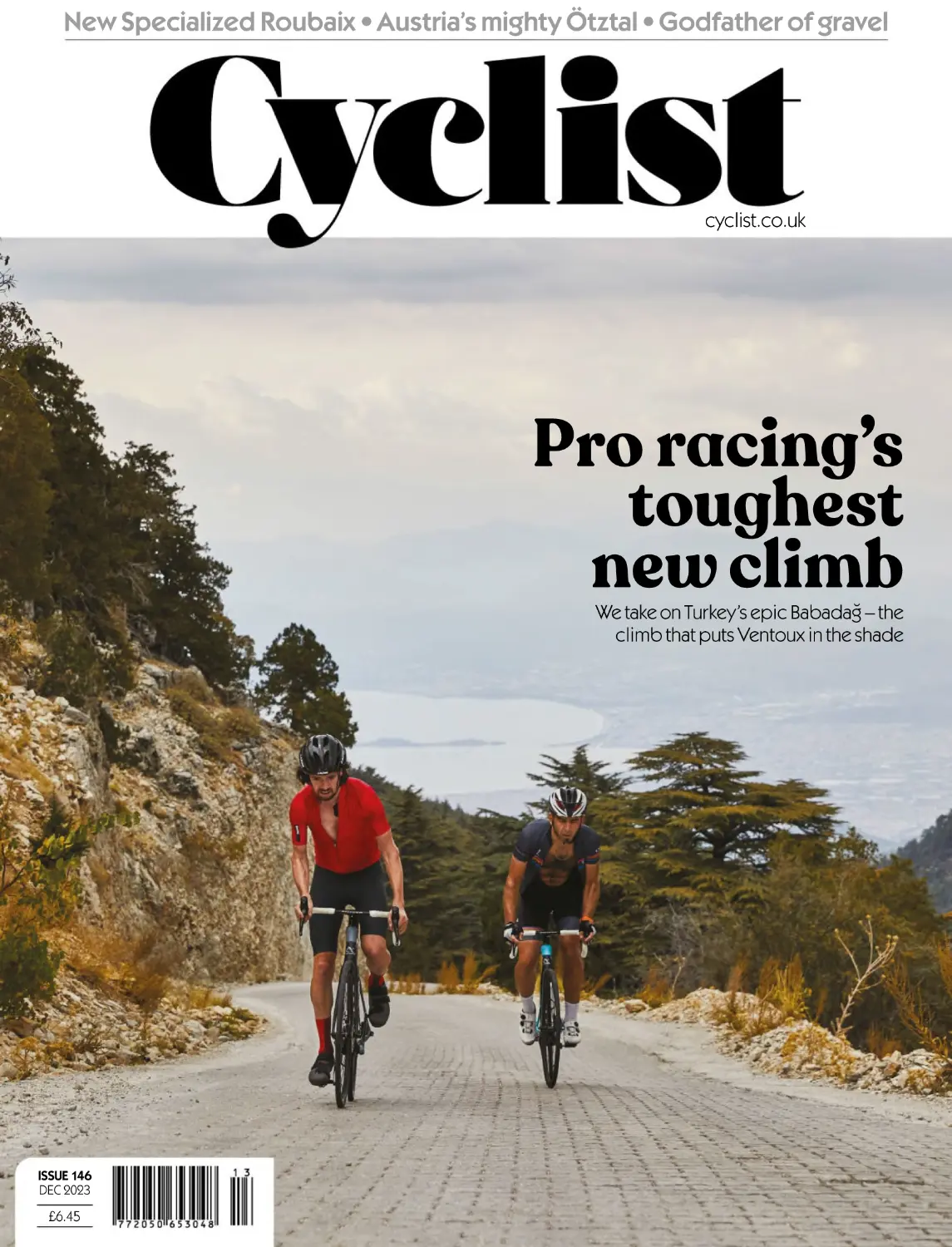
New Specialized Roubaix • Austria’s mighty Ötztal • Godfather of gravel
cyclist.co.uk
Pro racing’s
toughest
new climb
We take on Turkey’s epic Babadag˘ – the
climb that puts Ventoux in the shade
ISSUE 146
DEC 2023
£6.45
NEW DOGMA X
PURE CYCLING
MULTIPLIED BY X
Competition has always been a part
of the DOGMA’S DNA.
But now, thanks to the new X-Stays and
the versatility of using tyres up to 35mm,
the DOGMA X is the perfect synthesis
of comfort and high performance.
Are you ready to multiply your emotions?
pinarello.com
#DogmaXemotionsmultiplier
THE BIG RIDE: TURKEY
52The Giant Killer
Cyclist heads to Turkey to tackle a climb that’s new
to the pro peloton, but destined to become infamous
as one of the toughest challenges in racing
PROFILE: JOBST BRANDT
66Godfather Of Gravel
How adventurer and off-road pioneer Jobst Brandt
inspired a generation of cyclists and framebuilders
INSIGHT: ORIGINAL PEDAL BIKE
74First Pedal Forward
Why two craftsmen set out to recreate the first
pedal bicycle from 1839 – and how they got on
CLASSIC CLIMBS
80Ötzal Glacier Road
The highest paved road in the Alps is a Swiss
marvel of natural engineering
Dec
2023
Issue 146
TECH: PERFORMANCE TEST
11Gear+Tech
98Pro vs Am
•The new Roubaix springs into action
•Gear from Cadex, Bontrager, Shimano
•How Curve’s bikes are staying ahead
on the ultra-endurance racing scene
•Rain jackets to be seen in and be seen in
•Why there’s still room for rim brakes
It's clear that professional cyclists are better than
amateurs, but by how much? Cyclist tackles the
Étape du Tour and crunches the numbers to find out
SPORTIVE: GIRODEO
106Saddle Up, Hold On
Girona is home to some of the world’s best road
riders, but the first ever GiRodeo sportive shows off
the region’s wilder side beyond the tarmac
33Pro+Racing
•Mark Cavendish in pictures
•Breakout star Ricarda Bauernfeind on
why she quit racing – and then came back
•Felix Lowe picks the best bits from 2023
•How Tom Simpson stormed to victory
on the mighty Bordeaux-Paris in 1963
REVIEWS
115Bikes
45Train+Eat
•How to get the benefits of weight
training without using weights
•Muesli for maximum gains
•What are the best ways to recover from
a ride? We sort the facts from the myths
4 December 2023
Tested this issue – the Specialized Tarmac SL8,
Mason Bokeh 3 and Pearson Forge
BACKMARKER
130Trevor Ward
Like all of us, Trevor rejoiced when Jumbo-Visma
did the right thing and backed Sepp Kuss at the
Vuelta, and inter-team politics in his own life made
him wish we could all learn from the peloton
cyclist.co.uk
Get your head in the clouds on
the Ötzal Glacier Road, the
highest paved road in the Alps
cyclist.co.uk
December 2023 5
Photo Connor Mollison
Ed’s Letter
74
An old bike gets new life inside the
Endura headquarters in Scotland
or years it did my Scottish heart proud to think that
Scotland was the only country in the world where the
Coca-Cola company did not have the number one
selling soft drink. True Scots were loyal to Irn-Bru.
A map produced in 2017 showed Scotland as the
single tiny outpost standing firm against the red
tide of the ‘The Real Thing’ that covered the globe.
But unfortunately, it turns out it wasn’t true.
Oh, sure enough, the Scots still drink gallons
more of the sugary, weird-tasting orange stuff than
they do the sugary, tooth-rotting brown stuff, but it
seems that there are other countries that are also
devoted to their native brands, such as Inca Kola in
Peru and TuKola in Cuba. Scotland isn’t so special.
I only mention this because, as any Scottish
readers will attest, it can be a disheartening
business looking for instances to indulge in some
nationalistic pride (don’t get me started on the
Rugby World Cup), but there is something that we
can still cling to. The world owes Scotland a debt
of gratitude for the glorious gift of cycling.
It was back in 1839 that Scottish blacksmith
Kirkpatrick Macmillan first wobbled his wooden
contraption onto the dirt roads of Dumfriesshire,
heralding the dawn of the pedal bicycle (read the
whole story on p74). If it wasn’t for him, you’d now
6 December 2023
be reading a magazine called HobbyHorseist, and
we’d be reviewing the best shoes for propelling
yourself along the ground on a glorified scooter.
It would be a pretty rough ride too, were it not
for another Scotsman, John Boyd Dunlop, inventor
of the pneumatic tyre. Or John Macadam, who gave
us macadamised roads. He was Scottish too. And
you wouldn’t be able to watch cycling on your telly
if it wasn’t for John Logie Baird (Scottish), or on your
phone if not for Alexander Graham Bell (Scottish).
I could go on, but I think I’ve made my point. If
you see a Scot on a bike, give them a little wave of
thanks. That’s all I ask. Right, I’m off for a Tunnock’s
Tea Cake washed down with a litre of Irn-Bru.
Pete Muir
Editor
December 2023 • Issue 146
Collectors’ Edition
GIVE THE GIFT OF CYCLIST
The real joy of Christmas is
seeing their little faces light
up when they rush down from
their bedroom and excitedly
tear open their presents to
discover they’ve been gifted an
entire year of Cyclist magazine,
delivered straight to their door
a few days before it appears in
the shops (see p50 for details).
Well, that’s the parents’
Christmas presents sorted for
this year. As for the kids, who
knows? Are those fidget
spinners still popular?
cyclist.co.uk
WE SAW THE FUTURE AND LEFT IT BEHIND
Pushing harder, riding longer, and never
missing a turn on the front. Fifteen years of
relentless craftsmanship in building the world’s
finest carbon bicycles have culminated in the
Supernaut—the zenith of modern ride quality.
Secure your Supernaut GR3 or RM3 today, and
let the journey begin.
CARBON BIKES MADE IN THE USA
ARGONAUTCYCLES.COM
Switchboard Metropolis Group:
+44 (0)208 752 8195
Advertising: +44 (0)208 752 8195
Subscriptions: +44 (0)208 752 8195
Inside the Corima facility in France, where
hello@metropolis.co.uk
hi-tech wheels get the hands-on treatment
Email:
firstname.lastname@metropolis.co.uk
Web: cyclist.co.uk
Facebook: facebook.com/cyclistmag
Instagram: cyclist_mag
Twitter: twitter.com/cyclist
Youtube: youtube.com/c/cyclistmagvideo
EDITORIAL
Editor Pete Muir
Deputy Editor James Spender
Art Director Rob Milton
Production Editor Martin James
Website Editor Matthew Loveridge
Tech Editor Sam Challis
Deputy Website Editor Will Strickson
Features Writer Emma Cole
Tech Writer Charlotte Head
Editorial Assistant Robyn Davidson
Subbing/app production Michael Donlevy
Additional design Andrew Sumner
Cover image Juan Trujillo Andrades
ADVERTISING
Commercial Director Adrian Hogan
Account Director James Kellock
Senior Account Manager Ben Lorton
Affiliate Manager Lee Ross
PUBLISHING, MARKETING AND SUBS
Managing Director David Saunders
Marketing Manager Kiran Summan
Marketing Executive Twinkle Bhawani
Production Manager Lee Boyman
November 2023 • Issue 145
December 2023 • Issue 146
Collectors’ Edition
Collectors’ Edition
Subscribe to Cyclist
Printed by Walstead Roche. Distributed by Marketforce.
Copyright © Diamond Publishing, which is part of the Metropolis
Group. All rights reserved. Cyclist is a registered trademark. Neither
the whole of this publication nor any part of it may be reproduced,
stored in a retrieval system or transmitted in
any form or by any means without written
permission of the publisher.
.
Cyclist is available for international
licensing and syndication.
Email david.saunders@metropolis.co.uk
8 December 2023
Photo Patrik Lundin
To subscribe to Cyclist call
+44 (0)20 8752 8195
Or subscribe online at
cyclistmag.co.uk/subscriptions
1yr print subscription price
UK DD £69.95; UK £75.81
EU £100; Rest of World £110
106
Cyclist heads to Girona in Spain for
the gravel-fest that is GiRodeo
BoostR ReAKT
Strada SB AKTiv
150 lumens
Seatpost mounted
ReAKT technology
1700 lumens
Handlebar mounted
AKTiv Technology
All the stuff that makes you glad to be a cyclist
Smoothly
does it
The new Roubaix gets more utility
and better suspension
Words JAMES SPENDER
Photography TAPESTRY
cyclist.co.uk
December 2023 11
Gear+Tech Specialized Roubaix SL8
ith barely time to take a breath,
Specialized has followed its latest
Tarmac race bike with an update
to its Roubaix design. While the
marketing tagline for the new bike
might be ‘The Science of Smooth’, it could just as
easily have been ‘If it ain't broke…’, because while
the bike goes further into all-road territory, this is
less a design reinvented as it is re-refined.
As per the previous Roubaix, the Future Shock
front suspension system, flexy Pavé seatpost and
aero credentials are still present, it’s just the brand
has sought to make everything that little bit better.
‘This Roubaix is still that paradigm shift bike,’
says Specialized’s UK product manager, Richard
Salaman. ‘The one that 20 years ago showed
you can have comfort and performance.’
Future Shock – the front suspension unit
sandwiched between stem and head tube – has
W
12 December 2023
been the Roubaix’s calling card since 2016, and
this time around things seem no different. Future
Shock 3.0 offers the same 20mm of axial travel
and its internals are broadly the same, but dig a
little deeper and subtle changes have been made.
Like the previous bike’s Future Shock, the new
system on the top-end Roubaix models comprises
a coil spring, hydraulic damper and dial – a twisty
knob that sits where the headset top cap usually
is. It incrementally changes spring rate (how easy/
hard it is to compress the shock) but has been set
up to have less sag. That is, with a rider aboard,
the coil and/or hydraulic cartridge compresses
less, leaving more travel to work through. The
tuneability of the suspension has changed too.
‘The older dial had 12 clicks, but this Future
Shock has five clicks,’ says Salaman. ‘Rider
feedback said that splitting the spring rate across
12 indexed points meant each “click” didn’t feel like
cyclist.co.uk
New gear Gear+Tech
enough of a change, so we’ve kept the range but
changed it to five incremental positions.’
Other Future Shock updates are even more
subtle. The bike comes with three coil spring
options of different firmness, based on rider
weight, and confident home mechanics won’t need
to take the bike to a Specialized dealer to change
the spring over. Riders can also change the preload
by inserting washers (supplied) into the spring
assembly (which influences sag); likewise, the new
bike ships with two headset spacers, 10mm and
20mm, which can be changed easily at home.
As per the previous Future Shocks, there’s still
no absolute lockout – the suspension is always
active to some degree, albeit a very small amount
in the firmest setting. But the rationale is, ‘Why
would you want to turn it off?’
‘Future Shock isolates the rider from bumps
without messing with geometry,’ says Salaman.
‘Imagine if a rider pulls the front brake on a descent.
Traditional suspension compresses, meaning
the head tube dives, effectively changing the
head angle, and therefore the handling suddenly
changes in a way that can really unsettle a rider.’
Future Shock means the geometry doesn’t
change when the suspension moves as the fork
stays in the same place in respect to the head tube.
Reframing the Roubaix
Speaking of not changing geometry, the new bike’s
fit and handling characteristics have been directly
carried over. Stack this new bike up against the
previous generation and the bikes’ silhouettes
are remarkably similar. But this one is different.
The tube profiles have received aero tweaks, with
re-sculpted fork legs, a deeper down tube and
even lower seatstays. The altered composite layup
Future Shock 3.0 offers the
same 20mm of travel, but
dig deeper and subtle
changes have been made
Specialized Roubaix SL8,
£6,000, specialized.com
cyclist.co.uk
has dropped around 50g from the bike, despite
claiming a 4-watt drag improvement at 40kmh.
Tyre clearance has increased from 33mm to
40mm, and elsewhere there are nods to greater
utility, with the inclusion of mudguard mounts
(reducing max tyre size to 35mm), a third set of
bottle cage bosses on the underside of the down
tube and mounting points for a top tube bag.
Another carry-over is the D-shaped Pavé
seatpost, which still offers 20mm of rearward
flex. Although the seatstays now join the seat tube
much lower than before, the seatpost clamp is in
the same position, and it’s this clamping point that
dictates how much seatpost is available to flex. The
boxy section in the seat tube merely provides the
space for the seatpost to bend backwards inside
the frame. In this, the seatpost holds the same brief
as the Future Shock: isolate the rider from bumps
without changing the geometry of the bike.
Cadex Race
finishing kit
Bars £324.99, stem £299.99,
cadex-cycling.com
Light finishing kit can knock a surprising amount off a bike’s
final weight, yet super-light components come with caveats,
whether that be an overly restrictive weight limit or an
exorbitant pricetag. Cadex’s Race bars aren’t cheap, but
they measure up pretty favourably cost-wise compared to
rival designs when considering their performance claims.
The Race bars in a 42cm width have a claimed weight of
just 160g but are said to still be stiff and comfortable thanks
to some clever tube shaping: the drops are elliptical in crosssection to reduce flex and the rear of the tops is flattened to
improve grip comfort.
‘We made the Race bars in one piece, rather than by
bonding sections together,’ says Jeff Schneider, Cadex’s
head of product. ‘A lot of bars are made in three pieces,
but the bond sites introduce excess weight and flex.’
The bars are ably supported by the new Race stem. It
aims to combine aerodynamic efficiency and light weight,
which often tend to be mutually exclusive. Toray’s T800 and
T1100 carbon fibre is used to keep the weight down to 120g
for a 100mm size, while the faceplate uses a carbon hook to
smooth out its frontal area and the top cap is integrated too –
both features designed to smooth airflow.
December 2023 13
100 MILES
CLOSED ROADS
THE UK’S BIGGEST
SPORTIVE
Sunday 26 May 2024
ENTER NOW
www.ridelondon.co.uk
New gear Gear+Tech
Albion Visibility
cargo vest
£125, albioncycling.com
lbion has a knack for producing
garments to fill niches that most
riders didn’t even know were
there. The brand did it with its
Burner insulated chest protector
(essentially a fancy version of stuffing newspaper
down the front of a jersey), and looks to have done
it again with its new Visibility cargo vest.
The aptly named vest uses 360° view reflective
tape across the main body, as well as an extrahigh-visibility strip at the base of the rear panel.
There are mesh panels at the side for added
breathability, and Albion says the adjustable strap
and loop closure has been strengthened compared
to the previous iteration. There are four front
pockets and one large backpack compartment that
also doubles as storage for a hydration bladder. The
vest is packable, lightweight and sits high on the
back, so jersey pockets can still be accessed.
‘We initially designed the product to meet
the need of high visibility during endurance and
long-distance riding events,’ says Albion’s senior
designer, Rhiannon Wakefield. ‘But the versatile
nature of the product, such as its cargo carrying
capability and 360° visibility, makes it practical
for everything from ultra-racing to commuting.’
A
Cargo vest uses
reflective tape
around the main
body for 360°
visibility
Schwalbe
One 365 tyre
£51.99, schwalbe.com
A tweaked version of Schwalbe’s Addix 4-Season
rubber compound means the new One 365
promises better ride feel and durability compared
to the commuter’s favourite Durano tyre it
replaces. The rubber is specifically formulated for
low temperatures, meaning you shouldn’t have to
worry about grip on cold winter mornings.
You shouldn’t have to worry about punctures
either – Schwalbe says the carcass has been
beefed up slightly to provide better sidewall
protection. Weight is a casualty of this, with a
size 28mm tyre weighing 320g, and the One
365 isn’t tubeless either, but it does have a nifty
sidewall strip that is reflective in headlights but
unnoticeable otherwise.
cyclist.co.uk
December 2023 15
Gear+Tech New gear
Shimano 105 R7100 groupset
From £990, freewheel.co.uk
ust when it seemed that Shimano
was turning its back on mechanical
shifting at the mid-to-high end
of its range, the world’s biggest
groupset maker released two
mechanical groupsets on the same day – 105
R7100 arriving alongside several derivations
of Shimano’s GRX gravel groupset.
Both have made the move to 12-speed, but
whereas bigger gearing range was the primary
motivator for the change in GRX, closer gear steps
was the priority for 105, echoing its electronic
counterpart released last year.
In fact, joining 105 Di2 at 12-speed means 105
can do more than just mirror the groupset – it can
actually share all its non-shifting components. The
chain, cassette, crankset and brakes are the same
J
16 December 2023
as 105 Di2 uses, meaning R7100 introduces
new mechanical shifters and derailleurs.
Shimano hasn’t claimed any performance
improvements in the derailleurs, just that the
rear is now designed to shift across 12 sprockets,
while the front’s cage has been reshaped to
accommodate the path the chain takes when
working with the 11-36t cassette option. The
levers’ ergonomics are said to have been tweaked
slightly, with the shift action being ‘lighter’ and
‘smoother’ than previous mechanical versions.
Depending on exact setup, claimed weight for
105 mechanical is around 2,845g, so should be
about 100g lighter than 105 Di2. Crucially though,
it is a lot more affordable, meaning a far higher
proportion of cyclists will be able to access the
wide range and closer steps of 12-speed gearing.
cyclist.co.uk
T H E
J U S T
B E S T
G O T
B E T T E R
—
THE ALPHA DOPPIO ROS IS OUR TOP-RATED WINTER JACKET, BRINGING
WARMTH, BREATHABILITY, AND A HIGH LEVEL OF RAIN PROTECTION
ALONG WITH A SOFT, COMFORTABLE FIT. THIS JACKET LEADS THE WAY IN
DEMONSTRATING HOW A WINTER JACKET SHOULD PERFORM.
CASTELLI-CYCLING.COM
Bike Saddles
Reimagined
“A unique invention that
has the potential to reshape
the cycling industry.”
Anglia Ruskin University
•
•
•
•
•
SaddleSpur™ is the next evolution in bike saddles
(QJLQHHUHGIRUFRPIRUWVDIHW\SHUIRUPDQFHDQGHτFLHQF\
British designed. Lab-tested
Made with style
SaddleSpur™ is more than just a seat
Jump on!
Visit www.saddlespur.com or email info@saddlespur.com for more information
New gear Gear+Tech
Bontrager
Aeolus Pro
37V wheels
£1,799.98, trekbikes.com
ourtesy of its Bontrager
components brand, Trek is the first
big name in the bike industry to dip
a toe into the pool of thermoplastic
fabrication. This exciting technology
has a great deal of potential to improve both wheel
performance and the impact of the rims’ production
on the environment.
Generally, carbon composite uses thermoset
resins that harden irreversibly during the curing
process. By contrast, thermoplastic resins can be
melted again once cured, so products such as wheel
rims can be recycled as opposed to scrapped when
they reach the end of their usable life.
Composites made with thermoplastic resins
are also said to have better damping qualities,
meaning in a wheel application they should provide
a smoother ride. That’s certainly what Bontrager’s
data suggests of its new composite, which it dubs
OCLV NEXT. The brand says it tested the new
Aelous Pro 37V wheels versus its thermosetbased predecessors and suggests they reduce
vibration by 5% over cobbles.
The Aeolus Pro 37Vs’ dimensions are as
modern as their material, being 37mm deep,
with a 25mm internal width and 32mm external
width that should pair smoothly with wide road
and skinnier gravel tyres. Topping things off, while
they can’t match the lightest thermoset designs on
the market, the wheels’ claimed weight is pretty
competitive at 1,450g for the pair.
C
The wheels
use thermoplastic
resin, which offers
better damping and
can be recycled in
the future
Streamlines
Forma sensor
£475, streamlines.aero
Streamlines says its Forma sensor helps riders
maintain their most efficient riding position. Once
that position has been programmed in, the stemmounted box measures head and chest position
to within 2mm and, when paired to a Garmin,
displays in real time how close the rider is to their
desired position.
‘Factors such as fatigue cause positional
changes that affect the drag a rider creates,’ says
Bob Simpson, Streamlines’ project and production
manager. ‘The Forma sensor provides a visual cue
to help the rider minimise this.’
While we all love shiny aero upgrades, the rider
creates around 80% of total drag, so an optimal
position is a far more effective way to get faster.
cyclist.co.uk
December 2023 19
Gear+Tech New gear
Revised outer
shell means the
new Nytron Pro
is more aero
than the previous
model
Rudy Project
Nytron Pro
helmet
£189.99, and Kelion sunglasses £191.99,
rudyproject.com
ntroduced at this year’s Tour de
France, the Rudy Project Nytron
Pro helmet aims to deliver a 2-watt
aerodynamic improvement over
the existing Nytron at 45kmh,
thanks to adaptations to the outer shell. There
are now just two air intake ports at the front and
one exhaust port at the helmet’s rear.
‘While ventilation is crucial, in the Nytron Pro’s
vent layout we found a way to optimise airflow
without compromising on comfort, allowing
athletes to go faster without overheating,’ says
Rudy Project’s Simone Barbazza. The helmet
weighs a claimed 320g for a size small/medium
and carries over the rest of its tech from the
existing Nytron, including the RSR adjustable
retention system, a Fastex chin buckle and
‘Divider Pro’ side buckles.
Rudy Project has also launched its latest
performance sunglasses, the Kelion. The glasses
use a wraparound lens in a bid to provide an
unobstructed field of view and wide coverage,
while the lenses also include a ventilation system
– a sequence of tiny vents – that aims to prevent
fogging and help maintain an unimpeded vision.
The frames are made using a material that
Rudy Project says is 45% bio-plastic, a sustainable
material derived from castor oil. The lower portion
is also detachable to ensure it is quick and easy to
change lenses.
I
20 December 2023
cyclist.co.uk
Ahead of
the curve
Curve’s Ryan ‘Rhino’ Flinn talks ultras, adventure
bikes and making metal cool again
Words PADDY MADDISON Photography PATRIK LUNDIN
he average sales
exec might zip
from boardroom to
boardroom via train or
plane, clad in a suit and
carting their overnight gear around a
fancy leather holdall. But there’s nothing
average about Curve co-owner, sales
director and ultra-distance rider Ryan
‘Rhino’ Flinn. To his mind, when he’s
peddling his adventure and bikepacking
bikes, the only real way to get from
meeting to meeting is by, well, pedalling
his adventure and bikepacking bikes.
‘I’ve mainly been living in my tent,’
Flinn tells Cyclist as we catch up during
his latest two-wheeled trans-European
work trip to visit Curve dealers scattered
across the continent. ‘I stay in a hostel
here and there to wash my clothes and
keep the bike in “showroom” condition.’
So far, Flinn’s current adventure
has taken him through Wales, England,
France, Switzerland and Germany. As
you can probably imagine, he’s had his
fair share of interesting encounters.
While wild camping in France, for
example, his too-good-to-be-true pitch
in a postcard-perfect country meadow
T
22 December 2023
was ransacked by crazed wild boars
during the dead of night. On another
occasion, he unintentionally startled a
bunch of local men on their way home
from the pub, who caught him bathing
nude in a river by moonlight.
‘It must have been a most peculiar
sight for a group of young men after a
night out on the town. Can you imagine
staggering back home through the
forest only to see some oddly disturbing
creature in a river bed, frolicking around
washing its weirdly tanned legs?’
Flinn is no stranger to such
escapades and adventures. A traveller
since childhood, he was born in South
Africa and spent his youth moving
around places such as Mozambique,
Botswana and Lesotho with his parents.
These days, he spends most of his time
cycling around the world for work. When
he’s not in business mode, you can
probably find him participating in an epic
ultra-endurance race of some sort.
Curve’s tough-as-nails metal bikes
are built for this type of riding. They’re
ridden by some of the world’s top ultraendurance cyclists, and there’s a strong
emphasis on hardcore real-world
cyclist.co.uk
Me and my bike Gear+Tech
cyclist.co.uk
December 2023 23
Gear+Tech Me and my bike
Frameset £2,248.
Sram Rival/GX
build £4,206.
See curvecycling.com
testing. Many brands would be happy
ticking off the required ISO boxes
before releasing a bike, but co-founder
Jesse Carlsson insisted on riding (and
winning) the 2015 Trans Am Bike Race
on a Curve titanium frame before he
was ready to sell them to the public.
‘The testing standards we set
ourselves are sometimes far beyond
what the industry requires because of
where we take these bikes and what we
do with them,’ says Flinn. ‘It’s anything
but conventional riding.
long beastie with the handling of a road
bike but the climbing ability of a tractor.
It just takes on any extreme, rocky or
sandy, with ease. I was one of only three
or four riders to set a sub-50 hour on
the Victoria Divide with this bike. It’s
a challenging off-road mountain bike
ultra, but I took the GMX+ and set some
of the fastest descents on the trails.’
The frame is crafted from grade 9
titanium, which is more commonly used
in aerospace manufacturing and marine
equipment because of its incredible
‘The testing standards we set ourselves
are far beyond what the industry requires
because of where we take these bikes’
‘I think Curve has helped to make
metal cool again, especially titanium.
It’s magical – hard and temperamental
to work with, but once mastered it’s
a smooth, comfortable and compliant
material perfect for a bike frame: lighter
than steel, the same strength profile,
and it lasts forever.’
X marks the spot
The GMX+ Titanium seen here is Curve’s
signature drop-bar titanium adventure
bike. It was created for the Race To The
Rock, a gruelling off-road ultra that sees
riders battling it out in the Australian
outback over 3,000km to reach Uluru,
also known as Ayers Rock.
‘You need massive tyre clearance,
like 29 x 2.6-3in, to soak up all that
rough riding,’ says Flinn. ‘Suspension
doesn’t really work for us as it requires a
service interval after 50 hours. By which
point, we are normally only three days
into a ten or 14-day ride.
‘For me the bike is a real workhorse.
It actually rides better loaded. It’s a
24 December 2023
corrosion resistance. The bike pictured
is from GiRodeo 2022 and features a
Sram GX Eagle AXS 1x groupset, Ingrid
chainring, Enve M6 wheelset and
Thompson titanium finishing kit.
‘It has a huge standover, prioritising
the rider’s desire and need to carry gear
[as the high top tube opens up space in
the front triangle],’ says Flinn. It is a bike
designed to ride, not get on and off.
‘We make some wildly unique bars
for the GMX+ too. We like to go wide to
ensure loaded handling isn’t diminished
and to maximise front-roll capacity
and hand space. Jesse has introduced
backsweep to the bar too, so that as you
go wider your reach isn’t increased.
‘It’s a stroke of genius because riders
can buy the bar on its own, keep the
same stem and probably get a similar
reach. Some will need to be re-hosed to
accommodate the new width, but we’re
living out in the future here and it can get
a bit lonely when conventional designs
haven’t kept up. We’re definitely ahead
of the curve, so to speak.’
cyclist.co.uk
VISIBILITY REDEFINED
NEW LIGHTS FOR EVERY CYCLING TYPE
SEE INTO THE FUTURE ///
LEZ YNE IS DISTRIBUTED IN THE UNITED KINGDOM BY UPGRADEBIKES.CO.UK RIDE.LEZ YNE.COM
Gear+Tech Packable rain jackets
Shake it off
Goodbye boring rain shells,
hello colour and fun
he weather may be dreary but,
thankfully, gone are the days
where the only option to stay dry in
the rain was the cycling equivalent
of a black polyethylene bag.
Now we have variety. When the heavens open,
visibility generally decreases, and the Castelli
Emergency 2 jacket and Altura Airstream jacket
provide neon yellow offerings to help keep you
safe and seen. For those who wish to chase down
KoM/QoMs in all conditions, there are aero fits
available in the forms of the Assos Equipe RS
Alleycat shell or Santini’s Guard Nimbus cover
(OK, we’ll admit the Assos jacket has a touch
of the binbag about the top half, but we forgive
it due to its performance promises).
If you wish to stay firmly in the realm of pleasing
aesthetics, Maap’s Prime jacket is available in
several jaunty shades, such as the ‘Land’ green
shown here, while Sportful’s Giara packable jacket
is about as bold a statement as you can get.
For the environmentally conscious, we are
entering a new realm of eco-friendly rainwear,
with Albion’s All Road Pertex jacket, Endura’s
FS260-Pro Race Cape II and Universal Colours’
Mono rain jacket all claiming to be made from
PFC-free materials, aiming to protect both you
and the planet.
T
Left to right, top to bottom: Castelli Emergency 2 women’s rain
jacket £160, saddleback.co.uk; Universal Colours Mono rain jacket
£170, universalcolours.com; Sportful Giara women’s packable rain
jacket £175, saddleback.co.uk; Endura FS260-Pro Race Cape II
£89.99, endurasport.com; Santini women’s Guard Nimbus rain
jacket £149, santinicycling.com; Assos men’s Equipe RS Alleycat
Clima Capsule Targa shell £225, assos.com; Albion men’s All Road
Pertex rain jacket £195, albioncycling.com; MAAP women’s Prime
jacket £245, maap.cc; Altura Airstream women’s windproof jacket
£65, altura.co.uk
26 December 2023
Gear+Tech Opinion
Save the rim
brake!
Disc brakes are great, but tech writer Charlotte
Head believes the rim brake deserves to coexist
classic rim brake, and we must work to
save them before they die off entirely.
The fizzle and the bang
As much as we’ve seen the decline of
rim brakes over the past decade, this
slide towards extinction has accelerated
dramatically over the past year or two.
Sram’s Rival AXS has been disc-only
for a while now, but the slam dunk has
undoubtedly been Shimano’s release
of its new 105 groupsets.
105 is, by definition, a mid-tier
groupset, below the race-worthy
Dura-Ace and Ultegra but above the
likes of Sora and Tiagra. As such, it’s the
perfect canary for what we can expect
from entry-level groupsets later down
the line. We expect professional race
bikes to be equipped with the best and
the shiniest that the cycling industry
has to offer, but when both the Di2 and
mechanical 12-speed 105 groupsets
were announced as disc-only, it served
as a warning sign of things to come.
If one of the most popular mid-tier
groupsets is ready to eschew the rim
brake altogether, surely others will
follow suit.
In praise of rim brakes
But why should I care? Don’t
misunderstand me – I’m not saying
t this point, saying ‘save
the rim brake’ is in itself
a tired cliché, conjuring
images either of
puritanical road cyclists
bouncing about on their skinny 23mm
tyres or die-hard single-speeders
bouncing about on their skinny 23mm
tyres. Stickers adorn tatty commuter
bikes or city lampposts, and many of
us shake our heads and sigh.
‘Are they so unenlightened?’ we
ask ourselves, as the contaminated
pads of our hydraulic callipers squeeze
onto misaligned disc rotors, bringing
us noisily (but quickly) to a halt. ‘Are
they still so mulish, so unrelentingly
contrary?’ But, as with the dawn of the
new cashless society, there is still much
to be said for the old ways.
As Shimano does away with rim
brakes on its latest 105 groupsets, there
are many rightly lamenting the end
of the era of choice. I love disc brakes.
I think they are an incredible feat of
engineering and allow us to use bikes in
ways previously unthinkable. Yet there
are many and emphatic use cases for the
A
28 December 2023
may boast some hefty performance
credentials, performance isn’t
everything. Take a deep breath.
I repeat, performance isn’t everything.
More important for many is the starting
cost and ease of maintenance. It is far
simpler to learn how to fit and change
your own rim brake pads, and it’s cheaper
to get them replaced at a shop if you
cannot or prefer not to do so yourself.
Buying a bike that you can barely
afford is one thing, but then being
unable to afford to maintain it is another.
And if you do slack on your repairs on
a disc-brake bike? The cost of replacing
disc rotors or even entire callipers when
they’ve been ridden into the ground can
be gargantuan.
For the average person, these are
real and rational concerns to have.
For the more technically astute, rim
brakes are often also lighter and allow
for a greater margin of error in calliper
alignment, resulting in brakes that are
easier to set up to run silently. Let’s
not even get started on preference
of braking feel or control.
Vive le rim brake!
So are you ready to take to the streets to
save the rim brake? Sadly, as with many
product-centred desires, the humble
consumer can really only support the
Take a deep breath. I repeat, performance
isn’t everything. More important for many is
the starting cost and ease of maintenance
that rim brakes are the best brakes and
that we should all throw our hydraulic
callipers into the proverbial river. Disc
brakes are more powerful, work better
in wet conditions and generally have
a longer component lifespan. They’re
great at what they do, but that doesn’t
make them ideal for everyone.
Bikes are expensive and becoming
increasingly so with each passing year.
A luxury hobby for some, the bike is
still a practical tool for many, a way to
get from A to B or a cost-effective way
to stay fit and get outside. The humble
bicycle was once seen as a symbol
for revolution and tearing down social
barriers, a vehicle for empowerment
and freedom. Forgive me... I’ve gone
all misty-eyed.
For those with a budget in mind, the
accessibility of cycling is quickly slipping
out of their grasp. Although disc brakes
movement with spending power and
demonstrating a social appetite for it. By
all means, emblazon your steeds with
stickers, but it is largely a case of ‘make
as much noise as possible and hope that
brands pay attention’.
The rim brake is a symbol for much
more than several strips of rubber
making contact with matching strips of
alloy or carbon. It marks the entry point
into cycling and, by default, who we
believe should be classed as cyclists.
Long live the rim brake.
Tech writer Charlotte
learned to build wheels
back when she viewed
gears as unnecessary,
favouring one brake
and some grippy tyres.
Since then she’s come
to accept that modern
bikes have their uses,
and her knees are
much happier for it.
cyclist.co.uk
WE’RE YOUR BIGGEST SUPPORTER.
Become a member from £3.33 per month for unbeatable discounts,
unrivalled liability insurance, expert legal advice and to help us
invest in the future of cycling for everyone.
Gear+Tech Must have
2
1
3
Pick ’n’
Mix
Sorry, Martin
Lewis, these are
essential buys
5
Words Will Strickson Photo Danny Bird
4
1 PEATY’S ROOST N’
GRIND COFFEE
£6.99, peatys.co.uk
Why does mountain bike legend
Steve Peat’s bike maintenance
brand Peaty’s also sell coffee? He
needs to stay grounded. Handroasted in Macclesfield, Roost N’
Grind is a single-origin coffee from
Huila, Colombia, which Peaty’s
says has a winey character. It’s
pre-ground and will brew just in
time for you to finish cleaning,
lubing and polishing your bike.
2 APIDURA EXPEDITION
WAIST BELT
£38, apidura.com
Rainbows don’t weigh much –
30 December 2023
they’re pretty light. So is Apidura’s
Expedition belt. With the rise of
technical T-shirts, riders are relying
on cargo shorts or small bags for
pocketable items, so Apidura has
essentially created strap-on jersey
pockets. The belt is made from a
stretchy, breathable fabric, sits a
bit lower than traditional pockets
for easy access and offers more
space than jersey pockets too.
3 MILKIT ROAD &
GRAVEL SEALANT
€20.95 (approx £18), milkit.bike
It might look and sound like it’s a
milkshake, but this isn’t drinkable.
Swiss brand MilKit was founded to
produce longer-lasting tubeless
sealant, and this is its road and
gravel-specific concoction that
has all the benefits of the original
but is made to seal better at higher
pressures and last longer in the
tyre. Only our lips aren’t sealed.
4 SPECIALIZED POWER
EXPERT WITH MIRROR
SADDLE
£160, specialized.com
It’s not a saddle with a mirror for
checking your hair, but 3D-printed
honeycomb lattice technology
from Specialized – called Mirror
– which has trickled down to the
more accessibly priced Expert
level of saddles. The Power Expert
uses Mirror inserts combined with
foam to get the best of both worlds.
It’s finished off with a four-way
stretch cover to keep dirt out.
5 BLOODY MINDED
BY ALEX DOWSETT
£20, bloomsbury.com
Don’t trust the weather forecast
– it’s all up in the air. Do trust Alex
Dowsett to be honest about his
life and career though. He rode
for Sky, Movistar, Katusha and
Israel-Premier Tech, broke the
Hour record and was the only
able-bodied elite sportsperson
in the world with haemophilia A.
His new book details exactly what
that meant for him, alongside the
ups and downs of his career.
cyclist.co.uk
Gran Sasso - Sig. Collezione
Lamborghini
Elegance & performance in entirety.
Made in Italy
Snapshot
As Mark Cavendish signs on for one more season and one more shot
at that record-breaking Tour stage win, we ask two photographers
who know him best to select their favourite Cavendish images
cyclist.co.uk
December 2023 33
PREVIOUS PAGE
Race: Tour de France, 1st July 2021
Photographer: Pete Goding
‘This is before Stage 6, from Tours to
Chateauroux. I’d been planning this shot
all week, waiting patiently for that perfect
moment. Getting just the right angle to
showcase something intriguing in the reflection
in Mark’s glasses was the name of the game,
and his pensive pose was the cherry on top.
Here was the Manx Missile, cool as a cucumber
in his green points leader’s jersey, eyes locked
onto yet another stage victory, the starting
podium gleaming in his shades.
‘Mark had already won Stage 3, then went
on to win this stage, Stage 10 and Stage 13,
equalling the legendary Eddy Merckx’s record
of 34 Tour stage wins. This was the comeback
of comebacks, and it’s still bubbling away.’
34 December 2023
BELOW
Date: September 2005
Photographer: Pete Goding
‘Mark Cavendish, Geraint Thomas and Ed
Clancy, shot when I was still cutting my teeth.
My editor at Procycling magazine asked me and
Daniel Friebe [now TV commentator, writer,
podcaster…] to interview the new additions to
the T-Mobile squad, along with the legendary
Jan Ullrich, on top of the Hilton in Piccadilly
Circus. I remember having to hire a brand-new
digital camera that I wasn’t accustomed to. I
had a more seasoned photographer with me
who noticed my hesitance and recommended
shooting in raw format, “In case you get that
Pulitzer Prize moment you can revisit the
image.” This definitely wasn’t “that moment”
but it put me in good stead for the future.
‘At the time, Cavendish was a newbie on the
pro scene and playing second fiddle to Jan. But
even then he was brimming with confidence.’
cyclist.co.uk
Snapshot Pro+Racing
ABOVE
Race: Tour de France, 12th July 2008
Photographer: Pete Goding
‘On a tumultuous day, rain poured relentlessly.
I vividly recall kneeling in a puddle, the dim
light casting a shadow over my efforts. But
I persevered, adjusting camera settings to
cope with the low light – the decision to use a
high ISO resulted in an increase in graininess,
yet this technical challenge didn’t diminish the
significance of the event unfolding before me.
‘It was a historic occasion; Mark clinched
the victory and achieved a remarkable feat,
becoming only the second British rider to
secure two stage wins in the same Tour. This
triumph followed his dramatic win in Stage 5
and marked a pivotal moment in his career.
As I embarked on my journey to capture the
world of professional cycling through my
lens, Cav’s career was being launched into
the stratosphere.’
cyclist.co.uk
December 2023 35
36 December 2023
cyclist.co.uk
Snapshot Pro+Racing
TOP LEFT
Race: Tour de France, 26th July 2009
Photographer: Graham Watson
‘Mark Cavendish winning on the ChampsÉlysées in 2011 is the most iconic of his 34
stage wins in the Tour. This was the day when
Cav and Mark Renshaw went from 300m out
and took the first two places by a huge margin.
Side-on footage from a moto TV camera caught
the pair’s relay action brilliantly – the lead-out,
then increase in speed as Cav raced to the line.
‘It was Mark’s sixth win of that Tour and
I love the way both he and Renshaw are
celebrating a sprint so perfectly and ruthlessly
won. They were the most dynamic of any sprint
duo I’ve ever seen.’
cyclist.co.uk
BOTTOM LEFT
Race: Tour Down Under, 19th January 2011
Photographer: Graham Watson
‘As it is for most sprinters, crashes have been
an unwanted but regular feature in Mark’s
long career, especially in the Tour de France.
I believe Mark would already have eased past
Eddy Merckx’s record but for those crashes,
and he’d be well into his retirement by now.
‘The sight of Cav crossing the finish line
on Stage 2 of the 2011 Tour Down Under was
shocking, with blood streaming down his face,
his helmet in pieces, his pride so obviously
broken. Yet the tough Manxman always comes
back, simply because he hates losing. This is
why he’s coming back again in 2024. To win.’
BELOW
Race: Gent-Wevelgem, 25th March 2012
Photographer: Graham Watson
‘Although Mark’s long list of wins doesn’t
include Gent-Wevelgem, I just love this shot
of him racing up the Kemmelberg in 2012, his
stocky leg muscles straining to their very limit,
his teeth gritted with the effort he was making
to stay in touch with the leaders.
‘Cav wanted nothing more than to win and
show off his World Champion’s colours in the
best possible way. His one season at Team Sky
wasn’t the greatest period of his career [he only
won three Giro d’Italia stages and three Tour
stages] but he gave it his all and a whole lot
more, as the true professional he is.’
December 2023 37
Q&A
Ricarda
Bauernfeind
Cyclist: What did you do before cycling?
Ricarda Bauernfeind: I tried almost
every sport with friends; I was a very
active child. I played soccer, I did ballet
and a lot of running. I learned two
instruments and started learning to ride
a horse. Then my brother Gabriel, who’s
five years older, got a road bike and so
I also wanted one. My parents weren’t
happy about it – they thought it would be
too dangerous – but changed their mind.
With a surprise stage win at this year’s Tour de France
Femmes, the 23-year-old German has announced
herself as a star of the future
Cyc: You started racing while studying.
How did you balance the demands?
RB: After school, in 2018, I continued
racing for a women’s elite team in
Germany. We did all these national races
and I recognised, ‘OK, I’m not that good
Words ANDY MCGRATH Photography ELOISE MAVIAN
38 December 2023
cyclist.co.uk
Interview Pro+Racing
RICARDA
BAUERNFEIND
Age 23
Born Ingolstadt,
Germany
Team Canyon-Sram
Notable results
2023
5th, La Vuelta
Femenina
1st, Stage 5, Tour
de France Femmes
2022
1st, Road Race and
Time-Trial, German
Under-23 National
Championships
2nd, Road Race,
German National
Championships
3rd, Road Race and
Time-Trial, Under-23
World Championships
2021
3rd, Road Race,
German National
Championships
2018
3rd, Road Race,
German Junior National
Championships
a race, on the sidelines almost crying
because I was afraid of disappointing
people. But with the distance from the
sport, I grew up and learned how to deal
with all the nerves. And I still enjoyed
the sport because I continued on Zwift
and riding outside with my brother.
I love the feeling of going to the limit.
Cyc: How important was Zwift to your
progress?
RB: Very. I still do it, even in summer. I
really love Zwift intervals and training.
The longest I’ve ridden on there is five
hours. In the winter of 2021-22, I did
every session on Zwift.
Cyc: How did you join Canyon-Sram?
RB: At the European Championships in
2021, team manager Ronny Lauke told
me about the Canyon-Sram Generation
team. I thought this would be perfect
for me because the focus was more on
learning and developing, bringing riders
from different countries to Europe. I
think joining them was the best decision
I’ve ever made because I learned how
to race in a bigger peloton, to be brave
and try things without putting too much
pressure on myself.
Cyc: You moved up to the WorldTour this
year. Before your Tour de France Femmes
stage victory in Albi this July, was there a
result that gave you more confidence?
RB: Finishing third on a stage at the
Vuelta and fifth overall was already a
great success. But the Tour de France
stage win was something totally
I sprinted for the line. I had no idea how
near the peloton was.
Cyc: Your parents were following the
Tour in a campervan. What did they say?
RB: Before that stage, I texted my mum
saying I was feeling super-tired and
could already feel the four stages. She
said to not worry, the most important
thing is to finish the race healthy. So,
of course, they also couldn’t believe it.
Cyc: Do they still think cycling is too
dangerous?
RB: Definitely not. But when we
watched the race replay back home in
Eichstätt, my dad saw the downhill and
went, ‘Ooh, you were going pretty fast.’
Cyc: You love to attack. How does it work
between your instinct and team tactics?
RB: To be honest, I sometimes doubt
myself. It’s more the team that
encourages me. If I hear on the radio,
‘Ricarda now, it’s your time,’ then I
always trust the coaches. I would never
be able to do it on my own. This is
something I still have to learn – to
trust more in myself.
Cyc: Within 18 months, you’ve gone from
being a new pro to winning a Tour stage.
Has your self-perception caught up with
your achievements?
RB: When I joined the Canyon-Sram
Generation team, I had almost no
expectations. I just wanted to see the
professional environment and whether
I liked it. I developed from race to race
‘At the end of 2019 I decided to stop racing
and just do cycling for fun. The pandemic
came and I carried on, mostly on Zwift’
anymore,’ so it didn’t make sense to
focus purely on cycling. At the end of the
year, I went to university to study to be a
teacher and focussed on that. I wanted
to become a teacher for nutrition and
something like housekeeping.
At the end of 2019 I decided to
stop racing and just do cycling for fun.
The pandemic came and I carried on,
mostly on Zwift, because it was really
efficient and I didn’t have that much
time to spare. Then I did the German
National Championships just for fun
and everything started again.
Cyc: So what had changed in that time?
RB: I think I put less pressure on myself.
I was always super-nervous before
cyclist.co.uk
different and super-special. I never
expected it. On Stage 5, I could already
feel that I was a bit tired and I told Kasia
[Niewiadoma] that. Then I heard over
the race radio, ‘Ricarda, on the next
climb, you have to attack.’ And I thought,
shit I don’t know how long I can go for.
But I tried because if you never try, you
never know.
and learned a lot. If someone had told
me this would happen in 18 months,
I would say no, maybe in five years
or something.
Cyc: You gained an advantage of 90
seconds over the peloton and ended up
doing a 40km solo breakaway. What
were you telling yourself?
RB: Your mind is always stronger than
your body. It’s a quote I love. And in the
last kilometre, I was just waiting for the
yellow jersey to pass me. That’s why
Cyc: Finally, where would you like to go
on a well-earned holiday this winter?
RB: I’ll enjoy time with family and
friends. My mum and I are planning to
go to Hamburg to see a musical. I’ll go
to Oktoberfest too [in nearby Munich].
I wear the traditional clothes but I don’t
like beer. Maybe I’ll have a gin and tonic.
Cyc: What’s next?
RB: It’s a goal to be at the 2024 Olympics
in Paris, and just to develop as a rider. I
still have to improve a lot of things.
December 2023 39
Pro+Racing Comment
Ten best bits of ’23
As another cycling season draws
to a close, Felix Lowe picks Mark
Cavendish’s latest comeback and
Thibaut Pinot’s farewell among
his standout moments
won not by a solo artist but with a sprint in
the velodrome after the breakaway went the
distance. Veteran Canadian Alison Jackson
proved the strongest in a captivating six-up
sprint having done more than her fair share of
pulling to hold off the favourites. And she still
had the energy for a celebratory dance.
3. Cav keeps record hopes alive
Write him off at your peril! Just when the dream
looked over, up popped Geraint Thomas – a day
after losing the pink jersey to Primož Roglič – to
lead Mark Cavendish out in the shadow of the
Colosseum. Victory in Rome on the final day
of the Giro d’Italia put the wheels in motion for
Cav’s Tour heartbreak and – inevitably – the
news that the Manx Missile will give the outright
stage record another shot with Astana next year.
2. Kuss digs deep on the Angliru
What could have been a Jumbo-Visma cakewalk
in the Vuelta a España became a riveting willthey-won’t-they spectacle after Giro and Tour
champions Primož Roglič and Jonas Vingegaard
seemingly did the dirty on their loyal
domestique. But a little help from Mikel Landa
saw Sepp Kuss complete another 1-2-3 on the
fearsome Angliru. Kuss’s puppy-dog smile over
the line said it all as the American retained the
red jersey by just eight seconds.
I
40 December 2023
Just when the dream looked over, up popped Geraint
Thomas – a day after losing the pink jersey – to lead
Mark Cavendish out in the shadow of the Colosseum
The lumpy test in the Massif Central also saw
Jonas Vingegaard and yellow jersey rival Tadej
Pogačar in an early break in what was a stage
for the ages.
5. Pog tears up the rule book in Flanders
Pogačar may have missed out again in the
Tour, but across the season he proved to be
the peloton’s most complete rider. It has been
yonks since we saw a Grand Tour winner claim
a cobbled Monument, and the Slovenian’s solo
win in the Ronde saw him succeed where he
came up short 12 months earlier, before going
on to dominate the Ardennes.
4. Jackson holds on in Roubaix
For the first time, Paris-Roubaix Femmes was
1. Thibaut Pinot bows out on the Petit Ballon
Was there a bigger goosebump moment in
2023 than the roar that accompanied the
Frenchman’s last roll of the dice in his final
Tour de France? Pinot riding through a sea of
spectators on the Petit Ballon – on a corner
named after him, no less – delivered the kind
of emotion unmatched in most other sports.
And, of course, the fact that he didn’t hold on
for the win in his own backyard in the Vosges
kept it all perfectly, painfully, to script. Oh, how
we’re going to miss the goat-loving, brittle
but brilliant, mercurial climber and his knack
of coming up short while wearing his heart
on his sleeve.
cyclist.co.uk
Photo Danny Bird
t has been an incident-packed
year in the pro peloton, which
means it has been a struggle
to pick just ten highlights.
But in the tradition of all good
countdowns, here are mine in reverse order…
10. Arnaud De Lie wins on one leg
Some say the Lotto-Dstny rider could soon
be as good as compatriot Wout van Aert. On
the evidence of his recent pedal-breaking
win in the Lotto Famenne Ardenne Classic
(he rode the last 10m of the sprint with only
one foot attached to his pedals), the Belgian
doesn’t need a leg-up to reach his potential.
9. Yates brotherly love at the Tour
Adam Yates winning just ahead of brother
Simon in Bilbao on the first day of the Tour de
France was the kind of scenario we’d all hoped
to see once the twins went their separate ways
to ride for different teams. But it was their
metronomic attack to Le Markstein on Stage
20 – shoulders and hips moving in perfect
synchronisation – that underlined their twopeas-in-a-pod status. Beautiful.
8. Van der Poel wins Milan-San Remo
It may have been overshadowed by his Roubaix
triumph and rainbow jersey, but Mathieu van
der Poel’s stellar season all started on the Via
Roma when the imperious Dutchman held off
a formidable trio in Filippo Ganna, Wout van
Aert and Tadej Pogačar after the fastest ever
ascent of the Poggio.
7. Kopecky honours her brother
‘What an inspiration – not just for girls on bikes,
but for all of us.’ So said commentator José
Been after Lotte Kopecky took an emotional
solo victory in Nokere Koerse just four days
after her brother’s death. She wasn’t meant
to be on the start list but the Belgian rode
with attacking verve and so much bravery
to commemorate her lost sibling. There
wasn’t a dry eye in the house.
6. Fireworks on Stage 10 of the men’s Tour
‘Glorious,’ said Carlton Kirby. ‘Sensational,’
matched Rob Hatch. But even those
superlatives were not enough when Basque
climber Pello Bilbao pulled off the most clinical
of finishes to take his first ever Tour stage win
in honour of his late teammate Gino Mäder.
The Wind
of Change
Wind 42 / Wind 57
RIM HEIGHT
42 mm / 57 mm
BEARINGS
Sealed cartridge
RIM WIDTH
Inner 23 mm
Outer 29mm
WEIGHT
1,510 g
1,585 g
23
29
23
57
RIM MATERIAL
UD carbon fiber
42
fulcrumwheels.com
29
TYRE TYPE
2-Way Fit™ tubeless
A moment in time
Tom Simpson wins
Bordeaux-Paris
In 1963, Tom Simpson took a rare British victory at Bordeaux-Paris, an epic
one-day race of 560km where riders were paced by Derny motorbikes
Words GILES BELBIN Photography OFFSIDE
42 December 2023
cyclist.co.uk
Race history Pro+Racing
or seven years our July
number has featured a
lengthy preview of the
Tour de France, often
with a detailed study of
the “stage” and the stars of the world’s
greatest road race,’ runs the first line of
the editor’s introduction to the July 1963
edition of Sporting Cyclist. ‘It may at
first seem odd that we have chosen the
50th Tour to depart from this custom.
Don’t blame me for that – it is all Tom
Simpson’s fault. I had planned six pages
or so for the Bordeaux-Paris race but
following Tom’s sensational win four
extra pages had to be found, and it
was the Tour which suffered. I am
sure readers will understand.’
The man who penned those words,
Jock Wadley, had enjoyed a close-up
view of Simpson’s winning ride. Wadley
arrived in Bordeaux the day before
the race and spent the afternoon and
evening prior to the 2am start locating
the race HQ – the Café de France – and
talking to mechanics and soigneurs.
By 11pm he was in the Peugeot team’s
hotel, waiting for the riders to make
their way to the dining room for their
pre-race meal.
Shortly afterwards Simpson walked
down the stairs. He had barely slept and
had endured spells of dizziness during
the day. Still, Simpson was unperturbed:
‘The last time I felt like that was just
before the World Road Championship
in 1960,’ he told Wadley. ‘I turned out to
be in top form really that day [Simpson
would actually abandon that race having
been hit by a car], so perhaps this is no
cause for alarm. Nerves, maybe.’
After a meal of vegetable soup, raw
carrots, rare steak and rice, followed
by yoghurt, Simpson went to his room,
accompanied by Wadley, who watched
him ‘packing his valise with things
not wanted on the 350-mile voyage
ahead’, and getting his kit ready as they
engaged in small talk. Wadley heard him
murmur words of gratitude to his absent
wife, Helen, for packing him some spare
laces despite having just given birth to
their second daughter just days before.
It all adds up to a remarkably intimate
portrait of a rider preparing himself
for one of the toughest tests on the
cycling calendar.
Just 15 riders rolled out from
Bordeaux in the early hours of 26th
May 1963. The format of the race had
changed over the 72 years since its
inaugural edition. This version would
‘F
Tom Simpson arrives
in the Parc des Princes
behind his pacer to take
his first major win of
the 1963 season
cyclist.co.uk
see the riders cover the first 260km
alone before picking up their pacing
Derny motorcycles at Châtellerault,
some 300km or so southwest of Paris.
During an earlier conversation with a
Peugeot staffer, Wadley had questioned
the point of this initial un-paced element,
where the riders tended to just stick
together, commenting that it seemed
‘a mere formality’.
‘Bordeaux to Châtellerault nothing?’
the staffer had reacted. ‘I think it is very
important indeed… they will not all arrive
in the same condition. Those who have
been the best looked after, and who
have best looked after themselves for
eight hours or more, will be the best
equipped for the final battle behind
the pacemakers.’
Those early kilometres were spent
riding through pre-dawn darkness, the
riders wearing woollen hats against the
cold. After five and a half hours of riding,
with the sun having now risen, Simpson
came back through the following cars,
shedding clothing. Wadley took the
chance to grab a word. ‘Nearly went
was yet to record a win beyond a stage
of the Tour de Var. He was determined
to take his first major win of the year.
It was on the lower slopes of the hill
at Dourdan, in the Chevreuse Valley,
that Simpson made his definitive move.
Knowing that this was the decisive point
in the race he upped his pace, dropped
his co-leaders and set about building
a race-winning lead, narrowly avoiding
disaster when his front wheel brushed
the back of his pacer’s Derny.
With just over 35km to go, riding past
scores of spectators sat at picnic tables
in the woods of the Chevreuse valley,
Simpson’s advantage was two minutes.
Louison Bobet, winner of the race in
1959 but now following in a car, drew
alongside Wadley and shouted across
the cars: ‘Bravo Tom – il est formidable!’
And formidable Simpson was. After
15 hours and 43 minutes he sprinted
across the finish line in front of a packed
Parc des Princes to take the win by more
than five minutes over teammate Piet
Rentmeester. While the race’s field
was perhaps small and short on quality,
He began to ease towards the front and an
hour later, approaching the final 65km, he
was one of five at the head of the race
to sleep three times in the first hour or
two,’ Simpson said. ‘I’ll be glad when
the race really starts.’
The formidable Simpson
That ‘racing’ started soon after the
riders had collected their motor-pacers.
While the attacks flew, including the first
main escape of the race by Simpson’s
teammate Jean Forestier, who steadily
built a lead of six minutes and would
end up spending more than 140km at
the head of the race, Simpson remained
calm and stayed with the other main
favourites, Peter Post and Jo De Roo.
As the race moved into its final
quarter, and with the gap to the front
approaching nine minutes, Simpson
indicated to his pacer, Fernand Wambst,
to increase his speed. Methodically
Simpson began to ease towards the
riders in front of him and an hour later,
approaching the final 65km, he was one
of five riders at the front of the race.
Simpson had enjoyed a good, if
ultimately frustrating, early part of the
1963 season. He had finished on the
podium of Gent-Wevelgem, the Tour
of Flanders and Paris-Brussels but
Wadley wrote that such was his class
Simpson would have won no matter
who was riding. French writer Pierre
Chany was more circumspect, writing,
‘The Briton was too strong, his rivals too
few in number and of average ability.’
Regardless, Simpson had a classic win
on his 1963 palmarès, becoming the
third Briton to win the race, following
George Pilkington-Mills in 1891 and
Arthur Linton in 1896.
Later, Simpson would point to
his relationship with Wambst, who
had been chosen specifically to stop
Simpson from attacking too early, as
being key to his win, revealing they had
barely needed to speak during the race
such was their understanding.
That night Wadley sat at a table with
three Belgian journalists. On the table
were bottles of champagne.
‘Tom comes from your country,’ one
of the journalists said to Wadley, ‘but he
lives in my town, Gent. Let us drink to
your great compatriot, who I am proud
to have as a neighbour.’
Giles Belbin is the author of Tour
de France Champions: An A To Z
(thehistorypress.co.uk)
December 2023 43
Weight training –
without weights
Get the benefits of functional
strength training on the bike,
not at the gym
t’s well documented that
weight training off the bike
can lead to performance
improvements on it, especially
in explosive situations such as
sprints and short, steep climbs. But for those
who don’t have access to a gym or heavy
weights at home, a group of Danish sports
scientists has developed and tested a method
for getting the same results while cycling.
Published in scientific journal Frontiers,
the test involved 24 cyclists, including a control
group who did their usual training, and a group
performing ‘maximal acceleration training’
as a supplement to their usual training. This
involved the riders slowing to around 5kmh,
switching into a high-ratio gear and then
applying maximum effort to accelerate the
bike for 20 pedal strokes (ten each side). The
riders repeated the accelerations ten times,
with a two-minute rest of light pedalling in
between each.
The test group performed this session
three times a week for 12 weeks (both the test
and control groups spent the same amount
of time training on their bikes). At the end, the
researchers noted a 4% increase in maximal
power output during a seven-second seated
sprint in the test group, while the control
group’s performance actually deteriorated by
3% for the same test over the same period.
An improvement of 4% may seem minimal,
but it could make all the difference in that
attempt on your local KoM. More importantly,
the researchers discovered no adverse effects
on other aspects of the cyclists’ performance,
such as endurance and aerobic fitness. There’s
no downside, so why not give maximal
acceleration training a try?
Photo Danny Bird
I
cyclist.co.uk
December 2023 45
Train+Eat Fit food
It’s DIY,
FYI
Try making your own muesli
hen pro riders stumble
downstairs to the hotel
breakfast room ahead of
a race, more often than
not their first destination
is the coffee machine, followed by the
muesli counter. Muesli is a mixture of
oats, dried fruit, nuts and seeds. It offers
all the benefits of porridge or granola
without the faff of having to be cooked.
The Cycling Chef Alan Murchison
praises the simplicity of muesli, whose
versatility stems from the extra flavours
and toppings used – just keep in mind
the ratio of oats to dried fruit.
His recipe is packed with the good
stuff, including golden raisins, which
are sweeter and higher in antioxidants
than regular raisins while also being
an excellent source of quick energy.
Gram for gram, the dried banana is
approximately four times higher in fibre
(which keeps your digestive system
healthy) and carbohydrates (which
give you energy for smashing that
KoM) than regular bananas.
Murchison also includes a mix
of sunflower, pumpkin and flax
seeds, which are full of nutrients for
maintaining healthy skin and eyes while
strengthening the immune system
– ideal as we head towards winter to
protect against sniffles and coughs.
W
DIY muesli
INGREDIENTS
500g rolled oats
100g golden raisins
100g dried banana (the crispy, sugary stuff)
broken into chunks
75g dried mango, diced
75g dried apricot, diced
75g flaked coconut
50g goji berries
50g sunflower seeds
50g pumpkin seeds
50g flax seeds
4tsp ground cinnamon
46 December 2023
Method
Makes 15 servings
NUTRITION PER SERVING
Energy 321kcal
Total carbohydrate 40g
(of which sugars 14g)
Fat 13g (of which saturates
5.5g)
Fibre 8g
Protein 7.7g
Salt 0.04g
• Mix all the ingredients together and store in
an airtight box – simple.
• Keeps for 4-6 weeks at room temperature.
This recipe is taken
from The Cycling Chef:
Recipes For Getting
Lean And Fuelling
The Machine by
Alan Murchison,
Bloomsbury Publishing,
bloomsbury.com
cyclist.co.uk
Conquer the Italian Alps with your morning coffee, and hit the Rio de Janeiro
beaches before dinner. Ride real-world routes that span the globe, track your
progress, and participate in virtual races with breathtaking views.
GET AN EXTRA ONE MONTH TRIAL
Register at www.rouvy.com and use the code
CYCLIST1M at checkout to get an extra one month trial.
n my experience, if I told an athlete that
eating bird poo would help them recover
quicker, they would do it.’ Such is the
desperation for quick recovery methods,
according to Dr Jessica Hill, a recovery
specialist and an associate professor in Applied Sport and
Exercise Physiology at St Mary’s University Twickenham.
And who wouldn’t try it for a quick fix from the dreaded
DOMS (delayed onset muscle soreness), dehydration and
fatigue that can come after a long hard day in the saddle? But
with the hunger for easy solutions comes plenty of debate
and myth. Is it true that the man who coined the RICE acronym
doesn’t actually believe in it anymore? Will a post-ride pint
really undo all your good work? Jennifer Aniston was spotted
in compression boots, so should we all be buying them?
‘People do these things before there is any real science to
support it, and then the difficulty is that it takes so long for the
science to catch up,’ points out Hill. ‘My advice for all athletes
is to get the basics right: nutrition, sleep and hydration.’
Perhaps it’s time to hold off on the pigeon droppings for now.
‘I
Recovery
methods:
truth or myth?
Leg compression, ice baths, protein shakes… there are plenty
of suggestions for how to recover quicker from a hard ride.
Cyclist ’s experts sort the smarts from the duds
Words EMMA COLE Illustration TILL LUKAT
48 December 2023
cyclist.co.uk
Recovery Train+Eat
Will a post-ride beer affect recovery?
‘The key after a race is to rehydrate as
quickly as you can,’ says Hill. ‘If you
drink a pint of beer, initially you’re
getting a net gain of a pint of fluid, but
that pint will influence the body’s fluid
balance. Alcohol blocks the antidiuretic hormones that tell your body
to hold onto water. While the net
immediate consumption might not be
detrimental, the fact that it’s making
you go to the toilet more later down
the line probably is going to be
detrimental. A pint of beer won’t be a
big issue in the grand scheme of things,
but ten pints will.’
Is eight hours’ sleep really necessary?
‘I would say sleep is the one that’s most
overlooked,’ says Hill. ‘People will eat
and drink well but then try to survive
on five or six hours a night. But there’s
more to sleep than just restoration.
‘When we sleep, or even have a
power nap, the body releases a human
growth hormone that helps with
muscular recovery and the repairing
of any damaged tissues, making us
stronger. A typical adult needs seven to
eight hours a night, but athletes need to
be on the higher end of that spectrum.’
Must protein be consumed within 30
minutes after a ride?
‘After a session – a significant training
session, not a gentle ride – you need to
homemade chocolate milk can also
be just as effective. These drinks are
useful if your appetite has waned posttraining as liquids may be easier on the
stomach, but you can get what you need
from solid food if that’s what you prefer.
A simple meal like egg or shredded
chicken with rice will give you what you
need and is gentle on the stomach.’
Should we use those full-leg
compression boots after a hard ride?
Hill isn’t entirely convinced: ‘Exerciseinduced muscle soreness is a result of
micro-damage to muscle fibres; it is an
inflammatory response. Compression
garments can reduce the space available
for swelling to occur, because you’re
compressing the tissue and muscle
compartment that stops fluid leaking
out of the blood vessels and sitting in
the cellular spaces where it shouldn’t
be. That’s what causes the pain – DOMS.
‘My understanding of a compression
boot is that you have to apply a much
higher level of compression compared
to wearing compression socks or the
like because you can’t move around,’
she adds.
‘If you’re walking around, your body
and muscles work to help remove
toxins, aiding venous return [the rate of
blood flow back to the heart]. Whereas
with the boots, you’re lying down and
not getting the same action. I think you
have to be tactical about when and how
‘We know caffeine is useful before and
during training, but it may also enhance
post-exercise muscle glycogen recovery’
Is RICE a good or bad recovery method?
The RICE method (rest, ice, compression,
elevation) was first introduced in 1978
and has been a standard treatment of
choice for many injuries and muscle
recovery. Recently, however, the man
who coined RICE – physician, author
and broadcaster Dr Gabe Mirkin – has
suggested the concept is outdated and
that heat and movement might be better
in many cases.
Hill isn’t convinced: ‘It’s what you
would do for any muscular injury: rest
it, ice it, compress it to minimise the
swelling and elevate it to help drain
fluid. Does that not work? Medics have
been using that as a treatment strategy
for sprains, breaks and damaged soft
tissue for years because it’s effective.’
And if it ain’t broke…
cyclist.co.uk
consume recovery meals and snacks
that contain around 25g protein to
trigger muscle protein synthesis,’ says
sports nutritionist Rob Hobson. ‘This
is beneficial within the first hour after
training, but this anabolic window does
stay open for 24 hours after training, so
just as important is consuming protein
every three to five hours over multiple
meals – the recommendation being
0.3g protein per kilo of body weight.
A post-training snack or meal should
also contain carbohydrates and the
recommended ratio is 3:1 carb to protein.’
And is a specialist recovery drink the
best bet?
‘Recovery drinks are a convenient
way to get a good balance of protein
to carbohydrates,’ says Hobson. ‘But
you apply it, and that’s the same for
any recovery strategy that you use.’
Is coffee after a ride good or bad?
‘We know caffeine is useful before
and during training to help reduce the
perception of fatigue and enhance
performance, but it may also enhance
post-exercise muscle glycogen
recovery,’ says Hobson. ‘In a study in
the journal Nutrients, riders depleted
their glycogen stores by cycling to
exhaustion and were then given either
milk and coffee or just milk alongside a
carb-rich meal. The addition of coffee
led to increased muscle glycogen
resynthesis and the glycaemic and
insulinemic response – it helped replace
carb stores in the muscles so helped
them recover better.’
December 2023 49
Give the perfect gift this
Christmas with a subscription to
SUBSCRIBE TO CYCLIST
ENJOY A FREE ISSUE WITH
A 6 MONTH SUBSCRIPTION* OR
A FREE SPORTFUL GILET WITH
AN ANNUAL SUBSCRIPTION**
GREAT REASONS TO SUBSCRIBE
Choose one of the following:
Option 1: A free issue of Cyclist
with a 6-month subscription*
Option 2: A free Sportful Gilet
with an annual subscription**
Free delivery of every issue
Save on the cover price
Exclusive collectable
subscriber-only covers
Men’s and women’s gilets available in sizes S, M, L. Please email us
at hello@metropolis.co.uk with your size information.
ORDER ONLINE TODAY AT
store.cyclist.co.uk/cyc146p
OR CALL 020 8752 8195
OR EMAIL hello@metropolis.co.uk
QUOTING THE OFFER CODE CYC146P
* offer valid on a 6-month DD subscription only If you wish to cancel the direct debit offer, please
contact us via phone or email. ** offer valid on 1-year DD and 1-year cash subscription only. If you
wish to cancel the direct debit offer, please contact us via phone or email.
Both offers and gifts are only valid to the new UK customers, one per household and while stocks last.
52 December 2023
cyclist.co.uk
Turkey / Big Ride
The
On Turkey’s south coast is a climb that is new to the
pro peloton but may be destined to become the most
feared of them all. CyclistIHHOVWKHIRUFHRI%DEDGDÔ
Words NICK CHRISTIAN Photography JUAN TRUJILLO ANDRADES
cyclist.co.uk
December 2023 53
Left: Halfway to the top
of Çenger, the second
ascent of the day en
route to Babadağ
Right: Scorched tarmac
makes for even more
treacherous conditions
beneath the wheels
Below: Finally we hit
some open road on
the long, fast descent
towards Fethiye
Previous pages:
Tarek leads Cyclist
up one of the steepest,
most slippery sections
of Turkey’s mighty
Babadağ
ype the words
‘world’s greatest
cycling climbs’
into a search
engine and you
will be presented
with numerous
articles, all of
them listing the
same collection
of classics from the big races. There’s Mont
Ventoux and Alpe d’Huez from the Tour de
France; the Giro d’Italia throws up the Stelvio
Pass and Monte Grappa; while the Vuelta
a España comes in with its viciously steep
Alto de l’Angliru.
These are climbs famed for their difficulty,
made legendary by the exploits of pro racers
and visited each year by hordes of amateur
cyclists looking to test their mettle on the same
slopes as their heroes. But if the Presidential
Tour of Turkey has anything to say about it,
there might just be a new name to add to that
list. On 10th October this year, Stage 3 of the race
introduced the pro peloton to a climb so steep, so
unrelenting, that it may just blow all the others
out of the water. That climb goes by the name
of Babadağ. And Cyclist got there first.
T
Screen burn
Erman, the editor of Cyclist Turkey, is the man
responsible for planning today’s 84km route.
54 December 2023
Foolishly, when he tells me the distance, I scoff,
‘Where’s the rest of it?’
Erman’s response is to guide my gaze towards
the total elevation of the ride. It’s an improbably
large number on his screen, and at first my
brain fails to comprehend it. How can you get
that much elevation into such a short distance?
But once I realise that it isn’t a mistake, I feel
a strange tension grip my insides.
To calm myself, I indicate to Erman that
I’m sure it will all be fine with him leading
the way, and he responds that has no intention
of doing the ride himself. Instead, he has
delegated responsibility for accompanying
me to a local guide, Tarek, who looks too tall
to be much of a climber, and is as aerodynamic
as a shed, yet defies the laws of physics when
the gradients bite.
As I soon find out, Tarek climbs like a goat
and descends like a bird of prey. What he can
do on the flat I have no idea, because there’s
barely a metre of it on the whole route. In order
to cram more than 3,500 vertical metres into 84
horizontal kilometres, we have to be heading
uphill as soon as we’ve clipped in.
From our start point in the beach town of
Kargi, we launch straight onto the first climb
of the day, Süleyman Demirel. On paper it looks
benign enough at just 1,000m and 9.4% average
gradient, but somehow it packs in three separate
mini-descents, which means that when the
road rises, it really rises. The final bit sees the
cyclist.co.uk
Turkey / Big Ride
I struggle to keep
my bike in motion.
My computer bleeps
to communicate
its doubts that
I actually am
cyclist.co.uk
December 2023 55
I’m enjoying
the sense of
discovering a
climb that few
cyclists will
know about
and fewer still
will have done
İncirköy
Çenger
TU R K EY
Süleyman Demirel
Kargi
Fethiye
Right: Negotiating
the narrow lanes
through İncirköy
Below left: The
ancient Lycian Tomb
of Amyntas, set into
the Fethiye hillside
Ovacik
Below middle: Cycle
lanes make navigating
the port town of Fethiye
straighforward
Kayaköy
Below right: The
natural harbour
overlooking the calm
Turquoise Coast
Badabağ
Distance 84km
Elevation 3,523m
Bring your climbing legs
%HDPRQJWKHIHZWRWLFNRII%DEDGDÔ
To download this route go to cyclist.co.uk/146turkey or scan the QR code. Begin anywhere
on Ataturk Boulevard in the town of Kargi on Turkey’s southwest coast. Turn onto Turgut
Özal road – you can’t miss it, it’ll be going straight up. Heave yourself up and over the
Süleyman Demirel speed bump before settling in for a long hour or more of climbing. After
reaching the summit of Çenger, you want to follow signs for İncirköy or head in a general
southwesterly direction, through the village and onto the main carriageway that will
take you directly to Fethiye. From here you continue south out of town in the direction
of Kayaköy, taking a sharp left before you reach the sea. Your next and final busy town
is Ovacik, where you’ll begin climbing as you ride east, before hitting Babadağ proper
and pushing on through to the top (assuming the summit is open).
2400
2000
1600
1200
800
400
0m
0km 5
10
15
56 December 2023
20
25
30
35
40
45
50
55
60
65
70
75
80 90
cyclist.co.uk
Turkey / Big Ride
cyclist.co.uk
December 2023 57
58 December 2023
cyclist.co.uk
Turkey / Big Ride
cyclist.co.uk
December 2023 59
gradient tip up to 30%, and I struggle to keep my
front wheel on the road and my bike in motion.
My bike computer bleeps to communicate its
doubts that I actually am.
Next up, after a short downhill run, is a more
‘normal’ climb called Çenger, which carries us
away from the coast and deep into the hills. This
one measures 14km at an average 7% gradient,
with just shy of 1,000m of vertical ascent. It’s
a slog and, to add to the fun, the road is gritty
and poorly surfaced, but I try to supress my
inner whinger and ask myself, ‘What would
Maurice Garin do?’ (History suggests that the
winner of the first two Tours de France might
have thumbed a lift.)
Despite the grind, I’m enjoying the sense of
discovering a climb that few cyclists will know
about and fewer still will have done. There’s no
motorised traffic, let alone other bike riders,
and the route feels practically prehistoric – at
least until we turn a corner to find a field of solar
panels filling the space between high-lying rock
forms. It’s not expansive, but enough to boil a
few thousand kettles.
An hour and a half since we said goodbye to
the sea, the elevation ticks past 1,000m. The
60 December 2023
Zwiehoff’s effort earned him
the KoM with a time of 53min
25sec for 13.78km. That’s an
average speed of just 15.5kmh
cyclist.co.uk
Turkey / Big Ride
Previous pages:
Babadağ begins to
bite, and even Tarek in
front feels the grind
Left: A moment of
relative early ease
towards the top of
the Çenger climb,
14km at an average
of 7% on rough roads
Below: Cyclist is
running 23mm tyres at
120psi on these roads,
and can feel every
lump and bump
gradient is all over the place and I’m changing
gear with more frequency than an Instagram
influencer. After several false summits, we
finally tip over the peak and begin the long
descent back towards the coast.
I try to hold Tarek’s wheel on the way down,
but my nerve on these unreliable surfaces fails
me and soon I’m watching him disappear into
the distance. We pass through İncirköy, weaving
around the town’s impressive collection of
feral cats, and then join a long road with nary
a winding turn, which takes us down to the
coastal town of Fethiye and a well-earned
lunch overlooking the sea.
The Mediterranean is calm, but the storm
is coming.
The stage from hell
Most years, the Presidential Tour of Turkey is a
gift for the sprinters. The week-long race usually
links together a succession of flat stages so the
big men can battle it out in the final few hundred
metres, day after day. But not this year.
Sure, the first couple of stages were the usual
fare, both won by Alpecin-Deceuninck’s Jasper
Philipsen, but Stage 3 was something altogether
different. Starting in Fethiye, the stage was
a mere 104km long, but it would prove to be
among the most brutal days that many in the
pro peloton had ever experienced. Its finish
cyclist.co.uk
was at the top of Babadağ after a climb of 18km
at 10.3% average gradient, with spikes of 20%
and a summit at almost 2,000m.
Once on the climb, a group of four crept
away from the main pack. This included two
riders from Astana, Alexey Lutsenko and Harold
Tejada, and two from Bora-Hansgrohe, Florian
Lipowitz and Ben Zwiehoff. It would be wrong
to suggest they raced up Babadağ; rather they
clung on for as long as possible, until one by
one they cracked. Lipowitz went first, with
5km to go, followed by Tejada at 1.8km. German
rider Zwiehoff clung on bravely, but couldn’t
hold Lutsenko’s wheel in the final 500m and
the Kazakh rider crawled to victory on a stage
that would see vast time differences appear
throughout the peloton.
To put it in perspective, Zwiehoff’s effort
earned him the Strava KoM on the official
Babadağ climb (Lutsenko obviously doesn’t
upload his data), with a time of 53min 25sec
for the 13.78km segment. That’s an average
speed of just 15.5kmh. Compare that to the
average speeds of the Ventoux KoM (20.5kmh),
the Alpe d’Huez KoM (20kmh) and even the
Angliru KoM (18.4kmh), and you get an idea
of how tough Babadağ is.
Another way to measure it is using the ASO
method for assessing climbs, by multiplying the
distance of the climb by the average gradient
December 2023 61
It seems they simply couldn’t lay tarmac
– the road is so steep that it would just slide
down the hill before it had a chance to dry
By the
numbers
Some Turkish delights
4.2
Average gradient in per cent
of our entire ride (3,523m
ascent squeezed into 84km)
10
Average gradient in per cent
RI%DEDGDÔFOLPE
13.8
/HQJWKLQNPRI%DEDGDÔ
climb
256
Number of people who
have recorded ascents
RI%DEDGDÔRQ6WUDYD
at the time of writing
15.5
Fastest average speed
in kmh of any ascent of
%DEDGDÔ VHWGXULQJWKLV
year’s Presidential Tour
of Turkey)
1,969
Elevation in metres of
%DEDGDÔŜVKLJKHVWSRLQW
109.53
Price in pounds of a
paragliding flight from
%DEDGDÔ
2
European countries with
a higher average elevation
WKDQ7XUNH\ 6ZLW]HUODQG
and Andorra)
62 December 2023
cyclist.co.uk
Turkey / Big Ride
Left: The road is
steeper than it looks
through Babadağ’s
pine-lined lower
slopes, where the
sightlines are longer
than you’d like
Above: Babadağ’s
partial cast brick
surface makes for
an unusual but
consistent surface
Right: Tarek finds his
groove out of the
saddle while Cyclist
begins to labour
cyclist.co.uk
King of the mountain
CyclistJHWVWKHORZGRZQRQ%DEDGDÔIURPLWV
IRUPHU6WUDYD.R0*DYLQ0DQQLRQ
On 10th October this year, the
Presidential Tour of Turkey
got its first taste of the hell
that is the Babadağ climb.
Unsurprisingly, the Strava
leaderboard is now dominated
by riders from that stage of
the race, but for the previous
two years the record was held
by American former pro Gavin
Mannion, who raced for Human
Powered Health.
‘We were at the Tour of
Turkey in 2021, but we had a guy
test positive for Covid so we
had to remove the whole team
from the race,’ he tells Cyclist.
‘When everything got cancelled
and we had a day-and-a-half
until we flew out, we just went
on Strava and it was like, “Oh,
here’s a big mountain – I don’t
know if this is a real road or not,
but we can go check it out.”
‘I rode the first half of the
climb pretty hard, just because
I wanted to, then rode to the
top. The views were insane.
You could see the ocean, but
you climbed up so high you
could also see mountains with
snow on them. It’s one of the
most spectacular climbs I’ve
ever done. Anywhere.’
Before the Presidential Tour
of Turkey visited, the Babadağ
Strava segment had only 162
completed attempts, and while
he held the KoM, Mannion knew
what it would mean to send a
pro peloton onto its slopes.
‘I thought if you took a bike
race up it, it would be one of the
hardest climbs in the world.’
December 2023 63
At the steepest, most exposed stretch
of ascent, I stop noticing the view.
The only sight is the top of my stem
squared. A score above 600 makes the climb
hors categorie, with the likes of Alpe d’Huez
scoring 890, Ventoux 1,233 and the Stelvio
1,392. Babadağ comes in at 1,920.
Into the jaws of the beast
The main road that leads out of Fethiye is
teeming with tourist traffic and takes us past
the striking Tomb of Amyntas, a rock-hewn
burial chamber with huge columns that dates
back to the 4th century BC. On another day we’d
stop to take a look inside, but time is against us
and Babadağ is waiting.
Having promised myself I will ride well
within my own limits, I make no moves to stay
with Tarek when he pushes the pace during the
early part of the climb. I’ve seen what’s coming
on Erman’s terrifying route profile, and the last
thing I want is to go pop.
The gradient isn’t consistent, but it is
consistently tough. It rarely drops below 10%
and on the profile chart the different sections
of the climb simply switch between red and
black, with not a hint of orange or blue in sight.
The lower part of the climb is through thick
forest with broken tarmac that could pass for
gravel in places. Fortunately, higher up the
surface changes to a form of paving whereby
interlocking bricks are held in place by concrete
sidewalls. Apparently, this allows for a certain
64 December 2023
amount of movement, preventing the surface
from cracking as it heats and cools in Turkey’s
high mountain air. Also, it seems they simply
couldn’t lay tarmac – the road is so steep that
it would just slide down the hill before it had
a chance to dry and harden.
I can feel the gaps between the bricks beneath
my tyres, but at least the road surface is now
uniform. Minibuses rumble past us on their
way to the summit, and when I look out across
the vast space towards the sea, I realise who
their passengers must be. From around the
mountain’s edge a paraglider floats into view,
then another and another. They pitch left, then
right, zigzagging on the thermals as they make
their way silently down towards the shore.
At the steepest, most exposed stretch of
ascent, I stop noticing the view. Now the only
sight is the top of my stem as I focus purely on
turning the pedals. If I want to get to the top,
I need to stay in motion. It’s a slow, painful
progression, but I’m actually beginning to
enjoy myself. The rhythm I’m tapping out
wouldn’t be a floor-filler, but you could at
least shuffle your feet to it.
With what I estimate to be only about a third
of the climb remaining, I round the next bend
to see Tarek up ahead. I had imagined him to
already be relaxing with a coffee at the top. It
seems that despite being built like a statue, his
Above left: Dark clouds
gather overhead as a
storm brews above
2,000m altitude
Above right: One
last push for our
summit, if not that
of Babadağ itself…
cyclist.co.uk
Turkey / Big Ride
back is suffering under the toll of the climb.
We decide to continue, but at an even gentler
pace than previously, and with an agreement
to abandon if Tarek’s back decides we’ve gone
far enough.
As it turns out, Nature makes the decision
for us. A mountain this big generates its own
weather, and while the beachgoers down in
Fethiye can be basking in sunshine, cyclists
and paragliders at the top of Babadağ can be
facing freezing temperatures, mist and rain.
So it happens that at precisely 4.12pm the rain
comes, the sky darkens and a faint rumble can
be heard above us.
We’ve only got the last little bit to do, but the
threat of the weather is enough for a uniformed
official to bring down a striped barrier to block
the road and prevent anyone venturing to
Babadağ’s exposed summit.
We stop and look around. Above us, empty
chairlifts dangle from their cables in the wind.
It’s disappointing not to see the view from the
top, but I am in no way keen to take a bolt of
lightning for the team.
As we turn to make our way back down, I
console myself that we’ve done enough. We’ve
taken on and (mostly) conquered a mountain
that will surely one day find its way onto that
special list: ‘World’s greatest cycling climbs’.
Nick Christian is a freelance writer who loves
a climb almost as much as he loves a list
How we did it
TRAVEL
The nearest airport in Turkey is Dalaman on the
southwest coast, which is served direct by a number
of airlines from airports around the UK. From
Dalaman it’s around a 45-minute drive to Kargi,
where the ride starts.
ACCOMMODATION
Cyclist stayed at the Hilton Dalaman, 20 minutes’
drive from the airport. It’s an enormous, all-inclusive
resort hotel right on the beach, and has no fewer than
ten outdoor swimming pools, nine restaurants and
bars, and 18 treatment rooms.
Intimate it ain’t, but it’s very comfortable and you
won’t get bored. Expect to pay upwards of £250 a
night. See hilton.com for details.
THANKS
Thanks to my ride partner Tarek for guiding Cyclist so
expertly on the route. Also, thanks to Cyclist Turkey’s
editor, Erman Öner, for driving the support van and for
putting up with our endless questions.
CLOTHING
Lazer Strada KinetiCore helmet £89.99, madison.
co.uk; Roka SR-1X sunglasses £230, uk.roka.com;
Santini Colore Puro jersey £100, santinicycling.com;
Santini Tono Dinamo bibshorts £179, santinicycling.
com; Santini Puro socks £16, santinicycling.com;
Fizik Terra Powerstrap X4 shoes £120, extrauk.co.uk
cyclist.co.uk
December 2023 65
Before gravel there was the ‘Jobst
ride’. During the 1970s in America,
Jobst Brandt led the way in
taking bikes where they weren’t
supposed to go, and inspired a
generation of adventurers and
framebuilders. This is his story
Words MAX LEONARD
66 December 2023
cyclist.co.uk
Jobst Brandt / 3URůOH
Above left: Still going
strong at 73, Brandt
heads for the Alps
in 2007
Left: Brandt’s love of
exploration took him
far beyond his native
California, in this case
to the Passo San
Giacomo, an Alpine
pass that connects
Italy and Switzerland
Above: ‘Jobst rides’
attracted hugely
talented riders and
future framebuilders
including Tom Ritchey
(left, trackstanding)
cyclist.co.uk
December 2023 67
Above: A Jobst ride,
with Brandt third left,
takes in California’s
Sonora Pass in 1973
Below: On the Stelvio
– a climb recommended
to him by legendary
framebuilder Cino
Cinelli – in 1970
Left: Brandt in his
element in the Alps
in 1980
68 December 2023
cyclist.co.uk
Jobst Brandt / 3URůOH
alifornia. The Santa Cruz Mountains, south of San
Francisco. A logging track through the majestic redwoods.
It’s a quiet Sunday morning in the mid-1970s. Suddenly
the peace is broken by the sound of tyres in the dirt and
four… six… eight cyclists burst onto the scene, chasing
a giant charging up the hill on a red road bike the size
of a barn door.
As quickly as they arrive, shouting and breathing hard,
they are gone. Minutes later, a final cyclist trudges into
view, bike slung over his shoulder. Its buckled, punctured
front wheel is jammed against the fork. It’s going to be a
long way home.
Welcome to the ‘Jobst ride’. The man being chased is
Jobst Brandt – opinionated, sometimes obnoxious, often
inspiring. A 6ft 5in powerhouse who broke Campagnolo
cranks and axles for fun as he took his steel Cinelli
Supercorsa frame to places entirely unsuitable for the
skinny tyres and racing geometry of a classic road bike.
On Jobst rides you went where Brandt decided. You
stopped when he stopped, drank when he drank (he
didn’t carry bidons and drank only from streams). You
would take on dirt roads, forest tracks, landslides, and
then eight or nine hours later you dropped back into
town, completely shelled, covered in mud, but happy.
Among the initiated, Jobst rides were infamous. Forget
gravel bikes – these were mountain bike rides before
mountain bikes had even been dreamed up. And the riders
were among the state’s best racers, which meant the
country’s best. Names like Tom Ritchey, Gary Fisher and
Eric Heiden. The Bay Area at this time was a place where
small seeds grew into large trees. Brandt, his rides and
his friends had an outsized influence on cycling.
So who was he?
A life on two wheels
Jobst Brandt was born in 1935 and grew up in Palo Alto,
California. Now at the heart of Silicon Valley, home to
global titans such as Apple, Google, Facebook and Tesla,
it was then a sleepy ranch town surrounded by orchards
and bordered by Stanford University. He was the son of
cyclist.co.uk
a German professor who had escaped the Nazis and fled
to the US in the 1930s. Post-war, the family spent a year
in Switzerland and took weekend car trips into the Alps,
which later became very significant to Brandt.
As a teenager, he liked dirt and he liked speed. Both
were within easy reach in the Santa Cruz Mountains
between Palo Alto and the coast. His first two-wheeled
love was motorbikes. A mechanical wizard, he built a
Vincent motorbike out of a pile of parts in a box, without
instructions. Then he razzed it around the mountains until
the local police, stopping him for the hundredth time,
threatened to take away his licence if they caught him
again. That’s when he switched to pedal bikes.
Brandt joined a club called Pedale Alpini and competed
in local road races a few times, turning up at first on a
three-speed with a straight handlebar he’d lifted from
a Vincent. But he soon worked out racing wasn’t for him.
Road racing was sneaky and tactical, whereas in Brandt’s
purist ideal, the strongest rider should win. So he went
back to his long, long rides in the mountains, sometimes
heading on multi-day trips with friends, sleeping rough
or in railway workers’ bunkhouses, to the high, high roads
of the Sierra Nevada (Tioga Pass tops out at 3,031m).
After graduating in engineering from Stanford, he
shipped to Germany with the US Army Corps of Engineers.
In the summer of 1959 he went on his first cycling tour of
the Alps, dropping in on Cino Cinelli in Milan to give the
maestro some of his thoughts on framebuilding.
‘I asked Mr Cinelli what the greatest road in the Alps
was,’ wrote Brandt in his ride report. ‘To which he replied
without hesitation, the Stelvio, but that I might not like it
because it was unpaved. That especially caught my interest.’
And this was Brandt’s agenda for the next half century:
engineering, cycling, Alps, repeat. All documented in
amazing photos and ride reports.
Dishing the dirt
In 1964, after four years working at Porsche, Brandt
returned with his young family to Palo Alto and slotted
back into his old cycling life. By the mid-1970s, the Jobst
ride was becoming an institution. Meet at Brandt’s house
He took his steel
Cinelli Supercorsa
to places entirely
unsuitable for a
classic road bike
December 2023 69
at 8am on a Sunday. Rolling by 8.30. Back before dark.
Possibly. The rides were fast and brutal; Brandt had an
engine that even state champions found hard to match.
‘No one rode dirt to the extent that Jobst did,’ Tom
Ritchey says of those years. ‘There were people that would
ride, you know, little efforts, like John Finley Scott. And of
course the Marin guys talked about doing it, but they were
mostly going downhill and bombing around. There was
no one that was putting the miles in.’
But the rides were also great discourses on nature,
history and engineering. Brandt took teenagers Ritchey
and Peter Johnson (who would also become a master
framebuilder) and drummed into them everything he
knew about materials and engineering principles. And
the boneshaking dirt roads were a natural product testing
ground for the frames and components the young Ritchey
was already making. He clearly recalls Brandt’s warning:
‘Ritchey, you better be careful about building too light, or
changing standards; those things have been around for a
hundred years for good reason.’
Gary Fisher, the mountain bike innovator, was also a
Jobst ride alumnus: ‘Jobst was always talking about how
stuff is made and why it’s made that way, why it makes
sense for a bicycle. He talked about materials, design, how
it was done, and it was great to know, but the big thing
I learned was the practical thing, the act of riding a bike.’
A couple of hours’ drive north from Palo Alto, across
the Golden Gate Bridge, the legendary Repack races were
happening – early downhill races so fast riders needed to
‘repack’ their overheated hubs with grease. Charlie Kelly,
Joe Breeze, Fisher and others were inventing a new sport
and a whole new machine. But when asked by Fisher
and Kelly to build frames for their fledgling company,
MountainBikes, Ritchey took inspiration more from Brandt
than from downhill racing.
‘The bottom line was that I didn’t know how interesting
this new sort of bike was to me, because when I started
it weighed twice as much as anything I would have ever
wanted to be involved with,’ Ritchey says. ‘The only way to
crack this nut and make it something that was interesting
to ride was to make it a true cross-country bike, à la Jobst
rides: to have the ruggedness, the durability, with no flat
tyres. All these Jobst-influence factors were built into me
and well established.’
So not only was he the godfather of gravel, Brandt
influenced the course of early mountain biking too.
Ironically, later on, Brandt gave every sign of hating
mountain bikes, but that wasn’t always the case.
Breeze recalls bumping into Brandt in 1977 or 1978 with
his original Breezer mountain bike.
‘I knew Jobst from road races, and so we’re talking and
he saw it. He admired that frame and what we were doing.
It wasn’t what he was doing with skinny tyres, but at that
time he still somehow saw some kinship, even if it had fat
tyres. And maybe it helped that he knew I was a road racer,
so I was OK.’
What mountain bikes did, though, was make life more
difficult for Brandt. They opened up his (not-so-legal)
deserted trails to more riders, which meant trails began
to get shut down.
‘For Jobst, the rise of the mountain bike was the decline
of his personal secret forest rides,’ Ritchey says.
Avocet and beyond
It was in the 1970s that Brandt became good friends with
brothers Bud and Neal Hoffacker, who ran his local bike
shop, Palo Alto Bikes. They were importing Italian parts
and running the first mail-order catalogue for high-end
bike bits in the US. Brandt’s photos from his Alps trips
appeared on the cover, inspiring people to ride – and buy
components – across the US.
When the Hoffackers’ manufacturing ambitions grew,
Brandt suggested the brand name Avocet, after the local
bird, and even designed them a logo. Although he was
employed full time at Hewlett-Packard, he would drop
in after work and spend hours discussing products and
critiquing their ideas.
Brandt moonlighted on the game-changing Avocet
plastic saddle, and designed the first-ever touring shoe,
which appealed to the exploding market for bike touring.
It had a reinforced heel strap, which he patented.
Perhaps his first big idea, though, was the treadless
tyre. Nobody made these for road bikes – they were strictly
the preserve of track riders. Bud Hoffacker recalls, ‘I said,
“I can’t do that. We can’t sell it, Jobst.” There weren’t any
smooth tyres on the market at that point.’ But Brandt
convinced him: smooth bike tyres wouldn’t aquaplane
in the wet, and more contact meant more traction.
There’s a great Avocet advertisement with a photo
of Brandt descending Haskins Hill outside Palo Alto,
cornering on his huge frame at a ridiculous lean.
‘We put a gyroscope on the back of the bike so we could
record the angle,’ says Hoffacker. ‘A lot of riders didn’t
want to keep on going over to see how far they could lean,
so Jobst decided he had to be the one to go out and do it.
He said, “No one else can do this.”’
In for the long haul The life and rides of Jobst Brandt
1935
Born in New Jersey,
though the family
soon moves to Palo
Alto, California
70 December 2023
1958
Ships to Germany
with the US Army
Corps of Engineers
1959
Tours the Alps by
bike, meets Cino
Cinelli, begins
working at Porsche
1964
Returns to the US
1970s
Begins working with
his local shop, Palo
Alto Bicycles,
helping them create
the Avocet brand
cyclist.co.uk
Jobst Brandt / 3URůOH
‘For Jobst, the rise of the
mountain bike was the
decline of his personal
secret forest rides’
1981
His book, The
Bicycle Wheel,
is published
cyclist.co.uk
Early
1980s
Pushes the case for
treadless tyres
1984
The Cyclometer is
unveiled at the New
York Bike Show
Clockwise from top left:
On the Passo di Gavia in
1983; Gate 10 between
the Old Haul Road in
Portola State Park and
Big Basin in the Santa
Cruz Mountains. Tom
Ritchey is in the middle,
and on the far right is
Eric Heiden, Olympic
champion speed skater
and later rider for the
7-Eleven cycling team;
off-road on the Alpine
Road, 1987; enjoying
the view from Mount
Hamilton in Santa Clara
County in 1983
2008
Tours the Alps by
bike for the last
time, aged 73
2015
Dies in Palo Alto,
aged 80
December 2023 71
Jobst on…
…road bikes vs
mountain bikes
‘You can do a lot more with a
thin and smooth-tyred bike
than the MTB crowd believe.’
…the bike
industry
‘The bicycle industry is not
very hi-tech in that most of
it is marketing. The technical
innovations are few and are
made on a thin margin of
expense on the product line.
You see all sorts of ill-designed
products annually at the
international bicycle trade
shows that can be recognised
as failures by competent
engineers, of which few are
employed by the industry,
mainly because they cost
too much.’
…the Stelvio
‘The Stelvio may not be the
hardest, longest, or anything
else, but it has a special place
in my heart for its magnificent
and exquisitely orchestrated
landscape. It seems to
have its own Wagnerian
accompaniment, magnificent
and grand. I’ve ridden it in every
weather and it is always an
emotional moment at the top.’
72 December 2023
cyclist.co.uk
Jobst Brandt / 3URůOH
The inclinometer recorded that he reached 43°. Later,
Avocet built a tyre-testing machine, a huge asphalt-covered
rolling drum on which the (riderless) lean angle could be
precisely calculated. Avocet’s smooth tyres slid out at 44.5°
– considerably better than any of the competition. Brandt
had come within a degree or two of wiping out.
The tyres were bestsellers. But Brandt’s biggest impact
came with the Cyclometer, the world’s first handlebarmounted bike computer. Drawing on his contacts in
Silicon Valley, he became obsessed with shrinking the
electronics down to a suitable size, with a look and feel
that would be just right for a cyclist at speed.
The Cyclometer suffered delays and teething problems,
but it had a formidable asset: Greg LeMond. As a junior, the
young Nevadan had raced for the Palo Alto Bicycles team,
regularly blowing away the competition, and the brothers
had encouraged him to go to Europe and turn pro.
LeMond featured in several Cyclometer advertisements
in the 1980s. ‘When I’m racing, I only want three facts…
fast. I want speed, distance and elapsed time,’ he states in
one. ‘That’s it. The Avocet Cyclometer is perfect. It tells me
exactly what I need to know… fast.’ Another boasted that
the Cyclometer was used by 82 per cent of pros in the 1989
Tour de France, with a picture to prove it.
‘We sponsored a number of riders, but I would say just
about all the riders paid us,’ Bud Hoffacker recalls. ‘They
just had to have it because they thought it was part of the
secret of why Greg won the Tour.’
An altimeter followed, with Brandt-patented circuits
that stopped it – unlike competitors’ models – hugely
overestimating the cumulative altitude gained.
All the years Brandt was collaborating with Avocet, the
company paid for his annual riding holiday in the Alps
– three weeks, 3,200km of product testing – and Brandt
would drag a friend over his favourite roads and tracks.
‘To him, riding in the Alps was narcotics. He just loved
it,’ said framebuilder Peter Johnson, who accompanied
him six times. ‘I think he would do it all day. The only
reason we stopped was because it got dark, and in fact
that didn’t always work.’
With Avocet, Brandt also published The Bicycle Wheel
in 1981. Wheels were his lifelong fascination, but he
thought wheelbuilding had always been misunderstood,
‘The only reason
we stopped was
because it got dark,
and in fact that
didn’t always work’
so he wrote a Stanford-level explanation of the physics
of the tensioned wire wheel, as well as a practical guide
to building good ones.
‘I don’t believe in shrouding a technically simple
process in mystique,’ he wrote. The book became the
definitive text, and was reprinted until 2013.
Signing off
In the late 1990s, as befits a Silicon Valley native, Brandt
took to the internet. His reputation spread on Usenet groups
and forums as a technical expert – or blowhard, depending
on whose opinion you listened to. He was progressive and
innovative, but also stubborn and intransigent: he knew
what he liked, and he liked what he knew.
The early years of the internet were a Wild West of no
netiquette and frequent ‘flamings’, and, looking back
at the exchanges, Brandt’s conduct doesn’t seem much
different from anyone else’s. What must have been
insufferable to his opponents was that on engineering
topics he was usually right – and he knew it. Brandt
often signed off his emails with: ‘Ride Bike!’
In 2011, he suffered a fall on his bike and did not ride
again. He died in 2015, aged 80. As late as 2008, though, he
was still touring in the Alps, pushing his traditional steel
frame with its bulky Carradice bag up rocky trails. Only
a few years later, a new generation of riders – who mostly
knew nothing about Brandt – would begin dreaming of
doing exactly the same.
Max Leonard is the writer and publisher of Jobst Brandt
Ride Bike! out now from Isola Press
Top left: Brandt spent
three weeks riding in
the Alps every summer
Top right: Age didn’t
weary Brandt until
he was into his late
seventies. This is
the Gotthard Pass in
Switzerland in 1999,
when he was 64
Left: Never one for
bidons, Brandt insisted
on drinking fresh water
from the source
cyclist.co.uk
Jobst Brandt Ride Bike!
by Max Leonard is
available now from
Isola Press
December 2023 73
Words EMMA COLE Photography CONNOR MOLLISON
74 December 2023
cyclist.co.uk
Original pedal bike / Insight
Over 180 years ago in
Scotland, the first pedal
bicycle was built, complete
with wooden wheels and a
treadle linkage mechanism.
Now the ‘Forgotten Legend’
has been revived thanks
to cycling clothing brand
Endura and two craftsmen
I
t’s 1839. A man swings one leg over a saddle
on a long wooden frame; one extremely
large wheel is behind him and a smaller
wheel straight ahead. He pushes off the ground
with his feet and then places them in front of
him on two wooden pedals either side of the
frame, pushing them back and forth, driving
the machine forward. The man is Kirkpatrick
Macmillan and he has just taken the first ever
ride on his new invention: the pedal bicycle.
Born in the Dumfriesshire village of Kier
on 2nd September 1812, Macmillan was the
son of a blacksmith and followed his father’s
footsteps into the trade. At the time, footpropelled vehicles called hobby-horses or
swiftwalkers, powered by the rider’s feet
pushing off the ground, had been around for
a couple of decades, but Macmillan realised he
could improve the machine. He built his own
version and added a treadle linkage mechanism
– essentially push and pull pedals. In 1842, it
was reported that Macmillan cycled his creation
more than 60 miles from his home in Thornhill,
Dumfries and Galloway, all the way to Glasgow,
his longest and most historic ride.
There are no lasting remnants of the actual
bike, but Macmillan’s legacy lives on thanks to
the work of two Scottish craftsmen.
Remaking history
It has been over 180 years since Macmillan’s
endeavour, and to mark this year’s UCI World
Championships coming to Glasgow, Scottish
cycling brand Endura decided to recreate the
iconic bicycle, in partnership with boatbuilder
Tim Loftus and bikebuilder Steven Shand.
‘The aim was to build a replica of the original
bike and then ride it from Dumfries to Glasgow
in the footsteps of Macmillan,’ says Shand, who
founded Shand Cycles but now builds custom
steel frames under the name Willow. ‘But it
became apparent quite quickly that this was
going to be a monumental task for somebody
to do, and the bike wouldn’t have lasted.
‘On the actual bike there were no bearings.
Everything was steel shafts in a wooden hole so
we had to work out how much we could stick to
the original bike but make it last. We built the
cyclist.co.uk
December 2023 75
replica dimensionally as close to the original
as possible. The mechanics would have been
identical, the wooden wheels the same, but we
upgraded certain parts – the parts you can’t see.
‘There are sealed bearings throughout. The
fork is steel and uses a modern headset which is
pressed into the wooden frame. The saddle is a
bit of a compromise and is actually a motorcycle
saddle from the early 1900s. We also upgraded
the treadle mechanism and made it out of better
materials so it would last.’
Living five hours apart from each other,
Loftus in Ullapool in the northwest of Scotland
and Shand in Falkirk near the centre, the two set
about working together but separately.
‘The plan was for me to do the original design
and drawings, and for Tim to build from that,’
says Shand. ‘While he was building his parts,
which were the frame and the wheels, I was
building the mechanical parts in parallel.
‘But before we even got to that, we did
quite a lot of research into the bike. The thing
that’s a little bit tricky with this is that the actual
bike that Macmillan built doesn’t exist anymore,
but there is a replica of it, which was built in
around 1850 and sits in the Dumfries Museum.
It’s almost the definitive original bike, even
though we talk about it as a replica.
‘I spent a few days in the museum taking
dimensions and photos of the original replica
bike, and then, as we wanted to build it in a way
that was more modern, we created a 3D CAD
model of it. This was important as it meant that
we knew the wooden parts built by Tim would
seamlessly integrate with the work I was doing.’
Wooden heart
As a boatbuilder, Loftus is well used to working
on one-off projects and has, in fact, built a few
wooden bikes, albeit fast, lightweight and
with hollow tubes.
‘The choice of wood was straightforward,
because ash is pretty standard for vehicle and
bike construction,’ says Loftus. ‘Ash is strong
and resilient; it will take a good bend and always
spring back out. The only bits that aren’t ash are
the hubs. They are elm, as that was traditional
for cart wheels. As elm grows, instead of
splitting the grains, they twist and interlock
with each other.’
As this was Loftus’s first attempt to build
wooden wheels, he went looking for guidance
from the past, but found it tricky to get hold
of information on traditional methods.
‘Historically the wheelwrights were
very secretive,’ he says. ‘They didn’t want
boatbuilders or cabinet makers making wheels
so they kept sneaky details to themselves.
‘You have about 50 individual joints that
all have to come together in one go. You can’t
get one wrong and adjust it, as that would
throw the others out, and you’d be chasing
your tail forever.
‘The steel tyre is the essence of the wheel.
You don’t need glue to hold the wooden parts
together; the wheel relies on this steel tyre that
you heat up in a fire to expand it, and then cool
so that it shrinks to hold the wheel together. It’s
a very quick process – you’re done and dusted
in a minute or so. That said, in total the wheels
took about a week each to make.
‘The back wheel is 42 inches, which is truly
enormous compared to the norm of 29 inches
these days. The side loads that it experiences
make it wobble all over the place. With the ash
being so resilient, it doesn’t actually matter as
long as you can arrange enough clearance of
everything to cope with the wobble.’
The replica couldn’t use
all the same materials
as the original, and has
sealed bearings as
well as a steel fork
inside, while the seat
is a motorbike saddle
from the early 1900s
By the
numbers
1839
Year Kirkpatrick Macmillan
created the first pedal bike
60
Miles Kirkpatrick
Macmillan rode from
Thornhill to Glasgow in 1842
200
Hours of work to create
the replica bike
4
Months it took from concept
to creation
25
Approximate weight of
the bike in kilograms
1,067
Diameter of rear wheel
in millimetres
836
Diameter of front wheel
in millimetres
1,254
Wheelbase length
in millimetres
76 December 2023
cyclist.co.uk
Original pedal bike / Insight
‘The back wheel is 42
inches, which is truly
enormous. The side loads
that it experiences make it
wobble all over the place’
‘Because it’s equivalent
WRDů[HGJHDUELNH\RX
FDQŜWIUHHZKHHO$OO\RXŜUH
UHDOO\GRLQJLVNHHSLQJ
WKHPRPHQWXPJRLQJŜ
Original pedal bike / Insight
Push-me-pull-you
The key mechanism of the bike is the treadle
linkage, made from mostly 16mm steel tubing.
Although the bike was the first-ever pedal bike,
the way the pedal system works is quite different
to what we are used to today.
‘It’s a one-to-one propulsion system, so each
cycle of your foot moving forward then back will
rotate the rear wheel once and so will move you
forward a little more than three metres,’ explains
Shand. ‘It’s almost like you are running along
with a bike underneath your legs, and instead
of your feet being on the ground, your feet are
on the treadle pedals. Your feet are swinging
back and forward rather than moving round
and round.
‘Once the bike builds up any kind of speed or
momentum, your input on the treadles at that
point is minimal. You quite quickly become a
passenger and, because it’s equivalent to a fixed
gear bike, you can’t freewheel. All you’re really
doing is keeping the momentum going.’
Loftus adds, ‘The first thing is that you have
to not think that you’re riding a normal bike.
Your natural instinct is to try to turn the pedals
in a rotation, but because they’re treadles and
they’re just pushing backwards and forwards,
you have to disengage your brain.
‘The key is to scoot it along with only one foot
on the treadles and let that get used to being
pushed back and forward. And then once you’ve
got that, it’s easy to ride.’
The treadle system
used to propel the bike
is very different to
pedals – each side
pushes forward and
backward, so getting
the bike to move is
more akin to running
cyclist.co.uk
Riding a legend
As part of the project, Endura organised a
re-enactment of Macmillan’s historic 60-mile
journey from Thornhill to Glasgow this August,
coinciding with the UCI World Championships.
The ride, which included British mountain biker
Mikayla Parton and Scottish sporting legends
Ally McCoist (football) and Kenny Logan (rugby),
traversed Macmillan’s original route and took
in sites such as Courthill Smithy, Macmillan’s
workshop where he built the bike.
‘We hadn’t ridden it much before the ride
with Endura,’ says Shand. ‘I had taken it out
on two or three little test rides just to check
everything worked, but seeing the first Endura
athlete on it was pretty terrifying.
‘I’ve been building bikes for 20 years now,
and you get a feeling for what works and what
doesn’t. Usually when someone asks me to build
them a bike, I know what tubing to use and the
construction methods, and I’ll be 100% confident
that when you ride the bike it will do exactly
what you want it to, and you will ride off into
the sunset and everyone will be happy. But with
this bike it was a case of, “I hope it works.” We
had never done anything like this before so were
asking ourselves, “How strong are the wheels?
How strong is the frame? How difficult is it going
to be to ride?” But luckily it all went really well.
‘As soon as you jump on the bike, you think,
“Wow, this is hard to ride, it feels very different,”’
adds Shand. ‘The biggest thing that stuck out to
me was that the pedals themselves sit either side
of the front wheel, which means that the front
wheel doesn’t really turn. There is very little axis
of rotation on the front wheel – it’s probably two
or three degrees each side.
‘When you’re actually riding the bike, it’s
not much of a big deal, but it becomes a real
pain when you want to move it around or
have it facing the other direction. There is no
small turning circle. The slow speed turning
manoeuvrability was a real nightmare, but it was
a really fun project to do and it was a privilege.’
Loftus agrees: ‘It’s not often you get to do
a one-off project like this. It’s one beautiful
piece of history.’
Emma Cole is features writer at Cyclist, which
produces a one-off project every month
December 2023 79
The highest paved road in the Alps
Words LAURENCE KILPATRICK Photography ALICE GOUGH
80 December 2023
cyclist.co.uk
Ötztal Glacier Road / Classic Climbs
cyclist.co.uk
December 2023 81
The map Ötztal Glacier Road
N
Sölden
Country Austria
Region Tyrol
Tiefenbachbahn
82 December 2023
Start Sölden
Finish Tiefenbachbahn
cable car station
Recommended hotel Hotel
Sölderhof in Sölden
(urlaud.riml.com)
More information Austrian
National Tourist Office
(austria.info)
cyclist.co.uk
Ötztal Glacier Road / Classic Climbs
ou know a climb is going
to be spectacular when it
features in a James Bond
movie. It was the case with
Switzerland’s Furka Pass
(issue 134), which saw Sean
Connery screeching round
hairpins in his Aston Martin
DB5 in 1964’s Goldfinger. And it’s the case with
this climb, which is the setting for a dramatic
chase sequence in 2015’s Spectre, with Daniel
Craig destroying an aeroplane in an attempt
to rescue his love interest from Spectre’s
henchmen as they bundle her into a Land Rover
and speed off down the Ötztal Glacier Road.
And… action!
The town of Sölden sits in the Tyrol region
of Austria, near the border with Italy. It is
surrounded by Alpine peaks, the largest of
which is the Wildspitze at 3,768m, the second
highest mountain in Austria. Indeed, Sölden
has more than its fair share of ‘seconds’, as the
Ötztal Glacier Road that begins in the town lays
claim to being the second-highest paved road in
Europe, beaten only by the Veleta road in Spain’s
Sierra Nevada (see issue 139 for that one).
Before you’ve even turned a pedal, you’re at
an elevation of 1,430m, higher than any point
in the UK. From there the road goes up – steeply
– for the best part of 14km, taking you deep
into the mountains and introducing you to
the Rettenbach and Tiefenbach glaciers.
Befitting of a Bond movie, the climb starts
with a bang, with four of the hardest kilometres
coming right at the beginning.
Turning sharply out of Sölden, the road
rises into forested tranquillity and away from
the milky rush of the aptly named Ötztaler Ache
river. That linguistic pun won’t raise much of a
smile as you tough-out this inhospitable wake
up call, tilting up to 12% gradient and sticking
there for the next 4km. The air is fragrant
with pine trees, through which gondolas haul
downhill mountain bikers to higher altitudes,
casting long spherical shadows over the asphalt.
Being surrounded by trees means there is
scant visual reward for this relentless toil until,
Above and right: Dense
forest in the first 5km
disguises the amount of
climbing to come,
although the gradients
here are among the
steepest at 12%
Right: The sight of
mountains and a ski
lift hint that the forest
is coming to an end
Previous pages:
Near the top, Cyclist
is about to be greeted
by a waterfall and
the highest road
tunnel in the Alps
Jan Ullrich, when pressed for his
opinion of the Ötztal Glacier Road,
condemned it as ‘cruelty to animals’
cyclist.co.uk
December 2023 83
after 5km, you pass through a short tunnel
under a ski piste and all your goats come home
to graze at once. The gradient eases off to less
than 7%, the trees thin out and the road curves
gently to the left, peeling back a 270° panorama
that takes in the valley and the mountains you
have left behind, including the hulking figure
of the 3,361m Wilde Leck. In mid-summer the
Sulztalferner glacier nestling among the peaks
seems to be fighting a losing battle with the sun.
As the road straightens up there’s no time to
get too misty eyed. A kilometre ahead is the toll
gate that extracts cash from motorists in return
for access to the road’s upper reaches (cyclists
go free) and which coincides roughly with your
emergence above 2,000m. This is the altitude
at which things start to get tougher.
Building tension
Being a dead end – or sackgasse – means that
any race that comes here must commit to a
summit finish. Built in 1972, the highest paved
road in the Alps tempted the Tour of Germany
here in 2005, where the stage was won by
America’s Levi Leipheimer. Notably, Germany’s
Jan Ullrich came third that day, although his
Although gradients are levelling out
around the double-digit mark, the
altitude is closing in on 3,000m
Above left: The
waterfall arrives with
less than 2km of
climbing to go
Above: The unused ski
piste at the foot of the
waterfall looks slightly
surreal in the total
absence of snow
Left: The deserted
final switchbacks
bring you above
2,500m elevation
84 December 2023
cyclist.co.uk
Ötztal Glacier Road / Classic Climbs
name now has a line through it on the results
board. The race returned two years later, in 2007,
when the spoils went to Spain’s David López.
The savagery of Ötztal’s digits was perhaps
most demonstrable at the Tour de Suisse in
2016. Admittedly the climb arrived at the end
of a 224km stage with more than 5,000m of
climbing, but American Tejay van Garderen
took the stage win at what we’d now consider
a pretty pedestrian average speed – for pros
– of just 34kmh.
Jan Ullrich, when pressed for his opinion of
the Ötztal Glacier Road, condemned the climb
as ‘cruelty to animals’.
Aside from mild nerves around the ‘Achtung!
Wolfsgebiet!’ signs – Danger! Wolf territory!
– you’ll be mainly concerned about the cruelty
to your thighs. Your mind, however, will be an
oasis of calm.
Unlike many of the climbs in this area, the
Ötztal Glacier Road is remarkably quiet. The
tollbooth thins out whatever traffic there is,
cyclist.co.uk
December 2023 85
86 December 2023
cyclist.co.uk
Ötztal Glacier Road / Classic Climbs
cyclist.co.uk
December 2023 87
The stats Ötztal Glacier Road
Distance 13.9km
2900
Summit height 2,820m
Altitude gain 1,390m
Average gradient 10.5%
Maximum gradient 14.5%
Current best Strava time
(to Rettenbach Glacier)
KoM Jack Burke, Aus,
40:53
QoM Peluchine Paco,
Ger, 52:01
2700
2500
2300
2100
1900
1700
1500m
0km
88 December 2023
2
4
6
8
10
12
14
cyclist.co.uk
Ötztal Glacier Road / Classic Climbs
Uncovered by snow,
the glacier appears to
melt into the scree that
surrounds its cap
Previous pages: Around
8km into the ride, the
road leaves the river
and glacier run-off
behind and heads
into the sky
Left: The end of the
tunnel (and the ride)
looks out over the
Tiefenbach Glacier
– 13.9km done and
we’re now at over
2,800m altitude
Bottom right: The
chapel at 11km offers
the opportunity for
a pitstop, even if it
doesn’t sell coffee
cyclist.co.uk
and all that is left, other than a smattering
of hikers and the tinkling of cow bells, is the
gaping expanse of valley.
Still 800m distant, the Rettenbach Glacier,
which is sadly diminished from what it once
was, sits loftily, like a rusty star atop a greycrested Christmas tree. Uncovered by snow,
the glacier appears to melt into the scree that
surrounds its cap.
It’s wise to enjoy these few kilometres
along the riverbank because, despite the slope
barely dropping below 9%, it’s about to get yet
more vicious. A set of four switchbacks rears up
above 2,500m, but it’s your lungs rather than
your bike computer that will tell you that.
Flanked by an imposing stone wall on the left,
the road ahead disappears into thin air, with just
a small wooden barrier separating you from the
ragged fist of summits to the northeast. The vista
flicks between the majesty of these pitted peaks
and the gritty grandeur of the glacier’s empty ski
station. Once beyond the hairpins, it’s tempting
to think that the worst is over, but now is not the
time to relax. There’s still climbing to do.
Closing credits
Beyond that final switchback, the colour palette
drains away for good and the road points towards
an unruly grey wall of mountain detritus. After
11km, you pass beneath an artful blue arch
of sculpted metal that welcomes you to the
Rettenbach Glacier ski area. Although gradients
are levelling out around the low double-digit
mark, the altitude is closing in on 3,000m and
every kind of rider will be hurting.
At this point you can follow the road round
to the right, past the chapel to the car park at the
road’s end another kilometre further on, but it
would be a crime not to swing left to take in the
Tiefenbach Glacier via its imposing tunnel.
The road descends briefly before slinging into
another incline. A chalky lake and a bellowing
waterfall flank the right, while to the left are
some of the best views of the entire ride looking
back over the switchbacks up the weathered
slope you’ve just climbed.
Named after the late ski racer, the RosiMittermaier Tunnel is said to be the highest road
tunnel in the Alps, and shoots arrow straight
for 1.7km at a modest 7% towards Tiefenbach. In
the tunnel, sweat turns to icy droplets and the
finish line becomes a dot of light in the distance.
Emerging into the brightness, there is now
2,820m of land between you and sea level,
and the only way to get any higher is by ski lift.
It’s time for this adventure to reach its final
action sequence – a 14km high-speed chase all
the way back to Sölden.
Laurence Kilpatrick is a freelance writer who
is easily shaken and stirred
December 2023 89
All I want for
Christmas...
... is a selection of the best gifts and kit for the cyclist in your life
Hammerhead Karoo 2
bike computer
$399 (approx £330), hammerhead.io
The Hammerhead Karoo 2 is designed to put your cycling
experience first, offering all the usual GPS bike computer
features and more, and all in high-definition colour. It boasts
structured workouts, route planning and a climb tracker, as
well as third-party integration to help you get the most out
of every ride. It’s all wrapped up in an epic colour screen,
offering twice the pixel density of its closest rival.
The glass touchscreen is designed to be functional
whatever the weather and the device can also be controlled
using just the four buttons – a handy inclusion for glove
wearers. It also benefits from a monstrous 32GB of storage.
Scott Sport Shield sunglasses
£79.99, scott-sports.com
What do you want from a pair of cycling sunglasses? First, you want them
to be light. The Scott Sport Shields weight just 32g. You want them to have
a wide field of vision. The Sport Shields’ minimal rims and close fit ensures
there are no blind spots.
You obviously want to be able to see clearly. Scott Precision Optics
guarantee clarity in all conditions, and the lenses are engineered to screen
out 100% of harmful UVA/UVB rays. You want them to fit well. The Sport
Shields come with a no-slip adjustable nose piece to keep them firmly in
place. Most of all, you want them to look great. Well… just look at them.
Nuve Mayfair Fur
bicycle cover
£350, nuvexperience.com
When your loved one has spent a lot of money on a bike,
they’ll always be grateful for help in keeping it shipshape
for as long as possible. The Nuve Mayfair bicycle cover is
a packable sleeve made from recycled yarn (it’s not made
from fur – it just looks like it), which aims to provide at-home
and on-the-go protection for two-wheeled steeds.
There are four models tailored for flat, bullhorn or drop
bars, and the cover is quick to install, with zip openings for
lock access. It has a DWR coating to keep water out, UV
protection and oil resistance. There is also a nifty bag that
mounts to the bike so it can be taken with you on your ride.
Christmas gift guide Promotion
Trek Aeolus Pro 37V
and Aeolus Pro 49V
wheelsets
£1,799.98, trekbikes.com
It is a truth universally acknowledged that you always need
new wheels, because nothing makes your bike feel special
like the swish of new carbon. The Aeolus Pro 37V and Pro
49V wheelsets come in depths to match their names, with
rims that measure a wide 25mm across internally, making
them ideal for fatter road rubber or gravel tyres.
They’re tubeless-ready as you’d expect, and Trek’s
OCLV NEXT thermoplastic carbon produces rims that are
tougher, more environmentally friendly to manufacture and
recyclable when they reach the end of their life. Despite the
impressive specs, the Pro 37V wheelset weighs just 1,465g,
while the Pro 49V is 1,555g.
Silca Ultimate Bicycle
Spa box set
£156, saddleback.co.uk
A clean bike is a happy bike: the drivetrain is more efficient,
so you can ride faster, and its moving parts last longer, so it’s
cheaper to run as well. There’s no downside to a thorough
regime, save for perhaps learning one in the first place, but
Silca has you covered with its Ultimate Bicycle Spa box set.
The kit has everything you need to get your bike from
down in the dumps to spick and span. Each bottle constitutes
one step in a four-part cleaning process to ensure
everything is done in the most efficient and effective way,
starting with de-griming the drivetrain with the cinnamonscented Ultimate Brake and Drivetrain Cleaner, and finishing
by protecting the frame with a nanoscale layer formed by
applying Ultimate Ceramic Waterless Wash. The kit even
includes microfibre cloths and a foam applicator, making it
a one-stop-shop to clean your pride and joy.
Ere Research Tenaci
gravel bar cover
£35, ereresearch.com
It’s rare to see anyone coming up with a truly novel handlebar covering, but Ere
Research has managed to do just that. The Tenaci gravel bar cover pairs the brand’s
bar tape with a thicker moulded sleeve that slides onto the handlebar drops. The
cover has three ‘knucklehead’ lumps on each side to provide a solid grip in wet
conditions or when pushing hard on the bike, the ‘terra’ pattern aims to channel away
dirt and water, and the thicker rubber texture doubles as handlebar protection in case
of accidents.
The bar tape wraps around the rest of the bars, providing a thinner, softer grip for
more relaxed moments or while climbing.
Elite Mia water
bottle
£29.99, madison.co.uk
Made from stainless steel, the Mia water
bottle is Elite’s first plastic-free bottle.
There’s not a single bit of plastic in it, not
even in the cap. Instead, Elite has masterfully
crafted a practical and easy-to-wash water
bottle that is perfect for cyclists as it’s
compatible with all bottle cages.
Why stainless steel? It’s a very resilient
material, naturally hygienic, BPA-free and
rustproof. What’s more, steel is completely
recyclable – in fact it is the most recycled
material in the world, and it can be used and
reused forever.
Coming in a 650ml size, the Mia bottle
is also available in a thermal version and in
five colours.
Feedback Sports
Reflex Fixed Torque
Ratchet kit
£75, saddleback.co.uk
The increasing prevalence of carbon fibre finishing kit and
integrated cabling these days means that safely undertaking
roadside tasks is beyond the scope of most traditional
multitools. Thankfully, while it might be similarly diminutive
in size and light weight, Feedback Sports’ Reflex Fixed
Torque Ratchet kit is no traditional multitool. It is modular,
meaning it can be configured to access even the tightest bolt
locations, and includes a 5Nm torque sleeve, so there’s no
risk of overtightening any fasteners.
A selection of hex bits, three torq bits and a flat bit sit
inside a compact padded case with the ratchet, meaning it’ll
slide into a jersey pocket or bike bag, unnoticed until needed.
Castelli Alpha Doppio
RoS jacket
£350, saddleback.co.uk
SaddleSpur
£125, saddlespur.com
The new SaddleSpur is exactly what it looks like: a normal saddle with
an additional back rest. However, this is about more than just providing
support – it can also improve performance and enhance comfort.
Created and patented by British designer John Downing, the 15cm
spur provides an anchor for the rider to push against during hard efforts,
helping prevent energy loss from when riders have to generate internal
resistive forces to maintain their position on the saddle.
In tests done under lab conditions, riders tackling a 10-mile time-trial
that included a steep climb completed the course on average 11 seconds
faster while using the SaddleSpur compared to a traditional saddle.
Perhaps more importantly, they indicated the SaddleSpur was more
comfortable, something that can greatly aid efficiency on longer rides.
The Alpha Doppio RoS is the newest version of Castelli’s
well-regarded Alpha RoS. While the Alpha Doppio upgrades
to softer, warmer Polartec Alpha Direct insulation for the
internal fabric and incorporates tweaks to the fit, the key
tenet of the jacket – its double layer construction – has been
carried over.
Essentially, the Alpha Doppio is a jacket within a jacket,
so the user gets all the weather protection of Gore-Tex’s
Infinium Windstopper fabric as a windproof and waterresistant outer layer, but when the going gets hot they
can open that up to improve ventilation without losing any
insulation, thanks to the hidden inner layer.
The Alpha Doppio’s features amount to a jacket that
is impressively versatile, and therefore perfect for the
changeable British winter weather.
Christmas gift guide Promotion
Cube Backpack Pure 4
€69.96 (approx £60), cube.eu
With the developments in bikepacking bags over the years, it’s easy
to forget that the backpack still rules the roost, and Cube’s Pure 4 has
everything a cycling backpack needs. The X-Shape shoulder straps
fasten across to chest to keep it still, secure and comfortable.
It’s compatible with hydration systems, with outlets on both sides for
a drinking tube. It has mesh pockets in the main compartment for small
items, an easy-access zip pocket on the side for your phone or other
essentials, and features the Molle system that means you can easily
attach the small Cube Gear Bag 1 on the back for even more storage.
Ravemen CR1000
front light
£74.99, ravemen.com
The CR1000 front light packs a lot of power into a neat and
lightweight package. As the name suggests, it can throw out
1,000 lumens of light – easily enough to light up the road
ahead – and it does so in a T-shaped beam that gives you a
close-range floodlight and a long-range spotlight, designed
to let you see further and more clearly. What’s more, the
anti-glare lens means you won’t dazzle oncoming traffic.
Cased in a tough aluminium shell, the CR1000 is
weatherproof and weighs just 137g. On full beam, it will
last two hours on a single charge, and if you switch to pulse
flashing, run time can be as long as 33 hours. An external
power source can be plugged in for longer adventures, while
a remote button allows you to adjust the brightness without
taking your hands off the bars.
Panda Optics Multi-Sport sunglasses
£109, pandaoptics.co.uk
These Multi-Sport sunglasses from Panda Optics have you covered for all ride conditions.
The frames are lightweight, flexible and comfortable to wear as you’d expect, but unlike most
sunglasses, the Multi-Sports provide three different lenses to suit the brightness of the light.
All three are UV400+ rated, meaning they offer 100% protection from UVA and UBV rays.
The mirrored lens is category 3 for riding in strong sunlight; the amber lens is category 2 for
light that’s still bright but not blinding; and the clear lens is category 0 for dull days when you need
minimal protection from the sun’s glare. Just pick the lens to suit your ride.
Beeline Velo 2
£99.99, beeline.velo
The Beeline Velo 2 is a stylish alternative to the traditionally
rectangular GPS bike computer. Looking more like a
smartwatch face than a head unit, practical simplicity is the
name of the game here.
It weighs just 25g, and pairs with a companion
smartphone app to offer clear turn-by-turn navigation on
its round 1.28in screen, with other ride metrics available
through the app. Pressing the sides of the unit cycles
through the various menu screens and options, which keeps
the interface clean and uncluttered.
It boasts 11 hours of battery life, with USB-C charging
getting you up to 30% capacity in just 20 minutes when you
do run out of juice, while the universal handlebar mount will
fit just about any bike.
Pactimo Vertex WX-D jacket
£225, pactimo.co.uk
When winter closes in there’s more to being comfortable on the bike
than simple weather resistance, and that’s where a premium jacket
like the Vertex WX-D comes in. Available in both men’s and women’s
versions, this foul-weather hero combines a windproof and waterproof
Storm+ Laminate softshell enhanced with a non-PFC water-repellent
treatment, strategically placed Polartec Alpha insulation and chest
vents to offer protection and breathability.
The tall, tapered collar keeps you cosy without inhibiting movement,
while three large pockets and a small zippered one for valuables will
accommodate your riding essentials. The Vertex WX-D is for all-season
riders who don’t head indoors when there’s a chill in the air.
Rehook PLUS
£26.99, rehook.bike
Simple ideas are often the best ones, and it
doesn’t get simpler than the original Rehook,
a plastic device that shot to prominence thanks
to an appearance on Dragon’s Den in 2019 and
has been ‘re-hooking’ slipped chains back
onto bikes and keeping hands grease-free
ever since.
The Rehook PLUS takes that ingenious
original premise and builds on it by adding a
host of additional tools into the body of the
Rehook itself, namely a pair of tyre levers, a
couple of spoke keys, two hex keys, a trio of
spanner cutouts and a Phillips screwdriver.
But let’s not kid ourselves. The Rehook itself
is still the main attraction, and there’s nothing
wrong with that. You’ll go a long way to find a
better cycling-themed stocking filler.
Trek Velocis Mips helmet
£229.99, trekbikes.com
The new Trek Velocis Mips helmet is an all-rounder you’ll
have seen lighting up pro races with the Lidl-Trek team. The
previous version of the Velocis was already Trek’s lightest
helmet, but this latest edition is even lighter thanks to a
lower-profile design and a new OCLV carbon inlay.
Trek has sought to pair aerodynamics and ventilation
in its CFD and wind-tunnel testing, and the end result is
38% cooler and considerably faster than its predecessor. It
features a single-lace Boa system to keep it secure on your
head, with two height and three yoke positions.
To top it all off, the Velocis Mips scored a full five stars in
Virginia Tech’s renowned independent testing.
Christmas gift guide Promotion
Angry Pablo Earth
Tone Bio Bottle
£12, angrypablo.cc
Sooner or later, all water bottles are going to end up being
thrown away. But while most will become eternal residents
of rubbish dumps, the main body of Angry Pablo’s EarthTone
Bio bottle will biodegrade completely within a few years.
Don’t worry, the decomposition process only starts when
it is in landfill. Until then it will provide 500ml of refreshment,
with a clever twist cap (fully recyclable) that ensures the
liquid only comes out when you need it, and not when you
don’t. Colours include off-white, ‘gravel’ grey and black.
ArcX smart ring
£49, arcx.fit
The ArcX smart ring sets out to solve a common
problem for sports people – controlling music
and other devices during exercise. ArcX is
a super-lightweight, interchangeable tech
module encased in a water and shock-proof
housing that allows you to control your phone,
wireless speaker, sports camera or any
Bluetooth device on the move, hands-free and
even when wearing gloves, which makes it
ideal for cyclists.
You can wear the tech in a ring or attach it
to your handlebars. The battery lasts up to five
days of normal use on a single charge and 20
days on standby.
Oladance OWS 2
headphones
$149.99 (approx £122),
oladanceshop.com
Gone are the days when riding with your
tunes meant compromising your situational
awareness. The Oladance OWS 2 wireless
Bluetooth headphones hook over your ears,
keeping them open to your surroundings but
still supplying them with high-quality audio via
16.5mm dynamic drivers that are helped along
by Oladance’s clever Virtual Bass 2.0 algorithm.
The headphones weigh just 12.7g per
side and offer up to 19 hours of battery life,
recharging in two hours or less. They work as a
headset too, so you can take calls on the go, or
choose to ignore them completely as you bask
in your favourite true crime podcast.
Promotion Christmas gift guide
Join Cycling
training app
From £8.49 per month, join.cc
The Join Cycling app provides riders who want
to get fitter with a flexible and customisable
cycling training plan. It’s designed by
WorldTour-level coaches but is suitable for all
levels and all goals, whether you have a specific
event in mind or just want to go up hills a bit
faster.
There are more than 400 workouts to try,
and the app will adapt to your schedule, so no
need to worry if you miss a session. The Join
app monitors your progress and suggests
workouts, with a dashboard letting you see how
your training is going and what you need to do
to reach your goal. Try it free for two weeks.
Spatz Pro Stealth
overshoe system
£104.99, spatzwear.com
No one does cycling in tough conditions better than
Yorkshire brand Spatz, and its Pro Stealth overshoe system
is unparalleled for cold and wet-weather riding. Stretching
up to the top of the shins, the Pro Stealth overshoes are
designed to be worn with Protoez toe warmers when the
temperature is below 3°C and have seamless transitions
with both tights or legwarmers and the toe warmers.
They’re made from a mix of Kevlar-covered neoprene,
cordura-covered neoprene and nylon-covered neoprene for
opimal protection, with toughness, comfort, flexibility and
aerodynamics in all the right places.
Silca Gravelero Mini Pump
£92, saddleback.co.uk
Lezyne KTV Drive Pro
300+ light set
£58, lezyne.com
Sometimes a practical gift is the best gift you can give, and a
set of bike lights with a claimed 100-hour front and 20-hour
rear battery life is about as practical as it gets. That’s what
the Lezyne KTV Drive Pro 300+ lights can achieve when
they are in Femto saver mode, although there is a total of six
output settings available, including an eye-catching Daylight
Flash mode.
On full beam, the front light offers up to 300 lumens, with
150 at the rear, which has 270° visibility thanks to its WideAngle Optics. Both lights are IPX7 waterproof-rated, meaning
they will function in any weather bar riding underwater, and
they charge via a waterproof USB-C port.
The Gravelero takes proven features from Silca’s road-biased Tattico
mini pump – namely the hose, chuck and plunger – to ensure its inflation
capability is up to the brand’s usual lofty standards, and blends them with
a design better suited to off-road riding.
This means the aluminium pump body is smooth to better shrug off
dirt and make it easier to clean, and the pump itself has beefier seals
to prevent mud or grit getting in its internals. It is similarly compact,
but compared to the Tattico the Gravelero can pump 35% more air per
stroke, meaning larger-volume gravel tyres will be easier and quicker to
inflate. Despite this high-volume feature, the Gravelero is still capable
of achieving high pressure too, and will get tyres to 80psi without you
breaking a sweat.
Magazine Podcast
Mag
st
dca
o
P
e
azin
Stories from the people that race bikes, make
bikes and love bikes. Listen every fortnight.
cyclist.co.uk/cyclistmagazinepodcast
98 December 2023
cyclist.co.uk
Performance test / Tech
We know that professional cyclists are stronger and faster
than us amateurs, but by how much? Cyclist heads to the
Étape du Tour to ride the hills and crunch the data
Words JAMIE WILKINS
Photography CHRIS STORRAR
cyclist.co.uk
December 2023 99
H
ow much better are pro riders
than the rest of us? It’s an age-old
question, and there’s one event
that offers the opportunity to lay
out the harsh reality.
Each year, the Étape du Tour lets amateurs
ride a complete mountain stage of the Tour
de France a few days before the professionals,
providing a unique chance to compare times
and power data to assess the gulf between the
best and the rest.
Earlier this year, Cyclist sent me to the
Alps to ride the 2023 event – 157km (145km
of it officially timed) from Annemasse to
Morzine with 4,100m of climbing – and turn
myself inside out in the name of science
before submitting to the ritual humiliation of
comparison to the world’s top riders.
100 December 2023
Helping me to analyse the numbers and
establish some lessons is coach Chris McNamara
from trainSharp Cycle Coaching (trainsharp.
co.uk). McNamara trains riders at every level,
up to and including the WorldTour, and has also
coached me for years, so he’s ideally placed to
put all the data in context. As well as comparing
myself to a couple of pros, we’ll also look at a
couple of other amateurs to cover as broad a
range of abilities as possible.
I love events like the Étape and was motivated
to achieve the best possible finishing time and
position. I trained hard, prepared meticulously
and had a great ride on the day. By the end, I
was absolutely shattered, and my efforts got me
104th place out of 11,791 finishers, inside the
top 1%, which I’m very happy with. So how
does that stack up against the pros?
cyclist.co.uk
Performance test / Tech
‘In the simplest terms, the main
differences between pros and
amateurs are the size of the engine
and their fatigue resistance’
Setting the groundwork
While the concept of the Étape is that amateurs
and pros ride the same route, on this one the
pros had a different roll-out from Annemasse
and only met the Étape route after 6km. Then
they suffered a huge pile-up moments later that
forced the race to be briefly suspended. Added to
that, the Étape also had a different finish point to
the Tour stage, so to unpick all this we gathered
data for riders’ complete rides and also for the
132km where the two routes overlapped exactly
after the pro race had resumed.
The winner of that Tour stage – Stage 14 –
was Carlos Rodríguez of Ineos Grenadiers, who
covered the 132km section in 3h 41min 13sec at
35.9kmh, versus the 4h 48min 25sec it took me
at 26.7kmh. That gives a basic insight into the
differences between us, but a more revealing
question would be – how are the pros better?
McNamara from trainSharp explains, ‘In the
simplest terms, the main differences between
pros and amateurs are the size of the engine
and their fatigue resistance. That is, they can
produce a lot more power, especially in terms of
watts per kilo, and also keep putting out close to
their best numbers through the third and fourth
hour and onto the final climb, where the race is
usually decided.’
To really dig into the differences, we’re
looking at the ride of Emanuel Buchmann, 13th
on the stage and the highest-placed rider with
publicly available power data. For our respective
full rides, he averaged 247W to my 239W. I’m
12kg heavier, so it’s more informative to look
at his 4.2W/kg for four hours versus my 3.4W/
kg for five and a half. That also happens to be
the exact power I dragged out of myself on the
final climb, the Joux Plane, while he produced
314W (5.3W/kg). There’s that fatigue resistance
coming into play, allowing him to ride much
harder at the end.
The spread and the overlap
The term ‘amateur’ covers a broad spectrum of
abilities, and cyclists have different goals – some
are after a personal best, others just want to enjoy
the ride. This is demonstrated in the 8h 47min
27sec gap between first and last place at the Étape.
Put another way, it took the last rider nearly
three times as long to complete the course as the
Jonas Vingegaard
in yellow and Tadej
Pogačar in the white
jersey tackle the Col de
Joux Plane on the 2023
Tour de France. Cyclist
wears orange and draws
a much smaller crowd
cyclist.co.uk
December 2023 101
first, but there are numerous reasons for why
this might be the case – maybe they experienced
mechanical difficulties – so it makes sense to
also look at the distribution of finish times.
The Étape was won by Artus Jaladeau, a
23-year-old elite who turns pro in 2024 with
the Continental team CIC U Nantes Atlantique,
in an official time of 4h 31min 28sec. With just
a handful of riders of his level competing, the
times rose quickly and 50th place was over 30
minutes down (I was a further 13 minutes back).
From there, it’s around 35 minutes to 500th,
then 25 to 1,000th, and then around 25-30
minutes for every 1,000 riders right back to
the 11,000th to cross the line. The last riders
to finish are much more spread out, with two
and a half hours covering the last 700.
That distribution puts the estimated mean
and modal times both close to the median time
(discarding the much slower final two finishers
to avoid distortion) of 8h 36min 10sec. For the
132km overlapping section, the average amateur
time is around 8h 15min, more than twice as
long as the average pro time of around 4h 03min.
Interestingly, the figures show that the
winner of the Étape, Jaladeau, covered the
132km section four and half minutes faster
than another pro with available data, Matej
Mohorič of Bahrain Victorious. Having failed to
get in the break after a couple of early efforts,
Mohorič plainly decided to save himself for
another day and finished the stage second-tolast, 38 minutes down on the winner, Rodríguez.
Jaladeau averaged the exact same power as
Mohorič while weighing 7kg less, and his
average heart rate for that section was a furious
174bpm, versus 143bpm for Mohorič.
McNamara puts it in perspective: ‘Jaladeau
is young, clearly talented, and we have to factor
in that he was probably in the wind for more
of his ride, but from the numbers here, and his
5.97W/kg FTP, it doesn’t look like he’d be able
to simply walk into the WorldTour peloton and
The rider’s ride
Factor O2 VAM, £12,200,
factorbikes.com
The new O2 VAM was designed for exactly
this purpose – going as fast as possible
over a mountainous route, whether in
the hands of amateurs at the Étape or
with professionals in Grand Tours. It’s
astonishingly good. Bad bits? Well, the
saddle clamp is annoying, and… that’s it.
At 6.2kg and on super-light, carbonspoked wheels, it climbs brilliantly. But it’s
also a rocket downhill, a bobsled in corners, a
TGV express train on the flat and super-stiff
in a sprint effort. I fitted Favero’s light and
accurate Assioma Duo power meter pedals
to get the data I needed for this feature.
102 December 2023
There doesn’t look to
be a huge difference
in technique between
Cyclist and IsraelPremier Tech’s Michael
Woods, but cornering
ability isn’t the deciding
factor on a ride of more
than 130km
cyclist.co.uk
Performance test / Tech
cut it. There’s a small overlap to the tail of the
pro field who are just getting through the day.
The WorldTour guys are a different breed, many
levels higher than this. It will be interesting to
see how he progresses.’
Amateur hour
Let’s look more closely at the performance
of other amateurs in the Étape. For my part,
I was aiming for the highest possible finishing
position. I worked hard to move up to near the
front early on, rode well during the middle part,
and then fell to bits on the final climb of the
Joux Plane, where I started cramping badly. As
it happens, I only lost a handful of places during
that climb because everyone around me was in
pretty much the same state.
McNamara dissected my data: ‘If you want
to be up there, then you have to stay with the
faster groups, so you do have to front-load the
ride quite significantly. In that respect, for your
goal, you rode it the right way. When you got to
the final climb, your legs were what they were,
but you were near the front throughout the day
cyclist.co.uk
and placed well. Also, your Intensity Factor was
higher than the winner, so there’s no doubt that
you gave it everything.’
After the event, I found two other riders who
represented alternative strategies. Guy Furniss
finished in 7h 14min 31sec for 2,887th place,
while Mike Shelton finished in 9h 32min 25sec
for 8,483rd place having, notably, combined a
very casual objective with a well-considered plan.
‘My goal was just to finish,’ Shelton tells
me. ‘I worked out the pacing based on about
70% of FTP on the climbs, which gave me 160170W. It was quite a cautious plan and I thought
afterwards that I could probably have given
a bit more effort on the climbs, but it was a
brilliant day on the bike and I finished in the
time I expected.’
Furniss describes a similar plan, although
his data shows a harder overall effort.
‘My main aim was just to enjoy it, whereas
in the past I’ve gone for a time. I tried to ride
within myself as I’d died up the Joux Plane on
the Étape in 2016. I really enjoyed it and I think
my strategy paid off. Maybe I could have broken
‘The average
amateur
time is more
than twice
as long as
the average
pro time’
December 2023 103
Crunching
the numbers
Average watts (W):
The average power, in
watts, produced by the
rider over a given period.
Normalised Power (NP):
A weighted average that
accounts for the high
energy cost relative to the
true average power of a
ride with spiky efforts – a
hilly ride tends to require
more effort than a flat ride
even if the average power
is the same.
Functional Threshold
Power (FTP):
The maximum power
sustainable for one hour.
FTP is the key to setting
your power zones and
guiding your pacing.
104 December 2023
Intensity Factor (IF):
Represents how hard
an effort or ride was
by expressing NP as a
percentage of FTP. Duration
is critical to judging IF –
80% for a four-hour ride is
hardcore, but for a 40km TT
it’s bone idle – so you also
need to understand your
Critical Power Profile.
Critical Power Profile:
This is a graph of power
over time that shows the
maximum power you have
ever produced for a given
period.
Étape du
Tour 2023
Tour de
France
2023
Stage 14
Rider
Étape official
race time
145km
Artus Jaladeau,
age 23, 63kg,
1st
Tour de France
official stage
time, 152km
Average
speed
full event
Time for
overlapping
132km section
4h 31m 28s
32kmh
4h 12m 59s
Jamie Wilkins,
age 44, 71kg,
104th
5h 16m 40s
28kmh
4h 58m 25s
Guy Furniss,
age 42, 74kg,
2,887th
7h 14m 31s
21.7kmh
6h 50m 54s
Mike Shelton,
age 61, 69kg,
8,483rd
9h 32m 25s
17.7kmh
9h 01m 36s
Emanuel
Buchmann, age
30, 59kg, BoraHansgrohe, 13th
4h 07m 59s
(9m 14s
behind winner)
35.3kmh
3h 49m 32s
Matej Mohorič,
age 29, 70kg,
BahrainVictorious, 157th
4h 36m 51s
(38m 06s
behind winner)
31.7kmh
4h 17m 34s
cyclist.co.uk
Performance test / Tech
How we
did it
Carlos Rodríguez
of Ineos Grenadiers
celebrates stage
victory on the Joux
Plane. Cyclist is just
happy that the
Étape is over
Travel, accommodation
and race entry
Cyclist attended the Étape
de Tour with travel company
Sportive Breaks. It has more
than 25 years’ experience of
organising cycling trips and
boasts the biggest selection of
European gran fondo events,
including the Étape du Tour,
Marmotte, UCI Gran Fondo
World Championships and
Mallorca 312, plus the five
Monuments and many more.
Sportive Breaks provides
transfers, bike transport,
additional feed stops, mechanic
support and more. It will even
collect your race pack. In short,
it does everything possible to
allow you to focus on the ride.
See sportivebreaks.com.
Thanks
Thanks to Chris McNamara at
trainSharp (trainsharp.co.uk)
for his expert insight. Thanks
also to Favero for the excellent
Assioma Duo power meter
pedals, which provided data
for my pacing and analysis
(cycling.favero.com).
seven hours but equally I might have blown up
on the final climb.’
Over to McNamara for the analysis: ‘Guy
Furniss did a well-paced ride that was still
front-loaded and showed some drop-off but
didn’t collapse on the last climb. He was in
zone 3 [below threshold] for most of it and I’d
usually advise using the top of zone 3 as a ceiling
for an event like this. That was a good ride and
probably close to his best possible time.
‘Mike Shelton was clearly quite conservative
and certainly could have got around the course
faster. His best power came on the last climb.
This is a good example of the other mindset.
Some people want the best possible position
and time, but lots of riders are more focussed
on enjoying the day. If you want to ride it to
enjoy it, not suffer too badly, and get to the
end feeling like you loved every minute, then
Mike’s pacing makes a lot of sense.’
So, what’s the takeaway? The pros are vastly
better than even very fit amateurs and the time
gaps are enormous. That’s hardly a surprise.
More actionable is the pacing advice. For the vast
majority of riders, an event like the Étape is best
ridden in zone 2 – never going into the red. But
if you’re fit and aiming to place in the top, say,
ten per cent, you should treat the top of zone 3
as your limit until the final climb. Aim to stay
with the front groups for as long as possible,
then hang on and be prepared to suffer.
Jamie Wilkins is a freelance writer, professional
sufferer and owner of Escape to the Pyrenees
guesthouse (escapetothepyrenees.com)
Joux Plane climb
Average speed
for overlapping
132km section
Average watts
(W) for full ride/
overlapping section
Normalised
Power (NP/Strava
weighted)
Intensity
Factor
(IF)
Heart rate (BPM)
for full ride/
overlapping section
Functional
Threshold
Power (FTP)
Time for
11.2km at
8.5%
Average
watts
IF/Heart
rate (BPM)
31.3kmh
249/266
282
75%
170/174
376
41m 29s
303
81/188
26.7kmh
239/247
262
77%
158/160
340
56m 05s
239
70/166
20.6kmh
147/153
181
69%
135/137
262
1h 14m 00s
177
68/149
17.0kmh
129/135
155
67%
117/119
231
1h 21m 18s
173
75/137
34.8kmh
247/264
292
N/A
N/A
N/A
38m 48s
314
N/A
30.8kmh
250/266
292
73%
139/143
400
46m 37s
295
74/149
cyclist.co.uk
December 2023 105
The annual GiRodeo shows off the best of Girona’s gravel paradise
Words WILL STRICKSON Photography PATRIK LUNDIN
106 December 2023
cyclist.co.uk
GiRodeo / Sportive
cyclist.co.uk
December 2023 107
irona doesn’t
need to be sold to
cyclists anymore.
Thanks to all the
pros who call it
home, the city in
northeast Spain
has become one of
Europe’s premier
cycling hubs,
and one the biggest beneficiaries of Girona’s
booming cycling culture is The Service Course.
Set up in 2016 by former pro and recent
Cyclist Magazine Podcast guest Christian Meier
and his wife Amber (though now run by another
former pro, Simon Gerrans), the custom-bikeshop-cum-bike-rental-service-cum-travelcompany-cum-community-hub is supported by
a plethora of talent including Kasia Niewiadoma,
Michael Woods, Esteban Chaves, George Bennett,
Tiffany Cromwell and more. From the Girona
store – alongside locations in Nice, Abu Dhabi,
Mexico City and Wilmslow – The Service Course
hosts a large number of ‘casual’ rides, but last
108 December 2023
year it launched an annual weekend of gravel
rides, coffee drinking and custom bike displays
that it dubbed GiRodeo. I was quick to volunteer.
The first GiRodeo feels like it’s just a prefix
for future editions, when they can use the
tagline ‘This is not our first GiRodeo’. But
actually this isn’t really the first – it’s a spin-off
of Enve’s Grodeo event that has taken place at
the manufacturer’s Ogden, Utah home for a
few years, with this essentially an excuse for
the Enve team to justify an annual holiday on
company money. You can’t fault the theory.
To race or not to race?
Over the course of the GiRodeo weekend, there
are several organised ‘spins’ of varying lengths,
but the main event is Saturday’s big ride, which
has two distances. There’s a 104km option, but for
me – and most people – it’s the 127km ‘Epic’. The
organisers emphasise that GiRodeo is meant to be
a ‘fun adventure’ and not a race, but looking at the
level of most of the riders lining up on the start
line – including a few road, gravel and Instagram
pros – it’s likely that the pace is going to be high.
cyclist.co.uk
GiRodeo / Sportive
Left: It only takes
a few minutes after
setting off for the
gravel to start
Right: Gravel even
makes ugly concrete
infrastructure look cool
Bottom right: The sun’s
out and it’s all smiles
in the second group, but
they’ll soon encounter a
sand hole that will catch
many of them out
Looking at the riders lining up on
the start line – including a few road,
gravel and Instagram pros – it’s
likely the pace is going to be high
cyclist.co.uk
December 2023 109
Left: There is one
water crossing on the
route and it’s rideable,
but not everyone
is brave enough
Right: Heading north
out of Girona means
going straight towards
the Pyrenees
Below: Almost all
the climbing comes
through woodland and
most of it is off-road
Lladò
Alta Garrotxa
nature reserve
Besalù
I slog upwards
with the odd
swear word
every time
I realise the
climbing
isn’t over
Rocacorba
Girona
S PA I N
The details
Booking broncos
What GiRodeo
Where Girona, Spain
How far 104km/127km
Elevation 1,290m/2,240m
Next one TBC 2024
Price €90 (approx £78)
More info theservicecoursegirona.com
110 December 2023
cyclist.co.uk
GiRodeo / Sportive
We roll out of the city in a few groups to
spread it out, and I stick towards the front to give
myself ample sandbagging room. We’re barely
up to speed before we turn off the tarmac and
onto the gravel, following the river out of the
north of the city to head towards the Pyrenees.
It’s not the earliest ride start, but it’s late
October so the sun is yet to truly come up, and
for the first few kilometres we’re riding in a
thick mist. The sun finally bursts through at the
first technical section, which hides a sand hole
that catches several riders unawares and sees
them falling one after another. I pause to help a
rider with a mechanical issue, which is when the
second big group comes flying past.
We’re soon back on the trail again and giving
chase, but it’s at this point that I remember
the ethos of the event and commit to the ‘fun
adventure’ mindset. I ease off the gas, look up
from my bike computer and determine simply
to enjoy the ride.
Since leaving Girona we’ve gained enough
height to get some views through the gaps in the
mist, and the gravel has been mostly hardpack
so the going has been easy enough. In fact it’s
a true gravel haven – I could count the number
cyclist.co.uk
of kilometres we’ve ridden on tarmac on one
hand and still have fingers left over.
As we continue north, the mountains of
the Pyrenees loom in the distance and I know
we’re about to hit the main climb of the ride,
a 20km ascent that rises to 890m. But in my
commitment to having fun, I make a point of
not looking at the GPS and the climb turns out
to be more a series of steep pitches interspersed
with flatter sections and even some downhills.
The first part is a gravel climb with some
loose stones and roots to navigate, and just after
the crest we reach the first feed station where
there are snacks and water on offer, as well as
mechanical help for anyone who needs it. A
few peanut butter and jam slices later we roll
off down the twisting descent that takes us to
the next section of the climb, which is a steep
tarmacked backroad that cuts up through the
forest of the Alta Garrotxa nature reserve and
turns into gravel just after I find my rhythm.
By now I’m on my own and, with no views
apart from trees, I slog upwards with the odd
swear word every time I realise the climbing isn’t
over. Once at the top, however, it’s absolutely
worth it. As the road swings south, the full
December 2023 111
We say goodbye to the gravel and hello to
a road that is as lumpy as a pump track,
ZKLFKDGGVDůQDOELWRIJQDUWRWKHURXWH
The rider’s ride
Argonaut GR3, £10,800, argonautcycles.com
The Argonaut GR3 is the American custom carbon bike
manufacturer’s first gravel bike, launched at GiRodeo. It
is custom-built for each rider’s specifications – including
switching the carbon layup to match stiffness levels
to the customer – but Argonaut has a recommended
GravelFirst geometry featuring three important
measurements that make the GR3 ride like it does.
The 68.5° head tube angle is very slack, providing
extra stability downhill; the 415mm chainstays are
road-bike short for sharper handling; the 75mm bottom
bracket drop leaves room for leaning and clearing
obstacles. That’s topped off with huge clearance that
can accommodate tyres up to 50mm thanks to the
chainstays being dropped on both sides. The result is a
gravel racing beast that holds its own against the roadadjacent bikes on lighter surfaces and flies confidently
down technical descents. ‘Jack of all trades’ would be
underselling it.
112 December 2023
cyclist.co.uk
GiRodeo / Sportive
How we
did it
Travel
Cyclist flew to Barcelona-El
Prat and took a 1h 20min taxi to
Girona, but budget direct flights
to Girona airport are available
from £41 return (before paying
for bags, seat, oxygen, etc).
Accommodation
We stayed in an apartment in
Girona Old Town through rental
company Bravissimo Girona
(bravissimo-girona.com).
Apartments are available from
€68 per night and all are well
located near the centre of town.
Thanks
Many thanks to The Service
Course (theservicecourse.cc)
and Enve for having us along
and giving us entry to the event,
and thanks to Argonaut for
providing the bike.
extent of the Alta Garrotxa nature reserve comes
into view, with its warren of densely forested
mountains. I don’t have much time to appreciate
it though, but not because I’m rushing – I just
want to get stuck into this descent.
Festival of gravel
The way back down is a mix of road and gravel
and it’s super-steep, so it quickly takes me back
into civilisation at the town of Besalú, out the
other side and onto the next climb, which is split
by another feed stop outside a church ruin. Not
long ago this spot was filled with people enjoying
music blaring from a large speaker system, posh
coffee, an array of food, a custom bike display and
a small dog, but by the time I arrive the stands are
being taken down and there are just a few people
hoovering up the last of the provisions.
We form a little group and wind our way up
a tree-lined gravel climb and down an exciting
descent. We have a brief foray with some smooth
tarmac before the final climb of the day, a tough
but not too lengthy ascent that takes us through
yet more trees and onto the famous Rocacorba
climb – test piece for the local pros – which we
head up for about 100m before turning off onto
gravel to begin our descent to the finish.
The short autumn day means the sun is
beginning to set as we say goodbye to the
cyclist.co.uk
gravel and hello to a road that is as lumpy as a
pump track, which adds a final bit of gnar to
the route. We roll into Girona with lights on
and endorphins flowing, weaving through the
crowds gathering for the Fires de Sant Narcís
festival that takes over the town every year.
While locals celebrate the festival of Saint
Narcissus with human towers, music, theme
parks, parades and fire, we celebrate the festival
of gravel cycling with pizza and beer. It has been
a big day out; my computer tells me I ticked off
136km of mostly gravel thanks to a few missed
turns (maybe I should’ve checked the GPS after
all). I’m no pro, but I can already feel Girona
lassoing me back for more. It may be my first
GiRodeo, but I suspect it won’t be my last.
Will Strickson is deputy web editor at Cyclist,
and is used to bucking trends
Top left: The day’s big
climb starts on a quiet
gravel road that finishes
at the first feed stop
Top: A thrilling descent
from the climb ends at
the medieval town of
Besalú, which is home
to a lovely 12th century
bridge over the Fluvià
Above: A hidden
epic hides beneath
the treeline and leads
to the route’s high
point, both in altitude
and latitude
December 2023 113
Quirk Cycles Durmitor Ultra | photo: Nikoo Hamzavi
presents:
Quirk Cycles
Donhou Cycles
Ted James Design
Sturdy Cycles
Feather Cycles
All available through
the cycle scheme.
bike.co.uk
Perfectly located guest house
in Villelongue, near Lourdes
Ride Tourmalet, Hautacam and
many more, right from the door
Ride self-guided or join a
guided and supported tour
Epic gravel trips also offered
100% 5-star Google reviews
Deliciously catered to any diet
Discover your dream cycling holiday
www.escapetothepyrenees.com
Specialized Tarmac SL8 p116
Lighter, faster and already a
world champion – the latest Tarmac
has arrived with a huge amount of
hype, but what’s it like to live with?
Mason Bokeh 3 p122
Pearson Forge p126
The oldest bike shop in the world
launches its first in-house design, but
does a bike based on more than 2,000
bike-fits offer more than just comfort?
Photos Lizzie Crabb, Mike Massaro, Patrik Lundin
This month’s best new bikes
get put through their paces
Like the Tarmac, the British
brand’s aluminium gravel bike has
racing pedigree. In this case, the
Bokeh can go on and on for days.
cyclist.co.uk
December 2023 115
Bikes Specialized
Words SAM CHALLIS
Tarmac SL8
Still one of the best in class,
but there are some caveats…
T
he Specialized Tarmac SL8 launched
at the 2023 World Championships,
bagging a gold in the women’s road race
under Belgium’s Lotte Kopecky, and
accompanied by a raft of claimed performance
advantages over the popular SL7.
Among these claims is a reduction in weight,
with the SL8 frameset coming in around 120g
less than an equivalent SL7, plus it is said to
be comfier and stiffer too. The biggest claim,
however, is that the Tarmac SL8 is finally more
aero than the Venge the last Tarmac supplanted,
with the new bike being 16.6 seconds faster over
40km at 45kmh than the old version.
On the face of it, this appears to be big news,
and it was rather exuberantly reported on by
various media outlets (Cyclist included; revisit
the first-look feature I wrote on the new Tarmac
last issue for evidence). Having now had the
opportunity to ride and assess the bike properly,
my enthusiasm for the SL8 update has become
a little more circumspect. The platform has
definitely taken a step forward, and so remains
a superb all-round race bike in a more modern
guise, but the new design does introduce some
discussion points that temper my ‘have cake
and eat it’ first impressions.
116 December 2023
Slippery customer
Let’s start with the new bike’s aerodynamic
efficiency. In order to get that 16.6-second
advantage, the Tarmac SL8 needed to be around
five watts more aerodynamically efficient than
the SL7. Specialized states the Roval Rapide
cockpit is responsible for around 80% of those
aero gains, which means that the SL8 frameset
itself may only be around one watt better off than
the SL7 frameset it replaces, despite noticeable
tube alterations such as the Speed Sniffer nose
cone on the head tube and slimmer back end.
While the bike does still feel like it holds high
speed with less effort than I’d generally expect
– an attribute no doubt helped by the deep-butlight Roval Rapide CLX II wheels – potential
customers looking to upgrade from an SL7 may
be better off simply swapping the Roval Rapide
cockpit onto their existing bike.
That way they’d even have the advantage of
choosing the dimensions of the bar/stem, which
isn’t a luxury afforded to those buying the new
bike complete because unfortunately there is
no option to customise spec on Specialized’s
website. Having said that, it should also be noted
that competent Specialized dealers should be
able to make the required changes ahead of
The spec
Model Specialized Tarmac SL8
S-Works Di2
Price £12,000
Weight 6.5kg
Groupset Shimano Dura-Ace Di2
with 4iiii Precision Pro dual-sided
power meter
Wheels Roval Rapide CLX II
Finishing kit Roval Rapide bar/
stem, Specialized Tarmac SL8
FACT Carbon seatpost, S-Works
Power saddle, S-Works Turbo
Rapidair 2BR 26mm tyres
Contact specialized.com
Highlights
Roval’s Rapide CLX II
wheels use differing rim
shapes front and rear to balance
light weight and aero efficiency
The SL8’s seat tube is as
narrow as its predecessor’s
seatpost for aero gains
The Roval Rapide cockpit
contributes 80% of the
new bike’s aero advantage
cyclist.co.uk
Bikes Specialized
Pick of the kit
Shimano S-Phyre
RC903 shoes, £349.99,
freewheel.co.uk
After changing its top-end
road shoe from the R321 to the
S-Phyre RC9 several years
ago, Shimano has continued
to improve the design. The
RC903 is the fourth version,
and attempts to undo some
unfavourable shape changes
made in the RC902, which was
much narrower. The RC903 isn’t
quite as roomy as the RC901
(my favourite shoe) at the toe
box, but it’s more comfortable
for those with wide feet, despite
being unyieldingly stiff and
secure. The stack height is
low, and at a claimed 450g the
shoes are relatively light.
purchase if the bike is bought through a more
traditional retail channel.
Sticking with the front-end design, it could
be viewed as an opportunity missed not to
route the cables through the cavity the nose
cone creates in front of the top headset bearing.
The cables remain routed through the bearing,
enlarging the head tube’s frontal area and
complicating bearing service.
‘There are weight penalties and
manufacturing complications associated
with an extra cable port in the head tube area,’
says Miles Hubbard, Specialized’s road product
manager. The manufacturer has at least moved to
injection-moulded plastic for the compression
ring that organises the cables and fork steerer
through the bearing. This should prove gentler
on the carbon steerer and reduce the risk of the
alloy compression ring cutting into it, although
Hubbard says this change was made because the
one-piece plastic compression ring is simpler to
install than the two-piece alloy one.
The more time I spent with the bike,
the more I came to appreciate the
magnitude of the weight reduction
118 December 2023
cyclist.co.uk
Far left: Specialized
claims the new Tarmac
is 16.6 seconds faster
over 40km at 45kmh
than the old version.
Despite extensive tube
alterations, 80% of
those gains are said to
come from the cockpit
cyclist.co.uk
It’s a weighting game
The more time I spent with the bike, the more
I came to appreciate the magnitude of the
weight reduction Specialized has been able
to achieve. Admittedly it does use the fanciest
componentry to finish it off, but the bike’s 6.5kg
weight is class-leading and creates a bike that
is as quick to accelerate as it feels easy to hold
at high speed. When combined with the bike’s
unchanged geometry (which is so well-refined I
tend to view it as a benchmark for race bikes) the
Tarmac SL8 is an excellent example of many
of things bikes in its category should be.
I do have concerns about fragility though,
on the basis that the materials Specialized
must have used to create such a light bike are
inherently brittle. However, Hubbard assures
me those fears are unfounded.
‘We know Tarmac riders travel with their
bikes, and racing at the highest level requires
a durable frame. The Tarmac exceeds our
durability standards, even with substantial
weight savings,’ he says. However, if extreme
light weight isn’t top priority, prospective buyers
may be advised to look at the Pro and Expert
tiers of the new bike. They use a 100g heavier
– but otherwise identical – frameset that may
be naturally sturdier, and are a huge deal more
affordable (Pro £8,000, Expert £6,000).
That said, a look at the brand’s featherweight
Aethos lends credence to Hubbard’s words.
There has been no issue that I’m aware of with
that bike’s robustness, and the Tarmac’s frame
is heavily influenced by that design. This is
both a good thing and a bad thing, as far as I’m
concerned. Good because the similarly small
diameter tubes help to keep the weight down;
bad because the point at which these svelte
tubes meet at the bottom bracket junction
doesn’t provide as stiff a pedalling platform as
some of the Tarmac’s rivals. Admittedly, that’s
just my feeling, not a lab-tested fact.
Equally subjective is my opinion of the bike’s
comfort. The SL8’s seatpost may be slimmer
than before, but its aerofoil profile still doesn’t
offer much in the way of fore-aft flex. While
the bike isn’t exactly harsh, it has a directness
December 2023 119
Bikes Specialized
The frameset changes move the platform
forward in performance terms without
introducing too many compromises
Top right: The Tarmac
comes with 26mm
tyres as standard. They
aren’t ideal outside of
a race setting, but the
bike and its excellent
Roval wheels will
accommodate up to
32mm for extra comfort
120 December 2023
that any rider with ambitions of using the bike
outside of a race setting might want to think
about mitigating with a switch to tyres that
are wider than the ones supplied. The S-Works
Turbo 26mm tyres are supple and are said to
work best with the specced wheels for optimal
aerodynamics, but many riders will prefer the
added comfort that a few extra millimetres of
width would provide (the SL8 has clearance for
up to 32mm tyres).
Again, because there are no spec alternatives
at purchase, wider tyres would need to be
bought as extras, but the excellent Roval wheels,
with their modern wide rim dimensions, will at
least pair neatly with bigger tyres.
While I’ve spent the last several hundred
words picking the new design’s nits, broadly
the update to Specialized’s race bike feels like a
meaningful and successful one. In several areas
the frameset changes move the platform forward
in performance terms without introducing too
many compromises in the more mundane aspects
of the design, suggesting the SL8 will maintain
the Tarmac’s reputation as one of the best and
most popular race bikes on the market.
Clothing
stockists
Lazer Genesis helmet
£209.99, freewheel.co.uk
100% Speedcraft sunglasses
£179.99, freewheel.co.uk
Castelli Pro Thermal Mid LS jersey
£125, saddleback.co.uk
Castelli Free Aero RC bibtights
£190, saddleback.co.uk
Shimano S-Phyre RC903 shoes
£349.99, freewheel.co.uk
cyclist.co.uk
Gran Fondo Tre Cima Coppi
Conquer three classic mountain passes in one day!
Motirolo
Gavia
Stelvio
Average 10.5%
Length 12.4km
Height 1852m
Average 7.9%
Length 17.3km
Height 2652m
Average 7.1%
Length 21.5km
Height 2758m
21st July 2024
www.trecimacoppi.com
E: trecimacoppi@gmail.com T: +44 7595 023536
Bikes Mason
Words LAURENCE KILPATRICK
Bokeh 3
This updated aluminium gravel bike is
a little bit different, a little bit the same
B
righton-based Mason has been around
since 2014, and in the past few years has
made a name for itself in the world of
endurance events. This is in part thanks
to sponsorship of riders such as Angus Young,
winner of the 600km Dales Divide and 2,000km
Pan Celtic Race, and Josh Ibbett, who has won the
4,240km Transcontinental Race and 1,900km
GBDuro. Mason says these rider relationships
form part of a feedback loop in its development
process, with bikes changing to suit the events.
To that end, the Bokeh, launched in 2016, is
touted as an ‘adventure sport’ bike that treads a
fine line between fast gravel and endurance riding.
‘Originally, the idea was that the Bokeh was
fast and comfortable when there was a great deal
of variable surface to be covered,’ says founder
Dom Mason. ‘Since then we have introduced the
InSearchOf and Exposure bikes, both of which
are steel and aimed at more loading and longer,
rougher adventures, so now we can aim the
Bokeh 3 at faster, multiday trips away, with
a moderate load for more regular resupply.’
Third time’s a charm
Much of the Bokeh 2 remains in the Bokeh 3,
including the same custom-drawn aluminium
122 December 2023
frame tubing from Dedacciai. ‘People still have
the impression that aluminium is harsh or
brittle,’ says Mason, who is a huge advocate of
the material. ‘This is almost the total opposite
of our experience and rider feedback with the
custom Dedacciai tubes we use. We don’t apply
any post-weld finishing or sanding; what you
see is straight out of the welder’s hand.’
Something else that remains the same
is the geometry. The Bokeh 3 has a fairly tall
stack and short reach (580mm and 383mm
respectively for a size 56), which speaks to long
days in the saddle, and a relatively long trail
figure (65mm) to provide stability at speed.
There are some significant changes, however,
the biggest of which is the fork. The Bokeh 3 now
sports a Mason RangeFinder AS fork, which is
the only piece of carbon on the bike and is also
the fork used on Mason’s SLR and Exposure
bikes. On the Bokeh version, the fork has more
accessory mounts – tested to a 30kg load – and
mounts for mudguards. It also offers greater
clearance than previously, with the new Bokeh 3
being able to take up to 55mm tyres on 650b rims,
or 45mm on 700c.
‘Other changes to the fork are the internal
routing and a 12mm Switch Lever thru-axle,
The spec
Model 1.-.*$'
Price 9
Weight *&1(8$",
Groupset '(, -.
Wheels 5(11
Finishing kit (2"'$7#4$-230$ 6
! 01$# 3/$08$0.12$, 1.-
$-2 0!.-1$ 2/.12(8(*$00
0&.
1 ##+$
$1.+32$
,,270$1
Contact , 1.-"7"+$1""
Highlights
1.-.%%$012'$
.//.023-(272."312.,
1/$",3"'.%2'$!3(+#
".,/.-$-21#30(-&2'$
/30"' 1$/0."$11
'$-$5 6 1/$$#
"0$ 2$1 '3&$&$ 0(-&
0 -&$5(2'4$071,..2')3,/1
(-!$25$$-
'$(2"'$7
$-230$ 6
! 01(-"+3#$ (.!$-#
5'("'(1 *(-*(-2'$#0./12' 2
"+ (,12. ##".,%.02
cyclist.co.uk
Bikes Mason
Pick of the kit
Giordana FR-C Pro
Cargo bibshorts,
£119.99, giordana.co.uk
The humble pocket is now an
accepted part of many bibs, so
the days of over-stuffed
jersey pockets are behind us.
Giordana’s FR-C Pro Cargo
Shorts are made of a denseknit microfibre for comfortable
compression, while the mesh
pockets are very stretchy and
can handle all kinds of gubbins.
The elastic cuffs are a
decent length while the Cirro
chamois contains aloe vera.
The white shoulder straps are
wide and meshed at the rear
for increased ventilation and
there are subtle high-vis
labels on each thigh.
as well as the F-Stop replaceable dropouts,’
says Mason. ‘We use them so that, in theory, the
fork will never wear out. Plus there is no longer
a large gap between crown and head tube, so
bearings will last longer.’
Elsewhere the Bokeh 3 has more frame
mounts, including on the top tube, and the
option to integrate a dynamo for a never-ending
supply of light on those epic journeys.
When riding the Bokeh 3, I was hoping for it
to excel in the two main ways in which I use
a gravel bike: carving up loose paths at speed
for short periods or soaking up the strains of
a fully loaded bike, plus all 80-odd kilos of me,
and doing it for hours. I wasn’t disappointed.
The Bokeh doesn’t just look punchy, it really
does punch.
Stripped down to the bare bones – leaving it
half a kilo below the 10kg mark – I thrashed it
along the full gamut of surfaces, with the frame
I thrashed the Bokeh along the full gamut
of surfaces, with the frame flourishing
speed-wise on the more grizzled paths
124 December 2023
cyclist.co.uk
Above left: The kink
in the handlebars is
designed to fit the
natural curve of the
hand better, which
aims to improve grip
and dissipate pressure
when the going
gets bumpy
cyclist.co.uk
flourishing speed-wise on the more grizzled
paths thanks to some rewarding power transfer.
Once loaded up with all the baggage I could
muster, the Bokeh 3 felt a bit like it had been
neutered. In its own way, however, it flourished
here too. The discombobulating additional
kilos on the front end of the bike brought the
flare and the kink of the handlebars into their
own, assisting with navigating technical and
ponderous descents.
You can see why Mason has kept the
geometry as it is for another iteration as it’s
evident that, as Dom Mason says, the Bokeh
‘borrows the same fast, lively and engaging
feel of the Definition’, Mason’s all-road
endurance bike. ‘It did actually grow from allroad geometry rather than existing gravel bike
geometry of the time,’ says Mason.
It strikes me as a good sign when bike builders
don’t feel the need to make wholesale changes to
updated iterations. While the Bokeh 3 is being
used in ultra-races, companies like Mason are
less duty-bound to stuff every technological
development in aerodynamics, weight and
stiffness into each new version. That’s because,
in the world of gravel and endurance especially,
less glamorous factors like comfort, utility and
practicality contribute just as much to the
ground you can cover when the timescales are in
days rather than hours. But make no mistake,
Mason wants you to give this bike an extremely
hard time, as that’s what it is built to withstand.
Clothing
stockists
Poc Omne Lite helmet
£170, pocsports.com
Shimano S-Phyre sunglasses
£199.99, freewheel.co.uk
Giordana FR-C Pro jersey
£114.99, giordana.co.uk
Giordana FR-C Pro Cargo bibshorts
£119.99, giordana.co.uk
Giordana FR-C Tall Solid socks
£15.99, giordana.co.uk
Lake MX 238 Gravel shoes
£295, lakecycling.com
December 2023 125
Bikes Pearson
Words JOSEPH DELVES
Forge
Pearson offers a new take on how a bike should fit
T
he Pearson Forge is a bike that wants to
fit in. It’s the first machine exclusively
designed by south London bike shop
Pearson, which has previously relied on
working with open-mould suppliers to deliver
its range. It forms half of a pair of new models
intended for the road bike market, with the Forge
embracing the general side of things, and the
soon-to-be-released Shift aimed more at racers.
Both new bikes are informed by data
collected by the company through its customer
fittings, which Pearson claims means the frame
geometry matches a broader proportion of the
population than most manufacturers.
‘The Forge has been designed as the product
our staff wished existed when conducting our
bike-fits,’ says owner Will Pearson. ‘Looking at
over 13 years’ worth of data and 2,000-plus fits,
we’ve come to two main conclusions. One is
that most bikemakers fail to account for the fact
that the average rider’s upper and lower halves
don’t lengthen equally as height increases, and
the other is that most bike brands don’t leave
enough crossover between sizes to allow them
to be fitted correctly.’
Consequently, the Forge is available in five
sizes labelled 1 to 5, with the middle three
126 December 2023
overlapping heavily. This is fewer sizes in total
than most big brands offer but should still
give fitters a greater chance of lining you up
with a well-matched bike without resorting to
weird stem lengths or funky saddle positions.
Speaking more cynically, it probably also saves
some cash in mould creation and stock holding
too, but as someone who perennially falls
between a medium and a large, I was all ears.
Looks can be deceptive
A further design criterion for the Forge was
to offer the aesthetics of a racing bike while
providing a riding position attainable by the
average rider. These flattering tactics can be seen
all over the frameset. Take the fork crown – it’s
slightly extended to keep the front end up. The
head tube doesn’t look too tall, but the way the
flattened top tube sweeps upwards to meet it
adds a centimetre to its length. The effect is
a racy look with a comfortable fit.
The tubes are slender, with aero-looking
profiles, while the rear wheel is tucked into the
frame via a cut-away in the seat tube. Frame
and fork both provide clearance for tyres up to
32mm, complemented by almost unnoticeable
mudguard mounts. There’s also an additional
The spec
Model Pearson Forge
Price £6,399
Weight 8.1kg (size 3)
Groupset Shimano Ultegra Di2
Wheels Pearson Hoopdriver Cut
and Thrust
Finishing kit Pearson Integrated
Carbon bars, stem and seatpost,
Fizik Vento Argo R5 saddle, Pirelli
P-Zero TLR 30mm tyres
Contact pearson.com
Highlights
The Forge’s fit isn’t
aggressive, but a tight rear
end and plenty of fork offset
means the bike handles quickly
CeramicSpeed’s
hard-wearing SLT
bearings are used in the
headset to extend the time
between services
Stack is tall, but because
this allows the rider to use
fewer spacers, the overall look
of the front end is low and racy
cyclist.co.uk
Bikes Pearson
Pick of the kit
Limar Air Atlas
helmet, £220,
limar.com
This helmet is a few notes
cheaper than those at the
very top end of the market,
but it’s still a premium product.
So what do you get for
your money? Limar claims
improved aerodynamics and
a very secure fit – if your head
is the right shape. I qualify
this statement because I’ve
recently had to admit that most
helmets don’t gel with my
cranium. For whatever reason,
however, the Limar does. Once
in place, it also has the pleasing
sensation of creating minimal
disturbance to the air zipping
past your ears.
bottle or storage cage mount on the underside
of the frame for even more practicality.
Pearson builds each Forge to order, and
there are plenty of build options depending on
budget. The dimensions of the carbon bar and
stem can also be tailored based on your fitting,
which Pearson offers with every Forge. They’re
neatly integrated, with cabling hidden away
and any necessary spacers following smoothly
down from the stem, but they’re still separate
components, allowing for easy adjustment.
All in proportion
Following a reassuringly comprehensive fit, my
Forge test bike arrived looking less gangly than
other stock frames I’ve had custom-fitted. This is
helped by the fact that it has been created to get
the contact points into place for the moderately
flexible rider without resorting to spacers or
other adaptations.
Fit-wise, it’s like an endurance machine
sucking in its gut to look like a racer, which
The Forge instantly feels like a bike you
could ride all day. However, once
zipping along, it proves to be nimble
128 December 2023
cyclist.co.uk
Left: Every Forge is
built to order, and
the neatly integrated
carbon bar and stem
can be tailored to your
dimensions – every
element of this bike
is geared towards
comfort, yet it’s
still fun to ride
cyclist.co.uk
is also how you might describe its test pilot.
Thanks to the moderate stack and reach, the
Forge instantly feels like a bike you could ride all
day. However, once zipping along, it proves to be
nimble in its handling. This is helped by 408mm
chainstays that aren’t too long and a head tube
that, at 72.5°, isn’t too slack.
In fact, the Forge is a lesson in how fit and
handling, while interrelated, are separate
elements. The numbers affecting handling and
how the bike behaves on the road are closer to
those on a racing bike than the splayed style
of your typical endurance bike. That said,
the combination of disc brakes, big tyres and
confident handling makes the bike accomplished
on both smooth and sketchy tarmac.
The Forge is happy occupying the middle
ground without it being middle-of-the-road. It’s
not pushing any facet too hard while remaining
fleet and fun to mess around on.
There aren’t many things to score against
the Forge but if you’re looking to spend more
than £6,000 on a bike, there are a lot of options
from big-name manufacturers out there that can
boast lighter or more aero frames and higherspec components. The question is whether
Pearson’s fitting and customisation make
up the difference.
For some riders, particularly those who don’t
match up to conventional geometries, the Forge
represents a good deal. For others, it will be a
closer run thing.
Clothing
stockists
Limar Air Atlas helmet
£220, limar.com
Glasses, rider’s own
Le Col Pro II jersey
£145, lecol.cc
Le Col Pro II bibshorts
£185, lecol.cc
Le Col Cycling socks
£17, lecol.cc
DMT KR SL shoes
£369.99, chickencyclekit.co.uk
December 2023 129
Secret whispers,
unwritten rules
Sometimes it’s not the speed and drama of the peloton that impresses
us but its unspoken principle of fairness. If only real life was the same…
A
t the end of the 2003 film Lost In
Translation, Bill Murray’s ageing film
star whispers something into the ear
of Scarlett Johansson’s neglected newly-wed
before getting into a taxi to the airport. The two
have shared a few platonic days while staying
at the same Tokyo hotel and the secret whisper
is an enigmatic ending to their time together.
No one – not the stars nor the director
and screenwriter Sofia Coppola – have ever
revealed what was said.
The scene came to mind during Stage 17
of this year’s Vuelta, which finished at the top
of the Angliru. What exactly did Sepp Kuss –
wearing the race leader’s jersey – say on the
radio as his two Jumbo-Visma teammates,
Jonas Vingegaard and Primož Roglič,
disappeared into the mist, seemingly taking
his dream of GC glory with them?
As the pair slipped into the sepulchral gloom,
Vingegaard briefly looked back over his shoulder
at Kuss, his face betraying a discomfort that had
more to do with the moral burden he carried
than it did the gradient of the mountain. Should
he hold out a figurative hand to a teammate who
had served him so loyally in the past? Or should
he stay on Roglič’s wheel and try to take the red
jersey from Kuss? Scarlett Johansson surely
felt a similar existential angst as she watched
Bill Murray disappear into the Tokyo traffic.
There was no need for them to jettison Kuss.
All three were minutes ahead of the nearest
challenger on GC and the finish line was within
touching distance. On a deeper, ethical level,
Vingegaard briefly looked back at Kuss, his face
betraying a discomfort that had more to do with
the moral burden he carried than it did the gradient
130 December 2023
Kuss had surely earned their support having
previously sacrificed himself for both in his
role as super-domestique, most notably at this
year’s Giro (Roglič) and Tour (Vingegaard).
What had Kuss said on the radio? If a tweet
by the team was to be believed, it was, ‘Go
guys!’ Yet after the race Jumbo-Visma DS
Grischa Niermann revealed, ‘We couldn’t hear
Sepp and we couldn’t see the TV pictures.’
Like most viewers, I sympathised with Kuss,
but my reasons were more personal. I was
watching the Angliru stage after a morning
spent being mentored by a colleague at the
cycling charity I occasionally work for. For the
past year I’ve been training as a tutor – the
person who teaches the teachers – and I’d just
been assessed on my debut performance.
Afterwards, I cycled home under a dark
cloud with my mind in disarray after being
ambushed by the person I’d thought was
supposed to be supporting me. Everything I
did – from my hand signals to my ‘What did the
Romans ever do for us?’-inspired lesson on
the hierarchy of road users – was shot down
in flames by someone who I thought was
supposed to be a teammate rather than rival.
So, as I opened a consolation beer and
watched the drama on a distant Spanish
mountaintop unfold, I was probably consumed
by more passion and conviction than the
average viewer as I shouted at the TV.
Instead of hankering for the escapism
that the spectacle of pro bike racing
usually provides, I was suddenly hoping for
redemption, for both Kuss and myself. Surely
Jumbo-Visma would make everything right
with the world, including my own?
It’s often said that the peloton is a
microcosm of society with its own system of
democracy, order and honour. We expect riders
to do the right thing, to abide by the unwritten
rules. That’s why riders aren’t supposed to
attack the leader if he’s having a comfort break
or has suffered a crash or mechanical. It’s why
respected patrons are listened to when they
slow the pack down in dangerous conditions.
So it was to unanimous acclaim that Roglič
and Vingegaard eventually put their personal
ambitions on hold and repaid Kuss for all the
selfless devotion he had shown them over the
years. The sporting values of the peloton had
prevailed, but was I being naive to expect them
to be echoed in the real world?
Without wishing to belabour the cycling
analogies, I got on comms to my own DS – the
head of training – and aired my grievances.
It wasn’t quite as cinematic or dramatic as
that mysterious whisper in a Tokyo street
or the urgent shout into a radio on a Spanish
mountaintop but the outcome was the same
– both Kuss and I found redemption thanks to
the same principles of fair play and decency.
cyclist.co.uk
Illustration Sean O’Brien
Backmarker / Trevor Ward
OLIVER WOOD CHOOSES HUNT 48 LIMITLESS.
CRITERIUM BRITISH CHAMPION
W E W O U L D L I K E TO W I S H H I M A L L T H E B E S T F O R TO U R O F B R I TA I N 2 0 2 3
W E W O U L D L I K E TO W I S H H I M A L L T H E B E S T F O R TO U R O F B R I TA I N 2 0 2 3 .
CRITERIUM BRITISH CHAMPION OLIVER WOOD CHOOSES HUNT 48 LIMITLESS WHEELS.
HUN TBI K EW H EE LS .COM
NEW CHALLENGER
TUBELESS,
THE ULTIMATE
ALL-SEASON,
ULTRA ENDURANCE
AND TRAINING TYRE
Dive into the future of cycling
with the Hutchinson Challenger TLR
– a game-changing all-season road tyre.
Discover revolutionary technologies
like HARDSHIELD™ and AIRSHIELD™,
offering unmatched puncture
resistance and versatility.
MADE IN FRANCE
cycling.hutchinson.com