/






Tags: english english grammar english language language learning express publishing elementary level
ISBN: 1-84216-105-9
Year: 2000


Text
                    Elementary
Virginia Evans - Jenny Dooley
Express Publishing
MODULE 4	MODULE 3-------------------------------------------------- —MODULE 2—	--------------------------MODULE
	GRAMMAR	VOCABULARY	READING
UNIT 1 People around the World (pp.6-11)	present simple; present continuous	people’s physical appearance/ character; jobs; everyday activities; colours; describing places	article about Thailand and its people; letter describing a holiday resort
UNIT 2 Night and Day (pp. 12 -17)	present simple; adverbs of frequency; past simple; used to	daily routines; telling the time; school subjects	astronauts' daily routine while in orbit; article about someone’s lifestyle and how it has changed
UNTT3 Shop till you Drop! (pp. 18 - 23)	order of adjectives; making comparisons	shops & shopping; shapes	article about shopping in Pans; article about Harrods
STORY 1: THE SHARK CALLER - EPISODE 1: THE CURSE (pp. 24 - 25) [expressing certainty: must, can't, will]
UNIT 4 Days to Remember (pp. 26-31)	past simple; past continuous; adjectives; adverbs; joining sentences	feelings & reactions	stories
MODULE SELF-ASSESSMENT	1 - UNITS 1, 2, 3, 4 (pp. 32 - 33)
UWTI	will; be going to; present continuous (future	jobs; job qualities; plans;	people's plans & ambitions;
Ptaaatag Ahead (pp 34 - 38)	meaning); conditionals type 1; if/when	holidays	letter asking for information

UNITS	alanlsomelany; muchlmany; a fewl	food; drinks; service at	article about what the stars eat;
Food, Glorious Food (pp. 40 - 45)	a little', giving advice (should)	restaurants; containers	report about a restaurant
STORY 1: THE SHARK CALLER - EPISODE 2: BAD MAGIC (pp. 46  47) [time words; conditionals type 0)
UNIT 7	present perfect simple;	hea th/illnesses/accidents	article about a doctor;
Profiles (pp. 48 - 53)	present perfect continuous	changes	profile of Bill Gates
UNfT» A Brush «Hh Danger (pp. 54 - 59)	past perfect simple; past perfect vs past continuous	experiences; preparations; feelings	stones
MODULE SELF-ASSESSMENT	2 - UNITS 5, 6, 7, 8 (pp. 60-61)
UNITS A World ol Wonders (pp. 62 - 67)	passive voice	landmarks; museums; inventors	article about the Wieliczka Salt Mine; newspaper announcement
STORY 2: THE PYTHON HUNT - EPISODE 1: DO NOT DISTURB (pp. 68 - 69) [too - enough]
UNIT 10 Stick to the Rules! (pp. 70 - 75)	the imperative; might; could; have tolhad to; must(n't); can; be allowed to	safety leaflets; warnings; rules; accidents	leaflet: safety at home; news reports (narrow escapes)
UNIT 11 Our Precious Planet (pp. 76-81)	conditionals type 2	environment; air pollution; rainforests; endangered species	people's dreams; article about water
UNIT 12 NoWays wrth a Drflerence (W » «7)	relatives; phrases describing location of a place	holiday resorts; weather; jobs	article - Alton Towers; article - the Ice Hotel
STORY 2: THE PYTHON HUNT - EPISODE 2: FACE-TO-FACE ENCOUNTER (pp. 88 • 89) [some  any  no] MODULE SELF-ASSESSMENT 3 - UNITS 9, 10, 11, 12 (pp. 90 - 91)
UNIT 19 Join in lhe Fan! (pp. 92 - 97)	infimtive/-;ng form	festivals; preparations; clothes; people’s comments/feelings	articles about various festivals around the world
UNIT 14	say - tell;	animals; pets;	article - adopting animals in danger;
Live and Lei Live	reported statements;	endangered species	article about pets
(pp. 98 - 103)	reported questions
UNIT IB	question tags; exclamations;	technology; computers;	the Internet - FAQs;
Surf lhe Nel (pp. 104  109)	reported orders/instructions	the Internet	article about the Internet
STORY 3: ON THE TOP OF THE WORLD (pp. 110  113)
MODULE SELF-ASSESSMENT 4 - UNITS 13, 14, 15 (pp. 114  115)
GRAMMAR REFERENCE SECTION
IRREGULAR VERBS
WORD LIST
PHOTO FILE SECTION
LISTENING & SPEAKING	COMMUNICATION	WRITING
talking about members of your family; describing people's character/appearance Pronunciation; simitar sounds	welcoming people	Project letter to a fnend (describing a holiday resort); article about a country and its people
talking about a school timetable talking about people's daily routines Pronunciation silent letters	agreeing - disagreeing (solneitherlnor)	Project - letter to a new pen-friend; article about someone's lifestyle and how it has changed
talking about shopping facilities in a place, talking about a big department store PronuncMfon Itlf	describing lost property; asking about prices; polite requests & offers	Project - letter to a lost property office, article about shopping facilities in a place
sounds; sequence of events; telling a story Pronunciation: sentence stress	witness report	Project - beginnmg/ending of a story; story - The Waterfall'

talking about ambitions/plans	making appointments;	Project - letter to a friend (about summer plans),
Pronunciatk 'll	reminding & reassuring people	transactional letter • asking for information
making a shopping list: ordering food;	polite requests & offers;	Project leaflet on healthy eating;
advice on kitchen hygiene Pronunciation: like /'d like	accepting & refusing	report about the good & bad points of a place
reoent changes; taking notes Pronunciatii r! id /		asking for & giving permission	Project - letter to a fnend (recent news); profile of a famous person
sequence of events f Prowoabon / I-Id I		apologising	Project - letter to a friend (an unlucky experience); story
making enquiries; describing landmarks
Pronunciation: word stress
asking for information
Project - factfiles about historical sites;
article describing a landmark
rules, warnings.	positive/negative agreement	Project - leaflet: safe hiking.
giving instructions Pronunciation musiimustn 1		news report
radio programme; environmental problems Pronundatic . / a /	suggesting solutions to problems	Project • suggestions about protecting the environment; article suggesting solutions to problems
holiday experiences, holiday resorts; holiday preparations Pronunciation words that rhyme		asking for and making suggestions	Project - postcards from holiday resorts; article describing holiday accommodation
praparunone. comments Pronunciation syllable stress	giving directions expressing fikea/dislikes	Project - letter of invitation; article about a celebration you attended
descnbing animals; making suggestions; identifying animals Intonation	arranging to meet someone	Project - factfiles about endangered species; opinion article
taking messagea-notes Intonation in question tags	expressing reactions; making comments	Project - Internet messages; article - pros & cons of the Internet for children
3
Published by Express Publishing
Liberty House, New Greenham Park, Newbury,
Berkshire RG19 6HW
Tel.; (0044) 1635 817 363
Fax: (0044) 1635 817 463
e-mail: inquiries@expresspublishing.co.uk
http: //www.expresspublishing.co.uk
© Virginia Evans - Jenny Dooley, 2000
Design and Illustration © Express Publishing, 2000
All rights reserved. No part of this publication may be reproduced,
stored in a retrieval system, or transmitted in any form, or by any
means, electronic, photocopying or otherwise, without the prior
written permission of the publishers.
First edition, 1999
New edition, 2000
ISBN 1-84216-105-9
Acknowledgers fits
Authors’ Acknowledgements
We would like to thank all the staff at Express Publishing who have contributed their skills to producing this book. Thanks are due in particular to:
Mary Palmer (Editor in Chief); Peter Harris and Anna Miller (senior editors); Ann Doyle and Sheila Howard (editorial assistants); Philippa Porter
(senior production controller) and the Express Publishing design team; Tony Boyle (recording producer); and Debbie Moore, Tania Brown, Mary
Stephens; Sophie Moore and Steve Mason for their support and patience. We would also like to thank those institutions and teachers who piloted
the manuscript, and whose comments and feedback were invaluable in the production of the book.
The authors and publishers wish to thank the following, who have kindly given permission for the use of copyright material:
(p. 21) Harrods Limited, Knightsbridge, London.
(p. 41) Adaptation from “Ready for Their Entries" by Amy Clyde, Allure 12/96. Courtesy of Allure. Copyright © 1996 by Condd Nast Publications, Inc.
(p. 52) Microsoft Corporation, 1998.
(pp. 76, 88) Adaptation from “The hard way to catch a killer snake", Focus 1/98.
(pp. 82-83) Alton Towers Hotel, Staffordshire.
(p. 85) The Ice Hotel, Jukkasjorvi, Lapland.
(pp. 92-93) Mr Takao Morinaga, Town Mayor, I kazaki Ehime, Japan for information provided about the I kazaki Kite Festival.
Many thanks to EGIS for providing us with information and photographic material used in A Hidden World of Wonders on pp. 62-63.
Photograph Acknowledgements
INKE REUTERS for picture of Elephant football matches on p. 7; HARRODS KNIGHTSBRIDGE for pictures on p. 21, top right; INKE REUTERS
BILL GATES ® ALAN LEVENSON LGI for picture on p. 52 left; INKE REUTERS for picture of Martina Hingis on p. 53; ALTON TOWERS HOTEL,
STAFFORDSHIRE for pictures on pp. 82 and 83; INKE REUTERS for picture (The Ice Hotel) on p. 85 middle right; AUDIO VISUAL for picture of
stuntman on p. 34 and picture of Whoopi Goldberg on p. 41; Mr Takao Morinaga for pictures on pp. 92-93 of the “I kazaki Kite Festival”.
Colour Illustrations: Anastas'. Evan, Nathan
While every effort has been made to trace all the copyright holders, if any have been inadvertently overlooked the publishers will be pleased to
make the necessary arrangements at the first opportunity.
4
Introduction
Enterprise 2 Elementary is a complete course for students
studying English at elementary level. It provides them with
extensive, systematic and well-integrated practice in the
productive and receptive skills necessary for successful
communication in both oral and written forms of the language.
The course embodies a multi-syllabus approach and a wide
variety of presentation methodology. Traditional emphasis on
systematic learning of grammar and vocabulary is balanced with
practice in communicative language use, the methodical
development of linguistic sub-skills, and attention to details of
spelling and pronunciation. Graded, structured material which
facilitates learning is balanced with more authentic, unsimplified
material which encourages language acquisition. Controlled
practice leads from the initial learning of language items to
genuinely communicative and creative activities.
The course consists of fifteen units in four modules and a variety
of supplementary material, including a workbook. In total,
Enterprise 2 Elementary may be covered in 70-75 teaching
hours.
Each module ensures coverage of a core of common, useful
language related to topics of general interest with which
students need to be familiar. The units follow the same basic
structure, outlined below:
•	Lead-In sections draw on the students’ knowledge of the
given topic while previewing the new items of vocabulary
and grammar to be learnt in the unit. The section ends with
a listening activity, requiring students to listen to a recording
of the reading text and complete a task, such as checking
information, multiple matching and so on. This prepares
students for the reading text which follows, by familiarising
them with the gist of the passage.
•	Reading sections consist of 200- to 350-word texts on
factual topics, reflecting authentic types and styles of
writing. These texts allow students to develop sub-skills
such as reading for gist or for specific information, and
present new vocabulary in a meaningful context.
•	Language Development sections formally present new
vocabulary and grammar items, and practise them in a
stimulating and balanced variety of tasks. These include
listening and speaking activities to ensure the integrated
development of skills, and incorporate the teaching of
notions such as sequence, purpose and so on.
•	Vocabulary sections practise and extend the vocabulary
introduced in the reading text, through various types of
exercises. A particular feature of the book is the teaching
of collocations, helping students to remember
vocabulary items as parts of set expressions.
•	Grammar sections present grammar items clearly and
concisely, and reinforce students’ understanding of these
through grammar exercises. A range of activities then
provide controlled practice leading to free use of the
grammar items in genuine language tasks.
•	Reading and Listening sections deal with meaningful texts
on authentic, cross-cultural topics. These texts exploit the
intrinsic interest of the subject matter as well as providing
relatively unsimplified language to cater for language
acquisition. The listening tasks improve students’ listening
skills while preparing them for the reading tasks, which
involve such skills as scanning for information, selecting
relevant sections of texts and so on.
•	Pronunciation activities help students to recognise sounds
and reproduce them correctly. Intonation is regularly
modelled and practised in numerous dialogues throughout
each unit. All pronunciation exercises are on the cassettes
accompanying the coursebook.
•	Communication sections provide varied practice involving
meaningful exchanges which resemble real-life
communication, and include language functions (i.e.
accepting, refusing etc.), the standard expressions
associated with communicative situations (i.e. welcoming
people, asking about prices, etc.), and sociolinguistic
features such as the polite expressions appropriate to
“friendly" or formal social contexts.
•	Writing sections provide more extensive practice and
consolidation of new language items. Writing tasks are
thoroughly prepared beforehand, following guided practice
of the language to be used, and based on the model
provided by the initial reading text. Additionally, a listening
activity ingeniously provides the information and plan to be
followed, ensuring systematic, controlled development of
writing skills. All writing activities are based on realistic
types and styles of writing task, such as letters,
descriptions, stories, articles and so on.
•	Revision Units after every fourth unit reinforce the students’
understanding of the topics, vocabulary and structures
presented in the previous units. The revision material has
been designed to help students learn new language in the
context of what they have already mastered, rather than in
isolation.
•	Three entertaining adventure stories in a 'comic strip’
format, presented in two episodes each, invite students to
read for enjoyment and provide invaluable consolidation by
means of an alternative approach.
The course is accompanied by:
a)	an easy-to-use Teacher's Book with full answers to the
exercises in the Student's Book, useful suggestions for
presenting and conducting the exercises, and tests (each
in two different versions);
b)	Class cassettes or CDs containing all listening activities,
and Student's cassettes or CDs;
c)	Enterprise 2 Elementary Workbook in which students
can revise, consolidate and extend their language
learning through a variety of engaging tasks.
d)	Enterprise 2 Test Booklet containing nine write-in tests,
a Mid-term test and an Exit test, which aim to assess
students’ progress throughout the course.
5
Read, listen, talk and write about...
: People around the World
NUj/r'c etnd1X(L)
daily routines
school subjects
Module 1
Shop til!
you Drop!
Units 1-4
Learn how to...
•	welcome people
•	agree & disagree
•	describe lost property
•	ask about prices
•	make polite requests & offers
•	report events (as a witness)
•	tell the time
• shops and shopping
• objects & shapes
• feelings and reactions
•	present simple/continuous
•	adverbs of frequency
•	past simple/used to/
past continuous
•	adjectives/adverbs/comparisons
•	must/can’t/will (certainty)
Days to
кеглетлЬег
UNIT 1
William (47)
Boston. USA
businessman
Lee (25)
Tokyo, Japan -
manicurist
-
arounc i .7
Lead-in »
Match the descriptions to the people in pictures
A - I).
1 He’s tall and overweight. He’s going bald.
2	He is in his early fifties. He is tall and slim and
has got a grey beard and a moustache.
3	He’s got a dark complexion and a few wrinkles......
4	She's slim with long straight dark hair.
5	He is in his late forties and of medium build.
6	She is pretty, with full lips and a friendly smile.
> In pairs, ask and answer questions about each
person, as in the example.
Bob (51)
London, England
gardener
S/L' ИТггл? is Lee from?	SA:	What does she
SB: She’s from Tokyo,		look like?
Japan.	SB:	She’s....
SA: How old is she?	SA:	What’s her job?
SB: She’s...	SB:	She’s...
Pierre (38)
Paris. France -
florist
Describe each person as in the example.
Pictures E - L are From Thailand. Look at them
Lee is from Tokyo, Japan. She’s in her mid-twenties.
She is slim, with long straight dark hair. She’s pretty,
with fidl lips and a friendly smile. She’s a manicurist
and try to guess which word or phrase completes
each sentence correctly. Underline the answer
you choose.
1
Match the activities to pictures A - I).	2
3
1 He’s carrying flowers.	4
2 She’s polishing somebody’s nails.........
3 He's making a bouquet of flowers..........	5
4 He’s talking on the phone.	6
Thailand is located in Asia/America.
People in Thailand are usually short/very tall.
Thais like eating seafood and rice/spaghetti.
Thais enjoy going to traditional dance shows/the
opera.
Picture L shows a temple/mosque.
Most people in Thailand live in villages/cities.
6 What do the people do?
7 What do they love
eating?
8 What do they do in
their free time?
round the World
6 Match the activities to the pictures.
1	They are catching fish.
2	They are playing elephant football.
3	They are working in the fields.
4	They are doing a traditional dance.........
5	She is planting crops.
Щ Read statements 1 - 5, then listen and ma
them as T (true) or F (false).
1
2
3
4
5
People call Thailand ’the jewel of south-east
Europe’.
The Thais are friendly people.
Most people in Thailand live in cities.
Family life is not very important in Thailand.
Thai people love to enjoy themselves.
Reading
a)	Read the article and answer the questions,
then explain the words in bold.
1 Where is Thailand?
2 What do Thais look like?
3 What are they like?
4 Where do they live?
5 What do their villages
consist of?
b)	Read the text again and underline the phrases
which best describe pictures E - K.
Hello, People of Thailand!
Whatever country we come from, whatever colour our skin is, we all have one
thing in common: we are all people of the world.
Thailand is a beautiful country with a rich culture, just south of China. People call it 'the jewel
of south-east Asia' for a good reason. Its tropical climate, white sandy beaches and ancient
temples make it a perfect holiday destination. What makes it really special, though, is its people.
Thai people are good-looking. They are short with delicate features. They have got black
hair dark eyes and light brown skin. The Thais are friendly people who are well known for being
generous and kind. ‘We are a happy people who have strong wills and are especially proud of
our history,’ says Kasem from Bangkok.
Most people in Thailand live in villages. A typical Thai village consists of wooden houses, a
school and a Buddhist temple. Most of the people in the villages are farmers and fishermen. The
men usually work in the fields or catch fish in the rivers, and the women plant the crops.
Family life is very important in Thailand, and families often eat together. Thai food is very
spicy and includes curries, fish, seafood, soups and noodles. ‘We eat rice with our meals and
use a lot of strong spices in our cooking,” explains Kasem.
Thai people love to enioy themselves. Popular free-time activities include Thai boxing and
watching traditional dance shows. Thais also celebrate many festivals throughout the year. “My
favourite holiday is Surin, in November, when we always have elephant football matches," says
Kasem.
Thailand is a wonderful country. Its fascinating sights, rich cultural history and warm-hearted
people make it unique.
People around the World
Language Development
Kill in the words from the list,
then make sentences using the
completed phrases.
ancient, cultural, delicate, friendly,
holiday, rich, sandy, strong, tropical,
wooden
1	a(n) .......................culture
2	a(n) .......................climate
3	............................beaches
4	............................temples
5	a(n) .................. destination
6	...........................features
7	.............................people
8	..........................    wills
9	.............................houses
10 ...................................history
Kill in: well known, typical, celebrate,
generous, spicy, includes.
1 The Japanese are ................ for
their hospitality.
2 Ann’s ................... nature	makes
her very special to everyone.
3 A..............Italian	meal consists of
pasta, meat and salad.
4 Indian people like...........curries.
5 The guidebook .........................
information on hotels and trains
6	The Spanish ................. a	lot of
festivals every year.
Kill in the correct preposition,
then make sentences using the
completed phrases.
1 to have sth....common; 2 to be proud
.....sb/sth; 3 to live......a village; 4 to
consist.....................sth; 5 to be well known.sth
SI: Is it a male?
L: Yes, he is.
S2: Is he...?
L: No, he isn't.
honest
jealous \
talkative \
shy
mean
loyal
imaginative
Read the article in Ex. 8 again and take
notes under these headings. Then, look
at your notes and talk about Thailand
and its people.
• Place, Location,
Features
• People (Looks,
Character)
• Dwelling»
• Jobs
• Food
• Free-time
Activities
Choose words from the table and describe your classmates.
general appearance: age:	handsome, good-looking, pretty, attractive, beautiful, plain, ugly young, middle-aged, old, in his early/mid-/late thirties
height:	tall, short, of medium height
build: eyes:	fat, plump, well-built, slim, thin, of medium build green, blue, grey, big, small
hair:	short, long, wavy, curly, straight, fair, light/dark brown
other features:	beard, moustache, glasses, broad shoulders, full lips, friendly smile, dark/light complexion, bald, wrinkles, freckles
। GAME: Choose one of your classmates. The rest of the class
ask questions to find out who the person is, as in the example.
S3: Has he got...?
L: Yes, he has.
S4: I sit...?
L: Yes. you re right, it is ...
;/ Match the adjectives to the reasons, then use them to describe
people you know well, as in the example.
never stop talking
not say a lot
feel angry about not having what others have
talk to everybody
never betray friends
able to think of new ideas
never tell lies
sociable	hate spending money
Tom is very honest. I le never tells lies.
D a) Listen and cross out the adjective which does not match
the colour.
YOUR FAVOURITE COLOUR & YOUR CHARACTER
black
• jealous, sociable, lazy
» mean, happy, dishonest
yellow funny, serious, warm-hearted
?vjlltj£> honest, sociable, lazy
h) Ask your friend what
his/her favourite
colour is, then use the
table on the left to
talk about his/her
character, as in the
example.
Susan’s favourite colour
is... which means she is
probably... and....
• Speaking
• How many people are there in your family?
* What does each person look like? What is each person like?
8
• Reading & Listening
D Read the questions and
circle the correct item. Then,
listen and check your answers.
1 Where’s Susan?
2
A France
Where are
staying?
A at a hotel
В Norway
she and Lee
В in a flat
3	How do they spend most of
their days?
A hiking in the mountains
В going to museums
4	What are Norwegians like?
A shy and honest
В friendly and kind
5	What do Norwegians like
eating?
A pasta В fish
6	Where are Susan and Lee
going next week?
A Paris В Oslo
Dear Mum and Dad,
17 Read the letter and match
the headings to the
paragraphs.
Food	......
Location/Accommodation
People (Looks/Character) ......
Plans	......
Weather/Sights/Activities .....
Recommendation ...............
, Underline the phrases in
the letter which hest
describe the pictures, then
explain the words in bold.
I’m so happy to be here in Bergen for our holidays. I’m having a fantastic
time and I just love this part of Norway. Lee and I are staying at the historic
Royal Hotel. At the moment we are having a cup of hot chocolate and enjoying
the spectacular view of the harbour.
The weather is cold, and perfectfor skiing. The seven mountains around the
city are covered in thick snow. The famous fjords are stunning. In these quiet
waters you can sail past mountains, waterfalls and fields. We spend most of our
days hiking in the mountains with our Norwegian friends, Erik and Katerina.
Norwegians really love the outdoors. They’re very friendly and kind to us I
think they’re really good-looking. Most of them tend to be tall, with fair hair
and light blue eyes.
The food is delicious. Norwegians like eating fish and seafood, especially
salmon, shrimps, lobster and caviar. I just love eating fresh bread and smoked
salmon for lunch.
Next week we’re going to Oslo. I can’t wait to visit the Outdoor Folk
Museum. Lee is not so keen, but I’m looking forward to it. Our flight is leaving
from Oslo next Friday, so I hope you’ll receive this before we get home!
I think you should come here next year. I’m sure you would love it!
See you soon.
Love,
Susan
Fill in the correct word
from the list, then make
sentences using them.
smoked, thick, fantastic,
quiet, historic, spectacular
In pairs, ask and answer questions based on the letter, as in the example.
£4; HTum? is Susan?	I	£4.- HTiere are they staying?
SB: In Bergen, Norway.	I	SB: At the historic Royal Hotel.
1	a ..................time
2	a .................hotel
3	a ..................view
4	....................snow
5	..................waters
6	..................salmon
• Writ (Project)
Imagine you are at a holiday resort. Write a letter to your pen-friend about the
location of the place, your accommodation, the weather, the sights, your
activities, the people there, the food and your plans. End the letter by
recommending the place to your pen-friend. Use the letter above as a model.
9
^jjpeople around the World
21
• Grammar: Present Simple -
Present Continuous
Name the tenses of the verhs in hold (1-5), then
match them to their uses (a - e).
Match the items in column A to those in column
B. In pairs, ask each other questions. Then, write
a short paragraph ahout your partner.
SA: How old are you? SB: I 'm twelve yews old.
1 I’m having a fantastic
time.
2 We spend our days
hiking in the mountains.
3 Norwegians really
love the outdoors.
4 Next week we’re
going to Oslo.
5 At the moment we are
having a cup of hot
chocolate.
a habits/routines/
repeated actions
b permanent states
c actions happening at
the time of speaking
d fixed arrangements in
the near future
e actions happening
around the moment of
speaking
A
How old ...
How tall ...
What type of...
What colour...
What is ...
Have you got...
В
... eyes have you got?
... are you?
... your hair like?
... glasses/a beard/freckles, etc?
... are you?
... build are you?
24
Make sentences ahout your country, using the
present simple, as in the example.
Mos! people in my country live in cities.
Read Susan's letter on p. 9, underline all present
continuous forms, then explain their uses.
In pairs, use the prompts to ask and answer
questions ahout each person, as in the example.
2$ Put the verhs in brackets into the present simple
or present continuous.
A:	Excuse me. I 1)...............(look for) Mr Harris.
B:	He’s upstairs. I 2)..............(go)	there myself.
A:	Oh really? Can I come with you?
B:	Of course. 3)....................(you/work) here?
A:	Yes. I 4)........................(work)	in the Sales
Department. How about you?
В: 15)...........(be) Mr Harris' secretary, Susan Blair.
A: Tony Miller. Nice to meet you.
B:	Nice to meet you, too.
A:	6)........................(you/do) anything later?
We could go for a coffee after work.
В:	I usually 7)..............(leave) work at four, but
today I 8).................(stay) late because we
9).............................(have)	an important
meeting and Mr Harris 10)..................(need)
me. Sorry — some other time, perhaps.
Ш Choose the correct reply. Listen and check
your answers, then act out the dialogues in pairs.
1 A: Hello, John!
2 A: How are you?
3 A: Goodbye!
4 A: Here you are.
5 A: Oh, I’m sorry!
6 A: Goodnight!
B: a Fine, thanks, b Hi!
B: a That’s okay, b Fine, thanks.
B: a See you later! b Sleep well!
B: a Good, b Thanks very much.
B: a That’s okay, b Thank you.
B: a How are you? b Sleep well!
• Vocabulary Revision Game
£4; Where does Ann live?
SB: She lives in England.
SA: Is she married?
SB: Yes, she is.
SA: What does she do?
SB: She’s a secretary.
SA: What does she do at
work?
SB: She types letters.
£4- What is she doing now?
SB: She’s reading a
magazine.
In teams, use the words/phrases below to make
sentences. Each correct sentence gets one point.
overweight, friendly smile, well known for, mean,
wrinkles, look like, free time, celebrate, stunning,
proud of, plant the crops, sociable, full lips, soon,
tend to be, the outdoors, hiking, look forward to
People around the World
О Fill in am, is, are, do, does or isn't, then listen
and check your answers. Name the tenses of the
verhs (I - 19), then explain their uses.
A:	So, Rosa, where 1)...............you	from?
В:	I 2)............from Lisbon.
A:	Ah, Lisbon! That 3)............... a	beautiful city.
So, what 4)..............you	do, Rosa?
В:	I 5)............an actress.
A:	And what 6)..............you	doing here in the UK?
В:	I 7)........working. I work with the Royal Theatre
Company, and this year we 8).............touring
Britain.
A:	Tell me, Rosa, what 9)...........you	think of this
country?
B:	Well, London 10)................like	Lisbon at all! I
11).........not like the food very much and the sun
12)	not shine very often, but the people
13)	great, and I love shopping here!
A: And what 14).................you	doing today?
В: I 15)..................seeing	my friends this evening.
We 16)...............going	to the theatre.
A:	17).................you	travel to other countries, too?
B:	Yes, we 18)................Next	year we 19)............
travelling to Canada. I can't wait!
• Communication: Welcoming People
Writi (an article about a country and its
people)
When we write an article about a country and its
people, we can divide our article into six paragraphs.
In the first paragraph, we include the name of the
country, its location and its features. In the second
paragraph, we write what the people look like and
we describe their character. In the third paragraph,
we write about where the people live and what work
they do. In the fourth paragraph, we write about
what they eat. In the fifth paragraph, we write about
what they do in their free time.
In the last paragraph we write a few words about the
country. We normally use the present simple.
В Read the notes, then listen and cross out the
words you don't hear. Finally, use the notes to talk
ahout the Spanish.
Looks:	black hair, brown eyes, not very tall
Character: lively, friendly, sociable, lazy
Dwellings: in cities in small flats, bungalows
Jobs:	work in offices, fields, shops, factories
Food:	seafood, noodles, omelettes
Free-time going to cafes and clubs, going out for
Activities: dinner
П Listen to the dialogues and match them to
the situations in the list helow. Then, in pairs,
act out the dialogues.
| a | | welcoming a new teacher to a school
| b | | welcoming a friend to a party
1	A: Hi, John! Come on in! Oh, by the way, this is
Carol. Carol, do you know John?
C: No. Nice to meet you, John.
J: Hello, Carol. Nice to meet you, too.
2	L,Oyd' You must be Don
Brown Welcome to St Mary's'
S S^%Um’ 1 M SOrry'1 didryt catch your name,
ь Susan, Susan Lloyd.
D Hi, Susan. I’m glad to meet you.
Pronunciation
Use the information from Ex. 32, and the plan
helow, to complete the article in the Photo File
section ahout Spain and its people for a travel
magazine (100 - 150 words). Use the text in Ex. 8
as a model.
Plan
Introduction
Para 1: name of country, location, features
Main Body
Para 2: people’s looks & character
Para 3: where people live, what they do
Para 4: people’s favourite foods
Para 5: people’s free-time activities
Conclusion
Para 6: comments about the country
. D Listen and circle the odd word out. Listen
again and repeat.
1 where wear we're
2 she sea see
3 hair hear here
4 know no now
5 been bin bean
6 dear deer dare
Read this sentence. What does it mean?
• Honesty is the best policy.
night QDd Dag
Lead-in
a) Fill in the gaps with the serbs in the list.
meet. play , watch. listen to. have. do. ride, wash,
go. read
1  video games, tennis, cards
2	a bicycle, a motorbike
3	shopping, dancing, fishing, to bed
4 —a book, a magazine, a newspaper
5	friends
6	a film, the news on TV
7	dinner, a shower coffee, a lesson, breakfast
8	music, the radio
9	the dishes, the car. my clothes, my face
10	my homework,	the	washing-up,	the
ironing, the housework
hl Can you think of more nouns to go with the
serbs a hose?
а)	клюк at the pictures and the title of the article.
What is the Milky Way?
b)	Which picture shows: a space shuttle in orbit  .*
a 'space walk' HI ; a satellite H ; astronauts
working with each other  ; the crew aboard a
spaceship H ?
cl What do astronauts do every day while in orbit?
Z I "•[Listen and lick the wordis) you hear.
1	Mission Control wakes the crew up with music at
exactly 7:41  6:41 Q pm CST.
2	Washing isn't easy  difficult  in space.
3	Each day there are also two six-hour
six two-hour  space walks
4	Sometimes we sit by the window and admire the
Earth  moon  and the stars.
2
Reading
Use phrases from Ex. la and say two things you
a)
b)
c)
Head the article and fill in the missing sentences.
then explain the words in bold.
In the evening' we all have a
couple of hours to have
dinner and relax.
For example, they might
wake up to a traditional
Japanese song one
day, and a new
American rock
song the next!
They need a lot
of energy, so
they eat a lot
of food
Night and Day
О Listen and match the speakers to their jobs.
Whose daily routine is not described?
Speaker 1
Speaker 2
Speaker 3
a ballet dancer
a taxi driver
a housewife
a secretary
• Writinq (Project)
Uiok at the Photo File section and complete Steve’s
letter to his new pen-friend.
Correct the sentences below.
1	What time Jees you start work? ........do.....
2	I drink coffee never in the evenings..........
3	I cook dinner at the moment.
4	I am not having much free time.
5	How often are you do the ironing? ............
• Grammar: Past Simple - used to’
2Q D The picture shows what Pauline used Io be
like five years ago. Listen and fill in the missing
words, then make sentences, as in the example.
THEN
NOW
• We use used to or the past simple to describe past
habits and states which don’t happen/exist any more.
• Communication: Agreeing - Disagreeing
So - Neither/Nor
(past habit)
(state)
• We use the past simple for an action which happened
at a specific time in the past.
We went to the beach last Saturday
not: We........ to the beach last Saturday.
Jfl Match the present simple forms to the past
simple forms. How do we form the past simple?
appear	was	learn	started
travel	sang	receive	had
be	lived	start	learnt
live	travelled	change	enjoyed
sing	went	have	changed
go	appeared	enjoy	received
• We use so + auxiliary verb + subject to agree with
an affirmative statement.
A:	/ aAvays walk to work.
B:	So do I.
•	We use neither/nor + auxiliary verb + subject to
agree with a negative statement.
A; I don't have cereal for breakfast.
В NoftherNor do I.
•	We use subject + auxiliary verb to disagree with
what someone says.
A. I never dnnk coffee. I A: I often go to the cinema
B: Oh, realty? Ido. I В I don't
О Fill in the missing words, then listen and
check. Then, in pairs,act out similar dialogues
using the prompts below.
; Q In pairs, ask and answer questions using the
prompts below, as in the example.
read a newspaper
watch TV
play tennis
visit your grandparents
go swimming
ring a friend
last Monday?
last night?
last weekend?
yesterday?
a week ago?
this morning?
SA: Did you read a newspaper last Monday?
SB: No, I didn't. I went swimming.
1 A: I always drive to work.
B: .............do	I.
2 A: I never play video games in my free time.
B: .............do	I.
3 A: I never make my bed in the morning.
B: Oh, really? I.............
4 A: I often go fishing at weekends.
В: I.............I	hate going fishing.
• walk to school
• go to the gym in my
free time
• visit friends after school
• do the housework at
weekends
15
Night and Day
Reading & Listening
Speaking
В Read the sentences, then listen and mark them as T (true)
or F (false).
1	“Eight years ago I lived in a big terraced house." ..................
2	“I used to work as a cleaner at the local hospital." ................
3	“I didn’t use to go to clubs."	.........
4	Today Liza lives in a large block of flats.	.........
5	She looks very elegant in her chic designer clothes.
6	She enjoys going to the cinema.	.........
Read the article again and take
notes under the headings Then and
Now. Then, talk about Liza's home,
work, appearance, eating habits and
free-time activities.
Read the article and number the paragraphs in the correct
order, then explain the words in hold.
From Rags to Riches X
However, life used to be very different J
for this bright young star from Liverpool. Л
“Eight years ago," says Liza, “I lived in a W
small terraced house with my parents and "
three brothers. It was very cramped! We didn’t
have a lot of money, so I used to work as a cleaner
at the local hospital to make ends meet. I used to
buy my clothes from second-hand shops. I was
quite plump back then, because I liked eating chips and chocolate. In
my free time I used to sing in the college choir or go for walks on the
beach. I didn’t use to go to clubs because they were very expensive. I
used to listen to the radio a lot, though. I learnt all the words to every
pop song and people hired me to sing at parties. My friends liked my
voice a lot, so they persuaded me to send a cassette to a record
company. That’s how it all started for me. Three weeks later, I received
a phone call from the company and my life changed completely."
Liza’s lifestyle has changed a lot since those days in Liverpool. “I
think I’m very lucky to lead the life I do today. It's not easy, though,
because I don't have the privacy that I used to have. Still, I have a
lovely family and a very promising career. What else could I ask for?"
she says.
Liza Smythe is a successful British singer. Her smiling face
appears on the covers of international magazines, and every year she
travels to many different parts of the world to perform concerts for
millions of fans.
Read the dialogue and put the
verbs in brackets into the correct
tense. Then, in pairs, act out
similar dialogues about yourselves.
J: Hi! I'm John.
T: Hello! I’m Tony, Tony Badero.
J: Where 1) ...........................
(you/come) from?
T: I 2) ...............(come)	from Italy.
J: What 3)...............(you/study)?
T: Medicine. I 4)............(want) to
become a doctor.
J: Where 5) ..............(you/study)?
T: At Glasgow University, in Scotland.
J: 6)..................................
(you/go) to lectures every day?
T: Yes. They 7) ...............(start)
at 9:30 and 8) ....................
(finish) at 2:30.
J: How 9) .............................
(you/travel) to and from university?
T: By bus.
J: What 10) ...........................
(you/do) this evening?
T; 111) ....................(study) for
a test, then I 12) ................
(meet) some friends. We 13) .......
(go) to a new club in town.
Today, Liza lives in a large house with a big garden just outside
London with her husband and young daughter. She is much slimmer
now, and looks very elegant in her chic designer clothes. She is
constantly on a diet and goes to the gym every day to keep her body
in shape. In her free time she enjoys going to the theatre or to parties.
• Vocabulary Revision Game
In teams, use the words/phrases
helow to make sentences. Each
correct sentence gets one point.
in orbit, space walks, short break,
crew, aboard a space shuttle, admire,
receive a phone call, look elegant,
cramped, have privacy, in shape,
make ends meet, promising career,
take <wer for the night, persuade,
perform concerts, terraced house
I6
Night and Day
NIGHT AND DAY AROUND THE MILKY WAY
“Every day aboard a space shuttle is different in many ways,
but you're always busy up there!” said crew member Leroy
Chiao when we asked him to tel! us about a typical day on a
mission in orbit.
----------- Good Morning!
Every morning', Mission Control wakes the crew up
with music at exactly 6:41pm CST (Central Standard Time
- that's the same time that people in Chicago use). The
pieces of music are always different. [~1~ After that,
they have a couple of hours to wash, have breakfast and
get the 'morning' messages from Mission Control.
Washing isn't easy in space, and it's impossible to
have a shower, so the crew wash themselves with a wet
sponge. Shaving is also a difficult task up there, so the
men have to use special space' razors.
 Let's get busy!
At around 8:46 pm CST, the crew starts work. Most of
the time they work on projects involving satellites and the
shuttle itself. They also take photos of their activities and
the view from the shuttle to send home. Each day there are
also two six-hour space walks. "We have between eight
and ten minutes to do each task," says Leroy, "so we have
to work very closely and help each other.” The crew take
a short break for lunch during the afternoon'.
] According to NASA. the crew's special meals
are "tasty and very good for them”. After lunch, they go
back to work until around 8:46 am CST.
------Astronauts need to rest, too!------------
"Fortunately, it’s not all work and no play aboard the
space shuttle,” says Leroy. “ |3 Most of us read and
send our personal e-mail in this free time, but we also like
to read books or listen to music. Sometimes we sit by the
window and admire the Earth and the stars." After that, at
exactly 10:41 am CST, it’s time for the crew to go to bed,
while Mission Control and the shuttle's computers take
over for the 'night'.
Language Development
Fill in the words from the list, then make
sentences using the completed phrases.
space, six-hoar, take, typical, short, couple, personal.
each other, rock, wet
a.............shuttle
a.................day	1
a ...........of	hours
a.........space walk
to help .............
6		e-mail
7	a ...........sponge
8	to ..........photos
9	a ............break
10	a ............song
Underline the correct word(s) in hold.
Josh plays different parts/pieces of music on his
morning radio show
Washing is a difficult work/task up in space.
Our department usually works on several different
projects/works at the same time.
Grandpa spends hours admiring/looking the view
from his bedroom window.
We work during the day, then the night staff take
up/take over for the night.
Fill in: crew, audience, fans, viewers.
The...................of the ship welcomed the
passengers aboard.
The............started shouting when Manchester
United scored a goal.
The..........clapped loudly when the play ended.
Baywatch is a TV series watched by millions of
.............around the world.
Fill in the correct preposition, then make
sentences using the completed phrases.
1 ......orbit; 2 .....a mission; 3 wake sb........;
4 work..........projects; 5 go back.........work;
6 sit...........the	window; 7 according..........
NASA; 8 take over........the night
• Speaking
Read the article again and take notes ahout the
astronauts' daily routine under these headings:
• the ‘morning • the afternoon’ • the ‘evening’
Use your notes to talk ahout a typical day in the life
of an astronaut aboard a space shuttle.
13
Night and Day
• Grammar: Present Simple
We use the present simple to talk about daily routines
and habits.
Write the verbs in the third person singular.
1 I go - he ...........
2 I watch - he.........
3 I play - he..........
4 I read - he..........
5 I have - he..........
6	I finish - he ......
7	I make - he ........
8	I leave - he........
9	I do-he.............
10	I brush - he ......
D a) Listen and fill in what John does at the
following times. Can you guess his job?
b) Look at the table and talk about John's
daily routine, as in the example.
5:00 am	wake up, have shower
6:00 am	have 1)
6:45 am	2)	the	house, catch bus
8:30 am	start work
1:30 pm	3)	lunch
4:30 pm	4)	work,	take bus home
6:15 pm	get home
8:15 pm	have dinner, then go out/read a book
11:00 pm	go to bed
John	wakes up at 5:00 am and has a shower...
•	Grammar: Adverbs oF Frequency
]2 List the adverbs of frequency, then say where we
usually place such adverbs in a sentence.
often, occasionally, sometimes, usually, rarely
0%.		1100%
1 ..never.. 3.............. 5........... 7	..always ..
2............ 4............ 6........
J - Use adverbs of frequency to say how often you do
the following activities:
•	make your bed in the morning
•	do the washing-up
•	play basketball on Mondays
•	visit relatives at weekends
•	watch the evening news on TV
•	brush your teeth before going to bed
a)	Listen and fill in the missing information,
then ask and answer questions in pairs, as
in the example.
£4; What time does Tom have Maths?
SB: He has Maths from 9:10 till 10:00.
£4; Where does he have Maths?
SB: In classroom...
b)	What about you? Write your own timetable
for Mondays, then tell your partner about it.
/ have History from 9:10 till 10:00 in classroom A2,
then...
• Communication
В Fill in how, how long or how far, then listen
and check. Finally, in pairs, use the prompts
below to act out similar dialogues.
A:	1) ................is your office from your house?
B:	It’s 40 kilometres.
A:	Really? 2)..................do	you get there?
В:	I usually go by bus.
A:	3).................does it take to get there?
B:	It takes nearly an hour. It’s quite slow, but I don’t
mind.
•	your school; 4 kilometres; by bike; about 10 minutes;
good exercise and I enjoy it
•	the supermarket; 15 kilometres; by car; 20 minutes;
quite fast because the roads are usually quiet
•	the seaside; 40 kilometres; by train; 30 minutes;
quick, so I often go at weekends
•	the park; 2 kilometres; on foot; 20 minutes;
a pleasant walk, so I go every day
Ц
Night and Day
£ The picture shows life in ancient Egypt. Spot
Tour mistakes in it, then use the prompts to
make sentences, as in the example.
Q О Listen and complete the notes in the table,
then, in pairs, ask and answer questions ahout Bill
Newton, as in the example.
SA: Did Bill use to live in a large house?
SB: No, he didn I. He used Io live in a flat.
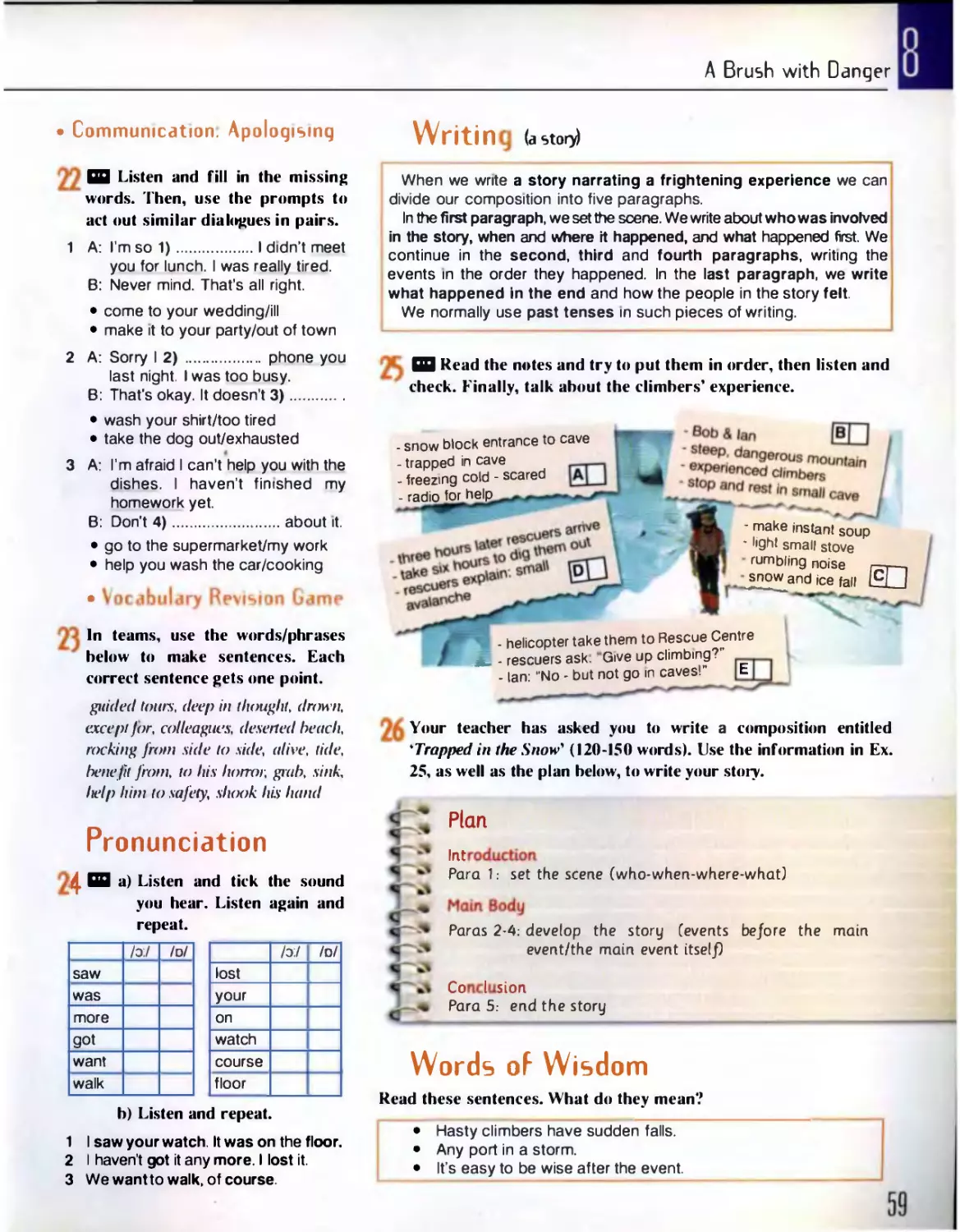
THEN	NOW
af........in the middle of a large h.......... with a
Bristol	garden in the countryside
APPEARANCE
long hair, quite p..... slim, handsome, s........
blue j.......	hair, expensive s......
EATING HABITS
hamburgers, c....... f..........salads, orange juice
FREE TIME ACTIVITIES
football, c........ parties, nightclubs,
rock concerts	t...........
1	(they/wear sandals) They used to wear sandals.
2	(they/ride motorbikes) ...........................
3	(they/listen to Walkmans) ........................
4	(men/wear suits) .................................
5	(women/wear bracelets)............................
6	(they/have mobile phones) ........................
You have been asked to write a magazine article
about Bill Newton. Use the information from Ex.
28, and the plan below, to write your article (100 -
150 words). Use the text in Ex. 23 as a model.
Pronunciation
2 7 O Listen and underline the silent letters. Listen
again and repeat.
know - listen -	write - often
talk walk	-	hour comb
Writin C (an article about someone's
lifestyle and how it has changed)
When we write an article about someone's lifestyle and
how it has changed, we can divide it into four paragraphs.
In the first paragraph, we write his/her full name, where
he/she comes from and what he/she does for a living. In
the second paragraph, we write how his/her life used to
be years ago. We write about his/her home, appearance,
eating habits and free-time activities. In the third
paragraph, we write about his/her lifestyle nowadays. In
the last paragraph, we write how he/she feels about these
changes. We use used to or the past simple to talk about
the person's past habits, and present tenses to talk about
his/her lifestyle nowadays.
Plan
Introduction
Para 1: Bill Newton is Britain’s most successful
film star. However, things were not
always easy for the boy from Bristol.
Main Body
Para 2: past lifestyle
Para 3: present lifestyle

Conclusion
Para 4; Bill’s life has changed a lot since those
days in Bristol. "I enjoy my success and
hope it will continue for many years to
come,” he says.
Words oF Wisdom
Read these sentences. What do they mean?
• He lives long who lives well.
• As you make your bed, so you must lie upon it.
17
Shop till you Drop!
Lead-in
answers
UNIT 3
Yes, of course.
Here you are.
I'm afraid we haven't
got any left.
S4.- Can I have some apples, please?
SB: Гт afraid we haven’t go tarty left.
travel agent’s
supermarket
antique shop
boutique
jewellers
department store
flower stall
florist s
hair& beauty salon
designer fashion house
Choose words from the list to label the
pictures.
lace shop
confectioner’s
bookstall
bookshop
butcher's
bakery
post office
newsagent's
greengrocer's
chemist's
Where can you buy these things? What
else can you buy in each place in Ex. 1?
apples, a plane ticket, old clocks, a book,
a pair of trousers, a packet of painkillers,
a diamond ring, lilies, an armchair, grapes,
pralines, a bottle of perfume, lamb chops,
lace tablecloths, a leather suitcase, stamps,
a woollen skirt, a leather jacket, hairspray,
a bouquet of roses, a washing machine,
a magazine, sugar, a gold necklace,
a loaf of bread
You can buy apples at a greengrocer's.
In pairs, use the phrases below and
words from Ex. 2 to act out dialogues, as
in the example.
requests
Can I have .... please?
Could I have.... please?
Have you got any ...?
I'd like ... , please.
Shop till you Drop!
Look at the title оГ the article helow. What do
you think the article is about?
D Look at the pictures on p. 18, then listen and
tick (✓) the three places the speaker mentions.
Reading
a)	Read the article and match the headings to
the correct paragraphs.
A Recommendation C A Shopper’s Paradise
В Opening Hours D Places to Go and Things to Buy
Language Development
Fill in the words from the list, then make
sentences using the completed phrases.
fashion, rare, designer, shopper’s, high, bank, woollen,
autumn, department, antique
1	a(n) ........paradise
2	..............lovers
3	...............books
4	a(n) ..........store
5	.............quality
6 ................skirts
7 ...............clothes
8 ..............accounts
9 ................houses
10 ............collections
Fill in the synonyms from the list.
chance, trendy, plenty of, a wide range of, fantastic
Paris, the capital of France, is a shopper s
paradise, with plenty of large department stores as
well as thousands of delightful smaller shops.
ДИ Antique lovers can .find fantastic furniture in
the small antique shops on Bonaparte and Jacob
Streets, and collectors can find rare books on the
bookstalls lining the banks of the River Seme There
are also some great department stores which sell
everything from perfume to furniture. Galleries
Lafayette. Pans' largest department store on Boulevard
Haussmann, offers a great variety of high quality
woollen skirts, leather jackets and designer clothes
The Marais is a group of little streets with some of the
trendiest boutiques. There you can buy fashionable
clothes, shoes and jewellery For shoppers with big
bank accounts, there is a wide range of jewellers and
designer fashion houses along the Rue de Rivoli,
such as Cartier. Chanel Nina Ricci and Christian
Dior.	"	|	..
дд Shops in Pans are usually open from eight or
ten in the morning till about seven in the evening,
from Monday to Saturday. The big sales come after
Chnstmas and before the autumn collections
ДИ Don't miss the chance to qo shopping in
Pans There is always something to everyone's
pocket and taste
b)	Ask and answer questions based on the text,
as in the example.
57; HTiene can you find antique shops?
S2: On Bonaparte and Jacob Streets. Which is
Paris’ largest department store?
S3: Galleries Lafayette. What can you buy there?
1 fashionable = .........
2 a great variety of -
4 opportunity =
5 a lot of =......................
3 wonderful - .........
Fill in the correct words from the list.
line, offer, suit, buy, miss
1	You can........cheap clothes during the big sales.
2	Flower stalls................the	banks of the river.
3	At Galleries Lafayette, shoppers can always find
something to .................their	taste and pocket.
4	Don’t ..........................the	chance to visit
the big department stores.
5	The large department stores.............a	great
variety of products.
10
Fill in the correct prepositions, then make
sentences using the completed phrases.
1 ..........Bonaparte Street; 2.............the
bookstalls; 3 the banks .............. the River
Seine; 4..............eight.........the morning
.......seven..........the evening
• Speaking
a)	Suggest another title Гог the article.
b)	Read the text again and take notes under the
Tollowing headings. Then, talk about shopping in
Paris.
•	name of city — location
•	best shops — where they are — things to buy
•	opening hours — sales
•	recommendation
Shop till you Drop!
• Grammar: Adjectives
Order of Adjectives
•	Adjectives describe nouns. They have the same form in the
singular and plural, e • э blue dress л-тЫие..'. >
•	There are two types of adjectives.
Opinion adjectives
describe what we think of someone or something.
Fact adjectives	describe what
someone or something really is.
Opinion adjectives go before fact adjectives.
She’s wewfrtg з beeuttful red dress
•	When there are two or more fact adjectives in a
sentence, they usually go in the following order:
Fact Adjectives
size:	small, big, short, long, etc
weight: heavy, light, etc
shape: triangular, round, rectangular, square, etc
colour dark/light blue, yellow, pink, cream, red, purple, etc
material: cotton, leather, silk, plastic, woollen, nylon,
metal, gold, silver, velvet, wooden, canvas, etc
It’s а ЬелиШи!. long. Hgtrt Мм»,
Read the article in Ex. 6 and find three Tact
adjectives and three opinion adjectives.
a) Match the shapes (a - d) to the adjectives.
triangular....round.......rectangular......square
h) Kind the objects that match descriptions I - 3,
then describe the other objects.
1	It’s a small triangular brown object. It’s made of
wood and metal. We hang clothes on it....................
2	It’s a small round yellow object. It’s made of wool
and rubber. We play tennis with it. .....................
3	It's a small rectangular black object. It’s made of
leather. We keep our money in it. .......................
Number the adjectives in the correct order.
1	a brown («.) wooden (.:.) beautiful i..) box with a
brass lock a beautiful brown wooden /vn with ...
2	a cotton (...) large (...) grey (...) shirt with a white collar
3	a heavy (...) metal (...) black (...) saucepan with brown
handles
4	a silk (...) blue (...) nice (...) scarf with yellow stars on it
Describe the objects, as in the example.
Ifs a grey plastic suitcase with stickers on it.
It GAME: Write short descriptions of objects. Read
them aloud and let the class guess what objects
you are describing.
• Communication: Describing Lost Property
П Listen and repeat. Then, in pairs, use the
prompts to act out similar dialogues.
A:	Excuse me. I’ve lost my briefcase. Has anybody
handed it in?
B:	What does it look like?
A:	It’s a black leather briefcase with a brown handle.
B:	What’s it got in it?
A:	My purse, some credit cards and my passport.
B:	Where and when did you lose it?
A:	At the airport, yesterday evening.
B:	Is this it?
A: Oh, yes! Thank you very much!
wallet:	money, photos, driving licence, phonecard
suitcase: clothes, shoes, camera, a bottle of perfume
rucksack: notebooks, wallet, identity card, four books
• \\ citing (Project)
Read the letter in the Photo Eile section and say which
object is described. Then, choose one of the other
objects and write a letter to the lost property office.
20
Shop till you Drop!
• Reading & Listening
О Listen and underline
the correct item in hold.
1	Harrods is a shop in
Kensington/Knightsbridge.
2	The Chairman of Harrods is
Charles Henry Harrod/
Mohamed Al Fayed.
3	Harrods has survived 3 wars/
a fire and two bombings.
4	Harrods employs over 4,000/
6,000 staff.
5	The Toy Departments/the
Food Halls are the heart and
soul of Harrods.
6	The sales are in March and
July/January and July.
a) Read the article and Fill
in the headings.
•	History of the Store
•	The Sales
•	Location Л Management
•	Recommendation
•	Departments & Services
h) Underline the phrases
which best descrilw
pictures I - 3, then explain
the words in hold.
j<^ Fill in the words from the
list, then make sentences
using the completed phrases.
busy, over, look, run, survive,
security, heart, Food
1	to ............a shop
2	his son..........over
3	................the	years
4	to................a fire
5	...............personnel
6	the................Halls
7	the .........and soul of
8	..................months
fire brigade security
and the biggest hair and beauty salon in
Europe.
sells everything from clothes to caviar
The Food Halls are still the heart and soul
of Harrods In addition to the nineteen
bars and restaurants in the store, there is
a bank, a travel agent's, a dry cleaner s
'All things, for all people, everywhere’
is the store s motto. The Harrods name
means the best of British quality service
and style All in all. Harrods is a
fascinating place to visit.
Today, around
35.000 people
visit Harrods every
day. It has got
300 departments
spread over
seven floors and
employs over
4.000 staff It also
has eight
doormen, known
as Green Men ,
as well as its own
personnel doctors and nurses
Harrods is the official supplier of
certain goods to the Royal Family, and
In the beginning, though. Harrods was
just a small grocer's shop It was opened
in 1849 and run by Charles Henry Harrod
His son took over and added medicines
ano perfumes as well as fruit, flowers,
sweets and a van delivery service
Over the years. Harrods has survived a
fire, two World Wars and even two
bombings In 1983. Harrods moved
abroad and opened a branch m Japan
and later others in Hong Kong. Singapore
and Taiwan, as well as airport shops in
most major European cities.
'Enter a Different World", it says on the
doormat and this is what you do when
you visit Harrods in Knightsbridge.
London Harrods is “the world's most
celebrated store", says Chairman Mr
Mohamed Al Fayed
January and July Г—f
are very busy months и
for Harrods because *» •
they are sale times. 1	4 * ,
Over 300,000 cus- л f
tomers visit the store	ж Л
on the first day alone f ~
Many people sleep
outside the store all	’
night to be first in when the doors open on
the first day
3 In 1983, Harrods opened a branch in Korea.
4 Harrods has got 3,000 departments.
5 There are nine bars and restaurants in the store.
Q Correct the false statements,
as in the example.
1	Harrods is in Paris. It isn't in
Paris. It’s in London
2	In the beginning, Harrods
was a big bakery.
a) 'Take notes under the headings in Ex. 18a, then tell the class ahout Harrods,
h) Tell the class ahout a big department store in your country.
21
Shop till you Drop!
• Grammar: Making Comparisons
b) Polite Requests and Offers
| Complete the table, then say how we Form the
comparative and superlative Forms oF adjectives.
r Comparative		Superlative 1
big		the biggest
short		the shortest
beautiful		the most beautiful
large		the largest	||
expensive	more expensive than
long
bad	worse than
good		the best
little		the least
In pairs, use the Following expressions to compare
the things in the pictures, as in the example.
much cheaper, the most expensive, I ess expensive, not
as nice as, longer than, the shortest, the same price as,
shorter than, not as long as, much more beautiful
The purple skirt is much cheaper than the brown skirt.
Explain the words in the list. Which oF them can
we use with a pair of?
boots, belt, tights, jeans, tracksuit, leggings, gloves,
shorts, trainers, cardigan, socks, shoes, tie, sweatshirt,
jumper, coat, shirt, skirt, scarf, jacket
• Communication a) Asking about Prices
/ В Listen to the dialogue, then act out similar
dialogues in pairs, using words From Ex. 23.
A:	Excuse me how much is this pair of boots?
B:	These boots? They're £60.
A:	Do you take credit cards?
B:	I’m afraid not.
A: That’s okay. I'll pay cash, then.
П Complete the dialogues with the sentences in
the list, then listen and check. In which shops
could you hear these dialogues?
-	Could I have the pills in this prescription, please?
•	Certainly. What would you like in it?
-	Here you are.
-	Can you deliver it?
1 A: I'd like to order a bouquet of flowers, please.
A:	Roses, please, and perhaps some lilies........
B:	Yes, if it’s local- _
2 A: ...............................................?
B: Certainly. That will be £5, please.
A: ...............................................
B: Thank you. Remember to take the tablets twice
a day after meals.
a) Name the shops in the pictures and say what
you can buy in each.
D b) Listen and match the dialogues to the
shops in the pictures.
c) In pairs, choose two oF the shops in the pictures
and act out a suitable dialogue For each shop.
Shop till you Drop!
• Vocabulary Revision Game
2? In teams, use the words below to
make sentences. Each correct
sentence gets one point.
shopper, plenty of, furniture, sell, suit,
rare hooks, buy, collectors, such as,
everywhere. fire brigade, chairman,
medicines, security personnel, offer,
survive, fascinating place, customers,
high quality, autumn collections
Pronunciation
О Listen and repeat.
•	hat - have - hot - hear
•	Who hit her?
•	I haven’t heard from Henry for ages.
•	Harriet has got a hundred hats.
•	He hasn’t had a holiday for years.
•	Harry hates hot dogs.
Writing (an article about
the shopping Facilities in a city)
When we write an article about the
shopping facilities in a big city, we can
divide it into four paragraphs.
In the first paragraph, we state the name
of the city and the types of shops you
can find there.
In the second paragraph, we state the
names of the best shops, where they
are and what we can buy there.
In the third paragraph, we state the
opening hours and the sales times.
In the last paragraph, we recommend
the place to shoppers.
We normally use the present simple in such
articles, We give the article an interesting
title to attract the reader’s attention.
30
A:
L:
A:
L:
A:
?9 О Listen and answer the questions.
1	Which city are the speakers in?
2	What shops can you find there?
3	What can you buy at these shops?
4	What are the opening hours?
5	When do the sales take place?
6	How does Lisa recommend the place
to Alice?
a) In pairs, read out the dialogue.
Mm, that was wonderful coffee. Oh, it’s so
nice to be here in Brussels with you, Lisa
and I can’t wait to go shopping!
Ah, you’ve come to the right place, then!
Boutiques, confectioner's, lace shops,
antique shops, enormous department
stores you can shop till you drop, my
dear.
That’s great! Where shall we go first?
Well, the Sablon District is full of antique
shops. You must visit Dewindt, on Lebeau-
straat. It’s got some lovely antiques.
Oh, Lisa! Aren’t you coming with me?
L: I can’t, I'm afraid, but I’ll meet you at three, outside Inno Brussels
on rue Neuve. It’s Brussels’ most famous department store, and
you can buy everything from clothes to jewellery there.
A: Ooh, that sounds exciting! And what about souvenirs? Brussels
is famous for chocolate and lace, isn’t it?
L: Yes, it is, and Leonidas on Boterstraat has the most delicious
pralines in the world. We can also go to F. Rubbrecht in the
Grand-Place. We’ll find the best lace there.
A: Will we have enough time? The shops are open from nine to six,
aren’t they?
L: That’s right, but it’s Friday today. Shops are open until 8:00 pm
on Fridays. And there are sales every January and July, so ...
A: The sales are on now? That’s great! I can find some bargains!
L: Of course you can. Didn’t I tell you? Brussels really is the best
place for shoppers!
b) You have been asked to write an article Гог a travel magazine about
the shopping facilities in Brussels. Use the text in Ex. 6 as a model
and the dialogue in Ex. 30a to write your article. (100 - ISO words).
Plan
Introduction
Para 1: name of city, types of shops in general
Main Body
Para 2: names of best shops, where they are, what you can
buy there
Para 3: opening hours & sales time(s)
Conclusion
Para 4. recommendation
Words oF Wisdom
Read these sentences. What do they mean?
•	In good times people want to advertise, in bad times they have to.\
•	Money makes the world go round.
23
aEpisode 1
The Curse
Mike, the editor of The Morning Sun, has sent Sandra and David to the village of
Kontu in the South Pacific. They are going to investigate the story of a man, Senan,
So. this is the village
of Kontu Let's find
who has the power to call sharks.
Senan now
(next morning on the shore
Look at those two
men Senan must be
uhe one on the left..
But what is all
this for?
Heeya.
Heeya
How do you know
who we areT^
Senan must be the older
Look, he's coming over^
Sandra, look! He's^
beating the water with
s. coconut shells, л
Who's that man?
He looked very
angry'
His eyes look like a shark’s
and he's got marks on his
arms and legs.
He s Mosan He s jealous
of me Now. get ready The
shark is near ns.
It is magic. It worked! There are shark fins^
over there ... Oh. no' A shark is under the canoe!
^^_lt II attack us! David, do something! __i
Don't ask questions Do as I say. I'm
going to the forest to begin my magic
and dream of the shark
I curse you. Senan!
( I command the skies
to bnng rain!
l dreamt about you Now
you must prepare for tomorrow You
must eat only sweet potatoes and go
Io sleep early tonight
No, it can 't be him He's tod
young
man
"Hello. Sandra Helio^l
David Come My hut
«ч is this way .
The Shark Caller - Episode 1
Look at the pictures, then read the
sentences and circle the correct
item.
1	David and Sandra are in.........
a a village by the sea
b a city c a big town
2	They are looking for.........
a boy	b man	c woman
3	The man takes them to his.........
a hut	b flat	c cottage
4	The man gives them a bowl of......
a soup b milk c sweet potatoes
5	The man beats the water with coconut
• We use must + infinitive without to to say that something is
logically true.
Th is must be her bag. Her purse is inside it.
(= I'm sure the bag is hers.)
• We use can’t + infinitive without to to say that something is
logically untrue.
The Rover cent be his. He’s got a Lancia.
(= I’m sure the Rover isn't his.)
a shells b balls c stones
Look at the pictures, then answer
the questions. Write .S' Гог Sandra,
1) Гог David or Se Гог Senan.
1	Who's got long fair hair?
2	Who's got a dark complexion?
3	Who’s got green eyes?	.....
4	Who’s got short straight black hair?.
5	Who’s got wrinkles?
It must be a coconut. It
can t be a pineapple.
Fill in must or сан’t.
D Listen and write .S' Гог Sandra,
1) hr David or Se Гог Senan.
1	No, it can’t be him.
2	He’s got marks on his arms.
3	You must prepare for tomorrow.
4	But what is all this for?
5	There are shark fins over there.
1	They look the same. They...............be twins.
2	He's got black hair. He...............be	from Norway.
3	This car.............be Susan's. She hasn’t got one.
4	Julie is an excellent student. She..............study	hard.
5	This CD..............be his. He doesn’t like classical music.
П a) Put the events into the correct order, then listen and
check your answers. Finally, tell the story.
| Read the episode and answer the
questions.
1 Where exactly are David and Sandra?
2 How does Senan know who they are?
3 What does Senan ask them to do?
4 Why does Senan go to the forest?
5 What does Sandra say is under the
canoe?
О Mosan curses Senan.
□ Senan takes them to his hut.
I | Senan goes to the forest to begin his magic.
| | Senan beats the water with coconut shells.
[ | Sandra and David reach the village of Kontu.
| | Senan gives them sweet potatoes to eat.
| | Sharks appear.
Fill in the words from the list,
then make sentences using the
completed phrases.
ask. call, coconut, eel, go. look.
D h) Listen again, then take roles and act out the episode.
We use will + infinitive without to to make predictions based on
what we believe or think. We usually use will with I think, I expect,
probably etc.
sweet, shark
1	to......sharks
2	......potatoes
3	to ....to sleep
4	to...questions
5	to .......angry
6	to .......ready
7	..........shells
8	...........fins
What do you think will happen in the next episode? Make
predictions with will, as in the example.
/ think the shark will attack them.
25
Days to Renewber
Lead-in
Match the sentences (a - g) to the pictures (I - 7).
Then, read out the events in the correct order.
Can you guess who the young woman was?
|g| ; | Janice saw a young woman standing at the door.
[b[ ~| The woman's flowers were lying on the doormat.
|c| | James showed Janice the photograph.
[tjJ | Janice was watching TV.
CT 1 When James got home, she was still sitting on the
ш— stairs with the flowers on her lap.
|f । | Janice went to the telephone and asked the local
— taxi service to collect the young woman.
|fl| I James noticed an old photograph.
Guess the type of story. Is it a humorous story,
a science fiction story, a crime story, a horror
story, a love story, a ghost story or a fairy tale?
Who are the characters in the story? What do you think
it is ahout? Describe what you can see in the pictures.
В Listen to the story and check if your guesses
were correct.
Reading
Read the story and match the sentences (A - I)) to
the numbered spaces (I - 4) in the story, then
explain the words in bold.
A Janice couldn't see her anywhere, so she picked up
the flowers, went inside and phoned the taxi service
again to cancel the call.
В Janice looked at it and gasped in amazement.
C Instead of her husband, though, Janice saw a young
woman standing there.
D Then James noticed an old photograph next to the
clock.
26
Language Development
It was half past ten at night and Janice was alone in the
house, waiting for her husband to come home. It was
raining heavily outside and the wind was blowing. She
was watching TV when the doorbell rang. "James has lost
his keys again," she thought as she opened the door.
j She was wearing a long white dress under her
coat, and she was holding a bouquet of pretty flowers.
"Excuse me," the young woman said sweetly. "Would it
be all right if I used your phone to call for a taxi?’’
"Oh, yes, of course," Janice replied. "I’ll call one for
you now." She went to the telephone, asked the local
taxi service to collect the young woman, and returned to
the front door. The young woman wasn't there, but her
flowers were lying on the doormat. 2 ____
She sat down on the stairs, puzzled by the young
woman’s mysterious disappearance, there was something
familiar about the woman, but Janice couldn’t think what it
was. When James got home half an hour later, she was still
sitting on the stairs with the flowers on her lap. "What’s the
matter?” he asked. "You look as if you’ve seen a ghost."
"Perhaps I have," she said jokingly. She showed James
the flowers, and told him about the strange woman. James
laughed, then went upstairs to change his clothes. Ay he
was going past the guest room, he heard the sound of a
clock ticking. "It sounds like the clock my grandparents
had when I was a child," James thought, "but that
stopped working twenty years ago." He went into the
room and turned on the light. His grandparents were no
longer alive, but many of their things were still there.
James looked around and saw his grandparents’ clock. It
was ticking loudly and it showed the correct time.
It was a picture of a young couple on their wedding
day, with "15th April, 1910” written on the photograph.
James took the picture and went downstairs.
"I know who the young woman was,” he said softly,
showing Janice the photograph. 4 The bride was
wearing the same white dress as the young
woman, and the flowers she was holding
in the photograph were just like the
ones Janice had. "My grandmother
died before I met you, didn’t she?”
James said. "Well, that's her in the
photograph ~ and today ts 15 th April. It's
her wedding anniversary.
Fill in the words from the list, then make
sentences using the completed phrases.
anniversary, taxi, change, ticking, sounds, bouquet,
gasp, front, wedding
1
2
3
4
5
it ..............like
the .............door
a local.......service
a(n)........of flowers
to......one’s clothes
a clock
to........
amazement
wedding ....
Underline the correct word in hold.
day
... in
Tom was alone/lonely in the shop when the robbers
walked in.
All the boy’s toys were laying/lying on the floor.
As it was raining heavily, they changed/cancelled
their trip.
Your watch does not show the correct time/hour.
"She looks very known/familiar to me,” Josh said.
Fill in the correct preposition, then make
sentences using the completed phrases.
1 .......
3 to call
5 to sit
light; 7 .
night; 2 waiting............her husband;
......a taxi; 4 to tell sb.........sb/sth;
.....the stairs; 6 to turn............the
.....sb’s wedding day
1
1
2
3
4
5
3
6
7
8
9
Speaking
Use words/phrases From the list, and the
pictures on p. 26, to help you retell the story.
watching TV, doorbell rang, young woman, long white
dress, bouquet of flowers, called for a taxi, woman
wasn't there, doormat, cancelled the call, puzzled, sat
on the stairs, ghost, guest mom, clock ticking, old
rholograph. wedding day, gasped in amazement, same
white dress, /5th April, wedding anniversary
Grammar: Adjectives - Adverbs
Read the story again and correct the statements.
Use
1
2
3
4
Janice was reading a book when the doorbell rang.
She ИШМ i wading a book. Shi was wah lung 71 ’
The young woman was wearing a short white dress.
The young woman at the door was holding a clock.
Janice was sleeping when James came back home.
Adjectives describe nouns. Adverbs usually
describe verbs or other adverbs.
She was holding a bouquet of pretty flowers
‘Excuse me. ‘ the young woman said sweetly.
11
i Days to Remember
Replace the adjectives in hold with similar ones
from the list.
huge, exhausted, relieved, tiny, terrified
Sam heard the fireman knock on the window. He was
frightened, but he knew he had to get out. The flames were
big and he was very hot. Slowly, he moved towards the
window. It was small and Sam didn’t know if he could get
through. He managed after many attempts and when he
reached the ground he felt very glad. He suddenly realised
that he was tired. All he wanted to do was to sleep.
1Q Fill in the correct adverh, then say how we form
adverbs.
sudden ....	....... pretty
loud	* ................ hard	*
final	» ................ fast	••
gentle	» ................ good	*
Fill in the correct adverb from the list, then make
sentences using the verb and advert) together.
brightly. carefully heavily, loudly, sweetly. violently
1 to rain .
2 to sing
3 to shine
4 to climb
5 to shout
6 to shake
It was naming heavily as John was going back home.
) Fill in the opposites, then make sentences using
them.
fantastic, interesting, difficult, terrible, expensive,
short
1 good *.
2 cheap *
3 easy * ..
4 boring *
5 long * ..
6 awful * .
• Speaking
| Read the dialogue. Then, act out similar dialogues
in pairs using the prompts below.
/ П Match items a - i to the pictures (1-9), then
listen and tick (✓) the sounds you hear. Finally,
say which sounds you could hear and which you
couldn't, as in the example.
I could hear the wind howling.
I couldn’t hear a tap dripping.
a a dog barking ..2...
b a clock ticking
c a tap dripping
d a siren wailing
e rain falling
f the wind howling
g someone knocking on
the door	....
h thunder rumbling
I car brakes
screeching ............
p. Use words From the list to say how each person
feels: thrilled, anxious, nervous. sad, puzzled, amazed
1 “Oh! The view from here is fantastic!" ...amazed...
2 “Who on earth can he be?"	...........
3 “This is the best party I’ve ever had!" ...............
4 “It's already 8:20. I must hurry!"	.........
5 "That woman over there keeps looking
at me. What does she want? "
6 “I'm so sorry about your father."
A: How was your holiday?
B: It was fantastic/boring.
A: Was the weather
good?
B: Yes, it was./No, it
wasn’t. It was awful.
• the concert/fantastic-
the tickets/cheap?
•	your Maths exam/awful-
the questions/difficult?
•	the play/boring - the
actors/good?
•	the lecture/long - the
lecturer/interesting?
П Listen and match the speakers to how they Feel.
Speaker 1	a thrilled
Speaker 2	b puzzled
Speaker 3	c sad
Speaker 4	d scared
28
Days to Remember
• Grammar. Past Continuous
17 Study the sentences, then match
the verhs in hold to their uses.
These people were in the garden last Sunday at midday. Look at
the pictures and correct the sentences.
111 | It was half past ten at night and
Janice was waiting for her
____ husband to come home.
|2 | | She was watching TV when the
_____ doorbell rang.
131	| She was wearing a long white
dress and she was holding a
____ bouquet of flowers.
|41 | It was raining heavily outside.
a two or more actions happening at the
same time in the past
b background information in a story
c action interrupted by another shorter
action in the past
d action in progress at a stated time in
the past
1 Paul was hanging out the
washing.
Paul wasn't hanging out the
washing:
He was painting the door.
2	Ann was eating an apple.
3	Sue was watering the flowers.
4	Jane and Mary were cutting
the grass.
5	Bob was painting the door.
Beginnings  Endings
Form
• We form the past continuous with
was/were (past tense of the verb to be)
and the present participle of the main
verb (verb + ing).
—	w
•	At the beginning of a story, we say where and when the story
takes place, who the people are, and what happened first.
•	At the end of a story, we write what happened in the end and
how the people felt.
Affirmative:	llhelshelit was eating
welyoulthey were
eating
Negative:	l/he(she(it wasn't eating
welyoulthey weren't
eating
Interrogative: IVas l/he/she/it eating?
Were welyoulthey
eating?
Short Answers: Kes l/he/sheht was.
No, he/she/it wasn't.
Yes, welyoulthey were.
No, welyoulthey
weren't.
20
a
Put the verhs into the correct tense, then answer the questions.
Laura 1)........................(stare)	through the train window
at the cold, snowy fields. It 2)........(be) Christmas Eve and
she 3)............................(travel) home from Newcastle
to spend some time with her parents for the first time in months.
Suddenly an elderly gentleman 4) ...................(enter) her
compartment. He 5)..................................... (wear)
a black coat and he 6)......................(carry)	a briefcase.
He 7)...........(sit)	opposite Laura, 8)............(open) his
briefcase, 9) ................................. (take) out an
envelope and 10)................(give)	it to Laura. ...
b ... Laura 11)................(get)	off the train, carefully 12).............
| What were you doing at these
times - last Monday?
(put) the envelope in her bag and 13) ................. (walk)
towards the car which 14) ............................. (wait)
0 for her. “What shall I do?" she 15).............(think)	sadly.
- last Sunday?
6 am	11 am	7 pm
8:30 am	3:30 pm	10:30 pm
Al 6 am last Monday I was gelling
dressed.
Al the same lime Iasi Sunday I was
sleeping.
1 Where was Laura?
2 What was she doing?
3 When did the story take place?
4 Who are the people involved
in the story?
5 What happened first?
6 How did Laura feel in the end?
• Writinq (Project)
Look at the pictures and the prompts in the Photo File section and
write a beginning and an ending For the story. Use the extracts in Ex.
20 as a model.
29
-т As soon as Fay woke up, she
J knew this birthday was going to be
J very special. It was a sunny morning
3 and a gentle breeze 1)
I .........'n through the window. “A
I perfect day for a balloon ride!" Fay
I said excitedly to herself. Half an
I hour later, her friend Bob picked
I her up in his car. For her birthday
I present, Bob, a pilot, 2)...
................... Fay for a ride
in a hot-air balloon.
Fay was thrilled when she saw the
huge, bright yellow hot-air balloon.
Bob made sure that everything was
okay, then they climbed carefully
. into the basket. Moments later, the
' ball00n began to rise slowly into the
air. “This is fantastic!” she shouted
cheerfully to Bob.
“Happy Birthday!” I'm glad you
like your present!” he replied.
Suddenly, the smile disappeared I
from Bob's face. Dark clouds were
racing towards them and, before
he could say anything, there was a
loud rumble of thunder. The balloon i
shook violently from side to side.
“Oh, no!” screamed Fay. "We're ।
going to die!” Just as Bob was
| reaching for the radio, there was a
। bright flash of lightning. Fay fell
I backwards and hit her head, and
everything went black.
When Fay opened her eyes, she
saw Bob’s worried lace in front of
her. “Are you alright?” he asked
anxiously. “The balloon went down ”
he explained, “but fortunately we've
landed in a tree. I’ve already
radioed for help.” Fay looked over
the side of the basket and realised
that they 3)...............
;..... •••• from a branch.
Don’t worry,” said Bob calmly
“It'll hold us.”
At that moment a fire engine
appeared, its siren 4)..............
"•.................and	its red lights
/........................ brightly.
Two firefighters jumped out and
five minutes later, Fay and Bob
6) .......................... safely	I
on the ground. “We’re safe at last!” I
Fay cried.	I
Fay, I'm sorry,” replied Bob. “It I
wasn’t quite what I had in mind,
but I'm sure you won’t forget this
birthday!"	I
Look at the pictures. Which shows:
a hot-air balloon hanging from a tree branch?
| someone reaching for a radio?
EJ someone climbing into a hot-air balloon basket?
EZI a bright flash of lightning?
□ a fire engine?
a)	Read the story and fill in the numbered gaps
with verhs from the list. Then, explain the
words in bold.
were standing, were hanging, was blowing,
were flashing, was taking, was wailing
b)	Correct the sentences, as in the example.
1	Bob picked Fay up in his taxi. Bob didn't pick her up
in his taxi. He picked her up in his car.
2	Fay hit her leg.
3	The balloon shook gently from side to side.
4	They were hanging from a roof.
5	A police car appeared.
c) Read the story again and underline the phrases
which describe sounds.
Д О Listen to the story and number the sentences
in the correct order.
..8.. A fire engine appeared.
...Bob picked Fay up in his car.
...The balloon landed in a tree.
Fay woke up.
...Bob radioed for help.
...Firefighters helped Bob & Fay to the ground.
...They climbed into the basket of the balloon.
. 5.. Fay hit her head.
...The balloon shook violently from side to side.
• Speaking
Close your books and try to give a summary of
the story.
24 Complete the sentences.
1	I was walking down the street yesterday when ----
2	As I was leaving the shop......
3	I was lying on the beach when......
4	While I was eating my dinner last night.....
5	Jenny was typing a letter while....
30
Days to Remember
Ц GAME: What was Tim doing? Choose one of the
places in the list and decide what Tim was doing
there. In teams, the class asks questions to find
out what Tim was doing there. The one who
guesses correctly becomes the new leader.
kitchen, library, [tool, bathroom, dining room, garden,
living room, hall, bedroom, study, balcony, garage
L- Tim was in the kitchen at 3 o’clock yesterday.
What was he doing there?
Team A SI: Was he cooking? L: No. he wasn't.
Team В SI: Was he eating? L Yes, he was.
• Communication’ A Witness’ Report
- О Put the verbs in the past simple or past
continuous, then listen and check. In pairs, act
out similar dialogues using the prompts.
A: So, Mr Jeffries, what exactly 1)..........(happen)
yesterday?
B: There 2).......(be) a robbery in my neighbourhood.
A:	Where 3)..................(you/be) at the time?
В:	I 4)............(be)	in my garden.
A:	What 5)...............................(you/do)?
В:	I 6).............................(cut)	the grass.
• a burglary next door - in my bedroom - sleep
• a robbery at the bank - outside the bank - talk to the
security guard
Writing (a story)
When we write a story, we first decide on a plot line
(a series of events that lead up to the main event). We
can divide our story into four paragraphs.
In the first paragraph we say when and where the story
happened, who the people in the story are and what
happened first. In the second and third paragraphs we
write what happened before the main event, then
describe the main event. We usually write the events
in the order they happened. In the last paragraph we
describe what happened in the end and how the
people felt.
We can use someone's actual words (direct speech)
as well as a vari ety of adjectives and adverbs to make
our story more interesting. We normally use the past
simple and past continuous in such pieces of writing.
U О Listen and put the events in the correct
order. Then, use the list to retell the story.
....Two fishermen pulled the canoe to
....safety.
.../... Mark & Dan got into the canoe.
....They stopped to have some coffee.
....They thanked the fishermen.
....They got back into the canoe.
...5... They saw a waterfall.
....They saw a kingfisher.
• Vocabulary Revision Game
In teams, use the words/phrases below to make
sentences. Each correct sentence gets one point.
cancel the call, familiar, no longer alive, tick loudly,
pick her up, shook violently, radioed for help, was
hanging from, had in mind, rise, turned on
Pronunciation
O Listen and underline the stressed word, then
tick the correct meaning. Listen again and repeat.
1	I was here at six o'clock.
□ not somewhere else И not at seven o'clock
2	A young woman was standing at the door.
□ not an old woman Q not a young man
3	They were both very sad.
□ not just one of them □ they weren't happy
4	He was cooking in the kitchen.
□ he wasn't eating □ not in the bedroom
5 This is my grandmother.
□ not someone else’s □ not my mother
Use the list of events in Ex. 29, the pictures in
the Photo Pile section, and the plan below, to
write a story entitled The Waterfall for your
teacher (120 - 180 words).
Plan
Introduction
Para 1: start the story (who, when, where, what)
Main Body
Paras 2-3; develop the story (events before the
main event, the main event itseip
Conclusion
Para 4,- end the story (what happened in the
end, how people felt)
Words oF Wisdom
Read these sentences. What do they mean?
• One story is good till another is told.
• A tale never loses in the telling.
31
0 Self-Assessment 1 lllnils I - 4)
• Vocabulary
• Grammar
1
1
2
3
4
5
6
7
8
9
10
2
1
2
3
4
5
6
7
8
9
10
3
1
2
3
4
5
6
7
8
Underline the correct item in hold.
Thai people have strong wills/features.
Mission Control wakes the crew/audience up at 6:41
pm CST.
Liza's friends persuaded/hired her to send a
cassette to a record company.
Harrods employs/spreads over 4,000 staff.
Leave me alone/lonely, please.
James will pick/take me up in his car.
A gentle breeze was wailing/blowing in through the
window.
That wasn't what I held/had in mind.
George is very lazy/mean. He doesn't like working.
He's got a dark build/complexion.
(10 marks)
Fill in the correct word.
tropical, ancient, celebrate, short, destination,
projects, accounts, anniversary, couple, friendly
The Thais............................many	festivals
throughout the year.
Only people with big bank....................can
shop here, as it is very expensive.
Fiji has got a................climate	and beautiful
beaches.
The astronauts work on ..........................
involving satellites.
Hawaii is a popular holiday .....................
I met some very......................people	at the
party.
We visited several ...............temples	in India.
We have a.......................break	for lunch at
1:30 pm.
It is my parents’ wedding ................today.
They got married in 1972.
Tim often sleeps for a.................of	hours in
the afternoon.	/ln „„
Fill in the gaps with prepositions from the list.
to, of, in, for, till, from
Can you call ......................a taxi, please?
Bob and Marie have lots of things .......common.
The village consists ............a	few houses and
a church.
Mary is proud ........................her	daughter.
Shops are open .............8	am..........4 pm.
According ..............John,	Chris broke the vase.
He was waiting .............a	taxi when I saw him.
At 8 pm, the night staff take over ......the night.
(8 marks)
Put the verbs in brackets into the present
simple or the present continuous.
1	They .......................(work) on an important
project at the moment.
2	I .................(see) Tom tomorrow after work.
3	This shop .......................(sell) rare books.
4	Sue ...............(know) a lot about computers.
5	A lot of tourists....................(visit) London
at this time of year.
6	The space shuttle........................(take off)
this afternoon. We can watch it on TV.
7	It........................(cost)	a lot of money to
fly to Australia.
8	I don't want to go out because it..................
(rain).
9	Sharon ..................................(come) to
my house for dinner tonight.
10	He .......................(drive)	to work every day.
(10 marks)
Put the verbs in brackets into the past simple or
the past continuous.
1	It was cold on Sunday night, so we................
(light) a fire.
2	I met Ann while I............................(do)
the shopping.
3	The sun............................(shine) when
John woke up that morning.
4	He.................................(read) a book
when the lights went out.
5	They............................(clean) the house
when he called.
6	She ....................(break)	the computer when
she tried to move it.
Module Self-Assessment 1 (Units I 4)
7	.................................(you/watch) that
film on TV last night?
8	Steve..........................(help)	me with my
homework last night.
9	The man........................(wear)	an expensive
suit and had a beard and moustache.
10	She ............................(play) the piano
when the doorbell rang.
(10 marks)
Number the adjectives in the correct order.
1	I can’t find my triangular (...) gold (...) small (...)
earrings.
2	She's wearing a woollen (...) pink (...) pretty (...)
jumper.
3	He bought a pair of leather (...) brown (...) expensive
(...) shoes.
4	She was wearing a black (...) nice (...) velvet (...)
dress.
5	I lost my plastic (...) blue (...) small (...) bag yesterday.
(5 marks)
Complete the sentences with adjectives from the
list, in comparative or superlative form.
short long, bad, expensive, young
1	A: John is taller than Jim.
B: No, he isn’t. He's ...........................
2	A: This was the cheapest T-shirt in the shop.
B:	No, it wasn't. It was......................!
3	A: The red skirt is the shortest of all.
B:	You must be joking. It’s...................!
4	A: Bob is older than you.
B: Of course he isn’t. He's .......................I
5	A: What do you think of Jonson's new book?
В: I thought it was even................than	his last
book!	(5 marks)
• Communication: Buying Things
Match the questions (I - 5) to the replies (a - e).
1	I'm sorry what did you say your name was?
2	How do you usually get to work?
3	Where were you at the time of the robbery?
4	What flowers would you like in your bouquet?
5	Would you like to pay by credit card?
| |a I was in the shop next door to the bank.
I lb No, thank you. I'd rather pay cash.
| |c Brian, Brian Clarke.
I I d I usually go by train.
| | e Some carnations, please, and perhaps some roses.
(5 marks)
Reading
Read the beginning (a) and ending (h) of a story,
and put the verbs in brackets into the past simple
or past continuous, then answer the questions.
a It 1)............(be) a dull Sunday morning and a
cold wind 2)...................(blow) down the
empty High Street. Tom Ridley 3)...............
(walk) to the newsagent's to buy his Sunday paper
when he 4)...........(hear)	a strange noise. Tom
5)...............(stop) and 6)..........(look)
up and down the street, then he 7) ............
(realise) that the noise 8).............(come)
from behind the heavy iron door of the museum.
b After the police 9)..........(arrest) the robbers,
the owner of the museum 10) ............(turn)
towards Tom. “Please accept this with my thanks,”
she 11).........(say), and 12)..........(hand)
Tom a cheque for £500. Tom 13)..........(look)
at the cheque and 14) .........(smile) happily.
“You're very, very welcome,” he 15).. (reply).
(15 marks)
1 Where and when does
the story take place?
2 Who is the main
character in the story?
3 What was Tom doing?
4 What happened?
5 What did Tom realise?
Writing
6 What happened in the
end?
7 How did Tom feel in
the end?
8 Can you think of a title
for this story?
(8 marks)
The pictures below show the beginning and
ending of a story. Use the prompts to help you
write a beginning and ending.
(14 marks)
TOTAL: 100 marks
Mr Yang - walk in - front door -
| smile - carry - bouquet of flowers -
‘You did it! You saved the company!"
Miss Wong - smile - "That’s all
right. It's all in a day's work."
Friday afternoon - Mr Yang - chairman
of Sunyang Industries - have staff
meeting - try - save the company -
anxious - secretary - Miss Wong say -
“I think I have the solution.”
33
The Way We Are
Read, listen, talk and write about...
Pfenning Ahead
Unit5
job qualities
plans
holidays
•	food
•	drinks
•	service at restaurants
•	containers
Module 2
Profiles
Units 5-8
Learn how to...
•	make appointments
•	remind & reassure people
•	make polite requests & offers
•	accept & refuse
•	ask for & give permission
•	apologise
Practise...
•	will/going to/present continuous
•	conditionals types 0/1
•	a/an/some/any
•	much/many-a few/а little
•	should (advice)
•	present perfect simple/continuous
•	past perfect simple vs past simple
health
illness
accidents
changes in lifestyle
|	A Brush
Г..with Danger
• experiences
• preparations
• feelings
D ...
a
b
c
d
e
f
a) Isabel each picture with the correct job in the list.
gardener, stuntman, firefighter, barman, doctor, bulkier
h) Can you think оГ any other jobs?
Fill in the job from the list in Ex. la.
I've always wanted to help sick people, so I'm going to be a.......
I want to save lives, so I'm going to be a..........
I like meeting people and socialising, so I'm going to be a........
I enjoy doing dangerous things, so I'm going to be a...............
I love looking after plants, so I'm going to be a...............
I don't mind working hard, so I'm going to be a....................
Choose adjectives from the list to make sentences about the
jobs in Ex. la as in the example.
brave, patient, imaginative, strong, friendly,
hardworking, caring, careful
Gardeners have to be patient, imaginative and carefitL
In pairs, ask and answer questions, as in the example.
SA: Which job would you most like to do?
SB: Id like to work as a doctor, because I like helping sick people.
Which job would you most like to do?
SA: I'd like to ..
Ш You are going to hear three people talking ahout their
plans Гог the future. Listen and match the people to the job
they want to do and the reason why.
Ito	doctor	wants to save lives
Roberto	firefighter	likes helping sick people
Natasha	barman	likes meeting people
34
Planning Ahead
You are going Io read aboul I he
ambilions оГ Ihree young people.
For questions 1-6, choose from lhe
people (A-C). Who...
-	is still at school? 1...... 2....
-	is going to study Medicine? 3....
-	exercises regularly?	4....
-	has just completed a course? 5...
-	has already arranged a job
for next summer?	6....
Language Development
Fill in lhe words from lhe lisl, lhen make sentences using lhe
completed phrases.
complete, training, local, save, wish, meet, get, full-time, entrance, long
1 to ..
2 the
3 a(n)
4 a(n)
5 ......
...lives
...gym
...test
. course
me luck
6	to.................people
7	to...................angry
8	a(n) .................job
9	to work..............hours
10 to.................a	course
No Ooblma is a schoolboy from Japan.
Ho la 17 years old.
“I've always wanted to be a firefighter because
I want to save lives. Firefighters have to be
brave and strong, as their work is often
dangerous. I work out twice a week
at the local gym because I want to
be ready for the entrance test. I'm
sure I'll pass it Alter the test, In
September, I'm going to begin a
firefighting training course I know
the course isn't going to be
easy, but I'm going to work
really hard. I hope I'll pass
it, so wish me luck!”
1 to ..............mistakes
2 to.............a	phone call
3 to ..........my homework
4 to ..............the beds
5 to..........the	washing-up
Underline lhe correci word.
1 He took/passed the test because he worked hard.
2 Gill is learning/studying Architecture at university.
3 He does good job/work.
4 Doctors look after sick/ill people.
Fill in make or do, lhen make sentences using lhe completed
phrases.
6 to ...........a cup of coffee
7 to....................a	noise
8 to .............the	shopping
9 to ................the	ironing
10 to....................my	best
Roberto Feflinl is a 21-year-old from Italy.
"I want to work as a barman because I like
meeting people. A good barman has to be
friendly and patient. This won't be a problem
for me. as I love socialising and I
never get angry. I recently f inished
bartending course in Rome and
I'm very excited at the
, as I’m getting a full-time
in my uncle's bar next summer.”
Fill in lhe correci prepositions, lhen make sentences using lhe
completed phrases.
1 to be ready......a test; 2 .....September; 3 to work........a
barman; 4 ......Rome; 5 .......the moment; 6 to get a job......
my uncle's bar; 7 to study Medicine.....university
• Snpakina
Read lhe lexis again and lake noles under lhese headings,
lhen talk ahoul each person.
Ambition - Reason - Job (Jualilies - Plans/Fixed Arrangements
Natasha WNkins is a 16-year-old schodgfrl
from Scotland.
11
a) Make as many sentences as possible using lhe prompls.
"I'd kke to work as a doctor because I like helping
sick people. It's not an easy job
though, as doctors have to be
hardwoiking and careful They
often work very long hours and
they can't make mistakes.
When I finish my A levels, j
I'm going to study Medicine
at university. I just hope I'll
be a good doctor.”
doctor
taxi driver
policeman
pilot
farmer
builder
has to
doesn't have to
travel a lot
work long hours
work outdoors
wear a uniform
wake up very early
work in the evenings/at weekends
A doctor ha s to work long hours.
A doctor doesn't have to travel a lot.
b) Which оГ lhe jobs above would you nol like Io do? Why?
/ wouldn 't like to work as a pilot because I don 'I like travelling a lot.
Planning Ahead
• Grammar: Future
Study the examples, and complete the rules.
get wanner soon.
be going to • will
We use..................to talk about future plans
and intentions. We also use.................. to
make predictions based on what we can see.
We use..............for	on-the-spot decisions. We
also use....................to make predictions
based on what we think or imagine.
Compare the examples. Which sentence expresses
a Future plan? Which sentence expresses a fixed
arrangement?
She's going to move house. She's moving house on
Tuesday.
i > Use the list of prompts helow to make sentences
ahout what you are and aren't going to do after
you Finish work/school today.
walk home
drive home
go shopping
have a snack
visit friends
•	listen to music
•	do your homework
•	watch a film
•	clean your house
•	get some exercise
C Complete the predictions, using the verbs in the list
lake, buy, paint, feed, win, sell
3 She_____________
____a necklace.
1 He is going to win 2 She .............................—
the race	......... the house
4 He............... 5	They...........
......the door. .........the ducks.
6 She
... some pictures.
j Put the verbs in brackets into the correct future
form. Then, in pairs, use the prompts to act out
similar dialogues.
1 A: What are your plans for the summer?
B: We..................(go) to Jamaica.
A:	Wow! When........................(you/leave)?
B:	On 28th July.
• Christmas - Switzerland - 20th December
2 A: It’s very cloudy today.
B: Yes. It’s................(rain).
•	cold - snow
3 A: Which extra subjects are you going to study next
year?
B: I’m not sure yet, but I think I ......... (do)
music and dance.
•	languages - Spanish and Russian
В Look at the notes, then listen and tick (✓)
what Robin is going to do in the summer. Finally,
ask and answer questions in pairs, as in the
example.
1	travel abroad	□	5
2	work as a waiter □	6
3	start rafting	□	7
4	buy a car	□	8
take driving lessons □
move house	□
study Maths	□
join a gym	□
SA: Is Robin going to travel abroad this summer?
SR: No, he isn 'l. lie isn't going to travel abroad.
Planning Ahead
• Writing (Project)
1лм»к at the l*hoto File section and complete the
letter Rohin sent to his friend.
14 Use the prompts to act out dialogues, as in the
example.
correct it, replace it, heat it up, clean it
Underline the correct words in hold in the
dialogue helow.
A: Great party, Pam! By the way, what 1) are you
going to/will you do after graduation?
P: 2) I’m going to/l will travel around Australia for a
year. Actually, 3) I’m picking up/l will pick up my
ticket tomorrow. I can’t wait! What about you?
A: I’m not sure. Maybe 4) I'm going to/l’ll work for my
father for a while, but after that, I don't know. Hang
on, let me get a drink ...
P: 5) I’m going to/l’ll get you one. What would you like?
A: 6) I'm going to/l’ll have a glass of Coke, please.
P: Okay. Oh, was that the doorbell? Tim, 7) are you
going to/will you open the door, please?
T: Sure.
P: Thanks. 8) I’m going to/ГИ bring you your Coke.
2Q Complete the short dialogues helow with will,
won't, is going to or am going to.
• Reading & Listening
। a) Read the advertisement below, then use the
prompts to make questions.
DISCOVER SRI LANKA
A TEN-DAY TOUR OF SRI LANKA FOR ONLY £8001 [
(11 TH SEPTEMBER ► 21 ST SEPTEMBER) ]
leave in morning, Л
afternoon or evening? J
Price Includes:
- Return Flight from Heathrow	/own room, \ |
Дог share? JI
- 10 nights In 5-star accommodation___________I
Zvegetanan
- 10 breakfasts, lunches and dlnnersl dishes
\ available1 2 3 4 5 * 7 .
- Dally sightseeing tours with experienced |
local guide speak EnglislY^^/^what sights?
For furtlw information or reservations, v™ *of shopping7
call World Travel Co. at (0181) 4978214
29 South Street, London
I
S b) Listen and fill in the missing words.
Dear Slr/Madan,
► I am 1)________________regarding yoir advertisement In The
Broadmoor Weekly on 20th April, lam very interested in
visiting Sri Laika eni 2)______________ be grateful If you could
answer a 3)______________questions.
^►Your advertisement states that the price includes a return
flight 4)Headrow. Will the fli^it lea/e in the morning,
afternoon or evening? The ark/ertisement also mentions that
the price Includes ten nl^rts in five-star accormodation. Will
I ha/e my own room, or will I 5) to share? In
addfcion, regarding the meals that the price includes, will
vegetarian dishes be a/ailable? Finally, what starts will we visit
on the dally si^rtseeing toirs? Will there be time to go 6)
...............? Also, will the guide speak English?
^►Thaf you for your help. I look 7)
to hearing from you.
Yotrs faithfully,
Daren ВаткЛ
1 A: Your appointment is at nine tomorrow morning.
B: Don't worry. I...........................be	late.
2 A: I'm hungry.
В: I......................make	an omelette for you.
3 A: Your shirt is dirty.
В: I know. I ...........................wash	it later.
4 A: Why is Steve wearing his shorts?
B: He .......................play football with Bill.
5 A: Did you post those letters this morning?
B: Oh, I forgot! I ......................post	them
tomorrow.
c) Read the letter and answer the questions.
1	Has the writer included all points mentioned in the
prompts?
2	How does the writer start the letter?
3	How does the writer finish it?
4	Is the letter formal or informal? How can you tell?
5	How many paragraphs are there?
6	Which heading matches each paragraph?
closing remarks - questions - reason for writing
3?
Planning Ahead
• Grammar: Conditionals Type 1
7 If I work late tonight..........................
8 If you do the shopping..........................
, Study the examples, then complete the rule.
If you don’t huny up, you will miss the bus.
It I have enough money, I'll move to a bigger house.
Form:.........+	present simple......+ infinitive without to
• We use conditionals type 1 to talk about real or
very probable situations in the present or future.
- Match the prompts in A to the ones in B. Then,
act out dialogues in pairs, as in the example.
A
1 haven’t got any money
2 car breaks down
3 a sunny day tomorrow
4 get hungry
5 go to London
В
a go on a picnic
b visit Buckingham Palace
c phone for help
d borrow some
e make a sandwich
S/4: What will you do if you haven 7 got any money?
SB: If I haven 't got any money. I'll borrow some.
• Speaking
Follow the arrows and make sentences.
SI: If .lack doesn 't hear his alarm clock, he won 't
wake up.
S2: If he doesn 7 wake up, ...
74 Complete the sentences.
1 If Jackie studies hard...........................
2 If you don’t hurry................................
3 If I win £10,000..................................
4 If they go to Paris...............................
5 If Bill eats all the chocolates...................
6 If it stops raining...............................
38
When - If
•	We use when to show that something will certainly
happen.
When I go into town, I'll buy you a newspaper.
•	We use if when we are not certain that something
will happen.
If I go into town, I’ll buy you a newspaper.
7^ Fill in if or when where necessary, and put the
verbs in brackets into the correct form.
A: Now, about Saturday. I'm going to catch the 7:15
train, so I expect I’ll reach the station at around 8:45.
I 1) U call (call) you 2).............I 3)...............
(get) there.
B: Okay, but 4)................I	5)...........(not/be)
at home, I 6).......................(be)	on my way.
A: Great. Now, where exactly shall I meet you?
B: Ah, yes. 7)...............you	8).............(get	off)
the train, you 9)............(see) a flight of stairs. Go
down the stairs, and 10)...........you 11)...........
(reach) the bottom, you 12)..................(be)	on
Farmer Street. There's a cafe there called Cafe
Rouge. You can wait outside. But 13)..............it
14) ............... (be) wet, I 15) .................
(meet) you inside.
A: Right. See you on Saturday.
B: Yes. See you then.
• Communication: a) Making Appointments
Bead the dialogue and fill in will, 'tn afraid,
'd like, could or would, then listen and check.
Finally, use the prompts below to make similar
dialogues.
• Monday morning
• Friday afternoon
• Wednesday evening
9:30-11:45
4:30-5:00
6:00 - 6:30
A:	Good morning. I 1)...............to see Dr Franks,
please.
В:	I 2)..............you 3)............have to make
an appointment. He’s very busy at the moment. Let
me see 4) ................... tomorrow	morning at
11:15 be all right for you?
A:	5).............you make it a bit later?
B:	Certainly. Is 1:30 better?
A: Yes, that's fine. Thank you very much.
B: You’re welcome.
Planning Ahead
b) Reminding and Reassuring People
О Complete the dialogue helow using will or
won't, then listen and check your answers.
J Read the advertisement, then use the notes and the
paragraph plan below, to write a letter to the
Colorado Outdoor Club asking for information
about the trip (120 - ISO words). Use the letter in
Ex. 21b as a model.
A: Remember, it’s chilly where you're going, so pack
some warm clothes.
J: I know, Mum, I 1).............
A: And the roads might be icy, so please don't drive too
fast.
J: Don't worry, Mum, I 2).............
A: Don't forget to lock everything before you leave.
J: I 3).............
A: Do you promise to call me when you get there?
J: Yes, Mum, I 4)................ I promise, but stop
worrying! I'm going to have a great time!
• Vocabulary Revision Game
WHITEWATER RAFTING TRIP
ON THE COLORADO RIVER FOR ONLY $259!
PRICE INCLUDES:
< rafting equipment ^terproqfclqthing? |
• FOOD A CAMPING equipment sleeping bags? |
PROFESSIONAL GUIDES ^OW many per group?
In teams, use the words/phrases helow to make
sentences. Each correct sentence gets one point.
save lives, local gym, love socialising, full-time job,
work long hours, training course, grateful, five-star
accommodation, share, return flight, look forward to,
sightseeing tours, mention, available
Pronunciation
Щ Listen and repeat the sentences.
TRANSPORTATION TO A FROM journey - how
THE RIVER FROM DENVER	|png?
1	I'll see you then.
2	She'll be back soon.
3	He'll meet us outside
the shop.
Writing (a letter asking For inFormation)
When we write a formal letter asking for information
we can divide it into three paragraphs.
We start the letter with Dear Sir/Madam.
•	In the first paragraph, we mention the reason why
we are writing the letter.
•	In the second paragraph, we ask questions about
the information we need.
•	In the last paragraph, we usually say we hope to
hear from the person soon.
We end our letter with Yours faithfully, and our full
name.
4 We'll tell them
tomorrow.
5 You'll cut your finger.
6 They'll lose their way.
Plan
Dear Sir/Madam,
Para 1: explain why you are writing
Para 2; ask your questions
Para 3: closing remarks
Yours faithfully,
(your full name)
Words oF Wisdom
Read these sentences. What do they mean?
•	Second thoughts are better.
•	Tomorrow is another day.
•	Time flies when you're having fun.
•	Time and tide wait for no man.
UNIT 6
•-nit .,ii.ii"
chocolate cake
bacon & cheese sandwich
(I.I.IA'I .
mussels '
f dub sandwich, chips
olrve od & wnegar
melon
cucumber
watermefonMH
mushrooms 1
LoOii fortous Food
gnHed chicken Basmati nee.
brussels sprouts, carrots
apple luce
I steak, racket potato, broccoli
spaghetti bolognese garlic bread
yoghurt
green beans
Look at the pictures of food and drinks. Which
are: healthy, low-fat foods; fatty foods; junk food?
What food & drink would he suitable for:
a vegetarian; somebody who is on a diet?
a)	What do you usually eat and drink:
at work! school; on a picnic; at a fast-food
restaurant; at an expensive restaurant?
b)	Do you often: eat junk food; have a snack
between meals?
c)	Do you worry about how healthy your diet is?
Are you a fussy eater?
d)	Which foods: contain a lot of calories; contain
protein; are rich in vitamins?
S Listen and match the stars to the things they
like to eat or drink.
a bacon sandwiches
b fried chicken
1 Demi Moore
2 Helen Hunt
3	Eddie Murphy
4	Whoopi Goldberg
5	Bill Murray
6	Mickey Rourke
c watermelon (without seeds)
d turkey sandwiches
e carrot juice
f poached eggs
40
Food, Glorious Food
J
Reading
Read the article and for questions 1 - 5, choose
the best answer, А, В, C or I). Then, explain the
words in bold.
What Do The
Stars Eat?
Film stars are evetyone’s
favourite subject. People love
to talk about what they're
wearing, who they're dating,
and how much money they
make. But have you ever
wondered about what they
eat?
Chefs and caterers on film
sets have the answers. "Every
actor has different eating
habits," says chef John
Sharp. ‘Some stars love meat,
while others are strict
vegetarians who don't eat
meat, eggs, or fish. Some
stars love junk food, while
others are constantly on a diet
and eat only healthy foods.*
Ninety-nine per cent of the
time, actresses are on a diet
and insist on eabng only low-
fat foods. During the filming of
Now and Then, Demi Moore
ate nothing but Basmati rice,
steamed baby spinach, green
beans with lemon, and turkey
sandwiches on wholemeal
bread. During the filming of
Twister, Helen Hunt only ate
low-calorie foods, including
poached eggs, dry toast, and
steamed brown rice with
vegetables.
1	Vegetarians don't eat...
 A junk food.
В vegetables.
C meat.
D healthy foods.
Other stars love to eat junk
food, and never count calories
during thetr meals. Eddie
Murphy's favourite food is
Kentucky Fried Chicken.
Whoopi Goldberg doesn’t
worry about how healthy her
diet is, and loves fatty bacon
sandwiches with lettuce,
mayonnaise and lots of butter.
One thing for sure is that
cooking for the stars is never
easy, because they are often
fussy eaters. ‘They want food
fixed exactly the way they like it
and always have something to
complain about," says caterer
Susan Tate. Bill Murray won't eat
watermeton with seeds in it. and
Mickey Rourke insists on freshly-
squeezed carrot juice twice a
day, but he won't drink it if it sits
for more than six minutes.
Cooking for the stars is hard
work, but few of these caterers
ever think about changing jobs.
‘I love my work," says Susan
Tate. ‘Where else can I see
what Michelle Pfeiffer eats for
breakfast or what Al Pacino has
for a snack?"
2	Most actresses don’t eat
A low-fat foods.
В sandwiches.
C fatty foods.
D steamed vegetables.
3	Who likes junk food?
A Eddie Murphy
В Demi Moore
C Susan Tate
D Bill Murray
4	Cooking for the stars is ...
A boring.
В difficult.
C easy.
D scary.
Language Development
Fill in the words from the list, then make
sentences using the completed phrases.
dry, foods, eating, junk, fre.shly-.squeezed, calories,
poached, steamed, strict
1 ...............habits
2 .............brown	rice
3 ..................food
4 low-fat ..............
5	................eggs
Fill in the correct preposition, then make
sentences using the completed phrases.
1 ........film sets; 2 .......a diet; 3 ninety-nine per
cent.........the time; 4 to insist........sth; 5 to worry
......sth; 6 to cook.......sb; 7 to complain.........sth;
8 to think........sth
Q Replace the words in hold with the correct word
from the list.
constantly, fatty, wondered ahout, insists on
1 Have you ever asked yourself how much damage
junk food can do to your body?
2	Top models are continuously on a diet to stay slim.
3	Dad always demands a cup of hot milk before bedtime.
4	Dieters shouldn't eat fattening foods.
• Speaking
Read the article again, and make notes ahout the
stars and their eating hahits under these headings:
• dieters • junk-food lovers • fussy eaters
Then, use your notes to talk ahout what the stars
like to eat. Start like this:
Some actors only eat low-fat foods. For example,
Demi Moore enjoys Basmati rice...
5 Caterers on film sets
should ...
A be fussy eaters.
В prepare only healthy
food.
C change their jobs
often.
D fix food the way each
star likes it.
6 .................toast
7 to count ..............
8 .......................
carrot juice
9 ...........vegetarians
41
Food, Glorious Food
} a) Fill in: hake, boil, poach, steam, fry.
1	You can.............an egg by cooking it in boiling
water without its shell.
2	You can.............an egg by cooking it in boiling
water with its shell.
3	To.............vegetables,	cook them in a covered
container over boiling water.
4	To................chicken,	cook it in a pan of hot oil.
5	To..............bread, cook it in the oven for about
forty minutes.
h) Name .some fo<»ds which can be fried, poached,
baked, boiled or steamed.
Ef^s, chicken, mushrooms and bacon can be fried.
Ю Underline the odd word out.
1	a bar of chocolate, soap, bread
2	a carton of orange juice, bacon, milk
3	a slice of bread, ham, butter, cake
4	a cup of coffee, meat, tea, hot chocolate
5	a bowl of salad, cake, soup, cereal
6	a glass of milk, wine, beer, cheese, Coke
7	a bottle of Coke, beef, water, lemonade
8	a jar of honey, jam, potatoes, mustard
9	a bag of flour, sugar, ketchup, crisps
10 a box of vinegar, chocolates, biscuits
• Grammar: Countable/Uncountable Nouns
Which of the words in the list go with: a; an; some?
Which are countable? Which are uncountable? In
pairs, act out short dialogues, as in the example.
apple, sweets, hamburger, pasta, orange juice, chips,
tea, banana, coffee, milk, chocolates, apricot, eggs,
jacket potato, hot dog, grapes, biscuit, peach, bacon
SA: Would you like some bacon ?
SE: Yes, please. And can / have some chips, too?
SA: Of cours e. Do you want a peach ?
SE: No, thanks. I'd rather have an apple.
some • any • many • much • a few • a little
•	We use some in affirmative sentences with
uncountable nouns and plural countable nouns.
There is some spinach left.
There are some carrots in the fridge.
•	We use any in questions and negations with
uncountable nouns and plural countable nouns.
Are there any biscuits? Yes, but there Isn't any milk.
Is there any salt9 Yes, but there aren't any potatoes
•	We use many with countable nouns in questions
and negations.
How many eggs are there?
There aren't many rolls left.
•	We use much with uncountable nouns in
questions and negations.
How much butter is there?
There isn't much sugar left.
•	Vie use a few with countable nouns and a little
with uncountable nouns.
There are a few eggs in the bowl, (some; not many)
There is a tittle coffee in the pot (Somb, not much) ,
Fill in some, any, much, many, a few or a little. Then,
act out .similar dialogues using the prompts below.
• Spanish omelette: eggs, onions, cheese, milk, ham
• pizza mushrooms, tomatoes, ham, butter, cheese
Put the f(M»d.s in the list under the correct
headings. Can you add more foods to the list?
vegetables - dairy products - fish - seafood -
meat - fruit - poultry
broccoli, watermelon, chicken, turkey, salmon, trout,
peaches, cheese, butter, yoghurt, beef peas, lamb,
eggs, cabbage, cucumber, brussels sprouts, lettuce,
prawns, mussels, veal, apricots, strawberries
A:	Have we got what we need for the cheeseburgers?
B:	Let me see. Well, there are 1)...........burgers,
but there aren't 2).........rolls at all.
A:	How 3).............rolls	do you need?
B:	Just 4)..........I	need 5).........cheese, too.
A:	How 6)...............cheese	is there in the fridge?
B:	Not 7)...............but	I only need 8)..........
A:	Is there 9)...........ketchup left?
B:	Only 10)..............but we don't need much, so
don't buy 11).........We haven’t got 12)..........
mustard at all, though.
A: I'll buy 13)...........then.
42
Food, Glorious Food
• Speaking
• Communication: a) Polite Requests & OFFers
•	What is your favourite dish? What do you
need to make it?
•	What do you like eating for: breakfast; lunch;
dinner?
• Grammar: Should/Shouldn’t
О Listen to the short exchanges. Which of them
take place in: a fast-food restaurant?____
an expensive restaurant?......
Giving Advice
• We use should/shouldn’t to give advice i.e. to say
it would be a good/bad idea for someone to do sth.
You should drink a lot of water daily.
(= It’s a good Idea.)
You shouldn’t drink too much coffee.
(= It isn't a good idea.)
D Listen and write Yes or blо next to each
sentence. Then, use the sentences to give your
partner advice on kitchen hygiene using should
or shouldn 1.
1 A: Are you ready to order, madam?
B: Yes. I’ll have the mushroom soup as a starter,
and the grilled trout for the main course.
2 A: Can I help you?
B: Yes. Can I have a cheeseburger, please?
Wash your hands before cooking
Let your pets sit on your work
surfaces.
Empty the rubbish bins
regularly.
7 Cover any wounds when you are
preparing food.
11 1 Wash your dishcloths and hand
towels regularly.
Dry your hands on your clothes.
Clean your work surfaces and
cooking utensils regularly.
You should wash your dishcloths and hand towels regularly.
3 A: Would you like to see the wine list?
B: No, thank you. I’ll just have a glass of the house
red, please.
4 A: Do you want anything to drink?
B: Yes — a Diet Coke, please.
5 A: Anything else?
B: No, thanks. How much is that?
6 A: Was everything all right?
B: Yes, thank you. Could I have the bill, please?
b) Making, Accepting and ReFusing OFFers
16
О Listen and fill in the missing phrases. Then,
use the prompts to act out similar dialogues.
1 A: 1) ..........................something	to eat?
B: Yes, please. I’m starving.
A: Well, we’ve got sandwiches. Would you prefer
tuna or cheese?
B: 2) ..............a cheese sandwich, please.
• soup - chicken/onion
• Writing (Project)
Use the prompts and the pictures in the Photo File
section towrite a leaflet about healthy eating.
2 A: 1) ............................a	hot dog, Steve?
B: No, thanks. I’m not very hungry.
A: 2) ............................. a salad, then?
B: No, thanks. Just a Diet Coke, please.
• a hamburger - a piece of apple pie - some coffee
43
I
I
I
I
I
I
I
I
I
I
I
I
I
I
I
I
I
I
I
I
I
I
I
I
I
I
I
I
I
I
I
I
I
I
I
I
I
I
I
I
I
I
I
I
I
I
I
I
I
I
I
I
I
I
I
I
I
I
I
I
I
I
I
I
I
I
I
I
I
I
I
I
I
I
I
I
I
I
I
I
I
I
И "
Food, Glorious Food
• Reading & Listening
What should a good fast-food
restaurant have? Put a tick (/) for
the good points, and a cross (X) for
the had points. Then, choose the
points you think are most
important and talk ahout them, as
in the example.
Firstly, a good fast-food rtttaumnl should
have.... Secondly, it should have.... Thirdly,
it should have.... However, a good fast-
rvstaunuu should definitely not have...
The purpose of this report is to assess the new Monty’s fast-food
restaurant in Chester, which I visited on 28th June.
I I a varied menu
ED a large salad bar
ED fast service
ED dirty toilets
I I delicious food
ED a wide choice of vegetarian dishes
ED high prices
ED helpful, friendly staff
ED smart uniforms
I | slow service
| | good music
ED clean tables
ED rude waiters
ED comfortable seating
ED a no-smoking policy
There is a vaned menu at Monty's which includes a fantastic salad bar, a
wide choice of vegetarian dishes and five types of delicious hamburgers. I
tried the Mexican Sizzler — a spicy hamburger with chilli sauce in a soft,
white bread roll. It was very tasty. However, it was rather cold. I also thought
that Monty’s was a bit too expensive.
The Monty’s staff were helpful, friendly and polite dunng my visit They looked
very smart in their dean uniforms. Unfortunately, the service was rather slow
and one of the cashiers gave me the wrong change.
The friendly staff, good music, clean tables, and comfortable seating all
helped to give Monty’s an excellent atmosphere. The new no-smoking
policy is also a good idea, and it made my meal at Monty’s a very
pleasurable experience.
a) Mr Harris visited Monty’s fast-
food restaurant to write a report
about its good and bad points.
The new Monty’s restaurant in Chester is, on the whole, a great success.
However, I think that the manager should make a few improvements. Firstly,
he should make sure that all hot dishes are hot when they go out to
customers. Secondly, he should lower the prices, as they are too high for a
fast-food restaurant. Finally, he should improve staff training, so that the staff
Read his report and fill in the
missing headings from the list.
Food & Prices
Atmosphere
Introduction
Conclusion
Service
Ш Read the sentences, then listen and write T (for true) or F
(for false).
1
2
3
4
5
There is a varied menu at Monty's.
Monty’s was a bit too cheap.
The Monty’s staff were helpful, friendly and polite.
The new no-smoking policy is also a bad idea.
The manager should make no improvements.
b) What goodbad points does Mr
Harris mention in his report?
What solutions does he suggest?
W hich modal verb does he use
for his suggestions?
• Speaking
Read the report in Ex. 18 again and make notes under these
headings. Then, use your notes to talk about Monty’s.
• good points • bad points • suggestions
Food, Glorious Food
Vocabulary Revision Game
2Q In teams, use the words/phrases helow to make
sentences. Each correct sentence gets one point.
eating habits, fussy eaters, on a diet, count calories,
seeds, carton, junk food a few, spicy, look smart, dishes,
bread rolls, helpful staff, hot dishes, lower the prices,
customers, freshly-squeezed carrot juice, steamed rice,
low-calorie foods, vegetarian, comfortable seating
Pronunciation
O a) Listen and write which
each time: like or'd like.
sound you hear
1 d like	3 ................... 5	.............
2 ................... 4	............. 6 ...................
Good Points		 Bad Points & Suggestions
Food A Prices	• menu variedlboring great pasta dishes & interesting desserts/starters • not cheap/ expensive	• wine tasted like vinegar/beer check quality of wines
Service	• staff polite & helpful • service very slow/ fast	• one waiter was wearing jeans/ a tracksuit — get staff a proper uniform
Atmosphere:	• soft/loud music, beautiful furnishings, clean tables, friendly staff	• very noisy/ smoky — start a no-smoking policy
О h) Listen and repeat the sentences.
1	I’d like some fresh orange juice, please.
2	I like eating vegetables.
3	We'd like to have dinner at Monty's.
4	We like eating low-fat foods.
5	They like healthy foods.
6	They’d like to have a pizza for lunch.
Writing (a report about the good and bad
points oF a place)
When we write a report about the good and bad
points of a place such as a restaurant, a campsite, a
hotel, etc, we can divide it into three parts:
•	the introduction, where we state the purpose of our
report;
•	the main body, where we talk about the good and
bad points with examples. We write each piece of
information under subheadings.
•	the conclusion, where we give our overall
impression and make our suggestions.
We can use present tenses or past tenses for this
kind of report.
- / О Listen and underline the correct
information in the tahle, then use the tahle
to talk ahout Romano’s.
Use the information in the tahle above and the
plan below, to write a report about the good and
bad points of Romano’s (150 - 200 words). Use
the beginning given and the text in Ex. 18 as a
model.
s:
g
Plan
Introduction
The purpose of this report is to assess the new
Romano's family restaurant in Norwich, which I
visited on 27th January.
Main Body
•	Food & Prices
(good and bad points with examples)
•	Service
(good and bad points with examples)
•	Atmosphere
(good and bad points with examples)
Conclusion
overall impression and suggestions
Words oF Wisdom
Read these sentences. What do they mean?
• Half a loaf is better than no bread.
• Hunger is the best sauce.
45
Episode 2
Bod Motjic
Г№ Shtzfk C rd h*v
The Shark Caller - Episode 2
Look at the pictures on p. 46 and
answer the questions.
1	What can you see near the canoe in
picture 1?
A dolphins	В sharks
2	What is the weather like in picture 2?
A sunny	В rainy
3	Who is Senan arguing with in picture
5?
A David	В Mosan
4	What is inside the coconuts?
A bread	В meat
Expand the notes into full sentences, as in the example.
my dog/hear/
the doorbell,
it/bark
press/this
button, camera/
take a picture
you/put/money you/mix/red and
in the machine,
it /grve/you a ticket
yellow, you/
get/orange
2 Look at the pictures again. Who is:
a puzzled? (picture 1),.................
b scared? (picture 4) ..................
c very angry? (picture 5)...............
d amused? (picture 8)...........&........
If/When my dog hears lhe doorhell, it barks.
Time Words
S Listen to the episode. Who
says the following? Write I) for
David, S for Sandra, Se for Senan,
or M for Mosan.
We do not use will after the time words before, after, while, until, if and
when; we use the present simple instead.
Let's go t efore ft tte- raimr NOT: t fore it дин
However when can be used with will if it is a question word.
/ don t know when Paul wilt come (question word)
Please Ml me when Paul comes, (time word)
1 “Something is going wrong."
2 "It looks like a storm is coming."
3 "Someone has cast a spell on
me.
4 “David, we'll drown!"
5 “I did nothing!"
6 “That’s how he was going to
call the sharks!"
1
2
3
4
5
6
Put the verbs into the present simple or the future simple.
Give me the paddle before we .........................(drown)!
If you...............(not/do)	something quickly, we’ll be in trouble.
When.......................................(the	sharks/appear)?
My dog gets annoyed if you.........................(pull) his tail.
Well talk to Mike about it when we........ (go)	back to England.
I won’t do anything until everything................ (be) ready.
Read the episode and answer the
questions.
1	Why can't Senan move his arms?
2	What does David ask Sandra to give
him?
3	Why is Senan angry with Mosan?
4	What did Senan put in the coconuts?
a)	Read the episode again and find three verbs in the present
continuous and three verbs in the past simple.
b)	В Listen and follow the episode on p. 46, then act it out.
Read the summary of the two episodes and underline the correct
linking words.
• Grammar: Conditionals Type 0
... +• present ... + present
We can use conditionals Type 0 to talk
about something which always
happens as a result of something else.
If you heat water, it bolls
\Ne can use when instead of if in
conditionals Type 0.
if When sharks smell meat, they get ...
Sandra and David went to meet Senan 1) because/when they wanted
to write an article about a shark caller. Senan asked them to eat sweet
potatoes 2) but/and to go to bed early. The next morning, 3) as/until
they were leaving the beach, they saw a man, Mosan. He was very angry
with Senan 4) when/and cursed him. 5) If/When Sandra, David and
Senan were in the canoe, Senan started beating the water with coconut
shells. Some fins appeared. Sandra thought they were sharks, 6)
and/but they were dolphins. Senan was surprised 7) while/because his
magic didn’t work. Suddenly, it started raining 8) and/but David asked
Senan to take them back to the shore. Senan couldn’t move his arms, 9)
so/if David asked Sandra to give him the paddle. 10) If/When they were
back on the shore, Mosan and Senan had an argument. David and
Sandra decided to leave the village. 11) Before/After they left the village,
Sandra found some meat in one of Senan’s coconuts.
47
UNIT 1_____
I’VQftlct
Lead-in
a) Underline the correct word in
hold.
1 'Doctors Without Frontiers’ provides
emergency health care/attention.
2 A patient is a person who is ill/
healthy.
3 A routine medical problem is a
major/common health problem.
4 If you treat patients, you try to
cure/repair them.
5 A decade is 100 years/10 years.
6 If you improve something, you
make it better/worse.
Read the text and answer the
questions, then explain the
words in bold.
Where has Dianne Grey been
living for the last eight months?
Why did she go to Africa?
What has Doctors Without
Frontiers' been doing for people in Angola since 19869
How did Dianne feel when she first went to Angola?
How does she feel now about her experience in Angola?
Working with the Sick
b) Where .should you go if you have
these problems — to a hospital,
your GP, a dentist, or a chemist?
•	a headache • a cold • toothache
•	the flu • a deep cut on your finger
•	a serious burn • a sore throat
•	earache • a tropical disease
•	a broken bone • a serious illness
•	stomach ache
If you have a headache, you
should go to a chemist.
2
1
О Read the statements, then
listen and mark them as
T (true) or F (false).
34 year-old Dianne Grey was I I
a successful actress.	'—।
34-year-old Dianne Grey was a successful doctor in the south of
England, but for the last eight months she has been living in Angola,
working for an organisation called Doctors Without Frontiers that
provides emergency health care in several African countries
Dianne was a GP in Horsham. Surrey. She had a good career ahead of
her and a comfortable life, but she began to find her job rather boring. She
says. "I was treating patients with routine medical problems - colds, sore
throats and so on - and I felt a need to do something more unportant."
The organisation she works for has been sending medical teams and
equipment to Angola since 1986. Various armies have been fighting each
other m the area for decades, and standards of health care have grown
worse and worse. Outside the cities there aren’t enough hospitals, clinics,
doctors or nurses, and many diseases have become a major problem.
At first Dianne was shocked, but she has been working hard to unprove
conditions there. During her tune in Angola, she has treated thousands of
patients and has been training local people as health care workers.
“Working here has been a very meaningful experience.' she says. “I
have never felt so useful before. It's so great to know that we have been
helping people who really need it." She will be leaving Angola next month,
but she has already decided to return to Africa as soon as possible.
2
3
4
5
She began to find her job
rather boring.
"I was treating patients with
routine medical problems."
Various armies have been
fighting each other in the
area for days.
She will be leaving Angola
next year.
ProFiles
Language Development
4 Fill in the correct words from the
list, then make sentences using
the completed phrases.
rather, medical, major, successful,
improve, sore, standards, treat,
meaningful, workers
1		doctor
2	.........................boring
3	........................throats
4		teams
5	...................of	health care
6	a.......................problem
7	to ................. conditions
8	to .....................patients
9	health care ......................
10	a ...................experience
Fill in the correct word.
fighting, organisation, training, GP
1	Greenpeace is a(n) ...............
that helps the environment.
2	A(n)....................is	a doctor
who treats all types of illnesses.
3	Claire is ........................to
become a nurse.
4	The armies of the two countries have
been .................................
each other for over three years.
Fill in the correct preposition,
then make sentences using the
completed phrases.
1		the south.............England;
2		the last eight months; 3 to live
............ Angola; 4..................she had a good
career..................................of her; 5	to work an
organisation; 6 ......the area; 7 ......
first; 8 to return....a place
•	Speaking
Read the article in Ex. 3 again
and make notes under the
following headings, then talk
ahout Dianne Grey.
•	Before she went to Angola ...
• Since she went to Angola ...
• Grammar: Present Perfect (have/has ♦ past participle)
Use
We use the present perfect:
•	to talk about an action which started in the past and continues up
to the present.
Dianne has been In Angola tor the last eight months.
•	to talk about a recent action whose result is visible in the present.
I've broken my leg. so I can't walk
•	to talk about an experience.
Have you ever been to Angola?
•	to talk about an action which happened at an unstated time in the
past. The action is more important than the time.
He's been to the dentist's four times.
Time expressions used with the present perfect: just, already, yet, for,
since, recently, lately, so far, ever, etc.
Fill in the past participle of the following verhs.
1 break ............ 5 bang ................. 9 sprain ..............
2 twist ............. 6 scratch ............. 10 hurt ...............
3 burn ............. 7 crack ................ 11 cure ...............
4 cut .............. 8 treat ................ 12 hit ................
Match the people in the hospital waiting room to the prompts,
then act out dialogues in pairs, as in the example.
Mr Ellis Mrs Clark	Mr Brown
twist ankle...Mr Ellis....
burn hand ......................
hit head........................
Nurse: What’s lhe problem, Mr Ellis?
Patient: I’ve twisted my ankle.
break arm .......................
cut finger.......................
49
ProFiles
• Communication: Talking about Illnesses
Complete the sentences about what you have or
haven’t done today.
2 О Listen and repeat. Then, in pairs, use the
prompts to act out similar dialogues.
A: What’s the matter, Steve?
B: I’ve got a headache.
A: Why don't you take an aspirin, then?
•	toothache - see the dentist
•	a stomach ache - stop eating chocolates
•	a cough - take some cough medicine
•	the flu - go to bed
Just - Already • Yet
•	We use already or just in positive statements.
I've already booked my v
I've fust broken the vase.
•	We use yet in questions and negations.
Have you done the shopping yet’'
She hasn't phoned her mother yet
Read Danny’s list of chores and look at the
picture, then tick (✓) what he has already done
and put a cross (X) against what he hasn’t done
yet. Finally, make sentences as in the example.
I’ve already ........................................
i ....................................................yet.
I...................................................today.
I’ve just............................................................
О Listen to the noises and numlier the events in
the order you hear them. Then, use the prompts to
make sentences ahout what has just happened in
each picture.
he/fall/in the water	plane/take off
he/break/window
she/drop/vase
car/crash/into the parking meter
О Joanne and her husband have recently moved
into a new house. Listen and tick (✓) what they've
done so far.
paint the walls
hang the curtains
lay the carpets
repair the back door
• buy all the furniture | |
• put up shelves
• tidy the garden
• mend the fence
•	make bed
•	clean window
•	put books on
shelves
hang clothes in |_J
wardrobe
remove dirty cups □
pick papers up q
off floor
He has already made his bed.
Now make sentences about what they've already
done, and what they haven’t done yet.
• Writing (Project)
Look at the Photo File section and complete the
letter Joanne sent to her friend.
50
Profiles
Present Perfect Simple vs Past Simple
•	We use the present perfect simple for an action
which happened at an unstated time in the past or
which started in the past and continues to the present.
I have been to Angola (When’' We don't know.)
He hat been ill for a week (He was ill last week
and he still Is.)
•	We use the past simple for a completed past
action which happened at a stated or known time.
He wrote his third novel in 1998. (When? In 1998.)
In pairs, use the prompts helow to act out
similar dialogues, as in the examples.
have measles/break a bone/cut yourself badly/ have
mumps/have chickenpox/bum yourself badly
• .VI: Have you ever had measles?
SB: Yes, I have.
SA: When?
SB: I had measles when I was jive.
• 4 Have you ever broken a bone?
SB: No. I haven
Fill in did, have or has.
1		 you enjoy the concert?
2	............ you finished your homework?
3	............ Tracy write this by herself?
4	............ anybody seen my coat?
5	............ you ever been on TV?
6	............ Gordon take the dog out this morning?
7	............ George left me the keys?
8	............ I lock the front door?
• Grammar: Present Perfect Continuous
(have/has been ♦ verb inq)
•	We use the present perfect continuous to talk
about an action which started in the past and
continues to the present to give emphasis to
duration. The organisation has been sending
medical teams and equipment to Angola since 1986.
•	We also use the present perfect continuous to
talk about a completed past action which has
visible results in the present.
Гт dirty because I've been working in the garden.
Read the article in Ex. 3 again and find the
present perfect forms-simple or continuous.
Look at the pictures
and match the people
to the prompts.
What has each
person heen
doing? Make
sentences, as in
the example.
• shoplall day • work/all
night • walk/all
morning • paint/all
day • play
basket ball/al I
afternoon
1 She has been walking all morning.
For - Since
___
•	We use for to express duration.
I've been living here for twenty years.
•	We use since to state a starting point.
He has been studying English since 1997.
£ Fill in for or since.
1 I’ve been designing clothes ............six	months.
2 My aunt has been a teacher .................. 1972.
3	I haven’t played football.............I was a child.
4	Chris has been talking on the telephone...........
ages!
5	Karen hasn’t smoked a cigarette .........last year.
6	We haven’t seen old Mrs Brent ........three days.
7	John’s had that bike..................twelve	years.
8	I can’t believe it! It’s been raining.last Sunday!
Complete the .sentences helow about yourself.
1 I’ve been living here for..............................
2 I’ve been studying English since ......................
3 I’ve been.......................for/since..............
In pairs, use the prompts to ask and answer
questions, as in the example.
.SI How long have you been studying French?
SB: I’ve heen studying French for seven years.
1	A: How long/you/study/French? B: Seven years.
2	A: How long/you/live/in Hollywood? B: Last August.
3	A: How long/you/drive/racing cars? B: 1982.
4	A: How long/you/wait/here? B: a few minutes
5	A: How long/you/read/that book? B: last month
6	A: How long/you/sunbathe? B: two hours
51
Proriles
• Reading & Listening
21
Who i.s Bill Gates? Look at the picture and
describe him.
/ I a) Read the article and match the paragraphs to
the headings, then explain the words in bold.
Characfer/Likes/Plans ... Introduction ...............
Early Life ................. Later	Life ..............
Bill r
bates
Everyone has heard of Bill Gates, one of
the richest and most successful people in the
world. Microsoft, the business he started with
a friend in 1975, has become the world’s
largest computer software company, and
Gates was the world's youngest billionaire
atthe age of 31.
His full name is William Henry
Gates III, and he was bom on 28th
October, 1955, in Seattle, USA. At school,
Bill soon showed that he was very intelligent,
and especially good at Maths and Science.
His parents decided to send him to Lakeside,
the private school where he first began to use
computers. 13-year-old Bill Gates and his schoolfriend Paul Allen were
soon spending all their time writing programs and learning about
computers instead of doing their schoolwork!
After finishing school in 1973, Bill went to Harvard, America’s most
famous university. The next year, he and Paul Allen wrote an operating
program for the Altair, one of the world’s first microcomputers. The two
friends started Microsoft in 1975, and Gates left Harvard. Before long,
Microsoft was a major business success. Since then, the company has
continued to grow, producing most of the world’s leading PC software.
One reason for his success is that Gates has always been very
ambitious and hardworking. This has not left him much time for a
normal personal life, but in 1994 he married Melinda French, a
Microsoft employee, and in 1995 he wrote a best-selling book, The
Road Ahead.
£^Bill has mixed feelings about spending so much time running
Microsoft. ‘There are a lot of experiences I haven't had, but I do like my
job," he says. When he does find time to relax, he likes puzzles, golf and
reading about science. For such a rich person, his life is simple, and he
spends little on himself and his family. When it comes to helping others,
though, Gates is very generous. He has already given huge amounts of
money to charity, and says that he plans to give away almost all of his
wealth when he retires.
b) Read the article again and answer the
questions.
1 Who is Bill Gates?
2 What have he and Paul Allen done together?
3 Why has Gates been so successful?
4 What does he do in his free time?
5 What does he plan to do with all his money?
О Listen and complete the table.
Full Name:	William Henry Gates III
Born:	28 October	in	Seattle, USA
Early Ufe:	•	very intelligent, especially good at Maths and Science •	parents sent him to Lakeside, a private school •	finished school in
Later Ufe:	•	went to Harvard •	started Microsoft in 1975 (with Paul Allen), left Harvard •	married Melinda French in	 •	wrote The Road Ahead in
Character:	ambitious, hardworking, generous
Ukas:	puzzles, golf, reading about science
Plans.	to give away almost all of his wealth ——  —
• SpPdkinq
Use the information in Ex. 23 to talk about Bill Gates.
• Communication: Asking For & Giving
Permission
24 fflRead the two dialogues below and fill in the
correct form of the verbs in bold. Listen and
check your answers. Then, in pairs, act out
similar dialogues using the prompts below.
1 A: Can I go out with my friends?
B: ..................(you/do) your homework yet?
A:	Yes, I..........................(already/do) it.
B:		(you/take) the dog for a walk?
A: Yes, I have.
B:	Well, you ................ (do)	everything, so
you can go out.
go to the cinema - do the dusting - wash the car
2 A: Is it alright if I play on my computer?
B: .....................(you/wash)	the dishes yet?
A: No, I haven't, but I’ll wash them later.
B: Sorry — wash the dishes first, and then you can
play on your computer.
watch TV - tidy your bedroom
Profiles
• Vocabulary Revision Game
In teams, use the words/phrases helow to make
sentences. Each correct sentence gets one point.
train local people, treat patients, medical equipment,
improve conditions, feel useful, health care, good
career, business success, retire, continue to grow,
normal personal life, start a business, huge amounts
of money, wealth, mixed feelings
Pronunciation
O Listen and tick the words which end with the
sound /id/. Listen again and repeat.
liked
wanted
treated
lived
worked
helped
decided
succeeded
walked
Your teacher has asked you to write a profile of a
famous sportsperson for the school magazine. Use
the plan helow, the information in Ex. 27, and the
picture in the Photo File section, to write a profile
of Martina Hingis (120 - 180 words). Use the text in
Ex. 22 as a model.
Plan
Introduction
Para 1: introduce the person
Main Body
Para 2: early life
Para 3: later life
Conclusion
Para 4,- character, likes, plans
Writing (a profile of a famous person)
Words oF Wisdom
When we write a profile of a famous person we usually
divide it into four paragraphs.
In the first paragraph, we write who the person is and
why he/she is important.
In the second paragraph, we write about the person’s
early life (i.e. when and where he/she was bom, his/her
childhood, the school he/she attended, etc.).
In the third paragraph, we write about the person’s later
life, (i.e. his/her career and important events in his/her life, in
chronological order).
In the last paragraph, we write about the person’s
character, likes and plans.
О Listen and complete the notes, then talk ahout Martina.
Introduction:
W * Martina Hingis
one of the greatest tennis
players in the history of
women’s tennis
Read these sentences. What do they mean?
•	Experience is the best teacher.
•	Every man is the architect of his own fortune.
* born jn
• slaved	. &е<Ло8<ога>,а.
moved to q'”	Carried in
steptather h^'?er'and *ith moth
V  h^d lhere e,e,
CHARACTER
LIKES
PLANS
determined,
hardworking,
keen on all
horse riding,
skiing, going to
..............art
...
...
* .....
sports
galleries,
theatre, cinema
When she
retires from
tennis, she'd
like to keep
2
3
When he reached the beach, he
told the tourists what had
happened.	I
Find the three pictures that match
the sentences helow.
The team of scientists searched
for the giant squid for two
months ... Jim’s guided tours
became the most popular
tourist attraction on the island. О
He stopped at his favourite quiet
spot on the other side of the island
and prepared his fishing rod. О
Listen to the story and number the pictures in the correct
order.
1
1
2
3
4
5
Look at the pictures, then read the
sentences and circle the correct
item.
In picture E the giant squid is lifting
the boat out of the water with its ...
a fingers.
b tentacles.
In picture F the man is holding ...
a a fishing rod.
b a camera.
The tourists in picture D are ...
a fishing.
b going on a guided tour of the
island.
In picture A there is a squid and ...
a a school of whales,
b a school of dolphins.
The people in picture C are ...
a on the beach.
b in the sea.
2
1
54
A Brush with Danger
8
Reading
Read the story and choose the correct answers (a, h or c) to
questions 1 - 4. then explain the words in hold.
The Giant Squid
"Kaikoura is New Zealand's most beautiful island," Jim Banning said to the
latest group of tourists. "You can often see whales here, too, swimming near
the shore.” Jim was a fisherman, but during the summer he gave guided
tours of the island. He used to tell the tourists exciting stories about a sea
monster which lived off the coast of New Zealand. Of course, he had never
seen it himself and didn't really believe it existed. Still, tourists enjoyed the
story, and Jim hoped this would help to improve business.
Leaving the tourists on the beach to take some photographs and have I
lunch, Jim set ofl to do some fishing on his own for an hour. He stopped at i
his favourite quiet spot on *the other side of the island and prepared ids
fishing rod. He was happy to be alone for a while.
He had just cast his fishing line into the water when the boat began
rocking from side to side. Jim was surprised, then frightened. Suddenly,
giant tentacles cnrled around the sides of the boat and lifted it out of the
water. “Help! A giant squid! Somebody help me!" Jim started screaming, but
there was no one around.
Suddenly, a school of whales appeared in the distance. The squid let go I
of the boat and quickly disappeared. Jim couldn't believe what had j
happened. He looked at the water, then quickly started the boat engine. I
When he reached the beach, he told the tourists what had happened.
Everybody started laughing, except for a middle aged woman. “You've just
met Architeutliis, the giant squid!" she said. She explained that she was a
scientist who had spent most of her life in search of this squid. She was I
waiting for her colleagues to arrive. “Did you take any photographs?" she i
asked excitedly. “Of course not!" said Jim. “Who would take pictures at a 1
time like that? I'm just glad I'm alive to tell the story."
The team of scientists searched for the giant squid for two months, but г
they found nothing. In the end, the only one who had benefitted from this
was Jim. His guided tours became the most popular attraction on the island. .
Language Development
Fill in the words from the list, then
make sentences using the completed
phrases.
school, popular, sea, fishing, guided
1	.............................tours
2	a .........................monster
3	a..............................rod
4	a.........................of	whales
5	a ......................attraction
I Fill in: set off, colleagues, shore, spot.
1 There were a lot of small boats near
the....................
2	The photographer....................
to take pictures of the scenery.
3	They chose a quiet.................
for their picnic.
4	I'm Dr Stuart and these are my ....
Fill in the correct preposition, then
make sentences using the completed
phrases.
1 to stop.......a place; 2 to rock........
side........side; 3 ........the distance,
4 except..........sb; 5 ...........search
....... sth; 6 to search ............... sth,
7......the end (= finally); 8 ..........an
island; 9 to benefit.........sth
1	At the beginning of the story, Jim ...
a believed in sea monsters.
b had seen lots of sea monsters.
c didn't think the sea monster was real.
2	What scared the giant squid away?
a a school of dolphins
b some whales
c a sea monster
3	How did the tourists feel when they heard Jim's story?
a amused
b scared
c angry
4	What happened to Jim’s business after he saw the squid?
a The scientists bought it.
b It improved.
c He lost it.
• Speaking
Put the events helow in the correct
order. Then, use the list of events,
and the pictures on p. 54, to help
you retell the story.
.... Jim went fishing.
..Jim told the tourists about the incident.
./. Jim left the tourists on the beach.
....A giant squid lifted the boat out of the
water.
.... Jim’s guided tours became the
island’s most popular attraction.
.... A school of whales appeared.
.... The scientist and her colleagues
didn't find anything.
.... The giant squid let go of the boat.
55
A Brush with Danger
• Grammar. Past Perfect Simple (had ♦ past participle)
• Writinq (Project)
Study the example and complete the rule.
ll'hen he reached the beach, he told the tourists what had happened.
Look at the Photo File section and
complete the letter Sheila sent to
her friend.
Form Use
• We form the past perfect simple with ............ +	the ........
participle of the main verb.
Affirmative:	l/you/he/she/it/we/you/they had	eaten.
Negative:	l/you/he/she/it/we/you/they had	not/ hadn’t eaten.
Interrogative:	Had l/you/he/she/it/we/you/they	eaten?
Short answers:	Yes, I had./No, I hadn’t, etc.
•	We use the past perfect simple to talk about a past action which
happened before another past action.
He called Jane after he had finished dinner. (First he finished
dinner, then he called Jane.)
•	The past perfect simple is the past equivalent of the present
perfect simple.
He has navor travelled abroad, (present perfect simple)
He had never travelled abroad, (past perfect simple)
Time expressions used with the past perfect: already, by the
time, never, as soon as, just, after, when, before etc.
О Read the list of chores for the
cleaner, then listen and tick (✓)
those which she had done when
Mary came home from work. Then,
in pairs, ask and answer questions,
as in the example.
1 do the laundry
2 Read the .story in Ex. 4 again and find the past perfect simple fonns.
2	do the ironing
3	mop the kitchen floor
4	do the washing-up
5	clean the bathroom
6	vacuum the dining room
7	polish the silver
8	dust the living room
9	clean the windows
10	sweep the garden path
Sheila went on holiday last month. When she returned, she discovered
that burglars had broken into her home. Look at the pictures, then
complete the sentences, as in the example.
SA: Had she done the laundry?
SB: No, she hadn t.
1	The burglars.....had broken.......(break) the window in the study.
2	They..............................................(open) the safe.
3	They ......................(steal)	the jewellery from inside the safe.
4	They...................................(smash) her favourite vase.
5	They..................(pull)	most of her books out of the bookcase.
6	They............................(throw)	her computer onto the floor.
i 2 Put the verhs in brackets into the
past simple or the past perfect
simple.
1	I ....................(just/finish)
the cleaning when Bill..............
(come) round for a cup of coffee.
2	She.....................(never/eat)
Thai food before she................
(go) to Thailand.
3	After Peter..................(have)
a bath, he ..............(read) his
paper.
4	They.....................(spend) all
their money before they.............
(come) back from their holidays.
5	We....................(see) the film
before we...................(watch)
the play.
A Brush with Danger
1
6
7
8
2
3
4
5
Look at the pictures and compare the two
sentences. Which sentence includes a finished
action? Which includes an action in progress?
| I Match the items in column A to those in column
B, then say which action happened first.
Join the sentences using the word(s) in brackets and
the past perfect simple, as in the example.
Look at the pictures, then put the verbs in
brackets into the correct tense.
(fall asleep)
ast Continuous vs Past Perfect Simple
They were cooking dinner
at 7 o’clock yesterday.
We use the past continuous for an action which was in
progress at a specific time in the past.
We use the past perfect for an action which had
finished in the past before another action happened.
They had cooked dinner
before their guests arrived
6 ^ore the lesson
ended, Kerry
Write three things you had done before you had
lunch yesterday, and three things you hadn’t done.
I had done my shopping before I had lunch yesterday.
When we went to
see the new house
the painters
........(Paint) the
outside.
When cath gothomej
her daughters ....
.”1'7..........(«ait) ।
for her on the steps.
Tracy served dinner...
After the film had ended ...
She had read the book
several times...
When they arrived at the
theatre...
Paula had already finished
tidying her room...
Colin left the cinema,
after all her guests had
arrived.
the play had already
staded.
by the time her mother
came home from work,
before she understood it.
Jim cast his fishintg line into the water. His boat
began rocking from side to side, (just, when)
Jim had just cost his fishing line into the water when
his boat began rocking from side to side.
We played Monopoly. We finished dinner, (after)
Ann got into the shower. The doorbell rang, (just,
when)
I didn't go to sleep. I finished the book, (until)
Kirsty spoke to George several times. He asked her
out to dinner, (before)
The train left. We arrived at the station, (already, by
the time)
I prepared the meal. My guests called to say they
couldn't come, (already, when)
Paula went to bed. Her guests left, (as soon as)
1 When we returned, w
round the humcane
3 when Mary
thetopofthehrU.^
sun
- When Jeff g°tback a
‘ *3 car. be discoid |
Wauafc-'d^
him a Pacing ticket.
A Brush with Danger
• Reading & Listening
J g Read the questions and circle the
correct answers.
1	What is a deserted beach?
a an empty beach
b a crowded beach
2	What does sink mean?
a to move slowly upwards
b to move slowly downwards
3	What happens when the tide comes in?
a the sea moves up the beach
b the sea moves down the beach
4	What is quicksand?
a deep wet sand you sink into
as you try to walk on it
b sand that moves very fast
Look at the pictures. How does Ted
feel in each one? Underline the
correct adjectives.
A Narrow Escape
Picture 1:	a	excited	b	sad
Picture 3:	a	terrified	b	upset
Picture 4:	a	angry	b	frightened
Picture 5:	a	relieved	b	anxious
2f|Read the story and put the
paragraphs in the correct order,
then explain the words in hold.
) О Read the list of events helow,
then listen and put the events in the
correct order.
....It started raining.
....Steve pulled Ted out of the
quicksand.
....Ted started sinking into the quicksand.
.../...Ted was walking along the beach.
....Steve heard Ted's cries.
...Ted shouted for help.
• Speaking
Use the pictures (1-5) and the list
of events in Ex. 21 to help you
retell the story.
|A |	|The soft dry sand of the beach slowed him down, so he
started running on the hard sand at the water’s edge. Before he
had gone fifty metres, though, he suddenly felt himself sinking into
the sand. Within seconds, he had sunk in up to his waist. He
realised to his horror that he had stepped into quicksand. When
he tried to move, the sand pulled him deeper - and the tide was
coming in! The water soon covered his chest, and continued to
rise. “Help!” he shouted desperately. "Help! I’m going to drown!”
|B| [Walking to the far end of the beach, Ted was so deep in
thought that he didn't notice the dark clouds which had gathered
overhead. When the first heavy drops of rain began to fall, he
looked up in surprise and hurried back towards his car.
|C | | After what had happened, Ted realised that losing a job
wasn't the worst thing that could happen to someone. He was glad
to be alive, and felt sure that everything would be all right in the
end.
|D I | The early evening air was cool and mild as Ted Wilson
walked along the almost-deserted beach. He wanted to be
completely alone to think about his problems. Since he had lost
his job, his life seemed to be full of problems.
|E ] | Steve MacDonald was looking for shells at the other end
of the beach when he heard Ted's cries. By the time Steve
reached him, the water was up to Ted's chin and he was in real
danger. Steve grabbed his arms, pulled him out of the quicksand
and helped him to safety. Ted was so relieved to have escaped
that he couldn't say a word. He shook Steve's hand, again and
again, in silent thanks.
A Brush with Danger
8
• Communication: Apologising
D Listen and fill in the missing
words. Then, use the prompts to
act out similar dialogues in pairs.
1 A: I'm so 1).............I didn’t meet
you for lunch. I was really tired.
B: Never mind. That's all right.
•	come to your wedding/ill
•	make it to your party/out of town
2 A: Sorry I 2) ........... phone you
last night. I was too busy.
B:	That's okay. It doesn't 3).....
•	wash your shirt/too tired
•	take the dog out/exhausted
3 A: I'm afraid I can't help you with the
dishes. I haven't finished my
homework yet.
B: Don't 4).................about	it.
•	go to the supermarket/my work
•	help you wash the car/cooking
• Vocabulary Revision Game
In teams, use the words/phrases
helow to make sentences. Each
correct sentence gets one point.
guided tours, deep in thought, drown,
except for, colleagues, deserted beach,
rocking from side to side, alive, tide,
benefit from, to his horror, grab, sink,
help him to safety, shook his hand
Pronunciation
O a) Listen and tick the sound
you hear. Listen again and
repeat.
	/□./	lol
saw
was
more
got
want
walk
	/э:/	/о/
lost
your
on
watch
course
floor
h) Listen and repeat.
1	I saw your watch. It was on the floor.
2	I haven't got it any more. I lost it.
3	We want to walk, of course.
Writing (a story)
When we write a story narrating a frightening experience we can
divide our composition into five paragraphs.
In the first paragraph, we set the scene. We write about who was involved
in the story, when and where it happened, and what happened first. We
continue in the second, third and fourth paragraphs, writing the
events in the order they happened. In the last paragraph, we write
what happened in the end and how the people in the story felt.
We normally use past tenses in such pieces of writing.
П Read the notes and try to put them in order, then listen and
check. Finally, talk ahout the climhers' experience.
- snow block entrance to cave
- trapped in cave	—
- freezing cold - scared [A| |
- radio for help
^alaoc^e
instant soup
• light small stove
rumbling noise ,
- helicopter take them to Rescue Centre
- rescuers ask. "Give up climbing?
- Ian: "No - but not go in caves!”
Your teacher has asked you to write a composition entitled
'Trapped in the Snow' (120-150 words). Use the information in Ex.
25, as well as the plan helow, to write your story.
Plan
Introduction
Para 1: set the scene (who-when-where-what)
Main Body
Paras 2-4; develop the story (events before the main
event/the main event itself)
Conclusion
Para 5.- end the story
Words oF Wisdom
Read these sentences. What do they mean?
•	Hasty climbers have sudden falls.
•	Any port in a storm.
•	It’s easy to be wise after the event.
59
Self-Assessment 2 (Units 5 - 8)
• Vocaljiuilarr
Underline the correct word.
1	She was so deep/anxious in thought that she didn’t
hear me knock on the door.
2	All the waiters in the restaurant were wearing clean
costumes/uniforms.
3	Pizzas and hamburgers are types of junk/low-fat
food.
4	When John benefits/retires, he is planning to travel
around the world.
5	Doctors help ill/sick people.
6	Carol is on a strict/serious diet.
7	The new manager worked hard to improve/provide
working conditions in the hotel.
8	Dianne has treated/trained thousands of patients in
Angola.
9	Suddenly the boat began lifting/rocking from side to
side.
10	There was no one on the beach. It was deserted/
crowded.
11	This hospital has high experiences/standards of
health care.
12	Jim noticed dark clouds which had gathered/covered
Fill in the correct word from the list.
poached, pass, fiill-lime, sore, vegetarian, constantly,
guided, local, decade, shook
1	Tim goes to the................gym twice a week.
2	.................eggs	have fewer calories than fried
eggs.
3	In a ................computers will be even more
advanced.
4	Jenny is getting a.........................job as
a nurse next week.
5	I hope I’ll........................the	history test.
6	My brother has got a......................throat
at the moment.
7	George ..............causes problems at school.
8	Kay went on a ....................tour	of London
last weekend.
9	I ................the	actor’s hand when I met him.
10	This restaurant only serves .............dishes.
(10 marts)
Fill in the missing preposition from the list.
about, on, for, in, as, at
1	They suddenly noticed a light.......the distance.
2	They work............................Greenpeace.
3	My uncle works ...........a teacher at my school.
60
4	Everyone laughed except .................Jonathan.
5	Don’t worry ..............it.	Things will get better.
6	He complained to the manager...................the
bad service.
7	...............the	moment I’m studying to become
a doctor.
8	Teresa is ...................................a diet.
(8 marks)
• Grammar
, Put the verhs in brackets into the past simple or
the past perfect simple.
1	The chef .................(prepare)	the food by the
time the guests........................ (arrive).
2	When I.................(come) home, I saw that she
......................(already/do) the shopping.
3	The war.............................(end)	when Jim
...........................(begin)	his job in Chile.
4	She..........................(just/enter) her house
when the earthquake......................(start).
5	He...........................(just/put) the phone
down when it .........................(ring)	again.
(5 marks)
Underline the correct word(s).
1	There are a few/much sweets in the tin.
2	Have we got a little/any books about computers?
3	There are some/any people waiting for the doctor.
4	How much/many patients has the doctor treated
this morning?
5	There’s only a little/much milk left in the fridge.
6	I have been here for/since 1998.
7	How much/many ham do you need?
8	He has yet/already done his homework.
9	There aren't any/much eggs left.
10	There aren't many/much crisps in this packet.
Module Self-Assessment 2 (Units 5 B)
11
12
13
14
15
6
1
2
3
4
5
1
1
2
3
4
5
8
a
b
She hasn't washed the car just/yet.
He hasn't smoked since/for years.
She washed the dishes after/until her guests had
left.
I've yet/just finished packing.
They didn't move house until/by the time they had
had their first baby.	f75 marks>
Fill in the gaps with will or am going to.
A:	I'm thirsty.
В:	I................bring	you some orange juice.
A:	Would you like to come with us?
B:	Sorry, I can’t. I.........play	tennis with Jack.
A:	Did you buy any milk?
B:	Sorry, I forgot. I..............buy some later.
A:	What are your plans for the summer?
В: I................................work at a cafe.
A: Have you decided when to go on holiday?
B:	Yes, I......................leave	next Monday.
(5 marks)
Put the verhs in brackets into the correct tense.
If I ............(see) Tom, I'll tell him to call you.
What......................................(you/do)
if you win the competition?
If he.......................(fail) the test, he’ll be
in trouble.
She .......................... (help)	us if she has
enough time.
When she ...............................(come)	back,
she'll tell us all the details.
(5 marks)
• Communication
Complete the dialogues with phrases from the list.
would yon, could I, I 'm afraid
A:	Good morning. 1) ..............see Mr Harris,
please?
B:	2) ....................not. He's in a meeting.
3)	like	to make an appointment?
A: Yes, please.
do you, how much, can I
A:	1) .................................help	you?
B:	Yes. Can I have a club sandwich, please?
A:	Certainly. 2) .................want anything
to drink?
B:	A Diet Coke, please.
A:	Anything else?
B:	No thanks. 3).........................is	that?
A: That S £3.20.	(6 marks)
• Reading
Read the letter and answer the questions.
Well, that s all for now.
1 Who is the letter from?
Dear Ann.
Thanks a lot for your letter. You're going to v
have a great summer. it seems. Your plans У
sound fantastic.	r
I ve got a lot of plans for the summer. too ,
Fir5tly. I’m going to relax for a while because \
Im very tired, then I’m going to har/e some funl \
Im going on holiday with my friend in June. \
Were going to spend two weeks in exotic
Hawaii When we come back. I'm going to join my I
local drama group because, as you know. I want
to become an actress one day. I'll |et you know
when the first performance is. so you can come /
and watch. At the end of the summer. I'm going /
to visit.my sister in LA She's getting married/
on d9th August. Isn't that fantastic?
Well, that's all for now. I'll send you
postcard from Hawaii. Have a great summed >
Best wishes,
Nicola
Para 1
Para 2
РагаЗ
2	Who is the letter to?
3	How does the letter begin?
4	How does the letter end?
5	What are Nicola's plans for the summer?
6	Match the headings to the paragraphs.
Plans	Greeting
Conclusion ........................ fl2
Writing
Write a letter to your friend about your summer
plans (100 * ISO words). Use the letter in Ex. 9 as a
model.	(22 marks)
TOTAL: 100 marks
61
an’s Works
Read, listen, talk and write about...
• safety leaflets
• warnings
• rules
A World of
Wonders
• landmarks
• museums
• inventors
М о d u I е 3
Our Precious
Units 9-12
Learn how to...
•	ask for information
•	agree positively & negatively
•	suggest solutions to problems
•	ask for & make suggestions
Practise...
•	the passive
•	too/enough
•	the imperative
•	might/could/have to/had
to/must(n't)
•	can/be allowed to
•	conditionals type 2
•	relatives
•	some/any/no
•	the environment
•	pollution
•	the rainforest
•	endangered species
Holidays with a Difference
Pictures A - E show parts of the Wicliczka Salt
Choose the correct answers.
1	A salt mine is a place
a where salt is dug out from below the surface of
the ground.
b under a house where salt is kept
2	A chamber is
a a big flat	b a big room.
3	A chapel is Ц
a a small tunnel. b a small church.
4	A well is a hole in the ground from which we get
a water.	b salt
5	A miner is someone who works underground В
a to construct chapels b to get salt. coal, gold, etc
6	People who are deeply religious
a only work in mines
b believe strongly in a god or gods.
62
I
A World oF Wonders
Read the article and match the sentences (A * C)
to the gaps (I • 3), then explain the words in bold.
Finally, answer questions 1*7.
□ The walls and floor of the chapel, as well as the lovely
statues it contains, have been carved from rock salt
□ There are also 250 kilometres of tunnels and
underground caves with huge salt crystals in strange
shapes
S The salt used to be dug out by hand and until 1620
it was earned up to the surface by the miners.
1	Where is the Wieliczka Salt Mine?
2	According to legend, what happened when Kinga's
servants dug a well at Wieliczka?
3	How was salt removed from the mine before 1620?
4	How did the constant danger affect the miners?
5	Why did the miners start to carve sculptures from the
rock salt?
6	Where is the Chapel of the Blessed Kinga?
7	What can you see in the underground caves?
Language Development
r ill in the words from the list, then make
sentences using the completed phrases.
dig, church, deeply, hidden, salt, solid, special, carve
A Hidden World
of Wonders
Near Cracow, in southern Poland, is the Wieliczka Salt
Mine. Not much can be seen above the surface, but visitors
are taken down into a hidden world of natural and man-
made wonders.
According to a 700-year-old legend, a princess called the
Blessed Kinga threw her ring into a salt mine at Marmaros
in Hungary. While travelling from Marmaros to Cracow,
she stopped at Wieliczka and her senants were told to dig a
well. Instead of water, salt was discovered - and in the first
lump of salt which was taken out, Kinga's ring was found!
The legend is just a story - but it is true that for over
seven centuries salt has been mined from the rock below the
town of Wieliczka.l 11 I After that date, horses were used
to cany the salt out. but the work was still very dangerous
and many miners were killed or injured. The constant
danger made the miners deeply religious and chapels were
constructed underground where church services were held.
After a chapel was destroyed by fire in 1697, miners were
not allowed to take wooden statues into the mine, so they
began to carve sculptures from rock salt.
Nowadays visitors are shown how salt was mined long
ago, and can see the enormous chambers which have been
dug out of the solid rock. They can also see pretty green
lakes, and chapels with beautiful carvings.| 21 | A special
attraction is the Chapel of the Blessed Kinga, which was
made by the miners themselves in a chamber 100 metres
underground. | 31 1
You will be amazed by these unforgettable sights, which
should definitely not be missed by any visitor to the Cracow
area.
lump, unforgettable
1	a................world
2	.............religious
3	..............services
4	..................rock
5	a................of	salt
6		crystals
7	a ..........attraction
8	to ........sculptures
9	to ..............a	well
10	................sights
Fill in the opposites from the list.
ugly, safe, bored, ordinary, man-made, tiny
1 natural .....
2 dangerous *
3 enormous *
4 beautiful *
5 strange #
6 amazed *
Fill in the correct prepositions, then make
sentences using the completed phrases.
1.....southern Poland; 2 .......the surface; 3 to travel
......Marmaros.......Cracow; 4 to stop.......Wieliczka;
5 to carve sth...............................rock salt; 6.over seven centuries;
7 she threw her ring.....a salt mine
• Speaking
Look at the headings helow and match the words/
phrases in the list to the appropriate heading.
Then, talk ahout the Wieliczka Salt Mine.
Place/Location - Legend - History of the Place
- Things to See/l)o - Recommendation
threw her ring, sights, near Cracow, chapels, dig a well,
Poland, Blessed Kinga, Wieliczka Salt Mine, horses were
used to carry salt out, enormous chambers, missing ring
was found, miners were killed or injured, chapel was
destroyed by fire, caves with huge salt crystals, carve
sculptures from rock salt, will Ire amazed, tunnels
9
A World oF Wonders
• Grammar: Passive (be ♦ past participle)
a)	Study the examples and the rules.
b)	Which sentences in the passive do not include
an agent? Why?
Active	Passive
They take visitors down into a hidden world. The miners carried salt up to the surface. They have mined salt there for over 700 years. These unforgettable sights will amaze you.	Visitors are taken down into a hidden world. Salt was carried up to the surface by the miners. Salt has been mined there for over 700 years. You will be amazed by these unforgettable sights.
Form/Use
•	To form the passive, we use the appropriate tense
of the verb to be + the past participle of the main
verb.
•	We use the passive when the action is more
important than the agent (the person or thing doing
the action). Salt was discovered. (We are more
interested in the action than the person who did it.)
Changing from Active into Passive
The object of an active verb becomes the subject
of a passive verb. The subject of an active verb
becomes the agent of a passive verb. We usually
introduce the agent with by.
subject verb object
Active:	j chape//rj 7697.
subject verb agent
Passive:	i ; L , ' re m 1697.
b) Choose five of the passive verbs in the table
and make sentences with them.
Fill in the missing active or passive forms.

1 Pollution has badly damaged the Sphinx. 2 Visitors should not touch the exhibits. 3 The ancient Egyptians 	the Pyramids. 4 Millions of tourists will visit the Louvre this year. 5 Gustave Eiffel designed a huge iron tower for Paris. 6 You can see the Great Wall of China from space. 7 Tourists sometimes 	Tower	Bridge with London Bridge 8 The Romans completed the Colosseum in 82 AD. 9 People admire Prague for its lovely buildings. 10 Millions of people 	 	the Leaning Tower of Pisa.	The Sphinx	 badly 	by pollution. The exhibits	 		by visitors. The Pyramids were built by the ancient Egyptians. The Louvre	 	by millions of tourists this year. A huge iron tower	 	for Paris by Gustave Eiffel. The Great Wall of China from space. Tower Bridge is some- times confused with London Bridge by tourists. The Colosseum 	 	by the Romans in 82 AD. Prague 	 for its lovely buildings. The Leaning Tower of Pisa has been photographed by millions of people.

a) Read (he text on p. 63 again and underline the
verbs in the passive, then complete the table.
In pairs, ask and answer questions using the
prompts, as in the example.
Present Simple	Past Simple	Present Perfect	will/can/ should
are taken,	were told,	has been mined,	can be seen,
SA: What are these shoes made of?
SB: They 're made of leather.
5>1; HVie/v were they made?
SB: They were made in Italy.
II hat is this ring made of?
• shoes - leather - Italy
• ring - gold - France
• watch - silver - Switzerland
• jacket - wool - Spain
• shirt - silk - China
• skirts - cotton - England
• toy - plastic - Japan
• desks - wood - Germany
64
A World of Wonders
П a) Choose the correct item, then listen and
check.
f Complete each sentence using the word in hold,
as in the example.
1	America was discovered by ...
a Christopher Columbus in 1492.
b Louis Lumiere in 1492.
2	The telephone was invented by ...
a Samuel Colt in 1786.
b Alexander Graham Bell in 1876.
3	The Mona Lisa was painted by ...
a Paul Gaugin in 1698.
b Leonardo da Vinci in 1506.
4	The Parthenon was built by ...
a the ancient Greeks in the 5th century BC.
b the ancient Egyptians in the 3rd century BC.
5	Romeo and Juliet was written by ...
a William Wordsworth in 1695.
b William Shakespeare in 1595.
6	The Blue Danube was composed by ...
a Richard Strauss in 1876.
b Johann Strauss in 1867.
h) In pairs, ask and answer questions using the
passive voice, as in the example.
SA: IWio was America discovered by?
SB: It was discovered hy Christopher Columbus.
SA: When was it discovered?
SB: It was discovered in 1492.
Who was the telephone invented hy?
1	Steven Spielberg directed the film 'ET'.	by
‘ET was directed by Steven Spielberg.
2	The Russians launched Sputnik 1 in 1957. was
Sputnik 1 ...................................in 1957.
3	Millions of tourists visit London every year, visited
London....................................every year.
4	They must repair the chapel immediately, repaired
The chapel .............................immediately.
5	The Queen will open the new gallery on Friday. be
The new gallery...........................on Friday.
6	They have redecorated the museum.	been
The museum........................................
7	Fleming didn't invent the TV.	invented
The TV ..................................Fleming.
к In pairs, ask and answer questions, then talk
about each place, as in the example.
Put the verbs into the correct passive tense, then
use the prompts (a-e) to ask and answer questions
in pairs.
The Louvre is the national museum and art gallery of
France. In 1546, work on the Louvre 1)...................
................ (start) by King Francis I. The Louvre
2)..............(use) as a royal palace until
1682. It 3).....................(open) to the public as
a museum and art gallery in 1793.
Today many of the world's most famous paintings
4).................... (keep) in the Louvre, as well as
sculptures, jewellery and other forms of art. It
5)................(visit) by millions of people every year. *
When was work on the Louvre started?
SB: Work on the Louvre was started in 1546.
a When / work / the Louvre / start?
b What / it / use as /until 1682?
c When / the Louvre / open / to the public?
d What / keep / in the Louvre?
e How many people / it / visit / every year?
' Name. Eiffel Tower. Pans,
France
Designer. Gustave E:tM_______
Completed: 1889
Material: non
Built as : memorial to the
.	French Revolution
.	АЙ**11
_ I'ahhenon
Nan*
ales
Matenal
Built as
temp*
£4.- Where is the Eiffel Tower located?
SB: It is located in Paris, France. Who was it
designed by?
SA: It was designed by Gustave EiffeL HTien was it
completed?
SB: It was completed in 1889. What is it made of?
£4; It is made of iron. Why was it built?
SB: It was built as a memorial to the French
Revolution.
I'he Eiffel Tower is located in Paris, in France. It was
designed by Gustave Eiffel and it was completed in
1889. It is made of iron. It was built as a memorial to
the French Revolution.
65
A World oF Wonders
• Writing (Project)
Use the information and the pictures
in the Photo File section to write
descriptions of the two landmarks.
• Reading & Listening
Circle the correct answers.
1	At a gallery you can see ....
a works of art b shops
2	The opening of a gallery is ... .
a the hours a gallery is open to
members of the public
b the first day a gallery can be
visited by the public
3	Admission is ...
a money paid by visitors to enter
a place
b money offered to a museum by
the rich
4	The members of a Museum Society
are ... .
a museum staff
b people who help the museum
1 Read the newspaper article and fill in the gaps with the verhs
in brackets, using the passive.
NEW GALLERY FOR
SHELBY MUSEUM
Members of the public 1)......
.......... (invite) to the opening of
Shelby Museum's new Whittaker
Gallery next Wednesday, 18th March,
at 6 pm. The gallery, on the top floor
of the museum, 2)................
..........(complete) in February,
and 3)...........................
(will/open) by the Mayor of Shelby.
Ttie gallery 4)_______________
(build) to display the Oriental
Collection, which 5).............
(give) to Shelby Museum by Mrs
Whittaker in 1998. The collection 6)
............. (have/
reorganise), and many paintings and
statues 7)...____________
(have not/show) to the public before.
Opening hours at the museum are
from 9 am to 6 pm daily. Admission
is £2.50 for adults and £1.00 for
children. Members of the Shelby
Museum Society 8)
................................. (admit)
free of charge. Please note that
cameras 9).......................
(not/allow) inside the museum.
• Speaking
Take notes under these headings, then use your notes to talk
ahout the opening of the Whittaker Gallery.
opening day * to he opened hy - reason it was huilt
the collection - opening hours - admission
О Read the questions, then listen
and circle the correct answers.
• Communication: Asking For InFormation
1	When is the opening of Shelby
Museum’s new Whittaker Gallery?
a 8th March at 6 pm
b 18th March at 6 pm
2	Who will open the gallery?
a the Mayor of Shelby
b Mrs Whittaker
3	Which collection will be on display in
the gallery?
a the Indian b the Oriental
4	What are the opening hours at the
museum?
a 9 am to 6 pm daily
b 9 am to 6:30 pm daily
5	What do they charge for admission
for adults?
a £1.00 b £2.50
6	What are visitors not allowed to take
into the museum?
a cameras b food
Ю D Fill in the missing words, then listen and check. In pairs,
act out a similar dialogue ahout the Tower of London.
A:	Shelby Museum Information Desk. Can I 1) .............you?
B:	Yes, please. Could you 2) .............me	what the museum’s
opening hours are?
A:	Certainly. Opening hours are from 9 am to 6 pm daily.
B:	Can I 3).......................photographs of the collection?
A: I’m 4) ............not, madam. Cameras are not allowed inside
the museum.
В: I see. Oh, and one more thing — how much does it 5) ..........
to get in?
A: Admission is £2.50 for adults and £1.00 for children. Members of
the Shelby Museum Society are admitted free of charge.
Tower of Lon<1o\ MoRwvio^ Desk <
Monday - Saturday
9 am - 6 pm
- cameras allowed
adults £10.50
children £6.90
66
A World oF Wonders
211 Put the verbs in brackets into the correct passive tense, then
match the paragraphs to these headings.
Recommendation О NamelLocationlDescription О
Historical Facts О Things to see/do there О
The Little Mermaid 1) ............... (locate) in the Langelinie
harbour of Copenhagen and is the national symbol of Denmark. It is a
small statue of a mermaid sitting on a rock. Like a real mermaid, she is
half human, half fish.
The statue 2)..............(inspire)	by a fairy tale by the famous
Danish writer Hans Christian Andersen. It 3)............. (order)
by Carl Jacobsen, of the famous Carlsberg Brewery, after he attended a
performance of The Little Mermaid by the Royal Danish Ballet Company.
The statue 4) ......................(make) by Edvard Eriksen and
5)...............(put	up) at Langelinie on 23rd August, 1913. Sadly,
it 6)...........................(damage)	many times since then.
Г> The Little Mermaid 7)..............(visit) by more than a million
people every year. It 8) .............................. (can/see)
quite easily from the Langelinie Harbour. Tourists can also enjoy the
wonderful harbour view and buy postcards, T-shirts and other souvenirs
at the harbour.
• You will be amazed by this delightful statue, which 9).........
.............(should	not/miss) by any visitorto the Copenhagen area.
• Vocabulary Revision Game
In teams, use the words/phrases helow to make sentences. Each
correct sentence gets one point.
opening, display, admission, free of charge, was discovered, chapels,
were killed, deeply religious, was destroyed, should not be missed,
beautifid carvings, was inspired, harbour view, salt was mined
П Listen and cross out the
inappropriate words, then talk
about the Statue of Liberty.
Name1 Place Description
•	Statue of Liberty in New York
•	huge statue of woman holding tablet in left
hand and llght/torch in right hand
•	seven points of her crown/hat represent
the seven oceans and continents of world
Historical Facts
•	designed by Frederic-Auguste Bartholdi
•	was started in 1876 - was finished in 1884
•	made of copper with steel/iron supports
•	gift to Americans from Finns/French to
celebrate the 1OOth anniversary of American
Declaration of Indepedence
•	statue was made in sections: June/July
1885 put into 214 boxes and shipped to
New York - reassembled in four weeks/
months
•	declared national monument in 1924
Things to see do there
•	climb 354 steps to reach the crown, admire
the view from 25 balconies/wlndows
•	visit the Statue of Liberty exhibit (museum
objects, photographs, prints, videos)
Recommendation
•	amazed by statue - not to be missed
7/ Use the notes in Ex. 23, and the
plan helow, to write an article
about the Statue of Liberty for a
travel magazine (120 - 180 words).
You can use the article in Ex. 20 as
Pronunciation
22 S Listen and underline the word stressed, then repeat the
sentences.
1 What was it made of?
2 Who was it written by?
3 How was it discovered?
4 Where were they put?
5 When was it built?
6 Why was it chosen?
Writing (an article about a Famous landmark)
When we write an article about a famous landmark we can divide it into four
paragraphs. In the first paragraph, we write the name of the place, where it
is and what it looks like. In the second paragraph, we write about the
historical facts of the landmark. In the third paragraph, we write about what
visitors can see or do there. In the last paragraph, we recommend a visit
to the landmark. We normally use present tenses to describe the landmark
and past tenses to write about the historical facts. In this type of writing, the
passive is used when the action is more important than the agent.
a model.
Plan
Introduction
Para 1: name, place, description
Main Body
Para 2. historical facts
Para 3: what visitors can see/do there
Conclusion
Para 4: recommendation
Words oF Wisdom
Read this sentence. What does it mean?
If you want a thing done well, do it
yourself.
67
е I’ и Th cm Ниш
Sandra and David are in Cameroon, West Africa, to write about a python hunter.
[2 Aren t pythons dangerous.
\ Abou9 Why do you hunt
them?
Hello1 I’m David and
this is Sandra. Are you
the python hunters9
Yes — I'm Abou, and this4
is my father, Adamou He's
been hunting pythons
tor thirty years.^-^
9 Well, they aren't “
poisonous, but they are big,
and strong enough to kill you!
We hunt them for their meat and
their beautiful skins.
- '	Can "
you see these marks on the
Be careful. David! Don t get
too close to the python!
x-'" I want
to take pictures of the snake
inside its hole, before Adamou
catches it.
68
The Python Hunt - Episode 1
Look at the pictures on p. 68, read
the sentences and circle the correct
answer.
Complete the puzzle to find Adamou’s job.
1 Where is Cameroon?
a in America	b in Africa
2 What is a python?
a a big snake	b a big mouse
3 Where do pythons live?
a inside trees
b inside holes in the ground
4 What is the man covering his arm
with in picture 5?
a his jacket b animal skin
5 What is David holding in picture 6?
a his camera & a torch
b his camera & a lighter
J S Who said the following?
Listen and write 5 for Sandra, I)
for David or Л for Abou.
1 “Why do you hunt them?"
2 “They show there's a python
inside the hole."	....
3 "I want to take pictures of the
snake."	....
4 “Quick, Sandra! Help me
pull him out!"	....
1 Pythons live inside...
2 There are marks on the
...... that show where the
python is.
3 Pythons are .... enough
to kill people.
4 Pythons have got long
teeth and they......
5 Adamou covers his arm
with animal skin, like a..
6 Pythons' teeth are very
too - enough
• We use too before adjectives or adverbs. It has a negative
meaning.	too c/<>se
• We use enough after adjectives or adverbs. It has a positive
meaning.	u-ong «лопуг;
Fill in enough or too.
J Read the episode on p. 68 and
answer the questions.
1 How long has Adamou been hunting
pythons?
2 Why do they hunt pythons?
3 What do the marks on the ground
show?
4 How do they catch pythons?
1 It’s....................cold	to play in the garden.
2 He isn't old..................to drive a car.
3 She is tall...................to reach the top shelf.
4 It's....................dark	in here for me to read.
5 These bags are....................heavy for me to carry.
Fill in the missing words, then say how we use these pronouns
and adjectives.
| Read the episode again and
underline the adjectives which are
used to describe pythons. Then,
use them to talk about pythons.
, Fill in the opposites from the list,
then make sentences using them.
ugly, harmless, weak, blunt
1 strong * ...................
2 beautiful *.................
3 sharp * ....................
4 dangerous *.................
Subject Pronouns:	I, you, he, she, it, we, you, they
Object Pronouns:	me, you, him	it,	us, you
Possessive Adjectives:	my	his,	her	our,	your, their
Possessive Pronouns:	mine, yours	hers,	—, ours, yours..........
Underline the correct word, then say what kind of pronoun or
adjective each one is.
1 He/Him wanted to take pictures of the snake inside it/its hole.
2 Look at them/their! They/Them are flying.
3 He’s covering him/his arm with animal skin.
4 Please help me/my pull her/hers out!
5 Our/Ours house is in the suburbs.
6 Ask their/them to help you/your do the exercise.
| S Listen and follow the episode on p. 68, then read out the
episode. What do you think will happen to David?
69
A hot water
В swimming pool )
C stans
accidents that children might hare
at home. Match them to the result*
in the list, then make sentences, as
<.the.

D electrical sockets
Results
fall and hurt themselves	I	I
drink them and poison themselves I	I
get an electric shock	|	|
burn themselves	|	|
scald themselves	Г-1
cut themselves
fall in and drown
Don’t let children play near stairs.
They might fall and hurt themselves.
Never let children play with cleaning
E knife
F matches
Reading
G cleaning products
products. They could drink them and
poison themselves.
О Read the .statements, then
listen and complete the missing
a) Read the leaflet, then circle the correct answers to these
questions.
words.
1 Who is the leaflet for?
1	К _ _ _ all cleaning products in a
safe place.
2	P_____knives away after use.
3	Never a _ _ _ _ your children to
play with pots and pans on the stove. 3
4	Make sure you c____________electrical
sockets when they are not in use.
5	Never I_____your children play with
matches.
6	F_____safety gates at the top and
bottom of the stairs.
7	P _ _ a fence around any ponds or
pools in your garden.
a Parents with young children b New home owners
What does the leaflet give advice about?
a Keeping your home clean b Preventing accidents
What does the leaflet advise readers to do?
a Make sure children don't play with dangerous objects.
b Teach children to follow rules about safety.
h) Use the information in the leaflet to ask and answer
questions in pairs, as in the example.
5L4.- Why should we keep all cleaning products in a safe place?
SB: Because children might drink them and poison themselves.
JO
Stick to the Rules!
V-
Is Your Home A Safe
Place For Your Kids?
Every year, thousands of children are injured
in accidents in the home — accidents that
could be prevented. Read this leaflet and
make sure that similar accidents don’t happen
to your children.
•	Keep all cleaning products in a safe place. Your
children might drink them and poison themselves.
•	Always put knives and other sharp objects away
after use. Your children could cut themselves.
•	Never allow your children to play with pots and pans
on the stove. They could scald themselves.
•	Make sure you cqver electrical sockets when they
are not in use. Your children could give themselves
an electric shock.
• Never let your children play with

matches. They might start a fire
and bum themselves.
• Fit safety gates at the top
and bottom of the stairs.
Your children could fall and
hurt themselves.
• Put a fence around any
ponds or pools in your
garden. Your children
might fall in and drown.
Language Development
Fill in the words from the list, then make
sentences using the completed phrases.
electrical, cleaning, fire, gates, sharp, shock
1 .............products
2 ..............objects
3 ..............sockets
4 an electnc ..............
5 to start a(n) ...........
6 safety ..................
Fill in the correct word from the list helow.
bum, cut, drown, hurt, scald, poison
1	The little boy..........himself with the sharp knife.
2	Don't put your hand in hot water! You'll....yourself!
3	That isn't orange juice! Don't drink it! You might
...................yourself.
4	Kim fell over and..................herself	yesterday.
5	Don't touch the fire! You'll................yourself!
6	Don't go near the water! You might fall in and.......!
Fill in the correct prepositions, then make
sentences using the completed phrases.
1 injured..accidents; 2 happen.....sb; 3 keep sth
...a safe place; 4 put sth.......after use; 5.the
stove; 6 to be.... use; 7 play................sth; 8.the top/
bottom....the stairs; 9 put a fence.........sth
• Speaking
Cover the leaflet in Ex. 3, then use the pictures
on p. 70 to talk ahout the warnings and possible
dangers.
• Grammar: Imperative
Use
We use the imperative to tell people what to do/not to do.
Put <i fence around any ponds in your garden.
Don’t let your children play with matches
Read the leaflet again and underline all the
imperative forms.
• Grammar: Reflexive Pronouns
Use
We use reflexive pronouns when the subject and the
object of the verb refer to the same person or thing.
They might cut themselves
a)	Fill in the missing pronouns from the list.
myself, themselves, himself, yourselves, herself
subject pronouns I	, *	reflexive pronouns
you he she	/ - it we	'	yourself itself ourselves
you they
b)	Fill in the correct reflexive pronoun, then act
out the dialogues in pairs.
1 A: Can I use the knife?
B: No. You'll cut......
2 A: What has he done?
B: He’s hurt...........
3 A: What’s wrong?
B: I've cut...............
4 A: Did they like the
party?
B: Yes, they enjoyed
5 A: Why is she crying?
B: She’s burnt.......
7I
Stick to the Rules!
• Grammar: Might/Could
We use might or could to say that it is possible that
something will happen.
Stay away from the dog. It might/could bite you
• Writing (Project)
Use the information from Ex. 10 to write a leaflet ahout
lire precautions. Use the leaflet in Ex. 3 as a model. Use
always, never, make sure, etc.
• Grammar: Have to/don’t have to -
Must/mustn’t
Match the prompts to the people in the picture,
then say what might/could happen.
I 11 | hitlchild	| 4|	| fall inlo/hole
I 2| | fall out of/lree	| 51	| fall into/pondI drown
I 31 | cutlfoot
Bob might hit the child.
Ю
Match the warnings to the results, then ask and
answer questions in pairs, as in the example.
FIRE PRECAUTIONS
Warnings
Results
1 play with burning
candles (X)
2	smoke in bed (X )
3	be careful when cooking
with hot oil (✓ )
4	fit a smoke alarm (/ )
5	have a fire extinguisher
in your house (/ )
you/stop a small fire
it/warn you of a fire in
your house
c | /1 you/start a fire
a
К
e
you/fall asleep and
set the house on fire
it/catch fire
£4: Never play with burning candles.
SB: Why?
SA: You might start a fire.
•	We use have to to express necessity.
You have to buy a ticket before getting on the train.
•	We use do not have to to say that it is not
necessary for something to happen.
You don’t have to help me wash the car. (. but
you can if you want to,)
•	We can use must/mustn’t to express very strong
advice.
You mutt stay away from the boats (It's very
important that you stay away from the boats.)
You mustn’t go near the rocks. (It's very important
that you don't go near the rocks.)
•	We also use mustn't to express prohibition.
You mustn't steal from other people (It's illngni.)
О a) Anne goes to a boarding school in England.
Chris goes to high school in America. Read
the prompts, then listen and put a tick (✓)
ora cross (X) in each column. Einally,
write sentences as in the example.
Chris has to get up early to catch the school bus.
get up early to catch the school bus?
wear a school uniform?
stay in the school grounds at lunchtime?
go to lessons on Saturday mornings?
clean the classroom?
h) What ahout you? Ask and answer questions in
pairs, as in the example.
£4.’ Do you have to get up early to catch the school bus?
SB: No, I don I. Do you have to wear a school uniform?
Using information from the leaflet on p. 71,
make sentences giving advice to parents. Use
must/mustn’t, as in the example.
You must keep all cleaning products in a safe place.
11
Stick to the Rules!
What rules do taxi drivers in your country have to
follow? Tick (✓) the correct column next to each
prompt, then use the information in the table to
talk about taxi drivers in your country.
In my country, taxi drivers don’t have to wear a uniform.
• Grammar: Can — Be allowed to
• We use can to ask for or give permission, and
can’t to refuse permission.
"Сап I go out?' ‘Of course you can."
Гт afraid you can't enter this room.
• We use be allowed to to ask for, give or refuse
permission. The permission, however, does not
depend on the speaker. Compare the examples:
Can I play in the garden?
(Will you allow me to play in the garden?)
Am I allowed to use the telephone?
(What is the rule?)
In pairs, use the prompts to act out short dialogues,
as in the example.
VI Сап I park my car here?
SB: No, I ’m afraid not. Yrxi aren't allowed to park
here. Y(M have to park somewhere else.
1 ... I park my car here? (park somewhere else)
2 ... my child come into the hospital? (leave him outside)
3 ... we take photographs in the museum? (leave your
cameras in the cloakroom)
4	... we eat in here? (eat your food outside)
5	... I wear shorts in this restaurant? (wear a suit and tie)
6	... I use this telephone? (use the public phone outside)
• Grammar: Had to/didn’t have to —
Could/couldn't
•	Had to and didn’t have to are the past forms of
have to and don’t have to.
When my father was a boy. he had to wear shorts
to school.
Children didn’t have to learn about computers at
school twenty years ago.
•	Could and couldn’t are the past forms of can and
can’t.
I could go to parties when I was 17, but I couldn't
go on my own; I had to g • with my brother
г П Mrs Smith is telling her granddaughter about her
1 parents ’ dinner parties when she and her sister were
children. Listen and tick (✓) the correct column.
Finally, ask and answer questions in pairs, using
Did they have to... ?/Could they... ? as in the example.
SA: Did they have to wear their best clothes?
SB: Yes, they did. They had to wear their best clothes.
wear best clothes	Р/Поэ	——  L		°l Peg	didn't have to
play piano for guests before dinner					1
cook
sit at same table as adults
put elbows on table
drink wine like adults
go to bed early
sit in living room with adults after dinner
Stick to the Rules!
• Reading & Listening
П Listen to three news reports (A - C) and
match them to the accidents (1 - 3).
Accident	News Report
1 a fall from a cliff
2 an accident while skiing
3 an accident in a park
V
a) Match the headlines (1-3) to the signs (A-C).
В
42-year-old Marcus Hirst was injured when he fell
onto rocks on a beach near Dover yesterday morning.
Mr Hirst was on a day trip to the beach with his wife
and two young children when he decided to climb the
cliffs in search of birds’ eggs. He fell from a height of
about twelve metres onto the rocks below. His wife called
the ambulance service on her mobile phone and Mr
Hirst was taken to hospital in a Coastguard helicopter. He
had a broken leg and arm, but suffered no other injuries.
Since the accident, the Coastguard has put up signs
on the beach warning people not to climb the cliffs.
„ сАмсп FROM DROWNING IN POND i
1 CHILD SAVED rHUiw	---
2 BRITISH SKIER TRAPPED IN SNOW
3
C ...
Suss°exe»aTu»	3	student (om
Alp's on’ Tuesday"	" Э de6P SnOW<1,m h French
И
(DANGER
NOTICE
DO NOT CLIMB THE CLIFS
DO NOT SKI ON UNMARKED '
SLOPES
SAFE Ту
FIRST
DO NOT LE YOUNG CHILDREN PLAY
ALONE NEAR WATER
h) Read the news reports again and answer the
questions. Put A, В or C in each hox.
h) Match the words/phrases to the headlines
(I - 3) above, then try to explain what each
word/phrase means.
edge of pond, climb, main slopes, ski resort, drowned,
mountain rescue team, swim, cliffs. Coastguard
"Jg a) Read the three news reports and fill in the
correct headlines from Ex. 17a, then explain
the words in hold.
A Six vear-old Pamela Kmsey nearly drowned in a
pond in canton Park.	her
nine-year-old brother were p у_y	cannotswim,
"X! не was^S'shXd drown. For-
Which report(s) mentlon(s) someone who ...
was involved in an accident yesterday?
went somewhere alone?
was injured when he/she was on holiday?
was playing when the accident happened?
was in or near water?
c) Look at news report A. Which paragraph
describes the event in detail? Which
paragraph gives a summary of the event?
Which paragraph is ahout the action taken?
•	Speaking
Read news reports В and C again, and make notes
for each under the headings helow. Then, use
your notes to talk ahout each of the accidents.
•	Who? What? Where? When?
•	Details of the Event
•	Action Taken
74
Stick to the Rules!
What would you say to:
a young child playing near a pond?
a teenager going skiing?
a man going bird-watching near a beach?
(•ive advice, as in the example, using must or
mustn't.
You mustnt play near the pond.
• Communication: Positive/Neqative
2Q В Listen and repeat, then use the prompts to
act out similar dialogues in pairs.
A: Tomorrow. I have towash the car.
B: So do I. but 1 don’t have to do the gardening
tomorrow.
A: Neither do I.
wash the car, do the gardening, fix the fence, paint
the living room, clean the house, tidy the garage
• Vocabulary Revision Game
In teams, make sentences using words/phrases
from the list. Each correct sentence gets one point.
put up signs. cleaning products, climb the cliffs,
drown. play alone, was trapped, coastguard,
release a statement, electric shock, sharp objects
Pronunciation
O a) We don't always use the ‘strong form' of
must/mustn’t in sentences. Listen and
repeat.
‘strong form':	... but in some sentences:
must mnst You must do your best. I mas /
You must always try hard. I mast I
mustn’t I mAsnt / You mustn’t go / mAsn
D h) Listen and tick the sentences with the
‘strong form'. Listen again and repeat.
1	You must wear boots to go skiing.
2	Yes, you must.
3	You must have a licence to drive a car.
4	No, you mustn't.
5	You mustn't speak during the exam.
6	You mustn’t enter this room.
Writing (a news report)
When we write a news report we can divide it into three
paragraphs. In the first paragraph, we write a short
summary of the event. We write about who was involved,
what happened, and where and when it happened.
In the second paragraph, we write a detailed
description of what happened. In the last paragraph
we write what action has been taken.
We normally use past tenses in this type of writing. We
always give our report an eye-catching title.
О Listen to the news report and answer the
questions.
1	How old is Ms Jenkins?	4	What attacked her?
2	What's her job?	5	Who saved her?
3	Where was she injured?	6	Where was she taken?
24 Read the notes. In pairs, ask and answer questions
using who, where, when and what, as in the example.
•	35-year-old British photographer, Carolyn Jenkins
•	on safari in South Africa last week
•	2 guides and 3 students from the University of Kent
•	approach lion in jeep
•	leave jeep to take pictures - get close - lion attack
•	guides scare the lion away - take her to hospital
•	South African Tourist Board - warn tourists not to
approach wild animals while on safari
.S’, к Whois Carolyn Jenkins?
SB: A 35-year-old British photographer.
Use the notes from Ex. 24, as well as the plan
below, to write a news report about Carolyn
Jenkins. Use the texts in Ex. 18 as models.
5 Z Plan SAVED FROM LION’S JAWS
я ' Introduction
5 Paral.- who/what/where/when
<J' * Main Body
ч л Para 2: detailed description of the event
ч 1» Conclusion
J—• Para 3: action taken
Words oF Wisdom
Read these sentences. What do they mean?
•	It is best to be on the safe side.
•	Better safe than sorry.
•	Once bitten, twice shy.
Lead-in
I Look at the pictures. Which picture shows:
car fumes	; public transport ; a rainforest ;
a person planting a tree ; a hunter 1; wildlife □?
2 a) What is acid rain? Tick (✓).
light rain Q
rain with chemicals from factories □
h) What can cause acid rain? Tick (✓).
rainforests □ ? pollution □ ? animals Q ?
3 a) Which oF the Following are endangered
species? Tick (/).
tigers □ lions □ dogs □ seals □ rhinos □
b) Why do we call them ‘endangered’ species?
Match the problems to the causes, then make
sentences using the passive, as in the example. Can
you think of any other causes of these problems?
Problems
endangered species/kill
air pollution/cause
rainforests/destroy
Causes
cars
hunters
/f we used bicycles, we would have less air pollution.
logging companies
Endangered species are killed by hunters.
The list helow includes possible solutions to the
problems mentioned above. Use the phrases to
make sentences, as in the examples.
use bicycles, plant new trees, drive electric cars,
use le.ss,paper, create special parks for animals,
teach htmftrs its wrong to kill animals
4
If we planted new trees, ruinforests wouldn t disappear.
If we created special parks for animats, they wouldn’t
be in danger.
О Match the speakers to what each one would
do if he/she was leader of his/her country. Write R
for Roberta, M For Maria or J for James.
1
2
3
4
5
6
stop logging companies from destroying the
rainforest
not allow hunters to kill endangered species .
ban cars	....
create special parks	....
improve public transport
make logging companies plant new trees .......
Reading
f Read what each person says
and answer the questions,
then explain the words
in hold.
If I were leader of my country, I	-.	p	p.	I
would ban cars because they cause too much air WUT rreciOUS rlanet
~ pollution. I hate it when I’m riding my bike in the street and I \	”
can hardly breathe because of the traffic fumes. It makes me feel
really ill. Air pollution causes acid rain, too, which kills trees and
plants. I would also improve public transport. People wouldn't
need to use their cars so much then. I think people should walk
more often, or use a bicycle, like me! If they did, our
cities would be healthier places to live in.
If I were the leader
of my country, I wouldn't allow
hunters to kill endangered species. Did
you know that animals such as tigers and
'hinos have been hunted so much that there
will soon be none left? I think we need to
teach hunters that it's wrong to kill these
animals. I would also create special
parks where these animals could
live safely.
•Э James • Kenya »
4
(O Mana • Brazil
If I were the leader of my
country, I would stop logging companies from
destroying the rainforest. It’s terrible the way that animals
and rare plants die when the trees disappear. Don't these
companies know that they're not just destroying the trees and the
wildlife? They could destroy us all! Trees produce oxygen, which is
one of our most basic needs. One answer to the problem is to
make the logging companies plant new trees. If they did that, it
could save the rainforest and give all of us cleaner air
to breathe.
Why can Roberta hardly breathe when she’s riding
her bike?
What does acid ram kill?
What would happen if public transport were better?
What will happen if hunters continue to kill
endangered species?
What happens when trees disappear?
What do trees produce? Why is it important to us?
Language Development
Kill in the words from the list, then make
sentences using the completed phrases.
basic, rare, ban. acid, logging, safely, plant, air,
cleaner, species, public, traffic
If we ...........................more parks in our
cities, they would be nicer places to live in.
It’s so polluted I can’t..................properly.
Many people ..................endangered species
for their fur.
Acid rain
plants.
1
2
3
4
5
6
to
.....cars
... pollution
.....fumes
.....rain
... transport
companies
7
8
9
10
11
12
to
plants
. trees
...air
endangered ........
............ needs
to live
Kill in the correct preposition, then make
sentences using the completed phrases.
1 because.......sth; 2 to live....a city; 3 to
stop sb.......doing sth; 4 an answer......the •
problem
1
2
3
5
6
3
4
5
6
8
Kill in the correct word from the list.
created, breathe, improve, destroys, causes, hunt
1
2
Having more buses would
transport in cities.
Heavy traffic.................
public
a lot of air pollution.
Speaking
Read the texts in Ex. 5 again and make notes
under the Following headings For each person. Use
your notes to talk ahout each child's opinion.
Measures - Reasons - Results
11
Our Precious Planet
• Grammar: Conditionals Type 2
Study the sentences helow and answer the
questions which Follow.
a)	“When I am the leader of my country, I will ban cars."
b)	"If I were the leader of my country, I would ban cars."
1	Which sentence was spoken by a child, and which
by a politician?
2	Which sentence is about a real or very likely situation
in the future?
3	Which sentence is about an unreal or highly unlikely
situation in the present or future?
4	How do the two sentences differ in form?
we recycle all of our waste »
rubbish not pollute environment
we stop cutting down
rainforests > fewer plants and
animals die
Put the verbs in brackets into the correct form.
If ... + past simple + ...
would/could/might + bare infinitive
• We use conditionals type 2 to talk about unreal or
highly unlikely situations in the present or future.
NOTE: We can use were in all persons (after
l/helshe/it).
If I were the leader of my country, I would not
allow hunters to kill endangered species.
] Read the short texts in Ex. 5 and underline all
sentences which include conditionals type 2.
Make sentences using the prompts, as in the
example.
we all use bicycles > there not
be so much air pollution
If we all used bicycles, there
wouldn't be so much air pollution.
we not pollute lakes and rivers
► we have clean drinking water
1	If you .............(take)	your bicycle, you would
get there faster.
2	If he lived in the countryside, he ................
(be) happier.
3	If we .............. (ask)	her, I’m sure she would
stop doing that.
4	If people ..........................(not/drop)	litter
on beaches, our beaches would be much cleaner.
5	If you .....................(go) there by bus, you
would get there more quickly.
6	If people...................(stop) using aerosols,
it would help the environment.
7	If hunters stopped killing so many tigers, they....
..............(not/be)	an endangered species.
8	If Veronica ....................(walk)	to work, she
wouldn’t be so unfit.
9	If people .......................(not/use)	so much
paper, there would be more rainforests.
10	If people shared their cars, there ...............
(be) fewer cars on the roads.
О You will hear Four people talking about
environmental problems and solutions. Match the
speakers (1-4) to the pictures (А-D). There is one
extra picture that you do not need.
there be more bins in towns and
cities > there not be so much
litter on our streets
/8
•	Writing (Project)
Write a short paragraph ahout what you
would do to protect the environment if
you were the leader of your country. Use
the texts in Ex. 5 as models.
•	Reading & Listening
a) Look at picture A. What is the
girl doing? What other things
do we use water Гог in our daily
lives?
h) Look at picture B. Is the water
clean? Who/What do you think
is polluting it?
c) From the list helow, tick (✓) the
three most important things we
can do to save our planet's water
supplies, then make sentences
as in the example.
We can save the water from our baths
and use it for the garden.
1	save water from our baths and use it
for the garden
2	pass laws to stop factories from
wasting and polluting water
3	recycle water
4	stop factories from pouring
chemicals into lakes and rivers
5	repair leaking pipes
О Listen and correct the words
in hold.
1	We all need water - not just for our
gardens and factories, but to survive.
2	The problem begins at home.
3	Governments can help by passing
laws to stop animals from wasting
and polluting water.
4	Many cities have successfully
wasted water by repairing pipes.
a) Read the article and circle the
correct answer for items I to 4.
h) What is the problem discussed?
Which paragraphs include the
writer's suggestions? What are
these suggestions? What results/
examples does the writer use to
support his suggestions?
Imagine a world with no drinking water, and no water to wash or cook
with. It's hard to imagine this, because we use water every day without even
thinking about it. Yet there are terrible water shortages all over the world. In
parts of Africa and China, for example, many people don't even have clean
water to drink. In fact, over half of the people in the world have to live with
water shortages every day. We all need water — not just for our homes and
factories, but to survive. Fortunately, there are things that we can all do to
save water.
The solution begins at home. We can save the water from our baths and
use it for the garden, instead of wasting hundreds of litres of clean water on
our lawns and plants. This would help to save many litres of water everyday,
especially in the summer.
Governments can help by passing laws to stop factories from wasting
and polluting water. If factories recycled water and stopped pouring
chemicals into our lakes and rivers, there would be a lot more clean water
around.
Governments could also stop water companies from wasting millions of
litres of water because of leaking pipes. Many cities have successfully saved
water by repairing pipes.
^►All in all, there are many things we can do to save our planet's
disappearing water supplies. The time has come to start understanding the
value of water, before a world without clean water becomes a terrible reality.
1 The writer says that in many
parts of the world people ...
a don’t have water at all.
b don’t have any clean
water.
c have too much water.
2 The writer suggests that we
should ...
a use more water at home,
b stop using water at home,
c stop using so much
water at home.
3 There would be more clean
water around if factories ...
a produced more water.
b used the same water
several times.
c only used water from
rivers and lakes.
4 Water companies can help ...
a by fixing pipes.
b by giving us more water.
c by making people pay a
lot more.
• Speaking
Read the article in Ex. 16 again and make notes under the
headings helow, then talk ahout what we can do to save water.
Suggestions - Results/Examples
79
^^^^Ou^^ciou^Planet
’ Read the questions and choose the
answer you agree most with.
Are your answers mostly a, b or c?
See the key to find out how green
you are.
How Green Are
You?
1	If you had a lot of old newspapers and empty
J bottles, would you...
a leave them on the pavement?
b put them in a rubbish bin?
c recycle them?
2	If somebody offered to give you one of the
following as a gift, which would you choose?
a a big, fast car
b a motorbike
c a bicycle
3	If you were in the middle of a city and wanted
to go somewhere one or two kilometres away,
would you...
a take a taxi?
b take a bus?
c walk/cycle?
4	If you had a picnic on the beach, what would
you do with your rubbish? Would you ...
a leave your rubbish on the beach?
b put your rubbish in the first bin you found?
c take your rubbish home9
5	If you had £1,000 to spend, would you...
Look at the pictures, then use the words in the list below to
ask and answer questions in pairs, as in the example.
play, use, hay, get, go, spend, travel, visit
...a computer
...an aeroplane
... lots of money
S. 1 What would you do if you had a computet
SB: If I had a computer, I would play computer
games and I would use the Internet. What
about you?
S. 1 If I had a computer. ...
a buy a fur coat?
b go on a safari?
c adopt a dolphin?
mostly as:
mostly b's:
You’re not very green, are
you? Please look after our
world before it’s too late!
You’re trying to be more green,
but you don’t always get it
right. Learn more about the
environment and think before
mostly c’s: Well done! You’re really green!
We need more people like you
to help us save our
environment!
GAME: Look at this sequence оГ sentences, then use the prompts
below to act out similar hypotheses.
SI:	If I were very rich, I would go on holiday.
S2:	If I went on holiday. I 'd go to London.
S3:	If I went to London. I'd visit Buckingham Palace
S4:	If I visited Buckingham Palace, I would meet the Queen.
S5:	If I met the Queen ...
•	If I won £1,000,000 ...
•	If I met my favourite film star ...
•	If I got lost in the mountains ...
X | In pairs, use the prompts below to ask and answer questions, as
in the example.
5.-1:	would you do if you found a spider in your bed?
SB: If I found a spider in my bed. I 'd scream.
1	find a spider in your bed
2	see a UFO
3	be able to travel back in time
4	accidentally bump somebody’s car while parking
5	lose your best friend’s favourite jacket
6	be shipwrecked on a desert island
Our Precious Planet
• Communication: Giving
Advice
П Listen and Fill in the missing
words. Listen again and repeat.
1	A: I can’t lose weight.
B:	If................I	would try to
eat fewer cakes and sweets.
2	A: I feel very tired after work.
B:	You ..........work fewer hours.
3	A: I can’t stand driving in that heavy
traffic every morning.
B: You................start cycling
to work.
O a) Look at the pictures.
Listen, then say which
picture is not mentioned.
b) Read the suggestions and
match them to the results,
then make sentences, as in
the example.
• Vocabulary Revision Game
22 In teams, use the words/phrases
helow to make sentences. Each
correct sentence gets one point.
water shortages, leader, han cars, hunt,
endangered species, plant trees, save,
survive, waste water, repair pipes,
water supplies, destroy, pollute
put bins on every street comer \
have more trees/green areas ,
improve public transport
people use bicycles
people recycle things
create more parks
people have more oxygen
J not be so much rubbish everywhere
Я people not drop litter in streets
' people leave cars at home
> children be able to play safely
cities be less polluted
Pronunciation
If the authorities put rubbish bins on every street comer, people wouldn’t
drop litter in the streets.
О Listen and underline the
unstressed syllables with the
sound /а/ in them. Listen again
and repeat.
company answer even information
letter pollution machine America
W Г111П Q (an article
suggesting solutions to problems)
When we write an article suggesting
solutions to problems we can divide
it into five paragraphs. In the first
paragraph we state the problem. In
the next paragraphs (2, 3 and 4) we
write our suggested solutions to the
problem. We write each suggestion
with results/examples in a separate
paragraph. In the last paragraph we
summarise our opinion. We normally
use present tenses and conditionals
type 2 in such articles.
Your school magazine has asked its readers to send in articles
answering the question: How can we make our cities more
environmentally friendly? Write your article (120 - 180 words) using
the plan below and ideas From Ex. 24. Use the text in Ex. 16 as a
model.
. Z Plan
*	 Introduction
*	Para 1: state the problem
] w Main Body
—	Para 2 suggestion 1 + result/example
® ’	Para 3. suggestion 2 + result/example
Para 4: suggestion 3 + result/example
Conclusion
*	Para 5: summarise your opinion
Words oF Wisdom
Read the sentences below. What do they mean?
•	If every person swept their own doorstep, the city would soon
be clean.
•	It is never too late to mend.
81
I
with a
ead-in
The Alton Towers Hotel is a famous
hotel in England. Look at the
pictures. Which shows:
a flying machine □ ; a reception desk
made of piles of antique luggage □;
themed rooms and w«7e.vD;
a luxurious restaurant □?
The Cadbury s Chocolate Bedroom
2
1
Circle the correct answers.
( The Arabian Nights Julie	“
2
A guest is someone who ...
a works at a hotel.	/ ‘ '
b is staying at a hotel.
When you book a hotel
room ...
a you pay for it.
3
Peter Rabbit
b you reserve it.
A baby-listening facility ...
a helps you listen to your baby while
it is sleeping in another room.
b looks after your baby while you are
swimming.
The Princess Suite
О Listen and tick (✓) what you
can lind at the Alton Towers I lotel.
a a gym
b a reception
desk
c themed rooms
& suites
d tennis courts
e a pool
f a theatre
g two bars
h a cinema
Reading
a) Read the article ahout the Alton Towers Hotel and explain
the words in hold.
h) What themed rooms and suites are there in the hotel?
82
Holidays with a Difference
Alton Towers - Where the Magic
Never Ends!

The Alton Towers Hotel Is set >n the heart of Staffordshire's scenic
countryside in the north-west of England It is only minutes away from
Bntam's most magical theme park. Alton Towers bke the park, the
hotel offers guests the chance to experience a delightful holiday full
of fun and surpnses
The first thing you'll notice when you enter the hotel is the extra-
ordinary reception desk, which is made of piles of antique luggage,
and a flying machine which stretches up to the ceiling! The hotel also
offers an amazing range of themed rooms and suites These include
The Peter Rabbit Bedrooms, the Garden Rooms, the Explorer Room,
the Cadbury's Chocolate Bedroom, the Coca-Cola Fizzy Factory
Room, and the Arabian Nights Suite, which is possibly the most
romantic hotel suite in the world. All the bedrooms and suites have a
bathroom, tea- and coffee-making facilities, satellite TV and a baby-
listening facility.
You'll never get bored at the Alton Towers Hotel, even dunng rainy
or cold weather! After a thrilling day at the park, you can relax in the
pool at the Pirate's Lagoon Kids can join Pirate Bill's Club, which is a
great opportunity to make new friends while taking part in games,
drawing, face-painting and lots more, with Pirate Bill himself! The
Secret Garden Restaurant offers delicious dishes from around the
world, while the hotel's two bars, the Dragon Bar and the Captain's
Bar. are both ideal places to relax with a coffee or a cocktail in the
evening.
The Alton Towers Hotel is the ideal place for a fun family
holiday at any time of year, but don't forget that the	•
theme park is only open from mid March to the end
of October Remember. Alton Towers e the	| r
land where the magic never ends, so	|
book early I Please check our	0 b J
price guide for current prices	xi I bTi
Language Development
Kill in the words From the list,
then make sentences using the
completed phrases.
theme, price, rainy, hotel, ideal, family,
satellite, current, /lying, reception
1	a.......park
2	a .......desk
3	a...machine
4 .......weather
5	a .......suite
6	...........TV
7	an .....place
8	a ....holiday
9	a.......guide
10	.......prices
Kill in the correct preposition, .
then make sentences using the
completed phrases.
1	set......the heart....Staffordshire;
2	......the north-west......England;
3	minutes................Alton	Towers;
4	full.....fun; 5 stretches...........
the ceiling; 6 a range.....rooms and
suites; 7 the most romantic hotel suite
....the world; 8 to relax....the pool;
9 the ideal place.....a holiday.......
anytime....... year
Kill in the correct verb From the list.
book, joined, made, offers, gets
1	Tim often .......................bored
at home during the school holidays.
2	Rachel and Brian ......................
the sailing club last summer.
3	I .........................a	lot of new
friends at the camp.
4	You should ..........................a
room at the hotel before you go.
5	This bar.............................a
wide selection of cocktails.
• Speaking
c) Read the text again and answer the questions
Where is the hotel?
What can you find in the hotel lobby?
What facilities do the bedrooms and suites have?
What can you do at the hotel?
When can you stay at the hotel?
Read the text in Ex. 4 again, then
make notes under these headings.
Use your notes to talk ahout the
Alton Towers Hotel.
•	Name.Location Why special
•	Description
•	What you can do there
•	Recommendation
83

Holidays with a Difference
Describing Location
• We use these phrases to
describe the location of a place:
is situated/located. etc in the
east/west/south-east, etc of...
on the north/south/south-west, etc
coast of...
in the heart/centre of...
b) О Read the weather report, then listen and correct the two
mistakes. Which map does the weather report match?
There will be mixed weather conditions all over the country today.
Starting in the north, there will be quite a lot of rain, while the east coast can
expect a cloudy day. The south of the country will be sunny, but the west
can expect thunderstorms.
Look at the cities on the map and
correct the statements, then talk
about the location of each city.
^Naples
c) Look at the other map of England and write a weather
report describing the weather conditions shown.
Read the two postcards, then match the words in bold to their
opposites in the list: terrible, stressful, boring, feezing cold,
disgusting, dreadful, wet, unsuitable, ordinary, plain
1	Milan is situated in the south-east of
Italy
Milan isn i situated in the south-east of
Italy It's in the north of Italy
2	Florence is situated in the south of
Italy
3	Venice is located on the west coast
of Italy.
4	Rome is situated in the north of Italy.
5	Naples is on the east coast of Italy.
Q a) Match the symbols to the
weather adjectives.
cloudy, windy, sunny, slonny. snowy, rainy
1 ..........	2 .......................... 3
a ° pa.k ,,.s
Best wishes.
George
4 .......... 5	........ 6
Use the pictures in the Photo File section to help you write two
postcards. Write where you are and where you are staying, what the
weather/food is like and your recommendation. Use the postcards in
Ex. 10 as models.
• Writing (Project)
Dear Jan,	relaxing holiday here
We’re having a l)	js 2) idea|
in Mexico. Our room a	close
or Jeff, the kids and ^^^boiiing hot
to the beach The wetheris>3) ^9^,
and the food is very interesting places
We've visited some	must visit
and I hope to see lots more.
thlS country soon'	Love
84
Holidays with a Difference

• Reading & Listening
Read the article and match the headings to the
paragraphs, then explain the words in bold.
J] П Look at the picture and try to answer the
questions, then listen and check your answers.
1	What can you see in the picture?
a a hotel in the desert b a hotel made of ice
2	What can you find in the hotel?
a a sauna	c a theatre e a cinema
b a chapel	d a bar	f a swimming pool
3	What can you do inside the hotel?
a have a meal	d sleep in a sleeping bag
b meet a model	e play ice hockey
c watch TV f dance all night
4	What outdoor activities are there?
a dog-sledding	c yachting e ice-fishing
b skiing	'd rafting
Looking for an exciting winter getaway? Then try the Ice Hotel in
northern Sweden and spend a few days in a giant igloo. 2,000 tonnes
of ice and 30,000 tonnes of snow are needed to build the Ice Hotel
every year. When the thermometer hits 3 degrees below freezing, the
building of the hotel starts.
^►The hotel has rooms for over 100 guests, as well as an ice
sauna, a cinema, the Ice Chapel and the world-famous Absolut Ice
Bar. The temperature inside the hotel is minus 3 degrees Celsius, but
that seems warm when you compare it to the temperature outside,
which can fall below minus 30 degrees Celsius.
Before bedtime, have a meal prepared by master chefs, then
visit the Absolut Ice Bar, where you might just meet your favourite
model or actor, or enjoy a crystal-clear view of the starry Arctic sky.
When it's time for bed, don’t worry about keeping warm. The Ice Hotel
provides guests with warm sleeping bags to sleep in. Guests wake up
to a hot drink, after which they can enjoy an early morning sauna and
a tasty breakfast.
The Arctic is the perfect place for outdoor activities such as dog-
sledding, ice-fishing and skiing. If you haven't got skis, the staff at
reception will provide you with everything you need.
A visit to the Ice Hotel is an unforgettable experience and the
perfect way to liven up your winter. Don’t miss this chance of a lifetime!
A Description
В Recommendation
C Name/Location/Why special
D Indoor activities
E Outdoor activities
• Speaking
Take notes under the headings in Ex. 12, then talk
about the Ice Hotel.
• Grammar: Who - Where - Which
| 1 Study the examples, then say when we use who,
where and which.
•	I spoke to a policeman. He was very helpful.
I spoke to a policeman who was very helpful.
•	I went to Spain. I met my husband there.
I went to Spain where I met my husband.
•	A CD player is a machine. It plays music.
A CD player is a machine which plays music.
M
Match the jobs to the job descriptions, then make
sentences with who, as in the example.
1 barman,
2 porter
3 chef
4 maid
5 waiter
6 receptionist
a cook food
b serve meals
c serve drinks
d welcome guests
e carry luggage
f clean rooms
A barman is someone who selves drinks.
П Barry and Sandra went to London last summer.
Listen and match the places they visited to what
they did in each place. Finally, make sentences
with where, as in the example.
1 The Barbican Theatre
2 Trafalgar Square
3 The National Gallery
4 The Savoy Hotel
5 Highbury Stadium
a see Nelson's Column
b see Romeo and Juliet
c watch a football match
d admire the paintings
e have afternoon tea
They went to the Barbican Theatre, where they saw
Romeo and Juliet.
85

Holidays with a Difference
Mutch the objects to their uses, then make sentences, as in the
examples.
• Communication: Making &
Responding to Suggestions
o/>e/i doors. show the lime, open bottles, keep food cool,
show lhe wav. nlav music, clean teeth
|Q Listen and till in the missing
words. Then, in pairs, act out
dialogues using the prompts.
В Listen to the following people talking about their holiday
plans, and complete the notes in the table below. Then, use
your notes to talk about what they are going to do, as in the
example.
NAME	WHERE TO GO	WEATHER	CLOTHES	THINGS	| TO DO	4
John	1) 		.. freezing 2)	& lots of snow	lots of 3)	 clothes	go 4)	7 				 skiing | & fishing
Sally	Jamaica	boiling 5)		shorts, T-shirts & swimsuit	6)	 J on the beach, ( go scuba diving & sailing
Sue &	Orkney	7) 		clothes for	visit historic
Clive	Islands,	but	all types of	sites, go to
	Scotland	changeable	weather	8)	 J go hiking	♦
1 A: 1) .......................we do
this weekend?
B: 2) ..........................we
drive up to the mountains?
A: Hmm. I’m not really in the mood
for that. Have you got any other
ideas?
B.' 3) .........................go
sailing.
A:	Yes. That’s a great idea!
• go dog-sledding, go skiing,
go swimming, go to the seaside
2 A: 1) ...	... ......go to
the beach tomorrow?
B:	I’d love to, but I can’t. I’m working.
A:	2) .....................going	on
Sunday, then?
B:	Yes, that would be fine.
• play football, go to the cinema,
go for a picnic, go cycling, go
out for a meal
• Vocabulary Revision Game
John is going to Alaska. The weather will be freezing cold, so he's taking
lots of warm clothes. He is planning to go climbing, skiing and fishing
during his holiday.
• Speaking
In teams, use the words/phrases
below to make sentences. Each
correct sentence gets one point.
hotel lobby, stretches, current prices,
book early, is located, winter getaway,
crystal-clear view, below freezing,
starry sky, unforgettable experience,
make new friends, outdoor activities,
in lhe north of, keep warm, liven up
Pronunciation
In pairs, ask and answer the questions below about your last
holiday.
•	Where did you go? Who did you go with?
•	How long did you stay there?
•	Where exactly did you stay? What were the facilities like?
•	What was the weather/food like?
•	What things did you do?
20
В Match the words which rhyme,
then listen and check. Listen again
and repeat.
sea\	him	coast	start
guest	k three	heart	hot
gym	pretty	fun	most
city	go	yacht	well
snow	west	hotel	one
86
Holidays with a Difference

Writing
(an article describing holiday accommodation)
When we write an article describing holiday accommodation (e.g. a
hotel, a campsite etc.) we can divide it into four paragraphs.
In the first paragraph, we write the name and location of the place and
why it is special.
In the second paragraph, we describe the place (e g. restaurant,
rooms, bars, etc.) In the third paragraph, we write what people can do
there (e.g. have a meal, have a drink, go skiing, go rafting, go fishing, etc.)
In the last paragraph, we recommend the place and say when is the best
time to go.
We normally use present tenses in this type of writing.
Look at the advertisement Гог the Golden Beach Campsite and
answer the questions. Then, use the information in the
advertisement to talk about the campsite.
THE GOLDEil BEACH CAiilf'ClTE
Questions
1	What is the name of the campsite’
2	Where is it located?
3	Why is it special?
4	What can you find at the campsite’
5	What can you do at the campsite’
6	What outdoor activities are
available locally?
7	When can you stay at the
campsite?
8	What words are used to
recommend the campsite?
// Use the information from the
leaflet in Ex. 21, and the plan
below, to write an article about
the Golden Beach Campsite
(120 - 180 words). You can use
the text in Ex. 4 as a model.
< * Plan
v ’ Introduction
* Para 1: name and location of
the place, why it is
<	special
‘ Main Body
v	д	Para	2;	description
_ Para 3: what you can do there
**	л	Conclusion
*•	*'	Para	4:	recommendation, best
”	•*	time to go
*	..
•	5 miles from Brighton
•	clean, attractive campsite
•	100s of
to rent
•	100s of tent
sites available
•	caravans - for up
to 6 people,
modern kitchen,
shower.
toilet.TV.
electricity, hot &
cold running water
• heated bathrooms on the campsite
NEVER A DULL MOMENT!
• heated outdoor swimming pool
• games room  play pool/darts/table tennis
• excellent children s play area
• Golden Beach Restaurant (breakfast/lunch/dinner)
• Dunes Bor
LOCAL OUTDOOR ACTIVITIES
• hiking, horse riding, cycling
THE IDEAL PLACE FOR A MEMORABLE FAMILY HOLIDAY!
Open from the beginning of May to the end of September.
Please book in advance. Ask campsite staff for current prices.
Tel.: (0273) 350729
Words oF Wisdom
Read these sentences. What do thev
mean?
•	Go abroad and you'll hear news of
home.
•	The more you get, the more you
want,
•	The best things in life are free
87
Episode 2
FdCB-lo-Ince
Encounter
I lie rutrow liигл
It he wasnt all right, we would
hear him shouting* Don t worry, Sandra, he s
Wow! It's
enormous!
more dangerous to
catch it now.^-
I wouldn’t go Я
back into that hole if
you paid me! '
у Now I must
hold its head before
K it can attack ... >
'''Move back. Sandra!^
Abou can’t catch it if you
stand there!
If my father is lucky,
the burning straw will stop
the snake from attacking.
He’ll try to catch it and pullJg
4^ it out by its tail,
The Python Hunt - Episode 2
IxMik at the pictures on p. 88 and
answer the questions.
1 How does David feel in picture 1?
A frightened В tired
2 What is Adamou holding in his hand
in picture 3?
A some burning straw В matches
3 What is Abou waiting to catch in
picture 5?
A the python's tail
В the python's head
2 D Read the sentences, then listen
to the episode and write I) Гог
David, 5 Гог Sandra, or Л Гог Abou.
1 “I wouldn’t go back into that hole if
you paid me!"	.....
2 “Is Adamou all right?"
3 "Move back, Sandra!"
4 "The snake was lucky today."
| Read the episode, then correct the
wrong statements.
1 The python tried to hit David.
l he python tried to bite David.
2 Adamou will try to pull the python out
by its head.
3 Adamou has never done this before.
4 The python got away because of
David.
5 The snake was unlucky today.
| Read the episode again and find
two sentences using conditionals
type I, and another two using
conditionals type 2.
• Grammar: some - any - no
I Complete the tahle.
	things	people	places
some	something			somewhere
any			anyone	anywhere
no	nothing	no one
• We use some and its compounds in positive statements.
'here is someone tn the garden.
•	We use any and its compounds in negative sentences and
questions.
Is there anything in the fridge? There Isn’t anything left.
•	We use no and its compounds instead of not any.
There is no one in the room. (= There isn't anyone in the room)
Underline the correct word.
1 Do you have any/no money with you?
2 I want to buy my mum something/nothing special for her birthday.
3 There wasn't no/any milk left in the supermarket.
4 I want to go anywhere/somewhere exciting for my holidays.
5 Sheila didn’t know no one/anyone at the party.
6 I need to buy some/something biscuits for tea.
7 I’m hungry, but there is something/nothing for me to eat.
8 Julie doesn’t go anywhere/somewhere without her umbrella.
9 There is someone/anyone at the door.
10 Nothing/No one knows what caused the accident.
D Listen to the episode again, then read it out. Next, read the
sentences and put them in the correct order. Use them to retell
the story.
□ David gets into the hole to take pictures.
□ Adamou pulls the python's tail out of the hole.
|~7~| David and Sandra meet the python hunters.
| | Adamou covers his hand and arm with animal skin.
I I The python hunters show David and Sandra the holes pythons live in.
I I Abou pulls David out of the hole.
□ The snake escapes.
| | Adamou gets into the hole.
Read the text and till in these words:
eats, catch, lives, sleep, spends, squeezes
Pythons are large snakes. They are found in
south-east Asia, Australia and Africa. Some
species of pythons can reach a length of 33
feet. The African rock python is found north of
the Sahara and is usually about 32 feet long. It
1) ..................... in	holes under the
ground and 2) ....................... rats,
monkeys and even young antelopes. It isn't
poisonous. It 3) ............the day in its
hole and hunts at night. It grabs its prey in its teeth and slowly 4)..............it
with its body until it suffocates. During the dry period, between November and March, the
snakes lay their eggs or 5)..............................for	winter. They usually lay a
hundred or more eggs, which the female python takes care of for two or three months.
This is when the python hunters 6)...................them.	It is not a safe job, because
pythons are very dangerous when they protect their eggs.
89
Module Self'Assessment 3 (Units 9-12)
• Vocabulary
• Grammar
Underline the correct item.
1	The salt was carried up to the underground/surface
by the miners.
2	Don’t touch the wire or else you’ll give yourself an
electric burn/shock.
3	Cleaning products/goods should be kept away from
children.
4	Traffic acids/fumes pollute the air in cities.
5	The building was destroyed/carved by fire.
6	Oxygen is one of our most basic/public needs.
7	If I were the leader of my country, I would produce/
improve living conditions.
8	Check the price guide for thrilling/current prices.
9	They joined/met the golf club last August.
10	We asked for information at the meeting/reception
desk.
11	Acid/Current rain can damage buildings.
12	It’s very important to help animals live safely/deeply.
(10 marks)
Kill in the correct word:
rare, species, public, boiling, mobile, outdoor, book,
admission, opening, drowning
1 The weather here is ......................hot.
2 Dog-sledding and skiing are .......activities.
3 A lot of...................plants	die when we destroy
the rainforest.
4 ....................transport	is cheap and convenient
in this city.
5	The lifeguard saved the child from ................
6	................your	holiday now and prepare for the
most exciting experience of your life.
7	..................to	the museum is free of charge.
8	The....................of	the new gallery will be on
Tuesday 3rd March.
9	There are several ...................of birds in the
rainforest.
10	You can use a..................phone	wherever you go.
(10 marks)
Kill in the missing preposition:
for, to, by, in. of, with
1	Don't let children play .....................knives.
2	There is no answer ......................the	problem.
3	The party was full ...............fun	and surprises.
4	Three people were injured ...............the	accident,
5	The hotel is......................the	heart of Kent.
6	Jamaica is the ideal place.................a	holiday.
7	Enjoy your drink and relax..................the pool.
8 Cover electrical sockets when they are not..............use.
(8 marks)
Underline the correct word.
1	Shop assistants must/can be polite to customers.
2	I’m afraid you can’t/don’t have to park here.
3	You have to/mustn’t smoke in the hospital.
4	I have to/can wake up early tomorrow, because my
flight leaves at 9 am.
5	You mustn’t/don’t have to be rude to your teacher.
(5 marks)
Match the questions to the answers.
A
1	Do I have to clean the
windows?
2	Can I go now?
3	Did you have to wear a
uniform then?
4	Am I allowed to keep a
pet in my hotel room?
5	Can I swim near the
rocks?
1	....	2	3
В
a Of course, you can.
b No, you aren’t, I’m
afraid.
c No, you don't. I did
them yesterday.
d No, you mustn’t.
e Yes, I did.
4 .....	5 ......
(5 marks)
Rewrite the sentences in the passive.
1 We must fit safety gates at the top and bottom of
these stairs.
2 The Russians launched Sputnik 1 in 1957.
3 The hotel offers excellent service.
4 Many people have visited the museum so far.
5 Hitchcock directed The Birds.
6 The Mayor will open the museum this Friday.
(12 marks)
90
Module Self Assessment 3 (Units 9 I?)
Put the verbs in brackets into the correct Гост.
• Reading
1 If everyone put their rubbish in the bin, we.......
.................(have) cleaner streets.
2 If there ................(be)	more lifeguards, there
would be fewer swimming accidents.
3 If you ................(ride)	your bicycle to work,
you would get more exercise.
4 If I had the money, I ................(visit)	Paris.
5 If I ................(go) on a safari, I would hope
to see a lot of wild animals.
6 If the city improved public transport, fewer people
....................(use) their cars.
(6 marks)
Fill in who, which or where.
1	This is the place .................I first met Sally.
2	An alarm clock is something .......wakes you up.
3	This is the place ..............we keep the tools.
4	The police still haven’t found the man ...........
robbed the bank.
5	Sheila is the girl.................found my dog.
6	A fridge is something ..........keeps food fresh.
(6 marks)
• Communication
Complete the dialogues with phrases from the
list.
Сан I help, What shall we, I'd love to, If I were you
Read the news report and put the verbs into the
correct tense, then match the paragraphs to the
headings.
9-YEAR-OLD INJURED IN HOUSE FIRE
Nine-year-old James Wilson was injured in a house
fire in Manchester last Monday.
t ♦ The fire 1)............... (start) when James was
at home with his brother, Tom, aged sixteen. James had
found a box of matches and 2) ................ (try)	to
light some candles when he set fire to the living-room
curtains. The fire 3) .............. (spread) quickly
through the house. Tот Wilson 4)...............(hear)
his brother’s screams and rushed bravely through the
flames to save him. They 5) ................ (escape)
through a downstairs window. A neighbour called the fire
brigade while an ambulance 6) ................ (take)
the two boys to hospital. They suffered mild burns.
Since the accident, the fire brigade 7)............
(start) a campaign warning parents to keep matches out
of reach of children.
detailed description of the event.....,
summary of the event.........action taken..........
(10 marks)
Writing
1 A.	..................do this Saturday?
B: How about going fishing?
A:	Oh no! NoJagain.	J
2 A: I can't run fast
B: ............................... ...
..............  о	stop smoking.
3 A- Museum of Natural History Information Desk.
....................................................you?
B:	Yes, please. Could you tell me when the museum
is open?
A: Certainly. From 9:00 to 6:00 daily.
4 A: Let's go skiing, shall we?
B'
....................but 1 can’t- I've promised to
go out with Pam,
(8 marks)
Write a news report about Thomas Brown using
the notes below (50 - 100 words). Use the text in
Ex. 10 as a model.
(20 marks)
Narrow Escape
-	24 year-old British
student Thomas Brown
-	nearly drowned while
swimming yesterday
-	on holiday — four friends
-	go swimming after eating
-	got cramp, began to
drown
-	friends help him reach
the beach
-	tourist call ambulance —
take to hospital
-	doctors' press release -
do not swim after eating
TOTAL: 100 marks
Leisure & Fun
f
Module 4
Surf
Units 13-15
Learn how to...
the Net!
• give directions
• express likes/dislikes
• arrange to meet someone
• express reactions
• make comments
• technology
• computers
• the Internet
nit 15
Practise...
•	infinitive/-ing form
•	say/tell
•	reported statements
•	reported questions
•	question tags
•	exclamations
•	reported orders/instructions
Do people lly kites in your country? 1Г so, when,
and for what reason?
В Listen and underline the correct answer.
1
1
2
3
4
Lead-in
Look at the pictures and
tick (/) the correct boxes.
Join Ln
a the Fun!
Which country are the pictures from?
Japan □	England О
What do they show?
a food festival 0 a kite festival О
What are the people in picture В wearing?
suitsQ; embroidered costumes □ ; gloves Q;
scarves Q ?
Which picture shows:	А	В	C	D
people banging drums; П П П
a colourful kite;	П	П	П
brightly-coloured floats;	Q	□	□	□
people waving flags?	□	□	□	□
1 Every year, between 3rd and 5th March/May, the local
people fly colourful kites.
2 It all started about 430/340 years ago.
3	Everywhere I went I could smell/try cakes and sweets
cooking.
4	I noticed that every group/team had different
costumes.
5	They wore strings/scarves around their heads.
6	The atmosphere was terrible/fantastic.
7	It made me feel sad/happy to think that I would leave
for Tokyo the next day.
92
Join in the Fun!
Reading
Read the text and answer the questions, then
explain the words in hold.
1	What happened in Hamamatsu about 430 years ago?
2	What preparations for the festival does the writer
mention?
3	What is the aim of the kite battles?
4	What do the kite teams wear?
5	What other things do people do while the kites are
flying?
6	What did the writer do on the last evening?
7	How did the writer feel at the end of the festival?
The Kite Battles
I’ll never forget my visit to the
Japanese city of Hamamatsu. I
decided to go at the beginning of
May, when the local people have
their kite festival. Every year,
between 3rd and 5th May, the local
people fly colourful kites to bring their
children good health, strength and
courage. On the way there I read a little about the history of the
Hamamatsu Kite Festival. Apparently, it all started about 430 years
ago, when the lord of the region sent a huge kite into the sky with
his child’s name on it.
When I arrived there, a few days before the beginning of the
festival, I was amazed at the preparations involved. Some people
were making enormous kites, while others were busy decorating
brightly-coloured floats. Everywhere I went I could smell cakes and
sweets cooking, ready for the big festival. I couldn’t wart to try them!
On the first day of the festival, the sky was filled with huge,
colourful kites. I was so excited that I couldn’t take my eyes off the
sky. “The aim of the battle," explained an old man, “is not to win
a prize, but for the teams to show off their skills by knocking the
other teams’ kites out of the sky." He also told me that each team
was flying a kite for a family who had recently had their first child.
I noticed that every team had different costumes, which were
embroidered with elaborate designs to match the ones on their
kites. They wore scarves around their heads and they had to wear
gloves to protect their hands from the kite strings The kite teams
were mostly men, but hundreds of women and children had come
to watch the event The atmosphere was fantastic, and all around
me people kept waving flags, banging drums, playing trumpets
and blowing whistles. At the same time, the teams were furiously
tugging their opponents' kites to the ground. I couldn't help
admiring them for putting on such a stunning show.
On the last evening of the festival, I really enjoyed walking
around the city centre and watching the floats. People had put an
incredible amount of work into making them and they were really
beautiful. It made me feel sad to think that I would leave for Tokyo
the next day, but I knew that the memories of the kite festival
would stay with me forever
Language Development
Kill in the words from the list, then make
sentences using the completed phrases.
bang, city, stunning, brightly-coloured, fly, blow,
elaborate, play, local, win, kite, bring, wave
1		people
2	to..............good
health
3		floats
4	to ..........a prize
5	to.............a kite
6		designs
7 			strings
8 to			flags
9 to 			drums
10 to 			trumpets
11 to 			whistles
12 a			show
13 the 			centre
Fill in the gaps with the verbs in the list.
protected, decorate, explained, matched, admired
1	We ...........................our	living room when
we have parties.
2	The design on his tie..........................the
one on his socks.
3	Everyone ....................Gill	for her excellent
acting in the play.
4	The workers wore boots which ......................
their feet.
5	“This gift will bring you good luck," the woman
Fill in the correct prepositions, then make
sentences using the completed phrases.
1 a visit .... (a	place); 2 ....the beginning
.....May; 3.......the way there; 4 amazed......
sth ; 5 ready.................................sth; 6 to fill sth.sth else;
7 embroidered ....... designs; 8 to protect sth
.....sth else; 9 the same time; 10 to leave
.....(a place)
• Speaking
Read the text in Ex. 4 again and make notes
under these headings. Then, use your notes to
talk about the kite festival.
•	Name of Celebration; When; Where; Reason
• Preparations Before the Celebration
•	Activities During the Celebration
•	Writer’s Feelings
*
Join in the Fun!
The people in the pictures are going to a fancy-
dress party. Look at them and say what they are
going as (tourist, waitress, detective, pilot, gangster,
schoolgirl) and what they are wearing, as in the
example.
A is going to the fancy-dress party as a waitress. She’s
wearing a blue uniform with an apron, black tights
and flat black shoes.
Fill in the correct adjectives from the lists, then
act out the dialogues in pairs.
• Communication: Giving Directions
S Listen and complete the dialogue. Then, in
pairs, act out similar dialogues giving directions
• from the supermarket to Hampton School;
• from Star Bowling to the supermarket.
Use the expressions below.
go down!along....	turn lefthight
take the first /second, etc turning on the/your left/right
A:	Excuse me. Is there a bowling alley near here?
B:	Yes, there is. It’s 1)............Hampton	Street.
A:	How do I get there?
B:	Go 2).......this street and turn 3) .......  at
the traffic lights. Then, take the second turning on the
4)........into Hampton Street. The bowling alley is
about 100 metres down the street 5).....your right.
boring - tenible - disgusting
1 A: Did you enjoy the party last night?
B: No, I didn't, It was .............................
A:	Really? What about the food?
B:	It was ...........................and	the people
were really...................
delicious - brilliant - interesting
2 A: How was the party?
B: It was ...........................Actually,	it was
the best party I've ever been to.
A: What about the food?
B: It was ............................and	the people
were really........................I’m	sorry you
couldn't make it.
О Listen and tick (✓) the things which are
going to happen at Jane's party, then make
sentences about her party, as in the example.
1 they/have a buffet
2 Jane's mum/bake a cake
3 they/до bowling
4 Jane/blowout candles
5 father/make a speech
6 they/play party games
7 they/dance
8 magician/perform tricks
They are going to have a buffet.
• Writ (Project)
Use the information in Ex. 11 to complete Jane's letter in
the Photo File section.
94
Join in the Fun!
• Reading & Listening
Щ Listen and answer the questions.
a)	Look at the pictures and label them with words
from the list. Where would you like to take your
friends on your birthday?
rock concert, cinema, funfair, restaurant, theatre
Writer’s Feelings
During the Concert
1 What is the writer’s favourite group?
2 What time did the concert start?
3 What was Eddie Easton holding?
4 How did the writer feel after the concert?
Read the article and match the paragraphs to
the headings, then explain the words in hold.
Before the Concert
Place/Date of Concert....
b)	Which is your favourite kind of entertainment?
c)	Have you ever been to a rock concert? If you
have, what was it like?
Read the sentences and circle the correct items.
1	An all-day event is an event which ...
a lasts seven days, b lasts a whole day.
2	If you give somebody a hand, you ...
a move them. b help them.
3	A stage is a platform ...
a in a train station, b in a theatre/hall, etc.
4	If you clap, you ...
a hit your hands together.
b bang your feet on the ground.
5	If you lean over, you ...
a bend your body towards sb/sth.
b move away from sb/sth.
6	A band is ...
a a group of actors.
b a group of musicians.
7	A lead singer is ...
a the main singer in a band.
b a person who sings loud music.
Unforgettable Moments
Have you ever been to a rock concert? I went to one last Saturday
at Pinecrest, a public park near Bath, and it was fantastic. It was an
all-day event with six different bands, including The Runners, my
favourite group.
It was only nine o'clock in the morning when I got there, so I
watched as they set up the speakers for the sound system. One of the
men working there even asked me to help, so I ran over and gave him
a hand.
The conceit started at eleven o’clock, and since I had helped
earlier I was allowed to sit at the edge of the stage. I was almost close
enough to touch the performers. The best part of the concert for me
was when The Runners appeared. I couldn’t believe it when Eddie
Easton, The Runners’ lead singer, walked out holding his silver guitar.
I felt very excited to be so close to my favourite singer. Everyone
started clapping. Eddie stopped right in front of me, leaned over, and
told me to enjoy the show. Then he started singing all of his hits. We
all joined in with him and danced to the music. The rest of the concert
was wonderful, and everybody had a great time.
Walking home, I felt exhausted, but also delighted that I had had
the chance to see my favourite band and talk to Eddie in front of five
thousand people.
• Speaking
Read the article again and make notes under the
headings in Ex. 15. Then, talk about the writer's
experience at the rock concert.
Щ Listen to ,|e(T and Cathy, then say where they
decide to go and why.
95
*
Join in the Fun!
• Grammar: Infinitive - Gerund ( mg Form)
Study the examples. Which sentences include:
to -infinitive', -ingfornr, infinitive without to?
1 While I was in Japan, I decided to go to the famous
Hamamatsu Kite Festival.
2 They wanted to join in the fun.
3 I will definitely go there again.
4 I enjoyed walking around the city centre.
5 I couldn’t help admiring the view.
6 It made me feel sad.
18
Look at the table, then read sentences I - 10 and
put the verbs in brackets into the correct form.
+ to -infinitive	-ing form	infinitive without to
decide	love	make
want	like	let
would like	hate	can
would love	don’t mind	must
begin	look forward to	may
stop (stop briefly	enjoy	could
to do sth else)	couldn’t help	will
remember (not	can’t stand	would
forget)	stop (finish, give
refuse	up)
agree	remember
expect	(recall)
forget (not	forget (not recall)
remember)
1 Oh no! I forgot...................(send) Aunt Mary
a birthday card.
2 The clowns made the children ................(laugh)
with their tricks.
3 They enjoyed ...................(watch)	the parades
during the festival.
4 She can’t stand .............(listen)	to rock music.
5 Will Dad let us....................(go)	to the party?
6 I like.....................(play)	tricks on people on
April Fools' Day.
7 I would like ................(go)	to the Hamamatsu
Kite Festival.
8 Josh wants..................(buy)	his mother some
flowers for Mother’s Day.
9 We decided..................(stay	up) and watch the
firework display.
10 I'm really looking forward to .................(go)
to Bill’s birthday party.
Use phrases from the list, together with the
prompts below, to act out dialogues in pairs,
as in the example.
watch parades, dance to traditional music, watch
firework displays, wear fancy-dress costumes, listen
to loud music, go to parties, stay up all night, fly
kites, send cards, give presents, play party games,
visit exhibitions, listen to rock music, eat traditional
food, sing traditional songs, celebrate with friends
love
enjoy W
like V
don't like X
don't mind 0 can't stand XX
hate XXX
SA: Do you like watching parades?
SH: Yes, / do. Actually, I love watching parades.
Do you like dancing to traditional music?
SA: No, I don't. I can't stand dancing to traditional
music!
Read the short texts and replace the adjectives
in bold with similar ones from each list.
playfid, annual, generous, happy, amusing
At the 1) yearly Hobby
Horse Pageant in Cracow,
Poland, we followed the
procession of men dressed
up as Tartar warriors as they
moved slowly towards the
Market Square. On his way,
the leader of the procession
collected money and reward-
ed 2) kind donors with a
3) friendly punch on the
arm. He also stopped a few
times to perform 4) funny
dances for the hundreds of 5) smiling spectators.
exciting, delicious, noisy, grateful, exhausted _
My parents organised a party for
my tenth birthday. It was great fun.
I My mother had cooked lots of
1) tasty food and we played
| some 2) thrilling party games.
My friends and I were a bit
3) loud, but my parents didn t
mmd. At the end of the party I felt
4) tired, but I was also very 5) th®nk^'
I that my parents had put on such a great
I party for me.
96
Join in the Fun!
'1 S Ann went to a party. Look at Ann’s answers
and complete David’s questions, then listen and
check. Finally, act out the dialogue in pairs.
Writing (an article about a
celebration/event you attended)
David
David:
David
David
David
We ate great food and listened to music, then we
danced for the rest of the evening.
David
Ann
David
Ann:
Pizza, sandwiches and cake - the usual party
food
6)........................anyone interesting?
Yeah. I met some really interesting people.
7) .....................................finish?
At about one o’clock in the morning, I think, but
I left early because I was working the next day.
1) Did you...........„Л....................................?
Yes. It was a brilliant party!
2)..................V....................were	invited?
About a hundred, but I didn't know everyone.
3)..............................................start?
At seven, but some people didn’t arrive till nine.
When we write an article about a celebration/event
we attended, we can divide it into four paragraphs.
In the first paragraph, we write what celebration/event
we attended and where and when it took place (place,
date/time).
In the second paragraph, we write about the
preparations before the celebration/event (e.g.
costumes, food, etc.)
In the third paragraph, we write what happened
during the celebration/event.
In the last paragraph, we write how we felt.
We normally use past tenses in such pieces of writing.
Your teacher has asked you to write a composition
about the last birthday party you bad (1 (Kt - 150
words). First, answer the questions, then use your
answers to write your composition.
1 What Kind otpa^dy-Xf
2
3
4
5
Where and when did it happen?
What preparations d d У
before the party?	nartv7
What ”аРРепе?в^^9,ье end o' ,he
How did you feel at the en
party?
• Vocabulary Revision Game
22 In teams, make sentences using the words/phrases
helow. Each correct sentence gets one point.
blow whistles, wear scarves, couldn 't help admiring,
was amazed at, embroidered with, wave flags, stunning
show, gave him a hand, joined in with, annually
Pronunciation
' П Listen and underline the stressed syllable, as
in the example. Listen again and repeat.
pho-to-graph
mu-sic
Ja-pan
pre-pare
hi-sto-ry
ce-le-brate
pho-to-gra-pher
mu-si-cian
Ja-pa-nese
pre-pa-ra-tion
hi-sto-rian
ce-le-bra-tion
Plan
Introduction
Para 1.- place, date/time of the party
Main Body
Para 2: preparations before the party
Para 3: activities during the party
Conclusion
Para 4; your feelings
Words oF Wisdom
Read the sentence. What does it mean?
• Old habits die hard.
97
UNIT 14
Live and
Let Live
a) Look at the poster and match each animal
(A-F) to a name from the list (1-10).
h) Which animal:
•	has got two horns?
•	can copy people's voices?
•	is a freshwater reptile which breeds
once a year?
•	has got fins and sharp teeth?
•	has got stripes?
•	eats bamboo?
Щ a) Listen to the sounds and match them to
the animals helow.
h) Which of these animals are not endangered
species?
Щ Match the endangered animals to the
reasons why they are facing extinction, then
listen and check.
The TtfplOMtfSt
Wartedi!™**
1
2
3
4
5
6
7
8
9
10
RHINO	.л О
GIANT PANDA x Q 1 П
TIGER
GORILLA
BLUE WHALE
ALLIGATOR SNAPPING TURTLE
AFRICAN ELEPHANT
WOLF
GREEN-CHEEKED PARROT
MAKO SHARK
FACING EXTINCTION_________
ANIMALS
•	rhinos
•	green-cheeked parrots
•	alligator snapping
turtles
REASONS
•	sold as pets, but
difficult to breed
•	killed for their meat
•	hunted for their horns
Read what the people say and answer the
questions helow. Then, explain the words in hold.
1 Where do rhinos live?
2	What should be done to protect them?
3	Where are green-cheeked parrots found?
4	Why do people value them as pets?
5	How is alligator snapping-turtle meat used?
6	How often do alligator snapping turtles breed?
98
AnimaIs in Danqer
Live and Let Live
The World Wildlife Fund needs people to act now to help save the
ten most endangered species in the world.
Language Development
John Hewett, aged 26, is planning to ‘adopt' a rhino through
a special rhino protection project
| found
out about the dangers rhinos
face through a nature documentary on TV.
f Rhinos live in eastern and southern Africa. They
weigh from three to five tonnes and can reach a speed
of around 45 kilometres per hour. Although it is illegal,
hunters kill them fortheir horns, which are very valuable.
Now they are in danger of becoming extinct. I think that
к rhinos should be bred in captivity until they can live
safely in the wild, and people must stop
buying products made from rhino
horn!
Mae Lin aged 23, wants to save the green-cheeked parrot
Lee Barker, aged 34, works for the WWF and is worried about the alligator
snapping turtle.
I first learnt about green-
cheeked parrots at school. They are
^usually found in Mexico and are really good at^
r copying people's voices, tn the last twenty years,
many have been smuggled across the border to the
USA, to be sold as pets. People value them as pets
because they are attractive and have amusing
personalities. Green-cheeked parrots are difficult to
breed, so the species is slowly dying out In my
opinion, people should only buy parrots which have
been bred in captivity. Then the green-cheeked л
parrot could be left in the wild, where it
would have a better chance of
survival.
Here
at WWF, we're trying to
save this species of turtle, which is '
the largest freshwater turtle in North
America. In fact, it is facing extinction because
it's killed for its meat. Snapping-turtle meat is often
used in soups or sold in restaurants. Alligator
snapping turtles only breed once a year. We
к believe that if people stopped buying these
^turtles as pets and stopped eating snapping- .
turtle soup, the turtles would have a
chance to breed and survive,
h ill in the words from the hst,
) , , ,
then make sentences using the
completed phrases.
freshwater, become, species, buy,
nature. amusing, chance, endangered,
face, rhino, protection
1	an .........................species
2	a...........................project
3	a.......................documentary
4	...............................horn
5	to .........................extinct
6	......................personalities
7	a.........................of	survival
8	to ......................extinction
9	a............................turtle
10	this........................of turtle
11	to .......................products
q Fill in the correct adverbs from
the list, then make sentences
using the completed phrases.
usually, often, safely, once, slowly
1	they live ........................
2	they are...................found
3	it is ...................dying	out
4	it is ......................used
5	...........................a year
J Fill in the correct prepositions,
then make sentences using the
completed phrases.
1		danger of sth; 2 kill sth..'sth;
3	.......captivity; 4 .......the wild;
5	made.......rhino horn; 6 smuggled
......the border; 7........my opinion;
8 to be worried......sth
Read the article again and make
notes under the headings for each
animal.
•	where found
•	why facing extinction
•	suggested solutions
Use your notes to talk about the
three endangered species.
14
Live and
• Grammar: Reported Statements
a) Study the examples, then answer the questions.
Direct Speech
What tense is the
verb in bold?
Reported Speech
She says (that) she wants to help.
*Wh^pnS 1 2 3 4 5 the reporting verb?
wnat tense is it in?
* the«menSeS in repOrtedsPeech
the same as in direct speech’
in°rPnhHSpr°noun 1 4 changed '
m reported speech?
• Why js that in brackets?
We use say and tell both in direct and
reported speech. We use say with or
without a personal pronoun. We use to
after say when there is a personal pronoun.
We always use tell with a personal pronoun.
We never use to with tell.
'It's raining heavily,' he said.
He said (that) it was raining heavily
He said to m-э (that) it was raining heavily.
(less common)
He told из (that) it was raining hi avily.
h) Now study these examples and answer the questions.
j Q Fill in said or told,
a
1 He ........us that there are only 1,000
giant pandas left in China.
2 “Soon there will be no gorillas left," he
Reported Speech
She said (that) she wanted to help.
.Which is the reporting verb?
What tense is it in?
• Are the tenses in reported speec
the same as in direct speech?
•	How has the pronoun I changed
in reported speech?
•	Why is that in brackets?
3	She.............me that she was right.
4	He ...............that	he'd never seen
a panda before.
5	Billy ..............to	me, “I'm going to
the zoo tomorrow."
6	“I can’t help you," she...........me.
Changes in Tenses in Reported Speech
Rewrite the sentences in reported
speech.
1 “It’s the best trip I've ever been on,"
Sally said.
When the reporting verb is in the present tense, the verb tenses from direct
speech do not change in reported speech. When the reporting verb is in the
past tense, the verb tenses in direct speech change in reported speech.
2 “I’ll never forget it," John said to me.
Study the table and say how the verb tenses usually change when
we change direct speech into reported speech.
3 “I’ve found my camera," Scott said.
4 “I didn’t enjoy the film very much,"
Bob said.
1 “She is wrong," he said.
2 “It’s raining heavily," she
said.
3 “He has gone to New York,"
they said.
4 “She left early," said Frank.
5 “I’ll join the action group,"
she said.
He said (that) she was wrong.
She said (that) it was raining
heavily.
They said (that) he had gone to
New York.
Frank said (that) she had left early.
She said (that) she would join
the action group.
5 “It’s boiling hot outside," Jean said.
6 “It’s getting colder and colder," Ann
told us.
100

Live and Let Live
12
a) Study the rule and the example.
Reporting General Truths
When we report something which is always true the
verb tense is the same as in direct speech.
Direct Speech
Green-cheeked
parrots live in
Mexico.
Reported Speech
He said that green-
cheeked parrots live
in Mexico.
b) Rewrite the sentences in reported speech and
explain how they are formed.
1 “Racoons are grey with a striped tail," she said.
2 “Grey squirrels have got long, bushy tails," he said.
3 “Hedgehogs sleep during the winter," she said.
4 “Male deer grow antlers every year," he told us.
• Grammar: Reported Questions
» Rewrite the sentences in reported speech.
1 “I’m thinking of adopting a dolphin," Steve said.
2 “How often do you go there?" Sheila asked Jim.
3 “Can I join the club?" Claire asked Jeff.
4 “It was his birthday on 6th May," Mary said.
5 “I've fed the chickens," Tommy said.
Study the examples and the rules,
How do reported wA-questions
differ from reported
Yes/No questions?
Direct Speech
Where do you live?
Have you got a pet?
16
Reported Speech
She asked (me) where I
lived.
She asked (me) if I had a
pet.
Reported Questions
Wh-questions: In reported speech the word order is:
ask/etc + wh- + subject + verb
Yes/No questions: In reported speech the word order is:
ask/etc + if + subject + verb
]/, Greg is interested in buying a dog. Last Friday he
saw a dog in a pet shop, and he asked the shop
owner some questions. Report his questions.
• Communication: Arranging to Meet
Somebody
О Listen and fill in the missing words, then use
the prompts to act out similar dialogues.
A:	Do you want to come to the 1) ................ on
Saturday? It'll be fun.
B:	OK. What time?
A:	Well, not later than 2)...............
B:	Fine. I'll meet you at the 3)..................at
ten o’clock, then.
A:	Promise you'll be on 4)..........?
B:	Yes, I promise!
•	aquarium - six thirty - entrance - six
•	Natural History Museum - twelve - information desk -
eleven thirty
•	circus - seven - bus stop - six thirty
• Writing (Project)
Use the notes in the Photo File section to write two
short articles about the jaguar and the African
elephant.
10I
Live and Let Live
• Reading and Listening
J 7 Read the sentences and circle the correct answer.
1	A wonderful companion is a person/animal that...
a you always enjoy being with.
b works with you.
2	A dog wags its tail by ...
a holding it straight out and not moving it.
b moving it quickly from side to side.
3	A person or animal that is loyal will ...
a always be your friend, in good times or bad times,
b try to trick you or hurt you.
4	The elderly are ...
a sick people. b old people.
5	The blind are people who ...
a can't talk. b can’t see.
Read the statements and tick (✓) the ones you
agree with. Then, make sentences using / (don’t)
think ..., as in the example.
1	Dogs make wonderful companions.
2	Dogs are shy animals.
3	Dogs are extremely loyal to their owners.
4	Dogsaregood company forthe elderly and for children.
5	Dogs are easy to train as watchdogs.
6	Dogs can’t be taught all sorts of tncks.
7	Dogs need a lot of attention.
8	Dogs don’t need to be taken for regular visits to the vet.
9	Dogs can be tiring.
/ think dogs make perf ect companions.
/ don I think dogs are shy animals.
pj Read the article and answer the questions.
1 • What is the writer's personal opinion about dogs
as house pets?
•	In which paragraph does she state her opinion?
•	What words/phrases does she use to express her
opinion?
2	• In which two paragraphs does the wnter support
her opinion?
•	How does each paragraph start?
•	What points does she mention?
3	• Which paragraph mentions the opposing point of
view?
• How does this paragraph start?
4	Which of the words in bold...
•	list points?
•	express contrast?
•	summarise what has been mentioned
before?
You’ve decided to add a pet to your family — but what
pet is right? I think that the person who said that a dog is
“man's best friend" is absolutely right. In my opinion, dogs
make perfect house pets.
First of all, dogs make wonderful companions. They
always show their happiness as soon as their owner walks
through the door, by wagging their tail and jumping up and
down excitedly. They are playful and extremely loyal to
their owners, so they are good company for the elderly and
for children.
Furthermore, trained dogs are useful to their owners.
They are easy to train as watchdogs to guard your house
and family, making you feel safe and secure. They can also
be trained as guide dogs for the blind. They can be taught
all sorts of tricks — even to collect the morning newspaper!
On the other hand, dogs need a lot of attention. They
need to be fed and brushed, and taken for their daily walk
or regular visit to the vet. However, this is a small price to
pay in exchange for their friendship and loyalty.
All in all, although having a dog can be tiring, I believe
that they are the best pets. Spending a little time with your
dog eveiy day will certainly win you a “best friend" for life.
I ^0 Listen and mark the sentences as T (true) or
F (false). Then, listen again and correct the false
statements, as in the example.
1	Dogs make bad house pets. F
Dogs make perfect house pets.
2	They never show their happiness.
3	They are playful.
4	They are difficult to train as watchdogs.
5	Dogs don't need any attention
6	Having a dog can be tinng.
Read the article again and take notes under these
headings, then talk about dogs as pets.
writer’s opinion - writer's viewpoint & reasons
- opposing viewpoint & reasons
102
Live and Let Live
• Vocabulary Revision Game
In teams, use the words/phrases
helow to make sentences. Each
correct sentence gets one point.
nature documentary. amusing
personalities, smuggled across the
border, face extinction, in captivity, wag
its tail, a small price to pay, safe and
secure, in danger of, chance of survival
Pronunciation
O Listen and tick how the speaker
sounds. Listen again and repeat.
S Match the viewpoints to the reasons, then listen and check.
Which points support the opinion that rahhits are good house
pets? What reasons are given? Which is the opposing view?
What reasons are given? Use the notes and the words in the list
to talk ahout rahhits as house pets.
first, furthermore!also!moreover, on the other hand
Viewpoint*	Reasons
Rabbits are friendly
animals.
a They are quiet.
It's easy to train them to use
a litter tray
They soon learn not to bite or scratch.
1 Oh, no! Not again!
□ scared И angry
2 Oh, no! Not again!
□ bored □ puzzled
3 Really? That's nice!
□ pleased Ш shocked
4 Really? That's nice!
Ш excited Ш sarcastic
5 What's the matter?
□ sad Ш annoyed
6 What's the matter?
□ worried Ш angry
Rabbits don't make noise or a b
mess.
They like chewing things and
digging holes.
They can hurt you if they’re scared.
They enjoy being with people.
They’ve got interesting personalities.
They love playing
They are great fun to watch.
First, rabbits are friendly animals. They enjoy being with people and
they've got interesting personalities. Moreover, they love playing and...
Writing (an opinion article)
When we write an opinion article, we
can divide it into five paragraphs.
In the first paragraph, we introduce
the topic and clearly state our opinion.
We use: In my opinion, I believe, etc.
We can use rhetorical questions to
introduce the topic (e.g. Why do
people think that only dogs and cats
make good pets?).
In the second and third paragraphs,
we give our viewpoints and reasons.
We list our viewpoints with firstly,
furthermore, also, etc.
In the fourth paragraph, we give the
opposing viewpoint and reasons.
We can start with: On the other hand,
However, etc.
In the last paragraph, we state our
opinion again using different words.
We normally use present tenses in
such pieces of writing.
24 You have l>een asked to write an article for a magazine ahout
whether rahhits are good house pets. Use the information from
Ex. 23, as well as the plan helow, to write an article giving your
opinion (150 - 180 words). Use the article in Ex. 19 as a model.
Plan
Introduction
Para 1; state your opinion
Main Body
Paras 2, 3: your viewpoints & reasons
Para 4;	opposing viewpoint & reasons
Conclusion
Para 5,-	restate your opinion
Words oF Wisdom
Read these sentences. What do they mean?
• Don't keep a dog and bark yourself.
• He who rides a tiger is afraid to dismount.
103
&t* Number J is a kt
SB N<>. и isn i. It»0
Л -I • Fes, it is.
3
|»»«|a) Listen and mark the
statements as T (true)
or F (false).
Mulch the words/phrases (1*6) to the definitions (a-f).
1 the Internet	I a moving from one document or web site to
\	another, to find information
2 the Web	b copying information from a web site to your own
	computer
3 a web site	c a network of computers all over the world, joined
	by phone lines, satellite or cable
4 surfing the net	d a system linking millions of documents stored on
	Internet computers around the world
5 e-mail	e the place on the Internet where a company/
	organisation/etc stores its documents
6 downloading	f electronic messages sent to someone over the
	Internet
1 The Internet was started in 1990. Ы
2	The Internet links computers	м
3	To visit a web site, you simply _
enter the telephone number	™
4	The main use of the Internet is «
to find mistakes.
5 Using the Internet is getting
more expensive.
h) Listen again and correct
the false statements, as in
the example.
lhe Internet wasn't Maned in IWO. h
him started tn /<#№.
104
Surf the Net!

Reading
Read the information leaflet about the Internet, and
match the questions (a-J) to the numbered spaces (1-6),
as in the example. Then, explain the words in bold.
a Whaf exactly is the Internet?
b What do I need in order to use the Internet?
c How do I “surf the net"?
d That’s the same thing as the Web, isn’t it?
e What can I use the Internet for?
f What is a web site, and how do I visit one?
The Internet: FAQs
(Frequently Asked Questions)
The Internet is without doubt one of the most important
inventions in history. It was started in 1968 by the US
government, but at first it was used mainly by scientists. Since
1990, when the World Wide Web was created, it has changed the
world, and its uses are growing every day
1	(a)... What exactly is the Internet?..............
The Internet is a network (several networks, in fact) of millions
of computers around the world, connected by phone lines,
satellite or cable, so that all the computers on the net can
exchange information with each other.
2	.....................................................
Not quite. The Internet links computers, and the World Wide
Web is a system which links the information stored inside these
computers.
3	.....................................................
A company or organisation stores its information in electronic
documents on one of the Internet computers, somewhere in the
world. This computer space — the company’s web site - has an
address, in the same way that every telephone has a number. To
visit a web site, you simply enter the address. Your computer is
connected to the web site, a document is downloaded, and a page
appears on your computer screen.
4	.....................................................
When you visit a web site looking for information, some words
on the page may be underlined, showing that there is more
information about the subject in another document. If you click on
one of these words, the Web automatically connects your
computer to a new document or web site, even if this is stored
thousands of kilometres away. You’re surfing the net!
5	.....................................................
The main use of the Internet is to find information — for your
schoolwork or job, or just to find out more about your hobbies,
sports or current events. You can also use the Internet to read
newspapers and magazines, play games, plan your holiday or buy
things from your favourite shop. E-mail makes it possible to send
electronic messages anywhere in the world in seconds, and you
can use the Internet to ‘chat’ with people and make new friends.
6 ......................................................
If you don’t already use the Internet, all you need to get started
is a computer, a modem and a phone line. Using the Internet is
getting cheaper and easier all the time.
Are you ready to surf the net? There’s a whole exciting Internet
world out there waiting for you!
Language Development
Fill in the words from the hst, then make
sentences using the completed phrases.
web, surf, exchange, computer, change, get,
electronic, enter, current, phone, important
1 ..........inventions
2 to.........the world
3 ...............lines
4 to...................
information
5 ........documents
6 a.............site
7	to ...............
the address
8	a...........screen
9	to ...............
the net
10	.......... events
11	to........started
Fill in the correct prepositions, then make
sentences using the completed phrases.
1............doubt; 2 exchange information......
each other; 3.........the world; 4 appear....the
screen; 5......the page; 6 information.......sth;
7 to click.....sth; 8 waiting ......sb; 9 stored
...........a	computer; 10 find out.........sth
• Speaking
Read the text again, then use the notes helow to
talk ahout the Internet.
Internet =	network of computers around the world	।
You need:	computer, modem and phone line	1
To surf the net, you:	enter a web site address, connected to the web site, download document, page appears on screen, click on underlined words,connected to new document s/web sites
You can use it to:	lind information fa schoolwork/job/ hobbies/sports/current events, read newspaperslmagazines, play games, plan holidays, buy things, send electronic messages (e-mail), 'chat' with people, make new friends —
”105

Surf- the Net!
• Grammar: Reported Instructions
Study the rule and the examples, then say how
reported instructions difTer from reported
questions.
Rewrite the sentences in reported speech, as in
the example.
1 “Who sent the e-mail message?" Sally asked John.
Sally asked John who had sent the e-mail message.
2 “He has called twice," she said.
Reported Instructions
3 “Where does he live?" Sue asked.
To report instructions we use:
ask/tell + direct object + (not) + to - infinitive
4 “I'll see you on Monday," Bob said to Lyn.
5 “He missed the bus," Claire said.
6 “I can’t help you," Karen said to Mary.
JQ Read the e-mail message and answer the
questions. Then, turn the reported instructions
into direct speech.
□ear Frank,
Just a quick note to check that I gave Tom Billings the
correct instructions concerning ttie new off к •
i told him to make sure there ai e phone lines in each
office I asked him to order computers for all the offices
also told him to I inish the decorating by next week
Hope I didn't forget anything
Karen Briggs___________________________________________g
------------- -----------------------------------------
- Last Monday Jeff had his Jifth lesson on how to use
the Internet. His instructor gave him some tips.
Put the tips into reported speech.
1 Be polite and
informative.
2 Look at lists
4 Do not use
5 Do not send
inappropriate
e-mail^^
3 Get to know how
the system works
capital letters
inappropriately.у
1 Who sent the message?
2 What is it about?
3 Are the layout and style the same as for a letter?
• Writing (Project)
Phil Crawley gave Janet Black these instructions.
6 Don’t give personal
information to chat friends’
Collect all the documents
and leave them with the
receptionist.
Crown
1	..................................................
2
3	«....
4 ...............................................................
5	.............................................
6
Call Mr Robson to arrange
a meeting for next Friday.
Now he is sending an e-mail to Kim Phelps to check
that the instructions were correct. Complete his
message to Kim in the Photo File section.
106
SurF the Net!
• Reading & Listening
Do you use the Internet? If not, would you like to?
Which of these things do you (or would you like to)
use the Internet for?
firitling information
playing games
joining chat groups
on-line shopping
sending e-mail
joining newsgroups
Read the list of points about the Internet and
mark them A (advantage) or I) (disadvantage).
Then, act out short dialogues in pairs, as in the
example.
1 Web pages with photographs, music and video
make downloading slow and boring.
..... 2 The latest information is available to you at any
time, quickly and easily.
..... 3 On-line shopping can save you time and
money.
.. 4 With so much information, finding what you
want can take hours.
5 You can share your hobbies and special
interests with newsgroups and chat groups.
6 There is too much advertising instead of real
information
..... 7 You can make new friends in chat groups.
..... 8 Making ‘chat friends' is not the same as actually
meeting people.
..... 9 You can send mail fast and cheaply.
SA: One of the disadvantages of using the Internet is
that web pag’es with photographs, music and video
make downloading slow and boring.
SB: I agree, hut on the other hand, the latest information
is available to you at any lime, quickly and easily.
a) Read the article and fill in the gaps with words
and phrases from the list.
but, Finally, Firstly, For example, However,
In conclusion. Also, What is more. On the
other hand
D b) Listen and check your answers.
c) Read the article again and answer the
questions, then explain the words in bold.
1	Which paragraph is about the advantages of using
the Internet?
2	Which paragraph is about the disadvantages of
using the Internet?
3	In which paragraph does the wnter sum up the pros
and cons? How does this paragraph start?
4	Which paragraph introduces the topic?
5	Is the article for or against using the Internet?
TLie Pros an(J Cons of Usiuq тЬе Internet
Advertisements for the
Internet promise you a world of
information, entertainment,
on-line shopping and e-mail
services. (1).................
the real world of the Internet
may not be as perfect as the
advertisements suggest.
Using the Internet offers
many advantages. (2)..........
.............. all of the latest
information is available to you,
in your home, at any hour of the
day or night. It is much faster
and easier to surf the net in search of information from all
over the world than to travel to libraries in dozens of
countries. (3).,	on-line shopping makes it possible to
search through catalogues to find exactly what you want at
the best price, saving both time and money. By joining a
newsgroup or chat group, you can share your hobbies and
special interests, and perhaps make friends all over the
world. (4).........e-mail is popular because it is faster than
sending a letter and cheaper than a telephone conversation.
(5)	  the	Internet has
several disadvantages. (6).................with so much
information available, finding what you want can take you
hours. Multimedia web pages with photographs, music and
video are attractive, (7)........ they make downloading
slow and boring. (8)...........................there is too
much advertising instead of real information. As for Internet
friendships, sitting at home in front of a computer making
‘chat friends' is not the same as actually meeting people.
(9).................... ,	the Internet obviously has
both good and bad points. Fortunately, the system is
improving all the time, and any problems which still exist
can be solved. Whether we like it or not, the Internet is
here to stay, so we have to make the best possible use of it.
• SpPdking
Read the article in Ex. I3 again and make notes
about the Pros and Cons of using the Internet. Then,
use your notes to talk about the topic.
107
SurF the Net!
• Grammar: Exclamations
Form
Exclamations using “How + adjective !" or “What a(n)
+ noun Г are comments about sth which has
happened, or reactions to sb’s news/appearance, etc.
They show that we are very happy/upset/surprised, etc.
How surprising! How unlucky! How strange!
How wonderful! How awful
What a surprise! What a shamelpity!
Whai a beautiful dress! What an awful day!
•	Question tags are short questions at the beginning/
end of statements.
•	They are formed with the auxiliary verb from the
main sentence and the appropriate subject
pronoun/adjective. When there is no auxiliary verb
in the main sentence, we use do(n't) or does(n't) in
the question tag for the present simple, and did(n't)
for the past simple.
•	A positive statement takes a positive/negative
question tag. A negative statement takes a positive/
negative question tag.
Choose the best response to each statement.
1	I'm afraid I can’t come to your party on Saturday,
a) What a pity!	b) How disgusting!
2	Guess what - I passed my exams!
a) What a nuisance! b) How wonderful!
3	Look at what I’ve just bought!
a) What a beautiful dress! b) How terrible!
4	Bill broke his arm last week.
a) How wonderful!	b) How awful!
5	I brought you some flowers.
a) What a surprise! b) What a shame!
• Communication: Reactions & Comments
D a) Complete the dialogues with How or И7ш/
a, then listen and cheek your answers.
1 A: Guess what my parents gave me for my birthday
— a computer!
B: Really?.............nice	present!
A:	Yes - and I’ve already started using the Internet!
B:	exciting!
2 A: Guess who I saw yesterday! Julie!
B: Really?...........surprise!
A:	She’s back in London. We had dinner together
last night.
B:	wonderful!
h) Listen again and repeat.
• Grammar: Question Tags
Read the examples, then cross out the
inappropriate words in hold in the rules.
Tony likes working on a computer, doesn't he?
Sheila isn't a computer operator, is she?
Pronunciation
When we are sure of the answer, our voice goes
down in the question tag (**).
When we are not sure of the answer, our voice goes
up in the question tag (**).
О a) Listen and tick (✓) each sentence as
(sure) or * (not sure).
1 You’re from France, aren't you?
2 You will be here tomorrow, won’t you?
3 I've made a mistake, haven’t I?
4 You don’t know my name, do you?
5 He has got a sister, hasn't he?
6 This information isn't right, is it?
S h) Listen again and repeat.
Fill in the correct question tag.
1	You’ve used the Internet before................?
2	I can't use e-mail without an address..........?
3	My modem isn't working.........................?
4	He doesn’t like this CD.......................?
5	YHM means you have mail........................?
6	The personal e-mail name comes before the @ sign,
7
7	The keyboard was broken........................?
8	You won’t use the computer.....................?
I08
SurF the Net!

GAME: Ask and answer questions
in pairs, as in the example.
SA: You are.............aren't	you?
SB: Yes/No,......................
.S/l: You come from.........don 't you?
SB: Yes/No,....................
,S?1: You Ukeidon't like............
don't you?Ido you?
SB:	Yes No....................
.S/l: You've got..........haven't	you?
SB: Yes/No,....................
• Vocabulary Revision Game
In teams, use the words/phrases
helow to make sentences. Each
correct sentence gets one point.
surf the net, e-mail address, exist,
join a newsgroup, visit a web site,
chat’ friends, download a document,
save lime, in search of, current events,
without doubt, can be solved
Writinq (a For-and-against
essay)
When we write a for-and-against
essay we can divide it into four
paragraphs.
In the first paragraph, we state the
topic.
In the second paragraph we write the
points for, explaining each point. In the
third paragraph we write the points
against, in the same way.
In the fourth paragraph, we sum up
the topic and give our opinion.
We use present tenses in such
pieces of writing. We can also use
words such as: also, however, on the
other hand, firstly, etc to list our points.
D a) Should children use the
Internet? Read the points
(1-6) and mark them as
P (pros) or C (cons). Then,
listen and check your
answers.
Miitai uu Цщ LiL via
1 The net is part of our world,
so children need to use it........
2 Many use it for playing
games, not for learning...........
3 They learn about other
countries and cultures. ..........
4 They can meet people from
all over the world.	....
5 Some web sites are not
suitable for children. ...........
6 They can make friends in
faraway places.	....
h) Read the topic sentences. Which: states the topic and main
viewpoints □; introduces points for □; introduces points
against □; sums up the topic and gives an opinion □ ?
1 On the other hand, some people are against letting children surf the net on
their own.
2 The Internet is a great learning tool for children, but what about the
problems and dangers if children are allowed to surf the net on their own?
3 Many people are in favour of children using the Internet.
4 The Internet offers many advantages, but children should be supervised
when they’re using it, and parents must teach them how to use it properly.
c) Use the points Гог and against, and the topic sentences above,
to talk about the pros and cons of the Internet Гог children.
Use the information from Ex. 21 and the plan below to write a
for-and-against essay (120-180 words) about whether children
should use the Internet. Use the text in Ex. 13 as a model.
Plan
Introduction
Para 1: state the topic
Main Body
Para 2,- points for children using the Internet
Para 3: points against children using the Internet
Conclusion
Para 4: sum up the advantages & disadvantages
Words oF Wisdom
Read the sentence. What does it mean?
• A little knowledge is a dangerous thing.
109
• Episode 1
Above lhe Arctic
Circle
Ji) Top o< the world
Sandra and David are going to the Arctic Circle to write an article about Greenland's glaciers.
We re on our way to the top of the world
We re almost at the North Pole’
Yes' Isn’t it exciting? I couldn't believe it when
Mike told us about the assignment He said that the Greenland юе
cap is melting quickly and scientists are worried that it might cause
an environmental disaster
Welcome to Greenland
I'm Tony Francis, from the research station
It's more than 600 kilometres north of here,
above the Arctic Circle. ___________
How will we get there? I know
it's too far, but I'd love to travel
on a dogsled!
^^sorry to disappoint yoi^^\
Sandra we re travelling by plane.
< There it is! We'd better leave
because it's getting late _
Will we reach the research
station before it gets dark’’
Don't worry, David
above the Arctic Circle the sun
doesn't set in summer.
We're going to the land of the
midnight sun!
On Top oF the World-Episode 1
Underline the correct words in hold.
1 The Arctic Circle is an area which surrounds the
North/South Pole.
2 If you put a piece of ice in a warm place, it will boil/
melt.
3 An oil spill is a type of environmentai/historical
disaster.
4 An ice cap is a thick layer of sand and soil/ice and
snow which covers an area of land the whole year
round.
5 If a pilot is having problems while flying a plane, he
or she calls "Mayday/SOS!" over the radio.
F Fill in said or told.
1 Sandra .............that	the sun doesn’t set there in
the summer.
2 Mike ........................them	about the ice cap.
3 Tony .........Sandra that the engine had stopped.
4 “Hold on tight!" ............................Tony.
5 He ...........he was going to try to land on the ice.
£ О Listen to the episode, then take roles and
read it aloud.
Choose the correct answer.
1 A glacier is somethihg...........
a like a volcano b like a big frozen river
2 A research station is a place where.........
a people do tests and experiments
b people can catch a train
3 A dogsled is............
a a vehicle pulled by dogs
b a small plane
О Listen to the episode and mark the sentences
as T (true) or F (false).
1 "The Greenland ice cap is melting slowly." ......
2 “We’re going to the land of the midnight
sun!"	....
3 “There’s nothing but grass and fields down
there."	....
4 “I’m going to try to land on the mountain."
4 Read the episode and answer the questions.
1 What is melting quickly?
2 Why are scientists worried?
3 How would Sandra love to travel?
4 What happens above the Arctic Circle in summer?
5 Why does Tony decide to try to land on the ice?
О Read the paragraph and fill in a, an or the where
necessary. Then, say where we use a, an or the.
Sandra and 1)......David are excited because they are
going to 2)....Arctic Circle. They arc going to see 3)
....Greenland ice cap because it is melting quickly
and may cause 4) .......... environmental disaster.
Sandra would like to travel on 5)...... dogsled,	but
instead they are going to travel by 6)..piane. They
are going to 7)....research station. It is late, but this
isn’t a problem because 8).....sun doesn’t set in 9)
....summer there. When 10) engine stops, II)
....Tony decides to land on 12) ice. He calls out
"MA YDA Y”over the radio.
Fill in the opposites from the list, then use them
to make sentences.
exciting, rise, slowly, freeze
1 quickly *.................. 3	boring *...............
2 set Ф...................... 4	melt * ................
,’ Look at the pictures and describe Sandra, David
and Tony.
Look at pictures 2, 3 and 6 and find three
questions. Rewrite them in reported speech.
What do you think will happen to Sandra, David
and Tony?
Episode 2
lhe Rescue
On Top of the Worf d
BANG
&ВЯВ
Bn! It’s freezing
cold out here!
We’ve got special
noisemakers’ ...
Thank you! How did
you do that?
Well, at least we’ve landed
safely I'm sure someone will
»__come and rescue us._^-
We have to find a way to
keep warm! Let’s try to make a tent
__ with some of our things -
Oh. no' A huge polar bear'
.Quick! Someone help me*
Yes, but there’s a lot of ^"*4
smoke coming out of the engine! We’d
^^better get out of here quickly*^^
Mayday' Mayday! It's
no use - the radio isn't
working
. What's that noise? |
Oh. thank goodness! The
polar bear is running ,
. away! ’ '
Ve saw the smoke, and we
came to see what it was,. .
How can we ever thank you enough?
You've saved our lives! And now we’ve got three stones to tell
the glaciers, the crash landing and an escape from a terrifying
We re on our way to the research station.
Hop onto our snowmobiles quickly, before you
freeze to death*
Let me introduce myself
I’m Andy Wilson, and this is Ken\
Chapman We re explorers Are Yes, but our radio
you all okay? . ' (.isn’t working How did
i W"	you find us?
polar bear!
On Top oF the World-Episode 2
Look at the pictures on p. 112, then read the
questions and circle the correct answer.
1	What is coming out of the engine?
a fire	b smoke
2	What is the weather like?
a warm and sunny	b freezing cold
3	What is about to attack Sandra?
a an Arctic fox b a polar bear
4	Who saves Sandra?
a two explorers	b three explorers
5	What are they riding?
a dogsleds	b snowmobiles
6
1
2
3
4
5
6
7
8
9
10
stops.
........as she is looking
Fill in the answers to find out what scared the
polar hear away.
The two men are riding...............
The two men are ....
The plane's........
Sandra hears a loud
at the bear.
Tony says they need to make a......to keep warm.
Tony calls out.............on the radio.
A polar.............scares Sandra.
...................comes	out of the engine.
There are.in Greenland.
The...............stops	working.
2 S Listen to the episode and correct the words
in hold.
1 “There's a lot of water coming out
of the engine!"	........
2 “We have to find a way to keep hot!" ...............
3 “Yes, but our TV isn't working."	........
4 “We're on our way to the research stop.”
Read the episode and answer the questions.
1 Why should Tony, Sandra and David get out of the
plane quickly?
2 What does the polar bear look like?
3 What scares the polar bear away?
4 How do the explorers find Tony, Sandra and David?
5 How will they all go to the research station?
Read the text and put the verbs into the correct
tense, either in the active or the passive.
О Listen to the episode, then take roles and
read it out.
Read the list of events from both episodes of the
story and put them in the correct order, then
retell the story.
Greenland, called Kallaalit Nunaat
in the Inuit language, is the largest
island in the world and the closest
piece of land to the North Pole. Much
of it is above the Arctic Circle, where
the sun 1)...........................
(not/set) at all during the summer.
They land on the ice.
They hop onto the snowmobiles.
Two explorers scare the bear away.
They start making a tent.
The plane's engine stops.
A polar bear comes close.
Sandra and David meet Tony.
They leave with the explorers.
They get out of the plane.
They take off in the plane.
Greenland 2)...........................(discover) by Erik the Red,
a Viking from Iceland, in 982 AD. He 3)....................(call) it
“Greenland" in order to make other people want to go there.
Greenland 4)................(have)	a very cold climate, with heavy
snowstorms and winter temperatures as low as minus 35’C. Even in
summer, the temperature in the north only 5).......................
(reach) 3 - 4 °C.
Greenland 6).................(have)	almost no trees or grass, and
very few species of animals can be found there, although seals and
whales are common in the seas around the island.
An enormous ice cap 7)..............(cover) nearly 85% of the
island. In some places, the sheet of ice is more than 3 kilometres thick.
Melting ice forms glaciers around the edges of the ice cap. In recent
years, however, scientists 8)..........(notice)	that the glaciers
9)....................(melt)	much faster than expected. If the melting
10)...............(continue)	so quickly, it could cause the level of the
world's oceans to rise, and produce a global environmental disaster.
ИЗ
leI Self-Assessment 4 (Units 13 -I5)
1
1
2
3
4
5
6
7
8
9
10
11
12
2
1
2
3
4
5
6
7
8
9
10
• Vocabulary
Underline the correct word in hold.
Dogs make wonderful colleagues/companions for
children and the elderly.
Elephant tusks are extremely valuable/valueless.
Rex started collecting/wagging his tail happily when
he saw his owner.
To visit a web site you simply exchange/enter the
address.
A man on a float banged/blew his whistle and
everyone started dancing.
You can connect/store information inside a computer.
Rhinos are facing captivity/extinction because they
are killed for their horns.
You can train/learn elephants to perform tricks.
We all must help to value/save rhinos.
Children can use the Internet to chat/phone with
people.
It’s very difficult to survive/breed green-cheeked
parrots.
There were a lot of people wearing/waving flags
during the parade
(12 marks)
Kill in the correct word/phrase.
hunt, download, hand, smuggle, surf, extinct, guard,
species, in exchange for, elaborate
The men at the Hamamatsu Kite Festival wore
beautiful costumes with ..............designs.
It is illegal to...........endangered animals
like tigers for their skins.
Nowadays, most children know how to ...........
the net.
The WWF works hard to prevent endangered animals
becoming...................
One of the reasons dogs make great pets is that they
can be trained to ............. ...your house.
If you find any information on the net about dolphins,
can you .......................it for me, please?
Many...................of fish and seabirds were
harmed by the oil spill.
If you like, I can give you a ............with
your homework.
The man was caught trying to ..................
a box of elephant tusks into the country.
We were given food and accommodation ..........
...............helping to clean up the oil-covered
beaches........(1Q marfcs.
Kill in the correct preposition from the list.
for, in, with, on, from, at. without, about
1	The festival is held ....the beginning of August
every year.
2	He put on a hat to protect himself......the sun.
3	Scientists are worried ..........the	destruction
of the rainforest.
4	The memories of the Rio carnival will stay .....
me forever.
5	Computers are .................doubt	a very useful
invention.
6	Elephants should live and breed ........the wild.
7	Josh was amazed .........the beauty of the place.
8	Bob's message appeared...............the screen.
9	.............my	opinion, we should all help protect
our planet.
10	Are you ready ..................the	first question?
(10 marks)
• Grammar
Rewrite the sentences in reported speech.
1 “Seals are in danger of extinction," said the WWF
representative.
2 “I was delighted to see such a rare animal," said Tom.
3 “You can help us with our campaign," she said.
4 “Can you help me find something on the Internet,
please?" Jo asked me.
5 “We went on a trip to the zoo," said the children.
6 “I have never been taught how to use a computer,"
said Mr Brown.
7 ‘Tve read lots of magazine articles about shopping
on the Internet," said Jane.
8 “It is a bad idea to give personal information to ‘chat
friends'," he said.
(16 marks)
Module Self-Assessment 4 (Units 13 -15)
5
1
2
3
4
5
6
7
8
6
1
2
3
4
5
1
1
2
3
4
5
6
Put the verbs in brackets into the correct form:
-ingform, to -infinitive, or infinitive without to.
My children love .....................(play)	games
on the computer.
Our world would......................(be) a cleaner
place if we all recycled our waste.
I would like .............(go) to the Rio carnival.
We couldn't help ........................(laugh) at
the clown's tricks.
Will you remember ........................(buy)	some
balloons and streamers on your way home?
My friends and I decided ...........................
(adopt) a rhino.
Can you ..............................(tell)	me how
to get to the bowling alley, please?
Don’t forget ............................(send)	your
grandmother a birthday card.
[□ nJelfnSJ
Kill in the correct question tags.
You will come to the wedding reception.........?
He doesn't like the circus very much...........?
He’s been working on the computer all night......
..............?
You are going to buy a computer................?
It isn’t very cold today.......................?
(5 marks)
Fill in What a(n) or How.
A:	These animals are almost extinct, you know.
B:	terrible!
A:	She was very sad that she didn't win a prize for her
costume.
B:	Oh, dear!..................shame!
A:	He thought he was going to fail his exams but he
passed them all.
B:	nice surprise!
A:	I got a phone call from Debbie last night. She’s
getting married.
B:	wonderful!	She must be very happy.
A:	Somebody stole Susie's brand new computer.
B:	awful!
A:	Look at that jumper. It's horrible!
B:	Yes...................awful colour!
f6 marks)
• CominiiHicatiOH
2 A: Excuse me Wh^Ts the post office, please? “j
I 7116 P^t office ison your left next to the bank
I 3 A: Do you want to come to Jane’s party on Saturday?
B: Yes, sure.......................................
A: Is eight o’clock okay?
I 4 A; Guess who	*" ——- —____________
B. Really^ ^Yesterday _ Mary!	i
(B marks)
• Reading
Read the letter and match the paragraphs to the
headings.
Dear Tina.
How are you? Remember I to\d you that we were
Z-n<i to China on holiday? Well. we had a lovely tirne^
We were there for the Spring Festival, the oldest and
most important festival in China, celebrating the New
Before the festival, everyone cleaned their house.
Secorated the walls with pictures, and hung banners
beside the front door for good luck. A lot of food
was also prepared for the occasion.
K> On New Year's Eve. everyone made sure their
house was brightly lit and everyone stayed up very
late, eating a large family dinner and setting off
firecrackers. The next day. people visited nei^0^.
relatives and friends and ate dumplings with sweet
and savoury fillings. It was beautiful because all the
houses were decorated with colourful lanterns.
K. It was such a wonderful time to be in China. We
Rally enjoyed ourselves. You should try to go there
for the Spring Festival next year.
► Flease write soon.
Love.
Jean
preparations before the celebration .....feelings.......
greeting...... activities during the celebration....
conclusion .................................... po	marks)
Complete the dialogues with phrases from the list,
go down this street and Him right, how sweet of him,
what a pleasant surprise, what lime
11 A: Guess what — John sent me a birthday card!
B: ................................................
Writing
Write a letter to your friend describing a festival
you have recently attended. Use the letter in Ex. 9
as a model.	(15 marks)
TOTAL: 100 marks
П5
Grammar Reference
UNIT 1
PRESENT SIMPLE
f	Affirmative	Interrogative	]
1 work	Do 1 work?
you work	Do you work?
he works	Does he work?
she works	Does she work?
it works	Does it work?
we work	Do we work?
you work	Do you work?
they work	Do they work?
Long form	Short form
1 do not work	1 don't work
you do not work	you don't work
he does not work	he doesn't work
she does not work	she doesn't work
it does not work	it doesn't work
we do not work	we don't work
you do not work	you don’t work
they do not work	they don’t work

Spelling: 3rd person singular affirmative
•	Most verbs take -s in the third person singular.
/ work - he works
•	Verbs ending in -ss, -sh, -ch, -x or -o take -es.
I go - he goes
•	Verbs ending in a consonant + у drop -y and take -ies.
I fly - he flies
•	Verbs ending in a vowel + у take -s. I play - he plays
Pronunciation
-s or -es in the third person singular is pronounced:
•	1st with verbs ending in IfI, /к/, /р/ or /V sounds.
he sits
•	hzl with verbs ending in /s/, /J7, /tj/, /(ft/ or /z/ sounds.
he watches
•	Zz/ with verbs ending in all other sounds.
he plays
Use
We use the present simple for:
•	daily routines, repeated actions or habits.
/ get up at seven every day.
•	permanent states.
I live In London.
Time expressions used with present simple: every hour/
day/week/month/summer/year etc, usually, always, every
morningleveninglafternoonlnight, in the morning/
afternoonleveninglnight, at night etc.
Form
•	We form the present simple with the subject (noun or
personal pronoun) and the verb.
Affirmative
•	The third person singular takes -s or -es in the affirmative.
Negative
•	We use subject + don’t + main verb in all persons in the
negative except the third person singular. We use subject
+ doesn't + main verb in this person.
I don’t play, he doesn't play.
Interrogative
•	We use do + subject + verb in all persons except for the
third person singular. We use does + subject + verb in
this person.
Do you like football? Does he like tennis?
Short Answers
Do you...?
Does he/she/it..?
Yes, I do./Yes, we do.
No, I don’t./No, we don't.
Yes, he/she/it does.
No, he/she/it doesn't.
Do they ...?
<Yes, they do.
No, they don't.
In short answers we use "Yes” or "No” the subject pronoun and
do/don't or does/doesn’t.
116
Grommor Reference
PRESENT CONTINUOUS (to be + verb -ing)
			 Affirmative	Interrogative
I'm playing you're playing he's playing she's playing it’s playing we're playing you're playing they're playing	Am I playing? Are you playing? Is he playing? Is she playing? Is it playing? Are we playing? Are you playing? Are they playing?	I'm not playing you aren’t playing he isn’t playing she isn't playing it isn't playing we aren’t playing you aren't playing they aren’t playing
Form
We form the present continuous with the verb "to be” and
add -ing to the base form of the main verb.
Use
•	We use the present continuous for: actions happening
now, at the moment of speaking.
I'm playing tennis now.
•	actions happening around the time of speaking.
We re looking for a flat at the moment.
•	fixed arrangements In the near future.
I'm seeing John tomorrow.
Time expressions used with the present continuous:
now, at the moment, at present.
Short Answers
In short answers we use “Yes” or "No”, the subject pronoun
and the verb “to be” in the correct form. We do not repeat the
mam verb with the -ing.
UNIT 2
ADVERBS OF FREQUENCY
Adverbs of Frequency
Adverbs of frequency, always, often, never, rarely, sometimes,
usually come before the main verb, but after the auxiliary verb
(do, does etc) and the verb to be. They tell us how often
something happens.
I never get up early on Sundays.
He rarely goes to the zoo. (= not often)
She sometimes has a sandwich for lunch.
Do you often walk to work?
Mum is usually home by four.
He is always late for work.
PAST SIMPLE
Past Simple: regular verbs
Affirmative	Interrogative
I worked	Did I work?	I didn’t work
you worked	Did you work?	you didn't work
he worked	Did he work?	he didn't work
she worked	Did she work?	she didn’t work
it worked	Did it work?	it didn't work
we worked	Did we work?	we didn't work
you worked	Did you work?	you didn't work
they worked	Did they work?	they didn't work
Form
•	We form the affirmative of most regular verbs by adding
-ed to the verb. / work -1 worked
•	Other verbs have irregular affirmative forms.
I see -1 saw (see list of irregular verbs on p. 128)
•	We form the negative of past simple with didn’t + base
form of the verb
/ didn’t work yesterday, I didn’t see Tom yesterday.
•	We form the interrogative of past simple with Did +
personal subject pronoun + base form of the verb.
Did he work yesterday7 Did you see Tom yesterday?
•	We form positive short answers with did and negative short
answers with didn't.
Did you call me? Yes, / did.
Did he tell you? No, he didn’t.
Ш
Grammar Reference
Spelling
•	We add -d to verbs ending in -e / live  I lived
•	Verbs ending in consonant + у drop the -y and add -ied.
I try -1 tried
•	Verbs ending in one stressed vowel between two
consonants double the last consonant and take -ed.
/ stop -1 stopped
Use
 live use tne past simpre for actions wntcn nappenecrm trie
past and won't happen again.
He graduated from high school in 1998. (When did he
graduate? In 1998.)
• We also use the past simple for actions which happened
at a specific time in the past
He visited his grandparents last Sunday. (When? Last
Sunday.)
Time expressions used with the past simple: yesterday, last
night/morning/evening etc, two weeks/a month etc ago, in
1964 etc.
UNIT 3
ORDER OF ADJECTIVES
Order of Adjectives
• Adjectives descnbe nouns. They go before nouns.
They have the same form in the singular and plural,
(a blue car - two blue cars)
• There are two types of adjectives Opinion adjectives
(beautiful, great, expensive etc) which show what we
mink or someone or sorneming ano race acrjecrives
(short, long, red etc) which show what someone or
something really is. Opinion adjectives go before fact
adjectives. She's wearing an expensive long dress.
• When there are two or more fact adjectives in a
sentence, they usually go in the following order:
Fact adjectives
size:	small, big, short, long etc
weight:	heavy, light etc
shape:	triangular, round, rectangular, square	etc
colour: dark/light blue, yellow, pink, cream, red, purple etc
material: cotton, leather, silk, plastic, woollen, nylon,
metal, gold, silver, velvet, wooden, canvas etc
Short Answers
It's an expensive, short, black, leather jacket.
Did l/you/he etc work ...?
Yes, l/you/he etc did.
No, l/you/he etc didn't.
MAKING COMPARISONS
USED TO
We use used to + infinitive to refer to past habits or states
which don’t exist any more. In such cases we can also use the
past simple.
/ used to work/worked as a cleaner at the local hospital (but I
don't any more).
I didn't use to wear glasses.
Did you use to have long hair?
L	adjective	comparative	superlative
one - syllable adjectives	cheap large big	cheaper larger bigger	the cheapest the largest the biggest
-y adjectives	noisy	noisier	the noisiest
adjectives with two or more syllables	expensive	more expensive	the most expensive
irregular adjectives	good bad much many <**** little	better worse more less	the best the worst the most the least
118
Grammar Reference
Form
•	One-syllable adjectives add -(e)r/-(e)st to form their
comparative and superlative forms.
cheap  cheaper (than) - the cheapest (of/in), large - larger
(than) - the largest (oflin)
•	Two-syllable adjectives ending in -ly, -y, -w also add -er/
-est. heavy - heavier (than) - the heaviest (of/in)
•	Adjectives of two or more syllables take more/most.
expensive  more expensive (than) - the most expensive
(of/in)
•	Adverbs having the same form as their adjectives add -er/
-est. fast - faster (than) - the fastest (of/in)
•	Two-syllable or compound adverbs take more/most.
quickly - more quickly (than) - the most quickly (of/in)
Spelling
•	One-syllable adjectives ending in a vowel + a consonant
double the consonant, fat - fatter (than)  the fattest (oflin)
•	Two-syllable adjectives ending in a consonant + у
replace -y with -ie. noisy  noisier (than) - the noisiest
(oflin)
L’se
•	We use the comparative form to compare two people,
things, places etc. We usually use than with comparative
adjectives.
The city is noisier than the country.
•	We use the superlative form to compare one person or
thing with more than one person or thing in the same
group. We use the ... of/in with superlative adjectives.
The giraffe is the tallest animal of all.
He is the shortest student in the class.
•	We can also use (not) as + adjective + as to say that two
people, places or things are/are not similar.
My brother is as tall as my father.
•	We use much + comparative form.
An elephant is much heavier than a mouse.
UNIT 4
PAST CONTINUOUS
Form
We form the past continuous with wasMere (past tense of the verb
"to be”) and add -ing to the base form of the main verb.
Affirmative:	1 was eating, you were eating, he was eating etc
Negative: Interrogative: Short answers:	1 wasn’t eating, you weren’t eating, he wasn't eating etc Was 1 eating?, Were you eating?, Was he eating? etc Yes, l/he/she/it was. Yes, you/we/they were. No, l/he/she/it wasn’t. No, youAve/they weren't.

Use
We use the past continuous for:
•	two or more actions happening at the same time in the
past.
John was cutting the grass while Jenny was planting
flowers.
•	an action which was in progress when another action
interrupted it. We use the past continuous for the action in
progress (longer action) and the past simple for the action
that interrupted it. (shorter action).
She was having a bath when the phone rang.
•	an action in progress at a stated time in the past
James was sleeping at 9 o'clock last night.
•	background information in a story.
The wind was blowing when Jane left work last Friday.
ADVERBS	______________
Adverbs usually describe verbs. He drives fast.
Form
•	We usually form adverbs by adding -ly to the adjective.
careful - carefully
•	When the adjective ends with a consonant + y, we drop
-y and add -ily to form the adverb, lucky  luckily
•	Some adverbs have the same form as their adjectives.
hard * hard, fast — fast, early — early
Note: good — well
119
Gromnior Reference
UNIT 5
WILL
I	Affirmative		Interrogative
Long	Short
form	form
1 will leave	I'll leave	Will 1 leave?
you will leave	you'll leave	Will you leave?
he will leave	he'll leave	Will he leave?
she will leave	she'll leave	Will she leave?
it will leave	it'll leave	Will it leave?
we will leave	we’ll leave	Will we leave?
you will leave	you’ll leave	Will you leave?
they will leave	they'll leave	Will they leave?
Negative
Long form	Short form
1 will not leave	1 won't leave
you will not leave	you won't leave
he will not leave	he won’t leave
she will not leave	she won’t leave
it will not leave	it won't leave
we will not leave	we won’t leave
you will not leave	you won't leave
they will not leave	they won’t leave
Short answers
Ves, / l/you/he etc will.
No, \ l/you/he etc won’t.
Form
Use
We use will:
•	to make predictions based on what we believe or think. We
usually use will with I think, I believe, I expect, probably.
There will be rain in Paris tomorrow.
•	to make on-the-spot decisions.
A:	The phone is ringing.
B:	i'll answer it.
Time expressions used with the future simple: tomorrow, soon,
next week/month/etc, the day after tomorrow etc.
BE GOING TO
Talking about plans and intentions
Affirmative:	1 am/You are/He is etc going to buy a car.
Negative:	I’m not/You aren’t/He isn’t etc going to buy a car.
Interrogative:	Am l/Are you/ls he etc going to buy a car?
Short answers:	Yes, 1 am/you are/he Is etc. No, I'm not/you aren't/he isn't etc.
Form
•	We form the affirmative with the verb to be (is, am, are),
going to and the base form of the verb.
He is going to visit his friends.
•	We form questions by putting the verb to be before the
subject pronoun.
is he going to visit his friends?
•	We form negations by putting not after the verb to be.
He is not/isn’t going to visit his friends.
•	We form the future simple with will and the base form of
the verb.
He will go to the park. They will go to the beach.
•	We form questions by putting will before the subject
pronoun.
Will he go to the park? Will they go to the beach?
•	We form negations by putting not after will.
He will not/won't go to the park.
They will not/won't go to the beach.
Use
We use be going to:
•	for plans and intentions.
I am going to join a gym next week.
•	for predictions based on what we see or we know.
Look at the dark clouds! It’s going to rain.
120
Grammor Reference
PRESENT COM INI OUS
A FEW/A LITTLE
We can use the present continuous for actions we have already
arranged to do in the near future, (fixed arrangements)
/ am flying to Madrid tomorrow.
CONDITIONAL 1
We use the first conditional to talk about real or very probable
situations in the present or future.
I
if + present simple, will + bare infinitive
If you don't eat, you will be<hungry.
It I study hard, I'll do well in the test.
•	We use a few (= not many; some) with countable nouns.
/ want a few biscuits.
•	We use a little (= not much; some) with uncountable
nouns.
/ want a little milk.
CI VINC ADVICE
•	We use should to say what the right/best thing to do is.
You should take regular exercise. (= It's a good idea.)
•	We use shouldn’t to say what isn’t the right/best thing to do.
You shouldn't throw rubbish in the street. (= It isn't a good
idea.)
WHEN - IF
We use when to show that something will certainly happen.
When Tom comes, I'll cook dinner.
\Ne use if when we are not certain that something will happen.
If Tom comes, I'll cook dinner.
UNIT 6
SOME/ANY
•	We use some in the affirmative with uncountable nouns or
countable nouns in the plural.
/ want some milk and some biscuits.
•	We also use some for offers or requests.
Would you like some cake? (offer)
Can I have some water, please? (request)
•	We use any in negations and questions.
/ haven't got any strawberries.
Have you got any oranges?
MUCH/MANY
We use much and many in questions and negations. Many
goes before plural countable nouns. Much goes before
uncountable nouns.
Is there much milk in the fridge?
There isn't much tea left.
Have you got many friends?
I haven't got many friends.
UNIT 7
PRESEN T PERFECT
Regular Verb
Г	Affirmative		Interrogative
Long form	Short form
1 have worked	I've worked	Have 1 worked?
you have worked	you've worked	Have you worked?
he has worked	he's worked	Has he worked?
she has worked	she’s worked	Has she worked?
it has worked	it's worked	Has it worked?
we have worked	we've worked	Have we worked?
you have worked	you've worked	Have you worked?
they have worked	they've worked	Have they worked?
Negative
Long form	Short form
1 have not worked you have not worked he has not worked she has not worked it has not worked we have not worked you have not worked they have not worked	1 haven't worked you haven’t worked he hasn't worked she hasn't worked it hasn't worked we haven’t worked you haven't worked they haven't worked
121
Grommor Reference
Irregular Verb
I	Affirmative		Interrogative
Long form	Short form
I have bought	I’ve bought	Have I bought?
you have bought	you've bought	Have you bought?
he has bought	he's bought	Has he bought?
she has bought	she's bought	Has she bought?
it has bought	it's bought	Has it bought?
we have bought	we've bought	Have we bought?
you have bought	you’ve bought	Have you bought?
they have bought	they've bought	Have they bought?
Use
•	We use the present perfect to talk about an action which
started in the past and continues to the present
John has lived in Pan's for the last three years.
•	\Ne also use the present perfect to talk about a past action
with a visible result in the present
I've broken my arm. (I can’t write).
•	We can use the present perfect to refer to an experience
Have you ever been to Paris?
•	We can also use the present perfect for an action which
happened at an unstated time in the past. The action is
more important than the time.
I ve been to New York three times so far.
Negative
Time expressions used with the present perfect just,
already, yet, for, since, ever, never, etc.
Long form
I have not bought
you have not bought
he has not bought
she has not bought
it has not bought
we have not bought
you have not bought
they have not bought
Short form
I haven’t bought
you haven't bought
he hasn't bought
she hasn't bought
it hasn't bought
we haven't bought
you haven’t bought
they haven't bought
EVER. NEVER
•	We use ever in questions and statements.
Have you ever visited Prague? Prague is the best city I've
ever visited.
•	We use never in statements.
I've never visited America. (=1 haven't visited America.)
Form
•	We form the present perfect with the auxiliary verb
have/has and the past participle of the main verb.
•	We usually form the past participle of regular verbs by
adding -ed to the verb.
watch - watched
Other verbs have irregular forms.
buy - bought
•	We form questions by putting have/has before the subject
pronoun.
Has he washed the car?
Have they travelled by plane?
•	\Ne form negations by putting not between have/has and
the past participle.
He has not/hasn't washed the car.
They have not/haven't travelled by plane.
YET/ALREADY_______________________________________
•	We use already in positive statements and questions.
Have you done the washing-up already?
Yes, I have. I've already done it.
•	We use yet in questions and negatives.
Have you done the ironing yet?
No, I haven't. I haven't done the ironing yet.
JI ST
We use just in statements to show that an action finished only a
few minutes earlier
Have you finished your homework yet?
Yes, I've just finished it.
FOR/SIXCE____________________________
•	We use for to express duration.
I've worked here for seven years.
•	We use since to state a starting point.
I've worked here since 1992.
m
Grammar Reference
PRESENT PERFECT vs PAST SIMPLE
•	We use the present perfect for an action which started in
the past and continues to the present.
He has called twice so far.
•	\Ne use the past simple for an action which started and
finished in the past.
He called yesterday.
Use
•	We use the present perfect continuous to talk about an
action which started in the past and continues to the
present giving emphasis to duration.
He has been going to Jamaica for his holidays since 1993.
•	We also use the present perfect continuous to talk about
a past action which has lasted and whose result is visible in
the present
I’m tired because I've been studying for my exam.
PRESENT PERFECT CONTINUOUS
Affirmative
Interrogative
UNIT 8
PAST PERFECT SIMPLE
I’ve been reading
you've been reading
he’s been reading
she's been reading
it’s been reading
we’ve been reading
you’ve been reading
they've been reading
Have I been reading?
Have you been reading?
Has he been reading?
Has she been reading?
Has it been reading?
Have we been reading?
Have you been reading?
Have they been reading?
Negative	Short answers
I haven’t been reading
you haven't been reading
he hasn’t been reading
she hasn’t been reading
it hasn't been reading
we haven’t been reading
you haven’t been reading
they haven’t been reading
Yes / l/you/we/they have.
’ \ he/she/it has.
No / |/you/we/they haven't
’ \ he/she/it hasn’t.
Form
•	We form the present perfect continuous with the auxiliary
verb have/has, the past participle of the verb to be (been)
and the mam verb with the -ing form.
He has been watching TV for an hour.
•	We form questions by putting have/has before the subject.
Have you been working here long?
•	\Ne form negations by putting not between have/has and
been.
They have not/haverit been studying fora long time.
She has not/hasn't been living here long.
Affirmative	Interrogative
I had started you had started he had started she had started it had started we had started you had started they had started	Had I started? Had you started? Had he started? Had she started? Had it started? Had we started? Had you started? Had they started?
Negative	Short answers
I hadn’t started you hadn’t started he hadn’t started she hadn’t started it hadn’t started we hadn’t started you hadn't started they hadn’t started	Yes, l/you/he etc had. No, l/you/he etc hadn't.
Form
•	We form the past perfect simple with had and the past
participle of the main verb.
•	We form questions by putting had before the subject.
•	We form negations by putting not after had.
Use
We use the past perfect simple for a past action which
happened in the past before another past action.
He watched TV after he had finished his homework.
(First, he finished his homework, then he watched TV.)
123
Grommor Reference
Time expressions used with the past perfect simple: before,
after, just, already etc.
PAST CONTI NUOUS/PAST PERFECT/PAST SIMPLE
•	We use the past continuous for an action which was in
progress in the past.
He was walking in the street when it stalled raining.
•	We use the past perfect for an action which had finished
before another action happened.
He had entered his house when it started raining.
•	We use the past simple for an action which happened at a
specific time in the past
He woke up early yesterday.
UNIT 9
TH E PASSIVE (to he 4- past participle)
Form
We form the passive with the verb to be and the past
participle of the main verb.
Active
He washes the car
He washed the car.
He has washed the car.
He will wash the car.
The car is washed.
The car was washed.
The car has been washed.
The car will be washed.
Use
•	We use the passive when we want to show that the
action of the verb is more important than the person
who carries out the action.
The bank robber was caught yesterday. (The action is
more important than the person who caught the bank
robber.)
a)	The object of the active sentence becomes the subject in
the passive sentence.
b)	The active verb changes into a passive form.
c)	The subject of the active sentence becomes the agent.
Study the following table:
	active	passive
present simple	She cleans the house.	The house is cleaned.
past simple	Shecleaned the house.	The house was cleaned.
present perfect	She has cleaned	The house has
simple	the house.	been cleaned
future simple	She will clean the house.	The house will be cleaned.
modal	She must dean the house.	The house must be cleaned.
•	We form questions by putting the verb to be before the
subject.
Was the car made in Japan?
•	The agent (the person who carries out the action) is
introduced with by and is mentioned only when the
identity of the agent is important or needs to be
stated.
The telephone was invented by Alexander Graham
Bell. (The identity of the agent is important.)
•	The agent is not mentioned when:
a)	it is unknown.
Don's van was damaged in the car park. (We don't
know who damaged Don's van.)
b)	it is unimportant.
Spaghetti is eaten in Italy. (The agent is unimportant.)
c) it is obvious from the context.
The mail has been delivered. (It is obvious who did it
- the postman.)
UNIT 10
CHANGING FROM ACTIVE INTO PASSIVE
IMPERATIVE
active	subject	verb	object
	Kim	baked	a cake
passive	subject	verb	agent
	A cake	was baked	by Ют
We use the imperative to tell people what to do/not to do.
Put a gate at the top and bottom of your stairs.
Don’t let your children near the stove
124
Grammar Reference
MIGHT/COULD
We use might or could to say that something is likely to
happen.
Stay away from the cat. It might/could scratch you.
HAVE K)/D()N Г HAVE TO  MUST/MUSTN’T
•	We use have to to express necessity.
You have to buy a ticket before entering the theatre.
•	We use do not have to to say that it is not necessary
for something to happen.
You don't have to help me with the washing-up. (... but
you can it you want to.)
•	We can also use must/mustn’t to express very strong
advice.
You must stay away from those dogs. (It's very important
that you stay away from those dogs.)
You mustn't go near the water. (It's very important that
you don't go near the water.)
•	We also use mustn't to express prohibition.
You mustn't drink and drive. (It's illegal.)
CAN - BE ALLOWED EQ_____________________________
We use can to ask for or give permission.
Can I go out? You can go now.
•	We use can’t to refuse permission.
I'm afraid you can't go to the party.
•	We use be allowed to to ask for, give or refuse
permission. The permission, however, does not
depend on the speaker.
Compare the examples:
Can I watch TV? (Will you allow me to watch TV?)
Am I allowed to keep a pet in my room? (What is the
rule?)
UNIT 11
TYPE 2 CONDITIONALS
•	Type 2 conditionals express an imaginary or
improbable situation which is unlikely to happen in the
present or future.
They are formed as follows:
If + past simple ... would + bare infinitive
If I had the time, I would learn how to paint. (I don't
have the time now, so it is unlikely that I will learn how
to paint. Improbable situation)
•	We can use were instead of was for all persons.
If Julie was/were here, she would help us with our
homework.
•	We also use if I were you ... to give advice.
If I were you, I would stop smoking.
UNIT 12
WHO/WIIICII/WIIERE
•	We use the relative pronoun who instead of subject
pronouns (I, you, he, etc) to refer to people.
/ met a woman who was a teacher.
•	We use the relative pronoun which to refer to things.
This is the pen which I found yesterday.
•	We use the relative adverb where to refer to places.
/ went to Lisbon where I met some friends.
SOME/ANY/NO + COMPOUNDS
Affirmative
Determiners	Pronouns	Adverbs
	people	things	places
some	someone/ something somebody	somewhere
Interrogative
Determiners	Pronouns		Adverbs

any	people	things	places
	anyone/ anybody	anything	anywhere
125
Grommor Reference
Negative
Determiners	Pronouns		Adverbs
no/not any	people	things	places
	no one/ not anyone/ nobody/ not anybody	nothing/ not anything	nowhere/ not anywhere
•	Some is used before plural nouns and countable/
uncountable nouns.
/ need some oranges. She wanted some information.
Some and Its compounds (someone, something, etc) are
normally used in affirmative sentences. They can also be
used in questions to make an offer, a request or when we
expect a positive answer
There's someone on the phone for you.
Would you like something to drink? (offer)
Can I have something to read? (request)
Is there someone in the living room? (I expect there is.)
but: /s there anyone in the living room? (I'm asking in general.)
•	Any is used before plural countable nouns and
uncountable nouns.
Are there any apples in the fridge? Is there any milk left?
Any and its compounds (anyone, anything, etc) are
normally used in questions.
/s there anyone at home?
They can also be used in positive sentences meaning "It
doesn’t matter how/what/when/where/which/who".
You can ask me anything you want.
Any and its compounds can be used after if in a positive
sentence.
If anyone calls, tell them I'm not home.
•	No/not any can be used before plural countable nouns
and uncountable nouns.
There are no magazines on the table.
There's no orange juice in the fridge.
No/not any and their compounds (no one not anyone,
nothmg/not anything, etc) are used in negations.
There's no one at the door. (=There isn't anyone at the
door.)
Any and its compounds are used with negative words
(hardly, never, without, seldom, rarely, etc.)
He rarely goes anywhere, (not: He rarely goes nowhere.)
•	We use a singular verb with compounds of some, any
and no
Someone is looking for you.
There is no one in the room.
UNIT 13
INEINf H\ E - IXC, FORM
•	We use to -infinitive after these verbs: decide, want,
would like, would love, etc.
I'd love to go out.
•	\Ne use -Ing form after these verbs: love, like, hate,
don't mind, etc
I love dancing.
•	We use infinitive without to after modal verbs (might,
can, etc) and the verbs let and make.
He let me use his pen.
UNIT 14
DIRECT-REPORI ED SPEECH
•	Direct speech is exactly what someone says.
“I'll go to York, " Jim said.
•	Reported speech is the exact meaning of what
someone said but not the exact words.
Jim said (that) he would go to York.
SAY - [ ELL
•	We use say with or without a personal pronoun. We use
to after say when there is a personal pronoun.
“I can't help you," Tim said to me.
He said that he would be on time.
•	\Ne use tell with a personal object pronoun. We never
use to after tell
He told me that Sue had left.
"Sue has left," he told me.
CHANGES IN REPORTED SPEECH
•	When the reporting verb (say, tell etc) is in the present
simple tense, the verb tenses do not change in
reported speech.
"He is wrong," she says (direct)
She says he is wrong, (reported)
•	When the reporting verb is in the past tense, the verb
tenses change in reported speech.
“He is wrong," she said, (direct)
She said he was wrong, (reported)
126
Grommor Reference
Tenses change as follows:
Present Simple » Past Simple
‘7 like it," he said. • He said he liked it.
Present Continuous • Past Continuous
“I’m going out," he said. • He said he was going out.
Past Simple	» Past Perfect
"We met in 1998," he said. ► He said they had met in 1998.
Past Continuous	» Past Perfect Continuous
'Tom was eating pizza," he said. -» He said Tom had been
eating pizza.
Present Perfect • Past Perfect
“I've known her, “ he said. • He said he had known her.
Will	» Would
“I’ll tell her, " he said. • He said he would tell her.
Can	► Could
“I can do it," he said » He said he could do it.
Personal pronouns and possessive adjectives change
according to context.
“I saw you," she said to George. »She said to George that
she had seen him.
REPORTED QUESTIONS
Reported questions are introduced with ask, want to know
etc. We use affirmative word order and the question mark
becomes a full stop. Inverted commas are omitted.
To report a question we use:
•	ask + question word (who, where, when etc) when
the direct question begins with a question word.
“What’s his name?" She asked. • She asked what his
name was.
•	ask + if/whether when the direct question begins with
an auxiliary verb.
“Can you help me?" she asked. • She asked if I could
help her.
UNIT 15
REPORTED ORDERS/INSTRL'CTIONS
To report orders or instructions we use ask, order etc
followed by a to-infinitive.
"Go out!“ he said to me. • He ordered me to go out.
“Don 't go!" he said to me. • He asked me not to go.
EXCLAMATIONS_______________________________
Exclamations are words or sentences used to express
admiration, surprise etc. To form exclamatory sentences we
can use how, what (a/an) etc. Exclamatory sentences take
an exclamation mark (!) at the end.
•	We use how + adjective/adverb
How nice! How carefully she drives!
•	We use what + a/an (+adjective) + singular
countable noun
What a nice day! What an exciting trip!
•	We use what (+adjective) + uncountable/plural nouns
What colourful pictures! What awful weather!
QI EM ION TAGS
•	Question tags are short questions at the end of
statements. We form them with the auxiliary verb from
the main sentence and the appropriate subject
pronoun. He is tall, isn't he?
•	When the verb of the sentence is in the present simple,
we use do/does in the question tag.
He lives in Manchester, doesn't he?
•	When the verb of the sentence is in the past simple, we
use did in the question tag. He left, didn't he?
•	A positive statement takes a negative question tag.
He is from Spain, isn't he?
•	A negative statement takes a positive question tag.
He isn't from France, is he?
INTONATION
•	When we are sure of the answer, the voice goes down
in the question tag. ("*)
(M
She works at a bank, doesn't she? (sure)
•	When we are not sure of the answer, the voice goes up
in the question tag. (*•)
W
She's got a sister, hasn't she?
VAN-THE
We use a/an to talk about something for the first time.
We use the to talk about something we have mentioned
before. There's a car outside. The car belongs to Mr Jones.
\Ne also use the before:
•	names of river (the Amazon River), seas (the Black
Sea), oceans (the Pacific) and mountain ranges (the
Alps).
•	nationalities (the English), names of families (the
Browns).
\Ne don’t use the before:
•	proper names (Jane, Rome), names of countries
(Britain), names of meals (lunch) or names of sports
/games (tennis).
127
Irregular Verbs
Infinitive	Past	Past Participle	Infinitive	Past	Past Participle
i be	was	been			lain
bear	bore	born(e)	He	lay
beat	beat	beaten	light	lit	lit
become	became	become	lose	lost	lost
>>" begin bite	began bit	begun bitten	make mean	made meant	made meant
blow	blew	blown	meet	met	met
break	broke	broken	pay	paid	paid
bring Icbuild	brought built	brought built	put read /red/	put read /red/	put read /red/
burn	burnt (burned)	burnt (burned)	ride	rode	ridden
burst	burst	burst	ring	rang	rung
buy	bought	bought	rise	rose	risen
can	could	(been able to)	run	ran	run
i^catch	caught	caught	say	said	said
choose	chose	chosen	see	saw	seen
come	came	come	seek	sought	sought
cost	cost	cost	sell	sold	sold
cut	cut	cut	send	sent	sent
Mdeal	dealt	dealt	set	set	set
dig do	dug did	dug done	sew shake	sewed shook	sewn (sewed) shaken
dream	dreamt (dreamed)	dreamt (dreamed)	shine	shone	shone
drink	drank	drunk	shoot	shot	shot
jJdrive	drove	driven	show	showed	shown
eat	ate	eaten	shut	shut	shut
fall	fell	fallen	sing	sang	sung
feed	fed	fed	sit	sat	sat
feel	felt	felt	sleep	slept	slept
JC fight	fought	fought	smell	smelt (smelled)	smelt (smelled)
find	found	found	speak	spoke	spoken
flee	fled	fled	spell	spelt (spelled)	spelt (spelled)
fly	flew	flown	spend	spent	spent
forbid	forbade	forbidden	split	split	split
forget	forgot	forgotten	spread	spread	spread
forgive freeze	forgave froze	forgiven frozen	spring stand	sprang stood	sprung stood
get	got	got given	steal stick	stole stuck	stolen stuck
give	gave				stung
go	went	gone	sting	stung
grow hang	grew hung (hanged)		stink	stank	stunk
		grown hung (hanged)	strike	struck	struck
have	had	had	swear	swore	sworn
hear	heard	heard	sweep	swept	swept
hide	hid	hidden	swim	swam	swum
hit	hit	hit	take	took	taken
hold	held	held	teach	taught	taught
hurt	hurt	hurt	tear	tore	torn
keep	kept	kept	tell	told	told
know	knew	known	think	thought	thought
lay	laid	laid	throw	threw	thrown
lead	led	led	understand	understood	understood
learn	learnt (learned)	learnt (learned)	wake	woke	woken
leave	left	left	wear	wore	worn
lend	lent	lent	win	won	won
let	let	let	write	wrote	written
128
Unit 1
advise
bald
be located
beard
betray
bouquet
brave
broad shoulders
bungalow
by the way
catch your name
caviar
consist
culture
curly
dark complexion
delicate features
divorced
dwelling
energetic
especially
fascinating
feature
full lips
generous
guidebook
handsome
harbour
hiking
holiday destination
in common
in his early fifties etc
include
jewel
kind
law
lazy
lobster
look forward to
look like
medium build
middle-aged
mosque
moustache
noodles
overweight
past
plain
plant crops
plump
polish
popular
proud of
receive
salmon
seafood
shrimp
sights
single
skin
slim
smoked
spectacular
spicy
straight
strong will
stunning
temple
tend to
the outdoors
throughout
traditional
treat
ugly
view
village
warm-hearted
waterfall
wavy
well known
well-built
whatever
wooden
wrinkles
Unit 2
aboard
admire
break
bright
brightly coloured
choir
closely
constantly
contact lens
cover
cramped
crew
do the housework
do the ironing
do the washing up
don’t mind
e-mail
elegant
from rags to riches
hire
in shape
involve
lead the life
lecture
message
office
on a diet
perform
persuade
privacy
project
promising career
razor
relative
ripped jeans
satellite
second-hand shop
slow
smart
space shuttle in orbit
space walk
spaceship
sponge
success
take over
task
terraced house
The Milky Way
to make ends meet
typical
wet
Unit 3
a pair of
abroad
add
alone
antique shop
bakery
bank
bank
bank account
bargain
belt
big sale
bombing
bookshop
bookstall
boot
boutique
branch
butcher’s
canvas
cardigan
cash
caviar
celebrated
chairman
chemist’s
collection
collector
confectioner’s
cotton
credit card
customer
deliver
department store
designer fashion house
doorman
driving licence
employ
exotic
fascinating
fire
fire brigade
florist’s
flower stall
furniture
glove
gold
goods
greengrocer’s
hair & beauty salon
hairspray
hand in
high quality
I’m afraid
identity card
jeans
jeweller's
jumper
lace shop
lamb chop
leather
leggings
lining
local
lost property
management
medicine
metal
motto
necklace
newsagent’s
nurse
nylon
offer
official supplier
opening hours
painkiller
paradise
phonecard
pill
plastic
pocket
post office
praline
prescription
price
quality
rare
recommendation
I3l
rectangular	the South Pacific	stare	mention
request		sweetly	own
round	Unit 4	taxi service	pack
security personnel	alive	thunder	patient
service		turn on	price
shopper	anxiously	violently	race
shorts	attempt	wail	rafting
silk	backwards	wedding anniversary	reassure
silver	bark	What's the matter?	regarding
sock	blow	worried	regularly
spread	branch		reservation
square	brightly	Unit 5	return flight
staff	cancel		save lives
style	car brakes	accommodation	savings
suit	cheerfully	advertisement	share
supermarket	compartment	alarm clock	socialise
survive	crime story	ambition	strong
sweatshirt	dining room	appointment	stuntman
tablecloth	disappearance	available	training course
tablet	doormat	bartending course	transportation
taste	drip	be in trouble	twice
the heart and soul	face	bottom	uniform
the Royal Family	fairy tale	brave	vegetarian dishes
tie	familiar	break down	waiter
tights	fisherman	builder	waterproof clothing
tracksuit	flash of lightning	careful	win
trainers	garage	caring	work out
travel agent's	gasp in amazement	chip	Yours faithfully
triangular	ghost story	closing remarks
van delivery service	ground	cloudy	Unit 6
velvet	guest room	contact
war	hall	course	apricot
wide range	have in mind	daily	assess
wooden	horror story	doorbell	atmosphere
woollen	hot-air balloon	driving lesson	bake
	howl	entrance test	bar
Story 1 - Episode 1	humorous kingfisher	equipment exercise	bill boil
arm	land	experienced	brussels sprout
attack	lap	feed	cabbage
beat	love story •	finger	calorie
coconut shell	mysterious	firefighter	carton
command	notice	flight of stairs	cashier
curse	past	formal	caterer
doughnut	pick up	gardener	cereal
editor	pool	graduation	change
forest	puzzled	grateful	chef
hut	race	guide	complain about
investigate	reply	gym	constantly
leg	ride	hang on	container
magic	rise	hardworking	cooking utensil
mark	rumble	hurry up	cover
pineapple	sadly	ill	crisp
power	science fiction story	imaginative	customer
prediction	screech	in addition	dairy products
shark fin	shake	include	date
shore	siren	long hours	demand
speedboat	softly	look after	dessert
132
dishcloth dry eating habits experience	trout try turkey varied	headache health care health care worker hit	come round curl deep in thought desperately
film set	veal	hospital waiting room	destroy
filming	vegetable	illness	distance
fix	vegetarian	keen on	do the laundry
French toast	vitamin	lay	drop
freshly-squeezed	waiter	leading	dry
fried chicken	wholemeal	local people	entrance
furnishings	wonder	meaningful	except for
fussy eater	worry about	measles	exist
ham	wound	medical problem	fall asleep
honey		medicine	fishing line
improve	Story 1 - Episode 2	mend	fishing rod
improvement		mixed feelings	garden path
insist on	cast a spell on	mumps	grab
jacket potato	chance	operating program	guided tour
jam	curse	organisation	horror
jar	drown	parking meter	hurricane
junk food	have an argument	patient	in silent thanks
lamb	paddle	private school	In the end
low-fat	storm	provide	incident
lower	suppose	puzzle	instant soup
main course	tail	racehorse	jewellery
menu	Unit 7	remove	let go
no-smoking policy		retire	lift
onion	ambitious	routine	mild
oven	amount	run	monster
overall pan	area	scratch software	mop narrow escape
pasta	bang best-selling billionaire	sore throat	overhead
poached egg		sprain	parking ticket
poultry		stepfather	polish
prefer	bone	stomach ache	quicksand
protein	burn	sunbathe	radio
quality	career ahead of	take off	reach
rubbish bin salmon	chickenpox chores	the flu toothache	rock rumbling
sausage	cold	train	safe
seating	common	treat	sand
seed	condition	twist	scare away
service	cough crack	wardrobe	scenery
shell		wealth	school of whales
sit	decade		scientist
slice	dentist	Unit 8	serve
smart snack soap spicy staff	do the dusting earache emergency employee	avalanche benefit block boat engine	set off shake shell silver sink
starter	experience fence fight	bookcase	slow down
steamed		cast	smash
success		cave	spot
surface towel	generous GP	chest chin	squid steep
tracksuit	grow	coast	step
training	hang	colleague	stove
133
Ward List
sweep	human	unforgettable	necessity
tentacle	Information Desk	view	news report
tide	inspire	well	occur
tourist attraction	invent	wonder	oil
traffic warden	iron tower	work of art	on my own
vacuum	jewellery		pan
waist	lake	Story 2 - Episode 1	park warden
water's edge	landmark		passenger
	launch	bite	poison
Unit 9	leather	hunter	pond
	legend	lighter	pool
according to	locate	meat	pot
admire	lump	poisonous	prevent
admission	man-made	pull	put up
adult	marble	python	release
agent	Mayor	sharp	rescue team
anniversary	member	skin	result
art	memorial	suburb	rule
attend attraction	miner national	Unit 10	safety safety gate
be allowed to	ocean	accident	save
below	on display	approach	scald
carve	opening	best	school grounds
carving	order	bird-watching	sign
cave	Oriental	boarding school	similar
chamber	performance	boots	since
chapel	point	bottom	ski resort
charge	pollution	burn	slope
church service	put up	burning	smoke alarm
coal	reassemble	candle	snowdrift
complete	recommendation	cause	statement
compose	repair	cliff	stove
confuse	rock	cloakroom	suffer
constant	rock salt	clothes	suit
construct	royal palace	Coastguard	switch on
contain	salt crystal	contact	the authorities
continent	salt mine	cut	the press
copper	sculpture	elbow	unmarked
crown	servant	electric shock	warning
damage	ship	eye-catching
declare	solid	fall	Unit 11
deeply religious	staff	fence
definitely	statue	fire extinguisher	accidentally
design	steel	fire precaution	acid rain
destroy	symbol	fit	act
dig out direct discover	tablet temple the Great Wall of China	granddaughter guide height	adopt aerosol all in all
enormous exhibit	the Leaning Tower of Pisa	high school hot	ban basic
free of charge	the public	hurt	bin
French Revolution	the Sphinx	in search of	breathe
goddess	top floor	in use	bump into/hit
gold	torch	injure leaflet	car fumes
ground	touch		chemicals
harbour	toy	licence	create
hidden	tunnel	meter	cut down
hole	underground	mobile phone	cycle
134
Word Li«t
desert disappear drop endangered species environment environmentally friendly especially factory fur fur coat get lost government green hardly heavy traffic hunt hunter imagine improve in danger lawn leader leak light litre litter logging company look after measure need none oxygen pass law pavement pipe plant pollution pour produce public transport rainforest rare reality reason recycle repair river rubbish safely save scream share shipwrecked spider suggestion support survive traffic fumes	UFO unfit value waste water shortage water supply wildlife world Unit 12 antique baby-listening facility bedtime below freezing book campsite caravan changeable cocktail crystal-clear current cycling darts degree desert dog-sledding dreadful dull east experience extraordinary face-painting flying machine getaway guest heated hotel lobby ice ice-fishing ideal igloo in advance in the mood for in the heart of land liven up luggage luxurious map master chef memorable minus mixed model north notice opportunity	ordinary outdoor activity pile plain price guide range reception desk reserve running water sailing sauna scuba diving selection set site sleeping bag south starry stressful stretch suite swimsuit temperature tennis court theme park themed thermometer thrilling thunderstorm ton weather conditions weather report west Story 2 - Episode 2 attack bite catch disturb encounter escape face-to-face get away grab lay eggs never mind prey squeeze straw suffocate Unit 13 acting aim all-day event amount of	apparently April Fools’ Day atmosphere band bang battle be dressed up as birthday party blow a whistle blow out bowling alley buffet can’t stand celebration clap colourful costume couldn’t help courage delighted design disgusting donor drum edge elaborate embroidered enormous event exhibition explain fancy-dress party filled with firework display flag float forever furiously give somebody a hand glove group health hit incredible join in with kite knock out label lead singer lean over lord loud magician make a speech match memory opponent parade
135
Werd List
perform	deer	weigh	what is more
platform	die out	whale	whether
play tricks on	dig	wolf	World Wide Web
preparation	endangered species
prize	entrance	Unit 15	Story 3 - Episode 1
procession	extinction	actually
protect	face		as far as
punch	fin	available	assignment
put on	first of all	but	disaster
region	freshwater	cable	dogsled
reward	furthermore	chat	engine
run over	guide dog	chat group	glacier
scarf	hedgehog	computer screen	hold on
set up	hole	connect	icecap
show	horn	create	land
show off	house pet	current event	mayday
skill	however	document	melt
sky	illegal	doubt	midnight sun
sock	in exchange for	download	research station
sound system	litter tray	dozen	set
speaker	loyal	enter	tight
spectator	loyal to	entertainment
stage	make a mess	exchange	Story 3 - Episode 2
stay up	male	exist
strength	moreover	faraway	crash landing
string	nature documentary	for example	escape explorer
stunning	on the other hand	grow
take my eyes off	opposing	however	freeze to death
Tartar warrior	owner	in conclusion	hop
team thankful traffic lights trick	personality point of view product project racoon	in search of interest Internet invention	introduce land noisemaker polar bear
tug		keyboard	rescue
wave yearly	regular reptile	library mainly	run away safely
	rhetorical question	message	smoke
Unit 14	sarcastic	modem	snowmobile
	save secure smuggle species speed	mouse	tent
adopt all in all amusing		multimedia newsgroup nuisance	thank goodness
antler		obviously
aquarium attention	squirrel	on-line shopping
bamboo	stripe	promise service share
become extinct bite	support survival
border	the blind	solve
breed bushy captivity chance chew	the elderly the wild train turtle valuable	space store information subject suggest surf the net
companion	value vet	surprise underline
company		what a pity
contrast copy	wag watchdog	what a shame
136
Spain is one of the most popular tourist destinations in the south-west of Europe. It is famous for its beaches,
bullfights and festivals.
Spaniards are famous for their beauty. They have Mediterranean features, which means that they ........
In Spain, most people live .............................................................................
The Spanish love to eat .......................................................................
In their free time, Spaniards love.............................................................
Spain is a fantastic country to visit. Its warm climate and passionate people make it a great place for a
holiday.
18th July............
Dear Tony,
My name is Steve Evans. I am fifteen years old and I live in Blackpool, England.
There are four of us in our family: my parents Bill and Karen, my sister Gina, aged twelve, and me.
is a
My father is a
. He works in a primary school. My mother
at the local hospital. We live in a big
..............-.	with a lovely garden, about half an hour from the city centre.
My school is about
........................ and	get to school at
I usually leave home at
. Lessons finish at
.................. When	I get back
........................................After	that we have
home, I have a snack and
................................... At	the weekends, we often go to the
.................... It	takes nearly an
to get there, because there are traffic jams sometimes, so it can
be very slow. We don’t mind, though.
Well, that's all about me. Please write back soon and tell me about yourself.
Best wishes,
Steve
UNIT 3
Dear Sir/Madam,
I lost my suitcase on flight DLT456 from New
York to Heathrow on 5th August.
It is a large rectangular blue suitcase. It is
made of plastic and it has four wheels and a blue
plastic handle. It also has one side pocket.
Inside, there are some clothes, shoes and a
camera. It has also got some documents in it.
If by any chance someone has handed it in to
the lost property office, please contact me on
(0171) 6274731 after 6 pm any day.
Yours faithfully,
Anne Brown
Telephone:
Item Lost:
Place/Date:
Martha Wilsoh
555-3617
(9 am-5 pm, Monday -Fnday)
handbag
flight TWA 106
Madrid - Los Angeles (26th August)
rprtannular black leather, gold clasp
Description: small rectang a. , nghCence. small
Contents: brown purse, credit cards, Keys,
amount of cash
L=J Name: lan Baker
Telephone: (0131) 9407321 (any time)
Item Lost:
Place/Date:
Description:
Contents:
briefcase
9.50 train,
London - Edinburgh
(1st March)
rectangular, brown, leather,
dark brown, plastic handle
business papers, mobile phone
Telephone:
Item Lost:
Place/Date.
Anne Brown
(0171) 6274731
(after 6 pm any day)
suitcase
flight OLT456, New York -
Heathrow (5th August)
Contents: clothes, shoes, documents,
camera
Telephone:
Item Lost:
Place/Date:
Description:
Contents:
Tim Jones
(0597) 261436
(after 5 pm, Monday to Friday)
travel bag
rectangular, green, yellow red a
blue, nylon, two side pockets
black zips, black nylon shoulder strap
black and blue handle
. video camera in a black leather case,
wallet, clothes, souvenirs
Dear Sir/Madam,
-	peusW6'4
6и^»«да _^«-**

HINO
The Waterfall
One morning Dan and Mark pushed their canoe........
Later, they stopped to have a cup of hot coffee........................................
'••••••••••••••••«44••••«••••*44•4•••••••••••4444«4••4»»»»»»44*4••••44444C44*44 44*4444*•••••*•••••
>••••••44••••••••«••••••••••*4444«4*••••• «4*4 4 44 44 444 44 4 4 «X#* 44 4 4««4 4* 44*44••••••••••••»444*•••••
A short while later they decided to turn around. "Oh, no! ...
6th Мау...................
Dear Nick,
Many thanks for your letter, it was great to hear from you. I was glad to hear
that you are going on holiday to Toronto.
Unfortunately I can't join you. I can't afford a holiday this year because I want
to save some money. I'm 1).............   work	as
in an Italian restaurant instead. I’m also 2) ................... take	..............
do well at university. I’m 5) ............................ join	...................
as well, because I’ve put on weight and I want to get fit.
Well, that's all for now. Enjoy yourself and do send me a postcard from Toronto.
Best wishes,
Robin

UNIT 6
•	they are full of sugar and are ba
for your teeth
•	they will keep you awake at nigh
•	they keep your skin clear
•	they are bad for your health
. л will keep you' body healthy
UM. a IO. ol. too much, loo many, don't
etc
-------------------- UNIT 1
Dear Karen,
6th May.................
I’m sorry I haven’t written for so long, but as you can imagine, I've
busy since we moved into our new house. It’s a lovely house, but we still
of work to do!
been very
have a lot
We 1)
the walls and we 2)
3)
. We 4)
(already/paint)
(hang) the
(repair) the back door
and we 5)
we 6).............
(also/lay) the carpets, but
(not/buy) all the
(put up) shelves in the
7)................... yet.	We 8)
kitchen, too. Unfortunately, we 9) ................................. (not/tidy)	the
I’m sure you'll love the house when you see it! We wanted to have a housewarming
party, but at the moment everything is still in such a mess. I just hope it won’t
take too long to clear up the mess! Do come and visit us when you’ve got time.
Love,
Jill
UNIT 7
I
I
I
I
I
I
I
I
I
I
I
I
I
I
I
I
I
I
Martina Hingis
I
I
Martina Hingis is one of the greatest tennis
players.......................................
............................................ |
...................................... I
I
I
...................................... I
Martina was born in Kosice, Czechoslovakia
I
...............----------------------------- I
.	...........„„..................  I
I
...................  I
............................................ |
.................................... !
In 1994 she became European Champion
for players under 18........................
...................................... I
I
I
I
I
I
I
I
I
I .........-...........................................................................................   I
I	I
| ...~........................♦*..................................................................... |
I .♦..........................—....................  M................................................... I
I ............................................................................................♦.......... I
I	I
Martina doesn’t have a lot of time for a social life. She is determined and .....................................................
I ....................................................................................................... I
2nd August,
Dear Sue,
How are you? I hope you got my
postcard from Portugal. I had a very relaxing
time there
and felt great when I arrived back
in the UK.
However, all that was spoilt when
there 2)
(be) a burglary.
came 1)
What a mess! The burglars 3)
and found
(break) the 4)
in my study to get into the house. They 5)
(open) the 6)
and stolen all my jewellery. They
7)
(also/smash) my favourite vase and pulled most of my
Ю)
8) ,
out of the 9)
. Finally they
(throw) my 11)
onto the floor and broken it. it was awful.
As I'm sure you can imagine, I was very shocked at the time.
I'm feeling better now, though.
I'm having a burglar alarm installed soon, and the 12)
think they
can get my jewellery back.
Well, I hope everything is okay with you. Do drop me a line when you have time.
Love,
Sheila
UNIT9 к-------------------------
йКИИНве	I
Leaning n
Bonnano P'san
Name:
Designer. -- Century
Completed еП,агЫеdtal
Mate™1- oeMo«« 01 p,sa W
Built as:
Name:
Designer
Date’-
Materia»:
Bu’iit as:
WC c nCO&l»^56^
jean-Pran^
1B35
«icnoes”®
UNIT 12
hotel - Hawaii
chalet - Switzerland
UNIT 13
Dear Heidi,
11th April,
How are you? I’m writing to invite you to my birthday party on 6th May at
at the Alpine Hotel. I hope you will be able to come.
We are going to have a
and my mother’s going to
have a
I suppose you will come
. After I’ve blown
going to
are going to
and
, so here are the directions
church and
, my father is
. Then, we
. We were planning to
to perform some tricks, but then we decided not to.
from the bus stop. Walk past the
into Grey Street. Walk to the
end of the road and take
the first turning on your
into Apple Street The Alpine Hotel
is about 50 metres down the
street, opposite the post office.
I really hope you can make it Write soon and let me know if you
Lots of love,
Jane
can come.
UNIT 14 L------------------------------
n. r₽st s. America
«t—ound: XS-'"”;0"'"*
Caractensus-
a „„ered. ^nted’°'
*4 entlang appearing	CIeale
, rtsolU«ons-™keWn’H^ »ycan^
Suggested sow™ reserx/es where they ь
saiely
I
J

I
I
I