/


Author: Eargle J.
Tags: electrical engineering digital signal processing audio engineering sound recording
Year: 1991




Text
JOHN EARGLE
Group of Gauss 2400
high speed rec-orders.
AUDIO/JULY 1991
38
' he Philips Compact Cas-
sette is very likely the most
universal carrier of recorded
music the world has ever
known. It is estimated that there are
three cassette players per household
in the United States; considering the
popularity of auto stereo and various
forms of personal stereo, this seems
reasonable. Overall, the world's popu-
lation of players is estimated to be
greater than one billion.
The cassette was introduced into the
United States in the mid-1960s, and its
basic technical performance went little
beyond the requirements of an office
dictating machine. At the time, RCA,
Ford Motor Company, and Learjet
were promoting the Stereo-8 endless
loop cartridge for stereo-on-the-go ap-
plications. With a tape speed of 1'/8
ips, the cassette suffered by compari-
son with the 3'/4-ips Stereo-8 format.
But in just a few years, the cassette
won out, primarily because it allowed
the consumer the flexibility of conve-
niently recording material at home for
later replay in the automobile — some-
thing that Stereo-8 could not do.
In terms of basic quality objectives
for home recording, the cassette was
up against reel-to-reel stereo tape. In
time, the improvements in tape, shell
design, and recorder performance, and
above all the addition of Dolby B noise
reduction, helped the cassette mount a
formidable assault on reel-to-reel; by
the mid-1970s the cassette again be-
came the clear winner. Record compa-
nies had seen all of this coming and
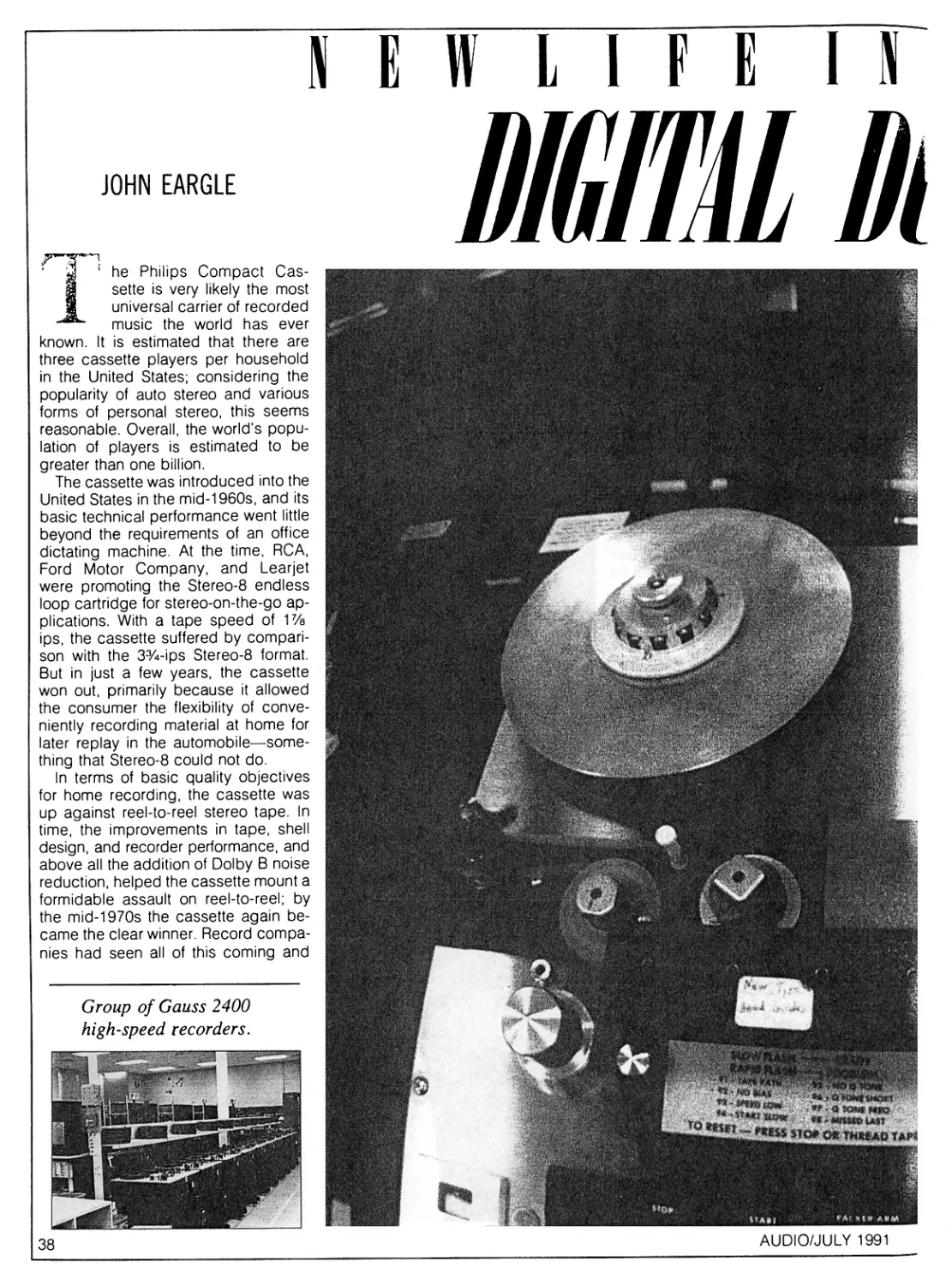
Electro Sound 8000 seri es-
high spee-d master recorder.
had geared up to produce prerecord-
ed cassettes on a large scale.
In 1983 the unit sales of cassettes in
the United States exceeded those of
the LP, ancI the later onslaught of the
CD put the LP into further eclipse.
Now, even as the CD gains in momen-
tum, the cassette holds strong and
promises to do so for many years to
come.
The cassette is mass-duplicated in a
manner which is physically identical to
the consumer's in-home recording pro-
cedure. There are, of course, econo-
mies of scale, but essentially the tape
to be copied is run on a master trans-
port, and a number of "slaves" are fed
directly from it. On a modest scale
there may be no more than four slaves,
and the duplicating speed ratio may
be no more than 4:1. The slaves them-
selves may be standard cassette
transports which have been modified
for the increased speed of operation,
and the "master" may simply be 8 cas-
sette itself. This method is shown in
F'ig. 1 and wovld be applicable for very
short runs of speech-quality program.
A svbstantial step fonvard in quality
is shown in Fig. 2. Here, the master is a
digital source, a DAT or possibly a
Sony PCM-F1. During the mid-1980s,
Nakamichi duplicated short runs of
very high-quality cassettes using a
method similar to this. The source was
a digital F1 tape whose transfer quality
was carefully monitored by noting the
digital block-error rate as the tape was
repeatedly played back. The slaves
themselves were top-of-the-line Naka-
39
CASSETTE TRANSPORTS
Fig. 1
Modest duplicating setup for limited runs of
speech-quality cassettes. No more than four
slaves are used, and speed ratio is 4:1 or less.
HIGH QUALITY
CASSETTE RECORDERS
Fig. 2
Real-time (1:1) duplication from digital copy
master, for high quality.
SLAVES
Fig. 3
Large-scale duplication, using endless-loop
master and slave recording tape "pancakes."
Setup shown here is for music, using 7'/2-ips
master running at 240 ips and tape pancakes
running at 60 ips, a 32:1 duplicating speed ratio.
For speech-quality tapes, 3'/4-ips masters and
still higher speeds would be used, for ratios
of 128:1 or more.
Even though the CD has gained in sales
momentum, the cassette holds strong and
promises to do so for many years.
michi recorders which were self-align-
ing before each run. The duplicating
ratio was, of course, 1:1, or so-called
real time. Tapes were duplicated with
Dolby B or Dolby C noise reduction,
and HX Pro headroom extension was
routinely used. Each side had to be
duplicated separately.
Nakamichi provided this service for
owners of their machines who wanted,
and were willing to pay for, audiophile-
quality cassettes from such labels as
Delos and Sheffield. Nakamichi could
honestly say that these tapes "were
first-generation copies of the original
digital master" if all steps in the prepa-
ration of the running master had been
carried out in the digital domain.
These duplicating methods are quite
"labor intensive" in that the yield of
product per man-hour is limited. How-
ever, they remain just about the only
way for producing short runs.
For larger scale duplication, how-
ever, some fundamental changes must
be made and other considerations en-
ter into the picture. Many slaves may
be used, and the duplicating ratio may
be as high as 96:1 for music and 128:1
for speech quality. (See Fig. 3.) The
production time required for each copy
is essentially reduced and can be de-
termined by dividing the playing time
in one direction by the duplicating ratio
multiplied by the number of slaves. The
master itself is run as an endless loop
with all four tracks copied at the same
time. Figure 3 shows a modern dupli-
cating system with four slaves and an
endless-loop tape bin for the master.
The cassettes are duplicated end-to-
end on large "pancakes" of tape which
are subsequently broken down and
loaded into the cassette shells.
Many of the larger duplicators injec-
tion-mold their own cassette shells and
operate large printing shops for paper
inserts and labels. Their basic pur-
chased operating materials are com-
modities, such as plastic, paper and
tape — for which prices are relatively
negotiable. Such "vertical integration"
reduces operating costs considerably
in a highly competitive marketplace.
Attention to line scheduling and quality
assurance maintains good "loading" of
the plant, again in the interests of con-
trolling operating costs and minimizing
downtime.
40
The duplicating ratios used today
are a far cry from the 8:1 methods of
the 1960s. The electronic challenges
were relatively easy to meet; bias fre-
quency has been raised to the range
of 8 to 10 MHz, and equalization re-
quirements have been simply trans-
posed upward as required. The major
problems to overcome were in the
physical handling of the tape. Tape
skew and air filming have been the
major problems in ensuring positive
tape-to-head contact at high speeds.
The design of the endless-loop tape
bin for the master was a considerable
challenge, in that the requirements
were to move the tape at a speed as
high as 480 ips while handling it gently
to minimize wear and damage.
At this point, we will follow a master
tape through the entire duplicating cy-
cle, noting the many procedures which
ensure quality and process control.
Duplicating plants prefer to receive
a master in the form of a digital clone of
the final edited master, with A and B
sides clearly indicated. The digital
tapes are then carefully checked to
determine if there are any potentially
troublesome high frequencies present
in the program. If not, then the digital
masters are transferred to '/2-inch tape
running at 7'/2 ips. If the cassettes are
to be in Dolby B (most of them are),
then the 7'/2-ips tapes will be made as
a Dolby B copy. In a single pass, side
A is copied in one direction, while side
AUDIO/ JULY 1991
ORIGIHAI.
MASTER
TAPE
ORIGINAL
MASTER
TAPE
IAASTER
REPRODUCER
REAL-T I M E
MIXER TEST SIGNAL
GENERATOR
RUNNING
MASTE&
TAPE
MASTER
RECORDER
RUNNING
MASTER
TAPE
TEST
IHSTRUMEN T
SIGNAL
QUALI TY
REPRODUCER
SYSTEM
QUAUT Y
MONITOR
SEM IAlJTONQLTIC
CASSETTE
LOADER
O~O CASSETTE
QBELING, BOXING,
INRAPPIHG, AND SHIPPtNG
B is copied in the other. The tape
made at this point is referred to as the
running master.
Should there have been any prob-
lems with the source tapes, these
~ould be discussed with the client and
adjustments made either at the client's
studio or at the duplicating plant.
Before the actual production run, the
master will be copied onto a cassette
on a master-slave setup, which, in ef-
fect, duplicates all production condi-
tions. tt is transferred at the intended
production level and on the intended
tape stock. lt is then sent to the client as
a reference of what the finished product
will sound like. The client usually has a
technician check the tape and judge
the quality of the transfer. Then, if all has
gone well, the client will send an ap-
proval to the duplicating plant and pro-
duction can then get underway.
The production control department
takes over at this point and ensures
that all paper components (labels, in-
serts) are on hand. Even though the
entiire order for cassettes may be quite
)arge, the client may not want more
than, say, 5,000 or 10,000 units at any
HUH-SPEED SIG
TEST
HIGH- SPEED SIGHAL PRECISIOH
T<
TEST SIGHAL TAPE OUPI ICATING SLAVE
GENERATOR SYSTEM CALIBRATOR
Fig. 4
Tape duplicating chain,
with elecironic
quality-control stages.
one time. The run is scheduled accord-
ingly, and the master tape is loaded
into the endless-)oop bin. For high-
qua)ity music dup)ication, a ratio of
96:1 would probably not be exceeded.
At this duplication ratio, and assuming
a total program length of about 40 min-
utes, a single slave can produce about
1,800 copies per eight-hour shift. Thus,
a master transport with foUr or five
slaves might easily handle the produc-
tion run in about half a shift.
Obviously, one cannot play every
cassette to ensure that everything has
gone properly C.assettes are spot-
checked according to established
sampling procedures, but more to the
point, all of the process and the incorn-
ing materials are carefully monitored.
The duplicating chain itself is subject
to several leve)s of maintenance, in-
cluding those which are performed
daily, such as cleaning, and those that
are done at much wider intervals, such
as replacement of heads and bear-
ings. Between these extremes is rou-
tine electrical checkout of the systems.
While the incoming raw tape stock is
sampled to make sure it meets mag-
netic requirements, each duplicated
8,400-foot pancake of tape is recorded
with a diagnostic sequence of signals.
This serves as a running check on out-
going quality, since no pancake will be
loaded into cassette shells unless the
pancake passes the test.
A pancake contains many passes of
the master, and between each pass is
a Iow-frequency cue tone which is
used during the breakdown process.
At this stage, the pancake is loaded
onto the cassette winder, and individ-
ua) cassettes are IoacIed at speeds up
to 360 ips. The cue tone stops the
winding process when each cassette
is fully loaded. The operator then re-
moves the loaded cassette and re-
places it with a new shell.
The loaded cassettes then find their
way to the labeling machine, wh'ich a)-
fixes the appropriate )abel to each side
of the shell. Then, they move on to final
packing and shrink-wrapping.
With recent developments in random
access memory (RAM) capability and
high-speed digital-to-analog (D/A)
conversion, it is now possible to oper-
ate duplicating slaves directly from a
digital source, thus bypassing the ana-
log running master comp)ete)y. The
technology for this was developed by
Concept Design, and one of the major
installations of this is at the Sonopress
manufacturing facility in Asheville, N.C.
Master tapes are received from cli-
ents, preferably in the Sony 1630 for-
mat, which stores the program on '/4-
inch videocassettes. From this source,
lnj ection mo-lding department,
Sonopress, Weaverville, N.C
the plant's mastering department
makes a pair of R-DAT c)ones, one for
side A and one for side B. When a
program is to be duplicated, the two R-
DATs are loaded into RAM simulta-
neously, but on a rea)-time basis. Thus,
it takes about 20 minutes to "load in"
each new program. When duplication
gets underway, the RAM and high-
speed D/A converter function just like
the running master and master trans-
port in the typical duplicating setup.
The duplicating ratio is 80:1, so this
helps offset some of the rather long
load-in time for new programs. In all
other regards, the plant works very
much like a traditional duplicator.
Sonopress is owned by BMG, which
is the parent company of RCA Rec-
ords, and the technology can be heard
on RCA cassettes as well as A 5 M,
Delos, and Telarc product. Sonopress
places great emphasis on quality-con-
trol procedures to ensure that the
benefits of the new technology will
clear)y find their way into the consum-
er's home.
The process gets us one step nearer
to the digital master, in that each cas-
sette is a first-generation copy of the
digital master, but the next major tech-
nical leap forward for the cassette will
be the DCC, or Digital Compact Cas-
sette. The DCC is designed to comple-
ment the standard cassette and not
necessarily make it obsolete. Since all
DCC players will also play standard
cassettes, there will be no need for
wholesale adoption of the new medi-
um. tn fact, it may be quite reasonable
to make the conjecture that speech-
only cassettes, a very large market in-
deed, may remain analog based for
the foreseeable future.
Tape duplicators and manufacturers
of cluplicating equipment are over-
whelmingly in favor of DCC because it
reinforces their fundamental invest-
ment in technology. DCC is designed
to be duplicated at a 64:3 ratio on
traditional slaves which have been out-
fitted with new heads. A number of
details have yet to be worked out in
DCC, but it appears poised for intro-
duction in 1992.
41