/






Text
                    Sonoprocessing of oil:

iew
ed

Graphical Abstract

ev

asphaltene declustering behind fine ultrasonic emulsions
Elia Colleonia, Gianmaria Vicicontea, Chiara Canciania,
Saumitra Saxenaa, Paolo Guidaa, William L. Robertsa
aKing

Pr

ep

rin

tn

ot

pe

er
r

Abdullah University of Science and Technology, Thuwal 23955, Saudi Arabia
Corresponding author: elia.colleoni@kaust.edu.sa

This preprint research paper has not been peer reviewed. Electronic copy available at: https://ssrn.com/abstract=4417120

Sonoprocessing of oil:

iew
ed

Highlights

asphaltene declustering behind fine ultrasonic emulsions

ev

Elia Colleonia, Gianmaria Vicicontea, Chiara Canciania,
Saumitra Saxenaa, Paolo Guidaa, William L. Robertsa
aKing

er
r

Abdullah University of Science and Technology, Thuwal 23955, Saudi Arabia
Corresponding author: elia.colleoni@kaust.edu.sa

• Reduction in the size of asphaltene clusters by applying ultrasonically induced cavitation (UIC)

pe

• Visualization of the structure of water-in-oil emulsions before and after UIC
with cryo-SEM

Pr

ep

rin

tn

ot

• Demonstration of reduction in the thickness of the asphaltenic film by applying UIC

This preprint research paper has not been peer reviewed. Electronic copy available at: https://ssrn.com/abstract=4417120

iew
ed

Sonoprocessing of oil:

asphaltene declustering behind fine ultrasonic emulsions
Elia Colleonia, Gianmaria Vicicontea, Chiara Canciania,
Saumitra Saxenaa, Paolo Guidaa, William L. Robertsa

ev

Abdullah University of Science and Technology, Thuwal 23955, Saudi Arabia
Corresponding author: elia.colleoni@kaust.edu.sa

er
r

aKing

Abstract

ep

rin

tn

ot

pe

Despite the transition toward carbon-free energy carriers, liquid fossil fuels are
expected to occupy an important market share in the future. Therefore, it is crucial to develop innovative technology for better combustion reducing the emissions of pollutants associated with their utilization. Water in oil (w/o) emulsions
helps in greener combustion, increasing carbon efficiency and reducing emissions.
Water content, emulsions stability, and droplet size distributions are key parameters in helping for greener combustion. In particular for fixed water content, the
finer the emulsion is the better it is for improving combustion. In this work two
emulsions, mechanically and ultrasonically generated, were compared. Cryogenic
scan electron microscopy (cryo-SEM) imaging allowed the visualization of water
droplets inside the oily matrix. No surfactants were added to the oil due to its
high asphaltenic content. Asphaltene molecular aggregates, namely clusters, act
as natural surfactants stabilizing the emulsions by disposing at w/o interface and
forming a rigid film. The asphaltenic rigid film is clearly visualized in this work
and compared for the two emulsions. The results showed finer water droplets in
the ultrasonically generated emulsion, together with a reduction in the thickness of
the asphaltenic film. Ultrasonically induced cavitation favored the de-clustering
(break of intermolecular forces) of asphaltene molecules. Thus, smaller clusters
allowed to stabilize smaller water droplets resulting in an ultra-fine emulsion and
improving the combustion performances of the fuel.

Pr

Keywords: HFOs; Ultrasound; Asphaltenes; De-clustering; Cryo-SEM

Preprint submitted to Ultrasonics Sonochemistry

April 4, 2023

This preprint research paper has not been peer reviewed. Electronic copy available at: https://ssrn.com/abstract=4417120

iew
ed

1. Introduction

Pr

ep

rin

tn

ot

pe

er
r

ev

The world energy demand is continuously increasing, fed by population growth
and developing economies. Despite the constantly rising impact of renewables,
the energy market will still be strongly related to fossil fuels - at least in the near
future. As reported in the BP Energy Outlook of 2019, (1), more than fifty percent of the energy demand will still be supplied by fossil fuels in 2040, however,
high-quality crude oil feedstocks are constantly depleting. According to Demirbas et al (2), nowadays less than half of the global oil reserves are in the form
of conventional oil, the majority are instead in the form of bitumen sand, heavy
oil, and recoverable oils. This brings refineries worldwide to produce a constantly
increasing amount of the so-called bottom-of-the-barrel fuels. Such fuels, commonly considered waste until a few decades ago, are now expected to fulfill the
increasing global energy demand. However, their combustion is extremely polluting and difficult to be performed in an eco-friendly way. It is crucial to develop
new technologies for efficient combustion or upgrade of bottom-of-the-barrel fuels.
Water in oil (w/o) emulsions help in greener combustion, increasing carbon
efficiency and reducing the emissions of pollutants. The quality of the emulsion is
mainly a function of three parameters: water content, the size distribution of the
droplets, and the stability of the emulsion. However, the generation of stable and
fine emulsion is not trivial and generally requires the employment of surfactants.
Ultrasonically induced cavitation (UIC) permits the formation of ultra-fine emulsions, which result stable without the addition of any surfactant. This is possible
thanks to two factors. First, asphaltenes in oil naturally act as surfactant arranging
at the oil-water interface and creating a rigid film that stabilizes the emulsions.
Secondly, emulsions with small droplets generally are more stable than those with
large droplets because smaller droplets can resist flocculation, creaming, and coalescence. Thus, the droplet breakup is a key factor determining the droplet size
distribution of w/o emulsions. Droplets can be broken by applying energy to overcome the pressure difference across the interface, known as the Laplace pressure.
This can be accomplished by using high shearing forces or fluctuating velocities
and pressures.
Asphaltenes structure is still unclear and strongly debated (3; 4) However,
asphaltenes are widely accepted as high molecular weight molecules, characterized by the abundant presence of heteroatoms (3; 5; 6). Asphaltene molecules
tend to aggregate into clusters of molecules, bonded by inter-molecular forces
such as pi-stacking and hydrogen bonds (7; 8; 9; 10; 11; 12). Asphaltenes were
2

This preprint research paper has not been peer reviewed. Electronic copy available at: https://ssrn.com/abstract=4417120

iew
ed

tn

ot

pe

er
r

ev

proven to stabilize water-in-oil emulsions by adsorbing at the water/oil interface
(13; 14; 15) and acting similarly to a surfactant. The adsorption can involve either
single molecules as well as clusters (16), forming a rigid film that stabilizes the
emulsions (17; 18; 19; 20; 21). Different authors reported the rigid film as formed
by the most aggregated clusters and heteroatoms enriched asphaltenic molecules
(22; 23; 24; 25; 26). Nevertheless, clear visualization of the rigid film around
droplets is not trivial because neither standard procedures nor specific experiments
are reported in the literature to measure the size of asphaltene clusters. Alvarez
et al. (27) and Jestin et al. (28) exploited the ability of asphaltenes to stabilize
emulsions to measure the rigid film around water droplets using small-angle neutron scattering. Alvarez and Jestin observed that the size of the film was almost
equal to the characteristic size of an asphaltene cluster, concluding that the latter disposed at the interface between the water droplets and oil matrix stabilizing
emulsions. Hence, the measurement of the thickness of the film may represent a
good estimation of the size of the asphaltene clusters.
The scope of the present work is to present a novel method for the visualization
of the rigid film around water droplets in w/o emulsions, visualizing differences
between mechanically and ultrasonically generated emulsions. Measurements of
the film around droplets in the emulsions allowed an understanding of the influence of UIC on the size of the asphaltene clusters. The potential changes in the
size of the asphaltene clusters were investigated using cryogenic scanned electron
microscopy (cryo-SEM). The method is similar to the approach already used by
Luo et al. (29) to measure nanometric casein micelles in milk. This work will help
power plant engineers and policymakers understand the underlying effect of UIC
in generating high-quality emulsions oriented to reducing emissions of emulsified
fuels as opposed to raw fuels.
2. Experimental Methods

ep

rin

2.1. Heavy fuel oil characterization
Heavy fuel oil (HFO) from Saudi Arabia was used in this study. Table 1 reports
the elemental composition, the asphaltene content, and the kinematic viscosity of
the oil. Detailed characterization of the oil is reported in a previous work of the
research group (30).

Pr

2.2. Cryogenic scanning electron microscope
The measurement of the size of asphaltene clusters was performed by exploiting their stabilizing effect in water-in-oil emulsions. To observe the latter, cryo3

This preprint research paper has not been peer reviewed. Electronic copy available at: https://ssrn.com/abstract=4417120

iew
ed

Table 1: Oil properties

C [%] H [%] N [%] S [%] O [%] Asphaltenes content [%] Kinematic viscosity at 40 C [cSt]
85.00 10.90
0.24
3.30
0.03
8.20
618.00

rin

tn

ot

pe

er
r

ev

genic scanning electron microscope (cryo-SME) imaging of the freeze-fractured
plane of the emulsions was performed. The procedure was executed using Nova
NanoSEM 630 (Thermo Fisher Scientific, The Netherlands), equipped with an
Everhart-Thornley detector (ETD), a through-the-lens detector (TLD), an EDS
detector (EDAX Inc.), and a PP2000T cryo-transfer system (Quorum Technologies, UK). The sample was frozen with liquid nitrogen in a cryo-holder and transferred under vacuum to a chamber pre-cooled to−160 ◦C. A knife cooled at
the same temperature was used to fracture the sample and generate the fractured
plane of observation. Water in the frozen emulsions was removed by sublimation at −
90 ◦C for 5 min, under strong vacuum conditions allowing to visualize
details about the rigid film formed around the droplets. The fractured plane was
coated with 5 nm of platinum at−120 ◦C in an argon atmosphere inside the preparation chamber. Finally, the sample was transferred to the SEM chamber where
electron images were acquired at accelerating voltages of 2−5 kV and at a working distance of 5 mm (31). The water droplets were observed on the fracture
plane of the emulsified fuel. Two different oil-in-water emulsions were used to
obtain cryo-SEM imaging, one generated by mechanical stirring and the other
through ultrasonic treatment. Different emulsions, mechanically-generated and
ultrasonically-generated, were tested to evaluate the potential effect of the UIC
process on the size of the asphaltene clusters. Emulsions were generated using
about 300 g with a water content of 20% by mass. The ultrasonically-generated
emulsion was obtained using the Hielscher UP400, at a frequency of 22 kHz. The
fuel plus water system was sonicated for 1 h imposing cycles per second of 0.4 in
order to maintain the temperature of the system below 60 ◦C. The mechanically
generated emulsion was obtained using a stirrer rotating at 1200 rpm for the same
time.

3. Results and discussion

Pr

ep

Two different oil-in-water emulsions, one generated ultrasonically and the
other one with a mechanical stirrer, enabled the assessment of the impact of ultrasonic waves on the size of the asphaltene aggregates. This was possible by exploiting the tendency of the aggregates to arrange around water droplets to form a
rigid film that stabilizes the emulsions. Cryo-SEM imaging was used to visualize
4

This preprint research paper has not been peer reviewed. Electronic copy available at: https://ssrn.com/abstract=4417120

iew
ed

ot

pe

er
r

ev

the rigid film for the emulsions. The preparation of the samples for cryo-SEM
imaging involves the sublimation of water. In this way, cavities are generated
where the droplets were located, while the surrounding asphaltene film remains
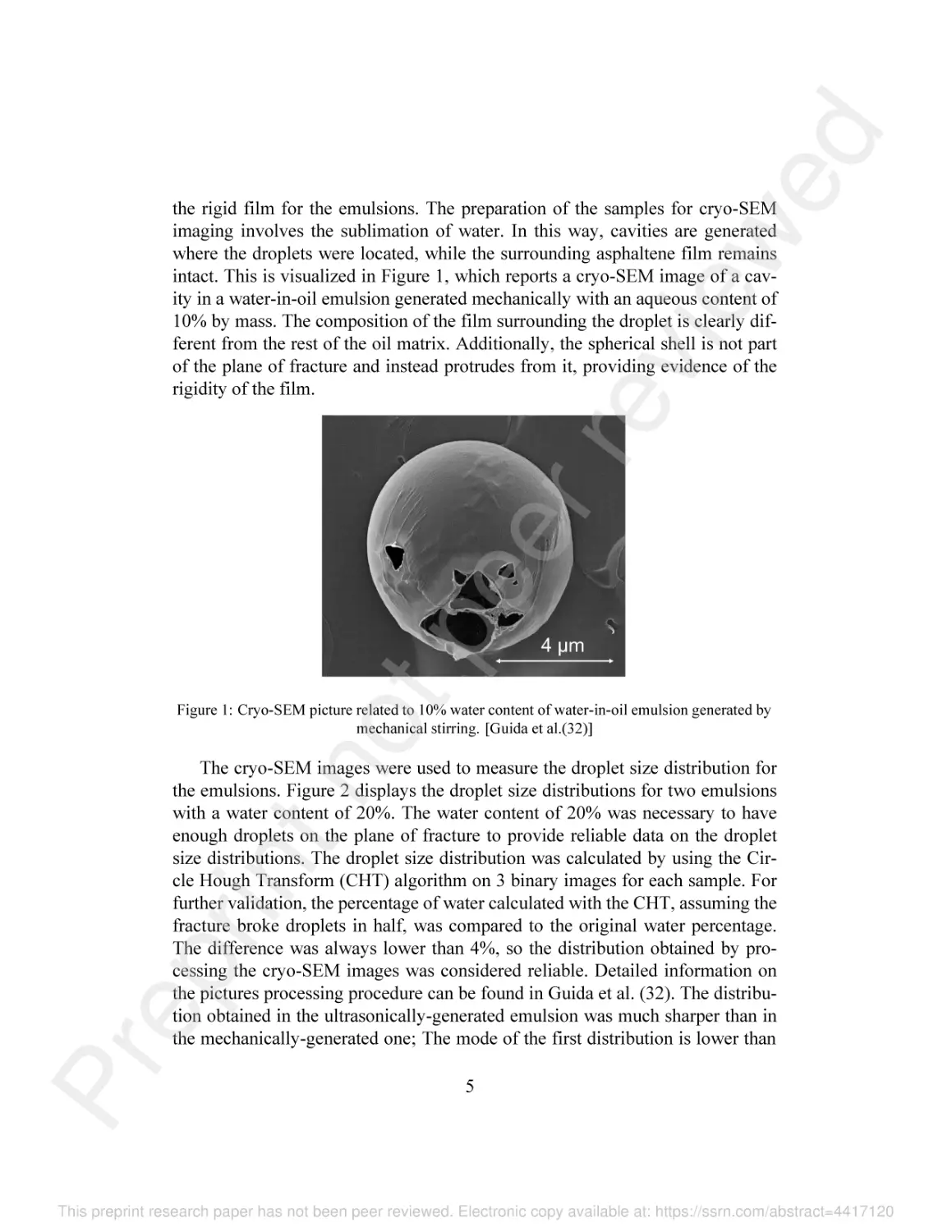
intact. This is visualized in Figure 1, which reports a cryo-SEM image of a cavity in a water-in-oil emulsion generated mechanically with an aqueous content of
10% by mass. The composition of the film surrounding the droplet is clearly different from the rest of the oil matrix. Additionally, the spherical shell is not part
of the plane of fracture and instead protrudes from it, providing evidence of the
rigidity of the film.

Figure 1: Cryo-SEM picture related to 10% water content of water-in-oil emulsion generated by
mechanical stirring. [Guida et al.(32)]

Pr

ep

rin

tn

The cryo-SEM images were used to measure the droplet size distribution for
the emulsions. Figure 2 displays the droplet size distributions for two emulsions
with a water content of 20%. The water content of 20% was necessary to have
enough droplets on the plane of fracture to provide reliable data on the droplet
size distributions. The droplet size distribution was calculated by using the Circle Hough Transform (CHT) algorithm on 3 binary images for each sample. For
further validation, the percentage of water calculated with the CHT, assuming the
fracture broke droplets in half, was compared to the original water percentage.
The difference was always lower than 4%, so the distribution obtained by processing the cryo-SEM images was considered reliable. Detailed information on
the pictures processing procedure can be found in Guida et al. (32). The distribution obtained in the ultrasonically-generated emulsion was much sharper than in
the mechanically-generated one; The mode of the first distribution is lower than
5

This preprint research paper has not been peer reviewed. Electronic copy available at: https://ssrn.com/abstract=4417120

iew
ed

the one of the second distribution, meaning that ultrasonically-generated emulsions tend to have smaller droplets. To stabilize smaller droplets smaller asphaltene clusters are necessary, resulting in evidence of the influence of the UIC on
the size of asphaltenes clusters.
2.5

ev

Ultrasonic

Mechanical

2.0

1.0
0.5

0.0
0

1

er
r

P(r)

1.5

2
3
radius [ m]

4

5

pe

Figure 2: Droplet size distribution for mechanically and ultrasonically generated emulsion with a
water content of 20%.

Pr

ep

rin

tn

ot

To further confirm the theory that UIC affects the size of asphaltenes clusters, the thickness of the asphaltenic film was measured in cryo-SEM images,
where the spherical shell of the droplets was cut by the fractured plane of observation. Figure 3 reports images where the film is clearly recognizable as a white
annular region surrounding the droplet. Figure 3(a) refers to the mechanicallygenerated emulsion with a water content of 20%, while Figure 3(b) refers to the
ultrasonically-generated one, with the same water content. The two images have
different scales, necessary to properly observe the smaller water droplet for the
ultrasonically-generated image.The average thicknesses for mechanically and ultrasonically generated emulsions are 0.3±0.1µm and 0.07±0.03µm, respectively.
After the UIC treatment, the size of asphaltene clusters was reduced by an order
of magnitude. This is evidence of the effectiveness of UIC to favor the declustering of asphaltenic molecules breaking the inter-molecular interactions that keep
molecules together. A similar behavior was already proved for proteins, where
UIC affected the secondary structure of walnut protein disrupting hydrogen bonds
(33).

6

This preprint research paper has not been peer reviewed. Electronic copy available at: https://ssrn.com/abstract=4417120

iew
ed
ev
er
r

Figure 3: (a) SEM image of emulsion generated mechanically. (b) SEM image of emulsion
generated ultrasonically.

4. Conclusions

rin

tn

ot

pe

The scope of this work was to investigate the effect of ultrasonically induced
cavitation on the asphaltenes molecular clusters. To achieve this, the size of the
asphaltene clusters was visualized exploiting their stabilizing effect in water-inoil emulsions. The thickness of the film was analyzed for ultrasonically- and
mechanically-generated emulsions using cryo-SEM imaging. The size of the clusters was found to be an order of magnitude smaller for the case of ultrasonically
generated emulsions as opposed to mechanically-generated ones. De-clustering
of asphaltenes is probably a physically driven process related to the disruption of
intermolecular forces. This is probably triggered by nano-sized jets and shock
waves generated during UIC, that mechanically broke the clusters without influencing the molecular structure of the fuel. The application of UIC allowed the
generation of stable and ultra-fine emulsions, making this process potentially impactful for the reduction of pollutant emissions while burning liquid fuels.
5. Acknowledgments

Pr

ep

Research reported in this work was conducted at the Clean Combustion Research Center (CCRC) of the King Abdullah University of Science and Technology (KAUST) under the research grant URF/1/4079/01/01. This research utilized
the resources of the Core Labs at KAUST. The authors thank Dr. Aiping Chen for
her work on analytical chemistry.

7

This preprint research paper has not been peer reviewed. Electronic copy available at: https://ssrn.com/abstract=4417120

[1] B. E. Outlook, 2019 edition, London, United Kingdom2019 (2019).

iew
ed

References

[2] A. Demirbas, A. Bafail, A.-S. Nizami, Heavy oil upgrading: Unlocking the future fuel supply, Petroleum Science and Technology 34 (4) (2016) 303–308.

ev

[3] M. L. Chacon-Patino, M. R. Gray, C. Rüger, D. F. Smith, T. J. Glattke, S. F. Niles, A. Neumann, C. R. Weisbrod, A. Yen, A. M. McKenna, et al., Lessons learned from a decade-long
assessment of asphaltenes by ultrahigh-resolution mass spectrometry and implications for
complex mixture analysis, Energy & Fuels 35 (20) (2021) 16335–16376.
[4] M. L. Chacón-Patiño, S. M. Rowland, R. P. Rodgers, Advances in asphaltene petroleomics.
part 1: asphaltenes are composed of abundant island and archipelago structural motifs, Energy & fuels 31 (12) (2017) 13509–13518.

er
r

[5] D. Stratiev, I. Shishkova, I. Tankov, A. Pavlova, Challenges in characterization of residual
oils. a review, Journal of Petroleum Science and Engineering 178 (2019) 227–250.
[6] M. L. Chacón-Patiño, N. Heshka, A. Alvarez-Majmutov, C. L. Hendrickson, R. P. Rodgers,
Molecular characterization of remnant polarizable asphaltene fractions upon bitumen upgrading and possible implications in petroleum viscosity, Energy & Fuels 36 (14) (2022)
7542–7557.

pe

[7] O. C. Mullins, H. Sabbah, J. Eyssautier, A. E. Pomerantz, L. Barré, A. B. Andrews, Y. RuizMorales, F. Mostowfi, R. McFarlane, L. Goual, et al., Advances in asphaltene science and
the yen–mullins model, Energy & Fuels 26 (7) (2012) 3986–4003.
[8] A. Ekramipooya, F. M. Valadi, A. Farisabadi, M. R. Gholami, Effect of the heteroatom
presence in different positions of the model asphaltene structure on the self-aggregation: Md
and dft study, Journal of Molecular Liquids 334 (2021) 116109.

ot

[9] D. E. Scott, M. Schulze, J. M. Stryker, R. R. Tykwinski, Deciphering structure and aggregation in asphaltenes: hypothesis-driven design and development of synthetic model compounds, Chemical Society Reviews 50 (16) (2021) 9202–9239.
[10] Y. Zhang, M. Siskin, M. R. Gray, C. C. Walters, R. P. Rodgers, Mechanisms of asphaltene
aggregation: puzzles and a new hypothesis, Energy & Fuels 34 (8) (2020) 9094–9107.

tn

[11] B. G. Janesko, E. N. Brothers, Half-pancake bonding in asphaltenes, Energy & Fuels 35 (19)
(2021) 15657–15662.

rin

[12] M. R. Gray, H. W. Yarranton, M. L. Chacon-Patino, R. P. Rodgers, B. Bouyssiere, P. Giusti,
Distributed properties of asphaltene nanoaggregates in crude oils: A review, Energy & Fuels
35 (22) (2021) 18078–18103.
[13] J. Czarnecki, K. Moran, On the stabilization mechanism of water-in-oil emulsions in
petroleum systems, Energy & fuels 19 (5) (2005) 2074–2079.
[14] J. Czarnecki, P. Tchoukov, T. Dabros, Possible role of asphaltenes in the stabilization of
water-in-crude oil emulsions, Energy & Fuels 26 (9) (2012) 5782–5786.

ep

[15] P. Tchoukov, F. Yang, Z. Xu, T. Dabros, J. Czarnecki, J. Sjoblom, Role of asphaltenes in
stabilizing thin liquid emulsion films, Langmuir 30 (11) (2014) 3024–3033.

Pr

[16] D. M. Sztukowski, M. Jafari, H. Alboudwarej, H. W. Yarranton, Asphaltene self-association
and water-in-hydrocarbon emulsions, Journal of colloid and interface science 265 (1) (2003)
179–186.

8

This preprint research paper has not been peer reviewed. Electronic copy available at: https://ssrn.com/abstract=4417120

iew
ed

[17] H. W. Yarranton, D. M. Sztukowski, P. Urrutia, Effect of interfacial rheology on model
emulsion coalescence: I. interfacial rheology, Journal of colloid and interface science 310 (1)
(2007) 246–252.
[18] R. Mohammed, A. Bailey, P. Luckham, S. Taylor, Dewatering of crude oil emulsions 1.
rheological behaviour of the crude oil—water interface, Colloids and Surfaces A: Physicochemical and Engineering Aspects 80 (2-3) (1993) 223–235.

ev

[19] P. M. Spiecker, P. K. Kilpatrick, Interfacial rheology of petroleum asphaltenes at the oilwater interface, Langmuir 20 (10) (2004) 4022–4032.
[20] E. Freer, C. Radke, Relaxation of asphaltenes at the toluene/water interface: diffusion exchange and surface rearrangement, The Journal of Adhesion 80 (6) (2004) 481–496.

er
r

[21] A. Yeung, T. Dabros, J. Czarnecki, J. Masliyah, On the interfacial properties of micrometre–
sized water droplets in crude oil, Proceedings of the Royal Society of London. Series A:
Mathematical, Physical and Engineering Sciences 455 (1990) (1999) 3709–3723.
[22] P. Qiao, D. Harbottle, P. Tchoukov, X. Wang, Z. Xu, Asphaltene subfractions responsible
for stabilizing water-in-crude oil emulsions. part 3. effect of solvent aromaticity, Energy &
Fuels 31 (9) (2017) 9179–9187.
[23] J. Rocha, E. Baydak, H. Yarranton, What fraction of the asphaltenes stabilizes water-inbitumen emulsions?, Energy & Fuels 32 (2) (2018) 1440–1450.

pe

[24] P. M. Spiecker, K. L. Gawrys, P. K. Kilpatrick, Aggregation and solubility behavior of asphaltenes and their subfractions, Journal of colloid and interface science 267 (1) (2003)
178–193.
[25] K. L. Gawrys, P. Matthew Spiecker, P. K. Kilpatrick, The role of asphaltene solubility and
chemical composition on asphaltene aggregation, Petroleum science and technology 21 (3-4)
(2003) 461–489.

ot

[26] L. A. Stanford, R. P. Rodgers, A. G. Marshall, J. Czarnecki, X. A. Wu, Compositional characterization of bitumen/water emulsion films by negative-and positive-ion electrospray ionization and field desorption/ionization fourier transform ion cyclotron resonance mass spectrometry, Energy & Fuels 21 (2) (2007) 963–972.

tn

[27] G. Alvarez, J. Jestin, J. Argillier, D. Langevin, Small-angle neutron scattering study of crude
oil emulsions: Structure of the oil- water interfaces, Langmuir 25 (7) (2009) 3985–3990.
[28] J. Jestin, S. Simon, L. Zupancic, L. Barré, A small angle neutron scattering study of the
adsorbed asphaltene layer in water-in-hydrocarbon emulsions: Structural description related
to stability, Langmuir 23 (21) (2007) 10471–10478.

rin

[29] J. Luo, Z. W. Wang, F. Wang, H. Zhang, J. Lu, H. Y. Guo, F. Z. Ren, Cryo-sem images of
native milk fat globule indicate small casein micelles are constituents of the membrane, Rsc
Advances 4 (90) (2014) 48963–48966.
[30] A. A. Khateeb, A. M. Elbaz, P. Guida, W. L. Roberts, Influence of asphaltene concentration
on the combustion of a heavy fuel oil droplet, Energy & fuels 32 (12) (2018) 12981–12991.

ep

[31] D. H. Anjum, P. Guida, A. R. Behzad, S. Saxena, W. L. Roberts, Optimization of specimen
preparation methods for cryo electron microscopy of oil-and-water emulsions, Microscopy
and Microanalysis 25 (S2) (2019) 2428–2429.

Pr

[32] P. Guida, S. Saxena, W. L. Roberts, Analysis of thermally induced breakup of ultrasonically
emulsified heavy fuel oil using dynamic mode decomposition, International Journal of Heat
and Mass Transfer 166 (2021) 120815.

9

This preprint research paper has not been peer reviewed. Electronic copy available at: https://ssrn.com/abstract=4417120

iew
ed

Pr

ep

rin

tn

ot

pe

er
r

ev

[33] Z. Zhu, W. Zhu, J. Yi, N. Liu, Y. Cao, J. Lu, E. A. Decker, D. J. McClements, Effects of
sonication on the physicochemical and functional properties of walnut protein isolate, Food
Research International 106 (2018) 853–861.

10

This preprint research paper has not been peer reviewed. Electronic copy available at: https://ssrn.com/abstract=4417120