/















Text
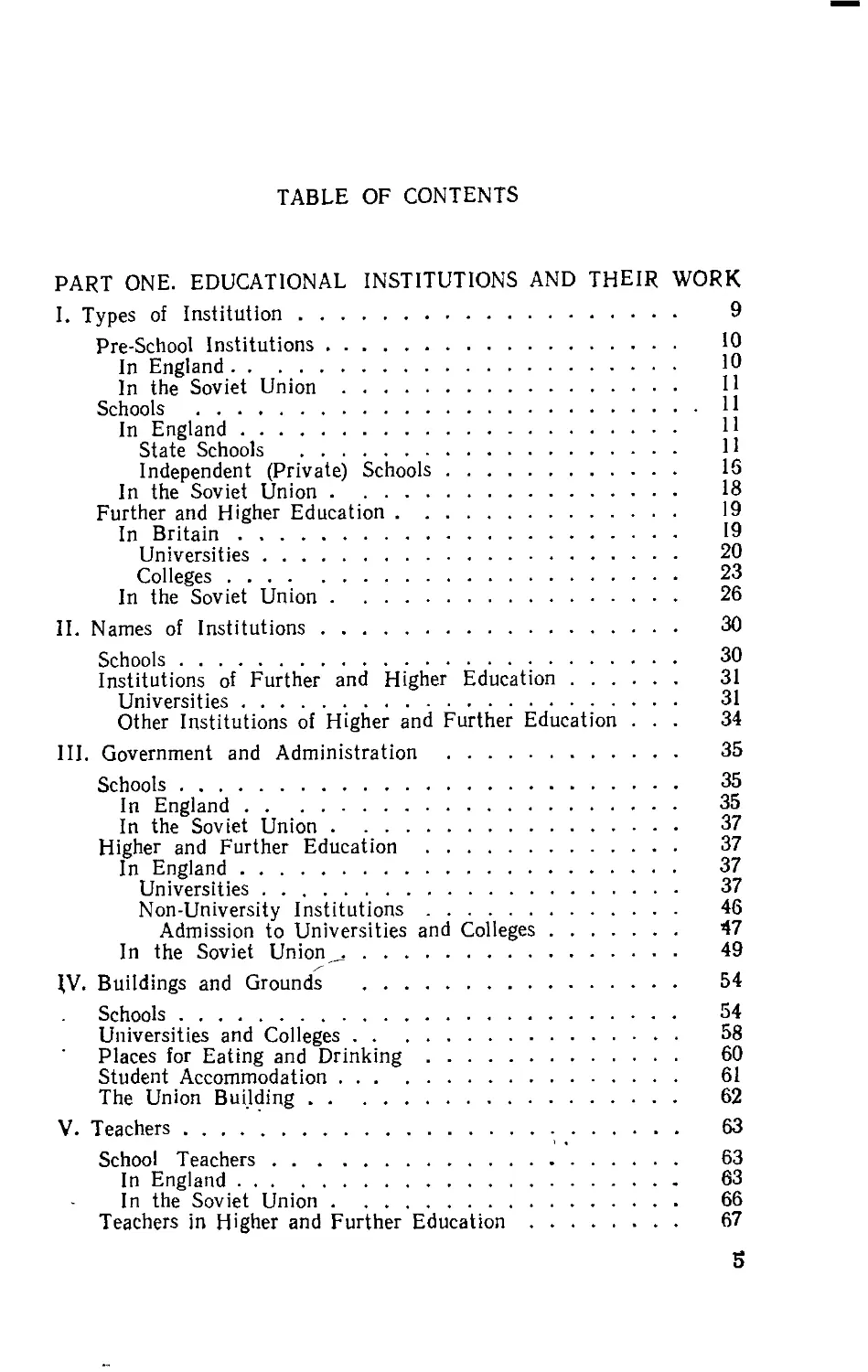
                    TABLE OF CONTENTS
PART ONE. EDUCATIONAL	INSTITUTIONS AND THEIR WORK
I.	Types of Institution		9
Pre-School Institutions		10
In England		10
In the Soviet Union		11
Schools 	1J
In England	 I*
State Schools 		11
Independent (Private)	Schools		16
In the Soviet Union		18
Further and Higher Education		19
In Britain		19
Universities		20
Colleges		23
In the Soviet Union		26
II.	Names of Institutions		30
Schools				30
Institutions of Further and Higher Education		31
Universities		31
Other Institutions of Higher	and Further Education ...	34
III.	Government and Administration 		35
Schools		35
In	England		35
In	the Soviet	Union		37
Higher and Further Education 		37
In England		37
Universities		37
Non-University Institutions		46
Admission	to Universities and Colleges		47
In	the Soviet	Union^.		49
JV. Buildings and Grounds
54
Schools
Universities and Colleges . .
Places for Eating and Drinking
Student Accommodation . . .
The Union Building . .
54
58
60
61
62
V.	Teachers
63
In the Soviet Union
Teachers in Higher and Further Education
School Teachers
In England
63
63
66
67

In England
Universities
Non-University Institutions
In the Soviet Union
Teacher Training
Teaching Practice
In-Service Training of Teacher^
VI.	Learners
Schopls
In' England
In the Soviet Union
Further and Higher Education
In England
In the Soviet Union
VII.	The Academi? Year
In England	r
Terms
Holidays and Vacations
In the Soviet Union
VIII.	The Timetable
The School Day
The University/College Day
IX.	Books and Writing Materials
Exercise Books Used in English Schools . . .
Exercise Books Used in Soviet -Schools ....
Universities and Colleges
Carrying Books and Papers
Writing Materials
X.	In the Classroom
Forms of Address
Greeting the Class
Lateness
Attendance, Absence
Classroom Duties
Requests and Orders
Answering in Class
Using the Chalkboard
Homework
Leaving the Class
XI.	Various Forms of Teaching
In England
In the Soviet Union
XII.	Types of Lesson Activity and Language Work
Reading
Dictation, Spelling
Answering Questions
Doing Exercises
Translation

Reproduction
Precis
Composition and Essay
Giving a Talk/Paper
Making Notes
Revision
Translations of Some Soviet Terms
XIII.	Homework and Preparation
Setting Out Written Work
Giving In and Returning Written Work
XIV.	Tests and Examinations
Tests
Tests in the Soviet Union
Examinations
Types of Examinations
In England
In the Soviet Union
XV.	Marking
Marking Systems
In England
In the Soviet Union
Use of Adjectives as a Means of Assessment
Other Comments Made by Teachers
Signs and Abbreviations Used in Marking	-
Mistakes
XVI.	Qualifications (Degrees, Diplomas and Certificates) . . .
Expressions with degree/diploma/certificate
English Degrees
First Degrees
Higher Degrees
Procedure for Awarding Higher Degrees by Thesis . . . .
Translations of Russian Terms
XVII.	Research
Translating наука, научный, ученый
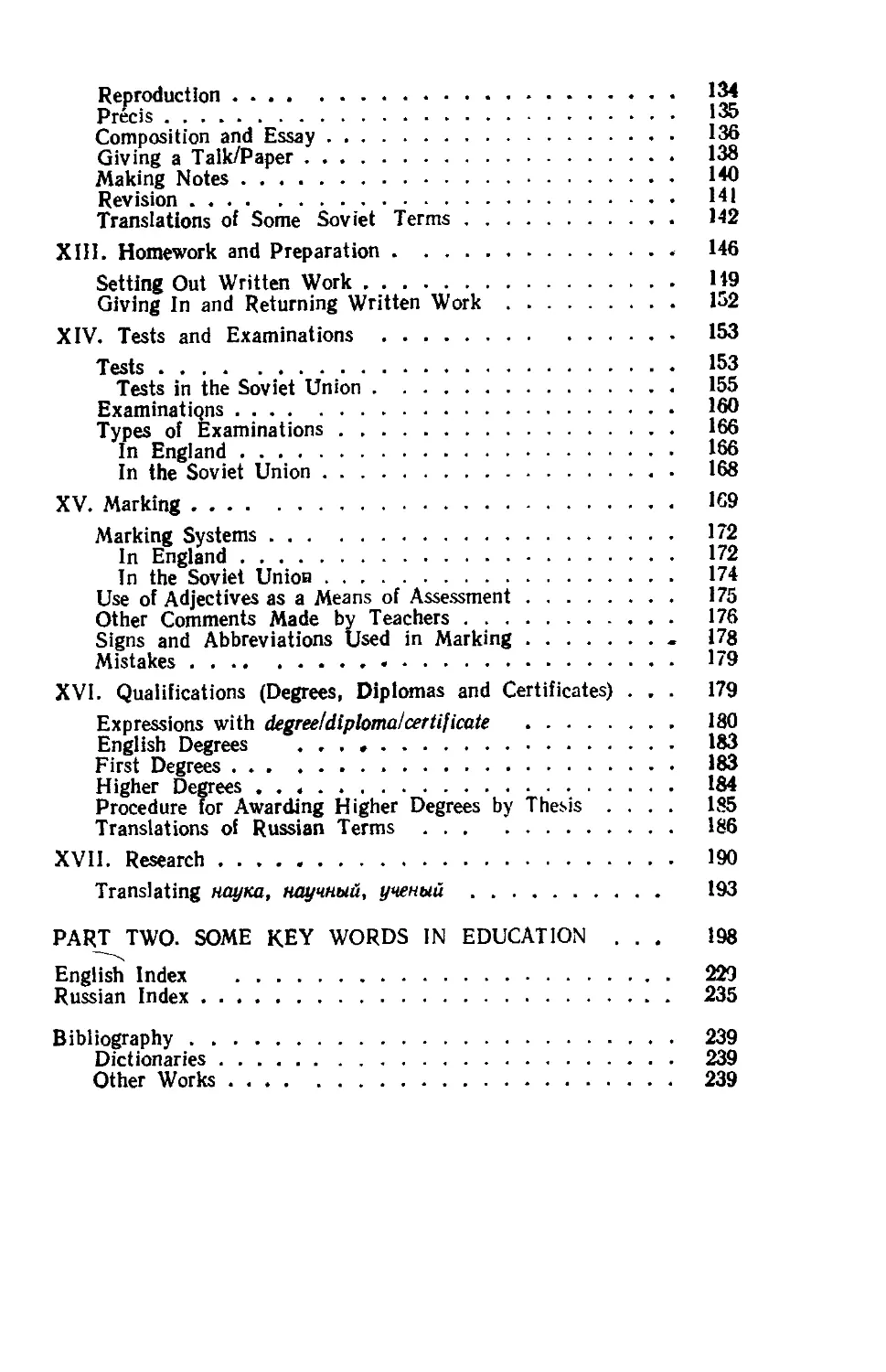
PART TWO. SOME KEY WORDS IN EDUCATION . . .
English Index
Russian Index
Bibliography
Dictionaries
Other Works
134
135
136
138
140
141
142
146
119
152
153
153
155
160
166
166
168
1C9
172
172
174
175
176
178
179
179
180
183
183
184
185
186
190
193
198
229
235
239
239
239

TYPOGRAPHICAL CONVENTIONS
Bold type is used for:
—	head words and phrases;
—	important words and phrases discussed in the text (when
given for the first titae) and included in the index.
Italics are used for:
—	emphasis;
—	all examples;
—	words and phrases discussed in the text.
Quotation marks are used for:
—	quotations;
—	meanings of words and phrases.
Capitals are used for titles of books.
Brackets in examples indicate that the word(s) enclosed
may or may not be included.
e.g. Give in your (homework) books.
Brackets at the beginning of an example give the situation,
e.g. (Teacher to pupil) . . .
An oblique stroke (/) indicates an alternative,
e.g. headmaster I mistress
A dash before an example indicates direct speech,
e.g.— What’s his job?
An asterisk before an example indicates that it is incorrect,
e.g. * He studies at school.
LIST OF ABBREVIATIONS
SOED —Shorter Oxford English Dictionary'!
COD —Concise Oxford Dictionary	See bibli-
BEE —Blond’s Encyclopaedia of Education | ography
В & L —Barnard & Lauwerys
DES — Department of Education & Science (see unit 1)
GCE — General Certificate of Education (see unit 340)
BrE — British English
AmE — American English
smb./sb.— somebody
smth./sth.— something
8

Part One
Educational Institutions and Their Work
I.	TYPES OF INSTITUTION
1.	In England there are both state and independent (or pri¬
vate) institutions. Before dealing with the various institu¬
tions, it is worth giving the names of the bodies and people
respons:ble for the state system of education, together with
their functions, as some of them will be mentioned in discus¬
sing the institutions, and all of them occur in the press and in
books on education.
The Department of Education & Science (DES) is the min¬
istry responsible for national educational policy. Until
1964 it was called the Ministry of Education, and (government)
department has the same meaning as ministry.
The Secretary of State for Education & Science, or, in
less formal style, the Education Secretary, is the minister
who heads the DES.
The local education authorities (LEAs) are responsible for:
providing and maintaining schools in their areas in accord¬
ance with national policy;
the day-to-day administration of schools, the employment
of teachers, and the curriculum (see unit 397), although in
practice much of this responsibility is delegated to head teach¬
ers;
post-school education, except for universities (see unit
28).
The chief education officer is the official at the head of a
local education authority. In some areas the title director of
education has come into use instead.
2.	independent, private
The word independent, when applied to an educational
institution, means “independent of the state”. However, such
independence is not complete. For example, independent schools
must register with the DES and be open to inspection by
the Department; universities are increasingly dependent on the
Department from the financial point of view (see unit 28).
9

Private is often ysed of educational institutions in the
same sense as independent, especially in non-formal style.
Strictly speaking, however, a private institution is one run
mainly for the profit of its owner(s), in contrast to other,
non-profit-making institutions, which are controlled by some
form of governing body.
PRE-SCHOOL INSTITUTIONS
IN ENGLAND
3.	nursery school
This is a school Idr children under five, mainly from three
to five. Attendance is not compulsory, and in any case there
are not enough of them to take all children of that age group.
Although they are called schools, they give little formal in¬
struction (in the sense of systematic teaching). The children
spend most of their' time in some sort of play activity, as
far as possible of an educational kind. Most nursery schools
are state institutions provided by the local education author*
ity, but there are also some independent nursery schools.
4.	day nursery
Day nurseries take children from two months to five years,
and are run by the local health authority. Besides the fact
that they take younger children than nursery schools, there
are some other differences between the two types of institu¬
tion, which Tyrrell Burgess, in his GUIDE TO ENGLISH
SCHOOLS, describes as follows: “Broadly speaking, the differ*
ence is in the word school. A day nursery meets a social need:
it minds children while their parents are at work. A nursery
school is an educational establishment and is more positively
concerned with the children’s development. Nursery schools
operate during normal school hours (approx. 9 a. m.— 4 p.m.)
and observe normal school holidays. Day nurseries are nor¬
mally open for longer, and remain open virtually all the year
round. What is more, you pay according to your income for
day nurseries run by the local health authority; the local
education authority’s nursery schools are free.”
5.	kindergarten
This term of German origin, is defined by the SOED as fol¬
lows: “a school for developing the intelligence of young children
10

by object-lessons, toys, games, singing, etc., according to a
method devised by Friedrich Froebel”. *
The word was used to denote the first free schools in Brit¬
ain for children of pre-school age, the so-called free kinder¬
gartens, forerunners of the nursery school. It is now used in
England only of certain private schools, nursery school being
the usual term. However it is sometimes used by English
people in a wider sense than that given in theSOED, to mean
any school for young children. In this case it often refers
to foreign countries, for example, the USA or Australia,
where there are establishments called kindergartens.
6.	creche [kreijl
This word, of French origin, is defined in the SOED as
follows: “a public nursery for infants, where they are taken
care of while their mothers are at work, etc.” According to
BEE, it was originally used for day nursery and is still used
to denote a few such nurseries pioneered by the church at the
end of the 19th century, when there were no state-run nurs¬
eries. In modern English, however, it more often denotes
something temporary, arranged to fulfill a specific need. For
example, a creehe is sometimes organised while a meeting is
being held, to enable both parents to attend.
7.	play group
This is a small group organised on a voluntary basis, usu¬
ally by the parents themselves, for children under five who
cannot get into a nursery school or day nursery.
IN THE SOVIET UNION
8.	Ясли can be translated as (day) nursery and детский сад
as kindergarten or nursery school. Remember, however, that
the age groups do not completely coincide (see units 3-5).
SCHOOLS
IN ENGLAND
State Schools
9.	state/maintained school
Although the expression state school is widely used in
written and spoken English, the official term is maintained
*	a German educational reformer (1782-1852)
It

School. This is used in official announcements, publications,
etc. but is usually avoided in everyday situations, since it
is very formal and not self-explanatory, even to many English
people. It means “maintained”, in the sense of “kept in good
repair, organized and staffed”, by a local education author¬
ity. Maintained schools may therefore also be called local
authority schools.
10.	county school
This is a synonym of maintained school or local authority
school, as the local education authority is usually at county
level.	и
11.	voluntary school
This is a school founded by a church or other collective
body but now partially controlled by the local education au¬
thority.
12.	State schools in England are still generally divided into
primary schools (ages 5-11) and secondary schools (11-18),
although some local education authorities have recently intro¬
duced new divisions, with different ages of transfer (see
unit 17).
The primary/secondary stage in/of education is sometimes
used in formal style.
e.g. At the primary stage children are taught by one teach¬
er nearly all the time, whereas at the secondary stage
they have a different teacher for each subject.
In everyday speech and writing, however, we would use:
in!at primary/secondary school(s). There is no difference of
meaning here between in and at. The definite article is some¬
times used with the singular forms:
in/at the primary/secondary school
13.	primary school
By primary school we usually mean in practice schools for
children from five to eleven, although officially the primary
stage also includes pre-school institutions.
A primary school in the generally accepted sense is usual¬
ly divided into two parts, or departments:
the infant(s’) department — for children from 5 to 7
the junior department — for children from 8 to 11
These may be in separate buildings and have separate head
12

teachers, but they are normally very close together or are
housed in the same building under one head. If there is one
school, the expressions infant(s’)/junior department are used;
if there are separate schools, infant (s’) / junior school. Infants/
juniors are also used as plural nouns for children of infant/
junior school age.
e.g. Margaret used to teach infants, but this year she's taking
juniors instead.
14.	elementary school
This term was formerly used in England, but is now obso¬
lete, referring to the period between 1870 and 1944. It de¬
notes the state schools established by the Elementary Educa¬
tion Act of 1870 for children from five to thirteen. After the
Education Act of 1944 these schools became secondary mod¬
ern schools. In America, however, elementary school is
still the usual word denoting a public school (BrE state school)
for children of 6 to 12 or 13.
15.	secondary school
This is a general term for any school taking the age group
11-16 and over (up to 18/19).
16.	grammar/technical/modern school
These are the three types of school in the so-called tri¬
partite system of education introduced in 1944. This system
was retained in most areas until the early 1970s, but was
increasingly replaced by the comprehensive system (see unit
17 below). By 1979 the majority of local education authorities
had reorganised secondary education in their areas on compre¬
hensive lines, and the older, tripartite system now continues
to exist only in about a quarter of all local authority areas.
The rest of this unit therefore applies only to these areas.
Grammar schools provide a predominantly academic edu¬
cation and prepare pupils mainly for higher education. The
name grammar school was given to them because grammar,
particularly Latin grammar, formed an important part of
the curriculum of the original grammar schools, some of which
were founded as early as the Middle Ages.
Technical schools were the heirs of the junior technical
schools, which date from the beginning of this century. The
new secondary technical schools were planned as the academic
equals of the grammar schools, but specialising in technical
13

subjects. However, there were never many of these schools,
and for various reasons they were widely considered inferior
to the grammar schools.
Secondary modem schools were established in 1944, on the
basis of the former elementary schools (see unit 14). The
word modern implies a contrast with classical. These schools
were to teach modern subjects, in contrast to the grammar
schools, where classics (that is, Latin and Greek language
and literature) traditionally formed an important part of
the curriculum, although their importance is now declining.
The modern schools were given the task of providing a gen¬
eral, non-academic education for children of average ability.
Most secondary modern pupils leave school at 16 (the min¬
imum school-leaving age since 1972), either to start work or
to do some kind of vocational training.
Children are allocated to the different types of secondary
school according to their results in the eleven-plus (11+)
examination. The name eleven-plus appears to refer to the
age at which children transfer to secondary school, rather than
to the age at which they take the examination (in their last
year at primary school, at about 10^. There is no national
examination; each local education authority devises its own.
However, they have much in common, and generally consist of
intelligence tests, tests in English and arithmetic, and some¬
times English composition. In addition to the examination,
some LEAs take into account primary school teachers’ assess¬
ments, and some interview the children. Those children with
the best results go to a grammar school, on the assumption
that they are capable of benefitting from the academic type
of education provided there. On average 20% of children go to
a grammar school, although the percentage varies from one
part of the country to another, according to the number of
grammar school places available in each area. In districts
where there is a secondary technical school, children who do
well in the 11 + may go there instead, if their parents choose.
Since the prestige of the technical school is often lower than
that of the grammar school, children with slightly lower marks
are often accepted. All other children, that is, 75-80% of the
age group, go to a secondary modern school.
17.	comprehensive school
The comprehensive school was first officially defined in
a Ministry of Education circular in 1947 as “one which is in¬
14

tended to cater for all the secondary education of all the
children in a given area, without an organisation in three
sides”, i.e. grammar, technical and modern (see unit 16).
The word comprehensive expresses not only the idea that
the schools in question take all the children in a given area,
without selection, but also that they offer all the courses
taught in the three traditional types of school. For this reason
they are usually much bigger than the traditional types (at
least 1,000 pupils). The area from which a comprehensive
school takes its pupils is called a catchment area.
Comprehensive education became national policy in 1965,
and later, in 1976, the Comprehensive Education Act was
passed under the Labour government, compelling all LEAs
by law to reorganise secondary education in their areas along
comprehensive lines. However, before the law could be en¬
forced everywhere, the Labour government was replaced by a
Conservative one (May 1979) and the new government removed
from LEAs the compulsion to adopt the comprehensive system
(or, in less formal style, to go comprehensive). As a result approx¬
imately 75% of LEAs have comprehensive secondary educa¬
tion, and the remaining 25% (those who resisted the change
until May 1979) have retained the old, tripartite system de¬
scribed in unit 16 above.
Comprehensive schools in most places are all-through
schools, that is, one school takes the whole age group 11-18,
like the grammar, technical and modern schools. Some LEAs,
however, have introduced new patterns. One variation is com¬
prehensive schools for children of 11-16 (the minimum school-
leaving age) linked with sixth-form colleges (see units 176, 394)
for pupils who stay on after 16. (Such colleges are sometimes
called tertiary colleges.) Other authorities have middle schools,
for ages 8-12, 9-13 or 10-14, linked with upper schools (or
high schools (for ages 12/13/14-18). Middle schools bridge the
traditional division at 11 between primary and secondary edu¬
cation, and in areas with this system the first schools which
children attend cpmpulsorily (from 5 to 8/9/10) are called
first schools. Thus children in these areas go to three schools
instead of twcu as follows:
first school	middle school	► upper/high school.
All these new types of school can be described as comprehen¬
sive in the sense that they are non-selective, even if their name
does not include that word.
The word comprehensive is widely used in conversation as
a countable noun meaning “comprehensive school”.
15

e.g. a. John goes to the local comprehensive.
b.	Some people are against comprehensives.
18.	high school
Before the introduction of universal secondary education
(in 1944) some schools of the grammar type (see unit 16) were
called high schools. High here meant “secondary”, sometimes
with the added implication that the school was the main, or
most important secondary school in its city.
e.g. Bath High School — in the city of Bath
Much later, with the introduction of comprehensive educa¬
tion, the name high school was adopted by some of those lo¬
cal authorities who reorganised schooling in three stages,
to denote the third school to which children went, at 12, 13
or 14 (see unit 17 above). This is close to the American use
of high school, that is, as a general term denoting a common
school for children of 12 or 13 upwards. In the USA such
schools are the norm.
In practice high school in the USA usually means senior
high school (for ages 14/15-18), a school for younger pupils
(12/13-14/15) being called junior high school or simply junior
high.
19.	special school
This is a school (primary or secondary) for children who
are handicapped in some way, either physically or mentally,
for example, children who are blind, deaf, crippled, or educa¬
tionally subnormal.
Special education usually has this meaning too. It is de¬
fined in BEE as “education adapted to the needs of pupils
who are handicapped by a disability of body or mind.”
Independent (Private) Schools
20.	The meaning of the words independent and private with
reference t^'-educational institutions has already been ex¬
plained (see unit 2).
The expressions independent!private school are general
ones and not necessarily connected with the English educa¬
tional system.
e.g. In England there are state schools and independent/
16

private schools. In the Soviet Union there are no in¬
dependent/private schools; all schools are state.
Independent schools, unlike state schools, are fee-paying,
that is, parents have to pay fees. The majority of independent
schools are boarding schools, and pupils go home only for
the holidays. However, there are also some independent
day schools. Most independent schools are single-sex, that
is, for boys or girls only, whereas most state schools are now
coeducational, or mixed. (Mixed is less formal than coedu¬
cational. Coeducational can be abbreviated to coed in non-for-
mal style.)
Independent schools are not generally divided into primary
and secondary, like state schools. Many fit into the follow¬
ing pattern:
(1) kindergarten or pre-preparatory school —ages 5-8
(2) preparatory school (see unit 22) —ages 8-13
(3)	public school or similar school
(see unit 21)	—ages 13-16/18
21.	public school
A public school is an independent school for pupils aged
13-18 which is distinguished from other such schools by mem¬
bership of the Headmasters’ Conference or one of two similar
bodies, and therefore has a certain status. (There are about
260.) Most of them are boys’ boarding schools, although some
are day schools and some are for girls. A few have even become
coeducational recently. Some of them are several hundred
years old, but many others, including some of the thirty lead¬
ing public schools, were founded in the last 150 years. The
most famous are Eton, Harrow, Winchester, and Rugby.
It is clear from this definition that public schools are now not
public in the usual sense of the word. Formerly, however, the name
was quite appropriate, as С. E. Eckersley explains in his PATTERN
OF ENGLAND: “Public schools are private foundations. Originally
they depended mainly on endowments by noble founders and wealthy
benefactors, and were intended to put education within the reach of
anyone intelligent enough to take advantage of it, whether their
parents were rich or poor. Now they depend almost entirely on the
fees paid by their pupils’ parents.”
Note, however, that in the USA public school means a
school supported by public funds, and corresponds to British
English state school. (In American English state means “штат”.)

An English public school education is traditionally aca¬
demic, with an emphasis on the classics.
22.	preparatory school
A preparatory school is an independent school for children
aged 8 to 13, whom it prepares for the public schools (see
above). At 13 pupils take the Common Examination for En¬
trance to Public Schools, usually called simply the Common
Entrance (exam) in conversation, which is the public schools’
entrance examination. (Common is used because the examina¬
tion is set jointly by the main pnblic schools, and is common to
all, rather than each school having its own.)
Nearly all preparatory schools are for boys and many of
them are boarding schools. The abbreviation prep school is
widely used.
IN THE SOVIET UNION
23.	начальная школа
Primary school is the nearest equivalent if it is a separate
institution. The age groups do not completely coincide (see
unit 13) but this is not too serious an objection. The most
important consideration is that both primary school and на¬
чальная школа denote the first school which children must
attend.
However, in cases where the начальная школа is part of
the средняя школа, primary department is usually a more
appropriate translation.
24.	средняя (общеобразовательная) школа
Secondary school can be used in cases where the начальная
школа is separate, not part of the institution in question.
However, where средняя школа denotes a school with all
forms, including the начальная школа, the use of secondary
school would be illogical, since this implies a separate school
to which children go after the primary school. Here simply
schoot is preferable.
These schools can be described as comprehensive (see unit
17), but the term comprehensive school is not on the whole to
be recommended as a translation.
Common school is used by some British educationists writ¬
ing about Soviet schools.
18

25.	специальная (английская, немецкая и т. д.) школа,
школа с математическим уклоном и т. д.
There are no schools of this type in England. The expres¬
sion special school exists, but has a different meaning (see
unit 19.) and its use as a translation of the Soviet term could
lead to mbunderstanding. It is possible to say, for example:
a special English/German/mathematics school, since these are
obviously not for the handicapped, but such translations may
not be dear to English people. The clearest translation is:
An English/German language school is another possibility, al¬
though not so clear.
If a general term is needed, to denote any специальная
школа, a specialised school is probably the best translation.
Russian speakers may use the expressions an English/
German!French school for convenience among themselves, but
they should bear in mind that to an English person this may
suggest a school run by teachers of the country concerned, or a
school in that country.
26.	школа-интернат
This can be translated as boarding school. Remember, how¬
ever, that English boarding schools are mainly private, and
that at most of them pupils go home only for holidays, not
at weekends. Weekly boarding school can be used in cases
where it is important that pupils go home at weekends. Such
pupils can be called weekly boarders.
27.	Further education may be used in a general sense to cover
all post-school education. In practice, however, it has more
often denoted education after school except in universities
and colleges of education (see unit 38), that is, in technical
colleges, colleges of art, and various other institutions which
will be dealt with in due course (see units 39-49). These were
regarded as further educational institutions, in contrast to
universities and colleges of education, which were classed as
higher educational institutions, because they awarded degrees.
specialising
which specialises
where they specialise _
FURTHER AND HIGHER EDUCATION
IN BRITAIN
19

During recent years, however, 1he distinction between fur¬
ther and higher educational institutions has become less clear-
cut. The reason for this is that institutions other than univer¬
sities and colleges of education, particularly the newly-
formed polytechnics (see unit 46) now have higher educational
courses, leading to a degree. In addition, the colleges of educa¬
tion are now tending to merge with polytechnics or other in¬
stitutions to become more general colleges (see unit 39). As a
result only the universities are now entirely higher education¬
al institutions. With regard to polytechnics and other insti¬
tutions offering both degree and non-degree courses, the words
further and higher are more appropriate to the courses than to
the institutions as a whole.
As well as the terms higher I further educational institution,
the following are used:
higher I further education(al) establishment
institution of higher!further education
The letters НЕЕ, which stand for higher educational establish¬
ment, are sometimes used in written English to save space.
All these terms are characteristic of formal style. In less formal
situations universities and colleges is often used as a collective
expression denoting all post-school institutions, since most
of these are called one or the other.
e.g. Universities and colleges have shorter terms than schools.
Universities
28.	British universities are independent, self-governing insti¬
tutions. Although they all receive considerable financial sup¬
port from the state (about 75 per cent of their incomes is
now provided by government grants), the Dept of Education
& Science has no control over their regulations, curriculum,
examinations, appointment of staff, or the way in which
government money is spent. This money is allocated by
the DES on the advice of the University Grants Com¬
mittee, a body appointed by the Secretary of State (see unit
l) to act as a link between the government and the uni¬
versities.
The universities discuss matters of common interest and
express their views on these matters through the Committee
of Vice-Chancellors (see unit 76).
British universities are generally divided into the follow¬
ing groups:
20

29.	Oxford and Cambridge
These two universities, founded in the Middle Ages, are
the oldest in Britain, and were the only universities in Eng¬
land until the early nineteenth century. They each consist
of a number of residential colleges, founded at different times,
most of them for men, but a few (of later fQundation) for
women. Each college has its own building, its own internal
organisation, its own staff and students. Teaching, except
for lectures, takes place in the college, but students of all
colleges take the same final examinations. Peter Bromhead
in his LIFE IN MODERN BRITAIN describes these univer¬
sities as “a sort of federation of colleges. It prescribes syllabus¬
es, arranges lectures, conducts examinations and awards de¬
grees, but there is no single building which can be called the
university”.
As Oxford and Cambridge have much in common, they
are often referred to collectively for convenience as Oxbridge.
Note that the word order Oxford and Cambridge is fixed and
should not be reversed.
30.	The older/ancient Scottish universities
These were founded in the fifteenth and sixteenth centuries.
Being products of the Renaissance, they take their traditions
from the continental universities. They are the universities
of Aberdeen, Edinburgh, Glasgow and St. Andrews.
31.	London University
London University was established in 1836 by the union of
two colleges: University College (founded 1827) arid King’s
College (1831); later many other colleges, schools and insti¬
tutes (see units 394, 402, 414) Were added, and London Uni¬
versity is now the largest in Britain. It is the only univer¬
sity which awards external degrees (see unit 96).
32.	The University of Wales
This is a university consisting of several university col¬
leges, the first of which, at Bangor, Cardiff and Aberystwyth,
were founded in the late nineteenth centuty.
33.	The civic universities
Most of these were founded in the 19th century as univer¬
sity colleges (see unit 394, meaning 5) and prepared students
for external degrees of London University. Later they became
21

universities in their own right. There are twelve of them:
Birmingham Leeds	Nottingham
Bristol	Leicester	Reading
Exeter	Liverpool	Sheffield
Hull	Manchester	Southampton
The word civic here means “городской”. These universities
were founded to serve the needs of their city and the surround¬
ing area, in contrast to Oxford, Cambridge and London,
which took students from all over the country. Now that all
universities take students from all over the country, the word
has lost its original significance.
The civic universities are still sometimes called red-brick
universities, because red brick was characteristic of their orig¬
inal buildings, in contrast to the grey stone of Oxford, Camb¬
ridge and London. Note, however, that this is not an official
term, and has a derogatory connotation, implying something
inferior to Oxford and Cambridge. In addition, its original
significance has gradually been lost, because many of the civic
universities have moved into new buildings of concrete and
plate glass. The use of this expression is therefore not to be
recommended now.
34.	The new universities
The first of these was Keele University (in Staffordshire),
founded in 1948. Then in 1961 seven new universities were ap¬
proved. They are the universities of:
East Anglia	Sussex
Essex	Warwick
Kent	York
Lancaster
These universities are also new in their structure (see
unit 80) and courses. They offer many general, inter-discipli¬
nary courses (that is, courses combining the study of several
subjects), in contrast to the more specialised courses typical
of the older universities.
35.	The technological universities
Founded as technical colleges in the 19th century, they
became colleges of advanced technology (see unit 42) in 1956,
and received full university status in 1965. Among them are:
the University of Aston (in Birmingham)
Bath University of Technology
22

Brunei [bru:'nel] University, in Uxbridge, Middlesex
(see unit 61)
the City University, in the City of London
36.	The Open University
This was founded in 1969 to cater for those people who
for some reason are unable to enter any of the other univer¬
sities, especially those above normal student age. Teaching
is mainly by correspondence courses, supplemented by special
radio and television programmes. There is also a network of
260 study centres all over the country, and summer schools
are held at other universities.
Colleges
37.	In the previous section it was mentioned that some uni¬
versities consist of a number of colleges. This is only one of
the meanings of college. (The word is treated fully in unit
394.) More often a college is not part of a university, but
a separate institution. Whereas a university aims at giving
an academic education, and is mainly non-vocational, a col¬
lege education is in most cases less academic, more practical,
and usually vocational. Most colleges are state colleges, built
and maintained by the local education authority (those listed
in units 38-46), but there are also private colleges,,
The main types of college in this sense are as follows:
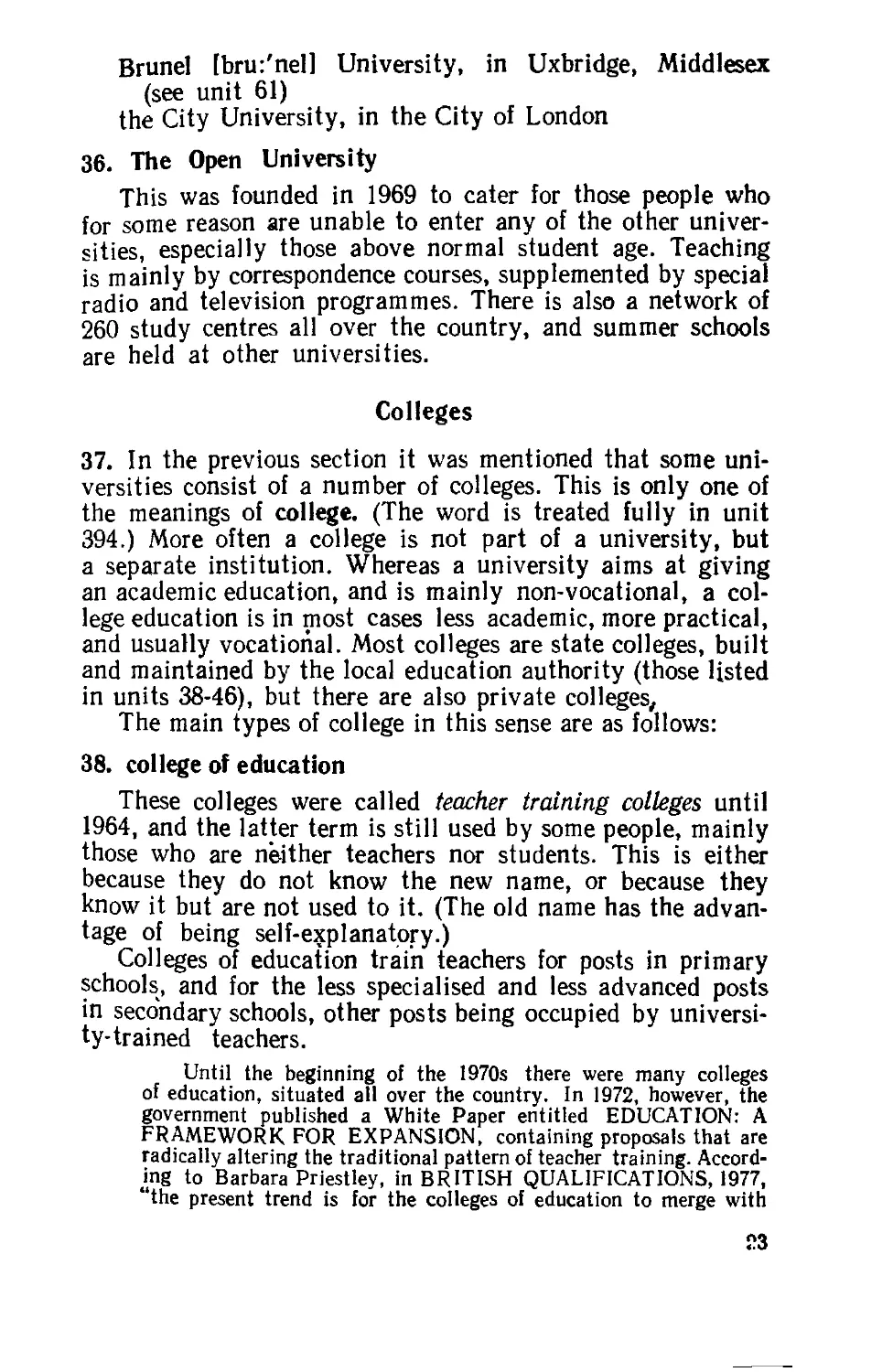
38.	college of education
These colleges were called teacher training colleges until
1964, and the latter term is still used by some people, mainly
those who are neither teachers nor students. This is either
because they do not know the new name, or because they
know it but are not used to it. (The old name has the advan¬
tage of being self-explanatory.)
Colleges of education train teachers for posts in primary
schools, and for the less specialised and less advanced posts
in secondary schools, other posts being occupied by universi¬
ty-trained teachers.
Until the beginning of the 1970s there were many colleges
of education, situated all over the country. In 1972, however, the
government published a White Paper entitled EDUCATION: A
FRAMEWORK FOR EXPANSION, containing proposals that are
radically altering the traditional pattern of teacher training. Accord¬
ing to Barbara Priestley, in BRITISH QUALIFICATIONS, 1977,
“the present trend is for the colleges of education to merge with
?3

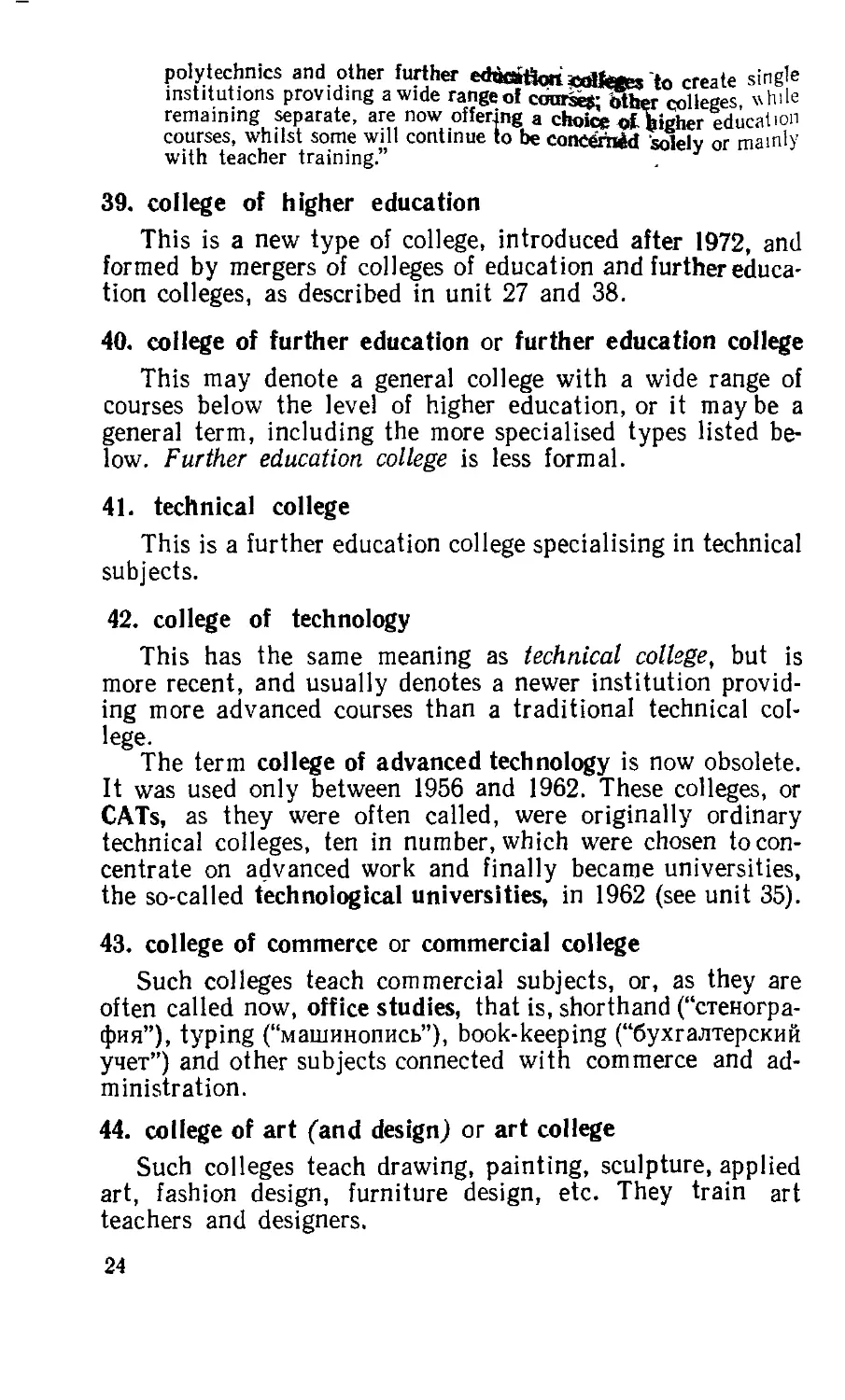
polytechnics and other further edition colleges to create single
institutions providing a wide rangeof cotn^f*her colleges while
remaining separate, are now offering a choice of. higher education
courses, whilst some will continue to be conc&n&i solely or mainly
with teacher training.”
39.	college of higher education
This is a new type of college, introduced after 1972, and
formed by mergers of colleges of education and further educa¬
tion colleges, as described in unit 27 and 38.
40.	college of further education or further education college
This may denote a general college with a wide range of
courses below the level of higher education, or it maybe a
general term, including the more specialised types listed be¬
low. Further education college is less formal.
41.	technical college
This is a further education college specialising in technical
subjects.
42.	college of technology
This has the same meaning as technical college, but is
more recent, and usually denotes a newer institution provid¬
ing more advanced courses than a traditional technical col¬
lege.
The term college of advanced technology is now obsolete.
It was used only between 1956 and 1962. These colleges, or
CATs, as they were often called, were originally ordinary
technical colleges, ten in number, which were chosen to con¬
centrate on advanced work and finally became universities,
the so-called technological universities, in 1962 (see unit 35).
43.	college of commerce or commercial college
Such colleges teach commercial subjects, or, as they are
often called now, office studies, that is, shorthand (“стеногра¬
фия”), typing (“машинопись”), book-keeping (“бухгалтерский
учет”) and other subjects connected with commerce and ad¬
ministration.
44.	college of art (and design) or art college
Such colleges teach drawing, painting, sculpture, applied
art, fashion design, furniture design, etc. They train art
teachers and designers.
24

45.	There are other types of specialised college, for example,
agricultural college, college of building, and so on. However,
many people receive their vocational training not at a special¬
ised college but in one of the departments of a more general
college, such as a college of technology, or a polytechnic,
which will be considered in the next unit.
46.	polytechnic
Although there have been institutions called polytechnics
in Britain for a long time, the term now usually refers to
institutions established since 1967. The first new ones were
formed then, either from single technical colleges, colleges
of technology, or groups of these, or groups of technical,
building, art and commercial colleges, which were reorganised
under the name of polytechnics as centres for advanced cours¬
es in a wide range of subjects. Some of the work is of univer¬
sity level, and thus is officially described as the higher educa¬
tion sector within further education.
47.	There are also some private colleges, which train people
for a particular job. One example is the secretarial college,
which trains girls to be secretaries.
48.	school
The names of some establishments which train people for
various occupations traditionally have the word school instead
of college, although they cannot in general be called schools
(without a modifier). Here are some examples:
art school
Art schools teach drawing, painting, sculpture, etc. The
most well-known is the Slade School of Fine Art, in London (in
non-formal style often called simply the Slade). However,
most other art institutions are called art colleges (see unit
44 above).
drama school
These are establishments for training actors, directors,
etc. One very well-known school of this type is the Central
School of Speech and Drama, in London. However, the most fa¬
mous drama school in England is the Royal Academy of Dra¬
matic Art also in London (see unit 49).
ballet school “хореографическое училище”
25

school of librarianship — an establishment for training
librarians.
There are also some private schools which do not train
people for a job, but give some kind of specialised instruction.
Two examples are:
language school or school of languages
These schools provide courses in one or more languages for
people of any age, although most of the students are between
16 and 30. Courses may be full-time or part-time. There are
many schools of English, which teach English to foreigners
driving school
These schools employ instructors who give driving lessons
and prepare people for their driving test.'
49.	academy
Academy is occasionally used in the sense of “college”*
generally in names which date back at least to the last cen*
tury. Two examples are the Royal Academy of Dramatic Art
(usually abbreviated in non-formal style to RADA ['ra:d9l
and the Royal Military Academy.
IN THE SOVIET UNION
50.	The following translations can be recommended:
высшее образование — higher education
высшее учебное заведение —higher education(al) institu¬
tion! establishment or institution/establishment of higher educa¬
tion
высшая школа — higher education or higher education(al)
institution!establishment or institute or college (see unit 51),
depending on the situation Note that higher school is not used
in England.
среднее специальное образование
Further education is the nearest English equivalent, al¬
though it is clear from unit 27 that it is far from corresponding
exactly. The loan translation specialised secondary education
is therefore preferable in serious discussions of the Soviet edu¬
cational system, for example, at meetings of educationists.
Bear in mind, however, that this expression will not be quite
clear to an English person unacquainted with the Soviet
system, and may need explanation.
университет — university
26

51.	институт
In cases where институт is a general term, denoting
a whole category of educational establishments, the use of
college is to be recommended.
e.g. а. Университеты и институты — universities and
colleges
b.	Он учится в институте.— He’s at college.
c.	Мы вместе учились в институте.— We were at
college together.
d.	Я окончил институт в 1970 году.— / left college
in 1970. (See also unit 369.)
Note the absence of article in sentences such as b-d.
Institute would not be clear in such cases, because this
word has too many different meanings to be used as a general
term (see unit 402). As already stated, the usual word for
a post-school establishment other than a university is college.
However, one should bear in mind that by no means all Eng¬
lish colleges are higher educational institutions (see units
38-44).
When the type of институт is specified, as in педагоги¬
ческий институт, сельскохозяйственный институт, and so
on, institute can be used. Most British writers on Soviet edu¬
cation use the loan translations pedagogical institute, agricul¬
tural institute, and so on. Remember, however, that they
are loan translations and not equivalents denoting English
establishments. For this reason English people who are unac¬
quainted with the Soviet educational system may not under¬
stand them. In such cases it is sometimes preferable to use the
names of those English institutions which fulfil a similar
function, for example, college of education, agricultural college,
explaining the differences if necessary.
52.	педагогический институт
Pedagogical institute is the trartslation used by most Brit¬
ish writers on Soviet education. To a non-specialist, however,
this is a most formidable expression. Apart from the possible
ambiguity of institute (see unit 402), the word pedagogical
is a learned word rarely used by anyone except educationists
(see also unit 398). An educated English person will probably
realise that a pedagogical institute has some connection with
teaching, but he may well imagine something more unusual
27

and more highly specialised, perhaps a research establishment.
He is unlikely to think immediately of teacher training.
College of education can be used instead when talking to
English people with little or no knowledge of the Soviet sys¬
tem, since this is also an institution for training teachers.
However, the Soviet institutions on the whole have a higher
academic standard than these English colleges, and research
plays a more import9nt part.
Although the term teachcr training college is no longer
officially used of English institutions, it could be used as
an alternative, since it is a clear descriptive term, and well
known to most English people.
53.	политехнический институт
Some writers use the loan translation polytechnic(al)
institute, others use polytechnic, although the English polytech¬
nics have not only higher but also further education courses
(see unit 46). The choice depends on the situation, as ex¬
plained in the previous units.
54.	технологический институт
One may use either the loan translation technological in¬
stitute, or college of (advanced) technology (see unit 42), de¬
pending on the situation (see unit 51). Although there are
no longer any institutions called colleges of advanced technology
in England, the inclusion of advanced is to be recommended in
order to indicate the high standard of the work done there.
55.	медицинский институт
There are no medical colleges in England corresponding
to the Soviet медицинские институты. All doctors are trained
either in th'e medical schools of universities or in teach¬
ing hospitals. As a translation of the Russian term, medical
school seems to be the most satisfactory. However, medical
college, although not an English term, is quite clear and could
be used instead. Medical institute is not to be particularly
recommended, at least when talking to English people unfamil¬
iar with the Soviet institutions, as this implies a research
rather than a teaching establishment (see unit 402).
56.	The names of other types of specialised институты
can be translated according to the principles followed above,'
that is, by a loan translation when speaking to those who have
some knowledge of the Soviet system, and by the name of
the nearest equivalent institution in other cases.
28

e.g. сельскохозяйствен-	—	agricultural institute	or
ный институт	agricultural college
строительный ин-	—	institute of building	or
cmumym	college of building
Note that when a noun, not an adjective, is used with insti¬
tute or college, the form institute!college, of ... is more usual.
Another example is institute of architecture.
In many cases there is no specialised institution corre¬
sponding even approximately to the Soviet one (see unit 45).
Here one can use only loan translations, such as institute of
economics, institute of shipbuilding, although these may be
made closer to native English usage if necessary by using
college instead of institute.
57.	училище
This is generally translated as school.
e.g. а.	педагогическое училище	—	pedagogical	school
b.	художественное училищ?	—	art school
c.	профессионально-техни-	—	vocational	(techni-
ческое училище	cal) school
Pedagogical school is a loan translation. The same problem
concerning pedagogical applies here as in the case of pedagog¬
ical institute (see unit 52). In this case, however, there seems
to be no alternative, since there is no separate type of estab¬
lishment for training nursery and primary school teachers in
England.
Art school is used in England of institutions similar to
the Soviet художественные училища (see unit 48) although
college of art (and design) is more common'(see unit 44).
Vocational (technical) school is a loan translation which
sounds rather unusual to the non-specialist. Vocational, al¬
though widely used in education (see unit 420), does not occur
in names of specific institutions in England. In addition,
technical school suggests a school taking the whole secondary
age range (see unit 16), and for that reason it might be bet¬
ter to use technical college instead. Unfortunately, however,
technical college is needed as a translation of техникум. One
solution is to use junior technical college, or to keep school,
adding senior or high: senior technical school, technical high
school.
29

58.	техникум
Technical college seems to be the best translation (see
unit 41).
II.	NAMES OF INSTITUTIONS
SCHOOLS
59.	English schools have names, not numbers. Soviet students
and teachers are often puzzled by the variety of names used
in England, and wonder what they mean. The two most com¬
mon are:
(1)	geographical
These are taken from the name of the town, district, vil¬
lage or street in which the school is situated.
e.g. Manchester Grammar School
City of Bath Girls' School
Wandsworth Comprehensive School
Wandsworth is a district of London.
Bratton County Primary School
Bratton is a small town.
(For the use of county see unit 10.)
Abbey Road Junior School
(2)	named after a well-known person
Some schools are named after the founder, or some other
person connected with the school.
e.g. Mary Hampden Junior School
George Dixon Grammar School
Other schools have names which presumably had some
significance at the time they were chosen, but this significance
has been lost, or is understood only by those who know the
history of the school or town. However, even if the name has
little real significance now, most people prefer it to a number,
since it seems to them in some way more personal, more indi¬
vidual.
Some secondary schools, usually independent, were given
at their foundation a name which included the word college.
They have kept that name, although they are not really col¬
leges, but schools.
e.g. Eton College
Winchester College (see unit 21)
30

When speaking of the above institutions, one would refer to
them as (public) schools.
60.	When speaking about Soviet schools, there is no need to
include the word number.
e.g. / did my teaching practice at school 250.
although it can be included for emphasis, especially in for¬
mal style.
INSTITUTIONS OF FURTHER AND HIGHER
EDUCATION
Universities
61.	The official name of most British universities has the def¬
inite article and of followed by the name of the city, town or
county.
e.g. the University of Oxford! Manchester I Sussex
This is used in formal situations, particularly in writing.
The definite article may be omitted in headings, lists, and
in other cases where there is not a complete sentence, but
it is implied, and is included in complete sentences. For ex¬
ample, a degree certificate may have the heading:
University of Oxford
but one would say, or write:
The degree was awarded by the University of Oxford.
Omission of the article is a sort of abbreviation, which is not
acceptable in a complete sentence.
In less formal style the following form is used, with no
article:
Oxford/Manchester/Sussex University
e.g. a. Manchester University was founded in 1880.
b.	John Barrington lectures at Sussex University.
The form *the Oxford!Manchester!Sussex University, etc. is
incorrect.
The City University, a technological university in the
City of London, has only one form of its name, with the defi¬
nite article.
Two of the recently-formed technological universitites are
named after famous people. They are:
(1)	Brunei University, at Uxbridge, in Middlesex, named
31

after the famous 19th-century civil engineers Brunei [bru:'nell
(father and son).
(2)	Heriot-Watt University, in Edinburgh, named after
George Heriot (1563-1642), founder of Heriot’s Hospital,
Edinburgh (now a day school), and James Watt (1736-1812),
famous Scottish engineer and inventor of the steam engine.
(Remember that there is also an older university in Edinburgh,
called the University of Edinburgh or Edinburgh University.)
Note that the name of the person is placed before the com¬
mon noun university and that there is no article. These names
have only one form.
When the context makes it clear that a university is meant,
the word university itself is usually omitted in non-formal
style.
e.g. a. My brother was at Leeds. = studied at Leeds Uni¬
versity
b.	His father wanted him to go to Oxford, because he
was at Oxford himself.
c.	(Of a university teacher)—Dr. Williams used to
be at Heriot-Watt, but last year he was offered a lec¬
tureship at Manchester.
(For the use of to be at and to go to in the sense of “to study
at” see unit 406.)
The use of at with the name of a city, as opposed to in,
usually indicates that the university of that city, rather than
the city itself, is meant.
e.g. d. My brother is at Cambridge. = studying at Cam¬
bridge University
e. My brother is in Cambridge. = living in the city of
Cambridge, or visiting it at the moment.
62.	In the case of collegiate universities such as Oxford,
Cambridge and London (see units 29, 31), each college has its
own name, which is generally connected with its founder or
the circumstances of its foundation.
e.g. Balliol ['beihal] College, Oxford
Trinity College, Cambridge
King's College, London
Note that the word university is not usually included, at
least in non-formal situations; one is supposed to know that
the university is meant and most educated English people do
32

in fact kn»w the names of the more well-known Oxford, Cam¬
bridge and London colleges.
The pronunciation of the names of some Oxbridge colleges
is a trap for the uninitiated, the most striking examples be¬
ing:
Caius [ki:zl College, Oxford
Magdalen l'mo:dlin] College, Oxford
The word college is usually omitted in non-formal style
when the context permits. For example, it is customary to say:
a.	He'sIHe was at Balliol.
b.	Trinity is bigger than any other Oxbridge college.
63.	When translating the names of Soviet universities, the
following forms can be used:
(name of city)
The, University of	— in formal style
e.g. the University of Leningrad
(name of city)
or	University — in less formal style
e.g. Leningrad University
The definite article can be omitted from the first form in
headings, lists, etc., but should always be included in com¬
plete sentences. No article should be used with the second form.
Some English people use the translation state university
in formal style (mainly written), for example, Leningrad State
University. This usage can be justified as a translation from
Russian; on the other hand, the significance of state here would
probably not be understood by an English person or an Amer¬
ican unfamiliar with Russian usage. In England state in the
context of education is used in contrast to independent or
private (see unit 1) and is not applied to universities (see unit
2§), In the USA a state university is one maintained by a partic¬
ular state (“штат”).
If a university (or other institution) is named after a
famous person, the name should be put before the word uni¬
versity (institute, etc.)
e.g. (The) Patrick Lumumba University, Moscow
This sounds quite natural, because the name Patrick Lumumba
distinguishes that university from the other university in
33

Moscow. The latter can be called the Lomonosov University to
distinguish it from (the), Patrick Lumumba University, al¬
though it is usually called Moscow University, or, in formal
style, the University of Moscow. When there is only one uni¬
versity in a city, the inclusion of a person’s name sounds un¬
usual, superfluous.
Other Institutions of Higher
and Further Education
64.	As already mentioned (unit 37), in Britain most post¬
school institutions except universities are called colleges.
Here are some examples of college names:
Bath College of Education
City of Manchester College of Higher Education
Stafford ['staefadl College of Further Education
Carlisle [ka.-'laill College of Art and Design
Glasgow College of Technology
Worcester ['wustal Technical College
As a rule no article is used with the name of colleges, even in
complete sentences.
e.g. He teaches at Worcester Technical College
Most college names are geographical, like those quoted
above, and specify the town, city, district or county in which
the college is situated. However, some are named after a per¬
son connected with the college, e.g. Garnett College of Education
(in London) named after a Dr. W. Garnett, and some have
names whose significance is apparent only to those who know
the college.
Polytechnics have geographical names, for example:
Central London Polytechnic
Sheffield Polytechnic
No article is generally used with these names,
e.g. He teaches at Sheffield Polytechnic.
but there is some variation in usage and sometimes the defi¬
nite article is included.
The names of institutions called school or academy gener¬
ally have the definite article.
34

e.g. The Slade School of Fine Art (see
unit 48)
The Central School of Speech and Drama
The Royal Academy of Dramatic Art
(or RADA ['rada], with no article)
(see unit 49)
in London
65.	When translating the names of Soviet institutions called
институты, it is preferable to use the word institute, not
college, for институт, and to use a loan translation when there
is no good English equivalent (see units 51-55):
e.g. the Moscow Institute of Foreign Languages
the Leningrad Institute of Shipbuilding
the Kiev Institute of Food Technology
The definite article may be omitted in lists, headings, etc.,
and sometimes even in complete sentences.
If a person’s name is included, it is placed before the word
institute.
e.g. the Hertzen Pedagogical Institute, Leningrad
ч
In such cases the article is not omitted in complete sentences.
The names of institutions known in Russian as училище
and translated as school are treated in the same way:
e.g. the Mukhin Art School, Leningrad
III.	GOVERNMENT AND ADMINISTRATION
SCHOOLS
IN ENGLAND
66.	manager, governor
All state schools have managers or governors. Primary
schools have managers and secondary schools governors (a
board of governors). These are people of a certain standing
in the community who give up some of their time to deciding
(or at least advising on) some questions concerning the school,
for example, what staff to appoint. In most cases all or the
majority of the managers/governors are appointed by the
LEA. The purpose of their existence is to see that every school
has an individual life of its own as well as a place in the local
system.
35

However, according to Tyrrell Burgess, in A GUIDE TO ENG¬
LISH SCHOOLS, “as far as powers are concerned, they inhabit a
kind of no-man’s land between the local authority and the head of
the school”. Burgess goes on to say that if managers and governors
are active and interested they can help a school create an individ¬
ual life of its own, but concludes as follows: “Normally, however,
they turn up at school functions, try to remember the names of the
teachers, occasionally badger the authority for improvements to the
school premises and hold themselves available for consultation and
discussion with the headmaster. In 1970 the National Association,
of Governors and Managers was founded to help governors and
managers to be more effective and to |>ress for changes in their re¬
cruitment and powers.”
67.	head teacher, headmaster/mistress
These words denote the head of a school. Head teacher is
a general term.
e.g. There will be a meeting of head teachers on May 12th.
In a particular school headmaster (if it is a man) or head¬
mistress (if it is a woman) is used. Simply head is often used
in non-formal situations.
e.g. (One teacher to another) — I've got to go and see %
head at break.
68.	deputy head teacher
Besides deputising for the head teacher, -the deputy head
is often responsible for the timetable and various other prac¬
tical matters, and for discipline in all but serious cases, which
are dealt with by the head teacher himself.
Deputy headmaster/mistress and deputy head are used in
the same way as headmaster /mistress and head (see unit 67).
In some schools the deputy head teacher is called the sec¬
ond mas ter/m is tress or the senior master/mistress. In mixed
schools there may be both a senior/second master and a senior/
second mistress, the latter having special responsibility for
the girls.
69.	head of department
This is the teacher in charge of the teaching of a particular
subject or group of subjects throughout the school. For exam¬
ple, there are usually several English teachers in a school, and
together they form the English department. The most senior
is the head of (the) department and is responsible for directing
and coordinating the work of the group, choosing textbooks,
' 36

etc. The head of department may also be called senior . . .
master/mistress, for example senior English mistress.s
70.	parent-teacher association (PTA)
Most schools have such an association, which is like a com¬
mittee on which parents and teachers are represented. It
acts as a permanent link between parents and staff, and gives
parents an opportunity to help the school in various ways.
Meetings between staff and parents are usually called par¬
ents meetings/evenings.
e.g. There will be a first-form parents meeting/evening on
Friday at 7 o'clock.
IN THE SOVIET UNION
71.	Директор школы can be translated as head teacher or
headmaster/mistress or head, depending on the situation
(see unit 67).
Заведующий учебной частью can be translated in one
of the following ways, depending on the function performed:
(1)	deputy head teacher /master/mistress or senior masterI
mistress;
(2)	head of the primary/secondary school/department (see
unit 23);
(3)	head of the English/history!physics department, or
senior English/history!physics master/mistress, (see unit
69).
Родительский комитет can be translated as parents’
committee.
HIGHER AND FURTHER EDUCATION
IN ENGLAND
72.	As already mentioned, the universities are independent,
self-governing institutions, whereas other post-school estab¬
lishments are under the control of the local education author¬
ity. This is reflected in tfteir structure and consequently in
their terminology, so that it is necessary to treat the two
groups separately.
Universities
73.	There is considerable variation in structure and terminol¬
ogy between the various types of university, especially be¬
37

tween 0> bridge and the rest (see units 29-36). The terms which
follow &ie used in most, but not all universities, that is,
the civk universities, London and at least some of the new
universalies. Oxbridge terminology is too varied and compli¬
cated fcr inclusion.
74.	court, council, senate
The>e are the three governing bodies; their functions
may be briefly summarised as follows:
The court is the supreme governing body, but in practice
its po.vers are limited.
Tha council is responsible for finance.
Tie senate ['senitl is the chief academic authority; it
coord nates and approves the work of the various faculties.
75.	chancellor
The official head of an English university is called the
chancellor. However, this does not correspond to the Russian
ректор, because the chancellorship is an honorary and cere¬
monial appointment. The chancellor is not an academic
(ученый), but a public figure who attends university func¬
tions such as the degree ceremony but has nothing to do with
the running of the university. For example, the chancellor
of London University is Queen Elizabeth the Queen Mother.
76.	vice-chancellor
The vice-chancellor is the effective head of the university.
He is an eminent academic, who is responsible for the general
policy and organisation of the university.
77.	registrar
The registrar is responsible for dealing with applications,
admission and registration of new students. He may also have
other duties.
78.	secretary
Some institutions have a secretary instead of a registrar,
and he carries out the duties listed above. In others there
is both a secretary and a registrar, with separate responsibil¬
ities.
This secretary, who is usually a man, should not be con¬
fused with the many women secretaries who work in thevari-
38

ous university offices, doing routine administrative and cler¬
ical work, typing, etc.
79.	treasurer, bursar
Treasurer is defined in the SOED as: “one who is respon¬
sible for the funds of a public body, or of any corporation,
association, society or club”.
Bursar is defined as: “treasurer, esp. of a college”. It is
clear from this that the word bursar is more restricted in its
usage than treasurer, but as many universities have both a
treasurer and bursar these definitions are not sufficient to
differentiate them. In practice the difference seems to be
that the treasurer is responsible for the general finances of the
institution, whereas the bursar deals with domestic matters
such as planning and development, maintenance (i.e. repairs,
etc.) and cleaning. The term domestic bursar is used in some
institutions.
80.	Universities organise their academic work in a variety
of ways.
These ways are outlined in WHICH UNIVERSITY 1977 as
follows: “In all the older universities subjects are taught in individ¬
ual departments which are in turn grouped into faculties covering
the main subject groupings, for example, arts, science, engineering,
social science. Sometimes social sciences are incorporated in the
arts faculty; law, education, theology, medicine, etc. usually form
faculties of their own... In all the universities founded after the
Second World War, after and including Keele (see units 34-36 —
J. P.), the traditional faculty structure has been avoided in an
attempt to prevent over-specialisation and to encourage students to
study across the accepted subject boundaries. One form of organi¬
sation, pioneered by Sussex, is the school, which embraces a range of
related subjects, but is devoted to studying them in relation to a
particular theme: English and European Studies, African and Asian
Studies, social studies. Essex and East Anglia also have schools,
although departments are stronger at Essex. Kent's faculties are
more like Sussex schools than traditional faculties. Lancaster, Keele
and some of the technological universities have boards of studies;
York and Warwick have structures closer to the older universities.”
The following description of faculties and departments
applies to the older universities, especially the civic univer¬
sities and London.
How many faculties there are, what they are called and
what subjects each includes varies to some extent from one
university to another, even among universities of the same
type. As an illustration, here is a list of the faculties at four of
the largest civic universities:
39

Birmingham
Arts
Science and Engineering
Medicine and Dentistry
Law
Commerce and Social Science
Manchester
Arts
Science
Technology
Medicine
Law
Economic & Social Studies
Business Administration	ences
Theology	Education
Music
Education
The various faculties will now be treated in turn, taking
as the basis these four civic universities.
81.	faculty of arts/arts faculty
The faculty of arts is the official name of the faculty.
In non-formal style the arts faculty is more common. (For
this use of arts, see unit 392.) It will be seen from the lists
of faculties given above that the same name is used in all
four universities. It is also the one used in nearly all other
English universities. The subjects usually taught in the arts
faculty are as follows:
English (language and literature)
French \
German 1 often referred to collectively as modern lan-
Spanish > guages.
Italian I Both language and literature are included.
Russian )
Latin	1 often called collectively
Greek (i.e. ancient Greek) j classics
History
Philosophy
There are some other subjects, for example, drama, Amer-
Bristol
Arts
Science
Engineering
Medicine
Law
Social Sciences
Nottingham
Arts
Pure Science
Applied Science
Agricultural Science
Medicine
Law & Social Sci-'
40

ican literature and oriental languages, which are taught in
this faculty in some universities.
The word гуманитарный can be used in translating arts
faculty into Russian, giving факультет гуманитарных
наук.
82.	faculty of science/science faculty
This faculty exists in all English universities, although,
as can be seen from the lists of faculties given above, its
exact name varies, and it may be combined with what are
usually separate faculties or, on the contrary, subdivided.
For example, at Birmingham there is a joint faculty of sci¬
ence and engineering; at Nottingham, on the other hand, there
are three science faculties: pure science (called simply science
at most universities), applied science (called engineering or
technology elsewhere), and agricultural science (only taught
at certain universities, and usually called simply agriculture).
Social science is a science in a different sense and will be
discussed in unit 86.
However, in spite of some variations in usage, the usual
title is ttie faculty erf science or, in less formal style, the sci¬
ence faculty. This faculty teaches the subjects usually known
as the sciences, or, strictly speaking, the natural sciences,
viz. biology, chemistry, physics and their branches. In addi¬
tion it often includes subjects related to the above, for exam¬
ple, geology, geography. (The usage of the word science is
discussed in unit 415.)
The name of this faculty can be translated as факультет
естественных наук.
83.	faculty of engineering/technology, engineering/technology
faculty
Most English universities have a separate faculty of engi¬
neering, although at Birmingham, for example, it is combined
with the science faculty. The name of the faculty varies,
however, and this may cause confusion. At some universities,
Manchester, for example, it is called the faculty of technology,
at others, Nottingham, for example, it is called the faculty of
applied science. These three words (engineering, technology
and applied science) are strictly speaking not synonymous.
Technology is a broader term than engineering and includes
all studies related to industry. Applied science is used in
contrast to pure science, pure in this case meaning “theoretical".
Pure science is that which is usually referred to simply as
41

science, and which was considered in the previous unit. How¬
ever, although the three terms are not in general synonyms,
they are synonymous in this case, since in practice more or
less the same subjects are taught in the faculties concerned,
whether the name of the faculty is the faculty of engineering,
technology or applied science.
84.	faculty of medicine/medical faculty
This name is self-explanatory. Sometimes, however, the
term medical school is used instead, and this may lead to
confusion. A medical school may be one of two things. Firstly,
it may be a synonym for medical faculty. The medical faculty
is the only one which is commonly referred to as a school in the
civic universities, although usage differs at Oxbridge and the
new universities. Secondly, medical school may denote a train¬
ing establishment for doctors attached to a big hospital.
Students of these schools take the same examinations as
students of the medical faculties of universities. Hospitals
with their own medical schools are known as teaching hospi¬
tals. The expression to be at medical school means “to be stud¬
ying medicine”, either at a university or a teaching hospital.
85.	faculty of law(s)/law faculty
This name requires no explanation. The plural form laws
is still used in some universities because the original Latin
name had the plural. The name of this faculty can be translat¬
ed as юридический факультет.
86.	faculty of social science(s)/social science faculty
This is its usual name, although at Manchester and Leeds
it is called the faculty of economic and social studies.
It is combined with commerce at Birmingham and with
law at Nottingham. Faculty of social science(s) can be
translated as факультет общественных наук.
87.	faculty of education/education faculty
In a few universities this faculty is called the school of
education, and in some others it is not a separate faculty, or
school, but a department within the arts faculty.
The main task of this faculty is to train graduates as teach¬
ers. Those who have taken a degree in one of the faculties
already discussed, and who wish to become teachers, enter
the faculty of education, either at the same university or a
42

different one, and take a one-year teacher-training course (see
unit 165).
The name of this faculty can be translated as педагоги-
ческий факультет.
88.	These are the faculties which form part of all the civic
universities and of some others too. It may be seen from the
lists in unit 80 that some universities have other faculties
too, but these do not need explanation, with the possible
exception of the faculty of business administration at Man¬
chester. Business administration, or, as it is more often called,
business studies, is a fairly new speciality combining the study
of economics, accountancy, commercial law, marketing and
other subjects necessary for administrative work in business
(for example, in an industrial firm). These subjects are more
often taught at colleges of further education and polytechnics
than at universities.
89.	The administration of each faculty is the responsibility
of the dean and the faculty board.
The dean is the head of the faculty. His deputy is usually
known as the sub-dean, sometimes as the deputy dean.
e.g. Dean of the Faculty of Arts!Arts Faculty (see unit 81)
Sub-Dean of the Faculty of Science!Science Faculty
90.	faculty board/board of the faculty
This is the body which decides faculty matters. It con¬
sists of representatives from all departments of the faculty
(see unit 91) and is presided over by the dean.
A meeting of the faculty board is often called simply a
faculty meeting in non-formal situations.
e.g. a. There's a faculty meeting tomorrow at eleven.
b.	It was decided, at the last faculty meeting.
c.	What's on the agenda of the faculty meeting?
Note that sitting is not used in such cases (see unit 119).
91.	Each faculty is divided into a number of departments.
For example, the arts faculty usually consists of the following
departments:
the Department of English/the English Department
the Department of French!the French Department
the Department of German!the German Department
43

• the Department of Classics!the. Glassies Department and so ojj
(see unit 81).	g
The word department can often be translated as кафедрщ
However, this is not an exact equivalent, because a depart¬
ment includes both staff and students. Here are some example^
of usage.
a.	The Department of English is the largest in the faculty,
( is on the staff of the English
b.	Miss Glover ■! Department.
( teaches in the English Department,
c.	(One student to another) —What department are you
in?
d.	The department has decided to introduce a new course
on the history of drama for the second year.
Since both staff and students are members of the depart¬
ment, a meeting of the department or a departmental meeting
could refer to both, but in practice it usually refers only
to staff. To make this quite clear, staff meeting can be used.
92.	head of department
The person responsible for the running of the department
is called the head of department. This term corresponds more
or less to the Russian заведующий кафедрой.
e.g. a. Professor Edwards is the head of the English De¬
partment.
b.	This application must be signed by your/the head
of department,
93.	secretary of the department/depar-tmental secretary
In English universities this is not one of the teaching
staff who'takes on administrative duties in addition to his/
her teaching, but one of the full-time administrative staff,
with secretarial training, who deals with departmental cor¬
respondence, clerical work, and assists the head of depart¬
ment with routine administrative matters.
94.	chair
Chair means the position of professor, a professorship,
and there may be one or more chairs in one department, de¬
pending on its size and importance. Here are some examples
of usage.
44

ft. The chair о/ history at Exeter is held, by Professor
Thompson.
b.	The chair of English, literature at Leeds has.become
vacant.
c.	Applications are invited for the chair of the Department
of French.
d.	The university announced the creation of a new chair
in experimental chemistry.
e.	— I wonder who'll get the chair.
colloquial, meaning who will be appointed professor
f.	Professor Sanderson has been appointed to the new chair
of Italian and headship of the Department of Italian.
95.	school
In some English universities several related departments
are grouped together in one school within the faculty. For
example, the Leeds Science Faculty has the School of Chemis¬
try, consisting of the departments of Inorganic Chemistry,
Organic Chemistry, and Physical Chemistry, and the School of
History, consisting of the departments of Ancient History,
Medieval History and Modern History.
Note, however, that this is not the only meaning of school
in a university context. Some universities have schools in¬
stead of faculties (see unit 80). Other meanings are given in
unit 414.
96.	external department
London University has an external department, which
gives people not studying at the university the opportunity
of taking the degree examinations. Such people are called
external students (as opposed to internal students) and take
an external degree. The university does not provide any tui¬
tion for such students; they study for the examinations on
their own, or take correspondence courses, or have private
lessons.
97.	extra-mural department
An extra-mural department is one which runs non-degree
courses in a wide range of subjects for the general public.
As stated in the handbook for 1973/74 issued by the University
of London Department of Extra-Mural Studies, the courses are for
“adults who wish to pursue knowledge for its own sake or develop
their talents more fully..." It continues “There are no entrance
requirements apart from a willingness to take an active part in a
serious course of study”.
45

The lectures take place on the university premises, and
extra-mural is used here in a figurative sense, that is outside
the main university framework (of degree courses and research),
rather than outside its walls. The department has its owi
staff, and in addition arranges lectures by guest lecturersj
Many universities have such departments.
Non-University Institutions
As already mentioned, the government and administration'
of non-university institutions differs from that of universities*
The following terms are used:
98.	governing body
Instead of the court and the council, as in universities,
colleges of education, colleges of higher education, polytech¬
nics and other institutions of further education have a govern¬
ing body, which consists of representatives of the local edu¬
cation authority, the local university, the college staff and
the student body.
99.	academic board
This is responsible for the academic work of the college
and its government, subject to the approval of the governing
body. It thus fulfils approximately the same function as a
university senate (see unit 74).
100.	principal
The head of a college or similar institution is usually
called the principal. The principal is the effective head, not a
public figure like the chancellor of a university. The princi¬
pal’s deputy is called the vice-principal or the deputy prin¬
cipal.
101.	director
A comparatively new development is the use of director
instead of principal in some institutions, especially polytech¬
nics. This use is not very widespread at present but it is in¬
creasing.
102.	Other administrative officers include the secretary,
the registrar, the treasurer and the bursar (see units 78-79).
However, there is considerable variation from one institution
to another.
46

103.	The structure of colleges and polytechnics is on the whole
simpler than that of universities. As a rule they have no facul¬
ties, but are divided only into departments. There is usually
no need for departments to be grouped in faculties, because
the range of subjects in a particular college is much narrower
than in a university, and the subjects studied are usually
related to each other. For example, in a college of technology
mainly technical subjects are taught, and therefore in one
respect the whole college corresponds to a single faculty of a
university. If arts subjects are also taught, there may be an
arts faculty and a science/technology faculty. In some large
institutions there are schools, as in some universities (see unit'
80)	and some polytechnics have divisions.
Many further educational institutions take not only full¬
time students but also part-time students. However, there are
not usually separate full-time and part-time departments.
Both full-time and part-time students study in the same de¬
partments, but take different courses, full-time courses or
part-time courses. Most technical institutions also have so-
called sandwich courses (see unit 396).
Admission to Universities and Colleges
The following words are used in this connection:
104.	to admit, admission
To admit is used in formal style, especially in the passive:
e.g. a. Students are admitted to British universities mainly
on the basis of their results in the examinations for
the General Certificate of Education at Ordinary and
Advanced Level. (See unit 340.)
Admission is also used in formal style, in such sentences as:
b. All applications for admission to courses leading
to a first degree must be made through the Univer¬
sities Central Council on Admissions (UCCA).
This council is described in BEE as follows: “The UCCA
was set up by the universities of the UK in 1961. The UCCA office
receives applications for admission to first degree courses at nearly
all the universities and university colleges in the UK: decisions on
such applications are made by the universities themselves and trans¬
mitted through the UCCA office.” *
The abbreviation UCCA is pronounced Глкэ].
*	Admission procedures for British universities are described in A
BOOK OF BRITAIN, Leningrad, 1977, pp. 187-188.
47

105.	to apply, application, applicant
To apply means “to ask officially for something”, in this
case for admission to a university or college. It is used as
follows;
to apply for admission (to a university/college) — formal
style
to apply for a place (at a university/college) — less formal
to apply to a university (college — non-formal
e. g. He applied, to London University,
to apply to university
This expression, with no article, means to apply to that typ<
of institution; which university is not important here.
Application- means the act of applying, or the request
itself. Its use is illustrated in the quotation about UCCA given
above. Application is usually made by filling in an applica¬
tion form giving all the necessary details about oneself.
An applicant is a person who applies.
e. g. There were five applicants for every place.
106.	The following verbs are used with reference to the result
of the application;
to be accepted/rejected (by a university/college)
e.g. He applied to Leeds University ™
to get in (to)
This is often used in the sense of “to be accepted” in colloquial
style.
e.g. a. /n spite of the stiff competition (for places) he got in
(to the French Department).
b. He applied three times but didn't get in.
107.	to enter, entrance
To enter occurs only in the sense of “to begin to study”,
.in formal style.
e.g. He entered the Royal Academy of Dramatic Art in 1960.
In other cases to be accepted or to get in is used (see unif 106
above). Try to enter is rarely if ever Used in the sense “посту¬
пать”. Apply is the usual word (see unit 105).
With reference to Oxford and Cambridge the expression
48

to go up (to Oxford/Cambridge) sometimes occurs in the sense
of “to enter”:
e.g. He went up to Oxford in 1965. (See also to come down,
unit 369.)
Entrance is sometimes used in the sense of admission, but
more often attributively, in the expressions entrance re¬
quirements, entrance examination.
e.g. a. The minimum entrance requirements for British
universities is five passes at GCE 0 level and two
passes at A level. (See unit 340.)
b.	Most British universities have no special entrance
examination now. (See example a. in unit 104.)
IN -THE SOVIET UNION
Since the government and administration of Soviet uni¬
versities do not differ basically from those of other institutions
of higher education, there is no need for two sets of terms.
The following translations can be recommended.
108.	ректор
Rector seems to be the best translation. Although this
word usually means something different in England (“a senior
clergyman”), in a university context its meaning is clear
enough; most educated English people are familiar with its use
to denote the head of a Scottish, German or French university.
It is even used in England at two Oxford colleges (Exeter and
Lincoln), where the head of the college is called the rector.
It has also been adopted by at least one of the new polytech¬
nics. For example, the head of Liverpool Polytechnic is called
the rector. If necessary, one can explain that the rector is the
head of the university, similar to the vice-chancellor of an
English university.
109.	проректор
Pro-rector may be used as a translation, as long as one
remetttbfcrs that this is only a translation of a foreign concept.
The SOED comments “now chiefly in German use”. Another,
clearer alternative is vice-rector.
110.	ученый совет
The literal translation academic council may be used, since
its general meaning is clear, but one should bear in mind that
49

this is not used in English universities, and be prepared to
explain if necessary that it corresponds more or less to the
English senate.
111.	факультет
If an institution is divided into факультеты, these can
be called faculties in English.
Here are translations of the names of some Soviet fac¬
ulties.
112.	филологический факультет — philological faculty or
faculty of arts/arts faculty (see unit 81) or faculty of languages
and literature, depending on the context.
It may be translated as philological faculty among Soviet
teachers and students, since they know what specific concept
it expresses. However, one should bear in mind that to an Eng¬
lish person the expression will convey either nothing, or some¬
thing different from what is meant. He may imagine a faculty
devoted entirely to the history of language, quite apart from
other aspects of language, and from literature (see unit 409).
He may well suspect that this is unlikely to be so, but will
be at a loss to understand exactly what is meant.
When talking to English people there are three possibili¬
ties. The first is to use the literal translation philological fac¬
ulty, with an explanation of its meaning if necessary. This
may be justified in some cases, where it is important to con¬
vey that this is the specific Soviet term, although its gener¬
al use is not to be recommended. The second possibility is
to use the English term arts faculty. This is familiar to Eng¬
lish people and, although the English arts faculty is wider in
its scope than the Soviet филологический факультет, it does
include the subjects taught in the Soviet faculty (see unit
81). The third possibility is to use faculty of languages and
literature. This is not an English term, but is clear to English
people, and may be preferred by those who wish to avoid
giving the impression that the Soviet филологический факуль¬
тет includes all the subjects taught in the English arts facul¬
ty. It seems to be the clearest translation available.
In those institutions where the филологический is combined
with the исторический факультет as the историко-фило¬
логический факультет one could use the translation faculty
of history, languages and literature.
The choice between these three possibilities also depends
50

on the situation. In general conversation, where the exact
distinctions between the English and Soviet faculties are not
very important, arts faculty could be used, and in serious
discussions faculty of (history) languages and literature or
even, if necessary, philological faculty.
факультет иностранных языков can be translated as
faculty of foreign/modern languages and восточный факультет
as faculty of oriental languages/studies.
113.	исторический факультет — faculty of history or history
faculty
философский факультет — faculty of philosophy or phi¬
losophy faculty
факультет психологии — faculty of psychology or psychol¬
ogy faculty
Remember, however, that in most English universities
history, philosophy, psychology and foreign languages are
taught in one faculty, usually called the arts faculty.
114.	экономический факультет — faculty of economics or
economics faculty
In English universities, however, economics is usually
taught in the faculty of social science(s) (see unit 86).
115.	факультет журналистики — faculty of journalism or
journalism faculty
Journalism is not taught at English universities, but the
above translation is clear enough.
116.	The adjectival forms historical, geographical, economical,
etc. should be avoided in the names of faculties, since they
may be understood in a more general sense than is appro¬
priate here. For example, economical faculty suggests a faculty
where economies, or savings, are made. The effect is not so
strange in all cases. For example, historical faculty does not
sound very different from history faculty. On the whole, how¬
ever, it is better to avoid these forms.
117.	ученый совет (факультета)
One may use the literal translation academic council, as
at university level (see unit 110). Faculty can be included
in two ways: faculty academic council or academic council of
the faculty. Since this body fulfills approximately the same
function as the faculty board in English universities, this
51

term may also be ussd. It is not automatically associated with
an English university.
118.	декан, замдекана
Декан can be translated as dean, and замдекана as sub*
dean or assistant dean.
119.	кафедра
There is no exact English equivalent for this word, but
it is usually best translated as department (see unit 91).
e.g. Кафедра английской филологии — Department of
English (Language) or English (Language) Depart¬
ment
The inclusion of language is not essential but is to be recom*
mended when talking to English people, because otherwise
they will assume that both language and literature are taught
there, as in English universities. The second form given is
less formal style.
Кафедра германской!романской филологии — Department
of Germanic!Romance Languages
Кафедра зарубежных литератур — Department of Foreign
Literature
Кафедра фонетики — Department of Phonetics or Phonetics
Department
Here are some sentences where department corresponds to
кафедра:
a.	I teach in the English Department.
b.	Our department has decided to recommend the book for
publication.
c.	Representatives of all (the) departments attended the
faculty conference.
Заседание кафедры can be translated as meeting of the
department or departmental meeting (but see unit 91).
Staff meeting is widely used in England, but this is clearly
not an appropriate translation when postgraduates also attend.
(In English universities postgraduates do not generally attend
meetings with the staff.)
Note that sitting is not used here. Its use is restricted main¬
ly to Parliament and law courts.
Заведующий кафедрой is best translated as head of (the)
department (see unit 92). The definite article must be includ¬
ed when the name of the department is given:
52

e.g. d. Professor N. is (the).head of the English Department.
Otherwise it is generally omitted:
e.g. e. We had a talk with the head of department.
f.	This question can only be decided by the head of depart¬
ment.
Секретарь кафедры can be translated as secretary of the
department or departmental secretary, but when talking to
English people one should add that this secretary is also a
member of the teaching staff. Otherwise they will assume that
this person has only secretarial duties.
120.	лаборант(ка)
Laboratory assistant (usually abbreviated to lab assistant
in non-formal style) should be used only when the person con¬
cerned works in a laboratory, ‘dealing with equipment. If
his/her duties are secretarial (paperwork, typing, answering
the telephone, etc.) the word secretary should be used instead.
This word is also suggested as a translation of секретарь ка¬
федры, but there appears to be no alternative for either.
121.	отделение
When this means a group of departments it can be translat¬
ed as school (see units 80, 414). However, when отделение
is considered from the student’s point of view, as that part
of the institution where he studies, department is often more
appropriate. As stated in unit 91, a department of an English
university or college includes both staff and students,
e.g. а. Я учусь на английском отделении.— I'm in the
English Department.
b.	Студенты английского отделения—Students of
the English Department
The sentence Она окончила английское отделение can be
translated in various ways, for example:
c.	She took an English degree.
d.	She's got a degree in English!an English degree.
e.	She did English (at university).
f.	She was in the English Department.
depending on the situation.
122.	дневное/вечернее отделение
These terms can be translated as follows:
51

дневное отделение — day department or full-time de¬
partment
, вечернее отделение — evening department or part-time
department
Note, however, that English universities and colleges do
not have evening or part-time departments, although London
University has a special college (Birkbeck College) for exening
students. Other universities take only full-time students (ex¬
cept for the Open University, described in unit 36). Polytech¬
nics and other institutions of further education have part-
time courses, but classes take place mainly during tl.e day,
for example, once or twice a week. Evening classes are held
at separate institutions called evening institutes (see unit
402).
123.	заочное отделение
English universities and colleges do not have a depart¬
ment of this kind. London University has an external depart¬
ment, but does not provide tuition for external students (see
unit 96). The Open University fulfills a similar function (see
unit 36), but it is a separate institution.
Correspondence department can be used as an approximate
translation.
IV.	BUILDINGS AND GROUNDS
SCHOOLS
A school building usually has the following:
124.	entrance hall (вестибюль)
The word vestibule exists but is rarely used, and not in
educational institutions. When it is used, it refers to a house
(передняя). Lobby has a similar meaning, but is also rarely
used, except of the lobby of the House of Commons. It means a
sort of corridor or passage.
125.	school/assembly hall
This corresponds to the Russian актовый зал, although
it is not such a general term as the Russian one, being restrict¬
ed to schools. It is often abbreviated to hall when the con¬
text is clear:
e.g. (Teacher to class) — You are all to go into the hall now.
54

126.	classrooms /formrooms
Classroom is either a general term denoting any room in
which teaching is done, or, more specifically, a room where
a particular class is usually taught and keeps its books, etc.
In the second sense the word is restricted to primary schools
(see unit 175):
e.g.— Which is your classroom?
Formroom has the same meaning as classroom but is mainly
restricted to secondary schools, where it usually denotes a
room used by a particular form for registration (= marking
the register) etc. and for some lessons:
e.g — Miss Williams told us to go back to our/the formroom.
Room alone is used in all cases where the context makes
it clear what type of room is meant, or where it is not impor¬
tant:
e.g. a.— Which/What room are we in for next lesson?
b.	— I'll go and look for an empty room.
c.—	Room 5 seems to be free.
Classrooms are numbered. The usual way of saying room
numbers is room one, room two, etc. There is no need to include
the word number, unless one wishes to be emphatic, or very
formal. Rooms 100 and over are called either:
room (a) hundred, room (a) hundred and one, etc.
(One hundred is used only for special emphasis or in very
formal style.)
or room 101 ['wAn 'ou 'WAn] (but not ['wAn 'ou 'ou] for 100)
room 102 ['wAn 'ou 4u:J, etc.
room 246 I'tu: 'fo: 'siksl
The second way is the most widespread in everyday speech.
127.	Classrooms are equipped with desks, chairs, a chalkboard,
shelves and cupboards.
Note that in English schools both pupils and teachers have
desks, although the teacher’s desk is larger and may differ
in other respects too. Table is not generally used to denote
a piece of furniture used for writing at, especially if it has
drawers. Pupils’ desks are not usually double nowadays, but
for one pupil only.
Chalkboard is gradually replacing the traditional black¬
board, owing to the increasing use of different-coloured boards.
55

However, the full form is used only in those cases where
there might be a risk of confusion with another type of board,
for example, the notice board (“доска объявлений”). Otherwise
simply board is used. For examples of classroom usage, see
unit 266.
128.	subject/specialist room
This is a room where a certain subject is taught to as many
forms as possible, and where special equipment and materials
needed for the teaching of that subject are kept.
e.g. art room	needlework room geography room
woodwork room music room history room
Some schools also have a language room, or separate lan¬
guage rooms, for example, a French/German room. These corre¬
spond to the Russian кабинет иностранных языков and ка¬
бинет французского!немецкого языка. (Study is not used in
this sense. See unit 139.)
Language rooms may be equipped with the following audio¬
visual aids (“аудио-визуальные средства”):
record-player—проигрыватель film-projector — кинопроек-
tape-recorder—магнитофон	mop
slide-projector—диапроектор film-strip projector — диа¬
скоп, фильмоскоп
If there are booths with tape-recorders, it is called a language
laboratory (see unit 129 below).
129.	laboratory
The word laboratory is usually abbreviated to lab in non-
formal style.
There are two main types of laboratory in schools:
(1)	science laboratory
Secondary schools usually have three science laboratories:
biology laboratory — биологический кабинет
chemistry laboratory — химический кабйнет
physics laboratory — физический кабинет
These are rooms specially designed and equipped for practical
work, that is, for conducting experiments. They do not have
desks, but long tables called benches, not chairs, but stools.
Everything needed for experiments is kept in special cup¬
boards.
Biology room, etc. are used in soros schools, but if the
rooms are specially equipped labpratory is more appropriate.
56

(2)	language laboratory
This is described in BEE as follows: “This is a classroom
fitted with electronic equipment which is used for group tui¬
tion in languages. In less well-equipped laboratories the fit¬
tings consist of berths or booths, one for each pupil, which
insulate the students (—pupils.— See unit 170 — J.P.) from
classroom noise, and each pupil has a pair of headphones which
enable him to listen to the teacher speaking or to a tape record¬
er or record player under the teacher’s control.
In the better-equipped laboratories the headphones worn
by the pupils are fitted with an attachment which supports a
small microphone in front of the pupil’s mouth, and the stu¬
dent (= pupil.— J. P.) has a tape recorder, usually with a
dual track and dual record replay head, under his control.
The teacher sits at a console which is so equipped as to enable
him to hear the tape recordings of any pupil, and he can give
instructions and correct a pupil’s pronunciation — his words
being heard only by the particular pupil concerned.”
Earphones is used as an alternative to headphones.
Linguaphone laboratory should not be used. Linguaphone
is a proper name, that of a commercial firm which produces
language courses on gramophone records.
130.	Other rooms in the school include:
the headmaster’s/headmistress’s room/study — кабинет
директора
The sign on the door reads: HEADMASTER or HEADMIS¬
TRESS.
the staff room — учительская
the dining room/canteen (столовая), where the children
have their midday meal. Sometimes it js a separate building.
the cloakroomfs) (гардероб), where the children leave
their putdoor clothes
the medical/sick room (медицинский кабинет, кабинет
врача) where the children go if they feel ill or have an acci¬
dent, and where medical examinations take place. Sick room
is more colloquial than medical room.
the gymnasium — спортивный зал
This is usually abbreviated to gym.
the library — библиотека
the office (канцелярия), where the school secretary works,
and where the school records are kept. It often adjoins the
head teacher’s room.
57
1

131.	Outside one may find the following:
the playground — (школьный) двор, площадка для игр
This is an asphalted yard and is found mainly at primary
schools. Secondary schools usually have playing fields instead
(see below).
Yard is not much used now, except of very old schools.
On the whole it suggests a rather small, confined, and not
particularly attractive place.
the quadrangle
This may be used in the case of a school built round a
paved, open area, square or rectangular in shape. It is often
abbreviated to quad in conversation.
the playing/games/sports field
These are synonyms, the first two forms being the most
common, and denote a large, grass-covered area for outdoor
games such as football, rugby, cricket and hockey. The plural
form fields is often used when the area is very extensive.
Simply the field(s) is used when the context makes it clear.
UNIVERSITIES AND COLLEGES
Some of the above applies also to universities and colleges.
However, there are some divergencies in usage, and certain
words which are peculiar to university and college buildings.
132.	campus
This denotes the grounds and buildings of a university
or college, as a whole, or in some cases only the grounds. It is
applicable only to those universities or colleges built as a
single, separate complex, with teaching blocks, administra¬
tive blocks, libraries, halls of residence (see unit 141), etc. all
grouped together on one site, which is usually on the outskirts
of the city. The word is sometimes used to denote the universi¬
ty or college as an institution and sometimes even, by exten¬
sion, of academic life in general. It is an Americanism but has
come into use recently in England too.
133.	great hall
This is widely used in the sense of “актовый зал”. Assem¬
bly hall'is not usual.
134.	lecture room/theatre
58

Lecture rooms are not only for lectures, but for most other
forms of teaching too, except for seminars and tutorials
(see units 275, 276), which are held in smaller rooms. Lecture
room corresponds approximately to аудитория. Occasionally
teaching room is used instead as a general term. Simply room
is used when the context makes the inclusion of lecture or
teaching unnecessary:
e.g.— The lecture’s in room 48.
A lecture theatre is a large semi-circular room with tiers
of seats all round the sides, like a Roman amphitheatre.
There are usually only a few of these in any one institution,
and they are used only for lectures and big meetings.
135.	laboratory
The meaning of this word has been given under schools
(unit 129). In a college or university there are more of them,
but only, or mainly, in the science, engineering and medical
faculties. Language laboratories are an exception to this.
136.	library
In colleges and universities there are usually several differ¬
ent libraries:
the university/college library — the biggest, main library
the faculty library, e. g. the Arts Faculty Library
the departmental library, e. g. the English (Department)
Library
Library is used not only in the sense of “библиотека” but
also of “читальный зал”. Reading room is seldom if ever used
in English educational institutions and is altogether a rare
word. Reading hall does not appear to be used at all.
137.	staff/common room
If there is a communal room for the staff, similar to that
in a school, it is called the staff room. In most English uni¬
versities and colleges, however, the staff have separate rooms
for work, and the room where they spend their free time is
called the common room. There are also common rooms for
students.
138.	office
There are many offices in a large college or university,
for example: faculty offices, departmental offices. The dean’s
office usually denotes the room where the dean himself works,
59

whereas the faculty office denotes the room where his staff
work.
(Departmental) office can be used as an approximate trans¬
lation of кабинет in cases where mainly administrative and
clerical work is	done there.
139.	It is	very	difficult to find	a suitable	word	for	some
rooms called кабинеты in Soviet higher educational establish¬
ments. From an English person’s point of view, some of the
Soviet кабинеты have, depending on the situation, certain
characteristics of an office, a staff room, a library and a study.
Since in English these are separate concepts, the choice of any
one of them excludes the characteristics of the others.
An office is for administrative and clerical work only
(see above).
A staff	room	is a place where	the staff prepare	for	their
classes, do	their	marking, discuss	their work,	relax,	etc.
A library is for borrowing and consulting books.
A study is a small room for reading, writing and so on.
If used of a communal room for private study in an educational
institution, study suggests a room where people work silently
on their own. There is no talking or discussion of work. Such
a room is not on the whole used for anything else, although
it may sometimes be used for teaching, if there is a shortage
of rooms.
Since кабинеты in Soviet institutions vary in character,
each case must be considered individually, and the most appro¬
priate alternative chosen. Thus, if the room in question is
used primarily for private study, study should be used; if
its function is mainly administrative, office, and so on. There
seems to be no solution to the problem of finding one general
term. One cannot even transliterate the word, as in some other
difficult cases, since the word cabinet exists in English in a
different sense, that of a piece of furniture.
Places for Eating and Drinking
140.	Refectory is the traditional word for the place where
students have their meals and can be translated as (студенче¬
ская) столовая. It is a specifically university word, and is
little used elsewhere.
Dining room/hall is used in some institutions. Room gener¬
ally suggests a smaller-place than hall.
Cafeteria is sometimes used if there is a self-service system.
«0

The type of dishes available is usually the same as in a refec¬
tory or dining room.
Canteen is not often used in universities and colleges,
although, as we have seen, it is used in some schools. It is
also used in factories, commercial firms and other organisa¬
tions where meals are provided on the premises.
Refreshment room is not used in educational institutions,
and rarely at all, except sometimes at railway stations.
Snack bar and coffee bar are similar in meaning.
Snack bar is the more traditi6nal term. It makes it clear
that snacks, that is, light meals (hot and cold) are served, be¬
sides hot and cold drinks, sandwiches, cakes, etc.
Coffee bar is a more modern expression, and widely used
of establishments frequented by young people. Although only
coffee is specified in the name, many of them also serve sand¬
wiches, cakes, and even hot snacks.
Either of these two expressions can be used to translate
буфет.
The word buffet ['bAfei, 'bufei] exists, but is generally
ysed as an adjective, in such expressions as:
buffet meal/lunch/supper — a meal, usually cold, where
the guests help themselves and sit where they like; rather
than sitting round a table and being served.
buffet car -» on a train. It sells hot and cold drinks, sand¬
wiches, etc.
Buffet is, however, sometimes used as a noun, in the sense
of a place where snacks or buffet meals are served.
Student Accommodation
141.	Those studying away from home may be given accommo¬
dation in a hostel or hall of residence. Both hostel and hall of
residence can be translated as общежитие, but they are not
complete synonyms.
Hostel is the more general word, and is used not only of
places which provide accommodation for students, but, for
example, of those for nurses, factory workers, or other sections
of the population. One may specify, if necessary, a student
hostel, a nurses' hostel, and so on.
Hall of residence is a more modern term, and is used only
of student hostels. It is the official term, and formal in style.
Hewever, the for® hall, with no article, is widely used by
students everyday situations.
61

e.g. a.— I live in hall.
b.—	Are you going back to hall now?
c.—	I'll see^you in hall tonight.
Those students who cannot get a place in a hall of residence
can live in lodgings (colloq. in digs). This means that the
landlady provides his meals (at least breakfast and evening
meal), either separately or with the family. Others prefer to
live in a bed-sitting room (see below) or to share a flat, which
they rent with one or more fellow-students, and look after
themselves.
142.	bed-sitting room
If someone lives in one room, which he rents separately,
it is often called a bed-sitting room, or colloquially, a bed¬
sitter or even bed-sit. This means a bedroom and sitting room
combined. Usually the bathroom and kitchen are shared with
the other tenants, although some bed-sitting rooms have their
own cooking facilities.
143.	study bedroom
Students’ rooms are sometimes described as study bedrooms.
A study bedroom may be in the student’s home, in lodgings, or
in a hall of residence. It is simply a bedroom which also serves
as a study; that is, it has a desk and bookshelves, so that the
student can’work there.
The Union Building
144.	This is the headquarters of the students’ union, which
provides recreational facilities for students and also has commit¬
tees which represent the student body in university or college
affairs. It is run almost entirely by the students themselves.
The union building usually contains a large hall for meetings,
debates, dances, concerts, plays and so on, common rooms (see
unit 137), committee rooms, a coffee bar and some other rooms
for recreational purposes. It is also the centre of the many
student societies, for example, the debating society, drama
society, music society, literary society. There are also clubs for
various sports, for example, the football club, tennis club,
swimming club, and so on. The sports themselves take place at
the university/college playing fields or sports ground.

V.	TEACHERS
145.	teacher
This is a general term, which can be applied to anyone who
teaches, whether in a school, college, university, or any other
educational institution. In reply to the question “What does
he/she do?” or “What's his/her job?” one may say “He/She's a
teacher”. This is a general reply, indicating that the person
concerned belongs to the teaching profession, but not specify¬
ing to which branch. In practice, however, the word teacher
alone usually denotes a school teacher rather than a teacher in
a university or college. If necessary one may be more specific
and say, for example:
Teacher is also used in a general sense with such adjectives
and participles as good, poor, bad, excellent, born, experienced,
referring to a person’s ability to communicate knowledge or
skill.
Here teacher ex presses the same idea as the Russian word педа¬
гог. (Pedagogue is a very rare word which usually has a derog¬
atory connotation, implying pedantry.)
146.	Among school teachers, one may distinguish between
nursery, primary, and secondary school teachers. Or one may
say:
She’s a teacher \ at/in a nursery/primary/secondary
She teaches J school.
(See units 3, 13, 15.) One may also specify the subject taught,
for example:
She’s an English/maths/history teacher.
She teaches English/maths/history.
These teachers are almost certain to be secondary school teach¬
e.g. He's a {^orn^	teacher.
SCHOOL TEACHERS
IN ENGLAND
63

ers, since primary school teachers do not usually spc^jfeli^
in one subject. Such expressions may also refer to teachers m
universities and colleges, but on the whole these are referred
to differently (see unit 153).
English people do not say She teaches in school; instead they
say She's a school teacher or specify where or what she teaches,
or sometimes whom.
It is also better to avoid She works at school, or other such sen¬
tences with work, as this may suggest some work other than
teaching.
head teacher (see unit 67)
J47. assistant (teacher)
Assistants form the largest group of teachers in a school,
what we might loosely call the ordinary teachers. They are
responsible for their own lessons, but must consult their head
of department (see unit 69) on all important matters.
When the subject taught needs to be specified, the forms
assistant English/history!music teacher, etc. are used.
Master/mistress can be used instead of teacher with the
name of the subject, for example, assistant English!master!
mistress.
Sometimes an assistant teacher is unofficially called junior,
for example, junior English teacher/mistress. However, this
may refer only to the most junior.
148.	class/form teacher, form tutor
This is the teacher responsible for a particular class/form
(see units 175, 176) and corresponds on the whole to классный
руководитель. In secondary schools form master /mistress is
also used in specific cases. Form tutor has replaced the tradi¬
tional form teacher I master I mistress in some comprehensive
schools recently.
149.	subject teacher/specialist
Subject teacher is used among teachers and educationists
in cases where it is necessary to distinguish those who teach
a particular subject from, for example, form teachers.
at/in ~	--	r--j	—
e.g. She teaches *
I a comprehensive school.
English! maths! geography.
. inf ants! juniors/backward children.
64

e.g. Subject teachers mast enter pupils' marks in the mark
book by December 12th, so that form teachers can write
their reports. (See unit 238.)
Subject specialist is sometimes used in formal style, par¬
ticularly by educationists and administrators.
e.g. /4s a rule secondary school teachers are subject specialists.
150.	master/mistress
As mentioned above, master/mistress tends to replace
teacher in various expressions when one is referring to a particu¬
lar case:
e.g. headmasterlheadmistress
form master/mistress
year master/mistress
one in charge of all the forms in a certain year
subject master/mistress
assistant masterJmistress
The same applies to expressions with the subject taught.
e.g.a.— We've got a new maths master this year.
b.— The English mistress helped them with their pro-
nunciation for the play.
Schoolmaster/mistress is sometimes used to denote a mem¬
ber of the teaching profession, referring either to primary or
secondary schools:
e.g. He's a schoolmaster or She's a schoolmistress.
However, these expressions are much less common than school
teacher, and rather old-fashioned. Hornby defines them as
“teacher (esp. in a private school or old-fashioned gram»*-
school)".
Senior master/mistress is discussed in units 68 and 69.
151.	(teaching) staff
The teachers of a school or other educational establishment
are often called collectively the (teaching) staff. The word
teaching is superfluous in many cases. It is used only when
it is necessary to distinguish the teaching staff from other
kinds of staff, for example:
the administrative/office staff
the cleaning staff/the kitchen staff
65

A medium-sized school usually has, in addition to the teaching
staff:
a secretary, often with an assistant secretary,
one or more laboratory assistants/technicians;
a caretaker, who is responsible for the school building;
a number of cleaners;
cooks and other kitchen staff, who prepare school dinners;
a gardener or groundsman.
Since the teachers considerably outnumber the other people
who work in the school, the word staff usually refers only to
the teachers.
b.	Mrs Bowen is on the staff of Ashborne Comprehen¬
sive School.
c.	The staff organise many out-of-school activities.
d.	The English staff are arranging a concert for the
end of term.
To be on the permanent staff can be translated as быть
в штате. The opposite of permanent is temporary.
The countable noun member of staff is used, particularly
in formal situations:
e.g. e. Any pupil wishing to leave the school premises dur¬
ing school hours must obtain permission from a
member of staff.
f.	There must be two members of staff on duty during
break.
Although staff is uncountable, it is sometimes treated as
countable (though without -s) for convenience in everyday
speech:
e.g. g.— How many staff are coming to the concert?
h.— There should be two staff on duty during dinner.
Staff meeting is used to denote a meeting of the teaching
staff with the head teacher.
e.g. i. There’s a staff meeting after school tomorrow.
j. What was decided at the staff meeting?
152.	The following translations can be recommended for So¬
viet schools:
e.g. a. The school
IN THE SOVIET UNION
66

воспитательница — nursery school teacher (see unit 4)
or kindergarten teacher (see unit 5)
учительница — (school) teacher
учительница „о	{ ^“th",mistress
учительница по англий—English ( teacher
скому языку	\	master/mistress
учительница по математике — maths teacher/master/mis¬
tress
учителя (одной школы) — the (teaching) staff
классный руководитель — class/form teacher
предметник — subject teacher/specialist
педагогический совет — staff meeting
TEACHERS IN HIGHER AND FURTHER EDUCATION
IN ENGLAND
Universities
153.	university teacher/lecturer
A person who teaches at a university is officially called a
university teacher. However, such a teacher may be called a
(university) lecturer by people not familiar with educational
terminology, since the word teacher is associated in many peo¬
ple’s minds with schools. Strictly speaking, however, a lec¬
turer is only one type of university teacher, and this will be dis¬
cussed in due course (see unit 157).
154.	(teaching/academic) staff
Within the university the teachers are called collectively
the academic/teaching staff, to distinguish them from the
administrative and other staff. Academic staff is a wider term
than teaching staff, since it includes research staff (see unit
383). However, most university posts combine teaching with
research.
The academic!teaching staff can be translated as профессор¬
ско-преподавательский состав. (Professors are also teachers.)
In everyday situations the academic!teaching staff are
often referred to simply as the staff, in contrast to the students.
67

e.g. It is important to establish a good relationship between
(the) staff and (the) students.
A member of staff is used as in schools (see unit 151).
Note that in America the academic staff are called the
faculty and an individual member a faculty member.
The official grades of university teachers in Britain are:*
155.	professor
The number of professors in a department depends on its
size and on how many branches the subject has. There may be
only one, who is also the head of department (see unit 92)
or several. However, they all have equal academic status.
Professor is followed by the preposition of with the name
of the subject.
e.g. Professor of English (language/literature/language and
literature)
If the name of the university is given, in or at are used, in
being more formal.
e.g. John Smith is professor of English in the University
of Leeds or ... at Leeds University. (See unit 61.)
156.	reader
This grade exists in most, but not all English universities.
It is not a large group; there may be only one reader in a de¬
partment, and in some universities there are readers only in
certain departments. It is difficult to see any logic in the
system of readerships. In addition, the word reader in this
sense may not be understood by those outside the university.
Reader is followed by in with the subject and in or at with
the name of the university.
e.g. John Smith is reader in phonetics in the University
of London or ... at London University.
*57. lecturer
This is the largest group of teachers. They not only give
lectures, but also take classes, seminars and tutorials (see units
274-276).
Lecturer is followed by in with the subject and in or at
yth the name of the university.
* This is based mainly on the civic universities and London (see units
3], 33).
68

e.g. He is (a) lecturer f in the University of Hull,
in history	(	at Hull University.
In less formal style one may say, for example: He's an
English/history lecturer or He lectures in English/history.
Lecturers are subdivided in most universities into senior
lecturers and lecturers. The senior lecturers form a smaller
group than the ordinary lecturers. In some universities there
is only one senior lecturer, the senior lecturer.
Another variation is the division into lecturers and junior/
assistant lecturers;
158.	(teaching) assistant
This is not a permanent member of staff, but a young vis¬
iting foreign teacher in a modern language department, usual¬
ly appointed for one year to give conversation classes, etc.
Thus a French department has a French assistant, a German
department a German assistant, and so on.
The following words are also used with reference to uni¬
versity teachers, especially at Oxbridge:
159.	don
This does not denote a specific grade of teacher. In prac¬
tice it is used of any member of the academic staff. Journalists
sometimes use it as a synonym for university teacher, since it
is conveniently short, but otherwise its use is mainly confined
to Oxbridge.
160.	fellow
A fellow is a resident member of the academic staff of an
Oxford or Cambridge college (see unit 29) who is also a member
of the governing body and therefore has certain rights and
privileges. Most members of staff are also fellows, but they
do not become fellows automatically; they have to be elected
by the other fellows. A fellowship is the position of fellow.
A member of a learned society is also called a fellow, for
example, Fellow of the Royal Society (FRS) (see unit 407).
Research fellows often do some teaching but their main
activity is research (see unit 384).
161.	tutor
At Oxford, a tutor is a member of staff who supervises stu¬
dents’ work individually. Peter Bromhead describes the tuto¬
rial system as follows: “Apart from lectures (at which attend¬
69

ance is not compulsory) teaching is by means of the tutorial
system. . . . This is a system of individual tuition organised
by the colleges. Each fellow in a college (see above — J. P.)
is tutor in his own subject to the undergraduates (see unit
188 — J. P.) who are studying it. Each student goes to his
tutor’s room for an hour every week ... to read out an essay
which he and the tutor then discuss. A student does not neces¬
sarily go only to his own tutor in his own college for all his
tutorials (this word being used as a noun to describe these
weekly meetings). He may be assigned to another don (see
above — J. P.) in his own college or in another college when he
is studying some particular topic which is outside the special
interest of his own tutor. Nowadays, with the increased number
of students, it is quite usual for two or more students to attend
a tutorial together.”
The same system exists at Cambridge, but the word super¬
visor is used instead of tutor.
At other universities and colleges tutor usually has one of
the following meanings:
(1)	someone like a tutor at Oxford, but in a modified form.
Professors, readers and lecturers hold tutorials in a partic¬
ular branch of the subject taught in their department for
students of a particular year, who attend in groups of about
five or six. This cannot be called a tutorial system, because
tutorials are not the main form of teaching.
(2)	one of the teaching staff to whom students can go for
advice and help with general problems related to their studies
(for example, choice of courses, difficulty in keeping up with
their fellow-students) and also practical problems, such as
family matters, finding accommodation, and so on. Each
person who acts as”a tutor has several students, but they do not
meet as a group, and those students with no problems have
little or no contact with their tutor.
Non-University Institutions
162.	It is difficult to find a general term for a teacher in a
college or other non-university institution. College teacher
is not usual. When filling in a form, such a teacher could ei¬
ther put simply teacher, or, for example, teacher in a college of
education. The official term for a person who teaches in a
technical college, college of technology or more specialised
technical institution is teacher in a technical institution, but
this is used only in very formal style. In conversation one may
70

say, if asked one’s profession, “/ teach at/in a technical college/
polytechnic!college of art and design”, and so on.
The official grades of teachers in non-university institu¬
tions are as follows:
professor
Professors exist only at some polytechnics (see unit 46).
In other institutions the head of department has the highest
status, although this is really an administrative position,
principal lecturer
These form a larger group than readers at universities.
senior lecturer
lecturer
Although the term lecturer usually implies that the teacher
concerned gives lectures, this is not necessarily so. It depends
on the institution and/or the subject taught.
Tutor is used more or less as in universities besides Oxford
(see above).
IN THE SOVIET UNION
163.	Since there is no distinction of the English kind be¬
tween university and non-university institutions in the Soviet
Union, the same terms may be used in all higher educational
establishments. In any case the two largest groups in both
types of English establishment are lecturers and senior lecturers.
Профессор can be translated as professor. Note, however,
that in the USA nearly all university and college teachers are
called professors. The most senior is (full) professor, then asso¬
ciate professor, then assistant professor. (Only the lowest
grade are not professors, but instructors.)
It is difficult to find a good set of translations for доцент,
старший преподаватель and ассистент. One possibility is:
доцент — reader or principal lecturer
старший преподаватель — senior lecturer
ассистент — junior/assistant lecturer
As already mentioned, the use of lecturer does not necessarily
imply the giving of lectures, although most lecturfers in fact
do so.
Reader is not a very appropriate translation of доцент
because there are rather few readers in English universities
(see unit 156) and it is not necessary to become a reader be¬
fore becoming a professor.
Principal lecturer has drawbacks as a translation too. First¬
71

ly, it is not used in universities (see unit 162); secondly, this
post does not necessarily involve much research.
In those institutions where the post of старший препода¬
ватель does not exist, доцент can be translated as senior
lecturer and ассистент as junior /assistant lecturer.
If the post of старший преподаватель involves special
responsibility for some aspect of teaching, one can use the
expressions:
lecturer with special responsibility for ...
post of special responsibility
These are not usual university terms, but their meaning is
clear. If it is a question of being responsible for a particular
year, one may say, for example,
lecturer responsible for the ... year
head of the .. . year
. ,	/ responsible for \
t0 be { in charge of ) the •	• ■	Уеаг
Another possibility is to use the American terms given at
the beginning of this unit. On the whole, however, a mixture
of British and American terms is not to be recommended.
164.	куратор
The nearest English equivalent	is	tutor.	(The	word curator
exists, but it means a person in	charge of	a	museum,	i.e.
“директор, хранитель”). It is clear from unit 161, however,
that the concepts expressed by these two words do not coincide
completely. Moreover, EngHsh students are not divided into
fixed groups as Soviet students are (see unit 192).
Teacher Training
165.	School teachers in England are trained in one of the fol¬
lowing ways:
(1)	at a university, where they first take a degree in some
subject(s) and then a Postgraduate Diploma/Certificate in
Education in the faculty/department of education (see unit
87);
(2)	at a college of education (see unit 38), where they take
either a degree course leading to the Bachelor of Education
(see unit 371), or a shorter, less academic course leading to
the Teacher’s Certificate (see unit 367). Both courses combine
the study of the subject(s) to be taught with teacher training;
72

(3)	at a college of higher education (see unit 39), where they
take the Diploma in Higher Education (see unit 366), and then
a teacher training course leading either to the Bachelor of
Education or the Teacher’s Certificate.
Teachers with a degree are called graduate teachers (or
simply graduates — see unit 189) and those with a Teacher’s
Certificate certificated teachers or non-graduate teachers
(or non-graduates).
The university institutes of education are establishments
attached to a university which supervise and coordinate the
training of teachers in their areas, approve syllabuses for the
Teacher’s Certificate examinations and conduct these examina¬
tions. They also provide in-service training (see below) and
carry out research.
Teacher training, whether at a college of education, col¬
lege of higher education or in the education faculty/depart-
ment of a university, includes: lectures on educational history,
theory, psychology; classes and seminars on teaching methods;
teaching practice.
Teaching Practice
166.	The following words and phrases are used in this connec¬
tion:
teaching practice
This is the standard expression. School practice occurs but
is less common, and pedagogical practice is not used at all.
Teaching practice is used with the following verbs:
to have
e.g. a. Students have six weeks teaching practice in the
4th year and four weeks in the 5th.
to do
e.g. b. Where did you do your teaching practice?
c.	Those who didn't do their teaching practice last term
will have to do it in the vacation.
Do could also be used instead of have in example (a) above.
to be (on)
e.g. d. The 4th year are on teaching practice at the moment.
to give/conduct/take a lesson (see unit 272)
73

to observe a lesson — to attend in order to see how the
lesson is conducted
e.g. e. We observed lessons given by the teacher and by our
fellow students.
Observation is used in such sentences as:
e.g. f. Observation of lessons given by experienced teachers
is a most valuable part of teaching practice.
to criticise a lesson
e.g. g. We criticised each other's lessons.
to help with/organise extra-curricular activities (see unit
397).
167.	supervisor, tutor, methodologist
Supervisor is the usual word for the university or college
teacher who supervises the students’ practice. He or she is a
specialist in teaching methods. Sometimes, however, tutor
is used in this sense.
The word methodologist exists but it is a learned word
mainly confined to the context of research in methods of
teaching. Methodist is not connected with teaching at all.
In-Service Training of Teachers
168.	In-service training of teachers is defined in BEE as
“the name given to all courses for teachers with the aim of
making them better teachers.” In-service means that those
attending the courses are already qualified, serving teachers.
BEE mentions three main types of in-service training from
the point of view of purpose:
(1)	to keep teachers up-to-date with the subject they teach;
(2)	to enable teachers to take stock of new psychological know¬
ledge about the growth of children and to re-assess their teaching
methods in the light of this;
(3)	to enable teachers to make effective use of new techniques
and technical devices such as the numerous mechanical aids to
teaching, from the film-strip to closed-circuit TV.
Courses are organised by the DES, by the LEAs, and by the
Area Training Organisations, which are the university Institutes
of Education under another name (see above). They may be weekend
courses, full-time courses for any period from a week to a year,
or evening courses (one evening a week for a certain period).
Teachers attending long full-time courses are usually se¬
74

conded [si'kondid] on full salary, meaning that they are re¬
leased from their job for the period of the course but receive
their full salary.
In-service training is not compulsory in Britain.
In-service is often used with course.
e.g. She’s on an in-service training course.
This corresponds more or less to курсы повышения квалифика¬
ции.
Another form of in-service training is attendance at local
teachers’ centres, where teachers work out together how they
can put into practice new ideas and techniques.
Teachers in universities and colleges have no vocational
training.
VI.	LEARNERS
169.	learner
This word is sometimes used in a collective sense, for
convenience, as in the above heading. More often, however, it
is qualified, as in the following examples:
a.	Michael is a quick learner.
b.	This is a good method for slow learners.
c.	The Advanced Learner's Dictionary of Current English
(title of a dictionary by A. S. Hornby).
d.	Young Teachers and Reluctant Learners (a book title).
170.	student
In traditional British English this word denotes a young
person studying at a university or college (a university/col-
lege student). There is, however, a growing tendency, of Amer-
ican origin, to call anyone attending an educational institu¬
tion (including schools) a student.
e.g. At the age of 15/16 students take their first public exam.'
ination.
There has been a Union of School Students in England for
some years. In England this use of student is still mainly con¬
fined to secondary school pupils, but is gradually extending to
the primary stage, too, following American usage. (See also
unit 129, under language laboratory.)
Note too that even in traditional British English student
is a wider term than the Russian студент in another respect,
75

since it includes those who already have a degree-or diploma
and are pursuing some further course of study, either full¬
time or part-time. For example, those people who give up their
job and go back to university or college to improve their qual¬
ifications become students again for the duration of their
course. Adults attending evening classes, even recreational
ones, are also students while they are at their classes. Those
doing full-time research are students too, although not simply
students, but postgraduate students (see unit 188).
The term mature student is used in some institutions of a
person who starts a full-time course at a university or college
after some years in a job, in contrast to the majority, who
start immediately after leaving school.
Thus the word student may be applied to anyone who is
studying, regardless of age, qualifications and level of study.
SCHOOLS
IN ENGLAND
171.	schoolchild/children, schoolboy/girl
These words correspond to школьник(и), школьница(ы).
They are used to distinguish schoolchildren from students,
working people or other sections of the population.
e.g. a. Schoolchildren have Shorter holidays than students.
b.	We saw some schoolchildren playing in the park.
c.	A party of schoolchildren was/were visiting the
museum.
If there are only boys or girls, schoolboys!girls is used instead.
e.g. d. Some schoolboys were playing football in the park.
If there is only one child, schoolboy!girl is more natural,
e.g. e. A schoolboy came into the shop.
f.	There was a schoolgirl waiting at the bus-stop.
Such sentences as He's/She's a schoolchild or even HejShe's
a schoolboy!girl .are not common. English people usually say
instead:
g.	He’s/She's at school or HelShe goes to school.
172.	pupil
This has the same meaning as the Russian ученик. How¬
76

ever, Russian speakers should beware of using it as a general
equivalent, as there is a divergence in usage. Pupil is more
formal than ученик. Here are some examples of usage:
a.	(On the list of school rules) All pupils must be in
their form-rooms by 9 a. m.
b.	(Headmaster addressing the school at assembly) “
There will be a painting competition for pupils of
the first and second forms.
c.	(On a school report) Susan is an able pupil.
d.	(In a newspaper article) The winner of the pri2e
is John Hodgson, a pupil of Wood Green Comprehen*
sive School.
Pupil is not a popular word with many people and they
tend to avoid it if possible, even in formal situations. In non-
formal situations it is avoided by nearly everyone. It often
strikes a pedantic note.
173.	Instead of pupil the more general words child/children,
boy(s)/girl(s) or people are used in non-formal situations,
as follows:
Child/children are widely used in primary schools.
e.g. a. A child came into the room for some chalk.
b.	One child wrote a very good composition.
c.	There are forty children in class 2.
d.	— Those children who got their sums wrong must
do them again.
In secondary schools, however, pupils do not like to be spoken
of as children, and usually teachers tactfully avoid the word
in their presence, although they often refer to the pupils as
children among themselves.
Boy(s)/girl(s) are used whenever possible, that is, when
there is only one pupil, or a group of pupils of the same sex.
e.g. e.— I'd like a boy to come and help me move these chairs.
f.— Next lesson the girls have cookery and the boys have
woodwork.
The use of boy(s)/girl(s) is naturally more widespread in
England than it could be in this country because there are
still quite a large number of single-sex schools.
People is often used where both boys and girls have to be
included. This is particularly useful when one wants to avoid
using children.
77

e.g. g.— How талу people are away today? <■
h.—	Three people were late for school today.
i.—	I'd like to see the people who are taking part in the
concert.
j.— Some people did their homework very badly.
174.	old pupil/boy/girl
Old in these expressions means “former”. Many secondary
schools have an old pupils’ association, or, in the case of single¬
sex schools, an old boys’/girls’ association, which organises
meetings and various social events to enable former pupils to
keep in touch with each other and with their old school.
Old boys of some schools, mainly public schools, can wear a
special tie, called an old school tie, which shows that they
went to Eton, for example, or Harrow (see unit 21). Each
school has its own colour combination. The tie is different
from that worn by pupils still at school, as part of their uni¬
form.
175.	class
This word is used in all schools, primary and secondary,
in a general sense, meaning any group of children being taught.
e.g. a. Children learn better in small classes.
b.	A teacher must be ab{e to hold the attention of the
class.
Otherwise the distinction is as follows: class is used in pri¬
mary schools, form in secondary schools.
Class is used with cardinal numbers, that is:
class one, class two, class three, etc.
Class one is the top class, with the oldest children in it (10-11).
The total number of classes depends on the number of parallel
classes in each year.
176.	form
In secondary schools the pupils are divided into forms,
which are usually numbered from one to six, starting with the
youngest pupils, as follows:
first form —age	11-12	fourth form —age	14-15
second form—	12-13	fifth form —	15-16
third form —	13-14	sixth form —	16-18
Thus each form corresponds to one academic year, except for
the sixth form, which covers two years. This is because many
78

children leave school after the fifth form, and those who stay
on start an advanced two-year course, after which they usually
go on to some form of further or higher education. Since the
course lasts two years, that period is considered to be a single
unit, although it is usually subdivided into the upper sixth
and the lower sixth. In addition, sixth-formers usually have
certain privileges. Although Soviet teachers do not need to use
sixth form in this sense, they should be aware of the special
significance it has for English people.
It is from the sixth form that the prefects are elected, that
is, senior pupils who aregiven some responsibility, for example,
keeping order during breaks, organising some out-of-school
activities. From among the prefects is elected the head boy or
head girl, who represents the school on official occasions.
However, the prefect system is by no means as widespread
as it used to be; many comprehensive schools have no prefects
or head boy/girl.
The usual way of referring to forms is: 1st form, 2nd form,
3rd form, etc. or, in continuous prose: first form, second form,
third form, etc. In formal English form 1, form 2, etc. are
sometimes used, pronounced, and sometimes written, as form
one, form two, etc.
As in the Soviet Union, there are usually two or more paral¬
lel forms in each year. They do not have separate numbers,
but have a letter added to the form number, as follows:
(form) 1A, IB, 1C (pronounced: one A, one B, one C)
2A, 2B, 2C
and so on. Form is usually omitted, except in formal style.
Thus the word form may denote either (1) the whole years
e.g. a. In the second form pupils mag start German.
b.	The fifth form have got exams this week.
c.	Susan has just gone up into the third form.
or (2) one of the separate forms:
d.	— What/Which form are you in?
e.	David can’t keep up with the rest of the/his form.
f.—	4C is/are a lazy form.
Nowadays, however, there is a tendency to use form mainly
in the second sense, the first sense being more often expressed
by year (see unit 177 below).
In most secondary schools each form has an elected form
prefect/captain, who is a sort of leader, representing the form
as a whole when necessary, and acting as a link between the
79

form teacher and the form. He/she is usually elected for one
term or one year by the form.	r
First-former, second-former, etc. are used in both formal
and informal style to denote a pupil of the first/second
form, etc.
There is no special word for a child in the same form. Class*
mate/fellow are rarely used now, least of all by the children
themselves. Instead English people use:
a boy/girl in mylhislher form
Similarly schoolmate has been replaced by schoolfriend.
177.	year
Year includes all the pupils of the same age group in any
type of school, whether or not they are divided into parallel
classes or forms, and is widely used in English schools nowa¬
days. It could replace form in examples a-с above (unit 176).
Here are some more examples:
a.	Mrs Smith teaches mainly the first and second year(s).
b.	Jill was away so much that she had to repeat the year
or ... to stay down for another year.
c.	He was kept down for another year.
Note that there is no special noun for a pupil who is repeating
a year. (Repeating a year is very rare in English schools.)
178.	grade
This is used in American English to denote a year group.
The numbering of grades is continuous from the beginning of
compulsory schooling to the end, although students (= pupils)
generally transfer to high school at 12/13.
1st grade — age 6-7
2nd grade —	7-8
and so on, up to 12th grade (age 17-18).
179.	stream, streaming
\ In most secondary schools, and even in many junior schools,
the pupils are streamed,	that	is,	they	are	divided	into	the
parallel classes or forms	described	above	according	to	their
ability or achievement. These parallel forms are called streams
and the practice itself is known as streaming. The most able
are in the A stream (the top stream), the less able in the В
stream, and the least able in the C, D, or even H stream (the
bottom stream), the number of streams depending on the size
80

of the school. Thus the letters А, В, C, as in 1A, IB, 1C, etc.
do not indicate purely administrative groupings, as in the
Soviet Union, but groupings according to ability or achieve
ment, which is assessed by examinations or tests at the end of
each year.
Transfer from one stream to another is possible. For exam¬
ple, a child who makes very good progress in 1C and whose
work is above the general standard of that form may be trans¬
ferred to 2B, or even 2A, at the beginning of the next school
year. In practice, however, this happens in relatively few
cases, because in many schools the lower streams either fol¬
low a simplified curriculum, от, if there is a common curric¬
ulum, cover less material. Thus children in the lower streams
are often unable to compete on an equal footing with those in
the higher streams in the examinations or tests at the end of
the year. Transfer to a lower stream is also possible, although
not common. Most children tend to conform to the stream in
which they are first placed, and go through the school in the
same stream/The bottom stream is usually remedial, that
is, for pupils whose level of achievement is far below aver¬
age for their age. In a remedial form remedial work/teach¬
ing is done, which means work aimed at teaching these
pupils basic skills which they should have learned earlier.
Sometimes the existence of streaming is disguised by giving
the forms the initial letter of their form teacher’s name instead
of А, В, C, etc.
e.g. 1W — taught by Mrs Walters
1L — taught by Miss Lawrence
In some grammar schools they call the streams alpha, beta,
gamma. However, whatever the streams are called, the system
is basically the same.
Opposition to streaming has increased in recent years and
some schools have unstreamed classes, either throughout the
school or only for the first two or three years. However, most
English teachers are not used to teaching classes of mixed
ability and find it very difficult. Many also say that it does
not work for certain subjects, mainly maths and foreign lan¬
guages. A compromise between streaming and mixed ability
classes is provided by banding or setting (see units 180, 181
below).
Stream and streaming are usually translated into Russian
as поток, деление на потоки.
81

180.	band, banding
Banding is a modified form of streaming, which has recent¬
ly been introduced in some comprehensive schools with a
large number of parallel forms in each year. Instead of there
being as many streams as there are parallel forms within
each year (as described in the previous unit), all the forms
in each year are grouped in, for example, two bands (A band
and В band), each consisting of several forms which are
not differentiated from each other. The forms in the A band
follow a more academic course, those in the В band a less
academic, more practical one. In such cases there is usu¬
ally also one remedial form (see unit 179).
181.	set, setting
Setting means “dividing a form or year into groups for a
particular subject according to the pupils’ ability or achieve¬
ment in that subject”. For example, in the first year there may
be three parallel forms (streamed or unstreamed) and three,
four or even more sets for French. A pupil may be in the first/
top set for French, the second or third set for maths, and so on.
Setting is usually practised only for certain subjects, especial¬
ly maths and foreign languages; pupils are taught in forms
for the other subjects.
182.	group
This word is not used in the sense of set as defined in the
previous unit. It has a more general meaning. However, in
situations where a form is split up into smaller groups, but
not according to ability, group is preferable.
A tutor group is a subdivision of a house (see unit 183).
In comprehensive schools the houses are very big and are there¬
fore sometimes divided into smaller units called tutor groups,
under a \itor, who can get to know the pupils in his group bet¬
ter than either the house master I mistress (because he has fewer
people) or the form master I mistress (because the pupils stay
in the same tutor group for several years).
183.	house
The house system originated at the independent boarding
schools, where the pupils (usually boys) were grouped not only
according to age and achievement in forms but also in houses,
each of which contained an equal number of pupils from each
form. (One might say that the pupils are divided not only hor¬
izontally into forms but vertically into houses.) In boarding
82

schools the houses are the buildings in which the pupils live,
under the care of a housemaster and his wife. (For example,
Mor, in “The Sandcastle” by Iris Murdoch, is a housemaster.)
When a boy enters the school he is allocated to one of these
houses and stays in it until he leaves, although naturally he
moves up from one form to another. These houses are used as a
means of encouraging competition between pupils, especially
in games.
The house system was adopted in a modified form by the
state schools, mainly the grammar schools. As these are mostly
day schools, the houses have no building and no residential
significance. They are simply groupings for competitions of
various kinds. Not all schools have houses.
IN THE SOVIET UNION
184.	учащийся
There is no exact English equivalent for this general term,
although student seems to be moving in that direction (see
unit 170). Learner can be used in some cases (see unit 169).
In others, the combination schoolchildren and students seems
to be the only possibility.
185.	ученик/ученица
In formal style pupil can be used, but in non-formal style
boy, girl or one of the other alternatives given in unit 173
is more appropriate.
Ученик/ученица ... -го класса is better translated as
first-former, second-former, etc. than pupil of the . . . form.
Such sentences as “Он ученик I-го класса” can be translated
as He's in the first form, etc.
186.	класс
Class can be used as a general term, meaning any group of
children being taught. For example, speaking about a student
on teaching practice, we may say: He managed/failed, to hold
the attention of the class.
Form is generally used by Soviet teachers in translating
первый/второй класс. While first form, second form, etc. are
acceptable translations on the whole, they have one drawback.
The fact that in most English schools forms start only in the
secondary school, at the age of eleven, may lead to confusion.
Thus if we say that a pupil is in the first form (meaning “в
первом классе”) when talking to an English person unfamiliar
with the Soviet system, he will suppose the child to be eleven
83
/

or twelve, not seven or eight (see unit 176) and so on. It might
therefore be preferable to use the American term grade as a
translation of класс denoting a year group, at least when
talking to English people or Americans. This has the advan-
tage of being applicable to all the years of compulsory schooling,
not just secondary school (see unit 178). It is true that there
is one year’s difference in age, because children in the USA
start school at six, but this does not seem too serious. Grade
is the word used by several members of a group of teachers
from England who visited some Soviet schools (see bibliogra¬
phy, No. 12), which proves that it is a familiar word to educated
English people, even if it is not used in their schools.
When класс denotes not the whole year group but only one
of the parallel divisions (e.g. 1A, 2B), grade is not appropriate
and form or class should be used.
187.	группа
When forms are split up, for example, for language lessons,
group is the best translation (see unit 182).
FURTHER AND HIGHER EDUCATION
IN ENGLAND
The following words are used with reference to university
and college students. (For the use of student, see unit 170.)
188.	undergraduate/postgraduate (student)
An undergraduate (student) is a person who is studying
for a first degree (see unit 371) and has therefore not yet grad¬
uated, in contrast to a graduate or a postgraduate (see below).
It usually denotes a university student, because other institu¬
tions have mainly non-degree courses.
A postgraduate (student) is one who has graduated (having
taken a first degree) and is continuing his studies at a more
advanced level, often for a higher degree (see unit 372).
Undergraduate/postgraduate are often abbreviated to under*
grad/postgrad in colloquial style.
The two words are used adjectivally in such expressions
as undergraduate/postgraduate work/course/grant.
189.	graduate
In England a graduate is not a student but simply a per¬
son who has graduated, that is, taken a first degree, either
at a university or other institution providing higher education
84

courses (see unit 27). It implies a contrast with non-gra<|uate^
that is, a person with a qualification other than a degree..
e.g. a. These jobs are open to graduates.
b. Graduate teachers earn more than non-graduates.
(see unit 165).
Graduate can also be used in the sense of “выпускник”.
e.g. a. Many British prime ministers have been graduates
of Oxford (or Oxford graduates).
b. Arts graduates often have difficulty in finding jobs
nowadays, (see unit 392).
In American English, however, graduate is used differently.
When attributive it generally corresponds to British English
postgraduate, as in graduate student and graduate work, when
used substantially, it may denote a person who has received a
degree or diploma from any educational institution, including
high school (see unit 18) and the expressions high school gradu¬
ate and college/university graduate occur frequently. It fol¬
lows from this that graduate cannot be used alone to denote a
person with a higher educational qualification, as in British
English.
For the use of graduate as a verb, see unit 369.
190.	year
Students are generally divided into years, as follows:
first year, second year, third year.
First degree courses at English universities usually last three
years,	as do many college courses. In the case	of longer cours¬
es,	however,	one may say, fourth year, fifth	year, etc. First/
second year, etc. are used as follows:
a.—	I'm in my first year (at university/college).
b.—	I'm a first-year student, (more formal)
c.—	She's a first year, (colloquial)
d.—	What year are you in?
e.—	The third year are putting on a	play.
f.—	Mrs. Barnett takes the first year	for translation.
Year is also used of postgraduates.
e.g.— I'm a first-year postgraduate (student) or I'm in
my first year of research.
85

191.	fresher, freshman
Fresher is a colloquial word used in some English univer¬
sities and colleges to denote new students. It is not a synonym
of first-year student. Students are only considered to be fresh¬
ers for about a month, until they get used to university/
college life.
Freshman (for both sexes) is an Americanism denoting a
first-year student, and is occasionally usedjin England too. The
American words for second-, third- and fourth-year students,
sophomore t'sofamD:(r)l, junior and senior, do not seem to be
used in England. Juniorlsenior could be used in a general sense
to denote the younger/older students, but as most degree cours¬
es last only three years this is not a natural division.
192.	group
The students of one year are often divided into groups
for certain types of work, for example, seminars, tutorials
(see units 275, 276), or for conversation. These groups are
called seminar/tutorial/conversation groups, and the divisions
are usually temporary, made only for one type of work. They
may, and often do, vary from one term to another. A group
may consist of about ten students, or six, or only three,
depending on the work involved.
193.	men and women (students)
It is interesting to note that in England students are re¬
ferred to as men (students) and women (students), and not
boys and girls. The full forms, with student, are used mainly
in formal style. In non-formal style girls is often used in¬
stead of women (students), but boys is not usual. Thus one
meets the combination men and girls instead of the traditional
men and women and boys and girls.
IN THE SOVIET UNION
194.	The following translations can be recommended:
студент — student
However, when using this translation, bear in mind that
it has a wider application than the Russian word (see unit
170). When студент is contrasted with аспирант, undergrad¬
uate is more appropriate (see unit 188).
аспирант — postgraduate (student)
слушатель (курсов)—student or course member (for
short courses)
курс (= год обучения) —year (see unit 190)
86

Младшие/старшие курсы are difficult to translate into
English because, as explained in unit 191, most higher educa¬
tion courses in Britain last only three years. The only solu¬
tion seems to be
the first and second year(s)/third, fourth and fifth year(s)
or junior/senior students
with an explanation, if necessary that higher education cours¬
es in this country usually last five years.
рая/ fpnrh / ihe first and second year(s)-
e.g. a. i teacn ^ .uniQr students
b. This (text)book is suitable for senior students.
(For the meaning of course see unit 396.)
группа (студенческая) — group
Group can be used as a translation. Remember, however,
that students in English universities and colleges are not di¬
vided into permanent groups in the same way as in the Soviet
Union (see unit 192).
VI1.	THE ACADEMIC YEAR
IN ENGLAND
195.	Academic year is used in the sense of “учебный год”
with reference to any type of educational establishment.
In schools, school year often replaces academic year in
non-formal situations.
In unversities and colleges there is no informal alterna¬
tive to academic year. Session is a synonym, used mainly in
universities, in very formal style.
Terms
196.	The academic year is divided into three terms in all
types of educational institutions.
School terms are arranged in the following way, the exact
dates varying to some extent from one LEA area to another:
usually called approximate dates
the first term	the	autumn term	Sep	5 —Dec 20
the second term	the	winter term	Jan	5—Mar 25 (or
or spring term later, depending on
the date of Easter)
the third term	the	summer term	Apr	15 (or later) —
Jul 20
87

It will be seen that the three terms are not necessarily
the same length. In addition, the 4ates on which the second - •
term ends and the third begins are determined by the date of $
Easter. Each term is divided into two parts by the half-term 4
holiday (see unit 197).
University and college terms are shorter than school terms.
Most institutions have terms of approximately ten weeks, al¬
though some have slightly longer terms and Oxbridge has •
only eight-week terms.
The terms are usually called simply the first/second./third
term, although sometimes the names given under schools are
used. Oxbridge has traditional names, which are also used in
some other universities, particularly in formal style. Here i
are the names and approximate dates:
approximate dates ■
the Michaelmas ['mikalmas]	term	Oct 5 —Dec	15
the Hilary/Lent term	Jan 10—Mar	20
the Trinity/Easter term	Apr 25 — Jun	30
Holidays and Vacations
197.	Schools have holidays, universities and colleges have
vacations. Here are the names and approximate dates.
after the 1st term the Christmas holi- Dec 20—Jan 5
day(s)
the Christmas vaca- Dec 15—Jan 10
tion	’
after the	2nd	term	the	Easter holiday(s)	Mar	25—Apr 15	j
the	Easter vacation	Mar	20—Apr 25	!
after the	3rd	term	the	summer holiday(s)	Jul	20—Sep 5
the	summer/long va-	Jul	1—Oct 5
cation
The plural form holidays is more common than the singular in :
these names.
The expression to break up (for the holidays) is widely
used in English schools.
e.g. a. The school breaks up (for the Christmas holidays)
on Thursday.
b.	(Parent to child) — When do you break up?
After the holidays the children go back to school.
e.g. c. (Parent to child) — When do you go back to school?
88

Schools also have a half-term holiday in the middle of
each term, consisting of 2-3 days joined on to the weekend
(Saturday and Sunday, which are free anyway).
Vacation is often abbreviated to vac in conversation. For
example, at the beginning of a new term students ask each
other:
—	Did you have a good vac? or — What did you do in the
vac? (Compare the colloquial in the vac with the formal during
the vacation.)
The following expressions are used about time off given
to university and college staff besides vacations:
198.	sabbatical (year)
BEE defines this term as follows: “... a year’s vacation
allowed to a university teacher once in seven years and used
by him generally to study an aspect of his subject in greater
detail or to bring himself up-to-date on new developments in
his field, probably by travel abroad.”
In practice it has come to be used of any year of absence
for study and/or travel, whether it is seven-yearly от not.
The word year is often omitted in non-formal style.
e.g. Professor Marriott has been given a sabbatical (year).
This term is of American origin but is now widely used
in Britain too.
199.	study leave
This is used fairly widely of any period given for the
purpose defined under sabbatical year above, including short¬
er periods.
e.g. Mr Jones is on study leave this term.
IN THE SOVIET UNION
200.	учебный год — academic year
In schools, school year can be used as a non-formal alter¬
native, and in higher education session can be used as a formal
alternative.
201.	четверть — (school) term
Quarter is used in the sense of a three-month period, al¬
though only from January 1st to March 31st and so on, mainly
in connection with legal or financial matters. It is not to be
89

recommended as a translation of четверть in a school context.
202.	семестр — (university/college) term or semester
As stated above (unit 196), term is the word used in Eng¬
land. It is probably the best translation in most cases.
Semester may be preferred by those who wish to make it
clear that this is half, not a third, of the academic year. The
SOED defines the word as follows: “a period or term of six
months, esp. in German universities and some US colleges;
the college half-year.” It is the usual word in America, where
most universities and colleges have two semesters, but is
seldom if ever used in Britain and would not be understood
by many people.
203.	каникулы
школьные каникулы — (school) holidays
студенческие каникулы — (university/college) vacation
Note the use of the singular form vacation with reference
to one period.
204.	The names of Soviet terms, holidays and vacations can
be translated as follows:
Schools
Terms	Holidays
the first term	the	November holiday(s)
the second term	the	winter/New Year	holiday(s)
the third term	the	spring holiday(s)
the fourth term	the	summer holidays
Universities and colleges
the first term/semester — the winter vacation
the second term/semester — the summer/long vacation
Public holidays which fall within term time can be trans¬
lated as, for example, the November holiday, the May (Day)
holiday. In such cases the plural form holidays is not generally
used, because the holiday lasts only about two or three days.
205.	отпуск (для учителей, преподавателей вузов)
In England most teachers are free during the holidays/
vacations, although it is supposed that university and college
teachers will spend part of this time working at home, or,
for example, attending courses or conferences. For them there
is no fixed period corresponding to отпуск. However, (an¬
90

nual) holiday is the usual word in most other professions and
this can be used as a translation.
e.g. a. I have two months' (annual) holiday.
b.	Most of the staff are on holiday now.
Leave used alone in the sense of “annual holiday” is mainly
restricted to members of the armed forces and government em¬
ployees.
206.	командировка
This is a difficult word to translate into English when
used with reference to teachers. Business trip and (on) busi¬
ness are not satisfactory translations in such cases, since
this has a much more restricted application than the Russian
word, and can be used only of those engaged in business, that
is, trade or commerce. Thus an employee of a commercial firm
may say, for example:
but this is quite inappropriate for a teacher, postgraduate or
scholar.
The expression study trip is a useful one for students (both
undergraduates and postgraduates).
e.g.— Where's Michael?
—	He's gone on a study trip to Moscow.
However, there is no general word like командировка,
which can be applied to anyone, including teachers and schol¬
ars or research workers. English people either omit the idea
altogether, and simply say, for example:
С away.
—	She's <; in London.
I gone to London.
or they specify the purpose of the trip.
e.g. a.— Professor Hughes has gone to London to give a
lecture, (or . . . to read a paper at a conference.)
b.—	Mr Lawley is going to teach/lecture in Hull for
a term.
c.—	Jean's gone on a course in Bristol.
d.—	Michael's got to go to Oxford to collect (some)
material for an article.
— I’m going
to London on business.
on a business trip to London.
91

е.— I shall be away in Cambridge next week, workin
in the library.
It should also be mentioned that teachers are not usually!
allowed to make such trips during term time if this would meartf
missing classes. The vacations are considered to be the proper]
time for this (see unit 197), Conferences are generally held]
in the vacations too.
207.	стажиро&ка
This can be translated as study leave or study trip in
some cases (see unit 199).
VIII.	THE TIMETABLE
208.	timetable
This word corresponds to расписание in most cases.
e.g. a. There are four English lessons a week on the timetable.
b.—	According to the timetable	you have a lecture now.
c.—	Wait a	minute. 1 must	look at my	timetable.
d.—	Where's the first-year timetable?
The following verbs are used with timetable;
to draw up a timetable
to make a timetable
to put smth. on the timetable
to	fit smth. into	the timetable (if	it involves	difficulty)
to	take smth. off	the timetable
The expression timetable change is used in such sentences as
Be sure to tell the students about the timetable change(s).
In certain cases timetable has practically the same meaning
as curriculum (see unit 397).
e.g. e. Some new subjects have appeared on the school time¬
table, among them being civics, which includes
basic knowledge about the working of central and
local government, the law, social institutions, etc.
Another use of timetable corresponds to (учебная) нагрузка:
e.g. f.— I've got a very heavy timetable this term.
This use is confined mainly to informal style. In official
language this idea is expressed by teaching load.
e.g. g. The average teaching load in a secondary school
is ... hours/periods a week.
92

English schools, colleges and universities have a five-
day week.
THE SCHOOL DAY
209.	In England the school day begins at 9 a. m. and ends at
3.30 or 4 p. m. It is divided into seven or eight periods,
broken up by the lunch/dinner hour and one or more breaks.
210.	period
This is the unit of time allotted to one lesson; in England
this is usually 35-40 minutes.
e.g. a. (The) first period begins at 9.30, after assembly.
b,	There are six periods a day in this school.
c.	The first form have four periods of English a week.
A double period is two periods combined,
e.g.— We have a double period of physics on Mondays.
In conversation period is often omitted, giving, for example:
—	We have double physics on Mondays.
Combined period is not used.
A free period is a period free from teaching.
e.g. Teachers should have at least one free period a day.
Form period is a period, often once a week, which each
form spends with its form teacher. The teacher gives out no¬
tices (объявления), explains new arrangements affecting the
form, and also deals with any problems which have arisen dur¬
ing the week — both general and individual. It is similar to
the Russian воспитательный чае.
e.g. (Teacher to pupil) — I'll tell you about that in form
period.
211.	lesson
This is often used instead of period, although strictly
speaking a lesson is not a unit of time but a unit of teaching
(see unit 272). It could be used in all the examples given un¬
der period above. Double lesson and free lesson are also used.
212.	break (перемена)
This is widely used in schools to denote a 10-20 minute
interval in the middle of the morning (11-11,30).
93
L

рея There ic а / fifteen-minute break at 11 o'clock.
e.g. a. I nereis a j br£ak Qf fiftem minufes
{at break,
during (the)
break.
The article is usually omitted here. During is formal.
c.	(One pupil to another) — We've got English after
break.
Morning break and afternoon break are used in schools which
also have a break between afternoon lessons.
Lunch break can be used as a translation of большая пере¬
мена. (Long break is also possible but sounds less English.)
e.g.— Come and see me in/during the lunch/long break.
Break may also be used of the shorter time allowed for
changing lessons.
e.g. There is a five-minute break between lessons to give
staff and pupils time to move from one room to another
if necessary.
213.	playtime
Playtime is often used in nursery and primary schools to
denote the morning break.
e.g. (Child to mother) — We couldn't go out at playtime
because it was raining.
214.	dinner/lunch hour
This is a longer break in the middle of the day, from 12.30
or 1 o’clock until about 2 o’clock, for the pupils to have their
dinner, either at school or at home. After dinner there is a
period of recreation before afternoon school.
Although either dinner hour or lunch hour may be used,
dinner hour is clearer, because schoolchildren often use the
word lunch for the food which they take with them to eat at
morning break.
THE UNIVERSITY/COLLEGE DAY
215.	The university/college day is usually divided into hours,
although there has to be a break of 5-10 minutes for students
to get from one room to another. Thus if the first class starts
94

at 9 o’clock, it finishes at 9.50 or 9.55, the second class starts
at 10 o’clock, and so on.
Hour is not widely used in the sense of a teaching period.
Period is rarely used, and lesson not at all. Unfortunately there
is no general term, like the Russian занятие, which includes
all types of teaching. Sometimes class is used, sometimes tec-
ture, although strictly speaking each of these denotes only one
type of teaching (see units 273, 274).
e.g. a. The first class/lecture is at 9 o'clock.
b.	Classes/lectures start at 9 o'clock.
c.	I must go. I've got a ten o'clock class!lecture.
d.	We've had three classes!lectures already today.
e.	There will be no classes!lectures tomorrow.
Sometimes teaching is used in this general sense.
e.g. f. Teaching ends on May 30th.
g.	There will be no teaching tomorrow.
Lunch hour is used to denote the period of about an hour
when staff and students have lunch.
Break is not generally used in universities and colleges,
except in the sense of the 5-10 minute break between one class
and the next, because there are usually no other breaks besides
the lunch hour.
Gap can be used as a translation of окно to denote an unde¬
sirable break, although in England such breaks are not usual.
IX.	BOOKS AND WRITING MATERIALS
216.	book
Remember that book is a general word which includes
not only printed books (“книги”) but also exercise books and
notebooks (“тетради”). Thus when the teacher says at the be¬
ginning of the lesson: “You should have your books out ready for
the lesson" he means all the books you use for this subject:
textbook, reader, grammar book, all your exercise books. If
he notices a pupil/student without a book he may say: “Where's
your book?” meaning whichever book they are using at the
moment, for example, textbook, reader, notebook, etc. During
the lesson he may say: “Open your books at page 53” usually
meaning textbook. If there is any ambiguity, the word textbook
or reader must be used, or the title of the book.
e.g.— Open your “David Copperfield(s)" at page 35.
95

A pupil may say: “My book’s full (up)”, meaning exercise book,
whichever is being used at the time. If the teacher forgets to
tell the class what exercise book to do their homework in,
someone may ask: “What book shall we do it tn?”After setting
homework, the teacher may say: “I’ve marked your books” and
then say to one of the class: “Gioe the books out, please”. Using'
the full name of the book in these and similar situations is]
not wrong, but sounds unnatural, since there is no need to be I
specific.	^
217.	textbook
This corresponds in most cases to учебник or пособие.
It contains the basic material for the study of a subject at
a particular level. In the case of modern languages a textbook
often consists of:
texts in the foreign language, often with notes (“коммен¬
тарий”) and a vocabulary (“словарь”);
Note-that commentary and dictionary are not used here,
lexical and grammatical explanations;
exercises (упражнения, задания);
a complete vocabulary of words used, at the back of the
book.
218.	course book
This expression is used by teachers, publishers and book¬
sellers in some cases instead of textbook, to specify that the
book provides a complete course in the subject at a certain
level.
e.g. (Teacher to colleague) — We need some more copies of
the first-form course book.
It is a technical term and not used in class.
Course may also be used without book in a similar way to
the Russian курс in book titles.
e.g. a. An English Course for Scientists
b.	A First-Year French Course
Or it may be used of a book or a series of books, as in the fol¬
lowing example:
c.	(Publisher) — We are publishing a new English
course in three volumes, the first of which will be
available in January 1983.
219.	set book

Books which are on the syllabus (see unit 416), particu¬
larly for an examination, are often called set books.
e.g. a. (One pupil to another) — What are your (English)
set books for this year?
—	“Macbeth”, “Vanity Fair” and Keats' odes.
b. (Teacher to class) — You must read your set books
(through) again before the exam.
220.	grammar (book)
This word presents no difficulty. It corresponds to the
Russian грамматика.
221.	book of exercises
This corresponds to сборник упражнений. It should not
be confused with exercise book, which means “тетрадь” and
is discussed in unit 225.
222.	reader
This corresponds to книга для чтения, хрестоматия.
It is a book designed to give pupils/students practice in reading
a language, and consists of a series of stories, sometimes spe¬
cially written, or an abridged novel, with notes and a vocabu¬
lary.
223.	reading book
This word has the same meaning, but usually denotes a
book for small children who are learning to read (in their own
language),
224.	reference book
This is used of any book which is not intended to be read
from beginning to end, but only consulted. Reference books
include dictionaries and encyclopedias.
Note that a dictionary is always a separate book. The word
cannot be applied to a list of words at the end of a text or
book (see unit 217).
225.	exercise book
Exercise book is generally translated as тетрадь, although
it is not quite such a general term, and notebook is more
appropriate in some cases. The basic meaning is a book of a
certain format for writing in, as opposed to a printed book.
The surface area is more or less constant (approx 20x 16 cm),
4 № 3845
97

but it may be either thick or thin. The normal thickness
school exercise books is about the same as that of an обитЩ
тетрадь, but there is no special word for this. One may d^H
tinguish the following types of exercise books if necessanH
a thick/thin exercise book
a lined/ruled exercise book — the usual type in Englar^H
(“тетрадь в линейку”)	Щ
an unlined/plain exercise book — sometimes used for matsH
and science (diagrams, etc.)	Я
As mentioned above, exercise book is used when there is Я
need to distinguish a book for writing in from a printed book]*
For example, it is often used in shops.	Ш
e.g. a.— I'd like an exercise book, please.	i
— Yes? Thick or thin? Lined or unlined?	5
— Oh, medium thickness, lined, please.	■
b.— Have you got a very thick exercise book?
— How thick? Is this one thick enough?
— Yes, I think that'll do.
In schools it is used only in this general sense.
e.g. c. (Teacher to class) — Please write your name, form
and the subject on (the cover of) all your exercise books.
d.	In this school children have two exercise books for j
English, one for classwork and one for homework. •
226.	notebook
A notebook is a book for making notes in. The format
may be the same as an ordinary exercise book, or smaller. Note
is used to specify the purpose for which the book is used.
In schools pupils may have notebooks, in addition to
exercise books for written homework, etc. They have these
notebooks for certain subjects in which they need to make
notes, either from the teacher’s dictation, from the board, or
from books they read by themselves. These notes are made in a
separate book from their other written work, for reference, and
usually kept from one year to another. Whether the pupils have
separate notebooks or not depends on the subject teacher.
Examples are:
history notebook
chemistry notebook
English grammar notebook
On the cover of these notebooks children write, for example!
98

History Notebook
оГ History Notes
English Grammar Notebook
or English Grammar Notes
Teachers also have a notebook, sometimes more than one,
for making lesson notes in. They may call this their lesson note¬
book or simply their notebook. If it contains lists of forms
taught and marks, it is usually called a mark book.
A homework notebook is a smaller notebook in which pu¬
pils of some schools make a note of what homework they are
set each day. It should not be confused with the exercise book
in which the pupils actually do their homework.
A vocabulary (note)book is a small notebook in which
pupils/students write down new vocabulary (“тетрадь для
записи слов”):
e.g. French vocabulary book
The teacher may say, for example: “Now write down the new
words in your vocabulary (note)books."
Schoolchildren often use the abbreviation vocab book.
227.	copy-book
The SOED defines this as: “a book containing copies of
documents, accounts, etc. (now US); a book containing lines
of writing for pupils to copy; also an exercise book.”
The first meaning, as shown by the letters in brackets,
is now specifically American. The second meaning corresponds
to the Russian прописи. It could therefore be used for the
book in which these lines of writing are printed, although
the term is rarely, if ever, used in England now, even with
small children. The exercise book into which children copy
such sentences, either from books, cards, or the blackboard,
is usually called a writing book (“тетрадь по чистописанию”),
because in this book they practise writing. Expressions with
calligraphy and penmanship are not used. These words are not
used in schools at all, and are altogether rare. Writing or
handwriting is used.
As shown by the third definition, the word copy-book can
be a synonym for exercise book. However, this meaning is now
archaic, and is not given in the latest edition of the COD.
The word survives only in the metaphorical expression to
blot one’s copy-book, meaning to do something that will bring
disapproval, especially from those in authority. However,
this is not often used nowadays.
4*	99

228.	graph book
This is an exercise book containing graph paper (“милл|
метровая бумага”), for drawing graphs.
229.	manuscript book
This is a book containing manuscript paper, for writii
down musical notes (“нотная тетрадь”).
230.	pad
A pad is a sort of exercise book where the sheets may
torn off at the top. It corresponds to блокнот. It may be used
for:
letter-writing — a writing pad
making notes — a note pad
sketching — a sketch pad
EXERCISE BOOKS USED IN ENGLISH SCHOOLS
231.	Schoolchildren in England usually have two types of
exercise book for each subject:
a rough book (“черновая тетрадь”)
a neat book (“чистовая тетрадь”)
sometimes called best book, or even fair book.
232.	rough book
A rough book is an exercise book in which schoolchildren
do any work which is not to be given in for marking by the
teacher, whether done in class or at home. This work is often
done in pencil, and legibility is all that is expected. The	\
teacher does not take these books in, and does not ask to see
them at all, except in cases where it appears that work has	j
not been done, or not properly done. Rough books are treated	j
more or less as the pupils’ own property, within reasonable	i
limits.	1
Rough work may consist of exercises done in class and cor¬
rected immediately, notes made in class to be copied up later
at home, rough translations, plans of compositions or essays,
homework to be corrected by the pupils themselves at the next
lesson, and so on.
On the covers of their rough books the pupils write their
name, form and the subject, for example;
Susan Taylor, (Form) ЗА
English Rough Book
100

Often school exercise books have the name of the school print¬
ed on the cover, and the following headings:
Name:
Form:
Subject:
Sometimes children have only one rough book, which is
used for rough work in all subjects. In that case it is called
simply their rough book. The expression general rough book
is also used in some schools, sometimes in the above sense,
and sometimes to distinguish it from rough books for indi¬
vidual subjects. Sometimes the expression rough notebook
is used in the sense of “rough book”.
233.	Rough is also used in the following expressions:
rough work (see above)
rough homework — homework done in a rough book, or
on rough paper
to do smth in rough
to make rough notes
a rough translation (“рабочий перевод”) — either a trans¬
lation in rough, or an approximate translation
a rough copy
This should be used only when something is being copied
and not, for example, for a composition or exercise. Here rough
version or to do smth. in rough is more appropriate,
a rough version (“черновой вариант”)
a rough draft
This is used mainly of letters, contracts, treaties, books,
etc. It is not generally used in teaching.
234.	neat/best/fair book
This is an exercise book in which the pupils do work which
is to be given in and marked by the teacher. It may be either
classwork or homework, although it is more often homework.
It must be in ink (ball-point pens are also usually accepted
now) and not only legible, but neatly written and set out.
(More will be said about setting work out in units 309-316.)
On the cover of these books the children write, for exam-	(
pie:	’
David Bridges, 4B
French Neat Book
101

Neat book is clearer than best book, because the words ne
and neatly are often used in schools in such sentences as:
a.	Jean's work is very neat.
b.	You must write more neatly.
Fair book does not appear to be widely used.
235.	Neat, best and fair are also used in the expressions:
neat/best (home)work	1	,	.	,	,
to do something in neat/best } оп1У lfl schools
a fair copy
This may be either a rough version written out neatly, I
or the best possible version of a translation, from the linguis¬
tic point of view, which a teacher dictates to the class after 5
marking and returning their translations. (This is done mainly
with translations into a foreign language.)
Unlike rough, the adjectives neat, best and fair are not 1
used with the words notes, translation, version, draft. If someone ,
has made rough notes on something and then rewrites them
neatly, possibly with certain modifications and additions,
one may use the expression to write/copy up one's notes. If
someone has done a rough translation, one may say, to write/
copy the translation out (again) neatly or to make a fair copy
(see above). After the rough version or draft of something
comes not the neat version but the final version.
236.	Usage of rough/neat book
a.—	For homework I want you to do the translation on
page 5 in your neat books/in neat.
b.—	Take out your rough books and do exercise 3.
c.—	Write the answers to the questions on the board
in your rough books. When we’ve corrected them I
want you to copy the correct version into your neat
books for homework.
The subject (English, history, etc.) is rarely included in
these expressions in class, since, when a lesson is in progress,
it is quite clear what subject is meant. Outside the classroom,
however, it may be necessary to specify the subject.
e.g. d.— How can I do my homework? I've left my history
neat book at school.
e.— My maths rough book's full (up). I must remember
to get a new one.
102

f
Note the frequent use of my, your, his, her, etc. with books.
It is much more common than the definite article.
Sometimes it is the subject, rather than the type of book,
which is important, since the type is already clear from the
context, or is not important.
e.g. f.— How can I do my history homework? I've brought
Щ geography book (“тетрадь по географии”) by
mistake.
g.— Lend me your physics book (“тетрадь по физике”)
tonight, will you, so that I can copy up the notes.
EXERCISE BOOKS USED IN SOVIET SCHOOLS
237.	тетрадь — exercise book, notebook (see units 225, 226)
However, remember that simply book is used in many sit¬
uations (see units 216, 236).
тетрадь в линейку — lined exercise book/notebook
нотная тетрадь — manuscript book
тетрадь для записи слов — vocabulary (note)book
The following types of exercise book do not exist in Eng¬
land, or are rarely used. However, the translations given
below may be used, so long as it is understood that they are
approximate, descriptive expressions, and not standard Eng¬
lish terms.
тетрадь в клетку — a squared exercise book or an exercise
book with squared paper. This should not be confused with
graph book, as described above.
тетрадь в две линейки — a double-lined exercise book or
an exercise book with double lines.
тетрадь в косую линейку — an exercise book with slanting
guide lines (for children learning to write)
тетрадь для классных работ — classwork book
тетрадь для домашних работ — homework book
Where it is necessary to specify the subject, this can be
done in the usual way, that is, for example:
English classwork/homework book
тетрадь для контрольных работ — test book
Pupils should write on the covers of their English exercise
books, for example:
Natasha Ivanova, (Form) 5A,
(English) Classwork/Homework/Test Book
103

or English Grammar!Literature Notebook!Notes
or English Vocabulary Book
238.	дневник
Nothing of this kind exists in England and it is there
futile to look for an English equivalent. All that can be do
is to choose the translation which comes nearest to expressi
the idea, keeping in mind that it is not an equivalent, but
approximate translation of a Russian term, adopted for t
convenience of Soviet teachers of English, who need a word for
дневник.
Therefore the following functions need to be borne in mind
when choosing an English translation; (1) timetable, (2)
list of each day’s lessons, (3) details of homework set, (4)
marks, (5) comments on behaviour, etc., (6) messages to par¬
ents.
In English schools these functions are fulfilled not by
one book, but separately, in the ways described below. (How¬
ever, one should keep in mind that practice varies considera¬
bly from one school to another.)
(1)	The timetable is copied into a rough book (see unit
232)	or onto a specially printed card.
(2)	The list of each day’s lessons can be seen on the time¬
table.
(3)	Details of homework set are written either in a home¬
work notebook (see unit 226) or in the rough book of the sub¬
ject concerned.
(4)	Marks are not usually given for oral work. Marks for
written work are put at the end of each piece of work, and
usually entered in the subject teacher’s mark book. Examina¬
tion marks and general term marks are entered on the pupils’
end-of-term report. This is a sheet of paper on which all the
school subjects are listed, and beside each subject name the
examination mark (if there have been examinations that term),
a mark for the pupil’s term work as a whole, and a comment or
short paragraph from the form teacher on the pupil’s general
progress and conduct, and sometimes a comment by the head
teacher, or at least his/her signature. The number of absences
is usually also given. School report is used in situations where
report alone would not be clear enough.
(5)	Comments on behaviour, etc. are given on the report.
(6)	Notice of parents’ meetings, concerts, plays, open days
and special arrangements of any kind are usually sent by cir¬
cular letter, that is, a general letter to all parents, which is
104

duplicated I'dju:plikeitidl and a copy of which is given to
each pupil,to take home. In the case 6f individual problems
the head teacher or form teacher writes to the pupil’s parents
personally.
Therefore, from the English point of view, дневник has
the combined characteristics of a timetable, homework note¬
book and weekly report, with the additional function of pass¬
ing on messages to parents.
The translations usually suggested are diary or day-book.
Diary is not a satisfactory translation, because in England
this word is used mainly in the following two senses:
(1)	a written account of events, sometimes daily, sometimes
at irregular intervals. Diary is also used of a special book
for recording daily events, with a page or part of a page for
each day.
(2)	a little notebook with a calendar at the front and a
small section for every day of the year. It is used not for
recording events and impressions, but for making a note of
appointments (or engagements). There is also space at the
back for addresses, telephone numbers and other information.
If it is too big to be carried around in the pocket or hand¬
bag, it is usually called a desk diary, since it is designed to be
kept on one’s desk (although not a school desk, but at work,
especially in offices).
Therefore, although the дневник'ъ division of pages into
sections for each day of the year suggests a diary, the use to
which it is put is quite different. Diary is not usually connect¬
ed with schools, except in cases where primary school child¬
ren write a daily account of their activities to practise their
written English, or keep a nature diary, that is, a regular
account of their observations of nature.
Day-book is a better translation than diary, although it
is not generally associated with educational institutions.
The SOED defines it as: “a diary, journal;... (in book-keeping)
a book in which the transactions of the day, as sales, purchases,
etc. are entered at once in the order in which they occur.” Other
dictionaries give only the second, more specific sense. It is primarily
a commercial term, although it does not seem to be used much nowa¬
days. Its meaning is therefore rather vague to most English people,
and they may understand it in a general sense, as a book where a
daily record of some kind is made. This gives day-book an advan¬
tage over diary, which is widely used in various specific senses quite
different from дневник.
Record book is not usually suggested as a translation of
дневник but it deserves serious consideration and may be the
105

best choice. Tt is a general term denoting any book where some¬
thing is officially recorded, especially for future reference,
and does not have the commercial connotation of day-book. It
is widely used in various contexts, including schools, although
naturally not in the sense of дневник (which does not exist).
For example, in some schools there is a record book for each
form, in which examination marks and overall term marks are
entered at the end of each term, sometimes with comments, as
a record of the pupils’ progress. (Other schools have a system
of record cards, on which a record of each pupil’s school ca¬
reer is kept from year to year.) In other schools (or colleges)
record book may mean something slightly different, and this
variation in usage prevents the expression from being too spe¬
cific for our purpose.
Since record book is used in various ways, with the central
idea remaining clear, there is no reason why it should not be
used for a book in which a daily record is kept of the work and
progress of a particular pupil, as in the case of дневник. It
does not express all the aspects of дневник. On the other
hand, no English word will do that. It is general enough to
include the other aspects, except perhaps homework, and gives
a fairly accurate general impression of what is meant, that
is, a book where the work and progress of the pupil, his success¬
es and failures, are officially recorded and available for in¬
spection. It is not specific enough to convey to an English
person exactly what is recorded, but it has the advantage over
the alternatives of not being misleading and of being used in
education.
Finally, it should be emphasised that, when talking tof English
people, a detailed description of the following type will be necessary
before they understand what is meant.
A special exercise book (or notebook) where each double
page is divided into sections, one for each day of the week,
rather like a desk diary. It covers one school year. At the front
there is a page for the timetable.
In each section the pupils list the lessons for the day, in
order, followed by the homework set at the end of each lesson.
In the right-hand column marks given for oral and written
tests are entered, with the teacher’s signature beside them.
At the bottom of each page there is a space for comments
by teachers (usually complaints about misbehaviour), for mes¬
sages to the parents about any special arrangements, parents'
meetings, etc., and, in particular cases, requests to the parents
of an individual child to come to the school. The book must be
signed every week by the form teacher and by one of the parents.
Even after such an explanation they may not have a very clear
idea, unless they actually see а дневник which has been used. They
106

might then describe it tentatively as “a sort of timetable, homework
notebook and weekly report combined”.
239.	классный журнал
In English schools there is no book in which all the form’s
marks, subject by subject, are entered, with a record of the
material covered, lesson by lesson, on the opposite page. Marks
given during the term are entered only in the subject teacher’s
mark book (see unit 226). In some schools there are form record
books (see unit 238 above), where the examination results and
overall term marks of each pupil are entered at the end of each
term. These are kept in the school office, or in the head
teacher’s room.
Классный журнал could be translated as form register
and record book, although once again this is only an approxi¬
mate translation, not an equivalent. However, it is too long
for everyday use. The word register may be used by itself for
the sake of brevity and convenience, as long as one remembers
that it only partially corresponds to the Russian expression
(see unit 257).
UNIVERSITIES AND COLLEGES
240.	What has been said about exercise books and notebooks
above (units 225-236) does not apply to English universities
and colleges on the whole, since in England most students
make notes and do written work on paper, which they then put
into various files or folders (see unit 244). However, the vocab¬
ulary given in these units can be used in Soviet institutions
when the situation demands. Here is a model of what Soviet
students should write on the cover of their exercise books or
notebooks.
TatyanaPelromJslpar,	(lMJ	common)
E«gliЛ Grammar {
or English-Russian Translation!Unseen Translation (see unit
286)
Written Composition (see unit 290)
Note that year can be abbreviated to yr, but that there is no
generally accepted abbreviation for group.
107

Carrying Books and Papers
241.	briefcase
This is specially designed for carrying books and papers,
and usually corresponds to the Russian портфель. A briefcase
has a handle. A flat case of a similar type, but without a
handle and carried under the arm, is called a document case.
However, this is a rather specialised term and not widely used
in conversation. Briefcase is often used instead.
242.	bag
This is a general term, corresponding to the Russian сумка
in most cases. It is often qualified, as in handbag and shop¬
ping bag. It does not denote a receptacle designed for carrying
books, papers, etc. and should not be used to translate порт¬
фель. The latter is a briefcase. A bag and a case are separate
concepts.
School bag may be used in the sense of any bag used for
carrying books, etc. to school. However, it is not a synonym
of briefcase.
243.	satchel
This is what schoolchildren traditionally carry their
books in. A satchel may have one long strap, and be carried
on one shoulder, or two straps, like the Russian ранец, in
which case it is carried on the back.
There is an increasing tendency for older schoolchildren
to have briefcases instead of satchels, and some people, par¬
ticularly girls, prefer bags of various kinds.
244.	folder, file
Folder corresponds to папка inmost cases, although Eng¬
lish folders vary more widely in design.
File is sometimes used in the sense of “folder”, that is,
some sort of cardboard container for papers. Strictly speaking,
however, it differs from a folder in that it has metal rings or
strings inside, on which papers are put in some sort of order,
for example, in alphabetical order, or in date order.
English students use files for their notes, which they make
on special file paper, that is, paper with two holes punched
in the side, for putting on a file. They have various files
for various subjects or courses.
108

The word fite may be used by extension for the collection
of papers placed on a file (“дело”). It is also used as a verb,
meaning “to place on a file”.
Writing Materials
245.	pen
This is a general word corresponding to ручка. If neces¬
sary, one may distinguish between the following types of pen.
A dip-in pen is the old-fashioned type of pen (“ручка с
пером”), consisting of a pen-holder and a nib, which one dips
into the ink. It is hardly ever used now.
Fountain pen corresponds to авторучка. The full name
is used only to distinguish this type from others; otherwise
simply pen is used.
„ „	„ / 's run out of ink.
e.g. a. - My pen \ meds jim£
b. I must remember to fill my pen.
Ball-point pen corresponds to шариковая ручка but this
name is used only in formal style or technical conversations.
In other situations the word biro I'bairou] is usual. This is
the trade name of one of the first manufacturers of ball-point
pens, which has now become a common noun.
When a ball-point pen, or biro, runs out, one puts a re¬
fill in.
e.g. a. *— / must get a biro refill.
b.— My biro's run out and I haven't got a refill.
Since biros are to a large extent replacing fountain pens,
the word pen may also be used of a biro.
In American English the form ballpoint (without pen) is
widely used.
Felt pens (“фломастеры”) have become very popular in
recent years.
246.	pencil — карандаш
lead pencil — простой карандаш
coloured pencil — цветной карандаш
pencil-case — пенал
pencil-sharpener — точилка (для карандашей)
247.	Prepositions are used with pen, pencil, etc. as follows:
to write in pencil!ink!biro or with a pencillpen!biro
109

In pen is sometimes used by children by analogy with in
pencil, but it is not correct.
to write in black/red, etc./black ink/red biro/blue pencil
248.	Other writing materials include:
a ruler — линейка
a rubber — резинка
Eraser is a synonym of rubber, but is confined to very for¬
mal style.
X.	IN THE CLASSROOM
Since there is a varying amount of overlap between usage
in schools on the one hand and universities and colleges on
the other, it has been considered desirable to treat them in
parallel.
Forms of Address
249.	Schoolchildren are generally called by their Christian
names.
e.g. a.— Sit down, Susan.
b.— John, start reading, please.
In some state secondary schools and most boys’ private schools,
boys are called by their surnames.
e.g. Stop talking, Smith, and get on with your work.
The pupils in nearly all schools (both state and private) call
the men teachers sir and the women teachers Miss/Mrs with
the surname.
e.g. c.— I've left my book at home, sir.
d.— Mrs Barnett, what room are we in?
It is fairly common for children to call all women teachers
simply miss, especially in primary schools.
e.g. e.— Please, miss, can I leave the room?
f.— John's pushing me, miss.
This form of address is accepted in some schools, but on the
whole it is not considered very polite and is discouraged, espec¬
ially by secondary school age.
Madam or ma’am [mam, msem] is the usual form of address
for all women teachers in some schools, particularly in the
London area, but this is not general practice, and sounds
strange to people who are not used to it.
110

250.	Students are usually called Mr/Mrs/Miss with the sur¬
name, that is, as adults, and address the staff in the same way,
unless they are speaking to a doctor or professor (see below).
However, some members of staff address men students by their
surnames alone, and some start calling students by their Chris¬
tian names as they get to know them better. Practice varies
from one institution to another. On the whole the newer uni¬
versities and colleges are less formal than the older ones.
251.	Doctors are addressed as Doctor with the surname,
e.g. a.— Good morning, Dr Barlow.
The form doctor alone is not used, in contrast to medical prac¬
titioners. The surname is also used when speaking about
a doctor.
e.g. b.— Dr Hackett is giving a lecture tomorrow.
The title doctor is not always used when speaking to or about
a doctor. In informal situations Mr/Mrs/Miss with the surname
may be used. This is especially so in non-academic circles,
since to the general public the word doctor tends to suggest
a medical practitioner.
252.	Professors are addressed as Professor, with or without
the surname.
e.g. a.— Would you mind signing this form, please,
Professor Stanley.
b.— May I ask you a question, professor?
However, the use of professor alone is considered very formal
by some people. When referring to a professor, one may say,
for example:
r Professor Bennett?
c.	— Have you seen I the professor? (in a depart-
l ment where there is only one
professor)
Professor is usually abbreviated to Prof in writing, and
this abbreviation is used by students in colloquial speech.
e.g. d.— Did you go to the prof’s lecture?
Ill

Greeting the Class
253.	In schools, when the teacher comes into the room to start
a lesson, the pupils are expected to stop talking and stand up.
The teacher says:
—	Good morning/afternoon, (children) — in primary schools
—	Good morning/afternoon, (lA/2B/boys/girls) — in sec¬
ondary schools
The pupils reply together:
—	Good morning!afternoon, sir/Miss . . . /Mrs . . .
e.g.— Good morning, Miss Carter.
Then the teacher says, for example:
—	Sit down, please.
and the lesson begins.
254.	In universities and colleges relations between staff and
students are generally less formal in this respect. Students
are expected to stop talking when the lecturer comes in, but
not to stand up. This is not considered disrespectful. Some
teachers may say Good morning/afternoon but most simply wait
for silence and then begin their lecture without any greeting.
At classes and seminars, however, some form of greeting is
usual, either Good morning!afternoon or if the atmosphere is
informal, simply Hallo. The students generally reply with the
same words, although not in chorus like schoolchildren.
Lateness
255.	If a schoolchild is late for a lesson, he goes up to the
teacher and usually says:
—	I'm sorry I'm late, sir!Mrs . . ./Miss ... or — Please
sir/Mrs . . ./Miss . . ., I'm sorry I'm late, (mainly
younger children)
This is followed by an explanation, for example:
—	I'm sorry I'm late, but I've been helping Mrs Lester to
put some books away.
If the teacher is satisfied with the explanation, he may say:
—	Very well,'
—	All right, ■ (go and) sit down.
—	I see,
112

If he is not satisfied, he may say, for example:
(no excuse.
a poor excuse.
not a very good excuse.
A lame excuse is used, but not so often as the above expres¬
sions. The teacher may also say:
-	You must (learn to) I be on ,Utf (for less°ns)'
K	' I come to lessons on time.
On time means “at the appointed time, at a specific hour”.
e.g. a.— You must come to school on time.
b.— Be sure to give your homework in on time.
The opposite of on time is late.
e.g. с.— I was late for school!the lesson.
d.— Why did you give your homework in late?
In time means “early enough not to miss anything important,
irrespective of the appointed time”. For example, if a lesson
should begin at 10 o’clock according to the timetable, a pupil
who comes at five past ten is not on time, he is late. However,
if the teacher is delayed and comes even later, the pupil is
in time, because he has not missed anything. Similarly, one
may arrive at the station at 7.10 to catch the 7.05 train, and
still be in time, if the train is late leaving.
256.	If a student is late for a lecture or class, he is expected to
come in quietly and sit down as unobtrusively as possible.
A university or college teacher does not want his class inter¬
rupted by apologies and excuses. However, if the Soviet
teacher feels that a student should apologise for his lateness
in some way, “I’m sorry I’m late” can be recommended.
“May I come in?” can be used if there is a possibility that
the teacher will refuse permission. In England, however, this
situation does not arise and the question is not asked. A stu¬
dent who is five or ten minutes late simply enters quietly and
sits down, but if he is very late he does not usually go to the
class at all, because such unpunctuality is considered to be very
impolite.
Attendance, Absence
257.	In schools, the form teacher marks the register every
morning before lessons, and often before afternoon lessons too.
The register, or attendance register, as it is called in full.
113

is a book with a list of the pupils’ full names, addresses and
dates of birth. When marked, the register is usually kept in
the school office, and not taken to lessons.
The expression to take the register is also used in the sense
of “to mark”. To call the register is used only if the names are
called out and the pupils answer. The marking of the register
can be called registration in formal style.
e.g. Pupils go to their form-rooms every morning for regis¬
tration.
To mark smb. present/absent is often used in connection with
registration.
In registers, mark books, etc. absent is often abbreviated
to abs or a:
Anson, Jennifer Mary
Bonnington, William abs.
The teacher may ask: “Who's absent today?” or: “How many
people are absent today?'', but in non-formal style away is
often used instead of the official word absent.
e.g. a.— Who's away today?
b.— I was away last week, so I missed that work.
Similarly here replaces present.
e.g. c.— Is Margaret away/absent?
—	No, she's here.
When a pupil’s name is called, he usually answers Here.
A person who is absent is officially called an absentee.
e.g. d.— There are three absentees today.
The teacher may make a list of absentees, or an absence list.
Similarly, if children are absent from school, they must bring
an absence note from one of their parents when they come back
to school (and a medical certificate in cases of illness).
Unauthorised absence from school is called truancy, and we
say that a pupil plays truant (from school).
e.g. e. Truancy is a serious problem in some schools.
f.	John's parents did not know that he was playing
truant.
Truancy and to play truant imply absence for a whole day
or days. If a pupil simply goes somewhere for one or two les¬
sons one may say, for example:
114

He {SI gTfofrom} the EnZlish lesson-
To miss a lesson may mean for any reason, good or bad,
for example, illness or truancy.
258.	In universities and colleges there is generally no formal
marking of a register by the teaching staff. At lectures a spe¬
cial sheet of paper called a register or attendance sheet may
be passed round for students to sign (at least in those institu¬
tions where attendance is compulsory). At other classes the
teacher simply notes who is absent for his own information,
and this information may be demanded by the head of depart¬
ment or the dean in some cases.
Truancy and to play truant are not used in further and
higher education. The general verb miss is used, although
this may imply through no fault of one’s own, for example,
because of illness, or something else.
e.g. a.— I'm sorry I missed the lecture. I had to go to the
dentist.
In some cases, however, it may mean “deliberately not to go”.
e.g. b. (Teacher to student) — You've missed too many
lectures this term.
Various colloquial words are used in various institutions,
for example, to skip lectures, but none of these are as widely
used as the Russian прогуливать. One should avoid little-
used or old-fashioned colloquialisms such as to cut lectures
and keep to the usual miss.
Classroom Duties
259.	In English schools there are usually several monitors/
monitresses in each form, each one responsible for doing a
certain job for a term (besides the form prefecilcaptain men¬
tioned in unit 176). Here are some examples:
board monitor/monitress — responsible for cleaning the
board, fetching chalk
homework monitor/monitress — responsible for collecting
written homework and taking it to the subject teacher
tidiness monitor/monitress — responsible for keeping the
form-room tidy
Therefore if the teacher comes into the room and sees that the
115

board has not been cleaned, he asks: “Who's the board monitor?”
If homework books have not been given in, he asks: “Who's
the homework monitor?” and so on. However, practice varies
considerably from one school to another in this respect, and
in senior forms there are fewer monitors, or none. Such things
as cleaning the board and keeping the room tidy are collective
responsibilities.
“Who’s on duty (today)?” can be used as a translation of
“Кто сегодня дежурный?”, bearing in mind that in English
schools there is a different system.
260.	In universities and colleges there are no monitors, nor
is there any equivalent to the Soviet староста. This word
is difficult to translate, because monitor!monitress is too specif¬
ically associated with schools, especially the junior forms.
(Group) leader seems to be the only other possibility, although
this tends to suggest a greater amount of organising activity
than is usually implied by староста. Some English people
prefer to use the Russian word, spelt starosta.
Requests and Orders
261.	It is usual in England for teachers to express their wish¬
es as requests rather than orders. Thus, if the imperative
is used, please is usually added. Very often, however, some
other form is used, for example:
Will/would you . . .
I want you to .. . (please)
I'd like you to . . .
Here are some examples of various requests.
a.	— Open the window, please, Ann. It’s very stuffy
in here.
b.—	Will you collect the books, please, Brian.
c.—	Would you read the last sentence again, please.
d.—	Now I want you to copy these words into your vo¬
cabulary books.
e.	I'd like you to read the next chapter for homework.
The same applies to some extent even to reprimands.
e.g. f. (Teacher to class) — Will you please stop talking.
g.— Susan, I wish you’d turn round and listen to what
I’m saying.
116

(See also unit 263 below)
While it is not wrong to use the imperative in cases like
(b) — (g), frequent use, particularly without please, sounds
very abrupt to an English ear.
Note that the practice of putting a comma before and after
please does not mean that there must be a pause in speaking.
Usually there is no pause. The same applies to proper names
placed at the end of the sentence. For instance, example (a)
above (Open the window, please, Ann) would normally be said
without a pause. If the name occurs at the beginning of the
sentence, however, there is usually a slight patise after it.
When the teacher wants the class to read aloud, or trans¬
late, he may say, for example,
—	Now I’d like I read the passagejtext (aloud),
you to	\ translate the passage/text.
or Now I want to hear you read the passage/text.
(For the use of passage and text see units 280, 281.)
Then he may say to the first pupil/student:
—	Ann, will you start/begin (reading!translating), please.
or — Ann, read/translate the first paragraph, please.
When that person has read or translated enough, the teacher
may say: “Thank you." or “(Quite) good." It is also possible
to say: “That's enough.” от “That'll do." but these may easily
sound discouraging and negative, particularly if a falling
intonation is used.
If the pupil/student makes a mistake, the teacher may say:
,r / that's not right (is it?)
°' ) that wasn’t right (was it?)
or That wasn't very good.
and ask him to read the wrong word or sentence again:
— Read that word!sentence again (properly!correctly),
please.
or — Repeat that word!sentence, please.
(not repeat again, unless there has already been at least one
repetition. Repeat includes the idea of again.) Then the
teacher says to the next pupil/student, for example:
—	David, (will you) go on, please.
If several people read in turn, it may be enough simply to
117

say their names. Just to say Next is possible, but very abrupt
in this situation.
262.	Here are some examples of the use of prepositions in
classroom requests:
a.	Open your textbooks!readers at page 28, please.
b.	Please turn to page 30 (in your textbooks).
c.	Now I want you to j ^g^ribe j the picture on page 143.
pronounced: (a) hundred and forty-three or (more often)
one four three.
d.	You are to read up to page 86 (in your textbooks) for
homework.
(the exercises on page 63.
exercise 3 on page 19.
page 19, exercise 3.
f.	Now I'd like you to check your answers from the board.
g.	There aren't enough books/copies to go round, so you'll
have to share — one (book/copy) between two.
263.	The following orders are widely used to keep discipline
during a lesson:
= WST* } interchangeable
—	Turn round.
—	Face the front.
—	Keep your eyes on your book/on your own work.
—	Listen to what I'm saying.
—	Pay attention (to what I'm saying).
—	Stop fidgeting (with your pen/pencil, etc.)
—	Get on with your work. (Занимайся делом.)
In such cases the imperative is the usual form, although
even here please may be added, and the form Will you . . .
(please) is sometimes used, as in example (f) at the beginning
of the section.
Answering in Class
264.	In English schools children usually answer from their
places, without standing up. However, if the teacher wants to
call a pupil out to the front of the class for some reason, he
says, for example:
118

A A pw / соте (ои^)	front’	please.
’ ( will you come (out) to the front (please).
or, if he wants the pupil to write something on the board:
—	Andrew, come to the board, please.
When the pupil has finished speaking, or reading, or writ¬
ing on the board, the teacher says one of the following things:
—	Sit down, please.
This is the shortest and most usual form. It does not imply
that the pupil is to sit down where he is standing.
—	Go and sit down, please.
—	Go back to your place (and sit down), please.
Be seated is not to be recommended. It is old-fashioned,
or very formal style.
When the teacher asks the whole class a question, the pu¬
pils should put their hands up and wait for the teacher to ask
them. If they do not do so, the teacher may say, for example:
—	Don’t shout/call out	nds up.
Raise your hands is very formal style and little used in
everyday speech.
If, on the contrary, a pupil is asked a question which he
cannot answer, it may be necessary for the teacher to say
to the others:
—	Don't tell him/her (the answer).
or Let him/her think for himself/herself.
If the pupil who has been asked seems to expect one of the
others to help him, the teacher can say to him:
—	Think for yourself.
Prompt is not usual in this situation.
Note that answer is used in England only when a question
is asked. In this respect it differs from the Russian отвечать,
which has acquired a wider application in educational institu¬
tions, meaning not only to answer specific questions but, for
example, to reproduce material read at home. As stated in unit
268, this is not customary in England; there teachers generally
test pupils on reading homework by asking a series of ques¬
tions, to be answered by different people. If one pupil speaks on
(the answer).
hands.
119

some subject he has read about for homework, for example,
answer is not appropriate and some other verb should be used.
e.g. a. You spoke well.
b.	You explained everything clearly.
In such situations there is in fact no need to use a specific
verb. The teacher can simply say, for example:
c.	That was (very/quite) good.
d.	That wasn't very good or That was very poor.
265.	Students never stand up to answer questions or speak,
and never put their hands up like schoolchildren, except at
lectures, where it may be necessary to raise one’s hand slight¬
ly to attract the lecturer’s attention and ask a question, and to
stand up in order to be heard by everyone. Nevertheless, the
expressions given above may be used by teachers in Soviet in¬
stitutions of further and higher education if the situation
demands.
Using the Chalkboard
266.	As already mentioned (in unit 127), chalkboard is now
replacing blackboard. However, the full form is not often used
in the classroom; simply board is quite clear enough in most
cases. Here are some examples of usage:
a.	Everybody look at the board.
b.	John, please come out and write that sentence on the
board.
c.	Mary, will you do the exercise on the board, please.
d.	Now I'm going to put (up)/write the answers on the
board.
e.	I want you to copy the sentences from the board.
f.	Clean the board, please, John.
g.	Rub the last word out. It's wrong.
h.	Have you all finished copying the poem? Can I rub it
off?
In English schools the board is cleaned either with a spe¬
cial board rubber, consisting of a piece of thick felt fixed
to a piece of wood, or a duster. Sponges are not usual.
Note that teachers call pupils to the board only if they
are to write something on it. Otherwise they ask them to come
to the front (see unit 264).
120
i

Homework
267.	The meaning of homework and related words is explained
in units 303-306. Here we give examples of usage in the class¬
room.
At the end of a lesson the teacher may set the class home¬
work. (In English schools homework is set not after every les-
on but only according to the homework timetable.) The follow¬
ing sentences can be used when setting reading homework:
a.	For homework you are to read chapter ten.
b.	Finish reading the story for homework/at home.
c.	Please read up to page 50 for homeworklat home.
Similarly with learning homework:
d.	I want you to learn this poem (by heart) for homework.
e.	For homework you are to learn the vocabulary on
page 45.
A teacher setting written homework may say, for example:
f.—	For (your) homework I want you to do the transla¬
tion on page 87.
g.—	You are to finish this exercise for homework.
h.—	Your homework is (to do) exercise 4 on page 19.
As explained in unit 303, the word homework tends to be
avoided in colleges and universities. Here such sentences as
the following are preferred:
' next time/week you are to read!prepare up
'■ F°' ,He *, eta	^
ч Monday
' j. / want you to translate this passage by next Tuesday.
268.	If reading or learning homework was set at the end of
the previous lesson, the teacher begins by testing the pupils
on it. One may also say that he gives the class a test on their
homework.
He may say, for example:
-	First I'm going to { g-l IZatest } on Уоиг homework.
or ... on the vocabulary you were/had to learn for homework.
... on the passage/chapter you were/had to read at home.
121

A test may be oral or written; in the case of tests on home¬
work it is usually a series of questions designed to find out
whether the work has been done, and done properly. Oral
questions are addressed to the whole class and then answered
by different pupils. (In English schools it is not customary to
call on one pupil to reproduce a passage read at home.)
In some cases teachers use to ask about/on instead of to
test.
e.g. — First I’m going to ask you (some questions) about/on
the chapter you were to read for homework.
This is a less formal way of expressing oneself, but the ef¬
fect may be exactly the same as a test. It is simply a matter
of personal style.
In the case of learning homework, the teacher may say:
—	Now I want you to recite the poem you learnt for homework
(not read, which means from a written or printed text).
If a class or group of students have been asked to find
out about some subject, or to prepare a talk, the teacher may
say, for example:
( have you found out about ...?
— Margaret, what ■! can you tell us about ...?
( can you say about ...?
( tell us about ...
or - John, please (come out and) I to^s	^
( aboutjon ...
Note that marks are not usually given for oral work in class.
269.	In the case of written homework done in rough (see unit
233)	mark, correct or go through are used, for example:
—	First we’ll mark!correct!go through the homework.
or . . . the exercise!translation you did for homework.
(For the distinctions between these verbs, see units 346-348.)
If the teacher wants the pupils/students to suggest answers, he
can say, for example:
_	,,	f	have	uou	got	\	,	/ number one?
Susan, what j ^ y0U ^ j for j	sentence?
or Read out your (first) sentence!answer, please.
or Give me your answer to number one.
or How did you translate the first/next sentence?
122

He may then ask the class:
—	Do you all agree with that?
n	(	give	(me)	a	better answer!translation?
or Can anyone^	'n	ш?
or Have you all got thatlthe same?
Note that a pupil who has not brought his book to the les¬
son should say:
—	I've forgotten (to bring) my book.
or — I've left my book at home.
but not: *— I've forgotten my book at home.
If the homework has already been marked by the teacher,
he can say to one of the pupils/students:
—	Give out the homework books, please, (see unit 216)
and then to the class:
—	Now 11 ^want to } 8° over the homework.
or Now we'll go over the exercise!translation you did for home¬
work.
What has been said about written homework can be ap¬
plied to students too when the situation calls for it, although,
as explained in unit 303, the word homework itself tends to be
avoided in universities and colleges.
270.	Note that it is not usual in England for	teachers	to	ask
the class what they had to do for homework,	since this	may
give the impression that the teacher has forgotten what he
set, and thus provide an opportunity for argument. However,
if Soviet teachers want to ask this question, the correct forms
are:
—	What did I give/set you for homework?
—	What was your homework?
—	What did you have to do for homework?
Teachers sometimes ask their pupils:
—	How did you get on with your homework?
meaning: Did you find it 'easy or difficult? Did you manage
to do it? Did it take you long?
If a pupil/student has not done what was set, he may say:
123

« . ( / haven't done the/mu	homework.
—	1 m	sorfy	but \ I'm not prepared.
—	I’m	sorry. I haven't prepared this chapter.
—	I'm	afraid	I didn't have time to learn the	vocabulary.
Ready means physically ready, that is, sitting quietly in
one’s place with everything one needs for the lesson.
If a pupil/student seems to be unprepared, or badly pre¬
pared, the teacher can ask, for example:
—	Have you	prepared this	textlchapter?
or	—	How long	did you spend	on your homework?
Leaving the Class
271.	Many teachers in England do not take formal leave of
their classes. They bring their lesson to an obvious conclusion,
sometimes with a remark such as:
—	That's all for today.
or a reference to the next lesson, then collect their books
together and go. University teachers rarely take leave of
their students after lectures, although they do so more often
when there is a smaller group, saying, for example, “See you
next week”.
If Soviet teachers want to use some form of leave-taking
the possibilities are:
—	Good-bye.	or — See you	next week.
or	—	You may/can go now. (unless the class	is	staying in the
sanje room)
XI.	VARIOUS FORMS OF TEACHING
IN ENGLAND
272.	lesson
This is a general word used mainly, although not exclu¬
sively, in schools.
e.g. a. English schoolchildren usually have six or seven
lessons a day, five days a week.
The type of lesson can be specifed, as follows:
English/French/history lesson, etc.
Note that this is preferable to lesson in English!French!
history, which is rarely used in England,
124

grammar lesson — lesson spent on grammar
oral lesson — lesson spent on some kind of oral work
conversation lesson
Conversation implies exchanging ideas or experiences in
the foreign language in a way which is as near as possible to
a natural, spontaneous conversation. Conversation cannot
therefore take place in a class of more than about ten. It is pos¬
sible only in small groups.
reading lesson
This is a lesson when the class practise reading, often
from special readers (see unit 222), and usually answer ques¬
tions on the text, to show that they understand what they are
reading.
practical lesson
In contrast to the above expressions, this is not generally
used in language teaching. The word practical, as opposed to
theoretical, can be used with reference to any subject in such
expressions as to have a practical approach (to smth.), to give
practical explanations!advice. In combination with lesson or
work, however, practical usually implies some physical activ¬
ity other than speaking, reading or writing. In science sub¬
jects, for example, practical lessons involve carrying out ex¬
periments, in cookery and needlework making some dish or
garment.
The following verbs are most commonly used with lesson:
to give a lesson
to conduct a lesson — used in formal style, with particu¬
lar reference to the process.
e.g. b. The whole lesson was conducted in English.
to take a lesson
Strangely enough, this often means practically the same
as to give a lesson.
e.g. c. The English teacher was ill, so one of the students
took the lesson.
In some cases, however, to take lessons (usually plural) refers
to the learner.
e.g. d. I want to take (some) English lessons, so that I
shall be able to talk to visitors from England and
America,
125

to have a lesson
e.g. e. We have four English lessons a week.
to attend a lesson — formal style
to go to a lesson — same meaning, non-formal style. This
is the usual form in conversation.
to miss a lesson — meaning not to go, for any reason (see
unit 257)
For expressions used in connection with teaching practice,
see unit 166.
In universities and colleges teaching takes the form of
lectures, classes, seminars and. tutorials.
273.	lecture
This corresponds to лекция. It is a formal method of teach¬
ing, and, although there may be questions, usually at the
end, there is rarely any discussion. The number of students
attending is limited only by the size of the room.
The following verbs are widely used with lecture:
to hold a lecture — often used in the passive
e.g. a. A lecture will be held at the Academy of Sciences
on modern linguistic theory.
b.	The lecture is being held in room 31.
This is formal style. In non-formal style one would say:
c.	There will be a lecture . . .
d.	The lecture is in room 31.
to arrange a lecture
e.g. e. We are arranging a lecture on modern American
drama.
to give a lecture — the usual equivalent for читать лек¬
цию
e.g.	f.—	Are you	going	to the lecture?
—	/ don’t know.	Who's giving it?
g.	Professor Walker gave a very interesting lecture
on recent changes in the English language.
However, to lecture is often used instead of to give a
lecture.
e.g.	h.—	Are you	going	to the lecture?
—	I don't	know.	Who's lecturing?
126

i. Mr Barnett's lecturing on Wordsworth tomorrow.
Remember that to lecture may also mean “to be a lecturer”.
e.g. j. Peter Hill lectures (in English literature) at Bristol
University. (See also unit 157.)
to deliver a lecture — used only in very formal situations
to read a lecture — used only if the lecturer has written
out his lecture in full beforehand, and is literally reading,
from his lecture notes. One may also say to lecture from
notes, although this does not necessarily imply that the whole
lecture has been written out. The opposite is to lecture with¬
out (using) notes.
to attend a lecture — formal style
to go to a lecture — the usual expression in non-formal
situations
to miss a lecture (see unit 258)
The prepositions on or in are used with lecture.
On is used with reference to the subject (= тема) of the
lecture, as in examples (a), (e), (g), (i), above.
In refers to the field within which a person lectures, as
in example (j) above.
To be a good/bad/poor, etc. lecturer is widely used in the
sense of хорошо/плохо читать.
e.g. Mr Fowler is a very good lecturer.
274.	class
A class is less formal than a lecture. There are not usu¬
ally more than 30 students, sometimes considerably less, and
there is generally some discussion between teacher and stu¬
dents. In modern language departments there are, for example:
translation classes, sometimes divided into
prose classes and translation/unseen classes (see unit 286)
phonetics classes
conversation classes — see unit 272
Note that an English/French class is preferable to a class
in English/French, which is rarely used in England.
To some extent class corresponds to the Russian практи¬
ческое занятие. As stated in unit 272, practical is used mainly
of the so-called practical subjects, such as woodwork, cookery,
etc. and the sciences.
The following verbs are widely used with class:
127

to hold1? daslf8* } “ usage as for lecture (see unit 273)
to take a class — the usual expression for проводить заня¬
тие (see unit 272)
to give a class — sometimes used instead of take
to have a class (with smb)
e.g. We have translation classes with Mr Howard.
to attend a class 1
to go to a class usage as for lecture (seeunit273)
to miss a class J
275.	seminar
This is a still smaller and more informal group. The num¬
ber of students usually ranges from fiVe to ten. Seminars are
often held weekly, and as a rule one of the group reads a paper
(see unit 294), which is then discussed by the others. There
is also a tendency now to use seminar in a wider sense, to de¬
note any meeting for study and/or discussion of some question,
not necessarily academic.
The preposition on is used with seminar.
e.g. a seminar on literary criticism/J antes Joyce
The following verbs are used with seminar in the same way
as with lecture and class (see units 273, 274):
to arrange	to	attend
to hold	to	go to
to give	to	miss
to have
To take a seminar is used in the sense of "проводить” and
to take part in in the sense of “участвовать”.
276.	tutorial
In its original form this is an informal weekly meeting
of an individual student with his tutor, as described in unit
161, to discuss an essay which the student has written. Howev¬
er, as mentioned in that unit, even at Oxbridge it is now quite
usual for two or more students to attend a tutorial together,
and at other universities there are often five or six students
in a tutorial group. The form which the tutorial takes varies
according to the subject and the institution, but it always
involves informal discussion.
128

Tutorial can be approximately translated as квнсулшл-
ция, although they are clearly far from being equivalents.
The same verbs are used with tutorial as with seminar (see
unit 275).
IN THE SOVIET UNION
277.	The following translations can be recommended:
урок — lesson (see unit 272)
занятие
Class is the nearest equivalent, although it does not
have such a wide meaning, and is often closer to практическое
занятие than to занятие in general (see unit 274).
лекция — lecture
семинар, семинарское занятие — seminar
консультация
This word is difficult to translate into English in an edu¬
cational context. If it denotes a regular meeting between a
teacher and 1-5 students to discuss some topic they are
studying, then the word tutorial can be used as an approximate
translation. (See unit 276 above.)
e.g. а. давать консультацию — to give a tutorial
e.g. b. У меня консультация.— I've got a tutorial.
In cases where tutorial is not appropriate, a paraphrase gen*
erally has to be used.
e.g. с. У меня консультация.— I've got someone!a student
coming to see me (about . . .)
d.	давать консультацию — to help smb. with. . . .;
to tell smb. about . . .; to answer some questions
about ....
e.	попросить консультацию — to ask someone’s help
with . . .; to help one with . . .; to tell one something
about ....
Although consultation is rarely used with reference to
academic matters, the verb to consult sometimes occurs in
this context.
e.g. f. You'd better consult Professor Brown about the
historical aspect.
(Note that in English consult means “to ask for advice”, not
“to give advice”.)
5 № 3845

More often, however, consult, like consultation, tends to imply
asking advice on practical rather than academic matters.
e-E- g- (Young graduate to head of department) — Pro¬
fessor Brown, I'd like to consult you about my appli¬
cation to do research.
h.	(One teacher to another)—Why wasn't I con¬
sulted about the examination arrangements?
It is also used with reference to doctors and other professional
people (to consult a doctor/lawyer).
There is nothing in English institutions corresponding
to the type of консультация held before examinations. This
type can only be approximately translated as, for example,
pre-examination question session. If it is necessary to express
the concept fully, one can describe it as a class/meeting to
answer questions arising from revision (see unit 297).
XII.	TYPES OF LESSON ACTIVITY
AND LANGUAGE WORK
278.	The usual types of lesson activity are listed below, to¬
gether with the most common expressions related to them.
It is neither possible nor necessary to separate completely
school usage on the one hand from that of universities and
colleges on the other. Much of what follows can apply to any
type of institution, depending on the type of course and lev¬
el of knowledge. Where clear-cut divergencies exist, they
will be indicated.
The following words are used in connection with various
types of work and will therefore be dealt with first.
279.	oral, written
These two contrasting adjectives are used in the expres¬
sions oral/written work, work here being uncountable.
e.g. a. In the junior forms they do a lot of oral work but
later more attention is paid to written work.
When speaking of, for example, a written exercise or transla¬
tion, or a composition, we call it a piece of (written) work.
e.g. b. This is a good piece of work.
Orally/in writing are the corresponding adverbials.
e.g. c. to do an exercise orally/in writing
130

In written form is possible but unusual, at least in conversa¬
tion.
280.	text
This has the same meaning as текст but in language work
it tends to be confined to formal style, especially lectures
and articles on methods of teaching. In conversation and in
language textbooks passage is more usual (see below).
281.	passage
This is a piece of prose, verse, or even music, of indefi¬
nite length. It is usually not complete in itself, although it
may be. For example, a teacher may write a passage to il¬
lustrate the use of a particular construction, tense, etc.
Passage is often used in such expressions as:
a reading passage—a passage for reading, either complete
in itself, or taken from a story or novel
a translation passage—a passage for translation
a comprehension passage—a passage followed by ques¬
tions, to test pupils’/students’ understanding
If the passage is taken from a novel or story, it may be
followed by from.
e.g. Tkis is a passage,rom{ J^TreT^ ^
With the name of the author, of may be used,
e.g. a passage of Shakespeare
However, this is more common with the great writers of the
past than with modern, lesser-known writers.
If a passage is taken from a novel or story, the word от¬
рывок may be used as a translation. However, текст is often
more appropriate, since the concept of passage is not related
to completeness or incompleteness.The latter idea is expressed
in English by extract. In many cases where a Soviet
teacher uses текст, his English counterpart tends to use not
text but passage.
e.g. а. Переведите текст.—Translate the (following) pas¬
sage.
b.	хороший текст для перевода — a good passage
for translation or a good translation passage
c.	У вас есть текст? — Have you got a copy (of the
passage)?
131

Passage should not be confused with paragraph (“абзац”).
Here is an illustration of the usage of passage, extract and
paragraph.
At the end of the lesson the teacher gives out some typed
sheets and says:
—For homework I want you to translate this passage by
Muriel Spark. It’s an extract from “The Bachelors”. But you
can leave out the third paragraph, because it's too complicated.
At the next lesson he says:
—Have you all got a copy (of the passage)? Right, Jean,
will you translate the first paragraph, please.
Reading
282.	to read aloud — читать вслух
This should not be confused with to read loud (“читать
громко”). Loudly is more common in the latter sense, how¬
ever.
to read silently/in silence/to oneself — читать про себя
to read in chorus/all together — читать хором
to read round the class—to read in turn, in the order in
which the pupils/students are sitting.
Sentences used by the teacher in the classroom are given
in unit 261.
Dictation, Spelling
283.	In England dictation is usually given only in foreign
languages. The teacher reads out a short passage, firstly
right through, and then a few words at a time, and the pupils/
students write down what they hear. It is therefore a phonet¬
ics test, a spelling test, and to some extent a comprehension
test. However, it is called only a dictation, and the only
adjectives generally used with the word are those which spec¬
ify the language.
e.g. a French/German dictation
A spelling test is a different concept. Separate words are
dictated, and it is usually in the native language, in the
junior forms of schools.
One may use the expressions:
dfctat lonCtest°n } — проверочный! контрольный диктант
an examination dictation
132

The following verbs are used with dictation:
to give a dictation—referring to the teacher
to write/do a dictation—referring to the pupils/students
Answering Questions
284.	to answer questions orally/in writing (see unit 279)
to answer oral/written questions,
to write (down) the answers to the questions
to answer questions on/about the passage/text/chapter, etc.
On is the usual preposition. About is less precise and may
imply that the questions concern the subject matter without
particular attention to the way in which the author expresses
it.
Doing Exercises
285.	to do an exercise orally/in writing
an exercise on smth.
e.g. Now we’re going to do an exercise on tenses.
a grammar/spelling/translation exercise
a comprehension exercise—an exercise designed to test
understanding. Such exercises usually consist of a short
passage in the foreign language (a comprehension passage),
which the pupils/students either read or listen to. Then they
answer questions on it, either orally or in writing. The ques¬
tions are usually in the foreign language, but may be in the
native language.
a composition exercise—an exercise designed to teach
pupils/students how to put ideas together, either orally or
in writing (see unit 290)
a revision exercise—an exercise on material taught earl¬
ier (see unit 297).
Translation
286.	The following expressions are used in conaection with
translation:
to do/write a translation
to translate from Russian into English/English into
Russian
a Russian-English/English-Russian translation
133

prose (translation)—translation from the native language
into a foreign language, that is, for Soviet students, from
Russian into English.
unseen (translation) or simply translation—translation
from a foreign language into the native language, that is,
for Soviet students, from English into Russian.
These last two terms are widely used in the senior forms of
schools and in higher education. They originated in connection with
the study of Latin and Greek. Prose was used because a passage
of English prose was given for translation into Latin/Greek, un¬
seen because a passage of Latin/Greek prose or verse which the stu¬
dents had not seen before (in contrast to their set books — see unit
219) was given for translation into English. There is no reason why
Soviet teachers should adopt these terAis, since the terms Russian-
English/English-Russian translation are clearer (although much
longer), but they may come across prose/unseen in an English situa¬
tion.
unprepared translation—sometimes used in the sense of
any translation not prepared beforehand (as in an examina¬
tion), and sometimes in the same sense as unseen, as defined
above.
( at sight	^
to translate smth. < straight off	i —переводить с листа
( (colloquial) j
to translate literally/word for word — переводить бук¬
вально/дословно
a literal /word-for-word translation
to translate freely — свободно переводить
a free translation — вольный перевод
an exact/accurate translation — точный перевод
a rough translation—approximate, capable of being im¬
proved on
287.	Render in one of its senses is a synonym of translate.
The SOED defines it as follows: “to reproduce or express in
another language, to translate”. However, it rarely occurs
in that sense now, except in such sentences as:
This idea is difficult to render in English/Russian.
Note that render does not imply a freer translation than
translate and that it is confined mainly to formal style.
Reproduction
288.	Reproduction as used in language teaching generally
means reproducing a story in the foreign language without
134

translating. For example, the class listen to a story in French
and then write that story from memory in French, although
not necessarily in exactly the same words and not necessarily
including all the details. It is thus a test of comprehension,
memory, and of the ability to express oneself in a foreign
language, not of the ability to translate. A reproduction may
be written or oral.
The verbs do and write are used with reproduction.
e.g. a. Today you’re going to do/write a reproduction.
It should be mentioned, however, that reproduction is not a
very common type of work in England.
Reproduce can also be used in such sentences as:
b.	— Now I'm going to read you a story (in French).
Listen to it carefully and then reproduce it (orally!
in writing).
In your own words could be added.
Retell (in one's own words) can be used for oral reproduc¬
tion of a story.
e.g. c. — You are to read lesson 8 at home, and next lesson
I shall ask you to (re) tell the story in your own
words.
Write in one's own words can be used to denote written
reproduction of a story.
Precis
289.	Precis ['preisi], of French origin, denotes a particular
type of summary written by schoolchildren or students as an
exercise in picking out the important points in a passage and
expressing them clearly and concisely. A precis is usually
expected to be between a sixth and a tenth of the original in
length, depending on how much is expressed in the passage.
It is usually done in the native language, but some teachers
of English as a foreign language use it too.
Precis is used with the verb to make or to write, as fol¬
lows:
to make/write a precis of a passage!text!article
It is also used as a verb.
e.g. Precis the following passage.
135

With reference to complete works (stories, novels, plays,
etc.) precis is not appropriate. Here the general words sum¬
mary, summarise, or the more specific word synopsis Isi'nэр-
sis] are used.
e.g. a. — I'd like you to finish reading the story/novel and
make a summary /synopsis of the plot.
b. Summarise the events which led up to the quarrel.
Note that plan cannot be used in such sentences as (a).
This word is appropriate only when the novel, story, etc. is:
(1)	not yet written, (2) made by the author.
Thus the author of a novel, story or play may make a
plan of the work he intends to write, or a student may make
a plan for an essay (see unit 291), but one cannot make a
plan of a work already written by someone else. If Soviet
teachers need a word to denote something less than a synopsis
of the plot, for example what is called in Russian план текста,
the word outline can be used.
e.g. You are to make an outline of the text!passage at home.
However, this type of work is not customary in England
and the suggested translation will therefore only give a very
general idea of what is meant.
Composition and Essay
290.	Composition and essay are both translated into Russian
as сочинение but there is a distinction between them.
A composition is fairly short (usually 1-3 pages) and
simple, usually narrative or descriptive. Compositions are
written by schoolchildren in their own language up to the
age of about 14, and in foreign languages as long as they are
capable of writing only on simple narrative or descriptive
subjects. Compositions may be written by anyone in the early
stages of learning a foreign language.
Some examples of composition subjects are:
a .My Hobby.
b.	A Visit to the Circus.
c.	My Favourite Television Programme.
These are examples of free composition (“сочинение на сво¬
бодную тему”). However, in the early stages of language
learning many teachers prefer guided composition (“сочинение
по заданному плану”). The teacher gives the class a plan,
136

either one he has made himself or one taken from a book, and
the class write their compositions according to this plan, or
outline. Another type of composition is the picture compo¬
sition, where the pupils/students write a story told in a ser¬
ies of pictures.
Composition is also used uncountably to mean the art or
technique of putting ideas together, either orally or in writ¬
ing.
e.g. (From a publisher’s catalogue) This book can be used
in teaching both oral and written composition.
291.	An essay is usually longer (up to about 20 pages). It
expresses ideas, as opposed to simply telling a story or de¬
scribing something, or, if it is narrative or descriptive, it
should have some literary merit. Essays are written by older
schoolchildren and students in their own language, and, in
a foreign language, by those who have sufficiently mastered
the language to be able to express their ideas in it, or write
literary prose.
Some examples of essay subjects are:
a.	The Theme of Ambition in “Macbeth”.
b.	The Influence of Television on Society.
c.	What is the Purpose of Learning Foreign Languages?
d.	A Storm at Sea.
As essays are written not only in language work, one may
speak of a literature essay, a history essay, and so on. Students
of the humanities regularly write essays on various aspects
of their subject, and examination questions are often in the
form of essays (see unit 328).
An essay should be planned, that is, the writer should
make a plan before starting to write. An essay plan usually
consists of a list of points which one intends to make, in
logical order or in order of importance, with reference to
illustrations and quotations if necessary. An introduction
and a conclusion should also be mentioned. The point of
making a plan is that it should be made before, not after
writing the essay. Teachers often say to their pupils/stu¬
dents:
—	You must make a plan of your essay before you start
writing.
or — You must plan your essay.
We also speak of a well!badly-planned essay.
137

9
292.	The following expressions with composition!essay are
widely used:
an English/French/German composition/essay
This is more common than a composition!essay in Eng¬
lish!French/German in such sentences as:
—	We've got to write сиг English composition for homework.
a composition/essay subject/topic
e.g. a. Here is a list of essay subjects!topics for the 3rd year.
b. — We've got an essay for homework.
—	What on? — the usual form in conversation
—	What’s the subject?
—	On what subject? — more formal
Theme is not used in the sense of a (composition/essay)
subject or topic. However, a novel, play or other work of art
has one or more themes (meaning “general ideas”), so that we
can say, for example:
—	I’ve got to write an essay on the theme of jealousy in
“Othello”, or . . . the theme of loneliness in the works
of Susan Hill*
to write a composition/essay on (some subject) or about
(smth/smb)
e.g. — For homework I want you to write a composition
on/about a train journey.
On is more specific than about here.
Giving a Talk/Paper
293.	talk (n & v), speak
To give a talk means “to speak informally on some subject
in everyday, non-academic language”. Students may be asked
to give talks in language classes, in order to practise express¬
ing themselves at length in the foreign language and some¬
times also to introduce a discussion of the subject by the whole
group. For example, a teacher may say to one of his students:
—	Next week I’d like you to give a (short) talk about/on
education in the Soviet Union.
London museums.
your favourite writer Iartist!com-
poser.
*	See ENGLISH AT LEISURE by Jane Povey, Moscow 1978, unit 52.
138

or — For next week / want you to prepare a (short) talk on .. .
Talk may also be used as a verb.
e.g. Next week I'd tike you to talk (for a few minutes)
about/on . . .
However, the verb speak is on the whole more common in
this situation, because it expresses more clearly that one
person will speak and the others listen.
The talk can begin as follows:
va tibo i f say	a fт даог<& about ...
0	\ tell	you (something) about ...
—	The subject of my	talk is . . .
—	My subject is . . .
294.	paper
This is more serious,	more academic, than a talk.	It	is
defined in the SOED as:	“a written or printed essay,	disser¬
tation, or article on some particular topic; now esp. a com¬
munication read to a learned society”. The distinctive char¬
acteristics of a paper are that it is: 1. academic; 2. written
out in full, usually for the purpose of being read aloud at
a seminar, conference, or meeting of a learned society. It
may or may not be published afterwards. Sometimes paper
is used of something which is published in a journal without
being read first, in the sense of a learned article. Paper as
defined above corresponds in most cases to (научный) док¬
лад or, less often, научная статья. The verb read or give
is used with paper.
e.g. He readlgave a paper at the seminar/conference.
295.	report
In traditional British English this word is connected
with practical or administrative matters, not academic work.
It is defined in the SOED as, among other things: “a formal
statement of the results of an investigation, or of any matter
on which definite information is required, made by some
person instructed or required to do so”. For example, the sec¬
retary of a society makes an annual report on the activities
of the society and the treasurer gives a report on how the socie¬
ty’s money has been spent. Committees make, and often publish
139
L

reports on their findings.* In this sense report corresponds
te отчет.
Recently the word report has acquired a new use. It now
also denotes an account (written or oral) of the results of
a study or investigation carried out by one or more pupils/
students as part of their work in some subject (see project,
unit 412). This use is mainly American, but is coming into
British English, especially in connection with project work.
The verb to make is used with report in such situations.
e.g. One of the students made a report on education in
England.
Making Notes
296.	One may say to make notes or to take notes, but the two
verbs are not interchangeable. When reading a book or ar¬
ticle, for example, one makes notes, when listening to some¬
one speak one takes notes.
e.g. a. Read the book carefully and make some notes (on
. . .)
b. Did you take notes at the lecture?
To make a note of smth. means	“to write down	some	fact	or
other piece of information”, for example, someone’s tele¬
phone number.
e.g. c. — I'll just make a note of your telephone number.
If someone has taken notes at a lecture, for example, and
wants to rewrite them more clearly and neatly for futureref-
erence, the expression to copy up is used, not rewrite.
e.g. d. — I'll copy up the notes at home.
Copy (up) is also used when someone misses a lecture and
wants to fyave some notes.
e.g. e. — I missed Professor	Brown's lecture	but	I	copied
up the notes.
( lecture notes?
f.	— Can I copy your < notes on Professor Brown's
( lecture?
*	Official reports are often called by the name of the chairman of the
committee, for example, the Robbins Report on higher education, 1963
{chairman Lord Robbins) and the James Report on teacher training, 1972
(chairman Lord James).
140

Simply lecture cannot Ьл used in the sense of lecture net*.
Notes is followed by the preposition on.
e.g. g. Will you lend me your notes on Shakespeare!the
use of tense&
The subject can also be specified by such expressions as:
grammar!literature!philosophy notes
Revision
297.	To revise in the context of teaching and learning means
to go over material again, in order to consolidate knowledge
(“закреплять знания”). For example, teachers often revise
what has already beat taught before introducing new material.
e.g. a. (Teacher to class) — First I want to revise what we
did last lesson.
b. (Education lecturer to student teachers) — It is
important to revise each topic before going on to
a new one. . . . Revision is essential at every stage.
Learners also revise.
e.g. c. (Teacher to class) — For homework I want you to
revise the use of the present perfect.
Revision is used as follows:
I want to do some re-
d.	(Teacher to class)—Now vision.
we're going to do ...
e.	— This is a revision exercise.
f.	— On Monday we shall have a revision lesson.
meaning that the lesson will be spent revising previous material
Revise and revision in such cases correspond to повторить
(материал), повторение.
These words are also used in connection with tests and
examinations in the sense of “готовиться (к)” (see unit 337).
To repeat, repetition are not used in the above sense. To
repeat means to say or do something again in exactly the same
way. Thus to repeat a lesson means to give the same lesson
again, using more or less the same words. It is not possible to
say repeat the material. One must say either revise the mate¬
rial or go over the material again.
Schoolchildren are sometimes told that they must repeat
141

a piece of work if it is so badly done that the teacher refuses
to accept it. This means to do it again properly.
To review is sometimes used in the sense of revise. How¬
ever, it is less specific, and corresponds rather to просматри¬
вать (заново) than to повторять, at least in British English.
To recapitulate, recapitulation are not used in any of
the above senses in education. However, the abbreviated
form to recap is sometimes used in conversation. For example,
having come to the end of a rather long and complicated
explanation, a teacher may say:
—	And now I’ll recap.
He then summarises what he has previously said. However,
recap should not be overused, and should on no account be
used as a synonym of revise.
Translations of Some Soviet Terms
Here are suggested translations for those Soviet terms
connected with language work which have no exact English
equivalent.
298.	аспект
Aspect is not used in the specific sense which аспект
has in Soviet institutions, where the teaching of, for example,
a language, is divided into a certain number of аспекты such
as домашнее чтение, письменная практика and so on. How¬
ever, as there is no corresponding division in England,
aspect can be used as a translation, bearing in mind that it
is not a native use of the word.
In some cases the word subject can be used instead of
aspect. Strictly speaking, this is a wider term, corresponding
to предмет, but it is sometimes used of a subdivision within
a subject.
e.g. a. (One teacher to another) — What subject do you
take the first year for?
—	Translation.
However, in this type of example it is very common to avoid
a noun altogether and say:
b.— What do you take the first year for?
299.	Some, but by no means all, of the names of the various
142

aspects have English equivalents, and in certain cases loan
translations are the only solution.
устная практика
Oral work seems to be the best translation. Oral practice
is not usual in England, although it is clear enough.
разговор
Conversation is an acceptable translation if the lessons
are devoted to a more or less natural exchange of ideas on
some subject (see unit 272). In cases where разговор includes
prepared talks and other more organised activities, oral
work/lesson is more appropriate.
письменная практика — written composition (see unit
290) or written work or written English/French, etc. depend¬
ing on the situation.
Written practice is not usual in England.
перевод — translation
Художественный перевод and газетный перевод can be
translated as translation of passages from literature and trans¬
lation of newspaper articles respectively, although in Englartd
there are not usually separate classes for these types.
домашнее чтение
There is no class of this type in England. Senior pupils
in schools and students have set books (see unit 219) and tft’is
expression can sometimes be used to denote the books read
for домашнее чтение.
e.g. a.— Here is a list of set books for the 3rd year.
b.— “Oliver Twist” is our set book for this term.
However, set books are generally read from the literary, not
the linguistic point of view. The class is called a literature
class, or something more specific, for example, a medieval/
Renaissance!modern literature class. There seems to be no
alternative to the loan translation home reading as the name
of the Soviet class, although this is not clear to English
people unfamiliar with the Soviet system.
аналитическое чтение
There is no class of this type in most English institutions
and the loan translation analytical reading appears to be
the only possibility.
фонетика — phonetics
143

Theoretical phonetics is not usual; simply phonetics is
enough.
However, if the lesson involves simply pronunciation
practice, with no theory, it would be better to call it pronun¬
ciation practice.
грамматика — grammar
Теоретическая грамматика can be translated as grammat¬
ical theory. Theoretical grammar is not usual in England,
because grammar is by definition theoretical, although it has
a practical application.
Практическая грамматика can be translated simply as
grammar.
история языка — history of the language or philology
(see unit 409)
As regards various types of language work, many of the
words and phrases given in units 282-293 can be used with
reference to both the English and the Soviet system. However,
the types of work called in Russian пересказ and изложение
are not widely practised in England and these words there¬
fore need special treatment here.
300.	пересказ, пересказать
If the passage is an English one, (oral) reproduction can
be used. In the case of narrative passages, the verbs repro¬
duce and (re) tell are possible.
e.g. a. Reproduce/(re)tell the story (in your own words).
If the passage is not a story, reproduce or give can be used
with the main points, for example:
b.	Reproduce/Give the main points of the passage (in
English).
(Re)tell is not possible here, and such sentences as Retell
the passage!text!article are incorrect.
If the passage is a Russian one, and the main points are
to be given in English, this is a free translation, and one
can say, for example:
c.	— Give a free translation of the passage.
or	—	Translate the main points of the passage into Eng¬
lish.
Te render should not be used to translate пересказать
(устно или письменно). As explained in unit 287, render
144

is a little-used synonym of translate. It is therefore meaning¬
less to say:
d.*—	You are not to translate the passage/text, but to
render it.
Instead one should say, for example:
e.	— You are not to translate everything, just (give) the
main points.
In England teachers who want to find out whether their
pupils/students have read and understood a story, or other
passage and can use its vocabulary generally prefer to ask
a series of questions, which are answered by different people.
301.	изложение
In the case of an English passage to be reproduced in
English, (written) reproduction can be used (see unit 288).
If it is a story, one may say, for example:
—	Write the story in your own words.
Rewrite should not be used in this sense, since it tends
to imply deliberate modification of the original. In the case
of a Russian passage, free translation is to be recommended,
as for пересказ (see unit 300).
302.	курсовая работа
There is nothing equivalent to this in most English uni¬
versities and colleges. Arts students (i.e. students of the
humanities) write essays regularly throughout each year,
and in some newer institutions they also do projects (see unit
412), but none of these seem to occupy the specific place of
курсовая работа in their course of studies. Essay or project
can be used to translate работа. An essay may range in length
from 3-4 pages to about 20, and may involve a lot of reading
and/or collecting of material (see also unit 290).
Курсовая is difficult to translate in such a way as to
make a good combination with essay and project. The only
possibilities seem to be yearly or firstlsecondlthird!fourth-
year. This gives the following possible translations:
yearly essay/project
or first/second/third/fourth-year essay/project
e.g. a. First-year essays must be given in by April 30th.
145

^ (Teacher to students) — You should be starting
work on your (yearly) projects soon.
c.	(One student to another) — Have you finished your
essay!project yet?
As these word combinations do not sound very natural,
it is better to omit the modifier yearly or first!second-year,
etc. whenever the context makes this possible.
XIII.	HOMEWORK AND PREPARATION
303.	homework
This is the usual word for work which schoolchildren do
at home.
BEE gives the following definition: “... It is the name given
to set tasks, planned by the teacher and arising out of a lesson ex¬
perience or sometimes leading to the next planned lesson, which the
pupil is expected to complete outside the classroom.”
It corresponds to домашнее задание. Teachers set home¬
work using such sentences as:
a.	Your homework is to learn the vocabulary on page 20.
b.	For (your) homework I want you to read chapter 6
in your textbooks.
or one of the others given in unit 267. Pupils can азк, for
example:
c.	— What's our English homework?
or	— What have we got to do for (English) homework?
d.	— What did Miss Brown set!give us for homework?
Homework corresponds not only to (домашнее) задание,
as in the above examples, but to уроки in such sentences as:
e.	— Where's David?
—	In the other room, doing his homework.
f.	Parents sometimes help their children with their
homework.
Lessons should not be used in such cases, as it is old-
fashioned.
Homework is sometimes contrasted with classwork.
e.g. g. Brian’s homework is often carelessly done, but he
answers well in class.
Homework is often abbreviated to hw in writing.
146

The type of homework can be specified if necessary, as
reading homework
learning homework
written homework
e.g. h. How often do you set written homework?
The use of the word homework is not customary in English
universities and colleges, perhaps originally because so many
students live away from home. Instead one of the words given
in units 305-307 is used.
304.	task
Task has the same basic meaning as задание. The SOED
defines it as, among other things: “a piece of work imposed,
exacted, or undertaken as a duty or the like; spec, a portion
of study imposed by a teacher, a lesson to be learned or pre¬
pared.” In practice, however, this specific meaning is no
longer used. Home task is not given at all; the addition of
home appears to be the result of literal translation from
Russian. The modern meaning of task given in the SOED is:
“any piece of work which has to be done; something one has
to do (usually involving labour or difficulty)”. Task is some¬
times used in this sense with reference to teaching and learn¬
ing, at least in formal style.
e.g. a. Every pupil was given a different task.
b.	Mastering the use of tenses is a difficult task.
(See also the quotation from BEE at the beginning of the pre¬
vious unit.)
In everyday speech task is not often heard. For example, the
above two sentences could be rephrased as follows:
c.	Every pupil was given something different to do.
d.	Mastering the use of tenses is (very) difficult.
or	It	is	(very)	difficult	to	master the use of tenses.
Sometimes exercise is used to denote a set task. Its use
is wider than упражнение (see also unit 217).
305.	assignment
Assignment has come to have the same meaning as task.
This is a modern use of the word, not given in the SOED,
and classed as American by the more recently revised COD.
It is rarely used in English educational establishments, but
its meaning is clear enough and Soviet teachers may use it
147

sometimes in the sense of задание. Home assignment is not
given in any of the dictionaries consulted, and appears to be
a literal translation from Russian.
306.	preparation, prepare
Preparation, usually abbreviated to prep, is used instead
of homework in some schools, mainly independent boarding
schools, where the work is not done at home but at school.
Here prep may denote not only the work set, but a period
when the pupils do the work under the supervision of a teach¬
er or prefect (see unit 176), as in the following sentence
rom Chapter One of THE SANDCASTLE by Iris Murdoch:
—	He's taking junior prep.
This means that he (Donald) is keeping order in the room
where the junior boys are doing the work they have been set.
Preparation (not abbreviated) and to prepare are used in
universities and colleges when the work set is a direct pre¬
paration for the next class, when each student will be asked
to translate, or explain difficult points, or contribute to a
discussion. Another example is that of preparing to speak
on some pre-arranged topic.
e.g. a. (Teacher to student) — You're very slow. Have you,
prepared this chapter?
b.	(One teacher to another) — Jill Crossman never
fn I do any I much preparation.
\ prepare her work.
c.	(Student to teacher) — I'm sorry but I'm not
prepared today. (See unit 270.)
As mentioned in unit 270, prepared (not ready) corresponds
to the Russian (не) готов к уроку.
Prepare and preparation are also widely used of teachers
in the sense of “готовиться к урокам/занятиям; подготовка”.
e.g. d. (One teacher to another) — I must go. I’ve got to
prepare my lessons/a lecture for tomorrow.
In the case of class!seminar!tutorial, prepare for is generally
used.
e.g. e. — I’ve got to prepare for a/my translation class.
Preparation is used in such sentences as:
f.	— I've got a lot of preparation to do.
g.	— I spend a lot of time on preparation.
148

h.	The staff are allowed. . . . hours a week for prepara¬
tion.
307.	(set) work
The general word work is widely used in universities and
colleges in such sentences as:
a.	(One student to another) — Miss Stuart has giv¬
en/set us a lot of work this week.
b.	— I can’t go to the concert. I've got too much
work to do.
Set work is sometimes used, mainly in formal style.
e.g. Students sometimes complain that they have too much
set work (or that they are set too much work).
308.	“For” and “by” with time expressions
Teachers and students often avoid the necessity for home¬
work, preparation or an equivalent noun by using for followed
by the day or date by which the work has to be done.
e.g. a. (Teacher to students) — For Monday I want you
to do the translation on page 27.
b.	— For next week I'd like you to write an essay on
c.	(One student to another) — What have we got to do
for tomorrow?
By is also used in some cases.
e.g. d. — You are to read all Shakespeare's histories
( = historical plays) by the beginning of next term.
Setting Out Written Work
309.	Soviet teachers are sometimes in doubt about various
practical points relating to the way in which written work
in English should be done. Practice in England varies con¬
siderably, but most schoolteachers expect their pupils to set
their work out in more or less the following way. These rules
are not enforced in universities and colleges, but students
are expected to present their written work neatly and in
accordance with certain basic standards, for the sake of clar¬
ity and out of respect for the teacher who has to read and
mark it. If this is not done, the teacher may refuse to accept
the work.
14.9

310.	margin
Exercise books in England do not usually have printed
margins. Pupils draw a margin on the left-hand side of each
page, about an inch wide (the same width as those in Soviet
exercise books) usually in pencil. They do not write anything
in the margin, except, for example, the numbers of questions/
sentences in an exercise. It is left free for marking. Note the
singular use of margin in such sentences as Drawl Leave a mar¬
gin, Don't write in the margin.
311.	Date
There are several correct ways of writing the date. The
traditional way is:
1st. March, 1980—read (the) first of March, nineteen eighty or
March 1st., 1980—read March the first, nineteen eighty.
Note that the definite article and of are not written,
except sometimes in continuous prose.
During recent years simplified forms have become more
and more common, mainly owing to the desire to save time
and space:
1 March, 1980—more common in Britain
March 1 (,) 1980—more common in the USA
These are read in the same way as the traditional forms.
They are particularly common in typewritten and printed
matter, but are being increasingly used in handwritten matter
too.
There are also abbreviated forms using figures only:
1.3.80 or 1.111.80—less common
3.1.80—only in the USA, where the month is generally
put first.
These may be read as they are written, that is: one, three,
eighty, or in full, like the other forms. Originally these ab¬
breviated forms were used only on forms, lists, etc. to save
space, but they are now used by some people in letters, and
by some schoolchildren and students in written work. Most
teachers accept these forms, although some insist on one of
the fuller forms.
Note that if the day of the week is included, it is always
put at the beginning.
e.g. (Today is) Monday, 15th. September.
This is read: (Today is) Monday the fifteenth of September
without a pause after Monday. The date is usually written
in the top right-hand corner, and often underlined.
150

312.	Headings
The heading, for example, the title of the composition,
the page and number of the exercise, is usually written in
the middle of the page, often on the line below the date, and
underlined. Sometimes it is put on the left, against the mar¬
gin.
The first word of a heading and all the following words
except articles and prepositions should be written with a
capital letter.
e.g. A Visit to the Theatre
Page numbers and exercise numbers are often abbreviat¬
ed in headings as follows: P. 10, Ex. 4.
313.	Handwriting
Writing must be neat and legible. When children learn
to write in the primary school they start by printing and
later begin to join the letters together. In some schools pupils
are taught a particular style of handwriting; in others they
are simply allowed to develop their own style, legibility and
neatness being the only criteria.
?14. Paragraphs
Each paragraph (“абзац”) should be indented, which
means that it should begin a little way in from the margin,
not right against the margin. The word indent is rather a
technical one, and teachers usually express the idea in some
other way, particularly in schools, where pupils may not
know the word.
—	You must begin each paragraph a tittle way (in) from
the margin.
315.	Abbreviations
Abbreviations are widely used in headings, lists, and
so on, but they are not on the whole encouraged in complete
sentences. They generally give a slipshod impression and
show a lack of respect for the teacher who is to mark the work.
Thus in compositions, essays and translations, abbreviations
such as etc. and e.g. should be avoided, and low numbers
(up to about a hundred) should be written in words. The ab¬
breviated and (&), called “ampersand”, should also be avoided
in continuous prose.
What has been said above does not apply to notes, where
151

abbreviations are encouraged, and which in any case are
usually for the writer himself to read.
316.	Corrections
When the teacher has rtiarked the work and given it back,
he usually expects the pupils to correct the mistakes they
have made. He may say, for example:
—	(Will you) please do your corrections now.
or Please remember to do your corrections at home.
He may ask: — Are there any questions about corrections?
The usual way of doing corrections is to write out mis¬
spelt words three times, and to correct other mistakes by
writing out the whole sentence once. The pupils put the head¬
ing Corrections. The forms Mistakes Corrected and Correction
of Mistakes are not usual, although their meaning is clear,
and they are grammatically correct.
Giving In and Returning Written Work
317.	The following verbs are used in connection with the
giving in and returning of written work:
to give in one’s (home)work/(homework) book/transla¬
tion, etc.
e.g. a. (Teacher to class)— You are to give in your com¬
positions (to me) tomorrow.
b. (Teacher to	pupil)— Why did you	give your home¬
work in so	late?
to hand in one’s (home)work, etc.—same meaning as
to give in, but more formal style, and therefore less common
in conversation
to take in—used by teachers in the following way:
a.	— I shall take your books in at the end of the lesson.
b.	— Tomorrow I shall take in the money for the ex¬
cursion, so don't forget to bring it (with you).
to have in—used in a similar way with reference to
written work:
e.g. a. — I'll have	your books in now.
b.	— I must have your translations	in	by	Friday	(at
the latest).
to collect (in)—used in such sentences as:
152

Ann, collect the (homework) books (In), please.
to give back — to return
When the teacher has marked the work, he gives it back,
saying, for example:
—	Now I'm going to give (you) your homework (books)!
translations!essays back.
To return may also be used in such situations, but is
more formal style.
to hand back—still more formal, and less often used than
to give back and to return.
to give out—to distribute
The teacher may ask one of the class to give the books
out in the following words:
—	Give the (homework) books out, please, John.
to hand out—a formal equivalent of to give out
Note that the particles inloutlback in the phrasal verbs listed
above may be separated from the verb by a noun object.
e.g. Give in your books or Give your books in.
The second order is slightly more colloquial. When the object
is a pronoun, however, only one order is possible:
—	Give them in.
XIV.	TESTS AND EXAMINATIONS
TESTS
318.	test
This is anything designed to establish whether material
has been understood or learnt. Tests take various forms. It
may be a series of questions, oral or written, which the teach¬
er puts to the class to see whether reading or learning
homework has been properly done (see unit 268), or it may
cover a larger section of work, even a whole term’s. The type
of test may be specified, for example:
an English/history/maths test
a vocabularylspellinglgrammar test
The word test may also be used in a more general sense.
This can be illustrated by a quotation from an earlier sec¬
tion (unit 283):
153
J

“It (= dictation) is therefore a phonetics test, a spelling
test, and to some extent a comprehension test.”
In this sense test may be followed by of.
e.g. Precis is a test of the pupils' ability to pick out the im¬
portant points in a passage and express them clearly
and correctly.
The following expressions are used with test:
to give smb a test (on smth)
or to test smb (on smth)
to retest smb (on smth)—to give him another test
to have a test (on smth)
to take a test
This is used mainly of a test which is closer to an exami¬
nation in that something specific depends on the result. For
example, people take their driving test in order to get their
driving licence. In educational institutions such decisive
tests are usually called examinations.
to pass/fail (a test) — сдать (успешно)/не сдать, про¬
валиться
to revise for a test—to go over the material on which
one will be tested, in preparation for the test (see unit 297).
319.	Test paper is sometimes used in the case of fairly serious
written tests. However, it denotes the set of questions which
the pupils/students have to answer, or the sheet on which
they are typed or printed, rather than the whole process.
Thus one can say, for example:
a.	The test paper was rather difficult.
b.	Here's a copy of the 2nd-year test paper.
but not * We've got a test paper. To write a test paper is pos¬
sible, but not common. In such cases it is more usual to say,
for example:
c.	We've got a (written) test tomorrow.
Test paper may also denote the papers on which the answers
are written. For example, the teacher may say:
d.	— Give out the test papers, please.
e.	— I've marked your test papers.
Often, however, the word test is superfluous, as the context
154
l

makes it clear what papers are meant. In that case the teacher
simply says, for example:
f.	— Give out the papers, please.
If the test is done in exercise books, paper is not appropriate
at all.
The usage of test paper is similar to that of examination
paper (see unit 327).
320.	quiz
This word is used in America in the sense-of a short test.
In England, however, it means a set of questions designed to
amuse people, a sort of game (“викторина”).
321.	The general word test, with or without a modifier, should
be used to translate проверка (домашнего задания и т. п.),
опрос and контрольная работа, as there are no more specific
expressions in English.
проверка (домашнего задания) —(oral) test (see unit 268)
опрос — (oral) test
контрольная работа — (written) test
e.g. В следующий раз вы будете писать контрольную
работу.—Next time you'll have/do a (written) test.
контрольная работа no грамматике/переводу и
т.п. — (written) grammar!translation test
Test paper can be used in some cases, where appropriate (see
unit 319).
322.	зачет
This is a specifically Soviet concept and has no equivalent
in most English universities and colleges, where there are
only tests and examinations. Let us therefore first consider
how зачет would be described in English, so that it is clear
exactly what has to be expressed in the translation.
From the student’s point of view, it means satisfying the
teacher that he has reached the minimum standard required
in a particular course of study, usually at the end of term.
This may be done by taking a special test, written or oral,
TESTS IN THE SOVIET UNION
проверять (домашнее задание) — to
give smb. a test
test smb
155

or in some cases simply by satisfactory attendance and prog¬
ress at classes throughout the term. In the case of a test no
marks are generally given; the student either passes or fails.
Often the student has to pass his зачет before he is allowed to
take the examination in that subject.
From the teacher’s point of view it means testing the stu¬
dent and then certifying that he has satisfactorily completed
the course of study in question. He does this by signing the
student’s record book (see unit 324).
It is clear from this description that the meaning of the
word зачет varies according to the situation. The form it
takes may be an oral test, a written test, or simply a deci¬
sion made by the teacher on the basis of the term’s work.
The word may be used for the test itself, as in the case of
сдавать зачет, принимать зачет or for the satisfactory
result of the test, as in сдать зачет, поставить зачет. It
may even refer mainly to the signature given afterwards,
as in: — Дайте вашу зачетную книжку, я поставлю вам
зачет.
323.	One solution is to translate the word according to the
form it takes in the given situation, as follows:
(1)	test
a. — У нас завтра зачет.
End-of-term can be added in cases where it is necessary to
distinguish this test from an ordinary test.
e.g. b.— We're having our end-of-term test tomorrow.
Final could also be used in such cases.
e.g. c. — When are we having our final test?
d.	зачет no английскому языку — English (language)
test or test in English (language)—possible but not
common
The word language is included only if it is necessary to dis¬
tinguish it from literature.
End-of-term or final can be added if necessary.
Give me your record book
and I’ll sign it.
(for me) to sign.
156

e.g. e. — We're having our end-of-term/final English test
now.
f.	сдавать зачет — to take a test (in!on . . .)
not pass, which means “to be successful”.
The prepositions in and on are used in the following way:
In is used with the subject, as shown above,
e.g. g. a test in English/history
although, as already mentioned, an English/history test is
more common.
On is used with reference to some specific material.
( the term's work
e.g. h. a test on < chapter 10
( the definite article.
i.	сдать/не сдать зачет —
to pass/fail a test
j. принимать зачет —
to give smb. a test or to test smb. (on smth.)
However, it should be kept in mind that test is a much
more general word than зачет, since it covers anything de¬
signed to test someone’s knowledge or ability. It conveys
the idea of checking whether work has been understood, or
properly learnt, but does not express the other aspects of
зачет. Also, in contrast to зачет, marks are usually given
for tests.
(2)	pass/fail
These verbs may be used with reference to the result,
in the following ways:
a.	(Of students) сдать/не сдать зачет — to pass/fail
(a test)
b.	(Of teachers) поставить зачет — to pass someone
to give smb. a pass
e.g.- / can't {gJJ f0l a pass} on those answers.
and: не поставить зачет—to fail smb.
e.g. He answered so badly that they failed him.
(3)	preliminary/qualifying examination
One of these expressions may be used if it is necessary to
stress one particular aspect of зачет, the fact that one has
157

to pass it in order to take the “main” examination. The зачет.
is preliminary in the sense that it comes before the examina¬
tion, and qualifying in the sense that it qualifies one to take
the main examination. Preliminary examination could be ab¬
breviated to prelim.
However, these are not very good translations on the whole,
since а зачет is quite distinct from an examination.
An examination which is not marked should be avoided at
all costs, since this means “непроверенный экзамен”. The
alternative for which no marks are given would be an improve¬
ment, but even this is not quite clear.
(4)	signature, to sign
These words may be used in certain cases, where the sig¬
nature is the most important thing.
e.g. a.— Please give in your record books for me to sign.
b.	— Where's the teacher's signature for English?
(5)	credit
Credit is used in American universities and colleges in
one of the senses of зачет, that is, not the test itself, or the
signature, but, as Carter V. Good’s DICTIONARY OF EDU¬
CATION defines it: “official certification of the completion
of a course of study”. Students are given a credit for each
course which they satisfactorily complete, and this usually
involves passing some sort of final test. However, a credit
is not preliminary to an examination, but itself contributes
to the student’s degree, a certain number of credits being
required for graduation.
Credit in this sense is used in Britain only in the Open
University (see unit 36), although this use of the word is
becoming more widely known now. The traditional meaning
of credit with reference to examinations in Britain is that of
a good mark, although only in those examinations where
the awarding of credits is provided for in the regulations.
Thus if the pass mark is 40% (see unit 355), a person who
gets, for example, 65%, is given a credit. In such examina¬
tions a distinction is often given to those who get an even
higher mark, for example, 75% or over. However, this sys¬
tem of credits and distinctions has now been replaced by one
of grades (see'unit 356) in most public examinations, and credit
is increasingly understood in its American sense, although,
as stated above, the credit system is not practised in most
English institutions.
158

Credit could be used as a translation of зачет in some
cases, where the Russian word is used in the sense given for
credit at the beginning of the previous paragraph, but on the
whole it is not to be recommended.
324.	Although the word зачет can be approximately translat¬
ed in one of the ways suggested above, it is such a specifically
Soviet concept, with so many uses, that it seems preferable on
the whole simply to transliterate it, as zachot.
e.g. a. — We've got our zachot tomorrow.
b.	— Where’s Nina?
—	(She's) taking her (English) zachot.
c.	— Two people in our group failed their zachot.
A slight difficulty arises with to give a zachot, since it
might mean either “принимать” or “поставить”. In the con¬
tinuous tenses it is usually clear. For example:
—	She'slwas giving group 3 their zachot.
obviously means “принимает”/“принимала”. In other tenses,
where confusion might arise, some other word could be used.
e.g. принимать — to test or to give a test
поставить — to pass or to give a pass
or to sign someone's (record) book
Transliteration seems to be the best solution on the
whole for the following reasons. It is immediately understood
by Soviet students, while making it clear to them that there
is no English equivalent. English people hearing it for the
first time will immediately realise that it is something spe¬
cifically Soviet, and can be given an explanation the first
time they meet it, after which it can be used without expla¬
nation.
325.	зачетная книжка
This can be approximately translated as (student’s) record
book. English students do not have any book of this kind, but
the expression record book will give a general idea of the book’s
function, for reasons similar to those stated in connection
with дневник (unit 238).
159

EXAMINATIONS
326.	examination
An examination, like a test, is designed to test someone’s
knowledge or ability, but is usually conducted more formally
and the results are more important. The contraction exam
is widely used by teachers and learners, the full form being
confined to formal style.
In England most examinations are written, in all types of
educational establishments. The examination paper is set
beforehand (meaning that the examiners choose and put to¬
gether a series of questions to be answered), and either dupli¬
cated (“размножен”) or printed. At the examination each
pupil/student is given a copy, and they all sit and answer the
questions in writing for a fixed period of time. Sometimes
they have to answer all the questions, sometimes only a cer¬
tain number, according to the instructions printed on the
paper. When the time is up, they give in their papers and leave
the room. The papers are marked later and the results an¬
nounced. In the case of internal examinations it may be a few
days later, but with public and degree examinations it is
usually about two months.
In modern languages there is usually an oral examination
too, often called simply an oral in non-formal style, but
there are no oral examinations in other subjects. In such sub¬
jects as chemistry, physics, biology, cookery, woodwork there
are practical examinations, often called simply practical in
non-formal situations.
The following expressions are used in connection with ex¬
aminations. Remember that most of them refer mainly to
written examinations, as described above.
327.	(examination) paper
This term is used in three different senses:
(1)	of the content of the examination, the questions;
e.g. a. (One student to another) — What did. you think of
the paper?
—	It was terrible.
(2)	of the sheet on which the questions are printed or typed;
e.g. b. (Candidate to invigilator) — Excuse me, I haven't
got a paper.
160

(3)	of the sheet on which the answers are written;
e.g. c. (Invigilator to candidates) — Please give in your
papers now.
The meaning is usually clear from the context, but if nec¬
essary the following more explicit expressions can be used:
the questions — for the content
the question paper — for the sheet on which the questions
are printed
the answer paper — for the sheet on which the answers are
written.
328.	(examination) question
A question in an examination is anything which the candi¬
date has to do, whether it is in the form of a question or not.
Thus the following may be called questions:
a.	Translate the following passage into English — a
translation question
b.	Describe the events which led up to the French Revolu¬
tion — an essay question
329.	to hold an examination — to arrange for it to take place
(formal style)
e.g. a. The university holds an entrance examination in
May.
b. The fifth-form examination will be held in room 15.
330.	to conduct an examination
This may mean:
(1)	very much the same as to hold an examination
e.g. a. Institutes of education approve syllabuses and
conduct examinations.
(2)	to make the necessary administrative and practical arrange¬
ments, for example, provide a suitable room, give out ques¬
tion papers, and see that examination regulations are ob¬
served.
e.g. b. The examination must be conducted in accordance
with the regulations.
(3)	to examine (in the case of oral examinations)
e.g. c. The examination will be conducted in French.
To conduct is also formal style.
161

331.	to set an examination (paper)
This means to choose the questions and put them togeth¬
er, with appropriate instructions. It applies almost exclu¬
sively to written examinations.
e.g. a. School examinations are set by the staff of the school
concerned.
b. (One teacher to another) — We must set the third-
year exam paper this week.
332.	to examine, examiner, etc.
To examine may mean:
(1)	in a written examination, to set and mark the papers.
e.g. a. Dr Evans is examining for Leeds (= Leeds Univer¬
sity) this year.
(2)	to conduct an oral examination.
e.g. b. (One teacher to another) — Can you come and see
me tomorrow7
—	No, Гт afraid I can't. I'm examining.
Note that I've got an exam is also possible in conversation,
but it is ambiguous, since it may also mean that one is taking
an exam. In most cases, however, the context makes it clear.
An examiner is a person who sets and marks a written ex¬
amination, or conducts an oral.
An examining board is a group, or committee, of exam¬
iners. Commission and committee are not used here.
An (examination) candidate is a person being examined. It
is formal style.
e.g. Candidates must be in the examination room by 10 a.m.
Examinee means the same as candidate but is rarely used.
333.	to invigilate (at an examination), invigilator
To invigilate means “to be present at a written examina¬
tion in order to ensure that there is no talking or cheating”.
A person who invigilates is called an invigilator. Sometimes
invigilation also involves giving out and collecting in p,apers.
e.g. — Who's invigilating at the 3rd-year exam?
1G2

334.	to sit with (an exam)
This is sometimes used in colloquial speech in the sense
of invigilate, as described above.
e.g. (One teacher to another) — I must go. I'm sitting
with an exam.
Sit with is also used when a teacher supervises a class
who are not being taught for some reason.
e.g. — I should have a free period now, but I've got to go
and sit with 4B. Miss Brown is ill.
335.	to take an examination — сдавать экзамен
To sit for an examination has the same meaning, but is
slightly more formal.
To resit (for) an examination means “to take it again”.
336.	to pass/fail (an examination) — сдать (экзамен)/не
сдать, провалиться
There is no colloquial equivalent for провалиться. One
should beware of out-dated expressions such as to be
ploughed, as they may produce a ridiculous effect.
fn may be used with pass/fail as follows:
to pass/fail in English/literature!grammar
On is also used sometimes in the sense of because of.
e.g. a. She passed on her translation.
meaning because her translation was good enough to compensate
for lower marks for other questions.
b.	She failed on her translation.
meaning because her translation was not good enough
In reply to the question: “How did you get on in the/your
exam?” one may say:
—	/ passed/failed.
—	I just passed.
meaning that I was only just above the pass mark
—	/ just scraped through.
meaning as above, but more colloquial
—	/ just failed.
meaning that I was only just below the pass mark
—	I failed hopelessly.
163

To pass/fail smb. is used in such sentences as:
a.	(Teacher to colleague)	—	If we pass	Smith we ought	;
to pass Evans too.	j
b.	— Her translation	was	so	poor that I	think	we	shall	j
have to fail her.	!
To give smb. a pass has the same meaning. To give smb.
a fail is unusual, although it sometimes occurs in conversa¬
tion.
337.	to revise for an examination, revision
To revise for an examination/test means “to go over the
material on which one is to be examined/tested in preparation
for the examination/test”, and can generally be translated as
подготовиться (к экзамену).
e.g. a. (Teacher to class) — You must revise the whole
term’s work for the exam.
b.	— You can revise either from your textbooks or from
your notes.
c.	You are to spend your home-j revising.
work time	\	on (exam) revision.
d.	(Schoolchild/student to friend) — I can't go out
tonight.
,, i . I revise.
I ve sot to < .
s [do some revision.
e.	(Parent to child) — How are you getting on with
your revision?
To prepare (for an examination) is less often used in the
sense of “готовиться (к экзамену)” and on the whole it is not to
be recommended. However, it is possible to say, for example:
—	He came to the exam (completely) unprepared.
To get ready (for an examination) suggests practical prep¬
arations just before an examination, for example, getting
dressed, finding pens and pencils, and so on.
To read (for an examination) is sometimes used in ccnnec-
tion with a university degree. However, it does not mean spe¬
cifically to revise for the degree examinations, but to follow
the degree course, to study the subject (see unit 405).
e.g. a. -	^
b. Brian Grant read English at Cambridge.
164

This usage is rather formal, and becoming slightly old-
fashioned.
In cases where preparation consists entirely of reading
books, mainly for the first time, it is possible to use read
in the sense of “готовиться”. However, such cases do not occur
often.
338.	to swot
This is a slang word often used in connection with exams
in the sense of revise, mainly in schools.
e.g. — Richard's swotting for his exam.
To swot may also be used like зубрить and a swot like зуб¬
рила.
339.	to cheat (in an examination), to copy, to crib
Cheat is a general word which covers all kinds of dishon¬
est behaviour. In an examination context, however, it usu¬
ally means having a book open under the desk, or using notes,
or copying from someone else. In the latter case copy may be
used. The two verbs occur in such sentences as:
p j ( cheated in the exam.
’	| was caught cheating in the exam.
b. Ann copied from the girl next to her (in the exam)
To crib is sometimes used in the sense of “to copy dishon¬
estly”. Hornby defines the verb as “copy (another pupil’s
written work) dishonestly”. The noun crib is defined by Horn¬
by as “word-for-word translation of a foreign text used by stu¬
dents of the language” and in the COD as: “translation for
(esp. illegitimate) use of students”. Cribs are printed book¬
lets which were used by schoolchildren and students to avoid
the necessity of translating the set books (see unit 219) for
themselves. They held the crib under the desk, and, when
asked to translate, read from the crib instead of giving their
own translation. Or they used the crib in their preparation
at home. Although cribs could be used at examinations, they
seem to have been more often used at lessons. Nowadays such
cribs are not widely used.
There seems to be no special word in English for notes
made for the purpose of cheating in an examination (“шпар¬
галка”). In some cases notes can be used.
e.g. He took some notes into the exam.
165

As no notes are allowed at most examinations, it is clear that
the purpose was cheating. Otherwise the general word cheat
can be used, as illustrated above.
Types of Examination
IN ENGLAND
340.	In schools there are two types of examination:
(1)	school examinations
These are set and marked by the staff of the school con¬
cerned, to assess the children’s progress. They are sometimes
held at the end of each term, but more often only once, at
the end of the school year. If they are held at the end of term,
they may be called end-of-term examinations. End-of-year
examination is not common, however. Summer examinations
is more often used in this sense.
(2)	public examinations
These are set and marked by public examining boards.
Those who pass these examinations are awarded certificates
which are officially recognised as qualifications for entry to
further and higher education, and for various jobs. They are:
the General Certificate of Education, usually called the
GCE. This was introduced in 1951, replacing the School
Certificate. It is an academic type of examination, taken in
two quite separate stages:
Ordinary level (‘O’ level), usually taken at 15-16
Advanced level (‘A’ level), usually taken at 17-18
Places in higher educational establishments are awarded main¬
ly on ‘A’ level results (see unit 120).
the Certificate of Secondary Education, usually called the
CSE. This was introduced in 1965 to cater for less academic
pupils, who found the GCE too difficult, and either failed
it or did not even take it, thus leaving school with no certifi¬
cate of any kind. The CSE is usually taken at 15-16.
A link between the CSE and GCE ‘O’ level is provided by
the recognition of a grade 1 (see unit 356) in the CSE as equi¬
valent to a pass at ‘O’ level.
During the past few years various plans have been put
forward for a unified system of public examinations for schools.
One of these involves the introduction of a new examination,
the Certificate of Extended Education (CEE), for those pupils
166

who stay on at school after taking GCE‘O’ level or CSE, but
for whom ‘A’ level is too academic. Pilot examinations have
been in existence for some years now, but in spite of wide¬
spread support for this examination from schools, the DES
has still not come to a decision to recognise it. The latest pro¬
posals are for some kind of common examination at 16 + to
replace the separate GCE ‘O’ level and CSE, with the GCE
‘A’ level remaining as it is (although possibly under another
name, if ‘O’ level disappears).
341.	In universities there are:
(1)	sessional examinations, often called simply sessionals.
These examinations are held once a year, at the end of the
session, or academic year (see unit 195), to assess the students’
progress. The results do not affect their final qualification.
If examinations are held in the middle of the session, they
are called mid-sessional examinations or mid-sessionals.
(2)	final/degree examinations
These are often called finals in non-formal style. They are
longer examinations, very carefully set and conducted, and on
the results of which degrees are awarded. Although most of the
examiners are from the university concerned, there is also an
external examiner, often called an outside examiner, from
another university, to ensure objectivity.
In the case of modern languages the traditional type of
degree examination usually consists of 8-10 written papers
of approximately three hours and an oral examination.
342.	In colleges there are:
(1)	college/internal examinations, to assess the students’ pro¬
gress, set and marked by the staff and not affecting the final
qualification;
(2)	public/external examinations, on the basis of which qual¬
ifications are awarded. There are naturally many different
examinations for different professions, for example:
the Teacher’s Certificate,
the Diploma in Art and Design,
the Ordinary/Higher National Certificate — in technical
subjects
In those colleges with higher education courses there are also
degree examinations. These differ from university degree
examinations in that they are not conducted by the institu¬
107

tions themselves, but by a central body called the Council
for National Academic Awards (CNAA), which was set up to
award degrees to" students of non-university institutions.
Examinations for any of the above qualifications can also
be called final examinations, since they are taken at the end
of the course.
343.	аттестат зрелости
This is beet translated as school-leaving certificate. Note
that to leave (school) is sometimes the most appropriate trans¬
lation of окончить (школу).
e.g. a. I left school in 1970. (Я окончила школу в 1970 го¬
ду-)
b.	When 1 left school, ... 1 (После окончания шко-
On leaving school, ...) лы ...)
Leave does not specify the passing of an examination, but
this may be implied. There is no English equivalent to окон¬
чить школу because there is no single examination which all
school-leavers take (see unit 340). Besides, pupils take differ¬
ent numbers and combinations of subjects, according to their
choice and ability.
In situations where the passing of the school-leaving ex¬
amination is the central idea, one can say, for example:
—	I passed!took my school-leaving certificate in 1970.
To finish is not used in the sense of “окончить” and gradu¬
ate applies only to higher education, at least in British Eng¬
lish (see unit 369).
344.	сессия
When the word refers to the examinations themselves, as,
for example, in the sentence У студентов сейчас сессия, one
may use:
mid-sessional examinations—formal style'j
mid-sessionals	\	„	i	in	January
winter exam(ination)s / -non-forma 1 J
sessional examinations ^
IN THE SOVIET UNION
sessionals
summer exam(ination)s
June
168

345.	государственный экзамен
Final or degree examination seems to be the best transla¬
tion. The loan translation state examination is possible among
Soviet teachers and students, but it does not make it clear
that this is the final exam, and is unlikely to be properly
understood by English people.
XV.	MARKING
346.	mark {v & n), marking (n)
The verb mark in the context of written work means “to
put marks” meaning ticks, crosses, underlining, and other
signs showing that something is right or wrong (cf. to mark
smth. right/wrong) and often also “to put a mark (in the sense
of оценка) at the end”. It is used in such sentences as:
e.g. a. (Teacher to class) — I’ve marked your homework/
translations/books.
b.	— Give in your books to be marked/for marking.
c.	(One teacher to another) — I must mark these exam
papers by tomorrow.
d.	— It took me all evening to mark the 4th-year
essays.
Sometimes pupils/students mark their own work in class (see
unit 269).
Marking is used either of the act or process of marking.
e.g. e. — Give in your books for marking.
f.	— I spend a lot of time on marking.
g.	— I've got (such) a lot of marking (to do).
To mark and marking here clearly correspond to прове¬
рять, проверка. The noun mark in this context corresponds to
оирнка. (The forms which these marks take in England are
described in units 354—357.) We use the expressions to give/
put a mark. Give may mean orally or in writing, whereas put
is only in writing (“поставить оценку”). Other expressions
used with the noun mark are:
to give/have/get a high/good/low/poor/bad mark (for
smth.)
half maarrkks=the maXimUm } See units 354, 355
to award/deduct marks — formal style
U9

to give marks \	.	.,	..
to take marks off	™етУАаУ	s'tuatl0"s
Speaking of	a	teacher, one	may	say	that	he is:
a strict	marker	or that	he	marks	strictly.
stiff	stiffly—colloquial
lenient	leniently
347.	to correct (v)
The basic meaning of the verb to correct is “to set right,
amend” (SOED). If a teacher corrects written work in this
sense, it means crossing out or underlining mistakes and
writing in the correct version.
e.g. (Teacher to pupil) — You’ve made so many mistakes
that I couldn’t correct them all.
Often, however, correct is used of teachers in practically the
same sense as mark (see unit 346 above) and corresponds to
проверять.
e.g. a. (Teacher to class) — I've corrected your homework!
compositions.
b.	(One teacher to another) — I must correct these
books by tomorrow.
When pupils/students correct written work, it may mean:
(1)	the same as mark, that is, they do not give in the work for
the teacher to mark, but mark (or correct) it themselves under
the teacher’s supervision in class;
(2)	correcting their mistakes after the teacher has marked the
work (see unit 316).
348.	to go through/over
To go through is often used when pupils/students do work
at home or in class which is not given in for marking but
marked in class by the pupils/students themselves.
e.g. to go through the homework/an exercise/translation,
etc.
Going through work of this kind usually consists of the teach¬
er reading out the questions, or sentences to be translated
or written down, giving the correct answers (or asking the
class to give them) and commenting on variations and mis¬
takes. Expressions used in this process are given in unit 269.
170

To go through may also be used of work which has already
been marked by the teacher, in which case it means just giv¬
ing the correct answers and commenting on how the work
was done. However, to go over is more often used in this sense
(see also unit 269).
349.	to check (up)
The meaning of to check is quite distinct from to correct
and to mark as defined above. It means “to make sure, to find
out definitely”.
e.g. a. (Teacher to class) — I think the exercise is on page
85 but I'll (just) check (up).
b.	— I must check the number of the exercise.
c.	■— Please go and check which room we're in, John.
( who is absent.
everyone is here.
e.	— I've marked your books, but I want to check the
marks before I give them back.
f.	(Teacher at a written test or examination) —
Check your answers/work carefully before you
give your papers!books in.
meaning read them through and make sure that you
haven’t made any careless mistakes.
To check should not be used as a translation of проверять
in such expressions as проверять тетради/работу/домашнее
задание, Sentences such as * I want to check up your homework
are un-English.
350.	assess, assessment
To assess is used in the sense of “оценивать”.
e.g. a. Students' progress is assessed jointly on their term
marks and their examination results.
b.	It is difficult to assess this type of work.
Assessment is used in such sentences as:
c.	We must make an objective assessment of his capa-
Some colleges in England have a system of continuous assess¬
ment. This means that there are no examinations and the
student’s final mark is an average of the marks for all the
work he has done during his course.
homework.
you’ve all done your
bilities.
171

351.	to evaluate, evaluation
These words are sometimes used in the same sense as to
assess, assessment, as defined above. For example, they could
be used in sentences (a)—(c) in the previous unit.
352.	to estimate
This generally refers to the future, and therefore has a
different meaning from to assess and to evaluate.
e.g. to estimate a person's progress!chances of success = to
predict what progress he will make, what chance
he has.
to give an estimate of someone's performance in an
examination — to predict what mark he is likely to
get
MARKING SYSTEMS
IN ENGLAND
353.	There are various systems of marking in England, the
choice of one or another depending on the type of work to be
marked, the type of educational institution (school, college,
university), and in some cases on the preferences of the
teaching staff.
354.	Marking out of ten
This involves using a ten-point scale, sometimes even a
twenty-point scale. The maximum is ten, and the marks go
down, usually by halves, to a minimum of nought, as follows:
10, 9|, 9, Si 8. . . 0.
These marks are often written in the following way:
9 —
Ш __2_	_9_	0_
10 ’ 10 ’ 10 • ' ' 10 ’
They are read as: ten out of ten, nine and a half out of ten,
nine out of ten ... nought out of ten.
The minimum satisfactory mark is usually five, that is,
half marks. Thus five, which in the Soviet Union is the top
mark, in England is only just satisfactory, the average being
six or seven.
This system is used for marking straightforward work
which is easy to assess numerically, for example, sums, exer¬
cises, answering a series of simple questions, translating a
172

series of simple sentences. The teacher sets, for example, ten
sums, ten questions to answer, or ten sentences to translate,
and each answer is marked right, half right, or wrong, giving
a possible whole mark for each right answer and half a mark
for each half-right answer.
Marking out of ten is widely practised in schools, particu¬
larly in the junior forms, but not in colleges and universities.
355.	Marking in percentages
In England school examinations (see unit 340) are usually
marked out of a hundred, so that the results are given as per¬
centages. The maximum is 100% and the minimum 0%, al¬
though it is very rare for anyone to get either of these marks.
Marks generally range from about 85% to about'20%. In
the junior forms there are sometimes higher marks, because
the amount of material is limited and the questions are rela¬
tively simple. The pass mark is usually 50% in the lower
forms and 40-45% in the higher forms.
These percentages correspond more or less to the marks
out of ten given earlier, that is: 100% =10; 95% =912;90% =9
and so on.
356.	Grades
In traditional British English a grade is a mark which in¬
dicates a certain degree of quality or achievement, in contrast
to one which represents a total number of positive points award¬
ed (see units 354, 355). Grades can be expressed in either
letters or figures, although letters are the most usual. A or
I is the highest grade, and DIE or 415 the lowest. Some insti¬
tutions, mainly public schools and older universities, use the
Greek letters a, |3, etc. Plus or minus can be added to the
letters for further differentiation, as follows: A, A—, B-f,
В, В—, C+, С, С—, D, (E). These are read as: A, A minus,
В plus, В, В minus, and so on. В is average, and С + or be¬
low is usually considered less than satisfactory.
Grades are generally preferred to the numerical systems
described in the two previous units for more complex work
such as passages of translation and essays, which is difficult
to divide into a certain number of points to be marked right
or wrong. It is an assessment of the work as a whole rather
than a statement of how much of it is right and how much
wrong. It is thus closer to the Soviet system than is marking
out of ten or a hundred.
173

Marking in grades is the usual system in the senior forms
of schools and in universities and colleges.
Public examination results (see unit 340) are often given
in grades, from A to DIE, or from 1 to 4/5, although the
marking may be done in percentages first.
University sessionals (see unit 341) and many college ex¬
aminations are also marked in grades. The degree examina¬
tions are an exception. The individual papers are given grades,
but the final results are given in classes (see unit 357).
In American English grade is used as a general term cor¬
responding to British English mark (“оценка”) and this use
can sometimes be heard in Britain too.
357.	Classes (of degree)
In Britain degrees are awarded in classes, as follows:
class 1—a first class degree (the highest class), usually
called a first in everyday speech.
A double first is a degree awarded to those who have stud¬
ied two subjects to an equally high standard and got a first
in both. (This is possible only at some universities.)
class 2—a second class degree, or a second
Second class degrees are usually subdivided into:
class 2A or 2.1—or an upper second
class 2B or 2.2—or a lower second
class 3—a third class degree, or a third
Here are some examples of usage:
a.	Colin got a first in physics.
b.	John worked very hard but he only got a lower second.
According to Bromhead, 5% get a first, 30% an upper
second, 40% a lower second, while the rest are distributed
between third class, pass (see unit 371) and fail.
IN THE SOVIET UNION
358.	The Soviet system of marking can be described as a
five-point system, or one may say that marks are awarded on,
or according to, a five-point scale. In everyday speech the
expression to mark out of ... is often used.
e.g. a. Soviet teachers mark out of 5.
b.	In the Soviet Union work is marked out of 5.
or from 1 to 5.
174

The following expressions can be used in connection with
the five-point system:
to give smb. (a) 5/4/3/2/1 for smth.
e.g. a. (Child to parent) — Elena Nikolaevna gave me (a)
five for my composition.
b.	(One teacher to another) — What (mark) did you
give Smirnova?
—	(I gave her) (a) four, but I’m not sure that she
really deserves it. Shall we give her (a) three in¬
stead?
c.	(One student to another) — Natalia Ivanovna hard¬
ly ever gives anybody (a) five. It's always fours and
threes.
—	Well, at least she doesn't give many twos either.
to get/have (a) 5/4/3/2/1 for smth.
e.g. a. (One pupil to another) — What mark did you get
for your homework?
—	Five.
—	You always seem to get five. I only got (a) four.
b.	(Parent to child) — You haven't had a single five
this term. You'd better work a bit harder next
term.
One may also use some of the more general expressions given
in unit 346.
Use of Adjectives as a Means of Assessment
359.	Certain adjectives are widely used in England in addi¬
tion to, or, sometimes, instead of marks. For example, at the
end of a piece of written work with no mistakes in it, the teach¬
er may put not only a mark ^or but also the comment
Excellent. However, if the work set was rather easy, and half
the class got full marks, the teacher is unlikely to describe
this achievement as excellent, because this word implies some¬
thing outstanding, which could hardly be improved on. He
would call it very good or simply good. On the other hand, if
a piece of work is very difficult, the teacher may write very
good on the work of a pupil who has 7 or 8 out of ten. Com¬
ments of this kind are relative, and not automatically asso¬
ciated with a particular mark. If the teacher writes a comment
without a mark, that comment simply expresses the teacher’s
opinion of the work, and does not stand for a particular mark.
175

In theSoviet Union there is a particular adjective associat¬
ed with each mark, or grade: 5 — отлично-, 4 — хорошо;
3 — удовлетворительно; 2, 1 — неудовлетворительно. It is
even possible to use these adjectives as synonyms of the marks
themselves, for example: Александрова — “хорошо"-, Вель¬
ская — “отлично”.
Bearing in mind what has been said above about English
usage, the following approximate equivalents can be sug¬
gested:
отлично — very good. Excellent can be used if the work is
exceptionally good, but it is too high praise to give several
people in a class, especially regularly (see above). It might
be reserved for отлично, с отличием in an examination.
хорошо — good
удовлетворительно — satisfactory
неудовлетворительно — unsatisfactory, (very) poor
Поставить отлично/хорошо и т. д. is best translated as
to give!put (smb.) (a) five/four, etc., since this makes it clear
that a mark is meant. To give/put smb. (very) good, satisfac¬
tory, etc. may be used, but does not imply a specific mark.
To give/put a (very) good mark implies one of those marks
which are usually considered to be (very) good (see table
below).
An alternative to excellent as a translation of отлично,
с отличием in an examination is with distinction, and по¬
ставить отлично can be translated as to give (smb.) a dis¬
tinction (see also unit 323).
360.	There are also other comments which are widely used by
English teachers. These are listed below, in order of merit,
with the ones already given.
Here are some more specific comments which a teacher
may write on pupils’ work when appropriate.
A good effort — if the standard of the work is not very
high, but the pupil has obviously tried hard.
Other Comments Made by Teachers
Excellent
Very good
Good
i—	meaning
average
Satisfactory
Fair
Very fair
Rather poor/weak
Poor/Weak
Very poor/weak
Unsatisfactory
176

(Much) better — if the standard of the work shows an
improvement on the previous work.
You can do better (than this) — if the pupil is lazy, or
has not tried hard enough this time.
Careful work — if the work has been carefully thought
out, even though it may lack originality or insight.
Careless (work) — if there are a lot of careless mistakes.
Neat work — if the work is neatly done and well set out,
particularly in the case of work involving diagrams, maps,
etc.
Untidy (work) — if the pupil has made little or no effort
to write neatly or to set the work out properly.
Table of the Soviet and English Marking Systems
(With Corresponding Comments)
361. Soviet Marks
English
Marks
Comments
%
Out of 10
Grades
100
10
9—
2
A
Excellent
95
90
9
4
8
A —
Very good
85
80
B +
Good
75
70
4
7
В
Quite good
65
60
4
6
В —
Fair
55
50
4
5
c+
Satisfactory
45
4
с
Rather poor
40
4

20
15
10
5
0
Very poor
The use of unsatisfactory depends on the minimum standard
demanded in a particular case. For the variation in the pass
mark in school examinations, see unit 340.
Signs and Abbreviations Used in Marking
362.	Teachers in England generally use the following signs
in their marking:
a tick (“отметка, галочка”) — usually put beside each cor¬
rect answer. It may seem unnecessary to put anything beside
a correct answer, but it is a positive sign that the answer is
correct, and has not been overlooked. It becomes a reflex ac¬
tion with most teachers to tick correct answers as their pen
moves down the page. Then, if they are marking out of ten,
they simply add up the ticks to arrive at the final mark.
A tick is also used in the case of work which is not given
a mark, to show that the teacher has read it.
a cross (x) — beside a wrong answer
to cross out — something which is completely wrong, or,
in some cases, something which should not be there at all.
to underline — something which is wrong, but not neces¬
sarily completely wrong. Some teachers underline definite
mistakes with a straight line, and other things, which are
not wrong, but not the best version, with a wavy line.
an omission mark (....Д....) — if something has been
omitted
a question mark — if something is not clear
The following abbreviations are widely used by language
teachers. They are usually put in the margin.
sp — spelling mistake	si—style
gr — grammar	p—punctuation
t/T — tense
The abbreviations for the parts of speech can be found in a
dictionary.
178

Mistakes
363.	mistake/error
These words have the same meaning but differ stylisti¬
cally. Mistake is stylistically neutral, and therefore used in
a wide variety of situations, whereas error is confined to very
formal style.
right/wrong, correct/incorrect
The distinction between these two pairs of opposites is
also stylistic. Right/wrong are stylistically neutral, whereas
correct/incorrect are formal.
364.	The type of mistake can be specified in one of the fol¬
lowing ways:
a bad/serious mistake — грубая ошибка
A very bad mistake which is also amusing may be called
a howler in colloquial speech.
e.g. David’s made a howler.
a careless mistake — ошибка по небрежности
A slip has the same meaning, but is less often used,
a silly mistake
a common mistake
a typical mistake
a spelling/punctuation/pronunciation mistake, etc.
a grammar/grammatical mistake
XVI.	QUALIFICATIONS
(DEGREES, DIPLOMAS AND CERTIFICATES)
365.	degree
A degree is an academic qualification awarded on comple¬
tion either of a higher education course (a first degree) or a
piece of research (a higher I further degree). In practice the
word degree alone generally implies a first degree, other de¬
grees being referred to more specifically, as higher I further
degree, doctorate, and so on (see below).
Formerly degrees were awarded only by universities, but
during the past 15-20 years they have gradually been extended
to polytechnics, colleges of education and colleges of higher
education (see units 46, 38, 39) for courses of an equivalent
standard.
179

366.	diploma
A diploma differs from a degree in that it is usually:
(1)	vocational, or less academic, or considered to be of a
lower academic standard;
(2)	awarded by a non-university institution, or, if by a uni¬
versity, after a shorter course than a degree course.
One example is the Diploma in Art and. Design (DipAD);
another is the Diploma in Higher Education (DipHE), a new
qualification introduced with the colleges of higher educa¬
tion (see unit 39) and awarded after a two-year course cor¬
responding to the first two years of a degree course (which
usually lasts three years).
367.	certificate
Certificate is a very general word denoting any document
which officially declares (or certifies) something, and is used
in various expressions, including birth certificate, marriage
certificate and medical certificate (see unit 257). In education
it is used of a document certifying that a person has completed
a course of study and/or passed a certain examination and,
by extension, of the examination and qualification them¬
selves. Thus public examinations taken in schools are called
the General Certificate of Education and the Certificate of
Secondary Education (see unit 340). In higher and further
education a certificate is similar to a diploma. Like a dip¬
loma, it is usually:
(1)	vocational, or less academic, or considered to beof a low¬
er academic standard than a degree;
(2)	awarded by a non-university institution, or, if by a uni¬
versity, after a shorter course than a degree course. For
example, the usual qualification awarded by a college of
education is the teacher’s certificate, and the qualification
obtained by graduates after a one-year course in the univer¬
sity faculty/department of education is the postgraduate certi¬
ficate in education (called the diploma in education in some
universities). In technical institutions many people take the
ordinary and higher national certificate.
If there is both a diploma and a certificate in the same
subject, the diploma is usually of a higher standard, or
awarded after a longer course.
Expressions with “degree/diploma/certificate”
368.	Unless otherwise stated, all the following expressions
may be used with all three words.
180

to give a degree—widely used in non-formal style
to award a degree—widely used in the sense of give in
formal and semi-formal style
To be awarded a degree is also used in the sense of to re¬
ceive.
to confer a degree—Used occasionally in the above sense
in formal style, mainly with reference to higher degrees. Not
used of diplomas and certificates.
to be admitted to a degree/the degree of . . .—used in
official language in the same sense as to be awarded a degree.
e.g. No student can be admitted to a first degree unless he
has completed full-time attendance for at least three
university sessions. (From the prospectus of Birming¬
ham University)
Not used of diplomas and certificates,
to study/read for a degree
Read is Used only of degrees (see unit 405).
to take a degree (in smth.)—to follow a degree course and
pass the necessary examinations.
ol	4 l /fl degree in English.
e.g. She took ^ an £„g//s/j degree.
To take one's degree means to take the degree examinations,
to graduate.
e.g. — I took my degree in 1965.
It is more common in such sentences than to graduate in every¬
day speech.
to get a degree (in smth.)—widely used in informal style
in the sense of receive.
to have a degree (in smth.)—often used in such sentences
as:
—	My brother has a degree in physics.
In colloquial speech My brother's got a degree ... is the norm.
to hold a degree (in smth.)—formal style, meaning “to
have”
It is less often applied to first degrees, diplomas and cer¬
tificates than to higher degrees.
degree course—a course of study which prepares students
for a first degree
degree examination—see unit 341
degree ceremony—a ceremony at which degrees are offi-
181

dally awarded. This is sometimes called a graduation cere¬
mony. Diplomas and certificates are not usually awarded at
special ceremonies.
degree certificate—document certifying that the holder
has been awarded a degree. Certificate is not generally used
with diploma. Simply diploma is used to denote the document.
369.	graduate, graduation
In British English to graduate generally means “to com¬
plete a first degree course and pass the necessary examina¬
tions, to take one’s degree” (see above). It is used as follows:
a.	I graduated in 1970.
b	from Oxford in 1970.
с	in English.
However, it is not usual to say I graduated from Oxford with
no adverbial modifier. In such cases I was at Oxford or I took
my degree at Oxford is preferred, at least in non-formal style.
In formal style one can say:
. . (an Oxford graduate.
a.	l am. <y a graduate of Oxford.— more formal
Even in cases like (a)—(c) above, the verb to graduate
is often replaced by some less formal word(s), for example:
e.	I took my degree in 1970.
f.	I left Oxford in 1970.
(Here it is assumed that one graduated.)
g.	I've got an English degree.
To come down (from Oxford/Cambridge) is also used in
the sense of “to complete one’s studies”, “to graduate” in such
sentences as:
h.	On coming down from Oxford he worked for three
years as a journalist.
This expression does not seem to be used of other universi¬
ties (see also to go up to Oxford/Cambridge, unit 107).
Graduate, both as a verb and a noun, are traditionally
associated only with universities, but since the introduction
of degree courses at other institutions (see unit 27) the use
ot graduate has been correspondingly extended. We may speak
of university graduates and, for example, polytechnic grad¬
uates (see also unit 189).
In American English graduate has a much wider appli¬
182

cation, and is used of all colleges and even high schools
(see unit 18). In addition the verb is used not only as illust¬
rated above, but with a direct object, in the sense of “выпус¬
кать”.
e.g. i. The college graduated 300 engineers last year.
Graduation is used in such sentences as:
j. After graduation he took a teaching job.
This is rather formal style, and in non-formal style some
other version would be more usual, for example:
k. After taking his degree . . .
or	When	he left university Icollege . . .
ENGLISH DEGREES
370.	The English system of degrees is rather complicated,
and therefore often puzzling to foreigners. Here is a list of
the different types of degree, with brief explanations. It
must be emphasised that this is only a general outline, and
that practice varies to some extent from one institution to
another.
i
First Degrees
371.	A first degree is usually awarded at the end of a three-
year course, which most people start at the age of 18/19,
after leaving school. In most institutions the awarding of
the degree depends entirely on the final examinations (see
unit 341), although some institutions now demand a dis¬
sertation too (see unit 376).
A first degree may also be called a Bachelor’s degree, and
the name of a particular degree is Bachelor (from Latin bac-
calaureus) followed by the name of the faculty. Thus a first
degree in the faculty of arts (see unit 61) is called a Bache¬
lor of Arts, in the faculty of science (see unit 62) a Bachelor
of Science, and so on. These degrees are often referred to by
their initials, both in speech and writing:
' Arts — BA [,bi:'ei]
Science —BSc [,bi:es'si:]
Education —BEd [,bi:'ed] (see unit 165)
Bachelor’s degrees are at two levels: Honours and Gen¬
eral/Pass. At some institutions an Honours degree is awarded
e.g. Bachelor of
183

after a more specialised course (an Honours course); at others
the course is the same for everyone and Honours degrees are
given to those students who are more successful in their
examinations.
Honours is abbreviated to Hons when given with the let¬
ters BA, etc., for example, BA (Hons).
Higher Degrees
372.	A higher degree is one which is awarded after further
study, usually, although not always, involving research,
and corresponds on the- whole to the Soviet ученая степень.
Academic degree is not often used, but when it is it applies
to all degrees, including first degrees. Higher degrees are
sometimes also called further degrees.
Research degree is also used, but it is not an exact syno¬
nym of higher/further degree-, it means a degree involving
research, and not all (although most) higher degrees are
research degrees (see below).
There are two types of higher degree: Master and Doctor.
373.	Master’s degree
Originally this was a degree awarded on acceptance of
a thesis based on a short period of research, usually soon
after graduation. It was taken either as an additional qualifi¬
cation for a profession, for example, teaching, or as an intro¬
duction to real research, that is, work on a doctoral thesis.
In some universities this is still so. During recent years,
however, there has been an increasing tendency to make
the Master’s degree an advanced examination degree, awarded
after a year’s postgraduate course of study, rather than a
degree by thesis. Neither in its new nor its old form does it
correspond to any Soviet degree.
As in the case of the Bachelor’s degree, the name of the
particular degree depends on the faculty. Thus a Master’s
degree in the faculty of arts is called Master of Arts (MA),
in the faculty of science Master of Science (MSc), and so on.
The place of the traditional MA, awarded on acceptance
of a thesis, has been taken in some universities by a new
Master’s degree, the Master of Philosophy, or the MPhil
[/em'fil], as it is usually called in conversation. The use of
the word philosophy does not mean that the degree is restrict¬
ed to philosophy. The name is the same for all faculties,
and one may have an MPhil in English, or mathematics, or
184

geography. From a practical point of view philosophy here
means the same as наук in the names кандидат and доктор
наук.
An MPhil thesis must contain original material, but is of
a lower standard than the PhD (see unit 374 below).
374.	Doctorate
This is called in full Doctor of Philosophy, but is usually
referred to as PhD ^piieitj'di:]. The word order is that of
the original Latin (philosophiae doctor). As in the case of
the MPhil described above, philosophy has no special refer¬
ence to philosophy; the name is invariable for all faculties.
A PhD is awarded on acceptance of a thesis which must be
an original contribution to knowledge. Research for this
degree usually takes about three years, although the length
of time needed varies considerably according to the subject.
This degree is generally considered to be of an equivalent
standard to the Soviet кандидатская степень.
There is another type of doctorate, which is called in full
a senior doctorate, to avoid confusion with the PhD. The
name of a particular senior doctorate depends on the field of
specialisation.
e.g. Doctor of Letters—for arts subjects
or DLitt [ ,di:,lxtl—from the Latin doctor titterarum
Doctor of Science—for science subjects
or DSc ^dires'si:]
These degrees are much higher than the PhD, and are
comparable in importance to the Soviet doctor’s degree.
However, they differ from the latter in that they do not
involve the writing of a thesis. A person wishing to apply
for such a degree submits his published works to a board, or
committee, who then decide whether these works justify
the award of the degree. There is no equivalent in England
to the Soviet doctorate.
Procedure for Awarding Higher Degrees by Thesis
375.	The usual procedure in British universities is as fol¬
lows. The candidate (that is, the person applying for the deg¬
ree) submits his thesis to an examining board appointed by
the board of studies (a committee of professors and lecturers,
of which there is one for each subject). This examining board,
or committee, as it is sometimes called, usually consists of
185

two or three specialists in the candidate’s field. They read
the thesis and then summon the candidate to an oral exami¬
nation), sometimes called a viva I'vaiva] (from the Latin
viva voce). At the oral/viva the candidate is questioned on his
thesis, and sometimes on other related topics. Although the
oral is open to the public, in practice only the candidate
and the examiners usually attend. After the oral the exam¬
iners come to a joint decision and either accept or reject the
thesis. Occasionally a thesis is referred back, which means
that some fault(s) must be remedied before the thesis is
accepted.
The expression to defend one’s thesis is used in Britain
nowadays only in the general sense of producing arguments
to support one’s thesis, answering objections. Moreover,
thesis here may be understood not as the written work but
in its original sense, defined by Hornby as “statement or
theory (to be) put forward and supported by argument”.
Translations of Russian Terms
376.	диплом
(First) degree is usually the most appropriate translation,
since a Soviet диплом is awarded after five years’specialised
study at an institution of higher education. The use of dip¬
loma implies a shorter course, or one of a lower academic
standard (see unit 366).
First should be included only when it is necessary to dis¬
tinguish this degree (=диплом) from a higher degree (уче¬
ная степень).
e.g. — I've only got a first degree.
Дипломная работа is difficult to translate into English,
because there iis nothing of this kind in most higher educa¬
tional establishments in England. In order to graduate,
students only have to pass the necessary examinations. In
some institutions, however, mainly newer ones, students
also have to write a dissertation, that is, a sort of extended
essay based on some independent study or investigation, and
this practice seems to be spreading. Dissertation could there¬
fore be used as a translation of дипломная работа, bearing
in mind that it exists only in some English institutions.
The SOED defines dissertation as “a discourse, a spoken or
written treatment of a subject at length”. In American Eng¬
lish, however, dissertation is a work submitted for a higher
186

degree (BrE thesis). This fact, and the possible confusion with
the Russian диссертация make dissertation a far from ideal
translation of дипломная работа.
The only other solution seems to be some descriptive
expression with graduation, for example, graduation essay/
paper/dissertation. (For the use of essay, see unit 2511 for paper,
unit 294.)
Дипломный проект can be translated as graduation proj¬
ect. Remember, however, that this is not a set expression
and that project has a wider use in modern English (see unit
412).
377.	защита дипломной работы/дипломного проекта
Even in those institutions where students write a dissertation
there is no occasion corresponding to the Soviet защита. The
dissertation is simply marked by the examiner(s) together
with the student’s examination papers.
One possibility is to use the expression oral (examination)
or viva, as in the case of theses (see unit 375) but this has
various disadvantages. Firstly, an oral examination (or viva)
is not conducted like а защита, as can be seen from unit 375.
Secondly, it is not clear how to specify the idea of a first
degree. Graduation/final oral (examination) or nva is possi¬
ble, but this does not suggest the discussion of a dissertation
or paper. Moreover, it would be better to keep the expression
graduation/final oral (examination) as a translation of the
oral part of the государственный экзамен.
In view of all these complications, there seems to be no
good alternative to the literal translation defence of one’s
dissertation or graduation paper/project. (For dejend, see unit
375.) Remember, however, that this will not be dear to Eng¬
lish people without an explanation.
378.	окончить (университет/институт)
Graduate (from a university/college) can generally be
used as a translation in formal or semi-formal style. In non-
formal style, however, some other version is more appro¬
priate, for example, to take one’s degree (see unit 368).
In cases where the fact of having passed the examinations,
etc. is not the central idea, English people often use the verb
to be with at, or to go with to.
е-g- He {ZTnflo} London Universi{y-
187

Here it is assumed that he graduated.
379.	(ученая) степень
Higher degree is the best translation.
Степень кандидата наук and кандидат наук are as a
rule best translated literally as: degree of candidate of sci¬
ences or candidate’s degree (less formal) and candidate of
sciences.
Since these terms do not exist in English, and the word
candidate has a more general meaning (that of a person ap¬
plying for a job or position, or taking an examination), it
will be necessary in many cases to explain to English people
that a Soviet candidate’s degree is approximately equiva¬
lent to an English PhD (or doctorate). It may be justified in
some cases, for example, when talking to English or Ameri¬
can visitors, to use the word doctorate and doctor for conve¬
nience. However, if there are people present with the degree
of доктор наук, such use will obscure the difference between
the two Soviet degrees.
When using the literal translation candidate of sciences,
it may be necessary to explain also that science does not refer
to the sciences in the modern English sense (see unit 415).
For example, the British educationist Nigel Grant, writing
about the Soviet degrees of candidate and doctor of sciences found it
necessary to explain to his English readers that “in spite of their
titles, these degrees are not limited to the scientific field”.
Степень доктора наук and доктор наук can be translated
as: degree of doctor or doctorate and doctor (of sciences).
However, it should be explained that this is not the same as
an English or American doctorate (see unit 374), but that
it is a more advanced degree, awarded for a thesis.
380.	When translating the names of particular degrees, it
seems on the whole preferable to omit the word science,
although it is not necessarily incorrect to include it.
e.g. кандидат!доктор филологических наук — candi¬
date/doctor of philology
The literal translation philology is preferable here toerfsor any
of the other words discussed in connection with the translation of
филологический факультет (see unit 112). Neither candidate/
doctor of arts nor candidate!doctor of languages and literature are
English terms, and in any case the words candidate and doctor are
themselves literal translations here. However, candidate/doctdr of
philology will mean nothing to an English person unfamiliar with
the Soviet system unless some explanation is given.
188

кандидат!доктор философских наук — candidate/doctor
of philosophy
It may be necessary to explain that doctor of philosophy is
not the same as the English degree of that name (see unit
374).
кандидат!доктор психологических наук — candidate!doc¬
tor of psychology
кандидат!доктор педагогических наук — candidate/doc¬
tor of education
Pedagogical science or pedagogics is possible, although very
learned, and not so easily understood (see unit 52).
кандидат!доктор экономических наук — candidate/doc¬
tor of economics
кандидат!доктор юридических наук — candidate/doctor
of law
The names of the other degrees can be translated in a simi¬
lar way.
381.	диссертация
The usual British English equivalent is thesis, which
is applied to both the Master’s degree and the doctorate (see
units 373, 374). Dissertation is used either as a general term,
to denote any extended written treatment of a subject, or
more specifically, to denote something of a lower academic
standard than a thesis, for example what students write for
graduation in some institutions (see unit 376).
In American English, however, dissertation is used for
a doctorate, whereas thesis denotes something of a lower
standard, for example, for a Master’s degree.
382.	защита диссертации, защищать диссертацию
As one can see from unit 375, there is nothing of this
kind in England, although the oral (examination) or viva
fulfills basically the same function. Defend and defence can
be used as translations, so long as one bears in mind that
they are not real equivalents. In some cases one can avoid
the difficulty by re-phrasing the sentence.
e.g. В 1965 году он защитил кандидатскую!докторскую
диссертацию.
In 1965 he was awarded his candidate's/doctor's degree.
189

XVII. RESEARCH
383.	research
The most detailed definition of this word is given by
Webster: “studious inquiry or examination, esp. investiga¬
tion or experimentation aimed at the discovery and interpre¬
tation of facts, revision of accepted theories or laws in the light
of new facts, or practical application of such new or revised
theories or laws.”
In higher educational establishments research is often
contrasted with teaching.
e.g. a. The job combines teaching and research.
b.	He spent so much time on teaching that there was
not much left for research.
Another example can be found under research fellow in the
next unit.
Research can be translated as исследование, (научно-)
исследовательская работа, научная работа or наука, depend¬
ing on the context.
The word research is usually uncountable, as in the exam¬
ples given above. A particular investigation is not called a
research but a piece of research (or an investigation/study).
Sometimes, however, research is used countably in the plural.
e.g. a. His researches produced some interesting results.
Research may also be used as a verb, often into.
e.g. b. He is researching into the { ^Imof^f^Slution.
More often, however, the expressions to do research or to be
engaged in research are used in this sense (see below).
The prepositions on-, in and into are used with the noun
research, as follows.
On is used with a more or less specific subject.
e.g. c. I'm doing research on place names!Shelley/the his¬
tory of the trade union movement.
In is used with the field of investigation.
e.g. d. He is famous for his research in linguistics/history
/microbiology.
Into occurs less often, mainly with words such as prob¬
lem, cause, relation, origin.
190

e.g. e. Recent research into the causes of heart disease has led
to some important discoveries.
384.	Research is used in the following expressions:
to do research (on/in/into smth.)
e.g. a. He’s doing research on programmed learning.
b.	Very little research has been done in this field.
To do research with no adverbial modifier specifying the sub¬
ject or field often means to be a postgraduate student, or,
as this is also called, a research student.
e.g. c. Students who get first-class degrees are usually
given the opportunity to (stay on and!to) do
research.
d.	— What are you going to do next year?
—	I've applied to do research but I shan't knew
whether I've been accepted or not until the end
of the month.
to be engaged in research (on/in/into smth.)
This has the same meaning as to do research but is confined
to formal style and is not used in the sense of to be a research
student.
e.g. e. At the moment Professor Harris is engaged on
(important) research on juvenile delinquency.
to carry out research (on/in/into smth.)
This is sometimes used as an alternative to to be engaged
in research. It is also formal style.
research work
This is sometimes used in such sentences as:
f.	He wants to devote more time to his research work.
However, research alone is quite enough in such cases,
research worker
This means someone doing research, usually full-time, not
in combination with teaching (see below).
Researcher is used in the sense of anyone doing research,
whether a full-time research worker or, for example, a uni¬
versity teacher who also does research.
research student—a postgraduate, that is, someone doing
research under the direction of a supervisor (AmE advisor)—
“(научный) руководитель”.
191

research fellow/fellowship
A research fellow is a postgraduate who has been awarded
a research fellowship, meaning a special scholarship to do
research for a certain period. Research fellows often do some
teaching as well.
research subject/topic—a subject on which one is doing
research, often one for a thesis
research establishment/organisation/institute, etc. (see
unit 386 below)
385.	The field of research can be specified in one of the fol
lowing ways:
scientific research—in the natural sciences (see unit 415)
medical/linguistic/historical/educational research, etc.
industrial research—research directly for industry, in
contrast to academic research in a university or similar in¬
stitution (see unit 391).
386.	Research Establishments
Research establishment and research organisation are gen¬
eral terms. Particular establishments or organisations are
called by one of the following names:
research institute—the most common
e.g. The Grasslands Research Institute
research centre
e.g. The Clinical Research Centre
research station
e.g. The Forest Research Station
(research) unit
e.g. The Unit of Plant Physiology
Unit tends to imply a smaller section within some larger
establishment.
(research) laboratory
e.g. The Road Research Laboratory
Government research establishments are generally grouped
together in research associations, each governed by a research
council.
192

e.g. The Agricultural!Medical Research Council
387.	Research workers
Research worker, as mentioned above, is a general term.
Research workers at British universities are divided into two
grades, usually called research associates and senior research
associates. Some institutions use assistant instead of associate',
research assistant and senior research assistant. In institutions
which have both research associates and research assistants,
research associates are more senior.
Another variation, used mainly in government research
establishments for science and technology, is experimental
officer and senior experimental officer.
When stating the profession of someone doing full-time
research in the natural sciences, one can use the expressions
research scientist, or the more specific research biologist!chem¬
ist! physicist.
{scientist,
biologist/chemist/physicist.
There are no generally-used equivalents for the humanities.
Translating “наука, научный, ученый”
388.	наука
When наука refers only to the natural sciences, the word
science can be used without ambiguity (see unit 415). Science
is also used when the particular branch is specified, for exam¬
ple:
естественные науки—natural science or the natural sciences
точные науки — the exact sciences
биологические/физические/химические науки — biological/
physical/chemical science or the biological!physical!chemical
sciences
математические науки — mathematical science or the
mathematical sciences
медицинские науки — medical science
общественные науки — social science or the social sciences
We also speak of linguistic science.
Not all науки can be translated in this way. We do not
usually speak of economic science, historical science, geog¬
raphical science, philosophical science, philological sci¬
ence, psychological science, pedagogical science, although
we may say, for example: the science of economics/history, etc.
193

in the sense of a systematic study based on facts. The subjects
listed above are usually referred to simply as economics,
history, geography, philosophy, philology, (but see unit 409)
psychology, education (see unit 398).
The branch of наука may be specified in other ways, not
only by an adjective placed before the word itself, and here
also science may be used as a translation.
e.g. а. Лингвистика — наука о языке.
Linguistics is the science of language.
b. Социология — относительно молодая наука.
Sociology is a relatively young science.
When наука is used in a general sense, as in the expres¬
sions:
c. заниматься наукой	e. наука и жизнь
d. посвятить себя науке	f. отрасль науки
the question of translation is more complex, because there is
no corresponding general term in modern English. Science
has acquired a narrower application (see unit 415), and no
other word has taken its place as a general term. Therefore
the translation of наука depends on the aspect expressed in
the given situation, the usual possibilities being research,
scholarship, learning and knowledge.
Research is the most appropriate when we mean the car¬
rying out of systematic investigations in some field (see unit
383). It is the best translation in such cases as (c) and (d)
above.
c.	to do research or to be engaged in research
d.	to devote oneself to research
Academic work is sometimes used in such cases, but this
is less exact as a translation of наука, because it often in¬
cludes not only research but teaching in a higher educational
establishment (see unit 391).
Scholarship can be used to denote research, especially in
the arts, or humanities, and could therefore replace research
in example (d) if the situation is appropriate.
Learning is a possible translation in examples (e) and (f).
e.	learning and life
This is by no means an ideal translation, since learning
tends to refer mainly to arts subjects when used in this way.
194

However, it may be taken here in its general, verbal sense,
and in any case it is less ambiguous than science.
f.	branch of learning (see also unit 407)
Knowledge could be used instead of learning in (f). It
also has the same meaning as наука in the sentence A doctoral
thesis must be an original contribution to knowledge.
Академия наук can be translated literally as Academy of
Sciences, since this is accepted as a loan translation for some¬
thing which does not exist in Britain. In Britain a similar
function is fulfilled by the various learned societies (see unit
407), such as the Royal Society, for natural scientists, and being
a member of a learned society is comparable to being a member
of the Academy of Sciences.
Although the term academy of sciences is an international
one, it is doubtful whether it would be correctly understood
by the average English person, and an explanation may be
necessary in some cases.
Кандидат!доктор наук are also translated literally in
most cases, as candidate!doctor of sciences (see unit 379).
389.	научный
Scientific can be used in a general sense only in certain
cases such as:
'method —научный метод
scientific approach —научный подход
principles — научные принципы
It's unscientific.— Это ненаучно.
Even here, however, the word scholarly is preferred by some
people, especially with reference to the arts.
In other cases scientific usually has a narrower applica¬
tion than научный and such expressions as scientific work!
society!article!conference refer only to the natural sciences.
Moreover, scientific in such cases does not necessarily imply
research; it may mean simply “relating to the natural sciences”,
in contrast to the arts (see unit 415, meaning 2).
We therefore need a different word for научный in such
cases. As with наука, research is sometimes the best transla¬
tion.
e.g. научная работа — research (work) (see units 383,
384)
научный работник — research worker or researcher
195

старший!младший научный сотрудник — senior!ju¬
nior research associate (see unit 387)
научно-исследовательский институт — research in-
. stitute
Scholarly work is used by some people in formal style in
the sense of research (work) (see unit 413).
Learned is a more appropriate translation of научный in
the following expressions:
научное общество — learned society
However, this is not appropriate for a student society.
Студенческое научное общество is best translated as
students' research society (although there are no such societies
in England, student societies being mainly recreational).
научный труд — learned work
Note that work here is used countably, in contrast to its
uncountable use in research!scholarly work.
научный журнал — (learned) journal (see below)
научная статья — learned article
научный язык — learned!academic language
научное слово — learned word
Except for the first two expressions, learned here tends to
refer mainly to arts subjects. Scientific can be used instead
with reference to the natural sciences, but, as stated above,
the resulting expressions will not necessarily imply investi¬
gation.
In the following cases the word научный need not be trans¬
lated separately, because that concept is expressed by Eng¬
lish noun.
научный доклад — paper (see unit 294)
научный журнал — journal
A journal is usually, although not always, learned. Less
serious publications are generally called magazines,
научный руководитель — supervisor
However, supervisor is understood in this sense only
within the context of higher education and research.
390.	ученый
Unfortunately, there is no English word which applies
equally to all branches of knowledge, and the word ученый
must therefore be translated in different ways, depending on
the context.
Scientist can be used with reference to the natural sci¬
196

ences. However, it must be remembered that a scientist is not
necessarily engaged in research (see unit 415).
Scholar is often the best translation with reference to the
arts (see unit 413).
Sometimes the combined expression scientists and scholars
is used with general reference. This awkward phrase indicates
the need for a general term which the language has not yet
produced.
Researcher is sometimes used to denote anyone who carries
out research, in any field (see unit 384).
Academic (as a noun) can be used in some cases. Although
it is not an exact equivalent (see unit 391), it has the advan¬
tage of referring equally to the arts and the sciences. Two
examples of its use in the sense of “ученый” can be found in
units 75 and 76.

Part Two
Some Key Words in Education
391.	academic
Academic, which is very widely used in connection with
education, has two main senses:
(1)	abstract, theoretical, as opposed to practical or applied
This is well illustrated by the following extract from the
OXFORD UNIVERSITY HANDBOOK:
“The curriculum is designed in such a way as to emphasise the im¬
portance of the more academic or theoretical aspects of the subject.
The theoretical rather than the applied is the governing element,
although concessions are made to the desire to relate academic
knowledge to practical problems.”
In education a distinction is often drawn between academic
subjects and practical subjects, academic work and practical
work. The academic subjects are, for example, mathematics,
science (see unit 415), languages, literature, history and ge¬
ography; the practical subjects are art (i.e. drawing and
painting), craft (i.e. handicrafts), singing, physical educa¬
tion, and so on. Teachers often say that a pupil is academic
or practical, meaning that he is or is not capable of under¬
standing theoretical work.
Academic in this sense is also widely used in the following
expressions:
academic standard(s)—standard(s) achieved in academic
work
e.g. a. The academic standard of this college has risen
steadily since its foundation.
b.	Some comprehensive schools are finding it difficult
to maintain academic standards.
academic achievement/progress/reputation
e.g. c. The school has a good/poor academic reputation.
These expressions are all formal style.
academic research—research aimed at increasing general
198

theoretical knowledge, not directly related to practical prob¬
lems (see unit 383).
In certain contexts academic acquires a derogatory con¬
notation, implying “purely theoretical, not leading to a de¬
cision, unpractical” (SOED).
e.g. d. That is an academic distinction.
e. The results of his investigation are of purely aca¬
demic interest.
The derogatory connotation of academic in such cases is often
indicated, or intensified, by the addition of purely, mere(ly)
or some similar word.
(2)	relating to the teaching and/or research of a university
or similar institution (universities being traditionally en¬
gaged in theoretical studies)
Academic has this meaning in the following expressions:
academic	year—university/college	year (see unit
195)
academic staff—teaching and research staff (see unit
151)
academic work—teaching and research, in contrast to ad¬
ministrative or other work
e.g. a. He has given up his position on the committee in
order to devote more time to academic work.
academic	post/job—position as	a university/college
teacher or research worker. Post is formal, job non-formal.
e.g. b. His chances of getting an academic job were small.
academic career (see unit 393)
c.	She gam up her academic career when she got mar¬
ried.
academic life—the life of a university teacher or research
worker.
e.g. d. He's not suited to (the) academic life.
academic salaries—salaries of teachers and research work¬
ers in higher education
academic awards—degrees, diplomas and certificates
awarded by institutions of higher education
academic matters/affairs—matters related to teaching and
research, as opposed to administrative and financial matters.
199

An academic (adjective used as a noun) is a person en¬
gaged in academic work, either university teaching or research,
or both. It is not generally used when stating a person’s
profession. It is a broad term and is only used in certain sit¬
uations, to distinguish those engaged in university work
from those in other spheres of activity, such as industry, or
politics. Earlier, for example, it was mentioned that the
vice-chancellor of a university is an academic, whereas the
chancellor is not (see units 75, 76).
Another example is provided by Anthony Sampson:
“The CNAA (Council for National Academic Awards) . . . made
up of 24 engineers, academics and industrialists.”
This word should not be confused with academician, which
means a member of an academy, and usually refers in prac¬
tice to members of foreign academies, such as the French
Academy, or the Soviet Academy of Sciences. However, it
may refer to a member of the Royal Academy, or, to give it
its full title, the Royal Academy of Arts. This is a society in
London for the promotion of the visual arts, and the academi¬
cians are leading painters, sculptors and other artists.
392.	arts
The usual meaning of arts in the context of education is
those branches of learning which originally were taught to
all university students as a general intellectual preparation
for more advanced study, or for a profession (see unit 410).
In the Middle Ages these were grammar, logic, rhetoric, arith¬
metic, geometry, music and astronomy. Later these subjects
were replaced by languages, literature, history and philos¬
ophy, which were studied not by everyone, but only by
students who chose to specialise in one or other of them. The
modern sense of arts in an educational context can be translat¬
ed as гуманитарные науки. Arts here is a collective plural,
and the singular is not generally used in this sense. Thus we
do not say that history is an art but one of the arts, or an arts
subject.
Arts is also used attributively in:
arts faculty (see unit 81)
arts student—student of the arts faculty
Be careful to distinguish this from art student, that is, a
person learning to paint, draw, etc.
arts course—course in one or more arts subjects
arts degree—degree in an arts subject (see Bachelor I Master
of Arts—units 371, 373)
200

arts graduate—graduate of the arts faculty
arts people—those who are studying, or have studied arts
subjects. In the latter sense it means the same as arts gradu¬
ates but is more colloquial and puts less emphasis on the
qualification.
Arts and arts subject can also be used with reference to
schools.
With the development of the natural sciences, arts came
to be widely used in contrast to science, the sciences.
e.g. a. Girls still tend to specialise in j ^rt^subjects
' the sciences,
and boys in science.
science subjects.
b.	In his famous lecture “The Two Cultures and the
Scientific Revolution” (1959) C. P. Snow stressed
the need to bridge the gap between the arts and
the sciences.
All those expressions with arts given above can be contrasted
with corresponding ones using science.
e.g. science subject!faculty!student!courseldegreelgraduate
Science people is sometimes used, but scientists is more common
(see unit 415).
The arts and the sciences in this sense are two distinct
categories. Thus a subject belongs either to the arts or the
sciences, but not to both, although there are a few borderline
cases, such as geography and psychology, which are men¬
tioned under faculty of arts (see unit 81)..
Apart from these categories, however, the words art and
science are used more loosely, and the meanings sometimes
overlap. Thus science can be used of any subject which de¬
mands a systematic approach based on facts; art can be used
of anything which needs ski 11,‘judgement and experience. For
example, one may speak of the science of linguistics, even
though linguistics is taught in the arts faculty, and the art
of the surgeon, even though medicine is based on the sciences.
The distinction between an art and a science in this wider
sense is very subtle, and anyone wanting a fuller treatment
of the question should consult Fowler’s MODERN ENG¬
LISH USAGE, under the heading “Science and art”.
The liberal arts is used in the sense of arts given at the
beginning of this unit, mainly in the USA. Webster defines
201

it as “the studies (as language, philosophy, history, abstract
science) in a college or university intended to provide chiefly
general knowledge and to develop the general intellectual
capacities”. There are many liberal arts colleges in the USA.
393.	career
This word is widely used with reference to education,
which is often regarded, at least partly, as a preparation for
a career. Most schools provide careers advice/guidance/coun-
selling for senior pupils and some have a special careers mas¬
ter/mistress in charge of this. All local education authorities
have a careers service, which gives vocational guidance to
schoolchildren, especially school-leavers. Universities and
colleges generally provide information, and sometimes also
advice, about careers open to graduates.
Career(s) in such cases is to be translated as профессия,
профессиональный. Other examples of this use are:
a.	Choosing a career is sometimes very difficult.
b.	Teaching is a demanding career.
c.	Should all careers	be open to	women?
d.	It is often difficult for women	to combine a career and
a family.
Career differs from profession, occupation and job (see unit
410) in that it often means	more than	simply a sphere of ac¬
tivity	or	a way of earning	one’s living. It implies advance¬
ment, gradual promotion to more difficult and/or respon¬
sible work, and is therefore used only of those occupations
where this is possible. Note that it does not generally have the
derogatory connotation sometimes present in the Russian
word карьера.
Career is also used in the sense of professional/creative
activity or life.
e.g. e. Graham Greene began his (literary) career as a
journalist.
f.	Conan Doyle practised as a doctor for a few years
but finally gave up his medical career to become
a full-time writer.
394.	college
This word has various meanings, as follows:
(1)	The main meaning is an educational establishment other
than a university for people who have left school (see units
202

37-44). The use of college in sixth-form!tertiary college
(denoting a school) can be explained by the fact that this is
a separate institution for pupils of 16-18, that is, for those
above the minimum school-leaving age (see unit 17).
(2)	In American English college is widely used to denote any
higher (or further) educational establishment, including uni¬
versities.
e.g. At the end of the last year of high school the student
has to decide whether or not to go to college.
(3)	College may also denote an establishment which forms
part of a university. Some universities are collegiate, that is,
they consist of several, or many colleges. The collegiate
universities are, in order of their foundation:
Oxford \	., nn Wales —see unit 32
Cambridge/”see unit 29	Kent )
Durham	Lancaster >	—see unit 34
London —see unit 31	York J
The structure varies from one university to another, and
some people would say that only Oxford and Cambridge are
truly collegiate, describing the others as, for example, fed¬
eral. However, they all consist of partially independent
units called colleges and have certain common characteris¬
tics. Each college has its own building, staff and students,
but prepares these students for common final examinations,
and degrees are awarded by the university, not the college.
Most of the teaching is done on a college basis, but there is
also some inter-collegiate teaching, especially lectures. Un¬
like schools within a university (see unit 414, meaning 3),
all or most subjects are studied in each college.
College in this sense is used as follows:
a.	Andrew is at Balliol College, Oxford.
b.	King’s College, Cambridge, is famous for its choir.
(4)	American universities are divided into colleges (or schools)
in a similar way to that in which English universities are
divided into faculties.
(5)	A university college is an institution between an ordinary
college, as defined under no. 1 above, and a university. This
is often a temporary state, and the institution eventually
becomes a university. For example, several of the civic
universities (see unit 33) began life as colleges in the 19th
century, then became university colleges. This meant that
203

the work was of university standard, but that the college did
not have the right to award its own degrees. It prepared stu¬
dents for external degrees of London University.
There are no university colleges in this sense in Britain
now, although they still exist in some English-speaking coun¬
tries abroad. Note, however, that University College is the
name of two colleges in sense (3) above: University College,
Oxford, and University College, London (see unit 31).
(6)	College may also denote a professional association, as in:
The Royal College of Surgeons or The Royal College of Physi¬
cians.
This is an archaic sense of the word college, given in the SOED
as: “an organised society of persons performing certain common
functions and possessing special rights and privileges.” It has sur¬
vived only in a few cases like the ones quoted above. They are not
educational establishments, although they conduct examinations
and award a fellowship of the college to successful candidates.
This is a high professional qualification.
395.	compulsory
The word is more often used than obligatory in the con¬
text of education.
e.g. a. Attendance is compulsory.
b.	The wearing of school uniform is compulsory.
c.	Physical education is compulsory in most English
schools.
We speak of compulsory subjects/courses.
The opposite of compulsory is optional (see unit 412).
396.	course
In an educational context course means a complete period
of study, irrespective of its length. A course may last only
a few days, or several years. Here are some examples of
usage.
a.	First degree courses at English universities usually
last three years.
b.	In the second year of their course students attend
classes in phonetics.
c.	Polytechnics offer a wide range of advanced courses
in many subjects.
A. Dr. Gowan is giving a course of lectures on modern
American poetry.
There are many types of course, for example:
204

introductory course
basic course
beginners’ course
elementary/intermediate/advanced course—often used as
categories when defining the level of a course.
refresher course—strictly speaking, a course aimed at
bringing back forgotten or half-forgotten knowledge or skill.
In practice, however, there is a tendency to use it in a wider
sense, corresponding to курс усовершенствования.
in-service training course—course for those already ex¬
ercising a profession (see unit 168)
vacation course— course held during the university vac¬
ation. However, a course held during the summer vacation
is often called a summer school.
intensive course— course in which a lot of material is
covered in a short time, often by means of very frequent les¬
sons
crash course (colloquial)—the same as an intensive
course, although sometimes it means particularly intensive
sandwich course—course consisting of periods of study
alternating with (or sandwiched between) periods of work,
usually in industry. Such courses are very wide-spread in
technical institutions. A student attending such a course
is called a sandwich student.
correspondence course—course in which tuition is given
by post. In England such courses are mainly organised by
separate establishments, usually private, and known as
correspondence colleges. These colleges prepare their students
for a wide range of examinations, from the General Certifi¬
cate of Education (see unit 340) to external degrees of Lon¬
don University (see unit 96).
The subject of the course may be specified, as in language/
phonetics course, English (language) course, etc.
The preposition in may be used with the subject of the
course, especially when it consists of more than one word.
e.g. a course in the history of art
When both forms are possible, as in, for example, an Eng¬
lish (language!literature) course or a course in English (lan¬
guage/literature) the second form is restricted to formal
style.
With a more specific subject the preposition on is pre¬
ferred.
205

e.g. a course on audio-visual methods of teaching
The distinction between in and on with course is the same as
with lecture (see unit 273).
The expressions to go/be on a course and to do/take a
course are widely used in everyday speech with reference to
short courses, for example, in-service training courses.
e.g. a. I'm going on a course next month.
b.	— Where’s John? I haven't seen him lately.
—	He’s on a course in London.
c.	She did/took a course on audio-visual methods of
teaching last year.
Note the use of the singular form course in such sentences.
Note also that do/take (a course) often correspond to (о)кон¬
чить (курсы). Finish a course is used only in the sense of
“attend to the end”. Graduate is not used with course.
Course work means all the work done by a student during
a course, usually written work. It is used in such sentences
as:
There is a final examination, and the students’ course work
is also taken into account.
397.	curriculum (pi. -a), extra-curricular
This means what is taught in an educational institution,
usually the subjects taught.
e.g. a. The secondary school curriculum includes mathemat¬
ics, science, English, foreign languages, history and
geography.
b.	A second foreign language has been introduced into
the curriculum.
c.	Greek has been taken off the curriculum.
d.	Latin is still on the curriculum of many schools.
e.	The university curriculum is more academic than that
of colleges of education.
f.	Curricula in the Soviet Union are uniform throughout
the country.
Sometimes curriculum is used with reference to the material
taught, in practically the same sense of syllabus (see unit
416), although mainly in a wider, more general context than
that of the individual school.
e.g. g. Several years of research culminated in basic
changes in the science curriculum.
206
»

Extra-curricular activities is used to denote activities
such as clubs, choirs, dramatic productions, educational
visits, trips, etc. which are not part of the curriculum. This
is the official term, which is used in formal situations.
e.g. h. Extra-curricular activities play an important part
in the life of a school.
In everyday situations the expression out-of-school activi¬
ties is often used, because such activities are held out of
school time. After-school activities is also sometimes used,
since most of them take place after school (meaning after
school hours), although some are held in the dinner hour.
e.g. i. This school organises a wide range of out-of-school
activities.
j. We need an enthusiastic teacher who is willing to
help with after-school activities.
Extra-curricular activities is used only with reference
to schools. Students have societies and clubs (see unit 144),
but these are not called by any collective name.
398.	to educate, education, education(al)ist, educator
To educate is used mainly in the passive, meaning “to
receive one’s education”, and is formal style.
e.g. Mr. Borman was educated at Colchester Grammar
School and London University.
It may	also be used	in	the sense of “to train”.
e.g.	People must	be	educated to make the best	use	of	their
leisure time.
Although it is more often used in the passive, as in the above
sentences, examples	of	active use also occur.
e.g.	At one time	it	was widely believed that	there	was	no
need to educate girls.
Word combinations using the past participle, such as an
educated/well-educated/uneducated person are common, and
not restricted to formal style.
Education is used not only in the sense of “образование”
but also in the sense of “педагогика”. (Pedagogy and peda¬
gogics are rare words.)
e.g. college of education (see unit 38)
faculty/department of education (see unit 87)
207

institute of education (see unit 165)
education lecture/lecturer
or lecture on/in education, lecturer on/in education
The use of the last-mentioned expressions can be illustrat¬
ed by the following sentences:
a.	Mr. Morris is a lecturer in education at London
University.
,	,	,	,,	,	,	,	\	the theory of education.
b.	Students attend lectures on j educati0nal theory.
Educational has two uses:
(1)	connected with education in its main serise;
e.g. an education institution!establishment
an educational programme (e.g. on radio or television)
educational	theory!philosophy/history /progress/reform/
policy
(2)	promoting smb.’s education, instructive;
e.g. a. The school organises regular educational visits.
b. This toy!game is not only amusing but also educa¬
tional.
An education(al)ist is a specialist in educational theory
and/or practice, often a writer on the subject. The form
without -al- is more common nowadays.
A specialist in methods of teaching is not an educationist,
but a methodologist—Russ, методист (see unit 167).
Educator has come into use recently in England from
America, apparently as a more dignified and formal synonym
of teacher. This use is illustrated by the following quotations
from a report on a visit to the USSR organised by the Lon¬
don University Institute of Education (see unit 165).
a.	We were forty-two academics and educators from twelve
countries and from many institutional backgrounds
(=types of institution.—J.P.).
b.	. . . on the side wall were two superb marquetry
portraits. One was of K. D. Ushinsky, . . . and the
other of Nadezhda Krupskaya—happily it happened
to be the 110th anniversary of this outstanding educator.
This use seems to correspond to that of педагог. It is restricted
to professional language.
399.	establishment
This word is used interchangeably with institution in
208

the expressions educational establishment/institution, furtherl
higher educational establishment!institution, where it corre¬
sponds to заведение.
400.	grant
A grant is something granted, meaning given formally,
especially a sum of money given by the government for
a certain purpose. For example, the government makes grants
to the universities (see University Grants Committee, unit
28) and to students, to support them while they are studying.
The latter type of grant is called in full a maintenance grant
(from the verb to maintain, meaning “support”), and is
intended to be spent on food, clothes, books, fares, etc.
The full form is used only in formal situations, or to dis¬
tinguish this type of grant from grants for other purposes
(e.g. book grant, building grant). In everyday speech the
form (student) grant is used.
e.g. a. (Student) grants are paid three times a year in
England, at the beginning of each term.
b.	The amount of the grant depends on the parents’
income.
c.	(One student to another)—Where are you going?
—	To get my grant.
Grant here corresponds to стипендия.
Stipend is not used in such cases. This word is defined by the
COD as: “fixed periodical money allowance for work done, salary,
esp. clergyman’s fixed income”. Even in this sense it is rarely used.
Salary is used instead.
It is true that stipend is occasionally used in official language
as a translation of стипендия but this is not to be recommended on
the whole.
401.	humanities
The humanities is defined in the SOED as: “learning or
literature concerned with human culture, as grammar, rhetor¬
ic,4 poetry, and esp. the Latin and Greek classics”. Thus its
original meaning was more restricted than arts (see unit 392).
In modern English, however, it has come to be used in a wider
sense, sometimes as a synonym for arts, sometimes in a still
wider sense, to include such subjects as the social sciences.
Here are some examples of usage.
e.g. a. This college offers a wide range of courses, main¬
ly in the humanities.
8	№ 3845	209

b.	Students of the humanitis are unfortunately often
ignorant of modern scientific developments.
402.	institute, institution
The word institute has a very general meaning, and by
itself does not denote a particular type of establishment.
The SOED defines it as: “a society or organisation instituted
to promote literature, science, art, education, or the like;
also the building in which such work is carried out”.
Institute may denote a wide variety of things, depending
on the words which modify it, and sometimes also on the
context.
(1)	One of the most wide-spread types of institute is the re¬
search institute (see unit 386).
(2)	There are also institutes attached to some universities,
especially London University. Whereas colleges within a uni¬
versity teach all subjects, and schools a group of subjects,
these institutes specialise more narrowly, and are often more
occupied with research than with teaching undergraduates.
Two examples from London University are the Institute of
Archeology and the Courtauld ['кэ:to:Id] Institute (which
specialises in the history of art).
A university institute of education, however, is slightly
different. This is an organisation within a university (colle¬
giate or non-collegiate) which supervises and coordinates
the training of teachers in its area, conducts educational re¬
search, etc. (see unit 165).
(3)	Evening institutes are establishments organised by the
local education authority to provide evening classes for
adults. They do not usually have their own buildings, but
use the premises of day schools and colleges. There is a wide
range of courses available, both academic and practical, for
example, in mathematics, literature, foreign languages, dress¬
making, photography, carpentry, pottery, singing. Some
courses prepare people to take an examination, for example,
the GCE (see unit 340), but most of them are recreational.
These institutes are similar to the Soviet государственные
курсы. They are usually called evening schools in conver¬
sation, and sometimes the more colloquial form night
school is used.
,	, / evening/night school I , .	,
e.g. a. I goto \ evenin* cfasses J twice a week.
.	,	,	,	г-»	.	.	I eveninglnight school.
b.	/ learnt Russian at j evenin* c[*sses
210

(4)	The British/French/Italian Institute, etc. are centres
established abroad by the country concerned, in order to
make its language and culture more widely known by means
of libraries, language classes, lectures, films, etc.
(5)	The Women’s Institute is a nation-wide society for women
living in the country. It has branches in most small towns
and villages, and each branch organises various cultural
and social events for its members.
(6)	Many professional associations are called institutes.
One such institute is the Institute of Linguists, which Barnard
and Lauwerys (in A HANDBOOK OF BRITISH EDUCATIONAL
TERMS) describe as follows: “A professional association for practis¬
ing linguists, the Institute conducts qualifying examinations for
entry to the profession. Its members follow a code of ethics. The
Institute is concerned with the rates of payment to members, whether
as salaried members of organisations, or as free-lance interpreters,
translators, teachers and so forth. It is also concerned with the stand¬
ards of language teaching and professional training in the UK.”
Other institutes of this type are: the Institute of Journalists, the
Royal Institute of British Architects, the Royal Institute of Chemistry.
They should not be confused with colleges or research insti¬
tutes. They sometimes undertake a certain amount of re¬
search (into problems concerning the profession) but they do
not provide tuition.
(7)	Some charitable organisations are called institutes,
e.g. the Royal National Institute for the Blind
More often, however, such organisations are called societies.
There are many other kinds of organisations called insti¬
tutes, which cannot be given here. However, the uses listed
above show clearly that the word institute has a wide variety
of meanings, some of them quite unconnected with teach¬
ing. Thus to speak of an institute or institutes is to give a
very vague impression indeed, and provokes the question
“What sort of institute?”
institution—see establishment (unit 399).
403.	to instruct, instruction, instructor
Instruct is not much used in schools, colleges and univer¬
sities. It often refers to practical skills. One may, say, for
example:
....	, .	/	in	the	use	of	the	film	projector.
He instructed them | ^QW use	projector.
However, it is more usual, and less formal, to say:
8* 211

He taught them how to use the film projector.
Instruction is sometimes used in education in the sense
of teaching, mainly in formal style. Unlike the verb, it does
not refer especially to practical skills.
e.g. a. It was decided that the language of instruction
should be Welsh, not English.
b.	The school librarian's course at Sheffield consists
of three periods of instruction given during school
holidays.
c.	In the more advanced type of laboratory, instruc¬
tion is given to the pupils by speech pre-recorded
on the tape.
d.	Although they (=nursery schools) are called
schools, they give little formal instruction (see unit 3).
Instructor is not used in England of a teacher in a school,
college or university. An instructor is someone who teaches
a particular skill, often connected with sport, and usually
in some special establishment.
e.g. a swimming!skiing!driving instructor
In the USA, however, instructor also denotes the lowest
grade of university or college teacher (see unit 163).
404.	to learn, to study and alternatives
To learn means “to get knowledge of (some subject) or
skill in (some activity), either by reading, having lessons,
or by experience”.
e.g. a. I learn French!biology/typing at school.
b.	She's learning to play the piano.
c.	Some children learn to read before they start school.
d.	He learnt to swim in the summer holidays.
e.	You are to learn the new vocabulary for homework.
—г -	^
Learn may have either an imperfective meaning (as in exam*
ples'a^b) or a perfective meaning (examples с—e). It may
meali “to learn by heart”, as in example (e) above, and in
f.	I want you to learn the poem (by heart) for next
lesson.
To study means “to give time and attention to gaining know¬
ledge, especially from books, to pursue some branch of know¬
ledge”. Unlike to learn, it applies only to knowledge, not
skill, or ability to do something. Thus one can learn to read,
to type, to cook, to play the piano, etc. but not study. (Study
212

is used with to only in the sense of “in order to”, as in He's
studying to be a doctor/lawyer.)
With the names of subjects, for example, history/English/
physics, etc. either learn or study are possible.
e.g. g. In the second form many pupils study two foreign
languages.
h.	He studied history at Oxford.
In practice, however, the two verbs are not interchangeable.
Study is restricted mainly to formal style. In non-forftial
style learn is preferred, at least with reference to elementary
or practical knowledge, such as one acquires at school or at
evening classes, for example. For instance we say:
i. He learns/is learning English/history/physics -at
school.
or use do or take instead (see below).
If we meet a foreign visitor who speaks Russian we ask:
j. — Where did you learn Russian?
Study in such cases, besides being too formal for the situa¬
tion, would imply an advanced, theoretical course, for exam¬
ple, a degree course at university.
Study (English/history/physics, etc.) is more widely used
with reference to advanced, theoretical knowledge, such as
one acquires at university or college.
e.g. k. He’s studying English at university.
Even here, however, study sounds rather formal, and tends
to be replaced in conversation and informal writing by the
more colloquial do (see unit 406). Leartl here would imply a
more practical, elementary course.
With the names of authors and their works, periods of
history, subjects of investigation, etc. study, but never learn
is used.
e.g. 1. This term we're going to study Chaucer/“The Can•
terbury Tales”/the Renaissance.
m. Dr. Groves has studied the effect of chemical fertilis¬
ers on crops.
In sentences like 1 do is often used instead of study in collo¬
quial style (see below).
When there is no object, learn refers to the process'of
acquiring knowledge.
213

e.g. n. Some children learn more quickly than others
o. He doesn’t want to learn.
Study with no object generally means “to be a student”.
e.g. p. He's studying at London University.
q. He published several stories while he was still stud
ying.
Note that we do not say * He studies at schooll in the first form
but:	r. He’s at school or He goes to school.
He's in the first form (see below).
Neither learn nor study is appropriate here, nor in the
translation of such Russian sentences as Как он учится$
Он хорошо/плохо учится.
Here we say, for example:
s. — How's he getting on at school/college/university?
is , I getting on 1 (very) well at school/college/uni-
"e s \ doing j versity.
—	He’s not doing very well at school/college!uni¬
versity.
405.	To read is sometimes used in the s^nse of “to study”j
with reference to universities, mainly pf the humanities.;
e.g. a. — She is reading English. (=She’s studying Eng"
lish at university.)
b.	— He read history at Cambridge.
This use of read can be expl'ained by the fact that formerly
students spent most of their time reading books recommend¬
ed by their tutor (see unit 161) rather than attending lec¬
tures and classes.
406', The following v^rbs are widely used in conversation and
informal writing instead of learn or study:
do
e.g. a. Peter's doing English this year.
b.	They do two foreign languages in the- third form.
c.	I did French for five^years at.school, but I can't
speak a word.
d.My	son’s doing engineering.
e.	We did “Hamlet”!Keats!the Civil War last term.
The use of do with the names of writers and their works, pe¬
riods of history, etc. is common among schoolchildren and
214
I

students, but is discouraged by some teachers, who consider
it to be careless. However, it is sometimes used by these
teachers themselves in colloquial speech.
Do with the name of a play may also mean “produce”,
“stage”, and is not bad style.
take
e.g. a. Peter's taking English this year.
b.	The fourth form, takes two foreign languages.
c.	My son's taking engineering at the college of tech¬
nology.
have
This is not quite equivalent to learn/study, but is often
used instead, like the Russian у меня!у нас ...
e.g. a. We have English three times a week.
b.	We have Mrs. Jennings for English.
c.	— We've got English today.
—	No, we haven't. We j ^have } ** ^ tomorrow.
d.	We've got Mrs. Jennings next lesson.
to be at/in, to go to
These simple verbs are often used in everyday speech
rather than learnlstudy.
e.g. a. Margaret’s at school.
This may mean that she is a schoolgirl, or that she is there at this
moment.'
b.	Margaret goes to school.
c.	Margaret j *° J- Cameron Road School.
d.	Margaret’s in the third form/year.
e.	John's at college.
- This may mean that he is a college student, or that he к there at
this moment.
f.	John's at university.
This means that he is a university student. In order to imply that
he is there at the moment, the definite article is included: He's
at the university.
i и > t I Redland College.
g.	jonn s at ^ Birmingham University.
215

In examples (d), (e) and (f) goes to is possible, but unusua^
407.	learned I'brnid], learning
Learned, is defined in the COD as: “deeply read, eruditej
showing profound knowledge (of language, profession, ete.)fci
pursued or studied by (of words in a language), introduced
by, learned men”. It occurs mainly in set expressions such;
as learned man/work (=book, etc.)/word/language, and some
others given below. It is used primarily with reference to the*
humanities, as indicated in Hornby’s definition: “having-
or showing much knowledge, esp. of the humanities”.
In the expressions learned society/journal/article, how-j
ever, learned has more or less the same meaning as academic
(see unit 391), and applies equally to the arts and the sci-„
ences. It corresponds here to научный.
e.g. a. The most famous of all learned societies in Eng-
land is the Royal Society (or, in full, the Royal •
Society of London for Improving Natural Knowledge)
for natural scientists, founded in 1662, and election
to a Fellowship of the Royal Society (FRS) is an
outstanding distinction.
b. He has published several learned articles.
Learning (n) is defined in the COD as: “knowledge got by
study, esp. of language or literary or historical science”.
It occurs in such sentences as:
a.	Oxford has been a centre of learning since the Middle
Ages.
b.	Professor Lewis is a man of great learning.
In American English higher learning is used in the sense
of higher education, for example in the expression institution
of higher learning.
408.	option, optional
Optional means “which may be chosen or not, not compul¬
sory” (see unit 395) and is used in such sentences as:
a.	Attendance is optional.
b.	Spanish is an optional subject.
... (courses in sociology.
c.	There are optional j conversation classes every week.
Option is used in education in the sense of an optional
subject or course.
21&

e.g. d. Fourth-form options include cookery, needlework«
music, and a second foreign language.
409.	philology, philological, philologist
Philology used to mean, according to the SOED: “love of
learning and literature; the study of literature in a wide sense;
literary and classical scholarship”. However, the dictionary
comments on this meaning “now rare”, and this is borne out
by observation of usage.
The second, modern meaning given is: “the science of
language, linguistics”. In practice, philology generally denotes
the study of the historical development of language, and
history of language is sometimes used as a synonym. Students
of languages at university often study philology as part of
their degree course. For example, students of English study
English philology, students of French — French philology,
and so on. However, this is only one part of their course, along¬
side literature, translation, phonetics, etc. and it is now
tending to become a smaller and smaller part.
The word philology is also used of groups of languages.
e.g. Romance!Germanic!Slavonic philology
The study of the historical relationships between languages
is called comparative philology. These terms generally refer
to the work of postgraduates, university teachers and schol¬
ars, rather than to that of undergraduates (see unit 188).
They are fields in which one may specialise after graduation.
Undergraduates follow a more general course, which includes
only a basic study of the philology of the language(s) they
are studying. The only exception to this is the case of those
students who choose philology as their special subject or
field of study.
It is clear, therefore, that the word philology is much nar¬
rower in meaning than филология and that much confusion
will arise from using them as equivalents.
Philological means “relating to philology” as defined above.
e.g. a philological conference!seminar!article
A philologist is a person specialising in philology in the
sense given above. In practice, this is nearly always a post¬
graduate, university teacher or scholar.
410.	profession, professional
Profession is defined by Hornby as: “occupation, esp. one
217

requiring advanced education and special learning, e.g. the
law, architecture, medicine, the Church, sometimes called the
learned professions”. In traditional usage, profession is con-j
trasted with trade, which Hornby defines as, among other!
things: “occupation, way of making a living, esp. a handi-J
craft: ‘ He's a weaver/mason/carpenter!tailor by trade', ‘Shoemdk-]
tng is a useful trade'." Thus on forms to be filled in there werej
spaces for one’s name, address, date of birth, and trade or
profession.
Nowadays the distinction between a trade and a profession
is not so clear-cut, and the word profession has been extend¬
ed to many occupations which formerly would not have been
classed as such, for example, nursing, librarianship, journal¬
ism, management in industrial and commercial companies.!
But it remains associated with some form of more or less ad¬
vanced study or training, and we cannot say, for example,'
that someone is a carpenter by profession. Nor can we ask:
“What is his/her profession?" if the person may be a manual;
worker, for example, or a shop assistant. Thus profession isj
not a general term corresponding to the Russian профессия.
In this general sense occupation, job, career or some phrase^
is used. For example, on forms to be filled in, the word occu¬
pation is now generally used instead of trade or profession.
In conversation we say simply, for example, “He's a teacher/
architect!carpenter/shop assistant”, without “by profession!trade",
and ask “What’s his/her job?" or “What does he!she do (for a
living)?". For the use of career, see unit 393.
Professional means “related to one or more professions’*
in the sense given above. For example, the professional asso¬
ciations mentioned under college (unit 394, meaning 6) and
institute (unit 402, meaning 6) are restricted to those occupa¬
tions requiring a certain level of study. Professional train¬
ing is training for such an occupation. Professional, like pro-
fession, has become wider in application during recent years,
but is still not a general term corresponding to the Russian
профессиональный. There is no general term of this kind in
English, although vocational is appropriate in some cases
(see unit 420).
411.	programme
In traditional British English the use of programme in
education is restricted to special courses and conferences,
218

meaning the list of lectures, discussions and other events
which are planned.
e.g. A copy of the programme will be sent in advance to
all those attending the course!conference.
In American English program (Note the American spell¬
ing!) has a much wider application. It is often used in the
same sense as course (see unit 396), without any apparent dis¬
tinction, as illustrated by the following quotations from a
conversation with American students:
a.	Undergraduates do a liberal arts course or a basic
engineering program.
b.	After getting his bachelor's degree he may apply
to a graduate program.
In other cases, however, program has a wider meaning than
course, denoting a system or complex consisting of various
courses.
e.g. c. Gradually the programs of junior colleges and tech¬
nical institutes became more similar-, junior col¬
leges began to offer vocational courses and techni¬
cal institutes introduced general courses.
(from AMERICAN EDUCATION — see bibliog.
No. 10)
Program also occurs in the sense of curriculum (see unit 397),
as illustrated by the following quotation from HIGHER
EDUCATION IN AMERICA (see bibliog. No. 16).
d.	The programs of contemporary colleges and universi¬
ties provide a startling contrast with the curriculum
of a century and a half ago.
These American uses of program(me) are still compara¬
tively rare in Britain but they are gradually becoming less so.
412.	project
In the context of education project has recently developed
a specific use which reflects a new trend in teaching meth¬
ods. It denotes a task given to one pupil/student, or to
a small group, usually a task requiring some soft of investi¬
gation and/or creative activity.
R\ Musman writes in BRITAIN TODAY:
“The project method is now a basic part of English infant and junior
education and also of many secondary schools. Projects may be
219

anything from organising an entertainment to producing а пиЛ
zine. They are given to single pupils or to groups, and th$ir Л
pose is to encourage them to work things out for themselves.” чИ
Projects for older pupils may involve finding out aboul
some'aspect of the subject being studied, by reading, visits
interviews, etc. In such cases it may result in the writing of 1
report, the making of a model, or the holding of an exhibition
Projects often cut across traditional subject barriers; fa
example, a project on a certain craft or industry in a certan
town may involve geographical, historical, social and oth«|
factors. Projects are supervised by the teacher, but only in 1
general way; the actual work must be done by the pupils. Ii
most schools projects are used mainly to supplement and applj
classroom teaching, although in some experimental school*
all teaching is done through project work.
From schools project work has gradually spread to cof>
leges and universities, especially newer institutions. Manj
further and higher education courses now include projects, atu
one reads of project-based degrees, and research projects, main-1
ly in the natural sciences, technology and social science. |
413.	scholar, scholarly, scholarship	!
A scholar is someone who has made a profound study of a
particular subject. It refers mainly, although not exclusive¬
ly, to the humanities. The SOED defines a scholar as: “a,
learned and erudite person, esp. one who is learned in the
classical languages and their literature”. In practice its appli¬
cation is now wider than the classics, but does not usually
extend to science and technology. Here are some examples
o| its use.
a.	Professor Rowe is a distinguished/eminent (classical)
scholar.
b.	Dr. Barnett is a scholar of international repute.
c.	This university has produced many fine!great scholars.
d.	The opinion of scholars is divided on this question.
e.	He was neither a strong administrator nor a great
scholar.
f.	Spelling reform will not only satisfu scholars, but
will result in better education for children of all levels
of ability.
Scholar may also denote the holder of a scholarship (see below,
third meaning).
Scholarly is close in meaning to learned, which is dis¬
Ш

cussed in unit 407. The distinction is that on the whole schol¬
arly produces a more positive impression than learned. It
suggests not only great knowledge, but also a systematic ap¬
plication of that knowledge.
e.g. a. Mr Robbins is the author of a most scholarly work
on the Elisabethan theatre.
b.	Miss Barrington shows a scholarly approach to her
subject.
Scholarly work (uncountable) is sometimes used in the
sense of research, corresponding to научная работа.
e.g. Higher educational institutions should try to relate
their scholarly work more closely to future careers and to
the needs of industry.
Scholarship has various meanings.
(1)	learning, erudition, particularly in the humanities.
e.g. a. Dr. Longford is a man of great scholarship.
b.	This work shows deep scholarship.
However, it would be more usual to say:
e. Dr. Longford is a great scholar.
d.	This is a most scholarly work.
(2)	the collective attainments of scholars.
e.g. e. This book is an important contribution to Soviet/
world scholarship.
(3)	a sum of money given by an individual, a collective body,
or the state, to enable someone to study.
e.g. f. Michael won a scholarship to Oxford.
g.	The Hawkins Scholarship is awarded each year for
research in music.
In both these examples scholarship would be translated as
стипендия. However, the word grant (in full maintenance
grant) is used to denote the usual regular payment made to
students by the state (see unit 400) and the expression state
scholarship is no longer used. Nowadays a scholarship is a
grant awarded for a special purpose, or in special circum¬
stances. If it is’given by an individual, or in memory of him,
it may be called a memorial scholarship. This corresponds
to именная стипендия.
221

e.g. the Worsley Scholarship (for physics)
the William Townsend Memorial Scholarship
See also example (g) above.
(4)	The scholarship was formerly used of the examination
for free places at grammar schools, which then charged fees.
e.g. He passed the scholarship.
As the system changed after 1944, this use of the word has
become archaic.
414.	school
School has the following meanings:
(1)	an educational establishment for children (the most com¬
mon, see units 9-22);
(2)	any institution giving specialised instruction, either to
children or adults, at any level;
e.g. ballet school \
art school | see unit 48
driving school)
(3)	a specialised institution which forms part of a universi¬
ty, while keeping its own internal organisation. Schools of
this type are found mainly at London University, which has a
federal structure (see unit 31). Examples are:
the London School of Economics (LSE)
the School of Slavonic and East European Studies (SSEES)
the School of Oriental and African Studies (SOAS)
the School of Architecture
Except in the name itself, however, these institutions are
usually referred to as colleges of London University.
e.g. The London School of Economics is one of the largest
colleges of London University.
(4)	a division or unit within a (non-federal) university in
which a group of subjects is studied. It may be a group of
departments within a faculty, as at some civic universities
(see unit 33) or an alternative to the faculty, as at many new
universities (see unit 80). American universities are also
divided into such schools (sometimes called colleges) besides
which they have graduate schools devoted entirely to graduate
(British English postgraduate) work.
(5)	(At Oxford) a branch of study in which separate examina¬
tions are set, for example, the History!English!Law School;
222

hall in which these examinations are held; (pi) these exami¬
nations.
(6)	(in colloquial American English) any educational insti¬
tution, including universities and colleges.
e.g. a. What school did you go to? (meaning what college
or university)
b.	He went to school at Harvard.
(7)	a course, mainly in the expression summer school (for an
example, see unit 36)
(8)	evening/night school — colloquial alternatives to evening
institute/classes (see unit 402, meaning 3)
(9)	Sunday school — classes giving religious instruction to
children; organised by churches on Sundays, usually in the
afternoon.
415.	science, scientific, scientist
The	first meaning of	science	given in the COD is “know¬
ledge”.	However, this is	marked	archaic. The second is:	“sys¬
tematic and formulated knowledge (natural, social, etc.);
pursuit of this or principles regulating such pursuit”. This
meaning coincides with that of the Russian наука. However,
there is a marked difference in usage between the two words;
whereas in Russian наука is used in this sense equally with or
without a qualifying adjective or phrase, in English science
in this sense is nearly always qualified.
e.g. natural science linguistic science
medical science	the	science of language
social science	the	exact sciences
(See also unit 388.)
When used alone, science usually has the meaning given in
the COD as number three, viz: “the physical and natural
sciences collectively”. The example given to illustrate this
is: Science now shares the curriculum with literature, history
and maths.
This is the meaning which science has in the name faculty
of science and in the title Department of Education and Sci¬
ence. It corresponds in Russian not to наука but to естествен¬
ные науки.
In education science, or the sciences are often contrasted
with art, or the arts (see arts, unit 392).
Science and technology is very widely used as a collective
223

term denoting the natural sciences and all their practica
and industrial applications.
e.g. a. (Describing a new encyclopedia) Articles by spe¬
cialists, under more than 6,000 main headings, pag\
particular attention to the rapidly advancing areasj
of science and technology.	f
b.	There are many interesting careers in science and\
technology open to young people nowadays.	:
c.	The National Lending Library for Science and Tech¬
nology — name of a library.
Note that technique cannot be used instead of technology.
It has a different meaning, defined by Hornby as follows:
“1. (U) * technical or mechanical skill in art, music, etc*
2.	(C) * method of doing sth. expertly; method of artis¬
tic expression in music, painting, etc.”
The main point which has been made about the noun sci¬
ence applies also to the adjective scientific. It has a general
meaning, which can be applied to all branches of knowledge,
and a second, more restricted one, which applies particularly
to the natural sciences, and which is the most common.
The general meaning, as given in the COD, is: “according
to rules laid down in science for testing soundness of conclu¬
sions; systematic, accurate”.
e.g. a scientific study!investigation!approach
to have a scientific mind
This meaning corresponds to the Russian научный.
The second, restricted meaning is defined as “of, used or
engaged in esp. the natural sciences”. Examples of this use
are:
scientific work!research scientific progress
a scientific career	the scientific revolution
a scientific	conference	(научно-техническая pe-
scientific	books! instru-	волюция)
ments/equipment	a	scientific experiment
a scientific	journal!paper/	a	scientific achievement
article	scientific language!terms
The main point made about science and scientific applies
with even greater force to the word scientist; for whereas
science!scientific usually, but not always, refer to the natural
* U = uncountable; С = countable
224

sciences, a scientist is alwctgs a natural scientist, or sometimes,
loosely speaking, someone in a related field, such as engineer¬
ing.
Scientist may be used of anyone specialising in the natural
sciences at whatever level, for example:
(1)	a “senior schoolboy/girl who is specialising in science
subjects in preparation for a scientific career;
(2)	a student in the science faculty of a university, or a stu-
deftt of science at a college. Science student is fn ore specif¬
ic.
(3)	a teacher in one of the above faculties or colleges;
(4)	someone doing research in science;
(5)	someone whose work demands specialised knowledge of
science, for example, in industry.
Thus it is clear that in one sense scientist is a narrower term
than учёный since it refers exclusively to the natural sciences.
In another sense, however, it is a wider term, since it includes
not only those engaged in research but also students and even,
in some cases, schoolchildren,
416.	syllabus
This is a summary of what is to be taught in each subject
on the curriculum. For example, in a school there is a sylla¬
bus for each subject, form by form. We speak of, for example,
the English/science syllabus
the first-form maths syllabus
The following expressions with syiitibus are used;
to draw up a syllabus
to put smth. on the syllabus
to take smth. off the syllabus
to be on the syllabus
Here are some examples of usage:
a.	There is a copy of the syllabus in the staff room.
b.	I must remember to look at the syllabus for next term.
c.	“The Merchant of Venice” has been put on the syllabus.
d.	This material is too difficult for the second year. It
should be taken off the syllabus.
e.	You needn't teach the subjunctive. It's not on the
syllabus.
Syllabus is also used specifically in connection with an
examination, meaning a list of the material on which the can¬
didates are to be examined.
225

e.g. the degree/diplomaJGCE syllabus (see unit 340)
It is also used by extension to mean not only a list of the
material to be taught, or studied for an examination, but the
material itself.
e.g. a. We must cover the syllabus by the end of this month.
b.	The fifth-form syllabus is very difficult.
.. ,	...	...	(overcrowded.
c. The history syllabus is getting | toQ
417.	teach
Teach is used in such sentences as:
a.	— What does she do?
—	She teaches. = She's a teacher.
b.	— She teaches English. = She’s an English teacher.
c.	— Miss Carter teaches German now as well as English.
d.	— I taught five lessons today.
e.	— Mrs Andrews teaches first and second year students.
f.	(Form teacher to form) — Who's teaching you
next period?
g.	— I've just taught the fourth form the use of the present
perfect.
h.	— Can you come and see me at 1 o'clock?
—	No, I'm afraid I can't. I'm teaching.
Take and have are often used instead of teach in everyday
conversation, as illustrated below:
(1)	take
a.	— Who takes you for English? = Who teaches you
English?
b.	— I'm taking the second form next lesson.
c.	— Miss Duncan is taking English with the third form
at the moment.
d.	— I take conversation on Mondays. (See also unit 272.)
(2)	have
This is slightly more colloquial than take on the whole.
a.	— Who do you have for English? = Who teaches you
English?
b.	— I've got the second form next lesson.
c.	— On Fridays I have English with the third form.
d.	— Miss Smith has got the first year for grammar now.
226

418.	to train, training
To train is more restricted in its application than to teach.
It implies a specific purpose, often a particular job or profes¬
sion. The following expressions are often used with train,
training:
to train smb. for a job/profession
vocational training (see unit 420)
industrial training — training for work in industry
in-service training (see unit 168)
teacher training — training of teachers
a training course/scheme
a trained teacher/nurse/Iawyer/typist, etc.
Here are some examples of usage:
a.	Bradwell College of Education trains 200 teachers a
year.
b.	Teacher training is carried out in colleges of education,
colleges of higher education and in the education fac¬
ulties of universities.
c.	Mrs. Townsend has gone on a training course.
d.	Insdustrial training schemes are being increased in
number.
e.	Technicians are trained to deal with all types of ma¬
chine.
Train is not generally usёd with reference to universities,
because they do not as a rule prepare students for a particu¬
lar job; vocational training comes after graduation. The fac¬
ulty/department of education is an exception, because it
trains graduates as teachers (see unit 165).
Train may also be used in the sense of “accustom” (“при¬
учать”).
e.g. f. I train my classes to give their work in on time.
g.	Try to train your students to speak without (using)
notes.
h.	Students must be trained to think clearly and to
express themselms well.
419.	tuition
Tuition is a synonym for teaching, instruction, but its
application is more restricted. It is often used with reference
to the cost of someone being taught, with fees.
e.g. a. The cost of tuition is borne by the state.
b.	Tuition fees for the course are & 5 per term.
227

However, examples of tuition also occur in other contexts,
mainly in formal style.
e.g. c. English universities do not give tuition by correspond¬
ence, except for the Open University.
In American English tuition means not only teaching but
sometimes also payment for teaching, fees.
e.g. d. He could not afford the tuition,
420.	vocation, vocational
Vocation [vou'kei,f(3)n] corresponds to the Russian при¬
звание and is used in such sentences as:
TT ,	..	f	for	teaching/medicine.
a.	He has a vocation \ to be a teacher /doctor.
Vocational [уои'кефдаП means “preparing people for a
particular occupation”. Thus vocational education can be
contrasted with non-vocational, or general, or academic edu¬
cation. Vocational is used of institutions and their courses.
e.g. a. Colleges are usually vocational, whereas universi¬
ties are non-vocational, academic institutions.
b.	After graduation many people attend some sort of
vocational (training) course.
It is used in the phrases:
vocational training — training for a particular occupation
vocational guidance — advice about choosing an occupa¬
tion (see career, unit 393)
In such cases vocational corresponds to the Russian профес¬
сиональный.

ENGLISH INDEX
Note that numbers refer to units, not pages. Numbers given in
braekets after certain unit numbers refer to numbered paragraphs within
the unit.
A level =Advanced level
abbreviations 315
absent, absence 257
academic 391, 420
a. board 99
a. degree 372
a. staff 154
a. year 195
academician 391
academy 49
A. of Sciences 388
accept 106, 375
admit, admission 104, 368
Advanced level 340
advisor 384
after-school activities 397
answer (v) 264, 284
apply, applicant, application 105
arrange (a lecture, etc,) 273-275
art 44 , 392
a. college 44
a. room 128
a. school 48
arts (= humanities) 392
a. faculty 81
aspect 298
assembly hall 125
assess, assessment 350
assignment 305
assistant 147, 151, 158, 387
a.	lecturer 157
a.	professor 163
associate (я) 387
a.	professor 163
attend (a lesson, etc,) 272-275
attendance 257, 258
audio-visual aids 128
award (v) 346, 368; (n) 391
away (=absent) 257
bachelor (=holder of degree) 371
bag 242
ballet school 48
ballpoint (pen) 245
band, banding 180
be at (school/college/university)
406
be on (a course) 396
bed-sitting room, bedsitter» bed¬
sit 142
best (book, etc.) 231, 234, 235
biro 245, 247
(black)board 127, 266
board of governors 66
b.	of studies 80
b.	of the faculty 90
examining b. 332
boarding school 20, 26
book 216-221, 223-229, 231-232,
234, 236, 238
boy 173, 174
break (it) 212, 215
break up (for the holidays) 197
briefcase 241
Brunei University 61
buffet 140
bursar 79, 102
business administration/studies 88
b.	trip 206
cafeteria 140
Cambridge (University) 29
campus 132
candidate 332, 379
canteen 130, 140
captain 176
career 393, 410
caretaker 151
catchment area 17
certificate 340, 367, 368
certificated teacher 165
chair 94
chalkboard 127, 266
chancellor 75, 76
cheat (y) 339
check (up) 349
chief education officer 1
child 173
City University 61
civic university 33
class 175, 274; (of degree) 357
c.-mate	176
c.room 126
c. teacher 148

classics 81
cleaner 151
cloakroom 130
club 144
coed(ucational) 20
coffee bar 140
collect (books, etc.) 317
college 17, 37^45, 47;
(names) 62, 64; 394, 396
c.	examination 342
collegiate 394 (3)
come down (from Oxford/Cam¬
bridge) 369
commentary 217
commerce, commercial 43
Common Entrance (examination)
22
common room 137
c.	school 24
composition 290, 292
comprehension (exercise) 285
comprehensive (school) 17, 24
compulsory 395
conduct (a lesson, exam) 272, 330
confer (a degree, etc.) 368
consult, consultation 277
conversation (lesson) 272
cook (n) 151
copy up (notes) 296
copy from smb (in an exam) 339
copybook 227
correct (a) 363; (u) 347
corrections 316
correspondence college/course 396
council 74
county school 10
course 396
c.	book 218
court 74
creche 6
credit 323 (5)
crib (d & n) 339
criticize (a lesson) 166
cross (и), cross out 362
curriculum 397
cut (lectures) 258
date 311
day-book 238
day nursery 4
day school 20
dean 89
deduct (marks) 346
defend one’s thesis 375
230
degree 357, 365, 368, 370-375, 412
d.	examination 341, 342
deliver a lecture 273
department 69, 80, 91-93, 96, 97,
103
D.	of Education & Science 1
infant/junior d. 13
deputy head teacher/master/mis-
tress 68
DES= Department of Education
& Science
design (n) 44
desk 127
d.	diary 238
diary 238
dictation 283
dictionary 224
digs (n) 141
dining room/hall 130, 140
dinner hour 214
diploma 366, 368
director 101
d.	of education 1
dissertation 376, 381
distinction 323 (5)
division (= department) 103
do (= learn, study) 406
Doctor (of Philosophy) 251, 374
doctorate 374
document case 241
don 159
double first (n) 357
drama school 48
driving school 48
duty, on 259
educate, educational, education-
(al)ist, educator 398
education 1, 398
e.	faculty/department 87
E.	Sectretary 1
elementary school 14
eleven-plus examination 16
engineering (n) 83
enter, entrance 107
entrance hall 124
eraser 248
essay 290, 291
establishment 399
estimate (v & n) 352
evaluate, evaluation 351
evening institute/school 402 (3)
exam(ination) 326-331, 333-337,
340, 341, 342
examine, examiner, examinee,

examining board 332, 341
excellent 359, 360, 361
exercise 217, 221, 285
e.-book	225
experimental officer 387
external department/student/de-
gree 96
external examination 342
external examiner 341
extra-curricular activities 397
extra-mural department/studies
97
extract (л) 281
faculty 80-88, 103, 154
f.	board, meeting 90
fail (a test, exam) 318, 326
fair (book, copy) 231, 234
fee, fee-paying 20
fellow, fellowship 160, 384
felt pen 245
field 131, 144
file (n & v) 244
final (examination), finals 341,
342
finish 343, 396
first (n, =first-class degree) 357
first school 17
flat (n) 141
folder 244
forget (a book, etc.) 269
form 176
f.	period 210
f.	prefect/captain 176
f.	teacher/tutor/master/mis-
tress 148
formroom 126
fountain pen 245
fresher, freshman 191
full-time (student, course) 103
further degree 372
further education(al) 27, 40, 50
games field 131
gap 215
gardener 151
GCE=General Certificate of Edu¬
cation
General Certificate of Education
340
general degree 371
general education 420
get 358, 368
g.	in (to university, etc.) 106
girl 173, 174
give 272-275, 268, 318, 346, 358,
368
g. in/out/back (written work,
etc.) 317, 318
go on (a course) 396
g. over/through (written work)
348
g. to (a lesson, etc.) 272-275
(school/college/university)
406
g. up (toOxford/Cambridge)-107
good 359, 360, 361
governing body 98
governor 66
grade 178, 356
graduate (a) 369; (я) 189, 369
g. school 414 (4)
g. teacher 165
graduation 369
g.	ceremony 368
grammar 299
g.	book 220
g.	lesson 272
g.	school 16
grant 400
graph book/paper 228
great hall 133
ground 144
groundsman 151
group 182, 192
gym(nasium) 130
hall 124, 125, 133
dining h. 140
h.	of residence 141
hand in/out/back (written work
etc.) 317
handwriting 227, 313
have 272-275, 318, 358, 368, 406,
417
h. in (book?, etc.) 317
head (teacher) 67
h. boy/girl 176
h. of department 69, 92
h. master/mistress 67, 130
Headmasters’ Conference 21
headings (in written work) 312
here (= present) 257
Heriot-Watt University 61
high school 17, 18
higher degree 372
h.	educational) 27, 39, 50
h.	learning 407
history of language 409
hold 273-275, 329, 368
231

holiday 197, 205
homework 267, 303
h.	notebook 226
Honours (degree/course) 371
hostel 141
hour 214, 215
house, housemaster 183
howler (=mistake) 364
humanities 401
In-service (training) 168
incorrect 363
independent 2, 20
infant 13
institute 51-56; 65 (names); 402
i.	of education 165
research i. 386
institution 399
instruct, instruction 403
instructor 163, 403
inter-collegiate 394
internal examination 342
i.	student 96
invigilate, invigilator 333
job 410 •.
journal 389
junior 13, 191
j. English teacher/master/mis-
tress 147
j. high (school) 18
]. lecturer 157
kindergarten 5, 20
LEA= Local Education Authority
lab(oratory) 129, 135
1. assistant 116, 151
1. technician 151
language lab(oratory) 129
1. room 128
1. school 48
law (faculty) 85
leader 260
learn 404
learned, learning 407
learner 169
leave (n) 205;
(и) 1. school 343
1. a book (at home) 269
lecture (n & v) 273
lecturer 153, 157, 162, 273
lesson 211, 215, 272
liberal arts 392
librarianship, school of 48
232
library 130, 136
Linguaphone 129
lobby 124
local (education) authority 1
1.	authority school 9
lodgings 141
London University 31
lower second (/t=second-elass de¬
gree) 357
lower sixth <«= sixth form) 176
lunch hour 214, 215
madam, ma’am 249
maintained school 9
maintenance grant 400
manager 66
manuscript book/paper 229
margin 310
mark (v & n) 257, 346, 354-356,
358, 359
m. book 226, 239
marking (n) 346, 353-356
master (=man teacher) 150;
(= holder of degree) 373
medical room 130
m. school 84
medicine 84
meeting 70, 90, 91, 151
member of staff 151, 154
faculty m. 154
men (students) 193
methodologist 167
mid-sessional (examination) 341
middle school 17
Ministry of Education 1
miss (as form of address) 249:
(y) 257, 258, 272-275
mistake 363
mistress 150
mixed (school) 20
m. ability 179
modern languages 81
m. school 16
monitor/monitress 259, 260
neat (book, etc.) 231, 234-236
new university 34
night school 402 (3)
non-selective (school) 17
note (n) 217, 226» 296
n. book 226
n. pad 230
notice-board 127
nursery school 3

О level—Ordinary level
obligatory 395
observe (a lesson), observation 166
occupation 410
office 130, 138
o. staff 154.
o. studies 43
old boy/girl/pupil/school 174
omission mark 362
Open University 36
option, optional 408
oral-(a) 272, 279, 299
(/t=oral examination) 326, 375
Ordinary Level 340
out-of-school activities 397
outline (n) 289
outside examiner 341
Oxbridge 29
Oxford (University) 29
pad 230
paper (= report) 294
examination p. 327
paragraph 281, 314
parent-teacher association 70
parents meeting/evening 70
part-time (student, course)- 103
pass (a test, examination) 318, 326
P. degree 371
p. mark 355
passage 281
pedagogical 52, 57
pedagogue 145
pedagogy, pedagogics 398
pen 245
pencil 246, 247
p.-case, p.-sharpener 246
people 173
period 209, 210, 215
philology, philological, philolo¬
gist 409
plan 289, 291
play group 7
playground 13Й
playtime 213
piaying field 131, 144
plough (in cut, examination) 336
polytechnic (n) 46; 64 (names)
polytechnic(al) institute 53
postgrad(uate) 188, 367
practical (a) 272; (я= practical
examination) 326
practice 166
precis (n & v) 289
prefect 176
prepare, preparation 306
prep(aratory) school 20, 22
pre-preparatory school 20
present (a) 257
primary (education, school) 12,13
principal (n) 100
p. lecturer 162
private 2, 20
profession, professional 410
professor 155, 162, 252
programme 411
project 412
prose (translation) 286
public examination 340
p. school 20, 21
pupil 172, 174
put (a mark) 346
quad(rangle) 131
quarter 201
question 284, 327, 328
quiz 32©
read 282, 405
r. a lecture 273
r. for (an examination) 337
reader (=university teacher) 156;
(=book) 222
reading book 223
r. lesson 272
r. room 136
ready 270
get r. (for an examination) 337
recap(itulate), recapitulation 297
record book/card 238, 239, 325
rector 104
redbrick university 33
refectory 140
refer back (a thesis) 375
reference book 224
refill (n) 245
refreshment room 140
register, registration 257
registrar 77, 102
reject 106, 375
render 287
repeat 152, 297
report (n) 295
school r. 238
reproduce, reproduction 288
research 383-387, 412
r. degree 372
researcher 384
resit (an exam) 33S
retell 288
233

retest 318
return (written work, etc.) 317
review (a) 297
revise, revision 297, 318, 337
right (e= correct) 363
room 126, 128-130, 134, 137, 140
rough (book, etc.) 231-233, 236
rubber 248, 266
Royal Society 407
ruler 248
sabbatical (year) 198
sandwich course/student 396
satchel. 243
satisfactory (mark) 359, 360, 361
scholar, scholarly, scholarship 413
school ‘3, 9-22, 48; 59 (names)-,
80, 95, 414
s. child/boy/girl 171
s. examination 340
s. friend 176
s.-master/mistress 150
s.-mate 176
s. year 195
science 82, 83, 129, 415
scientific, scientist 415
Scottish universities 30
second (t>) 168;
(n=second-c!ass degree) 357'
s. master/mistress 68
secondary (education, school) 12,
15
s. modern/technical school 16
secretarial college 47
secretary 1, 78, 93, 102, 151
semester 202
seminar 275
senate 74
senior (/t) 191
(a)s. doctorate 374
s. high school 18
s. lecturer 157, 162
s. master/mistress 68, 69
s. research assistant/associ-
ate 387
session 195
sessional (examination) 341
set (ra), setting (л) 181
set (u) 267, 303, 331
s. book 219
s. work 307
share a flat 141
sick room 130
single-sex (school) 20
sir 249
234
sit for (an examination) 335
s. with (an examination) 334
sitting (я) 119
sixth form, sixth-former 176
s.-f. college 17
skip (lectures) 258
snack bar 140
social science 86
society 144, 407
sophomore 191
speak 293
special education/school 19
specialist 149
s. room 128
spelling test 283
sports field 131
s. ground 144
staff 151, 154
s. meeting 91, 151
s. room 130, 137
state school 9
s. university 63
stipend 400
stream, streaming 179
student 170, 188, 193
art/arts s. 392
research s. 384
students’ union 144
study (u) 404; (n) 128, 139
s. bedroom 143
s. leave 199
s. trip 206
subject 292, 293, 298, 384
s. room 128
s. teacher/specialist 149
submit (one’s thesis) 375
summarise, summary 289
Sunday school 414 (9)
supervisor 161, 167, 384
swot (v & n) 338
syllabus 416
synopsis 289
table 127
take 272, 274, 318, 335, 368, 396,
406, 417
t. in (written work, etc.) 317
t. off (marks) 346
talk (n & v) 293
task 304
teach 146, 417
teacher 145-149, 153, 162, 165
t. training 165, 168
t. training college 38
teachers’ centre 168
teaching (n) 215, 383

t. hospital 84
t. load 208
t. practice 166
t. room 134
t. staff 151, 154
technical college 41
t. school 16
technology 42, 83
technological university 35
term 196
tertiary college 17
test (n & v) 268, 283, 318
t. paper 319
text 280
textbook 217
theme 292
thesis 375, 381
third (= third-class degree) 357
tick (n & v) 362
tie (n), old school 174
time, in/on 255
timetable 208
toffic 292, 384
trade 410
train (t>) 418
training (ft) 165, 168, 418
translate, translation 286
treasurer 79, 102
tripartite (system of secondary
education) 16
truant, truancy 257, 258
tuition 419
tutor 161, 162, 167, 182
form t. 148
t. group 182
tutorial 161, 276
undergrad(uate) 188
RUSSIAN
абзац 281
Академия наук 388
актовый зал 125, 133
аналитическое чтение 299
аспект 298
аспираит(ка) 194
ассистент 163
аттестат зрелости 343
библиотека 130, 136
биологический кабинет 129
underline 362
union, students' 144
university 28-36; 61-63 (names)
u. college 394 (5)
u. teacher/lecturer 153
unsatisfactory 359, 360
unseen (translation) 286
upper school 17
u. second (= second-class de¬
gree) 357
u. sixth (=sixth form) 176
vacation) 197
vestibule' 124
vice-chancellor 76
viva (n) 375
vocabulary 217
v. (note)book 226
vocation, vocational 420
vocational (technical) school 57
voluntary school 11
Wales, the University of 32
weekly boarding school, weekly
boarder 26
women (students) 193
Women’s Institute 402 (5)
work (ft) 307
write in one’s own words 288
writing (= handwriting) 313
w. book 227
w. pad 230
in w. 279
written (work) 279
wrong 363
yard 131
year 177, 190
academic/school y. 195
INDEX
вестибюль 124
воспитательница 152
воспитательский час 210
высшая школа 50
высшее образование 50
высшее учебное заведение 50
гардероб 130
государственные хурсы 402 (3)
государственный экзамен 344
готовиться (к урокам / занятиям)
306; (к экзамену) 337
235

грамматика 220, 299
группа 187, 194
двор 131
дежурный (в классе) 259
декан, замдекана 118
дело 244
детский сад 8
Диапроектор, диаскоп 128
диктант 283
диплом 376
дипломная работа, дипломный
проект 376
директор (школы) 71
диссертация 381
дневник 238
доклад 294
доктор (наук) 379, 380
Домашнее чтение 299
доцент 163
заведение {учебное) 399
заведующий кафедрой 119
з. учебной частью 71
задание 217, 304, 305
занятие 215, 277; практическое
з. 274
заседание (кафедры) 119
зачет 322—324
зачетная книжка 325	—
защита дипломной работы/ди¬
пломного проекта 377
з.	диссертации 382
зубрить, зубрила 338
изложение 301
институт 51—56, 65
интернат 26
история языка 299
кабинет 128, 129, 138, 139
к. врача (медицинский к.) 130
к. директора 130
кандидат (наук) 379, 380
каникулы 203
канцелярия 130
карандаш 246
карьера 393
кафедра 119
кинопроектор 128
класс 185, 186
классный Журнал 239
к. руководитель 152
книга 216
к. для Чтения 222
командировка 206
комментарии (к текстам) 217
консультация 277
контрольная работа 321
куратор 164
курс 194, 2Е8
курсовая работа 302
лаборантка) 120
лекция 277
линейка 248
магнитофон 128
медицинский институт 55
м. кабинет 130
миллиметровая бумага 228
младший научный Сотрудник 389
младшие курсы 194
нагрузка 208-
наука 388
научный 389
начальная школа 23
неудовлетворительно {=неудов¬
летворительная оценка) 359
нотная Тетрадь 229
образование 398
окно (=перерыв) 215
окончить школу, окончание 343
о.	университет/институт 378
о.	курсы 396
опрос 321
отделение 121
дневное/вечернее о. 122
заочное о. 123
отлично (=отличная оценка) 359
отпуск 205
отрывок 281
отчет 295
оценивать 350
оценка 346, 356
ошибка 364
папка 244
педагог 145, 398
педагогика 398
педагогический институт 52
п. совет 152
педагогическое училище 57
пенал 246
перевод 299
перемена 212
пересказ, пересказать 300
письменная практика 299
236

план (по тексту) 289
площадка для игр 131
повторять, повторение 297
подготовка (к урокам/занятиям)
306; (к экзамену) 337
политехнический институт 53
портфель 241
пособие 217
поступать (в вуз) 123
практическое занятие 277
провалиться (на экзамене) 336
проверка (домашнего задания)
321; (письменных работ) 346
проверять (письменные работы)
346, 347
прогуливать (урок) 258
проигрыватель 128
проректор 109
профессия, профессиональный
Щ 410, 420
профессионально-техническое
училище 57
профессор 163
профессорско-преподавательский
состав 154
разговор 299
ранец 243
резинка 248
ректор 108
родительский комитет 71
руководитель (научный) 384, 389
ручка 245
сборник упражнений 221
сдавать/сдать (экзамен и т. п.)
318, 335, 336
секретарь (кафедры) 119
сельскохозяйственный институт
56
семестр 202
семинар 277
сессия 344
словарь 217
слушатель (курсов) 194
сочинение 290
специальная (английская, не¬
мецкая и т. Д.) школа 25
спортивный зал 130
средняя (общеобразовательная)
школа 24
среднее специальное образова¬
ние 50
стажировка 207
староста 260
старший научный сотрудник 389
с.	преподаватель 163
старите курсы 194
степень (ученая) 372, 379
стипендия 400, 413
столовая 130, 140
строительный институт 56
студент 194
студенческое научное общество
389
сумка 242
текст 280, 281
тетрадь 216» 227, 231, 236, 237
техникум 58
технологический институт 54
точилка (для карандашей) 246
удовлетворительно (=удовлет¬
ворительная оценка) 359
университет S0
упражнение 217, 221
урок 277
устная практика 299
учащийся 184
учебник 217
учебный год 200
ученая степень 372, 379
ученик/ученица 185
ученый (сущ.) 390
ученый совет 110, 117
училище 57
учитель(ница) 152
учительская 130
учиться 404
факультет 111—115
физический кабинет 129
филологический (факультет) 112
филология 115
фильмоскоп 128
фонетика 299
химический кабинет 129
хореографическое училище 48
хорошо (=хорошая оценка) 359
хрестоматия 222
художественное училище 57
четверть 201
чистописание 227
читальный зал 136
читать (лекцию) 273
школа*интернат 26
штат (быть в штате) 151
ясли 8
237

BIBLIOGRAPHY
Dictionaries
1.	The Shorter Oxford English Dictionary, 3rd edition, London, 1970.
2.	The Concise Oxford Dictionary, 5th edition, London, 1974.
3.	Chambers Twentieth Century Dictionary, New Edition, Edinburgh
and London, 1972.
4.	The Oxford Advanced Learner’s Dictionary of Current English,
by A. S. Hornby, New Edition, London, 1974.
5.	Webster’s Seventh New Collegiate Dictionary, Springfield, Mass.,
1976.
6.	A Dictionary of Modern English Usage by H. Fowler, Oxford,
1965.
7.	New English-Russian Dictionary, ed. I. R. Galperin (2 vols),
М., 1972.
8.	English-Russian Dictionary by V. K. Muller, 17th edition, М.,
1978.
9.	Russian-English Dictionary, by R. C. Daglish, 5th ed., М., 1978.
10.	Russian-English Dictionary, 9th edition, ed. O. S. Akhmanova,
М., 1971.
11.	The Oxford Russian-English Dictionary by Marcus Wheeler,
Oxford, 1972.
1*2. Dictionary of Education. Carter V. Good, ed., Univ. of Cincin¬
nati, published by McGraw Hill Book Co., New York, 1959.
13.	Ожегов С. И. Словарь русского языка, М., 1973.
14.	Роэенман А. И. Русско-английский школьно-педагогический
словарь, Ярославль, 1959.
Other Works
1.	Barnard., Н. С. & Lauwerys, J. A. A Handbook of British Educa¬
tional Terms, London, 1963.
2.	Blackie, John. Inside the Primary School. Published by the Dept,
of Education & Science, H. M. S. O., London, 1967.
3.	Blond’s Encyclopaedia of Education, ed. Edward Blishen. Pub¬
lished by Blond Educational, London, 1969.
4.	BOOK OF BRITAIN, A. Ed. Kupriyanova, V. R. and others,
2nd ed., Leningrad, 1977.
5.	BRITAIN 1977: An Official Handbook, С. О. I., London, 1977.
6.	Bromhead, Peter. Life in Modern Britain, 4th ed., London, 1977.
7.	Burgess, Tyrrell. A Guide to English Schools, 3rd ed., Penguin
Books, Harmondsworth, Middlesex, England, 1972.
8.	Burgess, Tyrrell. Inside Comprehensive Schools, published by the
Dept of Education & Science., H. M. S. O., London, 1970.
9.	Curtis J. G., Boultwood A. F. An Introductory History of English
Education, University Tutorial Press, London, 1960.
10.	De Young, Chris A. & Wynn, Richard. American Education,
McGraw Hill Book Co., New York, 1972.
238

в.ц Echefsty> С' Seaman, L. С. В. Pattern of England (Book II),
BPl™’ Education in the USSR (Reports on University of London Insti-
Hte of Education Tours to the Soviet Union, 1978, 1979), ed. Keith Ellis,
pm D. W. MacsPorran> Lewis Spolton, photocopy produced by the Univ.
Ш London Institute of Education, 1979.
13.	The Educational System of England & Wales, issued by the
Dept, of Education & Science, 1971.
14.	Friebel, Handel, H. (ed.) BRITAIN - USA NOW: A Study
in Key Words, London, 1977.
15.	Grant, Nigel. Soviet Education, published by Penguin Books,
Harmondsworth, Middlesex, England, 1964.
16.	Henderson, AtgoD. &Glidden, Jean Higher Education in America,
San Francisco, Washington, London, 1975.
17.	Hitsum, S. & Cane, B. S. The Teacher’s Day. Published by
the National Foundation for Educational Research in England & Wales,
London, 1971.
18.	Musman, R. Britain Today. Longman, London, 1978.
19.	Oxford University Handbook, Oxford, 1969.
20.	Pedley, Robin. The Comprehensive School, Penguin Books,
Harmondsworth, Middlesex, England, 1964.
21.	Povey, Jane. English at Leisure, Moscow, 1978.
22.	Priestley, Barbara. British Qualifications (AComprehensive Guide
to Educational, Technical Professional and Academic Qualifications in
Britain), 8th edition, London, 1977.
23.	Robinson, Eric.The New Polytechnics. Penguin Books, Harmonds¬
worth, Middlesex, England, 1968.
24.	Sampson, Anthony. The New Anatomy of Britain. Published
by Hodder and Stoughton, London, 1971.
25.	The University of Birmingham Prospectus of First-Degree
Courses. Published by the Univ. ot Birmingham, 1976.
26.	Which Uhiversity 1971. Published by H. M. S. O. London, 1971,