/




Text
                    № UNIVERSITY of CAMBRIDGE
WF ESOL Examinations
Experts in Language Assessment
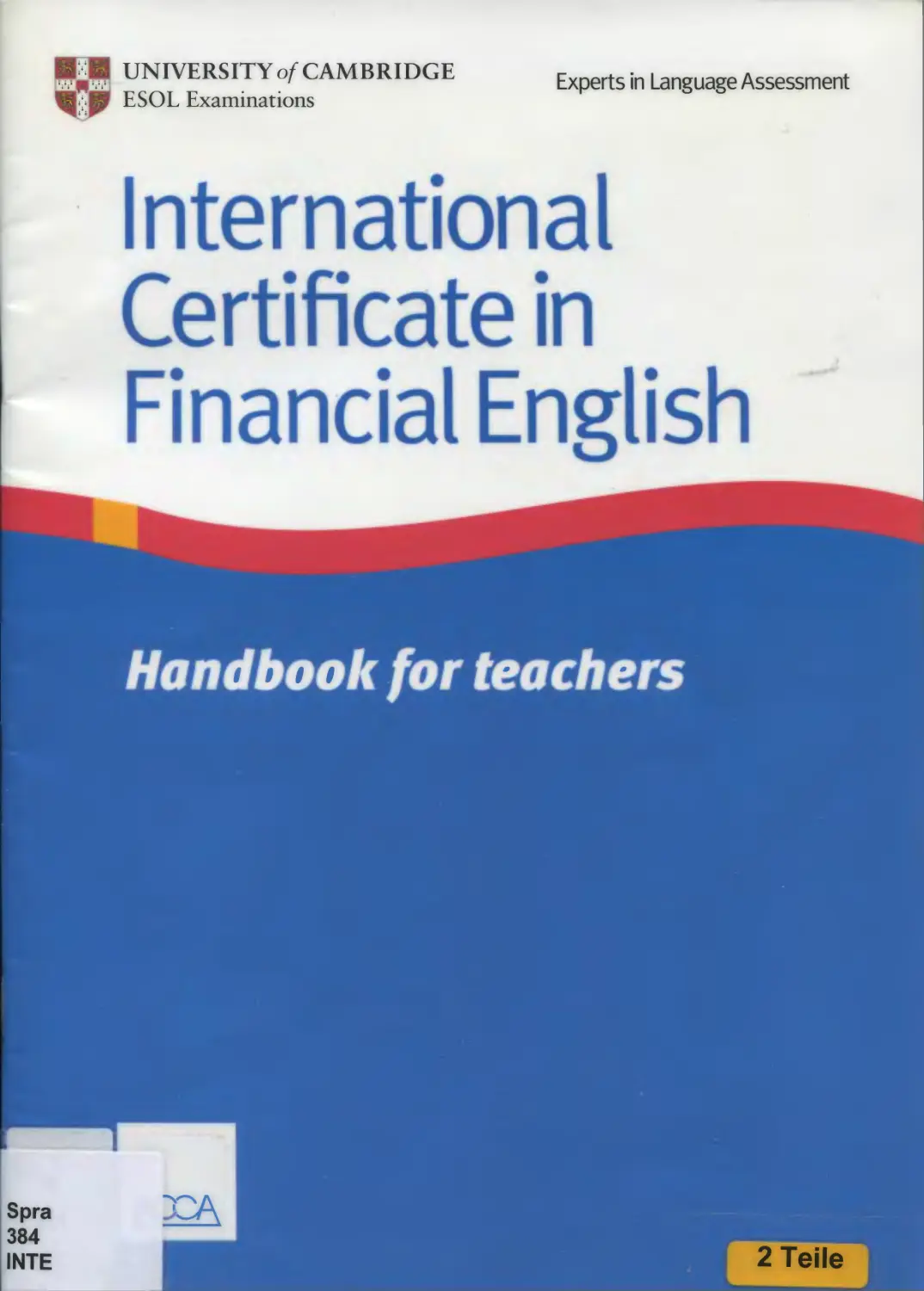
International
Certificate in
Financial English
Handbook for teachers
Spra
384
INTE
e
ICFE content and overview
Part/timing	Content

	Part 1 Multiple-choice cloze, with an emphasis on lexis.
	Part 2 Open cloze, with an emphasis on structure.
1	Part 3 Word formation, with an emphasis on lexis.
READINC	Part 4 A text preceded by multiple-matching questions.
	Part 5 A text from which sentences have been removed and placed in jumbled order after the text.
1 hour 15 minutes	Part 6 A text followed by four-option multiple-choice questions.
2	Part 1 One question requiring the production of a letter.
WRITING 1 hour 15 minutes	Part 2 One question requiring the production of a short report.

	Part 1 Three short unrelated extracts from monologues or exchanges between interacting speakers, each followed by two three-
3	option multiple-choice questions.
LISTENING	Part 2 A text involving interacting speakers, followed by three-option multiple-choice questions.
	Part 3 A sentence completion task based on a monologue.
40 minutes (approx)	Part 4 Five short related extracts from monologues followed by two
	multiple-matching tasks.
	Part 1 The candidates are asked to talk about themselves by responding to the interlocutor's questions.
4	Part 2 Each candidate in turn is given a choice of two topics with accompanying written prompts. They select one of the topics
SPEAKING	and give a short presentation for about one minute. The second candidate responds as instructed.
16 minutes	Part 3 The candidates talk together, working towards a negotiated completion of a task.
	Part 4 The interlocutor leads a discussion with the two candidates. '	if;-»	* r. S,-,-	;> '	-	.♦
Test focus
Candidates are expected to be able to apply their
knowledge of the language system to complete tasks
based on finance and accounting-related texts; read
and understand finance and accounting-related texts
and demonstrate a variety of reading skills including
skimming, scanning, deduction of meaning from
context, and selection of relevant information to
complete tasks.
Candidates are expected to be able to complete
writing tasks covering a range of finance and
accounting-related topics, in response to the stimuli
provided and for a given purpose and target reader.
Candidates are expected to be able to understand a
variety of listening texts, showing understanding of
gist, detail and the attitude of the speaker. They must
also be able to identify and interpret the context. Texts
take the form of recordings of discussions, meetings,
interviews, announcements, broadcasts, etc in the
context of finance and accounting.
Candidates are expected to be able to perform a
variety of spoken tasks on finance and accounting-
related topics. They must be able to demonstrate a
range of oral skills: interactional, social, transactional,
negotiation and collaboration.
Preface
High-level language qualification for
finance and accounting professionals
The Cambridge ESOL International Certificate in Financial
English (ICFE) is an examination set at Levels B2 and Cl of
the Common European Framework of Reference for
Languages and assesses language skills in the context of
finance and accounting. B2 is equivalent in level to the
Cambridge First Certificate in English and Cl is equivalent to
the Certificate in Advanced English. Examinations at the Cl
level may be used as proof of the level of language necessary
to work in an international finance and accounting context
or to follow a course of study related to finance and
accountancy at university level.
Internationally recognised
ICFE is a Cambridge ESOL examination, produced and
assessed by University of Cambridge ESOL Examinations, in
collaboration with ACCA (the Association of Chartered
Certified Accountants) - the largest and fastest-growing
international accountancy body.
Cambridge ESOL examinations and ACCA qualifications are
recognised throughout the world.
This handbook is for anyone who is preparing candidates for
ICFE.
The introduction gives an overview of ICFE and its place
within the Cambridge ESOL range of examinations. This is
followed by a focus on each paper and includes information
on content, advice on preparation and sample examination
papers.
Contents
Inside front cover
ICFE content and overview
OVERVIEW OF ICFE
2	Introduction to Cambridge ESOL
4	Introduction to ICFE
6 ICFE support
INTRODUCTION
1
7	General description	9	Preparation
7	Structure and tasks	11	Sample paper
8	The six parts of the Test of Reading	18	Marking key
		19	Answer Sheet
TEST OF READING
20	General description	21	Preparation ,	1
20	Structure and tasks	22	Sample paper
20	The two parts of the Test of Writing	25	Assessment
		26	Sample scripts	TEST OF WRITING
30	General description	33	Sample paper	1
30	Structure and tasks	37	Sample tapescript
31	The four parts of the Test of Listening	40	Marking key
31	Preparation	41	Answer Sheet	TEST OF LISTENING
42	General description	44	Preparation
42	Structure and tasks	46	Sample paper
43	The four parts of the Test of Speaking	51	Assessment
TEST OF SPEAKING
Inside back cover
Glossary of testing terms
GLOSSARY
ICFE HANDBOOK | CONTENTS
Introduction to Cambridge
ESOL
	University of Cambridge ESOL Examinations
University of Cambridge ESOL Examinations (Cambridge ESOL)
provides an extensive range of examinations, certificates and
diplomas for learners and teachers of English, with a tradition
of language assessment dating back to 1913. Cambridge ESOL
is a part of the Cambridge Assessment group, which is a
department of the University of Cambridge and one of the
world’s largest educational assessment agencies.*
Cambridge ESOL examinations are designed for anyone whose
first language is not English. They are suitable for learners of
all nationalities, whatever their first language and cultural
background, and there are examinations suitable for learners
of almost any age. The range of Cambridge ESOL examinations
includes specialist examinations in Business English and
English for Academic Purposes, as well as examinations for
young learners and a suite of certificates and diplomas for
language teachers.
The examinations cover all four language skills - reading,
writing, listening and speaking. They include a range of tasks
which assess candidates’ ability to use English, so that in
preparing for the examinations, candidates develop the skills
they need to make practical use of the language in a variety of
contexts. Above all, what the Cambridge ESOL examinations
assess is the ability to communicate effectively in English.
Cambridge ESOL is committed to providing examinations of
the highest possible quality. This commitment is underpinned
by an extensive programme of research and evaluation, and by
continuous monitoring of the marking and grading of all
Cambridge ESOL examinations. Of particular importance is the
rigorous set of procedures which are used in the production
and pretesting of question papers.
	The Common European Framework of Reference for
Languages (CEFR)
Cambridge ESOL exams are linked to the Common European
Framework of Reference for Languages: Learning, teaching,
assessment, published by the Council of Europe (2001). In fact,
they are the only certificated exams referred to in the
Framework document as specifically linked to it by a long-
term research project.
Qualifications are plotted against six clearly defined levels.
This makes it easy for anyone involved in language teaching
and testing (learners, teachers, teacher trainers, etc.) to see the
level of different qualifications. It also means that employers
and educational institutions can easily compare qualifications
and see how they relate to exams they already know in their
own country.
Cambridge Assessment is the operating name for the University of
Cambridge Local Examinations Syndicate (UCLES).
Council of Europe Common European Framework of Reference Levels
C2	Mastery
Cl*	Effective Operational Proficiency
B2*	Vantage
Bl	Threshold
A2	Waystage
Al	Breakthrough
*The ICFE examination covers both Levels B2 and Cl
	The Association of Language Testers in Europe
(ALTE)
Cambridge ESOL is a member of the Association of Language
Testers in Europe (ALTE), which was formed in 1990. The
members are all providers of language examinations and
certificates from countries within Europe.
The principal objectives of ALTE are as follows:
•	to promote the transnational recognition of certification,
especially in Europe
•	to establish common standards for all stages of the
language testing process, i.e. test development, question
and materials writing, test administration, marking and
grading, reporting of test results, test analysis and
reporting of findings
•	to collaborate on joint projects and in the exchange of
ideas and know-how.
Cambridge ESOL examinations fulfil the requirements of the
Code of Practice established by ALTE. This Code of Practice
focuses on the responsibilities of both examination providers
and examination users and covers four main areas:
•	developing examinations
•	interpreting examination results
•	striving for fairness
•	informing examination takers.
For more information on ALTE please visit www.ALTE.org
 Key features of Cambridge ESOL examinations
Cambridge ESOL undertakes:
•	to assess language skills at a range of levels, each of
them having a clearly defined relevance to the needs of
language learners
•	to assess skills which are directly relevant to the range
of uses for which learners will need the language they
ICFE HANDBOOK | INTRODUCTION TO CAMBRIDGE ESOL
Introduction to Cambridge
ESOL
	University of Cambridge ESOL Examinations
University of Cambridge ESOL Examinations (Cambridge ESOL)
provides an extensive range of examinations, certificates and
diplomas for learners and teachers of English, with a tradition
of language assessment dating back to 1913. Cambridge ESOL
is a part of the Cambridge Assessment group, which is a
department of the University of Cambridge and one of the
world’s largest educational assessment agencies.*
Cambridge ESOL examinations are designed for anyone whose
first language is not English. They are suitable for learners of
all nationalities, whatever their first language and cultural
background, and there are examinations suitable for learners
of almost any age. The range of Cambridge ESOL examinations
includes specialist examinations in Business English and
English for Academic Purposes, as well as examinations for
young learners and a suite of certificates and diplomas for
language teachers.
The examinations cover all four language skills - reading,
writing, listening and speaking. They include a range of tasks
which assess candidates’ ability to use English, so that in
preparing for the examinations, candidates develop the skills
they need to make practical use of the language in a variety of
contexts. Above all, what the Cambridge ESOL examinations
assess is the ability to communicate effectively in English.
Cambridge ESOL is committed to providing examinations of
the highest possible quality. This commitment is underpinned
by an extensive programme of research and evaluation, and by
continuous monitoring of the marking and grading of all
Cambridge ESOL examinations. Of particular importance is the
rigorous set of procedures which are used in the production
and pretesting of question papers.
	The Common European Framework of Reference for
Languages (CEFR)
Cambridge ESOL exams are linked to the Common European
Framework ofReferencefor Languages: Learning, teaching,
assessment, published by the Council of Europe (2001). In fact,
they are the only certificated exams referred to in the
Framework document as specifically linked to it by a long-
term research project.
Qualifications are plotted against six clearly defined levels.
This makes it easy for anyone involved in language teaching
and testing (learners, teachers, teacher trainers, etc.) to see the
level of different qualifications. It also means that employers
and educational institutions can easily compare qualifications
and see how they relate to exams they already know in their
own country.
Cambridge Assessment is the operating name for the University of
Cambridge Local Examinations Syndicate (UCLES).
Council of Europe Common European Framework of Reference Levels
C2	Mastery
Cl*	Effective Operational Proficiency
B2*	Vantage
Bl	Threshold
A2	Waystage
Al	Breakthrough
*The ICFE examination covers both Levels B2 and Cl
	The Association of Language Testers in Europe
(ALTE)
Cambridge ESOL is a member of the Association of Language
Testers in Europe (ALTE), which was formed in 1990. The
members are all providers of language examinations and
certificates from countries within Europe.
The principal objectives of ALTE are as follows:
•	to promote the transnational recognition of certification,
especially in Europe
•	to establish common standards for all stages of the
language testing process, i.e. test development, question
and materials writing, test administration, marking and
grading, reporting of test results, test analysis and
reporting of findings
•	to collaborate on joint projects and in the exchange of
ideas and know-how.
Cambridge ESOL examinations fulfil the requirements of the
Code of Practice established by ALTE This Code of Practice
focuses on the responsibilities of both examination providers
and examination users and covers four main areas:
•	developing examinations
•	interpreting examination results
•	striving for fairness
•	informing examination takers.
For more information on ALTE please visit www.ALTE.org
 Key features of Cambridge ESOL examinations
Cambridge ESOL undertakes:
•	to assess language skills at a range of levels, each of
them having a clearly defined relevance to the needs of
language learners
•	to assess skills which are directly relevant to the range
of uses for which learners will need the language they
ICFE HANDBOOK | INTRODUCTION TO CAMBRIDGE ESOL
have learned, and which cover the four language skills -
reading, writing, listening and speaking - as well as
knowledge of language structure and use
•	to provide accurate and consistent assessment of each
language skill at the appropriate level
•	to relate the examinations to the teaching curriculum in
such a way that they encourage positive learning
experiences, and to seek to achieve a positive impact
wherever possible
•	to endeavour to be fair to all candidates, whatever their
national, ethnic and linguistic background, gender or
disability.
Cambridge ESOL examinations are designed around four
essential qualities: validity, reliability, impact and practicality
Validity is normally taken to be the extent to which a test can
be shown to produce scores which are an accurate reflection
of the candidate’s true level of language skills. Reliability
concerns the extent to which test results are stable, consistent
and accurate, and therefore the extent to which they can be
depended on for making decisions about the candidate.
Impact concerns the effects, beneficial or otherwise, which an
examination has on the candidates and other users, whether
these are educational, social, economic or political, or various
combinations of these. Practicality can be defined as the
extent to which an examination is practicable in terms of the
resources needed to produce and administer it. All these
factors underpin the development and production of
Cambridge ESOL examinations.
ICFE HANDBOOK | INTRODUCTION TO CAMBRIDGE ESOL
Introduction to ICFE
1
 The aims of ICFE
•	to assess candidates’ ability to operate in English in an
international finance and accounting environment
•	to allow candidates to demonstrate to employers their
ability to communicate in English with clients and
colleagues in the context of finance and accounting
•	to allow candidates to demonstrate to educational and
training institutions their ability to follow a course of
study in finance and accountancy where a significant
portion of the instruction is in English
•	to have a positive and beneficial impact on the content
and delivery of English language training courses for
finance and accounting professionals
•	to provide an examination to do this which is fair to all
candidates and which is delivered to international
standards
•	to allow test users to compare candidates’ results with
other qualifications which are linked to the Common
European Framework of Reference.
 The content of ICFE
ICFE comprises four papers: the Test of Reading; the Test of
Writing; the Test of Listening and the Test of Speaking. Each test
is based on realistic texts, tasks and topics similar to those
finance and accounting professionals would expect to
encounter in their daily working lives.
The examination texts and topics are set in the context of
finance and accountancy. The following list is an illustration of
some of the topic areas featured in ICFE:
•	Financial Reporting
•	Company Financial Strategy
•	Risk Assessment and Analysis
•	Auditing
•	Ethics and Professionalism
•	Accounting Software Packages
•	Assets and Company Valuations
•	Budgetary Processes
•	Corporate Governance
•	Cost and Management Accounting
•	Environmental and Sustainability Issues.
•	Mergers and Acquisitions
•	Taxation (non-jurisdiction specific)
•	Raising Capital
•	Insurance
•	Banking
•	Investment Banking
•	Professional Practice
•	The Stock Market
•	Foreign Exchange and Currency
•	Debt-Recovery and Credit Policy
•	Bankruptcy and Insolvency
•	Forensic Accounting
•	Economic Conditions and Forecasts
•	Pricing and Purchasing
Please note: this list is not exhaustive and is reviewed at regular
intervals to ensure ICFE is up to date and continues to meet the
needs of its target users.
	The level of ICFE
ICFE assesses English language ability used in the context of
finance and accounting at Council of Europe ‘Vantage’
Level (B2) and Council of Europe ‘Effective Operational
Proficiency’ Level (Cl) for general language proficiency.
The ALTE ‘Can Do’ Project
The Association of Language Testers in Europe (ALTE) has
developed a framework which covers six levels of language
proficiency aligned to the Council of Europe Common
European Framework. Long-term research carried out by ALTE
has shown what language learners can typically do at each
level. The table below and on page 5 gives some examples of
typical ability in the work domain in each of the skill areas at
ICFE B2 and Cl levels.
	Varieties of English
Candidates’ responses to tasks in ICFE are acceptable in
varieties of English which would enable candidates to function
in the widest range of international contexts. Candidates are
expected to use a particular variety with some degree of
consistency in areas such as spelling, and not for example,
switch from using a British spelling of a word to an American
spelling of the same word in the same written response to a
given task.
ICFE texts are based on authentic source material from
English-speaking countries.
	ICFE candidature
ICFE is suitable for students of finance and accountancy and
practising accountants and finance professionals.
This includes students who are:
•	seeking employment in a finance and accounting
context, e.g. accounting firms, company departments,
and government agencies
•	intending to study finance or accountancy where the
course includes significant English language content,
either in their own country or abroad
•	seeking certification to demonstrate their English
language proficiency.
ICFE HANDBOOK | INTRODUCTION TO ICFE
‘Can Do’ summary
Typical candidates at Cl level
Listening and Speaking	Reading and Writing
CAN follow discussion with only occasional need for clarification.	CAN understand the general meaning of more complex reports.
CAN deal with unpredictable questions.	CAN, within a reasonably short time, understand most reports that they are likely to come across.
CAN argue their case effectively and specify needs precisely.	CAN, given enough time, write a report that communicates the desired
CAN engage in an extended conversation with colleagues and clients on matters within their authority/competence.	message. CAN write most correspondence he/she is likely to be required to do.
Typical candidates at B2 level
Listening and Speaking
Reading and Writing
CAN ask for factual information and understand the answer.	CAN understand the general meaning of non-routine correspondence.
CAN ask questions, for example for clarification, while following a lecture, talk or presentation.	CAN understand the general meaning of a report even if the topic is not predictable.
CAN express own opinion, and present arguments to a limited extent.	CAN write a simple report of a factual nature and begin to evaluate, advise, etc.
CAN give a simple, prepared presentation on a familiar topic.	CAN write non-routine correspondence where this is restricted to matters of fact.
			и		i;
It includes practising accountants and finance professionals
who are:
•	seeking new employment in an international context
•	seeking promotion within their own organisations
•	learning English as part of a training programme
•	seeking certification to demonstrate their English
language proficiency in a finance or accounting context.
To pass ICFE, candidates need a level of English of at least B2
on the Council of Europe’s Common European Framework of
Reference for Languages.
ICFE candidates are expected to be familiar with some finance
and accountancy concepts and terminology.
	ICFE administration
ICFE is held each year in May and November in centres
worldwide. Candidates must enter through an authorised
centre. A list of centres is available online at
www.CambridgeESOL.org
	Grading and results
Each paper is weighted to a total of 50 marks. The total mark
for the four ICFE papers is, therefore, 200, after weighting.
Results are reported as three passing grades (Cl Pass with
Merit, Cl Pass and B2 Pass) and two failing grades (Narrow Fail
and Fail). The percentage of marks needed to achieve each
grade may vary slightly from session to session depending on
the precise difficulty of the individual papers which make up
the particular examination. A candidate’s overall ICFE grade is
based on the total score gained by the candidate in all four
papers. It is not necessary to achieve a particular level in all
four components in order to pass the examination, as the final
mark on which the grade is awarded is based on the aggregate
score of all of the test components. Candidates who perform
poorly on one component can compensate by performing well
on the other components.
The overall grade boundaries are set according to the
following information:	.
•	statistics on the overall candidate performance
•	statistics on individual items, for those parts of the
examination for which this is appropriate (Reading and
Listening)
ICFE HANDBOOK | INTRODUCTION TO ICFE
•	advice from senior marking personnel, based on the
performance of candidates and recommendations of
examiners, where this is relevant (Writing and Speaking)
•	information on the candidature
•	comparison with statistics from previous years’
examination performance and candidature, once these
are available.
Statements of Results are sent out to all candidates and
include a graphical display of the candidate’s performance in
each paper. These are shown against the scale Exceptional -
Good - Borderline - Weak, and indicate the candidate’s relative
performance in each paper.
	Notification of results
Statements of Results are issued through centres
approximately six weeks after the examination has been
taken. Certificates are issued about four weeks after the issue
of Statements of Results. Enquiries about results may be made
through Local Secretaries within a month of the issue of
Statements of Results.
	Special Circumstances
Special Circumstances covers three main areas: Special
Arrangements, Special Consideration and Malpractice.
•	Special Arrangements:
These are available for candidates with a permanent or
long-term disability, such as a visual or hearing difficulty, or
a temporary difficulty such as a broken hand, or ear
infection affecting a candidate’s ability to hear clearly. They
may include extra time, separate accommodation or
equipment, Braille transcription, etc. Consult the
Cambridge ESOL Local Secretary in your area for more
details.
•	Special Consideration:
Cambridge ESOL will give special consideration to
candidates affected by adverse circumstances immediately
before or during an examination. Special consideration can
be given where an application is sent through the centre
and is made within ten working days of the examination
date. Examples of acceptable reasons for giving special
consideration are in cases of illness or other unexpected
events.
•	Malpractice:
Cambridge ESOL will consider cases where candidates are
suspected of copying, collusion or breaking the
examination regulations in some other way. Results may be
withheld because further investigation is needed or
because of infringement of regulations. Centres are notified
if a candidate’s results have been investigated.
ICFE support
	Past papers and examination reports
Cambridge ESOL publishes past examination papers, which
can be used for practice, and examination reports, which
provide a general view of how candidates performed overall
and on each paper and offer guidance on the preparation of
candidates. Details of how you can order past papers and
examination reports, and a downloadable order form, can be
obtained at www.CambridgeESOL.org/support
ICFE past examination papers will be available in due course.
The sample question papers included in this handbook have
been produced to reflect the format of the examination.
However, candidates are strongly advised not to concentrate
unduly on working through practice tests and examinations as
this will not by itself make them more proficient in the
different skills.
	Online support
Cambridge ESOL provides an online resource for teachers,
designed to help them understand ICFE better and to prepare
candidates more effectively.
The Teaching Resources website can be found at
www.CambridgeESOL.org/teaching resources or via
www.FinancialEnglishTest.org
	Seminars for teachers
Cambridge ESOL offers seminars designed to introduce
teachers, administrators, school directors, etc. to ICFE. Contact
your nearest centre for information. To find your nearest
centre, please visit www.CambridgeESOL.org
	Further information
Copies of the regulations and details of entry procedure,
current fees and further information about this and other
Cambridge examinations can be obtained from the Cambridge
ESOL centre in your area, or from the address on the back
cover of this handbook.
ICFE HANDBOOK | ICFE SUPPORT
TEST of
STRUCTURE AND TASKS
READING
GENERAL DESCRIPTION
Paper format	The paper consists of a range of finance-related texts and accompanying tasks. A text may consist of several short pieces.
Timing	I hour 15 minutes.
No. of parts	There are six parts. Parts 1 to 3 test candidates’ knowledge and control of the language system. Parts 4 to 6 test candidates’ understanding of the meaning of written English at word, phrase, sentence and paragraph level.
No. of questions	54.
Task types	Multiple-choice cloze, open cloze, word formation, multiple-matching gapped text and four-option multiple- choice.
Task focuses	These include semantic precision, grammatical and lexico-grammatical knowledge, affixation and compounds, awareness of text structure, and understanding gist, detail, opinion and implication.
Text types	These include extracts from finance and accounting textbooks and reference books, articles from.finance and accounting journals, extracts from company reports and correspondence.
Length of texts	The texts contain approximately 2,500 words in total.
Answer format	Candidates indicate answers by shading a box or writing a word on a machine-readable Answer Sheet
Marks	Questions 1-36 cany one mark. Questions 37-54 carry two marks.
	к НИ	. ж Ж	i


I
PARTI
Task type and focus	Multiple-choice doze, Lexical (e.g. semanticprecision, collocations, fixed phrases and linking words/phrases).
Format	Two modified cloze texts each containing six gaps and followed by six four-option multiple -choice items.
No. of Qs	12,
PART 2
Task type and focus	Open cloze, Grammatical and lexico-grammatical.
Format	A modified doze text containing twelve gaps.
No. of Qs	12.
PART3
Task type and focus	Word formation. Lexical (affixation and compounding).
Format	Two short texts, each containing six gaps. Candidates must form an appropriate word to complete each gap using the given base words.
No. of Qs	12.
PART 4
Task type and focus	Multiple-matching. Reading for detail and gist.
Format	A single text divided into four sections, or four related short texts preceded by multiple-matching questions.
No. ofQe	6.
PART 5
Task type and focus	Gapped text. Cohesion, coherence, text structure, global meaning.
Format	A text from which sentences have been removed and placed in jumbled order after the text. Candidates must dedde from where in the text the sentences have teen removed.
No. ofQs	6.
PART 6
Task type and focus	Multiple-choice. Reading for detail, gist, opinion, implication and referencing.
Format	A text followed by four-option multiple-choice questions.
No. of Qs	6.
ICFE HANDBOOK | 1: TEST OF READING
TEST of
STRUCTURE AND TASKS
READING
GENERAL DESCRIPTION
Paper format	The paper consists of a range of finance-related texts and accompanying tasks. A text may consist of several short pieces.
Timing	I hour 15 minutes
No. of parts	There are six parts Parts 1 to 3 test candidates’ knowledge and control of the language system. Parts 4 to 6 test candidates’ understanding of the meaning of written English at word, phrase, sentence and paragraph level.
No. of questions	54.
Task types	Multiple-choice cloze, open cloze, word formation, multiple-matching, gapped text and four-option multiple- choice
Task focuses	These include semantic precision, grammatical and lexico- grammatical knowledge, affixation and compounds, awareness of text structure, and understanding gist, detail, opinion and implication.
Text types	These include extracts from finance and accounting textbooks and reference books, articles from finance and accounting journals, extracts from company reports and correspondence.
Length of texts	The texts contain approximately 2,500 words in total.
Answer format	Candidates indicate answers by shading a box or writing a word on a machine-readable Answer Sheet-
Marks	Questions 1-36 carry one mark. Questions 37-54 carry two marks.

PARTI___________________________________________________
Task type	Multiple-choice cloze.
and focus Lexical (e.g. semantic precision, collocations, fixed
phrases and linking words/phrases).
Format Two modified cloze texts each containing six gaps
and followed by six four-option multiple-choice
items
No.ofQs 12.

PART 2
Task type	Open cloze
and focus	Grammatical and lexico-grammatical.
Format	A modified cloze text containing twelve gaps
No.ofQs	12.

PART3
Task type Word formation
and focus Lexical (affixation and compounding).
Format Two short texts, each containing six gaps.
Candidates must form an appropriate word to
complete each gap using the given base words.
No.ofQs 12.


PART 4__________________________________________________
Task type	Multiple-matching.
and focus	Reading for detail and gist.
Format A single text divided into four sections, or four
related short texts preceded by multiple-matching
questions.
No. of Qs 6.
I
PARTS_______________________________________________
Task type Gapped text.
and focus Cohesion, coherence, text structure, global
meaning.
Format A text from which sentences have been removed
and placed in jumbled order after the text.
Candidates must decide from where in the text
the sentences have been removed
No. of Qs	6.
PART 6______________________________________________________
Task type Multiple-choice.
and focus Reading for detail, gist, opinion, implication and
referencing.
Format	A text followed by four-option multiple-choice
questions.
No. of Qs	6.
ICFE HANDBOOK | 1: TEST OF READING
The six parts of the
Test of Reading
 PART 4 - MULTIPLE-MATCHING
This part tests the candidate's general understanding of a text and
the ability to locate specific information within it.
 PART 1 - MULTIPLE-CHOICE CLOZE
Sample task and marking key: pages 15 and 18.
In this part, there is an emphasis on vocabulary and linking
words/phrases.
Each correct answer in Part 4 receives 2 marks.
Sample task and marking key: pages 12,13 and 18.
Each correct answer in Part 1 receives 1 mark.
Part 1 requires candidates to choose a word or phrase from a
set of four (А, В, C, D) to fill a gap in a text. This involves
choosing the answer which has the right meaning and fits
both grammatically and within the text as a whole. This part
of the paper tests knowledge of aspects of vocabulary, such as
fixed phrases and collocations, shades of meaning, phrasal
verbs and linkers. There are two short texts, each containing
six items. The first text contains an example.
 PART 2 - OPEN CLOZE
Part 4 requires candidates to scan a text which is divided into
four sections, or four short texts. Candidates are required to
match questions with the relevant information from the text.
Some of the options will need to be used more than once.
The questions for the multiple-matching task appear before
the text to replicate a real-world situation where candidates
know their purpose in reading a text. There are six questions.
 PART 5 - GAPPED TEXT
This part tests the candidate's understanding of how texts are
structured and the ability to follow the detailed meaning and
argument of a text.
In this part, there is an emphasis on structure.
Sample task and marking key: pages 16 and 18.
Sample task and marking key: pages 13 and 18.
Each correct answer in Part 5 receives 2 marks.
w Each correct answer in Part 2 receives 1 mark.
Part 2 is an open modified cloze task, consisting of a text with
12 gaps, plus one example. Candidates have to fill each gap in
the text with one word only. This part focuses mainly on
awareness and control of structural items such as
conjunctions, prepositions, pronouns, auxiliaries, quantifiers,
etc. Answers must be grammatically correct at phrase and
sentence level, and also be appropriate to the meaning of the
whole text. There may be more than one word which is
acceptable for a gap, but candidates should supply one word
only.
 PART 3-WORD FORMATION
In this part, there is an emphasis on vocabulary.
Part 5 requires candidates to select the sentences which fit the
gaps in a text. In each case only one answer is correct. The
task consists of a single-page gapped text followed by the
options, including one extra sentence which does not fit in any
of the gaps.
Candidates need to read the gapped text first in order to gain
an overall idea of the structure and the meaning of the text,
and to note in particular the information and ideas that
appear before and after each gap. They should then decide
which sentence fits each gap. Each letter may be used once
only and there is one sentence which will not be used at all.
There are six questions.
 PART 6 - MULTIPLE-CHOICE
This part tests the candidate's detailed understanding of a text,
including the opinions expressed in it.
Sample task and marking key: pages 14 and 18.
|te<>| Sample task and marking key: pages 17 and 18.
w Each correct answer in Part 3 receives 1 mark.
Part 3 is designed to test word formation through affixation
and compounding. Candidates are required to supply an
appropriate word, formed from a given base word, to fill a gap
in a text. There are two short texts, each containing six items.
The first text contains an example.
Each correct answer in Part 6 receives 2 marks.
Part 6 consists of a single-page text followed by multiple-
choice questions. Candidates need to read the text closely in
order to distinguish between, for example, apparently similar
viewpoints, outcomes, or reasons. The task may also contain a
question focusing on the meaning of a particular word or
phrase in the text, or on a reference word such as a pronoun.
ICFE HANDBOOK | 1: TEST OF READING
1
The questions are presented in the same order as the
information in the text, and can be answered correctly only by
close reference to the text. Candidates should read each
question very carefully, as well as the four possible answers.
There are six questions.
Preparation
General
I Exposure to and engagement with a substantial range of
written English is good preparation for the Reading paper.
Students should be encouraged to read extensively in class
and outside the classroom. Classroom reading can include a
range of reading texts from authentic sources such as finance
textbooks, journals, web pages and, if possible, examples of
company reports and correspondence. Students should be
encouraged to interact fully with each text by focusing on pre-
reading questions. These stimulate interest in the topic dealt
with by the text and train students in prediction techniques.
The internet provides access to news and articles from the
financial press of various English-speaking countries, as well
as access to company websites which often include annual
company reports.
I Regular and effective use of a monolingual English
dictionary is important, not only to clarify the meaning of new
words but also to extend knowledge of collocations and fixed
phrases. However, students should also be aware of alternative
techniques for coping with unfamiliar vocabulary, such as
contextual clues.
Z It is important that students are familiar with the standard
format of the Reading paper, the instructions on the front page
of the question paper, and the rubrics for each part of the test.
They should also be familiar with the technique of indicating
their answers on the separate Answer Sheet, so that they can
do this quickly and accurately. They will need to be shown
how to do this and to practise doing it in a timed exercise.
They need to think about the relative merits of transferring
their answers on to the Answer Sheet at the end of each task
or waiting until they have completed the whole paper. If they
find it difficult to complete the six parts in the time allowed, it
may be wiser to transfer answers after each part. Answers
must be marked by filling in lozenges on the Answer Sheet in
pencil.
к When students are familiar with the different task types, it
is a good idea for them to consider which part(s) take them
longer to complete. Following this, they should think of
possible timings for each task. Students may prefer to attempt
tasks which they find easier first. Students need to take into
account that each of the six parts is worth an equal number of
marks.
В Students should check the spelling of their answers to Parts
2 and 3, as incorrect spelling is penalised. They also need to
write clearly and in capital letters.
By part
	PARTI
H Students should be encouraged to read extensively from
appropriate sources in order to build up a wide vocabulary. In
doing so, they should pay attention to the shades of meaning
differentiating sets of similar words, collocation and
complementation.
H Any vocabulary-building activity working with lexis
relevant to financial English is likely to be useful in preparing
for this task.
О Students should be encouraged to spend time practising
linking words and phrases (which will also benefit their
writing skills).
Ш Students are advised to consider all the options carefully
before deciding on their answer. Several of the options may
appear possible, but only one will be semantically and
grammatically correct in that particular context.
	PART 2
О Some gaps can be filled by referring just to the immediate
phrase or sentence, but others will require understanding of
the paragraph or whole text. Where relevant, students should
be encouraged to try to circle the word or words in the text
that determine the answer.
Ш The kinds of words which are gapped may sometimes
correspond to the kinds of errors that students make, so
discussion of their writing may be useful.
t Students should keep in mind that only one word is
required for each answer. Answers of more than one word will
be marked wrong.
E Students should be reminded to use the context to help
them identify the missing part of speech, e.g. conjunction,
preposition, pronoun, auxiliary, quantifier, etc.
	PART3
S Students need to understand the context of each gap in the
text to decide which part of speech (noun, verb, adjective or
adverb) is required.
В Sometimes a plural form or a specific part of a verb will be
required.
В Sometimes a negative prefix will be required. There is often
at least one word requiring a prefix (e.g. un-, im-, ir-, dis-, etc.)
in a Part 3 task, so students should be aware of these forms.
В Students should keep in mind that sometimes a compound
is tested. They may, for example, be required to produce
‘countersign’ from ‘sign’ or ‘blacklist’ from ‘list’. As a general
rule, the part which conveys most meaning in the context is
the word which is supplied.
ICFE HANDBOOK | 1: TEST OF READING
II
	PART 4
Students should be encouraged to highlight key words in
the question, to help focus their reading.
Ш Students should be discouraged from selecting an answer
solely on the basis of matching a word in the question with a
word in the text, as careful reading is required to ensure an
accurate match in terms of meaning.
Ш Students will benefit from practice in paraphrasing, as the
wording of questions is likely to differ from that of the text.
	PART 5
Ж Students should be encouraged to read the text as a whole,
and not to focus on each gap separately. They need to
understand that an idea of the structure and the development
of the theme of the text is necessary before starting to do the
task. Students frequently make the wrong choices by selecting
options which fit the text before the gap, and neglecting to
check that the text after the gap follows on coherently.
Ж Part 5 requires an overt focus on cohesion and coherence to
which some students may not be accustomed; students need
plenty of practice in recognising a wide range of linguistic
devices which mark the logical and cohesive development of a
text, e.g. words and phrases indicating time; cause and effect;
contrasting arguments; pronouns; repetition and use of verb
tenses.
H Students should be alerted to the dangers of simply
matching options and sections of the text containing the same
words. The task is designed to test understanding of the
development of ideas, opinions and events rather than the
superficial recognition of individual words.
Ш It is useful for students to reassemble texts that have been
cut up, discussing why sentences do or do not fit together.
They may also benefit from altering the cohesion of texts to
make sentences fit together or prevent them from doing so.
1! The cut and paste function of word processing packages
can be exploited in preparing for this task.
	PART 6
В Students should read the whole text before considering the
multiple-choice questions. As three of the four options are
incorrect, there is little point in trying to absorb them all
before tackling the text. Instead, students should be trained to
check each option in turn against the evidence of the text.
Ill Students should be encouraged to read each question itself
very carefully, as well as the four options. In the case of items
which take the form of an incomplete sentence, the completed
sentence created by matching it to an option must match
what is written in the text, and not just the option itself.
В As in the other parts of the test, it is important that
students avoid simply matching words in the text with words
in the question or option. Careful study of the questions and
text is very important.
В When working through the sample task it may be useful if
students try to answer the question in their own words and
then check their formulation against the options, rather than
reading the options first. It may also be useful to ask students
to underline the part of the text where they found the answer
and then justify it to the rest of the class, and even to identify
the information that the distractors are based on.
10
ICFE HANDBOOK | 1: TEST OF READING
ICFE HANDBOOK | 1: TEST OF READING | SAMPLE PAPER
11
Candidate
Centre Number Number
Candidate Name ____________________________________________________________________
UNIVERSITY OF CAMBRIDGE ESOL EXAMINATIONS
English for Speakers of Other Languages
INTERNATIONAL CERTIFICATE IN FINANCIAL ENGLISH D020/1
Test of Reading
SAMPLE PAPER 2006	Morning	1 hour 15 minutes
Additional materials:
Answer sheet
TIME 1 hour 15 minutes
INSTRUCTIONS TO CANDIDATES
Do not open this question paper until you are told to do so.
Write your name, Centre number and candidate number in the spaces at .the top of this page and on
the separate answer sheet if they are not already printed.
There are fifty-four questions in this paper.
Read the instructions carefully.
Answer all questions.
Write your answers on the separate answer sheet. Use a soft pencil.
You may write on the question paper, but you must transfer your answers to the separate answer sheet
within the time limit.
At the end of the examination, hand in both the question paper and the answer sheet.
INFORMATION FOR CANDIDATES
Questions 1-36 carry one mark.
Questions 37 - 54 carry two marks.
This question paper consists of 12 printed pages and 4 blank pages.
ICFE Test of Reading
2006 Sample Paper
© UCLES 2006
Turn overk

04
ICFE HANDBOOK | 1: TEST OF READING | SAMPLE PAPER
PartlA
Questions 1-6
Read the following extract from an article about accounting ratios.
Choose the best word to fill each gap from А, В, C or D below.
For each question 1-6, mark one letter (А, В, C or D) on your answer sheet.
There is an example at the beginning (0).
FINANCIAL STATEMENTS AND PROFITABILITY RATIOS
The financial statements of a business provide important information for people outside the
business who do not (0) ....... access	to the internal accounts. For example, existing and
(1)....shareholders can see how much profit a business made, the value of its assets and the
level of cash (2)...... Although these figures are useful, they do not mean a great deal by
themselves. In order to (3)....any real sense of the figures in the final accounts, they need to
be properly analysed using accounting ratios and then (4)...with either the previous year’s
ratios or against averages for the industry.
The profitability of a company is important and a key (5).of its success. In the profit and loss
account the figures shown for gross profit and net profit mean very little by themselves. However,
by (6).....them as a percentage of sales they become much more useful. The figures can then
be evaluated against those of previous years, or with those of similar companies.
ICFE Test of Reading
Part 1A (Questions 1-6)
1	A	eventual	В	promising	C	aspiring	D	potential
2	A	reserves	В	stocks	C	quantities	D	stores
3	A	reach	В	find	c	take	D	make
4	A	differentiated	в	opposed	c	compared	D	balanced
5	A	measure	в	evidence	c	mark	D	proof
6	A	indicating	в	expressing	c	outlining	D	pronouncing
3	Turn overk
Parti В
Questions 7-12
Read the following article about the use of graphs in annual reports.
Choose the best word to fill each gap from А, В, C or D below.
For each question 7-12, mark one letter (А, В, C or D) on your answer sheet.
ICFE HANDBOOK | 1: TEST OF READING | SAMPLE PAPER
GRAPHS IN ANNUAL REPORTS
Increasing attention is being paid to the visual (7).of corporate annual reports - the charts,
photographs and graphs. Academics and practitioners alike (8).the immense power of good
visuals in the communication process - a well-designed graph is worth a thousand words.
The existence of graphs of key financial (9).in corporate annual reports is a critical element
of communication with stakeholders, especially non-experts But graphs are not formally audited
and there is the potential for graphs to be (10).so that they give too positive a picture of a
company’s fortunes.
A recent study has provided evidence that those responsible for annual reports consciously or
unconsciously do indeed select graphical designs that tend to convey a more favourable
impression than is (11)...... We, therefore, urge those who prepare reports to pay close
attention to the basic principles of graph design and to seek clarity of meaning, before users lose
(12).....in the graphs displayed.
7	A	components	В	factors	C	constituents	D	facets
8	A	conclude	В	distinguish	C	declare	D	appreciate
9	A	transformations	В	variables	c	permutations	D	varieties
10	A	manipulated	в	influenced	c	controlled	D	operated
11	A	entitled	в	rated	c	warranted	D	earned
12	A	* assurance	в	confidence	c	belief	D	conviction
4
Part 2
Questions 13-24
Read the following extract from an article about evaluating company performance
Think of the best word to fill each gap.
For each question 13-24, write one word in CAPITAL LETTERS on your answer sheet.
There is an example at the beginning (0).
Example:
EVALUATING COMPANY PERFORMANCE
It is clear that (0)... is a need for companies in both the public and private sectors to
develop appropriate performance measures. Setting performance targets and then evaluating
achievements against these targets should provide a basis (13)............. improved
management. It is important that these measures are not concerned simply (14)........
financial issues.
\
However, many difficulties will confront anyone (15).is tasked with developing a system
aimed (16).......setting up such targets. For example, the way in (17).objectives are
set can present serious problems. In many cases, objectives are (18)...vaguely drafted
that useful performance measures can rarely (19)........ developed	Also, there is the
difficulty of measuring quality, where the danger is that quantity rather (20).quality is
emphasised, because, in almost (21)......cases, quantity is easier to evaluate. Therefore,
we get a somewhat distorted picture (22)......easily measurable aspects of performance
take precedence over those that are more difficult to measure.
(23).......the importance of evaluating performance is recognised, the difficulties involved
should not be overlooked. An awareness of these difficulties and an understanding of their
possible impact should, however, lead (24).... the development of more effective and
better balanced systems.
ICFE Test of Reading
Part IB (Questions 7-12) and Part 2 (Questions 13-24)
5
Turn overk
ICFE HANDBOOK | 1: TEST OF READING | SAMPLE PAPER
Part ЗА
Questions 25 - 30
Read the following introduction to a book about international standards of accounting
Use the words in the box to the right of the text to form one word that fits in the same numbered gap
in the text.
For each question 25 - 30, write the new word in CAPITAL LETTERS on your answer sheet.
There is an example at the beginning (0).
Example:
0 000000ВЙ0НВ0000
IMPLEMENTING INTERNATIONAL STANDARDS
A financial reporting system supported by strong governance,
high-quality standards and sound regulatory frameworks is key
to economic (0).......Indeed, high quality standards of
financial reporting, auditing and ethics underpin the trust that
investors place in financial and non-financial information and,
thus, play an integral role in a country’s economic growth and
financial (25)......
As the forces of (26).....prompt more and more countries
to open their doors to foreign investment, and as business
(27)	.... across borders becomes common, both
the public and private sectors are (28)...recognising the
benefits of having a widely understood financial framework
supported by strong, globally accepted auditing standards.
The benefits of a global financial reporting framework are
numerous and include: greater comparability of financial
information for investors; greater (29)..on the part of
investors to invest across borders; lower cost of capital; greater
(30).......in the allocation of resources; and higher economic
growth.
0 DEVELOP
25 STABLE
26 GLOBAL
27 EXPAND
28 INCREASE
29 WILLING
30 EFFICIENT
6
Part ЗВ
Questions 31 - 36
Read the following extract from a website about the future of accountancy.
Use the words in the box to the right of the text to form one word that fits in the same numbered gap
in the text.
For each question 31 - 36, write the new word in CAPITAL LETTERS on your answer sheet.
THE FUTURE FOR ACCOUNTANCY
The profession’s future is certain to be more structured,
ever more governed by global standards and under more
scrutiny from a (31)....of national and international bodies.
Therefore accountants, particularly those working in small and
medium practices, must change their mindset. They must
start leading change; embrace (32)....;	continuously
improve their skills; invest in technology and demonstrate
a fundamental (33)......to professional ethics.
Audit will be subjected to unprecedented scrutiny and auditors
will have to expect to report on the (34) .of their
judgement and their lack of bias. Auditors will have to
expect that they will be reporting on an organisation’s
internal control (35)..., but will also have to move
rapidly to include detection of fraud as part of their audit
report, otherwise markets will remain (36)..about the
value of audit.
31 VARY
32 INNOVATE
33 COMMIT
34 DEPENDENT
35 PROCEED
36 SCEPTIC
ICFE Test of Reading
Parts ЗА (Questions 25-30) and 3B (Questions 31-36)
7	Turn overk
Part 4
Questions 37 - 42
Read the questions below and the extract on the opposite page from an article discussing the value of
an MBA qualification for accountants.
Which section (А, В, C or D) does each question 37 - 42 refer to?
For each question 37 - 42, mark one letter (А, В, C or D) on your answer sheet.
You will need to use some of these letters more than once.
There is an example at the beginning (0).
Example:
0 The type of work that people in accountancy undertake is changing.
37 Some people want to do an MBA because they do not already have a university degree.
38 An MBA can help people working in finance not to rely on purely numerical information.
39 People on an MBA course engage in practical as well as academic learning.
ICFE HANDBOOK | 1: TEST OF READING | SAMPLE PAPER
40 Possessing an MBA does not automatically lead to promotion.
41 An important part of doing an MBA is the contacts made on the course.
42 Where you take an MBA is of considerable importance
8
IS IT WORTH ACCOUNTANTS STUDYING FOR AN MBA?
A As a business qualification the MBA (Master of Business Administration) degree has immense appeal to
accountants. It is a highly respected qualification that can open many doors to the employment market,
which were previously firmly shut. In general, business schools aim to provide MBA programmes that
offer students from all backgrounds a thorough knowledge of the mechanics of management theory,
encompassing human resources, finance, operations management, marketing and information systems.
Lectures are coupled with regular group discussions, case studies and simulations.
В Jane Baldwin, head of training with a large accountancy firm, is under no illusion that the market place
for financial services is experiencing a period of transformation. ‘No-one can stand still. As accountants,
we’ve got to continue to develop our knowledge and skills. An MBA from any business school will equip
graduates with a business element, a specialist element, and also help them to develop their
interpersonal skills because the work that is done is not just as an individual but as a team as well,’ says
Baldwin. She also cites networking as a distinct advantage of an MBA programme.
C As managing director of an international recruitment consultancy for finance professionals, Graham
Simpson, however, has reservations about the importance of an MBA in the employment market. ‘A lot
of accountants ask us whether they should study for an MBA,’ he begins. *1 would say that a number of
them want to go for an MBA to compensate for some inadequacy they perceive themselves as having in
the employment market.’ The inadequacy he is referring to is the lack of a graduate qualification.
Simpson admits that an MBA does have some value, but argues that the status of the business school is
much more likely to get you a job than the MBA itself.
D Someone who has recently completed an MBA is Michael Taylor, an international corporate tax
specialist. Taylor chose to study for an MBA for the sake of his own personal development. Although he
was recently made head of his department, he admits that, in his line of work, an MBA would not greatly
enhance career progression. That said, he stresses that his studies enable him to empathise with his
clients and offer a better service. ‘I feel that taking an MBA prevents one from taking too narrow a view
of one’s professional duties. Having an MBA has allowed me to move away from just dealing with
figures. If I use figures to back up what I say, then that’s fine; but it doesn’t matter if I don’t as the
qualitative issues may well be more important.’
ICFE Test of Reading
Part 4 (Questions 37-42)
9
Turn overk
ICFE HANDBOOK | 1: TEST OF READING | SAMPLE PAPER
Part5
Questions 43 - 48
Read the following article on investigative due diligence and non-financial risk
Choose the best sentence from the opposite page to fill each of the gaps.
For each gap 43 - 48, mark one letter (A - H) on your answer sheet.
Do not use any letter more than once.
There is one extra sentence which you do not need to use.
There is an example at the beginning (0).
INVESTIGATIVE DUE DILIGENCE AND NON-FINANCIAL RISK
Recent public disclosures of corporate fraud, unexpected company failure and business malpractice and
corruption among well-known multinational companies highlight the need for transparency and solid
understanding of the major risk from ‘off balance sheet’ issues. (0) ....................... This is
especially true in areas where reliable, accurate business information is often unavailable and where a heavy
reliance is placed on personal relationships and consequently on personal integrity. Managers are under
considerable pressure to move to emerging markets and locations where core costs can apparently be
reduced. But the evidence is that, in many such cases, key decisions are made based on incomplete or
poor quality information, especially as regards people and politics
When companies are considering a possible business partner, it is important that they know and
understand the risks involved and how to eliminate, or at least minimise them. (43)......... Its specific
goals are to unmask misrepresentation, reveal the undisclosed, clarify who you are dealing with and assess
associated political and security risks.
Common problems that companies face include being overcharged for raw materials, billing discrepancies,
unauthorised disposal of materials, fraudulent staff welfare claims and dummy employees, high transaction
costs and other corrupt practices. (44)	..... The key focus must be the people and entities
involved in any potential transaction or joint venture: their background, reputation, track record and litigation
history must be investigated. Today there are many new entrepreneurs who have excellent qualifications,
skills and connections (45)..............
Investigative due diligence involves the collection, collation and analysis of information from a wide variety
of sources. (46)	..... This research should be supplemented by in-depth and discreet
investigative field enquiries. The minimum that should be achieved through this is a thorough understanding
of the actual corporate structure and the background and current activities of the professional management,
key officers, shareholders and subsidiaries. Additionally, it will bring to light detailed information on the
character, integrity and reputation of key individuals, as well as the company's reputation with
associates in the same industry and its level of political support (47)...... Other undisclosed issues,
such as the use of ‘sweatshop’ labour or significant environmental issues that could lead to future losses or
difficulties with licensing or permits, should also emerge.
Often these enquiries provide a completely different perspective from their conventional counterpart. Off
balance sheet risk is manageable if companies are willing to adopt a robust approach to due
diligence. Negative findings need not be a deal killer. (48).............. Due diligence is particularly
cost-effective when undertaken early on in the deal-making process and not as an afterthought. It will
identify issues to be addressed before committing to investing considerable financial expenditure and
management resources.
10
Example:
A To do this, they cannot just rely on introductions and meetings with middlemen, there has to
be a process of investigative due diligence.
В Such information can offer opportunities for more favourable terms to be negotiated and
contracts structured to mitigate the risks identified.
C As a result of this, it should be possible to identify any liabilities which do not appear on the
balance sheet.
D To avoid pitfalls such as these, it is critical that companies examine more than spreadsheets
and legal documents.
E It fails in its aim to identify business and political risks that are not visible or obvious.
F However, this is not true of all of them and the lesson from many financial disasters is that it
is vital to know the genuine people in business.
G It starts with extensive multilingual data mining of publicly available material - specialist
trade publications, online resources, media, public records, and corporate filings.
H Such high profile cases mean that investors worldwide are discovering the danger of relying
solely on audit reports and certified statements in making investment decisions.
ICFE Test of Reading
Part 5 (Questions 43-48)
11
Turn overk
Part 6
Questions 49-54
Read the following extract from a text about budgeting and the questions on the opposite page.
For each question 49 - 54, mark one letter (А, В, C or D) on your answer sheet for the answer you
choose.
ICFE HANDBOOK | 1: TEST OF READING I SAMPLE PAPER
COMPANY BUDGETS
Most senior executives know that the competitive battles ahead will involve not only ensuring that their
company gets better at what it does, but is also different from others. To achieve this they need talented
managers who can produce more imaginative strategies for growth and improvement, make faster
decisions, be more flexible, be better prepared to anticipate threats and opportunities, and who can
consistently improve quality and customer satisfaction. To this list you can add any number of other key
competitive issues that are becoming more important as the service economy gathers speed.
But executives also know that none of these aspirations are attainable without changing the way the
business is run. While most companies have tried to address these issues by reducing management
layers and focusing on the customer, few have been successful. One of the reasons is the inability to shift
the management philosophy from one of top-down control to bottom-up empowerment. It is because
budgets are most commonly used by organisations to exercise control that they are at the centre of this
thorny issue.
Budgets are, in effect, barriers to change and fail to do well what most managers think they do well -
that is, provide order and control. They are barriers for many reasons. Firstly, they reinforce the
command-and-control management model and thus undermine attempts at organisational change, such as
delegation and empowerment. In addition, they tend to set a ceiling on growth potential and a floor for cost
reductions, thus stifling real improvement breakthroughs. Strong brands, skilled people, excellent
management processes, strong leadership, and loyal customers are assets that are outside the
measurement orbit of the accounting system. Budgets are typically extrapolations of existing trends, with
little attention being paid to anticipatory models. What is more, they act as barriers to exploiting co-
operation across the business units.
If asked why we use budgets, most managers would probably answer* *to set targets and control
business operations’. But budgets evolved in the 1920s to help growing businesses manage their capital
resources and plan their cash requirements. It was not until the 1960s that budgets were used to set
targets, control operations and evaluate managerial performance. While planning remains an important
part of the management process, it is widely believed that setting targets and controlling and evaluating
performance using budgets is fundamentally flawed because it directs managerial behaviour towards
achieving predetermined financial targets rather than harnessing the energy of people at all levels towards
continuously improving competitive strategies and customer-oriented processes.
So, if existing budgeting systems have such crucial weaknesses, why do we still rely on them? In fact,
accountants have tried to improve them. Zero-based budgeting and activity-based budgeting represent
valiant efforts to update the process, but they tend to be complex project-driven approaches that fail to
evolve into standard management practices. Basically, though, budgeting has not changed because it is a
part of unchallenged tradition. Some companies are re-engineering their budgeting processes to make
them faster and cheaper, but such an approach fails the test, as it leaves the behavioural weaknesses in
place.
What does all this mean for the role of management accountants? Many accountants now accept that
setting fixed financial targets and measuring performance against them makes little sense when the
competitive environment is subject to continuous change. Plans and strategies need to unfold continuously
as new knowledge emerges. Above all, management accountancy should be concerned with the future
and ensuring that the right questions are asked and the right decisions are taken that add maximum long-
term value. It is hard, though, to see how these changes can be managed successfully while leaving the
current budgeting system in place.
12
49 To deal with the competition they are likely to meet in the future, companies should look
for managers who will
A recognise and reward talented people.
В bring considerable experience to the job
C respond immediately to financial difficulties.
D take a creative approach to developing the business.
50 According to the second paragraph, why have companies failed in their response to key
competitive issues?
A Authority for decision-making is too restricted.
В Customer needs are not given sufficient priority.
C There are too many layers of management.
D Budgets are not adequately monitored.
51 One problem resulting from the way budgets are usually set is that
A they give too optimistic a view of a company’s growth potential.
В they allow staff to avoid taking responsibility for their decisions.
C they tend to produce too many targets for the workforce to meet.
D they limit innovative behaviour because they focus on past experience.
52 According to the writer, changes in the use of budgets since the 1960s have prevented
managers from
A giving enough time to planning.
В concentrating on motivating the workforce.
C working out realistic targets.
D assessing the competence of their employees.
53 According to the writer, why have new budgeting systems not been widely adopted?
A	Traditional systems are relatively easy to operate.
В New systems have proved slow and expensive.
С	Traditional systems are part of accepted practice.
D New systems have proved unpopular with managers.
54 According to the final paragraph, many management accountants now believe that
A companies should be prepared to modify their strategies.
В budgeting should not influence management decisions.
C too many company decisions are taken with a short-term view.
D targets should reflect recent trends in an industry sector
ICFE Test of Reading
Part 6 (Questions 49-54)
13
ICFE HANDBOOK | 1: TEST OF READING | SAMPLE PAPER
ICFE READING SAMPLE PAPER 2006 MARKING KEY
Par	t1A	Part 3B
1	В	31	variety
2	A	32	innovation
3	D	33	commitment
4	C	34	independence
5	A	35	procedure(s)
6	В	36	sceptical
PartIB		Part 4
7	A	37	C
8	D	38	D
9	В	39	A
10	A	40	D
11	C	41	В
12	В	42	C
Part 2		Part 5
13	for	43	A
14	with	44	D
15	who/that	45	F
16	at	46	G
17	which	47	C
18	so	48	В
19	be/get
20	than	Part 6
21	all
22	when/if	49	D
23	While/Whilst/Although/Though	50	A
24	to	51	D
		52	В
Part ЗА		53	C
		54	A
25	stability
26	globalisation/globalization
27	expansion
28	increasingly
29	willingness
30	efficiency
ICFE Test of Reading
Marking Key
I
II
ii
&
»
*0
'0
&
CM
CM
»1
cH
CM_
CM
L


CM

33й
o'];
°0

i
Ш]
о
8] [_U [
III I III IIIIII III III II1111111111111111
I 11111
£
3
c
III llllllllll
III II
ЙН*“Ч»«	«si

О
S «
li
Ш О
S
O
c
S
£
g
$
I
§
w
!
c
<
Ldg
<
i
I
Q
X
§
I
g
>
&
co
z
Ш
g
§
I

£
35
I
I
3
x:
s
I
§
S’
?
£i
&
CQ
X
z
Ш
a.
to
e

(5 j-
«О £
:u
>o
ICFE Test of Reading
Answer Sheet
oH
Oi
m
<:
0
Ш:
н
«

Л
in
op
ш0

|O
0
a


0
Ш
G

M
O0
asp
a
<
II III III
IB III III
I
§
s
г
di
8
«
£
$
Ш
I De not write 1 || beiowhere	13^ A rl. JI,ей.
	—

a3l
0p
asp
<1
8S '
«
CM

R’
в
гл
*1
я
I
a.


su
i
1
i
tufa rai« ®
a?
M;
<
Ър
юр
co О
«
«
«0
CM
Q
<
"cm*
 У
ICFE HANDBOOK | 1: TEST OF READING | ANSWER SHEET
19
TEST of
WRITING
GENERAL DESCRIPTION		к
Paper format	The paper consists of two finance-related tasks written in response to stimuli provided and for a given purpose and target reader.
Timing	1 hour 15 minutes.
No. of parts	There are two parts.
No. of questions	T\vo (both are compulsory).
Task types	Candidates are required to write a letter and a report.	I
Taskfocuses	The focus varies slightly across the two parts but, in both, candidates are required to cover all the content points. In Part 1, the focus is on concise expression, accuracy of language, organisation of content and appropriacy. Range of vocabulary and structure will be defined by the task. In Part 2, candidates have more scope to display their linguistic competence as there is more flexibility in content than in Part 1. The focus is on range of vocabulary and structure and grammatical accuracy.
Answer format	Candidates write their answers on the question paper.
Marks	Part 1 carries 40% of the total marks available and Part 2 carries 60% of the total marks available,

STRUCTURE AND TASKS

PARtl
Task type	A letter.
and focus	Explaining, refuting, pres®ting and developing
	arguments, suggesting, etc.
Format	Candidates are required to produce a letter based on
	a rubric, input letter and five content points.
No. of tasks	One compulsory task.
and length	120-180 words.
PART 2
Task type	A report.
and focus	Presenting and developing arguments, expressing and supporting opinions, evaluating ideas,
	describing, summarising, recommending,
	persuading, explaining, etc.
Format	Candidates are required to produce a report based on
	a rubric, including four content points.
No. of tasks	One compulsory task.	1
and length	200-250 words.	j

	7^	a —W .	J»*»
The two parts of the
Test of Writing
©Part 1 of the Test of Writing carries 40% of the total
marks available and Part 2 carries 60% of the total
marks available.
 Expected word length
Candidates are asked to write 120-180 words for Part 1 and
200-250 words for Part 2. A response with significantly fewer
words is likely to mean that the task has not been completed,
whereas over-long pieces of writing may involve irrelevance or
have a negative effect on the target reader. If this is the case,
over-length or under-length answers will be penalised.
 Irrelevance
The examiners’ first priority is to give credit for the
candidates’ efforts at communication, but candidates are
penalised for content irrelevant to the task set, as in the real
world this would have a negative impact on the target reader
and would interfere with successful communication.
20
ICFE HANDBOOK | 2: TEST OF WRITING
TESTof
WRITING
GENERAL DESCRIPTION
Paper format The paper consists of two
finance-related tasks
written m response to
stimuli provided and for a
given purpose and target
reader.
Timing	1 hour 15 minutes.
No. of parts There are two parts
No. of questions Two (both are compulsory).
Task types Candidates are required to
write a letter and a report.
Task focuses The focus varies slightly
across the two parts but, in
both, candidates are
required to cover all the
content points. In Part 1,
the focus is on concise
expression, accuracy of
language, organisation of
content and appropriacy.
Range of vocabulary and
structure will be defined by
the task. In Part 2,
candidates have more
scope to display their
linguistic competence as
there is more flexibility in
content than in Part 1. The
focus is on range of
vocabulary and structure
and grammatical accuracy.
Answer format Candidates write their
answers on the question
paper.
Marks	Part 1 carries 40% of the
total marks available and
Part 2 carries 60% of the
total marks available.
STRUCTURE AND TASKS
PARTI
Task type and focus	A letter. Explaining, refuting, presenting and developing arguments, suggesting, etc.
Format	Candidates are required to produce a letter based on a rubric, input letter and five content points.
No. of tasks and length	One compulsory task. 120-180 words.
PART 2
Task type and focus	A report. Presenting and developing arguments, expressing and supporting opinions, evaluating ideas, describing, summarising, recommending, persuading, explaining, etc.
Format	Candidates are required to produce a report based on a rubric, including four content points
No. of tasks and length	One compulsory task. 200-250 words

The two parts of the
Test of Writing
Part 1 of the Test of Writing carries 40% of the total
marks available and Part 2 carries 60% of the total
marks available.
 Expected word length
Candidates are asked to write 120-180 words for Part 1 and
200-250 words for Part 2. A response with significantly fewer
words is likely to mean that the task has not been completed,
whereas over-long pieces of writing may involve irrelevance or
have a negative effect on the target reader. If this is the case,
over-length or under-length answers will be penalised.
 Irrelevance
The examiners’ first priority is to give credit for the
candidates’ efforts at communication, but candidates are
penalised for content irrelevant to the task set, as in the real
world this would have a negative impact on the target reader
and would interfere with successful communication.
ICFE HANDBOOK | 2: TEST OF WRITING
 PARTI
This part tests the candidate's ability to produce a letter m response
to an input text.
Sample task and scripts: pages 23,26 and 27.
 Task type and focus
A letter. The range of functions in the task may include
evaluating, expressing opinions, hypothesising, justifying,
persuading, prioritising, summarising, comparing and
contrasting as well as advising, apologising, correcting,
describing, explaining, recommending and suggesting. The
usual conventions of letter writing, specifically opening
salutation, paragraphing and closing phrasing, are required
but inclusion of postal addresses is not necessary. Candidates
who do include addresses will not be penalised.
 Task format
Candidates need to base their answer on the input material.
This input is made up of a letter and accompanying notes, a
number of which will require the candidate to address
finance-related issues relevant to the context of the task. It is
very important that candidates cover the function(s) specified
in the rubric so that the target reader is fully informed.
Candidates should read all of the input material carefully and
also need to adopt an appropriate style, layout and register for
the task: the overall aim of the task being to have a positive
effect on the target reader. Listing information in simple
sentences is not enough: organisation and cohesion, clear
layout, balance, appropriate register, control and accuracy of
language are all important features of task achievement.
Evidence of range of language is also required, which means
building on key words from the input rather than lifting whole
segments. Part 1 tasks offer candidates the opportunity to
expand on the information given and this enables them to
demonstrate their range of language.
 PART 2
This part tests the candidate's ability to produce a report in response
to input.
u Sample task and scripts: pages 24,27,28 and 29.
	Task type and focus
A report. The range of functions in the task may include
presenting and developing arguments, expressing and
supporting opinions, evaluating ideas, describing,
summarising, recommending, persuading, explaining, etc.
	Task format
The reading input for this task is less than the input for Part 1.
The Writing task in Part 2 has a context, a purpose for writing
and a target reader specified. Attention to every element in the
rubric is essential for effective task achievement and
candidates will be expected to develop finance-related topics
and discuss finance-related issues in their answers.
Preparation
General
When students are preparing for the examination, it is
important that they are familiar with the paper and the range
of task types. Students need to be aware of the particular
features of each task type and the appropriate style and tone.
An inappropriate style is not specifically penalised but may
mean that the overall impression mark is adjusted.
Students need to be aware of the importance of reading the
questions carefully, underlining the most important parts. They
then need to plan an answer which addresses all the points
required by the task. This will help them balance their answers
in order that they can demonstrate a range of language.
The time allowed for the Writing paper (1 hour 15 minutes)
is designed to be sufficient for students to make brief plans
and then write their two answers as clearly as possible. They
should not worry if they make mistakes but they should make
clear corrections so that the examiner can follow and mark
what they have written.
Students need practice in writing tasks at this level in their
own handwriting within the word limit so that they will be
aware of when they have written up to the limit.
Students need to think carefully about who the target
reader is for each task and try to write in an appropriate style
and tone. Is the target reader, for example, a client, a colleague
or someone in a position of authority? Do they need to present
difficult information politely (as in a complaint) or are they
trying to persuade somebody to do something? The balance
between the function(s) required by the task and the
relationship with the target reader is important.
When planning their writing, it is important that students
use effective paragraphing. They should also be encouraged to
develop each of the required points in a separate paragraph.
Headings in the Part 2 report also often make the text easier
for the target reader to follow.
Using a variety of linking words is important, as is ensuring
that the flow of ideas in the writing is logical and easy for the
reader to follow. At Levels B2 and Cl, it is particularly
important that students can demonstrate an overall cohesion
to the whole task at text level as well as at sentence level.
Students should be encouraged to use a range of complex
language. If, in doing so, they make mistakes, the examiner
will always give credit for the complex language attempted as
long as the mistakes do not impede communication. Students
will need practice in developing points as fully as possible in
order to demonstrate a range of language and in using a
variety of vocabulary by, for example, appropriate use of
synonyms. Credit will also be given for the appropriate use of
finance and accounting terminology.
Errors which do not impede communication may,
nonetheless, affect the overall impact of the message and
students need regular practice in checking their work for
ICFE HANDBOOK | 2: TEST OF WRITING
2!
errors and inaccuracies. Students should be encouraged to
make systematic checks of their work - verb tenses or
singular/plural agreements, for example.
Students should be aware of the importance of spelling and
punctuation. Although spelling errors and faulty punctuation
are not specifically penalised, they can sometimes impede
communication. If so, the overall impression mark may be
adjusted. American usage and spelling are as valid as British
usage and spelling.
Part 2 on the Test of Writing carries more marks than Part 1,
so students should practise planning the time they spend on
each question carefully.
By part
 PARTI
Students need to read the opening paragraphs and
instructions and to think carefully about their role and the
purpose of the task, whom they are writing to and why and
what they are trying to achieve in the task.
Students can use key words from the question but should
not lift whole segments of the input. No credit is given for
language which has been obviously lifted from the question.
Students should therefore practise using their own words
when incorporating information from the input.
The task is made up of an input letter with notes. Students,
therefore, need practice in reformulating the language used in
note forms into full sentences, paying particular attention to
verb tenses and use of definite/indefinite articles. They also
need to ensure that they address each of the five points made
in the notes.
 PART 2
Part 2 questions have four content points to address
Students need not only to address all four points but also to
consider the balance of their answers. The points do not
necessarily require equal amounts of writing and it is
important when reading the question to notice whether, for
example, the question asks for a brief consideration of
something.
It is important that students do not reproduce a task that
they have done in class on a similar topic as such answers
rarely address the task set It is essential that they address the
points in the rubric and do not simply write 250 words on the
topic.
ICFE Test of Writing
2006 Sample Paper
ICFE HANDBOOK | 2: TEST OF WRITING | SAMPLE PAPER
2J
errors and inaccuracies. Students should be encouraged to
make systematic checks of their work - verb tenses or
singular/plural agreements, for example.
Я Students should be aware of the importance of spelling and
punctuation. Although spelling errors and faulty punctuation
are not specifically penalised, they can sometimes impede
communication. If so, the overall impression mark may be
adjusted. American usage and spelling are as valid as British
usage and spelling.
II Part 2 on the Test of Writing carries more marks than Part 1,
so students should practise planning the time they spend on
each question carefully.
By part
 PARTI
Я Students need to read the opening paragraphs and
instructions and to think carefully about their role and the
purpose of the task, whom they are writing to and why and
what they are trying to achieve in the task.
H Students can use key words from the question but should
not lift whole segments of the input. No credit is given for
language which has been obviously lifted from the question.
Students should therefore practise using their own words
when incorporating information from the input.
О The task is made up of an input letter with notes. Students,
therefore, need practice in reformulating the language used in
note forms into full sentences, paying particular attention to
verb tenses and use of definite/indefinite articles. They also
need to ensure that they address each of the five points made
in the notes.
 PART 2
W Part 2 questions have four content points to address.
Students need not only to address all four points but also to
consider the balance of their answers. The points do not
necessarily require equal amounts of writing and it is
important when reading the question to notice whether, for
example, the question asks for a brief consideration of
something.
2 It is important that students do not reproduce a task that
they have done in class on a similar topic as such answers
rarely address the task set. It is essential that they address the
points in the rubric and do not simply write 250 words on the
topic.
ICFE Test of Writing
2006 Sample Paper
22
ICFE HANDBOOK | 2: TEST О F WRITI N G | SAMPLE PAPER
ICFE HANDBOOK | 2: TEST OF WRITING | SAMPLE PAPER
Question 1	Parti
You must answer this question.
You work for a firm of accountants. One of your clients, PDT Construction, has applied for a loan to purchase and develop an industrial site. You have received the following letter from PDT Construction’s bank.
Read the letter from Lars Fleming, an Account Manager at the bank, on which you have already made some notes. Then, using all the information in your notes, write to the bank on behalf of your client. PDT Construction.
	We have recently received a loan application to purchase an industrial site from a mutual client, FVT Construction. However, before we can process the application, we require further information on some points.
	Firstly, in the breakdown of costs for the project we cannot find any reference to architects’ fees. Can you
f Will use	X ( in-house staff г	expjain this? in addition, although we requested company figures for the last five years we have only received accounts for the past four years. Why is this?
( G've — ( reason	J	The funding for the project is also not dear to us. FDT Construction have requested a loan from this bank for only <357, of the total investment. We need to know where

	the remaining 557, will come from.	Explain )
	Finally, a representative from our bank has looked at the site and the bank is concerned that the purchase price for the site may be too high.
	/ look forward to hearing from you.	( Disagree - X к say why )
f Suggest a X.	 ( meeting to ] \ discuss J	Yours sincerely,
•	Lars Fleming Account Manager
Write a letter of between 120 and 180 words in an appropriate style on the opposite page. Do not write any postal addresses.
2

Assessment
Candidates’ answers are assessed with reference to two mark
schemes: one based on the examiner’s overall impression (the
General Mark Scheme), the other on the requirements of the
particular task (the Task-Specific Mark Scheme). The General
Mark Scheme summarises the content, organisation and
cohesion, range of structures and vocabulary, register and
format, and target reader indicated in the task. The Task-
Specific Mark Scheme focuses on criteria specific to each
particular task.
Examples of candidate responses can be found on
pages 26-29.
Candidates are penalised for dealing inadequately with the
requirements of the Task-Specific Mark Scheme. The accuracy
of language, including spelling and punctuation, is assessed
on the General Mark Scheme for all tasks.
	Marking
A mark is awarded to each piece of writing.
A panel of expert examiners is divided into small teams, each
with a very experienced examiner as Team Leader. A Principal
Examiner guides and monitors the marking process.
Examiners discuss the Task-Specific and General Mark
Schemes and refer to them regularly while they are working.
During marking, each examiner is allocated scripts chosen at
random from the whole entry in order to ensure that there is
no concentration of good or weak scripts or of one large centre
of one country in the allocation of any one examiner.
The ICFE General Mark Scheme is interpreted at Council of
Europe Levels B2 and Cl.
A summary of the General Mark Scheme is given on this page.
Examiners, who are co-ordinated prior to each examination
session, work with a more detailed version, which is subject to
updating.
	Spelling and punctuation
These are important aspects of accuracy and are always taken
into account. American spelling is equally valid, but there
should be consistency in usage.
	Handwriting
If handwriting interferes with communication without
preventing it, the candidate will be penalised. Totally illegible
scripts receive Band 0.
	Irrelevance
The examiners’ first priority is to give credit for the
candidates’ efforts at communication, but candidates are
penalised for content irrelevant to the task set.
ICFE
General Mark Scheme
Bands 5 and 6 represent adequate and good performance at
Cl level while Bands 3 and 4 represent adequate and good
performance at B2 level. Band 2 and below represent an
inadequate level of performance on the ICFE Test of Writing.
BAND The task set is fully realised and the ideas are relevant and well
6 developed. Ideas are logically organised and a wide range of
vocabulary and complex structures is used effectively. Register is
consistently appropriate. There would be a very positive effect on
the target reader.
BAND There is good realisation of the task set and the main ideas are
5 relevant and developed. Ideas are logically organised and a good
range of vocabulary and structures is used accurately. Register is,
on the whole, appropriate. There would be a positive effect on
the target reader.
BAND There is reasonable realisation of the task set and the main ideas
4 are relevant with some development. Ideas are generally
logically organised and a reasonable range of vocabulary is used
There may, however, be some non-impeding errors in spelling
and/or word formation. Register is reasonably appropriate.
Simple and complex structures are used but flexibility may be
limited. It would achieve the desired effect on the target reader.
BAND There is an adequate realisation of the task set and the main
3 ideas are relevant but some may lack clarity. Ideas are generally
logically organised and an adequate range of vocabulary is used
but word choice may lack precision in places. There is an
adequate range of structures used, although errors in grammar
occur and may cause difficulty for the reader. Register may be
inconsistent/inappropriate. It would, on the whole, achieve the
desired effect on the target reader.
BAND The task is not adequately addressed and, while there is
2 evidence of organisation, it is not wholly logical. The range of
vocabulary is limited but minimally adequate for the task. The
range of structures is limited and at times repetitive. Register is
often inconsistent/inappropriate. There would be a negative
effect on the target reader.
BAND The attempt at the task is poor and ideas are not organised
1 coherently. The range of vocabulary is inadequate for or
unrelated to the task and the range of structures is very limited.
Register is inappropriate for task. There would be a very negative
effect on the target reader.
BAND The attempt achieves nothing and there is too little language for
0 assessment or it is totally irrelevant or totally illegible.
' ICFE HANDBOOK | 2: TEST OF WRITING | ASSESSMENT
25
%
Sample scripts and
commentaries
PARTONE
	SCRIPT A
Mr FZem^g
As you got the letter from Lars Fleming account
manager TET's Construction., you somehow need
some clarifications^ so on behalf of Lars we give you
further information.
The biggest problem lies with us is the breakdown
of costsj as you watt explanation its all because we
will now use inhouse staff who can dead with the
project and make sure there are no breakdown of
costs.
Due to the inner-problem in our mainstream
computers our accounts for fifth year were delayed^
but in two weeks time we will show our company
figures as our organisation is working on it.
The remaing will come from the future
insurance and the new plant bought forward by our
company^ itsgust a matter of time and patience.
rdoj that's absolutely wrong because if you see our
past records^ you will see we are gaining profit and
have minimised loss as compared to others.
U/e can have a meeting if you have more questions
X will make sure you are totally convinced and
satisfied.
Yours
	Band 1
This is a poor attempt at the task. Three of the five content
points are misunderstood and this, together with the very
confusing opening paragraph, indicates that the candidate
does not fully understand the scenario in the input letter and
is not, therefore, able to use the information correctly.
Although there is evidence of organisation and some use of
linking devices, there are errors in word choice and
punctuation making the content difficult to follow in places.
The register is generally too informal.
	SCRIPT В
Dear Mr pTeming
Thank you for your letter requesting us some
additional information on the loan application.
U/e can say that the breakdown of cost does not
consist any architects' fees as we are going to use our
highly-qualified in-house staff in the project.
\л/е have not provided you with our accounts for
the first year because our company wasgust
established only four years ago and the figures of the
balance sheet for four years will show you the
objective picture.
U/e are going to invest in this progect our own
money in the amount of 3^0 of the total investment
that is why we have requested a loan for only
IVe are sure that the purchase price for the site is not
too high as it was prooved by the repot of a well-
known appraisal company
To discuss these and any other details we can
organise a meeting with a representative ofTYDT
Construction next week-
Tf you need any further information please do not
hesitate to contact us.
best regards
	Band 3
This is an adequate attempt at the task. All the content points
are included although with some awkwardness in places. The
letter is well organised with suitable paragraphing and some
use of simple cohesive devices. The range of vocabulary is
adequate but sometimes the word choice lacks precision. The
register is generally appropriate and the letter contains some
good formal expressions. The range of structures is adequate
although there is some repetition; there are a few errors in
spelling and punctuation but these are non-impeding.
26
ICFE HANDBOOK | 2: TEST OF WRITING | SAMPLE SCRIPTS
 SCRIPT D
 SCRIPT С
Dear Mr F/em^g
Tn reply -to your letter dated ZSune regarding
the loan application of our mutual client-, TVT
Construction^ we would like to comment as follows-
Tirstly^ our loan application does hot show ajny
architects' fees as you expected in the breakdown of
costs for the project. 'Please note that 'PVT
Construction plans to use in-house staff for
architecture work- Therefore^ the costs have been
ihduded ih the operational costs of the project.
We also understand that your bahk requires
company -figures for the last -five years- However, 'PVT
Cohstructioh has beeh operating only sihce 2.001. As
such-, we are unable to provide company -figures prior to
that year.
The company has requested a loan for ohly of
the total investment as the remaining	of the
fuhd is -financed by retained proft from the last two
years. 'Please refer to the -financial statements for
more information.
Tour bank's assessment of the purchase price is
different from ours- We have done a valuation on the
site with support from a third party and enclose the
valuation report for your reference.
We hope the above is clear. 'Please contact us if
you need any clarification.
Toors sincerely-,
	Band 5
This is a good confident letter which develops the information
in the task extremely well although, unfortunately, the final
content point is not correctly addressed. The letter is well
organised with suitable paragraphing and a range of cohesive
devices is used. There is a very good range of vocabulary and
effective use of financial expressions. The register is
consistently formal and the control of complex structures is
good. The task penalty concerning the final content point
holds this answer in Band 5, however.
Vear M r Tleming
Tn response to your enquiry regarding the loan
application of our mutual client-, 'PVTConstruction^ we
are pleased to provide the following details-
Tirstly, our client intends to use in-house
architects for any work required for the project in
question at no incremental costs that could be traced
to this particular project.
Secondly, the set of accounts for the most recent
accounting period has not yet been signed off by the
client's board. This delay is doe to our client's
accounting and reporting system to TTTZ&j requiring
additional valuation of our client's -fixed assets. To
accommodate your need to access these -figures^ we
have obtained their permission to release the latest
management accounts and these are enclosed.
Thirdly, our client restructured their portfolio
during the -first half of the accounting periodgust
ended. The resulting disposal of assets (see rTote Л.С of
the management accounts enclosed) at unexpectedly
high prices allowed our client to accumulate sufficient
cash reserves to -finance the remaining 3^0 of the
total investment.
Vespite the recent surge in property prices^ this
particular site has been significantly undervalued. We
enclose a copy of the most recent valuation report for
your reference.
We are open to any further discussion and ready
to meet you in person to clarify any of these or
additional details.
Tours sincerely
	Band 6
This is a full realisation of the task showing confident use of
language in developing all the content points very well. The
letter is effectively organised and a wide range of vocabulary is
used, including appropriate financial expressions and
terminology. The letter is written in a consistently business-
like tone and a wide range of complex structures is employed.
There are occasional inaccuracies in word choice but generally
this response displays a high degree of accuracy and would
have a very positive effect on the target reader.
ICFE HANDBOOK | 2: TEST OF WRITING | SAMPLE SCRIPTS
27
PART TWO
 SCRIPT E
After tke analysis basic on your requirement) we
do some related explanation as follow.
According to your balance skeet) we found your
assets is enougk to afford tke -first period of expansion,
but tkat's not enougk to say you kave tke ability to
expand. Tke current liability ratio> beni-fit to assets
ratio and tke cask flow index skould be took into your
consideration. Tke current liability ratio skows wketker
you can afford tke payment) tke beni-fit to assets ratio
skows wketker it's wortk to do so and tke cask flow
index will add kelp to your decision. Tke special analysis
data is on tke attack paper. U/e want to say is just as
long as tke data you provide to us is true tkat you can
expand.
Tn tke expansion tkere are risks, firstly you need
to put more money on your advertisment fees wkick
will decline your beni-fit. Secondly) even you do more
advertisment your passages will v\ot increase in tkat
case you will face an empty plan- Tkirdlyy tke added
plan will carry wkick course will effect your current
operation.
Tke strategy and your rival skould also be took
into account. You kave to adjust your current
strategy^ to focus on more widely part to get more
benefit. Meanwkile you skould kave a clear idea wkat
your rivals kave done to avoid clask.
Tf you do decide to expand) tke -first primary tking
to do is decide kow to use tke new planes- You need a
special plan of it and adjust your strategy corrently.
Only wken you do SO) you can get tke largest benefit
from your expansion.
irlope your expansion will ackieve a success result!
 Band 2
Although the main points in the question have been
addressed and there is evidence of organisation, this is not an
adequate answer because the number of errors cause
difficulty for the reader and the meaning is often unclear.
There are frequent errors in word choice, some poor control of
basic grammatical structures and repeated spelling errors. The
range of structures is limited and at times repetitive. The tone
of the report is often too informal and the ending is
inappropriate.
 SCRIPT F
On your previous request T am writing tke
summary report on tke new aircraft purckajse.
first of all) T would like to mention tkat your
-financial situation is considerable better tkan C
montks ago. All -financial indicators (margins) assets)
cask floW) return on capital employed) liabilities etc)
appear to be at standard level. T can't see any issues
to bring one more aircraft in your assets- U/e skould
get a loan covering of value witkin 3 montks- Tken
we will capitalise it as standard item.
Secondly we kave to assume all risks on tkis
decision, however your -finance situation is good tke
competitors becoming stronger. You must be sure your
aircraft is fully used and bring money immediately. T
suggest to prepare a feasibility study just to make
sore. You already know tkere will be a new policy about
stricter tecknical controlls next year. And tkis will
definitely bring additional costs- U/e kave to assume
tke oil prices as well wkick are projected to be kigker
next year. According my calculation botk tkese factors
will increase tke current costs by ±±^0.
Tkirdly) Tjust recommend tke next steps you
skould work on- Фlease) provide any relevant
information tkat can assict your decision in buying new
aircraft. Of course do not forget to make proper
analysis - competitors) SV/oTetc. Tkese all will be a
part for a loan request.
To sum up T can't see any difficulties from your
financial position and if all non-financial aspects are
considered tken you can expand your business witkout
worries.
You can -find a-financial analysis attacked- Tkere
you can -find all necessary performance indicators-
 Band 3
This is an adequate attempt at the task with all the necessary
points included, although there is some lack of clarity in parts.
The answer is suitably paragraphed but the use and control of
cohesive devices is not always correct and confuses the reader
at times. The range of vocabulary is adequate with some
attempt to use financial terminology, although the word
choice lacks precision at times. Sentence structure is mostly
simple and there are some errors, mostly non-impeding,
however. The answer is generally too informal in tone and the
ending is rather abrupt.
28
ICFE HANDBOOK | 2: TEST OF WRITING | SAMPLE SCRIPTS
 SCRIPT G
Subject: Import oh tke factors tkat heed -to be
considered before purckasing a new aircraft
Tn respohse -to your request for advice oh tke
factors to consider deciding to expand your operations
by purckasing a new aircraft^ we forward tke following
points.
Th tke -first place-, tke company heeds to assess
tke market cohditiohS ih wkick tke company is going
to expand its operations in. To tkis effect-, it heeds to
carry out atkorougk marketing study
Tt skould also look ihto its -financial strengtk ih
terms of offоrding to purckase tke aircraft including its
capacity to win tke willingness of -finoncers to extend
borrowings. To tkis effect you heed to skow tke
strengtk of your -fihajhcial positioh by preparing analysis
supported by -financial indicators suck as good quick
and current ratios^ good debt to equity ratios and also
appealing return oh assets ratios- 'Prom our experience-,
alltkese ratios ih your accounts are ih good skape to
warrant obtaining fresk loan for tke purckase of tke
aircrafts.
Tt is also necessary to look ihto tke risks you
migkt face:
•	tke management capabilities to kajhdle ah
expanded busihess may become overstretcked-
Tkerefore you heed to look ihto tkis how
•	'Possible working capital problems may result from
tke expanssion of tke busihess under capitalisation.
As a next step you heed also to start looking for
sources of-finance i.e lenders ahd also to look ihto tke
legal ahd regulatory issues and requirements tkat may
ihfluehce your decision.
pihally we would like to express our willingness to
avail ourselves at your convenience to explain all tke
poihts in more detail-
	Band 4
This is a reasonable realisation of the task. All the necessary
points have been addressed and developed quite well in the
report and it is well organised with effective use of simple
cohesive devices and bullet points for clarity. There is an
adequate range of vocabulary, including some appropriate
financial terms, although there is also some repetition and
awkwardness because of incorrect word choice. There are
occasional lapses in register and some errors, mainly non-
impeding.
 SCRIPT H
Cost bene-fit analysis of tke company purckasing a
new aircraft
Tke investment in a new aircraft requires tke
analysis of various factors influencing botk tke airline
and tke industry
'Financial position of tke airline
Tke airline's current situation^ based on its
profitability and liquidity, must be secure. Useful
internal -fihajhcial indicators include tke capital
utilisation ratio (return on capital employed) and tke
retained earnings -figure. Tke company's 'ROE (return on
equity) is above average in tke sector. Tke
company's curreht liquidity ratio is jL-£ and places tke
company in a good bargaining position wken
negotiating long-term loans.
Tke risks of expansion
Tke airline could face problems in an industry wkick
is very competitive. A new aircraft would mean more
provision of services and also increased maintenance
costs and fuel. Tke airline staff must be able to cope
witk tke administration and servicing of an additional
aircraft. Tke risks kere are substantial since besides
tke -financial investment in an aircraft-, tke airline may
need increased staff for tke new workload-
Nfext steps
Tkis report is an advisory one. Tke next steps in
decision making skould take into consideration tke
above mentioned points and also assess tke economic
climate in wkick tke airline is operating before investing
in a new asset- Tke airline must consider tke means of
financing tkis expansion as, attkougk a loan could be
appropriate-, tke interest ckarges and otker costs
could be a burden on tke -financial affairs of tke
business
	Band 6
This is a full realisation of the task demonstrating confident
use of language and effective control of complex structures.
The points in the report are relevant and well developed. The
report is organised logically with headings to ensure the
information is conveyed clearly. There is a wide range of
vocabulary including financial terms and generally good
control of collocation. The register is consistently appropriate
and this answer would have a very positive effect on the target
reader.
ICFE HANDBOOK | 2: TEST OF WRITING | SAMPLE SCRIPTS
29
3
TEST of
LISTENING
w
GENERAL DESCRIPTION
Paper format	The paper contains four parts. Each part contains a recorded text or texts and a task or tasks about the text(s).
Timing	40 minutes, including five minutes at the end of the test for the transfer of answers to the Answer Sheet.
No. of parts	There are four parts.
No. of questions	30.
Task types Task focuses	Multiple-choice questions, sentence completion and multiple-matching. These include understanding specific information, gist, attitude, opinion, main points and detail.	• * 1 1
Text types	Monologues: these include presentations, lectures, announcements, briefings, etc. Interacting speakers: these include meetings, discussions, interviews, consultations, etc.	1 5 ! i
Answer format	Candidates are advised to write their answers in the spaces provided on the question paper. There are five minutes at the end of the test for candidates to copy their answers onto a separate Answer Sheet. Candidates indicate their answers by shading a box or writing a word, or words, on a machine- readable Answer Sheet.	M j
Marks	Each correct answer receives onemarfc

STRUCTURE AND TASKS	,
PARTI
Task type and focus	Multiple-choice. Understanding gist, detail, function, purpose, topic, attitude, feeling, opinion, inference. .
Format	Three short monologues or dialogues of approximately one minute each, not linked thematically. Each extract is heard twice.	1
No. of Qa	6.
PART 2		1 1 s
Tasktype and focus	Multiple-choice. Understanding gist, specific information, opinion, attitude, agreement and disagreement.	r
Format	A conversation between two or more interacting speakers of approximately four minutes, heard twice.
No.ofQs	5.
PART3		i' I s
TaaktypO:: and focus	Sentence completion. Following the main points and retrieving specific information from the text.	! 1 il
Format	A monologue of approximately four minutes, heard twice.	Г J
No. of Qs 9.		i
PART 4		? f
Task type and focus	Multiple-matching. Identifying speakers and topics, interpreting context, recognising attitude and function, gist and main points.	. 1
Format	A series of five themed monologues of approximately 30 seconds each. The whole sequence is heard twice.
No. of Qs	10.


ЩВ ICFE HANDBOOK | 3: TEST OF LISTENING
TEST of
LISTENING
GENERAL DESCRIPTION
Paper format	The paper contains four parts. Each part contains a recorded text or texts and a task or tasks about the text(s).
Timing	40 minutes, including five minutes at the end of the test for the transfer of answers to the Answer Sheet.
No. of parts	There are four parts.
No. of questions	30.
Task types	Multiple-choice questions, sentence completion and
	multiple-matching.
Task focuses	These include understanding
specific information, gist,
attitude, opinion, main points
and detail.
Text types Monologues: these include
presentations, lectures,
announcements, briefings, etc.
Interacting speakers: these
include meetings, discussions,
interviews, consultations, etc.
Answer format Candidates are advised to
write their answers in the
spaces provided on the
question paper. There are five
minutes at the end of the test
for candidates to copy their
answers onto a separate
Answer Sheet. Candidates
indicate their answers by
shading a box or writing a
word, or words, on a machine-
readable Answer Sheet.
Marks	Each correct answer receives
one mark.
STRUCTURE AND TASKS
PARTI
Task type and focus	Multiple-choice. Understanding gist, detail, function, purpose, topic, attitude, feeling, opinion, inference.
Format	Three short monologues or dialogues of approximately one minute each, not linked thematically. Each extract is heard twice.
No. of Qs	6.
PART 2
Rask type and focus	Multiple-choice Understanding gist, specific information, opinion, attitude, agreement and disagreement.
Format	A conversation between two or more interacting speakers of approximately four minutes, heard twice.
No. of Qs	5.
PART3
Task type and focus	Sentence completion. Following the main points and retrieving specific information from the text
Format	A monologue of approximately four minutes, heard twice.
No. of Qs	9.
PART 4
Task type and focus	Multiple-matching. Identifying speakers and topics, interpreting context, recognising attitude and function, gist and main points.
Format	A series of five themed monologues of approximately 30 seconds each. The whole sequence is heard twice.
No. of Qs	10.
30
ICFE HANDBOOK | 3: TEST OF LISTENING
The four parts of the Test of
Listening
 PART 1 - MULTIPLE-CHOICE
This part tests the candidate's ability to understand gist, detail,
function, purpose, topic, attitude,feeling, opinion, and inference.
Sample task and marking key: pages 34 and 40.
Each correct answer in Part 1 receives 1 mark.
	A series of three short monologues or dialogues:
each heard twice.
This part features three unrelated short extracts with two
three-option multiple-choice questions on each text. These
extracts may be self-contained monologues or dialogues.
There is an introductory sentence to each extract on the
question paper which gives information to contextualise what
is heard. The extracts are set in a range of contexts related to
finance and accounting and each question focuses on a
different aspect of each text. Each text is approximately one
minute in length and is heard twice.
	PART 2 - MULTIPLE-CHOICE
This part tests the candidate's ability to understand gist, specific
information, opinion, attitude, agreement and disagreement.
Sample task and marking key: pages 35 and 40.
Each correct answer in Part 2 receives 1 mark.
	Text with interacting speakers: heard twice.
This part features discussions and interviews of 3-4 minutes
in length. Tasks are designed to test the understanding of gist,
attitude, opinion, agreement and disagreement as well as
specific information from the text. There are five three-option
multiple-choice questions. The questions follow the order of
information presented in the text.
The nine questions in this part take the form of incomplete
sentences. Candidates show their understanding of what they
have heard by completing gaps in these sentences. The
questions follow the order of information presented in the
text, and keys focus on the actual words heard on the
recording. Candidates who paraphrase the information may
still get the mark, but only if their answers are fully
meaningful in the context of the question prompts. Keys
generally focus on concrete pieces of information or stated
opinions and are designed to be short and to fit comfortably
into the space on the Answer Sheet. Correct spelling is
expected at this level. Care is taken, however, not to focus on
words that present undue spelling difficulties as keys, and
both US and British English spellings are accepted. Answers
must also fit into the grammatical structure of the sentence.
 PART 4 - MULTIPLE-MATCHING
This part tests the candidate's ability to identify the gist of a number
of short texts on a theme by identifying speakers, topics, functions,
attitude and opinion.
f * | Sample task and marking key: pages 36 and 40.
Each correct answer in Part 4 receives 1 mark.
	Series of five short extracts: heard twice.
In this part, candidates listen to five thematically linked short
extracts, each of which has a different speaker. This part of the
test involves two tasks, each consisting of five questions from
which candidates choose the correct option from a list of six.
The whole sequence is heard twice.
 RECORDING INFORMATION
The instructions for each task are given on the question paper
and are also heard on the recording. Before each text is heard,
candidates will have time to read through the questions and
think about the questions. The length of this preparation time
is indicated on the recording. Candidates should use this time
to familiarise themselves with the task and begin to make
predictions about what they are likely to hear.
 PART 3 - SENTENCE COMPLETION
This part tests the candidate's ability to follow the main points of a
text and retrieve specific information
Sample task and marking key: pages 35 and 40.
Each correct answer in Part 3 receives 1 mark.
 Informational monologue: heard twice.
This part features an informational text of 3-4 minutes in
length. Tasks in this part are designed to test the retrieval of
detailed information from the text.
Preparation
General
H Students’ ability to understand what they hear can improve
dramatically if they are regularly exposed to audio materials:
the more English they hear, delivered at natural speed in a
variety of voices and from a variety of contexts, the more
confident they will become in extracting key information and
gist meaning, even when they are not able to decode every
single word or phrase. These skills are essential to learners at
ICFE level.
ICFE HANDBOOK | 3: TEST OF LISTENING
П Students should be exposed to varieties of English and to
the language used in different contexts, e.g. formal
announcements, lectures, less-formal talks, informal
discussions, interviews, presentations, consultations, social
situations, etc.
Ц Students should be encouraged to deal with texts in
different ways depending on the nature of the listening task.
For example, they might listen to a text once for gist,
producing a summary of the main ideas or attitudes
expressed. They could then be asked to listen to the same text
again, this time retrieving specific information.
i Students should be aware of how much they themselves
bring to a listening task. They should be encouraged to make
predictions about listening texts from their own experience
and world knowledge. The rubric provides information about
the speaker, topic and context. Students should be encouraged
to use this information to help them tune in to the text
quickly when they hear it.
I It is important that students use the pause before each
recording to read through the task carefully, in order that they
are prepared for what they hear. The task on the question
paper can help to guide them through the listening text and
help them to keep their place as they answer the questions.
Я Students should be aware that in long texts, the questions
come in the same order as the information in the recording -
and therefore reflect the structure of the text. Students should
try to identify discourse markers, interviewer’s questions and
other textual features that structure a text and which are
often reflected in the layout and wording of the task on the
page.
8 It is important that in the productive task (sentence
completion in Part 3) students should write clearly when they
copy their answers onto the Answer Sheet, using capital
letters. Only letters should be written on the mark sheet for
objective tasks (multiple-choice in Part 1 and Part 2, and
multiple-matching in Part 4).
II Students should answer all of the questions, even if they
are not sure of the answers - there are no marks deducted for
wrong answers and they have probably understood more than
they think.
By part
 PARTI
У Students should remember that there is a range of task
focus in these questions, and that they are not necessarily
being tested on a detailed understanding of the text alone.
Questions may focus on, for example, speaker purpose,
attitude, opinion or agreement in dialogues. Some questions
may focus on one specific piece of text, for example one
speaker’s turn, or may focus on gist understanding of the
whole text.
3 Students should be encouraged to concentrate on the
question stems, rather than the options in their preparation,
so that they can listen for the answer in the text and then
match this to the closest option.
 PART 2
I This is one of the longer parts of the Test of Listening, and
students should try to get plenty of exposure to longer
interviews and discussions.
Ifc Students need to follow the line of development in these
texts and recognise when the conversation has moved on
from one particular aspect of the issue being discussed to
another. For example, on a first listening in class, students can
listen simply for the number of issues discussed, what they
are, and where the natural breaks in the dialogue come, as
well as each speaker’s general attitude towards those issues.
W The questions in this part use language that paraphrases
and reports ideas from the text. As the texts often focus on the
attitudes and opinions of speakers, which are discussed at
length, students need to have a good command of the
meaning and use of the type of language used to report these
ideas succinctly in the questions. They will, for example, need
to understand reporting verbs (e.g. regrets, admits,
recommends, etc.), adjectives and adverbs describing attitudes
and feelings (e.g. disappointed, frustrated, surprised, etc.) and
words used to report opinions (e.g. insists, suggests, denies,
etc.) and degrees of certainty, (e.g. doubtful, convinced, etc.).
 PART3
В It is important for students to be aware that the task rubric
and the set of sentences on the page provide a lot of
information about what they are going to hear. They should be
encouraged to use the preparation time wisely. For example,
they should look at the information in the rubric and try to
visualise the speaker and the situation, imagine the kind of
information that might be given, and the type of language that
might be used.
В Students should read through the set of sentences and
think about the type of information that is missing. They
should be aware that most keys will focus on concrete pieces
of information (e.g. nouns, proper names, etc.) and will
generally be single words or very short noun groups (e.g.
adjective plus noun), and that no more than three words are
required.
8 It is important that students know that they should not
write long answers and should not repeat information which
is already on the page. Some students try to paraphrase the
information they hear rather than using the actual words on
the tape. This is not a good idea. The set of sentences will be a
summary or paraphrase of the information in the tapescript
and the words they write in the gaps should be those they
hear on the recording.
Ж In this task, the word(s) students write must complete the
sentence logically and grammatically. By using the. actual
words on the recording, students can complete the sentences
32
ICFE HANDBOOK | 3: TEST OF LISTENING
Candidate Name ____________________________
Candidate
Centre Number
UNIVERSITY OF CAMBRIDGE ESOL EXAMINATIONS
English for Speakers of Other Languages
INTERNATIONAL CERTIFICATE IN FINANCIAL ENGLISH
Test of Listening	Test T001
SAMPLE PAPER 2006	Approx. 40 minutes
ICFE Test of Listening
2006 Sample Paper
ICFE HANDBOOK | 3: TEST OF LISTENING | SAMPLE PAPER
Additional materials:
Answer sheet
TIME Approx. 40 minutes
INSTRUCTIONS TO CANDIDATES
Do not open this paper until you are told to do so.
Write your name, Centre number and candidate number in the spaces at the top of this page and on
the separate answer sheet if they are not already printed.
There are thirty questions on this paper.
Read the instructions carefully.
Answer all the questions.
You should write your answers in the spaces provided on the question paper atjhe end of the test. You
will have 5 minutes to transfer your answers onto the separate answer sheet.
At the end of the test, hand in both the question paper and the answer sheet.
INFORMATION FOR CANDIDATES
This paper required you to listen to a selection of recorded material and answer the accompanying
questions.
There are four parts to the test.
Each part of the test will be heard twice.
There will be a pause before each part to allow you to look through the questions, and other pauses to
let you think about your answers.
Each question carries one mark.
This question paper consists of 6 printed pages and 2 blank pages.
© UCLES 2006
Turn overk
without worrying too much about the grammar. They should,
however, check that they have heard the correct form of the
word. For example, if students do not hear clearly whether a
word is singular or plural, they should check the rest of the
sentence to see which is required.
 PART 4
I Students should be aware that they will hear five different
speakers, but that the texts will have a thematic link. In this
part of the test, the whole series of texts is heard once and
then the whole series is repeated.
Ш Students should be encouraged to think about the theme of
the texts and to think about the kinds of attitudes and ideas
that they expect to hear in connection with these topics.
i » Students should remember that they will be listening for
gist meaning rather than detail in these texts, so although
they may not understand every word, they should be able to
pick out the speaker’s main point, feeling, attitude, opinion or
the advice they give.
J This part of the test can appear challenging to students,
because there are two tasks, so they should remember that they
are listening for gist and that they should attempt one task each
time they listen. Students need to practise this kind of task and
develop the confidence to choose an option as they listen, even
if they are not absolutely sure of what they have heard.
H Students should be aware that sometimes the information
on the recording relating to the second task may come before
the information relating to the first task.
S As in Part 3, a sound knowledge of the type of words used
to report attitudes and feelings in the questions will help
ICFE HANDBOOK | 3: TEST OF LISTENING | SAMPLE PAPER
Parti
Questions 1-6
You will hear three different extracts.
For questions 1-6, mark one letter (A, В or C) for the correct answer.
There are two questions for each extract. You will hear each extract twice.
You will hear a financial analyst talking on a radio programme.
1 What is going to be the focus of today’s programme?
A measuring the performance of companies before mergers
В identifying the companies most likely to be involved in mergers
C analysing why financial institutions are encouraging mergers
2 What is the speaker’s view about the prospect of more cross-border mergers?
A	She has an open mind about how well they will work.
В	She doubts that there will be as many as people think.
C She regards them as a positive development at this time.
You will hear an accountant asking an IT consultant for advice about software packages.
3 Why does the consultant advise the accountant not to buy a tailored software package?
A The lack of training materials will cause him problems.
В Some parts of the product will not have been tested.
C Development of the software is likely to take too long.
4 According to the consultant, why do producers dislike tailoring software?
A It may be difficult to provide adequate technical support.
В The profit margins are lower than on standard software.
C Tailored software is too expensive for most potential customers.
2
You will hear an accountant giving advice to a group of people who are thinking of starting small
businesses.
5 The speaker says that the most important source of information about the reputation of an
accountancy firm is
A	the internet.
В	the firm’s previous clients.
C	financial institutions.
6 In the speaker’s opinion, new small enterprises should begin by approaching accountancy
firms which
ICFE Test of Listening
Part 1 (Questions 1-6)
A are similar in scale.
В offer free help with business planning.
C are able to provide a personalised service.
3
Turn overk
ICFE HANDBOOK | 3: TEST OF LISTENING I SAMPLE PAPER
Parti
Questions 1-6
You will hear three different extracts.
For questions 1-6, mark one letter (A, В or C) for the correct answer.
There are two questions for each extract You will hear each extract twice
ExtractOhe
You will hear a financial analyst talking on a radio programme
1	What is going to be the focus of today’s programme?
A measuring the performance of companies before mergers
В identifying the companies most likely to be involved in mergers
C analysing why financial institutions are encouraging mergers
2	What is the speaker’s view about the prospect of more cross-border mergers?
A	She has an open mind about how well they will work
В	She doubts that there will be as many as people think
C She regards them as a positive development at this time
Extract Two
You will hear an accountant asking an IT consultant for advice about software packages
3	Why does the consultant advise the accountant not to buy a tailored software package?
A The lack of training materials will cause him problems.
В Some parts of the product will not have been tested.
C Development of the software is likely to take too long.
4	According to the consultant, why do producers dislike tailoring software?
A It may be difficult to provide adequate technical support.
В The profit margins are lower than on standard software
C Tailored software is too expensive for most potential customers
Extract Three
You will hear an accountant giving advice to a group of people who are thinking of starting small
businesses
5 The speaker says that the most important source of information about the reputation of an
accountancy firm is
A the internet.
cz
Г0
o’
=5
(Л
В	the firm’s previous clients
C	financial institutions
6 In the speaker’s opinion, new small enterprises should begin by approaching accountancy
firms which
A are similar in scale.
В offer free help with business planning.
C are able to provide a personalised service.
3
Turn overk
Part 2
Questions 7-11
You will hear a conversation between two colleagues, Mark and Julia, about a seminar on
Intellectual Property (IP) Rights which Julia has attended.
For questions 7-11, choose the best answer (A, В or C).
You will hear the recording twice.
ICFE HANDBOOK | 3: TEST OF LISTENING | SAMPLE PAPER
7	According to Julia, the best way for a company to maintain high IP value is by
A retaining its best staff
В setting up good internal systems.
C having a flourishing research culture.
8	According to the seminar speaker, an IP valuation is most often requested when
A people want to sell their stake in a company.
В one company wants to take over another.
C a company wants to float on the stock exchange.
9	According to the seminar speaker, what tends to be the attitude of financiers to companies
with IP assets?
A They charge them much higher interest rates on loans.
В They avoid lending them large amounts of money.
C They carry out more thorough checks before lending to them.
10	Julia believes that existing trademark legislation is not helpful with IP because
A it hasn’t been updated.
В it is restricted to other types of company assets
C it is difficult to enforce.
11	Julia says that the main message of the seminar was that companies should ensure that
they both
A develop new ideas and protect established ones
В protect an idea and demonstrate its marketability.
C protect IP assets and more tangible property.
4
Part3
Questions 12-20
You will hear the chairman of a hotel and entertainment group talking to shareholders about the
group’s performance in the last year.
For questions 12-20, complete the sentences using up to three words.
You will hear the recording twice.
ANNUAL REVIEW - ROXFORD HOTEL AND ENTERTAINMENT GROUP
RESULTS
12	In the Roxford Group as a whole, positive outcomes included significant increases in pre-tax profits,
earnings per share and the..............................
13	In the hotel division there was a continuing............................................in	trading.
Negative factors:
14	The Group suffered from unfavourable...........................................for most of the year.
15	There was a slight rise in.............................................in the entertainment division.
16	There were longer....................................................in	some entertainment venues.
CHANGES IN ASSETS:
17	A new chain of.................................................................hotels was set up.
UK Hotels:
Six UK hotels were sold.
18	....................................................................... were found for five hotels.
The remaining UK hotels:
Thirty five hotels were refurbished.
19	........................................................was improved by making changes to menus.
20	Efforts were made to bring..................................................up	to the industry norm.
ICFE Test of Listening
Part 2 (Questions 7-11) and Part 3 (Questions 12-20)
5	Turn overk
Part 2
Questions 7-11
You will hear a conversation between two colleagues, Mark and Julia, about a seminar on
Intellectual Property (IP) Rights which Julia has attended.
For questions 7-11, choose the best answer (A, В or C).
You will hear the recording twice.
ICFE HANDBOOK | 3: TEST О F LISTEN IN G | SAMPLE PAPER
7	According to Julia, the best way for a company to maintain high IP value is by
A retaining its best staff.
В setting up good internal systems.
C having a flourishing research culture.
8	According to the seminar speaker, an IP valuation is most often requested when
A people want to sell their stake in a company.
В one company wants to take over another.
C a company wants to float on the stock exchange
9	According to the seminar speaker what tends to be the attitude of financiers to companies
with IP assets?
A They charge them much higher interest rates on loans.
В They avoid lending them large amounts of money.
C They carry out more thorough checks before lending to them
10	Julia believes that existing trademark legislation is not helpful with IP because
A it hasn’t been updated.
В it is restricted to other types of company assets
C it is difficult to enforce.
11	Julia says that the main message of the seminar was that companies should ensure that
they «both
A develop new ideas and protect established ones
В protect an idea and demonstrate its marketability.
C protect IP assets and more tangible property.
4

Part3
Questions 12-20
You will hear the chairman of a hotel and entertainment group talking to shareholders about the
group’s performance in the last year
For questions 12-20, complete the sentences using up to three words
You will hear the recording twice
ANNUAL REVIEW - ROXFORD HOTEL AND ENTERTAINMENT GROUP
RESULTS
12	In the Rexford Group as a whole, positive outcomes included significant increases in pre-tax profits,
earnings per share and the...............
13	In the hotel division there was a continuing.	.. in trading.
Negative factors:
14	The Group suffered from unfavourable.....	....... .... for most of the year.
15	There was a slight rise in .... ..	.. in the entertainment division.
16	There were longer...............................................  in	some entertainment venues.
CHANGES IN ASSETS:
17	A new chain of..	hotels was set up.
UK Hotels:
Six UK hotels were sold
18		..... .... were found for five hotels
The remaining UK hotels:
Thirty five hotels were refurbished
19		 ... was improved by making changes to menus
20	Efforts were made to bring ..	... up to the industry norm
ICFE Test of Listening
Part 2 (Questions 7-11) and Part 3 (Questions 12-20)
5	Turn overk
, ICFE Test of Listening
Part 4 (Questions 21-30)
Part 4
Questions 21 - 30
You will hear five short extracts in which five different people are talking about books on accountancy
TASK ONE - THE REASON FOR BUYING THE BOOK	TASK TWO - THE OUTCOME OF READING THE BOOK
For questions 21 - 25, choose from the list A - F the reason each	For questions 26 - 30. choose from the list A - F the outcome for each
speaker gives for buying the book.	speaker of reading the book.
You will hear the recording twice. While you listen you must complete both tasks.
A	to help to develop a company tax strategy	Speaker 1 ....	(21)	A	I decided to set up my own business.	Speaker 1		(26)
В	to help prepare documents for a takeover	Speaker 2 ....	... (22)	В	I applied for promotion within my department.	Speaker 2....	(27)
C	to find out more about specific tax issues	Speakers....	(23)	C	I learned how to complete some tasks more quickly.	Speaker 3....	(28)
D	to explore implications of the disposal of assets	Speaker 4 ....	(24)	D	I applied for a position with another firm.	Speaker 4....	(29)
E	to prepare a risk assessment report	Speaker 5....	(25)	E	I carried out research into a particular field.	Speaker 5....	(30)
F	to explore factors affecting operational costs			F	I gained confidence in my professional ability.
ICFE HANDBOOK | 3: TEST OF LISTENING | SAMPLE PAPER
ICFE Test of Listening Sample
Test Tapescript
Parts 1-4
This is the Cambridge International Certificate in Financial
English, Sample Test tapescript 2006.
Look at the Information for Candidates on the front of your
question paper. This paper requires you to listen to a selection
of recorded material and answer the accompanying questions.
There are four parts to this test. You will hear each part twice.
There will be a pause before each part to allow you to look
through the questions, and other pauses to let you think about
your answers. You should write your answers in the spaces
provided on the question paper. You will have five minutes at the
end to transfer your answers to the separate Answer Sheet.
There will now be a pause. You must ask any questions now,
as you will not be allowed to speak during the test.
Now open your question paper and look at Part 1.
 PART 1
You will hear three different extracts. For questions 1-6, mark
one letter (A, В or C) for the correct answer. There are two
questions for each extract.
You will hear each extract twice.
 Extract One
You will hear a financial analyst talking on a radio programme.
You now have fifteen seconds to look at the questions before
you listen.
F: Any cynic - and you can spot them from afar; they call
themselves realists - will tell you that there is no such
thing as a true merger. There is the pursuer and the
pursued, the predator and the prey. To put it politely, there’s
always a dominant partner in every corporate deal, even if
it’s styled as a merger. In today’s programme, we identify
Europe’s top takeover targets. Quantitative analysis will
lead us to a consideration of capital performance, cash
reserves and debt. The qualitative aspect is essentially the
word on the street.
The merger and acquisitions departments of Europe’s
banking community are rubbing their hands with glee at
the prospect of some major cross-border deals at last. They
are, of course, hoping to drum up some business, and they
may just well be right. But one thing is certain, Europe
needs some cross-border activity. Scaling up is a necessity
if Europe’s big businesses are to compete with their US
counterparts on a global basis.
Now you will hear the recording again. (Extract One repeated)
 Extract TXvo
You will hear an accountant asking an IT consultant for advice
about software packages.
You now have fifteen seconds to look at the questions before
you listen.
M: So for me setting up as an accountant, an existing software
package that’s been tailored to my particular needs would
be a good investment, wouldn’t it?
F: Well I’d advise against it. Of course, specifying and
designing the program takes time, but this may or may not
be a problem for you. The major drawback, though, is that
while the original product goes through a series of trials, to
ensure that it does the job it’s setting out to do, this isn’t
the case with the tailored elements of the package.
Something else to consider is that you probably won’t get
specific training materials with the tailored elements,
though I understand you’re sufficiently computer-literate
to cope with that.
M: But surely if you pay enough ...
F: You’re assuming that the producer is willing to modify the
software to meet your specific requirements - when
actually it’s in their interest to sell a standard product. It
isn’t so much a question of the profit margin on the
tailored software: they have to consider the problems of
ensuring that future upgrades work properly in your
system - because they’re trying to reduce the number of
versions they support, not increase them.
Now you will hear the recording again. (Extract 1\vo repeated)
 Extract Three
You will hear an accountant giving advice to a group of people
who are thinking of starting small businesses.
You now have fifteen seconds to look at the questions before
you listen.
M: Now you’ll almost certainly need the services of an
accountant before you start your business, so this is a
priority from the outset. So how do you go about
identifying one? You’ll need a firm which has experience of
the sector in which you’re going to be operating. Their
website may tell you this, but it may not tell you much
about their reputation - and you need to check this out.
The institution that is backing you financially will certainly
have a view, so it’s crucial to ask them. And you may be
able to confirm that view through other third parties such
as former clients.
I’d say it’s well worth investing time in finding the right
firm and this may involve getting in touch with half a
dozen, and maybe making an appointment with, say, three
of them. My advice would be to approach firms which are
small in size like the one you’re thinking of setting up -
they’ll be more likely to understand the issues and
problems you face. Tell them what you’re planning to do
and ask for their comments on your business plan if you’ve
ICFE HANDBOOK | 3: TEST OF LISTENING | SAMPLE TAPESCRIPT
37
got one. You’ll need to discuss fees, and remember, find out
, who at the firm you’ll be dealing with, because it may not
be the person you’re talking to - and that could make all
the difference.
Now you will hear the recording again. (Extract Three
repeated)
 PART 2
You will hear a conversation between two colleagues, Mark
and Julia, about a seminar on Intellectual Property (IP) Rights
which Julia has attended.
For questions 7-11, choose the best answer A, В or C.
You will hear the recording twice. You now have 45 seconds to
look at Part 2.
M: Julia, so, how was the seminar?
F: Very good - the speaker, Dr Andreotti was talking about
Intellectual Property in businesses.
M: Sounds interesting - but how relevant is it for most of our
work?
F: Well, as I listened to him, I realised that intellectual
property concepts are relevant in every modern business ...
some companies, for example, in terms of fixed capital
assets such as land and equipment are worth virtually
nothing, but if you look at their ideas and know-how, they
have very high value. The problem is that you have to know
where the know-how is located, so to speak.
M: Well, in people - in its staff, I suppose.
F: Yes, I can see why you say that - if a key researcher leaves
a company, you’d think its IP value would reduce. But now I
realise that IP really resides in systems - in clear
documentation and transmission of knowledge.
M: Right... but how do you measure IP value? Doesn’t it
change all the time? I mean an IP valuation is most needed
for company acquisitions, I suppose?
F: Well actually, the speaker said that acquisitions aren’t
really the main reason for wanting to establish IP value -
not for Stock Exchange flotations either. At the moment it’s
being asked for mainly when company backers want to
withdraw and realise their investment.
M: Really ... and what about debt serving companies - do they
recognise IP as good collateral?
F: Well, the speaker had done a survey on this and found that
finance providers will lend whatever amount is required to
companies with IP assets, although they do tend to charge
an additional amount to do a more searching audit, (pause)
And of course companies with high IP assets are at risk of
losing their unique ideas to their competitors.
M: But doesn’t existing trademark and copyright legislation
offer some protection?
F: Although they are theoretically comprehensive, it seems
that there’s difficulty in using the current laws when
companies are trading on ideas rather than tangible things.
It can involve a long and painful process through the courts
as people try to make use of the legislation.
M: So what was his main point?
F: The overriding message was that in the new economic
climate, intellectual property is key, but that it’s not just a
question of protection but also of showing market value ...
a protected idea with no proven sales value is useless.
M: Mm, yes I can see that.
Now you will hear the recording again. (Part Two repeated)
 PART3
You will hear the chairman of a hotel and entertainment
group giving a talk about the group’s performance for the last
year. For questions 12-20, complete the sentences using up to
three words.
You will hear the recording twice. You now have one minute to
look at Part 3.
M: Good morning, everyone, and thank you for coming. I’ll
start by giving you a brief survey of the Roxford Hotel and
Entertainment Group’s performance last year. On the
positive side, Group profit before taxation increased by
41 per cent to £383 million, with earnings per share up by a
record 52 per cent. I’m pleased to be able to announce a
final dividend of 9.6 pence, which represents an increase of
7.6 per cent on the,previous year.
In the hotel division, the year saw operating profit rise by
17 per cent to £171 million, as the recovery in overall
trading which began two years ago continued. Underlying
profit increased by 20 per cent, compared with only 5 per
cent the year before.
Although this is a considerable improvement, the figure is
somewhat disappointing, as we had hoped to achieve a rise
of 25 per cent. The shortfall resulted from several negative
factors. The most significant of them was that for much of
the year, exchange rates were less favourable to us than in
recent years. Clearly this is something beyond our control,
but fortunately we’ve benefited from the trend of the past
two months.
A further negative factor was the fact that the
entertainment division saw operating costs edge upwards
last year, although these were partially offset by cuts in the
workforce and the closure of some less profitable venues.
This increase was necessary because of the extended
opening hours in a number of new entertainment venues,
as part of our efforts to promote them and attract a wide
range of customers. However, we fully expect that the
profits from those establishments will more than
compensate, once they’re well established.
Turning now to our assets, our major investment last year
was in launching a new chain of hotels. Unlike our existing
establishments, which are mostly four star, these are in the
budget category, and we intend to situate them close to
major routes throughout Europe The first ones opened late
38
ICFE HANDBOOK | 3: TEST OF LISTENING | SAMPLE TAPESCRIPT
last year, in Britain and France, and early indications are
very encouraging.
As for our established hotel chain, a thorough assessment
of our UK properties revealed that 11 of them needed
considerable capital investment to bring them up to the
high standards that we’ve set ourselves. We therefore
decided to stop managing these 11. Six were sold, and the
other five leased to tenants, providing the Group with a
steady income and incurring no additional expenditure.
Our remaining 35 hotels in the UK were refurbished, at
considerable cost. We also started a rolling programme to
enhance the catering in those hotels, introducing new
menus which use top quality ingredients. The response
from customers has been positive, with turnover in the
hotel restaurants rising by 12 per cent.
Measures were also taken to improve staff retention, which
was low in comparison with the hotel sector as a whole.
Our aim is to equal the industry norm by the end of this
year, and exceed it within two years.
Now I’ll turn to the entertainment division ...
Now you will hear the recording again. (Part Three repeated)
	PART 4
You will hear five short extracts in which five different people
are talking about books on accountancy.
For each extract there are two tasks.
For Task One questions 21 to 25, choose from the list A to F the
reason each speaker gives for buying the book.
For Task I\vo questions 26 to 30, choose from the list A to F, the
outcome for each speaker of reading the book.
You will hear the recording twice. While you listen you must
complete both tasks.
You now have 40 seconds to look at Part 4.
	Speaker 1
I wasn’t keen to buy the book, because it was quite
expensive and it seemed to focus on general tax issues,
which I didn’t really need. But I’d just carried out a risk
analysis to do with changes in our production system, and
I was having difficulty writing it up. So when I saw that the
book had a section on how to write that type of report, I
bought it. Well, it’s been a tremendous help ever since. It
made it clear how to select material and organise it into a
logical structure, and that has saved me a lot of time - even
when I’m writing letters or emails.
	Speaker 2
The book was first recommended to me by a colleague
three or four years ago when we were preparing to present
our audit report to a key client. I didn’t actually buy it then,
but a couple of months ago I remembered his
recommendation when we were working towards the
acquisition of one of our competitors, and putting together
the relevant papers. So I decided to get the book, and I
haven’t been disappointed. In fact, I learned a lot from it
that I felt I couldn’t use in my present job. So I contacted a
company which seemed likely to offer me greater scope,
and I was taken on.
	Speakers
When I got hold of this book, last year, I more or less
dismissed it because it hardly mentioned the use of
computer modelling for budget projection, which I thought
was pretty poor in this day and age. I’d bought it on the
recommendation of a colleague, because she said it had a
lot of material on tax law, which was an area I knew little
about, but felt I ought to. Actually 1 got so interested in it
that I started to work on a comparative study of legislation
in certain member states of the European Union. I’m
hoping that I’ll be able to get a job with the EU Commission
before long.
	Speaker 4
My company is considering relocating our manufacturing
base abroad, and a colleague wrote a report identifying
some potential risks. She mentioned the possible impact
on running costs, and I wanted to go into that in greater
detail, which was why I bought the book. It contained a lot
of very useful information, but much to my surprise I
found that I’d already thought of most of the points myself.
So I realised that I must be better at my work than I’d
imagined. It really made me think about my position
within the company, and I’ve decided to apply for
promotion next time something suitable comes up.
	Speakers
I was working for an electricity company. The previous
management had bought property and companies abroad,
but then there was a change of strategy, and I was in a
team responsible for selling them off. I needed to learn
more about the potential effects on the business of doing
that, so I bought this book. It’s a comprehensive guide to
the roles and responsibilities of accountants working in
public utilities, and was very useful, although the section
on the legal aspects wasn’t as good as I’d hoped. Anyway, I
decided I needed a change, and started a consultancy
advising other utilities, using the knowledge I’d acquired
from the book.
Now you will hear the recording again. (Part Four repeated)
That is the end of Part Four. There will now be a five minute
pause to allow you to transfer your answers to the separate
Answer Sheet. Be sure to follow the numbering of all the
questions. The question papers and Answer Sheets will then
be collected by your Supervisor.
I’ll remind you when there is one minute left, so that you’re
sure to finish in time.
You have one minute left.
That is the end of the test.
ICFE HANDBOOK | 3: TEST OF LISTENING | SAMPLE TAPESCRIPT
39
40
ICFE HANDBOOK | 3: TEST OF LISTEN I NG | MARKING KEY
ICFE LISTENING SAMPLE PAPER 2006 MARKING KEY
w
Part 1
1	В
2	C
3	В
4	A
5	C
6	A
Part 2
7	В
8	A
9	C
10	C
11	В
Part 3
12	(final) dividend
13	recovery
14	exchange rates
15	operating costs
16	opening hours
17	budget
18	tenants
19	catering
20	staff retention
Part 4
21	E
22	В
23	C
24	F
25	D
26	C
27	D
28	E
29	F
30	A
ICFE Test of Listening
Marking Key
mH UNIVERSITY of CAMBRIDGE
w ESOL Examinations
Candidate Name
И not ekeady printed writ* n»me
in CAPITALS and complete the
Candidate No. grid (in pencil).
Candidate's Signature
Examination Title
Centre
Session
Supervisor:
If the candidate » ABSENT ot has WITHDRAWN shade here
Centre No
Candidate No.
Examination
Details
8.,	8. 8
Listening Answer Sheet
ICFE HANDBOOK | 3: TEST OF LISTENING | ANSWER SHEET
Instructions
Use a PENCIL (B or HB).
Rub out any answer you wish to change
with an eraser.
For Parts 1,2 and 4:
Mark ONE box for each question
For example, if you think C is the right
answer to the question mark your answer
sheet like this
For Part 3:
Write your answers in CAPITAL LETTERS
like this:
№|X| amp l||e-'z*
Turn over for
Parts 3 and 4 *
 11 Illi -----------------
_1Д1И1И111И1 llllll И1 ! ! ! Bl JU ЦЦ| 1..............Hill  ............
  III II II II I lllllllll IIIIIIIIIIIIIIIIII11| 11| I III-----------
Вв^Г 01384 241442
DP565/411

Do not wntel^
below here I
Task One
Task Two
ICFE Test of Listening
Answer Sheet
4
TEST of
SPEAKING
STRUCTURE AND TASKS
PARTI
Paper format	The Test of Speaking contains four parts.
Timing	16 minutes.
No. of parts	4.
Interaction pattern	Two candidates and two examiners. One examiner acts as both interlocutor and assessor and manages the interaction either by asking questions or by providing cues for candidates.The other acts as assessor only and does not join in the interaction.
Task types	Short exchanges with the interlocutor; a one-minute long turn’; a question and answer exchange between candidates; a collaborative task involving the two candidates; a three-way discussion.
Task focus	Exchanging personal and factualinformation, expressing and finding out about attitudes and opinions.
Marks	The interlocutor gives a single mark based on a global achievement scale, while the assessor applies detailed analytical scales and gives separate marks for grammar and vocabulary, discourse management, pronunciation and interactive communication


Task type and format	Interview. The interlocutor leads a discussion with the two candidates. The candidates are asked to respond to the interlocutor’s questions on studies and/or work experience in the area of finance and accounting and further questions on finance- related topics.
Focus	Responding to questions and expanding on	1 responses.
Timing	1 111 		 ш'111,1,1 			 2 minutes.
RART2	1
Task type and format	Long turn. Individual Tong turns’ followed by a question from the second candidate.	1 Candidates choose one topic from a set of two, selected by the interlocutor. Each topic comes	1 with prompts to be used as required. Candidates have one minute to choose and prepare their topic, then talk about the topic for about one	I minute; the second candidate responds with a question about the talk, which the first candidate then answers.
Focus	Sustaining a Tong turn’ and managing discourse 1 by giving information, and expressing and justifying opinions.
Timing	7 minutesfincluding a 1-minute Tong turn’ fbr	| each candidate).
PART3
Task type and format	Collaborative task. T\vo-way conversation between the candidates.	1 The interlocutor delegates to the pair of candidates a collaborative task, consisting of a	> j shared task with prompts for discussion.	j
Focus	Turn-taking (initiating and responding	1 appropriately), negotiating, collaborating,	ji exchanging information, expressing and justifying  opinions, agreeing and/or disagreeing, suggesting, J speculating, comparing and contrasting, and	Д decision-making.	j I
Timing	4 minutes (including a 3-minute discussion between candidates).	P
min 4		 I
Task type and format	I Discussion.	1 Discussion on topics related to the collaborative	j task. The interlocutor leads a discussion with the | two candidates, based on questions related to the j । task in Part 3.	1 1
Focus	Responding appropriately, developing topics, exchanging information, expressing and justifying	* opinions, and agreeing and/or disagreeing.	3
Timing	3 minutes.

42
ICFE HANDBOOK | 4: TEST OF SPEAKING
STRUCTURE AND TASKS
D TESTof
SPEAKING
GENERAL DESCRIPTION
Paper format	The Test of Speaking contains four parts
Timing	16 minutes.
No. of parts	4.
Interaction pattern	Two candidates and two examiners. One examiner acts as both interlocutor and assessor and manages the interaction either by asking questions or by providing cues for candidates. The other acts as assessor only and does not join in the interaction.
Task types	Short exchanges with the interlocutor; a one-minute ‘long turn*; a question and answer exchange between candidates; a collaborative task involving the two candidates; a three-way discussion.
Task focus	Exchanging personal and factual information, expressing and finding out about attitudes and opinions.
Marks	The interlocutor gives a single mark based on a global achievement scale, while the assessor applies detailed analytical scales and gives separate marks for grammar and vocabulary, discourse management, pronunciation and interactive communication

PARTI
Task type and format	Interview. The interlocutor leads a discussion with the two candidates. The candidates are asked to respond to the interlocutor’s questions on studies and/or work experience in the area of finance and accounting and further questions on finance- related topics.
Focus	Responding to questions and expanding on responses.
Timing	2 minutes.
PART 2
Task type and format	Long turn. Individual ‘long turns’ followed by a question from the second candidate. Candidates choose one topic from a set of two, selected by the interlocutor. Each topic comes with prompts to be used as required. Candidates have one minute to choose and prepare their topic, then talk about the topic for about one minute; the second candidate responds with a question about the talk, which the first candidate then answers.
Focus	Sustaining a ‘long turn’ and managing discourse by giving information, and expressing and justifying opinions.
Timing	7 minutes (including a 1-minute ‘long turn’ for each candidate).
PART3
Cask type and format	Collaborative task. Two-way conversation between the candidates The interlocutor delegates to the pair of candidates a collaborative task, consisting of a shared task with prompts for discussion.
Focus	TUrn-taking (initiating and responding appropriately), negotiating, collaborating, exchanging information, expressing and justifying opinions, agreeing and/or disagreeing, suggesting, speculating, comparing and contrasting, and decision-making.
Timing	4 minutes (including a 3-minute discussion between candidates).
PART 4
Task type and format	Discussion Discussion on topics related to the collaborative task. The interlocutor leads a discussion with the two candidates, based on questions related to the task in Part 3.
Focus	Responding appropriately, developing topics, exchanging information, expressing and justifying opinions, and agreeing and/or disagreeing.
Timing	3 minutes.
	     : •• ‘   	       •
ICFE HANDBOOK | 4: TEST OF SPEAKING
The four parts of the
Test of Speaking
Format
The paired format of the ICFE Test of Speaking (two examiners
and two candidates) offers candidates the opportunity to
demonstrate, in a controlled but friendly environment, their
ability to use their spoken language skills effectively in a range
of contexts. The test lasts 16 minutes. One examiner, the
interlocutor, conducts the test and gives a global assessment
mark for each candidate’s performance. The other, the
assessor, does not take any part in the interaction but focuses
solely on listening to, and making an assessment of, the
candidates’ oral proficiency.
At the end of the Test of Speaking, candidates are thanked for
attending, but are given no indication of the level of their
achievement.
The standard format is two examiners and two candidates,
and, wherever possible, this will be the form which the Test of
Speaking will take. In cases where there is an uneven number
of candidates at a centre, the last test of the session will be
taken by three candidates together instead of two. The test
format, test materials and procedure will remain unchanged
but the timing will be longer: 23 minutes instead of 16.
The Test of Speaking consists of four parts, each of which is
assessed. Each part of the test focuses on a different type of
interaction: between the interlocutor and each candidate,
between the two candidates, and among all three. The
patterns of discourse vary within each part of the test.
 PART 1 - INTERVIEW
This part tests the candidate's ability to respond to questions and
expand on responses
*f | Sample task and assessment criteria: pages 46 and 51.
This part of the test gives candidates the opportunity to show
their ability to respond to questions and expand on their
responses, talking about their studies and/or work experience
in the area of finance and accountancy.
In this part of the test, the interlocutor asks candidates for
some information about themselves. The interlocutor then
asks the candidates to offer their opinion on certain finance-
related topics.
 PART 2-LONG TURN
This part tests the candidate's ability to sustain a long turn'
Sample task and assessment criteria: pages 47,48 and 51.
In this part of the test, candidates are given the opportunity to
speak for one minute without interruption. Each candidate is
given a choice of two finance-related topics and asked to talk
for one minute about the chosen topic. Candidates are given
one minute to choose and prepare their topic. Candidates may
be asked to give information and/or express and justify
opinions. Topics are different for each candidate and there are
three prompts to help the candidates.
Candidates can show their ability to manage discourse and
express themselves coherently using appropriate language.
Candidates should pay attention while their partner is
speaking, as they are asked to respond with a question after
their partner has spoken. Candidates need to be aware,
however, that they should not speak during their partner’s
Tong turn’.
	PART 3 - COLLABORATIVE TASK
This part tests the candidate’s ability to collaborate and negotiate
through initiating and responding in an appropriate way.
Sample task and assessment criteria: pages 49-51.
The candidates are given oral and written instructions to form
the basis for a task which they discuss together. Candidates
are expected to work towards a negotiated completion of the
task and are assessed on their ability to negotiate and
collaborate with each other while doing this.
The task gives candidates the opportunity to show their range
of language and their ability to invite the opinions and ideas of
their partner. There is no right or wrong answer to the task
and candidates can agree to differ.
	PART 4 - DISCUSSION
This part tests the candidate's ability to engage in a discussion based
on the topics or issues raised in the collaborative task in Part 3.
Sample task and assessment criteria: pages 49-51.
In this part of the test, the interlocutor directs the interaction
by asking questions which encourage the candidates to
respond appropriately and to develop the topics or issues
introduced in Part 3.
This part of the test gives candidates an opportunity to show
that they are capable of discussing topics and certain issues in
more depth.
ICFE HANDBOOK | 4: TEST OF SPEAKING
Preparation
General
Students should be aware that they are not being assessed
on their ideas or their knowledge of finance but that they do
need to contribute fully in all parts of the test in order for an
assessment of their language ability to be made.
It is essential that students are able to participate in pair
and group activities effectively, showing sensitivity to turn-
taking and responding appropriately to their partners.
Students need extensive practice in listening carefully to
instructions and remembering what they are asked to do.
Students should know exactly what to expect in each part
of the test and they should be equipped with the right kind of
language for each part, e.g. giving personal information,
exchanging information/opinions, giving reasons, speculating,
agreeing and disagreeing politely, justifying and negotiating.
Students should be encouraged to speak clearly so that they
can be heard and understood: and paraphrase effectively when
they do not know or cannot remember a word. Students should
be made aware that different varieties of standard English
accents in the UK and elsewhere in the world are acceptable.
J Students should be aware that if they are uncertain about
what they have to do, they can ask for the instructions to be
repeated but to do this too often will leave them less time to
concentrate on the task itself.
& Students should be advised not to wait too long before they
begin to speak. A short pause to gather their thoughts is
acceptable, but anything longer than this will give them less
time to produce a sample of language.
Students should realise that producing a one-word answer
will not give them the opportunity to show their range of
language, so they should expand on their answers and
responses wherever possible.
N.B. In some centres candidates from the same school are paired
together. However, where candidates from a number of different
educational establishments are entered at the same centre, some
candidates may find that they are paired with a candidate from
another establishment. Students should check with the centre
through which they are entering for the local procedure
By part
 PARTI
Students should be made aware that they are expected to
react naturally to the interlocutor’s questions and not rehearse
speeches for this part of the test. It is important to
demonstrate in class what is required in this part of the test.
Students need to be trained to ‘think on their feet’ and
answer a question quickly even if they have never thought
about that particular subject before. For example:
Interlocutor: What kind of qualities do you think a good
accountant needs?
X Candidate 1: Oh ... er ... I’ve never really given that much
thought.
/ Candidate 1: Well, I think an accountant should be
confident, with a good knowledge of
company finance and legislation, but also
approachable and good at communicating
with people.
Students are advised to try to use a variety of tenses,
language and structures in this part of the test. This will create
a good impression and give them confidence to tackle the
other parts of the test.
 PART 2
Students need practice in talking for 1 minute on a set
finance-related subject which they have prepared briefly, so
that they can organise their thoughts and ideas quickly during
this long turn.
Students should not spend precious time reading out
the topic and/or prompts as this is not necessary. Students
should be encouraged simply to start talking about their
chosen topic.
Students should be aware that the prompts are there to
help candidates but they do not have to use all of them.
Students should not adopt ‘closure’ techniques such as,
‘That’s it! I’ve finished!’ They should keep talking until the
interlocutor says, ‘Thank you.’ In this way, they will maximise
the time available for their 1-minute ‘long turn’.
Students need plenty of practice in organising their ideas
coherently. Useful phrases to link ideas will help them. It is
useful for them to build up their own lists of suitable phrases,
thus ensuring that they have a range of language and
structures to draw upon when necessary.
 PART3
Students should be encouraged to make use of
conversation ‘fillers’, e.g. ‘Well, now, let me see ...’, which they
can call upon (sparingly) to give themselves time to think, and
to make use of strategies which invite their partner to
contribute to the discussion, e.g. ‘Would you agree ...?’
Students should be careful not to discuss conclusions in
the first minute or so of this part of the test as they may leave
themselves with nothing to talk about for the remainder of the
time. They need to discuss each aspect of the task in detail
before reaching a decision. Students need strategies for
making the most of the 3 minutes of time available.
Students should be encouraged to react to as great a variety
of topics as possible and express ideas and opinions of their
own. Simply agreeing or disagreeing with, or echoing what
their partner has said, will not enable them to show what they
can do. They should always expand on what they say, e.g.
instead of saying, ‘Yes, I agree’, a better response might be,
ICFE HANDBOOK | 4: TEST OF SPEAKING
<41
‘Yes, I certainly do agree that this is a very serious problem,
but is it one we could do something about?’
 PART 4
f Students should be encouraged to talk about topical
finance-related issues and issues of general interest to the
world of finance and accounting and express an opinion about
them, so that they can participate fully in the last part of the
test. Candidates are asked questions by the interlocutor and
they are expected to develop the discussion, rather than
simply to give one-word answers.
Students should be aware that they are not being assessed
on their ideas or their knowledge of finance, but that
examiners can only assess candidates on the language they
produce, and those candidates who fail to make a contribution
will not do well. Reading the finance sections of an English
newspaper or English language accounting journals, or
listening to or watching the international news on a regular
basis will help give candidates ideas they may be able to use in
Part 4 of the test.
I At this stage of the test, the worst thing that can happen is
a long silence. Students should be encouraged to react almost
immediately to what they are asked to talk about or to give
themselves a little time by ‘thinking aloud’, or if necessary,
relating something to their own experience, e.g. ‘Well, that is
something I’ve never actually thought about but, on reflection,
I would say that...’.
Students may be losing their concentration by this stage in
the test. It is important that they encounter practice sessions
of 16 minutes so that they know exactly what it is like to do a
Speaking test for this length of time. The impression they
make at the end of the test is equally as important as the one
they have made throughout the rest of the test. Regular
participation in a complete practice Speaking test will train
students to maintain their level of concentration as the end of
the test approaches.
ICFE HANDBOOK | 4: TEST OF SPEAKING
ICFE HANDBOOK | 4: TEST OF SPEAKING | SAMPLE PAPER
PART 1 2 minutes (3 minutes for groups of three)
Interlocutor Good (morning/aftemoon/evening). My name is...........and this is my colleague,....
And your names are?
Can I have your mark sheets, please?
Thank you.
First of all, we’d like to know a little about you.
Ask candidates the following questions in turn.
•	Where are you both from?
•	(Candidate A), are you working or are you a student?
•	And what about you, (Candidate В)?
•	(Candidate A), tell us something about your work I the course you are studying
•	And (Candidate B), tell us about your work / the course you are studying.
Ask each candidate one further question, as appropriate.
•	How important is it for people to know English in your area of work/study?
•	What are the career prospects for young people in your area of work/study?
•	Tell us why you chose this career / this course of study.
Thank you.
ICFE Test of Speaking
Part 1
ICFE HANDBOOK | 4: TEST OF SPEAKING | SAMPLE PAPER
। PART 1 2 minutes (3 minutes for groups of three)
Interlocutor Good (morning/aftemoon/evening) My name is ...........and this is my colleague,
And your names are?
Can I have your mark sheets, please?
Thank you.
First of all, we’d like to know a little about you
Ask candidates the following questions in turn
•	Where are you both from?
•	(Candidate A), are you working or are you a student?
•	And what about you, (Candidate В)?
•	(Candidate A), tell us something about your work I the course you are studying.
•	And (Candidate B), tell us about your work I the course you are studying.
Ask each candidate one further question as appropriate
•	How important is it for people to know English in your area of work/study?
•	What are the career prospects for young people in your area of work/study?
•	Tell us why you chose this career / this course of study
Thank you.
ICFE Test of Speaking
Part 1
PART 2 7 Minutes (10 minutes for groups of three)
Task!
ICFE HANDBOOK | 4: TEST OF SPEAKING I SAMPLE PAPER
Interlocutor	Now, in this part of the test I’m going to give each of you a choice of two different topics
	I’d like you to choose one of the topics and give a short talk on it for about a minute. (Candidate A), it’s your turn first. Here are your topics and some ideas to help you. Place Part 2 booklets, open at Task 1, in front of each candidate. You have a minute to choose your topic and prepare your talk. After you have finished your talk, your partner will ask you a brief question about it. ® Up to one minute of preparation time All right? Now, (Candidate A), which topic have you chosen?
Candidate A	States chosen topic.
Interlocutor	(Candidate B), please listen carefully to (Candidate A’s) talk, and then ask him/her a brief question about it. (Candidate A), would you like to start?
Candidate A	Ф One minute
Interlocutor	Thank you. Now, (Candidate B), can you ask (Candidate A) a question about his/her talk?
Candidates	® Up to one minute
Interlocutor	Thank you. (Can I have the booklets, please?) Retrieve booklets. Now select a different pair of tasks for Candidate B.
Interlocutor	Thank you. Now, (Candidate B), it’s your turn. Here are your topics and some ideas to
Candidate В	help you. Place Part 2 booklets, open at Task 1. in front of each candidate. You have a minute to choose your topic and prepare your talk. After you have finished your talk, your partner will ask you a brief question about it. ® Up to one minute of preparation time All right? Now, (Candidate B), which topic have you chosen? States chosen topic.
Interlocutor	(Candidate A), please listen carefully to (Candidate B's) talk, and then ask him/her a brief
•	question about it. (Candidate B), would you like to start?
Candidate В	Ф One minute
Interlocutor	Thank you. Now, (Candidate A), can you ask (Candidate B) a question about his/her talk?
Candidates	® Up to one minute
Interlocutor	Thank you. (Can I have the booklets, please?) Retrieve booklets.
Task 1
Funding
•	the type of assets companies need in order to trade
•	how businesses raise funds
•	the advantages of long-term funding
Task 1
В
Offering credit
•	why companies offer credit
•	the risks involved in offering credit
•	establishing who credit should be offered to
ICFE Test of Speaking
Part 2
PART 2 7 Minutes (10 minutes for groups of three)
ICFE HANDBOOK | 4: TEST OF SPEAKING I SAMPLE PAPER
| Task 1
Interlocutor	Now, in this part of the test I’m going to give each of you a choice of two aifferent topics I’d like you to choose one of the topics and give a short talk on it for about a minute (Candidate A), it’s your turn first Here are your topics and some ideas to help you.
	Place Part 2 booklets, open at Task 1, in front of each candidate You have a minute to choose your topic and prepare your talk After you have finished your talk, your partner will ask you a brief question about it. ® Up to one minute of preparation time All right? Now, (Candidate A), which topic have you chosen?
Candidate A	States chosen topic.
Interlocutor	(Candidate B), please listen carefully to (Candidate A’s) talk, and then ask him/her a brief question about it. (Candidate A), would you like to start?
Candidate A	ф One minute
Interlocutor	Thank you. Now, (Candidate B), can you ask (Candidate A) a question about his/her talk?
Candidates	О Up to one minute
Interlocutor	Thank you (Can I have the booklets, please?) Retrieve booklets. Now select a different pair of tasks for Candidate B.
Interlocutor	Thank you. Now, (Candidate B), it’s your turn. Here are your topics and some ideas to
Candidate В	help you Place Part 2 booklets open at Task 1, in front of each candidate You have a minute to choose your topic and prepare your talk After you have finished your talk, your partner will ask you a brief question about it. О Up to one minute of preparation time All right? Now (Candidate B), which topic have you chosen? States chosen topic
Interlocutor	(Candidate A), please listen carefully to (Candidate B’s) talk and then ask him/her a brief
Candidate В	question about it. (Candidate B), would you like to start? Ф One minute
Interlocutor	Thank you. Now, (Candidate A), can you ask (Candidate B) a question about his/her talk?
Candidates	(D Up to one minute
Interlocutor	Thank you. (Can I have the booklets, please?) Retrieve booklets
Task 1
Funding
•	the type of assets companies need in order to trade
•	how businesses raise funds
•	the advantages of long-term funding
P" Task 1
В
Offering credit
•	why companies offer credit
•	the risks involved in offering credit
•	establishing who credit should be offered to
ICFE Test of Speaking
Part 2
PART 2 7 Minutes (10 minutes for groups of three)
ICFE HANDBOOK | 4: TEST OF SPEAKING | SAMPLE PAPER
Task 2
Interlocutor	Now, in this part of the test I’m going to give each of you a choice of two different topics.
	I’d like you to choose one of the topics and give a short talk on it for about a minute. (Candidate A), it’s your turn first. Here are your topics and some ideas to help you. Place Part 2 booklets, open at Task 2, in front of each candidate. You have a minute to choose your topic and prepare your talk. After you have finished your talk, your partner will ask you a brief question about it. ® Up to one minute of preparation time All right? Now, (Candidate A), which topic have you chosen?
Candidate A	States chosen topic.
Interlocutor	(Candidate B), please listen carefully to (Candidate A’s) talk, and then ask him/her a brief question about it. (Candidate A), would you like to start?
Candidate A	Ф One minute
Interlocutor	Thank you. Now, (Candidate B), can you ask (Candidate A) a question about his/her talk?
Candidates	Ф Up to one minute
Interlocutor	Thank you. (Can I have the booklets, please?) Retrieve booklets. Now select a different pair of tasks for Candidate B.
Interlocutor	Thank you. Now, (Candidate B), it’s your turn. Here are your topics and some ideas to
Candidate В	help you. Place Part 2 booklets, open at Task 2, in front of each candidate. You have a minute to choose your topic and prepare your talk. After you have finished your talk, your partner will ask you a brief question about it. Ф Up to one minute of preparation time All right? Now, (Candidate B), which topic have you chosen? States chosen topic.
Interlocutor	(Candidate A), please listen carefully to (Candidate B’s) talk, and then ask him/her a brief
Candidate В	question about it. (Candidate B), would you like to start? ® One minute
Interlocutor	Thank you Now, (Candidate A), can you ask (Candidate B) a question about his/her talk?
Candidates	ф Up to one minute
Interlocutor	Thank you. (Can I have the booklets, please?) Retrieve booklets.
Task 2
A
Financial reports
•	the purpose of external financial reports
•	how external financial reports are used
•	what external financial reports should contain
JCFE Test of Speaking
Part 2
Task 2
{PART 2 7 Minutes (10 minutes for groups of three)
।Task 2
ICFE HANDBOOK | 4: TEST ОF SPEAKING | SAMPLE PAPER
Interlocutor	Now, in this part of the test I’m going to give each of you a choice of two different topics. I’d like you to choose one of the topics and give a short talk on it for about a minute
	(Candidate A), it’s your turn first Here are your topics and some ideas to help you. Place Part 2 booklets, open at Task 2, in front of each candidate. You have a minute to choose your topic and prepare your talk. After you have finished your talk, your partner will ask you a brief question about it. Up to one minute of preparation time All right? Now, (Candidate A), which topic have you chosen?
Candidate A	States chosen topic.
Interlocutor	(Candidate B), please listen carefully to (Candidate A’s) talk, and then ask him/her a brief question about it. (Candidate A), would you like to start?
Candidate A	Ф One minute
Interlocutor	Thank you. Now, (Candidate B), can you ask (Candidate A) a question about his/her talk?
Candidates	ф Up to one minute
Interlocutor	Thank you. (Can I have the booklets, please?) Retrieve booklets. Now select a different pair of tasks for Candidate B.
Interlocutor	Thank you. Now, (Candidate B), it’s your turn. Here are your topics and some ideas to
Candidate В	help you. Place Part 2 booklets, open at Task 2, in front of each candidate You have a minute to choose your topic and prepare your talk. After you have finished your talk, your partner will ask you a brief question about it. (D Up to one minute of preparation time All right? Now (Candidate B), which topic have you chosen? States chosen topic.
Interlocutor	(Candidate A), please listen carefully to (Candidate B’s) talk, and then ask him/her a brief
Candidate В	question about it. (Candidate B), would you like to start? One minute
Interlocutor	Thank you Now, (Candidate A), can you ask (Candidate B) a question about his/her talk?
Candidates	*3 Up to one minute
Interlocutor	Thank you (Can I have the booklets, please?) Retrieve booklets
Financial reports
•	the purpose of external financial reports
•	how external financial reports are used
•	what external financial reports should contain
|~~Task 2 |
В
ICFE Test of Speaking
Part 2
Cash, profit and working capital
•	the difference between cash and profit
•	things affecting the cash position of a business
•	why some businesses need more working capital than others
PARTS 3 and 4	7 minutes (10 minutes for groups of three)
ICFE HANDBOOK | 4: TEST OF SPEAKING I SAMPLE PAPER
Task 21

	Auditing

	PARTS
Interlocutor	Now, in this part of the test I’d like you to talk to each other. I’m going to describe a situation to you. Place Part 3 booklet, open at Task 21, in front of the candidates. A large company with its own internal auditing department also pays a firm of accountants to carry out an annual external audit. A major shareholder has asked why both audits are necessary. You have been asked to discuss whether the costs of the present arrangement can be justified. There are some discussion points to help you. You have about three (four) minutes to discuss this. Candidates	ф Approximately five seconds Interlocutor	Please start your discussion now. Candidates	ф Approximately three minutes (four minutes for groups of three) Interlocutor	Thank you. (Can I have the booklet, please?) Retrieve booklet
PART 4 I nterlocutor	Select any of the following questions, as appropriate.
•	Is internal auditing always necessary? Why (not)? •	Should internal auditors work with external auditors? Why (not)? •	Is a favourable external audit always a sign of a company’s well-being? Why (not)?	Select any of the following prompts, as necessary: •	What do you think? •	Do you agree? •	How about you?
• Do you think that external auditors should also provide other commercial services to clients? Why (not)? Thank you. That is the end of the test.

Task 21
Auditing
A large company with its own internal auditing department also pays a firm of accountants to carry
out an annual external audit. A major shareholder has asked why both audits are necessary. You
have been asked to discuss whether the costs of the present arrangement can be justified
Discussion points.
•	the need for an internal auditing department
•	the link between internal and external auditing
•	who benefits from an internal audit
ICFE Test of Speaking
Parts 3 and 4
!" PARTS 3 and 4	7 minutes (10 minutes for groups of three)
ICFE HANDBOOK | 4: TEST OF SPEAKING | SAMPLE PAPER
Task 21

Auditing |
i part з~]
Interlocutor	Now, in this part of the test I’d like you to talk to each other I’m going to describe a situation to you Place Part 3 booklet, open at Task 21, in front of the candidates. A large company with its own internal auditing department also pays a firm of accountants to carry out an annual external audit A major shareholder has asked why both audits are necessary. You have been asked to discuss whether the costs of the present arrangement can be justified There are some discussion points to help you. You have about three (four) minutes to discuss this.
Candidates	Approximately five seconds
Interlocutor	Please start your discussion now
Candidates	Approximately three minutes (four minutes for groups of three)
Interlocutor	Thank you (Can I have the booklet please?) Retrieve booklet
| PART4~| Interlocutor	Select any of the following questions, as appropriate
•	Is internal auditing always necessary? Why (not)? •	Should internal auditors work with external auditors? Why (not)? •	Isa favourable external audit always a sign of a company’s well-being? Why (not)?	Select any of the following prompts, as necessary: •	What do you think? •	Do you agree? •	How about you?
• Do you think that external auditors should also provide other commercial services to clients? Why (not)? Thank you That is the end of the test
Task 21
Auditing
A large company with its own internal auditing department also pays a firm of accountants to carry
out an annual external audit A major shareholder has asked why both audits are necessary. You
have been asked to discuss whether the costs of the present arrangement can be justified
Discussion points
the need for an internal auditing department
the link between internal and external auditing
who benefits from an internal audit
ICFE Test of Speaking
Parts 3 and 4
ICFE HANDBOOK | 4: TEST OF SPEAKING | SAMPLE PAPER
PARTS 3 and 4 7 minutes (10 minutes for groups of three)
Task 22
Takeover bid
PART 3
Interlocutor Now, in this part of the test I’d like you to talk to each other. I’m going to describe
a situation to you.
Place Part 3 booklet, open at Task 22, in front of the candidates.
A medium-sized company in the service sector is considering making a takeover
bid for a rival company. You have been asked to consider the performance and
position of the target company. Discuss the type of information you need to
collect about the company and where this might be available.
There are some discussion points to help you.
You have about three (four) minutes to discuss this.
Candidates
Interlocutor
Candidates
Interlocutor
ф Approximately five seconds
Please start your discussion now.
® Approximately three minutes (four minutes for groups of three)
Thank you. (Can I have the booklet, please?)
Retrieve booklet.

PART 4
Interlocutor	Select any of the following questions, as appropriate. •	What non-financial information may be relevant to the takeover bid? •	Why might the company decide not to make the bid? •	Why might a takeover be beneficial to the company? •	What financial implications would a successful bid have for the company? Thank you. That is the end of the test.	Select any of the following prompts, as necessary: •	What do you think? •	Do you agree? •	How about you?
Task 22
Takeover bid
A medium-sized company in the service sector is considering making a takeover bid for a rival
company. You have been asked to consider the performance and position of the target company.
Discuss the type of information you need to collect about the company and where this might be
available.
Discussion points:
•	sources of financial information about the company
•	how the performance of the company can be measured
•	the reliability of information published in external reports
ICFE Test of Speaking
Parts 3 and 4
ICFE HANDBOOK | 4: TEST OF SPEAKING I SAMPLE PAPER
pTask 22~~j
[Takeover bid
Interlocutor Now, in this part of the test I’d like you to talk to each other I’m going to descnbe
a situation to you.
Place Part 3 booklet open at Task 22 in front of the candidates.
A medium-sized company in the service sector is considering making a takeover
bid for a rival company. You have been asked to consider the performance and
position of the target company. Discuss the type of information you need to
collect about the company and where this might be available
There are some discussion points to help you.
You have about three (four) minutes to discuss this
Candidates
Interlocutor
Candidates
Interlocutor
G Approximately five seconds
Please start your discussion now
G Approximately three minutes (four minutes for groups of three)
Thank you. (Can I have the booklet, please?)
Retrieve booklet
j PART 4~~]
Interlocutor
Select any of the following questions, as appropriate
•	What non-financial information may be relevant to
the takeover bid?
•	Why might the company decide not to make the
bid?
•	Why might a takeover be beneficial to the
company?
• What financial implications would a successful bid
have for the company?
Thank you That is the end of the test
Select any of the following
prompts, as necessary
•	What do you think?
•	Do you agree?
•	How about you?
Task 22
Takeover bid
A medium-sized company in the service sector is considering making a takeover bid for a rival
company. You have been asked to consider the performance and position of the target company
Discuss the type of information you need to collect about the company and where this might be
available.
ICFE Test of Speaking
Parts 3 and 4
Discussion points:
sources of financial information about the company
how the performance of the company can be measured
the reliability of information published in external reports
Assessment
Throughout the test candidates are assessed on their own
individual performance and not in relation to each other. The
assessor awards marks according to four analytical criteria:
•	Grammar and Vocabulary
•	Discourse Management
•	Pronunciation
•	Interactive Communication.
The interlocutor awards a global achievement mark, which is
based on the analytical scales.
These criteria should be interpreted within the overall context
of the Cambridge Common Scale for Speaking on page 52,
where ICFE spans Levels B2 and Cl.
	Grammar and Vocabulary
This refers to the accurate and appropriate use of grammatical
forms and vocabulary. It also includes the range of both
grammatical forms and vocabulary. Performance is viewed in
terms of the overall effectiveness of the language used.
RANGE: the active use of a range of grammatical forms and
vocabulary.
ACCURACY: the accurate use of grammatical forms and
syntax.
APPROPRIACY: the appropriate use of vocabulary to deal with
the tasks.
	Discourse Management
This refers to the candidate’s ability to link utterances
together to form coherent monologue and contributions to
dialogue. The utterances should be relevant to the tasks and to
preceding utterances in the discourse. The discourse produced
should be at a level of complexity appropriate to B2/C1 level
and the utterances should be arranged logically to develop the
themes or arguments required by the tasks. The extent of the
contributions should be appropriate, i.e. long or short as
required at a particular point in the dynamic development of
the discourse in order to achieve the task.
COHERENCE: the logical arrangement of utterances to form
spoken discourse and to develop arguments or themes.
EXTENT: the appropriate length of individual contributions
(long or short) to develop the discourse and deal with the
tasks.
RELEVANCE: the relevance of contributions to the tasks and to
preceding contributions in the discourse.
	Pronunciation
This refers to the candidate’s ability to produce
comprehensible utterances to fulfil the task requirements.
This includes stress, rhythm and intonation, as well as
individual sounds. Examiners put themselves in the position
of a person who is not a language teaching specialist and
assess the overall impact of the pronunciation and the degree
of effort required to understand the candidate.
STRESS AND RHYTHM: the appropriate use of strong and weak
syllables in words and connected speech, the linking of words,
and the effective highlighting of information-bearing words in
utterances.
INTONATION: the use of a sufficiently wide pitch range and
the appropriate use of intonation to convey intended
meanings.
INDIVIDUAL SOUNDS: the effective articulation of individual
sounds to facilitate understanding.
Different varieties of English, e.g. British, North American,
Australian, etc., are acceptable, provided they are used
consistently throughout the test.
	Interactive Communication
This refers to the candidate’s ability to take an active part in
the development of the discourse, showing sensitivity to turn-
taking and without undue hesitation. It requires the ability to
participate in the range of interactive situations in the test
and to develop discussions on a range of topics by initiating
and responding appropriately. It also refers to the deployment
of strategies to maintain and repair interaction at an
appropriate level throughout the test so that the tasks can be
fulfilled.
INITIATING AND RESPONDING: the ability to participate in a
range of situations and to develop the interaction by initiating
and responding appropriately.
HESITATION: the ability to participate in the development of
the interaction without undue hesitation.
TURN-TAKING: the sensitivity to listen, speak, and allow
others to speak, as appropriate.
 Global achievement scale
This scale refers to the candidate’s overall effectiveness in
dealing with the tasks in the four separate parts of the ICFE
Test of Speaking. The global mark is an independent,
impression mark which reflects the assessment of the
candidate’s performance from the interlocutor’s perspective.
 Typical minimum adequate performance
Develops the interaction with contributions which are mostly
coherent and extended when dealing with the tasks. Grammar
is mostly accurate and vocabulary appropriate. Utterances are
understood with little strain on the listener.
Assessment is based on performance in the whole test, and is
not related to performance in particular parts of the test.
ICFE HANDBOOK | 4: TEST OF SPEAKING | ASSESSMENT
51
ffi
Oral Examiners
In many countries, Oral Examiners are assigned to teams, each
of which is led by a Team Leader who is responsible for a
number of teams of Oral Examiners. Team Leaders give advice
and support to Oral Examiners, as required. The Team Leaders
are responsible to a Senior Team Leader, who is the
professional representative of Cambridge ESOL for the
Speaking tests. Senior Team Leaders are appointed by
Cambridge ESOL and attend an annual co-ordination and
development session in the UK. Team Leaders are appointed
by the Senior Team Leader in consultation with the local
administration.
After initial training of examiners, standardisation of marking
is maintained by both annual examiner co-ordination sessions
and by monitoring visits to centres by Team Leaders. During
co-ordination sessions, examiners watch and discuss sample
Speaking tests recorded on DVD and then conduct practice
tests with volunteer candidates in order to establish a
common standard of assessment. The sample tests on DVD
are selected to demonstrate a range of nationalities and
different levels of competence, and are pre-marked by a team
of experienced assessors.
Cambridge ESOL Common Scale
for Speaking
The Cambridge ESOL Common Scale for Speaking has been
developed to help users to:
•	interpret levels of performance in the Cambridge
Speaking tests from beginner to advanced
•	identify typical performance qualities at particular levels
•	locate performance in one examination against
performance in another.
The Common Scale is designed to be useful to test candidates
and other test users, e.g. admissions officers or employers.
The Common Scale is a general scale. Examiners for ICFE use a
separate mark scheme, designed specifically for use in the
ICFE Test of Speaking.
The description at each level of the Common Scale aims to
provide a brief, general description of the nature of spoken
language ability at a particular level in real-world contexts. In
this way the wording offers an easily understandable
description of performance which can be used, for example, in
specifying requirements to language trainers, formulating job
descriptions and specifying language requirements for new
posts.
LEVEL MASTERY
C2	Fully operational command of the spoken language
•	Able to handle communication in most situations, including
unfamiliar or unexpected ones.
•	Able to use accurate and appropriate linguistic resources to
express complex ideas and concepts and produce extended
discourse that is coherent and always easy to follow.
•	Rarely produces inaccuracies and inappropriacies.
•	Pronunciation is easily understood and prosodic features are
used effectively; many features, including pausing and
hesitation, are ‘native-like’.
LEVEL EFFECTIVE OPERATIONAL PROFICIENCY
cl	Good operational command of the spoken language
•	Able to handle communication in most situations.
•	Able to use accurate and appropriate linguistic resources to
express ideas and produce discourse that is generally coherent.
•	Occasionally produces inaccuracies and inappropriacies.
•	Maintains a flow of language with only natural hesitation
resulting from considerations of appropriacy or expression.
•	LI accent may be evident but does not affect the clarity of the
message.
LEVEL VANTAGE
b2 Generally effective command of the spoken language
•	Able to handle communication in familiar situations.
•	Able to organise extended discourse but occasionally produces
utterances that lack coherence and some inaccuracies and
inappropriate usage occur.
•	Maintains a flow of language, although hesitation may occur
whilst searching for language resources.
•	Although pronunciation is easily understood, LI features may be
intrusive.
•	Does not require major assistance or prompting by an
interlocutor.
LEVEL THRESHOLD
Bl Limited but effective command of the spoken language
•	Able to handle communication in most familiar situations.
•	Able to construct longer utterances but is not able to use
complex language except in well-rehearsed utterances.
•	Has problems searching for language resources to express ideas
and concepts resulting in pauses and hesitation.
•	Pronunciation is generally intelligible, but LI features may put a
strain on the listener.
•	Has some ability to compensate for communication difficulties
using repair strategies but may require prompting and
assistance by an interlocutor.
LEVEL WAYSTAGE
a2 Basic command of the spoken language
•	Able to convey basic meaning in very familiar or highly
predictable situations.
•	Produces utterances which tend to be very short - words or
phrases - with frequent hesitations and pauses.
•	Dependent on rehearsed or formulaic phrases with limited
generative capacity.
•	Only able to produce limited extended discourse.
•	Pronunciation is heavily influenced by LI features and may at
times be difficult to understand.
•	Requires prompting and assistance by an interlocutor to prevent
communication from breaking down.
The ICFE examination is set at levels B2 and Cl.
52
ICFE HANDBOOK | 4: TEST OF SPEAKING | ASSESSMENT
Glossary of testing terms
words, phrases or sentences. The candidate matches a
response to part of the text.
ANCHOR TEST: a test with known measurement characteristics,
which is administered in association with another test.
Performance on the anchor test provides information about
the other test and about the candidates who have taken
both of them.
ASSESSOR: the Test of Speaking examiner who assigns a score
to a candidate’s performance, using subjective judgement to
do so.
BASE WORD: the word at the end of each line in ICFE Test of
Reading Part 3, which is the basis for the word that has to be
formed.
CLOSURE TECHNIQUES: techniques used to draw a conversation
to a close, e.g. ‘That’s all’.
CLOZE TEST: a type of gap-filling task in which whole words
have been removed from a text and which candidates must
replace. In an ‘open cloze’ candidates supply the missing
words. In a ‘multiple-choice cloze’ candidates choose the
missing word from a set of options.
COHERENCE: language which is coherent is well planned and
clear, and all the parts or ideas fit well so that they form a
united whole.
COLLABORATIVE TASK: the opportunity in Part 3 of the Test of
Speaking for the candidates to engage in a discussion and
work together towards a negotiated outcome of the task set.
CONTENT POINTS: the points contained in the notes on the text
in the ICFE Test of Writing Part 1 compulsory question,
which must be included in the candidate’s letter.
CONVERSATIONAL FILLERS: a word or sound filling a pause in an
utterance or conversation, e.g. ‘er’, ‘you know’.
DISCLOSURE: written or spoken communication.
DISTRACTOR: each incorrect option in a multiple-choice item.
GAP-FILLING ITEM: any type of item which requires the
candidate to insert some written material - letters,
numbers, single words, phrases, sentences or paragraphs -
into spaces in the text. The response may be supplied by the
candidate or selected from a set of options.
GIST: the central theme or meaning of the text.
IMPEDING ERROR: an error which prevents the reader or listener
from understanding the word or phrase.
INPUT MATERIAL: the text and notes which candidates have to
base their answers on in the ICFE Test of Writing Part 1
question.
INTERLOCUTOR: the Test of Speaking examiner who conducts
the test and makes a global assessment of each candidate’s
performance.
KEY: the correct answer to an item.
LONG TURN: the opportunity in Part 2 of the Test of Speaking for
a candidate to talk uninterrupted for a period of time,
enabling them to produce an extended piece of discourse.
LOZENGE: the space on the mark sheet which candidates must
fill in to indicate their answer to a multiple-choice question.
MULTIPLE-CHOICE: a task where candidates are given a set of
several possible answers of which only one is correct.
MULTIPLE-MATCHING TASK: a task based on a reading or listenip^
text. Ther®spoases-are provided-in th® form-oha b^nk	~~
NEUTRAL STYLE: a writing style with no specific features of
formality or informality.
OBJECTIVE TEST: a test which can be scored by applying a mark
scheme, without the need to bring expert opinion or
subjective judgement to the task.
OPENING AND CLOSING FORMULAE: the expressions, either formal
or informal, that are usually used to open and close letters,
e.g. ‘Dear Maria ... With best wishes from ...’, or ‘Dear Mr
Dakari... Yours sincerely ...’.
OPTIONS: the individual words in the set of possible answers
for a multiple-choice item.
PARAPHRASE: to give the meaning of something using different
words.
PHRASAL VERB: a verb which takes on a new meaning when
followed by a certain preposition or adverb (e.g. ‘get away’,
‘take up’).
PRETESTING: a stage in the development of test materials at
which items are tried out with representative samples from
the target population in order to determine their difficulty.
PRODUCTIVE TASK: a task which provides candidates with a
stimulus to which the response is a piece of written or
spoken language. As well as the Writing and Speaking tasks,
productive tasks are found in ICFE Test of Reading, Part 2
and Part 3, and Test of Listening, Part 3.
REGISTER: the tone of a piece of writing. The register should be
appropriate for the task and target reader, e.g. a letter of
application is written in formal register.
RUBRICS: the instructions to an examination question which
tell the candidate what to do when answering the question.
TARGET READER: the intended recipient of a piece of writing. It is
important to ensure that the effect of a written task on a
target reader is a positive one.
TASK FULFILMENT: completing all elements of an ICFE Test of /
Writing task using a range of appropriate and accurate ^
language.
TRANSACTIONAL LETTER: a letter written in response yta mgueet
for action or to initiate action, i.e. the letter wjM wjgpM- mom
outcome or result, usually in the form of further
communication. A letter of complaint ieaapMctioiiai, a
letter giving advice is not.	Z
TRIALLING: a stage in the development of teat maftariah at
which tasks for the Writing o/Speaking pape** aee tried set
with representative samnlM of students ta daMasim their
suitability as test matamte and whether they wt as
expected.	/