/




























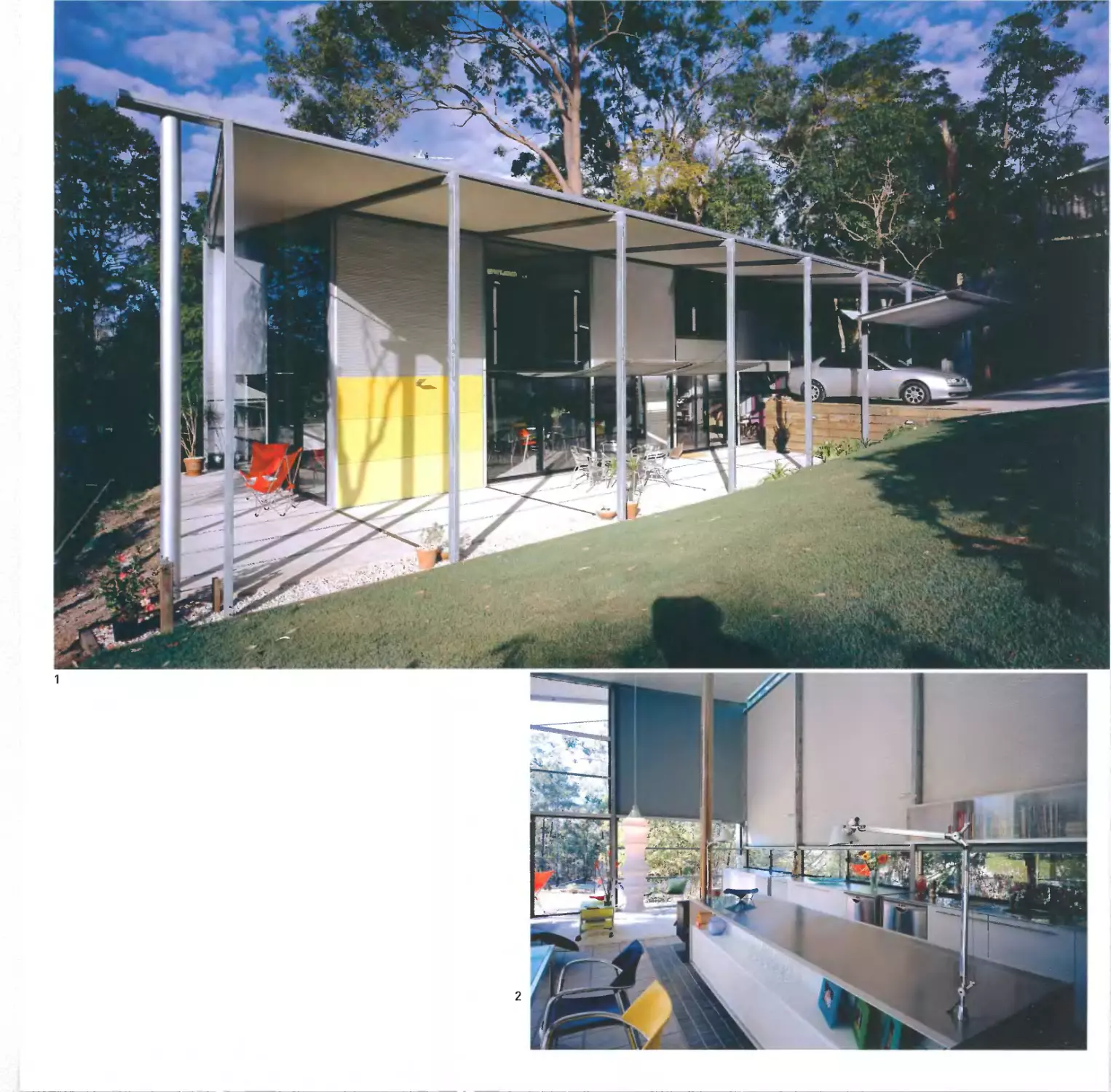




















































































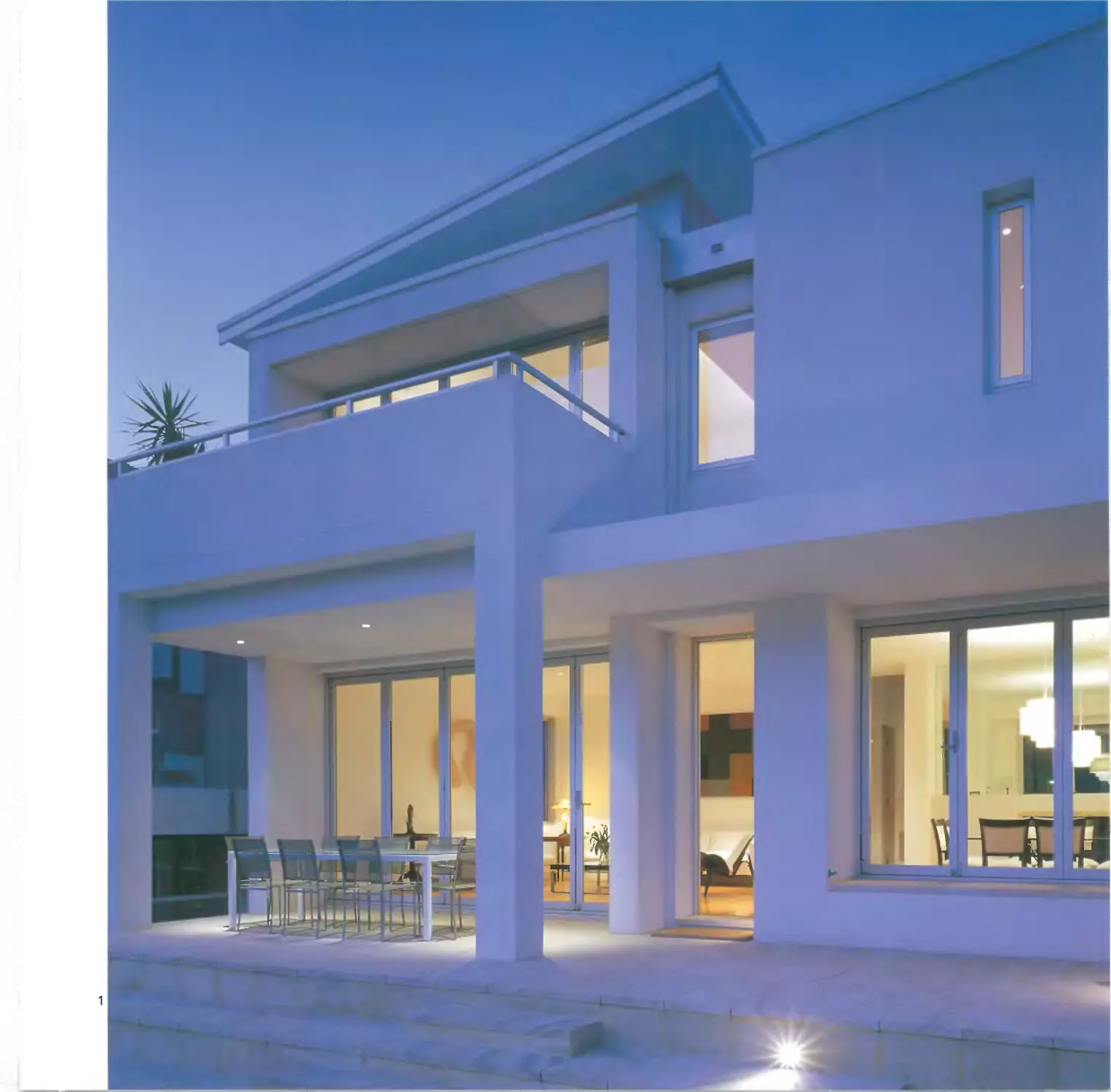


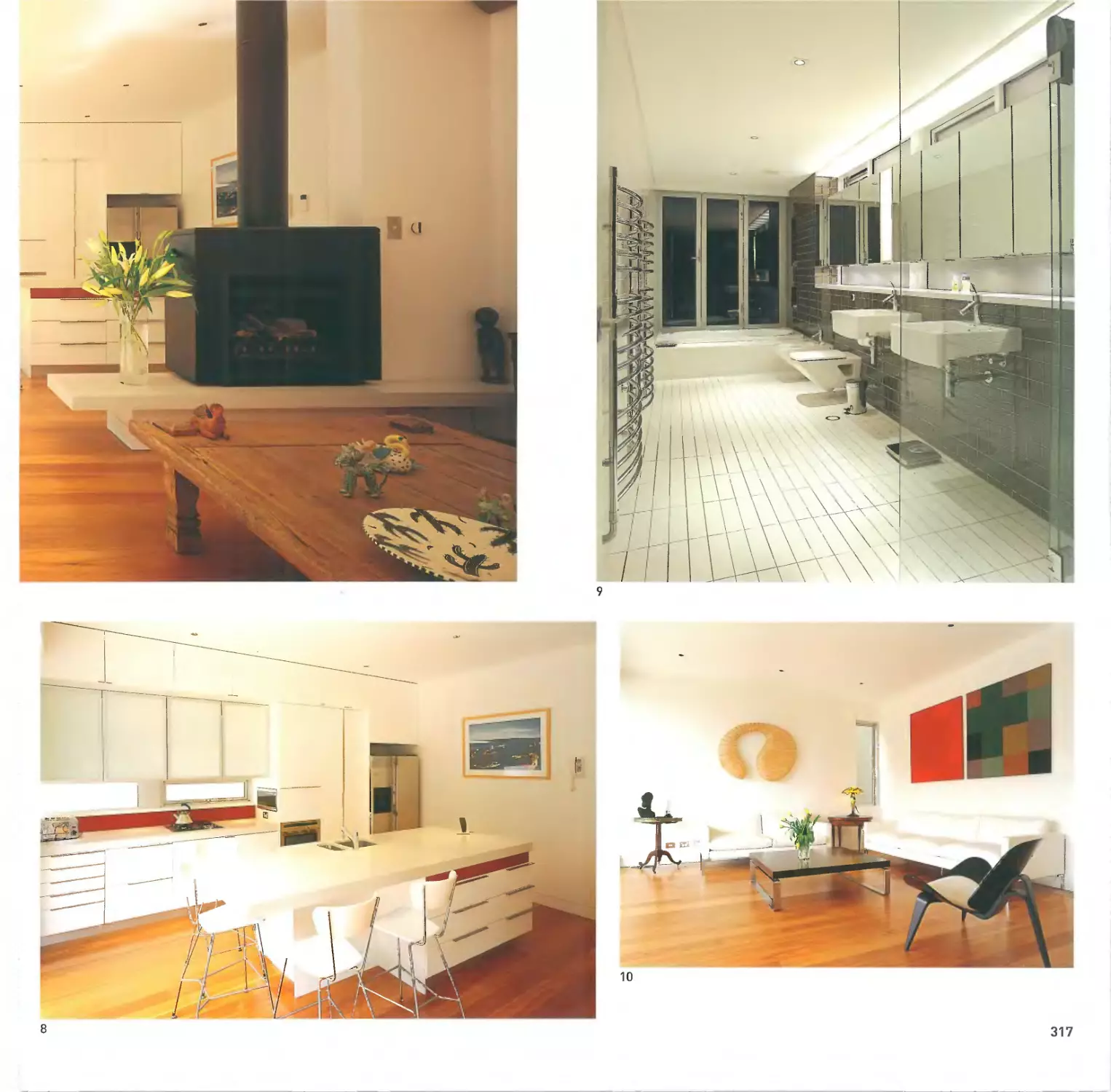


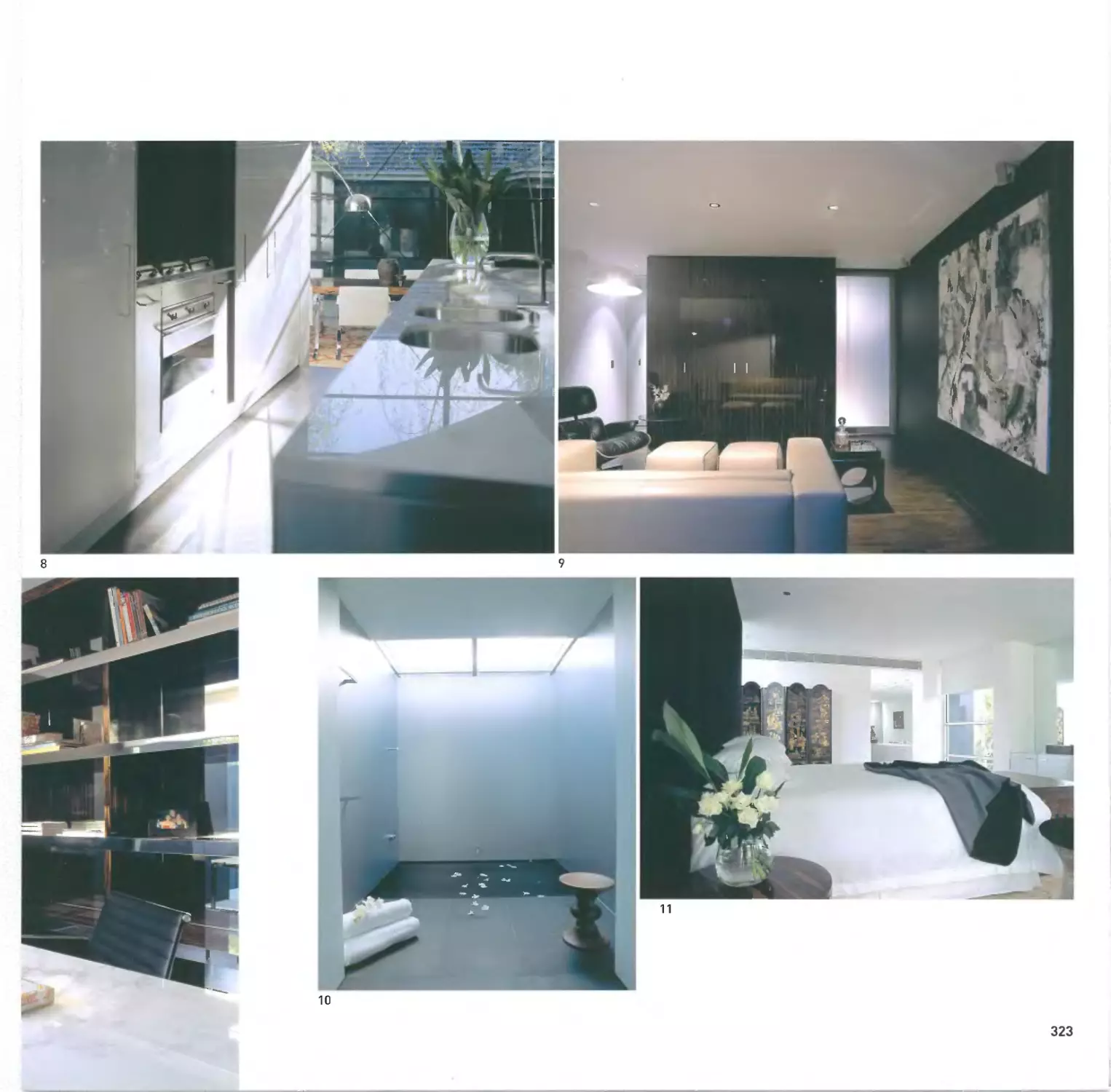


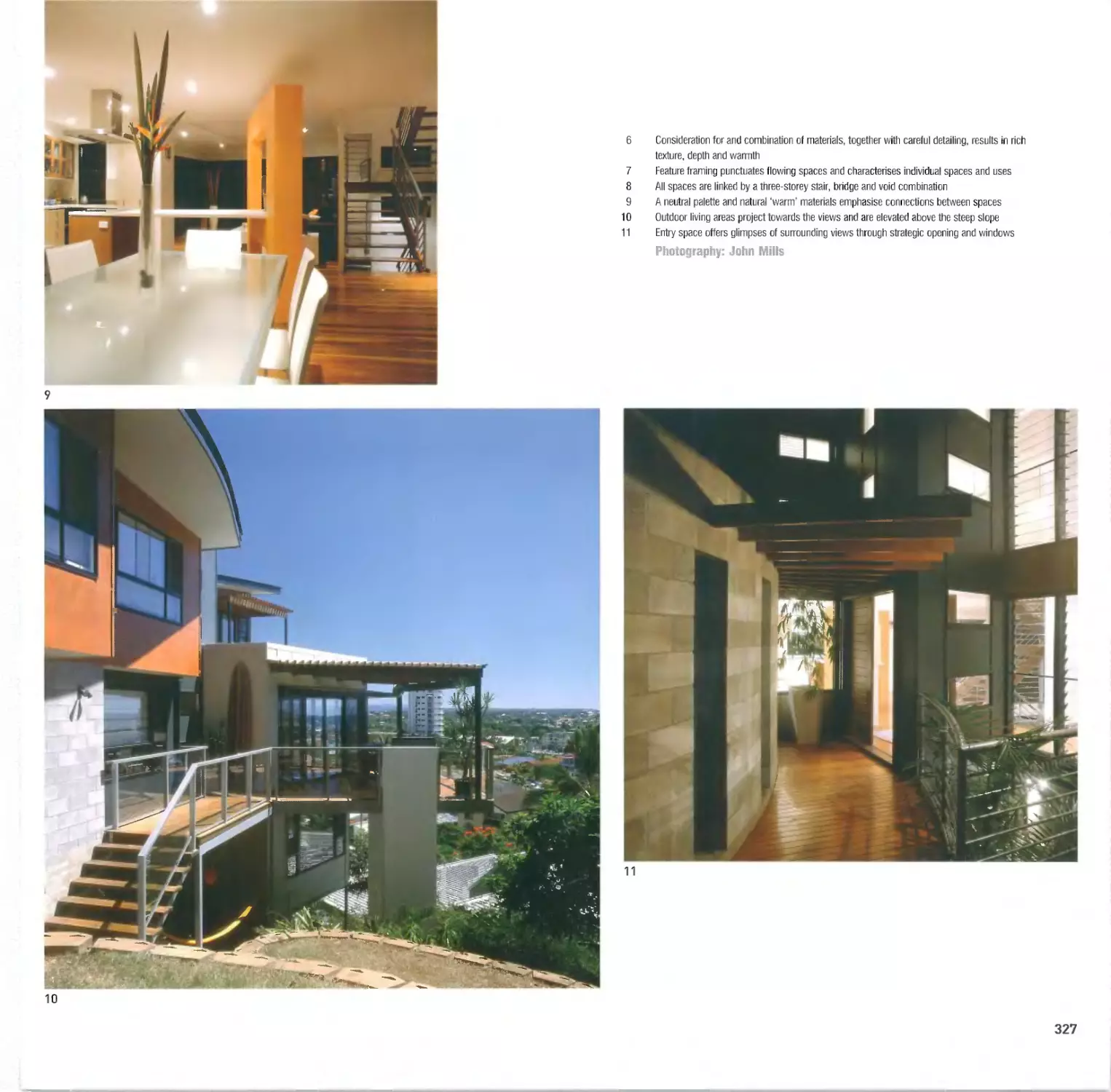









Author: Beaver R.
Tags: construction architecture building architecture
ISBN: 1-86470-141-2
Year: 2005


Text
                    100 Top Houses from
H	japup UMOQ
Robyn Beaver
The 100 projects featured in the following pages represent some of
the finest examples of contemporary residences from Australian and
New Zealand architects and designers. The projects include award-
winners, luxury residences, simple beach shacks, inner-city
apartments, rural retrears and suburban family homes, reflecting
the way we live, or aspire to live, in the 21st century. That the projects
vary so widely is indicative of the enormous variety and originality in
the talent and design direction of architects from 'Down Under.
Although the projects are diverse in size, location, use, ambience,
budget and taste, some common themes are evident: a desire to
blend with the surrounding landscape; the incorporation of
sustainable features; a structural program that divides the home into
'pavilions', each with a specific use; the inclusion of indoor/outdoor
rooms; the incorporation of water; and inventive responses to
challenging environments.
The shared characteristics and themes identified throughout this
collection of houses might group them into a loosely defined 'Down
Under aesthetic, but each house stands alone as testament to the
skills of an individual architect. As you flip through the following
pages, you will agree that the architects and designers of Australia
and New Zealand have much to be proud of.
Cover image The Panorama
Architect: Paul Uhlmann Architects
Photography: Aperture Photography


(-n
° 100 Top Houses from______
H	Japun umoq
scan: The Stainless Steel Cat
images
Publishing
First reprinted in 2005
The Images Publishing Group Reference Number: 652
Published in Australia in 2005 by
The Images Publishing Group Pty Ltd
ABN 89 059 734 431
6 Bastow Place, Mulgrave, Victoria 3170, Australia
Tel: +61 3 9561 5544 Fax: +61 3 9561 4860
booksraimages.com.au
www.imagespublishing.com
Copyright © The Images Publishing Group Pty I td 2005
The Images Publishing Group Reference Number: 626
All rights reserved. Apart from any fair dealing for the purposes of private study, research, criticism or review as permitted under
the Copyright Act, no part of this publication may be reproduced, stored in a retrieval system or transmitted in any form by any
means, electronic, mechanical, photocopying, recording or otherwise, without the written permission of the publisher.
National Library of Australia
Catalogumg-in-Publication entry:
100 top houses from down under.
Includes index.
ISBN 1 86470 141 2.
1.	Architecture, Domestic - Australia - Pictorial works.
2.	Architecture, Domestic - New Zealand - Pictorial works.
3.	Interior decoration Australia - Pictorial works.
4.	Interior decoration - New Zealand - Pictorial works.
728.0994
Edited by Robyn Beaver
Designed by The Graphic Image Studio Pty Ltd Mulgrave, Australia
www.tgis.com.au
Film by Mission Productions Limited
Printed by Everbest Printing Co. Ltd, in Hong Kong/China
IMAGES has included on its website a page for special notices in relation to this and its other publications. Please visit www.imagespublishing.com.
INTRODUCTION
The 100 projects featured in the foltowing pages represent some of the finest examples of contemporary residences from Australian and
New Zealand architects and designers. The projects include award-winners, luxury residences, simple beach shacks, inner-city
apartments, rural retreats and suburban family homes, reflecting the way we live, or aspire to live, in the 21st century. That the projects
vary so widely is indicative of the enormous variety and originality in the talent and design direction of architects from 'Down Under’.
Although the projects are diverse in size, location, use, ambience, budget and taste, some common themes are evident. A desire to blend
with the surrounding landscape, whether it be a significant heritage streetscape in the inner city, a protected coastal dunescape, or
perhaps indigenous bushland, is the aim of many projects. Strikingly contemporary additions and renovations have been thoughtfully
inserted behind traditional or heritage facades that give no hint of the often expansive residences they conceal. In rural areas, houses
are partially 'inserted' into the earth, so that the building appears as part of the landscape, reducing its visual impact.
The incorporation of sustainable features is another underlying theme that links these residences. Environmental stewardship is
important to the architects of Australia and New Zealand and they are keen to exploit the ever-growing range of sustainable features
and products. Houses are oriented to achieve cross-ventilation by cooling breezes, often completely obviating the need for mechanical
air-conditioning. Natural ventilation is incorporated wherever possible, as are photovoltaic panels and rainwater collection systems.
Environmental sensitivity is achieved by the use of natural materials that blend with the landscape, complementing the informal nature
of many of these houses. Exposed structural elements add rawness and visual stimulation in keeping with often rugged locations.
Simple, durable, easily maintained and versatile materials such as recycled timber, concrete, steel, rammed earth, Colorbond,
aluminium and glass predominate, whether to counter the destructive effects of a harsh coastal environment, or to complement a
suburban setting.
In terms of structure, a principal theme is the separation of houses into 'pavilions', with each pavilion being assigned a specific use.
Often, the house is a collection of discrete buildings, with links providing access from one building to another. Notions of privacy for
adults, the separation of living, eating and sleeping zones, specially designed areas for children, or for contemplation or recreation, are
important factors in the design of contemporary houses. The separation between private and public spaces is often defined and
identified by the use of specific materials and finishes, both internally and externally.
The indoor/outdoor room is another influential feature. The 'Down Under' climate, while extending from tropical to alpine, is well-suited
to outdoor living, and the design of contemporary houses reflects and facilitates the outdoor lifestyle. Interiors spill out seamlessly onto
outdoor living areas through sliding or folding glazed doors or entire pivoting walls, extending interiors by blurring the distinction
between indoors and out. The internal courtyard brings the outdoors in, despite the weather. The continuity of building materials and
finishes adds to the 'seamless' nature of indoor/outdoor rooms.
Water is integral to the outdoor lifestyle, whether embodied in the soothing trickling of a sculptural water feature, or the joyous
cacophony of children at play in an infinity-edge swimming pool. The Asian aesthetic is also a major influence, whether overt, in the use
of Japanese screens or the incorporation of tatami rooms, or more subtly in the simplicity, lack of clutter, and emphasis on tranquillity
that is evident in many of these projects.
As expected with a collection of 'Down Under' homes, the locations are spectacular, as are the designers' responses to some
challenging environments. Interior windows are placed to capture and frame ocean views; seemingly impossible obstacles are overcome
to perch a house high on an inaccessible clifftop; some houses are accessible only by boat, increasing the anticipation and high theatre
of the occasion.
The shared characteristics and themes identified throughout this collection of houses might group them into a loosely defined Down
Under aesthetic, but each house stands alone as testament to the skills of an individual designer. As you flip through the following
pages, you will agree that the architects of Australia and New Zealand have much to be proud of. This book has been a delight to compile,
and we hope to follow it soon with a further collection of stunning houses from 'Down Under'.
Robyn Beaver, Editor
The Images Publishing Group
CONTENTS
8	1A Livingstone Parade ODR	64	City Beach House Croudace Architects	126	Future House Innovarchi
12	Aireys House Leon Lopata	66	‘ ruse Bligh Voller Nield	128	Gold Space Cubed Architecture Studio
16	Anglesea House Emma Mitchell Architects	70	Concrete Residence Inarc Architects	130	Heckler House Novak & Middleton Architects
20	Apartment 44 David Hicks Pty Ltd	74	Coromandel House Rachel Venables Design	134	Hedges Residence Bayden Goddard Design
22	Apartment; 302 David Hicks Pty Ltd	76	Courtyard House Utz-Sanby Architects	138		S( Breathe Architecture
24	Art Collector’s Residence Carabott Holt (CH) Architects	80	The Cray Shed Koia Architects	140	House at Castlecrag MoncKton Fyfe Architecture and Interiors
28	Arthurs Seat House Nicholas Gioia Architects	84	Cremorne Street House Stevens Lawson Architects	144	House for 1 & A Bligh Voller Nield
32	Avalon House Connor + Solomon Architects	88	Cumberland Park Residence Studio 9 Architects	148	House for S & P Bligh Voller Nield
36	Birch Houses Kevin Hayes Architects Pty Ltd	90	Dalman ise Dalman Architecture	152	House in Richmond Jackson Clements Burrows Architects
40	Birchgrove House Connor + Solomon Architects	94	Dry Hills House Architecture Workshop	156	Husker Du II Ellen Woolley Architect
44	Bluestone Church Conversion Multiplicity in association with Mel Ogden	98	East Melbourne Residence Inarc Architects	158	James-Robertson House Dawson Brown Architecture
48	BMG Residence/Art Gallery Tridente Architects	102	Florida Beach House Odden Rodrigues Architects	162	Kapiti Coast Bach Bevin + Slessor Architects
50	Broadbeach Apartment Pod Interior Design	106	।	House Dale Jones-Fvans Pty Ltd Architecture	164	Kelly esidence John Mainwaring & Associates
52	Budd's Beach Residence Pod Interior Design	110	Folding House Stephen Jolson Architect	166	Keegh House d.LINEATE architecture + interior design
54	Bungan Beach House Dawson Brown Architecture	114	Fordham/Jenkin House Designinc Perth Pty Ltd	170	Kew House Jackson Clements Burrows Architects
58	Challis Penthouse mac-interactive	118	Fort Dorset House Herriot + Melhuish Architecture	174	Lake House Helena Architects Ltd
60	Chameleon Cassandra Complex	122	Fossil Cove House Preston Lane Architects Pty Ltd	178	Lantern House DEM (Aust) Pty Ltd
182	Lido Residence Bayden Goddard Design	242	Pourerere Bach Bevin + Slessor Architects
184	iouse Peter Tonkin and Ellen Woolley with Tonkin Zulaikha Greer	244	Putney "truse Tonkin Zulaikha Greer Architects
188	Meli House Corben Architects, Interiors by Decoroom	248	Queens Park Residence Cullen Feng
190	Milsons Point Apartment Stanic Harding Pty Ltd	252	Raglan Street House Coy & Yiontis Architects
194	Modica John Mainwaring & Associates	256	Ramme d Earth House Stephen Jolson Architect
196	Moonah Links House Jackson Clements Burrows Architects	260	Red Rock Lane House Sheppard & Rout Architects
200	Mt Hawthorn Residence Iredale Pedersen Hook Architects	264	Remuera House Noel Lane Architects
204	Nellies Bourne + Blue Architecture	268	Retreat House Black Kosloff Knott Architects
208	.. Wright Feldhusen Architects	272	tnond House Wolver,dge Architects
212	Ocean House Wolveridge Architects	276	Riverview Residence Melocco & Moore Architects
216	Paddington House Indyk Architects Pty Ltd	280	Rose Spring Apartments Cowland North Pty Ltd
220	Palm Beach House Workshop 1 Pty Ltd	282	Roseneath House Novak & Middleton Architects
222	The Panorama Paul Uhlmann Architects	284	Said House Design King Company
226	The Paradisio Paul Uhlmann Architects	286	Seatoun House Herriot + Melhuish Architecture
230	Paraparaumu House Parsonson Architects	288	Sentinel Giles Tribe Architects
234	Pekapeka House Parsonson Architects	290	Seresin House Pete Bossley Architects
238	Point Chevalier House Andrew Lister Architect	294	Shenton Park Residence Craig Steere Architects
296
298
302
306
310
314
318
320
324
328
332
336
340
342
344
346
small Street Residence
Kevin Hayes Architects Pty Ltd
South Paddington Residence
Cullen Feng
Spring Street Apartment
Form Architecture Furniture
Spry House
Durbach Block Architects
Strathmore House
BBP Architects
Tamarama House
Morgan Dickson Architecture (Architect):
Architect Prineas (Interiors)
Tea-Tree House
Maddison Architects
Toorak Residence
David Hicks Pty Ltd
ouse
Space Cubed Architecture Studio
Urushi House
first impression projects (Designer and Builder)
Vaughan Residence
ROTHELOWMAN
Venn Street Residence
Hartree + Associates Architects
Waimarie
Irving Jack Architects
Waverley Residence
Cullen Feng
Yallingup Beach House
Craig Steere Architects
Architect contact details
7


IT^HWWW
“ S ХХЙКККЙ'.’.Й!!!•&«•!
Ш»»
млллелл лаял *лл »£Л?.£££ФИ4
^ЙКЙ5««5Г4Й$«Я
чя«;?й5зЬа::в«1й
йШфйШйЗйЙк
:«ИИИ5ЯЗ!И«ййй-
П^:ЙЙЙ{^ёя5«
яЖ&&Й»ЙййЙ
,  -  . -.-. ? ::••. . .
-Т?5УМк;П5^г«::5я«
'ГГТ-<Г<ГЗ»ТТЧ’Jv<i»#»4'»‘«w«»
1 A LIVINGSTONE PARADE
О D R
This project is a small house on a small site. The architects' hope
was to achieve a building with architectural presence that creates
a discourse within a contextual condition. • It is referential in
acknowledgment through association, rather than form.
Reinterpretation rather than duplication. The adjacent old hospital
is a large building made of many small bricks; its giant chimney
dominates the urban landscape. The new house is a small building
wrapped in giant bricks (pattern on screen!; the chimney is
celebrated and referenced through an over-exposed flue. The new
black corrugated box replaces an existing corrugated shed;
memories of the shed are embraced through materiality. The
architects Tike to clad an Australian building in black' • The black
box, the giant aluminium brick screen and the over-exaggerated
flue are the primary outward architectural gestures. The story is
written into the wall. • The informal architectural proposition is;
how do you make something small feel like something big? • There
is no 'articulation' to reduce visual bulk, rather, the building is 6.5
metres high and abuts a corner without respite. The front door is
accessed via the backyard, and the entry is through a 6-metre
atrium, something unexpected. On entry, the sky and the
internalised deck are visible. Simultaneously, the atrium forms part
of the living area in attempting to 'make the space feel bigger’.
These void spaces without programme become critical. Inherent
is a proposition of privacy, challenging common perceptions and
comforts. During the day the occupants see out, at night others see
in. Translucency softens the impact. The screen disguises the
programme behind and acts as the mediator. The outside is
accessing the inside and programmatic boundaries are
continuously called into question. It makes no apologies for being
heroic. Seldom do passersby think it's a home.
2
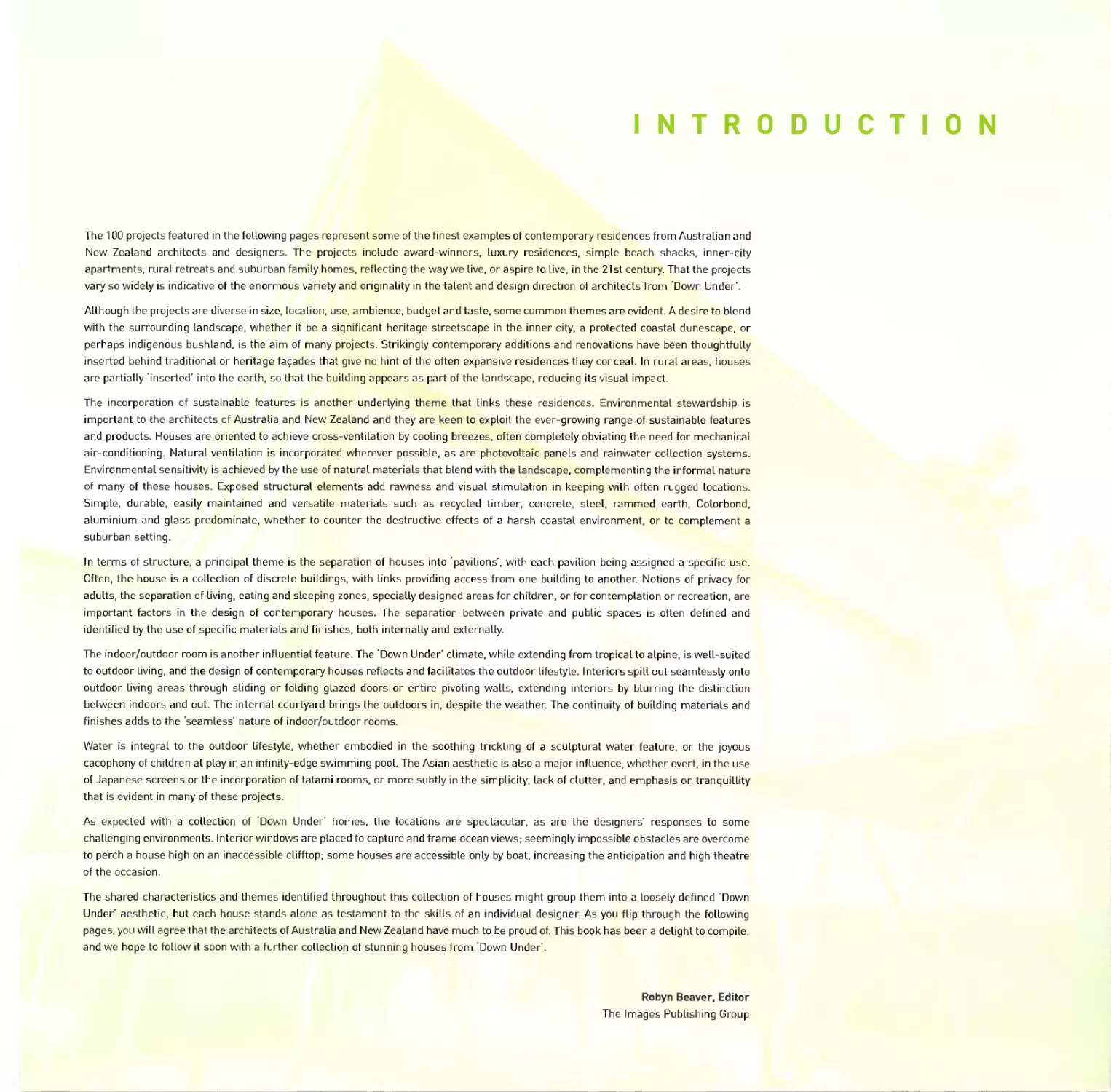
1	East elevation, showing the referenced brick pattern
and chimney
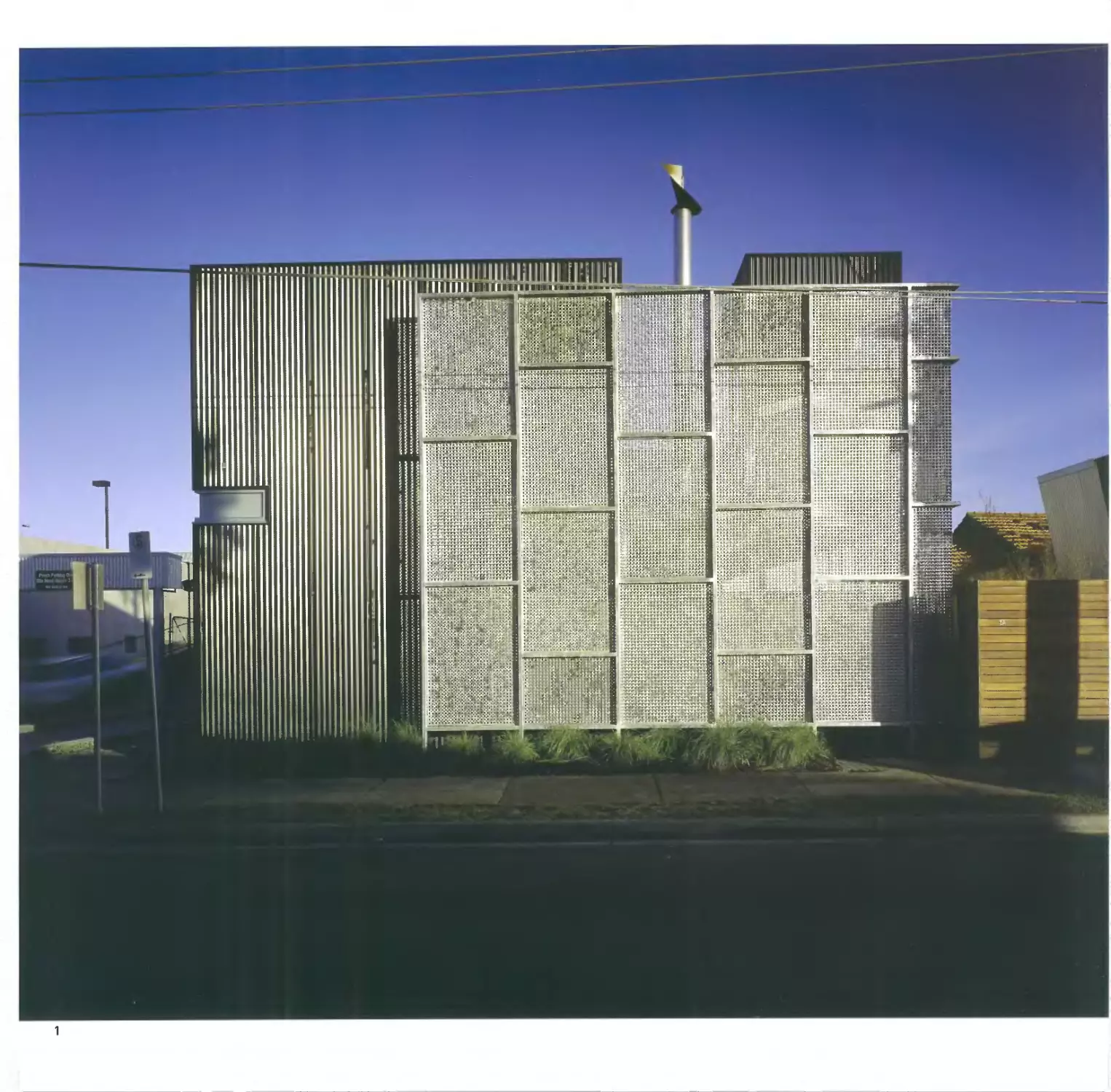
2	House in its suburban context, exposing its references
to the old hospital and chimney stacks beyond
3	Ground floor plan
4	First floor plan
1	Deck
2	Living
3	Dining
4	Kitchen
5	Laundry
6	Study
7	Carport
8	Bathroom
9	Bedroom
10	Deck
11	Atrium
9
5
5	Living in one space
6	The private court showing the relationship to the street (behind the screen) and the atrium
7	Entry atrium and private court at night
8	The interior is revealed to the street at night
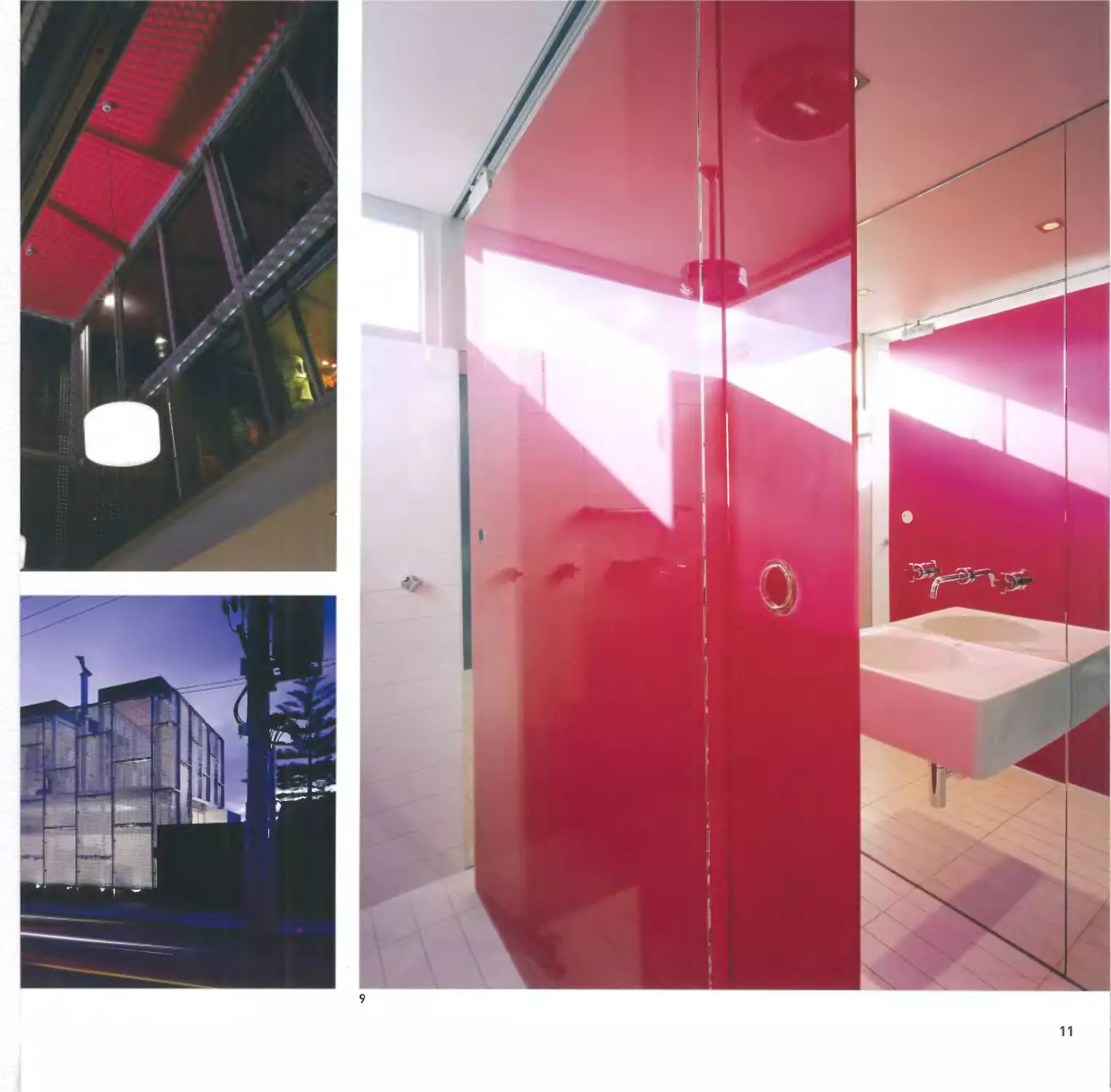
9	Operable sliding toilet and shower screen
Photography: Derel
6
8
11

AIREYS HOUSE
LEON LO RATA
This house is on one of Australia's best-known coastal routes,
Victoria’s Great Ocean Road. The designer s intention was to create
a practical and easily maintained beach house, a place for
relaxation, family, friendship and freedom. • The design achieves a
sense of airiness and space. The raking roof/ceiling line with high
windows on both the north and south sides opens up to the sky. The
communal spaces are interconnected and designed to allow people
to come together and relax while the bedrooms, on the north side of
the building, are warm and intimate. A multipurpose room on the
lower level opens out to a northern deck that is partially enclosed by
a sandstone retaining wall and a timber pergola. • Floor-to-ceiling
glass windows frame the sky and coastline, inviting in the drama of
the incoming weather. High opening windows allow hot air to flow up
and escape, while other lower sliding openings assist in flushing the
house with cool breezes, obviating the need for mechanical cooling.
Outside, the 'butterfly' roof naturally forms a large box gutter that
collects rainwater, which falls down a steel chain into a water tank
on one side of the building. The west wall is built like a shear
parapet, designed to protect tne building from the hot afternoon
sun. At the base of the wall is the timber water tank enclosure,
which like a timber block rammed into the earth visually anchors
the building. • Materials reflect the surrounding environment. The
main structural material is concrete block work, in charcoal,
alabaster, and sandstone colours, in two different textures and
block laying methods. Glass is used extensively, teamed with black
powdercoat-finish aluminium frames; spotted gum is used as a
cladding. The exterior also features the use of steel outriggers that
support and form the eaves and expressed steel structural
members in special marine-quality paint finishes.
Opposite.
Southeast elevation: high concrete blockwork wall protects as well as anchors the building
2	East elevation with winged roofline
3	First floor plan
4	Ground floor plan
2
13
5
7
8
9
5	Combined kitchen, dining and living areas
6	Architect’s concept sketch
7	Front decking forms large outdoor space and provides canopy for carport below
8	Kitchen with cherry wood built-in joinery
9	Kitchen with granite bench top and servery with cherry wood cabinets below
Photography: Mark Munro
15
1
2
ANGLESEA HOUSE
EMMA MITCHELL ARCHITECTS
The project, in Anglesea on Victoria's Surf Coast, called for the
renovation of a two-storey cedar weatherboard house, with the aim
of transforming it from a basic 1980’s holiday home to a fully
functional contemporary permanent residence. While the original
home was designed primarily to take predictable advantage of the
ocean view, its mediated descendant has been designed to pay
tangible respect to the past life of the dwelling, to meld the building
more authentically into its natural environment and to create new
layers of space which give multiple experiences of the ocean and
bush views. • This project has been a significant investigation into
what a house embodies and ways in which the house can evolve to
meet new requirements as family structures change over time. The
idea of memory was a significant point of investigation for the
project, retaining spaces, recycling and revivifying materials of
significance. • The idea of view, and the issue of how space could
be framed and moved through to create varied experiences of a
single view, were driving forces for the arrangement of interior and
exterior spaces. Asian landscape design and Chinese landscape
painting were sources of inspiration for tackling this concept • The
form of the building is an investigation into what defines a beach
house type. The form recalls American modernism or that of an
ocean liner; the materials used recall old-style holiday homes. The
house is an expression of form that is specific to its surrounding
environment and specific to the spatial requirements of the brief.
Colours and landscaping were chosen to reflect the bush and coast
unique to this site.
Entry
Billiards
Study
Den
Bedroom
Laundry
Bath
Store
Deck
Pond
Living
Kitchen
Dining
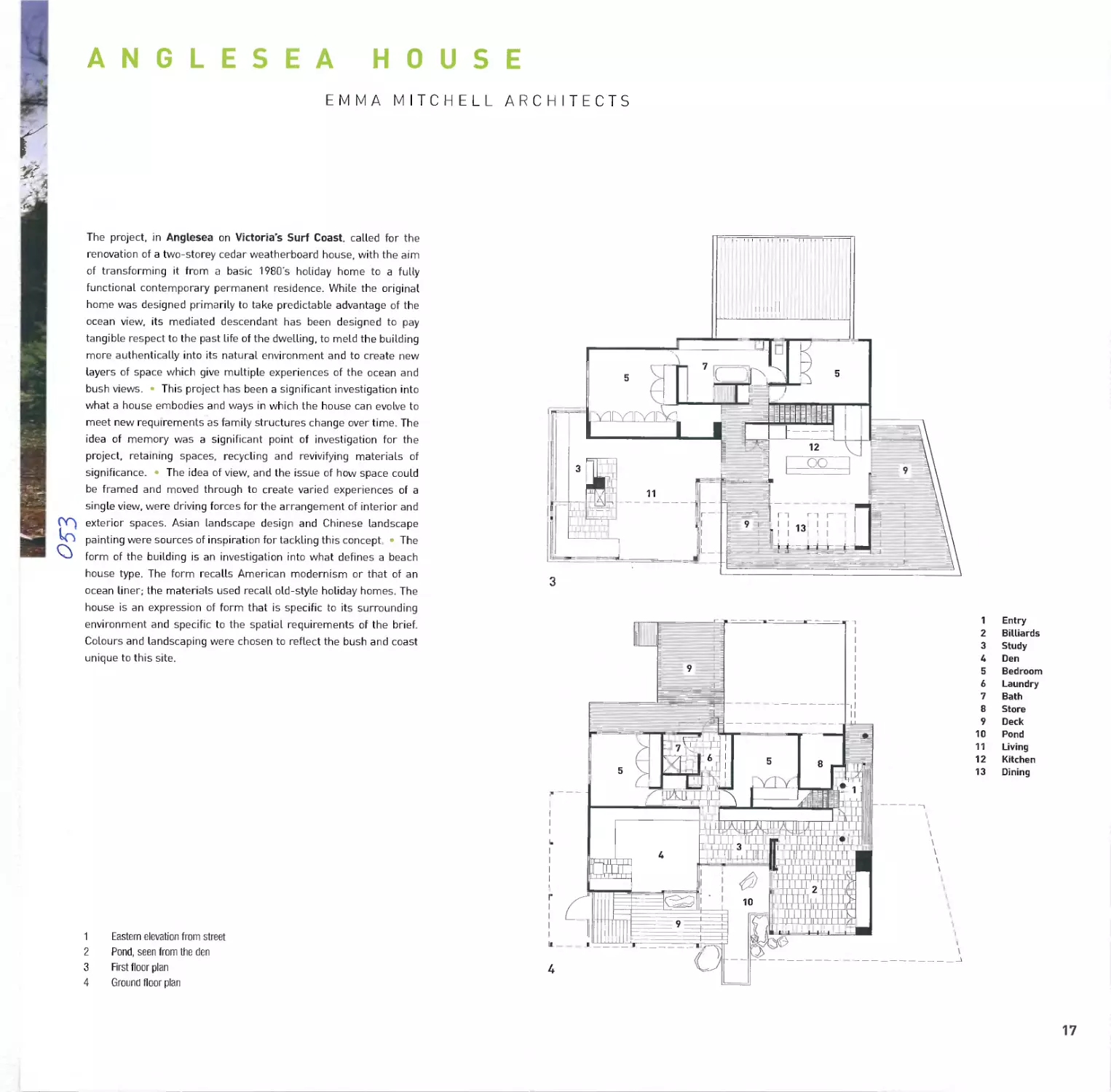
1	Eastern elevation from	street
2	Pond, seen from the den
3	First floor plan
4	Ground floor plan
17
5
5	Looking south from the north deck
6	Rasmus the golden retriever enjoying the living room window seat
7	Living room fireplace
8	Kitchen and dining room from the central deck
9	Upstairs bathroom viewed from bedroom door
Photography: Dianna Snape
19
£

APARTMENT 44
DAVID HICKS P
This apartment is located in a prestigious Melbourne landmark
building, close to the CBD. The north-facing apartment allows views
across the Royal Botanic Gardens, and along Melbourne’s premier
boulevard to the city. < A complete refurbishment of the existing
apartment was required to breathe fresh life and elegance into the
space. The existing grey granite, beige paint and blue carpet were
not complementary to the exterior scenery or the penetrating
northern light. The main aim of the design was to bring a sense of
light from the outside into the space, while creating a moody and
glamorous atmosphere in keeping with a city apartment.
Polished black terrazzo was chosen for the floor, providing clean
lines and an alternative to carpet. The black full-gloss reflects the
light without creating glare, while the grey chips hide dust and dirt
particles. White-painted walls provide a neutral backdrop for the
clients’ ever-changing and extensive artwork collection. Skirtings
and trims were removed from the walls to eliminate excess clutter.
Silver corded goat-hair carpet is confined to the two bedrooms,
providing a contrast in texture and some underfoot comfort.
Cream silk curtains add a touch of luxury to the bedrooms. • The
bathrooms incorporate shimmering, oyster-like materials,
providing a tranquil environment in which to preen. Moonlight
Calacutta marble slab was used on the bench tops and bath
surround, with silver-grey mosaic tiles lining the walls. Large
panels of silver mirror extend the spaces and glitter with the
reflection of the overhead task lighting. All detailing, including
fittings and fixtures was kept to a minimum to avoid fuss. Square
underslung china basins disappear beneath the marble bench top
while all cupboard door handles have been eliminated. • The
resulting atmosphere is one of pure elegance and refinement,
interwoven with elements of the clients’ personalities and tastes.
1	View of bathroom with Calacutta marble bathtub and shimmering stainless
steel cabinet
2	View across living and dining area to kitchen
3	View across kitchen benchtop to Royal Botanic Gardens beyond
4	Sleek kitchen bench in seamless white and shimmering stainless steel
reflected in mirrored wall
5	Custom-designed stainless steel powder room vanity with moulded sink
6	Eclectic mix of furniture pieces and artwork
Photography: Trevor Mein
21

APARTMENT 302
DAVI D HICKS PTY LTD
This apartment is on the third level of a former chocolate factory in
Prahran, a progressive suburb close to the city of Melbourne. The
two mam features of the building were its high ceilings and open-
plan space. The 100-square-metre, L-shaped footprint presented
a number of challenges. With only one south-facing glazed facade,
creating a sense of light and space was paramount. By considering
scale, reflectivity in materials, and looking to find new ways of
construction, the space was transformed into an environment that
evokes a sense of extended space. • Given the 3.2-metre slab-to-
slab height, a raised platform was incorporated to allow flexibility
with the placement of services while allowing the existing concrete
slab ceiling to be maintained. A linear bulkhead houses services
and provides a strong visual link between the dining and lounge
zones. The kitchen was restricted to a 5-metre-long area and all
appliances were concealed in a streamlined cantilevered credenza
unit. 1 2 3 4 5 6 Attention to detail was very important to the success of the
design. A grid formula was conceived, based on the size and layout
of the white terrazzo flooring. This allowed the placement of
elements such as joinery units to segment the space into zones
within the grid. • All materials were detailed to be incorporated as
large panels. This over-scaling is evident with the use of silver
cladding to seamlessly line the bathroom, and the 6-metre-wide
roller blinds made from exterior building screen material. A large
mirror panel reflects the entire south facade and maximises the
glazing, allowing light to penetrate and further emphasise the
suggestion of space. • The combination of the scaling-up of
materials, reflectivity, and the choice of seamless products, along
with strong planning and utilisation of space, creates an
environment that has in fact been minimised to achieve an outcome
that has maximised the space.
1 Living area looking onto raised black gloss timber platform
2 Detail of custom-designed marble and chrome dining table
3 Shower room clad in seamless metallic silver panels; exhaust
lighting and waste all concealed behind grilles
4	Mirrored wall in bathroom conceals storage
5	Floor plan
6	View from living area into bedroom separated by joinery	unit
which sits on floor tile grid
Photography: Trevor Mein
6
23

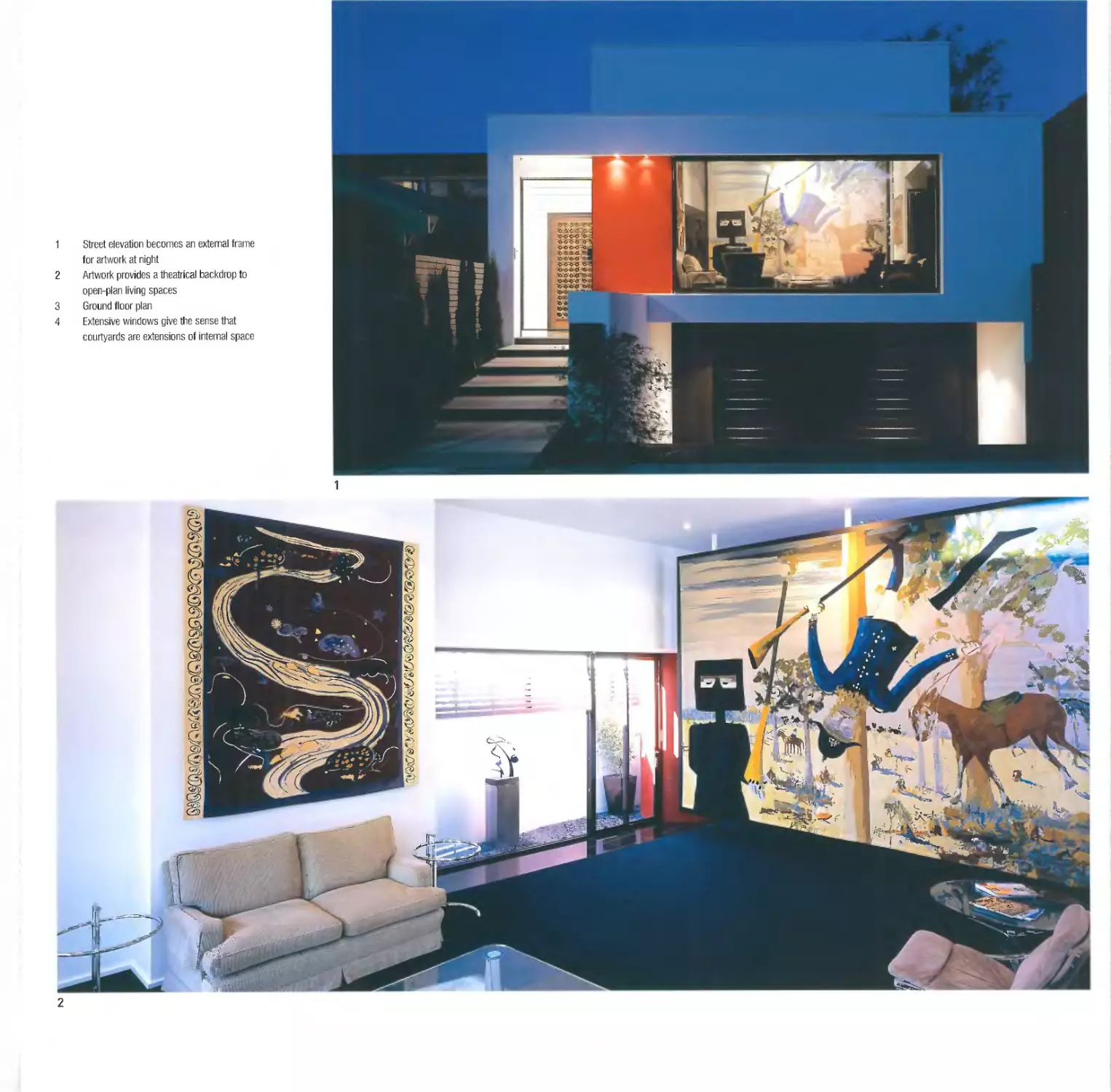
Street elevation becomes an external frame
for artwork at night
Artwork provides a theatrical backdrop to
open-plan living spaces
Ground floor plan
Extensive windows give the sense that
courtyards are extensions of internal space

2
ART COLLECTOR’S RESIDENCE
CARABOTT HOLT (CH] ARCHITECTS
The narrow Melbourne city fringe site influenced the linear
planning of this art collector's house, which comprises three
bedrooms, formal and informal living spaces and a double-car
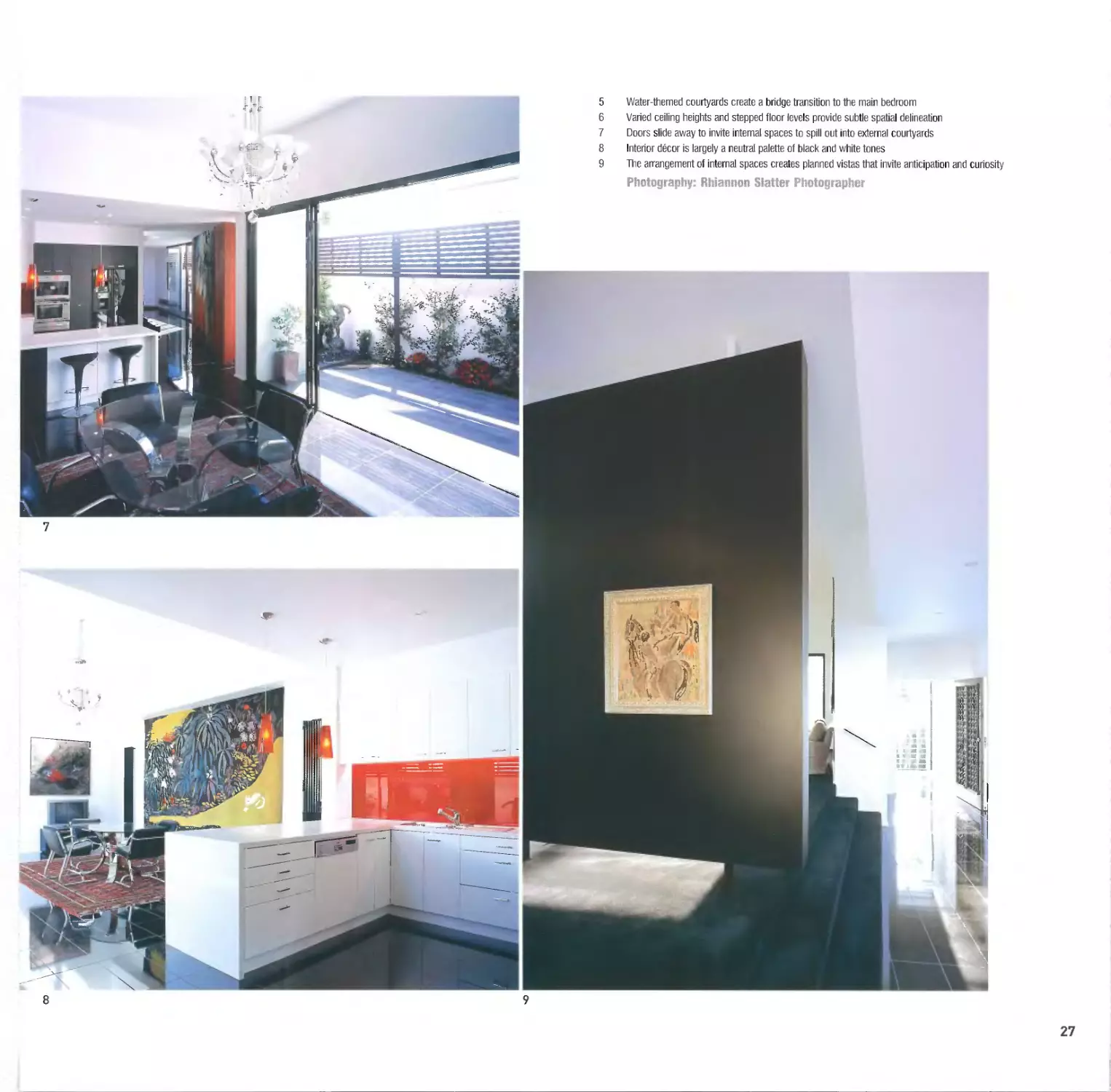
basement garage. • The house is divided into two zones: an
entertaining and living zone and a private zone where the bedrooms
are located around two water-themed courtyards that create a
bridge-style threshold to the master bedroom. The zoning is
achieved with subtle techniques such as raised floors to the formal
living area and the use of discrete cavity sliding partitions that
disappear from view when open. • The front elevation of the house
involves the interplay of cubic volumes with bold red and black
accents that are suggestive references to the De Stijl movement of
the 1920s. At night this elevation becomes a frame for the
centrepiece of the collection, Nolan's Ned Kelly, which has a
prominent position on the rear wall of the formal living room. This
artwork provides a theatrical backdrop when viewed through the
expansive glass window from the street outside. • Elements such
as the floating black plane that separates the living room from the
study serve to challenge perceptions and add to the fluidity of space.
The affectionately named free-form 'womb room', prominently
accented in bold red is the pivotal element in an otherwise
restrained monotone palette of colours and materials. • Natural
light is maximised through the design and orientation of the house,
its courtyards and windows. The main courtyard is located on the
north side of the site to facilitate sunlight into this space and the
informal living area. Extensive glazing creates the impression that
this courtyard is an extension of the interior of the house. • The
design provides an architectural canvas for exhibiting the owner's
art collection while creating a series of comfortable living spaces
with a simple, stylised decor. The result is a successful integration
of architecture and art.
4
3	0 4m (J")
1	Porch
2	Entrance
3	Formal living
4	Study
5	Courtyard
6	Informal living
7	Bedroom
8	Bathroom
9	Laundry
25
5
8
5	Water-themed courtyards create a bridge transition to the main bedroom
6	Varied ceiling heights and stepped floor levels provide subtle spatial delineation
7	Doors slide away to invite internal spaces to spill out into external courtyards
8	Interior decor is largely a neutral palette of black and white tones
9	The arrangement of internal spaces creates planned vistas that invite anticipation and curiosity
Photography: Rhiannon Slatter Photographer
27

ARTHURS SEAT HOUSE
NICHOLAS GIOIA ARCHITECTS
The brief was for a new holiday house on an extremely steep and
difficult, naturally vegetated site on Arthurs Seat, on Victoria’s
Mornington Peninsula. The requirement was for a house that was
practical, comfortable and affordable, with optimum views of Port
Phillip Bay and the coastline. • The architect’s response was to
design a house that, despite being compact, still feels spacious,
admits ample controllable sunlight, and has stunning views. Every
habitable room, except for one, is north-facing and has a view of the
sea. The north-facing wall of glass has a deep 'picture frame'
surround so that the glass is in shadow for most of the summer, but
is exposed to sunlight in winter.  The two-storey house includes
three bedrooms, two separate living areas, two bathrooms, a dining
area, a kitchen and a laundry, within a floor area of 130 square
metres. The modest footprint of 68 square metres meant that more
than 90 percent of the natural vegetation on the site was left
undisturbed. Plywood cladding and other muted, non-reflective
external materials allow the building to merge into the
environmentally sensitive hillside. • The architectural language is
distinctly holiday house', and results in a welcoming and restful
haven, away from the language of the city house. The house is an
exercise in restraint, precision, simplicity and elegance.
1
2
3
4
5
house nestled in landscape (north side)
House nestled into hillside (west side)
South side of house with bridge from street
Ground floor recreation room with master bedroom visible beyond
Section
4
29
6	First floor level is a single, pure space
7	Living room in foreground and kitchen beyond
8	View through building to sea beyond
9	Stairway to ground floor is concealed behind
a horizontal cupboard
Photography: Trevor Mein
31
1
AVALON HOUSE
CONNOR + SOLOMON ARCHITECTS
This 340-square-metre residence is located within a valley, inland
from Avalon Beach on Sydney’s northern beaches. The irregularly
shaped site features access via a tree-lined avenue and a small
bridge over a traversing creek, leading to a large swamp mahogany
tree within a grassed and lightly bushed area. Other similar sites,
set amongst the rainforest, surround it. • The house consists of
two wings, east and west, flanking the creek edge. The angled wings
cradle the rear yard while the glazed link between them is navigated
around an ancient Livingstonia palm. > The silted valley floor
required the use of lightweight construction on steel torsion piers,
while local high wind loads led to the development of a portal steel
frame with traditionally framed infill walls. The cladding is Ecoply
(plywood) and it is lined in plasterboard, producing an economical
house, despite the selection of high-end appliances and fixtures. •
Within the east wing are the main living, dining and kitchen areas. It
is entered via broad open recycled hardwood stairs, formally
delineated by recessed panels housing the pivoting front door. The
two-storey entrance space behind is separated from the living areas
by the only masonry element of the house. It sculpturally combines
the fireplace, stairs and bridge to the upper level main bedroom.
A small link building separates the two wings. The west wing
comprises an enclosed verandah that opens into three bedrooms.
The bedrooms, while compact, gain actual and perceived space
from the verandah via the use of large double doors. • The pared
back planning and simple forms belie the complexity of the
environmental control strategy. Each space is located to best suit its
function and each element is designed to provide some
environmental advantage. The controlled openings are positioned to
connect each space to the varied parts of the site.
1	North-facing fagade with	rainforest backdrop
2	Upper level floor plan
3	Lower level floor plan
33
7
10
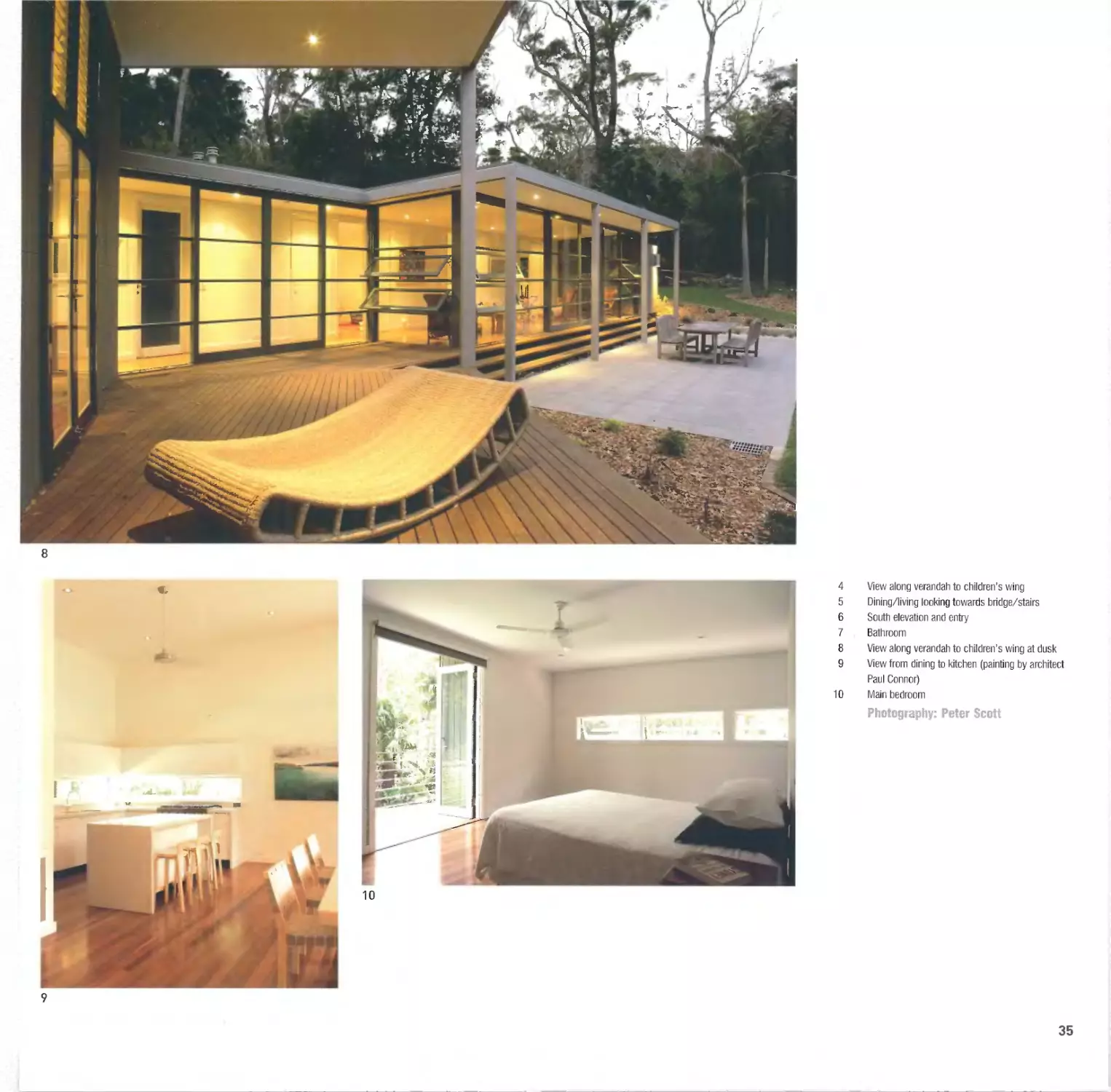
4	View along verandah to children’s wing
5	Dining/living looking towards bridge/stairs
6	South elevation	and entry
7	Bathroom
8	View along verandah to children's wing at dusk
9	View from dining to kitchen (painting by architect
Paul Connor)
10	Main bedroom
Photography: Peter Scott
35
2
BIRCH HOUSES
KEVIN HAYES ARCHITECTS PTY LTD
The client’s brief was to design two houses that would read as
individual dwellings and maintain privacy on a small site in St Lucia,
a suburb of Brisbane. The site offered excellent opportunities. It has
good northeastern exposure and lovely neighbourhood views in this
direction, while also being sheltered from the west by the natural
rise of the land. A mature silky oak tree at the front of the site was
a significant feature to be retained. • The spatial organisation of
the houses was strongly driven by considerations of how to occupy
the site. The massing of the houses is pushed to the southwest
corner of the site to maintain access to breezes and views from the
northeast. The idea of spaces that 'flow on' softens the rigidity of the
fairly strict, efficient circulation spine. This spatial quality is as
much defined by the perceptions of the occupant than by distinct
enclosure. Space is amplified by the manipulation of light filtering
through screens, glazing and rooms and the use of warm, rich
materials on a flat, white backdrop reinforces these ideas. Material
elements have been assembled in a blunt fashion and structure has
been expressed so that the construction technology becomes
ornamental.
1	House A, at the front of the site
2	Floor plans, House В (left), House A (right)
3	Exposed, expressive structure was an important aesthetic consideration
3
37
5
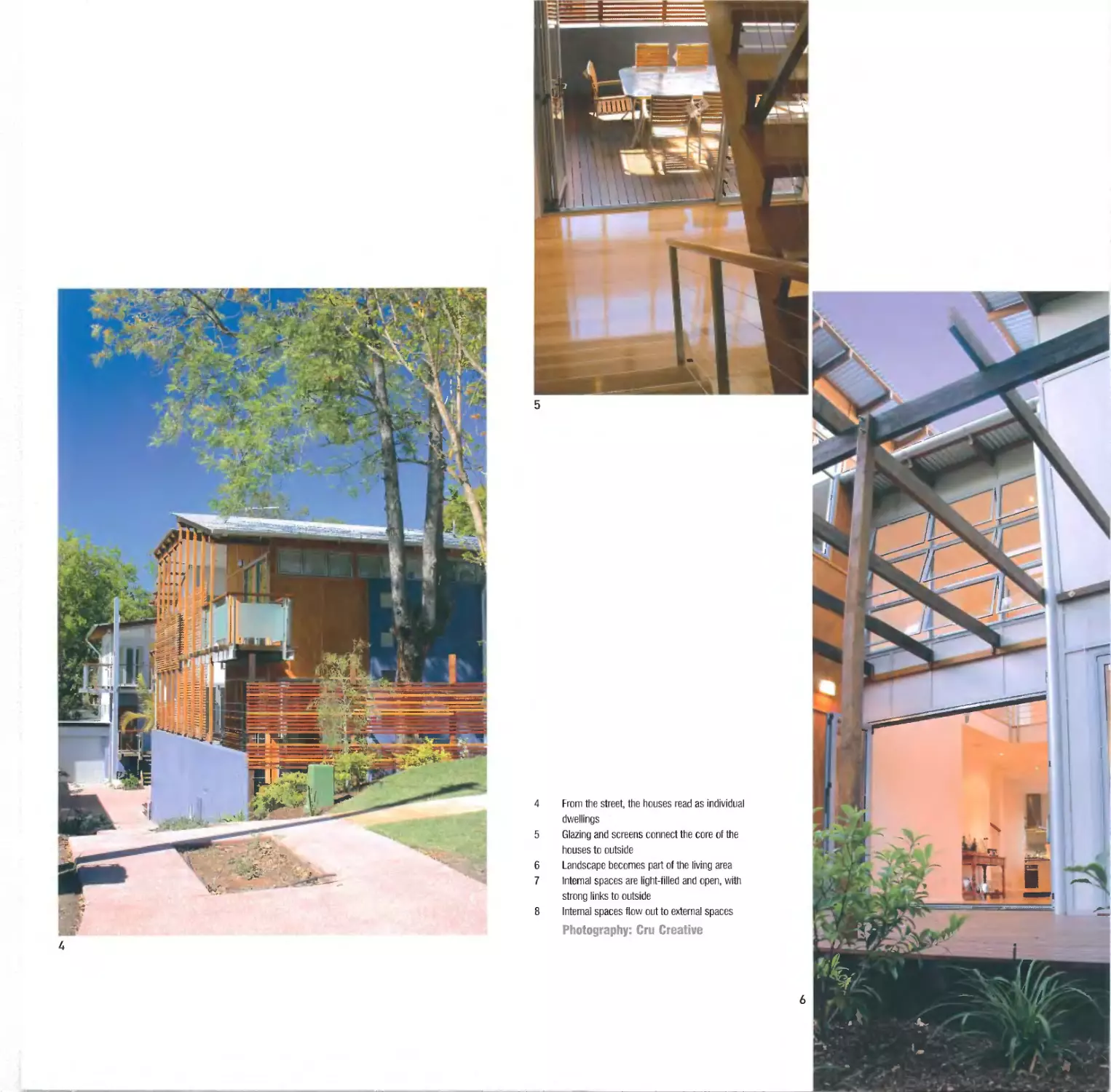
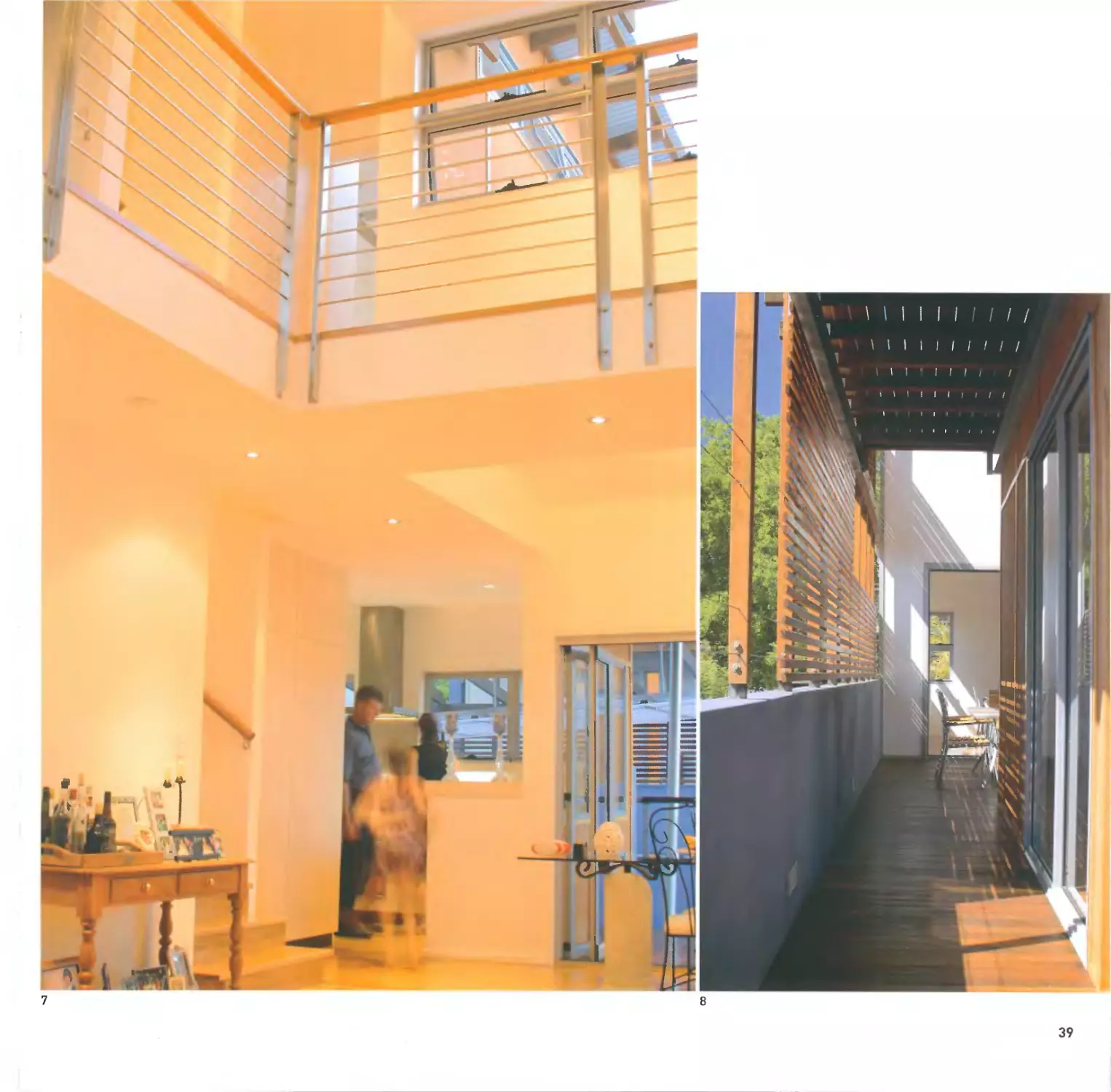
4	From the street, the houses read as individual
dwellings
5	Glazing and screens connect the core of the
houses to outside
6	Landscape becomes part of the living area
7	Internal spaces are light-filled and open, with
strong links to outside
8	Internal spaces flow out to external spaces
Photography: Cru Creative
4
6
7
39
2
1	Front elevation of both the restored building and sandstone-clad infill
2	Kitchen in infill: stairs to garage on right
3	Rear elevation of infill building: the aluminium-framed doors slide into a pocket
seamlessly linking the kitchen to the rear courtyard
4	Upper level floor plan
5	Ground level floor plan
BIRCHGROV HOUSE
CONNOR + SOLOMON ARCHITECTS
This project is a restoration and reconfiguration of a famity home
including the addition of a three/four-storey modern infill building.
The original Victorian house, 'Urne’, built in the style of a grand
terrace, occupied the site next to a sweeping corner once on the
route of the Birchgrove tramway in inner-city Sydney. The infill'
was built on the previously vacant prominent end site. The infill
building acts as a buffer to the busy street and capitalises on
spectacular harbour and city views. It matches the original building
without competing with it, employing different materials including
sandstone within intricate, albeit modern, detailing. • The new
building benefits from vertical ventilation (convection! through the
roof stair structure, which captures and cross-ventilates the
prevailing northeasterly sea breeze. The existing building’s roof
space was fully insulated and a ventilating clerestory was placed
along the hallway. The latter provides additional natural light to the
previously gloomy interior spaces. • Positioned on a noisy corner,
the new building acoustically and visually isolates the indoor and
outdoor living areas of the original building, placing a robe and
pantry/kitchen adjacent to the street edge. Now all outdoor and
indoor living areas address one another rather than neighbouring
buildings and the street.  A significant feature of the new addition
is the sliding doors between the new eating area and the courtyard
that track into a pocket adiacent to the kitchen bench. When fully
concealed, there is a borderless link between the outside and inside
spaces. • Exposed structural steel elements bound the various
facade components. On the front elevation, steel flat sections flank
the sandstone cladding and frame the fenestration. Likewise
structural steel sections within the ceiling zones are expressed on
the rear elevation. The sandstone cladding to the front elevation was
selected to sit happily against the detailed Victorian facade and
stone street (once tramway) cutting. It returns part way along the
side elevation, emphasising the corner.
1	Hall with clerestory
2	Refurbished hall
3	Refurbished stairs
4	Refurbished bedroom
5	New boys' bathroom
6	Roof to new laundry
7	Refurbished verandah
8	Infill building with robe
and ensuite
9	Stairs to roof terrace
10	Roof terrace
1	Refurbished entry
and entry steps
2	Refurbished	hall
3	Refurbished	stairs
4	Refurbished	dining
5	Refurbished	living
6	Refurbished	family
7	Refurbished	studio
8	New laundry
9	Courtyard
10	Ground level	deck
11	Infill building with kitchen
12	Pantry
13	Stairs from garage
14	Juliet balcony
15	Infill building with garage
16	Stairs to kitchen
41

7
9
6	Kitchen in infill building
7	Main bedroom: stairs to roof terrace in background
8	Restored dining room looking to kitchen in infill building through
refurbished openings
9	Detail of elevational treatment of infill building against restored building
with detailed parapet and chimney
10	Infill building against restored building viewed from the rear courtyard
Photography: Steve Garland
10
43
>1’ <
4
^«^2
BLUESTONE CHURCH CONVERSION
MULTIPLICITY IN ASSOCIATION WITH MEL OGDEN
This former church is in a small town in regional Victoria. As
architect and designer, Multiplicity, in conjunction with landscape
sculptor Mel Ogden, was keen to allay community concern over the
fate of the former church and to re-establish and reinterpret the
buildings role in a small country town. < Architecturally, the built
fabric was slowly transformed, as work was split into two stages:
harsh weather conditions prolonged preliminary site works to
address basic amenity sucn as the provision of services (electricity,
phone, water and a sewerage system). The design called for
minimal incursion externally and for the interior architecture to be
separate from the original built envelope. « A fairly comprehensive
brief was to be accommodated without blocking sightlines within
the building from north to south, preserving the two major stained
glass windows. Internal spaces designated for private use were
expressed as two vertical stacks offset from either side wall with a
corridor between. Each stack contains 'pods’ on each level; the
eastern stack contains bunk bedrooms at both ground and
mezzanine levels; the other provides for laundry and shower rooms
at ground floor level and provision for a bathroom at mezzanine
level. • Part of the living space is deliberately compressed by
locating the main bedroom directly above, at almost the full width of
the church - cantilevered to not touch surrounding walls and itself
only partially enclosed by cabinets. A catwalk links the main
bedroom and upper pod levels, cantilevering beyond to provide for a
pulpit-like study. • The entry sequence was reversed, with car
parking to the rear along an existing carriageway and access to the
church itself being redirected either through the small sacristy
vestibule or through the 'cloister garden' to the west. The perimeter
was fenced in the rural tradition, with hedge planting
circumnavigating the property so that over time, the site becomes
more private than communal, yet in keeping with the tradition of
church architecture.
1	The building sits within a landscape re-worked by Mel Ogden
2	Basalt boulders shown against a sculptural composition of three steel
blades within the landscape
3	Cloister garden enclosed with quartzite stone is now the formal entry
4	Former front entry with new steel and glass insertion concrete poem by
artist Patrick Jones beneath
5	The purpose-built dining table sits against a backdrop of the two main
double-height elements or ‘pods’, which have bathrooms and children's
bunk bedrooms on both levels
45
6
7
8
10
6	Fireplace supports the mezzanine-level
main bedroom, which creates a sense of
intimacy and enclosure in an otherwise
open-plan living environment
7	Main bedroom at mezzanine level is
situated below the principal north-facing
window
8	Kitchen design responds to the scale of
the former altar
9	The utilitarian downstairs shower room
makes the most of available light
10	Newly inserted structural elements are
kept separate from original walls and help
formalise the arrangement of spaces
11	Acrylic, timber and steel bookshelves
frame this edge of the living room
Photography: Emma Cross,
Collings Studios (1,4-11);
Alison Pouliot (2,3)
9
47
2
1	View of kitchen with bedroom 2/study and library beyond
2	View of building in street context
3	Deck with surrounding buildings
4	View of staircase
5	Internal living area
6	First floor plan
1	Ground floor plan
Photography: Peter Fisher
3
4
BMG RESIDENCE
/ ART
GALLERY
TRIDENTE ARCHITECTS
This residence and art gallery establishes an architectural rhythm
to a dilapidated streetscape of open carparks, workshops and
warehouses in inner-city Adelaide. • The design reflects the
concept of modern inner-city living, addressing issues of privacy,
security and flexibility. • The sharp red box sits proudly within the
streetscape with its robust walls built hard against the site
boundaries. The facade is articulated by a deck overlooking the
gallery's sculpture court, puncturing the facade and cantilevering
over the footpath below. • Externally, the gallery, with its
uninterrupted boundary walls, directly addresses the social
considerations of the site context. Reinforcing the need for security,
the only fenestration to the facade is a corner window into the
bedroom and a small window to the bathroom. • Internally, the
spaces are bathed in sunlight from both the sculpture court at the
entrance of the gallery and the slot courtyard to the rear of the
gallery. The narrow skylight above the stair to the entrance slices
through the residence, washing the sloped wall beneath with
natural light. • The complete separation of the residence and the
gallery allows the two functions to coexist without overlap. The
public space occupies the ground floor, and the residence occupies
the first floor; each has a dedicated entrance. • Tne concept's
predominant environmental strategy was to maximise the use of
natural ventilation. The ground floor can be completely opened to
the outside offering the opportunity for the gallery to operate in an
'outside' sheltered environment. The use of overhangs limits the
penetration of direct heat loads into the space. • Budget
constraints required the project team to minimise all components of
the building. The approach adopted was to utilise the existing
structure, wherever possible, maximising the potential of the
building footprint.
0	5m
49
2
3
BROADBEACH APARTMENT
POD INTERIOR DESIGN
This project involved the remodelling of a 230-square-metre,
northeast-facing apartment with extensive views of the Pacific
Ocean near Surfers Paradise in Queensland. • Existing oak timber
floors and white two-pack joinery became the palette base, allowing
for an interesting mix of refined and textured elements to feature in
contrast. Elements of beach culture were used to create the texture
and a natural feel to the spaces. The use of driftwood and sand
tones adds warmth within the crispness and freshness of the shell.
A custom-designed driftwood sculpture leads the eye from the
lounge to the dining area. Textured fabrics contrast against the
smoothness of white leather and crisp white bedsheets. • The
entry point is directly into the lounge area. A sculptural furniture
piece by New Zealand furniture maker David Trubridge features,
and reinforces the 'beachy' elegance of the space. Conventional
artwork is kept to a minimum, allowing quality pieces to be
selected, adding an element of drama and punch to the spaces.
The lounge furniture is multifunctional, allowing coffee tables to be
ottomans, side tables to be stools, the lounge to be a bed, catering
to the varying numbers of family and guests. The square dining table
was positioned to enjoy hinterland sunsets. • The client's main
focus, being an avid entertainer and cook, was on the kitchen. A
large island bench incorporating storage, cooking and seating
became the centrepiece of the space. Minimal changes were
otherwise made to 'freshen’ the look. An outdoor bar setting was a
perfect place for afternoon drinks and children's meals. • All beds
were custom-designed to meet individual storage requ'rements,
and budget. The children's bedroom was designed to fit as many
sleeping options as possible, incorporating trundle-style bedding
and extensive storage.
1	Elements of beach culture
2	Kitchen island bench
3	Lounge and dining
4	Bedroom
Photography: David Sandison
51
4
BUDD’S BEACH RESIDENCE
POD INTERIOR DESIGN
This 210-square-metre house is located at Budd's Beach, close to
Surfers Paradise on the Queensland Pacific coast. The client's
many aesthetic and functional requirements for this extensive
renovation project were incorporated into the design brief. • Major
demolition work was required to the stair, kitchen and bathroom to
open up the space and maximise natural light. The balcony was also
demolished to make way for a timber deck and generous concrete
stairs. The client undertook his own landscaping, with the idea of
creating a cooling entry and outlook to the house. Bamboo
predominates as do boulders seemingly strewn through the garden.
• The client is an avid collector of art and antiques, items that
required integration into an otherwise minimalist space. He also
entertains regularly and enjoys company while cooking. This led to
the design of a central kitchen island bench that houses all
appliances, sinks and preparation space. A solid timber cantilevered
countertop functions as a dining and gathering zone with custom-
designed stools below. This solid timber element also serves to
complement and integrate the antique furniture that occupies the
space. • An open stair was designed to further the illusion of
space. The stair treads are crafted from the signature black wattle
timber hand-selected from northern Queensland. A low storage unit
sits below, forming a stair tread. A bamboo-coloured wall connects
the two levels and forms the balustrade. • Timing was paramount
in this project, and it was completed within three months from the
initial design to the end of construction.
1	Preparation area
2	Entry deck
3	Stair balustrade detail
4	View from stair
5	A gathering place
6	Kitchen detail
Photography: David Sandison
6
53
2
BUNGAN BEACH HOUSE
DAWSON BROWN ARCHITECTURE
The house is located on a steep southeast-facing slope, high above
Bungan Beach. It has spectacular views of the beach and flanking
rocky headlands as well as the northern beaches coastline to
Sydney. • The inspiration for the home was the simple, small,
monopitched fibre beach shacks of the 1950s and 1960s, translated
into today s architecture. • Terraced into the hillside, the building
is set on a high random stone base, an extension of the existing
massive stone retaining wall adjoining the drive. The stone walls
criss-cross the site, stabilising the hill and providing level ground on
which to build. • The house is a series of timber pavilions, each
with its own function, located around a sun-drenched courtyard. The
pavilions sit on or over the stone walls, creating a deliberate	4
dramatic effect of houses perched on a cliff. • The simple
monopitch roofs minimise the buildings and open up the interiors to
the amazing views. The buildings, with their small-scale layout,
dark colours and materials, consciously endeavour to diminish their
presence in the landscape. The large overhangs and high stone
walls protect the glazed areas from neighbours' views, yet draw in
light while shading summer sun. 1 The buildings are of steel, clad
in timber with metal roofs. Floors are of blackbutt timber and walls
are lined in hoop pine plywood. The external decks are teak; copper
hoods protect windows and doors from driving storm rain.
12
13
14
15
1	Architect’s sketch
2	Side view of main	pavilion
3	Front of main pavilion
4	Upper floor plan
5	Lower floor plan
Main bedroom
Ensuite
Dressing room
Terrace
Kitchen
Living area
Dining area
Bedroom
Laundry
Bathroom
Office/studio
Garage
Gym
Theatre
Driveway
55

57
9
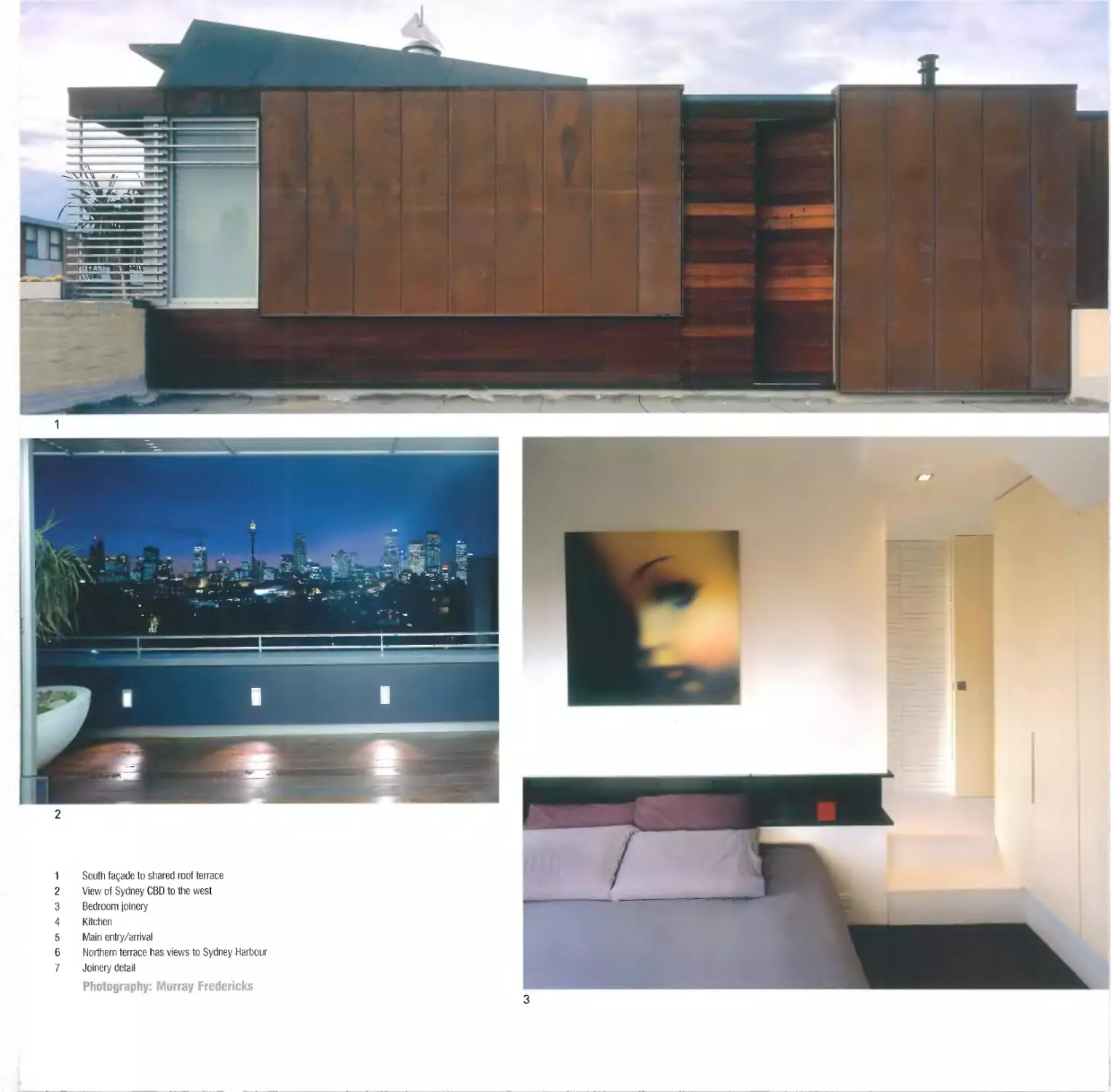
1	South facade to shared roof terrace
2	View of Sydney CBD to the west
3	Bedroom joinery
4	Kitchen
5	Main entry/arrival
6	Northern terrace has views to Sydney Harbour
7	Joinery detail
Photography: Murray Fredericks
3
CHALLIS PENTHOUSE
mac-interactive
This residence began as a one-bedroom apartment on the top floor
of a 1930’s residential block. It was transformed into a two-bedroom
penthouse by knocking a hole through the existing roof and building
a new 'pavilion' on the existing flat roof. This new pavilion at the
north side of the building has uninterrupted views to the west that
include Sydney Harbour and the city skyline. < The structure is a
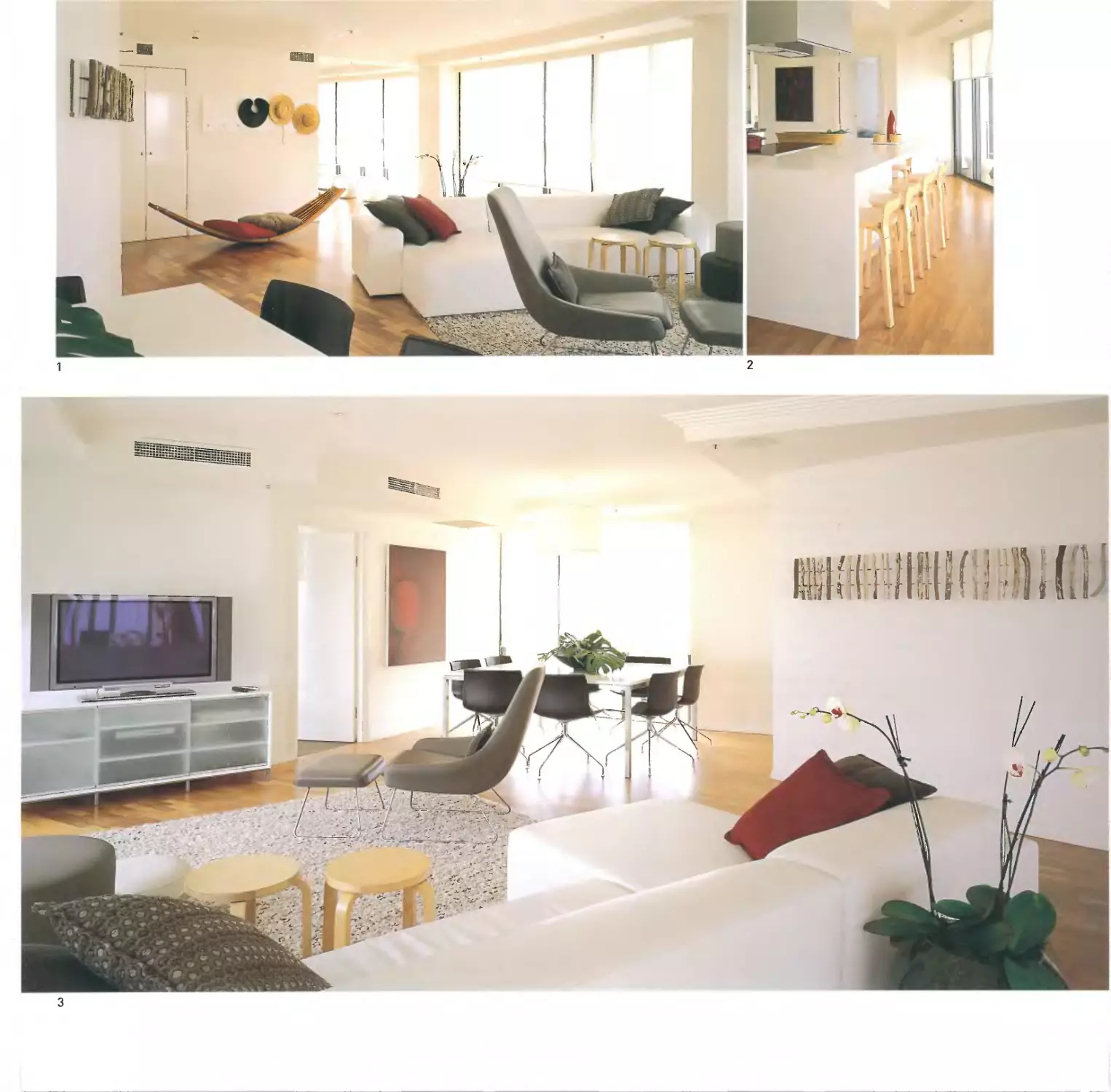
lightweight steel frame, prefabricated off-site, erected and then
dismantled, to speed up construction, minimise site times, crane
costs and disturbance to local residents. It is also part of the desire
to 'tread lightly' and promote sustainable design. • By presenting
a fairly solid elevation to the south and east sides, the new extension
protects the privacy of the new owners, the immediate neighbours
and other residents using the common area immediately to the
south. These two facades to the south and east are clad in a palette
of flush-seam copper, recycled timber and opalescent white glass.
The other two facades to the north and west are completely
glazed and slide away to open this level up to the wraparound
terrace and the views and also provide fantastic opportunities for
natural cross-ventilation. In this open configuration the roof acts
like a giant shade structure. • The roof is set back from the main
volume of the pavilion and is 'lifted up' to emphasise the lightweight
nature of the design (through the use of clerestory glazing) and to
form a connection to the sky. This also allows any solar heat
build up to escape naturally. • This natural ventilation is further
assisted by treating the staircase as a chimney, 'roofed' over with
a grille to minimise loss of floor space. The grille also coincides
with the location of the gas fireplace, which means that in winter
the heat is circulated much faster than normal through natural
convection currents.
Hfli
59
2
CHAMELEON
CASSANDRA CO
The site is a turn-of-the-century industrial warehouse in a
homogenous strip of six in inner-city Melbourne. The building sits
hard up against the street, metaphorically interpreting Walter
Benjamin’s suggestion of culture being most dynamic when the veil
is thinnest. There is no threshold here, no front yard. Thus, a
secondary internal veil was installed by way of a perforated gold
door. The new door suggests the beginning of a reimagined history
embedded within the discarded object that previously housed an
auto electrical business and before that, a confectionery factory. •
The brief was to design and construct a space that is deliberate and
uncertain, to extend private imperatives into a public domain, using
architecture as the medium. The ultimate aim was to represent the
client's desired autonomy in a spiralling world, while maintaining
the physical integrity of the warehouse. • A tour of the house
begins with the kitchen, which can be viewed from the main living
space, through a slice of the glowing r uby’. Continuing the tour, to
the right is a storeroom, followed by the second bathroom (a
combination of reflecting mirrors) to the left, the bedroom wing and
then finally the kitchen. The bedroom occupies the southwest
corner, which links through to the main bathroom via a walk-
through dressing space with openings. A large rhomboid bath links
the bathroom to the living space, dissolving conventional
separation; the shower screen is a large lightweight gate. The acute
angle of the bedroom is negated by a mirrored wall with a window
appearing to float in space. • On the mezzanine level, one is
perched up above the 'ruby' within the cosy cinema space and a
guest quarter. Continuing up to the roof deck, one finds a hammock,
a spa, a barbeque and stunning views across the city of Melbourne.
3
5
1	Mezzanine
2	Entry with perforated gold door
3	Street context
4	Level one floor plan
5	Mezzanine floor plan
61
6
7

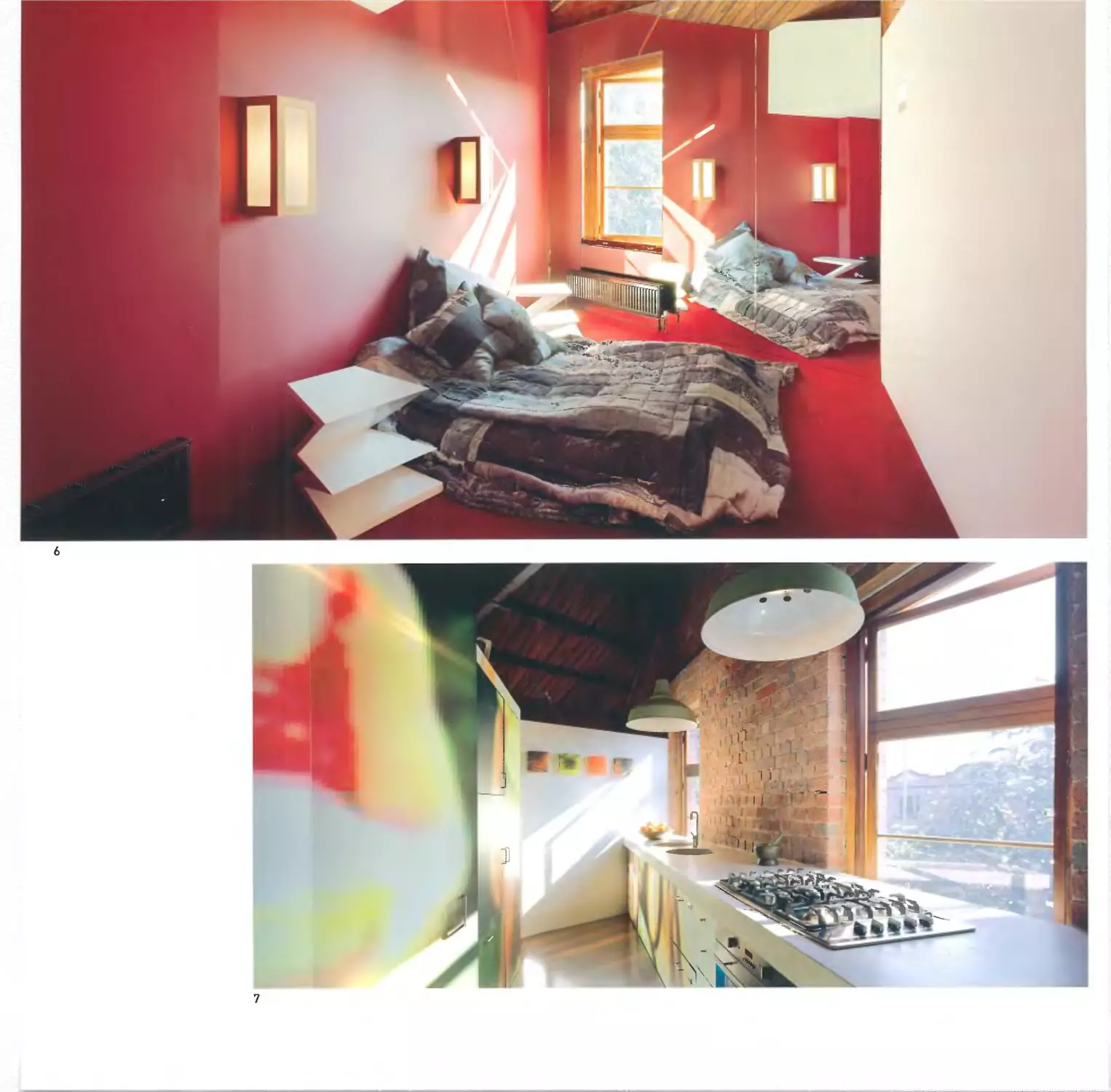
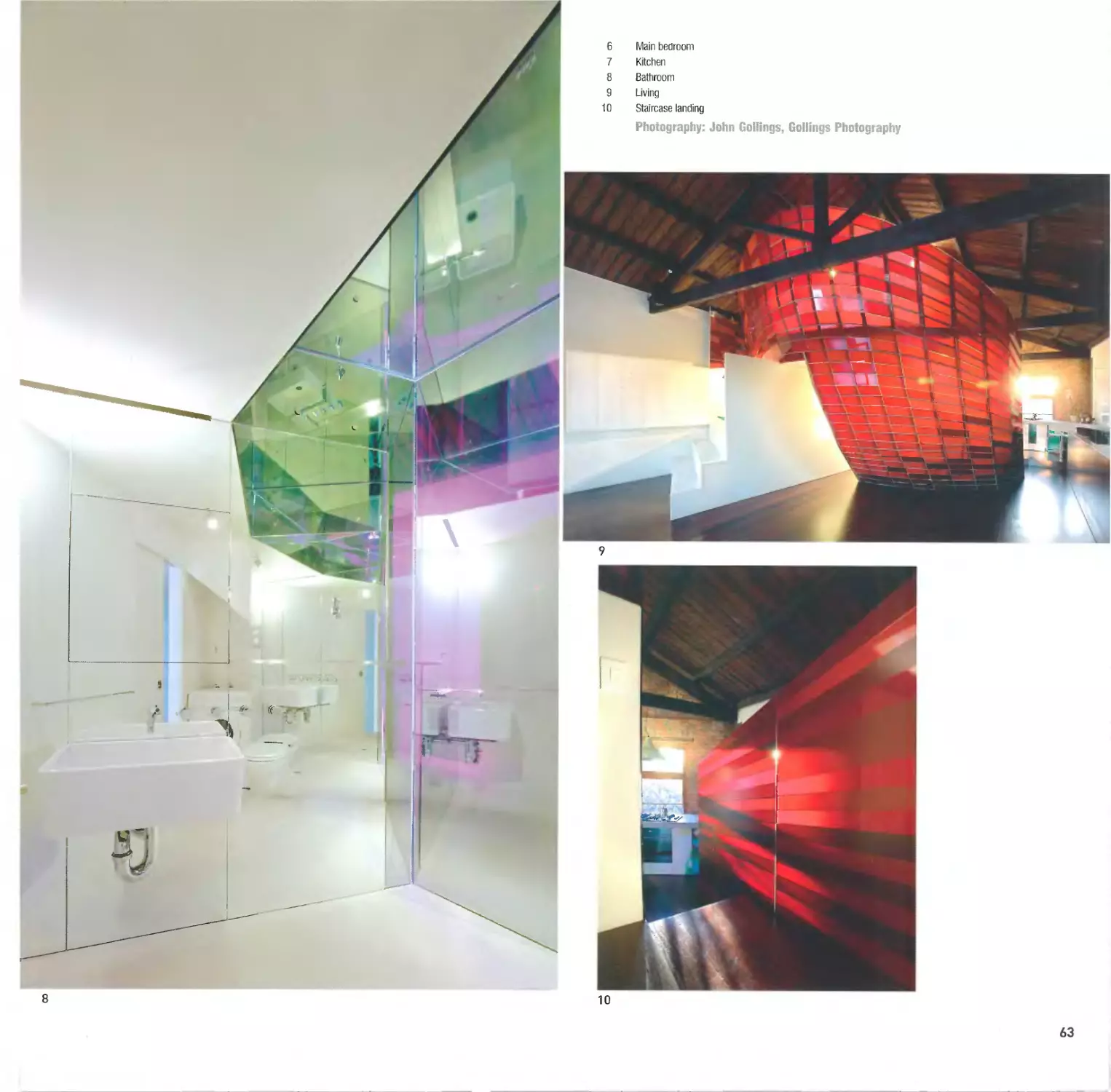
6	Main bedroom
7	Kitchen
8	Bathroom
9	Living
10	Staircase landing
Photography: John Golfings, Golfings Photography
10
63

CITY BEACH HOUSE
CROUDACE ARCHITECTS
The brief was for a single-storey, modern home for a young family
that is keen on entertaining. The unusually shaped site became a
generator for the design, and the idea of spreading the house across
the block evolved. One notion was to surround the house with
garden so that from any room one could see garden on more than
one side. Six separate outdoor courtyards resulted, all with different
feels, providing a variety of outdoor living spaces. • Because the
site dropped away from the road, the front end of the site was
raised, giving the single-storey building more height and more
street presence. This also generated some opportunities by
allowing a level change inside the house and also kept the garage
below the street level, reducing its presence. • The notion of
increasing privacy as one moves into the site generated further
ideas. The feature limestone wall on the street facade partly
screens the garage, provides a notional gateway and partial
separation to the entry court and softens the approach with the use
of natural material. The garage and master bedroom provided the
next separating element between public and private space and this
was a significant separation. Once beyond this point, one is
completely separated from the street. • The children’s bedroom
wing provided the final separation between the main courtyard and
the children’s ’backyard cricket’ lawn. The masonry frames in the
large main courtyard provide a notion of enclosure for the outdoor
eating areas. • Materials were kept simple. Unitex was considered
a durable wall finish for the coastal location; cedar lining was used
under the eaves to provide some warmth in tone, where it would not
be prone to weathering. Compressed fibre cement sheeting as a
wall material under the roof and set back from the masonry below,
enhances the floating roof plane concept.
5
1	Kitchen and family
2	Bathroom
3	Dining
4	Lounge
5	Master bedroom
6	Cellar
7	Entry
1	Interior curved wall
2	Main courtyard frames
3	Street fagade
4	Indoor/outdoor relationships
5	Family room and kitchen
6	Floor plan
ly: Adrian Lambert, Acorn Photo Agency
13
6
8 Study
9 Bedroom
10 Outdoor living area
14
65
1 4
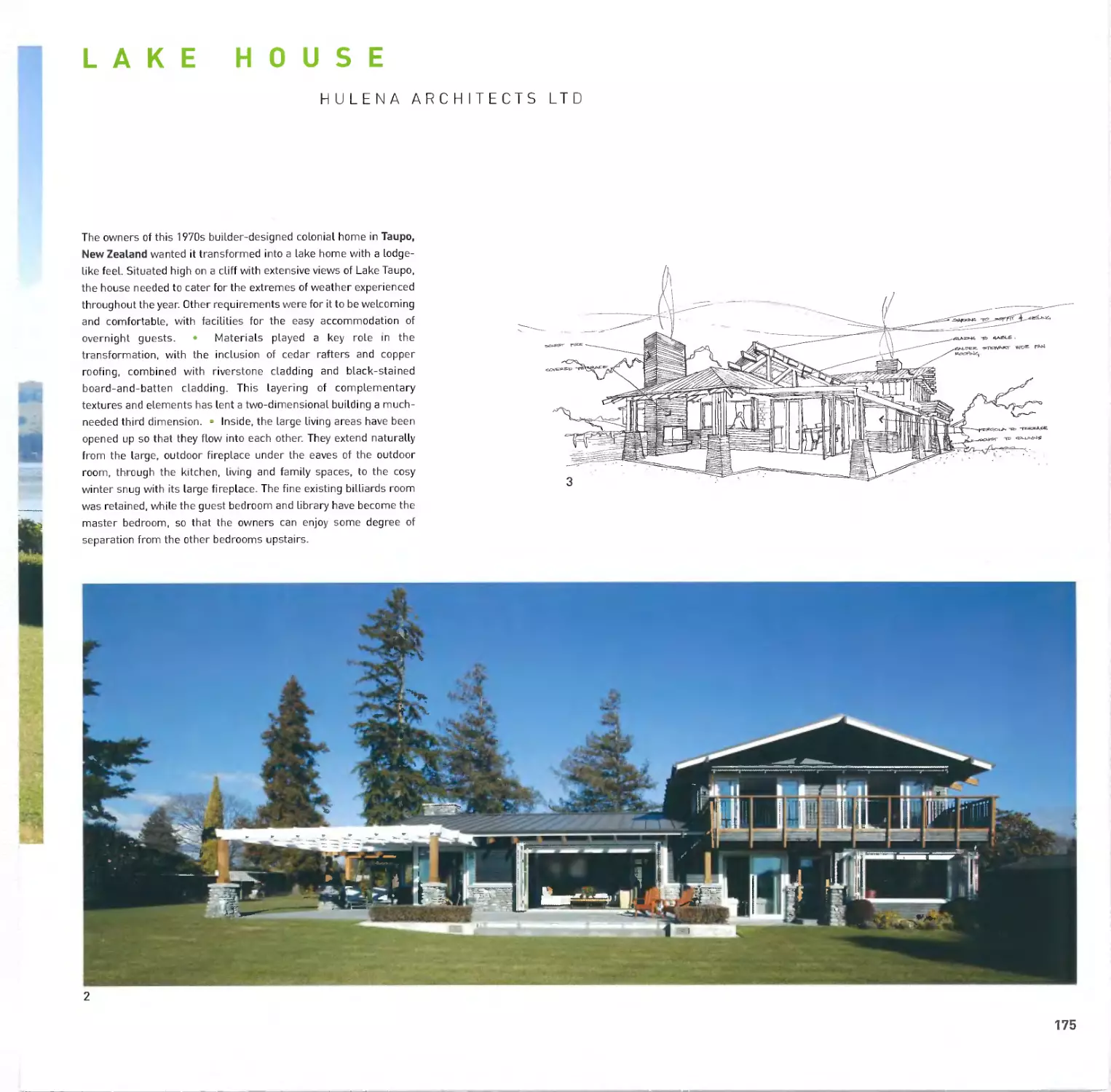
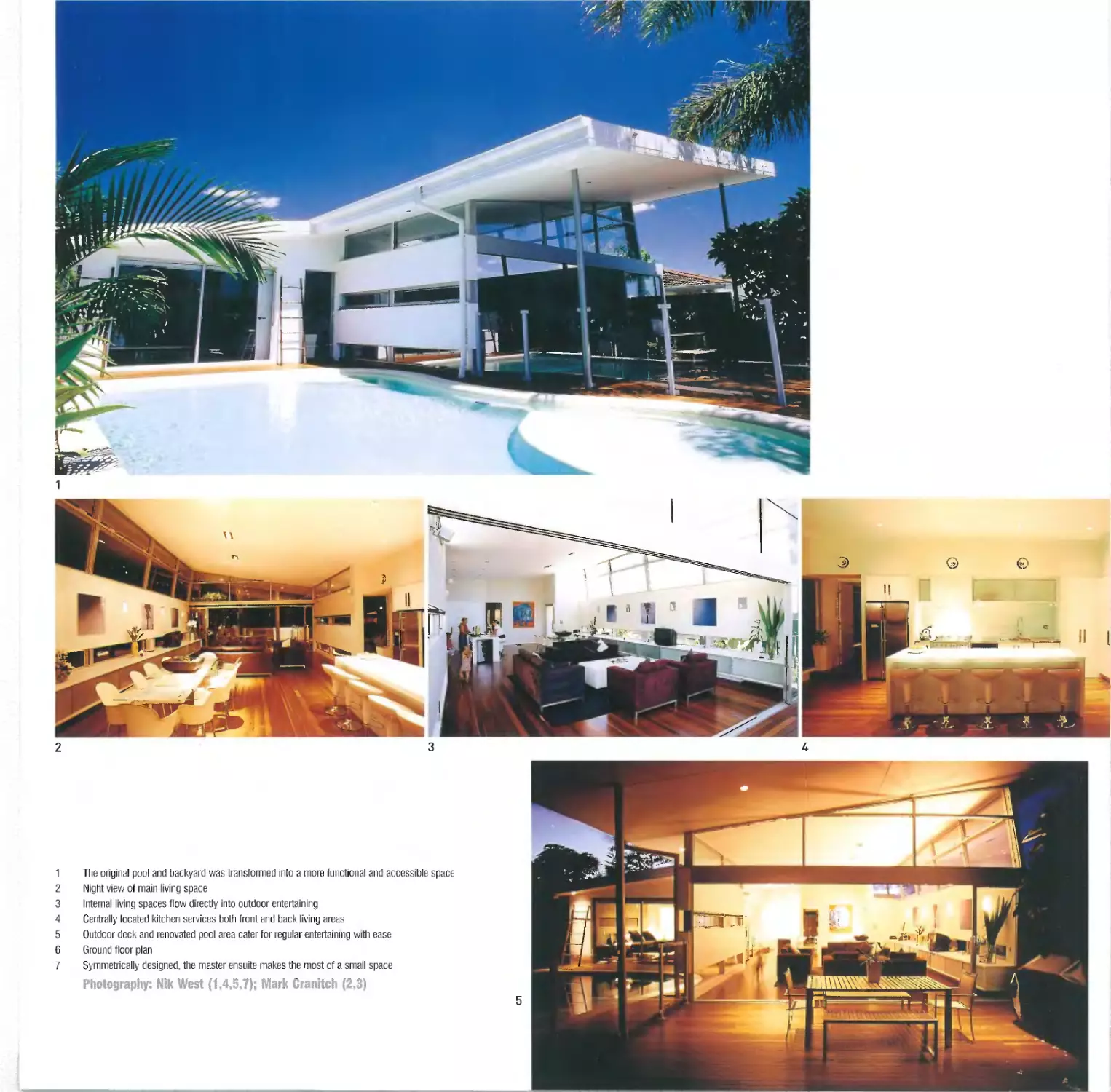
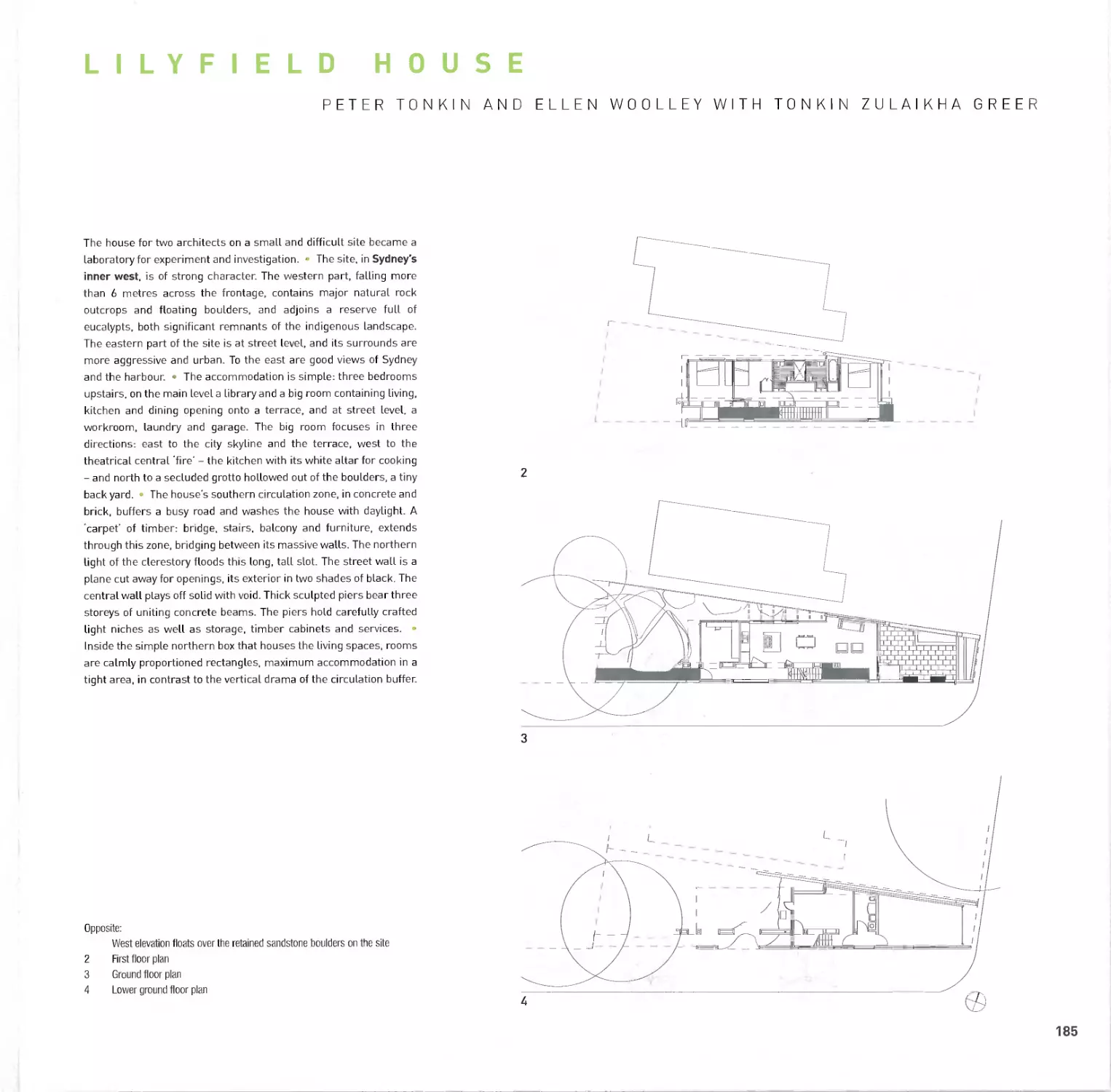
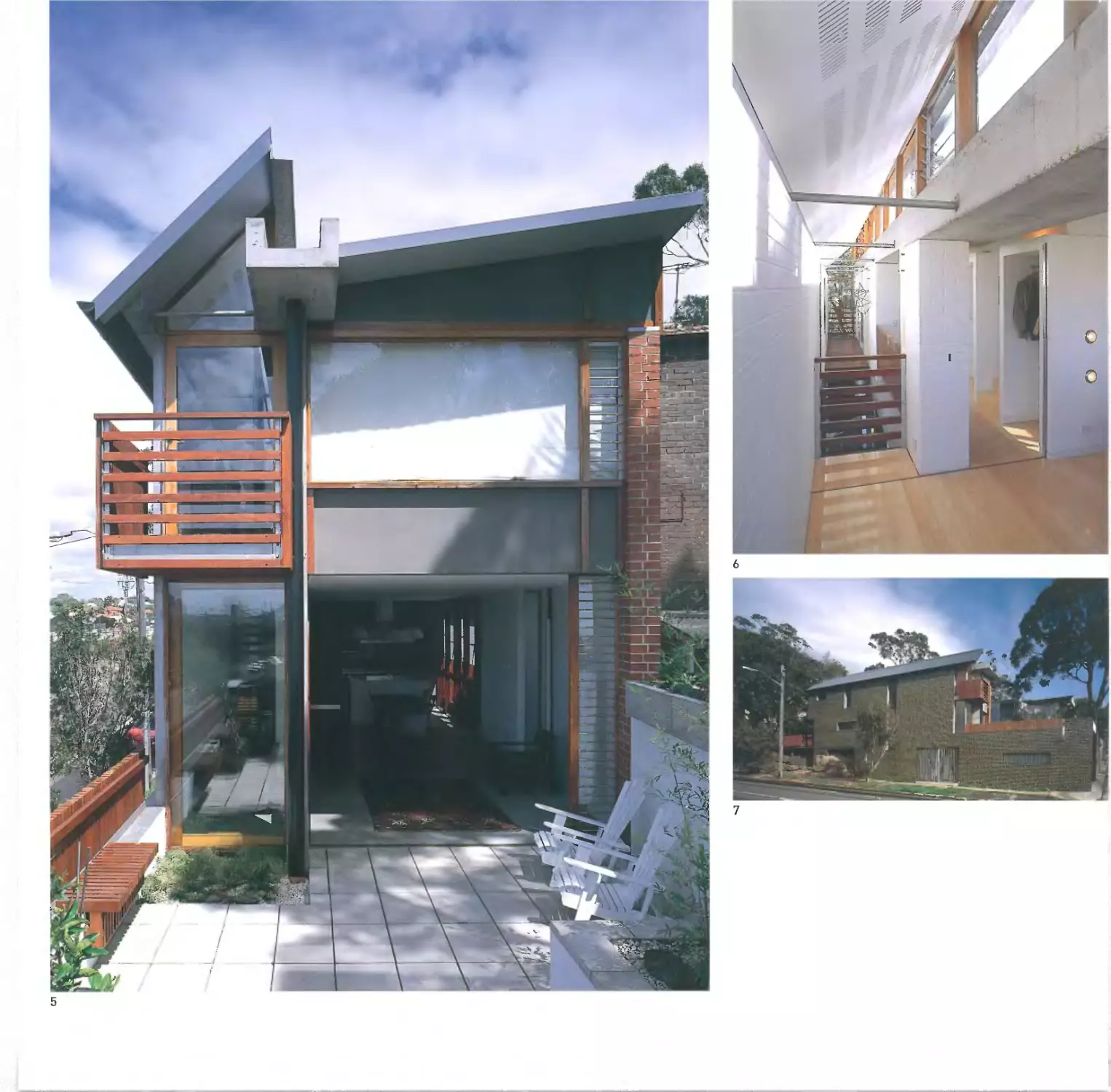
CLARKE-MACLEOD
BLIGH VOLLER NIEL
This house, in Taringa, Queensland is closely linked to the design
and construction philosophies of California’s 'Case Study’
programme ol the 1950s and 1960s, overlaid with today’s concern
for sustainable architecture. The Case Study programme included
design based upon a standardisation of details, the use of
prefabricated steel construction, and an emphasis on assembly
techniques and construction details driving the visual outcome of
the design. It is what Renzo Piano refers to as architecture created
'piece by piece’ whereby the joy and finesse in detail determines
a craft-like outcome. • The house takes standard, off-the peg
components such as pro-galvanised steel box sections to make the
primary steel frame. However, these are thoughtfully detailed with
internal bolted connections to create both the visual simplicity of
mitred joints and a more durable solution where the welded and
painted steel plates remain weather-tight and hidden within the
steel box sections. Floor joists and roof purlins are made from
galvanised tophat sections which are both lighter and stronger than
timber and require a very basic form of fixing with power driven tek-
screws into the primary steel frame (cleats and bolts were not
needed). • The use of standard products pre-cut and assembled on
site resulted in considerable economy with the steel frame
constructed for around $10,000. The assembly process was so
simple, and the frame so lightweight, that it was completed by two
workmen over five days. Ironically, the builder and other workmen
were carpenters by trade but found no difficulties in working with
the various steel elements. • Apart from the steel framing
elements wall cladding, both internally and externally, consists of
finely corrugated thin sheet steel materials pre-cut and pre-
finished prior to assembly on site The result is a high standard of
finish and minimal time on site. The external cladding is left as a
silver zincalume finish, whereas the interior wall and ceiling panels
are pre-finished white with fine perforations to absorb sound and
make a more liveable interior.
HOUSE
1	North-facing verandah space for outdoor living
2	Double-height interior living space
3	Site and ground floor plan
67


8

4	External dining area
5	East garden elevation
6	Night view highlights double-height living	space
7	Stair constructed as stressed-skin box sections
8	Living area
9	Vertical proportions reflect those of surrounding trees
Photography: I n Linkins
69
т
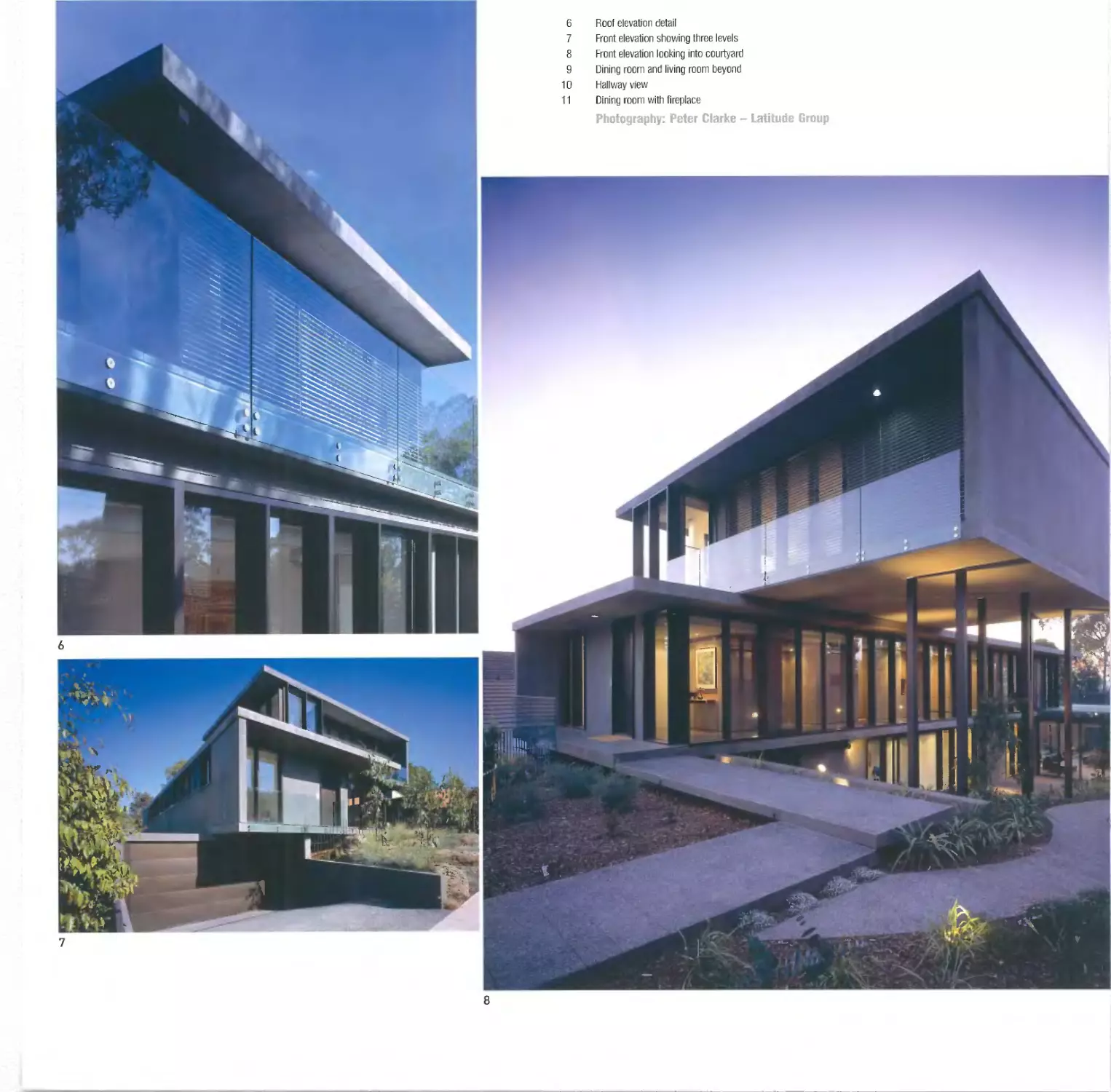
CONCRETE RESIDENCE
INARC ARCHITECTS
This 520-square-metre house uses the language of the cantilevered
box forms of the surrounding Studley Park neighbourhood. These
forms are cut into the site slope allowing views into the courtyard,
as well as satisfying the clients' spatial requirements and
minimising front elevation bulk. The middle level is aligned to
maximise north light and to look towards the west; the topmost
level provides views of Melbourne. • The house protects itself from
the thermal environment by a highly insulated outer shell of
concrete walls, roof and floors. To control heat loss and to minimise
the requirement of internal blinds at night, double glazing was
adopted throughout. External motorised blinds were installed to
windows facing the east-west views, also providing privacy. •
North-facing windows are shaded via cantilevered concrete eaves or
by the offset floor above. The narrow shape of the rectangular
building blocks, with external doors and windows on both sides of
the building, allow for efficient cross-ventilation. • Green-grey
concrete is used for the landscaping, walls and floor slabs, as well
as the roofs that are covered in crushed bluestone rocks. The dark
bronze metal components, glass, continuous external blinds and
frameless balustrades form simple, serene planes that contrast
with the tension created by the misalignment of the three levels and
the placement of the top level on six slender columns. • The
concrete used in this project had many functions: structure,
waterproofing, thermal barrier and outer finished face. The
aesthetic demands made of the concrete were probably the biggest
departure from its standard commercial use. To visible faces, a
green oxide pigment was added to temper the greyness. All visible
edges were to be sharp right angles without the usual chamfer. Air
bubbles in the outer face were encouraged in order to give the
concrete the natural-looking random variation that is often
associated with stone.
3
Opposite:
Looking east from path within northern garden
2	Front	elevation	night view
3	Level	three floor plan
4	Level	two floor	plan
5	Level	one floor	plan
1	Garage
2	Workshop
3	Office
4	Bedroom 3
5	Art room
6	Spa
7	Media room
8	Plant room
9	Entry
10	Bedroom 2
11	Laundry
12	Store
13	Kitchen
14	Dining
15	Living
16	Terrace
17	Bedroom 1
18	Dressing room
2
71
8
6	Roof elevation	detail
7	Front elevation	showing three	levels
8	Front elevation	looking	into courtyard
9	Dining room and living room beyond
10	Hallway view
11	Dining room with fireplace
Photography: Peter Clarke - Latitude Group


2
1	View from first-floor breezeway
2	Beach from first-floor deck
3	West courtyard with outdoor fireplace
4	Kitchen features granite bench top, jarrah cabinetry,
coloured concrete floor
5	North elevation from	beach
6	First-floor deck from	north bedroom
7	First floor plan
8	Ground floor plan
Photography: courtesy
Rachel Venables Design
4
3
5
COROMANDEL HOUSE
RACHEL VENABLES DESIGN
This new beachfront home is on the Coromandel Peninsula on New
Zealand’s North Island. The clients’ brief was for a holiday home
that will become a permanent home when they retire. Sea views to
the north and hill views to the southwest were a prime
consideration. • The ’H’ shape of the ground-floor plan was
designed to create courtyards on each side of the central hall and
gallery, which together with a long return verandah on the sea and
north faces, provide a range of sheltered outdoor areas for varying
weather conditions. The long low pitch of the roof recalls the New
Zealand woolshed and the whare nui (Maori 'meeting house'), and is
stylistically influenced by the Cape Cod beach houses of North
America, and aspects of the New Zealand version of the Californian
bungalow. The upstairs wing incorporates bedrooms and a deck,
with smaller decks off the two dormers to the bedrooms. The
exterior is clad in painted cedar weatherboards, with Hinuera stone
to the entry (bridging exterior and interior) and to the interior
fireplace.
1	Entry
2	Bathroom
3	Bedroom
4	Bedroom
5	West courtyard
6	Living
7	Dining
8	Kitchen
9	Pantry
10	Bedroom
11	Surfboard storage
12	Service courtyard
13	Outdoor shower
14	Laundry
15	Hall
16	Bathroom
17	Bedroom
18	Terrace
19	Terrace
20	Bedroom
21	Terrace
22	Dressing
6
75

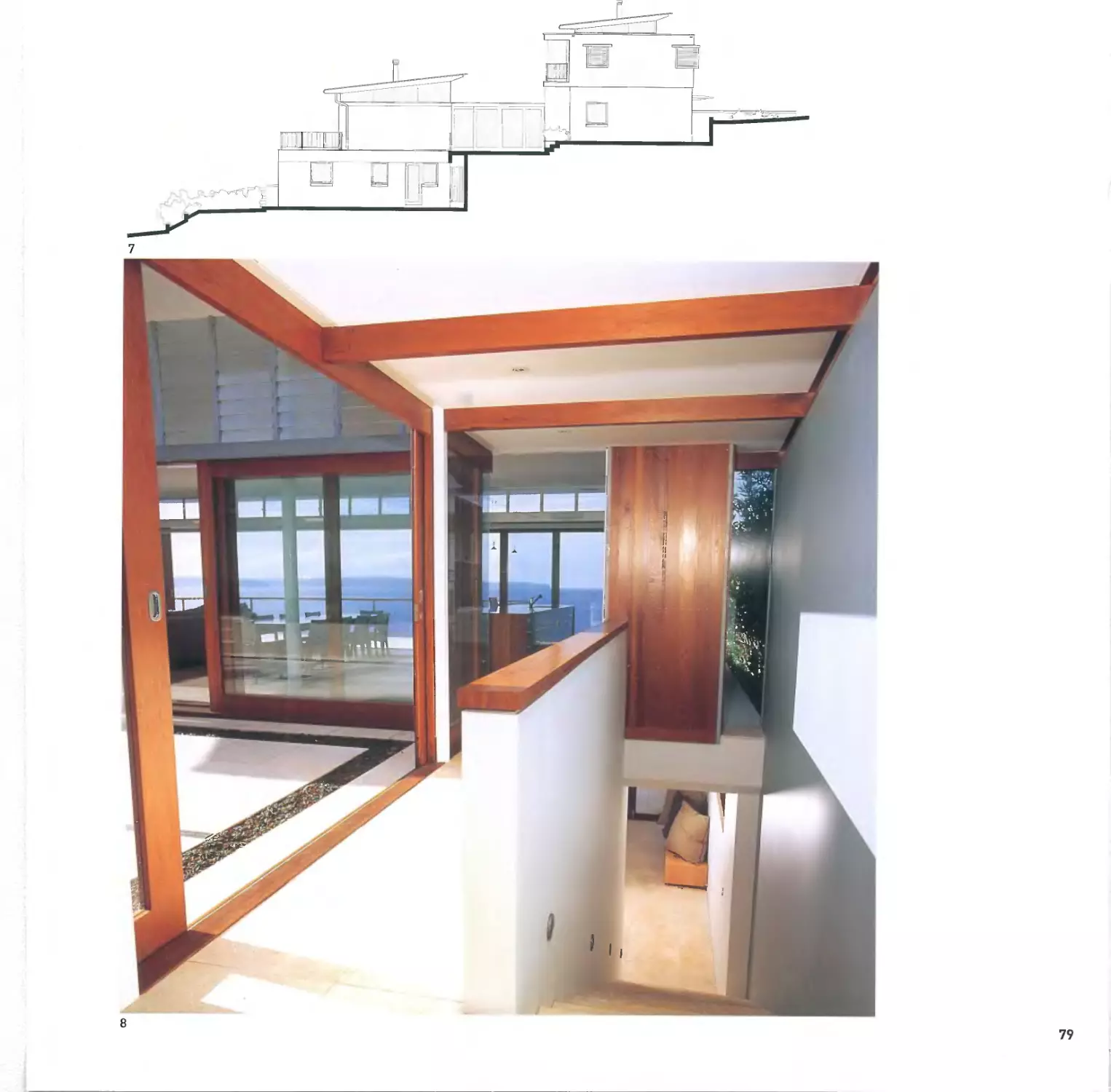
COURTYARD HOUSE
UTZ-SAN BY ARCHITECTS
The cliff-top site faces northeast and overlooks the Pacific Ocean.
The views are dramatic and the proximity to the rock shelf and
ocean below provides an ever-changing backdrop for the house.
The building was split into two pavilions, surrounding and enclosing
a central courtyard, which then became the focal point for the
design and a natural extension of the main living spaces. To reduce
the overall bulk and height of the house some excavation was
required to dig the lower pavilion into the slope of the site. Both
pavilions have a solid base with a lighter construction for the second
storey, which echoes a similar vernacular in the area. • The two
pavilions are linked by a single circulation spine, defined by a
masonry wall running the entire length of the house. The wall rises
out of the landscaping and directs visitors towards the entrance
door, through the courtyard link to the main living pavilion beyond.
• Natural materials such as the recycled hardwood doors, and
western red cedar cladding were chosen to complement the
informal atmosphere of the house and as a reference to the
traditional beach house aesthetic prevalent in the area. The
courtyard, living room and terrace are all paved with natural
limestone so that the transition from inside to outside is seamless.
By limiting the amount of materials used, the courtyard remains a
calm and uncluttered space. • The two large aerofoil roofs are
important elements in the overall design. They appear to 'float'
above the timber-clad pavilions. This was achieved by supporting
the roof plane on eight columns, which are tied together at door
head height by a steel ring beam. Above this, all four sides of the
pavilion are glazed. This is accentuated at night when the roofs are
up-lit from below.
Opposite:
View of courtyard, looking through living pavilion to the horizon beyond
2	View from street, showing upper and lower pavilions
3	View from upper level bedrooms through living room to ocean view and
rock shelf below
77
5
4	Looking through living room to courtyard with upper pavilion beyond
5	Detail of dining area and kitchen at the southern end of the room
6	Ensuite bathroom: all four ensuites are identical and can be completely
opened to the bedroom and views
7	North elevation
8	View from entrance showing stair to lower level and link to the living
pavilion adjoining the courtyard
Photography: Marian Riabic
6
6Z.
8
L

THE CRAY SHED
KO I A ARCHITECTS
What are the components of a perfect holiday home? Ample room
for friends and family to congregate, and large, sheltered outdoor
living spaces are at the top of most lists. So it was with The Cray
Shed, a 400-square-metre holiday home at Pauanui, on the
beautiful Coromandel Peninsula. A south-facing building site close
to its neighbours, and the requirement that the house be large
enough for two families to enjoy, posed some interesting
challenges. • The solution was inspired by the simple shape of a
boatshed, reflecting its waterfront location. It presents a secure face
to the street, with the living spaces opening towards the canal. Full-
height sliding doors offer views through the house and out over the
water, admitting lots of light into the home despite its difficult
orientation. Another key feature is the double-sided open fireplace,
allowing visibility to and from the canal. A big enclosed courtyard,
again with an open fireplace, is tailor-made for entertaining al
fresco. Wrapped around on three sides by the house, and with a high
wall closing off the fourth side, it offers peace, privacy and
protection from the prevailing southerly wind.
2
Opposite:
Landscaping is planned as a number of planted and hard surfaced terraces
allowing for generous entertainment areas and the occasional high tide
2	View from canal
3	First floor plan
4	Ground floor plan
X"
4
1	Bedroom	6	TV/guest	11	Living	16	Shower
2	Ensuite	7	Hall	12	Fire	17	Terrace
3	Laundry	8	WC	13	Courtyard	18	Spa
4	Garage	9	Kitchen	14	Dive store	19	Ramp
5	Entry	10	Dining	15	Fish preparation	20	Pontoon
81
5	The double-sided fire is enjoyable whether sitting inside or out
6	The sunny, sheltered courtyard provides a spot for year-round entertainment
7	The living room is transparent to allow maximum views of the canal
8	Retractable doors to both sides create a tent-like living area
9	Cosy living
10	Indoor entertainment
Photography: Kalian MacLeod; photographs provided courtesy
of Trends Publishing international


9	10
83

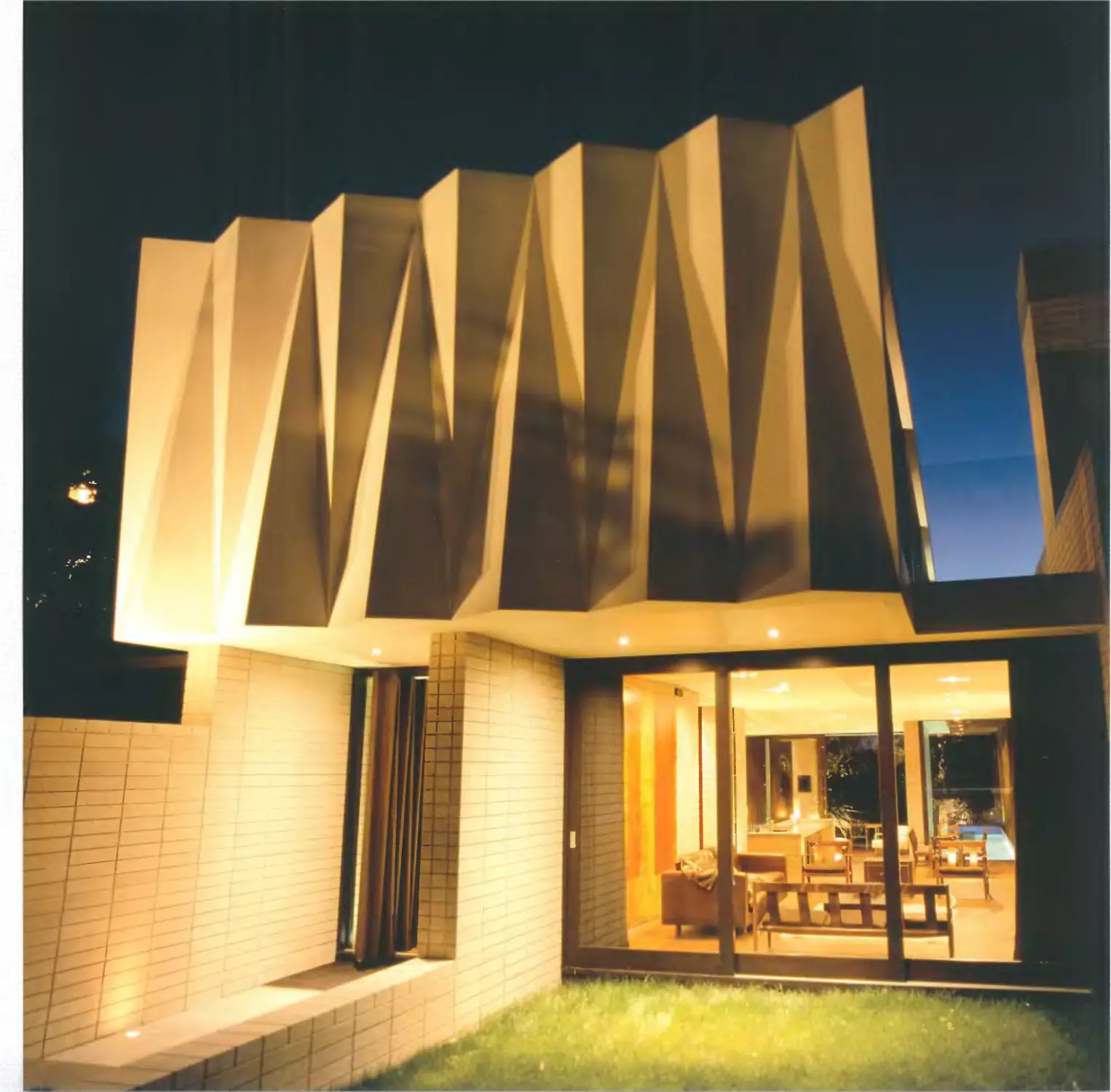
CREMORNE STREET HOUSE
STEVENS LAWSON ARCHITECTS
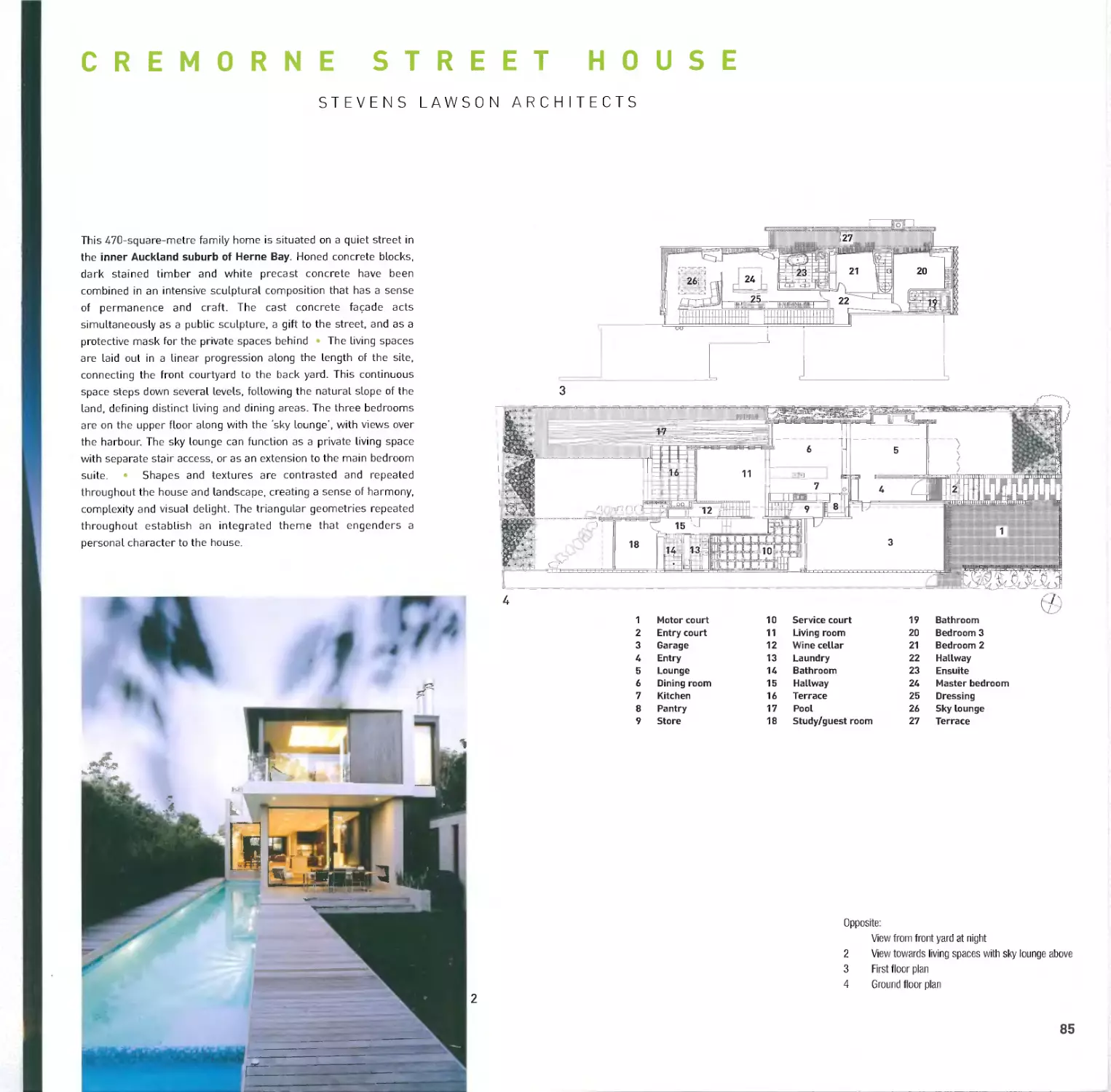
This 470-square-metre family home is situated on a quiet street in
the inner Auckland suburb of Herne Bay. Honed concrete blocks,
dark stained timber and white precast concrete have been
combined in an intensive sculptural composition that has a sense
of permanence and craft. The cast concrete facade acts
simultaneously as a public sculpture, a gift to the street, and as a
protective mask for the private spaces behind • The living spaces
are laid out in a linear progression along the length of the site,
connecting the front courtyard to the back yard. This continuous
space steps down several levels, following the natural slope of the
land, defining distinct living and dining areas. The three bedrooms
are on the upper floor along with the sky lounge', with views over
the harbour. The sky lounge can function as a private living space
with separate stair access, or as an extension to the main bedroom
suite. • Shapes and textures are contrasted and repeated
throughout the house and landscape, creating a sense of harmony,
complexity and visual delight. The triangular geometries repeated
throughout establish an integrated theme that engenders a
personal character to the house.
4
	1	Motor court	10	Service court	19	Bathroom
	2	Entry court	11	Living room	20	Bedroom 3
	3	Garage	12	Wine cellar	21	Bedroom 2
	4	Entry	13	Laundry	22	Hallway
	5	Lounge	14	Bathroom	23	Ensuite
	6	Dining room	15	Hallway	24	Master bedroom
	7	Kitchen	16	Terrace	25	Dressing
	8	Pantry	17	Pool	26	Sky lounge
	9	Store	18	Study/guest room	27	Terrace
Opposite:
View from front yard at night
2	View towards living spaces with sky lounge above
3	First floor plan
4	Ground floor plan
85
5
6
7
8
9
Kitchen area with living beyond
Main bedroom, dressing and ensuite area
The main ensuite, bedroom and sky
lounge connect together
View of house from courtyard off study
Kitchen and dining area with living and
pool beyond
Photography: Mark Smith
7
8

4
CUMBERLAND PARK RESIDENCE
STUDIO 9 ARCHITECTS
The client requested a renovation and addition to this Art Deco
bungalow in the Adelaide suburbs. The brief was to address a
modern, family-oriented lifestyle, providing flexible living spaces,
access to light, and a flow from indoors to outdoors. The existing
house was a series of enclosed box-like rooms with poor, indirect
access to the north-facing backyard. This portion of the house was
turned over to the sleeping containers. The central corridor
separates the children's area from the parents' suite, which
incorporates a study/reading area and ensuite off the main
bedroom. The children's bedrooms and bathroom were renovated.
• The addition was intended to provide a contrast to the existing
series of rooms. The modernist pavilion has a strong linear axis
leading from the old to new, and utilises different volumes for
different functions. The living and dining areas have a skillion roof,
springing off the masonry wall providing volume and top light; these
spaces are designed for enjoying life and entertaining family and
friends in meals and celebration. The horizontal qualities of the
kitchen suggest retreat, a place for the focused activity of food
preparation. During the design process, passive solar techniques
were acknowledged. Roof overhangs at the higher level and the
balanced bulkhead/verandah and pergolas limit sun penetration on
the lower-level glass during summer and the shoulder seasons.
Durable materials, seen as a positive sustainability principle, were
selected. Windows and skylights allow a high level of light gain,
reducing the reliance upon artificial lighting. Operable sashes allow
a high level of ventilation, with the notion of creating front to rear air
circulation. The pitched roof has a reflective surface and is angled
away from the west to reduce solar heat gain.
6
1	Night view of principal pavilion
2	Dining terrace and living area linked by folding doors
3	Kitchen
4	Bulkhead linking new to existing and indoor to outdoor
5	External view of principal	pavilion and dining terrace
6	Floor plan indicating new	works from existing
7	Timber floor in renovated	bathroom was part of the	original hallway
PI t( raphy: Sa .	. Photography
5
89
1
1	Bifold doors link family room to	pool
2	Front faqade is a collection of	box-like forms
3	Ground floor plan
4	First floor plan

DALMAN HOUSE
DALMAN ARCH ITECTU RE
This 350-square-metre home for an architect and his family is
located in Papanui, Christchurch. This site is close to town and is
large enough to accommodate a tennis court and play areas for
growing children. The court fits perfectly along the northeast
boundary and was one of the reasons the section was purchased.
With the tennis court position decided, the house itself was pushed
as far as possible to the southern corner so that it maximised the
northern outdoor living areas. • The plan of the house forms a
cross on the site. The main axis consists of the main entry alongside
the living room with a garage and shed to one side, and the family
room with kitchen to the other. It is split by the other axis consisting
of the walled courtyard and living room. The main circulation is
located where the two axes cross. Sleeping areas have been located
upstairs with separate wings for children and adults. • The living
room was orientated towards one of the few landmarks in the area
- a stand of very tall poplars which unfortunately have subsequently
been cut down. It opens up to views through each end, and the side
window provides views to a long grouping of deciduous trees which
is one of the key aspects of the area. The overhang acts as a high-
level verandah. • The construction is essentially two honed
concrete block boxes, with a zincalume-clad central wing and
bedroom container insertions into these boxes. The roof is butynol
on insulated panel. Concrete floors throughout the ground floor
provide a practical and cost-effective floor finish. < The styling is
deliberately modernist but not minimalist. This is a family house
that needs to be practical for growing children. While most walls are
white, splashes of colour are provided by bright artwork, rugs and
some highlighted wall finishes.
3
2
1	Shed	12	Ensuite
2	Garage	13	Dressing room
3	Entry	14	Balcony
4	WC	15	Master bedroom
5	Laundry	16	Study
6	Gallery	17	Void
7	Living	18	Gallery
8	Terrace	19	Kids' living
9	Dining	20	Bedroom
10	Kitchen	21	Bathroom
11	Family living	22	WC
91
I

5	Family room with children's bedrooms above
6	Artwork and a blue rug provide colour to the living room
7	Zincalume bedroom containers float above the family room and pool
8	Family room incorporates a black granite kitchen
9	Walled courtyard looking through the gallery
10	Entrance court with master bedroom balcony floating above
Photography: Patrick Reynolds
9
10
8
93
2
3
4
DRY HILLS HOUSE
ARCHITECTURE WORKSHOP
This house is situated on the outskirts of Blenheim, at the foot of the
Withers dryhills. The long gable and faded cedar facade is the
architects’ man-made attempt to integrate with this local
landscape. The envelope looks at combining the principles of
rainscreen with an insulated thermal mass The aim was to explore
whether the climate could be controlled with the envelope rather
than rely on an additional shade structure such as a verandah. A
larger, more defined outdoor room, overlapping with kitchen dining
and the formal living areas, is enclosed by the roof and the
rainscreen wall and supports outdoor living away from the
prevailing wind. • The client wanted a bagged blockwork finish,
coloured to match the hills and the coloured insitu concrete floor.
The resulting freestanding internal solid walls, on the major
longitudinal gridlines of the house, also continue into the
landscape. The roof loads are supported on the blockwork by a ply-
clad insulated timber frame. • The western red cedar exterior
rainscreen reduces the weather load, protects the inner layer from
the effects of strong sunlight and forms a cocoon of calmer air
around the house that also assists insulation. It also shades the
clerestory windows, reducing the heat gain while still allowing a
filtered high light into the interior. • The exposed concrete
blockwork, set to a 2.2-metre datum throughout, acts as a thermal
flywheel, reducing the daily heat peaks and re-radiating this energy
at night. Hopper-hung windows at the gable peaks are operable,
allowing cross-ventilation at a high level. • The sliding doors with
cedar shutters are detailed to fit in the cavity between the heavy
and lighter layers. The 400-millimetre wall thickness adds a
pleasing perception of protection to the occupants. From the
outside, the house has a more ethereal, less solid presence in the
dry landscape
5
1	Overlapping gable roofs
2	Diagonal view from	living to dining
3	North side outdoor room
4	Elevation against dry hills shows a more ethereal presence in the landscape
5	Central gallery
6	Bathroom interior
6
95
I I i i l i i
1	Western view against the dry hills
8	Filtered light through the clerestory windows
9	Eastern opening to kitchen/dining
10	External fireplace to outdoor room with formal living beyond
11	Outdoor room looking east
Photography: Stephen Goodenough
8

1
2
EAST MELBOURNE RESIDENCE
I NARC ARCHITECTS
This three-level town house in East Melbourne was built in the early
1990s as an urban infill but suffered from poor design and sub-
standard finishes. The building was divided into small rooms and
lacked natural daylight in the ground-floor living areas. There was
also a serious problem with heat gain from the east and west
elevations during the summer. Access to the rear garden was via a
single door at the end of a light well. On the positive side, the
property boasted a good-sized rear garden and a double garage off
a rear right-of-way. • The objective was to provide unimpeded
views into the rear courtyard garden from the living areas. The
kitchen has been relocated to the front of the house and the laundry
has been moved to the basement/cellar. The courtyard garden has
become an extension of the living space with a large sliding glass
panel connecting the interior with the redesigned exterior. The
clean open plan of the ground floor was achieved by supporting the
southeast corner of the first and second storeys with a series of
transfer beams. The first-storey floor of the original light well was
removed to create the three-level, skylit atrium. • The installation
of motorised external aluminium louvres has substantially cut down
the heat load on the east and west elevations of the building. All the
existing timber-framed windows were replaced with aluminium-
framed. double-glazed units. This promotes heat retention in winter
and also significantly reduces the ambient traffic and city noise. The
ground floor polished bluestone floor acts as a heat sink in the
winter when exposed to the morning sun and also acts as a unifying
element over the three changes of level from the front entry door to
the rear sitting area.
1	West elevation
2	Rear courtyard garden
3	Living area with garden	beyond
4	Second floor plan
5	First floor plan
6	Ground floor plan
7	Basement floor plan
99
3
12
13
8	Dining area looking towards kitchen
9	Master bedroom ensuite bathroom looking into atrium
10	Home office from stair void
11	Home office
12	Living area looking towards dining area
13	Living area from dining area with garden beyond
Photography: Peter Clarke - Latitude Group
101
2
3
FLORIDA BEACH HOUSE
ODDEN RODRIGUES ARCHITECTS
This was one of those rare occasions when clients consult their
architect about the purchase of a property. And it was also one of the
best 'finds’ in Western Australia's vast continuum of 'beachside'
suburb developments. • The property has its long side boundary
providing northern orientation over public open space, natural
dunes and the sea to the west, and is at the end of a cut de sac. •
A condition of purchase was the requirement that the building be
single-storey - to preserve the views of the properties behind - with
a minimum 20-degree pitched roof. < The 230-square-metre house
was constructed using conventional and economical materials. A
polished concrete floor throughout provides a surface that is both
aesthetically interesting and easy to maintain, and is the only
concession to luxury. • A series of reconstituted limestone block
piers stretch along the northern facade. Sliding past the front of the
limestone blocks are seven large aluminium-framed glass doors,
which can be opened to take full advantage of the cool ocean winds,
bringing the outside world in and opening the inside out towards the
beach. • The extensive glazed wall to the west, protected by its
6-metre-deep verandah, allows the living area to be intimately
connected with its surroundings and magnificent views of the
evening sunset. “ Appropriate overhangs to the eaves keep out the
unwanted summer sun, while the thermal mass and excellent wall-
to-opening ratio result in an internal climate that is comfortable all
year round.
1	View across deck to ocean
2	Aspect from top of dunes
3	Looking west towards the verandah and ocean
4	North elevation
5	Site and floor plan
7 WC2
8 Bathroom 2
9 Laundry
10 Kitchen
11 Living
12 Verandah
1 Driveway
2 Garage
3 Bedroom 1
4 Bathroom
5 Bedroom 2
6	Bedroom 3
103
7
6	Living area at night
1	Aspect from entry gate
8	Living area
9	View to kitchen from outside
10	Looking north towards the	dunes
Photography: Robert Frith, Acorn Photo Agency
10
105
1
FOLDED HOUSE
DALE JONES-EVANS PTY LTD ARCHITECTURE
By critically editing and dismembering parts of an (unlisted) historic
residence and outbuilding, the remaining space between the two
existing styles of architecture allowed for the careful insertion of a
new form. On this large hillside site in a beachside suburb of
Sydney a new origami-like architecture emerges as the calculated
placement generates a web of inside-outside spaces and knits
together a coherent plan for a new residence. • The existing
historic Victorian/ltatianate and Federation architecture is pruned
right back to essentials, the external architecture proudly restored
and the internal workings deliberately made moderne. The 1920's
verandah wings are reconfigured at their southern corners and new
translucent bookends housing wet areas symmetrically reframe a
newly revealed and imposing view of the historic residence at the
rear. • At this junction, a new architecture emerges: a copper-clad,
folded, origami-like growth out of, into and between the existing
modified structures. A linear perimeter plan encases a curvaceous
internal plan, which wraps into and anchors the kitchen. A series of
calculated external geometric folds radiate to form a hard shell
while the belly of ceilings drip and flow to form a new dynamic
internal space. The folded architectural form responds to climate:
north is an open, extended eave, west is low, deep and uses an
extended blade wall to control sun, while south is low and thick - a
cut-out to prevailing weather. The folds make dynamic sculptural
movements. • The new architecture acts as living hub - the former
historic residence houses sleeping and bathing and the outbuilding
comprises play space and a garage. The new external spaces are
critical to the composition, from a green formal avenue at the entry,
through two courts nestled between the built forms, one a garden
the other a pool terrace and out to the back yard.
1	South elevation at dusk
2	Floor plan
107
5
6
3	View from dining room to pool court showing folds and curvature
4	View through stair
5	View from living room to kitchen
6	Northeast elevation across pool court at dusk
Photography: Paul Gosney (1,6); Trevor Mein (3-5)
109
2

FOLDING HOUSE
STEPHEN JOLSON ARCHITECT
The Folding House is a 300-square-metre family home located in
the Melbourne suburb of Toorak. The house is a series of three
folding planes that wrap into each other. Each folding plane contains
a different zone within the house: living, sleeping and garage. The
exterior sculptural wrapping quality of the house is extruded
throughout the interior. The interior ceiling spaces are articulated
by these folding elements. • The house is designed around a large
north-facing courtyard, which also provides a buffer between the
sleeping quarters. Natural light is filtered throughout the house at
all times of the day. The folding elements provide the separation
between zones, negating the need for corridors.
1
2
3
4
5
6
7
8
9
10
11
12
13
14
15
16
17
18
Entry
Cloak
Garage
Study
Powder room
Living
Meals
Kitchen
Laundry
Service court
Master bedroom
Ensuite
Dressing room
Courtyard garden
Bathroom
Bedroom 2
Bedroom 3
Front garden
3
111
6
8
9
5	Folding elements	extruded into	interior
6	Axonometric
7	Open kitchen with glass splash-back as window into giant bamboo garden
8	View from family	room	across	to	open kitchen
9	Entry stairs
Photography: Scott Newett
113

1	West fagade
2	Street side front entrance and large garden pool
3	View from river side
4	Ground floor plan

2
FORDHAM/JENKI
HOUSE
DESIGNING PERTH PTY LTD
This new residence is located at Minim Cove, a development on the
northern banks of the Swan River, about 15 kilometres southwest
of Perth and within 5 kilometres of Fremantle. The three-level,
510-square-metre house was designed to maximise the panoramic
and elevated river views and to comply with the local council’s
stringent height limitation of 8 metres above the ground floor
podium level. • These requirements have resulted in a built form
with a low-level horizontal aesthetic and an irregular 'H' plan,
angled towards the river with extensive glazed areas, high volumes
and large timber decks and cantilevered balconies. This
configuration enables most areas in the house to enjoy the
panoramic views. The visual ensemble from the street side is softer
and more understated. • The horizontal tracery of the front timber
slatted screen wall and entry gate open into a secluded
environment. A large garden pool envelops the house and includes
exotic carp, water lilies, stepping stones, timber decks, a water
spout and two canyon-like rammed earth walls flanking the front
entrance to the house. All this is set within a landscaped backdrop
and is reminiscent of a Japanese garden - an oasis of peaceful
tranquillity. • The central portion of the plan at ground level
contains the living, dining and kitchen, designed as a double-volume
space opening out onto a large timber terrace overlooking the river.
This space is sheltered by a large roof overhead and a column-free
structure ensures unimpeded views. • The lower ground floor
houses a large undercroft space with provision for four cars. Again,
there is no column structure to impede cars coming or going.
A laundry, drying court and a storage/gymnasium area are also
contained on this level. • The first floor contains two bedrooms and
associated bathrooms on each wing. The central portion of the H' is
a double-volume space extending to the ground floor and beyond to
the spectacular view across the river.
1	Driveway
2	Family room
3	Entry
4	Kitchen
5	Living
6	Dining
7	Terrace
8	Library
9	Stairs
10	Ensuite
11	Guest bedroom
12	Deck
4
115
5
6
7

117

FORT DORSET HOUSE
HERRIOT + MELHUISH ARCHITECTURE
The main requirements of the brief were to create a comfortable,
warm, family home that was good for entertaining while
simultaneously making the most of the north-facing site. The
challenges were the steep, sandy topography, the exposure to the
wind, the client's desire for open-plan living with maximum
connection between the interior and exterior, and the lack of built
context. This 330-square-metre house was one of the first in a
dense subdivision in the Seatoun, Wellington. • The resulting
house is a composition of simple geometric forms inserted into the
hillside and held together by the strong horizontal roof plane. Solid
cement sheet forms with punched glazed openings address the
neighbouring sites. These forms latch onto the more weighty and
earthbound plastered concrete blockwork walls. The remainder of
the house is a lighter exposed steel structure with large glazed
walls. • The living spaces and bedrooms are elevated to make the
most of the views. This also allows an internal connection from the
garage to the entry, a specific request from the client. On level one,
where the house cuts into the slope, a crib wall has been used to
carve out a sheltered courtyard to the rear of the kitchen and living
spaces. This results in glazing on three sides of the spaces, keeping
the house locked into the site while preventing it from becoming
buried. • An important factor for the interior was the relationship
of the living spaces. From the kitchen, the client requested a visual
connection with the family room, dining room and lounge. The
lounge is connected to the family room by a bridge over the entry. To
create a more formal, entertaining space a large concealed sliding
panel can be used to close off the lounge.
1	Garage
2	Entry
3	Planter
4	Lounge
5	Family room
6	Dining room
7	Kitchen
8	Bathroom
9	Cupboard
10	Courtyard
11	Terrace
1	The house steps up the sloped site, creating terraces connected to the main living spaces
2	Expansive ocean views from top of entry stair through the family room
3	The house is a composition of simple geometric forms inserted into the hillside and held together
by the strong horizontal roof plane
4	Level one plan
5	Ground level plan
5
119
6
6	Entry with bridge to lounge over
7	Main bathroom with lacquered joinery unit housing light box
8	Open plan kitchen, family room and aining room with
sheltered courtyard to the south and terrace to the north
9	View across bridge connecting family room to lounge
10	Jarrah strip flooring and English tawa veneer panelling to
entrance stair
Photography: Ian Robertson
7
10
121

FOSSIL COVE HOUSE
PRESTON LANE ARCHITECTS PTY LTD
This 180-square-metre home is set on 5 acres of bushland at
Tinderbox, 20 minutes' drive south of Hobart on a site that
overlooks native treetops and the Derwent River beyond. The
client's brief included the need for separation between the living
and the sleeping areas, maximum views, shelter from the roadway
to the south, adherence to a modest budget and the accommodation
of future needs. These needs informed the building's siting, form
and concept. • The building is sited on a cleared area at the
top of the slope, maximising views to the north and allowing
the entry and the rear of the building to address the roadway.
A layering of contrasting materials - warm natural timber
boards and cold masonry walls - identify and soften the entry area,
while combined they act as a barrier to the roadway. • The main
living area has an open feel, with spaces separated and defined
through different overhead ceiling planes and the varying depth
of threshold conditions to the outside. From the sitting area, focus
is drawn to the landscape and views beyond, but there is also a
sense of containment. The adjacent dining area opens onto the
deck. The kitchen overlooks the main living areas. • The bedrooms
are housed over two split levels and are connected to the living
space by an amenities link. Splitting these levels from the main
level of the building creates a closer physical and more importantly
psychological connection between the two. • The building
accommodates the ever-changing Tasmanian climate through form,
orientation and detail at the glazed ends. Its narrow modular
arrangement of simple forms allows for all living spaces to face
north and circulation spaces to run along the south, ensuring
deep solar penetration during the winter months and
easily controlled heat gain during the warmer months, providing
a naturally comfortable and energy efficient house in a
moderately cool climate.
Opposite
External view towards living areas from bedroom wing
2	Main level floor plan
3	Lower level floor plan
123

North elevation
View from deck along north face of building
Interior view from living area
View from circulation corridor towards main living spaces
View from deck through timber box seat to kitchen beyond
Photogtaphy. Richard Eastwood
7
125
1
1	View from northeast
2	View from east
3	Courtyard
4	Bathroom
Photography: Richard Glover
FUTURE HOUSE
I N N О VA R С H I
house was designed
Houses of the Future
The timber
Environment
forecourt of the Sydney Opera House and ending with a permanent
exhibition at Sydney's Olympic Park. • The house explores the
single-family dwelling and its relationship with the environment. It
showcases a 'fully integrated ESD solution', incorporating some of
the most up-to-date technologies to deliver a home that is
comfortable to live in and provides a sustainable housing option for
the future. • The house introduces innovative features in three
main areas: water management, solar systems and heating/cooling
systems. • The house is designed so that the surface area of the
house in effect is its own water catchment, and storage is provided
beneath the skin of the house in a bladder. Rainwater can be used
in the house for all domestic uses, such as toilet flushing, in taps, in
appliances, and if required, can be treated and made safely potable.
• Two solar systems are featured in the house: a solar hot water
heating system and solar panels. The solar hot water system is
different from conventional solar systems, in that it uses cylindrical
evacuated glass tubes to absorb the heat from the sun. The tubes
maximise exposure to sun and result in a surface area that is always
perpendicular to the sun. • The house incorporates Dye Solar Cells
IDSC) which use a dye-based nano technology to harness solar
energy from direct or indirect light sources. The system is
biomimetic, and works by imitating the process of photosynthesis in
plants. The performance characteristics of the DSC make it ideal for
use on vertical surfaces, indoors or in shadowy conditions. • The
house's innovative cooling and heating system uses two streams of
airflow through the structure of the house to efficiently maintain
comfortable temperatures for the living spaces. The system can
best be described as actively controlled passive heating, cooling and
ventilation.
for the Year of the Built
exhibition, first held in the
127

GOLD COAST PENTHOUSE
SPACE CUBED ARCHITECTURE STUDIO
This Gold Coast penthouse apartment was a shameless example of
80's decadence: pink marble, pink granite, pink toilets, pink, pink,
pink ... The architects proposed the removal and demolition of all
finishes and fittings in the apartment and their replacement with a
simple, elegant, contemporary design. • The clients were focused
on achieving an apartment that was simple and full of light, and
hoped to better capture and somehow 'magnify' the view. Much of
their response was prompted by the negative spaces and drab
finishes that had adorned the apartment, creating dull, lifeless,
disproportionate spaces that seemed to distance the beachside
apartment from its locality. • Many of the disjointed and obscure
spaces, particularly in the living areas, needed to be rationalised to
form a sense of spatial boundary. The problem of the main living
area was simply solved with a raised platform, combined with some
other minor elements that not only created a comfortable space but
defined the spatial uses of the adjoining areas. Physical barriers
between the individual spaces were removed and in some cases
display casework was installed to delineate or screen the individual
use areas. This created an overall impression of openness and
visual attachment that further enveloped the views. • This design
intention was carried through into the smaller spaces including
bedrooms, ensuites, and powder rooms including the detailing that
again allowed for the creation of an overall impression of openness
and visual attachment and thus altering the perception of space and
boundary. • Details and finishes were selected to not only lead the
eye. but to define space and reflect light and colour to give depth and
warmth where appropriate. Finishes were selected to stand the
rigours of time and reflect the quality of the apartment.
1	Large spherical lights manipulate floor level and perceived height
2	Timber deck was raised to the existing level of the pool hob
3	By removing internal walls and expressing the curved form of the stair,
the apartment is transformed into a procession of varying spaces
4	Existing unused ‘niches’ converted using display joinery
5	The detail in the new platforms/steps included ‘hidden’ lighting
6	Ensuite and walk-in-robe, reconfigured to allow direct access between each
and views to the ocean from the spa
7	Master bedroom opens to the living void via an operable sliding glass wall
and blinds
Photography: Brad Smith Photographies
129

HECKLER HOUSE
NOVAK & MIDDLETON ARCHITECTS
The house is located on an elevated site west of Nelson, overlooking
Tasman Bay and back to Mount Arthur, on New Zealand's South
Island. • The client brief called for a contemporary home that
maximised the site's environment and stunning aspect. The house
had to be easy to live in with a strong connection to the exterior. •
The house is constructed on a single level and divided into two
distinct forms, which incorporate the public and private areas. The
public spaces, incorporating living, dining, kitchen and family areas,
have been arranged adjacent to each other and are largely open-
plan. interlinked by a gallery that forms a spine along the back of
the house. The private spaces are accessed off a secondary gallery
and provide more secluded and restful areas removed from the
open plan environment. • The forms have been arranged to
maximise morning sun to the bedroom areas and afternoon sun to
the living spaces, as well as capturing tne panoramic views. • The
house forms a strong connection with its landscape through use of
solid forms balanced by extensive glazing. The large floating roof,
which appears to hover above the plaster portals, has a dual
benefit of providing shade in the summer months and allowing
cooling breezes to enter through the clerestory windows. • The use
of solid forms together with expansive use of glass gives the sense
of being close to the elements but protected from them at the
same time. The house creates a sense of shelter in close connection
with its environment.
Opposite:
North terrace outside living room looking back to Nelson
2	Floor plan
3	An expansive house in an expansive landscape
3
131
4

4	Large floating roofs hover above plaster portals with clerestory windows
5	View from main entry through to pool	area
6	Guest bathroom
7	View from family space through to kitchen and dining
8	View across living terrace to	Tasman	Bay
9	Living terrace and pool
Photography: Elizabeth Goodall (p.130,5,7); Simon Novak (3,4,6,8,9)
133
2
3
HEDGES RESIDENCE
BAYDEN GODDARD DESIGN
The project is situated on one of the most exclusive beachfront
streets in Queensland. The street contains an eclectic mix of
architectural styles, forms and building typologies, ranging from
single dwellings to highrise buildings. The street acts as a
connection between local beach villages and carries large volumes
of pedestrian and vehicular traffic. The site itself is a narrow
beachfront lot with primary aspect towards the beach to the east. •
The brief called for the design of a contemporary three-bedroom
home with study and parking for four cars, that capitalised on the
beachfront location and the excellent views to the east and
southeast. The design needed to provide separate living spaces for
children and consider environmental and site-specific issues such
as corrosion and long-term building maintenance.  The approach
was to create a design that turned its back on the busy street,
resulting in a tranquil and dynamic interior that focused on the view
towards the ocean. By locating the main entry in the centre of the
site on the north side, the design was split into two pavilion-like
elements. The first pavilion houses the children's bedrooms and
rumpus, acting as a buffer to the street. The second pavilion
contains the living spaces and master bedroom, opening to the
beach and views beyond. • Locating the entry in the centre of the
plan meant that it then became part of the living spaces, enhancing
the feeling of interior space. The floating stair was introduced to this
space, allowing the feeling of vertical and horizontal space to be
maximised immediately upon entering the building. • Service
areas have been compressed to the south and west, allowing the
616-square-metre house to open to the views to the east and light
from the north. Small gill-like fenestration captures oblique south
side views while protecting against weather and maximising privacy.
Entry courtyard
Dining
Kitchen
Living
Outdoor/indoor room
Pool
Private beach access
Study
Rumpus
Laundry
Bathroom
Balcony
Bedroom
Ensuite
Robe
Store
Driveway entry
Garage
1	Beachfront facade opens to capture maximum sunlight and beach views
2	This enclosable deck capitalises on beachfront entertaining and views
3	Entry courtyard allows the residence to breathe through its core
4	Floor plans from left: lower ground level, ground level, upper level

4
135

5	Open plan living and dining spaces open directly to beachfront views
6	Living spaces flow uninhibited to outdoor beach entertaining and views
7	Luxury master ensuite capitalises on beachfront views
8	The entry maximises vertical and horizontal spatial qualities
9	Extensive glazing draws desired light and ventilation into surrounding living spaces
10	Open plan living is enhanced by this centrally located kitchen
Photography: Mark Cranitch
137
1	a wmte glass panel oemna me snower tins me internal tratriroom wun oorroweo iigni
from the sun-filled entry beyond
2	The white glass windows allow northern daylight in while maintaining privacy
3	Recycled karri stairs sit against a monolithic wall of unglazed mosaic tiles
4	The roof soars up to the north allowing in valuable winter sun; the eaves screen the
harsh western and summer sun
5	Ground floor plan
6	First floor plan
7	Water tanks sit on the recycled jarrah deck, providing water pressure to taps below
and screening neighbour's courtyard
iphy: Andrew ce
1
3
HENRY H 0 U S
BREATHE ARCHITECTURE
This project involves the addition of a second-storey extension,
tucked well into the existing building. The roof rises from the
existing southern wall, eliminating any overshadowing, and
capturing valuable northern sunlight. The roof sails past a wall of
translucent glass and is angled to allow winter sun in and to exclude
summer sun. The stairwell, located in the centre of the ground floor,
brings natural light from above deep into the previously dark ground
floor. • The finishes were kept to a simple yet robust palette of
materials. Recycled jarrah was selected for its beauty, durability
and sustainability. Translucent white laminated glass provides
superior thermal performance and can provide abundant natural
light without overlooking neighbours. Galvanised steel cladding was
chosen for its durability and compatibility with the semi-industrial
architecture of the surroundings. • The house is designed to be a
tough, simple little building giving light and privacy to those inside
and unimposing beauty and simplicity to the wider community.
г**
4
7
139
7
HOUSE AT CASTLECRAG
MONCKTON FYFE ARCHITECTURE AND INTERIORS
П
This 1952 building on Sydney’s North Shore has been expanded and
modified in close consultation with the original architect, Peter
Muller. The original house is particularly unique in mid-20th-
century Australian architecture, with its experimental qualities
including a dynamic indoor/outdoor living relationship, strong
cantilevering horizontal forms, snotted brickwork and tripartite zig-
zag fascias. Although the influences of Frank Lloyd Wright exist in
this house, Muller created a new Australian style of his own,
utilising local materials and relating to the Australian landscape
context. • The new interventions can be readily identified, being
stylistically rooted in a more reductive Japanese aesthetic,
complementary with Wright’s philosophy. The strong horizontality of
the original house is accentuated in the new work. The extruded
plane of the cantilevered master suite extends the form and
horizontality of the building in keeping with the rock platforms of the
surrounding landscape. It also serves to provide an outdoor covered
area. • The rear of the house has become more transparent to
allow the living’ part of the house to open up and capture the views.
The seductive elements of light and shadow are now more readily
available with the freeing up of the courtyard connections. • Anew
dark-tiled, wet-edge pool was designed to complement the
connection of the building to its site, from the house through the
landscaped rear yard and to the bush and harbour beyond. • Space
is ordered and functional, re-composed within the existing fabric of
the house to serve the family’s needs and lifestyle. The planning has
simplicity in composition, spatial sequencing, and either enclosure
or transparency, depending on requirements. • The focus was to
enhance the qualities of interaction of the building with its site and
environment and to provide a sympathetic response to the existing
built works.
5
1	Cantilevered horizontal planes of the building float out over the pool
2	Irregular patterns follow into the landscape to continue the dynamic composition
3	Extruded planes express horizontal forms
4	First floor plan
5	Ground floor plan
6	Basement plan
6
141
1
2
3
>
7	Living area across rear courtyard
8	Guest bathroom
9	Kitchen
10	Living area
11	Distant harbour views across pool
Photography: Michael Nicholson
143
1
HOUSE FOR
& A
BLIGH VOLLER NIELD
On a long narrow site with a western aspect to the Brisbane River
at Yeronga, the house accommodates a family of four. The site
enjoys a northern view over a large neighbouring garden. The house
is one room wide and two storeys high with internal spaces aligned
along the southern boundary and stepped down a slight slope
towards the river on the west. Most rooms enjoy views of the river
with a northern aspect to a large linear outdoor 'room' bordered by
a lap pool on the northern boundary. • Of particular importance to
the design is the integration of landscaping, extending from the
entry down through the large outdoor room to the river. This space
defines the house with views maintained from all rooms out into the
generous void. It provides both a sense of spaciousness and luxury
in contrast to the tight constraints of the site as well as allowing
access to extended views, landscaping and the swimming pool.
A cost-effective construction was achieved by a conventional steel
and timber stud frame, clad with rendered 'fibre'. Particular
attention was given to the finishes and detailing to ensure a refined
outcome, consistent with the client's brief and budget. Large areas
of glazing are generally standard silver-powdercoated, aluminium-
framed systems with carefully detailed aluminium screens
providing privacy and protection from the sun.
1	North wall defines a large outdoor room along the full length of the house
2	Outdoor room has varying levels of enclosure and landscaping
3	Upper level floor plan
4	Lower level floor plan
2
1	Driveway
2	Garden
3	Entry
4	Garage
5	Lounge
6	Wine cellar
7	Powder room
8	Laundry
9	Kitchen
10	Living
11	Upper courtyard
12	Courtyard
13	Outdoor room
14	Pool
15	Pool deck
16	Pergola
17	Shed
18	Balcony
19	Bedroom 1
20	Walk-in robe
21	Wash room
22	Bathroom 1
23	Study
24	Linen store
25	Bathroom 2
26	WC
27	Void
28	Bedroom 2
29	Bedroom 3
30	A/C store
31	Bedroom 4
4
145
5
5	Kitchen and family room
6	Upper level bathroom 1
7	Swimming pool and outdoor	room
8	Loggia outside family room with upper level balcony to master bedroom and screened view to west
notography: b£«id Sandison

8
147
1
1	Night view of northeast corner entry
2	West view from banks	of	Brisbane River
3	Southeast corner from	the	garden
4	Upper level floor plan
5	Lower level floor plan
2
HOUSE
S & P
BLIGH VOLLER NIELD
The site for this house enjoys an existing private jetty on the
Brisbane River and the remnants of an established garden. The
clients are a professional couple, with keen interests in both boating
and gardening. Consequently, the brief was significantly influenced
by the desire for the house to be both a garden pavilion and a boat
house. • The house is sited in the centre of the corner block taking
advantage of both the river view and large garden and pool to the
northeast. An existing shed' adjacent to the river boundary has
been retained and refurbished to allow the client a workshop to
maintain and store his wooden boats. • The general planning
arrangement consists of a / shaped, two-storey pavilion, one room
wide, moving across the site. The relatively shallow plan enables the
building to be opened to both the east and west ensuring strong
visual links with the river from all parts of the site. This plan form
also enables all rooms of the house at both levels to gain river
glimpses. • The western facade has a second external folding wall
with integral screening to counter the harsh afternoon sun. The
combination of this wall and the floating upper floor creates a
deeply recessed outdoor room at the ground level, which acts as a
shelter for the internal living spaces. • Maintaining a strong link
between the internal living spaces and the surrounding landscape
was the foremost desire throughout the design process. The simple
forms and materiality of the building reflect the desire to enhance
the natural features of the site without being overly dominant.
Combining off-white rendered surfaces and painted plasterboard
with embellishments of natural timbers, the detailing is refined and
direct, resulting in a sense of relaxation, informality and openness.
5
149

6	Kitchen through to riverbank from stair
7	Northwest corner: main outdoor room with master bedroom
balcony over
8	Master bedroom balcony and seat
9	A wooden scull is suspended over the outdoor room,
accessed from the kitchen and dining room
10	Kitchen and dining room through to main outdoor room
11	Northeast garden at night, looking through the lower level to
the river beyond
Photography: David Sandison
6
8
11
151
3
HOUSE IN RICHMOND
JACKSON CLEMENTS BURROWS ARCHITECTS
This building very carefully attempts to make a positive and
appropriate contribution to the immediate streetscape while
demonstrating the value of highly considered contemporary
architecture in Melbourne’s sensitive heritage areas. • The project
was an opportunity, a chance to repair an original double-fronted
timber cottage that was a disregarded element of an important and
predominantly heritage streetscape. An extension of the building
form was required to accommodate an expansive brief - the result
is an example of an architectural approach that complements and
reinforces the surrounding heritage buildings through conscious
contrast. • The original house form was preserved, enhanced by
the removal of extensions and verandahs unsympathetic to the
original architectural style. The new extension was conceived as an
object within a garden - walls are dissolved and the garden itself
becomes an extension of the living space. A glazed pavilion of
protected living space is sheltered by an abstract upper form,
enclosing bedrooms and associated program. • Visual bulk and
associated overshadowing were minimised by centrally locating the
highest form, tapering it back towards the southern end. A
windowless facade of translucent cladding was devised on the east
side to address overlooking while still providing natural light to the
internal spaces. Lost trees were replaced by a natural and artificial
garden. An operable glass louvred screen on the west facade,
finished in varying tones of green film, mimics the texture of the
leafy surrounds while diminishing the visual bulk and providing
solar protection and privacy to the upper level bedrooms and
neighbouring gardens. • The result is a combination of sheltered
garden living spaces and private bedroom zones concealed within a
highly considered abstract form.
1 Internal stair
2 Hall
3	Dressing area
4	Master bedroom
5 Ensuite
6 Bathroom
7 Bedroom 2
8	Bedroom 3
9	Western deck
10	External stairs
11 Garage roof
12	Existing house roof
13 Operable louvre
screen
5
1	Streetscape
2	Garden living space
3	Rear extension with glazed west screen
4	First floor plan
5	Ground floor plan
1	Driveway	9	Service yard
2	Entry	10	Kitchen
3	Retreat	11	Dining
4	Bedroom 4	12	Living
5	Ensuite	13	Entertaining deck
6	Study	14	Pond
7	Garage	15	Sunken garden
8	Laundry	16	Lawn
153
6

8

9	10
6	Sunken garden
1	Kitchen
8	Relationship of kitchen to living area beyond
9	Master bedroom
10	Translucent wall to stairs
Photography: Johi< Golfings, Collings Photography Pty Ltd
155
1
2
3
HUSKER DU
ELLEN WOOLLEY ARCHITECT
This house plays cheeky gymnastics with the site and within its
volume. The battleaxe site is idyllic Sydney landscape: a sinuous
sandstone cliff dropping northwards at nearly 45 degrees to native
bushland and a harbour estuary. The cross-section of the house is
a simple response: a cool grey barrel, with its back to the south, sits
outwardly like a rock and internally like a cave. The barrel peels
open towards the light and the bush, becoming a tree house, but the
overt section as the house's first reading belies its depth and
ongoing complexities. • The inherent dynamics in the site clearly
inform the design of Husker Du II, for example the strong cross-
section that moves from rock/cave to tree house. The effect on the
house of ever-shifting elements like light and wind are also an
obsession, with each face responding both externally and internally
to the natural light it receives. • The split-level entryway rolls out
informally from front door to back door, maintaining a strong link to
the ground. Projections from the studio and the kitchen upstairs into
the entry volume animate and welcome one further. The powerful
curved section, with its shifting washes of strong daylight, makes
the act of going up a delight. At the top, teetering over the precipice,
northern openings slip away to provide generous and sheer
window-seats amongst the treetops. • Within the Large curved
interior, the rooms stack up visually like large cubes. Colour,
selected from the site, articulates these boxes with a sort of
chiaroscuro effect. • Husker Du II maintains nature's equilibrium,
respecting the existing native fauna and flora and the natural water
movements. Rain pours freely off the south roof/wall onto bedrock
and directly into little natural frog pond gullies in the rock and on to
the bush creek below, caught on the north by a tank for reuse.
4
1	Entry volume
2	Kitchen
3	Front elevation
4	West elevation
5	Southeast view
Photography: Richard Giover Photography
5
157

JAMES-ROBERTSON HOUSE
DAWSON BROWN ARCHITECTURE
The site is on a steep, northeast-facing slope on the western
foreshores of Pittwater to the north of Sydney, and is surrounded by
the Ku-ring-gai National Park. • The house is a series of glass,
steel and copper pavilions designed to blend into a stunning natural
environment. The lower pavilions are grounded on a massive
sandstone retaining wall excavated from the site and engineered to
geotechnically stabilise the slope. Arrival involves a boat trip, beach
walk and a slow hill climb to the enclosing rampart walls of the
entry. • The sloping walls lead to the first-level bamboo grove with
its study, guest bedroom and cellar, linked by the huge cantilevering
floors of the pavilions above. • The path continues up past the
copper-clad walls of the main double-height living pavilion to the
original cliff face adorned with the hanging roots of a giant Port
Jackson fig tree. It is here the fully transparent glass pavilions are
revealed and the path continues past the louvred and meshed
pantry to the central spine adjoining the kitchen/dining room. The
space is covered by interlocking layers of steel hoods and copper
roofs. • The main bedroom pavilion or eyrie sits 50 metres up the
slope in a grove of casuarina trees accessed only by a frighteningly
steep inclinator ride. • The interiors were all customised like a
boat interior to maximise a sense of openness and efficiency. The
crucial function of food storage (no easy access to a corner store)
was a contemporary adaptation of the outback meat safe with a
louvred screen scullery. Materials used include terrazzo basins and
ash joinery throughout. • The project is a beautifully crafted
contemporary building built in extreme and demanding
circumstances where the technical details of construction are
inseparable from the design process.
1	Terrace	8	Water tank
2	Bedroom	4	Kitchen/dining
3	Bathroom	10	Pantry
4	Study	11	Living
5	Cellar	12	Master bedroom
6	Machine room	13	Dressing room
7	Laundry	14	Ensuite
		15	Inclinator
Curved Caroline Casey dining room table
Dining room
Pavilions from the water surrounded by National Park
Dining/kitchen viewed from deck overlooking ocean
Entry walkway with hanging fig tree
Upper floor plan
Lower floor plan
159
10
13
8	View from dining room to the deck featuring Caroline Casey ‘Zella’ day bed
9	Entry sandstone walls and cantilevering kitchen/dining pavilion
10	Dining room/kitchen with Caroline Casey table and hanging aboriginal fish trap
11	Living room pavilion
12	Living pavilion and views to Barrenjoey lighthouse
13	View through breezeway to the ocean
Photography: Anthony Browell (1-3,5,8-10,12)
Patrick Bingham-Hall (4,11,13)
161

К A P I Т
COAST BACH
BEVIN + SLESSOR ARCHITECTS
A bach existed on this site at Paraparaumu for some fifty years
before succumbing to the elements. The site is a dramatic location,
fronting the beach with direct views to Kapiti Island, and
uninterrupted sunsets. The experience and memory of running
down to the surf from the bach has continued through the
generations of the Hawke’s Bay family that owns the site. The
clients wanted to maintain this easy and relaxed experience with the
new bach. Other requirements were to maintain privacy from the
road, shelter, views and connection to the beach, with maximum
opportunities for outdoor living. Materials needed to be robust, to
withstand the westerlies and intense effects of the sun. The bach
also needed to accommodate up to two families, and act as a
temporary office when required. • The new bach wraps around a
covered deck, which acts as an outdoor room. This space becomes
the centre of the bach and the point from which other activities
pivot. Timber louvres are utilised to provide cross-ventilation
through the rooms while the windows remain as large openings.
The floor area was kept to a minimum, allowing the budget to
accommodate the higher quality materials and fixings required to
withstand the elements. • The living space was designed as a
single simple volume, containing a central dining table, kitchen
bank at the end wall and sitting areas with an orientation towards
the beach. The materials were kept to a very simple, robust palette,
and include marine-grade aluminium cladding and windows, black-
stained plywood and zinc-capped macrocarpa rafters with a clear
finished plywood ceiling and particle board floor.
1	Arrival
2	Enclosed deck
3	Kitchen
4	Filtered light over deck
5	Living space
6	Street view
7	Deck view to beach
8	Floor plan
Photography: Nick bevin
163
2
3
KELLY RESIDENCE
JOHN MAINWARING & ASSOCIATES
Situated on a long, thin site at Casuarina Beach, the house consists
of four distinct components. The T-Г plan was fattened and turned
sideways. The ocean-facing double-storey verandah pavilion is
separated from a 'fibro sleeping box’ by a translucent box that
contains the entry, vertical circulation and access to the various
spaces within the house. The translucent, polycarbonate wafer
filling also provides natural light to the basically introverted, darker
sleeping pod on one side and living spaces on the other. The fibre
sleeping box is not only a reference frame to the simple and humble
historical beach house, but also separates the living pod from the
afternoon heat load and street privacy problems. The fourth
component is a carport that faces the street. • The main focus of
space in this house is on outdoor living. Both levels of the verandah
pavilion provide large outdoor areas protected from the blustering
weather from the southeast. Indoor spaces have been minimised
with the intention of opening out onto external areas. The option to
close up the house to protect from northerly winds provides
flexibility for internal living when necessary. • The building has
simple cross-circulation patterns intersecting on one longitudinal
circulation spine. The sleeping box contains four bedrooms; two on
the north side have views through to the east via the grand verandah
and its undercroft. In between the banks of bedrooms is a shared
bathroom on the top level, and a laundry below. The verandah
structure contains the kitchen, indoor/outdoor living/dining
upstairs, with powder room, rumpus and outdoor spaces under the
verandah on the lower level. The bathroom on this level is shared by
downstairs bedrooms and beach goers. The verandah structure is
reminiscent of the bionic forms of fish bones, as all the rafters and
beams are expressed.
1	Early morning showing carport pavilion, bedroom box and living pavilion separated
by polycarbonate wafer
2	View from lantern space to upstairs living
3	East view facing casuarina forest and Pacific Ocean
4	Upstairs external living space
5	Upstairs internal living space
Photography: Bart Maiorana (2,4,5); John Mainwaring (1,3)
165
2
3
KEOGH HOUSE
d LINEATE architecture + interior design
The Keogh residence, in suburban Adelaide, is a significant family
home designed to accommodate numerous, diverse activities at one
time. It is possible to enter the private section of the home and even
use the wonderful steam room/bathhouse while a client or staff
from the owner's city office are consulting in the upper studio or
having coffee in the cafe bar. • The residence is loosely zoned into
four areas: the foyer and garage are positioned where the original
house once stood and still contain the remnants of the old fireplace,
a sentimental memory of the original home. The fireplace also acts
as an abstract sculpture and folly punctuating the foyer. A diagonal
staircase intersects the foyer and transports one to the upper
studio/entertainment areas, which double as a magnificent home
office and training environment if required.  Open living, cafe bar
and dining spaces are placed at the core of the building with bifold
glass doors opening complete walls to the garden and pool. The
cafe bar is pivotal in the open space and suited for coffees or
cocktails. It remains uncluttered by typical kitchen mess thanks to
the galley pantry within the curved wall and the adjacent stainless
steel utility room. This conceals washing areas, food preparation,
waste disposal and additional cooking appliances including a steam
oven. It is perfect for caterers and leads directly outside for
deliveries, recycling and rubbish. • The main building and private
living quarters frame the 25-metre lap pool, boardwalk and
gardens. A bathhouse, steam room and spa support the clients’
healthy lifestyle. • Natural materials, light, ventilation and correct
orientation create a relaxed living environment. The principal
materials are rammed earth, Kanmantoo stone, steel, glass and
Mintaro slate. Jarrah floors and painted ceilings in pear, quince and
citrus colours complement the rammed earth and infuse the house
with an energetic palette of materials and colours.
1	Porch	18	Services
2	Foyer	19	Shed
3	Garage	20	Bathroom
4	CLoak room	21	Bedroom 3
5	Powder room	22	Steam room
6	Utility	23	Spa
7	Pantry	24	Bathhouse
8	Cafe bar	25	Deck and boardwalk
9	Living/dining	26	Pool
10	Living 2	27	Studio
11	Conservatory office	28	WC
12	Courtyard	29	Shower
13	Bedroom 1	30	Entertainment room
14	Ensuite	31	Landing
15	Walk-in robe	32	Void
16	Laundry	33	Balcony
17	Bedroom 2
1	View from street
2	Exterior at dusk
3	View across lap pool to bath house and bedrooms
4	Ground floor plan
5	First floor plan
6	External courtyard, water feature with bridge
6
167

9
10
11
12
7	Lounge area with view to bridge corridor
8	Cafe bar with adjacent steel utility room
9	Evening view of lap pool
10	Bathhouse with steam room. spa and adjacent exercise area
11	Conservatory office with lap pool
12	Bathroom
Photography: Sarah Long Photography
169
1
KEW HOUSE
JACKSON CLEMENTS BURROWS ARCHITECTS
The Kew House is located on an existing subdivided tennis court cut
into a steep site in Melbourne's inner east. The brief called for the
car access, master bedroom and living areas to be located on the
same level. • The brief provided an opportunity to design a building
that immersed itself into its context, not as a stand-alone inanimate
object, but as a building that contributed to and formed part of the
surrounding ambience. If the ground plane (existing tennis court)
was an artificial scar on the landscape, could the new building effect
a new condition that repaired, rejuvenated and reconnected with
what once was? Could a built solution contribute to the ambience of
an existing location by intensifying its intangible ephemeral
qualities? How do you make a building that shifts the focal point
from architecture to the atmosphere it produces? These questions
informed the built solution, the selection of materials, the
articulation of interior volumes and the resolution of
the architectural form itself. • The first-floor living platform,
suspended amongst a canopy of trees and supported by a steel
column system, recalls the new growth of self-seeded saplings. The
two-tone cladding of the architectural form evokes the colours of
the once-dominant indigenous river red gums and the satin finish of
the Colorbond contrasts with the dull matte of oxidising zinc.
These materials accentuate the liveliness of the constant
changes in the light. • The house responds to all orientations in a
specific way. Every room in the house orients itself north to
maximise a view corridor across the Yarra Bend golf course and the
northern suburbs of Melbourne. The west and east openings are
kept to a minimum, reducing heat gain and overlooking
to neighbouring properties and protecting the occupants from
the impact of future development on both east and west
boundaries. • In summary, this is a house that merges with
the landscape - a response that references, heals, regenerates
and strengthens both the physical and atmospheric qualities of its
site and surrounds.
3 Bathroom
4 Bedroom
5 Rumpus
6 Hall
7 Previous tennis court
8 Bunker
2	Garage	10	Hallway
3	Laundry	11	Front garden
4	Bathroom	12	Study/office
5	Bedroom	13	Ensuite
6 Kitchen
7 Breakfast
8 Deck
14 Master bedroom
15 Dining
16 Living
1	Upper floor and living areas elevated amongst the surrounding landscape
2	Upper level floor plan
3	Lower level floor plan
171


Extended eaves and walls provide solar protection and privacy
Living space and kitchen are both divided and connected by the circulation spine and breezeway
West elevation
Living space becomes a viewing platform
Streetscape elevation and entry
Children’s play area
Photography: John Gollings, Golhngs Photography Pty Ltd
173
1
1	North loggia with lake beyond
2	West fagade overlooking lake
3	Concept sketch

LAKE HOUSE
HULENA ARCH ITECTS LTD
The owners of this 1970s builder-designed colonial home in Taupo,
New Zealand wanted it transformed into a lake home with a lodge-
like feel. Situated high on a cliff with extensive views of Lake Taupo,
the house needed to cater for the extremes of weather experienced
throughout the year. Other requirements were for it to be welcoming
and comfortable, with facilities for the easy accommodation of
overnight guests. • Materials played a key role in the
transformation, with the inclusion of cedar rafters and copper
roofing combined with riverstone cladding and black-slained
board-and-batten cladding. This layering of complementary
textures and elements has lent a two-dimensional building a much-
needed third dimension. • Inside, the large living areas have been
opened up so that they flow into each other. They extend naturally
from the large, outdoor fireplace under the eaves of the outdoor
room, through the kitchen, living and family spaces, to the cosy
winter snug with its large fireplace. The fine existing billiards room
was retained, while the guest bedroom and library have become the
master bedroom, so that the owners can enjoy some degree of
separation from the other bedrooms upstairs.
2
175


6
4	View through dining and	kitchen to loggia and exterior fireplace
5	Dining and kitchen
6	Loggia and exterior fireplace
7	Living room
Ph ography: Simon Devitt
177

LANTERN HOUSE
DEM (AUST] PTY LTD
The concept behind this 450-square-metre home on the waterfront
at Cronulla is the idea of layered translucency. Glass is the main
medium - used traditionally for vision, sandblasted for screening,
coloured for light enhancement, strengthened for stairs and bridges
and used as a substrate for finely sliced marble sheets to create a
translucent privacy facade to the public street elevation. This
spider-marble and glass veneer filters sunlight in the morning
to the main bedroom suite and at night glows like a Chinese
onyx lantern. • The circulation spine and stairs on the northern
boundary are all in glass. Additional sandblasted external glass
screens and extensive external louvres allow light deep into
the home, while providing privacy and climatic control. A pond,
water feature and the raised pool extend the northern spine out to
the bay. • Bright accent coloured glass is used on the western
elevation: reds, yellows and oranges complement the muted tone of
the other house materials: grey steel, limestone, timber, zmc and
aluminium. • Where the house is cut into the ridge, the exposed
sandstone is left, revealed as a natural backdrop. The excavated
stone is reused in rough chiselled form for retaining walls and
external accent - contrasting in both colour and texture with the
smooth and fine glass and metal in the building. • Glass-wrapped
light wells are dropped into the depth of the building to illuminate
and ventilate the internal rooms. The open plan and glass internal
walls allow the living spaces a series of filtered views back towards
the water while allowing the owners to retreat to relative enclosure
when required. The double-storey family room and kitchen on the
ground floor spill out onto the rear deck. The middle level contains
the children’s and guest bedrooms, entry and garage. The top level
is a contained parent’s retreat with bedroom, bathroom, study, gym
and changing room extending onto a large roof terrace.
1	Street elevation at dusk, with glowing translucent marble/starfire glass panels
2	Upper level floor plan
3	Middle level floor plan
4	Ground level floor plan
1	Garage	9	Deck	17	Pool
2	Entry	10	Dining	18	Boat shed
3	Lightwell	11	Family	19	Sandstone bluff
4	Guest room	12	Kitchen	20	Gunamatta Bay
5	Bedroom	13	Games	21	Robe
6	Glass bridge	14	Living	22	Gym
7	Void over family room	15	Lightwell/courtyard	23	Study
8	Children’s play area	16	Verandah	24	Roof
179

5	Evening view of street garden elevation
6	Family area opens onto decks and pool
7	Glass stairwell
8	Double-volume family and dining space with glass
bridge and stairs
9	Bayside elevation at dusk with coloured glass panels
and house reflected in lap pool
Photography: Kata Bayer (1,7,9);
Marian Riabic (5,6,8)

1	The original pool and backyard was transformed into a more functional and accessible space
2	Night view of main living space
3	Internal living spaces flow directly into outdoor entertaining
4	Centrally located kitchen services both front and back living areas
5	Outdoor deck and renovated pool area cater for regular entertaining with ease
6	Ground floor plan
7	Symmetrically designed, the master ensuite makes the most of a small space
Photog	.
5
LIDO RESIDENCE
BAYDEN GODDARD DESIGN
The client purchased this Queensland waterfront property,
originally a 1960's brick veneer residence, without an internal
inspection. The dilapidated residence revealed dark and damp
interior spaces that were very restrictive and required extensive
renovation. • The client brief for the residence was to create a
single-storey home suited to raising a young family with the
flexibility to accommodate their changing requirements. • The
pitched roof and ceiling in the main space, combined with high
sloped glass, maximise the available northern light, creating a
vibrant interior. The use of timber flooring adds further warmth to
the living spaces. The main living space is designed to be the central
hub of the house, allowing supervision of the children in all areas of
the property. The location of windows became critical to balancing
supervision, views and privacy. Maximum privacy was required for
the living space so the design of the windows directs views above
and below the neighbouring house. While the central hallway allows
visual access for supervision throughout the property, it also
provides cross-ventilation. Combined with secure sliding screens,
the house becomes a breezeway'. • Externally, the design was
also influenced by maintaining the existing pool, courtyard and jetty
locations to take advantage of setbacks while also controlling the
project cost. By refurbishing the existing waterfront courtyard, the
residence remains on one child-friendly level. The dominant views
to the waterfront are controlled through the use of glass and solid
balustrades, creating a private entertaining area. The front
courtyard/play area is connected to the children’s rumpus room and
takes advantage pf the carport as a multipurpose play area. By
experimenting with lightweight FC products, colours and horizontal
forms, this single-storey residence provides a contemporary feel to
an established suburb.
1
2
3
4
5
6
7
8
9
10
11
12
13
14
15
6
Entry
Dining
Kitchen
Living
Deck
Pool
Bedroom
Walk-in robe
Bathroom
Laundry
Rumpus
Carport
Outdoor play area
Gatehouse
Access to jetty
183

LILYFIELD HOUSE
PETER TONKIN AND ELLEN WOOLLEY WITH TONKIN ZULAIKHA GREER
The house for two architects on a small and difficult site became a
laboratory for experiment and investigation.  The site, in Sydney's
inner west, is of strong character. The western part, falling more
than 6 metres across the frontage, contains major natural rock
outcrops and floating boulders, and adjoins a reserve full of
cucalypts, both significant remnants of the indigenous landscape.
The eastern part of the site is at street level, and its surrounds are
more aggressive and urban. To the east are good views of Sydney
and the harbour. • The accommodation is simple: three bedrooms
upstairs, on the mam level a library and a big room containing living,
kitchen and dining opening onto a terrace, and at street level, a
workroom, laundry and garage. The big room focuses in three
directions: east to the city skyline and the terrace, west to the
theatrical central 'fire’ - the kitchen with its white altar for cooking
- and north to a secluded grotto hollowed out of the boulders, a tiny
backyard. • The house's southern circulation zone, in concrete and
brick, buffers a busy road and washes the house with daylight. A
carpet' of timber: bridge, stairs, balcony and furniture, extends
through this zone, bridging between its massive walls. The northern
light of the clerestory floods this long, tall slot. The street wall is a
plane cut away for openings, its exterior in two shades of black. The
central wall plays off solid with void. Thick sculpted piers bear three
storeys of uniting concrete beams. The piers hold carefully crafted
light niches as well as storage, timber cabinets and services. •
Inside the simple northern box that houses the living spaces, rooms
are calmly proportioned rectangles, maximum accommodation in a
tight area, in contrast to the vertical drama of the circulation buffer.
Opposite:
West elevation floats over the retained sandstone boulders on the site
2	First floor plan
3	Ground floor plan
4	Lower ground floor	plan
185
6
7
8
9
5	East elevation opens to the elevated terrace
6	The north-facing clerestory floods the house with light
7	Exterior with black three-storey street wall
8	View from kitchen through living to terrace
9	A thickened storage wall separates the stairwell
Photography: Patrick Bingham-Hall (pl 84,6,7);
Richard Glover (5,8,9)
187
5
MELI
HOUSE
CORBEN ARCHITECTS
INTERIORS BY DECOROOM
The Meli House is a new four-bedroom residence located on a small
southeast-facing site in the Sydney suburb of Mosman with
panoramic views over Balmoral Beach towards Middle Head. • The
house was designed and built in close collaboration with the
owners, interior designer Ruth Meli and builder Joe Meli. • The
brief called for a contemporary styled house with a well planned
interior that maximized the view and aspect from each room. • The
residence is designed over three levels with the garage, gymnasium
and store on the lower floor. The middle floor comprises two
separate living areas divided by the entry and central circulation
space with its stunning stone-faced spine wall and floating’ timber
stair. The upper level contains four bedrooms and associated
bathrooms. • The house was designed to be deliberately
understated to provide a backdrop for a limited but rich palette of
beautiful finishes selected by the owners including limestone and
timber parquetry floors and extensive timber veneered joinery. •
Combined with a range of modern comfortable furniture and
artwork, the house is an excellent showpiece for the owners and
their architects.
1	Level three floor plan
2	Level two floor plan
3	Level one floor plan
4&8	Street facade
5	Grand entry hall with stairs connecting the three levels
6	Flow-through casual living area linking rear garden to front
entertaining terrace
7	Kitchen is integrated with family room
9	Ensuite bathroom
Photography: Craig Bryant
189

MILSONS POINT APARTMENT
STANID HARDING PTY LTD
The client brief was to transform a poorly planned apartment in a
former multi-storey office building in Milsons Point. The existing
condition denied the occupants connections to views and light by
stacking bedrooms along most of the perimeter. The kitchen was
also effectively disconnected from the dining area and the narrow
living space by being tucked into the rear of the apartment. • The
architects’ response was to strip the apartment back to its bare
shell, allowing major replanning to encompass the new
requirements of a considered entry sequence, connection to sky,
light and view and the separation of public and private spaces. •
One of the three bedrooms was relocated into the back of the
apartment, allowing the two remaining bedrooms to be increased in
size with better connections to light and the view. The public spaces
then increased in size along the perimeter window. The third
bedroom became a guest/study space raised above the main floor
level. • The kitchen/dining space was brought into the main
livmg/entry zone. The main wall was clad in full-height mirror
panels that at once doubled the perception of available space and
reflected the harbour view into the body of the apartment. A
chocolate timber floor defined the main spaces, with very plush
shag-pile carpet defining the lounge and bedroom spaces. •
Joinery played an important role in this transformation. The main
kitchen joinery is a rectangular pod that divides the kitchen and
study/guest room. It houses the main kitchen bench and associated
storage on one side, general storage at each end and the study on
the other side. A dark timber veneer wall unit forms the edge of the
living space and presents as a series of solid engaged columns that
house audiovisual and entertainment equipment. A sliding screen
that forms part of the unit's composition when closed hides the
plasma screen.
1	Detail of main kitchen bench looking to day bed
2	Mirrored wall reflects view and increases the sense of space
3	I ounge area defined by carpet island
4	Floor plan
5	Main bedroom entry showing airconditioning grille detail and part of
secondary robe space
191

10
6	View of kitchen unit complete with built-in dining table
1	Ensuite bathroom showing custom Corian vanity floating in front of mirror
8	View into main bedroom and guest bathroom showing translucent glass screen
9	Joinery pod detail at study/guest room entry
10	Mirror used to extend space in main bedroom
Photography: Paul Gosney
193

2
4
MODICA RESIDENCE
JOHN MAINWARING & ASSOCIATES
This house, at Queensland's Sunshine Beach, is a Pacific Rim
hybrid designed for a Toyko-based American academic and his
Japanese wife. The challenge was to abstract aspects of the
traditional fibro holiday house and Japanese influences, keeping to
a strict budget. The slightly angled roofs and fibro walls evoke the
traditional holiday home, while the opal and clear polycarbonate
walls, together with the Japanese tatami room and bathhouse echo
modern Japanese styles. • A double-height lantern entry with
vertical circulation provides access to double-storey living areas on
the west side of the ’catamaran’ plan, with bridge access to the
’outrigger’ sleeping pod to the east. The bedroom and living spaces
are separated. The living wing contains an exotic bathhouse that is
used to service this area of the house. As a third bedroom may only
be required at certain times during the year, the combined
study/livmg room/third bedroom allows for flexibility in use. In the
main living area, a large retractable door provides for
indoor/outdoor living, capitalising on ocean glimpses and views of
the dunal valley. • The house is situated in a long, thin, heavily
vegetated dunal valley surrounded by other properties on a site that
is landlocked and introverted. It is a simple lightweight structure
coloured to complement the surrounding flora, and shows empathy
for its natural location, in contrast to many neighbouring 'heavy
monsters’ that dominate the landscape. The flat roof floats on top of
the schlerophyll flora and fauna ecosystem, merging the articulated
tectonics and the dynamics of the natural environment.
1	H-plan with atrium main wing and ‘outrigger’ wing
2	Elevation showing living wing and sleeping wing
3	Fibro, steel and timber construction
4	Retractable glazing to living and dining spaces
5	Internal view of stairwell heat chimney lantern
Photography: John Mailnwaring
5
195

MOONAH LINKS HOUSE
JACKSON CLEMENTS BURROWS ARCHITECTS
This building evolved from a highly considered landscape response.
Located high on the crest of a coastal dunescape, the Moonah Links
House is challenged by the importance of sensitively placing new
buildings in a significant coastal environment. Overlooking the
Moonah Links golf course on Victoria’s Mornington Peninsula, the
form carefully hugs the steep topography and protects this four-
bedroom, split-level retreat residence from the extreme weather to
which the site is exposed. < From the outset the approach was to
design a house that would be visually camouflaged and modest in
appearance. Two devices were used: the first was to develop a cost-
effective form, which in silhouette would mimic the surrounding
hills. The form also resulted in split-level internal spaces that
allowed effective space planning, taking into account briefing
constraints relating to separation. Critical to the brief was the ability
to accommodate guests in a separate and private zone while still
providing the opportunity for the clients’ adult children to stay as
well. • The second strategy was to select external materials that
would blend with the surrounding colours and texture of the
immediate landscape. Varying tones of seasonal colour are
expressed in the vertical bands of Colorbond cladding, providing a
subtle reference to the long shadows that are cast across the
undulations in the dunescape at dawn and dusk. This device sets up
a dialogue between the building and the landscape itself, which
assists in the expression of concealment - a modest shelter,
connected with the landscape and camouflaged from view.
1 Living
2 Dining
3 Kitchen
4 Deck
5 Study
6 Bathroom
7 Laundry
8 Ensuite
9 Robes
10 Master bedroom
11 Entry
12 Garage
13	Guest parking
14	Water tank
2
1 Bathroom
2 Bedroom
3 Bedroom
4 Store
Opposite:
East elevation with protected deck
2 Upper and lower level floor plans
197
3	Main living space
4	North elevation with immediate relationship to landscape
5	Eaves overhang for western solar protection
6	Banded Colorbond cladding for camouflage
7	Elevated deck with golf course views
8	Section
9	Form responds to topography
Photography: Shannon McGrath

8
9
199
1
1	Living room with view back to older part of residence
2	Addition manipulates site levels to form a carport under the house
3	Zincalume (metal) box articulates existing and new parts of the residence
4	Floor plan
2
MT HAWTHORN RESIDENCE
IREDALE PEDERSEN HOOK ARCHITECTS
The residence is located on a long, thin, gently sloping corner block
in the inner-city suburb of Mount Hawthorn, Perth, The existing
1940s brick and tile residence was complete with a 'tacked on’
lean-to addition to the rear. The primary frontage of the house was
well cared for, so the focus of attention was to the neglected rear of
the block. • Both client and architect had a desire for the addition
to be new and modern in appearance without making it so different
that it didn’t read as part of a single residence. The solution was for
the main part of the addition to reverse the material palette of the
existing house. The dominant reddish brown of the bricks
highlighted with white mortar of the old becomes predominantly
white render with a number of ’clipped on’ reddish-brown elements
in the new addition. These two complementary parts are then
visually broken by a cantilevering zincalume 'box’, forming the
dining space beyond. • The addition uses the site’s slope to step
and delineate the interconnected spaces while the structure
provides an openness that mediates between the individual roomed
nature of the house and more contemporary open-plan living. The
clients love to cook and entertain so the kitchen was placed at the
transition point between the old and new, making it central to the
house. As the addition ’snakes' its way across the site, it provides a
clear spatial connection with the old house, achieves north
orientation to the main living space, and uses the sloping site to
good effect with the master bedroom and ensuite ’leaping’ over the
top of the new carport. Along the diagonal journey through the
addition, views of the park are carefully framed with the bedroom
being high enough to see over tne surrounding area to the horizon
beyond.
201

5	Rear garden
6	Living space with bedroom stair
7	Curved wall with built-in sofa seat
8	Exterior detail of surface articulation	and
cantilevers
9
View across kitchen/dining space to living
space with subtle variation of levels
Photography: Robert Frith,
Acorn Photo Agency (1,3,5-9);
courtesy Iredale Pedersen Hi ok
Architects (2)
6
7
9
203
4
NELLIES
BOURNE ' BLUE ARCHITECTURE
Conceived as exquisite pavilions on the top of a sand dune, these
two houses at the south end of Boomerang beach on the New South
Wales north coast offer some unique accommodation. • The
various spaces of the houses are separated by decks and outdoor
space, allowing vegetation to come between the buildings, blurring
inside and outside. The pavilions are highly crafted timber boxes,
providing a tactile and human scale. The proportions of the spaces
alter depending on use: a soaring ceiling for the living spaces, a low
curving plywood ceiling to provide intimacy for the dining space. A
spatially dynamic bunkroom provides delight for children of all
ages. • There are several ways to bathe here: fully outdoor on
returning from the beach, a bath partially outdoors with privacy, or
an open bath in the 'turret' bedroom. There are several ways to live
here, too: on top of the dune, with built-in seats and screens, or
shielded from the elements with the living room closed up, or in the
protected court, away from the breezes. The climate dictates how
the various spaces are used. • The brief was to design two compact
houses, side-by-side. The clients are two couples, who intended to
use one of the homes as an investment (holiday rental) property and
the other for their own use. The other priority was that each of the
dwellings be designed to thoughtfully accommodate two families.
The two homes have a mirrored layout. A central spine connecting
the two dwellings contains utility spaces such as bathrooms,
surfboard rooms and kitchens. Each dwelling has a two-storey
structure at the rear of the site containing bedrooms and a separate
turret bedroom overlooking the beach.
1	Turret bedroom
2	View from street
3	Western deck
4	View from beach
5	Level three floor plan
6	Level two floor plan
1	Level one floor plan
205
10
8	Roof, ocean and sky
9	Semi-outdoor bathroom
10	Living/dininr; room
11	View from top of the dune
12	Open walkways
13	Cross-section
Photography: Brett Boardman
1
1	Eastern courtyard and pool with view through house to ocean
2	West elevation showing massive pleated off-form concrete wall
3	Upper floor plan
4	Lower floor plan
NORTH COTTESLOE RESIDENCE
WRIGHT FELDHUSEN ARCHITECTS
The site is elevated and faces west with spectacular views of the
Indian Ocean. Typically, with the west coast, the summer afternoon
enjoyment of this magnificent location can be reduced by the hot
setting sun and the often blustery southwesterly sea breeze. The
main external living areas and swimming pool are located on the
east side of the residence, which is protected from the harsh
afternoon sun and wind. Because of the sites slope, the upper-level
living areas are at ground level to the eastern side and above the
lower level base to the western side, making the house appear as
two levels from the street (west) and single-level at the rear (east).
The main living level of the house is articulated as a glass pavilion
with the roof hovering above. Up-lights and high-level windows
enable the roof to float and almost peel away. The roof follows the
line of the sites slope, which is also along the line of maximum
height as defined by the local council. The articulation of the
architecture enables the eastern external living area to have a
protected visual connection to the ocean, through the glass. The
slope of the roof, angling down to the western horizon has the added
advantage of closing the aperture to direct afternoon sun
penetration. • The lower level areas are a more solid 'base' to the
upper living pavilion and house the children's bedrooms and play
areas. • The front western elevation is dominated by a massive off-
form white concrete wall. The thickness and intrinsic mass of this
element reinforce the sense of barrier and protection from the
sometimes hostile ocean side weather. • The inspiration for the
different textures and tones of the building materials comes from
the client's fashion background, and is reflected in the 'pleated'
pattern on the concrete. This theme is carried through to the
fireplace inside where the articulation of the concrete is contrasted
by a series of horizontal CaesarStone blade shelves and alcoves.
The kitchen has no splash-back wall and is surrounded by sliding
glass that acts as a servery and reinforces the visual connection
with all living areas (outside and in). The kitchen bench continues
outside to form a bench on the other side of the window.
1	Balcony	в	Ensuite	15	Sauna	22	Sewing room
2	Lounge	9	Walk-in robe	16	Pool	23	Entry
3	Terrace	10	Laundry	17	Deck	24	Vestibule
4	Kitchen	11	Drying court	18	Lawn terrace	25	Bath
5	Dining	12	Garage	19	Store	26	Robe
6	Library	13	Study	20	Playroom	27	Bedroom
7	Bedroom	14	Gym	21	Video room	28	Cellar
3
209
2

6
5 Night view of kitchen and terrace
6 View from kitchen through to lounge
1 View of kitchen from dining
Photography: Jon Chisholm
211

OCEAN HOUSE
WOLVERIDGE ARCHITECTS
The brief for this project had two main criteria: first, the physical
accommodation requirements and second, that the building be
sensitively sited and not obtrusive from any aspect of its exposed
surroundings. • The Cape Schanck site comprises a dramatic
ridgeline overlooking the fairways of two golf courses and Bass
Strait. The sporadically located protected moonah trees had to be
built around and a restrictive building envelope also influenced the
location of the building.  The floor plan of the 444-square-metre
house is axial and comprises two main sections, each a two-storey
construction in itself and linked by a single-storey kitchen element
and private courtyard space. Externally, a weathered zinc
form identifies this connection. • In order to facilitate the
accommodation, around 300 cubic metres of earth were excavated,
stockpiled and replaced against the completed building as a
manufactured contour - like an extension of the links-type
landscape. The incision into the earths ridgeline enabled the
construction of a two-storey structure with one storey emerging
above the natural ground line. • The constructed dwelling provides
a protected and private north-facing external courtyard, free of the
direct elements. The house is effectively built around this external
space. The living spaces and kitchen hover around and open up onto
the courtyard and capture the western views offered by the site.
3	4
2
Opposite:
Excavated entry element
2	House in context of ridgeline and backdrop of moonah trees
3	Lower ground floor plan
4	First floor plan
5	Upper ground floor plan
1	Entry	в	Bedroom
2	Void	9	Laundry
3	Dining	10	Garage
4	Living	11	Bathroom
5	Deck	12	Pool room
6	Kitchen	13	Bar
7	Study	14	Terrace
213
6	Looking up from the rough
7	Living and deck connecting with moonah tree
8	Master bedroom
9	West fagade elevation at dusk
Photography: Derek Swalwell Photography

215

PADDINGTON HOUSE
INDYK ARCHITECTS PTY LTD
First impressions of the old terrace house in Paddington, in inner-
city Sydney were the benign northerly aspect and the hugeness of
the borrowed landscape view of nearby Trumper Park. • The
clients’ brief was about 'living on the site' and making use of the
inherent positive aspects. The existing terrace seemed not to realise
that it was situated on the edge of the old valley. It had boxed itself
away from the north, and turned itself inwards. • The constraint of
a 4-metre-wide terrace was to be counterbalanced by the openness
of space. The park became the feature foreground and background
for living. A refined simple plan was created to extend the
limitations and perception of the narrow terrace. Existing cross
walls were removed so that each floor became a long north-south
room with cross-ventilation from both aspects. • The material
palette was limited to off-form concrete floors and ceilings, with
steel portal frames to create the new structural diaphragm;
recycled jarrah timber was used for all joinery; windows and doors
were steel-framed. • The house, like a camera box, opens and
closes its aperture to the northern sun. The counterbalanced doors
allow 3-metre-wide apertures. The protective aspect of the site
supports this openness, summer and winter. • Lighting became an
essential design element. The drama of the morning northern light
is balanced by the soft southern illumination through opaque glass.
Daylight shifts to night with the drama of indirect light reflecting off
ceilings and floors, extending the perspective of the rooms.
Bathrooms glow a little like lantern boxes, with their illuminated
opaque glass cross walls
Entry level kitchen view
View of kitchen from under stair
Section
217
4
6
4	Lower level living area
5	Upper level bedroom
6	Entry level view to park
7	Lower level at night
8	Night view of stairs
9	Lower level bathroom
Photography: Murray Fredericks
7
8
219
1
PALM BEACH HOUSE
WORKSHOP 1 PTY LTD
The brief was to convert three apartments in two existing buildings
into one family house that included a private area for the adults and
a space to allow them to work from home. Two fundamental spatial
requirements were to activate a private outdoor courtyard room,
and to protect the inhabitants from the view of people using the
beach. A decision was made early in the project to retain the existing
1950’s brick block building mass and work within its spatial
framework. This allowed the architects to adapt the house to a
sustainable future by engaging the thermal mass and utilising
cross-ventilation and heat stack effects to control heat.
Underground water storage and natural filtration systems were
installed to use collected roof water for laundry, bathroom, garden
and drinking needs. • The architecture has been expressed as a
series of finely crafted, space-making furniture pieces that have
been inserted into and grafted onto the fabric of the existing
building. The window boxes in the living room and bedrooms
puncture the envelope of the brick skin and create a new seat or
table while providing protection from the sun and wind. The
windows slide over the external elevation so that they disappear
when viewed from the inside. The new sunroom and northwestern
wall have been wrapped around the brick mass. The northwestern
wall uses a stack effect to passively cool the rest of the house. In the
colder months the warm air is stored in the stairwell and then
distributed around the house by fans. • All of the new joinery pieces
have been made from recycled Australian hardwood (spotted gum)
that has been retrieved from old wool stores and industrial
buildings. The patina and grain of this beautiful timber gives
a special quality to the spaces that were made in and around
the house.
1	Courtyard elevation showing the kitchen opened up with doors hidden
2	Main bedroom and bathroom are connected by a deck that
overlooks Pittwater
3	Translucent glass shelving unit allows light from the stairwell
into the main bedroom
4	Beach elevation showing northwest wall and window boxes
iy: an (	Hi van, www.light-room.co.uk
221
1
1	View upon arrival
2	Master ensuite
3	View of coastline	beyond
Following pages:
View upon entry
Photography: Aperture Photography
'Ж
THE PANORAMA
PAUL UHLMANN ARCHITECTS
The Panorama house is a collection of sculptural elements united
by an axial spine, standing confidently in its rural environment. The
textures and details of the building, both internally and externally,
explore this sculptural interest at their own scale. The planning of
the building creates independent living, sleeping and guest zones
that optimise the spectacular panoramic views of the site
overlooking Queensland's Gold Coast. • The clients required a
contemporary and unique building reflective of their personalities.
The Panorama sits confidently upon the hillside, in empathy with
the environment, having a relatively small and low impact footprint
upon the site. • The 392 square-metre home is split into three
pavilions, fulfilling the clients’ requirements for separate guest and
bedroom areas away from public living spaces. These three spaces
are united by a passageway and the roof entity. Glass bridgeways
connect to private spaces, which can be shut off physically from
more public zones, by a series of sliding doors. These separate
zones can act together, or independently if required, creating a
dwelling with flexibility. • Division of spaces allowed the use of
internal sculptural elements, creating interest and warmth within
the expansive plan. This sculptural interest was continued
externally with an exploration of textures, details and form.
2


THE PARADISIC
PAUL UHLMANN ARCHITECTS
The Paradisic is Located on a hill top overlooking a popular surf
beach on Queensland's Gold Coast The 800-square-metre building
is sited on the crown of the hill, with balconies cantilevered over a
steep drop off. Living areas were elevated to the first level to take
advantage of sweeping views to the distant islands, mountain
hinterland and the headland to the south. • The ground level is an
activities space relating to the 25-metre lap pool that runs parallel
to the beach below. This level also contains quiet accommodation
and wine cellars. • The building form is made up of a series of
flying roofs that are anchored to the ground with a stone-clad base.
A large screened area is located above the entry to enclose an
elevated drying court and rainwater tanks. • Two elevated decks
have been created to provide alternate dining areas, depending on
the prevailing winds. The interior of the residence has some robust
finishes to cater for the clients’ five children. An extensive native
landscape has been planted that will provide a concealed entry to
the residence in the years to come.
Opposite:
Northern deck and screened entry
2	View from beach
3	Ground floor plan
4	First floor plan
5	Second floor plan
4
1	Entry	7	Games room	13
2	Bedroom	В	Garage	14
3	Cellar	9	Driveway	15
4	Bathroom	10	Laundry	16
5	Pool deck	11	Office	17
6	Pool	12	Dining
Balcony
Sitting room
Kitchen
Living
Study
227
L

10
6	Lap pool
7	Approach to house at night
8	Eastern deck
9	Entry stair
10	Sitting area
Photography: Matt Kennedy
229

P A R A P A R A U M U HOUSE
PARSONSON ARCHITECTS
This is a beach house for a family of five, located on the Kapiti Coast,
north of Wellington. The intention was for the house to create a
story of passage, from suburbia to the beach and the horizon
beyond. • From the street, the house appears as a slightly ad hoc
arrangement of separated forms, with hardiflex boxes anchored to
the ground and lighter forms floating around the side, leading
through to the beach. • The living area is a raised pavilion from
which to enjoy the hot summers and views of the sea. Metaphors
related to the location are threaded through the design, some are
literal and some very abstract. These are present as one passes
through or stays in the house, adding a resonance that is not
necessarily fully discovered. • The house is close to the beach and
exposed to the prevailing northwesterly winds. A pallete of non-
corrosive materials have been used and are designed to weather.
Boardwalk
Entry
Kitchen
Dining
Living
Deck
Laundry
WC
Bathroom
Bedroom
Guest
Carport
00
10
7	Kitchen and dining
8	Boardwalk to front door
9	Living room
10	Bedroom bunks
Photography: Paul McCredie
233


L
PEKAPEKA HOUSE
PARSONSON ARCHITECTS
The house is located at Pekapeka Beach, a small seaside
settlement one hour's drive north of Wellington. It is a small one-
bedroom house for a working couple who work in Wellington and
Palmerston North. • The house is set on gently undulating dune
lands, facing northwest, looking across the road and lower dunes
out to the Tasman Sea and Kapiti Island to the west. • It is intended
that the house both relate to the horizontality of this landscape and
also be at odds with it, as if it had been left there, or washed up. •
The exterior is composed of a rhythm of painted fibre cement
panels. Elements of wall, roof beam, roof layers and brise soleil
are expressed separately, with light entering in places in
between. There is a sense of horizontal and vertical layering,
and metaphorically a sense of dislocation or decomposition of
parts, as if a creature or construction had been left high and dry
above the tide.
Opposite:
North end
2	Floor plan
3	View from road
3
235
4	Dining
5&8	Entry
6	Deck
7	Bathroom
9	Kitchen
10	Living room
Photography: Paul McCredie
7

9
10
237
2	3
1	West elevation: first impression from driveway is of unconventional sculpture in suburbia
2	Skylight above stairwell emphasises unconventional wall angles
3	Northeast corner
4	Exterior entry has angled walls and stepped volumes around the giant pivot entry door
5	First floor plan
6	Ground floor plan
POINT CHEVALIER HOUSE
ANDREW LISTER ARCHITECT
This house, in Point Chevalier, Auckland, is located on a small
(323-square-metre) site, a rear subdivided lot with neighbouring
houses built on the site boundaries. - The brief was to create a new
three-bedroom first home for two architecture-loving accountants,
keeping to a modest budget. The couple requested a piece of
Japanese sculpture/architecture set into their very suburban
landscape. Because of the site size and lack of views, the design
brief was for a more inward-looking house, as if there were no other
adjacent houses. • The 162-square-metre house is designed in two
volumes, each identified by its own cladding, both paying homage to
the New Zealand building tradition and Kiwi aesthetic. ' A single-
storey white volume surrounds a double-storey black cube volume.
The white volume is clad in painted compressed sheet cladding, the
black cube in a random-thickness stained timber panelling. Both
are traditional New Zealand bach cladding materials revitalised
with modern Japanese sculptural aesthetics. The change in levels
was dictated by strict council development controls. • The theme
of volumes continues within the house. Spaces are variable, with
sliding screens offering the potential to break rooms at will or to
utilise a larger living/dining space when preferred. The double-
height dining space meant stretching the budget and squeezing the
rooms, but achieves an extraordinary feeling of lightness and space
in such a small house.
1	Entry
2	Garage
3	Kitchen
4	Living
5	Dining
6	Bedroom
7	Bathroom
8	WC
9	Laundry
10	Service yard
11	Bedroom
12	Change room
13	Ensuite
14	Void
15	Office
16	Roof
17	Skylight over
239
7	Floating bathroom cabinetry and subtle textural materials
8	Interior void embodies sculptural approach to space, material and styles
9	Interior void: sundial skylight slices ceiling while chandeliers redefine the style
10	Kitchen of abstracted timber, mirror and stainless steel
11	Horizontal glazed floating window with screening elements
Photography: Becky Nunes
9
241
1	Sea view from living area
2	Main bedroom
3	Bedroom balcony balustrade detail
4	Sketch by architect Ric Slessor
5	Bach front bathed in morning sunshine
6	Early morning interior
1	First floor plan
8	Ground floor plan
Photography: Nick Bevin
5
POURERERE ВАС I
BEVIN * SLESSOR ARCHITECTS
This new bach replaces an earlier, self-built, 'low-slung' family
bach. The design was conceived as a single and simple gabled form
reminiscent of the hull of an upturned fishing boat. This form
allowed the floor space and volume to be maximised within the
site's planning restrictions. • Living spaces were kept open-plan on
the ground floor and were positioned to the east and north to
maximise access to outdoors and the sweeping coastal landscape
views. Large bi-folding doors allow the extension of the living area
onto the deck and allow uninterrupted views to the beach. Timber
louvres each side allow for adjustable ventilation in the east wall. •
The main bedroom upstairs takes in spectacular views of the coast
while a secondary living space doubles as additional sleeping space
when required. • The open space behind the bach catches the last
sun of the day and provides for barbeques and 'after fishing'
activities, protected from the regular summer evening on-shore
breezes. • The selection of the exterior palette of materials was
based on durability and relative low maintenance in the aggressive
coastal environment. The robust palette is limited to stained
battened plywood and cedar, powdercoated aluminium, glass,
hardwood and corrugated Colorsteel. • Exterior corrugated
screens have been designed to slide over the lower level windows,
wrapping the bach up when not in use.
243
1
PUTNEY HOUSE
TONKIN ZULAIKHA GREER ARCHITECTS
This site is on the northern bank of the Parramatta River, which
flows into Sydney Harbour. Set between large new houses of
undistinguished design, its views are to the south. The plan takes
the form of an enclosed and private north-facing courtyard with
living rooms extending through the depth of the house. ' The main
living space is double-height. The expressive form of its folded
plywood roof reaches through the wall to form a sunshade for its
exposed glazing. On the upper floor, the main bedrooms and study
are reached from a gallery bridge across the double-height space
Externally the house has a dual character - to the north and the
court, the forms are playful and expressive, while the southern
riverfront elevation recalls a pure ideal of the classical villa, its
three pavilions raised on a blank base. The external walls are grey-
stained ply witn aluminium tees between. Windows and solid
shutters slide across the face of the walls, to leave the openings free
of framing.
3
4
1	South facade looks out over the Parramatta River
2	External walls are grey-stained plywood with aluminium jointing strips
3	First floor plan
4	Ground floor plan
2
245
пшм
5
6
5	Folded ceiling of the living room extends though the glass as a sunshade
6	Living rooms open to the north court and to the river to the south
7	Gallery bridge crossing the living room with study beyond
Photography: Patrick Bingham-Hall
7
247
1
3
QUEENS PARK RESIDENCE
CULLEN FENG
This project involved a major alteration and addition to an existing
semi-detached Federation-style cottage in Sydney’s Queens Park.
The original single-storey 'semi' had suffered various
unsympathetic additions during the 1960s. • The front two rooms
and the Alt Street facade of the house were salvaged, and the
remainder demolished. The facade was stripped of its previous
additions while the original timber detailing was reproduced and
reinstated. • The front rooms were restored to their original design
with detailed cornices, skirtings and mouldings. The original timber
floorboards in these rooms were polished. A large room was added
in the existing roof space with a new dormer window, giving the
room a leafy outlook. • The rear of the house was rebuilt in
contemporary style to accommodate kitchen/dining/living and
a guest bathroom on the lower level. This opens up to a paved
courtyard via large bifolding doors. On the upper level are
two bedrooms, both with skylit ensuites and silver ash joinery. The
rear bedroom has a semi-enclosed terrace that overlooks the
courtyard. • A single-flight stair is concealed behind the kitchen
joinery. It has a large translucent glazed wall to the north, which
floods the upper levels with natural diffused light. The lower
level of the new part of the house has high ceilings and a generous
layout. • The kitchen has a long island bench of white reconstituted
stone; the suspended rangehood in a custom enclosure is a
dramatic form above. Limestone-toned large format tiles were used
on the lower level, while a plush grey carpet was used on the upper
level. The bathrooms feature silver ash joinery and rectangular
white rectified wall tiles. • A double garage with a retreat space
above is positioned at the rear of the site with access from the rear
lane. The landscaping consists of concrete pavers, river pebbles and
grassed areas. The garage wall facing the courtyard displays a
stainless steel water feature.
1	Entry courtyard	9	Main bedroom
2	Study	10	Ensuite
3	Bedroom	11	Bathroom
4	Guest bathroom	12	Laundry
5	Kitchen	13	Bedroom
t	Living/dining	14	Balcony
7	Terrace	15	Store
В	Garage
1	Rear view of new two-storey addition
2	Bedroom with semi-enclosed balcony
3	View of kitchen with living area and courtyard beyond
4	First floor plan
5	Ground floor plan
249
6
8
6	Bathroom
7	View of stair behind kitchen
8	View towards kitchen from dining/living area
Photography: Murray Fredericks
251
1
RAGLAN STREET HOUSE
COY & YIONTIS ARCHITECTS
From the street, this 19th-century worker's cottage in an inner
Melbourne suburb gives no hint of the strikingly contemporary
residence behind its humble, heritage facade. The 244-square-
metre building comprises three pavilions, separated by two external
courtyards. • The facade and front two rooms of the original
cottage have been retained and form a gatehouse to the new
residence; the front rooms have been converted to a home office
and a guest retreat and are isolated from the rest of the house by
the first external courtyard. From there, a linear pond leads the eye
into the main home. The water appears to pass under the living
room floor and re-emerges in the second courtyard as a plunge
pool, the line of the water offsetting the original central axis of the
cottage. • An alternative approach to the traditional segregation of
spaces has been explored with the internal and external volumes
merging through the use of sliding glazed panels and a continuity of
building materials. • Entering the main home via the second
pavilion, the hardwood floor defining the entry and the kitchen gives
way to travertine and a lower living and entertainment area. The
third pavilion, the owners' private domain for living and sleeping, is
the only multistorey section of the house and comprises a master
bedroom, ensuite and walk-in robe upstairs and a laundry, garage
and electronics workshop with a cellar below ground. • All
significant internal living spaces have direct access to the outside,
usually in the form of an entire wall pivoting or sliding away to link
the two spaces and make them one. In the master ensuite, the
entire ceiling is glazed to invite in the sky. In the study, the fully
glazed southern aspect overlooks the pond and the courtyard. In
each case, the sixth side of the cube defining the space has been
consciously omitted to forge a link with the outside.
4
1	Study
2	Bedroom
3	Bathroom
4	Pond
5	Entry courtyard
6	Kitchen
7	Living room
8	Pool
9	Main courtyard
10	Garage
11	Workshop
12	Laundry
13	Ensuite
14	Walk-in robe
15	Cellar
1	View of main courtyard with open living spaces around
2	Kitchen and external entry passage, both on grey ironbark decking
3	First floor plan
4	Ground floor plan
5	Basement plan
2
253
9
6	Private living and sleeping areas opening onto main courtyard
7	Main ensuite with fully glazed ceiling
8	An external deck links the original cottage fagade with the new residence
9	View from entry courtyard though to main living area and beyond
10	Main courtyard linking the two living areas
Photography: Peter Clarke
10
255

RAMMED EARTH HOUSE
STEPHEN JOLSON ARCHITECT
This 465-square-metre, four-bedroom residence is located in
Flinders on the Mornington Peninsula. With an integrated
landscaped garden on a 40-hectare property, the project blurs
the line between architecture, interior, landscape and furniture
design. • Constructed predominantly in rammed earth, concrete
and steel, the split-level house seemingly rises from the landscape
and cranks to capture the sweeping rural and coastal panoramic
views. The western elevation consists of solid rammed earth walls
without penetrations, designed as thermal banks capturing the
afternoon sun. The eastern elevation is glazed to siphon dominant
views inside. The large enclosed courtyard provides protection
from gale-force winds, and allows northern sunlight to filter into the
main living areas. Buffered from the main house by the courtyard is
a self-contained sleeping and living zone, connected to the main
house by a glazed link that can slide open to integrate the wet-edge
pool and associated deck. • The hierarchy of the interior spaces is
carefully articulated. Divided into two zones, main and guest, the
house captures the dramatic coastal views and maximises solar
amenity. A series of cranked and stepped modules follow the
natural site contours and create a radial path that becomes the
driveway and landscape gesture. Each module slices the view so
that the landscape becomes a progression through the interior, in
contrast to the 'wide-screen' panorama viewed upon arrival. The
living spaces are open and informal to cater for a young growing
family, and oriented to capture the morning and northern sunlight.
• Each module in the main house is interconnected by the alley', a
25-metre corridor spine that binds the house together. By spacing
the stepped transition between each module along the entirety of its
length, the experience is reminiscent of a 'disappearing street'. A
'wedge' separates each module, and continues out into the
landscape. Each wedge in the alley re-presents a slice of the view
that is denied by the rammed earth walls. The effect is dramatic
play of light and darkness that culminates in a framed view of the
final glimpse of ocean on the site.
1	Entry
2	Courtyard
3	Glazed link
4	Lounge
5	Dining
6	Kitchen
7	Bedroom
8	Ensuite
9	Master bedroom
10	Study
11	Garage
12	Plant
13	Laundry
14	Powder room
15	Guest lounge
16	Pool
17	Driveway
2
1	Wet-edge pool
2	Floor plan
3	Arrival by car; view across ring-road and grass terraces to main residence
257
4
4	View of wet-edge pool from deck
5	Master bedroom with custom-designed bed from Australian hardwoods
6	View from lounge across pool
1 View back towards landscaped terraces
8 The ‘alley’ - feature corridor and spine through house
Photography: Scott Newett
5

6
259
1

3
RED ROCK LANE HOUSE
SHEPPARD & ROUT ARCHITECTS
This 329-square-metre home in Redcliffs, a suburb of
Christchurch, was designed for a working couple and is located on
a steep, north-facing sloping site in a sheltered valley with views out
over the estuary to the ocean and city. • The entrance to the two-
level house opens into a dramatic triple-height entry hall. This entry
hall contains the stair linking the levels and on the outside, its white
plastered vertical fin walls juxtapose and connect the black
horizontal blocks. • These simple monopitched blocks are broken
up with large windows and penetrations or projections in the walls.
The upper floor is built into the hill while the lower floor decks float
out over the land on steel frames. • The palette of colours and
materials has been kept to a minimum with natural concrete
blockwork, black stained weatherboards, black Colorsteel roof,
green tinted glass windows and glass balustrades used on the
exterior. The interior combines ground concrete, matai timber and
wool carpet to the floors with white painted walls and glass ceramic
or white tiles to the bathrooms. • The upper floor contains the
master bedroom suite and an office for one of the occupants who
works from home. The office provides views out to the north and is
connected with the entry tower via a sliding shutter. The lower floor
contains an open plan living/dining/kitchen space, projecting out
over the land with internal laundry, back -up pantry and WC cut back
into the hill. The guest facilities, comprising two bedrooms and a
bathroom, are located off the open-plan space. • A narrow steel
and glass balcony is suspended from the roof structure in front of
the dining space. The glass doors on the western face of the living room
open onto a terrace containing a built-in barbeque and spa pool.
This area links to a cantilevered timber deck and swimming pool.
1	Outdoor living area	10	Bathroom
2	Living/dining	11	WC
3	Deck	12	Pool
4	Kitchen	13	Spa pool
5	Walk-in pantry	14	Entry
6	Wine cellar	15	Study
7	Laundry	16	Dressing
8	Hall	17	Ensuite
9	Bedroom	18	Garage
1	North view of house from road below
2	Outdoor eating area with study and master bedroom suite behind
3	Concrete terrace containing spa pool on west end of house steps down to wooden cantilevered deck and swimming pool
4	Terrazzo-topped kitchen bench and main dining/living space
5	Upper level floor plan
6	Lower level floor plan
4
261
7
8
9
10
11
Outdoor dining area contains built-in Teppanyaki barbeque, sink and refrigerator
concealed behind bifold doors
Galvanised steel deck suspended from front of dining area on stainless steel rods
Double basin in master bedroom ensuite with full-height window and view to
Pacific Ocean
Kitchen with island bench and walk-in pantry/preparation area and wine cellar
accessed via sliding door
Stairwell in entry tower leading down to main living floor
Photography: Stephen Goodenough
8

263
1
3
REMUERA HOUSE
NOEL LANE ARCHITECTS
Located in Remuera, Auckland, at the head of a north-facing valley,
this house site is overlooked by adjacent housing on the south and
west, with native bush to the north and on the eastern slopes. The
clients' three children occupy a three-unit development located
alongside the northern boundary. • These very public citizens
requested extreme privacy, while wishing to take maximum
advantage of existing terraces and infrastructure, outlook and site
aspect. • It initially seemed logical to renovate and extend the
existing house, which had been owner-occupied for many years and
previously altered and extended. In fact, it was rebuilt with only the
existing swimming pool, tennis court, vehicle access ways and
parking areas remaining intact. • This house is sculptured around
function, using solids, voids and light to hold or release space, to
invite or exclude. The spaces between solids form view and light
shafts that pass through the living volume, connecting and
separating them from each other, and in turn unifying the three-
level structure into a single readable component for the occupier.
Landscape elements are used similarly with exterior retaining walls
and adjacent native bush areas, visually forming the house's
exterior perimeter. 1 2 3 4 5 6 Art, sculpture, collectable furniture and
sports memorabilia fill these volumes with many voices! This house
is finely tuned to the specific needs of two very individual people.
1 North side of house: entrance
2 North side of house looking across swimming pool
3 East side of house looking across tennis court
4	Level three floor plan
5	Level two floor plan
6	Level one floor plan
swimming рой
tennis court
265

1	Gallery containing sports	memorabilia
8	Kitchen and living area
9	Master bathroom
10	'Red room’ (guest bedroom)
11	Office inside and office deck
Photography: Simon Devitt
9
267

RETREAT HOUSE
BLACK KOSLOFF KNOTT ARCHITECTS
The site for this house on Victoria's Mornington Peninsula had been
occupied for many years by a modest, fibro-cement shack that
served as a summer holiday home. The original shelter embodied
the spirit of beach weekends: simple, intimate spaces, organised
around the living area. As the family grew, more space was required.
The clients sought a new home that would retain the best
qualities of the original house and reflect a way of living quite
different from their city life. This project explores ideas of temporary
living and is a home designed around the routines of beach holidays
and weekends. • The planning and siting of the residence was
carefully considered. The L-shaped plan, with living and
accommodation areas in separate wings, was oriented to screen
views to neighbours on the south. This created a north-facing
courtyard contained by the glazed living pavilion that maintains
views along the length of the site to established stands of tea-tree
and moonah. An internal timber deck corridor reinforces the axis,
continuing outside to become a verandah to the accommodation
wing. • Childhood memories of caravans and camping appealed:
venturing outside to enter your bedroom or leaving the door open to
the elements on a hot summer night. Consequently, living, kitchen
and dining areas are grouped together as a communal 'mess hall’
and bedrooms are clustered together in a linear, cabin-like plan.
Bedrooms are nothing more than a place to sleep, with a simple
rack to store clothes. The living space becomes the focus of the
project, the social hub. • This project pays homage to the 1950's
beach shacks that inhabit the area. Retreat House is a simple and
efficient structure that celebrates the routines and rituals of the
beach holiday.
3 Library/study
4 Bathroom/laundry
5 WC
6 Shower
9 Carpark
10 Driveway
11 Courtyard
1	Oblique view of cranked faqade
2	Site and floor plan
3	Night view to main living space
269
4	Accommodation wing from internal courtyard
5	West fagade and front lawn
6	View to courtyard from mam living space
Photography: Shannon McGrath
4
5
271
1
RICHMOND HOUSE
WOLVERIDGE ARCHITECTS
Located at the eastern end of a newly developed tract of land
overlooking Richmond’s Burnley Park, this house is constructed
over three levels for a family of five on a 160-square-metre site. •
The logical sequence of accommodation was to provide two
bedrooms for the sons with their own private space to hang out in at
the ground level. The living areas span the first floor and are built
around a private north-facing deck. The emphasis of the floor plan
is around this outdoor space, which is a hideaway and provides
natural light into the building. The parents' and daughter's
bedrooms are located on the top floor and turn their back on the
street as do the lower floors. • All living areas share views of the
park. These spaces are flooded with morning sun. A kitchen
window over Albert Place allows the residents to see who's
coming down the street and provides cross-ventilation to the
building. • A rendered form at the middle level dominates the
structure. It hangs over the entry and is immediately visible upon
entering Albert Place. This form hovers over a pedestrian track and
continues to the east elevation where it becomes a freestanding
element in reducing visual bulk. • Areas that require privacy, such
as the master ensuite, are clad in a fixed aluminium louvre screen.
At ground level, the same material provides the initial point of
security. In warm weather, the front door can remain open, creating
a breezeway into the house. • The shiplap form of the western red
cedar cladding continues to the roof, encompasses the structure
and returns to the private outdoor space, providing a natural
element at the human scale.
2
11
Entry
Bike store
Chill out
Bedroom
Bathroom
Court
WC
Garage
Store
Dining
Kitchen
Living
Laundry
Deck
3
1	Southeast view from park
2	Second floor plan
3	First floor plan
4	Ground floor plan
4
273
5
8
7
5	First-floor north deck
6	Kitchen from living area
1	Stairwell at entry
8	View into north deck from living area
Photography: Shannon McGrath
275
1
RIVERVIEW RESIDENCE
MELOCCO & MOORE ARCHITECTS
The site is on the edge of a valley that feeds into Tambourine Bay,
on the north side of Sydney Harbour. The central idea of the project
was to create an environment that would house a series of dynamic
internal spaces, providing display opportunities for the client's
extensive art collection and offering a continual journey of discovery
for the occupant. This was combined with the client's wish to
engage with the magnificent trees on and surrounding the site. •
The building steps down the site in response to the slope and
existing vegetation. From the street the building creates a backdrop
to the enormous split trunk of an angophora gum tree, with simple
openings to either side. The upper portion of the dwelling provides
differing pedestrian and vehicular entry sequences that allow the
visitor to appreciate the magnificent spread of the gums. The
changing volumes along the entry sequence hint at the variety of
spaces in the project, revealed only as the occupant passes through
the residence. The building reveals itself slowly along the central
spine, opening up into living areas to the north and closing down to
private areas to the south. • The design solution enhances views of
the trees without compromising privacy and western solar issues.
Two pavilions, with living areas to the north and more private spaces
to the south, flank the central entry. This program is maintained
over each of the three levels and staggered ceiling and floor planes
provide opportunities to articulate the space. A series of brick blade
walls run down the hill, bisecting the site and separating bedroom
and living spaces. Springing from these walls, separate skillion
roofs provide passive solar access to all sections of the building.
External decks and courtyards create varied internal-external
connections.
1	Rear view
2	Roof plan
3	Ground floor plan
4	Lower ground floor plan
1	Entrance area
2	Kitchen
3	Dining
4	Living
5 Bedroom
6	Bathroom
7	Study
8	Cellar
9	Carport
10	Laundry
4
277

9
8
5
6
7
8
9
10
Deck off the kitchen, one of many deck areas
Bathroom adjacent to the main bedroom
View from street
Living room
Entrance vestibule with the front garden in the distance
Kitchen and dining area
Photography: Paul Gosney
10
279
1
1	Sculptural stair hovers in shimmering reflectivity
2	Landscaped internal courtyard provides an urban oasis
3	Light filled, open-plan living articulated by texture, colour and form
4	Urban renewal: a	derelict warehouse transformed
5	Translucent glass	adds mystery	and light to the floating bathroom
6	First floor plan
7	Ground floor plan
Photography: Pru Taylor (1-3); Judith North/
Neville Cowland (4,5)
ROSE SPRING APARTMENTS
COWLAND NORTH PTY LTD
Built before 1920, the existing building was a textile manufacturing
plant until its functional shift began in 1999. • The redevelopment
is a skilful, sensitive integration of the old warehouse shell with a
more contemporary interpretation of industry. Key to this purpose
was to create apartments that were energy efficient and used low
embodied energy materials. • While the evidence of the new life of
the building does not readily reveal itself to the outside viewer, it is
on the inside - where the remnants of the building’s past reflect
upon the new spaces within - that a rich and unique sense of place
and time is created. • The newly formed airy apartments are
centred around a bright white courtyard. The light and gregarious
space was created by the removal of a section of the existing roof,
providing the residents with an internal/external oasis.
Limestone party walls frame each apartment, providing a
sophisticated, low-maintenance backdrop to the spaces. The
emphasis is upon large, well-defined, functional spaces punctuated
by existing structural elements and floors that ’float’ into the
volume, forming heights from a cosy 2.1 metres to a soaring
6 metres - a vitality of scale and space at every turn. Stairs hover as
functional sculpture - glass balustrades offer function and visual
dynamism, counterpointed by the recycled Australian blue gum
treads. Translucent glass walls and black steel offer fineness and
strength to define the upper bedrooms and bathrooms from the
living spaces below while allowing light to shimmer throughout.
4 Kitchen
5 Laundry
6 Bedroom
7 Bathroom
8 Gallery
9 Open to below
10 Robe
4
281

ROSENEATH HOUSE
NOVAK & MIDDLETON ARCHITECTS
Located on a spectacular site overlooking Oriental Bay and beyond
to Wellington and the harbour, this house sits in harmony and in
contrast with its dramatic location. • The owners' brief requested
a contemporary New Zealand home that responded to the dramatic
and variable environment, providing a sense of shelter yet a
connection to the landscape. Quality of space and light were
essential concerns, as were privacy and security. The house was
designed in close collaboi ation with the clients, whose backgrounds
in architecture and the arts were instrumental in developing and
refining the project to the highest level. • The house was required
to maximise the view, provide a high degree of privacy, and to
showcase the clients' collection of contemporary art. A large
painting by artist Stephen Bambury was commissioned. The
requirement that it be displayed in a prominent position away from
direct sunlight influenced the design of the three-storey central
stairway atrium. • The palette of materials is restrained: zinc,
aluminium, bluestone, concrete, plaster and timber comprise the
materials throughout the house. The house is modern and
minimalist, designed to provide a comfortable and functional
environment for family living.
7
1	Outdoor terrace with concrete table overlooking Wellington Harbour
2	Spectacular hilltop location
3	Wine cellar
4	Front entry and stairwell with	living area	beyond
5	Raised kitchen with polished	concrete	blocks
6	The house presents its private side to the street
7	Exterior materials of zinc, concrete and plaster continue into the interior
Photography: Todd Crawford Photography (1-5); Simon Novak (6,7)
6
283

SAID HOUSE
DESIGN KING COMPANY
The 450-square-metre Said House is located on a prominent and
restricted corner block in the harbourside suburb of Vaucluse in
Sydney’s eastern suburbs. It was designed for a family of five with
a large extended family. The brief included four bedrooms and
study, large and interconnected living spaces, pool, spa and
extended covered terraces. • Through the use of layering stone-
clad walls, columns and openings, the architect has sought to
achieve a sense of privacy and seclusion. While achieving a real
sense of enclosure, the layering of the design also allows the home
to capture light and views from the nearby harbour. • Subtle offsets
in the plan and changes in level give a sense of individuality to each
space while maintaining an essentially open plan. The stairs leading
to the upper level are backed by a bank of stone basalt. Light from
the glazing above washes down into the stairwell. • The sculptural
use of stone and concrete dominates the building while the careful
use of recycled timbers and metal detailing counterpoints the mass,
which in turn creates a sense of timelessness and modernity. • The
lighting, furnishing, finishes and services were all carefully
designed and chosen to reinforce and complement this raw and
direct aesthetic. The building has a wonderful sense of scale, light
and acoustic quality that creates a unique atmosphere. • Jon King
has produced a highly crafted building that deftly combines a strong
sense of raw muscularity with a highly tuned sense of materials,
creating an environment that is reassuring, tranquil and visually
stimulating.
5
1	The light-filled dining room and its luxurious 16-seat dining table
2	The masonry boundary wall and associated planting create a haven from the street
3	Feature window linking garden to lounge room
4	Polished concrete stairs lead past the stone basalt to entry door
5	An indoor-outdoor terrace which can be opened to. or protected from, the elements
6	The indoor terrace with open fireplace and heated bluestone paving
Photography: Brett Boardman
6
285
3
4
SEATOUN HOUSE
HERRIOT + MELHUISH ARCHITECTURE
On a reasonably exposed corner site, within walking distance to the
beach in Seatoun, Wellington, a house was required to replace a
villa that was destroyed by fire. • Differing materials were used to
define the various programmatic elements of the house. Kitchen,
dining, living and bedrooms were contained in the dominant
building form, a dark-stained, timber-clad element open to the
north. Meanwhile, to the south, services, garage and den were
housed in a closed concrete mass, dug into the ground to form an
adjacent courtyard. Finally, a double-height glazed metal box links
and interconnects these two elements, the transparency signalling
entry and drawing natural light into the house. • To maximise
outdoor living, the timber box was pulled back from the north and
east boundaries, and the concrete box drawn away from the west.
This created a series of distinct outdoor spaces arrayed about the
house. < To the north, a soft'grassed area was opened towards the
sun. while remaining protected from the southerly winds. A senes
of sliding doors open up the north face of the house, creating a
continuity between indoor and outdoor living. • East of the timber
box, a harder paved area was constructed for morning use. Again,
the house was opened up to the outside, this time via cantilevered
bifolding windows that concertina away the entire corner. Finally, a
sunken paved courtyard connects to the den through glazed sliding
doors. This courtyard remains protected from northwest winds
while enjoying maximum exposure to the afternoon sun.
1	Double-height, glazed entry interconnects main living spaces housed in timber
box with the more solid concrete mass containing the service functions
2	View of west elevation from street
3	View from kitchen to living room
4	Main living area
5	First floor plan
6	Ground floor plan
Photography: Tim Lovell
i
2
3
4
5
6
7
8
Living	9	Den
Dining	10	Courtyard
Kitchen	11	Entry
Family	12	Bedroom
Hall	13	Ensuite
Bathroom	14	Void
Laundry	15	Bridge
Garage	16	Study
287
1
2
S E N T I N Е
GILES TRIBE ARCHITECTS
Sentinel is a 300-square-metre family home located on Sugarloaf
Bay in Castlecrag, Sydney. The design merges city living and a
magnificent waterfront bushland setting with architecture that
celebrates the site's uniqueness. • The brief was for a substantial
family home that included open-plan living areas, parents' retreat,
children's bedrooms, home office or guest accommodation and
entertaining areas. The objective was to create a unique home that
maximises the opportunity afforded by the water and bush views.
Two buildings are linked by a glazed lobby: one addresses the street
and accommodates the garage and studio; the other addresses the
water and includes separate zones for parents, living, sleeping and
casual entertaining. The main facade of the house creates a wall,
which conceals the view and setting that lie beyond. Circulation
through the house is a journey of varied spatial experiences,
intimate and expansive vistas and connections to water. The theme
of water is developed through the outdoor spaces and landscaping
and through the seamless connection from the indoors to the
harbour beyond. • The principal living level is at the heart of the
house, with the bedroom levels and connections to ground
separated by only one level. Extensive terraces with frameless glass
balustrades and expansive openings further integrate indoor and
outdoor living. • The contemporary aesthetic was developed from
the expression of horizontal and vertical planes and screens. Large-
scale masonry walls protect from the elements while low pitched
roofs with broad overhangs, deep reveals, automated louvred
pergolas and vertical screens modulate the sun, frame views and
control privacy. • The calm, minimal interior is created by a limited
palette of materials in contrast to the ruggedness of the natural
landscape. The architecture and interior design are integrated,
each reinforcing the intention to create a house that is both visually
beautiful and wonderful to inhabit.
3
5
1	The juxtaposition of horizontal and vertical elements is evident in the
street facade
2	A glazed entry lobby traverses the rock outcrop and provides
separation between the main house and the home office/studio
3	Walls to the terraces can be fully opened to create a seamless flow
between inside and outside
4	The living areas blur the distinction between indoors and out, with the
pool merging with the bushland and harbour beyond
5	The house was designed as a series of terraces, which respond to the
steeply sloping site
Photography: Brett Boardman
289
здай-Г
А"

SERESIN HOUSE
PETE BOSSLEY ARCHITECTS
This project, encompassing a house, guest house, shed and
boatshed is in Waterfall Bay. This intimate tidal bay is part of the
Marlborough Sounds, at the northern end of the South Island of
New Zealand. • The site for the new house is adjacent to the jetty,
tucked onto a narrow sliver of land between the sea and the rising
hills behind. It was important that existing trees be maintained,
which meant that that lower levels had to be cut into the bank to
reduce the impact of the overall form. Arrival to the site is normally
by sea to the jetty, so the double-height glazed stair space reflects
the axis of the arrival sequence, while the entry path zigzags off the
axis and then returns. • The house has two elements; the two-
storey main wing with guest bedrooms below and living rooms
above, and an upper-level main bedroom which is linked by a
cranked and rising glazed bridge, under which the landscape falls
towards the sea. This bedroom reaches out over the bank into the
tall beech trees, supported by a collection of leaning posts
suggesting an instability and sense of movement appropriate to the
owner’s lifestyle. A concrete fireplace is expressed on the outside of
the otherwise timber box, to further suggest the sense of
imbalance. • In order to create a sense of comfort and avoid a
brittle ’newness’, wide floorboards, which will quickly age, were
combined with a variety of plywood linings, demolition hardwood
beams and columns, and timber joinery. The house is beautifully
’inhabited’ by a collection of fine, well-worn, mainly mid 20th-
century furniture and light fittings. A variety of window proportions
and positions ensures an interesting range of.connections to the sea
immediately below, and to the mid-distance views across the bay.
Opposite:
The beautiful stair floats in an atrium of recycled bridge timbers
2 Main bedroom projects into the existing trees
3 Upper level floor plan
2
291
4	Main bedroom on ‘walking posts’ is linked to the house by the glazed bridge
5	A variety of heights and volumes articulates the different interior spaces
6	The eclectic collection of fine furniture complements the relaxed nature of the house
7	Main ensuite offers superb views of the bay
8	Main bedroom with fireplace and bay beyond
Photography: Paul McCredie
4
5
7
8
293

SHENTON PARK RESIDENCE
CRAIG STEERE ARCHITECTS
Overlooking the serene Shenton Park Lake near Perth, this
contemporary two-storey, 422-square-metre residence has been
designed to maximise its outlook and feeling of space, while
maintaining individual privacy. The front courtyards and ground
floor level have been raised above footpath level to provide a natural
height barrier and buffer for vsual privacy from the street. The open
plan layout of the downstairs living spaces helps achieve maximum
exposure to the lake from all parts of the ground floor. Blade wing
walls provide privacy and isolation from the adjoining properties,
framing cinematographic views of the lake and capturing the warm
northern sun in winter. • Greenery and water features complement
the natural connection with the lake. Upstairs, the bedrooms appear
to float within the tree canopies, with fully glazed bi-folding walls
opening to the park via cantilevering 'green' balconies over its
setting. • At the front of the upper floor sit the main suite and
support rooms, providing the intimacy of a hotel suite for the owner.
The bedroom opens onto the park via full-height bi-folding glass
doors that extend across the full length of the balcony. The soaring
balcony disguises the street below, complemented by the solid
planter bringing the greenery into the bedroom. • With the
orientation of the street boundary to the north and front of the park,
the opportunity existed to exploit the northern facade to access the
warm northern winter sun. This northern exploitation was further
demonstrated by designing a central outdoor living facility at the
front of the property, which presents full visual access to the park
and ease of flow to and from the ground-floor living spaces. An
electronically operable fabric roof provides adjustable solar control.
A large cantilevered roof overhangs the northern facade, which
not only regulates the summer and winter sun but also
complements the blade walls to frame the view of the park.
6	1	Garage/store	9	Powder room	17	Stair	25	Lobby
	2	Entry gallery	10	Laundry	18	Drying court	26	Portico
	3	Bedroom	11	Kitchen	19	Balcony	27	Pond
	4	Main suite	12	Dining	20	Court	28	Garden
	5	Guest bedroom	13	Living	21	Cellar/store	29	Pantry
	6	Ensuite	14	Office	22	Outdoor dining	30	BBQ
	7	Dressing	15	Retreat	23	Lift	31	Gallery
	8	Bathroom	16	Toilet	24	Feature garden	32	Bin store
1 View from entry gallery to portico and living room
2 Northeast view
3 Views from outside through living room to dining area and retreat beyond
4 View from living and dining through to kitchen
5	Upper floor plan
6	Ground floor plan
Photography: Robert Frith, Acorn Photo Agency
295
mi-ill Ilf 11


SMALL STREET RESIDENCE
KEVIN HAYES ARCHITECTS PTY LTD
The Small Street Residence is located on a narrow lane in the
Brisbane suburb of New Farm. Traditionally, these lanes were used
for servicing the rear of the houses; more recently, with the
increase in urban density in the inner city of Brisbane, they are
coming to life with a series of new house forms. - The major design
principle for this 190-square-metre house was a play between the
inside and outside. Voids are used throughout to create a sense of
drama, light and connection from higher levels to lower levels,
inside to outside and through the living spaces. Large openings and
oversized louvres are used to give a sense of permeability and to
provide a strong relationship with the outdoor spaces. Built-in
furniture, 'external' materials, such as stone and timber battening,
and water features are used internally to evoke a sense of outdoors
in the living areas. • Materials were selected to be stimulating and
evocative. A deliberate play between more traditional elements,
such as the Queensland 'timber and tin', and later post-war
development, such as the use of masonry, were used in conjunction
with more modern elements to create an interface of old and
new. • Sustainability was an important consideration in the design
of the house The snorkel' sculptural element draws light and air
into the interior. Large scale high-level windows provide passive
ventilation and timber batten screens filter natural light down to the
lower levels, creating a play of shadow and light inside the house.
Passive cooling is provided in the form of large overhangs and the
retention of a significant tree to shade the house. • The experience
of entry and the play of journey were crafted through a large, highly
defined and private entry to the cool sanctity of the dwelling. This
quiet privacy is in practical contrast to the transparent staircase,
which presents vignettes of circulation and journey to the
streetscape, while maintaining the privacy of the destination spaces.
1	Mango tree leading to entry gate in stone wall
2	Rear of house showing the 'snorkel' and the relationship between house
and pool
3	Dining area with built-in seat/screen; kitchen to right
4	Study cantilevering over pool with floor window looking down on water
5	Entry area with internal water feature
6	Ground floor plan
7	Kitchen opens out to entry court and double-height dining area
Photography: Exposure Photographers Pty Ltd (1,3,5,7};
Gerard Lynch (2,4)
7
297

1
SOUTH
PADDINGTON
RESIDENCE
CULLEN FENG
This project involved a major alteration and addition to an existing
terrace house in Paddington, in inner-city Sydney. • Being in a
heritage- listed area, it was important for the streetscape that the
original facade was restored to its former glory. Thus the various
unsympathetic additions such as the enclosed balcony, the masonry
fence and mosaic entry tiles were removed. The balcony and front
1	Balcony	9	Hallway
2	Main bedroom	10	Guest bath
3	Robe	11	Kitchen
4	Bathroom	12	Living/dining
5	Bedroom	13	Terrace
6	Balcony	14	Terrace
7	Entry porch	15	Garage
8	Study	16	Store
2
fence were reinstated in reproduction iron lace, timber shutters
were added to the windows and sandstone pavers were used for the
entry porch. • The site is long and narrow, and also has a slope
from the front to the rear lane of more than 3 metres. The rear of
the house was demolished, and rebuilt in a contemporary style over
two levels. The volume made available by the slope to the rear was
used for a double garage, the roof of which forms an elevated deck.
This forms the main outdoor living space which has more privacy
and outlook at this level. • The living/dining space has high ceilings
and an open kitchen. The kitchen has stainless steel benches,
polyurethane cupboards and a glass splashback. Karri timber
floorboards were used downstairs, while chocolate brown carpet
was used on the upper level. • The Victorian front rooms on
the lower level were converted into a media room and bathroom
respectively. The upper-level bedrooms feature custom
polyurethane joinery. The main bearoom balcony has a perforated
steel panel balustrade, a material typically used for industrial
platform flooring. The balcony also has an external blind; a folding
arm awning is used to shade the living room glazing below. • The
landscaping consists of weathered timber decking and concrete
pavers, with ziggurat-style hardwood planters. At the end of the
deck is a mirror stainless water wall.
1	Courtyard with custom planters and mirror stainless water feature
2	First floor plan
3	Ground floor plan
4	Basement floor plan
5	Restored Victorian	faqadc
299

8
6	Kitchen with stainless steel island bench
7	Bathroom
8	Living area with courtyard beyond
9	Rear view of new two-storey addition
Photography: Murray Fredericks
9
301
1

SPRING STREET APARTMENT
FORM ARCHITECTURE FURNITURE
The brief was the refurbishment of an earty 1970 s apartment on the
seventh floor of a building that was one of the first apartment blocks
built in Melbourne. The building has a prime position, next to the
Windsor Hotel and diagonally opposite Parliament House and the
Treasury building, but the apartment itself was in poor condition.
The existing slab of the 174-square-metre apartment had sagged in
the middle over its 30 years, and the existing bathroom and ensuite
layouts required substantial alteration to improve their efficiency.
The challenge was to enhance the views to Melbourne's east and to
open up and refit the interior, as well as providing an additional
optional bedroom and study area. • The key design idea was to
define spaces for use without closing them off from the view or the
rest of the apartment. This was achieved by the use of two timber-
slatted screens. A third articulated fan screen is finished in rock
maple veneer. This trackless screen slides on a radial trajectory to
enclose the study area and screen it from the living area. • A
curved bulkhead further defines the dining area, and allows the use
of more expressive lighting. A bar with pendant lights was
incorporated into the kitchen and a venting rangehood was installed
to accommodate the client’s request for an indoor barbeque. The
parquetry floor reinforces and minimises the entry and traffic areas
and enhances the curves of the fixed screen.
1	View to kitchen from living area with Melbourne’s Treasury building beyond
2	View across dining to living room and balcony. Entertainment unit designed by Tony Stuart.
3	Floor plan
2
303

10
4	View across dining area to kitchen looking east. Dining setting designed by Tony	Stuart.
5	Entry screen and articulated fan screen. Hall table designed by Tony Stuart.
6	Hallway messmate entry screen and rock maple veneer study area
7	Dining area, messmate screen, living area and study/fold-down bed beyond
8	Kitchen with oak parquetry, messmate screen, marble benchtop and walnut veneer	joinery
9	Bathroom with rock maple veneer joinery and stone bench tops
10	View of dining area to study and fold-down bed, with articulated fan screen partially open
Photography: Dan Maqree, The Bakehouse Studio
305

SPRY HOUSE
DURBACH BLOCK ARCHITECTS
The brief for Spry House was big for its site, resembling in a way a
public rather than private commission. The site had an
overwhelming view of Sydney Harbour that influenced every
architectural move. So a primary question became: should the
house be parallel or perpendicular to that view? The architects'
preference was for the latter, with its more ambivalent relationship
to the harbour; this scheme with three fluid and interweaved bands
short-ending the view was the result. • It was decided to locate a
large part of the brief (extra bedrooms and bathrooms, storage)
within a base, on which the rest of the reduced mass of the house
could be built. In this way a large clear platform, flush with the
street on one side and raised on the other side, was constructed to
take advantage of the views. • The intention was to make the
building cloud-like, shading the living podium. Not a modernist box
that hovers despite the obvious weight, but a floating mass that
actually looks light enough to be there. Not at all improbable. • As
the clients' accommodation requirements increased, the roof
became thicker and thicker as it became more habitable. Fissures
and courts were cut through the roof not only to reveal its depth, but
also to receive more light, cross views and air into the living podium.
The timber and glass facade here makes the wall appear impossibly
delicate and ephemeral. The thinnest windows imaginable emit
fleeting flickering pure green light blades throughout the space.
Lower entry
Bedroom 3
Laundry
Study
Store
Sauna
Bathroom
Bedroom 4
Living
Dining
Courtyard
Guest WC
Kitchen
Garage
Master bedroom
balcony
Master bedroom
Dressing room
Bathroom
Guest bedroom
Guest bathroom
Herb garden
307
7
8
8
9
10
View of the harbour from pool
Connection of internal living spaces
Top of skylight
View of living spaces from entry stair
View of courtyard from underneath
Photography: Anthony Browell (1-3,9-11); Brett Boardmai ( ,8)
309

STRATHMORE HOUSE
BBP ARCHITECTS
The brief for this project in suburban Melbourne was the
refurbishment of an existing brick residence, including the addition
of a new first-floor bedroom wing and family bathroom. The intent
of the new design was to create spatial interest through the subtle
manipulation of the cube in plan and section, thus redefining the
original order of the home. The principal aims were to create as
much living space as practically possible and to maximise natural
light throughout the residence. Solar orientation and the ability of
the building to naturally ventilate were other important factors in
the planning of the building. • The existing ground floor was
refurbished to incorporate a contemporary open plan family/kitchen
dining area, a study, a master bedroom wing and all associated
amenities. While the existing infrastructure of the original building
was suitable for reuse, the intent was to wrap’ and redefine the
existing building both in plan, section and built form to create a new
contemporary language to the building. • Internal spaces and
finishes were kept simple, to heighten the experience of the house
and its relationship to the environment and setting. The use of
minimal materials such as glass, steel and metal cladding results
in a building which is primarily made up of a series of basic square
boxes, partially supported on a light structure and partially
engaging with the site. • The building delicately terraces up the
sloping site with the ground level horizontally framing views to the
gardens. While maintaining ordered forms, the building has a
transparency through the contrasts of solids, voids and openings.
The building represents a lightness through the intentional
expression of structure and acknowledges the theory of Tess is
more'. It is a bold response to the site and the views through the
house clearly reinforce the importance of the relationships between
internal and external space.
1	Bedroom 3
2	Bathroom
3	Bedroom 2
4	Void
5	Lounge
6	Dining
7	Kitchen
8	Entry
9	Laundry
10	Store
11	Study
12	Powder room
13	Ensuite
14	Bedroom 1
15	Robe
16	Carport
5
6
311
1 Rear of house and swimming pool
8 Living area looking into dining space
9 Blackbutt timber flooring to staircase with frameless balustrade
10	Living area with fireplace
11	Bedroom with bookcase
Photography: Chris Ott
9


TAMARAMA HOUSE
MORGAN DICKSON ARCHITECTURE
ARCHITECT PRINEAS (INTERIORS]
(ARCHITECT];
Perched in the dress circle of Sydney’s Tamarama, this home
creates a contemporary environment in which to enjoy the beach.
Working within an approved building envelope, the design intention
was to control the mass of the building. This has been achieved
through the fragmentation of discrete building elements. The
sandstone plinth housing the garage and internal access to the
house creates a large terrace fronting onto the park with beach
views beyond. • Two masonry boxes express their functions from
the outside. A solid service core including the kitchen, laundry and
bathrooms runs along the east side of the building. The living
spaces have a direct connection to the front terrace and the rear
north-facing courtyard. Bi-fold doors blur the line between inside
and out and expose the home to sunlight and natural ventilation. •
The bathrooms have been designed simply, so that fixtures hang
from the walls, allowing a large bathroom space. Storage is built in
as cabinets on the walls which sit between the long slot windows
above and below. At night, joinery up- and down-lights create a
similar bghting effect - the cabinetry appears to float on the wall.
The kitchen configures as a white joinery unit with subtle variation
in materials and textures. The large stone island bench has been
designed to double as an informal dining area. Opening out onto a
sunny rear courtyard, there is direct access to the barbeque area
and outdoor dining. • Upstairs, a custom-designed bed sits in the
main bedroom facing the view. Side tables are integrated in the
design. A long pendant floats over the centre of each of the side
tables, completing the composition of the tall bed head. • The
artificial lighting strategy throughout the house has been designed
to complement the solar design of the architecture. Recessed up-
lights throw light onto the ceiling at night creating an ambient glow,
while strategically placed spotlights attract attention to feature
artworks and sculptures throughout the house.
1
2
3
4
5
1	Garage
2	Subfloor storage
3	Cellar
4	Subfloor
5	Plant room
6	Entry
7	Dining
8	Side passage
9	Laundry/WC
10	Bath
11	Kitchen
12	Courtyard
13	Family
14	Bedroom 2
15	Bedroom 3
16	Lounge
17	Lower terrace
18	Path
19	Void
20	Ensuite
21	Walk-in robe
22	Balcony
23	Bedroom 1
24	Sunroom
25	Terrace
26	Roof garden
A solid sandstone plinth anchors the
house to the ground, creating a terrace
that overlooks the beach
View from the sunny, north-facing rear
courtyard
Level three floor plan
Level two floor plan
Level one floor plan
315
6	Bi-fold doors slide away, creating a seamless
transition from the family area and kitchen to the
rear courtyard
7	A custom-designed bed and sideboard furnish the
main bedroom
8	The kitchen island bench doubles as an informal
eating area
9	A generous ensuite connects to the main bedroom
10	The lounge area of the front terrace has an eclectic
mix of furniture including French antiques and 20th-
century classics
Phc graphy: Brett Boardman

10
8
317

TEA-TREE HOUSE
MADDISON ARCHITECTS
This house, in Flinders on the Mornington Peninsula, was designed
as a holiday house for an extended family to occupy over short
periods of time. Due to a tight budget, its size was contained to a
modest 228 square metres on a site of 2000 square metres. It was
rationalised that the house could be separated into two separate
volumes; a two-storey square box dedicated to sleeping, and a
single-storey rectangular box for 'living'. The two boxes are
connected by a slender link. • The activities zones are separated
into two volumes, acting as acoustic isolators. The children are
accommodated in the bunkroom with their own entertainment
facilities, and the living area is used as a space for the adults. Sisal
has been applied on the ceiling, contributing to the containment of
noise throughout. • A predominantly lightweight timber-
constructed house was considered to be the most achievable for
minimising the cost and speed of construction. This lightweight
construction and contained footprint recalls the 1960's fibro holiday
shack. • The use of tea-tree battens formed the basis of the initial
design. A locally sourced material, often used as fencing for coastal
properties, it has been applied here in a random manner to the top
and sides of the decks, acting as a privacy screen in which the
dappled light evokes the notion of a relaxed seaside setting
complete with barbeque. The non-linear nature of the tea-tree
battens breaks down the clean lines of the refined linear boxes,
while the decks extend the perceived size of the internal living
spaces. • The house celebrates the modesty of a beach shack with
its use of materials and the contained footprint, celebrating the
ideals of a relaxed weekend residence.
Deck
Living
Dining
Kitchen
Bathroom
Bedroom
Bunkroom
Void
1	Double-storey sleeping module and single-storey living module
2	Stair in link
3	Living and dining	interior
4	First floor plan
5	Ground floor plan
6	Night on northern	deck
Photography: Rhiannon Slatter
6
319
1	Glamorous resort-style swimming pool and entertaining area
2	Dining area with custom-designed 3-metre-long Macassar ebony timber table
3	Floor plan
4	Glossy white kitchen with concealed appliances

2
TO 0 R A К RESIDENCE
DAVID HICKS PTY LTD
In this refurbishment of a two-storey home in the Melbourne
suburb of Toorak, an orderly steel structure lined in glass,
Confucian simplicity was combined with Modernist thinking. • The
house was in a state of disrepair and the hierarchy of spaces did not
work. The new owner was keen to lighten the palette, open up the
boxed-in kitchen and create lavish, glossy hotel-style bathrooms.
The living areas were rearranged and the service areas were re-
worked to fit in with the scale of the house. The kitchen, the hub of
the double-height pavilion that serviced the dining room on one side
and an informal living room on the other, was redefined as a linear
open-ended strip, all white gloss, Calacutta marble and stainless
steel. All lighting was concealed to veil the perimeter windows in a
soft glowing light at night. • The 3-metre-long dining table was
custom-made in highly polished Macassar ebony timber. This richly
figured timber was carried through to the back of the house on the
timber wall panelling in the study and television room. Centralised
in this timber box is the mirrored bathroom, complete with
concealed overhead shower and timber deck flooring to match the
swimming pool. • The swimming pool and deck area was designed
as a luxury Tesort style' pampering area that is tranquil and
relaxing. The decking, combined with sawn cut bluestone and
modernist Eames fibreglass chairs, provides a great entertaining
area, complete with barbeque. • The solid concrete-rendered
building at the front of the property was painted Japanese black,
giving the building a strong graphic quality. The negative spaces of
the black backdrops were used to create contemplation gardens of
exquisite lightness. The outdoor incorporation of art that might
usually appear inside reinforces the Oriental feeling. • The
relentlessly organised design, combined with its modern Asian
aesthetic, creates a glamorous and peaceful environment in which
to live. The attention to detail is evident throughout and provides a
seamless transition from outdoors to indoors.
321
4
5
5	Zen rock garden
6	Detail of dining table	and artefacts
1	Study with custom-designed	Macassar ebony timber bookcase
8	Kitchen detail
9	Television room with matching Macassar ebony timber cabinet concealing
audiovisual equipment
10	Zen resort-style bathroom with sunken bath
11	Main bedroom with antique furniture pieces and black silk upholstered walls
Photography: Trevor Mein


323
1	House nestles into the	national park
2	Articulated roof lines create a dynamic yet subtle form on the landscape
3	First floor plan
4	Ground floor plan
5	Lower ground floor plan

TWIST HOUSE
SPACE CUBED ARCHITECTURE STUDIO
Designed for a family of five, the Twist House is sculpted onto an
extremely steep hillside site overlooking the Gold Coast coastline,
and nestles imperceptibly into the forecourt of a national park. The
house is an assembly of spaces, dynamically sculpted into forms
and masses around a central three-storey circulation node. The
design incorporates the architects' belief that the built form should
have as little visual and topographic impact on the landscape as
possible, as well as addressing climatic conditions and
requirements. • The arrangement and articulation of spaces and
forms was specifically designed to allow the house to
simultaneously shelter and protect for both privacy and climatic
reasons and expose and reveal for indoor-outdoor living, climate
and views. • The vision was for a combination of raw and standard
building materials to convey depth, texture and materiality while
emphasising articulation of form and reduction of mass and scale.
In bringing these concepts to fruition, the architects proposed a
similar technique to meccano set construction: preparing each
stage or module of the structural steel framework and then
assembling it on site, forming a structural framework within which
the residence could materialise, tenuously gripping the steep ridge
and overlooking the magnificent views. • This approach also
minimised site labour costs and allowed the incorporation of fixing
points for scaffolding to avoid the considerable cost of scaffolding
from natural ground level some 8 metres below the lowest floor
level. The materials too allowed for cost efficiencies either through
simple finishing or, in the case of the ply cladding, providing
required bracing as well as the finished facade. The curved form of
the concrete block wall not only created an architectural expression
but also allowed for substantial anchoi ing of the building below the
shale and into natural rock as well as bracing. Its natural finish
meant no additional finishing cost or long-term scaffolding.
325
7
8

6	Consideration for and combination of materials, together with careful detailing, results in rich
texture, depth and warmth
7	Feature framing punctuates flowing spaces and characterises individual spaces and uses
8	All spaces are linked by a three-storey stair, bridge and void combination
9	A neutral palette and natural ‘warm' materials emphasise connections between spaces
10	Outdoor living areas project towards the views and are elevated above the steep slope
11	Entry space offers glimpses of surrounding views through strategic opening and windows
Photography* John Mills
11
327
1	Kitchen area is integrated to create flush surfaces
2	Stioji division between bedroom and hall
3	Front entrance by night featuring the natural elements
4	Shoji screen wall, allowing integration between hall and bedrooms
1

URUSHI HOUSE
FIRST IMPRESSIONS PROJECTS (DESIGNER AND BUILDER)
This contemporary house, set amongst the tea-tree on Victoria's
Mornington Peninsula, merges the elements of a Japanese house
with Western style, to create a modern but practical home. •
Several key Japanese design elements were implemented in this
project, including the use of a genkan, a lowered entry level where
shoes are removed. Rice paper doors [shoji], create a warmth and
essence to a room and provide an innovative way of using a hall as
part of a bedroom when the screens are set aside. A traditional
Japanese sit-down bathroom with low taps and showers, allows one
to take a sit-down shower - wooden seats and bowls are provided.
• Simplicity and freedom from clutter appear throughout. Timber
panelled walls hide doors, cabinetry and stairways. The bedroom
floors have a sisal carpet that follows the pattern structure of
traditional rice straw Tatami mats. Other natural materials,
including timber, stone, water, paper and glass are used
extensively. • The openness of Japanese design, where inside and
outside often blend and where nature is observed and focused upon,
is used throughout. One example is the master bedroom and study,
that both look through framed sliding windows with extended walls,
focusing concentration on the immediate tea-tree landscape. • The
four levels designate the different spaces without overlap of usage.
The ground level includes two bedrooms with a shared ensuite.
From the entry, a timber step leads to a split level and on to a study.
This allows business traffic direct access from the entry without
interfering with the household. This second level also incorporates
a powder room and laundry. The third level is devoted to spacious
open-plan living; the kitchen and dining area form one end of this
room and open onto a large deck. Through a kitchen panel, a
staircase leads to the master bedroom with a Japanese bathroom to
one side and a private tree-top viewing window to the other.
3
4
5
7
10
11
5	The striking facade is a mixture of natural elements
6	Feature fireplace - integrated window
mullion/mantel/balustrade capping
7	Master cellar by Cellar Creations
8	Hidden entrance to the master retreat through the
kitchen cabinetry
9	Japanese feature bathroom with sit down showers
10	The wooden panelled wall hides all
11	Ensuite/pond integration - pebble and resin top
mirrors external pond
Photography: Mark Munro (1-6,8-10);
Robert Rolls (7,11)
331
2
3
VAUGHAN RESIDENCE
ROTH ELOWMAN
Located on a large block in Brighton, Victoria, this property
provided an opportunity to experiment with form, space and texture
on a large scale and in a diverse suburban context. The 570-
square-metre house is comprised of a number of zones. These
zones are, in certain cases, clearly defined, proclaiming their
unambiguous use to visitors and occupants alike, while at other
times the zones are less rigid, providing for a more fluid transition
between less formal areas where usage is high and interaction
common. The internal arrangement of spaces is expressed in the
external arrangement of forms with the planning and circulation of
the house organised around a central axis. This is defined at the
entry by a dominant, double-height, bluestone arch. This axis links
the entry with the rear garden and is also used to separate, at
ground level, the formal living and entertainment area from the less
formal living and dining zone. At first-floor level the axis separates
the main bedroom area from the other sleeping and recreational
areas. The axis provides a sense of openness, dissolving as it exits
the house and moves through a colonnade, eventually terminating
at a water feature in the rear garden. • Materially, the intent was
to create a contemporary feel with an emphasis on materials with
an enduring, low-maintenance quality. Externally, the rendered
precast concrete walls were chosen for their economy and
suitability for creating the intended architectural forms. Other
materials, such as timber, stone and Alucobond panels were
chosen for their durability, colour and textural differences.
Internally the materials were chosen according to use and location,
with the public areas incorporating rich, luxurious and textured
materials while the private areas received a modest treatment
1	House from pool area at night
2	View from garden water feature towards rear entry along central axis
3	Front facade from southwest corner of site
4	View of rear facade	from garden area
5	Ground floor plan
6	First floor plan
5
6
333
7
7	Front facade from northwest corner of site
8	Oblique view of rear facade from south site boundary
9	Looking towards informal living and dining area from meals area
10	View across kitchen area towards informal living and dining area
Г tgi on ' :oi “I., igi у

10
335
1
VENN STREET RESIDENCE
HARTREE + ASSOCIATES ARCHITECTS
On a comparatively small lot in an elite Perth suburb, the client's
intention was to audaciously challenge predictable local
constructions, enjoy usage of the entire site, involve the existing
palm tree in the experience and provide a clear separation between
public and private domains of the home, a delineation defined by the
off-form concrete spine wall. • The organisation of internal spaces
spills out physically and visually to adjacent outdoor spaces with
views to other components of the building, nature and people,
helping to extend internal volume. The components of the building
harmonise to generate a visual and tactile play of light and an
enlivened warmth from within through an interplay of geometric
planes, gravity and suspension. The primary element is anchored
in the grassed entry court and dominates the entry sequence.
Penetrating and defining an elastic thermal membrane between
two distinct volumes, it unfurls to reveal the length of the pool and
concludes by plunging into it. There are two distinct modes of living:
private/intimate spaces for small groups, and bolder entertaining
spaces for larger groups of friends and family. The private spaces
are located in an independent structure linked at the entry gallery to
the remainder of the home. A two-storey rectilinear element houses
formal entertaining spaces, study, vertical circulation and garage,
with bedrooms above and is suspended over the garage pavilion to
address the street. 1 An open staircase leads to the private domain,
housing the master bedroom, two secondary bedrooms and
bathrooms. This component is a linear form running longitudinally
against the southern boundary and floating above the entry. The
swimming pool was required for exercise (as a lap pool) and as a
visual highlight appearing to 'touch the building' and positioned to
accentuate the separation of the two building forms.
3
1	Entry gate	11	Bathroom
2	Garage	12	Laundry
3	Study	13	Family room
4	Store	14	Lawn
5	Entry/gallery	15	Lap pool
6	Dining	16	Master bedroom
7	Living	17	Ensuite
8	Terrace	18	Walk-in robe
9	Meals	19	Void
10	Kitchen	20	Bedroom
		21	Balcony
1	Lap pool flanked by upper	and lower terraces
2	Private landscaped entry space
3	Upper level floor plan
4	Ground level floor plan
2
337
5	Off-form concrete wall captures winter sun
6	Spine wall defines tire entry sequence
7	Internal spaces outlook onto private open space
8	Juxtaposition of forms,	materials and finishes
9	Glimpse view to	private	domains
10	Entry by night
11	Street entry
Photography: Robert Frith,
Acorn Photo Agency
6
6££

3
4
W A I M A R I E
IRVING JACK ARCHITECTS
Waimarie ('peaceful waters') sits close to the mouth of a tidal creek
near Nelson at the top of New Zealand's South Island. The site's
subtle beauty encompasses the estuarine creek with its shingle and
gentle tidal drift, reeded banks, silvering tide-cast driftwood,
remnant flood channels and longer vistas north to the sea and south
to the mountains. • The challenge was how to raise the house to
capture the longer views without disrupting the character of the
landscape. First thoughts were that a sense of partial embedment
might suggest the house had arrived through the processes of
nature, rather than being deposited there by man. • Waimarie
therefore evolved as a 'stranding', as though left after flood. Soil
excavated in preparing the long driveway was mounded against the
concrete walls of the garage. Anchoring riverstone gabion walls,
commonly used for flood control, retain the soil and extend from the
upstream end to regulate arrival and entry. The master bedroom
and office rise above to command the longer sea and mountain
vistas. • Referencing simple utilitarian farm buildings of the
surrounding area, the long, low monopitch forms connect easily
with the ground. Their orientation was determined by prevailing
winds so that the house could effectively create its own shelter.
Broad shaded living decks extend out into the landscape on both
sides to allow choices of outdoor living depending on weather.
Within, every space is enlivened by openings carefully placed to
frame views and to flood the interior with light. Large wrap-around
corner bays expand views into the landscape and set up a visual
dialogue between adjacent wings. Windows on the long northeast
wall capture sun during the day so that in winter, the house is
adequately heated by just a wood burner. Both sides of the living
areas open up for air movement, and small opening windows
combine ventilation with security when the owners are absent.
1 Guest bedroom
2 Bath
3 Living
4 Kitchen

1	A tensioned sail protects the living deck from afternoon sun
2	Architect’s sketch
3	Central kitchen opens to outdoor decks and living spaces
4	Living room floor steps down to provide a sense of intimacy
5	A metal sunscreen provides shade to the master bedroom windows
6	Ground floor plan
7	Upper floor plan
Г i| ity: Elspeth Collier
341
5

WAVERLEY
RESIDENCE
CULLEN FENG
The existing row of sandstone terraces was built by Ebenezer
Vickery in 1866 for the workers in his tannery. Known as 'Glenrock
Terrace', it is the oldest surviving terrace in the Waverley area and
is considered one of the best examples of a stone terrace in Sydney.
• The existing house had an an unsympathetic rear addition, which
was demolished. The front part of the house was unaltered
structurally. The brief was to provide a new living area and kitchen,
two additional bedrooms, two bathrooms, and a courtyard with rear
lane access. Other priorities were to introduce as much natural light
as possible, and to distil the original character of the retained part
of the house. • The site is a narrow, level, long site with an
east-west orientation. A new addition was conceived as a separate
pavilion with a modern quality, linked to the original part of the
house through an original opening. With Council setback
requirements being 900 millimetres in some areas, it was decided
that the best spatial solution for all rooms was to have the main
stair as a double-flight stair with winders perpendicular to the
length of the building, rather than a single-flight stair parallel to
the length of the building. This also achieves a fairly generous
kitchen. • In the original part of the house, the wall linings were
stripped to reveal the original coarse sandstone blocks. The
sandstone was given a light clean ard then sealed. The original
fireplaces were unblocked and revealed; original mouldings were
retained. The exposed sandstone adds texture to the house and
heightens the contrast between the old and the new. Daylight is
introduced via skylights, the stair void and the rear bifolding doors.
The new addition has rendered masonry walls, metal deck roofing
and aluminium-framed windows and doors. • The front
landscaping was treated quite formally, again to respect the
historical feel, and to provide a contrast to the rear of the property.
1	View of kitchen from living area
2	Kitchen with mirrored splashback
3	Rear view of new two-storey addition at dusk
4	The front original rooms have newly exposed
sandstone walls
5	Upper level floor plan
6	Ground level floor plan
Photography: Murray Fredericks
4
i
2
3
4
5
6
7
8
9
10
11
12
13
14
Entry courtyard
Lounge
Dining
Kitchen
Guest bathroom
Laundry
Living
Terrace
Car parking
Study
Main bedroom
Bathroom
Balcony
Bedroom
5
6
343
2
5
YALLINGUP BEACH HOUSE
CRAIG STEERE ARCHITECTS
The client brief for this beach house at the base of the Yallingup
Beach hill was to create maximum space and accommodation for at
least two families on the restricted site and to take full advantage of
the spectacular coastal outlook. • The design and shape of the
dwelling was a process of natural evolution, directly reflecting the
strict constraints placed by the local municipality. From these
formal restrictions the main staggered body and angular roof line
followed the angled street boundary. The upper and lower viewing
platforms were then twisted and orientated towards the main surf
break to the southwest. This created a natural large cantilever in the
balcony and roof planes to offer protection from the western sun
and winter weather. Recessed outdoor living spaces were then
sculptured into the building to offer protection from the prevailing
sea breezes. • To enhance protection from the late afternoon sun
and sea breeze, automatic external shade fabric roller blinds,
controlled by sun and wind sensors, have been fitted to the upper
deck, discreetly retracting into concealed recessed troughs within
the eaves' lining. • An automatic reticulated window washing
system was added to enable 'salt free' clear viewing, and to enhance
the durability and life of the aluminium frames. • Simple, durable
and practical materials, which offer a subtle but effective aesthetic
value, were selected for the interior. They include polished concrete
floors, walls finished in the same acrylic render used on external
walls, chocolate-coloured Wenge-stained cabinetwork, resin-based
terrazzo and limestone tiles. Similarly, durable and maintenance-
free materials were selected for the exterior: heavy duty,
extra coated Colorbond roofing, flexible coloured textured acrylic
brick walls, insitu concrete paving. The materials create a
minimal external palette that connects the structure to the
coastal vegetation.
1	View of front elevation from north
2	Kitchen
3	View from southwest
4	View from north
5	Dining and living areas	with	ocean	views
6	Living and dining areas	with	kitchen	beyond
7	Ensuite with ocean views beyond
inj Jan
345
ARCHITECT CONTACT DETAILS
Andrew Lister Architect	238
PO Box 91793. Auckland Mail Centre
Auckland, Mew Zealand
+64 9 307 7050
andrewlister1@mac.com
Architect Prineas	314
Studio 504,19a Boundary Street
Rushcutters Bay NSW 2011. Australia
+61 2 9332 2006
mail@architectprineas.com.au www.architectprineas.com.au
Architecture Workshop Ltd L3, 78 Victoria Street Wellington, New Zealand +64 4 473 4438 email@archwksp.co.nz www.architectureworkshop.co.nz	94
Bayden Goddard Design (BGD) Suite 65 Commercial Centre 17 Via Roma Isle of Capri Old 4217, Australia +61 7 5592 6188 bgd@bgdarchitects.com www.bgdarchitects.com	134,182
BBP Architects 7/25 Argyle Street Fitzroy Vic 3065, Australia +61 3 94161486 info@bbparchitects.com www.bbparchitects.com	310
Bevin + Slessor Architects Ltd PO Box 33 333, Petone Wellington, New Zealand +64 4 568 8669 info@bevinslessor.co.nz www.bevinslessor.co.nz	162, 242
	 . ..			 . : Total House, Level 9,180 Russell Street Melbourne Vic 3000, Australia +61 3 9671 4555 office@b-k-k.com.au www.b-k-k.com.au	268
Bligh Voller Ni I 365 St Paul’s Terrace Fortitude Valley Old 4006. Australia +61 7 3852 2525 shane_thompson@bvn.com.au www.bvn.com.au	66,144,148
Bourne + Blue Architecture PO Box 295 Newcastle NSW 2300, Australia +61 2 49291450 bourneblue@netexcel.net.au	204
Breathe Architecture	138
151 Sydney Road
Brunswick Vic 3056, Australia
+61 3 9381 2007
jeremy@breathe.com.au www.breathe.com.au
Cassandra Coi plex	60
51 O'Connell Street
North Melbourne Vic 3051, Australia
+61 3 9329 8308
staff@cassandracomplex.com.au www.cassandracomplex.com.au
CH (Carabott Holt) Architects	24
Level 1,73 Langridge Street
Collingwood Vic 3066, Australia
+ 61 3 94171944
info@charchitects.com.au
Connor + Solomon Architects	32, 40
Warehouse 5, 37 Nicholson Street
Balmain East NSW 2041, Australia
+61 2 9810 1329
coso@coso.com.au www.coso.com.au
Corben Architects	188
Suite 14, 40 Yeo Street
Neutral Bay NSW 2089, Australia
+61 2 99041844
mail@corben.com.au www.corben.com.au
Cowland North Architecture Interiors Design	280
40 Rose Street
Fitzroy Vic 3065, Australia
+61 3 9974 4477
mail@nowarchitecture.com www.nowarchitecture.com
Coy & Yiontis Pty Ltd	252
Level 2/387 Clarendon Street
South Melbourne Vic 3205, Australia
+61 3 9645 7600
cy@cyarchitects.com.au www.cyarchitects.com.au
Craig Steere Architects	294, 344
Suite 9, 219 Onslow Road
Shenton Park WA 6008, Australia
+61 8 9380 4662
craig@craigsteerearchitects.com.au www.craigsteerearchitects.com.au
Arc sets	64
Suite 2, 33 Broadway
Nedlands WA 6009, Australia
+61 8 9284 8896
ben@croudacearchitects.com www.croudacearchitects.com
Cullen Feng Pty Ltd 104/27 Abercrombie Street Chippendale NSW 2008, Australia +61 2 9310 4365 cullenfeng@cullenfeng.com.au www.cullenfeng.com.au	248, 298, 342
d.LINEATE architecture + interior design PO Box 761 Stirling SA 5152, Australia +61 8 8339 6644 design@thomsonaustring.com.au	166
Dale Jones-Evans Pty Ltd Architecture Loft 1, 50-54 Ann Street Surry Hills NSW 2010, Australia +61 2 9211 0626 dje@dje.com.au www.dje.com.au	106
Dalman Architecture 329 Durham Street Christchurch, New Zealand +64 3 366 5445 rd@dalman.co.nz www.dalman.co.nz	90
David Hicks Pty Ltd PO Box 6110, Chapel Street North South Yarra Vic 3141, Australia +61 3 9826 3955 david@davidhicks.com.au www.davidhicks.com.au	20, 22, 320
Dawson Brown Arcl	54,158
Level 1,63 William Street
East Sydney NSW 2010, Australia
+61 2 9360 7977
dba@dawsonbrownarchitecture.com www.dawsonbrownarchitecture.com
DEM (Aust) Pty Ltd	178
115 Sailors Bay Road
Northbridge NSW 2063. Australia
+61 2 8966 6000
sydney@dem.com.au www.dem.com.au
Designlnc Perth Pt ,t I	114
PO Box 924
West Perth WA 6872, Australia
+61 8 9322 3199
ccj@perth.designinc.com.au www.designinc.com.au
Design. ompany Pty Ltd	284
Unit 102, 21 Alberta Street
Sydney NSW 2000, Australia
+61 2 9261 3062
jonking@netspace.net.au www.designking.com.au
Durbach Block Architects	306
Level 5, 71 York Street
Sydney NSW 2000, Australia
+61 2 8297 3500
mail@durbachblock.com
Ellen Woolley Architect	156
95 Sunnyside Crescent
Castlecrag NSW 2068, Australia
+61 2 9967 8289
ew@pacific.net.au
16
PO Box 164
Anglesea Vic 3230, Australia
+61 3 5263 3547
emarch@mail.com
first inpretrsioiis projects	328
PO Box 805
Mornington Vic 3931. Australia
+61 3 5988 5466
firstimp@alphalink.com.au www.firstimpressionsprojects.com.au
302
11 Rennie Street
Coburg Vic 3058, Australia
+61 3 93861375
formaf@bigpond.com
Giles Tribe Architects	288
17-19 Alberta Street
Sydney NSW 2000, Australia
+61 2 9264 5005
mark.broadley@gilestribe.com.au www.gilestribe.com.au
Hartree + Associates Architects Level 1, 34 Queen Street Perth WA 6000, Australia +61 8 9481 7119 archi@hartree.com.au www.hartree.com.au	336
Herriot + Melhuish: Architecture 21 Blair Street Wellington, New Zealand +64 4 385 0038 office@hma.net.nz www.hma.net.nz	118, 286
Hulena Architects Limited 9 Melrose Street, Newmarket Auckland, New Zealand +64 9 524 6955 office@hulena.com www.hulena.com	174
Inarc Architects	70, 98
22 Liddiard Street
Hawthorn Vic 3122, Australia
+61 3 9819 0677
info@inarc.com.au www.inarc.com.au
Indyk Architects Pty Ltd	216
4A Begg Lane
Paddington NSW 2021, Australia
+61 2 9361 6850
studio@indykarchitects.com.au www.indykarchitects.com.au
Innovarchi	126
Level 1.12-20 Argyle Street. The Rocks
Sydney NSW 2000, Australia
+61 2 9247 6191
architects@innovarchi.com www.innovarchi.com
iredale Pedersen Hook Architects	200
PO Box 442
Leederville WA 6903. Australia
+61 8 9322 8552
ipharchs@iinet.net.au www.iredalepedersenhook.com
Irving Jack Architects	340
180 Bridge Street
Nelson, New Zealand
+64 3 548 1372
ian@ijarchitects.co.nz www.ijarchitects.co.nz
Jackson Clements Burrows Pty Ltd	152,170,196
One Harwood Place
Melbourne Vic 3000, Australia
+61 3 9654 6227
jacksonclementsburrows@jcba.com.au www.jcba.com.au
John Marnwaring & Associates	164,194
Level 1, Kenlynn Centre
457 Upper Edward Street
Brisbane Old 4000, Australia
+61 7 3839 3794
jma@jma-arch.com www.jma-arch.com
Kevin I rchitects	36,296
PO Box 28
New Farm Old 4005, Australia
+61 7 32541707
kharch@kharchitects.com www.kharchitects.com
Koia Architects	80
PO Box 68844, Newton
Auckland, New Zealand
+64 9 373 2244
koia@koia.co.nz www.koia.co.nz
Leon Lopata	12
10-22 Manton Lane,
Melbourne Vic 3000, Australia
+61 3 9670 1800
leon@mcgauransoon.com.au
mac-interactive	58
94 Cooper Street
Surry Hills NSW 2010, Australia
+61 2 9212 3800
info@mac-interactive.com www.mac-interactive.com
M »i! n .rchitects	318
1 st Floor, 98 Bank Street
South Melbourne Vic 3205, Australia
+61 3 9696 3636
pmaddison@maddisonarchitects.com.au www.maddisonarchitects.com.au
276
Level 5,122 Kippax Street
Surry Hills NSW 2010, Australia
+61 2 9212 6111
architects@meloccomoore.com.au www.meloccomoore.com.au
Mel Oqden	44
PO Box 482
Daylesford Vic 3460, Australia
+61 3 5348 5668
melogden@reveriepublic.com.au www.reveriepublic.com.au
Monckton ?yfe	140
Level 5, 68-72 Wentworth Ave
Surry Hills NSW 2010, Australia
+61 2 9281 8555
mail@moncktonfyfe.com.au www.moncktonfyfe.com.au
।	. Architecture	314
+61 2 9211 6253; +61 2 4267 1899
morgan_dickson@bigpond.com
Multiplicity	44
337 Brunswick Road
Brunswick Vic 3056, Australia
+61 3 9388 0790
mob@multiplicity.com.au www.multiplicity.com.au
347
Nicholas Gioia Architects	28
297 Rae Street
North Fitzroy Vic 3068, Australia
+61 3 9482 4555
ngioia@bigpond.net.au
Noel Lane Architects	264
Level 10, 7 Shortland Street
Auckland 1, New Zealand
+64 9 309 4800
io@noel-lane-architects.co.nz
Novak & Middleton Architects	130, 282
15 Everton Terrace
Wellington. New Zealand
+64 4 472 9729
simon@novakmiddleton.co.nz www.novakmiddleton.co.nz
Odden Rodrigues Architects	102
267 Stirling Highway
Claremont WA 6010. Australia
+61 8 9383 3111
ora@iinet.net.au
8
1A Livingstone Parade
Preston Vic 3072, Australia
+61 (0)423 439 515 (Jesse Linardi)
odr@swiftdsl.com.au www.o-d-r.com.au
Parsonson Architects	230, 234
1st Floor, 30 Courtenay Place
Wellington, New Zealand
+64 4 384 2969
gerald@parsonsonarchitects.co.nz
Paul Uhlmann Architects	222, 226
301/87 Griffith Street
Coolangatta Old 4225, Australia
+61 7 5536 3911
info@pua.com.au www.pua.com.au
Pete Bossle Architer Ltd	290
2/55 Mackelvie Street/PO Box 47748 Ponsonby
Auckland, New Zealand
+64 9 361 2201
pete@bossleyarchitects.co.nz www.bossleyarchitects.co.nz
Pod Interior Design	50, 52
PO Box 146
Burleigh Heads Old 4220, Australia
+61 7 5520 4605
ruth@podinteriordesign.com.au
Preston Lane Architects	122
66 Hampden Road
Battery Point Tas 7004, Australia
+61 3 6223 2009
daniel@prestonlanearchitects.com.au
Rachel Venables Design	74
PO Box 9645, Newmarket
Auckland, New Zealand
+64 9 373 5381
rvd@rachelvenablesdesign.com www.rachelvenablesdesign.com
ROTI VI/ I	332
Level 1.238 Coppin Street
Richmond Vic 3121, Australia
+61 3 9427 8361
rl@rothelowman.com.au www.rothelowman.com.au
Sheppard & Rout Architects Ltd	260
104 Salisbury Street
Christchurch, New Zealand
+64 3 3661562
tdagg@sheprout.com
Spice Cubed Architecture Studio	128, 324
PO Box 3004
Southport Old 4215, Australia
+61 7 5561 1144
space@spacecubed.com.au www.spacecubed.com.au
Stanic Harding Pty Ltd	190
123 Commonwealth Street
Surry Hills NSW 2010, Australia
+61 2 9211 6710
architects@stanicharding.com.au www.stanicharding.com.au
Stephen Jolson Architect Pty Ltd	110, 256
Studio 1/251 Chapel Street
Prahran Vic 3181, Australia
+ 61 3 9533 7997
enquiries@sjarchitect.com
Stevens Lawson Architects L	84
19/75 Parnell Road, Parnell
Auckland, New Zealand
+64 9 377 5376
mail@stevenslawson.co.nz
Studio 9 Archi tec	ty Ltd	88
12 King William Street
Kent Town SA 5067, Australia
+61 8 8132 3999
enquiries@studio9.com.au www.studio9.com.au
Tonkin Zulaikha Greer Architects	184, 244
117 Reservoir Street
Surry Hills NSW 2010, Australia
+61 2 9215 4900
info@tzg.com.au www.tzg.com.au
Tridente Architects	48
203 Melbourne Street
North Adelaide SA 5006, Australia
+61 8 8267 3922
tridente@tridente.com.au
Utz-Sanby Architects	76
Level 1, 4 Young Street
Neutral Bay NSW 2089, Australia
+61 2 9904 2515
utzsanby@idx.com.au www.utzsanby.com
Architects	212,272
121 Rokeby Street
Collingwood Vic 3066, Australia
+61 3 9486 9882
info@wolveridge.com.au www.wolveridge.com.au
Workshop 1	220
Level 1,17-20 Federation Road
Newtown NSW 2042, Australia
+61 2 9565 4580
studio@workshop1 .com.au www.workshopl.com.au
" ig it Feldhusen Architects	208
4/245 Churchill Avenue
Subiaco WA 6008, Australia
+61 8 9388 7244
info@wrightfeldhusen.com www.wrightfeldhusen.com
Every effort has been made to trace the original source of copyright material
contained in this book. The publishers would be pleased to hear from copyright
holders to rectify any error or omissions.
The information and illustrations in this publication has been prepared and supplied
by the participants. While all reasonable efforts have been made to ensure accuracy,
the publishers do not, under any circumstances, accept responsibility for errors,
omissions and representations express or implied.
100 of the World’s Best Houses
ISBN: 1 87690 742 8
This bestseller features exciting
contemporary houses from some of the
world’s greatest architects, including
Rem Koolhaas, Kisho Kurokawa, Cesar
Pelli, Antoine Predock and many
others. Richly illustrated, the book
features houses designed for a variety
of modern lifestyles in some
extraordinary locations.
Another 100 of the World’s Best Houses
ISBN: 1 92074 424 X
Following the success of the
international bestseller 100 of the
World s Best Houses, this inspirational
second volume contains a rich diversity
of superb contemporary homes from
some remarkable locations around the
world, created by an impressive
selection of architects.
100 More of the World’s Best Houses
ISBN: 1 92074 498 3
Popular demand has led IMAGES’ researchers to scour the world for
yet another stunning collection of homes. The 100 fabulous homes
selected for this new volume represent contemporary residential
architecture in all its myriad forms. This is a book that can be browsed
through time after time, with each viewing guaranteed to inspire,
surprise and delight. To be published late 2005.
50 of the World’s Best Apartments
ISBN: 1 92074 449 5
This glossy, coffee-table style book
presents, through text, splendid
photographs, and detailed floor plans,
50 of the best apartments from around
the world. Spectacular cities provide
the enviable ’backyards’ of many of
these residences, and the views have
inspired the featured architects to
create sumptuous interiors that reflect
their sophisticated locations.