/


Text
                    Sixth Edition
Published 2005

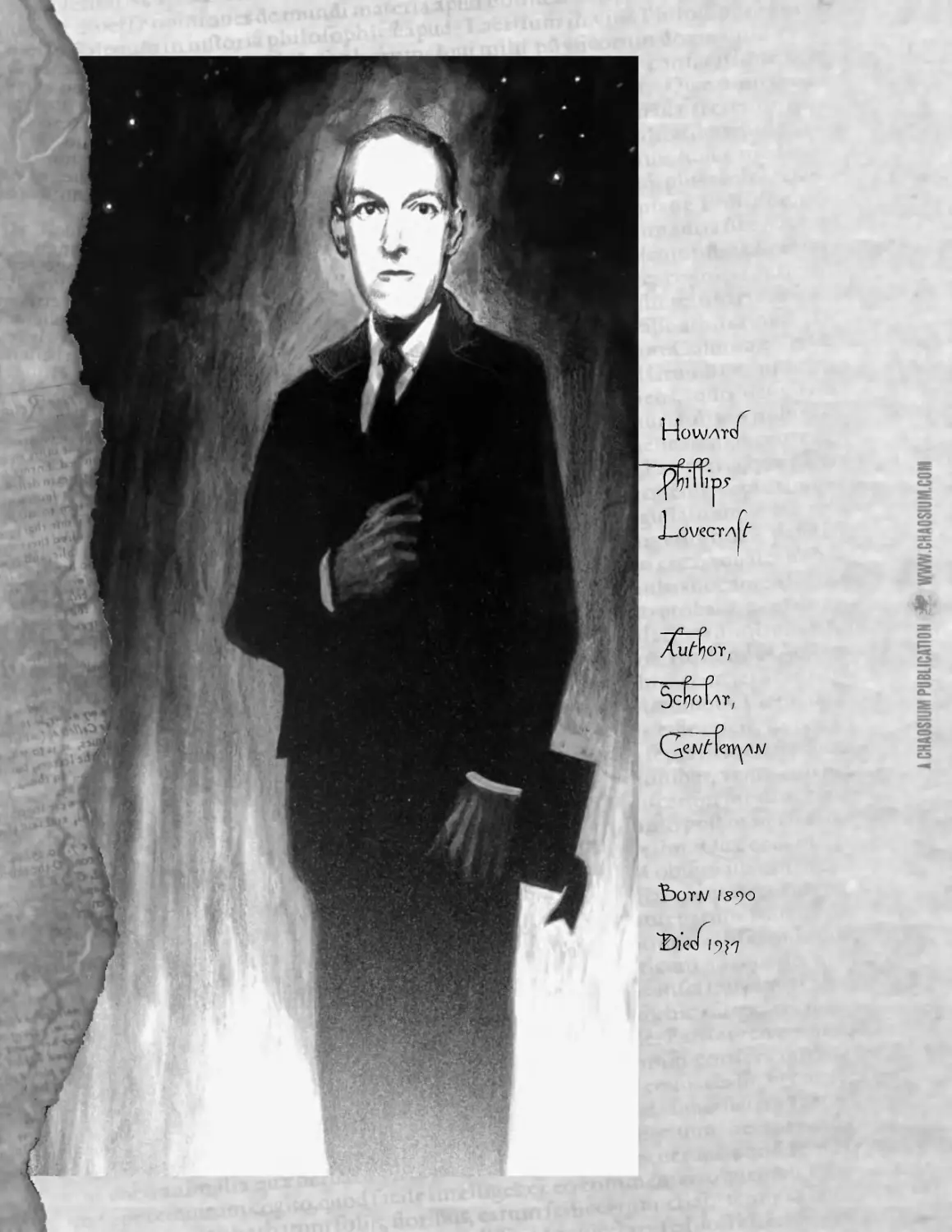
Howard
Phillips
Lovecraft
Author,
Scholar,
Gentleman
Born 1890
Died 1937

Sandy Petersen
majority of 1983 text
&
Lynn Willis
most of current text
Project, layout: Charlie Krank
editorial: Lynn Willis
based on the design of: Pegasus Spiele
additional text and information: Keith Herber, Kevin Ross, Mark Morrison, William Hamblin, Scott
David Aniolowski, Michael Tice, Shannon Appel, Eric Rowe, Bruce Ballon, William G. Dunn,
Sam Johnson, Brian M. Sammons, Jan Engan, Bill Barton, and friends
section illustrations & sidebar decorations: Paul Carrick
additional illustrations: Gene Day, Tom Sullivan, Lori Deitrick, Gus DiZerega, Chris Marrinan, Dreyfus,
Lisa A. Free, Earl Geier, John T. Snyder, Tony Ackland, Drashi Khendup, and Caryad.
Chaosium is: Lynn Willis, Charlie Krank,
Dustin Wright, Fergie, Kyle Grutze
& various odd critters
®
Horror Roleplaying in the
Worlds of H.P. Lovecraft

Call of Cthulhu
4
Indicia
Clear Credit
Keith Herber wrote the Necronomicon chapter, Mythos Prehistory, H. P.
Lovecraft and the Cthulhu Mythos, The Edge of Darkness, Prehistory of
the Cthulhu Mythos, and (with Kevin Ross) Books of the Cthulhu
Mythos. Mark Morrison (with Lynn Willis) wrote Dead Man Stomp. Les
Brooks created the ready-to-play investigators and compiled sample
gear and prices. Kevin Ross tracked down many quotes and sources,
and added material and statistics. Scott Aniolowski concentrated on
monster descriptions and statistics. Long ago Bill Dunn wrote the Guide
to Sanity Losses. William Hamblin wrote three Sadowsky episodes here
summarized as “In Rerum Supernatura.” Michael Tice, Eric Rowe, and
Shannon Appel assembled much of the present Sanity information.
Shannon Appel also constructed the Alien Technology section, using
some inventions from past supplements, and did revisionary work on
Deities, Creatures, and Mythos Prehistory. Bruce Ballon, Chaosium’s
psychiatric consultant, updated the Sanity chapter and w rote the
Dangerousness Criteria example, the timeline, and the summaries of
drugs and treatments. Jan Engan contributed the occult book sum-
maries. Brian Sammons created the two-part Mythos tomes table. Sam
Johnson wrote the tournament notes for the keeper’s chapter, more stats
for the weapon table, and about research modifiers in the keeper’s tool-
kit section. The 1890s prices and skills derive from the work of Bill
Barton, as do the stats for Chaugnar Faugn, the Colour, and others.
Thanks to Alexis G. Diaz, whose questions provoked 5th edition, and
to John Tarnowski.
Playtesters
Utah playtesters for the first edition of Call of Cthulhu were Steve
Marsh, James Memmot, Wade Round, Paul Work, Scott Clegg, Marc
Hutchison, Bill Hamblin, and Eric Petersen. Chaosium playtesters were
Al Dewey (keeper), and in alphabetical order Yurek Chodak, Allan
Dalcher, Charlotte Coulon, Al Dewey, Bruce Dresselhaus, Jerry
Epperson, Sherman Kahn, Ken Kaufer, Charlie Krank, Fred Malmburg,
Hal Moe, Steve Perrin, Rory Root, Greg Stafford, Anders Swenson, and
Lynn Willis.
Special Thanks
Thanks are also due to the original authors (especially Steve Perrin)
and play group connected with the 1978 roleplaying game RuneQuest,
now owned by Hasbro, from which the mechanics of Call of Cthulhu
were adapted via the intermediary and out-of-print Basic Roleplaying.
Mark Morrison has remarked that when he wishes to see how some
problem of physical action is handled in a game, he turns first to
RuneQuest. He is not the only one.
Sandy Petersen, who authored the original Cthulhu rules, labored
long and to great effect on his game’s behalf. He still exercises strong
influence on the game through his thoughtful forebearance and in his
agreeable notions of rules economy. Ever ywhere his words have been
weighed and mined.
Call of Cthulhu is published by Chaosium Inc.
Call of Cthulhu (6th edition) is copyright ©1981, 1983, 1992, 1993, 1995,
1998, 1999, 2001, 2004 , 2005 by Chaosium Inc.; all rights reserved.
Call of Cthulhu® is the registered trademark of Chaosium Inc.
Similarities between characters in Call of Cthulhu and persons living or dead
are strictly coincidental.
All material concerning Shudde-M’ell and the Cthonians, and all other inven-
tions of Brian Lumley as portrayed in his works, specifically The Burrowers
Beneath, are used with his kind permission. J. Ramsey Campbell’s “Cold Print”
©1969 Aug ust Derleth. William Lumley’s and H. P. Lovecraft’s “The Diary of
Alonzo Typer” ©1970 by August Derleth. Colin Wilson’s “The Return of the
Lloigor” ©1969 August Derleth. Frank Belk nap Long’s “Hounds of Tindalos”
©1946 Estate of Frank Belknap Long. Clark Ashton Smith’s “The Return of the
Sorcerer” ©1931 Clayton Magazines Inc. Clark Ashton Smith’s “The Nameless
Offspring ©1932 Clayton Magazines. Inc. The quotes from “The Inhabitant of
the Lake” are ©1964 by J. Ramsey Campbell. Clark Ashton Smith’s “The Seven
Geases” ©1934 Popular Fiction Publishing Co. Derleth’s “The Dweller in
Darkness” ©1953 August Derleth. Eddy C. Bertin’s “Darkness, My Name Is”
©1976 Edward P. Berglund. Bloch’s “Notebook Found in a Deserted House”
©1951 Weird Tales. Derleth’s “The Gable Window” ©1957 Candar Publishing
Co. Derleth’s “The Lurker at the Threhold” ©1945 August Derleth. Donald J.
Walsh, Jr.’s “The Rings of the Papaloi” ©1971 August Derleth. Derleth’s “The
Thing That Walked on the Wind” ©1933 The Clayton Magazines Inc. Blish’s
“More Light” ©1970 Anne McCaffrey. Kuttner’s “The Salem Horror” ©1937
Popular Fiction Publishing Co. Clark Ashton Smith’s “The Treader of the Dust”
©1935 Popular Fiction Publishing Co. Derleth’s “The Lair of the Star-Spawn”
©1932 Popular Fiction Publishing Co. Carter’s “Zoth-Ommog” ©1976 Edward
P. Berglund. Brennan’s “The Seventh Incantation” ©1963 Joseph Payne
Brennan. Henry Hasse’s “The Horror at Vecra” ©1988 Cryptic Publications.
H.P. Lovecraft’s works ©1963, 1964, 1965 by August Derleth. Works within are
quoted for purposes of illustration.
Section illustrations and additional sidebar illustrations are by Paul Carrick.
Smaller design elements, as well as the illustations in the scenarios, are by
Dreyfus. Personalities are all by John T. Snyder. Monsters, deities, and animals
include art by Tony Ackland, Lori Dietrick, Earl Geier, and Tom Sullivan. Alien
Technology illustrations are by Drashi Khendup. Additional illustrations are by
Gene Day and Tom Sullivan. Except in this publication and related advertising,
or unless otherwise ag reed to, artwork original to Call of Cthulhu remains the
property of the individual artist, and is copyright by that artist under his or
her separate copyright.
The reproduction of material from within this book for the purposes of per-
sonal or corporate profit, by photographic, optical, electronic, or other media
or methods of storage and retrieval, is prohibited.
Address questions and comments by mail to
Chaosium, Inc.
22568 Mission Blvd. #423
Hayward CA 94541 U.S.A .
Please do not phone in game questions; the quickest answer may not be the
best answer. Our web site www.chaosium.com always contains
latest release information and current prices.
Chaosium Publication 23106. ISBN 1-56882-181-6
Published in February 2005. Printed in U.S .A.

FrontMatter
Contents
5
Table of Content
The Call of Cthulhu
I. The Horror in Clay ................................................................. 8
II. The Tale of Inspector LeGrasse ........................................... 12
III. The Madness from the Sea ................................................ 18
Game System
Introduction.................................................................................... 24
Call of Cthulhu Terms ................................................................ 30
Resources for the Game ............................................................. 33
About Investigators......................................................................... 35
Creating Your Investigator .......................................................... 36
Sample Occupations ................................................................... 42
Notes on Occupations ................................................................ 44
Creating Harvey Walters............................................................. 48
Rules & Skills .................................................................................. 51
The Resistance Table .................................................................. 55
Spot Rules for Injuries ............................................................... 57
Spot Rules for Combat ............................................................... 59
Spot Rules for Firearms.............................................................. 63
Weapons Table............................................................................ 64
Skills & Base Chances ................................................................ 69
Sanity & Insanity ............................................................................ 75
Treatment of Insanity................................................................. 86
Example of Play .............................................................................. 87
Magic .............................................................................................. 89
Examples of Occult Books ......................................................... 92
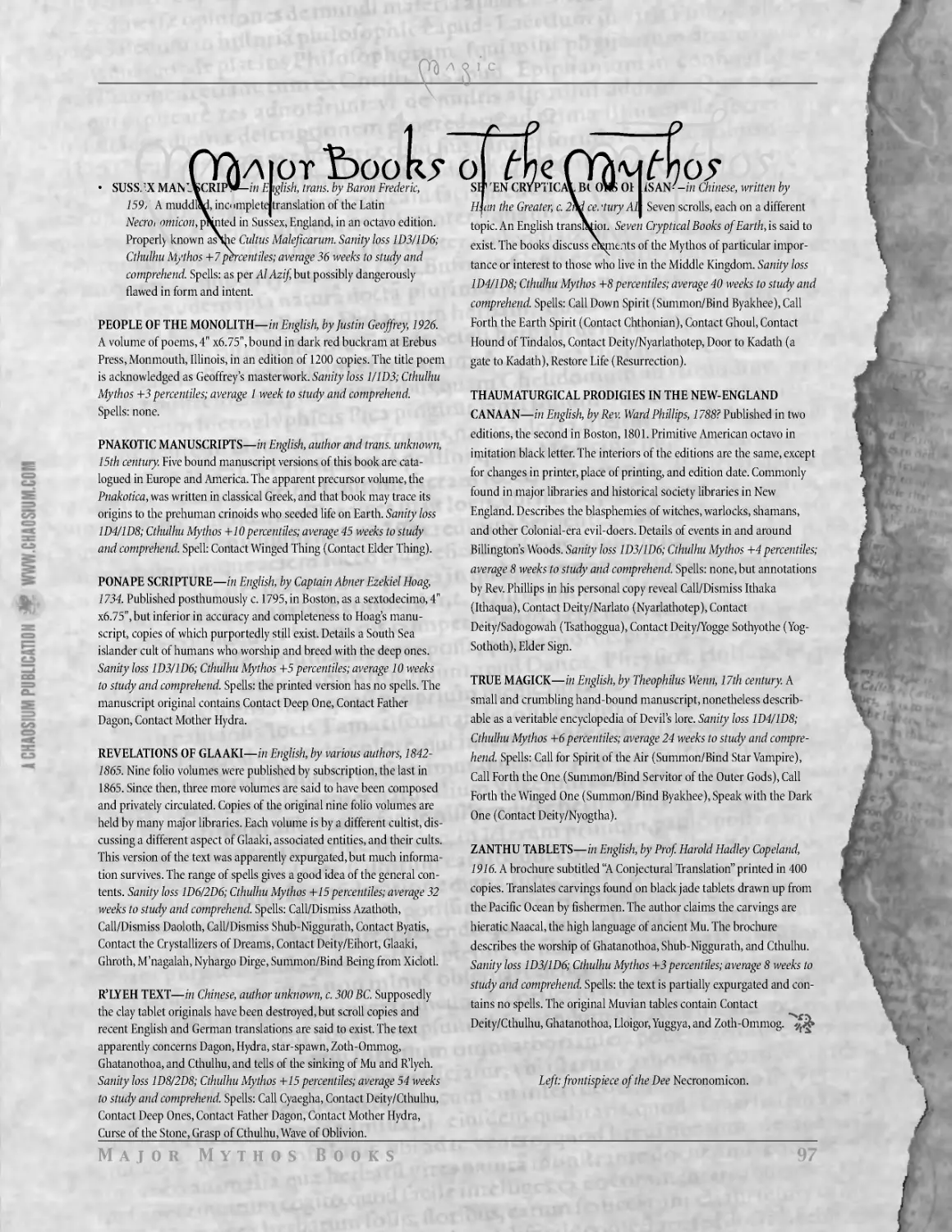
Major Books of the Mythos........................................................ 94
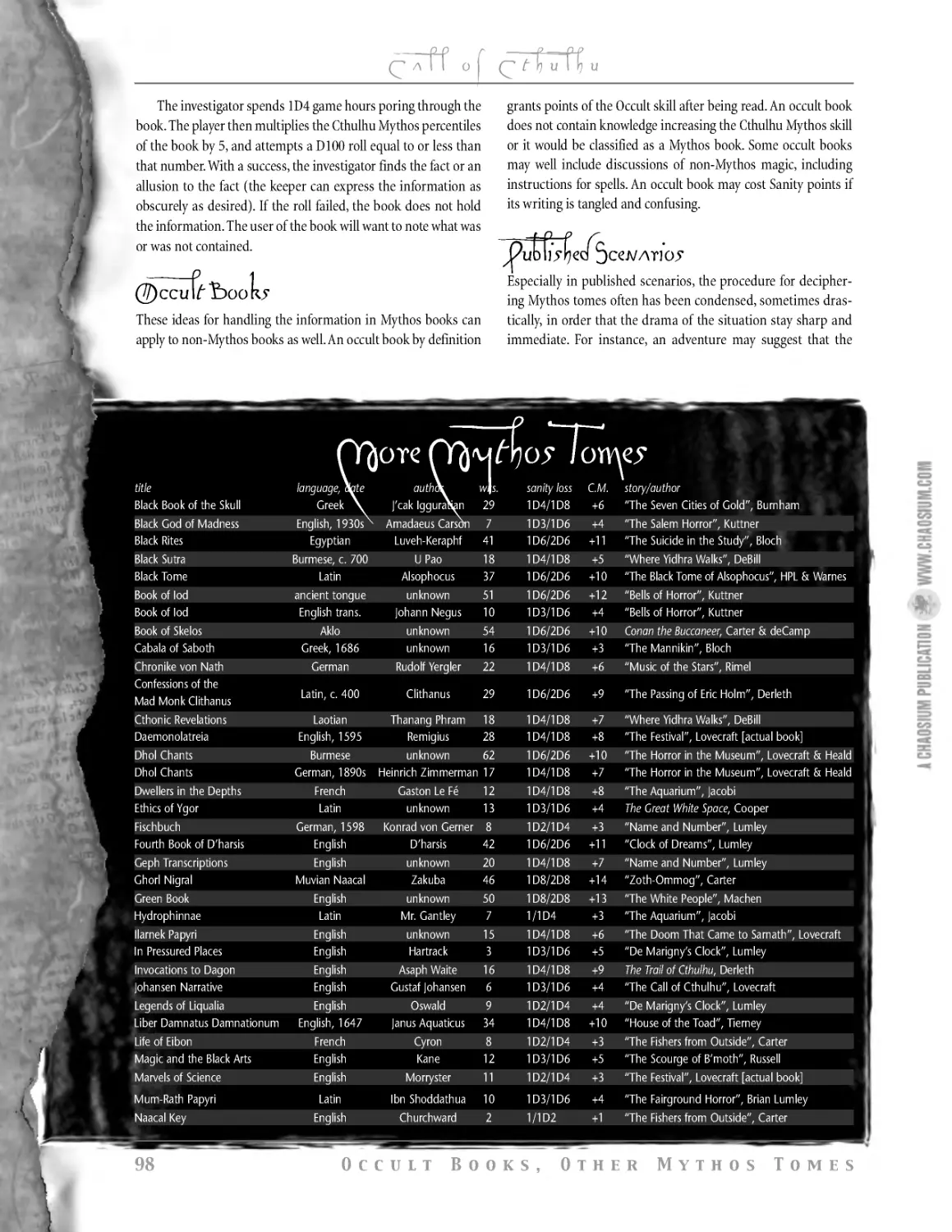
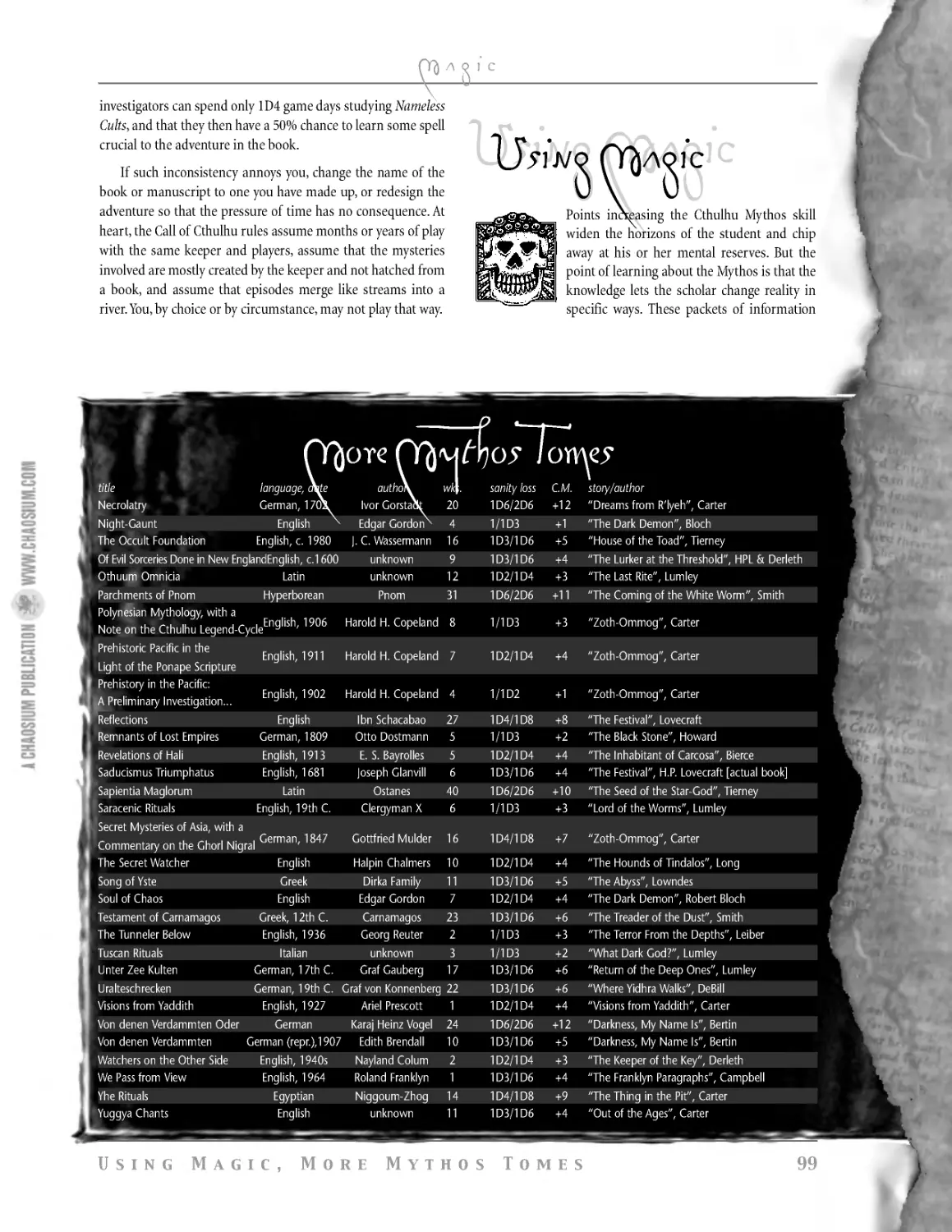
More Mythos Tomes ................................................................... 98
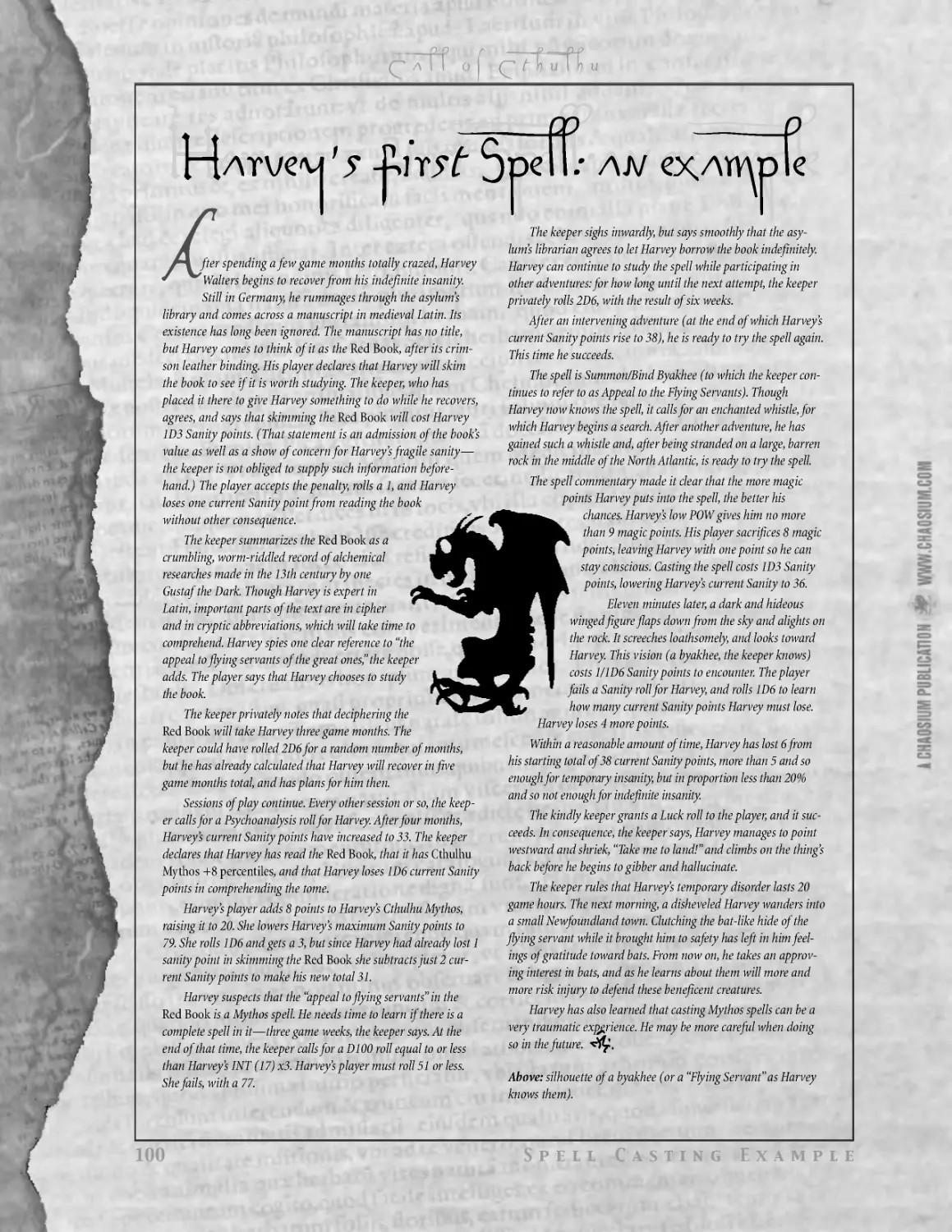
Har vey’s First Spell: An Example ............................................. 100
Reference
The Cthulhu Mythos ..................................................................... 106
The Necronomicon ........................................................................ 112
Howard Phillips Lovecraft ............................................................ 115
De Rerum Supernatura................................................................. 120
Mental Disorders .......................................................................... 128
Keeper’s Lore................................................................................. 133
A Keeper’s Toolkit .................................................................... 140
Creatures of the Mythos ............................................................... 148
Alien Technology .......................................................................... 176
Deities of the Mythos.................................................................... 181
Beasts & Monsters ........................................................................ 202
Personalities.................................................................................. 212
A Mythos Grimoire ....................................................................... 217
Call/Dismiss Deity Spells ......................................................... 221
Contact Spells ........................................................................... 226
Contact Deity Spells ................................................................. 227
Gate Creation Costs ...................................................................229
Enchantment Spells ................................................................. 233
Summon/Bind Spells................................................................ 245
Scenarios
The Haunting ................................................................................ 250
Edge of Darkness .......................................................................... 256
The Madman ................................................................................ 265
Dead Man Stomp .......................................................................... 270
Utilities
A Guide to Lovecraft Country....................................................... 280
Guide to Arkham ...................................................................... 280
Locales & Events ...................................................................... 282
Traveling: Land, Sea, and Air ........................................................ 284
Optional Rules: Vehicle Chases ................................................ 284
Speeds & Distances .................................................................. 286
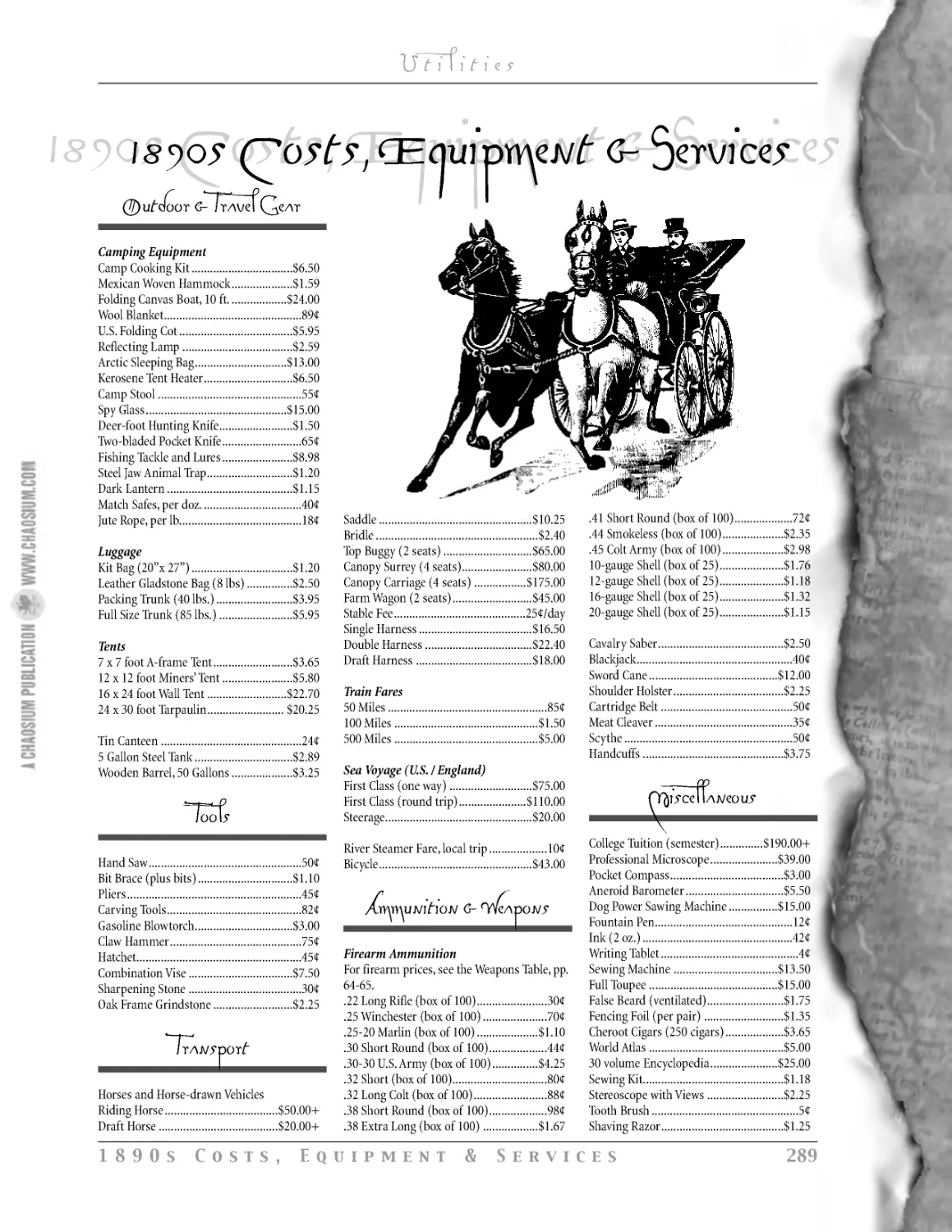
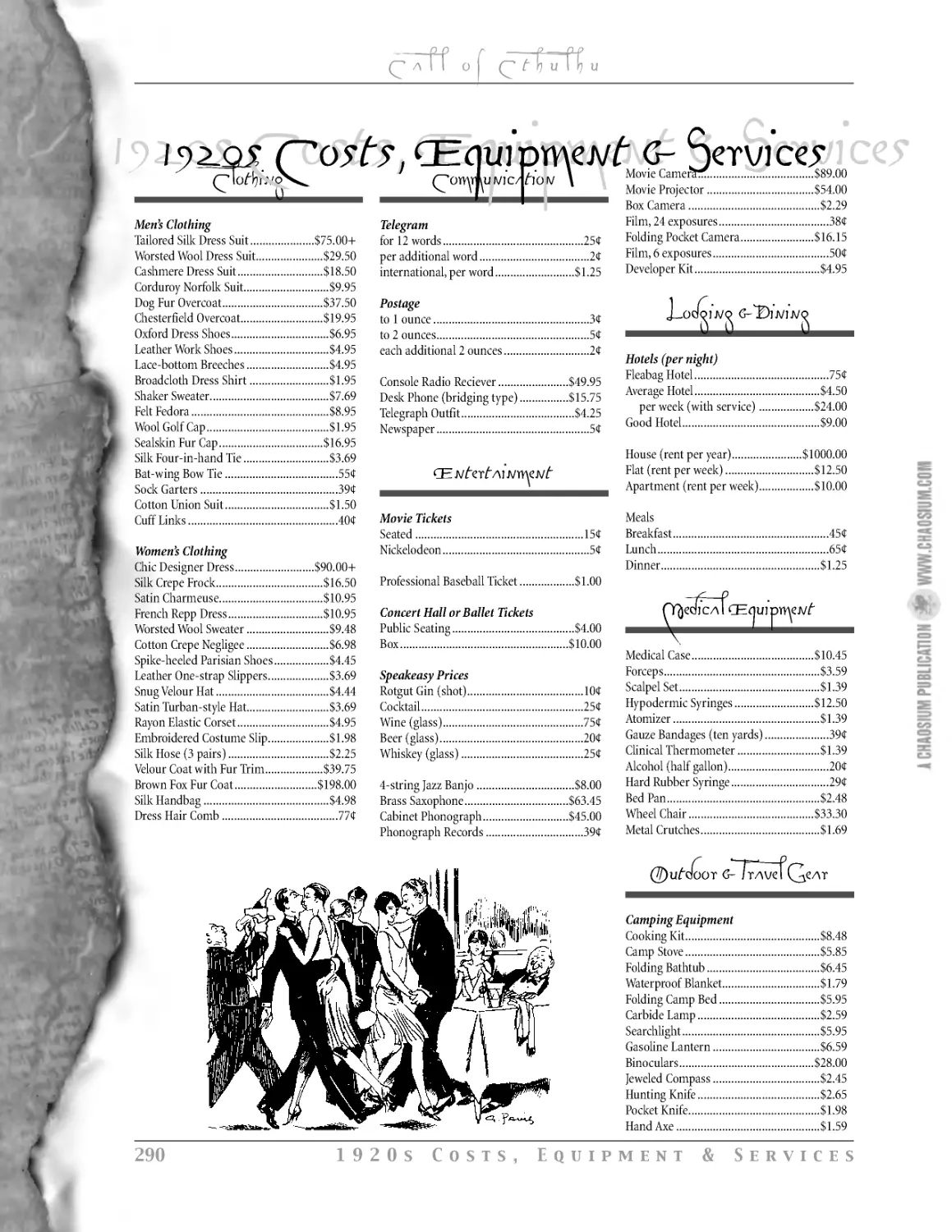
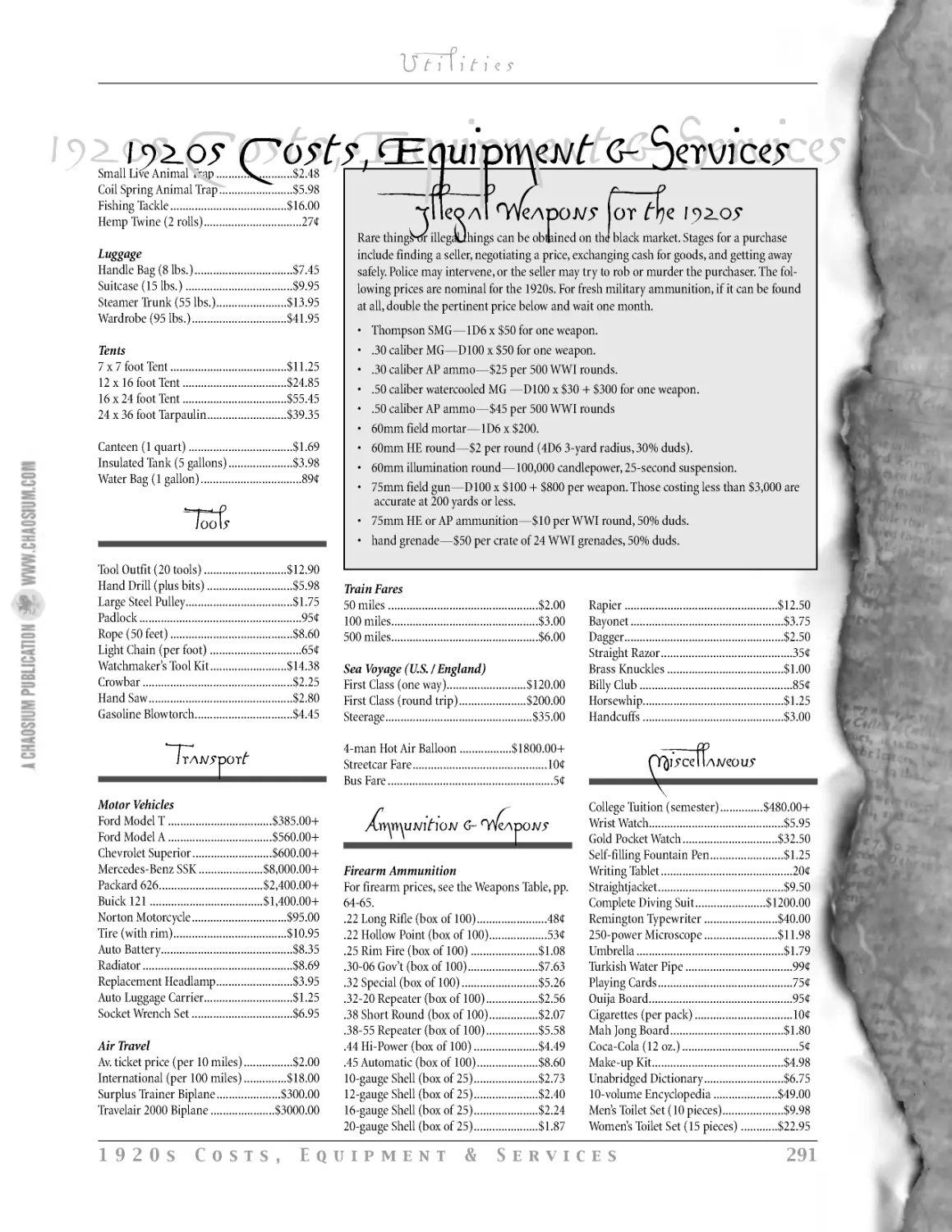
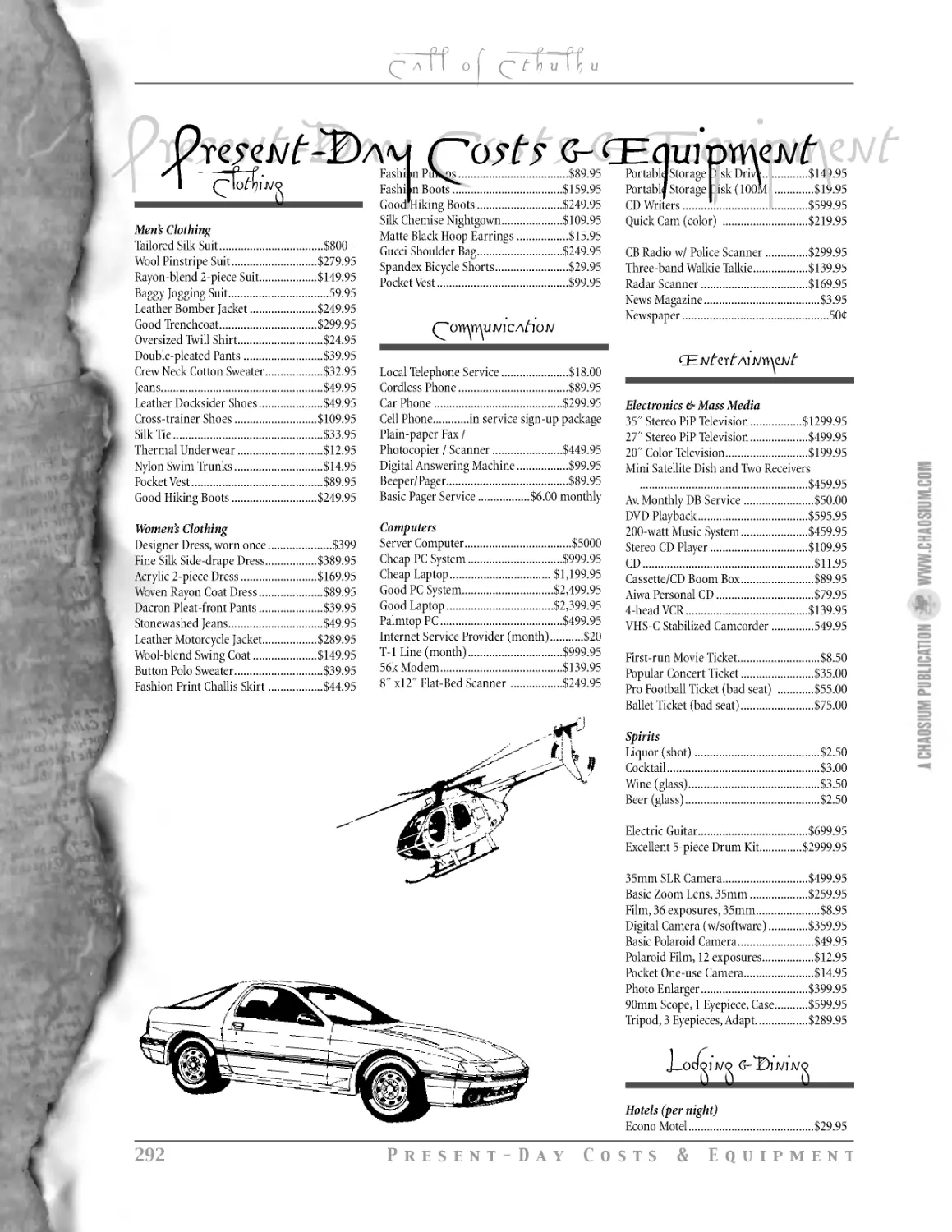
Costs, Equipment, and Services.................................................... 288
1890s Costs, Equipment, & Services ........................................ 288
1920s Costs, Equipment, & Ser vices ........................................ 290
Present-day Costs & Equipment .............................................. 292
References ..................................................................................... 294
Cthulhu Supplements ............................................................... 296
Timelines ...................................................................................... 297
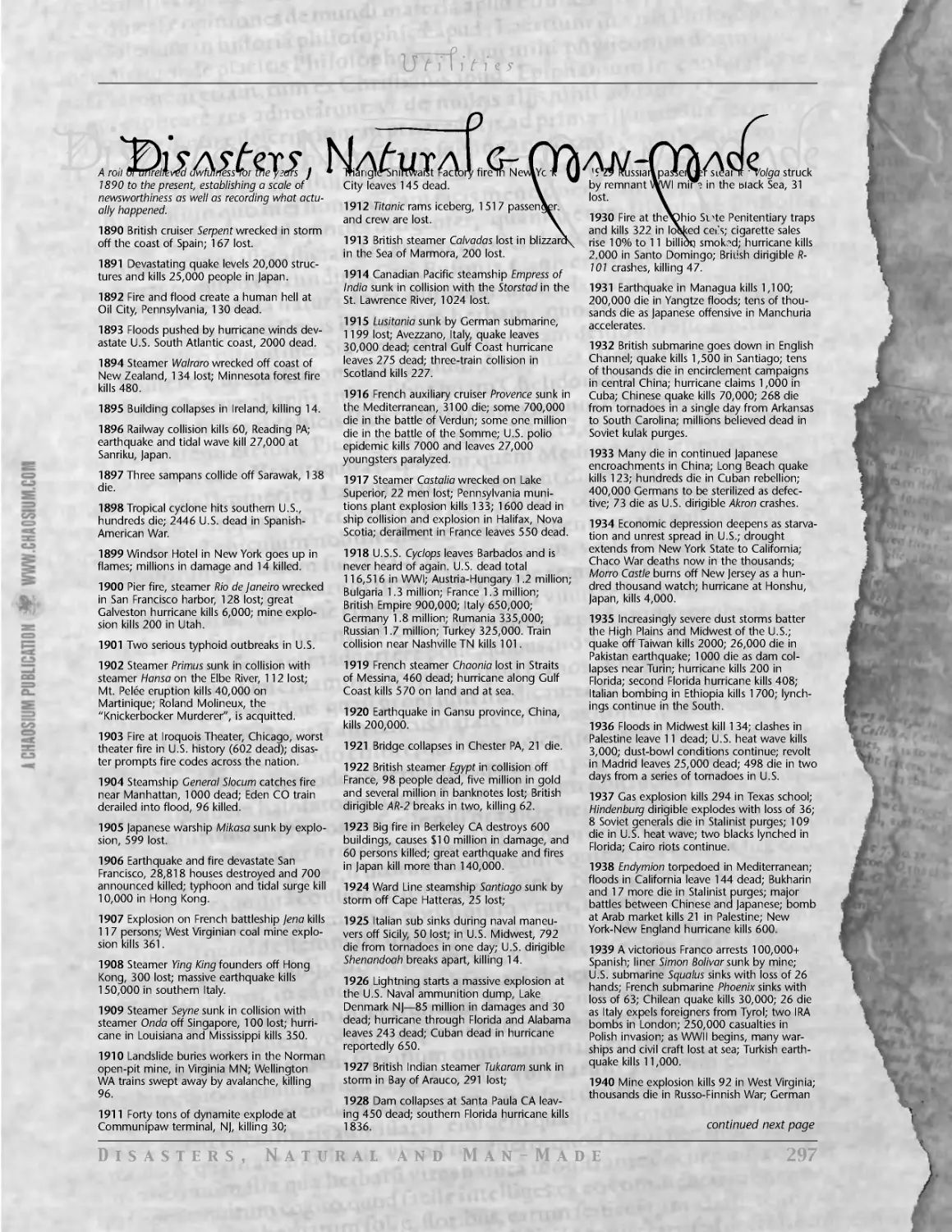
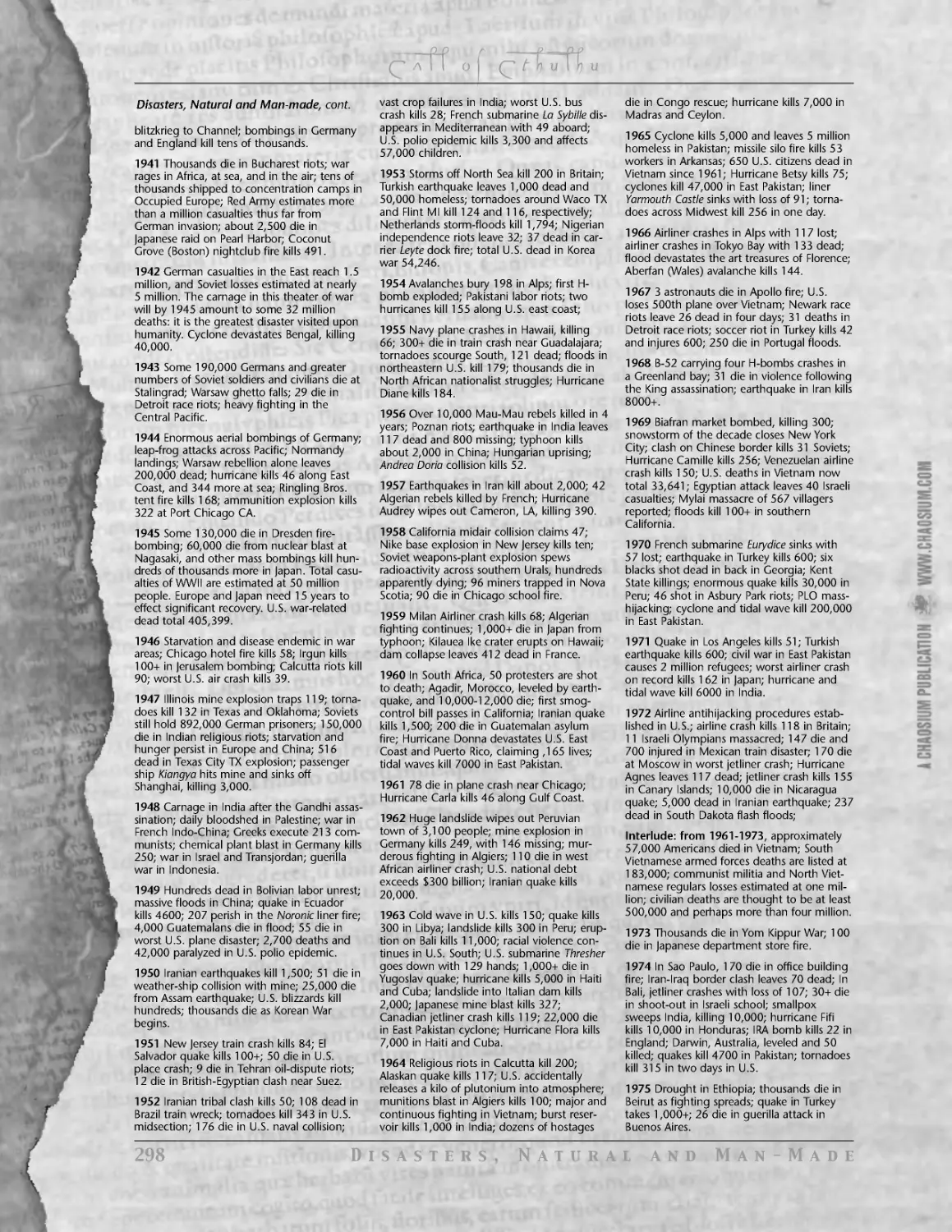
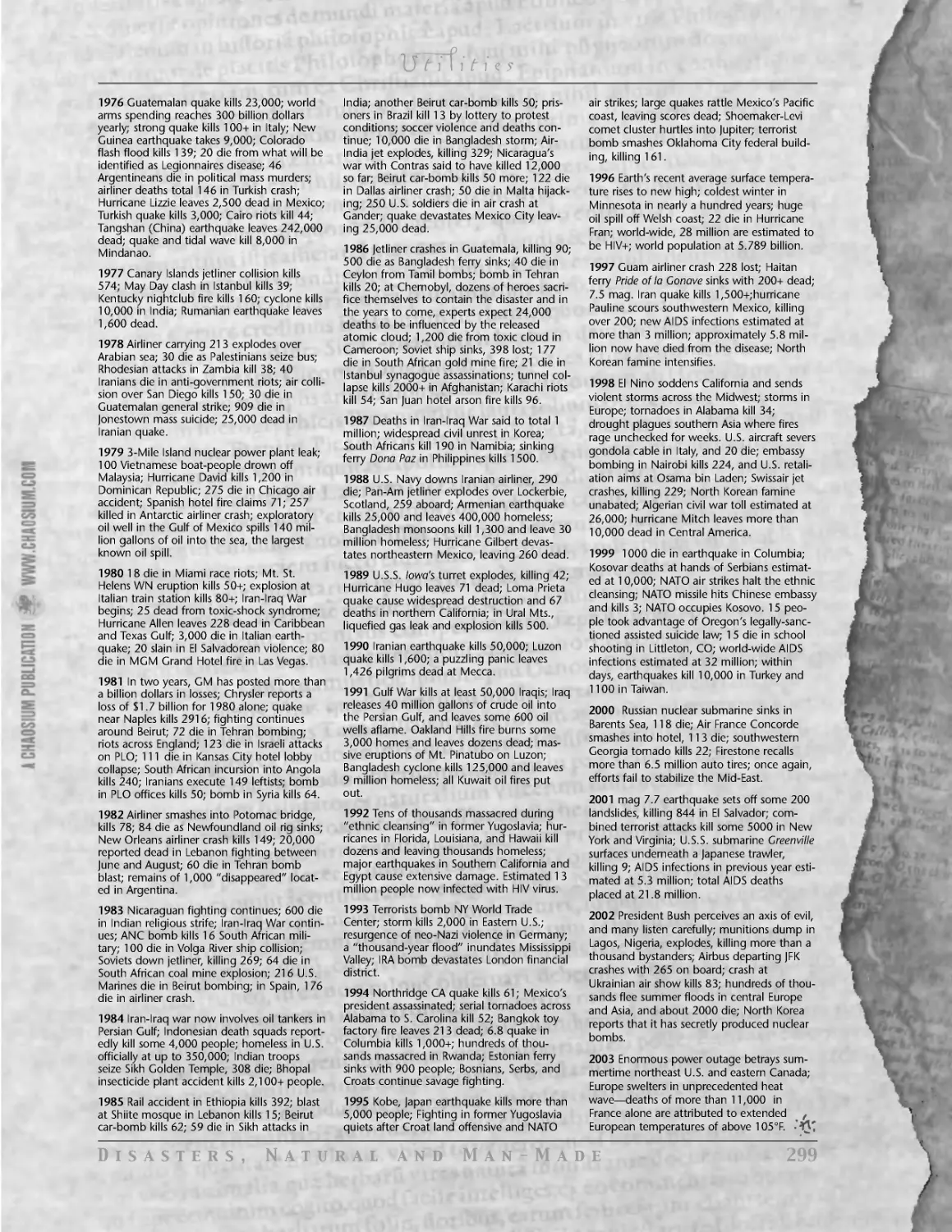
Disasters, Natural and Man-Made ........................................... 297
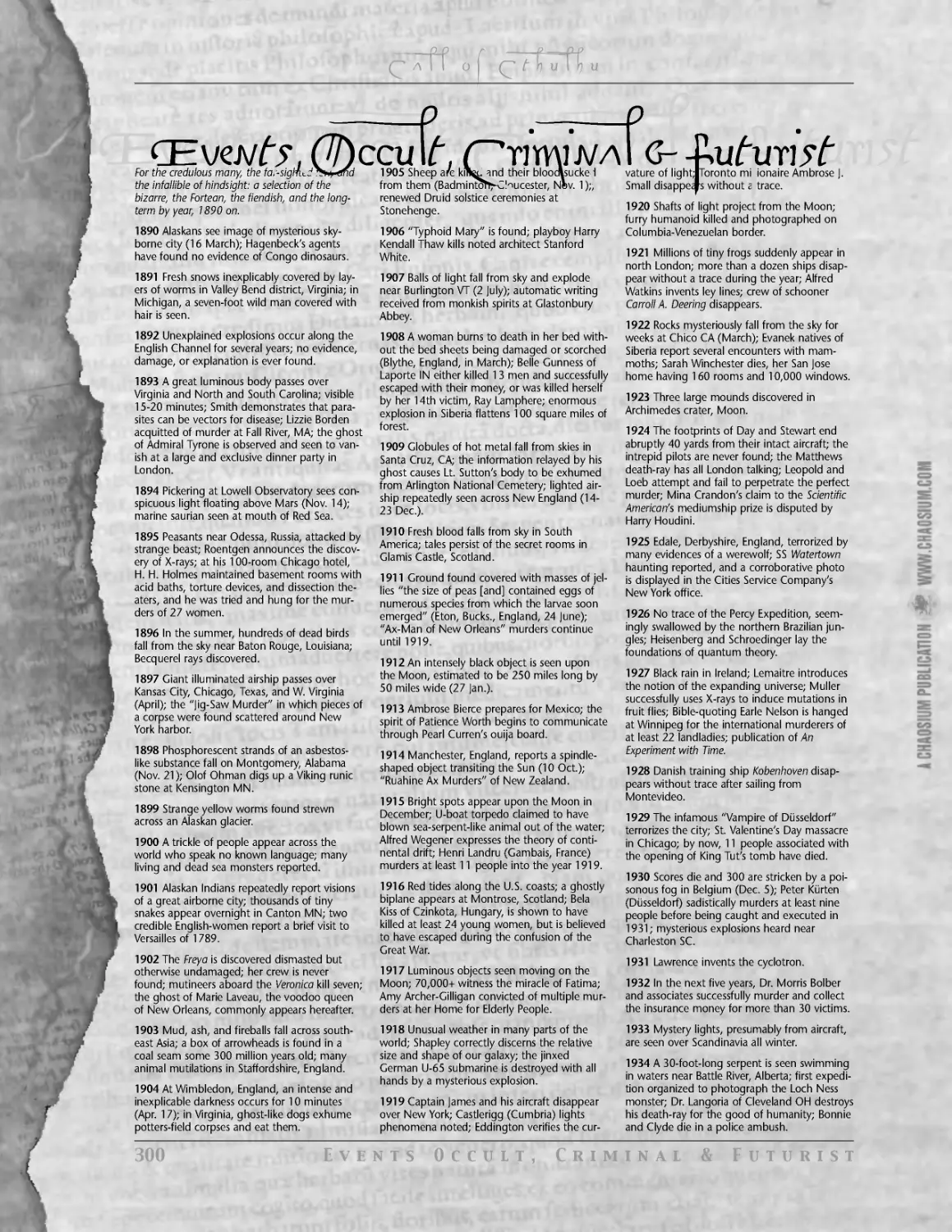
Events Occult, Criminal & Futurist .......................................... 300
A Hundred Years & More ......................................................... 303
Ready-to-play Investigators .......................................................... 306
1890s Investigators ................................................................... 306
1920s Investigators ................................................................... 307
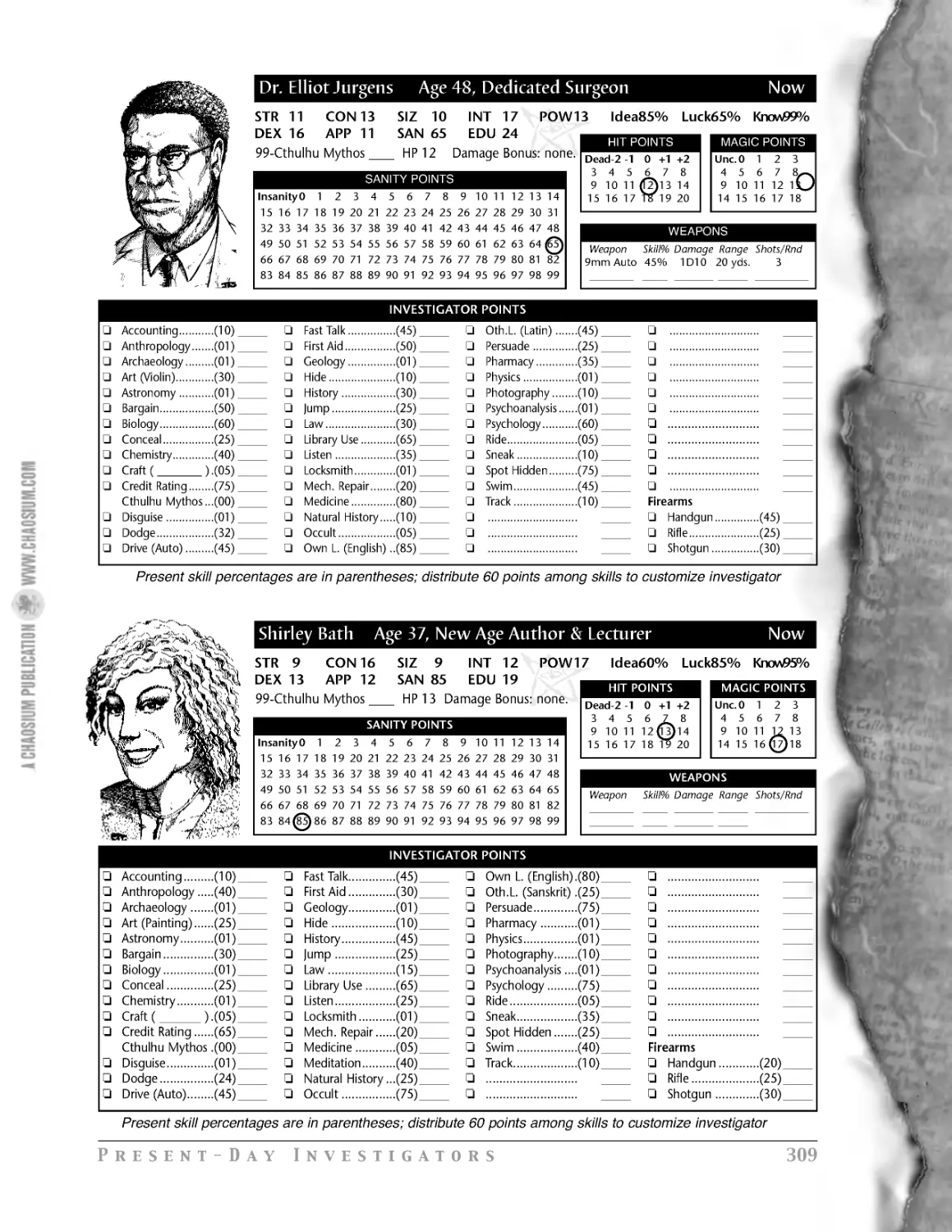
Present-Day Investigators ........................................................ 309
Charts & Forms ............................................................................ 310
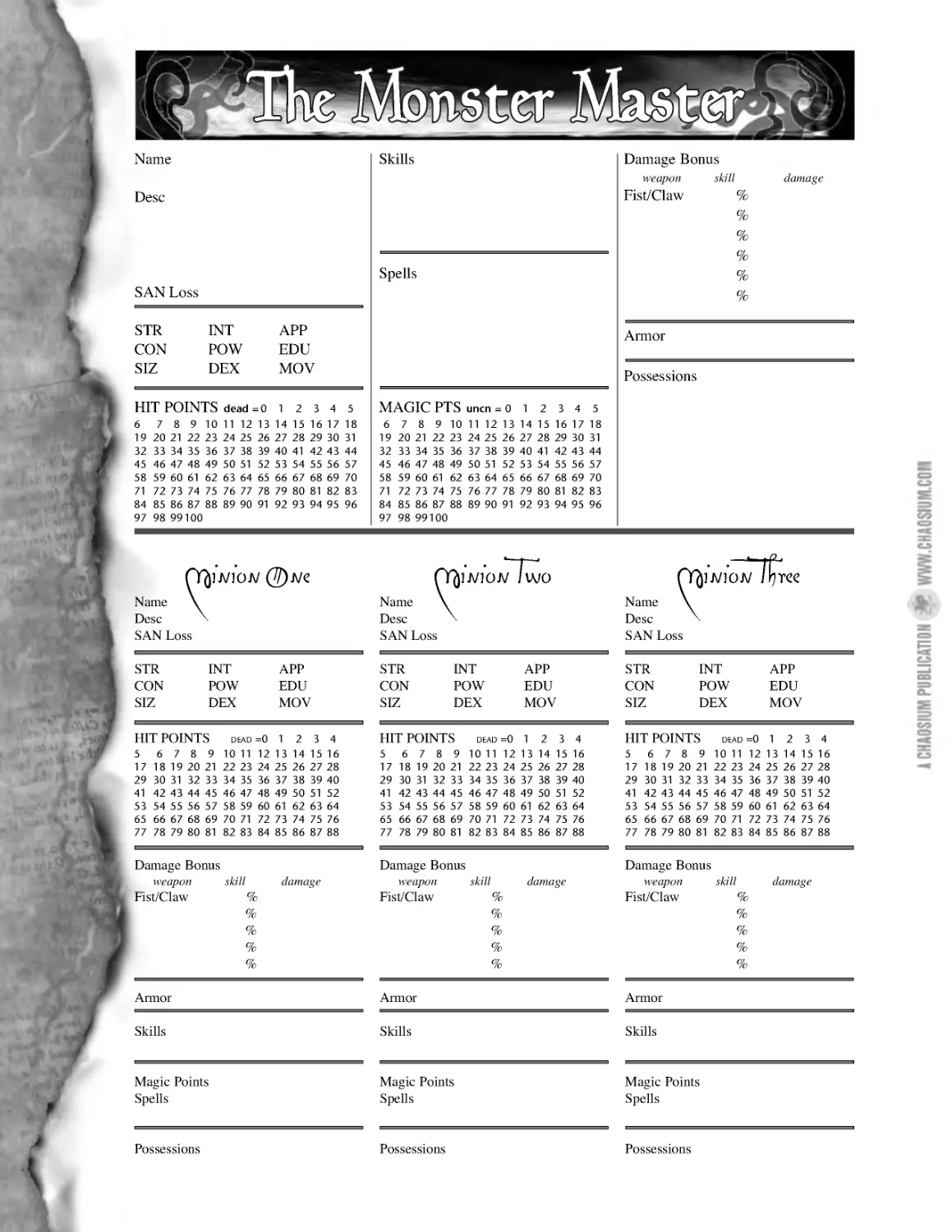
Monster Master ........................................................................ 310
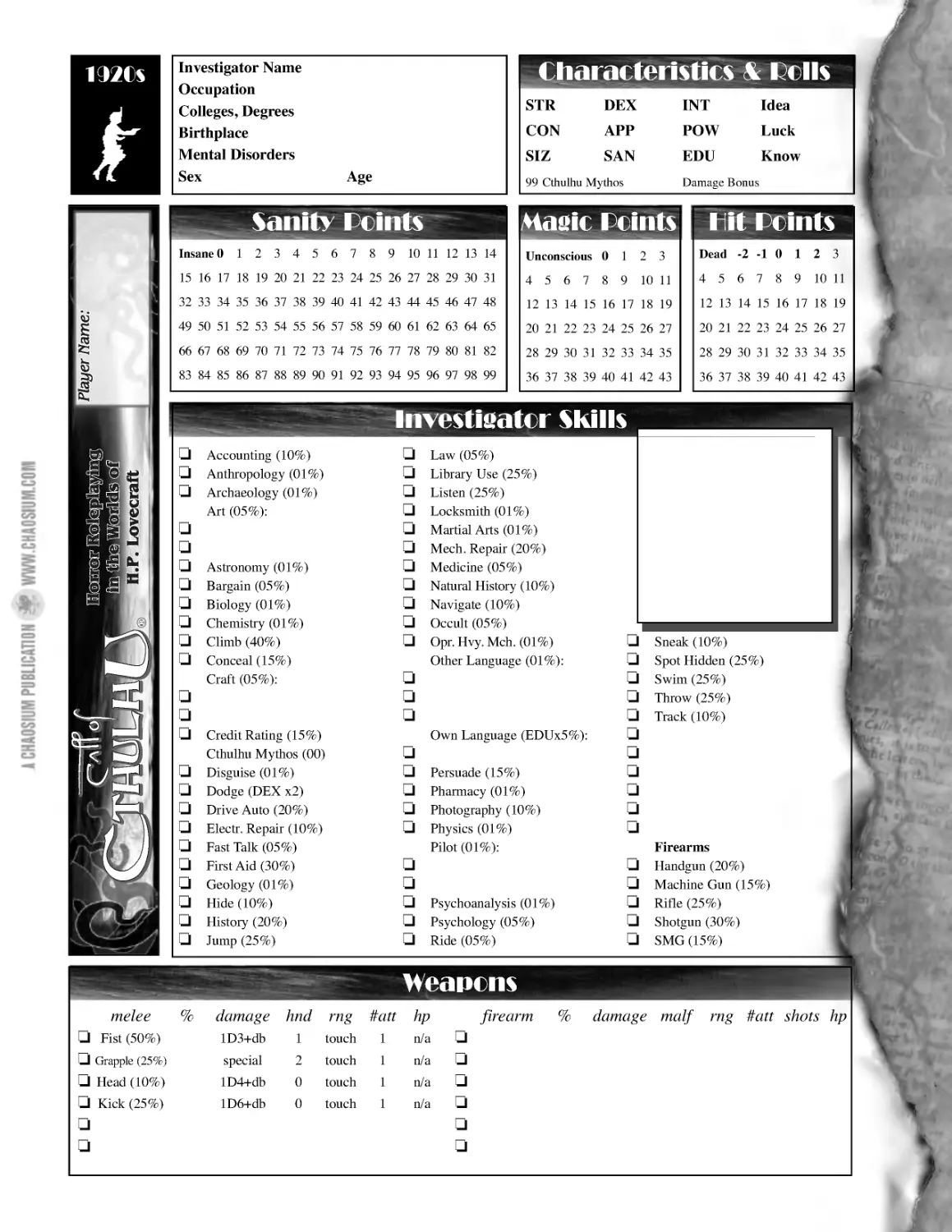
Character Sheet (Front)—1920s.............................................. 311
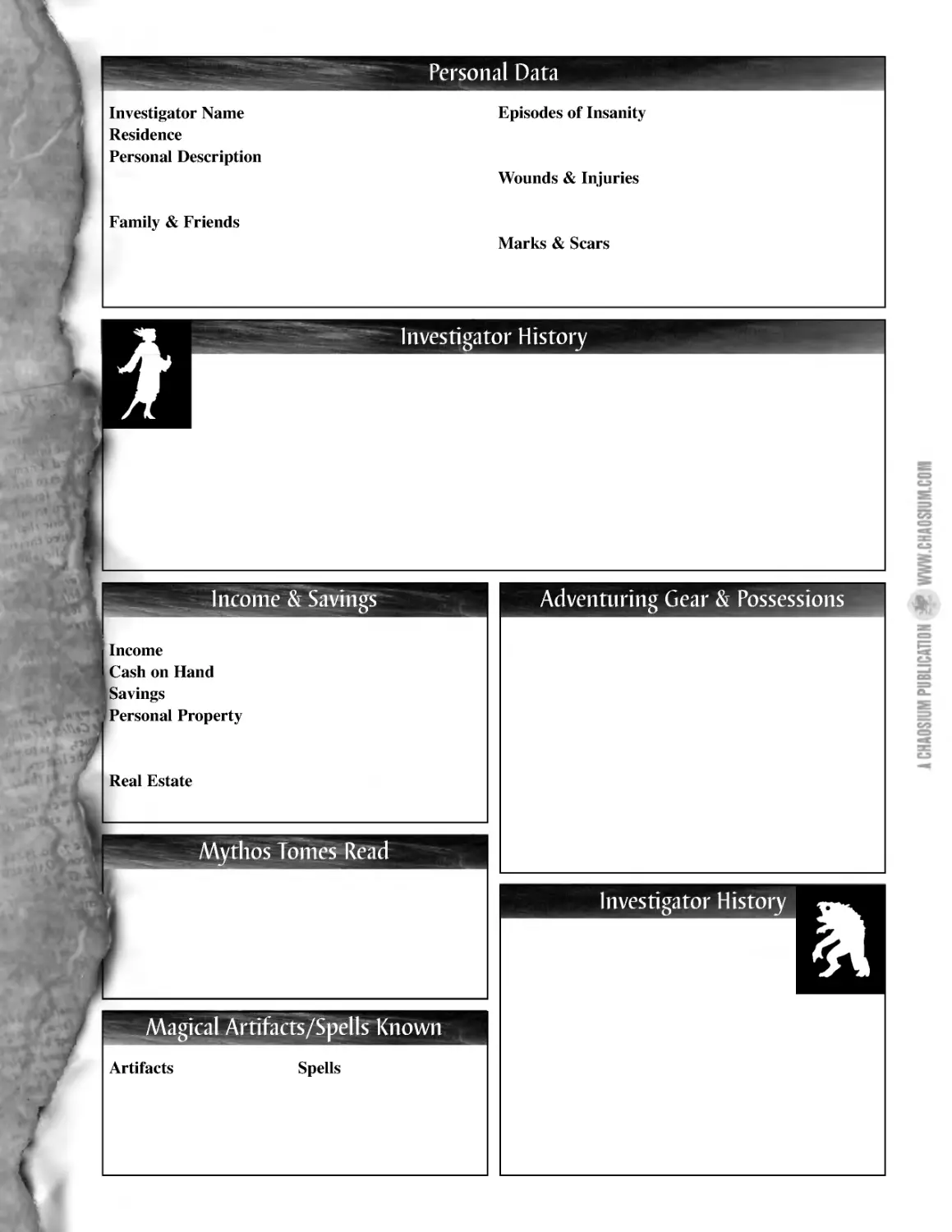
Character Sheet (Back)—Any Era ........................................... 312
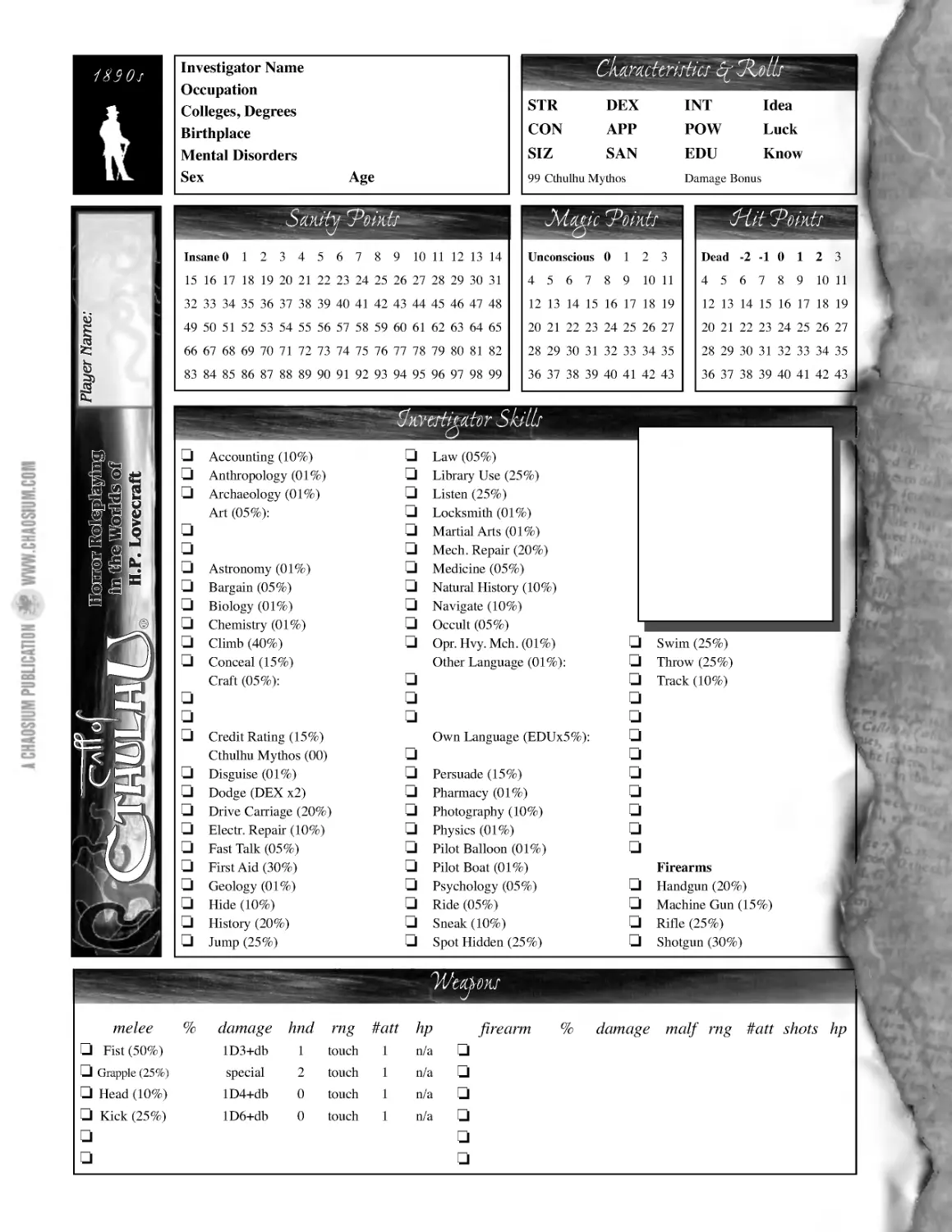
Character Sheet (Front)—1890s.............................................. 313
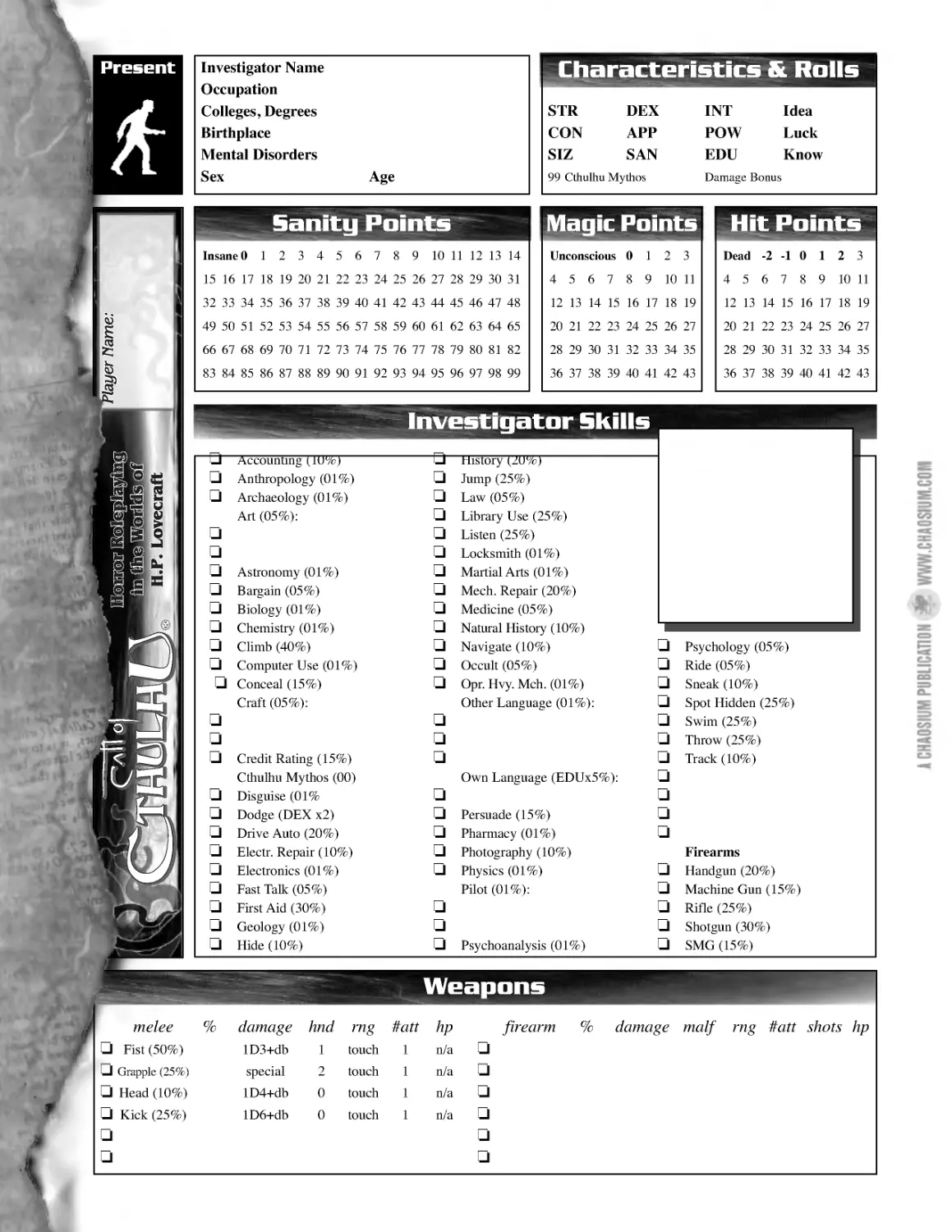
Character Sheet (Front)—Present ........................................... 314
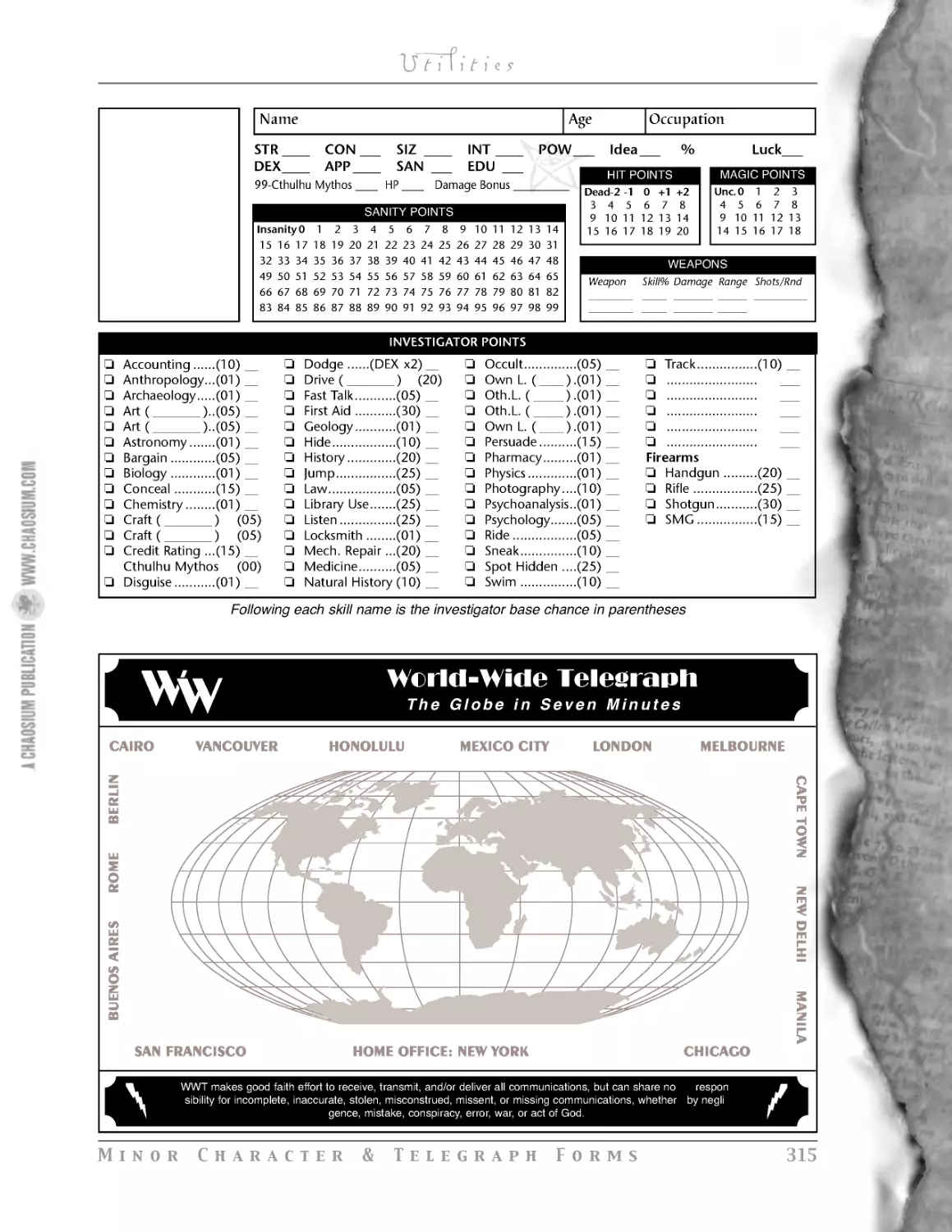
Character Sheet (Half-size) ...................................................... 315
Blank Telegram Form ............................................................... 315
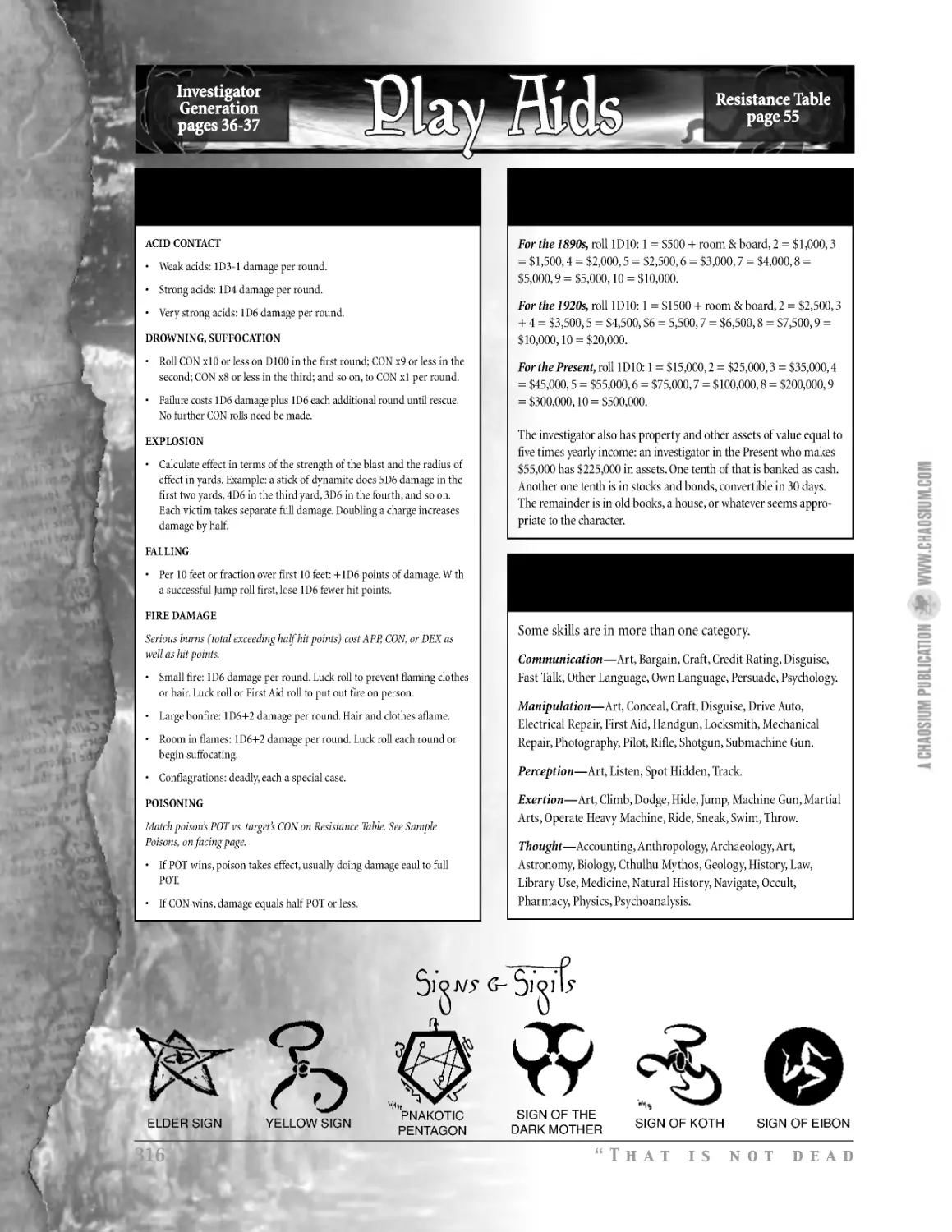
Play Aids ....................................................................................... 316
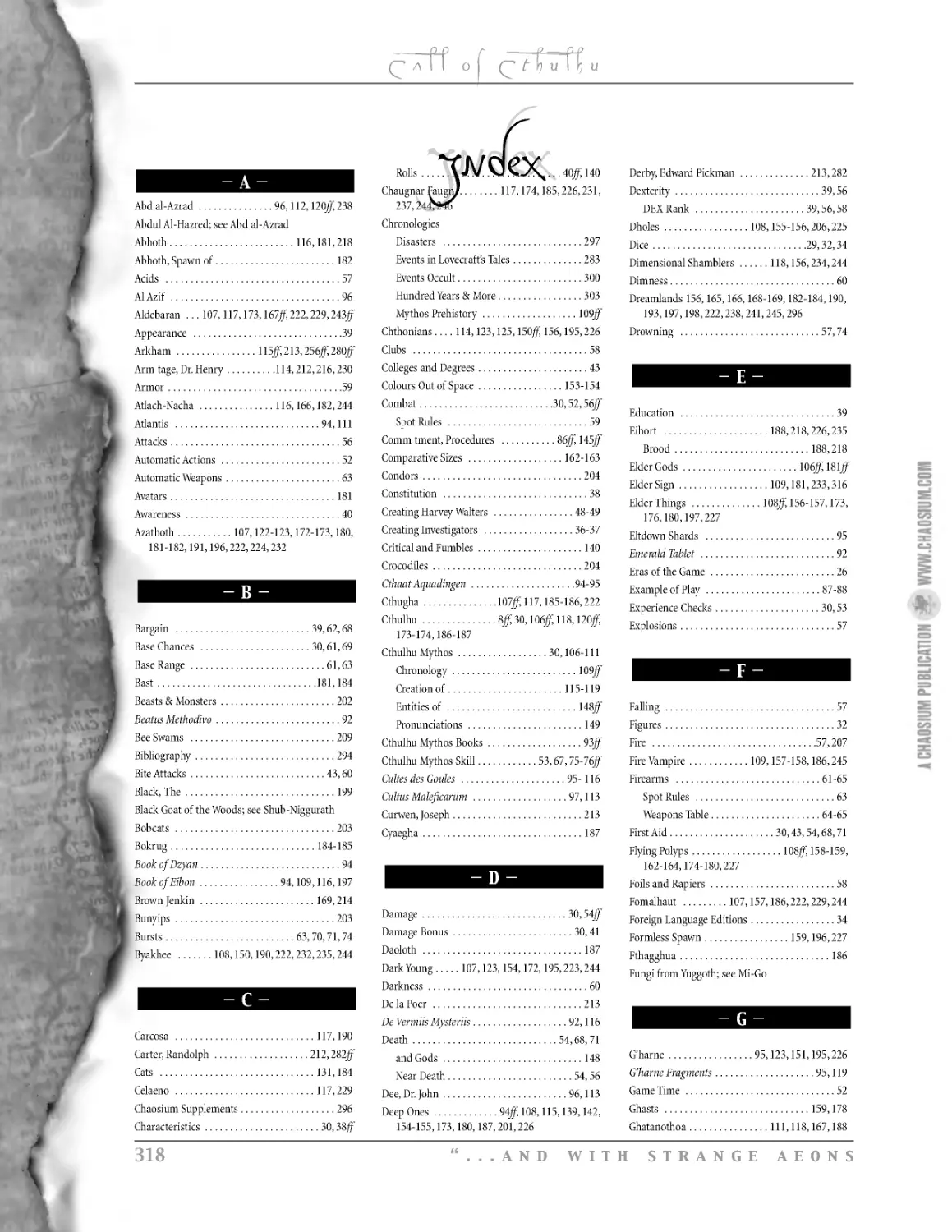
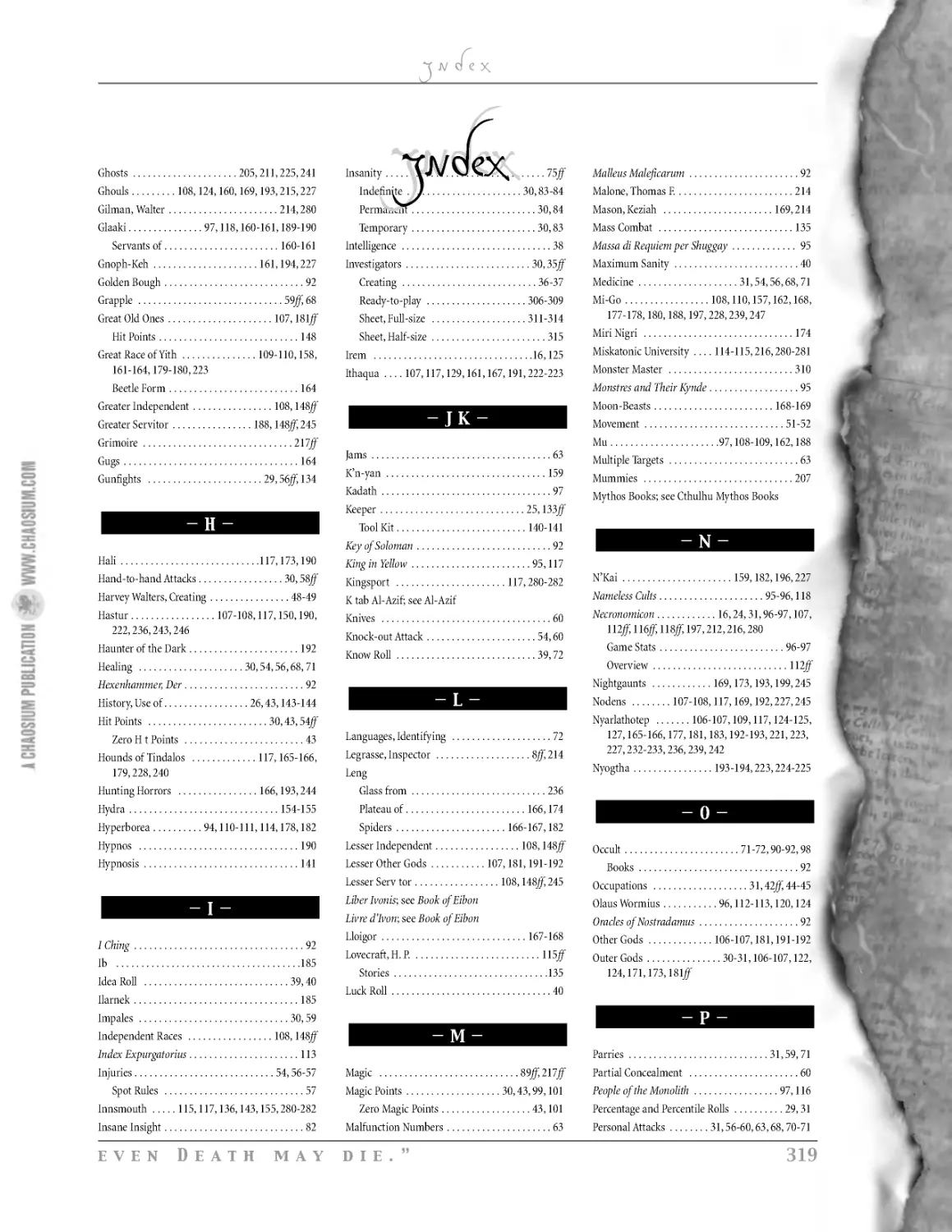
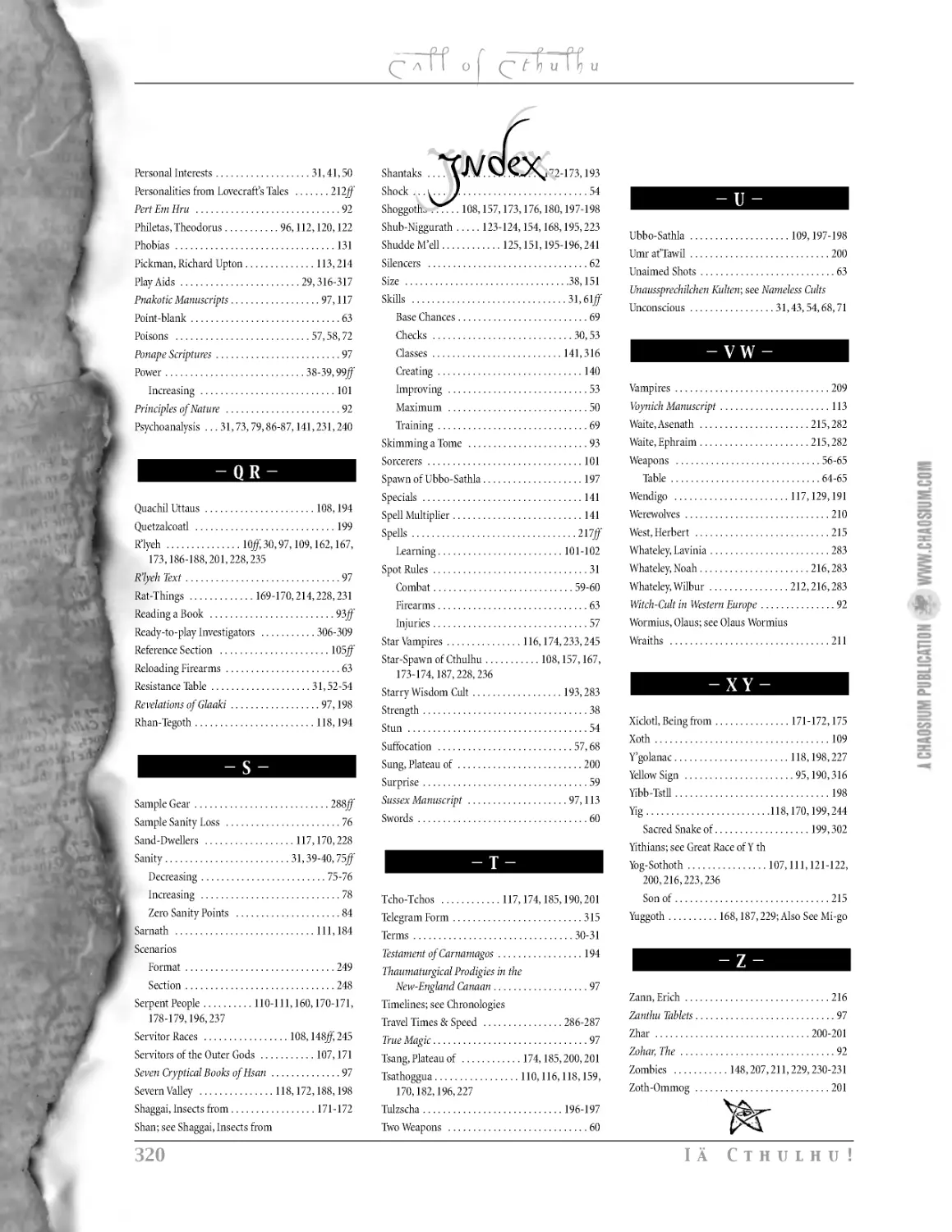
Index ............................................................................................. 318
Table of Contents

Call of Cthulhu
6
Foreword, Dedication, Acknowledgements
Foreword
Welcome to Call of Cthulhu! If you have ever been enthralled by a ghost story or spell-
bound at a horror movie, you are in for a treat. Part the veil that separates frail humanity
from the terror that lurks beyond space and time. Investigate forgotten ruins, haunted
woods, and nameless menaces.
Enter the world of Call of Cthulhu.
This game was first published in 1981. At that time, three major national awards were
issued in the United States for excellence in game design. Call of Cthulhu won all three. It
spawned foreign language editions in Finnish, French, German, Hungarian, Italian,
Japanese, Polish, and Spanish. Supplements to this game have won more than fifty major
awards, in the U.S . and internationally. In 1996, Call of Cthulhu was chosen for the Origins
Hall of Fame, gaming’s most prestigious award.
My introduction to H. P. Lovecraft was as a child, when I found a tattered book of sto-
ries, printed for the use of servicemen during World War II. I read that book in bed that
night, and become entranced forever. If you, too, love Lovecraft’s stories, you can now
experience the Cthulhu Mythos in a new way. What would you have done in the place of
Lovecraft’s intrepid heroes? Could you have solved the sinister Whateley myster y? Would
you have been able to save the world from the nightmare of the deep ones? Could you face
shoggoths without going mad? Now you can find out!
— Sandy Petersen.
Dedications
To my father, who introduced me to Lovecraft and to science fiction in general. From one
of his books I read my first Lovecraftian story, “Pickman’s Model.”
Thanks, Dad. — S. P
To the fans of Chaosium. We have published books for 25 years in the hope that you would
enjoy them. To those who give their time and energy to spread the word, and are truly one
of us. Thanks to the Cthulhu Masters Tournament staff, and especially Brad Nordstrand,
who adventured on ahead.
In Sanity — Chaosium
Additional Acknowledgements
At one time or another, Mythos material has been adapted from many individual scenarios and articles, a tradi-
tion stemming from the original circle of writers encouraged by Lovecraft himself. After most of two decades, it
is a hopeless task to try to indicate who accomplished what. We gratefully thank all the scenarists and contribu-
tors from the initial supplement, Shadows of Yog-Sothoth, through to early 1998. In alphabetical order they are
Chris Adamas, Jamie Anderson, Marion Anderson, Phil Anderson, Scott Aniolowski, Sandy Antunes, Shannon
Appel, Bruce Ballon, Ugo Bardi, William A. Barton, Mark Beardsley, Fred Behrendt, Andre Bishop, Michael Blum,
Gustaf Bjorsten, Sean Branney, Russell Bullman, Bernard Caleo, James Cambias, K. L. Campbell-Robson, John
Carnahan, Yurek Chodak, Stacy Clark, Harry Cleaver, Jacqueline Clegg, John Scott Clegg, Morgan Conrad, Peter
Corless, Matthew J. Costello, Alan K. Crandall, Peter Dannseys, Gregory W. Detwiler, Michael DeWolfe, Larry
DiTillio, Ralph Dula, William G. Dunn, Chris Dykins, Chaz Engan, E. C . Fallworth, Phil Frances, D. H . Frew, Geoff
Gillan, Ed Gore, Mark Grundy, Owen Guthrie, Nick Haggar, David Hallet, William James Hamblin III, David A.
Hargrave, Mark Harmon, Steve Hatherly, Bob Heggie, Er k Herber, Tony Hickie, Herbert Hike, Kathy Ho, Susan
Hutchinson, Marc Hutchison, L. N. Isinwyll, Kevin W. Jacklin, Peter F. Jeffery, Sam Johnson, Drashi Khendup, Steve
Kluskens, J. Todd Kingrea, Charlie Krank, Michael LaBossiere, Richard T. Launius, Michael Lay, Nigel Leather,
Christian Lehmann, Andrew Leman, Thomas Ligotti, Jean Lishman, Penelope Love, Toivo Luick, Doug Lyons,
Michael MacDonald, Barbara Manui, Wesley Martin, Randy McCall, Paul McConnell, Robert McLaughlin, Kurt
Miller, John B. Monroe, Mark Morrison, Scott Nicholson, Gary O’Connell, Jeff Okamoto, Mark Pettigrew, Thomas
W. Phinney, Glenn Rahman, Steven C. Rasmussen, Kevin Ross, Liam Routt, Eric Rowe, Marcus L. Rowland, Gregory
Rucka, Brian M. Sammons, Justin Schmid, Cyndy Schneider, Janice Sellers, Sam Shirley, John Sullivan, Gary
Sumpter, Neal Sutton, Lucya Szachnowski, Michael Szymanski, G.W. Thomas, Michael Tice, Richard L. Tierney,
John Tynes, Justin Tynes, Fred Van Lente, Russell Waters, Richard Watts, Chris Williams, M. B. Willner, Ian
Winterton, Jay J. Wiseman, Elizabeth A. Wolcott, Todd A. Woods, William A. Workman, Benjamin Wright.

t
h
e
c
t
h
u
l
h
u
f
i
g
u
r
i
n
e

Call of Cthulhu
8
Origin of the Mythos
i
The Horror in Clay
The most merciful thing in the world, I think, is the inability of the human mind to
correlate all its contents. We live on a placid island of ignorance in the midst of black
seas of infinity, and it was not meant that we should voyage far. The sciences, each
straining in its own direction, have hitherto harmed us little; but some day the piecing
together of dissociated knowledge will open up such terrifying vistas of reality, and of our
frightful position therein, that we shall either go mad from the revelation or flee from the
deadly light into the peace and safety of a new dark age.
Theosophists have guessed at the awesome grandeur of the cosmic cycle wherein our
world and human race form transient incidents. They have hinted at strange survivals in
terms which would freeze the blood if not masked by a bland optimism. But it is not from
them that there came the single glimpse of forbidden aeons which chills me when I think
of it and maddens me when I dream of it. That glimpse, like all dread glimpses of truth,
flashed out from an accidental piecing together of separated things—in this case an old
newspaper item and the notes of a dead professor. I hope that no one else will accomplish
this piecing out; certainly, if I live, I shall never knowingly supply a link in so hideous a
chain. I think that the professor, too, intended to keep silent regarding the part he knew,
and that he would have destroyed his notes had not sudden death seized him.
My knowledge of the thing began in the winter of 1926-27 with the death of my
grand-uncle George Gammell Angell, Professor Emeritus of Semitic Languages in Brown
University, Providence, Rhode Island. Professor Angell was widely known as an authority
on ancient inscriptions, and had frequently been resorted to by the heads of prominent
museums; so that his passing at the age of ninety-two may be recalled by many. Locally,
interest was intensified by the obscurity of the cause of death. The professor had been
by H. P. Lovecraft
“Of such great powers or beings there may be conceivably a survival . . . a survival of a huge-
ly remote period when . . . consciousness was manifested, perhaps, in shapes and forms long
since withdrawn before the tide of advancing humanity . . . forms of which poetry and leg-
end alone have caught a flying memory and called them gods, monsters, mythical beings of
allsortsandkinds....”
— Algernon Blackwood

stricken whilst returning from the Newport boat; falling suddenly, as witnesses said, after
having been jostled by a nautical-looking Negro who had come from one of the queer
dark courts on the precipitous hillside which formed a short cut from the waterfront to
the deceased’s home in Williams Street. Physicians were unable to find any visible disor-
der, but concluded after perplexed debate that some obscure lesion of the heart, induced
by the brisk ascent of so steep a hill by so elderly a man, was responsible for the end. At
the time I saw no reason to dissent from this dictum, but latterly I am inclined to won-
der—and more than wonder.
As my grand-uncle’s heir and executor, for he died a childless widower, I was expect-
ed to go over his papers with some thoroughness; and for that purpose moved his entire
set of files and boxes to my quarters in Boston. Much of the material which I correlated
will be later published by the American Archaeological Society, but there was one box
which I found exceedingly puzzling, and which I felt much averse from shewing to other
eyes. It had been locked, and I did not find the key till it occurred to me to examine the
personal ring which the professor carried always in his pocket. Then indeed I succeeded
in opening it, but when I did so seemed only to be confronted by a greater and more close-
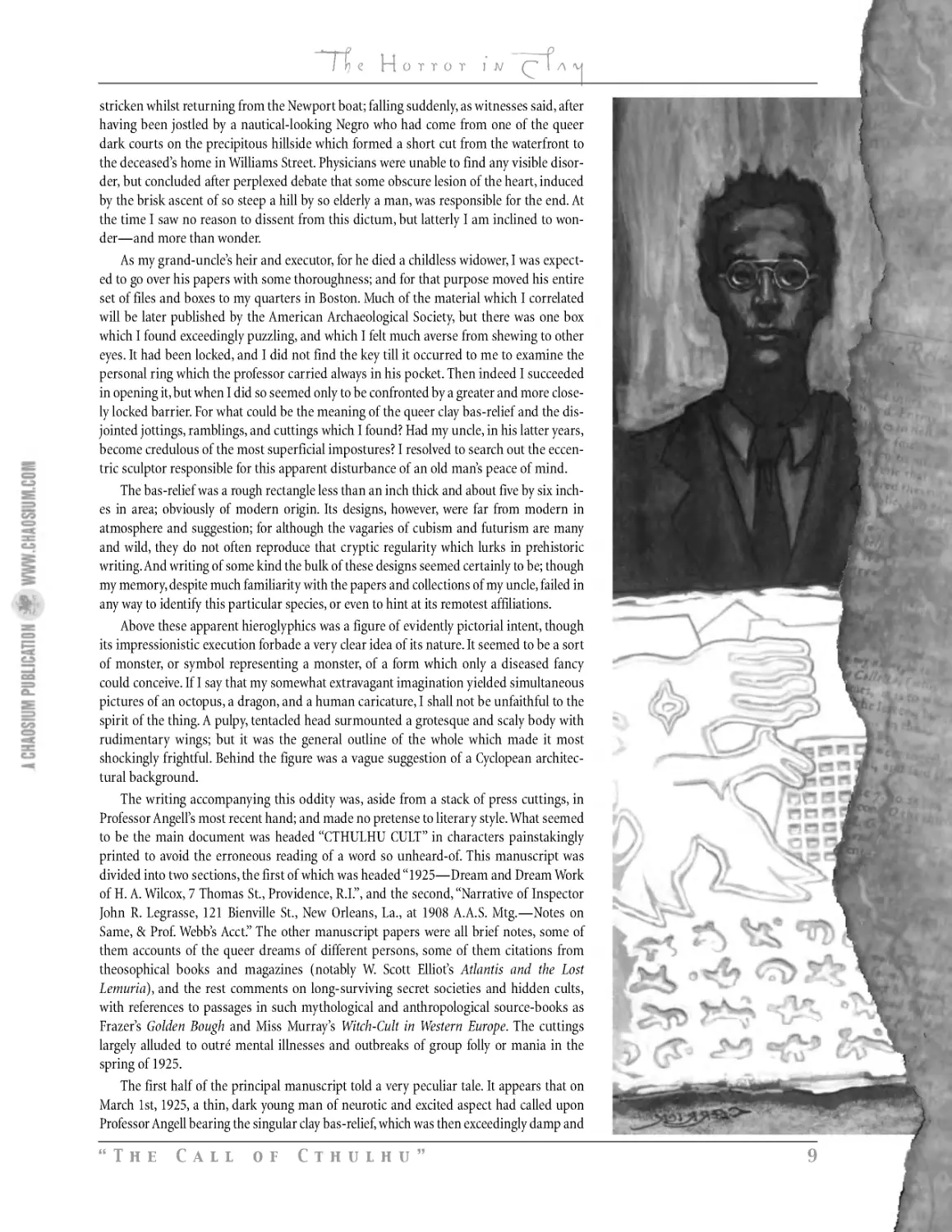
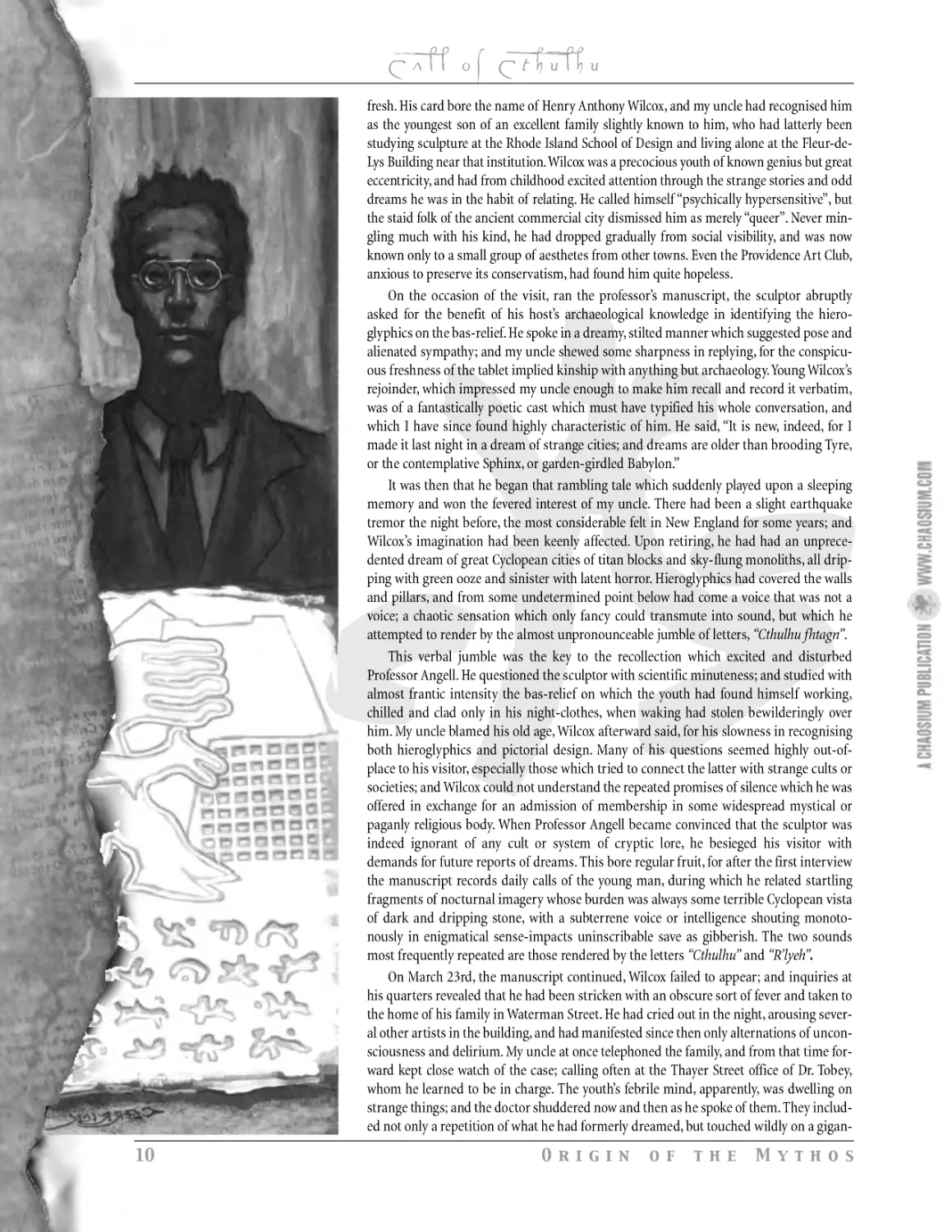
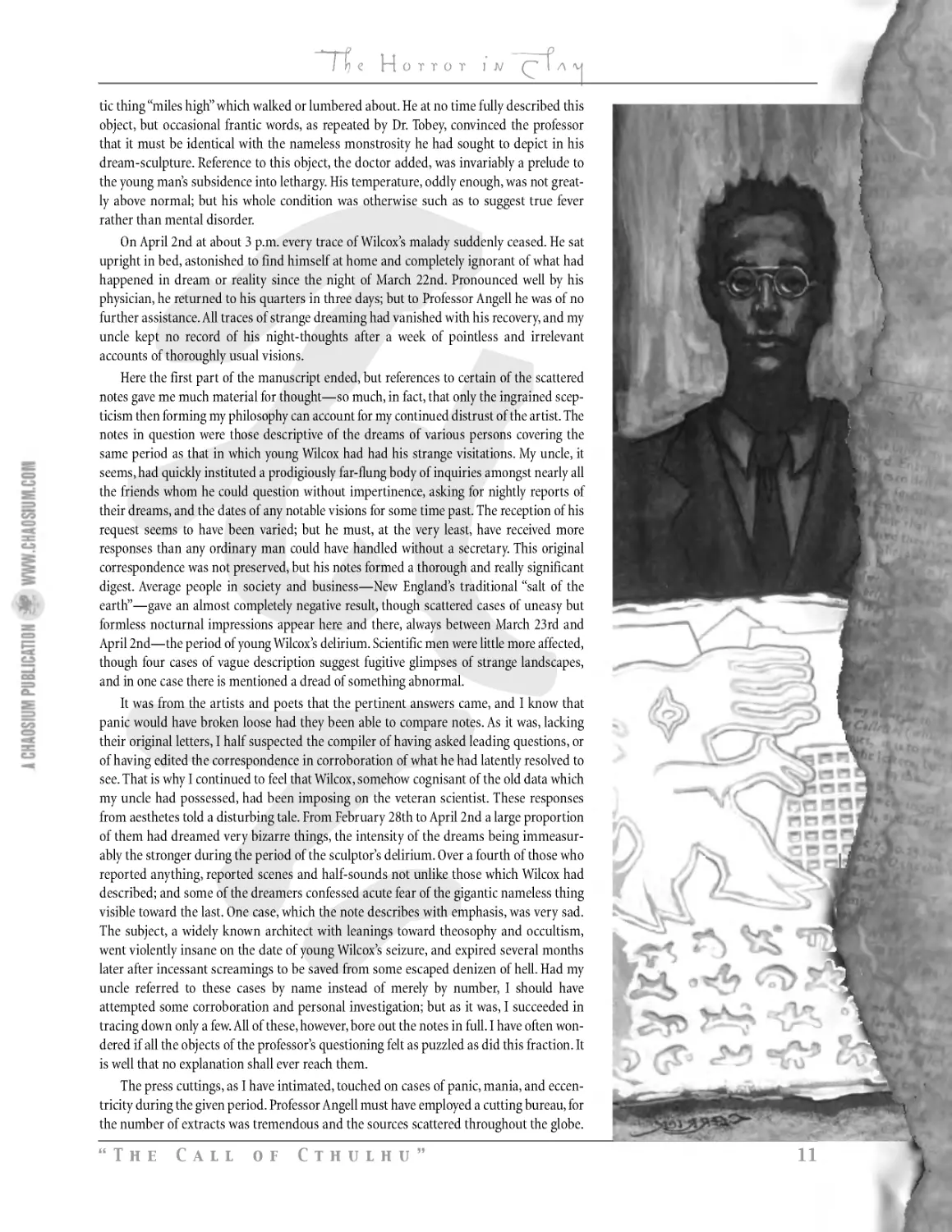
ly locked barrier. For what could be the meaning of the queer clay bas-relief and the dis-
jointed jottings, ramblings, and cuttings which I found? Had my uncle, in his latter years,
become credulous of the most superficial impostures? I resolved to search out the eccen-
tric sculptor responsible for this apparent disturbance of an old man’s peace of mind.
The bas-relief was a rough rectangle less than an inch thick and about five by six inch-
es in area; obviously of modern origin. Its designs, however, were far from modern in
atmosphere and suggestion; for although the vagaries of cubism and futurism are many
and wild, they do not often reproduce that cryptic regularity which lurks in prehistoric
writing. And writing of some kind the bulk of these designs seemed certainly to be; though
my memory, despite much familiarity with the papers and collections of my uncle, failed in
any way to identify this particular species, or even to hint at its remotest affiliations.
Above these apparent hieroglyphics was a figure of evidently pictorial intent, though
its impressionistic execution forbade a very clear idea of its nature. It seemed to be a sort
of monster, or symbol representing a monster, of a form which only a diseased fancy
could conceive. If I say that my somewhat extravagant imagination yielded simultaneous
pictures of an octopus, a dragon, and a human caricature, I shall not be unfaithful to the
spirit of the thing. A pulpy, tentacled head surmounted a grotesque and scaly body with
rudimentary wings; but it was the general outline of the whole which made it most
shockingly frightful. Behind the figure was a vague suggestion of a Cyclopean architec-
tural background.
The writing accompanying this oddity was, aside from a stack of press cuttings, in
Professor Angell’s most recent hand; and made no pretense to literar y style. What seemed
to be the main document was headed “CTHULHU CULT” in characters painstakingly
printed to avoid the erroneous reading of a word so unheard-of. This manuscript was
divided into two sections, the first of which was headed “1925—Dream and Dream Work
of H. A. Wilcox, 7 Thomas St., Providence, R.I.”, and the second, “Narrative of Inspector
John R. Legrasse, 121 Bienville St., New Orleans, La., at 1908 A.A.S. Mtg.— Notes on
Same, & Prof. Webb’s Acct.” The other manuscript papers were all brief notes, some of
them accounts of the queer dreams of different persons, some of them citations from
theosophical books and magazines (notably W. Scott Elliot’s Atlantis and the Lost
Lemuria), and the rest comments on long-surviving secret societies and hidden cults,
with references to passages in such mythological and anthropological source-books as
Frazer’s Golden Bough and Miss Murray’s Witch-Cult in Western Europe. The cuttings
largely alluded to outré mental illnesses and outbreaks of group folly or mania in the
spring of 1925.
The first half of the principal manuscript told a very peculiar tale. It appears that on
March 1st, 1925, a thin, dark young man of neurotic and excited aspect had called upon
Professor Angell bearing the singular clay bas-relief, which was then exceedingly damp and
TheHorror inClay
“The Call of Cthulhu”
9

Call of Cthulhu
10
Origin of the Mythos
h
fresh. His card bore the name of Henry Anthony Wilcox, and my uncle had recognised him
as the youngest son of an excellent family slightly known to him, who had latterly been
studying sculpture at the Rhode Island School of Design and living alone at the Fleur-de-
Lys Building near that institution. Wilcox was a precocious youth of known genius but great
eccentricity, and had from childhood excited attention through the strange stories and odd
dreams he was in the habit of relating. He called himself “psychically hypersensitive”, but
the staid folk of the ancient commercial city dismissed him as merely “queer”. Never min-
gling much with his kind, he had dropped gradually from social visibility, and was now
known only to a small group of aesthetes from other towns. Even the Providence Art Club,
anxious to preserve its conservatism, had found him quite hopeless.
On the occasion of the visit, ran the professor’s manuscript, the sculptor abruptly
asked for the benefit of his host’s archaeological knowledge in identifying the hiero-
glyphics on the bas-relief. He spoke in a dreamy, stilted manner which suggested pose and
alienated sympathy; and my uncle shewed some sharpness in replying, for the conspicu-
ous freshness of the tablet implied kinship with anything but archaeology.Young Wilcox’s
rejoinder, which impressed my uncle enough to make him recall and record it verbatim,
was of a fantastically poetic cast which must have typified his whole conversation, and
which I have since found highly characteristic of him. He said, “It is new, indeed, for I
made it last night in a dream of strange cities; and dreams are older than brooding Tyre,
or the contemplative Sphinx, or garden-girdled Babylon.”
It was then that he began that rambling tale which suddenly played upon a sleeping
memory and won the fevered interest of my uncle. There had been a slight earthquake
tremor the night before, the most considerable felt in New England for some years; and
Wilcox’s imagination had been keenly affected. Upon retiring, he had had an unprece-
dented dream of great Cyclopean cities of titan blocks and sky-flung monoliths, all drip-
ping with green ooze and sinister with latent horror. Hieroglyphics had covered the walls
and pillars, and from some undetermined point below had come a voice that was not a
voice; a chaotic sensation which only fancy could transmute into sound, but which he
attempted to render by the almost unpronounceable jumble of letters, “Cthulhu fhtagn”.
This verbal jumble was the key to the recollection which excited and disturbed
Professor Angell. He questioned the sculptor with scientific minuteness; and studied with
almost frantic intensity the bas-relief on which the youth had found himself working,
chilled and clad only in his night-clothes, when waking had stolen bewilderingly over
him. My uncle blamed his old age, Wilcox afterward said, for his slowness in recognising
both hieroglyphics and pictorial design. Many of his questions seemed highly out-of-
place to his visitor, especially those which tried to connect the latter with strange cults or
societies; and Wilcox could not understand the repeated promises of silence which he was
offered in exchange for an admission of membership in some widespread mystical or
paganly religious body. When Professor Angell became convinced that the sculptor was
indeed ignorant of any cult or system of cryptic lore, he besieged his visitor with
demands for future reports of dreams. This bore regular fruit, for after the first interview
the manuscript records daily calls of the young man, during which he related startling
fragments of nocturnal imagery whose burden was always some terrible Cyclopean vista
of dark and dripping stone, with a subterrene voice or intelligence shouting monoto-
nously in enigmatical sense-impacts uninscribable save as gibberish. The two sounds
most frequently repeated are those rendered by the letters “Cthulhu” and “R’lyeh”.
On March 23rd, the manuscript continued, Wilcox failed to appear; and inquiries at
his quarters revealed that he had been stricken with an obscure sort of fever and taken to
the home of his family in Waterman Street. He had cried out in the night, arousing sever-
al other artists in the building, and had manifested since then only alternations of uncon-
sciousness and delirium. My uncle at once telephoned the family, and from that time for-
ward kept close watch of the case; calling often at the Thayer Street office of Dr. Tobey,
whom he learned to be in charge. The youth’s febrile mind, apparently, was dwelling on
strange things; and the doctor shuddered now and then as he spoke of them. They includ-
ed not only a repetition of what he had formerly dreamed, but touched wildly on a gigan-

“The Call of Cthulhu”
11
c
tic thing “miles high” which walked or lumbered about. He at no time fully described this
object, but occasional frantic words, as repeated by Dr. Tobey, convinced the professor
that it must be identical with the nameless monstrosity he had sought to depict in his
dream-sculpture. Reference to this object, the doctor added, was invariably a prelude to
the young man’s subsidence into lethargy. His temperature, oddly enough, was not great-
ly above normal; but his whole condition was otherwise such as to suggest true fever
rather than mental disorder.
On April 2nd at about 3 p.m. every trace of Wilcox’s malady suddenly ceased. He sat
upright in bed, astonished to find himself at home and completely ignorant of what had
happened in dream or reality since the night of March 22nd. Pronounced well by his
physician, he returned to his quarters in three days; but to Professor Angell he was of no
further assistance. All traces of strange dreaming had vanished with his recovery, and my
uncle kept no record of his night-thoughts after a week of pointless and irrelevant
accounts of thoroughly usual visions.
Here the first part of the manuscript ended, but references to certain of the scattered
notes gave me much material for thought—so much, in fact, that only the ingrained scep-
ticism then forming my philosophy can account for my continued distrust of the artist. The
notes in question were those descriptive of the dreams of various persons covering the
same period as that in which young Wilcox had had his strange visitations. My uncle, it
seems, had quickly instituted a prodigiously far-flung body of inquiries amongst nearly all
the friends whom he could question without impertinence, asking for nightly reports of
their dreams, and the dates of any notable visions for some time past. The reception of his
request seems to have been varied; but he must, at the very least, have received more
responses than any ordinary man could have handled without a secretary. This original
correspondence was not preserved, but his notes formed a thorough and really significant
digest. Average people in society and business—New England’s traditional “salt of the
earth”—gave an almost completely negative result, though scattered cases of uneasy but
formless nocturnal impressions appear here and there, always between March 23rd and
April 2nd—the period of young Wilcox’s delirium. Scientific men were little more affected,
though four cases of vague description suggest fugitive glimpses of strange landscapes,
and in one case there is mentioned a dread of something abnormal.
It was from the artists and poets that the pertinent answers came, and I know that
panic would have broken loose had they been able to compare notes. As it was, lacking
their original letters, I half suspected the compiler of having asked leading questions, or
of having edited the correspondence in corroboration of what he had latently resolved to
see. That is why I continued to feel that Wilcox, somehow cognisant of the old data which
my uncle had possessed, had been imposing on the veteran scientist. These responses
from aesthetes told a disturbing tale. From February 28th to April 2nd a large proportion
of them had dreamed ver y bizarre things, the intensity of the dreams being immeasur-
ably the stronger during the period of the sculptor’s delirium. Over a fourth of those who
reported anything, reported scenes and half-sounds not unlike those which Wilcox had
described; and some of the dreamers confessed acute fear of the gigantic nameless thing
visible toward the last. One case, which the note describes with emphasis, was very sad.
The subject, a widely known architect with leanings toward theosophy and occultism,
went violently insane on the date of young Wilcox’s seizure, and expired several months
later after incessant screamings to be saved from some escaped denizen of hell. Had my
uncle referred to these cases by name instead of merely by number, I should have
attempted some corroboration and personal investigation; but as it was, I succeeded in
tracing down only a few. All of these, however, bore out the notes in full. I have often won-
dered if all the objects of the professor’s questioning felt as puzzled as did this fraction. It
is well that no explanation shall ever reach them.
The press cuttings, as I have intimated, touched on cases of panic, mania, and eccen-
tricity during the given period. Professor Angell must have employed a cutting bureau, for
the number of extracts was tremendous and the sources scattered throughout the globe.
TheHorror inClay

Call of Cthulhu
12
Origin of the Mythos
Here was a nocturnal suicide in London, where a lone sleeper had leaped from a window
after a shocking cry. Here likewise a rambling letter to the editor of a paper in South
America, where a fanatic deduces a dire future from visions he has seen. A despatch from
California describes a theosophist colony as donning white robes en masse for some “glo-
rious fulfillment” which never arrives, whilst items from India speak guardedly of serious
native unrest toward the end of March. Voodoo orgies multiply in Hayti, and African out-
posts report ominous mutterings. American officers in the Philippines find certain tribes
bothersome at this time, and New York policemen are mobbed by hysterical Levantines
on the night of March 22-23 . The west of Ireland, too, is full of wild rumour and legendry,
and a fantastic painter named Ardois-Bonnot hangs a blasphemous “Dream Landscape”
in the Paris spring salon of 1926. And so numerous are the recorded troubles in insane
asylums, that only a miracle can have stopped the medical fraternity from noting strange
parallelisms and drawing mystified conclusions. A weird bunch of cuttings, all told; and
I can at this date scarcely envisage the callous rationalism with which I set them aside.
But I was then convinced that young Wilcox had known of the older matters mentioned
by the professor.
ii
The Tale of Inspector Legrasse
The older matters which had made the sculptor’s dream and bas-relief so significant to
my uncle formed the subject of the second half of his long manuscript. Once before,
it appears, Professor Angell had seen the hellish outlines of the nameless monstrosity,
puzzled over the unknown hieroglyphics, and heard the ominous syllables which can be
rendered only as “Cthulhu”; and all this in so stirring and horrible a connexion that it is
small wonder he pursued young Wilcox with queries and demands for data.
This earlier experience had come in 1908, seventeen years before, when the American
Archaeological Society held its annual meeting in St. Louis. Professor Angell, as befitted
one of his authority and attainments, had had a prominent part in all the deliberations;
and was one of the first to be approached by the several outsiders who took advantage of
the convocation to offer questions for correct answering and problems for expert solution.
The chief of these outsiders, and in a short time the focus of interest for the entire
meeting, was a commonplace-looking middle-aged man who had travelled all the way
from New Orleans for certain special information unobtainable from any local source. His
name was John Raymond Legrasse, and he was by profession an Inspector of Police. With
him he bore the subject of his visit, a grotesque, repulsive, and apparently very ancient
stone statuette whose origin he was at a loss to determine. It must not be fancied that
Inspector Legrasse had the least interest in archaeology. On the contrary, his wish for
enlightenment was prompted by purely professional considerations. The statuette, idol,
fetish, or whatever it was, had been captured some months before in the wooded swamps
south of New Orleans during a raid on a supposed voodoo meeting; and so singular and
hideous were the rites connected with it, that the police could not but realise that they had
stumbled on a dark cult totally unknown to them, and infinitely more diabolic than even
the blackest of the African voodoo circles. Of its origin, apart from the erratic and unbe-
lievable tales extorted from the captured members, absolutely nothing was to be discov-
ered; hence the anxiety of the police for any antiquarian lore which might help them to
place the frightful symbol, and through it track down the cult to its fountain-head.
Inspector Legrasse was scarcely prepared for the sensation which his offering creat-
ed. One sight of the thing had been enough to throw the assembled men of science into a
state of tense excitement, and they lost no time in crowding around him to gaze at the
diminutive figure whose utter strangeness and air of genuinely abysmal antiquity hinted
so potently at unopened and archaic vistas. No recognised school of sculpture had ani-
mated this terrible object, yet centuries and even thousands of years seemed recorded in
its dim and greenish surface of unplaceable stone.

“The Call of Cthulhu”
13
z
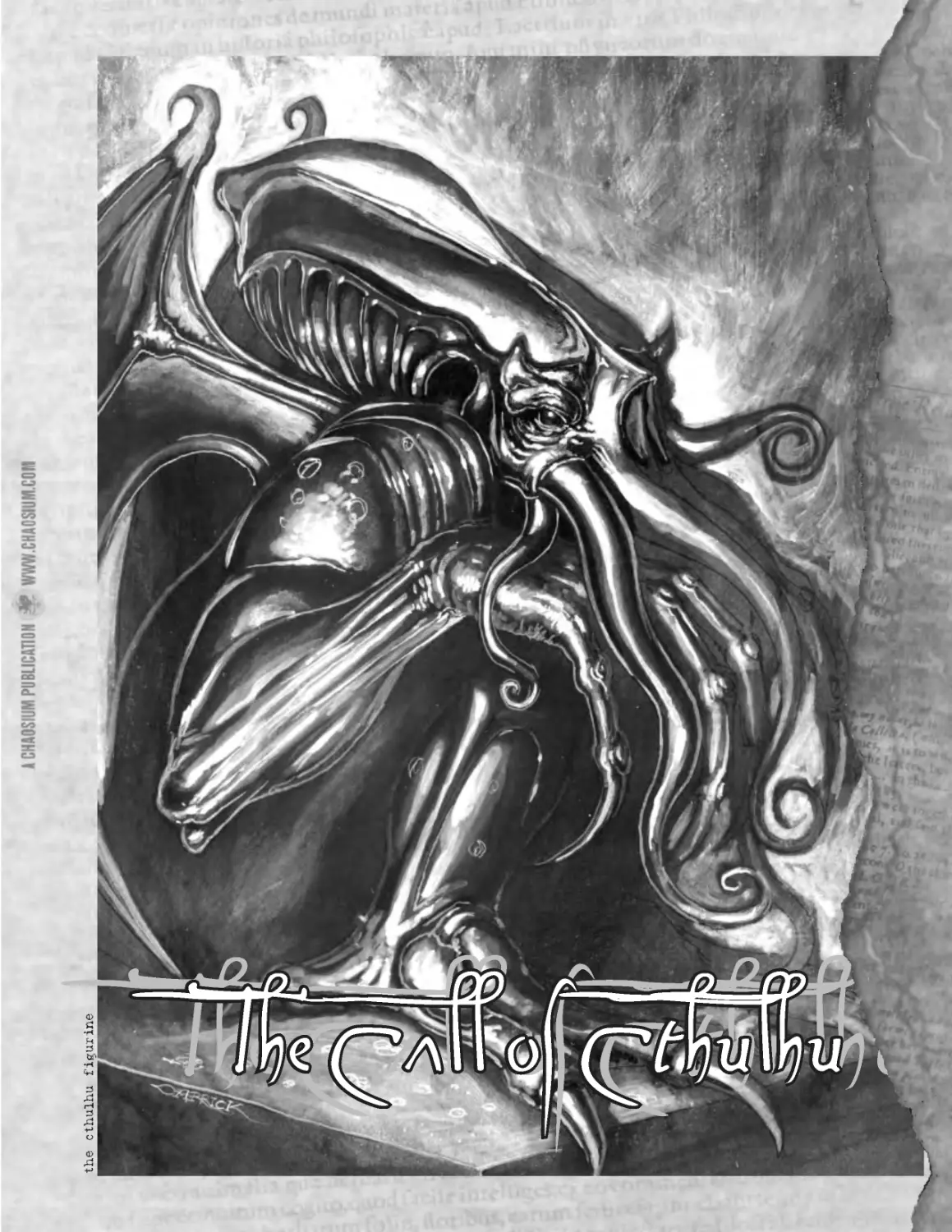
The figure, which was finally passed slowly from man to
man for close and careful study, was between seven and eight
inches in height, and of exquisitely artistic workmanship. It rep-
resented a monster of vaguely anthropoid outline, but with an
octopus-like head whose face was a mass of feelers, a scaly, rub-
bery-looking body, prodigious claws on hind and fore feet, and
long, narrow wings behind. This thing, which seemed instinct
with a fearsome and unnatural malignancy, was of a somewhat
bloated corpulence, and squatted evilly on a rectangular block
or pedestal covered with undecipherable characters. The tips of
the wings touched the back edge of the block, the seat occupied
the centre, whilst the long, curved claws of the doubled-up,
crouching hind legs gripped the front edge and extended a
quarter of the way down toward the bottom of the pedestal. The
cephalopod head was bent forward, so that the ends of the facial
feelers brushed the backs of huge fore paws which clasped the
croucher’s elevated knees. The aspect of the whole was abnor-
mally life-like, and the more subtly fearful because its source
was so totally unknown. Its vast, awesome, and incalculable age
was unmistakable; yet not one link did it shew with any known
type of art belonging to civilisation’s youth—or indeed to any
other time. Totally separate and apart, its very material was a
mystery; for the soapy, greenish-black stone with its golden or
iridescent flecks and striations resembled nothing familiar to
geology or mineralogy. The characters along the base were
equally baffling; and no member present, despite a representa-
tion of half the world’s expert learning in this field, could form
the least notion of even their remotest linguistic kinship. They,
like the subject and material, belonged to something horribly
remote and distinct from mankind as we know it; something
frightfully suggestive of old and unhallowed cycles of life in
which our world and our conceptions have no part.
And yet, as the members severally shook their heads and
confessed defeat at the Inspector’s problem, there was one man
in that gathering who suspected a touch of bizarre familiarity in
the monstrous shape and writing, and who presently told with
some diffidence of the odd trifle he knew. This person was the
late William Channing Webb, Professor of Anthropology in
Princeton University, and an explorer of no slight note.
Professor Webb had been engaged, forty-eight years before, in a
tour of Greenland and Iceland in search of some Runic inscrip-
tions which he failed to unearth; and whilst high up on the West
Greenland coast had encountered a singular tribe or cult of
degenerate Esquimaux whose religion, a curious form of devil-
worship, chilled him with its deliberate bloodthirstiness and
repulsiveness. It was a faith of which other Esquimaux knew lit-
tle, and which they mentioned only with shudders, saying that
it had come down from horribly ancient aeons before ever the
world was made. Besides nameless rites and human sacrifices
there were certain queer hereditary rituals addressed to a
supreme elder devil or tornasuk; and of this Professor Webb
had taken a careful phonetic copy from an aged angekok or wiz-
ard-priest, expressing the sounds in Roman letters as best he
knew how. But just now of prime significance was the fetish
which this cult had cherished, and around which they danced
when the aurora leaped high over the ice cliffs. It was, the pro-
fessor stated, a very crude bas-relief of stone, comprising a
hideous picture and some cryptic writing. And so far as he
could tell, it was a rough parallel in all essential features of the
bestial thing now lying before the meeting.
This data, received with suspense and astonishment by the
assembled members, proved doubly exciting to Inspector
Legrasse; and he began at once to ply his informant with ques-
tions. Having noted and copied an oral ritual among the swamp
cult-worshippers his men had arrested, he besought the profes-
sor to remember as best he might the syllables taken down
amongst the diabolist Esquimaux. There then followed an
exhaustive comparison of details, and a moment of really awed
silence when both detective and scientist agreed on the virtual
identity of the phrase common to two hellish rituals so many
worlds of distance apart. What, in substance, both the
Esquimaux wizards and the Louisiana swamp-priests had
chanted to their kindred idols was something ver y like this—
the word-divisions being guessed at from traditional breaks in
the phrase as chanted aloud:
“Ph’nglui mglw’nafh Cthulhu R’lyeh wgah’nagl fhtagn.”
Legrasse had one point in advance of Professor Webb, for
several among his mongrel prisoners had repeated to him what
older celebrants had told them the words meant. This text, as
given, ran something like this:
“In his house at R’lyeh dead Cthulhu waits dreaming.”
And now, in response to a general and urgent demand,
Inspector Legrasse related as fully as possible his experience
with the swamp worshippers; telling a stor y to which I could see
my uncle attached profound significance. It savoured of the
wildest dreams of mythmaker and theosophist, and disclosed
an astonishing degree of cosmic imagination among such half-
castes and pariahs as might be least expected to possess it.
On November 1st, 1907, there had come to the New Orleans
police a frantic summons from the swamp and lagoon country
to the south. The squatters there, mostly primitive but good-
natured descendants of Lafitte’s men, were in the grip of stark
terror from an unknown thing which had stolen upon them in
the night. It was voodoo, apparently, but voodoo of a more ter-
rible sort than they had ever known; and some of their women
and children had disappeared since the malevolent tom-tom
had begun its incessant beating far within the black haunted
woods where no dweller ventured. There were insane shouts
and harrowing screams, soul-chilling chants and dancing
devil-flames; and, the frightened messenger added, the people
could stand it no more.
So a body of twenty police, filling two carriages and an
automobile, had set out in the late afternoon with the shivering
squatter as a guide. At the end of the passable road they alight-
ed, and for miles splashed on in silence through the terrible
cypress woods where day never came. Ugly roots and malig-
nant hanging nooses of Spanish moss beset them, and now and
then a pile of dank stones or fragment of a rotting wall intensi-
fied by its hint of morbid habitation a depression which every
TheTale ofInspector Legrasse

Call of Cthulhu
14
Origin of the Mythos
f
malformed tree and every fungous islet combined to create. At length the squatter settle-
ment, a miserable huddle of huts, hove in sight; and hysterical dwellers ran out to cluster
around the group of bobbing lanterns. The muffled beat of tom-toms was now faintly
audible far, far ahead; and a curdling shriek came at infrequent intervals when the wind
shifted. A reddish glare, too, seemed to filter through pale undergrowth beyond the end-
less avenues of forest night. Reluctant even to be left alone again, each one of the cowed
squatters refused point-blank to advance another inch toward the scene of unholy wor-
ship, so Inspector Legrasse and his nineteen colleagues plunged on unguided into black
arcades of horror that none of them had ever trod before.
The region now entered by the police was one of traditionally evil repute, substantial-
ly unknown and untraversed by white men. There were legends of a hidden lake
unglimpsed by mortal sight, in which dwelt a huge, formless white polypous thing with
luminous eyes; and squatters whispered that bat-winged devils flew up out of caverns in
inner earth to worship it at midnight. They said it had been there before d’Iberville, before
La Salle, before the Indians, and before even the wholesome beasts and birds of the woods.
It was nightmare itself, and to see it was to die. But it made men dream, and so they knew
enough to keep away. The present voodoo orgy was, indeed, on the merest fringe of this
abhorred area, but that location was bad enough; hence perhaps the very place of the wor-
ship had terrified the squatters more than the shocking sounds and incidents.
Only poetry or madness could do justice to the noises heard by Legrasse’s men as they
ploughed on through the black morass toward the red glare and muffled tom-toms. There
are vocal qualities peculiar to men, and vocal qualities peculiar to beasts; and it is terri-
ble to hear the one when the source should yield the other. Animal fury and orgiastic
license here whipped themselves to daemoniac heights by howls and squawking ecstacies
that tore and reverberated through those nighted woods like pestilential tempests from
the gulfs of hell. Now and then the less organized ululation would cease, and from what
seemed a well-drilled chorus of hoarse voices would rise in sing-song chant that hideous
phrase or ritual: “Ph’nglui mglw’nafh Cthulhu R’lyeh wgah’nagl fhtagn.”
Then the men, having reached a spot where the trees were thinner, came suddenly in
sight of the spectacle itself. Four of them reeled, one fainted, and two were shaken into a
frantic cry which the mad cacophony of the orgy fortunately deadened. Legrasse dashed
swamp water on the face of the fainting man, and all stood trembling and nearly hypno-
tised with horror.
In a natural glade of the swamp stood a grassy island of perhaps an acre’s extent, clear
of trees and tolerably dry. On this now leaped and twisted a more indescribable horde of
human abnormality than any but a Sime or an Angarola could paint. Void of clothing, this
hybrid spawn were braying, bellowing, and writhing about a monstrous ring-shaped bon-
fire; in the centre of which, revealed by occasional rifts in the curtain of flame, stood a
great granite monolith some eight feet in height; on top of which, incongruous in its
diminutiveness, rested the noxious carven statuette. From a wide circle of ten scaffolds set
up at regular intervals with the flame-girt monolith as a centre hung, head downward, the
oddly marred bodies of the helpless squatters who had disappeared. It was inside this cir-
cle that the ring of worshippers jumped and roared, the general direction of the mass
motion being from left to right in endless Bacchanal between the ring of bodies and the
ring of fire.
It may have been only imagination and it may have been only echoes which induced
one of the men, an excitable Spaniard, to fancy he heard antiphonal responses to the rit-
ual from some far and unillumined spot deeper within the wood of ancient legendry and
horror. This man, Joseph D. Galvez, I later met and questioned; and he proved distract-
ingly imaginative. He indeed went so far as to hint of the faint beating of great wings, and
of a glimpse of shining eyes and a mountainous white bulk beyond the remotest trees—
but I suppose he had been hearing too much native superstition.
Actually, the horrified pause of the men was of comparatively brief duration. Duty
came first; and although there must have been nearly a hundred mongrel celebrants in the

“The Call of Cthulhu”
15
throng, the police relied on their firearms and plunged determinedly into the nauseous
rout. For five minutes the resultant din and chaos were beyond description. Wild blows
were struck, shots were fired, and escapes were made; but in the end Legrasse was able to
count some forty-seven sullen prisoners, whom he forced to dress in haste and fall into
line between two rows of policemen. Five of the worshippers lay dead, and two severely
wounded ones were carried away on improvised stretchers by their fellow-prisoners. The
image on the monolith, of course, was carefully removed and carried back by Legrasse.
Examined at headquarters after a trip of intense strain and weariness, the prisoners
all proved to be men of a very low, mixed-blooded, and mentally aberrant type. Most were
seamen, and a sprinkling of Negroes and mulattoes, largely West Indians or Brava
Portuguese from the Cape Verde Islands, gave a colouring of voodooism to the heteroge-
neous cult. But before many questions were asked, it became manifest that something far
deeper and older than Negro fetichism was involved. Degraded and ignorant as they were,
the creatures held with surprising consistency to the central idea of their loathsome faith.
They worshipped, so they said, the Great Old Ones who lived ages before there were
any men, and who came to the young world out of the sky. Those Old Ones were gone now,
inside the earth and under the sea; but their dead bodies had told their secrets in dreams
to the first men, who formed a cult which had never died. This was that cult, and the pris-
oners said it had always existed and always would exist, hidden in distant wastes and dark
places all over the world until the time when the great priest Cthulhu, from his dark house
in the mighty city of R’lyeh under the waters, should rise and bring the earth again
beneath his sway. Some day he would call, when the stars were ready, and the secret cult
would always be waiting to liberate him.
Meanwhile no more must be told. There was a secret which even torture could not
extract. Mankind was not absolutely alone among the conscious things of earth, for
shapes came out of the dark to visit the faithful few. But these were not the Great Old
Ones. No man had ever seen the Old Ones. The carven idol was great Cthulhu, but none
might say whether or not the others were precisely like him. No one could read the old
writing now, but things were told by word of mouth. The chanted ritual was not the
secret—that was never spoken aloud, only whispered. The chant meant only this: “In his
house at R’lyeh dead Cthulhu waits dreaming.”
Only two of the prisoners were found sane enough to be hanged, and the rest were
committed to various institutions. All denied a part in the ritual murders, and averred
that the killing had been done by Black Winged Ones which had come to them from their
immemorial meeting-place in the haunted wood. But of those mysterious allies no coher-
ent account could ever be gained. What the police did extract, came mainly from the
immensely aged mestizo named Castro, who claimed to have sailed to strange ports and
talked with undying leaders of the cult in the mountains of China.
Old Castro remembered bits of hideous legend that paled the speculations of
theosophists and made man and the world seem recent and transient indeed. There had
been aeons when other Things ruled on the earth, and They had had great cities. Remains
of Them, he said the deathless Chinamen had told him, were still to be found as
Cyclopean stones on islands in the Pacific. They all died vast epochs of time before men
came, but there were arts which could revive Them when the stars had come round again
to the right positions in the cycle of eternity. They had, indeed, come themselves from the
stars, and brought Their images with Them.
These Great Old Ones, Castro continued, were not composed altogether of flesh and
blood. They had shape—for did not this star-fashioned image prove it?—but that shape
was not made of matter. When the stars were right, They could plunge from world to
world through the sky; but when the stars were wrong, They could not live. But although
They no longer lived, They would never really die. They all lay in stone houses in Their
great city of R’lyeh, preserved by the spells of mighty Cthulhu for a glorious resurrection
when the stars and the earth might once more be ready for Them. But at that time some
force from outside must serve to liberate Their bodies. The spells that preserved Them
TheTale ofInspector Legrasse

Call of Cthulhu
16
Origin of the Mythos
intact likewise prevented Them from making an initial move, and They could only lie
awake in the dark and think whilst uncounted millions of years rolled by. They knew all
that was occurring in the universe, for Their mode of speech was transmitted thought.
Even now They talked in Their tombs. When, after infinities of chaos, the first men came,
the Great Old Ones spoke to the sensitive among them by moulding their dreams; for only
thus could Their language reach the fleshly minds of mammals.
Then, whispered Castro, those first men formed the cult around small idols which the
Great Ones shewed them; idols brought in dim eras from dark stars. That cult would never
die till the stars came right again, and the secret priests would take great Cthulhu from
His tomb to revive His subjects and resume His rule of earth. The time would be easy to
know, for then mankind would have become as the Great Old Ones; free and wild and
beyond good and evil, with laws and morals thrown aside and all men shouting and
killing and revelling in joy. Then the liberated Old Ones would teach them new ways to
shout and kill and revel and enjoy themselves, and all the earth would flame with a holo-
caust of ecstasy and freedom. Meanwhile the cult, by appropriate rites, must keep alive the
memory of those ancient ways and shadow forth the prophecy of their return.
In the elder time chosen men had talked with the entombed Old Ones in dreams, but
then something happened. The great stone city R’lyeh, with its monoliths and sepulchres,
had sunk beneath the waves; and the deep waters, full of the one primal mystery through
which not even thought can pass, had cut off the spectral intercourse. But memory never
died, and the high-priests said that the city would rise again when the stars were right.
Then came out of the earth the black spirits of earth, mouldy and shadowy, and full of
dim rumours picked up in caverns beneath forgotten sea-bottoms. But of them old Castro
dared not speak much. He cut himself off hurriedly, and no amount of persuasion or sub-
tlety could elicit more in this direction. The size of the Old Ones, too, he curiously
declined to mention. Of the cult, he said that he thought the centre lay amid the pathless
desert of Arabia, where Irem, the City of Pillars, dreams hidden and untouched. It was not
allied to the European witch-cult, and was virtually unknown beyond its members. No
book had ever really hinted of it, though the deathless Chinamen said that there were
double meanings in the Necronomicon of the mad Arab Abdul Alhazred which the initi-
ated might read as they chose, especially the much-discussed couplet:
“That is not dead which can eternal lie,
And with strange aeons even death may die.”
Legrasse, deeply impressed and not a little bewildered, had inquired in vain concern-
ing the historic affiliations of the cult. Castro, apparently, had told the truth when he said
that it was wholly secret. The authorities at Tulane University could shed no light upon
either cult or image, and now the detective had come to the highest authorities in the
country and met with no more than the Greenland tale of Professor Webb.
The feverish interest aroused at the meeting by Legrasse’s tale, corroborated as it was
by the statuette, is echoed in the subsequent correspondence of those who attended;
although scant mention occurs in the formal publications of the society. Caution is the
first care of those accustomed to face occasional charlatanr y and imposture. Legrasse for
some time lent the image to Professor Webb, but at the latter’s death it was returned to
him and remains in his possession, where I viewed it not long ago. It is truly a terrible
thing, and unmistakably akin to the dream-sculpture of young Wilcox.
That my uncle was excited by the tale of the sculptor I did not wonder, for what
thoughts must arise upon hearing, after a knowledge of what Legrasse had learned of the
cult, of a sensitive young man who had dreamed not only the figure and exact hiero-
glyphics of the swamp-found image and the Greenland devil tablet, but had come in his
dreams upon at least three of the precise words of the formula uttered alike by Esquimau
diabolists and mongrel Louisianans? Professor Angell’s instant start on an investigation
of the utmost thoroughness was eminently natural; though privately I suspected young

“The Call of Cthulhu”
17
u
Wilcox of having heard of the cult in some indirect way, and of having invented a series
of dreams to heighten and continue the mystery at my uncle’s expense. The dream-nar -
ratives and cuttings collected by the professor were, of course, strong corroboration; but
the rationalism of my mind and the extravagance of the whole subject led me to adopt
what I thought the most sensible conclusions. So, after thoroughly studying the manu-
script again and correlating the theosophical and anthropological notes with the cult nar-
rative of Legrasse, I made a trip to Providence to see the sculptor and give him the rebuke
I thought proper for so boldly imposing upon a learned and aged man.
Wilcox still lived alone in the Fleur-de-Lys Building in Thomas Street, a hideous
Victorian imitation of seventeenth-century Breton architecture which flaunts its stuccoed
front amidst the lovely colonial houses on the ancient hill, and under the very shadow of
the finest Georgian steeple in America, I found him at work in his rooms, and at once con-
ceded from the specimens scattered about that his genius is indeed profound and authen-
tic. He will, I believe, some time be heard from as one of the great decadents; for he has
crystallised in clay and will one day mirror in marble those nightmares and phantasies
which Arthur Machen evokes in prose, and Clark Ashton Smith makes visible in verse and
in painting.
Dark, frail, and somewhat unkempt in aspect, he turned languidly at my knock and
asked me my business without rising. When I told him who I was, he displayed some
interest; for my uncle had excited his curiosity in probing his strange dreams, yet had
never explained the reason for the study. I did not enlarge his knowledge in this regard,
but sought with some subtlety to draw him out. In a short time I became convinced of his
absolute sincerity, for he spoke of the dreams in a manner none could mistake. They and
their subconscious residuum had influenced his art profoundly, and he shewed me a
morbid statue whose contours almost made me shake with the potency of its black sug-
gestion. He could not recall having seen the original of this thing except in his own dream
bas-relief, but the outlines had formed themselves insensibly under his hands. It was, no
doubt, the giant shape he had raved of in delirium. That he really knew nothing of the
hidden cult, save from what my uncle’s relentless catechism had let fall, he soon made
clear; and again I strove to think of some way in which he could possibly have received
the weird impressions.
He talked of his dreams in a strangely poetic fashion; making me see with terrible
vividness the damp Cyclopean city of slimy green stone—whose geometry, he oddly said,
was all wrong—and hear with frightened expectancy the ceaseless, half-mental calling
from underground: “Cthulhu fhtagn”, “Cthulhu fhtagn”. These words had formed part of
that dread ritual which told of dead Cthulhu’s dream-vigil in his stone vault at R’lyeh, and
I felt deeply moved despite my rational beliefs. Wilcox, I was sure, had heard of the cult in
some casual way, and had soon forgotten it amidst the mass of his equally weird reading
and imagining. Later, by virtue of its sheer impressiveness, it had found subconscious
expression in dreams, in the bas-relief, and in the terrible statue I now beheld; so that his
imposture upon my uncle had been a ver y innocent one. The youth was of a type, at once
slightly affected and slightly ill-mannered, which I could never like, but I was willing
enough now to admit both his genius and his honesty. I took leave of him amicably, and
wish him all the success his talent promises.
The matter of the cult still remained to fascinate me, and at times I had visions of per-
sonal fame from researches into its origin and connexions. I visited New Orleans, talked
with Legrasse and others of that old-time raiding-party, saw the frightful image, and even
questioned such of the mongrel prisoners as still survived. Old Castro, unfortunately, had
been dead for some years. What I now heard so graphically at first-hand, though it was
really no more than a detailed confirmation of what my uncle had written, excited me
afresh; for I felt sure that I was on the track of a very real, very secret, and very ancient
religion whose discovery would make me an anthropologist of note. My attitude was still
one of absolute materialism, as I wish it still were, and I discounted with almost inexplic-
TheMadness fromtheSea

Call of Cthulhu
18
Origin of the Mythos
able perversity the coincidence of the dream notes and odd cut-
tings collected by Professor Angell.
One thing I began to suspect, and which I now fear I know,
is that my uncle’s death was far from natural. He fell on a narrow
hill street leading up from an ancient waterfront swarming with
foreign mongrels, after a careless push from a Negro sailor. I did
not forget the mixed blood and marine pursuits of the cult-
members in Louisiana, and would not be surprised to learn of
secret methods and rites and beliefs. Legrasse and his men, it is
true, have been let alone; but in Norway a certain seaman who
saw things is dead. Might not the deeper inquiries of my uncle
after encountering the sculptor’s data have come to sinister ears?
I think Professor Angell died because he knew too much, or
because he was likely to learn too much.Whether I shall go as he
did remains to be seen, for I have learned much now.
iii
The Madness from the Sea
Ifheaven ever wishes to grant me a boon, it will be a total
effacing of the results of a mere chance which fixed my eye
on a certain stray piece of shelf-paper. It was nothing on
which I would naturally have stumbled in the course of my
daily round, for it was an old number of an Australian journal,
the Sydney Bulletin for April 18, 1925. It had escaped even the
cutting bureau which had at the time of its issuance been avid-
ly collecting material for my uncle’s research.
I had largely given over my inquiries into what Professor
Angell called the “Cthulhu Cult”, and was visiting a learned
friend in Paterson, New Jersey; the curator of a local museum
and a mineralogist of note. Examining one day the reserve
specimens roughly set on the storage shelves in a rear room of
the museum, my eye was caught by an odd picture in one of the
old papers spread beneath the stones. It was the Sydney Bulletin
I have mentioned, for my friend had wide affiliations in all con-
ceivable foreign parts; and the picture was a half-tone cut of a
hideous stone image almost identical with that which Legrasse
had found in the swamp.
Eagerly clearing the sheet of its precious contents, I scanned
the item in detail; and was disappointed to find it of only mod-
erate length. What it suggested, however, was of portentous sig-
nificance to my flagging quest; and I carefully tore it out for
immediate action. It read as follows:
MYSTERY DERELICT FOUND AT SEA
Vigilant Arrives With Helpless Armed New Zealand Yacht in Tow.
One Sur vivor and Dead Man Found Aboard. Tale of Desperate
Battle and Deaths at Sea.
Rescued Seaman Refuses Particulars of Strange Experience.
Odd Idol Found in His Possession. Inquiry to Follow.
The Morrison Co.’s freighter Vigilant, bound from
Valparaiso, arrived this morning at its wharf in Darling
Harbour, having in tow the battled and disabled but heav-
ily armed steam yacht Alert of Dunedin, N.Z., which was
sighted April 12th in S. Latitude 34̊ 21', W. Longitude
152̊ 17' with one living and one dead man aboard.
The Vigilant left Valparaiso March 25th, and on April 2nd
was driven considerably south of her course by exception-
ally heavy storms and monster waves. On April 12th the
derelict was sighted; and though apparently deserted, was
found upon boarding to contain one survivor in a half-
delirious condition and one man who had evidently been
dead for more than a week. The living man was clutching
a horrible stone idol of unknown origin, about a foot in
height, regarding whose nature authorities at Sydney
University, the Royal Society, and the Museum in College
Street all profess complete bafflement, and which the sur-
vivor says he found in the cabin of the yacht, in a small
carved shrine of common pattern.
This man, after recovering his senses, told an exceedingly
strange story of piracy and slaughter. He is Gustaf
Johansen, a Norwegian of some intelligence, and had been
second mate of the two-masted schooner Emma of
Auckland, which sailed for Callao February 20th with a
complement of eleven men. The Emma, he says, was
delayed and thrown widely south of her course by the
great storm of March 1st, and on March 22nd, in S.
Latitude 49̊ 51' W. Longitude 128̊ 34', encountered the
Alert, manned by a queer and evil-looking crew of
Kanakas and half-castes. Being ordered peremptorily to
turn back, Capt. Collins refused; whereupon the strange
crew began to fire savagely and without warning upon the
schooner with a peculiarly heavy battery of brass cannon
forming part of the yacht’s equipment. The Emma’s men
shewed fight, says the survivor, and though the schooner
began to sink from shots beneath the waterline they man-
aged to heave alongside their enemy and board her, grap-
pling with the savage crew on the yacht’s deck, and being
forced to kill them all, the number being slightly superior,
because of their particularly abhorrent and desperate
though rather clumsy mode of fighting.
Three of the Emma’s men, including Capt. Collins and
First Mate Green, were killed; and the remaining eight
under Second Mate Johansen proceeded to navigate the
captured yacht, going ahead in their original direction to
see if any reason for their ordering back had existed. The
next day, it appears, they raised and landed on a small
island, although none is known to exist in that part of the
ocean; and six of the men somehow died ashore, though
Johansen is queerly reticent about this part of his story,
and speaks only of their falling into a rock chasm. Later,
it seems, he and one companion boarded the yacht and
tried to manage her, but were beaten about by the storm
of April 2nd. From that time till his rescue on the 12th
the man remembers little, and he does not even recall
when William Briden, his companion, died. Briden’s

death reveals no apparent cause, and was probably due to excitement or exposure.
Cable advices from Dunedin report that the Alert was well known there as an
island trader, and bore an evil reputation along the waterfront. It was owned by a
curious group of half-castes whose frequent meetings and night trips to the
woods attracted no little curiosity; and it had set sail in great haste just after the
storm and earth tremors of March 1st. Our Auckland correspondent gives the
Emma and her crew an excellent reputation, and Johansen is described as a sober
and worthy man. The admiralty will institute an inquiry on the whole matter
beginning tomorrow, at which ever y effort will be made to induce Johansen to
speak more freely than he has done hitherto.
This was all, together with the picture of the hellish image; but what a train of ideas
it started in my mind! Here were new treasuries of data on the Cthulhu Cult, and evidence
that it had strange interests at sea as well as on land. What motive prompted the hybrid
crew to order back the Emma as they sailed about with their hideous idol? What was the
unknown island on which six of the Emma’s crew had died, and about which the mate
Johansen was so secretive? What had the vice-admiralty’s investigation brought out, and
what was known of the noxious cult in Dunedin? And most marvellous of all, what deep
and more than natural linkage of dates was this which gave a malign and now undeniable
significance to the various turns of events so carefully noted by my uncle?
March 1st—our February 28th according to the International Date Line—the earth-
quake and storm had come. From Dunedin the Alert and her noisome crew had darted
eagerly forth as if imperiously summoned, and on the other side of the earth poets and
artists had begun to dream of a strange, dank Cyclopean city whilst a young sculptor had
moulded in his sleep the form of the dreaded Cthulhu. March 23rd the crew of the Emma
landed on an unknown island and left six men dead; and on that date the dreams of sen-
sitive men assumed a heightened vividness and darkened with dread of a giant monster’s
malign pursuit, whilst an architect had gone mad and a sculptor had lapsed suddenly into
delirium! And what of this storm of April 2nd—the date on which all dreams of the dank
city ceased, and Wilcox emerged unharmed from the bondage of strange fever? What of
all this—and of those hints of old Castro about the sunken, star-born Old Ones and their
coming reign; their faithful cult and their mastery of dreams? Was I tottering on the brink
of cosmic horrors beyond man’s power to bear? If so, they must be horrors of the mind
alone, for in some way the second of April had put a stop to whatever monstrous menace
had begun its siege of mankind’s soul.
That evening, after a day of hurried cabling and arranging, I bade my host adieu and
took a train for San Francisco. In less than a month I was in Dunedin; where, however, I
found that little was known of the strange cult-members who had lingered in the old sea-
taverns. Waterfront scum was far too common for special mention; though there was
vague talk about one inland trip these mongrels had made, during which faint drumming
and red flame were noted on the distant hills. In Auckland I learned that Johansen had
returned with yellow hair turned white after a perfunctor y and inconclusive questioning
at Sydney, and had thereafter sold his cottage in West Street and sailed with his wife to his
old home in Oslo. Of his stirring experience he would tell his friends no more than he had
told the admiralty officials, and all they could do was to give me his Oslo address.
After that I went to Sydney and talked profitlessly with seamen and members of the
vice-admiralty court. I saw the Alert, now sold and in commercial use, at Circular Quay in
Sydney Cove, but gained nothing from its non-committal bulk. The crouching image with
its cuttlefish head, dragon body, scaly wings, and hieroglyphed pedestal, was preserved in
the Museum at Hyde Park; and I studied it long and well, finding it a thing of balefully
exquisite workmanship, and with the same utter mystery, terrible antiquity, and unearth-
ly strangeness of material which I had noted in Legrasse’s smaller specimen. Geologists,
the curator told me, had found it a monstrous puzzle; for they vowed that the world held
no rock like it. Then I thought with a shudder of what Old Castro had told Legrasse about
TheMadness fromtheSea
“The Call of Cthulhu”
19

c
Call of Cthulhu
20
Origin of the Mythos
the Great Ones; “They had come from the stars, and had
brought Their images with Them.”
Shaken with such a mental revolution as I had never before
known, I now resolved to visit Mate Johansen in Oslo. Sailing for
London, I reembarked at once for the Norwegian capital; and
one autumn day landed at the trim wharves in the shadow of
the Egeberg. Johansen’s address, I discovered, lay in the Old
Town of King Harold Haardrada, which kept alive the name of
Oslo during all the centuries that the greater city masqueraded
as “Christiana”. I made the brief trip by taxicab, and knocked
with palpitant heart at the door of a neat and ancient building
with plastered front. A sad-faced woman in black answered my
summons, and I was stung with disappointment when she told
me in halting English that Gustaf Johansen was no more.
He had not long survived his return, said his wife, for the
doings at sea in 1925 had broken him. He had told her no more
than he had told the public, but had left a long manuscript—of
“technical matters” as he said—written in English, evidently in
order to safeguard her from the peril of casual perusal. During
a walk through a narrow lane near the Gothenburg dock, a bun-
dle of papers falling from an attic window had knocked him
down. Two Lascar sailors at once helped him to his feet, but
before the ambulance could reach him he was dead. Physicians
found no adequate cause for the end, and laid it to heart trouble
and a weakened constitution.
I now felt gnawing at my vitals that dark terror which will
never leave me till I, too, am at rest; “accidentally” or otherwise.
Persuading the widow that my connexion with her husband’s
“technical matters” was sufficient to entitle me to his manuscript,
I bore the document away and began to read it on the London
boat. It was a simple, rambling thing—a naive sailor’s effort at a
post-facto diary—and strove to recall day by day that last awful
voyage. I cannot attempt to transcribe it verbatim in all its
cloudiness and redundance, but I will tell its gist enough to shew
why the sound of the water against the vessel’s sides became so
unendurable to me that I stopped my ears with cotton.
Johansen, thank God, did not know quite all, even though
he saw the city and the Thing, but I shall never sleep calmly
again when I think of the horrors that lurk ceaselessly behind
life in time and in space, and of those unhallowed blasphemies
from elder stars which dream beneath the sea, known and
favoured by a nightmare cult ready and eager to loose them on
the world whenever another earthquake shall heave their mon-
strous stone city again to the sun and air.
Johansen’s voyage had begun just as he told it to the vice-
admiralty. The Emma, in ballast, had cleared Auckland on
February 20th, and had felt the full force of that earthquake-
born tempest which must have heaved up from the sea-bottom
the horrors that filled men’s dreams. Once more under control,
the ship was making good progress when held up by the Alert
on March 22nd, and I could feel the mate’s regret as he wrote of
her bombardment and sinking. Of the swarthy cult-fiends on
the Alert he speaks with significant horror. There was some
peculiarly abominable quality about them which made their
destruction seem almost a duty, and Johansen shews ingenuous
wonder at the charge of ruthlessness brought against his party
during the proceedings of the court of inquiry. Then, driven
ahead by curiosity in their captured yacht under Johansen’s
command, the men sight a great stone pillar sticking out of the
sea, and in S. Latitude 47̊ 9', W. Longitude 126̊ 43' come upon
a coast-line of mingled mud, ooze, and weedy Cyclopean
masonry which can be nothing less than the tangible substance
of earth’s supreme terror—the nightmare corpse-city of R’lyeh,
that was built in measureless aeons behind history by the vast,
loathsome shapes that seeped down from the dark stars. There
lay great Cthulhu and his hordes, hidden in green slimy vaults
and sending out at last, after cycles incalculable, the thoughts
that spread fear to the dreams of the sensitive and called impe-
riously to the faithful to come on a pilgrimage of liberation and
restoration. All this Johansen did not suspect, but God knows he
soon saw enough!
I suppose that only a single mountain-top, the hideous mono-
lith-crowned citadel whereon great Cthulhu was buried, actually
emerged from the waters. When I think of the extent of all that
may be brooding down there I almost wish to kill myself forth-
with. Johansen and his men were awed by the cosmetic majesty
of this dripping Babylon of elder daemons, and must have
guessed without guidance that it was nothing of this or of any
sane planet. Awe at the unbelievable size of the greenish stone
blocks, at the dizzying height of the great carven monolith, and at
the stupefying identity of the colossal statues and bas-reliefs with
the queer image found in the shrine on the Alert, is poignantly
visible in every line of the mate’s frightened description.
Without knowing what futurism is like, Johansen achieved
something very close to it when he spoke of the city; for instead
of describing any definite structure or building, he dwells only
on broad impressions of vast angles and stone surfaces—sur -
faces too great to belong to any thing right or proper for this
earth, and impious with horrible images and hieroglyphs. I
mention his talk about angles because it suggests something
Wilcox had told me of his awful dreams. He said that the geom-
etry of the dream-place he saw was abnormal, non-Euclidean,
and loathsomely redolent of spheres and dimensions apart
from ours. Now an unlettered seaman felt the same thing whilst
gazing at the terrible reality.
Johansen and his men landed at a sloping mud-bank on
this monstrous Acropolis, and clambered slipperily up over
titan oozy blocks which could have been no mortal staircase.
The very sun of heaven seemed distorted when viewed through
the polarising miasma welling out from this sea-soaked per-
version, and twisted menace and suspense lurked leeringly in
those crazily elusive angles of carven rock where a second
glance shewed concavity after the first shewed convexity.
Something ver y like fright had come over all the explorers
before anything more definite than rock and ooze and weed was
seen. Each would have fled had he not feared the scorn of the
others, and it was only half-heartedly that they searched—
vainly, as it proved—for some portable souvenir to bear away.

“The Call of Cthulhu”
21
TheMadness fromtheSea
It was Rodriguez the Portuguese who climbed up the foot of
the monolith and shouted of what he had found. The rest fol-
lowed him, and looked curiously at the immense carved door
with the now familiar squid-dragon bas-relief. It was, Johansen
said, like a great barn-door; and they all felt that it was a door
because of the ornate lintel, threshold, and jambs around it,
though they could not decide whether it lay flat like a trap-door
or slantwise like an outside cellar-door. As Wilcox would have
said, the geometry of the place was all wrong. One could not be
sure that the sea and the ground were horizontal, hence the rel-
ative position of everything else seemed phantasmally variable.
Briden pushed at the stone in several places without result.
Then Donovan felt over it delicately around the edge, pressing
each point separately as he went. He climbed interminably
along the grotesque stone moulding—that is, one would call it
climbing if the thing was not after all horizontal—and the men
wondered how any door in the universe could be so vast. Then,
very softly and slowly, the acre-great panel began to give inward
at the top; and they saw that it was balanced. Donovan slid or
somehow propelled himself down or along the jamb and
rejoined his fellows, and everyone watched the queer recession
of the monstrously carven portal. In this phantasy of prismatic
distortion it moved anomalously in a diagonal way, so that all
the rules of matter and perspective seemed upset.
The aperture was black with a darkness almost material.
That tenebrousness was indeed a positive quality; for it
obscured such parts of the inner walls as ought to have been
revealed, and actually burst forth like smoke from its aeon-long
imprisonment, visibly darkening the sun as it slunk away into
the shrunken and gibbous sky on flapping membraneous
wings. The odour rising from the newly opened depths was
intolerable, and at length the quick-eared Hawkins thought he
heard a nasty, slopping sound down there. Everyone listened,
and ever yone was listening still when It lumbered slobberingly
into sight and gropingly squeezed Its gelatinous green immen-
sity through the black doorway into the tainted outside air of
that poison city of madness.
Poor Johansen’s handwriting almost gave out when he wrote
of this. Of the six men who never reached the ship, he thinks two
perished of pure fright in that accursed instant. The Thing can-
not be described—there is no language for such abysms of
shrieking and immemorial lunacy, such eldritch contradictions
of all matter, force, and cosmic order. A mountain walked or
stumbled. God! What wonder that across the earth a great archi-
tect went mad, and poor Wilcox raved with fever in that telepath-
ic instant? The Thing of the idols, the green, sticky spawn of the
stars, had awaked to claim his own. The stars were right again,
and what an age-old cult had failed to do by design, a band of
innocent sailors had done by accident. After vigintillions of years
great Cthulhu was loose again, and ravening for delight.
Three men were swept up by the flabby claws before any-
body turned. God rest them, if there be any rest in the universe.
They were Donovan, Guerrera, and Ångstrom. Parker slipped as
the other three were plunging frenziedly over endless vistas of
green-crusted rock to the boat, and Johansen swears he was
swallowed up by an angle of masonry which shouldn’t have
been there; an angle which was acute, but behaved as if it were
obtuse. So only Briden and Johansen reached the boat, and
pulled desperately for the Alert as the mountainous monstrosi-
ty flopped down the slimy stones and hesitated floundering at
the edge of the water.
Steam had not been suffered to go down entirely, despite the
departure of all hands for the shore; and it was the work of only
a few moments of feverish rushing up and down between wheel
and engines to get the Alert under way. Slowly, amidst the dis-
torted horrors of that indescribable scene, she began to churn
the lethal waters; whilst on the masonry of that charnel shore
that was not of earth the titan Thing from the stars slavered and
gibbered like Polypheme cursing the fleeing ship of Odysseus.
Then, bolder than the storied Cyclops, great Cthulhu slid greasi-
ly into the water and began to pursue with vast wave-raising
strokes of cosmic potency. Briden looked back and went mad,
laughing shrilly as he kept on laughing at intervals till death
found him one night in the cabin whilst Johansen was wander-
ing deliriously.
But Johansen had not given out yet. Knowing that the Thing
could surely overtake the Alert until steam was fully up, he
resolved on a desperate chance; and, setting the engine for full
speed, ran lightning-like on deck and reversed the wheel. There
was a mighty eddying and foaming in the noisome brine, and as
the steam mounted higher and higher the brave Norwegian
drove his vessel head on against the pursuing jelly which rose
above the unclean froth like the stern of a daemon galleon. The
awful squid-head with writhing feelers came nearly up to the
bowsprit of the sturdy yacht, but Johansen drove on relentlessly.
There was a bursting as of an exploding bladder, a slushy nasti-
ness as of a cloven sunfish, a stench as of a thousand opened
graves, and a sound that the chronicler could not put on paper.
For an instant the ship was befouled by an acrid and blinding
green cloud, and then there was only a venomous seething
astern; where—God in heaven!—the scattered plasticity of that
nameless sky-spawn was nebulously recombining in its hateful
original form, whilst its distance widened ever y second as the
Alert gained impetus from its mounting steam.
That was all. After that Johansen only brooded over the idol
in the cabin and attended to a few matters of food for himself
and the laughing maniac by his side. He did not tr y to navigate
after the first bold flight, for the reaction had taken something
out of his soul. Then came the storm of April 2nd, and a gather-
ing of the clouds about his consciousness. There is a sense of
spectral whirling through liquid gulfs of infinity, of dizzying
rides through reeling universes on a comet’s tail, and of hyster-
ical plunges from the pit to the moon and from the moon back
again to the pit, all livened by a cachinnating chorus of the dis-
torted, hilarious elder gods and the green, bat-winged mocking
imps of Tartarus.
Out of that dream came rescue—the Vigilant, the vice-
admiralty court, the streets of Dunedin, and the long voyage
back home to the old house by the Egeberg. He could not tell—
they would think him mad. He would write of what he knew

Call of Cthulhu
22
Origin of the Mythos
before death came, but his wife must not guess. Death would be a boon if only it could blot
out the memories.
That was the document I read, and now I have placed it in the tin box beside the bas-
relief and the papers of Professor Angell. With it shall go this record of mine—this test of
my own sanity, wherein is pieced together that which I hope may never be pieced togeth-
er again. I have looked upon all that the universe has to hold of horror, and even the skies
of spring and the flowers of summer must ever afterward be poison to me. But I do not
think my life will be long. As my uncle went, as poor Johansen went, so I shall go. I know
too much, and the cult still lives.
Cthulhu still lives, too, I suppose, again in that chasm of stone which has shielded him
since the sun was young. His accursed city is sunken once more, for the Vigilant sailed
over the spot after the April storm; but his ministers on earth still bellow and prance and
slay around idol-capped monoliths in lonely places. He must have been trapped by the
sinking whilst within his black abyss, or else the world would by now be screaming with
fright and frenzy. Who knows the end? What has risen may sink, and what has sunk may
rise. Loathsomeness waits and dreams in the deep, and decay spreads over the tottering
cities of men. A time will come—but I must not and cannot think! Let me pray that, if I
do not survive this manuscript, my executors may put caution before audacity and see
that it meets no other eye.
c

U
N
E
A
R
T
H
I
N
G
A
M
Y
T
H
O
S
A
R
T
I
F
A
C
T

Call of Cthulhu
24
Introduction
Call of Cthulhu is a horror roleplaying game based upon the
writings of Howard Phillips Lovecraft and a few others.
Lovecraft wrote during the 1920s and 1930s, and he
became a cult figure before dying in 1937. Since then his stature as an
author has grown, and now he is generally recognized as the major
American horror-story writer of the twentieth century. His fiction
ranges from pure science fiction to gothic horror. His non-fiction includes a history of
Quebec, the commentary Supernatural Horror in Literature, and a gigantic correspondence
(five volumes of his letters have been issued by Arkham House publishers).
Author-publisher August Derleth coined the term “Cthulhu Mythos”, but the com-
monality of plot and suggestion behind the term remains an enduring monument to
Lovecraft. A series of his stories share as elements certain diabolical entities (especially
the Great Old Ones) and books of arcane lore and great power, first among them the
ghastly Necronomicon. The Cthulhu Mythos is named after a god-like entity, Cthulhu
(kuh-THOO-loo is the easiest, though not the best way to say it). Many Great Old Ones,
Cthulhu included, are prophesied to wake and to lay waste to the world “when the stars
are right”.
These tales fired the imagination of other authors, mostly protégés and friends of
Lovecraft, and soon they were adding to his mythology. Today, Cthulhu stories are still
being written by heirs to Lovecraft’s literary legacy.
This game continues the tradition. Young writers from around the world have con-
tributed to or independently written well over a hundred new books of scenarios and
other supplements. Besides English, translations and original new supplements also
appear in French, German, Japanese, Italian, Polish, and Spanish.
In imitation of Lovecraft, who also wrote excellent tales of horror unconnected with
the Mythos, not all Call of Cthulhu scenarios need explore the Mythos: plenty of scope for
horrible motive and despicable deed exists apart from it.
The Roots of Play
Each Cthulhu game needs two types of players. Most take the part of characters who
attempt to solve some mystery or to resolve some situation. (The rules call these charac-
ters “investigators” because that is what they do, not because they are professional inves-
tigators—player characters can have all kinds of occupations.) One player becomes the
keeper—the Keeper of Arcane Lore. He or she chooses the scenario or creates the plot,
sets the stage, describes the scene, portrays the people whom the investigators meet, and
helps resolve the action. Since the keeper must make extra preparation, players often
rotate the duty of keeper.

Introduction
25
GameSystemIntroduction
The game is an evolving interaction between players (in the
guise of characters unraveling a mystery) and the keeper, who
presents the world in which the mystery occurs. Play is mostly
talking: some situation or encounter is outlined, and then the
players tell the keeper what they, in the guise of their investiga-
tors, intend to do. Using the rules to keep matters consistent and
fair, the keeper then tells them if they can do what they pro-
posed, and the steps they must follow. If the proposal is impos-
sible, the keeper narrates what happens instead. Roll dice to
resolve encounters. Dice keep everybody honest, add drama, and
promote surprises, dismal defeats, and hair’s-breadth escapes.
The game rules make the game world understandable,
define what can and cannot be done, and offer an objective
determination of success and failure.
Players
Unless acting as keeper, each player takes on one or more inves-
tigator personas. During the game, the player attempts to speak
and act in terms of those personalities. It is often more fun to
create investigators entirely different from the real-life player: a
tough private eye, perhaps, or a rude taxi driver, or a tuxedo-
clad millionaire dilettante.
A player might play two or even three investigators at a time,
but how many investigators are allowed in play at any one time
is something for the keeper to decide. The usual custom is to
play one investigator.
A player has a duty to roleplay an investigator within the
limits of the investigator’s personality and abilities. That is the
point of roleplaying. Try to know as little or as much as the
investigator would in life: the skill rolls the keeper requests will
be of great help in doing this. Try to develop the investigator’s
personality well enough that other players can imagine what he
or she would do in a specific situation. “Good old Al,” they’ll say,
“we knew he’d do that.”
Call of Cthulhu promotes interesting roleplaying, because
play frequently hinges on difficult choices: were you right, for
instance, in burning down a farmhouse full of cultists, when in
the eyes of the law your actions were murderous? Operating
within the limits of their investigators presses the imaginations
of all players, and is an important part of the game.
The Keeper
The player who acts as keeper becomes the game moderator.
Perhaps using a published scenario, or creating one of his or her
own, the keeper knows the entire plot of the story and presents
it during play, incidentally taking the parts of all of the mon-
sters, spooks, and sinister or ordinary people that the investiga-
tors meet. The keeper has the responsibility for preparing a sce-
nario without bias. He or she must make the opposition smart
and mean, or there will be little challenge for the players, and
they will be bored.
The keeper needs to understand the game in order to be
able to answer player questions and to be able to present the
material fairly. To be a keeper, read the rules on creating inves-
tigators, the game system, and sanity, and then go on to read
about magic and the Mythos. You’ll find individual monster and
spell descriptions in the reference section. Those entries can be
consulted, and do not need to be read through and memorized.
(That would be quite a feat!) Skim the keeper’s lore chapter.
Then choose one of the short scenarios from this book.
Read it, then invite some friends over. Have them roll up inves-
tigators together (be sure to photocopy enough investigator
sheets first). Or photocopy the ready-made investigators at the
back of this book, and let them each choose one—all they need
are 60 more points of skills.
Summarize the rules for the players, and supply a photo-
copy of the game tables at the back of this book.When you’re set
to play, don’t worr y about making mistakes the first time
around. It is your privilege to make mistakes. While you are
learning how to invent your own scenarios, use the ones in this
book or consult one of the many scenario supplement books
available. Often printed scenario thoroughness and extra infor-
mation can be welcome.
As you need, consult the reference and resources sections, or
read pertinent sections in the keeper’s lore chapter.
With the purchase of this book and some dice, you have
everything needed to play the game.
Purpose of Play
The purpose of horror roleplaying is to have a good time. Right
down to pounding hearts and sweating brows, it’s part of human
nature to find pleasure in being scared, as long as being scared is
not for real. For some, the relaxation after the scare is the most
important result. For others, it is the scare itself. Call of Cthulhu
is a vehicle for alternately scaring and then reassuring players.
The game is also a way to portray Lovecraft’s dark philoso-
phy of a humanity which can exist but not surpass, and for
Lovecraft’s now-dense, now-archaic language unwinding like
pages from one of those ancient books of magic he described.
We even can find as much pleasure in lampooning his ideas and
motifs as in taking them at face value, for Lovecraft laughed
about himself and wrote stories which satirized his friends. All
the time, however, he continued to write with increasing con-
viction and depth. As you play Call of Cthulhu, your enjoyment
also will deepen.
Cooperation
Cooperation
Gaming is social. Roleplaying brings together a number of peo-
ple in order to form a communal fantasy often more verdant
and imaginative than one person could ever create.

Call of Cthulhu
26
Expectations & Play
Working together enhances investigator sur vival. For
instance, an expedition into some ghoul-haunted ruin would
be in trouble if the investigators were unwilling to give each
other First Aid, or unwilling to warn each other. Whether
deceitful or angelic, make clear to the other players the essen-
tial character of your investigator, so that their investigators
have honest chances to react. Whether or not investigators
cooperate, the players should. Investigators may be played as
nice people, as brutes, or however the players wish, but most of
the entertainment of roleplaying is in the perceivable ingenuity
of players’ roleplaying.
There also needs to be cooperation between players and the
keeper. Though the keeper masterminds the world and sets up
and runs the details, the game remains a game for him or her
as well, and every keeper likes to have fun.
If the investigators do exciting things stylishly and me-
morably, keeper and players alike have won. Bad roleplaying is
the only real loss possible. If a mission fails, perhaps it can be
returned to some other time. Or perhaps there’s a new mission
which needs attention. But the point of the game is to roleplay.
What This Game
What This Game Covers
The parts of the Cthulhu Mythos originated by Lovecraft him-
self define this game. Certain concepts and creations by some
of Lovecraft’s friends are also used, and since original publica-
tion the circle of inclusion has gradually widened, in imitation
of his own widening circle of correspondents. The Cthulhu
Mythos transcends all time and space, but certain arcane books
may be yet unwritten or unpublished in other centuries.
Most Call of Cthulhu scenarios are set in the United States,
in the 1920s or the present day. The latter half of the 1920s and
the first half of the next decade were Lovecraft’s most produc-
tive period. Some players enjoy a slightly more genteel epoch:
1890s games are usually in England. Others find the 1920s too
strange, too plodding, and too lacking in firepower, and move
games forward into the present, where bullet holes can aid the
airconditioning. Supplements exist for each era. The eras are
distinguished when the rulesbook refers to historical informa-
tion, but one era is not better than another. Set play when you
wish. Make a new era.
Historical settings are as real as possible. The world and the
United States were very different in the 1890s and 1920s from
now, and behaviors most find repugnant today then were ordi-
nary and acceptable. Racism, xenophobia, religious bias, and
sexual discrimination as we now perceive them were then nor-
mal parts of life, and often loudly espoused. Local, state, and
federal laws systematically supported segregation and discrim-
ination of every sort, and social forces of great power under-
wrote that legislation.
Scenario authors can choose to ignore social history as not
germane, or decide to incorporate specific elements into their
plots. Both sorts of approaches have been published. To pre-
clude information about earlier eras (or about this one) dis-
honors the memory of those who prized freedom, fairness, and
opportunity, perhaps long before we were born.
Expectations
Expectations & Play
Call of Cthulhu differs in feel and motivation
from other roleplaying games. In many such
games, player-characters can directly confront
and attempt to destroy obstacles and oppo-
nents. This strategy typically leads to disaster
in Cthulhu scenarios. The majority of other-world monstrosi-
ties are so terrible and often so invulnerable that choosing
open combat almost guarantees a gruesome end for an investi-
gator. Even the merest glimpse of some of the more macabre
horrors can send one into screaming insanity. What can a play-
er do, then?
Accumulate Information
First, the investigators should determine what they are up
against. This may involve going to the library, speaking with
local residents, trying to obtain journals and diaries of those
involved, and weighing reports of the problem, perhaps with
the help of arcane books. To save time, split up the group and
look in different places, as long as it seems safe.
Often newspapers and diaries have pertinent information.
Libraries, newspaper files, state and local records of births and
deaths, historical societies, hospitals and schools, individual
doctors and lawyers, ministers and priests, and private organi-
zations like chambers of commerce—among others!—may
offer information which proves lifesaving in retrospect. Don’t
worr y too much about choosing the right place to look: listen
closely to your keeper, who’ll be dropping clues.
Many times published scenarios include quotations, excerpts,
statements, or letters which are given to the players to study and
interpret. These materials always contain clues or potentially use-
ful information—or they would not be handed out.
Question local inhabitants carefully and try to befriend the
nonplayer-characters whom your investigators meet. Consider
what they have to say. Even if they know nothing now, they may
be of help in the future. As detectives of the supernatural, inves-
tigators should proceed cautiously and tr y to make allies.
Anything could be out there.
At The Scene
At the scene of an investigation or disturbance, the investigators
should comb the area for clues, looking in desks and dressers,

“
T
H
E
H
E
A
D
W
A
S
T
E
R
R
I
B
L
E
B
E
C
A
U
S
E
O
F
T
H
E
M
O
U
T
H
”

Call of Cthulhu
28
Make a Plan, Use Your Head
inspecting the clothing and belongings of victims, and attempt-
ing to arrive at a realistic picture of what happened. If important
information is to be found, the keeper will be patient with play-
er queries and rolls. If nothing is to be found, then the keeper so
advises the players. However, the way that such queries and
responses are phrased may be significant.
Take precautions and stay together where danger has been:
something as bad or worse might return. If that Something
does return, and there is no easy way to handle It, do not hesi-
tate to run. Your feet are your friends. Your investigator can
always return later.
Make A Plan
When you understand the situation, make a plan to deal with
the problem. Novice players should not assume that the danger
is too much to face—any competent keeper will tr y to match
the dangers to the party’s capabilities, unless he or she has
already clearly warned of the over-match.
If disaster occurs and eldritch horrors overwhelm the party,
those who can should flee and leave the scenario as “a story bet-
ter left untold!” If the keeper consents, the players might attempt
the same scenario later on, when they feel more confident and
their investigators are better able to handle themselves. Of
course, the keeper is within his rights to beef up the monsters
and dangers of the scenario. After all, the horror has had that
much more time to grow.
Use Your Head
The cheapest and safest way to emerge victorious is to use
brain power. In many published scenarios, a way exists for the
investigators to solve or dispel the problem with little or no
physical combat, though Sanity may need risking.
As a rule of thumb, pursue physical combat against crea-
tures who have already made physical attacks. Other-wise rely
on repeating the words from the manuscript, breaking the mir-
ror that the tracks lead through, melting down the dire statuette,
and so on. If the investigators find out that a grisly demon
inhabits the old rickety mine shaft, they need not climb down it
again and get eaten or struck permanently insane. They could
set fire to the mine supports, dynamite the shaft, or pour con-
crete into the opening, thus burying the threat, perhaps forever.
Different Investigators
Are any investigators specialists? One handy sort is the wise old
professor who knows foreign languages, reads arcane manu-
scripts, and pieces together Sanity-blasting spells able to send
the Elder Horrors back whence they came. He or she is typical-
ly of little use if a fight develops, and generally has low Sanity
points, due to intensive study of the Mythos.
An opposite sort is the tough operator able to fight well
with fists or guns. He or she should leave the eldritch as-pects
of the Mythos to others and remain a bodyguard and scout. He
or she can be helpful with police and gangsters.
Still another sort is the investigator who can do things. He or
she drives very well, maybe pilots an airplane, has good mechan-
ical and electrical repair skills, and might be a wizard with locks.
Yet another sort could be the street-wise investigator who knows
the floaters and drifters of a city, and who has a tongue glib
enough to keep good relations with them.
Many types could be proposed. No one investigator can
learn to do everything or be prepared for all eventualities. But
they can act in balanced groups and approach adventures in
ways that compensate for individual deficiencies.
Multiple Investigators
Knowing that no one can do ever ything certainly argues for as
many investigators as possible on a case, but the keeper will be
reluctant to deal with hordes of investigators scurrying about,
looking under everything and asking dozens of questions at
the same time.
Though some players find it distasteful to roleplay more
than one investigator at a time, others can play two or three
“
t
h
e
c
h
e
a
p
e
s
t
a
n
d
s
a
f
e
s
t
w
a
y
t
o
e
m
e
r
g
e
v
i
c
t
o
r
i
o
u
s
i
s
t
o
u
s
e
b
r
a
i
n
p
o
w
e
r
.
”

Playing Aids, Dice
29
GameSystemIntroduction
investigators without much trouble. If the keeper is willing and
if you wish to, take two investigators per player.
This widens the pool of skills and experiences, and keeps a
player in the action if one investigator goes insane or is seri-
ously injured. And if (as never should be done if danger threat-
ens) the investigator team splits up—“You guys guard the
plane, while we look in the cave!”—then one investigator
belonging to the same player can be in each place, again with
the benefit of keeping everyone in the game. That’s why they
bothered to come in the first place.
Avoid Gunfights
Ever y group of players has its own feel and customs. If gang-
sters and foreign spies are common features in a campaign, all
the investigators probably carry concealed weapons for self-
defense. The number of devastating weapons floating about in
the 1990s practically demands sidearms. On the other
hand, in a campaign in which the investigators devote
most of their time to studying the grislier mysteries of the
Cthulhu Mythos, the only use for a gun may be to shoot oneself
if in danger of permanent madness.
By all means have lots of firearms. But do not rely on
firearms. Most powerful monsters are not harmed by gunfire,
explosions, and such. They are genuinely alien creatures from
vaults of space-time very different from ours. If the plan is to
shoot ’em until they die, that plan will not work. Try another
plan first.
Volleys of gunfire tend to attract police, the state militia, G-
men, and everyone with a stake in law and order. If the
investigators happen to assassinate the local priest
of Yog-Sothoth without first convincing the
police of the necessity, they will certain-
ly be questioned and arrest-
ed, almost certainly be con-
victed, and probably end up
on death row.
Further, observant keepers will notice
that if the investigators’ response to difficulties is to shoot their
way out. Many will react accordingly. Three or four gun-sling-
ing worshipers of Yig could well prove more than the investiga-
tors would like to handle. In Call of Cthulhu, as in the real
world, guns are lethal. Avoid them.
Playing Aids
Playing Aids
Call of Cthulhu needs only a few aids in order
to begin play: dice, paper, and pencil are
necessities. Other aids add fun and character
to a game, and can help focus the action or
explain a situation.
Dice, Important
Dice, Important Rolls
People new to roleplaying may never have seen dice with other
than six sides. A variety of them can be found at most game
stores and hobby shops.
For the most part Call of Cthulhu calls for three dice roll
results—abbreviated as D100, D8, and D6—to judge the suc-
cess of a skill use, to indicate how many hit points were lost to
an attack or accident, to generate investigators, etc. The dice
from which these rolls derive also can give D20,
D10, D4, D3, and D2 results.
The letter D stands for the word
die or dice. The number
after the D stands for the
range of ran-
dom numbers
sought: D8 gen-
erates the random
numbers 1 through 8, for instance,
while D100 generates the numbers 1-
100. For convenience, players normally use their own dice.
D100 (Percentile Dice)
Percentile dice (as the abbreviation D100 means) usually con-
sist of two 10-sided dice of different colors, rolled at the same
time. Most such dice are numbered 1, 2, 3,4, 5, 6, 7, 8, 9, 0.
When rolled, read the top numbers on such dice to get
the result.
Read the die of one color consistently
as the tens-column, and the other as the
ones column: thus a result of 2-3 reads as
23, a result of 0-1 reads as 1, and a result of
1-0 reads as 10. A result of 0-0 reads as 100.
D8 (Eight-Sided Die)
This single die has eight sides, each side numbered once 1, 2, 3,
4, 5, 6, 7, 8. Read the top number on the die.
D6 (Six-Sided Die)
This sort is what people normally think of as dice. The D6 has
six sides, and is numbered 1, 2, 3, 4, 5, 6. Read the top number
on the die.
D4 (Four-Sided Die)
Some have four sides, some eight. Read the top number for the
eight-sided variety; for the four-sided version, read the vertical
number at the base.

Call of Cthulhu
30
Call of Cthulhu Terms
Call of Cthulhu Terms
Call of Cthulhu Terms
Base Chance: percentage chance that
an untrained investigator can successfully use a
skill. Some skills cannot be picked up quickly by
untrained characters, and thus have a 1% base
chance. On the other hand almost ever yone has
a good chance of successfully using skills such
as Climb, and so such skills have larger base
chances.
Characteristic: eight characteristics
are rolled for each investigator—Strength,
Constitution, Size, Intelligence, Power,
Dexterity, Appearance, and Education. Sanity
derives f rom Power. Characteristics determine
a character’s fundamental capacities. They do
not much affect the ability to learn a skill or to
effectively use a skill.
Check, Experience Check,
Skill Check: when an investigator suc-
cessfully uses a skill and the keeper says some-
thing like “You get a check,” then mark the box
on the investigator sheet that is next to the
skill. Roll for improvement when the keeper
advises. Skills improve in 1D10-point incre-
ments. Improvement usually waits until the
end of an adventure.
Combat Round, Round: the elastic
unit of game time against which character
movement, weapon use, and skill use are com-
pared. Actions in a round are resolved in DEX-
rank order, highest to lowest.
Cthulhu: kuh-THOO-loo in Chaosium-
ese. His obscene gigantic bulk lies sleeping in
dread drow ned R’lyeh, to rise again “when the
stars are right”. One of the Great Old Ones.
Cthulhu’s earthly cultists are many. He was cre-
ated in tales by H. P. Lovecraft, and since has
been present or been intimated in hundreds or
thousands of stories by other authors. The
Lovecraft story at the front of this book, “The
Call of Cthulhu”, best summarizes him.
Cthulhu Mythos: the gods, entities,
monsters, and fiendish k nowledge of the
greater universe. In contrast to what normal
humans find comfortable to believe, the
Cthulhu Mythos represents the secret horrify-
ing truth about all things.
Damage: in the game, attacks and acci-
dents are said to do damage—that is, to create
wounds or injuries. The game usually shows
this by subtracting hit points from those who
suffer accidents or successful attacks.
Damage Bonus: a modifier for hand-
to-hand attacks.
Fainting: an optional temporary insan-
ity. It’s now out of style to faint, but Lovecraft’s
characters fainted regularly. If your investiga-
tor is too tough to faint, perhaps he or she can
rescue investigators who aren’t.
First Aid: this skill and the Medicine skill
can restore 1D3 hit points to an injured char-
acter. See also Healing.
Fumble: a D100 result of 00 is an automat-
ic failure, usually the most catastrophic result
possible to the situation.
Great Old Ones: the demi-deities
of the Cthulhu Mythos. They are uniformly
heedless, arrogant, and supremely ev il, but
they have awesome powers, and some humans
can be tempted into their worship. Occasionally,
they may be encountered by investigators. For
aiding their return to our world or for opening
the way to our world, they promise much to
their human worshippers. Cf. Outer Gods.
Hand-to-Hand: a fighting mode or a
weapon attack powered by muscle, such as a
sword. Personal attacks such as Fist/Punch are
also hand-to-hand attacks.
Healing: a successful use of the
First Aid skill can immediately restore 1D3 hit
points. All characters also naturally
heal, restoring hit points at the rate
of 1D3 per game week. Under a
doctor’s care, a successful
Medicine roll also can restore 1D3
hit points. Optimally, therefore, a
character could have 3D3 hit
points restored in one week.
Hit Points: the average of a
character’s CON and SIZ. Hit points
can be checked off to indicate a wound
or injury. No play effect occurs at the
loss of a few points. Uncon-sciousness arrives
when 2 or fewer hit points are left. A character
begins to die at 0 hit points.
Horror: fear and repugnance intermixed,
a feeling which perceives not just a threat but a
quality of intense wrongness or perversity
about the threat, yielding a sense of evil. As a
genre, Lovecraft called supernatural horror
“the literature of cosmic fear” and said that “no
better evidence of its tenacious vigour can be
cited than the impulse which now and then
drives writers of totally opposite leanings to
try their hands at it . . . as if to discharge from
their minds certain phantasmal shapes which
would otherwise haunt them.”
Impale: a D100 result which is one-fifth or
less of a character’s chance to hit with the
attack. An impale represents a particularly suc-
cessful attack, and consequently two damage
rolls for that attack are made. Most keepers
accept the idea as inherent in a skill roll—one-
fifth or less of a skill represents a fine perfor-
mance, and it should earn some extra reward.
Insanity, Indefinite: when an
investigator loses 20% or more of his or her
current Sanity points w ithin an hour of game
time, the result is insanity as the keeper sees
fit. Keeper and player should discuss how to
play the investigator.
Insanity, Permanent: if an investi-
gator’s current Sanity points reach zero, he or she
is deeply insane for a period of months or years,
and perhaps institutionalized. Keeper and player
should discuss how to play the investigator.
Insanity, Temporary: if an investi-
gator loses 5 or more Sanity points as the con-
sequence of a single Sanity roll, he or she has
suffered major emotional trauma. The player
must roll D100. If the result is
equal to or less than INT x5,
the investigator fully under-
stands what has been seen,
and goes insane for a period of
minutes or hours.
Investigator: a game
term for player character.
Keeper: the person who runs
the game. He or she knows the
secrets of the plot, describes the
situations and non-player charac-
ters, and determines what skills and rolls to
apply.
Magic Points: magic points represent
the fluctuating expression of characteristic
Power. They are used in casting and resisting
spells. Magic points are inherent to humans and

Call of Cthulhu Terms
31
other intelligences. Reaching 0 magic points, a
character falls unconscious, and remains
unconscious until one magic point regenerates.
That takes (24 divided by POW) hours. Magic
points regenerate entirely in 24 hours.
Medicine: a skill. Immediately restores
1D3 hit points to an injured or sick character
and doubles natural healing while under a
physician’s care, such as in a hospital.
Necronomicon: written in the eighth
century, with the Arabic title Kitab Al-Azif. The
most power f ul bo ok about the Cthulhu
Mythos, it contains many spells, describes
other-world ly places, and relates dreadf ul
secrets. It is said to push readers into madness.
See also pages 96 and 112.
Occupation: shows what an investiga-
tor does for a living but never determines how
an investigator acts. In creating an investigator,
an i nvestigator gets EDU x20 occup ation
points.
Outer Gods: the rulers of the universe,
so blind to all but themselves and so whimsical
and terrible that they are like natural forces. Only
Nyarlathotep, their messenger, s eems much
swayed by intelligence, purpose, or perception.
Parry: against hand-to-hand attacks, a
character may try one parry per round, to block
or divert an intended blow. Determine success of
the parry by an attack roll for the weapon. State
the target of the parry at the beginning of the
round.
Percentage: most die rolls in the game
are D100 (percentage) rolls. Skills are
expressed as percentages. Investi-gator skill
percentages never rise above 99%. A roll of 00
is an automatic failure.
Percentile: in game usage, any of 100
equal divi sions that make up the w hole.
Percentiles may be added or subtracted f rom
each other: thus subtracting ten percentiles
from 60% yields 50%, while subtracting ten
percent from 60% yields 54%.
Personal Attack: Fist/Punch, Kick,
Head Butt, or Grapple. An unarmed human can
make one of these four hand-to-hand attacks
per combat round. The Martial Arts skill can
double the damage done with these attacks.
Personal Interest: while creating an
investigator, the player can apply INT x10 skill
points to any skills he or she desires.
Psychiatric Drugs: in the present
day, as long as the investigator can get and take
the prescribed psychiatric drugs, the player
can avoid roleplaying the symptoms of the
mental illness dis-
tressing the investi-
gator. Psychiatric
drug s do not give
immunity to fu rther
Sanity loss. Stopping tak-
ing psychiatri c drugs can
bring back the illness slowly
enough that the investigator
doesn’t notice.
Psychoanalysys:
a therapeutic skill which
can palliate temporar y
insanity for a while. Over
time, it can help restore Sanity poi nts to
patients.
Resistance Table: a table which estab-
lishes target numbers for D100 rolls, allowing
percentile rolls in order to resolve matches of
one characteristic against another. See Rules &
Skills, page 51.
San: characteristic originally equals POW
x5. Maximum SAN almost never changes, but
can if POW changes.
Sanity: every character is sane, regardless
of the number of Sanity points, unless 0 Sanity
points has been reached, or unless the keeper
has announced that a state of temporar y
insanity or i ndefinite i nsanity has been
reached by the character because of mental
trauma. See insanity, above.
Sanity Points: current Sanity points
are the number of points shown in the investi-
gator sheet’s Sanity Points box. This number
begins as equal to the SAN characteristic, but
can fluctuate. Maximum Sanity points equal 99
minus whatever percentiles of the Cthulhu
Mythos skill the investigator has. Sanity points
can decline or be increased, but they do not
routinely regenerate as do magic points and hit
points.
Sanity Roll: a D100 roll. A success is
equal to or less than current Sanity points. A
success may cost nominal Sanity points, or
none at all. A failure always costs more, and
leads toward temporary or indefinite insanity.
Scenario, Adventure, Story: an
organized and plotted narrative dev ised for
roleplaying, one which includes the sequence
of events, character statistics, special rules and
spells, and other descriptions which investi-
gators may find usef ul, interesting, or
evocative.
Skill: in the
game, a defined body of
knowledge, technique , or
physical ability, especially
pertaining to investiga-
tors and the skills avail-
able to them. Many
non-player characters
list skills unk now n to investigators—such
skills are not game components, and are for
keeper information only; they are unavailable
to investigators.
Skill Roll: a D100 roll.A success is equal to
or less than the character’s skill percentage. A
failure is higher than the character’s skill per-
centage.
Spot Rule: in the rules chapter, several
pages are devoted to minor rules covering spe-
cial situations. Spot rules include those for
combat, firearms, and injuries from fires,
drowning, etc.
Success: a successful D100 roll is a result
equal to or less than the target number. A D100
result of 01 is always a success and the best result
possible. See also Fumble.
Unconscious: a character who reaches 0
magic points or who has 2 or fewer hit points left
goes unconscious. So does a character who loses
half or more of his hit points from a single
wound or blow and whose player cannot then
roll CON x5 or less on 1D100. Unconsciousness
lasts from one combat round up to the time
needed to regenerate 1 magic point or 2 hit
points, as applicable. A successful First Aid or
Medicine roll may return a character to con-
sciousness.
x
Call of Cthulhu Terms
Call of Cthulhu Terms
TheGameSystem

Call of Cthulhu
32
Use of Investigator Sheet, Figures
Other Rolls
Occasionally players may also want to make D20, D10, D5, or
D3 rolls. These rolls can be simulated with the D100, D8, or D6
dice. D20 and D4 dice are available and are more satisfactory.
■ For D20, roll one of the 10-sided dice and one six-sided
die. If the D6 result is 1, 2, 3 the result is the face amount of
the 10-sided die (0 counts as 10). If the D6 result is 4, 5, 6
add ten to the face amount of the 10-sided die.
■ For a D10 roll, roll one of the percentile dice.
■ For D5, roll one 10-sided die and divide the result by two:
thus1,2 =1,and9,0 =5.
■ For D4, roll D8 and divide the result by two: thus 1, 2 = 1,
and7,8 =4;orrollD6andignore5,6.
■ For D3, roll D6 and divide the result by two: thus 1, 2 = 1,
and5,6 =3.
■ For D2, roll D6 and divide the result by three: thus 1, 2,
3=1and4,5,6 =2.
Variations
Sometimes a dice notation in the rules or in a
scenario is preceded by a number: it tells the
reader that more than one such die should
be rolled, and that their results should
be added together. For instance, 2D6
means that two 6-sided dice should be
rolled and totaled. If you don’t have enough
dice to roll all at once, roll the one you have for
the requisite number of times and total the
results.
Sometimes additions are shown to die
rolls. You might see 1D6+1, for instance. This means that the
number following the plus sign should be added to the result of
the D6 roll. For 1D6+1 the final result must be 2, 3, 4, 5, 6, or 7.
A notation may require that different dice, etc., be rolled at
one time. If a monster claws for 1D6+1+2D4 damage, find the
power of the actual attack by rolling the three requested dice,
totaling the results, and adding one. The notation +db append-
ed to attack damage reminds the keeper to add the actual dam-
age bonus of the creature, since the statistic for the species
gives the average.
Investigator Sheet
Investigator Sheet
Players should record their investigators on investigator sheets,
found near the back of this book, and ready to photocopy. There
are versions for the 1890s, the 1920s, and today. The investigator
sheet holds all the data needed for investigators to tackle mys-
teries. The next chapter explains how to fill out this sheet.
Figures
Figures
Call of Cthulhu can be played verbally, without figures or para-
phernalia other than dice and investigator sheets. Others find
that figures, tokens, or markers give focus to the action, and
help in weaving together player imaginations. Arranging the
investigators in a marching order shows who can believably
whisper to each other and who must shout, or it can show who
is at the rear to attempt to listen for pursuers, or it can show
who must first risk being entangled in a snare, and so forth.You
must decide what expression of the game you more enjoy.
Using figures stresses questions such as whether fields of
fire are open, or whether an investigator might give First Aid
to another in this round or must wait until the next. These
markers provoke questions like “What does the flash-
light show?” and “Where is the elephant?” They bring
position and physical nature into the game in styles
some find intrusive. Pieces of cardboard, pennies,
tokens from other games, or lead figures can be
used interchangeably, as keeper and players
find pleasing.
Props can lend drama or end up
looking silly. Some players can-
not believe that a styrofoam
block is anything other than a
styrofoam block. Others enjoy
and compliment each other on
using model railroad accessories,
cake decorations, weird things from
hardware bins, dollhouse pieces, broken chunks
from discarded toys, or the leftovers from a plastic model kit,
and say that they give otherwise dull situations intriguing pos-
sibilities for deployment, tactics, and use of particular skills.
Game figures—miniatures—are lead statuettes about an
inch high, cast with bases for stability. They are purchasable at
many game and hobby stores, or can be ordered by mail. Many
people employ economical plastic figures. These are not
intended for roleplaying, but are useful all the same. No one has
every figure that an adventure might demand. Substitution is
common.
Whether or not dimensional models are used, keepers often
sketch out the area of activity on a sheet of paper and note the
scale. When the action shifts to combat rounds, then some
keepers turn to miniature figures and sketch out the arena
again, at that smaller scale.
Players may find graph paper an aid in mapping ruins or
old buildings.
j

Finding Related Information
33
TheGameSystem
For game questions, i nformation con-
cerning titles currently in print, to learn
about up coming titles, to be baffled
along with us when a title crashes off the
schedule (or sneaks onto the schedule), or to
offer comments, please write to Chaosium Inc.,
895 B Street #423, Hayward CA 94541-5107, or
email us at chaosium@chaosium.com. Please
do not telephone game questions.
Updated frequently, the Chaosium web site
is at www.chaosium.com. Refer there first to
learn what is currently in print or about titles on
the active schedule.
Core Rules
The Call of Cthulhu rules, the 1920s
Investigator’s Companion , the Creat ure
Companion, and the Keeper’s Companion vols. 1
and 2 are the most important books for the
game.
Game Supplements
For the Call of Cthulhu game, Chaosium
regularly publishes books of scenarios
such as Unseen Masters, campaign books
such as Beyond the Mountains of Madness,
background books such as Secrets of San
Francisco, and topical books such as
Encyclopedia Cthulhiana. At any one time,
between 20-30 such titles are in print.
The Mythos Collectable
Card Game
Available from local hobby stores or by mail-
order from Chaosium. Start with the Standard
Game Set, then explore the world of the 1920s,
Miskatonic University, the Dreamlands (delve
beyond the wall of sleep), and New Aeon (the
Mythos in the present day).
How to Order
We encourage you to frequent your local game
or book store. You can order online through
Chaosium.com —online sales are f ully
encr ypted and secure. If you wish, you can also
order by phone or by mail, sending your order
to Chaosium Inc., 895 B Street #423, Hayward
CA 94541, or calling Fergie at 1-510-583-1000.
Miniature Figures
All Call of Cthulhu miniature figures produced
by RAFM Co., Inc., and are carried on our web
site, and include pictures. Packs released
include many favorite monsters (there is a ver y
large, ver y heavy metal Cthulhu, for instance)
as well as superb investigator and cultist fig-
ures dressed for different climates and various-
ly equipped.
Web Pages, Newsgroups
Our web page at www.chaosium.com carries
current information about Chaosium, its publi-
cations, color images of book covers, descrip-
tions of books, announcements of new releas-
es, and so on. It is linked to more than a hun-
dred Cthulhoid sites.
Call of Cthulhu
Supplements
Our web page www.chaosium.com carries cur-
rent information on the dozens of game sup-
plements available now. For a selection of
them, see page 296.
Call of Cthulhu Fiction
We publish four to six titles a year concerning
the Cthulhu Mythos and associated topics or
authors. Many of these books are introduced by
Robert M. Price, and they often include an
appropriate story by H. P. Lovecraft. Prices vary.
Dimensions are 5.375” by 8.375”. The fiction is
in various lengths, from 192 pages to more than
600. See our web site for current availability.
Cthulhu’s Heirs—a variety of original Cthulhu
Mythos short stories.
Made in Goatswood—new tales set in Ramsey
Campbell’s Severn Valley universe, featuring
the insects f rom Shaggai, Nodens, Eihort, and
more.
The Disciples of Cthulhu 2nd ed.— unavailable
for more than twenty years; includes Wade,
Campbell, Bertin, Lumley, and Leiber.
The Dunwich Cycle—includes two of Machen’s
best, a Derleth, Indick, HPL, and five more.
The Cthulhu Cycle—thirteen stories of the
time when the stars come right. One of the
most popular titles.
The Hastur Cycle 2nd ed.— fine horror from
Chambers and Machen to Karl Edward Wagner
and Ramsey Campbell.
The Necronomicon—tales of, quotations from,
and provocative essays concerning Abdul al-
Hazred’s sanity-shaking book. A Chaosium
best-seller.
The Nyarlathotep Cycle—fifteen stories about
the God of a Thousand Forms, including
Lovecraft, Bloch, Carter, Derleth, Howard,
Myers, etc.
Singers of Strange Songs—original stories cele-
brating Brian Lumley and his Guest of Honor
appearance at NecronomiCon. Includes two
rare tales by Lumley.
The Xothic Legend Cycle—the complete
Mythos fiction of Lin Carter, including “Terror
Out of Time”.
The S croll of Thoth—the collected Simon
Magus Mythos fiction by Richard L. Tierney.
The Innsmouth Cycle —“Shadow Over
Innsmouth”, Dunsany, Chambers, Ir vi n S.
Cobb, two by James Wade, Stephen Mark
Rainey, John S. Glasby, eight more stories and
poems.
The Complete Pegana—Dunsany’s finest writ-
ing relates the cruel and vivid world of Pegana
and the gods who rule it. Full texts of The Gods
of Pegana, Time and the Gods, and “Beyond the
Fields We Know”. Never before published as a
single book.
Nightmare’s Disciple—a new novel stuffed with
brilliant scenes. A Mythos-worshipping serial
killer is on the loose.
Encyclopedia Cthulhiana—An A-to-Z of the
Cthulhu Mythos. This new edition is much more
comprehensive than the first edition. Full of sys-
tematic information.
The Ithaqua Cycle—starts w ith Blackwood’s
trailblazing “Wendigo”; includes three selec-
tions by August Derleth and a stunner by
Stephen Mark Rainey.
Tales Out of Innsmouth—a second Innsmouth
collection, nearly all new stories.
Resources for the Game
Resources for the Game

Call of Cthulhu
The Antarktos Cycle—the Mythos in the polar
regions. Poe, Lovecraft’s “At the Mountains of
Madness”, a novel f rom John Taine, a long
unpublished tale from Colin Wilson, and four
more stories.
Other Publications
Fortean Times, “a monthly magazine of news,
rev iews, and research on strange phenomena
and experiences, curiosities, prodigies and
portents.” Sensible, amusing, brash. Strives for
editorial honesty. For subscriptions, see their
web site at www.forteantimes.com.
Cryptozoology Revie w, 137 Atlas Avenue,
Toronto, Ontario, Canada M6C 3P4. Write for
subscription information. As the title indi-
cates, unknown species, remnants, anomalous
su rv ivors, etc. Looking for information on
those dinosaurs perhaps still existing in the
deep jungles of the Congo? —look here.
Strange Magazine, P.O. Box 2246, Rockville, MD
20847. Mysteries, curiosities, often well written
essays. See their web site for some good read-
ing: www.strangemag.com. Paper publication
bi-annually.
General gaming magazines such as Dragon,
Pyramid, or Games Monthly review Cthulhu
supplements, though the reviews are frequent-
ly a year behind publication. The Unspeakable
Oath is an excellent magazi ne devoted to
Cthulhu and connected matters (Pagan
Publishing, 4542 18th Street, Apt. 4, Seattle, WA
98105). Lovecraft Studies has a literary orienta-
tion; Crypt of Cthulhu combines articles and
fiction; Cthulhu Codex is mostly original
Mythos fiction. For these last three, contact
Necronomicon Press, 101 Lo ckwood Street,
West Warw ick, RI 02893.
Call of
Cthulhu in
Languages
Other-lang uage editions
include translated Chaosium
titles and new titles original
to the language.
Finnish—concerning
Cthulhun Kutsu, ask TK-
Kustannus
Oy,
Fredrikink atu 14 1 2-3, 00120 Helsinki,
Finland.
French—concerning L’Appel de Cthulhu, ask
Jeux Descartes, 1 rue du Colonel Pierre Avia,
75503 Paris, Cedex 15, France.
German —concerni ng Auf
Cthulhus Spur, ask Pegasus
Spiele, Dieselstrasse 1,
61169,
Friedberg,
Germany.
Hungarian— concer ni ng
Cthulhu Hivasa, ask
Latomas Kerekedel mi,
Szolgaltats
Betiti
Tarasag ,
8000
Szikesfehir var, Radnsti tir
1, Hungary.
Polish —concerning Zew
Cthulhu, ask Wydawnictowo
MAG, Jacek Rodek, 00-657
Warszawa, Poland.
Spanish— concer ni ng
La
Llamada de Cthulhu, ask La
Factoria de Ideas, Plaza, 15, 29043
Madrid, Spain.
Guidelines
Prospective contributors should consult our
web site for guidelines. We do not accept
solicited fiction. If requesting guidelines by
mail, please include a postal address. The
guidelines contain a release form. Artists may
send representative photocopies to the Art File
care of Chaosium Inc, 900 Murmansk St., Suite
5, Oakland, CA 94607-5018.
Wholesale
Orders, Dealers
Scores of national and interna-
tional distributors carry English-
language Call of Cthulhu titles. For
retailer and distributor location
and terms, contact Chaosium Sales
& Marketing at (970)-387-5059
(voice) or (970)-387-5200 (fax),
or at chaosium@chaosium.com .
Dice
Most tow ns include a store which stocks gam-
ing supplies. Check the Yellow Pages under
Games, Hobbies, or Dice. U.S. cus-
tomers might also write
to suppliers such as
Koplow Games, 369
Cong ress St., Boston,
MA 02210 who can refer
you to local retailers.
Lovecraft
Editions
The most reliable texts
are those edited by S. T.
Joshi and published by
Arkham House, P.O. Box
546, Sauk City, WI 53585. Joshi’s
text retrieves Lovecraft’s inim-
itable spelling and punctua-
tion. The Dunwich Horror and
Others, At the Mountains of
Madness, and Dagon and Other
Macabre Tales contain all of HPL’s important
tales. Several more volumes hold peripheral
material, and there are also five volumes of his
letters. All the books are in hardback.
Looking for a
Particular Book?
Local used bookstores are your quickest bet.
Contact information for specialist booksellers
appears in genre magazines such as Locus. If
online, try searching for the title or
www.bibliofind.com,
w ww.i nterloc.com,
www.abebooks.com, or www.amazon.com,
etc.
c
Resources for the
Game
Resources for the Game
34
Finding Related Information

The players take the parts of “investigators” in the game, roles so-
called because much of the game consists of searching for and
evaluating clues and evidence. It is an accident of alphabetiza-
tion that the first skill on the alphabetical list of game skills is
Accounting, yet it is also telling that the first skill is not something
like Aikido or Attack (the first attack skill on the skills list is all the
way down to the F’s, Fist/Punch). Investigators are not fighting machines. The single
extraordinary thing about most investigators is what they come to know.
Beneath the surface appearances of the world, they find a truth of a terrifying sort.
The world and universe are insane and horrible. Physical law is not uniform. It varies
across the universe. Humans have evolved in a cosmic billiards pocket where the full nat-
ural law is somehow abbreviated. It is the Mythos creatures who are “more”, and it is
humans who are “less”. Beyond, the cosmic gaming table extends through all time and
space, and across it worlds careen and incomprehensible forces roam and raven.
Those other worlds and other beings are very different. A few of the incredibly pow-
erful things that live elsewhere have come to Earth to stay. The Cthulhu Mythos chapter
contains more about them.
Humans who come to admire or understand this alien Mythos are progressively
changed by it (in game terms, they accumulate Cthulhu Mythos points). In substituting new
truths for what they once believed, they start a process which progressively corrupts their
mental balance, and they gradually abandon themselves and society. Friend or enemy, all go
mad. (Thus in the game, as Cthulhu Mythos rises, maximum Sanity decreases.)
Ultimately, investigators come to define their own limits, realizing that individual
people are unlikely to dispel the danger and strength of the Mythos. They may volunteer
to sacrifice themselves, as do soldiers in war, or to retire from active struggle, as veterans.
They do not betray the effort—they pass on the burden to those younger and now
stronger, as life always has.
In its ambitions, Call of Cthulhu offers parallels to life. In it, for instance, death is a
serious threat, and the player characters are not superhuman. Investigators have prob-
lems of emotions as well as sixgun-style showdowns. Many of the skills (like Accounting)
useful to civilization are present and are important in the game—but they do not aug-
ment one’s ability to fight and loot. The game is set historically, not in a fantasy out of
time. Its societies have many more elements than tavern-hut-castle. Societies have their
own interests and priorities, and have ways of dealing with people who cause too much
damage, attract too much attention, or are clear and present dangers.
Like anything else, roleplaying is easier to do the more you do it. Always have some
idea of your investigator’s personality and character before you start, but also allow the
AboutInvestigators
About Investigators
35

Call of Cthulhu
36
Character Creation Summary
1. Determine Characteristics
Find a blank investigator sheet. Be sure it is for the right era of play. Write your name in the space
on the side.
•
Roll 3D6 once each for the characteristics STR, CON, POW, DEX, and APP. Enter the results on
the investigator sheet, in the appropriate spaces. Use a pencil. Write lightly enough that you can
erase.
•
Roll 2D6+6 once each for SIZ and INT. Enter the results.
•
Roll 3D6+3 for the characteristic EDU. Enter the result.
•
SAN equals POW x5. Write in that amount.
These numbers are your investigator’s skeleton. Be alert for ways to
flesh out your investigator by explaining the numbers you rolled.
If you want to roll up someone representative of a particular
profession, see the notes under “Alternate Ways” on p. 41.
Investigator Yearly Income and Property
Select the appropriate era of play—1890s, 1920s, or Present.
For the 1890s, roll 1D10: a result of 1 = $500 + room & board, 2 = $1000, 3 = $1500; 4 = $2000,
5=$2500,6 =$3000,7 =$4000,8 =$5000,9 =$5000,10 =$10,000.
For the 1920s, roll 1D10: a result of 1 = $1500 + room & board, 2 = $2500, 3 + 4 = $3500,
5 = $4500, $6 = 5500, 7 = $6500, 8 = $7500, 9 = $10,000, 10 = $20,000.
For the Present, roll 1D10: a result of 1 = $15,000, 2 = $25,000, 3 = $35,000, 4 = $45,000,
5 = $55,000, 6 = $75,000, 7 = $100,000, 8 = $200,000, 9 = $300,000, 10 = $500,000.
The investigator also has property and other assets of value equal to five times yearly income: an
investigator in the Present who makes $55,000 has $225,000 in assets. One tenth of that is banked
as cash. Another one tenth is in stocks and bonds, convertible in 30 days. The remainder is in old
books, a house, or whatever seems appropriate to the character.
Damage
Bonuses
STR+SIZ DB
2to12 -1D6
13 to 16 -1D4
17to24 +0
25 to 32 +1D4
33 to 40 +1D6
41 to 56 +2D6
57 to 72 +3D6
73 to 88 +4D6
For each +16 or fraction
thereof, +1D6 more
For Ready-To-Play Investigators See p. 306 y Skills p 62 y Weapons p 64 y Occupations p. 42
Creating Your Investigator
Creating Your Investigator
6.Determine
Additional Background
At some time—it needn’t be now—fill in other information on the front side of the investigator sheet. Under
the investigator name, w rite in colleges and degrees if appropriate, and a birthplace.
•
Marks, scars, and mental disorders may come in the course of play.
•
Be sure your name is on the left side of the sheet, not at the top. The top is where your investigator’s name goes.
•
The minimum age for an investigator is EDU+6 years. For each ten years older you make your investigator than that, add a point of EDU
and allot an additional 20 occupation points. With maturity comes mortality: for each ten years above age 40, subtract your choice of 1 STR,
1CON,1DEX,or1APP.
The back of the investigator’s sheet is mostly self-explanatory. See the About Investigators chapter, “Reverse Side of the Sheet” (p. 50).

CreatingYour Investigator
3. Determine Derived
Characteristic Points
The Hit Points box is directly below the
Characteristics & Rolls Box. Add CON + SIZ and
divide by 2: round up any fraction. Circle the result-
ing number in the hit points box. If your investiga-
tor loses hit points, mark them off with pencil
slashes, which can be erased as the investigator
regains hit points. The circled number represents
the investigator’s maximum hit points.
In the Magic Points box, circle that number equal to
POW. If your investigator loses magic points, mark
them off with pencil slashes, then erase the slashes
as the investigator regains magic points. The circled
number is the maximum magic points regenerated.
In the Sanity Points box, circle that number equal to SAN. Sanity points rise and fall; use pencil slashes
to show their present number. Unless POW changes, SAN will not change. As the investigator accumu-
lates Cthulhu Mythos skill points, black out an equal number of Sanity points, starting with 99 and
working down. Blacked out Sanity points are a ceiling into which current Sanity points cannot be
4. Determine Occupation & Skills
A. Find the proper era in the Investigator Yearly Income and Property box nearby, and roll 1D10: your investigator has
that much money and property. Enter the amounts in the Cash and Property box on the back of the investigator sheet.
B. Choose an occupation that you find befitting the investigator’s characteristics and income. Choose from the Sample
Occupations listed in the About Investigators chapter, or consult w th your keeper and create a new occupation. If you
want a specific occupation for which the characteristics are already
tuned, see the “Alternate Ways” box on p. 41, and apply one of those meth-
ods. Then return here.
Multiply the investigator’s EDU by 20, and allot those points only to the
eight or so skills listed for the occupation. The skills are found on the
front of the investigator sheet. You can have up to 99 points per skill.
Hand-to-hand and firearm values are found on the Weapons Table, in the
Game System chapter. Write in the pertinent data in the boxes at the bot-
tom of the investigator sheet front.
C. Multiply the investigator’s INT x10. These are personal interest points,
and can i ncrease any skill except Cthulhu Mythos. Add these poi nts to
any printed base chances printed on the investigator sheet, and any
amounts already in the blanks to the right of the skills. Total the amount
for each skill.
Allot every point; points unallocated are lost.
Weapon skills are found in the Hand-to-Hand and Firearms boxes just
below Skills.
Not all skills need to be given points. A single skill of 70% or 80% may be
much more valuable than two skills of 35% or 40% each.
2. Determine
Characteristic Rolls
•
In the characteristics box, multiply INT x5 for
Idea, POW x5 for Luck, and EDU x5 for Know,
and enter the results.
•
Add STR to SIZ, and find the die roll in the
Damage Bonus Table nearby. Write in the
result for Damage Bonus. The roll may be
positive or negative; if none, write in none.
•
Enter the number 99 for 99 minus Cthulhu
Mythos. If your investigator gains points in
that skill, lower this number by a like amount.
Character Creation Summary
37
5. Determine Weapons
The Hand-to-Hand Weapons box contains four personal attacks:
information about their attacks is found on the Weapons Table, on
pp. 64-65. Unless the investigator’s damage bonus is zero, enter it
after each weapon’s attack damage in the Hand-to-Hand Weapons
box (for instance 1D3+1D4 for the Fist/Punch skill).
Swords and fists are hand-to-hand weapons; pistols and shotguns
are firearms.
Firearms may be era-dependent. For instance, no M16 assault rifles
exist in the 1920s.
If allotting skill points to firearms, add the points to the appropri-
ate firearm classes (on the front of the investigator sheet) as well as
to the particular weapon. For instance, adding 20 points to .38
Revolver means that weapon is written in as 40% in the Firearms
box, that Handgun rises to 40% in the firearms classes just above
the Firearms box, and that skill with other handguns (if the inves-
tigator obtains them) also rises by twenty percentiles.

Call of Cthulhu
38
Investigator Characteristics
events of his or her life to help shape the investigator and allow
him or her to grow. Allow yourself different roles for different
investigators. Choose from your investigators those most appro-
priate to an adventure. Then let the action help define their per-
sonalities. Always create investigators whom you can enthusias-
tically roleplay.
Developing an investigator also depends upon the charac-
teristics and skills which he or she has, and those will be dis-
cussed below. But the real play in the game is in clothing these
numbers with imagination.
Characteristics
Characteristics
We refer solely to investigators during this and
the next several chapters, but these remarks
apply to ever y human character important
enough to develop, as keepers will understand.
To create an investigator, roll the characteris-
tics first. A characteristic is one of nine numbers which summa-
rize investigators. Other matters being equal, it is always better to
have higher characteristics than to have lower ones. These num-
bers may be likened to skeleton and muscles: our bodies are of dif-
ferent sizes and proportions, but all humans have heads, hearts,
and so forth. In the game, each characteristic stands for a general
aspect of an investigator—his or her intelligence, dexterity, and so
on. These identified quantities help determine the relative value
and capability of investigators, and suggest ways for them to act
and react during roleplaying.
A player makes random rolls for characteristics for the same
sort of reason that tennis players use a tennis net—context cre-
ates meaning.
Characteristics rarely increase after being rolled, because
investigators are created as adults and have finished growing.
Characteristics do occasionally decrease as a consequence of
magical or physical injury. Though a suggestion is included for
each characteristic, the effect of 0 or a low value in a character-
istic is mostly left for the keeper to describe. It should be suit-
able to the current situation and apt in tone—horrible, griev-
ous, or funny. Such a loss is always a blow to the investigator. As
an identity rounds into a full personality, every player shares in
the pleasure, and the meshing of the various investigators takes
on life and becomes good drama.
STR (Strength)
Strength measures the muscle power of investigators. Use it to
judge how much they can lift, or push or pull, or how tightly
they can cling to something. This characteristic is important in
determining the damage investigators do in hand-to-hand
combat. Reduced to Strength 0, an investigator is an invalid,
unable to leave his or her bed.
CON (Constitution)
This compares health, vigor, and vitality. Constitution also helps
calculate how well investigators resist drowning or suffocation.
Poisons and diseases may directly challenge investigator
Constitutions. High-CON investigators often have higher hit
points, the better to resist injury and attack.
Serious physical injury or magical attack might lower CON.
If Constitution reaches 0, the investigator dies.
SIZ (Size)
The characteristic SIZ averages height and weight into one
number. To see over something, to squeeze through a small
opening, or even to judge whose head might be sticking up out
of the grass, use Size. Size helps determine hit points and the
damage bonus. One might decrease SIZ to indicate loss of sev-
eral limbs, though lowering DEX is more often the solution.
Presumably if investigators lose all SIZ, they disappear—good-
ness knows to where.
INT (Intelligence)
Intelligence represents how well investigators learn, remember,
and analyze, and of how aware they are of that which is around
them. To help describe different circumstances, keepers multi-
ply INT times various numerals and then call for D100 rolls
equal to or less than the products. INT x5—the Idea roll—is
especially popular. For more about it, see further below.
Difficult concepts, plans, or inspired guesses have lower
chances to be derived, and hence get lower multipliers, down to
INT x2 or INT x1. Such rolls can establish whether or not an
investigator makes a deduction or links information, avoiding
the question of the player deducing (for instance) that the pres-
ence of a volcano argues that a world has a molten core.
An investigator without INT is a babbling, drooling idiot.
Intelligence determines the number of personal interest
skill points allotted to a new investigator, and also how quickly
an investigator can learn a Cthulhu Mythos spell.
If the amount of Intelligence seems to contradict a charac-
teristic rolled later, that’s another chance for roleplaying: an
investigator with high EDU and low INT, for instance, might be a
pedantic teacher or a sideshow performer, someone who knows
facts but not their meanings. Conversely, high INT and low EDU
might mean ignorance—a farm boy or poor immigrant, new to
the Big City—but this person would not be dull-witted.
POW (Power)
Power indicates force of will. The higher the POW, the higher the
aptitude for magic. Power does not quantify leadership, which is a
matter for roleplaying. The amount of Power or the number of

Investigator Characteristics
39
magic points (they derive from Power) measure
resistance to magical or hypnotic attack. An inves-
tigator without POW is zombie-like and unable to
use magic. Unless stated otherwise, lost POW is
lost permanently.
POW x5 is the Luck roll, about which see fur-
ther below. That amount also equals a character’s
initial SAN characteristic. Magic points, unlike
Power, are spent and regenerated. The POW of
ordinary characters rarely changes.
One who is adroit in the magic of the Cthulhu
Mythos may be able to increase personal POW.
Keepers especially are referred to the boxed text
titled How Sorcerers Get That Way, on p. 101, near
the end of the Magic chapter.
DEX (Dexterity)
Investigators with higher Dexterity scores are
quicker, nimbler, and more physically flexible. A
keeper might call for a DEX roll in order to grab a
support to keep from falling, to stay upright in
high winds or on ice, to accomplish some delicate
task, or to take something without being noticed.
As with the other characteristics, the difficulty of
the roll depends on the multiplier which the
keeper selects for the characteristic. An investiga-
tor without DEX is uncoordinated, unable to per-
form physical tasks without also receiving a suc-
cessful Luck roll.
In combat, the character with the higher DEX
hits or fires first, and thus may be able to disarm
or disable an opponent before the foe can attack.
DEX x2 determines the starting percentage of
investigator Dodge skills.
APP (Appearance)
Appearance shows attractiveness and friendliness. Some multi-
ple of APP might be useful in social encounters, or when trying
to make an initial impression on a member of the opposite sex,
perhaps in conjunction with a Fast Talk or Bargain roll.
Appearance is a surface characteristic, however: initial impres-
sions are not necessarily lasting. APP measures what one sees in
the mirror, not ongoing personal leadership or charisma. An
investigator without APP is appallingly ugly, provoking comment
and shock everywhere.
EDU (Education)
Education measures formal and factual knowledge possessed by
the investigator, as well as the number of years it took him or her
to learn that material. EDU measures information, not intelligent
use of information. EDU partly determines how many skill
points an investigator has. And EDU x5 is the Know roll, about
which see further below. EDU x5 also represents the investiga-
tor’s starting percentage with the skill Own Language.
An investigator without EDU would be like a newborn
baby, or an amnesiac without knowledge of the world, probably
curious and credulous.
An EDU score of 12 suggests a high school graduate. More
than that indicates a person with some college years. EDU
greater than 16 indicates some graduate-level work or degree.
An investigator with a high Education may not be schooled, but
still might be studious and observant.
See also the spread for Creating Your Investigator, on pp. 36-
37.
SAN (Sanity)
Find Sanity by multiplying POW x5. Sanity is derived, but it is
crucial to investigators and central to the idea of this game. An
AboutInvestigators

Call of Cthulhu
40
Idea Roll, Luck Roll
entire chapter in this section is devoted to Sanity: it distin-
guishes between the SAN characteristic, Sanity points, and
maximum Sanity. Sanity points fluctuate. Characteristic SAN
does not change.
An investigator’s maximum of Sanity points is never more
than 99. Sanity points of 99 represent the strongest possible
mind, one capable of deflecting or lessening even extreme
emotional shocks. On the other hand, 30 Sanity points would
indicate a more fragile mind, one which might be driven into
temporary or permanent madness. Most Mythos monsters and
some natural events cost Sanity points to encounter, and
Mythos spells cost Sanity points to learn and to cast.
An investigator’s Sanity points are never more than 99
minus current Cthulhu Mythos percentiles. Up to that maxi-
mum, it is possible to regain Sanity points lost, or even to
increase Sanity points above the original total, but that process
is slow.
Characteristic
Characteristic Rolls
Keepers are encouraged to use characteristic rolls to decide
matters which are not appropriate as skill rolls, or ones for
which all investigators should be able to receive rolls.
Changes In Characteristics Values
If the deriving characteristic changes, the Idea, Luck, or
Know roll changes immediately as well. Similarly, hit points
and the damage bonus change if the characteristics related to
them change.
Magic points might not change immediately. If excess
points existed, they would have to be spent before maximum
magic points need equal a new, lower POW.
Idea Roll
INT x5
The Idea roll represents hunches and the ability to interpret the
obvious. When no skill roll seems appropriate, this roll might
show understanding of a concept or the ability to solve a press-
ing intellectual problem. The Idea roll is specially handy to
show awareness: did the investigator observe and understand
what he or she saw? Would a normal person have become aware
of a particular feeling about a gathering or a place? Is anything
out of place on that hill?
Save the Spot Hidden skill for specific clues or items not
immediately noticeable. Employ the Psychology skill when
dealing with individuals.
Luck Roll
POW x5
Did the investigator bring along some particular piece of gear?
Is he or she the one the dimensional shambler decides to
attack? Did the investigator step on the floorboard which
breaks, or the one that squeaks? The Luck roll is a quick way to
get an answer.
Luck is the ability to be in the right place at the right time:
this roll is often called for in emergency situations, especially
when the keeper desires higher percentage chances for the
investigators, more than might result from, say, calling for Jump
or Dodge rolls.

Know Roll, Damage Bonus
41
AboutInvestigators
Creating Your Investigator summarized the process of
generating a new investigator. Following this chapter,
Creating Harvey Walters illustrates the creation of a
particular investigator, and some of the thinking behind the
process. See either for specific instructions.
I Don’t Like My Investigator
Rolling up an investigator’s characteristics takes only a minute
or two. Fully fleshing out an investigator may take half an hour
or more. Decide if you’re content with the characteristics rolled.
If not, immediately discard the characteristics, and reroll.
I Always Roll too Low
With your keeper’s agreement, use a roll of 2D6+6 rather than
3D6. Retain the EDU roll at 3D6+3.
Occupation First?
The Creating An Investigator spread assumes that you are
deducing occupation from the rolled characteristics, but you
may prefer to start with the notion of an occupation (“I want to
create a medical doctor”). In that case, you’ll need to shape the
characteristics. There are various ways to do this. Your keeper
Alternate Ways
Know Roll
EDU x5
All people know bits of information about different topics. The
Know roll represents what’s stored in the brain’s intellectual
attic, calculated as the percentage chance that the investigator’s
education supplied the information.
The investigator might know if one puts sulfuric acid into
water or water into sulfuric acid (whether or not ever studying
Chemistry), or be able to remember the geography of Tibet
(without a Navigate roll), or know how many legs arachnids
have (and possess only a point of Biology).
Identification of present-day earthly languages is an excel-
lent use for the Know roll.
Since no one knows everything, the Know roll never exceeds
99 even though an investigator might have EDU 21.
Damage Bonus
STR + SIZ (see table p. 43)
All physical beings have a damage bonus. The term is confus-
ing, because the ‘bonus’ may actually turn out to be a reduction,
but the idea is simple: larger, stronger creatures on average do
more physical damage than lesser, weaker brethren.
To determine a damage bonus, add STR to SIZ, and find the
total in the Damage Bonus Table (p. 43). Each range of results
correlates with a stated die or dice roll. In hand-to-hand com-
bat, add the indicated roll to all the character’s blows, whether
using a natural weapon such as a fist or a man-made weapon
such as a club or knife, and whether striking a foe or some
object (such as a door).
■ For thrown objects, add half the thrower’s damage bonus to
the injury or damage it does.
■ Do not add damage bonuses to firearms attacks, or to other
attacks which are independent of Strength and Size.
may approve one of the following, or may offer another way to
handle your request.
1) Shuffle your eight characteristic rolls. For instance, your
investigator got APP 11 and EDU 17. Is EDU 17 pointless for a
movie star? Switch the values. Now your investigator has 17 APP
and 11 EDU.
2) Move 3 points from one rolled characteristic to another. Do
this up to three times.
3) Excepting Sanity, total your characteristic points. Re-allot the
points as you wish, except that EDU cannot be higher than 21,
STR, CON, SIZ, INT, POW, DEX, and APP cannot be higher than
18, no characteristic can be lower than 3, and SAN must equal
POW x5.
Important Dice Rolls
STR, CON, POW, DEX, APP: roll 3D6
SIZ, INT: roll 2D6+6 EDU: roll 3D6+3
SAN: POW x5
Luck: POW x5
Idea: INT x5
Know: EDU x5

Call of Cthulhu
LAWYER—Bargain, Credit Rating, Fast Talk, Law, Library use,
Persuade, Psychology, any one other skill as a personal or era
specialty.
MILITARY OFFICER—Accounting, Bargain, Credit Rating, Law,
Navigate, Persuade, Psychology, any one other skill as a personal or
era specialty.
MISSIONARY—Art, Craft, First Aid, Mechanical Repair, Medicine,
Natural History, Persuade, any one other skill as a personal or era
specialty.
MUSICIAN—Art, Bargain, Craft, Fast Talk, Listen, Persuade,
Psychology, any one other skill as a personal or era specialty.
PARAPSYCHOLOGIST—Anthropology, History, Library Use, Occult,
Other Language, Photography, Psychology, any one other skill as a
personal or era specialty.
PILOT—Astronomy, Electrical Repair, Mechanical Repair, Nav igate,
Operate Heavy Machine, Physics, Pilot, any one other skill as a per-
sonal or era specialty.
*POLICE DETECTIVE—Bargain, Fast Talk, Law, Listen, Persuade,
Psychology, Spot Hidden, any one other skill as a personal or era
specialty.
POLICEMAN—Dodge, Fast Talk, First Aid, Grapple, Law, Psychology,
and any two of the following as a personal specialty: Bargain, Drive
Automobile, Martial Arts, Ride, or Spot Hidden.
PRIVATE INVESTIGATOR—Bargain, Fast Talk, Law, Library Use,
Locksmith, Photography, Psychology, and any one other skill as a per-
sonal or era specialty.
*PROFESSOR—Bargain, Credit Rating, Library Use, Other
Language, Persuade, Psychology, and any two of the following as a
personal specialty: Anthropology, Archaeology, Astronomy, Biology,
Chemistry, Electronics, Geology, History, Law, Medicine, Natural
History, or Physics.
SOLDIER—Dodge, First Aid, Hide, Listen, Mechanical Repair, Rifle,
Sneak, any one other skill as a personal or era specialty.
SPOKESPERSON—Credit Rating, Disguise, Dodge, Fast Talk,
Persuade, Psychology, any one other skill as a personal or era
specialty.
TRIBAL MEMBER—Bargain, Listen, Natural History, Occult, Spot
Hidden, Swim, Throw, any one other skill as a personal or era
specialty.
ZEALOT—Conceal, Hide, Library Use, Persuade, Psychology, any two
of the follow ing (Chemistry, Electrical Repair, Law, Pharmacy, Rifle),
and any one other skill as a personal or era specialty.
n
Anoccupation is a way to explain the skills that a character
has. Any number of occupations exist. Those important in
Lovecraft’s stories are asterisked. The occupations presented
here offer some ideas about character formation. If creating a new
occupation, it is best to confine the number of skills to eight or fewer,
or the notion behind an occupation, that of concentrated skills, quickly
becomes pointless.
Most occupations can be applied to the three eras without
change, but Hackers and Spokespersons exist only in our interesting
times.
*ANTIQUARIAN—Art, Bargain, Craft, History, Library Use, Other
Language, Spot Hidden, any one other skill as a personal or era
specialty.
ARTIST—Art, Craft, Fast Talk, History, Photography, Psychology, Spot
Hidden, any one other skill as a personal or era specialty.
ATHLETE—Climb, Dodge, Jump, Martial Arts, Ride, Swim, Throw, any
one other skill as a personal or era specialty.
*AUTHOR—History, Library Use, Occult, Other Language, Own
Language, Persuade, Psychology, any one other skill as a personal or
era specialty.
CLERGYMAN—Accounting, History, Library Use, Listen, Other
Language, Persuade, Psychology, any one other skill as a personal or
era specialty.
CRIMINAL—Bargain, Disguise, Fast Talk, Handgun, Locksmith,
Sneak, Spot Hidden, any one other skill as a personal or era specialty.
*DILETTANTE—Art, Craft, Credit Rating, Other Language, Ride,
Shotgun, any two other skills as personal or era specialties.
*DOCTOR OF MEDICINE—Biology, Credit Rating, First Aid, Latin,
Medicine, Pharmacy, Psychoanalysis, Psychology, any one other skill as
a personal or era specialty.
DRIFTER—Bargain, Fast Talk, Hide, Listen, Natural History,
Psychology, Sneak, any one other skill as a personal or era specialty.
ENGINEER—Chemistry, Electrical Repair, Geology, Library Use,
Mechanical Repair, Operate Heavy Machine, Physics, any one other
skill as a personal or era specialty.
ENTERTAINER—Art, Credit Rating, Disguise, Dodge, Fast Talk,
Listen, Psychology, any one other skill as a personal or era specialty.
FARMER / FORESTER—Craft, Electrical Repair, First Aid,
Mechanical Repair, Natural History, Operate Heavy Machine, Track,
any one other skill as a personal or era specialty.
HACKER / CONSULTANT—Computer Use, Electrical Repair,
Electronics, Fast Talk, Library Use, Other Lang-uage, Physics, any one
other skill as a personal specialty.
*JOURNALIST—Fast Talk, History, Library Use, Own Language,
Persuade, Photography, Psychology, any one other skill as a personal
or era specialty.
Sample Occupations
42
Sample Occupations

■ Keepers should not routinely add damage bonuses to
Bite attacks.
■ For simplicity’s sake, keepers might ignore damage bonuses
for characters they run. Individual or average damage bonus-
es for creatures are always given in the rules.
Hit Points
average of Con and Siz
All physical beings have hit points. Figure hit points by adding
CON plus SIZ, and dividing the total by two. Round up any frac-
tion.
When an investigator is injured or wounded, use a pencil to
mark off the number of hit points lost on the hit point section
of the investigator sheet. Always apply the hit point loss before
any loss to CON. Lost hit points return naturally at the rate of
1D3 hit points per game week. The First Aid or Medicine skills
can immediately restore 1D3 hit points as emergency treat-
ment.
■ When hit points reach two or less, characters go uncon-
scious, and no longer influence the game.
■ When hit points reach zero or lower, the character dies
unless hit points can be raised to at least +1 by the end of
the following round. See the First Aid and Medicine skills,
pp. 68 and 71.
Magic Points
maximum equals Pow
Investigator magic points equal investigator POW. Magic points
might be spent casting spells or fighting off malign influences.
Magic points naturally regenerate: all can return in 24 hours.
Prorate the return of partial losses.
Should an investigator’s magic points reach zero, he or
she is emotionally drained, and faints until one magic point
regenerates.
Should POW decrease, magic points would not diminish
until spent, whereupon they would return only to the new max-
Psychiatrist
A doctor of medicine can be a psychiatrist. Calculate his or her value as
a therapist as 1/2 of Medicine plus 1/2 of Psychoanalysis. Unlike a psy-
choanalyst, the psychiatrist prescribes drugs and has hospital stand-
ing.
The psychiatrist diagnoses mental disorders and administers
treatment. He or she also can identify medical conditions masquerad-
imum. Should POW increase, magic points would begin a pro
rata increase immediately.
Background
Background
The numbers for the characteristics (and the
numbers derivable from the characteristics)
make up the basis of the investigator. Most of
the ideas and abilities which make the inves-
tigator interesting and fun to play are a mat-
ter of choice, not dice roll results.
Examine the investigator sheet to see the scope of useful
background. All of history is available for ideas.
Sex of the Investigator
The investigator can be male or female. No game rule distin-
guishes between male and female; neither sex has advantage or
disadvantage. Some published scenarios may consider the
effect of sex in specific societies, but keepers are free to ignore
that if they wish.
Name and Age
The name of the investigator is whatever the player finds enter-
taining or evocative. The age chosen may be influenced by
changing the investigator’s EDU—see Creating Your
Investigator on pp. 36-37 .
Colleges, Degrees
The player can enter any degrees or colleges desired. Any
degrees entered or colleges reported should be compatible with
the investigator’s EDU, unless the intent of the entry is that the
investigator is a fool or a fraud. Either sort of investigator would
be enjoyable to roleplay.
Birthplace
Choose the investigator’s nation of birth. No game penalty or
advantage exists for one country or culture over another. The
Damage Bonus Table
STR+SIZ DB
STR+SIZ
DB
2to12
-1D6
73to88
+4D6
13 to 16 -1D4
89 to 104
+5D6
17to24 +0
105 to 120 +6D6
25 to 32 +1D4
121 to 136 +7D6
33 to 40 +1D6
137 to 152 +8D6
41 to 56 +2D6
153 to 168 +9D6
57 to 72 +3D6
179 to 184 +10D6
Each +16 or fraction thereof, +1D6 more
AboutInvestigators
Investigator Background
43

Call of Cthulhu
44
Notes on Occupations
These entries correspond to some of
the investigator occupations listed
nearby. They might help define new
investigators or other characters. Some
have more history or sociology in them
than description, but that may help orient you as well. Though
a few might more likely occur in one era than another, most of
these stereotypes pass easily between eras. If you wish, you may
combine elements of two sketches to form a more interesting or
more complex investigator.
These are average people. If you need statistics immediate-
ly, choose from among the sample ready-to-play investigators at
the back of this book. Most of the entries below have been cast
in male form, since earlier eras would demand the masculine
form, but the probability of female equivalents is also given.
Selected Occupations
ANTIQUARIAN—he revels in the timeless excellence of design and
execution, and in the power of ancient lore, the most Lovecraft-like
occupation. The antiquarian rarely deals in what he loves. More often,
an independent income allows him to sharpen and define
his pleasure in things old and obscure. He has an apprecia-
tive eye and a swift mind, and frequently finds mordant or
contemptuous humor in the foolishness of the ignorant, the
pompous, and the greedy—or are those perceptions clues to
his ow n mental instability? Occasionally female, though usu-
ally too obsessive and voyeuristic to be of that sex.
ARTIST—he is self-absorbed with his own visions, but is
blessed with a talent that lets him express himself. Often
he also has a crafty entrepreneurial streak. Usually a
painter or sculptor but, by the present day, academic
inf usions have so enw rapped the fine arts that technique
has become less important than concept or the ability to
write a grant proposal. Talented or not, the artist’s ego must
be hardy and strong to surmount initial obstacles and to keep
him working if success arrives. This occupation is equally avail-
able to males and females.
AUTHOR—as distinct from the journal-
ist, the author uses words to define and explore the
conditions of human life, and especially the range of
human emotions. It is said that an author does not so
much write as rewrite; his labors are solitary and his
rewards solipsistic: only a relative handful make much
money in the present day, though in previous eras the trade once
provided livable wages. The work habits of authors vary
widely. Typically an author withdraws during periods of
intense creation. The author who is constantly expansive and
sociable is written-out, or perhaps had no talent to start with.
May be male or female.
DILETTANTE—the dilettante has so much money that specialists are
needed to take care of it. He or she is well educated, though not sys-
tematically educated or necessarily accomplished in anything. Money
frees the dilettante to be eccentric and outspoken. He or she has had
plenty of time to learn how to be charming and sophisticated; what
else has been done with that time betrays the dilettante’s true charac-
ter. Lacking financial compulsion, his or her family relations are some-
times very odd. Can be male or female.
DOCTOR OF MEDICINE—perhaps a general practitioner, a surgeon
or other specialist, a psychiatrist, or (especially in the 1890s and 1920s)
an independent medical researcher. Apart from personal goals, three
aims—helping patients, gaining money and prestige, and promoting a
more rational and wiser society—are common to the occupation.
Doctors tend to be self-sufficient sorts for whom families become
adjuncts to respectability. A successful practice requires dedication
and much time. May be male or female. By the present day female
physicians are no longer unusual.
DRIFTER—as opposed to someone who is poverty-stricken, the
drifter’s wandering life is chosen, perhaps compensating for social,
philosophical, sexual, or economic lacks. The drifter takes jobs, some-
times for months, but he is disposed to solve problems with the answer
of mobility and isolation, not comfort and intimacy. The life of the road
might seem especially American, but the same sort of life is chosen
wherever travel itself is not systematically dangerous. Because the road
can be perilous and is without organized protection, the
drifter is often male.
ENTERTAINER—this occupation might include dancer,
singer, juggler, athlete, musician, or anyone else who earns a
living in front of an audience. These people love to be seen,
love to show what they do best, and love the consequent
applause. These proclivities can be observed in children as
young as age three or four, but the talent that reaps success
may lie fallow for years. Show-business families make excel-
lent incubators. May be male or female. This profession is
not often respectable in the 1890s, but the money which
Hollywoo d stars make in the 1920s changes most
minds, and by the present day such a background is
generally felt to be an advantage.
JOURNALIST—u ses words to report and comment
upon topics and incidents of the d ay, writing as many
words in a day as an author may in a week.
Journalists work for newspapers, maga-
zi nes, and radio and telev isi on
news ser vices. The best report, but
keep themselves independent of
the corruption and self- ser v ing they
w itness. That reality overwhelms the worst,
who eventually forfeit any sensibility except
the power of their words. Nearly always male i n
earlier eras, interchangeably male or female by the
present day.
MISSIONARY—has accepted the call to spread
the word of God. May be independent of all
except his or her ow n vision, or may be
Notes on Occupations

Notes on Occupations
45
backed by some organization to do just that—and in that case has
demonstrated some ability to perform such duties. The clear-sighted
missionary is able to focus on the humanity of converts and does not
confuse alien customs with human souls, so that questions of dress,
behavior, or diet do not become paramount. Where morality leaves off
and religion begins is by no means clear. This occupation requires set-
tled emotions and a sense of humor. The successful missionary
remains personally humble and exalts god. Christian and Islamic pros-
elytizers are encountered worldwide in all the eras, as are certain other
sects, and as are Buddhist and Hindu teachers in the 1920s and the
present. The missionary is of either sex.
PARAPSYCHOLOGIST—prestigious universities grant no degrees
for parapsychology. Standards in the field are based entirely upon per-
sonal reputation, and so the most acceptable representatives tend to
hold degrees in related areas—physics, psychology, or medicine. Who
chooses this study is unusually sympathetic to the notion of invisible
mystical powers, and in validating that belief to the satisfaction of
physical scientists. This would represent an unusual cohabitation of
faith and doubt—the parapsychologist may have difficulty separating
the conflicting desires. A person uninterested in obser vation, experi-
ment, and proof is not a scientist, though he or she may be an occultist.
POLICE DETECTIVE—though present day detectives may attend
police science classes, take a degree, and undergo special training and
endless civil ser vice exams, police detectives of ever y era are ground-
ed in their experiences as junior officers and ordinary patrolmen.
Police routine and discipline becomes vital to self-identification as
well as an ongoing source of frustration as the detective is tempted by
extralegal shortcuts to successful arrests. The police detective may be
a manager who coordinates staff in some important investigation, but
rarely has the luxur y of concentrating on a single case. In the United
States, his responsibilities at any one time may number in the dozens
or hundreds of open cases. The detective’s crucial function is to mar-
shal enough evidence to allow an arrest, in turn leading to a successful
criminal prosecution. Detectives everywhere sort truth from lies by
ev idence and reconstruction. The offices of detective and prosecutor
are everywhere separate, so that the evidence may be weighed inde-
pendently before trial. More recently in the United States, women have
become detectives, but the profession before then was almost exclu-
sively male.
PRIVATE EYE—in most places the private investigator is licensed by
the police and must be privately bonded as well, guarantees of
minimal honesty. Proven malfeasance costs him his
license and puts him out of business. The private eye
usually acts in non-police situations: he gathers
information and evidence for private clients
in impending civil cases, tracks down flee-
ing spouses or business partners, or acts
as an agent for private defense attorneys
in criminal cases. In detective classics, the pri-
vate eye is hired to handle some ordinary civil
or private matter (such as a cheating spouse),
and then is draw n into the investigation of a
murder or series of murders as the case
unfolds. Like any professional, the private eye
separates his personal feelings from the job
at hand, and cheerfully works for the guilty and
innocent alike, as long as his fee is paid. The private
investigator is usually show n to have been a mem-
ber of a police force in the past, using those
connections to his advantage in the present.
Usually he is not prosperous and never has
known much money, but his private code
and keen awareness purifiy his manners.
Depending on state or on local law, police
experience may not be necessary. A higher pro-
portion of women act as private eyes than as
police detectives.
PROFESSOR—for the most part the occupation indicates a
Ph.D. That rank can earn tenure at universities around the
world. He is qualified to teach and to perform competent research,
and has a discernible academic reputation in his area of expertise. He
may be an absolute idiot in other fields, of course, and such contradic-
tory investigators are fun to play. Unless they are of independent
means, and have taken leave of their universities, professor-investiga-
tors tend to be tethered close to home by their ongoing responsibilities
to school and students. Indiana Jones was lucky to have a department
head who would allow extended absences—your investigator may not
have such an understanding boss. A small minority of female scholars
existed in each era, but even in the present day male bastions such as
Engineering exist in which female academics are rare.
TRIBAL MEMBER—in the sense of family allegiance, at least, tribal-
ism is ever ywhere. In a tribe the primacy of kinship and custom is self-
evident. A tribal group is relatively small. In place of a blanket of law
and general individual rights, the tribal personality defers to personal
honor. Allegiance to the group shines from w ithin. Praise, vengeance,
gifts, and glory—all must be personal to him or her, and if leaders or
enemies are to be treated as men of honor, they too must be personal-
ly known in some way. The notion of “exile” has real power in such a
setting. In the United States, the concept of the tribe as a mutual frame
of mind developed during the 1960s, and the notion of the urban tribe
or even a tribal nation has become more and more synonymous with
the sullen friction between the new paganism and active Christian
fundamentalism.
ZEALOT—intense and vision-driven, scorning an easy life, the
zealot agitates for a better life for humanity or for some advantage
for the group imagined to be the most worthwhile part of
humanity. Some promote their beliefs through violence, but the
peaceable majority will be just as implacable. All dream of the
vindication of their beliefs. The zealot is not typically young or
old, and a good chance exists for a female counter-
part to the male.
To the left and above: silhouettes of two mi-go, the mysteri-
ous fungi from Yuggoth, threaten our brave investigators.
The flapper had best use the two-step.
Notes on Occupations
Notes on Occupations
AboutInvestigators

Call of Cthulhu
The Picture
If you like, draw in or have a friend draw in your investigator’s
face, or photocopy a likely face from a magazine or book and
paste it in. It’s a useful way to introduce him or her to the other
players. Even a small picture can say a lot. Film stars from the
1920s and 1930s seem to be particularly apt, no matter what
the era.
If you don’t want a picture here, the space can hold notes or
material for later transcription to the back of the sheet.
Skills & Occupations
Skills & Occupations
Space for the skills fills about two thirds of the front side of the
investigator sheet. The use of and increase of investigator skills
is of corresponding interest.
A skill in Call of Cthulhu is a somewhat arbitrar y range of
ability and comprehension whose very fuzziness of definition
lends its use to a variety of situations. Thus someone with a
doctorate in Biology has good understanding of the biological
sciences. By extension, he or she also knows of the leading the-
oreticians and experimenters in the field, in what journals they
publish, and where they teach or work. “Does my investigator
Sam know any biologists at Miska-tonic University?” asks the
player. The keeper ponders, and calls for a Luck roll. It succeeds.
“Yes,” he replies, “you know Miller, he’s a parasitologist. Maybe
he can identify that creature you’ve found.”
Even more extended connections between skill and need
are frequently made. On the whole, the skills encompass much
of the range of human achievement, or at least that spectrum of
achievement useful for roleplaying.
Occupations
An investigator’s occupation shows how he or she has spent
time in the past. That past reflects in the skills held in the pre-
sent. Choose an occupation because you like the skills it
offers—don’t take the occupation too seriously. No character
classes exist in Call of Cthulhu.
Some occupations are typically Lovecraftian: Antiquarian,
Author, Dilettante, Doctor of Medicine, Journalist, Police
Detective, and Professor. They are asterisked in the list of sample
occupations. Other occupations are not those of Lovecraft
heroes, but may interest particular players.
An occupation ties together a cluster of skills. In the sam-
ple occupations, for instance, “antiquarian” encompasses Art,
Bargain, Histor y, Law, Library Use, Other Language, Spot
Hidden, and one other skill of the player’s choice (to reflect
something special about the past). Some occupations include
no free choices, others have two.
choice made, however, leads to other deductions: for instance,
while an investigator born in the United States of America has a
good chance of English as his or her own language, an investi-
gator born in Quebec might learn French at infancy, one born in
Arizona might have Spanish or Navajo, and one born in San
Francisco might speak Cantonese.
Marks, Scars, Mental Disorders
If something significant to the investigator’s background story
produced body changes or mutilations or emotional scaring,
that could be entered here. There are no game penalties for
such matters unless the investigator has suffered great loss,
such as an arm, a leg, or an eye. Consult with the keeper for
such cases.
46
Investigator Background

Investigator Background
47
AboutInvestigators
s
c
e
n
e
:
a
g
r
a
v
e
y
a
r
d
(
i
i
)

Creating Harvey Walters
Call of Cthulhu
48
Character Creation Example
Here begins the story of how Har vey Walters, the
noted 1920s New York journalist, mystic, and psy-
chic investigator, comes to b e. The player takes up
a fresh investigator sheet, a pencil, and three six-sided dice,
and then opens the rulesbo ok to p. 34 .
Characteristics
STR (Strength): the roll is 3D6. The player rolled a 4, nearly
the worst possible result. In consequence, the new investiga-
tor is an exceptional weak ling. But the player is not dis-
mayed: Call of Cthulhu is an unusual game—the stars yet
may be right.
DEX (Dexterity): the roll is 3D6. The roll result is a 12, high
average, and the investigator’s Dodge is 24%. Given good
Dex terity despite low Strength, the investigator might want to
learn skills which show off that ability—or perhaps he or she
will just be a good dancer or a good typist.
INT (Intelligence): the roll is 2D6+6. The INT result is 17,
an excellent score. This investigator may be someone to reck-
on with. Her curiosity piqued, the player smiles and rolls the
next characteristic.
CON (Constitution): the roll is 3D6. The result is 14, another
good score. This investigator’s hardiness helps compensate
for the ter rible STR score.
APP (Appearance): the roll is 3D6. The result is 17, another
outstanding score. Whatever other flaws ar ise, this investiga-
tor’s p ersonality sparkles.
POW (Power): the roll is 3D6, and the result is a 9. No one
with POW 9 is destined for g reatness in the magical arts. Nor
should someone with a Luck roll of 45% count on luck to
ex tricate himself or herself from a tight situation.
SIZ (Size): the roll is 2D6+6, and the result is a 16. As so on
as the dice stopp ed mov ing , she started thinking of her new
investigator as male. At SIZ 16, he is hefty, if weak. Perhaps
he is overweight, or perhaps an injury has left him partly
paralyzed. The mere bare numbers of the characteristics may
sug gest personality. Roleplaying begins in explaining unusual
combinations of characteristics. A first name comes to mind.
She has never had an investigator named Harvey, but it
seems to fit. For now, the investigator is Har vey.
SAN (Sanity): the multiplier is 5x POW, a result of 45 for
Har vey. Not a ter rible score, but less than average. Perhaps he
is ner vous and high-str ung, or he has undergone a shattering
mystical experience already.
EDU (Education): the roll is 3D6+3, and a 16 comes up, a
good score, high enough that it makes Har vey a college gr ad-
uate. His player decides that Harvey has an Master of Arts
deg ree, though that title h as no game function. Har vey
speak s English at 80%. His player wants Har vey to be
youngish, and do es not age him, so he remains age 22
(EDU+6 years).
Idea Roll: with an INT of 17, Har vey’s x 5 Idea roll is 85%. He
is quite clever, and stands a high chance of coming up with
workable plans.
Luck Roll: with a POW of 9, Harvey’s x5 Luck roll is 45%. He
is slightly more often unlucky than lucky. He should depend
on ideas and k nowledge, and not hop e for the b est from a roll
of the dice.
Know Roll: with an EDU of 16, Har vey’s x5 Know roll is
80%. He worked hard in school and learned a lot.
Damage Bonus: the sum of Har vey’s STR+SIZ is 4+16=20.
His bonus is zero.
Hit Points: the sum of Har vey’s CON+SIZ is 14+16=30.
Divided by 2, he has 15 hit points, a good score. Har vey is not
a fighter, though . With his brains and char m, he can often
talk his way out of difficulties.
Magic Points: these equal POW. Har vey has 9. At this point
Har vey’s last name comes to his player : Walters, because the
wall sound reminds her of wallflower, and because Walters
rhymes w ith falters, which she think s a ner vous g uy like
Har vey may do.
Background
Har vey is a 1920s character. Rolling on the Investigator
Income Table, his player gets a 2, putting $2500 in Har vey’s
pocket and another $2500 in the bank . (The keeper cruelly
rules that the rest of Harvey’s prop erty is in his inheritance,
unavailable until his parents die.) Even with adequate money
for a time, Har vey sharp ens a pencil and wisely starts look -
ing for a job.

Creating Harvey Walters
AboutInvestigators
Choosing Skills
Har vey Walters is to be a journalist, and his player states that
he has joined Enigma Magazine , which looks into mysteries
of the occult.
Har vey has EDU 16, and multiplied times 20 yields 320
points to add to his base chances. His player may add occu-
pation p oints only to the skills listed for the occupation
Journalist. Since there are rarely more than eight skills listed
for an occupation, each can get an average of 40 points.
Har vey’s present skill in Own Language (English) is
already 80% (EDU x5), so she decides not to add points to
that score. She cho oses that he learns Latin: it has a base
chance of 01%, and she adds 49 of his 320 points for Latin
50%. Now he is at home in a lang uage encountered in Mythos
researches; 271 occup ation points remain.
Nex t, she adds 60 to his Fast Talk rating, raising it to
65%, and increases Persuade by 50, for a total of 55%. To
evaluate the people he questions, his player adds 55 to make
a 60% Psychology. As an investigative reporter, Har vey is well
equipped to ask questions and get honest answers. With
Persuade, he can ch ange minds and make allies. Now 106
o ccup ation points remain. Ever y reporter needs to collect
ev idence. His player puts 20 points into Photog raphy for 30%
total, since seeing is believ ing in the 1920s. Now 86 o ccupa-
tion points are left. Jour nalists are p ermitted two skills as
personal specialties: she chooses Archaeology and adds 79
points to that for 80%, and 7 points for Law, for a total of
12% in that skill. Har vey’s player now has spent all of his
Journalist o ccupation p oints. He has go od communication
skills, useful for a rep orter, and is ex pert in a Mythos-related
skill, Archaeology.
Har vey’s INT is 17, so his personal interest points total
17 x10 or 170 points. These can be sp ent as the player
desires. Har vey’s player spends 59 points for Pilot Aircraft
60% (“Because it sounds exciting”) and, since she is an ex pe-
rienced Call of Cthulhu player, she adds 40 points to Library
Use, raising it to 65%. There are 71 personal interest points
left, and these she splits up for their potential tactical advan-
tage, adding 20 for Listen 45%, 25 for Occult 30% (this low
score may be a weakness in Har vey’s job), 15 for Bargain
20%, and 11 for Credit Rating 26% (another weak ness for a
person who must m ake person-to-person contact all the
time). All of Har vey’s p oints have been spent.
Har vey’s player did not cho ose to increase his weapons
skills, though she might have. Har vey is a 1920s intellectual,
not the sort to carry a g un. If anything is unrealistic about
him, it might be the choice of Archaeolog y instead of a high-
er Credit Rating that might gain him entrance to upp er class
homes and functions. The Archaeolog y choice clearly antici-
pates game situations.
Har vey has other skill points, preprinted on the investi-
gator sheet and even more p oints tucked away as base
ch ances in the weap ons tables, all part of his human inheri-
tance.
She gives him 5% Ballro om Dancing under the Art skill.
Her early idea about his Dexterity didn’t sur v ive, but she sal-
vages this much . Har vey is ready to play. She will continue to
accumulate ideas about him . She ignores the chance to age
Har vey : he m akes an interesting young man now, but aged by
ten or twenty years he would b e relatively ordinary.
Har vey’s player must decide what he will look like.
Satisfied with Har vey’s unique characteristics and skills, she
finds him easy to v isualize. She is so pleased with how
Har vey turned out that she commissions a fine portrait of
Har vey on the front of the character sheet. Sometimes she
photo copies a picture of some 1930s film star and pastes that
in—other players immediately understand the sorts of
investigators she intends.
Deeper Background
Har vey Walter’s player decides that Har vey attended
Miskatonic University, and that he graduated with a M.A . in
Journalism. She also decides that Har vey is brave. She already
knows that he has an engaging personality, but is delicate
physically and emotionally. She has not yet decided what
Har vey’s low STR means, but for the moment will play him
as physically lazy, always scheming to get someone else to lift
the box or change the flat tire.
She thinks Har vey’s g randfather made g reat profits dur-
ing the Civil War, but that his father and elder brother have
since gambled away much of it, or sp ent it on mysterious
projects they refuse to discuss.
This is enough . Roleplaying Har vey in the future will add
more inform ation, and that accumulation over time is much
of the fun.
b
Character Creation Example
49

Call of Cthulhu
50
Investigator Sheet Reverse
Skill Points
Having chosen an occupation, the player multiplies the investi-
gator’s EDU x20 and allocates the resulting total as percentiles
among those skills listed for the occupation. All the skills do
not need to have points given to them, but points undistributed
are lost. Definitions of all the skills are found in the Rules &
Skills chapter, pp. 62-74 .
Add to these allotted points those pre-printed on the inves-
tigator sheet alongside the skills. For instance, allotting 25 per-
centiles to Throw, we see 25% printed beside the skill: the play-
er should total the two numbers and write in 50% as the cur-
rent amount for the skill.
No skill is ever higher than 99%. Cthulhu Mythos excepted,
a higher skill percentage is always better.
Personal Interests
Investigators also have hobbies and do things other than for
money. Multiply INT x10 and allot the points to any skill or
skills, except Cthulhu Mythos.
Weapons
Even if your investigator takes no weapons, he or she has sig-
nificant base chances with many weapons. Consider his or her
character and past. Few people in any era are actually expert
with weapons, though often they have passing acquaintance
with them. Except in a few occupations like Soldier, addition-
al points for weapons would have to come out of personal
interest points.
Reverse Side of the Street
Reverse Side of the Sheet
An investigator with skills and numbers in place can be
played, but much about him or her is still unknown. Those
questions may not have been asked and need not be
answered, but they should be kept in mind as possibilities,
and recorded on the back of the investigator sheet when it
seems amusing or pertinent.
Investigator Income
Income may or may not be important in your play. Take dollar
signs with a grain of salt. Many keepers never mention money
or personal property, and rarely do published scenarios raise
the subject. Only in campaigns does earning and spending hold
much interest or intent.
The Creating Your Investigator spread includes a way to
establish investigator income. Some keepers may choose to
change those amounts to fit their individual styles of play.
The amount of income can show how bad or good the
investigator is at the chosen career, or how dissatisfied he or she
is with it, as it might in real life.
Deep Background
Background ideas need not be amazing.The unusual flows out of
the ordinary, and in the process gains meaning, context, and
depth. Start with the ordinary, and the miraculous will follow.
For instance, is the investigator in love? Betrothed?
Married? Are there children? Lost loves? Were there tragedies?
What schools were attended? What friendships formed?
Did the investigator have militar y experience? When?
Where? What happened? Who were friends? Were medals
earned or mentions made in dispatches?
Who are the investigator’s family? What is their origin?
Gradually come to know fathers, mothers, siblings, aunts,
uncles, cousins, etc., living or dead.
What is the investigator like? A little time spent going over
the investigator sheet can yield insights. Comb the characteris-
tics and skills for hints and contradictions. Is she or he quiet,
rowdy, lusty, stuffy, respectable, brilliant, erratic, mystical, chari-
table, money-grubbing, short, dark, tall, pale, good-looking, ugly,
plain, dowdy, elegant, punctilious, frenzied, chivalric, nervous,
intellectual, brawny, muscle-bound, vigorous, mousy, courteous,
impulsive, excitable, foolish, bald, bearded, thin, crippled, hairy,
sleek, or something entirely different? As you find the words to
express your ideas, write them down on the back of the investi-
gator sheet.
Ultimate Fate
Perhaps your investigator becomes a leader during games —a
famous author or a renowned occultist or perhaps he is just a
private eye no better than he ought to be. Perhaps he or she is a
top specialist, to whom everyone comes begging when that
vital job comes up.
Many games and jobs involve thwarting the malign pur-
poses of the Great Old Ones and Outer Gods. Such challenges
may bring a long, rich life, or one as short and dramatic as a
falling star. It depends upon fate and upon the player’s attention
and care.
Investigators played incautiously will surely die or go
insane. The situation is not so different from real life, except
that in the game an investigator who stands against evil and
does his or her best will always earn respect.q

Movement
51
Rules andSkills
Rules transform play into a game. With rules, each player or each
side is treated equally and each participant has the same hypo-
thetical chance to share in the victory. In Call of Cthulhu the
players form one side, while the keeper plays all the other parts as
well as that of Nature herself. The game is not zero-sum. Everyone
wins when good roleplaying occurs.
Rules define the limits of what the game is prepared to handle, including the sorts of
characters and actions important to the game. New players understand this point acute-
ly: their “Who shall I be?” gets to the center of roleplaying in a sentence. Ever y rule limits
itself because it would be foolish to use rules to describe all situations. Where rules join,
common sense smooths the seams.
Movement
Movement
Rates of movement var y by species. Individual rates for many forms of life are found in
the Creatures, Beasts and Monsters, and Deities chapters. They are the Move (or MOV)
entries. Humans move at up to eight units per combat round, a maximum representing a
sustainable rate of movement.
This number represents an average ability to move, one not pretending to represent
effort in 100-yard dashes or in cross-country marathons. Since all humans move at the
same game-rate maximum, no Move entry exists on the investigator sheet. Exact dis-
tances and rates are rarely important in the game. If the keeper wishes, each unit nomi-
nally stretches a yard to several yards, depending on the situation. If distance and rate
become important in the game, the keeper can provide specific measurements, or better
yet answer the question in game terms: “You can get there in one combat round.”
Movement rates are proportional to each other. Animals, supernatural creatures, and
vehicles may be faster or slower than humans. Proportionality makes races between them
simple to resolve and reasonably accurate in result. Subtract the higher from the lower to
find who opens up a lead or closes in. Thus a tiger (Move 10) gains not less than two units
per round on its human prey, or leaves human hunters on foot further behind by not less
than two units per round.
Movement need not be represented by tokens or figures on a table. The keeper can set
the scene, and statements of intent can be general. If no physical position is kept, the
keeper uses Luck rolls or some other semi random way to determine which investigator
is near or far, touching or untouched, and so forth.

Call of Cthulhu
52
Game Time, Actions
Handling Movement
If the species movement rates differ, the gap between pursuer
and pursued closes or opens by that many units per round, until
capture or escape.
In a long race, the keeper may also begin to ask for CON rolls
in order to find out who is exhausted first.
Between opponents of the same species, roll CON against
CON, DEX against DEX, Swim against Swim, etc., on the
Resistance Table, as the keeper finds appropriate.
If wounded or maimed, an investigator may have to move
more slowly, at a rate set by the keeper.
Game Time
Game Time
Combats and encounters which are potentially combative are
played out in combat rounds, about which see under the
Combat section, further below; see p. 56.
Occasionally a rule requires a longer span of time. For
instance, finding information in a library might take a game
day. Natural healing is always said to occur in game weeks.
Magic points regenerate in 24 game hours.
Game time is fictional: it has nothing to do with real time.
Game time is also variable. It passes at whatever rate the keeper
says. Keepers routinely expand and contract time as well as
space, in order to maintain a lively narrative. As storytellers, that
is their province. When nothing is happening, the keeper may
simply remark, “Several days pass.” He or she can make a year
pass in the same number of syllables.
Players rarely get more than one tr y at any skill roll in a rea-
sonable amount of game time. That amount of time varies,
depending on the skill and the situation. Riding a horse that is
galloping out of control may demand several Ride rolls in a
minute or two of game time, while someone struggling to com-
prehend the dull and enormous Codex Vobiscum may get a Latin
roll only every week or so.
Skill Time
The use of a skill can also mark the passing of time. Though
fighting skills can be repeated round after round, a skill which
summarizes a process may represent the passage of hours or
days of game time.
The frequency with which a particular skill roll can be
attempted correlates with the length of game time the keeper
thinks adequate to the job. A Library Use roll customarily repre-
sents four hours or more of persistent application, while a simple
job like opening a jammed door might take 15 minutes with
Mechanical Repair. Without a complication such as a monster
breathing down your neck a simple Mechanical Repair job could
be attempted many times in a day.
Actions
Actions
An action can automatically succeed in an ordi-
nary situation, but resolve a crisis such as an
attack with a die roll. Most such rolls are made
with D100. Percentile dice are fundamental to
the game. Other sorts of dice usually help deter-
mine characteristics or the damage done by an attack.
Automatic Actions
Routine physical and intellectual actions in routine circum-
stances always succeed. There is no need to roll dice to walk or
run, to talk or see or hear, nor is there reason to roll dice for any
ordinary use of a skill. But the routine may become extraordi-
nary in a moment.
Extraordinary Circumstances
Attempting to perform ordinary actions or to use skills under
dangerous conditions, under critical scrutiny, or in ways that
demand concentration requires resolution with dice.
Skills such as Pilot Aircraft, Climb, and Shotgun—those
inherently dramatic or downright dangerous—are routinely
rolled for whenever used.
The keeper determines when and what the needed roll is. It
may be a skill roll, a characteristics roll (perhaps modified for
special conditions), or a characteristics match-up on the
Resistance Table.
D100 Rolls
To determine an investigator’s success with a skill or charac-
teristics roll, the player usually rolls D100. The keeper rolls for
non-player characters. If the result equals or is less than the
investigator’s percentile level, the action succeeded.
Otherwise, the act failed. (Exception: a result of 00 is always a
failure.) Failing, the keeper usually rules that some time must
pass before another try can be made. The keeper determines
the appropriate inter val.
Example: while flying over the Rockies, Harvey’s airplane runs
into turbulence. Desperately he struggles with the controls, trying
to stay in the air. His Pilot Aircraft skill is 60%. For Harvey to suc-
ceed, his player must roll 60 or less on D100.
Resistance Table Rolls
To pit characteristics against one another, use the Resistance
Table. Find the number equal to the active or attacking charac-
teristic at the top of a file. Then find the passive or defending
characteristic number at the left of a rank. The number where

Rules andSkills
the rank and the file meet represents the highest D100 result at
which the active characteristic can be a success.
The same or different characteristics can be matched on
the Resistance Table. Were an investigator to tr y to lift a friend
to safety, it might be appropriate to pit the lifter’s STR against
his friend’s SIZ, for instance.
Example: to continue to shadow a suspect, Harvey Walters needs
to open a tight-fitting door. It is stuck with a force of STR 6. Poor
Harvey has only STR 4. Tracing the intersection of the two lines
on the Resistance Table, we see that Harvey has a 40% chance to
open the door. His player must roll 40 or less on D100.
Rewards of Experience
A great pleasure of roleplaying is participating in the advance-
ment of an investigator from humble beginnings. Increases of
skills percentiles are particularly noticeable, since the more a
skill is used, the better an investigator becomes at it. As investi-
gators solve mysteries, overcome challenges, and improve
skills, players remember the circumstances of the changes, and
savor them.
The Skill Check
Investigator sheets record skill (experience) checks. When an
investigator successfully uses a skill in play, the keeper may
prompt the player to check the box beside that skill on the
investigator sheet. This gives the investigator a chance to learn
from his or her experience.
No matter how many times a skill is used successfully in
an adventure, only one check per skill is made until the keep-
er calls for experience rolls. Then only one roll can be made
per check to see if the investigator improves. Typically these
experience rolls are made in concluding a scenario or after
several episodes.
When the keeper calls for experience rolls, examine the
investigator sheet to see which skills have been checked as suc-
cesses. For each skill check, the player rolls D100.
■ If the result is higher than the current skill number, then the
investigator improves in that skill: roll 1D10, and immedi-
ately add the result to the current skill points.
■ If the player rolls equal to or less than the investigator’s skill
level, then the investigator hasn’t learned from the experi-
ence, and the skill amount does not change.
Repeat the procedure for all the skill checks, then erase all
checks on the investigator sheet. The Cthulhu Mythos skill
never receives a skill check, and no box for such a check
exists on the investigator sheet. Not improving a skill has no
other consequence.
Succeeding at something poorly known is hard, but if suc-
cessful then the investigator learns from the experience.
Conversely, being expert at something guarantees success most
of the time, but that high skill leaves the investigator unlikely to
learn something new. It gets progressively harder to add per-
centiles to a skill.
Example: Harvey, on assignment from Enigma, covers a fancy
dress ball put on by the occult Order of the Silver Twilight. To
impress his dance partner, he expounds upon Archaeology. The
skill roll succeeds, but the keeper allows no skill check, since
Harvey has not learned anything. If he had correctly identified
an ancient pottery fragment, that might be different. Later,
Harvey sees three men in tuxedos slip out through the service
entrance. He decides to Sneak after them. His player rolls 07 on
D100 against Harvey’s Sneak, a success. The keeper tells her to
check that skill, since the keeper knows that Harvey’s action had
serious consequences if it failed.
90% Ability
If in the course of play an investigator attains 90% or more
ability in a skill, he or she adds 2D6 points to current Sanity
points. This reward represents the discipline and self-esteem
gained in mastering a skill. The Cthulhu Mythos skill is an
exception to this.
About the Resistance Table
This formula determines a Resistance Table chance:
Base Chance of Success = 50%
plus Active Characteristic x5
minus Passive Characteristic x5
Though the printed Resistance Table has only 31 on
an axis, the dimensions may be extended as far as
desired. The results are valid.
To mentally calculate one’s position on the table,
subtract the smaller amount from the larger amount
and multiply the difference by 5: then either add or
subtract that result from 50 for the percentage chance.
Whether you add or subtract depends only upon
whether the larger number is the active or the passive
force.
Experience, Skill Checks, 50% Ability
53

Unconsciousness
When an investigator has 1 or 2 hit points left, he or
she automatically falls unconscious, and no longer
actively participates in the game. Though living, he or
she will not wake until hit points rise to 3 or more. The
keeper may privately determine an alternative length
of unconsciousness.
Time may heal the wound enough that the investiga-
tor can stagger away, or he or she may be helped by a suc-
cessful First Aid or Medicine roll.
Death
When an investigator’s hit points drop to zero or neg-
ative, he or she dies at the end of the following com-
bat round. During those few seconds a friend might
inter vene. See the Healing section below for the
potential result.
The loss of a well-loved friend is a sorrowful occasion.
It calls for consolation during play, and acknowledgment
and recognition when play is over.
Healing
Healing
All living creatures heal naturally. In the game, an investigator
regenerates 1D3 hit points per game week until all hit points
have returned. Thus it takes three to seven game weeks to
replace naturally seven hit points. First Aid and Medicine
skills can speed recovery.
Possessing three or more hit points, an investigator moves
and operates without penalty, except that with so few hit
points even moderate injury is likely to be deadly.
First Aid, Medicine
A success with one or the other skill immediately restores 1D3
hit points due to a single attack or injury. Conceivably the
same investigator might receive several First Aids or
Medicines for wounds or injuries inflicted by separate attacks
or accidents.
Investigators treated with First Aid heal at the natural rate
and so add a second 1D3 hit points at the end of that game
week. Investigators treated with Medicine heal at 2D3 hit points
per game week, including the first week: the total recovery for
the first week of Medicine’s application (including initial emer-
gency treatment) would be 3D3 hit points.
Each treatment is specific to one injury. Medicine super-
sedes natural healing. Once it is applied, all injuries heal at the
Medicine rate, but Medicine must be applied each week, or
the rate returns to natural healing.
54
Physical Inujury
Physical
Injury
Physical
Injury
Hit points measure the relative
health of investigators, and the
amount of injury they can absorb.
Losing hit points indicates the rela-
tive physical harm done by attack or
injury. An attack is that sum of damage done by a
single opponent in a related sequence of combat
rounds. An injury is damage taken in an accident or as
a consequence of natural force, such as a hurricane.
With exceptions, physical harm is inflicted by physi-
cal cause, such as falling from a height or being shot. An
investigator’s attacks are said to do damage; an investigator
who has been attacked successfully is said to take damage
or, more precisely, to lose hit points.
When an investigator is injured or wounded, subtract the
loss from the amount currently shown on the investigator
sheet. Unless a keeper decrees otherwise, or unless losing half
or more of current hit points from a single attack, an injured
investigator functions normally until lowered to 2 hit points
or fewer, and then goes unconscious or dies, depending on the
loss. This cut-off point is an abstraction: it keeps investigators
in play, and eases bookkeeping.
Descriptions of injuries should be appropriate to the type
of damage received, and dramatized. Thus the investigator is
not merely shot but shot in one or the other arm, the fall does
not merely cost hit points but the ankle is sprained, or a lump
is raised on the back of the skull. The keeper may rule that
actions such as climbing a ladder have become difficult or
impossible because of a previous injury.
Stun
A knock-out attack, electrical shock, fall, or other injury may
incidentally stun an investigator for up to 1D6 combat
rounds. Stunned, the investigator may parry or Dodge, but
not otherwise act. The keeper indicates when a stun occurs,
perhaps as a result of a special or critical hit. Being stunned
may or may not include losing hit points.
Shock
If, from a single wound, an investigator loses hit points equal
to half or more of his or her current hit points, the player must
roll the investigator’s CON x5 or less on D100 or the investiga-
tor falls unconscious.

The Resistance Table
55
The Resistance Table
Rules andSkills
202122232425262728293031
————————————
————————————
————————————
———
—————
———
—————
———
—————
————————————
————————————
————————————
————————————
95 ———————————
90 95 ——————————
85 90 95 —————————
80 85 90 95 ————————
75 80 85 90 95 ———————
707580859095——————
65707580859095—————
6065707580859095————
556065707580859095———
50556065707580859095——
4550556065707580859095—
404550556065707580859095
354045505560657075808590
303540455055606570758085
253035404550556065707580
202530354045505560657075
152025303540455055606570
101520253035404550556065
051015202530354045505560
—
0510152025303540455055
——05101520253035404550
12345678910 11 12 13 14 15 16 17 18 19
150556065707580859095—————————
24550556065707580859095————————
3404550556065707580859095———————
435404550556065707580859095——————
53035404550556065707580859095—————
6253035404550556065707580859095————
720253035404550556065707580859095———
81520253035404550556065707580859095——
9101520253035404550556065707580859095—
1005101520253035404550556065707580859095
11—051015202530354045505560657075808590
12——0510152025303540455055606570758085
13———05101520253035404550556065707580
14————051015202530354045505560657075
15—————0510152025303540455055606570
16——————05101520253035404550556065
17———————051015202530354045505560
18————————0510152025303540455055
19 —————————05 10 15 20 25 30 35 40 45 50
20 ——————————05 10 15 20 25 30 35 40 45
21 ———————————05 10 15 20 25 30 35 40
22 ————————————05 10 15 20 25 30 35
23 —————————————05 10 15 20 25 30
24 ——————————————05 10 15 20 25
25 ———————————————05 10 15 20
26 —————
——————— 05 10 15
27 —————
———————— 05 10
28 ——————————————————05
29 ———————————————————
30 ———————————————————
31 ———————————————————
For success, roll 1d100 equal to or less than the indicated number
P
a
s
s
i
v
e
C
h
a
r
a
c
t
e
r
i
s
t
i
c
Active Characteristic
Range of
Automatic
Failure
Range of
Automatic
Success

Combat
Combat
We distinguish between hand-to-hand melee
attacks and those made using firearms. Hand-
to-hand includes Fencing Foil, Fist/Punch,
Fighting Knife, and Club. Firearm includes
Handgun, Shotgun, and Rifle.
A victim may lose hit points when successfully attacked.
The amount varies: weapons inflict different amounts of dam-
age, and nearly all damages given allow a range of results.
Adding to uncertainty, some creatures are armored,
modifying the hit points lost, and other rules may alter
the initial results of attacks.
A variety of weapons make up the table on pp.
64-65. Any weapon is admissible in this game. The
ones included in the table are common or exem-
plary, showing how other, similar attacks
might be made. The keeper may restrict own-
ership of some weapons.
Later subsections discuss problems pecu-
liar to hand-to-hand weapons and firearms.
The Combat Round
Fights occur in combat rounds, each round lasting
several to a dozen or so seconds. A combat round
is a deliberately elastic unit of time in which
everyone wishing to act and capable of action has
a chance to complete at least one action. An inves-
tigator’s equality of opportunity is much more
important than that the combat round represent a pre-
cise amount of real-world time. If an inequality becomes
apparent, let the keeper devise a satisfactory compromise
and continue playing.
When ever y investigator and other character has had
an opportunity to act, the combat round is over and the
next can begin.
Dexterity and the Order of Attack
Who gets the first opportunity to attack? In a fight, this can be
nearly as important as a successful attack. Determine order of
attack by ranking combatant DEX from highest to lowest. If two
or more investigators have the same DEX, the lowest D100 roll
goes first.
■ If hand-to-hand weapons and firearms are being used in the
same general encounter, then aimed and ready fire-arms
shoot once in DEX order before any hand-to-hand fighting
takes place. (It is relatively quicker to pull a trigger than to
swing a club or sword, hit, and recover.)
Call of Cthulhu
Hit points cannot be restored past the average of SIZ +
CON.
Back From Death
If, before the end of the combat round following the round in
which he or she died, a dead investigator can be treated suc-
cessfully by either First Aid or Medicine, and if the treatment
increases the dead investigator’s current hit points to at least
+1, then he or she was near death but not dead, and has
returned to life.
Injury & Healing: an example
To escape a menacing cultist, Harvey successfully Jumps through
an open window. He crashes to the ground 15 feet below, to
receive 2D6 hit points for the fall minus 1D6 for the jump (for
which he successfully prepared). His net loss is 6 hit points. Since
he had 15, that loss was not enough to put him in shock. Groggy,
Harvey staggers across the street, toward safety. He has 9 hit
points.
A car rounds the corner and skids into our hero. Harvey
loses 5 more hit points to the new impact, leaving him with
4, a loss of more than half. The keeper calls for a CON x5
roll. The player rolls 71, higher than Harvey’s CON. The
investigator falls to the pavement, out cold.
The driver of the car applies First Aid,
restoring 2 hit points and raising Harvey to
6 hit points. Since Harvey was
already injured, the keeper
decides that Harvey does not
regain consciousness. The driver
stuffs him into the roadster’s rumble-
seat and rushes to St. Mary’s hospital, in
Arkham.
There an intern treats Harvey for
shock, contusions, a slight concussion, an
ankle fracture, and two broken ribs. The jour-
nalist has already been treated with First Aid for the
auto accident. The intern does use Medicine to heal 2 hit
points of those lost in the jump from the window, so that
Harvey now has 8 hit points. The keeper decides that Harvey
regains consciousness.
He stays in the hospital. Since the Medicine skill supersedes the
natural healing rate, Harvey regains 2D3 hit points at the end of a
week. His hit points rise to 12. He leaves the hospital. He will con-
tinue to heal at the natural rate of 1D3 per week. If a doctor con-
tinued direct treatment, he would heal at the 2D3 rate.
At the end of the second week Harvey adds 2 more hit points,
and is once more at 15 hit points at the end of the third week.
For the purposes of the game, Harvey Walters is completely
healed. For purposes of playing Harvey, his player records a small
crescent-shaped scar on one hand from a slight wound sustained
from the fall.
56
Combat

Spot Rules for Injuries
Rules andSkills
Spot Rules for Injuries
57
Besides intentional assault, lots of ways exist to be injured. All
injuries cost hit points, which usually regenerate over time. More
rarely, an injury may cost hit points and CON or APP; such an
injury is one from which full recovery never occurs. The loss of a limb is
an example.
Acid
Damage from acid is a f unction of the molarity (relative dilution) of
the acid, a spectrum too complex to explain here. For game purposes,
only significant contact is of interest, such as the i mmersion of a
hand or arm.
■ Weak acids cost 1D3-1 hit points per round.
■ Strong acids cost 1D4 hit points per round.
■ Very strong acids cost 1D6 hit points per round.
Drowning, Suffocation
Apply this rule to drowning or failed swimming rolls, and use the
same procedure for strangulation or to dramatize the effect of a cloud
of gas containing no oxygen.
If the i nvestigator i s unable to breathe, the player attempts a
D100 roll of CON x10 or less during the first combat round. In the
second round, the roll lowers to CON x9. In the third round, the roll
becomes CON x8, and so on, until reaching CON x1. It stays at that
multiplier thereafter.
A surprised character has had no time to prepare by inhaling, so
the keeper chooses a lower multiplier with which to begin. CON x6 is
often appropriate.
If a roll fails, the character has inhaled a medium which cannot be
breathed or has begun to suffer serious injury to the respiratory sys-
tem or brain. He or she loses 1D6 hit points. In each round following,
the victim automatically loses another 1D6 hit points. Continue the
rolls until escape, rescue, or death.
Explosion
Explosions do a combination of shock and projectile damage. Calculate
the effect of an explosion in terms of the power of the blast and of the
radius of effect in yards.
Rated explosions decrease in damage by 1D6 per each additional
stated radius of effect from the point of explosion. thus a stick of dyna-
mite does 5D6 damage in the first two yards, 4D6 in yards 3-4, 3D6 in
yards 5-6, and so on. An anti-personnel round from an Abrams tank
gun does 15D6 in the first four yard radius, 14D6 in yards 5-8, 13D6 in
yards 9-12, and so on.
To reflect the damage, subtract hit points from each target equal to
the total of the damage rolled. Roll separately for each target.
To change the strength of a blast: doubling the charge increases
the damage and the radius of effect by half again, and halving the
same charge decreases the damage done and the radius of effect by
one third.
Falling
Freely dropping from a height costs 1D6 hit points per ten feet of fall, or
fraction over the first ten feet. With a successful Jump roll when leaping,
the investigator thereupon loses 1D6 fewer hit points. This is a bonus
for being prepared.
Fire
Fires threatening investigators should be tailored by the keeper. Many
classes and causes of fires exist. Burn temperatures range from about
400̊F to thousands of degrees. Fire size can vary from a match or a
torch to a block-square inferno. As well as from direct burns, injury or
death often comes from asphyxiation or inhalation of toxic gases.
Burn damage more than half of an investigator’s hit points may
cost APP or CON as well as hit points.
■ A hand-held flaming torch does 1D6 damage each round it is thrust
against a target. The target gets a Luck roll to prevent hair and clothes
from burning. If they burn, the victim continues to lose 1D6 hit points
per round without added application of the torch. Use a Luck or First
Aid roll to put out the fire, or perhaps a Sanity roll to stifle panic.
■ A large bonfire does 1D6+2 damage each round. The target’s hair
and clothes are engulfed as well.
■ An average-sized room in flames does 1D6+2 hit points each round
to each person trapped inside. A Luck roll must succeed each round
for each character, or begin asphyxiation rolls as per the drowning
spot rule.
■ Larger fires are special cases, to be described individually. Death
should always threaten.
Poison
Ever y poison has a numerical rating. The higher the rating, the more
deadly and speedy the poison. A poison rating is indicated by the
abbreviation POT, for potency.
Use the Resistance Table to match the poison’s potency rating
against the target’s CON. The poison is the attacking force. If the poison
overcomes the target’s CON, then something bad happens. Commonly,
the victim loses hit points equal to the poison’s POT.
If the poison fails to overcome the v ictim’s CON, the results are less
serious. Perhaps half-POT in hit points are lost, or no damage at all
may occur. The keeper must judge by the poison and its application.
The Sample Poisons Table presumes the fiction of a “standard dose”,
roughly equal to a single bite or application. The keeper should adjust the
entries to account for conditions of play. Only the keeper can determine
whether a dose is sufficient for death. Faster-acting poisons begin to work
within a combat round or two. Death from cyanide may occur within a
minute. Many poisons are slow, so poisoners must be subtle. The symp-
toms noted are only a few of those possible.
m

Call of Cthulhu
58
Hand-To-Hand Fighting
■ After these first shots, rank the pertinent DEXs again.
Include all who are performing automatic actions, using
some version of a characteristic, using a skill, or casting a
spell.
■ In this second DEX cycle now also include (a) those making
hand-to-hand attacks, (b) those firing who needed either to
draw their pistols or to shoulder their rifles or shotguns,
and (c) those firing for a second time in the round.All these
actions occur in DEX order.
■ A gun rated at three shots in a round fires once more, at half
the shooter’s Dexterity, in the last part of the round.
In a few seconds, firearms can launch two or three times the
number of attacks possible to hand-to-hand weapons, and
automatic weapons up to thirty times as many. But plotted sce-
narios rarely call for running gun battles. Beware of gunfights:
they’re signs that the investigators have made bad choices.
Hand-to-Hand Fighting
Any hand-to-hand weapon can be used in Call of Cthulhu. The
possibilities are so numerous and often so strange that it is
pointless to write them up as skills. Everyone can perform
Fist/Punch, Head Butt, Kick, and Grapple. These four personal
attacks are discussed later, among the skills.
Most hand-to-hand weapons can perform one attack and
one parry per combat round. Personal attacks have limited
parries. Knives without crossguards cannot parry. See Parry in
the Spot Rules For Combat on the facing page.
In attacking, a hand-to-hand weapon never does damage to
itself. Add full damage bonuses to these weapons’ attacks except
when thrown: thrown weapons get halved damage bonuses.
Clubs, Blunt Instruments
Clubs include the policeman’s nightstick, the criminal’s black-
jack, handy branches and rocks, and fireplace pokers. These
weapons are too dissimilar in size, weight, and material to
share in a general skill increase, and so are individual skills,
such as Large Club, Small Club, and Blackjack. Their values are
shown on the Weapons Table.
Things like blackjacks and rocks cannot be used to parry.
A thundering big club might do 1D10 damage, but would
require a wielder of at least STR 13. Clubs never impale (see
Impales among the Spot Rules For Combat). The base chance
for Small Club or Large Club could be extended to barroom
chairs, hall trees, and other small furniture, if the keeper
prefers. Clubs and other blunt instruments can be used to
make knock-out attacks.
Foils, Rapiers
Foil and rapier are similar skills, and a skill increase with one
increases the rest. Treat most sword-canes as sharpened foils.
Foils and rapiers can impale.
Poison
speed of effect
POT symptoms
Amanita
6–24 hours
15 violent stomach pains, vomiting, jaundice
Arsenic
30 minutes to 24 hours 16 burning pain, vomiting, violent diarrhea
Belladonna
2 hours to 2 days
16 rapid heartbeat, impaired vision, convulsions
Black Widow
2-8 hours
7
chills, sweating, nausea
Chloral hydrate
1-3 minutes
17 unconscious for 1 hour; each added dose increases effect by 1 hour
plus a 10% chance of respiratory failure
Chloroform
1 round
15 unconsciousness, depressed respiration
Cobra
15–60 minutes
16 convulsions, respiratory failure
Curare
1 round
25 muscular paralysis, respiratory failure
Cyanide
1–15 minutes
20 dizziness, convulsions, fainting
Rattlesnake
15–60 minutes
10 vomiting, violent spasms, yellowish vision
Rohypnol, etc.
15-30 minutes
18 odorless, tasteless, unconscious for 4-8 hours
Scorpion
24–48 hours
9
intense pain, weakness, hemorrhaging
Sleeping Pills
10-30 minutes
6
normal sleep; each additional dose increases the chance for
respiratory failure by 5%.
Strychnine
10–20 minutes
20 violent muscle contractions, asphyxiation
Sample Poisons

Spot Rules for Combat
Armor
Some creatures have armor listed in their statistics, representing
tough hide, a thick layer of muscles and fat, or an extraterrene body.
Humans have worn a variety of body armors, from boiled leather to
bullet-stopping vests. How much and what sort of damage armor
stops is for ingenious investigators to explore.
Armor is not lost if one attack penetrates it. Armor has a lot of
surface area, and bullet holes and knife holes are small. The chance of
penetrating armor in the same place twice is too small to consider.
To account for armor in the game, subtract the listed hit point
factor from the damage actually rolled.
Dodge
Keepers, ever y investigator has this skill. Along with the Luck roll it
can be the roll of last resort in a time of danger. Remember to call for
it.
Impales
An impale result can be achieved by pointed hand-to-hand weapons
and by all firearms. Blunt weapons and personal attacks cannot per-
form impales.
If an attacker gets a D100 result equal to or less than one fifth of
his skill maximum for the attack, then an impale occurs. This means
that the thrusting weapon or bullet chanced to strike a v ital area,
drove deeply through arteries, or slashed crucial tendons or muscles.
Example: Har vey has Handgun at 20%. Dividing 20 by 5 yields 4, so if
his player rolls 01, 02, 03, or 04 on D100, Harvey’s shot would impale
the target.
■ An impale does more damage. Roll for damage twice, not once,
and total the results to determine impale damage. For instance, a
.22 bullet does 1D6 damage, but an impaling .22 bullet does 2D6
damage. In theory, a .22 automatic could impale three times in
one round, doing 6D6 damage.
■ Some Mythos creatures are immune to impales.
■ If a hand-to-hand weapon impales, it sticks in the body of the foe.
In the next combat round, the attacker must pull it free by means
of a D100 roll equal to or less than his skill with the weapon. An
impale does no extra damage when removed.
The Parry
A parry is the blocking of or the diversion of a hand-to-hand attack. It
does not work against firearms. The parry skill always equals the skill
percentage held by the defender in the weapon or object being used for
the parry. A parry is always defensive. A parry does no damage to the
attacker.
One parry per participant can be attempted during a combat
round. The player states which potential attacker will be parried. If
the defender is knocked out or stunned before the attack occurs, then
the parry is foregone. If the attack does not occur, the parry is fore-
gone.
An object used to parry absorbs all damage f rom a parried blow.
If the damage exceeds the object’s hit points, the object breaks and
the defender absorbs any damage exceeding the object’s hit points.
■ Personal attacks can parry each other.
■ An edged or impaling hand-to-hand weapon can be parried with
most other hand-to-hand weapons and with rifles and shotguns.
Personal attacks cannot parry weapon attacks without risking
normal damage, but if the range is touch and the person parrying
has the higher DEX, he or she could Grapple for a weapon, yield-
ing the effect of a parry. See below.
■ Foils, rapiers, and most swords and sabers can attack and parry in
the same round.
■ Rifles, shotguns, and the largest submachine guns can parry, but
cannot fire and parry in the same round. When a firearm’s hit
points are exceeded in a parry, it no longer fires but does not
break.
■ Two successful Grapples can in effect parry an attack, one to
establish contact and the next to grab the weapon or weapon
hand.
■ A character can both parry and Dodge in the same round.
■ Bullets cannot be parried.
Surprise
In the first round of a surprise attack, halve the DEX ranks of the
defenders. Those with unready guns would get at most one shot. For
extreme surprise, allow no defender attacks in the first round.
Defenders can still parry or Dodge attacks coming from the front or
sides.
continued next page
Sample Armors
Armor
Damage Stopped
Heavy Leather Jacket .................................................. 1 H.P.
WWI Helmet ................................................................ 2 H.P.
1” Hardwood................................................................ 3 H.P.
Elephant Skin .............................................................. 4 H.P.
Present U.S. Helmet .................................................... 5 H.P.
Heavy Kevlar Vest........................................................ 8 H.P.
6” Concrete................................................................... 9 H.P.
Military Body Armor ............................................... 12 H .P.
1.5” Bulletproof Glass .............................................. 15 H.P.
2” Steel Plate .............................................................. 19 H.P.
Large Sand Bag.......................................................... 20 H .P
Spot Rules for Combat
59
Rules andSkills

Call of Cthulhu
60
Clubs, Foils, & Knives
Knives
Bowie knives, butcher knives, hunting knives, dirks, daggers,
switchblades, and kitchen knives have big enough blades to be
significant weapons. An increase in skill with one increases skill
most of the others. Knives can impale.
Personal Attacks
Fist/Punch, Head Butt, Kick, and Grapple are personal attacks,
meaning each can be made by a person who is otherwise
unarmed.All people know these attacks. Each personal attack is
used individually, and ability in each increases individually
through experience. Each personal attack is discussed in the
skills section. Grapple especially is a complex skill and deserves
close study.
■ With a successful Martial Arts skill roll, double the rolled
damage done by a successful personal attack.
■ A knock-out attack can lessen physical damage to a target.
See the spot rules for combat.
■ In general, a personal attack can be parried by any hand-to-
hand weapon or personal attack. Only a Grapple can parry
another Grapple.
■ As an option, some keepers may recognize the effect of a
human Bite attack. It does no hit points of damage, but
might break a human Grapple if a POW against POW
Resistance Table roll favors the biter.
Swords, Sabers
A great variety of such weapons exist, some one-handed and
some requiring two hands. A skill increase with one does not
increase the rest. Some of these weapons can impale, but oth-
ers were designed as slashing weapons for cavalry use and
parrying, and are relatively blunt-tipped—these latter can-
not impale.
More Spot Rules for Combat
Dimness, Darkness, Invisibility
If something cannot be seen, there’s little chance to hit it, to find it, or
to notice it. If the interest of the game situation demands that the
investigators nevertheless act, then the keeper lowers relevant skills
by at least half in moonlight, or makes their successful use a function
of some low multiplier of POW. If the intention of the darkness is that
the investigators will find it difficult to act in it, then the keeper low-
ers skill thresholds to 01. Some tasks, such as reading a map, are
plainly impossible without sight.
Knock-Out Attacks
Use this rule to render a target unconscious rather than to do physical
harm. The player or keeper should state the intention before making
the attack. Perform knock-out attacks only with Fist/Punch, Kick,
Grapple, Head Butt, clubs, or other blunt instruments.
Roll for damage as in an ordinary attack, but match the result
against the target’s hit points on the Resistance Table. A success
knocks the target unconscious for several minutes, and the target
takes one third of the damage originally rolled (round dow n any frac-
tion). If the attack succeeds but the Resistance Table roll does not,
then there is no knock-out, and the target takes full rolled damage.
■ Knock-out attacks work against humans, but not against most
creatures of the Mythos.
■ At the keeper’s option, knock-outs may work against deep ones,
ghouls, serpent people, and other humanoids.
A successful First Aid or Medicine roll immediately wakes a victim of
a knock-out attack.
Partial Concealment
A target partially concealed should not normally reduce the attacker’s
chance to hit or the observer’s chance to notice the target. If the target
does seem difficult to notice, allow a Spot Hidden roll or an Idea roll
to locate it.
Thrown Objects
If a character throws an object, add half of his or her damage bonus
to the damage done. See also the Throw skill.
Two Weapons
In a combat round, a hand-to-hand weapon might be held in each
hand, but only one attack and one parry could be made in the round.
See also “Two Handguns” in the Spot Rules for Firearms.

Rules andSkills
Using Firearms
Using Firearms
The five firearm skills are Handgun, Machine Gun, Rifle,
Shotgun, and Submachine Gun. All investigators start with
modest ability in each skill, except that submachine guns do not
exist in the 1890s. These skills appear in the skills section of this
chapter, starting on p. 70 .
See the box on p. 63, Spot Rules For Firearms, to learn more
about employing firearms.
An investigator may fire any small arm and have some chance
to hit. If loading and firing an antique firearm, the keeper may also
require a successful History roll to do it properly.
An increase in ability with a particular weapon improves the
general skill. For example, improving with a .45 Revolver also
improves the chance to hit with a .22 Revolver because they are
both handguns. Make the changes on the investigator sheet in the
Investigator Skills section as well as the two weapons lists at the
bottom of the sheet.
■ Not all firearms to which a single skill applies have the same
base chance. A weapon such as the .44 Magnum revolver is
heavy and clumsy, enough to have a slightly lower base
chance.
■ Base ranges appear on the Weapons Table.
■ An investigator can parry hand-to-hand attacks with any rifle,
shotgun, or large submachine gun. But these weapons are not
designed to take a hammering: if the gun’s hit points are
exceeded by a single blow, the weapon no longer can fire.
A Short Combat Example
While searching the old Crowninshield Manor near Arkham,
Harvey Walters encounters a prowler. The burglar hears Harvey
coming and has his revolver ready when Harvey enters the library.
Having heard a suspicious noise, Harvey is carrying a chair leg, but
has not raised the club to swing.
The burglar’s .32 revolver allows him to fire first since Harvey
carries a hand-to-hand weapon. The burglar’s handgun skill is
25%. That is doubled for point-blank range, but then halved
again for the moonlit night, remaining 25%. The burglar misses
when the keeper rolls a 72.
Harvey now lashes out with the chair leg, also at 25% as per
Small Club on the Weapons Table. Harvey’s player rolls 84, no hit.
At his DEX 10, the burglar fires again. The keeper rolls anoth-
er miss. Since a .32 fires three times in a round, the burglar gets a
third shot at half DEX (DEX 5). This time the keeper rolls 00, a
malfunction. For a revolver, the keeper knows that the malfunc-
tion is caused by a dud round. But he reports only what hap-
pens—that the hammer makes a loud click, but that the gun does
not go off.
Harvey’s player exclaims that the prowler must be out of bul-
lets—a hasty assumption that the keeper sees no reason to cor-
rect. The keeper says that the gunman is surprised that his
weapon did not fire, and that he forfeits his first shot in the new
combat round.
Harvey believes that he has the advantage. He swings his
chair leg and the player rolls 01—a hit! A light club does 1D6
damage. Harvey’s player rolls a 4. (Harvey has no damage
bonus.)
The keeper says that the gunman screams in pain. Because
the D100 result was so low, he also rules that Harvey smashed
down on the man’s gun hand, sending the revolver skating across
the floor and into the darkness.
At the beginning of the third round, Harvey has the advantage
since his DEX is higher and the fight now is between hand-to-hand
weapons. This time Harvey misses on a result of 22, since his skill
too is halved for the darkness. The keeper decides that the burglar
wants to escape from this mysterious expert fighter. The burglar
flees into the night.
Harvey’s triumph is dimmed when he sees that the .32 con-
tains four bullets, but the keeper applauds the reporter’s valor and
grants a skill check. A week or two later, when the keeper asks the
players to make their skill checks, Harvey rises in Small Club
(Chair Leg) to 32%.
Skill Definitions
Skill Definitions
Definitions of skills have to be general sum-
maries of intent and coverage. Unforeseen cir-
cumstances provoke new uses and interpreta-
tions of skills. Discuss special applications
with your keeper.
Following each skill name is the base chance for the skill in
parentheses.
Skills represent what is known to an era. Skill percentiles
are not proportions of what is hypothetically knowable. If they
were able to stack their respective
knowledge on a table like poker
chips and measure the differ-
ence, a physicist of 60% in
2002 knows much more
than a physicist of 90%
skill in 1902.
Using Firearms
61

Call of Cthulhu
62
Skills: Accounting-Bargain
Archaeology (01%)
Allows dating and identification of artifacts from past cultures
and the detecting of fakes. Having thoroughly inspected a site,
the user might deduce the purposes and way of life of those who
left the remains. Anthropology might aid in this. Archaeology
also help identify written forms of extinct human languages.
Art (05%)
Specify song, some musical instrument, painting, cooking,
etc.— a ny non-literary art which a creative person might seri-
ously pursue through life. With a success, the performance or
creation is pleasing and the audience is satisfied. Failure indi-
cates that the artist was off-key or inexpressive. Lovecraft’s
artists invoke the traditional muses, but the keeper might allow
wider definitions of “art”. The points where Art ends and Craft
begins var y with each keeper.
The investigator sheet contains blank spaces for different
versions of this skill. The player should note the style or medi-
um: opera singer, oil painter, etc.
Astronomy (01%)
The user knows or knows how to find out which stars and plan-
ets are overhead at a particular day or hour of day or night,
when eclipses and meteor showers occur, and the names of
important stars, and something of current perceptions about
life on other worlds, the existence or the formation of galaxies,
and so on. An academic might be able to calculate orbits, dis-
cuss stellar life cycles, and (in the present) have a specialty such
as infrared astronomy or long-baseline interferometry.
Bargain (05%)
The skill of obtaining something for an agreeable price. The
bargainer must state the price at which he or she wishes to pur-
chase the item and, for each 2% difference between that price
and the asking price, he or she must subtract 1 percentile from
his Bargain skill. The seller will not take a loss, no matter how
good the bargaining. The keeper usually determines the bot-
tom-line amount secretly.
Example: Harvey Walters purchases a shotgun in Germany, to
take with him while he investigates the disappearance of his
manservant, Kurt, in the old ruins nearby. (Kurt failed a Sneak roll
and was caught by the Inhabitant.) The elderly shopkeeper asks
$100 American for the weapon, and Harvey is on a limited budget.
Harvey offers the shopkeeper $70, and his player makes a D100
roll. Harvey has Bargain 20%, but he wants the gun for 30% less
than normal, so his chance for success is reduced by 15 percentiles
to only 05%. The player rolls 22—a failure. Harvey then offers
$80, increasing his chances to 10%. The player rolls 02, a success.
In general, a skill level of 50% is high enough to let a char-
acter eke out a living from it. If an investigator rises high in a
skill, player and keeper could confer about a new profession,
and increased income from it.
Accounting (10%)
Grants understanding of accountancy procedures, and reveals
the financial functioning of a business or person. Inspecting the
books, one might detect cheated employees, siphoned-off
funds, payment of bribes or blackmail, and whether or not the
financial condition is better or worse than claimed. Looking
through old accounts, one could see how money was gained or
lost in the past (grain, slave-trading, whiskey-running, etc.) and
to whom and for what payment was made.
Anthropology (01%)
Enables the user to identify and understand an individual’s way
of life from his behavior. If the skill-user observes another cul-
ture from within for a time, or works from accurate records con-
cerning an extinct culture, he or she may make simple predic-
tions about that culture’s ways and morals, even though the evi-
dence may be incomplete. Studying the culture for a month or
more, the anthropologist begins to understand how the culture
functions and, in combination with Psychology, may predict the
actions and beliefs of representatives. Essentially useful only
with existing human cultures.
Accessories for Firearms
Telescopic & Laser Sights
For rifles equipped with telescopic sights, double the base range. If
both telescopic sights and precision aim apply, quadruple the rifle’s
base range. Laser sights quadruple the base range without requiring
the precision aim modifier.
Suppressors (Silencers)
A silencer is a long, thick tube filled with baffles. It can be machined
to attach to the muzzle of a firearm in order to muffle the sound of its
shots. In doing so, it slows each bullet’s velocity and halves the
weapon’s range. A silencer is made to order. It wears out completely
after D100+10 bullets have been fired through it. The more powerful
the cartridge, the more quickly the silencer wears out. A silencer can-
not be attached to a shotgun or to a heavy machine gun, but a small
automatic gun such as an Uzi can be silenced.
Silencers are illegal almost everywhere by the 1920s and up to the
present, and by local jurisdictions in the 1890s.

Spot Rules for Firearms
Automatic Weapons, Bursts
Fully automatic weapons, such as Thompson submachine guns, may fire a
burst (multiple shots) on the shooter’s DEX rank. For each shot fired in a burst,
raise the attacker’s chance to hit by 5 percentiles. No matter how many shots are
fired, the shooter’s chance cannot more than double.
Roll D100 once for all the shots fired against a single target. If the attack
roll is a success, roll an appropriate die to determine the number of hits: thus
if eight shots are fired, roll 1D8 to determine the number of hits. Per target,
only the first bullet impales if an impaling hit is rolled. Some keepers ask that
bursts occur only in quantities easy to roll, such as 6s, 8s, 10s, and so on.
■ If multiple targets are spread across a field of fire, the shooter’s chance to
h t does not change: the opportunity exists to h t each target at normal
chance, and each target is rolled for separately. The shooter allots how
many bullets head toward each target.
■ If a single target or multiple targets are w thin a narrow cone of fire, such
as a group coming down a hallway or tunnel, increase the shooter’s chance
to hit, but never more than double the chance to hit.
In either situation, the keeper’s description should include the information
necessary to allow a player to choose the best tactic.
Big Targets
Big things are easier to hit. For monsters of SIZ 30 or more, every 10 SIZ above
SIZ 30 adds 5 percentiles to an attacker’s base chance to hit w th bullet, thrown
object, or shotgun round. Point-blank and extended range modifiers apply.
Choosing a Shotgun
Commonly, shotguns come with multiple single-shot barrels, with one barrel
fed by pump action, and with one barrel fed by semi-automatic action. In the
1890s, most shotguns are double-barreled, and in the present day nearly all are
pump-action or semi-automatic.
A double-barreled shotgun may fire both barrels simultaneously at DEX
in one round, one barrel at DEX and at half DEX in the same round, or one
barrel each in different rounds. Depending on gauge, a pump-action fires once
or twice in a round. Any semi-automatic fires once or twice in a round.
Extended Range
A character may fire at up to double a weapon’s base range at half-normal
chance to hit. He or she may fire at up to triple the weapon’s base range at one
quarter of normal chance to hit, quadruple at one eighth chance to hit, and so
on. At such extreme ranges, damage done may be lessened as the bullet slows.
Loaded Revolvers
When revolvers were common, a common safety practice was to leave empty the
chamber under the hammer, on the theory that if five bullets did not stop some
malefactor, the sixth was unlikely to do so. A fully loaded revolver may sometimes
go off accidentally. Resolve the s tuation w th a Luck roll.
Malfunction Numbers, Jams
If a firearm skill roll is equal to or higher than the weapon’s malfunction num-
ber (mal on the Weapons Table), the weapon cannot fire.
■ If the weapon is a revolver, bolt-action rifle, or double-barreled shotgun,
the problem is a dud round.
■ If the weapon is automatic, semi-automatic, pump-action, or lever-action,
then the malfunction is a jam.
Fixing a jam takes 1D6 combat rounds plus a successful Mechanical Repair
roll or a skill roll for the jammed firearm. The owner can keep trying until
succeeding, or until ruining the gun on a D100 result of 96-00.
Point-Blank Fire
Point-blank is that distance equal to or less than the shooter’s DEX in feet. The
shooter’s chance to h t is doubled at point-blank range. The damage done is
unchanged.
Precision Aim,
Laser & Telescopic Sights
The shooter braces the weapon or takes other care in bringing the weapon to
bear, shooting just once in a round at half normal DEX rank. The effect is to
double the point-blank and base ranges for the firearm.
Reloading Firearms
Allow one combat round to load two shells into any handgun, rifle, or shotgun.
Allow one round to exchange a clip. Allow two rounds to change a machine
gun belt.
In a round, it is possible to put one round in a chamber and get off that
shot at half DEX rank.
Two Handguns
One person can hold and fire two handguns during a combat round. Use the
unaimed shots rule below.
Unaimed Shots
The shots-per-round entries for firearms assume that a shooter has an earnest
desire to hit a target, and thus aims with care. As a general guide, unaimed fire
allows twice the number of attacks per round listed for the weapon on the
Weapons Table. Reduce the shooter’s chance to hit to one fifth of normal. If
there is more than one target, determine randomly who gets hit. Impales occur
normally. But given laser sight aid and training, and Handgun 60% and above,
increase the chance to h t to normal.p
Spot Rules for Firearms
63
Rules andSkills

64
Weapons Table
base chance,
damage
base
attacks bullets
HPs
era
common
or starting skill
done
range
per round in gun resistance
$ cost
mal
in era
HAND—TO —HAND WEAPONS
Fencing Foil*, sharpened
20
1D6+1+db
touch
1— 10
4/6/70
—
all
Sword Cane*
20
1D6+db
touch
1— 10
10/25/100 —
all
Rapier / Heavy Epee*
10
1D6+1+db
touch
1— 15
6/20/150
—
all
Cavalier Sabre
15
1D8+1+db
touch
1— 20
15/30/75
—
all
Cavalry Lance*
10
1D8+1+1D6**
touch
1— 15
15/25/150 —
all
Wood Axe
20
1D8+2+db
touch
1— 15
3/5/10
—
all
Hatchet / Sickle
20
1D6+1+db
touch
1— 12
2/3/9
—
all
Fighting Knife* (dirk, etc.)
25
1D4+2+db
touch
1— 15
1/2/15
—
all
Butcher Knife*
25
1D6+db
touch
1— 12
1/2/7
—
all
Small Knife* (switchblade, etc.)
25
1D4+db
touch
1— 9 .50/2/6
—
all
Blackjack (cosh, life-preserver)
40
1D8+db
touch
1— 4.60/2/15
—
all
Large Club / Cricket Bat / Poker
25
1D8+db
touch
1— 20
1/3/35
—
all
Small Club / Nightstick
25
1D6+db
touch
1— 15
1/3/35
—
all
Garrote
15
strangle***
touch
1— 1.20/.50/3
—
all
Bullwhip
05
1D3 or grapple
10 feet
1— 4 2/5/50
—
1890s, 1920s
War Boomerang
Throw %
1D8
see Throw rule
1/2
—8
1/2/40
—
rare
Thrown Rock
Throw %
1D4
see Throw rule
1————all
Thrown Spear
Throw %
1D8+1
see Throw rule
1/2
—
15
1/1/25
—
rare
Quoit
25
1D6+1+1/2 db
Throw%
1— 15
.05
—
all
Burning Torch
10+cloth. fire %
1D6
touch
1— 15
.05
—
all
Taser (dart)✝
20
stun
DEX in feet (max 14) 1
varies
8
400
95
present
Taser (contact)
Fist / Punch %
stun
touch
1
varies
7
200
97
present
Mace✝
DEX x5
stun 2D10 mins 1/2 DEX in feet
1 25 squirts
4
10
00
present
Live Wire, 110-Volt Charge
Elec. Repair % 1D8 + stun
touch
1—6, fuse box
——
1920s, present
Live Wire, 220-Volt Charge
Elec. Repair % 2D8 + stun
touch
1—6, fuse box
——
present
Chainsaw✝✝
20%
2D8
touch
1— 20
$300
97
present
HANDGUNS*
Flintlock Pistol
20
1D6+1
10 yards
1/4
18
15/30/300 95
rare
. 22 Short Automatic
20
1D6
10 yards
36 625/190
00 1920s, present
. 25 Derringer (1B)
20
1D6
3 yards
11 54/12/55
00 1890s,1920s
. 32 or 7.65mm Revolver
20
1D8
15 yards
36 10
6/15/200 00
all
. 32 or 7.65mm Automatic
20
1D8
15 yards
38 820/350
99 1920s, present
. 357 Magnum Revolver
20
1D8+1D4
20 yards
16 11
425
00
present
. 38 or 9mm Revolver
20
1D10
15 yards
26 10
8/25/200 00
all
. 38 Automatic
20
1D10
15 yards
26 830/375
99 1920s, present
Glock 17 9mm Auto
20
1D10
20 yards
3
17
8
500
98
present
Model P08 Luger
20
1D10
20 yards
28 975/600
99 1920s, present
. 41 Revolver
20
1D10
15 yards
16 10
20
00
1890s
. 44 Magnum Revolver
15
2D6+2
30 yards
16 12
475
00
present
. 45 Revolver
20
1D10+2
15 yards
16 10
10/30/300 00
all
. 45 Automatic
20
1D10+2
15 yards
17 840/375
00 1920s, present
IMI Desert Eagle
20
3D6+3
30 yards
179650
94
present
RIFLES, see also assault rifles*
. 58 Springfield Rifle Musket
25
1D10+4
60 yards
1/4
1
12
10/25/325 95
rare
. 22 Bolt-Action Rifle
25
1D6+2
30 yards
16 910/13/70 99
all
. 30 Lever-Action Carbine
25
2D6
50 yards
16 812/19/150 98
all
. 45 Martini-Henry Rifle
25
1D8+1D6+3
80 yards
1/3
1
12
15/5/275 00
1890s
Col. Moran’s Air Rifle‹
15
2D6+1
20 yards
1/3
17200
88
1890s
Garand M1, M2 Rifle
25
2D6+2
110 yards
1/2
8
11
400
00 WW2, later
SKS Carbine
25
2D6+1
90 yards
2
10
10
500
97
present
. 303 Lee-Enfield
25
2D6+4
110 yards
1/2
10
12
25/50/300 00
all
. 30-06 Bolt-Action Rifle
25
2D6+4
110 yards
1/2
5
12
30/75/175 00
all
. 30-06 Semi-Automatic Rifle
25
2D6+4
130 yards
15 12
275
00
present
. 444 Marlin Rifle
25
1D8+1D6+4
90 yards
15 12
400
98
present
Elephant Gun (2B)
15
3D6+4
100 yards
1or2 2
12 100/400/1800 00
all
SHOTGUNS*
20-gauge Shotgun (2B)
30
2D6/1D6/1D3
10/20/50 yds 1 or 2 2
12
25/35/rare 00 1890s,1920s
16-gauge Shotgun (2B)
30
2D6+2/1D6+1/1D4 10/20/50 yds 1 or 2 2
12
30/40/rare 00 1890s,1920s
12-gauge Shotgun (2B)
30
4D6/2D6/1D6
10/20/50 yds 1 or 2 2
12
30/40/rare 00 1890s,1920s
12-gauge Shotgun (pump)
30
4D6/2D6/1D6
10/20/50 yds
15 10
75/45/100 00 1920s, present
12-gauge Shotgun (semi-auto)
30
4D6/2D6/1D6
10/20/50 yds
25 10
75/45/100 00
present
12-gauge Shotgun (2B, sawed off) 30
4D6/1D6
5/10 yds
1or2 2
14
15/NA/NA 00
1920s
10-gauge Shotgun (2B)
30
4D6+2/2D6+1/1D6 10/20/50 yds 1 or 2 2
12 35/rare/rare 00
1890s
12-gauge Bellini M3 (folding stock) 30
4D6/2D6/1D6
10/20/50 yds
27 14
895
00
present
12-gauge SPAS (folding stock)
30
4D6/2D6/1D6
10/20/50 yds
186600
98
present
Call of Cthulhu
Weapons Table

TheGameSystem
base chance
damage
range
attacks bullets
HPs
cost
mal
eras
ASSAULT RIFLES
AK-47 or AKM
25
2D6+1
90 yards
2 or burst 30
12
200
00
present
AK-74
25
2D8
120 yards 2 or burst 30
12
1000
97
present
Barrett Model 82
25
2D10+4
210 yards
1
11
12
3000
96
present
FN FAL
25
2D6+3
100 yards 1 or burst 20
11
1500
97
present
Galil AR
25
2D6+3
110 yards 1 or burst 20
12
2000
98
present
M16A2
25
2D8
130yards 1orburstof330
11
NA
97
present
Steyer AUG
25
2D6
120 yards 1 or burst 30
12
1100
99
present
Beretta M70/90
25
2D6
120 yards 1/3/burst 30
12
2800
99
present
SUBMACHINE GUNS
Thompson
15
1D10+2
20 yards
1 or burst 20/30/50 8
NA/NA
96
1920s
Heckler & Koch MP5
15
1D10
45 yards
2 or burst 15/30
10
NA
97
present
Ingram MAC-11
15
1D8
20 yards
3 or burst 32
6
750
96
present
Skorpion SMG
15
1D8
20 yards
3 or burst 20
6
NA
96
present
Uzi SMG
15
1D10
40 yards
2 or burst 32
8
1000
98
present
MACHINE GUNS
Model 1882 Gatling Gun
15
2D6+4
100 yards
burst 200
20 1000/200/6500 96
1890s
Browning Aut. Rifle M1918
15
2D6+4
90 yards 1/2 or burst 20
11
NA/800
00
1920s
.30 Browning M1917A1, belt-fed 15
2D6+3
150 yards
burst 250
12 —/3000/NA 96
1920s
Maschinengewehr-42 7 .92mm, belt-fed15
2D6+4
200 yards
burst 300
18
rare
00
WWII
FN Minimi, 5.56mm, clip/belt
15
2D8
130 yards
burst 30/200
11
NA
99
present
EXPLOSIVES, HEAVY WEAPONS, MISC.
Molotov Cocktail
Throw % 2D6 + luck to burn
thrown
1/2 1 only
1
NA/NA
95 1920s, present
Signal Pistol (Flare Gun)
25
1D10+1D3 burn
10
1/2
1
11
10/15/75 00
all
M79 Grenade Launcher
25
3D6/2y
20
1/3
1
12
NA
99
present
Dynamite Stick
Throw %
5D6/2y
thrown
1/2 1 only
1
1/2/5
99
all
Blasting Cap
Elec. Repair %
2D6/1y
NA
NA one use
3
$20/box
00
all
Pipe Bomb
Elec. Repair %
D6/3y
in place
one use 1 only
3
NA/NA/NA 95
all
Plastique (C-4), 4 oz.
Elec. Repair %
6D6/3y
in place
one use 1 only
15
NA
99
present
Hand Grenade
Throw %
4D6/4y
thrown
1/2 1 only
8
NA/NA
99 1920s, present
81mm Mortar
01
6D6/6y
500 yards
2 separate
10
NA
00
present
75mm Field Gun
01
10D6 / 2y
500 yards
1/4 separate
40 3000/1500/— 99 1920s, present
120mm Tank Gun, stabilized
01
15D6 / 4y
2000 yards
1 separate
35
NA
00
present
Ship-mounted 5-inch Rifle, stblzd. 01%
12D6/4y
3000 yards
2 auto-mgzn 50
NA
98
present
AP Mine
Conceal% + Luck roll 4D6 / 5y
in place
in place one use
9
NA/NA
99 1920s, present
Claymore Mine
luck roll 6D6+6/3D6+2/1D6 10/25/50 yds in place one use
12
NA
99
present
Flamethrower
05
2D6 + shock
25 yards
1 at least 10
6
NA/NA
93 1920s, present
GE Mini-Gun****
15
2D6+4
400 yards
33 4000
14
NA
98
present
LAW*****
15
8D6/1y
150 yards
11 10
NA
98
present
Jungle Hunting Bow
01
1D6+db
30 yards
116NA
90
1890s
Weapons Table
Weapons Table
65
+db—plus damage bonus, which varies by individual.
special—see the grapple rules in the skills section for the possibilities.
stun—may parry, but may not act for 1 or 1D6 rounds, or as the keeper indicates;
POW x1 not to be temporarily blinded.
Col. Moran’s Air Rifle—uses compressed air rather than explosive propellant,
achieving relatively silent operation.
1B, 2B—1 barrel, 2 barrels.
1/2, 1/3—can be accurately fired every second/third round.
1 or 2—one or both barrels firable in same round.
*—this weapon or class of weapon can impale.
**—the listed damage bonus assumes the impetus of the horse.
***—use rulesbook drowning procedure to determine hit point loss or death.
****—gatling style heavy machine gun, often mounted in helicopters. Hand-firing
such a weapon takes minimum STR 16 and SIZ 16.
*****—Light Anti-tank Weapon, disposable.
✝—do not use the point-blank range rule for this weapon.
✝✝—An impale severs a random limb.
Burst—burst capability unavailable to civilians; prices reflect gray-market.
NA—unavailable in auto-fire configuration or at all. Autofire is illegal to own.
Converter kit may be available.
mal—Malfunction Number—with any attack die roll result equal to or higher than
the firing weapon’s malfunction number, the shooter does not merely miss—his or
her weapon does not fire. If the weapon is a revolver, break-open gun, or bolt-action
rifle, the problem is merely a dud round. If the weapon is lever-action, the mal-
function is a jam. Fixing a jam takes 1D6 combat rounds plus a successful
Mechanical Repair roll or appropriate firearm skill roll (e.g ., one’s Rifle skill could fix
a jammed rifle). The user can keep trying until succeeding or else destroying the
mechanism on a Mechanical Repair result of 96-00.
Shotgun solid slugs—10-gauge 1D10+8, 12-gauge 1D10+6, 16-gauge 1D10+5,
20-gauge 1D10+4; base ranges 50 yards; slugs can impale.
Rare—perhaps obsolete, a fine specimen for collectors, or perhaps illegal.
Era Cost—present-day prices reflect collectors’ market, 1920s prices do not.
2yds, 3yds, etc.—damage radius of explosion in yards; damage done in each yard
beyond radius decreases by 1D6 per yard.
Claymore Mine—the weapon has a cone of fire; allow nominal 120-degree effect.

66
Skills: Biology-Credit Rating
By implication, use this skill in any negotiation which features
an exchange of value. Combination rolls with Credit Rating, Fast
Talk, or Persuade might help in bargaining.
A simple bargain may be struck in a few minutes. A complex
contract might take weeks, and Bargain might then work in
combination with Law.
Biology (01%)
The science of life, including botany, cytology, ecology, genetics,
histology, microbiology, physiology, zoology, and so on. The
investigator’s understanding reflects the era of play. With this
skill one might develop a vaccine against some hideous Mythos
bacterium, or isolate the hallucinogenic properties of some jun-
gle plant.
Chemistry (01%)
A study of the composition of substances, the effects of temper-
ature, energy, and pressure upon them, and how they affect one
another. With chemistry, one might create or extract complex
chemical compounds, including simple explosives, poisons,
gases, and acids, requiring at least a day or so with the proper
equipment and chemicals. The user could also analyze an
unknown substance, given proper equipment and reagents.
Climb (40%)
A Climb roll must be attempted every 10 to 30 vertical feet,
depending on the difficulty of the climb as the keeper perceives
it. Conditions such as firmness of surface, wind, visibility, rain,
etc., may be factors.
If an investigator needs to climb quietly, match the player’s
D100 roll against both Climb and Sneak. If succeeding in Climb
but failing in Sneak, he or she climbed successfully, but made
noise. If the Climb failed but the Sneak succeeded, he or she fell,
but did not attract attention.
Computer Use (01%)
This skill is not needed to use microcomputers nor to run ordi-
nary commercial software. Special manipulations of a micro-
computer system may require this roll.
A skill for the present day, Computer Use allows the inves-
tigator to program in various computer languages to achieve
his or her end: perhaps write new programs, retrieve and ana-
lyze obscure data, break into a secured system, explore a com-
plicated network, or detect or exploit intrusions, back doors,
and viruses.
Each application of the skill takes half a day or more, and
perhaps more than one successful roll. The keeper must judge
the actual requirements and results, and should probably make
secret Computer Use rolls at times. Once inside a network,
Library Use might be employed also.
Conceal (15%)
Allows the visual covering up, secreting, or
masking of an object or objects, perhaps with
debris, cloth, or other intervening or illusion-
promoting materials, perhaps by making a
secret panel or false compartment, or perhaps by
repainting or otherwise changing an item’s char-
acteristics to escape detection.
With it, a person might be secreted from sight,
but could not be disguised to evade even a cursory
inspection. Larger objects of any sort should be
increasingly hard to conceal. Things larger than ele-
phants should not be concealed by one person,
though they might be by a group.
Compare with the Hide skill.
Craft (05%)
A craft is a specialized skill for making and repairing
practical things or for creating pleasing effects. It
requires manual dexterity or artful application. As an occu-
pation, a craft typically provides more income than laboring,
but not as much as a profession.
A multitude of crafts exist, from house painter to lion-
tamer to safecracker. Particularize a craft on the investiga-
tor sheet, in the same general fashion as for Art: for
instance, Craf t (Cobbler), Craft (Barber), or Craft (Blow
Vacuum Tube).
Making or repairing something typically requires equip-
ment and time, to be determined by the keeper if necessar y.
With a very low result, a craftsman might make an excep-
tionally fine item. With a failing roll, the item might break
on its first use, or fail to fit into some larger whole. A suc-
cessful Craft roll might provide information about an item,
such as where or when it might have been made, reveal some
point of history or technique concerning it, or who might
have made it.
Credit Rating (15%)
Narrowly, how prosperous and confident the investigator
seems to be. This is the investigator’s chance to panhandle or
get a loan from a bank or business, and it is also the chance
for the investigator to pass a bad check or to bluff past a
demand for credentials.
In small towns, or in narrow societies such as Edward-
ian England, ever yone knows ever yone, and Credit Rating
amounts to an index of personal reputation as well as mon-
etary worth. Thus Credit Rating might ebb and flow because
of scandal or personal behavior, while the loss or accumula-
tion of money effected minor change or no change. As
appropriate, the keeper may cause a character to make clear
such distinctions.
Call of Cthulhu

Skills: Cthulhu Mythos-Electronics
67
Cthulhu Mythos (00%)
This skill differs from the others in the game. No starting
investigator may take points in Cthulhu Mythos either with
occupation points or with personal interest points. There
is no check box for Cthulhu Mythos on the investiga-
tor sheet, because successful use of the skill does not
offer an increase in the investigator’s percentiles in the
skill.
Instead, points in Cthulhu Mythos are gained by
encounters with the Mythos which result in insanity, by
optional insane insights into the true nature of the universe,
and by reading forbidden books and other Mythos writings.
On occasion, witnessing some ceremony or participating in
some event might prompt a keeper to award Cthulhu Mythos
points as well, but that is up to the keeper.
A few Mythos points may be useful, but investigators do
not want many of them, because 99 minus an investigator’s
Cthulhu Mythos points represents the maximum Sanity points
possible to an investigator. As Mythos points proliferate, they
crowd out Sanity points, and leave the investigator vulnerable.
See Sanity, p. 75ff., for more about this.
The Cthulhu Mythos skill does have useful applications.
Whenever spoor or other evidence of Mythos monsters is
found, a successful D100 roll against this skill allows the
investigator to identify the entity, deduce something about its
behavior, or guess at some property it may possess. A suc-
cessful Mythos roll also might allow an investigator to
remember some fact concerning the Mythos, identify a spell
by seeing it cast, remember that a particular spell or kind of
information may be in a particular Mythos tome, or achieve
some other task.
No human, even one with 99% Cthulhu Mythos, ever
approaches complete knowledge of the Mythos. It is fair to say
that not even Great Old Ones do. Their 100% scores represent
convenient comparisons against what humans can achieve, not
a thorough plumbing of the mysteries of the Mythos. Perhaps
the Outer Gods know it all, if they bother to think about such
things. But only gods can cope with infinity. The cruel darkness
of the Mythos extends forever. Seeming mastery of its puzzles
is temporary, local, and illusory.
Disguise (01%)
The user changes posture, costume, and/or voice in order to
seem another person or another sort of person. Theatrical
makeup may help. Dim lighting definitely helps. Increase the
chance for detection if the disguise involves significant differ-
ences in sex, age, size, or language. To look like a specific per-
son, as opposed to a particular kind of person, halve the
Disguise skill percentage—this sort of illusion is best main-
tained by distance.
A successful Spot Hidden or a Psychology roll might lead an
observer to suspect someone in disguise. A successful Fast Talk
roll by the player of the disguised character lowers the success
chance for either of those skills by 10 percentiles.
Though explaining die results is the province of the keep-
er, a low and successful D100 result might give the disguised
character some ability to issue convincing orders or to pass
inspection by intimates. A failed Disguise roll causes onlook-
ers to notice uncharacteristic behavior or expression. A very
high failure, from 90 to 00, declares in effect, “This person is
suspicious! Investigate immediately!”
Dodge (DEX x2%)
Allows an investigator instinctively to evade blows, thrown mis-
siles, attacks from ambush, and so forth.A character attempting
Dodge in a combat round may also parry, but not attack. Dodge
can increase through experience, like other skills. If an attack
can be seen, a character can tr y to dodge it. Against guns, a
defender can try to dodge only the first bullet fired at him in a
round.
Drive Automobile / Horses (20%)
Anyone with this skill can drive a car or light truck, make ordi-
nary maneuvers, and cope with ordinary vehicle problems. If
the investigator wants to lose a pursuer or trail someone, both
participants might attempt Driving rolls until one fails and the
other succeeds. For more complicated chases, consult the
optional auto chase rules, p. 284 . Dangerous maneuvers always
call for Drive rolls.
In the 1890s, this skill is Drive Horses, with equivalent ben-
efits and dangers. This represents a one-horse buggy or cart, or
a two- or four-horse wagon or coach. Those of that era who wish
Drive Automobile start at 01%. Investigators of later eras simi-
larly would begin Drive Horses at 01%.
Electrical Repair (10%)
Enables the investigator to repair or reconfigure electrical
equipment such as auto ignitions, electric motors, fuse boxes,
and burglar alarms. In the present-day, has little to do with
Electronics. To fix an electrical device may require special parts
or tools. Jobs in the 1920s may call for this skill and for
Mechanical Repair in combination.
Electronics (01%)
For trouble-shooting and repairing electronic equipment.
Allows simple new electronic devices to be made. This is a skill
for the present day—use Physics and Electrical Repair for elec-
tronic developments in the 1890s and 1920s. Unlike the
Electrical Repair skill, parts needed for Electronics work cannot
be jury-rigged: they are designed for precise jobs. Without the
right microchip or circuit board, the skill user is out of luck.
Rules andSkills

Call of Cthulhu
68
Skills: Fast Talk-Grapple
Fast Talk (05%)
Causes the target to agree with the user for a short time.
Without reflecting, the target signs the paper, allows the tres-
pass, lends the automobile, or whatever else within reason is
asked. Given a little more time to think and the benefit of a suc-
cessful Idea roll, the target comes to his or her senses, and the
Fast Talk loses effect.
Example: Count von Samme succeeds with a Fast Talk pitch, and
Harvey goes upstairs to find a fountain pen with which to sign the
Count’s fraudulent contract. As he rummages around, Harvey is
absent from the Count long enough to begin to think for himself.
The keeper asks for an Idea roll. It succeeds. Harvey comes to his
senses and returns determined not to sign. The Count must renew
his pitch some other time, or change tactics and attempt to
Persuade Harvey.
In a few game minutes, Fast Talk may pass off suspect goods as
valuable, false facts as reliable, and fine items as not worth both-
ering about. In contrast, Persuade and Bargain may take hours
or days to conclude. Fast Talk is quick to take effect, but it can be
used at most on a handful of people. Fast Talk will not work on
targets whose minds are made up; use Persuade instead.
First Aid (30%)
The percentage chance of awakening an unconscious or
stunned comrade, setting a broken limb, treating burn damage,
resuscitating a drowning victim, etc. First Aid has no effect on
diseases or subtle physical ailments, nor on poisonings unless
the keeper allows the roll. Treated with First Aid, an investiga-
tor’s healing rate stays at 1D3 points per week. (Moved to a hos-
pital and successfully treated with Medicine, that rate rises to
2D3 per week.)
Failure in applying First Aid requires that the user wait some
reasonable amount of time to try again (something new, presum-
ably, since what was done didn’t work), but another practicioner
could make an attempt in the next round.
■ A success with this skill allows the user immediately to heal
1D3 hit points of a single attack or injury. Thus an investiga-
tor suffering multiple gunshot wounds might receive First
Aid for each, as long as they were not incurred in the same
combat round.
■ In the same or the succeeding combat round, an investigator
who has just died may be returned to life if the emergency
treatment raises hit points to at least +1.
■ A success with First Aid immediately awakens any victim of
a knock-out attack and, if the keeper wishes, anyone uncon-
scious for other reasons.
Once a character has had First Aid successfully applied to an
injury, further applications either of First Aid or of Medicine have
no effect on that injury. A new injury would be treated indepen-
dently. An application of the skill takes a combat round, or as the
keeper determines. See also Medicine.
Fist/Punch (50%)
A self-explanatory skill, which might be depicted as a closed fist,
a karate chop, a roundhouse punch, a violent slap, etc. One can
use Fist/Punch to parry Kick and Head Butt, Martial Arts can
add to the skill’s impact, and the knock-out rule applies to it.
Geology (01%)
Enables an investigator to tell the approximate age of rock stra-
ta, recognize fossil types, distinguish minerals and crystals,
locate promising sites for drilling or mining, evaluate soils, and
anticipate volcanism, seismic events, avalanches, and other
such phenomena. Sherlock Holmes was expert in London-area
soils, and could trace a man’s movements by studying the dirt
on his boots.
Grapple (25%)
A Grapple is a special personal attack, frequently chosen to sub-
due an opponent without harming him. This attack may be par-
ried by a countering successful Grapple or other attack by the
target, but only in the first round of attack.
If a Grapple attack succeeds in the first round and is not
neutralized, then the attacker holds the target and may there-
after exercise one of several options.
■ Immobilize the target by overcoming the target’s STR with
his or her own STR, using the Resistance Table. With a suc-
cess, the target is held fast indefinitely, until the grappler
attempts another action.
■ Knock down the target. If used, this option automatically
succeeds.
■ Knock out the target in the first or a later round: see the
knock-out rule, p. 60.
■ Disarm the target. With successful Grapples in consecutive
rounds, an investigator could Grapple to prevent a hand-to-
hand attack in the first round and then seize the weapon or
weapon hand in the second round.
■ Physically injure the target. The opponent already must be
successfully grappled. Then the grappler must receive a sec-
ond successful Grapple roll in that round, or a successful
Grapple in some later round. Success costs the target 1D6 hit
points plus the attacker’s damage bonus. Harm in subse-
quent rounds requires a new Grapple success in those
rounds, and the amount of injury done remains the same.
■ Strangle the target. Beginning in the round in which the
intention is stated, the target begins to asphyxiate as per the

Base Chances for Skills
69
Rules andSkills
What are the most useful skills?
The answer depends on the play style of keepers and players. For printed
scenarios, however, several of the following are likely to be rolled for in a
session.
Cthulhu Mythos—central to the game, but the more you rise in it, the
more your mental stability shrinks. Every character is a prisoner of this
skill.
Library Use—invaluable for locating evidence, clues, and background,
but of no use at all in deciding what to do with them.
Spot Hidden—handy for noticing clues, lurking cultists, and objects of
all sorts.
Other Language—Mythos tomes and other evidence are often not writ-
ten in English. If you don’t know the language, can you find someone who
can translate?
Bargain / Fast Talk—quickly talk your way past, deceive, or make a deal
with almost anyone. Persuade takes time.
Credit Rating (1890s) / Computer Use (today)—important skills in
very different eras.
Firearm / Melee Weapon—muscle to deal w th henchmen and madmen
is handy. Of no value against the supernatural.
An academic skill such as Astronomy or Physics—one or two may be
useful, but which ones?
First Aid / Medicine—emergency treatment keeps investigators alive, and
knowledgeable treatment heals them better.
Psychology / Psychoanalysis—the former offers insight into the motives
of others, and the latter offers v tal first aid or extended therapy for those
suffering severe emotional shocks.
Training
Given enough money, someone will teach anything. The existence of
training makes game sense only in campaigns, where the same players
and characters meet regularly and understand each other.
Without good reason, one should not go to school and learn more
than 1D10 points in a skill per six months of game time. The keeper
decides if multiple courses can be taken, and how to judge if the investi-
gator’s class participation is satisfactory. An experience check comes
automatically upon successfully completing a segment of training, but too
many adventures in a semester will invalidate classroom work or practice
for that term.
At the keeper’s option, the learning rate for a skill might be increased
or the learning interval shortened if the investigator has access to a
renowned teacher. Such access should come as a reward for an outstanding
deed or after great perseverance, since many compete for the favor of the
famous.
Player and keeper may arrange self-study of any academic subject.
The investigator must study for six months, then the player tries to roll
D100 equal to or less than the investigator’s (INT + POW) x2%.
Succeeding, he or she gets 1D10 points in the subject.
Combat skills such as Fencing Foil are so little used that schools rep-
resent the only way to learn them.
Starting a Skill from Zero
In previous editions, seventeen skills began at 00%. This was sometimes
confusing and also unrealistic, since most people know a little about every-
thing, or should have the chance to make a lucky guess. Cthulhu Mythos
excepted, if you have 00% skills on old character sheets, change them to
01%. l
skill
base chance
Accounting............................. 10%
Anthropology......................... 01%
Archaeology ........................... 01%
Art.......................................... 05%
Astronomy ............................. 01%
Bargain................................... 05%
Biology ................................... 01%
Chemistry .............................. 01%
Climb ..................................... 40%
Computer Use ........................ 01%
Conceal .................................. 15%
Craft ....................................... 05%
Credit Rating.......................... 15%
Cthulhu Mythos ..................... 00%
Disguise ................................. 01%
Dodge ............................ DEX x2%
Drive Auto/Horses.................. 20%
Electrical Repair .................... 10%
Electronics ............................. 01%
Fast Talk................................. 05%
First Aid ................................. 30%
Fist/Punch .............................. 50%
Geology .................................. 01%
Grapple ..................................25%
Handgun ................................ 20%
Head Butt ............................... 10%
Hide ....................................... 10%
History ................................... 20%
Jump ...................................... 25%
Kick........................................ 25%
Law ........................................ 05%
Library Use ............................ 25%
Listen ..................................... 25%
Locksmith .............................. 01%
Machine Gun ......................... 15%
Martial Arts ........................... 01%
Mechanical Repair ................. 20%
Medicine ............................... 05%
Natural History ...................... 10%
Navigate ................................. 10%
Occult ..................................... 05%
Operate Heavy Machine..........01%
Other Language ..................... 01%
Own Language
EDU x5%
Persuade................................. 15%
Pharmacy............................... 01%
Photography .......................... 10%
Physics ................................... 01%
Pilot........................................ 01%
Psychoanalysis ....................... 01%
Psychology ............................. 05%
Ride........................................ 05%
Rifle........................................ 25%
Shotgun.................................. 30%
Sneak ..................................... 10%
Spot Hidden ........................... 25%
Submachine Gun ................... 15%
Swim ...................................... 25%
Throw..................................... 25%
Track ...................................... 10%
Notes on Skills
Computer Use and Electronics available in
the present day only.
No submachine guns were available for sale
in the 1890s.
The Weapons Table lists dozens of attack
and weapon skills.
In the 1890s, Psychoanalysis is unavailable
as a skill for the Doctor of Medicine occu-
pation.
In the 1890s, Pilot is Pilot Balloon or Pilot
Boat only. In the 1920s, it is Pilot Balloon /
Dirigible / Aircraft / Boat. In the present
day it is Pilot Civil Prop / Civil Jet / Airliner
/ Jet Fighter / Helicopter / Balloon /
Dirigible / Boat.
In the 1890s Drive Horses starts at 20%. In
other eras Drive Car starts at 20%.
Skills & Base Chances

Call of Cthulhu
70
Skills: Handgun-Locksmith
Drowning rules. This continues in subsequent rounds. The
attacker needs no further Grapple rolls.
In either injury-making Grapple, the victim can escape only by
a successful STR match on the Resistance Table. Combine STRs
if two people are attacking.
Handgun (20%)
Use for all pistol-like firearms when firing discrete shots. For
machine pistols (MAC-11, Uzi, etc.), in the present day, use the
Submachine Gun skill when firing bursts. The rate-of-fire dif-
ference between handguns is partly from recoil and time need-
ed to take new aim on the target, and partly from the difference
in mechanism between a revolver and a semi-automatic.
Properly loading and firing a black-powder handgun may,
at the keeper’s option, require a successful History roll as well.
Head Butt (10%)
The essential barroom brawl skill, Head Butt is applied to the
belly of an opponent, or else to his temple, crown, nose, chin, or
back of the head. This personal attack can be made in cramped
surroundings. It is surprisingly quick and of demoralizing
intensity. One cannot parry with Head Butt, but Martial Arts
can add to its effect. The knock-out rule can be applied to it.
Hide (10%)
As opposed to Conceal, Hide concerns the individual user’s abil-
ity to escape detection in an unprepared position. Use this skill
only in a pursuit situation, or when under surveillance or
patrol. It lets the user choose objects, bushes, deep shadows,
etc., in which to lurk for a while. Some sort of cover must be pre-
sent. In an area being watched, the user can move while hiding.
Figure the chance for successful movement by halving the Hide
skill amount.
History (20%)
Enables an investigator to remember the significance of a coun-
try, city, region, or person, as pertinent. Lessen the chance if the
facts are obscure. A successful History roll might be used to
help identify tools, techniques, or ideas familiar to ancestors,
but little known today.
Jump (25%)
With a success, the investigator can leap up vertically and grab
to his or her own height, safely leap down vertically to his or her
own height, jump horizontally from a standing start across a
gap for a distance equal to the jumper’s own height, or run and
then jump horizontally to a distance of twice the jumper’s own
height. If falling from a height, a successful Jump prepares for
the fall, subtracting 1D6 hit points from those lost to the injury.
Kick (25%)
Whether a straight forward kick to the groin or the jaw, an ele-
gant karate-style flying kick, or a kick with both legs while lying
on a floor, a Kick is powerful enough to do damage wherever it
lands. A Kick may parry and Martial Arts may add to its effec-
tiveness, but do not apply the knock-out rule to Kick except in
rare circumstances.
Law (05%)
Represents the chance of knowing pertinent law, precedent, legal
maneuver, or court procedure. The practice of law as a profession
can lead to great rewards and political office, but it requires
intense application over many years. A high Credit Rating is cru-
cial to it. No other profession is so easily sullied by the bizarre
behavior common to investigators. In the United States, one’s
practice of law must be sanctioned by the State Bar of a particular
commonwealth or state. In another country, halve the chance for
success with this skill, unless the character has spent 30-INT
months studying that nation’s law.
Library Use (25%)
In many ways this is the most important skill in the game.
Library Use enables an investigator to find a given book, news-
paper, or reference in a library or collection of documents,
assuming that the item is there. Each use of this skill marks four
hours of continuous search. An investigator rarely gets more
than two tries per day.
This skill can locate a locked case or rare-book special
collection, but Fast Talk, Persuade, Bargain, Credit Rating, a
bribe, or special credentials might be needed to get at the
books.
Listen (25%)
Measures the ability of an investigator to interpret and under-
stand sound, including overheard conversations, mutters
behind a closed door, and whispered words in a cafe. The keep-
er may use it to determine the course of an impending
encounter: was your investigator awakened by that crackling
twig? By extension, a high Listen can indicate general awareness
in a character.
Locksmith (01%)
The user may repair locks, make keys, or open locks with the
aid of skeleton keys, picks, and other tools. Especially difficult
locks may lower the chance for success. A locksmith can open
car doors, hot-wire autos, jimmy library windows, figure out
Chinese puzzle boxes, and penetrate ordinary commercial
alarm systems. Sophisticated safes, vaults, and other serious
defensive systems are beyond this skill. Keepers might combine

Rules andSkills
Locksmith with DEX or POW rolls to cover a variety of surrep-
titious situations.
Machine Gun (15%)
Use this skill whenever firing bursts from a bipod or tripod
mounted weapon. If single shots are fired from a bipod, use the
Rifle skill if it is higher. The differences between assault rifle,
submachine gun, and light machine gun are tenuous today.
Martial Arts (01%)
Use in combination with an attack with Fist/Punch, Head Butt,
Kick, or Grapple. If the attack roll is equal to or less than the
attacker’s Martial Arts percentage, the attack does double dam-
age: thus Fist/Punch would do 2D3 plus normal damage bonus.
Martial Arts doubles the damage done if the attack strikes
home, but do not double any damage bonus.
■ A person with Martial Arts may choose which attack to
parry just before that attack, and does not need to make a
parry statement at the beginning of the round.
■ Even with Martial Arts, bullets and other projectiles cannot
be parried.
People develop martial arts to compensate for forcible disarma-
ment: judo, aikijutsu, aikido, capoera, karate, savat, tae kyun or
tae kwon do, white crane kung fu, 7 straws praying mantis kung
fu, etc. Choose one or invent a new one. In earlier days, these
schools were secret and their techniques jealously guarded.
Outside their cultures, martial arts are little known until the
present era.
Mechanical Repair (20%)
This allows the investigator to repair a broken machine, or to
create a new one. Basic carpentry and plumbing projects can be
performed. Special tools or parts may be required. This skill can
open common household locks, but nothing more advanced.
See the Locksmith skill. Mechanical Repair is a companion skill
to Electrical Repair, and both may be necessary to fix complex
devices such as an auto or an aircraft.
Medicine (05%)
The user diagnoses and treats
accidents, injuries, diseases, poi-
sonings, etc., and makes public
health recommendations. If an
era has no good treatment for a
malady, the effort is limited,
uncertain, or inconclusive.
Failure in application requires
that the user wait some amount
of time to try again, but another practicioner could make his or
her attempt in the next round.
■ In an emergency, the successful user of Medicine can imme-
diately restore 1D3 hit points, once per wound or injury.
■ In the same or the succeeding combat round, an investigator
who has just died may be returned to life if hit points rise to
at least +1.
■ An investigator successfully treated with Medicine heals at
2D3 hit points per game week, including the first week.
■ Including any emergency treatment, the total recovery for
the first week of Medicine’s application could be 3D3 hit
points.
■ A success with Medicine immediately awakens any victim of
a knock-out attack and anyone unconscious for other rea-
sons.
■ The keeper may rule that a medical condition is not treat-
able. See also First Aid.
Natural History (10%)
Originally the study of plant and animal life in its environment.
By the nineteenth century this study had long separated into
many academic disciplines. As a game skill it represents the tra-
ditional knowledge and personal observation of farmers, fisher-
men, inspired amateurs, and hobbyists. It identifies species,
habits, and habitats in a general way and is able to guess at what
may be important to a particular species. Natural Histor y infor-
mation may or may not be accurate—this is the region of
appreciation, judgment, tradition, and enthusiasm. Use Natural
History to judge horseflesh at a county fair, or to decide whether
a butterfly collection is excellent or just excellently framed.
Navigate (10%)
Allows the user to find his or her way in storms or clear weath-
er, in day or at night. Those of higher skill are familiar with the
astronomical tables, charts, instruments, and satellite location
gear as they exist in the era of play. Roll results for such a skill
should be kept secret, a matter for the investigators to attempt
and then to witness the results. One could also use this skill to
measure and map an area, whether an island of many square
miles or the interior of a single room.
Occult (05%)
The user recognizes occult paraphernalia, words, and con-
cepts, and identifies grimoires of magic and occult codes
when he sees them. The occultist is familiar with the families
of secret knowledge passed down from Egypt and Sumer, from
the Medieval and Renaissance West, and perhaps from Asia
and Africa as well.
e Gun-Occult
71

72
Skills: Operate Heavy Machinery-Physics
Comprehending certain books may provide percentiles of
Occult. Some occult books are noted in the Magic chapter, p. 92 .
This skill does not apply to spells, books, and magic of the
Cthulhu Mythos, but occult concepts are often adopted by wor-
shipers of the Great Old Ones.
Operate Heavy Machine (01%)
Required to drive and operate a tank, backhoe, steam shovel, or
other large-scale construction machine. Once the skill is
known, no skill roll is needed except for difficult or dangerous
tasks, or bad or dangerous conditions. For very different sorts of
machines, the keeper may decide to lower an investigator’s
nominal skill if the problems encountered are mostly unfamil-
iar ones: someone used to running a bulldozer, for instance, will
not be quickly competent with the steam turbines in a ship’s
engine room.
Other Language (01%)
Specify the language. An individual can know any number of
languages. The skill represents the user’s chance to understand,
speak, read, and write in a language other than his or her own.
Ancient or unknown languages comparable to Aklo should not
be chosen, but ordinary earthly languages may be. Occasionally
the keeper may determine that a number of separate complex
points exist in a document or speech, and call for several such
language rolls, one for each point. Similarly, the keeper may
momentarily reduce a user’s skill in a language if archaic speech
or writing in that language is encountered. A single successful
Other Language roll normally comprehends an entire book.
If an investigator has several points in a particular Other
Language, he or she grasps the gist of normal conversation. A
character needs INT x5 or better points in a second language to
pass for a native speaker. Blank spaces exist for other languages
on the investigator sheet.
To identify an unknown present-day human language, use a
Know roll. To identify an extinct human language, use an
Archeology roll. To identify an alien language, use a Cthulhu
Mythos or possibly an Occult roll.
Own Language (EDU X5%)
Specify the language. In infancy and early childhood, most
humans use a single language. For most people in the United
States, that tongue is some dialect of English. The tongue cho-
sen by the player for the investigator’s Own Language automat-
ically starts at EDU x5: thereafter the investigator understands,
speaks, reads, and writes at that percentage or higher.
Normally no skill roll is necessary to use Own Language. If
a document is extremely difficult to read, or in an archaic
dialect, the keeper may reduce the user’s skill chance in that sit-
uation.
Authors typically have high Own Language skills.
Persuade (15%)
Use Persuade to convince a target about a particular idea, con-
cept, or belief. (Like Fast Talk, Persuade may be employed with-
out reference to truth.) Unlike Fast Talk, Persuade’s effect lingers
indefinitely and insidiously, for years perhaps, until events or
another Persuade turn the target’s mind in another direction.
The successful application of Persuade might take an hour to
several days, depending on what’s being attempted.
Pharmacy (01%)
The user recognizes, compounds, and perhaps dispenses a wide
variety of drugs and potions, natural and man-made, and
understands side effects and contra-indications. He or she has a
good practical knowledge of poisons and antidotes, and can use
Pharmacy as a first-aid skill in cases of poisoning. The skill
grants no ability to diagnose diseases nor the right to prescribe
medicines.
Photography (10%)
Covers both still and motion photography. This skill allows one to
take clear pictures, develop them properly, and perhaps enhance
half-hidden detail. Failures are blurred or do not show what was
desired. In the present day, the skill extends to cover video cam-
eras, video playback equipment, and digital photography.
Physics (01%)
Grants theoretical understanding of pressure, materials,
motion, magnetism, electricity, optics, radioactivity, and related
phenomena, and some ability to construct experimental
devices to test ideas. The degree of knowledge depends on the
era of use. Practical devices such as automobiles are not the
Call of Cthulhu

Rules andSkills
province of physicists, but experimental devices may be, per-
haps in conjunction with Electronics or Mechanical Repair.
Pilot (01%)
The air/water equivalent of Drive Automobile, this is the
maneuver skill for flying or floating craft. An investigator might
have several versions of this skill in the spaces on the investiga-
tor sheet. Each starts at 01%.
■ Pilot Aircraft skills change by era. Pilot Boat does not
change, and does not distinguish between sail and motor
craft. Bad weather, bad visibility, and damage apply to air
and water craft.
■ A skill user of less than 15% knows just enough to get into
trouble. He or she can sail or fly on a calm day with good visi-
bility, but needs Luck rolls for take-offs and landings, dock-
ings, changing sails, judging wind and current, etc. Keepers
must require Pilot rolls for storms, navigation by instrument,
low visibility, and other difficult situations.
PILOT AIRCRAFT: understands and is increasingly competent
with a general class of aircraft named below. Upon any landing,
even under the best conditions, a Pilot roll must be made. If
conditions are good, double the chance for success. If conditions
are bad, the pilot lands at his or her normal chance. A failure
may represent damage to the craft, which must be repaired
before the next takeoff. Pilot and passengers may walk away or
need Luck rolls to avoid serious injury. A result of 00 is a mem-
orable disaster, with at least the death of the pilot.
■ Each class of aircraft counts as a different skill, and
should be listed independently, or as the keeper sees fit:
1890s, Pilot Balloon only; 1920s, Pilot Balloon/ Dirig-
ible/ Civil Prop only; in the present day, Pilot Civil
Prop, Pilot Civil Jet, Pilot Airliner, Pilot Jet Fighter,
Pilot Helicopter.
PILOT BOAT: understands the behavior of small motor
and sailing craft in wind, storms, and tides, and can read
wave and wind action to suggest hidden obstacles and
approaching storms. In a wind, novice sailors will find
docking a rowboat difficult.
Psychoanalysis
(01%)
Enables the user to staunch
temporary and indefinite
insanity for a day or so. If the
condition persists beyond that
period, the unfortunate person
relapses, and only time heals the
insanity. This emergency treatment
takes up to an hour to perform, and can
be applied just once per incident of insanity, no matter how
many analysts are available.
■ Treatment by a psychotherapist can add Sanity points during
indefinite insanity. See Sanity, p. 79 .
■ Psychoanalysis cannot increase a person’s Sanity points
beyond POW x5, nor above 99-Cthulhu Mythos.
The skill refers to the range of emotional therapies, not just to
Freudian procedures. Formal psychotherapy was little-known
in the 1890s, though some procedures are as old as humanity.
Sometimes it was looked on as a fraudulent study even in the
1920s. The common term then for an analyst or scholar of emo-
tional disorders was alienist. In the present day, a combination
of therapies has evolved, and this skill now could be justly
named Psychiatric Treatment.
Psychology (05%)
A skill common to all humans, it allows the user to study an
individual and form an idea of his or her motives and character.
In general, the keeper should make the rolls for this skill and
keep the results secret, announcing only the information, true
or false, that the user gained by employing it. Players should not
expect that this skill penetrates skillful deceit unless the per-
son’s confidence somehow has been shaken.
Ride (05%)
Intended to apply to saddle horses, donkeys, or mules. A camel
might be ridden successfully at a lowered percentage
chance. The skill grants knowledge of basic care of the
riding animal, riding gear, and how to handle the steed
at the gallop or on difficult terrain.
Should a steed unexpectedly rear or stumble, the
rider’s chance of remaining mounted equals his or
her Ride. If an investigator falls from a mount,
either because the animal has collapsed, fallen,
or died, or because a Ride roll failed, he or she
loses 1D6 hit points in the accident. A success-
ful Jump roll saves 1D6 hit points.
Wielding a weapon effectively while riding
takes both a weapon skill and a Ride skill in excess
of 50%. The keeper might apply modifiers to reflect
a particular situation.
Rifle (25%)
The user can fire any type of rifle, whether lever-
action, bolt-action, or semi-automatic. When a mili-
tary assault rifle fires a single shot or burst, use this
skill. When a shotgun fires a rifled slug, use this skill.
Skills: Pilot-Rifle
73

74
Skills: Shotgun-Track
Shots per round mostly var y because
of the weapon’s action and recoil, and the
subsequent time needed to reacquire the
target.
At the keeper’s option, use of a black-
powder rifle requires a History roll as
well to load and fire it properly. At the
keeper’s option, combine Rifle and
Shotgun as a single skill, differentiating
only between pellet and slug ammunition.
Shotgun (30%)
With this skill any scatter-gun can be fired.
Since the load expands in a spreading pat-
tern, the user’s chance to hit does not
decrease with range, but the damage done
does. At ranges from 10-20 yards, 1D3 close-
together targets can be hit with one round,
and from 20-50 yards, 1D6 such targets can be
hit. The keeper decides whether the targets are
close enough for this rule.
Double-barreled shotguns can be sawed off,
for purposes of concealment and portability. In
the United States, such weapons are illegal by
the 1920s.
If firing a rifled slug, use the Rifle skill. At
the keeper’s option, combine Rifle and Shotgun
as a single skill, differentiating only between
pellet and slug ammo.
Sneak (10%)
The art of moving quietly, without alerting those who
might hear. Used in combination with Hide, the inves-
tigator makes a single D100 roll, the result of which is
matched against the investigator’s percentages in both
skills. Use this combination when silent movement is
necessary. See also Hide.
Spot Hidden (25%)
This skill allows the user to spot a secret door or compart-
ment, notice a hidden intruder, find an inconspicuous clue,
recognize a repainted automobile, become aware of ambushers,
notice a bulging pocket, or anything similar. This is an impor-
tant skill in the game.
Submachine Gun (15%)
When firing any machine pistol or submachine gun, use this
skill. Present-day machine pistols, such as the Skorpion, may be
so small that the Handgun skill should be used when firing sin-
gle shots from them. No submachine guns exist in the 1890s.
Swim (25%)
The ability to float and to move through
water or other liquid. Only roll Swim in
times of crisis or danger when the keeper
thinks it appropriate. A failing Swim roll
starts the drowning procedure. Someone
drowning may receive a Swim roll
attempt each round—with a success,
he or she reaches the surface and
breathes. With a second success, he or she
can begin to move through the water. If the
second Swim roll fails, drowning begins again.
Throw (25%)
To hit a target with an object, or to hit a target with
the right part of the object thrown (such as the
blade of a knife or hatchet), use Throw. A palm-sized
object of reasonable balance can be hurled three
yards for each STR point exceeding the object’s SIZ.An
object designed to be thrown can be hurled up to six
yards for each STR point in excess of the object’s SIZ,
and perhaps bounce on for more. Keepers must choose
the multiplier suitable to the baseball, javelin, etc.
If the Throw roll fails, then the object lands at
some random distance from the target. Compare the
closeness of the die roll result to the highest number
which would have indicated success, and choose a
distance in yards between target and thrown object
that feels comparable.
Track (10%)
With Track, an investigator can follow a person,
vehicle, or animal over soft earth and leaves.
Subtract 10% from the chance for success for each day
that has passed since the tracks were made. Rain may
make tracking impossible. A being cannot be tracked
across water, over concrete, or at night except in
unusual circumstances.
k

Sanity & Sanity Rolls
75
Someof the information and concepts in this chapter first
appeared in the Chaosium publication Taint of Madness.
That book contains in-depth information relating to this
chapter, including broad historical background, considerations of
law, discussion of asylums, problems of institutionalization, and
historical asylums.
Most of those who suffer from serious mental illness have done
so from an early age, and will be dealing with the illness for their entire lives. Call of
Cthulhu player-characters typically start sane and mentally competent. In the course of
play, however, they confront knowledge and entities of alien horror and terrifying impli-
cation. Such experiences shake and shatter belief in the normal world.
Sanity in the game is modeled after the behavior of protagonists in H.P. Lovecraft’s fic-
tion, who more than a few times faint or go mad. The characteristic SAN (Sanity) is the
game’s register of investigator flexibility and resilience to emotional trauma. Those charac-
ters who start with high SAN find it easier to rationalize traumatic events or to repress hor-
rific memories. Those with lower SAN are mentally fragile and more susceptible to emo-
tional upset. Though other gruesome, comparatively ordinary sights and events also cause
emotional disturbance, center stage in the game belongs to the Cthulhu Mythos.
In an unnerving or horrifying play situation, the keeper will test the resiliency and
emotional strength of the player-characters. He does this by calling for Sanity rolls. A suc-
cess is a D100 roll equal to or less than the current Sanity points. An unsuccessful Sanity
roll always costs the character Sanity points. A successful roll costs no points or relative-
ly few. See the nearby box for examples of costs.
Insanity in a character is triggered when too many Sanity points are lost in too short
a time, causing temporary insanity or indefinite insanity, defined later in this chapter.
To remain active in the game the character’s insanity must be of a sort that can be
effectively roleplayed. If time is of the essence, the keeper may roll on one of the tempo-
rary insanity tables, but as a matter of course the keeper should choose the insanity to
match the situation which prompted it, and attempt to characterize the insanity in con-
cert with the player and the investigator.
An insane character may return to sanity after a few game rounds, or may need
months to recover. If Sanity points reach zero, the character needs lengthy hospitalization,
and he or she probably will not return to play.
A character may regain Sanity points, and even increase his or her maximum Sanity
points if POW increases. An increase in the Cthulhu Mythos skill always lowers the char-
acter’s maximum Sanity points by the same amount.
Sanity and
Insanity
Sanity and
Insanity
Sanity&Insanity

Call of Cthulhu
How the Mythos Causes Insanity
War, abuse, or any other strong personal experience can scar
feelings. To emphasize certain ideas he had concerning fear,
the unknown, and humanity’s lowly place in the scheme of
things, Lovecraft posited new terrors for us. He suggested that
what we believe to be the immutable laws of time and space
are valid only locally, and only partly are true. Beyond our ken
are infinities where greater realities hold sway. There are small
and great alien powers and races who are sometimes actively
hostile. Some encroach on our world. The real universe,
Mythos authors suggest, is one of irrational event, unholy fury,
endless struggle, and relentless anarchy. Human insanity
opens a window onto this terrible realm. Through such an
opening we can glimpse the dark and bloody truth at the heart
of ever ything. Such sweeping cosmic visions are rare and cli-
mactic moments in the game.
Sanity is ordinarily lost in a few specific ways.
1) Knowledge is dangerous. The Cthulhu Mythos skill represents
knowledge of the true universe. No amount of psychotherapy or
rest can remove the danger of self-transformation in such
knowledge. As Cthulhu Mythos increases, maximum Sanity low-
ers and limits current Sanity. In consequence, failed Sanity rolls
become more frequent, and current Sanity drops.
2) Mythos magic is the physics of the true universe. In casting
Mythos spells, characters perform visualizations of the unimag-
inable, and their minds must follow alien ways of thought. These
wound the mind. Such traumas are ones for which the casters
volunteered, it is true, but they are shocks all the same.
3) Mythos tomes add to the Cthulhu Mythos skill, and teach
Mythos spells. When studying and comprehending Mythos
books, all that we know as true becomes like shadow. The burn-
ing power of a greater and more horrible reality seizes the soul.
Whether we try to retreat from the experience or hunger greedi-
ly for more of it, we thereby de-emphasize and lose confidence in
what we once believed, and are more taken up by the encom-
passing truth of the Cthulhu Mythos.
4) Nearly all creatures and entities of the Mythos cost Sanity
points to encounter. Aliens are intrinsically discomforting and
repelling. We never lose awareness of their slimy, stinking other-
ness, which Lovecraft often characterizes as obscene or blasphe-
mous. This instinctive reaction is part and parcel of every
human being. Even losing Sanity does not erase this antipathy.
5) Non-Mythos shocks can also cost Sanity points. This
includes witnessing untimely or violent death, experiencing
personal mutilation, treachery, loss of social position, failure of
love, and whatever else the keeper can devise as a challenge. In
this category we also can lump our world’s common supernat-
ural events or agents, such as hauntings, zombies, vampires,
werewolves, curses, etc.
Using San
Using SAN
Use the investigator sheet to record SAN relationships. There are
three kinds.
1) Characteristic SAN. It is equal to the character’s POW x5. This
number rarely changes.
2) Maximum Sanity points. This amount equals 99 minus pre-
sent Cthulhu Mythos points. Maximum Sanity points may be
more than, equal to, or less than characteristic SAN. Maximum
Sanity is a cap amount, indicating the highest possible number
of current Sanity points. This number occasionally changes.
3) Current Sanity points. This is the most important amount to
keep track of. The following paragraphs discuss it. This number
often changes.
When investigators encounter a sanity-threatening situation,
the keeper may ask for a Sanity roll. The players roll D100 for
each of their characters. A success is a roll equal to or less than
the investigator’s current Sanity points.
In published statistics and scenarios, Sanity loss rolls are
shown as two numbers or rolls separated by a slash, as for
instance 1/1D4+1. The number to the left of the slash is the
amount of Sanity points lost if the Sanity roll succeeds. The die
roll to the right of the slash is the number of Sanity points lost
if the Sanity roll fails.
Thus a successful roll means that the investigator loses no
Sanity points or else a minimal amount. A failed Sanity roll
always means that the investigator loses several or many Sanity
Examples of Sanity Point Costs
Sanity lost*
unnerving or horrifying situation
0/1D2
surprised to find mangled
animal carcass
0/1D3
surprised to find corpse
0/1D3
surprised to find body part
0/1D4
see a stream flow with blood
1/1D4+1
find mangled human corpse
0/1D6
awake trapped in a coffin
0/1D6
witness a friend’s violent death
0/1D6
see a ghoul
1/1D6+1
meet someone you know to be dead
0/1D10
undergo severe torture
1/1D10
see a corpse rise from its grave
2/2D10+1
see gigantic severed head fall from sky
1D10/1D100 see Great Cthulhu
* successful roll cost / failed roll cost
76
Using SAN, Sample Sanity Losses

Lovecraft
77
Sanity&Insanity
“
l
o
v
e
c
r
a
f
t
p
o
s
i
t
e
d
n
e
w
t
e
r
r
o
r
s
f
o
r
u
s
.
”

points. The amount lost depends on the spell, book, entity, or
situation actually encountered.
Losing more than a few Sanity points at one time may cause
an investigator to go insane, as described further below. If an
investigator’s current Sanity points drop to zero, he or she is
permanently insane, and normally can no longer be played.
Getting Used to Awfulness
At some point, constant exposure to the same Mythos tome or
to the same Mythos creature has no added effect. For instance,
having read and comprehended a particular Mythos tome and
taken the Sanity loss and added the points necessary to Cthulhu
Mythos, an investigator can consult the book over and over
without further penalty.
Similarly, once an investigator has lost as many Sanity points
for seeing a particular sort of monster as the maximum possible
for the monster, he or she should not lose more Sanity points for
a reasonable interval. “Reasonable interval” may be a game day,
or a game week, or the duration of an adventure. The keeper
decides. For instance, during a reasonable interval no investiga-
tor could lose more than 6 Sanity points for encountering deep
ones (0/1D6 SAN), even though he or she saw a hundred of them.
Still, we never truly get used to seeing alien obscenities. After a
time, the horror of them will rise up freshly in any character.
Neither does learning and casting spells ever become a nor-
mal thing to do. Every spell is discrete, and most are cast with
malevolent intent. Every spell achieves an effect impossible in
the normal world. The necessary recreation of horrible effect
and alien mind-set always costs Sanity, even if the same spell is
cast twenty times a day. Spellcasting is a bargain with darkness,
and must be paid for.
The emotional traumas of ordinary life, the fifth category,
also can be gotten used to for a while. Later on, the “reason-
able interval” passes for these events as well, and we experi-
ence the horror or terror anew.
Increasing Current
Sanity Points
Some keepers feel that the notion of relentless self-
improvement conflicts with Lovecraft’s dark vision,
and do not allow it. Others cheerfully promote it, since
it makes players happy, and since their investigators
will continue to go insane regardless how many Sanity
points they have. (Current Sanity points can never
increase above maximum Sanity points, but they can
increase above original SAN.) Here are ways to raise cur-
rent Sanity points.
By Keeper Award: at the end of a success-
ful adventure, keepers routinely specify
die rolls intended to increase investiga-
tor current Sanity. Keeper award rolls
Insanity & the
Cthulhu Mythos
Insanity stemming from non-Mythos causes yields no Cthulhu
Mythos knowledge. But each time an investigator reels from
Mythos-induced trauma, he or she learns more of the Mythos,
and this is reflected in the arcane Cthulhu Mythos skill.
The first instance of Mythos-related insanity always adds 5
points to Cthulhu Mythos. Further episodes of Mythos-induced
insanity each add 1 point to the skill.
Example: Harvey Walters finds a manuscript in Crowninshield
Manor. After comprehending it, he has 3% Cthulhu Mythos skill,
but lost no Sanity points. When he steps outside, Harvey sees a
nightgaunt fly overhead. He goes insane, his mind quailing before
the unearthly manifestation. Since this is Harvey’s first Mythos-
related insanity, his player must add 5 percentiles to Harvey’s
Cthulhu Mythos skill, raising it to 8%. Harvey’s maximum Sanity
points drop to 91 (that is, 99 minus 8 Cthulhu Mythos).
Call of Cthulhu
are the same for all participants, but are rolled individually by
players for their investigators. Such rewards should be propor-
tional to the danger the group faced. However, if the investigators
were cowardly, brutal, or murderous, they deserve no reward.
Keepers also may grant reward rolls for unusually good roleplay-
ing. This should be done sparingly and perhaps in private if all
are not to share.
By Increasing POW: procedures exist in the Magic chapter for
increasing investigator POW. This is a rare accomplishment,
but if POW rises, so does the SAN characteristic, which always
equals POW x5. Remember to check increases against maxi-
mum Sanity points.
By Increasing a Skill to 90%: when an investigator
attains 90% or more ability in a skill, he or she has mas-
tered the skill. Add 2D6 points to current Sanity points
to represent the discipline and self-esteem gained. Of
all skills, only Cthulhu Mythos cannot be mastered.
By Defeating Unnatural Entities: natural animals
and human enemies might terrify, but they usually
do not horrify.Victory in wrestling a bear yields no
Sanity point reward. Capturing a deep one might.
When an investigator defeats, dispels, or slaughters
something strange and alien, as a wraith or a
byakhee, his or her confidence naturally increases.
The game reflects that as an increase in
Sanity points.
78
Increasing Sanity

“Defeat” is necessarily vague. What were the goals of the
monster? Did the investigators foil its intent? Did the investi-
gators work purposefully toward the thing’s defeat? Such a reward
should not exceed the Sanity loss roll for encountering the thing.
If several or many such things were defeated, then award the max-
imum points for encountering the thing: for example, the 1D6 roll
for one shantak would increase to six points flat for victory over a
group of them.
By Psychotherapy: the therapist must have the skill
Psychoanalysis. Intensive psychoanalysis can return Sanity points
to the patient. Current sanity points can be restored up to the value
of POW x5 or up to the maximum Sanity point cap posed by 99%
minus Cthulhu Mythos, whichever is lower.
Once a game month, make a D100 roll against the analyst’s
Psychoanalysis skill, to learn the progress of the therapy. If the
roll succeeds, the patient gains 1D3 current Sanity points. If the
roll fails, add no points. If the roll is 96-00, then the patient loses
1D6 Sanity points and treatment by that analyst concludes: there
has been some sort of serious incident, and the relationship has
been broken.
In the game, Psychoanalysis does not speed recovery from
insanity, but it can strengthen the investigator by increasing
Sanity points, giving him or her a larger reserve for the active days
to come. “Recovery” is independent of Sanity points. The use of
Psychoanalysis is different in the game world than in the real
world. In the real world, Psychoanalysis will not work against the
symptoms of schizophrenia or psychotic disorders, or bipolar dis-
orders (manic depression) or severe depression.
Psychoanalysis is the game’s equivalent of mental First Aid. In
real life progress with Psychoanalysis is slow and uncertain. In any
case, permanent insanity is impervious to the “talking cure”. The
investigator’s mind is in such disarray he or she cannot partic-
ipate coherently.
By Psychiatric Medications: though drugs were adminis-
tered to patients in the 1890s and 1920s, sometimes with
promising results, only today are drugs broadly and consis-
tently effective in treating the symptoms of emotional trauma. As
long as the investigator can afford a psychiatric drug and is able
to take it, his or her player can avoid roleplaying the symptoms
provoked by mental distress. If the drug is unavailable, the play-
er’s roleplaying should begin to reflect the absence of the drug.
Taking psychiatric medications does not make a character
immune to further Sanity loss.
Drugs for several different sets of symptoms might be neces-
sary: overlapping medications could provoke strong side effects of
the keeper’s choice. For each month of successful psychiatric drug
therapy, add 1D3 current Sanity points. Keepers should not try to
combine psychiatric medications with Psychotherapy in the 1890s
or 1920s, since the drugs were full of side effects and some were
addictive as well.
Once a character improves, he or she may feel a temptation to
stop the regimen of medication and the sometimes palpable side
effects resulting from it, feeling that he or she has been cured or
Present-Day Mental Disorders
For more information about the elements in this outline, see the refer-
enced pages in the Mental Disorders chapter of the Keeper’s Lore sec-
tion. The Chaosium book Taint of Madness also contains a great deal of
information concerning insanity and treatments, written on a historical
basis. This outline is an incomplete summary, especially in that it
ignores childhood disorders.
Many psychiatric terms used in the outline were coined recently,
and lack the color and flavor of the language in earlier eras. In the
1930s and earlier, many disorders would have been described caref ul-
ly on an individual basis but recorded merely as “anxiety” or “psy-
chosis”, and might not have been evaluated as separate disorders.
1) Schizophrenia & Other Psychotic Disorders ............................p. 128
Schizophrenia
Brief Psychotic Disorder
Shared Delusional Disorder (Folie à deux)
2) Mood Disorders ...................................................................p. 129
Depression
Mania
Bipolar Disorders (Manic-Depression)
3) Substance-related Disorders ................................................p. 130
4) Anxiety Disorders ................................................................p. 130
Generalized Anxiety Disorder
Agoraphobia
Obsessive Compulsive Disorder
Post-traumatic Stress Disorder
Simple Phobia and Mania
5) Somatoform Disorders ........................................................p. 131
Somatization Disorder
Conversion Disorder
Hypochondriasis
Body Dysmorphic Disorder
6) Dissociative Disorders .........................................................p. 132
Dissociative Amnesia
Dissociative Fugue
Dissociative Indentity Disorder (MPD)
7) Psychosexual Disorders .......................................................p. 132
8) Eating Disorders ..................................................................p. 132
9) Sleep Disorders ....................................................................p. 132
10) Impulse Control Disorders ................................................p. 132
Intermittent Explosive Disorder
Kleptomania
Pyromania
Pathological Gambling
11) Personality Disorders ........................................................p. 132
12) Other Disorders .................................................................p. 132
Sanity &Insanity
Increasing Sanity
79

Call of Cthulhu
80
1920s & ‘30s Treatments & Therapies
Medications
Paraldehyde: a cyclic ether, introduced in 1882 as a hypnotic. It is
an effective treatment for alcohol withdrawal symptoms, anxiety,
and insomnia. It is metabolized in the lungs, and has an offensive
taste and ubiquitous odor.
Barbiturates: introduced in 1903 as a sedative. Hypnotic drugs of
first choice until the 1960s, when benzodiazipines were intro-
duced. Barbiturates have a high potential for abuse. Used for anxi-
ety, insomnia, and apprehension. Overdoses are frequently fatal.
Intoxication symptoms include confusion, drowsiness, irritability,
hyporeflexia, ataxia, and nystagmus.
Reserpine: historically, the first antipsychotic drug. It is a con-
stituent of the shrub rauwolfia, which is native to India, Africa, and
South America, and used in folk medicines for centuries. It was
used in the 1920s, but the paper describing its effectiveness in
treating mania and hypertension was written in 1931.
Treatments
Acupuncture: an ancient Chinese treatment, acupuncture is the
stimulation of specific points of the body with a twisting needle.
The stimulation is associated with specific points which relieve
certain symptoms and are identified with certain organs. Chinese
doctors have sworn this treatment is effective for a variety of dis-
orders, and modern psychiatrists say it may have some effect in
treating some depression and substance dependence (e.g., nico-
tine, caffeine, cocaine, heroin).
Insulin Coma Therapy: introduced in 1933. It was thought that
some schizophrenics who went into a coma appeared to have
decreased sy mptoms. Insulin was used to induce a coma lasting
15-60 minutes. The risk of death or cognitive impairment was
high. The treatment was abandoned in the 1950s, with the intro-
duction of antipsychotic medication.
Carbon Dioxide Therapy: introduced in 1929. Patients inhaled car-
bon dioxide, resulting in abreaction (verbal discharge of emotion)
with severe motor excitement after removing the breathing mask.
The treatment was used for neurotic patients. It was always con-
sidered a dubious treatment, and was soon abandoned.
Continuous Sleep Treatment: a symptomatic method of treatment
in which the patient is sedated with a variety of drugs in order to
induce twenty hours of sleep a day, sometimes for as long as three
weeks in severely agitated patients. Klaesi introduced the name in
1922 and used barbiturates to obtain deep narcosis. The treatment
is no longer used.
Hypnosis: originated by Mesmer (1734-1815). The term hypnosis
originated with Baird, in the 1840s. In the late 19th century the
French neurologist Jean-Martin Charcot studied it further.
Sigmund Freud, who studied with Charcot, used hypnosis early in
his career to help patients recover repressed memories. He noted
that patients relive traumatic events while under hypnosis, a
process known as abreaction. Freud later replaced hypnosis w ith
the technique of free association.
1845: Hashish intoxication proposed as a model of insanity.
1869: Chloral hydrate introduced as a treatment for melancholia
and mania.
1875: Cocaine introduced as a treatment in psychiatry (Freud).
Stopped once its addictive properties became evident.
1882: Paraldehyde introduced.
1892: Research with morphine, alcohol, ether, and paraldehyde in
normal persons (Kraepelin).
1903: Barbiturates introduced.
1917: Psychosis of syphilis treated with malaria fever therapy
(Wagner-Jauregg).
1922: Barbiturate-induced coma (Klaesi).
1927: Insulin shock for schizophrenia (Sakel).
1931: Reserpine introduced for treatment of schizophrenia (Sen
and Bose).
1934: Pentylenetetrazol-induced convulsions (Meduna).
Medications & Treatments in the 1920s and 1930s
Biological Therapies, 1845–1934

Present-Day Treatments & Therapies
81
Sanity&Insanity
1936: Frontal lobotomies (Moniz).
1938: Electroconvulsive therapy (ECT) begun (Cerletti and
Bini).
1940: Phenytoin introduced as an anticonvulsant (Putnam).
1943: Lysergic acid diethylamide (LSD) synthesized (Hofmann).
1949: Lithium introduced as mood stabilizer.
1952: Chlorpromazine introduced as antipsychotic.
1955-1958: Tricyclics and monoamine oxidase inhibitors intro-
duced as anti-depressants.
1960: Chlordiazepoxide introduced (minor tranquilizers, benzo-
diazipines).
1960-present: Introduction of newer and target anxiolytics,
antipsychotics, antidepressants, light therapy, and a
plethora of other therapies.
Today: New drugs constantly are being moved through the R&D,
testing, and approval process. These new therapies are big
business.
Medications
Antipsychotics: a variety of drugs used for the treatment of schizophrenia
and other psychotic disorders. Drugs include chlorpromazine, thioridazine,
haloperidal, and newer or specialized ones such as risperidone and clozap-
ine. These drugs are also called neuroleptics, and they can have motor
abnormality side effects such as restlessness and erratic body movements.
They take a few weeks to begin to reverse the psychosis, but any sedational
effects are dose-dependent from the beginning.Stopping the drug in a
chronic psychotic condition results in the patient re-entering the psychotic
state.
Antidepressants: used to treat depressive symptoms, usually in major
depressive episodes. These include Elavil and other tricyclic drugs, Parnate
and other monoamine oxidase inhibitors, and Prozac and other selective
serotonin reuptake inhibitors. It often takes a month or six weeks to begin
to treat a major depressive episode. If the drug is stopped before the episode
is over (six months to a year), the patient re-experiences the symptoms.
Mood Stabilizers: used in bipolar disorders, especially in manic phases,
these drugs acts as an umbrella to prevent the moods of a person with this
illness from swinging too high or low. The classic drug is lithium, followed
by various anticonvulsants such as carbamazapine, valproic acid, and gaba-
pentin. Lithium can be very toxic, and if taken as an overdose (or if a per-
son becomes dehydrated, etc.), the person can enter into seizures and coma.
Anxiolytics: sedatives used to treat anxiety symptoms. The first ones used
were barbiturates such as secobarbital, but they were highly addictive. They
were abandoned for benzodiazipes (Valium, etc.), which are addictive as
well, but to a lesser degree, and without so many side effects. These drugs
are often sold as street drugs, under many names (“Red Devils” is a street
term for secobarbital).
Many Others: for movement disorders, beta-blockers, anticholinergics; for
dementia, Aracept; for eating disorders, mood stabilizers and antidepres-
sants; for opiod addiction, methadone weaning; and so forth.
Treatments
Electroconvulsive Therapy: seizure inducements have been used to treat
psychosis since the 16th century. Electroconvulsive therapy (ECT) was
introduced in 1934, first with injections of camphor to produce seizures,
and then with electrically induced seizures in 1938.Alternating currents of
electricity are passed through the patient’s head between two electrodes
that are placed over the temples. This causes unconsciousness and seizures.
Though ECT produced good results, it also produced such violent seizures
as to routinely fracture patients’ bones! With the advent of anaesthesia and
paralysis drugs in the modern era, patients avoid this problem. In the
United States, ECT treats depressive disorders, manic episodes, and other
serious disorders in 50,000 to 100,000 patients annually.The main side
effect is that patients suffer from short-term memory loss, and often they
entirely lose the memories of the hours or days connected with ECT.
Light Therapy (Phototherapy): used to treat mood symptoms coinciding
with seasonal changes.A bright artificial light bathes the patient every day
as long as the symptoms last.Response occurs in a few days, the only side
effects being occasional headaches, eye strain, or nervousness.
Psychosurgery: surgical modification of the brain, including lobotomies and
cingulotomies. This extreme procedure was widespread in the 1940s and
1950s, then nearly abandoned when antipsychotic drugs were introduced.It
is resorted to now only when all else fails.
Present-Day Medications and Treatments
Biological Therapies, 1936-Present

Call of Cthulhu
Insane Insight: An Option
At the keeper’s option, a character who has just gone
insane may have an insight into the situation or enti-
ty which provoked the insanity. The player needs to
roll D100 and receive a result greater than the charac-
ter’s INT x5. The keeper should offer the insight
promptly.
perhaps even denying that an illness existed in the first place. If
so, the madness returns.
Insanity
Insanity
In the game, insanity is induced by traumatic
experiences and ghastly comprehensions con-
nected to the Cthulhu Mythos. The duration of
the insane state depends upon the number or
proportion of Sanity points lost. Three
Affect—the external expression of a patient’s mood (sadness, anger,
joy, fear). May be inconsistent with patient’s mood, depending on the
disorder.
Anorexia—loss or decrease of appetite.
Catatonia—various strong motor anomalies, for instance catatonic
stupor (slowed activity to the point of immobilization); cera flexibilitas
(the person can be molded into strange postures that are maintained),
and catatonic excitement (agitated, purposeless movements).
Compulsion—the need to repeat an act repetitively, including various
personal rituals, dipsomania, kleptomania, nymphomania, satyriasis,
trichotillomania (pulling out hair), etc.
Delirium—a reversible syndrome of bewilderment, restlessness, con-
fusion, and disorientation, associated with fear and hallucinations, all
caused by some underlying medical condition.
Delusion—a firmly fixed false belief, one not based in reality. It can be
bizarre, as in schizophrenia, or systematized as in delusional disorders.
Dementia—a loss of cognitive function, often first manifesting in
memor y loss.
Depersonalization—subjective feeling of being unreal, or unfamiliar
to self.
Derealization—a subjective feeling that the environment is strange
or unreal; for instance, feeling the world to be a stage or a two-dimen-
sional painting.
Dissociation—conf usion in the unitary sense of self and identity.
Formication—the feeling that insects are crawling all over one’s body,
a tactile hallucination caused by cocaine and delirium tremens.
Hallucination—a perception of a sensory stimulus in the absence of
sensor y stimulus.
Illusion—the misperception of a sensory stimulus; for instance, seeing
the rustling branches of a tree as tentacles.
Logor rhea—copious, coherent, logical speech.
Mania—a mood characterized by elation and increased activity.
Mood—a per vasive feeling that is experienced internally.
Neurosis—this term refers to the theory of intrapsychic conflicts
resulting in symptoms of depression, anxiety, etc. The neurotic patient
is in relatively good mental health compared to a schizophrenic.
Noesis—a revelation in which immense illumination occurs in associ-
ation with a sense that one has been chosen to lead and command.
Obsession—an idea or thought that constantly intrudes into con-
sciousness.
Paranoia—persistent, consistent, plausible, and ingenious delusions
of persecution or jealousy. New information always seems to support
the increasing threat of some great conspiracy. Paranoia is more a
symptom than a disorder, as it can appear in schizophrenia, mania, etc.
Psychosis—symptoms consisting of thoughts and perceptions that
are out of touch with reality.
Somnambulism—sleepwalking.
Somnolence—abnormal drowsiness.
Synthesia—sensation caused by another sensation; for instance, see-
ing sound.
Tic—involuntary spasmodic motor movement.
Trailing Phenomenon—perceptual abnormality associated with hal-
lucinogens in which moving objects are seen in a series of discrete dis-
continuous images.
Trance—focused attention and altered consciousness, usually seen in
hypnosis, dissociative disorders, and ecstatic religious experiences.
A Psychiatric Glossary for the Present Day
82
Types of Insanity

states—temporary insanity, indefinite insani-
ty, and permanent insanity—can result.
Temporary Insanity
If an investigator loses 5 or more Sanity points as the
consequence of one Sanity roll, then he or she has suf-
fered enough emotional trauma that the keeper must
test the character’s Sanity. The keeper asks for an
Idea roll. If the Idea roll fails, then the investigator
has repressed the memory, a trick the mind
uses to protect itself. Perversely, if the Idea roll
succeeds, then the investigator recognizes the full sig-
nificance of what has been seen or experienced, and goes tem-
porarily insane. The effects of temporary insanity begin imme-
diately. For the duration of temporary insanity, see the nearby
tables.
In any occurrence of insanity, keeper and player together
should choose an appropriate form, or else agree to a random
roll on one of the tables. Most of the symptoms of temporary
insanity are self-explanatory. The keeper might choose the
duration more appropriate to the investigator’s recent emotion-
al strain.
When the temporary insanity is over, a mild phobia might
remain as a reminder of the experience, but the most likely
souvenir will be some degree of post-traumatic stress disorder,
see under anxiety disorders, p. 130 .
Indefinite Insanity
If an investigator loses a fifth (round up fractions) or more of
current Sanity points in one game hour, he or she goes indefi-
nitely insane. Indefinite insanity may remove a character from
play for some time. The average duration for indefinite insani-
ty is 1D6 game months.
When a character suffers from indefinite insanity, a ran-
dom roll on a table of lunacies trivializes the massive shock to
the afflicted person. If no obvious diagnosis for indefinite
insanity is apparent, the keeper might mull over the choice
until the end of the session, or until the beginning of the next
session. Meanwhile play can continue. For the moment, the
character is haunted by a powerful sense of foreboding. Since
disorders provoking indefinite insanity do not simply sudden-
ly appear, the player of the insane character may be able to con-
tribute a good reason for choosing a particular insanity.
The symptoms of some indefinite insanities are continuous
(amnesia, depression, and obsession, for example). Other
indefinite insanities are transient and only manifest themselves
at particular moments (multiple personality or dissociative
identity disorder, conversion disorder, intermittent explosive
personality, etc.) . Both sorts of symptoms offer good opportu-
nities for roleplaying.
Results of
Temporary Insanity
Types of Insanity
83
Sanity &Insanity
Short Temporary Insanity
(1D10+4 combat rounds)
Roll 1D10.
no.
result
1
fainting or screaming fit
2
flees in panic
3
physical hysterics or emotional outburst (laughing, cr y-
ing, etc.)
4
babbling, incoherent, rapid speech, or logorrhea (a torrent
of coherent speech)
5
intense phobia, perhaps rooting investigator to the spot
6
homicidal or suicidal mania
7
hallucinations or delusions
8
echopraxia or echolalia (investigator does/says what oth-
ers around him do/say)
9
strange or deviant eating desire (dirt, slime, cannibalism,
etc.)
10
stupor (assumes foetal position, oblivious to events) or
catatonia (can stand but has no will or interest; may be
led or forced to simple actions but takes no independent
action)
Longer Temporary Insanity
(1D10 x10 game hours)
Roll 1D10.
no.
result
1
amnesia (memories of intimates usually lost first; lan-
guages and physical skills engaged, but intellectual skills
absent) or stupor/catatonia (see short duration table)
2
severe phobia (can flee, but sees object of obsession
ever ywhere)
3
hallucinations
4
strange sexual desires (exhibitionism, nymphomania or
satyriasis, teratophilia, etc.)
5
fetish (investigator latches onto some object, type of
object, or person as a safety blanket)
6
uncontrollable tics, tremors, or inability to communicate
via speech or writing
7
psychosomatic blindness, deafness, or loss of the use of a
limb or limbs
8
brief reactive psychosis (incoherence, delusions, aberrant
behavior, and/or hallucinations)
9
temporary paranoia
10
compulsive rituals (washing hands constantly, praying,
walking in a particular rhythm, never stepping on cracks,
checking one’s gun constantly, etc.)

Call of Cthulhu
For such situations and stresses that investigators come to
know, some sort of anxiety disorder can often be the most
appropriate.
For instance, after a life-threatening event, a
person persistently re-experiences the trauma
in some way, perhaps through images, dreams,
flashbacks, or mental associations. There are marked
symptoms of increased anxiety. Dissociative symptoms may
also follow. These include (1) a subjective sense of
numbing, detachment, or absence of emotional
response; (2) decreased awareness, dazedness; (3)
the world seeming like a stage or having a two-
dimension feel to it; (4) the person perceiving that
he or she is not real; and (5) amnesia.
Permanent Insanity
Investigators who reach zero Sanity points go permanently
insane. “Permanently” may mean a game year or a lifetime. In
real life, an asylum patient stays in an institution an average of
four years and some months. In the game, the duration of per-
manent insanity is entirely at the keeper’s discretion.
No difference between indefinite insanity and permanent
insanity exists, except as a prognosis made by an attending
psychiatrist and confirmed by a judge. In the real world, all
insanity is indefinite insanity, since no one in real life can
hope to predict the future as accurately as can a Call of
Cthulhu keeper.
Many disorders, especially congenital conditions, offer little
hope of recovery. Lovecraft concludes more than
one story with the intimation that a lifetime of
madness for the narrator will follow. Every
keeper must work out what end-point of mad-
ness satisfies his or her game.
Now and then a quiet release might be made from a local
asylum. Some thin, unnaturally pallid person, almost unrec-
ognizable after soul-wracking terrors, can walk shyly into
downtown Arkham or elsewhere, cast keen eyes about, and
attempt to plumb the surrounding darkness, but no player
should count on such privilege as a right.
Playing
Insanity
Playing
Insanity
The threat of insanity in the Call of Cthulhu
rules characterizes the Mythos in a way which
allows no compromise. Exposed
to it, few sane humans freely
choose the Mythos, for the
Mythos is intrinsically loath-
some and foul. The
connection of Sanity
Dangerousness
Criteria
When a person seems to be at risk for self harm or for harm to
others, and apparently cannot care for himself or herself, a med-
ical doctor can certify that the individual should undergo psychi-
atric assessment and/or become an involuntary patient. With this
affirmation, often of a comprehensive nature, the state can hold
an individual for observation and potentially for treatment. The
duration of institutionalization varies by state, but the term is
rarely less than 60 game days if for a legal assessment, and fre-
quently up to 180 days. This fate is most likely for an investigator
who attempts bodily assault or murder without apparent motive,
or who intelligently shams mental disturbance to avoid serious
criminal charges. The doctor also can revoke the capacity to man-
age personal finances, the right to drive an automobile, the right
to make treatment decisions, and so on.
Dr. Shiny is in: an example
Arrested after breaking into a construction site and attempting to
steal dynamite, Harvey Walters keeps babbling about saving the
world from the Cthulhu cult and the forces of the Mythos, espe-
cially the evil wizard Carl Stanford. The court decides to have
Harvey assessed by a local psychiatrist. Dr. Shiny listens carefully
during an interview, then decides to make Harvey an involuntary
patient. (1) Harvey poses a risk to others, in the person of Carl
Stanford; (2) Harvey poses a danger to himself, in stealing the
dynamite and blasting caps; and (3) Harvey has a psychiatric
disorder, in his delusions concerning cultists and the Cthulhu
Mythos. During his history-taking, Dr. Shiny learns that recently
Harvey has been in five car accidents involving chases, as well as
one hit-and-run . Of the last, Harvey explains that he had to run
over an evil cultist. Tsk-tsk! Dr. Shiny therefore also declares
Harvey unfit to drive. But he finds that Harvey is financially com-
petent, able to explain all his assets and how he earns money, and
so Harvey retains the right to continue to manage his own finan-
cial affairs. Nonetheless, Harvey Walters is committed to the insti-
tute for assessment.
A few nights later, Harvey escapes from the institute and heads
toward Arkham. Naturally Dr. Shiny wants to protect all involved,
so he notifies the police. He also calls Carl Stanford regarding the
escape. “Yes, Mr. Stanford, Harvey may be dangerous . . . .”
84
Playing Insanity

Playing Insanity
85
Sanity&Insanity
Armed with a shotgun, Harvey Walters enters Castle Kriegs. There
he discovers the horribly mutilated corpse of Kurt, his manser-
vant, hanging from a hook. Harvey reels back from the terrible
scene. The keeper indicates that this may be a sanity-affecting
event. Harvey’s SAN characteristic is 45. He has 36 current Sanity
points. Harvey’s player rolls a 38 on D100, two points too high to
succeed.
The keeper requests an Idea roll. Harvey’s player rolls D100
and gets a 72, a success. Harvey’s intelligence betrays him. He has
completely understood that Kurt’s mutilated body dangles in front
of him.
Harvey’s player lowers Harvey’s Sanity points to 30. The keep-
er assures her that the insanity is Mythos-induced, saying that a
cult rune has been drawn on the wall. That being so, she also
increases Harvey’s Cthulhu Mythos by 1 (to a total of 9) and low-
ers his maximum Sanity points to 90.
Harvey is temporarily insane. The keeper chooses not to roll
on either temporary insanity table, instead ruling that Harvey
faints for three rounds, then awakens with strong feelings of claus-
trophobia. Harvey’s player says that after he wakes, Harvey goes
outside for a while, to calm down. He emerges onto a battlement
and breathes in the cool evening air.
Dismal shrieks are heard from above. He looks up and
quails—a flock of terrifying winged things! (The keeper describes
them as “gigantic, squawking, stinking winged things with glint-
ing claws.”) The keeper knows they are byakhee, but Harvey has
never seen such things. Still feeling claustrophobic, he grits his
teeth and shrinks back into the shallow mouth of the doorway,
trying to hide. The door is firmly locked from within, so this is no
opportunity for real escape.
The byakhee flap hideously not twenty feet overhead.
Harvey’s player must make another Sanity roll, since these things
have a Sanity loss to encounter. This time the result of his roll is
54, which is another miss. The Sanity loss is 1/1D6 for byakhee,
the keeper knows, but because there are many byakhee, the keep-
er rules that Harvey must lose the full 6 Sanity points possible—
6 points. Had there been only one byakhee, Harvey’s player could
have rolled 1D6 and the Sanity point loss might have been small-
er.
When play began, Harvey had 36 Sanity points. He has now
lost 12 Sanity points in rapid succession. Since that is more than a
20% loss in a reasonable interval of time, Harvey now goes indef-
initely insane. The keeper may now choose an insanity. He elects
for something relatively simple to play, a phobia, figuring that this
will not be Harvey’s last brush with emotional upset.
The keeper halts the action for a moment, to talk over the sit-
uation with Harvey’s player. She suggests that the attack from
above has reinforced Harvey’s claustrophobia. The player (who
had been thinking that zoophobia was not a good solution any-
way) quickly agrees: severe claustrophobia is the choice. The
player changes Harvey’s current Sanity points to 24, adds anoth-
er point to Cthulhu Mythos (now at 10), and lowers maximum
Sanity points to 89. Play resumes.
Harvey’s players states that her investigator views the swarm
of winged things as a lowering dome of flesh that threatens to pin
Harvey inside it forever. Harvey is frantic. The byakhee do not
attack, but the frenzied investigator lets loose with both barrels of
his shotgun. The keeper says that Harvey’s panic prohibits proper
aim, and rules that the pellets whiz harmlessly past the creatures
and do no damage. The sudden roar from the gun startles them,
though, and they flap up from the battlements far into the sky.
Harvey seizes the moment to bolt from the doorway, and after
a panicky search finds steps winding down to the valley below.
The next morning he is found beside a road, trembling with cold
and fear.
A Hero Gone Mad: an example
points and Cthulhu Mythos points emphasizes the power of the
Myth-os, which corrupts and ruins by proximity and associa-
tion. The sanity rules prove to us our own fragility. All that
which we thought strong becomes delusory and false, while
madness sometimes becomes a necessary condition
for truth. Humor and laughter around the game
table become vital counterbalances. Good
feelings promote harmony and
cohesion during the darkest
moments in the game.
Dealing with the Verge
If an investigator has even one point of Sanity remaining, the
player has firm control. The aesthetics of how the player choos-
es to present a nearly-mad investigator represents the essence
of roleplaying. As the investigator weakens, evidence of the
weakening should become apparent. Thus near-insanity calls
for stronger roleplaying, not for less player control.
Such an investigator should speak about his mental condi-
tion, so that the others understand the situation, and can act
with due regard and sympathy. It is not good roleplaying to mur-

Call of Cthulhu
86
Treatment of Insanity
mur “My guy’s Sanity points are low.” Such a statement is dull and
makes nothing happen. But a player who can vividly describe his
investigator’s anxiety or terror, and relate how that affects the
game, deserves applause.
If an investigator has ten or fewer Sanity points, he or she
certainly knows the situation is serious. In such straits in real life,
most people would pull back from the action and perhaps put
themselves in sanitariums. So should investigators.
The Quality of Insanity
Investigator insanity characterizes the power of the Mythos by
causing the investigator to adopt behavior which is limited in
what it can achieve, yet expressive and interesting to roleplay.
Even an indefinitely-insane investigator does not always have
to be parked in a sanitarium, if a good alternative can be nego-
tiated with the keeper. The choice can be serious, or conceivably
eccentric and twisted, or even ridiculous, but it should not
upset the tenor of the game.
As a minor example, suppose that an investigator shows
insanity by obsessively insisting on wearing two hats day and
night. He argues that were he not to do so, his head would be
unprotected if he tipped his hat to a lady while the sky was
falling. Since the hats can be seen, keeper characters freely
notice and comment or criticize the foible. In defense, perhaps
all the investigators begin to wear two hats. No restaurant
will seat them, since their behavior is so uncouth. That
two-hatted madman never left the game—the game
widened to accommodate him.
A player may try to act out too many elements of his inves-
tigator’s insanity. If that gets in the way of the game, the keep-
er must quash the interruption. Not to do
so would be unfair to the other play-
ers.
This edition of the rules
offers a more realistic version of
the gamut of insanity. That is use-
ful information from which to start,
but information should not control the
direction of the game. Waste no time trying to reproduce a
particular disorder: let the way your investigator handles
lengthy insanity evolve. It will, over time.
Treatment of Insanity
Treatment of Insanity
Temporary insanity ends quickly enough
that schedules of treatment are entirely point-
less. On the other hand, treatment of perma-
nent insanity mostly has no meaning, since
by definition the character will never recover,
no matter how good the facility. Temporary
insanity concludes soon enough that one merely need protect
the sufferer from further upset or harm. Similarly, permanent
insanity is essentially beyond treatment because its boundaries
and duration are determined solely by the keeper. Only indefi-
nite insanity offers real scope for intervention and treatment.
After 1D6 game months, therefore, safe from further trau-
ma and with the agreement of the keeper, the indefinitely
insane character finds enough mental balance to re-enter the
world. Three sorts of care might have helped to get the charac-
ter to this point. In choosing among them, keeper and player
should consider the character’s resources, his/her friends and
relatives, and how wisely he or she has behaved in the past.
Private Care
The best care available is at home or in some friendly place
where nursing can be tender, considerate, and undistracted by
the needs of competing patients. If Psychoanalysis or psychi-
atric medications are available, roll D100 for each game month
that one or the other is used. A result of 01-95 is a success; add
1D3 Sanity points for Psychoanalysis or psychiatric medica-
tions, whichever (but not both) is used. On a result of 96-00, the
analyst fumbles or the character rebels against taking the
drugs. The character loses 1D6 Sanity points, and no progress
is made during the next game month.
Institutionalization
The next-best care is commitment
to an insane asylum. Asylums may
be said to have an advantage over home
care in that they are relatively cheap or even a
free service provided by the state. But in any of
the game eras, these institutions are of uneven
quality, and some may be potentially
harmful. Some are creative
places of experiment and
ad-vanced therapy, while
others merely offer rude
confinement. Presently,
in the United States,
most institutions are
full or accessible only to
the criminally insane. In
any era, concentrated and
nourishing treatment by strangers
is rare.
Supervised activity, manual therapy, psychiatric medica-
tions, and hydrotherapy are frequent, as is electroconvulsive
treatment today. Psychoanalysis is unavailable, and sometimes
an institution can convey an uncaring sense that undermines
the useful effects of psychiatric medications, leaving the char-
acter with a sense of anger and loss, and likely to be distrustful
of outpatient support once he or she has left the institution.

Treatment of Insanity, Example of Play
87
Sanity&Insanity
Roll D100. A result of 01-95 is a success; add 1D3 Sanity points
for psychiatric medications. On a result of 96-00, the character
rebels against taking the drugs. He or she loses 1D6 Sanity
points, and no progress can be made during the next game
month.
Wandering and Homeless
The investigator becomes a wandering derelict, struggling for
survival. The wanderer gains no Sanity points unless able to
join a group of the homeless, and finds at least one friend
among them. To find a friend, roll equal to or less than current
Sanity + POW on D100 each game month. If a friend appears,
add 1 Sanity point per game month.
T
he era is the 1920s. The investigators are try-
ing to find out why Boss Morgan, a notorious
gangland figure, has vanished. Notice that
though the players have different ways of refer-
ring to their characters, the keeper easily sorts
out their statements, and feels no need for con-
sistency.
KEEPER: Well, what’s your plan?
PAULA: Let’s sneak around Boss Morgan’s
house, looking for clues. All the investigators
agree to Paula’s plan.
JOE: Let’s go! I’ll drive us over in my
Hupmobile. Is there anyone on the street?
We’re leaving at midnight.
KEEPER: Nobody is in sight.
CATHY: My private eye Jake can pick the lock
on the back door. The players agree to the plan.
PAULA: I’ll keep watch.
ARNOLD: I’ll stay in the car for now—my
investigator is still ver y nervous.
JOE: I’ll go with Paula.
KEEPER: Paula, make a Listen roll.
PAULA: I succeeded.
KEEPER: You hear the house’s front door qui-
etly open. And you get a check for your Listen
skill.
PAULA: Right. She makes a check on her sheet.
I’m going to try to hide behind the garbage
cans. She rolls D100. My Hide roll worked.
What happens?
KEEPER: Since it’s night, and there are no
street lamps near, you can’t see much. A hulk-
ing figure leaves the house and creeps towards
the street. When it reaches the middle of the
street, it pulls up a manhole cover and drops
inside. You hear a splash. The keeper makes a
dubiously liquid sound.
PAULA: Did he lock the door behind him?
KEEPER: Not only is it not locked, it’s wide
open.
PAULA: I’ll sneak back and tell the others. Oh,
and don’t I get a check for my Hide?
KEEPER: No, it’s too dark to matter. The rest
of you, Paula told you that the front door is
open.
JOE and CATHY together: Let’s go inside.
KEEPER: What do you do, Arnold?
ARNOLD: Are you kidding? My professor go
in there? No way.
CATHY: He can stand guard while the rest of
us go inside.
ARNOLD: All alone? He’s coming inside.
KEEPER: It’s ver y dark inside.
PAULA: Joe, let me use your flashlight. I’ll take
the lead. Ever yone else keep theirs doused—
we don’t want to be seen f rom the street.
KEEPER: You are in the bungalow’s hallway.
You can go left through an arch into the living
room, or right through an open door into a
study. In front of you is a stairway leading up.
Beneath the stairs is a closed door. Ahead your
beam picks up wet patches on the floor, possi-
bly footprints. The water in the patches is
dirty and stinking.
PAULA: Where do the footsteps come from?
KEEPER: You can’t tell. Make Spot Hidden
rolls. All fail to notice droplets of water on the
underside of the stairs banister. What do you
want to do?
PAULA: I’ll search the study.
JOE: I’ll search the living room.
ARNOLD: The professor checks out the hall
closet.
CATHY: Jake looks upstairs.
KEEPER (Since the group has split up, the
keeper now deals individually with each.):
Paula, there are bookshelves here, but only a
few books. There are two unlocked filing cab-
inets, a locked desk, a chair for the desk, and
three big leather easy chairs.
PAULA: I’ll open the desk first.
KEEPER: It’s locked. Make your Locksmith
roll or oppose Strength 9 on the Resistance
Table.
PAULA: I succeed with my Locksmith.
KEEPER: Fine. Check your Locksmith skill.
Now, inside the desk you find two things of
interest, a sealed envelope marked “Last Will
& Testament” and a small ledger which is
titled “Innsmouth Shipping Co.” Do you want
to look at them now? Paula wants to very
much, and the keeper turns his attention to
Example of Play
Portraying a Call of Cthulhu game and including use of some of the game mechanics which have
already been explained.

88
Example of Play
Cathy. Cathy, as Jake gets to the top of the
stairs, make a Luck roll.
CATHY: I succeeded.
KEEPER: You feel beads of water underneath
the wooden banister, as though water accumu-
lated here after something wet touched the
railing.
CATHY: Uh-oh. Jake proceeds cautiously.
KEEPER: There are two bedrooms and a bath
on this floor. The door to the right-hand bed-
room is open.
CATHY: He peeps in through the open door.
KEEPER: G ore is ever ywhere. The fully
clothed corpse of Boss Morgan is draped over
the bed. The top of his head has been torn off
and the insides crudely scooped out. You can
see all this because a faint green phosphores-
cence has been tracked over most of the room.
Please make a Sanity roll for him.
CATHY: Ooops, I failed.
KEEPER: Okay, Jake loses. Roll 1D6. Cathy
rolls: Jake loses 4 Sanity points. He turns green
and gets sick at the gruesome sight, but not
before he shouts to alert the others. The rest of
you hear Jake scream f rom upstairs.
ALL: We rush to aid him.
KEEPER: Good. Each of you make a Sanity
roll to see the body. They do, with various
results.
CATHY: After Jake has gotten control of him-
self, he finds a bathroom and wipes off his
trench coat.
KEEPER: What are the rest of you going to do?
JOE: I want to inspect the body closely but
without touching it. Also I’m warning the oth-
ers not to step in the blood.
PAULA: I’m searching the other rooms up
here.
ARNOLD: The professor comes with you.
KEEPER: Joe, you can see more of the filthy
water splashed over the corpse. Some of it is
even inside his brain pan. There are some
abrasions on what is left of his face. Try an
Idea roll.
JOE: I succeeded. Now what?
KEEPER: Seven feet up the wall is a bloody,
watery hand print. Claw marks are visible, and
the print is at least eight inches across the
palm, though the fingers are quite stubby. It’s
not smeared at all, and you can make out the
lines of the palm in the print.
JOE: Wow! I’m hissing for Paula, Jake, and the
professor to get in here. Does he have his cam-
era with him, Arnold?
ARNOLD: Dang it! I knew the professor forgot
something! Uh, he presses a sheet of paper
from a notebook against the print for a copy.
KEEPER: He gets the print. Arnold, your pro-
fessor also notices strange symbols on the
opposite wall. As he studies them, they seem to
swirl hypnotically.
ARNOLD: Oho! He wants a closer look.
KEEPER: He doesn’t have the time. Ever yone
try Listen rolls for your investigators. Joe,
Arnold, and Cathy fail. Paula succeeds. Paula,
you hear a clanging noise in the street. The rest
of you hear nothing.
PAULA: I wonder what that could be? I hope
it’s not the manhole cover banging down!
KEEPER: The f ront door suddenly slams
closed, and you can hear someone stomping
up the stairs. The keeper stomps on the floor
and hunches his shoulders.
ARNOLD: My professor is jumping out the
window.
PAULA: I’m shining my light out the bedroom
door, trying to see what is coming.
CATHY: Jake pulls out his .38 snub-nose and
looks over Paula’s shoulder.
JOE: I’m cowering behind Jake and Paula but
I’m getting out my trench knife, just in case.
KEEPER: Arnold, your investigator’s back is
turned, so he can’t see what the others do.
Please step into the next room for a moment
while I describe the scene. Arnold obligingly
goes to the kitchen for another can of soda.
The KEEPER continues: Shuffling into the
room is a ghastly parody of a man. It stands
almost eight feet tall, w ith deformed, twisted
extremities. Its face is a mass of wrinkles. No
features are visible. Its sickly brow n-green
skin is loose and strips of decaying flesh flap
from its limbs. It drips the filthy brow n water
seen earlier. You three try Sanity rolls for
1/1D10 points each.
JOE: I made my roll successfully.
CATHY: I blew it, but Jake lost only 3 Sanity
points.
PAULA: Uh-oh! I’m really scared! I lost 9
points.
KEEPER: Let’s see. He examines her investiga-
tor’s sheet. Paula, your investigator isn’t indefi-
nitely insane, since you had 76 Sanity points,
but unless you roll higher than his INT x5 on
D100, he’s going to faint dead away. Paula rolls
a 04 and her investigator faints.
The KEEPER continues: Since Paula’s investi-
gator was holding the flashlight, it’s now
rolling on the floor, flashing wildly about the
room. And Arnold’s professor has tur ned
around: he has seen, as he would had he
checked earlier, that the windows are barred
w ith iron gratings. The only way outside seems
to be past the Thing.
ALL (in confusion): I’m trying to pound open
the bars with a chair! Where’s my flashlight?
Does anyone know what this thing is? I’m
shooting at its face. Help! Help!
Do the grills on the windows unlock and swing
back? Do the symbols on the wall actually rep-
resent a Gate? Does the monster attack? Did
Paula’s investigator remember to bring along
the ledger and legal documents he found? Does
Jake’s .38 revolver affect the monster?
h
“I say to you againe, do not call up Any that you can not put downe; by the Which I
meane, Any that can in Turne call up something against you, whereby your Powerfullest
Devices may not be of use. Ask of the Lesser, lest the Greater shall not wish to Answer.”
—Lovecraft, “ The Case of Charles Dexter Ward ”
Call of Cthulhu

Whether or not investigators gain much by knowing
Mythos magic, they always find Mythos magic inconve-
nient to apply. When they do use Mythos spells, even for
benevolent purposes, they lose Sanity points in consequence. Few
Mythos spells can be quickly performed. Spells learned in the
course of published scenarios may prove useful only in the course
of a single adventure. Consequently, though all players are invited to study this chapter,
only keepers are likely to get much advantage from it.
The magic of the Cthulhu Mythos is traditional in scope, centering on perilous
summonings of horrible entities and the desperate manipulation of inimical forces.
Spells are formally constructed. One wrong word or gesture can cancel an effect.
Investigators learn spells by poring over cr yptic manuscripts and ancient books of
lore. Artifacts can be enchanted. Though this is rare for investigators, cultists and sor-
cerers also may be taught by their fellows and, through vision and visitation by the
great and unseemly things that lurk beyond the normal senses, the dread Great Old
Ones and the Outer Gods.
For human characters, Mythos magic is rare and difficult to use. Spells must be
approached warily, since often what they do and what they cost is utterly unknown. For
investigators, Mythos magic can be a dangerous trap, for in using it investigators lose
Sanity points and add Cthulhu Mythos, more and more becoming like those whom they
seek to defeat. Mythos magic bewilders, shocks, disorients, and debilitates its human
practitioners. With enough exposure,the psychic contradictions involved in using this
magic drives humans insane.
In the game, investigators mostly experience magic from the outside, as the targets
of it, or by witnessing the effect of spells cast by someone else. An investigator rarely
becomes a mage, since the requisite knowledge and experience usually leads to mad-
ness first.
In This Chapter
This chapter discusses spells, enchantments, and the books of the Cthulhu Mythos. It
tells how to learn about such things, and what then to do with the knowledge. It dis-
cusses the occult versus the magical, and tells ways to increase characteristic POW.
This chapter does not contain spells. Hundreds of Mythos spells are in the
Grimoire, found in the Reference section of this book, far more than any investigator
could ever learn. (See the Grimoire chapter, starting on p. 217 , for the complete spell
listing.)
About Magic
89
Magic

Call of Cthulhu
90
What is Magic?
What is Magic?
What is Magic?
“Gilman had some terrible hints from the dreaded Necronomicon
of Abdul Al-hazred . . . and the suppressed Unaussprechlichen
Kulten of von Junzt to correlate with his abstract formulae on the
properties of space and the linkage of dimensions known and
unknown.” —H.P. Lovecraft, “The Dreams in the Witch House”.
After World War I, astronomers confirmed that the thirty or
forty thousand light years of easily observed stars and dust
nearest us comprised only a minor corner of the universe. There
was not one Milky Way, as astronomers had once believed, but
thousands and millions of galaxies, most so faint and so distant
that the truth of the nebulae had long been argued, but never
before solved. The notion of island universes—galaxies, as we
now say—was a bombshell. In the 1920s, humanity’s percep-
tion of the unbounded universe’s true size increased by orders
of magnitude.
Writing as such discoveries took place, Lovecraft gradual-
ly evolved a background myth incorporating them, and added
some flavorings from Einstein and Planck. These new “uni-
verses”, so he seems to have speculated, were truly islands.
Their separation included their natural laws. Isolated by hun-
dreds of thousands or millions of light years, the stuff of life
could differ wildly. Very quickly, these islands also took on a
Riemannian association of existing in or being connected to
other dimensions.
The magic of the Cthulhu Mythos is the unifying logic of this
universe of universes. The magic works everywhere. It models
and defines the greater reality; it is the ultimate expression of
natural law, the will of the Outer Gods made palpable, and the
arbiter of time, space, and matter.
In comparison, earthly science and religion seem of little avail.
It is apparent that we understand far less than we flatter ourselves
as knowing. Is imperfection in what we believe or in how we have
come to believe it? Perhaps there is a poverty in our souls or our
equations that forestalls ultimate knowledge and revelation. The
Mythos mocks human pretensions.
Mythos Tomes
Mythos Tomes
In Lovecraft, one usually learns Mythos
magic by finding and following written
instructions. The volumes of arcane lore
mentioned by the Lovecraft Circle writers
represent the intellectual invasion of the
Cthulhu Mythos. In particular, these ancient
manuscripts and suppressed publications included recipes for
the admission or the return of the Great Old Ones and the
Outer Gods, as in Lovecraft’s classic, “The Dunwich Horror”. At
least by implication, such writings also indicated how to force
away or dispel those entities. This breakthrough information is
nowhere else available.
It takes time to learn, even from textbooks which have been
carefully written and specially laid out just for that purpose.
Studying the crabbed, idiosyncratic, and infinitely more diffi-
cult Mythos books takes much more time. Successfully learning
to cast a specific spell from such a book demands more time yet.
Consider: these fat books are clumsily scribed by men
whose sanity has been erased by the horror of their experi-
ments and trials. The text is often handwritten in cramped
archaic script. Many manuscripts are not even in a known
alphabet—some are older than time, in languages long lost;
others are written in occult ciphers to stymie witch-finders or
the Inquisition, and now must be cracked before the would-be
reader can ponder the black truths they conceal.
Even if a sorcerer wrote for others who were familiar with
the arcane and occult, he wrote for adepts and cultists, not lay-
men. He would see no reason to explain, and would employ
strange terms and ideas without explaining them. Valuable
annotations might be made by a succession of owners, each
perhaps in a different language or with a different aim, and
some or all in error.
The present-day apparatus of scholarship does not exist in
such books. There are no indices, no glossaries, no tables of
contents, no careful definitions. There may not be numbered
pages, chapters, paragraphs, punctuation, or even breaks
between words.
Different books will have been written centuries apart from
each other, by authors of different experience and different cul-
tures. These writers, of widely var ying philosophical persua-
sion, inevitably use different technical vocabularies. One must
learn the jargon anew for each book. Who would comprehend
such a book must read deeply, considering every syllable and
comparing ideas and procedures with related books.
Example: Harvey Walters notices a reference to “Arthur’s Grail”
in an arcane book. His player fails the requested Occult roll to
remember the reference. Harvey doesn’t realize that the Holy
Grail of Arthurian lore echoes the Black Cauldron of Celtic
myth, and so he doesn’t think of the Black Cauldron resuscitat-
ing dead men boiled in it, or that it came from Hell. Then his
player misses an Idea roll, and Harvey does not realize for
months that the phrase “he drank from Arthur’s Grail” might
refer to somebody raised by the Resurrection spell. And if
Harvey knows nothing of the Resurrection spell, that phrase
might remain meaningless to him forever.
A book may be physically difficult to read. Many are of enormous
age and must be handled with care. Some are delicate: the reader
must wear thin gloves and turn the pages with padded forceps.
Only in the present do photocopy machines exist with which to
make quick and accurate copies.

Some books are of great length. They are repetitive and
boring, poorly written and obscure in style. Studying such stuff
is tiring and may seem pointless. A dulled reader misses facts
and allusions, so study must halt until the mind is refreshed.
This also takes time.
A formula has been derived to determine an individual’s
reading times for a particular Mythos volume. Factors include
the investigator’s intelligence, education, language, Cthulhu
Mythos or Occult skill percentage, and a rating for the library in
which the tome is studied. See the Keeper’s Lore chapter,
“Research Modifiers”, p. 141.
Describing Mythos Tomes
Describing Mythos Tomes
A spread of pages in this chapter summarizes information con-
cerning the books of the Cthulhu Mythos most often mentioned
in the fiction. These short, systematic entries give the impression
of total understanding. Do not be deceived! Sorcerer madmen do
not belong to the Book-of-the-Month Club. Their work is never
proofed or marketed, and no editor ever has the chance to take
aside the author of such a book and say, “Exactly what did you
mean here?” Get the game information from those
summaries, but the keeper and players also must
wrestle with the reality of them as books.
Some Mythos volumes are recent enough in ori-
gin to have been printed with movable type. Those
editions were short press runs, and upon publication
copies often were sought out and destroyed, as was
The King in Yellow. Surviving copies often have been
ill-treated by the crazed or malicious, or rebound to
disguise their blasphemous contents. Bound manu-
scripts were never regularized by typesetting and
printing, of course, and their wavering, blotted
handwriting may be wholly incomprehensible for
pages at a time, a situation remedied only by great
dedication and scholarship.
Even though each book’s summary in the rule-
book is uniform,
assume that each
copy of a Mythos
book can be
different from
its
fellows.
Though the logic
of that potential
diminishes for
recent books such
as Azathoth and
Others, even then
bindings may be bro-
ken, pages torn out,
and signatures miss-
Magic
ing or miscollated. Contents may be ink-stained or acid-
scarred, pages half-burnt, and the words made illegible or
utterly defaced by madmen or by sane men who sought to
destroy the dangerous information. Unique information may
be written as marginalia or jotted down on note paper and
inserted here or there. Invaluable hand-colored plates may be
tipped in, or may have been ripped out and pinned to some
long-burnt wall.
Sorcerers and cultists are not librarians. They are unrea-
sonable and uncharitable. They are unconcerned with the
needs of posterity. They intend themselves to live forever.
Discovered Editions
If an original language version is found of a work that until
then was known only in translation, then the original version is
more informative. Add three percentiles to the Cthulhu Mythos
+ amount. Treat the original edition as another edition. The
keeper chooses the book’s original language, and can make up
its title in that language as well.
If the investigator has already read another edition of the
same book, but the new version has a higher Cthulhu Mythos +,
g Mythos Tomes
91

Call of Cthulhu
92
Occult Books
Owners of Mythos tomes are likely also to own occult vol-
umes. An occult book always adds at least one point to the
Occult skill after reading. There are thousands of occult
volumes. This page is a small sampling.
Reading an occult book usually costs no Sanity, but not always—it
might be lost because of dullness, complexity, length, or incomprehen-
sibility. Otherwise the same sorts of rules apply to occult books as to
Mythos books, if occult books come into play. No indication for time of
reading has been given; the keeper should assign the relative interval
he or she deems appropriate—2D6 weeks, 4D6 weeks, or 8D6 weeks.
Keepers are free to add a Mythos spell in a margin or on a flyleaf if they
think it appropriate, but (with the exception of the Malleus
Maleficarum) the tone of these volumes is anything but evil or danger-
ous.
BEATUS METHODIVO—in Latin, att ributed to St. Methodius of
Olympus, c. 300 AD. Of Gnostic complexion, this work is w ritten as a
prophetic Apocalypse. It foresees the history of the world. It recounts
how Seth sought a new country in the east and came to the country
of the initiates, how the children of Cain instituted a system of black
magic in India, more. Relatively short. No Sanity loss; Occult +2 per-
centiles. No spells.
THE EMERALD TABLET—trans. into many languages, apparently
from a Phoenician original, author or authors unknown, c. 200 AD. The
central alchemical text for medieval Europe, mercifully short but as
cr yptic and allusive as the Tao Te Ching of classical China. No Sanity
loss, though obsessive study of it could be a symptom of disorder; Occult
+1 percentile. No spells.
THE GOLDEN BOUGH—in English, by Sir George Frazer, 1890, in two
volumes. An expanded thirteen-volume edition was published 1911-
1915. A classic work of anthropology exploring the evolution of magi-
cal, religious, and scientific thought. An abridged version is available in
most U.S. libraries. Sanity loss 0/1D2; Occult +5 percentiles. No spells.
I CHING—in classical Mandarin and many trans., including the
Wilhelm/Baynes into English, 1950, long a version preferred by English-
speaking occultists. One of the Five Classics of Confucian China. A sub-
tle and poetical system of divination easily applied but capable of deep
situational allusion. Contemplation of meaning is nearly irresistible,
and therefore it is handy to turn to in a session, but the book is so good
that the user risks overpowering the sense of the campaign. No Sanity
loss; Occult +8 percentiles. No spells.
THE KEY OF SOLOMON—trans. in various languages f rom Latin;
w ritten about the 14th century, but its claimed authorship is by King
Solomon. Composed of two books, the first indicating how to avoid
drastic mistakes when dealing with spirits, and the second discussing
the magical arts. The complexity of its magic rituals supply plenty of
reasons why any spell cast might not succeed. No Sanity loss; Occult
+5 percentiles. No spells.
MALLEUS MALEFICARUM—“Hammer of Witches”. In Latin, by
Jakob Sprenger and Heinrich Kramer, 1486 AD, then many translations.
A guide for inquisitors in the Middle Ages on the identification and tor-
turous persuasion of witches. This terrible book helped send an esti-
mated nine million people to their deaths. The German translation of
1906 has the excellent title Der Hexenhammer. No Sanity loss; Occult +3
percentiles. No spells.
ORACLES OF NOSTRADAMUS—the language varies by quatrain in
the original, by Michel de Nostradame [Nostradamus], 1555-1557.
Contains about a thousand four-line verses, purporting to be prophe-
cies concerning human events up until the year 3797 AD. The prophe-
cies are nonspecific and imagistic, lending themselves to all sorts of
applications. Numerous interpretations have been made for many of
these prophecies. Possibly handy to keepers as an ongoing device in
an extended campaign. No Sanity loss; Occult +1 percentile. No spells.
PERT EM HRU—“Coming Forth by Day”. Egyptian hieroglyphic ver-
sion in some two hundred chapters; the “Scroll of Ani” contains most
chapters; French and English translations have been published.
Concerns the beatification of the dead, who were imagined as reciting
the chapters in order and thereby gaining privileges for their new
lives after death. These instructions and magical procedures protect
the dead against dangers they face in reaching the other world. Many
spells to preser ve the mummy against mold, assist in shape-shifting,
and assist the dead to become as gods themselves. No Sanity loss; +3
Occult percentiles. Contains many related spells from dynastic Egypt.
PRINCIPLES OF NATURE, HER DIVINE REVELATIONS AND A
VOICE TO MANKIND—in English, by Andrew Jackson Davis, New
York, 1847. In which the “Poughkeepsie Seer” writes his “Harmonial
Philosophy” as revealed to him by Galen and Swedenborg, prophesy-
ing a new dispensation to mankind, though one preceded by a social
revolution. No Sanity loss; Occult +1 percentile. No spells.
THE WITCH-CULT IN WESTERN EUROPE—in English, by Dr.
Margaret Murray, 1921. A modern English octavo with dust jacket;
many editions and printings since. Connects the so-called covens of
the Middle Ages w ith pre-Christian beliefs surv iving as superstitions
or in a more organized sense driven underground by the Church. This
volume is often found in libraries and bookstores. No Sanity loss;
Occult +1 percentile. No spells.
THE ZOHAR—written in Aramaic, many editions and trans. to Latin,
German, English, French, etc., by Moses de Leon, 1280 AD. The funda-
mental work of medieval Jewish mystical thought, representing the
effort to know or to reach God through contemplation and revelation.
Long, dense, and difficult. Sanity loss 1/1D3+1; Occult +7 percentiles.
No spells.
g
Examples of Occult Books
Examples of Occult Books

ignore any difference in Sanity point loss, but add
the extra points of Cthulhu Mythos after reading
the new version.
If a keeper creates a new Mythos tome for some
purpose, he or she should have a name for it, know
the language of its composition, know what it looks
like, know how many Sanity points are lost in read-
ing or skimming it, know how many Cthulhu Mythos
points its comprehension adds, and be able to deter-
mine what spells if any can be found within it.
Despite the dangers, investigators will choose to
study this or that terrifying book.The process of read-
ing can be leisurely, and can be suspended at any point
for as long as need be. “Study” and “reading” are synony-
mous in this context.
Reading Mythos
Reading Mythos Books
Any book listed as adding Cthulhu Mythos points therefore
takes study to comprehend. In the summaries of Mythos books
in this chapter, reading times for books are given in weeks. The
keeper should never feel at the mercy of such numbers, and
should shrink them or increase them as appropriate. An out-
standing academic with pertinent language skills will read a
book faster than an earnest but uneducated and disoriented
journalist. Time of study need not be consecutive days, weeks,
or months.
The keeper indicates when enough time has passed. If in
other than the investigator’s native language, the investigator
needs a successful language roll on D100. With a success, the
investigator gets an experience check for that language
as well. A language failure means that the reader has
been able to skim the book and loses some current
Sanity points, but adds no Cthulhu Mythos points and
learns no spells.
If a book is written in a language unknown by the
investigator, then a translator is needed. What gets
translated, how quickly, and how accurately is for the
keeper to decide. If the language is unknown or long
forgotten, the investigators must come up with a plan
for a procedure that convinces the keeper, or the book
baffles them.
With success, or if no skill roll is needed, the inves-
tigator now comprehends the book. The player adds the
stated percentiles of Cthulhu Mythos, lowers maximum
Sanity by the same number of points, and subtracts lost
current Sanity points. Having read and comprehended the
book, the investigator loses nothing more for further readings
of it. (However, see “Discovered Editions”, further above, for a
possible complication.)
Current Sanity points are always lost for successfully reading
or skimming a book. The book or manuscript must be in the
reader’s own language, or the reader must receive a successful lan-
guage roll, or a third party must reliably translate the book.Unless
one of those conditions can be satisfied, the book cannot be read.
No Sanity points are lost for looking at it. Sanity points are never
lost for consulting or rereading a Mythos book which the investi-
gator has already read.
Skimming A Mythos Book
An investigator can skim a book to learn what it is about and to
guess at what spells it might contain. Skimming always suc-
ceeds if the language can be read.
■ Skimming a printed or typescript book takes one hour per
hundred pages. Skimming a handwritten manuscript takes
one hour per ten pages.
■ Skimming a Mythos book costs half the current Sanity points
needed to read the book, or as the keeper indicates.
■ Skimming never increases Cthulhu Mythos.
■ After skimming, reading the book costs the full Sanity-
point roll, minus any Sanity points actually spent in skim-
ming the book.
Mythos Books As References
Once a tome has been read, the percentiles entered for its
Cthulhu Mythos + also quantify its usefulness as a Mythos ref-
erence. As seems appropriate, such a book may be able to pro-
vide a specific fact about the Mythos (such as how long a
chthonian takes to reach maturity, or where Y’golonac’s body
awaits its resurrection).
Tome Record Sheets
If precise records are of interest, consider a separate entry for
each Mythos or occult tome which an investigator reads or
has access to. Entries might include the following.
■ title / author / edition
■ language / era of publication or creation
■ Cthulhu Mythos +
■ Sanity points to skim / Sanity points to read
■ spells appearing in book
■ book’s physical condition, size, binding, damage, com-
pleteness, etc.
■ which investigators have read the book
Reading Mythos Books
93

Call of Cthulhu
94
Major Mythos Books
Major Books of the Mythos
Major Books of the Mythos
This section discusses i mportant human writ-
ings that describe some portion of the Cthulhu
Mythos. Some of this information i s commonly
known by bibliophiles, historians, and those i n
the book trade. Notes about even more addition-
al editions of these wr itings exist in the Keeper’s
Companion, available f rom Chaosium. Many other versions of these
volumes as well as lesser Mythos volumes exist, as do incidental note-
books, diaries, and letters.
Bulleted entries indicate different versions of the same original. Two
dates are noted for three Mythos books: the latter date in each case is
the date ascribed in the original story. If available at all, the number
of copies listed reflects those know n held in public and private collec-
tions. More existing copies are very likely.
Dimensions given are traditional, since actual sizes often vary
between copies. Folios range from 12.5"x20" to 10" x15". Quartos var y
between 10" x12.5" and 7.5" x10". Octavos range between 6.25" x10"
and 5" x7.5".
Each entry consists of the title, following by the language of the edi-
tion, author or translator, and date of completion or publication.
Some dates are conjectural. Descriptive notes then follow. Concluding
each entry is the Sanity point loss for skimming and reading the
book, and the points of the Cthulhu Mythos skill increase. Likely
spells contained in each volume are then noted; keepers are free to
add appropriate spells to these lists.
These summaries also include average weeks of study per book.
When using such numbers, take into account the individual reader’s
skills and profession. Use the times given here as comparative indica-
tors of difficulty. Each investigator will study and comprehend a book
at a difference rate.
AL- AZIF—see Necronomicon
AZATHOTH AND OTHERS—in English, written by Edward Derby,
1919. A collection of the Arkham-born poet’s early works. Published in
Boston in a pocket-sized edition, 3.5" x5.5", and bound in black. About
1400 copies were printed and sold. Sanity loss 1/1D4; Cthulhu Mythos
+4 percentiles; average 1 week to study and comprehend. Spells: none.
BOOK OF DZYAN—in English, author and trans. unknown, reputed-
ly of ancient origin. Long referred to by theosophist Helena Blavatsky,
a copy of this tome has never been verified. Said to be a translation of
manuscripts original to Atlantis. Also called the Stanzas of Dzyan.
Portions of this work was translated as The Secret Doctrine, but that
includes no spells or other Mythos information. Sanity loss 1D3/1D6;
Cthulhu Mythos +9 percentiles; average 14 weeks to study and compre-
hend. Spells: Call Forth Childe of the Woode (Summon/Bind Dark
Young), Call Forth Wind Spirit (Summon/Bind Byakhee), Call Forth
the Unseen Walker (Summon/Bind Dimensional Shambler), Dream
Vision (Contact Deity/Cthulhu).
Book of Eibon
(three versions follow)
a LIBER IVONIS—in Latin, t rans. Caius Phillipus Faber, 9th cen-
tury AD. Although the original is said to have been written by
Eibon, wizard of Hyperborea, no earlier versions than the Latin
have been verified. Never printed, six bound manuscript versions
have been listed in library collections. Sanity loss 1D4/2D4;
Cthulhu Mythos +13 percentiles; average 36 weeks to study and
comprehend. Spells: Call/Dismiss Azathoth, Call/Dismiss Rlim
Shaikorth, Contact Formless Spawn of Zhothaqquah
(Tsathoggua), Contact Deity/ Kthulhut (Cthulhu), Contact
Deity/Yok Zothoth (Yog-Sothoth), Contact Deity/Zhothaqquah
(Tsathoggua), Create Barrier of Naach-Tith, Create Gate, Create
Mist of Releh, Deflect Harm, Eibon’s Wheel of Mist, Enchant
Brazier, Enchant Knife, Levitate, Voorish Sign, Wither Limb.
a LIVRE D’IVON—in French, trans. Gaspard du Nord, c. 13th cen-
tury AD. Bound, handwritten manuscript of which thirteen spec-
imens, partial or complete, are know n to exist. Sanity loss
1D4/2D4; Cthulhu Mythos +12 percentiles; average 36 weeks to
study and comprehend. Spells: as per Liber Ivonis.
a BOOK OF EIBON—in English, t rans. unknown, c. 15th century.
A flawed and incomplete translation. Eighteen copies by various
hands are known to exist today. Sanity loss 1D4/2D4; Cthulhu
Mythos +11 percentiles; average 32 weeks to study and compre-
hend. Spells: as per Liber Ivonis, except that Call/Dismiss Rlim
Shaikorth, Create Barrier of Naach-Tith, Deflect Harm, and
Voorish Sign are absent.
CELAENO FRAGMENTS—a holog raphic manuscript in English, by
Dr. Laban Shrewsbury, 1915 (1938). A single copy is known to exist,
deposited at Miskatonic U. Library shortly before the author mysteri-
ously disappeared. Sanity loss 1D4/1D8; Cthulhu Mythos +9 percentiles;
average 15 weeks to study and comprehend. Spells: Brew Space Mead,
Call Cthugha, Elder Sign, Enchant Whistle, Summon/Bind Byakhee.
Cthaat Aquadingen
(two versions follow)
a CTHAAT AQUADINGEN—in Latin, author unknown, c. 11-12th
century. A comprehensive study of the deep ones. Three copies of
this Latin version exist, identically bound in human skin said to
sweat when the humidity drops too low. One is at the British
Museum, and the other two are owned by British collectors.
Sanity loss 1D8/2D8; Cthulhu Mythos +13 percentiles; average 46
weeks to study and comprehend. Spells: Bring Forth the Great One
(Call/Dismiss Bugg-Shash), Dreams from God (Contact
Deity/Cthulhu), Dreams from Zattoqua [Contact Deity/Tsath-
oggua], Dreams of the Drowner [Contact Deity/Yibb-Tstll],
Speak with Sea Children (Contact Deep Ones), Speak with Father
Dagon, Speak with Mother Hydra, Speak with God-Child

Magic
Major Books of the Mythos
Major Books of the Mythos
Major Mythos Books
95
(Contact Star-Spawn of Cthulhu), Nyhargo Dirge (this last spell
is a modification of the reversed Resurrection spell used to
destroy revenants).
a CTHAAT AQUADINGEN—in Middle English, author and trans-
lator unknown, c. 14th century. A comprehensive study of the
deep ones, but in an incomplete and deeply flawed translation. A
single bound manuscript is held by the British Museum. Sanity
loss 1D4/2D4; Cthulhu Mythos +6 percentiles; average 29 weeks to
study and comprehend. Spells: Bring Forth the Great One
(Call/Dismiss Bugg-Shash), Dreams from God (Contact Deity/
Cthulhu), Speak with Sea Children (Contact Deep Ones), Speak
with Father Dagon, Speak with Mother Hydra, Speak with God-
Child (Contact Star-Spawn of Cthulhu).
CTHULHU IN THE NECRONOMICON—in English, written by Dr.
Laban Shrewsbury, 1915 (1938). Handwritten notes toward an intend-
ed book. Deposited at Miskatonic U. Library shortly before the author
mysteriously disappeared. Tells of Cthulhu’s power to affect men’s
dreams, warning of a worldwide cult dedicated to the creature’s return.
Sanity loss 1D3/1D6; Cthulhu Mythos +6 percentiles; average 14 weeks
to study and comprehend. Spells: Contact Deity/Cthulhu, Contact Deep
Ones, Elder Sign.
CULTES DES GOULES—in French, by François-Honore Balfour, Comte
d’Erlette, 1702? Published in 1703 in France (Paris?), in a quarto edi-
tion. The Church immediately denounced it. Catalogues a large cult
practicing necromancy, necrophagy, and necrophilia in France.
Fourteen copies are known to exist, the most recent surfacing in 1906.
Sanity loss 1D4/1D10; Cthulhu Mythos +12 percentiles; average 22 weeks
to study and comprehend. Spells: Black Binding, Call/Dismiss Nyogtha,
Call/Dismiss Shub-Niggurath, Contact Ghoul, Resurrection, Shrivelling,
Summon/Bind Byakhee, Summon/Bind Dark Young, Voorish Sign.
DE VERMIIS MYSTERIIS—in Latin, by Ludwig Prinn, 1542. Black
letter folio printed in Cologne, Germany, in the same year. Suppressed
by the Church. Fifteen copies have survived. In part discusses the Arab
world, and things supernatural there. Sanity loss 1D6/2D6; Cthulhu
Mythos +12 percentiles; average 48 weeks to study and comprehend.
Spells: Contact Deity/Byatis, Contact Deity/Yig, Create Plutonian Drug,
Create Scrying Window, Create Zombie, Invoke Demon (Summon/Bind
Byakhee), Invoke Child of the Goat (Summon/Bind Dark Young),
Invoke Invisible Servant (Summon/Bind Star Vampire), Prinn’s Crux
Ansata, Mind Transfer, Command Ghost, Voorish Sign.
ELTDOWN SHARDS—in English, by Rev. Arthur Brooke Winters-Hall,
1912. Questionable translation of mysterious hieroglyphs found on
clay fragments in southern England, in an edition of 350 pamphlets,
64 pages. Tells of beings who could exchange minds with others across
space and time. Sanity loss 1D4/1D8; Cthulhu Mythos +11 percentiles;
average 6 weeks to study and comprehend. Spell: Contact Yithian.
G’HARNE FRAGMENTS—in English, by Sir Amery Wendy-Smith,
1919 (1931). Scholarly study and translation of shards inscribed with
curious dot patterns. Discusses the lost city of G’harne in great deal,
including its location. The shards were discovered by Windrop in
North Africa. The original edition was 958 copies printed at the
author’s expense as a humble sixteenmo (4.5" x5.75"). Sanity loss
1D6/1D10; Cthulhu Mythos +10 percentiles; average 12 weeks to study
and comprehend. Spells: Contact Chthonian, Contact Elder Thing,
Contact Shudde M’ell, Red Sign of Shudde M’ell.
THE KING IN YELLOW—in English, trans. unknown, c. 1895. The orig-
inal is in French, apparently, but that edition was seized and destroyed
by the Third Republic just after publication. The English edition is a thin
black octavo volume across the front cover of which is embossed a large
Yellow Sign. (The Sign costs 0/1D6 Sanity points to see for the first time
only.) The text is an ambiguous, dream-like play which opens readers to
madness. Sanity loss 1D3/1D6+1 ; Cthulhu Mythos +5 percentiles; aver-
age 1 week to study and comprehend. Spells: none.
LIBER IVONIS, LIVRE D’IVON—see Book of Eibon
MASSA DI REQUIEM PER SHUGGAY—in Italian, by Benvenuto
Chieti Brodighera, 1768. An opera score and libretto never published
and believed to have been performed only once. Deals with rape,
incest, and other degradations. Knowledgeable musicians pronounce
portions of it unplayable. Copies are held by the British Museum, the
Bibliothéque Nationale in Paris, and probably the Vatican’s Z-collec-
tion. Sanity loss 1D3/1D6; Cthulhu Mythos +4 percentiles; average 2
weeks to study and comprehend. Spells: performed with full chorus and
orchestra, Call Azathoth is cast about midway through the third act.
MONSTRES AND THEIR KYNDE—in English, author unknown,
16th century. A single folio version of this handwritten book existed,
and that was stolen from the British Museum in 1898. Rumors of other
copies continue to persist to this day, though none has been verified.
Contains a jumble of topics drawn from the Necronomicon, Book of
Eibon, and a variety of other tomes. Many entities are discussed,
including Cthulhu, Yog-Sothoth, and Lloigor, the twin of Zhar. Sanity
loss 1D4/1D8; Cthulhu Mythos +8 percentiles; average 36 weeks to study
and comprehend. Spells: Command Faceless One (Summon/Bind
Nightgaunt), Command Ice Demon (Summon/Bind Byakhee),
Command Invisible Servant (S/B Star Vampire), Command Night
Beast (S/B Hunting Horror), Command Star Walker (S/B Dimensional
Shambler), Enchant Altar, Enchant Blade, Enchant Pipes.
Nameless Cults
(three versions follow)
a UNAUSPRECHLICHEN KULTEN—properly known as Das
Buch von den unaussprechlichen Kulten, in German, by
Friedrich Wilhelm von Junzt, 1839. A quarto, possibly printed in
Hamburg. This volume, long referred to as the Black Book, tells
of von Junzt’s connections to various cults and secret societies.
Other editions are rumored. Six copies are known to be in major
libraries in Europe and America. The original edition boasts the
horrific engravings of Gunther Hasse. Sanity loss 1D8/2D8;
Cthulhu Mythos +15 percentiles; average 52 weeks to study and
continued next page

Call of Cthulhu
96
Major Mythos Books
Major Books of the Mythos
Major Books of the Mythos
Church; it lacked any drawings, maps, or charts. Last known
copy burned in Salem, 1692. Sanity loss 1D10/2D10; Cthulhu
Mythos +17 percentiles; average 68 weeks to study and compre-
hend. Spells: as per Al–Azif.
a NECRONOMICON—in Latin, trans. by Olaus Wormius, 1228
AD. First circulated in manuscript form, then printed in
Germany (late 15th century) as a black-letter folio. A second,
nearly identical edition was published in Spain in the early 17th
century. One copy of the former edition and four copies of the
latter are known to exist. Sanity loss 1D10/2D10; Cthulhu Mythos
+16 percentiles; average 66 weeks to study and comprehend.
Spells: as per Al-Azif.
a NECRONOMICON—in English, t rans. by Dr. John Dee, 1586. An
accurate but expurgated version of the Greek translation. Never
printed; exists in bound manuscript form only. Three nearly
complete copies are known. Sanity loss 1D10/2D10; Cthulhu
Mythos +15 percentiles; average 50 weeks to study and compre-
hend. Spells: Call Forth the Angel Yazrael (Call/Dismiss Yog-
Sothoth), Call Forth the Lord of the Pit (Call/Dismiss Nyogtha),
Command the Angel Dilyah (Summon/Bind Servitor of the
Outer Gods), Consult Dark Servant (Contact Ghoul), Consult Ye
Spirit of the Earth (Contact Nyarlathotep), Dominate, Dust of
Suleiman, Elder Sign, Powder of Ibn-Ghazi, Voorish Sign.
continued from pre vious page
comprehend. Spells: Address Zhar (Contact Deity/Zhar),
Approach Brother (Contact Ghoul), Barrier of Naach-Tith,
Beckon Great One (Contact Dagon), Call Aether Devil (Contact
Mi-Go), Call Forth the Sun (Call/Dismiss Azathoth), Call Forth
Cyaegha (Call/Dismiss Cyaegha), Call Forth the Horned Man
(Call/Dismiss Nyarlathotep), Call Forth That Which Should Not
Be (Call/Dismiss Nyogtha), Call Forth the Woodland Goddess
(Call/Dismiss Shub-Niggurath), Command Airy Travelers
(Summon/Bind Byakhee), Command the Trees (Summon/Bind
Dark Young), Command the Unknown (Call/Dismiss
Ghatanothoa), Contact Children of the Deep (Contact Deep
Ones), Revivify (Resurrection).
a NAMELESS CULTS—in English, trans. unknown, published
1845. An unauthorized translation published by Bridewell of
England (probably London) in an octavo edition. At least twenty
copies are held in various collections. Badly flawed text. Sanity
loss 1D8/2D8; Cthulhu Mythos +12 percentiles; average 48 weeks to
study and comprehend. Spells: as per Unausprechlichen Kulten, but
most of these spell versions are incomplete or faulty. Roll POW x2
or less on D100 to find a working version of a particular spell.
a NAMELESS CULTS—in English, t rans. unknown, published
1909. An expurgated version of the faulty Bridewell text, pub-
lished by Golden Goblin Press, New York. Contains only descrip-
tions of spells, not the complete rituals of the earlier editions.
With some looking, this edition can be found in used book-
stores. Sanity loss 1D8/2D8; Cthulhu Mythos +9 percentiles; aver-
age 30 weeks to study and comprehend. Spells: none.
The Necronomicon
(five versions)
a AL-AZIF—in Arabic, by Abdul al-Hazrad (Abd al-Azrad), c. 730
AD. Original form is unknown, but numerous manuscript ver-
sions were long circulated between medieval scholars. As early as
the 12th century this version was referred to as lost. It is an
immense compendium touching on nearly ever y aspect of the
Mythos, and a capable reference on most subjects, including
charts and star maps. Sanity loss 1D10/2D10 Sanity points;
Cthulhu Mythos +18 percentiles; average 68 weeks to study and
comprehend. Spells: Call/Dismiss Azathoth, Call/Dismiss
Cthugha, Call/Dismiss Hastur, Call/Dismiss Nyogtha,
Call/Dismiss Shub-Niggurath, Call/Dismiss Yog-Sothoth, Contact
Ghoul, Contact Deity/Nyarlathotep, Contact Sand Dweller,
Dominate, Dread Curse of Azathoth, Dust of Suleiman, Elder
Sign, Powder of Ibn-Ghazi, Resurrection, Shrivelling,
Summon/Bind Byakhee, Summon/Bind Fire Vampire,
Summon/Bind Servitor of the Outer Gods, Voorish Sign.
a NECRONOMICON—in Greek, trans. by Theodoras Philetas, c.
950 AD. Early manuscript versions are unknown. A small print-
ing in (Florence?) Italy in a folio edition was suppressed by the

Magic
•
SUSSEX MANUSCRIPT—in English, trans. by Baron Frederic,
1597 A muddled, incomplete translation of the Latin
Necronomicon, printed in Sussex, England, in an octavo edition.
Properly known as the Cultus Maleficarum. Sanity loss 1D3/1D6;
Cthulhu Mythos +7 percentiles; average 36 weeks to study and
comprehend. Spells: as per Al Azif, but possibly dangerously
flawed in form and intent.
PEOPLE OF THE MONOLITH—in English, by Justin Geoffrey, 1926.
A volume of poems, 4" x6.75", bound in dark red buckram at Erebus
Press, Monmouth, Illinois, in an edition of 1200 copies. The title poem
is acknowledged as Geoffrey’s master work. Sanity loss 1/1D3; Cthulhu
Mythos +3 percentiles; average 1 week to study and comprehend.
Spells: none.
PNAKOTIC MANUSCRIPTS—in English, author and trans. unknown,
15th century. Five bound manuscript versions of this book are cata-
logued in Europe and America. The apparent precursor volume, the
Pnakotica, was written in classical Greek, and that book may trace its
origins to the prehuman crinoids who seeded life on Earth. Sanity loss
1D4/1D8; Cthulhu Mythos +10 percentiles; average 45 weeks to study
and comprehend. Spell: Contact Winged Thing (Contact Elder Thing).
PONAPE SCRIPTURE—in English, by Captain Abner Ezekiel Hoag,
1734. Published posthumously c. 1795, in Boston, as a sextodecimo, 4"
x6.75", but inferior in accuracy and completeness to Hoag’s manu-
script, copies of which purportedly still exist. Details a South Sea
islander cult of humans who worship and breed with the deep ones.
Sanity loss 1D3/1D6; Cthulhu Mythos +5 percentiles; average 10 weeks
to study and comprehend. Spells: the printed version has no spells. The
manuscript original contains Contact Deep One, Contact Father
Dagon, Contact Mother Hydra.
REVELATIONS OF GLAAKI—in English, by various authors, 1842-
1865. Nine folio volumes were published by subscription, the last in
1865. Since then, three more volumes are said to have been composed
and privately circulated. Copies of the original nine folio volumes are
held by many major libraries. Each volume is by a different cultist, dis-
cussing a different aspect of Glaaki, associated entities, and their cults.
This version of the text was apparently expurgated, but much informa-
tion sur vives. The range of spells gives a good idea of the general con-
tents. Sanity loss 1D6/2D6; Cthulhu Mythos +15 percentiles; average 32
weeks to study and comprehend. Spells: Call/Dismiss Azathoth,
Call/Dismiss Daoloth, Call/Dismiss Shub-Niggurath, Contact Byatis,
Contact the Crystallizers of Dreams, Contact Deity/Eihort, Glaaki,
Ghroth, M’nagalah, Nyhargo Dirge, Summon/Bind Being from Xiclotl.
R’LYEH TEXT—in Chinese, author unknown, c. 300 BC. Supposedly
the clay tablet originals have been destroyed, but scroll copies and
recent English and German translations are said to exist. The text
apparently concerns Dagon, Hydra, star-spawn, Zoth-Ommog,
Ghatanothoa, and Cthulhu, and tells of the sinking of Mu and R’lyeh.
Sanity loss 1D8/2D8; Cthulhu Mythos +15 percentiles; average 54 weeks
to study and comprehend. Spells: Call Cyaegha, Contact Deity/Cthulhu,
Contact Deep Ones, Contact Father Dagon, Contact Mother Hydra,
Curse of the Stone, Grasp of Cthulhu, Wave of Oblivion.
SEVEN CRYPTICAL BOOKS OF HSAN—in Chinese, written by
Hsan the Greater, c. 2nd century AD Seven scrolls, each on a different
topic. An English translation Seven Cryptical Books of Earth, is said to
exist. The books discuss elements of the Mythos of particular impor-
tance or interest to those who live in the Middle Kingdom. Sanity loss
1D4/1D8; Cthulhu Mythos +8 percentiles; average 40 weeks to study and
comprehend. Spells: Call Down Spirit (Summon/Bind Byakhee), Call
Forth the Earth Spirit (Contact Chthonian), Contact Ghoul, Contact
Hound of Tindalos, Contact Deity/Nyarlathotep, Door to Kadath (a
gate to Kadath), Restore Life (Resurrection).
THAUMATURGICAL PRODIGIES IN THE NEW-ENGLAND
CANAAN—in English, by Rev. Ward Phillips, 1788? Published in two
editions, the second in Boston, 1801. Primitive American octavo in
imitation black letter. The interiors of the editions are the same, except
for changes in printer, place of printing, and edition date. Commonly
found in major libraries and historical society libraries in New
England. Describes the blasphemies of witches, warlocks, shamans,
and other Colonial-era evil-doers. Details of events in and around
Billington’s Woods. Sanity loss 1D3/1D6; Cthulhu Mythos +4 percentiles;
average 8 weeks to study and comprehend. Spells: none, but annotations
by Rev. Phillips in his personal copy reveal Call/Dismiss Ithaka
(Ithaqua), Contact Deity/Narlato (Nyarlathotep), Contact
Deity/Sadogowah (Tsathoggua), Contact Deity/Yogge Sothyothe (Yog-
Sothoth), Elder Sign.
TRUE MAGICK—in English, by Theophilus Wenn, 17th century. A
small and crumbling hand-bound manuscript, nonetheless describ-
able as a veritable encyclopedia of Devil’s lore. Sanity loss 1D4/1D8;
Cthulhu Mythos +6 percentiles; average 24 weeks to study and compre-
hend. Spells: Call for Spirit of the Air (Summon/Bind Star Vampire),
Call Forth the One (Summon/Bind Servitor of the Outer Gods), Call
Forth the Winged One (Summon/Bind Byakhee), Speak with the Dark
One (Contact Deity/Nyogtha).
ZANTHU TABLETS—in English, by Prof. Harold Hadley Copeland,
1916. A brochure subtitled “A Conjectural Translation” printed in 400
copies. Translates carvings found on black jade tablets drawn up from
the Pacific Ocean by fishermen. The author claims the carvings are
hieratic Naacal, the high language of ancient Mu. The brochure
describes the worship of Ghatanothoa, Shub-Niggurath, and Cthulhu.
Sanity loss 1D3/1D6; Cthulhu Mythos +3 percentiles; average 8 weeks to
study and comprehend. Spells: the text is partially expurgated and con-
tains no spells. The original Muvian tables contain Contact
Deity/Cthulhu, Ghatanothoa, Lloigor, Yuggya, and Zoth-Ommog. f
Left: frontispiece of the Dee Necronomicon.
Major Books of the Mythos
Major Books of the Mythos
Major Mythos Books
97

Call of Cthulhu
98
Occult Books, Other Mythos Tomes
The investigator spends 1D4 game hours poring through the
book. The player then multiplies the Cthulhu Mythos percentiles
of the book by 5, and attempts a D100 roll equal to or less than
that number. With a success, the investigator finds the fact or an
allusion to the fact (the keeper can express the information as
obscurely as desired). If the roll failed, the book does not hold
the information. The user of the book will want to note what was
or was not contained.
Occult Books
These ideas for handling the information in Mythos books can
apply to non-Mythos books as well.An occult book by definition
grants points of the Occult skill after being read. An occult book
does not contain knowledge increasing the Cthulhu Mythos skill
or it would be classified as a Mythos book. Some occult books
may well include discussions of non-Mythos magic, including
instructions for spells. An occult book may cost Sanity points if
its writing is tangled and confusing.
Published Scenarios
Especially in published scenarios, the procedure for decipher-
ing Mythos tomes often has been condensed, sometimes dras-
tically, in order that the drama of the situation stay sharp and
immediate. For instance, an adventure may suggest that the
title
language, date
author
wks.
sanity loss C.M . story/author
Black Book of the Skull
Greek
J’cak Igguratian 29
1D4/1D8 +6
“The Seven Cities of Gold”, Burnham
Black God of Madness
English, 1930s Amadaeus Carson 7
1D3/1D6 +4
“The Salem Horror”, Kuttner
Black Rites
Egyptian
Luveh-Keraphf 41
1D6/2D6 +11 “The Suicide in the Study”, Bloch
Black Sutra
Burmese, c. 700
U Pao
18
1D4/1D8 +5
“Where Yidhra Walks”, DeBill
Black Tome
Latin
Alsophocus
37
1D6/2D6 +10 “The Black Tome of Alsophocus”, HPL & Warnes
Book of Iod
ancient tongue
unknown
51
1D6/2D6 +12 “Bells of Horror”, Kuttner
Book of Iod
English trans.
Johann Negus 10
1D3/1D6 +4
“Bells of Horror”, Kuttner
Book of Skelos
Aklo
unknown
54
1D6/2D6 +10 Conan the Buccaneer, Carter & deCamp
Cabala of Saboth
Greek, 1686
unknown
16
1D3/1D6 +3
“The Mannikin”, Bloch
Chronike von Nath
German
Rudolf Yergler 22
1D4/1D8 +6
“Music of the Stars”, Rimel
Confessions of the
Mad Monk Clithanus
Latin, c. 400
Clithanus
29
1D6/2D6 +9
“The Passing of Eric Holm”, Derleth
Cthonic Revelations
Laotian
Thanang Phram 18
1D4/1D8 +7
“Where Yidhra Walks”, DeBill
Daemonolatreia
English, 1595
Remigius
28
1D4/1D8 +8
“The Festival”, Lovecraft [actual book]
Dhol Chants
Burmese
unknown
62
1D6/2D6 +10 “The Horror in the Museum”, Lovecraft & Heald
Dhol Chants
German, 1890s Heinrich Zimmerman 17
1D4/1D8 +7
“The Horror in the Museum”, Lovecraft & Heald
Dwellers in the Depths
French
Gaston Le Fé 12
1D4/1D8 +8
“The Aquarium”, Jacobi
Ethics of Ygor
Latin
unknown
13
1D3/1D6 +4 The Great White Space, Cooper
Fischbuch
German, 1598 Konrad von Gerner 8
1D2/1D4 +3
“Name and Number”, Lumley
Fourth Book of D’harsis
English
D’harsis
42
1D6/2D6 +11 “Clock of Dreams”, Lumley
Geph Transcriptions
English
unknown
20
1D4/1D8 +7
“Name and Number”, Lumley
Ghorl Nigral
Muvian Naacal
Zakuba
46
1D8/2D8 +14 “Zoth-Ommog”, Carter
Green Book
English
unknown
50
1D8/2D8 +13 “The White People”, Machen
Hydrophinnae
Latin
Mr. Gantley
7
1/1D4
+3
“The Aquarium”, Jacobi
Ilarnek Papyri
English
unknown
15
1D4/1D8 +6
“The Doom That Came to Sarnath”, Lovecraft
In Pressured Places
English
Hartrack
3
1D3/1D6 +5
“De Marigny’s Clock”, Lumley
Invocations to Dagon
English
Asaph Waite
16
1D4/1D8 +9 The Trail of Cthulhu, Derleth
Johansen Narrative
English
Gustaf Johansen 6
1D3/1D6 +4
“The Call of Cthulhu”, Lovecraft
Legends of Liqualia
English
Oswald
9
1D2/1D4 +4
“De Marigny’s Clock”, Lumley
Liber Damnatus Damnationum English, 1647
Janus Aquaticus 34
1D4/1D8 +10 “House of the Toad”, Tierney
Life of Eibon
French
Cyron
8
1D2/1D4 +3
“The Fishers from Outside”, Carter
Magic and the Black Arts
English
Kane
12
1D3/1D6 +5
“The Scourge of B’moth”, Russell
Marvels of Science
English
Morryster
11
1D2/1D4 +3
“The Festival”, Lovecraft [actual book]
Mum-Rath Papyri
Latin
Ibn Shoddathua 10
1D3/1D6 +4
“The Fairground Horror”, Brian Lumley
Naacal Key
English
Churchward
2
1/1D2
+1
“The Fishers from Outside”, Carter
More Mythos Tomes

Using Magic, More Mythos Tomes
99
Magic
investigators can spend only 1D4 game days studying Nameless
Cults, and that they then have a 50% chance to learn some spell
crucial to the adventure in the book.
If such inconsistency annoys you, change the name of the
book or manuscript to one you have made up, or redesign the
adventure so that the pressure of time has no consequence. At
heart, the Call of Cthulhu rules assume months or years of play
with the same keeper and players, assume that the mysteries
involved are mostly created by the keeper and not hatched from
a book, and assume that episodes merge like streams into a
river. You, by choice or by circumstance, may not play that way.
Using Magic
Using Magic
Points increasing the Cthulhu Mythos skill
widen the horizons of the student and chip
away at his or her mental reserves. But the
point of learning about the Mythos is that the
knowledge lets the scholar change reality in
specific ways. These packets of information
title
language, date
author
wks.
sanity loss C.M . story/author
Necrolatry
German, 1702
Ivor Gorstadt 20
1D6/2D6 +12 “Dreams from R’lyeh”, Carter
Night-Gaunt
English
Edgar Gordon 4
1/1D3
+1 “The Dark Demon”, Bloch
The Occult Foundation
English, c. 1980 J. C. Wassermann 16
1D3/1D6 +5
“House of the Toad”, Tierney
Of Evil Sorceries Done in New EnglandEnglish, c.1600
unknown
9
1D3/1D6 +4 “The Lurker at the Threshold”, HPL & Derleth
Othuum Omnicia
Latin
unknown
12
1D2/1D4 +3
“The Last Rite”, Lumley
Parchments of Pnom
Hyperborean
Pnom
31
1D6/2D6 +11 “The Coming of the White Worm”, Smith
Polynesian Mythology, with a
Note on the Cthulhu Legend-CycleEnglish, 1906 Harold H. Copeland 8
1/1D3
+3
“Zoth-Ommog”, Carter
Prehistoric Pacific in the
Light of the Ponape Scripture
English, 1911 Harold H. Copeland 7
1D2/1D4 +4 “Zoth-Ommog”, Carter
Prehistory in the Pacific:
A Preliminary Investigation...
English, 1902 Harold H. Copeland 4
1/1D2
+1 “Zoth-Ommog”, Carter
Reflections
English
Ibn Schacabao 27
1D4/1D8 +8 “The Festival”, Lovecraft
Remnants of Lost Empires
German, 1809
Otto Dostmann 5
1/1D3
+2
“The Black Stone”, Howard
Revelations of Hali
English, 1913
E. S. Bayrolles 5
1D2/1D4 +4
“The Inhabitant of Carcosa”, Bierce
Saducismus Triumphatus
English, 1681
Joseph Glanvill 6
1D3/1D6 +4
“The Festival”, H.P. Lovecraft [actual book]
Sapientia Maglorum
Latin
Ostanes
40
1D6/2D6 +10 “The Seed of the Star-God”, Tierney
Saracenic Rituals
English, 19th C.
Clergyman X 6
1/1D3
+3 “Lord of the Worms”, Lumley
Secret Mysteries of Asia, with a
Commentary on the Ghorl Nigral German, 1847 Gottfried Mulder 16
1D4/1D8 +7
“Zoth-Ommog”, Carter
The Secret Watcher
English
Halpin Chalmers 10
1D2/1D4 +4 “The Hounds of Tindalos”, Long
Song of Yste
Greek
Dirka Family 11
1D3/1D6 +5 “The Abyss”, Lowndes
Soul of Chaos
English
Edgar Gordon 7
1D2/1D4 +4 “The Dark Demon”, Robert Bloch
Testament of Carnamagos
Greek, 12th C.
Carnamagos 23
1D3/1D6 +6
“The Treader of the Dust”, Smith
The Tunneler Below
English, 1936
Georg Reuter
2
1/1D3
+3
“The Terror From the Depths”, Leiber
Tuscan Rituals
Italian
unknown
3
1/1D3
+2
“What Dark God?”, Lumley
Unter Zee Kulten
German, 17th C. Graf Gauberg 17
1D3/1D6 +6 “Return of the Deep Ones”, Lumley
Uralteschrecken
German, 19th C. Graf von Konnenberg 22
1D3/1D6 +6 “Where Yidhra Walks”, DeBill
Visions from Yaddith
English, 1927
Ariel Prescott
1
1D2/1D4 +4 “Visions from Yaddith”, Carter
Von denen Verdammten Oder
German
Karaj Heinz Vogel 24
1D6/2D6 +12 “Darkness, My Name Is”, Bertin
Von denen Verdammten
German (repr.),1907 Edith Brendall 10
1D3/1D6 +5 “Darkness, My Name Is”, Bertin
Watchers on the Other Side
English, 1940s
Nayland Colum 2
1D2/1D4 +3 “The Keeper of the Key”, Derleth
We Pass from View
English, 1964
Roland Franklyn 1
1D3/1D6 +4 “The Franklyn Paragraphs”, Campbell
Yhe Rituals
Egyptian
Niggoum-Zhog 14
1D4/1D8 +9
“The Thing in the Pit”, Carter
Yuggya Chants
English
unknown
11
1D3/1D6 +4
“Out of the Ages”, Carter
More Mythos Tomes

Call of Cthulhu
100
Spell Casting Example
After spending a few game months totally c razed, Har vey
Walters begins to recover from his indefinite insanity.
Still in Germany, he rummages through the asylum’s
library and comes ac ross a manuscript in medieval Latin. Its
existence has long been ignored. The manuscript has no title,
but Harvey comes to think of it as the Red Book, after its crim-
son leather binding. His player declares that Harvey will skim
the book to see if it is worth st udying. The keeper, who has
placed it there to give Harvey something to do while he recovers,
ag rees, and says that skimming the Red Book will cost Harvey
1D3 Sanity points. (That statement is an admission of the book’s
value as well as a show of concern for Harvey’s f ragile sanity—
the keeper is not obliged to supply such information before-
hand.) The player accepts the penalty, rolls a 1, and Harvey
loses one current Sanity point from reading the book
without other consequence.
The keeper summarizes the Red Book as a
crumbling, worm-riddled record of alchemical
researches made in the 13th century by one
Gustaf the Dark. Though Harvey is expert in
Latin, important parts of the text are in cipher
and in cryptic abbreviations, which will take time to
comprehend. Harvey spies one clear reference to “the
appeal to flying servants of the g reat ones,” the keeper
adds. The player says that Harvey chooses to study
the book.
The keeper privately notes that deciphering the
Red Book will take Harvey three game months. The
keeper could have rolled 2D6 for a random number of months,
but he has already calculated that Harvey will recover in five
game months total, and has plans for him then.
Sessions of play continue. Every other session or so, the keep-
er calls for a Psychoanalysis roll for Harvey. After four months,
Harvey’s current Sanity points have increased to 33. The keeper
declares that Harvey has read the Red Book, that it has Cthulhu
Mythos +8 percentiles, and that Harvey loses 1D6 current Sanity
points in comprehending the tome.
Harvey’s player adds 8 points to Harvey’s Cthulhu Mythos,
raising it to 20. She lowers Harvey’s maximum Sanity points to
79. She rolls 1D6 and gets a 3, but since Harvey had already lost 1
sanity point in skimming the Red Book she subtracts just 2 cur-
rent Sanity points to make his new total 31.
Harvey suspects that the “appeal to flying servants” in the
Red Book is a Mythos spell. He needs time to learn if there is a
complete spell in it—three game weeks, the keeper says. At the
end of that time, the keeper calls for a D100 roll equal to or less
than Harvey’s INT (17) x3. Harvey’s player must roll 51 or less.
She fails, with a 77.
The keeper sighs inwardly, but says smoothly that the asy-
lum’s librarian agrees to let Harvey borrow the book indefinitely.
Harvey can continue to study the spell while participating in
other adventures: for how long until the next attempt, the keeper
privately rolls 2D6, with the result of six weeks.
After an intervening adventure (at the end of which Harvey’s
current Sanity points rise to 38), he is ready to t ry the spell again.
This time he succeeds.
The spell is Summon/Bind Byakhee (to which the keeper con-
tinues to refer to as Appeal to the Flying Servants). Though
Harvey now knows the spell, it calls for an enchanted whistle, for
which Harvey begins a search. After another adventure, he has
gained such a whistle and, after being st randed on a large, barren
rock in the middle of the North Atlantic, is ready to try the spell.
The spell commentary made it clear that the more magic
points Harvey puts into the spell, the better his
chances. Harvey’s low POW gives him no more
than 9 magic points. His player sacrifices 8 magic
points, leaving Harvey with one point so he can
stay conscious. Casting the spell costs 1D3 Sanity
points, lowering Harvey’s current Sanity to 36.
Eleven minutes later, a dark and hideous
winged figure flaps down from the sky and alights on
the rock. It screeches loathsomely, and looks toward
Harvey. This vision (a byakhee, the keeper knows)
costs 1/1D6 Sanity points to encounter. The player
fails a Sanity roll for Harvey, and rolls 1D6 to learn
how many current Sanity points Harvey must lose.
Harvey loses 4 more points.
Within a reasonable amount of time, Harvey has lost 6 from
his starting total of 38 current Sanity points, more than 5 and so
enough for temporary insanity, but in proportion less than 20%
and so not enough for indefinite insanity.
The kindly keeper grants a Luck roll to the player, and it suc-
ceeds. In consequence, the keeper says, Harvey manages to point
westward and shriek, “Take me to land!” and climbs on the thing’s
back before he begins to gibber and hallucinate.
The keeper rules that Harvey’s temporary disorder lasts 20
game hours. The next morning, a disheveled Harvey wanders into
a small Newfoundland town. Clutching the bat-like hide of the
flying servant while it brought him to safety has left in him feel-
ings of gratitude toward bats. From now on, he takes an approv-
ing interest in bats, and as he learns about them will more and
more risk injury to defend these beneficent creatures.
Harvey has also learned that casting Mythos spells can be a
very traumatic experience. He may be more careful when doing
so in the future.
n
Above: silhouette of a byakhee (or a “Flying Servant” as Harvey
knows them).
Harvey’s First Spell:an example
Harvey’s First Spell: an example

Magic
Learning a Spell from
a Mythos Book
Sorcerers drive themselves insane by cruel experiment and
heedless exposure to Cthulhu Mythos knowledge. Investigators
seek out their records because their writings may offer quick
solutions to problems of supernatual scope. Reading a sorcerer’s
notes and procedures can be horrifying and sanity-shaking,
and should not be done heedlessly.
If a book contains spells, the keeper will indicate their
presence and summarize each of them in a sentence or two.
He or she probably will not use the rule book name for a
are organized as spells. They require activation, measured in
the game by magic points.
Magic Points
Magic Points
Magic points can be expended to cast spells, to energize arti-
facts and magical gates, to fight magical attacks or manipula-
tion via Resistance Table rolls, and so on. An investigator can-
not expend more magic points than he or she possesses. The
number of magic points cannot regenerate above his or her
points of POW.
Spending or sacrificing magic points or points of Power
takes only the will of the owner. No special process is needed.
Doing it may leave sensations of pleasure mingled with regret,
or a numbness of the soul, or not be noticeable at all.
Some magical attacks leach magic points or POW from
unwilling targets. In those cases, Resistance Table rolls may be
characterized as being painful, or as leaving a headache or
other minor symptom. Involuntary loss of POW would be a
stronger sensation than that of losing the same amount of
magic points.
■ If magic points reach zero, the investigator falls unconscious
until at least one magic point regenerates.
■ Regeneration of magic points is a natural function,
returning at one quarter of user POW per six hours
(round down any fractions). After 24 hours, all magic
points should be regenerated unless the investigator has
spent more in the meantime.
■ Were a character to obtain magic points of quantity greater
than his or her POW, he or she could spend the excess but
not regenerate it.
Learning a Spell
Learning a Spell
A wide selection of spells for the game are presented alphabet-
ically in the Grimoire chapter, starting on p. 217 .
■ In itself, learning a Mythos spell does not cost Sanity points.
Casting a Mythos spell does.
■ Any individual can learn a spell. Studying the Mythos is the
last thing a person should do, since increasing Mythos
knowledge always brings the character closer and closer to
the time when insanity or the Mythos stakes its claim.
Sometimes circumstances demand such sacrifice.
■ Knowledge of a spell can be transferred in three ways.
Learning from a book is by far the most common method.
How Sorcerers Get That Way
Though investigators rarely have the chance, sorcerers and
cultists sometimes swagger around with unseemly amounts
of Power. Where did it come from? The following ideas are
mostly intended to rationalize non-player characters.
Increasing Power increases the SAN characteristic, but
does not increase current Sanity points.
■ When a character successfully casts a spell requiring magic
points or POW to be matched on the Resistance Table, a
chance exists for the caster’s POW to increase through this
“exercise”. Subtract the caster’s POW from 21 and multiply
the difference by five: the product represents the percentage
chance that the caster’s POW increases by 1D3. Roll D100
equal to or less than that percentage chance to effect the
increase.
■ As a reward for any Luck roll result of 01, POW can be said
to be exercised. Subtract POW from 21 and multiply the dif-
ference by five: the product represents the percentage
chance that the caster’s POW increases by 1D3. Roll D100
equal to or less than that percentage chance to effect the
increase.
■ Willful and ruthless individuals behave strangely. When cre-
ated, an investigator may trade 10 current Sanity points for 1
POW. Lower maximum Sanity by ten. The process may
repeat: if current Sanity points reach 9 or fewer, instincts of
self-preservation take over. This procedure also might cost
more current Sanity points, as the keeper sees fit to levy.
■ The character may be able to arrange a gift of or a trade for
POW from some Great Old One or Outer God. This rationale
is best left to the keeper. Such an event likely increases
Cthulhu Mythos as well, and would cost additional current
Sanity points besides those lost in communicating with the
entity.
Magic Points, Learning Spells
101

spell, but might
offer a description like “broughte forth a Great
Winged Beast from ye void which did sore Crowde my place
of Busyness” in place of the too accurate and too bland
Summon/Bind Byakhee.
To learn a spell from a Mythos book requires that the book
containing it has been read, and that 2D6 game weeks of study
then takes place, or other game time as the keeper indicates.
Just as with reading a Mythos book, learning a Mythos spell
may be taken up, put aside, then taken up again, as convenient.
The investigator chooses the spell to study. When the game
time has elapsed, study is completed. The player then rolls
D100 equal to or less than investigator INT x3 (or as the keep-
er sees fit).With a success, the spell is learned. Failing, the study
time is lost, but the investigator may start over.
Learning a Spell from
Another Person
Having learned a spell, a character may teach it to others.
Teaching person to person is quicker than one person learning
from a book. To learn a spell from another person, roll D100
equal to or less than the student’s INT x3 for each game week
spent studying the spell. Succeeding, the student knows the
spell and now may teach it to others.
Learning a Spell from
a Mythos Entity
At will, any intelligent entity might supply a book or a scroll
detailing some spell. More characteristically the entity
imparts such knowledge by means of dream or vision,
each episode disturbing and alienating, and gnawing away
at the character’s sanity and will. This may happen quick-
ly or slowly, as the story requires. An entity might imbue
a complete spell in a character’s mind via telepathy,
though such a powerful experience also might send the
character directly to the asylum.
Once the process is complete, the target needs a suc-
cessful Idea roll to retain knowledge of the spell. Failing,
the process must be started anew.
Imparting or imbuing a spell in this fashion is rare.
Investigators rarely receive information in this manner.
Cultists of the Cthulhu Mythos often do.
Learning Non-Mythos
Magic
Not all magic originates from the Cthulhu Mythos, but
Mythos magic is the most efficient agent of manipu-
lation, and in the fiction it represents the best magi-
cal map or representation of the universe. Other earthly
magic or religiosity can be significant and can have effect,
though just how much is for the keeper to determine.
Mechanics and procedures for such magic should be the
same as those for Mythos magic, though the means and aims of
earthly magic will differ. Horrific deeds should always cost
Sanity points.
Caasting Spells
Casting Spells
Manipulating the forces of the Cthulhu Mythos costs Sanity
points, in amounts varying by spell.If some awful creature arrives
in response to a spell, encountering it costs yet more Sanity
points. Having no Sanity points does not prohibit spells from
being cast—if it did, there would be no cultists.
Nearly all spells and many magical artifacts also require
magic points (or Power, if that is the need) to be expended, or
the spell does not activate. Nothing happens.
Physical components may be necessary. The component
may be reusable, such as are the great menhirs necessary for
summoning He Who Is Not to Be Named. Other components
102
Learning Spells, Casting Spells
Call of Cthulhu

An Unexpected Encounter
103
Magic

Call of Cthulhu
104
Spell Range
may be consumed in the course of the spell, such as the drink-
ing of space-mead.
All spells need time to cast, from a few seconds or a game
minute to as much time as a game week.
The caster must know the spell. He or she must reiterate a
sometimes complex and lengthy chant in authoritative tones.
Usually the caster must have complete freedom of movement,
since gesture can be as important as chant.
Spell Range
In the game, spell range is usually one of three: touch, 100 yards,
or sight with the unaided eye. These general choices are easy to
visualize and understand. Greater ranges get to be engineering
problems, not examples of horror. Avoid telephone spells, inter-
net spells, letter-bomb spells, cruise missile spells, spells sent by
telescope, microbe spells, microwave transmission spells, and
other contrivances. Like roleplaying, magic and horror are per-
sonal effects.
Resistance Table Matches
Quite a few spells match caster and target magic points on the
Resistance Table. Lacking other instructions, first subtract any
caster magic points needed to cast the spell, then match the
remaining magic points of the caster against those of the tar-
get’s. To affect the target, first the spell must get there.
Evidence of Spells Being Cast
The damage done by a spell is probably obvious. A visible man-
ifestation for a spell being cast may not be apparent. If it is, one
might spot a peculiar hand gesture or body movement, or notice
some unusual item or necessary ingredient. In themselves, such
effects will begin to establish a tone for Mythos magic, so keep-
ers are cautioned to keep such effects more low-key than not.
But the effects could be wide-ranging, from hideous roars from
beyond, gouts of fire, lines of electrical force, pale nimbuses, and
auroras of various colors to the rushing of winds, raised hack-
les, ionized air, prickly sensations, the stench of sulfur, howling
and hissing animals, murmuring voices, alarming moans, or
whatever the keeper thinks fitting. i
“One afternoon there was a discussion of possible freakish curvatures in space, and of the-
oretical points of approach or even contact between our part of the cosmos and . . . as fab-
ulously remote as the tenatively conceivable cosmic units beyond the whole Einsteinian
space -time continuum.”
—Lovecraft, “ Dreams in the Witch-House”

T
H
E
F
O
U
R
W
H
A
T
E
L
E
Y
S

Call of Cth lhu
106
Outer Gods, Elder Gods, Other Gods
Lovecraft once wrote, “All my tales are based upon the funda-
mental premise that common human laws and interests and
emotions have no validity or significance in the vast cosmos-
at-large.” He further imagined that the fundamental truths of the uni-
verse were so alien and horrifying that mere exposure to them might
result in madness or suicide. While humanity might crave both comfort
and the truth, only one or the other was possible to it.
The human mind was an inflexible container. It could not maintain both more truth
and complete sanity—more of one poured in must spill out more of the other. Humans
desperate for the power cloaked within truth might choose to forgo all remnants of san-
ity in exchange for becoming adept at manipulating the secrets of time and space. Their
devil’s bargains made, these merciless sorcerers would whistle down devastation and
doom to this world in new exchange for yet more knowledge and power.
Lovecraft’s working-out of these ideas in his fiction became known as the Cthulhu
Mythos. The term encompasses a complex and broad group of sometimes contradictory
narratives, stories, essays, letters, and deductions, so extensive as to be impossible to
summarize in detail—and not the least because new Mythos material continues to be
written around the world. Adding to the confusion, one of his perceptions was that the
truly alien is genuinely unknowable. The Mythos becomes not just mysterious, but pro-
tean and contradictory: not only do we not know it, we never can know it.
As it transpires, we have only our own names for most of these things. We do not even
know their names for themselves, or if they have names.
A General Summary
Though their interrelations are dim, we know that some entities of the Cthulhu Mythos
are clearly superior or inferior in their powers. Gods are the mightiest, followed (at some
distance, apparently) by the Great Old Ones. Both may be attended by lesser servitor
races, often of a characteristic species.
Outer Gods, Elder Gods, Other Gods
Depending on which author one reads, the universe is ruled by beings variously known
as the Elder Gods, Outer Gods, or Other Gods. Only a few of these deities are known by
name. The majority are both blind and idiotic. They are all extremely powerful alien
beings, and some may be of extracosmic origin.
The Outer Gods rule the universe and have little to do with humanity, except for
Nyarlathotep. Humans meddling with these entities suffer for it, usually ending mad or

Great Old Ones
107
TheCthulhuMythos
dead. Names for a few Outer Gods are known. They appear almost to be true gods, as
opposed to the alien horror of the Great Old Ones, and some may personify some cosmic
principle. Only a few of these deities seem to take interest in human affairs or to acknowl-
edge the existence of the human race. When they do, they often are shown tr ying to break
through cosmic walls or dimensions in order to wreak new destruction. All the races and
lesser deities of the Mythos acknowledge the Outer Gods, and many worship them.
The Outer Gods are controlled to some extent by their messenger and soul,
Nyarlathotep. When the Outer Gods are discomforted, Nyarlathotep investigates.
Azathoth, the daemon sultan and ruler of the cosmos, writhes mindlessly to the piping
of a demon flute at the center of the universe. Yog-Sothoth, either a second-in-com -
mand or co-ruler, is coterminous with all time and space, but locked somehow outside
the mundane universe. Yog-Sothoth can be summoned to this side only through the use
of mighty spells, whereas Azathoth theoretically might be met by traveling far enough
through space. A group of Outer Gods and servitors dance slowly around Azathoth, but
none are named.
The term Elder Gods sometimes refers to another race of gods, neutral to and possi-
bly rivals of the Outer Gods. The Elder Gods, if they exist, do not seem to be as dangerous
to humanity as Azathoth and its ilk, but they have even less contact with humanity.
Nodens is the best known Elder God.
Outer and Elder Gods sometimes have been lumped together and confusingly called
the Other Gods, though primarily gods of the outer planets and not of our Earth. They
would seem seldom called here, but when they do appear they are second to nothing in
horror. (And, just to thoroughly confuse you, a set of minor Outer Gods are known col-
lectively as the Lesser Other Gods!)
Species associated with these deities (shantaks, hunting horrors, servitors of the
Outer Gods, dark young of Shub-Niggurath) are correspondingly rare on Earth.
The Great Old Ones
They are not as supernatural as the Outer Gods, but are nonetheless god-like and terrible
to human eyes. Humans are much more likely to worship Great Old Ones, who are com-
paratively near at hand and who occasionally participate in human affairs or contact
individual humans, than they are to worship Outer Gods. Entire clans or cults may secret-
ly worship a Great Old One. Lone madmen, on the other hand, seem to prefer the Outer
Gods. Beings serving the Great Old Ones frequently inhabit the remote fastness of the
Earth. Investigators most often encounter their worshipers and alien servants.
The Great Old Ones themselves appear to be immensely powerful alien beings with
supernatural-seeming abilities, but not to be true gods in the sense that the Outer Gods
are reported. Each Great Old One is independent of the rest, and many seem to be tem-
porarily imprisoned in some way.
It is said that “when the stars are right” the Great Old Ones can plunge from world to
world. When the stars are not right, they cannot live. “Cannot live” need not mean death,
as the famous couplet from the Necronomicon suggests.
That is not dead which can eternal lie,
And with strange aeons even death may die.
Cthulhu, the most famous creation of Lovecraft, is a Great Old One. With the rest of his
race, he sleeps in a vast tomb at the bottom of the Pacific Ocean. Cthulhu seems to be the
most important Great Old One on Earth. Others of differing forms exist, and they are
recorded as being both less powerful and more free. Ithaqua the Windwalker roams at
will across Earth’s arctic latitudes. Hastur the Unspeakable dwells near Aldebaran, and
Cthugha near Fomalhaut. Other Great Old Ones doubtless infest other worlds, and it may
be common for a world to be ruled by dominant Great Old Ones. All those known on

Earth are invoked or worshiped by humans but, by the evidence of the stories, Cthulhu is
worshiped more than the rest put together. Minor Great Old Ones such as Quachil Uttaus
usually have no worshipers, but wizards may know spells to summon them. Such entities
fill the role of demons within the hierarchy of the Mythos.
But even Cthulhu is known of by few, and interventions by Great Old Ones in human
affairs are isolated. Some commentators suspect that these greater beings rarely think
about human beings or take them into account. Humanity is negligible and unimportant.
Servitor Races
Particular species are often associated with particular Great Old Ones or Outer Gods—
byakhee with Hastur, for instance, or nightgaunts with Nodens. These are servitor
species, and frequently a god or Great Old One manifests accompanied by several such
servitors. Representatives may act as hitmen, messengers, spies, and delivery boys, fright-
ening off investigators and bulking out confrontations. In comparison, Outer Gods and
Great Old Ones should be met with exceedingly infrequently.
Independent Races
Other alien species are also important, and sometimes have been able to hold their own
against Great Old Ones. The independent races var y in power, and some are extinct. They
are intimately connected with our planet, as described in “At the Mountains of Madness”
and “The Shadow Out of Time”. In these stories Lovecraft gives the true histor y of the
Earth. Some species, such as dholes or flying polyps, make no association with particular
gods or else, as with elder things and the Great Race, take no special interest in magic.
Whether one is greater or lesser seems to depend on the relative danger posed by the aver-
age individual.
At the dawn of the Cambrian age, beings known only as the elder things flew to the
Earth. They inhabited much of the land, warred with other species, and finally were
pushed back to Antarctica. The elder things, perhaps mistakenly, bred organisms eventu-
ally to evolve into the dinosaurs, mammals, and humanity. They also bred the horrible
shoggoths, whose ultimate revolt led to the near-extinction of the elder things.
Eons ago, indigenous cone-shaped beings had their minds taken over by the Great
Race of Yith, mental beings from the stars. The Great Race survived in their adopted bod-
ies until about 50 million years ago, when they were defeated by terrible flying polyps not
native to this Earth, which the Great Race had imprisoned in vast caverns beneath the
surface. However, the Great Race had already transmitted their minds forward in time to
escape their doom.
The star-spawn of Cthulhu came down upon the Earth and conquered a vast reach of
land in the primordial Pacific Ocean, but were trapped when it sank beneath the surface.
The beings referred to as the fungi from Yuggoth (or mi-go) established their first
bases on the Earth in the Jurassic period, about a hundred million years ago. They grad-
ually reduced their bases to the tops of certain mountains, where they maintain mining
colonies and such.
Dozens of other races also participated in this antediluvian parade, such as the ser-
pent people who built cities and a civilization in the Permian, before the dinosaurs had
evolved, and a winged race which succeeded the Great Race of Yith. Even species from
Earth’s future are mentioned, such as the beetle-like organisms which succeed man, and
the intelligent arachnids who are prophesied to be the last intelligent life on Earth, billions
of years hence.
At present, humans share the planet with deep ones and ghouls (which seem related
to humanity in some fashion), and with a handful of mi-go. Other species occasionally
visit Earth, or are sleeping, or are dormant.
Call of Cthulhu
108
Servitor Races, Independent Races

What Was Omitted, Mythos Prehistory
109
TheCthulhuMythos
What Was Left Out
The designer has taken it upon himself to ignore a portion of the current Mythos which
does not appeal to him, and which he feels was not in Lovecraft’s original concept. He has
left out the “war in heaven” in which the Great Old Ones battled and were defeated by the
Elder Gods, supposed deities of good opposed to the cosmic evil of the Great Old Ones.
This idea of a cosmic war is never found in Lovecraft’s own works; more alarmingly, it
vitiates some of the stark horror found in the original ideas. Carrying Elder Signs around
like crucifixes and holy water and always having the white-hat Elder Gods in the back-
ground, ready to save one’s bacon if things get too bad, greatly weakens the original hor-
ror of the bleak uncaring universe, to which mankind is left naked and defenseless.
He has also left out the concept of the various Great Old Ones being somehow con-
nected to the Greek elements of Earth, Water, Fire, and Air (exemplified by Nyarlathotep,
Cthulhu, Cthugha, and Hastur, respectively). This idea falls apart under close inspection
(if Cthulhu is a water god, why is he currently dead due to being under the sea?), and
weakens the premise of the Great Old Ones being monstrous alien beings.
Naturally, if these conceptions seem good and well done to the keeper, use them at
will. Call of Cthulhu is your game.
The Mythos Prehistory of the Earth
4.5 Billion Years Before Present: in the earliest times, when the Earth is still cooling,
Cthugha and its fire vampires servitors appear. They are the first life on the planet. Earth
is covered by warm shallow seas from which continents periodically emerge.
1.8 Billion BP: earliest fossils of aquatic fungi and algae.
1 Billion BP: elder things arrive on Earth. Landing in what is now the Antarctic Ocean,
they establish an undersea colony. Using organic material mined from the ocean floor,
they invoke or generate the primal shoggoth mass called in the Book of Eibon Ubbo-
Sathla, the father of all life. All terrene life more complex than bacteria and blue-green
algae is born of this creature. Using the shoggoth-spawn of Ubbo-Sathla, the elder things
construct their first great undersea city.
750 Million BP: the mysterious flying polyps arrive on Earth from outer space. Settling
on land that far later becomes Australia, they erect great windowless cities of basalt and
feed upon the cone-shaped beings they find living there.
450 Million BP: throughout the aeons the elder things have continued their creation and
exploitation of primitive life forms. When some of their experiments escape, the elder
things deign to allow them to evolve on their own, resulting in the creations of the first
vertebrates—fish—and other life forms.
By this time the planet’s crust has formed major continents in the northern and in the
southern hemispheres. The two continents slowly move toward each other.
400 Million BP: the minds of the Great Race of Yith travel across time and space to
inhabit the bodies of the cone-shaped beings of Australia. The Yithians begin a war of
subjugation against the polyps, which are surprised, quickly defeated, and sealed away in
subterranean vaults. The Yithians build guard cities atop them.
350 Million BP: the two supercontinents collide, forming the supercontinent of Pangaea
and giving rise to the mountains of Scotland and Scandinavia. This cataclysm also caus-
es new land masses to form in the Pacific Ocean, among them K’naa Ponape, Yhe, and
R’lyeh. These places will one day be known as Mu.
In the wake of this upheaval Cthulhu and his spawn seep down from the distant star-sys-
tem of Xoth, claiming Mu for their own. War begins with the elder things for dominance
of the planet, but a truce is eventually declared between the two alien races.

Call of Cthulhu
110
Mythos Prehistory
300 Million BP: another great cataclysm shakes the Earth, plunging the lands of Mu
beneath the waters of the Pacific Ocean. At this same time Cthugha and his fire vampires
are banished from the Earth, and possibly other Great Old Ones are imprisoned.
275 Million BP: the beginning of serpent folk civilization, in Valusia, a land at the center
of Pangaea. This is the famed First Empire of the serpent people. A parallel race of tailless
reptile men co-exists to the east. These latter, who may or may not be related to the ser-
pent people, built the Nameless City.
250 Million BP: the shoggoths revolt against their masters. In a war of survival the elder
things finally win victory. The near-extinction of their slave-beasts signals the beginning
of the long decline of the elder things.
225 Million BP: this begins the Age of Reptiles. The dinosaurs reign across Pangaea. The
arrival of the dinosaurs causes the downfall of the First Empire of the serpent people.
Many serpent people are killed, but others hibernate or go into hiding deep beneath the
Earth, forming civilizations such as Yoth.
190 Million BP: a great east-west crack appears across Pangaea, separating Laurasia in
the north from Gondwanaland in the south. The remnants of Valusia are plunged beneath
the waves, into what will one day be the Mediterranean Sea. A separate
Antarctic/Australian landmass has drifted free of Gondwana toward the South Pole.
About this time India breaks loose from it and heads north toward Asia.
160 Million BP: the mi-go, the fungi from Yuggoth, arrive and establish their first colony
in the Appalachian Mountains. These beings war with the elder things, who are forced to
retreatsouthward. Soon the Earth is divided, with mi-go in the north, elder things in the
south, and the Great Race in the lands surrounding Australia.
70 Million BP: a comet or asteroid strikes the Yucatan. Severe climatic consequences
accelerate the doom of the dinosaurs. South America and Africa have separated, as have
Antarctica and Australia. North America has broken free of Europe and is heading west-
ward. Hyperborea is also freed and sliding north. Africa later crashes into the Near East,
creating the Alps, Carpathians, and Pyrenees. In this time the new Atlantic Ocean and
Mediterranean Sea are clearly noticeable while much of central Europe is submerged.
Geologic forces thrust up the Andes and the Rockies.
65 Million BP: mammals become the dominant form of life.
50 Million BP: a cataclysm shakes the Earth, destroying the ancient prisons of the car-
nivorous flying polyps. The Yithian minds suddenly flee their cone-shaped bodies to
inhabit another species existing far in the future of the planet. Deprived of Yithian intel-
ligence the cone beings are soon overwhelmed and exterminated by the polyps. Afterward
the polyps nearly disappear from the world. In the Antarctic the largest elder thing city is
destroyed by the same earthquake that gives rise to the Mountains of Madness. After the
cataclysm the elder things lay the foundation of a new city, the last surface structure they
build.
40 Million BP: the Indian subcontinent crashes into the belly of Asia, raising the
Himalayan Mountains.
26 Million BP: the continents approach their present positions.
3 Million BP: the civilization of the voormis of Hyperborea begins. They worship
Tsathoggua and his spawn.
1.7 Million BP: the age of the oldest ice found in modern Greenland, which is a fragment
of ancient Hyperborea. It marks the decline of the Voormis civilization.
1 Million BP: the ice age begins, marking the fall of the voormis of Hyperborea, as well
as an advanced human civilization in Zobna. A civilization of humans rises in
Hyperborea, and the survivors of Zobna found the new land of Lomar. In the Antarctic the
climate chills and the elder things develop artificial heating.

Mythos Prehistory
111
TheCthulhuMythos
750,000 BP: numerous glaciations have occurred in the north, but now the Riss episode
destroys the human civilizations of Hyperborea and Lomar. The elder things of
Antarctica retreat to an undersea Antarctic city.
500,000 BP: Lemuria rises in the Atlantic. A human civilization which rules for 100,000
years is founded there.
200,000 BP: a human civilization has arisen in the lands of Mu, where Cthulhu and his
spawn once ruled. It will last until 163,844 BP, when it is destroyed by the curse of
Ghatanothoa.
25,000 BP: the serpent men raise their Second Kingdom on the Thurian contient, which
has arisen in the Atlantic from the ashes of Lemuria and Atlantis. They are eventually
overthrown by humans.
20,000 BP: a great disaster sinks the Thurian continent.
12,000 BP: the Hyborian Age is the last time of great civilization before the modern age.
Its countries cover Africa and western Europe.
11,550 BP: another great catalysm strikes the Earth, changing the topography of the
Hyborian lands, destroying many ancient civilizations, and sinking the last remant of old
Atlantis. From their ashes are formed countries such as Khem, in Northern Africa, and
cities such as Sarnath, in the Middle East.
10,000 BP: the fall of Sarnath.
9,000 BP: rise of new hamlets in the Middle East.
7,000 BP: first great cities of Africa and Asia. Beginning of the fall of Khem.
5,000 BP: height of Sumerian civilization; first dynasty of Egypt; first date in Mayan
chronology.
4,500 BP: legendary sage-kings of China; paper invented.
3,300 BP: escape of the Israelites from Egypt. Yog-Sothoth is freed from his Earthly
prison.
2,500 BP: republic of Rome; Thucydides, the human Father of History, is born.
a

THOUGH more ancient works are known, in human languages it is
the Necronomicon that best relates the reach and meaning of the
Cthulhu Mythos. This dark tome contains a chant to Yog-Sothoth
which can open the Way to this world, information on the powder of
Ibn Ghazi, and a description of the Voorish Sign. Doubtless
Lovecraft left other cantrips and formulae unmentioned. The tome
also discusses many hundreds of places and things, a few of which
poor Danforth babbles about at the end of H. P. Lovecraft’s “At the
Mountains of Madness”.
The Necronomicon is encyclopedic, bafflingly.Allusions are definitions, inflections are
explanations, wishes are proofs, and decoration and design are indistinguishable. The
vocabulary is as interior as that of a dream.
Because references and clues within the Necronomicon have already led to investiga-
tions, cognoscenti cite this work as a Rosetta Stone for the black arts. It would be best,
however, if investigators never get their own copies. Let the work continue to tantalize and
beckon. The Necronomicon is not like a set of file cards, nor should it be used as a round-
house through which to railroad investigators from one track to another. It is too power-
ful and too terrible for that. For its students, the Necronomicon is the gate to insanity, the
way through which humans pass, metamorphose, and emerge unrecognizable, them-
selves newly made into mysteries.
History
The original version of the Necronomicon, known as the Kitab Al-Azif, was written around
the year 730 A.D. in Damascus by the Arab, Abdul Al-Hazred (Abd al-Azrad). A student
of magic as well as an astronomer, poet, philosopher, and scientist, al-Azrad was born
around 700 A.D. in Sanaa, in Yemen. Before composing his great work he spent years vis-
iting the ruins of Babylon, the pits of Memphis, and the great southern desert of Arabia.
He died in Damascus in 738, according to his 12th-century biographer, Ebn Khallikan,
devoured in broad daylight by an invisible demon.
Manuscripts of the Al-Azif circulated secretly among philosophers and scientists of
the age, but it was not until the year 950 that the work was translated into Greek by the
Byzantine Theodorus Philetas, who renamed it the Necronomicon. Numerous copies of
Philetas’ manuscript were made. The increased circulation of the blasphemous tome led
to its eventual condemnation in 1050 by the Patriarch Michael of Constantinople. Many
copies were confiscated and destroyed, their owners suffering harsh penalties.
In 1228 Olaus Wormius effected a Latin translation of the Greek version, all copies of
the original Arabic having by this time been lost. Its rapid circulation among philosoph-
Call of Cthulhu
112
History of the Necronomicon

Other Versions, Surviving Copies
113
TheNecronomicon
ical circles led to its banning in 1232, both the Latin and Greek versions placed on the
Index Expurgatorius by Pope Gregory IX. Olaus did not retitle the Greek Necronomicon,
and the work is thereafter commonly referred to by that name.
The year 1454 saw the first practical printing press using moveable type and before
the end of the century a black-letter version of the Latin Necronomicon had been printed
in Germany, probably in Mainz. The text does not identify the date or place of printing.
In the early 16th century, probably before 1510, a version of the Greek translation was
printed in Italy. Although again lacking any identifying marks, this version is generally
believed to have come from the press of Aldus Manutius, founder of the Aldine Press,
famous for its printing of unedited Greek and Latin texts.
In 1586 an English translation of the Necronomicon was produced by Dr. John Dee,
mathematician, astrologer, and physician to Queen Elizabeth of England. Never pub-
lished, Dee’s translation is believed to have been made from a Greek edition discovered
by the doctor during his travels in eastern Europe. Although accurate, it is incomplete,
partially expurgated by its translator.
A second printing of the Latin version was made in Spain in the early 17th century.
As usual, the printer is unidentified but the poorer cut of the type distinguishes it from
the finer German work. It is in all other ways faithful to the earlier edition.
Other Versions
Other versions and partial copies of the Necronomicon also exist. The Sussex
Manuscript, also known as the Cultus Maleficarum, is an English translation made by a
Baron Frederic from the Latin text, published in Sussex in 1597. The muddled and
incomplete Al-Azif—Ye Booke of ye Arab, written in provincial English, was made in
the late 16th centur y and circulated in hand-copied manuscript. The 116-page
medieval Voynich Manuscript, presently in the collection of the University of
Pennsylvania, is written in Greek and Latin using Arab script. Studies of the Latin ver-
sions have been made by such men as Feery and Shrewsbury, and fragmentary trans-
lations are found in books published by both these scholars.
Surviving Copies
Condemned and destroyed by the Church, only five copies of the Necronomicon are
known to exist today, although an unknown number of copies may still be held in private
collections. Copies that reach the open market are usually purchased by libraries or pri-
vate collectors who appreciate the book only for its rarity, or possibly for its blasphemous
nature and wicked reputation. The resultant increase in value has driven the price beyond
the range of most serious students of the occult. Few can afford to obtain their own copies
of this dark and powerful book, and, given the value and fragile conditions of the exist-
ing copies, few public institutions allow unrestricted access.
The documented extant copies are all Latin versions, four from the surreptitious
17th-century Spanish printing and the fifth a single surviving specimen of the fine 16th-
century German edition. The four remnants of the edition printed in Spain are presently
held in the collections of the Bibliothèque Nationale in Paris, the Miskatonic University
Library in Arkham, the Widener Library at Harvard, and the library of the University of
Buenos Aires. The precious single copy of the edition printed in Germany resides in the
British Museum in London.
Although the last known copy in Greek is believed to have perished in flames during
the chaos of the Salem witch trials in Massachusetts, rumors of other Greek copies occa-
sionally surface. The most recent of these claimed that a copy was owned by the New York
artist Richard Upton Pickman. If true, the book apparently disappeared along with the
artist in 1926.

Call of Cthulhu
114
Necronomicon Description
Handmade copies of the Dee version, most of them damaged and incomplete, are
still occasionally unearthed. The most recent find was made by Miskatonic University,
which now has a nearly complete Dee Necronomicon in its enviable collection. The
decidedly less rare Sussex Manuscript also can be found in Miskatonic’s collection and
in many other large libraries as well. It is generally believed that no copies of the Arabic
original have survived to the present day, although persistent rumors suggest that a
copy surfaced in San Francisco shortly before the disastrous earthquake and fire of
1906. The claim that an Arabic copy is part of the collection in the British Museum has
been recently disproved.
Physical Descriptions
All known printed editions of the Necronomicon are folio-sized. The Latin editions print-
ed in Spain and Germany alike measure 18 by 11-1/2 inches and contain 802 pages, one
leaf being bound in as a tabbed insert. Records suggest that the Greek version was sever-
al pages longer. The type style is black-letter gothic, and numerous woodcuts illustrate
the text. Bindings, as with all books of this period, are individual, reflecting the tastes of
the books’ original owners. (Until the mid-19th century most books came from printers
unbound, wrapped in paper.)
The Necronomicon found in the British Museum is in a 15th-century leather binding
still in fair condition. Printed in Germany, the text is in good condition but lamentably
lacks seven different leaves, each cut away and removed with great care. This volume was
among the three libraries of books bequeathed to the people of England which led to the
founding of the British Museum in 1753.
The copy found in the Bibliothèque Nationale is in poor condition, bound in the
cheap, crumbling pasteboards common to the era. The text is in similarly bad condi-
tion, with many torn pages and several pages missing altogether. Other pages are inde-
cipherable, badly stained by what some identify as blood. The acquisition of the book
is shrouded in mystery, the volume deposited at the front desk in 1811 by a furtive man
of foreign caste. The mysterious donor was found a day later in a rat-infested apart-
ment, a victim of poison.
The University of Buenos Aires’ copy is said to have come to South America in the late
17th centur y. Although the text is in only fair condition, it is unique for its odd marginal
notes, written in unknown glyphs.
The Widener Library at Harvard contains a Necronomicon of poor condition. Its bind-
ing is original, but badly cracked and split. The text is complete but many pages have sep-
arated and others are crumbling. Restoration efforts are underway. The book was part of
the library of Harry Elkins Widener, American millionaire, and it is said that he obtained
the volume shortly before he boarded the Titanic in 1912.
The copy at Miskatonic University was obtained late in the last centur y by a young
Dr. Armitage, then only recently hired by the school. Purchased from the private collec-
tion of Providence businessman Whipple Phillips, the Miskatonic’s edition of the
Necronomicon was rebound, probably in the early 18th centur y, in sumach-tanned
goatskin. A false title, Qanoon-e -Islam, is embossed in gold on the front cover. The text
is complete and in fair to good condition.
d

INA 46-year lifetime H.
P. Lovecraft wrote or
collaborated on more
than 65 stories, penned
dozens of articles and
essays, and hundreds of
poems, and wrote perhaps
as many as 100,000 letters.
Occasionally referring to
his Cthulhu and Yog-
Sothoth cycles, to the best
of anyone’s knowledge
Lovecraft never used the
term Cthulhu Mythos.
Although nearly all his
tales can be linked by com-
mon references to people,
places, and things, for the
most part they lack a true
central structure or any-
thing resembling a precon-
ceived histor y and my thol-
ogy. It was not until late in Lovecraft’s career—and then probably only at the urg-
ing of some of his younger correspondents—that he began to integrate into his
later stories some of the creations found in his earliest tales. In “The Shadow over
Innsmouth” (1931) we find the deep one hybrids worshiping Dagon, a creature not
mentioned since the stor y “Dagon” (1917), his second piece of adult fiction.
Similarly, the fictional city of Arkham and its Miskatonic University, first used
as backdrops in “The Picture in the House’’ (1920) and “Herbert West—
Reanimator” (1921-1922), are finally developed in his later stories beginning with
“ The Dunwich Horror” (1928) and continuing through “The Whisperer in
Darkness” (1930), “ The Dreams in the Witch House” (1932), and “The Thing on
the Doorstep” (1933). “At the Mountains of Madness” (1931) and “The Shadow Out
of Time” (1934-1935) contain detailed histories of prehuman Earth describing the
different alien beings that had in the past visited and colonized the planets. Some
of these races, such as the fungi from Yuggoth and the Cthulhu spawn, were from
earlier stories and were carefully integrated into these late-devised histories.
H.P .Lovecraft
On Lovecraft
115

Call of Cthulhu
116
Influences on his writing
The dreaded Necronomicon, one of the Lovecraft’s most famous creations, undergoes
a gradual evolution. First mentioned in “The Hound” (1922), it is here attributed to an
Abdul Alhazred, an Arab poet mentioned in an earlier story, “The Nameless City” (1921).
Alhazred was, in fact, the boyhood persona of a five-year-old HPL, his youthful imagina-
tion inflamed by his grandfather’s copy of A Thousand and One Arabian Nights.
The term Cthulhu Mythos is generally attributed to August Derleth, a young writer
and early fan of Lovecraft who later founded Arkham House publishers, dedicated to
keeping in print the collected works of H. P. Lovecraft. Fans and scholars have since debat-
ed the definition of this term, argued the Cthulhu Mythos content of various of Lovecraft’s
tales, constructed experimental pantheons of gods and deities, postulated histories, and
made vain attempts to explain all the facets of the literary Mythos.
In the meantime dozens, perhaps hundreds, of writers both professional and amateur
have continued to write Mythos-inspired stories expanding upon Lovecraft’s original
concepts while simultaneously developing their own, sometimes inconsistent with HPL
and rarely consistent with each other. For the purposes of Call of Cthulhu, Chaosium has
incorporated most of Lovecraft’s creations, as well as those of other authors, in a loosely
cast Mythos that allows keepers to add or delete particular creatures and conceptions as
they will.
Influences
Lovecraft enjoyed but little success during his lifetime. Although he early attracted a small
core of avid fans—many of them writers themselves—he never achieved more than
semiregular publication in the pulp magazines of the day. Never as popular as writers like
Seabury Quinn, Lovecraft earned most of his always meager income revising and rewrit-
ing the works of others, even ghostwriting “Under the Pyramids” (1924) for escape artist
Harry Houdini. It was through publication in amateur magazines and later in Weird Tales
that Lovecraft was to come into contact with other authors of the macabre tale.
These contacts included already accomplished professionals like Clark Ashton Smith
and Robert E. Howard, as well as talented young writers like Derleth, Frank Belknap Long,
and a teenage Robert Bloch. As fate would have it, Lovecraft would make the personal
acquaintance of only a few of these people, but long-standing friendships were main-
tained through voluminous correspondence—long, discursive letters filled with lengthy
discussions of literature, philosophy, and science. Before his death this circle of corre-
spondents would include such recognizable names as Henry Kuttner, C. L. Moore, J.
Vernon Shea, E. Hoffman Price, and Fritz Lieber. Some of these letters are collected in the
five Arkham House volumes and others are published by Necronomicon Press. Brown
University, in Lovecraft’s hometown of Providence, Rhode Island, maintains a catalogued
Lovecraft collection with thousands more.
Lovecraft’s fictional worlds and histories were often discussed, as were the worlds cre-
ated by Smith and other writers. It was not long before Smith and Lovecraft carried over
this sharing of ideas into their fiction, referring to each other’s creations in their stories. It
was Smith who gave birth to such deities as Tsathoggua, Atlach-Nacha, and Abhoth, and
who created the magical tome, the Book of Eibon. It was Smith’s magical, prehistoric
Hyperborea that Lovecraft frequently referred to in his tales. This idea was soon picked up
by other authors. Robert E. Howard—whose most famous creation is still Conan the bar-
barian—created the dreaded Unaussprechlichen Kulten and the mad poet Justin Geoffrey,
author of the terrible People of the Monolith. These were also incorporated into Lovecraft’s
stories, along with references to Howard’s prehistoric Cimmeria.
The young Robert Bloch provided the blasphemous books De Vermiis Mysteriis and
the Cultes des Goules as well as the interstellar and invisible star vampire that devoured a
thinly disguised HPL in Bloch’s “Shambler from the Stars” (1935). Bloch’s creations were
quickly absorbed by Lovecraft, who also revenged his “murder” by dispatching protagonist
Robert Blake in the “The Haunter of the Dark” (1936). Long-time friend Frank Belknap

His Upbringing
117
Long brought to the collection both the hounds of Tindalos and the
Space-Eaters, as well as Chaugnar Faugn, who appeared in “The
Horror in the Hills”, a story by Long based on one of Lovecraft’s
many vivid dreams.
August Derleth added the most to the now-growing collection of
Great Old Ones and alien races. Continuing to write new Cthulhu
Mythos stories long after Lovecraft’s death in 1937, he created,
among others, Cthugha, the Tcho-Tcho people, Ithaqua, and the
sand-dwellers. Basing a number of his tales in Lovecraft’s fictional
towns of Arkham, Dunwich, Innsmouth, and Kingsport, he intro-
duced such characters as Dr. Shrewsbury, who, with the use of mag-
icks, voyaged through space to visit the vast alien library circling the
star Celaeno. Although many disagree with Derleth’s interpreta-
tions—his desire to create a pantheon of good gods based on
Lovecraft’s Nodens, and his attempts to define Cthulhu and
Nyarlathotep as elementals—none will deny this man’s tireless efforts in
keeping the works of Lovecraft in print and available to the public in the
decades following HPL’s death.
One of Derleth’s favorite additions to the Mythos was Hastur, a great
being supposedly trapped beneath the Lake of Hali near the city Carcosa on
a planet circling the star Aldebaran. Although briefly mentioned by Lovecraft in
early tales, these were actually the creations of Ambrose Bierce (1842-1914?), American
journalist and early exponent of the weird tale. Bierce was an early influence on HPL, as
were a number of other writers. His favorite author was always Edgar Allan Poe (1809-
1849), and Poe’s influence can be clearly seen in some of Lovecraft’s first adult fiction.
“The Outsider” (1921) perhaps most closely emulates Poe’s style and subject matter.
Arthur Machen (1863-1947) was another early influence; his story “The Great God Pan”
(1894) is very similar in theme to Lovecraft’s “The Dunwich Horror.” Robert W. Chambers
(1865-1933) also left his mark on Lovecraft. A mysterious play, The King in Yellow, figures
in some of Chambers’ stories and probably inspired Lovecraft to create the Necronomicon,
the Pnakotic Manuscripts, and the other tomes of eldritch lore for which his tales are
famous. It was Chambers who first borrowed from Bierce the Lake of Hali and Carcosa,
perhaps inspiring Lovecraft to attempt transpositions.
Lord Dunsany (1878-1957) was probably Lovecraft’s strongest contemporary influ-
ence. It was Dunsany’s The Gods of Pegana (1905) that encouraged Lovecraft to write sev-
eral dream-based stories and first provided him with the idea of an artificial pantheon of
gods. Algernon Blackwood, another contemporary admired by HPL, drew upon Native
American legends for the version of the Wendigo later adapted into the Mythos by August
Derleth, which is there called Ithaqua.
Lovecraft Himself
Although chronic nervous disorders prevented Lovecraft from regular attendance at
school, he was a precocious child and an avid reader. His father institutionalized when
Lovecraft was only three, he and his mother moved into the house owned by his mater-
nal grandfather. It was in the library of Grandfather Whipple that Lovecraft first discov-
ered the Arabian Nights, the myths of Greece and Rome, and Edgar Alan Poe. He wrote
his first story, “The Little Glass Bottle”, at the age of six, about the time he had his first
dreams about the terrible, faceless nightgaunts (throughout his life he had vivid dreams).
It was also through this library that Lovecraft developed a taste for Georgian thought and
literature that would remain with him throughout his life.
But Lovecraft, who would later describe himself as a “mechanist materialist”, was also
attracted to the sciences. In 1899 he began publishing a small journal called the Scientific
Gazette, followed shortly thereafter by the Rhode Island Journal of Astronomy. These
small, hectographed publications were sold door to door by a bicycle-mounted HPL. At
H.P .Lo

Call of Cthulhu
118
Lovecraft and “Weird Tales”
age thirteen, Lovecraft’s beloved grandfather died. His father had already passed away,
succumbing to his illness in 1898, still confined to Butler Hospital. A series of business
failures had depleted the Whipple family fortune, forcing Lovecraft’s mother and aunts to
sell the family home and move to smaller quarters. This was a great blow to Lovecraft.
Another attack of nerves led to his withdrawal from high school in 1905 and again in
1908. Lovecraft, two and a half years short of graduation, never returned.
Lovecraft never held a job, supporting himself on the dwindling family fortune and
by what little he could earn as a ghostwriter and revisionist. Always the aristocrat, he was
throughout his life to remain torn between the professional writer’s desire for success and
money and the detached, amateur gentleman’s desire to reach for aesthetic goals unfet-
tered by commercial demands. Despite this, his first attempts to sell his fiction met with
unqualified success, the editor of Weird Tales, Edwin Baird, accepting the first five stories
sent to him by Lovecraft. His stories appeared in nine of eleven issues published between
late 1923 and early 1925.
When the editorship of Weird Tales passed to the hands of Farnsworth Wright,
Lovecraft’s fortunes changed. Wright, an able editor, possessed a blind spot regarding
Lovecraft’s work and now HPL more often met with rejection than success. Stories now
considered classics, such as “The Call of Cthulhu”, were only published after meeting
repeated rejections from Weird Tales. His half-hearted attempts to provide what Wright
demanded of commercial fiction were only partially successful. Wright rejected both “At
the Mountains of Madness” and “The Shadow Out of Time”, now-famous stories that were
eventually printed by Astounding Stories. The superb “The Case of Charles Dexter Ward”
didn’t see publication until years after Lovecraft’s death. Lovecraft, crushed by the repeat-
ed rejections, began refusing to submit his stories, and “Dreams in the Witch House” only
saw print because August Derleth secretly submitted it to Wright, urging him to accept it.
An Expanding Circle
Ironically, it was during this time that HPL was doing the bulk of his professionally pub-
lished revision work, much of it no less than actual ghostwriting. Lovecraft might provide a
nearly complete text of a story based on a few root ideas supplied by the “author”. Stories
such as Zealia Bishop’s “The Curse of Yig” and “The Mound”, and Hazel Heald’s “The Horror
in the Museum” and “Out of the Aeons” were in fact 90% or more the product of H.P.
Lovecraft. While these stories were quickly accepted by Wright, Lovecraft’s work under his
own name continued to be rejected.
The practice of trading deities, books, and themes from one writer’s stories to anoth-
er was in full swing at this time, and Lovecraft seemed to join in the game with his revi-
sion tales. Bishop’s two stories are set in the American southwest and here we find
Lovecraft’s Cthulhu and Smith’s Tsathoggua, along with the introduction of Yig. All three
are worshiped by a heretofore unguessed-at race of subterranean humans. “Out of the
Aeons” introduces a new deity, Ghatanothoa, described through the vehicle of Robert E.
Howard’s Nameless Cults and linking both to Lovecraft’s own fungi from Yuggoth. “The
Horror in the Museum” introduces us to dimensional shamblers and a Great Old One
known as Rhan-Tegoth.
The 1940s and ‘50s saw a quiet expansion of the Mythos. Robert Bloch and James
Wade added a few stories to the canon, but it was August Derleth who contributed the
most, producing a number of original tales as well as posthumous collaborations based
on Lovecraft’s story notes. It was not until 1964 that the appearance of a young Britisher
named Ramsey Campbell heralded a renewed interest in the Cthulhu Mythos.
Encouraged by August Derleth, Campbell’s first published collection, The Inhabitant
of the Lake and Other Less Welcome Tenants (1964), was a series of Lovecraft-inspired
pastiches set in England’s Severn Valley. These stories described a number of different
beings, races, and histories similar to, but distinct from Lovecraft’s. His most famous
Mythos creations include Y’golonac, Glaaki, the insects from Shagghai, and a host of other

Since Lovecraft
119
H.P .Lovecraft
creatures and god-like beings. 1971 saw the emergence of another Britisher, Brian
Lumley, who brought to the Mythos the underground chthonians, the mysterious G’harne
Fragments, and the modern-day sorcerer Titus Crow.
Numerous other contemporary contributors directly influenced by Lovecraft include
Gary Myers, Basil Copper, T.E .D. Klein, David Drake, and Thomas Ligotti. Many others,
such as Stephen King, have made special contributions to anthologies of new Mythos
tales. Few writers of modern horror fiction can claim there is no Lovecraft influence in
their work.
Lovecraft died in near obscurity in March of 1937, at the age of 46 a victim of Bright’s
disease and virulent cancer. His mother had died in 1921 after two years’ confinement in the
same institution where his father had died. A brief,
two-year marriage accompanied by resi-
dence in New York proved disastrous,
though divorce was never made
final, and in 1926 Lovecraft had
fled home to Providence to live
out his years a bachelor, shar-
ing quarters with two aunts.
These last years saw a
reduced output of fiction
but it was during this
period that he produced
some of his most memo-
rable tales. He also found
time to travel, visiting
places that tickled his
antiquarian
heart:
Maine, Philadelphia,
Quebec, St. Augustine,
Charlotte, New Orleans,
Salem, and Nantucket.
Traveling by bus, sleep-
ing in YMCAs, and eat-
ing crackers, cheese, and
canned beans, Lovecraft
was able to indulge his
personal tastes for the
old, the antique, and the
decaying.
Plenty of evidence
exists to show that
Lovecraft was, by any
assessment, an odd
individual. Predisposed to hypochondria and a premature pose of old age, for much of his
life he was committed to social and artistic views more suitable to centuries past than the
one he lived in. Allergic to cold and repulsed by seafood, he was also a scientist and a
philosopher possessed of an inquiring mind and sharp wit. Most who came to know him
during his lifetime were left profoundly changed by his friendship. Encouraged and
enlightened by his erudition and no-nonsense philosophies, many went on to achieve
fame far greater than their mentor ever enjoyed during his lifetime. He has the same
effect today, generations after his death. His name is better known than ever and those
who discover him, whether through his stories, through films, games, comics, or trading
cards, find themselves as fascinated by his bizarre creations and nightmare worlds as
were his contemporaries so many years ago.
x

Call of Cthulhu
120
The Necronomicon and it Author
These notes discuss the Necronomicon, its author, mighty
Cthulhu, evidences of Mythos knowledge in earlier times, and
more. They are a summary of researches by Herr Doktor
Phileus P. Sadowsky, late Professor of Arabic Literature and Philo-
pseudology, University of Sofia [Bulgaria].
The Necronomicon
This key work of Mythos lore is a book familiar to students of arcana, although few alive have had
opportunity to study it first-hand. Squeamish scholars have deemed the Necronomicon accursed
and destroyed nearly every copy which can be found. Much of what is popularly known about the
book is due to the writings of H. P. Lovecraft. According to his researches, Necronomicon is actu-
ally the title of a Greek translation made c.950 AD by Theodorus Philetas, from an original Arabic
manuscript. A Latin version of the Greek translation was made in 1228 AD by Olaus Wormius, to
whose name we may append “the Elder”, so as not to confuse him with the 16th century scholar
of the same name. His Latin version is the one known to have survived to the present. An analy-
sis of Lovecraft’s researches regarding the Necronomicon can be found in Lovecraft: a Biography
by L. Sprague de Camp.
The meaning of the Greek title Necronomicon, which the Latin version retains, is
something like “things pertaining to the customs, practices, or laws of the dead”, nekros
meaning “dead” and nomos meaning “custom” or “law”. The original Arabic title of the
work was Kitab Al-Azif, “book of the howlings of the desert demons or Jinn” or, more
poetically, as “book of the Approacher”.
The Author’s Name
A major error in Lovecraft’s description of the book is one not of his making. It seems to
have been a scribe’s error which found its way into the medieval manuscripts, and which
is worth correcting at this point. The author of the Necronomicon is said to have been a
mad Arab who died around 738 AD, named “Abdul Al-Hazrad”. No Arab ever would have
had such a name. Although in English popular fiction Abdul is perhaps the most popular
surname given to an Arab character, it is not actually an Arab name. “Abd” in Arabic
means either “slave” or “worshiper”, as in Abd al-Malik, meaning “slave of the king”, Abd
al-Rahman (or Abdurrahman), meaning “worshiper of the generous one” (namely God),
or Abd Allah, more commonly written in English as Abdullah, meaning “worshiper or
slave of God”. Al or ul in all these names means simply “the”. Even Allah actually means
by Phileus P. Sadowsky

Deeper Meanings of that Couplet
121
DeRerumSupernatura
“the (only) God”. Abdul means merely “the worshiper/slave of —”. Standing alone, it
makes no sense in Arabic, needing a noun to complete the meaning.
The name Abdul Al-Hazrad is obviously a clerical error on the part of Theodorus
Philetas or (more likely) by Olaus Wormius the Elder who, knowing no Arabic, translated
Philetas’ Greek version into Latin. Thus the correct rendering of the Necronomicon’s
author is Abd al-Hazred.
Hazred is not an Arabic word. It probably is a textual corruption from which one might
reconstruct the original. Medieval authors often didn’t fully
understand foreign languages, and had no bilingual dictio-
naries available. They often made mistakes even in transliter-
ating, according to how they heard proper names pro-
nounced. For example, hashisheen in Arabic became assassi-
nus in Latin and assassin in English. The Arabic name Ibn
Rushd became Averroes in Latin. If Hazred is a similar case, I
would speculate that the actual original was Azrad, the elative
form of the Arabic verb zarada meaning “to strangle or devour”. Thus the correct name for
the Necronomicon’s author is probably Abd al-Azrad, translatable as “the worshiper of the
great strangler / great devourer”.
A Famous Couplet
The most widely-known words from the Necronomicon are often quoted. The Arabic origi-
nal of these lines contain an important piece of information, hitherto unknown, dealing
with the cult of Cthulhu. The Arabic quoted is from Arabic Manuscript No. 2781, the
Necronomicon, of the Magyar Tudomanyos Akademia Orientalisztikai Kozlemenyei.
Lovecraft gives an English version as follows.
That is not dead which can eternal lie,
And with strange aeons even death may die.
The original Arabic verses have identical meter for each four-beat line, the stresses falling
upon the slashes:
-/--/--/--/-
Transliterated, the Arabic sounds like this:
la mayyitan ma qadirun yatabaqa sarmadi
fa itha yaji ash-shuthath al-mautu qad yantahi.
Literally (and unpoetically) translated, the Arabic original has the following meaning:
That thing is not dead which has the capacity to continue to exist eternally,
And if the abnormal (bizarre, strange) ones (things, times?) come, then
death may cease to be.
One Arabic phrase, yaji ash-shuthath, perhaps gives a clue to a deeper mystery. It is plur-
al, and it literally means “the abnormal”, referring to people or to things, depending on
the context. Yaqi means “comes” or “are coming”. Colloquial Arabic often transforms the
soft j-sound into a hard g-sound, and many times the vowel endings are left off and the
words slurred together, as we often do in English. Therefore a possible rendering of this
phrase in colloquial Arabic would be yag-shuthath, with a slight change in the quality of
the vowels easily recognizable as Yog-Sothoth.
The Original Arabic

Call of Cthulhu
122
On Azathoth
The couplet may have been part of an antedating ritual created by Arabian devil-wor-
shipers who during ceremonies would chant Yag-shuthath! Yag-shuthath! meaning “The
Abnormal One (or Times) are coming!” This is obvious reference to the return of the
Great Old Ones or the Outer Gods, central goals for the worshipers of the Cthulhu cult, as
reported by Legrasse, Armitage, and other students.
The Hungarian Necronomicon1
The manuscript is catalogued as the Kitab al-Azif, Arabic Manuscript 2781 of the Magyar
Tudomanyos Akademia Orientalisztikai Kozlemenyei. The folded manuscript measures 21
by 16 centimeters on coarse parchment which is quite decayed and worm-eaten, and it is
partially burnt on the lower right corner, as if it had been cast into a fire and then rescued
before being consumed.
The text is written in a shaky hand, perhaps that of an old man, but certainly not that
of a professional scribe. The type of parchment and the style of Arabic script allow the
manuscript to be dated to the eighth century, probably from Syria or Iraq. Due to the
decayed nature of the manuscript, only fragments of the text so far can be recovered with
certainty, but there is enough to allow a reconstruction of the original Arabic names of
many deities in the Cthulhu Mythos—with some philological comments on those names.
The original Arabic text of Abd al-Azrad passed through several recensions in Arabic
and was translated into Greek, from Greek into Latin, and from Latin into English.
Furthermore, such was the fame of this dread occultic work that there developed a large
body of spurious Necronomicon manuscripts created by charlatans who had no connec-
tion to the authentic Mythos, but who wished to tr y to profit from it.
Recently, books bearing the name have been published in English, each claiming or
imputing to incorporate the authentic tradition. At least one was printed as a mass-mar -
ket paperback! None of these efforts has any establishable connection with the original
manuscript, with the possible exception of H.R. Geiger’s work, which is infused with the
spirit of the original.
Post-Classical References to
Mythos Entities, by Language
There were many difficulties in translating proper names from one language to another in
medieval times. Arabic names often appeared in corrupt Latin forms—Al-Qahira became
“Cairo”, for instance—partly because the vowels of Arabic were seldom written, only con-
sonants appearing in the usual script. The untrained foreign reader finds a large range of
possible pronunciations of the same word. Different regional dialects pronounced the same
syllables differently. One always finds transformations when names are transmitted from
one language to another. This is certainly true of names connected with the Cthulhu
Mythos, as they appear in various editions of the Necronomicon.
Azathoth
Azathoth
Azathoth, the Daemon Sultan, is the ruler of the Outer Gods according to the Cthulhu
Mythos. His name is apparently a compound of two different particles, aza and Thoth.
Thoth is clearly related to the name of the ancient Egyptian deity Tahuti, whose name is
mispronounced in Greek as Thoth. Aza is a slight verbal corruption of the Arabic word
izzu, meaning power, might, or strength. The name written in Arabic would thus be Izzu
Tahuti, or “Power of Thoth”. Apparently Theodorus Philetas translated Tahuti into Thoth,
Azathoth
in Arabic
in Greek

On Chthonians and Dark Young
123
DeRerumSupernatura
to him the more familiar form. In Greek the full name became Azathoth, and so the deity
would later become known in Latin and in English.
Latin: Azathoth
Greek: azathoth
Arabic: Izzu Tahutiz
Whether Thoth or Tahuti, both are code-names used by sorcerers in secret reference to
Nyarlathotep, the Cthulhu Mythos deity most worshiped in ancient Egypt. Translated or inter-
preted, the name Azathoth means “Power of Nyarlathotep”, since Nyarlathotep fulfills all the com-
mands of Azathoth: he is Azathoth’s power or agent, and thus Nyarlathotep is backed by Azathoth.
Chthonians
Chthonians
The word “chthonian” is a direct Latinization of the Greek word xthonios, meaning “dweller
under the earth”, which is exactly what the chthonians are in the Cthulhu Mythos. The origi-
nal Arabic name for this race, according to the Arabic Necronomicon, is al-ghariyun, meaning
literally “those of the cave”, the singular being ghari, or “of a cave”.
Latin: chthonius
Greek: xthollios
Arabic: al-ghariyun
The spot at which the chthonian race has most been claimed to emerge is at the city of
G’harne, somewhere in north Africa. The similarities between the city name G’harne and the
Arabic al-ghariyun are so vast as to need no comment.
Dark Young of Shub-Niggurath
Dark Young of Shub-Niggurath
This name has undergone a great deal of corruption in its transmission from Arabic into
Greek, Latin, and English, and is in reality a composite of various epithets from those lan-
guages. Part of the problem comes from the fact that the name Shub-Niggurath, commonly
taken to refer to the “Mother of the Dark Young”, may be the title of the dark young them-
selves. Their Mother being known more accurately as “The Black Goat of the Woods With a
Thousand Young”.
Latin: juvenis nigritiae
Arabic: ash-shubab al muthlimun
The name is best understood by breaking it down into composite phrases. “Shub” is probably
more correctly written in Arabic as shabb, meaning “youth” or “a young man”. This word could
clearly have reference to the “young” component of “dark young”. “Niggurath” is apparently a
corruption of the Latin nigritiae, meaning “blackness”. Thus, Shub-Niggurath would seem to
be a word combining Arabic and Latin, meaning “A Young One of Blackness”—one of the dark
young. The Arabic term used by Abd al-Azrad for these entities is in the singular, ash-shabb al
muthlim, or “the dark young ones”; made plural it is ash-shabb al-muthlimun. Unfortunately
the portion of the Greek Necronomicon which discusses these matters is damaged by water,
mold, and worms, and is illegible. Part of the difficulty could be resolved if we knew how
Theodorus translated the Arabic phrase into Greek, but this is unknown.
Chthonians
in Arabic
Dark Young
in Arabic
in Greek

Call of Cthulhu
124
On Ghouls and Nyarlathotep
How did this barbarous compound word of Latin and Arabic arise? When the Roman
Empire fell, classical Latin accelerated corruption into the ancestral dialects of such modern
languages as French, Italian, Spanish, Portuguese, Rumanian, and Romansch. Many Latin
dialects developed in medieval Italy—modern Italian is a descendant only of the Florentine
dialect. Many other dialects were and are spoken in Italy. The original Latin phrase for dark
young, juvenis nigritiae, meaning literally “a young creature of blackness”, also transformed.
It would seem that the dark young were worshiped by decadent fertility cults in medieval
Italy and the dark young were referred to by these cultists as juvenis nigritiae. When the
Muslims conquered Sicily in the ninth century, their language and culture was spread
throughout that island. Sicily was evidently a stronghold of worship of the Dark Young, and the
Arab immigrants were caught up into this religion. The Arabs corrupted juvenis nigritiae,
translating juvenis into Arabic as shabb, while corrupting the pronunciation of nigritiae into
niggurath. When Olaus translated the Necronomicon into Latin in 1228, he was apparently
familiar with the Sicilian cult, and translated the Greek phrase referring to them as Shub-
Niggurath, a phrase by which the cult would possibly be known to a few Italian scholars and
churchmen. This phrase transferred unaltered from Olaus’ Latin version into English.
What would be the Arabic name of the creature (probably mistakenly) known in the
Cthulhu Mythos as Shub-Niggurath? In the Arabic Kitab al-Azif, the phrase “Black Goat of the
Woods with a Thousand Young” occurs alternatively as Al-Ma’iza as-Sauda al-Ghabati (“The
Black Goat of the Woods”), Umm al-Alf Al-Muthlimun (“The Mother of the Thousand Dark
Things”), or Umm ash-Shabab al-Alf (“The Mother of the Thousand Young Ones”).
Ghouls
Ghouls
The ghouls mentioned in the Necronomicon are directly related to that mythical creature of
Arabic legends, the ghul.
Arabic: ghul
According to Arabic sources, the ghul has a human form, but a canine or monstrous appearance.
They haunt tombs and graveyards, feasting on the corpses therein, and attempting to lure away
passersby. This description clearly corresponds to the ghouls mentioned in various Mythos-relat-
ed works.
Nyarlathotep
Nyarlathotep
Nyarlathotep is presently the only name in the Mythos which can be traced to ancient
Egyptian antecedents. The name is a contraction of ny har rut hotep, meaning “there is no
peace (safety, rest) at the gate”. The significance of this title is apparently that Nyarlathotep, in
his role as messenger of the Outer Gods, is the “gateway” between the planes, and specifically
between their dimensions and ours, or at least that is how the ancient Egyptian cultists viewed
the matter.
These ancient Egyptian Cthulhu cultists used the name of the Egyptian god Tahuti (or
Thoth) as an alternative name for Nyarlathotep, as both Thoth and Nyarlathotep served simi-
lar functions in their respective pantheons.
Latin: Nyarlat Hotep
Greek: niarlat hotep
Arabic: niyharlat hotep
Ghouls
in Arabic
Nyarlathotep
in Arabic
in Egyptian
in Greek

On Shudde M’ell and Cthulhu
125
DeRerumSupernatura
Egyptian: ny har rut hotep
The key to the corruption of the word is that in New Egyptian the letter L, signified by a couch-
ing-lion glyph, also doubled for the Greek r-sound. Thus the “r” in Cleopatra is written by
using the same glyph. Presumably, when Abd al-Azrad (or whomever transliterated the
Egyptian into Arabic) read the word ny har rut hotep, he mistook the “r” in rut for an “l” and
the phrase became, in Arabic, niharlat hotep.
In Greek, the letter “H” can only appear at the beginning of a word. Theodorus could not
transliterate the “h” in niyharlat, instead choosing niarlat in Greek. Olaus Wormius continued
the corruption by changing the letter “I” to the homophonous letter “Y”, and English transla-
tors finished the process by combining the phrase into Nyarlathotep, the single word known
today.
Shudde M’ell
Shudde M’ell
Shudde M’ell, the ruler of the chthonians, is in the Arabic Necronomicon written as al-Mu’ell
(or al-Mu’ill), meaning “The Causer of Destruction”.
Arabic: al-mu’ell
The referred-to destruction is doubtless the chthonian power to provoke earthquakes. The
word “Shudde” is almost certainly a corruption of the Arabic shidda, meaning “violence”.
Thus, Shudde M’ell (or perhaps more correctly Shidda al-Mu’ell) properly refers only to the
earthquakes caused by this deity and its minion chthonians; that is, earthquakes are the vio-
lence, shidda, caused by al-Mu’ell, the deity.
World-WideForms of “Cthulhu”
World-Wide Forms of “Cthulhu”
The name Cthulhu represents an attempt to transliterate into Greek a difficult Arabic word
which appears frequently in the Arabic Necronomicon. The Greek form is Cthulhu. Although
this is a difficult phrase in English, Latin, or Greek, it makes perfect sense in the original
Arabic. Cthulhu is sometimes called Khadhulu in the Arabic Necronomicon.
Latin: Cthulhu
Greek: xthulu
Arabic: khadhulu
or al-khadhulu
In Arabic, khadhulu means “abandoner” or “forsaker”. The term is used thus in the Koran
25:29 by Muhammed the Prophet, where it states, “For Mankind Satan [in Arabic, Shaytan] Is
Khadulu”. Muslim commentators have traditionally taken this to mean that Satan is a forsak-
er of mankind—on Judgment Day, Satan will forsake those who followed him in this life.
However, as khadhulu is used extensively in the Arabic Necronomicon to refer to a power-
ful deity, and is translated by Theodorus as xthulu and by Olaus in Latin as Cthulhu, it is pos-
sible to translate this verse as “for mankind Satan is Cthulhu”, thus identifying the entity
Cthulhu, worshiped by a cult of pagan Arabs before Muhammed, with the Satan of the Judeo-
Christian tradition. Cthulhu worship in pre-Islamic Arabia may have centered on the famous
Nameless City, also known as the City of Brass or Many-Columned Irem—in Arabic, Iram
dhat al-imad.
Cthulhu
in Arabic
or
in Greek
in Hebrew
in Chinese
in Sanskrit
Shudde M’ell
in Arabic

126
On Cthulhu
On the other hand, there are reports of small tribes in the isolation of Greenland who refer
to this pre-Christian deity as Cthulhu or a near-equivalent, despite the improbability of their
having had contact with the Koran or with the Wormius version of the Necronomicon. Perhaps
Cthulhu or some similar sound is the true name of this entity,
and the similarity of the word khadhulu led Cthulhu’s
Arab worshipers to refer to their deity by a term
understandable to them.
The Semitic cultures in particular, in all
their various branches throughout the
Middle East, retain vestiges of ancient
Cthulhu worship. One of the oldest
Semitic languages is Assyrian, which
originated in the second millennium
BC, and which shows clear references
to Cthulhu worship. A common word for
“demon” in Assyrian is alu’u
2
. When this
word is combined with the Assyrian word
khatu3
, meaning “ominous” or “evil”, the result is
khatu alu’u, and is clearly related philogically to
Cthulhu. An ancient Babylonian scribe makes reference to alu’u lemnu sha pa la ishu atta,
meaning “the alu’u (demon) who has no mouth”
4
. This could refer to Cthulhu himself, whose
face is a mass of tentacles, and therefore appears as a demon who has no mouth. Even if not,
the horror of the image points at Mythos origin.
Hebrew, another ancient Semitic language, also makes oblique reference to Cthulhu wor-
ship. This identification necessarily must remain tentative, since the oldest Hebrew texts we
possess are of the Bible, the writers of which clearly and wisely would have been antagonistic
toward any Cthulhu cultists. The prophet Isaiah, who lived in the 8th century BC, w rote “I shall
look upon man no more among the inhabitants of chadhel” (Isaiah 38:11).
Hebrew: chadel
The last Hebrew word of this verse, chadhel, is directly related semantically to the Arabic khad-
hul. This word is generally thought to be a euphemism for Sheol or Hell5
. However, if the word
is taken as a proper name, the significance of the verse drastically changes. Chadhel is most
likely an ancient Hebrew form of the word Cthulhu, as the Hebrew “dh” in this case is, in lin-
guistic terms, an emphatic form equivalent to the English “th”, an aspirant form of the same
sound. “The inhabitants of Chadhel” comes to mean “those who dwell with Chadhel” or “the
people of Chadhel” (i.e., Cthulhu), and thus clearly refers to a cultist sect. The meaning of the
verse should be “I shall look upon man no more among the people of Cthulhu”, a form of ritu-
al and well-deserved cursing of the evil cultists. The name Chadhel had such horrendous over-
tones to the Hebrews that in medieval interpretations it became synonymous with Hell, giving
rise to the modern faulty interpretation of the verse.
Indo-European languages also mention dread Cthulhu. For instance, the Sanskrit word
katala) refers to a large fish or sea-monster6
.
Sanskrit: katala
This word is simply a Sanskrit pronunciation of Cthulhu, who of course qualifies nicely as a sea
monster.
The name Cthulhu transliterates from Chinese characters thusly:
Chinese: kui tai lao hai
The meaning is kui (demon), tai (evil), lao (ancient), and hai (ocean)7
. In idiomatic English,
the phrase signifies “ancient evil oceanic demon”.
Important is the derivation of this name from the archaic form of kui. Mandarin charac-
ters evolved from pictographs, wherein the character drawn was an abstract picture symboliz-
Call of Cthulhu
evolution of kui

DeRerumSupernatura
ing a word or idea. In later times these pictographs were further abstracted into the current
Chinese characters. The character for kui went through an evolution, arranged chronological-
ly from left to right in a nearby box8
.
Scholars will easily recognize the symbols as archaic drawings of Cthulhu, including the
tentacles attached to the head. We can conclude that a generic Chinese character for “demon”,
kui, evolved from the very early need to refer to Cthulhu. Awareness of that entity must be
ancient indeed in China for it to have affected the language so profoundly.
Conclusion
Traces of ancient Cthulhu worship exist in the records of all major Old World civilizations: in
Mesopotamia to the Assyrians as Khatu alu’u, the “evil demon”; in Palestine to the Hebrews as
Chadhel, a name equivalent to Hell; in Arabia as Khadhulu, “Satan the forsaker”; to the Hindus
as Katala, the “sea monster”; and to the Chines as Kui tai lao hai, the “ancient evil ocean
demon”. All label Cthulhu as malignant. Only in Egypt has no reference to the worship of
Cthulhu been found. Perhaps the worship of Nyarlathotep (in the guise of Thoth) drove out
competing cults.
The widespread nature of the Cthulhu cult—the only god shown to have been worshiped
simultaneously in all three major centers of ancient civilization—had hitherto gone unnoticed
by scholars. One wonders: if such a powerful cult could have remained so well-hidden in antiq-
uity, what obscene rituals in hidden places might yet be practiced to this alien horror?
End Notes
1 Alarmingly, neither the document nor that catalog number currently exist. Here we have
only Herr Doktor Sadowsky’s unimpeachable reputation for the truth as corroboration.
2 Ignace J. Gleb, et. al. The Assyrian Dictionary (Chicago University Press, 1964, in
progress), vol 2, pp. 355Ff.
3 Ibid., vol. 6, p. 158 . Spoken swiftly and slurred (as is often done in human speech) it prob-
ably would sound like khatulu’u, easily recognizable as a variation of the word Cthulhu.
4 Cuneiform Texts from Babylonian Tablets, 1627:8.
5 Gesenius’ Hebrew-Chaldee Lexicon (Eerdmans, 1982), p. 262 .
6 Monier-Williams, Sanskrit-English Dictionary (rev. version of 1899 edition: New Delhi,
Minshiram Manohalal, 1981), p. 270a.>
7 These Chinese characters can be examined in the follow-
ing sources: Bernhard Karlgren, Analytical
Dictionary of Chinese and Sino-Japanese (New
York: Dover, 1974 reprint of the 1923 Paris
edition) hereafter referred to as ADC, and
L. Wieger, Chinese Characters (Dover
1965 reprint of the 1915 edition)
hereafter referred to as CC. For the
specific characters: kui (or kuei) =
“demon, spirit” ADC 460, CC 548; tai
= “bad, evil” ADC 959; lao = “old,
ancient” ADC 515, CC 88; shai = “sea,
ocean” CC 595.
8 Ibid. These drawings are
analyzed in CC 112,
548.
z
On Cthulhu
127

Terminology changes rapidly. A psychiatrist of the 1920s would
recognize some of these terms, but others would be baffling. Most
strikingly, phrases of a hundred years ago like “lunatic” have
become deliberately neutral in tone.
Schizophrenia and Other Psychotic Diorders
In general, psychiatric medications may be of high value in treating such disorders.
Beyond the symptomatic behaviors, those who lack such medications also should suffer
skill reductions while the effect is strong.
Schizophrenia (schizophreniform disorder, dementia praecox): Mental concentration
greatly diminishes; halve all skills requiring concentration. Symptoms include bizarre
delusions, paranoia, auditory hallucinations, incoherent speech, seeming emotional
detachment, social withdrawal, bizarre behavior, and a lack of the sense of self.
Psychotic Disorders: interesting behavioral and culture-bound syndromes are known.
There is a Capgras’s Syndrome, for instance, in which everyone is perceived as having been
replaced by impostor duplicates. In Cotard’s Syndrome (délire de négation), one is con-
vinced that not only his possessions and status have fallen away, but his body literally loses
blood, and the heart, the intestines, etc., begin to rot. In autoscopic psychosis, a phantom is
thought to follow and imitate the person’s movements. Many more such behaviors exist, and
appropriately metaphorical new ones can be imagined and made up.
Many culture-bound syndromes are of briefer duration:
Amok—Malaysia. “Running amok”, an outburst of violence and aggressive or homici-
dal behavior directed at people and property. Amnesia, return to consciousness, and
exhaustion occur following the episode. The killing spree will be done using whatev-
er weapons are on hand. (Ahade idzi be is the Navajo equivalent.)
Boufeé Délirant—West Africa, Haiti. Sudden outburst of aggressive, agitated behav-
ior, marked confusion, sometimes with visual and auditory hallucinations or paranoia.
Brain Fag—Nigeria. Impaired concentration and feeling fatigued; pains in the
neck and head; the sense that worms are crawling inside the head. Usually attrib-
uted to witchcraft.
Ghost Sickness—Navajo. Weakness, loss of appetite, feeling suffocated, night-
128
Pschotic Disord
Call of Cthulhu

mares, and a pervasive feeling of terror. Attributed as a sending
from witches or malign supernatural powers.
Piblokto—Inuit. “Arctic madness” wherein the afflicted rips off
his clothes and runs howling like an animal through the snow.
(Myriachit, Siberia.)
Susto—Spain. A variety of somatic and psychological symp-
toms attributed to a traumatic incident so frightening that it
dislodged the victim’s spirit from his body.
Taijin Kyofusho—Japan. “Face-to-Face”, anthropophobia, an
intense anxiety in the presence of other people; fearfulness that
one’s appearance, odor, or behavior is offensive.
Voodoo Death—Haiti, Caribbean. Belief that a hex or witch-
craft can bring about misfortune, disability, and death through
“spiritual” mechanism. Often the victim self-fulfills the hexer’s
prophecy by refusing to eat or drink, resulting in starvation and
dehydration. (Mal peusto, Spain).
Wacinko—Sioux. Anger, withdrawal, mutism, and immobility,
leading to illness and suicide.
Wendigo Syndrome—Cree, Ojibwa, Salteaux. The afflicted
believes he is a personification of the Wendigo, a cannibalis-
tic thing with an icy heart. Compare with Ithaqua in the
“Deities” chapter.
Shared Paranoid Disorder (shared delusional disorder, Folie à
deux): the character takes on the delusional system of another
paranoid as a result of being in close contact.
Mood Disorders
Depression: symptoms include change in appetite, weight gain,
weight loss, too much or too little sleep, sluggishness, feelings of
worthlessness or guilt, and suicidal thoughts, hallucinations,
delusions, or stupor. Skills lowered by 10 to 30 percentiles.
There is a predisposition to use alcohol or other substances in
an attempt at self-medication.
Mania: character has a fairly constant euphoric or possibly
irritable mood. Symptoms include a general increase in activi-
ty, garrulousness, increased self-esteem to the point of delu-
sion, decreased need for sleep, easily distracted, willingness for
dangerous or imprudent activities such as reckless driving,
hallucinations, delusions, and bizarre behavior. Lower skills by
10 to 30 percentiles. A predisposition exists to use alcohol or
other substances in an attempt at self-medication.
Bipolar Mood Disorder: character oscillates between mood
states for weeks at a time, crashing into different mood states,
or sometimes states with mixed features (such as being
depressed but full of energy).
Substance Abuse Disorder
The character finds solace in using a drug, becomes physically
Disorder Index
129
Mental Disorder Index
The following classes of disorders are touched upon in
this chapter, in the order presented.
1) Schizophrenia & Other Psychotic Disorders.....p. 128
Schizophrenia
Brief Psychotic Disorder
Shared Delusional Disorder (Folie à deux)
2) Mood Disorders .............................................p. 129
Depression
Mania
Bipolar Disorders (Manic-Depression)
3) Substance-related Disorders..........................p. 130
4) Anxiety Disorders ..........................................p. 130
Generalized Anxiety Disorder
Agoraphobia
Obsessive Compulsive Disorder
Post-traumatic Stress Disorder
Simple Phobia and Mania
5) Somatoform Disorders ..................................p. 131
Somatization Disorder
Conversion Disorder
Hypochondriasis
Body Dysmorphic Disorder
6) Dissociative Disorders ...................................p. 132
Dissociative Amnesia
Dissociative Fugue
Dissociative Indentity Disorder (MPD)
7) Psychosexual Disorders ................................ p. 132
8) Eating Disorders ............................................p. 132
9) Sleep Disorders ..............................................p. 132
10) Impulse Control Disorders ..........................p. 132
Intermittent Explosive Disorder
Kleptomania
Pyromania
Pathological Gambling
11) Personality Disorders ..................................p. 132
12) Other Disorders ...........................................p. 132
MentalDisorders

Call of Cthulhu
addicted, and spends much time maintaining, concealing, and
indulging the habit. Drugs include alcohol, amphetamines,
cocaine, hallucinogens, marijuana, nicotine, opium (esp. morphine
and heroin), sedatives, plutonian drug, space mead, etc.
A character under the sway of such a substance should feel the
personal struggle daily. POW rolls might be used to resist or suc-
cumb symbolically to cravings. Modifications of -20 percentiles or
more could occur to skills because of withdrawal symptoms. Sanity
losses could occur from binges or bad trips. Particular characters
might find that drugs promote communication with alien entities
and gods, and that dreams about them become ever more vivid and
horrifying. Conversely, such substances might function as self-med-
ications, deadening a character’s fears and offering temporary
defenses against Sanity loss.
See below for a list of abused substances which often lead to
substance-related disorders.
Anxiety Disorders
Generalized Anxiety Disorder: character suffers from a variety of
physical and emotional symptoms groupable into certain categories.
Motor tension—jitteriness, aches, twitches, restlessness, easily
startled, easily fatigued, etc. (halve physical skill percentiles).
Autonomic hyperactivity—sweat ing, racing heart, dizziness,
clammy hands, flushed or pallid face, high resting pulse and res-
piration, etc.
Expectations of doom—anxieties, worries, fears, and especially
anticipations of misfortune.
Vigilance—distractible, inability to focus, insomnia, irritability,
impatience (reduce intellectual skills by one fourth).
Panic Disorder: a discrete period of fear in which symptoms
develop rapidly. Within minutes palpitation, swearing, trembling,
choking, etc. appear, strong enough that the person fears immedi-
ate death or insanity. Burdened with the recurrence of these
episodes, he or she fears their return. This often leads to a develop-
ing agoraphobia.
Agoraphobia: the character needs a successful D100 roll against
POW times a multiplier of 1-5 in order to leave home or engage
socially. May be linked to panic disorder, as per just above.
Obsessive Compulsive Disorder: character involuntarily experi-
ences persistent ideas, thoughts, impulses, etc. involving violence
Substance use and abuse occurs in all segments of all societies. By def-
inition, abuse indicates decreased work or school performance, acci-
dents, intoxication while working or driving, absenteeism, violent
crime, and/or theft. Urine and blood tests can confirm suspected
abuse. Substance use may worsen or mimic other psychiatric disorders
relating to depression, anxiety, mania, or psychosis.
Many people successfully use substances recreationally, without
substantial or even obser vable changes to their lives. A fraction are not
so fortunate. Their lives change, as they increasingly cling to and come
to depend on one or more such substances.
Alcohol, amphetamines, cocaine, and the opiods (opiates) are
addictive substances most frequently resorted to in earlier game eras.
They and more are used in the present day.
Abuse often leads to dependence, which is characterized by devel-
oping tolerance, withdrawal states, and a pattern of increasing pro-
curement of the substance. Dependence may be emotional and social
in context.
Therapy includes making sure someone hasn’t overdosed, ruling
out other substances possibly present in the blood, and medical sup-
port. Long-term treatment lasts six months to a year, with the goal of
creating longer and longer periods of abstinence.
Alcohol: sy mptoms include po or judgment, talkativeness, mo od
changes, aggression, impaired attention, amnesia-like states. Use can
also cause a flushed face, unco ordination, and slur red sp eech.
Withdrawal can cause mild shakiness, hangovers, and other symptoms.
Delirium tremens can include seizures and delirium requiring active
medical inter vention.
LSD, mushrooms, peyote: 8-12 hour duration of high with flashbacks
after abstinence, visual hallucinations, paranoid thoughts, false sense
of achievement and strength, suicidal or homicidal tendencies, deper-
sonalization, derealization. Treatment requi res talking dow n; for
severe agitation, sedatives or antipsychotics plus restraints may be
needed. Lysergic acid diethylamide was synthesized in 1943.
Amphetamines and cocaine: the user may be alert, talkative, euphoric,
hyperactive, irritable, aggressive, agitated, sometimes paranoid. There
may be visual and tactile hallucinations such as formification, the feel-
ing that insects are crawling across one’s skin. Cocaine use may be
quickly followed by a crash phase. Craving for these drugs can last for
years.
Opiods (opium, morphine, heroin): symptoms include euphoria, drowsi-
ness, anorexia, lessened sex drive, hypoactivity, and passivity; physical-
ly, nausea and slow heart rate. In themselves, needle tracks in arms and
legs can develop into a medical problem. Treatment is a weaning-off
process using methadone(unknown until recently), itself highly addic-
tive.
Phencycladine (PCP, Ketamine, “Special K”): 8-12 hours duration of
high, hallucinations, paranoid thoughts, catatonic state, violent behav-
ior, convulsions, anesthesia (for instance, can punch a hand through a
windshield and shatter every bone in the arm, but not feel it until the
drug wears off ). If attempting to talk down such a user, the talker may
get his face punched in, or more. Isolate until the behavior calms; use
antipsychotics if the person is on a rampage. These and similar drugs
are new, and exist only in the present era.
Addictions (Substance-Related Disorders)
130
Addictions

and self-doubt. These ideas are frequently repugnant to the char-
acter, but they are so strong that during times of stress the charac-
ter may be unable to concentrate apart from them, even if neces-
sary for survival.
Compulsions: ritual actions performed by the character intended
to affect the future. Though the character may agree the actions are
senseless, the need to perform them is overpowering and may last
for D10 combat rounds. Even in times of great stress, the character
may ignore his or her survival in order to perform the ritual. In a
severe condition, for instance, a sufferer might need hours to clean
up before he or she was able to leave one room for another.
Post-traumatic Stress Disorder (in WWI, “shell shock”): after a
traumatic event, perhaps years later, the character begins to relive
the trauma through persistent thoughts, dreams, and flashbacks.
Correspondingly, the character loses interest in daily activities. He
or she may return to normal once the memories are well explored
and understood, but that process will perhaps take years. Today,
quicker clinical treatments exist, such as eye movement desensiti-
zation and refocusing, or EMDR.
Simple Phobia or Mania: the individual persistently fears a
particular object or situation. He or she realizes that the
fear is excessive and irrational, but the fear is disturbing
enough that he or she avoids the stimulus. In severe cases,
the object of the phobia is imagined to be omnipresent, per-
haps hidden.
There are as many phobias as one cares to notice or
name. Manias are rarer. In a mania, the character is inordi-
nately fond of a particular stimulus, and takes great pains to
be with it or near it. When the character’s sexuality is involved,
the mania is termed a fetish.
Phobic and manic reactions were stressed in earlier edi-
tions of Call of Cthulhu, partly from lack of imagination and
partly because such reactions are easy to identify and apply,
and sometimes amusing to communicate. In truth, the dis-
turbed human mind is a complex maze of behaviors,
symptoms, and concepts, one not nearly so easily
described. See the nearby phobia listing.
Somatoform Disorders
Somatization Disorder: character suffers symptoms
from dizziness and impotence to intense pain and blind-
ness. Medicine cannot explain the symptoms, but the
character does not believe they represent a specific
disease.
Conversion Disorder: character reports physical
disfunctions suggesting a physical disorder but,
though involuntary, the symptoms provide a way
to avoid something undesirable or to garner atten-
tion and caring. Symptoms range from painful
headaches to paralysis or blindness.
rders, Phobia List
131
MentalDisorders
Acrophobia: fear of heights
Ailurophobia: fear of cats
Androphobia: fear of males
Aquaphobia: fear of water
Astraphobia: fear of lightning
Astrophobia: fear of stars
Bacteriophobia: fear of bacteria
Ballistophobia: fear of bullets
Belonephobia: fear of pins and needles
Botanophobia: fear of plants
Blennophobia: fear of slime
Claustrophobia: fear of enclosed spaces.
Clinophobia: fear of beds
Demonophobia: fear of demons
Demophobia: fear of crowds
Dendrophobia: fear of trees
Doraphobia: fear of fur
Entomophobia: fear of insects
Ergophobia: fear of work
Gephyrdrophobia: fear of crossing bridges
Gynephobia: fear of females
Hematophobia or Henophobia: fear of blood
Iatrophobia: fear of doctors
Ichthyphobia: fear of fish
Monophobia: fear of being alone
Necrophobia: fear of dead things
Noctophobia: fear of night
Nyctophobia: fear of darkness
Ondontophobia: fear of teeth
Onomatophobia: fear of a certain name
Ophidiophobia: fear of snakes
Ornithophobia: fear of birds
Pediphobia: fear of children
Phagophobia: fear of eating
Pyrophobia: fear of fire
Scoleciphobia: fear of worms
Spectrophobia: fear of ghosts
Taphephobia: fear of being buried alive
Thalassophobia: fear of the sea
Tomophobia: fear of surgery
Vestiophobia: fear of clothing
Xenophobia: fear of foreigners
Zoophobia: fear of animals
Phobia Listing

Call of Cthulhu
Hypochondriasis: character believes he or she suffers from a
serious disease. No physical cause for reported symptoms will be
found, but the character continues to believe the disease or con-
dition exists, often with serious consequences to the person’s nor-
mal life.
Body Dysmorphic Disorder: character suffers from perceived
flaws in appearance, usually of the face, often of the hips or legs.
Behavior may alter in unexpected ways to cover up the flaws or to
calm anxieties.
Dissociative Disorders
Dissociative Amnesia (Psychogenic Amnesia): inability to recall
important personal information, brought on by a desire to avoid
unpleasant memories. The character needs a POW x1 roll to recall
such details or the cause of the amnesia. Since the horror of the
Mythos is the probable cause of this amnesia, the keeper may
choose to reset Cthulhu Mythos to 0 and maximum Sanity to 99
while this disorder holds sway: the horror returns when the
character’s memories do.
Dissociative Fugue: character flees from home and/or
work, and cannot recall his or her past. Once the
flight halts, the character may assume an entire-
ly new identity.
Dissociative Identity Disorder (Multiple
Personality Dis-order, or MPD): character appears
to harbor more than one personality, each of which is
dominant at times and has its own distinct behavior and
even different social relationships. Players may need several or
many investigator sheets for their investigator’s different personal-
ities.
Psychosexual Disorders
This is an exceedingly diverse group. Homosexuality is no
longer considered a mental disease, but it was believed
such until the 1960s. Recognizable disorders include
transsexualism, impaired sexual desire or function,
nymphomania and satyriasis, and the paraphilias. Most
of these disorders are so explicit as to be not playable in
most roleplaying groups.
Eating Disorders
Since nearly all such cases are diagnosed in the United
States and Canada, anorexia nervosa and bulimia ner-
vos a might be classified as cultural syndromes, but they
are conditions that may continue for many years, some-
times to the considerable danger of the patients.
Anorexia Nervosa: the character has an overpowering fear of
becoming fat, and consequently loses weight (SIZ) and CON at a
rate decided by the keeper. Even when skin and bones, the charac-
ter is sure to feel too fat. Without intervention, death may follow.
Bulimia Nervosa: the character frequently eats high caloric food
during secret binges. An eating episode may continue until abdom-
inal cramping or self-induced vomiting occurs. Feelings of depres-
sion and guilt frequently follow such episodes.
Sleep Disorders
These include insomnia (character has difficulty falling asleep or
staying asleep) and narcolepsy (character frequently falls asleep,
almost anywhere). Characters performing demanding tasks such as
driving a car or flying a plane may need CON rolls to stay awake.
Night Terrors: sleeping character awakes after several hours of
sleep, usually screaming in terror. Pulse and breathing are rapid,
pupils are dilated, and the hair stands on end. The character is
confused and hard to calm down.
Somnambulism: sleepwalking. As with night terrors, this
behavior occurs in the first few hours of sleep. An episode
may last up to thirty game minutes. During the sleep-walk
the face is blank and staring, and the walker can be roused
only with difficulty. Waking, the walker recalls nothing of
the activity.
Impulse Control Disorders
These include pathological gambling, pathological lying,
kleptomania, and pyromania.
Intermittent Explosive Disorder: the character is recognizably
impulsive and aggressive, and at times sustains uncontrollable
rages which result in assault and/or destruction of property.
Personality Disorders
These long term disorders are often unpleasant to be
around, even if only roleplayed. Some general types
include antisocial, avoidant, borderline symptoms of
many sorts, compulsive, dependent, histrionic, nar-
cissistic, passive-aggressive, paranoid, schizoid,
and schizotypal. Keepers who investigate these dis-
orders will find much to work with within the catego-
ry, but their consistent expression in roleplaying may foster
anger and unpleasantness within the group, and disappoint
players with different expectations.
Other Disorders
These are mostly symptoms, or specific
instances of disorders already mentioned
above. They existed in the previous edition of
the rules, and functioned as quickly under-
stood characterizations for roleplaying. Among
them were criminal psychosis, panzaism, quixo-
tism, and megalomania. Any disorder mentioned in previous rules
is still playable.
d
132
Various Disorders

Advice For New Keepers
133
Keeper’s Lore
Players need to read or to be familiar with Orientation, About
Investigators, Game System and Skills, and Sanity and Insanity
chapters. Keepers need to understand them, and in addition the
Magic, Cthulhu Mythos, and Necronomicon chapters. They also should
have browsed through the book just to know what’s there.
The present chapter is background—play first, then thumb
through here as convenient.
The hundreds of notes, statistics, characters, and spells later in this section do not
need to be studied now. In time, when needed, individual chapters or spells can be
referred to or examined.
Thumb through the last sections, Scenarios and Utilities. They include four scenarios,
investigator sheets, a summary of tables, an index, some brief historical lists, ready-made
investigators, record sheets of various sorts, and play aids.
New Keepers
New Keepers
Usecommonsense. You’ll want a comfortable, reasonably quiet room, with enough
chairs and a table large enough for everyone to sit at. Extra dice may be handy, as
will be extra pencils and sheets of scratch paper. Farsighted keepers stock blank investi-
gator sheets. Since Call of Cthulhu is a simple game to play, players may not need to bring
their rulebooks. Photocopies of the Creating An Investigator spread, the weapon table,
and the play aids can be convenient.
Try to keep your rulebook for yourself, because you are responsible for the rules: if
you do not remember a rule, you should be able to look it up. If you are presenting a sce-
nario from this book, you need this book.
Expect players to bring their own investigators, copies of the rules if they want them,
their own dice, and any miniature figures they want to play with in the game. People who
bring all of that usually bring their own writing materials as well. Pencil erasers some-
times wear to nubs in half an hour—a large, fresh gum eraser can be very helpful.
Most of the keeper’s energy necessarily goes into preparing the adventure to be present-
ed. Read published scenarios carefully beforehand, and give yourself enough time to ponder
changes. Note inconsistencies: you will think of things that do not occur to authors and edi-
tors, or to anyone else. Review the printed statistics in light of player and investigator ten-
dencies and motives, as well as by what you want to accomplish for the evening.

Call of Cthulhu
134
Keeper’s Choice, Keeper Strategy
If you use miniatures, round up the sort you’ll need.
Marking pens and large sheets of paper are convenient for
reproducing floor plans or sketching out terrain.
Call of Cthulhu is not suited well to solitaire play, though it
is excellent with a keeper and one or two players. An average of
three or four players is sufficient for adventures.
By custom, each player plays one investigator, but only good
reason should stop someone from playing two if desired. More
than two investigators per person threatens confusion and
imbalance in the adventure.
Most keepers like to look over investigator sheets before play
begins. The idea behind this inspection is not to allow the keep-
er to construct the hardest or easiest possible situations, but to
see if any of the crucial situations in the play to come will be
unduly hard or easy for the group to overcome. If no problem
jumps out at the keeper, the player should be not much con-
cerned. Having said this, though, it can be useful to photocopy
the sheets so that a roll can be made in secret now and then, or
so that the shreds of someone’s sanity can be considered.
The investigators who were being played last time should
continue to be played, unless it’s a new story, or unless the keep-
er and players have negotiated the difference.
Players always control their investigators, with rare excep-
tions, and make all the die rolls relevant to those investigators,
rolling when the keeper directs. Keepers operate all the non-
player-characters, making all rolls for them. Unless your style is
very different, it’s a good idea to let die roll results be visible to
all. Occasionally, the keeper may rule that the investigators
should not know if some action succeeded. Ideally then the
keeper preserves the dice as they were rolled, perhaps shielding
them beneath an inverted cup, to be shown with a flourish when
the time is right.
Keeper’s Choice
Keepers new to Call of Cthulhu find that the game demands full
comprehension. There are few charts to consult, and even fewer
to show to players in order to prove some point of controversy.
Everywhere the rules appeal to judgment and reasonableness,
and suggest that you make up your own mind. “Oh, no,” you
think, “I wanted rules!”
Statements indicating in effect “keeper’s choice” mean that
the decision has no ramifications, and that the keeper can
determine the matter according to personal taste and local cus-
tom, without other complication.
Accept this wise course. You can be expert in the Call of
Cthulhu rules after six or seven sessions, and thereafter use
them as a transparent vehicle for presenting a story.
Keeper Strategy
Keeper Strategy
Call of Cthulhu is a game of mood. Keep your campaign full of
bumps in the night, sinister strangers, and dark and stormy
nights. Try to make your runs spooky enough to give your play-
ers the creeps. One good source of ideas for scenarios are televi-
sion series and horror movies. Another good source is horror
stories: M. R. James, Saki, A. E. Coppard, Ramsey Campbell,
Arthur Machen, Roald Dahl, Shirley Jackson, Karl Edward
Wagner, T. E. D. Klein, and Thomas Ligotti are among the finer
writers. Many more authors offer ingenious and exciting tales.
especially those writing in the Cthulhu Mythos. Lovecraft’s
essay, Supernatural Horror in Literature, gives dozens of sources
for good stories, many virtually unknown today.
Maxims
Stoke your love for the mysterious and the horrifying. That enthu-
siasm is more important than a complicated plot or mastering
many different voices for your different characters. You need be
articulate only enough to set a scene, to wrap it up conclusively, and
to answer player questions directly.
Charts for random encounters, wandering monsters, and simi-
lar things are the bane of Call of Cthulhu. Craft events, so that the
players get meaningful thrills and chills.
Always read published scenarios thoroughly before presenting
them: you want to surprise the players, not yourself.
Many of the monsters in the Mythos are so potent that the best
prepared party cannot defeat them. In such cases, the main goal of
the expedition could be to avoid and escape the monster! Don’t
force a horror upon a party without giving them some warning. Not
much warning is necessary: a blast of cold air, a howl in the night,
or the cessation of the whippoorwills’ chirping is enough, but be
sure to have spooky things happen often enough that the investiga-
tors don’t expect some horrendous monster to show up every time.
When an investigator reaches 0 Sanity points, he or she is
retired unless the keeper and player can come up with a better idea.
Rarely should he or she become a cultist, for that dishonors a life
resisting the evil of cults and gods. If an investigator goes mad, the
madness is his or her own.
Keep down the number of non-player characters which you
must roleplay in a scenario. Too many individuals, especially if not
organized by house or city or in some other way, are confusing to
players and keeper alike.
Don’t put Mythos deities into play unless the investigators are
ready for them. Limit the involvement to fanatic cults and lesser
Mythos races, then gradually lead matters to greater races, and only
then let the players encounter a god.
As a foulness shall ye know them: the Mythos corrupts or
injures. Investigators who pursue Mythos knowledge should do so

Keeper’s Lore
Lovecraft Stories
To present a game of Call of Cthulhu, it’s useful to be familiar with
the works of H .P. Lovecraft. Read anything written by him. The
following stories are among his best. They make a great introduc-
tion. Titles with asterisks are longish, up to a novelette in length.
“The Call of Cthulhu” (near the front of this book)
“The Case of Charles Dexter Ward” *
“The Dunwich Horror”
“The Haunter of the Dark”
“The Lurking Fear”
“The Shadow Out of Time” *
“The Shadow over Innsmouth” *
“The Shunned House”
“The Whisperer in Darkness” *
If you liked the ones above, why stop?
“At the Mountains of Madness” *
“The Colour Out of Space”
“The Dreams in the Witch-House”
“The Doom That Came to Sarnath”
“Herbert West—Reanimator”
“The Outsider”
“Pickman’s Model”
“The Rats in the Walls”
“The Silver Key”
“The Thing on the Doorstep”
A keeper who knows five or six of these titles is more than equipped
to run this game. Players should at least read “The Call of Cthulhu”
through thickets of nightmare and moral dilemma. Acquiring
Mythos knowledge should never be bland or routine.
Since guns kill in Call of Cthulhu, resist tendencies to turn the
game into gunfights. Guns kill investigators, too. Encourage inves-
tigators to retreat unless there is good roleplaying to be done by
staying. (Monsters often are little affected by impaling weapons,
anyway.) Wean investigators away from their arsenals by limiting
the applications for such equipment. Investigators who stick
around to blaze away at major entities will soon pay the pre-
dictable price.
Shy away from mass combats. Portraying mass combat is a
concept for miniatures play. In roleplaying, descriptions can be
broad but action must be intimate.
Kill investigators dramatically. Death should mean something.
If an investigator faints, let him lie there instead of having the
monster eat him. When an investigator with a non-player charac-
ter hireling sleeps in a haunted house, and the Inhabitant Therein
looks for prey, have it make away with the hireling unless you wake
the investigator somehow, a nd give him a fighting chance.
Investigators should not lead charmed lives, but neither should
they be snuffed out casually. If death is to have any meaning—that
is, if it is to conclude the story of a life—death should come as the
consequence of choices freely made.
Lovecraft didn’t confine himself to Cthulhu Mythos stories,
and neither should the keeper. Lovecraft also wrote psychological
horror stories about ancestral memory, cannibalism, grave-rob-
bing, and curses: let your imagination roam.
Attentive keepers have attentive players. As investigator plans
change, remain flexible and adaptable. Accommodate events and
change scenarios to suit them. In return for your efforts, Call of
Cthulhu will provide vivid, memorable play.
An Example of A Plot
A scenario in Call of Cthulhu can be organized like the layers of an
onion. On the surface, suppose that the scenario looks like it’s
about a conventional haunted house. It might even look like a
hoax. As the investigators penetrate the first layer, they should dis-
cover another beneath. These layers might go on and on, until the
investigators themselves decide they are getting too deep and stop
their investigations.
As the investigators delve more deeply into the mystery, hints
and notes should situate the haunted house in some greater
scheme. As the player characters investigate, these hints lead on to
other adventures.
In Lovecraft’s “The Case of Charles Dexter Ward,” for example,
young Ward begins by investigating the ancient writings of his
w izard ancestor. As he investigates further (the first layer of the
onion), he discovers a technique to raise the dead. He tries it, and
is able to raise his ancestor, who proves to be a near twin of Ward
in appearance. This ancestor then becomes Ward’s mentor in the
arcane arts (the second layer of the onion). However, young Ward
proves too squeamish and his ancestor murders him and takes his
Example of Plot, HPL Stories List
135
place. That’s the end of the scenario for Ward, and the end of the
first onion for us.
Young Ward’s doctor then starts his investigations, researching
along the same lines Ward began. This is the initial layer of a new
onion. Dr. Willett finds that the ancient house of the sinister ances-
tor still stands and visits it (the second layer of this onion). In the
house’s vast basements Willett encounters horrific sights and
beings, and discovers how to lay to rest the evil ancestor whom he
suspects has displaced his patient, young Ward (this is the third
layer of the new onion). Now full of knowledge and determination,
Willett visits the insane asylum where the evil ancestor masquer-
ades as the young Ward. There Willett recites the Resurrection spell
backward, destroying the ancestor and finishing the second onion
and the story as well.
Although Lovecraft goes no further, other steps could be
taken: a Being destroyed some of the ancestor’s cronies, but were
there others? Were there surviving notes and/or devices (and
guardian monsters) at the homes of those cronies? At the ances-
tor’s centuries-old house there were deeper crypts than the doctor
w ished to explore. What was in them? Was the malignancy of the

Call of Cthulhu
136
Linked Scenarios, Building a Scenario
Plots, the scope allowed for free investigation, the extent of narra-
tive, the compression and emphasis of detail, and the points at
which a scenario begins and ends comprise the essential differ-
ences. The adventure’s characters are the vehicles for this expres-
sion. How well a keeper or an author transcends, meshes, and
refreshes these elements reveals his skill as a storyteller, or as a
story killer.
The best structure cannot rescue stodgy, dull, or obvious ideas.
But if your enthusiasm for the game and your enjoyment of your
friends take center stage, you cannot go far wrong—clichés, errors,
forgotten connections, and misplaced clues will be gratefully cher-
ished if you can come up with an original twist now and then. Since
most Cthulhu adventures are mysteries whose solutions lead to
understanding, their structures are progressive and problem-solv-
ing, and in outline are much more alike than different. First come
the facts of the situation for the keeper, set out as clearly and as suc-
cinctly as possible. Then information available to the investigators
is parceled out by the keeper—this forms the bulk of the text.
Investigator information includes the scene of the action, descrip-
tions of scenario characters and clue, and problems of alternate
choice. Following the onion-layer metaphor, each set of the follow-
ing points could represent a layer in a campaign, or each point
could be an entire layer in a single scenario.
1) A mystery or crisis is posed. This may be dramatized or offered
low-key, such as in a letter, but there is always a cause, even if the
investigators merely stumble across the situation by chance. Since
there is a cause, a conclusion is also possible.
2) The investigators become linked to the problem. They need a stake
in the outcome. It may be money, reputation, friendship, love, pity,
charity, suspicion, or curiosity, but it must be agreeable to the play-
ers before they will enter into the spirit of play.
3) The investigators attempt to define the mystery. They look for
clues and try to gather evidence about the mystery. In campaigns
and longer scenarios this process can be extensive and complex,
taking up many sessions, so that investigators deal with a variety of
personalities and overlapping encounters. Attacks and other sorts
of encounters also occur in this stage, for the most part related to
the central mystery. Most of the keeper’s descriptions and roleplay-
ing occurs at this stage, which amounts to much of the total length
of play.
4) The investigators use the clues and evidence to confront the dan-
ger. This may be a monster, a sorcerer, or something else entirely.
The situation demands their intervention. In a short scenario, there
may be only one dangerous encounter. In lengthy scenarios there
may be many, but the climactic one usually will be clearly identi-
fied. This stage is simpler for the keeper in some ways, as the inves-
tigators are now focused and intent. The keeper still must make the
roleplaying rewarding and justify previous effort, especially if
investigators have already died.
5) The mystery or problem is solved. This may conclude the matter
or lead to new problems. At this point well played investigators typ-
ically get Sanity point rewards and collect any fees. A gift or acqui-
sitionssuch as some book or artifact can lead to new adventures.
Being that the doctor unleashed limited only to the ancestor and
his brother wizards? Or does it now have diabolic plans of its own?
Each layer of a scenario should present the investigators with
two or three choices as to where to proceed. Players should never
be certain that they have delved to the bottom of a mystery, except
for their own purposes, nor should they ever be certain of the keep-
er’s intentions. Obviously, the keeper cannot make his scenarios
infinitely deep and complex, so either he breaks off play when the
investigators get too deep, or he improvises. If he breaks off play, it
should only be till he manages to extend his scenario further and
give more depth to the mysteries.
Linked Scenarios: A Campaign
Two or more scenarios could lead to the same dark secret, simpli-
fying the life of the keeper and presenting the atmosphere of a sin-
ister network of secrets to the players. For example, the old Starry
Wisdom cult chapel in Boston could lead the investigators to
Innsmouth and the Esoteric Order of Dagon. Later, investigators of
swamp cults in Louisiana could find that they have connections to
a master cult in New England, centered in Innsmouth, called the
Esoteric Order of Dagon.
The keeper need not have a different mystery for each sce-
nario. That would make his life too complex, a nd perhaps his
plots too repetitious.
First, make up several scenarios, each only two or three layers
deep. The keeper will also need to think of a couple of deeper
secrets and subsequent scenarios for the players to delve into if
they succeed in solving a mystery.
The scenarios ought to be arranged like the branches of a tree.
The players start out fooling around with the very tips and edges of
the Mythos, where there are dozens of myths, legends, clues, and
adventures. As they gain more knowledge and experience, the
investigators will work their way inward, where there are fewer
roots, to follow the metaphor, but ones of greater importance. At
the center of the Mythos reside the hideous Outer Gods.
Sprinkled among the scenarios should be hoaxes and meaning-
less trails. These will keep your world from degenerating into a
mass of monsters and their kin. Gamblers, spies, religious fanatics,
drug smugglers, white slavers, grasping entrepreneurs, venal labor
bosses, terrorists, movie stars, nefarious politicians, and piratical
sea captains are also available.
An occasional scenario with dangers originating from this
world might divert your players, but keep in mind that the main
goal of the game is to meddle in the Cthulhu Mythos. A scenario,
Building a Scenario

Die Rolls Add Drama
137
Negotiate the consequence, but let the investigator feel it at least
as long as he has the acquisition. For instance, that glistening H&K
assault rifle is a more dubious benefit if the previous owner used it
to commit an unsolved murder. This sort of consequence easily
leads to interesting new episodes of play.
A Great Reluctance
Keepers are justifiably reluctant to allow exotic magic or heavy
armament into their games. Contrary to what players might
believe, this is not because the scenario might be completed too
easily, though that might be a trivial result, nor is it because a
Shrivelling spell or a stabilized turret gun might imbalance the
game: with opponents like Cthulhu and Nyarlathotep, game bal-
ance is unlikely to shift very much.
Introducing higher and higher potency material reduces the
chance for roleplaying. The effect of more powerful weapons or
deadlier magic is progressively to isolate the owners from the
events of adventures and the ordinary challenges of play, and para-
doxically to limit the range of responses players and investigators
feel safe in contemplating. Since the point of a roleplaying game is
to roleplay, insulating investigators with technology or magic and
then introducing greater countering power to re-establish the bal-
ance is a sad and pointless effort. The keeper is not quite like the
military commander who had to destroy the hamlet in order to
save it, but close enough.
Some players persist in dreaming that owning more posses-
sions and new powers is the point of play. Requests for heavy
weapons are among the most common, because the appeal of fire-
power is clear-cut. Again, if you allow introduction of some new ele-
ment, the player should show first how the item or effect makes
roleplaying better and more exciting. That effort of imagination is
the true responsibility of the roleplayer.
Descriptions
Descriptions
Call of Cthulhu offers special problems of description to
keepers. There are madmen who seem normal, mon-
sters which are formless blobs of jelly, and angles and
symbols which move and cannot quite be comprehended. There is
an emphasis on darkness and mystery, and yet the investigators’
choices must be clear enough to be just and appropriate. How
should a keeper describe such matters?
Trust And Fairness
The crucial component of good description is psychological. If
players and keeper feel comfortable together, and if all parties work
together to create an enjoyable group fantasy, then a good outcome
is predictable. Trust comes from evidence of fairness: everyone
must be willing to suggest, to listen, and to agree. Normally, keeper
especial
startofa pg
re l,g
,
vampire will be interesting and oddly comforting to experienced
players, though new players will want to press on to the main
event.
Relying on Possessions
Relying on Possessions
Roleplayers rely on character, not on possessions or powers.
Roleplayers experiment with and amuse each other with
made-up personalities. The point of roleplaying is to involve
the player characters in dangerous, patriotic, macabre, thrilling,
exciting, suspenseful, embarrassing, horrifying, comfortable, curi-
ous, shocking, comical, creditable, lusty, insane, dismaying, reward-
ing, and stupefying experiences.
The quality of such experiences does not depend on numbers,
physical simulation, or technical procedure. Roleplaying succeeds
by evoking emotions. Their evocation and release is a major
reward of the game. That being so, do not leave the emotions out of
player responsibilities.
For instance, if a player wants to introduce some new weapon
or spell into play, require that the player also supply a correspond-
ing risk or a consequence for his investigator, one comparable to
the value of the item or power.
Every introduction of a significant purchase or acquisition
should have this sort of price. In roleplaying, money means little,
but risk is important.
Die Rolls Add Drama
Die rolls during a scenario cannot explain game action, but they are
in themselves naturally dramatic and understandable.
Example: Harvey Walters, two other investigators, and six porters
enter the wrong cave on a Polynesian isle and find themselves con-
fronting the head of Cthulhu himself. Harvey gets favorable Sanity
rolls, as do three bearers and one associate, and they lose only a cou-
ple of points each, but three other bearers and one investigator get
failed Sanity rolls. They fall down in a faint on the cave floor. The
keeper rules that Cthulhu’s facial tentacles automatically snatch up
these four, since they are unmoving. Since the actual Sanity point
losses to Harvey and the others were minimal, all decide to turn and
run—the proper response when meeting Cthulhu.
In the next round, mighty Cthulhu reaches out with the four ten-
tacle attacks to snare more prey. The attacks are automatically suc-
cessful, but Harvey and two of the islanders get successful Dodge rolls
and survive. The fourth tentacle scoops up the other investigator. The
keeper, feeling charitable, allows a Luck roll for the investigator to
wriggle free. But the roll is a 94. The unlucky investigator, kicking and
screaming, is crushed in Cthulhu’s maw. Meanwhile, the islanders
and Harvey turn a corner in the cave and streak wide-eyed for the
safer and saner world above.
Keeper’s Lore

138
Playing Alien Entities
and players combine to flesh out scenes by means of description,
questions, replies, inferences, and negotiations.
Investigators will volunteer for risky missions when their play-
ers feel that the keeper always poses problems fairly, so that they
can fairly evaluate the dangers. It is worth mentioning to players
that keepers are willing to put in extra effort developing interest-
ing, exciting adventures when the players appreciate and pay atten-
tion to such efforts.
Even when an investigator has gone mad with a criminal psy-
chosis, only in the rarest circumstances should the keeper pro-
mote or allow an investigator to turn against his companions. If
the players enjoy competitive back-stabbing, then indulge them
to the hilt, but generally the Mythos causes more than enough
trouble for a team. Internal bickering and betrayal lose sight of
the point of investigation.
Reasonable Deduction
When the keeper sets a scene, his or her most important ally is
invisible, one which no scenario-w riter ever puts on paper.
“Reasonable deduction” consists of all which is in the room, cav-
ern, aircraft, or other physical setting which is not described as
being there, but which can be logically inferred as being there.
For instance, the investigators are in the library of a mansion.
Specifically mentioned are the many massive bookcases lining the
walls, two leather armchairs, a desk and chair, and a billiards table.
What else might be there?
Books, certainly, and lots of them. Cues, chalk, and billiard
balls. Writing material. Paintings on the walls. Lamps and light
switches. Windows, maybe lots of them. Rugs on the floor. A fire-
place, and fireplace tools. Lots of odd things in the desk drawers,
including scissors, a letter opener, glue, stamps, t wine, tape (if it’s
the right era), and an address book. Perhaps correspondence
files. Matches for the fireplace. Cigars in the humidor. Brandy on
the side table.
Some of these things are useful weapons—thrown billiard
balls are dangerous, for instance, and a swung cue is an excellent
club, as is the poker beside the fireplace. The windows offer entry
or escape. One might bind a captive with twine, or with sash cord
from the drapes. (There are drapes, of course, on the windows—
this is a mansion.) One might spirit out a captive by rolling him up
inside a rug. One might torch the room, or build a torch from a rug
fragment wrapped round a pool cue, held with twine and soaked
with brandy. The key to the library door may not be in the door but,
if not, it is very likely in a desk drawer. An electrical cord can be
stripped to contacts and used (cautiously) as a weapon, as long as
the electricity lasts.
Ingenious players or keepers can come up with much more.
The point is that every setting offers things potentially of use in
specific situations, things which may not be specifically mentioned
in the text.
Describing Spells
The investigator enters the contest as Lovecraft’s characters did,
innocent, full of hope and trepidation, ignorant of the future and
what the future brings. For the keeper to offer events as a mystery,
now then he or she needs verbal camouflage. As with creature
names, spell names need disguising. The keeper’s perhaps lurid
descriptions can lend flavors to spells more gothic and evocative
than the staccato Grimoire arrangment of Call Awarassa, Call
Atlach-Nacha, Call Azathoth, and so forth.
Summon/Bind Star Vampire, for instance, is a name far too dull
and lacking mystery. Far better to call it something appropriate to
the manuscript or author where it is found— “Old Cobbit’s Terror”,
say. Or it might be named more poetically after its effect: “Cloud of
Blood”, after the star vampires it aids in summoning, or “Recipe for
the Veined Laugher” (perhaps too broad a clue), or “Ye Invisible
Eater”, a little misleading but helpfully dire. If you’re stuck for
something good, give the player a single word to cling to for the
moment, then let the rest be understood when you (or the player)
have come up with something appropriate.
A fresh name is introduced into play, the keeper can playfully
explore possibilities, and mystery is preserved, perhaps enhanced.
Be sure to note the spell’s equivalent somewhere while it’s still fresh
in mind: keepers want to baffle players, not themselves.
Since the name need not be precise, neither need be what is
called or created. The keeper may model a different version. Thus
the spell Become Spectral Hunter need not be taken by the keeper
as a demand for the exact creature—that creature exists in the
1983 campaign Shadows of Yog-Sothoth, along with the spell. The
spell exists in this rulesbook to be a suggestive pattern. Rename the
spell, remake the effect, make up a substitute creature, choose one
from the Mythos chapter, or consult that campaign.
Details can be added to spells, to considerable effect, since the
rulesbook little describes the spells and usually leaves the evidence
of their casting up to the keeper.
However, since spells generally represent attacks, take care in
staging them. Every spell should have a maximum range, for
instance: the default ranges in the game are touch, sight with the
unaided human eye, or 100 yards. Never present a spell unlimited
in function or range; that would not be fair.
Understand whether several targets can be attacked at once, or
must be attacked in succession. It will be useful to the players, of
course, if the casting of a spell against them is betrayed by certain
hand movements, or necessary items, or colored auras, or light-
ning-bolt-like discharges. Does it smell like ozone in here? —
maybe that sorcerer is back!
Playing Alien Entities
Only the keeper knows how these things should behave. Anything
they do may be important. They are capable of influencing observ-
ing investigators in all sorts of ways, because you’ve specifically
mentioned it. Frequently, though, monsters just snarl or trumpet
Call of Cthulhu

Atmosphere, International Cthulhu
139
Keeper’s Lore
and then attack. This is a shame sometimes, because predictable
behavior is not mysterious.
Intelligent creatures might build, experiment, worship, learn,
perform magic, question, torture, or anything else humans might
do. They might do much more as well. If the investigators are able
to observe aliens for very long, the creatures also should do things
which are odd, inexplicable, or incomprehensible. These motifs are
difficult to create, but worth keeping in mind. The keeper will be
served if behaviors are dark or mysterious in tone. Conversely, if
aliens do ordinary things like brush their fangs before bed, play
may be better served if the investigators do not learn that they do,
or if what seems obvious behavior actually has entirely different
meanings or functions.
The same take on spell names holds with monsters. When a
mysterious creature disappears into the coastal fog, make the player
characters dare to get
closer in order to see
corroborative
details, take special
photos, try to use
Spot Hidden and
Track rolls, and so
on. The identifica-
tion of a monster
takes away mystery
and reveals details
about the plot. Don’t
let investigators get
information for free.
If they get closer to
the thing, it is still
not a deep one—it is
a dark, wet shape,
half-submerged,
draped with sea-
weed, stinking like a
long-dead fish.
When monsters
die, it is up to the keep-
er whether or not they exhibit symptoms of distress, simply collapse,
vanish, or evaporate.
Mythos creatures who do die often dissolve and evaporate,
the noxious cloud soon replaced by a damp spot and clean air, as
happened to Wilbur Whateley in Miskatonic’s library. This conve-
niently leaves the investigators short of evidence. Other things
might happen, just as with spells—liquefying, splitting in two,
igniting into flame, healing all damage, or winking in and out of
existence.
Descriptions need not be entirely visual. Descriptions are more
concrete if two or more senses can be involved. Did the thing leave
some goo behind? Describe its texture. Does it expel disagreeable
odors? Let wafts of fog drift about and fill the room with noxious
perfume. Don’t strain for effect, or break off the narrative to try to
come up with the right word, but keep in mind texture, odor, taste,
and quality of light as possible factors.
Since Call of Cthulhu is an investigative game, the evidence
that something leaves behind—pools, prints, fragments, flakes,
etc. — or the damage it has done is a much more interesting way to
lead to the deduction of its identity. Sets of clues that add up to a
baffling monster can make fascinating play.
Atmosphere
The action and setting of the scenario should work together well
enough that the tone of the adventure springs out. Music, special
maps and plans, interesting new figures, or whatever else the keep-
er wants to bring to play can be of help.
But play aids will not convince players that an adventure is
something special. If the adventure plays flat and dull, no quantity
of props can save it. If it is exciting, then nothing else is much nec-
essary. The keeper must thoroughly understand the story present-
ed. No tabletop marvel can make up for bad timing, misunder-
stood events, or misapplied characterizations.
If you’re relying on alien worlds or other dimensions to add
atmosphere to your game, by the way, tell the investigators in some
sense what to expect, so that their players’ dread or anticipation
can help out the narration. If there are twisting angles and things
which can’t quite be seen, give some thought to one or two inter-
esting touches which characterize such effects. “The Unnamable”
apart, you can’t keep saying that something is indescribable and
have it remain very interesting to the players.
s
c
e
n
e
:
w
e
r
e
w
o
l
f
u
n
d
e
r
t
h
e
f
u
l
l
m
o
o
n

Call of Cthulhu
140
A Keeper’s Toolkit
Herearesome ideas for keepers who like to tinker. Some may
conflict with each other. All are optional. Use any that feel right.
These are for browsing through and thinking about. Wholesale
adoption is not recommended.
Characteristic Rolls
A characteristic roll is the value of a characteristic multiply by some
number to create a threshold target for D100 resolution. Idea, Know,
and Luck rolls are characteristic rolls which do not change. This kind
of roll increases the ability of an investigator or group of investigators
to solve problems or pass tests, since high percentiles in a specific skill
are not needed to succeed. More fixed characteristic rolls might be
adopted: CON x5 might be formalized as the endurance roll, for
instance. APP x5 might be the charm roll. STR x5 might be the lift roll,
and so forth.
Combat Criticals, Fumbles
If the D100 result for a weapons skill is 01-05, the player has rolled a
critical success.
With a critical, if the target is armored, ignore the armor and apply
the rolled damage. If the target is unarmored, double the damage roll.
If the target is extraterrene, the critical result does normal damage.
If the D100 is 96-00, the roll is a f umble—the combatant drops his
weapon, fires some ridiculous ricochet, trips over his sword and breaks
it, can’t get his holster unsnapped, and so on. Something embarrassing,
humiliating, or deadly happens. Even monsters can fumble but an
attack of 100% is always perfect and cannot fumbled.
If this rule somehow conflicted with the impale, the i mpale
would give way: one could not have a critical impale, for i nstance.
The advantage of this concept is that it works w ith all skills, not just
cer tai n weapons.
Combination Rolls
Use two skills together to accomplish some related task, or to solve a
problem not apt to a single skill. When apt, the keeper calls for a single
D100 roll. For a success, the result must be equal to or lower than the
skill with fewer percentiles. A success with one of the two skills might
represent a partial success, or total failure. Linking two skills this way
may not be believable if they are not relatively equal in percentiles.
Example: Harvey Walters wishes to read a passage f rom an unknown
book in Count von Wertheim’s Latin library. Harvey reads Latin. After
long hours, the keeper declares the search over, and calls for a combina-
tion roll. Harvey has 65% Library Use and 50% Latin. His player rolls a
51, a success for Library Use but a close miss for Latin. A success would
be 50 or less. Deciding to indicate a partial success, the keeper says that
Harvey found the right book, but needs help understanding the many
medieval references and obscure terms in it. (Harvey does get an experi-
ence check for Library Use.)
A Keeper’s Toolkit
Consecutive Rolls
The same skill or function roll may be called for several times in a
row, each success presumably narrow ing or redefining the fo cus of
the effort, inquiry, etc. Such a set of rolls should not be resorted to
often, for they fritter away play enthusiasm. Such rolls might help
emphasi ze some essential mystery, but the keeper should have some-
thing good in mind, since few investigators will be able to get four or
five successes i n a row. Only the final success i n such a series should
grant an experience check.
Control of the Game
Sometimes an evening of play threatens to dissolve into chaos. There
are so many reasons for this to happen, and so many ways to handle it
if it does, that only a halo of advice is useful.
Roleplaying is not different from the rest of life. Make sure you deal
with the players first as people, and only then go on to consider the rule
interpretation or misunderstanding that seems to be in question.
Games sometimes dissolve when a keeper persists in trying to be
too perfect—worrying too much about the map, the monsters, or the
music, and too little about the players. Deal with the players as friends,
not as people to impress. The players’ fun comes from laughing togeth-
er, feeling companionable, and facing challenges together. Everything
else is secondary.
If the problem stems from clashing player personalities, and if dis-
ruptions persist despite your best efforts over several evenings, you will
have to ask one player to leave the game, or else put up with the situa-
tion indefinitely.
If all else fails, close the game for the evening, making clear your
reasons for doing so. If the game is to continue next week, try to get
ever yone to agree to start fresh. Remind them of your reason for doing
this, and that you’ll want things to go differently when you reconvene.
Don’t be afraid to compromise. The keeper does control the game.
The players are never obliged to play.
Creating a Skill
Keepers might create new skills for their games, or retain older skills
now renamed or abolished. Talk to the players about the idea, and test
its use. If everyone is pleased, write down a definition, to make clear to
ever yone what the skill means and what it is intended to achieve. Extra
spaces for additional skills occur on the investigator sheets.
Dodge Option
If the keeper wishes, characters may attempt the Dodge skill for up to
three attacks per combat round. These are rolled for at full Dodge per-
centage, 2/3 Dodge percentage, and 1/3 Dodge percentage, respective-
ly, in the DEX rounds of the attacks. Round up fractions. Failing one
Dodge roll in a round has no effect on the others.

A Keeper’s Toolkit
141
Keeper’s Lore
EDU and INT Multipliers
In creating characters, the EDU and INT multipliers for occupations
and personal interests can be changed, since what is right to one keep-
er may be absurd to the next. It also has been suggested that one skill
be chosen at 70%, two at 60%, three at 50%, four at 40%, and so on
down through the 10% level.Another scheme is to allot 1000 points per
investigator, with no restrictions. If adopting a scheme different from
the “Creating an Investigator” spread, use it to create investigators who
have human weaknesses and flavor.
Hypnosis, an Optional Skill
Keepers should decide if investigators may have this skill.
To hypnotize someone successfully, the target must be w illing and
the hypnotist must receive a successful Hypnosis skill roll.
Hypnosis influences a single individual at a time. The target must
be physically close to the hypnotist. If a Hypnosis roll fails, the hypno-
tist is unable to hypnotize that particular subject. If the initial
Hyponosis roll succeeds, the hypnotist can hypnotize the target when-
ever the target agrees.
Use Hypnosis in se veral ways:
1) As an aid to Psychoanalysis. If an investigator has 10 or more per-
centiles of Psychoanalysis and has hypnotized a subject, add 25 per-
centiles to his or her Psychoanalysis skill when treating that patient
thereafter.
2) As a post-hypnotic suggestion. It causes the target to perform a sin-
gle particular action without apparent thought. The target will not
accept a suggestion contrary to his or her normal behavior and desires.
3) As an aid to memory. Fragmented or buried memories can some-
times be dredged up through hypnosis. Someone who went temporar-
ily insane from the sight of something mov ing in the bottom of a dark
well may remember the fear but not remember what was seen.
Hypnosis can bring these memories to light, but also (in cases where
Sanity was lost) cost Sanity points for reliving the incident.
4) As a way to alleviate pain. Hypnosis can ease or temporarily erase
symptomatic pain in a patient, but the pain itself makes the target
more difficult to hypnotize. For a success, match POW against POW on
the Resistance Table in addition to a successf ul Hypnosis roll.
5) As disinformation. If a hypnotist begins to influence NPC memories
of an incident, the keeper may begin to supply false information in
return.
Characters who already might reasonably have Hypnosis (physicians,
entertainers, etc.), start at 20% or at half Psychoanalysis or Medicine,
whichever is higher
Research Modifiers for Tomes
Each tome has a research time, given in weeks. We assume these are 30-
hour weeks—six hours a day, five days a week. Any more than that will
require some rolls. Anyway, hours or weeks, the time required is modi-
fied by the following factors, which add up to make the Research
Modifier (RM):
■ INT: Ever y point above 14 counts as 1.
■ EDU: Every point above 14 counts as 1.
■ Language Skill: Divide the appropriate language by 5. Round down.
If you don’t have the language at all, you’ll need to use a translator’s
skill or work through dictionaries and incur a -100 penalty.
■ Cthulhu Mythos/Occult: Divide Cthulhu Mythos by 5. Alternatively,
divide Occult by 20, and go with whichever is higher. Round dow n.
■ Library Rating: each library gets a rating of 1-20. Miskatonic, the
Bibliothèque Nationale, and the British Museum are all in the 18-20
range. Dogpatch Public Library probably has about a 2.
Tally the numbers for the RM. Subtract the RM from 100. The result is
the p ercentage of f ull-time effort it actu ally takes a particular
researcher to finish the book.
Example: Professor Henry Armitage (INT 18, EDU 24, Cthulhu Mythos
18%, O ccult 25%, G erman 70%) is t rying to read and absorb
Unaussprechlichen Kulten at Miskatonic. He gets the following modifier:
INT = +4, EDU = +10, German = +14, Cthulhu Mythos = +3 (it’s high-
er), MU Library Rating = 20. Total RM = 51. 100-51=49. It takes 52
weeks to study the book, but Armitage will do it in 49% of the time, or
25.4 weeks.
Skill Classes
Sometimes investigators are drugged, hypnotized, made to drink too
much, or other wise fall prey to gases, chemicals, or magic which affect
how they think, move, or speak.
One way to show this is by using the skill divisions noted in the
Play Aids section: communication, manipulation, perception, physical
movement, and thought.
A drug might affect only skills in one class, typically halving the
effect percentages for a few minutes or hours. All of the classes might
be affected by too much alcohol, for instance, while exposure to cold
might affect only the skills for physical movement and manipulation. A
glass of win might temporarily boost communication skills by ten per-
centiles, even while it lowered thinking skills.
Specials
A special is a D100 result less than or equal to one fifth of the investi-
gator’s current skill percentage. Rolling this result always results in a
skill check, and the keeper should look for ways to dramatize the excel-
lence of this success. A special result in a combat attack represents an
impale, and probably more.
Spell Multiplier, an optional rule
This formerly determined the rate for learning spells.
Any book that contains a Mythos spell can be rated with a spell
multiplier. Roll the reader’s INT times the spell multiplier to yield the
reader’s chance to learn the spell. The higher the spell multiplier, the
better the chance.
Other factors, such as the condition of the book or manuscript,
its authenticity (earlier versions are always better), and the number
of spells and their presentation could also cause the spell multiplier
to change. Do not use the spell multiplier if learni ng a spell f rom
another person.
0

Call of Cthulhu
142
Surviving or Dying
An International Game
Nearly half of Cthulhu players are not U.S . citizens and may never
visit or live in the United States. Keepers abroad who try accurate-
ly to present material set in the United States occasionally have
special problems understanding references or special meanings. In
the scenarios, we include a little historical material for context, and
sometimes discuss particular historical points, but books of rules
and scenarios cannot be history texts as well. Any good guidebook
holds a wealth of information. Even if it is out of date, get one.
The same sort of problem holds true for U.S . keepers trying to
set adventures in France, Malawi, or anywhere beyond U.S . bor-
ders. One always wants more background, more anecdote, and
more filler with which to vamp across narrative gaps. A good ency-
clopedia is the best place to start. In it, careful cross-referencing of
major topics can turn up a surprisingly large amount of material,
and help define specific questions. Methodical web-browsing
locates as much or more information, often with pictures sources
as well, but finding it takes time. Historical maps can be jewels,
though they tend to make large electronic files. Small topics, like
small towns, can left to the keeper’s imagination, but general refer-
ence books have an extraordinary capacity for firing the imagina-
tion. Immersing oneself for an hour in information about a place
can work wonders
If you and your players have friendly stereotypes of how peo-
ple of other lands live, start with that common agreement.
History
Similarly, players and keepers usually are not intimately
acquainted with the 1890s or the 1920s: how do I know how to
act? What can I do? I don’t want to say that there are flashbulbs
when there are none, or talk about electricity when everyone real-
ly used kerosene lanterns.
Use the same sorts of solutions as for international play. Again,
apply friendly stereotypes—broad strokes of how characters react
to play. If it is important to you whether or not people in the 1890s
used stick deodorants, or what they did with all the horse manure
which fell on their streets and by-ways, then be prepared to do
some scholarly digging. History vital to a published scenario is
usually touched upon in that piece.
Surviving or Dying
Surviving or Dying
Investigator deaths are sometimes unanticipated, but many
deaths can be associated with the styles and the preconcep-
tions of players and keepers. Incautious players lose investi-
gators. Although some of the best horror stories, loved for genera-
tions, conclude with the agonizing deaths of protagonists, roleplay-
ing campaigns which kill off favorite investigators every session
will soon end.
The keeper understands the frustration of players who lavish
exciting details upon new investigators, only to watch them be torn
to bits, burnt to ashes, or swallowed whole and wriggling after an
adventure or two. Carefully played investigators have survived full-
length campaign adventures, gone on for more, and ended up writ-
ing their memoirs. When investigators die, it is not enough that
they die bravely if they die too soon.
Keep the scale of violence low, the pace of play moderate, and
provide time to recover. If the investigators insist on pressing for-
ward into certain death, the keeper with integrity may not long
resist, but the keeper who chides players into combats soon dis-
courages the players.
Mythos monsters are terrible beings, capable of driving inves-
tigators mad or of shredding them. Human weapons have little
effect against most of these alien horrors, and the scant magic
available to investigators is itself dangerous.
Read published scenarios attentively beforehand to make cer-
tain that their challenges are apt to your players and their investi-
gators. Tailor the missions to your style of play and sense of aes-
thetics. Adjust numbers, powers, and anything else if it will make a
better adventure for your purposes. Only you know your prefer-
ences and needs. Published scenarios are always aimed at a typical
group, but no typical group exists.
In playing members of minor Mythos races such as mi-go, ser-
pent men, and deep ones, remember that they are often more intel-
ligent than humans, lead much longer lives, and sometimes are vast-
ly more knowledgeable. Who among these semi-immortals willing-
ly risk death for some momentary victory over beings to them the
equivalent of chimpanzees? If a greater power than them calls for
their sacrifice, that command should be made clear to the player
characters. Lacking reason to fight, intelligent creatures retreat
before danger. Try not to have them negotiate, though, for that expos-
es motives and inevitably makes them human-seeming.
Shoggoths and other entities of lesser intelligence are more
daring, unpredictable, and rancorous than mi-go or deep ones.
Such creatures may well launch all-out attacks, and can be terrible
in their wrath. Here the challenge is physical, and the keeper is
obliged only to give reasonable warning of impending doom.
Attacking the shoggoth who lives in the cave can be an episodic
problem, one that can be returned to until the player characters
destroy the thing.
Even if the entire party faints, the keeper is not obliged to kill
everyone or anyone. Mysterious entities can do mysterious things
without loss of credibility. A creature need not devour a soul, or it
may be satisfied with one, or perhaps it merely wants to sample a
limb or two. Perhaps it craves only the left forefingers of right-hand-
ed people, so that the day of the forefinger is ever after remembered
by the players. Communicating some quality of decision from an
alien, unintelligent thing is not too difficult, for brutish motivation
is self-evident.
Investigator death is one possible outcome of a dangerous
encounter, one not specially desirable until an investigator’s death
acquires a sense of justness. Stupid or careless activity is one way
for that sense to arise, and pressing one’s luck is another. Keepers

Civil Authority
143
Keeper’s Lore
can allow cads to wander into disaster but, as arbiters of justice,
keepers should refrain from naked revenge. Crippling or disfigur-
ing an investigator is a good way to underscore the consequences
of haphazard play without eliminating the investigator from play.
Aside from crippling injuries that reduce DEX or CON, investi-
gators can suffer grievous scars that lower APP (perhaps along
w ith Credit Rating and skills like Persuade that may depend on
facial expression). Debilitating diseases can lower investigator stats
while still allowing a lengthy career. Judicious insanities can slow
down an investigator, or leave him or her vulnerable to particular
temptations. Brain damage, caused by injury or the attack of some
creature, can lower INT without killing. Similarly, physical injuries
can affect the circulation or internal organs, lowering an investiga-
tor’s CON.
A slow-developing metamorphosis in an investigator (the
Innsmouth taint) is another option. Although the character
remains functional, his appearance over time may provoke Sanity
point losses in viewers. Not all the tainted complete their physical
change, so a sane hybrid is perfectly possible.
Although these alternatives to death or madness may sound
like tortures, such experiences are often the things that investigators
point to with pride: “Did I ever tell you exactly how I lost this eye?”
What the Players Can Do
Players fail their investigators by hurrying investigations, bullying
bystanders, neglecting evidence, barging into cultist headquarters
w ithout plan or backup, alienating the police, and forcing weak-
ened investigators into new shocks. But if players do not feel that
their investigators are doomed from the outset, they try harder to
keep their characters alive.
Investigators need to improve skills, learn how to conduct effi-
cient investigations, and make allies and connections outside
themselves. Incidental friends and acquaintances form the true
boundaries of the game, analogues to friendships inspired
between the players.
Preparing for the End
As an investigator gains Cthulhu Mythos, his or her reserve of sani-
ty shrinks, but the pressure does not end. He or she will need to cast
a spell to defeat some awful thing, or be trapped into witnessing
awful rites to some foul god, and a little more Cthulhu Mythos will
come. As an investigator’s sanity narrows, the player misses more
and more Sanity rolls and feels anxiousness about new horrors, sim-
ulating quite well the effect of slowly losing one’s mind. The investi-
gator with low Sanity points feels the breath of doom.
The best-loved investigator is usually played to his or her
doom, for the player never wishes to sever the connection to the
investigator. The wise keeper will not interfere in this process,
except occasionally to encourage players to let their investigators
retire early.
Even the luckiest investigator must sooner or later collect so
many Cthulhu Mythos points that his or her maximum Sanity is
drastically low, and cannot be relied on in the field. Retired, the
investigator can pass on the legacy of his career to a favored spe-
cialist or younger relative or friend. Handing over the course of
your investigations to a close companion or relative increases the
feeling of continuity within the campaign. Although the investiga-
tor may have changed, the understanding of the Cthulhu Mythos
continues to grow. Those who retire can remain semi-active,
researching questions, conducting interviews, and sharing in what
the others learn in new adventures. Just as Sherlock Holmes
emerged from retirement in a time of great need, so may an inves-
tigator be lured back—very occasionally—from safety and secu-
rity to plumb just one more mystery.
As possible, players might alternate investigators, or play a pair
rather than one. Singular identification is for many players the cru-
cial enjoyment of roleplaying, however, and many resist diluting it.
Lacking player forbearance, the keeper cannot much defend
the investigators without ruining the game and despoiling his own
integrity and enjoyment. Life must go on. Allow a few moments of
recognition for the fallen hero or the madman, then give a hearty
welcome to the new investigator.
Civil Authority
Civil Authority
Players know the general goals of their investigators, but
keepers may be less certain of their own roles as police-
men, prosecutors, judges, coroners, and doctors of psychi-
atry. Keepers will not be able to lavish attention on every character,
yet agents of civilization inevitably clash with the investigators.
What do these authorities wish to accomplish, and what problems
does their existence pose to the keeper?
Attitudes
The keeper must define the function of the authority in the sce-
nario. A sheriff or a judge, for instance, can be a great help or a
great obstruction to an investigation: he may control evidence or
the access to evidence, he may willfully pursue his own theories
concerning a crime rather than cheerfully adopting the ideas of the
investigators, and he may even blindly order the arrest of the inves-
tigators as suspects or hold them as material witnesses.
There is a rough justice in uniformly portraying authorities as
sleazy opportunists, corrupt fools, and rigid bumpkins, but such
clichés corrode the heart of the game. Call of Cthulhu assumes that
humanity and human civilization are worth defending and worth
saving. It’s undramatic to say that humans are not as bad as the
Mythos—for dramatic contrast, humans and human institutions
must be better. Since investigators risk their lives to save such peo-
ple, some authorities must be shown to be worth the struggle. The
simple truth is that some are and some are not.
If the investigators encounter authorities with well rounded
characters, freely capable of good and bad, they can make up their
own minds about the value of society and the glory or depravity of

Call of Cthulhu
144
Sanity Loss Guide
human character. The keeper then becomes an artist, not an ideo-
logue whose agenda does not vary.
If an authority has a major role in an adventure, be alert to
ways to make him or her approachable. A casual meeting on the
street or help with an automobile may be enough that the investi-
gators can evaluate his character. If it’s needed, evidence of hobbies
or past experiences often appears on office walls—citations,
mounted game fish, family photos, trophies, souvenirs, and so on.
This is of wide enough variety that at least one investigator may
have enough Natural History, say, or Swim that a conversation can
open, and an acquaintance made. Friendships then kept or
betrayed are that much more powerfully experienced.
Bribes
Threatened with arrest for criminal behavior or with commitment for
insane behavior, the investigator who does not resist may try to talk
his way out. Some will try bribes. Whether this works depends on the
officer’s character, which the keeper can create.
If he feels that the officer may take a bribe, the keeper can cal-
culate the effective bribe according to (1) the officer’s daily rate of
pay, (2) the seriousness of the offense in the eyes of the officer, and
(3) the likelihood that the officer will be found out. Accepting a
bribe is a good deal only if the officer gains money without much
risk; if there is risk, the cash needed goes up precipitously.
Sanity is lost by encountering a supernatural entity, by witnessing or
experiencing some horrible natural event, by reading a book or manu-
script pertaining to the Mythos, and by spell-casting. But how much
Sanity should be lost?
1 or 1D2 SANITY: Discomfort or slight confusion. A low level of loss
barely noticed by the investigator, and not enough to create excitement
or apprehension in the players, though it should remind them of what
lurks in the wings for their investigators. Rarely used, w ith the excep-
tion of the weakest spells.
1D3 SANITY: Fright, confusion, or disgust. Three or four such experi-
ences in a short time might drive an unstable investigator insane. Most
scenario events that are not particularly awful should cost this much
Sanity.
1D4 SANITY: Panic, disorientation, or loathing. Few go insane from one
instance of this level of Sanity loss. Use it to harass but not incapacitate
the investigators. A natural event might provoke such loss. Only
mechanical or ethereal monsters cost so little Sanity. Most new books of
Mythos lore should be in this range, so as to control “magic inflation.”
1D6 OR 1D6+1 SANITY: Nausea or stupefaction. This is the average
level of Sanity loss experienced in an average published scenario, and
is the lowest level from which an investigator is likely to go insane.
Monsters in this category, if alien or bizarre, should be puny: for exam-
ple, mi-go are shockingly alien, but not large, poisonous, or otherwise
frightening in appearance. Dangerous terrestrial monsters might also
get these values—the vicious, poisonous but not particularly alien ser-
pent people and deep ones are examples. Spells in this category should
be fairly powerful.
1D8, 1D6+2, 2D4 SANITY: Shock. Since the average loss is not far
below 5 points, this level may drive investigators temporarily insane.
Monsters provoking such Sanity losses are worthy of respect. They
should not be physically puny unless they are truly horrible, sneaky, or
pathetic in compensation for that weakness. Spells in this category
should cause impressive results.
1D10 SANITY: Major shock. From here on, insanity is increasingly
likely from one encounter. The average result here is 5-6. Monsters gen-
erating such results should have something ver y alien or deadly about
them. Unimpressive but important deities such as Tsathoggua fit into
this category. Weird events or rash actions should rarely cost so much.
A spell at this level should be darned impressive.
2D6 OR 2D8 SANITY: Mind-damaging horror. Rarely used in the rules
for monsters, but recommended to keepers to avoid “monster infla-
tion.” This is the highest level for spells, although one much higher
spell has been published. Since the dread Necronomicon itself is only
2D10, Mythos tome charges should not exceed the 2D6/2D8 level.
About half of normal investigators can be sent screaming into insanity
with one application of this level, and about one fourth will be. This
level of Sanity loss is potentially devastating to your story, particularly
if in the early stages.
1D20, 2D10, 3D6 SANITY: Extreme horror. This is the highest level of
Sanity loss which a majority of investigators in a party are likely to
weather—most will risk going insane. Be chary of such potency.
Monsters must be appalling, diabolical, lethal, or wildly alien. This level
of loss includes minor deities such as Abhoth, and the average Great
Old One. Few experiences other than Resurrection ever should so man-
gle the Sanity of any investigator.
3D10 SANITY: Ye liveliest awf ulness. Few encounters in, on, or off this
world are worthy of such Sanity loss. Single-handedly and willingly
causing the destruction of the human race might qualify. Only one
published spell has ever cost this much to cast.
D100 SANITY: Ultimate cosmic evil. Do not use for any new monsters
or events, no matter how terrible. Reserve it for encounters with the
incredibly powerful and alien deities of the Mythos—Cthulhu ,
Nyarlathotep in many of his ghastly forms, the sphery horror of Yog-
Sothoth, and so on. This scale of loss has been published a few times
for other causes, but that is no longer recommended. No deed, spell, or
book is ever worth such cost.
Keeper’s Tools: A Sanity Loss Guide

Arrests, Commitment to Asylum
145
Keeper’s Lore
Nominal daily pay for a police officer in the 1890s is $2.00 to
$2.50, in the 1920s is $2.50 to $4.00, and in the 1990s is $150 to
$200.
To avoid a fine, a bribe would be half or less of the amount
in question; for misdemeanors, up to a day’s pay; for private
civil matters such as animal disputes and for property crimes
such as car theft or breaking and entering, up to a week’s pay;
for armed offenses, up to two weeks’ pay; for capital offenses, a
month’s pay or more.
Serious or well publicized cases will involve several people,
perhaps even a whole layer of civil servants.
If possible, keepers also might convey that people who take
bribes are likely to continue to take bribes. Such characters will be
as quick to betray the investigators as they were to betray the pub-
lic trust.
Arrests
Apprehension and jailing for later review, trial, and punishment
imply a hierarchy of authority and function. Reasons for arrests vary.
■ The investigators look suspicious—they should be arrested
before they can do anything. (this is called preventive arrest, an
idea in bad odor with honest courts; a 24-hour version of it,
detained for questioning, is often found.)
■ The investigators committed a crime of property or violence, or
they outraged local custom or public decency.
■ The investigators have valuable goods or information which the
authority wishes to confiscate, to learn about, or to keep secret.
■ The investigators are sole witnesses to a serious crime or are
endangered by threats from others.
■ The investigators are obviously insane and dangers to them-
selves, or are dangerous to others. Society must be protected.
Arresting authorities also weigh questions pertaining to them-
selves. Is arrest for a minor crime worth the anger of powerful peo-
ple? Do those who might be arrested have important contacts who
might make life difficult? What are the consequences of an arrest or
a prosecution—how best will society be served?
An arresting officer must show that he has the authority to
detain, question, and arrest. If an arrest, there must be a charge, but
need or desire is enough for questioning within a limited time, per-
haps 24 hours. Those in custody will be disarmed. If a detainee
resists, appropriate force may be used.
At the police station, the officer registers the arrest and deliv-
ers his prisoners. Those arrested are questioned and asked to make
legally significant statements of fact. They are isolated, and their
stories checked against each other.
If charged, the investigators usually are told what the charges
are, but not always. In some countries, the charge may be a general
one (“enemy of the state” is a classic), and the actual charges may
be instanced only at the time of the trial.
The arrested may or may not be allowed to communicate with
the outside, and in some countries the fact of their arrest may be
kept secret. Further questioning, grilling, and outright torture may
be used to gather evidence or confessions. Torture and threats of
violence are generally illegal, but their employment depends on the
policy of the department and the moral sense of the questioners.
In some countries, the trial itself may be secret. The admissi-
bility of evidence and witnesses varies greatly between judges, let
alone countries.
The punishment may fit the crime, or it may reflect the danger
the investigators pose to an individual, group, or the state. The
length and severity of sentence often varies with the apparent
cooperation of the sentenced person with the authorities, and with
the putative intent of the crime.
Commitment to an Asylum
Investigators may want to stay at an asylum or sanitarium, perhaps
to gather information or to hide from someone. They should have
little trouble entering it if they can pay for the care. A private insti-
tution with an available room will accept someone without symp-
toms who merely wishes a rest and counseling. All institutions ask
for references, however.
A medical practitioner licensed within the state can arrange
that an investigator be held for psychiatric observation, for up to
72 hours. If evidence of serious disorder is gathered, the patient
may be placed in an asylum for 90-120 days, for purposes of
observation and evaluation as spelled out by state law. Then the
court will discharge or commit for treatment depending on the
asylum’s report.
Those committed for treatment are subject to yearly review,
but they may be in an institution for many years. It requires anoth-
er formal presentation to the court, in which an investigator would
have to be found mentally incompetent to act on his own behalf, or
else might voluntarily surrender specific legal rights in return for
treatment. The soundness of these proceedings can vary widely;
brusque pro forma evaluations are not unusual, and much depends
upon the character and dedication of judge, counsel, and examin-
ing physician or physicians.
■ Someone (physician, family member, or the arresting officer)
brings evidence of the investigator’s incompetence to the notice
of the court.
■ A hearing is held, and evidence bearing on the investigator’s
mental competence is admitted. No jury is involved. If the
court, having duly weighed the medical evidence and opinion,
decides the investigator is competent to act in his own behalf,
he or she is released.
■ If the court decides for mental incompetence, then a responsi-
ble guardian is chosen, who thereafter in theory acts to benefit
the individual. Normally the guardian is a relative or someone
else whom the court has reason to assume to wish to act in the
individual’s best regard. Lacking other candidates, the court
appoints itself.

Call of Cthulhu
146
Tournament Games
■ Unless the investigator is criminally insane (in which case the
court must be the guardian), the guardian now decides what is
best for the investigator. This may indeed be commitment, but
it might also be home care, or a therapeutic sea voyage, etc.
Lacking other indication, the court will accept any reasonable
plan which seems to have the backing of medical opinion.
■ If the guardian commits the investigator to an institution, the
guardian continues to have general authority over the investi-
gator, assigning day-to-day care and authority to the sanitari-
um staff.
■ Thereafter the investigator has three ways to leave: he may con-
vince the guardian to remove him from the institution; he may
convince the institution’s staff to bring notice of his restored
mental balance before the awarding court and that court takes
upon itself the guardianship and grants his freedom; or he can
simply climb over the institution’s wall and run for his life.
Tournament Games
Tournament Games
Playing For Keeps
Tournament games, usually run at game conventions, offer
players a gaming experience very different from standard
campaign play. Tournament scenarios are self-contained, care-
fully plotted “one shots”. They are designed to be finished in a lim-
ited time, usually two to four hours. Players are given pregenerated
characters with defined skills and backgrounds, and are usually
judged on their abilities to play their characters to the hilt.
Tournament scenarios, w ith their rigid time limits and premade
characters, might seem at first glance to be much more restrictive
than a more standard campaign game. Keepers who design tour-
nament Cthulhu games soon find, however, that the tournament
environment gives them much more freedom, and offers the
opportunity to create a truly unique brand of terror.
As with any Call of Cthulhu game, the keeper’s primary goal is
to scare the players. Keep the contestants guessing; throw them off
balance whenever possible. The anxiety the players feel will push
them to better roleplaying, which will in turn inspire the staff to
scare them even more. To build a Call of Cthulhu tournament sce-
nario, the keeper needs the same elements required of any story:
plot, characters, and atmosphere. In a tournament setting, howev-
er, these elements take on a whole new blasphemous form.
Plot
In a tournament round, the keeper has absolutely free reign when
designing the plot of the scenario. Obscure settings or historical
eras are not a problem—there’s no need to worry about how a
group of 1920s investigators might logically end up in the outback,
or on Mars. Want to go to Mars? Build around a group of astro-
nauts. Always been fascinated by a period of history? Keepers need
not worry about sustaining a high level of historical detail for an
entire campaign—a few hours of research will do nicely. Plots set
in Ancient Rome, Colonial China, the Renaissance, and the Near
Future are not only feasible, they’re encouraged. Why stick to the
three conventional eras when all history can be your canvas?
Tournament rounds free the keeper from consequences. Want
to play a game that culminates in the destruction of the Earth? Go
ahead! There won’t be any session next week where the players will
have nothing to do. Monsters or events which might derail or over-
balance a campaign can have free reign. Also, not all of the charac-
ters need necessarily survive to play again next session.
Tournament rounds can be very deadly as a result. Keepers should
be careful not to carry this trend too far: while a no-holds-barred
attitude toward death definitely makes life scarier for the players,
they do pay money to play in tournaments, and will be upset if they
get knocked out of the running too arbitrarily.
While a closed plot can be a devious keeper’s best friend, he or
she must always remember that the timed tournament format is
his or her greatest enemy. However brilliant the plot, it needs to fit
in the time provided. In tournaments with several levels of play,
building a two-part scenario to resolve a particularly complex plot
is possible (bringing with it a nice opportunity for a dramatic
cliffhanger) but, for the most part, keepers should always be aware
of time, and be looking for ways to cram the most thrills into the
least time. Playtesting is absolutely critical, as is proper timekeep-
ing during play. Finally, always remember to allow time for the
players simply to roleplay, as they will most certainly take it!
In a tournament, keepers can wed the plot to the characters in
ways that campaign games usually can’t. Instead of coming to the
aid of an old friend or relative in trouble, the horror can be per-
sonal. You are infected with the hideous disease. You wake up in a
strange place with complete amnesia. Your house is haunted.
There’s a bug in your head. What do you do? As the narrator of any
of Lovecraft’s tales could tell you, the horror is much more acute
when you are the victim rather than just a friend or associate.
Characters
As described above, the characters of a tournament round can (and
should) be integral to the plot—their skills and abilities can be
specifically tailored to the challenges at hand, and their back-
grounds can already incorporate strong hooks into the plot. Keepers
should always bear in mind, however, that the characters are not just
means to an end—as the component of the round that they will
experience the most, the pregenerated characters must be well real-
ized and well fashioned. Players stymied by weak characters will
never be able to enjoy the plot, however brilliant it may be.
What makes a good character? First and foremost, the charac-
ter must be interesting—paint in broad strokes, and make free use
of archetypes. Also, give each character definite goals or interests,
with details thrown in to add color. Players must adopt their roles
in five minutes (or less!). The more “handles” a character has, the
easier a player can get into the game. Also, each character should
have a role within the group, and ideally have a moment in the plot

Tournament Games
147
Keeper’s Lore
to shine, when his or her skills or knowledge are the key to success.
Devious keepers are advised to sprinkle crucial information into
the character backgrounds—the best players are the ones who
were paying attention during the setup, and who will be ready with
the critical clue or skill when the need arises.
Tournament characters should, first and foremost, be fun to
play, but should also be challenging. The same wide palette the
keeper uses for building the plot is also available here. Why not
build a group of insane characters, each with his or her own
derangements? How about pushing the players to play non-
humans like ghouls or Yithians? A player expecting a tense blood-
bath of a scenario will be hard pressed indeed when he’s forced to
play an 8-year-old boy. Even more devious tricks are possible—
halfway into the scenario, begin a flashback sequence where the
characters are taken away from the players and each is given a
remote ancestors as new characters. Watch the players scramble to
keep up! Over the course of the round, characters can learn that all
of their memories are wrong, or that they’re really androids. These
sorts of challenges separate the strong players from the weak, and
keep all of them coming back for more.
Atmosphere
Many tournament games are run in a specific enclosed environ-
ment—a hotel room, lecture hall, or classroom. If the tournament
has the time and resources to invest, a tournament round can
become a multimedia extravaganza: half game, half one-act play. It
is recommended that tournament staff assign at least two keepers
to every round. One will act as the primary narrator, and the other
can run groups that split up (eliminating dead time when players
are waiting for the keeper’s attention) and take charge of any
effects. Experiment with lighting, by the way—black lights,
strobes, and even pitch darkness can be used to great effect.
Lighting the room with a single, dim lamp or candle can create a
tense, brooding atmosphere that will rub off on the players. Other
effects are possible—a cooler full of dry ice can bathe the gaming
table (or the entire room) in mist. Staffs are also encouraged to cre-
ate lavish props. Realistic, intricate handouts heighten the players’
enjoyment, as well as giving them concrete objects to perform
w ith. The live action book Cthulhu Live has some excellent tips on
building props.
If the staff has portable tape or CD players that can be con-
scripted for the weekend, mood music and sound effects can easi-
ly be incorporated into a tournament round. Seek out the sound-
tracks of scary films: a gold mine of atmosphere awaits. With a lit-
tle research before hand, the staff can assign specific tracks to spe-
cific encounters. Sound effects tapes and CD’s are widely available,
and can bring gunshots, explosions, or thunderstorms to life.
Music is often the least expensive special effect a staff can add to an
event, and is also one of the easiest to manage. The results are
worth the effort.
Making it Happen
To run a successful tournament, a keeper needs more than the ele-
ments detailed above. First and foremost, he needs a staff, a dedi-
cated group who will help run the events, manage the effects, and
keep everything rolling. The more preparation the staff can sink
into the tournament before it begins, the more enjoyable it will be
for all involved. The hours spent making props or toiling over a sce-
nario will all pay off when the players’ eyes all widen in amazement
or terror.
Second, the staff needs to be ready to handle the logistics of
the event. How will it be scored? While most Cthulhu tourna-
ments base advancement completely on roleplaying, the staff
must decide whose choice is final. Will the players be given a vote,
or are the keepers’ decisions final? Both simple ranking systems
(where each player is given a “place” and then total scores are tal-
lied) or “speaker point” systems (where each player is given a
score from 1 to 100) are common, and are often used in combi-
nation. The staff must be ready with ballots and record sheets to
ensure that the tournament flows smoothly. For every round,
make sure that every player’s name, badge number, and character
name are recorded. Finally, be sure that the staff can keep track of
all of its gear. If other events will have access to the gaming space,
security can become a problem.
The Pay-off
Well executed tournament rounds offer some of the best game
experiences either keepers or players will ever have. At their best,
these rounds become wonderful exercises in improvisational act-
ing mixed with problem-solving and a strong dose of terror. The
quality of the roleplaying can prove far superior to a standard
home-grown campaign. The players will usually have paid money
to participate, and are, after all, competing for a prize. The focus
that a tournament environment brings to the players also pushes
them to give more to the game than they would if at home with the
same old group of players, after a hard day of work or school. By the
end of the convention, both players and staff should be exhaust-
ed—if they are, then they’ve done something right.
Bringing It All Home
Of course, keepers who don’t have the time to direct a Call of
Cthulhu tournament, or who don’t have access to a game con-
vention, can take all of the above suggestions and apply them to
their home games. Vary the pace of your campaign with a well
constructed one-shot. Need a break from a long investigation?
Spend a session on Yuggoth, or in the Middle Ages. In a well
designed one-shot, both keeper and players can play like there’s
no tomorrow.
4

Call of Cthulhu
148
Entry Format, Statistics
Entries are made alphabetically, usually by key word or phrase:
thus Insects from Shaggai is found here as Shaggai, Insects
from. The coleopteran version of the Great Race appears in
this book following the Yithians’ conical form, as Great Race, New. The
exact forms for entries occur in the Monsters by Type box, p. 150. There the
entries are classified according to one version of a hierarchy for the
Mythos. For deities, see that chapter beginning on p. 181.
The listing of a servitor species for a single god or Great Old One does not preclude inde-
pendent use or the choice of another entity.
This section is not a complete selection of Mythos entities—every horror fan can think
of some terror not present. These are the ones found in the most important stories, or that fre-
quently appear in stories and scenarios, or that are commonly referred to. Many more than
appear here can be found in the Creature Companion, also from Chaosium.
Entry Format
Each entry starts with a quote and description for the entity, and includes a story source. If
discussing a god or Great Old One, notice of any human cult comes next. The rest of the notes
consider any peculiarities of habit, habitat, or attack. A deity may be discussed as it is only
after it has been summoned or otherwise encountered. Subheads may break up lengthy and
complex material.
The relative length of entries has nothing to do with the importance of the entity or species
w ithin the Mythos, nor with the likelihood of encounter it. Ghouls, for instance, are among the
most likely denizens of the Mythos to be encountered, yet their entry is much shorter than the
one for the rare flying polyp. As described by Lovecraft, the flying polyp has remarkable prop-
erties demanding more space to summarize.
The Statistics
Mythos statistics include STR, CON, SIZ, POW, and DEX, but not APP, EDU, or SAN, since
those qualities in such alien creatures are not meaningful. Unintelligent beings also lack INT.
Entities such as zombies that lack will of their own usually have only 1 POW.
Individual creatures are given exact statistics, but species statistics include a dice-roll
range: when a specific monster is called for, the keeper can use those rolls as guides. Average
scores for species are also given, and can be transcribed directly when speed is needed.
HIT POINTS: the number of points which a monster must lose before death follows. This is the
average for the species, figured by averaging SIZ and CON. Bigger or healthier monsters have

Pronunciations
149
Creatures oftheMythos
more hit points than smaller or sicklier representatives. Gods cannot
be truly slain, though they have hit points. If an Outer God, Elder
God, or Great Old One is somehow reduced to 0 or negative hit
points, the thing is dispelled or forced back whence it came. Mere
damage will not destroy or even harm these powers. If they are
forced or persuaded to leave, they can return.
MOVE: if two Move numbers are separated by a slash, the second
number is the monster’s maximum Move in another medium
(water, air, etc.), as listed next to the statistic.
DAMAGE BONUS: those for individuals are the actual rolls to be
added to damage results, and those for species are given as an aver-
age roll-for an individual of the species, calculate the damage
bonus from its SIZ + STR. The notation +db indicates that the
damage bonus should be included in the attack.
WEAPONS: among Mythos creatures, these are usually natural
weapons, as opposed to artifacts. Here the entity’s characteristic
attacks and chances to hit are shown, plus damage done. Gods often
get to attack at 100%—how could any deity miss a Bite attack?
Again, those given for species represent averages, while those for
individuals are the exact chances to hit. The entry +db stands for plus
damage bonus. Bite attacks do not receive damage bonuses unless
the bite is the primary means of attack.
DAMAGE: if an entity drains points of characteristics from a tar-
get, consider them gone permanently, unless the entry clearly
states that the loss is temporary.
ARMOR: represents a number subtracted from the hit points of
damage actually rolled for a successful attack. The creature may
have a hard shell or thick hide, be able to regenerate flesh, or be
immune to certain sorts of attacks, perhaps explained in an
accompanying note. Many Great Old Ones or gods regenerate hit
points. Most can be dispelled only if attacks lower their hit points
to zero. This is very hard to do.
SPELLS: notes if an individual monster or a species can cast spells
or particular spells. The choice of spells should include appropriate
ones: a deep one is more likely to Contact Spawn of Cthulhu than
to Summon Fire Vampire, for instance. The keeper can always add
more spells. The use of magic is never required, for an entity may
not notice humans any more than humans notice crouching mice.
These are not official, but it’s how we say
them. All- capital syllables are st ressed.
Lovecraft develop ed unpronou nceable
names sometimes, to drive home their alien
quality. Some of these entries are found in
the Deities chapter.
Consonants are hard. All S’s are sibilants.
An apostrophe indicates a compacted short-
I sound. A short-O is written O; a broad-O is
written AU; a long-O is written OE. A short-A
is written A; a broad-A is written AH; a long-
A is written AE. A short-E is written E or EH;
a long-E is w ritten EE. A short-I is written I
or IH; a long-I is written IGH. A short-U is
written U or UH; a long-U is written OO.
With one exception, the letter Y is pro-
nounced as it is in “yore.” OI is pronounced as
in “noise.”
entity
pronunciation
Abhoth.........AB-hauth
Atlach-Nacha . . . . AT-lach NACH-ah
Azathoth........AZ-uh-thoth
Bast............BAST
Bokrug.........BOE-kruhg
Byakhee.........b’YAHK-ee
Chaugnar Faugn . SHAHG-ner FAHN
entity...........pronunciation
Chthonian . . . . . . . kuh-THOEN-ee -un
Cthugha . . . . . . . . kuh-THOOG-hah
Cthulhu.........kuh-THOO-loo
Cyaegha.........sigh-AE-guh
Dagon..........DAE-gaun
Daoloth.........DAE-oe-lauth
Dhole...........DOEL
Eihort..........IGH-hort
Ghast...........GAST
Ghatanothoa. . . . . gah-tahn-oe-THOE-ah
Glaaki..........GLAH-kee
Gnoph-Keh . . . . . . nauf-KAE
Gug............GUHG
Hastur..........has-TOOR
Hydra...........HIGH-drah
Hypnos.........HIP-noes
Ithaqua.........ITH-uh-kwah
Lloigor..........LOI-goer
Mi-Go..........MEE-goe
Nodens.........NOE-denz
Nyarlathotep. . . . . NIGH-ar-LATH-oe-tep
entity...........pronunciation
Nyogtha. . . . . . . . . nee-AUG-thah
Quachil Uttaus . . . KWAH-chil oo-TAUS
Rhan-Tegoth. . . . . ran-TEE-gauth
Shaggai.........shah-GIGH
Shantak.........SHAN-tak
Shoggoth. . . . . . . . SHOE-gauth
Shub-Niggurath . . shub-NIG-er-ath
Shudde M’ell . . . . shood-ih-MEL
Tcho-Tcho . . . . . . Choe-choe
Tindalos . . . . . . . . TIN-dah-loes
Tsathoggua . . . . . . tsah-THAUG-wah
Tulzscha........TUHLZ-chuh
Ubbo Sathla . . . . . OO -boe SATH-lah
Xiclotl..........ZIGH-klaut’l
Y’golonac . . . . . . . ee -GOE-laun-ahk
Yibb-Tstll . . . . . . . yib-TIS-tuhl
Yig.............YIG
Yog-Sothoth . . . . . YAHG-sau -thauth
Yuggoth.........YUG-gauth
Zhar............ZAR
Chaosium Pronunciations of Mythos Names

Call of Cthulhu
150
Byakhee, Monsters by Type
To speak of the Great Old Ones or the Outer Gods as knowing or
not knowing specific spells is silly—aspects of their wills are
expressible as spells, but these entities are mostly seamless and
indefinable. They know what they want to know when they want to
know it.
SKILLS: monsters may not have skills shown, though most or all
might have the effect of skills such as Listen, Sneak, or Spot
Hidden. Keepers should add skills or set skill roll thresholds as
they need.
SANITY LOSS: how many Sanity points the investigator loses
when encountering a member of the race. The actual amount lost
might increase if more than one monster is seen, but the amount
charged should never exceed the maximum possible loss that a
single creature could cause. “To see” is appended as a way of saying
“to witness”, “to experience”, or “to perceive.” Player characters are
affected whether or not they close their eyes.
Byakhee
Lesser Servitor Race
There flapped rhythmically a horde of tame, trained, hybrid winged
things . . . not altogether crows, nor moles, nor buzzards, nor ants, nor
decomposed human beings, but something I cannot and must not
recall. —H . P. Lovecraft, “The Festival.”
This interstellar race often serves Hastur the Unnamable.
Composed of conventional matter, they are vulnerable to ordi-
nary weapons such as pistols. Byakhee can fly through space and
carry a rider each, though such riders need protection from the
vacuu m and cold by suitable spells or potions. Byakhee do not
have bases on Earth, but may be summoned to perform deeds or
to serve as steeds.
In combat, a byakhee may either strike with both claws simul-
taneously (getting two attacks in the round), or attempt to bite the
target. If the bite strikes home the byakhee remains attached to the
victim and begins to drain his or her blood. Each round the
byakhee remains attached, including the first, the blood drain sub-
tracts 1D6 hit points of STR from the victim, until death. The
byakhee characteristically remains attached with the Bite attack
until it is slain or until the victim is drained of blood.
Escaping death, let the victim rest and regain blood by trans-
fusion as well, at up to 1D3 STR per day.
BYAKHEE, the Star-Steeds
char.
rolls
averages
STR
5D6
17-18
CON
3D6
10-11
SIZ
5D6
17-18
INT
3D6
10-11
POW
3D6
10-11
DEX
3D6+3
13-14
Move 5/20 flying
HP 14-15
Av. Damage Bonus: +1D6.
Weapons: Claw 35%, damage 1D6+db
Bite 35%, damage 1D6+blood drain
Armor: 2 points of f ur and tough hide.
Spells: byakhees of POW 14 or more know at least 1D4 spells, normal-
ly spells relating to Hastur and associated beings.
Skills: Listen 50%, Spot Hidden 50%.
Sanity Loss: 1/1D6 Sanity points to see a byakhee.
Chthonians
Greater Independent Race
Flowing tentacles and pulpy gray-black, elongated sack of a body . . .
no distinguishing features at all other than the reaching, groping ten-
tacles. Or was there—yes—a lump in the upper body of the thing . ..
a container of sorts for the brain, ganglia, or whichever diseased
organ governed this horror’s loathsome life!—Brian Lumley, The
Burrowers Beneath.
BYAKHEE
INDEPENDENT RACES
Chthonians
Colours Out of Space
Dholes
Dimensional Shamblers
Elder Things
Flying Polyps
Ghasts
Ghouls
Gnoph-Keh
Great Race of Yith
Great Race, New
Gugs
Hounds of Tindalos
Leng Spiders
Lloigor
Mi-Go—The Fungi from
Yuggoth
Moon-Beasts
Serpent People
Shaggai, Insects from
Shoggoths
Star Vampires
Xiclotl, Beings from
SERVITOR RACES
Byakhee
Dark Young
Deep Ones
Fire Vampires
Glaaki, Servants of
Cthulhu, Star-Spawn of
Formless Spawn
Hunting Horrors
Nightgaunts
Rat-Things
Sand-Dwellers
Servitors of the Outer Gods
Shantaks
Tcho-Tchos
Monsters, By Type

These creatures are like immense earth-bound squids, and
their elongated worm-like bodies are coated with slime. A chanti-
ng sound accompanies them. These powerful burrowers live more
than a thousand years, and are protective of their young. A jumble
of remarkable properties, chthonians bear little resemblance to
anything else on this planet. The most important individual
chthonian is the gigantic Shudde M’ell.
All stages of chthonians communicate via telepathy and can
thus reach another of their race anywhere in the world, and can
sense other minds. Only adults can telepathically control members
of other species with this power.
■ They can tunnel through rock as though it were butter, and
have no need to breathe.
■ Adult chthonians can withstand enormous temperatures, up to
4000°C (7200°F). It may be that the majority of chthonians live
toward the core of this planet, and that only outcasts, wander-
ers, and those accidentally caught up in pluming magma
explore the cold outer crust where man thrives. Perhaps they
migrate here to give birth, since the younger stages cannot
w ithstand extreme heat. We do not know their motives.
■ Full adults can cause powerful earthquakes.
■ Chthonians are extremely susceptible to water. While their slime
coating protects them from small amounts of water, general
immersion destroys a chthonian. Burrowing, these monsters
avoid significant water by distinguishing the relatively low echo
profiles of water and watery sediment, avoiding such areas.
■ Chthonians are worldwide, even found in basalt under the
oceans. In western Africa is a mystery city called G’harne,
which they frequent. They may have been imprisoned there
once, aeons ago.
The general discussion and initial statistics concern the full adult,
the last and largest stage (instar) between molts. This is the sort
which investigators are most likely to meet. A closing section com-
pares all six stages, since a nest of younger chthonians may be
encountered, or a band of chthonians with varying age groups
could be met with.
CHTHONIAN TELEPATHIC CONTROL: chthonians can use
telepathy to control humans, though they do not often do so
unless the target has something they want, such as odd spherical
mineral formations.
Match the POW of a single chthonian against the target’s POW
on the resistance table. Overcome, the victim is bound to the area
where physically attacked. At first the target has mobility of a mile
or so, but this progressively lessens as the chthonian draws nearer,
until the victim may not be able to leave a particular room, or even
a particular chair. The target immobilized, the chthonian erupts
through the floor and collects its due. If the victim becomes aware
of the mental influence of a chthonian, the hold may be broken by
successfully matching POW against the chthonian’s POW. Once a
Mythos Comparative Sizes
This table equates approximate weight with game SIZ. In Call of
Cthulhu, SIZ pertains not only to weight but to volume and
height as well. This table should not be relied on absolutely: it
will not be useful for creatures lighter than air, gaseous, able to
change mass, or made of plasma or ectoplasm. From SIZ 330 on,
SIZ is exactly 1/10th the creature’s weight in short tons. Thus, a
dhole of SIZ 8000 weighs 80,000 short tons. See also the com-
parative size illustrations on pp. 162-163.
SIZ
English Weight
Metric Weight
1
1-12 pounds
.5-5.5kg
4
38-51 pounds
17-23 kg
8
109-120 pounds
50-55 kg
12
156-168 pounds
71-76 kg
16
220-239 pounds
100-109 kg
20
310-338 pounds
141-154 kg
24
440-479 pounds
200-218 kg
32
880-959 pounds
400-436 kg
40
1760-1919 pounds
800-872 kg
48
3520-3829 pounds
1600-1741 kg
56
7040-7649 pounds
3200-3477 kg
64
7.1 -7 .7 tons
6455-7000 kg
72
14.1 -15 .4 tons
6.4 -7 metric tons
80
28.2 -30 .7 tons
12.8 -14 metric tons
88
56.5 -61 .5 tons
25.7 -28 metric tons
96
96 tons
44 metric tons
104
104 tons
47 metric tons
112
120 tons
54.5 metric tons
120
144 tons
65.5 metric tons
128
176 tons
80 metric tons
136
216 tons
98 metric tons
140
240 tons
109 metric tons
144
264 tons
120 metric tons
152
320 tons
145.5 metric tons
160
384 tons
174.5 metric tons
168
456 tons
207 metric tons
176
536 tons
244 metric tons
184
624 tons
284 metric tons
192
720 tons
327 metric tons
200
824 tons
375 metric tons
208
936 tons
425 metric tons
216
1056 tons
480 metric tons
224
1184 tons
538 metric tons
232
1220 tons
555 metric tons
240
1364 tons
620 metric tons
256
1516 tons
689 metric tons
264
1676 tons
762 metric tons
272
1844 tons
838 metric tons
280
2020 tons
918 metric tons
288
2204 tons
1002 metric tons
294
2396 tons
1089 metric tons
304
2596 tons
1180 metric tons
312
2804 tons
1275 metric tons
320
3020 tons
1373 metric tons
330
3300 tons
1500 metric tons
340
3400 tons
1546 metric tons
350
3500 tons
1591 metric tons
Creatures oftheMythos
Chthonians
151

Call of Cthulhu
victim has experience of chthonians, a successful Idea roll consti-
tutes awareness.
A chthonian can telepathically contact a known human any-
where on the Earth, but it may take time before it can find his mind.
It costs a chthonian one magic point to communicate with a
human or to bind a human to a site for a day. Each ten miles of dis-
tance from a binding also costs another magic point. Several
chthonians may contribute magic points to compensate for dis-
tance, but only one of their POWs may match at a time on the
Resistance Table.
It costs no magic points to contact another chthonian, no mat-
ter at what distance.
Anecdotal evidence suggests that adults may be able to drain
away a percentage of a human’s magic points, but nothing definite
is truly known.
EARTHQUAKE ATTACKS: all adult
chthonians can create earthquakes.
Figure an earth-
quake’s force by
totaling the POW of
participating chtho-
nians and dividing by
20. The result is the
earthquake’s magnitude on the
Richter scale, but only in the
first diameter of 100 yards. In
the next 100 yards, the Richter
force is lessened by one, and so on
each additional 100 yards until the
strength of the quake can be ignored.
Alternatively, the chthonians might limit the force
in the center diameter, and instead extend the
quake’s diameter-of-effect or maximum effect by multi-
ples of 100 yards.
At least half of the participants must be directly under the
center of the earthquake. Each chthonian must spend magic
points equal to the highest Richter force number generated for
the quake. Historically, the highest Richter numbers have been
approximately 9s, but geological evidence exists of quakes that
have been much stronger.
TENTACLE ATTACKS: each round, a chthonian can attack with
1D8 tentacles, each of which do damage equal to half the creature’s
damage bonus (round down). If a tentacle strikes home, it clings
and worms its way into the victim’s vitals, and begins to drain off
blood and fluids, costing 1D6 CON each round. Reaching 0 CON,
the victim dies. CON lost to a chthonian is gone for good. While a
tentacle is draining a victim, only 1D8-1 other tentacles can attack
each round, and so forth. Results of less than 1 indicate that no ten-
tacles attack that round. However, tentacles draining their targets
w ill continue to sap CON. Each tentacle could attack a different tar-
get, or they could all attack the same one.
CRUSH ATTACKS: a chthonian may use its immense bulk to crush
a foe. If crushing, a chthonian cannot attack with tentacles, but it
can continue to hold and drain victims that are already caught. The
chthonian rears up and crashes down on a group: the crush area is
circular, striking equally all within. The crush area equals a diam-
eter in yards of the chthonian’s SIZ divided by ten.
Within the crush area, an investigator must succeed with
Dodge or Jump, or lose hit points equal to the creature’s full dam-
age bonus.
CHTHONIAN FULL ADULTS, Tentacled Burrowers
char.
rolls
averages
STR
3D6 x5
52-53
CON
3D6 + 30 40-41
SIZ
3D6 x5
52-53
INT
5D6
17-18
POW
5D6
17-18
DEX
2D6
7
Move 6/1 burrow ing
HP 46-47
Av. Damage Bonus: +5D6 or 6D6.
Weapons: Tentacle 75%, damage 2D6 or 3D6 + blood drain
Crush 80%, damage 5D6 or 6D6 +db
Armor: 5-point hide and muscle; regen-
erates 5 hit points per round after
wounded, but dies immediately upon
reaching zero hit points.
Spells: a full adult possess spells if an
INT x3 roll on D100 succeeds; it
then has 1D6 spells connected
with Shudde M’ell and Great Old
Ones tied to this earth, such as
Cthulhu, Y’Golonac, Yig, etc.
Sanity Loss: 1D3/1D20 Sanity
points for a f ull adult; 1/1D10 Sanity points for
the lesser instars; no Sanity points to see a hatchling.
CHTHONIAN LIFE CYCLE
The full adult is shown above; hatchlings are at the end of this
wr ite-up. INT and DEX do not change.
1st instar
2nd instar 3rd instar 4th instar
STR
3D6
3D6 x2
3D6 x3
3D6 x4
CON
3D6+10
3D6+15
3D6+20
3D6+25
SIZ
3D6
3D6 x2
3D6 x3
3D6 x4
POW
1D6
2D6
3D6
4D6
Max Temp 100̊C
250̊C
600̊C
1500̊C
HP Regen. 1234
Armor
1234
Av HP
15-16
22-25
29-33
34-42
time
9-10 mon. 8-15 years unknown
unknown
Max Temp—maximum temperature that the instar can w ithstand
without pain and injury. A temperature double that listed quickly
kills the creature.
HP Regen—hit points per round that the instar regenerates.
Av HP—the hit points for an average individual of that stage.
152
Chthonians
ADULT
CHTHONIAN

Creatures oftheMythos
HATCHLINGS: Chthonian eggs resemble geodes or other spheri-
cal mineral formations. They are a foot or less in diameter, and
have shells two or three inches thick.
Hatchlings are the initial stage of chthonian growth, before first
instar, and exist only for a few months right after hatching. Out of
their shells, each is the size of a large earthworm, has 1 hit point and
1D6 points of POW, and can withstand only 40 degrees C. A burning
cigar could wither and kill one.
Colours Out of Space
Greater Independent Race
The shaft of phosphorescence from the well [brought] a sense of doom
and abnormality which far outraced any image their conscious minds
could form. It was no longer shining out, it was pouring out; and as
the shapeless stream of unplaceable colour left the well it seemed to
flow directly into the sky.— H. P. Lovecraft, “The Colour Out of
Space.”
A Colour is a sentient organism which manifests itself as pure
colour—it is not gaseous, it is insubstantial. When it moves , it is
v isible as an amorphous, glistening patch of color, rolling and
shining in shades of its pale colors that match nothing in the
known spectrum. This patch pours over the ground or flies in a
living fashion. When it feeds, its victim’s skin and face glow with
the Colour.
Though incorporeal, its passing nonetheless feels like the
touch of a slimy, unhealthy vapor. Geiger counters register its pres-
ence as a distinctive burst of radiation. With today’s light-intensi-
fication gear, it shows as a bright patch of luminosity. Infrared
viewers are useless.
Colours come from the depths of space, w here natural laws
differ. Adult Colours create embryos, harmless three-inch
spheres seemingly empty. Deposited on verdant soil or in shal-
low waters, the embryo begins to germinate. After a few days, the
outer shell dissolves and the new creature, which we may term a
larva, emerges.
The jelly-like larva can grow to great size. As it infiltrates the
ecosystem, local vegetation exhibits a tremendous but unhealthy
growth. Fruit tastes bitter. Insects and animals are born deformed.
At night, all plant life glows with the Colour, and the vegetation
begins to twist and writhe at night, as though in a strong wind. Even
humans shine with the spectral light. After a few months, the larva
transforms into a young Colour.
It now makes brief trips from its lair to feed, and begins to
drain the life-force from the area previously affected by the larva.
When it drains enough energy, it departs the planet for space and
adulthood. In so maturing, the Colour may drain life-force from an
area of five acres or so if rich in life, or perhaps 10-20 acres of moor
or grassland. The area drained is ruined thereafter, and no plant
can grow.
Bright light inhibits a Colour. It spends daylight hours in dark,
cool hideaways, preferably underwater: cisterns, wells, lakes, reser-
voirs, and oceans are all suitable.
ATTACKS AND EFFECTS: since a Colour is so efficient an attacker,
as a warning keepers sometimes may wish to allow INT x4 or x5 to
detect its slight glow, or to notice a sudden presence of ozone.
If it is feeding, match the Colour’s POW against the victim’s
current magic points. For every 10 full points by which the Colour
exceeds its victim, it permanently drains 1 point each of STR, CON,
POW, DEX, and APP from the victim, and
costs him or her 1D6 hit points as well. Each
POW so drained increases the Colour’s
POW. The victim is aware of a sucking,
burning sensation, and progressively with-
ers and grays. His face sinks, and his skin
ages with hideous skin cracks and wrin-
kles. Once drained, the victim dies.
Colours of low POW feed on humans by
using Mental Attack. A Colour can weaken
the minds of nearby sentient beings. For
each day of residence in the Colour’s vicinity,
each person must match his or her INT
against the Colour’s POW or lose 1D6 magic
points and 1D6 Sanity points. Magic points
so-destroyed cannot be regained without
leaving the area. The influence also strongly
binds the victim to his or her home, and the influence becomes
increasingly irresistible as the victim’s will weakens. To decide to
leave the area, he or she must receive a success of current magic
points x5 or less on D100, or stay.
A Colour can focus its energies to disintegrate a hole through
almost any material. This ability is used primarily to excavate a lair
underground. The same effort to melt a cubic foot of titanium
removes several cubic yards of pine wood. The sides of the hole
appear melted, but no heat is generated.
Finally, a Colour can concentrate and solidify a part of itself.
That part becomes translucent. It can then use its STR to grapple
humans, to grab weapons, or to manipulate other objects.
C
O
L
O
U
R
O
U
T
O
F
S
P
A
C
E
Colour Out of Space
153

Call of Cthulhu
154
Dagon & Hydra, Dark Young
COLOURS OUT OF SPACE, Life Force Feeders
char.
rolls
averages
STR
1D6 per 10 POW or fraction
7
SIZ
equal to POW
10-11
INT
4D6
14
POW
2D6*
10-11+
DEX
2D6+12
19
Move 12 pouring/20 flying
HP N/A
*base amount, which then increases as a Colour feeds
Av. Damage Bonus: +0.
Weapons: Feed 85%, damage 1D6 + characteristics loss
Mental Attack 100%, damage 1D6 magic points + 1D6 SAN
Disintegrate 100%, damage physical disintegration
Grasp 85%, no damage
Armor: none. Invulnerable to physical attack except by strong mag-
netic fields, which can imprison it. Vulnerable to magic.
Spells, Skills: none.
Sanity Loss: 0/1D4 Sanity points to see a Colour; 1/1D8 Sanity points
to see a victim of a Colour.
Dagon & Hydra
Deep One Greater Servitors
Vast, Polyphemous-like, and loathsome, it darted like a stupendous
monster of nightmares to the monolith, about which it flung its
gigantic scaly arms.— H . P. Lovecraft, “Dagon.”
Father Dagon and Mother Hydra are deep ones who have grown
enormously in size and age, each over 20 feet tall and perhaps mil-
lions of years old. They rule the deep ones and lead them in their
worship of Cthulhu. This pair is active and mobile, unlike Cthulhu
and his minions, but are rarely met. Dagon’s and Hydra’s characteris-
tics are identical. It is possible that more than two deep ones have
grown to the enormous size and strength comparable to that
described in Lovecraft’s “Dagon.”
DAGON or HYDRA, Rulers of the Deep Ones
STR 52
CON 50
SIZ 60
INT 20
POW 30
DEX 20
Move 10
HP 55
Damage Bonus: +6D6.
Weapon: Claw 80%, damage 1D6 +6D6
Armor: 6-point skin.
Spells: each knows all spells to summon/bind the lesser servitor
races of the Mythos.
Sanity Loss: 1/1D10 Sanity points to see Dagon or Hydra.
Dark Young
Greater Servitor Race
Something black in the road, something that wasn’t a tree. Something
big and black and ropy, just squatting there, waiting, with ropy arms
squirming and reaching . . . . It came crawling up the hillside . . . and
it was the black thing of my dreams—that black, ropy,
slimy jelly tree-thing out of the
woods. It crawled up and it
flowed up on its hoofs
and mouths and snaky
arms.— Robert Bloch,
“Notebook Found in a
Deserted House.”
These beings are
enormous writhing masses, formed
out of ropy black tentacles. Here and
there over the surfaces of the things are
great puckered mouths which drip
green goo. Beneath the creatures, ten-
tacles end in black hooves, on which they stamp. The monsters
roughly resemble trees in silhouette —the trunks being the short
legs, and the tops of the trees represented by the ropy, branching
bodies. The whole mass of these things smell like open graves.
Dark young stand between 12 and 20 feet tall.
Such entities are the “young” referred to in Shub-Niggurath’s epi-
thet, “Black Goat of the Woods with a Thousand Young”. They are
closely connected to her, and are found only in areas where she is
worshiped. Dark young act as proxies for Shub-Niggurath in accept-
ing sacrifices, accepting worship from cultists, devouring non-
cultists, and spreading their mother’s faith across the world. Luckily,
they are rarely met with.
ATTACKS & SPECIAL EFFECTS: in its masses of tentacles, a typ-
ical dark young has four thicker sinuous tentacles with which it
attacks. Each of these thicker tentacles can strike out to injure or
to grab and capture once per round, conceivably at four different
targets. If a victim is grabbed, he or she is held to one of the hor-
rible sucking mouths and drained of 1D3 STR per round. This
STR loss cannot be restored. While being drained, a victim is
capable only of ineffectual writhing and screaming. The dark
DAGON
D
A
R
K
Y
O
U
N
G

Deep Ones, Dholes
155
Creatures oftheMythos
young can also trample with its massive hooves, typically hoot-
ing and bellowing as it does.
DARK YOUNG of Shub-Niggurath
char.
rolls
averages
STR
4D6+30
44
CON
3D6+6
16-17
SIZ
4D6+30
44
INT
4D6
14
POW
5D6
17-18
DEX
3D6+6
16-17
Move 8
HP 30-31
Av. Damage Bonus: +4D6.
Weapons: Tentacle 80%, damage db + STR drain
Trample 40%, damage 2D6 + db
Armor: dark young are of non-terrene material and make-up, so
that any successful firearm attack does only 1 point of damage. A
firearms impale does 2 points of damage. Shotguns are exceptions,
and do minimum possible damage, whatever that is. Hand-to-hand
weapons do normal damage; attacks dependent on heat, blast, corro-
sion, electrical charge, or poisoning have no effect.
Spells: each dark young knows a number of appropriate spells equal
to half its INT; round fractions up.
Skills: Sneak 60%, Hide in Woods 80%.
Sanity Loss: 1D3/1D10 Sanity points to see a dark young.
Deep Ones
Lesser Servitor Race
I think their predominant color was a greyish-green, though they had
white bellies. They were mostly shiny and slippery, but the ridges of
their backs were scaly. Their forms vaguely suggested the anthropoid,
while their heads were the heads of fish, with prodigious bulging eyes
that never closed. At the sides of their necks were palpitating gills and
their long paws were webbed. They hopped irregularly, sometimes on
hind legs and sometimes on four . . . their croaking, baying voices . . .
held all the dark shades of expression which their staring faces
lacked.—H . P. Lovecraft, “The Shadow over Innsmouth.”
The deep ones are an amphibious race that serve primarily
Cthulhu and two beings known as Father Dagon and Mother
Hydra. Locked in the timeless depths of the sea, their alien, arro-
gant lives are coldly beautiful, unbelievably cruel, effectively
immortal. They come together to mate or to worship Great
Cthulhu, but do not crave touching or being touched as humans
do. They are a marine race, unknown in freshwater environments,
and globally have many cities, all submerged beneath the waves.
One is off the coast of Massachusetts, near Innsmouth.
Some deep ones interact with humans. They appear to have a
monstrous lust to produce human/deep one hybrids. The reason
may lie in the breeding cycle of these beings, of which little is
known. Deep ones may be worshiped by humans with whom they
regularly interbreed, for deep ones are immortal, unless slain, and
so are any hybrid offspring. Typically, hybrids inhabit remote
coastal villages.
Such a hybrid begins life as a human-looking child who grad-
ually becomes uglier and uglier. Suddenly, over a period of a few
months, the human undergoes a monstrous transformation into a
deep one. The changeover usually takes place at the age of
1D20+20 years, but some individuals change earlier or later, or
only partially.
DEEP ONES, Gilled Humanoids
char.
rolls
averages
STR
4D6
14
CON
3D6
10-11
SIZ
3D6+6
16-17
INT
2D6+6
13
POW
3D6
10-11
DEX
3D6
10-11
Move 8/10 Swimming
HP 13-14
Av. Damage Bonus: +1D4.
Weapons: Claw 25%, damage 1D6 + db
Hunting Spear* 25%, damage 1D6 + db
*impaling weapon.
Armor: 1-point skin and scales.
Spells: at the discretion of the keeper, deep ones with POW 14 or
more know at least 1D4 spells.
Sanity Loss: 0/1D6 Sanity points to see a deep one.
Dholes
Greater Independent Race
Below him the ground was festering with gigantic Dholes, and even
as he looked, one reared up several hundred
feet and leveled a bleached, viscous
end at him.— H. P. Lovecraft and
E. Hoffman Price, “Through the
Gate of the Silver Key.”
Dholes are gigantic
worm-like burrowing hor-
rors. They are not native to the
Earth, and none seem to have been
brought here for more than brief peri-
ods, fortunately, for they seem to have
DEEP
ONE
D
H
O
L
E

Call of Cthulhu
156
Dimensional Shambler, Elder Things
riddled and left waste several other worlds. They dislike light,
though it does not visibly harm them. They are only rarely seen
in daylight, and then only on planets that they have thoroughly
conquered. Some unknown relation between dholes and chthoni-
ans may exist. Similar creatures, bholes, exist in the Dreamlands.
ATTACKS & SPECIAL EFFECTS: Goo Attack. In lieu of swallowing
or crushing a target, a dhole can spit a gob of slimy goo from its
mouth up to a range of 2-3 miles. The globe covers a circular area
w ith a diameter equal to 5% of the monster’s SIZ in feet: thus a
dhole of SIZ 400 spits a glob 20 feet across, big enough to bring
down an airplane.
Any living thing struck by the glob is stunned and engulfed.
Climbing out of a mass of goo requires a roll of STR or less on
D100; make one attempt per round. While buried in the frightful
slime, the investigator cannot breathe, and must make drowning
checks as if asphyxiating each round. In addition, the caustic slime
costs the investigator 1 hit point per round her or she is held. Once
the victim escapes, the burning damage stops.
Engulf. If a dhole swallows (engulfs) someone, it scoops clean an
area equal in size to the area of its goo attack. If a dhole crushes
(crawls over) an investigator, death is automatic. With a successful
Luck roll, his companions find enough to bury.
DHOLES, Burrowing Horrors
char.
rolls
averages
STR
1D100X10
505
CON
1D100+100
151-152
SIZ
STR+1D100
555-556
INT
2D6
7
POW
10D6
35
DEX
1D4
2-3
Move 18 Crawl/10 Burrow
HP 353-354
Damage Bonus: enough to flatten a battleship.
Weapons: Spit Goo 50%, damage special
Engulf 80%, damage swallowed
Crush 30%, damage death
Armor: points equaling the dhole’s POW.
Spells: none
Sanity Loss: 1D4/1D20 Sanity points to see a dhole.
Dimensional Shamblers
Lesser Independent Race
Shuffling towards him in the darkness was the gigantic, blasphe-
mous form of a thing not wholly ape and not wholly insect. Its
hide hung loosely upon its frame, and its rugose, dead-eyed rudi-
ment of a head swayed drunkenly from side to side. Its forepaws
were extended, with talons spread wide, and its whole body was
taut with murderous malignity despite its utter lack of facial
description.— H. P. Lovecraft and Hazel Heald, “The Horror in
the Museum.”
Little is known about these beings save their name and a
description of a hide. It is assumed that they are entities capable of
walking between the planes and worlds of the universe, spending
little time at an one planet, but wandering about. They occasional-
ly serve an Outer God or a Great Old One. They can leave a plane at
w ill, signaling the change by beginning to shimmer and fade. This
transition costs them 4 magic points and takes a round to com-
plete. During this time they may be attacked, but they may not
attack back.
A shambler can take objects or beings with it when it fades
into another dimension. By clutching the desired object in its
talons and expending an additional magic point per 10 SIZ points
of the object or creature, that which is held makes the transit also.
Objects and victims lost are never found again.
DIMENSIONAL SHAMBLERS, the Murderously Malign
char.
rolls
averages
STR
2D6+12
19
CON
3D6+6
16-17
SIZ
2D6+12
19
INT
2D6
7
POW
3D6
10-11
DEX
3D6
10-11
Move 7
HP 18
Av. Damage Bonus: +1D6.
Weapons: Claw* 30%, 1D8 + db
*can attack with both foreclaws at once, at the same DEX rank.
Armor: 3-point thick hide.
Spells: a shambler knows one spell per point of INT over 9.
Sanity Loss: 0/1D10 Sanity points to see a dimensional shambler.
Elder Things
Lesser Independent Race
They represented some ridged barrel-shaped object with thin
horizontal arms radiating spoke-like from a central ring and
with vertical knobs or bulbs projecting from the head and base of
the barrel. Each of these knobs was the hub of a system of five
long, flat, triangularly tapering arms arranged around it like the
DIMENSIONAL
SHAMBLER

Creatures oftheMythos
arms of a starfish. — H. P. Lovecraft, “Dreams in the Witch
House.”
A very complete description of one of these beings is in “At the
Mountains of Madness”, also by Lovecraft, but it is too long to
include here. It notes that the entity stands about eight feet tall, with
a six-foot torso, and that it has wings which neatly fold up into slots.
In that story this race is referred to as the Old Ones. Elder things com-
municate by piping whistles and can sense without light.
Elder things came to Earth a billion years ago, and may have
accidentally started terrestrial life. They created the blasphemous
shoggoths to serve as slaves. Their race began to degenerate before
man evolved, and they at least partially lost their former ability to
fly through space on their membranous wings. After numerous
wars with other races, the mi-go and the star-spawn prime among
them, and the rebellion of their former slaves, the shoggoths, the
amphibious elder things were eventually driven back to Antarctica
in the last few million years, where their last city remains frozen
under a glacier. Their civilization was eventually wiped out by the
cold of the ice age. The elder things are extinct on land, but may
still have colonies in the deepest waters. Elder things also may be
met by time travelers and non-degenerate elder things still live
among the stars.
In hand-to-hand combat, an elder thing may use all five tenta-
cles at once, but no more than three may be used versus a single
target. Once a tentacle grips, it clings to the victim, and each round
thereafter the victim loses
hit points equal to half
the elder thing’s damage
bonus in constriction
and crushing damage.
See also the “Alien
Technology” chapter and
especially Beyond the
Mountains of Madness for
other details.
ELDER THINGS, City-Builders Eons Old
char.
rolls
averages
STR
4D6+24
38
CON
3D6+12
22-23
SIZ
8D6
28
INT
1D6+12
15-16
POW
3D6
10-11
DEX
3D6+6
16-17
Move 8/10 flying
HP 25-26
Av. Damage Bonus: +3D6.
Weapons: Tentacle 40%, damage 1/2 db in constric-
tion
Armor: 7-point skin.
Spells: each has INT x3 chance to know 1D4 appropriate
spells.
Sanity Loss: 0/1D6 Sanity points to see an elder
thing.
Fire Vampires
Lesser Servitor Race
These appeared as thousands of tiny points of light . . . . The
myriad points of light were living entities of flame! [Where]
they touched, fire sprang up. — August Derleth, “ The Dweller
in Darkness.”
They are minions of Cthugha and, like him, dwell on or near
the star Fomalhaut. They come to Earth when summoned, or when
accompanying Cthugha. They appear to be a form of intelligent gas
or plasma, a fairly frequent Mythos concept.
A DUAL ATTACK: fire vampires attack by touching their victims,
and can set flammable objects alight by touch. They damage
humans by heat-shock. To determine the heat-shock damage, roll
2D6 for the vampire’s attack and match this against the investiga-
tor’s CON on the resistance table. If the heat wins, the investiga-
tor loses hit points equal to the rolled damage. If the character
w ins, he loses hit points equal to half the rolled damage (round
fractions up).
In the same attack, the vampire may try to steal magic points
from its target: match its current magic points against the magic
points of the target on the Resistance Table. If the vampire wins, it
steals 1D10 magic points from the victim. If the fire vampire loses
the resistance struggle, it loses one of its own magic points. Thus,
in each attack by a fire vampire, roll twice—once to determine heat
damage and once to determine magic point loss.
FIRE VAMPIRES, the Flame Feeders
char.
rolls
averages
STR
N/A
—
CON
2D6
7
SIZ
11
INT
3D6
10-11
POW
2D6+6
13
DEX
3D6+6
16-17
Move 11 flying
HP4
Damage Bonus: N/A
F
I
R
E
V
A
M
P
I
R
E
ELDER THING
Fire Vampire
157

Call of Cthulhu
158
Flying Polyp
Weapons: Touch 85%, damage 2D6 burn + magic point drain
Armor: most material weapons cannot harm them, including bullets,
etc. Water costs a fire vampire one hit point per half-gallon poured over
it, a typical hand-held fire extinguisher does 1D6 hit points of damage
to it, and a bucket of sand costs it 1D3 hit points.
Spells: Fire vampires with a POW of 17 or more have at least 1D3
spells.
Sanity Loss: seeing a fire vampire costs no Sanity points.
Flying Polyps
Greater Independent Race
A horrible elder race of half polypous, utterly alien entities . . . .
They were only partly material and had the power of aerial
motion, despite the absence of wings . . . . Suggestions of
a monstrous plasticity and of temporary lapses of vis-
ibility . . . singular whistling noises and colossal foot-
prints made up of five circular toe marks seemed
also to be associated with them.
—H.P.
Lovecraft, “The Shadow Out of Time.”
This unnamed species came to Earth out of
space as conquerors about seven hundred and
fifty million years ago. They built basalt cities
with high windowless towers and inhabited
three other planets in the solar system as well.
On Earth, they were warred on and finally
forced underground by the Great Race of Yith,
but near the close of the Cretaceous era (about
50 million years ago) they rose up from their
subterranean haunts and exterminated the
Great Race.
The polyps still remain in their caverns
and seem content to remain there, annihilating
the few beings chancing across them. The
entrances to their dwellings are mostly deep
within ancient ruins where there are great wells
sealed over with stone. Inside these wells dwell the
polyps still, ferocious alien fighters with a bewilder-
ing variety of attacks.
They have the power to control great winds. Each of
the polypoid wind abilities cost them a magic point per round
to use.
WIND BLAST ATTACK: the wind blast has a base range of 20 yards
and a 10-yard diameter cylinder of effect emanating from the
polyp, doing damage equal to the polyp’s damage bonus. The cylin-
drical blast can extend further than 20 yards, but loses 1D6 dam-
age for each multiple of the base distance—thus a target at 39
yards would take 4D6, and a target at 41 yards would take 3D6
damage respectively. Victims of the wind blast literally have their
flesh stripped from their bones and their skin dehydrated and
wind-burned, and are blown backwards for a number of yards
equal to the hit points they have lost.
FIXING ATTACK: this is for capturing prey, and is most mysterious.
In this mode, the wind attack has a range of 1000 yards, and can
blow without diminishment around corners or up through winding
corridors. Although the wind emanates from the polyp, it has a pecu-
liar sucking effect on the target, slowing down him or her, and forc-
ing the player to make a Resistance Table roll each round of the tar-
get’s STR against half of the polyp’s POW. If the polyp wins, the vic-
tim cannot move away that round. If the target wins, he or she may
move normally. At ranges of 200 yards or less, the target must resist
against the polyp’s full POW. The flying polyp can move at full speed
while using this ability, so it may be both chasing interesting prey
and slowing it.
This technique may be used on multiple targets within 30 yards
of one another. Add 5 percentiles for each target to the chance
of each who resists. The polyp may choose not to affect
some targets in order to affect others more strongly.
WINDSTORM ATTACK: a polyp can generate a wind
in conjunction with its fellows. The windstorm has
a speed of 1/2 mile per hour per point of POW of
the participating polyp. This windstorm is local,
losing 5 mph of force for every 200 yards it trav-
els. A group of polyps can generate hurricane-
force winds within an area of a few square
miles. Base the damage done to targets by Luck
rolls, starting at POW x5 and descending to x4,
x3, etc., for every 15 mph of wind above 60
mph. The target takes 1D4 damage for each
Luck roll missed.
TENTACLE ATTACK: polyps continually form
and dissolve tentacles from their bodies. Each
round, roll 2D6 to determine how many tenta-
cles may attack in that particular round.
Tentacle damage is always 1D10. Because of the
partially non-material nature of these entities,
the tentacle’s damage is done directly to the tar-
get’s hit points, ignoring any body armor. The
wound takes the form of a wind burn or desiccation
of tissue.
INVISIBILITY: by spending a magic point per round, a
polyp can turn totally invisible, but it still can be roughly
located by the constant nauseating piping sound that always
accompanies it. Anyone trying to hit an invisible polyp must
receive a successful Listen roll to tell where it is and subtract 50
percentiles from the chance to hit. Thus a marksman with 90%
Rifle who fires at an invisible polyp has a 40% chance to hit.
Polyps always are phasing in and out of visibility, so a polyp’s
POW is subtracted from the attacker’s chance to hit if the polyp is
not entirely invisible. When a polyp is invisible, it does not attack
with its tentacles, but may still use one of the wind attacks, or cast
spells.
FLYING
POLYP

Formless Spawn, Ghasts
159
Creatures oftheMythos
FLYING POLYPS, Terrors from the Blackness Below
char.
rolls
averages
STR
4D6+36
50
CON
2D6+18
25
SIZ
4D6+36
50
INT
4D6
14
POW
3D6+6
16-17
DEX
2D6+6
13
Move 8/12 flying
HP 38
Av. Damage Bonus: +5D6, but use only for wind blast.
Weapons: Tentacle 85%, damage 1D10
Windblast 70%, damage db lowered by 1D6 per 20 yards distance.
Armor: 4 points, plus invisibility. The extraterrene flying polyp takes
only minimum damage from physical weapons—a gun doing 2D6+3
points of damage would automatically do only 5 points of damage to
a polyp, with this reduced 4 points more by the monster’s skin armor.
An impale would do doubled minimum damage reduced by 4, or
actual damage done of 6 points. Enchanted weapons do f ull normal
damage, as do forces such as heat or electricity.
Spells: roll 1D20. If the roll is higher than the polyp’s INT, it knows
no spells. Otherwise, the polyp knows a number of spell equal to the
die roll. The kindly keeper chooses those which seem appropriate.
Sanity Loss: 1D3/1D20 Sanity points to see a flying polyp.
Formless Spawn
Lesser Servitor Race
When the men of K’n-Yan went down into N’Kai’s black abyss
with their great atom-power searchlights, they found living
things—living things that oozed along stone channels and wor-
shipped onyx and basalt images of Tsathoggua. But they were not
toads like Tsathoggua himself. Far worse—they were amorphous
lumps of viscous black slime that took temporary shapes for var-
ious purposes. The explorers of K’N-Yan did not pause for
detailed observations, and those that escaped alive sealed the
passage. —H . P. Lovecraft and Zealia Bishop, “The Mound.”
These black, protean beings change shapes in an instant, from
toad-like lumps to elongate things with hundreds of rudimentary
legs. They ooze through small cracks and enlarge their appendages
at will. They are closely associated with Tsathoggua, often found in
his temples or in sunless caverns.
Due to their extreme fluidi-
ty and the countless differ-
ent forms available to
them, each has at least four
attack forms which they
may vary at will from
round to round,
though not within a single
round. Only one attack, Bite,
is complex.
BITE ATTACK: the victim is instantly swallowed. Each round
thereafter the victim takes 1 point of damage from constriction,
the damage done per round progressively increasing by 1 point
(e.g., on the second round he takes 2 points of damage, and so
forth). While swallowed, the victim may take no action whatsoev-
er, though friends may attempt to slay the monster to free him or
her. A formless spawn can make one Bite attack per round and can
continue to swallow prey until having swallowed its own SIZ in
prey. While digesting a victim, a Spawn may continue to fight but
may not shift location without disgorging what it has swallowed.
FORMLESS SPAWN OF Tsathoggua
char.
rolls
averages
STR
1D6+6 to 6D6+6
9-27
CON
3D6
10-11
SIZ
1D6+12 to 6D6+12
15-33
INT
2D6+6
13
POW
3D6
10-11
DEX
2D6+12
19
Move 12
HP 13-22
Av. Damage Bonus: +1D6.
Weapons: Whip* 90%, damage 1D6
Tentacle** 60%, damage db
Bludgeon*** 20%, damage db
Bite 30%, damage special
*may seek to Grapple rather than do damage; range is always the mon-
ster’s SIZ in yards.
**may st rike at 1D3 opponents in a round, and may seek to Grapple
rather than do damage; range equals the monster’s SIZ in yards.
***always a 20% chance, damage equal to 2D6 or actual damage
bonus, whichever is higher.
Armor : they are immune to all physical weapons, even enchanted
ones, and wounds made by them simply snap closed after being
opened. Spells may affect them, as may fire, chemicals, or other
forces.
Spells: a formless spawn knows one spell if its INT+POW or less can
be rolled on D100. A few spawn know many spells.
Sanity Loss: 1/1D10 Sanity points to see a formless spawn.
Ghasts
Lesser Independent Race
Repulsive beings which die in the light . . . and leap on long hind
legs . . . a pair of yellowish red eyes . . . . Ghasts have indeed an
excellent sense of smell . . . something about the size of a small
horse hopped out into the grey twilight, and Carter turned sick at
the aspect of that scabrous and unwholesome beast, whose face is
so curiously human despite the absence of a nose, a forehead, and
other particulars . . . . They spoke in coughing gutturals. — H. P.
Lovecraft, “The Dream-Quest of Unknown Kadath.”
Ghasts are restricted to the underworld and vast caverns where
sunlight never comes. Exposed to direct sunlight, they sicken and
eventually die. Ghasts are cannibalistic and eat one another as well
as other beings they catch.
FORMLESS SPAWN

The horrible semihuman
bipeds which are ridden by the
highly scientific but morally degenerate
humans inhabiting the cavern of K’n-Yan may well be relatives of
or even be examples of ghasts. If this is the case, then ghasts are
likely a result of serpent people genetic experimentation. Ghasts
are evidently tamable, though very primitive and savage.
GHASTS, Unwholesome Scabrous Beasts
char.
rolls
averages
STR
3D6+12
22-23
CON
4D6
14
SIZ
4D6+12
26
INT
1D6
3-4
POW
3D6
10-11
DEX
2D6+6
13
Move 10
HP 20
Av. Damage Bonus: +2D6.
Weapons: Bite 40%, damage 1D10
Kick 25%, 1D6 + db
A ghast is able to kick once and bite once in a combat round.
Spells: none.
Skills: Sneak 70%.
Sanity Loss: 0/1D8 Sanity points to see a ghast.
Ghouls
Lesser Independent Race
These figures were seldom completely human, but of ten
approached humanity in varying degree. Most of the bodies,
while roughly bipedal, had a for-
ward slumping, and a vaguely
canine cast. The texture of the
majority was a kind of
unpleasant rubberiness. —H. P.
Lovecraft, “Pickman’s Model.”
Ghouls are rubbery, loath-
some humanoids with hooflike feet,
canine features, and claws. They
speak in what are described as gib-
berings and meepings. They are often encrusted with grave mold
collected as they feed.
Lovecraft’s ghouls are horrible creatures dwelling in tunnel sys-
tems beneath many cities. They have ties to witches and occasion-
ally attack humans. It may be possible for a human to transform
into a ghoul over a prolonged period of time.
GHOUL ATTACKS: it may attack with both claws and its bite in a
single combat round. If the ghoul’s bite strikes home, then in hangs
on instead of using claw attacks and worries the victim with its
fangs, continuing to do 1D4 Bite damage automatically. A successful
STR against STR Resistance Table roll dislodges the ghoul, breaking
what amounts to a successful Grapple, and ending the Bite damage.
GHOULS, Mocking Charnel Feeders
char.
roll
averages
STR
3D6+6
16-7
CON
2D6+6
13
SIZ
2D6+6
13
INT
2D6+6
13
POW
2D6+6
13
DEX
2D6+6
13
Move 9
HP 13
Av. Damage Bonus: +1D4.
Weapons: Claws 30%, damage 1D6 + db
Bite 30%, 1D6 + automatic worry
Armor: firearms and projectiles do half of rolled damage; round up
any fraction.
Spells: roll D100—if the roll is higher than the ghoul’s INT, it knows
no spells; if equal to or lower than INT, it knows that many spells, as
chosen by the keeper.
Skills: Burrow 75%, Climb 85%, Hide 60%, Jump 75%, Listen 70%,
Scent Decay 65%, Sneak 80%, Spot Hidden 50%.
Sanity Loss: 0/1D6 Sanity points to see a ghoul.
Glaaki, Servants of
Lesser Servitor Race
A hand came scrabbling up out to lever it up! . . . the
hand of a corpse—bloodless and skeletal, and with
impossibly long, cracked nails.— R. Campbell, “The
Inhabitant of the Lake.”
Glaaki’s slaves are undead things created by his
spines. They share Glaaki’s memories and become
almost a part of the Great Old One, though they
can still perform many individual actions. At first
they look human enough, if stiff and corpse-like, but
in time they wither and look like the undead mon-
sters they are. After six decades of half-death, the ser-
vants of Glaaki become subject to the Green Decay if
exposed to intense light, such as daylight. The Green
Decay begins rot on the spot, destroying one so-
exposed in a few hours.
ZOMBIE SERVANT
OF GLAAKI
GHOUL
GHAST
160
Ghoul, Servants of Glaaki
Call of Cthulhu

Creatures oftheMythos
SERVANTS OF GLAAKI, Decaying Slaves
char.
rolls
averages
STR
3D6
10-11
CON
3D6x2
20-22
SIZ
2D6+6
13
INT
2D6+6
13
POW
3D6
10-11
DEX
1D6
3-4
Move 5
HP 17-18
Av. Damage Bonus: +0.
Weapons: Grapple 20%, damage special
Sickle 40%, damage 1D6 + 1 + db
Armor: none.
Spells: retains any know n when alive, plus any new spells taught
by Glaaki.
Sanity Loss: no Sanity point loss if human-seeming; 1/1D8 Sanity
points lost if in living-corpse aspect; if dead from Green Decay,
1/1D10 Sanity points to see.
Gnoph-Keh
Greater Independent Race
Gnoph-Keh, the hairy myth-thing of the Greenland ice, that walked
sometimes on two legs, sometimes on four, and sometimes on six. —
H. P. Lovecraft and Hazel Heald, “The Horror in the Museum.”
In earlier stories, Gnoph-Keh
appears to be a single being,
but later it seems to be a
race of beings, possible
even a degenerate
tribe. Here we
assume that it is a
sparse race of
rare beings, asso-
ciated with Ithaqua.
Usually only one gnoph-keh is
encountered at a time, and the
race is generally restricted to
glaciers, ice caps, and extremely cold
and icy areas. Especially harsh win-
ters may bring them down into the
lowlands. If a human tribe have indeed named themselves after
the fabled gnoph-keh, perhaps they worship the gnoph-keh as a
deity, or use it as a totem beast.
BLIZZARD & COLD ATTACKS: the gnoph-keh has the power to
summon a small blizzard about itself, restricting visibility to 3
yards maximum. This costs the creature 1 magic point per hour,
and yields a blizzard with a radius of 100 yards. That radius may be
increased by 100 more yards for every extra magic point expend-
ed. On the rare occasions that two or more gnoph-kehs work
together, they may combine their magic points to create gigantic
blizzards. The blizzard will always be more or less centered on the
gnoph-keh. Every 15 minutes that an investigator spends within
such a blizzard, the player must roll CON x5 or less or have his or
her investigator lose a hit point to freezing damage if not properly
protected against the ice and wind.
The gnoph-keh can also create an intense cold around its body
by expending magic points. For each magic point the gnoph-keh
spends, the temperature goes down by 20°F for an hour in a 100-
yard radius, as with the blizzard. If the creature desires, it can com-
bine the cold and blizzard attacks to create a terrifying local storm.
OTHER ATTACKS: in any given melee round, the gnoph-keh may
attack with its horn, and none, two, or four claws of its six. If it uses
no claws, then add 2D6 to its damage bonus when jabbing with its
horn, as it has a better grip in the snow. If it uses two claws, use its
normal damage bonus. If it uses four claws, subtract 2D6 from its
normal damage bonuses, including for the claws, as it must spend
some energy staying upright instead of investing force in its blows.
GNOPH-KEH, Legends of the Ice
char.
rolls
averages
STR
2D6+24
31
CON
3D6+12
22-23
SIZ
2D6+24
31
INT
1D6+12
15-16
POW
6D6
21
DEX
4D6
14
Move 9
HP 27
Av. Damage Bonus: +3D6.
Weapons: Horn Gore 65%, damage 1D10 + db
Claw 45%, damage 1D6 +db
Armor : 9 points of gristle, fur, and hide.
Spells: roll 1D20—if the result is equal to or less than the creature’s
INT, it knows that many spells. Otherwise, it knows none.
Sanity Loss: 0/1D10 Sanity points for seeing a gnoph-keh.
Great Race of Yith
Greater Independent Race
Enormous, iridescent cones, about ten feet high and ten feet wide at the
base, and made up of some ridgy, scaly, semi-elastic
matter. From their apexes projected four flexible,
cylindrical members, each a foot thick, and of a
ridgy substance like that of the cones them-
selves. These members were sometimes
contracted almost to nothing, and some-
times extended to any distance up to
about ten feet. Terminating two of them were
enormous claws or nippers. At the end of a
third were four red trumpetlike
appendages. The fourth terminated in an
irregular yellowish globe some two feet in diame-
ter and having three great dark eyes ranged
along its central circumference . . . .
OLD GREAT RACE
GNOPH-KEH
Gnoph-Keh, Great Race of Yith
161

Call of Cthulhu
Surmounting this head were four slender grey stalks bearing flowerlike
appendages, whilst from its nether side dangled eight greenish anten-
nae or tentacles. The great base of the central cone was ringed with a
rubbery grey substance which moved the whole entity through expan-
sion and contraction.—H . P. Lovecraft, “The Shadow Out of Time.”
Their bodies are native to this Earth. They were a species of
mental entities, fleeing their own world’s destruction. They came to
Earth and took over the minds of the cone-shaped beings dwelling
here. The combination of the Earth-born bodies and the minds of
the aliens made the Great Race. They taught their young their own
technology and culture. Those young grew up as true inheritors of
the mentalists, and the new bodies were natural to them. In the
aeons that followed the Great Race divided up the Earth between
themselves, the mi-go, and Cthulhu’s kin. Cthulhu and his kind
ruled from the Pacific, and the lost lands of R’lyeh and Mu. The mi-
go controlled the north. In the south the Great Race were supreme.
Their greatest city was Pnakotus, in modern-day Australia.
This race flourished from about four hundred million years ago
until fifty million years ago, when they were exterminated by the fly-
ing polyps, an ancient race which they had imprisoned when they
first came to Earth. However, the minds of the Great Race had already
fled their doomed bodies into the future bodies of a beetle-like race
to succeed mankind—the New Great Race.
The Great Race reproduce by means of spores, but do so infre-
quently because of long individual life spans (4,000 to 5,000 years).
Members feed solely on liquids.
The Yithians are a race of socialist individuals. They value
intelligence above all else, and use it as their criterion for immi-
gration. Resources are shared among their kind out of a sense of
intellectual logic and proportion. Strife is rare. The Great Race wor-
ship no gods.
Comparative
Size Illustrations
The three panels to the right
illustrate various denizens of
the Cthulhu Mythos, provid-
ing some idea of the relative
sizes of these creatures. Note
the various unfortunate in-
vestigators splattered about
the monsters. Some of these
creatures, notably Cthulhu,
are able to alter their mass
and size at will; the illustra-
tion shows only one version
of such images.
MOON BEAST
HUNTING
HORROR
GUG
DARK YOUNG
SHUDDE M’ELL
YITHIAN
STAR VAMPIRE
162
Comparative Sizes

Creatures oftheMythos
TIME TRAVEL: the Great Race are so-named because they con-
quered time so thoroughly—the only race known to have done so.
A member of the race can send its mind forward or backward
through time and across space, pick out a suitable subject, and
trade minds with it; whenever a member of the Great Race takes
over the body of a being, that being’s mind is put into the body of
the Great Race individual, there to stay until the being now inhab-
iting its old body sees fit to return and trade places once more.
With this technique the race has traveled en masse through time
and space, and conquered other planets.
Keen students of history, an individual exchanges places with a
select individual in the era it wishes to study. The minds are
switched for about five years. On Earth, friends notice many differ-
ences about the substitute: an Idea roll would be appropriate to
notice this.
The victim who has been forced into the alien Great Race body
is caused to write down everything he knows about his own time.
The Great Race are fairly kindly and permit their captives to travel
about and see the country, as well as allowing them to meet other
victims like themselves, generally from far distant planets or eras.
When the time comes to restore a victim to his own body, the Great
Race blank his memory of what has happened to him while he was
trapped in their age. This erasure is imperfect: the victim may
dream and have nightmares of being held by the Great Race.
A cult on present-day Earth aids and abets Great Race visitors.
In exchange, the visitors share technological or magical knowl-
edge. Time-travel is the primary means by which a member of this
race could be met in its original cone-body, though there have been
scattered cases involving stasis cubes and sorcerous summonings
across the aeons.
DEEP
ONE
FATHER
DAGON
GREAT
CTHULHU
LENG
SPIDER
NIGHT
GAUNT
BYAKHEE
ABHOTH
MI GO
SHOGGOTH
ELDER THING
Comparative Sizes
163

ATTACKS: in combat, a member of this race may use both pincers
simultaneously. However, this civilized race avoids hand-to-hand
combat, preferring camera-shaped weapons that fire great gouts of
electricity, weapons that were originally created to destroy the fly-
ing polyps.
There are many varieties of lightning-guns. A common one
contains a pack of 32 charges, and takes 1 round to reload. As many
charges as desired may be fired as a single shot, but each charge
past 4 fired at once gives a 5 percentile accumulating chance of
burning out the gun. Thus, if 7 charges were fired at once, the gun
would be ruined on a separate D100 result of 15 or less.
Each charge does 1D10 points of damage to the target, so that
3 charges would do 3D10 points of damage. The gun has a basic
range of 100 yards. For each 100 yards fired past that base, subtract
3 points from the total damage done and subtract 20% from the
chance to hit.
See also the “Alien Technology” chapter (p. 176) for a few more
notes on the Great Race.
GREAT RACE OF YITH, Mental Time-Travelers
char.
rolls
averages
STR
12D6
42
CON
4D6+12
26
SIZ
8D6+36
64
INT
4D6+6
20
POW
2D6+6
13
DEX
2D6+3
10
Move 7
HP 45
Av. Damage Bonus: +6D6.
Weapons: Pincer 40%, damage 1D6 + db
Lightning Gun 30%, damage 1D10 per charge
Armor: 8-point skin
Spells: they rarely learn magic; a random member has a chance
equal to its INT or less on D100 to know 1D3 spells.
Sanity Loss: 0/1D6 Sanity points to see one of the Great Race.
Great Race (New)
Lesser Independent Race
The hardy coleopterous species immediately following man-kind, to
which the Great Race was some day to transfer its keenest minds en
masse in the face of horrible peril . . . .— H. P. Lovecraft, “The Shadow
Out of Time.”
Under assault from the subterranean flying polyps, the Great
Race of Yith mentally transferred far into the future of Earth, well
beyond the extinction of humanity, into swarms of intelligent bee-
tle-like creatures.
Each individual is a hive-mind, composed of 2D4 x500 insects
which can walk or fly. Though their bodies are dark or jet-black,
their wings when spread reflect brilliant metallic hues of blue,
gold, and green. Viewing a swarm at work, an observer always
gains an impression of intelligence and decisive judgment. These
superior beings need few tools of war, but might quickly produce
any conceivable weapon.
In each swarm the hive-mind remains intact until at least 75%
of the swarm has been destroyed. After that there is rapid loss of
coordination, and the swarm becomes an undirected mass of indi-
viduals. Such a swarm can fly for up to 100 yards, or walk.
Typically, half the swarm flies ahead and lands, then the rest fly to
catch up or to leap-frog ahead.
Swarms are effectively immortal, since new insects are born as
old ones die. In the stats, STR, CON, and SIZ are for individual bod-
ies. POW, INT, and DEX are for the swarm.
NEW GREAT RACE, the Coleopterans
char.
rolls
averages
STR
1D2
1-2
CON
1D3
2
SIZ
11
POW
2D6+6
13
INT
5D6+6
23-24
DEX
2D6+6
13
Move 4/10 walk/fly
HP 1-2
Damage Bonus: N/A
Weapon: Bite 35%, damage 1D2
Spells: this species finds magic upsetting to its
intellectual disciplines, but a swarm has an INT% chance of knowing
1D3 spells.
Sanity Loss: 0/1D4 Sanity points to see a New Great Race swarm.
Gugs
Lesser Independent Race
It was a paw, fully two feet and a half across, and equipped with for-
midable talons. After it came another paw, and after that a great
black-furred arm to which both of the paws were attached by short
forearms. Then two pink eyes shone and the head of the awakened
Gug sentry, large as a barrel, wabbled into view. The eyes jutted two
inches from each
side, shaded
by bony pro-
tuberances
overgrown by
coarse
hairs.
But
the head
was chiefly
terrible because of the mouth.
That mouth had great yellow
fangs and ran from the top to the
bottom of the head, opening ver-
tically instead of horizontally.—
H. P. Lovecraft, “The Dream-
Quest of Unknown Kadath.”
164
Great Race (new), Gug
Call of Cthulhu
GUG
N
E
W
G
R
E
A
T
R
A
C
E

Hounds of Tindalos
165
Creatures oftheMythos
In worshiping various Great Old Ones, the gugs of the
Dreamlands indulged in ceremonies so abhorrent that somehow they
have been banished into the Dream-lands’ Underworld. Gugs gleeful-
ly eat any surface dwellers they can lay their four paws upon. Gugs are
huge—an average gug is at least 20 feet tall.
In combat, a gug may either bite, or hit with one arm. Each arm
has two forearms, and thus two claws, so that the arm strikes twice
when it hits. Both claws must strike at the same opponent.
GUGS, Unclean Giants
char.
rolls
averages
STR
6D6+24
45
CON
3D6+18
28-29
SIZ
6D6+36
57
INT
2D6+6
13
POW
3D6
10-11
DEX
3D6
10-11
Move 10
HP 43
Av. Damage Bonus: +5D6.
Weapons: Bite 60%, damage 1D10
Claw(s) 40%, damage 4D6 each (no db)
Stomp 25%, damage 1D6 + db
Armor: 8-point skin, hair, and cartilage.
Spells: Some gugs know a few spells. To simulate this, roll D100 for
each random gug. Only if the die roll is equal to or lower than the
gug’s POW does it know magic, a number of magic spells equal to the
die roll.
Sanity Loss: 0/1D8 Sanity points to see a gug.
Hounds of Tindalos
Greater Independent Race
“They are lean and athirst!” he shrieked . . . . “All the evil in the uni-
verse was concentrated in their lean, hungry bodies. Or had they bod-
ies? I saw them only for a moment, I cannot be certain.” —Frank
Belknap Long, “The Hounds of Tindalos.”
The hounds of Tindalos dwell in the distant past of the earth,
when normal life has not yet advanced past one-celled animals.
They inhabit the angles of time, while other beings (such as
mankind and all common life) descend from curves. This con-
cept is hard to imagine, and only seems to be used with respect to
them. The hounds lust after something in mankind and other
normal life, and follow victims through time and space to get it.
They are immortal.
Just what these creatures look like is unknown, since those who
meet them seem not to survive. A hound of Tindalos is hardly like-
ly to look like a hound dog, but the name from the story is so
evocative that is how they always are pictured.
Because of their relationship with the angles of time, they
can materialize through any corner if it is sharp—120° or less.
The rooms of most human houses have walls that meet at 90°.
When a hound manifests, it first appears as smoke pouring
from the corner, from which the head and then the thing’s body
emerges.
Once a human has become known to
one of these creatures, it will follow
through anything to get to him. To fig-
ure the time before the hound of
Tindalos reaches its prey, determine
the number of years between the
prey’s present time and the time
when spotted by the creature.
Then divide the number of
years by 100,000,000 to
get the number of
days travel time
for the hound.
Driven off by a target, a hound of Tindalos usually gives up.
Unfortunately, such a creature is difficult to drive off. Friends who
come to a target’s aid also will be attacked.
EXAMPLE: Har vey Walters has found a mysterious gem which,
when meditated upon, allows him to see into the distant past. He
looks 3,000 ,000 ,000 years back, sees a hound of Tindalos, and is
seen as well! Though Harvey faints, breaking the connection, the
hound of Tindalos is out for blood! The travel time for the crea-
ture is about 30 days. Har vey has a month to prepare for an
unwelcome visitor.
ATTACKS: it may use its paw or its tongue to attack within a round,
but not both. It usually attacks with its paw. For random determi-
nation, roll 1D6. On a result of 1-4, it uses its paw. A result of 5-6
indicates a tongue attack.
A hound of Tindalos is covered with a sort of bluish pus.
When a victim is struck by a paw attack, a gout of this mucoid
stuff is smeared over him. This pus-like stuff is alive and active,
doing poison damage to the target as if he or she had ingested a
poison of POT 2D6, and new damage is done in the same amount
for each round that the ichor remains on the victim’s body. The
ichor can be wiped off with a rag or towel with a DEX x5 or less
roll on D100. It could also be rinsed off with water or some other
agent. Fire would kill the ichor, though 1D6 hit points would be
lost to burns from the flame.
With a successful tongue attack, a deep penetrating (though blood-
less and painless) hole is formed. The victim takes no physical damage,
despite his peculiar wound, but loses 1D3 POW permanently.
HOUNDS OF TINDALOS, Scavengers of Time
char.
rolls
averages
STR
3D6+6
16-17
CON
3D6+20
30-31
SIZ
3D6+6
16-17
INT
5D6
17-18
POW
7D6
24-25
DEX
3D6
10-11
Move 6 / 40 flying
HP 23-24
HOUND OF TINDALOS

Av. Damage Bonus: +1D6.
Weapons: Paw 90%, damage 1D6 + ichor + db
Tongue 90%, damage 1D3 POW drained per round
Armor: 2-point hide; regenerates 4 hit points per round, unless dead;
mundane weapons have no effect on a hound, though enchanted
weapons and spells do full damage.
Spells: each knows at least 1D8 spells, as the keeper finds appropriate.
Sanity Loss: 1D3/1D20 Sanity points to see a hound of Tindalos.
Hunting Horrors
Greater Servitor Race
And in the air about him were great viperine creatures, which had
curiously distorted heads, and grotesquely great clawed appendages,
supporting themselves with ease by the aid of black rubbery wings of
singularly monstrous dimensions.— August Derleth, “The Lurker at
the Threshold.”
They resemble enormous ropy black serpents or worms pos-
sessing bat-like or umbrella-like wings. Their forms continually
shift and change, twitching and writhing, so it is hard to look at
them. They may have only a single large wing rather than two. They
speak in great harsh voices. A hunting horror’s length averages
forty feet.
These beings are dispelled by daylight. A strong enough burst of
light (from a nuclear reaction, perhaps) could sear one to dust.
Hunting horrors move swiftly and are harrier-creatures for some of
the gods, particularly Nyarlathotep. They can be summoned in their
own right, and sent to seek out blood and lives.
A hunting horror may attack with both bite and its tail tentacle
attack in a single round. The tail grapples and wraps around the vic-
tim, keeping him from moving. The hunting horror may then fly off
with him, or keep fighting. The victim can only break loose as the
result of a successful STR-against-STR Resistance Table roll. When a
victim is caught in the tail, the hunting horror may only make a bite
attack, nibbling at the dangling victim at +20% chance to hit. The
grappled one may not be able to fight back in any physical way, since
his arms are usually pinioned, but some magic spells might be used.
HUNTING HORRORS, Great Viperi ne Flyers
char.
rolls
averages
STR
5D6+12
29-30
CON
3D6
10-11
SIZ
5D6+24
41-42
INT
1D6+12
15-16
POW
6D6
21
DEX
3D6+3
13-14
Move 7 / 11 flying
HP 26-27
Av. Damage Bonus: N/A.
Weapons: Bite 65%, damage 1D6
Tail 90%, damage Grapple
Armor: 9-point skin; cannot be impaled by bullets.
Spells: roll D100. If the result is equal to or less than the monster’s
INT, it knows a number of spells equal to the D100 roll.
Sanity Poi nts: 0/1D10 Sanity points to see a hunting horror.
Leng Spiders
Lesser Independent Race
There were scenes of old wars, wherein Leng’s almost-humans fought
with the bloated purple spiders of the neighbouring vales. —H . P.
Lovecraft, “The Dream-Quest of Unknown Kadath.”
They are huge, purplish spiders, with pustulently bloated bodies
and long, bristly legs. Their
color, a pale mottled violet
on their abdomens, shades to
indigo on their forebod-
ies, w ith legs and
chelae tipped in
black. A Dreamlands enti-
ty, the spiders of
Leng are intelli-
gent, dangerous,
and gigantic. New -hatched speci-
mens are as big as Shetland ponies.
Some valleys in the Plateau of Leng are
almost completely webbed over. Many spiders wor-
ship Atlach-Nacha.
Though intelligent, these spiders do not cooperate, and some-
times feed on their own kind. The bite of a Leng spider injects a
deadly poison. Very large spiders are known.
LENG SPIDERS, Immense Web-Spinners
char.
rolls
averages
STR
8D6
28
CON
5D6
17-18
SIZ
10D6
35
INT
3D6
10-11
POW
4D6
14
DEX
3D6+6
16-17
Move 6
HP 26-27
Av. Damage Bonus: +3D6.
166
Hunting Horror, Leng Spider
Call of Cthulhu
LENG
SPIDER
HUNTING
HORROR

Weapons: Bite 40%, damage 1D3 + poison*
Web Toss 60%, damage entangle**
* poison POT equals spider’s CON.
** entangle STR equals half of spider’s SIZ; to free, roll target’s STR
against spider entangle STR on Resistance Table.
Armor: 6-point chitin.
Spells: roll 1D20; if the result is equal to or less than the spider’s INT,
it knows 1D3 spells of the keeper’s choice.
Skills: Hide 50%, Sneak 80%.
Sanity Loss: 1/1D10 Sanity points to see a Leng spider; ver y large
spiders might cost as much as 1/1D20 Sanity points.
Lloigor
Greater Independent Race
“Invisible ones from the stars.” These latter, he said were definitely
aliens on our earth, and the chief among them was called Ghatano-
thoa, the dark one. They sometimes took forms, such as the monster
on the tablet—who was a representation of Ghatanothoa—but
existed as vortices of power in their natural state.— Colin Wilson,
“The Return of the Lloigor.”
The twin of Zhar, Lloigor or Lloigornos, should not be con-
fused with this race.
They are vortices of power in natural
form, and completely invisible to human
eyes. On rare occasions they can create
tangible, visible bodies for
themselves. These bodies are
monstrous and bear some
resemblance to enormous rep-
tiles, though inspection reveals
their utter dissimilarity to any reptiles that
ever walked the face of the Earth.
The minds of lloigor are not divided into layers of conscious-
ness. Lloigor do not forget, nor do they have imaginations or sub-
conscious to mislead or distract them. Their outlook of absolute
pessimism results in an atmosphere of gloom that makes lloigor
minds and actions incomprehensible to humans. Mind-contact
with lloigor always leads to suicidal depression for the human
partners.
It is believed that the lloigor originally came to Earth from the
Andromeda galaxy and that their first earthly colony was on a lost
continent somewhere in the Indian Ocean, possibly the same
sunken continent that now bears the city of R’lyeh and its star-
spawn with it. The lloigor used human slaves to perform their will,
and used cruel disciplines to control recalcitrant slaves, such as
amputating limbs or causing cancer-like tentacular growths to
sprout on them. Earthly lloigor continued to decay and decline,
and they retreated under the earth and seas, where they still hus-
band their failing energies.
Wales, Rhode Island, and Iraq are places where lloigor are
known to have acted in recent years. They are hinted at in the folk-
lore of Haiti, Polynesia, and Massachusetts. Lloigor are sometimes
linked with the Great Old One Ghatanothoa, now resting beneath
the waves of the Pacific, and with Ithaqua.
THEIR USES FOR HUMANS: typically their human servants come
from families with histories of mental instability, The lloigor need
humans to survive: these immaterial entities must draw energy
from intelligent beings to perform necessary tasks. By expending
one of its own magic points a lloigor may drain 1D6 magic points
from a sleeping human to use in performing some magical action.
A lloigor can drain energy from several sleeping humans at once,
from up to several miles away despite intervening obstacles. The
next morning, the victims wake complaining of headaches and
bad sleep.
MAGIC POINT ATTACK: lloigor may drain magic points from a
particular sleeping target, keeping that character’s magic points at
zero, or close to it. Such an unnatural condition seriously weakens
the victim physically and spiritually, leading to sickness and possi-
bly death. After each full day spent unconscious with 0 magic
points, the victim’s player must attempt to roll CON x5 or less on a
D100. If the roll succeeds, the investigator has fended off the
attack, regains a magic point, and wakes. With a failure, the inves-
tigator loses a hit point and continues unconscious, and with a fail-
ing result of 96-00, the investigator loses a point of CON and con-
tinues to sleep.
TELEKINETIC EFFECTS: the lloigor can push people and manip-
ulate objects such as a compass needle or a door latch via
telekinesis. The (presumably immaterial) lloigor must be
directly present, and within a few yards of the effect. It takes
10 magic points to create a telekinetic force of STR 1 above
ground, 6 magic points to create telekinesis of STR 1 in a sub-
surface but open area, such as a river bed or canyon, and 3 magic
points to cause telekinesis of STR 1 in a tunnel or cave. A group of
lloigor might combine telekinesis and perform potent deeds.
VORTEX ATTACK: The lloigor’s most fearsome weapon is a type of
implosion sounding like the roll of distant thunder. Things in the
blast area are generally torn to pieces, and the ground is ruptured
and discolored. At least 100 magic points are needed for an area ten
meters in diameter. Each thing within the circle loses D100 hit
points. An alert investigator notices the telltale effects of swirling
lines appearing in the air and a half-unheard throbbing noise pene-
trating his body.
REPTILIAN MANIFESTATIONS: to shape as a monstrous distort-
ed reptile, a lloigor must expend magic points equal to the lloigor’s
reptile SIZ. Once the body is formed, it may be maintained indefi-
nitely or dissolved at will. If the lloigor is slain in reptile form, it
dies permanently. Several lloigor may combine their magic points
to permit a single one to create his physical form quickly. A lloigor
in reptile form has all the powers of one in the immaterial mode,
except that it cannot pass through walls and is not invisible.
When in reptilian form, a lloigor has all the characteristics
listed below. When immaterial and intangible, it lacks the paren-
Creatures oftheMythos
Lloigor
167
LLOIGOR
AS REPTILE

Call of Cthulhu
168
Mi-Go, Moon-Beast
thesized characteristics, skills, etc., possessing only INT, POW,
and DEX.
LLOIGOR, Masters of the Tentacle
char.
rolls
averages
(STR)
3D6+30
40-41
(CON)
8D6
28
(SIZ)
2D4x10
50
INT
4D6+6
20
POW
4D6
14
DEX
3D6
10-11
Move 7 / 3 through stone as immaterial (HP) 39
(Av. Damage Bonus:) +5D6.
(Weapons:) Claw 30%, damage 1D6 + db
Bite 50%, damage 2D6
(Armor:) 8-point reptilian hide. In the immaterial state it cannot be
harmed by any physical weapons, magical or not.
Spells: lloigor know at least 1D4 spells.
Sanity Loss: 0/1D8 as reptile; invisible, no Sanity loss; mind contact
costs 1/1D4 Sanity points.
Mi-Go, the Fungi from Yuggoth
Lesser Independent Race
They were pinkish things about five feet long; with crustaceous bodies
bearing vast pairs of dorsal fins or membranous wings and several sets
of articulate limbs, and with a sort of convoluted ellipsoid, covered with
multitudes of very short antenna, where a head would ordinarily be. . .
. Sometimes [they] walked on all
their legs and some-
times on the hind-
most pair only. —H.
P. Lovecraft,
“The Whisperer
in Darkness.”
The fungi
from Yuggoth are an
interstellar race, with
a main colony or
base on Yuggoth
(Pluto). There are mining
colonies in the mountains
of Earth, where the mi-go seek
rare ores. The mi-go have definite
connections with fungi, and are clearly not
animal. They communicate with each other
by changing the colors of their brain-like
heads, but they can speak human tongues in
buzzing, insect-like voices. They worship both Nyarlathotep and
Shub-Niggurath, and possibly others. They hire human agents to
simplify their operations, and are sometimes connected to cults.
Lovecraft somewhere credits them with being the source of the
Abominable Snowman stories long told in the Himalayas.
They are unable to eat terrene food, and must import theirs
from other worlds. They are able to fly through the interstellar
aether on their great wings. but maneuver clumsily in an atmos-
phere. Ordinary photographic plates will not take an image of these
beings, though a good chemist could devise an emulsion that would
work. After death, a mi-go dissolves in a few hours.
They are capable of astounding surgical feats, including the
placing of living human brains in life-sustaining metal tubes. They
can then attach speaking, listening, and seeing devices to the
tubes, so that the brains can interact with those about them. This
way they can carry with them those who cannot withstand the vac-
uum and cold of space.
Fungi from Yuggoth may attack in hand-to-hand combat with
two nippers at once. If the target is hit, the mi-go will try to grapple
the victim (roll STR against STR on the Resistance Table to break
free), and fly into the sky to drop the victim from a height or take
the victim so high that his or her lungs burst.
See the chapter “Alien Technology” and Resection of Time for
more details.
MI-GO, the Fungi From Yuggoth
char.
rolls
averages
STR
3D6
10-11
CON
3D6
10-11
SIZ
3D6
10-11
INT
2D6+6
13
POW
2D6+6
13
DEX
4D6
14
Move 7 / 9 flying
HP 10-11
Av. Damage Bonus: +0.
Weapons: Nippers 30%, 1D6 + grapple
Armor: none, but the extraterrene body causes all impaling
weapons to do minimum possible damage.
Spells: each has an INT x2 chance to know 1D3 spells.
Sanity Loss: 0/1D6 Sanity points to see a mi-go, from Yuggoth or
elsewhere.
Moon-Beasts
Lesser Independent Race
Great greyish-white slippery things which could expand and contract
at will, and whose principle shape—though it often changed —was
that of a sort of toad without any eyes, but with a curious vibrating
mass of short pink tentacles on the end of its blunt, vague snout.— H.
P. Lovecraft, “The Dream-Quest of Unknown Kadath.”
The moon-beasts are an alien race encountered primarily in
the Dreamlands. They have a great colony on the moon of the
Dreamlands, and some say that they may have a presence on the
moon of the Waking World as well. They serve Nyarlathotep for his
favor, and enslave other races. If sadism can be said to have any
meaning for a race so alien, it can be said that these beings are
monstrously cruel, frequently torturing members of other races
that fall into their paws.
Mi-Go

Although the only weapon listed here for the beings is the
spear, they can be expected to have many more technological mar-
vels. Many of their soldiers are members of various slave races, pri-
mary among them the men of Leng.
MOON-BEASTS, the Torture Lovers
char.
rolls
averages
STR
3D6+6
16-17
CON
2D6+6
13
SIZ
3D6+10
20-21
INT
2D6+9
16
POW
3D6
10-11
DEX
2D6+3
10
Move 7
HP 17
Av. Damage Bonus: +1D6
Weapons: Spear 25%, damage 1D10 + 1 + db
Armor: none, but their peculiar body substance and arrangement
causes them to lose minimum possible hit points f rom successful
firearms attacks.
Spells: moon-beasts know at least 1D3 spells.
Sanity Loss: 0/1D8 Sanity points to see a moon-beast.
Nightgaunts
Lesser Servitor Race
Shocking and uncouth black things with smooth, oily, whale-like sur-
faces, unpleasant horns that curved inward toward each other, bat wings
whose beating made no sound, ugly prehensile paws, and barbed tails
that lashed needlessly and disquietingly. And worst of all, they never
spoke or laughed, and never smiled because they had no faces at all to
smile with, but only a suggestive blankness where a face ought to be. All
they ever did was clutch and fly and tickle; that was the way of night-
gaunts.—H . P. Lovecraft, “The Dream-Quest of Unknown Kadath.”
Nightgaunts are Dreamlands creatures that serve Nodens by,
among other things, grasping and carrying off intruders, who are
unceremoniously dumped in the most dismal and horrible places
imaginable and left to die. Nightgaunts are stationed at various
spots in the lonely parts of the Dreamlands, and come out at night.
In primeval times they dwelled in the Waking World as well, and
may still. They are not very intelligent, but can understand some
languages (such as the gibberings of ghouls), and are friendly to
some occult races. Nightgaunts
attempt to sneak up quietly on vic-
tims, grasp their weapons, and
overpower them.
Two or more night-
gaunts can combine their
strengths to grapple with a
strong victim.
Nightgaunts can only
tickle foes who have
already been grappled. A
successful tickling attack is
extremely unnerving, for the barb of the tail is razor-sharp and per-
ilous even while its light application does no damage: the target
becomes bewildered, humiliated, and disoriented, and focuses more
and more upon the maniacal threat. Nightgaunt tails can snake up
through holes and openings, slice through thick clothes, and find
even the interstices of metal armor.
NIGHTGAUNTS, the Faceless
char.
rolls
averages
STR
3D6
10-11
CON
3D6
10-11
SIZ
4D6
14
INT
1D6
3-4
POW
3D6
10-11
DEX
2D6+6
13
Move 6 / 12 flying
HP 12-13
Av. Damage Bonus: +0.
Weapons: Grapple 30%, damage held for tickling
Tickle 30%, immobilized 1D6+1 rounds.
Armor : 2-point skin.
Spells: none.
Skills: Hide 90%, Sneak 90%.
Sanity Loss: 0/1D6 Sanity points to see a nightgaunt.
Rat-Things
Lesser Servitor Race
The bones of the tiny paws, it is rumoured, imply prehensile charac-
teristics more typical of a diminutive monkey than of a rat; while the
small skull with its savage yellow fangs is of the utmost anomalous-
ness, appearing from certain angles like a miniature, monstrously
degraded parody of a human skull.— H . P. Lovecraft,
“The Dreams in the Witch House.”
Resembling ordinary rats, and easily mistaken for them at a dis-
tance, rat-thing heads are nonetheless evil caricatures of human
heads, and their paws are like tiny human hands. All have extremely
strong, sharp teeth. These unnatural creatures are created by malign
sorcery, which allowed deceased cultists to be transformed and thus
continue to serve their masters. Though they do not die naturally,
they are now very rare. Brown Jenkin, the familiar of Keziah Mason,
the witch, may have been a rat-thing. Attacking rat-things climb the
legs or clothes of human opponents, or drop down from ceilings.
Once a Bite attack succeeds, the rat-thing clings and keeps on biting.
Tearing away a rat-thing costs 1D3 hit points.
Creatures oftheMythos
NIGHTGAUNT
MOON
BEAST
RAT
THING
Nightgaunts, Rat-Things
169

Call of Cthulhu
170
Sand-Dweller, Serpent People
RAT-THINGS, Malevolent Mockers and Scuttling Spies
char.
rolls
averages
STR
1D3
2
CON
2D6
7
SIZ
11
INT
3D6
10-11
POW
2D6
7
DEX
4D6+4
20
Move 9
HP4
Av. Damage Bonus: -1D6.
Weapon: Bite 35%, damage 1D3
Armor: none, but subtract 40 percentiles from the chance to hit a
running rat-thing, and subtract 20 percentiles from the chance to hit
one attached to somebody.
Spells: those of INT 14 or more know 1D3 spells of the keeper’s choice;
those who knew spells in life retain that knowledge as rat-things.
Skills: Dodge 95%, Hide 80%, Sneak 65%.
Sanity Loss: 0/1D6 Sanity points to see a rat thing; if the rat-thing
was know n to the obser ver in life, however, it costs 1/1D8 Sanity
points to see it.
Sand-Dwellers
Lesser Servitor Race
Then out of one of the caves came a Sand-Dweller—rough-skinned,
large-eyed, large-eared, with a horrible, distorted resemblance to the
koala bear facially, though his body had an appearance of emacia-
tion. He shambled toward me, manifestly eager.— H . P. Lovecraft
and August Derleth, “The Gable Window.”
This obscure race appears in only a few stories. Sand-dwellers
look as though they are encrusted with sand. They dwell in caverns
and come out at night. They are known to live in the American
Southwest and may live in other deserts of the world as well. They
usually serve the Great Old Ones, and often dwell near
them.
In combat, a sand-dweller may
use both claws at once.
SAND-DWELLERS, Stalkers of
the Wastes
char.
rolls
avg.
STR
3D6
10-11
CON
2D6+6
13
SIZ
3D6+6
16-17
INT
3D6
10-11
POW
3D6
10-11
DEX
2D6+6
13
Move 8
HP 15
Av. Damage Bonus: +1D4.
Weapons: Claw 30%, 1D6 + db
Armor: 3-point rough hide.
Spells: those of POW 14 or more may know 1D8 spells the keeper
thinks appropriate.
Skills: Hide 60%, Sneak 50%, Spot Hidden 50%.
Sanity Loss: 0/1D6 Sanity points to see a sand-dweller.
Serpent People
Lesser Independent Race
They walked lithely and sinuously erect on pre-mammalian mem-
bers, their pied and hairless bodies bending with great suppleness.
There was a loud hissing of formulae as they went to and fro.— Clark
Ashton Smith, “The Seven Geases.”
They resemble upright serpents, w ith ophidian heads and
scales, but with two arms and legs. They possess tails and in their
great days often dressed in robes. Yig is the greatest god of the ser-
pent people, for he is the father of all snakes. Some blasphemers
chose instead to pray to Tsathoggua in ancient times, but they were
destroyed by a vengeful god millions of years ago.
The serpent people’s first kingdom—Valusia—
flourished before even dinosaurs walked the Earth,
some two hundred and seventy-five
million years ago. They built black
basalt cities and fought wars, all in the
Permian era or before. They were then great
sorcerers and scientists, and devoted much
energy to calling forth dreadful demons and
brewing potent poisons. With the coming of
the dinosaurs two hundred and twenty-five mil-
lion years ago, the first kingdom fell, and ser-
pent people retreated in strongholds far under-
ground, the greatest of which was Yoth. In these
times the serpent people became great scientists as well, able to
manipulate life itself.
In human prehistory the serpent people raised their second
kingdom at the center of the Thurian continent. It fell even more
rapidly then the first Valusia, overthrown this time by
humans, who later claimed the land as their own.
Again and again the serpent people retreated before
the human hordes until their last citadel of Yanyoga
was destroyed in 10,000 B.C.
A few lurking sorcerers survive, as do pockets
of dwarfed degenerates. These diminutions are
likely to include an occasional atavistic, fully
capable serpent person who is still favored by Yig.
Degenerate serpent people are likely to have
characteristics lessened by as much as a third. In
addition there are certain hibernating serpent peo-
ple—the sleepers—who have rested for thou-
sands of years or more. On occasion these ser-
pent people wake, to humanity’s regret. This
third class of serpent people is typically more
intelligent and powerful than their lurking
brothers, and often know great sorcery.
S
E
R
P
E
N
T
P
E
R
S
O
N
SAND
DWELLER

Creatures oftheMythos
Serpent people may use all weapons known to man, clutching
them effectively in taloned hands. Use the same base chances as for
humans. In hand-to-hand combat the Bite attack can be made
simultaneously with most weapon attacks.
A common spell among them is an illusion which transforms
the caster’s appearance into that of a normal human, allowing him
to mingle in human society.
See also the “Alien Technology” chapter (p. 176) for a few fur-
ther notes on serpent people.
SERPENT PEOPLE, Full Atavism
char.
rolls
averages
STR
3D6
10-11
CON
3D6
10-11
SIZ
3D6
10-11
INT
3D6+6
16-17
POW
2D6+6
13
DEX
2D6+6
13
Move 8
HP 10-11
Av. Damage Bonus: +0.
Weapon: Bite 35%, damage 1D8 + poison*
* POT equals the serpent person’s CON.
Armor: 1-point scales.
Spells: full serpent folk know at least 2D6 appropriate spells;
degenerate forms are not likely to know magic.
Sanity Loss: 0/1D6 Sanity points to see a serpent person.
Servitors of the Outer Gods
Greater Servitor Race
Toad-like creatures which seemed constantly to be changing
shape and appearance, and from whom emanated, by some
means I could not distinguish, a ghastly ululation, a piping. —
August Derleth, “The Lurker at the Threshold.”
These amorphous beings progress by rolling or slithering.
They resemble frogs, as well as squids or octopi. Their ever-chang-
ing shapes are hard to describe specifically.
Servitors accompany their masters as required, though they
are most commonly found in Azathoth’s court. These are the
demon flautists that play the flute-like music for their masters
to dance by. They sometimes play for groups of cultists as well,
as a sort of background dirge, or in order to summon various
deities, etc.
The god or entity arrives 1D3+1 rounds after the servitor
announces it, and departs when dismissed by the servitor, or 2D6
rounds after the servitor’s death, or when the god pleases.
Summoning costs the servitor a magic point, and another magic
point each five rounds that the summoned being remains.
SERVITORS of the Outer Gods
char.
rolls
averages
STR
4D6
14
CON
3D6+6
16-17
SIZ
4D6+6
20
INT
5D6
17-18
POW
2D6+12 19
DEX
3D6+6
16-17
Move 7
HP 18-19
Av. Damage Bonus: +1D6.
Weapons: Tentacle* 45%, damage db x2**
*2D6 of them make the attack; ** minimum of 1D6 always.
Armor: none, but no physical weapon can harm one; spells and
magical weapons do normal damage; regenerates 3 hit points per
round until dead.
Spells: each knows at least 1D10 spells, always including 1D10
Summon/Bind and Call spells.
Sanity Loss: 1/1D10 Sanity points to see a servitor.
Shaggai, Insects From
Lesser Independent Race
Even though they flew so fast I could, with the augmented perception
of terror, make out many more details than I wished. Those huge lid-
less eyes which stared in hate at
me, the jointed tendrils
which seemed to twist
from the head in cosmic
rhythms, the ten legs,
covered with
black
shining tentacles
and folded into the pallid underbelly,
and the semi-circular ridged wings covered with tri-
angular scales—all this cannot convey the soul-ripping horror of the
shape which darted at me. I saw the three mouths of the thing move
moistly, and then it was upon me.— Ramsey Campbell, “The
Insects from Shaggai.”
These insect-beings never feed, as they live by photosynthesis,
and they spend their time in decadence, in aesthetic enjoyment of
abnormality, and in torture of their many slave races. Shans, as they
also are known as, are extremely long-lived, taking centuries to
SERVITOR OF THE
OUTER GODS
Servitor, Insect from Shaggai
171
SHAN

Call of Cthulhu
reach adulthood, and are scientifically advanced. They have many
weapons and devices which operate by focused mind-power (magic
points). The shans worship Azathoth with many complex rites and
systems of torment.
The shans are now a fugitive race. Shaggai itself was destroyed
by a great catastrophe, but many shan escaped in temples made of
an indestructible gray metal, teleporting them to other worlds.
Earth’s atmosphere contains some component which prevented the
shan from teleporting away once they arrived here, and also keeps
individual shan from flying any great distance.
The insect-beings now dwelling on Earth have brought with
them certain beings from the planet Xiclotl as slaves and guards.
At one time they ruled a human witch-cult dedicated to finding
sacrifices for Azathoth. The largest colony of shan is near
Goatswood, a village of England’s Severn Valley (see Goatswood &
Less Pleasant Places).
MENTAL ATTACK: Shans are parasitic and not wholly material. One
of these pigeon-sized creatures can fly right through human tissue
into a target’s brain, wherein it crawls about and reads its host’s
memories, affects target thought processes, and injects specific
memories and ideas of its own. During the day, the insect is not
active within the brain, leaving the victim to do more or less as he or
she pleases. But at night the shan wakes, and begins to implant mem-
ories. It can implant Sanity-destroying sights which the insect has
witnessed, or riddle memory-fragments to entice the victim into
performing certain actions. Eventually the host is so hypnotized that
he or she gladly helps the shan. Often such progressively increasing
control causes the victim to go raving mad, and thus become an
unsuitable host.
NERVE WHIP ATTACK: the nerve whip is a small technical device
which projects a chattering line of pallid light. When the light strikes
a target, match the shan’s magic points against the target’s magic
points. If it wins, the target is overcome by agony, and can do nothing
but writhe on the ground until the weapon is turned off. If the attack
fails, the target is still in pain, and skill chances are effectively
reduced by 20% for the next 24-CON hours. The attack may be
renewed each round.
INSECTS FROM SHAGGAI, Mental Parasites
char.
rolls
averages
STR
1D3
2
CON
1D3
2
SIZ
11
INT
3D6+6
16-17
POW
5D6
17-18
DEX
2D6+24
31
Move 4/40 flying
HP2
Av. Damage Bonus: N/A.
Weapons: Meld 60%, damage is progressive control after insect enters
brain of target
Nerve Whip 50%, damage special
Armor: none.
Spells: roll 1D20—if the result is less than or equal to the shan’s INT,
that many spells are known by it, usually including Call
Azathoth.
Sanity Loss: 0/1D6 Sanity points
to see a shan.
Shantaks
Lesser Servitor Race
Not any birds or bats known elsewhere on
earth . . . for they were larger than elephants and
had heads like a horse’s . . . . The Shantak-bird has
scales instead of feathers and those scales are very
slippery. — H . P. Lovecraft, “The
Dream-Quest of Unknown
Kadath.”
SHANTAK
s
c
e
n
e
:
s
u
m
m
o
n
y
e
b
l
a
s
p
h
e
m
o
u
s
h
o
r
r
o
r
(
a
d
a
r
k
y
o
u
n
g
)
172
Shantak

Shoggoth, Star-Spawn of Cthulhu
173
Shantaks brood in cavernous holes and their wings are
encrusted with rime and nitre. They are always described as noi-
some and loathly, and are used as steeds by various of the servants
of the Outer Gods. They have an extreme fear of nightgaunts and
always retreat from them. Shantaks can fly through space, and have
been known to carry an unwary rider straight to the throne of
Azathoth.
SHANTAKS, Elephantine Mounts
char.
rolls
averages
STR
4D6+20
34
CON
2D6+6
13
SIZ
4D6+36
50
INT
1D6
3-4
POW
3D6
10-11
DEX
2D6+3
10
Move 6/30 flying
HP 32
Av. Damage Bonus: +4D6.
Weapon: Bite 55%, 2D6 + 2
Armor: 9-point hide.
Spells: none.
Sanity Loss: 0/1D6 Sanity points to see a shantak.
Shoggoths
Lesser Servitor Race
The nightmare, plastic column of fetid, black iridescence oozed tightly
onward. . ..A shapeless congerie of protoplasmic bubbles, faintly self-
luminous, and with myriads of temporary eyes forming and unforming
as pustules of greenish light all over the tunnel-filling front that bore
down upon us, crushing the frantic penguins and slithering over the
glistening floor that it and its kind had swept so evilly free of all litter.
Still came that eldritch mocking cry—”Tekeli-li! Tekeli-li!”—H. P.
Lovecraft,“At the Mountains of Madness.”
Shoggoths are among the most horrible of all the monsters of
Lovecraft. Abdul Alhazred himself attempted desperately to claim
that there were none on Earth itself, save in crazed dreams.
Shoggoths are often found as servants of deep ones and other
races, and are amphibious. They are surly servants at best,
ever becoming more and more intelligent, more and
more rebellious, more and more imitative. They
fought their former creators, the elder things, in
a rebellion. They communicate in whatever
manner their master race wishes, forming
special organs for the purpose.
A typical shoggoth is roughly a 15-
foot diameter sphere when floating
free. In combat, it covers an area 5
yards square. All within the area are
attacked separately, and each must
receive a successful match of STR against
the shoggoth’s STR on the Resistance Table,
or be sucked apart. If the shoggoth attacks more
than one target, it
must divide its STR
among all targets.
Those held within the
shoggoth’s black bulk can
strike back only on rounds in
which their players successfully roll
STR or less on D100. Each round a
victim is held within a shoggoth,
he or she loses hit points equal to the shog-
goth’s damage bonus, the damage describable
as rupturing, crushing, and being sucked into
pieces.
SHOGGOTHS, Fetid Iridescences
char.
rolls
averages
STR
18D6
63
CON
12D6
42
SIZ
24D6
84
INT
2D6
7
POW
3D6
10-11
DEX
1D6
3-4
Move 10 rolling
HP 63
Av. Damage Bonus: +8D6.
Weapons: Crush 70%, damage is db
Armor : none, but (1) fire and electrical attacks do only half damage;
(2) physical weapons such as firearms do only 1 point of damage,
impaling or not; (3) a shoggoth regenerates 2 hit points per round.
Spells: none, normally.
Sanity Loss: 1D6/1D20 Sanity points to see a shoggoth.
Star-Spawn of Cthulhu
Greater Servitor Race
They all lay in stone houses in their great city of R’lyeh, preserved by the
spells of mighty Cthulhu for a glorious resurrection when the stars and
the earth might once more be ready . . . . —H.P.
Lovecraft, “The Call of Cthulhu.”
These gigantic octopoid beings resemble
Cthulhu himself, but are smaller. Not all the
inhabitants of R’lyeh were trapped when it
sank. Some still live on in the deep trenches
beneath the ocean, where they are tended by
deep ones. Related entities dwell in the
stars, such as the beings said to infest the
lake of Hali on a planet near the star
Aldebaran, in Taurus.
A star-spawn may attack with tenta-
cles or with claw. It may use 1D4 tentacles
each round, or a single claw. Tentacle
damage equals half the creature’s
damage bonus, while claw damage
equals its full damage bonus.
SHOGGOTH
Creatures oftheMyhos
STAR-SPAWN

Call of Cthulhu
174
Star Vampire, Tcho-Tcho
STAR-SPAWN OF CTHULHU, Satraps of The Sleeper
Char.
Rolls
Averages
STR
2D6x10
70
CON
3D6x5
52-53
SIZ
3D6x10
105
INT
6D6
21
POW
6D6
21
DEX
3D6
10-11
Move 20 / 20 Swim
HP 79
Av. Damage Bonus: +11D6.
Weapons: Tentacles 80%, damage equals 1/2 db
Claw 80%, damage equals db
Armor: 10-point hide & blubber; regenerates 3 hit points per round.
Spells: each knows 3D6 spells.
Sanity Loss: 1D6/1D20 Sanity points to see a star-spawn.
Star Vampires
Lesser Independent Race
The dim outlines of a presence came into view; the blood-filled outlines
of that unseen shambler from the stars. It was red and dripping; an
immensity of pulsing, moving jelly; a scarlet blob with myriad tentac-
ular trunks that waved and wavered. There were suckers on the tips of
the appendages, and these were opening and closing with ghoulish lust
. . . . The thing was bloated and obscene; a headless, faceless, eyeless bulk
with the ravenous maw and titanic talons of a star-born monster. The
human blood on which it had fed revealed the hitherto invisible out-
lines of the feaster.— Robert Bloch, “The Shambler from the Stars.”
These loathsome things are nor-
mally invisible, their presence
signaled only by a sort of
ghoulish tittering. After
feeding, they become
visible through the
blood they
drink.
Sum-
moned from
the depths of space,
some can be con-
trolled to serve pow-
erful wizards or other
beings.
In an attack, 1D4
talons can grasp a given
target at once. The victim
will then be drained of
blood, whether or not
dead, and living victims
lose 1D6 STR per round, as blood
loss. If not killed, the victim replaces this loss quickly, in three
days or less.
Against an invisible creature, halve the chance to hit, even if it
is tittering. After feeding, the star vampire remains visible for six
rounds, when the fresh blood metabolizes into a transparent equiv-
alent. While it can be seen, attacks can be made at a normal chance
to hit.
STAR VAMPIRES, Invisible Raveners
char.
rolls
averages
STR
4D6+12
26
CON
2D6+6
13
SIZ
4D6+12
26
INT
3D6
10-11
POW
1D6+12
15-16
DEX
1D6+6
9-10
Move 6 / 9 flying
HP 20
Av. Damage Bonus: +2D6.
Weapons: Talons 40%, damage 1D6 + db
Bite 80%, damage 1D6 STR blood drain per round
Armor: 4-point hide. Bullets do only half damage to the extra-terrene
integument of the star vampire.
Spells: though magical attack is unusual, a D100 roll of INT x3 or less
gives 1D3 spells to a star vampire.
Sanity Loss: 1/1D10 Sanity points to see a star vampire or experience
its attack.
Tcho-Tchos
Lesser Servitor Race
Our attackers . . . were a horde of little men, the tallest of them no
more than four feet, with singularly small eyes set deep in dome-like,
hairless heads. These . . . attackers fell upon the party and had killed
men and animals with their bright swords almost before our men
could extract their weapons.— August Derleth and Mark Schorer,
“The Lair of the Star-Spawn.”
The blasted Plateau of Tsang in Tibet is one of the incursions of
dread Leng into our space-time. On it and in a few other far-
removed regions dwell the tribes of the Tcho-Tchos. In the begin-
nings of time, Chaugnar Faugn made a race of beings, the Miri
Nigri, to serve him. The Miri were a race of dwarfs fashioned from
the flesh of primitive amphibians. The Tcho-Tchos are said to come
from humans who intermingled with the horrible Miri, forming a
hybrid race of evil intent. Descendants are outwardly
human-like, and actually of various sizes and cos-
tume, but the taint of the Miri curses all Tcho-
Tchos with half-normal sanity at birth, rapidly
eroded by horrid ceremonies and deeds.
The various Tcho-Tcho tribes worship a
variety of Great Old Ones, not just Chaugnar
Faugn. A Tcho-Tcho priest or acolyte knows at
least three spells, usually including a Contact Deity
spell and Voorish Sign.
Use human stats. Halve SAN for children,
lessen Sanity points to 0 in adults.
T
C
H
O
-
T
C
H
O
STAR VAMPIRE

Being from Xiclotl
175
Creatures oftheMythos
Xiclotl, Beings from
Lesser Independent Race
I had almost collided, I thought, with a metallically grey tree . . . about
sixteen feet high with very thick cylindrical branches . . . cylinders
further divided into six flat circular extensions. This might merely
have been a natural distortion, and such an explanation might also
have accounted for the strange arrangement of the branches in a reg-
ular circle at the apex of the trunk; but I could reach for no natural
explanation when those branches nearest me suddenly extended
clutchingly in my direction, and from the top of what I had taken for
a trunk rose a featureless oval . . . an orifice gaping at the top. —
Ramsey Campbell, “The Insects from Shaggai.”
These carnivorous aliens come from the planet of Xiclotl. The
Xiclotlans are enslaved by the insects from
Shaggai for their great strength and feeble intel-
lect, and are used as brute
laborers. On their home
world, the Xiclotlans wor-
ship a legendary species of
plant-creature, periodically
voluntarily sacrificing them-
selves to these plants.
ATTACKS: Xiclotlans can simultaneously
use all six of their tentacles in combat. Each
tentacle does damage equal to half the
creature’s damage bonus.
Once seized, the victim’s player must make a successful STR
against STR roll on the Resistance Table or the victim is lifted to the
being’s mouth in the next round. The Xiclotlan can swallow one
creature a round but cannot swallow anything larger than one-
third its SIZ. Normally a Xiclotlan tears into pieces prey too large to
swallow. Victims who are swallowed whole take damage each round
equal to the devourer’s damage bonus.
After the Xiclotlan has eaten prey of total SIZ equal to the
Xiclotlan’s own SIZ, it can no longer swallow prey, though it can
continue to fight.
XICLOTL, Beings From
char.
rolls
averages
STR
6D6+30
51
CON
3D6+24
34-35
SIZ
4D6+30
44
INT
2D6
7
POW
3D6
10-11
DEX
4D6
14
Move 8
HP 39-40
Av. Damage Bonus: +5D6.
Weapons: Tentacle 50%, grasp + 1/2 db
swallows whole—does 5d6 damage per round thereafter
Armor : 8-point hide.
Skills: Hide 60%, Sense Hidden 50%, Sneak 60%.
Spells: usually none.
Sanity Loss: 0/1D6 Sanity points to see a Being from Xiclotl. d
XICLOTLAN
“It is absolutely necessary, for the peace and safety of mankind, that some of earth’s
dark, dead corners and unplumbed depths be let alone; lest sleeping abnormalities
wake to resurgent life, and blasphemously surviving nightmares squirm and
splash out of their black lairs to newer and wider conquests.”
—Lovecraft, “At the Mountains of Madness ”

Although most investigators tend to see creatures of the Mythos
as little more than malignant monsters, in truth many of them
have vibrant and technologically advanced societies. The tech-
nology of four advanced races—elder things, mi-go, serpent people,
and Yithians—is highlighted below. Notes on a few other races follow.
Elder Things
Elder Things
Abillion years ago elder things descended upon Earth from the stars, their technology
hundreds of years advanced beyond what humans know in the late twentieth century.
They were able to create life with their technology, according to some the source of all
life on Earth.
However, as the eons progressed, the elder things degenerated. They lost both their great-
est technologies and their ability to fly through space unaided. Once they had colonized the
entire planet, but through the ages they fell back until they controlled only one city. In the end
they barely had the technology to create artificial heaters, and so preserve their existence a few
centuries more.
Thus, while it is known that the elder things once had great technology, and while it is
believed that there are still elder things among the stars and that they still remember their
ancient secrets, the elder things of Earth left almost no traces of their technological mastery.
The two items that follow scarcely hint at the esoteric technological secrets that the elder
things of Earth’s earliest ancestors knew.
Crystal of the Elder Things
Large crystalline storage containers constructed to harness the
power needed to bind shoggoths to elder thing will. These crys-
tals store magic points. The smallest shards might store 5 magic
points and the largest 100. A caster can draw some or all of the
magic points from a crystal while casting a spell. Most elder thing
cities had 50-magic-point crystals at their hearts.
When empty these crystals are room temperature, but they
become colder as more magic points are stored in them.
CRYSTAL OF THE
ELDER THINGS
Call of Cthulhu
176
Elder Thing Technology

The Great White Space
A strange other dimension. It is unknown if the elder things actu-
ally created this dimension, but there is no doubt that they active-
ly exploited it. It connects places light years apart and is or was
used by the elder things to traverse the universe. The elder things
created at least one portal to the Great White Space on Earth, deep
in the mountains of China.
Mi-Go
Mi-Go
Not only is mi-go technology advanced several hundred
years beyond that of Earth, but they also are eager to use it;
technology is very much part of their daily life. The mi-go
originally came to Earth to steal certain minerals they could not
find on their own worlds. Thus, most technology that the mi-go
have brought to Earth relates to mining or to war.
The mi-go also touch upon the edges of the dark technology of
the Outer Gods, perhaps more so than any other Mythos race. They
created Ghadamon, a larval Great Old One, from a Seed of
Azathoth; they formed the Shining Trapezohedron, which has a
peculiar power over an aspect of Nyarlathotep; and they con-
structed a network of magical gates which tie together many of
their outposts.
Mi-go advanced knowledge of medical and surgical tech-
niques must be noted. They are able to remove a human brain from
its body and preserve it for thousands of years, totally functional.
In addition they can create very authentic-looking biological
automatons, and engage in many surgical techniques that humans
would consider miraculous.
Bio-armor
In dangerous situations, mi-go typical-
ly don these webs of semi-luminous
green slime. The harnesses provide 8
points of armor against blows, flame,
electricity, etc., but do not protect
against impaling attacks.
These bio-webs may be worn by
humans, but they do a point of dam-
age each time they are taken off as
they rip away hair and flesh. A web
will slowly degrade because humans
do not exude the proper nutrient
solutions to care for it. Each time it is worn by a human, a web of
armor decreases in protection by one point.
Brain Cylinder
These shiny cylinders are used to preserve extracted brains.
Lovecraft described them as “a foot high and somewhat less in
diameter, w ith three curious sockets
set in an isosceles triangle over the
front convex surface.” Each cylinder
is filled with a nutrient solution
which sustains the brain within, and
the inner surface of each cylinder is
lined with a complex array of senso-
ry filaments which detect electrical
activity within the captive brain,
interpret it, and channel neural
impulses to a complex microcomput-
er behind the sockets. It in turn sends
impulses through the sockets into
connected machines, or funnels input from those machines back
to the brain via a network of electrodes which directly stimulates
the neurons in specific centers of the brain within.
Three accessory machines—a tall rig with twin lenses mount-
ed on front, a box with vacuum tubes and a sounding board, and a
small box with a metal disc on top—comprise the mi-go sensing
apparatus. These machines, when connected to the proper sockets
(an Idea or Spot Hidden roll allows an investigator to deduce which
connector goes where), provide the brain with the faculties of
sight, speech, and hearing. The mi-go, not possessed of human
senses, have done their best but in approximation. All visual input
is grainy, of low general resolution, and the audio is flat, like that of
a monaural phonograph. Speech, with all its nuances of inflection
and emotion, is utterly lost on the fungi. The speech machine talks
with a mechanical, monotone voice, devoid of emotion. When the
sensory machines are disconnected or deactivated, the encased
brain falls into an semi-insane sleep state filled with strange
dreams and hallucinations.
Every game month a human in a brain cylinder must match
INT vs. POW. If INT wins, the character loses 1D3 SAN.
Earthquake Mining Machine
A massive cube, twenty feet on a side. The sides are covered with
small convex windows of a cloudy, glass-like substance, spaced
irregularly. When the device is activated it can be adjusted to pull a
deeply buried stratum up through intervening layers of rock. The
machine can reach down four to five miles, and can affect an area
up to one cubic mile in area at a time. However, the machine has
the unfortunate side effect of causing earthquakes when it is used.
The size and depth of the area affect-
ed are directly correlated to the mag-
nitude of the earthquake. For this rea-
son mi-go tend to use such machines
only in largely uninhabited areas, to
avoid detection. A human unfamiliar
with mi-go technology would be
unlikely to be able to use the earth-
quake mining machine, except per-
haps accidentally.
BRAIN CYLINDER
BIO-ARMOR
MINING MACHINE
Alien Technology
Mi-Go Technology
177

Electric Gun
This weapon looks like a warty, doorknob-sized lump of black
metal, covered in tiny wires. Mi-go fire this weapon by clutching it
tightly and changing the electrical
resistance of the lump. When activat-
ed, the weapon fires a bluish bolt of
sparks doing 1D10 points of damage
to the target. When it hits, the electric
jolt acts like a taser, causing violent
muscle spasms which immobilize the
v ictim for a number of rounds equal
to the damage inflicted. Finally, the
target must successfully match his or
her hit points against the damage
done on the Resistance Table, or the
target dies of heart failure. Mi-go take
normal rolled damage (surface burns to the carapace) from these
weapons, but do not have electrical nervous systems, and are hence
immune to other damage from electrical charges.
To be able to fire this alien weapon, humans must realign the
w ires on the electric gun, a feat requiring two Electrical Repair
rolls. So jury-rigged for human use, the weapon fires uncertainly.
Roll 1D6 when attempting to fire: the weapon actually fires only on
a result of 1-2 .
Mist Projector
A cluster of twisted metal tubes projecting a cone of icy mist in a
fat cloud about ten feet across. The mist looks like thick white fog,
and is intensely cold. The mist does
1D10 points of damage per round of
exposure, less one point if dressed in
warm clothing or three points for
thick, arctic clothing. Hiding inside a
car affords four points of protection,
but the mist freezes automobile
engines, running or not, and they
w ill not start or restart until they
have warmed. The weapon’s projec-
tion can be sustained—mi-go gen-
erally play mist over a target for sev-
eral rounds, ensuring the death of
unprotected humans.
An investigator can figure out how to use this weapon with a
successful Idea roll. The base chance of the weapon is 25%.
Because the mist travels much more slowly than a bullet, investi-
gators who have seen mist projectors in action and who have
freedom of movement can dodge the slow -m oving mist streams
w ith a successful DEX x3 or INT x3 roll. The weapons carry
enough charge for twenty shots, each potentially lasting an entire
combat round.
Serpent People
Serpent People
Many serpent people kingdoms were based on sorcery
and alchemy, but there is at least one—which origi-
nated deep below the Earth in Yoth and then migrat-
ed to Hyperborea—w hich raised science to new levels. It is
believed that these serpent people were at least as advanced as
the humans of the late twentieth century, but in the science of
biology they excelled.
The serpent people of Yoth were able to manipulate lifeforms
as they desired. It is believed that both ghasts and voormis are
their creations, each bred to carry out certain tasks for their
ophidian masters. Not only could the serpent people adjust the
genetic structure of a creature in its prenatal state, so it changed
as it grew, but they also developed serums which could evoke the
most remarkable transformations in fully grown specimens.
Cloning and accelerated growth were also well within the serpent
people’s ability.
Another particular area of serpent people interest was the cre-
ation of various poisons and toxins. Some killed, while others sim-
ply induced sleep. Some acted quickly, while others might take a
century to take full effect. Some were blatantly obvious—so as to
cause fear—while others were incredibly subtle. No other race has
come close to approaching the level of knowledge of poisons
enjoyed by the serpent people.
The later Hyperborean civilization of the serpent people,
which preserved many of the secrets of Yoth, fell almost a million
years ago, and since then the technology of the serpent people has
almost utterly disappeared. Some modern serpent people strive to
regain their lost technology, but they are few.
Carotid Toxin
A very rare POT 20 poison which causes a slow degeneration of the
carotid arteries. If the imbiber fails his resistance roll against the
toxin, he is doomed. The toxin slowly
eats away at the carotid arteries. In
CON days the carotid arteries disinte-
grate, causing massive internal bleed-
ing and almost instantaneous death.
On a successful resistance roll the
imbiber becomes extremely sick 1D6
days after the toxin is administered,
as his body tries to fight it off. His STR
and CON temporarily drop to 3 and
he will be confined to bed, utterly
exhausted and hallucinating. No doc-
tor will find evidence of disease. CON
days after the toxin was administered the victim will begin to
recover, regaining most of his vigor in 1D6 days, but permanently
losing 1 STR and 1 CON from the ordeal.
CAROTID TOXIN
ELECTRIC GUN
MIST PROJECTOR
178
Serpent People Technology
Call of Cthulhu

Domination Serum
A colorless serum with the faintest taste of raspberries. No more
than ten drops are required for full effect. Unless he succeeds at a
Luck roll the imbiber becomes very suggestible, but only to serpent
people. Something in their
peculiar smell or the spe-
cific intonation of their
voices is the key to this
suggestibility. The victim
w ill do almost anything for
serpent people, short of
endangering his own life
or the lives of those he
loves dearly. The serum
metabolizes slowly. It takes
1D10+10 days for a victim to be free of its effects, provided he does
not imbibe more in the meantime.
Yithians
Yithians
Of all the known alien races, the Yithians are the most
technologically advanced. However—perhaps due to
the Yithians’ philosophical view of life—they are oddly
reluctant to use their technology. They tend to be reactive, quickly
and adeptly formulating new technology as it is required, but in
general their curiosity does not drive them toward invention.
Of particular note is the Yithians’ conquest of time—the rea-
son for their being called the Great Race. They are the only techni-
cal race able to move up and down the time stream at will.
Somehow they even avoid the hounds of Tindalos, who pursue
many others who traverse time and attract their attention.
Although the Yithians’ temporal abilities are largely mental, they
have also invented devices which affect the fourth dimension.
Lightning Gun
A rare Yithian weapon, this device was created by the race shortly
after their arrival on prehistoric Earth. Built to combat the carniv-
orous flying polyps, it is a camera-shaped weapon that fires great
gouts of electricity. Numerous vari-
eties exist. A common one contains a
pack of 32 charges, and takes 1 round
to reload. Multiple charges can be
fired at once, though each charge used
above four at one time gives a 5%
cumulative chance of burning out the
gun. Each charge does 1D10 damage.
Base range is 100 yards. Each addi-
tional 100 yards decreases the chance
to hit by 20 percentiles and decreases
the damage roll result by 3. An investi-
gator can figure out how to use this weapon with a successful Idea
roll. Base chance to fire a Lightning Gun is 30%.
Other variants of the lightning gun have fixed-size charges or
affect only flesh.
Stasis Cube
These devices appear in a number of different shapes and sizes, but
they all have a single purpose: to slow the flow of time. Older cubes
give ratios of 1 second internal time per thousand years external
time, but in the future the Yithians will advance this to 1 second
internal time per million years external time. The smallest stasis
cubes were used to store books in Pnakotus. Larger stasis cubes
have been used to fling Yithians into the future. Almost all stasis
cubes are simple in design,
made from metal or plastic
w ith no sign of external cir-
cuitry. Most stasis cubes
are deactivated by pushing
a button or opening up the
stasis cube, but some have
complicated panels allow-
ing the programming of set
periods of stasis. These
more complicated devices would likely be incomprehensible to
someone who did not understand Yithian technology, but anyone
could use the simpler ones, perhaps even by accident.
Tabula Rasa Device
This device was invented by the Yithians to erase the memories of
those entities they displace through time. It is a small, slim, rectan-
gular copper box covered with tiny indentations. From one side of
the box five flexible metal tubes extend, ending in inch-long metal
needles. The needles are inserted into the victim’s head, which
takes five rounds. Once the device is activated, the victim is para-
lyzed unless he or she makes a successful POW x1 roll each round
that the device is connected.
Each round the machine erases up to a year’s worth of memo-
ries or removes a point of INT, at the operator’s discretion. These
memories and thoughts are stored in the copper box. The erasure
of memories is not always complete. Every year there is an INT x1
chance that some memory returns in the form of dreams. The
function of this device may also be
reversed, feeding the stored memories
to the original victim or alternatively
to another entity entirely. The tabula
rasa device is very complex, and can
only be used by those familiar with
Yithian technology.
DOMINATION SERUM
LIGHTNING GUN
STASIS CUBES
TABULA RASA
Alien Technology
Yithian Technology
179

Call of Cthulhu
180
Technology of Other Races
Temporal Communicator
These devices are sometimes supplied to humans who aid the
Yithians in their travels through time. Made of bronze and covered
w ith intricate carvings, they stand
nearly a foot tall when assembled and
are surmounted by a red jewel. Each
jewel is attuned to a specific Yithian.
When power is switched on the jewel
begins to glow red. After a few min-
utes contact is established with the
faraway Yithian. A hologram is pro-
jected, and the Yithian can see into the
time and space occupied by the
machine and can communicate with
those who have contacted it. A Yithian
temporal communicator is easy to
use, provided that an investigator can determine which carving
turns it on.
Other Races
Other Races
Considerably less is known about the technology of other
Mythos races. Earthlings have seen less evidence of it,
thus in many cases it has been assumed that these races
are not technologically advanced. What follows are scant notes on
three other races with notable technologies.
Deep Ones
Being derived underwater, without the benefit of fire, the technolo-
gy of the deep ones is almost unrecognizable to humans. Beyond
basic Stone Age constructs, most of the technology of the deep ones
is organic. It is believed that they discovered the first hints of their
organic technology when they first allied with the shoggoths and
discovered how those creatures had been made by the elder things
and how they could be controlled. In the modern world deep one
cities are not as much constructed as grown. On occasion other
useful tools are grown as well. Technology does not influence deep
one society nearly as much as it does humanity’s, but it is still an
important force.
Flying Polyps
The malicious flying polyps colonized Earth aeons ago, apparently
after flying to Earth on their own power. The flying polyps did build
great basalt cities—the very ones they were later sealed in—but
there is no other evidence of their technology. We must assume it is
at least at the level of humanity’s during the late Middle Ages.
Insects from Shaggai
The technology of the shan seems most like that of the mi-go—it
has been predominantly turned toward the dark science of the
Outer Gods. They fly through space in great pyramidal space
ships, and at the center of each of these craft is a nuclear reactor
which is also Azathoth. Weaponry is a particular area of shan
advancement. Their cruel nervewhip is just one of the many
weapons they have designed.
3
COMMUNICATOR
“Scientists to the last—what had they done that we would not have done in their place?
God, what intelligence and persistence! What a facing of the incredible, just as those
carven kinsmen and forebears had faced things only a little less incredible! Radiates,
vegetables, monstrosities, star-spawn—whatever they might have been, they were men!”
—Lovecraft, “At the Mountains of Madness ”

Deities of theMythos
Abhoth
181
Although many of the alien races of the Cthulhu Mythos are ter-
rifying, they are nothing before the might of the Mythos
gods—immense creatures barely within our scope of under-
standing, all the more horrifying for the fact that they do not care
about the fate of humanity.
These descriptions are in the same format as the Creatures of
the Mythos chapter (see pp. 148 -175). Specific notes are also included on the cult of the
god, where appropriate.
Classifications of Deities
The deities of the Mythos are divided into several classifications. These categories are not
always consistant, but the following are the most frequently used.
It should also be noted that many deities have avatars. These are specific forms, some-
times with specific attributes, that a portion of a god may appear in. Cults often worship
avatars of gods rather than the gods themselves . Nyarlathotep is particularly well known for
his thousand avatars (or masks). Though there are no avatars in this chapter, some appear
in The Creature Companion.
ELDER GODS: these deities often seem uncaring of humanity, but sometimes are friendly
toward it. They are often enemies of the Great Old Ones and Outer Gods, and may even be the
inventors of the Elder Sign. Some elder gods are far-removed from Earth while others—such
as Bast and Hypnos—have been worshiped as mostly benevolent human deities.
GREAT OLD ONES: the malevolent deities of the Mythos which are most frequently wor-
shiped by humans. Many participate in the affairs of humanity, always to the detriment of the
species. A number of Great Old Ones are imprisoned on Earth, often beneath Elder Signs.
OUTER GODS: the greatest deities of the Mythos. They may be true gods or simply cosmic prin-
ciples. They are almost universally known and feared. Nyarlathotep is the messenger and the
soul of the Outer Gods, though what this entails is not entirely known.
Abhoth
Outer God
He descried . . . in the pool a grayish, horrid mass that nearly choked it from rim to rim. Here, it
seemed, was the ultimate source of all miscreation and abomination. For the gray mass quobbed
and quivered, and swelled perpetually; and from it, in manifold fission, were spawned the

182
Atlach-Nacha
anatomies that crept away on every
side through the grotto. —Clark Ashton
Smith, “The Seven Geases.”
Manifestly not native to this planet,
Abhoth’s protean form and cynical mind imply
relation to Tsathoggua. The black caverns wherein
it dwells and which it never leaves may well be part of
N’Kai, an underground world beneath North
America. Some reports place these caverns directly
beneath the New England village of Dunwich.
CULT: Abhoth has no known human worshipers.
Underground horrors or Abhoth’s own spawn may
worship it.
OTHER CHARACTERISTICS: obscene monsters con-
stantly form in the gray mass and crawl away from their
parent. Abhoth’s tentacles and limbs grasp many offspring
and devour them again, returning them to the primal
mass, but more manage to escape. If someone nears Abhoth, the
various monstrous spawn which continually detach from its body
become more and more numerous, and these may harry or attack
investigators. Spawn of Abhoth are manifold and varied in appear-
ance; particulars are best left to the keeper. Its spawn are no larger
than SIZ 1 to 3D6, at least at first—after a year or so of feeding and
growing, a spawn may be any size.
If a party is unfortunate enough to come upon Abhoth itself,
bubbling uncleanly in its pool of filth, Abhoth will put forth a prob-
ing hand or member which will feel over the intruders, and then
drop off and crawl away. The visitor will then either be seized and
devoured by other appendages of Abhoth’s or ignored, at the keep-
er’s option. Abhoth is known to speak telepathically with intruders,
but few have returned from the meeting.
ABHOTH, Source of Uncleanness
STR 40
CON 100 SIZ 80
INT 13
POW 50
DEX 1
Move 0
HP 90
Damage Bonus: varies by pseudopod, usually not more than +1D6
Weapon: Appendage 60%, Grab and Absorb
Armor: No weapon using kinetic force can harm Abhoth permanently.
Abhoth regenerates from all kinetic dam-
age at the rate of 20 points per melee
round. Fire or magic will
cause normal damage. If Abhoth
is reduced to 0 hit points, it with-
draws and sinks far away down into the
earth where it is inaccessible to
further damage. It oozes toward the
surface after healing from its injuries.
Spells: None, but it may give someone that
it takes a fancy to a portion of its own body,
which could be used to create a creature identical to
the spawn of Abhoth.
Sanity Loss: seeing Abhoth costs 1D3/1D20 Sanity points.
Atlach-Nacha
Great Old One
A darksome form, big as a crouching man but with long spider-like
members . . . . He saw that there was a kind of face on the squat ebon
body, low down amid the several-jointed legs. The face peered up
with a weird expression of doubt and inquiry; and terror crawled
through the veins of the bold huntsman as he met the small, crafty
eyes that were circled about with hair.— Clark Ashton Smith, “The
Seven Geases.”
Atlach-Nacha superficially resembles a huge and hideous black
hairy spider with a strange, re-motely human face and little red
eyes rimmed with hair. It lives underground, eternally spinning a
fantastic web, bridging an unguessably deep chasm for unknown
purposes. Old books cite the belief that when the web is complet-
ed, the end of the world will come. In the remote past Atlach-
Nacha’s dwelling was far beneath the continent of Hyperborea—
modern Greenland. Now it may dwell beneath South America.
CULT: Atlach-Nacha is superstitiously believed to rule all spiders,
perhaps because of its body form. It has no cult among humans,
but gives some sorcerers spells and POW. Sorcerers sometimes
summon Atlach-Nacha via various elder spells—a dangerous
approach, however, for the spider-god hates leaving its eternal
work of spinning. The children of Atlach-Nacha in the
Dreamlands—called the Leng Spiders—are known to worship
Atlach-Nacha.
ATTACKS & SPECIAL EFFECTS: Who stumbles into Atlach-
Nacha’s web is trapped. To escape, the victim must match STR
against the web’s STR 30 on the Resistance Table. Friends may add
their strengths to pull free the victim—roll against the total. In an
hour or a day, Atlach-Nacha appears to dispose of the captive.
The spider god can first fling more strands over the victim
and then bite, or it can bite at once. When it bites, it injects a par-
alyzing poison, leaving the victim incapable of action or defense.
Atlach-Nacha then sucks the victim’s body juices at the rate of
1D6 STR per combat round. If uncared-for, the husk soon dies. If
rescued, the victim’s STR returns at a rate of 1D4 points per game
month of bed-rest. During this time the victim’s hit points can
never exceed his or her STR.
A
B
H
O
T
H
ATLACH
NACHA
Call of Cthulhu

Azathoth, Deities by Type
183
ATLACH-NACHA, the Spider God
STR 30
CON 75
SIZ 25
INT 15
POW 30
DEX 25
Move 15
HP 50
Damage Bonus: +2D6
Weapons: Bite 60%, penetrates any armor and injects POT 35 para-
lyzing poison
Cast Web 80%, entanglement with STR 30 web
Armor: 12 points of chitin and f ur. If hit points reach zero, it flees
across its complex web to a secret lair where it heals.
Spells: all Contact spells.
Sanity Loss: 1/1D10 Sanity points to see Atlach-Nacha
Azathoth
Outer God
That last amorphous blight of nethermost confusion which blas-
phemes and bubbles at the centre of all infinity—the boundless dae-
mon sultan Azathoth, whose name no lips dare speak aloud, and who
gnaws hungrily in inconceivable, unlighted chambers beyond time
amidst the muffled, maddening beating of vile drums and the thin
monotonous whine of accursed flutes.—H . P. Lovecraft, “The Dream-
Quest of Unknown Kadath.”
Azathoth is the ruler of the Outer Gods, and has existed since the
beginning of the universe. It dwells beyond normal space-time at the
center of the universe, where its amorphous
body writhes unceasingly to the monoto-
nous piping of a flute. Lesser gods
dance mindlessly round Azathoth
to the same music. Azathoth is
described as both blind and idiot-
ic, a “monstrous nuclear chaos.”
The urges of Azathoth are immedi-
ately fulfilled by Nyarlathotep.
CULT: Azathoth is little-worshiped, for the god offers not even grat-
itude in return. Usually humans call upon Azathoth by accident,
and thereby unwittingly bring disaster and horror. Only the crimi-
nally insane would knowingly worship such a being. Nonetheless,
such worshipers may have special insights into the nature of the
universe, its origin, powers, and meaning, insights perhaps under-
standable only by other madmen.
OTHER CHARACTERISTICS: Azathoth always manifests with a
servitor flautist to play its music, and 1D10-1 Lesser Other Gods.
Summoners risk Azathoth striking out in irritation, the percentile
chance equal to 100% minus ten percentiles for each Other God
w ho arrived, and minus another five percentiles for each magic
point which the sorcerer expends to placate the god. The magic
points sacrificed must be renewed each round. If Azathoth
angers, it grows: on the first round that it attacks, it also burgeons
out from its summoned confines, and its pseudopods have a
reach of 50 yards. On the second combat round it has a reach of
100 yards, the third round giving it 200 yards, and so on, doubling
each round indefinitely.
There is also a chance that Azathoth voluntarily departs if it
becomes angered, equal to ten percentiles per round minus one
percentile per lesser
other god that arrived
w ith it.
An area equal to
its pseudopod radius is
blasted by Aza -
thoth and to -
tally ruined,
with cracked
boulders,
pools of al -
kaline
water, and
AZATHOTH
Deities of theMythos
Deities, By Type
ELDER GODS
Bast, Goddess of Cats
Hypnos, Lord of Sleep
Nodens, Lord of the Great Abyss
OUTER GODS
Abhoth, Source of Uncleanness
Azathoth, the Daemon Sultan
Daoloth, the Render of the Veils
LESSER OTHER GODS
Nyarlathotep, the Crawling Chaos
Shub-Niggurath, the Goat with a
Thousand Young
Tulzscha, the Green Flame
Ubbo Sathla, the Unbegotten
Source
Yibb-Tstll,the Patient One
Yog-Sothoth, the All-In-One
GREAT OLD ONES
Atlach-Nacha
Bokrug
Chaugnar Faugn
Cthugha
Cthulhu
Cyaegha
Eihort
Ghatanothoa
Glaaki
Hastur
Ithaqua
Nyogtha
Quachil Uttaus
Rhan-Tegoth
Shudde M’ell
Tsathoggua
Y’golonac
Yig
Zhar
Zoth-Ommog

Call of Cthulhu
dead splintered trees, but damage to investigators is done by spe-
cific pseudopod.
AZATHOTH, Seething Nuclear Chaos
STR N/A CON 300 SIZ varies INT 0
POW 100
DEX N/A Move 0
HP 300
Weapons: Pseudopod* 100% or less, damage D100 hit points + cor-
roding the surface
*As the last action in a combat round, roll 1D6 to learn the number of
pseudopods with which Azathoth lashes out that round and the chances
that anyone is hit:
1=100% 3=33% 5=20%
2=50% 4=25% 6=16%
Investigators cannot Dodge these massive blows. Allot attack at multi-
ple targets if desired.
Armor: none, but at 0 hit points Azathoth is dispelled and not slain,
and can return at full strength in 1D6 hours. It takes 3D6 damage
from an Elder Sign, but destroys the Sign.
Spells: commands all the lesser Other Gods and much of the uni-
verse; fortunately it has 0 INT.
Sanity Loss: 1D10/1D100 Sanity points to see Azathoth.
Bast
Elder God
Beauty—coolness—aloofness—philosophic repose—self-sufficien-
cy—untamed mastery—where else can we find these things with
even half the perfection and completeness that mark their incarna-
tion in the peerless and softly gliding cat?—H . P. Lovecraft, “Cats
and Dogs.”
Lovecraft loved cats. It is proper that the Cat
Goddess have a position of importance. She is rep-
resented as a cat or as a woman with a cat’s head.
In ancient Egypt she was often shown with a
sistrum in her right hand, an aegis surmounted
w ith a lion’s head in her left hand, and a small
bag slung over her left arm. She is also called
Bastet or Ubasti. Bast may have dominion
only over Earth and its dreamlands, for the
cats of Saturn in the Dreamlands are inimical to
Earth’s cats.
CULT: the goddess of ancient Bubastis, in
Egypt, Bast’s cult eventually came to major
Roman cities, including Pompeii. When she
was actively worshiped, she was
both a deity of the home
and a lioness war
goddess. Her worshipers always
regarded her affectionately. Her cult seems
not to have survived among humans, except
in the Dreamlands, but she may not care. All
cats worship her in their savage hearts.
OTHER CHARACTERISTICS: like the other Elder Gods, Bast rarely
takes action. If a person is remarkably cruel to cats, she may act
through her feline minions. If they cannot solve the difficulty she
may come personally. She always appears with an entourage of large,
sleek felines—mostly house cats, but including at least one lioness,
tigress, or other big cat.
ATTACKS & SPECIAL EFFECTS: If Bast must participate in a
fight, she can transform one or both of her delicate arms and hands
into the tawny forelimbs of a lioness and swipe with them. Bast can
both Claw and Bite in a round. Her attack penetrates armor with-
out diminishment of damage, and the dripping wounds do not heal
until treated by magic or by a successful Medicine roll.
BAST, Goddess of Cats
STR 48
CON 25
SIZ 12
INT 35
POW 30
DEX 45
APP 21
Move 40
HP 19
Damage Bonus: +3D6
Weapons: Claw 100%, damage 1D8 + 3D6
Bite 100%, damage 1D10
Armor: none, but note spells entry below.
Skills: Dodge 100%, Hide 100%, Sneak 100%, Track 100%.
Spells: her general powers include the following:
(1) Commands all felines, anywhere in the world. She can summon any
number of cats, but they must travel normally to reach her.
(2) Heals damage to herself or to a cat by expending one magic point
per point of damage.
(3) Evades up to three attacks per round and still can Claw and Bite
once each per round.
Sanity Loss: no Sanity point cost to see Bast.
Bokrug
Great Old One
They worshiped a sea-green stone idol chiselled in the likeness of
Bokrug, the great water-lizard; before which they danced horribly
when the moon was gibbous. —H . P. Lovecraft, “The Doom That
Came to Sarnath.”
Bokrug is a greenish-blue, iguana-like creature about twelve feet
long. Its scales are metallic in texture, and its eyes glow bright yellow-
green. Feelers on its lower jaw replace the dewlap of a true iguana,
and the spines along its back are razor-sharp. It has webbed feet and
a tail flattened for swimming. Bokrug dwells near the ruins of
Sarnath in the Dreamlands’ Mnar, though legends claim it originally
landed in the Middle East of the Waking World.
CULT: one of the few Great Old Ones dwelling
in the Dreamlands, its only worshipers
were the flabby beings from Ib, who were
destroyed by the men of Sarnath.
Bokrug now accepts propitiatory wor-
ship by the folk of Ilarnek, who correctly
credit him with the destruction of Sarnath.
Bokrug’s wrath may not descend for cen-
BOKRUG
184
Bast, Bokrug
B
A
S
T

Chaugnar Faugn, Cthugha
185
Deities of theMythos
turies, but his utterly destructive anger expunged mighty Sarnath
in a single night.
OTHER CHARACTERISTICS: if ever encountered, D100 ghosts of
Ib accompany Bokrug.
ATTACKS & SPECIAL EFFECTS: Bokrug attacks each round with
one or both weapons.
BOKRUG, Great Old One
STR 30
CON 65
SIZ 25
INT 10
POW 24
DEX 20
Move 18
HP 45
Damage Bonus: +2D6
Weapons: Bite* 80%, damage 3D6 + 2D6
Tail Lash** 80%, damage 2D6 + db + grapple
*succeeding, he can keep a grip and swallow another 3D6 hit points
each turn until the target is swallowed.
**succeeding, the target is bound and can escape only with a Resistance
Table success of STR against STR. After grappling, Bokrug can hurl
his victim away, bite him, or simply hold him.
Armor: 9 points of tough beaded hide.
Spells: all Contact spells plus Raise Ghost of Ib (1D10 ghosts per
magic point), plus mainly minor spells at the keeper’s option.
Sanity Loss: 0/1D8 Sanity points to see Bokrug.
Chaugnar Faugn
Great Old One
The ears were webbed and tentacled, the trunk terminated in a
huge flaring disk at least a foot in diameter . . . . Its forelimbs
were bent stiffly at the elbow, and its hands—it had
human hands—rested palms upward on its lap. Its
shoulders were broad and square and its breasts and
enormous stomach sloped outward, cushioning
the trunk.— Frank Belknap Long, “The Horror
from the Hills.”
Chaugnar Faugn squats in a cave in mountain-
ous Asia, guarded day and night by subhuman thralls
only vaguely manlike, who hold rites so foul that
none dare describe them. Usually Chaugnar Faugn
remains immobile on his pedestal, a grotesque
statue. Legends say that one day the “White
Acolyte” will come to bear Chaugnar to a new
land.
CULT: Chaugnar Faugn is primarily worshiped by the subhu-
man Tcho-Tcho people of the Tsang Plateau. In addition he has
scattered cults among the humans of central Asia. Some of these
have begun to spread, such as The Blood, which migrated to
Montreal, Canada in the 18th century.
OTHER CHARACTERISTICS: at night, Chaugnar Faugn may stir
and hungrily feed on a sacrifice, or upon anyone at hand. Day or
night, he may lurch from his pedestal to annihilate unbelievers
who enter his precincts. The disk-like snout at the end of his trunk
is an organ which drains blood from a victim. Laid on an open
wound, that wound never heals.
A 5% chance exists that Chaugnar Faugn sets free an excep-
tionally brave victim whose player’s roleplaying has won the keep-
er’s admiration. If not hungry, the Great Old One may merely maul
a victim for 1D6 hit points.
The Great Old One may choose a human as a companion, and
thereafter that mesmerized person loses 1D10 Sanity points daily
until mad. At night Chaugnar Faugn lays his snout-disk on his
companion, incidentally inducing the captive’s nose and ears
gradually to grow into caricatures of Chaugnar Faugn’s.
Psychically linked to the companion, Chaugnar Faugn controls
his or her will. If no other victim is handy, the elephantine god
suckles from the companion, w ho loses 1 CON each time.
ATTACKS & SPECIAL EFFECTS: if Chaugnar Faugn loses more
than 90 hit points, he becomes inert and lifeless. Depending on the
alignment of the stars, he requires months, decades, or centuries of
rituals and sacrifices to be restored to life.
CHAUGNAR FAUGN, Horror from the Hills
STR 65
CON 140 SIZ 40
INT 25
POW 35
DEX 30
Move 70
HP 90
Damage Bonus: +6D6.
Weapons: Grapple 80%, grapples first to hold immobile for Bite
Bite and Drain 100%, lose 1D6 hit points each round.
Psychic Sending 100%, the target dreams of Chaugnar Faugn and his
greatness. If of a sensitive nature, the target may become
obsessed by these dreams.
Heart Attack* 100%, damage as keeper chooses.
Mesmerize Sacrifice** 100%, causes target to go to Chaugnar
Faugn to await destruction.
*to ward off this attack, target must receive a result of
CON x5 or less on D100; succeeding, the roll must suc-
ceed a second time or target loses 1D6 hit points
and fall unconscious.
**but target may break the trance if receiving a
result of his or her POW x1 or less on D100.
Armor: no ordinary weapon or mechanical
device does damage; defends against enchanted
impaling weapons with 10 points of super-dense
hide; resists even the most powerful forces for 15
minutes before disincarnation.
Spells: Contact Chaugnar Faugn, Curse of
Chaugnar Faugn, Summon/Bind Brother of
Chaugnar Faugn, others as the keeper desires.
Sanity Loss: inert, he costs 0/1D6 Sanity points to
see; animated and active, he costs 1D4/2D6+1 Sanity points; seeing
Chaugnar Faugn’s mutated companion costs 1/1D6 Sanity points.
Cthugha
Great Old One
But even though we had shielded out eyes, it was impossible not to see
the great amorphous shapes streaming skyward from this accursed
CHAUGNAR
FAUGN

186
Great Cthulhu
place, nor the equally great being hovering like a cloud of living fire
above the trees.—August Derleth, “The Dweller in Darkness.”
Cthugha resembles an enormous burning mass continually
varying in shape. It dwells at or near the star Fomalhaut, whence it
may be called. It is one of the most obscure and remote of all the
Great Old Ones.
CULT: no cult appears to be connected with Cthugha, though scat-
tered fire cults to it have existed in the past, such as the church of
Melkarth in ancient Rome. It is served by entities known as fire
vampires. In some books, the fire vampires are stated to be ruled
by a being known as Fthagghua; perhaps this is just another way to
spell Cthugha.
OTHER CHARACTERISTICS: Cthugha has the telepathic abilities
common to the Great Old Ones, but does not seem to communi-
cate with humans in any fashion, and must be summoned to be
dealt with.
ATTACKS & SPECIAL EFFECTS: Automatic Scorch Attack. sum -
moned, Cthugha brings D100 x10 flame vampires with it, which
immediately begin to set the area alight. Cthugha itself floats
above, scorching and burning the entire site. Humans in the
area lose hit points to the heat, starting in the round
after Cthugha comes. Each round the players must
attempt to roll CON x5 or less on D100. Upon
failure, the investigator loses 1 hit point per
round until death. The only way to survive is
to flee the area, a roughly circular area with
a diameter of 2D10 x20 yards. Cthugha does
not depart until that area has been thor-
oughly blasted and burned, unless first dis-
missed by means of a spell.
Pseudopod Attack. Each round, Cthugha can
form 1D4 pseudopods from its formless mass with
which to flail or squeeze individual targets. Each attack can be
upon a different target.
Flame Burst Attack. It may belch forth fire instead of using
pseudopods. A flame bust has a range of 150 yards and blankets
the target site with fire, incinerating an area 20 yards across.
Players of all within the area must roll their investigators’ CON
against Cthugha’s POW on the Resistance Table: a failing roll indi-
cates damage equal to Cthugha’s POW. A success indicates hit point
loss equal to half Cthugha’s POW, a dubious benefit. Body armor is
of no help against this attack, but an intervening wall or embank-
ment would be.
CTHUGHA, The Living Flame
STR 80
CON 120 SIZ 140
INT 28
POW 42
DEX 21
Move 0 (aerial drift)
HP 130
Damage Bonus: 13D6.
Weapons: Pseudopod 40%, damage 1D6 + 13D6
Flame Burst 60%, special
Armor: (1) Any attacking hand-to-hand weapon magically takes 14
points of damage in the round in which it strikes Cthugha. The hit
points are lost before Cthugha is struck and, if the weapon is
destroyed, Cthugha takes no damage. (2) Bullets and other projectiles
do normal damage to Cthugha, but only after 14 has been subtracted
from the amount of damage actually done. A result of 0 or less does 0
damage to Cthugha.
Spells: all spells concerning entities of flame and itself.
Sanity Loss: 1D3/1D20 Sanity points to see Cthugha.
Cthulhu
Great Old One
A monster of vaguely anthropoid outline, but with an octopus-like head
whose face was a mass of feelers, a scaly, rubbery-looking body, prodi-
gious claws on hind and fore feet, and long, narrow wings behind. This
thing . . . was of a somewhat bloated corpulence. . . . It lumbered slob-
beringly into sight and gropingly squeezed its gelatinous green immen-
sity through the black doorway . . . . A mountain walked or stumbled.—
H. P. Lovecraft,“The Call of Cthulhu.”
Great Cthulhu’s body form is not fixed. He can warp and mod-
ify it at will, extending new limbs, retracting old ones, greatly
increasing his wings’ area and reducing his body’s size to enable
flight, or elongating a single limb or tentacle to enable it to
writhe through yards of corridor. However, his overall
shape is tied to the form described. Thus he might
expand or contract his wings, but would never
completely absorb them. All of his forms are
recognizable as caricatures of Cthulhu.
Cthulhu dwells in the corpse city of black
R’lyeh, sunken deep beneath the surface of
the Pacific. He is in a living death while there,
but someday the city will rise and he will wake,
freed to raven and slay across the world. In the
city are also entombed other members of Cthulhu’s
race. Cthulhu is evidently the high priest and ruler of
them all, and is by far the most potent.
CULT: Cthulhu’s cult is the most widespread and popular cult of the
earthly Great Old Ones. This cult believes that Cthulhu plunged from
the stars with his kin and built a great prehistoric city at R’lyeh, ruling
the world. When the stars
changed, their continent
sank beneath the sea,
and the city and its
inhabitants fell into a
death-sleep where they
await their reawaken-
ing by members of
Cthulhu’s cult. When
R’lyeh rises above the
waves, members of the
cult will be required to come to it
and open the vast black door behind
which Cthulhu dreams, whereupon he will awaken and
rise to revel across the world in wild abandon with the faithful.
CTHUGHA
CTHULHU
Call of Cthulhu

Deities of theMythos
Entire tribes are recorded as worshiping Cthulhu. Remote Inuits
are mentioned. So are degenerate Louisiana swamp-folk. He seems
to be most worshiped among sea-folk, or beings that
live near the sea. He is served by the beings
known as the deep ones as well as by the
octopoid things known as the star-spawn of
Cthulhu. Cthulhu’s cult is prehistoric and of
many variants, and Cthulhu himself has
many names, most of which can be traced
back to their original form. Thus two of his
names are Tulu and Thu Thu.
OTHER CHARACTERISTICS: though in
millennial sleep, Cthulhu is known to send
horrifying dreams to mortal men, which
may have tipped some people into madness.
ATTACKS & SPECIAL EFFECTS: each round 1D3 investigators are
scooped up in Cthulhu’s flabby claws to die hideously. If Cthulhu
were just emerging from a vast hole, or if he were to stoop over, the
investigators might also be attacked by Cthulhu’s facial tentacles,
which can grab four people per round and which can penetrate
small openings.
At 0 hit points, Cthulhu bursts and dissolves into a disgusting,
cloying greenish cloud, then immediately begins to reform. He
needs 1D10+10 minutes to regain full solidity and, when he does,
he then has a full 160 hit points once again.
Cthulhu could try to grab a plane or similar object with his
claws to keep it from hitting him. If he so tries, he is automati-
cally successful.
GREAT CTHULHU, Master of R’lyeh
STR 140
CON 110 SIZ 210
INT 42
POW 42
DEX 21
Move 24 Stride/20 Swim/16 Fly
HP 160
Damage Bonus: +21D6.
Weapon: Claw 100%, damage 1D6 + 21D6
Tentacle 100%, damage 11D6
Armor: 21 points of transdimensional muck and muscle; additional-
ly, he regenerates 6 hit points per round.
Spells: knows hundreds of spells but not Summon/Bind Nightgaunt
and Contact Nodens; he might impart Contact Deep Ones or Contact
Cthulhu via terrifying dreams.
Sanity Loss: 1D10/1D100 Sanity points to see Cthulhu.
Cyaegha
Great Old One
They saw that it was a gigantic eye staring down at them. Around the
eye, the sky split; deep clefts opened through which darkness began to
ooze, a darkness blacker than the night, which crawled down as a set
of slimy tentacles, taking on more form, more definite shape . . . some-
thing was standing, outlined against the black sky, something which
had tentacles of darkness and a green-glowing eye.— Eddy C.
Bertin, “Darkness, My Name Is.”
Cyaegha is an enormous black mass with one huge spherical
green eye. It is possible that Cyaegha’s form is simply that of the huge
eye surrounded by long tentacles.
CULT: Cyaegha is worshiped by the resi-
dents of a small village over its resting
place in a remote part of western Ger-
many. The cult holds human sacri-
fice, but Cyaegha cares little for worship,
only for the day of its release.
ATTACK & SPECIAL EFFECTS: if
freed, Cyaegha drifts over an area, sur-
veying all below, randomly picking
human targets to crush and squeeze
with its tentacles.
Attacking, Cyaegha deploys 1D10 tentacles per round.
CYAEGHA, Great Old One
STR 80
CON 120 SIZ 200
INT 20
POW 35
DEX 14
Move 25 flying
HP 160
Damage Bonus: +0.
Weapon: Tentacle 100%, damage 8D6.
Armor: none, but takes minimum damage from impaling weapons.
Reaching 0 hit points, Cyaegha retreats underground.
Spells: whatever Call/Dismiss or Contact spells the keeper wishes.
Sanity Loss: 1D10/1D100 Sanity points to see Cyaegha.
Daoloth
Outer God
Not shapeless, but so complex that the eye could recognize no describ-
able shape. There were hemispheres and shining metal, coupled by
long plastic rods. The rods were of a flat gray color, so that he could
not make out which were nearer; they merged into a flat mass from
which protruded individual cylinders. As he looked at it, he had a
curious feeling that eyes gleamed from between these rods; but wher-
ever he glanced at the construction, he saw only the spaces between
them. —Ramsey Campbell, “The Render of the Veils.”
A strange, geometric being, Daoloth does not appear to be par-
ticularly malign. It lives somewhere beyond our universe, but may be
summoned into it.
CULT: Daoloth is currently worshiped on Yuggoth and other alien
worlds, but seems to have little earthly cult. His astrologer-priests
can see the past and future, and perceive
how objects extend into the last
dimension. They gain the power
to travel into other dimensions
and to see other types of real-
ity. Seeing Daoloth is disas-
trous, for the human eye at-
tempts to follow the god’s out-
CYAEGHA
DAOLOTH
Cyaegha, Daoloth
187

Call of Cthulhu
188
Eihort, Ghatanothoa
line, and that speedily causes madness. Daoloth’s few human
cultists summon the god only in absolute blackness.
CHARACTERISTICS: the god’s presence causes disaster among
humankind. If he is not carefully held inside some magical barri-
er, his form expands and engulfs anyone nearby. Those engulfed by
Daoloth are im-mediately send to distant and dismal worlds or
alternate dimensions, from which they rarely return.
Daoloth moves unconventionally, either by expanding his
shape or by slipping through dimensions. He expands at 8 meters
radius per round, and can continue expanding to any size.
DAOLOTH, The Render of the Veils
STR N/A CON 100 SIZ varies INT 50
POW 70
DEX 30
Move 8
HP 100
Damage Bonus: N/A.
Weapon: Engulf, automatic success, sends victim to other plane.
Armor: anything striking or penetrating Daoloth is transported to
another dimension, but any spell which the keeper thinks appropri-
ate might do harm to hit points.
Spells: it might know any spell dealing with seeing or traveling to
other worlds, planes, and dimensions, and whatever other spells the
keeper thinks appropriate.
Sanity Loss: 1D10/1D100 Sanity points in the first round the god is
visible; in succeeding rounds automatically lose 1D10 Sanity points
while nearby.
Eihort
Great Old One
Then came pale movement in the well, and something clambered up
from the dark, a bloated blanched oval supported on myriad fleshless
legs. Eyes formed in the gelatinous oval and stared at him.—Ramsey
Campbell, “Before the Storm.”
Eihort is a monstrous being which lives in a labyrinthine net-
work of tunnels deep beneath England’s Severn Valley.
CULT: Eihort’s only known cults are in the Severn Valley, particular-
ly in the cities of Brichester and Camside. Typically a group of
demented humans is led by a group of Eihort’s Brood, which have
formed themselves into the simulacrum of a human.
ATTACKS & SPECIAL EFFECTS: Eihort’s Bargain. Cornering a
human victim, Eihort
questions the captive,
and if the captive
refuses Eihort, he
smashes him
or her dead.
Whoever would survive must accept Eihort’s Bargain, and accept
implantation of immature Brood into his or her body. Progressively
horrible and Sanity-wracking dreams begin, costing 1D4 Sanity
points and adding 1D3 Cthulhu Mythos, affecting the victim in the
coming months. The maturing Brood fight the Bargainer for con-
trol of his or her body. After D100 months, the struggle climaxes as
terrifying visions wrack the Bargainer’s brain, and at last the
mature Brood split open the Bargainer’s body and emerge from
w ithin and scuttle off. The Bargainer always dies.
Eihort’s Brood. They are small, globular, white grub-like or spi-
der-like creatures, easily slain. Their systematic destruction risks
Eihort’s wrath. After their grisly birth, the Brood hide until the Great
Old Ones walk the Earth again. Then they will metamorphose into
smaller versions of Eihort, and thereafter attend him. Brood are not
intelligent or aggressive, but they can gnaw motionless targets to the
bone. In 1D10 minutes a group can do 1 hit point damage to a
defenseless target.
EIHORT, God of the Labyrinth
STR 44
CON 80
SIZ 50
INT 25
POW 30
DEX 12
Move 8/1 surface/burrow ing
HP 65
Damage Bonus: +5D6.
Weapons: Bite 70%, damage 5D3 + paralytic poison POT 15
Crush 85%, damage 5D6 to all in 10-foot radius
Armor: none. All physical attacks do minimum damage.
Additionally, Eihort regenerates 3 hit points per combat round.
Brought to 0 hit points, his remains ooze into the ground and he
regenerates somewhere far within the earth.
Spells: Cloud Memory, all Contact Deity spells, Create Gate,
Summon/Bind Chthonian, Summon/Bind Ghoul.
Sanity Loss: 1D6/1D20 Sanity points to see Eihort.
Ghatanothoa
Great Old One
Nothing I could say could even adumbrate the loathsome, unholy,
non-human, extra-galactic horror and hatefulness and unutterable
evil of that forbidden spawn of black chaos and illimitable night.—
H. P. Lovecraft and Hazel Heald, “Out of the Eons.”
Ghatanothoa is known to be exceedingly horrible, with myriad
tentacles, maws, and sensory organs, with a definite dreadful outline.
In ancient Mu Ghatanothoa dwelt in a burrow beneath a city origi-
nally built by fungi from Yuggoth, though generally inhabited by
primeval humans. The burrow was surmounted by a truncated vol-
canic cone. When Mu sank, the god’s home was overlaid by the waves
and he was no longer free. Sometimes tectonic upheavals force
Ghatanothoa’s dwelling place to the surface, as if in horrific prepara-
tion for that awful day when it will rise, along with R’lyeh, to sink no
more. Investigators might beware any island between New Zealand
and Chile that matches the description of Ghatanothoa’s abode.
CULT: Ghatanothoa is sometimes tied to lloigor. At present, no
human cultists are known for him. In ancient times, the priests of
Mu unwillingly offered periodic human sacrifices to Ghatanothoa,
EIHORT
BROOD

Glaaki
189
lest he rise from his extinct volcano and work
greater carnage. Certain fungi from
Yuggoth also served Ghatanothoa
in these ancient times.
ATTACKS & SPECIAL EFFECTS:
Curse of Ghatanothoa. Anyone in
visual proximity to a perfect image
of Ghatanothoa receives this curse.
Each round that the image of
Ghatanothoa is present, the human
w itnesses must attempt CON x5
rolls on D100. Upon failure, the
investigator loses 1D6 DEX, muscles
stiffen, and creeping paralysis begins. If an investigator’s DEX is
brought to zero, complete immobilization occurs, a petrifaction
process normally irreversible.
In a few minutes, the victim’s flesh and sinews rapidly harden
to the consistency of leather and bone. The brain and other inter-
nal organs remain fresh and alive in this hard, immobile case,
aware yet unbearably imprisoned. Only the destruction of the
brain can end the victim’s suffering. The blind, numb victim loses
1D6 Sanity points per day until reaching permanent madness or
the forgiving release of death.
When he is at less than 0 hit points, the Great Old One’s curse
is inoperative. Once regenerating to at least +1 hit point, petrifac-
tion proceeds normally.
GHATANOTHOA, Lord of the Volcano
STR 90
CON 80
SIZ 140
INT 20
POW 35
DEX 8
Move 9
HP 110
Damage Bonus: N/A.
Weapon: Tentacle 80%, damage 7D6
Armor: 10-point hide; regenerates an additional 10 hit points per round.
Spell: knows all Summon/Bind spells, as well as Contact spells for
Great Old Ones, Chthonians, Deep Ones, Flying Polyps, Ghouls, Star-
Spaw n of Cthulhu, and Sand Dwellers.
Sanity Loss: 1D10/1D100 Sanity points to see Ghatanothoa, but
that’s the least of the investigator’s troubles.
Glaaki
Great Old One
From an oval body protruded countless thin, pointed spines of multi-
colored metal; at the more rounded end of the oval a circular, thick-
lipped mouth formed the center of a spongy face, from which rose three
yellow eyes on thin stalks. Around the underside of the body were many
white pyramids, presumably used for locomotion. The diameter of the
body must have been ten feet at its least wide . . . long stalks [were]
twisting above it . . . [the] shape towered, pulsing and shaking with
deafening vibration . . . a spine stiffened toward [a victim].
—Ramsey Campbell, “The Inhabitant of the Lake.”
Glaaki currently dwells at the bottom of a lake
in the Severn River Valley (in England) from
whence it summons new cultists by a
“dream-pull”—the sending of hypnotic
dreams to potential initiates. Glaaki is
weak now, and without the strength
drawn from the initiation process, it
cannot send the dream-pull any
distance. But whenever someone
comes to live nearby it can send
the dreams, or it can dispatch
servants of Glaaki to capture or
guide new initiates.
CULT: Glaaki heads a particularly loathsome cult in
which most members are undead. On occasion living humans have
worshiped Glaaki but currently the area around his lake is deserted.
ATTACKS & SPECIAL EFFECTS: The Dream-Pull. Glaaki mainly
uses the dream-pull to draw victims to the lake for initiation. The
target’s chance to be overwhelmed by the dream is equal to Glaaki’s
magic points minus the victim’s magic points on D100. For each
half-mile of distance between the victim and Glaaki’s lair, add 1
magic point to the victim’s total for the effect of this calculation.
Glaaki can try once per night, for as many nights as desired.
For initiation, the novice stands on the lake shore while Glaaki
rises from the deep. Glaaki drives one of its spines into the victim’s
chest and then, on the next round, injects a fluid into the victim.
Normally the spine
kills the human vic-
tim. The spine detach-
es from Glaaki, and from
it grow protrusions
through the victim’s
body.
When
growth is com-
plete, in a night
or two, the spine
drops off, leaving
a livid spot which does
not bleed and from which
emanates a network of red lines.
The victim is then an undead slave, a servant of Glaaki.
Conditions: if the damage from the spine fails to kill the target
before the fluid is injected, the victim becomes an undead horror,
but is not subject to the will of Glaaki. If possible Glaaki has its ser-
vants capture such an individual and hold him or her while it dri-
ves in another spine to force proper servitude. If the victim man-
ages to break off the spine during the round in which he or she is
stabbed and before the fluid is injected, he or she dies anyway but
does not become an undead slave of Glaaki. In the rare instance
that the spine does not cause enough damage to kill the victim, and
is broken off before the fluid is injected, the victim can remain a
normal human being. Glaaki’s undead slaves may hold novices
tightly to prevent them from breaking off spines prematurely.
GLAAKI
GHATANOTHOA
Deities of theMythos

GLAAKI, the Inhabitant of the Lake
STR 40
CON 60
SIZ 90
INT 30
POW 28
DEX 10
Move 6
HP 75
Damage Bonus: N/A.
Weapon: Spine 100%, damage 7D3
Armor: 40-point integument; each spine has 4 points of armor
and 6 hit points.
Spells: Glaaki knows most spells, and teaches many to his wor-
shiper-slaves.
Sanity Loss: 1D3/1D20 Sanity points to see Glaaki.
Hastur the Unspeakable
Great Old One
Utterly alien landscape . . . . Foreground a deep lake. Hali? In five
minutes the water began to ripple where something rose. Facing
inward. A titanic aquatic being, tentacled. Octopoid, but far, far larg-
er—ten—twenty times larger than the giant Octopus apallyon of
the west coast. What was its neck alone easily fifteen rods in diame-
ter. Could not risk chance of seeing its face.— August Derleth, “The
Gable Window.”
Hastur the Unspeakable dwells near the star Aldebaran in the
constellation Taurus. He is connected with the mystic Lake of Hali, the
Yellow Sign, and Carcosa, as well as the things that dwell therein. He
may be connected in some way with the power of flight through
space. His appearance is disputed. In a reported instance of posses-
sion by Hastur, a corpse took on a bloated scaly look, and the limbs
became boneless and fluid. The things in the Lake of Hali look
octopoid from a rear view and are related to Hastur. They also have
unbearably horrible faces. Still, Hastur’s appearance is largely up to
the individual keeper. Hastur is served well by the byakhee, an inter-
stellar flying race.
CULT: the cult of Hastur is moderately common on Earth, and the
abominable Tcho-Tcho peoples are reputedly among his wor-
shipers, as are the Brothers of the Yellow Sign. Hastur’s cult is par-
ticularly loathsome, and
is more widely known
of than it is
belonged
to. Wor-
shipers
refer to Hastur as He Who Is Not to Be Named. This may be a mis-
apprehension, stemming from his title, “The Unspeakable.”
OTHER CHARACTERISTICS: Hastur is summonable only at night.
When Hastur is present each round three individuals within 20
yards of the horror must successfully Dodge or be grasped by
Hastur and destroyed on the following round. Hastur does not nor-
mally attack friends or worshipers. He must always leave that por-
tion of the Earth where Aldebaran is below the horizon.
HASTUR, He Who Is Not to Be Named
STR 120
CON 200 SIZ 100
INT 15
POW 35
DEX 30
Move 20/50 flying
HP 150
Damage Bonus: +13D6.
Weapons: Tentacle/Claw 100%, damage death
Armor: 30-point thick, scaly, rubbery, and baggy hide.
Spell: Brew Space Mead, all Call and Contact spells, Summon/Bind
Byakhee, and others the keeper finds appropriate.
Sanity Loss: 1D10/1D100 Sanity points to see Hastur.
Hypnos
Elder God
Young with the youth that is outside time,
and with a beauteous bearded face,
curved, smiling lips, Olympian brow,
and dense locks waving and poppy-
crowned. — H . P. Lovecraft,
“Hypnos.”
We also learn that his true form
is as distorted and fearsome as the
worst of nightmares. As the god of
sleep, his nature is tied to the sleep-
boundary between the waking world
and the Dreamlands, and dreaming
sleepers travel through his dominion.
CULT: though Hypnos has on occasion visited the Waking World,
he has not had a known cult there since the time
of the Greeks. In the Dreamlands Hypnos
is worshiped by certain
nonhuman entities.
OTHER CHARAC-
TERISTICS: should a
dreamer overreach himself
or attract Hypnos’ attention,
the god may transform the sleeper
into a form more suitable to him. A
transformed sleeper is altered as Hypnos
desires, though no characteristic can increase
above 50. The victim’s skills do not
change, except as a new shape pre-
vents or promotes their use. New
Call of Cthulhu
HASTUR
HYPNOS
190
Hastur, Hypnos

abilities may be granted, or old abilities taken away. Generally the
victim must dwell with Hypnos forever, and never returns to Earth.
HYPNOS, Elder God, Lord of Sleep
STR 20
CON 100 SIZ 12
INT 80
POW 85
DEX 30
APP 30
Move 8
HP 56
Damage Bonus: +1D4.
Weapon: Transform 100%, damage is the transformation
Armor: immune to everything which does not simultaneously
exist in the Dreamlands and the Waking World; thus is endan-
gered only by dreamers in their dreams, and by deities.
Spells: transformation ability.
Sanity Loss: seeing Hypnos’ true form costs 1D6/1D20 Sanity
points.
Ithaqua
Great Old One
The stars had been blotted out . . . the great cloud which had obscured
the sky looked curiously like the outline of a great man. And . . . where
the top of the “cloud” must have been, where the head of the thing
should have been, there were two gleaming stars, visible de-spite the
shadow, two gleaming stars, burning bright—like eyes! —August
Derleth, “The Thing That Walked on the Wind.”
Ithaqua is reported from the Arctic and sub-Arctic, where Native
Americans encountered him. He is known to stalk the wastes, track-
ing down hapless travelers and carrying them off. Such unfortunates
are sometimes found alive, and they linger living for a while, unable
to explain what has happened to them. Most are found dead weeks
or months later, buried partway as if dropped from a height, frozen
solid in positions of great agony, and missing random body parts.
CULT: Ithaqua has a minimal cult, though many fear
him in the far north. The inhabitants of
Siberia and Alaska may leave sacrifices to
keep the Wendigo from haunting
their camps, but organized
worship seems to be rare.
Ithaqua is more widely
worshiped on the
faraway world
of Borea.
ATTACKS & SPECIAL EFFECTS: if Ithaqua is within a few dozen
yards, he can use mighty winds to attempt to whisk victims into
the air. Players of those attacked this way must roll on the
Resistance Table, matching the investigator’s STR against Ithaqua’s
STR on the Resistance Table. If Ithaqua is attacking several investi-
gators, divide his STR among them.
If within reach, Ithaqua may grab with one mighty claw per
round. Anyone grabbed is automatically held as well, if Ithaqua
desires.
ITHAQUA, the Wind-Walker, the Wendigo
STR 50
CON 150 SIZ 100
INT 10
POW 35
DEX 30
Move 10 / 100 flying
HP 125
Damage Bonus: +8D6.
Weapons: Wind Gust 100%, damage lift and drop*
Claw 80%, damage 6D6 (damage ignores any armor)
*1D10 x10 feet. Each 10 feet dropped equals 1D6 damage.
Armor : 10 points of skin and thick rime.
Spells: All Call and Contact spells.
Sanity Loss: 1D10/1D100 Sanity points to see Ithaqua; 1/1D6 Sanity
points to hear the howl of the Wendigo on the North Wind.
Lesser Other Gods
Outer Gods
To which detestable pounding and piping dance slowly, awkwardly,
and absurdly the gigantic Ultimate gods, the blind, voiceless, tene-
brous, mindless Other Gods whose soul and messenger is the
Crawling Chaos Nyarlathotep.— H. P. Lovecraft, “The Dream-Quest
of Unknown Kadath.”
In addition to named gods who may attend Azathoth, there is a
company of entities seemingly minor or less important, the Lesser
Other Gods. They number among the beings known to
dance for Azathoth, as well as several others worshiped
in various places. These spawn monstrous larvae
which may grow into new gods.
CULT: the lesser Other Gods possess only small
cults, and the keeper should determine any names
needed. Most are as mindless as their master,
Azathoth, but they possess less power and are safer to
approach. A lesser god may grant protection to wor-
shipers, or they may be able to exploit the god by getting
it to unwittingly complete tasks for them.
OTHER CHARACTERISTICS: since these gods are
at least a little different from one another, vary
their powers and attacks. In conjunction with
their masters they might manifest much
greater power. Types other than the
one described here exist, some with INT,
greater SIZ, and so forth.
ITHAQUA
Deities of theMythos
Ithaqua, Lesser Other Gods
191

LESSER OTHER GODS, Minor Deities
char.
rolls
averages
STR
4D20
42
CON
1D100+20 70-71
SIZ
1D100+50 100-101
INT
00
POW
1D100
50-51
DEX
1D10
5-6
Av. Move 1D8-1
HP 85-86
Av. Damage Bonus: 8D6.
Weapons: Smash 60%, damage equals db
Armor: usually none, but 0 hit points merely dispels them.
Spells: they are able to will ser vants and slaves to aid them, and each
has at least one ser vitor to fetch for it; they may be without formal
spells, being gods, since this might merely mean that they could use
magic, but not teach it.
Sanity Loss: 1/1D20 Sanity points to see a lesser other god.
Nodens
Elder God
And upon dolphins’ backs was balanced a vast crenelate shell where-
in rode the grey and awful form of primal Nodens, Lord of the
Great Abyss . . . . Then hoary Nodens reached forth a wizened hand
and helped Olney and his host into the vast shell.
—
H. P.
Lovecraft, “The Strange High House in the Mist.”
He usually takes the form of a normal human, gray-bearded
and hoary. Nodens often rides in a chariot formed from a huge sea
shell drawn by unearthly monsters or fantastic beings from earth-
ly legend.
CULT: at times, Nodens is almost friendly to humankind. He has
visited Earth on occasion, and is known to have aided some who
were pursued or harassed by the Great Old Ones or Nyarlathotep.
Nodens has no cult on Earth. He is served by nightgaunts.
ATTACKS & SPECIAL EFFECTS: Nodens never physically attacks a
foe. Faced by a weak opponent, he summons nightgaunts in suffi-
cient quantity to carry off the target. Facing a powerful foe, Nodens
attempts to dismiss the enemy: in dismissing a foe, roll the foe’s
POW or less on D100. With a success, the foe
remains and Nodens voluntarily departs in
order to avoid a struggle. If
Nodens is forced to leave
because of some such
being’s resisting his dis-
missal, he has been known to
take a favored human with him
partway, left in some random loca-
tion. He is recorded as having
taken a human on trips to the
outer reaches of the galaxy (and
back again).
NODENS, Lord of the Great Abyss
STR 42
CON 45
SIZ 15
INT 70
POW 100
DEX 21
APP 21
Move 12
HP 30
Damage Bonus: +3D6
Weapons: Staff* 100%, damage 4D6 + 3D6
*staff damage ignores protective armor.
Armor: none to start, but may choose to add armor by spending 1
magic point per point of armor desired—this armor lasts until either
moonset or sunrise.
Spells: can call nightgaunts to his aid at the rate of 1D10 nightgaunts
per magic point expended; Nodens may summon other servants at a
rate of one per magic point expended; he heals himself by expending
a magic point per point of damage; keepers should add other spells
as thought characteristic of this god.
Sanity Loss: no Sanity points loss for seeing Nodens.
Nyarlathotep
Outer God
A tall, slim figure with the young face of an antique pharaoh, gay
with prismatic robes and crowned with a pshent that glowed with
inherent light . . . the fascination of a dark god or fallen archangel,
and around whose eyes there lurked the languid sparkle of capricious
humor. —H . P. Lovecraft, “The Dream-Quest of Uknown Kadath.”
Nyarlathotep is the messenger, heart, and soul of the Outer
Gods. He is the only one to have a true personality, and he
claims to have a thousand different forms. To him, causing mad-
ness and insanity is more important and enjoyable than mere
death or destruction.
Only a few of Nyarlathotep’s forms have been described. The
Black Pharaoh is an Egyptian-looking human. The Bloody Tongue
is an enormous monster with clawed appendages and a single long
blood-red tentacle in place of a face. This tentacle stretches forward
when the Thing howls at the moon. The Haunter of the Dark is
black and winged, w ith a trilobed red eye, and cannot withstand
light. The Bloated Woman is a mammoth woman whose body con-
vulses with numerous tentacles. The Beast takes the form of Egypt’s
NODENS
192
Nodens, Nyarlathotep
LESSER
OTHER
GOD
Ca fCulhu

Sphinx, but its face is filled with stars. There is some evidence that
the Black Man of witch ceremonies is also a form of Nyarlathotep.
CULT: Nyarlathotep is typically worshiped though one of his
forms, or Masks. There are numerous such cults, spread across
the entire globe. The Brotherhood of the Black Pharaoh is cen-
tered in Cairo and has a powerful branch in London. The Cult of
the Bloody Tongue is known in Kenya and New York. The Starry
Wisdom Cult of Providence worships the Haunter of the Dark, as
does the Cult of the Sand Bat in Australia. Other known cults
include Shanghai’s Order of the Bloated Woman and the global
Brotherhood of the Beast.
In addition those worshiping the Outer Gods often do so in
hope of gathering Nyarlathotep’s favor. Rewards to loyal slaves
usually come through the Crawling Chaos, as the other Outer
Gods are too mindless to care. Nyarlathotep may grant wor-
shipers knowledge of a spell, impart some destructive fact or
divisive religious belief, or grant a servitor monster as an assis-
tant. Nyarlathotep’s gifts always seem to
provoke turmoil among humanity, and
are particularly likely to bring suffer-
ing and terror to a gift’s recipient.
Besides servitors of the Outer Gods,
Nyarlathotep has special servants, includ-
ing the shantaks and hunting horrors. He
may gift any type of creature to a wor-
shiper if he deems it good. Such a bequest
involves at least the permanent
donation of POW or other charac-
teristic to Nyarlathotep and the
other Outer Gods.
OTHER CHARACTERISTICS: Nyarla-
thotep enacts the will of the Outer Gods,
and is accurately referred to as their soul.
He always attempts to bring madness to
humanity, and several prophecies,
including the stories “The Crawling Chaos”,
“Nyarlathotep”, and the poem “The Fungi from Yuggoth” seem to
state that someday Nyarlathotep himself will destroy humanity and
possibly the entire planet. Nyarlathotep is always a mocking figure,
evidently contemptuous of his masters.
All invocations to the Outer Gods include Nyarlathotep’s name,
possibly recognizing him as their messenger. He is known and feared
by all Mythos species, and he occasionally requires things of them.
ATTACKS & SPECIAL EFFECTS: in human form Nyarlathotep may
try to corrupt or trick his foes by appearing as a friend, and is gener-
ally reluctant to reveal his supernatural powers unless pressed.
Nyarlathotep usually reacts to challenges by summoning beings to
carry off or otherwise dispose of foes.
Nyarlathotep can summon a member of any servitor or inde-
pendent race in this book (plus more that are not), at the cost of 1
magic point per POW point the creature possesses. When in mon-
ster form, he tends to grasp his victims and then carry them off
w ith him.
When in human form, Nyarlathotep can be slain by normal
physical means. If so slain, after collapsing the body begins to
quake and swell, bursting to release a huge clawed monster (or
some other monstrous form described previously). This unwel-
come colossus then rises from the split corpse and disappears into
the sky without further molesting the killer. When in monster
form, Nyarlathotep is difficult to slay, but slaying does dispel him.
Nyarlathotep’s clawed demon form changes continually, but each
round he will have at least two claws capable of attacking.
NYARLATHOTEP, the Crawling Chaos
char.
human
monstrous
STR
12
80
CON
19
50
SIZ
11
90
INT
86
86
POW
100
100
DEX
19
19
APP
18
—
HP
15
70
Move
12
16
db
+0
+10D6
Human Fighter : Any Weapon 100%, damage as per weapon
Monstrous Fighter: Claw 85%, 10D6 +10D6
Armor : none, but brought to 0 hit points, he collapses on the ground,
changes form (always to a more monstrous one, which causes his
viewers to lose Sanity points), and then flies into interstellar space.
Spells: Nyarlathotep knows all Mythos spells; he can summon mon-
sters at the rate of 1 magic point per POW point the monster has; he
may summon a shantak, hunting horror, or servitor of the Outer
Gods at the cost of a single magic point.
Sanity Loss: no loss to see his human form; in many of his other 999
forms, 1D10/1D100 to see Nyarlathotep.
Nyogtha
Great Old One
An insidious odor began to penetrate the room. It was vaguely reptil-
ian, musky, and nauseating. The disk lifted inexorably, and a little
finger of blackness crept out from beneath its edge [came] a great
wave of iridescent blackness, neither liquid nor solid, a frightful
gelatinous mass. —Henry Kuttner, “The Salem Horror.”
Nyogtha is a minor deity reported to inhabit underground cav-
erns on Earth. It may be related to Cthulhu. Nyogtha resembles a
blob of living darkness which may throw out black tentacles or
pseudopods at will.
CULT: Nyogtha has a few worshipers, mostly witches and their ilk.
It teaches them spells on occasion in return for sacrifices and POW.
In the Dreamlands Nyogtha is worshiped by a band of ghouls.
N
Y
A
R
L
A
T
H
O
T
E
P
Nyogtha
193
Deities of theMythos

Call of Cthulhu
194
Quachil-Uttaus, Rhan-Tegoth
Some ghouls in the Waking World may practice this worship as
well.
ATTACKS & SPECIAL EFFECTS: unless driven off by appropriate
spells, Nyogtha
grabs and drags
its victim off to un-
derground pits. If Nyogtha
strikes for damage, each target
within 10 yards takes
1D10 points of damage
from numerous small
wounds.
NYOGTHA, The Thing That Should Not Be
STR 85
CON 40
SIZ 80
INT 20
POW 28
DEX 20
Move 10
HP 60
Damage Bonus: N/A.
Weapons: Tentacle 100%, damage 1D10 or entrap and grapple
Armor: Nyogtha ignores the first 10 points of damage received each
round f rom all sources; at 0 hit points, Nyogtha is dispelled and will
leave.
Spells: all Call and Contact spells; Create Gate.
Sanity Loss: 1D6/1D20 Sanity points to see Nyogtha.
Quachil Uttaus
Great Old One
It was a figure no larger than a young child, but sere and shriveled as
some millennial mummy. Its hairless head, its unfeatured face, borne
on a neck of skeleton thinness, were lined with a thousand reticulat-
ed wrinkles. The body was like that of some monstrous, withered
abortion that had never drawn breath. The pipy arms, ending in
bony claws, were outthrust as if ankylosed in the posture of an eter-
nal dreadful groping.— Clark Ashton Smith, “Treader of the Dust.”
Quachil Uttaus’ two legs are drawn tightly together and are as
immobile as his arms. He is said to dwell in a dark limbo beyond
time and space. Mentioned only in the exceedingly
rare Testament of Carnamagos, Quachil Uttaus is
interested in, attuned to, and possibly influences
time, death, and decay.
CULT: Quachil Uttaus has no known cult, though occasion-
ally wizards have called upon him to beg immortality.
ATTACKS & SPECIAL EFFECTS: when Quachil Uttaus is
called, a shaft of gray light appears from above, focused on
Quachil Uttaus’ intended target: the victim cannot escape from
this light. The god then swiftly, silently descends on the shaft of
light, reaching toward the target. Unless summoned to grant
immortality, Quachil Uttaus’ touch causes near-instant aging and
death, leaving a pile of dust for a corpse. He then departs the way he
came, his small footprints in the remains the only trace of his visit.
QUACHIL UTTAUS, Treader of the Dust
STR 12
CON 20
SIZ 6
INT 19
POW 35
DEX 3
Move special
HP 13
Damage Bonus: N/A.
Weapon: Touch 100%, damage is instantaneous death.
Armor: immune to all physical and magical attacks; upon attack,
weapons instantly age to dust and dissolution.
Spells: as the keeper w ishes, including any which have to do with life,
death, time, and aging.
Sanity Loss: 1D6/1D20 Sanity points to see Quachil Uttaus.
Rhan-Tegoth
Great Old One
An almost globular torso, with six long, sinuous limbs terminating in
crab-like claws. From the upper end a subsidiary globe bulged forward
bubble-like; its triangle of three staring, fishy eyes, its foot-long and
evidently flexible proboscis, and a distended lateral system analogous
to gills suggested that it was a head.— H. P. Lovecraft, “The Horror in
the Museum”.
This minor god ruled what is Alaska today, feeding on stringy
hominids who ran squealing before his might. Perhaps as late as
the last glacial cycle, Rhan-Tegoth entered into a deep hibernation
from which he would not or could not wake. Rediscovered by mod-
ern men, most mistake the unmoving god for a ghastly statue.
CULTS: in ancient times Rhan-Tegoth was worshiped by a primitive
human people, perhaps of the Inuit. Since he has gone into hiberna-
tion, his cult has faded. The bestial gnoph-keh of the northern
wastes may also have some relation with Rhan-Tegoth.
ATTACKS & SPECIAL EFFECTS: a fetid amphibian-like being, he
requires blood sacrifices of at least SIZ 15 daily. To feed, he grasps a
screaming victim and draws him or her into the mass of tentacles.
There the tentacles begin to drain the prey of blood, organic fluids,
and STR, 1 point per round. For every 2 such points, increase
Rhan-Tegoth’s CON by 1, to a maximum of 160 CON. Excess
points are lost. A victim who survives such an attack thereafter
has hit points equal to half his or her CON. Unfed,
Rhan-Tegoth loses 2D6 CON each day until reaching
60, and then re-enters semipermanent hibernation.
A sacrifice fully drained by Rhan-Tegoth is left flat-
tened and riddled with hundreds of tiny puncture wounds. The
blood and body fluids sucked out, only the crushed shell of the
corpse remains. Seeing such a corpse costs 1/1D6 Sanity points.
RHAN-TEGOTH, Terror of the Hominids
STR 40 CON 60* SIZ 30
INT 15
POW 35
DEX 15 Move 10/14 swim
HP 45*
*base amount; increases as he feeds.
Q
U
A
C
H
I
L
U
T
T
A
U
S
NYOGTHA

Damage Bonus: +3D6.
Weapons: Claw 80%,
damage 1D6 + 3D6
Innumerable Tentacles
100%, damage drain 1
STR per round, plus
1D3 acid damage per
round
Armor : 10 points from
thick, slime-covered skin
and tentacles. Also regener-
ates 1 hit points per round.
Spells: all, except those for the Outer Gods and
their minions.
Sanity Loss: 1D8/1D20 Sanity points to see Rhan-Tegoth.
Shub-Niggurath
Outer God
“Iä! Iä! Shub-Niggurath! The Black Goat of the Woods with a
Thousand Young!”—H. P. Lovecraft, “The Whisperer in Darkness.”
Shub-Niggurath is never met personally in Lovecraft’s stories,
but is often referred to in rituals and spells. It has been guessed
that she is a perverse fertility deity.
In one of her few descriptions, Shub-Niggurath is said to be an
enormous cloudy mass. This mass doubtless boils and festers. It is like-
ly that parts of the mist coalesce at times, forming horrendous body
parts, ropy black tentacles, slime-dripping mouths, or short writhing
legs, ending in black hooves which may account for the titular reference
to “goat”. When she arrives, she may bud off dark young.
Recent information suggests that her milk may have remarkable
properties, but keepers must establish this.
CULT: worshiped extensively, she may have connections with
druids and similar groups. Worshipers of Shub-Niggurath general-
ly form into gangs or congregations, as do Cthulhu’s cultists. Her
emissaries and stand-ins, the dark young, may represent the aid
she grants worshipers.
Summoned, Shub-Niggurath attacks nonworshipers present.
She is often summoned specifically to
accept sacrifices. Shub-Niggurath can be
dismissed by those who know her
summoning spell,
and it is possible to
hurt her enough to
make her leave.
ATTACKS & SPECIAL
EFFECTS: Shub-
Niggurath
has
dozens of tentacles,
but only one can
attack a given victim in a
round. With a successful catch, the investigator
is whipped to the goddess’ body to be drained of body fluids by one
of her many mouths, the bite permanently draining 1D6 STR from
the victim per round.
While being drained, the victim is held absolutely helplessly,
and may not cast spells, expend magic points, or perform any act
whatsoever except to writhe in pain and scream.
In battle against more powerful beings, Shub-Niggurath still
attacks with one tentacle per opponent, but after a tentacle strikes
it holds on, and a second tentacle attacks, and so on. Each addi-
tional successful attack permits a new mouth to begin to drain her
gigantic victim.
Shub-Niggurath may trample beings of SIZ 60 or less. The
trample attack is effective against all such beings in her path, which
averages 10-20 yards across.
SHUB-NIGGURATH, The Black Goat of the Woods
STR 72
CON 170 SIZ 120
INT 21
POW 70
DEX 28
Move 15
HP 145
Damage Bonus: +11D6.
Weapons: Tentacle 100%, damage automatic catch
Trample 75%, damage 11D6
Bite 100%, damage is 1D6 STR drained per round
Armor : Shub-Niggurath has no armor, but her slimy mist body is
immune to physical weapons. Magical weapons, or fire, electricity, or
similar energies damage her normally. Her ropy tentacles and gooey
vapors can rejoin, effectively allowing her to regenerate points of
damage. Each magic point she expends enables her to heal 2 points of
damage.
Spells: Shub-Niggurath knows at minimum all spells pertaining to the
Outer Gods; she is known to have imparted Create Gate, Curse of
Azathoth, and Voorish Sign to favorites.
Sanity Loss: 1D10/1D100 Sanity points to see Shub-Niggurath.
Shudde M’ell
Great Old One
A great gray thing a mile long chanting and exuding strange acids . ..
charging through the depths of the earth at a fantastic speed, in a
dreadful fury . . . melting basaltic rocks like butter under a blow-
torch.—Brian Lumley, The Burrowers Beneath.
He is pre-eminent among the chthonians and apparently is the
largest and most evil of his kind. According to legends he once
was imprisoned beneath G’harne, but is now free to wander the
Earth with his kin.
CULT: chthonians, Shudde M’ell among them, are not much wor-
shiped by humans now, though druids are rumored to have done so
in the past and remnant Stone Age tribes may continue the practice.
Perhaps the races that built G’harne did so to honor Shudde M’ell.
ATTACKS & SPECIAL EFFECTS: by himself, Shudde M’ell can
cause a local earthquake of shocking intensity. In conjunction with
other chthonians, he can create very strong earthquakes of region-
al size, strong enough to topple buildings or destroy bridges.
SHUB-NIGGURATH
Shub Niggurath, Shudde M’ell
195
RHAN
TEGOTH
Deities of theMythos

If Shudde M’ell attacks directly, a vast hole opens up, accompa-
nied by a terrible chanting noise and slobbering, sucking sounds.
Everything over the hole, which is at least 1D10+10 yards across, is
sucked in and destroyed. Chthonians then pour out of the hole and
attack survivors.
SHUDDE M’ELL, the Burrower Beneath
STR 90
CON 80
SIZ 120
INT 20
POW 35
DEX 15
Move 8/8 burrow ing
HP 100
Damage Bonus: +12D6.
Weapons: Tentacle 100%, damage 6D6 + 1D6 CON drain
Crush 90%, damage 12D6 to all within 12 yards radius
Armor: 8-point skin; regenerates 5 hit points per round.
Spells: knows all spells the keeper finds appropriate; has taught
many concerning the Great Old Ones and servitor races.
Sanity Loss: 1D3/1D20 Sanity points to see Shudde M’ell.
Tsathoggua
Great Old One
He discerned in a dark recess the formless bulking of a couchant
mass. And the mass stirred a little at his approach, and put forth with
infinite slothfulness a huge and toad-shaped head. And the head
opened its eyes very slowly, as if half awakened from slumber, so that
they were visible as two slits of
oozing phosphor in the black
browless face.— Clark Ashton
Smith, “The Seven Geases.”
He dwells in the black gulf
of N’Kai, where he first arrived
on Earth from Saturn. He is
one of the less malevolent
beings of the Cthulhu
Mythos, though still
terrible. Tsathoggua
is usually repre-
sented as having a
fat furry body
and a toad-
like head
with bat-like ears and fur. His mouth is wide and his eyes always
are half-closed, as if sleepy. It is also said that he can freely change
his shape.
CULT: Tsathoggua was worshiped by serpent people and the furry
subhuman voormis in ancient times, and by sorcerers and wiz-
ards in later times. He has given magic gates and spells to the
faithful in the past. He is served by a race of entities
known, for lack of a better name, as the formless spawn.
They dwell in N’Kai and in his temples.
OTHER CHARACTERISTICS: if Tsathoggua is encoun-
tered, he has a 50% chance of being hungry, or the keeper may pre-
fer to ask for a Luck roll from the investigator who enters first. If
Tsathoggua is not hungry, he ignores the investigators and pre-
tends to be asleep.
ATTACKS & SPECIAL EFFECTS: if hungry, Tsathoggua grabs an
investigator and pulls the victim to him: in each following round
the character loses one point from each characteristic until they
are gone or until Tsathoggua is driven off. The victim will be in
great agony, w ith acid burns, vitriol running through his veins,
body punctures everywhere, etc. In this case, a full month of hos-
pital care restores one point to each characteristic.
TSATHOGGUA, the Sleeper of N’kai
STR 50
CON 120 SIZ 30
INT 30
POW 35
DEX 27
Move 24
HP 75
Damage Bonus: +4D6.
Weapons: Tentacle 100%, damage Grapple
Characteristics Drain 100%, damage 1 point per characteristic per
round
Armor: regenerates 30 hit points per round from wounds and punc-
tures, but fire, electricity, and other such forces have normal effects
on the monstrous god.
Spells: broad magical powers, as befits a Great Old One; he is record-
ed as having taught Create Gate and various Summon/Bind spells to
humans.
Sanity Loss: 0/1D10 Sanity points to see Tsathoggua.
Tulzscha
Outer God
A belching column of sick greenish flame . . . spouting volcanically
from depths profound and inconceivable, casting no shadows as
healthy flame should, and coating the nitrous stone with a nasty,
venomous verdigris. For in all that seething combustion no warmth
lay, but only the clamminess of death and corruption.— H . P.
Lovecraft, “The Festival.”
At the court of Azathoth it is a blazing green ball of flame, danc-
ing with brethren Outer Gods before the Daemon Sultan. Called to
our world, it assumes a gaseous form, penetrates the planet to the
core, then erupts from below as a pillar of flame. It cannot move
from where it emerges.
TSATHOGGUA
SHUDDE M’ELL
196
Tsathoggua, Tulzscha
Call of Cthulhu

Ubbo-Sathla
197
CULT: A few pockets of cultists worship this obscure entity, gener-
ally in subterranean temples, and especially during equinoxes, sol-
stices, and important conjunctions. Tulzscha thrives on death, cor-
ruption, and decay.
TULZSCHA, Outer God, The Green Flame
STR 60
CON 36
SIZ 78
INT 15
POW 15
DEX 12
Move 0 on surface
HP 57
Damage Bonus: as energy, not applicable.
Weapon: Flame Gout 80%, damage special*
* Effective at 50 feet or less; 1 attack per round. The gout
of green fireballs may be dodged. With a successful
attack, the target ages 2D10 years. The target needs
CON x5 and POW x5 rolls on D100, with the losses
expressed as 1/1D6 CON and 1/1D6 POW, respective-
ly. A second POW x5 roll is necessary, as well; failing
it, roll 1D6: 1-2 = lose 1 STR; 3-4 = lose 1 DEX; 5-6
= lose 1 APP.
Armor: none, but immune to impaling weapons and to
heat, cold, acid, and electricity. Explosives and all other
physical attacks do minimum damage. Magic affects it
normally, but Tulzscha can only be driven away by
reaching 0 hit points.
Spells: all in the Greater Grimoire, and as the keeper
wishes.
Sanity Loss: 1D3/1D20 Sanity points to see Tulzscha.
Ubbo-Sathla
Outer God
There, in the gray beginning of Earth, the formless mass that was
Ubbo-Sathla reposed amid the slime and the vapors. Headless, without
organs or members, it sloughed off from its oozy sides, in a slow, cease-
less wave, the amoebic forms that were the archetypes of earthly life.
[About it] there lay the mighty tablets of star-quarried stone that were
writ with the inconceivable wisdom of the premundane gods.— Clark
Ashton Smith, “Ubbo-Sathla.”
This god dwells in a cold, dank cavern, and never leaves its lair
unless called or disturbed. The grotto can be entered through deep
fissures in the Antarctic ice or through secret entrances from the
Cold Waste of the Dreamlands. Other routes may exist.
CULT: Ubbo-Sathla has no human cult, although the mi-go and
other alien races may worship it. The Book of Eibon and the
Necronomicon mention this god.
OTHER CHARACTERISTICS: The Unbegotten Source may have
spawned the prototypes of all earthly life, an idea also whispered of
about the elder things. It was from Ubbo-Sathla’s tissues that the elder
things created their dread shoggoths. Within the grotto of Ubbo-
Sathla, several tablets of star-wrought stone rest, said to contain great
knowledge and secrets of the Elder Gods. These tablets, the Elder
Keys, remain an enigma. Seeking these tablets, even the most power-
ful sorcerers have failed to return.
ATTACKS & SPECIAL EFFECTS: an observer sees hundreds of
pseudopods forming, flailing about, grasping prey, and being
absorbed back into the body mass at all times. Remaining more than
a few minutes in the god’s presence insures that one or more investi-
gators will be attacked. Each pseudopod has a reach of 100 yards. Any
spot touched by Ubbo-Sathla is left devoid of life.
Spawn of Ubbo-Sathla. It continually produces 1D10 offspring
per round, some of which it eats and others which escape. Those sur-
viving fulfill every whim and urge of their primal, mindless sire.
Generally encountered only in Ubbo-Sathla’s primal grotto, no two
spawn are exactly alike. All prefer surprise attacks from ambush:
some attack with sticky filaments, some with pseudopods, some with
gelatinous tentacles, and so on. Whatever the attack, a success draws
the target into the spawn’s body, where it is digested at the rate of
1D6 hit points per round. Once swallowed, no action is possible,
though friends may attempt to free the victim.
UBBO-SATHLA, The Unbegotten Source
STR N/A CON 200 SIZ 200
INT 0
POW 75
DEX N/A Move 0
HP 200
Damage Bonus: N/A.
Weapon: Pseudopod 90%, damage grasp and absorb.
Armor: regenerates 25 hit points per round. Immune to impact, pro-
jectile, and cutting weapons; fire, spells, and enchanted weapons do
normal damage. Loses 3D6 HP to an Elder Sign, but destroys it.
UBBO-SATHLA
T
U
L
Z
S
C
H
A
Deities of theMythos

Call of Cthulhu
Reaching 0 hit points, the god seeps back into its cavern or a fissure,
and regenerates fully.
Skills: Generate Spawn 100%.
Spells: none, but Ubbo-Sathla controls its spawn at any reason-
able distance.
Sanity Loss: 1D8/5D10 Sanity points to see Ubbo-
Sathla.
SPAWN of Ubbo-Sathla, Greater Servitor Race
char.
roll
averages
STR
1D6 to 6D10+6
3-4 to 39
CON
3D6+6
16-17
SIZ
1D6 to 6D10+10
3-4 to 41
INT
zero
0
POW
3D6
10-11
DEX
4D6
14
Move
1D10+3
HP 19-20
Av. Damage Bonus: +1D4 to +4D6.
Weapon: Swallow Attack (various) 75%, 1D6 per round when swal-
lowed
Armor: immune to blows and cuts; fire, magic, and enchanted
weapons harm them normally.
Spells: none.
Skills: Sneak 90%.
Sanity Loss: 1/1D8 Sanity points to see a spawn of Ubbo-Sathla.
Y’golonac
Great Old One
He saw why the shadow on the frosted pane yesterday had been head-
less, and he screamed. As the desk was thrust aside by the towering
naked figure, on whose surface still hung rags of the tweed suit, Strutt’s
last thought was an unbelieving conviction that this was happening
because he had read the Revelations . . . but before he could scream out
his protest his breath was cut off, as the hands descended on his face
and the wet red mouths opened in their palms.—Ramsey Campbell,
“Cold Print.”
Y’golonac is delineated in the Revelations of Glaaki, an arcane
book. It is a bloated, glowing figure who dwells underground in a
vast ruin behind a wall of bricks. This prison may be near the
Severn Valley city of Brichester, for it is known to frequent that
place. Y’golonac is known to come when its name is read or spoken
while evil is present. It is a minor god, but malignant.
CULT: Y’golonac has little cult, but strives mightily after more wor-
ship, entrapping those who are subtly evil to be his priests.
Y’Golonac’s notion of evil seems to be a shallow one, however.
OTHER CHARACTERISTICS: Y’golonac may appear to be a nor-
mal, somewhat neurotic and flabby human. When he manages to
contact a person that is debased in evil, the victim is possessed and
absorbed by the deity, and thereafter his shape can change at will
from the form of the possessed individual to Y’golonac’s true
form—glowing, headless, naked and huge, with wet mouths open-
ing in the palms of the hands.
ATTACKS & SPECIAL EFFECTS:
to fight off a psychic attack,
the target’s player must roll
his investigator’s POW x5 or
less on D100 each round to
avoid being overcome. Once
overcome, the investigator loses 1
INT and 1 POW each round until
Y’golonac is forced away or until his soul
and mind are destroyed, and replaced
w ith Y’golonac’s —and Y’golonac
departs only if he loses all his hit
points. Y’golonac normally attacks
people who have become aware of
him, usually through reading at
least a page of the Revelations of Glaaki. Y’golonac is clever at
getting persons to read passages from that horrid book without
knowing they have done so.
In combat against more than one enemy, Y’golonac uses his
mouths to devour and destroy foes. Damage done by the mouths
does not heal naturally, and INT and POW loss is permanent, since
the suppurating wounds never close.
Y’GOLONAC, Great Old One
STR 25
CON 125 SIZ 25
INT 30
POW 28
DEX 14
Move 10
HP 75
Damage Bonus: N/A.
Weapons: Touch 100%, lose 1 INT & 1 POW each round
Devour 100%, damage 1D4 non-healing damage
Armor: none.
Spells: Summon/Bind and Contact spells, and whatever else the
keeper thinks appropriate.
Sanity Loss: 1/1D20 Sanity points to witness human to
Y’golonac transformation; 1/1D10+1 to see Y’golonac.
Yibb-Tstll
Outer God
There, about the pulsating black body of the Ancient One, hugely
winged reptilian creatures without faces cluttered and clutched at a
multitude of blackly writhing, pendulous breasts! [The eyes] moved
quickly, independently—sliding with vile viscosity over the whole rot-
ten surface of Yibb-Tstll’s pulpy, glistening head!—Brian Lumley,“The
Horror at Oakdeene.”
This horrible deity sees all time and space as it slowly rotates
in the center of its clearing in the Jungle of Kled, in Earth’s
Dreamlands. Beneath its billowing cloak are a multitude of night-
gaunts, suckling and clutching at Yibb-Tstll’s breasts.
CULT: in ancient times Yibb-Tstll was worshiped as the god
Yibb, but now he has no known cult. Yibb-Tstll is often
198
Y’golonac, Yibb-Tstll
Y’GOLONAC

approached by individuals—most often sorcerers— who either
crave the use of Yibb-Tstll’s ser vitors, the nightgaunts, or ask
for his beneficent touch.
OTHER CHARACTERISTICS: Yibb-Tstll’s blood, known as The
Black by sorcerers, can be summoned and can take independent
action, appearing as soft dark flakes that adhere to the body of a
target, accumulate in great mass, and soon suffocate him or her;
use the rulesbook drowning rules. Then The Black
dissipates, taking the victim’s soul back to Yibb-
Tstll. Large quantities of running water dispel
The Black.
ATTACKS & SPECIAL EFFECTS:
Yibb-Tstll’s touch commonly caus-
es a drastic loss, one of the keep-
er’s choice—perhaps the
immediate loss of all Sanity
points or a quick death from
fearful convulsions, or perhaps
running forward to suckle from
the thing before being ripped to
shreds. Changes might be physi-
cal. Sometimes are they beneficial.
YIBB-TSTLL, the Patient One
STR 40
CON 48
SIZ 52
INT 60
POW 65
DEX 16
Move 0
HP 50
Damage Bonus: +5D6.
Weapon: Touch 100%, damage is a drastic loss chosen by keeper
Blood 100%, damage is suffocation
Armor: 12-point cloak, and regenerates 5 hit points per round. Loss
of all hit points dispels Yibb-Tstll, but he can soon reform or reap-
pear somewhere else.
Spells: all Contact spells, Call Yibb-Tstll, Contact Yibb-Tstll, Summon
The Black, Summon/Bind Nightgaunt, others desired.
Sanity Loss: 1D6/1D20 Sanity points to see Yibb-Tstll.
Yig
Great Old One
The half-human father of serpents . . . the
snake-god of the central plains tribes—
presumably the primal source of the
more southerly Quetzalcoatl or
Kukulcan—was an odd, half-anthro-
pomorphic devil. —H . P. Lovecraft and
Zealia Bishop, “The Curse of Yig.”
Yig is never clearly described, but
may look like a scaly strong man with a
serpent-like head or a normal head. He
may be accompanied by mobs of snakes.
He seems to be mainly a North American
deity. The notorious “curse of Yig” consists of madness and mal-
formed children.
CULT: Yig is recorded as being worshiped by Plains tribes and
voodoo doctors, and may be somehow connected to
Quetzalcoatl. He is also worshiped by the serpent people and
their kin. Worshipers gain some immunity from poisonous
snakes, the ability to talk to snakes, and some arcane rituals and
spells. If someone exposes cult secrets or does harm to the cult,
Yig sends a sacred snake to kill the offender.
ATTACKS & SPECIAL EFFECTS: a manifestation of Yig would be
signaled largely or entirely by a carpet of serpents—rattlers in
North America, puff adders or cobras elsewhere.
In hand-to-hand combat, the hand of Yig grasps, not punches,
doing crushing damage to an arm or leg. In the next combat
round, Yig draws the victim to him on a successful STR against
STR Resistance Table roll and bites him.
A sacred snake of Yig is always a very large individual of a
species native to the area where manifested, with a white crescent
on the top of its head. In North America, usually such a snake
would be an enormous tom rattler, at least 5-6 feet long. The snake
appears so swiftly that the victim is always startled and automati-
cally hit unless he or she can react swiftly (the player must roll
DEX or INT x5 or less). On subsequent rounds, the investigator
must successfully Dodge to avoid being bitten by the snake, which
w ill pursue and continue to attack unless it is killed. No anti-venin
can save someone bitten by a sacred snake of Yig—bitten, he or
she always dies after a few minutes of agony.
YIG, Father of Serpents
STR 30
CON 120 SIZ 20
INT 20
POW 28
DEX 18
Move 10
HP 70
Damage Bonus: +2D6.
Weapons: Hand Grasp 90%, damage 2D6 no damage bonus
Bite 95%, damage 1D8 + instant death on penetration
Armor: 6-point scales. Impaling weapons do damage only on an
impaling roll, then doing normal damage and ignoring armor; any
other hit by an impaling weapon bounces off. Hand-to-hand attacks
do normal damage, and Yig’s armor protects normally, but any object
Deities of theMythos
YIBB-TSTLL
YIG
Yig
199

Call of Cthulhu
200
Yog Sothoth, Zhar
penetrating Yig’s scaly armor takes 3D6 points of damage from the
disintegrating effects of Yig’s venomous blood.
Spells: has all the usual Summon/Bind and Contact spells, and is more
willing than most deities to impart them; he is particularly expert with
chthonians; keepers should add other spells as desired.
Sanity Loss: 0/1D8 Sanity points to see Yig.
Yog-Sothoth
Outer God
Great globes of light massing towards the opening . . . the breaking
apart of the nearest globes, and the protoplasmic flesh that flowed
blackly outward to join together and form that eldritch, hideous horror
from outer space . . . whose mask was a
congeries of iridescent globes
... who froths as primal
slime in nuclear chaos for-
ever beyond the nether-
most outposts of space and
time!—August Derleth,“The
Lurker at the Threshold.”
Yog-Sothoth dwells in the interstices
between the planes which compose the
universe. There it manifests as a con-
glomeration of iridescent globes which
are always shifting, flowing into one
another and breaking. This conglom-
eration is large in size, but variable, so
that at one time it may appear to be 100
yards across and at another time half
a mile or more. Connections between
Yog-Sothoth’s appearance and sightings
of so-called flying saucers are obvious.
CULT: Yog-Sothoth is preeminently the deity of sorcerers and wiz-
ards. He grants them the power to travel between the planes, or the
power to see into other planes via a piece of magic glass or the like.
Yog-Sothoth may also give its slaves the ability to command vari-
ous monsters from distant worlds.
In return for these gifts, worshipers open the way for Yog-Sothoth
to travel from his usual domains to Earth, to ravage and plunder.
As Tawil at’Umr, all those wishing to travel to distant times and
places may safely deal with him. This form seems to be the least
malignant way in which to meet him but even then there is always a
danger that Tawil at’Umr will remove its veil and cause utter mad-
ness and destruction to those dealing with it.
OTHER CHARACTERISTICS: Yog-Sothoth holds the power to trav-
el within the planes to reach any other time or space. Yog-Sothoth
itself is coterminous with all time and space. Because of this, Yog-
Sothoth has been called the Key and the Gate. In Yog-Sothoth’s
aspect as Opener of the Way, it is recorded as Umr at’Tawil [the cor-
rect Arabic form would be Taw il at’Umr, which means the
Prolonged of Life]. Yog-Sothoth wishes to enter this plane to feast
on the life it contains, but only can do so at certain times.
Yog-Sothoth can fly through our atmosphere at speeds of hun-
dreds or thousands of miles per hour.
Yog-Sothoth can transport one character per round anywhere
in the universe or anywhere in time by touching him. If the investi-
gator is not willing to be thus transported, his player may success-
fully resist by rolling investigator POW x3 or less on D100.
ATTACKS & SPECIAL EFFECTS: each combat round, Yog-Sothoth
may touch one character with its slimy spheres, and that character
immediately loses 1D6 CON. This damage is per-
manent and will not heal normally. It
takes the form of corrosion, with-
ering, or corruption of the body part
touched, and may also involve an APP loss
for the victim. Alternatively, Yog-
Sothoth may unleash bolts of silvery
fluid or fire (at a cost of 1D6
magic points) which can reach
over half a mile, and destroy any
normal objects struck—knocking
down aircraft, and slaying or stun-
ning any or all humans failing to
Dodge or jump out of the way. A gout
of energy covers an area about 5 yards
across with its effect.
YOG-SOTHOTH, the All-In-One
STR N/A CON 400 SIZ varies INT 40
POW 100
DEX 1
Move 100
HP 400
Damage Bonus: N/A.
Weapons: Sphere Touch 100%, damage 1D6 permanent CON
Silver Bolt 80%, damage death in 5-yard diameter
Armor: none, but only magical weapons can damage Yog-Sothoth.
Spells: as many as he wants.
Sanity Loss: 1D10/1D100 Sanity points to see it in sphere mode. No
cost to see Tawil at’Umr form.
Zhar
Great Old One
The thing that crouched in the weird green dusk was a living mass of
shuddering horror, a ghastly mountain of sensate, quivering flesh,
whose tentacles, far-flung in the dim reaches of the subterranean cav-
ern, emitted a strange humming sound, while from the depths of the
creature’s body came a weird and horrific ululation. — August Derleth,
“The Lair of the Star-Spawn.”
Zhar dwells in a dead city, buried under the Plateau of Sung or
Tsang in China. There are two equally titanic monsters here.
Possibly Zhar possesses two bodies, connected by long expanses of
tentacles. The name lloigor is persistently associated with that of
Zhar, and this second mammoth may be named Lloigor (do not
YOG-SOTHOTH

Zoth-Ommog
201
confuse with the astral race of the same name), or the lloigor
may simply be tied to Zhar as worshipers or exploiters.
CULT: the Tcho-Tcho people inhabit the Plateau of Sung (among
other places), and are known to worship Zhar.
ATTACKS & SPECIAL EFFECTS: approached or disturbed,
Zhar attacks by grasping with a tentacle. Anyone grasped
completely disintegrates on the next round, leaving behind
only unliving, inorganic objects. The tentacles reach at least 30 yards.
Each round, Zhar may attack with one tentacle for each target.
ZHAR, the Twin Obscenity
STR 100
CON 100 SIZ 100
INT 30
POW 28
DEX 30
Move 20 / 50 flying
HP 100
Damage Bonus: +11D6.
Weapons: Tentacle 100%, damage is death in second round
Armor: 22-point blubbery flesh.
Spells: as the keeper wishes,
including Summon/Bind
Byakhee and Call Hastur.
Sanity Loss: 1D6/1D20
Sanity points to see Zhar.
Zoth-Ommog
Great Old One
A body shaped like a broad-based, truncated cone. A flat, blunt,
wedge-shaped, vaguely reptilian head surmounts this conical torso,
and the head is almost entirely hidden behind swirling tresses. This
hair, or beard and mane, consists of thickly carved and coiling ropes,
like serpents or worms . . . . Through this repulsive Medusa-mane of
ropy tendrils, two fierce, serpent-like eyes glare in a horrible inter-
mingling of cold,
inhuman mockery
and what I can only
describe as gloating
menace. — Lin
Cart er,
“Zoth-
Ommog.”
It has a cone-
shaped body with a
lizard-like
head. From
the head grows a mass of
thick serpent-like ten-
tacles. From
the base of the
neck project four thick
pseudo-pods resembling starfish arms,
one on each side of the body. Zoth-Ommog is evidently buried
underneath the Pacific in the corpse-city of R’lyeh.
CULT: Zoth-Ommog has no active cult among humans. Some deep
ones may worship this malign entity. Zoth-Ommog can manifest
itself through one of the many statues of itself scattered apparent-
ly randomly around the world.
ATTACKS & SPECIAL EFFECTS: generally it assaults any human
on sight, attacking either with one of its gigantic pseudopods or
a bite.
ZOTH-OMMOG, Great Old One
STR 40
CON 120 SIZ 60
INT 20
POW 35
DEX 12
Move 50
HP 90
Damage Bonus: +5D6.
Weapons: Tentacle 90%, damage Grapple—on next round squeeze
for 5D6 damage
Bite 90% damage 1D6 + 3
Armor : 10-point thick, blubbery hide; regenerates 3 hit points per
combat round.
Spells: all Call and Contact spells, plus any that the keeper finds
appropriate.
Sanity Loss: 1D6/1D20 Sanity points to see Zoth-Ommog.b
ZOTH-OMMOG
Z
H
A
R
Deities of theMythos
“ The Old Ones were, the Old Ones are, and the Old Ones shall be. Not in the spaces
we know, but ‘between’ them, They walk serene and primal, undimensioned and to us
unseen.
—Lovecraft, “ The Dunwich Horror ”

Call of Cthulhu
202
Bat, Bobcat
Not all encounters, even deadly ones, need be with the Mythos.
Here are included mammals, birds, insects, swimming things,
and legendary supernatural entities of this planet.
More such beings certainly can be devised, and those presented
here can easily be modified to represent another species. For instance, a
keeper may want a Kodiak bear or a polar bear instead of the common
black bear presented here. In that case add 1D6-3D6 to the STR, CON,
and SIZ of the animal. Also increase the damage bonus, to reflect the damage that a bigger,
stronger, tougher paw swipe from a bear would do.
Only supernatural creatures cost Sanity points to see. In the following stats, the absence of
the Sanity Loss entry means that no Sanity point loss occurs in normal connection with the
animal. Sanity point losses for ghosts and wraiths vary with their loathsomeness and how well
they inspire terror.
BATS, Large, Pteropus gouldii, et al. Even the giant fruit bat of Central America congre-
gates in dozens or hundreds. The smaller bats common to the United States gather in
enormous cavern-based flocks of up to 50,000 individuals. Bats worldwide are under severe
environmental attack from humans.
BATS, LARGE
char.
rolls
averages
STR
2D4
5
CON
2D6
7
SIZ
2D4
5
POW
2D6
7
DEX
1D6+18
21-22
Move 1 / 12 flying
HP6
Av. Damage Bonus: N/A.
Weapon: Bite 40%, damage 1D2
Skills: Echo-Locate Prey 75%, Spot Hidden 75%.
Habitat: warm and temperate climates worldwide.
BOBCATS, Felix rufus. The bobcat is the most com-
mon large cat of North America, and is notoriously bad-tempered. It is found in moun-
tains and woods everywhere on the continent, especially along watercourses. A bobcat attacks
with both claws and its bite each combat round. If both claws hit, the animal hangs on, contin-
uing to bite, and may rip with its hind claws.
BAT

Black Bear, Bunyip, Bush Pig, Cape Buffalo 203
BOBCATS
char.
rolls
averages
STR
2D6
7
CON
3D6
10-11
SIZ
1D4
2-3
POW
2D6
7
DEX
2D6+12
19
Move 12
HP 6-7
Av. Damage Bonus: -1D6.
Weapons: Bite 20%, damage 1D4
Claw 40%, damage 1D3 + db
Rip 80%, damage 2D3 + db
Skills: Climb 80%, Hide 80%,
Sneak 90%.
Habitat: North America.
BLACK BEARS, Ursus amer-
icanus. By far the most common type of bear in North
America. It is the only bear likely to be met in the eastern United
States. It can attack twice in a round, using either two separate claw
attacks or a bite plus one claw attack.
BLACK BEARS
char.
rolls
averages
STR
3D6+10
20-21
CON
2D6+6
13
SIZ
3D6+10
20-21
POW
3D6
10-11
DEX
3D6
10-11
Move 16
HP 17
Av. Damage Bonus: +2D6.
Weapons: Bite 25%,
damage 1D10
Claw 40%, damage 1D6 +db
Slap 25%, damage equals db
Armor: 3-point fur and gristle.
Skills: Climb 30%, Listen 75%, Scent Prey
70%.
Habitat: southern Canada to southern
Mexico.
BUNYIPS, Greater Independent
Race. The eye is the size of a man’s head, and is as inhuman as
that of a squid, great and sad and timeless.—Love, “Old Fellow That
Bunyip.”
A creature from the myths of native Australians. It’s something
like a crocodile, and something like an enormous seal. The eyes are
glowing coals, and the hide is an unwholesome and unnatural com-
bination of fur, scale, and feather. Swimming, its powerful flippers
come into play. Walking, the hind legs allow it to stand erect, tower-
ing twelve feet or more. The hunting cry is the only sound made, as
dire and desolate as death, or a savage, roaring paean of hate, rage,
and hunger. The bunyip has long claws, and hugs its prey to death. It
prefers eating women to men. It is found in ponds and spring-fed
pools.
BUNYIPS
char.
rolls
averages
STR
10D6+10 45
CON
4D6+12
26
SIZ
10D6+10 45
INT
2D6+12
19
POW
10D6
35
DEX
3D6+6
16-17
Move 10/16 walk/swim HP 36
Av. Damage Bonus: +5D6.
Weapons: Bite 65%, damage 1D10
Claw 65%, damage is Grapple in
first round and then 5D6 + db
in second round.
Can Bite and Claw once each per
round. The only escape is to
overcome a bunyip’s STR with
STR on the Resistance Table.
Armor: 10-point hide.
Spell: a bunyip can at will raise and lower the water level of its pool
or billabong.
Skills: Sense Life 95%, Swim Quietly 95%.
Sanity Loss: 1/1D10 Sanity points to see a bunyip; 1/1D3 Sanity
points to hear its call.
BUSH PIGS, Potamochoerus porcus. These common African
animals live in dense forests and travel in small herds of about
twenty individuals. They are not domesticated. Their numbers have
increased lately because the number of leopards has decreased.
BUSH PIGS
char.
rolls
av
STR
2D6+4
11
CON
2D6+6
13
SIZ
2D6+4
11
POW
2D6
7
DEX
2D6
7
Move 10
HP 12
Av. Damage Bonus: none.
Weapon: Gore 30%, damage 1D8 + db
Armor: 3-point hair, hide, and muscle.
Skills: Scent Enemy 50%.
Habitat: Africa, south of the Sahara.
CAPE BUFFALOES, Syncerus caffer. They travel in large
herds, sometimes of several hundred individuals, but also
are met in smaller groups. The cape buffalo is the largest repre-
sentative of this geographically diverse species. It is notoriously
irritable and aggressive, and often is held to be the most dangerous
large animal in Africa.
BUNYIP
BOBCAT
BLACK BEAR
Beasts & Monsters
BUSH PIG

CAPE BUFFALOES
char.
rolls
av.
STR
4D6+20
34
CON
3D6+10
20-21
SIZ
4D6+20
34
POW
2D6
7
DEX
2D6
7
Move 12
HP 27-28
Av. Damage Bonus: +3D6.
Weapon: Charge 30%, damage 2D6 + db
Armor: 5-point hide and muscle.
Skills: Scent Enemy 65%.
Habitat: Africa, plains and open forest south of the Sahara.
CONDORS, Vultur gryphus. The statistics do as well for a
giant eagle or any other large bird. The condor’s wingspread
averages about nine feet. Only the largest birds will attack humans,
though vultures will attack helpless prey of any sort. All birds have
the special ability to cut an attacker’s chance to hit in half while
they are flying.
Larger birds live in the higher hills and mountains, which offer
safe nesting sites and reliable updrafts for soaring. They perch
among pinnacles or on rocky ledges, or even in trees that have
grown close enough to support the considerable
weight of up to a half-dozen large birds and
their nest. The range of such birds is
effectively the western hemi-
sphere, but no reason
exists that a keeper
cannot say “A giant bird
is diving at you” any-
where this side of Antarctica,
where the giant birds only
walk.
ANDEAN CONDORS, or any
giant bird
char.
rolls
averages
STR
3D6+12
22-23
CON
3D6
10-11
SIZ
3D6+6
16-17
POW
2D6+6
13
DEX
2D6+12
19
Move 5/12 flying
HP 13-14
Av. Damage Bonus: +1D6.
Weapon: Bite 45%, damage 1D8
Claw 45%, damage 1D6 + db
Armor: 2-point feathers.
Skills: Spot Hidden 90%.
Habitat: North and South America.
CROCODILES, Crocodylus niloticus. This is the Nile croco-
dile, now rare in the lower Nile but still found in central
Africa, Madagascar, tropical Asia, and northern and western
Australia. Where there is water there may be crocodiles. Crocs eat
anything they can catch, and come in great numbers to a kill to feed
communally. Usually they will not attack a boat. Similar
stats may be used for any Crocodilia, including alli-
gators, caimans, and gavials—all long-snout-
ed, lizard-like, and carnivorous.
NILE CROCODILES
char.
rolls
averages
STR
4D6+12
26
CON
3D6+8
18-19
SIZ
4D6+12
26
POW
3D6
10-11
DEX
2D6
23
Move 6/8 sw imming
HP 22-23
Av. Damage Bonus: +2D6.
Weapon: Bite 50%, damage 1D10 + db
Armor: 5-point hide.
Skills: Glide Stealthily Through Water 75%, Hide 60%, Sneak 50%.
Habitat: tropics, esp. jungle marshes worldwide.
DOGS, ORDINARY, Canis familiaris. Our domestic friends are
notable among animals for devotion and affection to their
human masters. As hunters, they prefer to gather in packs of 1D8+3
animals minimum.
DOG, ORDINARY
char.
rolls
averages
STR
2D6
7
CON
3D6
10-11
SIZ
1D6+1
4-5
POW
2D6
7
DEX
2D6+6
13
Move 12
HP 7-8
Av. Damage Bonus: -1D4.
Weapon: Bite 30%, damage 1D6
Skills: Listen 75%, Scent Something Interesting 90%.
Habitat: wherever humans live.
ELEPHANTS, AFRICAN, Loxodonta africana. Everyone
knows about elephants. Investigators should be safe enough
unless they too closely approach a herd, are surprised by a rogue, or
run afoul of a protective parent. This species is larger (averaging six
tons in weight) and more feisty than its Asian cousin.
204
Condor, Crocodile, Dog, Elephant
CAPE BUFFALO
EAGLE
DOG
Call of Cthulhu
CROCODILE

An elephant can attack once per melee round. If the trunk
grapples a target, the victim escapes by successfully matching his
or her STR against half the elephant’s STR on the Resistance Table.
The trunk does negligible damage, but each round following a suc-
cessful grapple the victim can be hit by any of the elephant’s other
attacks with a 99% chance for success.
AFRICAN ELEPHANTS
char.
rolls
averages
STR
6D6+34 55
CON
3D6+16 26-27
SIZ
6D6+42 63
POW
2D6+6
13
DEX
3D6
10-11
Move 10
HP 45
Av. Damage Bonus: +6D6.
Weapon: Trunk 50%, damage Grapple
Rear & Plunge 25%, damage 8D6 + db
Trample 50%, damage 4D6 + db
Tusk Gore 25%, damage 6D6 + db
Armor: 8-point skin.
Skills: Listen 80%, Scent Something Interesting 95%.
Habitat: Central Africa; a smaller cousin species lives in tropical
Asia.
GHOSTS. Each ghost should be crafted by the keeper to fit
the circumstances of the adventure. Ghosts generally pos-
sess only INT and POW, appearing as dim, misty forms. They
haunt specific locations, or sometimes specific objects such as a
ship or automobile.
Ghosts may or may not be vulnerable to magic. Some ghosts
may may not be exorcisable.
Ghosts especially seem to haunt
locations in order to communicate
the awfulness which prompted
their formation. Sometimes a
ghost gives clues or instruc-
tions which, if carried out, let
the anxious shade dissolve and
find peace. Though all ghosts are
terrifying, some are more loath-
some than others: a 1D8 Sanity
point loss is the maximum loss.
For a ghost’s attack, match its
POW against target POW on the
Resistance Table. As this happens, the
ghost may be glimpsed as clawing at, enveloping, or otherwise
physically attacking the target.
If the ghost overcomes the target’s POW, the character loses 1D3
POW. If the character can overcome the ghost, he or she causes it to
lose 1D3 POW. The characteristic lost is forfeit. Ghosts of great
strength may drain 1D6 POW or more from a victim in a single
combat round, but such potent entities still lose only 1D3 POW if
overcome by the victim in a particular round. Compare with the
Wraith, below.
Individually crafted ghosts are good sources of spooky scenar-
ios. Entire campaigns can be devoted to the study of and exorcism
of ghosts. Books to read as sources for ideas about ghosts include
The Haunting of Hill House (both the novel and the film, in fact) by
Shirley Jackson, The Shining by Stephen King, any of William Hope
Hodgson’s ghost stories (particularly the Carnacki—Ghost Finder
tales), and the ghost stories of M. R. James. Henry James contributes
a whole volume of ghost stories in his Collected Works, and Rudyard
Kipling set some excellent tales of ghosts in England and in India.
Like the ghosts they portray, some of these books may prove difficult
to get hold of, but larger public libraries should have them.
GORILLAS, Gorilla gorilla. These creatures do have the
strength to rip apart human beings, but we have come to
understand that they are shy and gentle, and nearly extinct.
If prodded into violence, a gorilla can bite and attack with both
hands in one round. If the gorilla successfully attacks with both
hands, it grapples its foe, doing the goril-
la’s damage bonus in damage to
the victim in each successive
round until the victim breaks
the gorilla’s grasp via a suc-
cessful STR against STR
match on the Resist-
ance Table. With a
second success-
ful Grapple, any
victim’s hand-
to-hand
weapon is
immobilized.
GORILLAS
char.
rolls
averages
STR
4D6+12
26
CON
3D6
10-11
SIZ
2D6+12
19
INT
1D6+1
4-5
POW
3D6
10-11
DEX
3D6
10-11
Move 8
HP 15
Av. Damage Bonus: +2D6.
Weapons: Bite 45%, damage 1D6 + db
Hand 45%, damage 1D6 + db
Armor: 2-point skin.
Skills: Browse For Food 50%, Hide 75%.
Habitat: mountains of Central Africa.
HORSES, Equus caballus. Horses offer many advantages to
those who know their ways. For role-playing, divide them into
riding horses, draught horses, and donkeys and mules.
Beasts & Monsters
Ghost, Gorilla, Horse
205
ELEPHANT
GORILLA
GHOST

Use of the riding horse is covered by the Ride skill. Single rid-
ers and small groups can easily cover forty miles in a day, given
plenty of water and fodder such as oats and other grains. Riding
horses may spar with other horses, but they do not fight unless
cornered. Even cavalry-trained horses are trained merely to stay
their ground and control their nervousness. Nearly all horses will
panic at the presence of some supernatural thing.
Draught horses are the largest of horses, usually broken to ride
but not much actually ridden. To hitch them to wagons, a Drive
Horses or similar roll might be asked. Saddles and girths large
enough for them may not exist; bareback riding could be done at a
15 percentile penalty to the Ride skill.
Donkeys and mules mostly
carry burdens, not riders, or
draw wagons or carts.
Stereotypically, they ignore
commands when it pleases
them, even brutal ones.
Among all horses, the
tendency concerning
bloody events, gunfire,
monsters, angry crowds,
andsoonwillbeasen-
sible one, to flee.
RIDING HORSES
char.
rolls
averages
STR
3D6+18
28-29
CON
2D6+6
13
SIZ
4D6+12
26
POW
3D6
10-11
DEX
3D6
10-11
Move 12
HP 20
Av. Damage Bonus: +2D6.
Weapons: Bite 05%, damage 1D10
Kick 05%, damage 1D8 + db
Rear/Plunge 05%, damage 2D8 + db
Trample* 25%, damage 2D6 + db
*horse must be trained for this attack.
Armor: 1 point of muscle.
Skills: Dodge 45%, Hide 25%.
Habitat: grasslands and high deserts, or where humans are.
INDIAN WILD DOGS
(dholes), Cuon dukhenen-
sis. This is no supernatur-
al monster. The wild
dog of India lives mainly
in dense forests and is sometimes
quite vicious. They travel in packs of
up to a dozen individuals, all good
enough hunters that they sometimes
bring down water buffaloes.
WILD DOGS
char.
rolls
averages
STR
1D6+1
4-5
CON
3D6
10-11
SIZ
1D6
3-4
POW
1D6+6
9-10
DEX
2D6+6
13
Move 15
HP 7-8
Av. Damage Bonus: -1D6.
Weapon: Bite 05%, damage 1D6
Skills: Listen 40%, Track 80%.
Habitat: wooded areas of Central and South Asia.
LIONS, Panthera leo. The most
famous of all the wild cats, lions
travel in prides of a dozen or so ani-
mals, and hunt cooperatively. The
male lions of southern Africa have
denser and blacker manes than
those further north.
A lion can make one claw
attack and one bite attack each
combat round. If both attacks hit, the
lion hangs on, continues to bite the
neck in order to close off the air supply,
and may rake with its hind claws.
LIONS
char.
rolls
averages
STR
2D6+12
19
CON
3D6
10-11
SIZ
3D6+6
16-17
POW
2D6+6
13
DEX
2D6+12
19
Move 10
HP 13-14
Av. Damage Bonus: +2D6.
Weapons: Bite 40%, damage 1D10
Claw 60%, damage 1D6 + db
Ripping 80%, damage 2D6 + db
Armor: 2-point skin.
Skills: Organized Hunt 25%, Track 25%.
Habitat: Africa and Near East.
MOUNTAIN LIONS, Panthera concolor. A wide-ranging
predator averaging six feet in length. It is smaller, short-
legged, and less social compared to its African cousin. The moun-
tain lion rarely attacks adult humans, but children would be fair
game. In the 1980s and 1990s it became a protected species in the
United States, where its numbers have greatly increased.
In attacking, it attaches with both claws and bites each round.
If both claws hit, the animal hangs on, biting or choking the target,
and may rake with its hind claws.
LION
Call of Cthulhu
HORSE
DHOLE
206
Indian Wild Dog, Lion, Mountain Lion

Mummy, Python, Rat Pack, Rhino
207
MOUNTAIN LIONS, Pumas, Cougars
char.
rolls
averages
STR
3D6+6
16-17
CON
3D6
10-11
SIZ
2D6+8
15
POW
3D6
10-11
DEX
2D6+12
19
Move 12
HP 13
Av. Damage Bonus: +1D4.
Weapons: Bite 30%, damage 1D10
Claw 50%, damage 1D6 + db
Rake 80%, damage 2D6 + db
Armor: 1-point fur.
Skills: Climb 80%, Hide 80%, Jump 40%, Sneak 90%.
Habitat: found throughout North and South America.
MUMMIES. These undead beings are similar to intelligent
zombies. Some cults keep mummies in their temples as
guardians. Like zombies, mummies must be hacked apart before
they cease action. Contrary to popular belief, many mummies lack
bandage wrappings and can move relatively swiftly. Mummies
cannot naturally regenerate magic points.
A mummy has double its human STR, 1.5 times its original
CON, and two-thirds of original DEX.
Because of the bitumen and bandages frequently used to pre-
serve them, fire is particularly effective against Egyptian mummies:
damage is normal, but the flames are more difficult to extinguish
because of the bitumen in the wrappings.
MUMMIES, Average
char.
rolls
averages
STR
3D6 x2
20-22
CON
3D6 x1.5 15-17
SIZ
2D6+6
13
INT
3D6
10-11
POW
1D6+12
15-16
DEX
2D6
7
Move 6
HP 14-15
Av. Damage Bonus: +1D4.
Weapon: Fist 70%, damage 1D6 + db
Grapple 25%, damage special
Armor: 2-point skin; impaling weapons are
useless unless severing a limb, head, etc.
Skills: Move Quietly 50%, Stalk 40%.
Sanity Loss: 1/1D8 Sanity points to see a mummy.
PYTHONS, Python reticulatus. In folk tales, pythons have the
ability to charm prey, causing a target to stand unresisting
until attacked, but investigators should mainly worry about being
crushed and swallowed. A successful D100 roll of DEX x3 or less
frees one investigator arm. From the victim’s point of view, treat
the Crush attack as a Grapple which does damage each round it
succeeds. As the keeper sees fit, the victim’s player also might need
to roll CON x5 or
less on D100, or
the investigator
falls unconscious.
Once stilled, the vic-
tim, of SIZ up to that of
the snake, is swal-
lowed dead or
unconscious. If
not dead when
swallowed, death follows quickly
from suffocation.
PYTHONS, or other Giant Snake
char.
rolls
averages
STR
3D6+12
22-23
CON
2D6+6
13
SIZ
5D6
17-18
POW
3D6
10-11
DEX
2D6+6
13
Move 6
HP 15-16
Av. Damage Bonus: +1D6.
Weapons: Swallow automatic, damage suffocation and digestion
Crush 40%, damage 1D6 + db
Armor: 2-point glistening skin.
Skills: Move Quietly 90%, Hide in Cover 75%.
Habitat: tropical forests.
RAT PACKS, Rattus norvegicus.
Individual rats are not worthy
opponents, but an infestation of
rats can be daunting. Assume
ten rats per pack, and per
round damage of 1D3 hit
points. Choose the number
of rat packs in the
attack, multiply that
number by 5, and use
the product of these
numbers as the percentage
chance of the packs to attack successfully. A successful attack
by an investigator kills one rat and chases away the rest of that pack,
lowering the general effectiveness of the rat pack attacks. Rat packs
exist only for the purposes of gaming.
RHINOS, Diceros bicornis. The two-horned animal
described here is the irascible black rhino of Africa. This
animal is aggressive, and may charge for no apparent reason.
The larger white rhino is more placid and much less likely to
charge. A typical black rhino is about twelve feet long and five
feet high at the shoulder.
In order to use the Charge attack, a rhino must be able to charge
for at least ten yards. A rhino attacks once per round, and does not
hesitate to smite the car or truck as well as the passenger.
MOUNTAIN
LION
MUMMY
PYTHON
RAT PACK
Beasts & Monsters

BLACK RHINOS
char.
rolls
averages
STR
6D6+20
41
CON
4D6+6
20
SIZ
6D6+20
41
POW
3D6
10-11
DEX
2D6
7
Move 15
HP 31
Av. Damage Bonus: +4D6.
Weapons: Bite 25%, damage 1D10
Charge 50%, dam-
age 1D10 +
db
Trample 75%,
damage
3D10 + db
against
downed foe
Armor: 10-point hide.
Skills: Be Annoyed 70%,
Scent Danger 60%.
Habitat: sub-Saharan Africa,
along with the white rhino; cousin
species live in India and Indonesia.
SKELETONS, HUMAN. Animated skeletons are encountered in
a few medieval legends, and rather more frequently in modern
stories and especially in modern films.
Dried bones are fairly brittle, and snap and splinter easily from
a heavy blow, but no area of a skeleton is more vulnerable than any
other. To simulate this, ignore impales, critical hits, and so on. Any
blow striking a skeleton has a chance of destroying it equal to or less
than the damage done x4, as rolled on D100. For example, if an axe
hit a skeleton and did 8 points damage, there would be a 32% chance
of destroying the skeleton by shattering it. Unless the skeleton shat-
ters, it remains totally undamaged.
Secondly, halve the chance to hit with an impaling weapon,
since much of the target is simply air.
Animated skeletons traditionally use weapons rather than
striking blows directly, perhaps because they shatter so easily.
Equip as desired, typically small club or sword at a skill
percentage of DEX x3.
No good explana-
tion explanation
exists for the
continued
mobility of the
bones once
muscles, ten-
dons, and
liga-
ments
have rot-
ted away.
HUMAN SKELETONS
char.
rolls
averages
STR
3D6
10-11
CON
N/A
—
SIZ
2D6+6
13
INT
3D6
10-11
POW
11
DEX
3D6
10-11
Move 7
HP N/A
Av. Damage Bonus: none.
Weapon: any hand-to-hand weapon DEX x3% chance, damage nor-
mal+db
Skills: Clatter Ominously 45%, Rise Unexpectedly 60%.
Habitat: ruins, tombs, treasure chests, dungeons, sorcerers’ keeps.
Sanity Loss: 0/1D6 Sanity points to see an animated skeleton.
SQUIDS, GIANT, Teuthoidea architeuthis.
The average size of the species is a body
about twelve feet long, with tentacles up
to an additional sixty feet in length. The
statistics reflect a squid of this size. To
make a whale-battler, add 1D6 of SIZ
and STR for every two feet of
increased span from tentacle tip
to tip.
The beak and eight tentacles
can attack simultaneously at up to
eight different targets. The first ten-
tacle striking a foe hangs on; when a sec-
ond connects, the two constrict the target, and
each does its damage each round.
GIANT SQUIDS
char.
rolls
averages
STR
6D6
21
CON
2D6+6
13
SIZ
6D6
21
POW
3D6
10-11
DEX
2D6+12
19
Move 4/10 sw imming
HP 17
Av. Damage Bonus: +2D6.
Weapons: Beak 45%, damage 1D10 + CON = POT
poison
Tentacle 45%, damage 1D6 + db of constriction
Armor: 2-point hide.
Skills: Hide in Cover 70%.
Habitat: deep oceans, preferably cool polar
waters.
TIGERS, Panthera tigri s. The
largest of all felines, tigers
are notorious man-killers in
India,
where
villages
unwisely intrude into dimin-
TIGER
208
Skeleton, Squid, Tiger
Call of Cthulhu
RHINO
SQUID
SKELETON

ishing ranges. Tigers are solitary hunters. A tiger can attack with
both claws and one bite each combat round. If both attacks hit.
the tiger hangs on, continues to bite or choke, and may rake with
its hind legs.
BENGAL TIGERS
char.
rolls
averages
STR
3D6+12
22-23
CON
3D6
10-11
SIZ
3D6+6
16-17
POW
3D6
10-11
DEX
2D6+12
19
Move 10
HP 13-14
Av. Damage Bonus: +1D6.
Weapons: Bite 45%, damage 1D10
Claw 70%, damage 1D8 + db
Ripping 80%, damage 2D8 + db
Armor: 2-point skin.
Skills: Hide in Cover 80%, Move Quietly 75%, Track 50%.
Habitat: India to Java; a Siberian cousin also exists.
VAMPIRES. Every player will be interested in matching wits
with these blood-suckers, but stories about vampires and their
powers so conflict and contradict that the individual keeper must
determine which vampire facts are true in play, and which are
merely legendary. Here are some
options.
■ A vampire casts no reflection.
■ A vampire may have to return to soil in which it originally was
buried in order to pass the daylight hours.
■ The third bite from a vampire causes a character to die, and
then to become one of the undead.
■ A vampire has no special powers in daylight, and may be unable
to move abroad, or be unable to move from its coffin.
■ In Catholic cultures, the cross gives protection from a vampire,
at least for a while, and holy water touching the thing sears and
scalds its flesh.
■ A vampire never drinks . . . w ine.
A vampire can change into smoke, mist, a wolf, or a bat at will. If
smoke or mist, it drifts at the rate of one yard / combat round.
Once physical attacks have exceeded its hit points, the vampire
turns into smoke or mist at the end of the combat round, thereafter
regenerating hit points at the rate of 1 point per round. However, if
the vampire’s hit points have been reduced exactly to zero, its head
has been hit: the vampire falls and cannot transform into smoke.
Then a stake driven through its heart kills it forever.
VAMPIRES
char.
rolls
averages
STR
3D6 x2
20-22
CON
2D6+6
13
SIZ
3D6
10-11
INT
2D6+6
13
POW
2D6+6
13
DEX
3D6
10-11
Move species rate +2
HP 12
Av. Damage Bonus: +1D6.
Weapons: Bite* 50%, damage 1D4 first round + blood drain there-
after
Claw** 50%, damage 1D4 + db
Gaze***, match POWs on Resistance Table
*If a vampire’s Bite attack does damage, maintaining the Bite stifles
any resistance from the target, and drains 1D6 STR (blood) from the
victim each round thereafter.
**With a successf ul magic point against magic point roll on the
Resistance Table, the touch of a vampire drains 1D3 magic points from
the victim, t ransferring them to the vampire. This happens each com-
bat round. Each successful roll drains another 1D3 magic points. Magic
points so acquired vanish after the vampire’s POW in hours. The victim
can regenerate the magic points normally.
***If the Resistance Table roll succeeds (match POW against POW), the
target is always hypnotized, and can be made to follow simple instruc-
tions. If these inst ructions are self-dest ructive, at the start of a round
the target’s player may roll INT x5 or less to snap out of it.
Armor: can reform after hit points are exceeded.
Skills: Human Psychology 60%, Scent Blood 75%.
Habitat: wherever innocence is undefended.
Sanity Loss: 0/1D4 Sanity points to be attacked;
1/1D3 to witness a transformation. Vampires of
human appearance cost no Sanity points
to see.
WASP Swarms, or
Bee Swarms.
Such a cloud of stinger-
equipped flying insects
attacks for 2D6 combat
rounds before halting
pursuit. Unless the vic-
tims are completely cov-
ered (as with netting or by
being enclosed in an auto or by diving underwater) there is no pro-
tection against them. An investigator who is stung extensively and
whose player fails a CON x5 roll on D100 may experience profound
immune system shock, fall seriously ill, and (rarely) die.
Beasts & Monsters
VAMPIRE
WASP
BEE
Vampire, Wasp
209

The Africanized bees presently colonizing the Americas are more
intent in their pursuit than are honey bees or wasps, attacking for up
to 3D6 minutes. Being seriously stung by these so-called killer bees
occasionally results in death, since the attacks are comparatively
unrelenting and often more numerous. Each minute of such attack
might cost as much as 1D6 hit points.
WEREWOLVES, Humanoid or Full Wolf. As the first sort, a
normal human is cursed and occasionally thereafter turns
into a monster, half human and half beast, classically at the full
moon. This unfortunate may be unaware of his curse or may detest
his fate. The second sort may fully transform into a wolf, glories in
his transformations, and has more control over the metamorphoses
than the first. Ravenous and savage attacks, much like the classical
mad dog or the rabid human, are typical of both. The mass of the
individual does not change, even though the shape does.
Both types apparently propagate by transmitting a transfor-
mational agent through the saliva while biting; thus even an
unsuccessful attack is perilous.
In bestial form the werewolf is notoriously resistant to injury,
regenerating 1 hit point every combat round. Scars and welts of
such damage may remain after the ravener reassumes human
form. Such healing is weakening, often forcing the shape-changer
to spend days in bed. Werewolves are immune to most weapons,
but they can be damaged or killed by fire or by silver weapons that
impale. (Its fur set afire, the werewolf loses hit points faster than it
can regenerate.)
Silver, the lunar metal, is poisonous to the werewolf. To deter-
mine damage, match the damage
done by the silver
weapon against the
werewolf’s
CON on the
Resistance
Table. If
over-
come,
the
were-
wolf
dies. If
not over-
come, the
werewolf
takes half the
rolled damage and
may not regenerate hit
points so lost.
As humans, werewolves are outwardly normal, and have nor-
mal human characteristics. The Man-beast and Giant Wolf forms
below share common attacks, armor, etc. The keeper may or may
not charge a Sanity loss for the wolf form: if there is a Sanity loss,
give the creature glowing eyes and other supernatural attributes to
account for the perception in the mind of the character.
WEREWOLVES, Man-beast Humanoid Form
char.
rolls
averages
STR
6D6
21
CON
2D6+6
13
SIZ
3D6
10-11
INT
1D4+2
4-5
POW
2D6+6
13
DEX
2D6+6
13
Move 12
HP 12
Av. Damage Bonus: +1D4 or +1D6.
WEREWOLVES, Giant Wolf Form
char.
rolls
averages
STR
6D6
21
CON
2D6+6
13
SIZ
3D6+1D3 12-13
INT
1D4+2
4-5
POW
2D6+6
13
DEX
2D6+6
13
Move 13
HP 12-13
Av. Damage Bonus: +1D6.
Weapons: Werewolf Bite 30%, damage 1D8 + db
Infect 99%, if target’s skin broken by Bite, the victim transforms into
a werewolf at the next full moon
Armor: while in wolf or man-beast form, 1-point hide plus regenera-
tion of 1 hit point per round.
Skills: Hide 60%, Track by Smell 90%.
Sanity Loss: 0/1D8 Sanity points to see a werewolf. 0/1D3 to see one
change shape.
Habitat: wherever the full moon shines brightly.
WOLVES. They may hunt in packs when dogging herds of elk or
caribou; they as often hunt singly or in family pairings.
Wolves are normally shy, and verified attacks on healthy humans are
said to be rare or nonexistent.
WOLVES
char.
rolls
averages
STR
2D6+6
13
CON
3D6
10-11
SIZ
2D6+1
8
POW
3D6
10-11
DEX
2D6+6
13
Move 12
HP 9-10
Av. Damage Bonus: none.
Weapon: Bite 30%, damage 1D8
Armor: 1-point fur.
Skills: Spot Hidden 60%, Track by
Smell 80%.
Habitat: approximately the same
ranges as larger cold and temperate
climate ruminants and herbivores.
Call of Cthulhu
WOLF
WEREWOLF
210
Werewolf, Wolf

Wraith, Zombie
211
WRAITHS. This kind of wrathful, potent ghost seems to be
created by overwhelming feelings of frustration and hate at
the time of death.
Like ghosts, wraiths may haunt or guard specific locations, and
like them have only INT and POW as characteristics. Each one
should be carefully hand-crafted, always
have some point of unique inter-
est, and rarely should have
POW of less than 13. Their
INT may vary widely.
Sanity loss to see a
wraith is at least 1/1D8
Sanity points.
Wraiths live on the ethe-
real plane, and this
gives them special
powers and vulnera-
bilities. They are vulnerable to magic. Their POW acts like CON in
dealing with magical attack. Some wraiths therefore have magic
points, and if one loses all its magic points, it dissolves and cannot
reform for at least a week. Others will not be able to reform at all, or
be able to only at the cost of considerable Power. Others
have no magic points, only POW, and in losing all POW
are dispelled forever. No wraith negotiates, nor does one
ever reveal its secrets. Leave that for ghosts.
No matter how the wraith is configured, the
attack procedure is the same. First, match the
wraith’s POW against the target’s CON on the
Resistance Table. If the target loses, he or she
loses 1D6-1 (0-5) points from STR, INT, or
CON (from which depends upon the motive
of the wraith). A victim reduced to zero in one of
these characteristics either dies, is bed-ridden, or is a
vegetable until the characteristic can be raised. These
attacks may continue at the same level of damage until
the target has lost all points in the characteristic, or
until he or she manages to flee the room or other
specific location.
If the target successfully resists, the wraith loses
that amount of POW or magic points. If all magic
points are lost, the thing is dispelled, perhaps perma-
nently at the will of the keeper. A wraith never recov-
ers lost characteristic points.
ZOMBIES. Though everyone knows what film zombies are like,
not many stories have been written about these things. Zombies
are almost immune to weapons which impale (including firearms),
although such weapons will further damage the zombie’s appearance.
Any hit by an impaling weapon does 1 point damage to the creature’s
hit points. All other weapons do only half the damage rolled. A zom-
bie literally must be hacked apart before it ceases to act. Setting one
aflame also seems to be effective.
The spell creating the zombie supplies the point of POW moti-
vating it. Each spell-caster directs what he or she creates: zombies
have no wills of their own.
As the keeper wishes, a few spells and substances may deacti-
vate these things. According to voodoo tradition, zombies could be
destroyed by feeding them salt; their makers would first sew shut
their mouths to guard against this. In addition to the voodoo tradi-
tion, we note also the notion in the Cthulhu Mythos of Resurrecting
the dead (which, though, seem mostly in control of their faculties),
and the new rationales that weird science or vile pollution might
also create zombie-like things.
Since Night of the Living Dead, zombies are more eager to eat
than to threaten; by the 1980s zombies were synonymous with the
idea of cannibalism. The 1943 film I Walked with a Zombie remains
the most evocative and interesting depiction of this terror.
ZOMBIES
characteristics
rolls
averages
STR
3D6 x1.5 15-17
CON
3D6 x1.5 15-17
SIZ
2D6+6
13
POW
11
DEX
2D6
7
Move 6
HP 14-15
Av. Damage Bonus: +1D4.
Weapon: Bite 30%, damage 1D3
Large Club 25%, damage 1D8 + 1 + db
Armor: none, but impaling weapons do 1 point of damage, and
all others do half rolled damage.
Skills: Obey Command 99% or Pursue Human Flesh 99%.
Habitat: wherever created.
Sanity Loss: 1/1D8 Sanity points to see a zombie.
4
WRAITH
ZOMBIE
Beasts & Monsters
“One might easily imagine an alien nucleus of substance or energy, formless or otherwise, kept
alive by imperceptible or immaterial subtractions from the life -force or bodily tissues and fluids
of other more palpably living things into which it penetrates and with whose fabric it sometimes
completely merges.”
—Lovecraft, “ The Shunned House”

Call of Cthulhu
NOMINAL ages for these characters are those given or implied in
the stories in which they appear. Some of the skills are intended
as roleplaying notes for whomever uses them as non-player
characters, and do not exist anywhere else.
Individuals who have other than zero damage bonuses are indicat-
ed by +db, not amount, to make clear the difference between weapon
damage and damage bonus.
ARMITAGE, Dr. Henry. In the end the three men from
Arkham—old, white-bearded Dr. Armitage, stocky, iron-grey
Professor Rice, and lean, youngish Dr. Morgan—ascended the
mountain alone.— H .P. Lovecraft, “The Dunwich Horror.”
After the library watchdog killed Wilbur Whateley while
Whateley was attempting to steal the Necronomicon, Armitage
learned some of the book’s secrets. Accompanied by Rice and
Morgan, Armitage traveled to Dunwich and there met and (with
the aid of strange magicks) defeated Wilbur Whateley’s terrible
twin, the Son of Yog-Sothoth.
Dr. HENRY ARMITAGE, Age 73, Man of Letters and
Librarian
STR 11
CON 8
SIZ 12
INT 18
POW 16
DEX 10
APP 13
EDU 24
SAN 55
HP 10
Damage Bonus: none.
Weapons: none.
Skills: Cryptography 75%, Cthulhu Mythos 18%, French 80%,
German 70%, Greek 68%, History 65%, Latin 75%, Library Use
95%, Literature 75%, Occult 25%, Persuade 75%, Psychology 48%.
CARTER, Randolph. He knew only that he wished to cross
the barrier to the untrammelled land of his dreams and the
gulfs where all dimensions dissolve in the absolute. — H . P.
Lovecraft, “Through the Gates of the Silver Key.”
He is the central character in several Lovecraft tales. Of inde-
pendent means, Carter studied and wrote, and served with the
French Foreign Legion during the Great War, but found no lasting
satisfaction in the illusions of the waking world. Like Odysseus, he
was a man never at a loss, and thereupon journeyed elsewhere. He
ARMITAGE, HENRY
CARTER, OLD
212
Armitage, Carter

Curwen, De La Poer, Derby
213
disappeared from Arkham, returned and reported an astounding
journey to a few friends, then disappeared again, perhaps forever.
RANDOLPH CARTER, Age 55 When Last Disappeared
STR 15
CON 17
SIZ 15
INT 18
POW 19
DEX 14
APP 15
EDU 21
SAN 50
HP 16
Damage Bonus: +1D4.
Weapons: .45 Revolver 60%, damage 1D10 + 2
Scimitar 75%, damage 1D8+1 + db
Skills: Appreciate Eccentric Artists 47%, Archaeology 14%, Chinese
25%, Colonial Architecture 59%, Credit Rating 60%, Cthulhu Mythos
10%, Deal With Publishers 15%, Dream Lore 70%, Dreaming 62%,
English 90%, French 57%, History 48%, Library Use 55%, Love Old
Books 79%, Military Tactics 35%, Navigate 65%, Persuade 55%,
Philosophy 88%, Psychology 70%, Ride Unusual Mount 45%, Speak
Cat 35%, Speak Zoog 20%, Yaddithian Lore 77%.
Magic Items: large silver key, Hyperborean scroll.
CURWEN, Joseph. The subject
[of the painting] was a spare,
well-shaped man . . . with a thin, calm,
undistinguished face which seemed
somehow familiar to both Ward and the
artist.—H . P. Lovecraft, “The Case of
Charles Dexter Ward.”
Dead at the hands of his 18th-
century neighbors, the sorcerer
Curwen left clues and magical sugges-
tions which led great-great-great-
grandson Charles Dexter Ward to res-
urrect his ancestor. Returned to life,
Curwen soon found Ward “too squea-
mish”, and slew him. Curwen in turn was returned to blue dust in
1928, when Dr. Marinus Bicknell Willet, realizing that Curwen had
taken Ward’s place, reversed Curwen’s Resurrection spell.
JOSEPH CURWEN, Appears as Age 26, Cruel Sorcerer
STR 12
CON 14
SIZ 10
INT 19
POW 20
DEX 14
APP 11
EDU 21
SAN 0
HP 12
Damage Bonus: none.
Weapons: Dagger 35%, damage 1D4
Flintlock Pistol 70%, damage 1D6 + 1
Spells: Enchant Painting, Journey to the Other Side, Resurrection,
Steal Life, Voice of Ra, Voorish Sign.
Skills: Accounting 15%, Alchemy 40%, Anthropology 30%, Astrology
55%, Bargain 80%, Blackmail 80%, Chemistry 10%, Conceal 60%,
Credit Rating (as Ward) 70%, Cthulhu Mythos 29%, Fast Talk 65%,
Greek 45%, Hebrew 48%, Hide 45%, History 67%, Interrogate 75%,
Lack Mercy 90%, Latin 58%, Library Use 55%, Occult 50%, Persuade
45%, Pharmacy 20%, Psychology 70%, Sneak 35%, Torture 75%.
DE LA POER, The Last. The rats continued their riot, stamped-
ing with such force and distinctness that I could finally assign to
their motions a definite direction. These creatures . . . were engaged in
one stupendous migration from inconceivable heights to some depth
conceivably, or inconceivably, below.—
H. P. Lovecraft,“The Rats in the Walls.”
Returning to his ancient family
seat, the narrator unwittingly awakens
the horrible taint in his blood. The last
de la Poer, never given a first name but
reassuming the ancient form of his
family name, devolves from retired
businessman to blood-hungry mad-
man. The rats in the walls of Exham
Priory, migrating hungrily to the hor-
rible caverns below and with which he
maintains a horrifying rapport, lead
de la Poer to murder and insanity.
DE LA POER, About Age 65, Last of the Line
STR 12
CON 11
SIZ 11
INT 15
POW 14
DEX 12
APP 10
EDU 16
SAN 0
HP 11
Damage Bonus: none.
Weapon: Hysterically Claw & Chew 35%, damage 1D4
Skills: Accounting 45%, Bargain 70%, Credit Rating 75%, Hear Rats
85%, History 40%, Listen 40%, Local Tales 55%, Love Cats 90%, Make
Profits 85%, Psychology 40%, Spot Hidden 55%.
DERBY, Edward Pickman. Blond
and blue-eyed, he had the fresh
complexion of a child; and his attempts
to raise a moustache were discernible
only with difficulty. His voice was soft
and light, and his pampered, unexer-
cised life gave him a juvenile chubbi-
ness rather than the paunchiness of
premature middle age. He was of good
height, and his handsome face would
have made him a notable gallant had
not his shyness held to seclusion and
bookishness. — H . P. Lovecraft, “The
Thing on the Doorstep.”
Weak-willed and dreamy, Derby was an easy target for Asenath
Waite, who married him planning to exchange minds with him.
Inside the shell of Asenath lurked the mind of sorcerer Ephraim
Waite, her father. But Derby took revenge from within this perverse
menage when he rose from the dead, quickening for a while after
being in-stalled in Asenath’s putrescent remains by the sorcerer.
EDWARD PICKMAN DERBY, Age 38, Poet and Dilettante
STR 11
CON 10
SIZ 12
INT 16
POW 8
DEX 11
APP 13
EDU 16
SAN 15
HP 11
Damage Bonus: +0.
Weapons: none
Skills: Avoid Responsibility 35%, Craft Poem 85%, Credit Rating 75%,
Cthulhu Mythos 33%, Debate Literature 60%, Drive Automobile 0%,
History 45%, Imagine 90%, Know Arkham 95%, Library Use 65%,
Occult 65%, Oratory 75%, Speculate 90%, Turn Away From Reality
40%.
DE LA POER, LAST
CURWEN, JOSEPH
DERBY, EDWARD
Personalities

LEGRASSE, Inspector. It must not
be fancied that Inspector Legrasse
had the least interest in archaeology. On
the contrary, his wish for enlightenment
was prompted by purely professional
considerations. The statuette . . . had
been captured some months before in the
wooded swamps . . . so singular and
hideous were the rites connected that the
police could not but realise that they had
stumbled on a dark cult.— H . P.
Lovecraft,“The Call of Cthulhu.”
Legrasse’s men broke up a large
cultist gathering south of New Orleans. His subsequent interro-
gations best summarize the goals of those who worship the Great
Old Ones.
JOHN RAYMOND LEGRASSE, Age 40, Police Inspector
STR 12
CON 14
SIZ 11
INT 14
POW 15
DEX 13
APP 11
EDU 17
SAN 70
HP 13
Damage Bonus: none.
Weapons: .38 Revolver 45%, damage 1D10
Skills: Climb 35%, Credit Rating 30%, Cthulhu Mythos 2%, Dodge
34%, English 72%, French 44%, Grill Suspect 85%, History 27%, Law
35%, Library Use 31%, Listen 80%, Oratory 15%, Persist 70%,
Photography 22%, Psychology 70%, Ride 45%, Sneak 39%, Spanish
18%, Spot Hidden 59%, Track 40%.
MALONE, Thomas F. In youth
he had felt the hidden beauty
and ecstasy of things, and he had been
a poet; but poverty and sorrow and
exile had turned his gaze in darker
directions, and he had thrilled at the
imputations of evil in the world
around. —H . P. Lovecraft,“The Horror
at Red Hook.”
Malone is described as “large,
robust, normal-featured, and capa-
ble-looking.” A graduate of Dublin
University, he was as well equipped
for the supernatural as any detective
has a right to be, and yet he was overwhelmed immediately.
THOMAS F. MALONE, Age 42, Police Detective
STR 14
CON 15
SIZ 15
INT 15
POW 14
DEX 11
APP 11
EDU 16
SAN 58
HP 15
Damage Bonus: +1D4.
Weapons: Fist/Punch 65%, damage 1D3 + db
Nightstick 38%, damage 1D6 + db
.38 Revolver 70%, damage 1D10
Skills: Bargain 65%, Climb 55%, Credit Rating 35%, Dodge 36%, Drive
Automobile 35%, Fast Talk 70%, Greek 20%, Hebrew 8%, History 30%,
Jump 50%, Know New York Streets 85%, Latin 38%, Law 40%, Library
Use 55%, Listen 55%, Occult 16%, Persuade 20%, Psychology 60%,
Sneak 25%, Throw 45%.
MASON, Keziah. Old Keziah, he
reflected, might have had
excellent reasons for living in a room
with peculiar angles; for was it not
through certain angles that she
claimed to have gone outside the
boundaries of the world of space we
know?—H . P. Lovecraft, “The Dreams
in the Witch House.”
A woman of admitted evil in the
era of the witch trials, Keziah Mason
escaped retribution by fleeing to
another dimension. Her anchor in this
space-time appears to have been her
Arkham home, known in later centuries as the Witch House. There
Walter Gilman studied her reappearances and influences, and there
Brown Jenkin gnawed out Gilman’s heart.
KEZIAH MASON, Immortal Witch
STR 14
CON 15
SIZ 10
INT 21
POW 23
DEX 14
APP 8
EDU 25
SAN 0
HP 13
Damage Bonus: +1D4.
Weapons: Butcher Knife 65%, damage 1D6 + db
Spells: Contact Nyarlathotep*, Create Gate**, Dread Curse of
Azathoth, Enchant Pipes, Shrivelling, Summon/Bind Hunting Horror,
Summon/Bind Servitor of the Outer Gods, Voorish Sign.
*This special relation is seemingly at will and without cost of magic
points; the form contacted is that of the Black Man.
**The witch has a special g rasp of Create Gate, and seems to be able to
drag victims into other space-times against their will.
Skills: Astronomy 35%, Cthulhu Mythos 81%, Estimate Gate 80%, Fast
Talk 70%, Hide 65%, History 40%, Kidnap 65%, Occult 65%, Organize
Cult 80%, Persuade 85%, Pharmacy 70%, Poisons 70%, Psychology
50%, Sneak 30%.
Sanity Loss: 0/1D4 Sanity points to see Keziah Mason.
BROWN JENKIN, Keziah’s Immortal Rat-Thing Familiar
STR 3
CON 5
SIZ 3
INT 14
POW 12
DEX 18* EDU 3
SAN 0
Move 9
HP4
*has four tiny human hands in place of
paws.
Damage Bonus: -1D6.
Weapon: Bite 80%, damage 1D2
Skills: Gnaw 65%, Hide 85%, Listen
70%, Scuttle 75%.
Sanity Loss: 0/1D4 Sanity points to
see Brown Jenkin.
PICKMAN, Richard Upton. [He]
was shewing what happens to those
stolen babes—how they grow up—and
then I began to see a hideous relationship
in the faces of the human and nonhuman
LEGRASSE, JOHN
MALONE, THOMAS
Call of Cthulhu
MASON, KEZIAH
PICKMAN, RICHARD
214
Legrasse, Malone, Mason, Pickman

Son of Yog-Sothoth, Waite, West
215
figures. He was, in all his gradations of morbidity between the frankly
non-human and the degradedly human, establishing a sardonic linkage
and evolution. The dog-things were developed from mortals!—H. P.
Lovecraft,“Pickman’s Model.”
The force of Pickman’s canvases apparently depended as much
upon the depiction of human hypocrisy as upon revealing the
physical evolution of human into ghoul.
RICHARD U. PICKMAN, Age 43, Artist of the Macabre
STR 13
CON 17
SIZ 12
INT 18
POW 18
DEX 18
APP 11
EDU 16
SAN 15
HP 15
Damage Bonus: +1D4.
Weapon: .45 Revolver 55%, damage 1D10 + 2
Skills: Art (Oil Painting) 90%, Brush Technique 96%, Colonial
Architecture 30%, Cthulhu Mythos 12%, Fast Talk 55%, Jump 50%,
Latin 25%, Morbid Renderings 99%, Photography 25%, Psychology
90%.
SON OF YOG-SOTHOTH. It was
mostly a kind of force that doesn’t
belong in our part of space; a kind of
force that acts and grows and shapes
itself by other laws than those of our
sort of Nature. — H. P. Lovecraft, “The
Dunwich Horror.”
This is Wilbur Whateley’s fraternal
twin,“who looked more like his father”
than Wilbur did: “red eyes an’ crinkly
albino hair, and no chin, like the
Whateleys . . . . It was a octopus, a spider
kind o’ thing, but they was a haff-
shaped man’s face on top of it, an’ it
looked like wizard Whateley’s, only it was yards an’ yards acrost.” It
was invisible and could be seen only with the aid of the Powder of
Ibn-Ghazi.
SON OF YOG-SOTHOTH, Age 15
STR 35
CON 30
SIZ 50
INT 21
POW 24
DEX 21
Move 9
HP 40
Damage Bonus: +2D6.
Weapon: Grasp and Suck 100%, damage 1D6 hit points lost to crush-
ing ever y round, plus loss of 1D10 hit points of blood drain ever y
round after the first.
Armor: none, but cannot be harmed by physical weapons.
Enchanted weapons do minimum damage. The creature is suscepti-
ble to magic. It is invisible except when feeding.
Spells: Call Yog-Sothoth, Death Spell, Implant Fear, Stop Heart,
Voorish Sign.
Sanity Loss: when inv isible, 1/1D8 Sanity points; when visible,
1D8/3D10 Sanity points; conceivably players may need to roll twice.
WAITE, Asenath. She was dark, smallish, and very good-looking
except for overprotuberant eyes; but something in her expres-
sion alienated extremely sensitive people . . . . One of the Innsmouth
Waites, and dark legends have clustered for generations about crum-
bling, half-deserted Innsmouth and its
people.— H. P. Lovecraft, “The Thing
on the Doorstep.”
To preserve himself, sorcerer
Ephraim Waite transferred his mind
into that of his daughter, Asenath, but
that effected he still desired the male
brain’s “unique and far-reaching cos-
mic powers.” Fearing for his life,
Edward Derby murdered Asenath, but
Ephraim ensorceled Derby from
beyond the grave.
ASENATH WAITE, Age About 23
[soul/mind of Ephraim Waite]
STR 12
CON 14
SIZ 10
INT 18
POW 18
DEX 13
APP 13
EDU 23
SAN 0
HP 12
Damage Bonus: none.
Weapons: Fist/Punch 60%, damage 1D3
Head Butt 50%, damage 1D4
Grapple 35%, damage special
Dagger 45%, damage 1D4 + 2
Spells: Alter Weather, Curse of Azathoth, Mind Exchange, Mists of
R’lyeh, Wither Limb, and any six Call and Contact spells.
Skills: Arabic 60%, Cthulhu Mythos 72%, Drive Automobile 70%,
Library Use 70%, Occult 55%, Swim 85%.
WEST, Dr. Herbert. West was then
a small, slender, spectacled youth
with delicate features, yellow hair, pale
blue eyes, and a soft voice . . . only an
occasional flash of a cold blue eye. . .
[told] of the hardening and growing
fanaticism of his character under the
pressure of his terrible investigations.—
H. P. Lovecraft, “Herbert West—
Reanimator.”
West obsessively reanimated
dead tissue for some twenty years, but
w ith no thorough-going success.
Some of his partial successes at last
hunted him down and slew him.
Dr. HERBERT WEST, M.D., At Age 30, Experimenter
STR 11
CON 13
SIZ 9
INT 18
POW 18
DEX 15
APP 12
EDU 23
SAN 10
HP 11
Damage Bonus: none.
Weapons: Scalpel 90%, damage 1D4
Hypodermic Syringe 80%, damage negligible*
*impale result enters vital organ or releases POT 16 poison.
Skills: Anatomy 80%, Bargain 75%, Chemistry 65%, Credit Rating
40%, Dodge 55%, Electrical Repair 55%, Fast Talk 50%, First Aid
65%, Hide 40%, Library Use 60%, Listen 5%, Make Plausible Excuse
60%, Mechanical Repair 45%, Medicine 79%, Pharmacy 60%,
THE SON
WEST, HERBERT
WAITE, ASENATH
Personalities

216
N.Whateley, W .Whateley, Zann
Photography 20%, Select Best Nervous System 55%, Sneak 39%, Spot
Hidden 70%, Track 18%.
WHATELEY, Noah (“Wizard”).
[He arranged] all the rotting
ancient books and parts of books which
during his own day had been heaped
promiscuously in odd corners of the
various rooms. “I made some use of
‘em,” he would say as he tried to mend a
torn black-letter page . . . “but the boy is
fitten to make better use of ‘em.”—H . P.
Lovecraft, “The Dunwich Horror.”
Keenly intelligent, the self-tutored
sorcerer promoted the impregnation
of his wife by Yog-Sothoth. She subse-
quently bore fraternal twins, Wilbur
and the Son of Yog-Sothoth, who carried on Noah’s work.
WIZARD (Noah) WHATELEY, Age 72, Sorcerer
STR 10
CON 11
SIZ 12
INT 18
POW 13
DEX 9
APP 8
EDU 7
SAN 0
HP 12
Damage Bonus: none.
Weapon: Staff 80%, damage 1D8 + 1
Spells: Alter Weather, Augur, Blight/Bless Crop, Call Horned Man*,
Call Yog-Sothoth, Cause/Cure Blindness, Contact Nyarlathotep, Death
Spell, Dread Curse of Azathoth, Evil Eye, Implant Fear, Lame/Heal
Animal, Shrivelling, Stop Heart, Summon/Bind Byakhee,
Summon/Bind Star Vampire, Voorish Sign, Warding.
*A summary of this spell exists in Return to Dunw ich.
Skills: Cthulhu Mythos 22%, Drive
Sleigh 65%, First Aid 25%, History
15%, Library Use 10%, Occult 25%,
Persuade 25%.
WHATELEY, Wilbur. Though he
shared his mother’s, and grandfa-
ther’s chinlessness, his firm and preco-
ciously shaped nose united with the
expression of his large, dark, almost
Latin eyes to give him an air of quasi-
adulthood and well-nigh preternatural
intelligence.— H . P. Lovecraft, “The
Dunwich Horror.”
Whateley and his ghastly twin intended to open the way for Yog-
Sothoth and other gods, but Wilbur, the human-looking twin, was
mauled to death in the Miskatonic University library by a watchdog.
Wilbur had broken in at night to steal the Necronomicon. This
episode alerted Dr. Armitage to the danger facing mankind.
WILBUR WHATELEY, age 15, Eager Pupil
STR 17
CON 18
SIZ 21
INT 21
POW 20
DEX 14
APP 7
EDU 15
SAN 0
HP 20
Damage Bonus: +1D6.
Weapons: Fist/Punch 65%, damage 1D3 + db
Kick 45%, damage 1D4 + db
Head Butt 55%, damage 1D4 + db
.45 Revolver 30%, damage 1D10 + 2
Spells: Augur, Blight/Bless Crop, Call Yog-Sothoth, Cause/Cure
Blindness, Contact Nyarlathotep, Create Gate, Death Spell, Evil Eye,
Implant Fear, Lame/Heal Animal, Powder of Ibn-Ghazi, Stop Heart,
Summon/Bind Byakhee, Summon/Bind Star Vampire, Voorish Sign,
Warding, Wither Limb.
Skills: Aklo 65%, Arabic 25%, Astronomy 25%, Climb 65%, Cthulhu
Mythos 38%, Dodge 55%, Drive Wagon 55%, English 75%, Greek
45%, Hide 55%, History 35%, Jump 65%, Latin 65%, Library Use
25%, Listen 90%, Occult 45%, Psychology 45%, Sneak 45%, Spot
Hidden 75%.
Sanity Loss: meeting the clothed Wilbur costs 0/1 Sanity points;
meeting Wilbur naked costs 1/1D8 Sanity points since his body is
hideous and alien.
ZANN, Erich. He was a small, lean, bent person, with shabby
clothes, blue eyes, grotesque, satyr-like face, and nearly bald
head. —H . P. Lovecraft, “The Music of Erich Zann.”
An unnamed but inhumanly-great musician, perhaps an
Outer God, pursued the man. Poor Zann died of fear and kept on
playing.
ZANN, ERICH, About Age 60, Violist
STR 14
CON 10
SIZ 9
INT 14
POW 13
DEX 18
APP 9
EDU 10
SAN 15
HP 10
Damage Bonus: none.
Weapon: none.
Skills: Know Music 93%, Listen 90%, Play Viol 99%, Spot Hidden 0%,
Write French 11%, Write German 63%, Write Music 99%.
6
WHATELEY, NOAH
Call of Cthulhu
WHATELEY, WILBUR
“ To me there was nothing grotesque in the bones and skeletons that strowed some of the
stone crypts deep down among the foundations. I fantastically associated these things
with every-day events, and thought them more natural than the coloured pictures of
living beings which I found in many of the mouldy books.”
—Lovecraft, “ The Outsider ”

Alter Weather
217
AMythos Grimoire
Precursor Mythos tales by Chambers, Machen, and Blackwood are
some five generations since publication. Lovecraft fell silent
more than sixty years ago. Since then have come new wizards of
words, among them the writers and keepers of Call of Cthulhu adven-
tures. These latter have created much, including here more than two
hundred spells for use in the game. Spells make interesting browsing
and can become useful models for keeper projects. These have been
evaluated in play many times.
As always, keepers are not obliged to recognize any ensorcelment or incantation which has
not become manifest in the course of play. Spells are a province of the keeper, not the players.
Most spells are intended to be cast by evildoers, cultists, and madmen.
A handful of spells are the product of independent magical tradition—human tribal
knowledge, the arcana of the Serpent People, the fathomless rationality of the Great Race, indi-
vidual research, etc. A few spells have no Sanity point cost.
Spells are arranged in a single alphabetical list. Cross-references indicate a couple of spell
name changes.
Five types of spells—Call/Dismiss Deity, Contact, Contact Deity, Enchantment, and
Summon/Bind Servitor—form sub-classes which include several or many spells. The ratio-
nales for some of these spells have been regularized for this edition. Enchantments include
what were known as “artifacts”—permanent enchantments for which no spell of creation is
known. The four that exist in this grimoire (Glass from Leng, Lamp of Alhazred, Plutonian
Drug, Shining Trapezohedron) are mentioned under Enchantments, but are alphabetized
individually in the general spell list.
The Spells
ALTER WEATHER: moderates or exacerbates any weather condition. Large groups may cast the
spell to achieve great meteorological effects. The keeper establishes the base conditions. Every ten
magic points sacrificed effects one level of change (see further below). The caster may expend as
many magic points as he or she is able, as can any participant who knows the spell. Those igno-
rant of the spell can contribute 1 magic point only.
Casting the spell costs every participant 1 current Sanity point, and requires a song-like
chant to be uttered for three minutes per level of weather change. The effective radius of the
base spell is two miles; this area can be widened for a cost of ten magic points for each addi-
tional mile. The change in the weather lasts thirty minutes for every ten magic points of the
total contributed, but violent weather such as a tornado lasts a much shorter time.
Five weather components can be changed, in varying levels of effect. One level costs 10
magic points to change: thus to change the two levels from partly cloudy to heavy clouds takes
20 magic points to change. For snow to fall, the temperature must be 30̊F or lower, otherwise
the precipitation is rain, not snow.

Cloud Cover Levels: (1) clear, (2) foggy, (3) partly cloudy, (4)
cloudy, (5) heavy clouds.
Wind Direction Levels, the eight compass points: (1) north, (2)
northeast, (3) east, (4) southeast, (5) south, (6) southwest, (7)
west, (8) northwest.
Wind Speed Levels: (1) calm, (2) breezy, (3) gusty, (4) strong
steady wind, (5) gale, (6) local hurricane, (7) tornado.
Temperature Levels: one level raises or lowers the temperature in
the area of effect by five degrees Fahrenheit.
Precipitation Levels: (1) dry, (2) drizzle or mist, (3) rain [snow],
(4) hail [snow], (5) heavy rain [heavy snow], (6) thunderstorm
[blizzard].
APPORTION KA: the caster can place a portion of his life essence,
or ka, into one or more of his vital organs. This
done, the wizard can then remove the enchanted
organ from his or her body. The organ continues to
live and sustain the caster’s identity. Having one’s
own insides removed costs 2D10 SAN and the per-
manent loss of 1 POW per organ removed.
This spell was first used by followers of the
Dark Pharaoh, Nephren-Ka, who would remove
vital organs and lock them away in safe places.
This would make the caster virtually impossible
to kill, if not for the spell’s one weakness. The
brain is the seat of the spell’s power and, as such,
could not be removed. If the brain was destroyed the other organs
would lose their magical properties and the caster would die.
(Other spells no doubt supplied the priests with means for seeing,
touching, and so on.)
The priests of Nephren-Ka could not transplant themselves
into other people. With transplant technology, today’s sorcerer can.
Even while disembodied, the caster is able to sense where the other
parts are, and subtly guide the bodies toward each other. When two
bodies are as close as a block or two, the caster regains full con-
sciousness, w ith access to all memories, knowledge, and spells. The
caster also takes command of these proximal bodies, and they all
become of one mind. POW is his or her own, but the magic points
are the sum of those he or she controls as well as owns. His or her
own magic points regenerate, but the rest are one-time use only,
and only as long as the caster maintains sway.
ATTRACT FISH: a fisherman’s aid, to be cast over salt or fresh
water. The cost is 2 magic points and no Sanity. Bait must be
placed in the water and a simple sing-song chant uttered for two
minutes. In 1D6 minutes, D100 local fish con-
gregate in the area.
AUGUR: grants portents of the future if the cast-
er is clever enough to understand them. Augur
costs 4 magic points and 1D2 SAN to cast. Media
varies, from animal entrails to tea leaves to the
casting of stalks. The chance of understanding
an augury is equal to or less than the augurer’s
POW x5. A portent may be vague, subtle, dream-
like, or in a cryptic verse; if the future were easy
to know, everyone would know it.
AWAKE ABHOTH: this spell wakens the sleeping god Ab-hoth to
begin the great feast for which it waits and hungers. The spell costs
12 magic points, 1D10+2 Sanity points, and long rituals that prove
the caster’s faithfulness to the god.
BAIT HUMANS: causes the image of a fabulously large and beau-
tifully cut diamond to float in the air before the target. The spell
costs the caster 1 magic point per casting, lasts for five minutes, and
can be repeated indefinitely. Approximate range of the spell is one
mile. As a target approaches the illusion, the diamond recedes at
approximately the same speed, in the direction the caster wills, pre-
sumably to where the hungry chthonian waits. As in sport fishing,
the target decides whether or not to take the bait. Only chthonians
have this spell. A variation, Bait Sand Dwellers, exchanges the image
of a floating diamond for that of a tender human haunch, dripping
flesh blood.
BALK BROOD: calls forth the Brood of Eihort from a victim. The
spell requires three rounds to intone and costs 1D3 Sanity points
per participant. The caster and other people who know the spell
can expend as many magic points as desired. Those who touch
the caster while the spell is intoned can add 1 magic point per
person, though the Sanity cost remains at 1D3 points each.
Learning the spell requires a roll of INT x2 or less on D100 and
15-INT days of study.
Using the Resistance Table, match the total of the magic points
expended against the number of days elapsed since the injection of
the Brood. If the spell succeeds, the Brood infesting the victim
Call of Cthulhu
Spells Likely to Be Imparted
Particular sorts of alien entities are more likely to teach particular
spells to worshipers.
From an Outer God—Call/Dismiss Azathoth, Call/Dismiss Shub-
Niggurath, Call/Dismiss Yog-Sothoth, Contact Deity / Nyarlathotep,
Create Gate, Dread Curse of Azathoth, Powder of Ibn-Ghazi,
Shrivelling, Summon/Bind Dark Young, Summon/Bind Hunting
Horror, Summon/Bind Servitor of the Outer Gods, Voorish Sign.
From an Elder God—Brew Space-Mead, Contact Deity/Nodens,
Elder Sign, Summon/Bind Nightgaunt.
From a Great Old One or via a Servitor Race—Brew Space-
Mead, Call/Dismiss Cthugha, Call/Dismiss Hastur, Call/Dismiss
Ithaqua, Call/Dismiss Nyogtha, Contact Deep One, Contact Deity /
Cthulhu, Contact Deity / Tsathoggua, Contact Deity / Yig, Contact
Ghoul, Contact Mi-Go, Contact Star-Spawn of Cthulhu, Create
Gate, Summon/Bind Byakhee, Summon/Bind Fire Vampire.
From an Independent Race—Contact Chthonian, Contact Deep
Ones, Contact Ghoul, Contact Mi-Go, Contact Sand-Dweller,
Contact Star-Spawn of Cthulhu.
218
Apportion Ka—Balk Brood

Baneful Dust—Become Spectral Hunter
219
promptly cascade out of the victim’s orifices, costing him or her 1D3
Sanity points for pain and embarrassment.
The victim also loses 1 hit point for each day of infestation. The
infestation may already have caused the victim great harm, which
their presence keeps from being obvious. Removing the Brood
actually may kill the victim, but he or she is doomed in any case.
At each casting of this spell, the participants risk the appear-
ance of Eihort: the chance accumulates at 10 percentiles per cast.
Eihort will attack the caster first.
BANEFUL DUST OF HERMES TRISMEGISTUS: similar to the
Dust of Suleiman, it only affects creatures of nonterrestrial origin
(that excludes humans, deep ones, ghouls, servants of Glaaki, sand
dwellers, serpent people, and chthonians, but not flying polyps,
elder things, mi-go, star-spawn of Cthulhu, or shoggoths). It costs
4 magic points and no Sanity to cast the creation spell; thereafter
anyone may use the gold-colored dust created. Only the most fear-
some entities continue to fight after an applica-
tion of this powerful dust.
To apply the dust requires that the target be
w ithin reasonable Throw range. With a successful
Throw roll, the dust burns the extraterrestrial
creature for 2D6 points of damage. Armor does
not protect against the dust. Each successful
Throw of the dust does the same damage. If
Thrown and missed, the nimbus of the dust still
does 1 hit point of damage. The creature escapes
damage only if the Throw roll is fumbled.
The dust’s effects are horrible, and cost sensi-
tive observers 0/1D3 Sanity points to see. The creature flinches
and flails, and sometimes screams. Its body smokes and burns as if
eaten by powerful acid.
The formula for the dust requires common chemicals and
ingredients in a proportion of combined weight about equal to two
pounds. Two ounces of this concoction is enough for one dose.
Sixteen doses would be made each time the formula is followed. A
successful Chemistry or Pharmacy roll is required for a batch to
work; the keeper should make this roll, for the caster should have
no idea if a batch will be effective.
BANISHMENT OF YDE ETAD: it sends home most trans-dimen-
sional human or human-like intelligences that are under their own
volition. It is not effective against servitors, hirelings, thralls, or any
creature commanded by another intelligence. Correctly performed,
the banishment is permanent and irrevocable. Each banishment is
of an individual, not of a class.
At least three people must participate in the spell. All partici-
pants must know the spell. More participants add to the effective-
ness. The total number of participants must be divisible by three.
Each participant donates 1D4+3 magic points and loses 1D4
Sanity points. Learning this spell requires twelve hours of time, a
roll of INT x4 or less, and 1D3 Sanity points.
This banishment works by destroying with ritual flames a
sigil representing the target. The target’s personal sigil is best, but
a substitute can be prepared according to a formula described
w ith the spell.
The spell must be performed in the open air in the middle of
the night, ideally in a place of power associated with the subject.
The target’s known haunts, its last known location, or its point of
entry into this dimension are all suitable sites. The spell casters
must divide their numbers: one third remain outside a protective
circle and the rest stand within.
Using a mixture of ground silicon dioxide, lime, or magnesium
silicate, combined with dried and ground henbane or garlic, the
larger group of spell casters inscribes a circle on the ground
around them, one large enough to accommodate the group as well
as leaving room for a fire in the center. As the circle is made, the
casters must recite a complicated verse. Then more of the com-
pound is used to trace a series of complicated symbols, accompa-
nied at all times by the chanting of verses read aloud or declaimed
from memory.
The spell casters outside the circle then trace a second larger
circle of the compound, surrounding all. The casters in the central
circle place their personal sigils (a sigil can be a handwritten sig-
nature, or something equally characteristic) at evenly spaced inter-
vals around the inside perimeter of the inner cir-
cle. As the sigil is placed, that participant must
speak his or her name aloud to the heavens.
These personal sigils must remain in place until
the ritual is completed. The protective circles
complete, the casters in the inner circle build a
ritual fire upon a grate suspended two to six
inches above the ground. The fire must be of
moderate size, with plainly visible flame. As the
ritual fire is lit, all casters repeat yet another
complicated verse. The fire must burn steadily
from this time until the sigil is utterly consumed.
If the fire flags or dies, the banishment fails, so the inner circle also
must contain plenty of fuel.
Once the fire is burning steadily, the casters within the inner cir-
cle throw locks of their own hair and nail clippings into the flames,
accompanied by more chanting. As the smoke rises from the clip-
pings, the casters within the inner circle place the sigil of the intend-
ed target on the fire so that it is clearly visible to all the spell casters,
and it must remain visible until utterly consumed. At that point the
image of the thing to be banished appears, howls in fiery agony, and
gradually returns to its own plane of existence. As it burns, the cast-
ers within the circle repeat a final verse, then remain silent until the
fire dies, an additional 3D10 game minutes. The casters then may
destroy the circles and freely move about.
BAT FORM: lets the caster assume the form and capabilities of a
flying fox, while retaining his or her intelligence and intentions.
The spell costs 12 magic points to cast; assuming the form of a bat
costs 1D8 Sanity points. The spell must be cast while the sun is
down, and its effects last only until the sun rises. Capabilities of a
bat include those of flight and of acute hearing.
BECOME SPECTRAL HUNTER: turns the target into a monster
which can attack while invisible. The spell requires 2 POW from the
caster (who also may be the recipient), a small specially made fig-
urine, the blood of several animals, and the loss of all Sanity points
by the target of the spell. The target must be a knowledgeable vol-
unteer. If the caster is not also the recipient, he or she loses 3D6
Sanity points in performing the ritual. The target transforms into a
spectral hunter, a hideous humanoid described in the core supple-
AMythos Grimoire

ment The Creature Companion. The new spectral hunter is psychi-
cally linked to the figurine which holds its soul. If this figurine is
destroyed, the spectral hunter is injured or killed.
BIND ENEMY: either by physical attack or magical attack, the spell
renders the target unable to harm the caster for the next seven
days. A variable number of magic points are sacrificed into a small
effigy of the target, and then matched against the target’s POW on
the Resistance Table. If the target wins, the spell fails. No Sanity
points are expended. It takes about a day to gather the materials,
construct the effigy, and chant the ritual that seals the magic points
into the effigy.
The effigy must contain a few hairs or nail clippings from the
target, or something else of a personal nature. The spell is broken if
the caster attacks the target or if the effigy is destroyed.
BIND LOUP-GAROU (Cage of Kind): removes a were-creature’s
desire to control his or her shape-changing, quick-
ly condemning him or her to the life of whatever
animal the character’s animal alternate is. Bind
Loup-Garou needs 14 magic points per targeted
loup-garou. It consumes 2D4 Sanity points per cer-
emony, no matter how many loups-garous are
involved. A loup-garou so bound sheds its human
side in a number of game days equal to its POW.
Once the spell is cast, the target loup-garou
steadily loses his or her ability to choose when to
shape-change. More and more he or she becomes
the animal alternate when primal emotions such
as rage, fear, lust, or hunger become strong. The shape-change is
more and more triggered, and not a choice. The effect strengthens
over time. After 1/2 POW days, the target spends half its time in its
animal form. After POW days, the human side is utterly unattractive
and tedious. The loup-garou then lives out the remainder of its life
as an animal in the wild.
To perform this spell, the caster needs a bowl of solid silver or
gold. The bowl must be inscribed with the incantations of the spell
on its inner surface. The caster must also carve a circular talisman
into the surface of the area where the spell is to be cast. Six candles
are placed and lit clockwise around this talisman. Once the candles
are lit, the caster may not leave the circle, or he or she must repeat
the ceremony from the beginning.
At least six drops of uncoagulated human blood must be added to
the bowl. To target an individual, place some of his or her body hair,
fingernail clippings, personal possessions, etc., in the bowl. More than
one person may be targeted at a time. Incantations must be chanted
without interruption for an hour. If all goes well, the bowl briefly glows
and the spell begins its work.
After the spell is cast, the targeted loup-garou experiences
growing fears and desires based on the need of its animal side. For
instance, if the loup-garou is half mountain lion, then while on the
human side the loup-garou becomes increasingly aloof, predatory,
and territorial with rivals. The affected loup-garou loses no Sanity
unless it understands what has happened to it; then the Sanity loss
is 1D3+1 SAN per day, until POW days have
passed. Then it loses all remaining SAN and as a
human is permanently insane.
BIND SOUL: allows the caster to imprison a
human soul and thereby control or murder the
body from which the soul came. Cost to cast the
spell is 10 magic points and 3 Sanity points. The
caster must be able to find the soul before it can
be imprisoned; see Snare Dreamer for one way
to achieve that. See Compel Flesh for a way to
control the body.
The caster must defeat the target soul by matching POW vs.
POW on the Resistance Table. If the soul is trapped, the victim’s
body begins to die, at the rate of 2 CON per day. When CON reach-
es zero, the body dies and the soul is released. If the soul is not
trapped, the magic points and Sanity points are lost without effect.
A special vessel for the soul must have been prepared. That rit-
ual takes three days. Anything that can be closed (a jar, a box, a bot-
tle, etc.) will do as a vessel. The soul can be released by opening or
breaking the vessel, if the vessel can be found. The powder of Ibn-
Ghazi and similar magic can trace the link between body and soul:
the location of the vessel can be calculated by triangulation or by
expending considerable powder and simply following the spider-
web-like link left tangible by the powder.
BLACK BINDING: offers a way to create an ordinary zombie, at a
cost of 16 magic points and 1D6 Sanity points. A ritual liquid must
be poured over a corpse, or into the grave in which a corpse lies. The
keeper determines the ingredients of the liquid: at least one part
should be difficult to obtain legally. The corpse is left to mature. At
the end of a week, the caster comes to the grave and intones the Black
Binding. At the end of the half-hour ritual, the corpse claws its way
from the grave, and thereafter does the caster’s will. A zombie made
this way continues to rot after it has risen. A replacement must be
created periodically.
BLESS BLADE: creates a blade capable of damaging or killing
entities which cannot be harmed by ordinary weapons. Requires
the blood sacrifice of an animal of at least SIZ 10, a point of POW,
and 1D4 Sanity points from the creator. The blade of the knife must
Call of Cthulhu
Space-Mead Effectiveness
Magic points and SAN
Distance in light years
each to be expended . . .
nottoexceed...
1
100
2
1,000
3
10,000
4
100,000
5
1,000,000
6
10,000,000
7
100,000,000
8
1,000,000,000
9
10,000,000,000
. . . and so on: add another pair of points, add another zero; 10
magic points and 10 Sanity points might be enough to reach any
point in the universe, at least as we understand the universe.
220
Bind Enemy—Blight/Bless Blade

be of an elemental metal such as iron or silver. The blade may be of
any size, but larger blades do greater damage; see the weapons
table (p. 58) for sample damages. If the blade is broken, melted, or
otherwise damaged, it permanently loses this ability, but it will not
be harmed in attacks against supernatural entities.
BLIGHT / BLESS CROP: as the caster chooses, the spell causes
one acre of vegetation to wither and die slowly, as if parched, or to
blossom and grow with vigor. The spell in either version costs 6
magic points and as Blight Crop an additional 1D6 SAN to cast.
“Blooding” the caster (striking the face hard enough to draw
blood) breaks the spell.
BODY WARPING OF GORGOROTH: allows the caster to change
his or her physical form. The caster must invoke Nyarlathotep and
repeat the phrases of the spell for 1D6+4 minutes while expending
6 magic points and an additional magic point for each point of SIZ
to be gained or lost in the body warping. This spell also costs 2D6
Sanity points and 1 point of POW each time cast. Only one alter-
ation per casting is possible, and the effect is permanent until the
spell is recast to change back again. This spell cannot be cast on
another being.
The sorcerer can change to any shape and appearance, though
retaining personal abilities. The form must be fleshly, thought it
can appear to be of stone, wood, a rug, etc. Once changed into a
new shape, the caster has the mobility of that shape. The caster’s
STR, CON, INT, POW, and DEX never change. If emulating a per-
son, the sorcerer’s APP becomes that of the individual emulated.
The caster can take on only the form of what he knows.
BREATH OF THE DEEP: his or her lungs fill with sea water,
drowning the target. The caster must be able to see the target. After
mentally intoning the spell for a round, the caster sacrifices 8
magic points and 1D6 Sanity. Match POWs on the Resistance
Table. If the caster wins, consult the drowning rules in the Game
System chapter. D100 rolls begin at CON x5, then CON x4, etc., and
the target must make them for 1D6 rounds. Each missed CON roll
costs the target 1D8 hit points.
BREW DREAM DRUG: creates a drug which facilitates group entry
into a world of dream. Casting the spell and making the drug takes
about five hours and costs 4 magic points and 2 Sanity points to
cast. After the first, each additional draught made at the same time
costs one additional magic point—to make five draughts, for
instance, would cost a total of 8 magic points and 2 Sanity points.
The drinker of a draught falls asleep very quickly, for about
four hours. The subjective length of the dream may be long or
short, and memories of the dream may be distorted. All who drink
of the same drug together are together in the dream. By the origin
and proportion of the ingredients (and by arrangement with the
keeper), the caster may guide dream entry into a specific area cor-
relative to the Waking World, such as a specific city or to some spe-
cial place or other dimension.
A large number of herbs are required, some commonplace,
others mystical and difficult to find. The result is a thin brown liq-
uid. A mild narcotic effect relaxes the drinker and inclines him or
her toward dreams.
BREW SPACE-MEAD: a wonderfully golden liquid, which he kept
Call/Dismiss Deity Spells
Call/Dismiss spells bring the avatar, Outer God, or Great Old
One before the caster. Casting this spell is perilous, even for
cultists. Only cult priests or desperate people should choose to
summon a Mythos deity. A handful are cited here, but
Call/Dismiss spells likely exist for every Great Old One and for
every form of Outer God.
A group or crowd can help power Call/Dismiss spells. The
caster acts as the focus for the group. Everyone present expends 1
magic point. Those who know the spell can sacrifice as many
magic points as they have. Total the magic points spent. That total
is the percentage chance that the spell works. For each magic point
cast, the group must chant for a game minute, but never for more
than 100 minutes.
The caster also loses 1D10 Sanity points in casting the
spell. Everyone present loses Sanity points if the deity appears.
The keeper plays the thing and must create some motiva-
tion for the thing’s behavior. Mostly, when a Mythos deity
arrives on Earth, it wants to stay.
Dismissing a Deity
A deity who does not want to leave Earth can be dismissed. Every
Dismiss spell differs; the caster must know Call / Dis-miss for the
particular deity. First, allot 1 magic point per 5 POW (round up)
possessed by the deity. This grants a 5% chance to dismiss the
god, and it opens the way for the deity’s dismissal. Example:
Cthugha has 42 POW, and so 9 magic points are needed to open
the way.
Once the way is prepared, the sacrifice of more magic
points can tempt the deity into departure. In this, the second
stage, each new magic point sacrificed increases the chance
that the deity leaves by 5 percentiles. Sacrificing 10 more magic
points adds 50 percentiles to the chance. Example: 9 magic
points opens the way for Cthugha, representing a 5% chance for
dismissal. Sacrificing 10 more magic points increases the
chance to 55%. To have a 100% chance of dismissing Cthugha,
those assembled must sacrifice 9+19 magic points in the two
stages, a total of 28 magic points.
Roll D100 against the total chance for the dismissal.
As with Call Deity, the caster is the focus of the spell; other
members of the group still can contribute magic points. Call
Deity spells require special conditions and rituals, but the
Dismiss portion of the spell can be cast any time, anywhere.
Dismiss Deity costs no Sanity points.
Option: keepers may declare that a 00 result invalidates the
spell. In that case, all the magic points sacrificed in the spell
are lost.
AMythos Grimoire
Blight/Bless Crop—Brew Space Mead
221

Call of Cthulhu
222
Bring Haboob-Call/Dismiss Ithaqua
in a carafe in his desk and served in tiny Belgian liqueur glasses in
such small amounts that it seemed futile even to raise it to one’s
lips—and yet its bouquet and its taste . . . outdid even the oldest
Chianti and the best Chateau Yquem to such an extent that to men-
tion them in the same breath was to do injustice to the professor’s
brew. Fiery though it was, it had the additional effect of making me
drowsy. . . . — August Derleth, “The House on Curwen Street.”
This spell creates a magical drink that allows a human to
w ithstand journeys through the vacuum and vicissitudes of
space. For all such journeys, the effectiveness of space-mead also
requires the expenditure of an equal number of magic points and
current Sanity points, each equal to the log to base 10 of the jour-
ney’s distance in light years (see the Space-Mead Effectiveness
Table on p. 220).
Brewing the drink and taking the journey represent separate
stages for the caster/user. Different types of space-mead exist, each
with the same effects but all of them requiring
different ingredients.
Brewing space-mead requires five special
ingredients to be chosen by the keeper, and
requires at least a week of brewing time. Once the
mead is foaming and bubbling, the caster must
sacrifice 20 magic points per dose into the brew.
These magic points may be sacrificed over sever-
al or many days; the more points, the more doses.
Each dose allows a person to withstand one jour-
ney through space of varying distance and time.
Once the space-mead has been enchanted,
the traveler must find a mount: among others, the spell
Summon/Bind Byakhee can provide an interstellar steed. The trav-
eler then drinks a dose (presumably bringing a return dose along),
climbs on and commands the mount, and the journey begins.
While in space, the traveler is in mental and physical stasis,
nearly insensible to surroundings. Upon arrival at the destination,
the effects of the brew conclude.
BRING HABOOB (Sandstorm): the caster focuses strong swirling
winds. In a desert or among coastal dunes, this produces a sand-
storm. The cost of the spell is 20 magic points, it takes an hour to
cast, and also requires 1D4 Sanity points.
This very cost-effective spell produces a whirling storm rough-
ly 20 miles across with winds averaging 30 mph and gusts of
roughly twice that. See Alter Weather for a more systematic spell of
greater extremes.
BRING PESTILENCE: Dreamlands. This foul spell infests its vic-
tims with dreadful diseases. Casting the spell costs 10 magic points
and 1D10 Sanity points. The target must be touched by the caster
and the target can resist the spell by matching POW against the
caster’s POW. A bit of decayed human flesh is required as a mater-
ial component.
The first symptoms of the disease show up in 1D10 rounds.
Symptoms of the illness vary, but its game effect is always the daily
loss of 1D3 CON until the victim is cured or dead. Victims also suf-
fer a daily cumulative 5-point loss from each skill. The victim may be
cured with a successful Medicine roll, and cured dreamers regener-
ate all lost CON points in 2D6 hours.
Should an infected dreamer wake before perishing, he or she is
saved. On the next visit to the Dreamlands no sign of the sickness
exists.This spell may be cast only in the Dreamlands.
CALL / DISMISS ARWASSA: can bring Arwassa on the first night
of the new moon. Costs the caster and other participants a varying
amount of magic points to Call, and the caster loses 1D10 Sanity
points. The arrival of the deity will cost more Sanity points.
Appearing, the fearsome Arwassa must be fed 100 SIZ or more
of living creatures, including at least one human being. Since
Arwassa’s worshipers always provide sufficient fodder, what would
happen if they fail is unknown. Arwassa is one of many little-
known Great Old Ones. Stats for Arwassa appear in the Creature
Companion, to appear soon.
CALL / DISMISS AZATHOTH: calling this god is extremely dan-
gerous. The spell costs the caster and other participants a varying
amount of magic points, and the caster loses 1D10 Sanity points.
The arrival of the deity will cost more Sanity points, and has the
potential to fry the planet. The spell can be cast
only at night, outdoors, but no other special
preparations are needed.
CALL / DISMISS THE BEAST: this Call Deity
spell summons a gigantic monster (Abu Hol is
one name for it). Casting the spell costs the cast-
er and other participants a varying amount of
magic points, and the caster also loses 1D10
Sanity points. The arrival of the deity will cost
more Sanity points. The spell may be cast only at
one special site on Earth. This spot is not given here, for the pro-
tection of those who have not yet played through the Day of the
Beast campaign.
CALL / DISMISS CTHUGHA: brings Cthugha to the flame held by
the caster. The spell costs the caster and other participants a vary-
ing amount of magic points, and the caster loses 1D10 Sanity
points. The arrival of the deity will cost more Sanity points. As the
caster intones the spell, he or she moves the flame, usually a torch.
The spell can be successfully cast only on clear nights when
Fomalhaut clears the horizon. September to November are the best
nights for Fomalhaut in North America.
CALL / DISMISS HASTUR: calls the deity to nine large blocks of
stone in a V-pattern, always a sign of cult activity. The spell costs the
caster and other participants a varying amount of magic points, and
the caster loses 1D10 Sanity points. The arrival of the deity will cost
more Sanity points. Each of the stone blocks needs a volume of nine
or more cubic yards.
The spell can be cast only on clear nights when Aldebaran is
above the horizon (roughly October to March). Each byakhee pre-
sent during Call/Dismiss Hastur adds 10 percentiles to the chance
for success.
If a point of POW has been sacrificed into each block, so that
all are enchanted, the stone V adds 30 percentiles to the chance to
Summon/Bind Byakhee.
CALL / DISMISS ITHAQUA: focuses the attention of Ithaqua, but
the presence of the Great Old One may be noticed only as a whirl-
wind or icy wind. The spell costs the caster and other participants

a varying amount of magic points, and the caster loses 1D10 Sanity
points. The arrival of the deity will cost more Sanity points. The
spell must be cast on an enormous mound of snow. Ordinarily, the
spell can only be performed in the far north of the world, when
temperatures are below freezing. It is possible that Ithaqua might
be invoked from any high, snowy mountain.
CALL / DISMISS NYOGTHA: invokes the favor of Nyogtha, who
then appears. The spell costs the caster and other participants a
varying amount of magic points, and the caster loses 1D10 Sanity
points. The arrival of the deity will cost more Sanity points. The
caster must perform the spell ritual at the entrance to any cavern
eventually connecting to the cave wherein Nyogtha dwells.
CALL / DISMISS SKINLESS ONE: Brothers of the Skin. Calls the
Skinless One to its assembled cult. The spell costs the caster,
priests, and other participants a varying amount
of magic points, and the caster loses 1D10 Sanity
points. The arrival of the deity costs more Sanity
points. Calling the Skinless One is a dangerous
task, even for a cultist.
At least one freshly flayed corpse must be
offered, and each such cadaver increases the
chance the Skinless One appears by one per-
centile. If the D100 roll fails, perhaps because of
a 00 result, the Skinless One may still material-
ize to collect the sacrifices, but take that number
again from among the worshipers present. The
Skinless One is an avatar of Nyarlathotep; stats for it are in the
Creature Companion.
CALL / DISMISS SHUB-NIGGURATH: calls Shub-Niggurath to a
consecrated stone altar. The spell costs the caster and other partici-
pants a varying amount of magic points, and the caster loses 1D10
Sanity points. The arrival of the deity costs more Sanity points. This
cult altar must be set in dank wilderness, and the spell must be cast
from the altar. Call/Dismiss Shub-Niggurath may be cast only at the
dark of the moon.
The altar is consecrated by bathing the stone in blood, to the
amount of 200 SIZ or more. Each Call of the dark goddess requires
fresh blood across the altar. A blooded altar in the amount of 40 SIZ
or more adds 20 percentiles to the chance to Call Shub-Niggurath,
and each dark young present adds another 10 percentiles.
CALL / DISMISS YOG-SOTHOTH: calls Yog-Sothoth to a specially
constructed stone tower. The tower must be in an open area, and
the sky must be cloudless. The spell costs the caster and other par-
ticipants a varying amount of magic points, and the caster loses
1D10 Sanity points. The arrival of the deity will cost more Sanity
points. The stone tower must be at least ten yards high. Each time
the spell is cast, the cultists must designate a human sacrifice for
the god’s taking. This need be no more than an invitation—ges-
turing toward a nearby village, for instance, from which Yog-
Sothoth then selects a victim.
At the cult’s option, the stone tower may be enchanted, lowering
the magic points needed for a successful cast of the spell. Each point
of POW in the tower permanently improves the total chance of cast-
ing either Call or Dismiss from it by 5 percentiles.
CALL FISH: see ATTRACT FISH
CALL POWER OF NYAMBE: see POWER OF NYAMBE
CANDLE COMMUNICATION: allows two sentient beings to com-
municate magically by voice at a distance, without other apparatus.
This requires two casters, and costs each 5 magic points and 1
Sanity point. At a pre-arranged time, each participant lights a can-
dle and speaks the words of the spell over and over until the other’s
voice can be heard. This spell works clearly at up to ten miles; for
each additional hundred miles or fraction thereof, the spell costs
an additional magic point and is 10% less likely to be understood.
Maximum range is one thousand miles. A blown-out candle flame
breaks communication. The spell can be recast by both parties.
CAST OUT DEVIL: frees the target of possession by alien entities.
This elaborate spell takes a full day to cast, requiring many com-
ponents of African tribal magic. It costs no
Sanity points. After a contribution of 10 magic
points to energize the spell, match the POW of
the exorcist against the POW of the foe possess-
ing the victim. Willing assistants who also know
the spell may add half of their POW (round frac-
tions down) to the effort, and this spell is seldom
attempted without such help. It might be used
against many foes—to help a person possessed
by Y’golonac, perhaps, or by a mind from the
Great Race of Yith.
CAST OUT SHAN: expels a shan (insect from Shaggai) from any
living host standing within a five-foot-w ide pentagram drawn with
the herb arnica. The caster performs a ritual which takes one hour
and costs 10 magic points, as well as 1 POW from the caster and
each victim. (The caster could perform it on himself or herself for
2 POW.) After the ceremony, the pentagram is proof against a new
shan intrusion for the next twelve hours. The spell does not destroy
the shan, but has that effect if performed in direct sunlight.
CAUSE / CURE BLINDNESS: the target suffers complete and per-
manent blindness, as if by a stroke. The same spell can reverse
blindness if the eyes and optic nerves are essentially intact. The
spell costs 8 magic points for either version, and an additional 2D6
Sanity points for Cause Blindness. A day of ritual and a successful
POW vs. POW match on the Resistance Table are also needed.
CAUSE DISEASE: afflicts the target victim with a feverish illness
resembling cholera, malaria, pneumonia, etc. The caster may invest
as many magic points as he or she can; match them against the tar-
get’s POW on the Resistance Table. Casting time is five game rounds.
If the target wins, there is no effect.
If the caster wins, symptoms such as high fever, nausea, vom -
iting, dehydration, and loss of concentration follow. The victim
loses 2D6 STR, CON, and DEX (roll separately for each), at the
rate of one point daily for each. If the victim survives, he or she
regains these points. If any of the characteristics reach zero, the
v ictim dies.
To cast the spell, the attacker obtains some personal item of the
target, especially something that has touched the mouth. The
Call/Dismiss Nyogtha-Cause Disease
223
AMythos Grimoire

Call of Cthulhu
224
Chant of Thoth-Clutch of Nyogtha
object is buried in a deep hole with shreds of poisonous plants or
bamboo. The hole is filled and a specially carved stone place on
top. A short chant follows, and the spell is cast.
Bed rest is the only treatment that seems to maintain clarity of
mind. Only curative magic truly helps. Retrieving the buried object
breaks the spell, otherwise the spell runs its course.
CHANT OF THOTH: may increase the caster’s chance to solve a par-
ticular intellectual problem. To cast it requires 30 minutes of time and
1D4 Sanity points. For every magic point spent in the chant, the cast-
er adds 2 percentiles to his or her chance to gain knowledge, learn a
spell, translate a passage, deduce the meaning of a symbol, etc. If the
user’s chance is less than 10%, the Chant of Thoth cannot help: thus
for it to aid in translating a passage in Latin, the caster must know at
least Latin 10%.
CHARM ANIMAL: causes the target animal to treat the caster as a
friend. The spell costs 1 magic point for every SIZ
point of the animal, and lasts for 24 hours. When it
expires, the animal remembers nothing of its pre-
vious friendliness. No communication occurs. The
animal friend cannot be used to run errands or
engage in combat, but all will share their warmth
during sleep, and a predator will share some of the
game that it has killed.
CHIME OF TEZCHAPTL: with it, the caster can
enchant a small bell or chime made of a pure
metal such as gold or iron. Silver gives the best
tone. The ritual takes six hours, and costs 1D6 Sanity points and
the sacrifice of 2 POW. For each 100 feet above sea level, the effec-
tiveness of the created chime increases by one percentile: made at
5500 feet, a chime works 55% of the time it is rung. Additionally,
the caster must enact the Unspeakable Promise (in this chapter),
imperiling his or her sanity and life.
The resulting chime defends against many spells which require
song or music instruments in their casting—Free Hastur, Song of
Hastur, Dampen Light, and Soul Singing are four examples. Rung
softly, the chime absorbs the spell or spells if a D100 roll equals or is
less than the chime’s percentile rating. As the chime absorbs magic,
its metal takes on a peculiar sheen and the chime’s tone alters in tim-
bre. Once it has absorbed a spell, the chime retains the spell’s essence
for 2D6 minutes.
During that interval, if the holder of the chime rings it loudly,
the spell energy in it is released violently back at the caster who
sang the spell, costing the target 1D6 hit points for each 2 magic
points or point of POW the chime absorbed. A target’s blood ves-
sels erupt, and he or she bleeds from every pore. With the loss of
more than half his or her total hit points, the eyeballs burst, inflict-
ing total blindness. Using the chime in this fashion costs no magic
points and no Sanity points. Witnessing the reflection of spell ener-
gy may cost Sanity.
CIRCLE OF NAUSEA: creates a powerful protective circle
around the caster that will cause nausea and pain in anyone
approaching it. Creating the circle costs 4 magic points, 2 points
of Sanity, and 5 game minutes. The caster must inscribe a circle
on the ground, then fortify the circle with four enchanted
stones—one at each of the four cardinal points of the compass.
Enchanting the stones in this case requires the previous sacrifice
of 4 magic points into each.
Breaching the circle requires a successful resistance struggle
matching the character’s POW against the magical STR of the circle
(equal to the POW of the caster). Anyone who touches the circle but
fails the POW struggle vomits for the next five minutes, or until he or
she retreats at least 100 yards away. If anyone successfully breaches
the circle, the spell collapses.
CLOAK OF FIRE: at the cost of great pain to the caster, this spell
increases the caster’s movement and augments his or her combat
defense. Cloak of Fire costs 12 magic points and 1D10 Sanity to
cast. Only the caster can benefit from the spell. It takes one round
to cast, and its effect lasts 4D4 rounds. Viewing the Cloak in action
costs 1/1D3 Sanity points.
The spell wreathes the caster in weaving, glittering points of
light, each spark dragging a luminous trail and flickering white-
hot. Sealed within the Cloak, the caster rises sev-
eral inches off the floor so that his feet no longer
touch. Nonetheless, body movements are precise.
The nimbus of the Cloak is agonizing, costing
1D6 Sanity points to feel during the first cast. No
hit points are lost because of the pain, however,
and if the caster has not touched anyone, the
pain stops when the spell does.
While the spell is in effect, double the caster’s
MOV and DEX. Decrease all chances for attack
against the caster by 20 percentiles. All weapon
attacks do minimum damage. Anyone attacking
with Fist/Punch, Kick, etc., suffers exactly the damage done to the
caster.
If the caster touches someone, treat it as a Fist/Punch attack
doing 1D8 hit points of damage; each time this happens, the cast-
er also suffers half of that rolled damage (round down) as his or
her skin and flesh flash away to feed the Cloak’s magical surface.
Thus it is possible that this spell could lower the caster’s hit points
to zero, and cause death.
CLOUD MEMORY: blocks the target’s ability to remember con-
sciously a particular event. The spell costs 1D6 magic points and
1D2 Sanity points. The spell takes effect immediately. The caster
must be able to see the target, and the target must be able to receive
the caster’s instructions. If the caster’s magic points overcome the
target’s on the Resistance Table, the target’s mind is mentally
blocked with respect to one specified incident. If the incident was
terrifying, the victim may thereafter still have nightmares vaguely
relating to it. If the spell fails, the event in question becomes vivid in
the target’s mind.
The caster must know the specific event to be blocked. The
caster cannot command something vague like “Forget what you
did yesterday.” Instead, he or she must cite a certain event, such as
“Forget you were assaulted by a monster.” This spell cannot block
knowledge of spells or of the Cthulhu Mythos unless the knowl-
edge is firmly tied to a specific event, nor can it undo a Sanity loss,
or undo insanity.
CLUTCH OF NYOGTHA: a hideous attack spell costing 1D20
Sanity points. The caster must spend 1 magic point to start the
spell, and the target must be within a conversational distance. If the

AMythos Grimoire
caster overcomes the target’s magic points with his or her own on
the Resistance Table, the target feels as though a large hand is
crushing his or her heart, and loses 1D3 hit points for each combat
round that the spell is in effect. While under such attack, the target
is temporarily paralyzed, as though having a heart attack. In the
round that the target’s hit points fall to zero or less, the target’s
chest ruptures and bursts, and the target’s smoking heart appears
in the hand of the caster.
Each round the spell lasts, the caster must spend magic points
equal to twice the number of hit points in damage actually done.
The caster must concentrate on the spell each round that it is to
remain in effect, and the caster must overcome the target’s magic
points each round that he or she concentrates. If the caster is dis-
tracted or if the target successfully resists, the spell ends. Any dam-
age already done remains.
COMMAND ANIMAL SPELLS: causes a specific animal or
insect to swarm to obey a specific command.
Published spells include ones for Driver Ant
Column, Green Mamba, Leopard, and Spider
Monkey. Though each such spell must be
learned separately, all require 1 magic point
each and no Sanity points. The command is
answered naturally (the animal or insects mov-
ing by natural means to the caster). One does
not want to call on some sort of creature which
must take months to reach the caster.
Command spells for any natural animal may
exist, known by witch doctors or shamans
somewhere.
Reaching the caster, the creature is able to comprehend and
perform a command appropriate to it. To instruct a snake to “fly to
Mexico” has no meaning to it, and the order to “bite Jonathan
Kingsley” baffles a tarantula, since it has no way to identify the tar-
get. On the other hand, the command to “bite all humans in front
of you” could be attempted by a creature of minimal intelligence.
COMMAND DHOLE: the spell must be chanted together by a large
group of people, each of whom must know the spell, though not
necessarily the intent. Each contributes 1 magic point to the sum-
moning. The chant leader loses 1D6 magic points and 1D3 Sanity
points. The chant lasts hours, until the dhole appears.
The chant leader can attempt to overcome the magic points of
the summoned dhole with his own and, if successful, he commands
the dhole when it appears. It remains controlled until the caster frees
it, either voluntarily or by losing his concentration, falling asleep,
etc., and at that point it disappears. If the command roll fails, the
dhole attempts to eat everyone, then disappears. At present this spell
does not exist in any earthly writing.
COMMAND GHOST: compels a ghost to come forth to answer specif-
ic questions. Casting the spell costs 10 magic points and 1D3 Sanity
points. The casting must be performed at night. A mammal’s blood is
poured upon the grave or ashes of the dead person whom the caster
wishes to contact. The spirit will refuse to re-enter this world, so the
caster must overcome its magic points with his or her own on the
Resistance Table, forcing it to appear. Sanity loss for viewing the ghost
varies with the ghost, which appears in its form at death.
The ghost summoned by this spell responds to questions
about events occurring while the spirit lived. Each question costs
the caster one magic point and another Resistance Table strug-
gle. When the spirit is victorious, or when a game hour elapses,
it departs.
COMMAND SHARK / PORPOISE: for committing a human sacri-
fice to the gods of the sea. The spells originated in the South
Pacific. Each casting costs 1 magic point; for each additional point,
the chance of successfully bringing the creature rises by ten per-
centiles. The spell must be cast over salt water. To bring a shark,
splash blood into the sea; for a porpoise, drop in small live fish. The
creature follows the shouted commands of the caster. With a suc-
cessful Luck roll, a second shark or porpoise accompanies the one
called for, but the second one is not subject to magical control.
COMPEL FLESH: a person becomes a living zombie, capable only
of following simple, understandable, spoken
instructions. Compel Flesh costs 3 Sanity points
and 5 magic points to cast plus an additional
magic point for every ten game rounds that the
spell is to remain in effect.
First the soul of the target must be bound;
see Bind Soul above. Then the caster can use this
spell to force the body of the target to perform
actions. The body will follow instructions until a
task is completed, or the body is killed, or the
spell ends.
CONJURE GLASS OF MORTLAN: creates a way
to view scenes from the past. Costs the caster 1D8 Sanity points
and each viewer 1D6 Sanity points, plus any Sanity loss for what is
viewed. A crystal ball and an enchanted brazier are required as
well. Let the light from a candle shine through the crystal ball onto
smoke from the brazier: a vision forms. The caster expends 6
magic points per spell attempt, with a chance for success equal to
his or her Cthulhu Mythos skill. The Voorish Sign can help.
The vision is of the past. Unless the vision comes under the
sway of a Great Old One (20% chance), the scene viewed is of the
caster’s choice. A Great Old One might cause visions to appear that
were pertinent to itself or some artifact, instead of what was
desired by the caster.
CONSUME LIKENESS: the caster can assume the living likeness
of a person freshly dead, as seen by eye, video camera, X-ray, etc.
The victim may be no more than 3 SIZ points different from the
caster. For the next few days the caster consumes the victim and
works the spell, expending 10 magic points every six hours, and
permanently sacrificing 1 POW point. The caster could consume
several likenesses, and thereby take on several guises. When a vic-
tim is consumed, the caster loses 1D20 Sanity points. This spell is
known by many serpent people.
Once the spell is complete, the caster takes on the appearance
of the victim at will, for as long as desired. The shadow of the cast-
er remains as original. Similarly, the caster’s skills and memories
remain intact—the victim’s are foregone.
Upon losing one or more hit points, the caster must revert to
original form and rest 1D3 hours. To go from an assumed form to
the original form takes 20 seconds. The original form must be
Command Animal-Consume Likeness
225

Call of Cthulhu
reverted to before another form can be assumed. To go from the
original to an assumed form takes 1D3 minutes.
CONTACT CHTHONIAN: the spell costs 5 magic points to cast,
and 1D3 Sanity points. Unless there are no chthonians nearby, it
succeeds automatically. The spell must be cast at a location which
has known recent earthquakes, such as at G’harne in West Africa,
or where hot spots and volcanoes offer relatively quick transport
from the deep interior of the planet to the outer edge of the geo-
logic crust.
CONTACT DEEP ONE: the spell costs 3 magic points to cast, and
1D3 Sanity points. Unless there are no deep ones nearby, the
chanting succeeds automatically. This spell should be cast at the
edge of a salt-water ocean or sea. To work best, it should be cast
near a deep one city, such as the waters off Innsmouth,
Massachusetts. Part of the ritual consists of throwing specially
inscribed stones into the water.
CONTACT DEITY / ...
... CHAUGNAR FAUGN: opens communication with Chaugnar
Faugn. For each attempt, the caster must sacrifice 1 POW and 1D6
Sanity points. The chance of success equals half of POW x5 (round
up). On second and later tries, sacrifice the same amount and con-
tinue to decrease the Luck roll threshold to reflect the changes in
POW, but halve the Luck roll only on the first cast. With a success,
the deity sends the caster visions or nightmares which inform the
dreamer of the god’s desires, or lets him or her know if a petition
to the god is to be favorably answered or rejected.
.. .CTHULHU: opens communication with Cthulhu. For each
attempt, the caster must sacrifice 1 POW and 1D6 Sanity points.
The chance of success equals half of POW x5 (round up). On second
and later tries, sacrifice the same amount and continue to decrease
the Luck roll threshold to reflect the changes in POW, but halve the
Luck roll only on the first cast. Cthulhu typically responds at night,
during the caster’s dreams. By dreams and nightmares he informs
his followers of his desires.
.. .E I HORT: little resembles other Contact Deity spells. Eihort’s
Bargainers sacrifice 1 magic point instead of 1 POW in casting
it. The god automatically appears in dream form if the
Bargainer is distant, and in person if within a few hundred
yards. In imparting this spell into the Bargainer’s brain, Eihort
extracts 1 POW in compensation.
.. . LOA: Voodoo. Opens communication with a specified loa. This
spell may be cast by one person or a group, as the mambo prefers.
For each attempt, there is a sacrifice of 1 POW, the first time by the
caster, and of 1D6 Sanity points from the participants. The chance
of success equals half the caster’s POW x5 (round up). On second
and later tries, sacrifice the same amount and continue to
decrease the Luck roll threshold to reflect the changes in POW, but
halve the Luck roll only on the first cast.
A particular loa must be chosen. Typically the ceremony
involves a small congregation of worshipers dancing to drum. The
particular loa’s symbol (vè-vè) must be inscribed in the floor of the
humfor [place of worship]. Offers are made, and a summons sung
by those present. On second and later tries, a random person among
the congregation is chosen by the loa to lose 1 POW. A random 1D6
participants each lose a Sanity point. Again the chance of success
equals the caster’s present POW x5 or less on D100.
If the result is a success, the sought-for loa possesses someone
other than the caster. The host’s INT and POW are replaced by those
of the loa, and the loa’s voice emerges from the host’s mouth. The loa
may be questioned politely or asked for advice, or may even agree to
increase a supplicant’s chance to complete a particular task.
Communication skill rolls may be called for. The ceremony over, the
possession ends. Payment is not normally accepted for casting
Contact Loa—one must be invited to have it cast for him or her.
Contact Spells
Contact spells are not Contact Deity spells. Notes for those spells
are found on the facing page.
Using Contact spells, a cultist could get in touch with intelligent
servitors and intelligent independent races, perhaps to learn more
about history, magic, gods, or alien species. The caster should have
a definite goal in mind. Procedures are much the same for each
Contact spell, though particular conditions or requirements may be
unique. Knowing one Contact spell is of no help in casting another.
Many more Contact spells exist.
To cast, a Contact spell costs magic points equal to the mini-
mum POW possible to the species: for instance, for hounds of
Tindalos it is 7, the minimum possible from a 7D6 roll. Each
Contact spell also costs 1D3 Sanity points. Cast properly, this spell
always works, unless there are no such things living within a con-
venient distance (flying polyps might journey from the City in the
Sands to some part of Australia, but might ignore the chance to fly
to North America).
A Contact spell takes five to ten rounds to cast. The thing
reached by the spell may appear in a game hour or take a game day
or more to show up. For a random appearance in hours, roll D100.
Entities living nearby will walk, swim, dig, or fly to the spell point.
If the trip is too long, the thing called by the spell never shows up.
Things from other dimensions appear in any characteristic or
evocative manner.
The spell brings a random member of the species, presumably
with its own motives. The caster should try to be alone, or to be
with no more than a small group, in order not to seem threatening.
Once the contacted thing appears, it is free to depart, so if the cast-
er has something to offer it, the chances for an extended meeting
greatly improve.
If a contacted species is large, such as are flying polyps, only
one will likely appear. If it is human-sized or smaller, the keeper
may cause several representatives to come as a group.
There is no guarantee that a contacted entity would rather bar-
gain than devour the caster. It should have an alien motivation in
any case, but if further contact seems of advantage to both sides,
then some interesting roleplaying may emerge.
226
Contact chthonian-Contact Deity/Loa

AMythos Grimoire
. . .NODENS: opens communication with Nodens. For each
attempt, the caster must sacrifice 1 POW and 1D6 Sanity points.
The chance of success equals half of POW x5 (round up). On second
and later tries, sacrifice the same amount and continue to decrease
the Luck roll threshold to reflect the changes in POW, but halve the
Luck roll only on the first cast. The Contact spell for Nodens can be
cast only from a remote, unpeopled place such as the edge of a sea-
cliff. If, later, Nodens contacts the caster, it will be when he or she is
alone, and in a similar inaccessible place.
.. .NYARLATHOTEP: opens communication with Nyarlathotep.
For each attempt, the caster must sacrifice 1 POW and 1D6 Sanity
points. The chance of success equals half of POW x5 (round up). On
second and later tries, sacrifice the same amount and continue to
decrease the luck roll threshold to reflect the changes in POW, but
halve the Luck roll only on the first cast. This spell can be cast from
anywhere, as befits this omnipresent god, but
Nyarlathotep appears only at meetings of wor-
shipers, or when new priests of the Outer Gods
are anointed.
. . .SKINLESS ONE: Brothers of the Skin. To con-
tact the Skinless One, an avatar of Nyarlathotep, 1
POW and 1D10 Sanity points must be sacrificed,
The chance of success equals half of POW x5
(round up). On second and later tries, sacrifice
the same amount and continue to decrease the
Luck roll threshold to reflect the changes in POW,
but halve the Luck roll only on the first cast.
A freshly skinned corpse must be available. The Skinless One
manifests in this corpse and, before the corpse liquefies and evapo-
rates, answers up to three questions. Sanity loss for viewing this is
1/1D10 SAN. Seeing the Skinless One costs 1D10/1D100 SAN.
. ..TSATHOGGUA: opens communication with Tsathoggua. For
each attempt, the caster must sacrifice 1 POW and 1D6 Sanity
points. The chance of success equals half of POW x5 (round up). On
second and later tries, sacrifice the same amount and continue to
decrease the Luck roll threshold to reflect the changes in POW, but
halve the Luck roll only on the first cast. Tsathoggua may appear in
spirit form, as a hazy and translucent projection of his real self, to
which normal Sanity losses apply. He usually visits only if the cast-
er is alone. He speaks audibly to the caster.
...Y’GOLONAC: opens communication with Y’golonac. For each
attempt, the caster must sacrifice 1 POW and 1D6 Sanity points.
The chance of success equals half of POW x5 (round up). On second
and later tries, sacrifice the same amount and continue to decrease
the Luck roll threshold to reflect the changes in POW, but halve the
Luck roll only on the first cast. This god responds by attempting to
convert the caster to its worship. If the deity feels that the caster
would be an unsuitable priest, it will psychically attack him or her,
and try to eat the soul and mind. If the caster might be suitable,
Y’golonac tries to possess a friend, who (controlled) approaches the
caster to tempt him or her into service.
CONTACT ELDER THING: the spell costs 3 magic points to cast,
and 1D3 Sanity points. Unless there are no elder things nearby, the
chanting succeeds automatically. The most likely locations are
along the southern part of the Mid-Atlantic Ridge, or over the geo-
logical trenches nearest Antarctica.
CONTACT FLYING POLYP: the spell costs 9 magic points to cast,
and 1D3 Sanity points. Unless there are no flying polyps nearby, it
succeeds automatically. Flying polyps occur only in their rare
underground cities, the largest of which is beneath the City in the
Sands, in the western Australian desert. There the caster should
first open a communication shaft for their egress.
CONTACT FORMLESS SPAWN: the spell costs 3 magic points to
cast, and 1D3 Sanity points. Unless there are no formless spawn
nearby, it succeeds automatically. The best place to cast this spell is
at a temple of Tsathoggua whose altar statue of Tsathoggua is still
present, or at a spot near an opening into the black abyss of N’Kai,
somewhere near Binger, Oklahoma. Possibly other places in west-
ern or midwestern North America offer entry
and exit points. One such cavern reputedly exists
near Dunwich, Massachusetts.
CONTACT GHOUL: the spell costs 8 magic points
to cast, and 1D3 Sanity points. Unless there are no
ghouls nearby, it succeeds automatically. Ghouls
are found wherever large concentrations of
humans are, especially near graveyards and
crypts. Places of burial more than a century old
are propitious locations for this spell. Moonlit
nights are best.
CONTACT GNOPH-KEH: this spell takes 6 magic points and 1D3
Sanity points. Unless there are no gnoph-keh nearby, it succeeds
automatically. Gnoph-keh are usually found in Greenland or other
frozen wastes near the North Pole. There it works automatically.
Contact Deity Spells
Contact Deity spells and Contact spells are different. See Contact
Spells on the previous page.
Contact Deity spells are unused except by the insane priests
of these deities, or by great independent sorcerers who hope to
strike deals and win over some small fraction of the deity’s pow-
ers. The deity sought for Contact can be an Elder God, a Great Old
One, or an Outer God.
For each such spell, the caster must sacrifice 1 POW (slightly
reducing the character’s Luck roll) and 1D6 Sanity points. The
chance of successfully contacting the deity equals half of the
character’s new Luck roll. On second and later tries, sacrifice the
same amount and continue to decrease the Luck rolls to reflect
the falling POW, but halve the Luck roll only on the first cast.
Once the Luck roll succeeds, the deity or some aspect of it will
contact the caster in a semi-friendly manner after a few game
hours or days. The deity is unlikely to give non-worshipers any-
thing of value. If the caster bores the deity, or oversteps his
bounds, the god will likely squash him or her, or drive him or her
insane, and so get some pleasure from the situation.
Contact Deity/Nodens-Contact Gnoph-Keh
227

The spell must be augmented with a successful Sing roll, and
before doing so the caster must build a small effigy of the beast
from ice and snow.
CONTACT HOUND OF TINDALOS: The spell costs 7 magic points
to cast, and 1D3 Sanity points. If a hound of Tindalos is summoned,
it will come automatically. There is no known way to bargain with a
hound of Tindalos, whose motive for moving through the time
stream is simple hunger.
CONTACT HUMAN: Mi-Go. With this spell, mi-go mentally com-
mand and inform their human servants. The spell costs 3 magic
points to cast, and no Sanity points. It effects a telepathic link to
a human who has in the past fallen under mi-go hypnosis. The
contactee can respond, ask questions, etc. Each 5 rounds of con-
tact after the first round costs the human 1 Sanity point.
CONTACT MI-GO: the spell costs 8 magic points
to cast, and 1D3 Sanity points. Unless there are no
mi-go nearby, it succeeds automatically. The spell
must be cast at the base or the top of a high
mountain in a range known to be mined or visit-
ed by the mi-go. Among such ranges are the
Appalachians, Andes, and Himalayas, and some
peaks in Central Africa.
CONTACT RAT-THING: the spell costs 2 magic
points and 1D3 Sanity points. To bring forth a
foul rat-thing, it must be cast at or near a site
infested by rat-things. A population of these evil creatures report-
edly exists in Yorkshire, England. Another report of similar crea-
tures comes from Massachusetts.
CONTACT SAND-DWELLER: the spell costs 3 magic points to
cast, and 1D3 Sanity points. Unless there are no sand-dwellers
nearby, it succeeds automatically. The spell must be cast in a suit-
able desert, such as in the Sahara, the southwestern United States,
Saudi Arabia, or central Australia.
CONTACT SERVITOR OF THE OUTER GODS: the spell costs 14
magic points and 1D3 Sanity points to cast. A successful Luck roll
establishes that a servitor is within the Milky Way galaxy when the
spell is cast. If no servitor is within that range, the magic points are
lost. The spell may be cast repeatedly. The appearance of a servitor
costs 1/1D10 Sanity points to see.
Stars must be visible to the caster. He or she attempts to visu-
alize Azathoth’s Ineffable Heart (reputedly a spheroidal symbol of
meditation but actually of unknown shape) that pulses and shines
like liquid flame. The servitor manifests within 1D6+4 rounds, and
expects a blood sacrifice. If the nominated sacrifice is inadequate,
the servitor devours the caster. If the servitor accepts the sacrifice,
it agrees to perform one quick task for the caster.
With a successful Bargain roll, the servitor also deigns to
answer one respectful question about Mighty Azathoth, the court
at the center of the universe, or an Outer God. The answer adds 1D3
Cthulhu Mythos to the questioner’s total, but the answer is mean-
ingless to onlookers.
If the Bargain roll result was 01-05, the servitor also imparts a
spell directly into the caster’s brain, costing the caster 1D8 SAN
and 1D10 rounds of disorientation. The servitor chooses the spell.
Its services rendered, the servitor may linger and play its
unearthly pipes while colors flash across its body and its tentacles
writhe, or it may dissolve and return to some galactic arm or stel-
lar nursery and resume its previous activity.
Hearing its insane and mesmerizing pipes costs 1/1D4 SAN
and thereafter haunts every singer or instrumentalist who was pre-
sent. They become indifferent to earthly scales, and more and more
feel compelled to perform in the cosmic scales revealed to them.
CONTACT SPIRITS OF THE DEAD: Voodoo. Many versions of
this spell exist. The spell costs 3 magic points to the caster and 1D3
Sanity points to each attendee. A tent of white sheets is erected
near a river and jugs full of the stream’s water are placed inside.
Songs are sung, and dances danced. An entreaty is made for the
dead to appear. Add up all the magic points,
multiply the sum by five, and let the caster’s
player try to roll D100 under that result. With a
success, the voices of the dead emerge from the
water jugs. One may hear them and discuss or
question them by putting one’s head in the tent.
As with loas, politeness and communication
skills are helpful. Remember that the dead most-
ly know only what they knew in life, and that
some have not realized that they are dead.
CONTACT STAR-SPAWN OF CTHULHU: the spell costs 6 magic
points to cast, and 1D3 Sanity points. Unless there are no represen-
tatives nearby, it succeeds automatically. It should be cast at the
ocean shore, perhaps near a deep one outpost, or else near a spot
where star-spawn may sleep. The spell works well in Polynesia,
along the Massachusetts coast, and above R’lyeh.
CONTACT YITHIAN: this spell does not reach forward or back-
ward in time. It costs 4 magic points and 1 Sanity point to cast. If a
Yithian mind occupies a subject within one hundred miles of the
caster at the time the spell is cast, the Yithian notices the appeal
and may respond if curious, fearful, or alarmed. If the caster has
nothing interesting to say or offer, then the Great Race scholar
ignores later queries, or perhaps destroys the caster as a likely pest
or nuisance.
CONTROL SKIN: Brothers of the Skin. For purposes of disguise,
the caster may meld, bend, and alter the skin of one general body
area per casting. The spell costs 5 magic points and 1D6 Sanity to
cast, and then the caster must overcome the target’s magic points
on the Resistance Table unless the target is willing. A spell for a sin-
gle body area would take about thirty minutes to prepare and
enact. The effect lasts 15 minutes to an hour. For permanent
change, 1 POW per general body area is also needed. A second cast-
ing of Control Skin can undo the change, of course.
General body areas are head, torso, right arm, left arm, right leg
and left leg. For 30 magic points, the entire body can be changed,
with a corresponding cost of 6D6 Sanity.
Call of Cthulhu
228
Contact Hound of Tindalos-Control Skin

AMythos Grimoire
CREATE BAD-CORPSE DUST: creates a barrier which zombies
cannot cross, at a cost of 2 magic points and no Sanity points. This
powder requires the intestines of a zombie, an ounce of flesh from
the dust-maker (which he must bite out of himself), and the dried
and powdered flowers of a rare jungle liana. The whole is carefully
dried, pounded together, and chanted over for several hours, then
poured in the desired trail or line, chanted over, and the magic
points sacrificed. The dust becomes a magical invisible wall which
zombies cannot cross. This barrier remains until the dust is
washed or blown away. One such creation of the dust results in
enough to form a barrier about 30 yards long.
CREATE BARRIER OF NAACH-TITH: this barrier provides both
physical and magical defense. Each participant in this spell loses
1D10 Sanity points and a variable number of magic points. Each
magic point expended in the creation gives the barrier 1D6 points of
STR. The spell takes 1 game minute to cast (during which time all
magic points to be used must be expended) and the resulting barri-
er lasts 1D4+4 hours. Anyone who knows the spell may participate
in the casting and contribute magic points to the barrier.
The barrier is spherical in shape, and about 100 yards in diam-
eter. It can be cast around the user, to protect him or her from
harm, or it can be cast so as to englobe a monster or enemy. Any
creature bisected by the barrier’s boundary upon its creation is
unharmed and thrust outside the barrier. Anything trapped with-
in the barrier can get out only by beating down the barrier with a
successful STR against STR roll on the Resistance Table (multiple
entrapped victims cannot combine STR to escape). A bullet or
missile can cross the barrier if the rolled damage to the barrier
overcomes the barrier’s STR on the Resistance Table. If penetrating
the barrier, the object does the damage rolled, as if the barrier did
not exist, and the barrier is destroyed.
A written copy of the spell is known to be in a great haunted
library on a planet orbiting the star Celaeno, one of the Pleiades.
CREATE CURSE WHISTLE: makes magical musical pipes from
owl bones. The creator must expend 256 magic points over the
course of the night of the first full moon following the summer sol-
stice. Creation costs no Sanity points.
The creator must be an Algonquian Indian shaman. He may be
assisted in the magic-point expenditure by other shamans who
know this spell. The finished whistle can be used to cast the spells of
Soul Singing and Pipes of Madness.
CREATE FETCH STICK: makes a spear-like weapon which can
damage or kill extraplanar monsters. To make a fetch stick, the sor-
cerer first obtains a bamboo staff and attaches a sharpened iron
point to one end. Over the course of the next year, the sorcerer then
sacrifices two humans and 2 POW to the fetch stick and attaches
the second skull to the stick. This process should cost at least 20
Sanity points, and the keeper should describe it as gruesomely as
possible. The result is used as a magic spear, but creatures resistant
to impaling resist it normally. An impaling blow from a fetch stick
instantly destroys a zombie or other animated corpse.
CREATE GATE: The idea of a panel that would open on some
remote world impressed Eibon as being rather fantastic, not to say
farfetched.— Clark Ashton Smith, “The Door to Saturn.”
Gate Creation & Travel
Costs Table
POW (gate creation)
Distance in miles /
or magic points (gate travel)
lightyearsupto...
1
100 miles
2
1,000 miles
3
10,000 miles
4
100,000 miles
5
1,000,000 miles
6
10,000,000 miles
7
100,000,000 miles
8
1,000,000,000 miles
9
10,000,000,000 miles
10
100,000,000,000 miles
11
1,000,000,000,000 miles
12
~ 1/2 light year
13
~ 5 light years
14
~ 5 0 light years
15
~ 50 0 light years
16
~ 5,000 light years
17
~ 5 0,000 light years
18
~ 500,000 light years
19
~ 5,000,000 light years
20
~ 5 0,000,000 light years
Sample Locations and Distances
distance
approx. furthest in POW / MP
from Boston
miles / light years
needed
Providence
40 miles
1
Peoria
1000 miles
2
Portland (Australia)
10,000 miles
3
empty space
100,000 miles
4
Moon
230,000 miles
5
Mercury
140,000,000
8
Venus
160,000,000
8
Mars
250,000,000
8
Jupiter
600,000,000 miles
8
Saturn
1,000,000,000
8
Uranus
1,900,000,000
9
Neptune
2,800,000,000
9
Yuggoth (Pluto)
4,600,000,000
9
Oort Cloud
9,000,000,000 miles
9
Proxima Centauri
4.3 light years
13
Sirius
8.3 light years
14
Fomalhaut
~ 2 2 light years
14
Vega
~ 2 6 light years
14
Aldebaran
~ 5 0 light years
14
Celaeno
~ 400 light years
15
far side of Milky Way
~ 7 0,000 light years
18
Galaxy M31
~ 2,800,000 light years
19
Azathoth
~ 1 0 billion light years
23
distant quasar
~ 1 5 billion light years
23
1 astronomical unit
~ 9 3,000,000 miles
7
1 light year
~ 5,900,000,000,000 miles 12
1 parsec
3.26 light years
13
Create Bad Corpse Dust-Create Gate
229

Call of Cthulhu
230
Create Mist of Releh-Create Zombi
This important spell allows the user to step between other
lands, dimensions, or worlds. A Gate connects to a single other
location. Creation of a Gate requires the permanent expenditure of
POW, in a sacrifice equal to the log to base 10 of the distance the
Gate connects in miles. A Gate may take many forms, common
ones being indicated by a pattern of painted lines on a floor or a
peculiar arrangement of stones in a field. Using the Gate costs a
number of magic points equal to the POW originally used to make
the Gate. Each trip through a Gate costs 1 Sanity point.
Lacking enough magic points for a trip, the keeper might rule
that a traveler stays on this side, but unconscious and drained of
magic points, or that the investigator might complete the trip but
arrive unconscious, drained of magic points, and having sacrificed
1 POW for the fare. Return trips through a Gate always cost the
same as the initial journey.
The far end of the Gate resembles the initial end. Ordinarily,
anyone or anything can move through a Gate, though some have
been built so that a certain word or gesture is
needed to activate the portal. Gate are also known
that change those who pass through, to aid sur-
vival on an alien world. There may also be Gates
capable of more than one destination.
CREATE MIST OF RELEH: causes a dense mist
to appear in an egg-shaped volume 10 x10 x15
feet, directly in front of the caster. The spell
requires 2 magic points and no Sanity points.
The long axis of the cloud is always at right
angles to the direction in which the caster faces.
The spell obscures vision for 1D6+4 game rounds, then evapo-
rates without trace.
CREATE SCRYING WINDOW: makes a magic window which
looks into the past. Using it costs the viewer 1D3 Sanity points per
session, as well as incidental Sanity losses for viewing particular
monsters.
To make a scrying window, enchant a central clear viewing
glass with 10 points of POW. When the glass is enchanted, it must
be keyed to a specific time in the past, an assessment relative to the
date the glass is made. As a key, one could say, “800 years past”, but
not “1125 B.C.” After the central glass is enchanted and keyed, 98
pieces of expensive colored glass must be enchanted, requiring 1
magic point each, and fitted carefully into a geometric mosaic with
the clear viewing glass at the center. When finished, the central
glass shows the site at which it is placed (though at the appropriate
time in the past). The viewing site may be changed by expending 1
magic point and five game minutes of concentration per 100 miles
or fraction thereof moved.
The glass has an obvious limitation: a given scene can be
viewed once, for time passes on both sides of the glass, and the
glass must be tuned to a spot where things actually happen.
The scrying window has an inherent danger. Any being viewed
has a chance equal to its POW minus 20 or less on D100 to realize
that it is being observed. It could then cast a spell through the win-
dow, including a Summon or Call spell which could manifest a mon-
ster on the observer’s side of the window.
CREATE SELF-WARD: slows the advance of age as well as pro-
tecting its user from physical damage, at a variable cost of POW,
magic points, and Sanity points. This is a rare and powerful
enchantment. The caster must gather together personal effects,
hair, nail clippings, etc., and place them within a small leather or
cloth bag. The caster then spends one or several days in close con-
tact with the bag, each day uttering ritual chants while expending
a chosen number of magic points.
The subsequent rate of aging depends on the days spent in
creating the Self-ward. If 3 days, 3 magic points per day are spent,
and the caster thereafter ages one year for every three. If 6 days, 6
magic points per day are spent, and the caster thereafter ages one
year for every six, and so on. On the final day of the ritual, the
user must endow the bag with POW points equal to the number
of days spent creating the Self-Ward, and 1D6 Sanity points for
every point of POW.
Besides the benefit of longer life, the ward-bag if held or worn
deflects damage equal to the number of POW points sacrificed in
creating it. If the bag is not in the possession of the caster but has
not been destroyed, he or she receives half of
such protection (round up fractions).
If the bag is destroyed or emptied, or the
caster is killed, this spell is broken. If the spell is
broken, the caster rapidly ages until physical age
agrees with chronological age. He or she also
loses a number of CON points equal to the POW
placed in the Self-ward.
CREATE TIME GATE: opens a time gate to the
future or to the past. The spell resembles the
Create Gate spell, but costs POW for the number
of years traveled, rather than the number of miles. Use the nearby
Gate Creation / Travel Costs Table, and substitute distance in years
for distance in miles. The spell only yields a time approximate to that
desired, though once such a Gate is created the exact interval
between “now” and “then” remains the same. No written version of
this spell exists.
CREATE WINDOW: a version of a Gate which is kept open entire-
ly by the will (minimum POW 25) of a god or great sorcerer, and
operated by him, her, or it. In this version, the energizing magic
points come from the deity or sorcerer, not from those who actual-
ly use the window—the personal POW of the traveler does not
limit the distance traveled by the user. As the creator wishes, no
sign or symbol necessarily marks the exit or entrance, which may
open and close at the creator’s will. A Window may be one-way or
two-way, as the caster wishes.
CREATE ZOMBI: Voodoo. The target is brought to near death by a
paralyzing powder made partly of blowfish innards and alkaloids.
(Costs for this are found in the last paragraph.) This POT 25 poi-
son must be inhaled. The target then falls into a deep trance indis-
tinguishable from death. Horribly, the target is still conscious, but
incapable of movement.
The victim is put in a coffin and buried alive in the cemetery. So
that he or she may breathe, a small tube connects the coffin to the sur-
face. During this time, the target’s player must succeed with a Sanity
roll every three game hours, or lose 1D6 SAN. If the target goes insane
during this period, he or she embraces the will of the bokor, or sor-
cerer, grateful that the terror of the grave has been dispelled.

AMythos Grimoire
Three nights later, the bokor comes to the grave site to cast
Create Zombi. The spell costs 10 magic points and 4 Sanity points.
If the bokor perceives mental resistance from the target, the caster
may then match POW vs. POW on the Resistance Table to overcome
the will of the target. Whether the target is insane or still sane, suc-
cess with the spell drains away all but 1 POW. If the spell fails, the
bokor may simply cover up the breathing hole and leave the victim
to suffocate.
CREATE ZOMBIE: another way to create zombies. The spell requires
a human corpse which retains sufficient flesh to allow mobility after
activation. The caster puts an ounce of his or her own blood in the
mouth of the corpse, then kisses the lips of the corpse and “breathes
part of the self ” into the body. One point of POW is lost, a gift to the
corpse, and the caster loses 1D10 Sanity points. If the spell succeeds,
the caster may give the zombie simple commands which it will carry
out. Should the caster die, the zombie becomes inactive and rots away.
Other than the caster’s POW, the number of zom-
bies that can be created is unlimited.
Part of the invocation refers collectively to
the Outer Gods—every caster knows such enti-
ties exist, though no names are used. These zom-
bies are those from the Beasts and Monsters
chapter (p. 211), useful indefinitely.
CURSE OF CHAUGNAR FAUGN: eventually
causes the target to be devoured by Chaugnar
Faugn. Casting the spell requires a tiny fragment
of flesh from the target as a focus and twelve
hours of chanting per week. The caster must be a sworn worshiper
of this Great Old One. The spell costs the caster 1 magic point per
game hour of chanting. Each twelve hours of chanting cost 1D3
Sanity points. The target is affected by the spell regardless of dis-
tance, and success is automatic.
That night and for the nights thereafter, the victim’s dreams fill
w ith horrible visions sent by Chaugnar Faugn. Soon he or she suf-
fers from trance states in which physical attempts are made to
reach the god and be accepted as a living sacrifice. These trances
become longer and more frequent until the victim succeeds. That
interval might be the victim’s POW in days, but strong-w illed indi-
viduals may fight off the effects for POW x2 or even POW x3 days,
as the keeper chooses. Even-tually the victim is devoured. Then the
flesh fragment possessed by the caster instantly rots, demonstrat-
ing that the spell need continue no longer.
CURSE OF DARKNESS: forces a being from another plane or
dimension to return whence it came. The spell costs 1D6 Sanity
points to cast, and a variable amount of POW. A group surrounds
the person who casts the spell. All must know the spell, and all
chant it for at least two or three minutes. Each participant must
sacrifice 1 POW, except that the caster may contribute none or as
many as wished. For each POW point sacrificed, the chance of suc-
cess rises by 10 percentiles. The entity has no chance to resist or
evade the spell once it is begun. To be effective, the being’s name
must be known, or it must have been seen by one of the circle or
the caster. The alien must be nearby, within a couple of miles.
CURSE OF THE RAT-THING: a particularly horrible spell that,
when cast upon a corpse dead within 24 hours, causes the target’s
spiritual essence to settle into the newly created body of a rat-
thing. This spell costs 1D10 Sanity points and 20 magic points, plus
1 POW, and to cast it is dire and ungodly—not the sort of thing to
do to a friend.
The disintegrating corpse forms the substance of the rat-thing.
The rat-thing’s face closely resembles a malevolent version of the
victim’s own face. As the keeper wishes, being reborn as a rat-thing
may cost one’s total Sanity, and perhaps force full-fledged mem-
bership in the evil species.
CURSE OF THE PUTRID HUSK: Brothers of the Skin. A sanity-
attacking illusion. Cost to cast the spell is 5 magic points and 10
Sanity points; the victim’s Sanity loss is 1D10 points.
The victim perceives that his or her skin is visibly rotting and
corrupting. The outward appearance seems to deteriorate swiftly,
so that great rents and tears occur through which internal organs
begin to tumble out. Thereupon the victim faints and awakens in a
few minutes whole and normal. The spell takes
effect or is blocked by matching INT vs. INT on
the Resistance Table; subtract 4 INT from the
target at night, when he or she is sleeping. The
entire cycle of effect takes about twenty minutes,
including the faint.
This curse spell takes an hour to prepare and
cast. The target must be known to the caster, and
the caster must have as a focus some personal
object belonging to the target. The experience of
the spell is devastating, but each successful ses-
sion of Psychoanalysis (the analyst gets a D100
roll equal to or less than his or her own Psychoanalysis skill) can
help the victim come to terms with these inexplicable dreams and
hallucinations, and restore half of each such Sanity loss. Psychiatric
drugs do little to compensate for such an attack.
CURSE OF THE STONE: causes horrible hallucinations in the
mind of the target. The spell requires two rounds to cast and costs
1D10 Sanity points and 9 magic points. The caster must overcome
the target’s magic points with his or her own on the Resistance
Table or the spell fails. An ensorcelled stone tablet is also needed;
one could be enchanted for the purposes of this spell by chiseling
a sigil into a small stone slab and sacrificing 4 magic points.
Either the caster or the target of the spell must hold the tablet.
The target must be visible. The spell being cast, the target is
instantly overwhelmed with dreadful hallucinations, loses 1D4
Sanity points, and continues to be blinded and misled by these
phantoms each round until his or her player can roll the character’s
POW or less on D100. Recovering, the target continues to be
plagued by nightmares costing one Sanity point each night. To life
the curse the victim needs ingenuity: killing the caster would be
heinous and maybe ineffective.
DAMPEN LIGHT: music from enchanted pipes or a flute creates a
zone of darkness. The caster must be able to play the pan pipes or
flute, and the instrument itself must be already enchanted. Casting
the spell requires music from the pipes or flute, sacrifice of 1 or
more magic points, and 1D3 Sanity points. Each magic point
expended gives the zone of darkness 1 yard more of radius, cen-
tered on the musician and moving with him or her. The music
must be played continuously for the spell’s duration. The effect
Create Zombie-Dampen Light
231

Call of Cthulhu
232
Death Spell-Eibon’s Wheel of Mist
takes place three rounds after the music begins. All the light
around the caster is drained away, blinding everyone nearby
including the caster.
DEATH SPELL: causes the bewildered victim to burst into flame.
It costs 24 magic points and 3D10 Sanity points. The target must be
within ten yards of the caster, who must overcome the target’s
magic points with his or her own during each round of concentra-
tion. After 1D3 rounds of concentration, the victim’s skin forms
large blisters and he or she loses 1D3 hit points. In the next round,
the victim loses 1D6 more hit points. On the third round, the victim
bursts into flames, losing 1D10 hit points then and each round there-
after. The stench of burning hair and flesh is overwhelming. It is
impossible to render aid, since the horrified victim burns from the
inside out.
DEFLECT HARM: allows the caster to negate various physical
attacks. The spell costs 1 magic point and 1
Sanity point. The caster invokes the names of the
Outer Gods, then stretches out a hand toward an
attacker. Until dropping the hand, the caster may
deflect successive attacks by expending magic
points equal to the rolled damage for each attack.
If an attack would have missed, no magic points
are expended. Upon dropping of the hand, the
spell ends.
The spell may be recast. The caster may
deflect any number of attacks until out of magic
points. He or she may choose which attacks to deflect and from
which attacks to take damage, but must choose before knowing
what the damage will be. Lacking the magic points to stop a par-
ticular attack, the spell ends, and the blow or missile hits or miss-
es as it would in ordinary circumstances.
DETECT ENCHANTMENT: allows the caster to detect the baleful
glow of curses, Evil Eyes, and other harmful enchantments that
have been cast on humans, animals, or crops. It costs 6 magic
points but no Sanity points.
DETRANSFERENCE: Brothers of the Skin. This spell reverses
Transfer Body Part (see later in this list). It costs 10 magic points
and 2 POW to cast. It takes five rounds to complete. Match the cast-
er’s magic points against those of the target’s on the Resistance
Table. If the caster succeeds, then the borrowed organs and mem-
bers appear in the caster’s hands, sodden and rotting. Bereft of
something vital, the target dies quickly.
The spell costs no Sanity unless it succeeds, in which case the
rotting parts appear in the caster’s hands. That costs 1D10 Sanity
points unless the caster has had medical experience, or experience
as a butcher.
DOMINATE: bends the will of the target to the caster’s will.
Dominate costs 1 magic point and 1 Sanity point. Match caster and
target POW on the Resistance Table: with a success, the target
obeys the commands of the caster until the next combat round
concludes.
The spell affects one individual at a time, and has a maximum
range of 10 yards. Obviously the command or commands must be
intelligible to the target, and the spell may be broken if a command
contradicts the target’s basic nature. Dominate can be cast and
recast as many times as the caster finds possible, allowing a target
to be controlled without interruption for several minutes. Each cast
of the spell has the same costs and limits. Recasting is almost
instantaneous: Dominate can be cast once per round.
DREAD CURSE OF AZATHOTH: can drain POW from victim. It
costs 4 magic points and 1D6 Sanity points to cast. By repeating the
secret Name of Azathoth, one can generate respect and fear in any
being conversant with the Mythos, for to know the Name implies
that one knows the secret Last Syllable. Said alone, the Last Syllable
may be directed against a foe. Match magic points on the
Resistance Table. With a success, the target loses 1D3 POW.
DREAM VISION: causes the caster or a chosen target to experi-
ence a dream portending something about the future. The spell
costs 3 magic points to cast. It may cost Sanity as
well, depending on the content of the dream.
DUST OF SULEIMAN: this gray-green powder
has the ability to harm unnatural beings from
other planes. The powder requires the dust from
an Egyptian mummy at least 2,000 years old, and
each such mummy suffices for three doses of the
magic dust. Also required are frankincense, sul-
fur, and saltpeter. An incantation must be said
over the dust while it is being sprinkled. No Sanity
points are needed to make or use this dust.
Sprinkled over an other-plane being, the entity loses 1D20 hit
points per dose. It takes one round to apply a dose. The powder
works only on beings for which a Summon/Bind or Call spell exists
in this grimoire. Thus the powder would harm a nightgaunt, a
byakhee, or Azathoth, but is useless against a shoggoth, Cthulhu, or
a sand-dweller.
EIBON’S WHEEL OF MIST: evokes a whirling cylinder within
which one or more persons can hide from select Mythos creatures.
Each foot of height for the cylinder costs 1 magic point. The spell
costs only 1 Sanity point.
A small bronze disk etched with a strange symbol resembling
a three-legged swastika is needed. The caster lays the disk on the
floor, stands atop it, intones the words of the spell, and expends the
magic points and Sanity point. This generates a 5-foot-diameter
wheel of spinning blue mist around the caster. Everything within
the wheeling cylinder of mist is totally obscured. The desired wheel
takes 1D3 minutes to form completely, and lasts for 1D20+10 min-
utes, then dissolves.
The mist hides people from creatures summoned by
Nyarlathotep or in the name of Nyarlathotep. Such a creature acts
as if the mist and those obscured by it are not present. The creature
will not move through the wheel’s position, even by accident. If the
wheel blocks a path, the creature stops where it is or goes backward
without knowing why. The wheel only affects his summoned min-
ions, never Nyarlathotep.
As many people as can crowd into the mist can be obscured by
the wheel, but if one’s feet, head, etc., stick out then the illusion is
ruined. To hide a group of normal-height investigators, 7 magic

AMythos Grimoire
points are needed, unless players specifically indicate that they are
crouching, bending, etc.
Creatures present before the wheel of mist is cast, or creatures
called up by power other than that of Nyarlathotep, can see the
wheel and move into it. The wheel can be stepped out of, but this
ruins the illusion if the stepper is spotted, as does passing any-
thing through the mist, such as a bullet or a sword. Anything
passing from the outside of the wheel to the inside immediately
gives away the illusion. Once the creature’s attention is caught,
and it realizes that an illusion might be in progress, the protec-
tion of the spell is lost.
ELDER SIGN: Its decoration. . . was, rather, in the rough shape of a
star, in the center of which there appeared to be a caricature of a
single giant eye; but it was not an eye, rather a broken lozenge in
shape with certain lines suggestive of flames or perhaps a solitary
pillar of flame. — August Derleth and H. P. Lovecraft, “The Lurker
at the Threshold”.
The spell activates a previously drawn Elder
Sign. Each active Elder Sign takes a sacrifice of 2
POW to create, but costs no Sanity points. An
Elder Sign may be formed into a leaden seal,
carved in rock, forged in steel, etc. When made
active beside an opening or Gate, it makes that
path unusable to minions of the Great Old Ones
and Outer Gods, as well as to those greater beings
themselves. Without the spell, the symbol itself
means nothing and has no effect.
The writings of certain scribes apart, the
Elder Sign is worthless in personal defense if the monster or min-
ion can evade the Sign—worn around the neck, for instance, an
Elder Sign might protect a few square inches of flesh but the rest of
the wearer’s body would be completely vulnerable.
ENCHANT BOOK: aids in summoning star vampires by enchant-
ing any book in which is inscribed the words of the spell
Summon/Bind Star Vampire. The book’s ink must contain the
ichor of a star vampire. The caster sacrifices a varying amount of
POW and loses 1D4 Sanity points, and meditates for three days.
For each point of POW given to the book, add 10 percentiles to the
caster’s chance of success with Summon/Bond Star Vampire.
ENCHANT BRAZIER: allows the casting of Conjure Glass Of
Mortlan, this step costing 1 point of POW and 1D4 Sanity points.
On the night of a full moon between the fall equinox and the win-
ter solstice, the caster must sacrifice a small animal while intoning
a formula and performing certain gestures. The chosen brazier is
soaked in the animal’s blood, and sprinkled with a handful of gold
dust, platinum powder, or fixed mercury granules. The enchanter
must then burn a piece of wood at least 500 years old, holding the
brazier in its smoke. Upon completion, the brazier is enchanted
and ready to use.
ENCHANT CANE: creates an artifact which drains POW points
from victims and stores them as magic points usable by the owner.
Casting the spell and creating the cane requires a week’s work, a
human sacrifice, 6 points of POW, and 1D6 Sanity points. Each use
of the cane costs 1D3 Sanity points. Any inflexible object might be
used, but a cane is typical.
When anyone but the cane’s creator touches the enchanted
object for more than 30 seconds, he or she loses a point of POW, and
the object accumulates a magic point. The person losing the POW
immediately feels suspicious and profoundly uneasy. The object
usually is held against a victim who is held by force until POW is
drained away completely, and the soul sucked into the enchanted
object. When a magic point from the object is used in casting a
spell, it is gone permanently and a point of POW may be drained
from a victim to replace it.
ENCHANT CANDLE: Voodoo. Requires a day-long ritual, grants a
variety of permanent effects, and costs the caster 4 magic points
but no Sanity. The supplicant must sacrifice 1 POW and 1D4 Sanity
points by reciting certain words, and may or may not be told what
those words cause to happen.
The supplicant’s fingernail clippings or hair scraps must be
mixed into the wax when the candle is made, as must droplets
of his or her blood, and the event the suppli-
cant wishes to influence must be written on
the side. As the candle burns, the supplicant
must perform a pertinent activity—the skill
to be improved, picturing in mind the person
from whom he or she seeks undying love, and
so forth.
ENCHANT DOLL: Voodoo. Requires a two-day
ritual, causes pain and harm to the target, and
costs 1 POW and 1D4 Sanity points each from
caster and supplicant. The supplicant need only
be present for the last hour of the ritual. The doll is soaked in an
elixir which includes human blood, and then a lock of the target’s
pubic hair is affixed to the doll. When the doll is stabbed, the target
receives a corresponding excruciating pain, or vertigo, nausea,
impotence, etc. Roll D100 against CON to avoid halving physical
skills during these attacks.
Enchantment Spells
A number of Enchant spells exist, each used to imbue magic into a
different device or artifact. Each such spell involves a blood sacrifice,
the sacrifice of at least 1 POW, the loss of 1D4 or more Sanity points,
and at least a game day of time.
There are four enchanted items of permanent duration for
which no spell of creation is known: the Glass from Leng, the Lamp
of Alhazred, the Plutonian Drug, and the Shining Trapezohedron are
included in this grimoire under their alphabetical entries, not in the
list of enchantments.
To craft an enchantment or an artifact, consider keeper and
player styles. It might have unpredictable advantages and disadvan-
tages. It might be useful for probing more deeply into the Mythos, it
might expose investigators to monstrous encounters, or it might
offer a way to another dimension. Since the spell or the artifact is
unlikely to vanish from play once introduced, consider it carefully
before introducing it, and make sure what it does and what it costs
is clearly stated and easy to understand.
Elder Sign-Enchant Doll
233

Call of Cthulhu
234
Enchant Gate Box-Enchant Spear
ENCHANT GATE BOXES: allows creation of twin magical boxes
which, open, thereby form the two ends of a magical Gate. Going
through a gate box costs exactly the same magic points and Sanity
points as going through a normal Gate, and the transit procedure is
the same.
First, two identical wooden boxes must be made to any desired
SIZ. The boxes should be open only at one end. Then the necessary
ritual, consisting of placing one’s hands on the boxes and conceiving
certain hyperdimensional lines and angles in one’s mind for about
five hours, must be performed. 1 POW is sacrificed at this time. Then
the boxes automatically drain magic points equal to half of the
maker’s POW each day, until they have absorbed magic points equal
to their total SIZ x100. (If the maker has odd-numbered POW, the
boxes take an extra magic point daily.) 1 SAN is lost for every full
week of magic point drain. Once the necessary magic points have
been taken, the boxes become operative.
ENCHANT GRIS-GRIS: Voodoo. Requires a long
ritual, grants a variety of permanent enhance-
ments. It costs the caster 3 magic points, and
from the new owner of the bag 1 POW, 1D4 Sanity
points, and a variable number of magic points. A
small animal must be sacrificed. A magical aura
produced by items in the small drawstring bag
improves one aspect of the wearer’s life, specified
before the creation of the bag—increasing by five
percentiles a particular skill, for example, for
each magic point the owner invests in the bag.
ENCHANT FLESH: Brothers of the Skin. A spell known only to one
man. It allows the caster to preserve and ensorcel 1 SIZ point of the
skin and flesh of a victim. After a day of preparation, the spell takes
five minutes to cast and costs the user 1 POW and 3D4 Sanity
points. The flesh must be cut away with an enchanted knife while
the blood flows, and immediately thereafter the spell must be cast
upon the flesh.
The SIZ point of flesh is now immune to damage from fire,
electricity, strangulation, blunt weapons, impaling weapons
(except for guns, which do minimum damage), and so forth.
Enchanted weapons and magic do normal damage. Further, the
flesh will age instead of the caster, adding a year to the caster’s life.
By adding new flesh yearly, the caster gains an indefinite extension
of life.
If Graft Flesh is used, the flesh lasts forever. Otherwise the
enchanted flesh lasts only for a number of weeks equal to the cast-
er’s POW x2. After that it loses its magical properties and goes the
way of all flesh.
That number of flesh blocks equal to a person’s SIZ can com-
pletely armor him or her. The resulting lumps and scars are
impressive. See also Graft Flesh.
ENCHANT JU-JU: Voodoo. Requires day-long preparation and rit-
ual to consecrate a ward defending against black magic. A sacrifice
of 1 POW and 1D4 Sanity points is needed, as well as the sacrifice
of a chicken with black feathers, to give notice to the spirits. When
created, a ju-ju will be shunned by evil denizens of the voodoo
world, sorcerers included. This ward can be anything the suppli-
cant wants. The ju-ju may be worn to protect a person, or placed
over a doorway or window to protect a home.
ENCHANT KNIFE: the enchanted knife increases the success
chance for other spells. The caster sacrifices a point of POW and
1D4 Sanity points. The spell enchants a knife or dagger made of a
pure metal such as gold or iron. With the knife blade a diagram is
drawn on a flat surface; then the blade is used to kill an animal of
at least SIZ 4. The creature’s blood is then traced out to follow the
lines of the drawn diagram, and the enchantment is complete.
Such a knife is suitable for use in casting Summon
Dimensional Shambler. Each extra point of POW placed into it
adds 10 percentiles to the chance for success in casting that spell.
If this knife is used to slay the small animal for Enchant Brazier, the
brazier so made adds 10 percentiles to the chance for successfully
casting Conjure Glass of Mortlan.
ENCHANT LANCE: does 1D10 damage to any
creature, and can impale any creature, including
ones normally resistant to impaling weapons.
The spell requires 1 POW, a week’s work, 1D4
Sanity points, and a bellows-driven fire hot
enough to melt steel. The lance must be made
out of pure metal of some kind, and at least once
the metal must be quenched in blood. The user
needs good STR and DEX to wield the lance. To
make a lance properly requires an appropriate
Craft roll.
ENCHANT PIPES: augments the chance for success in casting
particular spells. The spell enchants a set of pan pipes or a flute.
The instrument must be at least 90% metal. An hour-long ritual of
concentration and incantation must be performed over the musi-
cal instrument, during which 1D6 Sanity points are sacrificed by
the caster, who must also sacrifice POW into the instrument. For
each point of POW sacrificed, the musical instrument must steep
in fresh warm blood for two hours. A new animal, of at least cat or
rabbit size, must be slaughtered for each point of POW. For each
point of POW it contains, the finished instrument adds 10 per-
centiles to the success chance of Summon/Bind Servitor of the
Outer Gods, and other spells requiring the use of pipes or flutes to
cast.
ENCHANT SACRIFICIAL DAGGER: to activate, perform this
spell over a flame-shaped dagger. The dagger must then be used to
kill a living being of at least 20 POW. Simultaneously, the enchanter
sacrifices 6 points of his or her own Power. From then on, when the
dagger is used properly to sacrifice chosen victims in the presence
of Nyarlathotep, the POW of the victim flows into the dagger, and
from the dagger the POW can be sent to any convenient storage
site—the caster, perhaps, or an inanimate object.
ENCHANT SPEAR: creates a spear which always hits the target if
the target is within range. The weapon must be a wooden spear with
a point made from bird bone. The caster loses 4 POW, and 1D4
Sanity points. The spear must be decorated with feathers from at
least 30 different species of birds, each plucked from a living bird. If
a feather is lost in use, a new one must be obtained. To make the

spear, the caster must perform a ritual with the chosen spear on the
spring equinox for two consecutive years. At the end of the second
ritual, the spear must be used to kill something. It is then enchanted.
It always hits when thrown, but is otherwise an ordinary weapon. It
does 1D10 damage, impales, and acts as a magical weapon against a
Mythos creature unless the creature is resistant to impaling
weapons.
ENCHANT STONE TABLET: this tablet must be made from black
stone taken from the sunken city of R’lyeh. It must be carefully
etched over a period of several weeks, and the caster must put 2
POW into it. Both a deep one and a human must be sacrificed to the
tablet without shedding blood (usually by strangling or smother-
ing). The caster loses 1D8 Sanity points and daily must place 1
magic point into the stone. When finished, the stone is enchanted.
Anyone owning this stone has nightmares of alien vistas and
dimly-perceived oozing masses, all against a back-
ground of shifting colors and forms. Far-off slith-
ering and gurgling is heard. If the stone’s possessor
destroys it, the effects of the dreams intensify, with
the same result as if the spell Curse of the Stone
had been cast upon the owner (except that he does
not fall prey to instant hallucinations). The tablet
also can be used in the spell Curse of the Stone.
If the tablet is tossed into the sea, it contacts
(but does not bind) 1D8 deep ones. They return
the tablet to the person who threw it away, per-
haps sending the target over the edge of insanity.
The time it takes them to bring back the tablet depends on the dis-
tance from the thrown tablet to the nearest deep one city. The
dreams stop while the deep ones possess the tablet. If the thrower
is very far inland, local cultists may do the job.
ENCHANT WANGA: Voodoo. Requires a three-hour ritual daily
for eight days. It causes harm or bad luck to the wearer, and costs
3 magic points and 1D3 Sanity points from the caster and 1 POW
and 1D4 Sanity points from the supplicant. A wanga is an object
“mounted” by evil spirits, causing illness or bad luck while
touched by the target. Often a personal object belonging to the
target will be spirited away to be turned into a wanga—frequent-
ly a rosary or a crucifix. The victim’s illness or bad luck (-20 per-
centiles for all skill rolls and Luck rolls) lasts until the wanga is
identified and destroyed.
ENCHANT WHISTLE: augments the caster’s chance to
Summon/Bind Byakhee. The spell enchants a whistle, which must be
an alloy of silver and iron meteorite. POW is sacrificed to the whistle
in a day-long ceremony, and a rooster also must be sacrificed. The
ritual costs the caster 1D4 Sanity points. For each point of POW sac-
rificed to the whistle, add 10 percentiles to the chance of successful-
ly casting Summon/Bind Byakhee.
ENTHRALL VICTIM: entrances the target. The spell costs the
caster 1D6 Sanity points and 2 magic points. The caster must be
able to speak calmly with the target before the spell can take effect.
After a round or so of talking, the caster matches his magic points
against the target’s on the Resistance Table. If overcome, the victim
stands struck, numb and dumb, until relieved from the trance by
physical assault or some similarly shocking event. If the caster fails
to overcome the target, he or she may try the spell the following
round.
EVIL EYE: causes a victim to suffer from bad luck. The spell costs
10 magic points and 1D4 Sanity points to cast. The target must be
w ithin sight of the caster. The victim will not necessarily sense the
Evil Eye, but feels an odd chill or unease when the Evil Eye is cast.
The victim’s chance for a Luck roll is halved. His or her chance
for a DEX roll is halved. His or her guns jam on every roll of 75%
or higher. The chances for Summon / Bind spells are halved. The
effects continue until sunrise, until the caster removes the spell,
until the caster is found and blooded (hit hard enough to bleed), or
until the victim dies.
EXILE EIHORT: forces Eihort, a Great Old One, to remain in his
English labyrinth for a year and a day. Learning the spell requires a
roll of INT x2 or less on D100 and 25-INT days of
study. The spell requires 3 rounds to intone and
costs 1D4 Sanity points per participant. The caster
and other people who know the spell can expend
as many magic points as desired. Additional par-
ticipants who touch the caster can add 1 magic
point per person, though the Sanity cost per par-
ticipant remains 1D4. Using the Resistance Table,
match the total against Eihort’s POW 30. They’ll
need at least POW 21 to have a 5% chance.
EXTEND: grants immortality to the caster. It
costs 3 POW, 3D6 Sanity points, and 100 magic points. During the
spell the caster builds a great fire and summons an ancient name-
less being which costs 1D6/1D20 SAN to see. The ritual then cre-
ates a pact between the caster and the being, in which the being
ages instead of the caster. If the caster dies somehow, the being
replaces the caster on Earth, while the caster’s corpse is magically
sent to the dimension from which the being came.
EYE OF LIGHT AND DARKNESS: weakens many Mythos agents
and servants. This powerful spell requires very large sacrifices of
POW, but of varying amount for each time the spell is cast.
A great sigil of the Eye is worked into a hard natural substance
such as granite, and then placed on a high place in the area to be
warded. The Eye must be created in the afternoon before the full
moon rises. At moonrise, the blood of an innocent (that is, some-
one without Cthulhu Mythos knowledge) must be used to fill the
pupil of the Eye once per hour until the moon sets. Thus only a few
ounces of blood are needed.
A number of participants must chant together as the first
blood is given, repeating aloud sa-ma, sa-ma, te-yo, sa-ma and so
on till the moon sets. When the moon next rises, the pupil of the
Eye is activated and begins to glow. Once activated, the symbol dis-
appears within the substance into which it has been chiseled or
inscribed, and cannot then be removed by physical or ordinary
magical agent or spell. When nearby, those who created it (and only
they) always can see the dim nimbus emanate from the Eye.
The ward requires 100 POW from the people chanting for the
spell, not necessarily given with their knowledge. Each hour of the
chant, the Eye randomly leeches 1D4 POW from each chanter until
Enchant Stone Tablet-Eye of Light
235
AMythos Grimoire

Call of Cthulhu
236
Eyes of the Zombie-Grasp of Cthulhu
exactly 100 POW or slightly more have been absorbed. A character
losing all Power drops dead. If 100 POW or more is not accumulat-
ed before moonset, the activation of the ward fails, all leeched Power
is lost, and the procedure must be started again from scratch if the
ward is to be created.
An Eye of Light And Darkness is powerful. It weakens agents,
monsters, and minions of the Outer Gods and Great Old Ones who
enter the area it protects, damaging them at the rate of 1 magic
point per hour. If such a servant remains within the Eye’s effect
until its magic points reach 0, it disintegrates. Contact, Call, and
Summon/Bind spells may not be cast within the reach of the Eye.
The effect of the Eye extends in a 10-mile radius from it, but it
does not penetrate more than 20 feet of rock or metal. If placed on
a mountainside, for instance, the Eye would protect only that side
of the mountain.
To destroy an Eye requires a spell unique to that Eye, the char-
acteristics of which may take years to deduce.
EYES OF THE ZOMBIE: allows the caster to take
direct control of a specially prepared zombie, and
thereafter to perceive events from the zombie’s
viewpoint until the spell expires. Each cast costs 3
magic points and 15 Sanity points, and is effec-
tive for 1D3 months.
The eyes of the zombie are removed and
placed in a special chemical bath. The caster’s
eyes are similarly removed as part of the ritual,
and stored away for safety. Then the zombie’s eyes
are inserted into the caster’s empty sockets, and a
short phrase murmured. Then the caster can move, perceive, and
react as though actually in the zombie body.
Replacing the eyeballs requires a similar spell cast.
FIND GATE: makes apparent to the caster any Gate to or from
another world or plane, if it is within the caster’s vision. The spell
costs 1 magic point and 1D3 Sanity points. This spell locates: it does
not empower anyone to open, close, create, or pass through any Gate.
FIST OF YOG-SOTHOTH: hits the target with an invisible blow of
varying intensity. This spell costs a varying amount of magic points
as well as 1D6 Sanity points. The caster must be able to see the tar-
get. The spell takes effect instantaneously. It affects a single target.
Each magic point included in the spell yields 1D6 STR of force.
For every 30 feet of distance that the caster stands from the target,
the STR of the blow decreases by 1D6.
When the target is struck, match the rolled STR of the blow
against the target’s CON+STR on the Resistance Table. If the blow
overcomes the target, then the target is knocked unconscious.
Whether or not the target is left unconscious, the target always is
pushed away from the caster for a distance in feet equal to the
rolled STR of the blow minus the target’s SIZ.
The spell can be used against the STR of inanimate objects
such as doors or walls. Results may be obvious, but sometimes
keepers will have to determine these cases, perhaps by the result
actually rolled.
FLESH WARD: grants protection against physical attack. The spell
costs 1D4 Sanity points and a varying amount of magic points.
Each magic point spent gives the caster (or the chosen target) 1D6
points of armor against nonmagical attacks. This protection wears
off as it blocks damage. If a character had 12 points of Flesh Ward
as armor, and was hit for 8 points of damage, his Flesh Ward would
be reduced to 4 points, but he or she would take no damage. The
spell takes five rounds to cast, and lasts 24 hours or until the pro-
tection is used up. Once cast, the spell may not be reinforced with
further magic points, nor recast until the old spell’s protection has
been used up.
FOOD OF LIFE: cruelly and unnaturally extends the life span of an
individual cultist. The spell costs 10 magic points and 1D8+1 Sanity
points to cast. An unholy feast of several days’ duration is key to the
ritual. The cultist cannibal adds one month of life for every SIZ point
of human flesh therein consumed.
FREE HASTUR: in conjunction with the nine stone monoliths
required for the Call Hastur spell, this chant permits Hastur to enter
and to remain freely within the area bounded by
the monoliths. Only the leader of the chant needs
to know the chant. Everyone else involved in the
chant loses 1 POW. For every 10 such points sac-
rificed, 1-POW-worth of Hastur or his creatures
gain access to Earth. Thus 350 chanters would be
needed to bring Hastur, and 210 chanters needed
to bring the average star-spawn of Cthulhu.
Once Hastur can freely remain, he need not
return to the sky at sunrise and can remain
active all year round. Hastur-connected spells
are usable day or night within the bounded
region. That region may be millions of square miles.
GLASS FROM LENG: a great round window of a most curious
clouded glass, of which [Wilbur] said only that it was a work of great
antiquity, which he had discovered and acquired in the course of his
travels in Asia. He referred to it at one time as “the glass from Leng”
and at another as “possibly Hyadean in origin”, neither of which
enlightened me in the slightest.— August Derleth and H. P. Lovecraft,
“The Gable Window.”
An enchantment. This magical glass allows the possessor to
see in it random visions of other places. The previous owner would
inscribe a pentagram in red chalk (presumably for protection),
recite a brief verse, and then the glass would show a scene of beings
from the Cthulhu Mythos. Unfortunately, such beings could also
see through the glass to the user’s side.
GRAFT FLESH: Brothers of the Skin. Allows the caster to graft
enchanted flesh to his or her body, and have the flesh and its
armoring effects last forever. The spell costs 10 magic points and
2D6 Sanity points to cast. The lengthy ritual involves hours of
chanting and prayer to Nyarlathotep or another significant Mythos
deity. The caster must also remove from his or her own body a cor-
responding area of flesh (costing 1D4 hit points and 2D6 Sanity
points) before the enchanted flesh can be Grafted. After the spell
has been completed, the properties of enchanted flesh are immedi-
ately available. See the spell Enchant Flesh.
GRASP OF CTHULHU: immobilizes one or more targets with
crushing pressure, temporarily robbing STR as well. The charm

costs 2D6 magic points per game minute, and 1D6 Sanity points
for the cast. It can be extended for as many minutes as the caster’s
magic points can buy without additional Sanity point cost, but the
caster must concentrate on the spell during that time. The spell’s
range is ten yards. Cast, the spell’s effect begins immediately, and
can affect more than one person at a time, but each additional tar-
get costs an additional 2D6 magic points per game minute.
Resolve this spell on the Resistance Table, separately matching
the POW of the caster against the POW of each target. If the caster
w ins, the victim feels great pressure and is unable to move, as
though wrapped by the mighty tentacles of Great Cthulhu. If there
are multiple targets, one target may be attacked successfully while
another target fends off the attack. For each minute the spell lasts,
the target temporarily loses 1D10 STR points. If the target’s STR
drops to zero or less, he or she falls unconscious.
GRAY BINDING: a way to form an uncontrolled zombie. A ritual
liquid must be poured over a corpse. The keeper
determines the ingredients of the liquid. At least
one part is costly or illegal. Immediately after, the
caster intones the spell, spending 8 magic points
and 1D6 Sanity points. The ritual takes five min-
utes, after which the corpse rouses. It is nearly
mindless, and is not under the control of its cre-
ator. The thing continues to rot after its creation,
and so eventually decays into incapacity. The
risen corpse is otherwise identical to the zombie
on p.211.
HANDS OF COLUBRA: turns the hands of the caster into the
foreparts of venomous snakes. The spell costs 12 magic points and
1D10 Sanity points. It can be used only on the caster, and takes a
full round to cast. The effect lasts 1D3+3 combat rounds. The
transformed snakes can bite targets up to 8 feet distant. Each snake
has the caster’s DEX x5 chance to hit, each bite does 1D3 damage
by itself, and each hit injects a venom of potency equal to the cur-
rent magic point total of the caster. Match the potency of the
venom against the target’s CON on the Resistance Table. If the
venom attack succeeds, the victim loses 1D10 hit points per round
until the hit points lost equal the venom’s potency. At that point the
poison is neutralized and does no further damage, but a second
bite starts a second, new attack. Sanity loss is 0/1D6 for witnessing
the use of Hands of Colubra.
HEAL: maximizes the healing rate possible: with it the natural rate
is 3 hit points per week, w ith First Aid it can be 6 hit points the first
week, and with Medicine it can be 9 hit points the first week. The
spell costs 3 magic points and no Sanity points. It takes 25 game
rounds to cast. The recipient must be touched by the caster or the
spell cannot take effect, and the spell must be reapplied each week
to have effect for that week.
HEALING: after 2D6 game rounds, it can immediately heal 2D6 hit
points lost to injury, disease, or poison. Ignore hit points restored
in excess of normal. The spell cannot bring back the dead to life.
Each cast costs 12 magic points and 1 Sanity point.
HEART’S COURAGE: a protective spell against those who know
spells of any sort. It costs 1 POW and 4 Sanity points to cast. Those
knowing no spells are unaffected. The caster must be a worshiper
of Chaugnar Faugn, though the god may have other names than
that. The caster carves certain runes into the wall or floor of the
area to be protected, then prays to Chaugnar Faugn and sacrifices
POW. From time to time, such a ward may need a new sacrifice of
POW, but there is no automatic expiration.
When a target nears the runes, he or she must intone the god’s
name to be let past. Failing that, the target’s player may attempt
POW x3 or less on D100. With a success, the investigator keeps on
walking and the spell has no effect.
With a failure, the target finds himself or herself paralyzed and
frozen in place. The body otherwise functions normally. The target
can speak and see. With a result of 96-00, the target falls before
going rigid.
If left at the warding runes or carried past
them, paralysis continues indefinitely, and the
target may die in two or three days. If carried
back away from the runes, the paralysis ends
after the target’s POW in game rounds. A charac-
ter who was frozen by the ward can attempt to
pass it again after his or her POW in game
rounds has passed.
IDENTIFY SPIRIT: this spell creates a magical
powder which temporarily exposes any alien
entity inhabiting the target’s mind or body.
Making it costs 12 magic points and 2 Sanity
points. Anyone can use this powder. When sprinkled over a human
and a word of power is spoken, the powder then reveals the possess-
ing entity for a game round.
The powder requires glass ground from a mirror at least 100
years old, a handful of gold dust, and two special ingredients of the
keeper’s choice. The caster then meditates for a day and a night in a
silent cave or other lightless place. Once his or her mind is clear, the
caster combines the ingredients, adds the blood of a mammal, sac-
rifices 12 magic points and 2 Sanity points, and utters a short incan-
tation. If the vessel’s contents burst into flame, the spell has succeed-
ed. If not, the magic points are lost, and the ritual may be begun
anew. The chance for success is the caster’s POW x5 or less, rolled on
D100. The result is a fine gray-blue powder as soft as fresh wood ash.
It keeps indefinitely.
A pinch or two is enough. Sprinkled, blown, or thrown over a
possible victim, the form of any existing foreign entity becomes
visible as a life-size shadow superimposed over the host; the shad-
ow vanishes at the end of the game round. Sanity losses are half
normal, since only a shadow is revealed.
Y’golonac, a Great Race member, or an insect from Shaggai
would be revealed. Serpent people using Cast Illusion would not be
revealed by this spell, nor would people of ghoulish tendency, nor
vampires or shape-changers. A wraith would be revealed.
IMPECCABLE THROW: reciting a short verse allows the caster to
throw objects and have them land exactly where he or she desires,
for a period of the caster’s POW in game rounds. The spell costs 3
magic points and 1 hit point (for the effort), but no Sanity is lost.
The spell guides a thrown object to a trajectory that will hit the tar-
Gray Binding-Impeccable Throw
237
AMythos Grimoire

Call of Cthulhu
238
Implant Fear—Look to the Future
get. The spell will adjust aim, but there must be sufficient force in
the throw.
IMPLANT FEAR: grips the target with soul-chilling dread. It costs
the caster 12 magic points and 1D6 Sanity points. The sudden
unnerving costs the target 0/1D6 Sanity points and causes him or
her to stop work or end concentration.
IMPLANT SUGGESTION: Dreamlands. This rare spell of compul-
sion is effective only against creatures with some human blood in
them—Lengites, deep one hybrids, ghoul changelings, Little
People, etc. Magic point and Sanity point costs for the spell vary.
The range is 10 yards or less, and the target must be able to hear
and understand the caster. The caster needs two rounds to intone
the spell and to relate the suggestion to the target. When the spell
is cast, the caster must overcome the target’s POW with his or her
own on the Resistance Table; extreme suggestions involving death
or great harm require a second successful
Resistance Table roll just before the suggestion is
implemented.
The cost for the spell varies with the sugges-
tion. For ordinary unthreatening suggestions
(drop your sword, hand over your money and
leave, etc.), the cost is 5 magic points and 1D3
Sanity points. Riskier suggestions, but not ones
antithetical to the target (go to Inquanok, set fire
to a building, etc.), cost 10 magic points and 2D3
Sanity. Dangerous or suicidal suggestions (kill a
companion, kidnap King Kuranes, etc.) cost 15 magic points and
3D3+1 Sanity.
IMPRISON MIND: destroys the ability of an entity to move magi-
cally or naturally from mind to mind, possess other beings, or leave
in any other way the body in which it is currently. The cost per par-
ticipant is 10 magic points and 1D6 Sanity points.
The spell may be cast by an individual or a group. Once cast,
match the casters’ POW against the target’s on the Resistance table.
(The target is always the possessing mind.) If the target is over-
come, it is forever trapped in its current body. If used against a
Great Old One, Outer God, Elder God, or avatar, the spell traps the
being for only 100-POW minutes. Y’golonac, for example, would be
trapped for 72 minutes.
JOURNEY TO THE OTHER SIDE: self-entranced, the caster sends
his or her spirit to another plane as desired, conceivably even to the
location of a Cthulhu Mythos deity. This spell costs 15 magic points
to cast, and a day-long ritual to achieve. The trance lasts 1D6+3
game hours. Unknown but possibly large Sanity losses result from
the particular experiences.
KEENNESS OF TWO ALIKE: to a level which seems appropriate to
the keeper, this spell heightens mental clarity, concentration, and
retention for a period of 1D4+4 hours. It requires two casters of blood
relation. Costs to each caster are 4 magic points and 0/1 Sanity point.
Conclusions understood or perceived during the spell’s effect are
remembered when the spell ends, though the derivations of such
conclusions may become mysterious.
Each casting takes one hour. The spell may be recast when a
casting concludes. Two casters must participate following an elab-
orate ritual, one necessarily blood-incestuous. One caster receives
the temporary intellectual enhancement, nominally equivalent to
an extra 6 INT. Ritual and spell are from left-hand or black Tantra,
and are not Mythos-connected.
LAME / HEAL ANIMAL: causes one animal, usually a farm animal
like a horse or cow, to suffer painful inflammation of its tendons
and ligaments or to become extraordinarily healthy and vigorous,
as the caster chooses. The spell costs 4 magic points for either ver-
sion, and 1D4 Sanity points to cast Lame Animal.
LAMP OF ALHAZRED: The lamp of Alhazred was unusual in its
appearance. It was meant for burning oil, and seemed to be of gold.
It had the shape of a small oblong pot, with a handle curved up from
one side, and a spout for wick and flame on the other. Many curious
drawings decorated it, together with letters and pictures arranged
into words in a language unfamiliar.— August Derleth and H. P.
Lovecraft, “The Lamp of Alhazred.”
An enchantment. When lit, this lamp gives
forth vapors that sends the minds of those who
inhale the vapors into ecstasies of vision. These
revelations are of the strange and weird land-
scapes of Mythos places and dimensions, and
the ways of the entities there. If this lamp was
actually used by al-Hazred, the author of the Al
Azif, some of the breadth of his knowledge
would be explained.
LEVITATE: causes the caster or a chosen target
to float slowly through the air. Levitate requires 1
magic point per SIZ of the thing levitated, and 1D6 Sanity points.
The caster must be able to see the levitation. The effect lasts sever-
al minutes. The spell levitates the target 3-5 feet off the ground or
floor. If falling from a height, the target falls in slow motion and
halts several feet off the ground. Each extra magic point expended
after the spell is cast allows the user to move the target one yard
horizontally or vertically. (If the target is a living being who is
unwilling to be levitated, the caster must first overcome the target’s
magic points with his or her own.)
The target floats as the caster wills, helpless to stop moving
except by grabbing a tree limb or similar brace. In that case match
target STR against the caster’s magic points (both in the spell and
those still unexpended). If the target wins, the spell is broken. The
target falls, of course.
LOOK TO THE FUTURE: hurls a willing target a varying number
of years into the future. After a group chant for a game hour, all par-
ticipants in the ceremony lose 1 POW each, except the caster of the
spell, who loses 2D6 Sanity points instead.
Upon completion of the chant, the chosen volunteer (who need
not himself chant) is then physically hurled into the future. One
year passes for each point of POW expended during the ceremony.
The spell is imprecise: subtract 1D10 years from the desired target
date. If the result is a trip into the past instead, the target disap-
pears from existence (one preferably wants at least eleven contrib-
utors of POW therefore). After a number of game hours elapse
equal to the volunteer’s POW, he or she snaps back to the present.
To witnesses, the volunteer disappears, then reappears a round or
two later.

Depending on what it achieves, this spell can provoke impor-
tant historical paradoxes. In keeping with the tradition of the
Cthulhu Mythos, a major paradox should lead swiftly, grimly, and
immediately to the madness and death of the person initiating it.
This powerful spell is known by Nyarlathotep, who may or may not
teach it to a worshiper.
MELT FLESH: Brothers of the Skin. It heats dead flesh to its melt-
ing point in one round, requiring 1 magic point to melt 3 SIZ of
flesh. This takes 5 rounds and costs 1D4 Sanity points to cast. If
used on animate flesh, the cost changes, to 1 POW per 3 SIZ, and
the attacker and target magic points first must be matched on the
Resistance Table. Seeing human flesh melt off human bones costs
1/1D6 Sanity.
MENTAL SUGGESTION: causes the target to be controlled by the
caster for one round, and to do exactly what is commanded. The
spell costs 8 magic points and 1D8 Sanity points,
and takes 3 rounds to cast. The sorcerer can cast
it on any target visible to the unaided eye. Match
the caster’s magic points against the target’s on
the Resistance Table. Success is total, and can
include the command to attempt suicide or make
a murderous assault on a friend. The spell can be
recast, as the sorcerer is able.
MESMERIZE: the user can command any being
w ith human blood in its veins. The caster loses
1D6 Sanity points, but no magic points, and must
have at least 50% Occult and 50% Cthulhu Mythos. The spell takes
a DEX rank to cast.
Match caster and target POW on the Resistance Table. If suc-
cessful, the target stops and accepts commands spoken by the
caster. The target must be close enough to see the caster’s eyes,
which seem to glow while the spell operates. Mesmerization lasts
for 5 rounds for each point of INT the caster possesses. If the INT
of the target is higher than that of the caster, a successful POW vs.
POW Resistance Table roll must be made ever y 10 rounds, or the
spell is broken.
A single target is affected. The victim’s physical action skills are
halved. The victim carries out all that is commanded by the caster,
even to self-destruction. The spell also works against modern ser-
pent folk and deep ones who have interbred with humans, but
doesn’t work on nonhuman entities such as shantaks or dimen-
sional shamblers.
MI-GO HYPNOSIS: Mi-Go. By introducing ultrahigh and ultralow
frequency tones into its buzzing, the mi-go can put one or many
humans listening to it into a trance state. An investigator within
forty feet of a buzzing mi-go must receive a successful Resistance
Table roll of POW vs . POW or become incapable of action.
Thoughts and commands can then be given to a specific human
via the Contact Human spell.
MINDBLAST: the victim of this spell loses 5 Sanity points and
goes temporarily insane for at least one hour. The spell costs the
caster 1D3 Sanity points and 10 magic points. To succeed, the cast-
er must successfully match magic points with the target on the
Resistance Table. The target is affected for 1D10 x10 game hours,
after which he or she recovers. The concept of the insane insight
would not apply to this induced temporary insanity.
MIND EXCHANGE: allows the caster to trade minds with another
individual. The caster loses 1D3 Sanity points and must expend
magic points equal to the target’s POW the first time the spell is
cast. Thereafter, the cost goes down 1 magic point per casting until
it reaches 1, where it remains. The Sanity point cost does not
decrease.
The target must know the spell-caster and love or strongly
favor him or her. If that affection is somehow lost before the spell’s
cost is reduced to 1, the exchange can no longer occur. Fresh affec-
tion renews the chance. The target loses Sanity points upon finding
arriving in another’s body, 1/1D3 Sanity points at minimum.
Temporary insanity is a possible reaction.
This spell can be cast at any range. The caster must overcome
the target’s magic points with his or her own each time the spell is
cast, until the cost for casting the spell has been
reduced to 1, when he or she no longer needs to
do so and can transfer at will, using only a strong
mental effort. The spell caster cannot initially
stay more than a few minutes inside the target’s
body, but progressively is able to longer and
longer. Once the cost for transfer is 1 magic point,
he or she can stay there indefinitely.
MIND TRANSFER: allows the caster perma-
nently to trade minds with the target, perhaps to
attain longer life at the target’s expense. The spell
requires 10 magic points to cast, and also takes a successful magic-
points match on the Resistance Table. With success, the caster loses
1D10 Sanity points, and the victim loses 1D20 Sanity points.
If the exchange fails, the caster must immediately cast the spell
again (lose 10 more magic points) or his or her soul dissipates into
eternity. Running out of magic points has the same result. Once the
transfer is begun, it cannot be broken off.
MIRROR OF TARKHUN ATEP: as harassment or warning, the
caster is able to project his image onto the surface of a mirror or
mirroring surface that is being gazed into by the caster’s intended
victim. This spell costs 5 magic points and 1 Sanity point. The vic-
tim can be anywhere on Earth.
The caster needs a mirror large enough to see his or her head
and neck. Gazing within it and keeping an image of the target in
mind, he or she utters the short incantation, makes the sacrifice of
Sanity and magic points, and waits. When the target looks into a
darkened window, a mirror, or any other mirroring surface, an
image of the caster begins to form. If the caster tires before the tar-
get looks into a mirror, that loss of attention breaks the spell.
Sometimes the mirror image of the caster is looking directly into
the eyes of the victim. At other times the caster is seen standing
directly behind the victim in the reflection. If the victim wears glass-
es, images reflected from the lenses may even be resolved. Words and
short phrases which the target can hear can be uttered by the caster.
The caster can see through his or her mirror as well, and see the tar-
get and the target’s surroundings.
NIGHTMARE: causes the target to experience a horrible night-
mare, awake screaming, and lose 1D3 Sanity points. The spell costs
Melt Flesh—Nightmare
239
AMythos Grimoire

Call of Cthulhu
240
Parting Sands-Prinn’s Crux Ansata
8 magic points and 1 Sanity point to cast. It affects a single sleep-
ing individual, whose name must be known to the caster. The spell
can take effect at any range. The shaken victim awakes in a cold
sweat, but cannot remember the contents of the dream unless ben-
efiting from a successful Psychoanalysis roll. The dream’s content is
chosen by the keeper, not the caster, and must be closely related to
the life and habits of the caster.
PARTING SANDS: ancient Egyptian sorcery used to part nonliving
obstacles (walls, doors, rivers, and so forth). The spell costs 2 magic
points and 0/1D4 SAN to cast. Ordinary desert sand is enchanted.
For each point of SIZ above the first two points, the spell costs an
additional magic point. One could use this spell to part the Red Sea,
but that would take a lot of magic points. To apply, spread a line of
sand in the direction desired, and sacrifice the necessary points. The
way that opens is wide enough and tall enough for men and horses.
The spell takes about ten rounds to complete.
PERFECTION: given the permission of a god, the
caster may convert points of Power into points of
other characteristics with this spell, either for the
caster or for his or her designated target. The god
designates any costs involved—usually one for
one in characteristic points. There is no Sanity
charge per se, but contact with an Outer God or
Great Old One is necessary, so the Sanity loss
involved may be substantial.
PIPES OF MADNESS: drives hearers insane.
This spell must be cast with the enchanted owl-bone pipes made
by the ritual in the spell Create Curse Whistle. The caster plays a
specific weird melody on the pipes and expends 5 magic points
every 5 rounds of playing. It costs 1D6 Sanity points to cast the
spell.
Call for Sanity rolls for all within earshot. Whoever receives a
failure loses 5 Sanity points and immediately goes temporarily
insane; roll on the longer duration table. With a successful Sanity
roll, the listener loses 1D3 Sanity points and ordinarily does not go
insane. Repeat the Sanity rolls every 5 rounds that the pipes are
played and heard.
PLUTONIAN DRUG: “I have here five pellets of the drug Liao. It was
used by the Chinese philosopher Lao Tze, and while under its influ-
ence he visioned Tao. Tao is the most mysterious force in the world; it
surrounds and pervades all things”—Frank Belknap Long, “The
Hounds of Tindalos.”
An enchantment. This drug has the ability to send the user’s
mind back in time. In the story, it sometimes sent back users so far
that they encountered the hounds of Tindalos, entities capable of
traveling up and down time via its “corners.” The hounds are attract-
ed by such intrusion and soon appear to devour the interloper. The
drug can appear in liquid or tablet form.
POSE MUNDANE (MASK): the spell makes a creature or object totally
unremarkable in the minds of viewers. The caster must sacrifice magic
points equal to the SIZ of the creature or object, plus one magic point per
round to maintain the effect. An inanimate object can be masked indef-
initely by the sacrifice instead of 1 POW during the casting.
People fail to notice the strange appearance, though frequent
contact with the masked item allows a person to perceive that some-
thing about the object or creature is very unusual.
POWDER OF IBN-GHAZI: Those without the telescope saw only an
instant’s flash of grey cloud—a cloud about the size of a moderately
large building—near the top of the mountain. Curtis, who held the
instrument, dropped it with a piercing shriek into the ankle-deep
mud of the road. He reeled, and would have crumpled to the ground
had not two or three others seized and steadied him. All he could do
was moan half-inaudibly. —H . P. Lovecraft, “The Dunwich Horror.”
The spell makes visible magically invisible things by blowing
the powder against the invisible thing. The powder must be com-
pounded carefully, according to exacting instructions, and involves
three special ingredients and the sacrifice of 1 magic point per dose.
A dose is one application of the powder. The keeper determines the
special ingredients. The powder is either blown from a tube or
thrown over the target. The thing which is dusted
stays visible for no more than ten heartbeats.
That which could be made visible includes
the magical lines extending from a place enchant-
ed for the Calling of a Mythos deity, the aura
around a Gate, and a normally invisible creature
such as a star vampire. Using the powder costs no
Sanity points, but seeing what it exposes may.
POWER DRAIN: drains magic points from the
target. The spell costs 1D8 Sanity points. Match
the caster’s magic points against the target’s. If the
caster wins, then the target loses 1D6 magic points, and the caster
gains them. If the caster fails to overcome the target, the caster loses
6 magic points to the target.
POWER OF NYAMBE: grants the caster additional magic points
perhaps useful in an emergency. The caster performs a ritual
which requires many components of African tribal magic, and sac-
rifices 1 point of POW but no Sanity points. In return, the caster
receives 2D6 extra magic points usable for any purpose. These
points do not regenerate, and the POW does not return.
PRINN’S CRUX ANSATA: the spell creates an ankh which can tem-
porarily or permanently banish individual Mythos creatures. The
cost of enchantment is 5 POW and 1D6 Sanity. The object must be an
ankh (looped cross) made of an unalloyed metal—pure copper,
iron, silver, gold, or lead would be the easiest metals to find and to
form. For 20-INT days the caster performs episodic rites and sacri-
fices, and then sacrifices 5 POW and 1D6 Sanity to enchant the ankh.
It is ready to use.
To combat the Mythos, the caster intones a chant for three
rounds, and expends any number of magic points to be matched
against those of the target on the Resistance Table. Companions to
the caster may contribute 1 magic point each; in token of the 5 POW,
the caster adds 5 free magic points as well.
Any person who knows the chant may wield the ankh and
attempt to banish a creature, but does not get the 5-magic-point
bonus granted to the original caster. If the ankh-wielder and com-
panions overcome the creature, it is dispelled to its home plane. If
they fail to dispel the thing, it attacks the ankh-wielder first before
turning its attention to others present.

RAISE NIGHT FOG: draws up a dense ground fog from a body of
water. Casting it costs 3 magic points and 1D2 Sanity points. The
ritual takes about twenty game rounds to complete and involves
a bowl or cup for water, filled from the body of water where the
fog is to form, then blowing softly across the surface of the con-
tainer. The fog forms suddenly; if there is wind, it drifts with the
w ind. The spell can be cast only at night. The fog dissipates with
the rising sun.
REACH: allows the caster to reach through intervening surfaces and
volumes, to the physical extent of his or her arms or tentacles, and
adjust things, implant new elements, or withdraw existing ones. Cost
of the spell varies: match the number of magic points sacrificed
against the STR of the surface or surfaces to be passed through. The
spell also costs 5 points of Sanity.
RED SIGN OF SHUDDE M’ELL: causes one or several victims to
die horribly. This spell takes 1 combat round, 3
magic points, and 1D8 Sanity points to cast. When
formed correctly, a dull red symbol glows in the
air as the caster’s finger describes it. The sign’s
malevolent effects manifest the round after its
creation. Once formed, the sign must be main-
tained by concentration, and the expenditure of 3
more magic points each additional round.
All those within 10 yards of the sign lose 1D3
hit points per round as their bodies quake and
spasm, and their internal organs and blood vessels
convulse. Those further than 10 yards but nearer than 30 yards lose
one hit point each round. Those further than 30 yards take no dam-
age. It is possible to escape the sign’s effect by crawling behind a
wall or other opaque barrier. The caster must stand next to the sign
and concentrate. The caster loses 1 hit point each round because of
proximity.
REMORTIFICATION: forces the appearance of the ghost of one
whom the caster has personally killed. The spell takes 1 round to
cast, and costs 1D6+1 Sanity points. The spirit re-enacts move-
ments made just before its death. The spirit is immaterial. Objects
pass right through it. It cannot physically harm anyone or any-
thing, but may cost Sanity to see.
RESURRECTION: He turned from the inscriptions to face the room
with its bizarre contents, and saw that the kylix on the floor, in which
the ominous efflorescent powder had lain, was giving forth a cloud of
thick, greenish-black vapour of surprising volume and opacity.— H .
P. Lovecraft, “The Case of Charles Dexter Ward.”
The spell reduces a corpse to its essential salts and compounds,
a bluish-gray powder, or reverses the process to yield ultimately the
form and soul of the deceased. A complete corpse is necessary.
Either version of this rare, misleadingly named spell costs the cast-
er 3 magic points and 1D10 Sanity points, for casting it is an unholy
thing to do. Being Resurrected in this manner costs the victim 1D20
Sanity points.
If only part of the ashy powder is available for the spell, the
sorcerer gets “onlie the liveliest awfullness” from what’s then
made flesh. But the successfully resurrected need not be all in
one piece—as long as the coffin is intact and sufficient care is
taken to scrape together all the fragments and dust within, the
spell succeeds.
Reciting the spell backward returns the resurrected entity to
dust. It can be retained or thrown away. In this process, the caster
matches magic points against the resurrected’s on the Resistance
Table. If the caster wins, the victim returns to dust. If the victim
wins, it may try to prevent the caster from reciting the spell again.
Reciting the spell backward takes two rounds. In “The Case of
Charles Dexter Ward”, many of those resurrected were interogated
and tortured to reveal secrets of the past.
RIVER GOD’S CURSE: Dreamlands. This spell can be cast only by
the River God Oukranos, after the target has earned his enmity. A
devastating thirst plagues the target. In the Dreamlands, this curse
takes effect every 1D3 days and lasts for 1D3 hours. In the Waking
World, the afflicted cannot drink enough water ever to slake thirst.
The target loses 1 CON daily, until death occurs or until he or she
returns to the Dreamlands and fulfills some
obligation. Once the River God is satisfied, the
cursed recover 1 point of lost CON per week.
SEAL OF ISIS: protects inanimate objects
against magical attack within a 50-foot cube.
This warding spell requires 1 hour, 1 Sanity
point, and as many magic points as the caster
thinks useful. Spells cast at items in the warded
area are resisted by the magic points sacrificed
to the warding. Match the points on the
Resistance Table. Seal of Isis does not defend
people, and is not a physical barrier against intruders.
SEEK HEART: quickens and implants the will within a corpse to
pursue and acquire a fresh heart to replace the one that has been
taken from it. A cast of the spell costs six Sanity points and 8 magic
points. The caster must be within a hundred yards of the corpse,
and must be able to see the corpse to activate it.
When the spell is cast, the corpse searches for the first human
target it can find. It attacks, striving to rip open the victim’s belly
and reach up and scoop out the victim’s living heart. Insertion of
the living heart within the attacker fulfills the seeking corpse,
which enjoys a few fleeting game rounds of ecstasy. Shortly there-
after, the seeker collapses and begins to decay. It has been drawing
upon latent energies in existing cells and muscles; once those ener-
gies have been drained, dissolution of the corpse is speedy.
The effect of the spell lasts for the corpse’s former STR plus
CON plus POW, in minutes. If by that amount of time the corpse
has not taken a new heart, it emits profound lamentations, falls to
earth, and putrefies. Seek Heart can be cast only upon a corpse, and
then only once.
Each cast of the spell requires a relatively fresh corpse, one with-
out significant putrefaction. The blood of the corpse must be drained,
and the corpse’s heart somehow removed. Preparation of the corpse
and the casting of the spell take 1D3 hours.
SEKHMENKENHEP’S WORDS: the caster creates an intense bond
with a large group of listeners. The spell costs 3 magic points and 1D6
Sanity points to cast, and an additional 3 magic points sacrificed at
the end of each ten game minutes that the spell lasts. The caster then
must speak extemporaneously and seemingly from the heart, and
Raise Night Fog-Sekhmenkenhep’s Words
241
AMythos Grimoire

Call of Cthulhu
maintain the audience’s attention. Each ten minutes therefore the
caster also needs a successful communication roll as the keeper
thinks appropriate (Bargain, Credit Rating, Fast Talk, or Persuade), or
the speech ends indecisively and in confusion. At the end of a suc-
cessful speech, the audience believes what has been said for 1D3 days.
SEND DREAMING: can be cast only during the dark of the
moon, and only by one who possesses Alcheringa Dream Lore.
The caster sacrifices 1 POW into a fire. The fire burns yellow, then
white, then blue as the night wears on. The caster then entrances
himself and sends Dreamtime visions to the sleeping target,
plunging that person’s imagination into the Dreamtime without
preparation or knowledge.
If the dream is horrifying, the target can wake with a successful
INT x1 roll as it begins, or by a successful POW x1 roll at the end of
each hour. A dream costs caster and target alike 1D6 Sanity points,
and lasts for six hours. Once such a dream is
underway, the target cannot be awakened by
someone else. The same dream might be sent to
two targets in one night for twice the cost of one.
SEND DREAMS: subjects the target to dreams
specified by the caster. The spell costs a varying
number of magic points, and 1D3 Sanity points.
The caster must use a special bowl made of “the
copper from above”, an alien metal. Such a bowl is
etched with certain runes, and filled with specified
herbs and a dram of blood from the caster. The
herbs are set afire. As weird greenish smoke rises,
the caster concentrates and casts magic points into the spell. The
magic points energizing the spell are matched against the magic
points of the target, and a Resistance Table roll determines the win-
ner. The spell lasts two minutes for every magic point put into it.
The target must be asleep and within 20 miles of the caster.
The dreams may be anything the caster desires, but one usual use
of the spell is to send visions of Mythos entities to lower the Sanity
of the target. Sanity losses from such visions are one-tenth normal
(round up fractions). A dream-vision of Azathoth, for instance,
costs 1 Sanity point if the Sanity roll succeeded, and 1D10 Sanity
points if it failed. The caster cannot send a vision of any entity
whom he or she has not seen. The spell cannot transmit orders or
wishes, nor hypnotize the dreamer, who knows only that he or she
is having strange dreams.
SENDING OF THE DEAD: Voodoo. Causes significant harm or
death to the target. It costs 10 magic points and 1D6 Sanity points
from the caster and supplicant. The caster uses Contact Loa for
Baron Samedi, who demands that the supplicant bring specific
symbols to his vè-vè at midnight, as well as several handsful of
earth. There the caster performs the spell. The supplicant must
now lay the earth where the target will walk on it. When the victim
does, the dead enter his or her body. Match the caster’s POW
against the victim’s POW. If the caster wins, roll 1D8:
1-4 Victim immediately loses 1D10 SAN.
5-7 Illness costs victim 1D6 STR and 1D6 HP.
8 Victim falls into a coma and dies in 1D6 days
unless the dead are expelled.
SENSE LIFE: allows the caster to detect the general nature of life
in a particular area. Casting this spell costs 1 magic point and 1
Sanity point. The target is an area equivalent to an average house.
It must be within sight of the caster. The spell allows the caster to
distinguish species (such as a dog or a person), but not to recog-
nize specific individuals.
SHINING TRAPEZOHEDRON: [it was] a nearly black, red-striat-
ed polyhedron with many irregular flat surfaces; either a very
remarkable crystal of some sort, or an artificial object of carved and
highly polished mineral matter. It did not touch the bottom of the
box, but was held suspended by means of a metal band around its
center, with seven queerly-designed supports extending horizontally
to angles of the box’s inner wall near the top . . . . exposed, [Blake]
could scarcely tear his eyes from it, and as he looked at its glistening
surfaces he almost fancied it was transparent, with half-formed
worlds of wonder within.— H . P. Lovecraft, “The
Haunter of the Dark.”
An enchantment. In the story, Robert Blake
finds a peculiar metal box in which is mounted a
stone about four inches thick. It rewards or
damns those who look into it with visions of
other worlds and dimensions—thus the stone
shines with the interior light of things not of our
world. The notes of a previous investigator refer
to it as the Shining Trapezohedron, the correct
description of the crystalline form. When the box
is closed, a hideous avatar of Nyarlathotep
comes, but one which either will not or dares not enter even the
pale circles of light cast by street lamps.
The stone exercises great command over human psyches.
Getting rid of it proves too much for poor Blake, who perishes
when the electric lights of Providence fail during a thunderstorm
and the avatar emerges.
SHRIVELLING: a powerful spell of attack. Casting it costs a vari-
able number of magic points and half that many Sanity points
(round up any fraction). It takes two rounds to intone. To succeed,
the caster must then use the Resistance Table to overcome the tar-
get’s magic points with the remainder of his or her own. If success-
ful, the spell blasts and blackens the target—subtract 1 hit point
from the target for each magic point invested in the spell.
SIREN’S SONG: the caster sings the spell, which if successful caus-
es the target to believe that the caster is all that his or her heart
desires. The spell takes two rounds to cast. Casting the spell costs 1
magic point and 5 Sanity points. The spell lasts for 4D10 hours. The
target may resist POW vs. POW on the Resistance Table and, if the
target succeeds, the spell has no effect. Siren’s Song affects as many
people as can hear it.
SKIN OF THE SEDEFKAR: Brothers of the Skin. Magically defends
the caster. Casting the spell costs 10 magic points and 1D3 Sanity
points. For twenty-four hours, the caster is protected against all
kinetic attacks by ten points of invisible magical armor. However,
each attack reduces the stopping power of that armor by 1 hit
point; e.g., after two bullets hit, the spell stops only the first 8 hit
points of damage from the third, and only the first 7 from the
242
Send Dreaming-Skin of the Sedefkar

Snare Dreamer-Summon/Bind Baka
243
AMythos Grimoire
fourth. Casting the spell takes approximately one uninterrupted
hour of time.
SNARE DREAMER: allows the caster to attract a particular soul if
it is currently out of body. The spell takes twenty minutes to cast,
and costs 8 magic points and 1 Sanity point. The caster and target
must be within five miles of each other, and the target’s player may
attempt a POW vs. POW match on the Resistance Table to escape.
With a failure, the soul is drawn into the presence of the caster and
is subject to such spells as Bind Soul. If the soul evades capture, it
wanders off to participate in more dreams. The dreamer sees the
caster and location, though he or she may not recognize the loca-
tion, and remembers this as a particularly vivid dream.
SONG OF HASTUR: a magical attack, the song is a wailing ululation
costing the caster 1D4 Sanity points and 1D4 magic points each
round it is performed. Roll D100 equal to or less than POW + DEX
x2 in order to sing properly the alien melody.
The target must be visible to the caster.
Though everyone can hear the song, the spell
affects only the person chosen as target. This
spell will not work except at night, and only if the
star Aldebaran is visible.
Successfully cast, this spell causes the skin
and flesh of the chosen victim to bubble and fes-
ter into pestilent blobs, costing the target 1D6 hit
points per round. After every two rounds, scar-
ring reduces the victim’s APP by 1D6. After every
four rounds, internal ruptures lower the victim’s
CON by 1D6. When the victim’s hit points or CON reach 0, the body
swells up, then bursts with a sickening pop as steamy gore spills
onto the floor.
The song can be used defensively, to guard against another cast-
er of this spell. Successful opposing castings neutralize each other.
SOUL EXTRACTION: Voodoo. Allows a person’s soul to be hidden,
for purposes of protecting it, often within a clay pot. The elaborate
ceremony costs 8 magic points to the caster. The target then lives a
relatively normal life, and benefits from a Luck roll’s chance of
defeating any voodoo spell cast against him or her. If an enemy
gains control of the soul’s container, spells may be cast directly at
it, with the effect that each spell does maximum damage.
SOUL SINGING: causes the target to see and hear only what the
caster desires. The spell costs the caster 8 magic points and 1D4
Sanity points. The caster also must play the enchanted bone pipes
(see Create Curse Whistle). The spell takes effect when the caster’s
magic points overcome the target’s on the Resistance Table.
Soul Singing is aimed at a single victim who, seeing what
the piper wishes him to, is led entranced to some doom or
destruction. The spell affects one target. Others present cannot
hear the tune unless their players succeed in D100 rolls of POW
x3 or less. Then they hear a faint, nondirectional piping of
strange melodies.
SOUL-TRAP: allows the caster to trap the soul of a victim within
a specially prepared talisman. Creating the talisman costs the cast-
er 1 POW and 1D4 SAN points. The victim must be wearing it at his
or her time of death, or the spell fails. If wearing the talisman, cap-
ture of the soul is automatic. Thereafter the victim’s soul can be
called forth by the caster with a few simple words.
The summoned soul takes the physical form it possessed in
life, including clothes and accessories like rings or watches. The
spirit can be questioned or called upon to perform tasks, but if it
refuses or is hostile, the caster needs a successful POW vs. POW roll
on the Resistance Table to compel it. A failing roll frees the soul,
which quickly disappears.
Summoned, the soul remains apparent for the caster’s POW in
rounds, and may be summoned again following the same interval.
SPECTRAL RAZOR: creates the effect of an invisible blade which
can be used to cut and slash victims. This immaterial weapon can
be used at a range in yards equal to the caster’s POW x3. Damage is
1D6 per round. The spell takes 2 rounds to cast and costs 2 Sanity
points and 2 magic points. For each additional round of effect, the
caster must pay another 2 magic points.
A Spectral Razor target must be visible. If
concealed or half hidden behind obstacles or
obstructions, the damage is done to intervening
objects until the keeper believes enough damage
has been done that the target is visible and vul-
nerable.
STEAL LIFE: drains life from a victim to make
the caster younger. This cruel spell costs 8 magic
points and 1D20 Sanity points. To cast the spell,
the target must be within sight and hearing of the
sorcerer, who must overcome the target’s magic
points in a match with his or her own on the Resistance Table. With
a success, the target begins to age and decay while yet alive, the
innate life and vitality draining into the sorcerer. Each combat
round after the spell is cast, the target loses 1 point each of STR,
CON, DEX, POW, and APP. For each point of characteristic drained
from the target, the caster becomes a week younger. For example, if
the spell were cast upon a random derelict who had 8 points in
each characteristic, the caster would become 40 (8 times 5) weeks
younger. Meanwhile, the target withers, turns gray, and flakes away.
At the end of the spell, the target has become a horrid dry husk
which costs 0/1D6 Sanity points just to see.
If this spell is not cast on the night of the full moon, the caster
does not gain the benefits of restored youth, but the victim still dies.
If the caster is slain before the victim dies, the spell cancels and the
victim’s lost characteristic points return to him or her.
STOP HEART: causes the target to lose 4D6 hit points to a sudden
massive heart attack. The spell costs 14 magic points and 2D6
Sanity to cast. An involved ritual occupies the caster for the day
before the spell is cast. Once the ritual is ready, the casting takes
only a round, though the target must be within sight of the caster.
A POW vs. POW match on the Resistance Table must be won, or the
heart attack does not occur.
SUMMON / BIND BAKA: Voodoo. The baka or evil spirit may
grant a certain wish if the price is right. As with other Summon /
Bind Servitor spells, the caster must contribute 1 magic point for
each ten percentiles toward the chance for a successful spell, and
both caster and client must sacrifice 1D3 Sanity points.

Call of Cthulhu
Negotiations with a baka are usually tricky; only a successful
Bargain roll creates payment terms that both parties understand
and actually agree to. With a successful casting, however, the baka
fulfills the wish within 1D6 days and then returns to the supplicant
to exact payment.
SUMMON / BIND BROTHER OF CHAUGNAR FAUGN: diminutive
versions of Chaugnar Faugn slumber in vaults of the Pyrenees, to
awake when Chaugnar Faugn once more strides the Earth. Each
magic point allotted to the spell increases the chance of success by
10%; a result of 96-00 is always a failure. Casting the spell costs 10
magic points, plus anything lost for the creature or creatures sum-
moned. They are linked telepathically with their lord, who may
choose to summon them when he wishes, or who can impart this
right to favored humans. Brothers have statistics roughly half those
of Chaugnar Faugn, and the Move entry is also less, 8/12 walk/fly. For
greater Brothers, the Sanity loss is 1D3/1D8. For
lesser Brothers, the Sanity loss is 1/1D4.
SUMMON / BIND BYAKHEE: a whistle must be
blown during the chant. Magic point cost varies;
for each magic point sacrificed, increase the
chance for a successful cast by 10 percentiles; a
result of 96-00 is always a failure. The spell also
costs 1D3 Sanity points to cast. This spell is
active only on nights when Aldebaran is above
the horizon (October through March are the best
months). The summoned byakhee will flap down
out of the sky, still icy from space.
If the whistle is enchanted, each point of POW in its enchant-
ment adds 10 percentiles to the chance for success. Such a whistle
may be used again and again.
SUMMON / BIND CHILD OF ATLACH-NACHA: revivifies a fossil
spider form. Useful only on certain rocks in the Andaman Islands,
this spell calls up and brings to life one of many fossil spiders in
the rocks, which will then carry out one attack as commanded.
Magic point cost varies; for each magic point sacrificed, increase
the chance for a successful cast by 10 percentiles; a result of 96-00
is always a failure. Each cast costs 1D3 Sanity points, and also
requires expenditure of 1 magic point for every SIZ point of the
chosen fossil. All children of Atlach-Nacha have statistics half those
of Atlach-Nacha, plus or minus 1D6, including movement rate and
Sanity loss.
SUMMON / BIND CHILD OF YIG: brings forth one of Yig’s special
snakes. Magic point cost varies; for each magic point sacrificed,
increase the chance for a successful cast by 10 percentiles; a result
of 96-00 is always a failure. Each cast of this spell also costs 1D3
Sanity points. Summon/Bind Child of Yig can be cast only in an
area where Yig’s worship is strong, or where it has been strong
w ithin the last few hundred years. Yig’s special snake appears
coiled around the caster’s leg. The first time this happens costs an
additional 1/1D4 Sanity points for surprise and dismay.
SUMMON / BIND DARK YOUNG: brings present a single dark
young. The magic point cost varies; for each
magic point sacrificed, increase the chance for a
successful cast by 10 percentiles; a result of 96-
00 is always a failure. Each cast of this spell also
costs 1D3 Sanity points. A beast of at least SIZ 8
must be sacrificed. The summoner needs a knife
to make certain ritual cuts in dispatching the
victim. Cast this spell outdoors, in a wood, dur-
ing the dark of the moon. A dark young will stalk
out of the shadows after the summoning.
SUMMON / BIND DIMENSIONAL SHAM-
BLER: a single dimensional shambler gradually assembles itself
out of thin air. The magic point cost varies; for each magic point
sacrificed, increase the chance for a successful cast by 10 per-
centiles; a result of 96-00 is always a failure. Each cast of this spell
also costs 1D3 Sanity points. The spell requires a dagger made from
any pure metal such as copper or iron. Alloys such as brass will not
work. If the dagger is enchanted, the chance for success also rises by
10 percentiles per point of POW in the dagger. This spell may be
cast day or night. One authority has written that shamblers are
more easily confused in bright sunlight.
SUMMON / BIND FIRE VAMPIRE: causes one fire vampire to
swoop down from the sky like a skittering star. The magic point
cost varies; for each magic point sacrificed, increase the chance
for a successful cast by 10 percentiles; a result of 96-00 is always
a failure. Each cast of this spell also costs 1D3 Sanity points. A
bonfire or other source of flame is required. The spell may be cast
only at night when the star Fomalhaut is above the horizon
(September through November are the best times in moderately
northern latitudes).
SUMMON / BIND HUNTING HORROR: a single horror appears
head-first, as though entering through a hole in the air. The magic
point cost varies; for each magic point sacrificed, increase the
chance for a successful cast by 10 percentiles; a result of 96-00 is
always a failure. Each cast of this spell also costs 1D3 Sanity points.
This spell may be cast only at night in the open air. The blood sac-
rifice of a sentient being is needed. The caster does not perform the
Separate Binding
If a monster arrives unbound or is come upon unexpectedly, it may
be bound on the spot. The caster must know the Summon/Bind
spell for that type of thing, and must spend a game round chanting
before the thing can be bound. The caster then matches magic
points against the thing’s magic points on the Resistance Table.
Failing, chant the Bind portion of the spell again. Each cast of the
binding costs 1 Sanity point but no magic points. A binding cast
works on only one creature at a time.
An attacking creature cannot be bound by the person fighting,
but it could be bound by a person able to hold back from the fray. A
creature presently bound cannot be rebound until its present com-
mand is completed. A creature to be bound must be visible to the
caster and within 100 yards.
244
Summon Brother-Summon Hunting

sacrifice himself—the hunting horror seizes the sacrifice when it
arrives. If no alternate sacrifice has been prepared, it takes the cast-
er and vanishes.
SUMMON / BIND NIGHTGAUNT: a nearly silent swoosh of air
comes, then the single ghastly form of the blank-faced flying ser-
vant of Nodens appears. The magic point cost varies; for each
magic point sacrificed, increase the chance for a successful cast by
10 percentiles; a result of 96-00 is always a failure. Each cast of this
spell also costs 1D3 Sanity points. To summon, a stone emblazoned
w ith the cryptic Elder Sign must be present, but the stone itself
need not be star-shaped. The spell can be cast only at night when
there is no moon.
SUMMON / BIND SERVITOR of the OUTER GODS: a single servi-
tor arrives amid haunting echoes of insane piping. The magic point
cost varies; for each three magic points sacrificed, increase the
chance for a successful cast by 10 percentiles; a result of 96-00 is
always a failure. Spell costs are tripled because of the great power of
these beings. Each cast of this spell also costs 3D3 Sanity points. A
flute is also needed to cast this spell; if the flute is enchanted, it
increases the chance for the spell’s success by 10 percentiles per
point of POW within the flute. Cultists cast this spell anywhere and
at any time that is especially unhallowed—typical nights would be
Midsummer’s Eve, Mayday, Halloween, and Walpurgis Night.
SUMMON / BIND STAR VAMPIRE: curious rustling sounds are
heard once this invisible thing lurks near. The magic point cost
varies; for each magic point sacrificed, increase the chance for a
successful cast by 10 percentiles; a result of 96-00 is always a fail-
ure. Each cast of this spell also costs 1D3 Sanity points. The cast-
er also needs a book in which are written or inscribed the words
of the spell. If the book is enchanted, the chance for success is
increased by 10 percentiles per point of POW within the book.
This spell can be cast only at night under a cloudless sky. The
creature is invisible save when its veins fill with blood from some
visible creature.
SUMMON EFFIGY OF HATE: the ritual for this spell takes eight
hours to perform and can only be cast at night. It requires 12 magic
points and 3 points of POW, the latter usually donated by an
unwilling slave or captive. The caster must supply the magic points
but the spell allows for the POW to be drawn from a designated vic-
tim. Successfully summoned, the Effigy inhabits a tall war totem
specially constructed for this purpose.
Over the following two nights the Effigy emerges into our
world, each night drawing three points of POW from the designat-
ed victim. Once the Effigy has fully coalesced, it begins to go about
fulfilling the caster’s deepest desire.
SUMMON PLAGUE: Dreamlands. Causes disease-infested rats
and insects to swarm over an area, biting and stinging livestock
and humans, spreading a terrible plague. If bitten or stung, a
victim automatically contracts the plague, its first symptoms
appearing in 1D3 days. The first day of illness sees the loss of
1D5 CON, followed by further losses of 1D4 CON every day
until the victim dies or is cured. All skills drop by ten per-
centiles daily.
Summon/Bind Spells
Such spells deal with alien races and attendants, mostly those clas-
sified as greater or lesser servitors. Dimensional shamblers and star
vampires are independent races: perhaps these spells suggest that
they once were servitors and have somehow been freed.
The general procedures for these spells are the same, but con-
ditions vary from spell to spell. Knowing one such spell is of no use
whatsoever in attempting to cast another. Unless the keeper wishes
otherwise, the summon and the bind portions of each spell are
learned together.
With the exception of Summon/Bind Servitor of the Outer
Gods, these spells require the sacrifice of 1 magic point per 10 per-
centiles chance for success. For example, 3 magic points gives a
30% chance for the spell to succeed. In general, for each magic
point spent, the caster must spend five game minutes chanting—
the greater the chance for success, the longer the spell takes to cast.
A result of 96-00 is always a failure.
The caster also loses 1D3 Sanity points per spell cast, whether
or not the spell succeeds.
If a success, one being appears per spell, 2D10 game minutes
after the chant concludes. The thing appearing may also require a
Sanity loss to see it.
As the keeper wishes, the thing arrives bound or the keeper
may ask that the remaining magic points of the caster and those of
the thing then be matched on the Resistance Table. With a success,
the thing is bound; with a failure, it attacks the caster, then returns
from whence it came. Bound, the thing must obey one order by the
caster, even to attacking its own kind, after which it is freed and
returns from whence it came.
Form of the Command
The caster’s command to the thing must be specific and limited in
duration: “protect me from harm forever” would not be a valid
command, but “slay that man in the corner” would be. The thing is
bound to the caster until it fulfills a command (a bound thing with-
out a command soon finds a way to leave). Orders might include
carrying someone somewhere, presiding at some ceremony, being
specially docile while being examined by a group of professors,
appearing somewhere as a warning to those assembled—whatev-
er can be imagined.
Keep commands simple. The best rule of thumb is that a com-
mand has no more words than the thing has INT. Simple gestures
such as pointing will be understood. Assume that the thing is always
able to understand a straightforward command, whether spoken in
English or Urdu. See also Separate Binding, page 244, facing.
Summon Nightgaunt-Summon Plague
245
AMythos Grimoire

Call of Cthulhu
246
Summon Thrall-View Gate
An infected dreamer may be cured with a successful Medicine
roll, regenerating all lost CON overnight. Although surviving the
plague makes one immune to further infections of the same dis-
ease, the spell produces a different disease with every use, render-
ing immunity to this magic unlikely.
The first disease-carrying rats and insects appear in 2D10
minutes, followed by additional hordes over the next 2D10 hours.
The first day the affected area has a diameter of one mile, this area
increasing by an additional mile until the plague is somehow ban-
ished. Summoned plagues are not contagious; the disease can only
be transmitted by the bite of an insect or other animal. If an infect-
ed dreamer wakes before dying he is cured and shows no symp-
toms of the disease on his next visit to the Dreamlands.
This summoned plague may be banished by successfully cast-
ing the spell in reverse. However, anyone already infected must still
be cured with Medicine or face a lingering death. Casting the spell
costs 20 magic points and 2D10 Sanity points. Bits of rotting mam-
mal flesh and human feces are required for suc-
cessful casting.
SUMMON THRALL OF CHAUGNAR FAUGN:
thralls are creatures of their creator, and only
Chaugnar Faugn can bind or command them, but
anyone can summon them. For each cast, 1D6+1
thralls appear, each costing the caster 1D2 magic
points and 0/1D2 Sanity points.
Thralls can be summoned only in an
underground room or chamber without win-
dows or other close connection to the surface.
The summoner squats naked upon the dirt or floor, concentrates
on an image of Chaugnar Faugn, and chants and drums until
self-entranced. In the caster’s mind, Chaugnar Faugn may deign
to appear. If it does, the vision of it speaks and roars, “To my
greater glory!”
TRANSFER BODY PART: Brothers of the Skin. Allows the willful
substitution of another hand, arm, etc. Casting the spell costs 1
POW, 1D10 magic points, and 1D10 Sanity points. If the donor is
already dead, the transfer costs 2 POW. More complicated trans-
fers cost more: the most expensive is 100 magic points for
Transfer Head.
Preparation for the spell takes about an hour, including the cre-
ation of the magical thread that provides the initial connection of
body to part, plus the transfer taking game minutes equal to the
magic points required. Since the procedure is often clumsy, the
caster usually Transfers the part to a second Brother. The Brothers
look for particularly prize pieces of anatomy—an athlete’s legs, a
boxer’s fists, and so on.
To return to an original body part, see the similar spell
Detransference.
TRANSFER ORGAN: Brothers of the Skin. Replaces a human internal
organ with its match from another human. Hearts cannot be moved
or traded. The spell costs 63 magic points and 1 POW. Donor and
receiver each lose 1D8 Sanity points. One of the participants can be
the caster.
The donor must be alive. The donor’s agreement is not needed
for the effect of the spell.
A paste is made of blood from both participants, mixed with
chameleon saliva. Donor, receiver, and caster are surrounded by a
group who link hands and sing an ancient poem; the 63 magic
points are drawn from them in equal or nearly equal amounts. This
keeps both parties alive during the transfer.
Using the paste, the caster draws the symbol of the organ to be
transferred on the respective areas of the participants. After an hour
of mediation and visualization, the caster delves his hands into the
donor body where the symbol is. Pinching off major connections, the
organ is lifted out and placed on a circular stone table. The process is
repeated for the recipient, and then the parts are installed in their new
bodies and sewn into place.
UNMASK DEMON: it destroys any magical disguise used by a tar-
get, and costs a variable number of magic points and no Sanity
points. The spell requires the participation of a group of at least
three people who chant clearly and rhythmically while their leader
breaks a raw unfertilized egg on which has been drawn an image of
the target. To succeed, the casters must overcome
the target’s POW with their own combined magic
points. Each participant may contribute as many
as half his magic points to the spell. Sanity may
be lost when the target’s true form is revealed.
UNSPEAKABLE PROMISE: establishes a bind-
ing oath made to He Who Is Not To Be Named,
and costs the caster 2D8 Sanity points. In return,
Hastur grants the caster some benefit—a plausi-
ble gift would be an important ancient tome such
as the R’lyeh Text or the yearly award of 3 POW for
the rest of the recipient’s life. Additionally, however, there is a non-
cumulative chance of 2% per year that the caster transforms into a
gruesome humanoid monster totally under Hastur’s sway, one
which the keeper may create afresh or draw statistics from the
Unspeakable Possessor, in the Creature Companion.
VANISH: causes the caster to disappear in a puff of smoke, to reap-
pear instantly in a location beside a previously prepared box. The
box takes 2 POW to prepare. Each cast the spell takes about two sec-
onds, and costs 5 magic points and 1 Sanity point.
The location is defined by creating a charm made of a box con-
taining components of the caster’s body such as hair, teeth, or nails.
The box is magically prepared, taking about a day, and the POW
must be sacrificed. Then the Vanish spell may be cast any number
of times. If the box is destroyed, or opened and its contents scat-
tered, the POW points are lost. The box must be remade before the
spell can work again.
The location of the box might be as far as several hundred miles
distant. More than one box might be prepared at the same time.
VIEW GATE: cast at a suspected Gate, this spell allows the caster and
companions to see what, if anything, is on the other side of the Gate
without going through it. The cost varies with the number of magic
points needed to activate the Gate. It always costs 1 magic point and
1 Sanity point to cast the spell. Viewing is a variable cost, one tenth
of the Gate cost (round up fractions). Thus a Gate costing 7 magic
points to pass through requires 2 magic points and 2 Sanity points to
view through. The view lasts 1D6+1 rounds. The spell may be cast as
often as the caster’s magic points and Sanity points allow.

Voice of Ra-Wrack
247
AMythos Grimoire
If there is something horrific to see, additional Sanity charges
are in line for each viewer. If important to play, viewers may
attempt appropriate skill rolls to learn where or when or what
they are viewing.
VOICE OF RA: temporarily increases caster APP and certain
related skills. The spell requires 5 magic points and 1 Sanity
point. The ritual takes two hours to complete, and a variety of
herbal components are burned during the casting. For 24 hours,
the spell adds 1D10 APP to the caster, and increases by 20 per-
centiles each the caster’s Bargain, Credit Rating, Fast Talk,
Persuade, and Psychology skills.
VOID LIGHT: Mi-go. This spell subtly warps space, creating a sink
from which photons will not emerge. The mi-go must spend one
magic point for every cubic yard of blackness desired. No light can
escape the affected area, making useful visual protection for these
sometimes fragile aliens. Depending on how the
spell is prepared, the darkness may be like a sheet
or a spherical volume.
VOORISH SIGN: They from outside will help, but
they cannot take body without human blood. That
upstairs looks it will have the right cast. I can see it
a little when I make the Voorish sign—H . P.
Lovecraft, “The Dunwich Horror.”
These magical hand gestures aid in Mythos
magic. Making the Voorish Sign costs the user 1
magic point and 1 Sanity point. The passes and
hand movements take only a few seconds, but they increase the
chance to cast successfully a Mythos spell by 5 percentiles, and in
some cases seem to make visible the invisible. In the canon, this
sign is never described.
WANDERING SOUL: while he sleeps, this spell can send the cast-
er’s soul to some location, and thus scry out his enemies. The
caster then wakes twelve hours later, having spent all but one
magic point and sacrificed 1D4 SAN, and with a sense of exhaus-
tion. The dream-like vision reveals information readily observ-
able, but lamps cannot be lit, nor boxes and drawers opened, nor
papers rifled.
While it is so wandering, those of POW 20 or more can see and
identify the scrying soul. Those of POW 15 or more have the feeling
of being watched. Those asleep see the face of the scrying soul and
can identify it, for the soul has always the appearance of the caster,
and cannot be disguised.
WARDING: makes a warding arrangement. Costs 1 magic point
per stone used in the ward, and costs no Sanity points. A number of
ordinary white stones are required. They are placed on the ground
as the caster pleases, except that each must be within a yard of each
of the others. The spell takes about fifteen seconds to cast, during
which a shimmering heat haze can be seen over the stones.
Thereafter if any stone is moved, the caster will be aware of the fact,
even if asleep until then. Once this has occurred, the spell is broken.
WARDING THE EYE: this spell protects completely against the
Evil Eye spell, which see. It costs 2 magic points and no Sanity
points, and involves a number of complicated hand gestures which
may be made prior to or at the same time as the Evil Eye. Like the
Evil Eye, this spell expires at midnight.
WAVE OF OBLIVION: causes a powerful ocean wave to smash
down at the caster’s direction. The caster must be in or on the water
himself. The spell costs 30 magic points and 1D8 Sanity points to
cast. Sufficient quantities of salt water must be present to create the
wave, and the caster must be able to see the target. The wave vol-
ume is 3,000 cubic feet, enough to swamp or capsize a small sloop.
Were several or many spells cast at once, a large ship could be
swamped. Needless to say, people swallowed up by such waves van-
ish forever below the surface.
In another version, one sorcerer must know the spell and
expend all but one of his or her magic points, but others can also
contribute magic points to allow the creation of vast waves capable
of sinking ocean liners, battleships, or Manhattan island. Those
knowing the spell can contribute as many magic points as desired,
and must expend 1D8 Sanity points. Those who
do not know the spell can contribute 1 magic
point each. The variant requires a minimum of
30 magic points, creating a wave ten feet long, ten
feet wide, and thirty feet high. Each additional
magic point adds a foot to the length and width
of the wave.
WITHER LIMB: causes permanent damage to
the target. The spell costs the caster 8 magic
points and 1D6 Sanity points. It takes 1 round to
cast and the target must be within 10 yards.
Overcoming the target’s magic points with his or her own on the
Resistance Table, the caster causes the nominated arm or leg to
w ither and shrivel, leaving to the victim 1D8 hit points of damage
and a permanent loss of 3 CON. The victim and any witnesses lose
0/1D3 Sanity points each.
WRACK: temporarily incapacitates a single target. It costs 3 magic
points and one Sanity point to cast. The caster must be 10 yards or
less distant. Match caster and target magic points with those of the
target on the Resistance Table. Succeeding, the spell takes effect
after one round of confusing hand gestures. Intense, wracking
pains seize the target, the face and hands blister and drip fluid, and
the eyes cloud with blood and become temporarily sightless. The
effect lasts 1D6 rounds, after which sight returns. In 3D10 minutes,
the target fully recovers and resumes normal activity. Traces of
physical corruption fade quickly, and in 24 hours only faint blem-
ishes can be seen on the skin. Each such experience costs the target
1/1D6+1 Sanity points.
5

c
t
h
u
l
h
u
c
u
l
t
i
s
t
u
n
d
e
r
t
h
e
f
u
l
l
m
o
o
n

These adventures are ready to play. Most can be finished in an
evening’s play. Without considerable keeper embroidery, none
need take more than two sessions of play. Having played these
adventures, new keepers can plan their own creations, or draw
from other published material.
Whether a scenario is home-grown or purchased, always
study and think about it before you play it. Imagine how players
will react to it, and consider solutions to problems the
piece raises in your mind. Above all, understand
the adventure well enough to be able to
summarize the action in a few sen-
tences, and be prepared to answer
general questions about the plot.
Scenario Form
Printed Call of Cthulhu sce-
narios have evolved over
time. Newer scenario books
are presented in a style very
similar to the one for this
book, down to skills and ter-
minology. Keepers who own
older materials will notice
differences, sometimes con-
siderable. The current form for
character statistics has been used
since 1989.
Statistics for individuals differ from
those for groups of individuals, since by
definition groups appear more or less at the
same time, do not have individual functions in play,
and do not need to be completely developed. The keeper can fill
them out if he or she wishes. Statistics for Mythos entities may
have various arrangements.
POSITION: in published scenarios which contain lots of char-
acter statistics, or in short ones where the same characters may
appear at a variety of points, statistics are collected at the end
of the adventure. The theory is that one place is better than
every place. (the scenario “The Madman” is the exception in
this book.)
VISUAL MATERIALS: some adventures include newspaper arti-
cles, letters, or maps as evidence. Photocopy these before play
begins. When the time is right, pass them out rather than read-
ing aloud from the book, so that the players can study them and
reach their own conclusions.
SPELL REPEATS: in books of scenarios, spells from the
Grimoire and other sources are usually reproduced near the
caster’s statistics, so that the keeper does not need to sort
through a stack of books in order to play a single sorcerer.
For spells instanced in the present scenarios, see the
Grimoire chapter.
DAMAGE BONUSES: these appear independently and are
added as applicable to listed weapons damages.
Printed damage rolls may include +db nota-
tions, which refers to the damage bonus
amount, found on a separate line.
STATISTIC ORDER: statistical
information about individual
characters usually occurs in
the same order of presenta-
tion: name (and age if
human), characteristics
and hit points, damage
bonus, weapons, spells (if
any), armor (if any), skills,
Sanity loss (if any).
ORDER OF CHARAC-
TERISTICS: it’s mostly a
matter of tradition, but the
fact that one line in the indi-
vidual statistics ends in POW
and that the other ends in SAN
and hit points is not—those posi-
tions have blank space nearby where
the keeper can pencil in changes to
those values.
WEAPON ENTRY: in order, a weapon statistic is summa-
rized by type of weapon, followed by skill % with that weapon, then
by the damage done with the weapon by that particular character.
The word damage is inserted to make plain that the entry does not
represent the hit points of the weapon itself.
OPTIONS: boxed options may occur in a scenario, such as the
effects of cold in “The Madman.” Using or not using an option
makes no difference to the play of the scenario. There is no right
choice to make. Please yourself. In different books you may meet
differing opinions about the same sort of subject—options are
not consistent, just handy. An option is usually presented as a
play balance mechanism (suppose the investigators bring along
a company of state police in “The Madman”), or is an idea which
seems to add realism or interesting detail but which may also
slow play or make for clumsy play.
About Call of Cthulhu Adventures
About Call of Cthulhu Adventures
About Call of Cthulhu Adventures
249
Scenarios

Call of Cthulhu
250
The Haunting
More people have played this Call of Cthulhu scenario than any
other. Under the title “The Haunted House” it has been
included with the game since the beginning. For many it was
their first Cthulhu adventure. Most people familiar with the game remem-
ber being baffled by it. Its title has changed to avoid confusion with anoth-
er scenario in another book, and to encourage long-time keepers to give
it a fresh look.
“The Haunting” is recommended for beginning investigators. Keepers can darken or lighten
its tone by adjusting damages and Corbitt’s motive: it offers genuine challenge, and one or more
investigators easily can die at Corbitt’s hand.
The Liber Ivonis is not central to play, and can be excluded if the keeper is unready to
introduce the Mythos or a Mythos book.
The nominal year is 1920. It could be any era. The nominal location is Boston,
Massachusetts, but wherever the keeper desires will do.
Call of Cthulhu maps are usually sketched free-hand, rather than drawn out precisely. The
relationships shown are important, but exact distances and angles are not. Partly this is in expec-
tation that the keeper or a player will sketch out larger freehand versions of the plans on the spot,
and partly because traps in Call of Cthulhu are intellectual or emotional ones which the keeper
can describe, rather than physical traps which are camouflaged and waiting to be sprung by some
unlucky movement.
To lengthen play, increase the front part of this scenario, characterize the landlord, the
negotiations with the investigators, and the process of uncovering the clues. To shorten the
length of play, bring the investigators directly to the Corbitt house. Nearly all Cthulhu scenar-
ios begin with the accumulation of evidence. The keeper may want to caution novice investi-
gators about this if they do not get a chance to collect clues and conduct interviews. This
adventure should take an evening to complete.
Study Corbitt’s powers, and play them keenly. Most of the keeper’s fun in this scenario
comes from the baffling events in upstairs room #3.
Keeper Information
The body of Walter Corbitt is buried in the basement of a house. The mind of Walter Corbitt
still lives, is still aware of events within the house, and still has influence in particular parts of
the house. Corbitt knows Mythos magic that preserves his identity and enables him to ani-
mate his body after death. He sometimes vampirizes or otherwise preys upon the current res-
idents of the house, and drives away or slays those who learn his secret. To solve the mystery
posed to them, the investigators must learn about Corbitt. Corbitt will be aware of the investi-

The Haunting
251
Scenarios
gators and will try to mislead them concerning the house. Failing
that, he tries to murder them.
The Problem
A landlord asks the investigators to examine the old Corbitt house
in central Boston. The former tenants were involved in a tragedy,
and the owner wishes to understand the mysterious happenings at
the house and set matters straight. He offers to reimburse the play-
er-characters for their time and trouble.
How the landlord learns about the investigators, what he will
pay, and even what he says he wants done can be negotiated by keep-
er and players.
Failing other ideas, try the following. (1) The landlord’s cousin
was friendly with one of the investigators at the university—
whichever investigator had some interest in the mysterious and the
occult. The cousin made the recommendation. (2) The landlord
offers the investigators $20 per day total, w ith a bonus of $100 dol-
lars when they can give his property a clean bill of health. (3) He
wants their assurance that he can rent out the property again with-
out provoking some new tragedy.
The landlord gives the investigators the keys, the address, and
$50 cash in advance. The rest is up to them.
What Happened
The Macario family moved into the house in 1918. A year after
moving in, the father had a serious accident and shortly thereafter
went violently insane. He was committed. Within the last month,
the mother also went insane. Both babbled of a haunting form with
burning eyes. They told of inexplicable events in the house. Neither
would enter one upstairs bedroom. The landlord knew the house
was rumored to be haunted before he bought the place, but the
property was too good a bargain to resist. The landlord wants the
investigators to put the rumors and his mind at rest or else to exor-
cise the haunts.
Player Information
Now the players can do what they want. Acting as the landlord, the
keeper should answer enough questions to give them lines for
inquiry, but the landlord has never seen a haunting or strange event
at the house, nor does he know what the Macarios saw. If the play-
ers cannot agree about what to do, they can roll dice to resolve the
conflict. The evidence in the rest of this subsection is arranged in
the most likely order of investigator encounter.
If the players immediately send the investigators to the Corbitt
house, caution them but let them have their way.
The Macario Family
Husband and wife were committed to Roxbury Sanitarium, a few
miles from Boston. Vittorio is still quite mad, and an interview with
the mumbling, huddled man uncovers nothing. Gabriela is conscious
and approachable, though the keeper should end the interview quick-
ly since the questions greatly upset her.
Mrs. Macario has little to say. An evil presence lives in the house,
one she hates to think of. At night she would sometimes wake to find
it leaning over her. When it was angry, the thing might cause dishes or
other objects to fly around the room. Mostly it hated her husband,
Vittorio, and concentrated on him. The keeper can answer more ques-
tions, but she is unable to give specific information. After the investi-
gators have visited the house, the keeper might let her be more precise
and forthcoming.
The two young Macario boys are being cared for by relatives in
Baltimore. The investigators can visit them, but they know nothing
except that they miss their parents and that in their former home
they often dreamed of a strange man with burning eyes.
Newspaper Accounts
With a successful Idea roll, one of the investigators suggests using
the morgue (the clippings files) at the Boston Globe, a daily news-
paper of good repute. Coming as a group, the investigators need a
successful Fast Talk or Persuade roll to get in, a letter of reference
from the Mayor’s office, or an authorizing telephone call from any
editor on the paper.
The pertinent clippings are filed by street address. The stories
concerning the Macarios are brief and uninformative: the Globe
reported the facts as the investigators already know them.
Also present is a 1918 feature story which was never published.
It states that in 1880 a family of French immigrants moved into the
house but fled after a series of violent accidents left the parents
dead and three children crippled. The house long stood vacant.
Sometimes facsimiles of newspaper accounts are supplied in
adventures.
In 1909 another family moved in, and immediately fell prey to
illnesses. In 1914, the oldest brother went mad and killed himself
with a kitchen knife, and the heartbroken family moved out. In 1917,
a third family rented the house, but they left almost immediately,
after they all became ill at the same time.
If an investigator successfully flirts with the librarian (APP x3
or Credit Rating roll), he or she happens to remark that the Globe
files go back no further than a fire in 1878. The Corbitt House may
be mentioned earlier than that.
The Main Library
This worthy institution has several interesting items tucked away,
but the investigators need a separate Library Use roll to find each of
the following items.
■ In 1835, a prosperous merchant builds the house, but immedi-
ately falls ill and sells it to a Mr. Walter Corbitt, esquire.
■ In 1852, Walter Corbitt is sued by neighbors, who petition to
force him to leave the area “in consequence of his surious [sic]
habits and inauspicious demeanor”.

Call of Cthulhu
■ Evidently Corbitt wins the lawsuit. His obituary in 1866 states
that he still lived in the same place. It also states that a second
lawsuit was being waged to prevent Corbitt from being buried
in his basement, as provided by his will.
■ No outcome to the second lawsuit is recorded.
Each item is in a different newspaper and takes four hours to find.
Hall of Records
With a successful Library Use roll, civil court records show that the
executor of Walter Corbitt’s will was Reverend Michael Thomas,
pastor of the Chapel of Contemplation & Church of Our Lord
Granter of Secrets. The register of churches (also available in the
Hall of Records) notes the closure of the Chapel of Contemplation
in 1912.
If the investigators think to look up the Chapel of
Contemplation in criminal court records, they find references to
actions taken in 1912, but the actual records are not present. If the
investigators have been courteous to the clerk, he points out that
serious crimes would be handled in the county, state, or federal
courts. A successful Law roll can indicate the same thing. The
records of city officers participating in arrests or seizures are filed
at Central Police Station.
Higher Courts;
Central Police Station
Use a Law, Credit Rating, or Fast Talk roll to get access to the
records. They concern a secret raid on the Chapel of
Contemplation. The police raid was occasioned by affidavits swear-
ing that members of the church were responsible for the disap-
pearances of neighborhood children. During the raid three police-
men and seventeen cult members were killed by gunplay or fire.
Autopsy reports are singularly undetailed and uninformative, as
though the coroner had not actually performed examinations.
Though 54 members of the church were arrested, all but eight
were released. The records hint of illegal intervention in the pro-
ceedings by important local officials, offering an explanation of
why stories of the battle—the biggest criminal action in the city’s
history—never appeared in print.
Pastor Michael Thomas was arrested and
sentenced to 40 years in prison on five counts of
second-degree murder. He escaped from prison
in 1917 and fled the state.
The Neighborhood
Most of the people who lived in the area before
WWI have moved away or died. New offices and
businesses have replaced the nineteenth-century
homes, and the Corbitt place with its overgrown
front yard is now the only private residence on
the block. The investigators do find a Mr. Dooley,
a vendor of cigars and newspapers, who remem-
bers the area vaguely. He is able to point out
where the Chapel of Contemplation stood, a few
blocks distant.
The Chapel of
Contemplation
What is left of it stands at the end of a crooked,
dingy street. The ruins of it are so weathered and
so overgrown with greenery that the gray stone
rubble seems more like natural stone than for-
mer walls and foundation. The investigators
pass a slumping wall bearing white-painted
symbols, apparently freshly swabbed—three Y’s,
arranged in a triangle so that the top elements of
each Y touch the other two Y’s. In the center so-
created is painted a staring eye. When the inves-
tigators near the signs, they begin to feel irritat-
ing tingles in their foreheads, like headaches but
252
The Haunting

The Haunting
253
not quite. While they remain near the chapel they continue to feel
this, and finally cannot wait to get away from the area. When they
leave, the irritations stop.
The nearby player aid is an image of this symbol. Show it to
the players.
Prowling the chapel, they find mostly blocks of granite, half-
burnt rotted timbers, and ancient rubbish. At some point they
become aware that the earth they stand on is covering weakened
floorboards: call for DEX x4 or less on D100. Those who get failing
rolls are unable to grab something secure when they feel the floor
give way. They fall ten feet into the basement. Each falling investi-
gator loses 1D6 hit points.
This part of the basement was sealed off from the rest, reached
by a separate stairs buried under tons of rubble. Within it are two
skeletons dressed in fragments of silk robes, apparently cultists
who hid and perished in the fire.
Also in the room are cabinets of moldering church records. At
one point (successful Library Use roll to find this) a journal of cult
activities states that Walter Corbitt was buried in the basement of
Corbitt’s house “in accordance with his wishes and with the wishes
of that One Who Waits in the Dark.”
Chained to a rotting desk is an enormous volume bound in
human skin—a successful Medicine or EDU x3 roll establishes
this. It is a copy of the Liber Ivonis, hand-written in Latin, but rot-
ten and worn-eaten so that whole sections no longer can be under-
stood. Its stats are modified to 1D2/1D4 Sanity points, Cthulhu
Mythos +5, no complete spells.
The Old Corbitt Place
HOUSE AND GROUNDS: the brick bungalow is overshadowed by
taller, newer office buildings on either side. The house fronts the
street. In the rear are overgrown plantings and a half-collapsed
arbor. Access to the rear exists on either side of the residence.
Studying the house, the observer is impressed by the way the
house seems to withdraw into the shadows cast by flanking build-
ings, and how the blank curtained windows hide all understanding
of what lies within. Investigators who have already undergone mys-
terious or occult events in their lives sense something ominous
w ithin, but can point to no evidence to support these feelings.
The front door is secured with a single lock. Four additional
bolts lock the door from the inside. All of the bolts seem to have
been added within the last year or two. If the investigators think to
test the ground floor windows, they find that all of them have been
nailed shut from the inside.
Ground Floor Interior
Study the plan provided.
ROOM 1: a storage room, filled with boxes and such junk as rust-
ed water tanks and old bicycles. At the right end of the room is a
cupboard, boarded shut. If it is wrenched open, three bound
books are found within, the diaries of a certain W. Corbitt, a for-
mer inhabitant of the house, as the address on the flyleaf of vol-
ume one testifies.
The Corbitt Diaries are in plain English, though sometimes
strangely-put. The three volumes take a total of two days to read,
add +4 to Cthulhu Mythos, and cost 1D4 Sanity points. They
describe Corbitt’s various occult experiments, including a sum-
moning and other magic, and clearly describes the technique for
Summon/Bind Dimensional Shambler (see the Grimoire for this
spell). No other spells exist in the diaries. This spell takes 2D6
weeks to learn after the diaries are read, likely too long to be useful
in this adventure.
ROOM 2: a second storage room, this one mostly devoted to bro-
ken furniture and other items which might be broken up to burn in
a wood stove.
Player Aid: Symbol in the Chapel
Scenarios

Call of Cthulhu
254
The Haunting
ROOM 3: the mud room, where hang overcoats, galoshes, hats, and
umbrellas. Several bags of coal for the living room’s free-standing
stove are here. A successful Idea roll notices that the side door is
secured with three bolts and two locks.
ROOM 4: the living room. It contains conventional furnishings
such as a radio, couch, stuffed chairs, and shelves laden with gew-
gaws. A successful Idea roll notices the unusual quantities of cross-
es, images of the Virgin, and other Catholic religious artifacts.
ROOM 5: the dining room, complete with a long mahogany table,
a built-in sideboard, and seven chairs. Three places are set, and
unused. Rice soup rots in a tureen.
ROOM 6: a conventional kitchen, with icebox, wood-fed stove and
oven, and a meager larder. Some of the foodstuffs are edible yet—
there is canned soup and meat, rice, several pastas, a few bottles of
homemade wine. The produce which did not spoil has been eaten
by rats, judging by the spoor left behind.
Upper Floor
ROOM 1: an ordinary bedroom, with a double bed, bookshelf, and
window view, apparently the room of Vittorio and Gabriela. More
crosses are here, and a rosary and breviary rest on a table beside
the bed.
ROOM 2: two small beds, toys, dressers, and pictures of aircraft
and cowboys mark this as the children’s bedroom.
ROOM 3: it contains a bed frame, bare bed springs, and an empty
dresser. Though unused, this room looks like the other two bed-
rooms. It was once the room of old Corbitt himself. He stayed here so
long that his psychic influence lingers on, and he is able to will cer-
tain deeds to happen in this room. Whenever he does, a horrible
smell manifests—a sure sign of the Mythos.
■ He can cause loud thumping noises to emanate from this room.
These noises can be heard from anywhere in the house.
■ He can form a pool of blood (taken from rats he slaughters) on
the floor, or to drip down from the ceiling or walls.
■ He can make a rattling, scratching sound on the windowpane or
door.
■ He can impel the bed at good speed, fast enough to strike a
strong blow against anything in the room.
Though Corbitt lays low at first, if the investigators seem determined
to learn the secrets of the house then Corbitt tries to convince them
that this room is the center of the psychic disturbance. To this end,
he uses the pools of blood and the thumping.
If an investigator is unconvinced, Corbitt tries to lure him into
this room and kill him, first attracting the investigator to the win-
dow by making it rattle, then causing the bed to move rapidly, hit-
ting the investigator and throwing him through the window. The
broken glass and fall costs the victim 2D6 hit points.
ROOM 4: sink, bathtub, and a water closet with an overhead tank.
Towels and other possessions are still here, typical to a family of
four. A brackish pool of water has collected in the bathtub, fed by a
dripping faucet which cannot quite be closed.
The Basement
ROOM 1: the door to the basement has a lock and three bolts, able
to open from the upstairs side only. Below is the main basement
storage room. The stairs are in poor repair, and Corbitt has turned
off the electricity to the basement at the fuse box upstairs in the
kitchen. Each investigator must receive a DEX x7 or less roll, or lose
1D6 hit points from falling down the rickety stairs.
In the smallish room are scattered tools, pipe, lumber, nails,
screws, and so forth. The side walls are of brick. The facing wall (#3)
is of wood, as are the walls of the room under the stairs (#2).
THE FLOATING KNIFE: in Room 1, if an investigator searches
through the mess and receives a successful Spot Hidden roll, he or
she finds a old knife with an ornate hilt whose blade is coated with
oddly-thick rust. This is Corbitt’s magic dagger, and the rust is actu-
ally the dried blood of victims. Corbitt can make this knife float in
the air and try to stab someone. Each such attempt costs Corbitt 1
magic point; he can make one attack per round, and his chance to
hit the target equals Corbitt’s current magic points x5 or less on
D100. Because the knife moves magically, and does not partake of
Corbitt’s STR, do not add his damage bonus to a successful attack.
An investigator can try to parry the knife with a garbage can
lid (base chance 30%)—nothing else suitable is in the room.
Seeing the knife attack in this manner costs each investigator
1/1D4 Sanity points.
The investigator can try to grab the knife out of the air (he or
she must receive a D100 roll of DEX or less). If the investigator gets
hold, match his or her STR against Corbitt’s current magic points.
If Corbitt wins, the knife is wrested free and the investigator loses
1 hit point for sliced hands. Attempting to wrench the knife away
costs Corbitt another magic point.
ROOM 2: an empty storage bin, once intended for coal. The door to
the outside coal chute has been nailed shut firmly.
ROOM 3: the wall opposite the stairs is made of closely fitted
boards. If they are broken through or removed, a crawl space is vis-
ible between two wooden walls. Foul odors emanate from the rat
who nest here. If the investigators do not give the rats room to
escape, they attack whoever tries to explore this space. There are
six packs. The “Beasts And Monsters” chapter of this book contains
notes and stats for them.
Carved into the inner wall are the words “Chapel Of
Contemplation,” but the irregular, scratchy carving takes a success-
ful Spot Hidden roll to notice. If the investigators break through
this wall, they find themselves in Room 4.

The Haunting
255
ROOM 4: this is Corbitt’s hiding place. He lies motionless and
seemingly dead on a pallet in the center of the room. He is
described in the “Corbitt” subsection below. The floor is earthen,
and there is a table in the southwest corner with some curled
papers on it. They crumble to dust if touched. What the investiga-
tors can see looks like a horoscope. If they retrieve or photograph
this material, the keeper should disclose its true nature in some
later adventure.
Corbitt needs 2 magic points to move his body for five com -
bat rounds, so he is reluctant to move at all unless threatened.
Then he rises from his pallet, costing all viewers 1/1D8 Sanity
points, and attacks.
While still on the pallet, he may decide to cast spells, if he has
not already done so.
Conclusion
If the investigators have solved the mystery and overthrown
Corbitt, the landlord pays off promptly and happily. If they report
to him that nothing was wrong, he spends a night in the house to
make sure, and is stabbed to death in the basement by Corbitt’s
magic dagger. The investigators then must prove the house is
haunted to escape murder charges by the police.
Rewards
If Corbitt is conquered and destroyed, each participating investi-
gator gains 1D6 Sanity points.
Around Corbitt’s neck is a black gem fastened on a chain. If the
stone is fished out of his dust by an investigator, the stone dis-
solves in the investigator’s hand and adds 1 POW to his character-
istic. This magical stone helped fuel Corbitt’s undead might.
The investigators can claim for their own the damaged Liber
Ivonis from the Chapel. Use the statistics given there.
Finally, the Landlord gladly pays their fee and bonus.
Extension
Keepers will have noticed the freshly-painted sign on the rubble at
the Chapel, as well as the evidence of the cover-up following the raid
in 1912. Connections to what may be a great conspiracy are avail-
able and might be returned to at some later time.
About W. Corbitt, Esq.
He is a drawn, wooden-looking, w izened figure of some six feet,
skinny and naked, w ith ghastly wide-flaring, saucer-like eyes and
a nose like a knife blade. He has lost all hair, and his shrunken
gums make his teeth look very long. From him comes a sharp,
sweet, churning scent, like rotten corn. He might be silent at first,
but at some point it will be more convincing to have him growl,
screech, cackle, or mock. He does not breathe at all.
Corbitt is not truly a vampire, nor any recognizable monster—
he is a sorcerer in the process of transforming himself into some-
thing entirely inhuman.
Sunlight causes him pain and is too bright for him to see in
comfortably. It might kill him, but whether it does is for the keep-
er to determine. And though he drinks blood for food, he could
also eat carrots—drinking blood is just more fun.
His Flesh Ward spell operates as per that spell in the Grimoire
chapter, but characterize its effect like this: bullets and blows only
chip off pieces of his body, making him look even more horrific
than he already does. Other Flesh Ward spells might work in ways
which appear to be different.
His dried, iron-hard flesh is invulnerable so long as the spell
holds. If damage exceeds the armor, his hit points reduce normal-
ly. He never heals. Reaching zero hit points, Corbitt crumbles into
dust and never returns.
With his version of the Dominate spell, Corbitt can mentally
cloud the mind of one investigator at a time, as long as the target is
physically in the house. This costs Corbitt 1 magic point, and he
must overcome the victim’s POW with his own on the Resistance
Table. If Corbitt succeeds, the target is in a daze for 2D3 combat
rounds (keepers, note that this amount differs from the Dominate
spell in the Grimoire). While in this dazed state, the victim is sub-
ject to telepathic commands from Corbitt. He or she will not com-
mit suicidal acts, though homicidal ones or idiotic, reckless ones
(such as trying to swallow a butcher’s knife), might be attempted.
Waking, the victim cannot recall what happened.
WALTER CORBITT, Undead Fiend
STR 18
CON 22
SIZ 11
INT 16
POW 18
DEX 7
APP 1
EDU 16
SAN 0
HP 17
Damage Bonus: +1D4.
Weapon: Floating Magical Dagger, magic points x5%, damage
1D4+2 (no db)
Claws* 50%, damage 2D3 +db
* Being wounded by these talons risks serious disease. A day later, the
victim becomes delirious and remains so for 30-CON days, recovering at
the end of that time with a D100 roll of CON x5 or less. Failing, he or she
loses 1D3 CON, and continues in delirium for another 30-CON days, and
the procedure repeats until the investigator recovers or dies. CON lost
does not regenerate.
Spells: Dominate, Flesh Ward, Summon/Bind Dimensional Shambler.
Magical Artifact: floating dagger.
Skills: Conceal 30%, Cthulhu Mythos 31%, Lie 72%, Listen 60%,
Mislead 64%, Sneak 80%.
Sanity Loss: 1/1D8 Sanity points to see him move.
6
Scenarios

256
Edge of Darkness
Call of Cthulhu
At least four investigators are needed for this adventure. New
investigators may not yet know one another; this adventure
provides the opportunity to make one another’s acquaintance
and become friends and allies in an ongoing struggle against dark
forces. The adventure begins in Arkham, Massachusetts, in the year
1928. The keeper should feel free to alter locations, dates, names, or any-
thing else that pleases him. Little in the scenario makes it difficult to
transfer the adventure to the 1890s or the present. It is assumed that the player-characters live
close to Arkham.
They are called to the hospital bedside of a dying man, Rupert Merriweather, an elderly
gentlemen fast succumbing to cancer. The investigators are all friends, relatives, past students,
and former colleagues of the man. The exact relationship of each investigator must be decided
ahead of time by the keeper andcan involve some close personal bond and a reason for trust.
Each investigator receives word of the man’s plight either by telephone, telegraph, or personal
courier. They learn he is confined to St. Mary’s hospital in Arkham and that he wishes them to
visit him tomorrow afternoon—a Thursday—at one o’clock.
Rupert Merriweather
St. Mary’s hospital is located in central Arkham adjacent to Miskatonic University. The infor-
mation desk in the main lobby provides directions to Merriweather’s private, third-floor room.
The investigators find the door to his room open and the bed-ridden man engaged with two
other visitors—his grieving 62-year-old wife, Agnes, and his sneering, weasel-like son, 33-
year-old Bertrand.
In a rasping whisper Rupert introduces the investigators to his wife and son, and to one
another. After pleasantries are exchanged Rupert asks his weeping wife and suspicious son to
leave him alone for a moment with his friends. After making sure the door is shut, Rupert
reveals why he has called them here.
A Dark Secret
In the days of his youth, the old man says, he and some fellow students became involved in
what they believed to be an innocent exploration of the occult. Led by a slightly older man
named Marion Allen, the six men purchased an old farmhouse a few miles west of Arkham
near the village of Ross’s Corners. There they could conduct their seances and other psychic
research in privacy. The unexpected result of their last experiment was the summoning of
some evil force into this world. Instead of attempting to expel the thing, the young men aban-
doned the old house, confident that the magic which brought the evil to this world would keep
it confined to the vacant house. However, the spell that binds the being to the house lasts only

Edge of Darkness
257
Scenarios
as long as the casters live. Rupert Merriweather is the last of the
group and he fears that upon his death the thing will go free and
w reak havoc on the countryside.
Rupert gestures weakly to an innocuous metal box on the night
stand beside the bed. “Take the box,” he croaks. “All the aid I can
offer you lies within. You must find a way to send that thing back to
where it came from. You must see that this is done. Do this for me.”
As soon as an investigator takes possession of the box but before
he can open it, the ailing Rupert is choked by a sudden spasm. He
doubles up, groans, then coughs forth a huge gout of blood and tis-
sue—spattering any investigator standing near the night stand—
then falls into a coma. All investigators present must roll against their
current Sanity, losing 0/1 points depending on success or failure.
Someone should call for a doctor.
The room quickly fills with interns, nurses, and Rupert’s con-
cerned wife and son. In the way, the investigators are asked to leave.
Despite the hospital’s best efforts, Rupert dies within the hour.
The Contents of the Box
The investigators probably examine the contents of the box. Inside
they find a yellowed envelope containing the deed to a house and
the key to its lock, a small, sarcophagus-shaped gold box of ancient
design, and a slim journal bound in leather. Deed and key are to the
farm near Ross’s Corners.
The ornate box opens easily but is empty. A successful History
or Archaeology roll identifies the hieroglyphs decorating the box as
Egyptian, of the Middle Kingdom, although those carved on the
inside of the lid are distinctly different and not Egyptian at all.
If an investigator receives a successful Egyptian language roll,
he or she receives Player Aid #4, a translation of the carvings found
on the outside of the box. In a week or so, translation can also be
made using dictionaries and grammars found in the Miskatonic
University library, or the investigators might find that a scholar at
the university can help them, perhaps for free or for a small fee.
A successful Occult skill roll result notices that the odd carv-
ings on the inside of the box lid resemble writings attributed by
certain occultists to the lost Pacific continent of Mu, but these
inscriptions cannot be translated and remain a mystery in this
adventure. Perhaps their meaning is learned in some later scenario.
The slim journal is a record of the Dark Brotherhood’s activi-
ties at an old farmhouse on Boone Road. More about this is learned
in a few paragraphs.
What Next?
By late afternoon Rupert Merriweather is dead. Investigators may
do as they wish but certainly one of them will want to read Rupert’s
journal. Others may take it upon themselves to conduct research.
Miskatonic’s library is open evenings during the week: for what can
be done there, see the sub-section “Research,” further below.
If investigators speak with Merriweather’s widow or son at the
hospital, they quickly discern that neither knows anything about
Merriweather’s long-ago experiments, nor even of the existence of
the farm property.
Investigation into Merriweather’s illness reveals that he suf-
fered from cancer. Though deadly, nothing about the illness was
unusual, as a successful Medicine roll can confirm.
Neither son nor widow serve further purpose in this scenario.
However, they are available should the keeper need to introduce
new evidence or motivation into the plot. Agnes Merriweather,
while going through her deceased husband’s papers, may come
across a piece of evidence or vital clue that can put stymied inves-
tigators on track. Mrs. Merriweather may personally deliver it to
the farmhouse. Keep in mind that she has a weak heart and expo-
sure to a sudden shock or horror might cost her life.
Bertrand, Merriweather’s grasping son and only child, may
decide to demand the contents of the box given to the investigators
by his father—or go even further and show up later at the farm
property, lawyer in tow, demanding they vacate the premises. The
investigators have no legal right to be on the property nor will they
find it easy to prove that Rupert Merriweather gave them special
instructions and possession of the box before he died. It is likely,
however, that the climax of the adventure takes place before the
younger Merriweather can enlist the aid of an armed sheriff to
evict the squatters from his property. Charges of trespassing are not
serious, but there could be repercussions if the investigators refuse
to vacate or attack or threaten the rightful heir.
As suits the keeper’s mood, a nurse or orderly also could pop up
to help the investigators. This person witnessed a strange, recur-
ring nightmare that plagued the dying Rupert. The actual dream
may be obscure, but some element within it can provide a clue
needed by the investigators.
Reading the Journal
Bound in plain black leather, the journal entries date from June
1881 to March of 1882. Although the ink is faded, no English roll is
necessary to understand it, and reading it requires only four hours’
time. Reading the volume costs the reader 1D2 Sanity points and
adds 1 percentile to his or her Cthulhu Mythos skill.
■ A group of friends, playfully calling themselves the Dark
Brotherhood, held their first meeting in the early spring of 1881.
Rupert Merriweather became the recording secretary. The
members numbered six including Marion Allen, the founder
and their nominal leader.
■ In June of 1881 they purchased an old farmhouse outside
Ross’s Corners, a place where they could conduct their experi-
ments in privacy. Representing themselves as a student liter-
ary fraternity, they cleaned and furnished the place while
Marion Allen carved special warding (protective) signs over
the wooden doors and windows. At the time, the others were
amused at such precautions.
■ A series of experiments, innocent and apparently ineffective
attempts to contact the spirit world, are then detailed.

Call of Cthulhu
Player Aid #1: Journal Entry, March 1882
258
Edge of Darkness

Edge of Darkness
259
Scenarios
■ An entry dated February of 1882 notes Marion Allen’s acquisi-
tion of an artifact, purportedly Egyptian, described as a small
sarcophagus of gold with a hinged lid. Inside was a large piece
of amber entrapping a specimen of some unknown species of
arthropod. Allen is excited. The box corresponds to a descrip-
tion he found in an ordinary reference volume in the Miskatonic
University library
■ Allen says that in another book, a thick Latin tome titled De
Vermiis Mysteriis, is an explanation of some purported powers of
the box. The small animal trapped in the amber is said to contain
a friendly spirit and guide to the spirit world.
■ A date is set to conduct a ceremony intended to summon this
spirit creature—a Saturday night in the middle of March.
■ The next entry is reproduced as Player Aid #1. Hand a photo-
copy to the player of the investigator reading the book.
■ The next entries are the names of those belonging to the Dark
Brotherhood, followed by the dates of their deaths, all by the
same hand, but in various inks.
Robert Menkin, March 1882
Harold Copley, August 1882
Marion Allen, August 1883
Crawford Harris, January 1915
Cecil Jones, March 1924
Rupert Merriweather —
■ A small newspaper clipping, dated in August of 1883, is pasted
next to the entry marking Marion Allen’s death. Hand the play-
er a copy of Player Aid #2.
■ The last entry is reproduced as Player Aid #3. It is written in a
noticeably weaker hand, and the ink is quite fresh.
Research Topics
Although Arkham supports a small public library, the famed
library at Miskatonic University is by far the better source. Only
students and faculty are allowed to borrow books but the library is
otherwise open and available to the public. Hours are: 8 am to 9 pm
Monday through Friday, and 10 am to 6 pm Saturday. The reference
room is open Sundays 1 pm to 6 pm, but the stacks are closed and
books cannot be withdrawn on that day. The M.U. library is large,
containing over 400,000 volumes, and investigators must be able to
state the topics they wish to research.
History or Egyptology
A four-hour search in these large section coupled with a successful
Library Use roll turns up a copy of the book mentioned by Marion
Allen in Merriweather’s journal. It contains a drawing and short
description of the small box now in the investigators’ possession. It
notes that little is known about the box but that scholars believe it
r
e
a
d
i
n
g
t
h
e
j
o
u
r
n
a
l

Call of Cthulhu
260
Edge of Darkness
to have been the possession of the little-known Nophru-Ka, a
would-be usurper of the Egyptian throne who lived sometime dur-
ing the XIVth Dynasty.
The sarcophagus was supposed to have been given to Nophru-
Ka by the gods and was said to contain spirits that Nophru-Ka
could call upon to serve him. The sarcophagus actually contains a
piece of unpolished amber encasing a trapped insect.
For years the golden box was owned by a noble family in
Britain. It was stolen in a burglary in 1876, and not seen since. The
article offers a translation of the inscription carved on the box (see
Player Aid #4). The summary briefly mentions the odd glyphs
carved on the inside lid but makes no attempt to explain or deci-
pher them.
Occult
Four hours’ research in this section along with a successful Library
Use roll turns up a book about the fabled civilization of Mu. A
reproduction of sea-eroded carvings purported to be Muvian in
origin closely resembles those found inside the lid of the sarcopha-
gus. The book offers nothing in the way of translation. The glyphs
remain indecipherable.
De Vermiis Mysteriis
The catalog shows that the library owns a copy of this book and
that it is locked away in a rare book collection upstairs. The librar-
ian says that the old volume is on a special restricted list compiled
by the head of the library, the aging Dr. Henry Armitage. Armitage’s
personal permission is needed to gain access to this volume.
Further questioning can establish that Armitage is in his office
on weekday mornings, and that Armitage is presently preoccupied
with special studies of those restricted books.
Recently alerted to the threat of the Cthulhu Mythos, and having
no clear understanding of it, Armitage actively discourages visitors
from reading these books. Without solid credentials or proper letters
of reference, investigators find Armitage impervious to bribes and
skill rolls such as Fast Talk. Only at the keeper’s discretion can the
investigators gain access to the library’s Mythos holdings. As events
prove, however, all that the investigators need to know is in the farm
house.
Newspapers
Investigators might wish to check the library’s bound collection of
newspaper back issues, kept in the basement. It takes one hour’s
time to skim through a year’s editions of the Arkham Gazette,
Arkham Advertiser, or any other paper collected by the library. A
successful Library Search roll uncovers stories in both the Gazette
and Advertiser dated March, 1882, describing the carriage accident
that took the life of one student and grievously injured another.
Rupert Merriweather and the others are mentioned by name.
Ross’s Corners
Their research concluded, investigators probably visit the farm-
house. To get there, they must pass through Ross’s Corners, a ham-
let located a few miles west of Arkham. They can drive, or take the
bus that passes through the village on a run from Arkham to
Worcester and back each day. The fare is 80 cents each way. The bus
stops at Ross’s Corner shortly after 10 am on the way out and short-
ly before 2 pm on the way back.
Ross’s Corners consists of a few tired buildings and homes.
The prosperity of long farms has long been in decline. No more
than forty people live here. A church and a combination general
store, post office, gas station, and milk depot are the communi-
ty’s centers.
If the party stops to purchase supplies or gasoline, or to ask
directions, they may try to open conversations with some of the
locals. Residents are exceptionally dour, unsmiling, and suspicious.
A MURDER AT THE DOCKS
NEW ORLEANS—The body of Mr. Marion
Allen, late of Arkham, Massachusetts, was dis-
covered early this morning near the Gulf &
Panama docks. A victim of foul play, the man
was identified by local witnesses who said that
Mr. Allen had been seen in the locale the
evening before. Although robbery was the
apparent motive, police report that the victim’s
tongue had been cut out. Marion Allen had
reportedly gone to police earlier this week
claiming that he was being followed and that
he feared for his life. He said his shadowy pur-
suers were after an Egyptian artifact which he
no longer possessed.
Player Aid #2: Newspaper Article, August 1883
Player Aid #3: Final Journal Entry
I gravely fear that which I and my colleagues
have loosed upon this countryside. Nothing of
consequence has yet taken place but with my
death the bonds will be broken and the thing
then freed to come and go as it pleases. Lives and
souls not yet taken already lie heavy on my con-
science. The method of delivering the thing out of
this world is still in that accursed house, the
translation made by Marion Allen from the
horrid De Vermiis Mysteriis. I am not strong
enough to take on the task, but I know of those
who perhaps are. Should they fail me, may God
have mercy on my soul.

Edge of Darkness
261
A successful Psychology roll tells an investigator that he is experi-
encing something besides proverbial Yankee reticence.
If the investigators are dressed well and act respectably, the
people may warm up. Ask the players to choose one or more inves-
tigators as spokesmen. If they can tell good jokes, conduct their
purchases in seemly manners, flatter the villagers with pious Fast
Talk, or receive successful Credit Rating rolls, they can learn more.
If they ask about the old farmhouse, the investigators learn
that the children say it is haunted. Ma Peters, who runs the gener-
al store, sniffs at those stories and states that the taxes are always
paid on the place. A Mr. Merriweather in Arkham has owned it for
years and done nothing with it, as nearly everybody knows .
Country people make it their business to know who is responsible
for local property.
If the keeper judges that any of the investigators have made a
good impression on Ma Peters, she may confide that last night a local
woman disappeared, a middle-aged farmer’s wife who went out after
dark to check on the barn and who hasn’t been seen since.
“Any suspicious looks you mighta got today are on account of
that. Folks are a little shy about strangers right now. Don’t think
nothin’ of it.”
Boone Road runs north out of town and is easy to find. The old
farm lies to the north. If the investigators arrived by bus they can
try to hire a local to give them a lift in a truck or wagon, who will
be astonished to receive payment for saving someone a stroll of a
mile and a half. Otherwise the investigators walk, carrying any
equipment and supplies.
The Farm House
The ancient house sits atop a hill, visible from the road and about a
hundred yards east of it. It is of early 18th century saltbox design
with a high peaked roof and windows sealed by sagging shutters. Its
single story has two rooms, with a windowless attic overhead and a
root cellar below. A huge brick fireplace stands at the end of the sec-
ond room. The roof is bowed, but all the shingles are intact.
On lintels over all the doors and windows are carved symbols
of a strange nature, identified with a successful Occult roll as sym-
bols of power used to ward against otherworldly spirits, a good
defense if left in place. Cut away from the house, they are useless.
Knowing how to ward was lost when Marion Allen died.
The locked front door opens easily with the key which accom-
panied the deed. The back door, if checked, is found unlatched,
standing a half-inch open.
Inspecting the grass and bushes around the house, a successful
Spot Hidden roll finds a recently-dead raccoon laying in the knee-high
grass. If the thirty-pound carcass is turned over, the cause of death is
easily determined. The animal’s breast is stained with clotted blood,
and a large hole has been chewed into its chest. A little poking around
and a Medicine or Natural History roll reveals that its ribs were
gnawed apart and then its heart was neatly eaten out. A fox could have
done it, but the investigator has an uneasy feeling after noticing the
smooth edges of the wound.
The Front Room
Within, the front room of the house is dirty and long untouched.
Dust lies thickly on the mantel and empty shelves , while dead
leaves and detritus cover the floor. The wooden floor is badly
warped and stained, the result of water leaking through the roof
and ceiling. Rot has eaten away at an old couch and matching
w ing chairs. Perhaps they are the source of the faint foul odor in
the room.
At this point the keeper might secretly make Listen rolls for each
investigator. A successful roll indicates an investigator hears a scuf-
fling, scurrying, or bumping noise under the floor. Communicate that
perception to the player.
The Back Room
Near the entrance to this room is a narrow opening in the floor
revealing a steep flight of steps leading down to the cellar. A trap door
set in the ceiling overhead leads to the attic, the wooden frame sur-
rounding it decorated with the same occult carvings seen over the
doors and windows of the house. The back door, slightly ajar, and the
large fireplace are also important elements in the room.
Evidence points to recent occupation. The dust has been kicked
up, and fresh footprints can be seen. The large fireplace contains
the embers of a fire not long dead. Beside the fireplace a thick new
wool blanket has been tossed, and nearby is an empty can of
Campbell’s pork-and-beans. Trace of the sauce are still liquid.
Nearby is a penny box of wooden matches, half empty, a can
opener whose cutting edge approximates the sharp edges left on the
pork-and-beans can, a dull jack knife, a dirty spoon, the stub of a
candle, and wrinkled pictures of various attractive young ladies in
advertisements. Depending upon the investigators’ backgrounds,
the keeper may or may not require an Idea roll to conclude that at
least one hobo recently stayed here.
On a high shelf are materials mentioned in Merriweather’s
journal of the Dark Brotherhood: an old wooden cigar box and a
thin sheaf of yellowed papers.
The Cigar Box
The sheets of paper glued on it are peeling and yellowed, and an
investigator must either smoke cigars or receive a successful
History roll to date the brand in the 1880s.
“Seeker of Wisdom, Servant (son)of
Yugr (Yoag) Setheth,
Deliverer of the people (slaves) of
the water, Bearer of the
spirits of Nar-Loth-hotep,
child of Thoth, Seeker of Wisdom.”
Player Aid #4: Translation of the Hieroglyphic
Scenarios

Call of Cthulhu
262
Edge of Darkness
Inside is a small metal canister containing a coarse, brownish
powder, and a small wooden box with a sliding lid holding a small
amount of a silvery, talc-like substance. A successful Chemistry roll
identifies sulfur and an oxide of copper as important constituents
of the brown powder.
The silvery talc defies identification, even subject to lab analy-
sis. Like graphite, it adheres to the skin, coating it and imparting a
greasy feel. The talc washes off easily. A successful Cthulhu Mythos
roll identifies it as Powder of Ibn-Ghazi. If shown the talc, Dr.
Armitage (from the university) also could make that identification.
The Sheaf of Yellowed Papers
The papers are hand-w ritten notes dated March, 1882. All the
sheets are in a large, flourished hand (that of Marion Allen, though
the investigators may never prove this), a hand unlike the neat,
crabbed script of Rupert Merriweather. No sheet mentions the sil-
very Powder of Ibn-Ghazi.
There are six copies of the same Latin chant—separate copies
for each of the members.
Three other sheets identify the chant as having been copied
from a book called De Vermiis Mysteriis written c. 1542 by one
Ludwig Prinn. They contain notes about the book and its history,
and comment in passing that the chant “could be used to release
the spirit trapped inside the ancient amber.”
The tenth sheet includes a description of the pentagram, the
symbols to be drawn, and the combination of chemicals to be
burned in the fire.
The last three sheets discuss the ritual. They indicate that to
dispel the spirit, the chant should be reversed, but that every-
thing should be done the same, whether invoking or dispelling.
A two-hour ceremony, begun at midnight, will drive off the
unwanted spirit.
Although the ceremony can be performed by one person, Prinn
suggests the use of several chanters, allowing individuals to occa-
sionally interrupt their chanting without disturbing the potency of
the casting. If the chant is continuous for two hours, at least one
person at all times maintaining the rhythm, the spirit must suc-
cumb. But even the slightest disruption of the chant results in fail-
ure; another ritual must commence on a following night.
Prinn suggests that during this time—as during any summon-
ing—that a “watcher be posted, lest the sorcerers be disturbed by
the nuisances and distractions of malevolent spirits.”
The Cellar
During this time the keeper may again secretly attempt Listen rolls
for the investigators. The source of the noise from beneath the floor is
a man called Red Jake, a hobo by trade.
Red Jake, generally an amiable fellow, made the mistake of
trying to bed down here last night, only to be driven off by the
unseemly noises and smells coming from the attic above. Fleeing
the house in a panic, leaving his meager belongings behind, he
wa s set upon and almost killed by the monster spirit that inhab-
its the house.
His escape was narrow. Soon after, the ravening monster
found, killed, and carried off the unfortunate farmer’s wife. Her
torn, heartless corpse now lies in the woods. Jake spent the night
shivering in the woods.
The hobo sneaked back to retrieve his belongings, only to be
surprised by the arrival of the investigators. He now hides in the
dark cellar, paranoid and fearful, temporarily insane from last
night’s encounter with the horror. If left undisturbed Red Jake waits
until the time is right and then bolts upstairs and out the back
door, heading for the woods. Unless the investigators can run him
down, he will not return.
If instead someone goes downstairs, perhaps investigating the
strange noises, Jake jumps out of the shadows and makes a surprise
attack with an old table leg. A successful Spot Hidden by the inves-
tigator spies the hiding hobo and nullifies any chance of being sur-
prised. If Jake hits the investigator, the victim takes the rolled dam-
age for Light Club and is stunned long enough for Jake to mount the
stairs. He only wants to escape. He attacks those who stand in his
way.
RED JAKE, Horrified Hobo
STR 15
CON 14
SIZ 15
INT 11
POW 10
DEX 12
APP 8
EDU 6
SAN 42
HP 15
Damage Bonus: +1D4
Weapons: Fist/Punch 65%, 1D3 +db
Table Leg 55%, 1D8 +db.
Skills: Climb 75%, Craft (Carpentry) 40%, Cthulhu Mythos 5%,
Dodge 55%, Hide 75%, Jump 65%, Listen 55%, Sneak 55%.
If the investigators subdue the hobo, they find him rambling,
almost incoherent. A successful Psychoanalysis roll might calm
the man long enough to get a few scraps of information from him
but these clues will be sketchy. What he says must be determined
by the keeper.
If the investigators take their captive back to Ross’s Corners
and turn him over to Pa Peters, the Justice of the Peace, he is arrest-
ed by the state police and jailed in Salem, the county seat, as the
prime suspect in the disappearance of the farmer’s wife. Although
he may be cleared of the charges, in the meantime the investigators
will enjoy increased respect from the citizens of Ross’s Corners.
If Red Jake escapes the investigators, he dies that night, the sec-
ond victim of the terrible spirit creature in the attic. He may return
after death to pay the investigators a surprise visit.
The Lurker in the Attic
The thing in the attic waits soundlessly, listening to the intruders
below, judging their intent and gauging their strength. Dwelling in
this house for over forty years it has learned to eat well and is con-
tent, and it will use its intelligence and cunning to stay here.
Although the thing is careful to make no sound, some investi-
gator may wish to explore the trap door in the ceiling. A ladder or

Edge of Darkness
263
Scenarios
shoulder-boost will be necessary. The door itself is stuck with a
force of STR 12. Opening it requires a successful roll on the
Resistance Table.
The Lurker waits until the intruder pokes his head up through
the opening, then with a growling rush makes a grab for the target. It
is so nearly invisible to the sight of this world that even a flashlight
beam cannot much reveal it, but the investigator can hear the thing
pummeling the floorboards toward him and, with a successful
Dodge, is able to fall back and down to the floor below—losing 1D3
hit points upon landing but avoiding the talons of the fiend.
The attack evaded or completed, the trap door then slams shut
and a growling, panting sound is heard coming from the attic
above. Witnesses to these events, including the target, lose 1/1D2
Sanity points.
The Dodge roll failing, the investigator takes the rolled damage
from the monster’s attack, then falls and suffers the 1D3 additional
points of damage. All present lose 1/1D3 points of Sanity to witness
this successful attack. The victim, if surviving, suffers injuries to
the head and face that leave permanent scars. The investigator’s
APP drops by 1D4 points.
If the blow kills the investigator, indicate that the talons have
caught in the target’s skull. The Lurker can haul up the dangling
corpse, chew out its heart, then throw the carcass back down
through the opening. Witnesses to this lose another 1/1D6 Sanity
points. The rapidity of these psychic blows makes it likely that
some investigators go indefinitely insane. Keep careful track of
individual Sanity point losses.
About The Lurker
This creature is a nearly invisible and barely material manifesta-
tion from another dimension. Although not bound to the house, it
regards the attic as its home and refuge. It is not physically
harmed by light, but light causes the creature pain. It prefers
darkened shelter.
The Lurker cannot be harmed by physical weapons. Spells that
drain POW do affect it. It suffers no damage from fire, electricity, or
acid. It becomes visible and takes on a semi-solid form if dusted
w ith the Powder of Ibn-Ghazi or when feeding. It finds sustenance
and pleasure in devouring the hearts of warm-blooded animals. If
the investigators ever enter the attic they find it littered with the
rotting corpses and skeletons of raccoons, possums, birds, and
other small animals that have mistakenly explored here.
THE LURKER IN THE ATTIC, Nearly Invisible
STR 20
CON 18
SIZ 17
INT 12
POW 20
DEX 18
Move 12
HP 18
Damage Bonus: +1D6
Weapons: Claws* (2) 70%, 1D8 +db
*launches one Claw attack per round.
Special Abilities: can animate and control a corpse; is able to pass
through unwarded material obstructions without effort; generates
stinking acid.
Dispelling The Lurker
The creature is impervious to most physical attacks. Unless the
investigators have magic not in this scenario, dispelling the mon-
ster according to Marion Allen’s notes is the only solution. Firing
the house does not harm the creature, but encourages it to take res-
idence nearer to Ross’s Corners.
Dispelling the monster takes two hours of continual chanting,
begun at midnight and coupled with a properly-drawn pentagram
and a fire burning some of the brown chemical compound found
w ith Allen’s notes. These notes suggest that at least one person
stand back from the ceremony in order to watch for malevolent
spirits that may be drawn to the rites, but the investigators may do
as they wish.
To dispel the Lurker, the words must be chanted in reverse.
Individual chanters may stop now and then to catch their
breaths, but at least one person must be chanting at any given
moment. Each investigator participating in the chant donates 2
magic points every half hour; a chanter reaching zero magic
points falls unconscious.
At sunset, long before the investigators can begin the ceremo-
ny, the creature leaves the house, whistling out of the attic and
across the fields toward the nearby woods. No Listen rolls are nec-
essary to hear it exit. Any investigators standing outside may see
the thing leaving the house, each suffering a loss of 0/1D3 Sanity
points at the sight of a faint, tangling vortex rolling through the air.
An attack on watching investigators would probably succeed, but
the Lurker intends to track down and kill the hobo who escaped its
clutches the night before.
In this endeavor it is successful, if Red Jake has already escaped
the house. The hobo dies a horrible death at around ten o’clock that
night. Investigators receiving successful Listen rolls hear distant
screams, ending too soon for them to take action.
The Ceremony
The ceremony begun, the Lurker quickly returns to the house,
aware of the intent of the investigators. Unable to enter the warded
rooms, it plunges into the attic above and begins a campaign of ter-
ror calculated to disrupt the proceedings. During this time call for
more Sanity rolls. The danger of temporary insanity exists, as well
as the possibility of indefinite insanity due to quickly accumulating
losses. Insane investigators are unable to chant properly. Any inves-
tigator, sane or not, who flees the safety of the house is probably set
upon by the Lurker and slain.
The first twenty minutes of the ceremony go smoothly. Then
the monster returns, drawn home by the chant, landing in the attic
w ith a loud thump. Investigators hear it snuffling heavily above
them. All lose 0/1 Sanity points.
Within moments the creature sets up an awful howling, inter-
spersed by grunts and foul curses spoken in a harsh guttural voice.
The old house sways and creaks, the sudden jolts shaking it to its
foundations. Objects on shelves and the mantel fall and roll across
the floor. All lose 1/1D3 Sanity points.

Call of Cthulhu
264
Edge of Darkness
This violence and noise continues for a half hour, then a hor-
rible smell begins to creep down from the attic above, followed by
a thick stinking goo that oozes through the ceiling and drips
down the walls. Call for Luck rolls. Those receiving failures at
some point are spattered by this alien acid and suffer 1D2 points
of first- and second-degree-burn damage. This may leave scars,
as the players wish.
Near the beginning of the second hour of chanting, the mon-
ster quiets and the investigators chant without distraction. A half-
hour later, anyone who makes a Listen roll hears, from outside, a
faint call for help—a woman’s voice. An investigator looking out-
side sees something fifty yards away, crawling slowly through the
high grass towards the house. A Spot Hidden roll, or artificial
light, reveals the object to be a woman, middle-aged, obviously
hurt. She lifts her head and calls toward the house. Her face is
streaked with blood.
This is the swollen corpse of the missing farm wife, Maggie
McPhirter. She has been dead for 24 hours, her heart chewed out by
the thing that dwells in the attic. The monster has spent 5 magic
points to animate the corpse and thereby disrupt the ceremony.
Anyone going outside is attacked, either by Maggie’s animated
corpse or, if the keeper chooses cruelty, by the monster itself.
It may be that the monster has or will likewise animate the
corpse of Red Jake, and use it to attack an investigator attempting to
help the woman. If the animated dead fail to lure the investigators
out, the monster has them assault the house, pushing in the doors or
windows, screaming, shouting, hollering, and biting. They are fear-
some, but not very difficult to destroy, and they cannot enter the
house because of the wards. In most ways they can be treated like
rulesbook zombies. The sanity losses they provoke may be their most
dangerous aspect. Destroying an attacking undead results in Sanity
awards of 1D6+1 for every investigator involved.
M. McPHIRTER, Corpse, animated by the Lurker
STR 11
CON 04
SIZ 10
INT 0
POW 01
DEX 03
Move 5
HP 07
Damage Bonus: none.
Weapons: Maul 65%, damage 1D6
Sanity Loss: 1/1D6
RED JAKE, Corpse, animated by the Lurker
STR 11
CON 04
SIZ 15
INT 0
POW 01
DEX 05
Move 5
HP 10
Damage Bonus: +1D4
Weapons: Maul 65%, damage 1D6 +db
Sanity Loss: 1/1D6
The Thing Appears
Nearing the last five minutes of the ceremony a wisp of smoke curls
down from the ceiling, twisting toward the center of the pentagram
on the floor. The creature from the attic manifests itself before the
investigators’ eyes. Four more minutes of chanting is all that is
required to drive it back to its place of origin. As it begins to con-
dense in the pentagram, it becomes partially visible—a horrible
twisting mass of talons and maws and long appendages. Sanity loss
to see this is 1/1D8 Sanity points, but subtract any points already
lost in observing the thing leave the house at sunset.
Any investigator going insane sees not a horrible monster, but a
compelling and attractive human figure. The insane investigator
steps forward to embrace the creature. Unless stopped, he or she
probably dies. The monster is confined to the pentagram but can
attack anyone who crosses the symbol’s perimeter.
If the investigators can finish the last few minutes of the chant,
the creature is driven wailing from this world, banished to wherev-
er from which it first came, leaving only the lingering unearthly
foulness behind.
Conclusion
If the creature is banished, participating investigators each receive
a Sanity award of 1D10+1 Sanity points. If they fail to banish the
creature each suffers an additional loss of 1/1D4 Sanity points dur-
ing the next week, as the monster takes three more victims before
leaving the area forever.
Loose Ends?
The investigators’ connection with this adventure may not be fin-
ished. What about Bertrand Merriweather and any legal troubles
the investigators may have incurred at the start of the adventure?
Are the investigators able to satisfactorily explain to the sheriff con-
cerning corpses, heartless or otherwise, littering the property after
the adventure?
Do the investigators benefit from Rupert’s will? He considered
them fine and trustworthy people, perhaps he rewarded them with
a small, or even large gift from his estate.
What about the mysterious glyphs on the inside of the gold sar-
cophagus? It is possible that the Zanthu Tablets, purportedly a history
of Mu, contains enough notes to effect a partial translation of this
obviously important inscription.
Who murdered Marion Allen years ago in New Orleans? Were
they cultists desperately searching for the sarcophagus of Nophru-
Ka? Could they possibly learn that it is now in the investigators’
possession and come looking for it? Looking into the background
of Marion Allen, the investigators may find that before turning up
in New Orleans, Allen was briefly affiliated with the Chapel of
Contemplation in Boston.
And what about the investigators’ jobs? They may have now
missed several days of work and need a story for their bosses.
Certainly they can’t tell the truth.
7

The Madman
265
TheGameSystem
The Madman
The Madman
Set in New England in the 1920s, little in this short adventure
needs to be changed or added to in order to relocate it or place it
in another era. In the present, keep the fire area inaccessible by
cloaking the mountain in high winds and fog, and suggest that the
strangely foul weather seems in some sense to be artificial.
Importantly, the alien enemies in this adventure are methodical and
more technically advanced than the investigators. Our heroes need luck
or outside help as well as skill to emerge victorious.
Interested keepers should photocopy the four newspaper stories on p. 268 and give the
duplicates to the players, so that they can make their deductions.
No maps are provided, since distances and relationships are unimportant in the scenario.
Strafton Mountain, Windham County, and Brattleboro are real places in southern Vermont. The
west fork of the Windham River—if it exists—has been moved to suit the scenario.
Since the investigators must drive, the keeper needs to know what they decide to bring with
them. Presumably they go in one or two cars—as a rule of thumb, allow each a suitcase for per-
sonal effects, and another 20-30 pounds each for guns, bulky high-quality cameras, and other
special equipment. Only when a mystery is clearly defined, or if they must be absent for many
weeks should a keeper allow much more. If the player-characters decide to buy more gear, they
must go to a town or city where it reasonably would be sold. Little is for sale in Jenning except
foodstuffs and stamps.
Keeper Information
Old Harny Rooger has gotten very eccentric. He attacked a postman for no reason. There are
also tales that Harny’s insanity has taken the form of mysterious rituals on hilltops, complete
w ith bonfires and sacrifices of goats.
Rooger, never a stable man, has been contacted by a group of mi-go, the fungi from
Yuggoth. These aliens wish to drive away or destroy the residents of Jenning so that they may
mine the surrounding hills without interference. They are trying to clear out the humans by
summoning Ithaqua the Windwalker to blast the town, killing all the people as if by a severe
snowstorm. The mi-go will mop up survivors with their mist projectors. Over the course of a
few months, the mi-go have managed to create a magical pathway to the top of Strafton
Mountain, allowing Ithaqua to manifest itself this far south. They are attempting to summon
that Great Old One with midnight chants and spells, but so far they have failed, since they have
only a 20% chance for success in casting the spell Call Ithaqua.

Call of Cthulhu
266
The Madman
Player Information
Recent stories appearing in the Brattleboro Tattler have been
picked up by the Boston dailies. They concern strange noises and
lights seen around Jenning, Vermont. The latest story tells of the
disappearance of Bartley Hodges, the Tattler’s correspondent in
Jenning. Suspecting Mythos activity, the investigators decide to
drive to Vermont and inspect the situation, and incidentally earn
the reward.
Brattleboro Tattler
The editor of the Tattler is happy to talk about the stories and about
Bartley Hodges’ disappearance. He has little information to add to
the stories, except to say that Hodges, an ex-newspaperman who
had retired to Jenning, was a reliable fellow. “Old Hodges liked to
walk along Jenning’s Notch. Mebbe he slipped into the river—
mebbe not. If he went anywhere, he didn’t tell no one.” The editor
shows the investigators four pertinent stories in the Tattler, all writ-
ten by Hodges. They differ little from the versions printed in the
Boston papers.
Windham County Constabulary
Also in Brattleboro are the offices of the county’s sheriff. The
deputies are guarded in their comments, except that the disappear-
ance of Bartley Hodges is being treated as a bona fide missing per-
son’s case. They are uninterested in the fires, except as related to
Hodges’ disappearance.
Jenning, Vermont
Jenning is a small town of a few hundred people, tucked in the hills
not far from Jenning’s Notch, where the west fork of the Windham
River rushes through to join the Connecticut. Its buildings are prim
and well-repaired, but they are small and old—Jenning is not pros-
perous, and has not had a burst of prosperity since the Civil War.
Information In Town
The grade school, general store, feed store, and church are the only
public places to meet people. The use of Fast Talk or Persuade to get
information is regarded as down-right pushy and rude. No one
responds to such overtures. Some will deign to refer questions to
the constable who drives in once a week and stops at the general
store, to catch up on the local gossip. There is also a monthly town
meeting, if the investigators would like to wait.
Approaching a citizen and using a successful Credit Rating roll
gets better results, since people are impressed by well-dressed,
responsible-seeming people, even if such people are strangers. He
or she has seen or has heard that others have seen “unnatural
things” in those hills. Nobody goes there at night now, “sure not now
that they’re settin’ them fires.”
Having gotten this far, a successful Fast Talk or Persuade can
pry out more. The things are “sumthin’ like big crawdads, big as
a man, but with a little scrunch’d up face an’ red all o’er, like they
bin roasted.”
What about Bartley Hodges? “Everybody knows they’re makin’
those fires. Bartley knew it too. Reckon he got too close. I’ll lay a
dime that poor old Bartley’s got roasted too.”
Bartley Hodges’ Home
If the investigators ask, any successful Credit Rating roll gets them
directions to Bartley Hodges’ home, a simple four-room clapboard
house not far from the river. Crossing the broad front porch, they
find the door unlocked, as is every door hereabouts.
Hodges lived alone. On the walls are memorabilia of the big sto-
ries he broke, and pictures of his now-departed wife. No matter
how thoroughly they look, the investigators find nothing detailing
secrets about Hodges or about the fires. Hodges was in all respects
exactly who he seemed to be. The only suggestive item in the house
is in the wastebasket, on the back of a short note from the editor of
the Tattler. It’s penciled lightly on the paper, and takes a successful
Spot Hidden to notice. This is all it says:
Harny Rooger
If the investigators miss this clue, have someone else in town men-
tion that Harny Rooger lives closer to the fires than anyone else.
Maybe he knows something.
Harny Rooger
If the investigators pursue this lead, townspeople explain that
Harny is an old handyman who lives in an unpainted cottage four
miles north of Jenning, at the end of a lane the width of a wheel
barrow. The person giving directions can also say that the consta-
ble has already been up and talked to Harny, and that Harny had
nothing to say—this is a small town, remember, and everybody
knows everything. Almost.
Two miles northwest of the wooden shack rises the crest of
Strafton Mountain, nearly 4000 feet high, where on the east side the
strange fires have been occurring. Alongside the house is an acre of
gardens and vines, and a small orchard.
Rooger is a gangly, balding man who seems never to have
entirely grown up. He is sinewy and rangy, and skillful with an
ax—when the investigators come up, they see him split wood,
round after round with never a miss and never a partial split.
Rooger is friendly enough during the day, but becomes increas-
ingly uneasy as night approaches. He does not know what his “new
friends” are planning to do to Jenning, and if he found out, he
would turn against them. He drinks heavily of a clear liquid from
an unlabeled bottle. He grows drunker as the day passes. If the
investigators make a chemical analysis of this liquid, they find that
it is 140-proof moonshine.

The Madman
267
Scenarios
He answers such questions as he can but
denies any knowledge of Hodges.
As time passes, he continues to drink, and
begins to insinuate statements such as “My new
friends knaow more th’n them perfessers from
the U.” “They kin mek it snow or rain.” “My crops
hev’n’t failed oncst since m’ new friends come
along.” “Daon’ hev m’ dawg no more—m’ friends
needed it to he’p call their friend. Iffka, I thin’ his
namebe.Er,isitIfkwa...Ittaw...Iffdkwa?”
Asked about Bartley Hodges, Rooger shakes
his head sorrowfully, but finally grudgingly adds,
“I did warn ‘im, afore goodness I did.”
If the investigators bribe and cajole Harny
enough, they learn that the mi-go are certain
that the “big-un” w ill soon come, but even the
aliens do not know when. Harny does not know
what will happen when he does: “Mebbe shan’t
be so blamed cold up thar then, ayup, an’ then
mebbe worser.”
If an investigator insists on staying till night-
fall, Harny threatens him with his shotgun and
orders him to “Git! I be workin’ naow!” Rooger
intends to keep his appointment with the aliens,
for their power impresses him.
If the investigators stay (perhaps they dis-
arm Harny or hide in the nearby woods outside),
they have time to prepare as they wish. When the
sun goes down they see a mi-go fly out of the sky
to the cabin (lose 0/1D6 Sanity points) and go
inside to speak in a buzzing voice with Harny,
ordering him to appear tonight. This is mi-go #2
in the statistics.
If the mi-go finds investigators inside, it
attacks if there are one or two investigators, and it
tries to flee if there are more than two. If it flees
successfully, it fetches armed mi-go and they fly back, intending to
hunt down and kill the meddling humans.
HARNY ROOGER, Age 58, Batty Handyman
STR 8
CON 13
SIZ 15
INT 8
POW 10
DEX 9
APP 6
EDU 4
SAN 18
HP 14
Damage Bonus: none.
Weapons: 20-gauge Shotgun 70%, damage 2D6/1D6/1D3
Wood Ax 85%, damage 1D8+2.
Skills: Craft (Gardening) 60%, Drive Automobile 40%, Electrical
Repair 35%, Hide 45%, Mechanical Repair 45%, Natural History 33%,
Track 65%.
The Mountain
Presumably the investigators survive the mi-go and stay on the case.
Whether or not he is a captive, Harny will want to carry out his con-
tract with the aliens. Jacketed, with fur cap and gloves, he sets out just
after sunset, up Strafton Mountain. He is easy to trail.
Toward the top, each trailing investigator must receive a
successful Sneak roll or be spotted by a patrolling mi-go, who
then attacks.
If the investigators climb the mountain during the day and wait
concealed until night, each needs a successful Conceal or Hide roll
to keep from being seen by the mi-go when they arrive. In these
cases, the keeper should make the die rolls. The investigators
should not know if they are hidden well enough or not.
If a loud noise is made after sunset, such as a gunshot, then
in 1D10 combat rounds several fungi from Yuggoth arrive to
investigate. Three fungi patrol the mountain after dark on cere-
mony nights.
The Ceremony
Near the top of the mountain, on a barren spur which has a clear
view to the north as well as the east, is a ring of irregular stones,
each stone roughly three feet in diameter, each coated with thick
layers of fresh frost and rime.

Call of Cthulhu
268
The Madman
As the investigators wait in the dark, seven fungi from Yuggoth
float out of the sky (check for Sanity loss) and begin to move about
the hilltop. Harny joins them, and then three leave to renew their
area patrol.
Then the chant begins, led by the awful buzzing voice of the
leader, who is assisted by mi-go #5, while Harny and the two
remaining mi-go chant responses. The leader and mi-go #5 each
expend all their magic points but one, while Harny and the other
two each expend one, giving them a 28% chance to succeed. As the
beings hum and sway, a blue-white flame flickers in the circle of
stones. A blast of icy air emanates from it—the flame is one of cold,
as can be determined by the sudden grow th of frost on the stones
around it.
If the spell succeeds, a grotesque howling horror plunges out
of the northern sky into the middle of the flame, extinguishing it,
and then proceeds to ravage down the valley, bringing an unnat-
ural arctic blizzard to the horrified Vermont hamlet. All investiga-
tors seeing Ithaqua lose 1D10/D100 Sanity points. Harny proba-
bly goes mad.
If the spell fails, then the flame flickers on for a while, then sub-
sides, and the disappointed fungi call back their guards and flap off
the mountain, leaving Harry to make his way back to his shack.
If Ithaqua is successfully called, the valley and its village will be
destroyed by three days of 75 degrees-below zero weather. Huge
snowdrifts block all roads.
The Mi-Go
Review the mi-go entries in the Creatures and Alien Technology
chapters. All the aliens in this adventure carry pieces of twisted
metal that look like metallic driftwood but actually are weapons.
Mi-go #1, #5, and #7 also wear slimy webs which act as 8 points of
armor against all weapons.
FIRE ON
STRAFTON MOUNTAIN
JENNING—Residents in the Jenning area report a large
fire Tuesday night on the east side of Strafton Mountain.
The local constabulary has been unable to locate the
remains of the blaze, which apparently extinguished itself
by Wednesday morning. No reports of damage have been
received here from neighboring farmers or foresters.
A SECOND
NIGHT’S BLAZE
JENNING—Jenning-area neighbors spied
another large fire on the east side of Strafton
Mountain on Friday night. As the moon was
up, watchers were able to get a better idea of
its location on the mountain.
STRANGE SOUNDS
ON THE MOUNTAIN
JENNING—Another great blaze was seen Sunday
evening on Strafton Mountain. Observers declare that this
time the flames seemed to be accompanied by dull drum-
mings or explosions of a rhythmical nature.
To their evident annoyance, again authorities proved
unable to locate the source of these mystery blazes.
This scribe among them, certain residents hereabouts
plan to deploy opportunely these next few evenings. We
shall try to solve this mystery.
Reward Offered!
MISSING TATTLER
CORRESPONDENT
JENNING—Windham County authorities report that
Bartley Hodges, retired newsman and Jenning correspon-
dent for this newspaper, has not been seen since Tuesday
night, and is declared missing.
Mr. Hodges is described as 67 years old and with sil-
very hair, about six feet tall, thin, spry, and a man of ready
speech and wit.
Bartley Hodges is well known in this area as a convivial
companion and an upstanding citizen. The Tattler will pay
$500 reward to learn his present circumstances.
The Brattleboro Tattler
EXCERPTS FROM
P
l
a
y
e
r
A
i
d
:
S
t
o
r
i
e
s
f
r
o
m
t
h
e
B
r
a
t
t
l
e
b
o
r
o
T
a
t
t
l
e
r

The Madman
269
SEVEN MERCILESS MI-GO
STR CON SIZ DEX POW HP
#1* 10
14
14
22
13
14
#2
11
14
07
17
08
11
#3
11
10
13
14
08
12
#4
10
09
06
13
15
08
#5* 09
09
08
14
14
09
#6
08
15
11
15
12
13
#7* 14
14
10
18
10
12
* +8 armor for the web armor.
Damage Bonus: none.
Weapons: Nippers 30%, damage 1D6 + grapple
Mist Projector 80%, damage 1D10 cold
Armor: none, but impaling weapons do minimum rolled damage.
WEB ARMOR: the webs are half-alive artifacts of mi-go organic
technology. If an investigator manages to steal an armor-web, he or
she may wear it, but its clinging slime costs a hit point every time it
is taken off, as it rips away skin, flesh, and hair. It will work as armor
for a human, but since the human does not have the proper nutri-
ent solution to soak it in after use, each new time it is used, it
declines in effectiveness by 1 point of armor. Thus the second time
it is worn, it is worth only 7 points of armor, then 6 points the next
wearing, and so on. This greenish armor-web looks quite grisly,
drips goo behind the wearer, and cannot be worn on the street
w ithout attracting screams and shocked comments. When a pro-
jectile or weapon strikes the user, the web instantaneously hunch-
es up and clumps around the target spot, softening the impact.
MIST PROJECTORS: each twisted metal thing projects an icy
mist which looks like a thick fog. The fog expands at Move 16
speed to a fat cylinder about 10 yards across. The fog always
engulfs the target unless the intended victim is able to move out
of the area of effect.
When the fog engulfs the target, he or she loses 1D10 hit points
of freezing damage. Roll the result, then subtract 1 point for thick
clothing and 2 points for arctic-type clothing. If the victim is in a
closed car, then subtract 4 from the hit points lost, but the car’s
engine freezes up and stalls unless the investigator can receive a
successful Drive Automobile roll.
The weapon is normally played on a target for several succes-
sive rounds. Its advantage to the mi-go is that it leaves no marks on
the victim, who appears to have frozen to death. If an investigator
can get one of these weapons, he can master its use given a suc-
cessful Idea roll.
An investigator who has seen such a weapon in action and who
can move freely in any direction can evade a blast from a mist pro-
jector with either a successful roll of DEX x3 or of INT x3 on D100.
Conclusion
If the investigators have managed to foil the mi-go, the alien oper-
ations around Jenning are suspended indefinitely. Searching about
the mountain they also find Bartley Hodges’ frozen corpse, and
duly collect the Tattler’s $500 reward.
For foiling the mi-go, each investigator also gains 1D10 Sanity
points. Merely killing a mi-go nets no Sanity points, but killing all
seven nets each investigator a full 6 Sanity points for which no die
roll is necessary.
8
Keeper Option: Cold
The effect of this option will be to postpone the action on Strafton
Mountain until the investigators are better prepared, or else to
whittle down the size of the investigator party which manages to
stay at the top of the mountain.
As one climbs the slopes, the air quickly gets unnaturally cold. At
the top, the temperature is well below zero. If the investigators are not
wearing warm clothing, each player must roll CON x5 or less on D100
when called for, or lose a hit point to the cold provoked by the cere-
monies to Ithaqua. When an investigator loses more than half of his
or her hit points, unconsciousness from exposure sets in. The group
should retreat from the mountain if this happens.
If an investigator has dressed warmly, only a few CON rolls will
be appropriate.
Scenarios

Call of Cthulhu
270
Dead Man Stomp
This adventure suits beginning players and investigators, or experi-
enced players who want to relax. Much of it depends on scene-set-
ting. It may take a long evening of play to complete.
The events are set in a large American city of the 1920s, such as
New York or Chicago. This adventure will transfer to the present with
some reconstruction.
Jazz music is theme and soundtrack to this scenario, and keepers
might search out 1920s recordings as background—King Oliver’s Jazz Band and Jelly-Roll
Morton’s Red Hot Peppers are good sources. Such music establishes an upbeat mood. Be sure
to turn it down when things get dark.
This adventure is more complicated in its aim of depicting social background. It should be
studied carefully by the keeper with an eye to maintaining the investigators fully in play, not
relegated to the status of sideline observers.
Special Comments
Race is important in this adventure. Identify the race of each investigator before play begins.
Choice of race brings no penalty, but a questioner’s race can determine the accessibility of
information. Read this adventure before presenting it: if all the investigators are African-
American, for instance, rather than a racial cross-section, or are all white, or are all Asian-
Americans, the keeper must devise some patches. The scenario presumes that the investigators
are white.
“Black” can be an insult in this era; “Negro” is polite, if high-falutin’; “colored” is recognized
everywhere in the U.S ., and is relatively polite, but also exists in the sign-board phrase “no coloreds
allowed”. In the West and Southwest “colored” extends to Asians and Native Americans; “African-
American” is known but is obscure to most, and will not be in vogue until the 1980s. “Ethiopian”
is a derisive white term. “Nigger” is almost universally used by whites without apology; this term
is always insulting, except in its ironical sense between blacks.
Keeper Information
Leroy Turner is a jazz man. He has a broken heart, a drinking problem, and a curse. The last
is in the form of an unusual trumpet, which he believes was given to him by Mr. Louis
Armstrong In fact, the instrument was handed to him by Nyarlathotep. When played by a
gifted musician, this four-valve trumpet raises the dead within hearing and drives the res-
urrected to vengeance. When the scenario begins, Turner does not know of this capability.
When he discovers it, he goes mad.

Dead Man Stomp
271
Scenarios
A gangland kingpin, Archie the Boss Bonato, and his gang learn
of Turner’s astonishing ability. They treat it as a joke, but their
treachery provokes tragedy and disaster.
The story begins at night, in the Blue Heaven Ballroom. Why
the investigators are present is left to the keeper. They may be out
on the town, or they may be meeting someone or searching for
some clue as part of another adventure.
The Blue Heaven Ballroom
The Blue Heaven Ballroom is a nightclub that illegally serves
liquor. Patrons break the law. Men should wear tuxedos, and
women evening dresses, or expect to be hidden behind the palm
trees next to the kitchen. Visitors without ties won’t be admitted.
No one would think of going out at night without a necktie. At
least twenty dollars each is needed for an evening at the club,
including drinks (booze or water costs the same), a light meal
perhaps, and tips. Drinks cost two dollars each. The high-class
joint is protected. Police and criminals alike come down on dis-
turbances in the Blue Heaven.
The music is hot, the company is fine, and the hooch is genuine
and imported at the Blue Heaven Ballroom, the swankiest speakeasy
in town. Plenty of bribes go to keep the Blue Heaven open, so food
and drink are expensive. The first show starts about 8 o’clock. The
place is open every night till dawn.
Inside the unmarked blue door, two very large white men in
tuxedos eye the passing customers; poor people, the casually-
dressed, or non-whites who somehow slipped past the doorman
get caught and ejected here. If some or all of the investigators are
not white, they are refused entrance. If they do not enter the Blue
Heaven, presumably they find a way backstage, from where they
w itness the succeeding events.
Beyond the guards, blue-carpeted stairs lead up to the ball-
room. That floor is laid out much like a contemporary movie the-
ater. The check room faces the stairs. To the left is the gentlemen’s
lounge and stairs leading up another floor to a posh casino (not
pertinent to this adventure), to the right is the ladies’ lounge and
the entrance to the ballroom proper. Both lounges have blue and
white marble tiles. Mirrors abound, as do gleaming chrome faucets
and fittings.
The manager smiles as the investigators pass the swinging
doors and into the main room. He signals that they should
accompany him. Waiters hover. Jazz and the buzz of conversation
fill the room.
The showroom is large. An opulent bar stretches out to the left,
the faces of the bartenders shadowed by lines of bottles. A large
stage opposite the bar holds the band. Between bar and stage are
small round tables surrounded by plush armless chairs, and the
dance floor. Each table holds a small lamp, for intimate lighting.
Above, electric chandeliers cast subdued hues of blue and gold
onto the faces of neat, pale-faced, portly men and the bleached hair
of be-jewelled ambitious young women.
The Blue Heaven is a famous hangout. New York money-men
and stage stars, Hollywood movie stars, honest politicians and
L
E
R
O
Y
T
U
R
N
E
R

Call of Cthulhu
272
Dead Man Stomp
those on the take, Chicago businessmen and mobsters, Detroit auto
moguls, shipping magnates and railroad scions from San
Francisco, oil men from Texas and Oklahoma, the rich and the cun-
ning, the butter-and-egg men from around the world stop here
when in town.
The 5-Star Band provides the music. Bartenders, waiters, bus-
boys, chorus girls and boys, entertainers, and kitchen help at Blue
Heaven are black; clientele, management, enforcement, and owner-
ship is white.
Jazz bands in the 1920s, especially bands playing big clubs,
were larger than is usual today. Instruments might in-clude trum-
pets, trombones, sa xes, clarinets, cornets, drums, bass or tuba,
banjo or rhythm guitar, and a piano—every configuration was
tried. Without amplification, at least eight or ten instruments
were needed to fill a hall with sound. Smaller bands played for
smaller rooms.
Starting The Action
When the investigators enter, the club is packed. The 5-Stars are in
full swing, belting out a rousing version of “Doctor Jazz.”
Apologizing for the crowd, the manager finds seats for the investi-
gators at a table in a corner near the bar. A stranger is already sit-
ting alone at the large table. He nods agreeably, but puts one hand
out to reserve the chair next to him—he is waiting for someone.
Though the investigators don’t know it, the man is Pete Manusco, a
local accountant. He waits for Joey Larson, a minor mobster.
Manusco does not talk, nor is he listening to the music, as the
nervous drumming of his fingertips on the table indicates. He is of
average build, with eyebrows so bushy that they appear to be a single
black furry line spanning his frowning forehead. Compared to the
raucous crowd, his demeanor is prim and tense. A successful
Psychology roll confirms that the stranger is nervous, and a success-
ful Spot Hidden detects a sheen of sweat on his face. Though he
directs his eyes at the band, avoiding the investigators, he doesn’t
seem to listen to the music.
The band finishes “Doctor Jazz” and launches into “Clarinet
Marmalade.”
An Incidental Incivility
A door behind the table opens, and a tall, thin black man in a suit,
carrying a shiny trumpet, slowly emerges. He looks around and
blinks. His intention clearly is to get to the stage, but seated as they
are around the table, Manusco and the investigators completely
block his path.
The horn man hesitates, the effect of several drinks apparent.
He studies the faces before him, then chooses Manusco. “Sir, I got
lost backstage. Uh, would you be so kind as to let me by? I really
apologize for asking.”
Mancuso would have to stand up to let a black man pass. Jittery
nerves do not improve his manners.“Find some other way, boy, or I’ll
have you thrown out!” Mancuso snaps.
Investigators familiar with the town’s night life may recognize
the black man as Leroy Turner, an excellent young trumpeter who
has fallen on hard times. Though Turner has had some drinks, he
is not feeling suicidal enough to press the issue among a crowd of
thugs, racists, and politicians. He backs away awkwardly, half-bow-
ing. “Sorry, sir. Sorry, sorry.”
The investigators can intervene, if they wish, rising to let
Turner pass, or they can pretend to ignore the matter and by default
force Turner back through the door. If they do, he almost immedi-
ately reappears out of another door and makes his way to the stage.
If the investigators let Turner pass, he thanks them sincerely,
surprised to be treated decently. As he does, call for a Spot Hidden.
A success notices that Turner’s trumpet has four valves, not the
usual three—musicians may find more unusual the crackled silver
finish of the trumpet.
Across the room, the band leader makes an announcement.
Their attention pulled to the stage, few notice a small, rat-like man
in a snappy brown suit enter. He looks over the crowd, then eases
along the bar toward Manusco.
“Ladies and gentlemen, his honor the Mayor is with us
tonight—congratulations on re-election, Mr. Mayor! That reformer
thought he had you beat, but you can’t keep a good man down. This
song’s for you!”
Now on-stage, Leroy Turner’s rumpled brown coat and pants
contrast with the white jackets of the band, but so does the extra-
ordinary strength and rippling precision of his tones as he joins
them in a heated version of a new number, “Dead Man Stomp.”
The rhythms are irresistible, the musicianship top-notch, and
soon most of the crowd is dancing enthusiastically—the new
piece is a hit.
The Guest Arrives
Midway through the band leader’s tribute to the mayor, the rat-like
little man standing behind Pete Manusco moves forward. He is Joey
Larson, a gunsel for Archie Bonato. Joey is the man for whom
Manusco waits. As the music heats up, Joey pulls out a .45 almost
as big as he is, and at point-blank range shoots Manusco once
squarely in the back of the head.
Though the band is loud and the crowd is louder, at three feet
nothing is louder than a .45’s report. The investigator opposite
Manusco is showered with brain and bone blasted through the gap-
ing hole in Manusco’s forehead. He or she loses 1/1D6 Sanity points,
and other witnesses lose 1/1D3 Sanity points.
As the body hits the table, the investigators turn and—perhaps
with Luck rolls—get clear looks at the gunman’s face. Joey sees
their faces. He doesn’t stay to chat, but slides the revolver beneath
his coat and coolly exits via the service door though which Leroy
Turner entered. Then he takes a side door to the blue-carpeted
steps and the outside.
Investigators may or may not be carrying guns. By the time pur-
suing investigators reach the bottom of the stairs and race pass the
startled guards and doorman, Joey’s on the street and in a gray

Dead Man Stomp
273
Scenarios
Packard, rolling away midway down the block. A successful Spot
Hidden notices that the Packard’s license plate has been removed.
Inside the Packard, Little Jimmy Foster hits the gas. If anyone
gives serious pursuit, a mobster with a tommy gun in the back seat
leans out and squeezes off 15 or 20 aimless rounds, to discourage
such behavior. The doorman flings himself to the ground, and so
should investigators who want to avoid being hit. Those who stand
or pursue have a 25% chance of being wounded for 1D10+2 dam-
age; a D100 result of 01-05 is an impale, doing 2D10+4 damage.
The Packard and Joey Larson always get away. Encourage
pursuing investigators to return to the Blue Heaven and see
w hat’s happened.
A Dead Man Stomps
Back in the Blue Heaven, few people yet know about the shooting, but
the news spreads quickly when “Dead Man Stomp” concludes. How
could the news not spread? Manusco slumps across the table, face side-
ways in a sea of blood, brains, bone, and whiskey, giving everyone a
look at the neat black hole in the back of his head and the red funnel
through his forehead. He’s dead.
But, as the band keeps swinging, the dead man’s hands start
to splat out time on the gore-covered table. Manusco pulls himself
up to a sitting position. His eyes are rolled up. Blood courses from
the huge exit wound in his forehead, but still he stands. A moan
seeps from his lips. Any bystander with a successful Listen roll
understands the word “Joey” was spoken. Then Manusco turns
and staggers toward the main doors, now watched by most of the
appalled crowd. The band falls silent. The manager gasps and col-
lapses. Pete Manusco staggers out the swinging doors. From
beyond them, muffled screams mark his progress down the stairs
and into the night.
Sanity loss to witness this terrible resurrection is 0/1D6 Sanity
points. Investigators with successes believe that, although serious,
Manusco’s hit looks worse than it is. Investigators with failing rolls
know better.
News of the shooting brings shouts and screams as people rush
out to avoid scandal. Nearly everyone, from Mayor to busboy, flees.
Some keep their wits and leave through the back alley, but most
take the stairs, trying to push past the slow-moving Manusco. They
bowl him over. He tumbles to the bottom of the stairs, and the ter-
rified patrons trample him as they panic. Moaning, he tries to get
to his feet, but they keep knocking him down, reducing him to a
bloodier and bloodier ruin. Seeing the man die for a second time,
the normally unflappable door guards leave and do not return.
When the wave of customers has gone, the remains of Pete
Manusco stir. It gets to its feet and staggers into the street, search-
ing for its murderer. “Joey!” it moans, “Joey!” The call has about it a
dark, terrible patience.
The driver of the first squad car on the scene sees the bloody
pulp that Pete Manusco has become, and loses control. The vehicle
skids, and pins Manusco against a lamp pole, cutting him in half.
Killed thrice now, Pete Manusco stirs no more.
Some Minor Help
The band’s leader, Mitch Wester, notices the investigator who is
covered with Manusco’s brains. “You’re hit! My god, my god,
you’re hit! Are you all right?” Once it is apparent that the inves-
tigator was missed, not hit, Wester grabs his cornet and departs
like everyone else.
Suddenly alone on the stage, Leroy Turner sits against a wall,
w ide-eyed, draining a half-pint bottle. When he hears sirens, he
gets up and heads for a bathroom, to climb out a window. If the
investigators are there, and if earlier they let him pass, he is not too
drunk to speak to them.
“Y’all be in trouble soon, lest you be movin’. Come on, now—I
know a way.” He is as good as his word. Once they’re outside, it’s
every man for himself.
An Important Clue
In escaping out doors or windows, either Wester or Turner drops a
business card from a funeral parlor.
Morgan & Dupuy
CHRISTIAN FUNERAL HOME
Serving Families of African Descent Since 1851
172nd and West Charles Streets
Elkhorn 6617
Handwritten in ink on the card are tomorrow’s date and the words
11 A.M . sharp—bring your horn. New Orleans style.
The Government Man
Roger Daniels is a Treasury agent in the Prohibition unit. He is
in the Blue Heaven that night, and can witness the crime if the
keeper wishes.
Daniels is part of a team documenting participation of elected
officials in bootlegging. He is an honest man in his early thirties,
tall with ginger hair. He carries a gun, but avoids gunplay. He
dreams of commendations and fame, and intends someday to run
for political office.
Daniels is available to thicken the plot. This “dry agent” may
decide that the investigators are involved with bootlegging, perhaps
w ith a rival gang. He may follow them, and provide opportune res-
cue. He might be an ally, an obstruction, or just comic relief. He is a
keeper resource. He never, never takes a drink.
Investigations That Night
The investigators may remain at the Blue Heaven, to help the police.
As long as they tell the truth, their statements are taken and then
they’re allowed to go home.
Investigators who left the Blue Heaven and missed Manusco’s
walk can be told about it by any drunk in the neighborhood. If the

Call of Cthulhu
274
Dead Man Stomp
investigators have an automobile, perhaps some respectable couple
hails them when taxis became scarce, and relate the story that way.
If the investigators try to find members of the band, few blacks
admit to knowing anything to men of another race, even if fellow
musicians. If the investigators press very hard, someone might sug-
gest that Mitch Wester will be at Freddie Fayette’s funeral tomor-
row. Ukrezia Borden, a black woman old enough to be beyond fear,
tells them to “leave that band alone. They ain’t done nothin’. Buster
Bedson the drummer, he keeps a chicken foot inside his drum.
Yessir! You know what that means.” This is not true, and is a red
herring for voodoo-wary investigators.
Summarizing The Evening
Allow the players the rolls needed to suggest that Manusco was
somehow resurrected—Occult or Cthulhu Mythos, perhaps. An
Idea roll can point out that the resurrection occurred while a new
tune was played, “Dead-Man Stomp.” If the connection to Leroy
Turner is not made now, it must be forced at Fayette’s funeral.
Depending on investigator responses, several courses are avail-
able to them. Importantly, they should lead to the Fayette funeral.
The Morning Papers
The morning dailies carry Manusco’s shooting, and tell how the
poor man, mortally wounded yet somehow indomitably willing
himself to stay alive, tried to reach help only to be cut down, ironi-
cally by the very aid he sought. Ruminations on life’s meaning see
print in the next few days.
Peter Manusco is identified as a self-employed accountant, a
man with a spotless record who in a moment of weakness entered
the Blue Heaven Ballroom. Police think he was mistaken for some
criminal foe.
The Mayor’s office announces the padlocking of the Blue
Heaven Ballroom, offering thanks that such a cesspool of vice and
crime has been located. The manager of the club, Mr. Roland
Marlow, is arraigned on various petty charges and quietly released
on bail.
Government agent Roger Daniels testifies that the Blue Heaven
was selling alcohol. Daniels manages to get his picture in most of
the dailies. His career has begun.
The Emanicipator & Union Leader
There is also a black daily at the newsstand. Compared to the other
papers, the difference in tone and coverage is astonishing. None of
its front-page stories overlap with the white newspapers, except
mention of disturbances in what is known then as the Anglo-
Egyptian Soudan.
A long story discusses a Mr. Marcus Garvey, a black nationalist,
photographed in flamboyant military costume. Another, by-lined
by a Mr. Du Bois of the NAACP, discusses the sharecropping system
in the South, and its implications for African-American health,
education, and general livelihood. Other stories discuss black inter-
ests and personalities, and a successful Idea roll deduces that the
other dailies are as specifically white in their coverage. Almost
nothing overlaps between the black and wide dailies, not even the
baseball stories. Manusco is not mentioned.
With a successful Luck roll, the investigators notice an adver-
tisement for the Morgan and Dupuy Funeral Home.
Looking in the funeral announcements column, they see that a
funeral and procession are scheduled for 11 a.m . today at Morgan
and Dupuy, for Frederick Lincoln Fayette, brother-in-law of band-
leader Mr. Mitchell Wester.
Research either at the Emancipator’s office or at the library
branch which is nearest the newspaper’s offices (or in conversation
perhaps with Mr. Wester, whose name appears in the telephone
directory) establishes that Mr. Fayette died by accidental gunshot
wound two days before. Elizabeth Wester Fayette survives him. Mr.
Fayette owned his own truck, and worked as a drayer.
Pete Manusco
Manusco’s office and home have listed telephones. Investigators
who act quickly can beat the police to both locations. At the office,
they find a broken lock and that all the “B”files have been removed.
A successful Spot Hidden finds a scrawled note in the wastebasket.
Mister M, you shld meet me tonite
at Blue Heavin for a meaningful
discusn on youre helth and safety.
J.
A search of Manusco’s apartment turns up a scrapbook of clippings
about Archie the Boss Bonato. The clippings date back about a year
and a half. Inspection of Manusco’s savings passbook shows that
monthly cash deposits of $1000 were made to his account over the
same period.
A Rumor From The Police
Visiting central station or talking to investigating officers reveals
that the coroner will testify that Manusco’s head wound was imme-
diately fatal. More than half the volume of the victim’s brain was
shredded or blown away. Manusco could not have done what the
investigators witnessed.
The Fayette Funeral
At a black family funeral, those of other races can find whatever wel-
come they deserve: curiosity-seekers will be snubbed, rowdy gate-
crashers will be threatened and expelled, those extending genuine
sympathies will be appreciated, and the bereaved will be consoled. Let
the investigators find their own depth.
At some point someone may casually ask the player-characters’
relation to the deceased. It is a natural question. Whatever infor-
mation the investigators give passes quickly through the crowd.

Dead Man Stomp
275
Scenarios
After the funeral is over, six pallbearers emerge from the hall,
carrying a long pine coffin. Two black policemen on motorcycles
lead the way and control traffic at intersections. Members of the 5-
Star band strike up “I’ll See You on Judgment Day”, and the mourn-
ers fall in behind.
More people join in as the procession moves through the
streets toward the cemetery. The 5-Stars play slow and soulful
renditions, hymn after hymn. The musicians walk in a line
behind the coffin, w ith Wester in front and the drummer in the
rear, his bass drum strapped to his chest. All maintain a serious
and noble bearing.
Passing some storefronts, the investigators have a special feel-
ing of being watched. A successful Spot Hidden roll distinguishes
Leroy Turner in a doorway across the street, smoking and watching
the parade pass by, but identifying Turner does not extinguish the
sense that someone else watches with ominous interest.
Turner extinguishes the cigarette and steps out, lifting his
trumpet as the band strikes up “Closer Walk With Thee.” He comes
up alongside Wester, puts the horn to his lips, and starts to blow
melancholy notes in fine counterpoint to Wester’s cornet. A rolling
murmur through the crowd testifies to the music’s beauty.
But not twenty seconds after Turner’s trumpet sounds, a suc-
cessful Listen roll detects moaning from inside the coffin. Hearing
this costs 0/1D2 Sanity points.
Another Dead Man Stomps
The pall bearers lurch as the weight in the coffin shifts. Startled,
they look at each other in confusion and alarm. The crowd gasps,
and the music dies. Then the coffin lid smashes open. As the bear-
ers drop their burden and pull back, the late Frederick Fayette
emerges—gray, puffy, bewildered. Shrieks, screams, and astonish-
ment are general. Sanity cost to witness this is 0/1D6 Sanity points.
Various hands reach out to try to help Fayette, who continues to
move and look about wildly. Whoever would keep him calm needs
successful D100 rolls of STR x5 or less.
Lizzie Fayette steps in front of her dead husband, and lifts her
mourning veil. Her cheeks are wet with tears, and she whispers
“Freddie, is that you?” Fayette stops, lurches forward, looks at her in
shock and begins to realize his situation. He throws back his head,
and gives a terrible scream. He collapses at the knees of his wife,
trembling arms folded round them, and he does not move. He is dead
again, and does not revive.
Clamor sweeps the crowd, and anger begins to spark against the
mortician, Mr. Dupuy, and two assistants who have accompanied the
procession. The words most often heard are “Buried alive!” With the
aid of police, these three escape injury.
The investigators may be able to intervene, using their Fast
Talks or Credit Ratings. Any good-faith effort gains them favor
among those present. Mitch Wester may recognize them from the
night before.
The Watcher
During the disturbance, ask for another Spot Hidden. A success
notices a short white man in a brown suit. He backs away and walks
briskly to a waiting gray Packard. Investigators who were in the
Blue Heaven last night recognize the man as Pete Manusco’s mur-
derer. The gray Packard is gone before any investigator can fight
through the crowd to reach it. Joey Larson has been tailing the
investigators. They got a good look at his face last night. Now he’s
nervous and beginning to think maybe he ought to take care of
them. Having witnessed Fayette’s resurrection in the same fashion
as that of Manusco, he scurries to tell Boss Bonato what he saw.
Leroy Turner
If no one stops him, Turner slips away during the tumult. Turner’s
trumpet-playing has twice seemed to awake the dead—an unusual
talent. If an investigator asks for a chat, Turner agrees, at the price of
a drink. He leads the investigators to a neighborhood speakeasy.
He is bewildered by the events of the last day. “I played trumpet
for ten year. Ain’t nothin’ happened like this.” Any sympathetic or
perceptive remark gets him started talking.
His new trumpet was given to him by no less than Mr. Louis
Armstrong. A few days before, Turner was playing with a scratch
band and, when he went outside for a reefer, Armstrong
approached him in the alley. “You’re such a good player, Leroy, that
I want you to have one of my horns.” Armstrong gave him the trum-
pet on the spot.
A successful Psychology roll agrees that the event took place as
Turner relates it, but that he noticed something more. If asked,
Turner adds: “Mr. Armstrong’s eyes, man, they looked like they was
pools of blackness. Real strange!” Turner does not repeat what else
he suddenly remembers Armstrong/Nyarlathotep as saying—“You
blow this horn, baby, you’ll wake the dead!”
Instead of three valves, the trumpet has four. Its silver finish is
crackled, like snake or alligator hide. And inside the bell of the
trumpet can be seen an encircling ring of strange symbols—nei-
ther Occult nor Cthulhu Mythos rolls decipher them.
Turner will not sell or lend the horn. “This horn is my living. It
sews my body and soul together. I ain’t found no trumpet good as
this.”
Investigating Leroy Turner
With Bargain, Fast Talk, Persuade, or Credit Rating rolls, and some-
times a little money, the investigators can learn something about
Leroy Turner over the next day or so, especially if they are polite
and friendly. Mentioning the Fayette funeral and the reawakening
gives them information to exchange. Rumor about that affair is
rampant. Alternatively, if an acquaintance with Mitch Wester has
been established, all the information could come from him. Leroy
Turner is not popular in the community, even among the musi-
cians—he’s too irresponsible. When he gets a gig, a week later he
goes on a bender and loses it. What he says he’ll do, he don’t.

Call of Cthulhu
276
Dead Man Stomp
But people have some sympathy. Turner’s heart is broken—
after they’d come up together from New Orleans two years ago, his
lover Marnie Smeaton was run over and killed. The gray car didn’t
stop. Folks think it was college boys.
Turner lives in a tiny room on 174th Street. He owns one trum-
pet, two suits, three shirts, four boxes of sheet music, and a framed
photograph of a smiling young woman.
Mr. Louis Armstrong
With the intercession of a black theatrical agency, the investigators
can get through to Mr. Armstrong. To complete the connection, they
need a pocketful of quarters and two successful rolls among Fast
Talk, Credit Rating, or Luck. Armstrong lived in Chicago 1922-24,
played with King Oliver 1924-25, was in New York with Fletcher
Henderson, and returned to Chicago in 1925.
Louis Armstrong is good-natured but baffled by the questions.
He’s heard of Leroy Turner, but never heard him play. He didn’t give
anyone a trumpet.
See the box “A Kidnaping,” on the next page.
A Surprise For Joey
Bonato’s thugs use a garage to unload shipments of liquor from
out of town. Two heavy trucks wait inside to be un-loaded, and
they offer cover to following investigators. The wide room at the
rear of the garage has been converted into an office and hangout.
The shop backs up on an alley; the blinds are drawn, but their
paper is old and ragged. Investigators in the alley can see and hear
what goes on inside. Or they can enter and overhear via the
unguarded front door.
Give them plenty of chances to interrupt what follows.
Turner is brought in through the garage, into the office, and
tied to a chair. His hands and arms are left free. They hand him his
trumpet. To one side stands Joey Larson. Two other gangsters stand
about, deferring to the fifth and last man in the building, Archie
Bonato, a big man in shirtsleeves, puffing a gigantic Havana cigar.
The intent of the scene is to confront Turner with the power of
his horn, which will drive him insane.
Boss Bonato asks Joey if this is the boy, and Joey says yes.
Bonato asks Joey to repeat what he saw. Joey describes the funeral
and how dead Freddie Fayette got up and walked. Joey adds that
Laurette, Joey’s black girlfriend, says that this is from voodoo, and
that the gang can use it. Bonato hums and puffs for a while, then
asks if Joey’s sure. Joey says he is.
“No screw-ups, Joey, like you did with Manusco.”
Joey says, “No way, boss.”
“That was a dumb piece of work, Joey. Keeping Blue Heaven
closed is costing me dough—all you had to do was to warn the guy,
Joey. Now I gotta get a new accountant.”
Boss Bonato hums a bit more, and a flicker of expression pass-
es between him and the gunmen to either side of Joey Larson.
“Okay, Joey, I’ll bite on what you say.” He looks at Joey’s hands. “I
want you to shoot yourself.” The room is silent. Joey Larson twitch-
es, but doesn’t move.
“Look, Joey, this here black boy can bring you back to life, like
you say. What’s the problem? Shoot yourself.”
When Larson still doesn’t act, Boss Bonato tells Little Jimmy to
do it. In dire peril, Larson tries to pull his long-barreled .45, but the
Boss easily shoots first, then puts a second shot through Joey’s
heart to be sure. Little Jimmy bends over the dripping corpse. “He’s
dead, Boss.”
Archie the Boss shakes his head. “Joey, I always told you that
gun was too big for a fast draw.” He turns to Leroy Turner. “Okay,
jazz man, blow.”
Turner swallows hard, then starts up “High Society.” Seconds
pass. Joey twitches. Then he slowly rises. Everybody swears, includ-
ing Leroy Turner, but Archie the Boss tells him to keep playing.
Larson lurches toward Bonato, spitting blood. Little Jimmy opens
up with his tommy gun, and empties twenty rounds into Joey
Larson’s corpse. Turner giggles and plays “Tiger Rag”, while the
walking corpse dances and jerks. The heavy slugs cut up the former
Joey and rip him apart. Bullets whine around the room, the smell of
blood and cordite is thick. The tommy gun is empty. Larson is all
over the floor and the walls. Silently the boys cross themselves and
pour drinks, while Archie the Boss swears in disbelief. Sanity loss
for this scene is 1/1D6 points.
What Then?
Did the investigators do anything to distract the thugs? If not, per-
haps the mobsters are so shaken that they cut Turner’s ropes, push
the sweating, shaking man out the door, and try to forget about
this.
Or maybe Bonato thinks Turner might be useful. He gives the
giggling, unresisting jazz man to Little Jimmy, and tells him to lock
Leroy in the cellar of Mama Changelle’s, a brothel that Bonato owns.
On the way, though, Turner jumps out of the car and disappears
into the crowd, stopping now and then to play a few bars.
Or maybe the investigators find some honest police who come
on the scene before the mess is cleaned up. In that case, the gang-
ster are arrested. Among the evidence at the scene are the incrimi-
nating “B” files from Manusco’s office.
In any case, whether he escapes from Bonato, from the investi-
gators, or from the police, the deranged Leroy Turner makes his
way to Marnie’s Smeaton’s tombstone.
Leroy’s Blues
Turner runs from the building. He disappears into the city. If the
investigators don’t guess, an Idea roll suggests that Turner, now
insane, has gone to the cemetery to raise his love. Marnie Smeaton
may be dead and in her grave, but her true love has the means to
bring her back. Even after a couple of years there’ll be something to
animate. No matter how quickly the investigators figure this out,
Leroy Turner always beats them to the cemetery.

Dead Man Stomp
277
There, the caretaker can find her plot, or perhaps they spot
Turner’s long, eager strides from hundreds of yards distant.
Descriptions and Luck or Spot Hidden rolls might draw out the
suspense. When they get there, Turner is poised near Marnie
Smeaton’s grave, trumpet tipped, cheeks flexed, foot ready to mark
time. “Folks, this next number is for Marnie,” he mumbles, and
starts to play.
He plays for the waste of his life, for his love of booze, for the
music he’ll never make, for the loss of Marnie, for everything he’s
left undone or been cheated of. The trumpet notes have a sad
sweetness, as light and as deft as life itself. The call is irresistable.
The ground stirs; the wing of a marble angel cracks and falls
away; a slate tombstone tilts and crumbles. Wherever Turner’s trum-
pet reaches, the dead groan and remember. Marnie Smeaton hears
her lover play, and struggles upward, a wrinkled, dessicated shape
not living and not dead. In every direction come sounds of creaking
and stirring, waking and shifting. The dead are rising. Loss to be here
is 0/1D3 Sanity points.
Turner comes to his senses, and sees what is happening. If he
can get away, he does, bounding over heaving graves and shudder-
ing slabs, and past tombs grinding open. When he has space to play
again, he does.
If Turner is fatally shot or stabbed, he staggers back, puts the
horn to his bloody lips, shuts his eyes, and blows. A harsh note peals
forth, his life’s breath. He dies, but the echo resurrects him—he
keeps blowing. Dead now, he need spare no air for breathing, so that
the terrible notes continue, growling, resonant, and infinite. The
trumpet call grows stronger, until its force pulverizes headstones
and shatters mausoleum doors. Witnessing Turner’s undeath costs
1/1D6 Sanity points.
Dead or alive, Turner plays on, until the whole cemetery strug-
gles free and rises, each stumbling corpse remembering him or her
who failed them, each dancing and staggering toward a separate
cloudy vengeance, in each the notion of vengeance widening and
expanding to encompass more and more of the living. Investigators
now lose 1D6/1D20 Sanity points, and risk being attacked by ran-
dom risen dead.
Looking on from the void, Nyarlathotep howls with laughter.
Right to the center of the cosmos, to the court of Azathoth, Turner’s
trumpet reaches, blending indissolubly with the blind and idiot
chorus of squealing charnel flutes.
Conclusion
If the corpses in the cemetery rise, the keeper determines their dis-
position, and how the living perceive them. Tales of this awakening
are counted the ravings of lunatics. Authorities ascribe the dis-
turbed graves to vandals.
If the investigators stop Turner, but kill him in the process,
charge them 1D3 Sanity points. If Turner is stopped and still
lives, grant 2D6 Sanity points. Destroying the trumpet gains 1
Sanity point.
Turning in Boss Bonato at the murder scene gains 1D3 Sanity
points and a $1,000 reward from police to share, but in the end
only Little Jimmy is convicted of manslaughter and possession of
a concealed weapon. He gets out eleven months later. The Blue
Heaven re-opens in ten days, newly painted and carpeted, ready
for business.
If he survives, Leroy Turner spends a lifetime in an asylum, com-
pletely and irrevocably mad, silently playing for Azathoth’s court,
waiting each night for his loving Marnie to come to call.
If their relations have been good, a few weeks later Wester
sends the investigators a copy of the first record by the 5-Star band,
made days before Manusco’s murder. One side, “Dead Man Stomp,”
features a solo by Leroy Turner on trumpet.
Statistics
The statistics occur in their scenario order. Those raised from the
dead are zombies. Each loses only one hit point from a bullet or
impaling weapon attack. All other attacks inflict half rolled dam-
age. Each continues to attack until hacked apart at zero hit points.
A Kidnaping
Sometime after the funeral, Joey Larson kidnaps Leroy Turner. This
action signals the scneario’s end, so the keeper should stage it only
when ready. The kidnaping might happen after the talk with the
investigators, at night from Turner’s room, or from wherever Turner
wanders drunken and grieving. The investigators must witness the
kidnaping—perhaps they’ve just finished investigating Turner’s
background—or the keeper must supply another connection to the
Bonato gang.
Half a block away, Leroy Turner is about to cross the street
when a gray Packard rolls around a corner. It pulls up alongside,
then two white men get out and together force Turner into the back,
and get in themselves. The car drives away. The snatch is over in
seconds.
If the investigators have a car, they can follow. If on foot, a taxi
is idling at the corner. In either case, they need a successful Drive
Automobile roll to tail the Packard without being spotted; exstab-
lish which investigator drives (Benny the cabbie has 60% Drive
Auto).
If the roll fails, Little Jimmy (Drive Automobile 70%) tries to get
away. Interested keepers may wish to be prepared for an auto chase.
Or match Drive Automobiles on D100. The first to receive two suc-
cessive failures loses, and the other driver has his way, either losing
the puruers or re-establishing the tail without being spotted again.
If the Packard gets away, successive Luck and Spot Hidden rolls are
needed before it is found parked beside a large garage. It is a lonely
spot, among weed-filled lots and tumbled-down buildings. The door
to the garage is unlocked.
Scenarios

Call of Cthulhu
278
Dead Man Stomp
A zombie nominally costs 0/1D8 Sanity points to see. Consider the
actual condition of the corpse in charging Sanity. Seeing many
zombies, the maximum Sanity point cost is 8 points.
LEROY TURNER, Age 28, Alcoholic Sideman
STR 12
CON 14
SIZ 16
INT 11
POW 09
DEX 18
APP 10
EDU 09
SAN 39
HP 15
Damage Bonus: +1D4.
Weapons: Fist/Punch 50%, damage 1D3 + db
Unholy Trumpet 92%, 25 hp, music raises the dead
Skills: Hold Liquor 65%, Improvise Music 72%, Play Trumpet 92%.
JOEY LARSON, Age 24, Gunsel
STR 12
CON 11
SIZ 08
INT 10
POW 07
DEX 16
APP 07
EDU 11
SAN 23
HP 10
Damage Bonus: none.
Weapons: .45 Long-Barreled Revolver 60%, damage 1D10 + 2
Thompson Submachine Gun 45%, damage 1D10 + 2
Switchblade Knife 64%, damage 1D4
PETE MANUSCO, Age 40, Zombie Accountant
STR 17
CON 15
SIZ 11
INT 0
POW 01
DEX 06
APP 06
EDU 0
SAN 0
HP 13
Damage Bonus: +1D4.
Weapons: Fist/Punch 30%, damage 1D3 + db
Grapple 25%, damage special
MITCH WESTER, Age 39, Band Leader
STR 14
CON 14
SIZ 15
INT 15
POW 17
DEX 13
APP 13
EDU 10
SAN 85
HP 15
Damage Bonus: +1D4.
Weapons: none.
Skills: Compose 48%, Fast Talk 43%, First Aid 41%, Persuade 67%,
Play Cornet 77%, Psychology 36%, Sing 54%, Spot Hidden 52%.
ROGER DANIELS, Age 31, G-Man
STR 13
CON 12
SIZ 15
INT 16
POW 13
DEX 12
APP 11
EDU 15
SAN 65
HP 14
Damage Bonus: +1D4.
Weapons: .38 Revolver 50%, damage 1D10
Grapple 50%, damage special
Fist/Punch 60%, damage 1D3 + db
Skills: Accounting 45%, Drive Automobile 60%, Law 55%, Listen
67%, Persuade 47%, Pharmacy 15%, Spot Hidden 62%, Track 13%.
FREDDIE FAYETTE, Age 27, Zombie Moving Man
STR 24
CON 27
SIZ 17
INT 0
POW 01
DEX 07
APP 06
EDU 0
SAN 0
HP 22
Damage Bonus: +2D6.
Weapons: Throttle 35%, damage 1D8
Grapple 35%, damage special
Fist/Punch 20%, damage 1D3 + db
ARCHIE The Boss BONATO, Age 46
STR 13
CON 16
SIZ 15
INT 13
POW 13
DEX 14
APP 09
EDU 12
SAN 47
HP 16
Damage Bonus: +1D4.
Weapons: .45 Snub-Nose Revolver 60%, damage 1D10 + 2
Fist/Punch 64%, damage 1D3 + db
Skills: Fast Talk 71%, Find Bottom Line 59%, Law 13%, Listen 48%,
Sneer 78%, Spot Hidden 51%.
LITTLE JIMMY FOSTER, Age 34, Get-Away Man
STR 17
CON 17
SIZ 18
INT 10
POW 14
DEX 12
APP 08
EDU 10
SAN 61
HP 18
Damage Bonus: +1D6.
Weapons: Thompson Submachine Gun 73%, damage 1D10 + 2
Brass Knuckles 58%, damage 1D3+2 + db
Baseball Bat 52%, damage 1D8 + db
JOEY LARSON, Age 24, Zombie Creep
STR 18
CON 17
SIZ 08
INT 0
POW 01
DEX 08
APP 03
EDU 0
SAN 0
HP 13
Damage Bonus: +1D4.
Weapon: Grapple 25%, damage special
LEROY TURNER, Age 28, Zombie Trumpeter
STR 18
CON 21
SIZ 16
INT 0
POW 01
DEX 09
APP 05
EDU 0
SAN 0
HP 19
Damage Bonus: +1D6.
Weapons: Grapple 25%, damage special
Unholy Trumpet 100%, 25 hit points, music raises the dead
SIX POLICEMEN
STR CON SIZ DEX POW HP
BRIAN
13
16
14
16
13
15
MARK
17
14
13
12
11
14
IAN
13
12
12
11
09
12
DYLAN
12
11
15
11
10
13
DAVID
15
13
13
10
11
13
BILL
16
10
12
08
15
11
Damage Bonus: +1D4
Weapons: .38 Revolver 40%, damage 1D10
Billy Club 40%, damage 1D6 + db
Grapple 40%, damage special
SIX MOBSTERS or FUNERAL-GOERS
STR CON SIZ DEX POW HP
FRAGGLE
13
12
12
11
10
12
JENNIFER 12 14 14 10 11 14
FERGIE
12
11
15
11
11
13
JOHN
13
15
15
16
12
15
REGIE
12
17
17
12
09
17
MATT
14
12
12
08
15
12
Damage Bonus: +1D4.
Weapons: .38 Revolver 35%, damage 1D10 (mobsters only)
Club 40%, damage 1D6 + db
Fist/Punch 40%, damage 1D3 +db (all)
SIX RISEN DEAD
STR CON SIZ DEX POW HP
SPENCER
24
27
14
09
01
21
NICK
19
15
14
07
01
15
DONYE
21
21
18
06
01
20
SOLOMON
21
18
14
06
01
16
MAJOR
23
24
16
05
01
20
JORDAN
27
17
10
04
01
14
Damage Bonus: +1D6.
Weapons: Grapple 25%, damage special
Bite 20%, damage 1D2
9

s
u
m
m
o
n
i
n
g
o
f
n
y
a
r
l
a
t
h
o
t
e
p
Utilities
A Guide to Lovecraft Country............ 280
Traveling: Land, Sea, and Air ............. 284
Costs, Equipment & Services ............. 288
References............................................. 294
Timelines .............................................. 297
Ready-to-Play Investigators ............... 306
Charts & Forms ................................... 310
Play Aids ............................................... 316
Index ..................................................... 318

280
Arkham & Miskatonic University
T
his spread and the next provide an overview of Arkham,
its environs, and several events of note. Arkham would
be a good place to base a Call of Cthulhu campaign. The
Compact Arkham Unveiled and Miskatonic University,
detail Arkham. Books such as Dead Reckonings, Escape
from Innsmouth, and Adventures in Arkham Country con-
tain more information.
Arkham, Massachusetts, is five miles north of Salem,
and twenty miles north of Boston. Its population is 22,562.
Arkham was settled in 1692, and incorporated in 1699.
Textiles form the bulk of its present industry, but more and
more it is becoming a genteel residential suburb of Boston.
Arkham is the home of Miskatonic University and the
point of departure for classic Lovecraft stories such as
“The Mountains of Madness”, “The Dunwich Horror”, and
“The Shadow Out of Time”.
Sites in Arkham
1: Armitage House—417 W. Miskatonic Avenue., SE corner of
West St. Henry Armitage is the University librarian who recog-
nizes the threat posed by the Whateleys of Dunwich and, accom-
panied by Profs. Rice and Morgan, goes there to stop the invoca-
tion of Yog-Sothoth. See the story “The Dunwich Horror.”
2: Arkham Advertiser—389 W. Armitage Street (at West). One of
two competing daily newspapers in town.
3: Arkham Bus Station—411 N . West Street (at W. High Lane).
Connects to Boston, Salem, Newburyport, Dean’s Corners, and
Kingsport, among others. This bus line does not go to
Innsmouth; for that, see Innsmouth Bus Stop, below.
4: Arkham Gazette—350 W. Hyde Street (between Jenkin and
Brown). One of two competing daily newspapers in town.
5: Arkham Public Library—630 Marsh Street (NE corner of
Marsh at Hyde).
6: Arkham Sanitarium—255 E. Derby Street (at Peabody).
7: Boston & Maine RR Depot—298 W. High Lane. Direct con-
nection to Boston, and points north and south.
8: Court House and Jail—666 N. Peabody Avenue (NW corner
of Hyde and Peabody).
9: Fire Department—418 E. Armitage Street (at SE corner of
Peabody).
10: Hotel Miskatonic—200 block, W. College Street. Offers the
best lodging in Arkham. At five stories, Arkham’s tallest building.
11: Innsmouth Bus Stop—705 Dyer Street (W. corner at
Curwen). Joe Sargent picks up here twice daily, 40 cents one way.
12: Laban Shrewsbury House—498 W. Curwen Street (at West
St.). He disappeared in 1915. Among his publications are the
Celaeno Fragments and Cthulhu in the Necronomicon. See The
Trail of Cthulhu, by August Derleth.
13: National Guard Armory—560 Marsh Street (SE corner at
Hyde).
14: Peaslee house—588 Crane Street (midway between
Boundary and West, north side of Crane). Home of Nathaniel and
Wingate Peaslee, who both go to Australia in 1935 to investigate
photos of strange stone blocks. See the story “The Shadow Out of
Time.”
15: Post Office—487 N. Peabody Avenue (at SW corner of
Armitage).
16: Old Arkham Graveyard: between Lich, Parsonage, Church,
and Peabody.
17: Unnamable House—at 188 N. Boundary Street (between
River and Main). Visited by Randolph Carter and Joel Manton in
the story “The Unnamable.”
18: Wilmarth House—118 W. Saltonstall Street. In a recent trip
to Vermont, Dr. Wilmarth confronted aliens from beyond in “The
Whisperer in Darkness.”
19: Witch House—197 E. Pickman Street (at NW corner of
Parsonage St.) Here a brilliant young mathematician, Walter
Gilman, learns part of the secrets of Keziah Mason, a witch. See
“The Dreams in the Witch-House.”
Miskatonic University
A: Science Annex
B: Science Hall
C: Liberal Arts
D: Dormitory
E: Dormitory
F: Miskatonic University Library—a guard dog here kills
Wilbur Whateley when he breaks in to steal the Necronomicon..
See “The Dunwich Horror.”
G: President’s Home
H: Faculty/Graduate Residences
I: Dormitory
J: Locksley hall
K: St. Mary’s Teaching Hospital
L: Miskatonic University Exhibit Museum—687 W. College
Street, SE corner of West.
M: Axton Field House & stadium—entire block between
Boundary and West, and Crane and College.
N: Dean Halsey Statue—(top center of campus) Hero of the ter-
rible typhoid epidemic of 1905 . See “Herbert West—
Reanimator.”
Lovecraft Country: Guide to Arkham
Lovecraft Country: Guide to Arkham
Call of Cthulhu

12
58
6
11
4
3
2
13
159
7
17
14
10
19
16
18
1
A
B
C
D
E
F
G
H
I
J
N
M
K
L
TO
INNSMOUTH
TO CHAPMAN
FARMHOUSE
TO BOYNTON
BEACH AND FAL-
CON POINT
TO CROWINSHIELD
MANOR
TO KINGSPORT
AND MARTIN’S BEACH
TO CARTER-
MANSION AND
THE SNAKE-DEN
TO BLASTED
HEATH
TO
BILLINGTON’S
WOODS AND
DUNWICH

Call of Cthulhu
282
The Area Surrounding Arkham
To Blasted Heath—a mile or so west of town. A
meteor te lands on the Nahum Gardner farm. It
contains a strange entity which gradually drains
life force from everything living in the vicinity.
The only w tness to it in the 1920s is a rustic
farmer, Ammi Pierce, who lived nearby. See
“The Colour Out of Space.”
To Carter Mansion—about three miles southwest of
Arkham. Just west of the road to Salem and Boston,
on the slopes of Elm Hill. The family manse of the
Carters is in ruins since Randolph Carter, a war hero
and promising author, disappeared. See “The Silver
Key”, “Through the Gates of the S lver Key”, and
“The Dream-Quest of Unknown Kadath.”
To Snake’s Den Cave—The mouth opens in the
dark woods near the Carter Mansion. Randolph
Carter played here as a child. See the Lovecraft story
“The Silver Key.”
To Dunwich—about 70 miles north-
west of Arkham. Near the Vermont
border. Population 376, settled in
1692. A small farming commun ty.
Formerly the site of several large lum-
ber mills. Rumors persist concerning
bizarre deaths here in the summer of
1928: see the story “The Dunwich
Horror.”
To Billington’s Woods—a couple of miles north-
west of Arkham. The old Billington estate is on the
south side of the Miskatonic River. Here are set mys-
teries concerning a stone tower, a colored glass win-
dow, and a mysterious entity. See The Lurker at the
Threshold, by August Derleth and H. P. Lovecraft.
To Chapman Farm—a couple of miles
north of Arkham. Dr. Herbert West acciden-
tally burned down the farmhouse on this
property. See “Herbert West—Reanimator.”
To Kingsport—two miles south of
Arkham. Population 7834, founded in 1639,
incorporated in 1651. Home port of
numerous privateers during the
Revolutionary War. A summer resort and
artist colony, the town retains much of its
original architecture. Fishing is the main
industry. See the stories “The Festival” and
“The Strange High House in the Mist.”
To Crow ninshield Manor—half-mile east
of town (end of E. High St.) . Home to
Edward Pickman Derby and his wife,
Asenath. Derby was a poet and author of
Azathoth and Other Hor rors. Lovecraft
chronicles the couple’s ultimately deadly
marriage in “The Thing on the Doorstep.”
To Innsmouth—6 .5 miles northeast of Arkham. Population 367, founded in 1643. Originally
active in the China trade, this port town launched many privateers during the Revolutionary
War and the War of 1812. Fishing is the main industry today. A small gold refinery operates.
This is a curiously private town, and many of the buildings in it are now abandoned. See
HPL’s story “The Shadow over Innsmouth.”
To Martin's Beach—two miles southeast of
Arkham. Population 867, first settled in 1644.
Fishing village,now popular w th tourists and
summer people. Near the mouth of the Miskatonic
River, t commands a fine view of stony Kingsport
Head. Many landscapes of that landmark have
been painted from Martin's Beach as the last light
of day glimmers on the quaint building near ts
summit. This headland is the highest point on the
Massachusetts coast.
To Boynton Beach—a mile southeast of
Innsmouth. A few fisher families live here on
a beach near the inlet's mouth. This settle-
ment is close to Devil Reef, a danger to ship-
ping oddly uncelebrated in these parts.
Curious Fish Head Rock is at the north end of
the beach, a massive rock greatly eroded now,
carved by local shamans and their helpers
long before the Mayflower landed. This broad
outcrop reputedly represents the fish people
said to haunt these waters.
To Falcon Point—a small fishing village
just south of Boynton Beach. Population
56, settled in 1696. It is named for the
numerous raptors who line the high
rocks anticipating the large schools of
fish that regularly stir these waters into a
frenzy.
Lovecraft Country: Locales & Events
Lovecraft Country: Locales & Events

Dates in Lovecraft’s Stories
283
Utilities
A Chronology of Events
A Chronology of Events
The follow ings dates are from Lovecraft’s stories. Many, but not all,
are located in Lovecraft Country.
1877—Disappearance of the Starry Wisdom cult in Prov idence,
Rhode Island: “The Haunter of the Dark.”
May 11, 1878—A mysterious mummy found on a new island in
the South Pacific by Captain Charles Weatherby of the freighter
bound from Wellington, New Zealand, to Valparaiso, Chile.
Delivered to the Cabot Museum in Boston: “Out of the Aeons.”
October 31, 1889—murder of Walker Davis by his crazed wife
Audrey near Binger, Oklahoma: “The Curse of Yig.”
June, 1892—mysterious meteorite falls in the yard of Nahum
Gardner near Arkham: “The Colour Out of Space.”
1893—disappearance of Edwin Lillbridge, reporter for the
Providence Telegram, during investigation of the Starry Wisdom
cult: “The Haunter of the Dark.”
November 1, 1907—swamp cult near New Orleans broken up by
police raid and 47 prisoners taken: “The Call of Cthulhu.”
April 17, 1908—last sighting of Alonzo Typer before his disap-
pearance in the Van der Heyl mansion, Attica, New York: “The
Diary of Alonzo Typer.”
1908—mysterious stone figurine displayed at annual meeting of
the American Archaeological Society in St. Louis by Police
Inspector John Raymond Legrasse: “The Call of Cthulhu.”
Februar y 2, 1913—Wilbur Whateley born in Dunwich (on
Roodmas): “The Dunwich Horror.”
May 17, 1922—Captain James P. Orne of the fishing smack Alma
captures a one-eyed marine creature of colossal size, which is then
preserved, placed on display in Boston, and an admission charged:
“The Invisible Monster.”
August 8, 1922—death of James P. Orne and over a dozen others
to drowning under mysterious circumstances: “The Horror at
Martin’s Beach.”
Mid-October 1923—death of Doctor Munoz, New York City:
“Cool Air.”
August 1, 1924—death of old Wizard Whateley, on Lammas. He is
survived by his daughter Lav inia and his grandson Wilbur: “The
Dunw ich Horror.”
August 8, 1924—death of Captain Edward Norrys, in conjunction
with the sudden madness of a Mr. Thornton, a psychic investigator,
and of Mr. Delapore, owner of Exham Priory, while in an under-
ground grotto beneath the priory. Months later, Exham Priory is
demolished: “The Rats in the Walls.”
March 23 through April 2, 1925—madness and delirium of the
young sculptor Henry Anthony Wilcox after strange dreams. He
recovers, with loss of memory, on April 2: “The Call of Cthulhu.”
April 2, 1925—crew of the Emma traveling from Auckland, New
Zealand, to Valparaiso, Chile, encounter a strange volcanic island.
While on the island, six crewmen die, and another goes mad.
Captain Gustaf Johansen is the only survivor—a madman, he dies
later aboard ship: “ The Call of Cthulhu.”
1926—the promising poet Justin Geoffrey dies in a madhouse:
“The Thing on the Doorstep.”
October 31, 1926—Lavinia Whateley dies. She is survived by her
illegitimate son Wilbur: “The Dunwich Horror.”
Winter 1926-1927—death of George Gammell Angell, Professor-
Emeritus of Semitic languages at Brow n University, after jostling
by a sailor: “The Call of Cthulhu.”
November 3, 1927—unprecedented Vermont floods carry strange
bodies past observers: “The Whisperer in Darkness.”
Winter 1927-1928 —government investigation of Innsmouth, and
detonation of waterfront warehouses; a submarine discharges tor-
pedoes off Devil’s Reef: “The Shadow over Innsmouth.”
Early August 1928—after being killed by a guard dog in the MU
library, Wilbur Whateley’s inhuman corpse dissolves: “The
Dunwich Horror.”
August 1928—the ghost-mound near Binger, Oklahoma, is par-
tially excavated by an ethnologist specializing in American Indian
lore, but the ethnologist inexplicably refuses to do more than dig
some preliminary scratches: “The Mound.”
September 9 to 15, 1928—Professors Armitage, Rice, and Morgan
from Miskatonic University dispel the Dunwich Horror on
Saturday, the 15th of September: “The Dunwich Horror.”
September 12, 1928—Albert Wilmarth from Miskatonic
University visits Henry Akeley. Akeley disappears and Wilmarth
flees: “The Whisperer in Darkness.”
September 20, 1930—the Miskatonic University Expedition to
Antarctica sets sail from Boston aboard the brig Arkham: “At the
Mountains of Madness.”
9 November, 1930—the M.U. Antarctic expedition puts ashore in
McMurdo Sound: “At the Mountains of Madness.”
Januar y 22, 1931—Prof. Lake and companions fly far inland,
there discovering unknown life forms, but radio communication
ceases: “At the Mountains of Madness.”
September 2, 1931—death of noted entomologist Henry Sargent
Moore, Professor at Columbia University, NY, from sleeping sick-
ness of an especially virulent nature: “Winged Death.”
Januar y 23, 1932—death of noted doctor and entomologist
Thomas Slauenwite, in Bloemfontain, South Africa, from heart fail-
ure: “Winged Death.”
December 1, 1932—two apparent thieves found mysteriously
dead in Cabot Museum, Boston, evidently dying while trying to
steal the Eridanus mummy delivered to the museum in 1878: “Out
of the Aeons.”
December 8, 1932—autopsy performed on mysterious Eridanus
mummy, found in 1878. Results hushed up and never released:
“Out of the Aeons.”
July 17, 1935—archaeological expedition to Australia ends. It was
headed by Nathaniel Wingate Peaslee, who was an amnesiac from
1908-1913. Miskatonic U. funded the expedition: “The Shadow Out
of Time.”
0

284
Vehicle Chases
These rules offer resolutions for simple chases and other situations
involving wheeled vehicles. They are best played with two vehi-
cles. The keeper should change or augment these ideas as
desired.
Sequence Per Game Round: (1) speed change of vehicles, if any; (2)
vehicles maneuver and check for crashes; (3) individual characters
move or act on DEX rank.
Concepts
Rated Speed: the maximum sustainable Speed of the vehicle. A vehi-
cle may travel at top Speed or at any lesser Speed. All vehicles start at
Speed 0, and accelerate up to travel speed.
Range: the relative interval between moving vehicles. There are five
Ranges, as shown on the Vehicle Range Track. For ever y Speed faster
than an opponent, a vehicle can move one Range closer to or further
from the other vehicle per round of play—if ahead, the leading vehi-
cle moves further from the pursuer; if behind, the pursuer moves one
Range closer.
Accelerate, Decelerate: a vehicle can accelerate/decelerate #X Speeds
per round—the Mercedes-Benz SSK, for instance, with 4X can
increase or decrease by 4 Speeds in a single round.
Handling: ease and responsiveness of maneuver. Add or subtract
rated handling for the vehicle from the character’s Drive skill. See the
Vehicles Table for this modifier.
Maneuvers: failing a maneuver, roll on the Trouble Table.
Turn: a turn may require a vehicle to decelerate by 1 Speed or more. A
U-turn always requires a vehicle to slow to Speed 1. Success is auto-
matic, part of normal driving.
High-Speed Turn: lower the Drive skill by 10 percentiles, then
attempt a Drive roll. Success allows the turn without decelerating.
Bootlegger Reverse: lower the Drive skill by 25 percentiles, then attempt
a Drive roll. Success sets the vehicle in a skid which concludes with the
vehicle facing in the opposite direction. The vehicle is then moving for-
ward at Speed 2 in the next round. Cannot be performed with horse-
drawn vehicles.
Side by Side
Range 1
firearms at
normal skill
2 Car-
lengths
Range 2
halve firearms skill
Close
Range 3
one-quarter
firearms skill
In Sight
Range 4
allow 01%
chance to hit
Out of Sight
Range 5
no chance to hit
show position with coins or other markers
Call of Cthulhu
Optional Rules: Vehicle Chases
Optional Rules: Vehicle Chases
Ram, Collide: the vehicle is caused to smash into or side-sw ipe a
moving or stationary target. A ram does 1D6 hit points of damage to
the vehicle or vehicles for the relative Speeds of the impact; affected
characters in the vehicles lose 1D3 hit points per Speed.
Swerve, Evade: with a successful Drive roll, the driver can evade any
single Ram, Throw, Climb, Jump, firearms attack, etc., but not more
than one in a round.
Vehicle Damage
The Vehicle Table shows the hit points for a variety of models. When a
vehicle collides or is rammed, subtract the rolled damage from its hit
points. When damage is more than half its hit points, halve its top
speed. When it has 5 hit points or fewer, it ceases to function.
Successful Mechanical Repair can restore 1D6+4 hit points to a dam-
aged vehicle, in the same number of hours. If a vehicle takes damage,
the keeper may at his or her option call for a roll on the Trouble Table.
Individual Actions
Side by side, characters can clamber around on vehicles and attempt
to move one to another. Halve any Climb, Jump, Grapple, etc., skill
rolls in such situations; allow a DEX x3 roll or a Luck roll to grab
something in case of a missed movement. For firearms attacks, see
Vehicle Range Track.
A Note About Roads
In the 1890s, the principle streets of sizable tow ns and cities were
paved, but even nearby residential areas might be linked by dirt
streets. Country roads were uniformly dirt. Bridges were scarce:
stream crossings would be by ford, and major rivers would be by
ferry. Long distance travel was accomplished by railroad or ship.
In the 1920s, city and town streets are still two lanes, one in each
direction. Major intersections are controlled by traffic officers. Back
streets are still unpaved, single-car-width tracks. Main country roads
are ver y narrow, frequently curving. Shoulders are uncleared and
unmarked. Turnouts are rare. Direction signs and crossroads are
unmarked. Farm animals and farm machinery will be encountered.
Vehicle Range Track

Vehicle Chases
285
type of
max
hit hand- driver &
accel/
vehicle
Speed pts
ling passengers decel
saddle horse
2
20 20
1
2X
one-horse shay
2
20 15 1+1+RBs 1X
4-horse carriage 2
30
-1
2+4
1X
4-horse wagon
1
35
-1
1+some
NA
Hispano-Suiza H6 8
30
7
4+RBs
3X
Mercedes-Benz SSK 10 20 12 2+RBs
4X
Model A Ford
5
25
4
5+RBs
2X
Model T Ford
3
25
2
5+RBs
1X
Packard Str. Six
7
40
0
5+RBs
2X
6-ton Truck
4
70
-6
3 (cab) 1X
Harley D Motorcycle 12 18 16
1(+1) 8(6)X
Cor vette SR
152514
1+1
8X
Taurus
113012
5
7X
Pickup (6 cyl.)
12 45 11 3(cab) 7X
18-Wheeler
9
90
4
3 (cab) 4X
Vehicle Table
Use when a maneuver is failed or a vehicle is damaged. If a result
greater than 10 is called for, roll an additional time and use both
results.
D10 result
1— Flat Tire or Cracked Wheel: slows vehicle to Speed 1
until changed or repaired.
2— Engine Damage or Broke n Harness: slows vehicle by 2
additional Speeds each round until stopped. Then can-
not start without a successful Mechanical Repair roll.
3— Gas Tank Punctured or Dead Horse: no effect until sec-
ond hit. Replace gas tank and fuel, or replace horse.
4-6 Skid: lower Drive skill by 20 percentiles in next round
only.
7— Fishtail: lower Drive skill by 10 percentiles in next
round only.
8— Fishtail: lower Drive skill by 15 percentiles in next
round only, roll on table again, and add 2 to the result.
9— Bad Fishtail: lower Drive skill by 30 percentiles in next
round only, roll on table again and add 4 to result.
10— Roll: vehicle careens off road, rolling once per Speed
traveled. Each roll does 2D3 damage to vehicle, and 1D3
to each passenger (1D6 to horse-draw n passengers who
are hurled free of the vehicle on its first roll). For auto-
mobiles, allow a ten percent chance of a gasoline explo-
sion.
Trouble Table
All modifiers are cumulative.
Hazard, etc.
percentile change
bootlegger reverse
-25
dirt road
-20
heavy rain
-20
limbs, rocks
-20
oily, icy
-20
snow
-20
long dow nhill grade
-10
flat tire
-10
fog
-10
gravel road
-10
high-speed turn
-10
night
-10
rain
-10
wind
-10
at max Speed
-10
handling
per vehicle
atSpeed1or2
+10
Drive Roll Modifiers
Average ratings for Mythos creature Speeds. Individuals will vary.
SPEED 0: Abhoth, Azathoth, Cthugha.
SPEED 1: byakhee (ground), chthonian, Daoloth, dark young, deep
one, Father Dagon & Mother Hydra, dhole (burrowing), dimensional
shambler, fire vampire, Elder Thing (ground and flying), flying polyp
(ground and air), formless spaw n, ghast, Ghatanothoa, ghoul, Glaaki,
servants of Glaaki, gnoph-keh, Great Race of Yith, gug, hound of
Tindalos (ground), hunting horror (ground and flying), Ithaqua
(ground), Lesser Other God, lloigor, mi-go (ground and flying), moon
beast, nightgaunt (ground and flying), Nodens, Nyarlathotep
(human), Nyogtha, sand-dweller, serpent person, ser vitor of the Outer
Gods, insect from Shaggai (ground), shantak (ground), shoggoth,
Shudde M’ell, star vampire, being from Xiclotl, Y’golonac, Yig.
SPEED 2: Atlach-Nacha, byakhee (flying), Cthulhu (swimming and
flying), dhole (ground), Hastur (ground), Nyarlathotep (monstrous),
Shub-Niggurath, star spawn of Cthulhu, Tsathoggua, Zhar (ground).
SPEED 3: Cthulhu (striding), Cyaegha (flying), shantak (flying).
SPEED 4: Bast, hound of Tindalos (flying), insect from Shaggai (fly-
ing).
SPEED 5: Hastur (flying), Zhar (flying), Zoth-Ommog.
SPEED 10: Ithaqua (flying), Yog-Sothoth.
Monster Speeds
Sample Vehicle Record
vehicle _______________________________________
driver _______________________________________
Drive skill% _____________ max Speed ____________
accel/decel. ______________
vehicle hit points ________
handling modifier _________ current speed __________
Utilities

286
Speeds & Distances
Troughout the 19th century and into the 20th century, the steam engine
and then the steam turbine stead ly compressed travel times. Up to and
through World War I, the keys to travel were the steamship, the steam
locomotive, and the horse-drawn or electric trolley.
World War I greatly improved the automobile and the airplane, but they
were not the long-distance modes of choice until after World War II, when
enormous sums were spent on new airports and interstate highways. At the
same time rail transport, despite its efficiencies for commuters and freight
alike, was dismantled almost everywhere in the United States. This revolution
halted only recently, after most of an enormous rail net had been scrapped.
Prices for transportation can be found next, in the era Sample Gear and
Price spreads, beginning on p. 254.
All the following speeds and ranges are nominal ones, for civilian trans-
port.
Average Aircraft Speeds and Ranges, ca. 1928
• Single-engined fixed-wing aircraft, 120 mph (190 kph), 300-500 m les (480-
800 km).
• Twin-engined fixed-wing aircraft, 90 mph (144 kph), 500-800 miles (800-
1280 km).
• Zeppelin, 70 mph (112 kph), 1000 miles (1600 km).
Special preparations greatly extended ranges: Lindberg flew from Long Island
to Paris in a single-engine aircraft; during WWI, a zeppelin made a 10,000
mile (16,000 km) voyage from Germany to Africa and back.
Average Aircraft Speeds and Ranges, Present
Single-engined fixed-wing aircraft, 200 mph (320 kph), 750-1,000 miles
(1,200 -1,600 km).
• Twin-engined fixed-wing aircraft, 275 mph (440 kph), 2,000 miles
(3,200km).
• Lear jet, 500 mph (800 kph), 3,000 miles (4,800 km).
• Boeing 747, 550 mph (880), 7,000 miles (11,200 km).
• Two-seater civilian helicopter, 140 mph (224 kph), 400 miles (640 km), ceil-
ing 9,500 feet (2,930 m).
Average Ship Speeds, 1890: Steam Launch, 12-15 knots (22-28 kph);
Freighter, 10 knots (18.5 kph); Atlantic Liner, 15 knots (28 kph).
Average Ship Speeds, 1920: Motorboat, 20 -25 knots; Freighter, 14 knots;
Atlantic Liner, 25 knots.
Average Ship Speeds, Present: Motorboat, 35-45 knots (65-83 kph);
Containership, 30 knots (55 kph); Tanker, 35 knots (65 kph); Factory Ship, 25
knots (46 kph); Cruise Ship, 30 knots (55 kph); Ferry Hovercraft, 50 knots (93
kph).
Average Speed on Horseback: 10-12 mph (16-18 kph).
Average Carriage Speed: 10 mph (16 kph).
Average Auto Speed, 1920s: 25 mph (40 kph); back roads 15 mph (24 kph).
Average Auto Speed, Present: 70-75 mph (110-120 kph) on U.S. interstate.
Average Long-Distance Rail Speed: 35 mph (55 kph). In the United States.
This rate has not much changed in a century. High-speed trains of France and
Japan, in contrast, routinely triple that speed, or more .
Charts
Nearby charts list air and sea distances for a variety of international cities,
U.S . cities, and the Panama Canal. The Blue Ribband highlights the contest for
naval speed, in a era when sea travel was prestigious and economically vital.
Values are in miles; for kilometers, multiply by 1.609.
Buenos
Cairo Calcutta
Cape
Hong
Honolulu London
Los
Manila
Mexico
Montreal Moscow
New
Sydney Tokyo
Aires
Town
Kong
Angeles
City
York
B. Aires
—
7,345 10 ,265 4,269 11 ,472 7,651 6,916 6,170 11 ,051 4,592 5,615 8,376 5,297 7,330 11,408
Cairo
7,345
—
3,539 4,500 5,061 8,838 2,181 7,520 5,704 7,688 5,414 1,803 5,602 8,952 5,935
Calcutta 10,265 3,539
—
6,024 1,648 7,047 4,947 8,090 2,203 9,492 7,607 3,321 7,918 5,685 3,194
Cape Town 4,269 4,500 6,024
—
7,375 11,534 6,012 9,992 7,486 8,517 7,931 6,300 7,764 6,843 9,156
Hong Kong11,472 5,061 1648 7,375
—
5,549 5,982 7,195 693 8,782 7,739 4,439 8,054 4,584 1,794
Honolulu 7,561 8,838 7,047 11,534 5,549
—
7,228 2,574 5,299 3,779 4,910 7,037 4,964 4,943 3,854
London 6,916 2,181 4,947 6,012 5,982 7,288
—
5,482 6,672 5,550 3,282 1,555 3,458 10,564 5,940
Los Ang. 6,170 7,520 8,090 9,992 7,195 2,574 5,382
—
7,261 1,589 2,427 6,003 2,451 7,530 5,433
Manila 11,051 5,704 2,203 7,486 693 5,299 6,672 7,261
—
8,835 8,136 5,131 8,498 3,944 1,866
Mexico C. 4,592 7,688 9,492 8,517 8,782 3,779 5,550 1,589 8,835
—
2,318 6,663 2,094 8,052 7,021
Montreal 5,615 5,414 7,607 7,931 7,729 4,910 3,282 2,427 8,186 2,318
—
4,386 320 9,954 6,383
Moscow 8,376 1,803 3,321 6,300 4,439 7,037 1,555 6,003 5,131 6,663 4,386
—
4,665 9,012 4,647
New York 5,297 5,602 7,918 7,764 8,054 4,964 3,458 2,451 8,498 2,094 320 4,665
—
9,933 6,740
Sydney 7,330 8,952 5,685 6,843 4,584 4,934 10 ,564 7,530 3,944 8,052 9,954 9,012 9,933
—
4,866
Tokyo 11,408 5,935 3,194 9,156 1,794 3,853 5,940 5,433 1,868 7,021 6,383 4,647 6,740 4,866
—
Air Distances, International
Speeds & Distances
Speeds & Distances
Call of Cthulhu

When the passenger liner was a source of national prestige and
seemed to indicate the vigor of a nation’s navy, this trophy for
speed across the Atlantic was greatly sought. Competition from
jetliners ended interest in the prize, and the run. For kilometers,
multiply knots by 1.852
year passenger liner
tons
av. knots
direction
1891 Teutonic
9700
20.5
e-w
1892 C ty of Paris II
10,700
19.5
e-w
1892 C ty of New York 10,500
20.1
w-e
1893 Campania
13,000
21.3
w-e
1894 Lucania
13,000
21.8/22
e-w/w-e
1897 Kaiser Wilhelm D. 14,400
22.4
w-e
1898 Kaiser Wilhelm D. 14,400
22.7
e-w
1900 Deutschland
16,500
23.2/23.4
e-w/w-e
1906 Kaiser Wilhelm II 19,400
23.6
w-e
1907 Mauretania
32,000
23.7
w-e
1907 Lusitania
31,600
24.5
e-w
1908 Mauretania
32,000
24.5
w-e
1909 Lusitania
31,600
25.9
e-w
1909 Mauretania
32,000
26
e-w
1910 Lusitania
31,600
25.8
w-e
1911 Mauretania
32,000
25.9
w-e
1924 Mauretania
32,000
26.3
w-e
1929 Bremen
51,700
27.8/27.9
e-w/w-e
1930 Europa
49,800
27.9
e-w
1933 Bremen
51,700
28.5
e-w
1933 Rex
51,100
28.9
e-w
1935 Normandie
79,300
30/30.4
e-w/w-e
1936 Queen Mary
81,200
30.1/30.8
e-w/w-e
1937 Normandie
83,400
30.6/31.2
e-w/w-e
1938 Queen Mary
81,200
31/31.7
e-w/w-e
1952 United States
53,300
36/35.6
e-w/w-e
port
nautical miles
kilometers
Baltimore
1,901
3,521
Boston
2,157
3,995
Buenos Aires
5,450
10,094
New York
1,974
3,656
Callao (Panama)
1,346
2,493
Cape Town
6,574
12,175
Gibraltar
4,343
8,043
Hamburg
5,070
9,390
Havana
1,003
1,858
Hong Kong
9,195
17,029
Istanbul
6,166
11,419
Jacksonville
1,535
2,843
Le Hav re
4,610
8,538
London
4,763
8,821
Manila
9,347
17,311
Naples
5,325
9,862
New Orleans
1,403
2,598
Portland
3,869
7,165
Port Said
6,268
13,270
Rio de Janeiro
5,345
9,899
San Diego
2,843
5,265
San Francisco
3,245
6,010
St. Petersburg
6,282
11,634
Shanghai
8,556
15,846
Singapore
10,506
19,457
Sydney
7,674
14,212
Tahiti
4,486
8,308
Tokohama
7,682
14,227
Valparaiso
2,616
4,845
Vancouver
4,032
7,467
Vera Cruz
1,420
2,630
Wellington
6,505
12,047
Values are in nautical miles; multiply by 1.852 for kilometers.
port
New York
N. Orleans S. Francisco
Aden
8,532
7,870
11,500
Bombay
1,820
9,536
9,780
Buenos Aires
5,868
6,318
7,511
Calcutta
9,830
11,239
8,920
Cape Town
6,815
7,374
9,898
Congo River
5,862
6,580
8,853
Hamburg
3,637
5,249
8,315
Le Hav re
3,169
4,760
7,855
Hong Kong
11,431
10,830
6,086
Honolulu
6,686
6,085
2,097
London
2,233
4,507
8,038
Manila
11,546
10,993
6,289
Melbourne
10,628
9,437
7,040
Nome
8,010
7,410
2,705
Port Said
5,122
6,509
9,562
Rio de Janeiro
4,778
5,218
7,678
St. Petersburg
4,632
6,223
7,823
Shanghai
10,855
10,254
5,550
Singapore
10,170
11,500
7,502
Valparaiso
4,637
4,035
5,140
Vladivostok
10,001
9,410
4,706
Wellington, N.Z .
8,540
7,762
5,909
Yokohama
8,986
7,762
4,536
Values are in miles; for kilometers, multiply by 1.609.
Chicago Denver El Paso Los Ang. Miami
Chicago
—
920
1252
1745
1188
Denver 920
—
557
831
1726
El Paso 1252
557
—
701
1643
Los Ang. 1745
831
701
—
2339
Miami 1188
1726
1643
2339
—
Minneapolis335
700
1157
1524
1511
N. Orleans 833
1082
983
1673
669
New York 713
1613
1905
2451
1092
San Fran. 1858
949
995
347
2594
Seattle 1737
1021
1376
959
2734
Minneap. N . Orlns New York San Fran. Seattle
Chicago 335
833
713
1858
1737
Denver 700
1082
1613
949
1021
El Paso 1157
983
1905
995
1376
Los Ang. 1524
1673
2451
347
959
Miami 1511
669
1092
2594
2734
Minneapolis —
1051
1018
1584
1395
N. Orlns. 669
—
1171
1926
2101
New York 1018
1171
—
2571
2408
San Fran. 1584
1926
2571
—
678
Seattle 1395
2101
2408
678
—
Air Distances, U.S.
Distances from Panama Canal
The Blue Ribband
Water Distances from U.S.

Call of Cthulhu
288
1890s Costs, Equipment & Services
Clothing
Men’s Clothing
Tailored Prince Albert Suit................$25.00+
Clerical or Professional Suit.................$18.00
Clay Worsted Dress Suit .......................$12.50
Vicuna Cheviot Dress Suit .....................$6.50
Oxford Bicycle Suit ................................$3.25
Mackintosh Rain Coat ...........................$6.98
All-wool Spring Overcoat ......................$9.45
Satin Smoking Jacket .............................$5.95
Needle-toe Dress Shoes .........................$2.95
Fancy Silk Vest .......................................$2.50
French Percale Shirt..................................95¢
Lace-front Wool Sweater ........................$1.50
Felt Top Hat...............................................95¢
Straw “Boater” Hat ....................................75¢
Deerstalker Hat (fore-and-aft) .................45¢
Silk Windsor Tie .......................................55¢
Gentleman’s Cane .....................................75¢
Flannel Night Shirt ...................................98¢
Embroidered Suspenders .........................55¢
Women’s Clothing
Tailored Bolero Suit...........................$25.00+
French Silk Wrapper ............................$11.00
Chelsea Cloth Wrapper ..........................$1.75
Silk Shirt Waist ......................................$2.25
Silk Taffetta Moire Skirt .........................$9.50
Full Sweep Satin Cape ............................$8.00
Kid Button Boots ...................................$5.00
Cloth-top Lace-up Shoes .......................$2.70
Bon Ton Rose Foliage Hat ......................$3.50
Untrimmed Neopolitan Hat .....................75¢
French Narrow-waist Corset ..................$1.89
Muslin Camisole .......................................78¢
China Silk Parasol ..................................$2.35
1890s Costs, Equipment & Services
1890s Costs, Equipment & Services
Reticule (Lady’s Handbag) .......................98¢
Four-button Kid Gloves .........................$1.29
Reversible Beaver Shawl ........................$3.95
Chantilly Lace Collar .............................$2.25
Communication
Telegram
for 12 words ..............................................12¢
per additional word ....................................1¢
international, per word ..........................$1.00
Postage
to 1 ounce ...................................................2¢
to 2 ounces ...............................................+1¢
each additional 2 ounces .........................+1¢
Messenger
per mile ......................................................4¢
per hour ......................................................8¢
Telegraph Outfit .....................................$3.00
Long Distance Telephone.......................$7.00
Newspaper ..................................................2¢
Entertainment
Theater Tickets
Standing....................................................75¢
Seated ....................................................$3.00
Box .........................................................$7.50
Music Hall Tickets .................................$1.50
Vaudeville Tickets .....................................50¢
Spirits
Cocktail .....................................................20¢
Fine Wine (bottle) .................................$1.75
Ale...............................................................5¢
Whiskey (glass) ..........................................6¢
Whiskey (bottle) ....................................$1.00
Upright Cabinet Piano .......................$189.00
Concert Violin w ith Case .....................$36.55
Graphophone Outfit.............................$35.00
Graphophone Records ..............................50¢
Magic Lantern .......................................$9.50
Hand Camera ......................................$14.40
Film (48 exposures)...............................$2.85
View Camera with Tripod....................$29.75
12 Dry Photographic Plates ......................50¢
Complete Darkroom Outfit..................$98.00
Lodging & Dining
Hotels
Good Hotel (per night) .......................$5.00+
Average Hotel
per night............................................$2.00
per week (with serv ice) ..................$10.00
Common Lodging (per night)
Double Bed ...............................................20¢
Single Bed .................................................10¢
Rope Lean-to ..............................................5¢
House (rent per year) ........................$600.00
Apartment (rent per week)....................$3.50
Meals
Breakfast ...................................................25¢
Lunch ........................................................50¢
Dinner ....................................................$1.00
Medical Equipment
Medical Valise ........................................$1.10
Forceps......................................................75¢
Hypodermic Syringes ............................$2.75
Electro Medical Battery .........................$5.75
Surgeon’s Instrument Set .....................$20.00
Elastic Bandage (3x15 inches) ..............$1.15
Hickory Crutches ...................................$4.00
Ner ve and Brain Pills ................................88¢
Laudanum, 4 oz. (tinct. opium) ................28¢
Paregoric 4 oz. ..........................................18¢
Liquor Habit Cure, 24 doses .....................50¢
Peruvian Wine of Coca, 16 oz. ..................95¢

Utilities
Outdoor & Travel Gear
Camping Equipment
Camp Cooking Kit .................................$6.50
Mexican Woven Hammock ....................$1.59
Folding Canvas Boat, 10 ft. ..................$24.00
Wool Blanket.............................................89¢
U.S. Folding Cot .....................................$5.95
Reflecting Lamp ....................................$2.59
Arctic Sleeping Bag ..............................$13.00
Kerosene Tent Heater .............................$6.50
Camp Stool ...............................................55¢
Spy Glass ..............................................$15.00
Deer-foot Hunting Knife ........................$1.50
Two-bladed Pocket Knife ..........................65¢
Fishing Tackle and Lures .......................$8.98
Steel Jaw Animal Trap ............................$1.20
Dark Lantern .........................................$1.15
Match Safes, per doz. ................................40¢
Jute Rope, per lb........................................18¢
Luggage
Kit Bag (20”x 27”) .................................$1.20
Leather Gladstone Bag (8 lbs) ...............$2.50
Packing Trunk (40 lbs.) .... ..... .... ..... ..... ..$3.95
Full Size Trunk (85 lbs.) ... ..... .... ..... ..... ..$5.95
Tents
7 x 7 foot A-frame Tent ..........................$3.65
12 x 12 foot Miners’ Tent .......................$5.80
16 x 24 foot Wall Tent ..........................$22.70
24 x 30 foot Tarpaulin ......................... $20.25
Tin Canteen ..............................................24¢
5 Gallon Steel Tank ................................$2.89
Wooden Barrel, 50 Gallons ....................$3.25
Tools
Hand Saw ..................................................50¢
Bit Brace (plus bits) ...............................$1.10
Pliers .........................................................45¢
Carving Tools ............................................82¢
Gasoline Blow torch................................$3.00
Claw Hammer ...........................................75¢
Hatchet......................................................45¢
Combination Vise ..................................$7.50
Sharpening Stone .....................................30¢
Oak Frame Grindstone ..........................$2.25
Transport
Horses and Horse-drawn Vehicles
Riding Horse .....................................$50.00+
Draft Horse .......................................$20.00+
Saddle ..................................................$10.25
Bridle .....................................................$2.40
Top Buggy (2 seats) .............................$65.00
Canopy Surrey (4 seats).......................$80.00
Canopy Carriage (4 seats) .................$175.00
Farm Wagon (2 seats) ..........................$45.00
Stable Fee ...........................................25¢/day
Single Harness .....................................$16.50
Double Harness ...................................$22.40
Draft Harness ......................................$18.00
Train Fares
50 Miles ....................................................85¢
100 Miles ...............................................$1.50
500 Miles ...............................................$5.00
Sea Voyage (U.S . / England)
First Class (one way) ...........................$75.00
First Class (round trip) ......................$110.00
Steerage................................................$20.00
River Steamer Fare, local trip ...................10¢
Bicycle ..................................................$43.00
Ammunition & Weapons
Firearm Ammunition
For firearm prices, see the Weapons Table, pp.
64-65.
.22 Long Rifle (box of 100).......................30¢
.25 Winchester (box of 100) .....................70¢
.25-20 Marlin (box of 100) ....................$1.10
.30 Short Round (box of 100)...................44¢
.30-30 U.S. Army (box of 100) ...............$4.25
.32 Short (box of 100)...............................80¢
.32 Long Colt (box of 100) ........................88¢
.38 Short Round (box of 100)...................98¢
.38 Extra Long (box of 100) ..................$1.67
.41 Short Round (box of 100)...................72¢
.44 Smokeless (box of 100)....................$2.35
.45 Colt Army (box of 100) ....................$2.98
10-gauge Shell (box of 25).....................$1.76
12-gauge Shell (box of 25).....................$1.18
16-gauge Shell (box of 25).....................$1.32
20-gauge Shell (box of 25).....................$1.15
Cavalry Saber .........................................$2.50
Blackjack ...................................................40¢
Sword Cane ..........................................$12.00
Shoulder Holster ....................................$2.25
Cartridge Belt ...........................................50¢
Meat Cleaver .............................................35¢
Scythe .......................................................50¢
Handcuffs ..............................................$3.75
Miscellaneous
College Tuition (semester) ..............$190.00+
Professional Microscope ......................$39.00
Pocket Compass .....................................$3.00
Aneroid Barometer ................................$5.50
Dog Power Saw ing Machine ................$15.00
Fountain Pen.............................................12¢
Ink (2 oz.) ... ..... ..... .... ..... ..... ..... .... ..... ..... ...42¢
Writing Tablet .............................................4¢
Sewing Machine ..................................$13.50
Full Toupee ..........................................$15.00
False Beard (ventilated).........................$1.75
Fencing Foil (per pair) ..........................$1.35
Cheroot Cigars (250 cigars) ...................$3.65
World Atlas ............................................$5.00
30 volume Encyclopedia ......................$25.00
Sewing Kit..............................................$1.18
Stereoscope with Views .........................$2.25
Tooth Brush ................................................5¢
Shaving Razor ........................................$1.25
1890s Costs, Equipment & Services
1890s Costs, Equipment & Services
1890s Costs, Equipment & Services
289

Call of Cthulhu
290
1920s Costs, Equipment & Services
Communication
Telegram
for 12 words ..............................................25¢
per additional word ....................................2¢
international, per word ..........................$1.25
Postage
to 1 ounce ...................................................3¢
to 2 ounces..................................................5¢
each additional 2 ounces ............................2¢
Console Radio Reciever .......................$49.95
Desk Phone (bridging type) ................$15.75
Telegraph Outfit .....................................$4.25
Newspaper ..................................................5¢
Entertainment
Movie Tickets
Seated .......................................................15¢
Nickelodeon ................................................5¢
Professional Baseball Ticket ..................$1.00
Concert Hall or B allet Tickets
Public Seating ........................................$4.00
Box .......................................................$10.00
Speakeasy Prices
Rotgut Gin (shot)......................................10¢
Cocktail .....................................................25¢
Wine (glass)..............................................75¢
Beer (glass) ...............................................20¢
Whiskey (glass) ........................................25¢
4-string Jazz Banjo ................................$8.00
Brass Saxophone ..................................$63.45
Cabinet Phonograph ............................$45.00
Phonograph Records ................................39¢
Movie Camera ......................................$89.00
Movie Projector ...................................$54.00
Box Camera ...........................................$2.29
Film, 24 exposures ....................................38¢
Folding Pocket Camera ........................$16.15
Film, 6 exposures ......................................50¢
Developer Kit .........................................$4.95
Lodging & Dining
Hotels (per night)
Fleabag Hotel ............................................75¢
Average Hotel .........................................$4.50
per week (with serv ice) ..................$24.00
Good Hotel .............................................$9.00
House (rent per year).......................$1000.00
Flat (rent per week) .............................$12.50
Apartment (rent per week)..................$10.00
Meals
Breakfast ...................................................45¢
Lunch ........................................................65¢
Dinner ....................................................$1.25
Medical Equipment
Medical Case ........................................$10.45
Forceps...................................................$3.59
Scalpel Set ..............................................$1.39
Hypodermic Syringes ..........................$12.50
Atomizer ................................................$1.39
Gauze Bandages (ten yards) .....................39¢
Clinical Thermometer ...........................$1.39
Alcohol (half gallon).................................20¢
Hard Rubber Syringe ................................29¢
Bed Pan ..................................................$2.48
Wheel Chair .........................................$33.30
Metal Crutches .......................................$1.69
Outdoor & Travel Gear
Camping Equipment
Cooking Kit............................................$8.48
Camp Stove ............................................$5.85
Folding Bathtub .....................................$6.45
Waterproof Blanket................................$1.79
Folding Camp Bed .................................$5.95
Carbide Lamp ........................................$2.59
Searchlight .............................................$5.95
Gasoline Lantern ...................................$6.59
Binoculars ............................................$28.00
Jeweled Compass ...................................$2.45
Hunting Knife ........................................$2.65
Pocket Knife...........................................$1.98
Hand Axe ...............................................$1.59
Clothing
Men’s Clothing
Tailored Silk Dress Suit .....................$75.00+
Worsted Wool Dress Suit......................$29.50
Cashmere Dress Suit ............................$18.50
Corduroy Norfolk Suit............................$9.95
Dog Fur Overcoat .................................$37.50
Chesterfield Overcoat...........................$19.95
Oxford Dress Shoes ................................$6.95
Leather Work Shoes ...............................$4.95
Lace-bottom Breeches ...........................$4.95
Broadcloth Dress Shirt ..........................$1.95
Shaker Sweater.......................................$7.69
Felt Fedora .............................................$8.95
Wool Golf Cap ........................................$1.95
Sealskin Fur Cap ..................................$16.95
Silk Four-in-hand Tie ............................$3.69
Bat-w ing Bow Tie .....................................55¢
Sock Garters .............................................39¢
Cotton Union Suit ..................................$1.50
Cuff Links .................................................40¢
Women’s Clothing
Chic Designer Dress ..........................$90.00+
Silk Crepe Frock ...................................$16.50
Satin Charmeuse..................................$10.95
French Repp Dress ...............................$10.95
Worsted Wool Sweater ...........................$9.48
Cotton Crepe Negligee ...........................$6.98
Spike-heeled Parisian Shoes ..................$4.45
Leather One-strap Slippers....................$3.69
Snug Velour Hat .....................................$4.44
Satin Turban-style Hat...........................$3.69
Rayon Elastic Corset ..............................$4.95
Embroidered Costume Slip....................$1.98
Silk Hose (3 pairs) .................................$2.25
Velour Coat with Fur Trim ...................$39.75
Brown Fox Fur Coat ...........................$198.00
Silk Handbag .........................................$4.98
Dress Hair Comb ......................................77¢
1920s Costs, Equipment & Services
1920s Costs, Equipment & Services

1920s Costs, Equipment & Services
291
Small Live Animal Trap ............ ...........$2.48
Coil Spring Animal Trap ........................$5.98
Fishing Tackle ......................................$16.00
Hemp Twine (2 rolls) ................................27¢
Luggage
Handle Bag (8 lbs.) .. .... ..... ..... .... ..... ..... ..$7.45
Suitcase (15 lbs.) ..... .... ..... ..... .... ..... ..... ..$9.95
Steamer Trunk (55 lbs.) .. ..... .... ..... ..... ..$13.95
Wardrobe (95 lbs.) ..... ..... ..... .... ..... ..... ..$41.95
Tents
7 x 7 foot Tent ......................................$11.25
12 x 16 foot Tent ..................................$24.85
16 x 24 foot Tent ..................................$55.45
24 x 36 foot Tarpaulin ..........................$39.35
Canteen (1 quart) ..................................$1.69
Insulated Tank (5 gallons) .....................$3.98
Water Bag (1 gallon) .................................89¢
Tools
Tool Outfit (20 tools) ...........................$12.90
Hand Drill (plus bits) ............................$5.98
Large Steel Pulley...................................$1.75
Padlock .....................................................95¢
Rope (50 feet) ........................................$8.60
Light Chain (per foot) ..............................65¢
Watchmaker’s Tool Kit .........................$14.38
Crowbar .................................................$2.25
Hand Saw ...............................................$2.80
Gasoline Blow torch................................$4.45
Transport
Motor Vehicles
Ford Model T ..................................$385.00+
Ford Model A ..................................$560.00+
Chevrolet Superior ..........................$600.00+
Mercedes-Benz SSK .....................$8,000.00+
Packard 626..................................$2,400.00+
Buick 121 .....................................$1,400.00+
Norton Motorcycle ...............................$95.00
Tire (with rim).....................................$10.95
Auto Battery...........................................$8.35
Radiator .................................................$8.69
Replacement Headlamp .........................$3.95
Auto Luggage Carrier.............................$1.25
Socket Wrench Set .................................$6.95
Air Travel
Av. ticket price (per 10 miles) ................$2.00
International (per 100 miles) ..............$18.00
Surplus Trainer Biplane .....................$300.00
Travelair 2000 Biplane .....................$3000.00
Train Fares
50 miles .................................................$2.00
100 miles................................................$3.00
500 miles................................................$6.00
Sea Voyage (U.S. / England)
First Class (one way)..........................$120.00
First Class (round trip)......................$200.00
Steerage ................................................$35.00
4-man Hot Air Balloon .................$1800.00+
Streetcar Fare ............................................10¢
Bus Fare ......................................................5¢
Ammunition & Weapons
Firearm Ammunition
For firearm prices, see the Weapons Table, pp.
64-65.
.22 Long Rifle (box of 100).......................48¢
.22 Hollow Point (box of 100)...................53¢
.25 Rim Fire (box of 100) ......................$1.08
.30-06 Gov’t (box of 100).......................$7.63
.32 Special (box of 100) .........................$5.26
.32-20 Repeater (box of 100) .................$2.56
.38 Short Round (box of 100)................$2.07
.38-55 Repeater (box of 100) .................$5.58
.44 Hi-Power (box of 100) .....................$4.49
.45 Automatic (box of 100)....................$8.60
10-gauge Shell (box of 25).....................$2.73
12-gauge Shell (box of 25).....................$2.40
16-gauge Shell (box of 25).....................$2.24
20-gauge Shell (box of 25).....................$1.87
Rapier ..................................................$12.50
Bayonet ..................................................$3.75
Dagger....................................................$2.50
Straight Razor ...........................................35¢
Brass Knuckles ......................................$1.00
Billy Club ..................................................85¢
Horsewhip..............................................$1.25
Handcuffs ..............................................$3.00
Miscellaneous
College Tuition (semester) ..............$480.00+
Wrist Watch............................................$5.95
Gold Pocket Watch ...............................$32.50
Self-filling Fountain Pen ........................$1.25
Writing Tablet ...........................................20¢
Straightjacket .........................................$9.50
Complete Diving Suit .......................$1200.00
Remington Typewriter ........................$40.00
250-power Microscope ........................$11.98
Umbrella ................................................$1.79
Turkish Water Pipe ...................................99¢
Playing Cards ............................................75¢
Ouija Board...............................................95¢
Cigarettes (per pack) ................................10¢
Mah Jong Board .....................................$1.80
Coca-Cola (12 oz.) .. ..... .... ..... ..... .... ..... ..... ...5¢
Make-up Kit...........................................$4.98
Unabridged Dictionary ..........................$6.75
10-volume Encyclopedia .....................$49.00
Men’s Toilet Set (10 pieces)....................$9.98
Women’s Toilet Set (15 pieces) ............$22.95
Illegal Weapons for the 1920s
Rare things or illegal things can be obtained on the black market. Stages for a purchase
include finding a seller, negotiating a price, exchanging cash for goods, and getting away
safely. Police may intervene, or the seller may try to rob or murder the purchaser. The fol-
lowing prices are nominal for the 1920s. For fresh military ammunition, if it can be found
at all, double the pertinent price below and wait one month.
•
Thompson SMG—1D6 x $50 for one weapon.
•
.30 caliber MG—D100 x $50 for one weapon.
•
.30 caliber AP ammo—$25 per 500 WWI rounds.
•
.50 caliber watercooled MG —D100 x $30 + $300 for one weapon.
•
.50 caliber AP ammo—$45 per 500 WWI rounds
•
60mm field mortar—1D6 x $200.
•
60mm HE round—$2 per round (4D6 3-yard radius, 30% duds).
•
60mm illumination round—100,000 candlepower, 25-second suspension.
•
75mm field gun—D100 x $100 + $800 per weapon. Those costing less than $3,000 are
accurate at 200 yards or less.
•
75mm HE or AP ammunition—$10 per WWI round, 50% duds.
•
hand grenade—$50 per crate of 24 WWI grenades, 50% duds.
1920s Costs, Equipment & Services
1920s Costs, Equipment & Services
Utilities

Fashion Pumps ....................................$89.95
Fashion Boots ....................................$159.95
Good Hiking Boots ............................$249.95
Silk Chemise Nightgown....................$109.95
Matte Black Hoop Earrings .................$15.95
Gucci Shoulder Bag ............................$249.95
Spandex Bicycle Shorts ........................$29.95
Pocket Vest ...........................................$99.95
Communication
Local Telephone Service ......................$18.00
Cordless Phone ....................................$89.95
Car Phone ..........................................$299.95
Cell Phone............in service sign-up package
Plain-paper Fax /
Photocopier / Scanner .......................$449.95
Digital Answering Machine .................$99.95
Beeper/Pager........................................$89.95
Basic Pager Service .................$6.00 monthly
Computers
Server Computer ...................................$5000
Cheap PC System ...............................$999.95
Cheap Laptop ................................. $1,199.95
Good PC System..............................$2,499.95
Good Laptop ...................................$2,399.95
Palmtop PC ........................................$499.95
Internet Service Prov ider (month)...........$20
T-1 Line (month) ...............................$999.95
56k Modem ........................................$139.95
8̋ x12̋ Flat-Bed Scanner .................$249.95
Call of Cthulhu
292
Present-Day Costs & Equipment
Clothing
Men’s Clothing
Tailored Silk Suit ..................................$800+
Wool Pinstripe Suit ............................$279.95
Rayon-blend 2-piece Suit...................$149.95
Baggy Jogging Suit.................................59.95
Leather Bomber Jacket ......................$249.95
Good Trenchcoat ................................$299.95
Oversized Twill Shirt............................$24.95
Double-pleated Pants ..........................$39.95
Crew Neck Cotton Sweater ...................$32.95
Jeans.....................................................$49.95
Leather Docksider Shoes .....................$49.95
Cross-trainer Shoes ...........................$109.95
Silk Tie .................................................$33.95
Thermal Under wear ............................$12.95
Nylon Swim Trunks .............................$14.95
Pocket Vest ...........................................$89.95
Good Hiking Boots ............................$249.95
Women’s Clothing
Designer Dress, worn once .....................$399
Fine Silk Side-drape Dress.................$389.95
Acrylic 2-piece Dress .........................$169.95
Woven Rayon Coat Dress .....................$89.95
Dacron Pleat-f ront Pants .....................$39.95
Stonewashed Jeans...............................$49.95
Leather Motorcycle Jacket..................$289.95
Wool-blend Swing Coat .....................$149.95
Button Polo Sweater .............................$39.95
Fashion Print Challis Skirt ..................$44.95
Portable Storage Disk Drive .. ............$149.95
Portable Storage Disk (100M .............$19.95
CD Writers .........................................$599.95
Quick Cam (color) ............................$219.95
CB Radio w/ Police Scanner ..............$299.95
Three-band Walkie Talkie ..................$139.95
Radar Scanner ...................................$169.95
News Magazine ......................................$3.95
Newspaper ................................................50¢
Entertainment
Electronics & Mass Media
35̋ Stereo PiP Television .................$1299.95
27̋ Stereo PiP Television ...................$499.95
20̋ Color Telev ision ...........................$199.95
Mini Satellite Dish and Two Receivers
... ..... ..... .... ..... ..... ..... .... ..... ..... .... ..... $459.95
Av. Monthly DB Service .......................$50.00
DVD Playback ....................................$595.95
200-watt Music System ......................$459.95
Stereo CD Player ................................$109.95
CD ........................................................$11.95
Cassette/CD Boom Box ........................$89.95
Aiwa Personal CD ................................$79.95
4-head VCR ........................................$139.95
VHS-C Stabilized Camcorder ..............549.95
First-run Movie Ticket...........................$8.50
Popular Concert Ticket ........................$35.00
Pro Football Ticket (bad seat) ............$55.00
Ballet Ticket (bad seat)........................$75.00
Spirits
Liquor (shot) .........................................$2.50
Cocktail ..................................................$3.00
Wine (glass)...........................................$3.50
Beer (glass) ............................................$2.50
Electric Guitar....................................$699.95
Excellent 5-piece Drum Kit..............$2999.95
35mm SLR Camera............................$499.95
Basic Zoom Lens, 35mm ...................$259.95
Film, 36 exposures, 35mm.....................$8.95
Digital Camera (w/software) .............$359.95
Basic Polaroid Camera .........................$49.95
Polaroid Film, 12 exposures.................$12.95
Pocket One-use Camera.......................$14.95
Photo Enlarger ...................................$399.95
90mm Scope, 1 Eyepiece, Case...........$599.95
Tripod, 3 Eyepieces, Adapt. ................$289.95
Lodging & Dining
Hotels (per night)
Econo Motel .........................................$29.95
Present-Day Costs & Equipment
Present-Day Costs & Equipment

Average Motel ......................................$89.95
per week (with serv ice) .....................$400.00
Good Hotel ......................................$159.00+
Grand Hotel.....................................$490.00+
House (rent per year)....................$16,000.00
Apartment (rent per week)................$240.00
One-Room Apt. W/kitchen ............$200 / wk.
Decent Meals, with tip
Breakfast ................................................$8.95
Lunch ...................................................$10.95
Dinner ..................................................$24.95
Medical Equipment
Medical Case ........................................$69.95
Adhesive Bandages (per 100) ................$4.95
Instant Cold Packs (per 12) .................$12.95
Disposable Respirator ..........................$24.95
Complete First Aid Kit .........................$79.95
Centrifuge ..........................................$429.95
EMT Kit .............................................$299.95
Foam Pad Splint...................................$19.95
Electronic Thermometer .....................$34.95
Stretch-gauze Bandage ..........................$3.95
Emergency Burn Kit ..........................$124.95
Aluminized Blanket ...............................$8.95
Folding Pole Stretcher ........................$149.95
Portable Oxygen Unit .........................$289.95
SPF-64 Sunscreen ..................................$8.95
Insect Repellent (large) .......................$10.95
Outdoor & Travel Gear
Camping Equipment
4-person Cook Set ...............................$19.95
Propane Camp Stove ............................$69.95
Portable Chem Toilet ...........................$79.95
Poly/Cotton Sleeping Bag.....................$39.95
Polar Sleeping Bag .............................$749.95
Nylon Air Mattress ...............................$29.95
Aluminum Folding Cot ........................$69.95
6-watt Fluorescent Lamp .....................$34.95
Thermoelectric Cooler .......................$139.95
Stabilized 8x45 Binoculars ................$259.95
“Survival” Knife ...................................$59.95
Swiss Army Knife.................................$39.95
Cheap Machete ....................................$13.95
Whetstone ..............................................$6.95
10.5mm Dry Rope (50m) ..................$128.95
Asst. Climbing Gear (1 person) ...........$1,500
Touring Kayak (1 person) ..................$624.95
Luggage
Good Book Bag (15 oz.) .. ..... .... ..... ..... ..$59.95
Carry-on Upright (5 lbs.) .... .... ..... ..... ..$74.95
Duffel Bag (5 lbs.) . ..... ..... ..... .... ..... ..... ..$39.95
Attache Case (3 lbs.) .. ..... ..... .... ..... .....$149.95
Large EZ-Cart (6 lbs.) ..... ..... .... ..... .....$129.95
Hanging Bag (6 lbs.) .... ..... ..... .... ..... .....$69.95
26" Samsonite Hardside (7 lbs.) .. ..... .....94.95
Tents and Campers
3-room Family Tent ...........................$159.95
2 person Geodesic Tent ......................$249.95
4 person Geodesic Tent ......................$379.95
Winnebago RV ...................................$48,000
Thermal Canteen (1 quart) .................$10.95
Nylon Water Bag (5 gallons) ................$10.95
Electrical Generator (1500 watts)........459.95
Tools
G.P.S. Receiver ....................................$395.95
60-gallon Air Compressor..................$399.95
Socket and Bit Set (90 piece) ...............$89.95
Mechanic’s Tool Chest (812 pc.) .. ...$2,199.95
Welder’s Kit ..........................................$3,100
6-volt Cordless Drill.............................$33.95
2 1/2 HP Circular Saw ..........................$67.95
7/8̋ Rotary Hammer .........................$229.95
Digital AC/DC Multi-Meter ..................$19.95
18V Cordless Reciprocating Saw Kit .$296.95
Triple Beam Balance ............................$99.95
Scientific Calculator .............................$19.95
Motor Vehicles
Ford Escort Wagon.............................$13,999
Explorer 4DR XLT 4x4 .......................$29,988
Honda Accord ....................................$20,899
BMW 3 series.....................................$45,000
Plymouth Voyager ..............................$24,699
Chev. Town & Country .......................$30,899
Cheap Harley-Davidson ..................$9,999.95
Cheap Mercedes-Benz .......................$35,999
12-Ton Hydraulic Jack .........................$44.95
Radial Tire ...........................................$64.95
Auto Battery .........................................$59.95
Muffler, installation .............................$74.95
Small Steel Frame Trailer ..................$359.95
Airline Fares, Coach
7-10 cents per mile, medium to long distance.
Train Fares, Coach
100 miles ..................................................$24
500 miles.................................................$119
1,000 miles..............................................$165
Small Used Helicopter .....................$120,000
Small Used Single-prop Plane ...........$60,000
Auto Rental (day) ................................$44.95
Mountain Bike ..................................$479.95
Inline Skates ......................................$219.95
Ammunition & Weapons
Ammunition Prices
For firearms Prices. see the Weapons Table,
pp. 64-65.
.22 Long Rifle (box of 500)..................$18.50
.220 Swift (box of 50) ..........................$23.95
.25 Automatic (box of 500) ..................$54.95
.30 Carbine (box of 50)........................$27.25
.30-06 Rifle (box of 50)........................$18.50
.357 Magnum (box of 50) ....................$36.50
.38 Special (box of 100) .......................$48.95
5.56mm (box of 50).............................$23.90
9mm Parabellum (box of 50) ..............$11.95
.44 Magnum (box of 100) ....................$67.95
.45 Automatic (box of 100) ..................$36.50
10-gauge Shell (box of 25) ...................$36.00
12-gauge Shell (box of 25) ...................$27.00
16-gauge Shell (box of 25) ...................$25.95
20-gauge Shell (box of 25) ...................$24.95
Illegal Suppressor (pistol)....................$800+
Laser Gunsight...................................$259.95
Hand-held Taser ................................$219.95
Aluminum Knuckles .............................$6.95
Self-cocking Crossbow.......................$529.95
12 Crossbow Quarrels ..........................$34.95
Blowdart Pen (with darts) ...................$19.95
Bandolier .............................................$64.95
Nunchaku ............................................$19.95
Miscellaneous
College Tuition (Semester) ..................$6,000
Passive Night Goggles .....................$394.95+
Lockpicking Tools ................................$79.95
Bunsen Burner .....................................$15.95
Bulletproof Vest .................................$345.95
Signal Gun ...........................................$99.95
Stereo Microscope..............................$269.95
Metal Detector ...................................$229.95
Fireproof Safe.....................................$389.95
Geiger Counter ...................................$269.95
Good Scuba Gear .........................$1,999.95+
Motion Detector Alarm Set................$279.95
Wireless Perimeter Alarm..................$229.95
Document Shredder ..........................$199.95
Telephonic Voice Changer ....................189.95
False Identity Kit .................................$59.95
Present-Day Costs & Equipment
Present-Day Costs & Equipment
Present-Day Costs & Equipment
293
Utilities

Call of Cthulhu
294
References for Keepers & Players
Hereare books we’ve found of use. Someday someone
will create a web site with thousands of annotated
titles contributed by hundreds of people, but these
will have to do for now. For more references, see the Resources
pages near the front of this book, pp. 33 -34 .
General
Almanacs. These are published annually, just after the turn of the
year. World Almanac or Information Please Almanac are ver y similar
in coverage and of much the same size. The New York Times
Alamanac is more thoughtful than either, but also foregoes some of
the froth of life. Larger, older libraries keep full sequences of
almanacs. They are good sources for earlier game eras.
Atlases, Highway. These offer good small-scale coverage of a state,
province, or whole country for the price of a good lunch. Atlases of
any sort are of interest and use.
Encyclopedia Britannica. Most of the routine historical or geographi-
cal information needed for roleplaying can be found in an encyclope-
dia. The Britannicas have been consistently the best in English for
more than a century. The earlier editions cited can be found at main
libraries. Branch libraries of any significance will have the latest edi-
tion of the Britannica.
—For the 1890s, use the Eleventh Edition (1908). Superbly writ-
ten, opinionated, often cited as the best encyclopedia ever pub-
lished. Represents the last time in English that an encyclopedia
was thought of in part as a how-to manual. Take a look, for
instance, at the entry for shipbuilding.
—For the 1920s, use the Fourteenth Edition (1929). Grayer and
more business-like than its predecessor but with more city maps
and photos, too.
—For the present day, especially for technical subjects, use the
newest edition you can find.
Mail-order Catalogues. Though catalogues offering a complete selec-
tion of personal and household goods are no longer published,
reprints of earlier Montgomery Ward or Sears Roebuck catalogues are
issued episodically. They are gold mines of period information.
Travel Guides. There are many series of these books, and new editions
of each book are published annually. As with almanacs, being out of
date by a year renders such books almost worthless commercially, but
they are still loaded with great background for roleplaying.
Books
*Bintliff, Russell. Police Procedural: A Writer’s Guide to the Police and
How They Work. 1993.
*Blyth, Sweet, and Landreth. Private Eyes: A Writer’s Guide to Private
Investigators. 1993.
Cahill, Robert Ellis. Witches and Wizards, Ghostly Haunts, Strange Sea
Sagas, etc. Small books recounting the lore and legends of New
England. Old Saltbox Publishing House, 40 Felt Str., Salem MA 01970.
Cannon, Peter. The Chronology Out of Time: Dates in the Fiction of H.
P. Lovecraft. Necronomicon Press, 1997.
References for Keepers & Players
References for Keepers & Players
*Chase, Elaine Raco, & Wingate, Anne. Amateur Detectives: A Writer’s
Guide to How Private Citizens Solve Criminal Cases. 1996 .
Collier, J. A. B., and Longmore, J. M. Oxford Handbook of Clinical
Specialties. A quick reference for all sorts of hospital emergencies and
procedures. Clear, practical, witty. 1987.
Cookbridge, E. H . Orient Express: The Life and Times of the World’s
Most Famous Train. 1979. History, photos, anecdotes; well worth
browsing.
*Cor vasce, Mauro V., and Paglino, Jospeh R. Modus Operandi: A
Writer’s Guide to How Criminals Work. 1995.
Darling, Harold. Bon Voyage: Souvenirs from the Golden Age of Travel.
1990. Luggage stickers, posters, baggage tags, etc., f rom the 1920s and
1930s. Full color throughout.
De Camp, L. Sprague. Lovecraft: A Biog raphy. 1975. Decades old, but a
worthwhile if intrusive vision of Lovecraft. Paper edition also includes
the photos.
Fagam, Brian M., ed. The Oxford Companion to Archaeology. Oxford
University Press, 1996. Lengthy survey in alphabetical form; good
worldwide coverage of sites. Significant essays on topics like “Speech
and Language” introduce more concepts. Maps and timelines.
*Faron, Fay. Missing Persons: A Writer’s Guide to Finding the Lost, the
Abducted and the Escaped. 1997.
Flayderman. Flayderman’s Guide to Antique American Firearms, vari-
ous editions.
Fort, Charles. The Books of Charles Fort. Dover. His tongue-in-cheek
compilations from early in the century have founded a cynical media
genre today. Perhaps the joke is on Fort.
Gardner, Martin. Fads and Fallacies in the Name of Science. Dover,
1957. Believing is a self-hypnotic state, coincidentally true or not true
case by case. Essays describe the development of pyramidology,
Lysenkoism, the notion of the master race, much more.
Georgano, G. N. New Encyclopedia of Motorcars, 1885 to the Present.
1982. Alphabetical entries, hundreds of file photos. What was the Duck,
and who made it? Find out here.
Gould and Pyle. Anomalies and Curiosities of Medicine. Original ed.
1896. Many photos of malformed individuals and strange episodes of
use in plotting adventures. See for instance the case of snake bite on
p. 717.
Grun, Bernard. The Timetables of History. 1988. Three thousand years
of world events and occurrences, the last 1,500 years on a more or less
yearly basis.
Guinness Book of World Records. New edition published yearly. Setting
a new record for some stunt or endeavor is always a good way to draw
in players and investigators.
Grzimek, Dr.Dr. h .c. Bernhard, ed. Animal Life Encyclopedia, in 13 vol-
umes. Covers nearly ever ything that moves; excellent information and
amazing anecdotes.
Harms, Daniel. Encyclopedia Cthulhiana 2nd ed. Chaosium, 2003.
Much enlarged entries defining the myriad threads of the Cthulhu
Mythos: entities, characters, places, books, and several appendices.
Indispensable.

Harris, Mar vin. Cows, Pigs, Wars, and Witches The Riddles of Culture.
Useful anthropological eye on human conventions. 1974.
Hartley, Dorothy. Lost Country Life. Pantheon, 1979. Practical proce-
dures before the Machine Age.
Held, Robert. Inquisition: A Bi-lingual Guide to the Exhibition of
Torture Instruments from the Middle Ages to the Indust ral Era.
Evocative modern photos, period woodcuts, and text descriptions of
seventy or so devices and procedures designed to break the human
will.
How-Dunit Series: for individual volumes, see asterisked titles. From
Writers Digest, in Cincinnati, Ohio, comes a marvelous series of books
designed for writers of murder mysteries and thrillers, and conse-
quently also well shaped to the needs of roleplaying keepers and play-
ers. These concise books are written by experts in their fields and
contain a wealth of explanation, authoratative judgment, bibliogra-
phies, canny observation, and sometimes sample forms or diagrams.
There is nothing else like them. Well worth collecting. No volume
treats how to create a Mythos cult—yet. Writer’s Digest publishes
many other useful books as well, including books summarizing previ-
ous historical periods. www.w ritersdigest.com .
Jane’s Weapon Systems, Fighting Aircraft, Infantry Weapons, etc., etc.,
appear annually in fat, expensive, ver y detailed editions. They are as
near to bibles as the armaments industry is likely to approach.
Joshi, S. T. H . P. Lovecraft: A Life. Necronomicon Press, 1996. Joshi’s
detailed, lengthy, authoritative biography of the most influential hor-
ror writer in the United States in the twentieth century. Regretfully, no
photos.
Joshi, S. T. Index to the Fiction and Poetry of H. P. Lovecraft.
Necronomicon Press, 1992.
Joshi, S. T. Index to the Selected Letters of H. P. Lovecraft.
Necronomicon Press, 1991. An index to the Arkham five volume edi-
tion of the letters.
Lehner, Ernst. Symbols, Signs & Signets. Dover, 1969. Graphics from
dead and living religions, alchemy, heraldry, cattle brands, etc. Over a
thousand marks.
Luttwak, Edward. Coup d’Etat: A Practical Handbook. 1968. Old but
sound analysis of the factors v ital to toppling v ulnerable regimes.
Cultists, synch your watches.
*Mactire, Sean. Malicious Intent: A Writer’s Guide to How Murderers,
Robbers, Rapists and Other Criminals Think. 1995.
Manguel and Guadalupi. The Dictionary of Imaginary Places. 1988.
Earthly places in literature and popular fantasy, from Pellucidar to
Dunwich to Gormenghast to Atlantis. Large pages, small print. Many
maps and incidental drawings.
Maniguet, Xavier. Survival: How to Prevail in Hostile Environments.
1988. Shipwrecks, snakes, cold, deserts, orientation, food, symptoms,
emergency treatment, etc.
McNeill, William H. Plagues and Peoples. 1976. First popularization of
the notion of disease as a function of human trade and migration.
Miller, William H., Jr. The Fabulous Interiors of the Great Ocean Liners:
in historic photographs. Dover, 1985. Excellent photos and concise,
informative text evoke classic vessels like the Mauretania, the Rex,
and the brilliant Normandie.
National Geog raphic Magazine. Ubiquitous bound volumes found in
older libraries across the U.S. Reliable picture source well indexed by
topic.
*Page, David W., MD. Body Trauma: A Writer’s Guide to Wounds and
Injuries. 1996.
Page One: Major Events 1920-1983. Times Books, 1983. Some 300
reproductions of the front pages of the Times, large enough that body
text can be read.
Scarre, Chris, ec. Past Worlds: The Times Atlas of Archaeology. 1988.
Many maps and artifacts, systematically located and dated.
Schlesinger, Arthur M. Almanac of American History. Bison, 1983. Yearly
chronologies, personalities, special topics.
Shooter’s Bible. New edition published yearly. Annual compendium of
personal firearms and ammunition, ballistics table, weapon prices,
etc.
Stanley, Joan C. Ex Libris Miskatonici: A Catalogue of Selected Items
from the Special Collections. Necronomicon Press, 1993. Fine short
study of M.U.’s unique holdings.
*Stevens, Serita Deborah, and Klarner, Anne: Deadly Doses: A Writer’s
Guide to Poisons. 1990.
Sturtevant, William C., ed. Handbook of North American Indians. In 20
volumes. Exhaustive survey of customs, history of relations, artifacts,
languages, territories, etc.
Sullivan, Jack, ed. The Penguin Encyclopedia of Horror and the
Supernatural. 1986. Authoritative and insightful entries on authors,
personalities, books, films, directors, and topics. International cover-
age, very well written.
Theroux, Paul. The Great Railway Bazaar: By Train Through Asia.
1975. Read anything by this writer.
*Wingate, Anne. Scene of the Crime: A Writer’s Guide to Crime-scene
Investigations. 1992.
*Wilson, Keith D., M.D. Cause of Death: A Writer’s Guide to Death,
Murder and Forensic Medicine. 1992.
Finding These Books
Local used bookstores are your quickest bet. Contact information for
specialist booksellers appears in genre magazines such as Locus. If
online, try our site at www.chaosium.com as we are acquiring copies of
useful reference and research books. Try searching for the title or
w ww.bibliofind .com, www.interlo c.com, w ww.abebook s.com, or
www.amazon.com, etc.
n
References for Keepers & Players
References for Keepers & Players
References for Keepers & Players
295
Utilities

Call of Cthulhu
296
Cthulhu Supplements
Books for the Present Day
The Bermuda Triangle. Background material on the Devil’s Triangle
and the Caribbean. Also featuring a short adventure. CHA2373.
Last Rites. Four New England adventures against unusually dangerous
foes. Witty. CHA2379.
Unseen Masters. Wild NYC adventures with drugs, perception, mad-
ness, the Mythos. Detailed, dense. CHA2378.
A Resection of Time. A mini-campaign taking investigators from a
seedy modern Arkham to Central America. CHA2364.
Secr ts. Four short adventures. Ghouls, organ
donors, and more. A Fright Night release.
CHA2367.
The Stars Are Right (forthcoming).
Seven modern-day adventures explor-
ing the pit of man’s fears and the
darkness of his soul. CHA2337.
The Dreamlands
H. P. Lovecraft’s Dreamlands. A
sourcebook detailing the lands
beyond the wall of sleep.
CHA2363.
Cthulhu Dark
Ages
Continue with Lovecraft’s sinister
tradition of men and women strug-
gling against the dark forces of the
Cthulhu Mythos, but in a time nearly one
thousand years before Lovecraft’s birth.
A complete game. CHA2398.
Mythos Card Game
Chaosium also publishes the Mythos collectible card game, in which
two or more players take on the roles of Cthulhu investigators com-
batting the horrors of the Mythos. Players should begin with the
Standard Edition. Expansions explore Miskatonic University, the
world in the 1920’s, the Dreamlands (delving beyond the Wall of
Sleep), and New Aeon (emphasizing the Mythos in the present
day).n
The following Cthulhu supplements were in print at the time this
book was published. The entire line of Call of Cthulhu® supple-
ments is order-ready at www.chaosium.com, plus you can find
information on upcoming titles and many cthulhu-related treasures.
Core Rulebooks
1920s Investigator’s Companion. A sourcebook of the 1920s, contain-
ing background, equipment, and more. Complete player’s reference.
CHA2370.
The Keeper’s Companion. Tomes, cults, and lots of other background
material for the keeper. CHA2388.
The Keeper’s Companion 2. Prohibition, Satanism,
Firearms, New Tomes & Spells, Deep Ones.
CHA2395.
1920s Books
Adventures in Arkham Country.
Five adventures set in Lovecraft
Country, including spotlights on
Arkham, Innsmouth, and
Kingsport. A Lovecraft
Country release. CHA2342.
H. P. Lovecraft’s Arkham. The
home of Miskatonic University
and the center of Lovecraft’s
New England w ritings, featur-
ing background material on
the town of Arkham. A
Lovecraft Country release.
CHA8803.
H. P. Lovecraft’s Dunwich. A Lovecraft
Country village of unwholesome
repute and dark secrets. CHA8802.
H. P. Lovecraft’s Kingsport. A coastal community
where artists find disturbing inspiration. A Lovecraft
Country release. CHA8804.
Day of the Beast. An epic campaign taking investigators to South
America, Europe, Asia, and even to the stars. Battle the Brotherhood
of the Beast. CHA2374.
Dead Reckonings. Walking corpses, the granddaughter of Shub-
Niggurath, and a battle between w itches and ghouls. Three adventures
in all. A Lovecraft Country release. CHA2373
Escape f rom Innsmouth. The second edition of the classic sourcebook
on Innsmouth, featuring a new adventure and an expansion of the
“Raid on Innsmouth” scenario. A Lovecraft Country Release.
CHA2371.
Secrets of San Francisco (forthcoming). Background and adventure.
CHA2378.
Shadows of Yog-Sothoth. A global campaign to rescue humankind
from the rise of R’lyeh and the return to Great Cthulhu. CHA2397.
Cthulhu Supplements
Cthulhu Supplements

Disasters, Natural and Man-Made
297
Utilities
A roll of unrelieved awfulness for the years
1890 to the present, establishing a scale of
newsworthiness as well as recording what actu-
ally happened.
1890 British cruiser Serpent wrecked in storm
off the coast of Spain; 167 lost.
1891 Devastating quake levels 20,000 struc-
tures and kills 25,000 people in Japan.
1892 Fire and flood create a human hell at
Oil City, Pennsylvania, 130 dead.
1893 Floods pushed by hurricane winds dev-
astate U.S . South Atlantic coast, 2000 dead.
1894 Steamer Walraro wrecked off coast of
New Zealand, 134 lost; Minnesota forest fire
kills 480.
1895 Building collapses in Ireland, killing 14.
1896 Railway collision kills 60, Reading PA;
earthquake and tidal wave kill 27,000 at
Sanriku, Japan.
1897 Three sampans collide off Sarawak, 138
die.
1898 Tropical cyclone hits southern U.S.,
hundreds die; 2446 U.S. dead in Spanish-
American War.
1899 Windsor Hotel in New York goes up in
flames; millions in damage and 14 killed.
1900 Pier fire, steamer Rio de Janeiro wrecked
in San Francisco harbor, 128 lost; great
Galveston hurricane kills 6,000; mine explo-
sion kills 200 in Utah.
1901 Two serious typhoid outbreaks in U.S .
1902 Steamer Primus sunk in collision with
steamer Hansa on the Elbe River, 112 lost;
Mt. Pelée eruption kills 40,000 on
Martinique; Roland Molineux, the
“Knickerbocker Murderer”, is acquitted.
1903 Fire at Iroquois Theater, Chicago, worst
theater fire in U.S . history (602 dead); disas-
ter prompts fire codes across the nation.
1904 Steamship General Slocum catches fire
near Manhattan, 1000 dead; Eden CO train
derailed into flood, 96 killed.
1905 Japanese warship Mikasa sunk by explo-
sion, 599 lost.
1906 Earthquake and fire devastate San
Francisco, 28,818 houses destroyed and 700
announced killed; typhoon and tidal surge kill
10,000 in Hong Kong.
1907 Explosion on French battleship Jena kills
117 persons; West Virginian coal mine explo-
sion kills 361.
1908 Steamer Ying King founders off Hong
Kong, 300 lost; massive earthquake kills
150,000 in southern Italy.
1909 Steamer Seyne sunk in collision with
steamer Onda off Singapore, 100 lost; hurri-
cane in Louisiana and Mississippi kills 350.
1910 Landslide buries workers in the Norman
open-pit mine, in Virginia MN; Wellington
WA trains swept away by avalanche, killing
96.
1911 Forty tons of dynamite explode at
Communipaw terminal, NJ, killing 30;
Triangle Shirtwaist Factory fire in New York
City leaves 145 dead.
1912 Titanic rams iceberg, 1517 passengers
and crew are lost.
1913 British steamer Calvadas lost in blizzard
in the Sea of Marmora, 200 lost.
1914 Canadian Pacific steamship Empress of
India sunk in collision with the Storstad in the
St. Lawrence River, 1024 lost.
1915 Lusitania sunk by German submarine,
1199 lost; Avezzano, Italy, quake leaves
30,000 dead; central Gulf Coast hurricane
leaves 275 dead; three-train collision in
Scotland kills 227.
1916 French auxiliary cruiser Provence sunk in
the Mediterranean, 3100 die; some 700,000
die in the battle of Verdun; some one million
die in the battle of the Somme; U.S . polio
epidemic kills 7000 and leaves 27,000
youngsters paralyzed.
1917 Steamer Castalia wrecked on Lake
Superior, 22 men lost; Pennsylvania muni-
tions plant explosion kills 133; 1600 dead in
ship collision and explosion in Halifax, Nova
Scotia; derailment in France leaves 550 dead.
1918 U.S .S . Cyclops leaves Barbados and is
never heard of again. U.S. dead total
116,516 in WWI; Austria-Hungary 1.2 million;
Bulgaria 1.3 million; France 1.3 million;
British Empire 900,000; Italy 650,000;
Germany 1.8 million; Rumania 335,000;
Russian 1.7 million; Turkey 325,000. Train
collision near Nashville TN kills 101.
1919 French steamer Chaonia lost in Straits
of Messina, 460 dead; hurricane along Gulf
Coast kills 570 on land and at sea.
1920 Earthquake in Gansu province, China,
kills 200,000.
1921 Bridge collapses in Chester PA, 21 die.
1922 British steamer Egypt in collision off
France, 98 people dead, five million in gold
and several million in banknotes lost; British
dirigible AR-2 breaks in two, killing 62.
1923 Big fire in Berkeley CA destroys 600
buildings, causes $10 million in damage, and
60 persons killed; great earthquake and fires
in Japan kill more than 140,000.
1924 Ward Line steamship Santiago sunk by
storm off Cape Hatteras, 25 lost;
1925 Italian sub sinks during naval maneu-
vers off Sicily, 50 lost; in U.S . Midwest, 792
die from tornadoes in one day; U.S . dirigible
Shenandoah breaks apart, killing 14.
1926 Lightning starts a massive explosion at
the U.S . Naval ammunition dump, Lake
Denmark NJ—85 million in damages and 30
dead; hurricane through Florida and Alabama
leaves 243 dead; Cuban dead in hurricane
reportedly 650.
1927 British Indian steamer Tukaram sunk in
storm in Bay of Arauco, 291 lost;
1928 Dam collapses at Santa Paula CA leav-
ing 450 dead; southern Florida hurricane kills
1836.
1929 Russian passenger steamer Volga struck
by remnant WWI mine in the Black Sea, 31
lost.
1930 Fire at the Ohio State Penitentiary traps
and kills 322 in locked cells; cigarette sales
rise 10% to 11 billion smoked; hurricane kills
2,000 in Santo Domingo; British dirigible R-
101 crashes, killing 47.
1931 Earthquake in Managua kills 1,100;
200,000 die in Yangtze floods; tens of thou-
sands die as Japanese offensive in Manchuria
accelerates.
1932 British submarine goes down in English
Channel; quake kills 1,500 in Santiago; tens
of thousands die in encirclement campaigns
in central China; hurricane claims 1,000 in
Cuba; Chinese quake kills 70,000; 268 die
from tornadoes in a single day from Arkansas
to South Carolina; millions believed dead in
Soviet kulak purges.
1933 Many die in continued Japanese
encroachments in China; Long Beach quake
kills 123; hundreds die in Cuban rebellion;
400,000 Germans to be sterilized as defec-
tive; 73 die as U.S . dirigible Akron crashes.
1934 Economic depression deepens as starva-
tion and unrest spread in U.S .; drought
extends from New York State to California;
Chaco War deaths now in the thousands;
Morro Castle burns off New Jersey as a hun-
dred thousand watch; hurricane at Honshu,
Japan, kills 4,000.
1935 Increasingly severe dust storms batter
the High Plains and Midwest of the U.S.;
quake off Taiwan kills 2000; 26,000 die in
Pakistan earthquake; 1000 die as dam col-
lapses near Turin; hurricane kills 200 in
Florida; second Florida hurricane kills 408;
Italian bombing in Ethiopia kills 1700; lynch-
ings continue in the South.
1936 Floods in Midwest kill 134; clashes in
Palestine leave 11 dead; U.S. heat wave kills
3,000; dust-bowl conditions continue; revolt
in Madrid leaves 25,000 dead; 498 die in two
days from a series of tornadoes in U.S.
1937 Gas explosion kills 294 in Texas school;
Hindenburg dirigible explodes with loss of 36;
8 Soviet generals die in Stalinist purges; 109
die in U.S . heat wave; two blacks lynched in
Florida; Cairo riots continue.
1938 Endymion torpedoed in Mediterranean;
floods in California leave 144 dead; Bukharin
and 17 more die in Stalinist purges; major
battles between Chinese and Japanese; bomb
at Arab market kills 21 in Palestine; New
York-New England hurricane kills 600.
1939 A victorious Franco arrests 100,000+
Spanish; liner Simon Bolivar sunk by mine;
U.S . submarine Squalus sinks with loss of 26
hands; French submarine Phoenix sinks with
loss of 63; Chilean quake kills 30,000; 26 die
as Italy expels foreigners from Tyrol; two IRA
bombs in London; 250,000 casualties in
Polish invasion; as WWII begins, many war-
ships and civil craft lost at sea; Turkish earth-
quake kills 11,000.
1940 Mine explosion kills 92 in West Virginia;
thousands die in Russo-Finnish War; German
continued next page
Disasters, Natural & Man-Made
Disasters, Natural & Man-Made

298
Disasters, Natural and Man-Made
blitzkrieg to Channel; bombings in Germany
and England kill tens of thousands.
1941 Thousands die in Bucharest riots; war
rages in Africa, at sea, and in the air; tens of
thousands shipped to concentration camps in
Occupied Europe; Red Army estimates more
than a million casualties thus far from
German invasion; about 2,500 die in
Japanese raid on Pearl Harbor; Coconut
Grove (Boston) nightclub fire kills 491.
1942 German casualties in the East reach 1.5
million, and Soviet losses estimated at nearly
5 million. The carnage in this theater of war
will by 1945 amount to some 32 million
deaths: it is the greatest disaster visited upon
humanity. Cyclone devastates Bengal, killing
40,000.
1943 Some 190,000 Germans and greater
numbers of Soviet soldiers and civilians die at
Stalingrad; Warsaw ghetto falls; 29 die in
Detroit race riots; heavy fighting in the
Central Pacific.
1944 Enormous aerial bombings of Germany;
leap-frog attacks across Pacific; Normandy
landings; Warsaw rebellion alone leaves
200,000 dead; hurricane kills 46 along East
Coast, and 344 more at sea; Ringling Bros.
tent fire kills 168; ammunition explosion kills
322 at Port Chicago CA.
1945 Some 130,000 die in Dresden fire-
bombing; 60,000 die from nuclear blast at
Nagasaki, and other mass bombings kill hun-
dreds of thousands more in Japan. Total casu-
alties of WWII are estimated at 50 million
people. Europe and Japan need 15 years to
effect significant recovery. U.S . war -related
dead total 405,399.
1946 Starvation and disease endemic in war
areas; Chicago hotel fire kills 58; Irgun kills
100+ in Jerusalem bombing; Calcutta riots kill
90; worst U.S. air crash kills 39.
1947 Illinois mine explosion traps 119; torna-
does kill 132 in Texas and Oklahoma; Soviets
still hold 892,000 German prisoners; 150,000
die in Indian religious riots; starvation and
hunger persist in Europe and China; 516
dead in Texas City TX explosion; passenger
ship Kiangya hits mine and sinks off
Shanghai, killing 3,000.
1948 Carnage in India after the Gandhi assas-
sination; daily bloodshed in Palestine; war in
French Indo-China; Greeks execute 213 com-
munists; chemical plant blast in Germany kills
250; war in Israel and Transjordan; guerilla
war in Indonesia.
1949 Hundreds dead in Bolivian labor unrest;
massive floods in China; quake in Ecuador
kills 4600; 207 perish in the Noronic liner fire;
4,000 Guatemalans die in flood; 55 die in
worst U.S . plane disaster; 2,700 deaths and
42,000 paralyzed in U.S. polio epidemic.
1950 Iranian earthquakes kill 1,500; 51 die in
weather-ship collision with mine; 25,000 die
from Assam earthquake; U.S. blizzards kill
hundreds; thousands die as Korean War
begins.
1951 New Jersey train crash kills 84; El
Salvador quake kills 100+; 50 die in U.S.
place crash; 9 die in Tehran oil-dispute riots;
12 die in British-Egyptian clash near Suez.
1952 Iranian tribal clash kills 50; 108 dead in
Brazil train wreck; tornadoes kill 343 in U.S.
midsection; 176 die in U.S . naval collision;
vast crop failures in India; worst U.S . bus
crash kills 28; French submarine La Sybille dis-
appears in Mediterranean with 49 aboard;
U.S . polio epidemic kills 3,300 and affects
57,000 children.
1953 Storms off North Sea kill 200 in Britain;
Turkish earthquake leaves 1,000 dead and
50,000 homeless; tornadoes around Waco TX
and Flint MI kill 124 and 116, respectively;
Netherlands storm-floods kill 1,794; Nigerian
independence riots leave 32; 37 dead in car-
rier Leyte dock fire; total U.S. dead in Korea
war 54,246.
1954 Avalanches bury 198 in Alps; first H-
bomb exploded; Pakistani labor riots; two
hurricanes kill 155 along U.S. east coast;
1955 Navy plane crashes in Hawaii, killing
66; 300+ die in train crash near Guadalajara;
tornadoes scourge South, 121 dead; floods in
northeastern U.S . kill 179; thousands die in
North African nationalist struggles; Hurricane
Diane kills 184.
1956 Over 10,000 Mau-Mau rebels killed in 4
years; Poznan riots; earthquake in India leaves
117 dead and 800 missing; typhoon kills
about 2,000 in China; Hungarian uprising;
Andrea Doria collision kills 52.
1957 Earthquakes in Iran kill about 2,000; 42
Algerian rebels killed by French; Hurricane
Audrey wipes out Cameron, LA, killing 390.
1958 California midair collision claims 47;
Nike base explosion in New Jersey kills ten;
Soviet weapons-plant explosion spews
radioactivity across southern Urals, hundreds
apparently dying; 96 miners trapped in Nova
Scotia; 90 die in Chicago school fire.
1959 Milan Airliner crash kills 68; Algerian
fighting continues; 1,000+ die in Japan from
typhoon; Kilauea Ike crater erupts on Hawaii;
dam collapse leaves 412 dead in France.
1960 In South Africa, 50 protesters are shot
to death; Agadir, Morocco, leveled by earth-
quake, and 10,000-12,000 die; first smog-
control bill passes in California; Iranian quake
kills 1,500; 200 die in Guatemalan asylum
fire; Hurricane Donna devastates U.S . East
Coast and Puerto Rico, claiming ,165 lives;
tidal waves kill 7000 in East Pakistan.
1961 78 die in plane crash near Chicago;
Hurricane Carla kills 46 along Gulf Coast.
1962 Huge landslide wipes out Peruvian
town of 3,100 people; mine explosion in
Germany kills 249, with 146 missing; mur-
derous fighting in Algiers; 110 die in west
African airliner crash; U.S . national debt
exceeds $300 billion; Iranian quake kills
20,000.
1963 Cold wave in U.S. kills 150; quake kills
300 in Libya; landslide kills 300 in Peru; erup-
tion on Bali kills 11,000; racial violence con-
tinues in U.S. South; U.S. submarine Thresher
goes down with 129 hands; 1,000+ die in
Yugoslav quake; hurricane kills 5,000 in Haiti
and Cuba; landslide into Italian dam kills
2,000; Japanese mine blast kills 327;
Canadian jetliner crash kills 119; 22,000 die
in East Pakistan cyclone; Hurricane Flora kills
7,000 in Haiti and Cuba.
1964 Religious riots in Calcutta kill 200;
Alaskan quake kills 117; U.S . accidentally
releases a kilo of plutonium into atmosphere;
munitions blast in Algiers kills 100; major and
continuous fighting in Vietnam; burst reser-
voir kills 1,000 in India; dozens of hostages
die in Congo rescue; hurricane kills 7,000 in
Madras and Ceylon.
1965 Cyclone kills 5,000 and leaves 5 million
homeless in Pakistan; missile silo fire kills 53
workers in Arkansas; 650 U.S . citizens dead in
Vietnam since 1961; Hurricane Betsy kills 75;
cyclones kill 47,000 in East Pakistan; liner
Yarmouth Castle sinks with loss of 91; torna-
does across Midwest kill 256 in one day.
1966 Airliner crashes in Alps with 117 lost;
airliner crashes in Tokyo Bay with 133 dead;
flood devastates the art treasures of Florence;
Aberfan (Wales) avalanche kills 144.
1967 3 astronauts die in Apollo fire; U.S .
loses 500th plane over Vietnam; Newark race
riots leave 26 dead in four days; 31 deaths in
Detroit race riots; soccer riot in Turkey kills 42
and injures 600; 250 die in Portugal floods.
1968 B-52 carrying four H-bombs crashes in
a Greenland bay; 31 die in violence following
the King assassination; earthquake in Iran kills
8000+.
1969 Biafran market bombed, killing 300;
snowstorm of the decade closes New York
City; clash on Chinese border kills 31 Soviets;
Hurricane Camille kills 256; Venezuelan airline
crash kills 150; U.S . deaths in Vietnam now
total 33,641; Egyptian attack leaves 40 Israeli
casualties; Mylai massacre of 567 villagers
reported; floods kill 100+ in southern
California.
1970 French submarine Eurydice sinks with
57 lost; earthquake in Turkey kills 600; six
blacks shot dead in back in Georgia; Kent
State killings; enormous quake kills 30,000 in
Peru; 46 shot in Asbury Park riots; PLO mass-
hijacking; cyclone and tidal wave kill 200,000
in East Pakistan.
1971 Quake in Los Angeles kills 51; Turkish
earthquake kills 600; civil war in East Pakistan
causes 2 million refugees; worst airliner crash
on record kills 162 in Japan; hurricane and
tidal wave kill 6000 in India.
1972 Airline antihijacking procedures estab-
lished in U.S.; airline crash kills 118 in Britain;
11 Israeli Olympians massacred; 147 die and
700 injured in Mexican train disaster; 170 die
at Moscow in worst jetliner crash; Hurricane
Agnes leaves 117 dead; jetliner crash kills 155
in Canary Islands; 10,000 die in Nicaragua
quake; 5,000 dead in Iranian earthquake; 237
dead in South Dakota flash floods;
Interlude: from 1961-1973, approximately
57,000 Americans died in Vietnam; South
Vietnamese armed forces deaths are listed at
183,000; communist militia and North Viet-
namese regulars losses estimated at one mil-
lion; civilian deaths are thought to be at least
500,000 and perhaps more than four million.
1973 Thousands die in Yom Kippur War; 100
die in Japanese department store fire.
1974 In Sao Paulo, 170 die in office building
fire; Iran-Iraq border clash leaves 70 dead; In
Bali, jetliner crashes with loss of 107; 30+ die
in shoot-out in Israeli school; smallpox
sweeps India, killing 10,000; hurricane Fifi
kills 10,000 in Honduras; IRA bomb kills 22 in
England; Darwin, Australia, leveled and 50
killed; quakes kill 4700 in Pakistan; tornadoes
kill 315 in two days in U.S .
1975 Drought in Ethiopia; thousands die in
Beirut as fighting spreads; quake in Turkey
takes 1,000+; 26 die in guerilla attack in
Buenos Aires.
Disasters, Natural and Man-made, cont.
Call of Cthulhu

Disasters, Natural and Man-Made
299
Utilities
1976 Guatemalan quake kills 23,000; world
arms spending reaches 300 billion dollars
yearly; strong quake kills 100+ in Italy; New
Guinea earthquake takes 9,000; Colorado
flash flood kills 139; 20 die from what will be
identified as Legionnaires disease; 46
Argentineans die in political mass murders;
airliner deaths total 146 in Turkish crash;
Hurricane Lizzie leaves 2,500 dead in Mexico;
Turkish quake kills 3,000; Cairo riots kill 44;
Tangshan (China) earthquake leaves 242,000
dead; quake and tidal wave kill 8,000 in
Mindanao.
1977 Canary Islands jetliner collision kills
574; May Day clash in Istanbul kills 39;
Kentucky nightclub fire kills 160; cyclone kills
10,000 in India; Rumanian earthquake leaves
1,600 dead.
1978 Airliner carrying 213 explodes over
Arabian sea; 30 die as Palestinians seize bus;
Rhodesian attacks in Zambia kill 38; 40
Iranians die in anti-government riots; air colli-
sion over San Diego kills 150; 30 die in
Guatemalan general strike; 909 die in
Jonestown mass suicide; 25,000 dead in
Iranian quake.
1979 3-Mile Island nuclear power plant leak;
100 Vietnamese boat-people drown off
Malaysia; Hurricane David kills 1,200 in
Dominican Republic; 275 die in Chicago air
accident; Spanish hotel fire claims 71; 257
killed in Antarctic airliner crash; exploratory
oil well in the Gulf of Mexico spills 140 mil-
lion gallons of oil into the sea, the largest
known oil spill.
1980 18 die in Miami race riots; Mt. St.
Helens WN eruption kills 50+; explosion at
Italian train station kills 80+; Iran-Iraq War
begins; 25 dead from toxic-shock syndrome;
Hurricane Allen leaves 228 dead in Caribbean
and Texas Gulf; 3,000 die in Italian earth-
quake; 20 slain in El Salvadorean violence; 80
die in MGM Grand Hotel fire in Las Vegas.
1981 In two years, GM has posted more than
a billion dollars in losses; Chrysler reports a
loss of $1.7 billion for 1980 alone; quake
near Naples kills 2916; fighting continues
around Beirut; 72 die in Tehran bombing;
riots across England; 123 die in Israeli attacks
on PLO; 111 die in Kansas City hotel lobby
collapse; South African incursion into Angola
kills 240; Iranians execute 149 leftists; bomb
in PLO offices kills 50; bomb in Syria kills 64.
1982 Airliner smashes into Potomac bridge,
kills 78; 84 die as Newfoundland oil rig sinks;
New Orleans airliner crash kills 149; 20,000
reported dead in Lebanon fighting between
June and August; 60 die in Tehran bomb
blast; remains of 1,000 “disappeared” locat-
ed in Argentina.
1983 Nicaraguan fighting continues; 600 die
in Indian religious strife; Iran-Iraq War contin-
ues; ANC bomb kills 16 South African mili-
tary; 100 die in Volga River ship collision;
Soviets down jetliner, killing 269; 64 die in
South African coal mine explosion; 216 U.S .
Marines die in Beirut bombing; in Spain, 176
die in airliner crash.
1984 Iran-Iraq war now involves oil tankers in
Persian Gulf; Indonesian death squads report-
edly kill some 4,000 people; homeless in U.S .
officially at up to 350,000; Indian troops
seize Sikh Golden Temple, 308 die; Bhopal
insecticide plant accident kills 2,100+ people.
1985 Rail accident in Ethiopia kills 392; blast
at Shiite mosque in Lebanon kills 15; Beirut
car-bomb kills 62; 59 die in Sikh attacks in
India; another Beirut car-bomb kills 50; pris-
oners in Brazil kill 13 by lottery to protest
conditions; soccer violence and deaths con-
tinue; 10,000 die in Bangladesh storm; Air-
India jet explodes, killing 329; Nicaragua’s
war with Contras said to have killed 12,000
so far; Beirut car-bomb kills 50 more; 122 die
in Dallas airliner crash; 50 die in Malta hijack-
ing; 250 U.S. soldiers die in air crash at
Gander; quake devastates Mexico City leav-
ing 25,000 dead.
1986 Jetliner crashes in Guatemala, killing 90;
500 die as Bangladesh ferry sinks; 40 die in
Ceylon from Tamil bombs; bomb in Tehran
kills 20; at Chernobyl, dozens of heroes sacri-
fice themselves to contain the disaster and in
the years to come, experts expect 24,000
deaths to be influenced by the released
atomic cloud; 1,200 die from toxic cloud in
Cameroon; Soviet ship sinks, 398 lost; 177
die in South African gold mine fire; 21 die in
Istanbul synagogue assassinations; tunnel col-
lapse kills 2000+ in Afghanistan; Karachi riots
kill 54; San Juan hotel arson fire kills 96.
1987 Deaths in Iran-Iraq War said to total 1
million; widespread civil unrest in Korea;
South Africans kill 190 in Namibia; sinking
ferry Dona Paz in Philippines kills 1500.
1988 U.S . Navy downs Iranian airliner, 290
die; Pan-Am jetliner explodes over Lockerbie,
Scotland, 259 aboard; Armenian earthquake
kills 25,000 and leaves 400,000 homeless;
Bangladesh monsoons kill 1,300 and leave 30
million homeless; Hurricane Gilbert devas-
tates northeastern Mexico, leaving 260 dead.
1989 U.S .S . Iowa’s turret explodes, killing 42;
Hurricane Hugo leaves 71 dead; Loma Prieta
quake cause widespread destruction and 67
deaths in northern California; in Ural Mts.,
liquefied gas leak and explosion kills 500.
1990 Iranian earthquake kills 50,000; Luzon
quake kills 1,600; a puzzling panic leaves
1,426 pilgrims dead at Mecca.
1991 Gulf War kills at least 50,000 Iraqis; Iraq
releases 40 million gallons of crude oil into
the Persian Gulf, and leaves some 600 oil
wells aflame. Oakland Hills fire burns some
3,000 homes and leaves dozens dead; mas-
sive eruptions of Mt. Pinatubo on Luzon;
Bangladesh cyclone kills 125,000 and leaves
9 million homeless; all Kuwait oil fires put
out.
1992 Tens of thousands massacred during
“ethnic cleansing” in former Yugoslavia; hur-
ricanes in Florida, Louisiana, and Hawaii kill
dozens and leaving thousands homeless;
major earthquakes in Southern California and
Egypt cause extensive damage. Estimated 13
million people now infected with HIV virus.
1993 Terrorists bomb NY World Trade
Center; storm kills 2,000 in Eastern U.S.;
resurgence of neo-Nazi violence in Germany;
a “thousand-year flood” inundates Mississippi
Valley; IRA bomb devastates London financial
district.
1994 Northridge CA quake kills 61; Mexico’s
president assassinated; serial tornadoes across
Alabama to S. Carolina kill 52; Bangkok toy
factory fire leaves 213 dead; 6.8 quake in
Columbia kills 1,000+; hundreds of thou-
sands massacred in Rwanda; Estonian ferry
sinks with 900 people; Bosnians, Serbs, and
Croats continue savage fighting.
1995 Kobe, Japan earthquake kills more than
5,000 people; Fighting in former Yugoslavia
quiets after Croat land offensive and NATO
air strikes; large quakes rattle Mexico’s Pacific
coast, leaving scores dead; Shoemaker-Levi
comet cluster hurtles into Jupiter; terrorist
bomb smashes Oklahoma City federal build-
ing, killing 161.
1996 Earth’s recent average surface tempera-
ture rises to new high; coldest winter in
Minnesota in nearly a hundred years; huge
oil spill off Welsh coast; 22 die in Hurricane
Fran; world-wide, 28 million are estimated to
be HIV+; world population at 5.789 billion.
1997 Guam airliner crash 228 lost; Haitan
ferry Pride of la Gonave sinks with 200+ dead;
7.5 mag. Iran quake kills 1,500+;hurricane
Pauline scours southwestern Mexico, killing
over 200; new AIDS infections estimated at
more than 3 million; approximately 5.8 mil-
lion now have died from the disease; North
Korean famine intensifies.
1998 El Nino soddens California and sends
violent storms across the Midwest; storms in
Europe; tornadoes in Alabama kill 34;
drought plagues southern Asia where fires
rage unchecked for weeks. U .S . aircraft severs
gondola cable in Italy, and 20 die; embassy
bombing in Nairobi kills 224, and U.S . retali-
ation aims at Osama bin Laden; Swissair jet
crashes, killing 229; North Korean famine
unabated; Algerian civil war toll estimated at
26,000; hurricane Mitch leaves more than
10,000 dead in Central America.
1999 1000 die in earthquake in Columbia;
Kosovar deaths at hands of Serbians estimat-
ed at 10,000; NATO air strikes halt the ethnic
cleansing; NATO missile hits Chinese embassy
and kills 3; NATO occupies Kosovo. 15 peo-
ple took advantage of Oregon’s legally-sanc -
tioned assisted suicide law; 15 die in school
shooting in Littleton, CO; world-wide AIDS
infections estimated at 32 million; within
days, earthquakes kill 10,000 in Turkey and
1100 in Taiwan.
2000 Russian nuclear submarine sinks in
Barents Sea, 118 die; Air France Concorde
smashes into hotel, 113 die; southwestern
Georgia tornado kills 22; Firestone recalls
more than 6.5 million auto tires; once again,
efforts fail to stabilize the Mid-East.
2001 mag 7.7 earthquake sets off some 200
landslides, killing 844 in El Salvador; com-
bined terrorist attacks kill some 5000 in New
York and Virginia; U.S.S . submarine Greenville
surfaces underneath a Japanese trawler,
killing 9; AIDS infections in previous year esti-
mated at 5.3 million; total AIDS deaths
placed at 21.8 million.
2002 President Bush perceives an axis of evil,
and many listen carefully; munitions dump in
Lagos, Nigeria, explodes, killing more than a
thousand bystanders; Airbus departing JFK
crashes with 265 on board; crash at
Ukrainian air show kills 83; hundreds of thou-
sands flee summer floods in central Europe
and Asia, and about 2000 die; North Korea
reports that it has secretly produced nuclear
bombs.
2003 Enormous power outage betrays sum-
mertime northeast U.S. and eastern Canada;
Europe swelters in unprecedented heat
wave—deaths of more than 11,000 in
France alone are attributed to extended
European temperatures of above 105°F.
2

Call of Cthulhu
300
Events Occult, Criminal & Futurist
For the credulous many, the far-sighted few, and
the infallible of hindsight: a selection of the
bizarre, the Fortean, the fiendish, and the long-
term by year, 1890 on.
1890 Alaskans see image of mysterious sky-
borne city (16 March); Hagenbeck’s agents
have found no evidence of Congo dinosaurs.
1891 Fresh snows inexplicably covered by lay-
ers of worms in Valley Bend district, Virginia; in
Michigan, a seven-foot wild man covered with
hair is seen.
1892 Unexplained explosions occur along the
English Channel for several years; no evidence,
damage, or explanation is ever found.
1893 A great luminous body passes over
Virginia and North and South Carolina; visible
15-20 minutes; Smith demonstrates that para-
sites can be vectors for disease; Lizzie Borden
acquitted of murder at Fall River, MA; the ghost
of Admiral Tyrone is observed and seen to van-
ish at a large and exclusive dinner party in
London.
1894 Pickering at Lowell Observatory sees con-
spicuous light floating above Mars (Nov. 14);
marine saurian seen at mouth of Red Sea.
1895 Peasants near Odessa, Russia, attacked by
strange beast; Roentgen announces the discov-
ery of X-rays; at his 100-room Chicago hotel,
H. H. Holmes maintained basement rooms with
acid baths, torture devices, and dissection the-
aters, and he was tried and hung for the mur-
ders of 27 women.
1896 In the summer, hundreds of dead birds
fall from the sky near Baton Rouge, Louisiana;
Becquerel rays discovered.
1897 Giant illuminated airship passes over
Kansas City, Chicago, Texas, and W. Virginia
(April); the “Jig-Saw Murder” in which pieces of
a corpse were found scattered around New
York harbor.
1898 Phosphorescent strands of an asbestos-
like substance fall on Montgomery, Alabama
(Nov. 21); Olof Ohman digs up a Viking runic
stone at Kensington MN.
1899 Strange yellow worms found strewn
across an Alaskan glacier.
1900 A trickle of people appear across the
world who speak no known language; many
living and dead sea monsters reported.
1901 Alaskan Indians repeatedly report visions
of a great airborne city; thousands of tiny
snakes appear overnight in Canton MN; two
credible English-women report a brief visit to
Versailles of 1789.
1902 The Freya is discovered dismasted but
otherwise undamaged; her crew is never
found; mutineers aboard the Veronica kill seven;
the ghost of Marie Laveau, the voodoo queen
of New Orleans, commonly appears hereafter.
1903 Mud, ash, and fireballs fall across south-
east Asia; a box of arrowheads is found in a
coal seam some 300 million years old; many
animal mutilations in Staffordshire, England.
1904 At Wimbledon, England, an intense and
inexplicable darkness occurs for 10 minutes
(Apr. 17); in Virginia, ghost-like dogs exhume
potters-field corpses and eat them.
1905 Sheep are killed and their blood sucked
from them (Badminton, Gloucester, Nov. 1);;
renewed Druid solstice ceremonies at
Stonehenge.
1906 “Typhoid Mary” is found; playboy Harry
Kendall Thaw kills noted architect Stanford
White.
1907 Balls of light fall from sky and explode
near Burlington VT (2 July); automatic writing
received from monkish spirits at Glastonbury
Abbey.
1908 A woman burns to death in her bed with-
out the bed sheets being damaged or scorched
(Blythe, England, in March); Belle Gunness of
Laporte IN either killed 13 men and successfully
escaped with their money, or was killed herself
by her 14th victim, Ray Lamphere; enormous
explosion in Siberia flattens 100 square miles of
forest.
1909 Globules of hot metal fall from skies in
Santa Cruz, CA; the information relayed by his
ghost causes Lt. Sutton’s body to be exhumed
from Arlington National Cemetery; lighted air-
ship repeatedly seen across New England (14-
23 Dec.).
1910 Fresh blood falls from sky in South
America; tales persist of the secret rooms in
Glamis Castle, Scotland.
1911 Ground found covered with masses of jel-
lies “the size of peas [and] contained eggs of
numerous species from which the larvae soon
emerged” (Eton, Bucks., England, 24 June);
“Ax-Man of New Orleans” murders continue
until 1919.
1912 An intensely black object is seen upon
the Moon, estimated to be 250 miles long by
50 miles wide (27 Jan.).
1913 Ambrose Bierce prepares for Mexico; the
spirit of Patience Worth begins to communicate
through Pearl Curren’s ouija board.
1914 Manchester, England, reports a spindle-
shaped object transiting the Sun (10 Oct.);
“Ruahine Ax Murders” of New Zealand.
1915 Bright spots appear upon the Moon in
December; U-boat torpedo claimed to have
blown sea-serpent-like animal out of the water;
Alfred Wegener expresses the theory of conti-
nental drift; Henri Landru (Gambais, France)
murders at least 11 people into the year 1919.
1916 Red tides along the U.S . coasts; a ghostly
biplane appears at Montrose, Scotland; Bela
Kiss of Czinkota, Hungary, is shown to have
killed at least 24 young women, but is believed
to have escaped during the confusion of the
Great War.
1917 Luminous objects seen moving on the
Moon; 70,000+ witness the miracle of Fatima;
Amy Archer-Gilligan convicted of multiple mur-
ders at her Home for Elderly People.
1918 Unusual weather in many parts of the
world; Shapley correctly discerns the relative
size and shape of our galaxy; the jinxed
German U-65 submarine is destroyed with all
hands by a mysterious explosion.
1919 Captain James and his aircraft disappear
over New York; Castlerigg (Cumbria) lights
phenomena noted; Eddington verifies the cur-
vature of light; Toronto mil ionaire Ambrose J.
Small disappears without a trace.
1920 Shafts of light project from the Moon;
furry humanoid killed and photographed on
Columbia-Venezuelan border.
1921 Millions of tiny frogs suddenly appear in
north London; more than a dozen ships disap-
pear without a trace during the year; Alfred
Watkins invents ley lines; crew of schooner
Carroll A. Deering disappears.
1922 Rocks mysteriously fall from the sky for
weeks at Chico CA (March); Evanek natives of
Siberia report several encounters with mam-
moths; Sarah Winchester dies, her San Jose
home having 160 rooms and 10,000 windows.
1923 Three large mounds discovered in
Archimedes crater, Moon.
1924 The footprints of Day and Stewart end
abruptly 40 yards from their intact aircraft; the
intrepid pilots are never found; the Matthews
death-ray has all London talking; Leopold and
Loeb attempt and fail to perpetrate the perfect
murder; Mina Crandon’s claim to the Scientific
American’s mediumship prize is disputed by
Harry Houdini.
1925 Edale, Derbyshire, England, terrorized by
many evidences of a werewolf; SS Watertown
haunting reported, and a corroborative photo
is displayed in the Cities Service Company’s
New York office.
1926 No trace of the Percy Expedition, seem-
ingly swallowed by the northern Brazilian jun-
gles; Heisenberg and Schroedinger lay the
foundations of quantum theory.
1927 Black rain in Ireland; Lemaitre introduces
the notion of the expanding universe; Muller
successfully uses X-rays to induce mutations in
fruit flies; Bible-quoting Earle Nelson is hanged
at Winnipeg for the international murderers of
at least 22 landladies; publication of An
Experiment with Time.
1928 Danish training ship Kobenhoven disap-
pears without trace after sailing from
Montevideo.
1929 The infamous “Vampire of Düsseldorf”
terrorizes the city; St. Valentine’s Day massacre
in Chicago; by now, 11 people associated with
the opening of King Tut’s tomb have died.
1930 Scores die and 300 are stricken by a poi-
sonous fog in Belgium (Dec. 5); Peter Kürten
(Düsseldorf) sadistically murders at least nine
people before being caught and executed in
1931; mysterious explosions heard near
Charleston SC.
1931 Lawrence invents the cyclotron.
1932 In the next five years, Dr. Morris Bolber
and associates successfully murder and collect
the insurance money for more than 30 victims.
1933 Mystery lights, presumably from aircraft,
are seen over Scandinavia all winter.
1934 A 30-foot-long serpent is seen swimming
in waters near Battle River, Alberta; first expedi-
tion organized to photograph the Loch Ness
monster; Dr. Langoria of Cleveland OH destroys
his death-ray for the good of humanity; Bonnie
and Clyde die in a police ambush.
Events, Occult, Criminal & Futurist
Events, Occult, Criminal & Futurist

Utilities
1935 Beaumont TX Enterprise reports that the
U.S . government now possesses an invisibility
ray; Domagk opens the way to sulfa drugs,
which save hundreds of thousands of lives in
WWII; Ma Barker dies in Florida shoot-out; a
human arm disgorged by a shark in an
Australian aquarium leads to acquittal of Patrick
Brady for murder.
1936 First printed reference to the Lubaantun
crystal skull; the “Mad Butcher of Kingsbury
Run” terrorizes Cleveland OH for several years,
and into the 1940s the total number of
unsolved decapitations in the area number 28;
last reported haunting of the Brown Lady of
Raynham Hall, when the Lady is dimly pho-
tographed.
1937 Joe Ball is believed to have fed at least
five waitresses to his alligators, but commits
suicide before he can be arrested; Amelia
Earhart disappears over the Central Pacific.
1938 Sudden increase in hot spring and geyser
activity in Oregon and California; War of the
Worlds broadcast leads to nation-wide panic.
1939 Nuclear fission achieved; Borley Rectory,
“the most haunted spot in England”, burns to
the ground.
1940 U.S . government said to possess the
Mohr ray, which explodes gunpowder at a dis-
tance.
1941 Many stories this year of pets finding
their ways home after traveling long distances.
1942 Fermi and associates build the first con-
trollable nuclear reactor; in Melbourne, the
“Singing Strangler” kills three women to “get
their voices;” Nazis dispatch an expedition to a
Baltic island to take infrared photos of the
British fleet (hypothesized to be visible at those
wave lengths across the inside of the hollow
Earth).
1943 U.S murder rate drops.
1944 Moth-man of Maryland in Hollywood,
MD.
1945 Dr. Marcel Petiot of Paris kills 27 wartime
escapees to profit from their wealth, estimated
to total four million dollars; 5 TBF Avengers dis-
appear in the Bermuda Triangle.
1946 ENIAC is the first high-speed electronic
calculator; radiocarbon dating techniques
developed.
1947 Pilot Kenneth Arnold compares the 9
objects he saw to “saucers;” near Roswell NM,
four dead aliens are believed recovered by the
U.S . government; Diebold and Harder coin the
word “automation”; the Black Dahlia murder
near Los Angeles goes unsolved; the ancient
Antikythera astronomical computer is recog-
nized for what it is.
1948 Ball lightning plagues Svaneke, Denmark;
the ghost of psychic investigator Harry Price
appears repeatedly; the ghost of Charles II
appears at the Drury Lane Theatre apparently
to watch Oklahoma!; Captain Mantell dies chas-
ing a UFO.
1949 Deliberate War of the Worlds hoax broad-
cast in Quito, Ecuador, and in the resulting riot
the radio station is burnt to the ground with 20
dead inside; residents of Thorntown IN report a
hairy bipedal creature; the case of possession
which inspired The Exorcist occurs.
1950 Two photos made of a UFO made near
McMinnville OR.
1951 Nazca Desert lines and glyphs publicized;
Mrs. Reeser (St. Petersburg FL) is consumed by
fire in a room mostly untouched by flame.
1952 Huge locust plague in Middle East; first
atomic submarine Nautilus dedicated; Christine
Jorgenson is first announced sex change; top of
Mt. Everest reached; reports of flying saucers
reach maximum in this year.
1953 DNA described as double helix; archaeol-
ogists find Ice Age artifacts thought oldest
known; the Düsseldorf Doubles Killer attacks
young couples until the year 1956.
1954 French bathyscaphe descends to record
13,284 feet; “Big Bang” theory; more than 40
visits of humanoid aliens reported this year; an
epidemic of scratched and pitted auto wind-
shields plagues Seattle; Ed Gein, necrophile and
cannibal, commits his first murder; Eisenhower
is rumored to have viewed alien remains in
Hangar 18.
1955 Atomic clock developed; frog-like
humanoids seen near Loveland, Ohio;
Evansville IN woman almost pulled into river by
greenish clawed hand.
1956 Lakenheath, England, UFO sighting con-
firmed visually and by radar; Joyita found adrift
in the Samoan Islands, her 25 passengers and
crew are missing.
1957 Artificial diamonds; Sputnik, first artificial
satellite, is launched; mysterious white object
hovers near Westville, Illinois; 200 reports in
from Upper Marlboro, MD, of a hairy, gorilla-
like creature; UFO sightings greatly increase.
1958 World’s deepest oil well reaches 25,340
feet before being abandoned; ape-man seen in
the Argentinean Corderilla; scale-covered
humanoid jumps on car near Riverside CA;
Starkweather-Fugate killings leave a trail of
corpses across mid-America.
1959 Lunik II is first man-made object to reach
Moon; Lunik III photographs back side of the
Moon; Ocean City MD sea serpent hoax; lumi-
nous, green-eyed monsters leave tracks near
Mansfield OH; hundreds of fishes fall on
Lismore, N.S .W.
1960 Remains of man 30,000 years old found
in Mexico; X-15 rocket plane reach 2,550 mph;
small humanoid alien with glowing eyes seen
in Arizona; tiny frogs fall from the sky in
Columbia; Pope John is rumored to have cried
for three days upon reading the terrible Fatima
prophecy.
1961 Gagarin is first man into space; X-15
reaches 4,070 mph and 40+ miles of altitude;
Betty and Barney Hill abducted by aliens; Hess
develops new version of continental drift;
career of international criminal Jacques Mesrine
begins and continues until dying in a shootout
in 1979, including murders, multiple escapes
from prison, and fabulously successful rob-
beries.
1962 X-15 reaches 59 miles; London smog kills
55; Loch Ness Investigation formed; Mariner 2
sends back first close-up data of another plan-
et, Venus; two brothers report a succession of
bizarre apparitions in Scotland.
1963 New land speed-record is 407+ mph;
Viking ruins in Newfoundland 500 years older
than Columbus; in Greece, live frogs fall in a
downpour.
1964 Socorro NM UFO landing; world popula-
tion increasing at 63 million per year; new land
speed-record is 434+ mph; Selbyville MD
swamp-man hoax; the Boston Strangler oper-
ates until 1964, killing 13 women.
1965 Four UFOs in a diamond formation are
tracked from Oklahoma to New Mexico; new
land speed record of 576+ mph; sea serpent
seen in South River, near Annapolis MD;
Vinland Map authenticated by scholars.
1966 Vatican abolishes index of banned books;
Richard Speck murders eight nurses in Chicago;
Charles Whitman shoots 46 people from the
observation tower on the U. Texas (Austin)
campus (17, including Whitman, die); surge in
UFO sightings leads to establishment of the
Condon Committee.
1967 Humanoid remains found 2.5 million
years old; world’s first white gorilla located;
Canadian touches UFO and is hospitalized with
symptomatic radiation poisoning; first human is
placed in cryonic storage.
1968 First heart-transplant; Apollo 8 astronauts
orbit the Moon; hooded figure floating over
the altar seen at Newby Church, England; a
ghostly black cat at Killakee, Ireland, defies
exorcism.
1969 Barnard college women seek co-ed dor-
mitories; Apollo 11 astronauts land on the
Moon; Apollo 11 team reportedly sees flying
saucers on the Moon; Jimmy Carter sees a
UFO; Condon Report closes the Air Force’s door
to UFOs; Tate-LaBianca murders committed by
the Mansons; the five Zodiac murders in the
San Francisco area are never solved; the Silver
Cliff CO spook lights are summarized in
National Geographic.
1970 “Champ” the sea-serpent of Lake
Champlain, is seen again; Dale Merle Nelson
(British Columbia) alleges that his multiple
murders were provoked by LSD.
1971 An article details more than 80 cases in
which short-wave messages were received
hours or days after transmission.
1972 Gill man seen at Lake Thetis, British
Columbia; another frog-like humanoid seen
near Loveland OH; Mariner 9 orbits Mars;
Herbert Mullin commits at least 13 murders as
blood sacrifices to save California from a great
earthquake; the thallium poisonings in
Hertfordshire affect more than 70; after Flight
401 crashes, the ghosts of the captain and
flight engineer are seen repeatedly on other
Eastern airline flights.
1973 Public Health Service links smoking to
fetal and infant risks; Sykesville MD monster
repeatedly observed; Pioneer 10 reports on
Jupiter’s magnetic field and sends back first
close pictures; giant man-like alligator seen
near Newton NJ; upsurge in UFO reports con-
tinues into 1975; the Zebra race-killings leave
15 dead in San Francisco, and arrests are made
the following year.
1974 Sextuplets born in U.S .; Mariner 10 gets
first close-up images of planet Mercury; Soyuz
15 links with Salyut space station; Green
Revolution technology raises crop yields;
Pioneer II transmits close-up pictures of Jupiter;
Vinland map denounced as modern fraud;
many cattle mutilations recorded in Nebraska
and South Dakota; De Feo family murders (the
beginning of the Amityville Horror) leave six
dead.
1975 Chinese uncover some 6000 life-size pot-
tery warriors; new proto-human remains dated
at 3.75 million years; giant biped lizard seen
near Milton KT; Viking 1 detects no positive
continued next page
Events Occult, Criminal & Futurist
301

302
Events Occult, Criminal & Futurist
signs of life on Mars; handsome young Ted
Bundy begins killing about one woman month-
ly until caught in early 1978; Yorkshire Ripper
begins slayings for the next five years.
1976 Foul-smelling humanoids repeatedly seen
in Baltimore County, MD; India plans penalties
for more than two children per family;
“Cornish sea serpent” photos; ship with 37
aboard vanishes in Bermuda Triangle; Son of
Sam killer terrorizes young lovers in New York
City.
1977 Cellular fossils 3.4 billion years old found
in Africa; cigar and pipe-smoking banned on
U.S . airliners; first black woman joins
Presidential cabinet; the spirit of Teresita Basa
apparently contacts a woman in the Philippines
to name her murderer.
1978 Humanoid footprints 3.5 million years old
found; Proposition 13 wins in California; first
test-tube baby born in London; tall alien seen
in Palpala, Argentina; 21 bodies discovered
buried at John Gacy’s home; megalithic
remains demonstrated on and around Bimini;
Northamptonshire, England, UFO multiple-
abduction incident; the Hillside Strangler leaves
a dozen or more women dead in the Los
Angeles area.
1979 Gold prices in U.S . continue to soar; new
sightings of frog-like humanoids around
Loveland OH; Rudy Warner UFO sighting near
San Antonio TX; Lake City MN saucer-site dis-
covery.
1980 Indian satellite in orbit; many witness the
Huffman TX UFO contact; Voyager I discovers
15th Saturnian moon; very tall humanoids met
near Santa Rosa, Argentina; Mackal and Powell
lead an expedition into the Congo to find a
sauropod-like creature; the Scarsdale Diet
Murder.
1981 32-bit CPU; serial murders of 18 black
youths in Atlanta; apparitions of the Blessed
Virgin Mary reported from Medugorje,
Yugoslavia; space shuttle Columbia in orbit; Jack
Sutton (the Yorkshire Ripper) sentenced to life;
French TGV “bullet-train” inaugurated; Wayne
B. Williams arrested for the 28 victims in the
Atlanta murders, but unpublicized at that time
are 38 more murders, all females.
1982 Scientists find first land animal fossils in
Antarctica; life found at volcanic vents in
Pacific, 8600 feet below surface; Greenpeace
boats block dumping of radioactive waste off
Spain; Tudor flagship Mary Rose raised mostly
intact; first artificial heart recipient; Arnfinn
Nesset of Oarkdal, Norway, admits killing 27
elderly people in order to accumulate money
for charities.
1983 Pioneer 10 passes beyond orbit of Pluto;
world population estimated at 4.72 billion;
Dennis Nilsen of London, the “creative psy-
chopath”, admits to killing and dismembering
15 people.
1984 First human free-float in space; gunman
kills 20 in San Ysidro CA McDonald’s; hepatitis
virus identified.
1985 Nuclear-equipped vessels banned from
New Zealand waters; divers recover millions in
treasure from the Spanish galleon Nuestra
Señora de Atocha off Florida; hackers begin to
tap Pentagon computers; Richard Ramirez
charged with 14 “night-stalker” murders; wreck
of Titanic located; CD-ROM .
1986 Voyager 2 gives first good views of
Uranus; severed human finger falls from sky
onto auto in Berlin; Vega I returns close-ups of
Halley’s comet; African AIDS cases number at
least 50,000; very tall humanoids again report-
ed near Santa Rosa, Argentina; super-light
plane circles the world non-stop.
1987 Galaxy seen 12 billion light years distant;
systematic sonar search made of Loch Ness;
superconducting compound discovered;
Atlanta, Georgia, home plagued by traces and
pools of human blood throughout it; U.S
patent office allows patenting of animals creat-
ed by genetic engineering; new analysis shows
Vinland Map may be genuine.
1988 Horicon WI poltergeist; geneticists postu-
late common ancestress of all humanity; defy-
ing the odds, several meteorites fall directly on
houses in central Europe; evidence found of
planet-like bodies circling other stars; the
“lizard man” confounds South Carolina; unre-
lated ice falls in Weistropp and Poing,
Germany; saucer-like craft seen in Haywards
Heath, Sussex; “George” haunts the U.S .S .
Forrestal; Soviet orbital endurance flight of 366
days.
1989 Mysterious large designs (“crop circles”)
are found impressed in English wheat fields; on
27 June, aerial lights and explosions are report-
ed all over Greece; giant octopus reportedly
capsizes a small vessel; large greenish mass
overflies Los Angeles; three enormous inscribed
stone tables found in Peru; Galileo probe
launched; Magellan orbiter begins radar map-
ping of Venus.
1990 Bushels of hay fall from sky in
Bottmingen, Switzerland; I Am movement indi-
cates that dismayingly negative karma will be
abroad in the world for about the next 12
years; Shroud of Turin dated as approx. 700
years old; some 600 crop-circles appear on four
continents; Kharkhov Radio-Astronomical
Institute detects mysterious radio transmissions
from the vicinity of Altair.
1991 Crop-circle phenomenon a fraud, perpe-
trators claim, but they are not believed; sacred
serpent of Yig shoots trespassing human; theo-
ry of a plasma-generated steady-state universe
gains adherents; grounded electrical fields cre-
ate bizarre bovine behaviors on New Zealand
dairy farms.
1992 Eight towers discovered in Oman
believed the remnants of Ubar, the Atlantis of
the sands; an enormous spreading fungus
spawned some ten thousand years ago weigh-
ing over 100 tons and extending more than 30
acres near Crystal Falls, MI; UFO scare contin-
ues in Russia.
1993 CD-ROM is a household term; nearing
Mars, the Mars Observer spacecraft ceases all
communication; the Biosphere 2 experiment is
in its second year; Jurassic Park stomps its way
to filmdom box-office records.
1994 Mass suicide by Order of the Solar
Temple believers; Andrei Chikatilo, serial killer
of 55 people, executed in Russia; radiation and
biological mass experiments made on unsus-
pecting U.S . citizens in the 1950s.
1995 Poison gas attacks in Tokyo subways lead
to investigation and arrests of Japanese reli-
gious cult; renewed paranormal activity along
Maryland’s Route 40 “abduction corridor”;
Galileo spacecraft to Jupiter reactivated, probe
lasts 57 minutes in the atmosphere while
another portion of the mission makes flybys of
the moons.
1996 appearance of Comet Hayatuke; enigmat-
ic crop-circles continue to mutilate grain fields
across Europe; prosecutions of satanic child
molestations collapse as U.S . juries begin to ask
for evidence; evidence of extrasolar planets
becomes routine; perceived conspiracies of
every variety titillate the far Left and Right in
the U.S . as marketers learn how to penetrate
these trend-setting demographies.
1997 appearance of Comet Hale-Bopp; impres-
sive photos continue to flow from Hubble; the
lost library of Ivan the Terrible is “nearly locat-
ed” under the Kremlin; alien abduction
accounts continue to reap millions for writers
and producers; Clyde Tombaugh, discoverer of
Pluto, dies; 39 members of the Heaven’s Gate
cult commit mass suicide in order to transmit
themselves to a flying saucer near Hale-Bopp;
Pathfinder lands on Mars.
1998 God does not appear on channel 18, and
his prophet admits he was wrong, two remark-
able events in one day. Evidence accumulates
for the open expansion of the universe; the
male impotence drug Viagra is introduced and
becomes a best seller; India and Pakistan con-
duct multiple nuclear tests; great effort to
update computer chips as the millennium
approaches—the problem is termed “Y2K”.
1999 Researchers fashion computer chip ele-
ments which are one molecule thin; first suc-
cessful around-the-world balloon flight; splen-
did total solar eclipse delights Europe and
Middle East; despite widespread naysaying,
biological cloning experiments continue
unabated.
2000 People celebrate a peachful, quiet end to
the millennium; scientists ddetermine the struc-
ture of the human genetic code; now reliable
evidence for the existence of more than 40
extra-solar planets; “world’s largest ESP experi-
ment” yields only mixed results; Archaeological
Survey of India is sworn to silence concerning
the bones of the Budda at Orissa.
2001 British Parliament outlaws fox hunting;
Russia promises beginning to destroy 40,000
tons of chemical weapons; U.S . Hispanic popu-
lation increased 60% in the last decade;
experts urge more embryonic material to
advance research; I.R .A . starts dismantling its
arsenals; at beginning of the year, about 407
million able to use the internet; Leonid meteor
storm.
2002 H. Shipman, British doctor, found to have
murdered 215 patients; snipers terrorizing
Washington suburbs finally caught; evolution-
ary biologist Stephen Jay Gould dies; nearly
identical gene for language ability found in
humans and chimpanzees; researchers create
synthetic virus from scratch.
2003 SARS disease (severe acute respiratory
syndrome) experience, though causing limited
deaths, proves to be working model for inter-
national cooperation during epidemics.
n
Events Occult, Criminal and Futurist, cont.
Call of Cthulhu

Utilities
Important events and commercial curiosities from
1890 on.
1890 First entirely steel-framed building erected in
Chicago; first electric tube railway in London;
Sitting Bull killed in Sioux uprising; first ice-cream
sundae; U.S . resident population is 62.9 million.
1891 First practical hydroelectric station; electric
torch adopted in England.
1892 Cholera vaccine; Cape-Johannesburg railroad
completed; crown top for bottles developed; diesel
engine patented.
1893 World Exposition in Chicago; first practical roll
film; shredded wheat cereal.
1894 War between China and Japan; Captain
Dreyfus exiled to Devil’s Island; first wireless.
1895 Roentgen discovers X-rays; cigarette-making
machine invented; the Lumieres open their
Cinematographie.
1896 Klondike gold rush begins; Addressograph
patents confirmed; Ford’s first motorcar; periscopes
for submarines; first modern Olympic Games held
in Athens.
1897 Mimeo stencils are invented; first cathode-ray
tube.
1898 Spanish-American War; disk recordings
become practical; commercial aspirin appears;
Kellogg’s Corn Flakes; tubular flashlight.
1899 Rutherford discovers alpha and beta rays;
general adoption of typewriters underway.
1900 Boxer Rebellion in China; Kodak “Brownie”
camera; Count Zeppelin launches 420-foot airship;
U.S. public debt is $1.263 billion; U.S . resident pop-
ulation is 76 million.
1901 President McKinley assassinated; Queen
Victoria dies; human blood groups classified; first
trans-Atlantic wireless.
1902 Boer War; first steam-turbine-driven passenger
ship; modern macadam developed; first alum-dried
powdered milk; puffed cereals; first Teddy bear; first
Caruso gramophone recording; economical hydro-
genated fats make fats for soap and cooking plenti-
ful.
1903 Wright Bros. fly first heavier-than-air powered
aircraft; first fluorescent light; postal meter devel-
oped; center-frame motorcycle engine.
1904 Broadway subway opens in NYC; thermos
flask patented; tracks (as opposed to wheels) first
appear on farm machinery; kapok life belts; Russo-
Japanese War.
1905 Cullinan diamond (3,000 carats) found,
largest to that date; steam turbines standard for
British navy; abortive revolution in Russia; electric
motor horn; chemical foam fire extinguisher;
Special Theory of Relativity.
1906 U.S . troops occupy Cuba till 1909; Lusitania
and Mauretania launched; the juke box; mass-pro-
duction oef marine outboard motors.
1907 Rasputin great influence in Czarist Russia; ani-
mated cartoons; electric washing machine; house-
hold detergent; upright vacuum cleaner.
1908 Minkowski formulates his 4-dimensional
geometry; paper cups for drinking.
1909 Robert E. Peary reaches the North Pole; first
powered flight across the English Channel; double-
decker buses in U.K .
1910 Murray and Hjort undertake the first deep-sea
research expedition; radio-direction finder; spring-
operated mouse trap; incorporation of the Boy
Scouts of America; U.S. resident population is 92
million.
1911 Zapata arrives in Mexico City, but the battles
have just begun; revolution in China leads to the
republic under Sun Yat-sen; the electric frying pan;
Norwegian explorer Roald Amundsen reaches South
Pole.
1912 Wilson’s cloud chamber leads to the detection
of protons, electrons; cellophane patented; Saville
Row creates what will be named the “trench coat”
in WWI; Cadillac shows first electric self-starter for
automobiles; two self-service grocery stores in
California.
1913 The Balkan War begins; Wilson inaugurated;
electric starters for motorcycles; vitamin A; income
tax and popular election of senators added to U.S.
Constitution.
1914 The Great War begins; first air raids; first use
of the Panama Canal.
1915 The Lusitania is sunk, and consternation and
anger follow in the United States; enormous and
unprecedented casualties in the Great War; cereal
flakes are marketed; chlorine gas used as weapon;
gas mask; the zipper is patented.
1916 Gallipoli; Verdun; Easter uprising; Jutland; the
Somme; mechanical windshield wipers; General
Theory of Relativity; Pershing’s raid in Mexico.
1917 United States enters WWI; the Russian
Revolution unfolds and the Bolsheviks seize power;
mustard gas; Ford mass-produces tractors.
1918 WWI ends; Russian Civil War; regular U.S. air-
mail service; world influenza epidemic kills 21.6 mil-
lion; powered flight reaches 150+ mph and
30,000+ feet; electric clocks.
1919 Prohibition enacted in U.S .; first trans-Atlantic
flight (1,880 miles in 16:12 hours); grease-guns;
parachutes.
1920 Prohibition in effect in U.S .; the Bolsheviks
win Russia; first radio broadcasting station on the
air; teabags; U.S . public debt is $24.3 billion;
women’s suffrage ratified; U.S. resident population
is 105.7 million.
1921 Rorschach devises his inkblot tests; inflation of
the German mark begins; KDKA broadcasts sports;
Capek coins the word “robot.”
1922 Revival and growth of Ku Klux Klan; insulin is
isolated; first practical postal franking machine;
Soviet May Day slogans omit “world revolution”;
water-skiing; Mussolini marches on Rome.
1923 Teapot Dome scandal rocks Harding adminis-
tration; German mark stabilized; continuing Klan
violence in Georgia; Nazi putsch in Munich fails;
King Tut’s tomb opened; whooping-cough vaccine.
1924 Leopold and Loeb convicted of the kidnap-
slaying of Bobby Franks; paper egg cartons devel-
oped; Kleenex.
1925 W. Pauli formulates Exclusion Principle; I.G.
Farben formed; Sun Yat-sen dies; German SS
formed; Scopes “Monkey Trial”; aerial commercial
crop-dusting.
1926 Dr. Goddard fires his first liquid-fuel rocket;
Chiang stages coup in Canton; Trotsky expelled
from Politburo; Rolex waterproof watch.
1927 Charles A. Lindbergh flies solo and non-stop
between NYC-Paris; the Jazz Singer first feature-
length sound film; first remote juke box; pop-up
toaster; Sacco and Vanzetti executed, later cleared
by proclamation in 1977.
1928 Television experiments; Byrd expedition sails
to Antarctica; teletypes come into use; waterproof
cellophane developed; Geiger counter; vitamin C.
1929 Great stockmarket crash, 24 Oct.; Graf
Zeppelin circles the world; 16mm color film devel-
oped; Scotch tape; tune-playing automobile horn.
1930 Technocracy movement at its highest; flash
bulb ends flash powder explosions at press confer-
ences; first frozen foods marketed; bathysphere;
cyclotron; Pluto discovered; telescopic umbrella;
U.S. public debt now $16.18 billion; U.S. resident
population now 122.8 million.
1931 German millionaire support builds for Nazi
Party; British Navy mutiny at Invergordon; Empire
State Building formally opens; Al Capone impris-
oned; Alka-Seltzer; electric razor; George
Washington Bridge (3,500 feet) completed.
1932 Gandhi arrested; Roosevelt elected President
in landslide; Mussolini drains Pontine Marshes;
Lindbergh baby kidnapped; first car radios; first
Gallup Poll; Mars Bars; invention of zoom lens;
Zippo lighter introduced.
1933 Hitler named Chancellor of Germany; Japan
withdraws from League of Nations; U.S . abandons
gold standard; freed Gandhi weighs 90 pounds;
first German concentration camp (Dachau) estab-
lished; day-glo pigments; the game Monopoly pub-
lished; fluorescent lights introduced commercially.
1934 Sandino assassinated by Somoza supporters;
San Francisco general strike ends; Huey Long
assumes dictatorship of Louisiana; first commercial
launderette.
1935 Dust storms in high plains; first Pan-Am
Clipper departs San Francisco for China; Social
Security system enacted; Huey Long assassinated;
Mao’s Long March concludes in Yenan; first passen-
ger flight for the DC-3; mass-market paperback
books; Richter earthquake scale; tape recorder is
retailed.
1936 Nazis enter Rhineland; Italy conquers
Ethiopia; Spanish Civil War; Jesse Owens wins 4
continued next page
A Hundred Years & More
A Hundred Years & More
A Hundred Years & More
303

304
A Hundred Years & More
gold medals at Berlin Olympics; Axis powers sign
pact; Boulder Dam in operation; first Volkswagen.
1937 Purges continue in Soviet Union; DuPont
patents nylon; dirigible Hindenburg destroyed by
fire; Japanese sink U.S . gunboat Panay; Golden Gate
Bridge (4,200 feet) completed; first supermarket
carts; Buchenwald concentration camp opens.
1938 Mexico appropriates all foreign oil holdings;
Germans enter Austria unopposed; Kristallnacht;
electric steam iron with thermostat; instant coffee;
nylon; ball-point pen is patented; prototype of pho-
tocopy machine; major German-American Bund
rally at Madison Square Garden; arrests of Jews
throughout Germany and Austria.
1939 Germany annexes the Czechs; Madrid falls to
Franco; cellophane wrappers first appear in stores;
annexation of Baltic states; Germany invades
Poland, and France and Britain declare war;
Rockefeller Center opens; DDT; yellow-fever vac-
cine; radar.
1940 Finland surrenders to Soviets; Nazis strike at
Denmark and Norway; Churchill becomes Prime
Minister; Holland and Belgium fall; Dunkirk evacua-
tion; Roosevelt elected for third term; fall of France;
automatic gearbox for automobiles; inflatable life
vests; radar operational and deployed in Britain;
artificial insemination developed; penicillin pro-
duced in quantity; U.S. public debt now $42.97 bil-
lion; U.S . resident population is now 131.7 million.
1941 Aerial battle of Britain joined; Lend-Lease; U.S .
institutes military draft; the Jeep adopted as gener-
al-purpose military vehicle; Germans invade Soviet
Union; Japan attacks in Far East and at Pearl Harbor.
1942 Singapore, Philippines fall; major carrier battle
off Midway Island; German siege of Leningrad con-
tinues; Crimea falls; Doolittle raid on Tokyo; battle
of Stalingrad joined; U.S . lands on Guadalcanal;
Allies land in North Africa; atomic fission succeeds;
bazooka; napalm.
1943 Germans surrender at Stalingrad; Warsaw
Ghetto uprising; Germany defeated in the biggest
tank battle (Kursk) in history; Allies land in Sicily;
Mussolini deposed then reseated by Germans; Allies
invade Italy; Soviets crack Dnieper River line;
Marshall Islands fall; ball-point pens gain first accep-
tance; aqualung; LSD.
1944 De Gaulle is Free-French commander-in-chief;
continuing massive air raids on Germany; Crimea
freed; Allies take Rome; D-Day landings in
Normandy; Marianas under attack; Paris falls to
Allies; Roosevelt re-elected for fourth term; mass
killings in Nazi concentration camps revealed; V-1
and V-2 missiles hit London; MacArthur returns to
Philippines; Battle of the Bulge; nerve gas.
1945 Auschwitz liberated; Yalta conference; Iwo
Jima falls; Remagen Bridge taken; Roosevelt dies;
Mussolini executed; Hitler commits suicide; full
extent of Nazi death camps revealed; Berlin falls;
Churchill resigns; battle of Okinawa; United Nations
formed; Potsdam conference; atomic attacks on
Hiroshima and Nagasaki; Japan surrenders; Korea
partitioned; Jackie Robinson first modern African-
American major leaguer; Nuremberg war-crime tri-
als; Tupperware.
1946 ENIAC computer unveiled by War
Department; Churchill proclaims Iron Curtain; vio-
lence continues in Palestine; labor strikes dot U.S .;
Chinese Civil War renewed; smoking said to cause
lung cancer; uprising in Vietnam; Chester F. Carlson
unveils “xerography”; bikini swimsuits; espresso cof-
fee machines.
1947 U.S. gives up attempts to broker a peace in
China; religious strife in India; Marshall Plan
advanced; last New York streetcar retired; India and
Pakistan independent; Polaroid Land Camera;
House committee looks for subversives in films.
1948 Gandhi assassinated; Communist coup in
Czechoslovakia; civil war continues in the Palestine
Mandate; Berlin airlift starts; state of Israel recog-
nized and war continues; 200-inch telescope at Mt.
Palomar; New York subway fare doubles to ten
cents; Kinsey Report on sex; Scrabble; solid-body
electric guitar; Velcro invented; transistor developed
at Bell Labs; 33 1/3 long-playing records intro-
duced.
1949 Chinese Communists take Peking; NATO
organized; Berlin blockade concludes; German
Federal Republic created; Red scare continues in
U.S.; USSR explodes nuclear device; Nationalist
Chinese forces retreat to Taiwan; Indonesia achieves
independence; cable television; color television
tube; key-starting auto ignitions.
1950 One-piece windshield for Cadillacs; RCA
announces color television; French appeal for aid
against the Viet Minh; South Korea invaded; Inchon
landings; China enters the Korean War; Gussie
Moran sports lace underwear at Wimbledon;
Diners’ Club card; Xerox 914 commercial copier;
U.S. public debt now $256 billion; U.S . resident
population is now 150.7 million.
1951 MacArthur stripped of all commands; color
television transmitted from Empire State Building;
hydrogen bomb tests at Eniwetok; truce talks in
Korea; Cinerama; Chrysler introduces power steer-
ing; 3-color stoplights for autos introduced.
1952 Queen Elizabeth II accedes to British throne;
Walk/Don’t Walk lighted pedestrian signs in New
York City; GM offers built-in airconditioning in some
1953 cars; Eva Peron dies; transistorized hearing
aid; hydrogen bomb announced; videotape.
1953 Joseph Stalin dies; DNA described as double-
helix in form; Pius XII approves of psychoanalysis in
therapy; Rosenbergs executed; East Berlin uprising
quashed; Korean armistice; U.S . flight to suburbs
noted; Kennedy-Bouvier marriage; expedition
searches for yeti; measles vaccine.
1954 Nautilus is first atomic-powered submarine;
Army-McCarthy hearings; Murrow takes on
McCarthy; Dien Bien Phu falls; Supreme Court
orders school integration; North and South Vietnam
established; retractable ball-point pen; silicon tran-
sistor.
1955 Missile with atomic warhead exploded in
Nevada test; Albert Einstein dies; Warsaw Pact
treaty signed; rebellion in Algeria; Mickey Mouse
Club debuts on television; air-to-air guided missile;
Disneyland opens.
1956 Bus boycott in Montgomery; suburbs boom
in U.S.; Khrushchev denounces Stalin; Nassir seizes
Suez Canal; Hungarian Revolt; Teflon Company
formed; go-karts.
1957 Smoking shown to promote cancer; Nike
Hercules atomic warheads to defend U.S. cities
from enemy aircraft; Sputnik shocks U.S .; Mackinac
Straits Bridge (3,800 feet) completed.
1958 Elvis Presley drafted; Nautilus sails across
North Pole under the ice; Faubus closes Little Rock’s
high schools; Pan Am inaugurates first 707 jet ser-
vice to Paris; Sabin polio vaccine; communications
satellite; hula-hoop.
1959 Castro gains power in Cuba; Ford’s Edsel
judged a failure; Volvo introduces safety belts.
1960 Unrest continues in Algeria; artificial kidney
introduced; lunch counter sit-ins begin; Brasilia (the
first public-relations city) is open for business; birth
control pill goes on sale in U.S .; first weather satel-
lite; popularity of portable transistor radios begins;
U.S . public debt now $284 billion; U.S. resident
population is now 179.3 million.
1961 Eisenhower warns against military-industrial
complex; the Leakeys find earliest human remains;
Berlin Wall; Peace Corps established; Bay of Pigs
landing in Cuba; Valium.
1962 Cuban missile crisis nearly brings nuclear war;
gallium-arsenide semiconductor laser; Polaroid color
film .
1963 Enormous civil rights demonstration in
Washington; Kennedy assassinated; coup in Viet-
nam removes Diem; mob actions increasingly com-
mon in the South.
1964 Aswan dam in service; satellite transmissions
link Europe and North America; Beatles enormously
popular; Nehru dies; Verrazano-Narrows Bridge
(4,260 feet) completed; LBJ signs Civil Rights Act;
Tonkin Gulf resolution; 3-D laser-holography; Moog
synthesizer; FTC requires health warning on ciga-
rettes.
1965 Malcolm X assassinated; race riots in Watts;
Pope disassociates Jews from guilt for the crucifixion
of Jesus; great Northeastern states’ electrical black-
out; Kevlar; radial tires; IBM word processor.
1966 Cultural Revolution in China; opposition to
Vietnam War increases; sniper kills 12 at U. Texas;
miniskirts; first black Senator elected by popular
vote; Dolby-A; skateboards; body counts.
1967 The Six-Day War; the Summer of Love; first
black Supreme Court justice; antiwar protests accel-
erate; body count now a regular feature of Vietnam
reports; Satellite transmissions link Europe and
North America; 209 pounds of heroin seized in
Georgia; bell bottoms.
1968 Tet Offensive stuns civilian United States;
Martin Luther King assassinated; black riots; student
revolt in Paris; Robert Kennedy assassinated; Soviets
quash liberalizing Czech government; Spain voids
1492 law banning Jews; Democrats’ convention in
Chicago battles protesters; Apollo 8 astronauts orbit
the Moon.
1969 Skyjackings to Cuba continue; Barnard
women integrate men’s dorm; first artificial heart
implant; anti-Vietnam War demonstrations in more
than 40 cities on same weekend; Woodstock;
250,000 protesters march on capital; Apollo 11
lands on the Moon; Mylai massacre; Boeing 747
jumbo jet; oil spill fouls Santa Barbara beaches; first
flight of Concorde Mach 2 jetliner.
A Hundred Years & More, cont.
Call of Cthulhu

A Hundred Years & More
305
Utilities
1970 Radical chic; Palestinian group hijacks five
planes; De Gaulle dies; “Weathermen” arrested for
bomb plot; tuna recalled as mercury-contaminated;
bar codes; floppy disks; windsurfing; U.S . public
debt now $370 billion; U.S . resident population is
now 203.3 million.
1971 Reaction against drug use in armed forces at
full tide; hot pants; Pentagon Papers printed; liquid-
crystal displays.
1972 Ten members in European Common Market;
Nixon in China; burglars caught in Democrats’
Watergate headquarters; 11 Israelis massacred at
Olympics; electronic pocket calculators; Pong video
game.
1973 Last trip to Moon; oil embargo; Bosporus
Bridge (3,524 feet) completed; recombinant DNA.
1974 Patty Hearst is kidnapped by Symbionese
Liberation “Army”; widespread gasoline shortage in
U.S.; Nixon resigns from Presidency; Green
Revolution agricultural technology.
1975 South Vietnam falls; Cambodia falls; civil war
in Beirut; Atari video games.
1976 Extinction of animal species a public concern;
Mao Tse-tung dies; Cray I supercomputer.
1977 Trans-Alaskan oil pipeline in operation; three
Israeli settlements approved on West Bank; optical
fiber telephone line; last trip of Orient Express; pro-
testers try to stop Seabrook nuclear power plant.
1978 Panama Canal to be controlled by Panama;
Proposition 13 wins in California, heralding decline
of capital expenditures across the nation; 1 U.S .
dollar equals 175 Japanese yen; first test-tube baby
born in London.
1979 The Shah flees Iran; 3 Mile Island nuclear leak;
Somoza ousted in Nicaragua; U.S . embassy in
Tehran seized and hostages held; Soviets enter
Afghanistan; Rubik’s cube; Sony Walkman.
1980 An ounce of gold reaches $802 U.S.; U.S.
inflation rate highest in 33 years; banking deregu-
lated; hostage rescue fails in Iran; Solidarity recog-
nized in Poland; gold rush in the Amazon; Dolby-C;
U.S. public debt now $908 billion; U.S . resident
population is now 226.5 million.
1981 Iran releases embassy hostages; millions in
Poland on strike; U.S . budget deficit reaches one
trillion dollars; Israeli raid destroys Iraqi nuclear
reactor; Humber Bridge (4,626 feet) completed;
widespread marches and rallies against nuclear
weapons and arms in Europe; strange immune-sys-
tem disease noted by CDC.
1982 Worldwide oil glut; war for Falkland Islands;
800,000 march against nuclear weapons in New
York City; Israeli incursion reaches Beirut; PLO
moves to Tunisia.
1983 Aquino assassinated upon arriving in Manila;
widespread missile protests in Europe; world popu-
lation estimated at 4.7 billion.
1984 VCR taping legalized in U.S.; battles in Beirut
continue; AIDS virus isolated; federal estimate of
350,000 homeless in U.S .; passive inhalation of cig-
arette smoke held to cause disease; 900,000 march
in Manila; President Reagan asks if you’ve ever had
it so good.
1985 Kidnappings continue in Beirut; Gorbachev
chosen as USSR chairman; Rock Hudson hospital-
ized for AIDS; France sinks Greenpeace vessel; U.S .
trade balance now negative; terrorism becomes
widespread tactic of splinter groups; Achille Lauro
hijacking and murders; massive federal spending
continues to fuel economic expansion; U.S . public
debt now $1.82 trillion, doubled since 1980.
1986 Challenger shuttle explosion effectively shuts
down NASA manned program for several years;
English Channel tunnel project okayed; Chernobyl
nuclear disaster; crack cocaine epidemic in U.S .
1987 One million dead in Iran-Iraq War; Dow aver-
age loses 508 points in one day; this year 13,468
AIDS deaths in U.S .; Arabs within Israel begin gen-
eral resistance; 50 million VCRs in U.S .
1988 The term “Greenhouse effect” is widely used;
RU-486; widespread drought in U.S .; U.S. AIDS
cases top 60,000; U.S . estimated to have spent
$51.6 billion on illegal drugs this year.
1989 The U.S. “war on drugs”; political stress in
Soviet Union; Salman Rushdie affair begins; Panama
invasion topples Noriega; Tiananmen Square
demonstrations in Beijing; federally insured bank
losses in U.S . estimated at $500 billion dollars; U.S .
citizens spent $49.8 billion on illegal drugs last
year; CDs become dominant playback medium in
United States.
1990 Iraq invades Kuwait, and U.S. organizes expe-
ditionary force in opposition; South African govern-
ment lifts emergency decrees; U.S . public debt at
$3.23 trillion; Hubble telescope fiasco; U.S. estimat-
ed to have spent $40 billion on illegal drugs this
year; U.S. resident population now 248.7 million.
1991 The Gulf War; coup foiled in USSR; Arab-
Israeli talks; at the end of May, AIDS deaths in U.S .
total 113,426; import auto sales now account for
1/3 of U.S . market; USSR dissolves into constituent
republics; Gorbachev resigns; one fifth of sub-
Saharan college graduates believed to be HIV+.
1992 Economic recession in industrial nations,
homelessness and mass layoffs widely reported;
rioting in Los Angeles and other U.S . cities over
Rodney King verdict, 52 killed and damages over
$1 billion; U.S. military deployed to aid against
famine amid Somalia civil war; vicious ethnic war-
fare intensifies in former Yugoslavia; Czechs and
Slovaks separate.
1993 FBI lays siege to Branch Davidians near Waco,
and 80 finally die; Clinton first Democratic
President since Carter; strife continues in Bosnia;
North Korea withdraws from nuclear nonprolifera-
tion treaty; U.S . troops withdrawn from Somalia;
Congress votes over 130 U.S . military bases closed;
U.S . unemployment declines; U.S. national debt
$4.35 trillion.
1994 NAFTA agreement ratified by all parties; CIA’s
Aldrich Ames found to be Russian spy; Anglican
church ordains first female priests; first universal-suf-
frage election in South Africa signals end of white
dominance; Israel and PLO sign self-rule accord;
O.J. Simpson charged in 2 murders; fifty years since
WWII Normandy landings; professional baseball
strike marks the decline of that sport; U.S . lands in
Haiti and successfully returns Aristide to presidency.
1995 In the U.S., about one in ten are wired into
theInternet; O.J. Simpson acquitted of murder;
peace progresses in Northern Ireland, Bosnia, and
Middle East; Rabin assassinated in Israel; Colin
Powell declines to run for U.S . presidency; U.S . fed-
eral debt at $5 trillion.
1996 U.S . federal workers return to work after bud-
get crisis; one killed when bomb explodes at
Atlanta Olympic Games; Mt. Everest climbing
deaths rise steadily; Islamic rebels capture Kabul;
abortion struggle continues in Senate; copyright
piracy continues friction between U.S . and China;
U.S. national debt at $5.2 trillion; prosperity reigns
in U.S.; ill-conceived attempts to control immigra-
tion and drug-addiction; McVeigh held in
Oklahoma City bombing; Kaczinski indicted as
Unabomber suspect.
1997 Approx. 275 million residents of U.S .; 40% of
the U.S . now connected to the Internet. Clinton
under heavy pressure concerning sexual conduct;
Dow-Jones average breaks 8,000 in July; tobacco
companies admit that tobacco is addictive; comet
Hale-Bopp passes nearby in March; Hong Kong
reverts to China; Ames Research Center to have
department of astrobiology; Diana, Princess of
Wales, dead in auto crash; Ted Turner gives $1 bil-
lion to United Nations.
1998 Pres. Clinton under cloud from possible per-
jury and obstruction of justice; U.S . economic
expansion shows signs of slowing; Kaczinski pleads
guilty to unabombings; U.S . federal budget shows
small surplus for the first time in 30 years; Rwanda
executes 22 for genocide; Iraq wages apparently
successful end to UN weapons inspections; eco-
nomic and social turmoil continue in Russia; passen-
ger arrivals and departures at Chicago O’Hare num-
ber 70 million in 1997.
1999 Pres. Clinton impeached by the House, but
the Senate acquits him; U.S. economy surges; Dow
Jones average finishes above 11,000 for first time in
history; very large balance of payment deficits for
U.S.; violent crime in U.S . has not been lower since
1973; AMA approves a union for medical doctors.
2000 U.S . stock market bubbles burst, ending talk
of linking social security with stocks and other
financial instruments; Mexico’s PRI loses presidency
for the first time in 71 years; Edward Gorey dies at
75; Bush elected U.S . president.
2001 world population estimated at 6.2 billion;
new observations of “dark energy” and “dark mat-
ter” force re-evaluation of previously held cosmolo-
gy; solar-powered aircraft Helios reaches 96,500
feet; some 55% of U.S. households contain com-
puters; Senate and House offices closed because of
anthrax contamination, and at least 5 elsewhere die
from it; U.N. armed forces enter Afghanistan.
2002 The Euro becomes official currency of Austria,
Belgium, Finland, France, Germany, Greece, Ireland,
Italy, Luxemburg, the Netherland, Portugal, and
Spain; Milosevic war crimes trial begins; enormous
accounting frauds and subsequent U.S . businesses
bankruptcies come to light; piracy blamed, not
quality, as sales of recorded music and music videos
continue to drop across the world.
2003 The Galileo space probe was sent crashing
into Jupiter at 3:43 p.m . EDT, concluding its four-
teen-year mission among the outer planets; previ-
ously unknown to primatologists, a mysterious
species of ape has been found in the northern
Congo, resembling a cross between gorilla and
chimpanzee, but larger than either.
k

306
1890s Ready-to-Play Investigators
❏ Accounting .........(10) _____
❏ Anthropology .....(01) _____
❏ Archaeology .......(01) _____
❏ Art (Painting)......(45) _____
❏ Astronomy ..........(01) _____
❏ Bargain ...............(40) _____
❏ Biology ...............(25) _____
❏ Conceal ..............(25) _____
❏ Chemistry ...........(01) _____
❏ Craft ( _______ ) .(05) _____
❏ Credit Rating ......(95) _____
Cthulhu Mythos .(00) _____
❏ Disguise ..............(01) _____
❏ Dodge ................(50) _____
❏ Drive (Carriage) ..(20) _____
❏ Fast Talk..............(35) _____
❏ Fencing ..............(60) _____
❏ First Aid ..............(30) _____
❏ Geology..............(01) _____
❏ Hide ...................(10) _____
❏ History................(45) _____
❏ Jump ..................(55) _____
❏ Law ....................(30) _____
❏ Library Use .........(25) _____
❏ Listen..................(25) _____
❏ Locksmith ...........(01) _____
❏ Mech. Repair ......(20) _____
❏ Medicine ............(05) _____
❏ Natural History ...(60) _____
❏ Occult ................(40) _____
❏ Own L. (English).(65) _____
❏ Oth.L . (French) ...(50) _____
❏ Persuade .............(45) _____
❏ Pharmacy ...........(01) _____
❏ Physics................(01) _____
❏ Photography.......(30) _____
❏ Psychoanalysis ....(01) _____
❏ Psychology .........(45) _____
❏ Ride ....................(75) _____
❏ Sneak..................(10) _____
❏ Spot Hidden .......(50) _____
❏ Swim ..................(55) _____
❏ Track...................(10) _____
❏ ...........................
_____
❏ ...........................
_____
❏ ...........................
_____
❏ ...........................
_____
❏ ...........................
_____
❏ ...........................
_____
❏ ...........................
_____
❏ ...........................
_____
❏ ...........................
_____
❏ ...........................
_____
❏ ...........................
_____
❏ ...........................
_____
❏ ...........................
_____
Firearms
❏ Handgun ............(20) _____
❏ Rifle ....................(25) _____
❏ Shotgun .............(30) _____
INVESTIGATOR POINTS
Present skill percentages are in parentheses; distribute 60 points among skills to customize investigator
Insanity 0 12345678910 11 12 13 14
1516171819202122232425262728293031
3233343536373839404142434445464748
4950515253545556575859606162636465
6667686970717273747576777879808182
8384858687888990919293949596979899
SANITY POINTS
Lady Jane Simpson Age 32, Priveleged Dilettante
1890s
STR 9
DEX 15
CON 13
APP 14
SIZ 8
SAN 75
INT 13
EDU 17
POW15 Idea65% Luck75% Know85%
Unc. 0 123
45678
910111213
1415161718
MAGIC POINTS
Dead-2
-1
0+1+2
345678
91011121314
151617181920
99-Cthulhu Mythos ____ HP 11 Damage Bonus: none.
HIT POINTS
Weapon Skill% Damage Range Shots/Rnd
Fencing Foil 60% 1D6+1 touch
1
_________
_____
________
______
___________
WEAPONS
❏ Accounting .........(10) _____
❏ Anthropology .....(01) _____
❏ Archaeology .......(01) _____
❏ Art (Lecture) .......(45) _____
❏ Astronomy ..........(01) _____
❏ Bargain ...............(75) _____
❏ Biology ...............(01) _____
❏ Conceal ..............(25) _____
❏ Chemistry ...........(01) _____
❏ Craft ( _______ ) .(05) _____
❏ Credit Rating ......(80) _____
Cthulhu Mythos .(00) _____
❏ Disguise ..............(01) _____
❏ Dodge ................(50) _____
❏ Drive (Carriage) ..(40) _____
❏ Fast Talk..............(75) _____
❏ First Aid ..............(30) _____
❏ Geology..............(01) _____
❏ Hide ...................(10) _____
❏ History ................(20) _____
❏ Jump ..................(25) _____
❏ Law ....................(75) _____
❏ Library Use .........(55) _____
❏ Listen..................(25) _____
❏ Locksmith ...........(01) _____
❏ Mech. Repair ......(20) _____
❏ Medicine ............(05) _____
❏ Natural History ...(25) _____
❏ Occult ................(05) _____
❏ Own L. (English) .(80) _____
❏ Oth.L. (French) ...(30) _____
❏ Oth.L. (Latin) ......(20) _____
❏ Persuade.............(55) _____
❏ Pharmacy ...........(01) _____
❏ Physics................(01) _____
❏ Photography.......(10) _____
❏ Psychoanalysis ....(01) _____
❏ Psychology .........(65) _____
❏ Ride ....................(30) _____
❏ Sneak..................(40) _____
❏ Spot Hidden .......(50) _____
❏ Swim ..................(25) _____
❏ Track...................(10) _____
❏ ...........................
_____
❏ ...........................
_____
❏ ...........................
_____
❏ ...........................
_____
❏ ...........................
_____
❏ ...........................
_____
❏ ...........................
_____
❏ ...........................
_____
❏ ...........................
_____
❏ ...........................
_____
❏ ...........................
_____
❏ ...........................
_____
❏ ...........................
_____
Firearms
❏ Handgun ............(20) _____
❏ Rifle ....................(55) _____
❏ Shotgun .............(30) _____
INVESTIGATOR POINTS
Present skill percentages are in parentheses; distribute 60 points among skills to customize investigator
Insanity 0 12345678910 11 12 13 14
1516171819202122232425262728293031
3233343536373839404142434445464748
4950515253545556575859606162636465
6667686970717273747576777879808182
8384858687888990919293949596979899
SANITY POINTS
Stephen St. John Age 38, Wealthy Solicitor (Lawyer)
1890s
STR 13
DEX 10
CON 12
APP 13
SIZ 11
SAN 70
INT 16
EDU 23
POW14 Idea80% Luck70% Know99%
Unc. 0 123
45678
910111213
1415161718
MAGIC POINTS
Dead-2
-1
0+1+2
345678
91011121314
151617181920
99-Cthulhu Mythos ____ HP 12 Damage Bonus: none.
HIT POINTS
Weapon Skill% Damage Range Shots/Rnd
. 3 0 Carbine 55% 2D6 50 yds.
1
_________
_____
________
______
___________
WEAPONS

❏ Accounting .........(10) _____
❏ Anthropology .....(25) _____
❏ Archaeology .......(50) _____
❏ Art (Painting) ......(25) _____
❏ Astronomy ..........(20) _____
❏ Bargain ...............(01) _____
❏ Biology ...............(01) _____
❏ Conceal ..............(25) _____
❏ Chemistry ...........(01) _____
❏ Craft ( _______ ) .(05) _____
❏ Credit Rating ......(75) _____
Cthulhu Mythos .(00) _____
❏ Disguise..............(01) _____
❏ Dodge ................(14) _____
❏ Drive (Auto)........(50) _____
❏ Fast Talk..............(05) _____
❏ First Aid ..............(30) _____
❏ Geology..............(01) _____
❏ Hide ...................(10) _____
❏ History ................(85) _____
❏ Jump ..................(25) _____
❏ Law ....................(30) _____
❏ Library Use .........(75) _____
❏ Listen..................(25) _____
❏ Locksmith ...........(01) _____
❏ Mech. Repair ......(20) _____
❏ Medicine ............(05) _____
❏ Natural History ...(35) _____
❏ Occult ................(55) _____
❏ Own L. (English) .(85) _____
❏ Oth.L . (French) ...(45) _____
❏ Oth.L . (German) .(30) _____
❏ Oth.L . (Italian) ....(25) _____
❏ Oth.L . (Latin) ......(55) _____
❏ Persuade .............(15) _____
❏ Pharmacy ...........(01) _____
❏ Physics................(01) _____
❏ Photography.......(10) _____
❏ Psychoanalysis ....(01) _____
❏ Psychology .........(55) _____
❏ Ride ....................(30) _____
❏ Sneak..................(10) _____
❏ Spot Hidden .......(25) _____
❏ Swim ..................(25) _____
❏ Track...................(10) _____
❏ ...........................
_____
❏ ...........................
_____
❏ ...........................
_____
❏ ...........................
_____
❏ ...........................
_____
❏ ...........................
_____
❏ ...........................
_____
❏ ...........................
_____
❏ ...........................
_____
❏ ...........................
_____
❏ ...........................
_____
Firearms
❏ Handgun ............(20) _____
❏ Rifle ....................(40) _____
❏ Shotgun .............(30) _____
INVESTIGATOR POINTS
Present skill percentages are in parentheses; distribute 60 points among skills to customize investigator
Insanity 0 12345678910 11 12 13 14
1516171819202122232425262728293031
3233343536373839404142434445464748
4950515253545556575859606162636465
6667686970717273747576777879808182
8384858687888990919293949596979899
SANITY POINTS
Dr. Warren Bedford Age 56, Prof. of European Histor y
1920s
STR 10
DEX 7
CON 9
APP 9
SIZ 10
SAN 80
INT 17
EDU 23
POW16 Idea85% Luck80% Know99%
Unc. 0 123
4 5678
910111213
1415161718
MAGIC POINTS
Dead-2
-1
0+1+2
3 45678
91011121314
151617181920
99-Cthulhu Mythos ____ HP 10 Damage Bonus: none.
HIT POINTS
Weapon Skill% Damage Range Shots/Rnd
. 30 Carbine 40% 2D6 50 yds.
1
_________
_____
________
______
___________
WEAPONS
❏ Accounting .........(10) _____
❏ Anthropology .....(40) _____
❏ Archaeology .......(01) _____
❏ Art (Piano) ..........(05) _____
❏ Astronomy ..........(01) _____
❏ Bargain ...............(01) _____
❏ Biology ...............(01) _____
❏ Conceal ..............(25) _____
❏ Chemistry ...........(01) _____
❏ Craft ( _______ ) .(05) _____
❏ Credit Rating ......(40) _____
Cthulhu Mythos .(00) _____
❏ Disguise..............(10) _____
❏ Dodge ................(24) _____
❏ Drive (Auto)........(35) _____
❏ Fast Talk..............(45) _____
❏ First Aid ..............(30) _____
❏ Geology..............(01) _____
❏ Hide ...................(35) _____
❏ History ................(65) _____
❏ Jump ..................(25) _____
❏ Law ....................(45) _____
❏ Library Use .........(75) _____
❏ Listen..................(25) _____
❏ Locksmith ...........(01) _____
❏ Mech. Repair ......(20) _____
❏ Medicine ............(05) _____
❏ Natural History ...(25) _____
❏ Occult ................(40) _____
❏ Own L. (English).(80) _____
❏ Oth.L. (French) ...(55) _____
❏ Persuade .............(25) _____
❏ Pharmacy ...........(01) _____
❏ Physics ................(01) _____
❏ Photography.......(10) _____
❏ Psychoanalysis ....(01) _____
❏ Psychology .........(45) _____
❏ Ride ....................(05) _____
❏ Sneak..................(35) _____
❏ Spot Hidden .......(25) _____
❏ Swim ..................(40) _____
❏ Track...................(10) _____
❏ ...........................
_____
❏ ...........................
_____
❏ ...........................
_____
❏ ...........................
_____
❏ ...........................
_____
❏ ...........................
_____
❏ ...........................
_____
❏ ...........................
_____
❏ ...........................
_____
❏ ...........................
_____
❏ ...........................
_____
❏ ...........................
_____
❏ ...........................
_____
❏ ...........................
_____
Firearms
❏ Handgun ............(40) _____
❏ Rifle ....................(25) _____
❏ Shotgun .............(30) _____
INVESTIGATOR POINTS
Present skill percentages are in parentheses; distribute 60 points among skills to customize investigator
Insanity 0 12345678910 11 12 13 14
1516171819202122232425262728293031
3233343536373839404142434445464748
4950515253545556575859606162636465
6667686970717273747576777879808182
8384858687888990919293949596979899
SANITY POINTS
Rachel Hemingway Age 32, Journalist & Writer
1920s
STR 8
DEX 12
CON 11
APP 14
SIZ 9
SAN 65
INT 16
EDU 17
POW13 Idea85% Luck65% Know80%
Unc. 0 123
45678
910111213
1415161718
MAGIC POINTS
Dead-2
-1
0+1+2
345678
91011121314
151617181920
99-Cthulhu Mythos ____ HP 10 Damage Bonus: none.
HIT POINTS
Weapon Skill% Damage Range Shots/Rnd
.3 8 Revolver40% 1D10 15 yds.
2
_________
_____
________
______
___________
WEAPONS
1920s Ready-to-Play Investigators
307

308
1920s Ready-to-Play Investigators
❏ Accounting .........(10) _____
❏ Anthropology .....(01) _____
❏ Archaeology .......(01) _____
❏ Art (Acting) ........(75) _____
❏ Art (Singing).......(75) _____
❏ Astronomy ..........(01) _____
❏ Bargain ...............(50) _____
❏ Biology ...............(01) _____
❏ Conceal ..............(25) _____
❏ Chemistry ...........(01) _____
❏ Craft ( _______ ) .(05) _____
❏ Credit Rating ......(55) _____
Cthulhu Mythos .(00) _____
❏ Disguise ..............(01) _____
❏ Dodge ................(28) _____
❏ Drive (Auto)........(20) _____
❏ Fast Talk..............(35) _____
❏ First Aid ..............(30) _____
❏ Geology..............(01) _____
❏ Hide ...................(10) _____
❏ History................(20) _____
❏ Jump ..................(25) _____
❏ Law ....................(05) _____
❏ Library Use .........(25) _____
❏ Listen..................(55) _____
❏ Locksmith ...........(01) _____
❏ Mech. Repair ......(20) _____
❏ Medicine ............(05) _____
❏ Natural History ...(10) _____
❏ Occult ................(05) _____
❏ Own L. (English).(50) _____
❏ Oth.L . (Spanish) .(30) _____
❏ Persuade .............(75) _____
❏ Pharmacy ...........(01) _____
❏ Physics................(01) _____
❏ Photography.......(10) _____
❏ Psychoanalysis ....(01) _____
❏ Psychology .........(45) _____
❏ Ride ....................(05) _____
❏ Sneak..................(10) _____
❏ Spot Hidden .......(45) _____
❏ Swim ..................(25) _____
❏ Track...................(10) _____
❏ ...........................
_____
❏ ...........................
_____
❏ ...........................
_____
❏ ...........................
_____
❏ ...........................
_____
❏ ...........................
_____
❏ ...........................
_____
❏ ...........................
_____
❏ ...........................
_____
❏ ...........................
_____
❏ ...........................
_____
❏ ...........................
_____
❏ ...........................
_____
Firearms
❏ Handgun ............(20) _____
❏ Rifle ....................(25) _____
❏ Shotgun .............(30) _____
INVESTIGATOR POINTS
Present skill percentages are in parentheses; distribute 60 points among skills to customize investigator
Insanity 0 12345678910 11 12 13 14
1516171819202122232425262728293031
3233343536373839404142434445464748
4950515253545556575859606162636465
6667686970717273747576777879808182
8384858687888990919293949596979899
SANITY POINTS
Anna Vixen Age 27, Torch Singer & Actress
1920s
STR 8
DEX 14
CON 14
APP 17
SIZ 11
SAN 75
INT 10
EDU 12
POW15 Idea50% Luck75% Know60%
Unc. 0 123
45678
910111213
1415161718
MAGIC POINTS
Dead-2
-1
0+1+2
345678
91011121314
151617181920
99-Cthulhu Mythos ____ HP 13 Damage Bonus: none.
HIT POINTS
Weapon Skill% Damage Range Shots/Rnd
_________
_____
________
______
___________
_________
_____
________
______
WEAPONS
❏ Accounting .........(10) _____
❏ Anthropology .....(01) _____
❏ Archaeology .......(01) _____
❏ Art (Harmonica)..(05) _____
❏ Astronomy ..........(01) _____
❏ Bargain ...............(75) _____
❏ Biology ...............(01) _____
❏ Conceal ..............(25) _____
❏ Chemistry ...........(01) _____
❏ Craft ( _______ ) .(05) _____
❏ Credit Rating ......(15) _____
Cthulhu Mythos .(00) _____
❏ Disguise ..............(20) _____
❏ Dodge ................(28) _____
❏ Drive (Auto)........(40) _____
❏ Fast Talk..............(55) _____
❏ First Aid ..............(30) _____
❏ Geology..............(01) _____
❏ Hide ...................(40) _____
❏ History ................(20) _____
❏ Jump ..................(25) _____
❏ Law ....................(55) _____
❏ Library Use .........(25) _____
❏ Listen..................(25) _____
❏ Locksmith ...........(40) _____
❏ Mech. Repair ......(20) _____
❏ Medicine ............(05) _____
❏ Natural History ...(10) _____
❏ Occult ................(05) _____
❏ Own L. (English) .(55) _____
❏ Persuade .............(35) _____
❏ Pharmacy ...........(01) _____
❏ Physics................(01) _____
❏ Photography.......(45) _____
❏ Psychoanalysis ....(01) _____
❏ Psychology .........(45) _____
❏ Ride ....................(05) _____
❏ Sneak..................(40) _____
❏ Spot Hidden .......(25) _____
❏ Swim ..................(25) _____
❏ Track...................(10) _____
❏ ...........................
_____
❏ ...........................
_____
❏ ...........................
_____
❏ ...........................
_____
❏ ...........................
_____
❏ ...........................
_____
❏ ...........................
_____
❏ ...........................
_____
❏ ...........................
_____
❏ ...........................
_____
❏ ...........................
_____
❏ ...........................
_____
❏ ...........................
_____
❏ ...........................
_____
❏ ...........................
_____
Firearms
❏ Handgun ............(65) _____
❏ Rifle ....................(25) _____
❏ Shotgun .............(30) _____
INVESTIGATOR POINTS
Present skill percentages are in parentheses; distribute 60 points among skills to customize investigator
Insanity 0 12345678910 11 12 13 14
1516171819202122232425262728293031
3233343536373839404142434445464748
4950515253545556575859606162636465
6667686970717273747576777879808182
8384858687888990919293949596979899
SANITY POINTS
Artie Gumshoe Age 36, Tough Private Investigator
1920s
STR 15
DEX 14
CON 16
APP 12
SIZ 12
SAN 60
INT 11
EDU 14
POW12 Idea55% Luck60% Know70%
Unc. 0 123
45678
910111213
1415161718
MAGIC POINTS
Dead-2
-1
0+1+2
345678
91011121314
151617181920
99-Cthulhu Mythos ____ HP 14 Damage Bonus: +1D4.
HIT POINTS
Weapon Skill% Damage Range Shots/Rnd
Fist/Punch 60% 1D3+db touch
1
. 4 5 Auto 65% 1D10+2 15 yds.
1
WEAPONS

❏ Accounting ...........(10) _____
❏ Anthropology .......(01) _____
❏ Archaeology .........(01) _____
❏ Art (Violin)............(30) _____
❏ Astronomy ...........(01) _____
❏ Bargain.................(50) _____
❏ Biology .................(60) _____
❏ Conceal ................(25) _____
❏ Chemistry .............(40) _____
❏ Craft ( ________ ) .(05) _____
❏ Credit Rating ........(75) _____
Cthulhu Mythos ...(00) _____
❏ Disguise ...............(01) _____
❏ Dodge ..................(32) _____
❏ Drive (Auto) .........(45) _____
❏ Fast Talk ...............(45) _____
❏ First Aid ................(50) _____
❏ Geology ...............(01) _____
❏ Hide .....................(10) _____
❏ History .................(30) _____
❏ Jump ....................(25) _____
❏ Law ......................(30) _____
❏ Library Use ...........(65) _____
❏ Listen ...................(35) _____
❏ Locksmith.............(01) _____
❏ Mech. Repair ........(20) _____
❏ Medicine ..............(80) _____
❏ Natural History .....(10) _____
❏ Occult ..................(05) _____
❏ Own L. (English) ..(85) _____
❏ Oth.L . (Latin) .......(45) _____
❏ Persuade ..............(25) _____
❏ Pharmacy .............(35) _____
❏ Physics .................(01) _____
❏ Photography ........(10) _____
❏ Psychoanalysis ......(01) _____
❏ Psychology ...........(60) _____
❏ Ride......................(05) _____
❏ Sneak ...................(10) _____
❏ Spot Hidden .........(75) _____
❏ Swim ....................(45) _____
❏ Track ....................(10) _____
❏ ............................
_____
❏ ............................
_____
❏ ............................
_____
❏ ............................
_____
❏ ............................
_____
❏ ............................
_____
❏ ............................
_____
❏ ............................
_____
❏ ............................
_____
❏ ...........................
_____
❏ ...........................
_____
❏ ...........................
_____
❏ ...........................
_____
❏ ............................
_____
Firearms
❏ Handgun ..............(45) _____
❏ Rifle ......................(25) _____
❏ Shotgun ...............(30) _____
INVESTIGATOR POINTS
Present skill percentages are in parentheses; distribute 60 points among skills to customize investigator
Insanity 0 12345678910 11 12 13 14
1516171819202122232425262728293031
3233343536373839404142434445464748
4950515253545556575859606162636465
6667686970717273747576777879808182
8384858687888990919293949596979899
SANITY POINTS
Dr. Elliot Jurgens Age 48, Dedicated Surgeon
Now
STR 11
DEX 16
CON 13
APP 11
SIZ 10
SAN 65
INT 17
EDU 24
POW13 Idea85% Luck65% Know99%
Unc. 0 123
45678
910111213
1415161718
MAGIC POINTS
Dead-2
-1
0+1+2
3 45678
91011121314
151617181920
99-Cthulhu Mythos ____ HP 12 Damage Bonus: none.
HIT POINTS
Weapon Skill% Damage Range Shots/Rnd
9mm Auto 45% 1D10 20 yds.
3
_________
_____
________
______
___________
WEAPONS
❏ Accounting .........(10) _____
❏ Anthropology .....(40) _____
❏ Archaeology .......(01) _____
❏ Art (Painting) ......(25) _____
❏ Astronomy ..........(01) _____
❏ Bargain ...............(30) _____
❏ Biology ...............(01) _____
❏ Conceal ..............(25) _____
❏ Chemistry ...........(01) _____
❏ Craft ( _______ ) .(05) _____
❏ Credit Rating ......(65) _____
Cthulhu Mythos .(00) _____
❏ Disguise..............(01) _____
❏ Dodge ................(24) _____
❏ Drive (Auto)........(45) _____
❏ Fast Talk..............(45) _____
❏ First Aid ..............(30) _____
❏ Geology..............(01) _____
❏ Hide ...................(10) _____
❏ History ................(45) _____
❏ Jump ..................(25) _____
❏ Law ....................(15) _____
❏ Library Use .........(65) _____
❏ Listen ..................(25) _____
❏ Locksmith ...........(01) _____
❏ Mech. Repair ......(20) _____
❏ Medicine ............(05) _____
❏ Meditation..........(40) _____
❏ Natural History ...(25) _____
❏ Occult ................(75) _____
❏ Own L. (English) .(80) _____
❏ Oth.L. (Sanskrit) .(25) _____
❏ Persuade.............(75) _____
❏ Pharmacy ...........(01) _____
❏ Physics................(01) _____
❏ Photography.......(10) _____
❏ Psychoanalysis ....(01) _____
❏ Psychology .........(75) _____
❏ Ride ....................(05) _____
❏ Sneak..................(35) _____
❏ Spot Hidden .......(25) _____
❏ Swim ..................(40) _____
❏ Track...................(10) _____
❏ ...........................
_____
❏ ...........................
_____
❏ ...........................
_____
❏ ...........................
_____
❏ ...........................
_____
❏ ...........................
_____
❏ ...........................
_____
❏ ...........................
_____
❏ ...........................
_____
❏ ...........................
_____
❏ ...........................
_____
❏ ...........................
_____
❏ ...........................
_____
Firearms
❏ Handgun ............(20) _____
❏ Rifle ....................(25) _____
❏ Shotgun .............(30) _____
INVESTIGATOR POINTS
Present skill percentages are in parentheses; distribute 60 points among skills to customize investigator
Insanity 0 12345678910 11 12 13 14
1516171819202122232425262728293031
3233343536373839404142434445464748
4950515253545556575859606162636465
6667686970717273747576777879808182
8384858687888990919293949596979899
SANITY POINTS
Shirley Bath Age 37, New Age Author & Lecturer
Now
STR 9
DEX 13
CON 16
APP 12
SIZ 9
SAN 85
INT 12
EDU 19
POW17 Idea60% Luck85% Know95%
Unc. 0 123
45678
910111213
1415161718
MAGIC POINTS
Dead-2
-1
0+1+2
345678
91011121314
151617181920
99-Cthulhu Mythos ____ HP 13 Damage Bonus: none.
HIT POINTS
Weapon Skill% Damage Range Shots/Rnd
_________
_____
________
______
___________
_________
_____
________
______
WEAPONS
Present-Day Investigators
309

Name
Desc
SAN Loss
STR
INT
APP
CON
POW
EDU
SIZ
DEX
MOV
HIT POINTS dead = 012345
6789101112131415161718
19202122232425262728293031
32333435363738394041424344
45464748495051525354555657
58596061626364656667686970
71727374757677787980818283
84858687888990919293949596
97 98 99100
Skills
Spells
MAGIC PTS uncn = 012345
6789101112131415161718
19202122232425262728293031
32333435363738394041424344
45464748495051525354555657
58596061626364656667686970
71727374757677787980818283
84858687888990919293949596
97 98 99100
Damage Bonus
weapon
skill
damage
Fist/Claw
%
%
%
%
%
%
Armor
Possessions
Name
Desc
SAN Loss
STR
INT
APP
CON
POW
EDU
SIZ
DEX
MOV
HITPOINTS DEAD=0 1 2 3 4
5678910 11 12 13 14 15 16
171819202122232425262728
293031323334353637383940
414243444546474849505152
535455565758596061626364
656667686970717273747576
777879808182838485868788
Damage Bonus
weapon
skill
damage
Fist/Claw
%
%
%
%
%
Armor
Skills
Magic Points
Spells
Possessions
Minion Three
Name
Desc
SAN Loss
STR
INT
APP
CON
POW
EDU
SIZ
DEX
MOV
HITPOINTS DEAD=0 1 2 3 4
5678910 11 12 13 14 15 16
171819202122232425262728
293031323334353637383940
414243444546474849505152
535455565758596061626364
656667686970717273747576
777879808182838485868788
Damage Bonus
weapon
skill
damage
Fist/Claw
%
%
%
%
%
Armor
Skills
Magic Points
Spells
Possessions
Minion One
Name
Desc
SAN Loss
STR
INT
APP
CON
POW
EDU
SIZ
DEX
MOV
HITPOINTS DEAD=0 1 2 3 4
5678910 11 12 13 14 15 16
171819202122232425262728
293031323334353637383940
414243444546474849505152
535455565758596061626364
656667686970717273747576
777879808182838485868788
Damage Bonus
weapon
skill
damage
Fist/Claw
%
%
%
%
%
Armor
Skills
Magic Points
Spells
Possessions
Minion Two

firearm % damage malf rng #att shots hp
❏
❏
❏
❏
❏
❏
melee % damage hnd rng #att hp
❏ Fist (50%)
1D3+db
1 touch 1 n/a
❏ Grapple (25%)
special
2 touch 1 n/a
❏ Head (10%)
1D4+db
0 touch 1 n/a
❏ Kick (25%)
1D6+db
0 touch 1 n/a
❏
❏
Investigator Name
Occupation
Colleges, Degrees
Birthplace
Mental Disorders
Sex
Age
STR
DEX
INT
Idea
CON
APP
POW
Luck
SIZ
SAN
EDU
Know
99 Cthulhu Mythos
Damage Bonus
Insane 0 12345678910 11 12 13 14
1516171819202122232425262728293031
3233343536373839404142434445464748
4950515253545556575859606162636465
6667686970717273747576777879808182
8384858687888990919293949596979899
Unconscious 0 123
45678910 11
1213141516171819
2021222324252627
2829303132333435
3637383940414243
Dead -2
-1
0123
45678910 11
1213141516171819
2021222324252627
2829303132333435
3637383940414243
❏ Accounting (10%)
❏ Law (05%)
❏ Anthropology (01%)
❏ Library Use (25%)
❏ Archaeology (01%)
❏ Listen (25%)
Art (05%):
❏ Locksmith (01%)
❏
❏ Martial Arts (01%)
❏
❏ Mech. Repair (20%)
❏ Astronomy (01%)
❏ Medicine (05%)
❏ Bargain (05%)
❏ Natural History (10%)
❏ Biology (01%)
❏ Navigate (10%)
❏ Chemistry (01%)
❏ Occult (05%)
❏ Climb (40%)
❏ Opr. Hvy. Mch. (01%)
❏ Sneak (10%)
❏ Conceal (15%)
Other Language (01%):
❏ Spot Hidden (25%)
Craft (05%):
❏
❏ Swim (25%)
❏
❏
❏ Throw (25%)
❏
❏
❏ Track (10%)
❏ Credit Rating (15%)
Own Language (EDUx5%):
❏
Cthulhu Mythos (00)
❏
❏
❏ Disguise (01%)
❏ Persuade (15%)
❏
❏ Dodge (DEX x2)
❏ Pharmacy (01%)
❏
❏ Drive Auto (20%)
❏ Photography (10%)
❏
❏ Electr. Repair (10%)
❏ Physics (01%)
❏
❏ Fast Talk (05%)
Pilot (01%):
Firearms
❏ First Aid (30%)
❏
❏ Handgun (20%)
❏ Geology (01%)
❏
❏ Machine Gun (15%)
❏ Hide (10%)
❏ Psychoanalysis (01%)
❏ Rifle (25%)
❏ History (20%)
❏ Psychology (05%)
❏ Shotgun (30%)
❏ Jump (25%)
❏ Ride (05%)
❏ SMG (15%)
1920s
Characteristics & Rolls
Sanity Points
Magic Points
Investigator Skills
Hit Points
Weapons

Episodes of Insanity
Wounds & Injuries
Marks & Scars
Artifacts
Spells
Income
Cash on Hand
Savings
Personal Property
Real Estate
Investigator Name
Residence
Personal Description
Family & Friends
Personal Data
Investigator History
Income & Savings
Adventuring Gear & Possessions
Mythos Tomes Read
Magical Artifacts/Spells Known
Investigator History

firearm
% damage malf rng #att shots hp
❏
❏
❏
❏
❏
❏
melee % damage hnd rng #att hp
❏ Fist (50%)
1D3+db
1 touch 1 n/a
❏ Grapple (25%)
special
2 touch 1 n/a
❏ Head (10%)
1D4+db
0 touch 1 n/a
❏ Kick (25%)
1D6+db
0 touch 1 n/a
❏
❏
Investigator Name
Occupation
Colleges, Degrees
Birthplace
Mental Disorders
Sex
Age
STR
DEX
INT
Idea
CON
APP
POW
Luck
SIZ
SAN
EDU
Know
99 Cthulhu Mythos
Damage Bonus
Insane 0 12345678910 11 12 13 14
1516171819202122232425262728293031
3233343536373839404142434445464748
4950515253545556575859606162636465
6667686970717273747576777879808182
8384858687888990919293949596979899
Unconscious 0 123
45678910 11
1213141516171819
2021222324252627
2829303132333435
3637383940414243
Dead -2
-1
0123
45678910 11
1213141516171819
2021222324252627
2829303132333435
3637383940414243
❏ Accounting (10%)
❏ Law (05%)
❏ Anthropology (01%)
❏ Library Use (25%)
❏ Archaeology (01%)
❏ Listen (25%)
Art (05%):
❏ Locksmith (01%)
❏
❏ Martial Arts (01%)
❏
❏ Mech. Repair (20%)
❏ Astronomy (01%)
❏ Medicine (05%)
❏ Bargain (05%)
❏ Natural History (10%)
❏ Biology (01%)
❏ Navigate (10%)
❏ Chemistry (01%)
❏ Occult (05%)
❏ Climb (40%)
❏ Opr. Hvy. Mch. (01%)
❏ Swim (25%)
❏ Conceal (15%)
Other Language (01%):
❏ Throw (25%)
Craft (05%):
❏
❏ Track (10%)
❏
❏
❏
❏
❏
❏
❏ Credit Rating (15%)
Own Language (EDUx5%):
❏
Cthulhu Mythos (00)
❏
❏
❏ Disguise (01%)
❏ Persuade (15%)
❏
❏ Dodge (DEX x2)
❏ Pharmacy (01%)
❏
❏ Drive Carriage (20%)
❏ Photography (10%)
❏
❏ Electr. Repair (10%)
❏ Physics (01%)
❏
❏ Fast Talk (05%)
❏ Pilot Balloon (01%)
❏
❏ First Aid (30%)
❏ Pilot Boat (01%)
Firearms
❏ Geology (01%)
❏ Psychology (05%)
❏ Handgun (20%)
❏ Hide (10%)
❏ Ride (05%)
❏ Machine Gun (15%)
❏ History (20%)
❏ Sneak (10%)
❏ Rifle (25%)
❏ Jump (25%)
❏ Spot Hidden (25%)
❏ Shotgun (30%)
1890s
Sanity Points
Characteristics & Rolls
Hit Points
Magic Points
Investigator Skills
Weapons

firearm % damage malf rng #att shots hp
❏
❏
❏
❏
❏
❏
melee % damage hnd rng #att hp
❏ Fist (50%)
1D3+db
1 touch 1 n/a
❏ Grapple (25%)
special
2 touch 1 n/a
❏ Head (10%)
1D4+db
0 touch 1 n/a
❏ Kick (25%)
1D6+db
0 touch 1 n/a
❏
❏
Investigator Name
Occupation
Colleges, Degrees
Birthplace
Mental Disorders
Sex
Age
STR
DEX
INT
Idea
CON
APP
POW
Luck
SIZ
SAN
EDU
Know
99 Cthulhu Mythos
Damage Bonus
Insane 0 12345678910 11 12 13 14
1516171819202122232425262728293031
3233343536373839404142434445464748
4950515253545556575859606162636465
6667686970717273747576777879808182
8384858687888990919293949596979899
Unconscious 0 123
45678910 11
1213141516171819
2021222324252627
2829303132333435
3637383940414243
Dead -2
-1
0123
45678910 11
1213141516171819
2021222324252627
2829303132333435
3637383940414243
❏ Accounting (10%)
❏ History (20%)
❏ Anthropology (01%)
❏ Jump (25%)
❏ Archaeology (01%)
❏ Law (05%)
Art (05%):
❏ Library Use (25%)
❏
❏ Listen (25%)
❏
❏ Locksmith (01%)
❏ Astronomy (01%)
❏ Martial Arts (01%)
❏ Bargain (05%)
❏ Mech. Repair (20%)
❏ Biology (01%)
❏ Medicine (05%)
❏ Chemistry (01%)
❏ Natural History (10%)
❏ Climb (40%)
❏ Navigate (10%)
❏ Psychology (05%)
❏ Computer Use (01%)
❏ Occult (05%)
❏ Ride (05%)
❏ Conceal (15%)
❏ Opr. Hvy. Mch. (01%)
❏ Sneak (10%)
Craft (05%):
Other Language (01%):
❏ Spot Hidden (25%)
❏
❏
❏ Swim (25%)
❏
❏
❏ Throw (25%)
❏ Credit Rating (15%)
❏
❏ Track (10%)
Cthulhu Mythos (00)
Own Language (EDUx5%):
❏
❏ Disguise (01%
❏
❏
❏ Dodge (DEX x2)
❏ Persuade (15%)
❏
❏ Drive Auto (20%)
❏ Pharmacy (01%)
❏
❏ Electr. Repair (10%)
❏ Photography (10%)
Firearms
❏ Electronics (01%)
❏ Physics (01%)
❏ Handgun (20%)
❏ Fast Talk (05%)
Pilot (01%):
❏ Machine Gun (15%)
❏ First Aid (30%)
❏
❏ Rifle (25%)
❏ Geology (01%)
❏
❏ Shotgun (30%)
❏ Hide (10%)
❏ Psychoanalysis (01%)
❏ SMG (15%)
Present
Characteristics & Rolls
Hit Points
Magic Points
Sanity Points
Weapons
Investigator Skills

Minor Character & Telegraph Forms
315
❏ Accounting ......(10) __
❏ Anthropology...(01) __
❏ Archaeology .....(01) __
❏ Art ( ________ ) ..(05) __
❏ Art ( ________ ) ..(05) __
❏ Astronomy .......(01) __
❏ Bargain ............(05) __
❏ Biology ............(01) __
❏ Conceal ...........(15) __
❏ Chemistry ........(01) __
❏ Craft ( ________ ) (05)
❏ Craft ( ________ ) (05)
❏ Credit Rating ...(15) __
Cthulhu Mythos (00)
❏ Disguise ...........(01) __
❏ Dodge ......(DEX x2) __
❏ Drive ( ________ ) (20)
❏ Fast Talk ...........(05) __
❏ First Aid ...........(30) __
❏ Geology ...........(01) __
❏ Hide .................(10) __
❏ History .............(20) __
❏ Jump................(25) __
❏ Law..................(05) __
❏ Library Use .......(25) __
❏ Listen ...............(25) __
❏ Locksmith ........(01) __
❏ Mech. Repair ...(20) __
❏ Medicine ..........(05) __
❏ Natural History (10) __
❏ Occult..............(05) __
❏ Own L. ( ____).(01) __
❏ Oth.L. ( _____ ) .(01) __
❏ Oth.L. ( _____ ) .(01) __
❏ Own L. ( ____).(01) __
❏ Persuade ..........(15) __
❏ Pharmacy .........(01) __
❏ Physics .............(01) __
❏ Photography ....(10) __
❏ Psychoanalysis..(01) __
❏ Psychology.......(05) __
❏ Ride .................(05) __
❏ Sneak ...............(10) __
❏ Spot Hidden ....(25) __
❏ Swim ...............(10) __
❏ Track ................(10) __
❏ ........................
___
❏ ........................
___
❏ ........................
___
❏ ........................
___
❏ ........................
___
Firearms
❏ Handgun .........(20) __
❏ Rifle .................(25) __
❏ Shotgun ...........(30) __
❏ SMG ................(15) __
INVESTIGATOR POINTS
Following each skill name is the investigator base chance in parentheses
Insanity 0 12345678910 11 12 13 14
1516171819202122232425262728293031
3233343536373839404142434445464748
4950515253545556575859606162636465
6667686970717273747576777879808182
8384858687888990919293949596979899
SANITY POINTS
Name
Age
Occupation
STR ____
DEX____
CON ___
APP ____
SIZ ____
SAN ___
INT ____
EDU ___
POW ___ Idea ___ %
Luck___
Unc. 0 123
45678
910111213
1415161718
MAGIC POINTS
Dead-2
-1
0+1+2
3 45678
91011121314
151617181920
99-Cthulhu Mythos ____ HP ____ Damage Bonus __________
HIT POINTS
Weapon Skill% Damage Range Shots/Rnd
_________
_____
________
______
___________
_________
_____
________
______
WEAPONS
World-Wide Telegraph
The Globe in Seven Minutes
WWT makes good faith effort to receive, transmit, and/or deliver all communications, but can share no
respon
sibility for incomplete, inaccurate, stolen, misconstrued, missent, or missing communications, whether by negli
gence, mistake, conspiracy, error, war, or act of God.
Utilities

316
“That is not dead
Some skills are in more than one category.
Communication—Art, Bargain, Craft, Credit Rating, Disguise,
Fast Talk, Other Language, Ow n Language, Persuade, Psychology.
Manipulation—Art, Conceal, Craft, Disguise, Drive Auto,
Electrical Repair, First Aid, Handgun, Locksmith, Mechanical
Repair, Photography, Pilot, Rifle, Shotgun, Submachine Gun.
Perception—Art, Listen, Spot Hidden, Track.
Exertion—Art, Climb, Dodge, Hide, Jump, Machine Gun, Martial
Arts, Operate Heavy Machine, Ride, Sneak, Swim, Throw.
Thought—Accounting, Anthropology, Archaeology, Art,
Astronomy, Biology, Cthulhu Mythos, Geology, History, Law,
Library Use, Medicine, Natural History, Navigate, Occult,
Pharmacy, Physics, Psychoanalysis.
ACID CONTACT
•
Weak acids: 1D3-1 damage per round.
•
Strong acids: 1D4 damage per round.
•
Very strong acids: 1D6 damage per round.
DROWNING, SUFFOCATION
•
Roll CON x10 or less on D100 in the first round; CON x9 or less in the
second; CON x8 or less in the third; and so on, to CON x1 per round.
•
Failure costs 1D6 damage plus 1D6 each additional round until rescue.
No further CON rolls need be made.
EXPLOSION
•
Calculate effect in terms of the strength of the blast and the radius of
effect in yards. Example: a stick of dynamite does 5D6 damage in the
first two yards, 4D6 in the third yard, 3D6 in the fourth, and so on.
Each victim takes separate full damage. Doubling a charge increases
damage by half.
FALLING
•
Per 10 feet or fraction over first 10 feet: +1D6 points of damage. W th
a successful Jump roll first, lose 1D6 fewer hit points.
FIRE DAMAGE
Serious burns (total exceeding half hit points) cost APP, CON, or DEX as
well as hit points.
•
Small fire: 1D6 damage per round. Luck roll to prevent flaming clothes
or hair. Luck roll or First Aid roll to put out fire on person.
•
Large bonfire: 1D6+2 damage per round. Hair and clothes aflame.
•
Room in flames: 1D6+2 damage per round. Luck roll each round or
begin suffo cating.
•
Conflagrations: deadly, each a special case.
POISONING
Match poison’s POT vs. target’s CON on Resistance Table. See S ample
Poisons, on facing page.
•
If POT wins, poison takes effect, usually doing damage eaul to full
POT.
•
If CON wins, damage equals half POT or less.
For the 1890s, roll 1D10: 1 = $500 + room & board, 2 = $1,000, 3
= $1,500, 4 = $2,000, 5 = $2,500, 6 = $3,000, 7 = $4,000, 8 =
$5,000, 9 = $5,000, 10 = $10,000.
For the 1920s, roll 1D10: 1 = $1500 + room & board, 2 = $2,500, 3
+4=$3,500,5 =$4,500,$6=5,500,7 =$6,500,8 =$7,500,9 =
$10,000, 10 = $20,000.
For the Present, roll 1D10: 1 = $15,000, 2 = $25,000, 3 = $35,000, 4
= $45,000, 5 = $55,000, 6 = $75,000, 7 = $100,000, 8 = $200,000, 9
= $300,000, 10 = $500,000.
The investigator also has property and other assets of value equal to
five times yearly income: an investigator in the Present who makes
$55,000 has $225,000 in assets. One tenth of that is banked as cash.
Another one tenth is in stocks and bonds, convertible in 30 days.
The remainder is in old books, a house, or whatever seems appro-
priate to the character.
Signs & Sigils
PNAKOTIC
PENTAGON
SIGN OF THE
DARK MOTHER
ELDER SIGN
YELLOW SIGN
SIGN OF KOTH
SIGN OF EIBON

poison
speed of effect
POT
symptoms
amanita
6-24 hours
15
violent stomach pains, vomiting, jaundice
arsenic
1/2 to 24 hours
16
burning pain, vomiting, violent diarrhea
belladonna
2 hours-2 days
16
rapid heartbeat, impaired vision, convulsions
black widow
2-8 hours
7
chills, sweating, nausea
chloral hydrate
1-3 minutes
17
unconsciousness for 1 hour; each added dose increases effect by 1 hour plus a 10% chance of respira-
tory fa lure
chloroform
1 round
15
unconsciousness, depressed respiration
cobra
15-60 minutes
16
convulsions, respiratory failure
curare
1 round
25
muscular paralysis, respiratory failure
cyanide
1-15 minutes
20
dizziness, convulsions, fainting
rattlesnake
15-60 minutes
10
vomiting, violent spasms, yellowish vision
Rohypnal, etc.
15-30 minutes
18
odorless, tasteless; unconsciousness or memory loss for 4-8 hours
scorpion
24-48 hours
9
intense pain, weakness, hemorrhaging
sleeping pills
10-30 minutes
6
normal sleep; each additional dose increases the chance for respiratory failure by 5%
strychnine
10-20 minutes
20
violent muscle contractions, asphyxiation
TEMPORARY INSANITY—5 or more Sanity points lost in a single roll. See
below tables for possible insan ties. Short-term lasts for 1D10+4 combat
rounds. Longer-ter m lasts for 1D10x10 game hours. Player must roll D100. If
result is INT x5 or less, consult Temporary Insanity Tables.
INDEFINITE INSANITY—20% or more of current Sanity points lost in one
game hour. Effects last for 1D6 months, or as ar ranged. Keeper and player con-
sult to choose an appropriate mental disorder.
PERMANENT INSANITY—zero Sanity points reached. Effects last for
years, if not forever. Keeper and player consult to choose an appropriate
mental disorder.
Short Temporary Insanity
roll 1D10
1 — fainting or screaming fit
2 — flees in panic
3 — physical hysterics or emotional outburst (laughing, crying , etc.)
4 — babbling, incoherent, rapid speech, or logorrhea (a torrent of coherent
speech)
5 — intense phobia, perhaps rooting investigator to the spot
6 — homicidal or suicidal mania
7 — hallucinations or delusions
8 — echopraxia or echolalia (investigator does/says what others around him
do/say)
9 — strange eating desire (dirt, slime, cannibalism, etc.)
10 — stupor (assumes foetal position, oblivious to events) or catatonia (can
stand but has no will or interest; may be led or forced to simple actions
but takes no independent action)
Sample Sanity Losses
SAN Loss
Prompting Situation
0/1D2
surprised to find mangled animal carcass
0/1D3
surprised to find corpse
0/1D3
surprised to find body part
0/1D4
see a stream flow with blood
1/1D4+1 find mangled human corpse
0/1D6
awake trapped in a coffin
0/1D6
w tness a friend’s violent death
1/1D6+1
meet someone you know to be dead
0/1D10
undergo severe torture
1/1D10
see a corpse rise from its grave
2/2D10+1 see gigantic severed head fall from sky
Longer Temporary Insanity
roll 1D10
1 amnesia or stupor/catatonia
2 severe phobia (can flee, but sees object of obsession everywhere)
3 hallucinations
4 strange sexual desires (exhibitionism, nymphomania or satyriasis, ter-
atophilia, etc.)
5 fetish (investigator latches onto some object, type of object, or erson as
a safety blanket)
6 uncontrollable tics, tremors, or inability to communicate via speech or
writing
7 psychosomatic blindness, deafness, or loss of the use of a limb or limbs
8 brief reactive psychosis (incoherence, delusions, aberrant behavior,
and/or hallucinations)
9 temporary paranoia
10 compulsive rituals (washing hands constantly, praying, walking in a
particular rhythm, never stepping on cracks, checking one’s gun con-
stantly, etc.)
which can eternal lie,”
317

Call of Cthulhu
318
“...and with strange aeons
Index
Index
Abdal-Azrad ...............96,112,120ff,238
Abdul Al-Hazred; see Abd al-Azrad
Abhoth.........................116,181,218
Abhoth,Spawnof........................182
Acids ...................................57
AlAzif ..................................96
Aldebaran . . . 107, 117, 173, 167ff, 222, 229, 243ff
Appearance ..............................39
Arkham ................115ff,213,256ff,280ff
Armtage,Dr.Henry ..........114,212,216,230
Armor...................................59
Atlach-Nacha ...............116,166,182,244
Atlantis .............................94,111
Attacks..................................56
AutomaticActions ........................52
AutomaticWeapons.......................63
Avatars.................................181
Awareness ...............................40
Azathoth ...........107,122-123,172-173,180,
181-182, 191, 196, 222, 224, 232
Bargain ...........................39,62,68
BaseChances ......................30,61,69
BaseRange ...........................61,63
Bast................................181,184
Beasts&Monsters .......................202
BeatusMethodivo.........................92
BeeSwams .............................209
Bibliography............................294
BiteAttacks...........................43,60
Black,The..............................199
Black Goat of the Woods; see Shub-Niggurath
Bobcats ................................203
Bokrug.............................184-185
BookofDzyan............................94
BookofEibon ................94,109,116,197
BrownJenkin .......................169,214
Bunyips ................................203
Bursts..........................63,70,71,74
Byakhee .......108,150,190,222,232,235,244
Carcosa ............................117,190
Carter,Randolph ...................212,282ff
Cats ...............................131,184
Celaeno ............................117,229
ChaosiumSupplements...................296
Characteristics .......................30,38ff
Rolls............................40ff,140
ChaugnarFaugn ........117,174,185,226,231,
237, 244, 246
Chronologies
Disasters ............................297
EventsinLovecraft’sTales..............283
EventsOccult.........................300
HundredYears&More.................303
MythosPrehistory ...................109ff
Chthonians . . . . 114, 123, 125, 150ff, 156, 195, 226
Clubs ...................................58
CollegesandDegrees......................43
ColoursOutofSpace .................153-154
Combat...........................30,52,56ff
SpotRules ............................59
Commtment,Procedures ...........86ff,145ff
ComparativeSizes ...................162-163
Condors................................204
Constitution .............................38
CreatingHarveyWalters ................48-49
CreatingInvestigators ..................36-37
CriticalandFumbles .....................140
Crocodiles..............................204
CthaatAquadingen .....................94-95
Cthugha ...............107ff,117,185-186,222
Cthulhu ...............8ff,30,106ff,118,120ff,
173-174 , 186-187
CthulhuMythos ..................30,106-111
Chronology .........................109ff
Creationof.......................115-119
Entitiesof ..........................148ff
Pronunciations .......................149
CthulhuMythosBooks ...................93ff
CthulhuMythosSkill............53,67,75-76ff
CultesdesGoules .....................95-116
CultusMaleficarum ...................97,113
Curwen,Joseph..........................213
Cyaegha................................187
Damage.............................30,54ff
DamageBonus........................30,41
Daoloth ................................187
Dark Young . . . . . 107,123, 154, 172, 195,223,244
Darkness ................................60
DelaPoer ..............................213
DeVermiisMysteriis...................92,116
Death.............................54,68,71
andGods ............................148
NearDeath.........................54,56
Dee,Dr.John.........................96,113
DeepOnes .............94ff,108,115,139,142,
154-155 , 173, 180, 187, 201, 226
Derby,EdwardPickman ..............213,282
Dexterity.............................39,56
DEXRank ......................39,56,58
Dholes .................108,155-156,206,225
Dice...............................29,32,34
Dimensional Shamblers . . . . . . 118, 156, 234, 244
Dimness.................................60
Dreamlands 156, 165, 166, 168-169, 182-184 , 190 ,
193, 197 , 198 , 222 , 238, 241, 245, 296
Drowning ............................57,74
Education ...............................39
Eihort .....................188,218,226,235
Brood...........................188,218
ElderGods .......................106ff,181ff
ElderSign ..................109,181,233,316
ElderThings ..............108ff,156-157,173,
176,180,197,227
EltdownShards ..........................95
EmeraldTablet ...........................92
ErasoftheGame .........................26
ExampleofPlay .......................87-88
ExperienceChecks.....................30,53
Explosions...............................57
Falling ..................................57
Figures..................................32
Fire .................................57,207
FireVampire ............109,157-158,186,245
Firearms .............................61-65
SpotRules ............................63
WeaponsTable......................64-65
FirstAid.....................30,43,54,68,71
FlyingPolyps..................108ff,158-159,
162-164, 174-180, 227
FoilsandRapiers .........................58
Fomalhaut .........107,157,186,222,229,244
ForeignLanguageEditions.................34
FormlessSpawn.................159,196,227
Fthagghua..............................186
Fungi from Yuggoth; see Mi-Go
G’harne .................95,123,151,195,226
G’harneFragments....................95,119
GameTime ..............................52
Ghasts .............................159,178
Ghatanothoa................111,118,167,188
—
G—
—
F—
—
E—
—
D—
—
C—
—
B—
—
A—

Ghosts .....................205,211,225,241
Ghouls .........108,124,160,169,193,215,227
Gilman,Walter......................214,280
Glaaki...............97,118,160-161,189-190
Servantsof.......................160-161
Gnoph-Keh .....................161,194,227
GoldenBough............................92
Grapple .............................59ff,68
GreatOldOnes.....................107,181ff
HitPoints............................148
GreatRaceofYith ...............109-110,158,
161-164, 179-180 , 223
BeetleForm..........................164
GreaterIndependent................108,148ff
GreaterServitor................188,148ff,245
Grimoire ..............................217ff
Gugs...................................164
Gunfights .......................29,56ff,134
Hali ............................117,173,190
Hand-to-handAttacks.................30,58ff
HarveyWalters,Creating ................48-49
Hastur.................107-108,117,150,190,
222, 236, 243, 246
HaunteroftheDark......................192
Healing .....................30,54,56,68,71
Hexenhammer,Der........................92
History,Useof.................26,43,143-144
HitPoints ........................30,43,54ff
ZeroHtPoints ........................43
HoundsofTindalos .............117,165-166,
179, 228, 240
HuntingHorrors ................166,193,244
Hydra..............................154-155
Hyperborea ..........94,110-111,114,178,182
Hypnos ................................190
Hypnosis...............................141
IChing..................................92
Ib .....................................185
IdeaRoll .............................39,40
Ilarnek.................................185
Impales ..............................30,59
IndependentRaces .................108,148ff
IndexExpurgatorius......................113
Injuries............................54,56-57
SpotRules ............................57
Innsmouth . . . . . 115, 117, 136, 143, 155, 280-282
InsaneInsight............................82
Insanity..... . .................. .....75ff
Indefinite . .....................30,83-84
Permanent.........................30,84
Temporary.........................30,83
Intelligence ..............................38
Investigators .........................30,35ff
Creating ...........................36-37
Ready-to-play ....................306-309
Sheet,Full-size ...................311-314
Sheet,Half-size .......................315
Irem ................................16,125
Ithaqua . . . . 107,117,129,161,167, 191, 222-223
Jams....................................63
K’n-yan ................................159
Kadath..................................97
Keeper.............................25,133ff
ToolKit..........................140-141
KeyofSoloman...........................92
KinginYellow ........................95,117
Kingsport ......................117,280-282
K tab Al-Azif; see Al-Azif
Knives ..................................60
Knock-outAttack......................54,60
KnowRoll ............................39,72
Languages,Identifying ....................72
Legrasse,Inspector ...................8ff,214
Leng
Glassfrom...........................236
Plateauof........................166,174
Spiders ......................166-167,182
LesserIndependent.................108,148ff
LesserOtherGods ...........107,181,191-192
LesserServtor.................108,148ff,245
Liber Ivonis; see Book of Eibon
Livre d’Ivon; see Book of Eibon
Lloigor.............................167-168
Lovecraft, H . P.
.........................115ff
Stories...............................135
LuckRoll................................40
Magic ............................89ff,217ff
MagicPoints ...................30,43,99,101
ZeroMagicPoints..................43,101
MalfunctionNumbers.....................63
MalleusMaleficarum ......................92
Malone,ThomasF........................214
Mason,Keziah ......................169,214
MassCombat ...........................135
MassadiRequiemperShuggay .............95
MaximumSanity .........................40
Medicine ....................31,54,56,68,71
Mi-Go.................108,110,157,162,168,
177-178, 180, 188, 197, 228, 239, 247
MiriNigri ..............................174
Miskatonic University . . . . 114 -115, 216, 280-281
MonsterMaster .........................310
MonstresandTheirKynde..................95
Moon-Beasts........................168-169
Movement ............................51-52
Mu......................97,108-109,162,188
MultipleTargets ..........................63
Mummies ..............................207
Mythos Books; see Cthulhu Mythos Books
N’Kai ......................159,182,196,227
NamelessCults.....................95-96,118
Necronomicon ............16,24,31,96-97,107,
112ff, 116ff, 118ff, 197 , 212 , 216, 280
GameStats.........................96-97
Overview...........................112ff
Nightgaunts ............169,173,193,199,245
Nodens ........107-108,117,169,192,227,245
Nyarlathotep . . . . . . . 106-107 , 109 , 117, 124-125 ,
127, 165-166, 177, 181, 183, 192-193, 221, 223,
227, 232-233, 236, 239, 242
Nyogtha................193-194,223,224-225
Occult.......................71-72,90-92,98
Books ................................92
Occupations ...................31,42ff,44-45
OlausWormius ...........96,112-113,120,124
OraclesofNostradamus ....................92
OtherGods .............106-107,181,191-192
OuterGods ...............30-31,106-107,122,
124, 171, 173, 181ff
Parries ............................31,59,71
PartialConcealment ......................60
PeopleoftheMonolith .................97,116
PercentageandPercentileRolls ..........29,31
Personal Attacks . . . . . . . . 31,56-60,63,68, 70-71
—
P—
—
O—
—
N—
—
M—
—
L—
—
JK—
—
I—
—
H—
Index
Index
even Death may die. ”
319
Index

Call of Cthulhu
PersonalInterests...................31,41,50
Personalities from Lovecraft’s Tales . . . . . . . 212ff
PertEmHru .............................92
Philetas,Theodorus ...........96,112,120,122
Phobias ................................131
Pickman,RichardUpton..............113,214
PlayAids ........................29,316-317
PnakoticManuscripts..................97,117
Point-blank..............................63
Poisons ...........................57,58,72
PonapeScriptures .........................97
Power............................38-39,99ff
Increasing ...........................101
PrinciplesofNature .......................92
Psychoanalysis . . . 31, 73, 79, 86-87, 141, 231, 240
QuachilUttaus ......................108,194
Quetzalcoatl ............................199
R’lyeh ...............10ff,30,97,109,162,167,
173, 186 -188, 201, 228, 235
R’lyehText...............................97
Rat-Things .............169-170,214,228,231
ReadingaBook .........................93ff
Ready-to-play Investigators . . . . . . . . . . . 306-309
ReferenceSection ......................105ff
ReloadingFirearms .......................63
ResistanceTable ....................31,52-54
RevelationsofGlaaki ..................97,198
Rhan-Tegoth........................118,194
SampleGear...........................288ff
SampleSanityLoss .......................76
Sand-Dwellers ..................117,170,228
Sanity.........................31,39-40,75ff
Decreasing .........................75-76
Increasing ............................78
ZeroSanityPoints .....................84
Sarnath ............................111,184
Scenarios
Format..............................249
Section..............................248
Serpent People . . . . . . . . . . 110-111, 160, 170-171,
178-179, 196, 237
ServitorRaces .................108,148ff,245
ServitorsoftheOuterGods ...........107,171
SevenCrypticalBooksofHsan ..............97
SevernValley ...............118,172,188,198
Shaggai,Insectsfrom.................171-172
Shan; see Shaggai, Insects from
Shantaks .... . ................172-173,193
Shock... ... ...........................54
Shoggoths . . . . . . 108, 157, 173, 176, 180, 197-198
Shub-Niggurath . . . . . 123-124, 154, 168, 195, 223
ShuddeM’ell............125,151,195-196,241
Silencers ................................62
Size .................................38,151
Skills ...............................31,61ff
BaseChances..........................69
Checks ............................30,53
Classes ..........................141,316
Creating .............................140
Improving ............................53
Maximum ............................50
Training ..............................69
SkimmingaTome ........................93
Sorcerers ...............................101
SpawnofUbbo-Sathla....................197
Specials ................................141
SpellMultiplier..........................141
Spells.................................217ff
Learning.........................101-102
SpotRules ...............................31
Combat............................59-60
Firearms..............................63
Injuries...............................57
StarVampires ...............116,174,233,245
Star-SpawnofCthulhu ...........108,157,167,
173-174, 187, 228, 236
StarryWisdomCult..................193,283
Strength.................................38
Stun ....................................54
Suffocation ...........................57,68
Sung,Plateauof .........................200
Surprise.................................59
SussexManuscript ....................97,113
Swords..................................60
Tcho-Tchos ............117,174,185,190,201
TelegramForm..........................315
Terms................................30-31
TestamentofCarnamagos .................194
Thaumaturgical Prodigies in the
New-EnglandCanaan...................97
Timelines; see Chronologies
TravelTimes&Speed ................286-287
TrueMagic...............................97
Tsang,Plateauof ............174,185,200,201
Tsathoggua.................110,116,118,159,
170, 182, 196, 227
Tulzscha............................196-197
TwoWeapons ............................60
Ubbo-Sathla ....................109,197-198
Umrat’Tawil............................200
UnaimedShots...........................63
Unaussprechilchen Kulten; see Nameless Cults
Unconscious .................31,43,54,68,71
Vampires...............................209
VoynichManuscript ......................113
Waite,Asenath ......................215,282
Waite,Ephraim......................215,282
Weapons .............................56-65
Table ..............................64-65
Wendigo .......................117,129,191
Werewolves .............................210
West,Herbert ...........................215
Whateley,Lavinia........................283
Whateley,Noah......................216,283
Whateley,Wilbur ................212,216,283
Witch-CultinWesternEurope...............92
Wormius, Olaus; see Olaus Wormius
Wraiths ................................211
Xiclotl,Beingfrom...............171-172,175
Xoth...................................109
Y’golanac.......................118,198,227
YellowSign ......................95,190,316
Yibb-Tstll...............................198
Yig.........................118,170,199,244
SacredSnakeof...................199,302
Yithians; see Great Race of Y th
Yog-Sothoth ................107,111,121-122,
200,216,223,236
Sonof...............................215
Yuggoth ..........168,187,229;AlsoSeeMi-go
Zann,Erich .............................216
ZanthuTablets............................97
Zhar ...............................200-201
Zohar,The ...............................92
Zombies ...........148,207,211,229,230-231
Zoth-Ommog ...........................201
—
S—
—
QR—
—
Z—
—
XY—
—
VW—
—
U—
—
T—
Index
Index
320
Iä Cthulhu!