/
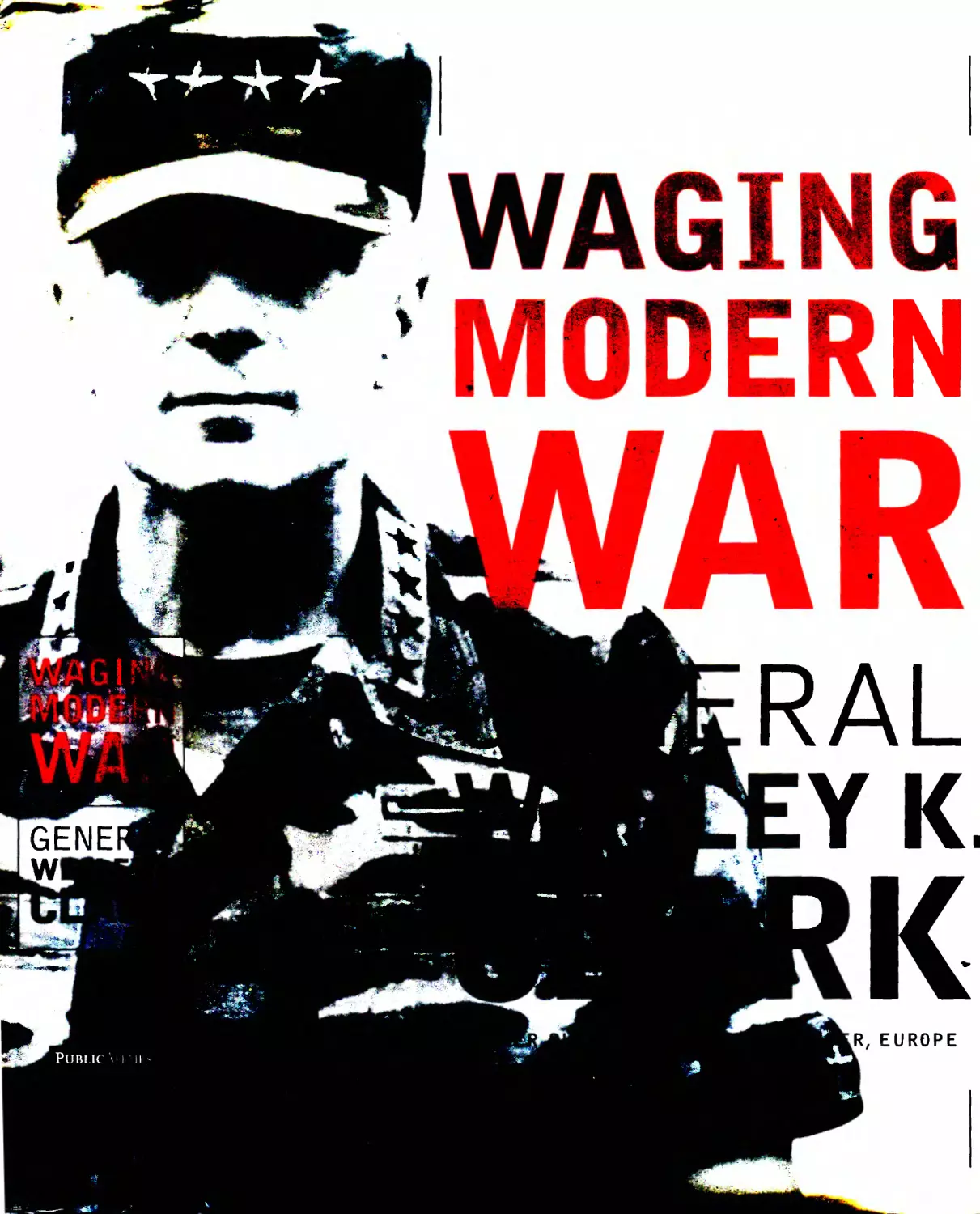


Author: Clark W.K.
Tags: history warfare war crimes modern history public affairs publisher yugoslav wars
ISBN: 1-58648-043-x
Year: 2001


Text
                    ^r^^r^r
'%*m?
■^fe
# %-
"* "^ M
? 3 * * ^ ^
N
' : £-'■
*fe
,>-,.- ■'■ ;&-.*v
; r^ -
5 ' -^
GENE. ^
w
\*
*+
,/
, yr .*-
■" c--*»t* =
* -
> s '
V
tf A\i
. ,." *t" ;v
' * v^r«*
'"^Sk.
# lMjwr-Mllr-
:, .' f .
^%?
^^^
Public \t n
-^
'"$-.
A
/
i
f
\
RAL
YK
R, EUROPE
•m*

WAGING MODERN WAR

WAGING MODERN
WAR
Bosnia, Kosovo,
and the Future of Combat
GENERAL WESLEY K. CLARK
U.S. Army (Retired)
PublicAffairs newyork

Copyright © 2001 by Wesley K. Clark.
Published in the United States by PublicAffairs™, a member of the Perseus
Books Group.
All rights reserved.
Printed in the United States of America.
No part of this book may be reproduced in any manner whatsoever without
written permission except in the case of brief quotations embodied in critical articles
and reviews. For information, address PublicAffairs, 250 West 57th Street, Suite
1321, New York NY 10107. PublicAffairs books are available at special discounts
for bulk purchases in the U.S. by corporations, institutions, and other
organizations. For more information, please contact the Special Markets Department at
The Perseus Books Group, 11 Cambridge Center, Cambridge MA 02142,
or call (617) 252-5298.
Blowin1 in the Wind Copyright © 1962, by Warner Bros. Music, Copyright
renewed 1990 by Special Rider Music. All rights reserved. International
copyright secured.
Library of Congress Cataloging-in-Publication data
Clark, Wesley K.
Waging modern war: Bosnia, Kosova, and the future of combat / by General
Wesley K. Clark.—PublicAffairs ed.
p. cm.
Includes index.
isbn 1-58648-043-x
1. Yugoslav War, 1991-1995—Personal narratives, American. 2. Yugoslav War,
1991-1995—Bosnia and Hercegovina. 3. Kosovo (Serbia)—History—Civil War,
1998—Personal narratives, American. 4. Wesley Clark K. I. Title.
DR1313.8 .C58 2001
949.703—dc2i 2001019717
FIRST EDITION
10 98765432 I

This book is dedicated to the men and women of the Armed Forces of
NATO member nations, to the Secretary General, statesmen and
leaders of NATO's member nations. They found themselves in NATO's
first operations—the Balkans—after a half century of peace. We should
have celebrated our success, but because we couldn't call it a war, we
couldn't call it a victory, even though it was.
And to my family—my wife, Gert, and our son, Wes, who believed,
sacrificed and trusted during my thirty-four years as an officer in the
U.S. Army. Without their love and support, neither the book nor my
military service would have been possible.

CONTENTS
CAST OF CHARACTERS
LIST OF ABBREVIATIONS
INTRODUCTION
ONE
TWO
THREE
FOUR
FIVE
SIX
SEVEN
EIGHT
NINE
PART 1: Into the Balkans
The Cold War Is Over
Crisis Management
To Dayton and Back
PART II: The Road to War
Wearing Two Hats
Carrots and Sticks
Diplomacy Backed by Threat
The Three-Ring Circus
PART III: The Air Campaign
Battle Rhythm
Apaches and Targets
IX
XV
XIX
3
29
46
77
107
I31
162
i93
221

VIII
CONTENTS
ten The Strategic Battlefield
eleven The Ground Option
twelve Resistance and Persistence
243
268
293
THIRTEEN
FOURTEEN
FIFTEEN
SIXTEEN
CONCLUSIO^
PART IV: Endgame
Holding Steady
Diplomacy Backed by Force
Pristina Airfield
The Good Fight
r
ACKNOWLEDGMENTS
INDEX
325
345
375
404
4*7
463
467

CAST OF CHARACTERS
Steve Abbott. Admiral, U.S. Navy; Deputy Commander in Chief,
U.S. European Command, 1998-2000.
Madeleine Albright. U.S. Ambassador to the United Nations,
1993-1996. U.S. Secretary of State, 1997-2001.
Mario Arpino. General, Italian Air Force; Chief of Defense, Italy,
1999-present.
Hartmut Bagger. General, German Army; Chief of Defense,
Germany, 1996-1999.
Samuel R. "Sandy" Berger. Deputy National Security Adviser to the
President, 1993-1996. National Security Adviser to the
President, 1997-2001.
Tony Blair. Prime Minister, United Kingdom, 1997-present.
Edwin H. Burba. General, U.S. Army (retired); Senior Mentor, U.S.
Army Battle Command Training Program.
George Casey. Brigadier General, U.S. Army; Deputy Director,
Strategic Plans and Policy (J-5), The Joint Staff 199 7-1999.

X
CAST OF CHARACTERS
Peter Chiarelli. Brigadier General, U.S. Army; Executive Officer,
Office of the Supreme Allied Commander, Europe, 1999-2000.
William J. Clinton. President of the United States, 1993-2001.
William S. Cohen. U.S. Secretary of Defense, 1997-2001.
Rasim Delic. Lieutenant General, Army of Bosnia-Herzegovina;
Chief of Defense, Bosnia-Herzegovina.
James Dobbins. U.S. Ambassador; President's Representative for the
Balkans, 1999. Assistant Secretary of State for European Affairs,
2000.
Michael Durkee. Minister-Counselor, U.S. Foreign Service; Poltical
Adviser to the Supreme Allied Commander, Europe,
1995-present.
James Ellis. Admiral, U.S. Navy; Commander-in-Chief, Allied Forces
Southern Europe; Commander-in-Chief, U.S. Naval Forces,
Europe. Commander, U.S. Joint Task Force Noble Anvil.
Robert H. "Doc" Fogelsong. Lieutenant General, U.S. Air Force;
Assistant to the Chairman of the Joint Chiefs of Staff.
Robert Gelbard. U.S. Ambassador; President's Representative for
Dayton Implementation, 1996-1999.
Sir Charles Guthrie. General, U.K. Army; Chief of Defense Staff,
United Kingdom.
Jay Hendrix. Lieutenant General, U.S. Army; Commanding General,
U.S. V Corps, 1997-1999. Commanding General, Task Force
Hawk, 1999.
George Higgins. Brigadier General, U.S. Army; Executive Officer to
the Commander-in-Chief, U.S. Southern Command,
1996-1997. Executive Officer to the Supreme Allied
Commander, Europe, 1997-1998.
Christopher Hill. Office Director, Bureau of European Affairs,
Department of State, 1995-1996; U.S. Ambassador to
Macedonia, 1996-1999.

CAST OF CHARACTERS
XI
Richard C. Holbrooke. U.S. Ambassador; Assistant Secretary of
State for European Affairs, 1994-1996. Consultant to the
Department of State, 1996-1999. U.S. Ambassador to the
United Nations, 1999-2001.
Igor Ivanov. Deputy Foreign Minister, Russia, 1995; Foreign
Minister, 1998-present.
Alija Izetbegovic. President of the Republic of Bosnia-Herzegovina,
1992-1996. Member of the Tri-Presidency, Bosnia-Herzegovina,
1996-2000.
Sir Michael Jackson. Lieutenant General, U.K. Army; Commander,
Allied Command Europe Rapid Reaction Corps, 1997-2000.
Jay Johnson. Admiral, U.S. Navy; Chief of Naval Operations,
1996-2000.
George Joulwan. General, U.S. Army; Supreme Allied Commander,
Europe, 199 3-199 7.
John Jumper. General, U.S. Air Force; Commanding General, U.S.
Air Forces, Europe, 1997-2000.
Radovan Karadzic. President of Bosnian Serbs, 1992-1995. Indicted
war criminal, currently hiding.
Jean-Pierre Kelche. General, French Marines; Chief of Defense,
France, 1998-present.
Hans-Peter von Kirchbach. General, German Army; Chief of
Defense, Germany, 1999-2000.
Momcilo Krajisnik. Serb colleague of Karadzic; Serb member of
Bosnian Tri Presidency, 1996-1998. Indicted war criminal,
currently awaiting trial in the Hague.
Anthony Lake. National Security Adviser to the President,
1993-1996.
Sir Jeremy MacKenzie. General, U.K. Army; Deputy Supreme Allied
Commander, Europe, 1994-1998.

XII
CAST OF CHARACTERS
Ratko Mladic. Colonel General, Yugoslav Army; Commander,
Bosnian Serb Army, 1992-present.
Montgomery Meigs. General, U.S. Army; Commander, Stabilization
Force (SFOR), 1998-1999. Commanding General, U.S. Army
Europe, 1998-present.
Slobodan Milosevic. President of Serbia, 1990-1997; President of
the Federal Republic of Yugoslavia, 1997-2000.
Milan Milutinovic. Foreign Minister, Federal Republic of
Yugoslavia, 1995-1998; President of Serbia, 1997-2000.
Klaus Naumann. General, German Army; Chairman of the NATO
Military Committee, 1996-1999.
Dragojub Ojdanic. Colonel General, Yugoslavian Army; Chief of
Defense, Yugoslavia, 1999. General, Minister of Defense,
1999-2000.
Roberts Owen. U.S. lawyer; member of Holbrooke Delegation,
arbitarator for Brcko.
Momcilo Perisic. Colonel General, Yugoslav Army, Chief of
Defense, 1995-1998.
William Perry. U.S. Secretary of Defense, 1994-1997.
Biljana Plavsic, President, Republika Srpska, 1996-1998.
Joseph Ralston. General, U.S. Air Force; Vice Chairman, Joint
Chiefs of Staff, 1996-2000. Supreme Allied Commander,
Europe, 2000-present.
Dennis Reimer. Major General, U.S. Army; Commanding General 4th
Infantry Division, Fort Carson, Colorado, 1988-1990. General;
U.S. Army Chief of Staff, 1995-1999.
John Reith. Major General, then Lieutenant General, U.K. Army;
Commander, ACE Mobile Force (Land) and the NATO Force
in Albania (AFOR).
Michael Ryan. Lieutentant General, U.S. Air Force, assistant to the
Chairman, JCS, 1993-1994. General, U.S. Air Force, U.S. Air
Force Chief of Staff, 199 7-2 001.

CAST OF CHARACTERS
XIII
Nikola Sainovic. Yugoslav minister for Kosovo.
John Shalikashvili. General, U.S. Army; Chairman, Joint Chiefs of
Staff, 1993-1997.
Henry H. "Hugh" Shelton. General, U.S. Army; Chairman, Joint
Chiefs of Staff, 1997-present.
Eric Shinseki. Lieutenant General, U.S. Army; Deputy Chief of Staff
for Operations and Plans, 1995-1997. General; Commander,
Stabilization Force (SFOR) and Commanding General, U.S.
Army, Europe, 1997-1998; U.S. Army Vice Chief of Staff,
1998-1999; U.S. Army Chief of Staff, 1999-present.
Michael Short. Lieutenant General, U.S. Air Force; Commander,
Air Forces Southern Europe and U.S. 16th Air Force, 1998-2000.
Haris Silajdic Prime Minister, Republic of Bosnia-Herzegovina,
1995-1998.
Walter Slocombe. Undersecretary of Defense for Policy, 1994-2001.
Sir Rupert Smith. Lieutenant General, U.K. Army; Commander,
U.N. Protective Forces (UNPROFOR) in Bosnia-Herzegovina,
1995. General; Deputy Supreme Allied Commander, Europe,
1999-present.
Javier Solana. Secretary General, North Atlantic Treaty
Organization, 1995-1999.
Dieter Stockmann. General, German Army; Chief of Staff, Supreme
Headquarters Allied Powers Europe (SHAPE), 1998-present.
Strobe Talbott. U.S. Deputy Secretary of State, 1993-2001.
Guido Venturoni. Admiral, Italian Navy; Chief of Defense, Italy,
1995-1998. Chairman, NATO Military Committee,
1999-present.
Alexander "Sandy" Vershbow. Special Assistant to the President for
European Affairs, National Security Council Staff 1994-1997.
U.S. Ambassador to NATO, 1998-2001.

LIST OF ABBREVIATIONS
ACTORD: Activation Order—The third and final stage in the NATO
authorization procedure for military action.
ACTREQ: Activation Requirement—Second stage in the NATO
authorization procedure for military action.
ACTWARN: Activation Warning—First stage in a three-phase
authorization procedure for NATO military action.
AFSOUTH: Allied Forces Southern Europe.
ALLIED FORCE: Official operation name of NATO action in Kosovo.
ARRC: Allied Command Europe Rapid Reaction Corps, created as
part of the military implementation of the Alliance Strategic
Concept.
ATACMS: Long-range rocket fired from an MLRS (Multiple Launch
Rocket System).
CAOC: Combined Air Operations Center.

xvi LIST OF ABBREVIATIONS
CHOD: Chief of Defense (top military leader of a nation's armed
forces).
CINC: Commander in Chief.
CINCEUR: Commander in Chief, European Command. The
regional commander for European Command, who is also the
NATO Supreme Allied Commander, Europe.
CJCS: Chairman of the Joint Chiefs of Staff.
CMC: Chairman, NATO Military Committee.
COMSFOR: Commander, SFOR.
CBU: Cluster Bomb Unit.
DOD: Department of Defense.
EU: European Union.
EUCOM: U.S. European Command. Area of responsibility includes
Europe, Turkey, Israel, Syria, Lebanon, and most of Africa.
IFOR: Implementation Force—The NATO-led force responsible for
upholding the Dayton Peace Accords from December 1995
through December 1996.
JCS: U.S. Joint Chiefs of Staff, comprised of the Chairman, Vice
Chairman, and Chiefs of each of the Armed Forces.
JOINT STAFF: the staff serving the Chairman and Vice Chairman,
the JCS, comprised of permanent staff officers J-1-8 and their
subordinates.
j-i
J-2
J-3
J-4
J-5
Joint Staff, Manpower and Personnel Directorate.
Joint Staff, Intelligence Directorate.
Joint Staff, Operations Directorate.
Joint Staff, Logistics Directorate.
Joint Staff, Strategic Plans and Policy Directorate.

LIST OF ABBREVIATIONS
XVII
J-6: Joint Staff, Command, Control, Communications, and Computer
Systems Directorate.
J-7: Joint Staff, Operational Plans and Interoperability Directorate.
J-8: Joint Staff, Force Structure, Resources, and Assessment
Directorate.
KLA: Kosovo Liberation Army.
KFOR: Kosovo Force. International force organized and commanded
by NATO to enforce an agreement in Kosovo.
MLRS: Multiple Launch Rocket System.
MOD: Minister of Defense.
NAC: North Atlantic Council, the NATO policy making group.
NATO: North Atlantic Treaty Organization, a collective defense
organization (Member nations are: Belgium, Canada, Czech
Republic, Denmark, France, Germany, Greece, Hungary,
Iceland, Italy, Luxembourg, Netherlands, Norway, Poland,
Portugal, Spain, Turkey, United Kingdom, United States).
NSC: National Security Council, senior U.S. policy making body
often represented by the National Security adviser to the
President and its staff.
OSCE: Organization for Security and Cooperation in Europe.
PFP: Partnership for Peace, nations associated with NATO, but not
member nations. (Member nations include: Albania, Armenia,
Austria, Azerbaijan, Belarus, Bulgaria, Croatia, Estonia, Finland,
Georgia, Ireland, Kazakhstan, Kyrghyz Republic, Latvia,
Lithuania, Moldova, Romania, Russia, Slovakia, Slovenia,
Sweden, Switzerland, Former Yugoslav Republic of Macedonia,
Turkmenistan, Ukraine, Uzbekistan).
QDR: Quadrennial Defense Review.
SACEUR: Supreme Allied Commander, Europe—who is also the U.S.
CINCEUR.

XVIII
LIST OF ABBREVIATIONS
SECDEF: U.S. Secretary of Defense.
SECGEN: Secretary General, the highest official in NATO.
SHAPE: Supreme Headquarters, Allied Powers Europe
(Headquarters for Allied Command Europe, commanded by SACEUR).
SFOR: Stabilization Force—Second phase of the Implementation
Force, IFOR. Created to implement the Dayton Peace Accords.
UNHCR: U.N. High Commissioner for Refugees.
UNPROFOR: U.N. Protection Force, deployed to Bosnia and
Croatia. The first U.N. deployment to the Balkans.
VTC: Video Teleconference.

INTRODUCTION
Casteau, Belgium,
Supreme Headquarters, Allied Powers Europe,
March 31,1999.
Notebook in hand, grimacing a little but calm, Brigadier
General Pete Chiarelli walked into my office. "Sir, you've got
Solana's office calling in," he said. Javier Solana was the
Secretary General of NATO, the highest ranking official in the Alliance.
Seven days earlier, NATO had begun bombing targets in Yugoslavia in
response to President Slobodan Milosevic's refusal to halt his
systematic campaign of repression and violence against the ethnic Albanians
in the Serbian province of Kosovo.
"They sound a little agitated this morning," Chiarelli went on.
"Said he wants to speak to you right away."
Forty-eight years old, twenty-six years in the Army, unfailingly
cheerful and optimistic, Pete Chiarelli was my executive officer, my
closest personal assistant. I swiveled around from the desk to pick up
the phone—the unclassified line, lots of nations probably listening in, I
thought—and pushed the speaker switch so Chiarelli could take notes

INTRODUCTION
for me. He had to know what I knew and back me up on the
coordination with Washington and the direction of the personal assistants here.
Solana was a former Socialist foreign minister of Spain who had, in
his earlier days, strongly opposed Spain's membership in the North
Atlantic Treaty Organization. Now he was directing the Alliance in war.
In recent months we had become fast friends. We were about the same
age. He was a former Fulbright Scholar who had studied in the United
States; I was a former Rhodes Scholar who had studied in England. He
was a physicist by training; I was a scientifically inclined "wannabe."
"Wes, Wes, can you hear me?" Solana asked. It was unusual for him,
I thought, not to ask first how I was doing. I could hear the tension and
urgency in his voice.
"Yes, Javier, I'm here," I replied.
"Wes," he said, coming straight to the point, "many governments
are calling me to complain that I'm not giving you enough freedom to
pick targets. And you are showing me pictures and telling me about the
technical details of weapons that I am not familiar with. You are the
expert on these things, you are the military man..."
"Yes, Javier." He sounded a little on edge. Target selection had
quickly emerged as the toughest issue of the campaign, with most of
the military leaders in NATO seeking to strike more high-value targets
closer to Belgrade, the Yugoslavian and Serbian capital, while a number
of foreign ministries were urging cautious and carefully measured
escalation. I had been pressing hard for approval to strike Serb police
headquarters in Belgrade, and after conferring with the head of the
British military the previous evening, I knew that other military
leaders were likewise pressing their governments for such authorization.
But the request still had not been granted. We were quickly learning
how difficult it is for a nineteen-nation alliance to wage a coherent
military campaign.
"The Chairman of the Military Committee has spoken to me about
this, also," Solana said, referring to General Klaus Naumann, the
German general who headed the NATO Military Committee in Brussels.
"And your country has called me to complain." The edge had definitely
sharpened.
I was not surprised. I had been discussing the issue of target
selection every day with the U.S. Chairman of the Joint Chiefs of Staff,

INTRODUCTION
General Hugh Shelton, focusing on the approval process and the
nature of Alliance support, explaining what was needed and expressing
my frustration over the time that was required to get political approval,
including in Washington. Perhaps my complaints to Shelton had led to
more pressure on Solana.
Before I could get a sentence out in reply, the Secretary General cut
me off. "So, you will have your targets," he said—a pronouncement
that impacted like the smack of a fastball in a catcher's mitt. "You will
pick the targets you want to strike. You will keep me informed, and I
would like to know if the targets will be in Belgrade. If there are
difficulties, I will tell you, but I will support you, and you will pick the
targets. You will take your responsibility and you will accept the
consequences. Do you understand?"
"Yes, Javier." Good, I thought. This sounded like a significant
change in procedures. I would not have to justify and explain every
target in sensitive areas, and he would support me. I needed that support.
"And you will take your responsibilities, do you understand?" He
underscored his message once again; it was about as sharply as I had
ever heard Javier Solana speak to me.
"Yes, Javier, thank you," I said. "This is what we need. It will
definitely move things along." But flashing simultaneously through my
mind was the series of high-ranking European generals who "took
responsibility" in World War I and World War II. They were the
losers. And they were gone, their names long forgotten.
In war, you don't just lose. Not if you're a commander. It's what
General Douglas MacArthur told Major General Robert Eichelberger
in New Guinea in 1942: "Take Buna, or don't come back alive."
Of course, there were many other people who were responsible in
this war, too. The heads of government of the nineteen NATO
member nations, their foreign ministers and defense ministers, as well as
their Chiefs of Defense, the military leaders in each country. These
men and women were responsible for their own nations and for
helping to provide direction for the alliance. There was the NATO
leadership, too—Secretary General Javier Solana and General Klaus
Naumann, the Chairman of the Military Committee. They were
responsible for forging consensus in NATO, shaping its strategy, and
representing it privately and publicly.

INTRODUCTION
As Supreme Allied Commander, Europe, I was working for each of
these people. I was responsible for the conduct of the military
operations against Yugoslavia, as well as for the 30,000 troops on the ground
in NATO's other operation in the nearby country of
Bosnia-Herzegovina. There was no doubt in my mind that I was the one responsible.
Above me, everything was political or political-military. Below me was
just the military. I was at the waist of the hourglass, and the grains of
sand were pouring past in both directions.
I looked over at the picture on the wall of the first Supreme Allied
Commander, General Dwight D. Eisenhower. I looked down at my
desk, the same desk he had used to sign the activation orders of our
command almost fifty years ago. I was the first of his successors to have
to lead NATO to war, and I wasn't going to lose.
As a first-year cadet at West Point, in 1962,1 was required to
memorize General MacArthur's words and recite them again and again.
"There is one single message, one sole idea, written in red on every
beachhead from Australia to Tokyo: there is no substitute for victory!"
Military leaders carry their early education and experiences with
them for the rest of their service. The good ones read, study, and
reflect on their own until they are steeped in history and tradition, and
have a broad perspective and a rich base on which to address specific
military and diplomatic issues. For most of the nineteenth and
twentieth centuries, wars were fought for territory. The survival of nations—
or at least, their systems of government—was at stake. It was national
warfare, relying on the mobilization of populations, vast conscript
armies, and national controls over the economy and the flow of public
information.
This was the form of warfare that Napoleon had taught us, nation-
state against nation-state. Cohorts of young men were organized and
drafted; large, bureaucratic organizations and state ministries were
created just to be able to handle the logistical planning required in case of
mobilization for war. The ideal was the battle of annihilation,
surrounding an enemy force through a series of maneuvers ambiguous to
him, forcing him to fight on your chosen ground, bringing to bear the
superior firepower of well-trained artillery, and then closing the fight
with infantry and the bayonet. Horse cavalry would be used for
reconnaissance, feints, and screening, and when the enemy's ranks were bro-

INTRODUCTION
XXIII
ken, cavalry would sweep in, with pistol and heavy saber, to finish the
fight and ensure that a retreating enemy was defeated and destroyed.
Napoleonic strategy was part of our instruction in military art in
1965 at West Point. We studied the Italian campaign and the battles of
Marengo, Ulm, Austerlitz, and Leipzig. God is on the side of the big
battalions, Napoleon taught us, and it is better to be lucky than good.
War is decided by battle, we learned. You focused on the enemy force.
The strategic art was to bring the enemy to battle at the time and place
of your choosing, where you had the advantage and could finish him.
I began my study of the profession early in my cadet career, reading
the histories and biographies, writing articles and reflecting on
contemporary challenges, and trying to soak up others' experiences. Over
the years I came to understand the uniqueness of each conflict, and the
failure of most theorists to understand or predict the nature of battle
and the alternatives available to commanders and national leaders.
Twentieth-century war seldom matched its Napoleonic ideal in terms
of decisiveness. But the mobilization of the nation-state, the
conscription, the large organizations, the extreme destructiveness of the
weaponry, the focus on battle and the enemy force, the prodigious
losses of men and material, and the dreadful burdens to the civilian
populations were certainly features of war as we knew it.
Eisenhower and NATO itself were the product of such a war. World
War II was to be a fight to the finish, as the United States and its Allies
called for the unconditional surrender of Germany, Italy, and Japan,
and civilian populations were targeted by all sides. In a war that saw the
only use of the atomic bomb, almost no weapon was spared. And when
it was over, and Europe and the United States sensed the threat of
Joseph Stalin and the Red Army, NATO was established and
Eisenhower recalled to service in Europe to protect against another such
terrible conflict.
Operation Allied Force, NATO's military action against Yugoslavia
in the spring of 1999, wasn't meant to be that kind of war. In fact, we
were never allowed to call it a war. But it was, of course. This was
modern war, the first war fought in Europe in half a century, and the first
ever fought by NATO. The Alliance and its member nations weren't
under attack. This war wasn't about national survival, or the survival of
our democratic systems of government. We didn't mobilize our popu-

INTRODUCTION
lations or do anything significant to control information. The
conscripts remaining among the NATO nations never came close to
getting to the fight, because there were national laws in most cases
prohibiting their service outside their own countries. The economies
of the West weren't taken over by governments or turned to war
production. The choice of weapons was carefully considered, and
ultimately, not left up to the military. Civilian populations and purely
civilian facilities were not targeted.
Operation Allied Force was modern war—limited, carefully
constrained in geography, scope, weaponry, and effects. Every measure of
escalation was excruciatingly weighed. Diplomatic intercourse with
neutral countries, with those opposed to NATO's actions, and even
with the actual adversary continued during and around the conflict.
Confidence-building measures and other conflict prevention
initiatives derived from the Cold War were brought into play. The highest
possible technology was in use, but only in carefully restrained ways.
There was extraordinary concern for military losses, on all sides. Even
accidental damage to civilian property was carefully considered. And
"victory" was carefully defined.
This is a book about modern war, using the NATO action in
Kosovo as the best, most recent example. These are my recollections,
supplemented by notes and records. The quotations are as I remember
them, cited to help tell the story from the perspective of the overall
commander. It is not a complete record of the war nor a history that
explains all the simultaneous activities and events in Washington,
London, Brussels, or other capitals. Usually I acted on time-sensitive and
incomplete information. My perceptions weren't formed by full
knowledge of all happening above and around me.
The stakes in this conflict were huge, and success was not
inevitable. In fact, many predicted that NATO would fail in its mission
to end the ethnic cleansing in Kosovo. Had we failed, the
consequences would have been profoundly damaging to NATO, to its many
member nations, to the Kosovar Albanians, and to many nations in the
region that need stability and democracy. NATO could likely not have
survived in its present form, and a wave of fear and insecurity would
have raced through eastern Europe. I was warned that a NATO failure
would bring the collapse of several European governments, as well.

INTRODUCTION
XXV
Failure would have meant another one and a half million refugees and
accepting ethnic cleansing as an unalterable fact. Failure would have
deepened instability in the Balkans and raised moral outrage in
Europe. For the United States, there would have been worldwide
repercussions on United States credibility and the significance of
American commitments.
But we did not fail—we succeeded. This was a result of many factors
and forces that were not necessarily visible on the surface. Many
people contributed to the successful outcome of this effort, and each will
have seen it from his or her perspective. Inevitably, there will be
important considerations not covered in this book, and important
contributions unrecognized. Many people made extraordinary efforts in the
political and military channels above me to give direction and help
forge consensus. I am enormously grateful to those for whom I worked
in both the NATO and the U.S. chains of command—the Presidents
and Prime Ministers, Secretary General Solona, the Secretaries and
ministers, Generals and Admirals—for their guidance and support and
the confidence they had in me during this operation. I hope their full
contributions will one day be known and acknowledged. But this book
is from my perspective: how I worked as a strategic commander in
modern war, dealing with modern weaponry, instantaneous
communications, and a highly complex political-military environment.
This war was nothing if not complex. Every facet is difficult to
understand, masked by acronyms, procedures, security arrangements,
and national sensitivities. It was a war waged by a nineteen-nation
alliance that habitually looked to the United States for leadership but
ultimately made decisions on the basis of consensus and then delegated
their implementation to a multinational military chain of command.
As the Supreme Allied Commander, Europe, I was the head of the
NATO military chain of command within Europe and responsible for
implementing those decisions. And though decisions were made at
higher political levels, much of the information to make those
decisions came from my commanders and me. I also held another
command position simultaneously, that of U.S. Commander in Chief,
European Command. It was a process known as "dual-hatting,"
complete with two different, geographically dispersed headquarters—
NATO's Supreme Headquarters Allied Powers Europe (SHAPE), near

INTRODUCTION
Mons, Belgium, and the U.S. European Command (EUCOM), in
Stuttgart, Germany—two different staffs, and two entirely different
reporting chains. It was a linkage designed by General Eisenhower
himself. My effectiveness was in part a function of my authority as a
U.S. commander to call upon U.S. capabilities and resources, but,
perhaps more important, of my ability to keep the trust and support of the
Europeans. I had to use my leverage with the Americans to gain
influence with the Europeans and vice versa. I was straddling the Atlantic
divide in perspective and actions.
Of course, a crucial challenge to NATO was to harmonize
American and European interests and perceptions during the campaign. On
some issues there were almost as many viewpoints as there were
nations. This was the first war the Alliance had fought, and there was
no assurance in this novel undertaking that differing interests could be
made to converge. NATO needed continual shoring up from me and
others, or it could have crumbled. In fact, it came close to crumbling
more than once. The successes achieved stemmed from hard work by
many people. But part of my work was also this effort to recognize and
accommodate different perspectives and to fight the campaign in a
manner that helped strengthen Allied unity, not break it.
The weight of modern history lay heavily upon everyone involved
from the European side. The memories of the destruction of World
War II, the millions of refugees and displaced persons, the young men
in uniform lost forever, and the lasting tragedy and shame of aggressive
attacks on civilians were always present. As a leading Italian statesman
told me after the Kosovo campaign, "In Italy, we couldn't use the word
war. Too many bad memories. War meant destruction, death, defeat
and occupation."
And in Germany, especially, many of the leaders, military and
civilian, had deep personal scars from World War II. The historical
pessimism was deeply reflected in the popular culture. As General
Naumann told me, "I will never forget the sight of the bombs falling
on Munich when I was a small child." The German battlefield
cemeteries, paid for not by the government but by popular donations raised by
the armed forces, extol not the virtue and valor of sacrifice but the
tragedy and futility of war. In the German cemetery near Omaha
Beach, site of the Allied invasion of France in 1944, the German sol-

INTRODUCTION
XXVII
diers are buried, two to a grave, the headstones a somber brown, with
the inscription on the cemetery reading:
Darkly rises the mound
Over the graves of soldiers.
Darkly stands God's command
Over the dead of the war.
Yet brightly glows the sky
Above the towering crosses
More brightly still shines their comfort:
The final word is God's.
Even countries that didn't suffer extensive war damage in World War
II were scarred psychologically. In a visit to Denmark in late 1997,1 was
escorted past the harbor in Copenhagen by a Danish military officer,
who pointed out, "This is where we scuttled the Danish fleet in 1940 so
the Germans couldn't get use of it when they marched in and took over.
And over there lies the house where twelve members of the Danish
resistance were taken in 1944 by the Germans and later they were
executed. But the resistance was slow in forming, and not many
participated. In fact, a number of Danes joined up with the Germans to fight
on the Eastern Front in 1941." This was said with the air of apology I
found often among the smaller nations that had learned earlier in the
century that for them war against a larger power usually ended badly,
that courageous resistance was seldom rewarded, and the use of
military power was best exercised through an Alliance with larger powers.
But for America, the Second World War was a distant and dim
memory, battles fought in far-off lands against people now our friends.
We had significant losses and a large and proud population of veterans
and their families. But the pain and horror lacked immediacy. The pain
of the losses was dulled by time and victory.
Americans, of course, learned about limited war from the
experiences of Korea and Vietnam and, to some extent, the Gulf War. The
impact of Vietnam was especially strong. Policymakers who had
participated in student demonstrations against the war thirty years earlier
now found themselves on the receiving end of antiwar sentiment.
President Bill Clinton, National Security Adviser Samuel L. Berger, and

INTRODUCTION
Deputy Secretary of State Strobe Talbott knew the power of the
student movements well from their own personal experiences. Now they
found themselves responsible for directing the American role in a
military conflict. They knew that for large democracies, the home front is
the critical theater of war, and words and images are the key weapons.
Everyone in top leadership positions in uniform knew it, too.
United States policy was not monolithic. Rather there was another
divide that also had to be bridged, the persistent struggle between the
U.S. Department of State and the U.S. Department of Defense. One
department is responsible for recommending and leading the
execution of U.S. foreign policy. It is a department of diplomats and policy
analysts, schooled in language, compromise, and consensus-building,
present in embassies around the world, but perpetually short of the
direct resources necessary to implement foreign policy if it proceeded
beyond the "talking" stage. The Department of Defense, on the other
hand, saw its responsibilities as primarily in the areas of deterrence and
warfare. There were many among the officers and leaders of all ranks
who believed the purpose of the Armed Forces, and especially of the
Army, was to "fight and win America's wars." They drew a strong
distinction between their responsibilities in warfighting and the State
Department's articulation and peacetime efforts to advance American
interests. It was a distinction that some leaders, like former Chairman
of the Joint Chiefs of Staff Colin Powell, had tried to blur by advancing
the notion of "peacetime engagement" for the Armed Forces. Most at
the top of the military hierarchy supported this as it evolved, at least as
it was a way to defend and use American military resources until they
were needed for war.
But this construction bridged a chasm of differing education,
perspective, and style. The State Department in the post-Cold War
period, with White House encouragement and direction, found itself
seeking to advance American interests and ideals and seeking to
leverage Defense resources in the effort. The Defense Department found
itself struggling to protect its own programs and priorities from the
grasping reach of the policy planners at State and among the National
Security Council staff, as the military coped with a 30 to 40 percent
contraction in defense resources and capabilities. And the struggle was
played out not only within the Washington interagency process but

INTRODUCTION
also within NATO itself, as the Secretaries of State and Defense
brought their differing perspectives to the issues in the Balkans.
It was characteristic of NATO that the foreign ministries, or in the
American case, the State Department, ran the day-to-day process at
NATO headquarters through nations' ambassadors, who met in the
North Atlantic Council or NAC. The defense ministries were
represented within the ambassadors' teams and also by a military
representative of the Chief of Defense who sat on the NATO Military
Committee, a body subordinate to the NAC. Thus the foreign
ministries had the upper hand and the last word in working the issues. This
was doubly the case for the United States, where the White House and
Secretary of State seemed to place a higher priority on NATO's
requirements and responsibilities than did the Defense Department. It
was perhaps for this reason that Secretary General Solana seemed to
speak more often with the White House and the Secretary of State
than with the Secretary of Defense.
For me, then, I was torn between the guidance and perspective I
gained from NATO, heavily influenced by the Department of State and
the White House, and what I would hear in my U.S. military chain
reporting to the Pentagon. From one side I was continually exhorted to
"do the best I could" to accomplish the task at hand; from the other I
was often implicitly or explicitly constrained in seeking resources and
authority to act. Many times, I had to set my own compass and follow it.
Partly by consequence of having a foot in these different camps, I
was also at an odd place within the military hierarchy. I had a
perspective that other U.S. military leaders didn't share and responsibilities
they only partially understood. That is another element of the story of
modern war: my relationship with the leaders of the U.S. Armed Forces,
and especially with some of the men in top positions in the Army.
Personalities are important factors in history and in military affairs,
even though we don't like to admit it to ourselves. This story is often
told to groups of new U.S. Army brigadier generals: "If we put you all
on a plane and it crashed and we lost all of you, we could pick another
fifty, and they'd be just as good as you." Maybe so, but they wouldn't be
the same fifty, and individuals do make a difference.
From the outside, of course, officers in the top leadership positions
probably look mostly the same. There is no "lateral entry" to leader-

INTRODUCTION
ship in the U.S. Armed Forces. You can't go out and raid a
"competitor" to find a good corps commander or strategist. Everyone starts at
the bottom and works his way up. Advancement is basically by age and
years of service, with a little acceleration at the margin for a select few.
So we end up about the same age, with about the same decorations on
our uniforms, much the same formal training and education, and many
shared experiences and friends. And there is a common culture, though
it's a little different for each of the U.S. Armed Forces, and for each
branch within each service. The Army and the Air Force, in my
experience, were a little better in "rounding off the rough edges" or
eliminating those who weren't easily "rounded."
Still, there are enormous differences underneath, defined by
individual character and insight, distinctive competencies, shared
relationships as junior officers, loyalties to particular senior officers, or perhaps
just differences in basic personality and proclivities. As in many
organizations, people in the U.S. Armed Forces make it to the top because
their immediate superiors and their superiors' superiors believe in
them. But when something happens to those "sponsors," then it often
spells the end for the followers, too. In the Army there was an old
legacy of the "airborne mafia," dating back into the period after World
War II and Korea. Some believed that an "artillery mafia" was present
in the 1990s. I heard others speak in fear of an "armor mafia." In the
Navy there were aviators and submariners, and in the Air Force, the
men from Strategic Air Command and the fighter pilots.
As an Army armor officer, I never considered that I belonged to one
of the classic "mafias." I had commanded a mechanized infantry
company in Vietnam, not a tank company or an armored cavalry troop. I
believed that officers had to strive to learn as much, and gain as broad a
perspective as possible. Those perspectives ranged from a White
House Fellowship on the one hand, to assignment to the Army's
National Training Center on the other. I sometimes found myself
challenging conventional wisdom—no "hiding in the pack." Like everyone
who was successful, I definitely had my supporters and some doubters.
And as I was moved upwards in responsibility, many of my strongest
supporters retired.
What I saw in the Kosovo conflict was the significant difficulty the
U.S. Armed Forces faced in adapting to the requirements of a new sit-

INTRODUCTION
XXXI
uation. These difficulties were in part due to organizational factors,
such as the Armed Forces' effort to cling to the 1991 Gulf War,
Operation Desert Storm, as the model for future operations, rather than
facing up to an ambiguous, tense, highly political coalition
environment in which military actions would face tight restraints, constant
high-level oversight, and continuing public scrutiny. In part these
difficulties were due to the competing pressures being brought to bear on
the senior military leaders in Washington, as well as their own
preference for staying with their focus on a two-pronged strategy centered
on the Persian Gulf and Korea. The Europeans had difficulties, too,
especially in matching the high-technology requirements for the
campaign. At the same time I saw strong and continuing personal support
from my European colleagues. Perhaps they were just closer to the
conflict. But I can't deny that personal factors might have played a role,
too.
For me the war was professional, but it was also personal. It drew on
the experiences and insights of my full thirty-seven years of military
service; it placed heavy demands on character and stamina, and it
strained my relations with some American colleagues. It was personal,
because in war, you accept your responsibilities and give every ounce of
your character and experience to accomplish the mission.
This is the story of how we won, seen from the cockpit of strategic
command. It is also a record of modern warfare, with important
implications for the future of NATO, for the Armed Forces of the United
States and its Allies, and for U.S. diplomacy.

PARTI
INTO THE BALKANS

ONE
THE COLD WAR IS OVER
I entered military service during the Cold War. Fortunately,
we never had to fight the war in Europe that NATO was formed to
deter. Nevertheless, we saw a continuing evolution in the conduct
of war. Modern war, as defined here, emerged as a function of history
and culture, as a result of NATO, the media, and technology. Local
factors, such as the environment or the particular characteristics of the
enemy forces, had a significant impact as well. From the Korean War
of 1950-53, through the American war in Vietnam, and into the
United Kingdom's 1982 campaign in the Falklands, the U.S. 1989
intervention in Panama, and the 1991 Gulf War, and into Kosovo in
1999, the divergence from the World War II model of warfare has
grown more and more pronounced. The evolution hasn't been linear
or particularly well understood, even within the armed forces in most
Western countries—but it's there.
The divergence began with the Soviet Union's acquisition of
nuclear weapons. After the wholesale tragedy of World War II and the
advent of the nuclear age, it soon was obvious that many conflicts could
not be pushed to "unconditional surrender." It was too risky, or too
expensive, or too much in conflict with other goals and priorities.

WAGING MODERN WAR
Lesser objectives usually had to suffice. When contemplating conflict
with the Soviet Union, it became axiomatic in the West, as the Soviet
Union acquired greater numbers of nuclear weapons, that nuclear war
wasn't winnable in the usual sense; the consequences of widespread use
of nuclear weapons by both sides would simply be too destructive. The
point was to deter it. The absence of war was the victory, because if you
fought, you couldn't win. If fighting did begin, the idea was to defend
as long as possible using conventional weapons without resorting to
the use of nuclear weapons. Then, if conventional defense wasn't
succeeding, use nuclear weapons in some limited way and hope the other
side would see the results as so terrible that the conflict could be
terminated. You would have to convince the other side that if the
aggression wasn't called off, we would use all of the nuclear weaponry in our
arsenal. To put it another way, crossing the threshold to use force
wasn't necessarily a decision for all-out war. Hearkening back to World
War II and the mutual decision among the major belligerents not to
use chemical weapons in Europe, this theory rested on the belief that if
the belligerents were rational, both sides would see that that it was in
their best interests to limit a war once it had begun.
This strategy in NATO was known as Flexible Response. Defend
with conventional weapons for as long as possible, then use nuclear
weapons selectively, keeping full-fledged nuclear strikes in reserve.
Naturally, the strategy had to be trained and rehearsed. In its nuclear
exercises, NATO had established procedures for political
decisionmaking and ordering the use of nuclear weapons, and these were
extensively practiced. The procedures were immaculate: clear,
carefully controlled, double checked, and carefully secured. Entire
communications systems were constructed to meet the needs of "nuclear
release." NATO was defensive. It didn't seek victory, it sought "conflict
termination."
As a major at Supreme Headquarters, Allied Powers Europe
(SHAPE) in 1978-79,1 watched NATO go through training and
exercises for this strategy. Observing the heavy emphasis on the
decisionmaking and procedures for the first nuclear releases, I was one of many
who sensed that our approach was incomplete. We never seemed to
work our way through what happened after the first nuclear release.
Disturbingly, during this period and into the 1980s, the evidence

THE COLD WAR IS OVER
began to accumulate that the Soviets didn't always have the same view,
but rather might believe that with adequate preparations and stout,
integrated air and missile defenses around Moscow, the center of their
military-industrial complex, nuclear war might be survivable and for
the best prepared, "relatively" won.
We recognized a growing asymmetry in the Western and Soviet
view of the problem, but NATO stuck with its strategy. There was
another strand of thought that had crept into the thinking of some of
the European members of NATO, from work done in the United
States in game theory. This work aimed to take the influence of the
military beyond "deterrence"—causing someone to refrain from
doing something by threat of punishment or threat of taking away his
means to act—and into something called "compellence," which was to
cause someone to act in a certain way. It was a peculiar, or perhaps
more generalized form of limited war, a conflict not necessarily fought
for territory or to turn back aggression but perhaps for other
purposes. In military terms compellence seemed to translate into a
certain implicit or explicit bargaining through the graduated use of force,
inflicting ever increasing punishment to convince an opponent to
change his behavior. It was to be applicable against the smaller, non-
nuclear states.
Many of us in the United States and the Armed Forces had seen
early on the fallacies of gradualism. It was, after all, the thinking that
lay behind the early, unsuccessful years of the deepening American
involvement in the Vietnam War. My personal concerns stemmed
from an analysis of the 1965-68 air campaign in Vietnam known as
Rolling Thunder. Writing a thesis for a master's degree in military art
and science as a captain and student at the U.S. Army Command and
General Staff College, I reviewed as much as I could find about
Vietnam, reread the Pentagon Papers, and researched the problem of
contingency operations—operations in unanticipated areas that had
political aims less sweeping than unconditional surrender.
It was clear that the U.S. effort to halt North Vietnamese support of
the fighting in South Vietnam by "signalling" U.S. resolve through
carefully constrained, politically designed bombing, which avoided
seeking decisive military impact, had been a failure. The question was,
why? The answer seemed to have to do with the pace and intensity of

WAGING MODERN WAR
the campaign, in relation to North Vietnamese willpower and
determination, and North Vietnam's ability to build up resistance to the strikes
and repair the damage even as it was being inflicted. To successfully
"compel," I realized, the force applied must be much greater than we
had been willing to commit at the time, must be intensified more
rapidly, and must be directed at achieving significant military ends. Only
when the targeted state realizes that its military efforts cannot succeed
will it be "compelled" to consider alternatives.
But apparently this was quite difficult, as I reflected on such
operations, because in modern democracies, the political leaders were
usually too hesitant, imposing tough constraints on military actions, and
military leaders were not bold enough in pushing for the real military
muscle required to achieve significant military objectives. The results, I
thought, were extended campaigns that could leave democratic
governments vulnerable to their own public opinion. Forbearance in the
strikes could be misinterpreted at home or abroad as irresolution or
incompetence. As mistakes and losses accumulated, the policy would
appear incompetent in application and foolish in design. Campaigns
like this were therefore subject to domestic political defeat. And that
was part of what happened to the United States in Vietnam. Once
fighting had begun, you had to escalate rapidly and achieve "escalation
dominance" over an adversary, if you were to succeed. And you had to
go after meaningful military objectives.
I came out of the study convinced that the United States would
again find itself engaged in problems of not only deterrence but also
"compellence." Little did I suspect that I would be in the middle of the
action as Supreme Allied Commander, Europe, when it occurred.
I had my first chance to weigh in with my concerns about
gradualism when I was a lieutenant colonel. One afternoon in late May 1983,1
sat in a basement office of the Pentagon with Brigadier General Colin
Powell as we put the finishing touches on a transition plan for the
incoming Chief of Staff of the Army, General John Wickham. Powell
was a rising star, even then, a man who had commanded a brigade in
General Wickham's division in the mid-seventies and was considered
one of the best among his contemporaries. He had been put in charge
of the project. The papers had been prepared, addressing such topics as
personnel, relations with Congress, force structure, and so on. The

THE COLD WAR IS OVER
group of fourteen officers who had worked the report had broken up.
But as we put the papers together in a substantial volume, I noticed that
we seemed to be missing an introduction.
I suggested to Powell that we add a "one-pager" up front,
containing the two or three most important things for the new Chief to
consider, and he agreed. Emboldened, I suggested a line of argument:
"Isn't the most important thing never to commit U.S. troops again
unless we're going in to win? No more gradualism and holding back
like in Vietnam, but go in with overwhelming force?" Again, Powell
agreed, and we put it in the introduction. This argument captured what
so many of us felt after Vietnam. Perhaps this idea made it into U.S.
military action, when we intervened with overwhelming forces in
Grenada in 1983. Certainly the work General Powell did leading up to
the Gulf War and the Powell Doctrine of decisive force were a
wholehearted refutation of the failed gradualism of Vietnam.
Unfortunately, the idea of decisive force never quite made it into
NATO thinking. It seemed incompatible with nuclear realities, and
perhaps the limitations of the armed forces of our European allies.
And, if not well understood, it could seem to be a kind of naive
throwback, to an earlier, simpler era of warfare that saw a relatively clear
separation between the political and the military: the fighting started
when the talking ended, it seemed, and the talking would resume when
the fighting stopped. This was the kind of misinterpretation that
American military students and some of their leaders could hang onto,
though, because it seemed to reflect our American military
traditions—that when the war begins the civilian leadership will turn us
loose to win it, applying all the skills and judgment of our many years
of accumulated professional military experience. In fact, that was a
misinterpretation: the doctrine of decisive force was not incompatible
with continued diplomacy, explicit or implicit. On the contrary,
decisive force—rather than gradualism—was precisely what was required
to make "compellence" a sure success, along with the diplomacy to
produce the "way out" for the loser.
One factor that did make its way into the diplomatic and military
dialogue within the Alliance was the century-long trend to establish
legal and diplomatic barriers against the outbreak of war, and then to
limit war's destructiveness. Extraordinary institutions were established

WAGING MODERN WAR
to smooth the flow of communications between governments. The
European Union was itself first and foremost a means of binding
nations' interests together so that they would never again want to go to
war against each other. For states outside the EU, various legal and
political confidence-building measures were put in place, intrusive
measures that made it awkward and difficult for nations to take the
opening moves of conflict. Building on precedents set at the
Nuremberg War Crimes Trials of 1946, the prosecution of war crimes became
a fact, in several different venues, and the standards of permissible
military actions—the so-called accidents of war—were tightened. The use
of military force was increasingly constrained. The Allies' hideous fire-
bombing of Dresden, which reduced the city to ashes and rubble in
February 1945, would never recur.
Hand-in-hand with the growing effort to restrict, hobble, and
outlaw war-making was a revolution in communications. American and
European leaders were acutely sensitive to the vast change in the flow
of information. In Vietnam the battlefield was isolated in space and
time from the policymakers at home. Instructions and guidance from
Washington was transmitted electronically, of course, but in what we
would consider today very small "pipes." Military communications
thirty years ago flowed in organized channels, controlled and
monitored by the military itself. The TV reports and press copy that came
out of Vietnam were also delayed for hours or days. It took years for
the media to build the reporting networks and data flow to bring
battlefield events in Vietnam out to the public.
In the 1990s, all of the information age technologies were
available—satellite transmission of TV imagery, fax, the Internet, a
plethora of long-distance phone lines, and cellular telephones.
The new technologies impacted powerfully at the political levels.
The instantaneous flow of news and especially imagery could
overwhelm the ability of governments to explain, investigate, coordinate,
and confirm. We called it the "CNN factor," and people began to speak
jokingly of the need to follow the itinerary of CNN correspondent
Christiane Amanpour, whose stunning on-the-scene visuals and
reporting could make a distant crisis an instant domestic political
concern. It was clear that the new technologies could put unrelenting

THE COLD WAR IS OVER
heavy pressure on policymakers at all levels from the very beginning of
any operation.
New technologies also changed warfare for the military. The advent
of twenty-four hour news coverage and satellite relays for TV meant
that the world would certainly be present on every battlefield where
Western forces were engaged. During the U.S. operation against
Manuel Noriega in Panama in 1989, the entire focus of attention for
several hours was the action by U.S. forces to rescue a civilian aircrew
and others trapped in a hotel. Then the whole world heard the daily
doses of psychological warfare as Noriega attempted to take refuge
inside the Papal Nuncio's residence and was bombarded out with
unrelenting rock music. The bright lights of the TV crews that observed
the U.S. Marines coming ashore in Somalia in December 1992 were a
foretaste of the spotlight under which all NATO actions against
Yugoslavia would be assessed. Future actions could anticipate even
more intrusive information collection and more intense top-down,
media-driven focus. There would be few spaces in which blunders or
mistakes could remain unnoticed.
The technical side of war changed, too. The Gulf War brought the
first public awareness of new precision-guided, aerial-delivered
weapons. Though only a small percentage of the total weapons used,
these systems accounted for a disproportionate share of the targets
destroyed. It was clear within the U.S. Armed Forces that these were
the weapons of the future. The Navy, which had possessed only a
limited precision-strike capability in 1990, rushed to retrofit the
capabilities of much of its air fleet.
Consider the almost revolutionary impact of precision strike
weapons. These pinpoint bombs and missiles were able to strike within
a few feet, and sometimes a few inches, of the designated aim point on
a target. The first-generation weapons were optically guided, and they
required clear weather conditions for some portion or perhaps all of
their flight. The second generation used lasers for precision guidance
and also required clear weather. The third generation, available during
Operation Allied Force, relied on the satellite-based Global
Positioning System, enabling the weapons to work at night or in bad weather.
Precision weaponry greatly reduced the number of weapons and air-

WAGING MODERN WAR
craft needed to bring destruction to the battlefield or to a strategic
target array. This meant that the days of the massed air fleets were over.
And this, in turn, meant a more rapid buildup offerees against a
potential adversary, a buildup that could occur without national
mobilization—political, economic, or military.
Long-range delivery of precision weaponry further extended the
reach and blurred the distinctions between war and peace. With air-to-
air refueling, long-range strike aircraft can strike across continents and
around the world, reducing even further the preparation time before
launching an attack. The U.S. Air Force reformulated its doctrine,
titling it Global Reach-Global Power.
The precision bombs and long-range delivery platforms were just
the tip-end of a system that relied on precision intelligence, much of it
imagery, that enabled the weapons strikes to be planned, checked, and
approved. This system, in turn, was a result of long-term, sustained
investment in high-speed global communications, imagery, and
analysts. And this technology made more detailed and stringent civilian,
political-level control possible. When political leaders can receive
updates in real time, they can take a more active role in directing the
pace and conduct of military engagements.
Ground forces had a few new weapons also, but they lacked the
combination of reliable striking power, action from a distance, and
controlled risk-taking that airplanes and missiles can provide. Ground
combat retained the possibility of turning nasty and unpredictable at
close quarters; its weapons—tanks, ground artillery, and infantry
fighting vehicles—tend to be more numerous and less controllable than the
air platforms; and the crews are less experienced, and more vulnerable.
No wonder that political leaders conditioned by the twentieth
century's profligate losses of military manpower tend to opt first to use
airpower.
One consequence of all these factors was that the old separations in
time between the military and the political and between the echelons of
military command were no longer the same. Political leaders don't give
orders and wait days and weeks for results. What we discovered
increasingly was that the political and strategic levels impinged on the
operational and tactical levels. Or, to put it another way, any event in modern
war has four distinct, unequal components: tactical, operational, strate-

THE COLD WAR IS OVER
gic, and political. Sometimes even insignificant tactical events packed a
huge political wallop. This is a key characteristic of modern war.
These common perceptions of the needless slaughter of warfare,
the impact of NATO and its Cold War doctrine, the efforts to restrict
the violent nature of war and to limit its effects, and the impact of the
new technologies on policymakers and the military itself converged to
shape the operations in Kosovo. Modern war is the response developed
by the democratic West after a century of trauma in Europe. It is the
answer to the trenches and wholesale slaughter of World War I, and it
is the answer to the devastation of civilian populations by the "total
war" of World War II. But its concept has been incomplete, and the
application of military and diplomatic means to wage it and win it have
not been well understood.
Modern warfare is likely to recur in the years and decades to come.
It remains a fact that military force is the ultimate arbiter in
international affairs. Diplomacy, the process of international relations, has
always required the use of influence and power, played out to achieve
gains or protect against losses. In classic diplomacy, military power has
always been the ultimate card. But there were also diplomatic suasion,
economic relations, and all other measures of intercourse between
nations. Ideally, diplomacy relies on the positive, as nations cooperate
for their mutual benefit. But sometimes issues arise for which positive
inducements to cooperation don't suffice, or in which positive
inducements are simply inappropriate. International legal pressures, such as
war crimes indictments, have now also begun to be used to augment
diplomatic pressures.
In recent years, economic pressures, such as trade and investment
restrictions, and even cutoffs of trade have become a staple of
international affairs. During the past decade and a half the United States has
become accustomed to using its economic muscle to sanction nations
whose behavior we wish to change. But the limitations of the economic
instruments of power have become increasingly apparent. In the
Balkans, for example, the economic sanctions implemented against
Serbia during the early 1990s are widely credited with helping Serb
President Slobodan Milosevic strengthen his control, through the
encouragement of black market and smuggling activities. At the same
time these sanctions imposed burdens on neighboring countries like

WAGING MODERN WAR
Bulgaria, Macedonia, and Romania, whose leaders were unanimous in
opposing any extension of the sanctions regime.
The imminent entry of China into the World Trade Organization
will spell the end of trade sanctions as an element of coercion against
that country. Iraqi oil is back on the world market today, though the
proceeds are supposed to be used only in procuring humanitarian
goods. The experience with the total economic embargo imposed
against Haiti was also instructive, in that after the Aristide government
was restored to power in 1994, economic recovery was made far more
difficult by the impact of the preceding embargo on small and family-
owned businesses. While economic sanctions have certainly produced
punishment for the affected nations, the punishment has often been
indiscriminant, causing economic deprivation and in some cases
contributing to more hunger and poverty without impacting those
directing the offensive policies and practices of the targeted state.
If other means of diplomatic suasion fail, the limited efficacy of
economic sanctions will leave military power as the last recourse when
pressure is required. It may not be used, or even threatened, overtly. In
Korea, for example, U.S. forces have been stationed in the south for
almost fifty years, since the end of the Korean War, and demonstrate
the determination of the United States to assist the Republic of Korea
in the event of renewed aggression from North Korea. Though the
troops have never been used, there can be no doubt in the minds of
potential adversaries what they represent.
And there are cases where the deployment of military forces can be
threatening but still ambiguous. In March 1996 Chinese missiles fired
toward Taiwan led to American naval deployments into the immediate
area. No specific public threats were made, and no commitments were
given, so far as is known, to Taiwan. But the deployments nevertheless
gave leverage to achieve the desired Chinese de-escalation of the crisis.
Finally, there are likely to be cases where, for one reason or another,
it will be necessary to make a more open statement of possible military
action. U.S. actions against Iraq are a case in point, where a continual
series of air strikes have been conducted since the four-day series of
strikes against Saddam Hussein's special weapons programs in
December 1998. Here the United States and its allies have continued to
enforce the no-fly zones in northern and southern Iraq that were

THE COLD WAR IS OVER
established after the Gulf War. When Iraqi forces challenge the air
patrols with air defense radars or manned aircraft, American and
British aircraft are directed to strike designated targets. These actions
serve as a continuing reminder to Hussein that military power will be
brought against any move to threaten his neighbors, or the Kurdish
tribes in the north that have been protected by the West since 1991.
In each of these cases, U.S. and Allied military power is in use, will
be, or could be, in order to deter, to dissuade, or to compel. These, too,
are examples of actions that could become modern war: not a fight for
national survival, but carefully restrained and limited action, widely
observed and reported by the media, and under real-time political
control.
When it can, the United States will use military power in
conjunction with its friends and allies. It is a matter of distributing the risks
and burdens of military action, as well as securing essential access and
support. And in the case of allied action, the United States will have to
recognize that its own national interests will seldom be the same in
nature, intensity, scope, or duration as those of its allies and partners.
This is the unchangeable truth about groupings of states: they have
differing interests. These may derive from different degrees of exposure
to the damages of war, varying economic interests in the affected
region, historical or cultural relationships with adversaries, or even
different national election procedures or timing. Sustaining a common
interest sufficient to support military power and its use is therefore a
matter of high statesmanship. The United States will be fortunate
indeed if it has alliance political and military "machinery" like NATO
to assist in forging and sustaining shared interests and common
commitments.
NATO has survived numerous crises over its half century of
existence, crises arising from the differing perspectives and interests of its
member nations. There was a crisis in 1956, caused by the U.S.'s refusal
to support British and French military actions against Egypt, a crises
in the early 1960s associated with the U.S.'s reneging on promises to
share nuclear weapons technology with allies, and a crisis in 1966 when
France withdrew from the NATO military structure. There were
longstanding European questions about whether Washington would really
risk American cities to deter attacks on Western European cities.

WAGING MODERN WAR
There was a perception of neglect as the United States turned its
attention to Vietnam, and another crisis brought on by the buildup of Soviet
theater nuclear forces and NATO's need to respond in the late 1970s
and early 1980s. With the end of the Cold War and the breakup of the
Warsaw Pact and the Soviet Union, there was concern that NATO
would have no purpose, and that the profound underlying differences
between nations on each side of the Atlantic would overshadow their
common interest in security.
Yet, NATO has survived and adapted, binding together member
nations on both sides of the Atlantic through its Charter document, its
consensus-building institutions and procedures, and the continuing
common interests of its members. NATO is a "consensus engine." It
was designed and has evolved to harmonize varying opinions into a
workable, cohesive whole. Economics, language, culture, and politics
create rifts and rivalries from time to time, but on military matters the
Atlantic Alliance has proved a durable force for teamwork. Leaders and
staff from its nineteen member nations know each other through the
frequent—some say, too frequent—meetings. There are summit
meetings for heads of state, meetings for foreign ministers and defense
ministers twice each year, and a third meeting only for the defense
ministers. The top military leaders in each country, the Chiefs of
Defense, or CHODs, meet separately three times per year and then
accompany their defense ministers to their meetings. And each
meeting has its social event the evening before, with the transatlantic
participants sometimes numbed by jet lag and looking for the door early.
The mechanics of the Alliance are designed to promote agreement
on essential minimums. NATO is led and represented on the
diplomatic level by the Secretary General, always a European, normally
someone with previous experience as a defense minister or foreign
minister. The military work at the headquarters is led by the
Chairman of the Military Committee, always a European general who has
led his nation's military. This military work is the essential preliminary
in generating agreement. Issues are identified, parsed out, worked, and
resolved at the military level first in order to facilitate the subsequent
political-level discussions and agreements that then become orders for
NATO's military. The Supreme Allied Commander, Europe—known
as the SACEUR—commands the Alliance's European-based military

THE COLD WAR IS OVER
forces on land, sea, and air in accordance with approved directions
and restrictions from NATO headquarters. He is always an American,
due to the leading U.S. role in the Alliance and the coupling of its
deterrent mission in Europe to the American strategic deterrent
elsewhere.
NATO operates bilingually, with English and French as its two
languages. But in truth, NATO has its own language of acronyms, out-of-
syntax constructions, and insider code. There is a subtlety that reflects
not only the nuances of complex issues but also the tortuous process of
consensus building. Agreements are not voted; they are place "under
silence." Disagreement is noted by "breaking silence" on a proposal.
The North Atlantic Council meets in different groupings,
"ambassadors only," or "ambassadors plus four," tailored to promote the most
effective exchanges.
Javier Solana, NATO's Secretary General, proved himself to be a
master at using the machinery and language to shape policies and build
consensus. In a rare quiet moment, I once asked the Secretary General
the secret of his success. He reflected briefly, then said, "Two things.
Make no enemies. And ask no question unless you know what the
answer will be and it is the answer you want."
The complexities of forging common purpose are today
compounded by the emergence of the European Union's efforts to create a
Common Foreign and Security Policy and by the fact that Russia is no
longer perceived as a military threat to Western Europe or the United
States. Many in the United States, over the past decade, looking at the
rapidly growing economic strength of countries in the Pacific and east
Asia, and especially China, have sought to reduce American foreign
policy's long-term orientation toward Europe. This has added to the
stress on transatlantic relationships and institutions like NATO.
War, of course, is first and foremost a political act. The U.S.
Constitution assigns the power to declare war to the Congress, while the
President serves as the U.S. Commander in Chief. Other Western
nations see the problem similarly. During World War I, French
Premier Georges Clemenceau famously said, "War is too important to be
left to the generals." In fact, this realization is one of the points of
origin for modern war. Political leaders make the ultimate decisions,
decide the key policies, develop or approve the strategy, and supervise

WAGING MODERN WAR
the execution. Even limited war requires the acceptance of risks and
losses, embarrassment, and potential failure. Warfare disrupts
peacetime patterns of commerce and political discourse and can consume
alternate political goals and efforts. Warfare is thus one of the supreme
tests for political leaders, and for leaders in democracies, it is
something to be avoided if possible.
Each NATO nation has its own system for providing national
guidance on matters affecting its security, including direction of its armed
forces in war. In some parliamentary governments there are special
groupings of ministers. In France the president had unique
responsibilities in foreign affairs. In the United States, the Armed Forces are
directed by the National Command Authority, consisting of the
President and his Secretary of Defense. But the directives and orders
themselves usually emerge from a system of interagency coordination that
brings together the information, perspectives, and resources of the
Department of State, the intelligence agencies, the Department of
Defense, and sometimes others, under the coordination of the
National Security Council staff. Issues are raised and developed,
options considered, and consensus is formed. In some cases, where
differing agency positions cannot be reconciled or the stakes are so high,
the decisions are pushed upward, for resolution in small meetings of
the cabinet secretaries or in the Oval Office itself. Of course, differing
agency perspectives always remain, to bedevil policy execution or to
resurface when similar issues arise in the future.
Thus within the U.S. system, military leaders receive their orders
from a clear chain of command, but the orders may be influenced by a
broader set of personalities and agencies. The military chain of
command provides the hierarchy of leaders, institutions, and
communications that actually commands the forces. Military leaders must give
information and advice, prepare plans as directed, and respond to
queries. However, this exchange of information also goes beyond the
strict confines of the military chain of command. While it may seem
desirable in theory to separate the military decisionmaking from
policy formulation, in practice it is impossible. At the top levels the
generals and admirals stay abreast of the issues and arguments, anticipating
requests for information or orders for action, and engage in a variety of
informal exchanges with members of the diplomatic community, poli-

THE COLD WAR IS OVER
cymakers in other agencies, and members of Congress and their staffs.
The top leadership therefore not only carries out the orders it receives,
it may heavily influence their formulation.
Military advice is not without profound professional and personal
implications for the military itself, as well as civilians. War risks the
loss and destruction of carefully honed armed forces, the disruption of
well-laid plans for the future, and of course, personal embarrassment,
failure, defeat, and loss of life. None knows better than the military
leaders themselves the dangers of war; consequently, they are usually
the last to advocate it.
The difficulties and complexities of modern war can be measured in
part by the difficulties faced by the American military in coming to
grips with Kosovo. The top leaders in the American Armed Forces
were still heavily impacted by their early experiences in the Vietnam
War. We knew about the dangers of "political micromanagement,"
when bombing targets were picked by Lyndon B. Johnson's White
House and pilots were restrained from attacking key enemy airfields
and air defense sites. All of us knew from personal experience the
incredible power of the media, which, at least in Vietnam, turned
increasingly adversarial to the Pentagon and the leadership of the
Armed Forces as the long war continued. And in the Army, it had long
been an article of resolve that there would be "no more Vietnams,"
wars in which soldiers carried the weight of the nation's war despite the
lack of public support at home.
These were scars that I carried personally. Bullet wounds, I learned,
healed in a few months, but the emotional isolation from our
contemporaries, the sense of rejection that we felt, and the lack of public
appreciation lingered. We wanted to believe that what we were doing
in Vietnam was our duty, a public service—not just a personal
preference. But that's not the way much of the country saw it. The Pentagon
was harassed by massive demonstrations and blood thrown on the
entrance. Around Washington military people seldom wore their
uniforms; no point in stirring up protest and problems. Like other
military men of my generation, I spent much of my military career helping
to rebuild the war-shattered U.S. Army and to learn and embed in it
the lessons to prevent another disaster like Vietnam. We changed the
Army to a volunteer force, brought in new equipment, created sweep-

WAGING MODERN WAR
ing new military doctrine and training techniques, and brought up a
new generation of officers, much more combat-focused, much less
academically inclined. We built an outstanding force, an organization that
in December 1989 took down Panamanian dictator Manuel Noriega
and his henchmen in a few days with innovative elite light units and
bold tactics and a year later conducted a large-scale and highly
successful action against Saddam Hussein in Iraq.
In 1991, as U.S. and coalition forces were engaged in the Persian
Gulf, Americans tried to make up with their armed forces. There was a
great outpouring of support and sympathy for the men and women
who fought in the Gulf War. Popular songs were written, and
extravagant welcomes were staged to greet the returning veterans. Many of
those who had participated in the public demonstrations against the
war in Vietnam seemed to feel strongly that this time war was right and
that the men and women in uniform were America's heroes. Even men
and women like me, who were serving in uniform but didn't fight in the
Gulf, received some of the splash.
I was at Fort Irwin, California, commanding the National Training
Center during the Gulf War. We had done some work on tactics and
techniques against the Iraqi trench line defenses, had taken one group
from the First Infantry Division through the training before they
deployed, and then spent the period from January through March
training the National Guard brigades from Georgia and Mississippi
that might have to deploy if the war had continued. Of course, almost
all the officers and soldiers would have preferred to deploy to the fight,
and I was besieged with requests for reassignment, most of which I had
to deny.
So it was a surprise when our public affairs officer came in one day
in March, reporting that the honorary mayor of Hollywood, Johnny
Grant, wanted to express his appreciation for our contribution. Several
days later Grant and his team made the long drive into the high Mojave
to visit us.
As a result, in April 1991, while the bulk of the forces that had
deployed were still hard at work in the Gulf, several hundred soldiers
and their families from Fort Irwin went to Hollywood, to receive the
thanks of a grateful entertainment community at a Bob Hope Special
at Universal Studios. It was warm and immensely moving, especially

THE COLD WAR IS OVER
in contrast to the lack of appreciation twenty years previously, after
Vietnam.
The warmth lasted a few weeks, amid the joyful homecomings, then
the American people moved on to other issues, and the armed forces
faded from the popular eye.
In the Army, though, and the other services, we diligently studied
the lessons of the build-up and the forty-four days of fighting. We
revised our techniques a little and defined some necessary
enhancements in our equipment. For the youngsters who served in the war,
marched in the parades, and received the big welcome homes, there
was some sense of completion. But the Army and the other services
were soon caught up in the process of downsizing that followed the war
and the collapse of the Soviet Union. The instinct, especially the Army
instinct, was to hang on, to preserve the memory and machinery of
those brief moments of public acclaim, in preparing for the future. The
organizations had proved themselves, and so had the weapons. We had
had a foretaste of how we could do the same thing all over again, only
better. It gave us the only road map we could see clearly in the new,
post-Cold War world.
But the war in Kosovo was nothing like the Gulf War, not even
close: no clear international consensus to fight, no sure cause,
ambivalent public support, no long deployment and build-up, an incredibly
complex theater environment, and difficult climactic, demographic,
and geographic conditions on the battlefield. For the U.S. military, it
was neither the conflict we had prepared for nor the war we wanted to
fight. Still it was a fight that had to be won. We had to learn to fight a
new kind of war—while we were fighting it.
Challenging as the task before us was, I had confidence in my senior
officers at SHAPE and in the U.S. chain of command. They were
experienced and able. They had risen into top positions. And the men and
women they led were superb.
As for me, after graduating from West Point in 1966,1 had worked
on the streets of New York City in the poverty program for a few
weeks, gone to airborne school, and then sailed on the ocean liner
Queen Elizabeth with thirty-one other young men to commence two
years of study at Oxford University as a Rhodes Scholar. Later, as an
Army captain, I commanded tank companies in the United States and

WAGING MODERN WAR
a mechanized infantry company in combat in Vietnam, where I
received the Purple Heart and a Silver Star. I worked temporarily on
the volunteer army program in the Pentagon. I taught economics and
political philosophy at West Point and saw how Washington worked by
serving as a special assistant to the Director of the Office of
Management and Budget as a White House Fellow. Later, I worked in NATO,
as a special assistant for General Alexander M. Haig, when he was the
Supreme Allied Commander. Eventually, I commanded a tank
battalion, a heavy brigade, and the First Cavalry Division. Between
command tours with units, I ran the Army's National Training Center and
helped start the higher level training program for Army divisions and
corps. As a staff officer I helped draft the lessons from Army actions in
Grenada and the Gulf War, and later served in a senior position on the
Joint Staff in Washington. My postgraduate education and training
included stints at the Ranger School, the Armor Officer Basic and
Advanced Courses, the Command and General Staff College, and the
National War College.
The way I saw it, I knew soldiering, joint operations, and national
strategy, and also a little about diplomacy, NATO, Europe, the U.S.
government, and politics. But I knew it wasn't enough. It was often
said that people stopped growing once they assumed high office; they
used the ideas and approaches they brought with them to the job. I
never believed that. I tried to learn from every job and grow in it as I
proceeded.
I was born in Chicago. My father, Benjamin Kanne, was a lawyer and
Democratic Party politician there. His parents, Jacob and Ida, had
immigrated from Minsk and become part of Chicago's thriving Jewish
community. My father died when I was not quite four. My mother, who
came from a long line of Scottish, Irish, and Dutch settlers, returned to
live with her parents in Arkansas and remarried a former banker. I knew
nothing of my father's family or my heritage—my mother, who wasn't
Jewish, admitted years later that she just wanted to protect me from
some of the prejudice she had witnessed—and when my mother
remarried, I took my stepfather's name, Clark. I was raised as a Baptist (I later
converted to Catholicism in Vietnam) and went to the local schools,
except for a year at a Tennessee, military school when the high schools
closed in Little Rock in the late 1950s because of disputes over racial

THE COLD WAR IS OVER
integration. When it was time to go to college, I turned down
scholarships to several prestigious schools and selected West Point. I wanted to
be an officer and a leader in the Army. I wanted public service.
I had learned a little about leadership and public service as a
counselor at the Boys Club camp outside Little Rock, when I was fourteen.
Responsibility for others, the teaching and the coaching that came
with looking after the sixteen campers in the cabin gave me a keen
sense of satisfaction. I had to get to know each one, learn his
dispositions, strengths, and weaknesses, and help him to participate and
achieve in the two-week-long camp programs. There was also a
fellowship among the counselors and staff that made it fun. And I learned a
lot from the others at the camp as well.
One of the first things I learned was that you have to have courage
to attain your goals. The camp was run by our Boys Club swim coach,
Jimmy Miller, a World War II veteran in his late thirties who had seen
Army duty in the South Pacific. He was careful about who he picked to
serve as counselors. After several months of Saturday morning
leadership classes under Coach Miller at the Boys Club, I was selected to
spend a weekend in early April with other prospects to help get the
camp ready for opening in June. I figured it was just a matter of doing
a little work. But it proved to be much more than that.
Ten of us prospective counselors headed out on a beautiful Saturday
morning for the forty-minute drive to the camp. We spent the rest of
the day taking down shutters from the cabins and moving beds and
mattresses, sorting out the softballs, bases, gloves, horseshoes,
basketballs, and other supplies, setting up the ball field, and doing the other
things necessary. The camp's swimming pool wasn't ready either, so on
Sunday morning early we took advantage of a break in the schedule to
go out the gate and down the road to where Little Maumelle Creek
widened to a shallow sparkling stream with a wide gravel bar. It was
perfect for wading, catching frogs and crawfish, and running the
electric model boats I brought out with us. Of course, it was a skinny-dip.
Soon Jimmy Miller passed by on the red iron girder bridge above
the creek on his way to a nearby country store. He saw us there,
stopped his pickup truck, asked what we were doing, and drove on.
Whether he said anything more remains in some dispute.
A few minutes later he drove back by and again stopped. "I thought

WAGING MODERN WAR
I told you all to return to camp immediately," he said. "But you've
disobeyed me and now you'll pay the price. Any of you that want to be
counselors in June, get up here and go off the bridge. The rest of you,
just head on back now, and you can come out as campers."
We had heard about this old iron girder bridge before but never
paid much attention to it. The camp rumors were that Miller and some
of the older guys would come out at night, shinny up to the top of the
girders and dive off. Some were said to do back flips and gainers under
the influence of a little beer. This was the legendary Red Bridge Club,
and from the top of the girders to the water, the rumor was, it was
forty-two feet. Surely, he didn't want us to do this, at our relatively
young ages, on a Sunday morning, with no bathing suits.
Four of us stayed behind, half believing we could talk him into
changing his mind. Six returned to camp. Ranny Treece, Larry Busbee,
Mike Stewart, and I scrambled up the bank and onto the wooden
planking, then began the climb up to the top girder. We went in order of age.
Ranny stood up on the top, balanced a little precariously, while the
rest of us remained prone on the twelve-inch wide girder. He was a little
older than the rest of us and had been on the swim team with Coach
Miller a few years longer. And Ranny began the debate.
"Miller, there's not enough water down there." Right under the
bridge the water was only two or three feet deep.
"Look out there to that deep green pool," Miller said. "That's six or
seven feet of water. Just do a standing broad jump; you'll get out there,"
"But, Coach, I don't have a suit on. I'll get hurt." Ranny continued,
all the while staring down at the water and swaying just a bit. It
sounded like another good argument to us, but Miller wasn't about to
be talked out of this.
"Just keep your legs together and you'll be fine," he said. "I'll count
to three, and you jump!" He was the coach now, not the punitive
disciplinarian of a few minutes earlier.
Once, and then again, he counted, but still Ranny didn't jump. The
sun was getting warm on top of the girder, and this was starting to look
like a long morning with an uncertain ending. Ranny was glancing
around now, looking for a way off the top of the bridge.
Then we all heard it—the sound of gravel popping—and looked
down the road to see a column of dust signaling the approach of a

THE COLD WAR IS OVER
speeding vehicle. Perhaps this would be the distraction we needed.
Maybe now Miller would change his mind.
In an instant a pickup truck became visible as it crested the rise and
headed down toward the bridge. It was a green Chevy, with three
women in the front seat, dressed for church, ribbons flying out the
open windows. Coming down the slope toward the bridge, the truck
was about even with the top girder. They could see us clearly.
Ranny saw them, too, as he stood naked on the top girder. He
looked down, looked again toward the approaching truck and jumped.
What ambition and good coaching couldn't do, a little embarrassment
did. Now there was no way out for the rest of us.
I stood up and looked down. Yes, I might just make it into the
deeper pool with a good broad jump. Was I really going to do this?
Jimmy counted to three and I leaped, somewhat to my surprise.
The afterglow lasted a good two weeks, at least. Or maybe forty
years. You have to have courage and faith. And you have to expect to go
through some trials to be a leader.
I was wounded in Vietnam while commanding a mechanized
infantry company. We were on patrol in the jungle, moving on foot in
platoon strength, searching for the Viet Cong. By February 1970, two
years after Tet, the Viet Cong were just remnants, hiding in the jungle,
armed, lethal, and seeking to avoid us. Our force found a small group in
an old bunker complex—the buzzing around my head wasn't hornets
but AK-47 rounds whizzing by, the dark stains on my leg and shoulder
weren't perspiration but blood, and there was a white bone sticking out
from my right hand as I looked down to see why I had dropped my rifle.
I jumped back and took cover, directing one small element from our
force of twenty-five to lay down a "base of fire" while another element
maneuvered against the base camp from the flank.
In a few minutes it was over—an insignificant fire fight which
perhaps disrupted a group of Viet Cong scouts and guides who may have
been part of a larger plan to threaten Saigon. We had one other
soldier wounded; we found blood stains from the enemy as we overran
his positions. I was soon evacuated by helicopter and eventually
returned to the States for two months in the hospital and a year of
effort to recover fully.
Ground combat was a difficult, often dull, and potentially deadly

WAGING MODERN WAR
business. But there was no other way to seek out and defeat the enemy
force there.
Later, I was picked for a succession of what businessmen would call
"turn-around situations and start-ups." From staff officer to commander
to trainer for units, many of my positions involved muscling up an
organization that had been "low-performing" or swimming upstream
to start something new. So I learned a lot about the fundamentals, and
how to work details that spelled the difference between success and
failure. I worked on coaching subordinates into achieving what they didn't
dare dream. It was challenging and satisfying, but it definitely brought
out a hard-edge mentality and a determination to succeed.
In early 1980 I was placed in command of a tank battalion at Fort
Carson, Colorado. The previous commander had been removed early
due to the battalion's poor ability to maintain its equipment. The
assistant division commander said, "Take six weeks, get the unit in top
shape and pass the materiel readiness re-inspection." I walked the
quarter-mile down to the motor pool for a look. Pitiful. The tanks were
old, with thousands of hard miles on them. Most were reported to be
inoperative. Twenty-five had their engines removed, with the hulking
engines and transmission assemblies half covered in tarpaulins, sitting
on the sloping concrete on the motor pool, bleeding oil slowly onto
the ice and snow. The troops weren't anywhere to be seen.
Less than six weeks later we had met all standards in the reinspec-
tion. I gave a lot of pep talks, I made it a point personally to inspect the
tanks, including a detailed technical inspection, and I met individually
with the company commanders. One soldier sent a nice letter saying I
was like Clint Eastwood. One of the company commanders said, "All
right, sir, I can see I don't know how to inspect a tank correctly. But I
will learn. This will never happen again." Another told me, over a beer,
"Sir, you're going to make us the best battalion in the division." They
had begun to believe in themselves. We went on to earn a reputation
for the best maintenance in the division and became one of the top
battalions with great esprit and morale, too.
I had found a command pattern that worked: Be personally
competent. Know and work the details; set high standards; provide lots of
personal, up-front leadership and good planning; and work to bring
out the best in the people you have. Make them achieve more than they

THE COLD WAR IS OVER
ever thought possible, but never forget that they are also human
beings. Look after the families, and deal with the whole person.
I always remembered what Prime Minister Yitzhak Rabin had told
me when I visited Israel as a White House Fellow in 1976. Seven of us
had sat around the dinner table in Rabin's home. It was a few years after
the Yom Kippur War, and with Rabin were Shimon Peres, at the time
the defense minister; Yigal Allon, the foreign minister; and Yehoshua
Rabinowitz, the finance minister. "Sir," I asked Rabin, "what advice
could you, as a winning leader, give me as a young officer?"
Rabin told the story of his holding positions in the Old City of
Jerusalem during the War of Independence in 1948. His brigade was
almost out of ammunition, he said, and his battalion commanders all
wanted to withdraw. They feared another Arab assault would carry
their positions and they would be destroyed. Rabin refused their
advice. We stay, he told them. It turned out the Arabs were also low on
ammunition and were unable to mount another attack. "Persistence,"
he said. "It's the most important quality for a military leader."
It was a pattern I applied successfully again and again. But I slowly
realized that I was going against the Army tide of the time, which
emphasized older commanders and de-emphasized education and
broadening experiences. It was a time of the "country-boy" and "jes'
plain soldierin'." Lots of people with fancy masters degrees and
Ph.D.s kept it quiet if they could. It was the Vietnam backlash, though
it took a long time to develop. I couldn't help what I had already done
or how I had worked my way up. After the Rhodes scholarship and
finishing at the top of the class in the Command and General Staff
College, I had gotten an Army-wide reputation, and I was stuck with
it, for better or worse.
Still, I was returned to Fort Carson as a full colonel in 1986 to
command a brigade for two years, an assignment I had long hoped to
receive. Some months after I left that post, I came back to Fort Carson
to visit friends, and I was pulled aside by one of the senior officers in
the division. "The new Commanding General considers you a
potential Army Chief of Staff," he confided. "I just thought you ought to
know. He's watching you."
My friend said it with a matter-of-fact air, perhaps a little puzzled
that I would have been discussed this way. I didn't know Major General

WAGING MODERN WAR
Dennis Reimer, the Commanding General, though I certainly knew
his outstanding reputation. But his comment seemed favorable. He
knows who I am, I thought; he thinks I might be in the running for the
Big Job. I was flattered at the time—after all, I was only a colonel.
A few weeks later I was selected for promotion to brigadier general
at age forty-three and subsequently given a plum assignment as
commander of the National Training Center. Three years later I was
tapped to command the First Cavalry Division, at Fort Hood, Texas.
The Army had ten divisions, each consisting of 12,000 to 17,000
soldiers, but this was the one division that always had stood out from the
rest, in my mind. The big, gold-colored shoulder patch, with the
diagonal slash and the horse head, were a symbol recognized everywhere.
The "First Team," it was called: a full-strength division, recently
returned from the Gulf War, placed at the top of the Army's priority
list. It had a history, a great combat record, especially in Vietnam, and
a tremendous esprit. This was an elite unit, with top-notch officers and
sergeants at every level. It was a unit that just hummed with positive
energy. This was not a "turnaround." And it really did almost run itself.
I put in the same command philosophy that had worked for me
everywhere else. The division maintained its fine reputation. We were
winning our key fights at the National Training Center. We actually
defeated the opposing force in the division-level war fighting
evaluation run by my old outfit, the Battle Command Training Program. We
"made our mission" in reenlisting soldiers. We readied ourselves to
redeploy to Saudi Arabia and Kuwait if need be.
One Saturday morning in 1993, as some of the generals on the post
were riding horseback together, the Corps Commander, Lieutenant
General Pete Taylor, leaned across his saddle and said to me, "Did you
hear that President Clinton was talking about you with the Army Chief
last week? Asked him if he knew 'my friend, Wes Clark.'"
"No, I didn't know that," I said. Of course, I was acquainted with
the new president—we had both grown up in Arkansas, though in
different towns, and I was two years older. We had first met at a student
conference at Georgetown in 1965.1 had also met Mrs. Clinton, at a
French-American Young Leaders Conference in France in 1983. My
wife and I had had dinner with the Clintons nine years earlier, when he
was Governor of Arkansas, and I had talked to him once on the phone

THE COLD WAR IS OVER
as I was passing through the state a few years later. But that was about
the extent of it.
The president wasn't popular with the officers and troops at this
point, particularly over his promise to admit gays to the military.
Taylor's remark was another of those seemingly flattering comments that
ought to raise red flags.
A few months later Lieutenant General Barry McCaffrey, the J-5 on
the Joint Staff in Washington, came through Fort Hood on an official
visit. It was a whiz-bang stopover by an important officer, and the
briefings were vintage McCaffrey: hard-hitting and slightly irreverent.
Barry was already famous, the most decorated general in the Army, a
division commander in the Gulf War, and the general who had been
insulted to his face by an anonymous White House staffer who said
that they "did not want people in uniform at the White House unless
absolutely necessary."
We talked briefly on his way out. "I'm going to be leaving my
position as J-5 sometime in the next few months," he said. "I'm going to
talk you up for it." The J-5. A principal position on the Joint Staff, the
nation's highest military staff, responsible for strategic plans and
political-military affairs around the world. It would mean horizons beyond
the Army. And it sounded like it would mean leaving the division early.
Well, I had learned that you can't control your assignments as a senior
officer. If officially asked, I couldn't refuse it.
A few weeks later I was invited to Washington to meet with the new
Chairman of the Joint Chiefs, General John Shalikashvili, to talk about
the job. As Barry had explained the procedure, the Army, Navy, Air Force,
and Marines would each nominate a two- or three-star officer, and Shali
(as he was universally known) would decide whom he wanted for the post.
It was a good conversation. I had heard how much people respected
Shali and liked him, and could see why. He was noncommittal but
indicated he would be back in touch with me, one way or the other.
I dutifully reported back to the Army's General Officer
Management Office, which controls generals' assignments. "How did it go,
sir?" they asked. Obviously it was in the Army's interest to have their
man picked.
"OK, I think. We talked about a lot of issues—Somalia and all."
"Well, sir, I guess we'll wait to hear about how everyone else did." It

28
WAGING MODERN WAR
turned out that I wasn't actually the Army nominee, just one of ten
Army officers who might be made available.
Oh, I thought. I was still a little ambivalent about the job, but I was
happy knowing that I had the Army behind me. Now I was slightly adrift,
like when you were expecting an A on your report card but got a B-.
A few weeks later I got a call from General Shali. "How soon can
you be here?" he asked. I felt a thrill, a little shiver, at the news. I knew
it was likely to be the end of my service with Army units, but I looked
forward to the challenges ahead.

TWO
CRISIS MANAGEMENT
By Pentagon standards, it was an impressive "E-ring"
office: two full windows, a meeting area with overstuffed
furniture, a conference table, multiple telephones, and a full colonel
to "guard the door." The E-ring was the outer ring, where offices could
have windows and actually have views of the outside. In April 1994,
reporting in to my new position as the J-5, the Director for Strategic
Plans and Policies on the Joint Staff, I realized that I had arrived at the
highest levels of the U.S. Armed Forces.
The J-5, is the senior staff officer responsible to the Chairman of
the Joint Chiefs of Staff for worldwide political military policies and
strategy. I was "armed" with several briefing books each day. Over 200
staff professionals, mostly senior lieutenant colonels and colonels from
all the branches of the Armed Forces, assisted me. Daily packages of
messages and intelligence from around the world were delivered
periodically. I often accompanied the Chairman to key White House
meetings. My assistants and I routinely went across the Potomac to
represent the military at lower level meetings in the State Department
and White House.
The Joint Staff is one of those mysterious organizations that none

WAGING MODERN WAR
of us understands until we are actually part of it. It operated then in
specially protected areas with distinctive security badges, behind
locked doors, within private operations and information centers, deep
inside the Pentagon. It was a large team, hundreds of officers,
noncommissioned officers, and civilians. The officers were by law limited to no
more than forty-eight months' continuous service.
I was one of eight J-Staff "principals," numbered J-i through J-8,
each with a different set of responsibilities, from personnel through
resources, and we were drawn from each of the branches of the Armed
Forces. When I arrived there, the J-i, J-4, and J-6 were Navy; the J-3 a
Marine; the J-8 was Air Force; and the J-2, J-7, and I were Army. The
-3, -4, -5, and -6 were authorized three-star officers; the other
positions were filled by two-stars and one-stars.
Of course we worked for the Chairman of the Joint Chiefs, but the
day-to-day staff coordination was usually done by a fellow three-star,
the Director of the Joint Staff. The Chairman could also call on a four-
star Vice Chairman and a three-star Assistant to the Chairman.
These were the top-quality men and women in the Armed Forces;
the organization had a real "key insider" feel to it.
As I went around to meet my colleagues, Lieutenant General Jack
Sheehan, the Marine officer who was the J-3, Director of Operations,
clued me in. "You can count on a crisis this weekend, like almost every
other weekend," he said. "I can't tell you what it will be, but they always
break on a Friday night or a Saturday morning, just timed perfectly to
screw up the weekend. It's been going like this for months."
Two days later, my execuctive officer, Colonel Tom Banks, came in
to see me. "Sir, have you heard the reports that Belgian troops are on
the ground in Kigali?" he asked. "Mideast-Africa Division heard it on
CNN."
Wait a minute, I thought. This doesn't sound right. Shouldn't we
have heard about this from our liaison with their armed forces? Let's
get the facts, I thought. I summoned the staff officers who were
working African issues up to the office.
Sure enough, it was a little after 6 on a Friday night.
Where is Kigali? What are the distances and en route airfields in
case we have to do something? And the two tribes—are they Tutus and
Hutsis, or Tutsis and Hutus? Do the Belgians need any assistance?

CRISIS MANAGEMENT
What about the French? Where is our European Command on all this?
Are they in the coordination loop?
We looked at the maps, checked with others on the Joint Staff,
called the Belgian and French attaches in Washington, checked with
the operations center at the U.S. European Command in Stuttgart,
Germany, and tried to sort out the incomplete and conflicting reports.
Staff officers began preparing papers, the calls began to flow back and
forth to the Department of State and the National Security Council
staff. Gradually, we began to pull together a coherent picture of the
situation on the ground.
I went home about 7:00 a.m., feeling good about our work. The J-5
staff had been taking criticism during the period after McCaffrey had
left and before I arrived that they weren't "in the loop." In this crisis, we
had taken the lead in the Joint Staff and in the "interagency," the
committees of experts and policymakers from State, Defense, CIA, NSC,
and the Joint Staff that reviewed all policy initiatives. I had two hours
to clean up and return for a morning meeting with the Secretary of
Defense, William Perry, to prepare for his forthcoming trip to Korea.
The meeting on Korea was my first chance to meet Secretary Perry.
Everyone had been speaking so highly of him that I was eagerly
anticipating the meeting, and also a little apprehensive. I had been
cramming on Korea issues over the last couple of days.
I went upstairs to the big office looking across the river toward
Washington and joined several of Perry's staff. Plush carpet, multiple
sitting areas, a large desk set in the center, portraits on the walls,
several phones, a computer. The room spoke authority from every angle.
The Secretary gathered us around a conference table at one end of the
room and we took seats. An aide came in with muffins and coffee.
Perry was exactly as described: focused, articulate, precise, and
deep. He had a response to every issue, and the discussion proceeded
clearly down unfolding alternatives in the pursuit of increased
cooperation between the United States and South Korea. I went away
impressed.
The hallways in the J-5 area were quiet, and most of the offices
were closed as I came back downstairs. It was time for the next issue on
the weekend agenda, the Balkans. A number of the staff officers had
come in to help read me further into the situation. As of early April

WAGING MODERN WAR
1994, the war had been going on in Bosnia for two years. It was a three-
sided fight, with cross-border assistance to two of the sides. The largest
of the factions was the Muslims. The Muslims were the city-dwellers,
generally the most prosperous and well-educated of the groups. But in
military terms they were the most poorly equipped and had been the
chief victims of the fighting thus far. They had been shoved out of
many parts of Bosnia in sometimes vicious campaigns of murder,
pillage, and rape by the Serbs, the second-largest of the factions in
Bosnia. The Muslims had barely managed to retain most of the capital
of Sarajevo but it was surrounded and cut off by Serb forces. In several
places to the east of the capital, large civilian populations of Bosnian
Muslims were similarly encircled and under fire.
The Serbs insisted that they would not live under the Islamic
domination of the Muslims. And they had the Yugoslav Army supporting
them. They had been the aggressors during the earlier fighting and
currently held about 70 percent of the territory of
Bosnia-Herzegovina. Traditionally, the Serbs in Bosnia had been country folk who had
retained their customs and Orthodox Christianity during 400 years of
Turkish occupation by remaining on the land. But the Serbs also
constituted the largest ethnic group in Yugoslavia, from which Bosnia had
declared its independence in 1992. Before the breakup of the country,
the Serbs had managed to dominate the Yugoslav military, and it was
clear that the fighting within Bosnia was supported by Serbia and
Montenegro, the remaining republics within the now-truncated
Yugoslavia, just to the east.
The third side in the conflict was the Croats, the smallest of the
three principal ethnic groups in Bosnia. In 1992 they had been allied
with the Muslims against the Serbs, but then had switched sides, and,
in some of the most vicious fighting of the war, had forced Muslim
families from many villages and towns. The Bosnian Croats were
receiving aid and direction from neighboring Croatia (another former
Yugoslav republic) and some considered themselves citizens of a
"greater Croatia." In early 1994, the United States had arbitrated an
agreement between the Muslims and Croats to cease fighting each
other and work together against the Serbs.
There was also a U.N. Protective Force, UNPROFOR, deployed in
Croatia and in Bosnia. More than twenty thousand of these blue-

CRISIS MANAGEMENT
bereted U.N. troops were deployed within Bosnia. They came from
NATO Allies like Britain and France, neutrals like Bangladesh, and
even the newly independent states of the former Soviet Union, like
Ukraine. Their mission was to assist in the delivery of humanitarian
relief and, indirectly, to dampen the fighting and help protect the non-
combatants. But they were a widely dispersed and lightly equipped
group, not organized for heavy fighting and tied to fixed locations.
They were basically in static positions or escorting convoys of
humanitarian supplies, while the fighting continued around them.
The United States was not involved on the ground, but we were
participating through NATO in an air operation to patrol the skies
over Bosnia and prevent the Yugoslav or Bosnian Serb air forces from
taking part in the action.
As I read into the situation, I recalled hearing estimates of up to
400,000 troops required to stop the fighting there and pacify the
parties. And I remembered my conversations with retired General Dick
Cavazos, a commonsense leader and a famed commander during the
wars in Korea and Vietnam, who had advised me to do what I could to
keep the United States out of the seemingly intractable problem of
Bosnia.
The immediate problem was centered around the Bosnian town of
Gorazde, located near the border with Serbia. Muslim defenders were
under attack in what had become house-to-house fighting, with Serb
artillery positioned on the high ground overlooking the Drina River
and firing into the town. The United Nations had promised to protect
the civilians in Gorazde, but the UNPROFOR personnel in the
encircled city were powerless to halt the fighting by themselves. While
there were no Americans among UNPROFOR the United States was
involved because NATO aircraft were likely to be called in to support
the embattled peacekeepers on the ground.
I ended up working most of the afternoon on the phone and with
staff officers from my team trying to understand the issues involved
and to formulate recommendations for the scheduled Sunday
afternoon White House meeting. Then General Shalikashvili called and
told me to come in on Sunday to go with him to the White House for
a special meeting on Bosnia.
Sunday afternoon, in the White House Situation Room, I took a seat

WAGING MODERN WAR
behind General Shali, who was at the table. Secretary Perry and
Secretary of State Warren Christopher soon arrived, along with Vice
President Gore's adviser, Leon Fuerth, and Sandy Berger, the President's
Deputy National Security Adviser. Then Tony Lake, the National
Security Adviser, came into the room to chair the meeting. The chairs
around the table were packed, mostly with people I hadn't met. There
was a hushed, somber atmosphere, and a slight sense of fatigue.
We were going to talk about the use of airpower to repel the Serbs'
attacks on Gorazde. And we did in great detail. Much of the discussion
was about the so-called rules of engagement—the practical and legally
binding guidelines that specified when, under what circumstances, and
how much force was to be used. The practical procedures for striking
from the air—target identification, radiotelephone coordination
procedures, and the like—were worked. These were not new issues to the
principals. They were into the fine-grain details. By the end of the
meeting I had a lot of respect for the tough issues and tough questions
that had to be addressed in an operation of that sort.
Two weeks later I was off on a trip to Korea with Secretary Perry—
all in all, a busy beginning to my assignment as the J-5.1 was coming to
realize just how challenging the national agenda in the post-Cold War
world could be. The issues confronting us were not only numerous, but
complex and politically destabilizing as well. There was the problem of
North Korea's nuclear capability, and how we would respond to
defiance of the International Atomic Energy Agency. There was the
Nuclear Posture Review, which would determine whether the United
States should retain a secure nuclear deterrent in the post-Cold War
world. There was Operation Provide Comfort, the humanitarian relief
and protection operation for the Kurds in northern Iraq. There was
the fighting and genocide spreading in Rwanda. There was the refusal
of General Raul Cedras and his thugs to leave Haiti, in response to
which the United States was considering a total economic embargo.
But how were we going to deal with the new waves of "economic
migrants" that this might unleash? Finally, there were the U.S. troops
still on the ground in Somalia, with the Joint Staff still trying to finish
an after-action report on the humanitarian operation there that had
ended so badly, with American troops killed and dragged through the
streets of Mogadishu.

CRISIS MANAGEMENT
We were also required by law to produce a National Military
Strategy, and Congress was holding our feet to the fire on this. General
Shali had mentioned this task to me when I arrived, and I thought I
would begin by trying to update my understanding of NATO. The
action officers brought in a paper with a series of overlapping and
intersecting rings showing how countries were associated with each
other. It was an alphabet soup of semi-redundant organizations and
concepts, they explained. There was the Western European Union, the
European Union, NATO, the NATO Cooperation Council,
Partnership for Peace (also part of NATO), and the Conference on Security
and Cooperation in Europe. Some countries, like Germany, were in
everything. Others, like Austria or Ireland, were in the EU but not the
WEU or NATO, and Norway was in the WEU but not the EU. The
WEU was the defense arm of the EU, except the WEU had no
structure, command and control, or real military capacity. Each
organization claimed some competency or turf in the area of security.
I could see that this was going to be hard. Don't worry, sir, my staff
told me, nobody can really deal with all this. They were trying to be
encouraging.
A few days later General Shalikashvili called me to his office to
discuss the National Military Strategy. "Wes," he said, "I hired you as the
J-5. You are supposed to be the strategist. So tell me, exactly what is our
National Military Strategy?"
I began to lay out my concerns about whether or not we should
retain a nuclear deterrent.
"You are probably right," Shali said. "But it seems we should be
broader. Our strategy isn't any longer only to deter Russia, is it? Or to
contain Russia?"
We agreed that it wasn't. "So," he said, "take a look at what Colin
Powell was speaking about: this idea of peacetime engagement. What
does it really mean? But don't get us involved everywhere. We are not
Globocop."
I went to see one of my Joint Staff colleagues, Lieutenant General
Mike Ryan, the Assistant to the Chairman, to work the ideas of
engagement, containment, and deterrence. We concluded that these terms
were a matter of intent as well as of the specific nature of the activities.
In other words, we might be doing the same thing—positioning ships in

WAGING MODERN WAR
the Mediterranean Sea—but now the purpose would be to help
reinforce friendly governments rather than implicitly threaten a potential
adversary.
Working with Air Force Colonel Bob Stratton, we recognized that
"engagement" alone was a weak reed on which to base a strategy. The
basic function of the Armed Forces is to fight, and so that had to be the
most fundamental part of the strategy. But then, it would be better to
deter or prevent conflict, if possible. So we put together the concepts of
peacetime engagement, deterrence, conflict prevention, and fighting
and winning. Seeking to avoid the potential of overcommitment, we
labeled the strategy Flexible and Selective Engagement. And we wrote
it, and rewrote it, and rewrote it again. Bob and I used to joke that we
would hand this mission over to his successor—and mine.
Along the way we took a close look at the Bottom-Up Review
(BUR), which was just being completed and sought to answer the
question, How big a military does America need? The answer seemed to
bear an important relationship to the strategy. In fact, how could you
know how much was enough unless you knew what you needed it for?
In the BUR the planners on the Joint Staff and in the Office of the
Secretary of Defense had drawn on seven Illustrative Planning Scenarios.
These were meant to explore military requirements arising from
certain hypothetical situations, the two most demanding of which were a
major regional conflict in Korea, against which we had maintained
Armed Forces there since the end of the Korean War, and a renewed
effort by Saddam Hussein to attack Kuwait or other neighbors. These
hypotheticals had the additional virtue of being easily understood and
generally non-contentious. No one was going to object if we cited
these two cases as examples of where we might have to fight in the
future. They seemed perfect for both sizing the force and explaining
the rationale to the White House and Congress. What came to be
known as the "two-MRC strategy" wasn't intended to be a strategy for
employing the forces—it was meant to defend the size of the military.
Beneath all the other problems was always the nagging concern
about the continued conflict in Bosnia. In excruciating detail the
merits of the various aspects of rules of engagement continued to dominate
debate at the highest levels. When could an aircraft engage a Serb
aircraft violating the no-fly zone? On sight, if hostile intent were demon-

CRISIS MANAGEMENT
strated, or only if there were a hostile act? What was a hostile act?
What was hostile intent? It was a struggle between military leaders,
lawyers, and common sense, waged in some effort at secrecy at some of
the highest levels within and between governments. It consumed an
inordinate amount of time, and it represented only the merest piece of
a real policy.
In the meantime it seemed difficult to define the objectives,
strategies, and means of the Bosnia policy. Of course, we wanted the fighting
stopped. But on what conditions, and at what price?
For in truth the United States was progressively deepening its
political and diplomatic commitment in the region. In early 1993, Secretary
of State Christopher had suggested to the Europeans the so-called "lift
and strike" policy, in which the U.N. arms embargo against the former
Yugoslavia would be lifted, theoretically enabling the Bosnian Muslim
forces to gain the means to defend themselves, and the NATO nations
would threaten to strike the Bosnian Serb forces if they continued to
attack the Muslims. But to the Europeans, this looked like a recipe for
the expansion of the fighting, not its termination. The principle of
allowing the Bosnian Muslims in Sarajevo to acquire the arms to
defend themselves was directly in conflict with the principles of
remaining neutral, containing the conflict, and ameliorating its
humanitarian impact.
Lacking international support for "lift and strike," the United States
tried various diplomatic tracks to seek to end the conflict, even while
NATO was supporting the U.N. peacekeepers and helping to enforce
the U.N. arms embargo. By the early summer of 1994, U.S. envoy
Charles Redmond was leading the development of the so-called
Contact Group peace plan. Working with the representatives of France,
Russia, the United Kingdom, and Germany, Redmond was seeking an
agreement between the parties on a territorial division that would end
the fighting.
But as I began to understand the policy process in Washington,
there seemed to be more of a military stake in this plan than at first met
the eye. If the territorial agreement broke down, would we be militarily
obligated to enforce it? And, was the division militarily sound, or did it
split key topographic or economic features in such a way as to
encourage the resumption of fighting at a later time?

WAGING MODERN WAR
I met with Redmond on one of his trips back to Washington and
got a quick look at the territorial division that had emerged from his
travels and discussions. The map did not follow any clear military
principles in assigning the key terrain, but seemed instead to be purely the
result of political brokering; it might contain the seeds of renewed
conflict.
I recommended that General Shalikashvili engage with the
Department of State to renegotiate some aspects of the proposed division of
territories, and he did, but it was too late to reopen the agreement,
according to State. In the future, I thought, we would need to build in
the military advice as we commenced the negotiations—and we
needed to take more care in getting the right military advice into the
policy process early in the development of solutions. On instructions,
I began the process of developing and drafting a policy paper on our
options in resolving the Bosnian situation.
As the summer wore on, the internal debates on the proper policy
toward Bosnia continued. I became increasingly concerned about our
staff's lack of experience with the situation on the ground. No one had
been there personally. We were relying exclusively on intelligence
reports, diplomatic cables, and the press for our information. This
didn't give us an adequate basis for understanding the full context of
the policies under consideration. I wanted to become acquainted with
the situation first hand.
I set up a trip to Bosnia-Herzegovina for late August as an add-on
following a visit to Russia to do the first U.S.-Russian Joint Staff talks
in Moscow. Preparations followed the usual routine of requesting
country clearances from the State Department. In addition, I checked
with retired General John R. Galvin, a former Supreme Allied
Commander who had been serving as an on-call military adviser to Chuck
Redmond. Galvin recommended that I see the generals on both sides,
including General Ratko Mladic, the blustering military leader of the
Bosnian Serbs. I checked with Redmond to be sure I had his support
for the trip and believed that he would take care of the arrangements.
Our first stop coming out of Moscow was in Naples, Italy, to consult
with the NATO regional command, Allied Forces Southern Europe,
and the American chief of staff there, Lieutenant General Marv Cov-
ault. He was an experienced and very highly regarded officer, a Viet-

CRISIS MANAGEMENT
nam veteran, who, as commander of the Seventh Infantry Division in
1992, had deployed his outfit to Los Angeles to help reestablish civil
order there. His word carried a lot of weight. He spoke with authority
on the current issues, especially the planning for air operations and the
potential for "lift and strike."
"Look," he said, "there aren't enough targets, and they don't
represent any kind of a center of gravity. With five days of good weather we
could take them all out, and then we would find that the Serbs would
just keep on doing whatever they were doing. Air strikes just won't be
decisive."
I filed the information away. It certainly was consistent with my
Vietnam experience and some of what we had learned about airpower
during the Gulf War.
We departed Italy the next morning for the flight into Sarajevo, and
upon landing I was met by the U.S. defense attache and by Lieutenant
General Sir Michael Rose, the UN. military commander and a British
officer with a reputation as a thoughtful intellect as well as a
distinguished warrior.
Rose had arranged for me to see Major General Rasim Delic, the
Bosnian Muslim commander, and I was looking forward to hearing
personally what military assistance Delic felt he would need if we were
to lift the arms embargo and change U.S. policy. I told Rose that I also
needed to see the Serbs, including General Mladic. Rose said he
understood, and he agreed that this could be useful. Mladic, at the
time, was popularly accused of war crimes for his role in directing
many of the Serb activities in Bosnia but had not yet been indicted by
the International Criminal Tribunal at the Hague.
I wanted to see what the Serbs really thought about the Contact
Group plan, and thought that as a senior American military officer, I
might be able to reinforce the dialogue. At this time the Contact
Group peace proposal had been offered to the warring parties and had
been accepted by the Bosnian Muslims and Croats. The Bosnian Serb
leaders had rejected the plan but had agreed that they would abide by
the results of a vote by their parliament in Pale.
The visit to Bosnia proved critical to my later understanding of the
issues in the region. I met almost all the key players, from the U.N.
team, the Bosnian Muslims (including President Izetbegovic, Prime

WAGING MODERN WAR
Minister Silajdic and General Delic), and the Serb military
commander, General Mladic. I visited the troops of the Muslim forces
defending in the hills around Sarajevo, flew over the villages devastated
by ethnic cleansing, and saw the relatively unscathed Serb-controlled
city of Banja Luka. Along the way it was non-stop conversation with
Michael Rose, the Muslims, and the Serbs. The terrible passions of a
country rent by brutal war were visible at every stop.
Meeting with Mladic was especially useful. Although the United
States had not taken sides officially in the conflict, our concerns were
clear. How many people, I reflected at the time, have the opportunity
to size up a potential adversary face-to-face? He carried a reputation
among the U.N. forces for cunning and forcefulness, I found him
coarse and boastful. He knew far less than he thought about NATO,
airpower, and the capabilities of the United States.
But I learned even more about the problems of the Balkans when I
reported back to work in the Pentagon two days later. The staff, as
usual, was involved in dozens of important issues. There was time for a
brief discussion with Shali, reporting on the visit. I soon had the
guidance I needed for the paper. Then a Washington Post reporter called.
He'd been tipped off about a cable from the American Embassy in
Sarajevo complaining that contrary to instructions I had visited
Mladic. It seemed that even though I had checked with Chuck
Redmond about my itinerary, and I understood that it had been "worked,"
the U.S. ambassador hadn't approved the visit. Following my Army
public affairs training, I tried to say as little as possible. We later
released an innocuous statement.
The story ran in the next morning's paper: "Despite Warning, U.S.
General Met With Serb War Crimes Suspect." This was untrue—there
was no warning—but the story generated several phone calls and a
couple of letters from people disapproving of the visit, as well as a
letter to the President from two members of Congress calling for my
dismissal. It was my first experience in the rough and tumble of high
visibility—and a painful few days.
The fact was that I had not received instructions not to visit.
Fortunately, I had strong support within the Defense Department, the
National Security Council staff, and at State for having visited both
sides to lay the basis for a proper policy analysis. I heard that the Pres-

CRISIS MANAGEMENT
ident sent a letter back to the Congress in my defense, and, after a few
meetings with Congressional staffers, the controversy died.
The intense political interest in my trip to Bosnia left a profound
impression. These were reputation-breaking issues, in some degree
partisan, but also caught up with the whole debate about America's
proper role in the world. And the sides were oddly switched. Those
most interested in deepening our engagement were the liberals—the
very people who, two decades earlier, had been most opposed to
American activity in Southeast Asia. It was truly a different world, I thought.
I remembered that in July, General Shalikashvili had been musing
about life at high levels in Washington. "If you're going to make a
difference in this town," he said, "you've got to be able to take the heat
that comes with it."
The Bosnia policy paper was prepared and submitted, and a
consensus seemed to develop that lifting the arms embargo was going to
be very dangerous, in view of the prospect of UNPROFOR withdrawal
and the time required for any military assistance to make a substantial
impact on the balance of forces. The Serb parliament rejected the
Contact Group peace plan, and the international community seemed
to need time to consider possible next steps. Policy seemed to move
with glacial slowness, and only when forced by events on the
ground.
In November, as part of an effort to make UNPROFOR more
effective, I travelled to Zagreb, the capital of Croatia, to attend a U.N.-
sponsored meeting with the U.N. Secretary General's Special
Representative, Yasushi Akashi, the U.N. commanders, and national
representatives. The subject was how to strengthen UNPROFOR. But
the weather in the Balkans was closing in and, following its annual
rhythm, fighting in the region had seemed to slow.
Checking into the hotel in Zagreb, I struck up a conversation with
the middle-aged woman behind the desk. "Looks like the fighting will
just taper off, doesn't it? Perhaps the lines will just gradually freeze
where they are," I suggested.
She answered deliberately but forcefully. "My husband and I lived as
the only Croat family in an apartment building with five Serb families.
One day in 1991 our neighbors came to us and told us we had to leave.
When we didn't leave, the Serb men came back and beat my husband—

WAGING MODERN WAR
they said they would kill him the next time—and then we left." The
memories were sharp and unpleasant. "And the fighting will not be
over until we get our home back in Knin!"
It wasn't the answer that I had expected. So long as the women were
supporting continued fighting, there was going to be more fighting.
This war wasn't over.
By November the Serbs were on the march to crush a feeble
Bosnian offensive that had been launched out of the so-called Bihac
pocket, one of the U.N.-designated safe zones in western Bosnia. It
looked as if the Serb counterattack might carry them all the way into
the pocket, and Washington was concerned.
Ambassador Richard Holbrooke had recently been appointed
Assistant Secretary of State for European Affairs, and he quickly moved in
to grip the Bosnia issues. There were several meetings over the
Thanksgiving weekend, starting with one in his office, which I
attended, followed by a meeting with Secretary of Defense Perry in his
office. I gave Holbrooke a lift over to the Pentagon in my car.
"Don't you think we ought to bomb?" he asked. There it was again,
the expectation that a demonstration of force would convince the
Serbs to call off their aims. I went through the limitations of airpower
as I saw it, replaying the arguments I had gained from my visit to
Naples in August: difficult to strike targets on the ground, no centers
of gravity, and what next if it's not effective? These were the standard
Pentagon and military arguments, and Holbrooke didn't press me. But
the question of whether NATO should bomb remained open in the
interagency discussions.
Because the Bosnians' defense around Bihac survived, we avoided
the hard issue of bombing. We recognized, instead, that we were going
to have to do something to strengthen UNPROFOR or it was
going to be either completely compromised or forced out. And the
prospect of UNPROFOR's departure was highly worrisome. Our
NATO allies were speculating that although the Serbs were now our
most consistent problem, should we attempt to leave, the Muslims
would resist our departure, possibly by force. The withdrawal, they
anticipated, would be slow, difficult, and dangerous. Indeed, all of us
knew from our own military studies that a withdrawal of troops in
contact with an enemy is among the most difficult of all operations. We

CRISIS MANAGEMENT
had been hearing the rumblings of concern from our allies for months.
In early December, with his top advisers sitting around the table in
his office, General Shalikashvili asked, "If our allies on the ground in
Bosnia need our help to get out, should we help them?" The Director
of the Joint Staff, Air Force Lieutenant General Walter Kross; the new
J-3, Air Force Lieutenant General Howell Estes; and I all answered,
almost in unison, "Of course."
Shali said, "I think so, too." We began to actively consider how we
could assist an extraction of UNPROFOR if necessary. General
George Joulwan, the Commander in Chief of the U.S. European
Command and the SACEUR, began to plan the options for extraction.
But we worked the other alternative, too—making UNPROFOR
strong enough to be effective. General Shalikashvili and I flew to The
Hague a few days later to try to craft some practical steps to strengthen
the UN. force. It was a question of determining what was needed, and
then pressuring other nations to contribute. The U.S. contribution on
the ground wasn't going to be very significant because our troops
weren't there.
General Shalikashvili and the other Chiefs of Defense went to
dinner and adjourned, turning the responsibilities over to their two- and
three-star subordinates. The Dutch Vice-Chief of Defense, Lieutenant
General Martin van Schouten, was in charge of the meeting, but Shali
gave me my instructions as he broke off for the dinner. "Keep them at
it all night if you have to, but get results. Don't come out with nothing."
Van Schouten and I kept the meeting going until dawn, at the end of
which we had created a menu of requirements and contributions that
might help marginally. But we all knew that this would be no quantum
improvement, even if fully implemented. Sure enough, as we entered
the new year, it was clear that not much was going to be done. In many
cases there were national legal problems or administrative delays, and
in a few instances, the need for the additional equipment had
apparently disappeared, perhaps met from other sources.
The Croatian defense minister, Goyko Susak, paid a visit to
Washington in February 1995. He was a respected participant and
interlocutor on Balkan issues. He had spent twenty years in Canada in the
restaurant and construction business and then, as Yugoslavia was
breaking up in the early '90s, he had returned home to play key roles in

WAGING MODERN WAR
the new government. His relationships, financial clout, and charisma
have brought him to the position of defense minister, but to us in the
Pentagon he was often referred to as "Pizza Man," in reference to how
he got his start in business.
Susak was a frequent visitor to the Pentagon, and considered
himself a good friend of Secretary Perry. The United States had been
working with the Croatian government closely since the previous
spring, when it helped forge the Federation agreement, which ended
the fighting between the Bosnian Muslims and the Bosnian Croats,
and Susak had been instrumental in the effort. He always brought key
insights on the situation on the ground.
In this case, though, he apparently had a specific item on his mind:
he wanted U.S. support for a military effort to regain the Krajina, a
Croatian territory on the border of Bosnia which had a heavily Serb
population and was no longer under Zagreb's control. Susak laid out
the general intent to take the area by force if it wasn't returned in some
other way. It was a challenge to the international community; Croatian
patience had run out. I was a little surprised at the baldness of his
intent. Were we really going to see a Croatian offensive against the
Serbs in the Krajina? The Serb forces maintained a fearsome
reputation, while the Croats and Bosnian Muslims had been notably
ineffective against them.
Susak was warned about the significant military challenge posed by
the Serb forces and the difficulty of fighting in the rugged terrain of
the Krajina. You could get bogged down and stalled for months, we
said. Don't expect U.S. assistance. You won't get it. We believe in a
peaceful resolution of this issue. Susak grunted acknowledgement and
looked around the table at the body language. There was no give on
our part. But his tough-minded attitude was an ominous sign.
We didn't need any more challenges in this post-Cold War world.
Just during the past ten months, we had almost gone to war with North
Korea, only to commence at last significant negotiations with the
regime there; delivered relief supplies to Rwanda; invaded Haiti to
restore its democratically elected president; and by quick action blocked
Saddam Hussein's replay of the invasion of Kuwait. But we were also
among the countries responsible for not permitting the UN. forces in
Rwanda to intervene as more than a half million people there were

CRISIS MANAGEMENT
hacked to death with machetes, and we hadn't resolved the problems of
the Balkans. Other nations looked to the United States for leadership,
and we needed to work closely with them to help share the burdens that
would otherwise fall on us alone. There were continuing claims on
Defense resources, and suggestions from many quarters that if only our
military could be used, many problems could be addressed. With good
will, cooperation, and insightful leadership, however, the interagency
process could work well. The weight of worldwide U.S. responsibilities,
the need for American leadership, and the anxiety to protect defense
resources: these were themes I would see repeated many times.

THREE
TO DAYTON AND BACK
In the winter and spring of 1995, it wasn't only the Balkans that
occupied major blocks of time for the Joint Staff. The Republicans
now controlled Congress, and they had intensified the questioning
of the military policy and strategy for the U.S. Armed Forces. The
Armed Forces were continuing to shrink, in accordance with plans
drawn up during the Bush Administration in the early 1990s. Congress
wanted to know why we needed the forces we had and whether we had
enough. We were continuing to ask the same questions, as we always
did in preparation for congressional testimony. The draft National
Military Strategy was in its latest revision, but it wasn't yet published.
In the Pentagon, we had already completed the Bottom-Up Review,
which established the requirement to fight two nearly simultaneous
Major Regional Contingencies, or MRCs, one in response to our
treaty commitments to defend South Korea, another to protect against
another Iraqi invasion of Kuwait or other Persian Gulf states.
I was directed to rewrite basic national military plans to incorporate
the two nearly simultaneous MRCs. This seemed like a good stroke
because it addressed the needs of our commanders and the service
chiefs. It also could be cited to prove to the critics that there were
sufficient existing forces to fight these two Major Regional Contingencies

TO DAYTON AND BACK
nearly simultaneously and insured that any further cuts would be more
difficult politically. It was a tight fit but was achievable. On a parallel
track, the J-3, Air Force Lieutenant General Howell Estes, led an
effort to develop a means of looking at Joint readiness, for the first
time. The idea was to take one or both of the Major Regional
Contingencies and ask the commands to describe their shortfalls or
inadequacies in meeting the requirements prescribed in the war plans. Over a
period of time we could then determine the needs and priorities for
farther improvements or investments.
The new system was met with interest and approval on the Hill and
inside the Pentagon. It was logical and pertinent. But what I didn't
realize was that we had constructed a closed-cycle bureaucratic instrument
that would focus the U.S. Armed Forces' thinking on only two primary
conflicts and then drive marginal investments of scarce resources to
enhance these capabilities at the expense of other possible
employments. While this system undoubtedly strengthened our ability to cope
with the situations for which we were planning, it was to become a
classic case of restricting consideration of other options. In other words, if
a crisis were to emerge outside the regions of the two MRCs—that is,
outside Korea or the Persian Gulf—the resources available to address it
would detract from our readiness to meet the MRC requirements, and
this in turn would lead the military to resist political direction to
employ forces elsewhere.
Though we didn't recognize the fall impact of what we were doing
with the planning, we did recognize the significance of the new
National Military Strategy, which was a strong assertion that the basic
purpose of the Armed Forces was to fight and win America's wars. We
maintained that we would seek coalitions where we could, but fight
unilaterally where we must. Though we acknowledged the significance
of trying to shape international events to deter or prevent the outbreak
of war, the National Military Strategy focused the Armed Forces
comfortably on their war-fighting mission and gave short shrift to the
potential problems that our Allies were facing in Bosnia. We said we
would size the force based on the Bottom-Up Review, and, at General
Shalikashvili's specific direction, we put in a reminder, inside the
section on sizing the Armed Forces, that "no one can predict with
certainty where the next conflict will occur."
Around this time, however, we were also participating in the com-

WAGING MODERN WAR
pletion of a major NATO operations plan, a plan to assist the
withdrawal of U.N. forces from Bosnia. It was going to be a major effort,
with tens of thousands of troops over a period of three months or
more, and with a real possibility of conflict during and after the
withdrawal. It was the equivalent of a major war plan, and it was hammered
out with some difficulty.
In the office with General Shalikashvili, I overheard the dialogue
with General Joulwan, the SACEUR. "George, you're going to have to
come up with the requirements so that the Transportation Command
can work the movement data," the Chairman was imploring. Joulwan
was in an unusual position. In his NATO capacity as SACEUR, he was
asking each of the nations to tell him how many forces would be
available and by when, while in his U.S. capacity as Commander in Chief of
the U.S. European Command, he was responding to a requirement
that NATO had placed on the United States to answer precisely those
questions. This was the consequence of actually running two different
headquarters, one in Belgium, for NATO, and one in Germany for the
United States.
In the American channel it was difficult to complete a step-by-step,
bottom-up planning process, which required specific information from
literally hundreds of subordinate American units, each in the correct
format for an obsolescent automated movements planning system. "I
can't get them to come up with the numbers. They just seem to be
sitting on them," Joulwan replied.
It was frustrating. What does he mean he can't get anyone to come
up with the numbers? They're his numbers; it's his command, we
thought. I didn't suspect that a few years later I would understand
perfectly the difficulties facing Joulwan.
This was a major planning effort, from a theater that we had
deliberately left out of the list of regional contingencies in the National
Military Strategy, despite General Joulwan's pleas. He argued
repeatedly that if we didn't assign to his theater an "MRC" designation, he
would lose his priority on resources. And since the time of Eisenhower,
we had always looked on the NATO mission and our Alliance in
Europe as our top priority.
I could see at the time that the theater would lose its priority, but I
couldn't foresee the consequences. Russia was no longer a threat, and

TO DAYTON AND BACK
the situation in Bosnia looked like a one-time effort, not something to
build the U.S. Armed Forces for. I didn't recognize that this NATO
plan, and all its ramifications, had the potential to invalidate the tighter
focus on the two major regional conflicts. Nor did others in the
Pentagon. But the truth was that if the Pentagon's warfighting strategy came
to be focused closely on Asia and the Middle East—something we
never intended—we'd have neither the preparations nor the inclination
to respond if war should break out in Europe.
Meanwhile, in Bosnia, as the weather warmed, fighting began again.
The Serbs announced in April 1995 that they would no longer observe
the cease-fire they had declared, and, beginning in early May, they
tightened their grip on Sarajevo, using tanks and heavy artillery to
pressure the Muslim defenders. The flow of humanitarian aid to the
city was disrupted and the U.N. troops were increasingly at risk. The
UN. commander, Lieutenant General Rupert Smith, gave the Serbs an
ultimatum to cease the shelling or face NATO air strikes.
Subsequently, two air strikes were conducted against ammunition bunkers.
Then the Serbs struck. In a series of actions in late May they seized
almost three hundred UN. soldiers and international personnel. Some
were actually taken to potential target sites to be used as "human
shields." The United Nations was humiliated, NATO nations were
angered, the air strikes stopped, and the Serbian president, Slobodan
Milosevic, apparently arranged for the piecemeal release of the
hostages. By early June Britain and France had won backing from a
group of Western nations to strengthen the forces on the ground.
They announced the creation of a Rapid Reaction Force, which would
be equipped with artillery and armor for a real military action. The
deployment would take some weeks, but the policy decision had been
made: the international community wasn't going to leave Bosnia yet.
Soon the fighting resumed again. Muslim forces built up around
Sarajevo and began a strong but ultimately unsuccessful effort to break
the siege. The Serbs renewed their attacks against the Muslim forces in
Bihac and began to maneuver their forces in eastern Bosnia, where
three UN. safe areas had been isolated and surrounded. Meanwhile,
Goyko Susak made another trip to Washington.
The Croatian defense minister promised us he would not allow the
pocket in Bihac to fall to the Serbs. He raised again the subject of a

WAGING MODERN WAR
Croatian offensive to regain the Krajina. To us it seemed that a larger
war was drawing ominously closer. On July 6, the enclave of Zepa, the
smallest of the three Bosnian enclaves, fell to Serb attack. Most of the
defenders, as well as the U.N. forces positioned there, fell back to the
larger nearby enclave of Srebrenica. Then Srebrenica itself came
under attack.
As always, the attacks appeared ambiguous from a distance. Strictly
on military considerations, the superior Serb forces made the outcome
a foregone conclusion. However, there were some who insisted that the
Serbs didn't mean to take the enclave, for that would entail too great a
cost in international approbation. Others asserted that perhaps the
Serbs could be successfully restrained through a combination of
limited force and diplomacy. On the ground the UN. command
repositioned forces and considered calling in air strikes.
With Walt Slocombe, the Undersecretary of Defense for Policy, we
began to craft a renewed and different look at the Contact Group
proposal. It seemed clear that the Bosnian enclaves in the east were
indefensible, each vulnerable to defeat in detail by isolation and reduction
of the defending forces. So why not cease the fighting, redraw the
Contact Group map to emphasize defensible frontiers in the
demarcation of the zones, and then provide some sort of security guarantee?
In Washington, the interagency discussions seemed to go nowhere
for a few days, while we held our breaths on Srebrenica. Then
Srebrenica fell. There were rumors and then confirmation of a huge
massacre, and international outrage grew.
On July 21, the military leaders of NATO and UNPROFOR met in
London to consider next steps. The remaining eastern enclave, the
U.N. safe area of Gorazde, was clearly in jeopardy, if the Serbs dared
attack to seize it. NATO had shown its vulnerability to hostage taking.
The new Rapid Reaction Force was out of position. There was
discussion about using U.S. helicopters to ferry French soldiers into
Gorazde, but there were no U.S. helicopters there, and, in any event, if
helicopters were needed, surely France and Britain had them in
adequate numbers and could redeploy them there as rapidly as we could.
The London Conference decided to rely instead on the threat of
airpower. New instructions were given to the UN. military
commanders, who were encouraged not to wait before calling for airpower. A

TO DAYTON AND BACK
51
consensus was reached that in the event of another outrage, airpower
would be used against the Bosnian Serbs.
A few days later Secretary Perry held a Sunday evening meeting on
the situation in Bosnia-Herzegovina at his townhouse in Alexandria.
After reviewing the current situation, the Secretary outlined the
importance of moving ahead with some form of a U.S.-brokered peace
settlement. He announced that Ambassador Holbrooke would be
leading an American negotiating team and that there would be a
guaranteed commitment of American troops to keep the peace. Walt
Slocombe and I pressed for a strong interagency team to do the
negotiations. Mindful of the previous experience with Chuck Redmond and
the Contact Group proposal from 1994, we wanted to be sure the
Defense Department's views and interests were interjected from the
outset. I volunteered to join Holbrooke's team.
On Tuesday, August 1, Walt Slocombe called from the White
House. "Tony Lake wants you over here right away. The subject is what
we discussed Sunday night."
I was shown right into Lake's office, where a small group was
drafting the components of the proposed U.S. peace plan. Lake sketched
out what had been agreed thus far and sought my views on the "train
and equip" concept. There would be an offer of U.S. forces—up to
25,000 troops—as part of a NATO force to help enforce a territorial
division between the Serbs and the Federation. If the Bosnians and
Croats didn't agree we would stop providing them support; if the Serbs
didn't agree we would do "lift and strike" against them, as we had
threatened for years. There were to be positive and negative
inducements for each side.
The question, Lake said, is whether, in the event the plan is
accepted by both sides, we should still offer to train and equip the
Bosnian Muslim and Croat armed forces. "Of course," I reasoned,
"because in the event that there is a breakdown later on, your best
guarantee against a resumption of hostilities would be a better balance
of forces inside the country." Lake reflected for a moment, and then
assented.
Over the next forty-eight hours the full plan came together. We
formed an interagency team and departed the next Monday. The
mission was to sell the plan to our Allies and to Russia. Tony Lake was our

WAGING MODERN WAR
leader, and he brought with us Sandy Vershbow, the NSC staff director
for Europe and NATO; Ambassador Robert Fraser, the Deputy
Assistant Secretary of State who had been handling discussions with the
parties in the region since the collapse of the Contact Group plan the
previous year; and Dr. Joseph Kruzel, the Deputy Assistant Secretary
of Defense who was the regional expert on the Balkans and NATO. I
went along to represent General Shalikashvili.
For me this was a significant addition to my responsibilities. In the
J-5 position I was a staff officer, preparing position papers, consulting
military colleagues, and working interagency and international
coordination. While I read most of the diplomatic cable traffic and met with
international visitors who came to Washington, this was my first time
to be the front man in selling a plan, dealing with international
military and diplomatic counterparts.
At every stop we briefed the plan, with Tony Lake carrying the main
load and others chipping in to give added credibility or dip into minor
details. We met skepticism at first that there would really be 25,000
American troops committed on the ground, which was a major change
in U.S. policy, to be sure. In fact, the American willingness to commit
ground troops was the decisive factor in winning support. Without this
pledge the plan would never have gotten to first base with our Allies.
During the travels we built a real sense of camaraderie on the small
Air Force plane—sharing perspectives, playing a couple of games of
hearts, and keeping up the chatter. "Nice suit, Tony," I offered one
morning as Lake settled into his seat on the aircraft. "I'll trade you," he
said, gesturing to my Army green uniform with the three stars,
ribbons, and right shoulder combat patch.
It was a surprising rejoinder. It wasn't that I wasn't proud of serving
or wearing the uniform—I hadn't realized the impact of a uniform in a
group of civilians. It may be the ultimate "power suit," connoting
authority and experience, and helping its wearer stand out in a crowd.
Camaraderie aside, we were working within a smoldering crisis, as
our Allies began to speak more openly about unilaterally withdrawing
their forces from UNPROFOR. The sense of urgency was intensified
by the Croat attack on the Krajina in early August. Susak's warnings to
us in February and July had come to be realized; Croatia wasn't going
to wait. There was a sense that a real turning point had been reached in

TO DAYTON AND BACK
the conflict: whether Croatia succeeded or not, it had challenged the
Serb military.
As we jumped from country to country, it was clear that the
momentum of the discussions had to be maintained. Ambassador
Holbrooke arrived on Monday, August 14, to take the handover from Tony
Lake. Holbrooke had been pleading all summer to set up some sort of
negotiation. He had recently married, but departed from his
honeymoon in Colorado to pick up responsibility for leading the effort to
end the war.
Along with Holbrooke came Colonel Nelson Drew, an Air Force
officer who had just left my staff to work for Sandy Vershbow at the
NSC staff. Drew was an expert on European affairs and had been my
lead in the J-5 on Bosnia. His presence would enable Vershbow to
return to Washington. Another key player who joined us was
Holbrooke's special assistant, Rose-Marie Pauli. She was an incredibly
energetic, competent, and sensitive administrator who was able to plan,
coordinate travels, arrange logistics, and soothe feelings in a 360-
degree arc.
Dick Holbrooke wanted an agreement to end the war. I was along
to help him, of course, but I also had a distinct, military portfolio. My
problem was what we were going to do with the 25,000 U.S. troops,
and all the others who came in. We knew that we would have to focus
on military tasks, not just presence, and certainly not police
activities. But how could we match up what the military capabilities were
with what the security requirements would be? Would this be
enough? The art of the discussions for me would be to gain enough
perspective on the diplomatic arrangements to be able to help craft
an appropriate set of reinforcing military tasks that General Sha-
likashvili and General Joulwan would approve, prior to submitting
the plan to NATO.
I was also interested in the proposed territorial division, which had
important military implications. We had signed on in the overall plan
for a 51 percent to 49 percent division of Bosnia-Herzegovina favoring
the Croat-Muslim Federation (as had been the case in the Contact
Group's plan), but the issue would be the precise delimitation of the
territory. From a military perspective we would want to divide the
ground along defensible lines, avoiding the kinds of isolated pockets

WAGING MODERN WAR
and peninsular-type arrangements that could encourage renewed
conflict later or that would simply prove unenforceable in practice. If we
stuck by the Contact Group proposal, we would face some difficult
problems due to the way the group's proposed division of territory split
lines of communication and ignored the key terrain features that were
the more natural borders. I would have to engage in the discussions of
the map in order to influence the outcome.
Holbrooke put us into a "shuttle rhythm" to point toward an
agreement. He said he had no fixed schedule; the intent was to improvise, end
the war, and secure the peace. At the end of the first week we had a tragic
accident on Mount Igman, near Sarajevo. Bob Frasure, Joe Kruzel, and
Nelson Drew were killed when the French armored personnel carrier in
which they were riding broke through the shoulder of the road and
tumbled several hundred meters down a steep hillside. It was a
devastating and incomprehensible loss. Frasure was our star diplomat in eastern
Europe, held in the highest regard everywhere. Kruzel had been the
driving force behind NATO's Partnership for Peace and reaching out to
the new democracies. Drew was one of our most knowledgeable and
clever analysts dealing with NATO and western Europe. We were all
good friends from previously working together. But despite the tragedy,
the word from the White House was to continue the mission.
After returning to Washington for the memorial service, the new
team assembled. Ambassador Holbrooke and I were joined by
Christopher Hill, from the European bureau at State; Jim Pardew, from the
Pentagon; Brigadier General Don Kerrick, who was brought back to
the White House from an Army assignment; and Roberts Owen, a
distinguished Washington lawyer. Owen had been a legal adviser to
Warren Christopher during the Carter Administration, and the Secretary
of State had great confidence in his skill and judgment.
We spent the next three months in frantic diplomacy, jammed in a
tiny aircraft for eighteen transatlantic flights, wheeling around Europe
visiting capitals and arguing diplomacy, and ultimately locked in
together at Wright-Patterson Air Force Base in Dayton. It was an
interagency team, bringing together a wide perspective on the issues. It
became a close team, as well. Together we would help end one war. And
I would learn how to fight another.
Over the next two months we met many times with the key leaders

TO DAYTON AND BACK
in the region—Franjo Tudjman of Croatia, Alija Izetbegovic of Bosnia-
Herzegovina, and Slobodan Milosevic of Serbia—and their many
lieutenants and military men. Apart from his skill in drawing out points of
agreement or difference for the negotiations, Holbrooke had a clear
sense for using military force to back diplomacy. It was a view that, as I
traveled with him, I came to share. When the United States and NATO
followed through on their pledge to strike the Serbs hard on their next
violation, at our urging, we used the air strikes to help achieve a
ceasefire and pullback of Serb heavy weapons around Sarajevo. We moved
step-by-step in working the general principles of a peace agreement,
the timing of elections, the nature of the government, its constitution,
and even the division of territory.
As Holbrooke moved the broader negotiations forward, I worked on
a parallel track to help devise the military component of the agreement.
This included seeking a strong consensus with our key Allies, assisting
in bringing the Russians into the force, and, above all, taking the lessons
from the ongoing UNPROFOR experience to make a better mission
for NATO. From the time we had begun the negotiations in early
August, General Shalikashvili and I had been discussing what it was that
the military could do. We had reaffirmed from Somalia that clarity of
mission was essential. And we had learned from the experience in
Haiti—when we deployed 20,000 U.S. troops to oust the Haitian coup
leaders and their infamous military-police force—that we should never
look to our military to do police work. From the observation of
UNPROFOR on the ground we saw the need for strong, unambiguous
authority enforced by well-equipped troops, capable of serious combat.
General Shalikashvili and I walked up to the missions, in
continuing consultation with General Joulwan in Belgium. "Sir, one thing we
can do is separate forces," I pointed out. "Another thing is to secure
borders."
"Yes, I'm sure that's right," Shalikashvili said. "But we will never be
able to disarm this country. You could try by conducting searches and
confiscating what has been found, but we could never find all the
weapons. And if weapons then appeared, we would be blamed."
This was the same understanding we had worked out for Haiti.
Searching for weapons and trying to enforce disarmament was a matter
for police.

WAGING MODERN WAR
"But we could define a zone that we could keep forces out of, and in
the small zone, we could specify no weapons, couldn't we, sir? This
would actually be a force protection measure for us. It could be like a
demilitarized zone."
"Yes," he said, "that's OK, so long as our forces actually have the
capacity to secure and enforce the requirements in this demilitarized
zone." At the suggestion of Lieutenant General Walt Kross, the
Director of the Joint Staff, we decided to call this weapons-free zone the
Zone of Separation.
And so we worked our way through the coordination of the
emerging military requirements for the peace agreement. First, in
consultation with Joulwan, I established enough of a concept to gain support of
the U.S. military authorities. Then we began to work the ideas within
the U.S. government. The next step was to coordinate with our NATO
Allies, and then with the contending parties themselves, who listened
but said little. The Bosnian Muslims wanted the NATO force to do as
much as possible; the Serbs wanted it to do as little as possible.
At one point in shuttle diplomacy, over a dinner in his palace,
Milosevic was reflecting on the ideas I had presented and said, "General
Clark, how soon will NATO forces come after there is agreement? It
would be better if it were not soon. Serb people are proud, and it will
take time to accustom them to outside force."
"Mr. President, the forces will come almost immediately after the
agreement goes into effect. They will be here very soon," I answered.
"Then it would be best if they would come in small numbers," he
replied.
"Well, they will come in large numbers, Mr. President, and they
will come soon. It is the way it has to be done. That way there will be
no doubt about their capabilities. And the agreement will thus be
respected." General Shalikashvili, General Joulwan, and I had
determined to push the principle of decisive force, not in conventional war,
but in this precedent-setting peace enforcement operation, and NATO
was apparently going to accept it implicitly.
Milosevic grunted and turned back to his plate. He wasn't happy,
but he couldn't make too large an issue of this, since there were so
many other matters to be worked.
We also used the emerging military plans to court the Russians. We

TO DAYTON AND BACK
had consulted with them early on, and had promised to bring them
into the agreement as it developed. In early October I went with
Deputy Secretary of State Strobe Talbott to meet with the Russian
military and foreign ministry staffs in Moscow. It was dark and gloomy in
Moscow in the short October afternoon, but the atmosphere was
cordial in the foreign ministry. At the brief reception following the talks,
my counterpart from the Russian General Staff approached me with
his interpreter. Colonel General Viktor Barynkin was the consummate
insider within the Russian military establishment. As Director of the
Main Operations Directorate with a complement of about sixty
generals and over 600 officers, he planned all Russian operations and was
responsible for headquarters functioning, communications, and
nuclear matters. He was also responsible for Russian military doctrine.
Barynkin was about my age, fit-looking and gray, and a veteran of two
years' combat in Afghanistan. He had established a reputation as an
aggressive and innovative division commander and earned his
promotion to general officer on the battlefield. I looked on him as a serious
and effective colleague.
"General Clark, we know what you Americans are up to," he began.
"You are coming into Bosnia because it's in our part of Europe and you
want to be there. And you say you will be gone in a year, but you won't
be; you will stay."
I began to protest. "No, Viktor Andreyevich, we are coming only to
help bring peace. And the President has said we will be gone in a year."
"Please, please," he cut in on me. "Do not be offended. We Russians
understand you. And if we were in your position, we would be doing
the same thing!"
This, then, was the insider view among the Russians in high
military positions. They saw the peace plan in Cold War terms, more
"geostrategic competition" to establish spheres of influence. It was an
opening to the Russian attitude that I would see again and again in the
years ahead.
A few days later I accompanied Secretary Perry to meet Defense
Minister Pavel Grachev to arrange the details of Russian participation.
The trick was to bring the Russians in and under unified command and
control without requiring the Russians to work under the control of
NATO. They had no problem working under the Americans, just not

WAGING MODERN WAR
under NATO. In time we sketched out a concept under which the
Russians would be there, part of the Western effort at our invitation,
despite their suspicions, and operating on their own Cold War-style
agenda. Joulwan and Grachev later concluded the arrangements.
As the Holbrooke team moved closer to face-to-face negotiations,
my colleagues and I realized we had to bring the whole package into
the U.S. government for a serious and comprehensive review before
proceeding forward. There was an interagency review, which generally
approved of the muscular military enforcement that we had written
into the agreement.
Then the top leadership of the State Department gathered at Airlie
House, in rural Virginia, before the negotiations commenced, for one
last look. With Secretary of State Warren Christopher, U.N.
Ambassador Madeleine Albright, and Undersecretary of State Peter Tarnoff,
we went through the draft military text. I knew all three from work
within the interagency process, including Ambassador Albright. As the
J-5 I was designated her point of contact in the Joint Staff, and I had
worked with her in New York helping to arrange UN. support for the
U.S. intervention into Haiti in 1994.
" Wes, could I just suggest that something's missing here, regarding
the authority of the commander of the Implementation Force," said
Tarnoff. "YouVe listed what his authorities are, youVe specified all the
key things that he has to do, and youVe empowered him to use military
force to accomplish these if necessary. But you can't anticipate
everything. What if something else goes wrong?"
"Yes," said Ambassador Albright. "Why don't you just give the
commander the authority to use force whenever he feels it's necessary
to do so?"
The agreement was robust aready. Holbrooke and I knew this
would be essential, and the military supported us. But these comments
were the crucial, final insight that enabled us to provide the military
the authorities needed for success. We took the thought and turned it
into what became known as the "silver bullet" clause: "IFOR has the
right and is authorized to (a) compel from any location in Bosnia
Herzegovina the removal, withdrawal, or relocation of forces or
weapons and (b) compel the cessation of any activities that IFOR
deems a threat or potential threat to itself or its mission, or to another

TO DAYTON AND BACK
Party. Forces resisting IFOR action in these regards shall be subject to
the use of necessary force by IFOR." With this clause we had stood the
weakness of UNPROFOR exactly on its head. Under UNPROFOR,
the obligations of the force had been unlimited—protect civilians,
assist aid deliveries, secure safe zones, and so on—but its authority was
very limited. Under our agreement, we were seeking to limit the
obligations of the military—you can't do everything with military
forces—but to give the commander unlimited authority to accomplish
these limited obligations.
Not everyone recognized the virtue of this formulation. There were
continuing concerns from the U.S. Congress about the possibilities of
"mission creep." Drawing on the U.S. experiences in Somalia in 1993,
senators and representatives feared that the military mission would
tend to expand its responsibilities beyond approved limits and available
capabilities and cause the mission to fail. However, we believed the first
priority was to ensure that the military commander had the necessary
legal authority to fulfill his limited and clearly specified
responsibilities. Sound military judgment and political guidance would have to
serve to avoid a repeat of the Somalia experience.
Ambassador Holbrooke realized early that one key to the success of
the negotiations would be to prevent Milosevic and Izetbegovic from
playing off the Europeans against each other, or against us. It had been
agreed that our American team would be the sole interlocutors with
the parties, and that we would keep the Europeans informed through
the mechanism of the Contact Group and direct consultations. This
was a hard tactic for the experienced, proud Europeans to accept. After
several years of leading the efforts to find a solution, they were now in
a supporting role.
As we moved from shuttle diplomacy into the make-or-break on-
site discussions at Wright-Patterson Air Force Base near Dayton,
Ohio, the Europeans joined us. They were led by the European Union
negotiator, former Swedish Prime Minister Carl Bildt. He was
accompanied by Pauline Neville-Jones, the political director at the British
Foreign and Commonwealth Office; Jacques Blot, the former French
ambassador to NATO and now political director at the Quai d'Orsay;
and Wolfgang Ischinger, the political director from the German
Ministry of Foreign Affairs. Completing the representation from the Con-

WAGING MODERN WAR
tact Group was the Russian deputy foreign minister, Igor Ivanov. They
came prepared to be involved in the discussions if necessary and to
represent their governments. They seemed to bring a certain wariness
of the American methods, and in particular, of Dick Holbrooke's
effectiveness with the press.
In fact, nothing had captured the popular imagination more in the
weeks leading up to Dayton than Holbrooke's dominance of the media,
especially in Europe. From his dramatic pronouncements in Belgrade
during the bombing through his careful manipulations after almost
every meeting in the following days and weeks, Holbrooke harrassed
the media to help drive the diplomacy. In the process he had become
the model of the modern, globe-trotting diplomat and troubleshooter.
His energy seemed to leave other governments gasping.
There was a clear method to the masterful way that he handled the
media, for he knew that all sides were watching his brief CNN
statements. As he went from meeting to meeting, he had to convey a sense
of what had happened in the previous sessions to the participants.
Milosevic would often say, as Holbrooke would begin to describe the
latest meeting with the Croats or the Bosnian Muslims, "Yes, I saw
your report on CNN." The media helped him build the momentum
that would carry the negotiations to success. It was also the means to
influence Milosevic. It was also critical for getting Washington
policymakers on board. This was another of the key lessons I took from the
experience with Holbrooke.
I had my own experience with the media, too. In the beginning of
our travels, I had done my best to stay away from the cameras. I was
seldom seen, and then only in the background, sometimes carrying my
bag or a briefcase. But this had begun to rankle some in the Pentagon.
On one of my returns to Washington, Walt Kross told me, " Wes, the
Chairman and I have been watching you on TV. You're too much in the
background. You look like one of Holbrooke's aides, rather than the
J-5. We think you should stand up there with him in the TV shots."
Holbrooke agreed immediately when I approached him. It must
have succeeded. A few weeks later, General Shalikashvili told me,
"Wes, you are the most well-known general in Europe." And I had
never said a word.
Despite the use of the media during the shuttle negotiations, how-

TO DAYTON AND BACK
ever, at Dayton we cut the press out. The relative isolation and the
great U.S. Air Force support made the base at Dayton the perfect
location for the face-to-face negotiations. It was planned as a make-or-
break event: bring them all there; keep them there until it's done; and
if there's no deal, well, then we'd have to figure out what to do from
there. All sides agreed that there would be no reports to the media as
the talks were proceeding.
As the lead military officer I had the responsibility for the military
annex, describing the military responsibilities and authorities, and for
the military support to the map discussions regarding the division of
territory. I also did as much as necessary in the other negotiations to
protect what could be considered military "equities," anything that
might involve the military or create situations in which security might
be at risk or the use of the military might be necessary.
At the outset I was occupied with some of the top Europeans in a
tense negotiation to revalidate the military annex before it was given to
the parties for their examination. Because the annex gave so much
authority to the commander, and because it was so totally opposite from
the highly restricted military authorities that the Europeans had
become familiar with, these foreign ministry representatives took a very
critical look at what their own defense ministries and most of NATO
had already informally approved. There were a few minor changes, but I
stuck to my ground and defended the approach. It was a useful process.
Negotiating the military annex with the contending parties
themselves proved relatively easy. Minister Susak liked it from first read. He
returned it right away with virtually no requested changes. The
Bosnian Muslims took a long time, each day promising me their thoughts,
then apologizing for not being prepared. And for the Bosnian Serbs I
gave a special briefing.
It was the first time I had met Momcilo Krajisnik, Karadzic's
representative to the talks and himself the key political leader among the
Bosnian Serb delegation. He spoke no English. And he had a
maddeningly stubborn countenance, under thick, bushy eyebrows. "He's really
something," warned Chris Hill before my first meeting with him. Jim
Pardew, my colleague from the Defense Department, reported, "I tried
to go over some map ideas with him, and he just kept shaking his head
and saying no."

WAGING MODERN WAR
It was no better in the military briefing. Krajisnik listened
impassively as I explained the concepts and some of the fine points of the
military annex of the proposed agreement. I departed after an hour and
very little discussion, and I left behind a copy of the military annex for
his detailed consideration. "Indicate to me anything you have trouble
with, and we can discuss this," I said, as I got up from the table and left.
Two days later I had the Bosnian Serb reply The copy I had given
them was returned, with huge sections lined out as unacceptable. They
wanted to reduce the commander's authorities to those of the
UNPROFOR commander. It was an absolute non-starter. I went to see
Milosevic.
"Mr. President," I said, "the Bosnian members of your delegation
have not cooperated in reviewing the military annex. They have just
rejected large portions. Despite my explanations, and our discussions
numerous times over the past two months, they are trying to make the
Implementation Force a repeat of UNPROFOR. This is trouble for
us." Milosevic had previously offered to help if there was any difficulty.
Here was his chance.
"See Mr. Milutinovic," he said. "He will review it and help you."
That afternoon I gave the marked-up document and a fresh copy to
the Serb foreign minister, Milan Milutinovic, and explained my
concerns. I had become quite familiar with Milutinovic during the shuttle
diplomacy leading to Dayton. He was a crafty diplomat and a
Milosevic crony, concealing his insights under a disarming silliness and
jocularity. Milutinovic promised to take care of the problem. The next day
Milutinovic came to see me. He handed me the clean copy and said,
"Don't worry about what they thought. They didn't understand. The
document is accepted as written. There are just a couple of points we
would like to see clarified." They were truly minor points. We had
gotten it through the Serbs.
Then the Bosnian Muslims brought in their concerns. It was a
replay of an attitude I had seen before—multiple requests to expand
the responsibilities of the military into every matter in the negotiation.
We would have been drawn heavily into the policing and regulation of
their country. The Muslims brought in an American team of lawyers,
including former Assistant Secretary of Defense Richard Perle, to
argue their case. But in the end, they, too, agreed with the thrust of the

TO DAYTON AND BACK
military annex. They could see that it was going to create a strong
commander with real authority in a limited area, they understood the
concerns of the Congress about "mission creep" should we move into
civilian matters, and they ultimately recognized the wisdom of the
"silver bullet" clause. We had locked up the military annex. It was agreed
and final.
There was still a great deal to do, however. For the U.S. military to
limit its responsibility, we would need to arrange for some kind of
police force. This was a major lesson from the Haiti operation of 1994.
We knew we would have to get European agreement.
I helped draft the police annex, giving the international police
expansive powers of search, records review, interrogation, and so on,
but the Europeans insisted that the international police would only
monitor; they couldn't possibly "enforce" because they didn't know the
laws. For the French, in particular, this was the crucial problem. And,
since the police would not enforce, they wouldn't be armed. After all,
our Bobbies aren't armed, the British insisted. On this point the
Europeans were hard. "Our governments would never accept it," they said.
We failed to persuade the Europeans on these points, a failure I would
come to regret very much in the years ahead.
We had another difficult issue with the Europeans on the issue of
civil-military relations. One key lesson we took into the preparation
of the agreement was the necessity for a clear military chain of
command. We wanted no repeat of the UNPROFOR experience in which
a diplomat could insert himself into the command chain and block
military action. This meant the line of command had to run from the
forces in Bosnia-Herzegovina through the NATO Supreme Allied
Commander, Europe, and then into NATO headquarters in Brussels.
While not disputing the need for international civilian authority on
the ground in Bosnia to help implement the agreement, we believed
he could have no authority over the military Implementation Force or
its commander.
There were days of difficult discussions with the Contact Group
members on this issue, and many phone calls to General Joulwan in
Europe. I was doing my best to construct formulas for a clear chain of
command, under American leadership, going up to NATO. Joulwan
was working the same issue with his NATO military colleagues. But the

WAGING MODERN WAR
Europeans insisted that the European diplomat on the ground have
authority over the force. Finally the issue came to a head.
"Wesley, what you are proposing is very difficult," said Jacques Blot,
the French representative. "It may work in practice, but the question is,
will it work in theory?"
I snickered. Surely this wasn't a serious question. But Blot wasn't
smiling.
It was a stunning question, and very serious. It fully exposed the gulf
separating the pragmatic Anglo-Saxon style from the more abstract
and deductive French approach. I looked over to the British
representative, Pauline Neville-Jones, for support. She had won high honors at
Oxford as an undergraduate, and I felt she might be sympathetic to my
approach.
She smiled at my problem and shrugged her shoulders, as if to say,
You see what a difficult problem this is? But she stuck to the European
position.
I tried another approach. "Look," I explained to Neville-Jones and
Blot, "You are arguing against my position on military grounds. You
say that your governments can't support my proposal because your
military leaders won't support it. Suppose I ask General Joulwan to go
to your military leaders and work this out with them. Would you then
support it?"
They agreed to do so, and I called General Joulwan and explained
the problem. He assured me the British and French military leaders
would agree with the proposal. He promised to call back the next day.
After his call the next morning, I met with the Europeans again.
"Well, it is all agreed," I said. "Your Chiefs of Defense agree with what
we're suggesting."
"This is not possible," they countered.
"I assure you that it is," I said, recounting the details Joulwan had
given me about his conversations with the British and French Chiefs of
Defense.
"I don't believe it," the British representative shot back. "Besides, he
doesn't understand what's at stake here. I am calling London right now."
The Frenchman held his ground, too. "The military does not run
France," he said. "I will call the Elysee."

TO DAYTON AND BACK
Despite the fireworks we did eventually agree on the distinctions
between military and civilian lines of authority. It was a distinction that
was the source of persistent unhappiness among the international
civilians, but over time proved critical in ensuring the effectiveness of the
military mission.
Another issue that had been raised from time to time was the arrest
of those indicted for war crimes. The first indictments had been issued
a few months earlier, with Karadzic and Mladic included among those
cited. Holbrooke had raised the issue repeatedly with Milosevic, but
always without success. Milosevic's answers varied, usually running
along the lines of "Serb people will know who will bring peace; they
will want change of leadership." Milosevic would do no more than
agree with a formula that bound all parties "to cooperate with the
International Criminal Tribunal," implying that he would act upon the
orders of the Tribunal, but without sufficient specificity to compel his
action. This was an aspect of the agreement that would cause many
difficulties in the years ahead.
We were also conscious of the problem of Kosovo. During the
shuttle discussions and at Dayton, Dick Holbrooke and Chris Hill
tried several times to raise the issue of Kosovo with Milosevic. No deal.
"This is internal matter for Serb people and Albanians," Milosevic said.
He stood his ground. We could get no "traction" to move the issue at
Dayton, though Milosevic did agree eventually to allow some visits and
to permit the opening of a U.S. embassy information office in the
capital city of Pristina.
It was a mark of Holbrooke's leadership of the team that he
encouraged discussion of the issues on a minute-by-minute basis and
respected differences of opinion. He badly wanted to get an
agreement. He also knew the depth of resistance in the Pentagon to an
open-ended involvement in the region. About 2:30 one morning, it
finally came out in a personal discussion in his room. "Wes, what's
wrong with the Pentagon?" he asked. "Don't they understand they
have to participate? The President has said he wants an agreement.
What's happened to the military since Vietnam?"
I tried to explain the current climate, the impact of Somalia and
Haiti, as well as the new role given to the Chairman of the Joint Chiefs

WAGING MODERN WAR
of Staff under the Goldwater-Nichols legislation adopted in 1986. "He
is the military adviser to the President and the National Security
Council by law," I explained. "This isn't Vietnam. And no one is going
to go behind his back or around him."
Holbrooke listened, but he was frustrated." Wes, do you understand
that there are members of the Joint Chiefs who want our effort to fail,
and they probably won't even admit it to themselves?"
But not Shali. It was a heated discussion, and my aide, Dan Ger-
stein, overheard it outside the door in the narrow hallway of the
dormitory. "You really gave it back to him, sir," Gerstein said. He saw it in
terms of civilian versus military, and he was loyal to what we'd been
working for.
Maybe so, I thought, but I sensed a lot of truth in what Holbrooke
was saying.
Holbrooke and I had also brought slightly different perspectives
into the negotiations. Although I was committed to the effort, I wasn't
the President's emissary. Holbrooke was. He felt his responsibilities
very strongly, he wanted the agreement. As he once remarked, it was
sometimes unclear whether we were negotiating or mediating, but he
felt that all sides had to give to get the agreement, and that at this
point, it was just a matter of pushing all sides to closure.
I had concerns about the workability of any agreement for the
military. And I felt that Milosevic had more to give, and should. I saw him
as a supremely manipulative liar and bully. We needed every advantage
on our side before we put our troops in.
As we ploughed through day after day of negotiations, we slowly
closed the gap on the open issues. Finally, all was resolved, except the
status of Sarajevo, the division of northwest Bosnia, and making sure
everything added up to the 51 percent-49 percent division that all
sides had been promised. Milosevic made a key concession, agreeing
to Muslim control of the city. It seemed we were done. Then, after
Silajdic had accepted the deal, Izetbegovic and Granic rejected it.
There was a daylong scramble, and at the end Izetbegovic decided that
the city of Brcko, which sat within the Serb area, must be addressed.
The negotiation continued that night and appeared to break down
around midnight. Holbrooke sent Hill, Pardew, Kerrick, and me over
for one last try with Milosevic. Our persuasion ran the gamut from

TO DAYTON AND BACK
blandishments to warnings and dire predictions. It was a style that
stuck, as I reflected later on our success. At the time, though, we left,
unsure of our impact. The next morning I awoke to the sound of
moving boxes being shuffled in the hallways and sad goodbyes. It was over,
a failure. I found myself thinking that at least the failure meant that
our military wouldn't have to wrestle with the stresses and strains of
ground operations in Bosnia. There would be struggles of ambition
and authority from such a commitment and significant risks to the
Army in particular. The full impact of failing to secure an agreement
hadn't really sunk in.
Then, suddenly, the breakthrough came. The word flashed through
the hallways of the dormitory: "There's been an agreement. The
initialing ceremony is back on for 11:00 a.m." Several efforts, including
our post-midnight pressure, had worked.
Holbrooke rushed by. "Wes, it's been agreed to arbitrate the Brcko
area, after one year. Put it into the map."
So, we had succeeded. The agreement was initialled that afternoon.
The plan after Dayton was to allow the leaders of each of the factions
and countries to return home, explain the agreement, and, as necessary,
gain support from their constituents. Then the participants and other
leaders would gather in Paris for the formal signing, which would put the
agreement into effect. For the Europeans, having an agreement that was
hammered out in the United States was a humiliation. The Paris
ceremony was important in anchoring the agreement in Europe, and
perhaps salving some wounded pride there. But the European reaction
should also have been a clear warning of future transatlantic stresses.
Before the signing ceremony, Holbrooke took us back through the
region to see how the agreement was being received. In Belgrade, at a
last lunch with Milosevic, in a moment of candor, I learned a great
deal. Milosevic was hosting our discussions over a rich, heavy meal in
the presidential palace. The mood was upbeat.
Then Milosevic turned to me at his right to open a new
conversation. "Well, General Clark, you must be pleased that NATO won this
war," referring to the last round of fighting in Bosnia, which the
agreement at Dayton was ending.
"Mr. President," I replied, "NATO didn't even fight this war. You
lost it to the Croats and Muslims."

WAGING MODERN WAR
"No. It was your NATO, your bombs and missiles, your high
technology that defeated us." He continued his lament, "We Serbs never
had a chance against you."
Was it flattery? An excuse, the Serb penchant for blaming their
problems on some superior outside power? Or a frank admission of
vulnerability and weakness? I replayed the conversation in my mind for
some time afterward, and three years later, retold it again and again as
events were spiraling toward conflict in Kosovo. I had learned his fear.
And throughout the process of negotiation, I had learned the
region and its personalities, the acute sensitivity to military power, the
self-interest and corruption of some of the leaders. Above all, I
recognized that fundamentally, quarrels in the region were not really about
age old religious differences but rather the result of many
unscrupulous and manipulative leaders seeking their own power and wealth at
the expense of ordinary people in their countries.
After the signing ceremony in Paris, the key responsibilities in
Bosnia fell onto NATO and the U.S. European Command, under
General Joulwan. For me, it was time to return to the Pentagon and finish
my duties as J-5.
Under the Army system, promotion to three stars starts the clock
ticking. Three-star jobs are for two years, with the understanding that
the Army can ask you to stay for a third year or take another job. But
you sign and submit your retirement letter in advance, just as you are
receiving congratulations on your promotion and bright future.
My two years would be up in April 1996. It was time to seek outside
employment, unless I was either retained in position or offered
another job. I heard that the Army Chief of Staff, General Dennis
Reimer, was against giving me a four-star assignment, though as might
be expected, no specific reason was given.
Nevertheless, in March 1996,1 received official word that I would
in fact be nominated for a fourth star, and the position of Commander
in Chief, U.S. Southern Command. It seemed that the Army's pick for
the job hadn't been accepted for some reason. In late June, after
Congressional confirmation, General Shalikashvili promoted me.
I departed Washington a few days later and turned my attention to
Latin America and the Caribbean. Secretary Perry warned me upon
my departure that he had two questions about this small command:

TO DAYTON AND BACK
whether the counter-drug mission was worthwhile, and what should
happen to the Command if Panama didn't ask us to remain in the
country when we turned over the Canal on December 31, 1999.
It was an ideal charge with which to learn the duties of a regional
commander in chief. Come back often to Washington, the Deputy
Secretary of Defense told me. You must represent the needs of your
command around town, across the river and on the Hill, General Sha-
likashvili coached. I learned to speak Spanish, traveled extensively in
the region, and reported faithfully on the key events and concerns. I
also tried to strengthen relations with the Army Chief. General
Reimer and I both understood that as a regional commander in chief,
or CINC, I would be reporting not to him but to the Secretary of
Defense, through the Chairman of the Joint Chiefs of Staff. Still, as an
Army four-star I was part of the Army, and there was a sizeable Army
contingent in the Southern Command. I would need General Reimer's
support.
During my time in the Southern Command, I saw how the
Services' interests often conflicted with the interests of the CINC. One
instance was particularly gnawing. The U.S. Army headquarters in
Panama, U.S. Army South, had to move somewhere, in preparation for
the Canal turnover. My headquarters, U.S. Southern Command, was
moving to Miami, but there was no room to accommodate the Army
component there. The Governor of Puerto Rico expressed interest in
hosting the Army headquarters at Fort Buchanan. General Reimer
agreed to support my exploration of the concept. But as the months
went by, the Army raised objection after objection. First, it would cost
too much. We reduced the cost. Then, the quality of life was too poor.
A team was formed that refuted the concern. Then, the crime rate in
Puerto Rico was too high; investigation showed it not dissimilar to that
of Atlanta or the areas around Fort Hood, Texas.
After six months General Shalikashvili asked me to make a
decision. I explained to him my problem with the Army leadership. He
arranged a meeting between Reimer and me. "Wes, what do you
want?" Shali asked.
I laid out the case for moving the headquarters to Puerto Rico. It
had to do with the Southern Command's ability to accomplish its
mission in Latin America and the Caribbean.

WAGING MODERN WAR
Then he turned to General Reimer. "Denny, what do you want?"
"Well," he said, "we have empty barracks at Fort Gillem in Atlanta,
and I want to fill them."
These were competing requirements. For the Army, the priority
was to save money by relocating the Army component headquarters to
existing buildings in the United States. For me, the priority was to have
the Army headquarters located in the region, in a Spanish-speaking
area where it could host visiting militaries and be closer to the advisory
and assistance role it was to play. Indirectly, of course, this relocation to
Puerto Rico would also help the Army to retain its status as the major
player in the Southern Command, and the resources that would come
with the mission. But when there were conflicting demands, the
Services, and especially the Army, seemed to work too often for their own
priorities even at the expense of "accomplishing the mission" for the
CINC. Comparing notes with other colleagues, I knew I wasn't alone
in this perception. There was a built-in tension between the Services
and the CINCs.
"All right," General Shalikashvili said, " We'll go ahead and move
the headquarters to Puerto Rico."
And so it was decided. Unfortunately it wasn't the last conflict I
would have with the Army or with Reimer. And, subsequently, the
Army staff fought a stubborn but unsuccessful rear-guard action to kill
the move to Puerto Rico.
By the spring of 1997, the Pentagon was in a fall effort to review
and update the basic military requirement and the strategy that we had
developed some three years earlier. Defense legislation in 1996 had
mandated a study of the strategy and resource requirements for the
Department of Defense, called the Quadrennial Defense Review
(QDR). The process was ideally suited to help the new Secretary of
Defense, William S. Cohen, as he took charge of his vast
responsibilities. As one of his regional CINCs, I participated in the process as the
draft papers and ideas moved forward. What I saw was a gradual and
comfortable evolution in Pentagon thinking.
Under Secretary Perry, the Department had participated vigorously
in a variety of military activities abroad that we called engagement. We
were making use of the military forces and forward presence left over

TO DAYTON AND BACK
from the Cold War in an effort to help head off problems in the post-
Cold War period. It was a process of conducting visits, using
international military education and training, conducting exercises, and
showing the flag that gained us influence with foreign leaders in
peacetime and early warning of crises. In case of trouble, we would already
have the relationships in place to help us deal smoothly with the
personalities and issues. And the presence of our forces would not only
reassure Allies and friends but also help deter potential adversaries. I
vigorously defended our activities and the continued retention of
forces abroad. Engagement was retained and supported in the new
QDR process, though it was now to be called "shaping" the
international environment.
Another evolutionary transition was the idea of responding to
crises. Although the Bottom-Up Review remained part of the
foundation for Defense Department thinking, it was decided to focus
particularly on the two most demanding contingencies, potential operations
in Korea and the Persian Gulf. In practice, the requirements that we
had been detailing in our Joint Monthly Readiness Reviews pointed to
the need for additional preparatory investment for dealing effectively
with potential crises in these two areas. Additional force pre-position-
ing was needed to reduce reaction time. And the added forces required
additional logistics such as ammunition, too. Force protection
enhancements were required, as well. The tragic deaths of nineteen
service members at Khobar Towers in Saudi Arabia in July 1996 had
demonstrated our vulnerability to terrorists. Thus it was perhaps
natural that the terminology shifted to two Major Theaters of War, rather
than two Major Regional Contingencies.
I didn't fully appreciate the significance of the change in
terminology at the time, but the continuing turnover of officers in the key staff
billets seemed to tighten our focus on only Korea and the Persian
Gulf. This attitude would prove to be extraordinarily troublesome as
we approached conflict in Kosovo.
A third evolutionary adaptation in the QDR had to do with
resource requirements. In fact, the Department had been struggling
with the resourcing issues for some time. The forces were downsizing.
Personnel strength, aircraft, ships, and Army divisions were cut, but

WAGING MODERN WAR
the Armed Forces were having difficulty surviving within their
budgets. Procurement and research and development had slid. Under the
Budget Agreement of 1996, not much could be expected in the way of
increased defense funding. This was the context in which the QDR
strategy of "Shape, Respond, Prepare" emerged. "Shaping" was already
under way, but no more resources were likely to be made available for
this. Any "Responding" would draw more resources away from the
research, development, and procurement accounts, further
jeopardizing the future of the Armed Forces. So it was logical that the Defense
Department should include "Prepare" in the strategy, and work to shift
resources into research, development, and procurement. It was a
departmental outlook that was to pose extraordinary difficulties for me
in dealing with my future responsibilities.
In March 1997,1 was interviewed by Secretary Cohen for a new
position. General George Joulwan had announced his retirement as
Supreme Allied Commander, Europe, to take effect in the summer, and
a replacement was needed. Each of the Services had nominated
candidates, and I had been thrown into the pot as an add-on, as someone
very familiar with the situation in the region but not as a
recommendation by the Army.
I hadn't known Secretary Cohen before he came to the Pentagon,
though he was well thought of within the military for his service as a
congressman and as a U.S. senator and for his courageous stand during
the Watergate hearings in the early 1970s, when he was one of the few
Republicans on the House Judiciary Committee to vote in favor of
President Nixon's impeachment. I was escorted into the Secretary's
third floor E-ring office by his military assistant, Marine Lieutenant
General Jim Jones. The tight group gathered around the table for a
lunchtime interview included the Secretary, his policy adviser, James
Bodner, and his chief of staff, Robert Tyrer, as well as Jones. Secretary
Cohen led a substantive discussion, with issues ranging from weapons
sales to Turkey through the situation in the Balkans.
During the meal he made his own position clear: we were going to
withdraw from the mission in Bosnia soon, not later than December
1997. I had the impression that we would withdraw regardless of
whether the mission was completed or not. He had had to announce it

TO DAYTON AND BACK
publicly, he explained, in order to set public and executive branch
expectations. During his time as a senator, Cohen had never been
among those eager to see American involvement to stop the fighting in
Bosnia and had, in fact, appeared inclined to oppose the Dayton
Agreement. Now, as Secretary he was also saddled with the need to
meet our budget limits and to do so by reducing expenditures abroad. I
respected his courageous stand on the mission; it wasn't going to be my
call, in any case, whether I was picked for the new job or not.
The interview went well, and he selected me to replace General Joul-
wan, subject to Presidential nomination and to Senate confirmation.
I was very pleased by the opportunity to go to Europe, returning to
Supreme Headquarters as a four-star, eighteen years after I had left as a
major. I would also have the responsibilities for overall command of
the NATO force in the Balkans. It was like a dream come true. But
sometimes dreams turn into nightmares. A few days before I departed I
had a strong premonition of what was to come.
As my wife, Gert, and I were vacationing at Virginia Beach, General
Shalikashvili called. "Wes, there is an operation which may be
occurring as you take command that you need to know about," he said. He
told me that several Serbs indicted for war crimes by the International
Criminal Tribunal in The Hague might be seized by British forces in
the next few days. The timing was uncertain.
"But, sir, I thought we were opposed to seizing war criminals. What
happened to make us do this? What about the risks?" I asked.
I knew that Shalikashvili and virtually all of the NATO military
leaders had been cautious about dealing with the war criminal issue.
They had wanted a "clean" mission and were proud of the rapport and
trust they had established with the local population throughout Bosnia.
Arresting war criminals might mean taking sides and assuming
additional risks, though personally, I had always believed that these risks
were exaggerated. In any case, the military answer was always that
detaining the indicted war criminals was the responsibility of local
leaders themselves, and especially the responsibility of Milosevic. He
had promised cooperation but had not delivered.
"There's been a change at political levels," Shali said, and
mentioned the new British government of Tony Blair. "You'll have to deal

74
WAGING MODERN WAR
with the full program after you take command, but I wanted you to be
aware that there is the possibility that this action may take place
around the time you arrive."
At Mass that Sunday, I noticed the statue of St. Michael recessed in
an alcove above an archway as I prayed. I had worn a St. Michael's
medal around my neck in Vietnam. As I thought about the statue, I had
a strong premonition that in taking command in Europe, I would be
heading into war. It seemed a far-fetched idea at the time.

PART II
THE ROAD TO WAR

FOUR
WEARING TWO HATS
I arrived in Europe on the morning of July 10, 1997, fifteen
minutes late for the change of command ceremony for the U.S.
European Command in Stuttgart, Germany. This was the top
command in the Armed Forces, I figured, and had been since the days
of Eisenhower. My position was what they called "double-hatted": I
was to be Commander in Chief, U.S. European Command,
abbreviated as CINCEUR, and simultaneously I would be serving at NATO in
the position of Supreme Allied Commander, Europe, or SACEUR.
That second change of command ceremony would occur the following
day in Mons, Belgium.
It had been a long overnight flight from Washington following the
Senate hearing and confirmation the day before, and General George
Joulwan was ready to get on with the ceremony. Joulwan was
completing almost four years of command, following a three-year tour of
command in the U.S. Southern Command in Panama. He had earned a fine
reputation among the U.S. leadership as a strategic commander, and I
had appreciated his confidence in me during the Dayton negotiations.
It was an honor to follow him in command.
In the military tradition, the actual changeover was conducted on a

WAGING MODERN WAR
parade field, with a representative number of troops, several hundred
spectators, and a band. General Shalikashvili was on hand to transfer
the flag of the command, and with it the responsibilities for the
109,000 American servicemen and -women, about 50,000 civilians, and
another 150,000 family members. Most of them were in Germany, but
there was a substantial group in southern Europe as well, including
about 10,000 U.S. troops in Bosnia. I would be responsible for U.S.
activities in a region running from Norway through Europe, most of
Africa, and Israel, Syria, and Lebanon.
The ceremony flashed past, anticlimactic after the rush through
congressional confirmation. But there was a brief instant, as I took the
flag from Shali, when I felt the weight of command responsibility
descend. Then it was off to the reception for two hours of
handshaking with local notables and the staff.
Late that afternoon, I flew to Belgium, to consult with Joulwan and
prepare for the next change of command the following morning. This
would put me in charge of all NATO forces and military activities in
Europe. Gert and I had a walk around the nineteenth-century Chateau
Gendebien in Mons that would be our new home. It was a magnificent
Flemish-style chateau, provided by the Belgian government, set on
twenty-three acres with a wide lawn, circular drive, several two-
hundred-year-old trees, three greenhouses, five gardeners, a tennis
court, and newly renovated interior fixtures.
The accessories of the office matched the scale of the house. As
SACEUR, I would have my own aircraft, a converted DC-9 of early
'70s vintage, in pristine condition and equipped with modern
communications. There were two Blackhawk UH60 helicopters for shorter
journeys. For security purposes, there were two armored Mercedes
staff cars. We had our own airfield some eighteen miles away at
Chievres. For personal staff, I would have a brigadier general as
executive officer, two aides-de-camp, and a personal office staff of about one
hundred people, in addition to the staff at the chateau. Having been
one of those one hundred people when General Alexander Haig was
the SACEUR, I knew that these were not just "perks"; they were
the essentials to be able to operate effectively in this high-tempo
position.
Joulwan and I talked a lot about personalities of the staff, and par-

WEARING TWO HATS
ticular concerns of the command. I listened to his long and detailed
telephone conversations with his subordinate commander on the
ground in Bosnia, U.S. Army General Bill Crouch. They were really
down into the fine points, I reflected. Joulwan was still the NATO
commander until the flag was passed the next morning, and with the
rising international pressure for more vigorous NATO actions in
Bosnia-Herzegovina, he knew he was departing at a critical time.
One action, which he concluded the next morning, was a long
effort to have the Stabilization Force in Bosnia, or SFOR (the name
had been changed from Implementation Force to Stabilization Force a
few months earlier), assume responsibility for the Ministerial
Specialist Police—the bad apples who had been at the center of the Serb
ethnic cleansing efforts. Inexplicably, this had fallen between the cracks
during the previous eighteen months, with the military insisting they
were police (and therefore not the military's responsibility) and the
international civilians insisting it was beyond their means to monitor
them. In the Dayton Agreement, thanks to State Department lawyers,
they were clearly listed among "forces," and therefore subject to
military jurisdiction. Joulwan signed the implementing order that
morning, as I looked on.
As we prepared to leave the office to move to the front of the
headquarters for the change of command, I noticed that the news headlines
were reporting yesterday's action to capture indicted war criminals.
The British had conducted NATO's first operation. One had been
taken, another killed while resisting arrest. A British soldier had been
wounded. This was a significant departure from past practices by
NATO. The reaction in the international press was positive.
Prior to this action NATO forces had been criticized for a kind of
studied passivity. Perhaps it was the carryover effect from UNPRO-
FOR, where many of the Allied troops and leaders had previously
served. Or maybe it was the influence of the very strong tradition of
U.N. peacekeeping in Cyprus, the Golan Heights and elsewhere. For
whatever reasons, the force in Bosnia had done its best to preserve its
neutrality between the two sides. Its leaders did not want to take
unnecessary risks by angering the Serbs. And, reflecting strong
concerns about mission creep, it strived not to accept additional
requirements, clinging instead to the exact description of duties listed in the

WAGING MODERN WAR
military annex of the Dayton agreement. Going after the war criminals
had materially changed the situation. This wasn't the only change,
however, as I learned a few days later, when I traveled to NATO
headquarters in Brussels at the invitation of Secretary General Solana.
I had been to NATO headquarters before. In addition to my work
with General Haig, I had met with the ambassadors who made up the
North Atlantic Council several times during the Bosnia negotiations in
1995. But this was different. I was coming in to see the Secretary
General, to receive my instructions.
I had received one piece of guidance from every previous SACEUR
whom Fd consulted. Work closely with the NATO Secretary General,
they all said. Don't be at odds with him. You can expect some
divergence of views with Washington, but don't allow disagreements to
develop with the SecGen. You have direct access to him for operational
purposes. Use it wisely.
When I arrived, Solana was open and friendly but came to the point
quickly."Wes, you must make the NATO mission in Bosnia successful.
It is the only operation NATO has done, and it must succeed."
I was confident. I knew the mission, the region, and its leaders. "Of
course we're going to succeed, Secretary General," I said.
"Yes, but understand that NATO cannot succeed with its mission if
the international mission as a whole is not successful. This is not a
matter of simply protecting your forces. You must actively help the
civilians succeed. You have to stay within the limits of the military mission
you have been given, but within that mission, you are going to have to
do more to help the overall Dayton implementation succeed."
It was a heavy charge. It struck at the heart of what some of the
military leaders had been attempting to do, namely, to restrict their
involvement in assisting the civilian aspects of implementing the
Dayton agreement. Solana was asking me to push the NATO military into
a more active role in assisting the international civilian authorities. It
raised all the flags of mission creep and of involving the military in
police work, which we had labored at Dayton to avoid. "I see what
you're directing. I'll do the very best we can, and we will succeed," I
told him.
After a few more minor matters, the office call was over. "And call
me Javier," he directed as I left the office. But I knew I would have to

WEARING TWO HATS
think through Solana's charge to me. I had to stay within the mission
limitations, but I also would need an active strategy. I later learned that
there had been an international meeting in June in which all of the
nations contributing military forces had agreed to act more forcefully
to provide military support to the international civilian authorities in
Bosnia. I would have international support, and support from the U.S.
government, to push the boundaries of the mission. I had been
directed to do so. It wasn't mission creep.
The Serbs wasted little time in showing their displeasure with the
British effort to capture the indicted war criminals. Small bombs were
exploded at various locations, unarmed members of the international
community were threatened, and an occupied car belonging to the
United Nations was burned. It was a sustained campaign, accompanied
by various warnings and threats. It had to be answered.
Within a few days I was back in Bosnia, meeting with the leaders I
had come to know at Dayton. Representing the Bosnian Muslims was
President Alija Izetbegovic. The Bosnian Serbs were represented by a
lower representative as their member of the Tri-Presidency, Momcilo
Krajisnik, the hard-line Karadzic associate, who showed his displeasure
with the British action by refusing to attend the meeting. The Bosnian
Croats were represented by their president, Krecmir Zubak, who had
played third fiddle at Dayton to President Tudjman and the strong
Croatian defense minister, Goyko Susak. Around the table, it was like
old times. Each leader seemed to blame the others for lack of progress.
Their relatively polite demeanors masked passionate disagreements.
My service in Latin America seemed a dream from a long time ago;
I slipped back into the memories and mindset of Dayton almost
instantly. Toughness, firmness, and determination were required here.
And, drawing on lessons from Holbrooke, I made our position clear to
the media in Sarajevo. NATO will not be intimidated.
Then I flew on to Belgrade to visit President Milosevic to convey a
strong impression, and to renew our acquaintance. I wanted to find out
first-hand whether I could use my experience at Dayton to bring him
into a more supportive role, or whether he would become an adversary.
I took Milosevic through the progress achieved in Dayton
implementation and the problems. Although the military implementation
had gone well, the progress in implementing civilian aspects had been

WAGING MODERN WAR
somewhat disappointing, especially the slow work on the police
restructuring. Serb hard-liners in positions of power were frustrating
Dayton implementation. Especially worrisome was the role that
Radovan Karadzic, now an indicted war criminal, continued to play
behind the scenes. I explained my belief that progress was the
responsibility of the parties themselves. Then Milosevic issued a warning to me.
"General Clark," he said, speaking very directly and
conversationally, "it would not be good if more actions were taken against Serbs.
Trying to seize these 'war criminals' is like holding lighted match over
bucket of gasoline."
He paused and looked at me to let it sink in, then continued, "Besides,
I told you at Dayton, what was magic word. Do you remember?"
"I do, Mr. President," I responded. "You advised that we must be
even-handed. And we have been even-handed. And you promised at
Dayton to cooperate with the International Criminal Tribunal."
"General Clark, please believe me. You must not continue actions
like this or Serb people will view you as army of occupation. And
occupying armies have not done well historically." It was a threat.
"Mr. President, I understand what you're saying. But I am a
soldier. I follow orders, and what they tell me to do, I will do." I wanted
to stand my ground without making it appear that I was initiating
things. I thought it would be important to keep open the channels of
communication.
We left it at that in our first meeting. We had each warned the other.
At one point Joe Ralston called from Washington to inquire about
the possibility of launching limited retaliatory strikes against the
Serbs, an idea he attributed to Joulwan. Ralston was an Air Force
general and had become Vice Chairman of the Joint Chiefs of Staff in
1996. We had first met in 1991, when we were both in two-star
positions, participating in a series of meetings on development priorities.
He was the kind of officer you didn't forget. I remembered thinking at
the time that he certainly knew how to round off the rough edges of an
issue. I knew he had the ear of the Secretary of Defense, as well as the
Chairman. "Airstrikes are being talked about here," he said, referring to
the problem of responding to Serb actions after the seizure of the war
criminals. "And your predecessor has mentioned that he would
consider doing it."

WEARING TWO HATS
"We're looking at it," I said, "but right now I can't see the point.
What would we bomb? If we want to destroy something, we own the
ground. We could just go into any weapons cantonment area and seize
things. Or destroy them with pinpoint hits by an Apache," I said,
referring to our combat helicopters with their pinpoint-precise Hellfire
missiles.
General Bill Crouch, the American four-star general on the ground
in Bosnia, and I were talking daily. He was keeping the pressure on the
Serbs. Neither of us believed there was a need to bomb, and soon
Washington's interest in the bombing option faded. My superiors
supported standing firm, but wanted to avoid an overreaction that could
farther inflame the situation. After all, the Serb response had carefully
avoided serious harm to any members of the international community.
In time, the violence in Bosnia tapered off.
But I was unable to get General Joulwan's final order on the
Ministerial Specialist Police implemented by SFOR. Day after day, there was
always something more important, some new consideration or
objection, or someone else that Bill Crouch needed to coordinate with. I
came to see the difficulties of Supreme Command—and the challenges
facing my subordinate in Sarajevo, too.
In late July, Crouch departed, and a new commander, newly
promoted General Eric Shinseki, reported into the command. Like
Crouch he also would be "double-hatted," commanding both the
NATO mission in Bosnia from a headquarters in Sarajevo as COMS-
FOR and all U.S. Army forces in Europe as Commanding General,
U.S. Army, Europe, from a headquarters in Germany. It was a tough
and demanding assignment.
I had remembered Shinseki as an upperclassman at West Point,
where he was a year ahead of me. During the course of our careers, I
had been promoted a little faster, even though he was himself a very
effective commander. In fact, he had replaced me as commander of the
First Cavalry Division when I left to become J-5 in Washington.
Although he had no previous experience with the Balkans, he was
coming from a key job in the Army staff, where he often participated in the
Pentagon policy reviews and discussions. I gave Shinseki the mission of
taking charge of the Ministerial Specialist Police, as well as a clear set
of guidelines and tasks.

WAGING MODERN WAR
The strategy I was adopting for the mission was to use our forces
to discredit the Bosnian Serb hard-liners, the most ardent opponents
of the Dayton Agreement, by taking away the instruments of their
power and embarrassing them in front of their own people. We could
do this by shutting down the specialist police. We could also do it by
continuing to split the Serbs politically by supporting the relatively
moderate Bosnian Serb President of Republika Srpska, Biljana
Plavsic, at the expense of the hard-liner Serb member of the Bosnia-
Herzegovina Tri-Presidency, Momcilo Krajisnik. In fact, anything
we did legally and within our authority that could push or restrict
the Serb hard-liners would contribute to our aim. While the Serbs
weren't the only ones resisting aspects of the Dayton Agreement,
their resistance was the most visible and obstructive to our overall
efforts.
The place to begin was to take responsibility for the Serbs'
specialist police, inspect them, determine their activities and sources of
support, and then shut them down, if, as we suspected, they were behind
a lot of the trouble. Shinseki immediately ran into the same stumbling
blocks from his staff that I had already received. More study, more
coordination, more concern. He'd been in command in Bosnia a few
days when I spoke to him face to face at his Army headquarters in
Germany. "Ric, please, we've got to stop studying the issue. It's been
more than a month. Just do it." I knew how I felt my first few days in
command, and I knew both NATO and the region. Shinseki knew
neither, so I could imagine the care with which he wanted to move
forward. But there wasn't time. The strategy was my responsibility. I
had to push a little.
He nodded, "Yes, sir." And he put out the order. He was in a delicate
situation, though, for he had to gain control of a multinational
headquarters where his key subordinates came from different nations,
bringing their different national perspectives, at a time when
expectations for NATO action were rising and NATO military remained
reluctant to accept risks.
His British deputy, Lieutenant General Roderick Cordy-Simpson,
began the discussion with the head of the specialist police. More
problems arose. "They are insisting on keeping their weapons personally,
like other police," Shinseki explained, "and Roddy believes that if we

WEARING TWO HATS
give the order for them to turn in their personal weapons, they'll go
underground and cause more trouble."
Does this make sense? I thought. They're already causing trouble,
we don't know who they are, many of their activities are already
underground, and they aren't like other police—they are considered "forces"
under the Dayton Agreement. No other "forces" were keeping their
personal weapons. Requiring the specialist police to give up their
weapons would be a dramatic sign that we were moving ahead to
implement Dayton.
"Ric," I said, "let's just take the chance. Tell 'em to turn in their
weapons." We worked out a measure to explain that if and when they
were re-certified as police, they could apply to keep their weapons.
And they didn't break off the negotiations. It was the second of several
occasions on which I had to push to override the concerns of the force
on the ground in Bosnia in order to get things done. There was a
reluctance to act among the leaders, especially among those who had
participated in the U.N. mission, that required constant effort to
overcome.
Nevertheless, the troops were capable of brave and bold action. In
mid-August, after a threat and rumors of coup attempts directed at
Republika Srpska President Biljana Plavsic from the specialist police
station in Banja Luka, British troops, on Shinseki's orders, surrounded
the police station at dawn, with armored vehicles' cannons pointing at
the building. A lone sergeant major reportedly walked to the door and
announced grandly that the Serb police had thirty minutes to depart
the premises. "They came streaming out barefooted and in pajamas,"
Shinseki told me. "And we've closed the station."
I remained deeply involved in the Bosnia mission, because every
day's activities had strategic impact. This wasn't like some textbook
campaign, where the top commander waves his hand over a map and
then sits back patiently for a few days to await results. The way I saw it,
each action or decision involved four elements: the political, the
strategic, the operational, and the tactical. This was a function of modern
communications and the media—actions that were relatively small
could have potentially large political impact, and therefore affect the
course of an entire campaign. Such an incident had occurred in the
Gulf War, when our aircraft struck a command bunker that was being

WAGING MODERN WAR
used as a bomb shelter by families. The lesson wasn't lost on us: watch
the political impact of every decision and event.
In military doctrine, we recognized that the strategic, operational,
and tactical levels of war had been compressed, and their distinctions
blurred. High-level commanders were involved in day-to-day
decisionmaking and had to have a strong grasp of detail. Lower-level units
had to pay close attention to the political overtones of seemingly
insignificant actions. And all levels had to communicate, exchanging
information, and receiving guidance, with an intensity not previously
required.
Of course, we weren't at war. But we were deploying our forces, and
by presence, movement, and observation causing intimidation, and
influencing events on the ground. We were using forces, not force; we
were doing everything but actually shooting. We collected intelligence,
tried to maintain operational security, issued orders and
communicated, maneuvered, prepared routes and positions, maintained our
equipment. And so, we still had to follow the principles of any military
operation.
In late August, Shinseki called to report that a moderate police
captain aligned with Plavsic was going to attempt a takeover of the Serb
hard-liners' police station in Brcko. He had already talked to the U.S.
forces in the vicinity, and Major General Dave Grange, the local U.S.
commander, was fully informed. The Serb police captain had asked us
to do nothing until he notified us.
As so often can happen in such cases, the takeover misfired. Inside
the police station, there was a face-to-face discussion between the two
opposing police leaders, and Plavsic's man apparently lacked the force-
fulness to disarm and arrest his adversary. There was a long standoff,
followed by his surrender to the hard-liners.
Outside, the hard-line Serbs reacted quickly. A large siren
sounded in the city, and a mob of angry Serbs, including some
paramilitaries in civilian clothing, filled the streets. U.S. forces succeeded
in extracting endangered international civilians, but the Serb crowd
got out of control. By mid-morning they had burned several cars, and
run the international staff out of Brcko. The American troups held
their positions in the concertina-wire protected checkpoint at the
bridge along the Sava River. The Serbs were brandishing lumber,
sticks, and bricks.

WEARING TWO HATS
We replied to the crowd with tear gas, and restraint. Grange used
his helicopter to blow down the antenna of the local Serb radio station,
which was inciting people to violence. We had reinforcements and the
capacity to defend ourselves with deadly force, if required.
Then, almost as suddenly as the violence had begun, a man
appeared near the back of the crowd and told it to disperse. It was over.
But the events created some ugly scenes for the media, giving the
impression that we were being pushed around by the Serbs—the
stories played up the angry Serbs, not their later dispersal—and eroded
the momentum we had developed. As I had learned from Dick
Holbrooke, in order to maintain momentum, you have to have favorable
images on TV—not images like these.
The Secretary of Defense also gave me some guidance. "Don't let
our troops be forced off the field of battle," he told me.
I flew down to Sarajevo the next day to meet with Shinseki and
review the action. What happened, and what could we have done to
improve the outcome? I asked. Shinseki talked me through the
sequence of events as we knew them. Our troops had done well. They
had not instigated trouble, but had protected international civilians
and acted with restraint and discipline in confronting the mob. Under
the circumstances we couldn't have done more, but maybe next time
we could alter the circumstances. I was hopeful that this wouldn't be
the end of Serb moderate resistance to the hard-liners, but I knew this
would frighten the moderates.
Then I updated Shinseki on refinements to my thinking. I explained
my interpretation of the four components of every action: political,
strategic, operational, and tactical. The political and strategic
components were of necessity problems for my headquarters, and we had to
communicate on operational and tactical matters which carried larger
political or strategic impact. And I emphasized the increasing interest
at NATO headquarters in helping the international civilians to deal
with the antagonistic and provocative Serb media.
Shinseki took it all in, then focused on the immediate. "Grange has
come to me requesting permission to remove the checkpoint at Brcko
Bridge. It ties up a whole company. He says he can do a much better
job providing security for the town by active patrolling. And we won't
be vulnerable to the kind of surprise that happened yesterday. Is this
the kind of tactical move that I should clear with you?"

WAGING MODERN WAR
"Yes, it probably is," I said, "but it seems like there are very good
reasons for doing this. Go ahead. I'll take responsibility if there's any
question at NATO."
It may have been the right thing tactically but it was my mistake
politically. The international and local press read the shift to mobile
patrols as a withdrawal. According to them, we had been forced off
the bridge, imperiling what little progress had been made in Brcko. I
had to make a number of telephone calls, but I couldn't correct the
erroneous perception. It was another lesson to be learned.
That evening Shinseki reported in on a very strange occurrence in
his Friday afternoon meeting with Krajisnik. As the meeting was
ending, he said, Krajisnik suddenly demanded, "Give us back our
television tower."
As Shinseki explained it, he was dumbfounded. "What TV tower?"
he asked.
Krajisnik apparently believed that we had occupied a key television
relay site in northwest Bosnia, but we knew nothing about it at the
time. Subsequently, Shinseki reported, he learned that some of
Grange's troops had in fact moved up to the hilltop on which the
television relay antenna was located, in order to block more Serb
troublemakers from entering Brcko during the riots yesterday. And they were
still there as a force protection measure.
We had inadvertently occupied a key Serb site, one that we saw
could help farther NATO's aim of restraining the Serb media. We said
that we might somehow, at a later time, be able to leverage a deal that
the Serbs would restrain the media in return for our leaving the
hilltop. Shinseki and I agreed we would leave the troops in position for
now.
I could hardly wait to share the good news with Solana and General
Shalikashvili. Now we had leverage, I thought. Both headquarters were
appreciative. Two days later I departed for a commanders' conference
in Washington in a good mood.
On Monday I received a call from Shinseki. A large crowd of Serbs
in civilian clothing had moved to the top of the hill and was
threatening our troops. We were outnumbered, and though we'd erected con-

WEARING TWO HATS
certina wire, the Serbs had their hands on it, trying to pull it out. We
were prepared to shoot to defend ourselves if necessary.
I called Milosevic through the State Department Operations Center.
"Mr. President," I said, "your troops in civilian clothes are menacing my
soldiers on top of the hill near the TV site. You order them to pull back,
or we'll use force against you. We will defend ourselves. And we're not
police; we use military weapons." I made a clear and direct threat.
"Please, General Clark, this is political," he said, as though we
wouldn't want to use force on such a minor "political" matter.
"No, it isn't," I insisted. "We don't have non-lethal weapons. And we
are going to protect ourselves. So you order those men to pull back."
"I will see what can be done," he said.
From Shinseki I heard that a few moments later the pressure had
slackened off.
Then more phone calls started coming in from Europe. Somehow
the U.N. Deputy High Representative, one of the three top-ranking
international civilians, had gotten involved. He had taken the idea that
Shinseki and I had discussed earlier—an agreement using our
occupation of the TV site as leverage to gain control over the Serb media. But
he had worked an informal arrangement with Krajisnik that if Krajisnik
would pull the Serbs back, then the United States would pull its troops
off the hill. Shinseki had told Grange, who was near the site, to prepare
the agreement. For good measure the Serbs would offer some general
comments about good behavior in the use of the television. But in
these circumstances, the proposed agreement sounded backwards, as
though the Serbs were forcing us off the hill top.
I checked political signals with Ambassador Robert Gelbard, the
State Department's coordinator of Bosnia policy. Gelbard had been
Ambassador to Bolivia in the 1980s and had recently worked
international law-enforcement issues at the State Department. He was an
advocate for tough action to enforce the Dayton Agreement. I
described what I knew of the proposal. "Bob, will it look like we're
pulling off the top of that hill in response to a Serb mob?" I asked. I
had worked with Gelbard on our planning for Haiti in 1994, and we
had compared notes a few times on Bosnia. Gelbard had a good nose

WAGING MODERN WAR
for the politics of the situation, and though I was careful not to take
instructions from him—he was not in my chain of command and my
orders had to come from the Secretary of Defense through the
Chairman of the Joint Chiefs—I spoke to him when he visited Europe and
occasionally exchanged perspectives with him.
He didn't mince words. " Wes, this is a disaster," he said.
Gelbard's view confirmed my own. This would also violate the
Secretary of Defense's guidance about not getting pushed off the field of
battle. Somehow this had gotten out of hand. More importantly, what
could we do to fix the situation now?
It seemed that Grange and the Serbs had already made an
agreement in writing. Worse, Krajisnik had called Shinseki to ask him
whether, on his word as a general, he would support the agreement.
And Shinseki had given his word, apparently believing the agreement
would give us greater legal and political leverage over the Serbs. But he
didn't have a copy of the agreement.
Trying to work our way out of this situation proved difficult.
Shinseki felt that he couldn't withdraw his support from the agreement. If I
ordered him to do that, he would have to resign, he said. But couldn't
he simply say that I, as his superior officer, disapproved of the
agreement? Didn't I have the authority to do this? I asked. Not without
compromising his integrity or so damaging his authority that he would
have to be replaced, he felt.
Of course he had to protect his credibility, but I asked, are you so
bound by your word to a Serb hard-liner, a man whom we know lies
with impunity at any time, that you can't even defer to higher
authority? How can we get out of this without either requiring you to breach
your integrity or placing NATO into an agreement where it will be
discredited? We talked for some time. Shinseki was adamant. We would
have to pull off the hill. We had a real problem.
Meanwhile, Shinseki arranged to see the agreement. After several
hours, contrary to what he had heard, he told me, we were not
obligated to pull off the top of the hill, we were just going to pull fifty or
one hundred meters away from the television tower itself. Would that
help us? Yes, I said, this is a significant distinction. We would still
control access to the television station.
The way out was to talk to Krajisnik myself, explaining that we

WEARING TWO HATS
weren't leaving the hill and telling him again to pull back the Serbs. I
arranged for an interpreter to come over and made the call. We talked
for some time, with sequential translation. It was morning in Bosnia by
this time. We did not give up the hill.
With that the first crisis in my command was over. We reinforced
the necessity for close coordination between events in Bosnia and the
higher chain of command. Despite the friction, we succeeded in
getting the Serbs to commit in writing that they would not be provocative
in their media. Since we retained the high ground around the
television station, we still held our leverage and could shut it down on a
moment's notice if the Serbs violated the agreement.
The press was less kind. They still saw the agreement as a sign of
NATO weakness.
At the direction of the Department of Defense I held a press
conference in the Pentagon the next day. "We will not be intimidated by
threats to our troops," I said. It was a strong statement, just as I had
been making locally in Bosnia on each of my visits there. Several people
told me, this is exactly what was needed. The next day I was summoned
to see the Secretary of Defense.
I had had several previous meetings with Secretary Cohen and had
spoken to him by telephone once or twice. I wanted to be sure he knew
everything that was happening and had the opportunity to give me
guidance. In this case, he was mostly concerned about the press
conference. "Wes, you have to be careful what you say," he cautioned. "You
may find yourself getting committed to something that we can't or
don't want to do."
I was beginning to see that I was caught between two different
American perspectives. The State Department and the White House were
clearly interested in the success of the mission, in terms similar to those
imparted to me by Javier Solana. The Pentagon wanted success, too, but
sought to keep the mission as limited and as risk-free as possible.
Secretary Cohen wasn't comfortable with my making the kind of statement
that I believed was required to warn off Milosevic and his thugs. These
were differences that would bedevil my command for the next three years.
At this time, however, there was concurrence in Washington that
NATO must make more clear that its actions were directed not at
arbitrating between the competing sides on the ground, but at the imple-

WAGING MODERN WAR
mentation of the Dayton Agreement, including the use of military
power to enforce compliance, if necessary. The previous policy of
"even-handedness," or as it was sometimes mistakenly called,
"neutrality," received an important corollary. NATO, it was stated, would
support those who supported implementing the Dayton Agreement and
oppose those who opposed it. The words were crafted in the White
House and approved and published by NATO. They provided crucial
"policy-backing" for the actions we were taking in Bosnia-Herzegovina.
This clarification was vital, because we weren't yet through with trouble
in Bosnia. The first round of local elections were to be held in Bosnia on
September 10. The hard-liners were determined to hold on to their
control of the municipal governments. There was authority, and probably
illegal funds, available to the winners, as well as the power to obstruct the
further implementation of some of the key provisions of Dayton.
In early September I returned to Belgrade for another go at
Milosevic. At Dayton Milosevic had guaranteed the safety of our troops to
General Shalikashvili, and I intended to remind him of that pledge.
But Milosevic had other plans. The discussion was a repeat of my
first visit, until I got up to leave. "General Clark, I don't like that you
are trying to split Serbs."
"Excuse me, Mr. President? I don't remember even discussing
anything like that."
"Yes, and also, I warned you last time not to go after Serb 'war
criminals.' Yet you still talk about this. It is dangerous." He was smug,
threatening.
"Mr. President, I don't remember saying anything about war
criminals. Where did I say this?" I had been careful simply to restate
publicly the agreement that we'd made more than a year earlier with the
International Criminal Tribunal, that if we encountered the suspects,
tactical situations permitting, we would detain them. It was felt that to
say more, acknowledging our determination to capture the war
criminals, might raise our risks by encouraging the Serbs to target us.
Milosevic reached into the pocket of his suit and took out a folded
sheet of paper. "In your letter, here, you say 'split Serbs' and 'be
prepared for more detentions of—.'"
"What letter? May I see that, please, Mr. President?" The words
sounded familiar.

WEARING TWO HATS
He held out the paper but didn't release it. I looked in dismay—it
was a copy of the personal and private memorandum I had given to
General Shinseki in his office in Sarajevo on the day a few weeks
earlier when he had taken command.
"Mr. President," I said, attempting to keep it cool, "this was a
private letter. It wasn't meant for you. How did you get it?"
Milosevic was gloating, "Let us say that we have many friends,
General Clark."
This was a stark warning about the effectiveness of the Serb
intelligence system. We investigated the loss at my headquarters and in
Sarajevo. I had handed Shinseki the letter in a small meeting, attended only
by the two of us and Javier Solana. Only one duplicate was prepared,
and it was returned to my office. Shinseki's original was locked in the
safe in his office. He was reasonably confident that it had not left U.S.
military control. Mine was filed, but had been inadvertently sent
outside my immediate office and into the large staff system, with copies
provided to each National Military Representative at SHAPE. It may
have been sent to every government in NATO, and reproduced in
dozens of copies, one of which may have found its way to the Serbs. It
was a sorry way to begin.
On Friday, September 5, Shinseki warned me that Krajisnik had
called for a nationwide rally of Serbs to be held in Banja Luka the
following Monday evening. Banja Luka was Plavsic's town, and for
Krajisnik to go there meant trouble. The Serb plan called for some 250 large
buses fall of demonstrators, we had heard, and the advertisements were
calling for "All Intelligent and Courageous Serbs" to attend. This was a
formula for violence. There could be more than 10,000 Serb
demonstrators—mercenaries, really—who were said to be offered up to $250
each for participating in the day's trouble. Shinseki said that about all
his forces could do was to search the buses to keep weapons out of
Banja Luka.
Later that day, I learned that some of our British troops had
discovered a cache of weapons and police uniforms hidden in wait for the
rally. Perhaps, we speculated, there was to be an effort to infiltrate
Plavsic's headquarters to threaten or capture her and end the split that
was emerging among the Serbs.
By Sunday Washington was alarmed. That afternoon Gelbard

WAGING MODERN WAR
called me to see what I knew. Did I have any suggestions? What was the
worst that could happen? Gelbard's call caused me to review our
options again. Commanders had to have plans and create options.
Late that evening I called Gelbard back. "Why don't you just ask
Mrs. Plavsic to declare the rally illegal," I asked. "That way it won't
happen. And if it does, then we can take action to block it."
"All right," he said, "I'll call Mrs. Plavsic and ask her to do it."
I went to bed feeling pleased and confident. This was the way it had
to be done—use their own laws and authority against them.
The next morning I was at my desk, reading the latest intelligence
reports, when the phone buzzed. It was Gelbard. As I lifted the
receiver, it crossed my mind that it was 2 a.m. in Washington.
"You ...! You've caused me to ruin my reputation. What the hell are
you doing?" He was upset. But I had worked with Gelbard off and on
for three years. I'd heard his temper many times. Usually it was an
outburst that quickly passed.
"Bob, what's the matter?" I said, calmly. I wanted him to drop the
emotional level and get to the issue.
"After I had Mrs. Plavsic declare that the rally was illegal, your
people now have refused to enforce the ban. You've ruined my
credibility with her. How can you do this to me?"
I called Shinseki right away. He said that the High Representative
and his team were under the belief that because rallies were normal in
democracies, that they had no right to allow Plavsic to interfere with
this one. The key decision had been made by the Deputy High
Representative, Jacques Klein, who was an American. He was trapped by the
precedents set, and by the way the High Representative's office was
looking at the problem. The NATO force couldn't block the buses
until Klein or his boss, the High Representative, Carlos Westendoerp,
supported Plavsic's declaration that the rally was illegal. I called
Gelbard and explained what had happened.
"I'll fix it right now," Gelbard said.
Ten minutes later Jacques Klein called. He was highly upset.
"Strobe Talbott just called me and he threatened me," Klein said. "He
said I wasn't being supportive, but I had to let the rally proceed. This is
what democracies do." I talked Klein through a different line of
thinking. Isn't it possible that even in democracies, a permit is required for a

WEARING TWO HATS
rally? And if there is a high probability of trouble, would the permit be
issued? Wouldn't you think that the police uniforms and weapons
found Friday may indicate an intent to use the demonstrators as cover
for something else, directed at Plavsic? And did you know that Krajis-
nik has already refused Shinseki's request that he relocate the rally
from the square in front of Plavsic's headquarters to the stadium
outside town? Anyway, if this election is about local governments, is it
essential that Krajisnik assemble all his Serb supporters in one place?
Klein perked up on the telephone. "OK, I understand. I'll see
Krajisnik and ask him to change the location, and if he doesn't do it, then
we'll declare the rally illegal."
Meanwhile, the NATO force was doing all that it could to slow
down the buses. They had started from all across Bosnia, picking up
Serbs from dozens of small villages and towns and moving on multiple
routes. Our troops had them under observation. Each bus was stopped
once and searched for weapons. No firearms were found.
As the day wore on, we received continuing reports on the
movements from our checkpoints and observation helicopters. A few buses
broke down, but the delay was helped by the NATO actions while we
waited for Jacques Klein and the international civilian leadership to
declare the rally illegal.
In some cases the buses were preceded by NATO armored vehicles,
barely moving, and holding up the convoy. Repeated checkpoints
requested identification from the drivers. But by mid-afternoon there
was no decision from Klein. Krajisnik, of course, was stalling. I was
continuing to insist that we slow down the buses so that when the
decision to call off the rally was finally made, we could keep most of the
demonstrators away from Banja Luka.
At one point the British troops had placed "caltrops," the little
spikes that puncture tires, across the bus route. As described to me
later, a single British soldier stayed behind to pull the cord to spring
the spikes as the first bus passed over them. Sure enough, the tires blew
and the bus halted, blocking the narrow road. As the Serbs dismounted
and recognized the trick, they grabbed their lumber and sticks from
the baggage compartments of the buses and searched for the soldier in
the brush. This was no game. Fortunately, he had already escaped. The
caltrop maneuver was executed at least once more.

WAGING MODERN WAR
As the buses approached Banja Luka, still with no decision from the
international civilians, the British troops escorted Plavsic's local Banja
Luka police out to block the roads. They backed the local police up
with their own forces with riot control gear. Artillery was positioned to
fire illuminating rounds overhead if required.
By this time I had left the office in Belgium and was aboard my
aircraft, with some of my key staff, en route to Canada for meetings with
the NATO Chiefs of Defense. These meetings occurred three or four
times each year and were critical in retaining teamwork and consensus
among the nations. It wasn't wise, or really even possible, to miss these
meetings. They were essential to my effectiveness as SACEUR.
Somewhere near Iceland I got the call from Ric Shinseki that
Jacques Klein had at last declared the rally illegal. We had most of the
buses under control and were turning them around, he said. We had
done it legally, and without bloodshed. It was a near thing, but
successful. But the best was yet to come.
Later that evening I received a report that Krajisnik had made it
into Banja Luka after all, had held the rally with only some 400
supporters, and had been hooted off the platform by a larger crowd loyal
to Plavsic. I landed in Ottawa pleased and ready to move on to other
issues. It had been a long day.
Early the next morning there was a phone call from Serbia. It was
Milosevic's man, Milan Milutinovic, now President of Serbia.
"General, I am calling to ask your help," he said. "Some of our people are
trapped in the Hotel Bosna in Banja Luka, and they may be in danger."
"Tell me what happened, please," I asked.
"Well, you see," began the explanation, "some of our people were in
the hotel when Mr. Krajisnik fled there to escape the crowd in Banja
Luka. And now this crowd has the hotel surrounded, and they are
calling for Mr. Krajisnik to come out. And this is very dangerous. And they
may mistake our people as part of the team around Krajisnik."
"But who are your people, and what were they doing in the hotel?"
Actually, I had a very good idea who they were and why they were there.
"They were just businessmen," he insisted. "They became
confused, they stayed there and now they are in danger."
Sure. And the Belgrade leaders just happened to have real-time
situational awareness, too. I suspected it was a little more than this. Then

WEARING TWO HATS
Milosevic came on the phone. He could tell Milutinovic was having
trouble explaining the situation. "General Clark, you must help
President Krajisnik," he pleaded. "He is in danger, and he is president."
Milosevic expected that, as a soldier, I would be especially respectful of
the civil authority that Krajisnik represented.
I explained what I knew about how he came to be trapped inside the
Hotel Bosna. And I assured him our troops were there to provide
assistance; all Krajisnik had to do was ask NATO for help. But for Krajisnik
this would have been an admission of defeat.
Milosevic continued to make the case, "Please, General Clark,
Krajisnik is Serb President. You must help him be released. He must not be
harmed."
Shinseki and the local British commander had assured me that no
harm would come to the group surrounded in the hotel. But this was the
key opportunity to continue the strategy of destroying the authority of
the hard-liners. And perhaps there were war criminals with Krajisnik as
well. I knew that the media would learn of this as soon as we did, and if
we had let them escape, we'd be pummeled again in the local papers.
"All right, Mr. President, you tell Mr. Krajisnik that all he has to do
is walk out of the hotel. We will put him and his group in armored
vehicles for their safety, escort them to our military base, and, after we
identify them, look for weapons and so forth, they can be released if
they've done nothing wrong. They don't have weapons in that group,
do they?"
"Please, General Clark, they are armed. This is normal. Krajisnik is
president. You must treat with respect."
While a number of those inside the hotel eventually turned
themselves in to the British troops, Krajisnik rushed for a waiting limousine
and jumped in. As he was leaving, however, one of Plavsic's supporters
smashed the windshield with a large rock.
For Krajisnik it was a narrow and humiliating escape, well reported
in all the local papers. For the Bosnian Serb hard-liners, it was one of
their most punishing defeats, especially because it was dealt by another
group of Serbs. It cleared the way for a successful round of local
elections. And for the NATO-led Stabilization Force, it was an astonishing
victory, turning a probable coup attempt into a crushing defeat for the
hard-liners.

WAGING MODERN WAR
No shots were fired, but this was a modern way of war—intelligence,
maneuver, operations security, surprise, superior communications,
Allied teamwork with air and ground forces of different nations, all in
close coordination with civil authority. Troop morale was high. The
officers and soldiers understood what they'd achieved and were proud of
it. In fact, troop morale had risen with each successive "action" over the
last few weeks. The troops liked the new sense of activity, they could
sense that they were having an impact, and they were proud of it.
NATO was pleased as well. Solana was supportive, and General
Klaus Naumann, the Chairman of the NATO Military Committee,
was effusive. There was a feeling that we had turned an important
corner in our overall efforts in Bosnia.
Of course, I had kept Washington informed step-by-step
throughout the process, especially when there was a chance of trouble from
some action. I reported to the Chairman or Vice Chairman of the Joint
Chiefs of Staff, and occasionally talked to some of the top people in the
Office of the Secretary of Defense, including Walt Slocombe. Bob
Gelbard was usually kept informed by one of the Joint Staff officers,
but we also spoke by telephone occasionally.
In fact, I was operating under two lines of authority, one from the
Secretary of Defense and one from the NATO Secretary General. I
always kept the other informed of what I had been instructed to do,
and this seemed to be working well. But as I briefed Secretary Cohen
on my next trip to Washington in mid-September, I ran into problems
with the more active strategy we were pursuing.
We were gathered around the small, round table in his office, with a
few of his key personal staff looking on. I flipped through the briefing
charts that I had prepared outlining the situation on the ground and
our strategy. I was explaining that in July, it had been clear that we were
much further along in the military implementation of the Dayton
agreement than in the civil implementation.
As I was recounting what we came to call the battle of the buses
around Banja Luka and how we would continue to pressure those who
weren't supporting implementation of the agreement, the Secretary's
body language shifted abruptly. It was startling. I paused in the briefing.
"Sir, I am within your intent, aren't I?" I asked. I knew he didn't
want any casualties or problems, of course, but he also had directed

WEARING TWO HATS
that I not allow American soldiers to be pushed around. And the U.S.
policy was to support those who supported the Dayton Agreement and
oppose those who opposed it. "Just barely," he said, looking at me
piercingly.
I paused, expecting more guidance, but there was no elaboration.
Instead, I found myself on the defensive, trying to explain how we
would minimize the risks and stay within our mandate and
capabilities. His concern took the enthusiasm out of my briefing as I
continued.
It seemed clear that there was going to be little Defense
Department backing for pursuing a more active strategy—even though the
nations had approved this earlier that summer—but perhaps Cohen
didn't want to tell me so directly. I was going to be on my own.
The next day, still in Washington, I was asked to stop by the Vice
Chairman's office. Joe Ralston was always cordial and hospitable.
"Wes," he said, coming quickly to the point, "the Secretary was
uncomfortable with your briefing yesterday."
"I know he was concerned," I replied, "but I didn't get any guidance
to change direction. This is working, and I don't see any real
alternative to this approach if we want to be successful." I also repeated the
points on risks and mandate that I had presented the day before.
Ralston nodded and said he'd continue to work the issues within the
Pentagon. But I left Washington with a sense of unease. I didn't want
to be out of step with the Secretary but I couldn't see quite how to
meet his concern and still have an effective strategy. Without this
strategy, I thought, how were we going to be able to reduce U.S. forces on
the ground?
Meanwhile, we were keeping up the pressure against the Bosnian
Serbs, especially over their use of the media to undermine successful
implementation of the civil aspects of the Dayton Agreement. High
Representative Westendoerp repeatedly complained about the Serb
media, which had been especially vitriolic recently, with images
comparing NATO troops to Nazis and other incendiary efforts directed at
undercutting implementation of the Dayton Agreement and inciting
violence against our troops. Westendoerp requested that NATO be
ready to help, and in response the North Atlantic Council had agreed
on procedures by which NATO could act against the Bosnian Serb

WAGING MODERN WAR
media by jamming communications, by occupying facilities to prevent
their being used, or, as a last resort, by destroying facilities.
On September 28, the Serbs stepped over the line and broke their
media pledge. A broadcast interview with an official of the
International Criminal Tribunal was doctored to make it appear
complimentary to Radovan Karadzic. When Westendoerp received the report of
this, he called me in Washington.
I was at Fort Myer, attending the departure ceremony for General
Shalikashvili and welcoming the new Chairman of the Joint Chiefs of
Staff, General Hugh Shelton. It was my third trip to Washington that
month. Like all changeovers, this would be stressful. Shali was a good
soldier and leader, and he was also a brilliant policymaker. His deep
understanding of international affairs, his clear, subtle thinking, and
his real empathy with the Europeans made him a tremendous force
within NATO. His replacement, General Shelton, was a man I liked
and admired. He had outstanding field command credentials, but little
Washington experience and no previous service with NATO.
Westendoerp called me just before the parade. He explained what
the Serbs had done, and said, "I want SFOR to take over two Serb TV
towers." It was an open line, and surely the Serbs or their friends were
monitoring. I told him simply that I would get back to him.
Ric Shinseki and I had previously discussed how we might handle
this situation, and an operations plan had been prepared. I called
Shinseki and briefed him on what I knew. He was aware that Westendoerp
was calling me, and he was concerned. There were complicating issues,
he said, and wanted to discourage me from taking action, explaining
that the High Representative's team was to blame because the Serbs
had been given permission to shorten the taped interview. I told him
that I would review the need to act, but that his job now was to make
sure the plans were ready. It was already almost dark in Bosnia. If we
acted, I wanted to act that very night, before the Serbs had time to
prepare to resist us.
After I went back through the facts and spoke to Westendoerp and
to Secretary General Solana again, it seemed that we could not dodge
the request of the High Representative. This was a case that precisely
captured Solana's early guidance to me: NATO had to act to make the
entire mission a success. When the High Representative asked for help,

WEARING TWO HATS
we should provide it if it was within our mandate and we had the
necessary resources and capabilities.
I consulted with General Shelton and Secretary Cohen and
explained that we already had plans just to drive up to the television
towers, invite the Serbs to leave, and move ourselves in. Secretary
Cohen gave me the go-ahead to use the American forces. Of course,
there was no guarantee that we wouldn't meet Serb resistance.
On the flight back to Europe that afternoon, I was in continuous
communications working to set the operation. Finally, at 11:00 p.m.
European time, I reported to Solana that we were ready to execute the
mission at dawn. "Well, I guess we have no choice but to do this. Go
ahead," he said. We agreed to meet the next morning just prior to the
start of the defense ministers' meeting that we would be attending in
the Netherlands.
Immediately, I gave Ric Shinseki the order to conduct the
operation, talking to him from my aircraft by secure telephone. "General, I
don't understand the purpose of this operation," he replied. "If you
want me to do this, you'll have to put it in writing."
"You want it in writing, you'll get it," I said. I dictated a couple of
paragraphs citing the need to "provide for new management," faxed it
to Shinseki, and confirmed his receipt.
Four NATO units—one Spanish, one Italian, and two American—
set off early the next morning and succeeded in taking over the four
Serb television towers that Shinseki and his planners had decided on.
There was no resistance, and by a little before 9:00 a.m., the Serbs were
gone and we were in control. We then blocked the electronic
retransmission of Serb television, just as the High Representative had
requested. Despite their misgivings, Shinseki and his staff had done an
outstanding job of coordinating the operations.
At 9:00 a.m. I went before the defense ministers of NATO, gathered
in one of their three annual meetings, and briefed the details of our
successful operation along with an overall appraisal of the NATO
mission in Bosnia-Herzegovina. I could only imagine how awful it would
have been to report to them that the operation had failed.
The action against the television towers was another example of
using forces, without using force. No shooting. Just "presence." And we
had done it smoothly, pulling together the operation overnight despite

WAGING MODERN WAR
the geographic dispersion of the units. It took planning, but also solid
communications and real interoperability. I was proud of the work
done by the leaders and troops of SFOR.
The effect was all we had hoped. Hard-line Serb opinion was
shaken, and Belgrade was complaining. The international press was
impressed with NATO's firm response. It was clear that the seizure
would advance Dayton implementation. Even Krajisnik, meeting later
with General Shinseki in Sarajevo, confirmed that the seizure of the TV
towers and disruption of Serb propaganda would cost him several seats
in the parliamentary elections to be held in Bosnia in mid-November.
And that was the way it worked out. SFOR kept the pressure on the
Serb hard-liners, becoming increasingly proactive as Shinseki built his
experience and relationships within the command there. Krajisnik's
Socialist party, the party of Karadzic and Milosevic, lost its majority in
the November parliamentary elections. Despite multiple efforts to
shake the moderate opposition, by mid-January 1998 a new
government for the Serb entity within Bosnia, Republika Srpska, had been
formed, supported by a combined Serb and Muslim coalition, and led
by a more moderate Serb, Milorad Dodik. To obtain such a result
would have seemed unimaginable in July.
From almost the time I took command, I knew that there was
strong pressure from the Pentagon and from other NATO
governments (particularly the British) to reduce the size of the U.S. and
NATO forces in Bosnia. Secretary Cohen had withdrawn his
opposition to continuing the mission, but he was still apparently hopeful to
see the forces drawn down. General Shelton played it straight with us.
He was intent on providing us what we needed to accomplish our
mission and protect our troops.
A cardinal principle in discussions about forces was to avoid
overreaching and asking the forces on the ground to do more than was
possible. The military would ask of its civilian leaders, "Tell us what you
want us to do." Then the military would provide its estimate of the
military forces required to achieve these goals. We called it "working the
troop-to-task ratio." It usually resulted in a reduction of the tasks, since
the "bill" for what the diplomats wanted done was often higher than
what the NATO military establishments could afford to provide.
In the United States, an interagency team had prepared a set of four

WEARING TWO HATS
options, labeled A through D, describing the possible future missions
of SFOR. Options A and B were essentially "throw-aways," calling for
mission changes so drastic as to be quickly discarded. The real choice
was between options C and D. In Option C, the military was supposed
to take a limited role, providing selective assistance to international
civil authorities in matters like organizing elections, controlling the
media, or backing up the international police monitors. In Option D,
the military was to provide more comprehensive support to civil
implementation.
U.S. Option C was what we were currently doing. Apparently, the
State Department had pushed to create Option D in an effort to draw
more military support into civil implementation. This would seem to
require us to increase the size of the U.S. forces in Bosnia. But we were
doing well with the forces on hand, and I saw no prospect that we could
get more done with additional forces anyway.
State and the Pentagon battled out the issues. I was occasionally
asked my opinion, but this was a Washington fight. I kept my head down.
I was more concerned with creating options that could be used to
shrink the force without changing the mission and tasks by reducing
overhead or otherwise making the force more efficient. And in both
the U.S. and NATO channels I was dealing with Ric Shinseki.
As the commander on the ground, Shinseki's opinions rightly carried
significant weight with me. When it came to reducing forces, he was
cautious. As I understood his views, it really wasn't a matter of "options" for
supporting civil implementation. Because these support requirements
were unpredictable, they couldn't be used as the basis for calculating
troop strengths. What did drive force levels were military tasks and the
protection of the force itself. The 10,000 American troops in the
Multinational Division North sector had to secure their own positions and the
critical location of Brcko. They also had a large zone extending around
the nearby Russian brigade and up to the international border with
Serbia. As Shinseki explained it to me, this required three battalions—just
what he currently had. Perhaps there could be some adjustment of
numbers at the margins, but not any reduction in the number of battalions.
That was what the mission and force protection responsibilities
demanded. With those forces, he could, on the margin and as additional
duties, support civil implementation, just as he was doing.

WAGING MODERN WAR
I was passing these insights up to Hugh Shelton at the Pentagon in
periodic phone calls, making the case that Option C, with three
battalions, was the only realistic approach. We weren't proposing adding any
forces, but there was no prospect for eliminating a battalion, either.
The situation became more complicated when the debate entered
NATO. The State Department used its channels to introduce a
package of options that were designed to parallel the U.S. options. So, there
were the seemingly familiar Options A through D. But somehow, as the
options went through NATO, they became subtly twisted. In the U.S.
paper, Option C was what we were currently doing, Option D was an
expansion in responsibilities. In the NATO paper, Option D was what
we were doing, and Option C was a reduction, implying a reduction of
forces, which I couldn't support.
And within the NATO headquarters in Brussels, the Pentagon and
the State Department kept up their running struggle over the future of
the mission. The Pentagon, working through the U.S. Military
Representative to the NATO Military Committee, was reportedly arguing
for a position slightly different and more restrictive than the State
Department, which wanted to draw NATO more closely into the
support of the international civil authorities. Several European delegates
came to us in frustration to complain about the open inability of the
Americans to agree on what they wanted.
Shortly after Christmas, I had to submit my recommendations on
options to NATO, in my hat as SACEUR. Based on phone calls with
Hugh Shelton, I thought I had the Americans in support: we would
continue doing what we were doing, and we would maintain the
present troop levels for the time being, which meant NATO Option D. But
there was a misunderstanding.
On a Sunday evening I received a call from my executive officer,
Brigadier General George Higgins. "Sir, do you know that the
American military representative has received instructions from the
Pentagon to announce at the Military Committee meeting tomorrow that
your recommendations 'exceed your political guidance'?"
George Higgins had been my executive officer in Panama and had
volunteered to come with me to SHAPE. A ramrod straight, forty-
eight-year-old West Pointer who could have passed for someone ten
years younger, he was one of those great Army officers who throws

WEARING TWO HATS
himself totally into a mission. Among his other assignments he had
taught philosophy at West Point, and he was superb with conceptual
issues, but at the same time he maintained excellent contacts within
the Pentagon and had a keen nose for how things were lining up.
"No, I didn't know that. Are you sure? What are they talking
about?" I couldn't fathom what the problem was. I couldn't imagine the
U.S. military representative, a three-star general, leveling such a charge
against an American four-star who was SACEUR. It would be foolish
and incorrect. But it was reportedly the guidance that had come from
the Pentagon to be given Monday morning in the meeting on the force
structure paper. I called Hugh Shelton.
"Sir, I understand that the guidance cable to the Mil Rep instructs
him to say—" I began, and went through what I had heard and
explained the potential damage from any perception of daylight
between Shelton and me. I also explained again the reasons for
recommending NATO Option D, and how it was consistent with my
positions that he had supported in the American channel. He acknowledged
our previous discussions and said he knew about the guidance cable but
he seemed vague about whether he had approved the language. "I'll look
into it," he concluded, as though it were a staff error.
And yet the guidance cable was not corrected. Someone told me
later that the Europeans twittered when they heard the Pentagon
assertion that my recommendation exceeded my political guidance.
Eventually NATO adopted the recommendation to retain the existing
force structure and mission, but the incident reflected some lack of
coordination within the American channel.
The episode caused me to review exactly where I stood with NATO
and the Pentagon. Responding to guidance, I had adopted a somewhat
more active strategy for using NATO forces to assist civil
implementation during the last six months. And formulating a strategy wasn't
enough—you had to push relentlessly to make it work, including,
sometimes, pushing against the judgments of your own subordinate
headquarters. Implementation of the Dayton Agreement was going
better, despite dire predictions that a more active NATO force might
prove dangerous for our troops. In fact, the opposite was the case: the
more we pushed against the hard-line Serbs, the less they wanted to
challenge us. We'd done a lot and still avoided any significant injuries to

WAGING MODERN WAR
our troops. In fact, troop morale was higher. Furthermore we had
achieved these results by working cooperatively with the High
Representative and the other international civilians, as well as with our own
State Department.
Relationships with NATO headquarters in Brussels, and with the
Allies, couldn't have been better. Solana and Naumann could see the
positive results on the ground. They were probably getting less
pressure from the nations, including the United States. Personally, I
sensed strong support, respect, and deepening friendships with the
leaders in NATO.
Relationships with the Pentagon were more problematic, though. I
could sense the impact on my support within the Pentagon as Cohen
and Shelton focused more attention on the problem of Iraq. NATO
wasn't as important now. The Pentagon was pushing for the Bosnia exit
strategy. And the experience and dynamics of the new team were
different, too. Without General Shalikashvili's deep sense for NATO, the
tough issues seemed to be handled at lower levels of attention. The
Vice Chairman, Joe Ralston, who had the full confidence of the
Secretary of Defense, was much more engaged in the details of daily policy
and coordination, now that Shalikashvili had departed. There were also
indications of a deepening policy split in Washington between State
and Defense, which put me in an awkward position, since success in
NATO required me to work with both departments.
Moreover I had been unable to regain the spark of communication
with Secretary Cohen that I had felt when he selected me for the job. I
tried on several occasions, but something had changed—there was a
distance, a reserve, a certain wariness that I didn't understand and was
never able to resolve. Perhaps it was simply his style, or the fact that
participating in the Dayton implementation was distracting the
Pentagon from its preferred focus on the Persian Gulf and building up the
procurement account.
Still, I had to rely on what I knew worked. Create and implement a
strategic vision, as best you can within the mission and resources, play
straight, work cooperatively, take care of the troops, and trust your
superiors. Be persistent. It was command at the strategic level, but it
was still command. I resolved, though, to try to work even more closely
with the new team in the Pentagon.

FIVE
CARROTS AND STICKS
In March 1998, on a visit to review U.S. troops working with the
U.N. Preventive Deployment Force (UNPREDEP) in Macedonia, I
was invited to join U.S. Ambassador Chris Hill and Macedonian
President Kiro Gligorov for a meeting in the President's office.
It was almost dark when we arrived. Gligorov and two of his
ministers were congenial and candid. I had known Gligorov since the early
days of the Dayton shuttle negotiations. He was the "grand old man" of
Yugoslav politics, already over eighty years of age, with a fall head of
hair, a strong grip, and a keen mind. His most pronounced feature was
the inch-deep round hole in his forehead, over one eye, the result of
near-fatal injuries from a 1995 assassination attempt.
Gligorov always had interesting things to say about the region. He
seemed to know all the Balkan leaders personally, and had been
associated with the top leadership in Yugoslavia since the late 1940s. And he
was no friend of Milosevic—he had seen him at work too often, and
continued to feel the threat posed by the Serb troops along his
northern border and by Milosevic's refusal to adjudicate the boundary. For
him the small U.S. troop presence was critical, and I expected yet
another entreaty to keep the troops there indefinitely.

WAGING MODERN WAR
But what was also on his mind was the situation north of the border,
in the Serbian province of Kosovo, where the Albanian majority had
been systematically repressed and abused under the domination of a
Serb minority. The Serb military and police had recently attacked and
wiped out some sixty members of a large Albanian family, the Jasharis,
whose head was accused of leading the shadowy Kosovo Liberation
Army. This action was going to provoke trouble, Gligorov warned. He
knew the Albanians, because there was a sizable minority in his
country, and they would call each other to arms for vengeance in this case.
This was a conflict in the making, he said, thanks to Milosevic. The
more the Serbian president tried to use force to repress the Albanians,
the more he would radicalize them.
This was the same idea that Gelbard had been explaining to
Milosevic a few days earlier in Belgrade, when he warned him that by
attacking the civilian population in his efforts to eliminate the KLA, he
was actually becoming their best recruiting agent. I had heard reports
of Gelbard's visit and had followed news of the Serb action against the
Jashari family, but Kosovo hadn't been at the top of my priorities. My
visit to Gligorov changed that.
Milosevic, he said, may well seek to wipe out the KLA with his
military. He likes to use military force. And, though he may say he will
negotiate, he does this to complicate situations, so he can seek advantages for
himself. In the end he respects only the threat of military force.
It was a clear warning of what was to come.
I spoke with Chris Hill on the way back to the airport. Are you
going to report this to State? I asked. He assured me that he was, along
with what he saw as the need to reinforce the so-called Christmas
warning issued by President George Bush in December 1992, which
stated, "in the event of conflict in Kosovo caused by Serbian action, the
United States will be prepared to employ military force against the
Serbians in Kosovo and in Serbia proper."
"I'll put something in, too," I said. "We can't let this get out of hand."
It was part of my job as CINCEUR, I reflected, to keep my ear to
the ground, to provide early warning, and to offer policy suggestions to
the Pentagon.
Flying back that evening I drafted a message and finished it up the

CARROTS AND STICKS
next day, reporting on the meeting with Gligorov and recommending
that we consider restating the Christmas warning, making it a NATO
warning if possible, to provide the basis for diplomacy to head off the
possibility of conflict. I advised that the sooner and more completely
we could halt the growing Serb repression of the population, the
greater the likelihood of a stable and low-cost solution. I tried to
convey a sense of urgency.
I wanted to speak to Hugh Shelton directly, but he was
traveling and I couldn't connect with him. So I decided, given the
urgency of the situation, to go ahead with the text I had prepared,
addressed to Shelton and to Secretary Cohen. In using the most
expedient means possible, I sent my memo by fax for immediate
delivery.
As I entered the office the next morning my executive officer,
Brigadier General George Higgins, gave me a message to call Joe
Ralston. "The Vice just called, said for you to call him regardless of the
hour, very important."
It was 2:30 a.m. Washington time when I spoke to Ralston.
"Sir, I'm sorry to wake you. What's up?" I almost always called him
"Sir." He was a year senior by date of rank to four stars, a year older,
and was above me in the U.S. chain of command. And, from watching
four-star relations at close hand as the J-5,1 had found that four-star
ego was a powerful and particularly dangerous force. Overfamiliarity
was usually counterproductive.
"Wes, this message you sent in—the Secretary is really upset," he
said.
Really upset? I could guess that the Secretary wouldn't be happy to
hear about another problem, but I wasn't making it up—it was my
responsibility to keep him and the Chairman informed.
"Look, Wes," Ralston continued, "we've got a lot on our plates back
here. We've got our Defense bill to get through and NATO
enlargement coming up in the Senate. We can't deal with any more problems.
And," he continued, "the Secretary's concerned that Madeleine
Albright might get a copy of this."
I was not surprised that they were otherwise occupied; it was
precisely why I had sent the memo. "Well, I'm only trying to do my job of

WAGING MODERN WAR
keeping you all informed of what's going on. Besides, I sent the
message by fax—it wasn't info'ed to anyone and it should have gone only
to the addressees."
Ralston finished his points: "And the Chairman is pretty upset that
this got to the Secretary without his seeing it first. You better speak to
him when he gets in." By law I reported to the Secretary of Defense.
Normally, the channel of communications to the Secretary went
through the Chairman of the Joint Chiefs of Staff. But previous
CINCs and secretaries sometimes passed information and reports
directly, keeping the chairman informed. In this case, I had addressed
the memorandum to both and, since General Shelton was out of town,
it had gone to Secretary Cohen without Shelton's commenting on it.
I was eager to speak with Hugh Shelton about what I had learned in
Macedonia. I sensed that events in Kosovo were moving very quickly,
and I knew Milosevic well, and how he liked to test the reactions of the
international community to see how much he could get away with. He
was preparing real trouble there. But when Shelton and I finally spoke,
the conversation was more about channels of communication. I sensed
that I hadn't succeeded in raising the priority of the Kosovo problem in
the Pentagon. Instead I had raised my own profile and the differences
between my concerns and those of the Pentagon.
A few days later Javier Solana and I discussed the situation in
Kosovo. His reaction was entirely different. He had followed the Serb
efforts in Kosovo with alarm. He was well aware of Milosevic's
methods, from personal experience.
Solana and I had journeyed to Belgrade a few months earlier to put
more pressure on Milosevic to keep his hands off Bosnia. "We know
you have your secret police in there and are taking payoffs," Solana had
warned him.
"I am not," said Milosevic, puffing furiously on a cigarette.
"You are," insisted Solana.
"You are calling me liar?" challenged Milosevic.
"Yes, you are lying," Solana said calmly.
"Who are you to call me liar," Milosevic said threateningly.
"Look into my eyes," Solana said evenly.
Milosevic leaned forward, glaring directly into Solana's face and
scowling, red-faced with anger.

CARROTS AND STICKS I in
"Yes, you are lying," Solana said, with an air of detachment.
Milosevic quickly switched subjects. He couldn't intimidate Solana.
In a later aside, he told Solana, "Yes, you are right, I was lying. But this
is normal, everyone does this."
Javier Solana recognized the character of the man in Belgrade. He
also recognized the difficult problem that Serb military action in
Kosovo would pose for NATO. " Wes, what are we going to do about
this?" he asked, as we sat in his office.
This was another in a series of such dilemmas. Did I give my honest
opinion, or not? I believed I couldn't duck. As a U.S. commander I had
given my warning and made my recommendation. Now I had to fulfill
my responsibilities to NATO.
"Javier, we are going to be in trouble here, if we don't somehow
persuade Milosevic that he can't get away with using force on his own
people," I said.
"And you think he will do this?" Javier asked.
"Yes, I do."
Solana didn't need another "rock in his rucksack," but he took it
anyway. We agreed to follow events closely and that he would consult
with ministers from the various NATO countries. On a subsequent
trip to Bosnia, Solana and I discussed the problem of Kosovo with Bil-
jana Plavsic, the President of Republika Srpska. She moved us into
another room and whispered, "The solution to the problem of Kosovo
is democracy in Belgrade." Solana and I continued to reflect on her
insight in the months ahead.
As the news of fighting and preparations for fighting continued to
trickle out of Kosovo, it was becoming clear that the Serbs were
making serious efforts to position forces, reinforce with heavy weapons,
and prepare for military operations. European concern rose with each
worsening report from Kosovo. So did the concern from the State
Department.
At the NATO foreign ministers meeting a few weeks later in
Luxembourg, Klaus Naumann and I briefed the situation in the Balkans
and our NATO efforts. Subsequently, Secretary Albright and most of
the foreign ministers spoke of the impending dangers in Kosovo.
There was a common condemnation of Milosevic and his policies, but
no call for any specific action. Robin Cook, the British foreign minis-

WAGING MODERN WAR
ter, called me aside for a discussion. Could Milosevic's policy of
increasing repression be halted by the threat of airpower? He asked. I
related my recollection of our experiences in 1995, and the
conversation with Milosevic after the Dayton agreement. Yes, probably, I
concluded. Cook and several others seemed determined that we would not
allow another round of this Balkan tragedy.
When the session resumed, Klaus Kinkel, the German foreign
minister, spoke as strongly as any. Since he represented Germany, he was
listened to very carefully. He wanted to halt the campaign that we
could all see unfolding. "A clear red line must be drawn," he said
emphatically. I was impressed by the strength of his remarks. As he left
the hall I jumped up from the side to walk out with him. "Mr. Minister,
great statement," I said. "But let me ask you, what is the red line you
have in mind?" I was concerned about the implications for our forces.
The fact was, at that moment, there were no clear ideas on how to
proceed. Policy was still unformed.
Richard Holbrooke was now an investment banker in New York,
but he was still a consultant to the U.S. government, and he was asked
to come to Europe to meet with Milosevic. General Shelton called to
inform me of the mission and assure me that it was, in fact, sponsored
by the U.S. government. Subsequently, I telephoned Holbrooke to
make coordination for any support and to learn about the mission. I
hoped he would take a strong approach to Milosevic. "I think he's in a
difficult position," I said, "because the Army is probably resisting doing
his dirty work in Kosovo and the KLA is getting stronger. You will have
him at a disadvantage." I was offering my impression of the political
situation Milosevic was facing, and building on one of my main
conclusions from Dayton—that we hadn't pushed Milosevic hard enough.
To follow up the conversation, I forwarded to Holbrooke the Bosnian
Muslims' assessment of the Kosovo situation and of Milosevic, which
had been given to me by Mohammed Sacirbey, the Bosnian ambassador
to the United Nations. Sacirbey and the Bosnian Muslim leader, Alija
Izetbegovic, were not particularly sympathetic to the Kosovars and were
more concerned about the diversion of interest from Bosnia.
Nevertheless, I thought it was a useful background paper for Holbrooke to read,
since he knew the Bosnian Muslims so well. As it turned out, I saw no
evidence that my ideas had much influence on Holbrooke.

CARROTS AND STICKS
But my effort did make an impact in the Pentagon. A few days later
I received an urgent call from General Shelton. You're in trouble again,
was the message, for giving Holbrooke military advice. But I didn't, I
protested. Of course, I had talked to him; you had told me he was
coming into my Area of Responsibility. I assumed there was no problem
contacting him, I explained, and summarized the discussion I had had
with Holbrooke.
Then Secretary Cohen called. He came right to the point, reading
from a text about the situation in Kosovo. "And does that sound
familiar?" he asked. His voice was like ice. It wasn't a friendly question. The
text did sound vaguely familiar.
"Well, sir, it sounds like something I might have seen," I ventured,
unable to place exactly where I had read it.
"This is the paper you wrote and sent to Holbrooke," he shot back.
"And I've told you before, you don't give military advice to
Holbrooke." Of course, the Secretary wanted to preserve his authority,
since giving U.S. "military advice" to anyone outside the Department
of Defense was properly the legal responsibility of the Secretary of
Defense and the Chairman of the Joint Chiefs of Staff. Ideas and
opinions coming from within the Department of Defense could be used
against him in the Washington interagency process. On the other
hand, as a regional commander in chief I couldn't very well do my job
without sometimes exchanging ideas with other members of the U.S.
government traveling in my region.
"No, sir. I don't remember writing any paper," I said. I was stunned
and puzzled, and then it hit me. This was Sacirbey's report. I explained
to Secretary Cohen that this text was the product of the Bosnian
Muslims. I wasn't giving military advice. I was trying to give useful
background information to assist Holbrooke in his diplomatic dealings
with Milosevic. Someone had apparently made a copy of the Bosnian
Muslims' paper and sent it to Secretary Cohen, without knowing what
it was. It was another reminder of the nature of relationships in
Washington, and their impact on my activities in Europe. It was also an
indicator that some in Washington really didn't understand the web of
relationships and full array of policies that flowed through the
SACEUR's position.
Being caught between the Pentagon's determination to resist deep-

WAGING MODERN WAR
ening engagement in the Balkans and my duty to provide warning of a
new problem, which could cause our mission in Bosnia to fail,
generated enormous tension. But I believed the issue had to be faced. The
facts on the ground were unmistakable. European governments were
searching for an appropriate response. This was the moment for
American leadership.
At the Chiefs of Defense meeting in Brussels in May, the Albanian
Chief of Defense, General Aleks Andoni, asked to see me. (Albania was
attending the meeting as a member of Partnership for Peace, a
grouping of NATO-friendly states who sought closer relationships with the
Alliance.) The situation in Kosovo is very grave, he explained. From
our positions on the mountain ridges in northeast Albania, he said, "we
can see their artillery impacting on our families and relatives in
Kosovo." Andoni was calm and unemotional, but there was no
mistaking the earnest concern in his assessment.
The Albanian diplomats were also trying to convey their anxiety.
That spring they requested an opportunity for a "sixteen plus one"
consultation, a right accorded to member countries in Partnership for
Peace. Such a request could hardly be denied, but some NATO nations
were nervous. They didn't want the Albanians to ask for military
assistance directly. "You can give them the consultation," one nation
reportedly told the NATO secretariat, "but they must agree in advance
not to ask us for a troop presence." A substantial Italian stability
operation had only recently been completed in Albania. Still, such
reservations would do nothing to deter Milosevic, and were symptomatic of
the difficulties NATO would face in gripping the situation in Kosovo.
Nevertheless by mid-May we were already receiving directions
from NATO headquarters to consider preventive deployments to
Albania, on the grounds that perhaps if we stacked troops around
Milosevic's border, he would be deterred from acting. Even though
there was no resolve to act, at least the nations were talking about
options. The planning system worked at the direction of the Military
Committee under the leadership of General Klaus Naumann. Various
nations' questions and issues were compiled and coordinated, national
approvals were obtained, and then specific planning tasks or issues
were given to me and my staff at SHAPE. After we had answered the
directive, the Military Committee would serve to coordinate national

CARROTS AND STICKS
evaluation of our proposals, and assure that the various foreign
ministries understood the military answers given. This was to be essential
work in generating a consensus of support behind our plans and
operations over the next year.
The first questions arrived in the midst of the annual commanders'
conference that we held each May at my headquarters in Mons: what
about deploying some NATO troops to sit along the border in
northeast Albania? I pulled the Deputy Supreme Allied Commander,
General Sir Jeremy MacKenzie of the United Kingdom, and the SHAPE
Chief of Staff, General Dieter Stockmann of Germany, into in my
office to consider how to develop the answer. It was to be the start of a
full summer and autumn of non-stop planning, as the Military
Committee was driven by almost unending questions and suggestions from
the nations.
Jeremy MacKenzie was a close colleague and friend. We were both
armor officers, we socialized and played sports together, and we shared
a certain bonhomie based on my years at Oxford and the special
Anglo-American relationship. I had met him more than a decade
earlier, in Germany, where I was giving a briefing to a conference of
British officers. MacKenzie was a brigadier at the time, and had a
strikingly charismatic manner. A former British Olympian in the biathlon,
he was in his mid-fifties, with a keen and competitive mind and years of
experience in NATO.
Dieter Stockmann was the epitome of the German professional
soldier. Six feet tall, ramrod straight, with a ruddy complexion, firm grip,
and piercing sincerity, he was one of the finest officers I had ever met.
He had just joined my staff after four years in various NATO
commands and was considered one of the top German officers of his age
group. He would soon become a close friend and a key player within
the top leadership of NATO.
Together, as we sat around the table in my office, MacKenzie,
Stockmann, and I agreed on possible means of answering the request
to evaluate a mission to Albania. One option was to assign the problem
to AFSOUTH, the subordinate headquarters in Naples. Or we could
just do a map assessment. Or we could send out a team led by Major
General John Reith, commander of Allied Command Europe Mobile
Force (Land), a small, immediate-reaction force.

WAGING MODERN WAR
Reith would be able to get in and look at the ground, I reasoned,
and anyway, if we ended up with this mission, he would be a likely
candidate to do it. So it was decided, and MacKenzie and Stockmann put
the mission together. AFSOUTH would participate also, and we would
read in Lieutenant General Mike Jackson, commander of the larger
Allied Command Europe Rapid Reaction Corps. We had established
the pattern that would carry us through the rest of the planning.
Another pattern emerged here, also: the lack of American
participation. (Reith and Jackson were both British.) In my U.S. capacity I
had plenty of assets that could help this NATO mission, including
what we really lacked—helicopter transport. But it was Pentagon
policy to have the Europeans take on an ever larger role. I approached the
issue of helicopter support gingerly, running it up through U.S. staff
channels, and mentioning it as a possibility to Hugh Shelton in a
phone call. But, after checking, the answer was no, too risky to fly in
northeast Albania.
MacKenzie then went to the Italians. No problem. We would have
our choppers the next day. It was what I had come to expect from Italy.
Albania, of course, is right across the Adriatic Sea from Italy, but the
Italians were a truly surprising ally, with a capable military and a
remarkable ability to make decisions and undertake commitments that
others found impossible.
The evaluation mission was completed without incident within a
few days, with Reith reporting that a preventative deployment to
northeast Albania was a bad idea. Our answer began the long series of
questions and issues that would occupy our planners for the entire
summer. If not a deployment to northeast Albania, then what about a
deployment to Albania and Macedonia? Or to central Albania? What
about a peacekeeping force on the ground or a no-fly zone in the air?
What about some exercises to suggest we could do more, but without
actually doing it?
Meanwhile, I had been reflecting on Robin Cook's question about
the threat of using airpower in Kosovo, and Milosevic's comment to
me in December 1995 about how the Serbs had no chance against
NATO airpower. I discussed the Kosovo situation frequently with
Klaus Naumann and other European military leaders. We could see

CARROTS AND STICKS
that NATO's involvement was practically inevitable. The questions
were how and when this should take place. We reviewed all the military
options under work, including the discussions about the use of NATO
air assets, and the comparisons to the 1995 situation in Bosnia. Nau-
mann noted a significant difference in Kosovo in 1998: there was
nothing comparable to the Croats' ground campaign of 1995 that could
threaten the Serbs with defeat. Relying on NATO airpower was a
possibility but, we both recognized, it might ultimately need to be
connected to the threat of further escalation. Airpower by itself offered no
guarantee of success. As soldiers we knew that any threat meant, at the
end of the day, the will to escalate and eventually to see it through.
Klaus had made this point repeatedly to the ambassadors. But the key
was not NATO force—it was to find a diplomatic solution.
In late May I drafted a message to Hugh Shelton, outlining how we
could use a carrot-and-stick diplomatic approach to bring Milosevic to
the point of negotiating a political solution to the emerging conflict.
My staff and I worked it for a day or two, and then I put it aside to
think, before I sent it. There had been already so much tension
associated with forming a response to this issue that I wanted to be careful to
move ahead in a constructive way. I discussed the concept with
MacKenzie and Stockmann. Yes, it could work, we agreed, to promote
speedy negotiations.
In early June I was back in Washington for another visit, and I
arranged to brief Hugh Shelton and Secretary Cohen, as always. My
first meeting was with Shelton. I updated him on the current situation
in the region and laid out a dual strategy for Kosovo along the lines of
the messagfc that I had prepared (but had never
transmitted)—establishing a comprehensive proposal as we had in the Dayton
negotiations, including incentives for both sides, with NATO to provide
military leverage to compel negotiations. There was no point in
looking at NATO options unless they were linked to diplomacy. "Milosevic
will pretend to negotiate but won't until he's under pressure," I explained.
"The air threat will provide the crucial leverage for the diplomats to be
able to achieve a meaningful agreement. And it's better to move
forward with this policy now than let the situation continue to
deteriorate. We need to put the diplomats out front." I was reporting to them

WAGING MODERN WAR
as the U.S. theater commander, not as the SACEUR. I didn't want to
use force, or even deploy forces—instead I believed we should push for
an early, negotiated solution.
There had already been much discussion about NATO threats and
deployments, and the Administration was trying to initiate some
negotiations through Dick Holbrooke and Ambassador Chris Hill. But as
yet I had seen no linkage between the military and diplomatic tracks. I
proposed linking the two options in the way I had seen work in
Bosnia—carrot and stick.
To my relief, Shelton bought the idea and agreed that I should see
Sandy Berger at the White House and get him signed up as well.
Later I went to see Secretary Cohen. He nodded as I briefed him on
the proposal. He seemed supportive; it put the diplomats out front,
using the military to gain diplomatic leverage.
I also visited with Strobe Talbott at the State Department. Talbott
had always been a friend, as well as a colleague with tremendous
insight and intellectual powers. I had admired his clear thinking and
forceful interventions in the interagency discussions during the time I
was theJ-5.
"So, how do you feel about the situation in the Balkans?" he asked,
leaning back on the aging government sofa in the private sitting room
behind his office.
"Well, I'm very concerned," I said. "Milosevic is building up his
forces, and he is testing the West. He's always pushing against the high
bar to see if we mean what we say." I continued through my view of the
situation.
"So, if the negotiations don't work, what will happen?" he asked.
"Milosevic will use force. He'll try to take them out, and a lot of
civilians besides," I said. I was very firm that Milosevic was the source
of the problems in Kosovo, and Talbott agreed.
He also agreed with the need to provide incentives to move the
negotiations forward, and he thought it was a good idea that I was
going to see Sandy Berger about it.
I hadn't been to Berger's office for several months, but there was an
old familiarity as I entered the West Wing basement. I recalled briefly
the David Hume Kennedy photographs of President Gerald Ford, and
his daughter, Susan, that used to hang on the walls in the entranceway

CARROTS AND STICKS
behind the guard when I was a White House Fellow in 1975. There
were photos of President and Mrs. Clinton now, updated since my last
visit a few months earlier.
Berger was interested in the proposal and receptive. He saw the
need for a more comprehensive approach. "And you think the air
threat will deter him?" he asked as I concluded.
"Of course, there's no guarantee. But, yes," I said.
Berger nodded in assent. I walked out thinking there was a chance
that we could use diplomacy backed by the threat of airpower to head
off the looming crisis in Kosovo.
Joe Ralston called after I returned to Belgium. He was working his
way through the policy ideas I had left behind. "Wes, what are we
going to do if the air threat doesn't deter him?"
This wasn't an academic question. He was driving toward a
conclusion.
"Well, it will work," I said. "I know him as well as anyone. And it
gives the diplomats the leverage they need."
"OK, but let's just say it doesn't. What will we do?" he asked.
"Well, then we'll bomb. We'll have to follow through." I said.
"Right, but you know that there are real limitations on what the Air
Force can do," he said. "And what if the bombing doesn't work?"
"I think that's unlikely, but in that event, I guess we'd have to do
something on the ground, directed at Kosovo." Of course, everyone
recoiled from the idea of a ground operation. But were we going to let
our policy be paralyzed by the fear that it might go that way? Shouldn't
we instead be asking ourselves what we could do to make sure the
threat itself worked?
"And if that doesn't work?" he persisted.
"Well, then we keep going. But I think you have to work at the front
end of the policy, on how to make it effective. Besides, I know
Milosevic; he doesn't want to get bombed." The whole idea was to get
diplomacy working to prevent a crisis, not wait for the crisis to happen.
But Ralston was reflecting what I had come to recognize was the
military's innate conservatism. The top military officials wanted to
protect their people and their resources. So did I. They were
committed to the national military strategy, prioritized on the Persian Gulf
and Northeast Asia. It was the approved strategy, and I had helped form

WAGING MODERN WAR
it. They didn't want to step forward and take responsibility for difficult
and dangerous actions in what they saw as a less vital region.
Unfortunately, this reasonable logic left us with a mounting crisis in Europe.
Ralston and I had just talked through what was to become my
strategy. I was prepared. Klaus Naumann and I had discussed for weeks the
need to be able to escalate if we began to use airpower. The strategy
couldn't have been any clearer. Nor could the Pentagon resistance.
At NATO we were busy trying to answer those same questions:
Would it work? What if it didn't? How many troops? How soon? How
much logistics?
By the time the NATO defense ministers met in mid June, the
planning process was well under way, and some of the early answers were
in. There was only slight interest in preventive deployments of ground
troops. But there was interest in an air operation, relying on the
experience coming from Bosnia. And there was a recognition that we had to
do some examinations of a follow-on escalation to ground forces. The
questions themselves were evidence of the success of the proposal.
After the discussions concluded, Secretary Cohen pulled me aside on
his way out of the conference room, and said, "Get an air exercise
going, just as you described it in your briefing, and do it right away.
How soon do you think?"
"Sir, we'll do it early next week," I said.
Operation Determined Falcon came off on schedule on June 16.
Approximately one hundred NATO aircraft flew through Albania up
to the Serbian border and then flew east, within Albanian and
Macedonian airspace.
I was proud of Admiral Joe Lopez and Lieutenant General Mike
Short, the NATO regional and air commanders, for the speed with
which they gathered the forces and worked the flights. But in truth it
was a whole NATO show, with my own staff at SHAPE heavily
involved in drawing in the aircraft and coordinating airspace and
overflight permissions.
It was just a one-day demonstration. But it showed how rapidly
NATO could mass aircraft. And it lit up the Serbs' radar screens.
The NATO strategy had essentially been sketched out in the
questions and the planning that was ordered. It was to be a step-by-
step approach. Some NATO ambassadors took comfort from the

CARROTS AND STICKS
planning itself, believing that as word of it was announced or leaked
out, there might be some deterrent effect on Milosevic. The planning
served another purpose, too, for it showed a path of escalatory
options. Like stepping stones across a river, the next actions were
visible ahead.
NATO's approach had the virtue of experience and logic. Our
actions in Bosnia had set a pattern that could be applied again, despite
the absence of the equivalent of the Croatian army with which to
threaten the Serbs. Wasn't it also logical that NATO would simply ask
all these questions, assemble the facts and the options, and then make
decisions as necessary?
But this meant that the strategy was implicit, not explicit. By taking
the first step we had started down a path that, as I was to discover, no
government was prepared to acknowledge and for which no military
was able fully to prepare. Moreover, the whole purpose of the NATO
effort was to empower diplomacy—yet much of the energy was
consumed in the arguments about the various military options.
By mid June the discussions were under way with the Serb
leadership. Ambassador Chris Hill was the U.S. lead negotiator. He had
forged a working relationship with Milosevic and was respected by
both Americans and Europeans. Holbrooke was available as required
to add emphasis and reinforce as necessary. And Bob Gelbard, the
President's emissary, was in the process of initiating contacts with the
Kosovo Liberation Army.
The quarrel in Kosovo was about the status of the province and the
rights of its inhabitants. The Serbs, and Milosevic in particular, had
made Kosovo the touchstone of their heritage and power. He wanted to
retain and strengthen his grip on it, despite the fact that the vast
majority of its population of nearly two million was Albanian. The
Albanians, repressed by years of Serb domination, wanted
independence, or at least self-government—and they were increasingly prepared
to resort to violence to get it.
Since it was clear that the final status of the province was the
principal issue, the diplomats saw an interim agreement as the key to peace.
As I understood their logic, they believed it might be possible for the
two sides to agree to a peaceful interim process, stretched over some
years, during which they would compromise their differences in search of a

122
WAGING MODERN WAR
peacefully obtained final status, even though both sides were well aware
of their mutually incompatible aims. All involved acknowledged that it
would be extraordinarily difficult. But this was the nature of the
problem.
In late June, while I was travelling in California, Dick Holbrooke and
Javier Solana asked me to call Milosevic. Holbrooke was in Kosovo,
observing the ominous buildup and positioning of the Serb forces.
"Call him and let him know you're watching," Holbrooke said. "You
know, he's always liked you. Just see if you can reinforce the message
I've been giving."
It was a one-hour phone call. Milosevic was glad to hear from me.
Why didn't I come for a visit? Ride horses? But the conversation turned
serious when I asked him not to use his military against his own people.
"General Clark," he said, "these are all our people. I want them all
to live together in peace, despite your threats."
OK, he'd gotten the point of the air exercise, I thought. I reported
my conversation back to Brussels and Washington.
During my stay in California, I was scheduled to receive an update
on the Air Operations planning effort. With some of my personal staff
I went to the nearest military Video Teleconference facility for the air
planning update. General John Jumper, the commander of the U.S. Air
Forces in Europe, was leading the planning effort in Ramstein,
Germany. I had known Jumper for almost ten years, ever since we had been
brigadier generals working with our own services in the American
desert, he at Nellis Air Force Base, and I at Fort Irwin. He was
energetic, broad-gauged, and able.
I looked at the screen as Jumper described the plan. How bizarre, I
thought, to be in California, connected to war planning going on in
Europe, for what, if it was ever executed, would be a major war plan.
The intent of the plan, as we wrote it, was to halt or degrade a
systematic Serb campaign of ethnic cleansing in Kosovo. My intent was that
the air strikes would be coercive in nature, following the Bosnia model,
providing a strong incentive for Milosevic to halt operations.
Jumper and his staff went through their planning. It was familiar,
doctrinally sound thinking. Unlike Bosnia, of course, there were
significant Serb air defenses. So, this was to be a replay of the Desert Storm
strike, with the first few days intensively planned to knock out air

CARROTS AND STICKS
defenses and establish air superiority, then moving on to other targets.
I liked what I heard about using Naval and Air Force assets
simultaneously, and the detailed timing and synchronization of the manned
aircraft behind the missiles. How long would it take to get through this
first phase, I asked, or until we destroy Milosevic's air defense?
Hard to say, was the response. Could be a day or two, maybe six.
Depended on the weather, and the effectiveness of his response. The
best thing would be if they fought back. It would be tougher if they just
hunkered down, the air planners said.
This was a purely American plan. We had to work through a
number of issues yet, I said. It must be taken into NATO, and NATO is
going to be sensitive about going after some targets. And you have to
be able to strike at the Serb forces on the ground, I said.
"Sir, we're just not very good at plinking tanks," Jumper responded.
"I know, but we need to be able to go after his deployed heavy
weapons in the first phase, before he deploys everything to the field.
Then we will have a chance of deterring a wider conflict. The idea of
the first phase should be that the materiel in the cantonment areas isn't
struck—it's held hostage—but we strike the stuff in the field."
This was a key part of what I hoped to do with the plan, to embed in
it powerful incentives for the Serbs to halt what they were doing, rather
than to intensify their actions. "Intrawar deterrence" was what some of
the nuclear strategists called the approach. And it perhaps could be
achieved by using force strongly initially while simultaneously holding
additional assets, forces, and fixed targets, at risk.
"Sir, we'll work on it, we'll do our best, but I can't promise you,"
Jumper said. He was a straight talker who would do his best to put my
guidance into action.
I left the videoconference facility feeling comfortable. We were
going to have a good plan. No half measures. No Vietnam. Some work
to be done on striking any deployed Serb forces, and while we'd never
hit them all, I thought we could arrange a workable system to strike at
them. At a minimum, I knew, we could go back to the so-called "kill-
box" method the Air Force had used over the Iraqi forces in Kuwait: Just
keep sending the same pilots back over a designated area day after
day—as they scan it, they'll pick up changes and really control
movements and repositioning from the air. We also had some new assets, like

WAGING MODERN WAR
the Predator unmanned aerial vehicle, which could orbit overhead and
target enemy forces. We had been using the Predators over Bosnia and
received excellent information with their color television capability.
Still, I recognized, the plan would be fundamentally coercive in
intent. Milosevic would have to give in to the overall weight of his
losses, because there wasn't any way to block all Serb military and
police efforts on the ground. We knew, despite brave talk in American
circles about precision strike and the so-called Revolution in Military
Affairs, that in terms of air attack against ground forces, the promises
of the new technologies required hardware and systems that hadn't
been developed or deployed. We should be able, eventually, to destroy
much of his force from the air, but it would be a long slog if it were
dispersed and hidden.
Besides the air effort, we were still working our way through other
tasks given us by the Military Committee. Concepts for ground
intervention in Kosovo and, should that prove insufficient, for continuing
into Yugoslavia itself were under development for forwarding to
NATO Headquarters.
When we submitted the air plan to NATO in July, there was some
grumbling. The air operation sounded too large, too threatening. The
diplomats in Brussels were asking whether there wasn't a way to begin in
a more limited fashion. There was resistence to strikes around Belgrade.
Jeremy MacKenzie then came in to report the response from London.
"SACEUR, what they're asking for is just something more
measured. Charles Guthrie [the British Chief of Defense] will support
whatever you say, but he has to know that you've considered a more
limited option." MacKenzie was looking for an answer, not necessarily
a positive reply.
"Absolutely not," I said. "We're not going to put our pilots in there
until we've taken out the air defense system, and we're not going to be
able to do that unless we fly the length and breadth of the country."
This was something John Jumper and I had agreed on. And it was
satisfying to stand on military principles against the inevitable weakening
of plans that the diplomats always seemed to suggest.
MacKenzie dutifully reported the answer to London, but I began to
have second thoughts of my own. I discussed the problem with Hugh
Shelton and with the officers in my command. The logical hole in my

CARROTS AND STICKS
firm stand was that it wasn't necessary to expose our pilots to their air
defenses in a limited strike. We could just use missiles. We could take
some of the firepower planned for the first night of the major air
operation and use it without risking any pilots or aircraft. What was wrong
with that? I asked myself.
Well, for one thing, it was a poor use of assets. It takes a lot of mass
to achieve effects from airpower. How many missiles would be
expended? A few missiles would make a political statement, but that
was all. Then, too, a missiles-only approach couldn't hope to hit all the
right targets. To me it didn't seem a wise way to proceed. On the other
hand, such a strategy wasn't illegal or unethical. If nations wanted to
fire a few cruise missiles to make a political statement, did I have the
right to say they couldn't? I might argue against it, but there was no
reasonable argument against just looking at a limited option.
So, despite my reservations, I notified the Secretary General that
we would accept a tasking to create a Limited Air Option, but using
only missiles—no manned aircraft. Solana was delighted.
In part, one of NATO's problems was that the initial step into using
force was too high. It was also true that some European nations were
having difficulty with the idea of threatening to use force at all. Here,
the problem seemed to be legal, not the nature of the strikes
themselves. Throughout July there was a rumble of statements from French
and German sources, in particular, that force could not be threatened
or used against Milosevic unless specifically authorized by the United
Nations. This was a principled stand, and, no doubt, an earnest
attempt by some governments to undercut domestic political
opposition by wrapping hypothetical NATO actions in the unchallengeable
mantle of the United Nations.
But it took very little imagination to picture, amidst the coming and
going of diplomats and emissaries between Moscow and Belgrade, that
the Russians might well have assured Milosevic that there would be no
Security Council Resolution explicitly authorizing NATO to use force
against him.
No amount of NATO planning, training exercises, or public
discussions of plans and exercises could overcome the corrosive effect of
governmental indecision in the West and Russia's steadfast determination
to preclude another NATO action in southeastern Europe.

WAGING MODERN WAR
Moreover, convincing European governments to become more
serious about threatening the use of force was made more difficult
when the American and European diplomats responsible for the
discussions between the Albanians and the Serbs were announcing
periodically that they were making some "progress." This may have been
straight reporting or an attempt to emulate Holbrooke's use of the
media in 1995, but it lulled Western governments into postponing the
tough decisions before them.
An additional complication emerged with Western determination
to place unarmed observers on the ground in Kosovo. Holbrooke
persuaded Milosevic to accept a multinational group of about one
hundred which became known as the Kosovo Diplomatic Observer
Mission. On the one hand, members of the mission would provide
information from personal observation. On the other hand, they
would be subject to harassment and intimidation—and they could be
taken hostage. I understood the value of the mission in providing
information, but their presence inside Kosovo also vitiated the implicit
NATO threat against Milosevic or his forces.
Meanwhile, in late July I carried the limited air operation plan,
which involved only American assets, back to Washington to show it to
Hugh Shelton and the leadership in the Pentagon. Once it was
approved in U.S. channels, I would be able to submit a NATO version
to Brussels.
Unfortunately, Shelton wasn't available to see me the day I arrived.
But, through prior coordination, I had given notification that I would
visit the State Department to compare our assessments of events and
actions in the Balkans with Bob Gelbard. We talked about Bosnia and
Kosovo, and I gave Gelbard an update on the status of NATO
planning, without disclosing any sensitive details. Then Gelbard was
notified that he was late for a meeting with Jim Steinberg, the deputy
national security adviser. "Come with me," he said, "and we'll continue
our discussion there."
It was difficult for me to imagine that, as a four-star in a highly
responsible position, authorized by my NATO instructions to speak to
any level of official in any country, I should not accompany Gelbard on
a visit to the West Wing of the White House. I had been going there
for years, and I knew what to say and what not to say

CARROTS AND STICKS
We were in Steinberg's office, little more than a cramped closet
with a window, as Gelbard was explaining his assessment of the
situation in the Balkans. Steinberg was keenly engaged but harried, as
always, with a dozen pressing issues. Then Gelbard turned to the issue
of NATO planning. "Wes says that he's finished the Limited Air
Operation plan," he announced.
Steinberg looked up from his notes, curious, "Oh, you have? What's
it look like?" he asked.
"Well, I've completed my draft, Jim, but I have to run it by Hugh
Shelton. It's really not appropriate for me to discuss any of the specifics
until it's been through the Pentagon," I said.
Steinberg respected that and asked me no further questions. But
later in the afternoon, seeing Shelton at a White House meeting,
someone apparently commented to Shelton something about my work
on the Limited Air Plan. It was not long before my phone rang. One of
my special assistants was on the line with an urgent message.
"Sir, the Vice just came out of the Chairman's office after he had
returned from the White House, and the Chairman was really steamed
at you. The Vice's Exec just called to tell me to warn you. He said
Shelton was really angry that you had showed the Limited Air Option to
Steinberg before he had seen it. The Chairman was saying something
like 'you had one foot on a banana peel and one foot in the grave.'"
The Chairman was determined to protect his role in giving military
advice to the White House, and I agreed with him. As I had learned on
the Joint Staff, you couldn't have every four-star coming in individually
and saying whatever he thought in Washington without clearing it
through the Chairman. It was important that Shelton know my
schedule and my recommendations if I went across the Potomac to the White
House or the State Department and that was the rule I operated under.
But I wasn't guilty of giving away any information without
coordination. It was well known that I was working on the Limited Air
Option and that it was due in the Pentagon.
I tried to call Ralston, but couldn't get him. When I saw him early
the next morning, he downplayed the Chairman's reaction as I
explained what had happened. And when I got in to see the Chairman
and discussed the plan with him, he denied having been upset at all.
Maybe he had realized that he'd just misunderstood and overreacted, I

WAGING MODERN WAR
thought. There was a lot of pressure in the interagency process in
Washington.
Meanwhile, Milosevic was proving that he hadn't heard our
message. Disregarding the NATO discussions, the rumors of NATO
planning, the warnings from Holbrooke, and my warning call from
California, he had begun a village-busting campaign in July. He
systematically maneuvered his forces against the many small villages in
western Kosovo, looking for the Kosovo Liberation Army, and began
driving the Albanian residents from their homes.
For months it had been clear that a fundamental problem in Kosovo
was Milosevic himself, though there was still an effort to rely on him as
a legitimate negotiating partner. I kept returning to the formulation of
Biljana Plavsic, president of Republika Srpska: "What is required to
resolve the situation is democracy in Belgrade." With a democratic
government there, peaceful arrangements could be made to address
the Albanians' concerns. With Milosevic in power, I feared, a solution
would never be possible. The negotiations needed to be refocused on
regaining democracy in Belgrade.
In early August, I took one more trip back to Washington.
Secretary of State Albright's staff had called, requesting that I meet with her,
and, with Shelton's acquiescence, I carried to her my ideas on
diplomacy. "We have to somehow ensnare conditions in Serbia in the
negotiations, push democracy in Belgrade in the discussions," I urged. "As
long as Milosevic exercises the kind of power he does, we'll continue to
have troubles in the region." She seemed to agree with me. See Jim
O'Brien, she said. He and Chris Hill are handling this.
I knew O'Brien from Dayton, when he was one of the leading State
Department lawyers who drafted much of the agreement. I explained
my ideas to him. He didn't disagree but insisted that the negotiations
were already directed at conditions in Serbia. I couldn't seem to
explain adequately that we needed subtly to embed in the negotiations
measures to promote the return of democracy to Serbia. Positive
incentives would be needed. Milosevic, I figured, was more likely to be
dissuaded from violence by the prospect of something positive for
himself than by focusing all the attention on Kosovo. O'Brien and I
worked it and exchanged views. I hoped it would have an effect on the
negotiations.

CARROTS AND STICKS
I had another shot at the White House, too, with Pentagon
permission. Sandy Berger was tied up, but I had thirty minutes scheduled with
Jim Steinberg. However, the meeting began almost twenty minutes
late. I made my plea to focus the negotiations on enhancing democracy
in Serbia. The problem wasn't really in Kosovo, I said. The problem
was in Belgrade—the lack of democracy there. "Wes, I hear what
you're saying, but we don't have any leverage to persuade Milosevic to
accept more democracy in Belgrade," he said.
"Of course we do, Jim. We're discussing bombing, and we can also
look at creating some positive incentives—."
"Wes, I'm sorry," he said. He had to rush out. I left the meeting
with an empty feeling. I knew I hadn't delivered my point.
By late August, there were more than 200,000 Kosovar Albanians
homeless, driven from the villages by Serb military and police
operations, according to press reports.
After returning to Europe, I briefed a top-ranking group of U.S.
senators on the situation in the Balkans, and on NATO planning.
What is happening? they asked. What does NATO plan to do? Is it true
that one of the plans calls for 200,000 ground troops? What should we
do there?
It was an excellent session, I thought. It was always critical to insure
that congressional leaders were well informed. Senator Ted Stevens,
who led the delegation, was an extraordinarily powerful member of
Congress on military matters. An Air Force officer in World War II, he
now represented Alaska and served as the chairman of the Senate
Appropriations Committee. He was the key man in supporting the
Pentagon budget.
Later, Joe Ralston confirmed my sense of the session. "You really
impressed him," he said. "He especially liked the fact that you said, 'No
NATO troops for Kosovo.'"
"But Joe, I didn't say that. I said, 'No troops to Albania or Kosovo at
this time.'" Senator Stevens's misunderstanding was corrected,
apparently, but it was a signal warning of prevailing attitudes in Congress
and the Pentagon.
The summer of 1998 was ending on a bad note all over the Balkans.
In Bosnia, the progress in implementing the Dayton Agreements had
stalled, as the hard-liners of all ethnic groups saw the international

WAGING MODERN WAR
community, and especially NATO, stymied in dealing with the situation
in Kosovo. Despite strong complaints about Milosevic using force, he
continued to do so. The international civilians on the ground in Bosnia
were discouraged by the continuing talk of troop withdrawals from
Bosnia and the attention directed at Kosovo. And much of the NATO
military leadership was worn down by its months-long intensive
planning for potential operations in Yugoslavia, which was still ongoing.
My visit to Estonia on September 4 brought my concerns to a high
level. I had met the Estonian president, Lennart Meri, at a NATO
conference a few months earlier. Estonia was hoping to be considered for
eventual NATO membership. Meri was a real institution in his
country, an intellectual and a dissident film producer whose affection for
Estonian culture had established him as a popular leader. He had long
experience with Eastern Europe and the Russians and was thoughtful
and reflective. You must come for a visit now, he suggested.
At the president's seaside villa, Meri had a grim message to deliver.
"NATO is failing in the Balkans," he said. "With each passing day you
lose credibility." He spoke in a whisper, barely audible. But it was a loud
message.

SIX
DIPLOMACY BACKED BY THREAT
I returned to Washington in September, but I didn't find a
great deal of concern in the Pentagon about the situation in
Europe. The big item on the Chiefs' minds was the September 15
meeting with President Clinton scheduled for the National Defense
University. All regional Commanders in Chief were to attend, and each
of us was to tell the President about "readiness." These conferences
were always useful. We heard the Washington view, and the Chiefs
could hear from the CINCs. But this one, in particular, clearly exposed
the weak positions of the regional CINCs and illustrated the pressing
concerns and orientation of the Pentagon, which centered on long-
term funding.
This conference was an effort to get everyone on the same side, a
collective effort to lay out for the President the views of his
commanders and to gain his support for increased defense resources. In the
moments before he arrived, we each gave a shortened version of what
we would say. The comments were harmonious, reinforcing, and
balanced. Anyone would understand that we needed more money.
After the rehearsal I approached the Army Chief, General Dennis
Reimer, to raise one suggestion: "Chief, in addition to talking about

X32
WAGING MODERN WAR
the shortage of Apache helicopter crewmen, intelligence specialists,
and communications personnel, do you think I should just put in a
plug for a larger Army overall? This might be an opportunity to help
lay the case for more troops." Some members of Congress had
continued to chastise the Army for not making its case for additional
resources and troops more strongly and had even asked me to help
push for a more forward approach; I thought maybe I could help the
Army here.
Reimer was thoughtful but cautious. "No, I don't think so," he
said.
As the President came in, we stood in place and he worked his way
around the outside of the table, chatting briefly as each of the four-
stars introduced himself. As he came by to shake hands, he touched
my shoulder and said, "You'll be ready to take care of the Kosovars,
won't you?"
"Yes, sir," I said. It was his way of showing he knew what was on my
mind. And I hoped it was on his mind, too.
Then we began. For well over an hour, one by one, the top leaders
in the U.S. Armed Forces cited their problems. The President listened
impassively as I described the manning shortfalls in Europe: "Sir, troop
morale is good, our forces are well trained and capable, but we are
short manpower. There are 144 Apache helicopters assigned in
Europe, but fewer than 100 are fully crewed. We're short intelligence
specialists and communicators. One of my key intelligence outfits is
below 60 percent strength...." Then it was on to the next commander.
This wasn't a good-news session. When it was over, the President
thanked us and left. We learned that he would support additional
funding for the Armed Forces, but that, with his hands tied by the funding
agreements with Congress, it was going to be up to the Armed Forces
to gain Congressional support to modify the funding cap. It was
months later that I realized the full difficulties of our position. Wasn't
the Commander in Chief more or less asking his Pentagon to fend
for itself on the Hill, with the opposition party controlling the
Congress, many of whose members had been openly disdainful of the
President's skill in foreign and security policy? And didn't this
further weaken the position of the regional commanders in chief, who
were more interested in near-term activities rather than longer-

DIPLOMACY BACKED BY THREAT
term issues? I knew I would have to push hard for the strategy I
thought we needed.
I had my opportunity on the same trip. I visited privately with
Hugh Shelton and told him of my growing concern with NATO's
visible failure to prevent the heavy handed Serb military and police
operations which were destroying village after village in Kosovo. He
agreed with me.
Next I went to see Walt Slocombe and ran the same concerns by
him. "Walt, I think the U.S. has to take the lead in calling for this to
stop," I said. "And if we don't do it soon, it will be too late. Milosevic
needs to receive an ultimatum. There's a NATO defense ministerial
meeting coming up in Portugal; it's going to be the key time for us to
affect the Europeans."
Slocombe was one of my oldest friends in the Pentagon. A graduate
of Princeton, Oxford, and Harvard Law School, he had a "judicial
temperament"—he didn't exaggerate or make snap judgments—and one of
the sharpest minds in town. I had always carried the highest regard for
him. "Personally, I agree with you," he said, and together we went in to
see Secretary Cohen. Despite the sometimes rocky road of my
relationship with the Secretary, I was always hopeful when I went into see
him. I laid out my considerations and conclusions. I followed right
through on the theme I had developed with Slocombe an hour earlier.
Cohen's skepticism appeared to be softening as I proceeded, and I
moved into the conclusion. "Mr. Secretary, we're running out of time
to save NATO and our credibility. It will be all over in Kosovo by mid-
October, Milosevic will have used force, made 350,000 homeless and
killed who knows how many, and we will have stood by and done
nothing but posture. Sir, we need to stop him. You need to help us get an
ultimatum to Milosevic."
Without a break in the rhythm, Slocombe joined in, "Mr. Secretary,
I agree with Wes."
Cohen snapped back, "I'll give an ultimatum all right." But, as he
continued, he was as concerned about the Europeans, too. He was
angry and wary, doubting that they would support his call for a strong
threat against Milosevic. As far as he was concerned, this was their "last
chance." It was a sharp retort, and I had the sense that some of the
sharpness was a reaction to being pushed a little. But it also reflected

WAGING MODERN WAR
underlying transatlantic tensions and Pentagon skepticism about the
Europeans that would later become much more pronounced.
We concluded the meeting, discussing the timing of our diplomatic
efforts and the importance of an interagency diplomatic team like the
one we had in Dayton. I walked out enormously relieved. I understood
that Secretary Cohen wouldn't welcome a deeper engagement in the
Balkans. But, as Slocombe confided, "I've never seen him shift
positions like that in a meeting."
I could hardly wait to assure Solana of the new, more determined
American attitude. I returned to Europe and intensified our NATO
planning effort.
Secretary Cohen delivered. The U.S. interagency effort moved
forward, helping to arrange a UN. resolution adopted finally on
September 23, calling for a halt to hostilities and demanding immediate steps
"to avert the impending humanitarian catastrophe" in Kosovo. It also
sought a political solution to the situation in Kosovo and the
withdrawal of security units used for civilian repression. And all UN.
member states were called on to provide adequate resources for
humanitarian assistance. Resolution 1199 was adopted under Chapter
VII of the U.N. Charter, authorizing member nations to use "all
available means" to enforce it. While not explicit, this was U.N. code for the
use of force if necessary. NATO planning moved forward, with nations
being asked to consider how many aircraft they would provide for the
air operations plans.
That same day, the NATO defense ministers assembled in Villa
Mora, Portugal, for their annual "informal" meeting. If the threat was
to be made real, and Milosevic was to be stopped, the decisions would
have to be taken here. The fact that these were "informals" was to our
advantage. It meant that there was no communique agreed on ahead of
time. And there would be adequate time for discussion. However, if we
left the meeting with no agreement on the way ahead, our indecision
would be exposed for all to see.
At these meetings, Solana would speak first, followed by General
Naumann and me, before the Defense Ministers joined in to respond
or lay out their own concerns. In this case, Javier couldn't have been
more clear. He was determined to save NATO's reputation in the
region and its credibility. Milosevic, he noted, was playing a game with

DIPLOMACY BACKED BY THREAT
us. "His motto is, 'A village a day keeps NATO away,'" Solana said. He
was obviously trying to goad the defense ministers into action.
As always, I was introduced by Naumann, who made his own view
clear in his introduction: the outlook for Kosovo was bleak; the KLA
would be defeated initially but more fighting could be expected in the
spring. I then gave my appraisal of the operations. In this case I laid out
the Serb's blatant disregard for NATO's efforts over the summer, and
then briefed the results of our planning. We had about a dozen plans
completed or underway at this point, all in response to political
guidance from NATO headquarters.
After my briefing the defense ministers began to speak. There was
no particular order. The first speakers congratulated themselves on the
successful completion of some of the NATO plans, including the
pending adoption of ACTWARN for the Phased Air Operation and
for the Limited Air Operation. ACTWARN was a specific
authorization to be provided to me to ask governments to identify the types and
numbers of aircraft that they would provide for these operations. This
was to be the first time that NATO would move forward to ACT-
WARN without an explicit U.N. Security Council Resolution. The
first ministers to speak were seeing ACTWARN as the end of the
planning process, so that the plans could now be put on the shelf.
But ACTWARN didn't bind governments. Without a legal
commitment to proceed, it would not be perceived as a threat. Secretary
Cohen, building on our conversation in Washington, called for moving
ahead, going to legally binding commitments, the so-called ACTREQ,
and putting immediate pressure on the Serbs to stop. It wasn't exactly a
call for an ultimatum, but it was the firmest call for action I had heard
in my year-plus with NATO.
Perhaps caught off-balance by U.S. determination, many of the
following speakers hedged and measured their words. Only one nation
gave unequivocal support, but even the British defense minister,
George Robertson, was cautious. The majority expressed doubts about
ACTREQ. A few countries were firm: they would approve no threat
without a U.N. resolution, and ACTREQ would be seen as a threat.
Secretary Cohen's remarks had clearly exceeded most national
policies.
That evening the contentious dialogue continued over dinner. Sev-

WAGING MODERN WAR
eral ambassadors approached me to complain that we were pushing too
hard. Sure, they knew Milosevic, but there was international law to
consider. I pushed back. I could see Solana, Cohen, and Naumann engaged
similarly. There were earnest discussions and "pull-asides," hurried
phone calls back home. NATO's strong sense of corporate commitment
asserted itself. The weight of opinion shifted. By the next afternoon it
was as though an early autumn thunderstorm had passed. Ministers now
began to say, well, of course ACTWARN was only the beginning of the
force commitment process. Certainly, governments must continue the
planning through to achieve ACTREQ, the meeting concluded.
In the press conferences, Solana described the decision to authorize
ACTWARN as another step in NATO's preparations to use force.
Secretary Cohen called on Milosevic to stop the killing and destruction in
Kosovo.
I returned to Mons to continue intensive planning. There were
details to be worked on both the air threats and the potential ground
options if NATO should be requested to enter on the ground. We had
some targets identified, but we were scrambling to identify more.
NATO would need to hear the details on the planning for the air
operations, but how many details? I thought about my letter to Shin-
seki, which had found its way to Milosevic—confirmation of the
strength of Serb intelligence. I was wary of saying too much.
I conferred with Hugh Shelton and worked out what we believed
would be the right system. I would describe the approximate number
of targets by target categories, and perhaps an example or two if
needed but would not disclose the exact targets we had selected at the
North Atlantic Council meetings. The United States would support
my position.
I received a call from the NSC staff, to consider the next steps. How
were we going to actually use the NATO threat to cause Milosevic to
halt his operations? Public announcements weren't enough. I
recommended sending Ambassador Richard Holbrooke to carry the threat
personally to Milosevic. Chris Hill was up to his eyeballs in his
ongoing negotiations. Holbrooke would have to lower the hammer and use
the threat of airpower to halt the Serb campaign.
Meanwhile, the pace of planning both the air operations and the
diplomacy was frantic. Over the weekend of October 3 and 4 we had

DIPLOMACY BACKED BY THREAT
multiple planning conferences and calls within NATO and
Washington. The Pentagon wanted to know in detail the targets we would
strike, and our plan was still being assembled. We were also concerned
about the three hundred fifty American soldiers deployed in
Macedonia, along the border with Serbia. Ric Shinseki wanted to reinforce
them before we struck, just as a matter of force protection. And we
were also anxious about the end results of the possible Holbrooke
mission. If Milosevic agreed to halt his operations, then what? I knew the
Pentagon was strongly opposed to a U.S. troop presence inside
Kosovo, even if Milosevic would agree to it. And in our planning, we
judged that inserting NATO troops between the Serb forces and the
KLA inside Kosovo would be a really difficult mission. But, without an
armed troop presence inside Kosovo, would any cease fire achieved
have a chance to succeed?
In U.S. channels we considered the possibility of imposing a no-fly
zone, or perhaps a NATO air surveillance mission over Kosovo. A no-
fly zone was part of the Phased Air Operation plan. I discussed the idea
with the Pentagon. They seemed cool to putting aircraft over
Yugoslavia, but I succeeded in getting Joe Ralston to agree that he
would "put the issue before the Deputies" in the meeting on Sunday.
There was also a report that the Pentagon was questioning whether
Holbrooke should come at this point. "Of course he must come," I
pleaded to Ralston.
Holbrooke arrived in Brussels on Monday morning, October 5,
after an overnight flight from the States. I provided an aircraft from
the European Command for his use and sent an officer with him to
represent me in my U.S. capacity in the negotiations. I met Holbrooke
in Brussels in the office of Sandy Vershbow, the U.S. ambassador to
NATO to confirm arrangements.
Holbrooke went through his guidance in general terms: Get
Milosevic to agree to cease fire, to halt the fighting, and to comply with the
terms of Security Council Resolution 1199. In this resolution was
the requirement that the Serbs withdraw the additional forces that had
moved into Kosovo after February 1998. And, Holbrooke complained
to me, "Your Secretary of Defense warned me that under no
circumstances was I to offer NATO ground troops as peacekeepers." I
was not surprised that the Secretary was firmly against U.S. troops—

WAGING MODERN WAR
the Congress would have been extremely skeptical, and it would have
become an immediate and divisive issue in the midterm elections in
November.
"Now, what I need to know is, what are the targets? And how long is
the time between the order to execute and the first strikes?" Holbrooke
wanted the details in order to have leverage in his forthcoming
dialogue with Milosevic. But I wasn't able to release a list of targets—this
had to stay within military channels. I gave him some representative
targets, instead. Then he and Vershbow and I went in to see Solana.
Holbrooke reviewed the timing of what he was trying to do, sensing
the need to understand the "mechanics" of how NATO would proceed
to bring its threat to a head. There was little discussion of what he
would actually say to Milosevic or how he would proceed. Knowing
Holbrooke, I figured he would feel his way in the first sessions. He
usually didn't operate off a formal road map.
Then he was off. About 2:00 a.m. I was awakened by a call from U.S.
Brigadier General Alan W. "Bud" Thrasher, my representative
accompanying Holbrooke. "Sir, the Ambassador has the agreement almost
completely worked out," he said. "President Milosevic has agreed to
accept what Holbrooke is calling unarmed "verifiers" on the ground to
observe Serb compliance with the U.N. resolution. It'll be done by the
OSCE [the Organization for Security and Cooperation in Europe].
Really about the only thing left is to agree on how many "verifiers"
there will be. Milosevic says he's willing to take three hundred, and
Holbrooke wants maybe one to two thousand."
As Thrasher talked, I realized that I had not seen Holbrooke's actual
guidance, though in talking to the Pentagon I thought I knew what was
expected from the mission. Holbrooke hadn't disclosed these ideas on
his trip through Belgium the day before. How could he have gotten an
agreement so quickly? And what did it mean? We'd had a small number
of observers in Kosovo since June, who provided information on
activities on the ground and corroborated news reports. Holbrooke had
been a proponent of this group, but it worried me, because in the event
of any trouble, the observers would be vulnerable in case the Serbs
needed Western hostages. More potential hostages reduced the
credibility of the NATO hammer. OSCE had no standing capability to do
this; everything done by OSCE was piecemeal, slow, and politically

DIPLOMACY BACKED BY THREAT
brokered. Where would all these people come from? And what were
they going to verify, exactly? Had Milosevic committed to withdrawing
his forces? Thrasher wasn't sure. It did not add up. I had expected some
back and forth over a period of days, not a final agreement. I couldn't
reach Holbrooke.
After another try with Thrasher, I called Mike Durkee, my political
adviser, and Ambassador Vershbow, waking them to give them the
news. It was almost over, but did it make sense? The emotion in their
voices was clear: they were bewildered. Was this some kind of a
Milosevic trap? How could this have happened like this? After all we had put
NATO through, was this the most we could hope for? Would it be
enough? Vershbow thought that he had received the terms of reference
from Washington, but they didn't suggest this kind of an arrangement.
We believed we had just this one chance to use the NATO threat as
leverage against Milosevic and I knew Holbrooke felt the same way. He
had been highly frustrated that we could not get NATO troops on the
ground. Nevertheless we knew we had to come out of this with
substantive achievements. We also recognized how artful Milosevic could
be in twisting and manipulating agreements.
Durkee and I continued to talk during the night, with the last call
around 4:00 a.m. I was concerned by the pace and finality of the
discussions in Belgrade. NATO was going to be shut out of any role, it
appeared. We were so concerned that we had forgotten to engage the
"secure mode" on our telephones. When I noticed this, I broke off the
call.
About 9:00 Tuesday morning, Solana called me. He had heard
something about last night. " Wes, I hear that it's almost finished. What
do you know about it?"
I explained what I knew about the unarmed verifiers, trying to
present it in a balanced way. But Solana saw through the balance
immediately.
"This won't work. And it means that NATO will have no role. This
is terrible. You must fix this."
"Javier, I'll try. I have an idea." I discussed the idea I had discussed in
U.S. channels: put NATO aircraft over Kosovo. They could work in
concert with OSCE to verify Serb compliance. I trusted NATO to
report factually, without political pressures to shade the information. By

WAGING MODERN WAR
giving us our own independent voice in interpreting Serb compliance,
the NATO verification mission would help us avoid the kind of "dual-
key" that had hobbled NATO support of UNPROFOR in Bosnia.
"Do whatever you have to," Solana said.
I finally connected with Holbrooke shortly before 1:00 p.m. I
hammered away at all the problems with OSCE. Have you seen how
limited OSCE is in Bosnia? Don't you understand that SFOR has had to
run the elections' logistics for them? What is this really going to
achieve? Don't you see how this is going to be viewed? Holbrooke was
just as emotional back: your Secretary Cohen wouldn't let me offer
NATO troops; this was the best I could do. OSCE can be made to
work. We'll have Americans with it. Milosevic understands that there
will be military officers as part of OSCE, and they will have broad
powers to observe and investigate. It will make a difference. Besides, do
you really want to use those missiles?
There has to be more, I said. What about the concept of an air
verification system by NATO as an adjunct to, but separate from, the OSCE
mission. There has to be verification—why not by air, too? Holbrooke
made no commitment to this approach, but seemed to factor it in.
Perhaps he had already considered it or worked it informally with
someone in Washington. We were on an open telephone line. He
couldn't say more. I knew that he was without sleep for two nights and
deep in the negotiations. He was incredibly intense, determined, and
alert to every opening and possibility. I had enough to move forward
with the NATO air idea.
I went immediately to the Joint Staff, to Brigadier General George
Casey in J-5, to explain the idea to him and enlist his backing. Casey
saw the logic, and we began to discuss how we would structure the
mission. And I called Hugh Shelton, to give him my appraisal and run the
idea past him. He didn't say no, either.
Then I brought in Jeremy MacKenzie and Dieter Stockmann to
consider how we were going to organize this. They went to work.
The meetings were continuing in Belgrade but I couldn't tell
whether there was any change in the status of the discussions. I called
Thrasher and asked him to work the NATO air verification mission
into the discussions inside the team. Now it seemed that the
negotiations were much further from producing an agreement. He was posi-

DIPLOMACY BACKED BY THREAT
tive and sensed that Holbrooke, seeking a way to get NATO engaged,
would be supportive.
Joe Ralston called from Washington later that afternoon. "Wes,
George Casey's in here talking to me about this air verification
mission, and I am just not sure about it."
I had expected the call. "Well, if we don't keep NATO engaged in
some way...," I began, and I went through the arguments.
"Wes, I understand all that, but these aircraft won't see anything
from high altitude. You're talking about U-2's? And then what happens
in bad weather? I just don't want to see us build up expectations that we
can't deliver on. And how much can the Allies do in any of this? They
don't have any U-2's." Ralston was reasonable, prudent, and
conservative in committing resources. It was part of his duties as Vice, to be
sure. But it also seemed something more, part of the ongoing dynamics
among the top three people in the Pentagon, of sorting the CINC's
interest against the Services, and perhaps the Pentagon against the
State Department. It was part of what I was working through on a daily
basis, I reflected, but it was jarring. When you were a CINC, you were
supposed to be able to call on the Vice and the Chairman for support
in accomplishing your missions. But in this case, I knew, there was
going to be a concern about the overall allocation of resources to
support this mission, since we were not a priority—priority would be
given to the missions required in one of the two Major Theaters of
War that the Pentagon planning had postulated.
The conversation ended inconclusively. I knew I hadn't answered
every issue to his satisfaction, but he hadn't said no, either. And George
Casey was still shopping the concept around the building and in the
interagency. So far, so good. I knew Solana and Vershbow were also
pressing Washington for a NATO role.
On Thursday, the deal still wasn't closed. Thrasher reported that
Holbrooke was supportive of the NATO mission, but the agreement
hadn't been reached with Milosevic yet. According to Thrasher,
Milosevic was categorical: no NATO anywhere. Holbrooke was going to go
to London to link up with the Contact Group representatives. But on
the way, he was stopping by NATO to have lunch with Solana and with
Secretary of State Albright at Ambassador Vershbow's residence in
Brussels. I was invited, too.

WAGING MODERN WAR
As we sat down at the long dining room table, elegantly set with fine
china and crystal, Holbrooke began to lay out his results thus far. He
described the idea of using OSCE and indicated that he had already
heard from the Russian foreign minister, Igor Ivanov, that Russia could
support this.
Solana jumped in, one of the few times I had seen him interrupt.
"Of course Russia will support it," he said, "It is their plan, what they
offered to Milosevic a few days ago." Perhaps in Holbrooke's view, that
was the genius of it.
Secretary Albright was listening to the discussion, not saying much.
After Holbrooke finished his presentation, I raised the issue of the
air verification mission. NATO had to be engaged to ensure
continuing restraint on Milosevic, I contended. There were nods around the
table as I explained the air verification mission, though Holbrooke was
uncertain whether it could be made acceptable to Milosevic or not. I
couldn't seem to get him to commit at this point. So far as I knew, we
didn't have Washington approval yet, either. There had been
continuing questions from the Pentagon about the relationship between
NATO and OSCE, and whether there could be a NATO ground force
without United States participation. Although I was the senior U.S.
military commander in the theater, I wasn't privy to all the nuances of
direction and authority that Holbrooke may have been under. He
maintained many lines of communication, I suspected, and the
nuances and opportunities could change so fast in the negotiations that
it was difficult to stay abreast from the outside, even with the assistance
of Thrasher.
As we left the table, I approached Secretary Albright. She saw
Milosevic's challenge very clearly and had been among the first that spring
to warn about what he was trying to do in Kosovo. "We've got to have
NATO engaged," I said.
"I understand. I'll try," she said.
Since we still weren't assured of the mission, we continued to press
Holbrooke and touch base with the military and political advisor
channels back to Washington. Moreover, even if we got the NATO mission,
the relationship with the OSCE would have to be clarified—we didn't
want to pass NATO information to OSCE for their assessment. Rather,
we wanted an independent NATO voice in assessing compliance.

DIPLOMACY BACKED BY THREAT
After his meeting in London, Holbrooke and the team headed back
to Belgrade to resume discussions with Milosevic. We had gained
Contact Group approval to introduce the NATO Air Verification mission
into the talks, as well as the rest of the package that Holbrooke had
worked. Washington was still fussing over the relationship of NATO to
the OSCE, with someone there continuing to resist the idea of NATO
leading the air monitoring effort, while we were pushing for the OSCE
ground presence to support NATO's queries from the air. But these
issues would have to be worked out in parallel with Holbrooke's
discussions in Belgrade.
To carry this new task forward, Holbrooke asked for a senior
airman to return with him. I sent Lieutentant General Mike Short, the
NATO Air South Commander, to join the Holbrooke team. He was
the man who would actually prepare the plans and orders for whatever
strikes might be required.
In the midst of this, we were changing commanders in the NATO
and U.S. Navy chains of command. Admiral Joe Lopez, the
Commander in Chief of U.S. Naval Forces in Europe and also the Commander
of the NATO Allied Forces Southern Europe command in Naples, was
retiring. His replacement was newly promoted Admiral Jim Ellis, a
naval aviator coming from the Navy staff in Washington. Ellis had no
recent experience in the theater, but he had participated in some of the
policy discussions in the Pentagon in his previous position. He had a
Navy-wide reputation as a "quick-study" and a real "comer." His
brilliant analytical skills came through from our first meeting.
The three of us were joined on the platform in front of the Bagnoli
complex by Admiral Jay Johnson, the U.S. Chief of Naval Operations.
The flags were flying, and the various troops of the command were
smartly outfitted standing in front. The Italian carabineri, with their
colorful plumes, were the stars of the show, as always. But what was on the
minds of the press and the military leaders in attendance was the
continuing crisis in the Balkans. It was a crucial moment, and in my remarks I
warned Milosevic that NATO was there, observing, and ready.
But it was also a foretaste of things to come, when, afterwards, I was
approached by several of the European officers with complaints that
Admiral Johnson had been on the platform with us. "This was a NATO
ceremony," they said. "He is just a service chief. What was he doing up

WAGING MODERN WAR
there?" The American Navy had acquired a certain reputation for
ownership of the command that some found overbearing, and Johnson,
with the best of intentions, had reinforced their concern.
Meanwhile, Holbrooke and his team, including General Short, had
arrived back in Belgrade. Short had experience in the region and was
an extraordinarily well-qualified airman. He brought along the kind of
gruff humor, with an edge, that made him a strong leader and a
forceful personality, and in no time, with Holbrooke's coaching, he seemed
to bludgeon Milosevic into accepting the air mission. Then he went
into discussions of the details with the Serb generals. We had gone
over what he should propose in advance, but when he forwarded up his
first draft for review, the document was disturbing. For one thing, he
had incorporated, just for discussion, a Serb proposal to restrict the
overflights to photographic missions only, making us vulnerable to
exactly the charge Joe Ralston had expressed—no "take" when it's
cloudy. We had pulled Short in because Holbrooke wanted a "blue-
suited" general to impress Milosevic and handle the "air" details, but
Short and I hadn't had enough time to work through all the wrinkles
that he would face or the procedures he should use in developing an
agreement. Improvising, we set up a "backstopping" system, so that the
drafts could be reviewed at my level, with George Higgins and Mike
Durkee helping me.
It was over in a couple of days, and Holbrooke returned to Brussels
to explain the agreement to NATO. We had now achieved ACTREQ
in our force planning process, meaning that the forces were committed
legally, but as Holbrooke left Belgrade there was a flurry of discussion
in the U.S. channels. Had he gotten enough? Should we trust
Milosevic at this point? Was he actually committed to pulling back his forces,
and if so, when? I had tried to get the answer to this last question, but I
couldn't seem to understand the answer that Milosevic reportedly was
giving. It wasn't exactly a yes or a no. As Holbrooke explained it in a
phone call, it was "complicated," though Holbrooke seemed confident
that he had achieved concrete results. It was decided in the U.S.
channels to seek NATO ACTORD, the third and final step in the force
authorization process, as a kind of insurance policy against Milosevic.
This would actually cock the hammer and pull the trigger on the
airstrikes unless it were later suspended.

DIPLOMACY BACKED BY THREAT
That evening, October 12, the North Atlantic Council met, and
Holbrooke briefed the ambassadors on the results of his negotiations.
However, there was no timetable for the Serb compliance, including
troop withdrawals, and there could be difficulties in organizing the
unarmed verification mission. So the Council authorized ACTORD,
the next step. This directed air strikes after ninety-six hours, with the
understanding that any further suspension would have to be voted by
the Council. With most of the strike aircraft already assembled in Italy,
it was an unmistakable signal to Milosevic: NATO was resolved to act,
on short notice.
To much of the media, it was over; the agreement was done. OSCE
would go to Belgrade to sign its part of the agreement and NATO
would do the same. But some of us saw another problem: there had
been no pullback of the additional Serb forces from Kosovo, which was
part of the agreement Holbrooke had arranged. And so when Solana,
Naumann, and I flew to Belgrade on October 15 to sign the agreement
authorizing NATO overflight and verification, I was also armed with
intelligence on the disposition of Serb forces. We were resolved to
force the issue with Milosevic.
We met at Belli Dvor, the White Palace. It was the same entry
routine, with the TV cameras and lights, and the smiling president
shaking hands with his visitors. We sat down to refreshments, and some
light conversation. Milosevic had not met Naumann, the German
general, before, and, in his usual manner he probed Naumann's receptivity
to blandishment.
"So, General Neuman"—he got the name wrong—"you are
German. Germany is wealthy country," he said. It was no doubt meant to
compliment, but was there a slight trace of resentment in the
comment, that Germany, one of the losers in World War II had done so
well, while his Yugoslavia had fared poorly? I couldn't be sure.
Naumann sat firm, responding minimally.
Quickly, the NATO agreement was brought forward and signed.
Good wishes were expressed, and then the discussion ensued.
Milosevic began. He was uncomfortable about the NATO air
threat. There was no doubt it was generating leverage against him. "So
when will you get rid of this NATO ACTORD, Mr. Solana?" he asked
pointedly.

WAGING MODERN WAR
Solana leaned forward on the couch, "You must do something first,"
he said.
"And what is that?" Milosevic asked.
"You must withdraw the additional military and forces you have
deployed into Kosovo since February."
"No, Holbrooke said if I signed and agreed to NATO mission and
OSCE, there would be no threat."
Solana stood firm. "No, you agreed to comply with the U.N.
Resolution, so you must pull forces back now."
"There was no such agreement. Call your Mr. Holbrooke. He will
tell you this."
"We know what was agreed, and you must pull back those extra
forces." Solana wasn't giving in on this.
Milosevic pouted. Then he switched arguments. "That will happen
when all OSCE verifiers have arrived and mission is operational," he said.
"No, it must happen now," insisted Solana. He was really being tough.
Milosevic paused, considering how to move forward. He switched
his argument again. "There are no additional forces in Kosovo."
Solana paused. It was the signal for me to cut in. "Mr. President,
have you ever heard of the 211 th Armored Brigade?" I asked.
"No, I have not heard of such unit," he said sharply. He looked to
his left where the Yugoslav Military Chief, General Momcilo Perisic,
was sitting. They spoke briefly in Serbian. Milosevic was not pleased.
"Yes," he said. "There is such unit."
"Well, you must pull it back out of Kosovo."
"OK, it will be done. And then you will remove this ACTORD?"
Milosevic looked back at Solana.
"No," Solana said, "You must comply fully with the U.N. Security
Council Resolution. You must pull back all additional forces."
Milosevic was going to be stubborn here. I joined in again, "Mr.
President, have you ever heard of the Third Military Police Battalion?"
It was going to be a repeat. "No," he said, and turned again to
Perisic.
"OK, it will be withdrawn. Now will you remove the threat against
my country?" he pressed. He really didn't like the NATO threat.
We went through a couple of more units: I would mention their
designation, Milosevic would deny his awareness, and Perisic would

DIPLOMACY BACKED BY THREAT
then confirm our information. I could tell Perisic was walking a
dangerous line. But we were beating down Milosevic's resistance.
I then turned to his special police units. "And what about the
Twenty-fourth Police Battalion?"
Again, "There is no such unit." Perisic couldn't or wouldn't
respond. Milosevic continued, "General Clark, there are no military
police units. These are precinct numbers, not units."
"Well, Mr. President, our information says that you have brought in
additional police. If they aren't in units, then you must explain their
numbers. We aren't going to want to go out and count noses
individually."
Milosevic took it. "OK, we will provide information to you. You can
see then. And then you will remove this ACTORD?" He was getting
angrier and more frustrated as he looked at Solana.
"President Milosevic, the ACTORD is NATO's. I cannot say what
the nations will do." Solana was holding on to the ACTORD option.
And in truth it wasn't his to give away.
Now Milosevic was steaming, "Then what is your expectation on
this ACTORD?" Milosevic practically spit the words at Solana.
"I have no expectation," Solana said, standing his ground firmly.
Milosevic slumped back in utter frustration and anger. Perhaps he
had always felt superior to many European diplomats. Trying to out-
maneuver Solana was a different and unpleasant experience.
It was the end of the meeting. We left with the understanding that I
would receive the police information and might return to clarify this
with the Serbs.
The next morning, Milosevic called in Chris Hill, who was
negotiating the interim agreement on Kosovo, to complain. As Hill related
the story, Milosevic said, "General Clark and General Naumann are
good men, but why do I have to take orders from that Spanish
Communist Solana?"
NATO extended the suspension of the ACTORD to give Milosevic
ten days to comply or else. After we examined the Serb police data, I
returned to Belgrade on October 20 to discuss the data and apply
further pressure for withdrawal of the excess security units, this time with
the authority from Washington to actually deliver the threat
personally if Milosevic was uncooperative.

WAGING MODERN WAR
Milosevic opened the meeting by hanging tough. Yes, he would pull
out the units I had named previously, but everything else would stay in
place. The Albanians were a threat, and he had responsibilities to
protect Serbia from this threat.
"Mr. President, can I speak to you alone, please?" I asked. I wanted
to get him away from the usual retinue of supporters. We both got up
and walked into an adjoining room. We stood face to face.
"Mr. President, you are going to have to withdraw all your excess
forces. Let's stop fencing about this. If you don't withdraw, Washington
is going to tell me to bomb you, and I'm going to bomb you good."
Milosevic tried to appear blase. "Well, General Clark, NATO will
do what it must do," he said. This was his tough guy approach. I'd seen
it at Dayton.
"Get real, Mr. President. You don't want to be bombed."
Now he was thoughtful. "No, General Clark, I don't."
"Then you tell your generals to be cooperative and work out a way
to get all those excess forces out of Kosovo."
"OK, I will tell them. We will see what can be done."
The Serb military and police generals gathered in another room. A
map was brought in. Colonel-General Djordjevic, the overall police
commander, talked me through the map, pointing out to me the exact
locations of the KLA as he knew them.
I added the total; it came to 410. "So, you were going to destroy this
province to try to capture 410 people? And in the process, you'll
generate 4,000 more who hate you enough to fight. This just doesn't make
sense," I said.
"We were within two weeks of killing them all, when you stopped
us," he said. "Why did you stop us?"
"Because you were targeting the civilian population and creating a
humanitarian catastrophe for your own people," I said. "Don't you
understand you can't stop something like this by using force and
especially not against civilians?"
But they didn't. The military then showed me their dispositions,
with General Perisic pointing at the map and explaining routes,
garrisons, and key terrain.
Then the Army and the police began to formulate a way to pull
forces out of the area. After several hours of discussion, what emerged

DIPLOMACY BACKED BY THREAT
was a two-phased proposal in which the first phase would see a pullback
from the Pagarusa valley and the area southwest of Pristina, with a
second stage to be defined. We never succeeded in completely accounting
for the police locations, but the numbers suggested that there were
some 4,000 excess police in the province, brought in since February.
I departed Belgrade telling the Serbs I would carry their proposal
back to NATO, but that there was no guarantee that NATO would
accept it. However, I did not want to reject it myself while I was there.
It was movement in the right direction. And I was gaining a lot of
useful information. How many commanders, I wondered, ever got to sit
down with their adversaries after a crisis and probe their minds?
Sure enough, back at NATO the diplomats weren't impressed. This
partial plan was inadequate, and there was no assurance it would lead to
the full pullback of the additional forces that the U.N. resolution
directed. And I hadn't been authorized to bring back such a plan,
anyway. I arranged for General Naumann to accompany me back to
Belgrade for a third visit before the ACTORD period expired.
Naumann and I arrived on Saturday afternoon, October 24. We
were taken right in to see Milosevic. I reminded Milosevic that we had
everything riding on this meeting, and as we left to meet the generals,
I reminded him of my warning to him at the last meeting.
"I have not forgotten," he said.
Our intent was to try to strengthen the Serb pullback arrangement,
building on what they had offered. We went to see Perisic. He was
reasonably open, calling his Army the last "democratic" institution in
Serbia, and asking us not to destroy it. After talking to him, we saw that
what made the most sense was a Serb military withdrawal that left only
three company-sized military units deployed outside their cantonment
areas in Kosovo. But Perisic could not agree to anything. As he put it, it
was Milosevic and no one else who could change things.
When we saw the police generals, there was no give. They went back
to the unacceptable scheme of pulling forces back from around Mali-
sevo. It was a stall for time. By 8:00 p.m., it was clear that we weren't
going to achieve a full pullback. We asked to see Milosevic again.
I explained to Milosevic that the generals weren't able to cooperate
fully; they felt that he would not support them. Naumann and I put on
pressure. "Look, Mr. President," I said, "General Naumann has an

WAGING MODERN WAR
idea." We had agreed to go after him directly if necessary. I turned to
Naumann.
"Mr. President, you must simply pull back the excess police, all of
them. This is what has to be done, and within the next two days."
Naumann was polite but firm and forceful. He spoke with confidence and
authority.
"Ugh," Milosevic exclaimed, scowling. He looked like he'd been hit.
Then he recovered and began to argue.
We pushed back, alternating from the positive to the negative. You
have to turn the table on the Albanians to restore Serbia's reputation, I
argued; pull back so that the agreement can work. Naumann warned
Milosevic that he was risking going down in his country's history as the
man who ruined and lost Serbia. Milosevic shook his head. We
continued to press. Soon it was over.
"Let me talk to my generals," Milosevic said. They stood up and
moved to another room.
A few minutes later Milosevic walked back in, followed by his
generals, along with Milan Milutinovic, now the president of Serbia, and
Nicola Sainovic, the special minister for dealing with Kosovo. "OK,"
he said grandly. "It will be done."
We were waiting for this. "Good, but you understand that the police
pullback is not enough?" I went through the Army pullback, the
withdrawal of heavy weapons from the police, and so forth.
Milosevic listened, grunted grudging assent, and then said we
should go work the details with Milutinovic. Naumann and I and our
team were driven back over to the Serb Ministry of Defense
headquarters and taken upstairs to the conference room. It was a large gloomy
building, and the low lighting and eerie effects of being stuck there on
a Saturday night made it seem surreal.
The arguments and discussions ran back and forth, as we played a
game that Milosevic had set for us. We had learned at Dayton,
Milosevic would concede in general terms on any given point, but his
lieutenants might hammer away at the details to try to take back the
concession. However, Naumann and I used the Serbs' fatigue in the
early morning hours against them. At last we had the Serbs'
concessions in writing.

DIPLOMACY BACKED BY THREAT
General Naumann and I left at 5:00 a.m. to return to the Hyatt
hotel. We had a draft document, and we had arranged to give it to
Milosevic for signature at 9:00 a.m. Sunday. But first I needed to check
it and also make sure I didn't have problems from Washington. The
Pentagon had no problem. I spoke with Holbrooke, and then passed it
to the White House.
After extensive discussion, we went back to Belli Dvor at 10:00.
Milosevic welcomed us, and we got right down to business. He wanted
changes. So did we, but we let him play his cards first. They were
relatively minor wordsmithing, and he wanted to be sure that he reserved
for himself and his forces the right of self-defense. Of course, unless we
were going to be there to protect the Serbs, as we were in Bosnia, we
couldn't take away their right of self-defense.
Then it was our turn. "Mr. President, I'm sorry to tell you that we
made a mistake in the numbers last night, and we must correct them,"
I said.
"What is that?"
"Well, when we said you had to pull 3,000 police out, the number is
really 4,000."
"Why is this? We had agreement—"
"Mr. President, this comes from the numbers you gave us; they
clearly show that you have 4,000 police too many."
He studied the paper I handed him, a translation of his own
document. He was trapped, and he knew it. "OK," he said at last.
"And all of this has to be done in the next thirty-six hours," I
reminded him.
And so the paper was completed. These were to be his "promises" to
NATO, which we said ought to be adequate to prevent the launching of
the air attack, though of course we could make no guarantees. It just
remained to correct the typing and sign them.
Milosevic brought in brandy for himself, Milutinovic, Naumann
and me, and for once I joined him. He grew philosophical, as he began
to discuss the economic future of Serbia. Then, as though a railroad
engine had jumped its tracks, he abruptly switched subjects.
"You know, General Clark, that we know how to handle these
Albanians, these murderers, these rapists, these killers-of-their-own-kind.

WAGING MODERN WAR
We have taken care of them before." His face turned red, and his voice
rose in strength as he condemned them. This was a paragraph out of
some public statement. He wasn't really speaking to us, I thought.
"In Drenica, in 1946, we killed them. We killed them all." Nau-
mann and I were just staring at him.
He must have thought we didn't believe him, so he began to qualify
the accomplishment. "Oh, it took several years, but we eventually killed
them all." He was smug, satisfied, and looking as though he was
expecting our approval.
We were stunned by the outburst. "Mr. President, we weren't even
discussing the Kosovars, we were talking about the economic
development of Serbia." But we knew then and there that the chances for a
peaceful end to all of this were slight.
A few minutes later the retyped agreement was brought back in.
Mike Durkee laid it in front of me for signature. I noticed that General
Naumann and I were both expected to sign, but that Sainovic and
General Djeordjevic would sign for Yugoslavia. I had seen enough
diplomacy in the Balkans to smell a rat.
"Mr. President, your name is not on here for signature," I said, "And
neither is Milutinovic's. Why not?"
"Is not necessary. General Djeordjevic and Mr. Sainovic are
authorized to sign."
Sure, but then when he wanted to break the agreement, he could
claim it wasn't his. I let him have it. "Mr. President, when General
Naumann and I travel in Europe, we see the top people in every
country. When we go to Denmark, we have lunch with the Queen. And we
came here to deal with you. You have to sign this document."
It came out as an order. Milosevic pulled out his pen, almost meekly,
and signed. He then offered us the pen.
I deferred the offer to Naumann. It looked like an expensive gold
fountain pen, with a golf club and flag on it.
"Regulations prevent me from accepting this," General Naumann
explained. And I certainly wasn't going to take it.
Then we were on our way. It only remained for the Serbs to
implement the agreement, which, we had made clear, must commence
immediately.
The next morning, I checked intel—nothing was moving—and I

DIPLOMACY BACKED BY THREAT
spoke with Ambassador Dick Miles, our charge in Belgrade, on an
open telephone line. Surely the Serbs were listening.
"If they don't start moving by noon," I said, "I'm going to call
Solana and ask for authorization to proceed with the strikes."
Within a few hours the Serbs began moving. This was diplomacy
backed by threat. The air threat helped to halt the Serb campaign in
Kosovo, just as I had expected. Milosevic was intimidated by NATO
airpower, even in the absence of a significant ground threat. We
wouldn't have been able to stop the Serb campaign without the air
threat—that was clear from the "heavy lifting" we'd done since
Holbrooke returned from Belgrade and reported to the Council. Solana,
Naumann, and I were relieved, and enormously proud of NATO. Our
credibility had been salvaged. With NATO watching from the air, and
the ACTORD still held in abeyance, we believed we had some measure
of control over what came next in Kosovo. It had been a long six
months since my visit with President Gligorov in Macedonia, but
NATO had proved its credibility in backing diplomacy to halt the Serb
attacks on the Kosovars. We reckoned that Holbrooke's mission and
our follow-up had saved perhaps thousands from freezing to death in
the mountains that winter. But we worried about what would happen in
the spring.
Jeremy MacKenzie and Dieter Stockmann hustled to establish the
air verification structure, with the Brits providing a very capable
brigadier, David Montgomery, to lead the effort. It was a buildup from
scratch of a verification center on the ground. Working with the
government of Macedonia, Montgomery arranged for his team to move
into the old Yugoslav army headquarters in Kumanovo. There he
would set up an information exchange center, providing air-collected
intelligence to the OSCE, and taking from the OSCE information of
happenings on the ground. If we developed it right, we believed, we
might even be able to do real-time response to OSCE requests for
aerial intelligence. And Montgomery would give NATO an unvarnished
read of the situation.
As part of the verification agreement, we also established liaison
with the Serb Air Force in Belgrade. We put three people there,
working out of the headquarters in Belgrade, and the Serbs gave us a three-
man team to be based with us in Aviano, Italy.

WAGING MODERN WAR
I had no illusions about the long term impact of what had been
achieved, however. I wrote a detailed message to Shelton and Cohen
warning that we had done no more than buy a pause in which
diplomacy had to work. If it didn't, we would be facing conflict again within
a few months.
Meanwhile, we had another complicated issue within NATO. Dick
Holbrooke seldom let go of an idea, I had learned, and in this case,
from the outset of the talks in Belgrade, he had wanted some armed
Western, if not NATO, military forces on the ground in Macedonia, if
not Kosovo, so they could intervene quickly if need be. He saw the
forces as an additional factor for stability in Macedonia, too.
Holbrooke had not managed to arrange for this in any formal agreement
with Milosevic, but he had persuaded France to sponsor the effort.
This was the so-called French-led extraction force. It aimed to
become a force of some 2,000, comprised of reinforced British,
French, German, and Italian companies, with the French providing
the commander, the logistics, and communications. They would share
the NATO air verification headquarters in Kumanovo, just south of
the border with Serbia. The commander would report to NATO,
through SHAPE.
Washington insisted that no U.S. personnel would participate in the
extraction force. It was to be European only, as part of the effort to
persuade Congress that the American military was attempting to limit
its role and place more of the burden on the Europeans. But this placed
me in an awkward position. I was the overall commander, but I
represented a nation that didn't want to participate.
NATO wasn't supposed to work that way. Going back to the days of
General Eisenhower and Field Marshall Montgomery in World War
II, Allied commands were distributed on the basis of who provided the
troops. It wasn't a "beauty contest" between potential commanders;
rather, the nation that contributed the most forces usually got the most
significant positions. There was a sound logic to this, because the
nation that contributes the most has the most to lose. And comman-
dership is about not only accomplishing the mission but also managing
risks. Of course, it could be argued that the United States was leading
the mission in Bosnia, and we would supply the bulk of the air
verification system over Kosovo. All true. But when I looked French Brigadier

DIPLOMACY BACKED BY THREAT
General Marcel Valentin in the eye, I knew I wasn't speaking with the
usual moral authority. The United States didn't need to be the largest
contributor to the extraction force, but we needed to participate
somehow. Instead, we had insisted on putting no "chips in the pot" on the
ground, where the greatest risks would be.
As we sorted through these organization issues, NATO began to ask
some tough questions about how this extraction force might be used. It
was clear that this 2,000-person force was extremely limited. It could
only go in if the Serbs gave it permission, and no one wanted to go to
the Serbs and try to wheedle for that at this point. Klaus Naumann and
I reckoned that we would need to look at the full requirements of
extraction, and perhaps work out a more capable force. So we placed
Lieutenant General Mike Jackson into the problem to back up the
French-led force with a NATO Corps-sized headquarters.
After three weeks, it was clear that despite Serb compliance with the
U.N. Resolution, and the efforts of the U.S. negotiator, Ambassador
Chris Hill, little was moving on the diplomatic front to head off
conflict in Kosovo. I was worried. We were in trouble. I talked with Hill,
Hugh Shelton, Javier Solana, and Klaus Naumann, and I briefed the
situation at the full NATO meetings—Chiefs of Defense, defense
ministers, and foreign ministers—in November and December. To each I
gave the same message: "We have only two to four months before
fighting erupts again. This wasn't a settlement, only a pause. We have
to use this time to make the negotiations work. If they don't work,
we're looking at either a humanitarian disaster or a long-term NATO
occupation force on the ground." Naumann was briefing along the
same lines to the NATO ambassadors almost daily.
Given the governments' strong desires to reduce the levels of forces
in the Balkans, I hoped this analysis would spur a greater effort in
diplomacy.
In the meantime, we had declared the NATO missions, Verification
and Extraction, operational on December 1, as planned. OSCE was
also on the ground and working furiously to organize itself in Pristina
and some of the other towns in Kosovo.
At the beginning of December, we bid farewell to Jeremy MacKen-
zie, who had completed four years as Deputy Supreme Allied
Commander. MacKenzie's tour had spanned the entire period of NATO

WAGING MODERN WAR
actions in the Balkans. He had created the system for "generating"
forces, pulling them out from national authorities and assigning them
to NATO. And he was a solid connection with both the British
elements in the field and with London, and especially with the British
Chief of Defense. NATO lost a great soldier..
The next Monday his replacement, General Sir Rupert Smith,
arrived. Smith had come from command in Northern Ireland. Before
that he had served as the final commander of UNPROFOR in Bosnia.
He was a paratrooper who had commanded an armored division in the
Gulf War, and he was well known to the Americans as well as the
Europeans. I especially valued his experience and courage,
demonstrated by his command in Bosnia in 1995. Though he had no previous
experience in NATO, he was my pick to succeed MacKenzie.
Meanwhile, all the signs on the ground were bad. The KLA—and I
suspected there were more than the 410 cited by the Serbs—had
pushed right back into the areas the Serbs had vacated, despite
entreaties by the international observers. The Serbs hadn't followed
through with the withdrawal of heavy weapons from the police, as they
had promised. General Perisic was removed, confirming long-held
suspicions that he really was opposed to Milosevic. By late December,
Serb forces were resuming their offensive actions in Kosovo, despite
the promises to NATO.
I flew into Belgrade on December 20 to meet the new Serb military
chief, Colonel-General Dragojub Ojdanic, and to encourage him to
respect the promises that Milosevic had made to NATO on October
25. We met in a new building, where the Ministerial Specialist Police
were headquartered. Sainovic, the civilian minister in charge of Serb
activities in Kosovo, insisted on being present for the entire meeting. I
figured that the Serbs didn't quite trust Ojdanic, and especially not in a
room with me.
After the pleasantries, I got down to business. "We've seen your
tanks north of Pristina, near Podujevo. That's not an authorized
location. You're violating the promises that Milosevic and your predecessor
gave to NATO," I said.
Mrs. Djankovic, the chain-smoking interpreter, was translating.
As Ojdanic listened to her, he appeared confused. Sainovic spoke to
him in Serbian. Then Mrs. Djankovic translated his reply, "It is per-

DIPLOMACY BACKED BY THREAT
mitted for these forces to be there, because they are on a training
mission."
"No," I said, "it is not permitted, because you did not first give
notice to OSCE that you were going to conduct the training mission.
This is in the agreement."
Again the pause for translation, and the confused appearance by
Ojdanic, with Sainovic offering more explanations. Mrs. Djankovic
translated, "OSCE was notified today."
"Too late," I answered. "These are supposed to be advance
notifications. And OSCE is supposed to be able to advise you on where to go."
Of course we knew that these were the kind of training missions where
the Serbs were searching for "training aids" who would shoot back. They
were moving against the Albanian villages, looking for resistance and
then using their machine guns and heavy weapons when they found it.
I went back through the entire set of promises that we had extracted
from Milosevic on October 25, line by line. I wanted to be certain that
there was no way he could be said to have misunderstood. But I
realized, as the dialogue continued, that I was talking to a placeholder,
someone who was ambitious enough to want the job, and maybe not
smart enough to ask too many of the hard questions that had gotten
Perisic in trouble. This was worrisome.
NATO's credibility was again at risk. It had been not quite two
months since Milosevic had promised not to do this. Now what were
we going to do? Solana and I realized we could do nothing during the
Christmas holidays.
In early January I made another round of calls to leaders in NATO
and Europe, warning that Milosevic was violating his promises to
NATO. By this point there were only three possibilities if fighting
broke out: first, Serb use of force, leading to a humanitarian
catastrophe if NATO did nothing; second, Serb use of force followed by a
NATO air campaign, after which the Serbs would concede and permit
NATO to enter on the ground and face a long-term occupation; or,
third, Serb use of force followed by a NATO air campaign and then, if
the Serbs refused to admit NATO, a NATO ground intervention, that
would end up destroying enough of the Serb military to force
Milosevic from power. None of these was a good alternative. Therefore,
diplomacy had to work.

WAGING MODERN WAR
As soon as possible I returned to Washington, with Solana's blessing,
to propose a different approach to the negotiations. We would dangle
the possibility of initiating a process which, if it returned democracy to
Belgrade, could lead to Yugoslavia's return to OSCE membership. We
knew Milosevic wanted this, and would gamble that he could enter into
the process, confound Western efforts to reduce his power in Serbia,
continue the repression in Kosovo, and eventually return to the OSCE.
But, this would give us the opportunity to promote democratization in
Serbia, tighten international presence in Kosovo to prevent repression,
and keep Milosevic struggling to regain OSCE membership. It was
heard with interest in Washington, but it was not adopted.
We knew we were running out of time but didn't realize how short
our time was until Ambassador Bill Walker, the American diplomat
who was the head of the OSCE mission, called me from near the
village of Racak on January 16. "Wes, we've got trouble here," he began.
"I know a massacre when I see one. I've seen them before, when I was
in Central America. And I'm looking at a massacre now.... There are
about forty of them in the ditch, maybe more. These aren't fighters,
they're farmers, you can tell by looking at their hands and their
clothes. And they've been shot at close range."
I knew Walker from previous work together in Latin America. He
was experienced, and not prone to exaggeration. I reached Javier
Solana by telephone in Spain almost immediately and described to him
the news Walker had given me. Solana understood the significance
immediately. He still had the trigger authority for the NATO
airstrikes. He would have to consult with the nations, but no formal
Council procedure would be necessary, "What should we do?" he
asked. Solana was always a consensus leader; he liked to have your ideas
before he made his own decision.
"Javier, I think you need to call the Council together, as soon as
possible, tonight if you can, and lay out what's happened."
The Council convened Sunday night. Naumann and I briefed the
ambassadors the latest on the situation as we knew it. Of course, by
now, the massacre at Racak was public news, as was the NATO
meeting. But there was no inclination to strike immediately against the
Serbs, despite the authorization held by Solana. This case, after
all, was precisely why the Limited Air Option had been created the
previous summer. But the nations were not ready to act. There were

DIPLOMACY BACKED BY THREAT
charges and countercharges, as well as nearly 1,000 unarmed OSCE
verifiers inside Kosovo who could be hurt by the Serbs if NATO
struck. It was the kind of situation that rendered an immediate air
threat meaningless. And both the Serbs and NATO knew it.
But the Council had to make some response. NATO issued a press
statement and determined that a fact-finding team should visit
Milosevic as soon as possible and convey NATO's interest in what had
happened.
NATO, of course, is a military organization; it doesn't have
traveling squads of diplomats. And, as the discussion proceeded around the
table, it was also determined that Solana was too senior to go. They
agreed to send Klaus Naumann and me, over Naumann's objections.
We were to go as soon as possible—tomorrow—and with no special
instructions or threat to convey.
Naumann and I were seated next to each other at the Council table.
We looked at each other. Something was wrong with this. First, we
were going "weaponless." The Council hadn't authorized any threats
or specific warnings. Also, we knew we were playing into Milosevic's
hands by asking to come "as soon as possible." But there was no way to
reverse direction; the Council's attention had already shifted to the
proposed press statement. We were heading back into an almost
certain failure, I reckoned.
Holbrooke phoned the next day. "You must do everything possible,"
he said. "Draw it out and work him over." Holbrooke didn't call
routinely, and I always listened to what he said. But, of course, I didn't take
orders from him.
On Tuesday, Naumann and I made the familiar trip to Belgrade
aboard my aircraft. Ambassador Dick Miles was on hand to greet us
when we landed. "He's in a foul mood," Miles said. "You'll find him
really hard."
We used the NATO press statement as the guide to our discussion.
We had three points to work—investigate the massacre, retain
Ambassador Walker in Yugoslavia, and comply with the October promises to
NATO. Our aim was acceptance of each point from Milosevic. After
the pleasantries, we sat down at our places at the sofa and began:
"Mr. President, the Chief Prosecutor of the International Criminal
Tribunal on Yugoslavia, Louise Arbour, would like to come here to
investigate the massacre at Racak. May she come?" I asked directly.

WAGING MODERN WAR
"Well, General Clark," Milosevic began patronizingly, "as you
know, we do not recognize jurisdiction of Tribunal here."
Of course we knew this. We had gone over it endlessly at Dayton
and since. "Yes, but she would like to investigate, all the same. May she
do that?" I pressed.
"General Clark, there was no massacre. Serb police are conducting
investigation themselves. It is law here. But we know these police. They
would not do this thing. Investigation will show this."
"But may she come also to investigate? You know, she could bring
credibility to your work. And if it didn't happen, then everyone would
know."
There was a two-hour long discussion on the matter of Louise
Arbour. First, she could only come as a tourist, but could not go to
Kosovo. Then she could visit Kosovo but only under the escort of the
Justice Minister. She could not investigate but she could look at some
bodies. No autopsies. She could question some witnesses but not
alone. With each nuance I called Arbour and asked, is this enough?
The answer was no, not enough.
This seemed to be an effort by Milosevic to play for time, to
concoct a means of getting her in and implicating her in a cover-up of the
facts. It was a standard ploy, used over and over again in the region by
the Serbs. Arbour knew not to come in unless she had a free hand to
investigate.
Second was the matter of Ambassador Walker. Milosevic believed
he had acted prematurely in condemning Racak as a massacre, so
Walker must leave.
"So, you will not allow him to stay?" I asked.
"No, he must leave. Is will of Serb government."
This led to a long, fruitless discussion of the obligations of
diplomats to their host country. But Milosevic insisted Walker had to go, as
it was the "will of Serb government." Then during a break, Milutinovic
assured me that Milosevic might be willing to compromise on this
later. Sure, that's why he was referring to the will of the government
rather than his own view. This was a possible acorn for us to carry back
to NATO, but he hadn't decided to give it to us yet. We would have to
earn it, fawn a little, and play along with his charade.
Finally, there was the matter of the promises to NATO, withdraw-

DIPLOMACY BACKED BY THREAT
ing troops and refraining from using heavy weapons. "Will you comply
with the promises you have made to NATO, Mr. President?"
"I told you, General Clark, that we must have right to defend
ourselves."
After five hours of discussion, Naumann and I moved to wrap up
the discussion. The difficulty was that there was no remorse, no
remedial action, and, really, no resolution. The third issue—his promises to
NATO—was the most crucial. We'd hit bottom. NATO's credibility
was on the line here.
"So, Mr. President, you are telling us the answer to NATO is three
'no's; no to Louise Arbour, no to keeping Bill Walker, and no to the
promises you made in October."
Milosevic was wary of how this sounded, but still uncompromising.
This was going to be yet another rehash of the same game. Perhaps it
was to wear us down, or convince us to carry back some meaningless
"clarification" and continue this kind of dialogue. It was time for
greater pressure.
"Please understand, Mr. President," I said, "that if we carry back your
answers to NATO, they are going to tell us to start moving aircraft. They
are going to ask, who is this man who is destroying his own country, who
has crushed democracy, taken a vibrant economy and wrecked it, forced
university professors to sign loyalty oaths." I continued to summarize the
impressions and criticisms prevalent in Europe. I said it softly,
conversationally, attempting to reason and persuade. Then I concluded, "Please
don't leave it this way. Make a new start, move forward."
General Naumann reinforced with his thoughts along similar lines.
Your country is the pariah of Europe, and you will end up sitting on
the ruins of a destroyed Serbia if you don't comply, he warned.
Milosevic erupted. Red-faced, spitting out his words. This was the
same man I had seen threatening Holbrooke at Dayton; this was the
other side of the hospitable Godfather. "Who are you to accuse us—
These are lies—Serbia is democracy—there are no loyalty oaths—You
are threatening—You are war criminal."
After the outburst, we worked to settle him down. And we went
through the issues for another two hours, but it was no use. At the end
we shook hands, and I said goodbye. "I'm sorry it's worked out this way,
Mr. President," I said. He looked indifferent as we departed.

SEVEN
THE THREE-RING CIRCUS
Milosevic's intransigence set many wheels in motion at
NATO. On the diplomatic front, the Europeans still hoped to
head off a military confrontation, and toward that end a new
round of negotiations was begun at a French palace in the village of
Rambouillet, outside Paris. The negotiations were to encompass all
that had been discussed to date, with the aim of creating a
comprehensive package that would end the repression, promote democratic
standards, and establish the basis for a political solution in Kosovo. The
Western nations, and even the United States, had come to recognize
that a NATO force on the ground was essential in precluding a
renewed outbreak of fighting in Kosovo, but they also knew that it
would require Serb permission to place such a force there. The
diplomats once again adopted a "carrot-and-stick" approach, warning the
Serbs that if they didn't negotiate and accept the proposed agreement,
and the NATO-led force along with it, then they would be hit by
NATO airstrikes.
My staff and I were involved in drafting the military agreements for
the Rambouillet negotiations, for which we used the Military Annex
from the Dayton Agreements as a model, but we were simultaneously

THE THREE-RING CIRCUS
participating in three other rings in the "political-military circus." In
the first "ring" we were completing the planning for the so-called Tier
III extraction force, a more capable version of the approximately
2,000-person "Tier I" force currently under French command. We
were also planning to deploy ground forces, should we be called upon
to move into Kosovo directly on a peace support operation. This was
the plan that had been approved in late autumn for a non-forced entry
of 25,000 to 30,000 NATO troops into Kosovo after a peace settlement
was achieved. British Lieutenant General Mike Jackson and the Allied
Command Europe Rapid Reaction Corps (ARRC) were placed in
charge of the detailed planning for this task.
However, there were a few items that had to be worked at my level.
Assigning national sectors in Kosovo, I recognized, was a strategic and,
even, political task. It was a matter for negotiation with the NATO
Chiefs of Defense. The British Chief, General Sir Charles Guthrie, had
first choice, since the United Kingdom had committed the largest
force. Guthrie wanted the capital, Pristina. The Italians and the French
were flexible, but the Germans, concerned about backlash from World
War II (when the Serbs had been among their enemies) wanted a sector
that had the fewest Serbs. This meant that they would take the
southwest sector, including Prizren. The northern sector, at Mitrovica, was
going to be the most sensitive, since it bordered directly on Serbia
proper, and I thought the United States could take the critical position
there, as we had done at Brcko, in Bosnia.
But the Americans refused the Mitrovica sector. The Pentagon
wanted the quietest and what appeared to be the easiest sector, in the
southeast, controlling the road to Macedonia. "That way," one of our
senior officers revealed to me, "we can withdraw early, and leave it to
the Europeans." This motivation wasn't lost on the Europeans.
Ultimately, though, the Americans got their way, the French volunteered
for the tough duty at Mitrovica, and the Italians took the northwest
sector. With this planning for the most hopeful outcome done, it was
now clear that no matter what happened at Rambouillet, there would
be a long-term NATO troop presence in Kosovo.
About the same time, however, the refinement of the air plans was
under way. This was the second "ring" of the circus. NATO's plans,
approved in the late summer and activated in October, were on the

WAGING MODERN WAR
shelf. Most of the aircraft that had flown to Italy in October had
returned to their home nations. But Washington had begun asking the
right questions. What if the negotiations don't work? What if the Serbs
follow through on threats to take revenge against Albanian civilians?
What if the Serbs strike our forces in Bosnia? What targets would we
strike, and when? We took the previous target list, added more
categories of targets, and parsed it into various packages to be used
if the Serbs went after civilians in Kosovo, or after our forces in
the region.
This was an ail-American process, with collaboration between the
targeting team on the Joint Staff, my EUCOM headquarters, Air Force
General John Jumper and his team in Ramstein, Germany, and the
men and women on Jim Ellis's and Mike Short's teams in Italy. We
reviewed intelligence, looked at photographic imagery, picked what
looked appropriate, and passed our views to Washington.
In mid February, I noticed one crack in our list of targets: not
enough focus on the top level command and control. Where are
Milosevic's key headquarters? Where are his key lieutenants operating? I
wanted a rock 'em-sock 'em capability to go after high-value targets
associated with Milosevic's means of power and control. But we didn't
yet seem to have the targets we needed. And, as it was explained to me
by the Joint Staff, the targets were being taken to the White House for
examination and approval; there might be a little discomfort there
about the high-level command and control targets.
To me, much of this targeting work fell into the category of
repackaging. After the haste of the crisis in October, Washington was
reassessing how it might actually want to conduct the air campaign, so
far as I could tell. I was fully supportive of Washington's interest, but it
wasn't going to impact the NATO plan unless we carried these
new packages back through the Military Committee and the
NATO approval process. And there was no appetite in
Washington for that.
In fact, there was little appetite in the Pentagon for any serious
preparations for Kosovo so far as I could determine. In December 1998
I had warned General Reimer, the Army Chief, that we might well be
facing a war situation in Kosovo rather soon, and I recommended that
he ask for the additional resources to prepare for it.

THE THREE-RING CIRCUS
"But we don't want to fight there," he said.
"Of course we don't, Chief, but do we really want to fight in Iraq or
North Korea, either?" He said he would take a look at whether he
should ask for more resources.
In February I heard that in late January, the Joint Chiefs of Staff or
their operations deputies had met privately to consider what could be
done in Kosovo. Perhaps this was in response to my warning, but the
reported results were disturbing. The Services were against any
commitment there—never mind that we already had a commitment—
because it wasn't in our "national interest." And any use of forces there
would be bad for "readiness," which to them meant only readiness for
the two Major Regional Contingencies.
I hadn't been asked to attend this meeting or even informed of its
occurrence. I had been to Washington twice in January and talked with
the top Pentagon people on both occasions. I spoke with Shelton
almost every day, sharing my perspectives and trying to keep him
apprised of the problems as I saw them. In retrospect, it seemed that a
regional commander in chief would be asked to come in and present
his war plans or at least his assessment of the theater. But in this case,
the discussions were more preliminary: whether there should be any
preparations. Different Services brought different perspectives to bear,
of course. Later I heard rumors that some of the Chiefs had sought a
formal process for ground invasion planning, perhaps with the intent
of underscoring the high costs of taking action. This did not bode well,
I realized, for Pentagon support as NATO moved forward, but I had
faith in the people and procedures I knew well.
The evolving situation on the ground was worrisome, as the Serb
military continued to move into Kosovo. The Pristina Corps had been
reinforced with reserves, elite light infantry and helicopters, heavy
artillery and first class armored units from northern Serbia. I estimated
the force had been doubled in strength. I continued to warn Solana
about the Serb buildup, and the dangers that the delay of the
negotiations posed both to the Kosovars and to our air campaign. The greater
the Serb strength and preparations on the ground, the less military
impact we could expect from air strikes against the forces in Kosovo.
In early March, Solana directed me to call General Ojdanic, the
Serb military leader, and ask him to stop bringing in his troops. I got

WAGING MODERN WAR
the general on the phone and came right to the point. "General," I
said, "why are you continuing to bring your Army forces into Kosovo
in violation of the promises you made to me in December?"
"We are preparing to defend ourselves from you," he replied. "You
are preparing to invade us."
"We are not going to invade you. Why do you think we are?" I
pressed.
"We see your forces coming into Macedonia; your so-called
extraction force is an invasion force." Ojdanic explained.
I tried to talk it through, including the fact that NATO had stated
that it would not enter Kosovo without Serb permission, but he stuck
to his position. After about a half hour, I broke off the call. From the
Serb perspective the buildup of his forces made perfect sense. But it was
also a great pretext for building up forces against the Albanians, too.
This was another dilemma of NATO's strategy as it had emerged.
We were preparing for a peace support operation, to begin only if the
Serbs invited us, and, simultaneously, we were threatening and
preparing to bomb Serbia. It was perfectly logical, but it wasn't easy. It
provided an opportunity for the Serbs and others to attack the strategy as
confused and misguided. And the delay for the negotiations enabled
intensive Serb preparations to deal with the air plan itself.
Klaus Naumann and I also worried about the nature of the military
action. Klaus was a strong advocate for working the problem through
to its conclusion. He knew that a ground option might well be needed
to persuade the Serbs, but he had been unable to convince Solana to
raise this issue to the Council. When I approached Solana on this issue,
I had gotten a similar response. " Wes," he said, "you know the nations
cannot deal with this issue at this time." Solana saw no chance of
maintaining NATO cohesion if the divisive issue of ground intervention
was introduced at this point. In fact, Secretary Cohen and influential
German leaders had been speaking in conferences ruling out a ground
threat. Lost was the basic recipe for NATO's success during the Cold
War: preserve uncertainty in the mind of your opponent.
Javier Solana had an extraordinary touch for managing the delicate
work of moving the Alliance forward. I recognized the wisdom of what
he was saying. There was an important distinction between keeping
the final requirements in view and pushing so hard that the initial

THE THREE-RING CIRCUS
options couldn't be executed. I couldn't be sure that an air campaign
wouldn't work; it might. More important, it certainly didn't preclude a
later decision to deploy a ground force. But if we pushed too hard for
an immediate commitment to go in on the ground, we jeopardized our
ability to take action at all.
This is always the agonizing point for the military. In Clausewitz's
On War, there is a crucial passage in which Clausewitz writes that "No
one in his right mind would, or ought to, begin a war if he didn't know
how to finish it." This had been one of the favorite Vietnam critiques
among the captains and majors at the Army Command and Staff
College at Fort Leavenworth. But in practice, this proved to be an
unreasonable standard. In dealing with complex military-diplomatic
situations, the assertion of power itself changed the options. And trying
to think through the problem to its conclusions in military terms
always drove one to "worst-case" analysis. Had we done this in Bosnia,
we could well have talked ourselves out of participating in any
agreement. No doubt, I thought, someone could easily imagine the situation
in Kosovo turning into a military quagmire like Vietnam—all one had to
do was to assume the worst at every step along the way. While it was well
to see the risks, some of the risks would have to be discounted by
common sense. Others would have to be faced if they became more likely.
The third "ring" in the NATO and international circus was active
in Bosnia. The long-deferred issue of the status of Brcko had come
due. This had been the sticking point that had almost doomed the
Dayton Agreement, until Milosevic agreed to submit the awarding of
the disputed territory to arbitration. If the district were awarded to the
Muslims, it would split the Republika Srpska. There were angry Serb
threats about that possibility. If the district were given to the Serbs,
then there would be no more leverage over them, and we would
essentially be rewarding their recalcitrance. But I brought a new argument
to bear: if we wanted to withdraw any more troops, then we had to
resolve this issue. The time was now.
Bob Gelbard and Roberts Owen, the U.S. arbitrator, had discussed
how the issue might be resolved. "Don't give it to either side," they
considered, "and you can avoid the worst alternatives and set a basis for
a new, more harmonious approach to the entire country." Of course. I
pressed for its adoption as soon as possible. The Brcko problem needed

WAGING MODERN WAR
to be resolved before we had to face the consequences of the
negotiations at Rambouillet.
But the new president of Republika Srpska, the hard-line radical
Nicola Polplasen, was continuing to defy the international authorities,
creating a complication that played to the hard-line Serbs' advantage.
So we actually faced two interrelated problems in Bosnia. And I knew
that we would be faced with much worse in Bosnia if Milosevic had his
way in Kosovo. Serb military success in Bosnia would immediately
supercharge hard-line resistance to NATO and the international
community in Bosnia.
I was fully engaged in all the "circus rings" under way in Europe. I
also was busy with two other sets of activities that were to prove
important to the outcome of the operation. One involved Congress. From
the beginning of my tour of duty, I had made it a practice to try to see
every visiting congressional delegation, usually by flying in to link up
with them wherever they were, and to convey my personal view of the
problems and progress in the theater. While I had complete confidence
in my commanders at each location, none had the personal
engagement with the leaders in Europe that I did. The Congress, I had found,
depended heavily on personal relationships. You built those
relationships with detailed information, candor, and attention, to the extent
permitted by your superiors, so that in a crisis, the senators and
congressmen had the information they needed and had confidence in its
source. Like other senior military officers, I was often asked to visit
many of the senators and congressmen in their Washington offices.
Through these visits I learned their interests and concerns, and I was
able to discuss NATO issues in great depth with many of them.
In late January, with Pentagon approval, I was asked to attend a
private meeting with several senators, including Richard Lugar of Indiana
and Chuck Hagel of Nebraska, to look in detail at the prospects in the
Balkans. It was candid discussion as I reviewed recent events and
restated my assessment that war was likely in six to eight weeks,
starting with an air campaign. And if the air campaign doesn't succeed? I
was asked. I said, "Of course, if the air campaign doesn't succeed, then
we have to be prepared to follow up with ground troops." Once you
engage, you're bound to follow through to success. This wasn't
"policy." It was just common sense. How many? "Up to maybe 200,000

THE THREE-RING CIRCUS
combat troops," I said. This estimate was well known by insiders,
including several other senators. But these senators obviously hadn't
been informed or consulted.
The senators clearly appreciated the information. However, that
afternoon I received word that Secretary Cohen, who had approved my
visit there, was upset about the discussion of possible ground action. I
explained the difficulty of dodging those kinds of questions once they
were asked. In answering, I was simply giving personal opinion, not
approved policy, in response.
I had also learned from Holbrooke that a little information offered
up front to the journalists, and a little personal attention before a
story broke, meant that you at least would have a chance to be heard
in a crisis. It wasn't a matter of giving out sensitive information and
certainly not of leaking classified material. Instead, it was just personal
courtesy, returning phone calls, and taking time to explain positions
and interpretations.
I usually made myself available at least once a month for interviews in
Europe. In the States I stayed in touch with the Pentagon and Defense
press, as well as some of the diplomatic correspondents. I was
determined that as we approached a crisis, at least the members of the press
would understand the issues and facts insofar as I could share them.
Working these multiple areas, the time flew past, but the
negotiations at Rambouillet were producing nothing close to an agreement
between the Albanians and the Serbs. Klaus Naumann and I had been
pressing to get NATO into the discussions, as well as the military
arrangements, just as we did successfully at Dayton in 1995. But the
diplomats wanted to avoid raising the issue of NATO, perhaps fearing
to offend Russia or the Serbs. Toward the end of the first session in mid
February, the American diplomats succeeded in pushing the idea of my
visiting as SACEUR, just as General George Joulwan had done at
Dayton in 1995.1 would have preferred to visit both delegations, working
again to bring the Serbs around. But I was going to be granted the
opportunity to meet only the Albanian delegation at a French air base
near Rambouillet. My intent was to assure the Albanians that NATO
would be there to help, in order to break down their resistance to
signing the agreement on the table.
Joe Ralston called from Washington. "The Secretary of Defense

WAGING MODERN WAR
doesn't want you there," he said. "It would be a disaster to go without
his permission."
I was surprised. It was hard to accept that he didn't see the
advantage of a high-level NATO presence to reinforce the talks. Then
Secretary Cohen called to give me personal guidance: I could go but do
nothing more than explain the proposed military annex. Explanations
only. No other discussions.
The Albanians were a fatigued and stone-faced group, listening
impassively as I did my best to explain the agreement. Ambassador Jim
Dobbins, a longtime veteran of crisis negotiations who was now the
new Balkans coordinator at the Department of State, was on hand to
answer questions or work the issues. But there was no discussion. I
stood and moved to the door to shake hands with them on the way out.
It was an emotional goodbye, as they gripped my arm and hung onto
my hand. There was no deal. It was over, I felt. The Albanians didn't
seem to understand their position and what the international
community was offering—they couldn't, or they would be signing.
A few days later Strobe Talbott called me. "What do you think about
the two sides?" he asked.
"Well, you'll have real trouble with the Albanians," I said. "They
just don't get it. They are uninformed and incredibly stubborn." I
recounted for him the meeting I had had with them.
"And the Serbs?" he asked.
"I can't believe that Milosevic won't sign, when the crunch comes.
He always holds out. He has to be leaned on very hard. But he will
come around," I said.
Talbott saw it the opposite way; he felt that we had an innate "in"
with the Albanians. Conversely, he was increasingly concerned about
the Serbs, with whom I hadn't been permitted to talk. Talbott, with the
more direct information from the negotiations, was proved right.
A few days later, on Saturday, March 6,1 was in London for a
conference. Secretary of State Albright was there for a different set of
meetings. She had been a firm proponent of using the threat offeree to
bring Milosevic to the bargaining table, and she asked me to brief her
one-on-one about the situation.
I told her what was happening on the ground. "The continuing
buildup and deployment of the Serb forces," I said, was occurring "in larger

THE THREE-RING CIRCUS
numbers than we anticipated. And, we've given them full warning of the
possibility of air strikes, so we've probably lost the element of surprise."
If we commence the strikes, will the Serbs attack the population?
"Almost certainly they will attack the civilian population. This is
what they are promising to do."
So what should we do? How can we prevent their striking the
civilians?
"We can't. Despite our best efforts the civilians are going to be
targeted by the Serbs. It will just be a race, our air strikes and the damage
we cause them against what they can do on the ground. But in the
short term, they can win the race."
So, what should we do? She was seeking my personal opinion.
"We will have to reinforce our capabilities. Ultimately, we can bring
more to bear against them—we can overmatch anything they have—
but it's not going to be pleasant." The Secretary did not seem surprised
by my bleak assessment, even though it wasn't what she wanted to hear.
But you think we should go ahead?
"Yes, we have to." I had crossed the divide from forecasting to
recommending. I was now responsible for the outcome, in a way I hadn't
been before. I could feel the weight bear down on me as I continued.
"We put NATO's credibility on the line. We have to follow through
and make it work. There's no real alternative now."
"Yes, I think so, too," she said. These were policy matters. The
leaders of governments would make these decisions.
I returned from London with the press of events in Kosovo heavy
on my mind. The schedule was packed. Military Committee meetings
were held on Tuesday and Wednesday, our annual SHAPE conference
on Thursday and Friday, a visit to the French Institute of Higher
Defense Studies on Saturday. And we were continuing to work the
specific targets and methods of the air campaign. I was concerned when
Admiral Jim Ellis and General John Jumper briefed me on their latest
thoughts: they were focusing on the fixed Serb military infrastructure
targets; they still hadn't worked in detail the techniques we would use
to strike early against the Serb ground forces. "That's got to be done
now," I said. They would get right on it, they said. And the planning has
to stay within the already approved framework of the NATO Phased
Air Operation, I reminded them.

WAGING MODERN WAR
The following week was just as busy. On Monday and Tuesday, we
admitted Hungary, Poland, and the Czech Republic into NATO, and I
hosted a dinner party Monday evening at the chateau for the Ministers
of Defense and Chiefs of Defense of the three new members. At a small
ceremony the next day, as the Chiefs of Defense and I stood together
on the parade field, our thoughts were not on the future; instead, this
was all about leaving behind the past, the past of the Cold War.
I returned to the States that week, where I testified before the
Senate Armed Services Committee and met with Secretary Cohen and
General Shelton. Once again I was in the Secretary's big office
centered on the Pentagon river entrance, seated around the small circular
table. I knew that Cohen and Shelton were both caught up in the
problem of the air strikes, but I also sensed that they had no full
appreciation of the overall NATO problem in the region, so I began to share
some of my concerns.
"If we have to strike, Mr. Secretary," I began, "here are the other
problems that will be facing us." I went through the disposition of
allied forces in Macedonia—a real conglomerate, including our own
350 troops, intermingled with the U.N. contingent with no one really
in charge; the considerations for the safety of the NATO personnel in
Bosnia; the problems of the Yugoslav Navy in the Adriatic; the
difficulties of moving additional NATO forces through Greece to reinforce
our positions in Macedonia; and so on. Secretary Cohen listened
closely, he seemed supportive, and when I left, I felt good about the
meeting.
There was time for a quick visit to Macedonia, to see Mike Jackson
at the headquarters he had established for the ARRC at a shoe factory
in Skopje. Even more important was the opportunity to visit again with
President Gligorov and his government. With each trip to Skopje I
gained admiration for the tough man who was the Macedonian
president. Gligorov was a courageous and canny survivor. We were
counting on him, because it was obvious that the real weak point for NATO
would be its dependence on Macedonia. Macedonia was our base.
Without it, we would have no ground access into Kosovo. Without its
airspace, we would have more restricted flight corridors into Serbia.
As we sat around Gligorov's conference table and discussed the
issues, I wanted to convey firmness and confidence. He was attempting

THE THREE-RING CIRCUS
to show the same to me, and also keeping a wary eye on what might
become of his country if things went awry for NATO. Fifty years from
now, he was saying, Serbia will still be here, but will NATO? He was
probing to determine our resolve. He would dole out Macedonian
support based on what he saw as NATO's likelihood of success.
"I will not permit you, General Clark, to use the soil of Macedonia
for attacks into Yugoslavia," he said. I could tell that his words were
chosen deliberately and carefully. He was giving me permission to use
the airspace any way I chose.
This removed one of my final concerns. I knew we would be able to
come in over Albania and from the sea, but Macedonia gave that much
wider access to the targets in Serbia that we wanted to be able to strike.
It was enough for now.
Meanwhile, at Rambouillet, the negotiations had terminated and
would not be resumed. The Albanians had signed, but the Serbs had
refused. This set up the condition that called for the air strikes.
Now we had to face the reality on the ground in Kosovo. My first
concern there was the safety of the more than one thousand unarmed
"verifiers" operating under the aegis of the OSCE. If they attempted to
leave, I wondered, would the Serbs permit their departure or take
hostages? In that case, what were our capabilities to go in on the
ground to rescue any of them?
There was no good answer for the problem of hostages. We had to
hope that we weren't called—the forces available were simply
inadequate for any task requiring a real "forced-entry" hostage rescue
attempt. To help get things moving, I called the U.S. ambassador to the
OSCE, who put me in touch with the OSCE Chairman in Office,
Norwegian Foreign Minister Kurt VoUebaek. Minister VoUebaek then
assured me that he was planning to withdraw the OSCE "verifiers" on
Saturday, March 20. On that day, remarkably, the whole mission came
out, with no hostages taken and no losses.
But as soon as the pullout began, the Serb military and police
initiated their renewed ethnic cleansing of the Kosovar Albanians. By
Saturday afternoon, March 20, the international TV networks were
carrying video of Albanian refugees streaming barefooted from the
village of Srbica.
Time had almost run out for diplomacy, and the final planning for

WAGING MODERN WAR
the strikes was under way. The first problem was the readiness of the
aircraft themselves. Most, but not all, of the aircraft had arrived at the
predesignated bases. But the U.S. aircraft carrier that we had factored
into our planning earlier had now been withdrawn, sent to a higher
priority tasking in the Persian Gulf. We would make up the shortfall
with land-based aircraft.
Then there was the matter of timing. We had been clear that we
would need forty-eight hours from the decision to strike until strikes
were to begin. This was required because some of the aircraft would
have to fly across the Atlantic. We also wanted to strike only at night.
This would give us several advantages. First, the Yugoslavs had limited
capabilities to intercept our aircraft at night. Some of their antiaircraft
weapons had no night firing capability. Second, the missiles that they
might fire at us would be more visible, and hence more easily avoided if
we flew at night. Observers on the ground might not be able to spot
the aircraft and provide reports supplementing the air defense
radars. Third, should we lose any aircraft, we stood a much better
chance of recovering the aircrews safely at night than during
daylight hours.
On the political level, the timing problem was different. Alliance
leaders wanted to strike as soon as possible after giving the order, since
the time for delay might undercut the authority of the strike and
diminish its psychological impact. There was another political
consideration—to ensure that the threat of the imminent strike would have
the greatest possible coercive impact on Milosevic, perhaps achieving
our objective without striking at all. The coercive impact of the strike,
it was thought, would be greatest in the hours just before the first blow
fell, or perhaps just after the first blow and before Milosevic had
sustained so much damage that for reasons of national pride and his
political authority he would have to continue the fight.
To the military, such an effort to wrest the maximum coercive value
from the prospect of imminent strikes meant that there would be little
hope of any operational surprise. The blow would be fully expected.
This in turn both raised the risk to our aircraft and reduced the
likelihood of significantly damaging the early sets of targets. This was
precisely the kind of political-military tradeoff that chafed the air
planners. But unless the risk to the aircrews was simply unacceptable,

THE THREE-RING CIRCUS
and we couldn't conclude that it was, there was no countering the
overarching political purpose of the strikes. We would telegraph our punch.
We would simply have to accept its reduced military impact and make
up for it later, if necessary.
There was another tricky feature of the air strikes: the targets. We
knew that at all costs we needed to protect the secrecy of the specific
targets we would be striking. This was critical to the safety of our
aircrews, we believed, as well as to the effectiveness of the attacks
themselves. We had to keep the enemy guessing. Yet, we knew that there
would be great curiosity at the political levels about the targets to be
struck, and that they would insist in some way on asserting their
political control by demanding to approve the targets or at least to review
them. This wasn't unreasonable, because the targets would have to
stand the legal test of the Geneva Convention and international law. In
addition, striking targets would represent high national political and
strategic statements for which public leaders would have to assume
responsibility. It would have been naive to believe that the top political
authorities would simply turn every decision over to the military.
But for the military, the art was to gain political approval of the
targets as painlessly as possible. We wanted to be as certain as possible
that military advice on target selection would be accepted and that
political approvals would come quickly and well in advance of the
strikes themselves. We wanted the greatest authority to pick the targets
ourselves. Furthermore, we would want to restrict the circle of those
political authorities in the know to the smallest numbers possible,
since the larger the number of people looking at the targets, the
greater the risk that the targets could be compromised to the Yugoslav
military.
Over the previous months I had arrived at what I thought would be
the right compromise. The operations plan would contain target sets—
that is, the types of targets that we would attack—without disclosing
the particular locations or numbers of targets in the set. Javier Solana
seemed comfortable with this approach, and the ambassadors had also
generally accepted it without discussion during the planning stages the
previous summer.
I was deeply concerned about leaks, and with good reason. Back in
October, one of the French officers working at NATO headquarters

WAGING MODERN WAR
had given the key portions of the operations plan to the Serbs. The
French Chief of Defense, General Jean-Pierre Kelche, and I had
discussed the compromise then. It was not so specific as to disclose
individual targets, and after analysis we decided not to throw out the plan.
The officer was removed and corrective measures taken. Still, I knew
that the Serbs had the concept of the phases of the air campaign as well
as the types of targets in each phase. It was because of the possibility of
future leaks that my staff and I had always insisted in retaining the
tightest possible control of the specific targets.
At any event, the Serbs probably would have some difficulty in
understanding the details of what we were about to do, because it
wasn't as simple as a single operations plan. In the first place, we were
going to execute two operations plans simultaneously, the first of
which was the Phased Air Operation and the second of which was the
Limited Air Operation. Both plans had been through the NATO
approval process. While the Phased Air Operation called for a first
phase limited to the enemy's air defense system and any deployed
forces in Kosovo, it also provided authority to strike the air defense
system throughout Yugoslavia. There were no off-limits areas. The
Limited Air Operation, on the other hand, gave us the authority to
strike headquarters, forces, and facilities in and around Kosovo that
were connected to the forces that had perpetrated the ethnic cleansing
or some other incident.
When I had briefed the North Atlantic Council on these plans
during the late summer of 1998,1 had been vague about the numbers of
targets that might be struck. I estimated there might be a hundred or
more targets associated with the first phase of the Phased Air
Operation in order to seriously damage Milosevic's integrated air defense
system. And the Limited Air Operation, just to effect a single strike of
significance against his forces in and around Kosovo, might entail
twenty or more targets. Thus I was reasonably assured that we had
sufficient opportunity to plan a fairly robust and complex set of strikes
from the outset.
The situation was different now. The Serb forces had been built up
to more than 30,000, and they were no longer in their cantonment
areas. Instead they were deploying to field bivouac and dispersal sites.
And they were already engaged in the very attacks against the popula-

THE THREE-RING CIRCUS
tion that we had feared. The question was, could we do more with our
targeting to achieve an impact or deterrence against these forces?
Alternatively, what would we do if the forces really did attack primarily
against the civil population?
But even as we examined and evaluated various target sets, I faced a
bigger strategic challenge from within NATO. This was the idea of a
bombing pause.
The logic behind a bombing pause was that it would serve as an
inducement on the other side to begin the negotiations to forestall the
resumption of wholesale bombardment. In the military we had always
been skeptical of the notion, a skepticism reinforced by its
ineffectiveness against North Vietnam in the 1960s.
From the military perspective, bombing pauses give the enemy the
chance to recover from the effects of the strikes. Infrastructure like
bridges and roads can be rebuilt, ammunition dumps concealed, and,
perhaps most importantly, the air defense system can be rested and
repaired. There were usually problems getting the air strikes restarted,
because governments would traditionally stipulate a purpose behind
the pause, such as permitting negotiations to begin, which, if not met,
would seem to argue equally well for further postponement. Indeed,
there would always be those who would seize on a bombing pause as an
implicit admission that the policy of bombing was failing. Hence
pauses seemed to undercut resolve.
Still, the NATO limited strikes that worked so well in Bosnia in
August 1995 had incorporated a bombing pause, and as a result,
bombing pauses were now a fixture of political thinking in NATO.
It was clear from Secretary General Solana, the tenor of the
Council meetings, and the informal discussions on the margins that several
NATO nations would expect a bombing pause almost immediately to
encourage the Serbs to come back to the table at Rambouillet. In fact,
they wanted the initial strikes expressly limited so that we didn't force
the Serbs into a full military campaign in response. There was a spirit
of hope at the political levels that Milosevic might recognize that
NATO was actually going to follow through with its threat and then
quickly concede in order to cut his losses.
As a military commander what I had to do was insist on my own
"red lines." I had made clear throughout the planning process that I

WAGING MODERN WAR
would not commit the airmen unless we had the full authority to go
after the Serbs' integrated air defense system in a robust way, regardless
of where the targets were located. We weren't going to be restricted to
just "pecking" at it, nor were we going to permit Milosevic to protect
his air defense by establishing a sanctuary in some part of Serbia.
On this basis I had determined that we should go after a significant
number of targets on the first night, and, based on what we had already
planned, we created a fifty-one-target strike plan directed at Serb air
defenses, airfields, and communications. This would constitute a
serious attack, with some margin left over, and one which I felt would
move us smoothly into the next stages of the operation if necessary.
I convinced the Defense Chiefs, including General Jean-Pierre
Kelche of France, that without at least this number of targets planned
there would be a possibility that bad weather or other factors could
undercut the initial strikes so much that they would be perceived as just
pinpricks. We also agreed that we would need a minimum of two
nights, perhaps more, before considering a pause. I knew that if I
carried France, the other nations would go along. If we could get through
the first night's strike and move smoothly into the second night, then
we could continue to shape the campaign according to military logic
until its objectives were met. Though I knew that the issue of a
bombing pause wasn't going to go away, I could now turn my attention to
getting the targets right and to seeing how quickly we could have an
impact on the forces on the ground.
But in a conversation over the weekend, General Hugh Shelton
placed another requirement on us. "Wes, how soon are you going to
get me your Phase II targets?" he asked, referring to the hundred or
more targets that we would want to strike in southern Serbia. "I need
to get them across the river for approval."
Following the pattern established in the Desert Fox strikes against
Saddam Hussein in December 1998, the White House intended to
approve all targets. This was not good news—it meant a problem for us
in moving from target to target, and it also meant that we would be
placing stress on NATO, eighteen of whose members would be denied
access to the targets in advance while one country, the United States,
would have all the information. The process would put me in a difficult
position.

THE THREE-RING CIRCUS
We worked late that Saturday night reviewing all the targets for
submission to Washington. But the problem didn't end there. The
Joint Staff itself was determining a format for the targets that would
address the political concerns at the White House.
" Wes, you'll have to get the estimates for the collateral damages and
unintended civilian casualties," Shelton told me. There was always the
risk of weapons malfunctions or pilot error, though we would do our
best to minimize these. But in addition there were blast and
fragmentation effects from bombs which could reach some distance beyond a
target. We had mathematical tables to calculate these danger zones but
of course there would be no way of knowing how many people might
be in the buildings or in the vicinity, and without this knowledge
estimates were unreliable.
This was the kind of political calculus that always made me nervous.
"Well, how would we know that?" I asked. "You know how unreliable
that kind of estimate is."
"Well, you have to use the formula for that."
"And where is the formula?" I asked.
"I don't know what it is exactly, or where it came from, but I think it
came from your headquarters," he said.
Sure enough, my own intelligence analysts, working quietly with
the Joint Staff target team in the Pentagon, had created a formula for
estimating the numbers of people in buildings. But they had given the
formula to the Joint Staff without telling the rest of my staff. This was
a real foretaste of the kinds of issues raised by open-architecture,
Internet-based communications. We scrambled to reassess all of our targets
in accordance with the new formula.
We still weren't certain that we were headed for war. I knew that
this was the period of maximum leverage for an agreement, and that
Washington would be planning one last, full-court press to bring
Milosevic around.
Not surprisingly, on March 22, Dick Holbrooke and his team came
through Brussels to brief us on how Washington saw the issue, to give
us their general approach, and to seek any additional details from us on
our plans that could be used to persuade Milosevic about the gravity of
his predicament. Then Holbrooke was off to Belgrade.
By the end of the day, Brigadier General George Casey, our Joint

WAGING MODERN WAR
Staff point of contact for the Holbrooke mission, called in to report
that Milosevic wasn't budging and that he was predicting the
elimination of the KLA within five days.
The report didn't sound too promising, but I had been on enough
missions with Holbrooke to know that if there was any way to secure
an agreement that was within the bounds of his instructions, he would
find it.
I left the office to go home and, along with others in Washington,
make contact with various members of Congress who were seeking
information about the prospective military action. Senator Max Cle-
land of Georgia was concerned but ultimately supportive.
Congressman Steve Buyer of Indiana told me that he really disagreed with our
involvement in the Balkans because of the impact on our Armed
Forces, but he said, "I'll never vote against a U.S. commander in the
field." It was a pledge of support that I was to reflect on often during
the coming weeks.
By the morning of March 23, the stress level at SHAPE had risen
appreciably. This was to be the first run on our "battle rhythm," with
briefings and videoconference meetings at set times throughout the
day. And it was to be the last day of hope for the Holbrooke mission in
Belgrade.
The NATO video teleconference kicked off at 9:00 a.m., on
schedule. Serb ethnic cleansing activities were in evidence, as reported by a
few of the international civilians who remained behind after the
withdrawal of the OSCE mission. The forces on the ground in Macedonia
were still in varying states of preparation for possible hostilities. And
we recognized we were going to have a potential problem with the
Yugoslav Navy. If Milosevic were to use his naval force to mine the
Adriatic, launch missiles, or otherwise go after NATO or neutral
vessels, there were no special NATO authorizations or instructions for
addressing this problem.
After the NATO meeting ended, I had a long conversation with
Hugh Shelton on targeting and on the Holbrooke mission, and then I
briefed the American commanders at the U.S. VTC at 11:00. We knew
that the targets were on their way to President Clinton for approval, so
this was just a chance to exchange views once again with the U.S.
command team.

THE THREE-RING CIRCUS
In midafternoon, Lieutenant General Ed Anderson, the J-5, who
was in Belgrade with Holbrooke, called with a further update.
Milosevic was still dodging compliance with the earlier commitments to
NATO and refusing to agree to the Rambouillet proposals. He claimed
to be having trouble with his military responding to orders, asserting
that he had sent out directives for them to comply, but also justifying
their actions as just "proportional response" to the Albanian terrorists.
In Anderson's view, the discussions were going nowhere; it was "a wild
goose chase." Anderson explained that the critical time would be the
vote of the Serb national assembly late in the afternoon and that
Holbrooke would probably remain until then. I then went over the latest
intelligence reports with Anderson, explaining that we saw indications
of Serb forces repositioning.
By 5:00, Anderson was back on the phone. "There's been no
breakthrough here," he reported. "We'll be leaving and heading to Brussels
sometime shortly after 1800." That really did sound like the end.
Milosevic was going to continue to play rough.
After a few more calls, I drove to NATO headquarters in Brussels to
be there for Holbrooke's report to Secretary General Solana. It was
somber and without hope. Anderson and I then returned to Mons.
During the few minutes we had that evening, he filled me in on the
atmospherics in Belgrade, and in Washington. He was especially
strong on the idea of striking the ground forces.
"You know, Wes, the Chairman really wants to get at the ground
forces."
"So do I, so do I."
"Well, I talked to him about the Apache helicopters and he was very
high on the idea. He is very serious about wanting to get these into the
fight, if you think they'll be useful."
Shelton had already asked me to evaluate whether I could use the
Apaches, and I had replied that I could. With assistance from a Corps-
level deep-battle targeting team, the Apaches could strike fifty miles
into Kosovo against pinpointed enemy forces, whether they were in
large groups or hiding individually among houses and trees. Flying in
at night, using the folds in the earth for cover, they could hover long
enough to verify their targets and then engage from more than four
miles. They would be protected by attack aircraft flying high above and

WAGING MODERN WAR
would also have long-range artillery and rockets in support. This was
the very mission we had practiced with the Apaches in exercise after
exercise for over a decade in the U.S. Army.
"Well, you know I've asked for them already, and haven't heard
anything, but I'll continue to push. I appreciate your support in this." His
personal support was particularly encouraging news, as Anderson was
an artilleryman who was very familiar with the Army's ability to strike
deeply and had considerable influence in the Pentagon. I continued to
worry about the Serb reaction against the populace in Kosovo when
the campaign began and was seeking whatever means might be
available to strengthen our striking capabilities.
I had already turned in that night when Secretary General Solana
called me from Brussels to tell me the decision: "Wes, you have the
execute order for Phase I of the air campaign. I am giving you the
execute order. You will have it in writing tomorrow morning, but this is
the order, do you understand?"
I understood, but we both knew that the order could be revoked and
the attacks called off as late as three hours prior to the scheduled time
on target on Wednesday evening, March 24. After assuring Solana that
we were ready, I called Admiral Jim Ellis in Naples and passed the
execution order to him. I also called Admiral Steve Abbott, my deputy in
Stuttgart, EUCOM headquarters. The staff assistant with me notified
my executive officer, Pete Chiarelli.
When I arrived in the office on Wednesday morning, the execute
order was there, dated March 23. At the NATO video teleconference at
9:00,1 made the formal announcement to the commanders and staffs.
"We are now in the execution mode," I said. "It's the first time NATO's
ever done something of this magnitude. And we have ground forces at
risk in two neighboring countries, and we have an indefinite duration
for this operation." I had to be sure that my key leaders saw the full
range of issues from my perspective.
"I received the execution directive from the Secretary General last
night before midnight, so unless there's a sudden change of heart by
President Milosevic prior to late this afternoon, this operation is going
to proceed," I continued. "It's our estimation that there will not be a
sudden change of heart by President Milosevic. He has dug himself
into the hole, he's backed in, and his claws are hanging out right now.

THE THREE-RING CIRCUS
So, we're going to proceed with this operation as planned and we're
going to sharpen it and refine it with each successive day." In other
words, don't plan on a short campaign.
But we had to move the campaign along some general paths, in
addition to minding the legal constraints in the order. I termed these
"measures of merit." Though the term cannot be found in any of the
dictionaries of military doctrine, it seemed to fit here. I dropped them
onto the command.
"As we start working through this, there are three measures of merit
for the operation overall from the military standpoint. The first
measure of merit is not to lose aircraft, minimize the loss of aircraft." This
addressed Mike Short's biggest concern—to prevent the loss of
aircrews. It drove our decisions on tactics, targets, and which airplanes
could participate. But I was motivated by a larger political-military
rationale: If we wanted to keep this campaign going indefinitely, we
had to protect our air fleet. Nothing would hurt us more with public
opinion than headlines that screamed, "NATO LOSES TEN
AIRPLANES IN TWO DAYS." Take losses like that, divide it into the
total number of aircraft committed, and the time limits on the
campaign would be clear. Milosevic could wait us out.
"The second measure of merit is to impact the Yugoslavian military
and police activities on the ground as rapidly and effectively as
possible." We had to attack and disrupt—destroy if possible—the actual
elements doing the ethnic cleansing. We knew we could strike the fixed
targets; we had the initial sets of targets planned and approved, we
would use improvements to the processes we had developed in the Gulf
War in 1991. This was right down the center of Air Force conventional
thinking, and we were very good at this. But the moral and legal
imperative was to go after the Serb ground forces that were committing or
aiding the ethnic cleansing and directly causing the humanitarian
issues. Going after these ground forces was going to be very tough,
without our own troops committed to the fight. It was not a
conventional role for the air forces, and we would have to learn how to do it.
"The third measure of merit is to protect our ground forces—and
in the case of SFOR, the elements of the international community—
from retaliation or other attacks by the Federal Republic of Yugoslavia or
their associated elements." Both General Montgomery Meigs, who had

WAGING MODERN WAR
taken over command in Bosnia from Ric Shinseki, and Mike Jackson in
Macedonia had force-protection worries. Altogether we had more than
30,000 troops on the ground in these two commands, and they were all
within reach of the Serbs if the Serbs wanted to take the risk to go after
them. We couldn't give Milosevic an easy opportunity.
"At the political level the measure of merit is to retain Alliance
solidarity and the full support of our regional partners." Handling the
various national concerns at NATO and in Macedonia was going to be
difficult. But without political backing the campaign was over. Each of
us who had been through Vietnam had learned this lesson very well.
We continued through the rest of the agenda in the VTC, including
the diplomatic state of play in NATO, the intelligence update, and the
concerns of the commanders. There was worry about Serb long-range
rockets, problems in controlling the locations and dispositions of allied
forces in Macedonia (which had not yet been formally transferred to
NATO command), a discussion of Serb options against the NATO
forces in Bosnia, and the possible reaction in Bosnia of the Russian
brigade that was part of SFOR. There was concern about a possible
maritime threat from the Serbs in the Adriatic, and anxiety that due to
legal constraints in Washington imposed by Congress, the U.S.
Marines Expeditionary Unit was going to be delayed. I wrapped up the
meeting by emphasizing the importance of strategic coordination,
working the details, and keeping a grip on all the pieces.
We had, in a few moments, previewed the campaign, the themes
and issues we would work again and again in the coming weeks. The
air campaign was to be relentless and intensifying, the constant
drumbeat of NATO. But if the air strikes were the underlying rhythm, then
the melody would have several variations, and it was going to be pure
hard rock.
I returned to the office to place a call to General Ojdanic in Belgrade.
I wanted to use a little leverage on him before the air campaign began.
"General, let me give you a very clear warning," I said after the
preliminary greeting. "Any attack on NATO forces in neighboring
countries will be met with very strong consequences. And leave your naval
vessels in port or they will be attacked and destroyed."
"I understand your warnings," he replied, in a serious and respectful
tone. "We know who are our enemies that cause problems. Forces in

THE THREE-RING CIRCUS
neighboring countries must act properly. But I don't understand why
our maritime forces must stay in port."
I was firm in my response: "Your maritime forces are armed, and
therefore they will be assumed to pose a threat if they move from their
port." I followed up with more general admonitions to cease the
military action in Kosovo and to accept the demands of the international
community. Ojdanic said little, but it seemed that the warnings had at
least given him pause.
It was time to go to Brussels to meet the North Atlantic Council. I
knew that this would be a tense and difficult time for the Council, and
that there would be many second thoughts and much guidance given.
Of course, the ambassadors were speaking for their governments, not
just personally, but I also believed that many of them were actually
driving their governments' policies in NATO. This would be important.
When I arrived at NATO headquarters, I headed for the Secretary
General's office to learn what he wanted from the meeting. Solana was
in good form, relaxed, poised, thoughtful yet determined. We went
over the target categories and timing to be briefed to the Council, then
headed down to the meeting room. The ambassadors from Czech
Republic, Hungary, and Poland were now seated alphabetically at the
large circular table, befitting their new membership in the alliance.
Each of the nineteen nations was also represented by its three-star
military representative and by numerous assistants. A packed house,
adrenaline flowing.
Klaus Naumann and I began our briefings. He covered the overall
situation in Kosovo, while I outlined the situation with respect to the
Serb air defenses, the status of NATO forces in Macedonia, and
general plans for the air campaign. I stressed in particular that there could
be no sanctuary for the Serbs when it came to attacking their air
defenses. I tried to portray a measured and tough campaign, but I
didn't want the targeting agreement to come unglued.
The questions and concerns came back immediately. How many
casualties might we inflict on the Serbs? What if Milosevic wanted to
comply, how could he contact us? Though I had support as we went
around the table, it was clear that some nations were still hoping that
merely a demonstrative strike would be sufficient to persuade
Milosevic to change his mind. While the ambassadors were careful not to get

WAGING MODERN WAR
too far down into the military details, the clear impression they
conveyed was that this was not to be a war on Yugoslavia. Meanwhile I had
to get them to think ahead, to what we would be doing on the third and
fourth days, and to what the risks might be for our troops on the
ground in Macedonia.
I returned to my headquarters as soon as possible after the meeting,
to find that I had received calls from Joe Ralston and from Hugh Shel-
ton's executive officer, each with separate questions. Shelton's question
was urgent: What was the name of the operation?
We huddled around the desk—General Dieter Stockmann; Major
General John Dallagher, the operations chief; Brigadier General Pete
Chiarelli, my executive officer; and I—and we spoke to Admiral Jim
Ellis at his Naples headquarters. The name? "Eagle"? "Allied Eagle"?
"Joint Eagle"? "Determined Eagle"? "Determined Force"? "Eagle"
seemed too cute, and "Determined" had already been used. "Allied
Force" seemed the simplest and most descriptive. I had Pete Chiarelli
pass it back to Washington.
Then I returned the call from Joe Ralston on the red-switch phone
that was my direct line to the Pentagon. It was a little after 7:00 a.m.
Washington time. "Wes," he said, "Sandy Berger is already asking,
'How soon are we going to attack tanks?' I'm saying to him, when we
take the Integrated Air Defense down and the weather clears, then
we'll go after the tanks. Is that right?"
"That's exactly right," I said. But I also understood the message
from the political levels: Get after the forces that were attacking the
civilians. It was the same understanding I had already reached with
Solana and the Council in Brussels. We would go after those forces as
soon as possible and as directly as possible.
There was another quick teleconference with EUCOM for possible
last-minute changes, and then more phone calls back and forth with the
Pentagon on how and when to do the Battle Damage Assessments and
public releases. The Pentagon was supportive on controlling the release
of information and on running the release on a European rather than a
U.S. time zone basis. We agreed to release minimal information initially
until we could assess our operational security needs. It was agreed that
NATO would be responsible for the key press conferences and
information releases that would define public support for the war.

THE THREE-RING CIRCUS
Simultaneously we were wrestling with the issue of who would be
the press spokesman. Brussels was insisting that it be a European
general officer, but we had no generals on our public affairs staff. So we
selected a British one-star, Air Commodore David Wilby, who was
actually assigned to do nuclear planning, and we had to pull him off his
planned ski vacation in the Alps and read him into the operation. By
the time I confirmed the selection, General Stockmann already had
him moving back to our headquarters at SHAPE so that he could be
with me as we began our operations.
Joe Ralston called back to inquire about tanker support for the air
assets protecting Hungary, which was the only NATO member that
bordered Yugoslavia. Was it adequate? He was trying to help, taking
issues he was picking up from the Joint Staff or Air Staff back in
Washington, or perhaps concerns from the political level in Washington,
double-checking the operational planning and backstopping our
detailed military work. His call reinforced my appreciation of the
incredible juxtaposition of strategic concerns and tactical details
converging at my headquarters, but it was also a reminder of Washington's
thirst for details.
Sitting in the office that day, between the phone calls and the
teleconferences, Rupert Smith, Dieter Stockmann, and I discussed the
strategy we would have to follow. The air strikes, of course, were the
top priority. We had to move quickly to escalate, making the strikes
stronger and more effective. The key to gaining more freedom of
action was to destroy the Serbs' integrated air defense network. We
would have to create innovative new processes to increase our
capabilities against the Serb ground forces. The Apaches were to be part of
this and perhaps other measures, too.
Another continuing line of effort would be protecting our forces
and maintaining enforcement of the Dayton Agreement in Bosnia.
Casualties would undercut our credibility and reduce political support
for the campaign. We had to take actions to safeguard the NATO
forces in Bosnia and in Macedonia, as well as our naval vessels in the
Adriatic.
A third strategic effort had to be maintaining the support of the key
front-line states, Macedonia and Albania. If we lost Macedonia,
especially, there would be no chance to escalate to further operations,

WAGING MODERN WAR
including the Apaches, and having to evacuate the thousands of NATO
troops there would be traumatic. If these countries were so important
to us, then they would certainly be targeted by the Serbs.
Next there was the matter of maintaining Allied cohesion. We knew
that we had to conduct the military operations in a way that held the
Alliance together, despite the differing national perspectives that
would be brought to bear. This would mean reaching out to the Chiefs
of Defense, and to the ambassadors, as well as to public opinion on
both sides of the Atlantic.
That led to the problem of providing information to the public.
The media and press were going to be vitally important. While the
North Atlantic Council in Brussels was going to be in charge, all of the
information, we assumed, would come through us. How were we going
to generate sufficient information, and clear it through various
national systems to control classified and sensitive information, and
then be able to release it in time? We knew that this was potentially a
problem, but we hoped to buy a few days by minimizing the initial
public releases while we refined the system. And we had to think about how
the air operation could be escalated, and what would happen if air
power alone were not enough to compel the Serbs to stop their actions
in Kosovo.
The next day, continuing the discussions, we added two more key
elements to what would become the strategic road map for the
campaign. We needed to isolate the theater of operations, so the Serbs
couldn't be sustained and rearmed. This principle was a basic
requirement at the higher levels of strategy, but, because it entailed a broad
array of diplomatic and legal measures, as well as military efforts, it was
never really considered in any of the existing NATO operations plans.
I could only reflect back on my study of the Vietnam experience, and
the tragic consequences for our air and ground forces of allowing
unimpeded Soviet and Chinese reinforcements of North Vietnam for
most of the war there. We would not be successful here if we allowed a
large military assistance pipeline to be created to funnel high
technology weaponry, advisers, and other sustaining strength into Serbia at
the very time we were trying to compel Milosevic to cease his actions
in Kosovo. Countries like Macedonia, Bulgaria, and Romania were
going to be hugely important in this effort. While a lot of the work

THE THREE-RING CIRCUS
would be done above our level, we had to recommend it to our political
leaders, and we had to do our part, too.
We also recognized that we would be drawn into the mission of
providing humanitarian assistance to the Kosovars themselves. Our
involvement would be morally and legally necessitated by the need to
be humane, in response to the emerging outlines of the Serb strategy.
And we were likely to be ordered to do this, in any case, by NATO
political authorities in Brussels. At a minimum it would distract the
chain of command from its primary focus on the air campaign. It
might also greatly increase the risks to our forces.
Together these were the lines of effort that guided us, day by day,
and with very little modification, through the entire campaign.
But for the time being we had to think about the immediate
problem at hand. We were approaching the final moments when the strikes
could be called off. In fact, Washington did call at 5:31 p.m. It was
Hugh Shelton, passing on the final execution order from the U.S.
National Command authorities.
" Wes," he said, "it's a go."

PART III
THE AIR CAMPAIGN

EIGHT
BATTLE RHYTHM
I could picture it so clearly in my mind's eye. The B-52S up
there all alone, the missiles dropping out of the bomb bay, the tiny
wings unfolding, then the small jet engines igniting, and the
missiles diving down as they winged their ways to the targets.
The Tomahawks, the Navy's Tactical Land Attack Missiles, came
just a few moments later. I could picture these, too. The greenish-blue
of the Adriatic just a few minutes before nightfall. The bursts of flame
as the booster charges eject the missiles from the launch tube of the
frigates and cruisers. The spouts of seawater as the submarine-based
missiles catapult out of the ocean, fins unfolding and boosters igniting.
It was a synchronized attack. We were going to blind the Yugoslav
military by taking out their radars and cripple them by destroying their
anti-air missile systems. Then we were going to sweep in with the
manned aircraft. We would lead with the least vulnerable birds, the
stealth aircraft that couldn't be easily detected by radar, and we'd have
some regular fighters and fighter-bombers along, too. I could imagine
what the airmen felt like on this night, helmets tight, masks on, a head
full of code words, target descriptions, and mental reminders.
But I couldn't be there in those cockpits. I could only imagine.

WAGING MODERN WAR
We had to respect Serb military capabilities. I knew there was a
possibility that Milosevic might have been receiving information from
Russian military sources, or even from other nations. The Yugoslav
military had also purchased some relatively high-quality Westinghouse
and Marconi radars to supplement the old Soviet-bloc network that
Tito and his generals had built. Many of their sector control posts were
located underground, tunneled into the sides of mountains, and there
was even a system of underground cables. We also wondered if they
could monitor our air activities by somehow using the European
commercial air traffic control system.
We wanted to take out targets in a particular order, starting with the
radars closest to the coast, which posed the greatest threat to our
aircraft, and then going after the air defense missile launchers and radar
control posts. We were under no illusions about the difficulty of taking
down the Serb's early-warning and control systems. But we believed
that by striking them first and heavily we could confuse and degrade
them enough to operate successfully within his airspace with manned
aircraft.
Shortly after 7:00 p.m. my staff and I at the chateau were in place,
tuned to the television, and monitoring the computer. I got the call
from Admiral Jim Ellis, the commander in chief of Allied Forces
Southern Europe, at his headquarters in Naples: "Missiles are launched!"
I quickly placed a round of phone calls to my superiors. First, to
Javier Solana in Brussels, who would inform the NATO ambassadors
and governments that the operation was under way. Next was a call to
Hugh Shelton in Washington, keeping him well informed to ensure that
we had full U.S. backing in the hours ahead. Finally, I called Klaus Nau-
mann at NATO headquarters, who kept the NATO ambassadors and
the Military Committee generals up to date. They and the nations they
represented usually had their own ideas, and I knew I would need Nau-
mann's support to sustain teamwork and cohesion in the days ahead.
I had just over an hour until the missiles would begin to impact.
At our nighttime operations center, there was no way to see the
actual radar screens or monitor the pilots' radio traffic, but that wasn't
necessary at my level of command. Those activities properly belonged
to the air commander, Mike Short, and his team in Vicenza, Italy. They
needed the real-time communications and the ability to interface

BATTLE RHYTHM
directly with the airborne air control aircraft in order to exercise their
command functions. Of course, I had the special secure phones for
direct communications to U.S. commanders anywhere.
My real window on the operation was going to be provided by the
senior U.S. airman in Europe, John Jumper. Although he wasn't in the
NATO chain of command for this operation, as the senior American
airman he was my adviser and had all the technology and
communications to keep a real-time read on the operations. As Mike Short's
commander in the American chain of command, he also had a certain
amount of influence in an advisory capacity. And, of course, he could
control the American support provided to the NATO effort.
We settled in to wait. I had expected it to be a long night, but the
news broke fairly quickly. Tom Brokaw appeared in a special report
that we received by satellite, reporting that the "American-led air
strikes" had begun. For us, Brokaw's choice of words indicated that we
had gotten off on the wrong foot with the public. Allied participation
had been a sensitive issue throughout the planning phase of the
operation, with the Pentagon pressing to ensure that as many Allied aircraft
as possible were involved in the operation in order to deflect the
inevitable criticisms that would come from Capitol Hill about burden
sharing. I directed our public affairs staff officer to call NBC about
correcting the report—these were NATO air strikes, not American-led
air strikes. We cited the number of Allied aircraft involved, about 40
percent of the total. NBC promptly changed the way it was
characterizing the strikes.
By 10:00 p.m. the first aircraft had flown through Yugoslav airspace.
On the secure E-mail came a report that one of our aircraft might have
downed an enemy fighter—though this was unconfirmed. I didn't want
to distract Jim Ellis or Mike Short, who were in the middle of
monitoring the operation, so I picked up the red switch and pushed the
button to reach General John Jumper at his headquarters in Germany.
Jumper reported that he was monitoring the communications, and
that we had shot down one, and perhaps two, enemy aircraft. A few
minutes later he called back to confirm that at least one of the aircraft
was a MIG-29, a top Yugoslav fighter, and that one of the shoot-downs
had been accomplished by a Dutch F-16.
I called Javier Solana to report the news—the Serbs had risen to

WAGING MODERN WAR
challenge us and we had defeated the challenge. I expected Solana to
share my pride in the reaction of the aircrews to the Serb threat, but
Solana surprised me. "This is not good. This is not good," he said.
As we discussed the incident it became clear that the Secretary
General reasoned that if Milosevic and the Serbs were going to fight
back, then the fight might go on for some time, and that the losses of
aircraft might draw the Serbs deeper into the conflict. True enough, on
both counts, but after talking with General Ojdanic earlier in the day
and hearing the reports on Ambassador Holbrooke's final meeting
with Milosevic, I hadn't expected anything else. I was just happy that
we had taken down their aircraft, and not vice versa. The harder the
Serbs fought, I thought, the sooner it will be over. Solana
acknowledged my views but saw too clearly what lay ahead.
I also called the Dutch Chief of Defense, Admiral Luuk Kroon, to
congratulate him on the performance of his aircraft. He had already
heard the news, a good indication of how strong the national reporting
channels would be during this campaign, and he was a little concerned
about too much publicity for Dutch efforts. "Please don't announce
that it was one of our aircraft that was involved," he said. He would
want time to make all the appropriate notifications within the
Netherlands before this came out publicly. It was an indication of the
sensitivity of the operation in many nations.
Soon after midnight, we were done. It had been a good night's work.
Three MIG-29's downed, including one by a Dutch F-16, which
underscored the Allies' involvement. All our command and control
systems were working well and we struck over 80 percent of the planned
targets. We had gone from one end of Yugoslavia to the other, hitting
airfields, an aircraft repair facility, electronic intelligence sites, and
army headquarters.
We had suffered no aircraft losses, while definitely releasing enough
weapons to make an impact. The Serb air defense missiles had not
really engaged us, perhaps because they were too busy trying to fly
their own aircraft, we thought. We had proved that we could execute
these strikes and do it well.
Morning came quickly after the first night of strikes. I made as
many calls as I could to NATO colleagues, including General Jean-
Pierre Kelche, the French military chief, and General Harmut Bagger,

BATTLE RHYTHM
the German Chief of Defense, as well as to Solana and Nau-mann. At
the 9:00 a.m. NATO video teleconference, there were a number of
serious issues to be dealt with. Jim Ellis was concerned that the Serbs
were moving their air defenses and not activating the systems in ways
that would facilitate our attack and destruction of the network. We
debated whether they were so smart that they were doing this
deliberately, or whether it was a problem for them to coordinate their air
defense ground systems with the MIGs that had been trying to attack
us during the night. It was too early to be able to know for certain, but
the Combined Air Operations Center assured us that the attacks on
the system would continue.
Next was Mike Jackson, reporting from Macedonia. He explained
that he had redeployed his forces during the evening to establish a
screen line out front of his main facilities to give him early warning of
any trouble. He was concerned that he still had not received
operational control of all the forces on the ground in the area. The U.N.
Preventive Force, some 700 soldiers from the Scandinavian countries,
was under its own U.N. commander, and the units were generally
intermixed among the NATO units. Jackson reported that they were
"cooperating and coordinating." It could have been worse, of course,
had they been uncooperative, but this was still a major issue, because it
meant that passing of orders and coordination of actions were
essentially done on a cooperative basis, with various national contingents
checking back with their capitals before complying. If Yugoslav forces
attacked across the border, our response was likely to be fragmented,
and that would mean increased risk for our troops. Jackson also
reported that the airport in Skopje was closed that morning because
the air traffic controllers had not reported for duty.
From Sarajevo, General Montgomery Meigs reported that he was
maintaining order throughout Bosnia-Herzegovina, despite the
stoning of a vehicle and some ugly words. I had also learned, earlier that
morning, that the Russians were making noises about pulling their
troops out of Bosnia. I wasn't too concerned by this. We could make up
for the missing two battalions, and it would preclude the possibilities
of any overt collusion by the Russians with the Serbs. A bad thing
diplomatically perhaps, but no problem from the military side. I had
great confidence in Meigs. He had already been in command in Bosnia

WAGING MODERN WAR
for six months, a second tour following his command of the U.S.
division in the northern sector in the first six months of 1997.
Back in my office after the teleconference was over, I was joined by
Rupert Smith and Dieter Stockmann to confer about the various
elements of the strategic effort that we would have to lead. There was the
matter of the air strikes themselves. If the initial strikes didn't break
Milosevic's ethnic cleansing campaign, we would have to sustain and
intensify the strikes indefinitely. This was the first priority among our
strategic efforts: striking more targets and homing in on his command
and control, as well as the forces on the ground.
Of course we would need more targets than the initial one hundred
or so currently ready to go, but I was confident that we had the process
under way to generate the additional targets that were required. Jim
Ellis and John Jumper had shown me a list of 175 targets some two
weeks earlier, and I knew that this strategic effort was progressing.
More urgent was the matter of attacking the Serb military and
police forces, especially those conducting the attacks on the Albanian
population in Kosovo. We knew that this was going to be challenging
for the Air Force. Much would depend on the weather, the activities
patterns on the ground, the degree of resistance, and the continued
refinement of our techniques for attacking ground targets. As Smith
sensibly suggested, it wasn't necessarily a matter of destroying these
forces; simply scattering them and driving them into hiding would
help to disrupt Milosevic's plans.
I had also formally requested the deployment of a task force of
Apache helicopters, along with command and control and fire support,
to help us go after the ground forces. We had a number of Apache
crews and controllers based in Germany, and we estimated that once
we were given the go-ahead it might take a week or ten days to get
them into the theater of operations.
But we knew we were sitting on two problems with the deployment.
First, we couldn't do the real on-the-ground planning effectively,
because the Army lawyers were interpreting new federal law to mean
that until Congress was notified of the impending deployment, we
were not permitted to spend any funds preparing for it. We tried to
work around this problem using U.S. personnel already present in
Skopje, but these people lacked the necessary qualifications to do the

BATTLE RHYTHM
reconnaissance. This had the units in Germany highly frustrated.
There were also some issues with the proposed location. Skopje airfield
was actually in range of some of the Serbs' long-range rockets. Placing
the helicopters there could invite Serb artillery attack.
Second, we needed to receive permission from the government of
Macedonia to operate from their country. As I knew from my meeting
with President Gligorov the week before, the Macedonians were wary.
Macedonia might seek even further security guarantees. I knew that it
would probably require me to make another trip in to see him, and
since I couldn't spare the time away from headquarters, I determined
to let the question remain open for now.
The second strategic effort was to manage the continuing
enforcement of the Dayton Agreement in Bosnia, including protecting our
troops on the ground. We didn't need an expansion of trouble there,
and any violence would be in Milosevic's interest. We knew we had the
upper hand militarily with our 30,000 troops on the ground, and
Monty Meigs would have to maintain the level of dialogue and react
quickly and appropriately to prevent any incidents from escalating. He
would also have to reassure the civilians who represented the
international agencies and the various nations' diplomatic missions.
We had invested over three years of effort in Bosnia with substantial
NATO forces following the Dayton Agreement, and we didn't want
this effort to be lost. I intended to help by trying to insulate Bosnia and
the forces there from any involvement in the operations in Serbia. We
also had our naval forces in the Adriatic and our ground forces in
Macedonia to consider.
The third strategic effort would be to sustain our base of operations
in Macedonia and Albania. With its Albanian and Serb minorities,
Macedonia was vulnerable to destabilization as a result of the fighting
or deliberate Serb activities. If the Macedonian government fell apart
or we were asked to leave, there would be no way to stage the ground
forces for the next phase of the operation. Also, the fall of the
government in Macedonia would represent a huge setback for the West and
for democracy in the region. Macedonia had done well
accommodating 2,000 NATO troops as part of the Extraction Force, but there were
thousands more on the way; this would inevitably cause friction and
raise tensions among the local people. The NATO troops in Macedo-

WAGING MODERN WAR
nia were within range of Serb rocket artillery, too, and a Serb ground
thrust across the border would be difficult to prevent.
The fourth strategic effort would be to take care of refugees. We
believed from previous experience that Milosevic would try to prevent
their leaving the territory of Yugoslavia so he could claim that the
entire Kosovo issue was purely an "internal" matter. Still, any persons
who managed to escape Yugoslavia would be the responsibility of the
U.N. High Commissioner for Refugees, Sadako Ogata, and her team.
The UNHCR had estimated that a crisis would generate no more than
200,000 refugees, and Rupert Smith warned that if the UNHCR could
not handle a job of this size, it would fall on us.
Another task facing us was to isolate the operational area and
thereby prevent Milosevic from receiving support and assistance from
other nations. An air campaign, I reasoned from the lessons of
Vietnam, was a race of "destruction" against "reconstruction." We had to
destroy and disable our targets faster than Milsoevic could repair them
or work around them. This meant that we would be undercutting our
prospects for success if we allowed military gear or related equipment
and support to flow in to replace what we were disabling. And I
remembered well the reports of the astonishing buildup of Vietnamese
air defenses with the help of Russian and Chinese support during the
early Rolling Thunder campaign. That support seemed to completely
offset the effectiveness of our strike campaign there.
Finally, we returned to the subject of strategic information. In
democracies, the public has a right to know as much about the ongoing
actions as can be safely provided without endangering the operation or
the forces themselves. We would have to release information, but we
knew we'd have to navigate carefully. It was better to start with a
restrictive information release policy and then gradually open up than
to give too much initially and try to clamp down later.
We were also concerned with how information might be
interpreted. We knew we had to work with as many reporters as possible to
get our story out and to build the relationships for openness and
accuracy that would be required to defeat the Serb "big lie" when it was
trotted out. One thing I had learned from Dick Holbrooke was to
communicate with reporters after the story was out, to give them
feedback and correct any mistakes or misimpressions. Of course we had to

BATTLE RHYTHM
convey information as well to the decisionmakers in the various
capitals and at NATO headquarters.
As Smith, Stockmann, and I reviewed the strategic concerns we had
sketched out the previous day, I sensed that we had a good common
grip on the problems. This was the most important of the
understandings we reached—a strategic vision that kept the three of us together in
our work. I was counting on Stockmann to help carry the Germans, as
well as working the staffs at SHAPE and NATO Headquarters, and
Smith to bring the Brits along, as well as shore up the frontline states and
serve as my back-up and trouble-shooter. I would have to work the
Americans, the French, and the others as well as directing the military efforts.
This division of labor was one of the keys to our leadership effort.
At 11:00 a.m., it was time for the EUCOM video teleconference.
This is going to be a long campaign, I explained. We're doing just fine,
but there's so much more to do. There were issues about striking targets
in Montenegro, Serbia's smaller neighboring republic within
Yugoslavia, and the likely impact of such strikes on the regime of the
Western-leaning President, Milo Djukanovic. We also had problems
because some of the targets for the second night's strikes hadn't yet
received political clearance from Washington or from Solana. I told the
planners to keep them on the list for now, but what was most important
was to focus on those targets with low risk of collateral damage.
What was becoming increasingly clear to me, as I spoke, was just
how difficult the process of target approval was going to become. Once
we moved past the obvious air defense target set, every
target—headquarters buildings, communications towers, ammunition storage sites,
and military maintenance facilities—was, in one way or another, likely
to become controversial. In the U.S. channel, we would need a
complete analysis of each individual target—location, military impact,
possible personnel casualties, possible collateral damages, risks if the
weapon missed the target, and so forth. This analysis then had to be
repeated for different types of weapons, in search of the specific type of
weapon and warhead size that would destroy the target and have the
least adverse impact elsewhere. And this had to be done to my
satisfaction, then sent to Washington where it underwent additional levels of
legal and military review and finally ended up on President Clinton's
desk for his approval.

WAGING MODERN WAR
"You mean he's going to personally approve every target?" I had
asked Hugh Shelton earlier in the week. I knew then that we were
going to be working very hard on targeting, but now, as the details of
the various targets unfolded in the VTC—"They're still working this
one in the Joint Staff; that one is supposed to be taken across the River
today, but the appointment has been delayed; this one they've asked us
to reconsider"—the gravity of the situation became increasingly clear.
I saw right away that this was going to be a time-consuming and
intricate process in which we couldn't make a mistake. We had to establish
a routine and work it consistently every single day.
For NATO, on the other hand, I was able at this point simply to
describe the types of targets and give representative examples to some
of the Chiefs of Defense. Of course, I kept Naumann and Solana
informed, too.
We had to start going after the Serb ground forces. But without our
own ground forces deployed, we were going to have difficulty taking
the strategic targeting effort and turning it to support tactical warfare.
After the VTC concluded I had just enough time to return to the
office and draft remarks for the afternoon press conference with
Solana. I had done a number of press appearances with the Secretary
General over the past year and a half, but this time we had agreed to go
over our remarks with each other in advance.
After the usual helicopter ride to Brussels, I joined the Secretary
General's press preparation meeting, and then he and I adjourned for a
one-on-one session in his office. I read him my notes, including my key
point, which was that we were going to attack, degrade, disrupt, and,
ultimately, destroy Milosevic's forces, facilities, and support unless he
complied with the demands of the international community. In this
way we would clearly link the military actions to their intended
consequence, convey our resolve and seriousness of purpose, and move past
the idea that Milosevic could wait us out. Once we began to use force,
we had to succeed.
Solana listened and nodded his assent. Then he gave me his quick
read of the political situation. There was good support of the actions
thus far, but many of the nations remained interested in a bombing
pause—which I once again counseled against.
Then he asked how soon I thought we would be asking to move to

BATTLE RHYTHM
Phase II of the campaign, attacking targets in southern Serbia that
were supporting the Serb campaign in Kosovo. I explained that while
we still had a few Phase I targets, associated with Milosevic's air
defenses, there was no need to destroy everything in the Integrated Air
Defense System before we went to Phase II. We should move as soon as
possible, I said.
Moving to Phase II, he said, would be difficult; first NATO would
have to see the results of Phase I. So, I reflected, I was going to have
problems with expanding the target list on the NATO side, too.
Solana and I were silent and thoughtful as we walked together down
to the press room. We knew that the public information effort was
going to be critical for our success and that this was an important
moment, perhaps even a defining moment, for the campaign. There
were at this time no airplanes in the air—this press briefing would be
the whole campaign at this moment. The two of us were, in a real
sense, on the front line.
We had to both explain what we were doing and convince the
public in many countries that we were doing the right thing. And I knew
that Milosevic and his men would be watching from Belgrade,
assessing our seriousness, looking for any openings or hint of doubt.
The press room was packed. We stepped up onto the stage at the
front and Jamie Shea, the NATO spokesman, introduced Solana. He
spoke first, reading from his text and looking out at the field of several
hundred reporters and a score of TV crews and cameras. I thought he
sounded confident and determined, exactly the right message to convey.
I then stepped forward and delivered my statement, citing Solana's
remarks and the statements of the various heads of government. I then
got to my main point. "The military mission," I said, "is to attack
Yugoslav military and security forces and associated facilities with
sufficient effect to degrade its capacity to continue repression of the
civilian population and to deter further military actions against its own
people. We are going to systematically attack, disrupt, degrade,
devastate, and ultimately destroy these forces and their facilities and
support, unless President Milosevic complies with the demands of the
international community. In that respect the operation is going to be
as long and difficult as President Milosevic requires it to be." I went on
to echo Solana's words that this wasn't an attack against the Serb people

WAGING MODERN WAR
and then described the operation the first night in general terms. I also
made the point that we weren't going to permit the emergence of a
sanctuary area in the Belgrade region. This was not only imperative
strategically, it was also something I owed to our airmen. This wasn't
going to be like Vietnam, where Hanoi had become a sanctuary and
our Air Force couldn't strike the bases and headquarters directing the
air defenses against us.
The questions from the press were astute. They brought out most
of the key points and issues that were to surface in later days. How long
would the attacks go on, for weeks? When would the bombing affect
Serb forces on the ground? What if the Serbs were holding back on
their air defenses in order to save them? What would happen to
U.S.Russian relations? Were we planning to hit targets in downtown
Belgrade? Wasn't the ultimate aim to depose the Milosevic government?
What about the harm to civilians?
The serious atmosphere of the press conference was impressive.
There was no trace of the cynicism, sarcasm, or bitterness that we in
the military remembered from Vietnam. There was a sense of
underlying moral purpose and unity here (except for the one Serb journalist
present) that was reflected in almost every question. The reporters just
wanted the facts, and to understand what this was really about. I didn't
expect any favors from the reporters, but they were doing their job in a
straightforward way and that was what I had hoped for.
Solana was quiet as we moved back toward his office. "What do you
think?" I asked, hoping to compare notes and draw him out a little.
"The word 'destroy,' " he said. "I am worried; that is all the press
will focus on tomorrow."
I sensed it, too. It was a strong statement of purpose, and I knew
from personal experience that this was the kind of straight threat that
would carry weight with Milosevic and his cronies in Belgrade. If we
could persuade them at the outset that they couldn't and wouldn't
succeed against NATO, then we might undercut their willingness to
continue their repression in Kosovo.
But I also recognized that my language might sound too bellicose
for some in Europe. I had made explicit what all the military had been
saying for almost a year: once we started, we had to stay with this until
we succeeded. After the press conference it would be more difficult to

BATTLE RHYTHM
find some excuse to call off the air strikes after a few days, though that
wasn't my intent. I knew that Solana wanted to see this operation
through to the end. And I saw no sign of any softening in Washington,
either. In fact, as I thought about it, when the United States launched
the initial air strikes against North Vietnam in the mid-1960s,
Washington had never expressed a clear linkage to an objective and the
intent to see it through. To be true to its mission, NATO had no
alternative but to follow through until Milosevic complied. In any event, it
had been said. We would have to await the next day's results.
Back at my headquarters in Mons, Dick Holbrooke was calling
from Budapest to see if I thought a bombing pause would be a good
idea. I explained that I did not. I reminded him how much difficulty we
had in getting the bombing campaign started in 1995.1 also explained
that there was no need for a pause for diplomatic purposes, that
Milosevic and his generals knew exactly how to contact us if they wanted us
to stop the bombing.
"But if we had to take a pause, how soon could we take it?" he
persisted.
"Not for at least five to seven days," I said. I had to keep this
campaign going long enough to hurt Milosevic, if we were to have any
chance of his accepting our conditions. Even then, I could imagine,
just think about the labor we'd have to go through trying to craft the
conditions for a pause that would allow it to start again if he didn't
comply. I had to keep booting the pause downfield.
Later that afternoon, as I conferred with Rupert Smith and Dieter
Stockmann, we were interrupted by a call from the State Department.
The U.S. embassy in Macedonia was under attack by a mob of people
protesting the air strikes. They had burst through the front door and
had tried to attack the staff. Ambassador Hill had locked himself in the
basement vault. There were fears that the embassy was going to be
burned. The Macedonian police had been contacted but were not
responsive. The embassy staff couldn't see what was going on.
I called Mike Jackson in Skopje to get him involved. I also called the
small American contingent there under the command of Brigadier
General John Craddock. I directed Jackson to use the American
capability to get a reaction force in to help the ambassador, and then called
Craddock to ensure there would be no question that he would take

WAGING MODERN WAR
instructions from Jackson, though technically the American
contingent was not part of the force that Jackson was commanding. Jackson
informed me that he would dispatch Craddock's men immediately, and
he advised me that the German embassy was also under assault.
After an hour or so, the situation came under control. The
American ambassador freed himself from the vault, the embassy was
damaged in the attack but not burned, U.S. troops had arrived on scene,
and the Macedonian police had promised to take charge. Chris Hill came
on the phone to explain that the pro-Serb crowd had been bused down to
the capital from a northern town that had a largely Serb population.
This last fact confirmed my view that this was a planned attack,
designed to spark resistance to NATO in Macedonia and contribute
to destabilizing a friendly, democratic government. It was part of the
way Milosevic would fight back against NATO and his neighbors.
These were the games we had to expect from Milosevic or the Serb
government.
From the press it seemed that President Clinton had ruled out the
ground option, declaring that he "had no intent" to deploy American
ground forces against the Serb army. I hadn't been warned, but the
announcement was not surprising. No nation wanted to think about
invading Kosovo—at least not at this early stage in the air campaign. I
interpreted the President's statement as a preemptive political move
designed to head off a potentially divisive and, at this point,
unnecessary debate. Milosevic, of course, would have been impressed if he
believed that we were so serious that an invasion was being prepared,
but a series of painful national debates about the ground option at this
point would, in the near term, have added no coercive pressure to the
NATO air campaign. Anyway, I never took the statement to mean
more than that the President had no current intent to use ground
forces; if necessary, he could change his intent. As I was to discover,
though, the statement did become an impediment within the U.S.
channel to commencing ground force planning.
That second night we had a well-planned, integrated strike. Once
again we had over fifty targets, ranging from the major airfield complex
at Batanjica, just a few miles from downtown Belgrade, to the
headquarters in southern Serbia of the Serb police and military forces, who
were participating in the action against the Kosovar Albanians. Radar

BATTLE RHYTHM
sites, air defense sector headquarters, electronic warfare and radio
intercept sites, missiles storage facilities, airfields, microwave relays,
regional army and police headquarters—these were substantial and
serious targets. Their loss ought to give a real kick to the Serbs, I thought.
We had good flying weather, and it all went off like clockwork,
except for one plane with engine trouble. We monitored the reports
from my study. It was calm and business-like in the command
networks, a little too calm.
No Serb aircraft rose to meet us. The air defense fires coming up
were scattered and only one surface-to-air missile launch was reported.
There were no immediate indicators that we had delivered a war-
winning knockout blow, and we hadn't.
By the next day, the battle rhythm seemed routine. Morning
meeting, NATO VTC, EUCOM VTC, press and media, follow-up. We
worked off the strategy we had developed. Make the decisions as
necessary on the targeting and ramp up the campaign. Protect our troops.
Keep Macedonia stable and on our side. Isolate the theater. Prepare for
humanitarian assistance. Provide strategic information and win the
public affairs fight. Sustain Allied consensus.
The field commanders reported concerns in Macedonia and
Bosnia. The Macedonian government had been shaken by the previous
afternoon's riots; the government was supportive of us, but felt it was
vulnerable to Serb pressures and was being somewhat taken for
granted by NATO. In Bosnia, Serb crowds in Banja Luka, the capital of
Republika Srpska, had ransacked the American, British, and German
consulates, and a U.S. helicopter on patrol had been hit by small arms.
All morning, as I went in and out of meetings and video
teleconferences, the press play was ramping up. We were besieged by requests for
interviews at SHAPE, including some personality pieces. That the
public affairs work could be an all-consuming effort was obvious. I
couldn't afford it. Colonel Stephanie Hoehne, my public affairs officer,
was in and out of the office trying to sort through the requests.
"Sir, you don't have to do any of this," she said. "But if you want to
get out your message and anchor it in the public, you're going to have
to speak out now and make your points known. You've got to stay in
the fight."
She was right, of course, because this was a NATO campaign, and

WAGING MODERN WAR
there wasn't any other headquarters that could see the operation from
this perspective. I had to protect the credibility of the campaign and the
men and women flying. We picked the Today show and an interview with
Christiane Amanpour of CNN, with whom I had a wide-ranging
discussion about the purposes and methods of the campaign. I explained that
attacking the ground forces was part of our strategy but added that it was
"always understood that there was no way we were going to be able to
stop Serb paramilitary forces who were going in and murdering civilians
in villages." This was rapidly becoming one of the key issues.
Meanwhile, Solana was trying to assuage public concerns by
estimating that the length of the campaign would be "days, not months."
And, in answering the questions about our ability to stop the forces of
ethnic cleansing on the ground, Jamie Shea was still alert to the
concerns of the diplomats that we might extend the conflict if we killed too
many Yugoslav troops: "We are not going to systematically target
troops but we are going to systematically target the heavy artillery and
tanks and the equipment without which the troops would not be able
to carry out their brutal repression." Several governments still hoped
that the mere expression of force would sway Milosevic, while
significant losses might harden Serb resolve.
Many in the press were focused on one question: What were
NATO's objectives in the campaign? A halt to the Serb repression? A
Serb return to Rambouillet? The destruction of the Serbian military?
There was speculation that the ambiguity in goals was intentional, to
enable NATO to meet its obligations to help protect the Kosovars
without having to achieve Serb participation in a peace settlement or
do too much militarily.
I had no doubts about what we had to do on the military side, but a
number of us had begun to ask in private about the political goals of
the campaign. If Milosevic continued to defy the attacks and continued
the campaign of repression in Kosovo, wouldn't it become impossible
to return to the negotiations at Rambouillet? Rambouillet would have
let the Serbs keep several thousand police and military in Kosovo.
Would any Albanians be likely to accept that now? If not, did this mean
that the somewhat limited military actions they had anticipated would
have to be sustained and intensified? The answers were also important
in considering the follow-on peace support operation.

BATTLE RHYTHM
Concurrently, there were mixed signals from above. There was
word that Greece didn't support continued combat operations and
conflicting press reports on the Italians' desires for a bombing pause.
The Ukrainian foreign minister was visiting Belgrade, seeking a
solution to the crisis. Russia introduced a U.N. Security Council
Resolution (later defeated), calling the NATO action a "flagrant violation of
the U.N. Charter." There were also rumblings of Russian and
Belorussian aircraft movements and repositioning of forces.
The phone calls and issues never slowed down. We had to plan and
adapt as we executed.
From Rome: Could we not actually commit the Italians to bombing
runs until their parliament approves?
From Greece: An assassination threat against a U.S. officer; and the
Greek deputy foreign minister has called for an immediate halt to the
bombing.
From Admiral Jim Ellis: Can we attack a parked MIG with a hasty
launch of a Tomahawk missile? Yes, you have standing approval for
such fleeting targets so long as no collateral damage is anticipated. And
good luck.
From Brussels: The Secretary General wants an update on the
operation.
From General Shelton: The President has authorized us to take our
place in the staff of the headquarters in Macedonia, but, Wes, how
badly do you need the Apaches? I came on strong. We need them.
Back to Stuttgart to my deputy there, Admiral Steve Abbott: We
need a cross-servicing agreement with Macedonia so we can give their
police some fuel.
From Washington: Ambassador Gelbard wants to know why the
British troops failed to protect the consulates in Banja Luka.
In the middle of this we were informed that our airmen had just
shot down two MIGs that were leading an air attack from Serbia into
Bosnia. This was a second "strategic shot" at us, following on the mob
attack on the embassies in Macedonia. (It was later determined that
after the two MIG-2 9 aircraft were shot down about twelve miles from
the U.S. headquarters atTuzla by a U.S. F-15C using the new beyond-
visual-range missiles, our soldiers near Brcko watched several Serb
ground attack aircraft flee back to their bases in Serbia.) We didn't even

WAGING MODERN WAR
pause. Monty Meigs would take care of it, along with protection of the
NATO governments' consulates in Banja Luka. However, the next day
there were disconcerting rumbles among my subordinate commands
about whether the Air Force would allow American aircraft to continue
to fly overhead in Bosnia if our ground forces issued their Stinger
missiles to the troops. Subsequently, no missiles were issued, and the Serbs
never reattacked. But this was an old Army-Air Force squabble I was
disappointed to see reappear here.
At our level we were working the big issues, trying to get ahead of
current operations to strengthen future operations. We continued to
discuss how best to position and employ the Apaches with the Army
planning staff in Heidelberg. We determined that, because of the
reports of atrocities, we should seek authority to strike the Phase DI
targets, those headquarters and support facilities located around and
within Belgrade, as soon as possible. I made a call to Jim Ellis to confirm
that we were continuing Air Force planning to put heavy bombers
against Serbs' ground force assembly areas in Kosovo.
That evening, Klaus Naumann and I met with Solana to discuss the
operation and the way ahead. We went through the campaign
objectives, the character of our adversary, the numbers of aircraft, targets,
weather conditions, and Serb actions on the ground. "Will it be over
by Easter?" Solana asked. Easter was April 4, nine days away. I couldn't
promise such a quick solution.
The immediate issue was the prospect of a bombing pause. Please
don't let it happen, I pleaded. Solana listened, and then he explained,
"The Pope is going to give a speech on Wednesday, before Easter, and
he will call for the strikes to cease." The Secretary General was very
concerned.
I asked how the Pope could do this if the Serb campaign was still
under way. Couldn't someone explain it to the Vatican? I asked.
"You do not understand the impact he will have," Solana said.
"When the Pope speaks, people and governments listen. They will find
it very difficult. Try to think like a Southern European Catholic."
"I am a Catholic," I protested, half jokingly. He knew it very well, as
we had often talked about our religious views.
"Then perhaps you are not a good Catholic," he rejoined, smiling a
bit at the crazy position we were in, fighting a campaign for moral and

BATTLE RHYTHM
humanitarian purposes and having to defend our freedom of action
against Christian virtues. I tried to joke that he, a physics professor and
a socialist, had some nerve accusing me of not being a good Catholic.
As I left to go back to Mons, I reflected on what we had covered. It
had been a good discussion, and despite the pressure and fatigue we
could still joke with each other. We had succeeded in keeping the
strikes going past the first two nights, but we were not yet close to
accomplishing the Phase I objective of destroying the enemy's
integrated air defense system. We were striking at the facilities of the Serb
ground forces that were doing the ethnic cleansing, but we hadn't yet
struck those forces. We were departing from the original concept of
the phased air operation by moving beyond Phase I targets before the
Serbs' integrated air defense system had been broken—the aim of that
phase. We were also pressing for more resources and more options.
Commanders had to do that; it was what we taught in every training
exercise.
In fact, if this were an Army training exercise, I thought, this would
be the point that we would stop for an after-action review, letting an
outside team of observers help us conduct a candid self-appraisal, and
then we would make the adjustments and move on. These outside
teams always featured a retired three-star or four-star general, called
the senior mentor, to help keep everything in perspective.
I thought that we could use a senior mentor right now, and that the
perfect man for the job was General Ed Burba, a retired four-star who
was working with the Army Battle Command Training Program as a
senior mentor. I had known General Burba for twenty years and had
worked for him in a couple of different assignments. He had superb
military judgment. I reached him in Atlanta by phone as I traveled home.
"Sir, you know what we're engaged in over here?" I said.
"Oh, yes, we've been following it as best we can from here. Looks
like you've got quite an operation going there," he said.
"Well, it's one of the most incredible things I've ever been involved
in," I told him, and I sketched out some of the press play and publicly
known issues. "I'd like to invite you over to take a look at what we're
doing. I'm not sure what you'd actually be doing, but I'd just like to
bounce some ideas off you, and it would be helpful if you could come
right away."

WAGING MODERN WAR
He agreed to come as soon as possible. This would help.
Then I had to face the more immediate concerns: the ominous
weather forecast. This was supposed to be our first bad-weather night.
How would this affect us?
It turned out to be a bad night. Most of the air strikes were
canceled. The weather in southern Serbia and over Kosovo prevented
manned aircraft from flying with enough visibility to be safe if engaged
by enemy missiles or to deliver weapons accurately. But we did have
some weapons, Global Positioning System-guided bombs and missiles
that are precise even in bad weather. These were all that was going to
see us through these kinds of nights, I thought.
We also had the cruise missiles. Twelve launched tonight from the
B-52S, plus the Tomahawks launched from the ships, and some other
strikes around Belgrade. So despite the bad weather, we were able to keep
the pressure on, hitting some key Serb police and military headquarters.
The next morning, day four, a new concern surfaced: the Russians
had announced that they were going to deploy several warfighting
vessels to the Mediterranean. They had notified the Turks of their intent
to pass through the Dardanelles from the Black Sea to the
Mediterranean in early April. It was an unmistakable signal.
It was also a threat to the air campaign. At the very least these ships
could complicate our use of the Adriatic, where the Yugoslavs had not
yet ventured from port after my warning to them. The Russian ships
could provide early warning of our strikes to the Serbs, harass our naval
movements, or even block the flight paths of some of our systems, all
without engaging in any hostilities.
Jim Ellis was on top of the Russian naval issue, but there wasn't
much that he could do. He had neither the forces nor the authority to
take any action should the Russian battle group appear. It was my
problem.
I wanted to be certain there was no misunderstanding of my intent
as we set out to work this. We just could not allow this threat to
materialize. "We're not going to let them come into the Adriatic, or through
the Straits, if I can help it." I said. "We're going to get this stopped, or
pull in the forces to block them."
Later that morning, in a phone conversation with Klaus Naumann,
I passed on my concerns about the potential Russian naval presence.

BATTLE RHYTHM 213
"If they come through the Straits and into the Med, they will really be
a problem," I said. I needed Klaus's help in building up diplomatic
resolve against the possible naval movement, and we had to begin to
think about requesting additional forces to deal with the Russians.
"This is a major problem, not a war problem, but a major problem," I
told him.
I was also worried about some Serb artillery that was positioned in
southern Serbia but was aimed into Macedonia. It wasn't participating
in the ethnic cleansing, but it was aiming south; some of our troops
were within its range. If we could attack it and destroy it all at once,
well and good. If we attacked and they responded, then we would have
brought a shooting war to Macedonia. And if we used aircraft, wouldn't
we then be diverting efforts unnecessarily from attacking those forces
actually participating in the ethnic cleansing? I decided to keep the
artillery under observation and stay focused on the Serb forces
operating inside Kosovo for now.
I also worked the target approval problem through most of the
afternoon, including extended phone discussions with Hugh Shelton.
We needed to be striking targets in downtown Belgrade in order to
make an impact, and I laid them out. He reiterated strong guidance
from the Administration to do more to impact Serb atrocities on the
ground.
In the middle of this, General Mario Arpino, the Italian Chief of
Defense, called to warn that if we tried to move ahead too quickly on
targeting, then Italy might face another governmental crisis. Italy, he
said, might be able to withstand only another three to four days of
bombing. Arpino had been Italy's Chief of Defense for only two
months, but he conveyed great confidence and authority. I always
listened to his insights and requests.
We had also been examining claims of unintended damages from
our attacks. In this case, there was a rumor that one of previous strikes
on the airfield and missile facilities around Belgrade had somehow led
to the release of toxic chemicals. We faithfully ran down all the facts to
verify the location of the pharmaceutical plants. We finally concluded
that it had been burning rocket fuel from the Serb antiaircraft missiles
and from the storage facility that we struck that was responsible for the
eye irritation being reported by the media from Belgrade.

WAGING MODERN WAR
We were also dealing with the reports of a U.S. missile that had
landed within Bulgaria. Not good.
As I headed home that evening, I was anticipating our first strikes
against the assembly areas for Serbian troops. But I also recognized
that we were, step by step, making the transition to an operation that
was going to be broader and more intense than the original plan had
anticipated.
Saturday night was a routine evening until John Jumper called on
the secure phone shortly after 10:00. "Sir," he said, "we've got one of
our 117s unaccounted for coming out of Yugoslav airspace."
It was the call I had been dreading. "John, what does this mean? Did
we lose one, or what?"
"Sir, we don't know yet. He hasn't checked in. It could be commo
problems, or he could be down. Right now, we're trying to get
confirmation."
A few minutes later Jumper called back. "Sir, it wasn't corns. We
don't have him. He's down somewhere in Serbia."
I called Hugh Shelton to let him know the bad news. "Well, sir, here
it is, what we've been expecting."
Shelton took it straight, without any emotion. "Well," he said, "the
SecDef and I have been saying that we would lose some aircraft. And
that's what the models showed. I'll let him know."
Rescuing the pilot was out of our hands at SHAPE. A set of
preplanned procedures kicked in, including linking up helicopters,
fighters, and refueling aircraft, and they'd have to determine how to make a
run into Serbia to snatch the pilot. We had about seven hours of
darkness remaining before daybreak.
We received the periodic reports. The pilot has checked in; we
know his location. He's OK and evading capture. The aircraft are
delayed; they have to link up with the tankers and refuel.
The pilot is moving.
In the meantime the word had gone out to the press from Serb
sources. In response to queries, we refused to confirm a missing plane;
we were still checking. The longer we could protect the fact that a
plane was down and a pilot potentially missing, the greater the chance
that we could rescue him.

BATTLE RHYTHM
I couldn't reach Solana on the secure phone, so I couldn't even tell
him what was going on.
We were engaged in three all-night duels, on the ground between
the pilot and his pursuers, in the air between our combat search-and-
rescue and Serb defenses, and in the media—the so-called information
war—with the Serbs seeking to take credit for shooting down their first
aircraft and our determination to deny it as long as possible in order to
protect the pilot.
Around 12:30 we partially lost the third fight. The burning
wreckage of the aircraft was being shown on international television
broadcast, with ecstatic Serbs clamoring over the area. Now we could only
say that we weren't sure whether the plane had been shot down or
whether it had had some malfunction.
But we were still ahead in the two duels that counted. And by 5:30
a.m. we had won both; we had the pilot, safe and sound, and back in our
airspace.
I called Solana to tell him the results. Despite the delays caused by
the positioning of some of our aircraft, the need for air to air refueling,
and intensive Serb efforts, our team succeeded in pulling out the pilot.
"Good," he said. "This is spectacular. It is a moral victory."
It didn't feel like much of a victory. Bad weather had caused us to
cancel two of the night's strike packages, and we lost other strikes in
the north while we were working on the pilot's rescue. This also meant
that we hadn't hit the planned assembly area targets.
For the next night, my concerns were to hit the troops on the
ground and to ratchet up the pressure against Belgrade. Once again we
had found some assembly areas to strike; it seemed that somehow we
could get fresh photo imagery of the targets but couldn't get the
aircraft in to strike them.
Flexibility. That's what this was all about. How do you reduce the
planning time and attack more spontaneously without running
unacceptable risks for your aircrews? We were doing well at making the
targeting for the missiles more flexible. They were becoming more
responsive than the manned aircraft, I reflected.
We were still suffering from a shortage of approved targets. When I
announced that we had received the North Atlantic Council's approval

WAGING MODERN WAR
to go to the Phase II targets, Jim Ellis noted that the only thing new in
Phase II were eight bridges to be struck. Everything else had either
been hit already or entailed too much risk of unintended damage. So I
continued to push both Washington and the NATO leadership for
approval to strike the Phase III targets around Belgrade, and I made
sure that we would be ready to strike as soon as the approvals came in.
But the immediate priority remained the ground targets in Kosovo.
We had to hit them and it wasn't going to be easy.
We also had to be innovative in going after the Serb air defenses, I
thought. The Serbs were shifting them around from position to
position, blinking the radars off and on, and avoiding our strikes. The Serb
tactics weren't totally effective, but then, neither were our attacks. We
needed a weapon with a rapid kill capability, like the Army Tactical
Missile. With a range of over one hundred miles, a two-minute time of
flight, and a big warhead, it would be perfect for smashing Milosevic's
air defenses. We had used it like that a few times against the Iraqis in
Operation Desert Storm.
The trouble was, we didn't have any missiles or launchers nearby.
We had asked for them as part of the Apache deployment, but even
after they arrived that would only give us range into Kosovo. We
needed them in the north, where they could strike the area around
Belgrade. I explained the situation to John Jumper, and he agreed to have
the Air Force ask for them. I also asked Steve Abbott to work Navy
channels to get permission to fire these missiles off ships, a "joint"
services experiment we had done a few years before.
That afternoon I also ran the idea by Hugh Shelton, and got his
support. But there was concern about our expenditure rates for some of
the types of ammunition, which targets we were striking, and why.
I asked Shelton for Washington's help in supporting the government
of Macedonia, urging that a high-level State Department official needed
to come in and work with the Gligorov government on an assistance
package. And I raised the "end state" issue. What was our objective, to
deter ethnic cleansing? Surely, no one could think that Milosevic would
now return to Rambouillet. And if he did, was this enough?
Shelton didn't want to get into political or policy issues; these were
questions for Sandy Berger, the national security adviser, he said. But
the answers were vital, and I had learned before that military advice

BATTLE RHYTHM
was often required on such questions. I switched gears and gave him an
update on the good work being done by John Jumper and his
headquarters in backing up the strikes, and we signed off.
Of course the end state was a political and policy question—I had
been in enough meetings in the White House Situation Room to
imagine the effort going into the addressing the problem in
Washington—but it had profound military implications as well. If Milosevic
signed the Rambouillet agreement and we put our forces in, we would
be obligated to allow some of the Serb military and police forces to
remain in Kosovo, greatly increasing the difficulties of enforcing any
agreement. This raised the broader question of NATO credibility:
with all the signs of ethnic cleansing and the attacks against civilians,
were we really going to be able to let Milosevic return to the terms of
Rambouillet? There was another troubling aspect to this question: If
we asked for more from Milosevic, would the bombing be enough to
achieve it?
Chris Hill called to update me on the situation in Macedonia, and
to press his ideas on which targets would be most effective in coercing
Milosevic to call off the campaign. I asked Hill to think about our end-
state objectives. He had run the negotiations with Milosevic during
the summer and autumn and also knew the Albanians well. Is
Rambouillet dead? Can this formula ever work now? He seemed to share
my concerns.
Then General Ferenc Vegh, the Hungarian Chief of Defense,
called. I tried to imagine how he must feel; he and his wife had come
for dinner just two weeks ago when we were celebrating Hungary's
admission to the Alliance. Welcome to NATO; you're now at war! He
and I discussed the situation, the ongoing operations and the risks to
Hungary. I assured him that there would be no problems for Hungary.
I also spoke to the F-i 17 pilot we had rescued. It was difficult to be so
far away from the men and women who were doing the job. He sounded
good, all things considered, and had already talked to his family.
"Sir, I have just one request," he said.
"What's that?" I thought he might want a couple of days off or a
quick flight home.
"Sir, please don't let anyone release my name. I love the United
States Air Force, and I want to stay in it and continue to fly."

WAGING MODERN WAR
He didn't want any publicity. He certainly had my support.
After being awake for thirty-six straight hours, my battery was
running down by late afternoon. It was time for a nap on the little bed in
the dressing room behind my office. This was going to be an important
evening—dinner with Solana and Naumann and our first chance to
really reflect on our strategy. And to put the pressure on for the Phase
III targets that we really needed. Fifteen minutes with eyes closed, flat
out, and then I was ready to go.
Solana lived in the official residence of the Secretary General, a
large town home in a gated community in one of the nicest areas of
Brussels. There was the usual warm hospitality and fine food, but after
the opening discussion about the rescue of the pilot, the issues were
difficult and my answers unsatisfying. How are we doing against the air
defense? Fine, but we haven't taken out their system yet. When will you
take out their system? Can't say. When are you going to start attacking
the ground forces? We're ready now, but the weather is preventing us
from striking. What can you do to stop the humanitarian outrage on
the ground? For now, nothing more than we're doing. You must do
more. How much will the Phase II approval help us? Not much.
We were doing what we'd signed up to do in the plan, but it was too
slow, and even if it had been faster, the air actions still wouldn't hit the
paramilitary units that were causing most of the damage. Bad weather,
the loss of Saturday night's strikes, and concern about Serb air defenses
were impacting strikes against Serb gound forces. And political
pressure was building for a bombing pause and for seeking some other
means of addressing the humanitarian issues. I could see the pressures
closing in on the Secretary General.
When the conversation moved into the diplomatic area, I raised the
issue of the political objectives of the campaign. What really was our
aim? I asked. Surely not just a return to Rambouillet?
It was clear that Solana had worked a good deal on this issue and was
moving the answer beyond Rambouillet. This reassured me. Most
everyone with whom I had spoken felt that it would be impossible for the Serb
military and police to remain in Kosovo after what they had done.
It was time to seek approval for the Phase DI targets. These were the
more significant targets associated with Serb repression that were
located in the central and northern part of Serbia, including in Belgrade.

BATTLE RHYTHM
"Javier, we need to strike at these police headquarters in Belgrade.
They are directing the ethnic cleansing." I showed him the aerial
photos of the targets, located in downtown Belgrade.
He was dubious. What was nearby? Hospitals, schools, embassies,
but I can't show you exactly on this photo. Can you guarantee that you
will hit only the target and not anything else? No.
Klaus Naumann was also concerned. This would be a big jump in
the risks, and if there was collateral damage, we would have trouble
keeping all the nations on board. It had been difficult enough to secure
the approval of Phase II targets.
Naumann reminded me of the German strike on Belgrade during
World War II: German bombers had hit hard at the center of the city,
killing 17,000. Europe, and Germany, had not forgotten the shame;
sensitivities were acute.
"Can you guarantee me that if you strike these targets Milosevic
will surrender?" Solana asked. He was clearly seeking arguments to use
with the ambassadors.
"No," I said, "But I can guarantee you that if we don't move ahead
with strikes like this he won't surrender."
We wrestled the issues back and forth and ended with an agreement
that we would do everything we could in the next two or three days to
attack the ground forces and that he would work to get approval for a
few key targets in Belgrade.
I rode home reflecting on the dinner, my head still buzzing,
determined that we weren't going to fail. I knew what I had signed up for,
but I didn't know how I was going to deliver the results he needed on
the ground targets. I was confident that he would get the Belgrade
targets approved for us, and he was confident that I would produce the
results against the ground targets. I couldn't let him down.
The strategy we had embarked on was proving to be extraordinarily
difficult, not only because we were not able to strike the ground forces
as rapidly as desired, but also because the political discussions and
diplomatic activities were sending mixed messages. This was the
inherent contradiction in any strategy combining the use of force with
continuing diplomacy: Would Milosevic really believe we were persistent
and united enough to defeat him when so many nations were publicly
questioning the strategy or seeking to negotiate with him?

220
WAGING MODERN WAR
It was late by the time I got back to the chateau. On this night the
weather was relatively cooperative; the strikes went in and all aircraft
returned safely.
Before I turned in for a few hours of rest, I reflected again on the
problem of hitting the targets on the ground. We were working on the
problem every day in the VTCs, John Jumper had been down to
Aviano to work with Mike Short on some new techniques, and Ed
Burba had arrived from the States to serve as my sounding board. And
I was still pushing for the Apaches. They might really turn the tide, I
hoped.
A commander always has to have a plan. I had several plans. For the
first time in two days, I could sleep. But it was odd, I thought, that I had
not been invited into discussions with Washington that went into the
strategy and implications of what we were doing, as I had discussed
with Solana and Naumann. In fact, beyond the several actions I was
pressing with Shelton, I hadn't discussed overall strategy with
Secretary Cohen or the President at all.

NINE
APACHES AND TARGETS
After the first days of the air campaign, we needed better
means to measure our efforts. I asked my staff to develop a sys-
i tern, setting our objectives against Milosevic's probable
objectives, and then rating each side. The results did not look good.
In Phase I we had wanted to destroy or neutralize Milosevic's air
defense system. Our analysis showed that we were still short of our
objectives in destroying his early warning system, taking out his
surface-to-air missiles, disrupting his command and control, and
taking down his radio relay and communications sites. Moreover, the
Serbs still retained their surface-to-air missile capability, some airfield
capability, and so on. Now we were moving to Phase II strikes against
forces facilities and support, including lines of communications in
southern Serbia, and to frustrate us here, all Milosevic had to do was
disperse the Serb heavy weapons and headquarters, continue
operations against the Kosovars, and avoid a NATO ground intervention.
We had lost the element of surprise, so the results were disappointing
in purely military terms.
I conveyed this assessment in draft form at the U.S. video
teleconference, just to help us put our efforts in perspective. Afterward I got

WAGING MODERN WAR
a call from an angry John Jumper, who was outraged at the
methodology. It was constructed, he said, in a way that demeaned the results of
the airmen, because the objectives were set too high, and there was
inadequate recognition of what we were accomplishing by continuing
to strike.
He was right in sensing something wrong. While the methodology
looked logical, it was too mechanical. We weren't, ultimately, in a
battle of attrition, but rather we were using military power to force
Milosevic to comply with the directions given by the international
community. While accomplishing all the military objectives quickly
and decisively would be ideal, we could still succeed by persevering and
steadily intensifying the strikes. What we could not do was measure
ourselves against a mechanical standard that was going to cause us to
lose heart.
Of course, the press and media also saw that the air strikes were not
achieving decisive impact. Sunday newspapers and talk shows were full
of questions about the strategy and competence of the campaign, with
many commentators believing that the NATO strikes had caused the
ethnic cleansing and others calling for the use of ground troops.
I was doing all I could to offset the criticism and to maintain
support for what we were doing. In the first six days of the air campaign, I
had appeared before the media and press several times each day. I tried
to play down any expectations for a rapid military success and put the
burden of ending the fighting on Milosevic.
It was also necessary to maintain Congressional support. On
Monday afternoon, March 29, the first congressional delegation arrived for
a briefing and discussion at our headquarters. House Speaker Dennis
Hastert and twelve other Members, who had been traveling through
Europe during Easter recess, diverted to visit SHAPE. They listened
attentively to an introductory briefing and then cut to the heart of the
issues with their questions: What is the endgame? Do we have to get
rid of Milosevic? Do we need Phase III targets? Wasn't the
decisionmaking that got us into this bad? Is this an American war or a NATO
war?
They listened carefully to the answers that U.S. Ambassador Sandy
Vershbow and I gave—that U.S. leadership was required, that we had to
be patient and combine force with diplomacy, and that it was premature

APACHES AND TARGETS
to focus on other strategies. At the end, the Speaker closed by saying
that we ought to stay with the operation and see it through. This was
some very encouraging news.
But on the way out a friendly congressman pulled me aside.
"They're settin' you up," he said.
"Excuse me, what do you mean? Who's setting me up?" I was
surprised.
"You know who," he said. "First they went after Albright, now
they've got their sights set on you."
"Well, uh, thanks," I mumbled. I didn't know who he was talking
about. Nor did I want to go down that line of thought.
Meanwhile, according to our reports, the diplomacy continued at a
frantic pace. Yevgeniy Primakov, the Russian prime minister, was going
to Belgrade to see Milosevic; the United States was working to reassure
the front-line states like Macedonia; and the diplomats at NATO were
growing increasingly concerned about the human suffering in Kosovo.
Moreover, there was still discussion in European circles about the
possibility of a bombing pause.
Rupert Smith, Dieter Stockmann, and I met that afternoon for our
usual end-of-the-day meeting. "We have to help people understand
what could happen if we were to call a bombing pause," I told them.
"When you pause, people believe you've lost faith in what you're doing.
When you want to restart, those that didn't believe in the bombing in
the first place are still opposed, and accuse you of a second failure, not
taking advantage of the bombing pause to achieve peace, while those
who would have supported you are now confused that you seem
uncertain about whether to renew the strikes. And from the military side, the
pause lets the enemy recover, reset his defenses, and continue the
ethnic cleansing unimpeded." I asked Stockmann to have the staff prepare
a paper for NATO headquarters on the ten best reasons not to have a
pause. Stockmann took care of it. I never heard anything else about a
bombing pause from within military channels.
The troublesome issues weren't just from European sources. In a
drumbeat of phone calls over several hours, Washington had turned
critical. Officials there were concerned about the information flow,
about the use of key munitions, and about why we were attacking
targets repeatedly. According to my staff in Stuttgart, the Joint Staff

WAGING MODERN WAR
voiced many reasons against Phase III targets and deploying the
Apaches as we requested. In a special meeting of the Joint Chiefs, the
Army reportedly opposed the deployment of the Apaches.
All the questions reflected deeper concerns at work. As one senior
officer in a position to know told me that evening, "I don't know where
this is going, to tell you the truth, Wes. They're looking for a way out
back here."
Through the night the phone calls continued with Washington,
the Allied capitals, and Brussels. Broad themes began to emerge.
Some countries wanted to add new targets and strike harder at the
Serb ground forces. Other countries wanted to find reasons to
announce a bombing pause for Easter. No consensus had emerged on
the ultimate objective of NATO's efforts, or the extent of our resolve
to prevail..
The processes of approving the targets, striking the targets, reading
the results, and restriking were confusing. The original plans had
presumed that the SACEUR would have the authority to strike targets
within overall categories specified by NATO political leaders, but
Washington had introduced a target-by-target approval requirement.
The other Allies began to be increasingly demanding, too. It was
British law that targets struck by any aircraft based in the United
Kingdom had to be approved by their lawyers, the French demanded
greater insight into the targeting and strikes, and of course there had
to be continuing consultation with NATO headquarters and with
other countries, too.
One key variable in the approval process was the possibility of
unintended damages, or, as we called it, collateral damage, and differences
between our interpretations and those in Washington were continuing
to hinder the approval of certain targets. We did our best to reduce the
risks to innocent civilians, but every change meant a new target
document and a new run through the approval process.
Most targets, moreover, required more than one bomb, and in the
case of ammunition depots and airfields, several dozen strikes were
required. Sometimes planned targets would not actually be attacked if
a radar or antiaircraft system was found to have been moved. These
details were difficult to track at the higher political levels and triggered
a steady stream of questions.

*»
3
The change of command
ceremony at Supreme
Headquarters, Allied
Powers Europe (SHAPE), near
Mons, Belgium, on July 11,
1997. The flag of the
command has been passed
from General George Joul-
wan, the outgoing
Supreme Allied
Commander, Europe, or SACEUR
(rear, center), to NATO
Secretary General Javier
Solana, who is passing it
to me.
General John Shalikashvili, who
served as Chairman of the Joint
Chiefs of Staff from 1993 to 1997.

Ambassador Robert Gel-
bard (left) and General
Eric Shinseki join me at
the memorial service on
Bosnia's Mount Igman
on August 18, 1997,
honoring the three
American diplomats who had
been killed in a tragic
accident there at the
start of the Dayton
peace process two years
earlier.
t*t
'U
ft
I
The morning update in my office during the first Kosovo crisis, in early
October 1998. From left, Colonel Doug MacGregor and Minister-Counsellor
Michael Durkee of the United States; General Sir Jeremy MacKenzie of
Great Britain, the Deputy SACEUR; myself; General Dieter Stockmann of
Germany, the SHAPE Chief of Staff; Major General Geraard Bastiaans of
The Netherlands; and Major General John Dallagher of the United States.

In Belli Dvor, the Yugoslav Presidential Palace, preparing to sign the
NATO Air Verification Agreement in October 1998. From left, General
Klaus Naumann, the Chairman of the NATO Military Committee; myself;
Secretary General Solana; and Yugoslav President Slobodan Milosevic.
Some final words
from Ambassador
Richard Holbrooke
on March 22, 1999,
as he prepares to
depart NATO
Headquarters en route to
Belgrade for the final
efforts to persuade
Milosevic to return
to the negotiations
at Rambouillet and
avoid NATO air
strikes.

tf^
d>
^T°
V
*■
\
Secretary of Defense William S. Cohen (left) and General Henry H.
(Hugh) Shelton, the Chairman of the Joint Chiefs of Staff, at a Pentagon
briefing in 1998.
THE PENTA 3£Ujf)
^
_»»•«? L^/
jPH
General Joseph W. Ralston, the Vice Chairman of the Joint
Chiefs of Staff, at a briefing during the war.

Dan Wilson, visual aids section, SHAPE. All rights reserved.
top The afternoon wrap-up
sessions with Deputy SACEUR
Rupert Smith and Chief of
Staff Dieter Stockmann were
key to maintaining strategic
direction and Allied cohesion
in the campaign, middle The
first morning deskside update,
with my executive officer,
Brigadier General Pete
Chiarelli, at 8:00 A.M. on
March 25, 1999. The desk is
the one that was used by
General of the Army Dwight D.
Eisenhower when he signed
the activation orders for
SHAPE in April 1951.
Virtually chained to the Headquarters by an unending stream of issues,
problems and concerns in the early days of the war, I am seen here
handling the "red switch" connection to the U.S. chain of command, while
my aide-de-camp, Major Jay Silveria of the U.S. Air Force, readies another
call on the "secure" connection to the Allies.
Dan Wilson, visual aids section, SHAPE. All rights reserved.
• r *

8 I I Strategic information
« I was a key aspect of
f 25 * R |*9 the campaign, espe-
* cially at the NATO
| Summit in April 1999,
| where Secretary Gen-
| eral Solana and I
| ■ > briefed the press on
s ''.*■■ the progress to date.
S
I v V
President Bill Clinton, shown here with Secretary General Solana and me on
May 5, 1999, was one of several NATO heads of government to visit NATO
Headquarters in Brussels to receive an update on military efforts and to
reinforce Allied efforts in the campaign.

R.D. Ward, Department of Defense
Senior Airman Mitch Fuqua. 31 CS/SCSVP.
Department of Defense
." '**
left General John Jumper, the Commander of U.S. Air Forces in Europe, was
not in the NATO chain of command for the operation but, as the senior U.S.
airman in Europe, played a critical role in supporting the planning and
direction of the campaign, right Waiting with me for the arrival of an important
visitor are two of my subordinate commanders: Admiral Jim Ellis (center),
Commander of NATO Allied Forces Southern Europe and of U.S. Naval
Forces, Europe; and Lieutenant General Mike Short of the U.S. Air Force
(right), who commanded the air effort under Admiral Ellis in both NATO and
U.S. channels.
Horatio Lozano. visual aids section. SHAPE. Tsgt. John E. Laskey, 1st Camera Combat Squadron.
All rights reserved. Department of Defense
\
left Though recently retired, General Ed Burba played a critical role in
planning, coaching and suggesting innovations during the campaign. Here he is
at Rinas Airfield, Albania, with Lieutenant General Jay Hendrix, Commander
of the U.S. Army V Corps and Task Force Hawk, right General Montgomery
Meigs was the Commander of the Stabilization Force (SFOR) in Bosnia-
Herzegovina, where he was in charge of monitoring and ensuring compliance
with the Dayton Peace Accords, and also commanded U.S. Army Europe.

^ h
iH'
Working to transform the
Kosovo Liberation Army
after the operation
succeeded. Here Lieutenant
General Sir Michael
Jackson, the commander of
the Kosovo Force (KFOR),
and I meet with Brigadier
General Agim Ceku, the
KLA commander.
^
rr
~ 'r
After the war's end, on June 24, 1999, Secretary General
Solana and I arrived in Pristina, the capital of Kosovo, to be
greeted by a spontaneous welcome and large crowds.

APACHES AND TARGETS
Often assessing the damage to a target in real time was impossible.
Even if the bomb hit, it sometimes took several hours or even days to
confirm that a target was functionally destroyed. It was therefore
difficult to convey to Allied political leaders a clear sense of the battle
damage results. Britain's Charles Guthrie called to ask why we
weren't striking more significant targets. Did we need more aircraft?
Should we be flying lower? Taking more risks? How can we be more
effective?
We listened carefully to each Chief of Defense. We needed their
insights and good ideas, as well as their support. I was asking the same
questions. It was clear that we could use more aircraft. The airmen
assured me that we were flying at the right altitudes to optimize their
weapons without slipping down into the range of most of the
antiaircraft weapons. And the political impact of aircraft losses would still
outweigh any potential benefits of a few Serb vehicles hit.
Washington asked why we sought approval for certain targets in
Phase II, since they had been in Washington's view reserved, to be used
if the Serbs struck our forces. These included targets such as petroleum
storage and electric power facilities. Other targets we had sent forward,
meanwhile, hadn't received approval because of collateral damage
concerns. Everything possible was being undertaken to ensure that the
strikes met strict legal standards and minimized risks of harm to
innocent civilians.
By Tuesday morning, I had learned that the Joint Staff in
Washington had apparently disapproved our requests to go after some of the
bridge targets that should have been approved as part of the NATO
Phase II package. There were other targets disapproved as well,
including some petroleum storage locations in Kosovo. My staff and I believed
that the Joint Staff estimates of collateral damage simply had not been
updated, making the bridge targets look much more risky to innocent
civilians than we believed to be the case. We would lose at least another
day, and more hours of our time, sorting it out.
We were pressing hard to get the additional targets approved,
naturally, because these approvals were critical to ratcheting up the
pressure on Belgrade. But the bridge targets were especially sensitive. Our
intelligence analysts were predicting that the Kosovo Liberation Army
might survive only another two to three days, and we were also hearing

WAGING MODERN WAR
of additional Serb forces moving south to Kosovo. Destroying the
bridges might impede their movement and be the most rapid means at
hand to prevent Milosevic from accomplishing his purposes in Kosovo.
The weather continued unfavorable for air strikes, and although we
had flown some two-thirds of the sorties planned over the previous
twenty-four hours, many of the aircraft hadn't dropped their bombs
because of poor weather in the target areas.
An additional complication was Russian Prime Minister Primakov's
visit to Belgrade. Of course we wanted to ensure that his visit was safe,
but this meant further restrictions on strikes in the Belgrade area. This
impeded our efforts to degrade key assets around Belgrade and keep
Milosevic's military and civilian leadership under pressure.
Russia's role was worrisome. At the political levels, Russia was
playing hard by breaking off contacts, and this worried the civilian leaders.
There were also military concerns. The Russians had turned
increasingly negative over the months of the crisis. In February they had
pulled out the Russian deputy from my headquarters and brought him
home more or less in disgrace for being "pro-NATO." There were also
various rumors of their intent to help the Serbs. We were still
expecting their ships to pass through the Dardanelles and enter the
Mediterranean, and in Bosnia the Russians had announced that they would no
longer take orders from the U.S. commander on the ground.
U.S.Russian military contacts were being canceled and the Russian group
at SHAPE was preparing to depart. I directed Jim Ellis to be prepared
to implement a naval exclusion zone to keep the Russian naval vessels
from interfering with us. And I told Monty Meigs in Bosnia to be
prepared to handle the Russians if necessary.
There were other complications as well, such as the ongoing active
air campaign against Saddam Hussein in Iraq. Starting in late
December 1998, Hussein had begun to try to resist the enforcement of the U.S.
no-fly zone in northern Iraq, and in response to his antiaircraft fire
against our planes, we had been attacking the Iraqi air defense system.
At the start of Operation Allied Force, I had pulled some of
EUCOM's early warning and electronic warfare aircraft out of the
mission in northern Iraq to meet key shortfalls in our current
operation against Yugoslavia. Now the Joint Staff was asking when we could
return these aircraft. Clearly they didn't understand that this was a war,

APACHES AND TARGETS
that NATO's future was at stake, and that these assets were absolutely
vital to escalating the pressure against Belgrade. Enforcement of the
no-fly zone over northern Iraq was a lower priority for my command.
The U.S. Central Command, under General Anthony Zinni had the
bulk of enforcement responsibilities. I was asking for the Theodore
Roosevelt battle group to be placed in support of the NATO operation, for
the Apaches, for the Army Tactical Missile System, and for more
aircraft, and they were asking us to consider giving up aircraft to what
appeared to be a secondary mission? They should be sending aircraft
to NATO, I thought, not taking them away.
When Hugh Shelton called to discuss the Apaches, I continued to
press for their deployment. They had completed their training in
Germany, and the deep attack team had been validated by the Army as one
of the most proficient ever. This is what we'd been training them for
for years. "But, Wes," Shelton said, "you should know that I'm having a
hard time back here with the Chiefs. The Army Chief just doesn't want
to send them in."
Though Shelton's words merely confirmed the information coming
through other channels, it was chilling to hear it from him. It was also
inexplicable. I had been through the planning of the package and the
operational concept. I had no illusions about the ease of the mission, but
then, we weren't doing so well with airpower at that point either.
I pressed the case for the Apaches. "Sir, they can get there and do
what nothing else can. And we are in this fight. It is war, as far as we're
concerned, and we've got to have the means to win it. Surely we're not
going to deny a wartime commander in chief the assets we need to win?"
I remembered from my time as J-5 how careful General Sha-
likashvili had been to meet the requirements of the commanders in
chief in the field. The cardinal rule was: always support the CINC.
Always. Surely the Joint Chiefs would ultimately support me on the
Apaches. Shelton didn't sound confident.
Meanwhile my requests for additional targets were still ricocheting
around NATO headquarters. Klaus Naumann called to request more
detailed descriptions of the so-called "high value" targets around
Belgrade. He promised to work to build consensus for escalating the
strikes, but urged again that we do as much as possible against the Serb
forces on the ground.

WAGING MODERN WAR
Meanwhile, the Serb operations on the ground inside Kosovo were
grinding forward. We continued to receive reports of Serb brutalities
and ethnic cleansing against the civilian population. Estimates put the
refugee count at 100,000 already, largely in Albania, with another
100,000 persons en route out.
On the morning of March 31 my mind was on the strategic
problem facing the campaign: how to generate enough pressure on
Milosevic to make him quit his deadly mission in Kosovo. I was especially
buoyed by two phone calls: one from Hugh Shelton, confirming that
the State Department would oppose any bombing pause; and the other
from Sandy Vershbow, conveying efforts by the NATO ambassadors
to reach an arrangement to approve strikes against the more high-value
targets.
But what was really gnawing at me was the Apache problem. I
couldn't get over the Army Chief's deciding against deploying the
Apaches without even consultation, without any reconnaissance having
been done in theater, and without understanding how urgently NATO
needed them. Even so, I directed Monty Meigs and his team to
continue the planning for the Apaches. We had now switched the basing
from Macedonia to Albania due to the sensitivities of the Macedonian
government and the proximity of Serb artillery. This meant a much
tougher transportation problem. But I didn't want to have to re-fight
the battle of getting Macedonian approval—I didn't have time to travel
there and work it personally, nor did I want to put the helicopters
within range of the Serbs' long-range rockets.
Then Solana called to formalize the additional targets, and to
underscore my responsibilities. But I had heard that Greece, Italy, and
a few other NATO governments were concerned about the escalation
in the campaign and had gone along reluctantly at the political level.
So I knew not to take the additional targets for granted.
Sure enough, Klaus Naumann called a few minutes later, and when
I told him that we wanted to go after the Danube River bridges, he
said, "That's quite unacceptable."
But, as I explained to Naumann, we needed to escalate, and if he
didn't push for NATO approval, then the Americans might also turn
us down, as they had before, because NATO hadn't asked for the
target.

APACHES AND TARGETS
I was pushing everyone hard to escalate the intensity of the
campaign, out front of Washington and NATO, seeking resources and
backing to achieve what we called "escalation dominance." This was
what commanders are taught to do. In my next phone call, to Hugh
Shelton, I brought him up to date on the issues and then, sensing a
certain weariness in his voice, I asked, "Sir, I need some guidance: how
hard should I continue to push?"
I expected some measure of support. Instead, he replied, " Wes, I
don't know."
I needed to keep Shelton with me in this. I knew that he, as a former
commander himself, appreciated what it felt like to be on the hook for
the operation without the resources and authorities to complete the
mission. Regardless, I just couldn't let up. Pushing to escalate and
intensify was the strategy. There was no real alternative.
In the middle of the struggle over target approval, we had another
incident in the continuing Serb campaign against our presence in
Macedonia: three American soldiers were fired on and disappeared. It
was the first loss among ground forces. A quick reaction force was
dispatched immediately, as well as a British search helicopter, but the
missing team was nowhere to be found.
Later that evening, we learned our soldiers were in Serb captivity,
under interrogation, with their actual condition unknown. I explained
to Secretary Cohen that it was almost certain the men had been
kidnapped. After talking to the chain of command, I was fairly confident
they hadn't strayed over the border. This was the kind of thing the
Serbs were very good at, and from discussions on the margins at
Dayton, I knew they doubted our resolve to withstand any casualties. This
was their way of fighting back.
The kidnapping of our soldiers reinforced for me the need to work
strategically against the Serbs. One resource we most needed was the
Apache task force to help us intensify strikes against Serb ground
forces. When Secretary Cohen first spoke to me, several days into the
war, I asked for his support, but he didn't know I had asked for the
Apaches. ("The first I've heard of it," he had said.) Subsequently, he
arranged a video teleconference together with Shelton and the Service
Chiefs on the evening of April i, focused on the Apache issue. After my
conversations with Hugh Shelton, I was under no illusions about the

WAGING MODERN WAR
steepness of the hill in securing Pentagon approval, but I was
determined to engage the Secretary on this issue. In fact, if the Apaches had
been approved when I first asked for them, I thought, they would be
arriving about now.
At 8:00 p.m. on April 1, Lieutenant General Jay Hendrix and Major
General Dave McKiernan arrived to join me for the briefing of the
Apache mission to the Secretary of Defense, the Chairman of the Joint
Chiefs, and all the Service Chiefs, which was scheduled to begin at
11:30 p.m. I was glad to have a few hours to look over the details we
would present and to collect my thoughts, because as soon as I saw the
draft brief, I could see the influence of the reluctant Army mind-set in
Washington at work. In the section on risk, the briefing simply listed,
in a column that went for two or three pages, all the weapons that were
capable of perforating the skin of an Apache helicopter. This wasn't
risk, I thought; this was just a way of saying,"Don't do the mission."
"Jay, do you guys want to do this or not?" I asked. "If you don't, just
say so; don't submarine it in the briefing. What is it, I want to know." I
was disturbed.
"Sir, we can do this mission," Hendrix replied strongly. "We just
were showing some of the dangers involved, and, anyway, these slides
can be changed."
"Then fix this so that we address the risks the right way. We have to
manage those risks, find ways to mitigate them—not just throw up
some inflammatory lists and pass the problem upstairs. I can guarantee
you that if we don't want to do this mission, then no one else in
Washington will."
I knew I was asking a lot. In the corporate mentality of the Army,
we had learned seldom to volunteer to do missions. It was part of the
Vietnam hangover. The standard reply was, "We'll do it if you direct
us, sir, but here are the risks," and we always managed to convey that if
you direct us to do this, then you'll be responsible for the losses. But
weren't we responsible for a sensible plan mitigating risks?
Hendrix and McKiernan redrafted a few slides in short order.
Hendrix was prepared to take the responsibility for the mission, and so was I.
As we went into the VTC room, the atmosphere was heavy. I took
my place at the center of the semicircular table, and put Hendrix on
my right and McKiernan on my left. I was uneasy about having to press

APACHES AND TARGETS
so hard for support. The system came on and I looked into the screen
at the wall of grim faces, with the Secretary in the center. The view was
anything but comforting. They were six or eight around the table, and
a few others in the background. This was feeling like a trial, with a
tough-minded jury, and I was going to have to defend the plan at
almost midnight and by VTC.
I began with a brief recap of how I saw the situation. Hugh Shelton
and I had been in continuing communication. I had already discussed
the concept with Shelton, and knew that he supported us. But it had
been difficult to break free to update the Service Chiefs. For everyone
else's benefit, I sketched out the Apache concept myself, describing
how the helicopters would be used to cross the border into Kosovo and
attack the Serb ground forces. I wanted to make it clear that I was
behind the request, not just escorting Jay Hendrix into the courtroom.
I then asked Hendrix to cover the plans in detail.
His briefing was straight doctrine, exactly what we'd been
developing for years in the Army: penetrate behind enemy lines and attack
enemy forces. We would go in with lots of Air Force and Army support;
fighter aircraft and artillery would suppress the enemy; electronic
warfare would blind the radars. We would rely on unmanned aerial
vehicles to find the targets, and we'd go at night. The target areas were
well within the ranges of the Apaches. And we had an extraordinary
amount of Air Force and national level support available.
It was true that there were no U.S. forward ground units, a
departure from how we had trained, but there was a defined border, and we
knew where to begin suppressing potential air defenses. It was also true
that we couldn't yet guarantee what the targets would be—but if we
waited to deploy until the targets were identified and approved by the
Pentagon, we would always be too late. In fact, in every exercise we ran,
the biggest challenge was always finding the targets, and you could
never guarantee them in advance. I was confident in the soundness of
what we were presenting.
The first question was about how many losses we might suffer. That
wasn't a neutral question. If your first focus is losses, then you're not
thinking about winning, I figured. Everyone in the
teleconference knew that predicting losses was just guesswork. I retraced
why we needed the Apaches, concluding they would buttress the air

WAGING MODERN WAR
campaign and reduce the likelihood we'd have to deploy ground forces.
Hendrix estimated that the losses might run from none up to 5
percent, but stressed there was no way of accurately estimating them.
After this discussion, the Chiefs began to raise other issues.
Surprisingly, the Army Chief was absent. Instead, General Ric Shinseki, now
the Army Vice Chief after having commanded in Bosnia, and the
insider choice to be selected to be the new Army Chief in June, was
representing the Army. He read off the official Army position. There
were policy concerns and operational concerns. What about the
prohibition on ground troops? Why Albania and not Macedonia? Didn't
that raise force protection problems? Wouldn't using the Apaches
broaden the conflict? Did we have enough support? Where was the
detailed analysis of the Serb air defense threat and the ground forces
we were targeting? Why not more helicopters?
When a service doesn't support the use of its own assets in combat,
assets developed over two decades and at a cost of billions of dollars,
there's no end to the detail of the questions that can be asked. I had
been forewarned, but to listen to the Army's questions was still painful.
The policy questions were up to Washington, though since Hugh
Shelton had offered the Apaches, I believed that he should address
those concerns. As for how many were needed, and how to use them,
this was ultimately about professional competence and command
judgment. This was the very kind of situation that the 1986 Goldwater-
Nichols legislation intended to address by enhancing the authority of
the theater commander in relation to the Service Chiefs. I refuted each
reservation and insinuation and restated a forceful case for the
Apaches.
Then it was the turn of the Air Force and the Marines. There were
questions, and our answers, but no indication of support. The issues
went from mundane detail to the very legitimacy of the campaign and
our strategy, though the strategy had never actually been laid out and
agreed to by Washington. It was clear that the Services' objections
were affecting Secretary Cohen. I repeated a strong request for the
Apaches. And then the VTC was over.
I went home and tried to sleep. It was for me the most difficult
moment of the war thus far. In one sense this was simply the latest
effort in a week of pushing hard to escalate the campaign in order to

APACHES AND TARGETS
bring the operation to closure. But it was also the culmination of
almost two years of trying to ensure NATO success in the region,
despite a reluctant Pentagon.
The next day Hugh Shelton told me that the Apaches were likely to
be approved for deployment, despite the objections of most of the
Chiefs, though he cautioned that this was tentative. I was also
encouraged by the news from Brussels that there would be no Easter bombing
pause. Shinseki called to say that he personally supported the
deployment decision.
In Washington the dynamic appeared to be shifting. Having
struggled in the early part of the week with whether to approve
intensified strikes, and having ruled out any intent to use ground forces, the
Administration was now anxiously pushing for heavier strikes. Can you
use more pilots? Why are you hitting the same targets again? And
there was no sympathy for bad weather. It was clear that the strategic
bombing advocates were gaining the upper hand in the interagency
discussions.
I was certainly willing to take more resources and go after more
targets. We already had studies under way to determine how many
additional aircraft we would need. But we also knew that a much broader
effort was needed.
That Friday afternoon, I pulled my four-stars together for a private,
commanders-only VTC. The issues were fundamental. Were we
meeting our military objectives? How were these linked to the political
objectives? What were the political objectives? What is the end-state?
When could we reach it?
Monty Meigs was concerned about the pace of events, and our
ability to respond. As he saw it, Milosevic was doing everything he could to
destabilize Bosnia, too. Meigs was right; NATO needed to decide and
act quickly. Allied Force wasn't unfolding like the Gulf War or the
military textbooks taught us.
There was a deep concern about our overall strategic position. John
Jumper was especially articulate. "We watched the buildup and
invasion," he said, referring to Milosevic's actions. "He acted under the
strategic deception of peace talks. Now we're hitting things and he's
killing people. What we're doing looks like retribution, and I don't feel
the support at the political level."

WAGING MODERN WAR
Each of the commanders was plugged into Washington, talking
with his subordinates, and watching the media and press. In modern
war, high-level issues seep deep into military organizations. You can't
fence off a command.
So, will this bombing campaign be effective in breaking Milosevic's
will? I asked. That's what it was really about. The commanders'
assessment was grim: No, not for a very long time. No one could accuse us of
overconfidence, I thought, but their candid views were a necessary
prelude.
We next covered about our own processes within the command, and
what we needed to improve. Then we signed off. I thought it was a
critically important session, to help them see the big picture and
strengthen our efforts. Four-star generals and admirals have a lot of
experience; they don't do as well when they're "just working their
lane." Neither does a command. You have to create a sense of shared
responsibility and teamwork at the top. In this case, they had
reinforced my conviction that we had to have a ground option to fall back
on, and that the air campaign would take a long time.
A new factor was at work as well: the mass expulsions of Kosovar
Albanians. The Serbs had begun organizing trainloads of Albanians
from Pristina, the capital of Kosovo, rounded up at gunpoint off the
streets or from their homes, some robbed and raped in the process, and
shipping them south to be dumped at the border with Macedonia.
Mike Jackson was estimating up to 40,000 refugees on the northern
side of the main road from Pristina. Jackson reported that the
government ministries in Macedonia were not coordinating well and that the
UNHCR didn't have a grip on it, either. It was, he concluded, "without
a doubt a serious situation."
Our figures were already showing some 540,000 internally
displaced or refugees, including over 100,000 in Albania and almost
50,000 already in Macedonia.
At 3:00 a.m. on Saturday, April 3,1 received a call from Mike
Jackson. "President Gligorov has called me in to complain about NATO's
lack of assistance with the Albanian refugees from Kosovo," he
reported. "They are entering by the tens of thousands. The
Macedonian government is in danger of collapse. He has ordered me to vacate
all the facilities occupied by our force so that refugees can be settled

APACHES AND TARGETS
there. And he has asked that you call him at 9:00 a.m. What should I do
about leaving the facilities? If I pull out, we'll really be in a mess."
Milosevic had no doubt been behind the burnings of the embassies
in Skopje last week. He had probably kidnapped our three soldiers.
Now he was using refugees to destabilize the country. What all the
pressure from Serbia hadn't been able to do, tens of thousands of
Albanian refugees could: they could split the government apart,
and the country with it. Macedonia was Yugoslavia's deep battle. If
Milosevic could knock it out of the war, NATO would be driven away
from his southern border, lose its base areas, and forfeit any realistic
ground option.
The phone call with President Gligorov was going to be critical, I
knew. We had a relationship. He trusted me. We connected a little after
noon. "Mr. President," I said, "please be sure that NATO is going to
help you. In fact we're not only going to help you, we are going to make
you successful. Our goal is to create conditions so that the refugees can
return to their homes. They will not remain in Macedonia." When he
forced the issue, I told him that we would evacuate our facilities at
Camp Able Sentry, near the airport outside Skopje. It was a stall for
time, as well as an effort to avoid the issue being raised at higher levels.
Gligorov was listening on the phone, but I wasn't getting much
feedback. I pressed harder. "Mr. President, we will do everything
possible to support your country, you, and your vision for a democratic
Macedonia. You must tell your people that it is Milosevic, not NATO,
that is causing these difficulties."
I could tell I was succeeding when he replied, "Exactly."
I also knew that Mike Jackson was strongly opposed to giving up
facilities. He was right, from a military point of view. Our facilities
would make little difference in accommodating the refugees—we just
weren't occupying that much space. And at the very time the ARRC
and its elements were most needed, they would have been involved in
relocating and taking care of themselves. But politically the promise
was necessary to shore up the Macedonian government. We would
have to sort out the space for refugees as we went along.
Meanwhile the struggle to intensify the air campaign continued.
We'd clearly achieved a break in the logjam of the target approval
process within Washington. We had over a hundred targets now ready

WAGING MODERN WAR
to be struck—radio relay sites, barracks, ammunition bunkers, minor
bridges, and petroleum storage. Washington was preparing to
authorize me to approve on my own any targets that were projected to
generate only small numbers of accidental casualties.
The problem was that these targets were unlikely to be decisive.
Unless we could truly destroy all of Milosevic's stored ammunition and
fuel, take out all his communications, block all of his roads, and so on,
we were degrading and disrupting him, but not decisively. I knew that
eventually we would run out of easy-to-strike targets, or that Milosevic
would receive improved air defense equipment, or that the NATO
governments' patience with the air campaign would run out.
I had begun reiterating the limitations of the campaign, setting the
stage for the move to a ground option, if necessary, and keeping the
pressure on for more target approvals. I reminded Joe Ralston that we
weren't having the desired effect with the air campaign. I also talked
to Hugh Shelton about the need to begin to consider preparing a
ground invasion. I had heard that the ground option had been taken
up at the White House, despite the President's statement the week
before that he had "no intent" to put ground forces into Kosovo in
advance of an agreement. No one "wanted" to use ground troops. It
would be far preferable if we could do the job with airpower, but
having the ground option ready to go would apply great pressure against
Milosevic.
Most of the Americans had begun to believe that the quickest way
to win the air campaign was to break Milosevic's will through strategic
strikes at the elements he used to direct and support the repression in
Kosovo and to maintain himself in power. These were the politically
sensitive targets: top headquarters, communications and the television
stations (part of his command and control network), the presidential
residences and retreats (with their bunkers and communications), the
electric power system, and other key targets in Belgrade. Here we were
still ensnarled in political approvals.
The French in particular wouldn't budge on the sensitive targets. It
was too soon, they said. My French liaison officer explained the French
doctrine, and what he believed to be the view of their president,
Jacques Chirac: the best way to pressure Milosevic was to ensure that
he had more to lose in the future than he had already lost. In other

APACHES AND TARGETS
words, they seemed to be saying, if he feels like he's already lost
everything, he'll have no incentive to stop. It was plausible, I thought, but we
were a long way from that point. And if we didn't increase the pressure
on him, our own people would grow discouraged.
On this issue we were exposing what I came to understand as a
fundamental difference within the Alliance on the nature of the campaign.
The United States was increasingly committed to the idea of strategic
strikes, going after the heart of Milosevic's power. The Europeans, or
at least the French and a few others, were more interested in limiting
the strikes to Kosovo, trying to hit the ground forces, and avoiding
actions that might antagonize or damage Serbia further.
Obviously we had to work on both sets of actions. If we couldn't
quickly break Milosevic's will with strategic strikes, then we had to take
away his capabilities to fight in Kosovo. Losses to his forces there
might also affect his willingness to continue. I had to keep pushing to
intensify the strikes on both strategic and tactical sets of targets.
The weather also continued to bedevil us. On Friday night, we
aborted almost all of our strikes, and the forecast was bleak for the next
few days. The aircraft weren't that flexible. If we planned for a set of
strikes in the south and the weather was bad there, but good in the
north, then we simply forfeited the use of those aircraft for that period.
We were also trying to operate on a seventy-two-hour cycle, so if
certain strikes were canceled on a Friday, they couldn't be restruck until
Monday or Tuesday. The whole operation came to seem like some kind
of unpredictable roulette game. If we bet on the weather, planned the
target, and the weather was poor, we lost the strikes and wasted the
aircraft that night. If we planned the same targets for the following night,
anticipating the possibility of poor weather on the first effort, but were
able to complete the strikes as originally planned, then we probably
lost the use of the aircraft on the following night. The most flexible
assets were the missiles—they could be re-targeted in a few hours—but
they were best suited for the high-value, politically sensitive targets
that I couldn't get approved.
It was little wonder that the political leaders and some of the
press were complaining that the strikes weren't intense enough. We
used the best planning system that we had in the Air Force, but it
didn't do well with bad weather. I began to think that we had learned the

WAGING MODERN WAR
wrong lessons from the forty-four-day air campaign in the Gulf War,
which didn't have to face such weather-related problems in the desert.
However, the Air Force was getting rough treatment from some of
the desk jockeys and so-called experts back in Washington, which was a
bad rap. The truth was that this was a theater with significant distances,
no matter how small it might look on a map. Each mission for one of
the single seat F-16's, for example, was the equivalent of taking off in
Washington and flying almost to Chicago before facing Serb defenses.
Then flying through hostile airspace, and returning to Washington.
Usually two air-to-air refuelings were required, and flying times of five,
six, seven, or more hours were routine. On a sustained basis, it wasn't
possible to crank out two missions per aircraft per day.
We also maintained a healthy respect for the Serb Air Force. Of
course, if we could catch the planes airborne, they were no match for
us, but this meant that we had to maintain air-to-air interceptors
airborne around the borders of Yugoslavia twenty-four hours a day, along
with the big AWACS aircraft, the Boeing 707s with the radar dish on
top. The Serbs had already tried once to strike our troops in Bosnia.
We didn't want any other similar efforts to stand a chance.
One problem we had avoided was unintended civilian casualties. We
had been careful in picking the targets, the cruise missile planning had
been exquisite, and the pilots had been careful and, perhaps, lucky. But
I remembered the impact from the Gulf War when the Air Force
targeted a command bunker, and inside it several hundred Iraqi civilians
were killed. I also remembered the problems during Somalia and other
operations when we were shooting or operating in close proximity to
civilians. We knew we had to take extraordinary measures to ensure that
we reduced to a minimum the chances of accidental injury to civilians.
The system we had put in place had worked well. Basically, we knew
the accuracy and the radius of damage of each of our bombs and
missiles. Using precision photography and sophisticated modeling of the
explosion, we were able to accurately project damage to structures,
window breakage, and even eardrum rupture. We then adjusted
weapons, delivery angles, and, in many cases, simply didn't strike
targets that would have risked significant civilian injuries. It was these
calculations, among others, that the President was using in determining
whether to approve our targets.

APACHES AND TARGETS
But now, after ten days of the campaign and over one hundred
targets attacked, the choices were getting more difficult. Many of the
most lucrative, isolated targets had been struck. The remaining targets
were often in more populated areas, some with houses or apartments
nearby. If we were going to ratchet up the campaign, we were going to
have to accept the risks of increasing numbers of unintended civilian
casualties. It worried me, but I worried more about the prospect of the
air campaign losing momentum and having to be completed with a
ground invasion of Kosovo. That would be far more destructive.
On the morning of Easter Sunday, April 4,1 reviewed the situation
with my commanders. Collectively, we sensed that events were moving
in our favor, despite the continuing poor weather. Mike Jackson
reported that we were achieving cooperation with the U.N. in dealing
with the refugees and that the Macedonian government had settled
down, even though we had decided in the end not to give up our
barracks after all.
In Bosnia, SFOR had severed the Serb rail link into Montenegro,
using explosives to sever a section of the line that cut through a corner
of Bosnia. In the upside-down logic of the Balkans, the hard-line
Bosnian Serbs chose to interpret this action as SFOR's way of trying to
provoke a confrontation so that SFOR would have an excuse to destroy
the Bosnian Serb military. After Monty Meigs had described this
rather surprising interpretation, he said, this is a way of saying to the
Serbs to stay home and in your barracks. "That's called deterrence," I
said.
The EUCOM commanders were equally upbeat. The weather was
about to break for a few days. I was keen to take advantage of this
period to put maximum pressure on Milosevic, and we were still
pumping out targets for the President to approve. Our flexibility in using the
missiles was improving, making us more responsive in following up on
current intelligence. The aircraft carrier USS Theodore Roosevelt was
returning to the area, and it appeared we would be able to fold it into
the campaign. Deputy Secretary of State Strobe Talbott had arrived in
the region to assess and reassure the regional governments. It was the
diplomatic assistance we had been seeking for several days.
It was Easter, and we were still bombing. NATO resolve had
survived, despite the concerns of the Pope and several nations. The polit-

WAGING MODERN WAR
ical end-state was being defined, and the NATO nations were
toughening their expectations. Now, it was likely that the Serbs would have to
pull all their military and police out of Kosovo, allow the refugees to
return home, and accept an international military presence on the
ground.
President Clinton called from Camp David as well, just to wish us
Happy Easter, and encourage us to stay with it.
Above all, we had a sense from the press and public reaction that
Milosevic had made a serious strategic blunder by pushing the Kosovar
Albanians out of Pristina. It was a galvanizing moment for public
opinion, and the sight of such human misery was certain to bring additional
support to NATO.
In reviewing the press coverage that morning, I noticed a revealing
article in The Washington Times, which described a tug of war between
the European Command and the Central Command over the aircraft
carrier Theodore Roosevelt. It was probably a leak by the Navy, to justify
the importance of its carriers, but perhaps it illustrated what was really
going on within the Joint Staff, unknown to me at the time. If so, it was
a replay of other struggles, from other wars, as one theater commander
competed against another for key assets like landing craft, the latest
fighters, or long-range bombers. However, the difference was that
there was the only one commander at war.
Hugh Shelton called in the early afternoon to discuss his concerns
with the Allies. He spoke of the frustrations of clearing targets with the
other NATO governments. Someone in Washington was pressing to
hit the electric power targets not later than tomorrow, Allies or not.
"Please don't break with NATO over this," I urged. "If we blow up a
couple of transformers, without NATO approval, some of the Allies
may walk away from this thing. Just keep the pressure on, and stay
steady." He and I both knew that we had to keep NATO as a whole
engaged, but we were both impatient. We knew there was, somewhere,
a political limit as to how long we could extend the campaign.
Shelton put another issue on the table as well: formal planning for
an effort to prevent or strike back if Milosevic went after Montenegro.
Over the last week, concerns for Yugoslavia's other republic had grown
increasingly prominent. We had hit targets in Montenegro at the start
of the campaign—we had had no choice, since the air defenses there

APACHES AND TARGETS
were a vital part of the Serbs' integrated air defense network. But
almost immediately various countries had begun to object. Now we
weren't getting any targets cleared in Montenegro. Instead, we were
treating Montenegro almost as an Allied country. We had already
struck at bridges designed to make it more difficult for Milosevic to
move his forces into Montenegro. And we had sent SFOR to disrupt
the sole rail line from Serbia into Montenegro. More detailed and
systematic planning was needed, but we had to recognize that, however
much the politicians might believe that Montenegro was friendly,
there were Serb forces there actively opposing us, including radars,
antiaircraft missiles, the command and control for several thousand
Serb troops.
As the new week began, the fissures between the American and
European views were becoming more pronounced. The NATO
ambassadors wanted to know why we weren't doing better against the
ground forces and wanted to know why the Apaches weren't arriving
sooner, since the Pentagon announcement about the Apaches a few
days earlier had really raised expectations.
On the ground in Kosovo the situation was worsening. The number
of refugees and internally displaced was over 350,000, and the Serb
military were continuing their attacks against the KLA. Tension was
building inside Montenegro, too, as President Djukanovic tried to
maintain his power in the face of Milosevic's pressures.
For my part, I was pushing for success against the ground forces, an
effort that I considered the top priority of the campaign. It was a
political, legal, and moral necessity. The world was watching as the Serb
military was creating the refugees. European political leaders were
having to defend the bombing to their domestic publics without seeing
any effects on the Serb ethnic cleansing machine. The U.N. Security
Council Resolution being cited as our legal authority was addressed to
the humanitarian situation. It seemed to me that we simply ought to do
as much as we could do to relieve the direct pressure the Serbs were
putting on the Kosovars. How could we morally justify not striking at
the Serbs on the ground, if we had the ability to do so?
Attacking the Serbs' military machine and police in Kosovo also
made excellent military sense. We wanted to go after Milosevic's
"centers of gravity," the sources of his power and strength. But in the end, it

WAGING MODERN WAR
was the support of these organizations that was critical to Milosevic's
grip on power in Serbia.
I had seen first-hand Milosevic's keen interest in and knowledge of
military matters. He had been in the Army reserves for years, and
became a well-trained and educated reserve officer. I knew that he had
been trying to insert his men into the top leadership positions in the
Armed Forces and that he already dominated the police. And I knew
that when he couldn't work through certain leaders, he worked around
them, skipping echelons in the chain of command to drop down and
give specific orders when necessary. He couldn't stand to have these
forces seriously hurt.
The way I looked at it, the point of the campaign was either to
break Milosevic's will (or the will of his supporters) or, ultimately, deny
him the capability to continue the ethnic cleansing in Kosovo. On the
strategic level, we continued to push for approval to attack the strategic
communications targets, including TV stations, key bridges, and
electric power stations—high-profile elements of Milosevic's system for
command, control, and sustainment of the Armed Forces in
Yugoslavia. That was one center of gravity. But the Serb ground forces
were another center of gravity, and they were the priority.

TEN
THE STRATEGIC BATTLEFIELD
As the stress and frantic pace of the first ten days gave way to
the more steady and intense work of the campaign, some of my
\ American commanders subscribed to a more doctrinaire view
of the conflict. In this view Milosevic was an uncaring leader, a man
who would be unaffected by losses among his military and police. This
was the classic view of the American airpower adherents, combined
with a perception of the parallels between Saddam Hussein and
Milosevic-only the bombing of strategic targets was going to be effective.
Forget about attacking the Serb forces in Kosovo.
This view was conveniently buttressed by the obvious difficulty the
Air Force was having in attacking the Serb ground forces. As Mike
Short said to me, "Boss, you show me the targets, and we'll strike 'em."
But we were going to rely on the Air Force to find the targets. In
practice this meant seeking additional means of information, a new way of
processing intelligence, more flexible mission planning, potentially
higher risks from Serb antiaircraft fire during the attacks, and higher
risks of costly mistaken attacks on civilians or friendly elements on the
ground.
This was also the classic struggle between Army leaders, who want

WAGING MODERN WAR
the Air Force to make a difference in the fight on the ground, and some
adherents of airpower, who saw airpower as strategically decisive,
without recourse to the dirty business of ground combat. It was a struggle
impelled by the losses in the trench warfare of World War I. Everyone
sought another, better way of fighting than that.
In a way we were reliving the old tensions of the post-World War I
era, and of World War II, when the advocates of strategic bombing
fought against the ground force commanders for the resources and
independence to go after German strategic industry and Japanese
cities in an effort to preclude long and costly ground campaigns. Also,
we were reliving especially the lessons of the Gulf War, when a long air
campaign had preceded a short ground operation and, in the process,
persuaded the analysts of the virtues of "precision strike" with laser
guided bombs and missiles against key Iraqi targets.
The disagreement about what to strike, and in what priority,
crossed another old battleground as well: the dichotomy between
political aims and military means. It is in the nature of senior military
officers to grouse about the political aims and restrictions of an
operation, since these aims and restrictions define the military tasks and
responses. Correspondingly, diplomats and politicians often chafe at
the military's performance.
What made this situation deeply personal was that I operated in both
worlds. As SACEURI had more than purely military responsibilities-I
was a close adviser to Secretary General Solana on the overall policy and
strategy of NATO's effort in the Balkans, had frequent discussions with
NATO ambassadors and ministers, and of course conferred regularly
with General Klaus Naumann. In these conversations I offered advice on
the political and military situation inside Serbia, as well as on NATO's
military capabilities and requirements. I had to say whether particular
strategies could work, considering both the political world above me and
the military structures and capabilities. Obviously I couldn't control
decisions at the political level, but my comments could affect them. It
was the nature of the job to engage both levels within NATO, though I
was never certain that the Pentagon understood this.
I was also charged with implementing the political decisions. As the
top military commander, I would be held responsible for the military
success or failure in the NATO operation.

THE STRATEGIC BATTLEFIELD
Thus I was deeply involved in the process that gave me the orders
that I then had to execute. I understood precisely why it was necessary
to go after the Serb military and police forces. But some of my
American subordinates just didn't agree. It was a strictly "professional"
disagreement. There was an impact on the command as we moved deeper
into the campaign. Compared to the whole-hearted Air Force work
against the strategic targets, there was an inertia in adjusting and
innovating to attack the Serb military machine in Kosovo, an inertia
manifest in several ways. Problems with weather, with massing aircraft, or
with the threat from Serb antiaircraft systems always seemed more
troublesome when the object was to attack the ground forces than
when it was to attack the strategic targets.
I found myself doing a lot of explaining about what was happening
at the political level, as though my subordinate commanders would
agree with me if they understood what I understood. I recognized that
I was being extraordinarily candid, far more so than would have been
expected. I hoped it helped.
Because we were having to devise new methods, I was interested in
every detail of the fight against the Serb military and police forces in
Kosovo. Our lack of early successes gnawed at me, especially before
each video teleconference, when I would ratchet up my determination
to make an impact and take the command where it needed to go.
I found myself reiterating our priorities again and again. "You must
impact the Serb forces on the ground." "Do you understand that
attacking the Serb forces on the ground is my top priority?" "We're going to
win or lose this campaign based on how well we go after the ground
targets." I also worked indirectly, through those in my command who
clearly did understand, and wanted to press home the attack.
Many times I found myself working further down into details than I
would have preferred, in an effort to generate the attack effectiveness
against the ground forces that I knew we needed. "Can't we keep the
aircraft on station longer, by letting them refuel again, while we wait
for the weather to clear?" "Can't you get more aircraft into the airspace
by splitting it three ways instead of two, and stacking the aircraft
overhead?" "Isn't there some way we could entrap that SA-6, make him
turn on his radar and take him down?" "Why can't we use the AC-130
gunships from a greater range?"

WAGING MODERN WAR
The Apaches turned out to be unexpectedly contentious within the
command. "Too risky to use—the gain wouldn't be worth it." It was
said forcefully, though not to me, by some of those who had never
worked with Apaches, didn't know the doctrine, or didn't appreciate
how to mitigate the risks. And it was said even after the approval of the
deployment. It was partly, at least, a problem of crossover skills and
knowledge between services. It was similar to my debating submarine
tactics with a submariner, or telling a fighter pilot what kind of
maneuvers to use to defeat a certain type of antiaircraft missile. I listened, but
I had confidence in the outstanding Apache team we had assembled.
The V Corps deep battle team, which would develop targets and direct
the Apache strikes, had just been validated on its annual exercise as
probably the finest in the Army. And we were joined by Brigadier
General Richard Cody, who had led the first Apache missions against Iraq
and was reputed to be one of the most competent trainers and leaders
in the Army. With Cody there, and senior leadership from Jay Hen-
drix, I was confident that we weren't going to attempt anything beyond
the capabilities of the aviators and our equipment.
Moreover, like any good submariner or fighter pilot I had
confidence in my own judgment. I had worked extensively with Apaches,
had helped develop the doctrine for their use at Fort Irwin at the
National Training Center and with the Battle Command Training
Program at Fort Leavenworth, evaluated their lessons from the Gulf
War, and had commanded and trained them in my division at Fort
Hood.
I knew that the questions about the extraordinary efforts I was
making to go after the ground forces were being reported to the Pentagon.
I could hear some of the issues that I answered with my own
commanders raised again by members of the Joint Chiefs in the occasional
calls we had. And I could sense, in the way the United States so
strongly supported the strategic bombing and more weakly supported
the campaign against the Serb ground forces in Kosovo, the ongoing
under-current, back into the Pentagon from within my command. I
could also sense it from some of the press comments that were written
about alleged "micromanagement."
In fact, it was a two-way dialogue, as some of the political
uncertainty and military reluctance in Washington and in the press was

THE STRATEGIC BATTLEFIELD
247
impacting my command. Some could sense that the support from their
own services in Washington wasn't there. Some disregarded that, and
soldiered on. Others were buffeted, dubious, and sometimes resistant,
as they sensed the doubt, hesitancy, and differing perspectives in
Washington. Longstanding loyalties and personal relationships were
at stake, as always, as well as the accomplishment of the immediate
mission at hand. But the issues always came out as professional, not
personal.
One member of my team told me, "Sir, I'm concerned with the
political implications that have to be worked from the top down." It
wasn't really his concern directly, though I appreciated his sensitivity
to it. But what I really needed were his military recommendations from
the bottom up. Everything was crossing my desk.
For each of us, it was a difficult position. My American commanders
all held responsibilities in their own services for command of their
assets in the region. The Air Force commander reported to the Air
Force Chief of Staff; the Navy commander to the Chief of Naval
Operations, and so on. But the operations of the force were my overall
responsibility.
Technically, all the operational recommendations were my
responsibility, and protocol required all such communications to route through
my headquarters. So far as I know, they did. But in practice, I suspected
that when the service chiefs or their deputies asked their men, "How's it
going?" they were obviously discussing the operations, too. I heard that
this had happened within the Army channels during the Gulf War.
There was probably a similar dialogue with the Joint Staff. And when
the Joint Chiefs meet, they don't just work to meet every CINC's
requirements, the way the books portrayed it to work; but they evaluate
the requests as well, perhaps judging them against whatever dissonant
voices emerged within the commands: In this day with the
communications technologies and virtual organizations, you can't seal off
commands. Nor, when issues are still open and under discussion, will
everyone always have the same opinions.
Handling the Chiefs was actually Hugh Shelton's responsibility. I
knew there were difficulties there, but it was his job to support the
commander in chief in the field. My responsibility was to grow the
command to meet its requirements during the operation, through

WAGING MODERN WAR
coaching, training, and oversight. However, operating without a clear,
agreed strategy or a strong, unified Washington made leadership feel
like physical conditioning using some kind of "resistance training." It
was like running in the loose sand on the beach. Ultimately, as the
commander, I would bear the responsibilities for the outcome and for
the command judgment on issues like targets, air reinforcements, and
the Apaches, unless they were assumed by higher authority.
Despite their reservations on strategic targets, the NATO Allies
were remarkably supportive of the air campaign. At the urging of
Charles Guthrie, we gathered some of the NATO Chiefs of Defense
together at my headquarters on April 6 to review the campaign to date.
Both the Europeans and Shelton endorsed our actions and strategy,
including putting the priority on attacking Serb ground forces, and
supported my call for additional resources for the campaign. The key
problem for them, they said, was to receive more information, faster,
each day, so that they could keep their ministers informed. "We have to
win the battle in the press," they said.
Congressional delegations began to arrive, too. Secretary Cohen
and a few key senators came to Mons on April 7.1 laid out the results
to date, explained my priorities, described the additional targets that
needed to be struck, and the need for additional aircraft. "What about
ground forces?" one senator asked.
"We may need them at some point, but let's give this air campaign
time to work," I answered, and explained that even if we had had
ground forces standing by at the borders, we would not necessarily
have pushed them in without giving the air forces time to work over
our opponents.
"Then when would you want the ground forces?" he asked.
I didn't yet have a timetable worked out, but it was clear that we
would need them before winter. "Senator, we will have to work
backwards from any ground force objectives, considering how long it will
take to ready and stage the forces, and so on. But we're probably several
weeks away from having to make that call now." This was the question
that put the problem in focus. We were going to have to move ahead in
facing the ground force issue, because snow could begin falling in the
mountains in October, only about six months away. We wouldn't want
to fight a winter war.

THE STRATEGIC BATTLEFIELD
The delegation was supportive, and after hearing the briefing, the
Secretary told the press, "Whatever General Clark feels he needs to
carry out this operation successfully, he will receive." It was a welcome
public vote of confidence.
In the meantime I kept the pressure upward, seeking to get approval
for the strategic target sets. There were three areas of contention: the
TV system, the bridges, and the electric power. It was difficult to get
political approval for striking the television stations, because strikes on
television facilities seemed undemocratic and perhaps illegal. The
bridges raised the specter of collateral damages. Serb civilians were still
using them, and there was concern that these bridges weren't militarily
relevant. The electric power was connected regionally—into
Macedonia, Romania, and Kosovo itself, and there were humanitarian
considerations. All these issues had to be addressed, but, as I discovered, there
would almost always be reasons why any specific target should not be
attacked. If we didn't continue to seek approvals, the air campaign
would simply wither away irresolutely.
For each set of targets there were supporters and doubters.
Positions shifted from day to day, and there was no clear authority for
resolving the issues. I found myself sometimes applying pressure in any
direction where I encountered resistance.
At one point I had secured French permission to attack the Serb
television transmitter, as well as American approval, only to have NATO
balk when some of the ambassadors questioned whether the target was
truly military. Air Commodore David Wilby, my representative at the
NATO press conferences, and I tried to craft a public explanation of
the military value of the transmitters, which didn't succeed. And, of
course, there were international newsmen in the stations of the Serb
government television. Stronger resistance to attacking the television
facilities emerged. This turned out to be a heavy blow to NATO's
confidence in our support for its public information efforts, especially
since we had mistakenly released information earlier in the campaign
that several prominent Kosovar Albanians had been murdered.
Shortly after the press conference, Solana called. "This is
unacceptable," he said. "There have been too many mistakes in public affairs.
You must find a new spokesman."
I wanted to explain that if there were problems, I was responsible.

WAGING MODERN WAR
But he wouldn't budge. It was the most intense and determined that I
had seen him, an indication of just how critical the public information
operation was. But it was a hard blow, for I thought highly of Wilby,
who had become a genuinely close member of my team.
The next day Jamie Shea announced that we would not be targeting
the Serb television transmitters directly.
Intertwined with the targeting efforts was the requirement for
additional forces. Our total number of aircraft had been constrained by the
initial context and objectives of the operation. The operation hadn't
been seen in its planning stages as the all-out attack on Serbia it was
evolving into.
When I discussed the issue with Hugh Shelton, he was supportive.
"Sure, we can get you additional assets," he said, "but just ask for them
all at once. Don't incrementalize it." He was trying to dodge the
charges from some in the press and in Congress that we were guilty of
"incrementalism," that is, not using decisive force.
But how could we know all that we might need weeks and months
hence? This was an operation designed essentially to break Milosevic's
will. It might have to transform into a more conventional full-scale
ground attack into Kosovo. So it was necessary to ask for a wholesale
reinforcement of the theater.
My decision was jarring to some of my team. As one of my
commanders told me, "We have a process challenge, not a resource
challenge. We should not substitute force flow for strategy. We do not need
additional resources."
Technically the commanders were right, for the moment. I knew they
were haunted by the fear that they would be launching aircraft that had
no targets to attack, and that they would be judged to have overreacted.
But we needed to move simultaneously to fix the targeting problem and
to bring in additional aircraft. There was also political leverage to be
gained by announcing significant reinforcements. I was determined to
show that we weren't going to allow the campaign to wither away.
We were already hard at work on the targeting issue. I wanted to
expand our target base to some 2,000 targets. It was a large round
number, large enough to get us past the daily struggle over the number of
targets approved for that day. And I was pushing the targeteers to think
broadly, to formulate plans to target the forces dispersed along the

THE STRATEGIC BATTLEFIELD
border with Hungary, the equipment in the garrisons at Novi Sad, the
bridges and networks Milosevic was using to transfer fuel around the
country.
Turning the information we had about Serbia into actual targets was
a painstaking process. We first had to collect current photographic
imagery, assess the actual construction and vulnerabilities of the
targets, and develop the appropriate attack tactics. An important step in
the process was to estimate the risks of accidental casualties if we
struck and to repeatedly reconfigure our attack tactics, substituting the
type and size of the weapons, to minimize this. The information
architecture we had established, and especially the ability to pass detailed
photographic images containing millions of bits of information, was
enabling us to fight a new way. We were creating a virtual intelligence
organization.
This was the essence of what all the theorists had been describing as
the future of warfare. My intelligence officer, Brigadier General Neal
Robinson, had created a vast, horizontally integrated team of experts.
They were nominally working for many other commanders, but he was
the actual coordinator. The work was being done collaboratively, in
real time, in a multi-stepped process. Without the information
technology, we would have had to pull together hundreds of people in one
place. Instead we had a virtual organization.
But we were fighting a competent adversary. At the military level in
Kosovo, the Serb military and police forces had step-by-step attacked
the large base areas that the KLA had established in the forested
mountains. Each day, the organized KLA resistance diminished. And
this, in turn, meant that the Serb forces could reposition, disperse, and
hide from our aircraft. After two weeks most of their large-scale
operations were over. "Sir, those big base areas we were targeting just aren't
there anymore," the staff reported. And, "there's just very little
movement down there. When they see us coming, they hide."
"Just get twenty-four-hour-a-day dominance in the skies over
Kosovo," I directed.
The constant attention and a spell of good weather over Kosovo
were finally starting to produce some results against the Serb forces.
Several trucks and vehicles carrying ammunition and fuel were
attacked and destroyed.

WAGING MODERN WAR
In the meantime, the Serbs were playing a cagey political game. On
April 6 Milosevic declared a unilateral cease-fire, saying that Serb
operations had been completed. Unfortunately for Milosevic, the
expulsion of the Albanians had gone too far in incriminating Serb
conduct for a unilateral cease-fire declaration to have any political impact
in the West. It was seen as the insincere gesture that it was.
I knew that an air campaign was a race of our destruction against
Milosevic's improvisation, repair, work-arounds, and reconstruction.
In Vietnam it had taken us too long to recognize that we were in a
competitive game—we had to tear up the enemy's capabilities faster
than he could rebuild them, and we didn't or couldn't do that. In
Yugoslavia, we seemed to be winning, but we had to keep the pressure
on and intensify it. And we still hadn't struck the important TV
network, the presidential residences and bunkers, or the electric power.
Though I had had no real strategy discussion with Washington, we
were working the strategy through NATO. In a meeting April 9 with
Javier Solana and Klaus Naumann, I argued that we had to give the air
campaign time to work, but that, frankly, it had not been designed,
resourced, or conducted as necessary to rapidly degrade the Serb
forces deployed to Kosovo. I warned that we would need several
hundred more aircraft and several more weeks for the air campaign to have
a chance of working. Even then, there was no guarantee. But, I said, an
expanded air effort would be a necessary precursor to a ground
campaign, and we would want to launch a ground campaign in July—which
meant we had to make a decision to begin preparations in late April.
Solana fully supported quiet work on looking at options, military as
well as diplomatic. But the work must be done discreetly, he said.
Naumann reinforced my views, also adding that the air campaign was
achieving results.
As we discussed the details of the various alternatives, we each
recognized that the nations of NATO had not really accepted that we
were at war. Going back to my Vietnam experience, I contended that
war has a logic and dynamic all its own and that a strategy of
halfhearted incrementalism was likely to fail. We needed to decide now on a
political strategy, either cut losses and accept a deal with Milosevic or
take all measures necessary, including an embargo on all trade and a
major build-up of ground forces, to convince Milosevic and his followers

THE STRATEGIC BATTLEFIELD
they must pull back. But if we continued on the present course of
incremental escalation, I warned, we were headed toward a protracted
and potentially inconclusive conflict. There was a growing perception
that NATO wasn't committed to winning, a perception that was
already undermining our efforts.
Solana and Naumann listened, nodding, and adding issues for
consideration. We each left with an appreciation that important decisions
would have to be made before or during the NATO summit to mark the
Alliance's fiftieth anniversary, which was scheduled to be held in
Washington on April 23.1 departed determined to accelerate the pace of our
work on the ground options. I had less than two weeks until the summit.
I had another chance to make my case against incrementalism to
Secretary of State Madeleine Albright in a one-on-one breakfast
meeting on Monday, April 12. It had been a little over four weeks since our
last meeting, before the war had begun.
"Well, Wes, it's up to you," she said as she sat down. "I've done my
best, and they've called it my war, and they've turned on me. Now
they'll turn on you." I didn't want to ask who "they" were; it was too
painful.
"So, we did diplomacy backed by force, and now we're into force
backed by diplomacy," she explained as she recounted the herculean
efforts she was making to keep NATO foreign ministers committed to
the effort. She agreed that we could not allow this conflict to become
another Vietnam, and she supported my efforts to intensify the action
against the Serbs.
"But Madeleine, can I just go back to something you said earlier?
You know, thinking about Vietnam, and what we're doing today, do we
really want to give up on the diplomacy right now? Even if we bomb
him much harder, someone's still going to have to go in and close the
deal. Isn't our leverage for diplomacy now even greater than it was
when we were just threatening to use force?"
"Yes," she said, "but who's going to carry the messages in? Certainly
not the Americans, and not our Allies."
"What about the Russians?" I speculated. Who better than the
Serbs' best friends to tell them to surrender?
"Well, they won't even speak to us about it now," she responded. But
she took it as a serious suggestion.

WAGING MODERN WAR
As she spoke to me I saw that we had been mislabeling much of
what we had said: before the air strikes, we were using "diplomacy
backed by threat." Now, as I saw it, as we were actually dropping
bombs, we should be into "diplomacy backed by force." Only when we
invaded, using ground troops to wrest Kosovo away from Serb control,
could we say we were really using "force backed by diplomacy."
I used this formulation as I explained the current situation to the
Service Chiefs and Secretary Cohen on April 13 in the first of what
were to become twice-weekly VTCs with Washington. Although I had
continuously worked to keep Shelton informed of my thinking, this
was the first comprehensive discussion on strategy in U.S. channels,
and my first opportunity, aside from the congressional visit, to lay out
the big picture for the Secretary of Defense. This fight is coercive
diplomacy, I explained, and took them through the stages and labels I
had worked out during the meeting with Secretary Albright. I
explained the requirements for intensifying the air efforts. I laid out
what I saw was the need to go ahead with preparations for ground
options, following discussion at the NATO summit, with preparations
to begin thereafter. As the Chiefs raised their issues and questions, it
was clear that the gravity of the situation had finally sunk in—this was
a serious discussion. They followed my logic through the
intensification of the air campaign, though some voiced concerns about potential
Alliance support for a ground option. Still, I was encouraged that we
were at least talking strategically.
We also had to deal with the challenge of minimizing civilian
casualties, underscored by two recent incidents. The first was an attack on
a railroad bridge near Leskovac on April 12. The pilot's mission was to
take out the bridge, but a train happened to be approaching as the
missile hit but failed to destroy the span. The pilot, thinking that the first
missile had hit and halted the train, fired a second missile at the other
end of the bridge, not realizing that the train had continued forward,
into the missile's path. It was a tragic incident, with some ten people
killed and many injured, according to Serb reports.
The second incident occurred two days later, as the weather began
to clear over Kosovo, and our forward air controllers reported convoys
of military and civilian vehicles interspersed. They also reported
receiving ground fire. One of the forward air controllers watched a col-

THE STRATEGIC BATTLEFIELD
umn snake toward Djakovica, stopping along the way to burn Albanian
houses. Using his own weapons, he struck at one of the vehicles. Nearly
simultaneously another forward air controller, several miles southeast,
watched another column of ioo vehicles moving. He saw ground fire
coming at him from what he believed to be the vicinity of the convoy.
He also struck back, until the weather closed in.
Almost immediately there were Serb reports of civilian casualties,
and by that evening pictures of a horribly mangled tractor were on
CNN. We couldn't get further substantiation on the Serbs' actions.
After a series of late-night discussions I called Solana early the
morning of the fifteenth. "I think we did it," I said. "It seems to be a clear
case of misidentifying the target, and I recommend we announce it at
the news conference." This kind of bad news doesn't get better with
age. Several days later, after some of my commanders and I had spent
many hours sorting the information, we learned that two convoys, one
north of Djakovica, one south, had been struck at nearly the same time.
Several bombs from different aircraft had hit. There had apparently
been military and civilian vehicles intermixed in at least one of the
convoys. We couldn't confirm the casualty figures, but we did note that the
scene of the second convoy wasn't presented to the media by the Serbs
until the next day, and some elements appeared to have been
rearranged. What was the truth? We may never know.
Around this same time, as we were bringing the Apache force to
Albania, we were growing increasingly concerned about the nearby
Serb air base at Podgorica, in Montenegro. For days we had been
asking for authority to strike these forces, but we had been stopped at
every turn by concerns, especially from the French, that we would
undermine the tenuous grip on power maintained by Montenegro's
Western-inclined president, Milo Djukanovic.
As a next best measure we had already established a combat air
patrol over the Adriatic that might be able to intercept a large force if it
were to stage and attack the growing international force at the airfield
in Tirana, the capital of Albania.
I was pressing NATO and Washington hard. This was a matter of
protecting our American and NATO forces.
The Germans mentioned something about a three-way phone call
among the French minister of defense, the German minister of

WAGING MODERN WAR
defense and Secretary Cohen, in which the French had agreed that
Montenegrin targets could be struck if there was a risk to our forces.
Meanwhile, French sources knew nothing of such a conversation.
On the afternoon of Thursday, April 15, Joe Ralston called in
response to my requests for help from Washington: "Launch the
aircraft against the airfield," he said. "Sandy Berger is making one final
check; we'll call you back if necessary." When we got the word that the
White House had approved the strikes, we went forward, with good
results—the hangars torn up, radars destroyed, and the tunnel to the
underground fuel storage destroyed.
The French were not happy with the strikes, and told me so. They
wanted only "reactive" strikes, not "preventive" ones. But French
troops weren't at risk there, either. And in the way that NATO
operates, I had to accord the greater weight in decisionmaking to the
countries most strongly affected. The North Atlantic Council in Brussels
later endorsed the strike. It was a measure of the strength of the
Alliance that the strong daily cooperation with France continued
unaffected. And Djukanovic's government did not fall.
By the weekend the weather was uncertain again in Kosovo, but I
was pleased to be traveling into the region for my first visit since the
start of the campaign. Except for my occasional trips to Brussels, I had
been chained to the VTC and the Red Switch secure telephone network
since the start of the campaign. I was eager to see the airmen, check in
with local leaders, and look at the situation on the ground in Tirana as
our force was arriving there. I left Rupert Smith and Steve Abbott to
handle the teleconferences and work with higher headquarters.
The visit to the field on April 17 was everything I hoped for: a chance
to reassure the Macedonian and Albanian governments, a talk with the
airmen, a look at Task Force Hawk and the Allied Command Europe
Mobile Force (Land) as they were setting up in Tirana, and a chance to
speak face-to-face with Mike Jackson, Jay Hendrix, and Mike Short.
Inside the big, dark presidency in Skopje, Macedonian President
Kiro Gligorov gave us a cordial greeting in the reception room and
then ushered us into his office. Gligorov was, as usual, composed,
insightful, and supportive. Whereas a few weeks earlier he "would not
allow the soil of Macedonia to be used for attacks on Serbia," he was
now saying that he "would not permit the soil of Macedonia to be used

THE STRATEGIC BATTLEFIELD
for aggression against Serbia without parliamentary approval and
public debate." He was sensitive to the need for a possible land campaign,
though I explained that no decision had been made to conduct such an
effort. His position was a step forward in my view, since he certainly
wasn't intending to sponsor a vote he would lose.
In Albania, the reception was overwhelmingly positive. The young
prime minister, Pandeli Majko, fluent in English, approved every
request. May we use an additional airfield? Of course, use all airfields.
May we repair the highway to Kukes? Please do so. And the road to
Skopje? You may have all roads and all government facilities—take
anything you need.
The defense minister, Luan Hajdaraga, escorted me throughout my
visit, explaining how he had deployed his small Army, and was
perpetually cheerful. The presence of the thousands of American soldiers was
proof positive that NATO was committed and would win. Albania, in
his view, was now saved. He was eager to see the Apaches lift off, and
hear the sound of our rockets firing into Kosovo and Serbia.
Rinas Airfield, near Tirana, was bustling with activity of all kinds,
both humanitarian and military. The parking aprons were full. But as I
toured the facilities, there were clearly "two classes of citizens." On one
side was the Air Force, with nifty, clean accommodations and a first-
class field medical center. They were the first part of the American
contribution to humanitarian assistance, part of our Joint Task Force
Shining Hope, under the command of Air Force Major General Bill
Hinton. On the other side of the runway, over a taxiway blocked by a
French refueling operation, several hundred muddy, wet American
soldiers were scrambling to set up close-in defenses and find enough dry
ground to park their vehicles and pitch tents. It was a scene from any
war—desperate, hustling, dirty soldiers, fully armed and equipped,
nervous with uncertainty. In the distance I saw two female soldiers
struggling to escape from the knee-deep mud that had immobilized
their Hummer and its trailer. They were in full field gear, straining to
move as the mud sucked at their overboots.
Walking toward us was a group of senior NCOs, looking uncertain,
dropping their gazes, and trying not to see the highly visible party of
senior officers moving toward them. Was it poor morale, I wondered,
or were they just worried about the problem of whether to salute in

WAGING MODERN WAR
the field? It was an old, familiar scene as I stopped the first of the
senior NCOs.
It wasn't morale. "Sir, they told us not to salute here—it might be
too dangerous," he said, referring to the idea that snipers might see the
salutes and then target the officers. It was clear that he was committed
to following the force protection orders he'd been given despite the
obviously relaxed Air Force posture across the runway. I reassured him
and encouraged him to take care of the two soldiers and their mired
vehicle a few hundred meters down the runway.
I soon linked up with Jay Hendrix, who had flown in early in the
deployment. He explained his plans for the layout of the field, pointed
out the problem of the French refueling point (which blocked access
from one side of the airport to the other), and discussed the force flow,
training plans, and force protection issues.
There were delays with the deployment of the Apaches. The
weather was difficult en route, and the Apaches themselves, flying from
their bases in Germany and denied overflight of Austria, were making
a long trek across France and through Italy to get to Albania. Finally,
the size of the Task Force had grown to over 5,000 soldiers, as the
Army leaders, with some encouragement from the Pentagon planners,
had become ever more concerned about the proximity of Serb forces
and the difficulty of defending the airfield against terrorists reported in
the area. I wasn't unhappy to bring in more forces, but the truth was
that we were far less exposed here in Albania than we would have been
at the airfield near Skopje, within range of Serb rockets. Still, what had
looked like an eight-to-ten-day deployment of 1,800 troops to
Macedonia, as I had originally envisaged and requested, was now bringing
three times as many soldiers to Albania, into the middle of a more
complex security environment at an overcrowded airport struggling to
meet humanitarian requirements. That it was going to take only three
times as long as originally estimated struck me as remarkable. I still
hoped Hendrix would be able to make the first Apaches ready for a
mission before the NATO summit on April 24. But the chances were
diminishing with each day of weather delay.
By Saturday night I was back at the chateau, well aware that we
were less than a week away from the NATO fiftieth anniversary
summit in Washington. This would be the key meeting that would review

THE STRATEGIC BATTLEFIELD
the results and set the course for the rest of the campaign, I reckoned.
The air campaign was basically "on track" as I saw it, despite
continuing difficulties with the weather. We now had a working system to
strike Serb forces on the ground, the unmanned aerial vehicles were
being integrated into the targeting process, and the flow of
intelligence had improved greatly. We just needed good weather to apply
our capabilities.
On the strategic axis, going against facilities in Serbia, we were
definitely having an impact on ammunition and petroleum storage, roads
and bridges, and the radio relay system.
There was still much to be done. Despite another week's pushing,
we still hadn't received the go-ahead to strike the Serb TV. Nor were
we permitted to go after the electric power. And the general flow of
targets for approval in Washington was still slow at times. But I was
particularly concerned now to deepen the isolation of Serbia. One
method was to cut off all petroleum imports, while we were continuing
to seek out and destroy oil storage as well as remaining portions of the
refineries. The other method was to obtain clearance for NATO
overflights of Bulgaria and Romania, thereby encircling the Serbs.
The petroleum problem was primarily legal. Laws of warfare were,
strictly speaking, not fully applicable, since the NATO nations had not
formally declared war. This meant that some countries were unable to
take legal measures to stop the flow of oil into Serbia. France, in
particular, wanted careful consideration of these legal concerns. Nor was
France amenable to targeting the petroleum storage facilities in
Montenegro, even though it was inevitable that Montenegrin facilities were
being used to supply Serbia.
However, we were making real progress in achieving the aerial
encirclement of Serbia. I wanted to send the message to Milosevic that
he had no hope of a friendly neighbor as a conduit for resupply. We had
been working on the issue informally for several days, and now high-
level phone calls were taking place to "lock in" our understandings. We
anticipated parliamentary and constitutional delays, but that was really
the point of the request—to engage the political system and the public
in Bulgaria and Romania. While our airmen were happy to have the use
of the additional airspace, this would be much more important in later
phases, as additional aircraft arrived, than it was now.

WAGING MODERN WAR
By Monday, April 19, refugees and displaced persons were totaling
almost 900,000, with over 350,000 in Albania and 130,000 in
Macedonia. And we had reports of over 250,000 persons displaced inside
Kosovo, many of them hiding in the mountains without food and
shelter, and driven back and forth by Serb operations. We had to move
quickly to make operational in Albania the small NATO headquarters
of Allied Command Europe Mobile Force (Land), or AMFL, as we
called it, under the command of British Major General John Reith.
And, thinking ahead to stabilize Macedonia and prepare for a possible
land campaign, we had to orchestrate the flow of the Albanian refugees
from Macedonia into Albania, out of the areas where they could be
vulnerable to Serb artillery fire.
But my principal concern was to get ahead of the press of daily
events by developing the idea of the ground option, an invasion of
Kosovo itself. As I sat around in the evenings with my old friend and
mentor, Ed Burba, and reflected on our progress in our meetings each
afternoon with Dieter Stockmann and Rupert Smith, the ground
option was constantly on our minds. There were limits as to what the
air campaign could realistically achieve. Airpower could threaten,
punish, destroy facilities, and attack forces on the ground. But without a
ground force, there was no assurance that we could actually force
Milosevic out of Kosovo. Break his will and the forces would leave, but
whether we could do it from the air was simply unknowable.
A ground attack would represent a major new commitment, and
major increases in costs and risks. But with our advantages in
firepower, with the potential support of the Albanian population, and with
favorable weather during the summer and early autumn, there was
every reason to expect we could achieve a complete success in forcing
the Serb forces to evacuate the province. More immediately, in my
view, the decision to prepare for ground operations and the visible
preparations would significantly raise the pressure on Milosevic. The
Serb forces were one of his centers of gravity; the ground threat would
strike at his own survival.
Finally, I had always believed that a military commander has to have
a follow-on or back-up plan always. It would be irresponsible to grind
ahead with an air campaign without planning a transition into ground
operations.

THE STRATEGIC BATTLEFIELD
I had laid out the case for this to Hugh Shelton a week earlier, and
he had seemed to agree. In fact, the Army had already sent over a small
planning team. The British and Canadian ministers of defense had
already talked to me about the possibility of moving ahead to plan for
the commitment of ground forces. And the press was full of
speculation. Based on the timelines I had discussed with Shelton, I expected
that this would be an important behind-the-scenes topic at the NATO
summit. I wasn't interested in any formal announcements. I was just
concerned about the need to get on with the preparations so that
whatever we did could be completed before the autumn snows made passage
across the mountains difficult.
On the afternoon of April 19, I spoke with Shelton again. I
reminded him of the timelines, that troops would need to be deploying
by June 15 in my estimation, and informed him that the topic was
likely to come up in my meeting the next day with the Tony Blair, the
British prime minister, who had scheduled a visit to SHAPE.
The conversation turned difficult as I talked about the need to work
the ground troops issue at the summit and how I might help. "You're
not coming to the summit, are you?" he asked in an alarmed tone. But
this was customary and already scheduled. The entire Military
Committee, of which I was a nonvoting member, was to attend. It had been
in the plans for months. And I would give the key briefing on the
operation to the heads of state. That was my responsibility.
"Of course," I said. "The SACEUR always comes to the summit,
and besides, if we're working the ground option behind the scenes, and
there's some selling to do—"
"If that option is going to be sold, it will be sold by the President,
not by you," he said sternly. "Why are you coming to the summit?"
"I understand that this is the President's role," I said, "but in the
past, the SACEUR has always presented the operation brief." This was
so basic to the responsibilities of the commander, and to the
relationships with the European military and political leaders and their
governments that his resistance was surprising. We had finally come
head-to-head about the responsibilities of my command.
In his view, perhaps, I was just a subordinate who should take
military orders and leave the policy to the civilians. But in NATO it could
never work that way. At the senior levels military action and policy

WAGING MODERN WAR
making were totally intertwined, and I had to participate in both
worlds. The summit was going to be the key location on the strategic
battlefield, both for the policies and for the military plans. It was the
decisive point. I could easily command for a day or two from
Washington and from my aircraft, with its sophisticated communications
equipment. But if the SACEUR wasn't present at the decisive point, it
would be taken as an indication of problems within the command or
worse, problems with the strategy and results of the operation.
Further, the Europeans were aware of Washington's ambivalence about
Operation Allied Force, and they were becoming increasingly aware of
problems within the U.S. command channel. My presence at the
summit could help correct that. And whatever needed to be done at the
summit, I believed that I could help.
Shelton dropped the topic. The phone call ended with a further
discussion of target sets and clearance procedures. But I took his comments
as either a real lack of understanding of the role of the Supreme Allied
Commander or some other underlying issue. Either way it was trouble.
A few minutes later Javier Solana called. He came straight to the
point. "Sandy Berger has just called to tell me that Secretary Cohen is
uncomfortable about your attending the summit. Do you have any idea
why?" he asked.
I told him about my conversation with Shelton about ground forces
and the summit.
Solana was thoughtful. "I see. Well, I have told Sandy that I must
hear about this directly from Cohen," he said.
Solana was somewhat aware of the occasional challenges I had had
in dealing with the Pentagon over the past year and a half, but I knew
there were real limits as to how much help he could provide. He was
also aware of my concerns about the need to start thinking seriously
about ground forces.
I called in a few key advisers and asked them what they thought.
They were unanimous in their recommendations. This was simply a
critical issue. It wasn't personal, they said, but had to do with the
position of Supreme Allied Commander as Eisenhower had established it
and as eleven previous SACEURs had operated. For the first time,
NATO was at war, and the position was functioning as designed. Sir,
they told me, you have to go.
An hour or so later, Solana called back. "I have heard from Secre-

THE STRATEGIC BATTLEFIELD
tary Cohen," he said. "He does not want you to come to the summit.
He feels you are too busy here to be spared. I have told him that you
are the Supreme Commander, that I would relay his views, and that I
will support whatever you decide. What is your intent?"
"I feel I need to go. I have to report on the operation to the leaders,
regardless of whatever else is discussed," I said. Solana knew the
significance of my attendance.
"Then I will support your decision, and I will inform Secretary
Cohen," he said.
Because I was coming in my NATO capacity, Washington
apparently didn't feel it could simply order me not to attend. Had they done
so, I would have had no choice but to remain in Belgium. But as it
played out, I was given the choice and took it. As I reflected on it, this
was the continuation of almost two years of tension with the Secretary,
the Chairman, or both stemming from the inherent requirements of
the SACEUR position. Previous SACEURs had faced similar issues
due to the unusual nature of the job. But I had never been able to
convey to Shelton and Cohen what the job entailed in a way that they
appreciated. Restraining my contacts with others in Washington, the
media, and the Congress was one thing. Seeking to restrain my
contacts within NATO itself was quite another matter. I was loyal to
Cohen and Shelton. But at this point, caught up in the middle of an
operation whose outcome was still in doubt, I had been given a choice.
I was at the very fulcrum of the policies, the strategy, and the
operations. If for no other reason, I had to go back to see people in
Washington and at the summit face-to-face to hear and understand what
people there wanted, and to explain my assessment and
recommendations in a very fluid, evolving situation to NATO decisionmakers,
including the Secretary himself.
In the meantime, work continued. Hugh Shelton called back to tell
me that the Chiefs had agreed that planning should start for a ground
operation, and that it should be NATO planning. Improving weather
enabled us to intensify our strikes into Kosovo. We were still working
with the French to try to get their approval to strike the electricity
system, and we finally achieved French approval to strike the official Serb
television transmitter in Belgrade, weather permitting.
We were trying to convey a degree of warning so that as many people
as possible would leave the transmitter. The previous day we had planted

WAGING MODERN WAR
a question at the Pentagon news briefing, hinting at a possible strike at
the television facility; in response the Serbs had ordered all international
journalists to report to the Serb television building. This was worrisome.
The French then withdrew their approval to strike and authorized us to
strike at Socialist Party headquarters and its TV station instead.
That Tuesday morning Prime Minister Blair arrived at SHAPE
during the NATO VTC, spoke in inspirational terms to the
commanders and staffs throughout the Alliance, and then moved to my
office for a private meeting. As we sat down, he came right to the point.
"Are we going to win?" he wanted to know.
"Yes, Prime Minister, we are going to win," I assured him. Twice.
He looked at me searchingly. This was about will.
Then he leaned forward on the couch. "Good. European
governments have a lot riding on this, you know." In other words, the
outcome of this campaign was a lot more significant to the Europeans
than to Washington.
He continued, "Now, are we going to win without ground troops?"
"I'll do everything possible to make it happen, but I can't
guarantee it with air power alone," I said, and discussed the air campaign in
more detail.
Then the Prime Minister wanted to know if we would be able to put
together a proper plan to bring in ground troops and successfully take
Kosovo. At that point I couldn't give him a full assessment, but said
that if it came to ground troops, his support would be critical. I knew
the British were leaning hard to push ahead for planning the ground
option even though all of us hoped for victory short of that. I reviewed
where we stood on the process of preparing and deploying ground
troops. The timelines were very short.
From my perspective it was an excellent meeting, with the British
Prime Minister seriously committed to winning and determined to do
all he could to bring it about. He left assuring me of his support in
moving the overall campaign forward.
By late evening the French had reversed course, approving strikes at
a few of the high-value targets I had requested, including the television
transmitter. The missiles struck right on target. The strike would
dominate the news the next day; it showed NATO's resolve once more.
At the morning VTC on Wednesday, April 21, my commanders and

THE STRATEGIC BATTLEFIELD
I discussed how to reinforce the air campaign with the several hundred
additional aircraft that I had requested two weeks earlier. After intensive
work, the package of requirements was about to go to Washington for
approval. I saw the package as critical, not only to intensify the air
campaign, but also to be positioned with aircraft sufficient to support a
ground intervention in mid to late summer. If we were to decide for a
ground option, I thought, at least we would have the necessary air
power already in place. My commanders, on the other hand, were
looking at the problem from a different level. They were trying to prevent a
sudden influx of aircraft that might too rapidly consume the available
supply of targets. They said they wanted an "orderly flow."
Jim Ellis in Naples and Mike Short in Vicenza knew exactly what
was bothering Washington. Continuing questions were coming out of
the Services, the Joint Staff, and from high-level civilians about the
efficiency of the campaign. Why are you restriking the same targets?
Why are you using the scarce all-weather precision munitions against
airfield runways? Why can't you fly the aircraft more? These were
good questions, all of which I had been dealing with, but they also
reflected the central Pentagon problem of trying to manage a limited
war that wasn't the top Pentagon planning priority and hadn't received
full national commitment and support.
There were answers to each question. As far as the restrikes were
concerned, each target had usually had several different aiming
points—different buildings within the compound or different
ammunition storage bunkers, for example. With precision weapons, you have
to take out discrete targets; it's not "carpet bombing." When we
restruck a target we usually were striking a new aim point.
The targeting issue had become the favorite "whipping boy" within
the Pentagon. There simply weren't enough in queue or being
generated to satisfy the air planners. I certainly wanted to generate more
targets, but my more pressing concern was political approval to go after
the sensitive targets aimed at the command and control at the source of
the problem, Milosevic and his cronies—and we had many of these
already—and then having enough aircraft and eyes overhead to
dominate the skies twenty-four hours a day. I believed that the very presence
of the additional aircraft in theater would lead to new approaches to
targeting, to make use of these assets at our disposal.

WAGING MODERN WAR
But the disjuncture in perspective between SHAPE and
Washington was enormous. I was trying to achieve sufficient strategic leverage
against Milosevic to break his will. For me the short-term efficiency
was important, but ultimate effectiveness and success were critical.
Time would eventually run out on public patience with the air
campaign, and all the good management of resources wouldn't help us in
that case. We needed to escalate the air campaign's intensity as rapidly
as possible, to avoid confronting the painful decisions about ground
options. I continued to press my perspective on Washington as well as
explaining it to my commanders in phone calls, VTCs, and in person.
Wednesday evening, before departing for the summit, Javier
Solana and Klaus Naumann and I met in Solana's office. For me, it was
a critical opportunity to lay out once again my concerns about the
strategic direction of the campaign. I pulled out a letter that we'd been
working for several days in my headquarters and outlined it to Solana
and Naumann. It assessed the campaign from a purely military
perspective, addressing the difficulties of getting at the Serb forces on the
ground in Kosovo, and recognizing that by July the air campaign
would have peaked even with the additional aircraft, leading to
mounting political pressures to halt the bombing. Everything possible
would be done to win from the air, but there had to be a follow-on
option. Working backward from the first snowfalls in the mountains
of Albania and allowing time for "slippage" in planning and
deployment, my letter called for national decisions to begin preparation of
the ground forces on May i.
We all recognized that Milosevic might fold earlier, through a loss
of will or other pressures, but we had to consider our alternatives if he
did not. The atmosphere was grave as we discussed our situation.
Solana said he would do what he could. He would be meeting with
President Clinton and Prime Minister Blair the next afternoon. But
none of us knew where the summit might take us.
That night we struck at President Milosevic's command bunker,
located beneath his house at 15 Uzicka Street in Belgrade. The strike
was on target.
Then it was the day of departure for the States. I planned to be on
the ground for twenty-four hours, including a breakfast with the
Secretary and Chairman, a briefing to the heads of states, a meeting with the

THE STRATEGIC BATTLEFIELD
ministers and Chiefs of Defense. No social stuff. Then, depart Friday
afternoon, April 23, for the seven-hour flight back to Belgium.
On board my DC-9,1 reflected on how far we had come in four
weeks. Some nations had wanted only a demonstrative strike, but we
had succeeded in mounting a full-fledged air effort now involving
almost 600 aircraft. There had been no bombing pause. We'd struck
hard at the Serb's military installations, petroleum, military sustain-
ment, transportation, and communications. With the strikes on the
television facility and the command bunker we were hitting the heart
of Milosevic's command and control. We'd lost only one aircraft and
no pilots. Our forces in Bosnia, Albania, and Macedonia were safe
thus far. We'd had only two serious incidents resulting in civilian
casualties. The governments of Macedonia and Albania remained stable,
despite the pressures of accommodating the refugees and NATO. The
assistance to refugees had been successful. The Russians had not
intervened, and Bulgaria and Romania were rapidly being drawn in to
complete Milosevic's isolation. The press had been tough but for the
most part fair. NATO consensus had held, despite the pressures.
On the debit side, we hadn't stopped the ethnic cleansing, and the
latest figures showed over 800,000 Kosovars internally displaced,
hiding in the mountains and forests. Despite continued discussions, we
had found no practicable, safe way for our aircraft to provide them
humanitarian relief. The Serb forces in Kosovo were under attack,
forced into hiding and dispersal much of the time, but not significantly
damaged, thanks in part to some really difficult weather. The Apaches
hadn't flown their first mission. Petroleum was still being delivered
into Yugoslavia legally, even by ships from NATO nations, despite
weeks of NATO planning and studies. And the Yugoslav football team
was still playing matches throughout Europe.
I also knew that my command was not receiving the support it
should. It was important, within the Pentagon, to prevent a
misunderstanding about the SACEUR's responsibilities from undermining the
campaign. I hoped for a good breakfast meeting with Shelton and
Cohen the next morning. It would be my first chance to sit down face-
to-face privately with the two of them since before the campaign
began.
I added it all up. On balance we were winning and Milosevic was
losing. And I believed he knew it.

ELEVEN
THE GROUND OPTION
Fl rid ay, April 23, was the big day—NATO's fiftieth anniversary
I summit in Washington. As I began work early that morning, I
learned about the stormy discussion on ground troops between the
President Clinton and Prime Minister Blair, the result of which was
that there would be no discussions of the ground option at the summit.
However, Javier Solana had issued a press statement authorizing
NATO to do an "assessment" of its ground intervention plans. It
wasn't what I had hoped for, but then it wasn't yet May 1, my deadline,
either. And "assessment" was one of those words that could mean
anything from a one-sentence appraisal to a complete new plan.
Secretary Cohen gave me final guidance at breakfast at 6:30 a.m. in
his office. I expected Hugh Shelton to join us but he didn't. As I
reviewed the status of our efforts and gave a brief synopsis of the
Allied Force briefing I would give to the heads of state in a few hours,
I made sure that the Secretary understood my views on the ground
operation. I was pressing for beginning preparations by May 1
because there were many nations that would need a long time to be
ready; I wasn't pressing to commit to a ground operation, I said,
because I didn't have a workable plan at this point, and I knew we

THE GROUND OPTION
could do still much more from the air. But how could we not have a
follow-on option?
The Secretary expressed his conviction that we would eventually
get a diplomatic settlement, though not without more intense air
strikes. It might take another ten days or so, he felt, though he
disclosed no basis for his optimism. He also clarified the U.S. position, at
least as far as this summit was concerned: "Nothing about ground
forces. We have to make this air campaign work, or we'll both be
writing our resumes."
It was clear guidance. "Yes, sir," I said. "I'm not going to spoil the
summit. I'm not going to be the skunk at the picnic." I knew how
important NATO consensus was.
In any case, I still had the authority to do an assessment.
We drove to the summit site, and I found the temporary office they
had set up for me, right next door to Klaus Naumann. We exchanged
insights, and then I followed up on a rumor I had heard. "Klaus, what
happened to your extension in position?" I knew he was scheduled to
retire after completing his three-year term as chairman of the Military
Committee in early May, but I also knew that he wanted to stay until
Operation Allied Force was finished, and I certainly wanted him to stay.
"It has been decided that I will leave on May 6," he said. It was
rumored that one country had threatened that if the change were not
made on schedule, it might be viewed as such a lack of confidence that
its government might fall. Naumann would be departing and retiring.
I was terribly sad for him. He had had a magnificent career, helping
steer German policy during the German unification, serving as
Germany's Chief of Defense during the absorption of the East German
military, and then as NATO's highest military official, the Chairman of
the Military Committee. Departing in the midst of war was a heavy
blow to him, and to the Alliance. I had worked closely with his
designated successor, Italian Admiral Guido Venturoni, who had been
extraordinarily helpful in assisting NATO in the Balkans.
Still, it hit me hard personally. Klaus Naumann was like a brother,
and we were losing him in the midst of a war.
The summit's key event, so far as I was concerned, was the opening
working session, the heads of state meeting to review the ongoing
operations in the Balkans. I arrived early, hoping for a word with some

WAGING MODERN WAR
of the delegations before the meeting began, and, for some reason, the
security guards let me and Mike Durkee, my political adviser, in before
the NATO delegations arrived.
As we entered the reception area I saw the U.S. hosts lined up,
waiting for the receiving line to begin. There was President Clinton,
Secretary of State Albright, Secretary of Defense Cohen, and General
Shelton. It was our team, in the few moments prior to the start of an
historic event, standing in line and ready, trying to relax. It was the first
time Fd seen the President since the dinner he had hosted for the Joint
Chiefs and Commanders in late January. I moved toward the group, in
a gesture of respect and acknowledgment, intending to give a brief
hello. It was instinctive courtesy, that you don't walk into a room with
your military superiors and not acknowledge them.
As I approached, two or three of the team glanced at me. The body
language was uninviting.
I turned away and halted about twenty feet behind and off to the
side of the group. I stood with Mike Durkee in the center of the room.
There was no place to go.
Then the ushers allowed the first delegations to enter the foyer, and
at once I was surrounded by an interested and respectful group of
ministers, deputies, generals, and staff assistants from the various
countries. Then the heads of state stopped after they came through the
President's formal receiving line, making me almost the center of a
second receiving line. It was an indication of the relationships that existed,
as well as a gesture of respect for the position of SACEUR. This was an
opportunity to meet face-to-face and press my needs for target
approvals and overall intensification of the air campaign. After an
especially cordial and supportive chat with President Jacques Chirac of
France, I asked General Jean-Pierre Kelche, the French Chief of
Defense, half-joking, "So, do I get approval for the electricity system
targets, or not?" Kelche just smiled.
As I moved to my place at the big circular table, I was very hopeful.
There was an unmistakable determination in the air, a collective
resolve to see this through, and a sense of teamwork that was stronger
than before.
In my briefing I sketched out the various parallel efforts, including
the air campaign, humanitarian assistance, isolating Serbia, and stabi-

THE GROUND OPTION
lizing Bosnia. In the air campaign I talked of our attacks on two
"axes"—a strategic attack directed at Serb military and security targets,
as well as Milosevic's instruments of control in Serbia, and a tactical
attack, directed against the forces of ethnic cleansing in Kosovo. The
Americans, and especially the American military, believed that the
strategic air attack was the key. Most of the Europeans were at best
ambivalent about the strategic attacks; they wanted me to attack the
Serb forces. I said we had to do both.
I talked about our results to date and what we needed in the near
future—more targets, more aircraft, and a more intense campaign on
both the strategic and tactical targets. I also explained that it made
little sense to bomb Milosevic's petroleum storage facilities and at the
same time let him import oil. But my conclusion was upbeat. It was
simply a fact that we were winning this campaign and that Milosevic
was losing, and he knew it.
After the briefing, various heads of state spoke, all in favor of the
operations and generally supporting intensifying our campaign.
President Clinton reinforced my request for action to halt the shipments of
petroleum to Yugoslavia. By the time of the defense ministers' meeting
that afternoon, I had received authorization to create a "visit and
search" system to inspect and divert oil shipments intended for
Yugoslavia.
NATO also agreed formally on its objectives for the campaign, at
last: stopping the violence in Kosovo; withdrawing Serb military,
police, and paramilitary from the province; stationing an international
military presence there; allowing all Kosovar Albanians safe return
home; and working toward a political settlement based on the talks
outside Paris.
Flying home, I realized there was no way of knowing whether
Secretary Cohen's prediction about the early diplomatic settlement would
work out, but the best way to achieve it was to continue to push to
intensify the campaign, bring in more aircraft, and continue to work
isolating the theater. We also had to move rapidly on the ground plan
assessment if we were going to meet the timelines for an invasion
before the autumn ended.
Alistair Campbell, Prime Minister Blair's public affairs expert, and
others were working to strengthen the NATO strategic information

WAGING MODERN WAR
effort. He was helping us work the public affairs aspect of operations in
advance, so that journalists' lines of questioning could be anticipated
and properly addressed. If we were targeting the Serb media, for
example, shouldn't the NATO briefers have key background information
and analyses on the Serb media in advance? Couldn't they even, if they
were aware of the targets early enough, help us avoid the pitfalls of
public outcry in a war that was almost as much about public opinion as
it was about the destruction of targets in Serbia?
Campbell was also advising me on how I could be most helpful.
Give only the very top-level analyses, he said, and don't make yourself
too available. After all, you're the Supreme Commander. In keeping
with this approach the public affairs office at NATO Headquarters
asked me to give a post-summit news conference on Tuesday, April 27.
It was another in a series of public briefings, and I was prepared with
briefing slides and photography. I explained that we were actually
operating on four reinforcing efforts: implementing the Dayton Accords in
Bosnia; providing humanitarian relief in Macedonia and Albania;
prosecuting the air campaign in Yugoslavia; and trying to isolate Serbia.
I wanted to convey the overall complexity of the operation.
The air campaign, I explained, was proceeding on two simultaneous
axes: strategic attack against the targets in Serbia, and tactical strikes
against the forces and their supply routes in Kosovo.
I explained that we had doubled the total number of aircraft, and
almost tripled the number of strike aircraft. The weather, I explained,
had been awful, with more than 50 percent of the strike sorties
cancelled in twenty days. Then I went through each of the target
categories, including air defense, fuel, the road and bridge network,
communications, and the ground forces in Serbia. Each set had
examples of targets struck. And I was careful that our claims of the extent
and effect of damages were conservative. I had always cautioned against
"battle-damage bean-counting" and I certainly didn't want to
contribute to it.
The press conference was going extremely well when, near the end,
John Dugberg of the Los Angeles Times asked for more specificity about
the effects of air attacks against the Serb forces on the ground in
Kosovo. I restated the difficulty in gaining specific information
without being on the ground, and warned that the actual counts of forces

THE GROUND OPTION
might not show Milosevic's losses because he was continuing to bring
in reinforcements.
I didn't see much news in this remark. But to some reporters, this
became the story of the day. Headline writers further distorted the
comment. The New York Times proclaimed, "NATO Chief Admits
Bombs Fail to Stem Serb Operations," while The Washington Times
screamed, "Clark Reports Yugoslavia Pours Troops Into Kosovo."
To me this was a complete misunderstanding of my statement and
of the facts. It was simply basic military doctrine to replace losses in
the field, and it was not surprising that Milosevic was behaving in this
way. So far as I knew, we had not ever claimed that we had sealed off
Kosovo. Milosevic was certainly attempting to replace losses and
maybe even to reinforce. In fact, the vigor of his efforts was itself good
witness to the effects of the air attacks.
I didn't learn the Washington reaction until the next evening, when I
was called away from our farewell dinner with Klaus and Barbara Nau-
mann to take an urgent telephone call from General Hugh Shelton.
"Wes, at the White House meeting today there was a lot of
discussion about your press conference," Shelton began. "The Secretary of
Defense asked me to give you some verbatim guidance, so here it is:
'Get your f g face off the TV. No more briefings, period. That's it.'
I just wanted to give it to you like he said it. Do you have any
questions?"
Unfortunately, the speaker phone was on, and several members of
the staff probably heard the call.
As the discussion continued, it seemed that the President had read
the complete articles and remarked that the stories didn't back up the
headlines. He then read the transcript of my press conference and said
there was nothing wrong with what I had said. Nevertheless, the
Secretary's guidance stood, Shelton explained.
I knew that for military men, dealing with the media can be like
drinking from a poisoned chalice. However heady the wine, at some
point you may get a fatal dose. But we had recognized the importance of
strategic information, and I was just following the master plan Alistair
Campbell and the others had put in place. My answer, in context, was
quite innocuous. Out of context the reporters may have interpreted my
explanation as undercutting support for the air campaign and feeding

WAGING MODERN WAR
efforts to promote a ground attack. That was neither a fair
interpretation nor my intent. We were doing everything we could inside the
command and with the press to keep up the enthusiasm for the air effort.
The next day my public affairs officer, Colonel Stephanie Hoehne,
called to Assistant Secretary of Defense Ken Bacon's office for
clarification. I was to be permitted to do interviews and media on the troop
visits, but no more briefings in Brussels. Within these restrictions,
though, I had to continue to work the European media, at least.
As a result of the summit, Washington had become even more
active on the targeting issue in bearing down on the French reluctance
to strike the electric power targets. By April 28 there were again
rumblings that Washington was preparing to order me to strike the
electrical grid regardless of the opinions of other nations. I hoped not.
On April 29 we received French approval for some strikes on the
electrical system, and we struck part of Serbia's power system on the
evening of May 1. According to press reporting, 70 percent of Serbia
was blacked out, though power was restored to Belgrade, at least, early
on the morning of May 3.
In the meantime we continued to work our way through the slowly
expanding approved fixed target list, pounding the bridges and
ammunition and oil storage sites, and taking down the large television
retransmission and military communications site at Avala mountain
outside Belgrade. But we were also starting to encounter the kind of
incidents we had worked to avoid from the beginning. On April 27 a
laser-guided bomb had lost its course when clouds scattered the laser
beam. On May 1 we lost a Marine Harrier jet fighter over the Adriatic
due to mechanical problems. That same day we struck a bridge north of
Pristina, and, similar to the earlier incident with the train, in this case,
the bombs impacted just in front of a bus that was crossing the bridge.
Again, there were civilian casualties. Then, that night we lost our
second aircraft in combat, an F-16 flying over central Serbia. It was a
reminder of the continuing threat posed by the Serbs' air defenses,
even though most of their missile technology was twenty to thirty years
old. But our search and rescue effort was up and operating smoothly,
and we had the pilot out in a little more than two hours and without
any losses, despite cannon and missile fire at the rescue helicopters.
On May 2,1 spoke with Klaus Naumann about expanding the target

THE GROUND OPTION
list to include, with the lawyers' approval, more military-related targets
associated with Milosevic himself—military-industrial electrical
equipment manufacturing, and metallurgical processing facilities owned by
Milosevic and his cronies. The next day I flew to Sofia to get the
Bulgarian government's assessment of the situation. I had developed a great
respect for the democratic leadership of Bulgaria over the past two
years. They sought military, economic, and political reform, and looked
to NATO for assistance, ideas, and eventual membership. The
Bulgarians were proud of the support they were giving us, and optimistic about
the results of the air campaign. The destruction of Milosevic's refineries
would cripple his agriculture, they said, predicting that he would
surrender before the end of June. They reported that the strike on his
house was warmly received by the people in Belgrade, who claimed he
had ordered the lowest-ranking employees at the TV studios to remain
behind, so there would be victims when NATO attacked.
We also needed effective action against the Serb ground forces in
Kosovo. Here the problem was the danger of civilian casualties and
collateral damages, as well as the risks to the aircrews. The British and
French governments were preventing their aircrews from striking
ground forces if they were within 500 meters of a village. But the
American pilots were also careful. The leadership in the Combined Air
Operations Center in Vicenza, Italy, was engaged in real-time
monitoring and approvals of the missions against the Serb forces in Kosovo.
We had tried to set up a system to use reports from the Kosovo
Liberation Army to help us determine which villages were clear of Koso-
vars. The idea was that the KLA could tell us through intermediaries
whether certain villages were unoccupied. We soon discovered that this
method wasn't reliable. The KLA's information might be old, or the
Serbs could have infiltrated their communications, or perhaps it wasn't
really as accurate as we needed. I had suggested the system but quickly
became disenchanted. We would have to rely primarily on unmanned
aerial vehicles' real-time TV to help us avoid harming civilians, and
we'd have to be very wary of striking villages.
What we learned later was that in fact the Kosovars were coming
back into their homes at night, hiding for a day or two, eating,
changing clothes, and then moving back into the forests. We were fortunate
that we didn't rely on the KLA reporting.

WAGING MODERN WAR
We set up a system to enable our aircraft to descend well below
15,000 feet, if necessary, to identify targets on the ground, but the
pilots reported that they were usually more effective using high-
powered binoculars and orbiting well above antiaircraft machine gun
altitudes. On the good-weather days we were able to strike effectively.
On April 24 we hit trucks and an armor and support assembly area.
On the 27th, ten vehicles were hit. On April 29 we had even better
results: twelve trucks, two revetted tanks, and other military vehicles.
But there wasn't enough good weather; instead we had day after day
of low clouds and ceiling restricting our operations, especially in
Kosovo.
It was an adaptive process, and the Serbs were learning, too. Earlier,
they had abandoned their large assembly areas in favor of wooded
dispersal sites. Now, they had stopped moving in convoys. Now, they were
moving from the woods into the villages to hide.
For us, trying to precent unintended civilian casualties was a
significant and frustrating problem. As John Jumper expressed it, we often
saw a "picture of a farm house that has tracks going to the farm
implement storage shed, and another with a hay stack with a tank clearly
hidden underneath, or a treeline with artillery hidden in it. But when
you go out from that and see that that's in the middle of a very
populated area with lots of houses around it.... The translation from that
high-resolution imagery into quality targetable data that you pass to
the cockpit isn't as easy as it looks like it would be."
I re-emphasized that attacking these forces was my number one
priority. I saw this effort as a necessary prelude to a possible ground
campaign, and even a chance to avoid it altogether. I was especially proud
of the innovations of the airmen and commanders, who hadn't had any
opportunity to rehearse until the forces were deployed. The Desert
Storm team had been assembled and was scrambling on the offensive
plan and techniques for months before it attacked Iraq in 1991. We
hadn't had that luxury. Our force came together at the last minute, the
unmanned aerial vehicles hadn't arrived until after the operations
began, the aircraft carrier came in two weeks late, and reinforcements
were still arriving. Nor had our forces truly understood the nature of
the battlefield and the intense political constraints to be imposed. We
were fighting, planning, and adapting simultaneously, and each day of

THE GROUND OPTION
good weather brought good results. We seemed to have created a
workable system; we just had to continue to strengthen it.
I was focusing attention now on the specific rules we were following
in striking fielded forces. Congressional delegations would speak to
pilots or air controllers, hear answers that were troubling, and bring
them to me. I had to clarify the issues for the congressmen and, if
necessary, fix the procedures in the command. It wasn't the best way to get
"feedback" on my command, I recognized, but it was the system that
was working now. Congress was asking questions like this: "If a
MIG-29 or a tank is parked next to a house, you won't attack it?" I
reminded the command (and Congress) that these were issues of
military judgment, but that I would like them to attack the tank even if it
was parked next to a house unless there were specific indications that
civilians would be hurt. We weren't going to disregard risks to civilians
but the alternative to taking risks with property damage was that we
might ultimately have to put our troops in on the ground.
Strikes against Serb forces in Kosovo were further complicated by
the continuing humanitarian convoys that were coming in from
Greece, initiated by a nongovernmental organization attempting to
alleviate suffering on the ground. These convoys were largely
uncoordinated and out of communications, and they worried the airmen. The
last thing we wanted was to hit a Greek truck by mistake. But we could
neither block them nor control them. They were just another
battlefield hazard.
Meanwhile, because the Air Force C-i 30 cargo planes wouldn't
survive against Serb air defenses, John Jumper and I were working on a
system to be able to drop food rations at high altitude from bombers.
Some of the airmen didn't like this, but if we could use the system to
keep the refugees in place and safe, strengthen resistance to the Serbs,
and reduce the incentive for more Greek convoys I was willing to look
at it. (It was eventually blocked by the Pentagon leadership, but at least
it was given serious consideration.)
I also had to turn my attention to the Apaches, which were finally
arriving at Rinas Airfield outside Tirana, under the command of Jay
Hendrix and his Task Force Hawk. There were continuing deployment
problems, just moving the 5,500-soldier force, totally by air. There
were problems on the ground, in a cramped, muddy, and insecure air-

WAGING MODERN WAR
field. There were problems with the command structure, including
Hendrix's relationship to the humanitarian assistance operations run
by NATO and by the U.S. Joint Task Force Shining Hope. And, most
fundamentally, there were problems with the employment of the
Apaches themselves. The crews needed training once they arrived, firm
operating procedures, including complete rules of engagement, legal
and political authority from NATO and the United States, and a lot of
support from the Air Force to facilitate their mission. I would have to
gain U.S. permission to commit the Apaches in combat. Unfortunately,
I knew that their participation wasn't totally welcomed by my own
command.
Over the summit weekend, some of my commanders had begun to
state that the Apaches would detract from the ongoing air operations.
They also were worried that there might not be sufficient targets to
justify the risks and support requirements for Task Force Hawk,
concerned about the diplomatic implications if the long-range Army
rockets were used, and concerned that engaging Serb forces close to the
border with Albania might cause the Serbs to strike us in Macedonia.
These were the voices of conventional air power. Though these
commanders had no experience with the Apaches, all their concerns
were reasonable and legitimate, I thought, and had to be addressed. But
what I wanted was for my commanders to fix the problems at their
levels and leave the politics and geostrategy more to me and higher
authority. I also realized that ultimately, making the Apaches work
would be my responsibility.
In war, the art is to focus as much combat power as possible at the
decisive point. One of these decisive points was the destruction of the
Serb ground forces, and the Apaches could help us here, I knew.
Hendrix and I went through the plan of operations and
requirements. He had completed a considerable amount of planning already,
but I sensed he was trying to plan and coordinate in a "resistant
medium." So many questions raised about the Apaches, and the other
pressures of ongoing operations were so intense, that every bit of
progress was achieved only after considerable struggle. Planning and
coordination that would have taken a few minutes in an exercise were
consuming days. When I learned that General Reimer, the Army Chief
of Staff, had been talking to my subordinates about whether they

THE GROUND OPTION
sought the use of the Apaches, I knew some doubts were seeping into
the commanders responsible for execution.
Our plan called for us to fly across the border into Kosovo, using
artillery, rocket fire, and Air Force assets to suppress any enemy air
defenses that might threaten the Apaches as they flew past, and then
attack Serb forces. In training we operated off both hard intelligence of
the enemy's air defenses and off "templates," threat locations where an
enemy might likely be. One of our first tasks was to practice the close
timing of these suppressive fires. That involved "clearing" both the
airspace, to avoid a midair collision between the artillery projectiles and
an aircraft, and the ground, to avoid friendly or civilian casualties. So,
we needed to establish in conjunction with the Combined Air
Operations Center in Vicenza the actual procedures that we had talked about
and used in our training exercises. We also needed the legal
authorization to shoot the artillery and rockets, which would require approval of
a specific set of legally binding "rules of engagement." And if no one
else asked for it, we also had to determine how we would be able to
avoid civilian casualties with the suppressive artillery and rocket fires.
Then there was the problem of knowing which targets to attack and
how to attack them. We would have to know precisely where to look
for armored vehicles and when it was permissible to shoot. We'd see
tanks lurking under trees at the edge of a forest, or backed into a
garage or a destroyed house. Artillery might be pulled up next to
houses or mosques. We needed unmanned aerial vehicles with real
time infrared TV always available for planning and coordinating the
attacks. It would be able to watch as the enemy tried to conceal his
equipment, alert the helicopters of movement behind them, or handle
any of a dozen other tasks.
And we needed the use of an Airborne Command, Control, and
Communications aircraft, a specially configured C-130 transport, to
assure the uninterrupted line-of-sight communications to make the
mission work. Then the staff needed to demonstrate that they could
put all of the information and assets together to make a complete and
effective mission.
I directed Ellis, Hendrix, and Short in my U.S. chain of command
to pull all of this together, so that we could have a three-phased
training plan: first, fly the Apaches to the border alone; second, assemble

WAGING MODERN WAR
the complete package, fly to the border, and simulate the firing of the
suppressive fires; third, assemble the complete package, fly to the
border, and actually fire the suppressive fires, without bringing the
Apaches across. Only then would we move to the real missions. I
made it clear that they should conduct as many rehearsals as
necessary, until the whole team was confident. All of my commanders
supported this approach.
I envisaged Jay Hendrix with Task Force Hawk as a ground
commander without forward troops. He had his full array of intelligence
analysis and planning capabilities, and access to all the intelligence in
theater. He could task special reconnaissance teams on the high
mountains to look down into Kosovo or get information from the Albanian
Army. With his rockets he would be able quickly to strike deep into
Kosovo and beyond to hit enemy air defenses. And he would be the
claimant for all the assets he needed to conduct what we called, in
Army terms, "the deep fight."
In the absolute worst case, our inability to locate suitable targets, his
force would become a highly effective reserve, able to reinforce the
Albanian Army to halt any Serb invasion across into Albania.
Walt Slocombe told me in a telephone conversation that Secretary
Cohen expected to see the Apaches in action soon. So did we.
Meanwhile the paperwork was flowing to authorize us to move
forward. My concern was to get the Apaches into operation as soon as
possible. To do that, I believed, it was better to keep them under U.S.
operational control. This meant that the detailed rules and procedures
for using the Apaches wouldn't have to be cleared by all the NATO
governments but just by the United States—avoiding what was shaping
up to be a possibly protracted debate—and that the flight planning
would likewise occur in U.S. channels. Once we had the Apaches in
operation successfully, I reasoned, we could then put them under
NATO. I ordered the paperwork pulled back from NATO
consideration.
This heightened unhappiness within the Alliance about the
Apaches. They had taken far too long to deploy, given the public
expectations, and there was some speculation that they might not be used at
all. Now, I had removed the operational control, and the oversight,
from NATO channels. Klaus Naumann remarked privately that all of

THE GROUND OPTION
these aspects of the Apache deployment were damaging the credibility
of the Alliance, and he was right.
On the night of May 4, another rehearsal was done by Task Force
Hawk. It was to have included live fire into Kosovo from our artillery
and rockets, but I wasn't able to secure permission from Washington,
so it was another dry run up toward the border. Then, at 1140 a.m. local
time on the 5 th, an Apache crashed. This was the second aircraft loss in
the mountains of northeast Albania, following one on April 26. But in
this accident, both crewmen were killed. Two accidents, and now two
fatalities, in two weeks of training.
The shock wave from this accident sent ripples, even though we
diagnosed it almost immediately as an aircraft mechanical failure, not a
pilot error. Task Force Hawk continued its preparations.
I was also deeply involved in the "assessment" of the ground option,
coming out of the NATO summit in Washington. I knew that we
would have to at least consider going through northeast Albania, as
well as through Macedonia and possibly southern Serbia, in order to
invade Kosovo. On my first trip into Albania after the summit, on April
25,1 made a point of studying the terrain in northeast Albania carefully
as we flew toward Kukes, on the border with Kosovo. General Ed
Burba had already been in the area and was strongly in favor of using
avenues of approach through northeast Albania. Here, unlike
Macedonia, the mountains were on the friendly side of the border. Once there,
the fight looked much easier.
The land rose quickly from the flat coastal plain into a series of
steep hillsides punctuated by sharp valleys and draws. Only two roads
led all the way to Kukes, and both had various weak bridges, narrow
shoulders, and occasional cutbacks. From the air the pavement looked
poor. Nevertheless, I could see buses, cars, and the occasional truck
grinding up toward Kukes. Tough terrain, yes; impossible, no. But it
would be very important to ensure that we kept the enemy out of this
terrain, I thought. We didn't want to have to fight through it. And we
would have to find some way to get the large, heavy vehicles like tanks
forward. Perhaps the dirt airfield at Kukes would work. I was
concerned, but also a little intrigued. This could be done, and it would
spread the defender considerably.
Later, working with my subordinates on the ground war options, I

WAGING MODERN WAR
acknowledged that we did not yet have a plan that I was comfortable
with, and, as intended, that really opened up the discussion. Somehow I
had to draw them out and then develop a greater common appreciation
for the way ahead. Without this, I believed we would be ripped apart by
the various factions in Washington. One school of thought was to go
right to Belgrade. Geographically, Belgrade was Milosevic's center of
gravity. It was the final objective they thought—why go for Kosovo
alone, as an interim objective? The terrain was better, and fighting there
avoided, they said, the possibility that the Serbs could fall back into
the mountains of southern Serbia and conduct a counterinsurgency
campaign.
Another group argued for the practical, and the need to do
something this year, then, if necessary, move against a more strategic
objective later. I added to the mix my report of Strobe Talbott's reaction
when I had met with him on April 8 and mentioned the possibility of
going into northern Serbia toward Belgrade: he went pale. It would be
likely to bring down the government in Ukraine, he said, and would
put Hungary under extraordinary pressures, maybe even leading to
regional conflict. I knew that there would be strong political resistance
to moving against Belgrade, but I had to work the arguments at the
military level first.
We discussed the fact that, even before there was a decision to
invade, the planning, preparation, and deployment of ground forces
would also give us diplomatic leverage. In any case, if Milosevic
surrendered to the air campaign, the presence of those ground forces would
be critical to a speedy entry into Kosovo.
But the air campaign had perhaps a 70 percent chance of working, I
said, and so we were going to make it more intense, take more risks
with collateral damage, and push responsibility upwards while we
worked the ground option. NATO was not going to lose. I told my staff
to cut off the internal speculation on the ground campaign and help
me prevent the press from seeing dissension here. "I need your
support," I said.
It was an important session, both for gaining some of their views
and for pushing some of mine. But I left knowing that not only did we
have no real plan for ground forces, nor did we have an organizational
structure. The two were closely interconnected.

THE GROUND OPTION
By doctrine I knew that I would need to place someone in charge of
the ground component. It could be Montgomery Meigs, the U.S. Army
commander in Europe. He was a four-star, and this operation would
justify a four-star, but he was committed in Bosnia. It could be Mike
Jackson. He was a three-star but exceptionally able and already on the
ground. But he was British, and if the Americans were by far the largest
component of the force, then it might be necessary to have an
American land commander. It could be Jay Hendrix, a three-star, but he was
fully engaged with the Apaches.
Then there was the problem of the reporting channels. This was
always one of the most controversial of the decisions made in modern
warfare. Who would be the operational commander? For D-Day in
1944 the British General Bernard Montgomery had tried to persuade
General Dwight Eisenhower to concentrate on being overall
commander, allowing Montgomery to command all the troops on the
ground. Eisenhower refused. In the Gulf War, General Norman
Schwarzkopf actually had a U.S. Army Commander in Lieutenant
General John Yeossock, who coordinated the operations and logistics
of the two U.S. corps, but Schwarzkopf retained his control of the
ground operations.
My situation was going to be even more complicated. I went over it
again and again, trying to rationalize my instinct and experience with
the intent of the NATO command structure. In the U.S. chain of
command, I was in a position of the theater commander, responsible for
operational control unless ceded to NATO. In the NATO chain I was
even higher, a strategic commander responsible for multiple theaters—
though there was war in only one theater—and my U.S. naval
component commander, Admiral Jim Ellis, was, in the NATO chain, the
operational commander.
I would have to consider this carefully; I wasn't prepared to resolve
the organizational issues yet. This was too big. First, we had to move
ahead with the assessment of the ground forces options. On this front,
Dieter Stockmann was supervising the planning, with close
coordination and counsel from Rupert Smith and Ed Burba. Under my
direction, they were concentrating their efforts on the smaller option, the
attack to free Kosovo.
It was a typical planning effort that required an analysis of the

WAGING MODERN WAR
weather, terrain, and enemy as well as the development and assessment
of various course of action for the so-called Option B(-), a designation
we had given for the attack to seize and secure Kosovo. The idea was to
work backwards from the battles we wanted to fight, and then analyze
the required logistics, deployment, and force flow. There was no other
way to do it.
We knew the terrain fairly well, and could readily identify three
avenues of approach: one in the east, one in the center, one in the west.
None was open or easy. In the east, there was a valley leading into
southern Serbia, then a hard left turn through a narrow mountain pass to
penetrate to Kosovo. In the center, there was a major defile with a river
running through it north of Skopje, Macedonia. It was the main highway
into Kosovo, with the rest of the border being blocked by mountains
ranging up to 10,000 feet in elevation. However, the route was narrow
and winding. There were several bridges and tunnels on this route,
which was essentially a steep gorge of some fifteen miles in length. In the
west was the toughest part of Albania, with poor roads, one dirt airstrip
and constricted terrain. It had one key advantage: the high ground was
mostly in Albania. So long as our side held the border, all we would have
to do was move through the mountains; we wouldn't have to fight our
way through them. Once attacking, we would have far easier maneuvers.
Of course, there was also the option of using parachute or heliborne
forces to gain surprise and take key points.
The enemy situation was known in only general terms, but we
anticipated that the 40,000 to 50,000 troops that Milosevic had
currently deployed could be almost doubled in strength and backed with
lots of artillery, tanks, and very intensive mortar fire. There were
another 15,000 or so heavily armed police who could add to his
defenses. And the Serbs were continuing to emplace minefields and
prepare fortified positions.
Stockmann and Burba and their team quickly realized that the
original estimate of 70,000 NATO troops was far too little, given the scale
of actual and potential Serb reinforcements. We might actually need up
to 100,000 combat troops, plus almost that many support and service
support troops behind them. At this point I didn't want to force them
to shrink their estimates—if I started doing that, to make the product
more "saleable" at the political level, the planning would simply be

THE GROUND OPTION
unsound. Instead, we would have to look at the intelligence and weigh
our assumptions more carefully as we proceeded.
The planners also studied the timelines. In their view, we were
already too late to invade Kosovo before the snows hit the mountains if
we stayed with the routine NATO planning process. If we were given
authority to plan, and not just assess, we had to allow sixty days to plan
and ninety days to deploy. On that timetable, we would be lucky to
attack on November i. So it was clear that we were going to have to
commence preparations and deployments before we had a final
approved plan.
I still wasn't comfortable with the courses of action developed for
getting into Kosovo and defeating the Serb forces there. What were
the appropriate objectives? How would we actually fight? How could
we maximize our strengths and capitalize on our opponent's
vulnerabilities? How could we achieve surprise? What would be the role of the
KLA and the Albanians? How would we provide the logistics support?
I had to bring Washington along with me as we worked through this
process; as always, Washington was the key to any effort within
NATO, and especially in this campaign, where almost two-thirds of
the aircraft and about half of the ground troops would likely be
American. I knew that Secretary Cohen was determined to make the air
campaign work, and make it work in conjunction with diplomacy. At
the same time, congressional critics were questioning the President's
decision to rely on air alone, though some of these same critics were
opposed to the engagement in the Balkans on many grounds. There
were others in Congress, however, who would have supported whatever
was necessary to succeed.
The Pentagon leadership saw the political dimension at close
range. Some believed that if the numbers required were to leak out
publicly, the Administration would be accused of rigging the options to
eliminate ground attack. Several retired generals were proclaiming that
we could do a ground operation on the cheap, for less than half what
our planners were seeking. Secretary Cohen seemed to believe that
planning and preparation for a ground operation of this magnitude
would generate a self-defeating debate by admitting that the air
campaign wasn't viable and a ground option was too difficult and
expensive. It was a true dilemma.

WAGING MODERN WAR
Hugh Shelton also raised an issue that had been troubling me: How
could we incorporate into our estimates of enemy strength the results
of the bombing that would continue until we launched the ground
effort? Wouldn't this significantly reduce the size of the forces
required?
As I worked through the issue, it was becoming clear that the
assessment wasn't ready, nor would I have the Washington backing I
needed to proceed to more detailed planning and preparations. We
had to delay submitting the assessment to NATO headquarters. We
needed more time.
I also continued to worry about the three soldiers from my
command who had been kidnapped by the Serbs back on March 31. From
the beginning, the operation appeared to me to be a Serb special
forces gambit: when they failed to shoot down aircraft and capture
pilots, they had gone to a back-up means of grabbing any Americans,
just to attempt a humiliation. Some of my subordinates believed that
the three soldiers had strayed into Serbia. I didn't. This was a straight
kidnapping, and I wanted them back. We considered a variety of
means to rescue them, but nothing looked promising. It was a waiting
game.
In the week before the summit we received word that the KLA had
captured a Serb soldier. Here was our opportunity, I thought. If the
KLA transferred the prisoner to us, then we could perhaps arrange a
swap. At the very least, if Milosevic refused a swap, we would have a
significant public-relations advantage over him. But though I persuaded
Washington to let us take the Serb prisoner into custody, and
eventually another, the Administration was wary of a prisoner exchange.
In the meantime the Reverend Jesse Jackson was seeking to travel to
Belgrade to gain the release of our three soldiers. When I learned the
news, it was my turn to be wary. Normally, such efforts require
offsetting agreements, and I had heard that Jackson was pushing for a
bombing pause, which would play right into Serb hands.
On Sunday morning, May 2, we got the call from Joe Ralston in
Washington indicating that Jackson had secured the soldiers' release and
was traveling with them to Croatia. This was great news, especially since
Jackson had said nothing about a bombing pause in return. We brought
them to Ramstein Air Base and then to the nearby hospital.

THE GROUND OPTION
My concern was the welfare of the soldiers and their families. I
wanted to look after their health, to prevent their exploitation by the
press, debrief them, and reintegrate them with their units, as quickly as
possible.
We learned from the men that they had been struck with fists, hit,
butt-stroked, and hit with the barrels of weapons when they were
captured. One of the men was kicked severely in the face and had suffered
a broken nose. Later they were struck on the back with fists and rubber
truncheons during daily interrogations. These were beatings that
could break men down emotionally, even if the physical scars didn't
show. But it was obvious from the soldiers' reports that the Serb prison
guards had been restrained from applying to our men the kinds of
extreme physical abuse that could be overheard in nearby cells.
I was still angry about the incident, but at least we had our soldiers
back. And Jackson had done it without costing us anything, so far as I
knew.
Jesse Jackson was not the only person engaged in diplomatic efforts.
During the NATO summit, Boris Yeltsin had called President Clinton
to discuss opening a diplomatic track, and Viktor Chernomyrdin, the
former prime minister of Russia, had been designated as the Russian
president's special envoy. Chernomyrdin and Vice President Al Gore
had talked on April 26, with the Russian demanding an end to the
bombing as a condition to negotiations. Strobe Talbott, and later U.N.
Secretary General Kofi Annan, had gone to Moscow for talks, and
diplomatic discussions continued among the Europeans as well.
Chernomyrdin flew to Washington on May 3 and met with President
Clinton, and upon his return from Belgrade Jackson had apparently
carried a letter to the President from Milosevic. At SHAPE we
followed the movements but weren't informed on the details, so it was
unclear how much progress was being made.
Then, on May 4, we received the first indication that there was
consideration of serious progress. Brigadier General George Casey, from
the Joint Staff J-5 office, was requesting our views on how we would
make the transition from a bombing into a cease-fire, with Serb
withdrawals, and an implementation force. What, we were asked, were our
"red lines," the limits beyond which concessions to facilitate an
agreement would compromise NATO's success?

WAGING MODERN WAR
The Joint Staff thinking was not to intermix NATO and Serb
forces, so we would direct the removal of air defense weapons first,
then verify by air a Serb ground force withdrawal over a period of
about seven days. Then the NATO force would enter to stabilize the
situation and assist the civil implementation organization in its early
operations. After about six months, the NATO force could be drawn
down substantially.
This coordination between the Joint Staff and the Commands was
essential, and I was pleased to have been consulted at an early stage of
the thinking. At the same time, I implored that we not cut corners in a
rush to end the air campaign.
I penned my thoughts on an E-mail message: There had to be a
genuine Serb withdrawal, total and fast, with no holding on to
northern Kosovo. No compromise on NATO command and control of the
force (the Russians could send in forces with the United States, as they
had done in Bosnia). No border controls by Serbs over refugee return.
No reconstruction for Serbia without an OSCE presence, open media,
restrictions on police, turning in war crimes suspects, and so on. My
message was to remember that we were winning and not to settle for
half a loaf, because there would be no second chance with Milosevic,
who had defeated every other international institution.
I was also encouraged to learn that, in conjunction with a trip to the
G-8 summit, President Clinton was coming to Brussels on May 5 and
then flying on to visit some of the airmen engaged in the campaign. It
would be a welcome opportunity to place everything in perspective
and to describe face-to-face the strategy and what needed to be done.
The President's visit would also provide an opportunity to reinforce
personally the message I had sent back to the Joint Staff.
The President began his visit by meeting with Secretary General
Solana, while I and several others gathered in the briefing room on the
ground floor. Then he came in, greeted us, and took his place in the
center position between Solana and me. As he pulled out his chair to sit
down, he turned to me in an aside, and asked, "I guess the Apaches are
too risky to use?"
"No, sir," I replied, pausing for an instant to see whether we would
discuss this now or move into the briefing. He turned quickly away.
Why did he feel this way? I wondered. Was it the two accidents?

THE GROUND OPTION
Casualty estimates are notoriously bad, and no reliable mathematical
models existed to predict the actual loss rates for the Apaches. The
Apaches had never been used in war like this, so there was no experience
to draw on. In the first briefing to the Chiefs on the Apaches back in
April, I had resisted being drawn into loss estimates. At one point,
Hugh Shelton had told me, the Chiefs had said that after the first
Apache was lost, then the political pressures would force us to repeat
the attacks with others until they were all lost. It wasn't logical—I
certainly wouldn't have followed such a course. And we hadn't done that
with the Stealth aircraft when the first one was lost. (After the war I
heard that the White House was told that eventually half of the Apaches
would be destroyed. I wondered if the White House wondered where
these figures came from. There was also a plain lack of knowledge. At
least one of the top Army leaders hadn't realized that the Apaches were
equipped with a system to defeat some of the Serb antiaircraft missiles.)
But the President was already turning his attention back to Solana.
It was time to begin the briefing. I hoped it wasn't the end of an
opportunity to use the Apaches.
Following the briefing, we began a wide-ranging discussion, with
Secretary Albright, Secretary Cohen, and General Shelton looking on.
How much should be done to raise money for more refugee camps?
What about the planning for ground troops? Are we ready for victory?
What about the Apaches—when would they be ready to employ? Will
we have huge losses with the Apaches? And so on.
To be ready with the peace support force when Milosevic
surrendered, I pressed for a NATO activation order for ground troops, at
least the limited plan for the Kosovo force, ready to enter in the event
of an agreement. This would be a strong signal of resolve and a catalyst
to expedite the readiness of NATO troops. I stressed that we had to
continue our attacks on both the tactical and strategic axes. I urged
that we prepare a plan to turn the KLA into a civilianized police force
or some legitimate political institution. And I discussed the Apaches at
length. I pushed hard to keep the door open for their use, but I didn't
want to raise expectations until we had completed our rehearsals and I
was satisfied with the targeting process. It was clear to me that I was
responsible for the success of the Apaches, and I was determined that
when used, they would be successful.

WAGING MODERN WAR
As I had always found him, the President was on top of the issues
and asked the right questions, as did the Secretary of State and the
Secretary of Defense.
As the meeting was concluding, Klaus Naumann brought up the
need to have planned for a forced entry on the ground. This was his
last full day as Chairman of the Military Committee, and as always, he
spoke straightforwardly and with great conviction.
Then we were off to the air base visits, including time for the
President to visit the three released soldiers and their families. For me, it
was a chance to visit the airmen and commanders again, and for more
informal dialogue with members of the President's team. These were
men I had worked with as the J-5 and knew well. It was also the
opportunity to discuss plans and intentions with Hugh Shelton.
Our first stop was at Spangdahlem Air Base, one of the U.S. air bases
in Germany supporting the war. Secretary Cohen held a press
conference, with Hugh Shelton and me participating. The Secretary
continued to call on me to respond, so I guessed I had been "rehabilitated"
for public exposure, despite my press conference the week before.
That day we were scrambling for the next big event to ratchet up
the pressure on Belgrade, and we had planned more strikes on the
night of May 7. Our intent was to create a series of Belgrade
"packages" as we received approval for new targets. We would focus the
strikes tightly on the elements of Milosevic's formal and informal
command and control system for running military and police efforts
throughout the country. This would help reduce his capabilities to
continue the ethnic cleansing in Kosovo. We knew that this would be
one of the most effective means of telling the Serbs that this was a
struggle against Milosevic and ethnic cleansing, and not a war against
the Serb people themselves.
One target was to be the Hotel Yugoslavia, which we believed to be
the headquarters of the notorious indicted war criminal Arkan, a man
who had earned a fierce reputation for brutal ethnic crimes in Croatia
and Bosnia. His organization, Arkan's Tigers, represented the worst
kind of profiteering from murder. We'd known about this building for
some time, but before we could strike, we needed assurance that the
hotel wasn't being occupied by legitimate civilian guests. Now we had
that assurance.

THE GROUND OPTION
Another target was to be the presidential hunting lodge and retreat
outside Belgrade, where Holbrooke and the rest of our team had met
with Milosevic, Karadzic, and Mladic in September 1995 and
arranged a cease-fire and a withdrawal of Serb heavy weapons from
Sarajevo. I remembered that Milosevic had said that the Bosnian
Serbs were waiting 200 meters away, presumably in a bunker, so we
searched the area for indications of the bunker and communications
complexes.
We were also working other targets, including various military and
police headquarters. On the 5th we received the completed target
sheets for several more targets, including the headquarters for the
Federal Directorate of Supply and Procurement in Belgrade. According to
the target sheet, this agency was responsible for the coordination of
arms trafficking. I looked at it and saw what looked like a three-story
building with long rows of warehouse-like structures behind it. It was
the same once-over I gave all the targets in my review—I was
principally checking the risks of civilian casualties if we went ahead, and the
proximity of any other significant structures. Along with the targets,
we also maintained a comprehensive "no-strike" list, which we used to
avoid strikes that might damage churches, hospitals, schools,
embassies, and so forth. As I looked at this target, number 493, it
seemed significant in isolating Serbia from arms imports.
As we toured facilities and talked in the rear of the presidential
party, I reminded Hugh Shelton of our plans for Belgrade area
targeting and handed him a stack of recently prepared target worksheets for
Washington approval. He passed the worksheets to National Security
Adviser Sandy Berger, who glanced at each, looked at the relevant data,
and approved them for strikes. Of course, we would have to secure
approval for the strikes from NATO countries and Solana, too.
I also weighed in again for the Apaches. I had been asking through
staff channels, without success. "Sir, we are ready to do the last sets of
rehearsals for the Apaches," I told Shelton. "Maybe one, two, or three
rehearsals. And this is the time we need approval for the use of the
long-range rockets that will provide suppressive fire for the Apaches."
"Okay, Wes. I don't think there'll be any trouble with this. I'll talk
to Berger."
I left for Belgium late that afternoon satisfied that we were on track

292
WAGING MODERN WAR
for success. The U.S. leadership was determined that Milosevic was
going to lose. There was no softness that I could detect. President
Clinton, in particular, was firm that we were going to win, not just
avoid losing. And Clinton and Berger wanted Milosevic gone. No more
dealing with him. In public the President had said, "We will continue
this campaign in which we are engaged. We will intensify it in an
unrelenting way until these objectives are met." It was a reassuring and
welcome message.

TWELVE
RESISTANCE AND PERSISTENCE
In the first weeks of May, Milosevic embarked on a political-
diplomatic campaign designed to blunt NATO's will and eventually
halt its actions. First, there was the release of the three U.S.
soldiers, a gesture of good will, accompanied by a letter to the President.
Then he released the Kosovar Albanian leader, Ibrahim Rugova, and
his family, whom his troops had taken prisoner early in the campaign.
On May 6 he proclaimed victory over the KLA and ordered a halt to
his military operations in Kosovo.
Diplomatic efforts by all sides were ratcheting up. On May 6, the
G-8 nations (Canada, France, Germany, Great Britain, Italy, Japan, the
United States, and Russia) agreed to a seven-point draft peace plan to
be taken to the United Nations for authorization. The plan called for
the withdrawal of Serb military police and paramilitary forces from
Kosovo and the entry of an effective international civil and security
presence. There was no reference to NATO leadership in the plan, but
privately we were assured that the international military force would be
led by NATO, as had been the case in Bosnia.
At the same time Russia announced its intent to inspect the NATO
forces in Macedonia, under the terms of the 1994 Vienna Document,

WAGING MODERN WAR
which provided that nations could request to inspect maneuvers and
troop buildups of greater than 13,000 soldiers. The Russian request
was a problem, for it could result in the breach of operational security
for our forces. It was entirely possible, in my view, that Russian
observers could report sensitive locations back to the Serbs, who could
then use their long-range rocket systems to strike us inside Macedonia.
I had been objecting to this visit but was overruled by the political
authorities. Fortunately, there was also a provision in the Vienna
agreement that could justify protecting militarily sensitive sites and
information. The Macedonians directed the Russians to land at a remote
site and were unable to provide helicopter transport, thus further
eating into the Russians' forty-eight-hour inspection period.
The Russian team finally completed its inspections on May 8 and
departed. They had met with NATO officers but were unhappy that
they were not provided detailed information about weapons, units, and
locations. At NATO headquarters there was concern that the Russians
had left disappointed and frustrated, and some thinking that NATO
had left itself open to criticism. However, we succeeded in protecting
our operational security.
At higher levels there was continuing discussion of what the
international force deployed in Kosovo would look like, but I recommended
retaining the original plan for Kosovo that we had devised before the
start of the air campaign: a three star-level headquarters with five
brigade sectors, and a NATO nation in charge of each sector. If the
Russians had a sector of their own, they probably would not be
answerable to the NATO command structure. I had worked with and carefully
watched the Russians in Bosnia. We would not be able to share much
intelligence with them, nor in a pinch, could we be certain that their
loyalty to the Serbs wouldn't dominate their actions.
A week later the Russians demanded an inspection of the NATO
forces in Albania, and simultaneously requested to inspect NATO
facilities in Italy under the provisions of the Conventional Forces in
Europe Treaty. Many NATO nations wanted to accede to these
requests to help Russia return to more active cooperation with NATO
in ending the conflict and in repairing relations in general. I was
supportive, but with responsibilities for the operational security of our
forces, I had to resist Russian demands for full disclosure of informa-

RESISTANCE AND PERSISTENCE
tion and open inspections. I had political backing for my position from
the United States and others.
In addition to working to shape any eventual agreement in both
U.S. and NATO channels, our ongoing challenge was to explain our
successes in the media and thereby sustain the air campaign in the face
of the Serb "peace offensive." The more the European and American
public thought we were winning, the less pressure they would exert to
cave in to a weak compromise. Conversely, if the Russians or Serbs
sensed the NATO effort collapsing, we could end up with no
diplomatic solution at all. I did my best to remain upbeat and positive in
public. A cheerful outlook was thus a source of "combat power."
Another complication was the fact that within most NATO
countries the war had provided an opportunity for partisan political
division. National survival may not have been at stake, but political futures
were. In the United States, there was a certain degree of resistance by
some in the Republican party who opposed President Clinton's policy
for many reasons, including disliking the U.S. commitment—they
might have called it "overcommitment"—to Europe. Even so, I never
felt any lack of support for our airmen, sailors, Marines, and troops. In
Britain, where Prime Minister Blair had committed himself to the
success of the strategy, his opposition called for the use of ground troops
and made light of the possibility of achieving success with "diplomacy
backed by force." In most nations there were public demonstrations
and various calls to end the bombing.
It was clear that neither the bulk of the military nor many members
of the media understood what was happening in the war. Probably the
rank and file military in most countries, and certainly in the United
States, were frustrated that we hadn't gone full-bore after Milosevic
and the Serb military machine from the outset. The media were in
some doubt as to whether the air campaign was working or not, and
continued to press for decisions on ground options.
In fact, the best evidence of the success of the air campaign came
from Milosevic himself, as he struggled to find a formula to halt the
bombing without depriving himself of his gains. On May 10, for
example, Milosevic continued his "peace offensive" by announcing a
partial withdrawal of forces from Kosovo. In the following days, however,
we found no evidence of any withdrawal.

WAGING MODERN WAR
In fighting Milosevic on the public-relations front, we knew that
NATO's greatest vulnerability was unintentional injuries to innocent
civilians. We knew the political impact on our governments could be
devastating if it were thought that innocent civilians were inadvertently
bearing the brunt of NATO's air attacks.
On the morning of May 8 we were faced with two nearly
simultaneous incidents of collateral damage. In the first case, a cluster bomb unit
intended to destroy helicopters on a Serb airfield malfunctioned over
the city of Nis, in southern Serbia. Destruction of these helicopters
would have severely limited the ability of the Serbs to move their elite
light infantry and would also have impeded command and control of
Serb forces. According to what we were able to determine later, the
weapon "functioned" at excessive altitude, scattering the bomblets
short of their target and resulting in civilian deaths and injuries. It was
a tragic accident. At that point some 1,500 cluster bombs had been
dropped, and to our knowledge this was only the second malfunction.
Worse was what had happened overnight when we hit the Federal
Procurement and Supply Directorate, Target 493, in Belgrade. I was
awakened shortly after I'd gone to sleep by my operations officer in the
chateau, who warned of news reports charging that we had bombed the
Chinese embassy.
I pulled on a pair of jeans and stumbled down the hall to my study
and the secure communications. We looked again at the target sheets,
pulled out our map of Belgrade, and watched the television closely.
According to our information, we couldn't have struck the embassy. It
was located in the northern part of Belgrade, and we were striking in
the southern area. Perhaps an errant Serb antiaircraft missile, but not
us, not this time.
But one thing I had noticed about the Serbs' propaganda was that
they seldom broadcast anything to the West about our strikes that
didn't contain an element of truth. They had control of the ground.
There were undoubtedly things they didn't let journalists see, but what
they did allow reporters to see couldn't be easily refuted. As we
watched the television coverage, we could see a burning building. Then
we could see Chinese faces.
Two hours later we discovered the unfortunate truth. Target 493,
the Federal Procurement and Supply Directorate headquarters, was

RESISTANCE AND PERSISTENCE
erroneously located. The site we had bombed was in fact the new
Chinese embassy. The bombs had struck the target. It was a tragic mistake.
There was no "secret plan" or conspiracy to strike the Chinese. And it
was irremediable.
There were frantic phone calls all night and into the next morning
as we sifted the records to find out how such a mistake could have
happened. The French liaison officer was in early to find out what had
happened, and why, since France also knew about the target, though
perhaps not its exact location. My intelligence officer, Brigadier
General Neal Robinson, took full responsibility and offered to resign. I
refused his offer; he wasn't actually responsible.
The truth was, we were engaged in a very complex targeting process
in which the national agencies, over which we had no control, were
charged with recommending targets that would meet our priorities.
While it was true that at any stage, anyone could have contacted
someone with very recent experience in Belgrade who might have
recognized that the building pictured for Target 493 was the new Chinese
embassy, the fact was that the recommendation came from a CIA
official who had served in Belgrade and was screened by the appropriate
people in the Department of Defense in Washington. The next day
Secretary Cohen and CIA Director George Tenet took responsibility
for the mistake.
Meanwhile we reviewed all of our approved targets, and those in
process, to be sure that the photographs actually were the targets we
were after. And we began to add even more information to our no-
strike list. We were determined that this wasn't going to happen again,
because Operation Allied Force had to continue and to be intensified.
We had struck almost 1,000 targets, and there had been only eight
incidents of serious civilian losses. I had to stand up for the airmen,
who were flying the most precise and error-free campaign ever
conducted, so far as we could see.
Over the next week, however, we seemed to be snakebit. On the
night of May 13, two of our aircraft struck at a reported Serb police
station outside the Kosovar village of Korica. We had noticed Serb
equipment there previously, and we had reports that this set of
buildings had been taken over by the police. That made it a legitimate
target. Unmanned aerial vehicles tried to validate activity at the site that

WAGING MODERN WAR
day, but a combination of weather and enemy action frustrated our
efforts. The nighttime strike went ahead anyway. The pilots saw
revetments, possible artillery pieces, and police vehicles, including an
armored personnel carrier. But what we didn't know was that
apparently more than a hundred Albanians had been locked overnight in the
compound and told they would be shot if they tried to leave. Our
bombs reportedly killed eighty Kosovar Albanians—the very people
we were trying to help.
The next day we also heard that there were two near misses of
International Red Cross convoys. Jim Ellis wanted to rule out
attacking trucks, period. Mike Short was reminding me of the lack of strikes
on Belgrade since the Chinese embassy incident. We had to settle it
down, I said. No backing off. Generate more targets. And put any rule
changes in writing. I acknowledged that we might have to make
adjustments in what we were doing. I could sense the loss of momentum.
I knew that additional incidents were inevitable in an air campaign.
As time went on, mistakes added up, and civilians suffered the most. In
addition, there were reports of Serbs using the Kosovars as human
shields under bridges and at other locations that might be likely targets.
But public pressure after the strike at Korica was intense. The
NATO ambassadors were concerned; their governments were being
subjected to widespread public criticism. Admiral Guido Venturoni,
Klaus Naumann's successor as Chairman of the Military Committee,
called to reinforce the expectations of the ambassadors. "Wes, you must
be more careful," he said. "Please don't allow such incidents to occur."
"Guido, I understand what you're telling me about the reaction in
the Council," I replied. "And we are revising procedures. But if we try
to prevent all civilian casualties, we'll never strike another building.
We've already ceased bombing trucks. There are human hostages
under bridges, so we're not bombing bridges in Kosovo. There's an
intense desire that we'll never have civilian casualties again. But we
will—this kind of incident will happen again. It's inevitable." I wanted
to defend our airmen and to give Venturoni the arguments he needed
to reduce the unrealistic expectations of the ambassadors. "Guido," I
implored, "you've got to continue to stand up for us in the Council—
we're all in a tough predicament."
Despite the Chinese embassy incident, Washington remained

RESISTANCE AND PERSISTENCE
determined that the air campaign continue at a high level of activity.
Hugh Shelton told me on May 12 that if we just hit Milosevic very hard
for the next two or three weeks, we would get an agreement. The next
evening we struck Serbia's electric power system for a third time, along
with numerous other targets. I felt we were delivering our
requirements thus far, though I was having difficulty securing French approval
to strike at the heart of the Serbs' communications systems, which
tended to be located near the center of most cities, substantially raising
the risk to civilians nearby. Still we kept up the tempo, striking air
defense, airfields, bridges, military facilities, radio relay sites, and
petroleum facilities throughout Serbia. We just needed a fallback, a
guarantee. That was the ground plan.
The British had come up with a slightly different twist to the
problem of ground-force planning. While they fully supported my going
ahead with assessing the options from the previous summer, they
developed the idea of a halfway measure between the existing NATO
planning for KFOR (under which NATO would be invited to Kosovo
to enforce a diplomatic settlement) and Option B(-) (the direct
invasion of Kosovo by NATO troops). They termed it the
"semi-permissive" environment, a condition in which there was still no invitation to
enter but well-organized resistance at the operational level had
collapsed. NATO would enter on its own and "mop up."
The virtue of this proposal was that it would seem to require a
smaller invasion force than Option B(-). And it was certainly tempting
to believe that after weeks of attacks, the Serb forces ought to be
virtually demolished.
The difficulty was that we could not guarantee any specific level of
damage from the air, much less predict it. In the Gulf War, the planners
had sought to destroy 50 percent of the Iraqi force from the air before
the entry of the ground forces. But after a forty-four-day air campaign
there, according to subsequent battlefield examination, only about 10
percent of the Iraqi force had been taken out from the air. And this had
been in a desert with far easier flying conditions. Hugh Shelton and I
were wary of the notion of "semi-permissive" combat, since it is more
likely to be a condition determined after the fact, when resistance
actually collapses, than it is to be predicted. If we built our plan on this,
entered, and found ourselves bogged down with organized resistance,

WAGING MODERN WAR
we would lose time and take unnecessary casualties. I believed it was
important to stand firm on the full military requirements.
The arrangement we reached was a compromise, however, pending
the review of Option B(-). We would update the basic KFOR plan and
encourage nations to accelerate the deployment of their forces. This
would give us a jump-start if we had to go ahead with an invasion.
Meantime I was still revising the Option B(-) plan. In meetings with
the key Chiefs of Defense, the reception was generally favorable.
Charles Guthrie, the British Chief of Defense, spoke of tens of
thousands of British troops if necessary. Jean-Pierre Kelche of France
explained his country's deployment, citing sizable French
commitments overseas. The German Chief, Hans-Peter von Kirchbach, who
was new in the position, was virtually silent, though he did state that a
ground operation would be a big political problem in Germany. The
Italians had only about 18,000 troops who could serve overseas, since
they were still a conscript Army, and they already had several thousand
troops committed in Bosnia, Albania, and Macedonia. Their Chief,
Mario Arpino, said that he believed his nation would do what it could.
But of course, these weren't commitments, just informal dialogue
among military chiefs to help us in scoping the size of the U.S. force
that might be required. When I factored in the hedging and
qualifications, I could see somewhere between 75,000 and 100,000 NATO
troops available, not counting the Americans.
However, my key commanders, looking at the possible revisions to
Option B(-), were far from consensus on anything except the need to
continue planning. Most mentioned the need for more aggressive
economic and political sanctions, always a favorite of top-level military
leaders. They were still sore over NATO's failure to put in place an
effective embargo against petroleum resupply to Yugoslavia. Two
commanders wanted to invade from the north, attacking Serbia (including
Belgrade) through Hungary and Croatia. They felt this was the best
solution because, they thought, it provided a long-term, regional
solution. Two others preferred this plan because it was the doctrinally
correct solution, decisive force aimed at an adversary's presumed center of
gravity. An equal number felt that Option B(-), the effort against
Kosovo, was preferable because it would be less likely to fracture
NATO solidarity, would have less impact on Russia, and could be exe-

RESISTANCE AND PERSISTENCE
cuted in time to return the refugees before winter. Two others felt that
NATO solidarity would still be at risk under Option B(-), and the
option should therefore be executed under only the most
extraordinary circumstances.
I had promised Hugh Shelton that I would provide him with a
workable ground plan, and so I continued to work on Option B(-) in
the days following, ably supported by Dieter Stockmann, Ed Burba,
Rupert Smith, and a multinational planning team provided by the
Chiefs of Defense. Shelton had told me that if the air campaign didn't
work, we would either have to tell Milosevic he won or produce a
ground option. Faced with that choice, we in the military had to lead.
Many of the other Chiefs of Defense felt the same way.
After working over the courses of action again, we began to see a
way to proceed that would enable us to win on the ground, deploy in
time to finish the fight before winter, and limit the U.S. contribution to
roughly half the total force. On Monday, May 17,1 arranged a special
teleconference to brief my commanders on the concept and to take a
sensing of how their thinking had progressed since the last session. I
quickly sketched out the enemy situation, the likelihood that, after
another three months of our air attacks and his continuing
reinforcements within Kosovo, we would probably have reduced the Serb force
by a third in tanks, by two-thirds in armored fighting vehicles, but
perhaps by none in artillery and mortars. With reinforcing infantry and
police we were probably going to face a Serb force of perhaps 50,000 to
60,000 troops within Kosovo. We had to assume it would be a prepared
defense, with mines and bunkers, tying together villages in fortified
zones and fighting within urban areas, at least initially.
My plan was to attack with decisive force. To be certain that we
could make the penetration and exploit to finish the operation within a
few weeks, I wanted six divisions, some light, some heavy, some mixed.
U.S. Marine as well as Army forces would be needed. We would use
avenues of approach through Albania as well as Macedonia, moving
and fighting through the mountains as necessary. Some would attack
by infiltration, others would have to make a river crossing. In every
area, we'd be struggling with the difficult terrain as well as with the
enemy. We would also exploit our helicopters and heavy armor at the
appropriate time.

WAGING MODERN WAR
We would make the deployment in about seventy-five days. We had
looked at the logistics problems, including road repair, movement of
fuels, and forward movement of the heavy equipment. We hadn't
nailed the final details but in scoping the problems, we felt it was all
doable. Even the poor bridges in Albania could be bypassed by tracked
bridges.
It was a modification and enhancement of the concepts on which I
had briefed the Chiefs of Defense and the commanders. In recent days,
as Rupert Smith and I had talked to military leaders in the Alliance, we
could see support gathering for the necessary European troops.
Informally, we were envisioning at least 35,000 to 50,000 British troops,
10,000 to 20,000 French, and at least 3,500 Italians. If everyone else
contributed we would get other NATO troops of more than ten
thousand, I figured. The Germans hadn't responded, even informally, but I
was hopeful that in the end, Germany would not stand aside while its
Allies shouldered the burden. With the American contribution, we
could assemble the 175,000 troops we would need for the campaign.
Though I could sense a convergence around the concept we had
developed, I made it clear that I wasn't yet ready to organize for the
ground operation. In fact, I explained, I was not pressing to go in on
the ground. The mission would be tough, and it would take the
whole-hearted commitment of the nations to make it work. They
would have to commit themselves to war. My job at that point, as I saw
it, was to present a workable option. If the air campaign were to prove
insufficient, we had to have an alternative. I hoped that we wouldn't
need to use it.
I called Hugh Shelton shortly after my conference with the
command. "Sir, just finished working through the assessment with my four-
stars. Please tell the Secretary that I have a feasible ground option that
can be executed this campaign season. We will get the refugees home.
It's about 175,000 troops, with around 100,000 actually going into
Kosovo to fight."
But before we'd implement any ground option, I was determined to
bring the Apaches into play. With the air campaign reaching the limits
of its usefulness, we needed to take risks up front, soon, and not defer
them until later, when we would have to pay with the lives of our
soldiers on the ground and ultimately, far more civilian casualties.

RESISTANCE AND PERSISTENCE
Despite Hugh Shelton's assurance during the President's visit that
there would be no difficulty obtaining permission to do live-fire
rehearsals using the artillery and rockets assigned to Task Force Hawk,
I heard nothing from him on this for several days afterward.
Meanwhile, Jay Hendrix had declared Task Force Hawk ready to fight, except
for the rehearsals, and I was looking forward to another video
teleconference with Secretary Cohen and the Service Chiefs to make my case
for the Apaches.
But the feedback I was getting from Washington was disturbing.
Several of the Chiefs still questioned the value of risking the Apaches
to attack the tactical forces in Kosovo. Apparently, they didn't believe
that the Serb forces there were in any way a center of gravity for
Milosevic and saw no connection between the destruction of these forces
and the successful conclusion of the campaign. Their view nicely
suited the political climate in Washington, where it was feared that
casualties might discredit the campaign. In fact, from the beginning of
the campaign, some members of the Joint Chiefs had apparently
questioned the value of our commitment in the Balkans, period. Ironically,
the more successful the air campaign was in going after targets on the
ground in Kosovo, the less likely would it be for the Chiefs to support
using the Apaches.
All of the success we were reporting, and the determination of the
political leaders to succeed, couldn't bridge this divide between those
in Washington who thought they understood war, and those in Europe
who understood Milosevic, the mainsprings of his power, and the way
to fight on this continent. The Europeans also looked at the Apaches as
a litmus test of the American commitment to the operation. Although
the Americans were providing the largest proportion of the airpower,
the Europeans seemed to feel that they were taking the largest political
risks in the operation. Indeed, it was a European war, with refugees,
troop commitments, and a clear economic impact on southern Europe.
On the American side, though, Hugh Shelton had told me that
Washington wanted to pull back on anything that looked like we might
be heading incrementally into a ground war. As he explained it, after
talking to some of my subordinates on his last visit, he felt that we
didn't need the Apaches. The Air Force and Navy jets were doing just
fine against the Serb forces. In his view we wouldn't find the massed

WAGING MODERN WAR
formations on the battlefield that we always practiced against, and that
would justify the risks to the Apaches. I took issue with his
interpretation. He didn't order us not to proceed to make the Apaches ready,
however. It was an opportunity left open, one that promised more
effective action against Serb ground forces.
So I had no illusions when I went into the VTC with the Secretary
and the Service Chiefs on May 13, prepared once more to make the
case for Hawk. Our first problem was with using suppressive fires
against the air defense. According to standard Army procedure, we
simply estimated where enemy air defense might be, based on the
terrain and the force's operating patterns. But the Defense Department's
lawyers insisted that before we could shoot at these locations now they
had to be "observed," that is, they couldn't be "templated." The lawyers
were going to define what "observed" meant. This was a requirement
derived from the NATO Rules of Engagement that had been approved
for the operation, without regard to the kind of needs we might have
for the Apaches. By the lawyers' definition, someone would have to
view the Serb air defenses through photography or TV within a few
hours of the time the artillery was to be fired.
This would be fine in theory, but in a busy theater the vagaries of
weather and the limitations of available assets would make it a standard
that we would have trouble meeting. The intelligence team could look
at, say, eight possible places for enemy air defenses—probably some
piece of high ground along the border, but maybe a known site deeper
in Kosovo. Before we could shoot our suppression, we would have to
have visibility over what was there, updated within the last few hours. If
we had seen only five of the locations, then only those five could be
engaged. The commander would then have to either accept the added
risk from the other three untargeted locations or call off the planned
mission. Surely there had to be a better way. Never had we imposed
such a standard on ourselves. There had to be a misunderstanding, I
thought.
As I worked through the discussion on why we needed suppressive
fires, it was clear that we weren't going to get the go-ahead with the live
fire rehearsals until the issue of unobserved suppressive fires was
worked out. So I couldn't report that the Apaches were ready, because
we didn't have permission to do our live-fire rehearsals. Nor was I

RESISTANCE AND PERSISTENCE
totally confident that we had the targets to justify taking risks with the
Apaches. I didn't want to proceed on the basis of preconceptions. But I
didn't want to give up on the Apaches, either.
On May 14 Hugh Shelton told me that a group of retired Army
generals, whom he had seen at an Army aviation convention, had
begged him not to use the Apaches in Kosovo. I warned him that if we
listened to this kind of advice from people who weren't present at the
scene, conclusions would be drawn that the Army can't do much. The
next day I again visited Task Force Hawk in Albania, and I was
impressed at its level of readiness. We were conducting twenty-four-
hour tracking of possible targets, and we had figured out a way to live
with restrictive guidance on "observed fires." I invited another Army
four-star, this one on active duty, to come and validate the Task Force's work,
with an eye toward offsetting the "graybeards" and Washington.
The resistance to the Apaches highlighted the problems facing
Operation Allied Force, because by mid May we had gone about as far
as possible with the air strikes. The next strategic targets would entail
more risk of civilian casualties, and the French, among others, were
resistant. Even though we were now producing more and more targets,
the easy and obvious targets had mostly been hit. We had about
completed attacking most high-level targets, too. And in Kosovo, concerns
for civilian casualties were driving us to be more cautious in air strikes
against Serb forces, just as the Serbs were becoming smarter. Further
intensification of the conflict was going to be difficult, unless we
committed the Apaches or announced a ground option.
The Apaches were strictly an American problem. The Europeans
had already pronounced the Apaches more or less an embarrassment,
and, in any case, I had retained them under U.S. control. The ground
option, on the other hand, truly was a problem for NATO. In this
effort I knew that Secretary General Solana saw the need for a follow-
on option if the air campaign didn't succeed. There could be no future
for NATO as we knew it without success in this mission. I knew that
we would have support from Great Britain, Italy, and, eventually,
France. Germany was officially silent, but I was not worried about its
likely support. If the United States and these countries went in, we
could count on most of the smaller allies, too.
However, in dealing with the United States, there were profound

WAGING MODERN WAR
political difficulties. Most observers felt that a ground operation would
certainly require a vote of endorsement by Congress, and the outcome
of such a vote was unclear. Moreover, according to some, to call for a
ground option meant acknowledging some degree of failure with the
air campaign.
Just as important, going in on the ground was going to require a
major additional commitment of resources from the Congress. It
would weigh heavily on the Department of Defense, and opinion
within the Pentagon was anything but united in backing the
engagement in the Balkans.
As I considered the problem in Washington, I recognized the
extraordinarily difficult position in which Secretary Cohen found
himself. As a former senator he had great experience with Congress. Many
of the senators were his friends, including several who had never
supported U.S. engagement in the Balkans. But he was responsible for the
U.S. military operations, and for all of our preparations. The Balkans
was one of the Administration's most important foreign policy
initiatives. Peace in Bosnia had come, thanks to the United States and the
U.S. Armed Forces.
Secretary Cohen was also responsible for the future of the U.S.
Armed Forces. He recognized, as did I, that the more deeply we went
into the ground operations planning, the greater the threat to the
overall Defense program that had been designed by the Pentagon,
forcefully advocated by the Secretary, and approved by the Congress. I
knew from our discussions that Cohen had never wanted U.S. troops
sent into Kosovo, and I had continually tried to support actions and
plans that avoided committing U.S. troops.
What we had not discussed was whether he would support a U.S.-
led ground operation, if the alternative was to concede failure. No
doubt he would not want to commit in advance to the idea of a ground
intervention, I reasoned, for fear that it would make such an
intervention more likely. Further, he may have been concerned about the
rumored fractious attitudes within the Joint Chiefs. But we were
approaching the moment of truth, at least in terms of making the
decisions to begin preparations.
I wanted to be certain that I had strong NATO support for moving
ahead with planning, so I arranged for Secretary General Solana and

RESISTANCE AND PERSISTENCE
Admiral Venturoni to come to SHAPE headquarters on May 19 to
receive our ground options assessment work. I skimmed quickly
through the technical details in order to focus on the conclusions—
that we had a feasible option; that it could be accomplished before the
winter; that preparations had to begin by June 1; that the preparation
for ground operations gave us greater diplomatic leverage.
Solana was pleased that we had completed the assessment. He went
back through the key points: how deploying forces now for the
enhanced KFOR would feed into Option B(-); the need to commence
preparations soon; the difficult position that Washington was in; where
the troops would come from. When I raised the option of going in
from the north, he just shook his head and waved it off. "You know it
will not be acceptable to the nations," he said.
Solana was searching for a way to postpone a decision to commence
the preparations. "How much can you do under the authority of
KFOR?" he asked again. I had to draw some hard lines here. This was
where the political dynamic had to yield to the military dynamic, I
explained. We needed a full push for deployment, and some nations
would need to call up reserves. This couldn't be fuzzed much longer. I
was particularly concerned about Washington.
I had always been candid with Javier Solana. I was a double-hatted
officer. I followed guidance and orders from the U.S. chain of
command, but I was also responsible for the NATO operations. Usually,
there was no conflict, but in this case there might be. The Secretary of
Defense had made it plain enough for many months that he didn't want
another commitment in the Balkans and that any necessary
commitment should be minimized. But we had hit a wall here; there was no
finessing this issue. I had done the assessment. I had to present it and
follow through. For me, if it came to a choice between recommending
ground troops or accepting failure, it was going to be ground troops.
And we needed to make a decision to move in that direction soon.
OK, Solana said, and he promised to make it clear to the British and
to the Germans that we had to have a fundamental decision at the end
of the month.
Then I gave the Secretary General another letter on the ground
option. I had written it to be the "clincher" after the brief, though I
knew that it wasn't necessary today. The letter demonstrated at length

WAGING MODERN WAR
how moving into ground-force preparations would exponentially
increase our leverage against Milosevic, making it all the more
necessary for a decision to be made by June i.
I knew the real challenge was in Washington, however. On May 18
I had a private VTC with Hugh Shelton. It was a constructive
discussion on the ground option, and we talked through many of the military
details, including Allied contributions and the possible effect on the
Russians, an aspect that worried him. On balance, though, he seemed
supportive, arguing that we had to get on with our preparations or
admit that we didn't have the stomach to do it. We arranged that I
would come to Washington to brief Secretary Cohen and the Service
Chiefs on the results of our assessment.
On the long flight across the Atlantic, I scanned my briefing again.
I knew I still hadn't resolved the military's innate hankering to go deep
into Serbia from the north, with a larger force, seeking a decisive
military solution even at the expense of greater strategic and diplomatic
difficulties. Many in the Army disliked the idea of going through
Albania en route to Kosovo. As one of the senior officers told me, only half
joking, "We don't do mountains."
I didn't want to make the political argument against this option,
which Solana had given me—many American officers would have shot
back, "we have to stand up for what's right militarily." But the more I
looked at the northern option, the less I liked it on military grounds.
For one thing, it was directed at Belgrade, a strategy that would be
useful only if attacking Belgrade would force the Serb military to deploy
and contest our advance. In that case, we would mass our capabilities
and destroy the Serb military. But this was almost certainly a decisive
reason for the Serbs not to respond in such a way.
If the Serbs resisted by falling back and moving deeper into Serbia,
then our options were different. On a continental scale, Serbia might
look small. But relative to the size of the force we would deploy, Serbia
was big. It could swallow up several divisions, each consisting of 10 to
20,000 troops. To get to Belgrade might require more than one major
river crossing. If we didn't "do mountains," then how good were we at
major river crossings? I remembered how NATO troops struggled to
cross the flooded Sava River from Croatia into Bosnia in January 1996,
and the press coverage that followed.

RESISTANCE AND PERSISTENCE
What were we going to do with Belgrade when we got there? If the
Serbs decided to resist, were we going to fight through the city block
by block, using artillery and mortars?
In Kosovo, the bulk of the population would be on our side. Tens of
thousands of Albanians would be begging to help us. Kosovo was small,
too; once through the mountains, it was a matter of about sixty miles'
advance to secure almost the whole province. But fighting our way
through Serbia would likely be different. The Serbs were deeply
patriotic, and given their tradition of partisan resistance during the two
world wars, it was difficult to believe we could be welcomed there as
liberators. The seemingly open terrain leading to Belgrade was marked
by scores of towns and small cities, as well as some large urban areas.
We wouldn't be able to bypass every one of these. It would mean early
action in built-up areas, more casualties, destruction, and delay.
Upon my arrival, I met with Hugh Shelton in his office. I flipped
through the briefing charts, highlighting the changes we had made
since I met with him and the other NATO Chiefs of Defense, and
discussed where we stood. I sensed support from him up to a point. This
was rough, he said. As he saw it, it was necessary to draw a line and
force a decision. If we were going to intervene on the ground this year,
then preparations had to begin immediately. He said that he was
sticking with my June i date and that his job was to make sure there would
be no slippage in that decision. If the gang across the river couldn't
make a decision by then, then the answer was, no ground option, he
said.
I recognized a degree of ambivalence, but also agreed that we
needed to force a decision.
As I prepared to leave, he added, "By the way, Berger asked me if it
was all right to talk to you. I said yes, so he may call you. Hopefully,
you'll support me on the i June date."
"Ofcourse,"Isaid.
That night Sandy Berger called to talk about the ground option. I
described the plan in outline. Then came the question I knew to
expect: "How long can we defer a decision, Wes?"
"We need to start preparations on i June," I said. "That's when we
need the decision." Then I clarified, "Now, we don't need a decision to
do a ground operation. That can come much later. We just need to

WAGING MODERN WAR
decide to prepare for it, alert any reserves, begin the logistics
movements, and start everything in motion. The plan won't be finished in all
its details. But if we decide to begin preparations, we can make
whatever adjustments are required to make it work."
" Wes, let me just ask, can you push that date back a couple of weeks,
to, let's say, 15 June?" he asked. So, this is what it was about—an effort
to end-run the Chairman. But then, didn't he have the right to talk
directly to the commander?
"Sandy, we can't. It's a seventy-five-day deployment, best case.
That's no allowance for bad weather or screwups. Some slippage is
inevitable. Don't push it back on us; don't risk that we'll have to
commit our soldiers to fighting in the mountains in bad weather, or
without the kind of preparations we need."
"Wes, I've got to have two more weeks."
"I don't see how we can do it. Anyway, what will we get out of two
more weeks?"
"Maybe nothing, but we need more time. We're not ready here."
When Sandy Berger wants to work an issue, I thought, he really
knows how to explore it from all the angles. At last, though, we
concluded. "All right," he said, "I hear what you're saying about needing to
decide to begin preparations as soon as possible. I'll keep that in mind.
And let me ask you to reconsider and find some way that we can extend
that deadline by a couple of weeks."
"OK, I'll reconsider, but I can't promise anything. I still think we
need to decide by 1 June." I didn't give. Still, it was good to hear the
seriousness with which Sandy was considering the ground option. He
wasn't rejecting it, not by any means.
On the morning of the 20th, I walked down the Pentagon E-ring
hallway to see the Army Chief of Staff, General Dennis Reimer. There
is a tradition and a reserve about this office that inspires every Army
officer who enters it. It is the tradition of George Marshall and
Maxwell Taylor, William Westmoreland and Creighton Abrams, all
legendary Chiefs of Staff. This was the office where Army Chief of
Staff Carl Vuono had pinned on my first star in 1989.
Now I was entering this office almost ten years later, hat in hand,
asking for the Army's support to help us win a war.
Reimer couldn't have been more hospitable. He welcomed me

RESISTANCE AND PERSISTENCE
311
warmly, offered coffee, inquired about the operation overall, and how
he could help.
"Chief, Fd like to give you a quick look at the plan and ask your
support in the tank briefing today," I said.
I flipped through the briefing slides I would present that afternoon,
highlighting the key points and summarizing the conclusions. We
talked about logistics, deployability, and several other aspects.
"Wes, I certainly support your planning," Reimer said, adopting a
kind, even solicitous tone. "I think we should continue the planning.
And we need to take a look at it back here, examine some of the work in
detail, especially the logistics. And what about the option in the north?"
Of course, he hadn't studied the plan, and I didn't expect a full
endorsement. The Army wanted its chance to help, to provide the
expertise and assurance that the plan was as sound as possible. The
Apache deployment, with the two crashes in training, was no doubt
embarrassing in the internecine struggles within the Pentagon and in
Washington. Good planning took time. In Operation Desert Storm,
there was six months of planning after the forces began deploying, and
they had at least begun with the rudiments of a theater war plan. Even
for the quick take-down of Panamanian dictator Manuel Noriega in
1989, the planning had consumed months. It was certainly reasonable,
preferable from the Army's perspective, and even prudent for the Army
to want all these details worked.
But by the way Reimer said it, I knew instantly what was implied. It
sounded like a stall—bring the plan back, find a dozen reasons to keep
studying it until the window for operations closed, maybe defer it for
eight months, maybe never have to execute at all. At least, wait to be
ordered by the National Command Authority. No volunteering for
these kinds of risks.
I remembered Reimer's maneuvers to try to prevent transferring
the U.S. Army South headquarters from Panama to Puerto Rico in
1997. Besides, the planning for Kosovo was my responsibility, not the
Army staff's. The logistics work had been done by well-qualified Army
planners in Europe consulting with experts in the Pentagon and
elsewhere. We had looked at roads, calculated repair requirements, fuel
and ammunition requirements, arrival airfields, and ports. We had
made the on-the-ground reconnaissance and double-checked it. We

WAGING MODERN WAR
were working closely with Allies in theater, about whom the Army
planners in the States knew little directly. I had deliberately waited to
endorse the option until I was personally convinced it could be made
to work. The Army was supposed to support and assist my efforts, not
block them. Yet I had felt no rush of support from the Army staff to
help me deal with the urgency of the situation. I was concerned.
In my own experience at the National Training Center, I had
worked with scores of units as they went through their operations.
"There are only two kinds of plans," I used to tell the commanders
there: "Plans that might work and plans that won't work. There's no
such thing as the perfect plan. You have to take a plan that might work
and make it work." I wanted Reimer's support that what I was
presenting was basically a course of action that could be made to work. With
effort. With risks. To get more than a million and a half refugees home
before the freezing Balkan winter, before the air campaign foundered,
and before NATO consensus dissolved. But I didn't get it.
I walked back toward the river entrance to see Joe Ralston, the Vice
Chairman, and talk through the plan with him. We sat around the
small table in his office and flipped through the slides. As I concluded,
I asked for his support.
" Wes, let me ask you this question," he replied. "Let's just say we
implemented your plan, and then something went wrong in Korea, and
we had to go to war there. What would we do? We do have 80,000
Americans there, and a treaty. So we'd have to do something."
"You'd fight it with other forces," I said. "You'd use the forces that
have that as their assigned mission in case of war." I could see where
this conversation was headed. It was the old "two major regional
conflicts" argument.
"OK," he said. "But I care about oil, too, so what if fighting were to
occur at about the same time in the Persian Gulf?"
"Well, you have other forces that could be used, or you could call up
reserves. But if you needed the forces we're using, those forces would
be unavailable for, let's say, about four weeks while we pulled out and
repacked for the Gulf. But, Joe, there is no fighting in either place, and
no likelihood of it in the near term," I protested.
I paused. We looked at each other across the table, where we had
spent many hours over our three years of work together.

RESISTANCE AND PERSISTENCE
"Joe, surely you're not saying that we're going to give up and lose in
the only fight we have going, in order to be ready for two other wars
that are not threatening in any way now?"
"Well, it's the kind of question we have to ask," he said.
Sure, it was a logical question, I thought. But it wasn't a supportive
question. The Chiefs were seriously considering withholding forces to
be ready for the two nearly simultaneous hypothetical major theaters
of war elsewhere, however unlikely, even if it caused the United States
and NATO to lose the actual war in Europe.
I walked into the tank for the briefing just a few minutes before the
scheduled start. One by one the Chiefs came in, the Vice Chairman,
and the Chairman. Secretary Cohen didn't attend, which surprised me.
I went through the briefing. I laid out the plan as clearly and
objectively as possible. But as I talked it through and fielded the questions, I
sensed the skepticism in the room. Of course, the chiefs hadn't had their
staffs work through the plan in detail. But they had heard the general
outline through various channels, and through their staffs' pre-briefs. I
couldn't push it to a decision; I didn't have the support. And I didn't want
to give them a way to say no or to block my continuing work on this.
"So, this is just an In-Process Review," I concluded. "I intend to go
back, do some more work on the option in the north, and then come
back with more details."
There was nothing to disagree with. I had taken my soundings, and
I had more work to do, I knew. It wasn't won, but it wasn't lost, either.
On the way out of the building, around 6:45 p.m., I stopped by to see
Hugh Shelton. "I'd like to go see the SecDef, and give him a letter
explaining where we are," I said.
"Sure, go ahead," he said, glancing at the letter but not reading it.
I went upstairs and knocked on the door. It was quiet on the third
floor, and the Secretary was finishing off his last papers before leaving.
"Mr. Secretary, may I have just a few minutes with you?" I asked.
"Of course. Come in." He was cordial, as always. He gestured to a
chair and looked up at me.
I reviewed quickly the session with the Chiefs, sketching out the
plan. I was pretty sure that Shelton had read him in on the details.
Then I said, "Sir, I'd like to give you a letter which lays out the
political-military arguments in some detail."

WAGING MODERN WAR
It was very similar to the "clincher" letter I had given to Solana a
few days before. I wanted him to understand that I wasn't asking to use
ground troops to fight a ground war—not yet. I wanted to commence
the preparations soon to gain the increased diplomatic leverage we
needed to offset the mounting constraints on the air campaign. I
wanted him to see the urgency of facing this decision.
"Wes, who else has seen this letter?" he asked, glancing around.
"No one," I said. "Hugh Shelton knows I'm bringing it up."
"OK, I'll read it."
I was satisfied. I had carried the issue as far as I could at this point. I
had given my superiors my military advice. I sensed resistance from
the Services, so this would be a continuing struggle. But then, it wasn't
June i yet, either—we still had another eleven days. And we still had a
chance to win.
I returned from Washington straight to Brussels to brief the North
Atlantic Council on our progress in the air campaign, and to address in
more detail the issue of collateral damages. We continued to be
plagued by incidents causing civilian casualties. On May 19 there were
charges that an errant bomb had hit a hospital in Belgrade, and on May
20 we made news by some limited damage to the residence of the
Swedish Ambassador during a dinner party and to the residence of the
Swiss Ambassador. The Ukrainians had even sent a letter calling my
attention to the new address of their embassy in Belgrade.
It was a difficult session initially, and the atmosphere was tense as I
began my briefing. But the ambassadors listened carefully as I reviewed
the "measures of merit," the complexity of the campaign, and the
progress we had achieved against the ground force targets. I then
explained in the greatest possible detail the strike that had resulted in
the collateral damages at the hospital. I had to have their continuing
support, and I could see how much they appreciated the details.
Still, the session was tough. The ambassadors were angry at the
collateral damages, and they questioned how long they could maintain
their support for the air campaign. "How long do you expect us to put
up with this?" one ambassador asked. As long as necessary, I replied,
and we need to do more in each of our governments to support this
effort. These kinds of incidents are inevitable with what you've asked
me to do, I said.

RESISTANCE AND PERSISTENCE
Meanwhile, during the VTCs I continued to work at the target
development process in the Combined Air Operations Center. We
hadn't struck a Serb command post since May 11—too long. I was
concerned that the new rules imposed since the Chinese embassy incident
and other collateral damage incidents had become a reason to simply
avoid the detailed target development work. If so, we had to strengthen
our procedures.
Bit by bit, we did. On May 23 we added fifty new targets to the
master target file, and on the 24th another one hundred targets came in.
Some of our longer-term targeting efforts were paying off, too. We
were now becoming more adept at assimilating various snatches of
information, correlating them with imagery, and seeing patterns.
Inside Kosovo I sensed progress, too. Despite the restrictive rules of
engagement, our intelligence efforts were seeing more deeply into the
structures, activities, and locations of the enemy. We were receiving
more reports about Serb desertions and mutinies, public
demonstrations in the cities in southern Serbia, and difficulties keeping Serb
units forward and engaged. It was promising but by no means decisive.
On the strategic axis, I determined after returning from Washington
to package targets to make a sustained two-week effort to break
Milosevic's will. We would hit more Belgrade headquarters and leadership
targets, increasingly degrade the electric power system, go after the
remaining line of communications, including the bridges in Novi Sad
and the big bridges in Belgrade. We would also gut the core of
Milosevic's communications structure by destroying the switching centers,
reported to be under Serb military control. We now had the targets to
do this, and ever more aircraft—over 850 aircraft now, including
deployment of U.S. Marine Corps strike aircraft in Hungary. Bases
were being readied in Turkey, and we were completing final
arrangements to use Bulgarian and Romanian airspace.
I needed only the approvals of the targets, and that meant a
willingness to accept the risks of greater numbers of civilian casualties. I
briefed Washington on the plan in a video teleconference on May 24
and noted the numbers of targets that still required approval there.
Washington reaction was generally favorable to this approach. This
was the American way of war: strategic, heavy firepower.
Later that evening, I met with the British, Italian, German, and

WAGING MODERN WAR
French Chiefs of Defense to underscore our needs. We were
succeeding in our attacks and keeping the Alliance united, I told them, but we
needed to strengthen our efforts against Milosevic to get a prompt
settlement. We needed more coercive pressure, so we would try to
intensify our attacks on high-visibility, high-leverage targets over the next
two weeks. The objective was to pressure Milosevic to capitulate. The
group listened closely as I described the targets we needed to attack. I
didn't sense the same approving attitude that I had seen from the
American side.
The European chiefs cautioned that what I was asking was too
difficult. A major collateral damage incident, one suggested, could drive
Russia out of the negotiations. The impact of striking these targets is
likely to be less than we were predicting—we must concentrate on
attacking the forces in Kosovo. Collateral damage was a major
consideration, said another. Even the most supportive chief reminded me that
it was important to go after the Serb military and police.
I asked for their support in carrying to their political leaders that we
had reached the stage of needing to make hard choices in the air
campaign: the easy targets had been struck. And as far as collateral damage,
I said, look what the Serbs had done to the Kosovars.
Yes, one replied, but there is a declining interest in the Serbs' crimes.
I could see that we were reaching the end of the strategic campaign,
at least with a unified Alliance. If we weren't careful, we were going to
be at a decisive point, but it would be a point of failure.
The next evening, I spoke to Javier Solana and explained the idea of
our big push for strikes over the next two weeks, and the likely risks in
terms of civilian casualties. Be careful, he warned, not to stir up a lot of
concern in the foreign ministries about the possibilities of civilian
casualties. I also spoke with several of the NATO ambassadors that
evening. Of course there could be no civilian casualties, the French
envoy told me. Paris would find any collateral damage unacceptable.
The next day I returned to Brussels to meet again with the
ambassadors. I briefed them on the proposed campaign and discussed the
strategic opportunity before us. Then I showed them what they had
not yet seen—the complete system for predicting and reducing
collateral damages, as applied to a prospective Belgrade target. I spoke for
over an hour. Each of the ambassadors asked his questions, and most of

RESISTANCE AND PERSISTENCE
the questions were technical, not hostile. By the end of the session, the
atmosphere was entirely different. There were no objections to what
we were doing.
As I was gathering my papers to leave, one of the ambassadors
came up to ask, "That target you briefed, our embassy is within a
block. Should I tell my people to evacuate at night and board up the
windows?"
"Yes," I said.
Then another ambassador jumped in. "What about my embassy? We
are four blocks away. Will it be all right if we just tape our windows?"
"No," I said, "board yours up, too."
"I will tell them to do so immediately," he said.
I knew that I had their personal support, more strongly now than
ever before. But I also knew that that wouldn't necessarily win the
foreign ministries' support in their nations.
Even Washington was having trouble, as a significant backlog of
targets was waiting to be approved. Hugh Shelton phoned to say that
we couldn't go after the railroad yards with the kind of heavy strike we
needed because of collateral damage concerns; another target was
disapproved by the lawyers on grounds that it lacked the necessary
connection to the Serb military. I'm frustrated, he said; have your
intelligence people look for the linkage.
Negotiations with the Russians were continuing, but without
progress. Hugh Shelton sounded dispirited as he described the
prospects. I knew that the ground option was increasingly important
to our diplomatic efforts and so were the Apaches, though neither one
seemed likely to get the U.S. approval we needed.
But I wasn't prepared to give up. I followed through on the promise
I had made to the service chiefs to take a more detailed look at
invading Yugoslavia from the north. We formed an additional planning
team, relying heavily on officers from the headquarters of the U.S.
Army in Europe, and worked out courses of action, force
requirements, and timelines.
It wasn't possible, on purely military grounds, to dismiss totally the
northern option. More troops would be required, but the access to
Serbia from the north was much easier than movement through the
Mediterranean, across the Adriatic, and through the mountains of

WAGING MODERN WAR
Albania. Though a northern operation would require a month or two
of preparation time beyond the start date I sought in the south, the
weather was different, and there would be no problem of mountains
packed with snow. The countryside was more open, and it could be
argued that this was more favorable to American doctrine and close air
support, despite the problem of potentially several major river
crossings and the towns and cities that would have to be secured.
However, there was no military answer to the problem of urban
warfare in Belgrade, or the determined resistance of the Serb
population along the way. The northern approach included the classic
invasion routes, which the Yugoslav military would be well prepared to
defend. Also, I knew that the political problems for NATO would be
insuperable.
But there was enough military rationale to make for a good debate
in American military circles, where the virtues of "pure" war-fighting
were highly prized. The delay in timing would also appeal to those who
wanted more time to plan, or simply hoped that with additional time,
we could somehow avoid moving to the next step.
I was concerned. This was going to be the next struggle.
I also knew that I needed to line up European military support for
the ground option as soon as possible. I especially needed to rebut the
Pentagon's fears that the Europeans wouldn't be providing any
significant numbers of ground troops. I was never sure where the continuing
accusations against the Europeans originated—sometimes from the
Hill, perhaps from conversations with the defense attaches in
Washington, or perhaps it was just the natural skepticism that we often
reflected in our military staff briefing papers. But I knew that this
negativism corroded to our possibilities for success.
At my May 24 meeting with several Chiefs of Defense, I presented
our assessment of the ground options and received a much different
reaction than I had from the American service chiefs. All agreed that
the larger option from the north was really not an option. They
thought we had overestimated the threat in Kosovo. They believed that
Option B(-) was feasible with even smaller numbers. And they wanted
to work to reduce the deployment time to sixty days.
Was this the European way of war, then, to begin without assurance
of decisive force, hoping to break the enemy's will, and then pick your

RESISTANCE AND PERSISTENCE
way toward success at a cost of increased time and casualties? Armies
had fought in the manner before, and won. But I would have to resist.
The ground campaign would have to be swift and decisive—for reasons
of timing, maximizing our chances for operational success, and
minimizing the political risks attendant to a drawn-out campaign. No more
Vietnams. And I would have to press to get the resources to do it right.
Still, I welcomed Europeans' support and their determination.
The opposing transatlantic perspectives were clearly on display.
The Americans favored a strategic air campaign, the European
militaries were more ready to move in on the ground. I was in the center,
trying to make both options work.
I also continued to work over in my mind the problem of the
command and control arrangements. My commanders were pressing to
learn the future organization. I was pretty sure that I couldn't do all the
detailed work at my level, and there were sure to be enormous
complications within the NATO chain if I were to follow General
Eisenhower's precedent and not appoint an overall ground commander.
On the other hand, I couldn't wholly delegate the plan and the
responsibilities to subordinates, either. The ground campaign would
require the tightest orchestration of political and military insights and
efforts. There would be many politically sensitive decisions—the
decision to begin, the risks posed by limited training and deployment
times, the acceptable levels of risks in combat, the involvement of the
KLA, the development of the air support, the risks of civilian
casualties. I would have to retain key authorities at SHAPE, for these
decisions would govern the nature of the campaign.
I talked again to General Montgomery Meigs about the plan and
the Allied reactions to it. Like many of us who had studied and
reflected on military history and the art of war, he was inclined toward
what he saw as the more decisive, northern option. But as I reminded
him, and, as he acknowledged, as soldiers, we don't always get to fight
where we want. We have to win where we fight.
It also seemed that we would have to win without the Apaches. On
May 18 President Clinton had commented publicly that the Apaches
probably wouldn't be used, suggesting that the risk to the pilots was
simply too great. My problem was that the Administration had never
reached an official decision on the Apaches, so far as I knew. If it had, I

WAGING MODERN WAR
wasn't informed. I was still working on the target problem and the
rules of engagement, and trying to handle the continuing issues that
were raised. I had not given up, nor had I been told to do so. And from
frequent visits to Jay Hendrix's headquarters I was increasingly
persuaded that the Apaches could be useful, perhaps vital in strengthening
the fight against the Serb forces in Kosovo.
But as we continued our preparations, the mood in Washington had
turned increasingly hostile to Task Force Hawk. Particularly damaging
was a May 20 story in Inside the Pentagon, personally attacking Jay Hen-
drix and claiming, among other accusations, that he would not allow
the Apache sorties to appear on Short's Air Tasking Order. The article
was apparently based largely on an E-mail sent by a disgruntled Air
Force officer several weeks previously, as Task Force Hawk was
organizing itself. The story's publication was symptomatic of the difficulties
of operations that maintain open communications from all levels of the
chain of command. A staff officer's misunderstandings, communicated
without perspective to friends in other units, suddenly surfaced to
make news weeks after it had been written, after the problems it
addressed, if real then, had been corrected.
The perceived vulnerability problem—that the Serbs' SA-7
antiaircraft missiles could shoot down the Apaches—was not borne out by
analysis. Flying low at night up narrow valley and through the
mountains, moving in small formations, the Apaches would present a fleeting
target to any Serb gunner. Nor was it clear that the Serbs even had
night capabilities with these launchers. Anyway, the Apaches had
defensive systems.
Of course we could never guarantee that the Serbs didn't have more
advanced systems or that the Apaches would take no losses. Anything
could happen. But the risks were certainly bounded, and they had to be
weighed against the targets available and their significance. As I knew
from my close observation of what we were hitting with airpower,
there were many more targets available than our aircraft were striking.
An Army assessment team visited Task Force Hawk at my
invitation, but for some reason they overlooked all of the joint support
available, ignored the superb targeting process that Jay Hendrix had put
into place, and discounted the value of striking Serb forces. While
complimentary of the crews, the Army seemed to have no confidence

RESISTANCE AND PERSISTENCE
in its own Apache weapons system in the most likely conditions in
which it would be used. I simply didn't agree.
On May 25,1 resolved to try once more to gain approval to employ
the Apaches to attack those targets that could not be hit by the Air
Force. I told Hugh Shelton that I would like to send in a written
request outlining my plan. He said OK, and I put my request for
authorization in writing. The plan was simple: fly up near the border,
but not across, and, using the seven-kilometer range of the Hellfire
missiles, strike Serb forces inside Kosovo. Adequately prepared, such a
mission would be virtually risk-free. The Serbs would have great
difficulty forward positioning air defense inside Albania, and the Apaches
could move north, fire, and pull back in a matter of a very few minutes.
It was a plan that offered the advantages of escalating the military
pressure against the Serbs, assisting the Albanians in retaining control of
their northeast, and preparing our forces for possible future
operations. It also met the Europeans' need to see a further demonstration
of American commitment and leadership.
I wasn't especially optimistic about getting a positive response. But
I believed that in a campaign like this a commander has an obligation
to push, and keep pushing, to get the resources he thinks he needs,
until he is simply told, No. Success in war is at least in part a matter of
determination and resolution, or as Rabin put it, persistence. Still, I
would have preferred the target of my persistence to have been only
the enemy, rather than the Pentagon as well.

PART IV
ENDGAME

THIRTEEN
HOLDING STEADY
On Tuesday, May 25, we began to hear rumors that Milosevic
was to be indicted by the International Criminal Tribunal. I had
been one of several individuals that Chief Prosecutor Louise
Arbour had spoken with as she began to take legal action against
Milosevic. In our conversation she acknowledged that this would be a highly
sensitive decision, but she did not tip her hand as far as what evidence
she had. I told her that I would be happy to testify eventually,
recounting how Milosevic had admitted advance knowledge of some of
General Mladic's plans for Srebrenica in 1995.
On Wednesday evening I got a call from the State Department. It's
true, I was told, Milosevic will be indicted tomorrow. I was also
informed that some in the Pentagon and the White House were
unhappy about this.
I understood the concerns that some in Washington had. An
indictment on war crimes charges would rule out the possibility of
conducting direct negotiations with Milosevic. It might even harden his will to
resist, though this was unpredictable. But I was more concerned about
the attitudes of NATO governments, and from this perspective, I
reckoned, an indictment was a huge win. Nothing was more likely to stiffen

WAGING MODERN WAR
the Allies' resolve and push us forward into a winning situation than
this indictment. And there was just a chance it might be the kind of legal
blow which could break Milosevic's will. In any event, it was done. As it
turned out, it did harden European resolve and did not significantly
affect the ongoing effort to bring the Russians into the peace effort.
That night I also received a phone call from Lieutenant General
Robert H. "Doc" Fogelsong, the Assistant to the Chairman of the
Joint Chiefs of Staff, who was traveling with Strobe Talbott and
assisting in working out the details of the prospective negotiations with the
Russians. Fogelsong reported that there had still been no progress on
that front. It was, he said, kind of a game, with each side restating its
conditions.
Fogelsong was part of a team thinking through the details of a
transition from the bombing campaign to the entry of ground forces. I
sketched out what I thought were some of the key principles: first,
there had to be a verifiable and substantial withdrawal before we
stopped the bombing; second, anything that was not withdrawing was
still a target; third, we needed to put in writing a military technical
agreement that would govern the post-bombing period. And we
couldn't be too impatient. All this might take some time, certainly
more than twenty-four hours.
On Friday Washington's mood on the talks became more
optimistic. Chernomyrdin was in Belgrade, finding ways to make Milosevic
accept an agreement. Milosevic announced that he could accept the
G-8 Principles—cease-fire, Serb military and police forces out, an
international security presence in, full return of refugees, and
participation in a later political agreement to determine the final status of
Kosovo—as the basis of an agreement. The next day, Secretary
General Solana expressed cautious optimism that Yugoslavia's offer could
signal the beginning of the end of the conflict. Meanwhile, in London,
President Marti Ahtisaari of Finland, a member of a negotiating team
that would travel to Belgrade, sounded a firm note in favor of
continuing the air strikes even as the talks were moving forward. "If you do not
first achieve a verifiable withdrawal of Yugoslav security forces from
Kosovo," he told the press on Sunday, there might be a situation where
"any bombing pause could be used by Serbian authorities to prolong
negotiations forever." He saw it quite clearly, I thought.

HOLDING STEADY
In general, the Alliance seemed to be doing a good job publicly
restraining its optimism and continuing to focus attention on the need
to intensify the air campaign. I did the same.
I told the command that morning, "We don't want to let our hopes
gallop away from reality. Milosevic doesn't want NATO troops, just a
bombing pause. We are in the stalling and the protracting phase. It is
important to continue with the intensification of the campaign."
I knew that I had to take a continuing strong role in shaping the
agreement for NATO. The Germans reported that Milosevic was
balking at the SACEUR being in the chain of command. Of course, one
could argue that he should have no right to dictate the composition of
the force, but I knew that it was entirely possible that his demands
could be taken into account in any agreement. I was determined,
though, that the operation would be under NATO command and
control, and appear as much like the Bosnia command arrangements as
possible.
Fogelsong called that evening to update me. He recognized that
Chernomyrdin was trying to convince the German chancellor,
Gerhard Schroeder, to endorse Milosevic's terms concerning the chain of
command and other matters and he noted that "this town is quite upset
with Cherno's attempt to split the Alliance." I reassured him that the
government of Germany was not going to pull away from us no matter
what the blandishments, but I also counseled him again that the
operation had to be under firm NATO control. By that, I explained, there
must be a NATO nation in command of each sector of Kosovo, so that
we can share intelligence. We cannot have a Russian sector; the
Russians could participate with us in our sector, but they couldn't have
their own, or we would lose NATO control.
I also warned Fogelsong that the discussions might get personal,
with references to the SACEUR's role in the bombing. He said he
would do his best to keep us in the chain of command at the next
meeting with the Russians, in Bonn on Wednesday, June 2. Please hang
tough on the details, I urged.
Even as the diplomatic efforts were moving forward, my
commanders and I had been watching for weeks as the Kosovo Liberation Army
slowly rebuilt its strength. Throughout the month of May we had
information about the KLA's recruiting efforts, and we had learned of

WAGING MODERN WAR
its training camps in Albania. We had also received information
concerning the KLA's continuing struggle in northern Kosovo, around the
town of Poduevo, which dominated the key Serb line of
communication north towards Belgrade. And we had observed as the KLA had
held onto a small corridor leading from far northeast Albania into
Kosovo through the village of Kosare. The continued struggle there
often drew Serb forces out into the open, where we had a chance to
strike at them.
By the morning of May 26 we had considerable information about
the KLA's plans to attack into Kosovo. It appeared as though four or
five battalions, perhaps 1,800 to 2,000 men, would be attacking over
the top of Mount Pastrik, which formed the high ground northeast of
Kukes and would be key terrain for us if we invaded Kosovo under
Option B(-).
I was uneasy from the first moment I learned of the plan, not that
my reaction would make any difference. What I evisaged were the
green troops, lightly equipped, trying to make an infantry assault
against the least degraded of the Serb forces. The Serbs would have the
KLA vastly outgunned in mortars and artillery, and perhaps even
outnumbered in infantry as well.
But I also recognized the full significance of the KLA offensive for
us. If it were at all successful, it would draw several Serb battalions out
of the villages and into the fight, where we could attack them from the
air. We were starting to pick up lots of hits against the Serbs' mortars
on radar. We just had to bring the aircraft in against them. Or, as Jay
Hendrix noted, his artillery and rockets.
I called Ric Shinseki, the Army Vice Chief and soon-to-be Chief,
and asked for his help in breaking the Apaches loose to help us at this
time. I explained that we did not need to fire suppressive fires, because
we did not need to go over the border at all. He seemed not to know
about the message I had sent to Shelton requesting this employment of
the Apaches.
By Friday, May 28, the KLA offensive on Mount Pastrik was going
strong, though according to the reports I was receiving, it was light
infantry against heavy forces. The Serbs were reinforced by lots of
artillery and mortars, and the Kosovars were not able to secure their
objective. They were encountering heavy fire from the Serbs.

HOLDING STEADY
I was encouraging the close exchange of information between Task
Force Hawk and the Combined Air Operations Center (CAOC) in
Vicenza. Hawk was in direct contact with the Albanian Army who, in
turn, were monitoring the KLA, and many targets were being passed to
the CAOC. In addition, Hawk was acquiring targets itself by using its
artillery- and mortar-locating radar. I was especially anxious to take
action on these radar detections, which we knew to be real-time
accurate to within a few meters. Because the U.S. ground forces weren't
permitted to engage the enemy themselves, they were trying to pass
the locations to the Air Force pilots overhead who would have to
visually search for the targets before they could attack them. Naturally,
there were delays, and some targets were never found or struck.
As Mike Short saw it, we had a good system, and he could account
for all forty of the targets that Task Force Hawk had passed to him.
What he couldn't do was attack those targets in real time. Some were
deferred until the next day. This delay was what we needed to continue
to tighten.
"This is our best chance to avoid a ground operation, this next two
or three days," I said during the daily VTC. "We've put this system
together. We ought to just chew them up here."
I told Jay Hendrix to make sure we were giving feedback to the
Albanian Army on how we were operating. Jim Ellis, who had
operational control of both the CAOC and Task Force Hawk, spoke up; he
saw policy questions about some of these issues, such as how close we
would strike to possible KLA locations, and he wanted to help
strengthen the relationship between Hendrix and Short and their two
headquarters. Ellis was right. It was exactly what he needed to do. I told
him to take the leadership on this and pull it together.
I also had to turn my attention to why we still had not received any
word from Washington on our request for the engineers and port
opening augmentation that we would need to commence preparations
for the ground option. One of my staff officers explained what was
going on. "Sir, they're really dragging their feet on it. And I don't know
where the holdup is on it. I talked to the operations people yesterday
trying to put a push on these things, but somewhere there's some real
resistance to putting these horizontal construction battalions in." The
days were passing, and each passing day raised the risks for our troops.

WAGING MODERN WAR
I knew that all the NATO governments were attempting to come to
grips with the political issue of moving to the ground forces. The
previous week I had received word from the German government that
Secretary Cohen was coming to Bonn on May 27 for a meeting with
the British, French, German, and Italian defense ministers, the
purpose of which was to consider the ground option. The German defense
minister sent word that he would like me to attend the meeting. It was
logical to assume that there would be discussions about the plan and
the requirements each nation would face.
Of course, I said, but I will need an invitation, and since Secretary
Cohen called the meeting, he will need to invite me. Through two
different channels my staff inquired about such an invitation, but we were
told, no, there would be no invitation forthcoming.
According to the American version of the meeting, the five defense
ministers agreed that the time for reaching decisions was near. There
was interest in trying to strengthen the air campaign, and there was
concern that diplomacy had yet to achieve results. All agreed it was a
good thing to have approved an increase in the size of the authorized
permissive entry force, KFOR. But the key problem was the ground
option. The British argued strongly for it, while others were opposed.
So, from the American perspective, it seemed that there would be no
clear Allied support for ground operations. This was jarring, since it
was not what I had been hearing.
But after the meeting in Bonn, I began to receive other feedback
from the participating nations. In addition to the British, another
nation said it was prepared to go ahead on the ground option, if that
was the decision, and would participate. A second nation, sensing
reluctance and caution from the Americans, chose to hold back. A
third nation's feedback was similar in tone; it could not agree to
participate at this time. But taken overall, the thrust was, if there's to be a
ground option, the United States has to be a willing leader, then we can
and will follow.
Later that evening I received a note from an unknown source, along
with alleged memoranda of the secret conversations between Prime
Minister Blair and President Clinton. The memoranda showed that
Blair was continuing to argue for a ground offensive if necessary, and
for decisions soon. And Clinton was in general agreement that he

HOLDING STEADY
would do whatever was necessary to win and was moving toward a
positive decision on the ground option. They agreed that others could be
brought along. It wasn't a decision, to be sure, but if genuine, it was the
best news I had received in weeks. And it was an important
counterweight to the grim U.S. assessment from Bonn.
On Friday, May 28,1 received the report of the U.S. Army Europe's
deployment planning team, which I had charged with working the
timelines for deployment of U.S. forces to Albania. The results were
less than I had hoped. They had proceeded logically and systematically,
but what they found was a requirement for more time. According to
their estimate, we would be only partially deployed at the seventy-five-
day point, leaving us with a reduced period to complete the fighting
before the bad weather was likely to begin. However, this was only the
U.S. heavy force piece of the puzzle. We still had the use of Macedonia
and the European deployments there, and if we couldn't get enough
heavy forces into Albania, we might have to make the main attack with
the European forces through Macedonia. Or we might operate with a
combination of heavy and light forces, with the Albanians playing a
larger role. And we might slip the start date by a couple of weeks, or
even stagger the start.
In any event, I wasn't going to be deterred by this analysis. I
directed the team to use its work as a baseline, figure out how to tailor
forces and loads, take risks with the deployment packaging, and
determine if there were other means I could use to accelerate the flow of
forces. I believed we still had at least two more weeks to nail down all
the details. Unfortunately, I knew that the work we were doing was
bound to flow back into the Pentagon, where it would feed the
continuing Army resistance to moving forward with the ground operation.
In the ongoing struggle over the use of the Apaches and of the
artillery and rockets to hit the Serb forces fighting the KLA on Mount
Pastrik, I was mystified by the Pentagon's response. In their public
statements, Defense officials seemed to suggest that I was the one who
didn't want to use these assets. In a Department of Defense News
Roundtable on Friday, May 28, Secretary Cohen was asked about the
use of long-range Army missiles, or ATACMS, the kind I had been
asking to use for weeks. His reply: "Well, the ATACMS would be
conceivable in conjunction with the Apaches. And when a decision is made by

WAGING MODERN WAR
General Clark, if he believes it is appropriate to use the Apaches, he
may very well use the ATACMS in conjunction with it.... To the extent
that General Clark feels he'll be more effective and efficient with the
Apaches, then he will make that recommendation."
Of course, this was precisely what I was recommending, and to
underscore this, I sent another message to Hugh Shelton asking that
the Apaches be employed, along with the ATACMS. Cohen's answer
confirmed what I realized was happening all along, and it was precisely
why I had put my request for the Apaches in writing. As my operations
officer noted the next morning in his briefing to me, "Task Force Hawk
is with the Chairman. I think that's code...." Clearly, there were
problems.
By Saturday, the KLA offensive had stalled, and the Serbs were
playing a cautious game to avoid being vulnerable to our airpower. The
Apaches would have been an ideal tool for targeting the Serb heavy
equipment positioned in the treelines at night, when, as Mike Short
admitted, our aerial attack was least effective.
At that same Friday news roundtable, Secretary Cohen was shaping
the public understanding in the United States. "There is no consensus
for a ground force," he explained, referring to his meeting with the
European defense ministers the day before. "And until there is a
consensus, we should not undertake any action for which we could not
measure up in the way of performance .... And so, there is a very
serious question in terms of trying to push for a consensus that you really
diffuse or in anyway diminish the commitment to the air campaign.
The one thing we have to continue is to make sure that we have the
Allies consolidated in strong support of the air campaign. They are.
And they are in favor of its intensification, so that's where we intend to
put the emphasis."
He apparently believed that if we showed any inclination to go in on
the ground, we would lose support for the air operation. From where I
sat in Europe, I couldn't see it the same way. Here, the air operation
was in significant difficulty over the issue of accidental injuries to
innocent civilians, which would inevitably increase as we intensified our
efforts. Unless we showed the Europeans that we were prepared to go
as far as necessary to succeed, including ground troops, several nations
might soon favor taking the best offer from Milosevic and conclude the

HOLDING STEADY
operation before more damage was done politically to their
governments. They were looking for American commitment.
On Saturday I traveled with Javier Solana to Aviano Air Base in Italy
to visit the aircrews and continue the public pressure on Milosevic. I
was trying desperately to make the air campaign work. But I was under
no illusions that we would make easy progress. Nor was it clear that we
had a follow-on option if the current diplomatic efforts failed. I warned
Solana that we were not yet on the required timeline to a forced-entry
option, because the Pentagon had yet to approve the early deployment
of the engineers who were critical to the plan.
During this period Joe Ralston called to discuss the issue of my
returning to the States for a meeting between the President and the
Joint Chiefs on Thursday, June 3. Hugh Shelton's executive officer had
called earlier in the week to inquire whether I was coming, and in
subsequent phone calls with the Chairman, I discussed the importance of
the meeting and expressed a desire to attend. "Wes, the Chairman has
spoken to me about your desire to be here when the Chiefs see the
President," Ralston said. "But if you came back, your presence would
put too much pressure on the Secretary to make a decision on the
ground forces. It would raise press speculation and expectations."
"But, Joe," I responded, "aren't we ready to make some decisions?
And how can you make them without me there?" It was true that my
presence would raise expectations—normally the CINC would come
in privately, but that would be difficult in this case—but still, who was
going to present my ideas, and who would know them well enough to
answer objections? No one on the Joint Staff understood my planning
in that level of detail. This was going to be a controversial decision.
"Well, this session really isn't for a decision anyway," Ralston
replied. "Chances are the war won't even come up. This is just routine
picture-taking at the White House. They do this every six months or
so. If we need you, we can always call you."
I was concerned. I was having difficulty moving the Apache decision
forward, and it was far less significant than the ground-forces decision.
By Sunday morning, Washington was hedging its bets on the
ground option. Someone had realized that if the deployment of the
engineers was not authorized, then we would have made a decision by
default to forgo a ground option. If the engineers were approved for

WAGING MODERN WAR
deployment, we would keep the option alive without having to make a
decision. We got the approval to move our own European-based
engineers to Albania, and we received the coordinating draft of the order
deploying the horizontal construction battalions from the States to
Europe. The ground option was still alive.
The night before, we had continued our pattern of striking a full
array of targets throughout Serbia and striking close enough to
Belgrade to force the Serbs to sound the air raid sirens, but during the day
on Sunday, our jets struck a bridge at Varvarin while civilians were
crossing it. Unfortunately, as people rushed out from the village market
to assist, the aircraft came back and struck the bridge again. The toll
was put at nine dead and twenty-eight injured. If the bridge was a
legitimate military target, why didn't we strike it at night, when no people
were around? asked a local schoolteacher who was quoted in the press.
It was a good question, especially since the bridge had indeed been
a legitimate target. We subsequently moved bridge attacks to
nighttime. But the next day there were two fresh reports of civilian injuries,
a strike on a military facility in Surdulica that had hit a sanitarium and
an attack to close off a tunnel that had killed an Italian journalist.
Pressure from NATO Headquarters in response to the incidents was
intense. I explained what had happened, and once again made the case
that if we were going to continue with the air campaign we would have
to understand that incidents like these would recur. I could sense the
increasing difficulty that Solana was facing in dealing with the issue of
civilian casualties. It made the ground option even more important.
Even by the most optimistic estimates, the ground forces would
take two and a half months before they were ready, and I still had the
Apaches sitting on the ground in Albania, waiting for authorization to
strike Serb targets in Kosovo. By Sunday, May 30, Jay Hendrix's Task
Force Hawk was doing still better at picking up Serb locations on
Mount Pastrik with the TPQ 37 Target Acquisition radar. Hendrix was
passing the information to the Combined Air Operations Center. But
as Jim Ellis explained, the Airborne Forward Air Controllers were
continuously busy. They would be dropping a bird in the hand to go after
these new targets when they came in. It was further reinforcement for
the argument for the Apaches and the long-range rockets.
I was concerned that the Serb forces not be allowed to push the

HOLDING STEADY
KLA back across the crest of Mount Pastrik. I didn't want them
looking down at our refugees in Kukes, calling artillery fire on the
reservoir, or observing the airfield. Holding the top of that hill was
extremely important. I asked Ellis to put the priority on stopping the
Serb counteroffensive in that area, telling him, "We lose that high
ground, that's all ground that's going to have to be retaken. That means
we're going to pay in blood, with our soldiers' lives, for any ground
they lose over that crest."
I was also fighting another battle, one that was threatening to break
out into the open, as the press became increasingly aware of the
tension between the Pentagon and me. I was doing my best to contain the
damage, but it was clear to reporters on both sides of the Atlantic that
the distance I was kept from the President and even from the Secretary
of Defense was complicating efforts to move the campaign forward.
On my recent trip to Washington I had fended off two Wall Street
Journal reporters pursuing a potentially damaging story concerning the
Secretary of Defense's restrictions on me. On May 30, Steven Lee
Myers and Eric Schmitt published an inflammatory article in The New
York Times, asserting that my staff derisively called the Secretary
"Senator" Cohen. So far as I knew, there was no truth to the story, and we
had tried to head it off. Once published, we tried to deny it, without
drawing even more attention to it. But a recurring theme was
obvious—for whatever reason, the Pentagon and the National Command
Authority had kept their distance from this operation, rather than
embracing it from the outset. The distance was also apparent in many
teleconferences.
On Monday morning, we started receiving reports that the KLA was
barely hanging onto the top of Mount Pastrik. At the VTC I could not
have been clearer with Mike Short and Jay Hendrix. "By one o'clock," I
directed, "you're going to tell me what you're going to do to help the
KLA hold the top of that mountain. That mountain is not going to be
lost. We're not going to have Serbs on the top of that mountain. We'll
have to pay for the top of that hill with American blood if we don't help
the KLA hold it now. That's my number-one priority."
Hendrix was getting good radar detections of the Serb artillery
firing at Mount Pastrik, and he wanted them shot immediately. He had
passed these to Short, but the airmen in the CAOC wanted the right

WAGING MODERN WAR
weapons to go after them. Unfortunately, that was the Cluster Bomb
Unit, which had been pulled from us since the second set of civilian
casualties. But in the increased close battle we were fighting around
Mount Pastrik, we needed cluster bombs to go after the Serb artillery
and antiaircraft positions. I had sent in a request several days earlier for
permission to use CBU, but we had heard nothing. I asked John
Jumper to push this through Air Force channels, too. "Call back now,"
I told him at 11:30 a.m. "Wake some people up and get us the
permission to use CBU. And help Mike Short get the B~52's and B-i's in play
on Mount Pastrik."
At 1:00 p.m. I reached Joe Ralston, just before his morning meeting
at the Pentagon. I warned him of the collateral damage sensitivities—
Solana and Venturoni had called to remind me of their concerns—and
I reinforced my requests to use the ATACMS and artillery in the fight
on Mount Pastrik. I also asked again for his help getting permission to
use the CBUs.
Ralston said he would raise the issues and reported that the request
to use the CBUs was at the White House for approval.
A few minutes later, the hourly update came in: eighteen aircraft
engaging three tanks and a military vehicle—a suspected tank battalion
in a treeline. We had aircraft over Mount Pastrik searching for targets,
but they could detect no artillery fire.
I called Jay Hendrix. "Sir, it's a confused situation on Pastrik," he
said. "The KLA holds some positions to the east, and I've passed ten
good targets to the Air Force." Ground combat is almost always
confused, of course, especially as it is occurring.
"Jay, please stay with the Air Force and follow up on this," I replied.
"I want those targets hit." Hendrix was moving steadily into the role of
ground component commander in Albania. I knew he would push and
take a continued personal interest in the Air Force strikes.
Then Joe Ralston called back, to say that the White House was
concerned by reports that foreign advisers were with the Serbs fighting on
Mount Pastrik, so any approval of rockets and artillery "is not going to
happen quickly."
We'd had reports like these before. Perhaps they were mercenaries.
The Albanians alleged that at least one Russian captain had been
captured fighting with the Serbs. But we had to go on with our mission. I

HOLDING STEADY
doubted that foreign governments would be surprised by casualties, if
they were putting in advisers to assist the Serbs.
By 5:00 p.m. Mike Short had diverted the B~52's onto the slopes of
Mount Pastrik. "Sir, it's going well," he said. Of course, there was no
way at that point to assess the damage done to the Serbs, but the
reporting indicated that the KLA was still clinging to the top of the
mountain.
It was early evening when the Army Chief of Staff, Dennis Reimer,
called. He said he was surprised that we did not yet have authority to
use the long-range missiles to hit the Serb forces around Mount
Pastrik. I emphasized that if he wanted to help, then we would need U.S.
leadership at this point to move ahead on committing additional assets
and working for the follow-on ground option.
That evening I also received a response from Hugh Shelton to my
two requests to employ the Apaches. The pivotal element revolves
around the increased risks versus the potential gains, Shelton said.
Could I provide data justifying the gains, in terms of targets not hit by
other means? I said I'd get to work on it right away.
Late that night I received word that Secretary Cohen had
authorized us to resume use of the CBUs against the Serb forces in Kosovo.
The battle to protect the KLA toehold over the crest of Mount
Pastrik continued for the next two days. Our airmen were flying repeated
strikes against Serb forces and areas throughout western Kosovo. Many
of the strikes were against what the airmen reported as revetments, or
mortar pits. I continued to hope they contained some real artillery, not
just decoys, but they also reported striking tanks, armored fighting
vehicles, and artillery. They reported occasional secondary explosions,
too. And we were sending B-52 strikes in against border posts and
staging areas.
Task Force Hawk continued to pass more targets than the airmen
could strike, including some that reportedly could be seen by the
Apaches from across the border. As I later told Shelton, of the fifty-one
new targets, along with nine counterbattery radar detections that
Hawk had submitted, only twenty had been struck by the Air Force. I
asked again for his support in approving the Apaches.
In the midst of the battle for Mount Pastrik, I also received on
Monday the revised movement timelines from the deployment plan-

WAGING MODERN WAR
ning team. This was everything I had hoped for. In a little over forty-
eight hours, they had devised a plan that might work, and that we could
make work. It demonstrated the feasibility of deploying and
positioning adequate combat power forward to Kukes to begin our operation
on September i. It looked imaginatively at the use of water transport
and the improvement of the airfield in northeast Albania near Kukes. It
astutely used Task Force Hawk as the initial force to move forward and
secure the line of departure, with the Marines following as soon as
possible. Of course there were caveats. This plan took risks. But I believed
the plan was workable with forceful leadership.
It was just-in-time analysis. I had arranged to see Javier Solana that
evening and present him the results. In my own logic, I couldn't argue
for a generic ground option; I had to have a specific plan, one that I knew
could be made to work. I was now persuaded that I had such a plan.
This was the culmination of my thirty-three years of military
service, combat in Vietnam, service in Army units, training at the
National Training Center and in the Battle Command Training
Program, personal observation, study, and research on military operations.
It was not only military judgment; it was also personal judgment.
Commanders do that all the time, but here, I thought, there is a big
difference. I was actually advocating a new operation based on this specific
plan. I often had worried about the civilian risks as we carried out the
air strikes; this recommendation was far more difficult personally, for I
knew that there would be casualties and suffering as we went through
with this operation. Still, I had to push ahead.
Leadership manuals don't have much to offer in the way of advice in
such circumstances, but I recalled a story related to me by General
Alexander Haig when I worked for him in 1978. As a lieutenant during
the early days of the Korean War, Haig had stood in the back of the
room as General of the Army Douglas MacArthur had briefed the
Joint Chiefs of Staff on his plans for the Inchon landing. The Chiefs
had objected, according to General Haig, on the grounds that it was
too risky. As I remembered the story, MacArthur had picked up his
pipe and hat as if to leave, stood and said, "Gentlemen, you'll approve
that plan or you'll have yourselves a new commander in the Far East."
I didn't foresee anything so dramatic, but I was under no doubt that
I would have to fight to defend my judgment on this plan. There would

HOLDING STEADY
be those in the Pentagon who would say it couldn't work. I would be
"laying my stars on the table," as we said. If the plan were rejected, it
would likely constitute a crippling lack of confidence in my command.
Secretary General Solana listened carefully as I ran through the
specifics and described what we would have to do to make it work. I said
that we had a feasible military option to secure Kosovo with ground
forces, and that we would need between 175,000 and 200,000 troops to
succeed. There was no need to make a decision to invade right now, I
said, but the nations did need to decide now to initiate preparations,
including detailed planning and the deployment of forces.
I warned there would be other difficult decisions: the capabilities of
the KLA would have to be fully exploited (we had scrupulously avoided
direct contact with them in Albania); political constraints on targeting
must be relaxed; access to Serbia through Montenegro and up the
Danube must be blocked; and other forces might need to be deployed
around the periphery of Yugoslavia.
We had a detailed discussion, with Solana asking the searching
questions. Would we be better off with this option than if we just
halted the bombing? Was this the best option? What about Russia and
China? Were our soldiers up to this? How should NATO proceed? We
talked through the issues, and I left with the understanding that he
would press to move ahead with this option.
But what was most troubling to Solana was the constant barrage of
criticism from the governments about Serb civilian casualties. The
pressures from France, Belgium, Luxembourg, Italy, and even
Germany were becoming increasingly pointed. There were insinuations
that NATO was trying to sabotage the negotiations by causing civilian
casualties. He told me I had to correct the air campaign: no more strike
mistakes.
I left for home certain that we were at the crux of the strategic issue.
The air campaign was in serious trouble if it persisted on its present
course. To strengthen the campaign it would have to be placed in
context: "Better to risk a few civilian casualties now, than much greater
casualties later, when we invade." As I saw it, pushing the Europeans
toward the ground option would strengthen their determination to
intensify the air campaign in the interim, and the combination of air
campaign and ground threat might just be enough to break Milosevic.

WAGING MODERN WAR
The next morning, in response to Solana's directions, I ordered the
airmen to rework the guidance on collateral damage. I knew we weren't
going to eliminate it all, but we had to find a way to keep the strikes
going. And I had to keep pushing the ground option, especially with
Washington.
I was concerned about how to proceed. There was no doubt that
returning to Washington for the Joint Chiefs' meeting with the
President would increase public pressure there. But some in the Pentagon
were reportedly working hard to discredit our planning efforts. I had
to consider Secretary Cohen's position, too. It was clear he did not
want to endorse a ground option, at least not yet.
Talking to Undersecretary Walt Slocombe, who was consulting
with his French counterparts at the Ministry of Defense in Paris, I
described the progress we had made in planning the ground operation.
I then laid out the problem of conveying the recommendation to
Washington. Slocombe was loyal to Secretary Cohen, but he had a
judicial temperament, and I respected his integrity and his judgment.
"Walt, I can't believe they're not inviting me back to brief the
President at the meeting with the Chiefs on Thursday," I said. "I was ready
to leave today. I just don't understand how the President could make a
decision, one way or the other, without hearing from his commander."
Let me work it, he said.
On the routine VTC update that day I briefed Secretary Cohen,
General Shelton, and the Service Chiefs on the ground force planning.
Option B(-) was feasible, I said, and talked them through the detailed
assessments we had made since my visit to Washington two weeks
earlier. The Chiefs had questions but offered no indications of support.
The VTCs still seemed like a scene from a courtroom, with a peering
jury empowered to question the witness directly.
Shelton called back afterward to explain. Everyone wants details,
he said, and we can't provide them because the political controls have
prevented planning. Some of the civilians think we've been doing
covert planning, he continued. Of course, we weren't.
I underscored the importance of moving ahead with the real
planning.
He acknowledged as much, and then admitted that it was getting
very frustrating.

HOLDING STEADY
Sure enough, a few hours later, the Navy Chief, Admiral Jay
Johnson, called to tell me that he didn't like the fact that the numbers in
the Option B(-) plan had changed between July 1998 and May 1999.
To him, this raised a red flag about the quality of the planning. "Jay," I
said, "the numbers changed because we didn't have a real plan—and
we still don't. Anyway, the more we plan, and refine the plans, the
more the numbers will change." It was just a fact, but Admiral
Johnson's reaction was symptomatic of the problem of planning in the
midst of a war.
That evening, Solana called to say that he had passed on my
assessment of the Option B(-) to Sandy Berger. It sounded as if we were
moving to line up White House support.
I then called Shelton to describe my conversation with Solana. "I'm
also sending you a copy of the letter I gave him last night," I said, "and
it has a summary of our discussion points. Can you please get it to the
Secretary?" I asked. I didn't want the Secretary to be caught off-guard
by anything coming indirectly through the Solana-Berger channel.
"So, your recommendation is Option B(-)?" Shelton asked again. I
thought I had been clear enough.
Shelton said he was going to tell the President not to go ahead
with B(-) unless we were really going to do it; no bluffing. But as I
listened to him, I realized that I had little idea, and never had during
the entire crisis, how the Commander in Chief or the Secretary of
Defense were making their decisions. Wouldn't they have been able
to make better decisions, and have them better implemented, I
thought, if they brought the commander into the high-level
discussions occasionally?
I always flashed back to the television footage of General
Schwarzkopf going with General Powell to Camp David to brief
President George Bush on his plans in the Persian Gulf. Somehow, that
seemed to epitomize the relationship that a regional commander in
chief was supposed to have with Washington.
There were probably reasons for keeping a distance, I reflected.
Maybe the Washington people were simply too busy. Perhaps it was
the need to maintain perspective, staying away from distracting details,
or to try to minimize the appearance of U.S. leadership in the
operation. But then, the targets were being approved at the highest levels. Or

WAGING MODERN WAR
perhaps it was the need to preserve the rigid channel of
communications running from the National Command Authority through the
Chairman of the Joint Chiefs to me, and avoiding any hint that Shelton
and the Joint Chiefs were being bypassed. I wasn't angling to sit in on
meeting in the White House Situation Room. I had done enough of
that as the J-5.
But under the Goldwater-Nichols Act, passed in 1986, the regional
commanders in chief were supposed to be working directly for the
National Command Authority, as the combination of the Secretary of
Defense and the President was termed. The Chairman was their
military adviser, but he wasn't in the chain of command.
As it had emerged in this case, it seemed to me that the distance
made it difficult to convey intent, requirements, and opportunities. We
couldn't look each other in the eye. In the Army we always made it a
practice to work details and intent "two levels down and up." If you
were a battalion commander, you had to understand the division
commander's intent. If you were a brigade commander giving an order, you
had to know what the companies in your battalions were doing.
Somehow, I had become just a NATO officer who also reported to
the United States. I provided information and took orders, but without
engaging in give-and-take political-military discussions, we didn't
seem to be making full use of the unique potential of the SACEUR
position. Of course, I was on the phone constantly with Hugh Shelton
and Joe Ralston. But one thing I had always practiced in my own
commands was to communicate directly on a fairly frequent basis,
especially at the decisive points in the operations.
I had had many direct discussions with Javier Solana. Within
NATO, I was authorized to speak directly with heads of state or any
level of political official, and I had not been shy about doing it. But
with my own national superiors, the communications weren't as close
as they could have been.
Shelton then floated the idea of just arming the KLA, and letting its
soldiers fight. "We could do a train and equip, and provide air support.
What do you think?"
I was glad that Washington was considering doing something with
the Kosovars. If we were going to send our soldiers in, they had to be
there, too. But this halfway measure wouldn't help much. "Well, I agree

HOLDING STEADY
that they're not getting anywhere with their conventional attacks on
the Serbs," I said. "I always felt that if they were going to operate it had
to be as guerillas, but that's no long-term solution. This is just a means
of prolonging and enlarging the crisis."
Later that night Walt Slocombe called back with the answer to my
concerns about briefing the President. He assured me that the word
coming from the White House was that the President was not going to
make a decision on the ground option without talking to me. I had
been screened off; I had to hope that I would have my say before it was
too late. I had heard that the Army was campaigning furiously against
Option B(-), and I feared that the decision would be prepared against
the ground option, before I could get in to argue against the Army's
and the Service Chiefs' concerns.
Coincidentally, Senator John Warner, the chairman of the Armed
Services Committee, had arrived for a brief stay and a troop visit on
Wednesday, June 2. Senator Warner, of Virginia, had been an
interested visitor on previous occasions, and we had had detailed discussions
of NATO and its future, as well as the future of the Armed Forces in
general. He wanted an update of the situation, and my assessment. Over
several hours, as we had lunch and he participated in various activities
and discussions in the headquarters, I gave him a full, candid review of
the planning and decision process as I knew it. Late that evening, Walt
Slocombe arrived from Paris and joined in the discussions.
That day I had a final opportunity to visit Albania, and see again the
routes and forbidding terrain over which I had recommended we
proceed. I just had to confirm it, again. And I had to see again Jay Hen-
drix's preparations to assume his role commanding the effort from
Albania going against Kosovo.
As we circled the helicopter above the steep mountain slopes and
the dark green lakes, I measured with my eye the widths of the road,
and imagined the wide-eyed concerns of the young soldiers who would
be driving their trucks, self-propelled guns, and infantry fighting
vehicles up this road. They could do it, I thought. "Walt, Senator, what do
you think?" I asked.
"Doable, doable," Senator Warner said. He had fought as a Marine
in the Korean War. He knew rough countryside.
When we returned that night, Slocombe had a message that there

344
WAGING MODERN WAR
was to be a foreign policy group meeting—the President, Vice
President, Secretary of Defense, Secretary of State, and National Security
Adviser—the next morning at the White House. It was believed that
they were meeting to decide on the ground option. I had no idea what
was being presented to the principals at the meeting; I hoped it was my
latest assessment of the deployment timelines and my bottom-line
assessment that Option B(-)was feasible. But I just had to have faith.

FOURTEEN
DIPLOMACY BACKED BY FORCE
Before leaving for Albania on the morning of June 2, I
received a memorandum from Doc Fogelsong on the results of
Strobe Talbott's meeting in Bonn that day with the Russians,
detailing the principles on which an agreement to end the fighting was
to be based. It seemed to have maintained the "red lines" I had
established, but just barely: it called for the withdrawal of "all" Serb military,
police and paramilitary; it required a subsequent Military Technical
Agreement to work out the details for the withdrawal of the Serbs and
suspension of military activity; and it required "an international
security presence with substantial NATO participation [to be] deployed
under unified command and control and authorized to establish a safe
environment," and under U.N. authority. A footnote explained that
"substantial NATO participation" meant having NATO at the core,
and that in turn meant a unified NATO chain of command under the
political direction of the North Atlantic Council. Russia's participation
was recognized to require additional agreements.
I had no doubt that Washington was determined to insure that
NATO was in charge of the mission. Still, my political adviser, Mike
Durkee, and I were uncomfortable. The reference to NATO authority

WAGING MODERN WAR
was reduced to a footnote, and Russia's participation hadn't been
defined. While we did have the existing NATO plan with its five
brigade sectors, I knew that this could well be sacrificed, if necessary, to
secure an agreement. We had already conceded to a far less robust legal
regime than we had established for the enforcement of the Dayton
Accords in Bosnia. I believed we were at the knife's edge of giving away
the essential elements of success.
That evening Strobe Talbott called the chateau to speak to Walt
Slocombe, who remained overnight after the trip to Albania. Talbott
explained the details and context of the emerging agreement and
confirmed that former Russian Prime Minister Viktor Chernomyrdin and
President Marti Ahtisaari of Finland would indeed go to Belgrade the
next day to present the agreement to Milosevic.
After the call, I asked Slocombe, who was with me in the study,
"What do you think, will we get an agreement?"
"Unlikely, but worth a try," he said.
Thursday, June 3, was another day of battle rhythm; it was Day 72
of the war. We continued to balance the campaign on the four
"measures of merit": avoiding aircraft losses, impacting Serb military and
police in Kosovo, minimizing collateral damage, and maintaining
Alliance cohesion. We continued to attack on two air axes—a strategic
axis, targeting the integrated air defense system, command and
control, lines of communication, fuels, ammunition, military industry, the
electrical system, and special targets closely associated with Milosevic's
control and command, and a tactical axis, targeting the Serb military
and police forces in Kosovo, and their support.
The battle at Mount Pastrik was continuing, with the KLA holding
on near the top of the mountain, and the Serbs pushing and preparing
counterattacks, but trying to avoid the continuing NATO air effort in
the area. Further north, KLA elements had pushed their supply
corridor deeper inside Kosovo, according to reports. Our pilots were
reporting substantial results from their air strikes. But we also had
indications of Serb forces converging to mount a strong coordinated
attack against the KLA penetration in the north.
The big event of the day, however, was that Ahtisaari and
Chernomyrdin were flying into Belgrade to deliver to Milosevic the proposed
framework for ending the strikes. If Milosevic refused outright, it

DIPLOMACY BACKED BY FORCE
would likely force the political leaders in NATO to move to the next
steps in developing the ground force options and deciding to mount an
invasion. If he accepted the proposal, he would have accepted all
NATO's conditions in principle, including the pullout of all Serb
military, paramilitary, and police from Kosovo. It would be taken as NATO
success.
It would have to be followed, of course, by the development of the
detailed proposal to pull out the forces and put the NATO force in
place. And we would need authorities for that force. I foresaw a lot of
hard work ahead for us, even if Milosevic accepted. We would prepare
the NATO force and its orders, a process already under way. We would
write and negotiate the detailed Military Technical Agreement
governing the actual implementation of the NATO principles, so called to
indicate that it had no "political" content and could therefore be left to
the military to develop. We had already prepared a draft Military
Technical Agreement, based on the Dayton provisions and the proposed
Rambouillet Accords. Then we would work with the diplomats to
design the sequence of events that would let us end the air campaign
and enter with ground forces.
In fact there were several large political issues caught up in this.
First, there was the matter of detailing the specific mandate and
authorities of the NATO force that was to operate inside Kosovo.
Without those details resolved, which we had labored over intensively
at Dayton for the Bosnia mission, the force would be virtually
powerless once it entered. These issues were inherently political. We wanted
it made clear and unchallengeable that NATO was in charge of the
mission, and that the commander on the ground could do virtually
anything to assure mission success, just as in Bosnia.
A second issue was the possible Russian participation in the NATO
mission. It made sense to keep the Russians involved, as we had done in
Bosnia, because they had a certain influence with the Serbs, and
because, in the larger scheme of European affairs, we wanted to bring
the Russians aboard as a constructive participating power. I favored
using the same model that had worked in Bosnia, where the Russians
operated within a NATO sector and took orders from the SACEUR
through a Russian deputy. But we had not yet succeeded in persuading
them to adopt this same approach for Kosovo.

WAGING MODERN WAR
The danger was that the Russians would gain a separate sector that
they would turn into a separate mission favoring the Serbs, meaning in
effect a de facto partition of the province. Even in Bosnia, within the
American sector, the Russians tilted toward the Serbs. A separate
Russian sector in Kosovo would be seen by many in Europe as a NATO
failure. It was clear that in their own sector the Russians wouldn't take
NATO orders unless it suited them. I worried that some in
Washington might see such a price as necessary to buy continued Russian
engagement.
Third, there was the whole matter of how to proceed with the
detailed negotiations while continuing the air campaign. It is the fear
of every commander, I suppose, that what was won on the battlefield
would be lost at the peace table. In 1991, Saddam Hussein kept his
Republican Guards and remained in power. In 1973, when we ended
the direct American participation in the Vietnam conflict, we agreed to
accept the presence inside South Vietnam of a substantial North
Vietnamese force, which became the fulcrum for the eventual North
Vietnamese conquest of the South. Those talks went on for almost five
years. And in the Korean War, the peace talks went on for almost two
years, while the fighting continued.
In Yugoslavia, we had many experiences negotiating with Milosevic.
His subordinates were perfectly capable of backtracking on his
concessions, and until all details were agreed and ratified with signatures,
nothing was solid. He was wily and stubborn. In fact, he might well accept the
NATO conditions in principle and then work to stall and manipulate,
hoping that NATO would lose its sense of direction. Things like this
could happen in negotiations. I knew that we had to maintain our
leverage over the Serbs until every detail was finalized, and this would mean
that Operation Allied Force should continue and even intensify if we
entered detailed discussions with the Serb generals. It would mean
continuing to battle over the preparations for escalating Allied Force into
ground operations should the detailed negotiations break down.
June 3 was also the day that the Joint Chiefs were having their
"routine" meeting with the President. Inevitably the ground invasion
option would come up for discussions. I had been assured that no
decisions would be made, but I was anxious nevertheless. I would have
preferred to be present, but had been ordered not to attend.

DIPLOMACY BACKED BY FORCE
There was one piece of good news that morning. Through a
contracted air service, the United States had at last dropped some food
into northern Kosovo. We had arranged for there to be no NATO
aircraft in the area during the contract flight, but the plane still took fire
from the ground. Still it was a start, and if we were to sustain a
resistance movement inside Kosovo until we invaded, this channel for food
deliveries would be important.
In the morning VTC, I directed the airmen to keep the pressure on
the Serb forces in western Kosovo, and especially those that might be
moving against the KLA supply corridor. We would take advantage of
every KLA effort to draw the Serbs into positions where we could
strike effectively. We were making sure to avoid any strikes around
Belgrade in order not to compromise or interfere with the Ahtisaari-
Chernomyrdin visit.
With regard to the invasion option, I pressed to gain Joint Staff
approval of additional engineer units to be deployed from the United
States to help us with road construction in Albania. I learned that the
Army was reluctant to move ahead without additional funding, and I
couldn't help feeling that this was another "go-slow" effort.
If Milosevic gave in, we had to have KFOR ready. Here the nub of
the problem was that those peacekeeping forces would have to start
deploying immediately if the Serbs actually agreed to NATO's terms.
But some nations felt that the NATO plan couldn't be finalized until
the presence of the force was legally authorized by the consent of the
Serbs and endorsed by the United Nations. Thus, the forces would
have to be deployed and received under national control, not NATO
control. This caused problems for the Macedonians as well as for Mike
Jackson and his staff.
General Rupert Smith was working on the problem. KFOR, as he
saw it, was "the biggest marvel of a command and control arrangement
I've ever seen. It's the masses of different arrangements, units there on
national authorities with unofficial relationships.... Jackson can't
forward a request for something he doesn't know exists, and NATO can't
send him something it doesn't know he wants.... Both ends have to
work toward the middle."
By late morning Javier Solana was on the phone to see if I had heard
anything from Washington. "From what I hear, and I have nothing

WAGING MODERN WAR
clearly authoritative, Washington is leaning toward extending the air
campaign and against a ground option," I told him, relying in part on
what Senator Warner had told me the day before. "The U.S. Army is
arguing against the ground campaign, according to what I'm told." In
fact, the Army was allegedly seeking any alternative to Option B(-),
arguing against taking the fight into the mountains; it was too much
like Korea, Army officials reportedly contended. I knew I had little
support from the Joint Chiefs for my plan. If the Army said the plan
wouldn't work, then anyone else who disagreed could cite the Army as
an authority. We were in danger of a war run by a committee on this
issue, for sure.
I went back through the logic of the ground option that we had
discussed Monday night. Solana acknowledged the importance of moving
forward with planning and preparations. I felt that I had his strong
support. But he was concerned about collateral damages; some
countries were continuing to call and complain that we had injured Serb
civilians. He didn't want to stop the air campaign, he said, but just
reduce the collateral damage.
In the early afternoon, we got our first news from the Ahtisaari-
Chernomyrdin visit. Doc Fogelsong called from Bonn, where he and
Deputy Secretary Talbott had remained while Ahtisaari and
Chernomyrdin had gone on to Belgrade. "They're making progress," he said,
"and they may call you to work out the details of a withdrawal."
I broke off the call to move to the VTC with Secretary Cohen,
General Shelton, and the Service Chiefs. I updated them on the
feasibility of the Albanian operation, including the brilliant work by a
British engineer who had planned the full use of the river and lake
system to transport heavy equipment into northeast Albania. Each
successive report confirmed my confidence that we could deploy rapidly
and fully within northeast Albania. I briefed them on the ongoing air
campaign and air reinforcement efforts as well as the European
complaints about collateral damage.
Secretary Cohen seemed surprised to hear about European
pressures to reduce collateral damage. It wasn't brought up to him the
previous week in his meeting with the defense ministers, he said. Just push
on with the bombing.
Then we discussed the plans for the next phase, the Serb with-

DIPLOMACY BACKED BY FORCE
drawal. Hugh Shelton asked a key question: "What about the Russian
sector?"
Stay with the original plan, I said. Five sectors, Americans in the
southeast. The Russians can come in with us, just as in Bosnia. I made
clear that this wouldn't work if the Russians were really intent on
putting in 10,000 troops, as some had suggested. But we could certainly
handle a battalion, perhaps "a battalion coming right out of Bosnia,
right over to Kosovo. That's the quickest and easiest way to do it."
The Secretary said "my recommendation" would be considered in
Washington. I sensed that the issue of how the Russians would
participate was unresolved within the U.S. government, or at least within the
Pentagon. While perhaps no one wanted to "volunteer" a sector to the
Russians, someone might compromise with the Russians on the issue
of NATO control of all sectors as a last resort, I guessed. But if so, they
didn't appreciate what was at risk. It would be up to me to push as hard
as possible to secure a workable agreement that kept NATO in charge
of all sectors on the ground.
In the midst of the VTC we got another call from Bonn, this time
from Brigadier General George Casey, who was with Strobe Talbott
and Doc Fogelsong there. The Serbs were now discussing sending
their military chief, General Ojdanic, down to the border crossing
with Macedonia. Be ready for a phone call.
I don't like the idea of meeting Ojdanic, I said. I'll have to consider
whether to go myself or not. If I went, I would be meeting and
negotiating with an indicted war criminal. There would be the issue of why we
weren't immediately arresting him, and he, citing this, would be wary to
come anywhere near our forces. I could sense this wasn't going to work.
Secretary Cohen said that his reaction was that I shouldn't go
personally; there's no need to move it up to such a high level at this point.
I had no sooner walked out of the VTC than Solana called again. He
had heard that Milosevic had accepted the NATO conditions. In
consequence, someone from Germany was asking that we not bomb any
targets near cities this evening. Would that be possible? I was afraid of such
a response from the Europeans; it amounted to undercutting the
negotiating leverage we were gaining from the air campaign.
It was all phone calls the remainder of the afternoon. I determined
to send Mike Jackson up to the border to do the face-to-face talks with

WAGING MODERN WAR
the Serbs, and told Fogelsong in Bonn to convey this to the Serbs. I
also asked Fogelsong to send us the text of what had been agreed in
Belgrade.
But before long Fogelsong had disturbing news. It appeared that in
the discussions thus far, Milosevic had accepted the agreed principles,
including the footnote explaining that a substantial NATO presence
would mean NATO command and control. "But," he reportedly said,
"the Yugoslav parliament could never accept such a formulation. So, in
order for the Yugoslav parliament to ratify the agreement, the footnote
must be removed." This seemed to be the last legally sufficient
reference to NATO control of the operation.
I had worked in the Balkans long enough to understand the game
that Milosevic was playing. Everything in a peace operation depended
on legal authorities. Everyone read the fine print in all the agreements,
and every legal dispute was an excuse to delay and not to comply. One
reason the Dayton Agreement was effective was the strong,
unambiguous authority given to the military commander on the ground in
Bosnia. I didn't want us to adopt a weaker agreement in Kosovo.
When Hugh Shelton called a few minutes later, I informed him of
Solana's request not to bomb in or near cities. I had to keep
Washington apprised of European views.
"Just keep bombing," he said. "Forget about the targets in Kosovo
and go after targets in northern Serbia."
"I don't have enough of those targets," I said. "We'll have to hit
them wherever we can, but I can't just strike in the north." The
Pentagon, I could sense, was concerned that if we continued to strike Serb
forces in Kosovo, the Serbs might use it as an excuse to avoid pulling
out. It was precisely the opposite view of many Europeans, who felt
that if we struck targets in Serbia, the Serbs might use civilian
casualties as an excuse to continue repression in Kosovo. I was nearing the
fork in the road, I sensed, where European and American views were
totally divergent.
Shelton was still wrestling with the problem of Russian
participation. "How many sectors are there, again?" he asked.
"Five," I said.
"Well, NATO could have three or four sectors," he suggested.
I continued to reinforce my original plan. "We need to bring them

DIPLOMACY BACKED BY FORCE
in with the U.S. No separate Russian sector. It compromises NATO
command and control. We can't share intelligence with them, and we
can't depend on them to do whatever may be necessary to make an
agreement work." I had already seen Russian ambivalence in Bosnia,
where they worked for us but reportedly shared intelligence with the
Serbs and sometimes favored the Serbs in their daily actions.
Shelton was worried about whether such an arrangement could be
made effective. Perhaps he felt that someone would be pressing for the
greatest possible accommodation for the Russians. But, he noted, "If
we're in there first, and we own the ground, that's the key."
Admiral Venturoni called to coordinate the timing and process of
reaching an approved NATO Operations Plan. "Guido, please, right
away, get the plan moving toward ACTORD," I requested, referring to
the formal NATO authorization to begin. "I would like to have it
approved and authorized tomorrow. It will take us between thirty and
forty-five days to deploy. And you agree that we have to continue the
air strikes?"
"I agree," said Venturoni.
By the end of the day, we had determined the basic concept of the
Serb withdrawal that we would seek. We would have Milosevic begin
the withdrawal from northern Kosovo; he would designate his routes
and assembly areas, and those forces and areas wouldn't be hit. Forces
in the south would be targeted until we had determined that he had
complied with the agreement. The advantage to this plan was that it let
us continue to apply airpower where the fighting was most intense, and
at the same time, prevented Milosevic from falling back into northern
Kosovo and retaining it as a kind of de facto partition. And when his
forces moved to withdraw, we would expect to see their cannons turned
to the rear or other visible indicators that they were no longer
engaging in combat operations.
I spoke to Solana again at the end of the day, to tell him that it
wasn't possible to honor the German request not to strike near cities. I
reviewed with him all the changes I had made, assured him that we
weren't going to bomb Nis again, where there had been civilian
casualties and where popular discontent with Milosevic was rising, but I
could not cut any more strikes.
Solana was not pleased, but he recognized that we were both in a

WAGING MODERN WAR
corner. "I will not tell you what to do," he said. "But you are a very
intelligent man. You know what the nations want. That is all I can say."
Joe Ralston called a few minutes later. I described my concept of the
withdrawal and my approach to continuing the strikes. "We don't want
to be accused of moving the goalposts," he said, seeming to imply that
if we kept the pressure on the Serbs, we might jeopardize the
agreement in principle that Chernomyrdin and Ahtisaari had just achieved.
"We aren't moving the goalposts," I countered. "The agreement
calls for a total withdrawal of the Serbs, and that's what we'll get."
"There's a sense that striking the Serb forces in Kosovo is going to
be a problem," he said. I explained again how the phased withdrawal
would work, and asked for his support.
Then the French called to convey that President Chirac would like
there to be no bombing in the northern part of Serbia. Here was the
perfect opposition of the two countries' views of the correct strategy.
This conflict had to be resolved above my level.
A few minutes after 7:00 p.m., the Serbs called from Belgrade. It was
General Ojdanic. "I am authorized to meet with you," he said. "Let us
meet at 10:00 a.m. Sunday."
I was surprised at the delay and wondered what Milosevic had up his
sleeve "We can meet Sunday," I said, "but we could also meet earlier,
and you must understand that until there is a Military Technical
Agreement and we verify your withdrawal, we will continue to bomb."
After some moments of discussion, he agreed to meet on Saturday,
and we determined that the location would be somewhere along the
Macedonian border. "General Jackson will represent me," I said. "We
will provide the Military Technical Agreement. And we expect you to
agree to it quickly."
Then George Casey called again from Bonn, with a last wrinkle.
The Russians may send their own general into the negotiations to
back up the Serbs, he reported. I figured we would address that issue
later, if necessary. For now, I had to go to Brussels for a meeting of the
North Atlantic Council and a briefing from Strobe Talbott and Doc
Fogelsong.
Talbott was cautious in describing the situation thus far. Milosevic's
acceptance of the principles hadn't really been confirmed. It wasn't
clear that all parties understood the NATO role. Russia's role had yet

DIPLOMACY BACKED BY FORCE
to be defined. And Milosevic's intent was uncertain. Was this more of a
game, just to find a way to stop the bombing? Would Milosevic believe
that he could take over the peace process and use it to his advantage? In
any event, Talbott said, we need to be careful of proclaiming peace and
victory—we don't have it yet.
During the discussion at NATO, I raised my concerns: to approve
and implement the Operations Plan, put NATO in charge with no
Russian sectors, and get the nations to start moving forces
immediately. I was especially concerned that there be no withdrawal and no
halt to the air campaign until the full Military Technical Agreement
was signed. The bombing was our leverage to secure this agreement, I
explained.
The diplomats had begun to wrestle with the complete sequence of
activities required to end the campaign successfully. In order to secure
the ACTORD for the NATO order, some nations required an
authorizing U.N. Security Council Resolution. But to do that, Russia and
China would insist that NATO stop the bombing. In order to stop the
bombing, we were insisting on a demonstrable withdrawal of Serb
forces. How much of a withdrawal was an issue that was continuing to
be discussed. But before the Serbs could withdraw we were insisting
that they complete the Military Technical Agreement. And so the
NATO ambassadors were anxious to see and approve the Military
Technical Agreement with the Serbs.
We had started drafting the agreement some days previously and
had forwarded it to the Joint Staff, so that George Casey and his team
could make sure that it fit within the continuing diplomatic
discussions. That afternoon we had received the Joint Staff's rewrite of our
document, which was more direct and explicit in removing all Serb
forces—military, police, and paramilitary—from Kosovo. I liked it, and
this was the version I submitted for NATO approval.
Meanwhile, the political pressure for reducing collateral damages
had finally hit Washington hard. The Joint Staff asked that we submit
our ideas on which targets would not be struck at this point, including
electric power and cities. They added to the restrictions, limiting us
to clearly military facilities outside urban areas and only those with
low predictions of collateral damages. We canceled a few strikes
immediately.

WAGING MODERN WAR
It was becoming clear, though, that NATO or not, the endgame was
Washington's to win or lose. What had begun as a NATO operation
was ending with a Washington-brokered agreement.
When I returned home that night I continued to work on the
ground option, which we would need if the negotiations collapsed. At
Senator Warner's advice, I prepared a message for Hugh Shelton
arguing against indefinitely prolonging the air campaign. If Washington
was really considering such an option, as Senator Warner had
suggested to me in Albania the previous day, then I wanted to weigh in
right away. I believed that, just as with the air strikes, we needed to keep
the ground option moving forward, if possible, until the Military
Technical Agreement was truly completed. I couldn't seem to get a firm
reading from the Joint Chiefs' meeting with President on the ground
option's status in Washington.
Overnight, the airmen reported good results in their strikes against
Serb forces in Kosovo. The Serbs' counteroffensive efforts in the
Mount Pastrik area had apparently ceased in mid-afternoon, and it
appeared that elsewhere in Kosovo the Serb military and police were
also pulling out of ongoing operations.
By the next morning, Friday, June 4, I had a new problem. Despite
the fact that the draft Military Technical Agreement had been reviewed
and revised by the Joint Staff, now it was loose in the interagency
process with the Department of State and the National Security
Council staff. I was told it was not yet approved. This was surprising,
because it would have been normal to have the draft cleared by the
White House and State Department before I was authorized to submit
it to NATO. By early afternoon I was on the phone with Washington,
trying to break it loose.
"I need to provide it to the Serbs as soon as possible," I explained,
"or they won't be able to agree to it tomorrow."
A senior officer in the Pentagon explained the hold-up. "Sir, they
just want to stop the bombing back here. That's the big push." In other
words, he implied someone in Washington was concerned that we
might be asking too much of the Serbs. Fair enough.
"Well," I said, "Doc Fogelsong has been with this process from the
beginning, he's seen what's in the agreement, and he feels they'll
accept it all."

DIPLOMACY BACKED BY FORCE
For NATO, the best I could do was submit a letter containing the
principles of the proposed Military Technical Agreement, citing
problems in completing it in detail. Shortly after 2:00 p.m., Admiral Ventur-
oni called to explain that my letter had been reviewed, and for the most
part the principles I cited were acceptable. But it could be rejected by
the NATO nations anytime up until 7:00 p.m. He added that the North
Atlantic Council had also insisted on approving the Military Technical
Agreement itself.
By 4:30 Joe Ralston was reporting Pentagon concerns with the
Military Technical Agreement. "This is the only chance we've got to stop
this air campaign," he said. "The Military Technical Agreement could
torpedo the deal, and then we'll be blamed." I understood his logic
perfectly, but the impact was that now we were thinking about watering
down the agreement to make it easier for the Serbs to swallow. I
wanted us to hold steady.
Hugh Shelton called a few minutes later to reemphasize Ralston's
message. Just get in there on the ground, he said. Don't worry about
the piece of paper. Say as little as possible to get NATO in there. Once
we're in, it's a fait accompli.
I understood the guidance. Their concern was real, but I also knew
the Balkans. The language of agreements did matter, and omissions
would come back to haunt us. Our actions would be hamstrung
without legal authority. Every step we took would involve securing
consensus from national capitals, maybe even from the Serbs. We would be as
powerless as UNPROFOR. But his phone call was all about intent;
there were as yet no specific issues. Washington was just preparing me
to accept the mark-up when it came in.
A little after 7:00 p.m., I hosted a VTC with Mike Jackson and Jim
Ellis. They wanted to see the agreement that they would be discussing
in twelve hours with the Serbs. I tried to allay their concerns. Echoing
guidance from the North Atlantic Council, I stressed that this would
not be a negotiation. It would simply be your laying down the
conditions and their accepting them. Because it is politically approved, you
won't have the authority to change anything in the document, anyway,
I said, but if there's something now that you'd like worked, let me see
what I can do. And we'll get you the document as soon as it's finished.
You'll have to focus on the details of the withdrawal planning, what's

WAGING MODERN WAR
there, what routes are they taking, where their assembly areas are, and
so on.
One of my last actions that day was to send a letter to General Ana-
toliy Kvashnin, the Chief of the Russian General Staff, welcoming the
participation of Russian peacekeepers in the Kosovo mission and
inviting him or a senior representative to come to our headquarters and
work out the details.
Later that evening, the Joint Staff passed back the Washington
revisions on our draft. We passed it on to Solana, as well as to Jackson and
the Serbs in the early morning hours of Saturday, June 5. The changes
simplified some of the language, accelerated the Serb withdrawal to be
accomplished in seven days, took out some of the details, and softened
the emphasis on NATO command and control. It was designed to be
"just enough" to let us halt the bombing and move into Kosovo,
without being unnecessarily provocative to the Serbs or the Russians.
Saturday morning, all attention was focused on the scheduled
meeting with the Serbs. Mike Jackson had worked all day Friday arranging
the site, some 500 meters south of the border at the Cafe Europa, along
the main highway linking Skopje and Pristina, the capitals of
Macedonia and Kosovo. Jackson was ready for the negotiations, though with
the last-minute changes to the agreement, it had been a busy night. We
knew that directing the Serbs to complete the pullout within seven
days was probably too tight, but that was what the political leaders had
directed.
By 9:00 a.m. we had our first problem: the Serb delegation wouldn't
come south of the border to the agreed meeting place. Instead, we were
to go north of the border to their meeting place. It was the wrong way
to begin. They would have to come to us, I reasoned. I had my political
adviser, Mike Durkee, deployed to Macedonia to work with Jackson
and to help keep me up to date on the atmospherics. He concurred
with the decision not to go north just yet.
Solana called for an update. He was concerned to hear that the
meeting hadn't started. Then Joe Ralston called from Washington.
"Joe, we were late in getting them the information on the meeting site,
and we sent them the agreement late, too, and then we sent in another
version," I told him. "Why don't we give them some time to sort it out?
We can work on them a little. They should be coming to our meeting

DIPLOMACY BACKED BY FORCE
place, that's why I didn't want us to go to Belgrade." The art was not to
appear overly eager.
"Wait," he said. "I'll get guidance back to you."
Within a few minutes, the Pentagon directed that we ask the Serbs
for security guarantees and move north to their site. I passed the
instructions on to Mike Jackson, and informed Solana.
An hour later I reached General Ojdanic, to try to establish a better
atmosphere for the meeting. I stressed that this was the day to sign the
agreement. He was concerned, however, that their initial look at the
document suggested it contained political elements wider than simply
the instructions on how to withdraw.
The meeting did begin, several hours late, with the Serbs eventually
agreeing to come south. Mike Jackson quickly heard the same sort of
objections from the Serb team that General Ojdanic had given me. In
addition, the Serbs were complaining that the seven-day timeline for
withdrawal was too tight. They wanted fifteen days. Just stay with it, I
said to Jackson, and be sure that you arrange it so that when they
withdraw, step by step, you fall in with your forces right behind them. We
were worried about a possible "security vacuum" resulting from a Serb
withdrawal and no NATO entry.
Throughout the afternoon, the reports flowed in from the
discussion on the border. As I reported to Solana, the atmospherics are fine
in the meeting; Mike Jackson reports that they are seeking a means to
withdraw in order to get the bombing stopped. They are quarreling
with the content of the agreement, which they claim is political, and
say that they have no authority to sign a political document. But they
need to be empowered to sign the agreement. Apparently, they are not.
Solana was insistent: this is not a negotiation; it is not a discussion.
They must accept the agreement, he said.
I understand, I said, but it may be necessary to apply more pressure
on General Ojdanic and on Belgrade. I need to call him and threaten.
Then Ralston called. He was also wired into the negotiations
through direct reporting from Fogelsong, who was at the scene. He
wanted to help us meet Serb concerns. "Wes, the seven days'
withdrawal was just an example," he said. "You can go to eight, nine, or even
ten days."
I spoke with Hugh Shelton a few minutes later. He saw the need for

WAGING MODERN WAR
applying pressure, and said he would support intensifying the
bombing if the discussions weren't producing results. I appreciated his
support on this issue, but it was clear that we had now established two
parallel reporting channels, one to me from the site and another direct
to Washington. So long as all instructions flowed through me, I
reasoned, it could still work, but it would inevitably generate internal
issues to be worked. I also sensed, from time to time, some differences
between the guidance that came from the Vice Chairman and that
from the Chairman.
In an effort to facilitate the discussions, I called General Ojdanic
about 4:30 that afternoon. We disagreed about the nature of the
Military Technical Agreement. He insisted that the discussions were only
about the withdrawal; I insisted that the agreement authorizing the
International Security Presence was essential and had to be completed
now, before the bombing could be stopped. "Your government has
already accepted it," I said. After a lengthy discussion, Ojdanic agreed
to study the problem and come back to me in two hours. "Let's just get
it done today," I pressed.
The Serbs weren't talking about giving up on the agreement,
according to the reports I was receiving. These were serious
discussions. I called Solana to update him on my phone call and to ensure his
support for including the political authorities for NATO in the
discussion. He agreed with me.
A few minutes later, Joe Ralston called. He was looking for some
way to reduce the demands of the agreement. Just get a partial
agreement, focus on the key articles, he suggested. But the Serbs were still
on break from the talks, so there was nothing to be done at the time.
Shortly after 7:00 p.m., the Serbs called back, as promised. Your
agreement is improper, they said. President Milosevic has called Finnish
President Ahtisaari, and he agrees with us, the agreement should not
discuss the structure and mandate of the International Force.
I couldn't accept this. If we allowed the Serbs to withdraw and
stopped the bombing, we would surrender our leverage before we had
compelled them to surrender their authorities in Kosovo. It was a
prescription for trouble.
I called the Pentagon to express my concern. At Pentagon
suggestion, I called Strobe Talbott, to argue against the interpretation the

DIPLOMACY BACKED BY FORCE
Serbs had taken. "Strobe, we have to have the references to the force in
that document. That's what gives the specific authority to the
commander of the force. We can't let them get away with just
demonstrating a withdrawal—if we do, we'll never get the authority we need to do
the real work once we get into Kosovo." Talbott was supportive.
At the end of the day, I reported to Solana that the negotiations
were confused, but by no means lost. It seemed that the Serbs wanted
to do what was necessary to have the bombing halted. We just had to
push them into the full agreement.
I directed Jim Ellis to be prepared for a more intensive air campaign
for the next day.
When I awoke on Sunday morning, I was surprised to see that
Washington had further revised the Military Technical Agreement,
placing the mandate and authorities that the Serbs found objectionable
into an Appendix. There was no mention of NATO in the document
now, only KFOR. Conspicuously missing was the item requiring the
Serbs to account for and release all Albanian missing persons. At least
we were sticking with the seven-day withdrawal, though.
In an early morning phone call, Fogelsong explained that
Washington's intent was to use the new document as a fallback. He had
apparently worked on the document overnight with the Pentagon and the
Washington interagency without our involvement. This was an effort
to make the agreement easier for the Serbs to accept, without falling
off our key requirements.
Solana was concerned when he learned of the changes. How can
they do this? he asked in frustration. The previous approach had been
cleared by the North Atlantic Council. He said he would talk to
Washington in the afternoon and try to straighten it out. Sandy Vershbow,
the U.S. ambassador to NATO, also expressed his concern that the
deletion of the references to NATO was too weak to sustain the kind of
authority needed by the North Atlantic Council.
Information that morning was that the fighting had been light in
Kosovo, though Albanian sources reported that the Serbs were still
there, biding their time. The airmen were working carefully within the
constraints to maintain some air presence over Serbia, as well as
continuing to strike the Serb forces in Kosovo. I asked Admiral Jim Ellis to
prepare a large air package to go against targets in Serbia, and place the

WAGING MODERN WAR
package on hold. I directed the intelligence staff to look at finding Serb
assembly areas that we could strike in late afternoon with the B-52 and
B-i heavy bombers. I would need Solana's approval to order such a
strike, but it could be important in achieving leverage to advance the
negotiations.
Then Jay Hendrix broke in to our discussions. He had a different
impression. Fighting was not slacking off on the ground in Kosovo.
There had been over fifty radar detections of Serb mortars and
artillery in the past twenty-four hours, he said. The Albanians were
reporting heavy Serb attacks in the northern area of the
Kosovo-Albania border. The Albanians said the situation for the units on the ground
was critical. Hendrix's report deepened my concern that we had to
maintain the air strikes, especially against the Serb forces in Kosovo.
The talks between Mike Jackson and the Serbs resumed at 9:00 a.m.
The Serbs' position was hard. They were willing to withdraw, but only
to the level of forces they normally maintained in Kosovo, in other
words, down to some 25,000 troops. Then they would wait for a U.N.
Security Resolution, specifying the composition of KFOR, before they
withdrew any further. And they were insisting that even after we halted
the bombing, they would retain the right of self-defense for their
forces in Kosovo. (This meant that they could then charge that the
KLA initiated all contacts.) In their view, any international force would
operate under the United Nations, not NATO.
If we were to have accepted this version of the agreement, the air
campaign would have achieved virtually nothing.
This was another example of Milosevic's style: we were going to
have to struggle to regain the points he had already conceded in
principle. I was going to do everything I could to prevent this struggle from
reducing a NATO victory into a defeat at the end.
I reviewed the problem with Solana, who was still concerned about
the deletion of the references to NATO in Washington's latest
revision. Don't give them the newest draft, he said. But at noon we were
directed by Washington to put the new draft in play. I asked for a little
more time, while I consulted with Solana. Then Solana called back,
saying that the document stood, go ahead with it.
At 2:00 p.M.Jackson reported that he had in fact given the Serbs the
new draft document. He also reported that a Russian general had

DIPLOMACY BACKED BY FORCE
arrived to oversee the negotiations. The Serbs, over the next several
hours, then began to alter the new document, taking out all references
to "KFOR" and inserting the term "U.N." at every opportunity.
Fogelsong was also informally exchanging views with one of the
Serb representatives. "Milosevic really prefers a NATO occupation to
the Russians coming in, but of course he can't say so publicly," he
reported the Serb saying in an aside. "I've told Washington, and they're
intrigued." This was an old play in Serb practices: play off the West
against Russia. I didn't believe it for a minute, and warned Fogelsong.
But Mike Jackson and his team kept the talks in session
nevertheless, finally adjourning in the early morning hours. The Serbs had
stuck to their basic line, no mandate or agreement on the troop
presence before the bombing halt and the U.N. Security Council
Resolution. Of course, once the bombing was halted, anything could happen
in the United Nations to further delay and complicate our plans. I was
still worried about the two key issues—NATO command and control
over the operation, and the role of the Russians in the force. I wanted
to get as much worked out as possible while we still had the leverage of
the bombing working for us. At 2:00 a.m. on Monday we authorized
Mike Jackson to release a statement calling for intensification of the air
campaign.
When the talks resumed later that Monday morning, June 7, the
Serbs made their position clear: they would begin to withdraw, there
would be a bombing pause, followed by a U.N. Security Council
Resolution, and then they would halt their withdrawal when they returned
to their normal peacetime level of forces. This, of course, would mean
no cease-fire, and no acceptance of the NATO conditions. Worse, after
a bombing pause and a Security Council Resolution, it would have
been difficult for NATO to raise the pressure again.
I called back to the Pentagon to report the latest developments. I
saw it as another phase in Milosevic's resistance to NATO. It was
typical of the "talk-fight, fight-talk" approach that the Serbs had used in
their activities during the Bosnia conflict. They sincerely wanted to
stop the bombing, and they were prepared to withdraw some of their
forces to peacetime levels. They just wanted to play everything to their
best advantage. And we knew that once we stopped the bombing, we
would lose our leverage. We were at an impasse.

WAGING MODERN WAR
At the morning teleconference with EUCOM, I directed that all
the engineer units we had tagged for Option B(-) continue to flow. We
were still within my timelines for being able to execute this option, if
necessary, so long as we got the engineers in to work on the roads in
Albania. We had to use this period to intensify the pressure on
Belgrade. The air campaign against Serbia itself was slipping away,
however. As Mike Short explained it, under the existing restrictive
guidance, there were almost no targets left for us to strike.
We had to reenergize the campaign, but how? Jim Ellis suggested
striking the Novi Sad petroleum refinery. There was a low chance of
collateral damage, but Washington had told us, in preparation for Ahti-
saari's visit, not to make any strikes against fuel. And there was the
possibility of striking Batanjica airfield, near Belgrade, which the airmen
had presumed was also proscribed by the U.S. guidance. I checked; it
wasn't, and I cleared them to strike it. Steve Abbott suggested re-strikes
against certain electric power targets. "Get me the revised plan by
1300," I told Ellis. "Plan it, I'll argue it with Washington, and then
we'll go get it. These are Washington's restrictions, not our Allies'."
I also pushed for more focus on the Serb forces remaining in
Kosovo. The simple truth, I observed, was that Milosevic has put his
army in jeopardy, and the more of it we could take care of now, the
greater pressure on the Serbs to withdraw. Mike Jackson said that the
Yugoslav Army was pretty chastened by all this, and I wanted to see
them go back as losers.
Hugh Shelton called in after his morning meeting in the Pentagon.
He was worried about the ground option, especially the logistics.
People are worried about early snow in the mountains, he said. They want
to look at going after Belgrade, or just keeping the air campaign going
indefinitely. They're just "upset with all the deadlines," he continued.
"Sir, you need to get me back there to work on the naysayers," I
pleaded.
" Wes, the Chiefs are down on the Albania option," he continued.
"Sir, you know we're encouraging Milosevic to stall by not
following through with the ground option," I said. "We've got to get our
engineers over here to improve the road."
It was one more phone call in a series of repeated requests to put
the pressure on Milosevic.

DIPLOMACY BACKED BY FORCE
Be very careful with the bombing, Solana warned me again that
afternoon. The G-8 meeting is working the U.N. Security Council
resolution, and this is the most important thing, he said. The idea was to
fit all the pieces together smoothly—first the Military Technical
Agreement, then the Bombing Suspension, then the U.N. Security
Council Resolution, then the approval of the NATO Operations Plan,
and then the entry of the international force. I was pleased to learn that
the work on creating the draft UN. resolution was proceeding in the
absence of any progress in our negotiations on the Military Technical
Agreement.
I knew that the NATO diplomats felt that we were walking along a
dangerous edge in continuing to apply pressure during this critical
phase. But it was the pressure of the air campaign and the continued
work toward the ground option that were responsible for the progress
we were making.
Throughout the day and overnight the air campaign continued. We
did strike the Batanjica airfield and the oil refinery at Novi Sad, and the
airmen reported impressive results from their continuing strikes
against Serb forces in Albania, including secondary explosions
indicating the presence of fuel or ammunition stores. The media gave
prominent coverage to what they saw as the resumption of the air strikes.
On Tuesday, June 8, we received the results of the G-8 meeting, and
they were not particularly encouraging. The Russians were still
working to minimize the NATO role—the draft resolution recognized
"substantial NATO participation," but dropped the footnote reference
to "NATO at the core." We had thus weakened our legal position from
"NATO-led," to "NATO core," to "substantial NATO participation"
over the past two weeks. In addition, Russia was pressing to halt the
bombing early and to restrict cooperation with the International
Criminal Tribunal.
Some of the Western diplomats reportedly viewed the Russian
attitude as "very constructive," since the Russians had not challenged the
substantial NATO participation in the force. They felt that the
footnote shown to Milosevic in the original Ahtisaari-Chernomyrdin
document, which referred to NATO command and control of the
international force, was legally adequate. I understood their
perspective—the Russians had moved a long way from their position in late

WAGING MODERN WAR
March—but we had to be as certain as possible that we had the full
NATO authority unarguably present and visible in the agreements. I
wanted to be certain we had a workable agreement after we had given
up our leverage.
Worse still, in response to the breakdown in the discussions with
the Serb generals at the border, the Pentagon was further reworking
the Military Technical Agreement. Joe Ralston called to discuss its
elements with me. He wanted to secure a workable agreement, of course,
but I was concerned that the changes left ambiguous the NATO role,
and thus opened the door to a Russian sector. I reinforced these
concerns when Hugh Shelton called in the early afternoon.
Ralston called back with a modification: Jackson would give the
Serbs a letter, to be drafted by NATO, saying that he was in charge. The
Pentagon was confident that the presence of our forces on the ground
would by themselves ultimately assure us the outcome we wanted.
"But, Joe," I said, "please understand that Mike Jackson doesn't have
enough strength on the ground to make an opposed entry against the
Serbs if there is a problem with this agreement. NATO authority has
to be present in the document." I was also worried that once again,
NATO and Javier Solana hadn't received a full opportunity to
participate in approving the new version of the agreement.
The back-and-forth dialogue with the Pentagon continued all
afternoon. Solana finally received the revised Military Technical
Agreement about 3:30 p.m. Washington had relaxed the timeline for
Serb withdrawal from seven to nine days and had removed all
references to NATO. The force was known as an International Security
Presence, "KFOR." All that we had held onto was Mike Jackson's
designation as the commander.
By late Tuesday afternoon, the exact sequence of events had been
lined up. NATO would approve the Military Technical Annex, then
Mike Jackson would present it to the Serbs. After the Serbs signed the
agreement, it would enter into force. We would not bomb their
withdrawing forces, or anywhere in Serbia, though we would continue to
fly and strike forces in contact along the Albanian border. Once we
verified the withdrawal, then we would pause the bombing and the U.N.
Security Council Resolution could be passed. Then the NATO entry
force would flow in behind the Serbs' withdrawing elements. We

DIPLOMACY BACKED BY FORCE
would consider the bombing suspended until the Serb withdrawal was
completed.
Our military problem was going to be verification. We decided to
rely on the unmanned aerial vehicles and such manned reconnaissance
aircraft as were available. We would not be asking to put people in on
the ground at this stage.
I went through our plans with Hugh Shelton, stressing that we
needed time to make an adequate verification of the Serb withdrawal.
He said that he had requested a meeting at the White House to work
out some of these final details. The issues were moving very quickly at
this point, I reflected. I expressed concern about the minefields along
the border, which might delay our entry. He was concerned about
Secretary of State Albright's forthcoming trip to Albania, he said. And we
agreed that, in keeping with previous U.S. policy, we would not deploy
U.S. forces into Macedonia until the Military Technical Agreement
was signed.
Ed Anderson, the J-5, called a few minutes before 9:00 p.m. to ask
how quickly the United States could enter Kosovo and whether we
would be able to participate in the initial entry.
I described our plans and talked about an idea that Jean-Pierre
Kelche had suggested, for French troops to attempt a heliborne
occupation of the airport at Pristina, though I also reported that Mike
Jackson seemed uninterested in this approach.
Coincidentally, that evening I also received an answer to my
message of May 26 requesting to employ the Apaches in combat. The
answer was no, not enough targets and too much risk. The Joint Chiefs
had recommended that the Secretary of Defense disapprove my
request last week.
At least I had an answer. Task Force Hawk had done a great job
preparing for a difficult mission. By firing their long-range missiles
without crossing the border, the Apaches could have had a significant
impact on the Serb forces, with virtually no risks. To me the decision
reflected either a continuing misunderstanding of the conflict or a profound
lack of confidence in our troops and leaders in Albania. But now I was
definitely clear to use them as part of the initial entry force into Kosovo.
That evening, Mike Jackson received the NATO-approved Military
Technical Agreement and delivered it to the Serbs. But rather than a

WAGING MODERN WAR
prompt signature session, the meeting became a discussion and
negotiation session that lasted all night and into the next morning.
That day and overnight we kept up the attacks on Serb forces in
Kosovo, including strikes by B-52 heavy bombers flying out of the
United Kingdom. There was a rumor from Albanian sources that one
of the B-52 strikes had killed 400 to 800 Serbs, but we had no way to
confirm this. By early Wednesday morning there were unmistakable
indications of Serb preparations to withdraw. Fighting had slackened
off, no targets were visible to our airmen overhead, and no artillery or
mortar fire was detected by the radars from Task Force Hawk.
It was also clear that we were moving toward a signature on the
Military Technical Agreement. I had to get Javier Solana's permission for
Mike Jackson to sign, and the Serbs were waiting for approval from
Milosevic. Small changes were still being worked out. Would we
control the borders to prevent the Albanian terrorists from having free
access? We would.
There were multiple lines of communications throughout the
negotiations. I was communicating with the Pentagon and NATO
headquarters on a minute-by-minute basis, responding to suggested
changes but also trying to retain the minimum essentials for NATO.
There was also an unofficial channel: Fogelsong was on the ground
with Mike Jackson, communicating directly back to Joe Ralston in the
Pentagon, and, I learned later, giving Jackson powerful "hints" about
what he would soon be directed to do by SACEUR. I also had an
unofficial channel, with Mike Durkee in touch with Fogelsong and Jackson
and reporting to me, though this was strictly for information. And
Washington was working through White House channels with our
NATO allies, the United Nations, and the Russians on details of the
various agreements.
I did all I could to keep everyone informed as the issues flowed—
about the withdrawal of local police, the number of days allowed for
Serb withdrawal, and the language expressing how closely NATO
would follow the Serb withdrawal.
By early afternoon, Milosevic played one of his last cards: he
wanted to delay the Serb withdrawal until KFOR was present on the
ground. But KFOR couldn't be present on the ground until there was a
Security Council Resolution, and there could be no resolution until we

DIPLOMACY BACKED BY FORCE
halted the bombing, and we ought not halt the bombing until the Serbs
withdrew. I warned Solana it was a possible deal breaker.
By this point, Washington was calibrating each word. And we were
trying to keep the talks going to prevent rumors in the press that they
had broken down again. I told Jackson to do anything necessary to
keep them going, but of course, this was after they had worked all the
previous night without a break. "Keep them in there and just take a
nap," I suggested.
By late afternoon, President Ahtisaari was again called on to explain
the logic and details to Milosevic. This broke the last logjam in the
discussions. And this further constrained any possible changes by us.
At 5:47 Jackson called to tell me that the Serbs had departed.
It was about that time that the French military representative came
to see me. He couldn't get in, so he left a note. Remember the offer that
General Kelche made to put the French heliborne troops into the
airport at Pristina? he wrote. He called General Jackson to make the same
offer yesterday and Jackson seemed to ignore him. I made a mental
note to raise it with Jackson again.
Washington was still working on the issue of the Russian
participation, and what should be done if the Serbs stalled in their withdrawal
after we had halted the air campaign. The Pentagon seemed ready to
support renewed bombing should the Serbs renege on the agreement,
as well as supporting my recommendation that the Russians would not
get their own sector.
But as we ended matters on Wednesday afternoon, there were still
Russian objections to the command and control arrangements. The
Russians wanted their own sector, in northern Kosovo, under their
own commanders. They had floated the idea of a U.N. officer bridging
the gap between NATO and Russian command lines.
Late that evening Mike Jackson called to inform me that he had
achieved the signature of the Serbs on the Military Technical
Agreement and had delivered to them the letter stating that KFOR would be
operating under NATO command and control. I passed the completed
agreement to Secretary General Solana for approval. The Serbs had
refused to accept or acknowledge the letter on NATO command and
control, and I also informed Solana of this. Still, we were upbeat: the
withdrawal of Serb forces was to commence the next day. But they

WAGING MODERN WAR
won't start until midday, Jackson warned, and they won't move at night.
It had been a difficult week of negotiations, but we had been largely
successful in applying military pressure to move the agreement
forward. We had preserved the sequence of activities, so that we would not
give up the bombing until we had the agreement that we needed, and
in its general construction the agreement seemed all right.
As I looked it over again, we had managed to retain Appendix B,
which provided the specific authorities of the KFOR commander. The
agreement did specify a complete withdrawal, though we had slipped
back to eleven days for the timeline. Unfortunately, the Pentagon had
dropped the return of Albanian prisoners. But the real weak point was
that NATO command and control was not explicitly recognized. That
meant that we would still have to work with the Russians to define their
participation. Mike Jackson had pushed hard, and he had been pushed
hard. He was getting a lot of instructions, trying to prepare the entry
operation as he was negotiating, and I assumed he was keeping London
informed, too. He'd had little rest for the past week, on top of the stress
of the three months' deployment in Macedonia. We were lucky to have
him, I thought.
Overnight we continued to fly aircraft into Kosovo, seeking targets.
We used the B-52's one last time, and flew an A-10 aircraft against Serb
artillery.
Thursday morning, June 10, was the day to begin cleaning up the
loose ends of our operation. Once we got the verification of the
withdrawal, then we would have what we needed to call off the remaining
strikes and even pause in working the ground option. I had decided
that the way to do this was simply to stop dropping bombs, without
formally requesting any measures from the political machinery at
NATO. That way, if we needed to resume the strikes, there was no
formal diplomatic permission required, though the nations would have to
agree informally, of course.
And we'd have to focus on the Russian participation. I had already
dispatched my special assistant for Russian matters, Steve Covington,
to Moscow to join Brigadier General Casey and Deputy Secretary Tal-
bott for these critical discussions.
That morning with my commanders we reviewed again the KFOR
entry plan, the sectors, and the timelines. We were now entering a new

DIPLOMACY BACKED BY FORCE
operation. Assuming the Serbs actually withdrew, and we were
expecting to see a substantial withdrawal, then we would enter the next day,
Friday, June 11. Even the U.S. forces would be on hand for this, despite
all the delays caused by the sticky political situation in Washington and
the notification requirements to Congress.
In a VTC, I went over the four new "measures of merit" I had
established for KFOR: deploy smoothly and quickly; avoid anarchy—get all
Serb forces out, stop any crimes of revenge or Serb ethnic cleansing,
and give full support to the International Criminal Tribunal; provide
humanitarian assistance to the greatest extent possible; and protect
your force, especially from minefields.
Mike Jackson did not want to take advantage of the French offer to
secure the Pristina airfield. He had concerns, he said. For one, there
was a lot of unexploded ordnance there that could hurt our troops. And
the early occupation of the airfield wasn't that important. He had other
uses in mind for the helicopters, in order to move quickly through the
Kacanik defile north of Skopje. He planned to be in Pristina the
following night in any case, and he would coordinate the details of his
plans with the Serbs in their meeting scheduled for 2:00 that
afternoon. I didn't push for the French option; Jackson was the commander
on the ground, and he didn't want to do it. How to enter Kosovo was
his responsibility at this point.
Meanwhile I was fending off the anxious calls from Brussels
inquiring whether we would terminate the air strikes early. We have to wait
for the actual, substantial movement, I said, which was not expected
until around 1:00 p.m. I was handed a note around noon that day,
passing a message from Sandy Bergen. "The United States is quite content
for the SACEUR to be judicious and cautious in assessing whether the
withdrawals have begun." I was surprised. I hadn't been receiving
communications from Berger during the operation.
As we were awaiting first word on the withdrawals, Steve Covington
called from Moscow. We have real problems, he said. Talks had been
going on all morning, and the results were discouraging. Talbott had
instructed Casey to tell the Russians that "the KFOR train has left the
station and the Russians need to cooperate or they'll miss the train."
But by mid-morning, the Russian military, led by Colonel-General
Leonid Ivashov, was proposing a combined Russia-NATO force under

WAGING MODERN WAR
the leadership of the Permanent Joint Council, a NATO-Russia
consultative body, with Russia having its own sector. They also inquired
about the status of the airfield at Pristina. On the other hand,
Covington reported, the meeting was congenial in tone. Perhaps Ivashov was
just a hard-liner and did not speak for President Yeltsin or others in the
Russian government. I broke off the phone call to meet with Secretary
Cohen and the Joint Chiefs on the teleconference. After reassuring the
Secretary that we had done all of our planning and were well
positioned for the entry, I told him about the situation with Russia. This is
the political-military point of main effort, I said, and this is where we'll
either succeed or fail.
I sketched out the way we had handled the Russian troops in Bosnia,
which we were pushing for here in Kosovo, and then contrasted that
with what the Russians had proposed in Moscow. It is "co-leadership"
they're asking for, I said, with SHAPE bypassed and no unity of
command. It won't be operationally effective. The Russian troops need to
be inside a NATO sector, preferably the U.S. sector.
If they produced a 5,ooo-to-7,ooo-man Russian force, would your
solution still work, I was asked.
Of course it can, I said.
The Secretary and the Joint Chiefs took in my comments but didn't
indicate any support. That's the way it usually was on these VTCs. I
talked and made requests. They listened and asked questions. I
answered. The VTCs were mostly for passing information and
requests upward.
Javier Solana had hoped to be able to conclude everything by 3:00,
the time of his regularly scheduled press conference, and so at 2:30 he
called to check on the status of the withdrawal.
"Javier, we just don't have enough movement yet for me to say, one
way or the other," I said. "And I am worried about the Russians." I
relayed the Russian demands for their own sector and the kind of
independent control that would signify a partition of Kosovo.
A few minutes later, though, we began to receive indications of
highway movements and other "tippers" that a withdrawal was under
way. After consulting with Jim Ellis, I called Solana back, about 3:15.
"Javier, we assess that a withdrawal is under way," I said.

DIPLOMACY BACKED BY FORCE
"Thank you, Wes," he replied, and dashed off to his press conference.
I called Joe Ralston to tell him that we had verified the beginning of
the withdrawal, though, as I noted, no tanks or artillery were moving,
just the "rear area" personnel, trucks, and logistics.
At 3:36 I directed Jim Ellis to suspend the air campaign. Operation
Allied Force was done. Finished.
We had determined that once we verified the commencement of
the withdrawal, it wasn't feasible to continue to bomb in some places
and not others. More important, this cleared the way for the U.N.
Security Council Resolution.
A few minutes later the President called to congratulate us on the
campaign. I thanked him for his support and the call, but I told him
that one problem remained: we had to prevent the Russians from
having a separate sector.
I explained my reasoning, as I had done with the Secretary of
Defense. I felt by his reaction that the issue was still open in his mind.
A few minutes later Mike Jackson called to report that following his
meeting with the Serbs he had decided to delay entry by a day, until
Saturday, June 12. They needed more time to move their equipment up
the few roads in southern Serbia and had asked for an additional day. I
approved the delay, subject to confirmation by Solana.
Around 6:00 p.m., George Casey called from Moscow, explaining
that the Russians really wanted their own sector. He proposed that we
consider a small Russian sector, and then put most of their forces in a
NATO sector.
I was acutely uncomfortable with this, and told him so.
Two hours later, Javier Solana called. The U.N. Security Council
Resolution had just passed in New York. It was over. Done. He was
ecstatic.
"Wes, Wes, you have won, you have done it," he said. He explained
the outcome in New York, and the reaction of the press in Brussels.
His voice was warmer than I had heard for many weeks. He was not
only happy, he was also enormously relieved. "You will be my friend for
life!" he said.
It was indeed a happy moment. I felt immeasurably lighter. I
relaxed, for the first time in weeks.

374
WAGING MODERN WAR
I slumped into the backseat of the Mercedes as we made the short
drive back to the chateau. I was at least as tired as Mike Jackson, I
thought. But it was over, almost. And, like Solana, I was happy and
relieved. The stress of the relationship with the Pentagon had been the
worst part, I thought, and maybe that's over now. The President's call
was a good sign.
That evening we forwarded the execute order to AFSOUTH: "You
are directed to deploy KFOR into Kosovo." The operation was under
way.

FIFTEEN
PRISTINA AIRFIELD
On Thursday, June io, most of us in NATO were focused on
verifying the Serb withdrawal and suspending the bombing.
None of us fully appreciated how fast events were moving in
Moscow.
During my VTC with Secretary Cohen that afternoon, I expressed
concern that the Russians might hold hostage the U.N. Security
Council Resolution to use as leverage to obtain their separate sector.
Washington wisely advised Strobe Talbott to draw the Russians into
discussions and keep them there until the resolution passed in New
York. At that point, we reckoned, Moscow would have less leverage.
For whatever reason, the Russians didn't block the resolution as it
moved to passage.
But the discussions met Russian intransigence nonetheless. Shortly
after 5:00 p.m., Colonel General Ivashov rejoined the military
discussions and, using the American delegation's own analogy, stated that
Russia had decided to "take her own train." After discussions inside the
U.S. delegation, where someone had reportedly raised the idea of
giving the Russians the French sector in the north, George Casey called

WAGING MODERN WAR
me. I again warned strongly against giving the Russians a sector.
Apparently the U.S. delegation dismissed the idea.
But a few minutes later the Russians indicated via a document sent
to the Americans that they placed a great emphasis on the Pristina
airfield, referring to it by its actual name, Slatina Airfield (which initially
confused the Americans), and that they intended to ensure Russian
access to the airport. Steve Covington apparently warned that there
was some possibility that the Russian detachment in Bosnia could be
sent into Kosovo to secure the airfield preemptively, but after some
discussion the Russian document was apparently discounted.
George Casey forwarded to me the points made by the Russian
deputy foreign minister, Alexander Avdeyev, in which he laid claim to a
Russian sector and stated Russia's intent to use Slatina Airfield for
deployment. I saw the paper the next day.
On Thursday evening, however, the Russian brigade in Bosnia
received instructions to begin preparations for movement, and by the
early hours of Friday morning, Major Ken Chance, our liaison officer
with the Russians in Bosnia, had concluded that they could in fact be
moving into Kosovo. Chance had just taken up this position, having
previously worked for Steve Covington in my headquarters in
Belgium. He called Covington around midnight to report his concerns.
The American delegation reportedly decided to raise the issue with the
Russians in their meetings that morning.
When I arrived at the office on Friday, I went through the normal
morning update discussions with Pete Chiarelli, spoke with Mike
Jackson, and raised my general concerns on the Russian issue with Javier
Solana. Then, just as I was walking out of my office to move toward the
NATO VTC, Chiarelli came in with a message from Major Chance,
who was concerned enough to call directly to SHAPE, in addition to
reporting through normal channels.
Chiarelli repeated Chance's report. "Sir, the Russians are moving
forces from the assembly area at the Bijelina airfield toward the bridge
crossing the Drina River into Serbia. It is about 200 personnel. The
remainder of the brigade will remain in Bosnia for now." Their mission
reportedly was to occupy Pristina airfield and receive reinforcements.
At the NATO teleconference there was conflicting information.
SFOR only knew that the Russians had received a warning order to be

PRISTINA AIRFIELD
prepared to move. I directed SFOR to find out what was really
happening and slow down the Russian deployment. This violates the
agreement with SFOR, I said, where we had arrangements that they would
provide four months' notice before removing any troops.
And I was clear in my intent to KFOR: "I want to ensure that
KFOR gets there first. I don't want to be welcomed by a Russian
battalion that claims to dominate the airport and then have to negotiate
with the Russians for the use of the airport."
The danger was that if the Russians got in first, they would claim
their sector, and then we would have lost NATO control over the
mission. I had closely observed the double standard the Russians had
applied while working for us in the Bosnia mission. They took care of
the Serbs, passing them information, tipping them off to any of our
operations, and generally doing their best to look after their "fellow
Slavs" while keeping up the pretense of full cooperation with us. And
in Bosnia we hadn't given them their own sector. If they had their own
sector in Kosovo, they would run it as a separate mission, and Kosovo
would be effectively partitioned.
I was interrupted by a phone call from George Casey in Moscow.
He read over Deputy Foreign Minister Avdeyev's talking points from
the previous evening and reported that Colonel General Ivashov had
told him that "within six hours of your deployment, we are going into
the north and take the sector we want." I'm not certain they could
really do this, Casey added.
I am certain, I said. They can move those units, believe me. How
fast, I don't know, but if they start moving today, who knew?
In Casey's view, the signals coming from Moscow were mixed, with
the foreign ministry taking a decidedly softer line than the military. He
was awaiting the results of a meeting that Talbott was having with
Ivanov, and he was hopeful that this would clarify the Russian position.
After returning to and concluding the VTC, I held Mike Jackson
and Jim Ellis behind, to continue the discussion on the Russians. They
were going to meet Secretary Albright, who was visiting Skopje that
morning, but they would stay in close touch with the situation. Jackson
confirmed that he did have the option of going by air to Pristina if
necessary, using the French offer to lead.
Shortly after I returned to my office, I got a call from SFOR, fol-

WAGING MODERN WAR
lowing up on the Russian situation. It was Major General John
Sylvester, the ranking American in the absence of General Meigs, who
was temporarily in Germany.
"Sir, the Russians are not moving," he said. "But I would like to
know where you heard this."
This was a relief to hear, but it didn't explain the earlier report. And
it wasn't conclusive. "John, just go back and be certain, please," I said.
Not long after, Sylvester called back to correct his earlier report on
the Russians. "They did move out of their cantonments this morning,"
he said, "sixteen trucks and sixteen armored vehicles. They
coordinated for a police escort to cross the bridge at Bijelina ... and they are
beginning to move across the Drina River now."
This was conclusive. We had a problem. The Russian threat to
establish a separate sector was now real.
I knew, though, that in this case I had to get political guidance and
support for any action. I tried to contact Javier Solana—I had been
trying since George Casey had reported Colonel General Ivashov's
threat—but he was unavailable.
I then called Joe Ralston in Washington, waking him, and told him
that the Russians were moving from Bosnia into Kosovo. I had developed
a routine of calling Ralston early and Shelton late. It seemed to work for
everyone. This was the very situation I had feared, where we lacked the
legal authority to deny the Russians their call for a sector. This was the
case in which Shelton and I, in several previous conversations, had talked
about "getting in there first." Ralston had told me the same thing.
"Joe, don't you think we have to at least consider a military response
to this?" I asked.
Yes, I do. Why don't you go ahead and work that, he suggested,
adding that he would handle the Washington end of the problem and
get back to me with further guidance.
I huddled with my key leaders at SHAPE, and by 10:30 had raised
Mike Jackson. "This is a warning order," I said, "but I want you to get
ready to move by air to occupy Pristina airfield." Jackson
acknowledged the warning order.
Still unable to reach Solana, I called U.S. Ambassador Sandy Versh-
bow. He would need to be informed, in any case. Vershbow's response was
immediate. "Don't we need to get to Pristina before they do?" he asked.

PRISTINA AIRFIELD
Solana finally called at 11:20, just after I'd gotten off the phone with
Vershbow. He was already aware of the problem, having heard from
Washington that Talbott was being returned to Moscow to continue
the discussions there.
I told him I was considering whether there were any military
options.
He had guidance for me. "I am recommending you move to Pristina
airport as soon as possible," he said.
"Javier, I just want to be certain that you are comfortable that I have
the authority to order this," I asked, to be clear.
"Yes, of course you do. You have ACTORD," he said emphatically.
So I had NATO support, but I knew there was much more to be
done before an operation like this could be executed.
Joe Ralston called shortly before noon. I explained that I had given
Mike Jackson a warning order for the air movement to the airfield and
that I had Solana's support. He had different guidance now from
Washington: Send in a small element; this shouldn't be a military
confrontation, just explain that this is for coordination and information
flow. Of course, you'll have to tell the Serbs. Think about it, he said,
and come back to me with a recommendation.
Then I reestablished communications with Jim Ellis, who had gone
to the airfield in Macedonia to meet the Secretary of State and had
been drawn into an extended conference call on her aircraft, as she
consulted with Talbott, Secretary Cohen, and the other "principals" in
Washington.
Ellis reported that the Washington consensus was that we needed
to get a NATO presence on the ground before the Russians arrived at
the airfield. The question was, how? We discussed some of the difficult
aspects of the operation that Jackson was looking at, including the air
defense and what to do in the event of a confrontation. Neither of us
had seen Jackson's plan at this point. It seemed that we would need
someone at the airfield of sufficient rank to deal with the Russians on a
peer basis—which meant a major general—and that if he went in with
too small a force, he might be pushed aside by either the Serbs or the
Russians. I was still thinking in terms of the guidance I had worked
with Hugh Shelton over the previous week, and was interested in
determining whether we could put in a substantial force.

WAGING MODERN WAR
Ellis was also concerned that KFOR was to have a coordination
meeting with the Serbs in less than an hour. What should we say?
"Jim, don't tell the Serbs anything until we know what we're doing."
I said. "We can't be asking permission for something at this point; for
now, just keep the dialogue open."
Then I lost communications with him.
I called directly to Mike Jackson to get an update on the planning.
He had two British companies (about 250 troops), he said, and the
French were offering most of a battalion (about 350 soldiers). He
proposed to tell the Serbs at 1:00 p.m., about one hour before the first
elements of the force would arrive at the airfield, under the most
optimistic of his planning assumptions. No confrontation, I stressed.
There were many details as we talked, and I was highly
uncomfortable with the idea of just launching two companies to the airfield by
helicopter. I wanted to sit down, at least over the VTC, lay out the
plan, and discuss it before we executed it.
As we were continuing to review our options, Jim Ellis arrived at
Jackson's headquarters and joined the conversation. As we compared
the guidance we had received, it was even clearer that we were some
way from having a plan put together. Ellis reported that he himself had
been directed by Washington to get to the airfield. I explained to Ellis
that I had already told Washington that this was not a good idea at this
point. And how many forces did we really need? To do exactly what?
What were the standards for sustainability and survivability? What
were the plans for the close air support to accompany the helicopters?
How would we call in the air support if we needed it, since the tactical
air capabilities were still on the ground on standby in Aviano, Italy?
Rupert Smith came in to my office to join the conversations. He
was concerned that we were heading into a confrontation, whether we
wanted one or not. I agreed with him.
Hugh Shelton called in a little after 12:30.1 updated him on the
status of the planning, centered on the idea of getting a "substantial"
force to the airfield. He gave his assent.
I checked directly with the Combined Air Operations Center, to
confirm whether we were moving any of our aircraft forward to
support an operation. We were not. The CAOC was trying to observe the
Russian movement and the frontier between Kosovo and the rest of

PRISTINA AIRFIELD
Serbia with the Predator unmanned aerial vehicle. "Please check with
AFSOUTH and get the support package for the close air support
aircraft under way," I said.
Walt Slocombe called from the Pentagon. I described our planning,
and the current intent to send in a substantial force, if we could get it
all coordinated and it made sense.
"That sounds exactly right," he said. "And we need to get some U.S.
personnel in that force, too. Let's get the Marines. But you'll have to
get approval from the Secretary of Defense, of course."
Immediately Jim Ellis was on the phone to update on the planning.
We can put in two battalions, he reported.
Taking the cue from Slocombe, I asked Ellis to check on whether
we had any of the U.S. contingent available to participate, and if so, to
put them on alert.
Ellis was also getting information directly from the Secretary of
State's party at the airfield. "Secretary Albright says Russian Foreign
Minister Ivanov claims that the Russian troops are not going into
Kosovo. But we are getting reports of six transport aircraft with 600
troops on the move out of Russia."
This felt like high command in crisis. Not war, but a serious
position nonetheless. The phone lines were jammed with incoming calls,
information and guidance were cutting back and forth across
command lines and skipping echelons. The top people were spending too
much time talking, and not enough planning and thinking. This, I
reflected, was like what happened in warfare when you "got inside the
other fellow's decision cycle." This was why it was so important to seize
and retain the initiative in operations, thereby forcing your adversary
to respond. Strategic commands weren't like battalions—they didn't
have a football drill to issue orders or a playbook of responses. That
was even more true in an Allied command, where more than one set of
political leaders was involved.
Of course, we weren't at war, nor did we want to be. This was a
further constraint on our options. We had to work our way through this, I
thought. So far, we were on course for doing that.
I called Secretary Albright, just to get her direct read on the
situation, since she was in my area, and her staff was feeding us information.
I brought her up to date on the planning, and warned her that the Rus-

WAGING MODERN WAR
sians certainly were in collusion with the Serbs on this move. I
wanted her to have this information when she next spoke with
Ivanov.
At 1:20 Jim Ellis was back on the phone. He said he understood the
warning order I had given to Mike Jackson, but he was concerned
about how much force might be required. We can't get everyone and
everything we need in there, he said, and that makes the risk extremely
high. What's the risk of waiting a while?
I was sensitive to what Ellis was saying. I hadn't seen any details of
the plan either, and shared his and Jackson's concerns. "I'm not sure
myself what the other options are at this point," I told him. "But we
don't want to lose the airfield."
I had to drop off with Ellis to take a call from Joe Ralston, who
wanted specifics on where we stood in moving toward the operation.
"Have the Serbs been told?" he asked.
"Not yet," I replied, going on my own guidance to Ellis and the
absence of any report to the contrary.
"What's the status of the helicopters? How soon could we lift off?"
"We're at about thirty minutes or less, if we were to give the order,"
I said. I had directed them to get ready, but they still owed me back-
brief on the plan. That was still to come.
Ralston emphasized that we had to get a senior American officer in
on the first lift of birds. He then speculated on what was behind all of
this. It's the military on its own. They won't stop. This is like a coup, he
said. If so, it was even more dangerous. But I had no information to
support such speculation, one way or the other. I had to assume the worst.
Rupert Smith and Dieter Stockmann were in and out of my office
all morning and into the afternoon, listening, and commenting
whenever there was a break in the steady stream of phone calls. Smith had
just gotten off the phone with Mike Jackson. He sat down in the small
chair close to my desk, looking worried.
"SACEUR," he began, "Mike is concerned about the operation. He
has identified five specific risks." He began to enumerate them: the risk
to the just-negotiated Military Technical Agreement, which called for a
smooth and synchronous occupation by KFOR as the Serbs withdrew,
rather than an insertion into the airfield; the risk that helicopters
might get shot down by the Serbs; the risk of a confrontation with the

PRISTINA AIRFIELD
Serbs at the airfield; the risk that the Serbs would blow the bridges and
tunnels north of the Macedonia border, cutting off the force and
leaving them unable to be reinforced from the ground; and the risk of
some confrontation with the Russians.
I was glad to see the risks laid out systematically. It was the kind of
analysis we would need before we went forward. We would now need to
deal with the risks, mitigating each to the extent possible. Then we
would have to decide on whether the gains were worth taking those
risks. That decision, ultimately, was up to the nations. I just had to set
up the military option.
But this was the first time I had seen my deputy so troubled. "So,
what are you recommending at this point, Rupert?" I asked. "Do you
think we shouldn't be doing this?"
"Well," he said, "I think you should certainly be planning this
option, but don't fly them yet."
Smith went on to say that Jackson was labeling the operation a high
risk; however, he continued, "we can do it."
Before we could advance the conversation, Hugh Shelton was back
on the phone. He had talked to the British Chief of Defense, General
Sir Charles Guthrie. I understand the British want to hold, he said.
"They are getting soft, I think," I replied, "and if we're to go ahead,
you'll have to deal with Charles Guthrie."
I recounted the risks that Jackson had enumerated, and added my
own thoughts. The most troubling to me was the fact that the road
from Macedonia up to the airfield was easily interrupted. We knew
that the bridges and tunnels on the route had been rigged with
demolitions. We had to expect that these would be destroyed, forcing us to
develop alternate routes and significantly delaying any ground
reinforcements. I didn't want a group of paratroopers stranded at the
airfield for several days if, in the worst case, we ended up in a
confrontation. Despite our airpower, there was still a lot of Serb armor
and artillery in the area, and they still retained sufficient low-altitude
air defense weapons to make helicopter reinforcement costly once the
shooting started. I had no doubt we would prevail, but the risk was
there. We would have to work the airpower.
Still, I said to Shelton, the Russians have already requested transit
for their reinforcing aircraft through Hungarian airspace. If they get a

WAGING MODERN WAR
substantial force into the airfield, they will be able to do exactly what
Colonel General Ivashov has threatened—take the area in the north,
declare it their sector, and, in effect, partition the province. This is the
worst scenario, I continued. It will mean that we achieved almost
nothing from the campaign. There had been continuing press speculation
that what Milosevic wanted in the end was a partition that allowed the
Serbs to retain the northern part of the province. In this area they were
in the majority. This was also where the major mineral wealth was
located.
"What do your commanders think?" Secretary Cohen asked, as he
came in on the conversation.
"They consider it high risk at this point," I said, "and so do I. That
doesn't mean we shouldn't continue to work this, though. We have to
see what we can do."
I didn't want the operation prematurely canned. We just hadn't
worked it thoroughly enough to give up. The conversation ended with
my reviewing the positions of the nations on the operation and
Washington promising to work on it.
I was back almost immediately with Jim Ellis. It was now shortly
after 2:00. Ellis had just been informed that the French would not
participate. That took away two of the four companies Mike was counting
on. What's the status of the planning overall? I asked.
I've just had a look at the order, and it's not ready, he said.
Ellis was concerned about the possibility of combat once the force
got on the ground. He didn't want to write off several hundred troops.
"Of course we're not going to do that," I said.
But, in order to beat the timelines, we've got to get the force in the
air, he continued, exasperated.
"Wait," I said. "We're still working it at this level. You continue the
planning. I'll get back to you."
We were operating at the margin of what an Alliance can do in a
not-quite-war situation. I had to rely on the commanders to plan the
operation. They had to fix the details, and they had to believe in their
own plan. But ultimately, the decision to go ahead shouldn't be the
military's. This was going to be an operation with substantial political
risks and costs, as well as benefits. It required political support and
approval. As Supreme Allied Commander it was my responsibility to

PRISTINA AIRFIELD
approve the military work in the plan and recommend to the Chiefs of
Defense and the political level that we go ahead with it. At the same
time I was trying to keep the nations in support, so that the
commanders would have the assets to plan with.
This was a situation that constituted a strategic challenge to the
Alliance. The threat of a Russian sector in the north had placed the
whole premise of KFOR at risk. We were in this situation, I believed,
because the West hadn't been firm enough in dealing with what we
knew to be a contrary Russian agenda. The Russians very bluntly had
given us adequate warning that they disagreed with NATO control of
the mission, but we had cut the language very fine. We had left too
much room for their interpretation, which could lead to a partition.
Now it seemed to be up to the military to correct the Russian view
by changing the facts on the ground, if we could. The nations would
have to back us up.
Russian aircraft were reported to be taking off from Moscow, and
trying to enter Hungarian airspace.
Rupert Smith rejoined the dialogue, having just consulted with the
British authorities. "London's interest is waning," he said. "Without
the two French companies, Jackson says he doesn't have enough force."
Just before 2:30 Charles Guthrie called from London, concerned
that we lacked combat power. I offered another problem that had been
nagging at me: if the Russians really wanted to enter and establish a
sector in the north of Kosovo, they could simply drive across the
border, even if we blocked the airfield, and plant their flag. Reinforcements
could be flown in to airfields in Serbia and driven in. So there was a
chance that we could be outmaneuvered even if we seized the airfield.
Guthrie said that he had never trusted the Russians, but he warned
that we would need very strong political backing to undertake an
operation like this.
At 2:38 Hugh Shelton was back for another update. I explained that
we needed to plan for the use of U.S. forces to replace the French. We
had two airborne infantry companies that we had moved in from Task
Force Hawk that morning, plus the Apache helicopters. And the
Marines were arriving from their landing in Greece.
Plan for it, Shelton said. He recommended checking with the Serbs
at this point, so their reaction could be factored in.

WAGING MODERN WAR
At 2:52 Jim Ellis reported that the Serbs had already been told.
They reacted immediately and said that a NATO move to the airport
was impossible. I told him to meet me with Jackson on the VTC in
twenty minutes. I knew I had to pull this together.
At 2:54 Joe Ralston called back for another update. How soon could
you move? he asked. "In fifteen minutes," I said, "at least for the Brits. I
don't know yet about the status of the Americans."
After Ralston and I hung up, I turned to Rupert Smith, who was
still in the chair by the desk. "We just can't do it with only two
companies," I said.
"I agree," he said.
But I hadn't given up on the option. Maybe we would get the two
U.S. companies. We'd have to check on their sustainability. We had the
Apache helicopters, as well as the Italians' Mangusta helicopter gun-
ships. I was concerned about how we would manage the close air
support. If the Serbs did oppose us, then I wanted the fight to be over
quickly. We had about six hours of daylight remaining. We weren't
expecting the Russians before early evening, so we still had time, if, on
balance, we chose to do it.
At 3:05 Hugh Shelton called. British support was weak, he said, and
Ivanov had repeatedly assured Secretary Albright that these forces
weren't going in to Kosovo, that the Russian movement was a
"mistake." There were still concerns with the details. In view of all that,
Secretary Cohen thinks that we shouldn't go forward. What about just
standing down for now?
There was no political support, now, from the U.S. side. "OK," I
said, "I'll keep them on fifteen minutes' notice while we continue to
work the details that we can here."
But I was unable to mitigate the risks adequately as I thought about
where we were. There were too many unresolved issues. There had
been no detailed back-brief, and no rehearsal. The air and ground
elements hadn't worked together before. The logistics were uncertain. My
commanders were full of doubts and reservations. I couldn't direct or
recommend an operation like this until my commanders and I could
review the plan and believe in it.
I assembled the team on the VTC and told them to stand down, as

PRISTINA AIRFIELD
we went further into the details of the planning. I asked Smith to pull
together where we were and recommend next steps.
There were a number of things wrong during the planning effort, I
thought—too many phone calls, not enough collaboration in working
the details between headquarters, and ultimately, we hadn't achieved
closure before we lost political support. This was an alliance trying to
transition from peace operations into a potential war-fighting
requirement. I had pushed hard, but even with the best leaders and systems,
which we had, there are tasks that can't be done in time unless they
have been prepared and rehearsed. Especially difficult was the
"calculus of risk." We had been in a mindset to minimize risks, so every risk
in the prospective airfield occupation jarred people, up and down the
chain of command. It would have been far easier to have worked the
planning from the other direction, going from readiness for war into
something less demanding. There were many other "what ifs."
It was odd, too, that the French pulled back their offer of
participation, since they were the ones who had been most keen on the airfield
option in the first place. But we had been right to look at the military
option, I sensed.
I hoped that Foreign Minister Ivanov was correct when he told
Secretary Albright that the Russians were going to stop before they
entered Kosovo. But just to be certain the Russian plan was disrupted,
we asked Romania, Hungary, and Bulgaria to deny the Russians
overflight permission.
The remainder of the afternoon and early evening was quiet. The
reported movements of the Russian airborne forces had tapered off.
Around 9:00 p.m., Hugh Shelton called. We compared information on
the reported Russian air movements and ground movements and
agreed that the Russian convoy had stopped in Serbia, somewhere near
the Kosovo border. We also discussed the Russian sector issue. It
sounded as though someone in Washington was still floating the idea
of compromising with the Russians by giving them a sector. Each time
I talked with Washington, I sensed the hesitancy. People listened, but
they never quite agreed. They just didn't say, "Got it." Instead, they
were always looking for me to give an opening to them.
"Sir," I said, trying to reinforce my position, "NATO command and

WAGING MODERN WAR
control is required. That means a NATO brigade in charge of each
sector. If we give the Russians any possibility of an independent sector, no
matter how small we say it is initially, we've lost the principle of NATO
command and control."
A few minutes later, Joe Ralston called to ask my support for a
congressional delegation to visit Macedonia and Albania in the middle of
this. I asked him please deflect them. Then I went back through the
issue on the Russian sector again: "Joe> this is the last issue where we
will have to draw a hard line. But if we don't draw the line here we'll
end up with partition. I am not in a position to know if we can trust
what the Russians are saying about this move, but my instinct is that
something bad is going to happen.... The Russians are in a domestic
position where it makes sense for them to push a confrontation. The
U.S. is in the domestic position to avoid a confrontation. But, Joe, if we
let the Russians have their own sector, this kind of problem will be
replayed a hundred times on every issue."
I had done all the talking; he had listened, but I could tell that I
still hadn't hit home. I couldn't see the Washington perspective, but
what I had to do was stake out my own position as clearly and as
forcefully as possible. As far as I could tell, Washington hadn't stopped
listening to me.
Probably, the Joint Staff was preparing to help achieve an
interagency consensus. That was the way the policy process worked. In this
case, it meant that you had to lean on the CINC. I wanted to be
helpful but had to present my best judgment. This was no time to back
down on this fundamental issue. It was the workability of the
mission—indeed, even the future of NATO—that was at stake.
Madeleine Albright called sometime before 11:00 p.m., as she was
preparing for another conversation with Ivanov. She reassured me that
Ivanov had promised her that the Russian forces would not cross into
Kosovo prematurely. She had been pleased with the way the Russians
had helped us so far, she said, and hoped that we could coordinate the
movement of forces with a similar teamwork.
A few minutes later, Hugh Shelton called to tell me the White
House had decided to delay the NATO entry that was scheduled for
the next morning. There was a hope that if we delayed NATO's entry
into Kosovo, the Russians would delay entering as well. The White

PRISTINA AIRFIELD
House wanted to avoid any chance of a confrontation. I protested the
idea of the delay, but there was nothing to be done. The decision had
been made.
We talked again about how to solve the issue of the Russian sector.
Now people in Washington seemed to be working on the idea that
maybe there could be a neutral sector, not under a NATO member
nation, and the Russians could work with us in that sector. But if they
could work in a neutral country's sector, then they could work in the
U.S. sector, I reasoned. We shouldn't be compromising on NATO
command and control of the mission.
I called Jim Ellis to pass on Washington's guidance to delay the
NATO entry. I knew Jackson would be upset.
It was almost 1:00 a.m. on Saturday, June 12, when my special
assistant, Colonel Dave Edgington, pushed me out. "Sir, you've got to get
some rest," he said.
Less than an hour later, Edgington called me in the bedroom. "Sir,
the Russians are in Pristina. They're being welcomed as heroes."
I pulled on my jeans and sweatshirt and went in to work the phones.
Sure enough, the 200-man Russian element that had departed early
that morning from Bosnia was being hailed in the streets of Pristina, in
a scene shown over and over again on television. We began a blizzard of
phone calls that extended over the next three hours. I had three phones
in the study, and I continuously had one in each hand, with Edgington
working the third.
My first call was to Javier Solana.
"Javier, have you seen the TV? The Russians are in Pristina," I
reported.
Solana already knew, and he had talked to Washington. "But they
said they were not going to Kosovo at all. Now the Russians are saying
this was a mistake and they will be pulled back. What do you think?"
It was what I had hoped would not happen but had feared all along.
They'll go to the airfield at Pristina, I said.
I spoke to Rupert Smith, and to Guido Venturoni. Charles Guthrie
called to commiserate on the doublecross by the Russians and to find
out why we weren't planning to enter Kosovo in the morning. He had
felt, as I did, that delaying our entry was a mistaken decision before,
and it would be a bigger mistake now.

WAGING MODERN WAR
Shortly thereafter, Ivanov issued a statement acknowledging the
deployment to Pristina as "unfortunate" and declaring that the
Russians would be withdrawn. A few minutes later, the news organizations
reported that the Russians had arrived at Pristina airfield.
Solana and I conferred. I assured him that Jackson's forces would
move in as rapidly as possible early that morning, and that we would
reach the airfield to dispute Russia's control.
Somehow over the last few hours Washington had now taken an
ever increasing roll in the operations. Decisions were being made
quickly. I called Hugh Shelton again. "You have to get this order
changed," I said. "After what the Russians have done, we have to enter
as soon as possible. They are completely overestimating the risks
here."
About a half hour later, Shelton called back. Sandy [Berger] has
reviewed the situation and changed his mind. Go ahead with your
plans to enter.
On Saturday morning there were indications of a second group of
Russians leaving Bosnia to move to the airfield at Pristina, and I was
still receiving indications of a Russian intent to reinforce the group at
the airfield by air, landing paratroopers straight from Moscow. As we
received reports from Moscow on Russian intentions, the situation
seemed headed for a partition. Colonel General Ivashov had
reportedly told the Americans that Russia intended to protect the Serbs in
northern Kosovo. According to Ivashov, the Russians would not
cooperate with NATO.
At the morning update teleconference at 9:00, Mike Jackson was
confident in the operation. It was under way at last, and he predicted
he would soon be at the airfield—perhaps in as little as three hours.
Jackson was confident that he could handle the Russians. He spoke
Russian, and, he said, he was going to be very nice to them. His
approach was to win their cooperation by providing them logistic
support, then gradually exert influence through control of the logistics.
This was in keeping with our desire to have no confrontation.
But we also had to prevent a partition, and for that we had to
prevent any reinforcement of the initial Russian element. We had
apparently held them off during the evening hours as Hungary, Romania,
and Bulgaria denied Russia overflight. I directed that we recontact the

PRISTINA AIRFIELD
American embassies in each country and reinforce the importance of
their continued firm stand. Given the geography and their historical
precedents, I knew that this was very difficult for these nations. I wasn't
optimistic.
Some were speculating that the whole action was a military coup. I
didn't have enough information to judge. Then at 10:20, Mike Jackson
called to report that the Russian military attache in Macedonia had just
delivered to him a letter specifying that Pristina airfield was in the
hands of the Russian ministry of defense.
"Mike, reject the letter. Find the guy who delivered it and turn it
back," I directed. He said he would try.
The lead NATO forces were making steady progress, often with
assistance from the Serb forces they were bypassing, it seemed. But
there was a considerable number of mines and wire obstacles. The
three hours stretched to four, then five, then six.
Most of the day was marked by agitated phone calls from Brussels,
as hour after hour went by, and the KFOR elements had not reached
the airfield at Pristina. Jackson reported that he understood his
instructions and was pushing the pace to the best extent possible. He
had initially had the option of employing a heliborne force forward,
but had now decided to commit them on the ground.
Meanwhile, I continued to call Chiefs of Defense and ambassadors
from Hungary, Romania, and Bulgaria to reassure them and ask their
continued support in keeping the airspace closed.
One of the commanders then called me to ask what we were going
to do if the Russians violated Hungarian or Romanian airspace? Would
we shoot down the transport aircraft? It was a serious question. It
would be decided at the highest levels, of course, not by us. But it was
the right question to be asking.
By late afternoon, the lead elements of the NATO force were
approaching the airfield. The weather had turned sour, with heavy
clouds and a thunderstorm in the vicinity. Jackson reported that he
intended to do a press conference from the airfield at 7:00 p.m., though
the Russians were being " a bit awkward."
Washington had also arranged for a meeting in Macedonia with the
Russian representatives. This meeting proved disappointing, also. I had
sent Steve Covington, along with my Operations Chief, Major General

WAGING MODERN WAR
John Dallagher. They reported that the Russians wanted their own
sector and were intent on bringing in 10,000 troops. They would not
participate with their initial unit in the American sector, as we wanted,
until the decision had been taken to give them their own sector.
In the early evening Joe Ralston called, after a meeting of the
Deputies Committee in Washington. They were also worried about
the possibility of the Russians flying in additional troops. You might
want to block the runways, he suggested.
"Yes, good idea. I've been thinking about it, too, but don't see how
we can do it. Apparently the British troops never actually reached the
airfield."
Why don't you use the Apache helicopters, he said. They belong to
us, and the Deputies support it.
"I have Washington support for this?" I asked.
He confirmed that I had support and that Washington would like
me to do this.
Subsequently, I called Jim Ellis and passed along my instructions.
Jim, I want you to use the Apaches to block the Pristina runways
during the hours of darkness so the IL-76 transports can't land. This isn't
"business as usual." NATO has been deceived or misled by about
everyone in the Russian government at this point—we can't believe
their promises. We don't want to be forced to decide whether or not to
shoot down Russian aircraft if they violate Hungarian or Romanian
airspace. So, you work this with Mike Jackson. If you need more
resources, let me know. We've got to get ahead of the flow of events on
this; we have to anticipate what we need.
The details would have to be filled in by Ellis and Jackson, of
course, and I expected to hear back from them.
In the meantime I called the NATO force in Bosnia. I had to keep
them connected to the overall effort. "The Russians knew four days
ago that they were going to move out of Bosnia and into Kosovo," I
told them. "Now, let's think how we can cut that force off from the flow
of reinforcements in Bosnia."
Lieutenant General Mike Wilcox, the British Deputy Commander
for Operations in Bosnia, was concerned. Trying to isolate the
Russians didn't seem smart, and if we blocked the bridges over the Drina
River, we would have political problems with the Serbs, he felt.

PRISTINA AIRFIELD
I left the problem with them, but told them we wouldn't block the
bridges.
This was typical of the problems of crisis action in a peace
operation, I thought. They were trying to work their own mission in Bosnia,
and I didn't want to drag them into the Kosovo problem. But the
Russians had already connected the two operations. It would have to be
watched and possibly worked later.
At this point we appeared to be heading toward some sort of
political-military confrontation. The real danger, it seemed to me, was that
we could no longer rely on what the Russians said. We had to be
prepared to head off their actions and not wait for their promises to be
proved empty.
Jim Ellis called back around 10:00 p.m. Jackson has given the order
to organize the Apache force, he reported, but he is really troubled. He
says his mission is strictly humanitarian and peacekeeping; he doesn't
have the legal authority in his order to do anything like this, and the
Russians might react. And he doesn't have any extra forces; everything
now is committed except the Americans, and nothing else will arrive
for the next four days. He wants to stay with his approach, just to gain
the Russians' confidence, despite the difficulties he had with them
today, Ellis continued. Anyway, there's such terrible weather right now
that the Apaches couldn't fly in over the mountains tonight. What do
you want me to do?
It was an extended conversation. I rebutted the points on the
nature of the mission, the lack of authority, and the risk. It seemed
that Ellis was just reporting Jackson's view, but I wanted to be certain
that he understood the authorities correctly. It also seemed to me that
we had identified the least-risk option for interdicting the possible
flow of reinforcements. If the Russians came in quickly, before our
force was fully deployed, they would seize the sector they wanted in
the north, forcing us into a more risky confrontation at that point. Of
course, I could do nothing about the weather. And I was scheduled to
leave before dawn the next morning to fly to Macedonia and see
Jackson face-to-face. Just leave it for now, I said. I'll work on it when I see
him.
On the early morning flight down to Macedonia on Sunday, I called
Solana, shared my continued misgivings about the Russians, and

WAGING MODERN WAR
explained the operation I had ordered to block the runways. I've got
U.S. authority to use the Apaches, I said. Solana said that he agreed
with the proposed action.
I arrived at Jackson's headquarters in the abandoned shoe factory
just as his morning staff update was concluding. His commanders were
gathered in the conference room, seated on folding chairs, and
concluding the run through the briefing charts. There was a real team
spirit about the command, and they had been through difficult times
over the last three months.
"SACEUR, can I have a word with you in my office now?" Jackson
said as we were leaving the briefing.
Once inside, it was a frank discussion. Amidst the serious issues
Jackson seemed angry and upset. There was a lot of emotion. I had
expected to discuss the issues. I hadn't expected the emotional tenor,
but I probably should have.
We exchanged views on the role of Washington versus the role of
Brussels, the authority of the Strategic Commander versus the
responsibilities of the commander on the ground, the nature of the crisis
itself, and the implications. It was a rapid-fire exchange and became
too personal, which I regretted but couldn't seem to prevent.
"Sir, I'm not taking any more orders from Washington," Jackson said.
"Mike, these aren't Washington's orders, they're coming from me."
"By whose authority?"
"By my authority, as SACEUR."
"You don't have that authority."
"I do have that authority. I have the Secretary General behind me
on this."
"Sir, I'm not starting World War III for you...."
This was getting out of hand, and I tried to turn down the
temperature. "Mike, I'm not asking you to start World War III," I said. "I'm
asking you to block the runways so that we don't have to face an issue
that could produce a crisis.... It doesn't have to be a confrontation....
You will have the position.... They will have to challenge you." I tried
to walk through some details as I had thought about the possibilities.
"Sir, I'm a three-star general; you can't give me orders like this.... I
have my judgment."
"Mike, I'm a four-star general, and I can tell you these things."

PRISTINA AIRFIELD
It was a clash of perspectives and command styles, experience and
intent, and, I sensed, a clash born of fatigue and frustration.
Jackson was an operational commander. He was focused on the task
at hand, and, as he explained it, the peacekeeping mission was on track.
He had established a fragile liaison with the Russian forces. The
Russian force was isolated at the airfield. In his view the airfield had no value.
There was no point in confronting the Russians there. They could
always be dealt with later. Reinforcements could be isolated. Besides, in
his view, my orders fell outside the NATO mission mandate. KFOR's
only purpose, he said, was to facilitate the return of the refugees.
I saw the problem in strategic terms. This could be a defining
moment for the future of NATO. Would we or would we not be able to
conduct our own peacekeeping missions? Would Russia be co-equal
with NATO in this operation? Would Russia get its way by deception
and bluff or by negotiation and compromise? Would we have an
effective operation or another weak U.N.-type force?
Moreover, the airfield was precisely what the Russians wanted. I
didn't want to face the issue of shooting down Russian transport
aircraft if they forced their way through NATO airspace. If they were able
to land a large force, then we would be in the position of having to
contain them, which could force a confrontation where the odds were less
favorable to us. I wanted the runways blocked to head off any Russian
temptation to reinforce and challenge us.
Blocking the runways at this point didn't necessarily mean a
confrontation, I reasoned. The airfield was quite large and there weren't
enough Russians to fully occupy it, let alone defend it. Once we were
physically on it, it was as much ours as theirs. I expected that when
NATO met the Russians with determination and a show of strength,
the Russians would back down. They didn't have the strength to back a
confrontation with us and they knew it. The mere act of moving
toward them would strengthen our diplomatic leverage in the
continuing negotiations to define Russian participation.
I couldn't deny that there was risk involved in this. And I didn't have
all the answers. Helping to supply some of those answers was Jackson's
job. In the event we couldn't arrive at the answers, I was prepared to
modify or retract the orders.
However, I already had NATO authorization to act, as least from

WAGING MODERN WAR
Solana. And in the North Atlantic Council meeting on Saturday, some
of the nations, especially some of the larger Allies, had been outraged
by the Russians' actions.
In the British system, a field commander is supported. Period. That
is the rule. A field commander is given mission-type orders, not
detailed and continuing guidance. It is a wonderful, traditional
approach, one that embodies trust in the commander and confidence
in his judgment as the man on the scene. The American military has
always aspired to this model, but has seldom seemed to attain it.
My experience couldn't have been more different than Jackson's. In
my service, I had seen frequent oversight by higher headquarters,
repeated questioning of seemingly insignificant details, and
surprisingly little autonomy for field commanders. Sometimes it was just
nervous superiors, unwilling to accept the possibility of
below-standard performances by subordinates. But sometimes there was a logic to
it, when a commander needed guidance, when an organizational
transformation was under way, or when the issues had an impact beyond
that commander's particular endeavors or needed careful weighing of
the political component. Dealing with the Russians was such an issue;
it was essentially a policy matter. Military advice would be considered,
but it might not be the final word. In democratic societies, whose
militaries were under effective civil control, it was natural to expect such
policy matters to be decided by civilian policymakers. And modern
communications had made it possible.
Indeed, "focus on the decisive point" was the whole lesson that had
begun for the U.S. Armed Forces in the 1960s. If higher headquarters
could observe, supervise, or control, then higher headquarters usually
would observe, supervise, and control. There were the stories of
President Kennedy talking to the captain of the destroyer that was
intercepting the first Russian ship to challenge the U.S. naval quarantine of
Cuba in 1962, of the White House directing the bombing targets
during the early stages of the Vietnam operation, of Army commanders
hovering over Vietnam battlefields in helicopters, giving orders but not
sharing risks, and of course, all the experience of the fine tuning of the
U.S. operations in Haiti in 1994 and the NATO air missions in Bosnia
in 1995.
The American military sometimes fought hard against these ten-

PRISTINA AIRFIELD
dencies, of course, which were believed to infringe on commanders'
authorities, causing them to look over their shoulders and hesitate. In
the free-wheeling seminars at the Army Command and General Staff
College or at the Army War College there was often a lot of posturing.
"We" would never allow that to happen, "we" trust our subordinates,
and "we" will guard against this kind of pressure from above. People
would brag about not answering their radios, or making themselves
unavailable for telephone conversations. Maybe it happened
occasionally. Once.
But we also saw what happened when the right questions weren't
asked by people at the top, and when a lack of attention to detail and
specific guidance had led to tragedy. Wasn't that one of the lessons of
the bombing of the Beirut barracks in 1983? Wasn't that what lay
behind the 1993 tragedy in Mogadishu, Somalia?
I had found that success wasn't as much a matter of rebuffing higher
headquarters as of dealing with them constructively. Higher
headquarters and higher commanders often had good ideas. You had to engage;
there had to be give and take. Perspectives had to be exchanged. So
when higher headquarters asked, "How many?" or "Review for me how
you intend to ...," then, at least in our American system, we usually
practiced a doctrine of "unlimited transparency." And when higher
headquarters gave directions, we did our very best to comply.
It was more than mere loyalty or discipline. We also practiced a
doctrine of synchronizing around the intent of the higher commander.
We might give our own views, but we usually did everything we could
to accommodate the intent of our superiors, even when they were
demanding and far from ideal. This tendency toward centralization
and the tolerance for it was part of the maturity that generally
permeated the upper ranks of the American military structure.
Jackson and I had been through the ambiguities and complexities of
this operation for months. The negotiations were especially grueling, I
knew, because of the centralized control and stream of changes over
which neither of us had much control. We both knew very well that
this was a multinational organization, where the views of all nations,
and especially the most powerful, will always have to be taken into
account.
Jackson's concerns needed to be seriously addressed. I decided to

WAGING MODERN WAR
start at the top: his Chief of Defense, Charles Guthrie. Jackson
remained under his national command authority, even though he was
serving under me. If there were questions about whether NATO had
the legal authority to issue such an order, or his duty to comply, this
was the right place to begin. Besides, the ultimate authority in this case
would lie with the U.S. and British governments, not the NATO
leadership in Brussels. The two Allies from World War II, together again,
shaping the future. Guthrie had been generally supportive of me
throughout our work together, and I felt that he could help me redirect
the discussion.
"Charles, I'm here with Mike Jackson, and we're discussing the
order I've given him to block the runways at the airfield. He has some
reservations about policy and authority." I then briefly sketched some
of Jackson's concerns and my answers.
"Wes, let me speak to Mike," he said.
I handed the phone to Jackson, who moved off to the side of the
room to explain the situation and his views to Guthrie.
After a few minutes, Jackson handed me the phone, "Sir, CDS will
speak to you, please."
"Hello, Wes. Well, I must say that I agree with Mike, and so does
Hugh Shelton."
I was stunned. Hadn't the go-ahead I received come from Joe
Ralston? Speaking for Washington?
"I see," I replied. "Well, Charles, I got this guidance from
Washington, so I'd better call Hugh. I'll get back to you after I've spoken to him."
It was about 3:00 a.m. in Washington when I reached Hugh
Shelton. I explained what was happening, described the call to Charles
Guthrie, and concluded, "And he says you agree with him. I don't
understand. Joe Ralston called me and gave me these, well,
instructions. I guess I could have said no, but I wouldn't have gone ahead
without your support. Do you not support what I've ordered?"
Well, I knew that Joe was passing this to you, he said. And I
supported that. But I did agree with Charles last night that we didn't want
a confrontation—but I support what you're doing."
Jackson and I resumed our discussion while Shelton tried to reach
Charles Guthrie in London. I reiterated my directions to Jackson,
explaining carefully that if he didn't follow my directions, he would

PRISTINA AIRFIELD
have to resign his position. He acknowledged this and accepted
instructions to order NATO troops to block the runways. At his
suggestion, I let him order British ground troops for this mission instead
of the Apaches. The armored vehicles would have been far more
effective than the Apaches—but, no doubt at least in part because he
strongly objected to my instructions within the British national chain
of command, London refused to allow its troops to comply with
Jackson's NATO order.
It was not disobedience of orders, however, nor, technically, was it
insubordination. It was just a striking example of what was to become
an increasingly open "secret" of NATO operations: NATO commands
were like puppets, with two or six or sometimes dozens of strings being
pulled from behind the scenes by the nations themselves, regardless of
the formalistic commitment of forces.
NATO commanders' orders were subject to hour-by-hour scrutiny
and possible veto from nations. It was a practice that had apparently
originated in U.N. operations, called "red-carding," where nations just
temporarily drew back their forces from certain actions or operations
ordered by higher commanders. In the operations in Bosnia, we had
seen a few cases where nations' forces simply refused to go along with
orders, allegedly based on instructions from home, but usually fed by
the subordinates on the scene expressing their concerns. And we had
seen it during the air campaign, when nations abruptly ordered their
pilots not to fly certain missions or strike particular targets. It was a
situation that the U.S. officers hadn't faced personally, because they
seldom worked for international authorities. But if orders from an
international authority conflicted with Washington's orders, they
would certainly have obeyed Washington.
It wasn't against the rules of the Alliance, either. It was well
understood that nations always retained ultimate authority over their forces
and had the right to override orders at any time, if they chose to do so.
In practice almost every nation had special teams monitoring its
forces, ready to cry foul at the least deviation from expectations.
It was a miracle we had made it as far as this, I thought, without a
major blowup.
So what we had in this case was not an "authority problem," as it
may have appeared at first blush, but rather a "policy problem." Wash-

WAGING MODERN WAR
ington and London apparently disagreed, at some level, on how to
address the threat of an independent Russian sector and a de facto
partition.
During the morning Shelton was unable to work this out with
Guthrie. Then I was told that Secretary Cohen would speak with the
British defense minister, George Robertson.
This was a case where the five-hour time difference worked against
Washington. The British government was alert and active. In the United
States only the military was available. The British had serious concern
about the possibility of a confrontation at the airport. They won't like
this in London," I was warned by one of my political advisers. The
British preferred to follow the original course laid out by Jackson,
believing that any additional Russian troops arriving at the airfield could be
sealed off with minimal risk.
Washington didn't want a confrontation either, but there was
something different in the American perspective, a greater self-confidence
when facing the Russians, more mutual understanding, and much
deeper consultative arrangements. The pattern of the Cold War had
been European reluctance to face the Soviet Union without the active
participation and leadership of the United States. Action now would
again take strong leadership from Washington.
Instead of blocking the airfield runways, the British troops moved to
block the roads leading from the airfield. Jackson prepared a letter
disputing the Russian claim to control the airfield. There was nothing more
to be said, pending the outcome of the political level discussions
between the United States and the United Kingdom. Jackson and I parted.
A few minutes later I told the press that we were proceeding exactly
as planned, despite the "bizarre" Russian dash to the airport. I
explained that the airport wasn't crucial for KFOR and that the
Russian actions were a political problem, which needed to be resolved in
political channels.
Elsewhere in Macedonia, George Casey and some of my NATO
team were meeting with the Russians. The atmosphere was cordial but
unproductive. The Russians were still demanding their own sector. As
talks got under way in Moscow later in the day (Strobe Talbott had
flown back the night before), the Russian position actually hardened, as
Russia attempted to reap the political benefits of its military ploy.

PRISTINA AIRFIELD
On my flight back to Belgium that afternoon, Hugh Shelton called
to explain that the British were still refusing to block the runways.
Later that night I heard that nothing had changed after the phone
conversation between Secretary Cohen and Minister Robertson.
I wasn't surprised. Operations need a lead nation, and normally the
nation with the largest force has the loudest voice. On D-Day
Eisenhower, not Montgomery, was the Supreme Commander, because we
had by far the larger force. In this case, the troops at the front were
British. The largest of the national contributions was going to be
British. They were in the crucial sector of Pristina. As for the United
States, we had pledged not to deploy our troops before there was an
agreement. So we were late in arriving for the entry on June 11 and 12.
We had consciously sought to avoid leading the Kosovo force, so the
British had provided the commander on the ground. And the British
would provide much of the voice for the mission, whatever the lines of
authority on NATO organization charts. I hoped the British approach
would work.
I thought back to the words of a U.S. senator, as he explained the
mood of at least some in Congress in addressing a top-level political-
military strategic conference in Germany, before the start of the air
campaign. "America," he had said forcefully, "is a reluctant leader." He
had been urging the Europeans to do more and take more
responsibility. Now they were. I remembered thinking as the senator had spoken
that we might not always like what others would do when they led.
As I settled into the evening's work at the chateau, the phone rang
from my staff in Germany. "Sir, we've heard Russian air transports are
moving again. They could be heading this way."
If so, it would be the third night's test of the courage and
steadfastness of Hungary, Romania, and Bulgaria. Limiting the scale of the
Russian presence at the airfield, and thereby forcing them into
negotiations, again would depend on these three small countries.
The information on the movements was unclear. Hugh Shelton led
a two-hour conference call with the Principals Committee—Berger,
Albright, Cohen, and others—scattered around Washington as we
sorted through the intelligence and Russian intent. There was another
call to Ivanov, who said that the Russians weren't going to try to bring
in more troops. The President had spoken to Yeltsin that day.

WAGING MODERN WAR
Now we just had to work the problem of Russian participation so
they didn't get their own sector. The Serbs had to withdraw
completely, and we had to deploy the NATO force and fulfill our
obligations to demilitarize the KLA.
Over the next few days, we made progress in each area. Despite the
President's conversation with Yeltsin, the Russians continued to try to
fly in reinforcements, this time by landing them in Bosnia, but were
blocked diplomatically and procedurally. Mike Jackson and our team
worked out limits on the Russian control of the airport in Pristina,
while we continued to use diplomatic means to block the entry of
additional Russian forces. Secretary Cohen and Secretary Albright traveled
to Helsinki, Finland, to meet with their Russian counterparts, and, in
what were perhaps Cohen's finest hours as Secretary of Defense, he
and the Secretary of State held the NATO line to prevent the Russians'
receiving their own sector. Not until the agreement was fully
completed in Helsinki did the first Russian reinforcements arrive. We had
talked them down from their original figure of 10,000 to about 3,600.
Some people were surprised at how good the Russian troops and
equipment looked, but I wasn't. I had always respected them.
The Serbs conducted a withdrawal under pressure from the KLA,
who continued to snipe and harass them as they pulled back. General
Ojdanic phoned me often, urging NATO to fill in behind his units,
provide security, and take care of the Serbs remaining behind. We
continued to receive reports that some of the "stay behinds" were military
and police and that the Serbs had hidden arsenals, too. But, almost on
schedule, a little more than eleven days after they began, the Serbs'
military, police, and paramilitary were gone. There were mines left
behind, a few decoys, and a few destroyed armored vehicles.
As KFOR and the news media entered in force, they were amazed at
the relatively little damage done by the bombing. Whole sections of
towns and cities had been razed, but by the Serbs rather than by the
Allied aircraft. NATO forces, as they came in, began to work
immediately assisting with humanitarian relief and working through presence,
patrols, and person-to-person dialogue to dampen the explosive rage
of the Kosovar Albanians. It took more than two months before the
force was at full strength, but we had succeeded in establishing control
and reducing the levels of violence.

PRISTINA AIRFIELD
403
The Albanian refugees poured back. Their return was unstoppable,
at least by the United Nations, which had hoped for a more orderly
and measured return. This was reported to be the largest spontaneous
return of refugees in Europe since World War II.
We had our cease-fire. NATO was there, and in charge, supporting
the United Nations. This was success.

SIXTEEN
THE GOOD FIGHT
Along with the swell of refugees returning to Kosovo
during late June and early July came an increasing number of what
we called "distinguished visitors." One of the first was Secretary
of Defense William Cohen, who met with some of our troops and with
Albanians in the American sector. He also visited with our airmen at
Aviano, Italy. It was a warm summer day in Kosovo, and thousands of
Albanians were on the streets of Urosevac, eager to show their
gratitude to the Americans. I was impressed by the deep emotion of the
Albanian crowds. In his speeches to the troops and to the airmen,
Cohen was generous in his praise for our command. I appreciated the
kind personal letter he sent to me, too.
President Clinton arrived in Macedonia on June 22 to visit our
troops, though he didn't at that time go into Kosovo. It was a pleasure
to see him and his family, and he seemed to take a real satisfaction from
what had been achieved. Sandy Berger and Jim Steinberg were
ebullient. It was done. NATO had succeeded. They felt sure that Milosevic
would be gone, perhaps soon.
After the visit in Macedonia, I flew back to Germany with the
presidential party on the C-17 cargo plane that was temporarily serving as

THE GOOD FIGHT
Air Force One. People were moving around the airplane, conducting
business, and chatting. In the midst of several conversations, a very high
member of the President's party sat down beside me and asked,
speaking personally, if I was getting along all right with Secretary Cohen.
I mumbled that things seemed to have worked out OK, and put the
comment aside. Of course, there had been a succession of frictions
with Secretary Cohen, and with Hugh Shelton, too. But in war, when
major issues are at stake, frictions and frustrations are bound to occur.
I believed that with the end of the war, and after Cohen's recent visit,
those frictions would subside.
On June 24, Javier Solana and I went together to Pristina. Contrary
to some of the early Serb propaganda, the capital of Kosovo had been
little impacted by the air campaign—just a few precision strikes against
Serb police and military facilities. There was joy in the streets that day,
as Solana and our party were mobbed by enthusiastic supporters. Until
that time, I had not allowed myself to feel the impact of what NATO
had accomplished. But now, it was undeniable. Operation Allied Force
was a victory for these Albanians who had been harassed, attacked, and
eventually evicted by the hundreds of thousands from their homes and
from their country. It was more than just a victory for NATO. It was a
personal victory for all of us who worked to bring attention to
Milosevic's plans in Kosovo, and fought to halt and eventually to reverse the
ethnic cleansing.
Milosevic hadn't gone all out in the conflict with NATO; his most
basic objective was to preserve his own power and authority.
Apparently, he never valued Serbia's control of Kosovo above his own
survival, despite boasting to Klaus Naumann and me that "Kosovo is more
important than my head." When it became clear that Serb actions
couldn't destabilize neighboring countries or split the Alliance, he
shifted his tactics. When it became clear that continued resistance in
Kosovo threatened his survival, he gave in to NATO's demands.
As I reflected on why Milosevic surrendered, I came to see a
combination of factors at work: the impact of the air campaign, which,
though measured, was steadily expanding and which Serbia was
incapable of resisting; the threat of a ground invasion, which the Serbs
could see building rapidly around Yugoslavia, with the strength of Task
Force Hawk and the forces coming into KFOR. A ground attack would

WAGING MODERN WAR
have destroyed large portions of the Yugoslav military and police,
weakening the final bastions of Milosevic's power, and made his efforts
to disguise defeat impossible. For Milosevic, a final factor must have
been the lack of any significant outside assistance, as Serbia was
surrounded by increasingly hostile neighbors and received no material
support from Russia.
The Russians, of course, did their best to claim credit for
Milosevic's change of heart. But the settlement was in their interest, too, for
they needed a more constructive relationship with the West. They had
been unable to help Serbia resist, and the prospect of seeing NATO
forces destroy the Serb army and smash its way into Yugoslavia would
have been an even deeper blow to Russian geostrategic interests and
wounded pride than the agreement they helped encourage.
Of course, even after accepting NATO's five conditions in his
meeting with Ahtisaari and Chernomyrdin, Milosevic and his government
continued efforts to create a more favorable implementation of the
agreement. Had we stopped the bombing on June 3, as many wished,
the Serbs might have succeeded in vitiating the essence of NATO's
conditions, achieving (with possible Russian collusion) a de facto
partition of Kosovo.
With the fighting over, there was important work to be done on the
ground in Kosovo. Troops were continuing to arrive for KFOR, though
we didn't anticipate being up to full strength until autumn. The
situation on the ground was progressing well, with KFOR moving steadily
to assert control over the troubled areas and reduce the levels of
violence. However, the situation in Montenegro was troublesome and
portended some violence. There remained the likelihood that
Milosevic had left behind in Kosovo some of his police units in civilian clothes
with communications and weapons hidden, ready to foment trouble on
a moment's notice. The Kosovo Liberation Army had moved into the
vacuum the local institutions and police left when the Serbs departed,
and KFOR was trying to prevent the KLA from seizing political
legitimacy without adhering to its promise to demilitarize itself.
At the end of the campaign, the Serb forces were organized enough
to move but in relatively good order. We observed their departure from
the air in about the numbers we had expected. When they occupied
their assembly areas and the bomb-blasted facilities outside Kosovo,

THE GOOD FIGHT
we also noticed a number of missing systems from their artillery, tank,
and infantry units. Over the course of a few months, these units were
refilled. Perhaps this equipment was destroyed or damaged and later
replaced, or perhaps it was just removed for periodic preventive
maintenance activities.
When the press reported that the Serbs were pulling out a lot of
equipment in good condition, there arose an immediate controversy
about how much of the Serb force we had actually destroyed in
Kosovo. That wasn't surprising. Our strikes against Serb ground forces
drove most of the men and equipment into hiding, many in Albanian
villages and facilities. General Ojdanic and his commander in Kosovo,
General Pavkovic, were adding to the controversy about how much
Serb materiel we had destroyed, especially after they were promoted
and decorated by Milosevic following their withdrawal.
I ordered a complete survey to account for each hit that NATO had
claimed. We knew, for example, that we had struck a number of decoy
systems. Teams were to examine every location where we had claimed a
hit. If no sign of a hit was there, then I asked for an explanation of what
had led us to claim that we had hit something. I knew we hadn't been
fabricating figures, but I also knew that we would never be totally
satisfied with the answers we got. That was why I had opposed
"battle-damage bean-counting" throughout the campaign.
In late July I met with my commanders in the American chain of
command in London. It was a routine we tried to manage every four to
six weeks—have a social event with the wives in the evening, followed
by a half day's discussions of the key issues. And London, the location
of the U.S. Navy's headquarters in Europe, was a favorite meeting
place. At this time we were unwinding emotionally from the intensity
of the battle, putting the war and its lessons in context and trying to
anticipate future challenges from Milosevic and others in the region.
But we especially enjoyed the social event the evening before, as we
went to the musical Buddy, the Buddy Holly story, one of London's
longest running plays.
Holly was one of the heroes of our generation, one of the first real
rock and roll artists. This was a genuine person, a man who had made
a tremendous impact on our music, and who lived a beautiful life
before a tragic and untimely death. He also recalled for us the inno-

WAGING MODERN WAR
cence of the late 1950s. The lyrics we all knew so well came back, and
as I left the next day for a long-deferred visit to Lithuania, the rhythm
and words of the last song kept echoing in my mind: "Rave on! It's a
crazy feeling ... Rave on! You've got me reeling ... Rave on! It's a crazy
feeling."
I thought about my team in the meeting, and about how far we had
come in the past year. There had been no new problems with the
Pentagon since the end of the negotiations; in fact, tension with
Washington was largely gone. Operation Allied Force was over, and we had
won. It was a "crazy feeling."
That night, as we were dining with Lithuanian President Valdas
Adamkus, a soldier from my communications team came to the table
and interrupted the conversation. "Sir, General Shelton is on the
phone and says he needs to speak to you on an urgent matter."
I had forgotten. Shelton's aide had called earlier in the afternoon
and said that his boss wanted to talk to me at 10:00 p.m. I had intended
to call after the dinner was over. It was now 10:10 p.m.
"Excuse me, Mr. President, I'll have to take this call," I said, as I got
up and walked outside to look for the secure communications setup.
We had only the cell phone with us. I took it from my
communications sergeant, "Yes, sir," I said to Shelton, "sorry not to be with you on
time. I had heard you needed me at 10:00 p.m., but we weren't finished
here. And I don't have the 'secure' with me."
Shelton said it was all right, no secure phone was needed. He
wanted to inform me that Secretary Cohen had made the decision that
I would come out of my command in April 2000.
I stood there, stunned. Was I being relieved of duty? And why now?
SACEURs were expected to serve at least three full years. They are
usually asked to extend for a fourth. But now, having just completed my
second year at NATO, I was being told that my term would end in nine
months.
The timing of the phone call was a surprise as well. I had just been
in the States for a conference with the other regional commanders in
chief and had spent a full day with Hugh Shelton. He had said nothing.
Back in the autumn of 1998, at a dinner in Rome, Secretary Cohen
had told me that I would have two more years in the position. The
evening had been a rare respite from the frictions with the Pentagon,

THE GOOD FIGHT
as Cohen's wife, Janet, exclaimed to her husband, "Bill—with a Jewish
father, Wes has the same background as you!" The sparkle of the
evening was like a small nugget that my wife, Gert, and I could look
back on with warmth, as we discussed whether we should ask for an
extension to a fourth year. But we weren't quite able to resolve our own
mixed feelings. I was engrossed in the work in Europe, but by July 2000
we would have been abroad for four years, and we were thinking about
going home.
Yet somewhere in the back of my mind I had been half expecting
something. I had pushed very hard to make the strategy work in the
Balkans. Almost from the start there had been frictions, and, after Sha-
likashvili's retirement in September 1997, it had been a cool
relationship with the Secretary and his team. The warning signs continued
during Operation Allied Force as well.
I asked Shelton why Secretary Cohen had made this decision, and
why now. To depart early, after public speculation during the war about
my difficult relations with the Pentagon, would look bad for everyone.
Were they just clumsy? Or was this the result of the buildup of bad
feelings? Were they trying to get back at me? I was at a loss to
understand.
Shelton explained that Joe Ralston, the Vice Chairman, was the only
possible replacement for me as SACEUR, that his four years as Vice
Chairman were to end in February, and so, by law, he would need to be
in a new position within sixty days or he would be forced to revert
temporarily to two-star rank. Therefore, I would have to come out early.
Anyway, he went on, I had served longer than the average SACEUR.
It didn't wash. I was sure that legal arrangements could have been
made to enable me to complete three full years. And I knew that the
excuses about the average SACEUR tenure weren't factual. So, was this
just a way of easing me out early, without admitting it?
Still, I hoped that there might yet be a graceful way out for
everyone, if I could just explore it a minute with Shelton, but he needed to
get off the phone. "Look, Wes," he said, "I have to tell the Secretary
that I've notified you. He's in Japan and he told me that I had to have
notified you before 4:30 Washington time, so I have to break this off
and call him."
Shelton and I agreed to continue the conversation later. I returned

WAGING MODERN WAR
to the restaurant for dessert with President Adamkus. I had my game
face on, but it was a dark moment.
About forty-five minutes later, as soon as I returned to the privacy
of my hotel room, I picked up the secure phone to my communications
team and asked them to reconnect me with Shelton. There were always
frictions in operations, I thought. I remembered the stories from the
Gulf War, about senior officers shouting and screaming at each other.
But the leadership kept it tucked away. Pulling me out early was going
to confirm and publicly surface the tensions with the Pentagon,
detracting from what had been a superb team effort.
But before I could reach Shelton, another call came in. "Sir, there's
a, er, I think, Bill Graham, holding on the line for you. Would you like
to talk to him first?" The communications officer sounded uncertain
about the first name.
Graham? Senator Bob Graham? Don Graham, the publisher of The
Washington Post} "OK," I said, "put him through."
"Hello, General. This is Bradley Graham of The Washington Post, I
just heard that you were to be replaced next year by General Joe
Ralston, and wondered if you could confirm it."
I knew Bradley Graham (no relation to his ultimate boss, Don
Graham) from occasional contacts at congressional hearings and around
Washington. His call put me on the spot, because Shelton and I had
not finished our conversation, and obviously we needed to coordinate.
And I still hoped to ride out the lack of support from the Pentagon. I
knew that if this story hit the papers, it would be locked in concrete,
regardless of whether Shelton would reconsider after another
discussion. I tried to hold Graham off.
"Well, Bradley, I have heard something like this, but maybe this is
just a rumor," I said.
"Hey, General, we've known each other a long time. Now, tell me
straight, OK? I've got an official leak that says you are to be replaced by
Joe Ralston. Now what I want to know is, when were you consulted and
what do you think about it?"
I was trapped. Someone had tipped off Graham, and he was going
to run with the story, with or without a quote from me. I asked how
long I had to answer. He told me his deadline was in three hours.
I tried Shelton; not available, in a meeting. Secretary Cohen?

THE GOOD FIGHT
Preparing for morning meetings in Japan and not willing to accept my
call. I called my staff at SHAPE, the Secretary's public affairs officer,
Ken Bacon, and anyone else I could think of who could help me at this
moment. Solana, I discovered, was in the hospital and also unavailable.
Finally I got Shelton on the phone. "You know this is going to play
as a negative, Hugh?" I said.
"It is?"
"Yes, but all you have to do is correct the leak and say it's just rumor."
"OK. Let me talk to my public affairs officer. Wait—I'll get back to
you." A pause. "No, it just won't work; the SecDef's office has already
sent information to the Congress notifying them of the change."
Finally Secretary Cohen accepted my call in Japan. "Sir, this is
going to play negative with the press," I began. "What should I say?"
But as I tried to get into the tough questions, he closed me off.
"Well, the decision has been made that Joe will replace you. And
you should know it's been cleared by the White House." The Secretary
then broke off to go to his meetings, and his only advice to me was this:
"Just say that you'll continue to do your job."
Pentagon spokesmen claimed that giving Ralston my job was the
only way he could be persuaded to stay on active duty. Ralston called
me the next morning to say he had nothing to do with this. Whatever
the motives, it was done.
The standard NATO procedures would have called for circulating
the proposal for my replacement through the Secretary of State for her
concurrence and then into NATO for the other nations to concur.
That had not been done, but it didn't matter. The decision had been
made and punctuated by the press.
As for me, I was an American officer. I served at the pleasure of the
President and the Secretary of Defense. While many were surprised
that the decision was being announced so prematurely I certainly
wasn't the first officer who was going to leave early, and I intended to
give everything I had until the very end.
The publicity lasted for a few weeks, echoing through Europe. The
White House denied responsibility, and there was reportedly a lot of
internal heat about how the decision had been executed. The President
was asked about my removal in a press conference in Europe and
expressed complete satisfaction with my performance. "I had nothing

WAGING MODERN WAR
to do with it," he told me privately. Secretary Cohen was generous in
his praise of me in later European trips. The Allies and my command
were enormously supportive. They recognized important work ahead.
For my part, I tried to make the most of every remaining day in
command.
Over the next few months, KFOR continued its work in Kosovo
amid periodic rumors and threats that the Serb military and police
were preparing to force their way back. The troops did a fine job of
reducing the level of violence in the province, while also succeeding in
building strong teamwork with the U.N. mission there.
A number of the Serbs fled the province before KFOR arrived, and
later many relocated to the relative safety of all-Serb communities. The
troops worked hard to guard the remaining Serbs, even as they
prepared to protect Kosovo from a Serb military encroachment. The KLA
was formally disbanded, but the hard feelings from the war lingered
on. Some of the Albanians retained their weapons and a thirst for
revenge. KFOR was challenged to constrain the efforts of a few
extremists to reignite war across the border in southern Serbia.
We also avoided confrontation with the Russians. They moved into
most of the areas to which they were assigned, where they operated
within the NATO sectors headed by the French, the Germans and the
Americans. They turned over responsibilities for air traffic control and
logistics at Pristina airfield to the British but retained a key role
controlling access and security there. They denied NATO access to the
former Serb command facilities at the airfield, even when entry was
requested by the highest authorities.
Everyone was pleased that we had avoided a confrontation and
hoped to strengthen relations with Russia by constructive work
together on the ground. The British, who had objected to blocking the
runways, and many others, believed this success proved their case that
any risks at the airfield had been unnecessary. Some, however, took
different interpretations. Eastern European officers who were veterans of
service with the Soviet Army said, "The Russians took NATO's
measure and found you wouldn't react—it was a key element in their
decision to renew the war in Chechnya." Within the command we worked
hard to put the memory of those days behind us.
There were continuing rumors about special arrangements between

THE GOOD FIGHT
the Serbs and the Russians. In one area, around Orahovac, Albanian
citizens simply refused to allow the Russian forces to operate, citing the
participation of Russian mercenaries in the Serb ranks. At one time, the
Russians threatened to pull out from the mission for political reasons, but
on the ground the troops got along well. I awarded medals to several
Russian soldiers who gave first aid and assistance to some injured Americans.
I made many visits to Kosovo during my remaining time in
command. We always flew into the airport at Skopje, Macedonia, and took
a helicopter north, over the mountains and up the Kacanik defile to
Pristina.
The autumn of 1999 was warm, and the snows were late in arriving.
So I had many flights on which to study the rugged terrain that our
ground operation would have fought through. I looked at the trail
network and estimated the steepness of the slopes. I could see in my
mind's eye how our soldiers would have worked their way behind the
Serb positions, striking them from above and the rear, penetrating at
night using advanced optics.
On this particular route, it would have been a British division making
the attack. Rupert Smith and I had spent many hours discussing how it
would be done. He was confident it would have succeeded, and so was I.
I also thought a lot about Task Force Hawk, and the plans to bring
the American force through Albania. We would never prove who was
right in combat, but we had, at least in the case of the U.S. Army,
exposed some issues that would need serious consideration in the years
to come. I loved my Army service, especially the men and women I
served with and their families. My family and I had given more than
thirty years to this institution, and to our country. It meant many moves
and a lot of hardship for us, but I believed, and they supported me. I
regretted that I wouldn't be around, in uniform, to continue the work.
But each time I flew, I thought about the attacks we would have
launched, and the toll they would have taken on our militaries and on
the civilians. I was happy that they had never come to pass. There were
no NATO soldiers' graves on those rugged mountains, no villages
destroyed by NATO forces, and no wasted countryside.
We had succeeded not with main battle but with coercive
diplomacy. It was a modern war. But because they wouldn't call it a war, we
couldn't call it a victory.

WAGING MODERN WAR
But our Allies knew. And so did our adversaries.
On May 3, 2000,1 changed command at SHAPE with Joe Ralston.
It was a dark, chilly day. The new NATO Secretary General, George
Robertson, the former British Minister of Defense, passed the flag
between us. During the outdoor ceremony there was light blowing
sleet, but I was buoyed by the warmth of so many friends and
colleagues who stayed behind in the cold to say farewell in the Army
custom. Spontaneously, most of my personal staff drove to the airfield at
Chievres for a private farewell as we boarded the jet for the flight home.
A few weeks later I stood on the sunny parade field at Fort Myer for
my retirement parade. General Ric Shinseki, now the Army Chief, stood
beside me as my host. Secretary and Mrs. Cohen sat in the stands. The
Canadian Chief of Defense, General Maurice Baril, had flown in that
morning and presented me with Canada's Military Service Cross. It was
the last in a series of very high decorations I had received from our
Allies. Shinseki presented me with the Army Distinguished Service
Medal and the first U.S. Kosovo campaign medal, which all the U.S.
personnel who participated in the campaign were supposed to receive. Steve
Abbott and Pete Chiarelli had worked miracles to win service approval of
the campaign medal, and I was pleased to see it before I retired.
But my thoughts were on my family and especially on my West
Point classmates, many of whom were there among the large crowd in
the reviewing stand. I was one of the last members of our class left on
active duty. Thirty-one had died in Vietnam. I thought about our years
at West Point, about Duty, Honor and Country, about the discipline,
and the close friendships, and the folk music we listened to—Peter,
Paul, and Mary, Trini Lopez, Bob Dylan. Especially about Dylan.
Maybe he put it the best, when he sang:
How many roads must a man walk down
Before you call him a man? ...
How many years can some people exist,
Before they're allowed to be free?
How many times can a man turn his head
Pretending he just doesn't see? ...
How many deaths will it take till he knows
That too many people have died?

THE GOOD FIGHT
Dylan said the answer was "blowin' in the wind."
I think many of us felt that wind. I know I did. I had been the J-5,
responsible for advising General Shalikashvili on our U.N. policies in
1994, when we stood by as nearly a million Africans were hacked to
death with machetes in Rwanda. I had seen the aftermath of the vicious
ethnic cleansing in Bosnia, before the U.S. pledge of ground forces
helped to end the fighting.
In the post-Cold War world, it had taken too long, and too many
people had already died. But I was proud that our country and our
Alliance had learned, that we didn't "turn our heads," and that we
hadn't stood aside to permit another tragedy in 1999 in Kosovo. And I
was proud to have been part of that effort, even if it brought the end of
my military service.
It made me recall one of my friends from Oxford, U.S. Army
Captain Alex Hottell, a West Pointer from the Class of 1964. After we
stayed up late one night discussing life and death and Vietnam, we
finally came back to the adage, "If there's nothing worth fighting and
dying for, then there's nothing worth living for."
Alex was killed in Vietnam in 1970. But he believed in serving his
country. He stood for something.
As of this writing, Slobodan Milosevic is in jail in Yugoslavia. There
is real hope for democratic transformation and peace. His Army
commander, General Dragojub Ojdanic, was dismissed from his post as
minister of defense. I hope they will soon be in The Hague, along with
the others, standing trial for their crimes. Unfortunately, there is low-
level fighting in southern Serbia and in northern Macedonia, as old
grievances are being addressed by force, despite NATO's presence
nearby.
As for me, the adage that Alex and I spoke of that night at Oxford
rings truer than ever. One of life's greatest gifts, I've found, is the
opportunity to fight for what's right. There is so much more to be done.

CONCLUSION
At the NATO defense ministers' meeting in Toronto, Canada, a
few months after the war, a special discussion was held on les-
1 sons learned during Operation Allied Force. One defense
minister began his remarks by suggesting that perhaps the most
fundamental lesson was that "we never want to do this again." If the
remark was meant to be humorous, no one laughed. It had been a
difficult and painful experience, and perhaps many in the audience
sympathized with the sentiment expressed.
The conflict was complex, controversial, and, to the public, often
confusing. Some people said it should never have been fought. Others
said it could never be won. Even in the end, many were questioning
what had been accomplished.
Though NATO had succeeded in its first armed conflict, it didn't
feel like a victory. There were no parades except by the joyful Albanians
returning to Kosovo. The military and the diplomats within NATO
were simply relieved that the operation was concluded, and they were
absorbed in the next mission, working on the ground inside Kosovo.
Yet coercive diplomacy had worked. NATO's five conditions were
met: a cease-fire, Serb military and police out, international security

CONCLUSION
presence in, refugees returned, an opportunity for a political
settlement. Moreover, a ground invasion was avoided, no airmen died, the
precious Danube bridges in Belgrade were not struck, the war did not
spread into the surrounding states, and the financial costs were
surprisingly little.
Any endeavor that is both successful and painful is all too apt to be
forgotten, and its lessons are likely to be painful, too. Searching for
lessons reminds us of poor judgments, lost opportunities, overstressed
emotions, quarrels, and tribulations. Also, deeper issues will inevitably
be exposed, issues that will require rethinking cherished programs and
popular agendas. But none of this should mean that lessons shouldn't
be sought. We have to understand both how and why we won and how
we can do better in the next modern war.
Every war is unique. Just as in chess, where games begin similarly
only to diverge in unpredictable ways, no particular military
engagement is likely to be repeated exactly. Nevertheless, lessons must be
drawn from past experiences. While no error in military history is
more chronicled than armies preparing to refight the last war, only to
discover they had failed to prepare for the next, the art is to identify the
significant features and then to discover their causes. With this
information, it may be possible to forecast how patterns may evolve over
time and what must be done to deter, prevent, or if necessary, win the
next war.
What we fought in the Kosovo campaign was a limited war: limited
means-limited objectives. It was coercive diplomacy, the use of armed
forces to impose the political will of the NATO nations on the Federal
Republic of Yugoslavia, or more specifically, on Serbia. The NATO
nations voluntarily undertook this war. It was not forced on them, nor
was it strictly defensive, in the ordinary sense. In that regard, the
strategic and political context was wholly unlike those of conventional
conflicts like World War II. Instead it was much more like the
interventions of an earlier era, but this time for the far different reasons of
regional stability and humanitarian assistance.
In such actions the "big battle" philosophy that dominated much of
Western military thought during the twentieth century must be
modified. While nations have always aimed in war to gain their objectives
with the least cost, in modern war, achieving decisive political aims

CONCLUSION
may not require achieving decisive military results. Wars can be won
through battles never fought, as much as through the "battles of
annihilation" taught in the military textbooks. Operation Allied Force
showed us how this can be done, under the right conditions.
Modern war can be expected when adversaries are not major and
the issues at stake do not threaten the immediate survival of the great
powers. This is a circumstance that is likely to be repeated.
However, the features of Allied Force may compromise a broader
pattern, since they reflect both modern military technology and
current political forces and relationships. NATO actions in the campaign,
and the operations in Bosnia that preceded it, offer a powerful glimpse
of the modern way of war, well beyond the limits of coercive
diplomacy.
The features of this war that captured so much public
commentary—the surprise and lack of preparedness at the outset, the planning
and adaptation of the operation during the conflict, the dependence on
Allies, the exclusive reliance on airpower, the reluctance to accept
friendly casualties, the horror of civilian casualties on any side, the
struggle to move to a ground campaign, and the impact of the media—
are each driven by deeper factors. Some of these factors are
fundamentally fixed; others may evolve over time. Some factors are practically
beyond our control; others may be transformed by our own efforts.
Fully understanding what happened there will take years. But I
believe there is an urgency to drawing the early lessons that can't await
the full historical record. We succeeded in this operation, but we have
to understand precisely why and how, if we are to adapt successfully to
face the challenges ahead.
One of the most obvious features of the conflict was the West's lack
of preparedness when conflict actually began. This is likely to be a
pattern which we will see again, despite all efforts.
In the Kosovo campaign we witnessed all the historic reluctance of
democratic nations and their political leaders to resort to the use of
force, or the threat of its use, and to put lives at risk. As NATO tried to
muster leverage against Milosevic in the months before the ethnic
cleansing reached a point that conflict became inevitable, our own
deep-seated ambivalence vitiated our policies. Throughout the
summer of 1998, when the conflict was preventable, some questioned the

CONCLUSION
facts on the ground, or the Serbs' intent: "How many villages have
really been destroyed? Perhaps they are only directing their efforts
against the terrorists." Others distributed blame: "The Serbs are just
responding to the attacks from the KLA." Some nations insisted on
prior authorization from the United Nations. The result was that we
could not present an unambiguous and clear warning to Milosevic that
he had to halt his actions.
When the extent of the humanitarian crisis forced NATO nations
to agree in the fall of 1998 to a clear threat against Milosevic, he did in
fact call off his campaign temporarily. But when the Serbs began to
break their promises to NATO—sometimes in response to the KLA—
by deploying new forces against the KLA in late December, and even
after the massacre of Kosovar civilians at Racak in mid January 1999,
NATO nations were again reluctant to act militarily, even to prepare
fully for what was becoming inevitable. To be clear, Racak did mobilize
popular opinion, but instead of taking the military steps that had been
prepared, nations tried again to negotiate a solution. All along,
Western nations had been dealing with the emerging problem of Kosovo on
the basis of a political dynamic, following the traditional pattern of
diplomacy, identifying through discussion and dialogue the compatible
interests between the parties to the dispute. And then, having
identified these interests, Western diplomats sought negotiated agreements
through compromises. They attempted to create good will and
understanding through open, transparent discussion, and to use artful
language and ambiguities to bridge the remaining issues. This is
essentially a process of bargaining, a pattern seen again and again in
the western world, whether in back-room political maneuvering, labor
disputes, or trade negotiations.
But to create an opening for dialogue, negotiation, compromise,
and consensus, the West had to rely on the threat of force from NATO
to convince Milosevic that continued repression in Kosovo would lead
to unacceptable damage to other interests. Milosevic would not
willingly compromise his definition of sovereignty to permit Western
diplomatic intervention. It was a little like breaking up a fight between
two quarreling schoolboys, one of whom was an overpowering bully, by
threatening to take him to the school principal for punishment. A lot
depends on how the bully views the threat posed by the principal.

CONCLUSION
This threat, in turn, raised troubling political, legal, and even
military issues for NATO. What made this situation worth considering the
use of military force? What would be the reaction of other powers,
especially Russia? How much would it cost? These political questions
led to legal issues. Would the U.N. Security Council authorize such
actions, as it had done in the case of Bosnia? If not, what would be the
legal authority for such threats?
The political and legal issues resulted in obstacles to properly
planning and preparing military forces and, coming full circle, reduced the
credibility of the threat. In the United States, the Roberts
Amendment, enacted to inhibit U.S. military activities in the Balkans,
prevented timely reconnaissance, participation, and deployment of the
U.S. forces. In Europe and the United States, repeated political
concerns inhibited the kind of detailed NATO planning in the summer
and fall of 1998 that might have promoted a more credible and more
effective threat. At the defense ministers' meeting in Villa Mora in
September 1998, the lack of legal authority caused almost every
NATO government initially to reject Secretary Cohen's appeal to
authorize a NATO threat. The refusal of the Pentagon to countenance
U.S. ground forces in Kosovo in October 1998 reflected a reluctance in
Washington to undertake another mission in the Balkans and a
National Military Strategy obsessively oriented on fighting
hypothetical conflicts in two other theaters. Even in March 1999, with the
prospective failure of the Rambouillet talks, the Pentagon sent the
aircraft carrier USS Theodore Roosevelt away from the Adriatic and into the
Persian Gulf, despite impending conflict in Europe. Milosevic could
hardly have missed this signal of ambivalence.
The United States has also suffered from an almost decade-long
partisan debate about its role in the post-Cold War world. Much of this
debate actually centered on the Balkans, which the Democratic Party
introduced as an issue in the 1992 presidential campaign. The result
was a partisan divide that did much to complicate the Clinton
Administration's ability to make and sustain commitments in Bosnia and to
prevent the slide into war in Kosovo. Similar partisan bickering could
well arise to bedevil U.S. actions elsewhere in the world where there is
a similar lack of strategic clarity.
Military thinkers like to plan for perfect operations, in which there

CONCLUSION
are clear objectives, unambiguous political guidance, "mission-type"
orders, a defined exit strategy, and popular consensus at home. And
while U.S. military planning is well advanced for operations in Korea
and the Persian Gulf, this is not so much the case for potential conflicts
elsewhere in the world. Strategic planning takes months to complete
and requires detailed information from hundreds of units and
organizations. It will not be possible to foresee and plan for every
contingency, despite the military's best efforts. Military leaders traditionally
find it difficult to act in such circumstances.
As for NATO, political approval from each member nation has
been necessary before any military plans can be developed, and the
general political reluctance in the West to signal readiness to use force
means that the Alliance's military planning will almost inevitably be
too slow. When called to act, the plans are unlikely to go far enough to
deal with the range of contingencies that might arise.
The Serbs, meanwhile were taking measures to absorb the NATO
air strikes, if necessary, and even to block a ground intervention from
Macedonia. Forces in Kosovo were reinforced, air defenses were
readied, key assets were dispersed and hidden. Meanwhile, the campaign of
ethnic cleansing was quietly begun by striking key persons such as
doctors among the Kosovar Albanian population.
Ultimately, NATO succeeded in Kosovo in part because many of
the member governments could not afford to fail. These governments
had limited the objectives and methods of warfare, but they had not
limited their own commitment, and so their own political survival was
at stake. Ironically the very controversy that the operation aroused
helped to propel it to success.
Another factor was at work, too. This conflict about Kosovo became
a test of NATO's role in post-Cold War Europe. NATO itself was at
risk of irrelevance or simply falling apart following a defeat. Even those
governments that could have survived operational failure could not
afford to lose NATO.
Political leaders will always be circumspect in risking their
governments and NATO on a military operation. But in other ways, the
success of Operation Allied Force does open the door for its repetition
elsewhere. In the first instance, there is now historical precedent for
the use of force to intervene for purposes of humanitarian relief.

CONCLUSION
Further, Western publics have seen that such operations can succeed if
properly executed.
Surely, the key lesson must be that nations and alliances should
move early to deal with crises while they are still ambiguous and can be
dealt with more easily, for delay raises both the costs and the risks.
Early action is the objective to which statesmen and military leaders
should aspire.
However, democratic societies don't easily resort to the use of
force, or the threat of its use. The political and legal problems that
undercut military preparation for Kosovo constitute a fundamental
pattern that will likely reappear in future crises. And this means that
military forces are likely once more to have to adapt and modify plans
while pressing the fight forward.
What, then, caused the severe internal struggle about the strategy
to be followed during the war? Here is a second element that is a likely
pattern in modern war, however unpleasant.
Using military force effectively requires departing from the
political dynamic and following the so-called "Principles of War" identified
by post-Napoleonic military writers a century and a half ago. Every
military officer learns them in early training. Most of us spend a
lifetime understanding how to apply them.
As formulated in modern American studies, the Principles of War
are defined to include having a clear objective and relying on unity of
command to focus all efforts toward this aim. Plans and operations
should be simple in conception, massing forces at the most critical
points, relying on economy of force in the peripheral areas, and achieving
surprise over the enemy. Forces must attend to their security. Decisive
results are obtained from offensive action and maneuver.
The operation in Kosovo violated almost every one of these
principles as it began. Any first-year military student could point to the
more obvious inconsistencies between our efforts and the
requirements posed by the Principles of War. The air campaign began with
one objective—drive the Serbs back to the negotiations at Rambouil-
let—and quickly moved toward other aims, such as halting the ethnic
cleansing, and then, after the NATO summit, the five conditions
endorsed by the G-8 foreign ministers—a cease-fire, the withdrawal of
all Serb forces, the return of all refugees and displaced persons, the

CONCLUSION
presence of a NATO-led international force, and subsequent
participation in a political settlement.
Unity of command was nominally through my headquarters, but in
practice national command chains continued to shape and drive the
campaign through connections directly to NATO-assigned forces and
sometimes bypassing NATO, including in the negotiations to end the
fighting. Even within my U.S. chain of command, my subordinate
component commanders were reporting to, and no doubt influenced
by, members of a committee in Washington composed of the four
Service Chiefs, the Chairman and the Vice Chairman of the Joint Chiefs
of Staff. And because there was no pre-agreed strategy, unity of effort
suffered.
While the air campaign was simple enough in concept, its execution
was repeatedly constrained and distorted by political forces such as
hope that just a few strikes would compel Milosevic's surrender, thirst
for a bombing pause, fear of civilian casualties, exaggerated fear of the
Serbs' military capabilities, and the American military's reluctance to
risk the Apache helicopters. The air campaign began with enough
forces to punish the Serbs, but it lacked the mass and capabilities
needed to halt the ethnic cleansing. Even when more aircraft arrived,
differing concepts of strategic airpower constrained the application of
the airpower against the most sensitive targets. Throughout the
campaign, and especially as it contemplated ground intervention, the
Pentagon was distracted by its preference for focusing on Northeast Asia
and the Persian Gulf, despite the fact that the only real conflict was in
Europe. Other nations, such as France, also kept a wary eye on
balancing their operations in various areas.
Surprise was compromised early and often, from the delivery to the
Serbs of portions of the campaign plan in October 1998 through the
warnings of imminent attack in the final hours after the withdrawal of
the OSCE "unarmed verifiers." Possible strikes against many sensitive
targets were disclosed by repeated public discussion during their
approval, particularly the strikes against targets in Belgrade.
Security was also at risk early in the effort, when nations were
unable to achieve unity of command of their forces in Macedonia
under Lieutenant General Mike Jackson and the ACE Rapid Reaction
Corps. And we continued to worry about the safety of our aircrews as

CONCLUSION
some of their targets seemed to be anticipated by the Serbs, or perhaps
compromised inadvertently or by espionage.
Publicly ruling out a ground effort at the outset took away the
threat of decisive maneuver and offensive action, however wise or
necessary such statements may have been for political reasons. It must be
said that the Serb military had already made defensive preparations to
counter a threat, and whether Milosevic would have been compelled by
more rhetoric is unclear. Nevertheless, the statement compounded the
Alliance's difficulties in transitioning to war.
In order to succeed, we were in a process of continuous adaptation,
moving from an initial military effort driven by political dynamics
toward a more effective military campaign oriented on the Principles
of War. We expanded the air campaign from the initial strikes directed
at 51 targets, executed by a force of 366 aircraft, to a target base of
almost 1,000 targets and a force of about 900 aircraft, with more en
route. We resisted efforts to pause the bombing. Despite U.S. military
resistance, the Apache attack helicopters were deployed to Albania,
backed by a corps-level headquarters and a full Army brigade of
ground combat power. Though the Army and the Joint Chiefs
succeeded in blocking their use in battle, the force conveyed a powerful
image of a ground threat, and would have been its lead component.
Planning and preparations for ground intervention were well under
way by the end of the campaign, and I am convinced that this, in
particular, pushed Milosevic to concede.
This transition from the political dynamic to a military dynamic
was a continuing struggle on many fronts. We worked with and worked
through the sensitivities of some Allies, the concerns and instincts of
diplomats, the self-interests of nations in the region, and the egos,
judgments, and experience of some colleagues in uniform, especially in
Washington. I had to take positions, privately and publicly, that pushed
the Alliance into adaptation. Driving this transition during war may
have been the principal contribution of the strategic headquarters.
Surely, a key lesson—and an old one, that we tried many times to
impress during the emergence of the crisis—is that once the threshold
to use force is crossed, nations cannot easily escape from the need to
succeed. It is always preferable, though not always possible, to have
agreed on the strategy for full success before the first aircraft is moved

CONCLUSION
or the first shot fired. The corollary, however, is that even in the
absence of an agreed strategy, it is sometimes possible to succeed
through adapting during war.
This was not the first time that a military campaign departed from
its original ways and means, but it may have been the most far-reaching
adaption in decades. Certainly recent operations, in Grenada, the
Falklands, Panama, and the Persian Gulf, never attempted such a
metamorphosis, because none of them occurred in such a complex political
and legal landscape, with so many constraints at the outset. They were
more conventional in purpose, and more military in design. They
achieved their objectives directly through the application of military
force—driving out opposing leaders or regaining territories. They
took place not in Europe, with all the historic and legal sensitivities
imposed by the aftermath of a disastrous century of war, but on simpler
battlefields. And they lacked the intricate political machinery of
NATO, a mature Alliance of nineteen sovereign nations.
But in the end, the strategic adaptation was all the more powerful
because it represented a unified Alliance, not a single nation. In that
sense, the political power of NATO's member nations enabled us to
reinforce the military actions and achieve a military success at
remarkably little cost in Allied lives and resources. We paid a price in
operational effectiveness by having to constrain the nature of the operation
to fit within the political and legal concerns of NATO member
nations, but the price brought significant strategic benefits that future
political and military leaders must recognize.
A third feature of the operation, and one that will be sought again,
is the integrated, allied nature of the campaign. Despite the appearance
of American domination of the command chain, this was very much a
NATO operation. European allies vigorously participated in targeting
and strategy and, near the end, made key decisions regarding Pristina
airfield. The United States could not have operated unilaterally in the
area. Allied contributions during the campaign were substantial.
France provided almost one hundred aircraft, the second largest
number behind the United States. Air bases were provided by Germany,
France, Greece, the United Kingdom, Italy, Belgium, the Netherlands,
and later Hungary, the Czech Republic, and Turkey, and every nation's
bases played some role. While the United States provided all of the

CONCLUSION
stealth aircraft and most of the refueling and electronic warfare assets,
the Allies flew some 40 percent of the strikes.
On the ground, America's European Allies bore a disproportionate
share early in the campaign. At the start of Operation Allied Force,
there were more than 2,000 NATO soldiers in Macedonia, waiting to
be assigned as part of KFOR, none of whom were Americans. In
addition, the NATO force was made responsible for coordinating the force
protection for the 350 Americans, formerly serving under U.N.
operational control, who remained in Macedonia. When American ground
troops entered the theater in strength as Task Force Hawk, they
received support from both the Albanian government and the NATO
force deployed to Albania to assist with refugee support.
Where the American role was dominant was in planning the air
operation. The reason was basic. NATO itself had no intelligence.
NATO only received national intelligence and then disseminated it. It
had no collection and little analytic capabilities. Nor did NATO
possess the means to conduct battle damage assessments. Other NATO
member countries also lacked intelligence collection and battle
damage assessment capabilities. In fact, 99 percent of the target
nominations came from U.S. intelligence sources. In this area, and in this area
alone, due basically to lack of European capabilities, the operation
assumed an excessively national character.
It was also clear that most NATO nations were prone to
misunderstand the interests their Allies saw engaged. The German government,
for example, had spent great sums to support Yugoslav refugees living
in Germany, and it wanted no more. Italy was not just a transit point
for refugees but also a substantial investor in Yugoslavia. Greece was a
large investor in Serbia and also had strong religious and cultural ties.
Turkey had historic and religious ties with the ethnic Muslims in
Bosnia. France had historic ties with Serbia and Montenegro and, like
other NATO nations, sought commercial interests there. Other Allies
had more remote interests in the specifics on the ground but still very
real concerns for stability in the region and an end to the conflict
there. Such interests have in fact been a driving force behind the
European Union's pursuit of a European Security and Defense Program.
For each nation in the Alliance, NATO's engagement in the
Balkans, and especially the operation in Kosovo, was a domestic politi-

CONCLUSION
cal issue. In most countries the political opposition to the government
used Operation Allied Force as leverage against the government,
though not always from the same angle. In the United States, for
example, the Republican Party developed several mutually inconsistent
critiques: first, that there should be no U.S. involvement; then, if there
was, that the air campaign wouldn't work and that a ground operation
would be required. Had the Administration opted for the ground
campaign, then almost certainly there would have been criticism of the
plan, its cost, and risks. An authorizing vote in Congress would have
been demanded, a hurdle whose risks were probably not fully
appreciated in Europe.
In Europe, there were other problems. In Great Britain, the Blair
government was attacked during the first days of the air campaign for
its ineffectiveness in stopping ethnic cleansing. There the opposition
seemed to be insisting on a ground campaign, perhaps largely to
embarrass the government. In France, with its strongly pro-Serb
orientation, the pressure was to minimize the destruction caused by the
air campaign, and especially the civilian deaths. In Germany, the
Green Party, holding the foreign ministry, had always been pacifist in
orientation; now it was called to defend the use of force within its own
ranks. It generally resisted the idea of a ground campaign. In Italy, the
new coalition that took power in October 1998 was led by a former
Communist, whose party was far less persuaded of the rationale for the
operation than he was himself, but for Italy, the war provided a
significantly increased voice in NATO and European politics. And in Greece,
the government was contending with a strong Communist Party,
which objected to NATO itself and to all aspects of the war. Greece
was concerned about the problem of Albanian migration, however, and
this, along with the strategic importance of NATO, provided the
rationale for Greek support of the operation.
North Americans sometimes failed to appreciate the immediacy of
the problem for Southern Europeans, too. Italy, for example, opened
new airbases during the conflict, using nearby hotels to house the
Allied airmen. But because the airmen were thrifty visitors, the tourist
industry along the Italian east and south coast lost money. The fishing
industry, also, was impacted by the ordnance dumped in the Adriatic.
In Hungary there was growing anxiety for the fate of the 370,000

CONCLUSION
Hungarians living in northern Serbia. Not only did each strike on
cities like Novi Sad threaten their safety, but in retaliation the Serbs
began to intensify the repression of their Hungarian minority.
Giving nations an appropriate voice in the campaign was essential to
maintaining Allied unity, making the target clearance process all
important. However, it was also true that the less opportunity given for
discretion by the nations, the better for military effectiveness, since almost
every country could question or suggest alternatives. So, we had to get
the balance right between sharing information and requesting approvals.
At first we were able to restrict detailed target approvals to the U.S.
channel, but others then sought detailed access, and the process
continued to open. There were many horses pulling the wagon of Allied
cohesion on the air campaign—close, continuous communications were
maintained by heads of government, foreign ministers, and defense
ministers—and despite differences in national perspectives, we had enough
horsepower to achieve the approvals we needed. Also, the Alliance itself
acted as a kind of shock absorber, enabling ministers to express publicly
their reservations about a particular target or activity, but then privately
accept the Allied consensus to move ahead with the campaign. While
NATO operated on a basis of consensus, in which any one dissenting
nation could block an action, the NATO ambassadors themselves spoke
with remarkable courage to their own ministries in generating support
for the campaign. They were acutely conscious of the interests of
NATO as a whole, not just their own nations. The three new members,
Poland, the Czech Republic, and Hungary, must have found it especially
challenging to enter NATO just as it went to war for the first time, but
they did their part in supporting the Alliance.
Almost every step beyond the first strikes required from SHAPE a
kind of political reconnaissance of our Allies and partners. In some
cases, we would work through the U.S. ambassador in the country that
would be affected. In other cases, I sent Rupert Smith to talk with the
government or visited them myself. Sometimes Mike Durkee, my
political adviser, would work with the ambassadors and their staffs in
Brussels. And I always checked my moves with Javier Solana. In each
instance it was necessary to make the military case for the
requirements and then determine how the attendant political complications
could be resolved.

CONCLUSION
In the American channel there were constant temptations to ignore
Allied reservations and attack the targets we wanted to strike. It was
always the Americans who pushed for the escalation to new, more
sensitive targets (those in Belgrade, or those associated personally with
Milosevic and his cronies), and always some of the Allies who expressed
doubts and reservations. For a U.S. Administration anxious to finish
the operation and avoid the problems of a ground intervention, these
Allied reservations were, no doubt, exasperating.
But though there was discussion in U.S. channels about striking
unilaterally, we never did. We always maintained that no single target
or set of targets was more important than NATO cohesion. This was
the most crucial decision of the campaign, and one of its most
important lessons, for it preserved Allied unity and gave to each member of
NATO an unavoidable responsibility for the outcome. This made it a
true Allied operation—a pattern for the future.
One of the most controversial features of the campaign was the
decision at the outset to rely exclusively on airpower. The allure of air-
power puts a greater responsibility on the Air Force to adapt its
capabilities and strategies far beyond what exists or was worked in
Operation Desert Storm, the persistent reference point.
NATO's reliance on airpower reflected the needs and goals of
coercive diplomacy, despite the widespread skepticism about attacking an
enemy with airpower alone. "We used airpower in Afghanistan,"
several Russian military leaders once told me, "and it failed for us. It will
fail for you, too." But reliance on the air threat was natural for NATO.
First, it had worked in 1995, against the Bosnian Serbs, albeit in
conjunction with a powerful Croat ground campaign. Second, it promised
a low-cost, low-risk statement of political intent. And third, it left open
other, more difficult, and costly options. It seemed to be the military
means best suited to carry the nations' political dynamic forward.
Writing in The Daily Telegraph shortly after the conclusion of
Operation Allied Force, the British military historian John Keegan credited
air power with the victory. And it's true that air power in Operation
Allied Force demonstrated great evolution from the days of the end of
the early air power enthusiasts seeking an alternative to the horror of
trench warfare.
The process began its development after World War I, the results

CONCLUSION
were first seen in World War II, when the B-17, B-24,an(^ B-29 aircraft
conducted daylight, high-altitude precision bombing against enemy
transportation and industrial facilities. These were massed raids,
however, requiring fleets of aircraft to carpet bomb and swarms of fighter
aircraft for protection. Moreover, they caused large numbers of civilian
casualties. During the Vietnam War, the relatively inefficient air strikes
of Operation Rolling Thunder were eventually upgraded using laser-
guided weaponry to attain radically new levels of effectiveness. One
illustration was the attack on the Thanh Hoa bridge over the Red River
just outside Hanoi in 1972. The bridge had been subjected to 700
strikes during the years of the war and had never been destroyed using
the old bombing techniques. And the heavy air defenses around it had
shot down eight American fighter bombers. But in the first attack with
the laser-guided bombs, the bridge was destroyed. It was the beginning
of a new era of warfare.
Modern fighters such as the F-15 and F-16 greatly strengthened air
attack operations. In the early 1980s, the Israeli Air Force used these
planes to destroy the Iraqi nuclear reactor Osirak I and to launch a
long-range strike at Yassir Arafat's headquarters in Tunisia, hundreds
of miles away. American capabilities were also growing, as we
demonstrated in the 1986 punitive strike against Libyan leader Muammar
Qaddafi, which was accurate enough to hit his tent.
But public attention wasn't focused on the radical improvements in
air capabilities until the next big U.S. air operation, Operation Desert
Storm. Here the capability for precision strike was joined by the
capability to minimize or elude detection by enemy air defense radars, the
Stealth technology. With the new F-i 17 Stealth fighter-bomber, it was
possible to attack ground targets even inside heavily defended zones.
These two technologies were highlighted day after day in the forty-
four-day air campaign that led the ground action in the desert. The
TV scenes of the bombs striking exactly on the cross hairs of aircraft
shelters and bunker ventilator shafts fired the public imagination, and
within the military, the term "precision strike" became the mantra for
a new way of warfare.
After Operation Desert Storm, the United States continued to
expand its reliance on precision strike. In 1993, Tomahawk Land
Attack Missiles were used against Iraq in a quick strike intended as

CONCLUSION
punishment for an Iraqi assassination attempt against former President
George Bush. In 1995, precision strike capped off the limited air
strikes that helped us secure the Dayton Agreement in Bosnia. In 1998,
precision strike was used against the terrorist training camps of Osama
Bin Laden in Afghanistan. And all through the summer and autumn of
1998, a complex series of strikes was planned, then postponed, then
replanned, and finally executed against Iraq as Operation Desert Fox.
It had taken eighty years of development, hundreds of billions of
dollars, numerous wars—but we had moved decisively beyond trench
warfare, it seemed. Airpower and the cruise missiles that were part of
precision strike could hit targets accurately, so accurately that the
results seemed guaranteed. This was real "action at a distance"; it kept
the attacker far away from the effects of the weapons, and when
combined with Stealth and other protective measures, dramatically limited
the likelihood of friendly losses.
Precision strike had a further virtue: it was controllable. Targets
could be picked with great certainty that they would be struck and
little else affected. "Messages" could be sent to opposing leaders. The
strikes could start small, as small as a single missile. At any time, the
strikes could be called off, the force dispersed. Even the logistics were
part of the attraction—fewer systems, less mess in setting up the
operation or ending it.
Because precision strike was controllable and relatively small, it
could be executed by professional militaries, not requiring mass
mobilizations of reserves or other political disruptions. Financially, a
campaign of precision strike also seemed less disruptive. Although the
weapons were individually quite expensive, with some of the cruise
missiles costing a $1 million or more, the overall cost for the
campaign would still be much less than deploying and sustaining
thousands of troops.
We should be careful, though, about extolling the air operation in
Kosovo as a pattern for future success, for it also a manifestated the
limits of airpower, even high technology airpower, as an independent
military instrument. In this manner the air campaign provided clear
warnings about the direction of some U.S. military thinking.
We have relied too much on the clear air, clean ground
characteristics of our training areas in the American desert. This has given us the

CONCLUSION
precision strike and high-altitude unmanned aerial vehicles, and it has
given some the clever idea that it is within our grasp to know
everything about any given 200 kilometers square, and that by so doing, we
can dominate the outcome of a battle with minimal risk and central
control, with a couple of smart people making the key calls.
Not yet.
Future battlefields are more likely to resemble Kosovo than the
Iraqi desert. There will be clouds, vegetation, villages and cities, and
civilians whom we don't want to harm. There will be environmental
hazards like toxic chemical or nuclear storage to limit our strikes. And
there will be laws, journalists, and widespread public visibility of
actions.
Even with the best-intentioned efforts, "precision strike" will need
augmentation by "precision acquisition and identification" of targets.
We will need specific information, in real time. We will need to see
underneath clouds and inside buildings. We will want to know whether
the men on the tractors and inside the buses are soldiers or civilians.
We will want to know whether trucks are carrying food or weapons.
We will want to know who is in the underground facility, civilians or
military, families or opposing leaders.
Then, we will want to take specific actions against the targets
whether they are inside buildings, underground, or under camouflage
nets. The actions might not be lethal force. Instead we may want to
detain, restrict, or disperse.
Neither the specific information nor the range of actions can yet be
done from a distance. Instead, we will need to place people on the
ground to observe and listen. They may have to come close, even face-
to-face, with those we oppose. No doubt they will have fabulously
powerful communications and other technologies. But they will also
require physical courage and a willingness to take physical risks.
Technology may enable us to reduce the size of this "forward"
force, which may be supported by unmanned aerial vehicles and other
means of information collection and firepower. But for every means
and measure there will likely be a defensive countermeasure. In the
near term, at least, the margin of victory will be courageous individual
soldiers, or perhaps soldier-police such as the Italian carabineri—a
military organization fully trained, organized, and equipped for police

CONCLUSION
work—who are able to make the critical decisions on which the
prosecution of the campaign will rest.
We have already seen examples of this type of warfare. The U.S.
operation in Panama in 1989, Operation Just Cause, was such an
action. In the space of a few minutes, U.S. forces conducted twenty-
seven separate airborne assaults, heliborne and amphibious landings.
Heavy firepower was used when necessary. The actions took place
among a civilian population. And after a few days, resistance was
broken and the opposing leader detained. There were casualties, among
both the civilian population and the American forces. But the results
were decisive, and democracy was restored to Panama.
Another feature of the campaign that will recur is the compelling
need to prevent civilian casualties. Both we and the Serbs realized at the
outset how critical this issue would be. It was the most pressing
drumbeat of the campaign: minimize, if not eliminate, civilian casualties.
While precision strike was a dramatic leap forward over the fire-
bombings and carpet bombings of World War II, each incident of
accidental harm to civilians sent Shockwaves up and down through NATO.
In part, this was a direct result of that conflict's doctrine of "total war,"
and in the aftermath of World War II, international legal efforts to
reduce the costs of war to noncombatants were intensified, most
notably in the 1949 update of the Geneva Convention. The media,
especially television, also played a role in publicizing the horrors of
war, as graphic visual images offered maximum impact.
There was another factor at work during Operation Allied Force.
Serbia had been seen historically as a European state. In the nineteenth
century, Serbian Christianity opposed the Ottoman Empire's Islam in
Europe's southeast corner. In World War I, Serbia had been an ally of
Britain and France against Austria and Germany. The West had
created Yugoslavia in the peace agreements at the end of that war. During
World War II the Yugoslav Communist resistance, led by Marshal
Josip BrozTito, had been assisted by the West. This sympathy had
carried over into the early postwar years, when Tito's resistance to Stalin
won him sympathy and support from the West. Tito further
strengthened his position through Yugoslavia's leadership of the Non-Aligned
Movement, a kind of "third bloc" that emerged during the Cold War.
Yugoslavs migrated throughout Europe seeking jobs. Western tourists

CONCLUSION
visited Yugoslavia's spectacular Dalmatian coast. By the 1980s,
Yugoslavia was considered the most progressive and enlightened of the
states still under Communist control. The Serbs were Europeans, and
this meant that the operation against Serbia was, in the 1990s
atmosphere of European integration, akin to a European civil war.
In fact, there was a sense among some that NATO was fighting on
the wrong side. During the operation, a French general told me,
privately, "Sir, do not fight against the Serbs. They are the best fighters in
the French Foreign Legion and the best fighters in Europe. They have
all left the Legion now, saying that 'NATO is attacking my country'
And, sir, do not forget, only Serbia stands between Europe and an
'Algeria' in Europe." Of course, this wasn't the official policy of France.
Most Frenchmen supported the war. But it was a sentiment I had heard
expressed more than once unofficially.
Finally, with NATO's intervention premised on humanitarian
needs, it was difficult to defend the intervention logically and
politically if it was causing more harm and damage than it was preventing.
This balance—the injuries and damage we inflicted accidentally versus
those inflicted deliberately by the Serbs—continued to run through
the private and public discourse during the campaign.
The balance was also a practical political consideration during each
aspect of the campaign. It began with the charge by some critics that
the NATO bombing was somehow responsible for the Serb ethnic
cleansing campaign in Kosovo, as though NATO should have taken
into account the potential Serb reaction to the air strikes, even if the
Serb reaction was illegal and immoral. This was, first, an error in fact.
The Serb ethnic cleansing began before the start of the air campaign.
This was also a double standard: if it could be expected that the Serbs
would behave improperly (as they always did), then the West was
wrong in taking a legal course of action that could have given them the
excuse to behave illegally. It was a little like blaming policemen
carrying arms for the fact that criminals use guns.
But the underlying rationale was more compelling. Harming the
Albanian civilians whose mistreatment had been the source of NATO's
action in the first place was morally, legally, and logically abhorrent.
Every Albanian death or injury was a tragedy, doubly so if the result of
NATO actions. Our humanitarian concern extended equally to the

CONCLUSION
Serbs. This was not a war against the Serb people, as NATO leaders
often stated. We worked intensely to avoid harming innocent civilians
on all sides.
There was also the rising hope that the conflict would encourage
the Serb people themselves to rebel against Milosevic. The growing
signs of civil disobedience in southern Serbia had to be encouraged by
protecting the people there, not harming them.
Along with the desire to avoid civilian casualties, there was
continuous commentary on the fear of NATO to accept military casualties.
This, unfortunately, is unlikely to be unique to this operation.
Of course, using friendly personnel on the ground risks friendly
casualties. Neither political nor military leaders will want to take
these risks. But our adversaries will exploit our reluctance by facing us
with the dilemma of either inflicting accidental injuries to civilians or
risking our own people on their territory. For the Europeans,
memories of the slaughter and devastation of the two world wars remained
strong even decades later. For the Americans, it was the drawn-out
conflict in Vietnam that defined contemporary political-military
culture. The weekly grind of the American losses, long after the
government had given up its aim of winning, brought a disillusionment
similar to that afflicting the British and French in the post-World War
I period.
The U.S. military, and especially the Army, was deeply affected by
the Vietnam War and its aftermath. Senior officers, feeling victimized
by a political system that had ordered them to fight but denied them
the authority and objectives of victory, and cost them the approbation
of a large part of the American public, resolved never to fight another
Vietnam again. The new, post-Vietnam Army was to be built around
"heavy forces"—tanks, armored fighting vehicles, self-propelled
artillery, and helicopters. It was designed to interweave the Reserve
and National Guard forces so that no serious military operation could
be contemplated without calling up Reserves and mobilizing National
Guard forces, thus forcing the political leaders to secure public
approval before committing troops to an operation.
The end of the draft left the Army with the problem of building a
new self-image, and a new relationship between the ranks. In the
Volunteer Force, the country at large no longer provided its young men

CONCLUSION
for service; the Army now had to recruit men and women itself. In
competing for soldiers, the Army had to become a far more caring
institution in order to attract the young people who were seeking stable
jobs and family benefits. The net result was an Army that was far more
capable of sustaining its people, and more interested in doing so.
These changes were echoed in the other services. Air Force, Navy,
and Marine pilots, for instance, sought to avoid a repetition of the
Vietnam experience, where they had endured combat tours of several
months' duration, facing enemy fire on many missions, risking death
or imprisonment, and living with the long-term pain of seeing their
colleagues imprisoned for years in North Vietnam. For the pilots, the
post-Vietnam challenge was to avoid a repeat of the losses suffered in
extended air operations.
In other words, it wasn't just the politicians who were pushing the
military to avoid casualties. We were feeling the impact of deeply
rooted organizational forces from within the military itself.
Before Operation Desert Storm in 1991, casualty estimates were
running as high as 20,000, a figure that contributed to the political
unease with which Congress greeted the operation. But by taking
extraordinary care to avoid casualties—just 148 killed—popular
support was maintained.
The failed raid on Mogadishu, Somalia, in 1993, in which eighteen
elite U.S. Army soldiers were killed, was especially significant in
shaping Americans' attitudes toward casualties. This was a combat action
gone awry. Our best soldiers had made several critical tactical mistakes,
including the loss of surprise, the lack of an effective reserve, and a
breakdown in effective command and control. But these mistakes had
come in an operation that had enlarged beyond its original scope and
purpose without clear strategic guidance.
What had emerged, over a period of many years, was a distinction
in the minds of political leaders, the media, and the public. If war were
forced on us, then casualties would be expected. If we were engaged in
wartime operations to turn back aggression against our allies, then
casualties would be regrettable but more or less accepted. But if we put
ourselves into operations voluntarily, in pursuit of forward presence or
engagement, or in efforts to stop war or provide humanitarian
assistance in far-off lands, then casualties would be far less acceptable.

CONCLUSION
"Voluntary" operations that incurred casualties might not be
sustainable. Period. All senior military leaders sensed it.
(It is interesting to note that the same pressures were not operative
on our European Allies. France, and to a lesser extent the United
Kingdom, suffered loss after loss in peacekeeping operations in
Bosnia and elsewhere. Those risks, while regrettable, were considered
part of the duty.)
In that context, the results of NATO operations in the Balkans, and
Operation Allied Force in particular, were truly remarkable. Not a single
NATO soldier has died from direct hostile fire in over four years of
engagement and combat in the Balkans. There have been accidents, to
be sure, and several men have died as a result of land mines, but not in
direct combat. Even when we lost aircraft, the pilots were recovered.
Operation Allied Force has thus set a high standard for future
operations. We have shown that it is possible to intervene without losses. It
probably will be the standard by which other operations are measured.
But it is time for the military in the United States, in particular, to
put the legacy of Vietnam and even Somalia behind us. It will be
necessary to take risks in war. It will be up to the military to mitigate these
risks—by sound preparations, bold action, integrated political-military
strategy—but we will not be able to escape them. And we cannot pass
all the responsibility to the politicians above us.
A final aspect of this war—the reluctance to enter a ground
campaign—could likely be an emerging pattern as well. Like the
preference for airpower, this was foreseeable, and not just because of the
likelihood of casualties.
The twentieth century taught that land campaigns were almost the
precise opposite of what air campaigns aim to be. Operations
involving land forces were slow, expensive, costly in terms of lives, often
indecisive, and usually entail unpredictable consequences. For every
Plan Yellow, the German blitzkrieg that tore apart the French and
British defenses on the Continent in 1940, there were a dozen far less
successful efforts: the inconclusive amphibious landings at Gallipoli in
1915 and Anzio in 1943, the breakout at Caen in June 1944, or
Operation Market Garden, the 1944 airborne action to seize
simultaneously a number of bridges along a single road extending deep into
enemy territory, chronicled in Cornelius Ryan's book, A Bridge Too

CONCLUSION
Far. Even successful operations often had unintended consequences,
like the American push to the Yalu River in the autumn of 1950, which
provoked Chinese intervention in the Korean War. Some operations
that achieved military success ignited their own political opposition,
like the U.S. strike into Cambodia in 1970, which generated powerful
anti-war resistance at home.
In the case of Kosovo, significant financial costs were also a
consideration in Washington. Under the restraints of the Balanced Budget
Amendment, no operating funds were available for a major military
undertaking. Securing those funds from a Congress controlled by the
opposition party would have subjected the Administration to high
stress, political trade-offs, and perhaps operational restraints, even if
ultimately the funds were provided. Those funds would inevitably have
subtracted from the ongoing efforts of the armed forces to sustain their
readiness, fulfill their obligations elsewhere, and address the serious lag
in procurement and modernization they were facing. Other nations
faced similar concerns, and I was well aware that facing up to the
financial needs would have carried a high political price.
Organizational factors worked strongly against the ground
planning as well. Inside the Pentagon, U.S. planning has tended to follow a
deliberate planning cycle that enables full consideration of movement
planning, operational trade-offs, and costs. These are the strategic
plans, basically departure, movement, and arrival plans. The actual
warfighting plans emerge from formations and organizations within
the prospective theaters of operation. Various sections,
communications, transportation, and so forth, have opportunities to make certain
their needs are included, and the services normally review these plans
as well. A year or two to produce one of these fully coordinated plans is
not unusual.
In a crisis, short-term, more limited plans can also be produced, and
relatively quickly, building on the existing plans developed by the
commanders in theater. But in the case of Kosovo, there simply was no
detailed planning. There was no strategic consensus in Washington.
Even if there had been, US.-only planning would have been
unrealistic, since we never had any intention of fighting alone. Nor could we
have done effective U.S. planning without visiting the theater, which
was impossible under the restrictive provisions of the Roberts Amend-

CONCLUSION
ment, which forbade spending money for intervention in the Balkans
unless certain prerequisites and reporting requirements had been
complied with. Detailed NATO planning would have required political
authorizations that just weren't possible.
It was the interplay of these organizational factors and political
matters that restricted the planning, especially as it became clear that
an invasion of Kosovo would require far larger commitments than we
had already given in Bosnia. What made our task more difficult was the
fact that military planners typically operate under near "worst-case"
assumptions. This is the conservative way to plan, and providing a
buffer for the unexpected, the best way to handle political authorities.
So it was reasonable for the Pentagon's planners to project a campaign
that would take longer, require more forces, and cost more than might
actually be the case in practice. Indeed, this has been one of the
reasons that the Services don't resist calls for planning and reportedly
urge that it be undertaken carefully before complex operations. The
Washington-sawy leaders among them probably believed that the
surest way to kill our engagement in Kosovo was to plan a ground
operation in excruciating detail. But I believe there were also some
who simply believed that the best way to prevent our ever employing
ground forces there was to refuse to plan for the possibility.
As the air campaign got under way, the political factors became
dominant in Washington. Planning for a ground force could be seen as
an admission the air campaign might not work. This would have
required a defense of the wisdom of the initial strategy, and also might
have opened an opportunity for greater congressional restrictions.
These kinds of pressures, to avoid ground intervention planning on
the one hand, or to worst-case it and expose it on the other, are
probably permanent features of the political scene in Washington and
perhaps elsewhere. Whether they will be significant in the next war will
very much depend on the nature of the interests at stake and the
degree of consensus behind the policies. It is difficult to imagine any
administration, or NATO for that matter, encouraging planning for
major ground campaigns and war with every use of coercive diplomacy
or humanitarian intervention. Still, maintaining uncertainty in the
minds of adversaries remains a key tenet of strategy, and that will often
require being prepared to go beyond the limits of airpower. There are

CONCLUSION
simply tasks that can't be done from the air. Flexible, agile ground
forces are required, along with strategic transport to deploy them and
sustain them. And, in the final analysis, "boots on the ground" are
more likely to be decisive in the long term. This means having the
requisite ground capabilities and the will to use them if necessary.
Finally, a feature of the Kosovo operation that will inevitably be
repeated is public scrutiny through the media. Western military
leaders must contend with a new media environment in waging modern
war. The Western print and television media were a battlefield fixture,
driven by entrepreneurial spirit, a thirst for the real stories, and a quest
for personal respect and recognition. Most among the media in the
Balkans had a deep understanding of the issues and the character of the
people behind them. Many journalists had strong personal opinions,
which they worked to keep away from their reporting. But they were
experts, nevertheless. And they had to be dealt with; they were a big
part of what we called "the strategic environment."
In the Gulf War, the military authorities were wary of the media.
All of the senior commanders there had seen the press at work in the
Vietnam conflict, and most of them wanted nothing of it. The press
was fundamentally uncontrollable once you let them in. They asked
difficult questions and came with their own opinions—likely different
on social issues than the military mainstream. If they wrote something
they thought was favorable about you or your troops, they might damn
you with faint praise or the kind of attention to small details that
showed the wrinkles and pimples in the skin of any organization.
Public pity wasn't welcomed by the Army. Even if you escaped the
unflattering magnifying glass of the press, if your name was in print, you
were likely to arouse the envy of many colleagues in uniform.
But in the Balkans we weren't able to shut out the press, and even if
we could have, we shouldn't. The Gulf War lasted only a few weeks,
and its ground component only four days. For a prolonged campaign,
of indeterminate length, you must retain public support. It was one of
the key lessons from Vietnam.
By the late 1990s, twenty-four-hour news programs drove the
intensity of the media coverage. Networks like Sky News and CNN
pushed for as many details as possible. Camera teams were at NATO
headquarters, many of our airbases, in national capitals, and in Bel-

CONCLUSION
grade. News and comment were replayed numerous times throughout
the day. We knew at the outset that feeding the information machine
was critical to sustained public support of the campaign. And we knew
that the broadcasts had to be monitored and corrected, if necessary. I
kept the television on continuously in my office and in the chateau.
When the television coverage was incomplete, or the commentary
inaccurate, we called to offer information or to request clarifications
and corrections.
A representative incident occurred in the final days of the
campaign, as a CNN announcer repeated at fifteen-minute intervals,
"Despite the negotiations, NATO continues to bomb." To the
commentator or producer, this may have seemed like an obvious
inconsistency and a mistaken policy. So, I called the network to explain that the
story reflected a misunderstanding: it was the bombing that was
responsible for causing the negotiations; if we stopped it, we would
likely lose the negotiations. The news header was altered.
Javier Solana himself devoted considerable personal time to the
press and media. He gave daily interviews, and he participated in
reviewing and approving the daily NATO public briefings. By all
reports he was scrupulous in returning phone calls and providing the
most detailed and accurate information.
At the outset we tried to limit the amount of information on the
details of the airstrikes in order to retain as much surprise and
operational security as possible. We wanted time to gauge what was known
and how much had to be released. But it took only a few days before we
could see that we had to open up considerably. We allowed greater
media exposure of our air operations, including press and media
presence at several air bases. We also kept seeking to present more
information in the daily briefings at NATO. As Solana directed me a few weeks
into the campaign, "Wes, you must find ways to make the briefings
more interesting? That we hadn't anticipated. Interesting, He was right.
We both worked intensively to draw out the facts from within the
NATO military echelons. Civilian injuries were handled at the
command levels; these weren't routine public affairs staff actions. We built
complete staff elements inside NATO and at SHAPE to follow up on
urgent information requests. This was information "extraction,"
because we were literally pulling up raw information from within sub-

CONCLUSION
ordinate commands. This was unorthodox and painful, and we had to
guard against incomplete or misleading information.
Ultimately, even these efforts were inadequate. The Serbs,
reflecting the totalitarian methods at the heart of communist rule, were
excellent in organizing press coverage and directing it toward NATO
mistakes. From the outset we had seen that the Serbs would do all they
could to portray the NATO strikes as targeting civilians, rather than
the Serb military and police. For the first few weeks we avoided playing
into their plan, but eventually, the accidents and misfortunes inevitable
in any air campaign took over. The fact was, the Serbs were on the
ground and we weren't. They had an immediate advantage in knowing
what happened when the bombs struck and, when the result was
embarrassing to NATO, they could assure world media coverage faster
than we could investigate and explain it.
They had the advantage in time and space. They had access to the
media representatives in Belgrade. And though they did their best to
avoid coverage of NATO's successes, we found that there was usually
an element of truth when they shone the spotlight on NATO's failures.
Meanwhile we labored each day, refraining from public comment until
mid-afternoon.
The consequence was an enormous burden on the alliance's top
leadership. Day after day we found ourselves working to explain and
clarify. After the first weeks, we were on the defensive. We couldn't
keep the focus on the Serbs' continuing transgressions. Where, we
wondered, were the pictures of the Serbs' continuing atrocities? Where
were the compelling eyewitness stories and snapshots of the ethnic
cleansing, the brutality and destruction. In this war, a camera inside
Kosovo would have been worth a dozen strikes on Serb vehicles. But
such stories were relatively few, and difficult for the media to gather.
In that respect, the Serb ethnic cleansing of Pristina in the early
days of April must stand as one of Milosevic's greatest strategic
blunders. It fully engaged Western opinion, and while it continued, made a
strong impression. It was a key factor in sustaining the air campaign
during the early weeks before the NATO summit. Milosevic must have
sensed this, for after a few days he restricted the flow of refugees and
tried to conceal the kinds of crimes that so turned public opinion
against him. In the end, he achieved some success with his strategy, for

444
CONCLUSION
after a few weeks, in the absence of new levels of outrage, media
interest in the sprawling misery of the refugee camps waned.
The Chinese embassy strike was thus a huge gift to the Serb
propaganda effort. So were the repeated incidents of strikes impacting off
their targets and hitting Serb civilians. By the end of May, NATO was
under sustained and intense pressure to avoid collateral damages. We
simply eliminated targets from our list and pared down the impact of
the campaign. The weight of public opinion was doing to us what the
Serb air defense system had failed to do: limit our strikes.
The impact of this hasn't been lost on military or political leaders in
the West. Attention to the media will be a must for any future
campaign. For small, limited-duration special operations, secrecy is still
possible if it is carefully planned. But for sustained operations, public
support will be essential. This, in turn, can only be gained by accepting
the restraints of public opinion and sensibilities on future operations,
just as our nations and our Alliance did in Operation Allied Force.
Beyond all these patterns of modern war, as we experienced it in
Kosovo, one of the biggest questions posed by Operation Allied Force
concerns the future of the North Atlantic Treaty Organization itself,
and the role it will play in the world of the twenty-first century. NATO
is not a "full-service institution." It is only a political-military alliance.
NATO doesn't control economic affairs, have a seat at the United
Nations, or routinely post ambassadors abroad. It is not a state. It has
no intelligence collection facilities. Its budget is achieved solely
through national contributions by its member nations. Its operating
procedures are governed by rules prescribed by member nations. Its
forces are assigned by nations and can be even more easily re-assigned
away. Its Secretary General is beholden to the member nations and
looks to them for support and direction.
Finding the right place for NATO in the pantheon of international
and European institutions has not been easy. Nations are rightly
jealous of their prerogatives, and it was clear early in the Dayton
discussions in 1995 that the major European powers sought to prevent what
they feared would be an American-dominated NATO military force in
Bosnia from establishing authority over non-military matters, even

CONCLUSION
though they could probably see the exceptional value of military
leverage in civil implementation. European fears were complemented by
the American resistance to "mission-creep." Taken together, these
concerns resulted in restrictions on NATO early in its
endeavors—preventing it from undertaking certain police-type actions, restricting its
ability to act in support of refugee returns, stifling its involvement in
collecting information and combating corruption—which have served
to delay the full implementation of the Dayton Agreement.
An important opportunity was also lost in the talks with the Serbs at
Rambouillet, when NATO representation was resisted by the nations
hosting the talks, and where, unlike at Dayton, the military annex to
the negotiations was not promptly brought into play. One explanation
was that NATO's presence and early discussion of the military annex
might offend the Russians, whose assistance was sought in dealing with
the Serbs. Another explanation was that NATO presence and the
discussion of the military annex would introduce prematurely the military
dimension of the diplomacy. But this was a case in which the military
dimension would have added significantly to the leverage on the Serbs
to accept a diplomatic resolution. A credible NATO presence might
well have softened Milosevic's resolve to seek conflict.
In recent years France's role in the Alliance has been unique.
Having stood for over thirty years outside the integrated military structure,
France has often tended to view NATO's role more narrowly than do
other member nations. In the mid-'pos, many within the Alliance tried
to encourage French reintegration into the military structure. The
return of the French Chief of Defense to meetings of the NATO
Chiefs of Defense was warmly welcomed, as was France's appointment
of a Military Representative to NATO's Military Committee. Today,
there is extraordinarily good teamwork in the actual conduct of the
operations. The French have often reminded us that when the Alliance
has called, they have stood firmly with the others. And it is true. But in
its strategic outlook, France has seemed to stand apart, as a distinct
force within Europe, pursuing a variety of initiatives to give greater
voice to French concerns and interests within Atlantic and European
institutions. France was a leader in the insistence on a distinct
European security and defense identity within NATO, and later,
independent of NATO. French efforts were also behind various proposals that

CONCLUSION
would have enlarged the role of other security consultative
organizations in Europe.
Much of this effort has appeared to be directed quietly and steadily
against American influence. I could sense a proud rivalry, which I
respected and sometimes admired, among some in the French military
and diplomatic service. As one of my French colleagues explained to
me, "France will speak for Europe, even if no one else does."
In truth, there were strong reasons based on historical experience,
for some of the French reservations in dealing with the United States.
Ambivalent American support to French efforts in Indochina after
World War II, disapproval of French actions that helped precipitate
the Suez crisis of 1956, disagreements over the nature and pace of
decolonization, and misunderstandings over nuclear strategy and the
sharing of nuclear know-how all contributed to French concerns. The
United States, no less than other countries, has tended to pursue its
own interests and beliefs, as it sees them.
But Europe still has many voices and points of view, French
concerns notwithstanding. We were continually approached by
representatives of other European nations, expressing their views, usually
differing with France. In fact, the United States has historically served
inside NATO as a balancing agent, sought by several of the smaller
European nations whose voices are often overridden by the larger
European powers.
The challenge for NATO's member nations is to harmonize differing
national interests and points of view, in order to use the expertise and
influence of the Alliance early in a crisis, when NATO can be effective
in deterring or preventing conflict, not later, when the only question is
whether to fight. Like any complex institution composed of sovereign
states, NATO has the means for reconciling these divergent views and
generating the consensus required for action. Each nation is
represented in numerous NATO bodies, ranging from the North Atlantic
Council and the Military Committee to numerous more specialized,
lower-level bodies. But there has always been within NATO a
foundation built upon bilateral and multilateral consultations and informal
relationships, always with the understanding that it is NATO itself, not
these informal groupings, that must make the decisions. Sometimes the
weight has been borne by the Anglo-American "special relationship."

CONCLUSION
447
Recently, periodic, informal discussions have been held within the so-
called "Quad"—the United States, Great Britain, France, and
Germany—or, as in the Kosovo campaign, the "Quint," the Quad plus Italy.
Each grouping has roused concerns among those nations not
participating, just as the prospect of a "European Union bloc" within NATO
raises anxieties among the United States and other non-EU members.
"Transparency" into these groups is now increasingly important.
As the NATO processes worked, at the military as well as the
political levels, I was persuaded of the basic soundness of NATO
decisionmaking. NATO decisions are made by consensus, which means that
any nation can stop NATO's actions at any point that formal decisions
are made. But during Operation Allied Force there was a continuous
network of formal and informal consultation at all levels, even frequent
visits to my headquarters by ambassadors and Chiefs of Defense.
Opinions were sought and, by and large, heeded within the overall
direction and purpose of the operation.
However, it was also true that nations generally influenced NATO
actions in proportion to their commitment of forces. Those nations
that contributed the most carried the greatest weight in the Council, in
the military decision process, and in the informal consultations. Those
that contributed less influenced less.
Realistically, the relative powers of member nations tend to be
recognized in all multinational organizations, including NATO. The
United States had always had the greatest power and the greatest
influence. But during the Cold War the problem was that the United States
was not vulnerable in the event of war in the same way as its European
allies, and there were continuing concerns that the United States
would somehow become "decoupled" from its European allies.
Ironically, a similar rift was a factor in the Kosovo crisis, because
American commitments to potential crises in the Persian Gulf and
Korea took priority in U.S. policy over problems in Europe. During
the summer and fall of 1998 the United States seemed more concerned
with Saddam Hussein's violation of the UN. sanctions regime in Iraq
than with the potential of another crisis in former Yugoslavia. This
meant that NATO was depending for leadership on a nation whose
priority security interests lay elsewhere. This is not an impossible
situation, but the manner in which Washington expressed and acted on its

CONCLUSION
priorities, however reasoned they may have seemed to the Americans,
did not always inspire confidence among several European nations.
Differences between France and Washington on how to respond to
Saddam Hussein's defiance of the United Nations particularly stressed
relationships during this period, distracting attention from the
continuing problems with Milosevic, and chilling the exchange of
information, plans, and intent that could have strengthened NATO's response
when it came time to use force in Europe. When the United States and
Great Britain used air and missile strikes against Saddam Hussein in
December 1998, France abstained. The strains lingered.
However, Washington's leadership was especially significant when it
came to dealing with the Russians. Thirty years of diplomacy, from
detente through the opening of the Kosovo campaign, indicated that
Russian issues could be addressed more successfully in U.S.-Russian
bilateral talks than in multilateral NATO-Russian discussions. During
the war, several NATO nations met with the Russians. But it was the
U.S.-Russian channel that ultimately carried the weight of the
diplomacy. Russia, after all, still sought recognition as a second superpower,
at least in its historic areas of influence. Dealing with the United States
conferred that status. And there were longstanding personal
relationships at several levels that reinforced this predisposition.
Using bilateral relationships to reinforce NATO's efforts required
close consultation with the Allies. This was the rub within NATO as
the campaign drew to a close. The pace of events seemed to overrun
the ability to evaluate alternatives and to forge consensus through
various channels of consultation. It left us with an information void and a
"policy gap" among the Allies that gave us the confusion over how to
respond to the Russian occupation of the Pristina airfield.
These stresses and strains within NATO take on added significance
today with the emergence of the European Union's Common Foreign
and Security Policy. If NATO is to retain its central role in
transatlantic security, then both Europe and the United States must use it as
their primary consultative and decisionmaking forum. NATO must
have full transparency into all EU security discussions and an implicit
"right of first refusal" on meeting any European security challenges.
The United States must make clear that it will participate and will not
"refuse" in future contingencies.

CONCLUSION
Transatlantic differences in perspectives at the military level within
the Alliance emerged as well. As Rupert Smith and I worked our way
through the air campaign and into the planning for the ground
operation, the divergences between U.S. military doctrine and a European
approach emerged with increasing clarity.
First, there were major differences on how rapidly to escalate the
strikes. In U.S. military thinking, we seek to be as decisive as possible
once we begin to use force. This meant that the sooner we could
strike the most sensitive targets, the greater the coercive leverage
against the Serbs.
France seemed to have a different view, however—to limit the
strikes at the lowest possible level and to leave implicit the threat of
more destructive strikes. As one French officer explained, "We believe
we must save the best targets, so that Milosevic will know that he has
more to lose in the future than he has lost thus far."
The underlying reasons for this difference are less clear. But as I
came to understand it, the American view focuses on the outcome of
the conflict; it recognizes that consensus for the use of force is difficult
to sustain, and that public opinion coalesces behind success. The
French view was more far-sighted; it sought minimal physical and
psychological impact on Serbia and the Serbs with the aim of speeding
postwar reconstruction and reconciliation. The American and French
positions also reflected their distinctive historical experiences,
cultures, and geography. But advocates of both positions eventually
recognized the need for escalation.
The United States and many of its Allies were at odds on where to
apply the main effort of the air campaign. Reflecting a fifty-year
emphasis on the strategic use of force by an independent Air Force,
most Americans believed that the best and most rapid way to change
Milosevic's view was to strike at him and his regime as hard as possible.
We had done this against Qaddafi in 1986 and attempted it against
Saddam Hussein in 1991.
Most Europeans saw the need to strike at the Serb forces actually
conducting the ethnic cleansing, especially the Serb forces within
Kosovo. This was the more direct approach and avoided the culturally
and legally more difficult problem of attacking targets in a nation's
capital.

CONCLUSION
Even in terms of moving toward a ground campaign the United
States and its allies brought different perspectives. The United States
sought to succeed without the use of ground troops. Despite the
military leaders' recommendations to plan for ground operations, the
civilian leadership resisted. The President's statement that he "had no
intent" provided the initial rationale, but strong political and
organizational forces were at work throughout the campaign.
The Allies, on the other hand, had moved their forces into
Macedonia even before the air campaign began. Some had been willing, as
early as the autumn of 1998, to place their forces on the ground inside
Kosovo. But the Europeans wanted no repeat of the events of the early
1990s in the Balkans, when the United States gave advice but refused
to risk its own people on the ground. They may have also recognized
that without the U.S. ground forces, they lacked sufficient power to
assure success.
When it came to planning the ground action, the Americans and
the Europeans were also moving in different directions. There is an
American way of war, developed in the two world wars, last practiced in
the Gulf War: muster an overwhelmingly large force; prepare and train
it; then use it to achieve militarily decisive results. Lately, it had come
to be known as the "Powell Doctrine." This accounted in part for the
American military preference for a northern option, which they
believed would be the end of the Serb military machine and of
Milosevic's regime.
The Europeans, on the other hand, had experienced dozens of
colonial and post-colonial battlefields where they fought outgunned
and outnumbered. Often they won, as in the Falkland Islands in 1982,
where British forces overcame severe disadvantages of geography and
numbers to prevail. The European officers saw a leaner campaign,
focused on Kosovo, characterized by more flexible and daring tactics.
They were prepared to take greater risks with their troops and to ask
for less from the supporting arms such as artillery and airpower. They
were also far more realistic in recognizing the political and strategic
infeasibility of the northern approach.
The differences in perspective in the land campaign were never
fully recognized publicly, as there was no need to invade. But as a set,

CONCLUSION
these differences between the Europeans and the Americans on how to
use force should be addressed by NATO in the future.
There was much made in the press that this was "war by
committee." And it is true that NATO agreement was required in many cases
and sometimes was difficult to obtain. But there was also a purely
American committee at work. This was the committee of the Joint
Chiefs of Staff. By law, Hugh Shelton and Joe Ralston, the Chairman
and Vice Chairman, were empowered to represent me, a U.S. regional
commander in chief. The Chairman is the principal military adviser to
the Secretary of Defense, the President, and the National Security
Council. But the Chiefs collectively seemed to have great power. Perhaps
this derived from the White House's reluctance to go against the Chiefs—
though at least one member of the Chiefs vigorously opposed the
operation—or perhaps it was the way that the Secretary of Defense or the
Chairman preferred to use the Chiefs to buffer and analyze field advice, or
just their style of communications, or the difficulties they themselves had
in managing the Chiefs. For whatever reason, there appeared to be a far
higher degree of "leadership by committee" than existing U.S. legislation
requires. In practical terms, this seemed to constrain my ability to act
every bit as much as any transadantic difference ever did.
Under the terms of the Goldwater-Nichols Act of 1986, the
Chairman of the Joint Chiefs of Staff was elevated above the other Service
Chiefs and designated the "Principal Military Adviser" to the
Secretary of Defense, the President, and Congress. At the same time, the
role of the "Combatant Commanders," or regional commanders such
as the Commander of the U.S. European Command, was strengthened
in an effort to establish a clear and strong chain of command for the
conduct of operations.
In Operation Allied Force, the provisions and intent of this
legislation were severely challenged, as tension revolved around whether I
had been given adequate authority and resources to accomplish my
assignments. I continually argued for more resources and systems with
which to escalate the campaign. Secretary Cohen (who as a senator had
been one of the authors of the Goldwater-Nichols legislation)
repeatedly assured that I would be given what I thought was necessary. But
the reality was somewhat different.

CONCLUSION
On many key issues, I learned, some of the Service Chiefs
frequently weighed against my requests, first on the deployment of the
Apaches and later on their use, sometimes on the use of long-range
rockets to strike Serb air defenses, and on the particulars of the ground
plan. In the June 3 White House meeting that I was not allowed to
attend, General Dennis Reimer, the Army Chief, was reportedly
briefing the President that he didn't feel that it would be possible for the
Army to deal with the rugged terrain of northeast Albania.
It is the responsibility of the Chairman to use his influence to deal
with what is in some respects a natural tension between Service Chiefs,
who are responsible for a longer-term view, and the regional
commanders responsible for the immediate response to crises. It was
apparently intended within the legislation that the Chairman would
stand up for the CINC and compensate for the CINC's lack of access
in Washington, in order to reduce the natural tendency of "war by
committee."
The Chairman can ask the Service Chiefs to review any of a
CINC's requests, to question them and offer alternatives. After all,
Washington has to decide how to allocate resources among the various
competing commands, and the Services are also the custodians of their
personnel and resources. But in this case, the Chiefs couldn't see the
full dimensions of the conflict or NATO's response. In retrospect,
perhaps fuller, earlier consultation with the commander in the field would
have helped Washington come to grips with its strategy—and, for
example, to look beyond the heavy emphasis on targets—earlier in the
campaign. The strategy Rupert Smith, Dieter Stockmann, and I
articulated in my office at the outset of the campaign could have been most
usefully presented to the national capitals, and particularly to
Washington, though none recognized it at the time. When this viewpoint
was presented at the summit, the need to "isolate the theater" was
immediately recognized by the President and other heads of state.
There were no procedural or legal limitations that would have
precluded such consultation. It simply wasn't done. Instead, the Chairman
and Vice Chairman and I spent hours on the telephone exchanging
information and pushing strategic ideas piecemeal as they apparently
responded to the needs of their superiors, worked the fractious Chiefs,
and tended the American strategy within the interagency. Perhaps the

CONCLUSION
air campaign looked so simple that no greater consultation seemed
required, but the appearance of simplicity was certainly deceptive. The
operation was enormously complex in practice. Or perhaps the
underlying isues that a comprehensive strategy would have exposed were too
difficult.
There is a legal conundrum, however, in the way that U.S. military
advice is given and received. By law, the Joint Chiefs are advisers to the
President. But they can only be responsible for U.S. operations, or the
U.S. component of an Allied operation. The legislation takes no
account of the different responsibilities of officers in NATO positions,
such as SACEUR. As Supreme Allied Commander, Europe, I was
responsible personally to each of the NATO member nations for the
overall accomplishment of the mission. There was no way for me to
hand over this responsibility to the Joint Chiefs of Staff, to the
Chairman of the Joint Chiefs of Staff, or even to the Secretary of Defense. As
a U.S. commander, I would have to regard the hesitations of my
superiors as implicit orders, but in NATO, I could not always accept them as
such. Instead I was bound to continue pushing the strategy until
instructed otherwise.
As for the quality of the Joint Chiefs' advice, I knew that the Service
Chiefs were not present in the theater nor working the operation from
the perspective of the commander. So far as I knew, none of them had
seen and studied the terrain in northeast Albania, and it seemed that at
least one was almost looking for reasons why the ground attack in
Kosovo would not work rather than how to make it work. They and
their staffs were, of course, talking to their component commanders,
my subordinates in theater, to get their information. They were
entitled by law to present their views as military advisers to the President.
But the U.S. regional commanders in chief have no such right, though
they work directly for the Secretary of Defense. Their access is
controlled by the Secretary and influenced by the Chairman. Bringing the
theater commander into closer contact with the full decisionmaking
apparatus of the U.S. government, and the President, would probably
have aided in the conduct of the campaign.
A key underlying factor, derived from the inherent conflict of the
Pentagon's National Military Strategy and need for congressional
support, was the lack of a unified U.S. national strategy for dealing with

CONCLUSION
the Balkans. The greater the costs and risks of the operations there,
the greater the tensions within the U.S. government. At the outset,
when the first troops were deployed to enforce the Dayton Agreement,
Pentagon restrictions on the mission of the Implementation Force
were acceptable because implementation was more or less proceeding,
especially on the tasks of the military annex. But as it became clear in
the summer of 1997 that a more active military effort was needed to
assure military success, the Pentagon's resistance seemed to increase.
As the crisis in Kosovo deepened, and especially with the beginning of
Operation Allied Force, the institutional split between the State
Department and the Pentagon seemed to become much more open
and debilitating. Tending this split seemed to have required daily
efforts by the National Security Council staff. But it also left to the
commander in the field the responsibility for pushing and working on
strategic issues ahead of Washington consensus and in opposition to
the Pentagon's innate reticence. This in turn probably contributed to
the Pentagon's reluctance to allow the theater commander to engage
Washington directly on strategic issues.
However, I always retained the authority as Supreme Allied
Commander to speak directly to the head of any NATO government,
including the President of the United States. I considered doing so
several times. This was a trump card that I knew I could use to get the
ground force briefing to the President at the appropriate moment. But
I also understood that this would carry a very high price. It might not
be playable more than once. I never had to use it.
I saw other factors at work in these difficulties within the chain of
command. First, the Kosovo operation really did pose significant
policy and doctrinal problems for the Joint Chiefs. The commitment to
use force in the Balkans violated the National Military Strategy, as
many in the Pentagon seemed to interpret it. This wasn't the war they
wanted to fight. And the Air Force doctrine of strategic attack wasn't
totally appropriate to NATO's requirements. Second, the Services
naturally fought to restrict an operation that threatened their longer-term
health by disrupting modernization and consuming "ready" units. This
is a natural tension between the Services and the commander that
constituted a "hidden agenda" during the Chiefs' consideration of my
proposals. This hidden agenda may also have been encouraged by some of

CONCLUSION
the partisan congressional resistance to the operation. Third,
Secretary Cohen had a continuing strong opposition to planning and
preparing a ground operation. It was a matter of his perspective and
responsibilities, which I respected and tried to support, even though I
viewed the Congress and Allies somewhat differently, and despite my
own NATO responsibilities to prepare for follow-on options until
ordered to stop. Finally, there may have been other factors at work.
Some in the Pentagon had worked for two years to restrict my
interactions within the broader U.S. government, for reasons that were never
entirely clear.
But military organizations and their leaders must be agile enough
to deal with the actual and changing requirements of battle as war
unfolds. That was why the Goldwater-Nichols legislation sought to
strengthen the hand of the CINC. I never saw any indication that war
was threatened in any other theater. We could have afforded to do
whatever might prove necessary to succeed. Nor should the Services
place their long-term plans above success in the operation at hand.
When nations commit their military forces to combat, the operations
have to succeed. The Services knew this well (this was why they had
always seemed to fear that the air campaign would lead to a ground
effort), but some seemed to resist their obligation to win. And some in
political positions, perhaps inevitably, viewed military advice primarily
as a political problem to be managed rather than a resource to be
developed and used. There was also within the Pentagon a reluctance
to allow the regional commanders to engage fully along the broader
political-military axes necessary to do their jobs.
Finally, personal factors always impact organizations. People make a
difference; they are not interchangeable. Military history is replete
with examples of the clashes of personality, skills, and ambition, but
the test of military leadership is to make the best decisions and
recommendations for mission accomplishment, taking into account the
personal qualities of team members and colleagues.
Some may argue that because the campaign was ultimately
successful, this Washington structure was not harmful and provided a
required check on the commander. This view is incomplete. Steady,
unrelenting pressure from the theater was a necessary tonic to the
competing priorities and interests in Washington. It was integral to the

CONCLUSION
success of the operation. Field commanders are expected to make
precisely this contribution to campaign efforts. Commanders have to push
to make operations succeed. The art is to get the balance right.
Problems of competing priorities, access to authority, and
personality weren't unique to the United States. The other NATO members
carefully monitored the plans and activities of the forces they had
placed under NATO control and weighed relative priorities, too. A few
nations were cautious in using their forces and sometimes refused to
accept requirements from the NATO command chain. Even so, these
exceptions were overshadowed by overwhelming support from within
the Alliance, and especially from my colleagues among the Chiefs of
Defense Staff.
Many in Europe clearly understood the extent to which NATO
itself was subject to this committee of U.S. Service Chiefs and to higher
authorities in the U.S. chain of command, whose priorities seemed so
different from those of the European governments. For Europe,
Operation Allied Force was a significant and pressing conflict. For some of
my American colleagues and superiors in uniform, it was at times a
distant and troublesome distraction. Allied military campaigns will always
have to accommodate differing national perspectives and interests, but
in this case these transatlantic differences fueled significant tensions
between sovereign nations fighting this common campaign.
The nations themselves had to bear in mind differing national
perspectives; they bore the ultimate responsibility for achieving Alliance
harmony. But it was also up to NATO—the Secretary General, the
Chairman of the Military Committee, the full range of NATO
institutions, and the NATO military command structure—to help bridge
these different perspectives, and NATO officials did so. From where I
sat as SACEUR, I could see NATO's marvelous cohesion on a daily
basis, surviving despite the stresses, and I was particularly grateful for
the support of so many European, Canadian, and American colleagues.
Nations use diplomacy as a means to advance their interests. But when
the interests are significant enough, when dialogue, negotiation, and
compromise can't gain traction, and when nations believe their mili-

CONCLUSION
tary advantage is sufficient, they will again employ "threat" to provide
additional leverage.
Once the threat surfaces, however, nations or alliances are
committed. Following through to preserve credibility becomes a matter of
vital interest. Credibility is the ultimate measure of value for states and
international institutions. Inevitably, sacrificing credibility carries
long-term consequences far greater than the immediate issue,
whatever it is. And both sides in the dispute are affected—those who have
received the threat as well as those who have issued it.
This suggests that if coercive diplomacy is to succeed at the lowest
possible cost, greater emphasis must be placed on the diplomacy at the
outset. Ministers and heads of government should be personally
engaged when the threat behind the diplomacy is still veiled and vague,
before the first aircraft or ships have been positioned. But while non-
military coercive measures should be used first, military advice is
needed early, too. Once the commitments have been made, the
military must focus on making the decisions succeed.
Inevitably, a certain momentum ensues. Events proceed from
diplomacy backed by discussions of threat, to diplomacy backed by
threat, to diplomacy backed by force, and finally to force backed by
diplomacy. In the earliest discussions, civilian and military leaders
must recognize, as many of us did, that once the struggle of competing
wills ensues, it may not be possible to stop before reaching the end of
the road.
Military operations may be thought of along a similar spectrum of
intensity, running from mere military presence at the lowest end to all-
out war at the upper end. U.N. peacekeeping operations in the Middle
East, where blue-bereted soldiers are simply present as a symbol of
both governments' acceptance of an agreement, represent the low
end. The air strikes and tank battles of the Gulf War represent the
high end.
Operations in the Balkans during the 1990s showed that Western
capabilities were challenged by operating in the middle part of this
spectrum. We had to take sides, and sometimes to use force in limited
ways, to gain the political ends sought. On the ground, we found
ourselves struggling to assess the appropriate degree of risk. It was difficult

CONCLUSION
to integrate political and strategic issues into the tactical
considerations. In the air, we found ourselves seeking the information and
discrimination necessary to use force decisively in environmentally and
politically constrained circumstances.
This is the difficult region of "not quite war—not quite peace." This
includes limited war, pre-and post-conflict operations, and "nation-
building." Make no mistake: if we are to avoid war this region needs
further thought and perhaps different training, equipment, and forces.
At the political levels, clear, realistic aims are essential. Greater
attention must be given to the integration of civilian and military
activities. Military activities on the ground must reinforce civilian
aims, within the limits imposed by military capabilities and resources.
It must also be recognized that intervention to enforce peace will never
be neutral; some parties will always be more heavily impacted than
others, and all will attempt to use the force to advance their political
aims. The civilian components of such missions will also be heavily
dependent upon the military for security and enforcement of their
decisions.
In undertaking operations in this part of the spectrum, militaries
need to take into account higher level political considerations, some of
which are too subtle or variable to be incorporated into the relatively
fixed rules of engagement. Militaries also need clearer guidelines on
when to accept risk. And militaries have to maintain their esprit and
sense of purpose, as well as their capabilities for fighting at the top end
of the spectrum of military operations. All of this can be done, with
good military leadership.
However, civilian leaders must understand the limits of what can be
done with military efforts alone. Operations must have sound,
achievable political aims. Political leaders have to find the courage to make
hard choices—like final-status determination in Kosovo—before the
military efforts simply become untenable on the ground.
But there are also requirements for police activities, ranging from
investigations of crime through reaction to civil disturbances and
urban violence, and the fact is that most militaries are simply not
capable of performing such functions effectively and should not be the
primary element responsible for them. In these middle-range
interventions, nations will have to create a full range of deployable,

CONCLUSION
robust police-type capabilities as well as providing a legal and judicial
structure to support their responsibilities.
For the U.S. Armed Forces, the requirements posed by Operation
Allied Force and its aftermath revealed cracks and strains. Yet not
enough has been done thus far to repair them. In Kosovo my
commanders and I found that we lacked the detailed prompt information
to campaign effectively against the Serb ground forces. Most of the
technologies we had been promoting since the Gulf War were still
immature, unable to deal adequately with the vagaries of weather,
vegetation, and urban areas, or the limitations of bandwidth and airspace.
The discrete service programs didn't always fit together technically.
And the officers who operated the programs were not qualified to work
across service lines and did not understand the full range of national
capabilities. Far greater attention is required in this area. I worried
about the nature of Joint skills even among senior officers.
Our planning and movements systems are still cumbersome. In the
case of Kosovo, some of this was generated by overly cautious
Pentagon attitudes restraining the commanders in the field, but for the most
part, this is the American approach to war. We have been schooled on
planning by using big matrices, with every cell to be filled before
moving forward. We have learned a passion for detail, but not necessarily
how to compromise for the sake of urgency. Surely with all modern
capabilities, we can be much more timely in deployment planning, as
well as operational analyses and preparations.
The efforts to produce a more deployable Army force, using
lighter-wheeled vehicle technologies, are moves in the right direction.
But for the Army much more will be required. Kosovo showed the
obsolescence of some of the great organization we built after the
Vietnam War. The equipment was either too heavy (like the Abrams tank)
or wearing out and underdesigned (like the Apache, a phenomenal
platform but one that won't fly in bad weather and has had fleet-wide
maintenance problems). Moreover, some leaders were still relying on
Cold War thinking, seeking massed groups of enemy targets for the
Apaches, rejecting risks until "vital" national interests were at stake,
and expecting the luxury of greater planning and decision time than
may likely be available in the current environment.
Most important, the service cultures and career patterns need to

CONCLUSION
adapt to retain and develop high talent for what will be increasingly
complex demands. If we seek initiative, energy, and creativity, then
younger leaders will need more authority. They want to feel the same
kind of challenge as their peers in the civilian economy. They seek early
opportunities to test their judgment, and recognition for their efforts.
Most want to earn advanced civil degrees. In fact, these were the
opportunities that soldiers of my generation received during the Vietnam
conflict. They also expect more time with their families, and they aren't
inclined to feel the same, continuing loyalty to large organizations.
Perhaps the Goldwater-Nichols legislation needs another look, too,
if it has encouraged the military to create and sustain a Pentagon
military strategy at odds with overall national requirements. Nothing can
mandate the Secretary of Defense's close communication with the
regional CINCs, and the Pentagon's procedures in this war were
clearly within legal limits, even if they seemed out of line with the
intent of the legislation. However, encouraging the regional CINCs to
communicate and coordinate broadly within the U.S. government,
while keeping the Pentagon informed, will surely yield benefits in both
policy formulation and execution. It would also be useful to recognize
within the Goldwater-Nichols framework the distinctive
responsibilities of officers placed in Alliance positions.
On a global scale, the United States operates from a position of
great strength. Our values and institutions are the envy of most other
nations. Our economy has been the sparkplug of world economic
growth. Our universities attract much of the finest academic talent.
Our entertainment industry sets world standards. And especially
among the former Warsaw Pact countries and many of the newly
independent states of the former Soviet Union, the United States is a
beacon of hope and an inspiration for reforms. Indeed, so great is the
respect for the United States that our interests, especially economic
interests, are sometimes advanced by the actions of others, without
conscious efforts by the American people. And we are fortunate to have
built and sustained during the Cold War strong alliances in the Pacific
and in Europe.
But as events in the Balkans illustrated, American leadership will
sometimes be required to advance our interests. When we lead, we will
find that others sometimes expect not just advice and resources but our

CONCLUSION
presence, too. They will expect us to share in their risks, and to help
carry the burdens, even when our interests may not be affected as
directly as theirs.
What I learned during my time in Europe was that the strongest
force in the world is an idea whose time has come. In Europe, and in
much of the rest of the world, freedom, human rights, international
law, and the opportunity to "be all you can be" are those ideas today.
For the most part, these are our own American values. And they are
ideas whose formulation and dissemination owe much to American
example and leadership in the past.
Because we live and extol these values, the United States enjoys a
solid ethical basis for its power, a supportive community of like-
minded nations and international institutions, and a moral force that
extends our influence. Preserving these ideas and projecting our values
should therefore be ranked among the most important of American
interests.
To do so will require humility, generosity, and courage. We must
still recognize and respect the strong convictions of others, especially
when they disagree with us. No doubt our ideas will appear challenging
or even dangerous to some. We have to balance our pride in our
heritage with humility in our rhetoric. Living up to our values will cost
resources that could always be used elsewhere. We can't do everything.
But doing what we can will likely mean that we occasionally send our
men and women abroad, into ambiguous, dangerous situations.
But these are the burdens we must carry, if we expect to maintain
the benefits we currently enjoy. They provide hope for others, and a
purpose beyond our own prosperity. "Shared risks, shared burdens,
shared benefits"—it's not only a good motto for NATO, it's also a good
prescription for America's role in the world.

ACKNOWLEDGMENTS
Tl his book is a personal memoir. It is not intended and could not
be a complete record of the activities during this period or an
objective accounting. I recognize that this record is likely to be as
controversial as Operation Allied Force itself. The record will also be
imperfect, despite incredible help and assistance. The responsibility
for the omissions and errors of fact or understanding are mine alone. I
am enormously grateful for the many family, friends, and colleagues
who assisted me in getting the facts correct, presenting the issues, and
remembering the contrasting perspectives and clash of emotions.
I would like to thank my executive officers and special assistants
who helped me record the facts and my impressions during the
operation, and later helped me confirm information and perspectives: Army
Major General (then Brigadier) George Higgins; Army Brigadier
Generals Pete Chiarelli and Bud Thrasher; Navy Rear Admiral (then
Captain) Mark Milliken; Navy Captains Mark Ferguson, Jamie Kelley,
and Gary Lehman; Air Force Colonels Dana Atkins, Dave Scott, and
Dave Edgington; Marine Colonel Robert Blose; Army Colonels
Dennis Dimengo, Charley Kuzell, Stephanie Hoehne, Mike Phillips, and
Keith Walker; U.K. Army Lieutenant Colonel David Limb (now

ACKNOWLEDGMENTS
deceased); Italian Navy Commander Giuseppe Messina; and German
Air Force Lieutenant Colonel Rolf Stichling.
I also wish to thank the historians and librarians at SHAPE and in
Washington who helped me collect, organize, and store a vast amount
of material: Greg Pedilow, Commander (U.S. Navy Reserve), Elizabeth
Milliken, Susan Lemke, and Robert Montgomery; as well as my two
faithful researchers: Jacky Hardy and Aaron Moberg-Jones.
Friends and members of governments and media inspired me to
write this story, patiently read and commented on portions of drafts,
provided facts, incidents and missing memory, corrected mistakes and
misimpressions, or helped me deal with the many conflicting emotions
and perspectives that the war brought out: Admiral (ret) Steve Abbot,
former Secretary of State Madeleine Albright, Lieutenant General
Edward Anderson, General Mario Arpino, Nancy Bekavac, Samuel
Berger, Brigadier General John Brown, General (ret) Edwin Burba,
Major General John Caldwell, Alistair Campbell, Major General
George Casey, Carole Corcoran, Arnaud de Borchgrave, Steve
Covington, Counsellor John Duncan, Minister Michael Durkee, Stewart
Early, Colonel (ret) Jay Ferrar, German Air Force Colonel Konrad Fre-
htag, Colonel (ret) Alan Gropman, Secretary of State and General (ret)
Alexander Haig, former Deputy Secretary of Defense John Hamres,
Ambassador Chris Hill, Ambassador Richard Holbrooke, Lieutenant
Colonel Tony Ierardi, General Jean-Pierre Kelche, Patricia Kelley,
Admiral Luuk Kroon, Mark Laity, Jack LeCuyer, Jim Locher, Colonel
(ret) Douglas MacGregor, General (ret) Sir Jeremy MacKenzie, Doug
Martin, Commander Eric Massa, Colonel (ret) Jim McCallum,
General (ret) Klaus Naumann, Dana Priest, Joe Reeder, Ambassador Larry
Rossin, Major General (ret) Robert Scales, Greg Schulte, Lieutentant
Colonel Jay Silveria, Walt Slocombe, General Rupert Smith, High
Commissioner Javier Solana, James Steinberg, General Dieter Stock-
mann, Colonel Peter Stromberg, General (ret) Gordon Sullivan,
Strobe Talbott, Ambassador Sandy Vershbow, Lieutenant Colonel Gil
Villahermosa, most of my executive officers and special assistants, and
others who must remain unnamed.
I would like to express my appreciation to my agent, Morton
Janklow, and to my editor, Paul Golob, and publisher, Peter Osnos,

ACKNOWLEDGMENTS
who were brave enough to take a chance on an unpublished author. I
am truly grateful for their skill and support as I worked to capture the
incredible issues and stresses of operations in the Balkans.
Undertaking the review and the writing of this book would not have
been possible without the encouragement and support of my
colleagues at Stephens, Inc., the Little Rock investment bank which has
welcomed me into the private sector, and I am especially grateful to
Vernon Weaver, Doug Martin, Jon Jacoby, Curt Bradbury, and
particularly Warren Stephens and his father, Jackson.
Most importantly, I am profoundly thankful for the love, support,
and assistance of my family—my wife of thirty-three years, Gert, and
our son, Wes. They endured the stress and turmoil of the campaign
and its buildup, as well as the pain of the aftermath. Gert had the
misfortune of hearing our team fight the war from my study every evening
with my staff. It was probably the ultimate form of "bringing the work
home from the office," an unfortunate practice I have been guilty of
for years. She gave hospitality and hope to our many visitors, and
listened to my frustrations and worries, and together we drew
encouragement from our faith, our friends, the shared experience of over thirty
years of experience in a difficult profession, and our belief that our
country and the other nations of NATO would never allow Milosevic
to succeed in his ethnic cleansing. My son, working in California at the
time, was drawn in, too, by concerns for his security, love for his
family, and his continuing interest in the Army and international affairs.
Without them neither this book nor my military service would have
been possible.

INDEX
Abbott, Steve, 182, 209
and the awarding of the Army
Distinguished Service Medal to
Clark, 414
and diplomacy backed by force,
364
Abrams, Creighton, 310
ACTREQ, 135
ACT WARN, 135
Adamkus, Valdas, 408,410
Ahtisaari, Marti, 326, 346, 350, 354,
360, 365, 369, 406
Air Tasking Order, 320
Akashi, Yasushi, 41
Albright, Madeleine, 58, 253-254, 381,
386-388, 401-402
and carrot-and-stick diplomacy,
109, in, 128
and diplomacy backed by force, 367
and diplomacy backed by threats,
141, 142
and ground operations, 270, 289
and Ivanov, 387, 388
and negotiations, "political-military
circus" of, 170-171
and the Serb withdrawal, 377
Allied Command Europe Rapid
Reaction Corps (ARRC), 163, 172,
235
Amanpour, Christine, 8-9, 208
Anderson, Ed, 181, 367
Annan, Kofi, 287
Arafat, Yassir, 431
Arbour, Louise, 161,325
Army Distinguished Service Medal,
414
Arpino, Mario, 213, 300
ARRC (Allied Command Europe
Rapid Reaction Corps), 163, 172,
235
ATACMS, 331-332, 336
Avdeyev, Alexander, 376, 377
Bacon, Ken, 411, 274
Bagertt, Harmut, 196-197

INDEX
Balanced Budget Amendment, 329
Banks, Tom, 30
Baril, Maurice, 414
Barynkin, Viktor Andreyevich, 57
Battle Damage Assessments, 186
Berger, Samuel L., xxvii, 34, 309-310,
341,371,390,401,404
and air strikes, 216-217, 256
and carrot-and-stick diplomacy,
118, 119, 129
and ground operations, 291, 292
and negotiations, "political-military
circus" of, 186
Bildt, Carl, 59
Bin Laden, Osama, 432
Blair, Tony, 73-74, 261, 266
and Clinton, secret conversations
between, 330-331
and ground operations, 268, 271,
295
Blot, Jaqcues, 59, 64
Bodner, James, 72
Bombing Suspension, 365
Bottom-Up Review (BUR), 36,46, 71
Bridge Too Far, A (Ryan), 438-439
Brokaw,Tbm, 195
Budget Agreement, 72
BUR (Bottom-Up Review), 36,46, 71
Burba, Ed, 211, 220, 260, 281,
283-284, 301
Busbee, Larry, 22
Bush, George Herbert Walker, 46, 108,
109,432
Campbell, Alistair, 271, 273
CAOC (Combined Air Operations
Center), 329, 334, 335-336,
380-381
Carter Administration, 54
Casey, George, 140, 141
and diplomacy backed by force,
351. 354-355. 37Q-371. 373
and ground operations, 287
and negotiations, "political-military
circus" of, 179-180
and the Serb withdrawal, 375-377,
378,400
Catholic Church, 210-211
Cavazos, Dick, 3 3
Chance, Ken, 376
Chernomyrdin, Viktor, 287, 326, 346,
350,354,365,406
Chiarelli, Peter, xix, 186, 376,414
Chirac, Jacques, 236, 270, 354
Christmas warning, issued by Bush,
108-110
Christopher, Warren, 34, 54, 58
CIA (Central Intelligence Agency), 297
CINCEUR (Commander in Chief,
US. European Command), 77,
108
CINCs, 69-70,452,455,460
and carrot-and-stick diplomacy, no
and diplomacy backed by threats,
131-132, 141
and ground operations, 333
and the Serb withdrawal, 388
and verification systems, 141
Clausewitz, Carl von, 167
Cleland, Max, 180
Clemenceau, Georges, 15-16
Clinton, Bill, xxvii, 26-27, 131-132,
310
and air strikes, 166, 180, 201, 240
and Blair, secret conversations
between, 330-331
and carrot-and-stick diplomacy, 119
and diplomacy backed by force,
373.374
and ground operations, 206, 268,
270, 273, 287-290, 292, 295,450
and partisan debates, 421
and Solana, 266
visit of, to Macedonia, 404
and Yeltsin, 287

INDEX
Clinton, Hillary, 26-27
CNN (Cable News Network), 8-9, 60,
208,255,441-442
Cody, Richard, 246
Cohen, William S., 70, 72-73, 350,
372,421,451
andACTREQ, 135
and ACTWARN, 135-136
and air strikes, 118, 120, 220, 229,
232,248,254-255,262,267
and ATACMS, 331-332
attendance of, at Clark's retirement
parade, 414
and carrot-and-stick diplomacy,
109, 113, 117, 118, 120
and the Christmas warning issued
by Bush, 109
decision of, to end Clark's tenure as
SACEUR, 408-412
and ground operations, 268,
270-271, 285, 289-290, 297, 306,
308,313,330,337,340,455
and the implementation of the
Dayton Agreement, 98, 101, 106
and the issuing of ultimatums,
133-134,140
and negotiations, "political-military
circus" of, 166, 169, 170, 172
and the Serb withdrawal, 375, 379,
384,386,401,402
visit of, to Kosovo, 404,405
Cold War, 11, 19,34,44, 172,415,
421-422
alliances built and sustained during,
460
and the Dayton Accords, 57, 58, 71
the emergence of a "third block"
during, 434
outdated thinking derived from,
459
and the Serb withdrawal, 400
the vulnerability of Europe during,
447
Common Foreign and Security Policy
(European Union), 448
Communist Party, 428, 434-435
COMSFOR, 83
Contact Group peace plan, 37,41,
50-54, 59-60, 63, 141
Conventional Forces in Europe Treaty,
2 94
Cook, Robin, 111, 116-117
Cordy-Simpson, Roderick, 84-85
Covault, Marv, 38-39
Covington, Steve, 370-372, 376,
391-392
Craddock, John, 205-206
Crouch, Bill, 83
Daily Telegraph, The, 430
Dallagher, John, 392
Dayton Agreement, 46-75, 107,
129-130, 162, 167, 169, 187,432,
444-445
and air strikes, 199
and the Defense Department, 51,
61,70,72,91,99
definition of "forces" under, 85
effectiveness of, reasons for, 352
and ground operations, 272
implementation of, 79-80, 84-85,
89-90, 346, 454
and the Military Technical
Agreement, 347
Defense Department (United States),
xxviii, xxix, 113, 335, 341
and the Dayton Agreement, 51, 61,
70,72,91,99
and diplomacy backed by force, 367
and ground operations, 304, 306
and press conferences, 91
and the Quadrennial Defense
Review, 70
Delic, Rasim, 39
Djordjevic, Colonel General, 138

47o
INDEX
Djukanovic, Milo, 201, 241, 255
Dobbins, Jim, 170
Dodik, Milorad, 102
Drew, Nelson, 53, 54
Dugberg, John, 272
Durkee, Mike, 144, 429
and air verification, 152
and diplomacy backed by force,
345, 358, 369
and ground operations, 270
Dylan, Bob, 414-415
Edgington, Dave, 389
Eichelberger, Robert, xxi
Eisenhower, Dwight D., xxii, 48, 77,
154,262
and ground operations, 283, 319
as supreme commander during
World War II, 401
Ellis, Jim, 357, 361-364, 372-373
and air strikes, 194, 209, 212, 226,
195, 197-198, 265
and ground operations, 279, 283,
298, 329> 334> 335
and negotiations, "political-military
circus" of, 164, 171, 182, 186
and the Serb withdrawal, 377, 379,
380, 382, 384, 386, 389, 392-393
Estes, Howell, 43, 47
EU (European Union), 15, 35,448
EUCOM (US. European Command),
xxvi, 182, 186, 201, 226-227, 239,
364
European Security and Defense
Program, 427
Falklands campaign, 3
Flexible and Selective Engagement, 36
Flexible Response (NATO), 4-5
Fogelsong, Robert H., 326, 345, 350,
352, 354> 356> 359> 36l> 369
Ford, Gerald, 118-119
Fraser, Robert, 52
Frasure, Bob, 54
French Institute of Higher Defense
Studies, 171
Fuerth, Leon, 34
Galvin, John. R., 38
G-8 proposals, 326, 365, 423-424
Gelbard, Robert, 108,126, 127,167-168
and air strikes, 121, 209
and the implementation of the
Dayton Agreement, 89, 93-94
and Milosevic, 108
Geneva Convention, 175,434
Gerstein, Dan, 66
Gligorov, Kiro, 153, 172-173
and air strikes, 199, 216, 234-235,
256-257
and carrot-and-stick diplomacy,
107-109
Global Positioning System, 9-10
Global Reach-Global Power doctrine,
10
Goldwater, Barry, 66, 232
Goldwater-Nichols Act, 342,451,455,
460
Gore, Al, 287
Grachev, Pavel, 57, 58
Gradualism, 4-7
Graham, Bradley, 410
Grange, Dave, 86-89
Granic, Foreign Minister, 66
Grant, Johnny, 18
Green Party, 428
Gulf War, xxxi, xxvii, 244, 246
and air strikes, 39, 183, 238,457
and changes in the technical side of
war, 9-10, 457
and the First Team division, 26
friction between senior officers
during, 410

INDEX
and ground operations, 283, 299,
340
and McCaffrey, 27
and the media, 85-86,441
no-fly zones established after, 12-13
Operation Desert Fox, 178, 276,432
Operation Desert Storm, xxxi, 122,
216,311,340,431,437
and the Powell Doctrine, 450
public support for, 18-19
targeting of command bunkers
during, 238
Guthrie, Charles, 124, 163
and air strikes, 225, 248
and the Serb withdrawal, 383, 385,
389, 398, 400
Hagel, Chuck, 168
Haig, Alexander M., 20, 78, 338
Hajdaraga, Luan, 257
Haster, Dennis, 222
Hendrix,Jay, 230-231, 246, 258
and diplomacy backed by force, 362
and ground operations, 277-280,
303,320,329,334-336,343
Higgins, George, 104, 105, 109, 144
Hill, Christopher, 54, 61, 65-66
and air strikes, 121, 205, 206, 217
and air verification, 147
and carrot-and-stick diplomacy,
108, 118, 121, 128
and extraction forces, 155
and the issuing of ultimatums, 136
Hinton, Bill, 257
Hoehne, Stephanie, 207, 274
Holbrooke, Richard, 42, 51-60, 65-67,
161
and air strikes, 121, 122, 196,
200-201, 205
and air verification, 141-146, 151
and carrot-and-stick diplomacy,
112-113, 118, 121, 122, 126, 128
and ground operations, 291
and the issuing of ultimatums, 136,
137-138,140
on maintaining momentum, 87
and the media, 87, 126, 200-201
meetings of, with Milosevic, 112
and negotiations, "political-military
circus" of, 169, 179-180, 181
Hottell, Alex, 415
Hussein, Saddam, 12-13, 36,447-449
and Desert Fox strikes, 178
and Milosevic, parallels between,
and no-fly zones, 226
and the Republican Guards, 348
IFOR, 58-59
Illustrative Planning Scenarios, 36
Implementation Force, 454
Inside the Pentagon, 320
International Atomic Energy Agency
(IAEA), 34
International Criminal Tribunal, 39,
65> 73,37!
and Karadzic, 100
indictment of Milosevic by,
325-326
and the implementation of the
Dayton Agreement, 92, 100
and the massacre at Racak, 159-160
International Red Cross, 298
International Security Presence, 360
Ischinger, Wolfgang, 59
Ivanov, Igor, 60, 142, 381-382, 387
Ivashov, Leonid, 371-373, 375"379>
384, 390, 399
Izetbegovic, Alija, 55, 66, 81, 112
Jackson, Jesse, 286
Jackson, Mike, 116, 155, 172, 184, 197,
206,234-235,239,351-359,

INDEX
Jackson, Mike (cont.)
362-363,367-373,424
and the Military Technical
Agreement, 366
and the Serb withdrawal, 376-378,
380, 382-383, 390-398,402
Jashari family, 108
Johnson, Jay, 341
Joint Monthly Readiness Reviews, 71
Jones, Jim, 72
Joulwan, George, 43, 169
and the CINCEUR command
ceremony, 77-78
and the Dayton Agreement, 48, 68,
53> 55-56, 58, 63-64, 72-73,
77-79, 82-83
and retaliatory strikes, 82
Jumper, John, 171
and air strikes, 195, 198, 214, 216,
220,222,233
and carrot-and-stick diplomacy,
122-123, 124
and ground operations, 276-277
Kanne, Benjamin, 20
Karadzic, Radovan, 65, 100, 102,
291
Keegan,John, 430
Kelche, Jean-Pierre, 176, 178, 196,
270, 300, 367, 369
Kennedy, David Hume, 118
Kerrick, Don, 54, 66
KFOR, 299, 307, 330, 349, 361-363,
366, 368-371, 374, 377, 380, 382,
385, 391, 395, 400, 402, 405-406,
412,427
Kinkel, Klaus, 112
Kirchbach, Hans-Peter von, 300
Klein, Jacques, 94-96
Korean War, xxvii, xxx, 3, 36, 338
and Cavazos, 3 3
Chinese intervention in, 329
peace nogiations for, 348, 350
stationing of U.S. troops in South
Korea after, 12
Warner's service during, 343
Kosovo Dipolomatic Observer
Mission, 126
Krajisnik, Momcilo, 61, 62
call of, for a nationwide rally of
Serbs, 93
and the implementation of the
Dayton Agreement, 81, 84, 88-91, 93,
95
Kroon, Luuk, 196
Kross, Walter, 43, 56, 60
Kruzel, Dr. Joseph, 52, 54
Kvashnin, Anatoliy, 358
Lake, Tony, 34, 51, 52
Limited Air Option, 125, 158-159
Limited Air Operation, 135, 176
Limited Air Plan, 127
London Conference, 50-51
Lope, Joe, 120
Lopez, John, 143
Los Angeles Times, The, 272
Lugar, Richard, 168
MacArthur, Douglas, xxi-xxii,
338
McCaffrey, Barry, 27, 31
MacKenzie, Jeremy
and air strikes, 124-125
and air verification systems,
140-141, 153
and carrot-and-stick diplomacy,
115-117,124-125
and extraction forces, 155-156
sucessor of, 156
McKiernan, Dave, 230-231
Main Operations Directorate, 57
Majko, Pandeli, 257

INDEX
473
Major Regional Contingencies
(MRCs), 46-47, 71,165
Major Theaters of War, 71
Marshall, George, 310
Meigs, Montgomery, 183-184, 319
and air strikes, 197, 199, 210, 226,
228,233,239
and ground operations, 283
and the Serb withdrawal, 378
Meri, Lennard, 130
Meyers, Steven Lee, 335
Miles, Dick, 153, 159
Military Service Cross, 414
Military Technical Agreement, 345,
347> 354-355, 357, 36o-36l>
365-370, 382
Military Technical Annex, 366
Miller, Jimmy, 21-22
Milosevic, Slobodan, xix, 11, 157,
162-186, 332-333, 404, 419-421,
448
and Ahtisaari, 360
and air strikes, 117-119, 121-124,
194, 196-242, 250-253, 265-266,
449
and air verification, 141, 143-145,
146-147, 154
ammunication and fuel stores of,
236-237
basic objective of, to preserve his
own power, 405-406
and the burning of embassies, 235
and carrot-and-stick diplomacy,
111-129
and the Christmas warning, issued
by Bush, no
command bunker of, strike on,
266-267
and the Dayton Agreement, 55-56,
60,62,65-67,73,81-83,89,
92-93,97, 102
and diplomacy backed by force,
346-355, 360, 362-364, 368-369
and Glogorov, 107-108
and ground operations, 271-275,
282-296, 301, 303, 308, 316, 327,
339-340
and Hussein, parallels between, 243
and the International Criminal
Tribunal, 160, 325-326
and the issuing of ultimatums,
i33"I34,137, i38» I47"I52
and the Kosovo Dipolomatic
Observer Mission, 126
loss of power by, 415
and the massacre at Racak, 158-159
and the media, 443-444
meetings with, 112
and OSCE, 138-139, 158
and the Partnership for Peace, 113
"peace offensive" of, 295-296
petroleum storage facilities of, 271
and the Principles of War, 423-425
rebellion against, possibility of, 436
and the Serb withdrawal, 384
and Solana, in
threat of future challenges from,
407
and U.N. resolutions, 134
Milutinovic, Milan, 62, 96-97,
150-152, 160
Ministerial Specialist Police, 83-84
Mladic, Ratko, 38, 39,40, 65, 291, 325
Montgomery, Field Marshall, 154,
401
MRCs (Major Regional
Contingencies), 46-47, 71, 165
NAC (North Atlantic Council), xxix,
15,99, :36> :45> :76> l85> l88>
314,345,361,446
and air strikes, 215-216, 255
approval of Phase II targets by,
215-216
and diplomacy backed by force, 354

474
INDEX
NAC (North Atlantic Council) (cont.)
and the Military Technical
Agreement, 357
and the Serb withdrawal, 396
Napoleon Bonaparte, xxii-xxiii, 42 3
National Defense University, 131-132
National Military Strategy, 35, 46-47,
453-454
National Security Council, xxviii, 40,
66
NATO (North Atlantic Treaty
Organization), xix-xxxi, 37, 42
ACTORD, 144-150, 153, 162, 353,
355>379
and air strikes, 158-159, 162-163,
171-172, 197, 199,203-208,
222-225, 240-241, 248, 258-262,
264-265, 267
and air verification, 140-44
ATCWARN, 135
and carrot-and-stick diplomacy,
109, no, in, 115
Allied Command Europe Mobile
Force/Land (AMFL), 260
Charter document, 13
and the Christmas warning, issued
by Bush, 109, no
and the CINCEUR command
ceremony, 77-78
Cooperation Council, 35
crises survived by, 13-14
and the Dayton Agreement, 48-58,
61, 67-68, 73, 77, 79-104
Extraction Force, 199-200
fiftieth anniversary summit,
258-259, 268
Flexible Response, 4-5
and ground operations, 268-293,
334
and the issuing of ultimatums,
136-138
and MacKenzie, 115
and the media, 88
Military Committee, 104
and National Military Strategy, 35
and negotiations, "political-military
circus" of, 162-189
Operation Allied Force, xxiv, 9-10,
226-227, 262> 269> 297> 3°5> 348>
373,405, 409,417-419, 422"43I»
438-444,447,45!"452> 454> 456>
459
and OSCE, relationship between,
142
Partnership for Peace, 35, 54, 113
Rules of Engagement, 304
and the Serb media, 87
and Shinseki, 83, 84
Stabilization Force, 97
Naumann, Barbara, 273
Naumann, Klaus, xx-xxi, xxvi, 111,
113, 116, 120,405
and ACTWARN, 135-136
and air strikes, 194, 197, 202, 210,
212-213, 218-220, 227, 228, 244,
252, 266
and air verification, 145, 150-152
and diplomacy backed by threats,
134-136,147-152,155
and extraction forces, 155
and ground operations, 269, 273,
274-275, 280-281, 298
and the implementation of the
Dayton Agreement, 98, 106
and the massacre at Racak, 158-159
and negotiations, "political-military
circus" of, 166, 169, 185
Nazis, 99
NBC (National Broadcasting
Company), 195
Neville-Jones, Pauline, 64, 59
New York Times, The, 273, 335
Nixon, Richard M., 72
Non-Aligned Movement, 434
Noriega, Manuel, 9, 18, 311
North Atlantic Council, xxix, 15, 99,

INDEX
475
136,145,176,185,188, 314, 345,
361,446
and air strikes, 215-216, 255
approval of Phase II targets by,
215-216
and diplomacy backed by force, 354
and the Military Technical
Agreement, 357
and the Serb withdrawal, 396
Nuclear Posture Review, 34
Nuremberg War Crimes Trials, 8
O'Brien, Jim, 128
Ojdanic, Dragojub, 156-157, 196,407
and diplomacy backed by force,
351* 354» 359» 36°
dismissal of, 415
and negotiations, "political-military
circus" of, 165-166, 184-185
and the Serb withdrawal, 402
On War (Clausewitz), 167
Operation Allied Force (NATO), xxiv,
9-10, 226-227, 2^2> 2^9> 297>
305, 348, 373,405,409, 4i7-4I9>
422-431,438-444» 447> 45i"452>
454,456,459
Operation Desert Fox, 178, 276, 432.
See also Persian Gulf War
Operation Desert Storm, xxxi, 122,
216, 311, 340, 431, 437. See also
Persian Gulf War
Operation Determined Falcon,
120-121
Operation Just Cause, 434
Operation Market Garden, 438
Operation Provide Comfort, 34
Operation Rolling Thunder, 431
OSCE (Organization for Security and
Cooperation in Europe),
139-146,153,156-159,424
and Ojdanic, 156-157
and ground operations, 288
and negotiations, "political-military
circus" of, 173, 180
Owen, Roberts, 54, 167-168
Pardew, Jim, 54, 61, 66
Partnership for Peace (NATO), 35, 54,
IJ3
Pauli, Rose-Marie, 53
Pavkovic, General, 407
Pentagon Papers, 4
Peres, Shimon, 25
Perisic, General, 148
Perle, Richard, 62-63
Permanent Joint Council, 372
Perry, William, 31-32, 34, 42
and the Dayton Agreement, 51, 57,
68-71
and Susak, 44
Persian Gulf War, xxxi, xxvii, 244, 246
and air strikes, 39, 183, 238,457
and changes in the technical side of
war, 9-10, 457
and the First Team division, 26
friction between senior officers
during, 410
and ground operations, 283, 299,
340
and McCaffrey, 27
and the media, 85-86,441
no-fly zones established after, 12-13
Operation Desert Fox, 178, 276,
43 2
Operation Desert Storm, xxxi, 122,
216,311,340,431,437
and the Powell Doctrine, 450
public support for, 18-19
targeting of command bunkers
during, 238
Guthrie, Charles, 124, 163
and air strikes, 225, 248
and the Serb withdrawal, 383, 385,
389,398,400

INDEX
Phased Air Operation, 176
Plan Yellow, 438
Plavsic, Biljana, 84-86, 94-96, 128
Polplasen, Nicola, 168
Pope John Paul II, 210, 239-240
Powell, Colin, xxviii, 6-7, 341, 450
Powell Doctrine, 450
Primakov, Yevgeniy, 223,226
Principles of War, 423-425
QDR (Quadrennial Defense Review),
7o»72
Quaddafi, Muammar, 431,449
Rabin, Yitzhak, 25
Rabinowitz, Yehoshua, 25
Ralston, Joe, 99, 106, 109, 119-120,
127, 129, 354, 358-360,409,451
and air strikes, 256
appointment of, as SACEUR, 410,
411
assumption of command by, at
SHAPE, 414
and the Christmas warning issued
by Bush, 109-110
and ground operations, 286, 333,
336>342
and the issuing of ultimatums, 137
and the Military Technical
Agreement, 366, 369, 373
and negotiations, "political-military
circus" of, 169-170, 186, 187
and the Serb withdrawal, 378, 379,
382, 386, 388, 392, 398
and verification systems, 141, 144
Rambouillet negotiations, 162-163,
168-169, :73> I^I> 2°8> 216-218,
421
Rapid Reaction Force, 49, 50
Red Army, xxiii
Red Bridge Club, 22
Redmond, Charles, 37-38,40
Reimer, Dennis, 26, 68, 69-70,
131-132, 164, 278-279, 310-313,
337
Reith,John, 115, 116
Republican Guards, 348
Republican Party (United States), 295,
428
Revolution in Military Affairs, 124
Roberts Amendment, 421,439-440
Robertson, George, 135, 414,400,401
Robinson, Neal, 251, 297
Rose, Michael, 39,40
Rugova, Ibrahim, 293
Ryan, Cornelius, 438-439
Ryan, Mike, 35-36
Sacirbey, Mohammed, 112, 113
Schmitt, Eric, 335
Schwarzkopf, Norman, 283, 341
SFOR (Stabilization Force in Bosnia),
79, 100,102-103, H0* 239> 24:
and negotiations, "political-military
circus" of, 183, 184
and the Serb withdrawal, 376-378
Shalikashvili, John, 27-38,41, 43, 415
and air strikes, 227
and the CINCEUR command
ceremony, 78
and the Dayton Agreement, 47-56,
60, 69-74, 78> 88, 92, 106
SHAPE (NATO Supreme
Headquarters Allied Powers Europe), xxvi,
4-5, 19, 113, 115, 120, 154, 171,
180, 187,372,411,414
and air strikes, 201, 207, 214, 222,
226, 261, 264, 266
and the implementation of the
Dayton Agreement, 93, 104
and ground operations, 287, 307,
310
and the media, 442-443
and the Serb withdrawal, 376, 378
Shea, Jamie, 208, 250

INDEX
477
Sheehan, Jack, 30
Shelton, Henry H., 350-352, 356-360,
364, 366-367, 405, 408-410, 451
and ground operations, 268, 270,
273, 286, 289-291, 299, 300-303,
305,308-309,313,317,321,333,
337,34°"342
and the Military Technical
Agreement, 357, 366
and the Serb withdrawal, 378-380,
383> 385-39°> 398> 40°-401
Shinseki, Ric, 328,414
Short, Mike, 143, 144, 164, 183
and air strikes, 194-195, 220, 243,
265
and diplomacy backed by force, 364
and ground operations, 298, 320,
329> 332,335-337
Sky News, 441
Slocombe, Walt, 50, 51, 133
and diplomacy backed by force, 346
and ground operations, 340,
343-344
and the Serb withdrawal, 381
Smith, Rupert, 49, 156, 187, 349,413,
429>452
and air strikes, 198, 200, 201, 205,
223, 260
and ground operations, 283, 301,
303»449
and the Serb withdrawal, 380, 382,
385, 387, 389
Solana, Javier, xix-xxi, xxv, xxix, 80-81,
iio-iii, 333, 336-342, 349"362>
366,368-370,372-374,429
and ACTWARN, 135-136
and air strikes, 194, 195-197, 202,
210, 215, 218, 220, 244, 249-250,
252, 262, 266
and air verification, 141, 145-147
and extraction forces, 155
and the G-8 Principles, 326
and ground operations, 268,
288-291,305-307,314,316
hospitalization of, 411
and the implementation of the
Dayton Agreement, 80-81, 88, 91, 93,
100, 106
and the issuing of ultimatums, 134,
J39
and the massacre at Racak, 158-159
and the media, 442
and the Military Technical
Agreement, 366
on Milosevic's strategy, 134-135
and negotiations, "political-military
circus" of, 166-167, 175—177,
181, 182
andOSCE, 158
and the Serb withdrawal, 376-379,
389, 390, 393-394
on success, 15
Stabilization Force in Bosnia (SFOR),
79, 100, 102-103, 140, 239, 241
and negotiations, "political-military
circus" of, 183, 184
and the Serb withdrawal, 376-378
Stalin, Joseph, xxiii
State Department (United States),
xxviii,xxix, 37, 170,454
and air strikes, 216
and carrot-and-stick diplomacy, 127
and the Dayton Agreement, 89,
103, 106
and diplomacy backed by force, 356
and Gelbard, 89
and the indictment of Milosevic,
325-326
and options A through D, 103
and verification systems, 141
Steinberg, Jim, 126-127,404
Stevens, Ted, 129
Stewart, Mike, 22
Stockmann, Dieter, 140-141, 153,452
and air strikes, 198, 201, 205, 223,
260
and carrot-and-stick diplomacy,
115, 116,117

INDEX
Stockmann, Dieter (cont.)
and ground operations, 283, 284, 301
and negotiations, "political-military
circus" of, 186, 187
and the Serb withdrawal, 382
Stratton, Bob, 36
Susak, Goyko, 43-44, 49, 61, 52
Sylvester, John, 377-3 78
Talbott, Strobe, xxviii, 57, 118, 170
and air strikes, 239
and Fogelsong, 326
and ground operations, 282, 287
and the Serb withdrawal, 375-379,
400
and diplomacy backed by force,
345> 346, 354> 355> 360-361, 370
Tarnoff, Peter, 58
Task Force Hawk, 256, 277-281,
3°3"305> 32o> 329> 332> 334> 337—
338, 367, 368, 385,405-406,427
Taylor, Maxwell, 310
Taylor, Peter, 26
Tenet, George, 297
Thrasher, Alan W., 138, 139, 141
Tito, Josip Broz, 434
Treece, Ranny, 22-23
Tudjman, Franjo, 55, 81
Two-MRC strategy, 36
Tyrer, Robert, 72
United Nations, 37,40, 172, 241,
420-421
arms embargoes, 37
Bosnian ambassador to, 112
Charter, 134, 209
and the Dayton Agreement, 48, 50
and diplomacy backed by force,
349> 355> 362-363, 365-366,
368-369, 373
and ground operations, 287, 293
and Hussein, 447-448
and NATO air strikes, 125
and the peace plan drafted by the
G-8 nations, 293
Preventive Force, 197
and Rwanda, 44-45
Security Council resolutions, 125,
134,135,209,355,362-363,
365-366, 368-369, 373, 375
and the Serb withdrawal, 375,403.
See also UNHCR (UN. High
Commissioner for Refugees);
UNPREDEP (UN. Preventive
Deployment Force);
UNPROFOR (UN. Protective Force)
UNHCR (UN. High Commissioner
for Refugees), 200, 234
UNPREDEP (UN. Preventive
Deployment Force), 107
UNPROFOR (UN. Protective Force),
32-33,41-43,79
and the Dayton Agreements, 50, 52,
55,59,62-63
and diplomacy backed by threats,
140, 156
powerlessness of, 357
U.S. Department of Defense, xxviii,
xxix, 113,335,341
and the Dayton Agreement, 51, 61,
70,72,91,99
and diplomacy backed by force, 367
and ground operations, 304, 306
and the Quadrennial Defense
Review, 70
U.S. Department of State, xxviii, xxix,
37,170,454
and air strikes, 216
and carrot-and-stick diplomacy, 127
and the Dayton Agreement, 89,
103, 106
and diplomacy backed by force, 356
and Gelbard, 89
and the indictment of Milosevic,
325-326
and verification systems, 141

INDEX
Valentin, Marcel, 155
Van Schouten, Martin, 43
Vegh, Ferenc, 217-218
Venturoni, Guido, 269, 298, 307, 336
and diplomacy backed by force,
353,357
and NATO ACTORD, 353
and the Serb withdrawal, 389
Vershbow, Sandy, 52, 53, 361
and air strikes, 222, 228
and diplomacy backed by threats,
!39> H1
and the Serb withdrawal, 378, 379
Vienna Document (1994), 293
Vietnam War, xxvii, 167, 177, 188,
459
air strikes during, 39, 177, 200,
204-205,253,396,431
backlash against, 25
and Cavazos, 3 3
Clark's service in, 414,415
and the Dayton Agreement, 65, 74
effect of, on the U.S. military,
43^-437
and gradualism, 5-7
ground combat in, 23-24
Hanoi as a sanctuary during, 204
lack of public support for, 19
lessons learned from, 39, 188, 200
and the media, 441
memories of, 436
peace negotiations for, 348
and political micromanagement, 17
Vollebaek, Kurt, 173
Vuono, Carl, 310
Walker, Bill, 158, 159, 161
Wall Street Journal, The, 335
War of Independence (1948), 25
Warner, John, 343, 350, 356
Warsaw Pact, 13,460
Washington Post, The, 40, 410
Washington Times, The, 240, 273
Watergate hearings, 72
Westendoerp, Carlos, 94, 99, 100
Westmoreland, William, 310
WEU (Western European Union), 35
Wickham, John, 6-7
Wilby, David, 187, 249
Wilcox, Mike, 392
World War I, xxi
and ground options, 430-431
memories 0^436
remarks made by Clemenceau
during, 15-16
slaughter during, modern war as a
response to, 11, 244
World War II, xxi-xxiii, 3-4, 129, 398
air strikes during, 244, 431, 434
and air verification, 145
backlash from, 163
distribution of Allied commands
during, 154
Eisenhower as the Supreme
Commander during, 401
German strike on Belgrade during,
219
legacy of the "airborne mafia" after,
XXX
and ground options, 431
memories of, impact of,
xxvi-xxvii
return of refugees after, 403
slaughter during, modern war as a
response to, 11
and strategic bombing, 244
Yugoslav Communist resistance
during, 434-435
Yeltsin, Boris, 287,401
Zinni, Anthony, 227
Zubak, Krecmir, 81

m
PublicAffairs is a new nonfiction publishing house and a tribute
to the standards, values, and flair of three persons who have
served as mentors to countless reporters, writers, editors, and
book people of all kinds, including me.
I.F. Stone, proprietor of/. E Stone's Weekly, combined a
commitment to the First Amendment with entrepreneurial zeal and
reporting skill and became one of the great independent
journalists in American history. At the age of eighty, Izzy published
The Trial of Socrates, which was a national bestseller. He wrote
the book after he taught himself ancient Greek.
Benjamin C. Bradlee was for nearly thirty years the
charismatic editorial leader of The Washington Post. It was Ben who
gave the Post the range and courage to pursue such historic
issues as Watergate. He supported his reporters with a tenacity
that made them fearless and it is no accident that so many
became authors of influential, best-selling books.
Robert L. Bernstein, the chief executive of Random House
for more than a quarter century, guided one of the nation's
premier publishing houses. Bob was personally responsible for
many books of political dissent and argument that challenged
tyranny around the globe. He is also the founder and longtime
chair of Human Rights Watch, one of the most respected
human rights organizations in the world.
For fifty years, the banner of Public Affairs Press was carried by
its owner Morris B. Schnapper, who published Gandhi, Nasser,
Toynbee, Truman and about 1,500 other authors. In 1983,
Schnapper was described by The Washington Post as "a redoubtable
gadfly." His legacy will endure in the books to come.
^^
Peter Osnos, Publisher

4
~7
H U N g A.TLV
f
H.O 1VI AN IA
\.
;v.
O EASTERN -
^y SLA VON/A /
Horgos
,.~J
..J
><
/
•/v.
O Novi Sad
Yugoslavia prior
to 1991
Present-day
Yugoslavia
Bosaoski «»■
Keratenn . . ¥ . Brod jLi
• *BanjaLuka Brcko
'BOSNlAr
HERZEi^OVlNA.
• Drvar • jajce
Tuzla
Zvornikl
Srebrenica^
Kakan' Sarajevo
• Visegrad *1
"**? Vh / ^Belgrade^C
^3/ Batajica^--^
yA Airfield U
t
Pale
Gorazde • tt.
x*
Mostar
Dub^ovnil^,,
X.
yinea of
detail
V
Nis-«
V
p ^ ^Kursumilja
^" Pristina o w^>^n
/COSOVO J
Podgorica
o A
>*
^>
^
\
Kukes*
Skopje •
>
X
X
©
Sofia
V.
T
MACEDONIA.
^
>^
X
Durres^
O Tirana / ^ke
■c
j*.: Cj R_E ECE
• Ioannina
CORFU^
® A Karl/JKemp, ZOO I
£fbC

~v
k
HUN Cj^R,Y~
V
V.
O M EASTERN ->V>
SLAVON/A •
RO MAN IA
Yugoslavia prior
to 1991
+
/
Present-day
Yugoslavia
Keraterm
Bosanski
Brod
Banja Luka
T30SN1AT
HERZEgOVlNA.
iDrvar • jajce
Srebrenica
Kakan» Sarajevo
Pale* Vise8rad«
Gorazde • fl.
Zvornik
LA* O h/T-ENJECj TL Oi
Podgorica
o
Pristina o "^^-n
KOSOVO /
/
Kukes*
Skopje©
v
©Tirana ' Lake
7
«T MACEDONIA
(Lake
j~.-' g R_E EC£
CORFU^
» Ioannina
® A Karl/JJ&mp ZOOI ^f^-x^

$30.00/$44.95 CAN.
" In leading NATO to victory in Kosovo, General Wesley Clark
experienced all of the triumphs and frustrations of coalition
warfare in a 24-hour media age. This book is a gripping tale of
how the alliance's first military campaign was run, including
a must-read account of bureaucratic warfare with his own
civilian bosses in Washington."
CHRISTIANE AMANPOUR
UGLY, SHOCKING, FRIGHTENING,
war came to Europe once more in March 1999. The world
watched in dismay as Yugoslavia's military machine attacked its
own citizens in the province of Kosovo. Pictures of refugees
fleeing and stories of murder and rape flashed to the top of the news.
As had happened so often since the end of the Cold War, ethnic
conflict had turned deadly, and the great powers seemed
reluctant to get involved.
This time, however, the United States and its allies
intervened. Using an innovative, high-technology air operation, NATO
brought modern military power to bear against Serb forces in
the field and the machinery of repression that backed them up. It
was modern war- limited in scope, measured in effect,
extraordinarily complex in execution. And in the end, after ten weeks of
steadily intensifying air attack, the Yugoslav troops were
withdrawn and the Kosovar Albanians returned to their homes.
Remarkably, not a single American was killed in combat.
The American commander who oversaw this massive
military effort and managed the often incompatible demands of
NATO's nineteen governments was General Wesley K. Clark. In
Waging Modern War, Clark recounts not only the events that led
to armed conflict, but also the context within which he made the
key strategic decisions. He also describes, for the first time, how
he walked the tightrope of high diplomacy and military strategy
and navigated the crushing restraints of domestic politics. As the
Supreme Allied Commander, Europe, Clark faced a task far more
daunting than simply when and where to deploy his forces and
weapons. He also had to mediate numerous conflicts that
threatened to derail the alliance's efforts against the regime of
Yugoslav President Slobodan Milosevic - conflicts between the
Europeans and the Americans, between the policy makers and
(CONTINUED ON BACK FLAP)

(CONTINUED FRDM FRONT FLAP)
the journalists, between the diplomats and the military men.
Clark takes us behind the scenes for an unprecedented view of
decision making in real time, and through his unvarnished
account we see:
• The struggle to lead NATO's militaries in fighting a
precision war under the glare of the modern media.
• The conflict within NATO about when and how to take a
stand against Milosevic, ethnic cleansing, and instability
in the Balkans.
• The contest for the direction of U.S. policy between the
Pentagon and the State Department.
• Clark's battles with his superiors in the Pentagon over the
strategy and tactics of the operation.
The war in Kosovo may have been short in duration, but it
was a harbinger of the new realities of war-fighting and
war-planning, and Clark offers a blueprint for how the American
military infrastructure must adapt if it is to meet the new threats
that are likely to emerge in the coming years and decades.
Waging Modern War is thus the story not only of war today, but
also of war as it will be fought tomorrow.
GENERAL WESLEY K. CLARK, U.S.A. (Ret.),
was Supreme Allied Commander, Europe,
from 1997 to 2000. A West Point
graduate, Rhodes Scholar, and decorated
Vietnam veteran, Clark previously served as
director of strategic plans and policy for
the Joint Staff at the Pentagon from
1994 to 1996 and was the lead military
negotiator for the Bosnian Peace Accords
lives in Little Rock, Arkansas.
JACKET PHOTOGRAPH. ASSOCIATED PRESS
AUTHOR PHOTOGRAPH: OFFICIAL PHOTO. U.S. DEPARTMENT OF DEFENSE
JACKET DESIGN. EVAN GAFFNEY DESIGN
www.publicajfairsbooks.com
at Dayton in 1995. He
H

ADVANCE PRAISE FOR
WAGING
MODERN
AR
"General Wesley Clark was the successor, by a little more than a half-century, of
Dwight Eisenhower as Supreme Allied Commander, Europe. Like Ike, he knew
that his ability to earn trust and support would depend on personality. And that
would depend, above all, on always telling the truth - or as Eisenhower put it in
1942, to make his word his bond. How he did it is the subject of this fascinating
book. Clark is honest, straightforward, instructive. In his prediction of what
future American-involved wars might be like, he is convincing. Unlike many
retired generals, he wants to look forward. In Waging Modern War, he does."
STEPHEN E. AMBROSE
"General Clark's sensationally candid account confirms my long-standing
conviction that at the end of the Kosovo War, NATO and Russia came nearly to blows
because of Russian-Serbian collusion to partition Kosovo."
ZBIGNIEW BRZEZINSKI
"General Clark has written a detailed, unvarnished and revealing account of
his challenges and frustrations as the first, and hopefully only. Supreme Allied
Commander to lead the NATO alliance in combat. His book should be read by a
wide audience."
FRANK CARLUCCI
"A thoughtful, often controversial, and highly readable account of the politics,
personalities, and purpose behind NATO's first military engagement by the
general who commanded all Allied forces during the Kosovo conflict Clark's
insights into the lessons of Kosovo, the nature and future of alliance warfare,
and America's role in Europe will deservedly receive wide readership on both
sides of the Atlantic."
SENATOR JOHN McCAIN
"General Clark offers a unique perspective on the complex challenges facing a
military commander in 'modern war' - not only managing a high-tech fight in a
conflict with ambiguous purposes, but also wrestling with Washington, the press,
and a confusing command structure. Thoughtful, direct, and undoubtedly
controversial, this is a book that should be read, learned from, and debated."
ANTHONY LAKE
"General Clark's experienced observations are a must-read for current and future
political and military leaders."
GENERAL ALEXANDER M. HAIG
9'h
WA ING
MODERN
1 ■
GENERAL
WESLEY K
LARK
30.00/ $44.95 CA
ISBN 1-5864
I 111!
781586l'48043V
8-C
)43-X
53000
111
i iii in
ill
I'll
11.11
m
PublicAffairs