/





Text
Published in the United Kingdom by
Reisswitz Press Ltd © 2024
Email: sales@toofatlardies.co.uk
Web: http://toofatlardies.co.uk
Design & Layout by Studio Lard
Front Cover illustration by Richard Clarke and Studio Lard
All rights reserved. No part of this publication may be reproduced, stored
in a retrieval system or transmitted in any form, or by any means, electronic,
mechanical, photocopying, recording or otherwise without the prior permission
of the publisher and copyright holder.
Peter Richard Clarke has asserted the moral right to be identified as the author
of this work
©Reisswitz Press 2024
inumiJCTlON
The simultaneous Japanese attack on the forces of
the United States and Great Britain on the 7th of
December 1941 saw the expansion of the Second
World War beyond Europe and North Africa to
assume a truly global nature, as Japan struck out
in numerous coordinated attacks in an attempt to
create a vast Empire in a matter of months.
The Japanese "Blitzkrieg", driven more by bicycle
than tank, saw troops hardened by years of
conflict in China come up against opponents who
were unprepared for war. The United States was
a neutral power whilst Great Britain was fully
engaged in a war for survival in Europe which had
seen the defences of her Far Eastern possessions
stripped and the Dominions called upon to commit
their best troops to North Africa in support of the
mother country.
This war in the Far East was to be fought across a
vast range of territories and in a wide variety of
terrain but always against a resilient and tough
opponent who was equally adept in both defence
and attack.
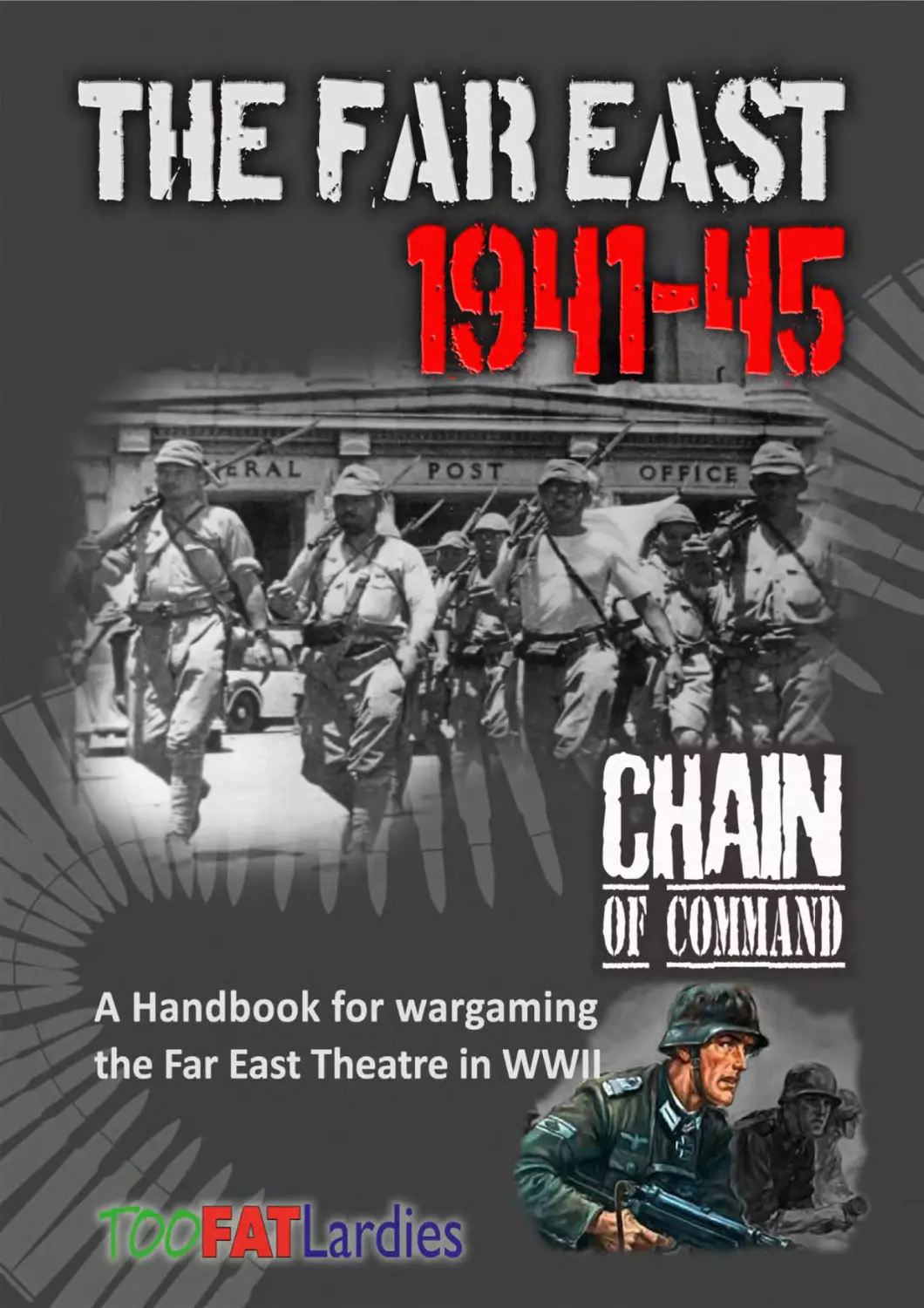
This handbook for Chain of Command has been
created to provide a comprehensive guide to
gaming the actions that took place in the Far East
between 1941 and 1945. It focuses predominantly
on the British sphere of influence and, as a result,
the US and Chinese forces deployed in what they
would call the China-Burma-India theatre are
absent. Details of these forces will follow in the
subsequent handbook covering the Pacific War.
There are some anomalies here. The bulk of the
Australian forces will be covered in the Pacific War
handbook, but those serving in Malaya and on Java
are covered here.
Amphibious landing operations will be covered in
the Pacific War handbook as those were very much
a feature of those island hopping campaigns and,
whilst the Japanese did make notable landings on
the Malayan peninsular, in the Dutch East Indies
and on Hong Kong Island, these were not the
sophisticated operations that were developed
and perfected by the US forces and their allies
elsewhere.
This handbook contains much in the way of rule
amendments and additions to reflect the nuances
of the different terrain that was encountered in
the Far East. First and foremost are the jungle
warfare rules which cover fighting in this hot,
humid and very green tropical area of the globe. I
am greatly indebted to Len Tracey in Australia who
has provided us with the benefit of his knowledge
gained while serving in the region and then as
Officer Commanding the Australian Army Jungle
Warfare School. His advice has been invaluable and
hugely informative and it has been a great pleasure
to cooperate with him on this project. However, our
priority has been to create rules for jungle warfare
that are both gameable and enjoyable, so any
failings in achieving this objective are mine alone.
This handbook contains extensive army lists for
Great Britain, her Dominions and Empire, the
forces of the Netherlands East Indies and Japan.
These are designed to provide the gamer with a
choice of core forces along with an appropriate list
of support options.
In most cases units will have access to more than
one support list. For example, an Indian Infantry
platoon may have access to support from an
1
allied unit such as the Burma Rifles or Hong Kong
Volunteer Defence Corps. This depends on where,
and at what point in the war, they are fighting. The
gamer should be guided by historical precedent
When it comes to list production, we have once
again taken a pragmatic approach, representing
the main troop types which fought and the
support weapons they were most likely to be able
to call upon. There will be cases of troops fighting
alongside each other which are not covered here.
There are countless examples of local initiatives
creating short-term marriages between different
units and these offer interesting local variations.
However, we have avoided incorporating these
exceptions into the rules by adding such choices to
a general list. Such anomalies are ideal candidates
for inclusion in a Pint Sized Campaign!
Also included are the national characteristics
for the various forces combined with some of
the concepts introduced in the Blitzkrieg 1940
Handbook, such as variable Force Morale ratings
and the Red Dice to reflect command dynamism.
This Handbook goes further with the addition of
Jungle-craft ratings so as to best reflect the skills,
or lack of them, of the forces we are representing.
We also see the introduction of Japanese "Ruses";
their very own version of the 'Shabby Nazi Tricks'
we saw in the 1940 Blitzkrieg Handbook. Unlike
the rather comedic Nazi version based on some
historical but rather unsophisticated attempts at
subterfuge, there is nothing funny about these
ruses! The Japanese were masters of disorientating
their opponents and of creating plans which
involved guile as well as brute force. We have been
sure to reflect this here.
In some cases the reader will note that some fl
support choices are, occasionally, less costly
for some units than others. This is not an error
but rather reflects the availability of that
support option for that particular unit.
What we do not include in this handbook are
the guerrilla groups who fought behind enemy
lines or the Japanese locally-organised counter-
insurgency forces. These forces are so diverse as
to be unique in each case, but also better suited to
a work dedicated to partisan warfare. Additionally,
some locally raised units which tended to operate
in a support or guide role are, from necessity,
subsumed within the term "Local Guides". This
is undoubtedly unfair on these irregulars who
provided valiant and effective service and deserve
to be remembered. However, with space at a
premium, we have chosen to represent the troops
which were engaged in front line fighting as
formally organised military units.
We hope you enjoy this handbook. It opens the
door onto a vast array of gaming opportunities
in one book. It has been a colossal project to
undertake and has taken nearly as long to complete
as the war itself, but has resulted in us getting to
play some remarkable games and experience a
type of warfare unseen elsewhere.
Richard Clarke
Lard Island, 2024.
2
CONTEXTS
Page 1 Introduction
Page 4 War in the Far East and Pacific
Page 11 Rules Additions
Page 21 Far East Rules Additions
Page 23 Jungle Warfare
Page 24 Far East Terrain
Credits
Figures shown in the book are from AB Miniatures,
The Assault Group, Brigade Miniatures, CMK Kits,
May 1940 Miniatures, Perry Miniatures, Studio
Historia Miniatures, Wargames Foundry, Warlord
Games and Westwind Miniatures.
Huge thanks go to the truly skilled masters of the
brush who contributed, especially Kristian from
Painting Panzers and Georgios Galazoulas, Raphael
Moutal and Andreas Panagopoulos at Studio
Historia. The less skilfully executed painting comes
from my own figure collection which contains a
large number of varied units but sadly not as well
painted.
Page 34	Using the Lists
Page 38	The British Empire
Page 77	The Dutch East Indies
Page 89	The Japanese Empire
Page 116	Far East Scenarios
3
WAR NffHE FAR EAST fe PACIFIC
In December of 1941 the Japanese Empire
famously launched an attack on the US Naval
base at Pearl Harbour. Within hours they had
simultaneously invaded the British colonies of
Hong Kong, Malaya and Borneo, as well as the US
held Philippines and Pacific territories of Guam
and Wake Island. Soon, the Far Eastern territories
of the Netherlands were also to experience this
tsunami of Japanese expansionism which saw the
theatre of war stretch to cover a vast area of the
Pacific Ocean and the Far East, from the north of
Australia to the eastern borders of India.
Japan's entry into the Second World War was a
continuation of over ten years of conflict, beginning
with its invasion and annexation of the Chinese
province of Manchuria in 1931. In 1937 Japan
declared war on China, a move which resulted in
the imposition of severe sanctions by the United
States and the United Kingdom, largely removing
access to the resources which Japan needed to
maintain its industry and prosecute the war. It
was, therefore, on the issue of resources that the
decision to go to war simultaneously with the
world's two greatest powers was taken.
Faced with the reality of economic collapse, the
Japanese government was under no illusion about
the audacity of their plans. However, if the United
States Pacific fleet could be neutralised whilst
Britain was fighting a war for her very survival in
Europe and North Africa, it was just possible that
a speedy campaign of expansion would secure
sufficient territory and resources to make Japan
self-reliant and unassailable. Or so the Japanese
planners projected.
In truth, Japan was embarking on a colossal gamble
which needed a big early win in order to have any
hope of success.
Vice Admiral Isoroku Yamamoto was prescient in
his remarks that "We can run wild for six months
or maybe a year, but after that, I have utterly
no confidence". However, for the Japanese this
reflected the realities of their planning.
The strategic objective was to take and hold vast
swathes of territory in the initial six months, seizing
the natural resources that were scattered around
the Pacific rim. They would then dig-in and defend
against all attempts to evict them. It was a desperate
plan which relied on their opponent's inability to
respond, either due to the destruction of their fleet
or simply being otherwise engaged elsewhere.
In September 1940, Japan signed the Tripartite
Pact which saw it join the Axis Powers. Whilst Nazi
Germany was so geographically remote it could
give no real assistance to Japan, there can be no
doubt that Germany and Italy were drawing away
resources from the Far East which were weakening
the British and leaving their many scattered
possessions almost entirely undefended.
Almost immediately the Japanese made their
first move, occupying French Indo-China, cutting
off one of the supply lines to China and gaining
access to the rubber, rice and coal that the French
produced. It was a blueprint for future operations;
the opportunity to isolate China, always their main
military target, whilst enhancing their access to
industrial resources.
4
Anticipated as it might have been, the Japanese
main blow, delivered in December 1941, came as
a shock in terms of its ferocity and its diversity
of objectives. The strike against the US Pacific
Fleet at Pearl Harbour needs no introduction.
Simultaneously, Japanese forces invaded Hong
Kong and Malaya. A week later they crossed into
British Burma.
Initial successes were startling. The Japanese
developed infiltration tactics, using the dense
jungle terrain as a safe route by which to move
unobserved before blocking key arterial roads
and denying their use to their supposedly more
modern but entirely vehicle reliant, opponents. In
his memoirs Field Marshall William Slim stated:
"The Japanese ability to move through jungle more
freely than we could, added to our road-bound
mechanical transport system, gave them every
advantage."
In truth, the Japanese had made an advantage out
of a necessity. Whilst Japan had modernised and
industrialised in the late 19th century, a lack of
material resources ensured that their main infantry
formations still moved almost exclusively on foot.
This contrasted with the modern western armies
for whom the motor vehicle was plentiful but
which saw them entirely reliant on good quality
roads; something in short supply outside the main
areas of habitation.
Using routes unconsidered by their road-bound
enemies, the Japanese simply went around the
main allied defences and blocked their lines of
communication. Thus encircled, their opponents
were obliged to attempt to fight their way out in
5
order to avoid isolation and destruction. Where
successful, such actions were costly in terms
of manpower and usually only achieved at the
expense of abandoning material and equipment.
This windfall allowed the Japanese Army to live off
captured "Churchill supplies" rather than relying
on their own limited and over-stretched system of
logistics.
The fall of Malaya and Singapore was the greatest
example of Japanese success against an opponent
struggling to find an answer to what appeared to
be radical new tactics.
In Malaya, the surprise achieved by the Japanese
operating in jungle terrain and whilst they and
some other units performed well, their numbers
were too few.
The majority of the Indian troops committed to
Malaya were under-trained and poorly led due to
the fast and unsustainable expansion of the Indian
Army. They were thrown into action without a full
complement of weapons and often with officers
who had only limited knowledge of the language
of their subordinates. Considering these factors, it
is unsuprising that they buckled under pressure.
Yet even as Singapore fell, the British and Indian
Armies sought to learn lessons from their defeat.
attack was total and the beach
defences, there supposedly
to mop up Japanese survivors
after the Royal Navy defeated
the invasion force at sea, were
overwhelmed when the loss
of HMS Prince of Wales and
HMS Repulse to Japanese
torpedo bombers on the 10th
of December left the colony
defenceless against a major
invasion.
The campaign in Malaya was
epitomised by continual British
amazement at the ability of the
Japanese to out-manoeuvre
them at almost every turn. The
Japanese were, it was presumed,
on foot, whereas both the
British and Indian armies were
fully motorised and supposedly
the most modern armies in the
world in that respect. How
could this be possible?
Only very few British units, such
as the 2nd Argyll & Sutherland
Highlanders, had trained for
6
Several key men, including the officer commanding
the Argylls, were snatched to safety by the Royal
Navy in order to help develop a response to this
seemingly unstoppable foe. It was to be the start
of a long learning journey.
The fall of the Netherlands East Indies saw an
equally rapid collapse of the colonial power as had
been seen in Malaya. The Dutch in the Far East were
unique in their misfortune of being an orphaned
colonial outpost of a parent nation occupied by
Nazi Germany and, as a consequence, beyond hope
of any assistance.
Made up of an extensive archipelago of islands
stretching over 3000 miles from East to West, it
was almost impossible to defend. Dutch forces
were overwhelmed by Japanese attackers who had
the advantage of being able to strike where they
chose, as opposed to the obligation of the colonial
administration to attempt to defend at all points.
Unlike the British, who could hope for assistance,
however unlikely, the Dutch forces were without
hope and this undoubtedly affected their morale.
The key administration centres fell like dominos
over a period of four months.
The Japanese conquest of Burma in 1942
appears, superficially, to be a repeat of the
disaster of Malaya. However, whilst the British
continued to be outmanoeuvred, an intact line of
communication back to India did allow the bulk of
the forces deployed there to escape destruction
or the ignominy of surrender. Indian Army units
that began the campaign in as parlous a state of
training and equipment as their fellow countrymen
who fell into captivity in Singapore were at least
able to fight their way back to safety and, in doing
so, were able to gain experience that provided the
foundation of the new Army built by the British
once they successfully crossed the Chindwin River
and the Naga Hills to reach the safety of India's
7
eastern provinces. There they were able to reflect
on the experience and knowledge gained in nearly
six months of continuous combat. Despite reverses,
important lessons were being learned.
For the British, the frustrating 1943 campaign in
the Arakan reinforced the need for quality rather
than quantity when it came to troops and training.
Since 1939 the Indian Army had expanded rapidly
but the demand for troops to be committed to
action before they were fully trained led one report
to describe them as "little better than an armed
mob". Restructuring and abandoning the lorry for
the mule was the simple part. If British and Indian
troops were to take on the Japanese with any hope
of success, they needed to be trained to operate in
jungle terrain.
The Australians, fighting in the jungles of Papua
and New Guinea, led the way in developing an
effective response, defeating the Japanese on the
Kokoda track, at Buna and Gona and at Milne Bay.
Selected officers were brought to India to lecture
on their experience; teaching the importance of
infiltration tactics that had made the Japanese so
successful but which could equally be used against
them. New tactics were developed and a proper
system of training was introduced at all levels. This
was to see the Indian Army revitalised in late 1943
and early 1944.
Operations undertaken by the Chindits were of
arguable military value and highly costly in terms
of losses of both men and material. However their
rather over-stated "success" in 1943 played a key
part in giving British and Indian troops confidence
that the Japanese could be defeated. More
importantly by far was the fact that the Chindit
columns operating deep in Japanese held territory
played a major part in the learning process that
saw the western allies fully recognise the power
of the aircraft, and the Douglas C-47 in particular,
to supply isolated forces. No longer were troops
whose line of communication was cut on the
ground obliged to withdraw. They could stand firm
in the knowledge that supplies would come by air.
Drawing on experiences in North Africa, the concept
of the defensive "box" was developed, initially as a
mechanism for self-preservation and later as part
of an aggressive "bite and hold" strategy.
Despite such advances in Allied tactics, the
Japanese were largely dismissive of their British
and Indian opponents. They too had learned from
the Chindit operations which had shown them
that the Chindwin and the Naga Hills were not
the impenetrable barrier they had assumed and,
believing that they could repeat their successes
of 1942, the Japanese were determined to cross
into India to secure the plains around Imphal
and Kohima. From there they could unleash the
renegade Indian National Army into India itself to
raise the standard for Indian independence from
British rule.
Operating at the end of a very long supply chain,
the Japanese planning was dependent on capturing
supplies from the British in order to feed their
forces. Their advance into India in 1944 was typical
of the long-odds gambles that had produced such
big dividends in 1942. This time they were to meet
a very different opponent.
As a replacement for the colonial powers the
Japanese had, like the Germans in occupied Europe,
stripped the territories they controlled of anything
that the military could use. Resources such as oil
and rubber were strategically important but, on a
day to day basis, food was the primary concern of
Japanese troops on the ground. Their relentless
pursuit of edible supplies did little to enamour
them to the local population.
The Japanese attempts to present themselves as
liberators were belied by their relentless harrying
of the civilian population. Promised freedoms and
benefits from the much-heralded Greater East
Asia Co-Prosperity Sphere failed to appear and
8
those who had initially welcomed the Japanese
as liberators found themselves, predictably,
disappointed. In many cases they worked with
their erstwhile colonisers in order to provide
active resistance against the invaders.
The biggest disappointment for the Japanese
was their failure to persuade the population of
India that their perceived road to independence
and self-determination was in any way linked
to Japanese military successes. This despite the
protestations of men such as Subhas Chandra
Bose, the former Indian National Congress
member who had courted Hitler and Mussolini
before persuading the Japanese to form the
Indian National Army from troops captured at
Singapore. The 50,000 men of the INA paled
into insignificance when contrasted with the 2.5
million men of the Indian Army who played a key
role in stopping Japanese expansion and then,
eventually, defeating it.
The War in the Far East theatre is one of vast
distances and diverse theatres. As with their
overall plan, the Japanese were opportunistic in
the development of their initial strategy. Where
they saw rapid successes, they were happy to keep
applying pressure, even where further advances
flagrantly exceeded their initial objectives and
their ability to successfully supply and defend the
additional territory captured. In many respects,
this desire for further expansion, often generated
by local commanders seeking glory, was their
ultimate undoing.
With early successes against poorly organised
and often partially trained troops, the Japanese
failed to recognise the qualitative improvement
as their enemies, trained and equipped using the
vast industrial power of the United States and the
manpower of British India.
The war in the Far East differed considerably from
the more static, attritional war in the Pacific.
There, the finite space available combined with
limited resupply ability, meant that the Japanese
developed a defensive operational policy based
on defending well-developed static defences and
causing unacceptable and disproportionate losses
to the attacker. In the Far East, the larger battlefield
meant that the Japanese retained their belief in the
offensive war of manoeuvre that had served them
so well in 1941 and 1942. They were to continue
aggressive offensives right up to the point where
they destroyed themselves and disintegrated as a
viable military force under skilfully applied British
pressure.
An insistence on re-attempting the tactics that had
succeeded in 1942 as late as 1944 saw the Japanese
lose vast numbers of men, troops who were key to
the original plan of defending the ground won in
early battles, in order to force their opponents into
9
a politically unacceptable war of attrition. This led
one British commentator to describe the Japanese
as "first rate soldiers in a third-rate army". It was the
arrogance of local Japanese commanders in Burma
in 1944 that saw the official policy of defence and
attrition put aside and a fresh offensive to invade
India planned and undertaken. This offensive was
quite literally the last throw of the dice for the
Japanese in the Burma-India theatre.
It is true that had the Japanese broken through the
Indian Army at Imphal and Kohima they could have
entered India itself and the renegades of the Indian
National Army could have been let loose as rabble-
rousers among the local population. However, the
provinces of Manipur and Nagaland are remote
and it was over 500 miles on poor roads to Calcutta.
The chances of success were so remote as to be
invisible.
Furthermore, the Indian Army was now tactically
vastly more competent than it had been in 1941.
The concept of the "box" as a tool for defence
was now extended to the offensive. Fast moving
columns would seize key locations and create a
secure all-round defensive position that could
hold out with almost unlimited air supply. The
Japanese, wedded as they were to the doctrine of
the offensive, behaved as British High Command
predicted and dashed their forces to near-oblivion
on these positions. The losses incurred around
Imphal and Kohima were so devastating that when
the Japanese eventually withdrew south across the
mountains to the Chindwin they were weakened
to the extent that the Indian 14th Army was able
to reconquer Burma in a single aggressive and
dynamic campaign in 1945.
At all points, Japan had underestimated her
opponents. At the outset, the idea that they
could inflict defeats on the United States and
Great Britain that would mean they were left in
possession of a new Empire was wishful thinking.
When tested, the resilience and political will-power
of the democracies was unbreakable. This was also
the case with the British Dominions of Australia
and New Zealand and, most significant of all in the
Far East, British India. All stood together to defeat
fascism in all of its embodiments.
10
HUH ADDITIONS
This Handbook is designed to be used with main Chain of Command rule book and the rules therein. However,
we also introduce some changes here in order to best reflect the campaigns in the Far East. Listed here are
the amendments to the main rules which can be applied to any period. This is followed by additions to the
main rules which are specific to this Handbook. These are followed by the Green section on Jungle Warfare
which focusses on the terrain encountered and its effects. Finally, at the start of the Army lists we have rules
for training and experience in jungle warfare.
Rule Amendments
The following rule Amendments are used with this Handbook, changing the rules as written in the main
rule book.
Chain of Command Points
For the first time, this Handbook introduces the idea of spending Chain of Command Points to trigger
events or effects. In the main rules, spending whole Chain of Command Dice was done to end a Turn,
or ambush an opponent or similar. In this Handbook individual Chain of Command Points may be spent
in the same way, reducing the number of Points on the Chain of Command Dice rather than having to
wait for, or use, a full dice. When this may be done is covered in the relevant rules sectons but this
mechanism allows us to fine-tune certain areas, such as troop quality.
Force Morale
In the main rules, when Force Morale is reduced to 2, a Jump-Off Point is removed from the table. This
is no longer the case. Now, when Force Morale drops to the point on the Force Morale Track identified
by the letter 'J', the player must immediately move one Section or Team of their choice to move into
contact with the friendly Jump-Off Point closest to them. This happens immediately with no rolls for
movement and is not an Action or activation.
The unit selected must be able to trace a line to the Jump-Off Point which does not come within 4" of
an enemy unit. This does not have to be a straight line but if it is unable to do this, a different unit must
be chosen. If no unit is able to withdraw, one unit of the enemy's choice will surrender. The nearest
enemy unit must provide one guard for every five prisoners. Both the prisoners and the guards are
immediately removed from the table. No Force Morale roll is made for this retreat or any resulting
surrender.
11
Force Morale Track
This Handbook uses a system of variable Force Morale to allow us to better represent the highly variable
troop quality encountered in the campaigns in the Far East. Each Platoon list will show a Force Morale
Track which looks like this:
Force Morale	1	2	3	4	5+
Command Dice	2	3	3	4	5
Special		J
The Track above represents a platoon with a Force Morale structure identical to the one listed in the
main rules for Regular troops. The top row shows the unit's current Force Morale. The middle row
shows the point at which the number of Command Dice are reduced. Finally the bottom row shows
any other effects. Here the letter 'J' indicates when a unit is obliged to withdraw to a Jump-Off Point.
By tailoring this Track to each unit, we can better reflect their strengths and weaknesses. For example,
the following Force Morale Track is for a typical Green Infantry force.
Force Morale	1	2	3	4	5	6+
Command Dice	1	2	2	3	3	4
Special				J
This Green force (but not necessary all Green forces) starts with just four Command Dice. This falls to
three dice when its Force Morale drops to 4 and its 'J' Rating is also 4. It will have just two Command
Dice when reduced to a Force Morale of 3 and, finally, one command Dice when its Force Morale falls
to 1.
Green Troops
The introduction of the variable Force Morale tracker and the 'J' Rating allow us to represent Green
Troops in a more effective manner than that in the main rules. Green Troops should now be targeted in
the same way as Regular Troops with the roll to hit being the same as for Regular Troops. When Green
Troops fire, they reduce the number of dice rolled by one for each point of Shock on the Unit.
Unreliable Allies
This Handbook allows some units to select support options from allied contingents as Unreliable Allies.
For example, Australians of Blackforce operating on Java may select Dutch support options. Where
this is possible it is clearly noted on each Army list. These troops count as unreliable allies, not due to
any cowardice or lack of commitment, but because they are operating as part of a different command
structure and may be called away with fresh orders at any point.
At the end of each Turn, the player will check for each allied unit selected as a support option. Roll a D6
for each unit. On a roll of 3 to 6, the unit remains in the fight for the next turn. On a roll of 1 or 2, the
unit is called away, and removed from play immediately. No Force Morale roll will be made for a Unit
of Unreliable Allies that leaves the table in this manner at the end of a Turn. The player may choose to
avoid testing for Unreliable Allies by playing a full Chain of Command dice at the end of a Turn.
12
Lines of Communication
In theatres where access to good roads was limited, Lines of Communication were very important. In
this Handbook we introduce Lines of Communication Markers which serve as an objective for your
opponent, similar to a Jump Off Point but with greater importance. They are used by forces for whom
maintaining communications is of primary importance. Whether a force requires a Line of Communi-
cation Marker or not is determined by their level of Jungle-craft See page 36.
The Line of Communication must be placed on the player's friendly table edge, indicating the point
through which their communications to the rear run. If a road is present on that edge, the Marker
must be placed on that.
If the Line of Communications Marker is captured by an enemy moving on to it, a Force Morale Test is
made at the end of each Turn it is in enemy hands, as though a Jump Off Point has been lost, applying
a +2 to the dice roll.
Hand Grenades are limited resource, with the numbers available listed in the weapon notes for each
nation.
Hand grenades thrown by troops who are 2" or more higher than their target and in the open (not
inside buildings), such as on higher ground or on a roof, will add +2 to their dice roll to hit the target.
This allows them to throw grenades up to 14". Troops who are on a downhill and on lower ground than
their target will subtract 2 from their dice roll, making their maximum throw 10". A roll of Double 1
always results in a fumble, as per the main rules.
Smoke Grenades
Smoke grenades are covered in section 9.2.2 of the main rules and section 8.2 states that smoke blocks
line of sight completely. Here this is changed so that smoke caused by smoke grenades does not block
line of sight, and may be fired through with a -1 penalty on the "to hit" roll. This reflects the fact that
a smoke screen caused by grenades is less dense and lasts for less time than that caused by mortars.
13
Snipers firing through smoke generated by smoke grenades also do so with a -1 penalty on the "to
hit" roll, hitting on 4 or more. Troops spotting an enemy sniper in concealed position will do so with
a -1 adjustment to their spotting roll if their line of sight is obscured by a smoke grenade. Forward
Observers ignore the effect of smoke grenades.
Inferior Senior Leader
To reflect certain doctrinal approaches, we have introduced a new status of Leader, the Inferior Senior
Leader. Activating on a Command Dice roll of 4, the Inferior Senior Leader begins the game with just
two, rather than the normal three, Command Initiatives. In all other respects, such as Force Morale
rolls and Command Range, the Inferior Senior Leader is treated as a Senior Leader.
Pinned Troops
Pinned troops may not use Overwatch or Covering Fire. A Unit that becomes Pinned while on
Overwatch will have the Overwatch removed immediately. They will not be able to return fire using
the Overwatch in that Phase.
Limited Ammunition
Troops with weapons which have limited ammunition, such as grenades, smoke grenades, mortars,
flamethrowers, tank canister rounds or similar may use a Chain of Command Dice to allow one
additional round of fire once the normal level of ammunition has been expended.
Normally, this additional round is a single shot. However, for grenades, this will allow a Leader to use
their Command Initiative to throw one additional grenade for each Command Initiative they are using.
This must be done in one Phase and may not be done over multiple Phases.
Anti-Tank Rifles
Anti-tank rifles have unlimited ammunition. The limited ammunition described in section 9.3.1. of the
main rules applies specifically to the PIAT in this theatre.
Forward Observers
Forward Observers operating in the Far East regularly experienced communication problems due to
climatic and geographical conditions. As a result only the Forward Observer may control mortar fire on
a Command Dice roll of 1. They may not be activated by a Senior Leader and the Senior Leader may
not act as a Forward Observer.
Mortar fire may only be called on to a point which the Observer Team can see from their location.
However, it may be subsequently adjusted to fall out of line of sight providing other friendly troops
can see the target.
Engineer Sections and Squads
When an Engineer Section or Squad is selected, the player may choose which two Teams they wish
from the Mine Clearing Team, Demolition Team or Wire-Cutting Team. Flamethrower Teams may only
be fielded when selected as a specific support choice, not as part of a section.
14
Rule Additions
The following rules are added to cover troop types and troops equipped in a manner not covered in
the main rule book. Some of these changes were first listed in the Blitzkrieg 1940 handbook.
Red Dice
Some well-led units may be given a "Red Dice" at no cost, while others may select the Red Dice as a
support option. In both cases, this allows them to have one additional Command Dice of a different
colour (which actually can be any colour that differentiates it from the rest of the Command Dice). The
player will roll this Red Dice along with their normal Command Dice in every Phase, treating results of
1 to 4 as normal, but ignoring rolls of 5 or 6 on this Red Dice.
The Red Dice will be lost when Force Morale falls to a certain point; this varying from unit to unit.
A red box on the Force Morale Track shows when this Red Dice is lost and removed from play. For
example, with the following Track, the player will lose the Red Dice once their Force Morale drops to
4, at the same time as their normal Command Dice are reduced to four.
Force Morale	1	2	3	4	5+
Command Dice	2	3	3	4	5
Special		J
Bicycle Mounted Troops
Only troops armed with small-arms may be bicycle mounted. This includes, rifles, SMGs, LMGs and
light mortars, grenade dischargers and anti-tank rifles. It does not include support weapons such as
tripod mounted machine guns or larger weapons. Bicycle troops may deploy onto the table either
mounted or dismounted. They will deploy from Jump-Off Points whether mounted or on foot.
When deploying onto the table, bicycle troops may add 3" to the distance from the Jump-Off Point
they may deploy. This is whether they deploy mounted on bicycles or not. So, Regular troops deploy
up to 9" away. Troops mounted on bicycles will add 1D6 to all normal movement. They may only move
mounted in open terrain or hard ground; in all other terrain they may take their bicycles with them but
must move as though on foot. Troops dismounting from bicycles may do so at no penalty.
Troops mounted on bicycles may not move "at the double" in their first Phase of movement from
stationary. They may never adopt a Tactical stance when mounted. Bicycle mounted troops wishing
to fire, go on Overwatch or adopt a Tactical stance must first abandon their bicycles. Once abandoned,
the bicycle may not be remounted or used in any way for the remainder of the current Turn. Troops
wishing to remount their bicycles may do so at the start of a new Turn. They do not need to move to
the point where the bicycles were abandoned to do so.
Troops on bicycles engaged in Close Combat will count as being hit in the rear and will not gain any
advantage for SMGs or LMGs in the first Phase of combat. After the first Phase of Close Combat they
automatically dismount.
15
Fortifications
Whilst the main rules cover Bunkers, here we have Fortifications, a stronger type of structure. A
Fortification is a well-prepared and constructed bunker which has been built to exacting standards as
part of a planned system of defences. Fortifications are not necessarily large, but they are sufficiently
sturdy to provide the men crewing them with reassurance regarding their safety. Japanese bunkers
were also noted for their concealed apertures which made attacking them extremely difficult as the
level of protecton afforded the occupants was greatly enhanced when the firing position could not be
identified. Japanese Fortifications are listed in detail, along with specific rules, on pagel09.
Japanese troops deployed in Fortifications do not abandon them easily, for any reason. To leave a
Fortification, a Japanese Unit must spend a Chain of Command Dice or be taking part in a Banzai
Charge using that Late War Ruse. See page 113. Fortifications are valuable and important parts of a
defensive plan. If one is knocked out or abandoned by their crew, this will trigger a Bad Things Happen
roll for a Support Unit being 'killed'.
Infantry Firing at Japanese Fortifications
The first kill caused by a Unit firing at a target in a Fortification ignores the first kill they achieve in
each Phase. Only where an actual kill is achieved (over and above the first ignored kill) will any Shock
caused from firing be placed on the target Unit. Where no kill is achieved, Shock is ignored. Covering
Fire may be used against a Fortification.
Note: As covered in the main rules, flame weapons firing at a Unit in a Fortification ignore all cover
and treat the target as covered in the main rules.
Snipers Firing at Japanese Fortifications
Snipers firing against a Fortification may only do so if the Fortification has been spotted. They treat
their target as in the open but apply a -1 to hit, hitting on 4, 5 or 6, and a -1 to the effect of fire roll.
Firing HE and AP at Japanese Fortifications
Japanese bunkers were a particularly difficult to target due to their well-concealed firing apertures.
The Allies successfully developed combined infantry, artillery and armour tactics which allowed them
to take on the bunkers. Ant-tank guns, PIATs and even heavy artillery were carefully moved forward
and used to fire directly at Japanese bunkers in order to knock them out or at least suppress them.
The following rule is designed specifically for fire against Japanese Fortifications.
Tanks and guns firing at fortifications may select whether to fire solid A.P. rounds or explosive H.E.
rounds. A.P. rounds may always be fired at a fortification. H.E. rounds may be fired at a Fortification
only when friendly infantry are not within 6" of the target. PIATs always fire an exploding round so may
not engage a bunker when friendly troops are within 6" of the target.
When an AFV, gun or PIAT is firing at a Japanese Fortification, roll 2D6 and apply the result shown on
the following table. As when firing at an AFV target, a PIAT applies a -1 when firing at 12" to 24" and
16
-2 when firing at between 24" and 36". However, a PIAT always counts a natural roll of double 6 as a
12 on the table. AFVs or guns make no adjustment for range. Where H.E. is being fired, the additional
H.E. effect is added.
Roll	Effect
2-9	No effect
10	The Fortification is suppressed. Any Teams inside and may not fire or move in their next Phase.
11	The Fortification is suppressed. Any Teams inside may not fire or move in their next Phase and count as Pinned in Close Combat. H.E. effect: Roll the gun or weapon's usual H.E. dice and apply the result treating the Fortification as Hard Cover.
12	The round enters the aperture. The Fortification is suppressed. Any Teams inside may not fire or move in their next Phase and count as Pinned in Close Combat. H.E. effect: Roll double the gun or weapon's normal H.E. dice and apply the result, treat- ing the target as in the open.
A Leader in an AFV or commanding an artillery piece who uses two Command Initiatives to direct fire
may add a +1 to the roll, as usual. A Senior leader attached to a PIAT Team may also use two Command
Initiatives to add +1 to the Team's roll to hit when firing at Fortifications.
Targetting Larger Fortifications
Where firing at a Large Fortification with two fighting positions, any fire will be aimed at one
aperture and any effects applied to the occupants of that one fighting position. This also applies
to attacks by flame weapons
Fortifications in Close Combat
Units in Fortification may only be engaged in Close Combat if the attacker contacts the entrance to the
Fortification. The defenders always count as defending hard cover.
Grenades and Satchel Charges versus Fortifications
When used against Fortifications, grenades only have any effect if they enter the aperture, either by
being thrown in or by being "posted" in.
If throwing a grenade or satchel charge through an aperture, use the rules for hand grenades, rolling
2D6 for range and applying a -6 for a very small aperture if the target is an LMG position, or -4 for a
small aperture if the target is an anti-tank gun position or larger. If the player rolls successfully, the
satchel charge or grenade enters the Fortification and explodes. A double 1 results in a fumble.
If the player fails to throw a grenade through an aperture, it has no effect. A satchel charge that does
not go through the aperture explodes as though placed against the structure.
To "post" a grenade or satchel charge through an aperture, a figure must be adjacent to it and may not
move in the same Phase. They roll 2D6 and only fail on a fumble roll of "Double 1". A fumbled grenade
explodes with any hits caused on the Team that was posting it. It has no effect on the occupants of
17
the fortification. Where it does enter the aperture, it doubles the number of casualty dice rolled. The
satchel charge strikes with 6D6 when placed against the structure, reducing cover to Hard Cover. When
it enters the aperture, the satchel charge strikes with 12D6 as though against a target in the open.
Demolitions
Demolitions are undertaken by specialist demolition Teams or Engineers. Most demolition works are
undertaken by achieving a Task Roll total by rolling a D6 each time the Team is activated. A running
total is kept of the dice rolled for this purpose; once the total required is reached, the task is
complete.
The Task Roll targets required to set charges for simple Demolition projects are as follows:
Task	Roll	Task	Roll
Demolish a road or rail bridge	24	Demolish LMG or Ant’ Tank Bunker	6
Demolish a foot bridge	12	Demolish an Ambush or AT Bunker	8
Demolish a culvert	6	Demolish a Large Fortification	18
Remove detonators to render charges	6	Re-set charges which failed to
useless Mine a road	6	detonate	6
Some scenarios may begin with the explosives in place. In which case no Task roll will be required.
Detonating a Charge
To detonate a charge the Engineers who set the charge or multiple charges must be at a point within
12" of the charge. From there then can detonate multiple charges within that distance. One Chain of
Command Dice must be spent to do so. When detonating a charge, roll a D6 for each charge. On a roll
of 2 to 6, the charge explodes and destroys the structure, killing all occupants if there are any present.
Any Units within 9" of the charge may be affected by the blast. Roll 4D6 for casualties if within 6" of the
detonation, 2D6 if over 6" but within 9". Treat all hits as though in the open.
On a roll of 1, a fault has occurred. Roll again.
On a roll of 1, there is a total failure and the charges fail to detonate. To destroy the structure the
charges must be re-set.
On a roll of 2 to 6, this is a partial failure. If the target is a bridge, it is now impassable to vehicles but
infantry may cross it (but not At the Double). To destroy this damaged bridge, further charges, sufficient
to demolish a foot bridge must be laid.
If the target is a fortification, roll a D6. This is the number of consecutive Phases the crew of the
fortification are out of action for due to the effect of the blast. During that time they may not activate
at all and if engaged in Close Combat will surrender.
Collateral Damage
All buildings or structures which are demolished have a danger zone around them of 6". Any units
18
within that danger zone take 1D6 hits, rolling for effect as though in the open. If the Team undertaking
the demolition task is within 6" they will be affected by this unless they post the charge directly through
the aperture of a Fortification, in which case they will suffer no effects.
Removing a Charge
An non-Engineer Unit that makes contact with a charge that has been fully or partially set may attempt
to remove it by rolling a D6 when activated. On a roll of 6 they disarm the charge. On a roll of 1, the
charge detonates immediately. Roll for effect as though detonating a charge.
37mm Cannister Rounds
The US М3 tank gun that was mounted on the Stuart and in the turret of the Lee and Grant tanks used
by British and Indian forces was underpowered in its primary anti-tank role, but it was equipped with
an effective cannister round that was found useful in an anti-personnel role and also as a means of
clearing foliage.
When firing a canister round, Stuart, Lee and Grant tanks, roll eight dice. Cannister has a maximum
range of 24". It does not reduce cover.
Cannister was used in limited amounts by the British and Indian Armies, so only three rounds are
available for each tank. Cannister may never be resupplied, but can use the Limited Ammunition rule
above in conjunction with one Chain of Command Dice.
Defoliation
Tanks firing cannister also use the Defoliation by Fire rule on page 31. They use this when firing at a
target in jungle terrain or may use it to clear foliage, even when no target Unit is present.
19
Armour Rules Additions
All of the basic armour rules contained in Chain of Command apply. However, as with the 1940
Handbook, we add the following rules specifically to deal with some of the key issues of the war in the
Far East where many vehicles were antiquated and with resulting limitations.
Some forces are more affected by these changes than others and the National Arsenals will be of
assistance in identifying which forces and which vehicles in particular are affected.
New Armour Classifications
Two new armour classifications are used in this Handbook in order to identify two particular issues,
namely unreliable armoured vehicles and those with particularly small, one man, turrets. The former
will be identified in the Notes section as 'Unreliable', the latter with the abbreviation '1MT'.
Unreliable Vehicles
Unreliable vehicles are either those with particular design faults or those which are simply old or are
in poor running order. Either way, vehicles classed as Unreliable will break down if they ever roll two
or more l's when moving. The vehicle cannot move for the rest of the game but the crew may still use
any weapons and may traverse the turret if present. The crew will immediately suffer a permanent loss
of one morale point.
Small Turrets
Vehicles with turrets that can house only one man relied on the tank commander to not only direct
the actions of his vehicle but also to serve as gunner and loader. For some light vehicles, such as those
armed with a single machine gun or self-loading cannon, this was not a problem. However, for vehicles
with a gun capable of firing H.E. and A.P. shells the commander was severely over-worked and this
affected the performance of the entire crew.
When firing the main gun, the Leader is unable to issue any other commands nor is he able to rally
Shock from the crew. However, while the Leader is serving the main gun in such a manner, the driver
and any secondary crew position may still be activated on a Command Dice roll of 1, as though it were
an un-commanded vehicle.
Lacking Radio
Many AFVs in the early war period lacked radios. On the advance towards the enemy this lack of
communications was often overcome by the use of flags or signal rockets. However, once in action
there was little time for, and much danger attached to, exposing a Leader outside the turret to make
such signals. As a result, AFVs without a radio may never issue commands by radio as outlined in Section
11.4 of the main rules. All such vehicles may only activate individually.
Tank Telephones
In British service, the additional of an external telephone was usually limited to the Sherman. If a tank
has a telephone attached, a Junior or Senior Leader from the core platoon that is to the immediate rear
of the tank may activate that tank to fire on an enemy target for one Command Initiative. As a result of
the better visibility the Leader outside the tank has, any firing against a fortification or spider hole adds
a +1 to the hit roll, as thought the tank commander were laying the gun.
20
Far East Rules Additions
The following rules deal specifically with the effect of Jungle Terrain on troops in combat. Where the
terrain can obscure visibility and limit command ability, it can also offer opportunities, especially for
better trained troops who are familiar with that environment.
Command Ranges
Controlling of troops is difficult in Jungle Terrain. To reflect this, a Junior Leader has no Command
Radius in Jungle Terrain and may only influence the Team or Section to which they are attached. Senior
Leaders in Jungle Terrain have their Command Radius reduced to 6".
Jump Off Points
Units deploying from a Jump Off Point located in Jungle Terrain may not deploy into Close Combat. They
must deploy more than 2" away from an enemy in Jungle Terrain or 4" from an enemy in other Terrain.
Jump Off Points located in Jungle Terrain are closed down when the enemy come within 2" rather than
the usual 4".
Close Combat in Jungle
In Jungle terrain, Close Combat occurs when a Unit moves to within 2" of the enemy. The Teams attacked
by an enemy coming within 2" will fight. Any friendly Teams which are within 2" of the Unit attacked
will also take part in the combat. If a friendly Unit is further than 2" from both the enemy and the Unit
attacked they do not take part in the Close Combat.
Ambushes
Troops ambushing in Jungle Terrain may do so as a whole section (as opposed to just a Team in the main
rules). However, if a whole section ambushes it must remain on the table after the ambush. A single
Team ambushing may be removed from the table at the end of the Phase in which it activates.
Units may only deploy directly into Close Combat when using an Ambush. Whereas the main rules
demand a full Chain of Command Dice to Ambush, the cost varies here depending on the level of Jungle-
craft and experience. See page 36.
Firing at an Obscured Target - The Green Jungle Dice
When firing at an infantry target in terrain classed as Obscured, the firing dice are rolled as normal, but a
Green "Jungle Dice" is added to the hand. This reflects the unpredictable nature of jungle terrain which
is not constant in its effects. Weapons firing HE or Cannister rounds do not use this; however, note the
rules for defoliation by fire.
There are two variants of this rule, the Standard and Advanced Obscured Visibility rules. The Standard
rule takes into account the variability of the terrain; the Advanced rule adds in the level of training of
the troops firing, allowing troops better trained or more experienced in Jungle Warfare an advantage
over more inexperienced troops. Decide which rule you want to apply before the game begins.
21
The Green Jungle Dice does not cause hits, but rather indicates the visibility from the Unit firing to the
target Unit.
STANDARD OBSCURED VISIBILITY RULES
If the Green Dice roll is a 1:
The target is treated as being in one level cover better than it is. If in Hard Cover or better it
cannot be hit and is unseen; if in Light Cover, the target is treated as if in Hard Cover.
If the Green Dice roll is a result of 2 to 5:
cover is applied as normal with no changes.
If the Green Dice roll is 6:
The target it is treated as being in one level cover less than it is. If in Hard Cover, the target is
treated as Light Cover. If in Light Cover it is treated as if in the open.
Troops in entrenchments or bunkers never have their cover reduced on any Green Dice result.
ADVANCED OBSCURED VISIBILITY RULES
Roll the Green Jungle Dice with Units rated Poor Jungle Troops applying a -1 to the dice roll.
Jungle Warriors apply a +1 to the dice roll.
If the adjusted Green Dice roll is a 1 or 2:
The target is treated as being in one level cover better than it is. If in Hard Cover or better, it
cannot be hit and is unseen; if in Light Cover, the target is treated as if in Hard Cover.
If the adjusted Green Dice roll is a result of 3 or 4:
cover is applied as normal with no changes.
If the adjusted Green Dice roll is 5 or 6:
The target it is treated as being in one level cover less than it is. If in Hard Cover, the target is
treated as Light Cover. If in Light Cover it is treated as if in the open.
Troops in entrenchments or bunkers never have their cover reduced on any Green Dice result.
Obscured Visibility Rules and Platoon Force Ratings
The Standard Obscured Visibility rules are designed to be used with the existing Platoon Force Ratings.
The Advanced rules will give a significant advantage to better trained troops and to reflect this, Jungle
Warriors add 4 points to their Platoon Force Rating. A Platoon with Poor Jungle Craft subtracts 4 points
from their Platoon Force Rating.	.
22
JWGLE WARFARE
Introducing the jungle into Chain of Command
may at first glance, appear problematic; the idea of
covering a whole table with suitable terrain may
appear to be a challenge that many gamers would
Having said that, any Far East handbook would be
remiss if it did not fully cover the dense, humid and
often mountainous terrain that was very different to
the more open terrain of Europe and North Africa.
choose to avoid. However, the truth is that in many
areas that were fought over, the jungle provided
the frame that surrounded the action, rather than
dominating the battlefield itself.
What follows is a comprehensive guide to the types
of terrain that could be encountered. This is an
extensive list of terrain types that cover more than
one quarter of the world's surface. You don't need
Fighting often took place at critical points such
as villages, airfields or farming land where the
wargames table will be relatively free of dense
vegetation. Whether our game is on the fertile
coastal strip of Malaya orthe central plains of Burma,
it is entirely possible to refight historical actions
to have all of it on one 6' by 4' table! Keeping the
types of terrain represented in a game to a minimum
will make things much easier for players. Equally,
where only a small part of the table contains any
jungle terrain at all, we have a much simplified
option which keeps things very simple indeed.
where the jungle is nothing more than a few clumps
of unruly growth set amid the more open terrain
of paddy fields, neat plantations, whitewashed
The following rules are added to cover the different
types of terrain that could be encountered in the
temples, villages and even the occasional tennis
court. In short, you do not need huge amounts of
jungle terrain to enjoy this handbook.
jungles of the Far East. Also covered are the troops
operating in that jungle and how their varying levels
of experience and training affected their ability to
operate in that environment.
23
Far East Terrain Rules
What is Jungle Terrain?
The tables below and on the next page covers the chief terrain types that may be encountered in the
Far East. Most of the terrain encountered will be covered in the main rules; for example a jungle track
is treated as any other open area of hard ground if there are no other factors making it harder going.
However, where particularly dense growth is encountered, we introduce Jungle Terrain where spotting
is harder and movement can be impeded. Jungle Terrain is all terrain types shown in green table. This
terrain is difficult to move through and has a variable effect on shooting due to poor visibility. A target
in Jungle Terrain is treated as an Obscured target due to the variable nature of the vegetation. See page 22.
Jungle Terrain
Terrain	Movement	Visibility	Firing	Wheeled	Tracked
Jungle Fringe	1D6 -1"	2"	Hard Cover	Impassable	Impassable
Primary Jungle	Broken Ground	12" Fringe	Light Cover moving. Hard Cover stationary.	Impassable	Impassable
Secondary Jungle	Heavy Going	9" Fringe	Hard Cover	Impassable	Impassable
Tropical Swamp	Really Heavy Terrain	9" Fringe	Hard Cover	Impassable	Impassable
Banana Plantation	Heavy Going	9" Possible Fringe	Light Cover	Soft Ground	Soft Ground, Solid Obstacle
Bamboo	Heavy Going	Interior 9" Fringe	Light Cover	Impassable	Solid Obstacle for Tracked
Kunai Grass	Broken Ground	Interior 9" Elevated 18" Possible Fringe	Light Cover	Broken Ground	Broken Ground
When do I use the Jungle Terrain Rules?
The following Jungle Terrain rules are designed for a table which is made up of significant areas of
Jungle Terrain. We recommend that one quarter or more of the table should be covered in continuous
Jungle Terrain before you need to use the full rules. Where less jungle than that is present, we suggest
using the Limited Jungle Terrain rules.
Limited Jungle Terrain
The Jungle Terrain rules apply whenever jungle is encountered. However, actions often occurred where
the jungle broke and the better fields of fire suited a defensive position. Consequently, many actions
fought in the Far East will have a minimal amount of jungle actually on the table. Where this is the case,
we treat any areas of Jungle as Jungle Thicket, as show on the table below.
24
Other Terrain
The terrain shown on the table below is terrain which may be encountered in the Far East but which is
not Jungle Terrain. Any terrain classed as Other Terrain is not Jungle Terrain and any target in it is not
Obscured.
Other Terrain
Terrain	Movement	Visibility	Firing	Wheeled	Tracked
Jungle Thicket	Heavy Going	As Woods	Hard Cover	Impassable	Impassable
Rubber Plantation	Open Ground	As Light Orchards	Light Cover	Broken Ground	Heavy Going
Wet Paddy fields	Heavy Going	Unlimited	Open	Soft Ground	Soft Ground
Dry Paddy fields	Open Ground	Unlimited	Open	Road	Road
Paddy Bund	Minor Obstacle	Unlimited	Light Cover	Minor Obstacle	Minor Obstacle
Barrier Growth	Minor Obstacle	2"	Light Cover	Impassable	Broken Ground
Knee-Deep Creek	Broken Ground	Unlimited	Bank is Light Cover	Requires Ford	Soft Ground
Waist-Deep Creek	Minor Obstacle	Unlimited	Bank is Light Cover	May only be crossed at ford
Chest Deep Creek	Major Obstacle	Unlimited	Bank is Light Cover	May only be crossed at ford
Chaung Bed	Broken Ground	Visible only from bank only	Bank is Heavy Cover	Impassable	Soft Ground
Cumulative Terrain Effects
Where a Unit encounters terrain where more than one restricts movement, such as jungle on a steep
mountain or an obstacle in a swamp, this effect is not cumulative, but rather the most severe movement
penalty of the terrain types is applied.
25
Jungle Terrain Rules
The following rules apply for tables where Jungle Terrain makes up more than 25% of the table space.
Jungle Terrain Types
The following list and table on the next page covers the most common terrain types found in the Far
East. It shows how they affect movement and firing but also serves as a guide to how to place the
terrain on your table.
Jungle Fringe: As with woods and orchards, Jungle Terrain has an area around it in which troops can
see out and be seen from outside that terrain. Unlike European terrain, the fringe around the edge
of Jungle Terrain is denser due to the presence of sunlight and the consequent undergrowth found
there. This we refer to as "the fringe". A 2" wide fringe of dense vegetation runs around the edge of all
Jungle Terrain. It is not present where one type of Jungle Terrain borders another, for example, where
Primary Jungle meets Secondary Jungle, Tropical Swamps or areas of Bamboo, but encircles all areas
of Jungle Terrain where that edge is exposed to daylight. Terrain that has a fringe is marked as such in
the Visibility column of the Jungle Terrain table.
The dense area of fringe at the edge of Jungle Terrain is hard to break into. A Unit moving up to Jungle
Fringe halts when it reaches it. When attempting to move through, along or out of Jungle Fringe, a Unit
spends its entire activation to do so. The Unit rolls 1D6 and subtracts 1 from the result. It may then
move that far in inches. A net result of zero means that the Unit has been unable to break into the
Jungle Fringe and does not move. Until a Unit moves and repeats this process when next activated and
until they have moved through the 2" fringe.
A Unit that is in the Jungle Fringe can see, and will be visible to, any Unit that has line of sight to the
Fringe. A Unit in Jungle Fringe is always an Obscured Target and counts as being in Hard Cover.
Primary Jungle: This is jungle, or often more correctly forest, largely untouched by humans, with a
dense tree canopy overhead but with limited undergrowth due to a lack of sunlight penetrating to the
jungle floor. Primary Jungle is usually found away from human habitation.
Primary Jungle is Broken Ground. Visibility within Primary Jungle is 12". A Unit that is fired on when
moving in Primary Jungle is an Obscured Target. If the Unit moved in the current or previous Phase, it
is in Light Cover, a Unit that was stationary in the previous and current Phase is in Hard Cover.
Secondary Jungle: This is woodland that has been cleared by humans, usually for farming or logging,
but which has subsequently returned to nature. It is more dense than Primary Jungle as the ground
cover is abundant due to the clearing away of the original canopy. Secondary Jungle is usually located
near human habitation.
Secondary Jungle is Heavy Going. Visibility within Secondary Jungle is 9". A Unit that is fired on in
Secondary Jungle is an Obscured Target in Hard Cover.
26
Tropical Swamp: Dense jungle, fetid standing water and trailing vegetation plants combine to make this
extremely unpleasant terrain to fight in. This type of swamp is most often found near the coast or in
lowlands where brackish or salt water feeds them.
Tropical Swamp is Really Heavy Terrain. Visibility within Tropical Swamp is 9". A Unit that is fired on
when moving in Tropical Swamp is an Obscured Target in Hard Cover.
Banana Plantations: Often densely packed with thick, fleshy trees that limit visibility rather than provide
good cover. Some commercially managed plantations are more widely spaced out and may be treated
as woodland with no jungle fringe. Local-grown plantations, tended by the indigenous population, will
be adjacent to habitation but will often, but not always, have a Jungle fringe.
Banana Plantations are Heavy Going. Visibility within a locally tended Banana Plantation is 9". A Unit
that is fired on in a Banana Plantation is an Obscured Target in Light Cover.
Bamboo: Often as thick as a man's arm and up to 100 foot in height, Bamboo can form entire forests or
smaller clumps. It is ubiquitous and is often found serving as boundaries between dwellings in villages.
Bamboo is Heavy Going. Visibility in Bamboo is 9". A Unit that is fired on in Bamboo is an Obscured
Target in Light Cover.
Kunai Grass: Long, sharp edged grass up to 10 foot tall which disorientates whilst reflecting and
magnifying heat. Troops moving in Kunai Grass are more easily engaged by an enemy on higher ground
and this is reflected in the Visibility column. Kunai Grass may have a Jungle Fringe.
Kunai Grass is Broken Ground. Visibility in Kunai Grass is 9" on flat ground, or 18" if the firer and target
are on different elevations. A Unit that is fired on in Kunai Grass is an Obscured Target in Light Cover.
Impassable Jungle: Some patches of Jungle are so dense that it would be a waste of effort to attempt
to move through them. These should be have minimum width and depth of 3". They completely break
line of sight and stop all movement into or through them.
Moving In Jungle Terrain
Troops moving in Jungle Terrain will do so in single file when not in contact with the enemy, only
deploying out to form a firing line when the lead men stop and the rest of the Unit expands to the left
or right, or both. A Unit may attempt to move in a wide, sweep line, formation but will subtract 1 pip
from each dice rolled for movement, over an above any other movement penalties.
Where Sections or multiple Teams are moving through Jungle Terrain, the player should be clear which
Team leads and which follows.
27
Other Terrain
Jungle Thickets: Jungle Thickets are small, isolated areas of dense jungle type growth, no larger than
24 square inches in area, e.g 6" by 4" or 8" by 3", and standing in otherwise open terrain.
Jungle Thickets are Heavy Going. A Unit within a Jungle Thicket may be seen as though in Woods in the
main rules. A Unit in a Jungle Thicket that is fired at is in Hard Cover but is not an Obscured Target due
to the limited size of their cover.
Rubber Plantation: By definition, this is managed woodland grown for commercial purposes, usually
by large corporations involved in the manufacture of car tyres and similar. They are normally planted
in a succession of rows and do not affect movement. These are treated as Light Orchards in the main
rules. A Unit fired on in a Rubber Plantation is in Light Cover and is not an Obscured Target.
Paddy Fields: These are man-made areas of rice-growing ground which, by the addition of a low wall
or dyke, referred to as a "bund", allow for the retention of water during the two, or occasionally three,
growing seasons in the year. Paddy fields are always found near human habitation, often immediately
adjacent to it.
Wet paddy fields are Heavy Going. A dry paddy field is Open Ground. The bund walls of a paddy field
count as a Minor Obstacle to cross for personnel and vehicles and counts as Light Cover for troops
immediately behind it or Partially Obscured for vehicles. Vehicles engaged while crossing the bund wall
count any hits as striking their rear armour as they are exposing their belly armour while crossing.
Barrier Growth: Settled areas in the Asia-Pacific region frequently see strips of clumped vegetation
grown to act as a barrier against weather and to define boundaries. These should be no more than 2"
wide but can be quite tall and dense.
Barrier Growth is a Minor Obstacle. Barrier Growth blocks visibility for troops more than 2" from it.
Troops within 2" of Barrier Growth can see through it and may be seen by an enemy on the other side
that has a clear line of sight to the Barrier Growth. A Unit behind or in the Barrier Growth is in Light
Cover but is not an Obscured Target.
28
Creeks, Chaungs & Streams
Many low-lying jungle areas are criss-crossed with a myriad of small streams and creeks that have to be
forded. The width of these can range from 1" to 6". Wider creeks and rivers are usually impassable unless
bridged. Wheeled or half-tracked vehicles may only cross creeks at designated fords which are treated
as Broken Ground.
Movement in creeks or streams is affected by their depth. There are three types; knee deep, waist deep
and chest deep. Deeper creeks are impassable unless bridged.
Knee-Deep Creeks
These are minor obstacles to enter or exit and count as Broken Ground when moving in the water.
Troops can fire from a knee-deep creek at full effect. Troops against the banks of a knee-deep creek are
in Light Cover.
Waist-Deep Creeks
These are a Medium Obstacle to enter or exit and count as a Minor Obstacle when moving in the water.
Troops can fire from a waist-deep creek but remove half of the firepower dice. Troops against the banks
of a waist-deep creek are in Light Cover.
Chest-Deep Creeks
These are a Major Obstacle to enter or exit and count as a Medium Obstacle when moving in the water.
Troops cannot fire from a chest-deep creek. Troops against the banks of a chest-deep creek are in Light
Cover.
Chaungs
Found in Burma and the Arakan, a chaung is a stream with a wide bed and deep banks created by a
wide variation in the amount of water flow, caused by tidal or seasonal weather. At times of high water
volume, chaungs will be full of deep and fast flowing water and be completely impassable. In drier
seasons, or when the tide has receded, the chaung can be almost entirely empty with a trickle of water
in the centre of the bed or simply the odd stagnant pool.
Chaung beds should be between 6" and 12" wide. Troops and AFVs in the bed of a dry chaung move as
though in Broken Ground and are only visible to an enemy on the bank of the chaung. Troops lining the
banks of a chaung are in Heavy Cover to an enemy outside it.
Due to the constant damp nature of the chaung, their banks are soft and prone to give way under any
significant weight. Tanks and fully tracked carriers may attempt to cross a chaung bank. They roll 2D6,
moving the distance rolled on the higher dice, discarding the lower roll. If a double is rolled, the vehicle
has bogged and is immobile. It may attempt to free itself when next activated, rolling a D6. On a roll of 4
to 6 the AFV moves that far in inches and is unbogged. On a roll of 1 to 3 they are permanently immobile
and abandoned.
Successfully crossing the chaung bank will put the tracked AFV in the riverbed. In order to move out of
the riverbed, the process must be repeated.
29
River Crossings
Most bridges are treated as normal in the rules but some impromptu crossing points, either man made
or features of nature may be used. Rope bridges and improvised crossings are treated as Broken Ground
for units moving over them. Fallen trees allow troops to cross but are treated as a Minor Obstacle,
discarding the lower of two D6 rolled for movement.
Slopes and Mountains
Whilst early fighting in Malaya and Burma tended to be restricted to the habitable and agriculturally
productive low-lying plains or broad river valleys, much of the later fighting occurred in dense mountainous
jungles and mountain ranges. Where particularly steep and mountainous terrain is represented on the
table, troops moving through this should count this as crossing a Minor Obstacle. All vehicles treat this
terrain as impassable, unless a road or track is present.
Village Huts
In more rural areas the local population tended to live in huts made from locally available natural
materials, often constructed with great skill but providing limited protection from modern weapons.
Village huts block line of sight and provide Light Cover for troops inside them.
Village huts are collapsed by an AFV or gun firing H.E. if one or more sixes are rolled. If contacted by a
tracked AFV, a hut will collapse. Soft-skin vehicles contacting a hut will collapse the hut but will bog down
if any double is rolled for movement. See section 11.6.1 of the main rules. A collapsed hut should be
replaced with a pile of broken timbers and plant material which will provide light cover for any troops
which occupy it but will not break line of sight.
Any Teams occupying or within 2" of a hut that is collapsed will roll for 1D6 hits, rolling for effect as
though a target in the open. This in addition to any hits caused by the fire that collapsed the hut. Any
survivors are placed at any point immediately adjacent to the collapsed hut by their player (not the
opposing player).
Burning Huts
Flamethrowers causing any hits on a target within a hut also automatically set it on fire. Any Unit in a
hut that is on fire must immediately be placed outside the hut, immediately adjacent to it, by the owning
player.
When a hut is set on fire, dice for wind direction and place a 6" by 6" area of smoke in that direction
immediately. A second 6" by 6" area is placed adjacent to that in the direction of the wind at the end of
the following Phase. This 12" by 6" area of smoke remains in place for the remainder of the game. Both
the burning hut and the smoke created break line of sight. A burning hut will collapse at the end of the
Turn. Dice for any occupants or troops adjacent to a collapsing hut, as above. A hut which has been set
alight may not be occupied during the remainder of the game as it is still burning, even after it collapses.
30
Monsoons
In most tropical environments, monsoons are a daily event during the four to six months wet season.
Monsoons are very heavy rainfalls that continue over an extended period. These rains are so heavy that
visibility is reduced significantly and most sound is drowned out by the downpour. Dirt roads, tracks
and paths are quickly turned to muddy quagmires while Creeks, Streams and Chaungs become raging
torrents in a very short space of time. This means that monsoons, when they occur, can have a significant
impact on combat operations.
If the scenario is set during the monsoon season, a downpour occurs whenever a player ends the Turn
by rolling three or more 6's on their Command Dice. The monsoon will then last until the end of the
following Turn. When a monsoon occurs, the following effects take place across the entire battlefield:
•	Wheeled vehicles lose all movement bonuses for moving on roads.
•	No vehicles may move Flat Out.
•	Heat exhaustion random events are ignored. Do not re-roll.
•	Visibility is reduced to a maximum of 18" in all terrain. Where visibility it less than 18" it is not
reduced further.
•	All Green Jungle Dice rolls of 6 (or 5 and 6 if using Advanced Rules) are ignored (See Combat in
Jungle).
•	Knee-Deep Creeks and Streams become Waist-Deep for the remainder of the game.
•	Waist-deep and Chest-Deep creeks and streams become impassable for the remainder of the
game.
•	No fires can be started. Any fires already burning are extinguished immediately and smoke
removed.
•	Flamethrowers cannot be fired in the current Turn.
Defoliation by Fire
Canister rounds can be effective in removing foliage. This will occur when the firer is targeting troops in
Jungle Terrain or when the firer chooses to use canister to defoliate an area with fire.
When firing canister at an area of Jungle Terrain, a Green Jungle Dice is rolled. This does not affect
visibility, but a roll 3 to 6 will remove an area of Jungle Terrain 4" wide by 2" deep from the edge of the
terrain. This cleared area now counts as Broken Ground for movement and Light Cover when firing at
troops in it but is not Obscured.
Flame weapons strip away Jungle Terrain foliage when they fire at a target Unit within, or simply in
order to remove the terrain. A man-portable or vehicle mounted flamethrower may set alight an area
of Jungle Terrain 4" by 2" in one Phase of fire. This area should be marked with smoke until the end of
the current Turn, at which point the area of Jungle Terrain and the smoke are both removed. While the
smoke remains, it blocks line of sight.
31
Jungle Random Events
To reflect the impact of the jungle environment on the participants, Random Events are likely to occur
with greater regularity then normal. To reflect this, the following rules are applied.
End of Turn Random Events
If more than one quarter of the table is covered with jungle or plantations, a Turn End caused by a player
rolling three 6's with their Command Dice will trigger a Jungle Random Event. Roll 1D6 to see which
Random Event occurs. Where a player ends a Turn using a Chain of Command dice, no random event
occurs.
Three 6's Random Event
lor 2	Green Hell! Affects the player who rolled the Turn End. One Unit that is in Jungle Terrain and not in line of sight of the enemy is lost. If multiple Units are out of sight of the enemy, roll to see which Unit is affected. The Unit is moved 2D6 inches with the direction determined by the deviation template on Page 47 of the main rules one point of Shock is applied to each Team. If, as a result of being lost, the Unit comes within 9" of an enemy Unit, it has been ambushed by that Unit. The ambushing Unit rolls their firing dice immediately and counts the target as in the open. Where more than one enemy unit is within 9", the ambushing player may choose which one Unit (one Team or one Section) is firing.
3 to 5	Damn this Heat! Affects the player who rolled the Turn End. One of the player's Units currently located in Jungle Terrain is affected by the heat. Where multiple Units are in Jungle Terrain, roll to see which Unit is affected. Poor Jungle Troops will roll 3D6 per Team as though a target being fired on in the open. A Unit of Experienced Jungle Troops will roll 3D6 per Team as though a target being fired on in Light Cover. A Unit of Jungle Warriors will roll 3D6 per Team as though a target being fired on in Heavy Cover. Any "Kill" result represents men who have collapsed through exhaustion. Leaders are never affected. Casualties are removed from play but are not counted as dead in a campaign. Any Shock represents exhaustion and may be rallied as normal.
6	Check the Compass Affects both players. No Units may deploy into Jungle Terrain for the next two phases after the Turn End. After that, Units attempting to deploy into Jungle Terrain in the remainder of that Turn do so on a roll of 5 or 6 if Poor Jungle Troops, 4,5 or 6 if Experienced Jungle Troops or 3 to 6 if Jungle Warriors.
32
Four 6's R If more th a player rc 1D6 to see random e'	andom Events an one quarter of the table is covered with Jungle Terrain or plantations, a Turn End caused by >11 ing four sixes with their Command Dice will trigger a Random Event as in the main rules. Roll ; which Random Event occurs. Where a player ends a Turn using a Chain of Command dice, no i/ent occurs.
	Four 6's Random Event
1	Path Ends One Unit that moved in Jungle Terrain in the last Phase finds its path blocked by an impassable strip of jungle. Place an area of suitable terrain 6" by 4" in size immediately in front of the unit in its direction of travel. This may not be moved through in this game.
2	Bush Track Any one Unit of the player's choice that is in Jungle Terrain may immediately move 2D6 inches due to the discovery of a fortuitous jungle trail. They may move into Close Combat.
3	Where's the Map? Poor Jungle Troops attempting to move or deploy in Jungle Terrain in the current Phase may only do so on a roll of 5 or 6. Experienced Jungle Troops attempting to move or deploy In Jungle Terrain may only do so on a roll of 4 to 6. Jungle Warriors attempting to move or deploy in Jungle Terrain may only do so on a roll of 3 to 6.
4	A Sudden Downpour It has begun to rain very heavily. Visibility is reduced to 18" for the remainder of this Turn. At the end of the Turn roll a D6. On a 1 to 3 it was a passing shower and has cleared up. On a 4 or 5 it looks like it is set in for a while; the rain continues, roll again at the end of the next Turn. On a 6 the rain is still here and the ground is now very wet. -1 pip per dice on all movement outside buildings for the rest of the game. Roll again at the end of the next Turn with a +1 on the dice.
5	Z Force A true patriot (or vile collaborator) has informed you where one of your opponent's Units is lurking. Your opponent must place one of their as yet un-deployed Units on the table immediately. They may choose which Jump-Off Point they deploy to.
6	Local Help You meet a local tribal leader who is able to get his group to assist you. Immediately move one Jump-Off Point by up to 18" in any direction. It must be placed a minimum of 6" from an enemy Jump Off Point or deployed Unit.

33
USING THE USTS
4 * .
This Handbook contains a large number of lists
covering a wide range of unit types for all of the
nations involved in the fighting in the Far East
theatre of Operations. What does each list tell you
and how will you use that list with the Support Lists
present?
Force Quality
Each list will tell you how a force is rated, be that
Green or Regular. There are no Elite forces in this
Handbook as very few units are ever able to claim
such a legendary status. However, some Regular
troops will have options which enhance their
performance to better than average.
Here, we build on the concept of variable Force
Morale seen in the 1940 Handbook. For each
force, a Force Morale Track will indicate how a unit
performs in combat and at what point the number
of Command Dice are reduced.
Additionally, each force has a Platoon Force Rating
which is influenced not only by the strength of the
Platoon, but also by its rating and Force Morale.
This allows you to balance your forces as much or
as little as you like when designing scenarios or
fighting a simple meeting engagement.
Newly introduced, specifically for this handbook,
are the Jungle Craft Ratings. Howtroops performed
in the Jungle was largely based on a combination
of experience and training which gave them the
skills and confidence to operate in an environment
completely alien to most servicemen on both
sides.
The Core Platoon
As with the main rule book, selecting your force is
simple; just choose the platoon that you want to
game with and make a note of the Platoon Force
Rating. That will allow you to compare your force
with your opponent's choice when deciding how
much support you can select for any game.
If you have a force with a Platoon Force Rating of
+3, while your opponent has a rating of+1, then you
have a net +2 advantage. When selecting support
options, your opponent will be able to select two
additional points of support. So, if you agreed to
play with 10 points of support, you would select
that amount whilst your opponent would select 12
points.
The Support Options
Most platoons in the Handbook have their own
Support List designed specifically for that force.
Troops may select from Support Lists other than
their own, including those of Allied nations where
noted; however, selecting from other lists of the
same nation will increase the cost of that support
choice by one list. So, a List Two support would cost
three points.
Support Lists shown in this handbook are, by
necessity, generalised to cover specific theatres
of operation rather than individual battles and
encounters. Pint-Sized Campaigns will provide the
opportunity to use Support Lists tailored to cover
historical events in a much more precise manner.
We encourage the players to develop their own
scenarios and provide support choices based on
what was historically possible. On Java, Australian
troops fought alongside British tanks and Dutch
34
forces. This would not be a standard support choice
option but in that situation it is absolutely correct.
It is historical anomalies like this which can make
our games all the more interesting and varied.
Numerous new support options are available and
these are listed for the relevant force.
Force Characteristics
In the main rule book we see National
Characteristics; here we see the same in some
cases and in others these may be supplemented
by or limited to force characteristics. These will be
noted in the Army List sections for each nation.
National Arsenals
The weapons included in the National Arsenals
will be those worthy of specific mention. Where
weapons such as rifles, sub-machine guns and some
support choices use the same ratings as listed on
the Master Arsenal Table in the main rules they are
not all duplicated. There may be times when the
National Arsenal and the Master Arsenal appear to
differ. In such a case the figures in this handbook
should be used as they reflect better, very specific
weapons, rather than the catch-all descriptions
used in the Master Arsenal.
For the British and Empire forces, armour is listed
separately with an indication of where and when
different armoured vehicles were fielded due to
the erratic nature of what was available. All British
Empire troops may select from these lists at no
additional cost unless noted otherwise.
35
Jungle-Craft
As well as their usual ratings, Units are rated according to the level of skills they have when operating
in Jungle Terrain. This level will affect how they are affected by the climate and environment. There
are three levels of Jungle Craft: Poor Jungle Troops, Experienced Jungle Troops and Jungle Warriors.
As the British discovered when moving into the open plains of Burma in 1945, jungle-craft only assists
troops who are fighting in the Jungle. Likewise, the Jungle-Craft rules here should be used when the
scenario is set in an area with substantial amounts of Jungle. Where less than 25% or less of the table
is Jungle Terrain, Jungle Craft rules are ignored.
Poor Jungle Troops
These troops are new to the jungle and find the environment totally alien. They have received little or
no relevant training or acclimatisation. Such troops suffer the following effects.
•	Where a road is present on the player's friendly table edge, all Patrol Markers must begin the Patrol
Phase on it.
•	A Line of Communication (LOC) Marker must be placed on the player's friendly table edge, indicating
the point through which their communications to the rear run. If a road is present, the LOC Marker
must be placed on that. Where multiple roads are present, the player may choose on which road
to place the LOC Marker. If the LOC Marker is captured, roll a Force Morale Test as though a Jump
Off Point has been captured, but add +2 to the dice roll.
•	Patrol Markers move 10". They must remain within 10" of a friendly Patrol Marker.
•	A force of Poor Jungle Troops must place their Jump Off Points no more than 12" further back from
the Patrol Marker unless there is no cover available. Where no cover is available within 12", the
Jump Off Point must be placed at the first available point of cover.
•	If no cover is available at any distance, the Jump Off Point is placed
on the table edge.
•	Poor Jungle Troops ambushing in the Jungle may do so for one Chain
of Command Dice. They deploy up to 9" from the Jump Off Point.
They apply the Green Jungle Dice when ambushing if the target is
in Obscured terrain.
•	Poor Jungle Troops may not detach Scout Teams from sections.
36
Experienced Jungle Troops
These troops have experience of jungle fighting and possibly some limited training on how to operate
in Jungle Terrain and climate.
•	A Line of Communication Marker must be placed on the player's friendly table edge, indicating
the point through which their communications to the rear run. If a road is present on the friendly
edge, the LOC Marker must be placed on that. If this is captured, roll a Force Morale Test as though
a Jump Off Point has been captured.
•	Patrol Markers move 12". They must remain within 12" of a
friendly Patrol Marker.
•	Experienced Jungle Troops Ambushing in Jungle Terrain may do
so using four Chain of Command Points. They deploy up to 12"
from the Jump Off Point.
They apply the Green Dice if the target is in Obscured terrain.
•	Experienced Jungle Troops may activate a Scout Team on a roll of
1 or using one Chain of Command Point.
Jungle Warriors
These troops have both extensive training in and experience of how to operate in the jungle. They are
at home in the jungle and benefit accordingly.
•	Patrol Markers move 14". They must remain within 14" of a friendly Patrol Marker.
•	Jungle Warriors may always use three or four Patrol Markers. If using four, they place one Jump-
Off Point for each Patrol Marker. If they field three Patrol Markers they will get only three Jump-Off
Points.
•	When placing Jump-Off Points from Patrol Markers that are in jungle terrain, the Patrol Marker
may be deployed onto the Patrol Marker, or any distance back from that using the usual triangle
created by the enemy Patrol Markers. In all other terrain they must fall back a minimum of 6" and
be in or behind cover, as per the main rules, unless they reach dense terrain, at which point they
may place the JOP, even if the distance they have fallen back is less than 6".
•	Jungle Warriors Ambushing in Jungle Terrain may do so for three Chain of Command Points. They
deploy up to 12" from the Jump Off Point. They do not roll the
Green Dice when ambushing to fire but always count the target in
one level of cover less than it is actually in, as though a 6 had been
rolled on the Green Jungle Dice. In subsequent phases, the Green
Dice is rolled as normal.
•	Jungle Warriors may activate a Scout Team on a roll of 1 or using
one Chain of Command Point.
•	In Close Combat, attacking Jungle Warriors treat any LMG with
the section or squad as an SMG due to their training to fire from
the hip when attacking.
37
BRITISH EMPIRE
In 1939 Britain had an Empire and Commonwealth
of Dominions that spanned the globe. On the seas,
the Royal Navy was the world's largest naval force,
ostensibly protecting her global interests. However,
despite this projection of power, the great edifice
was beginning to crumble; more as a result of
financial realities than any great political design.
By the 20th century, Britain's position as an Imperial
power was increasingly questionable. The financial
advantage of the Empire was limited, with the costs
of administration and investment in infrastructure
tending to outweigh any benefit from trade. Since
the start of the 20th century Britain has seen its
colonial role as custodial, while it prepared the
colonies for independence. Britain led the world
as an exponent of free trade and sterling provided
a common currency for much of the Empire,
something that it hoped would continue.
Whilst Britain continued to serve as a guarantor
of security for its colonies and Dominions, it was
becoming increasingly clear that her ability to
make that claim was becoming tenuous. Projects
such as the creation of the "Gibraltar of the East"
in the form of the naval base at Singapore, built
at an incredible cost, were a statement of intent
rather than ability and Dominions such as Australia
increasingly recognised that whilst filial ties would
continue to link them to Great Britain, they would
need to take steps to defend their own borders.
Independence movements throughout the Empire
were beginning to find their voice, largely in the
form of the indigenous middle classes that had
emerged and thrived under the British policy of
empowering their subject peoples to take care
of their own internal administration in the form
of locally recruited civil servants. Yet the calls
for independence in the 1930s were not the
revolutionary movement of the 1960's and '70's;
broadly they sought to achieve a peaceful transition
from Colony to Dominion, as had been the case in
Canada, Australia, New Zealand and South Africa.
As a result, when Japanese aggression brought
war to the British possessions in the Far East, the
population generally either supported the British
administration or, at worst, was ambivalent towards
both sides.
The Indian Army was equipped and organised for
the maintenance of internal security and for the
perpetual low-level conflict with the tribes on the
North West Frontier. This experience of warfare
meant that the Army was well trained and its
leaders experienced. British officers in the Indian
Army were the best candidates graduating from
Sandhurst and their responsibilities were broader
than in the British Army, with a Lieutenant typically
expected to command a Company.
With the advent of war in 1939, the Indian Army
was rapidly expanded to meet the needs of Britain
in North Africa and all training was for conventional
warfare in that theatre. Unfortunately, the demand
for quantity meant that the quality of the units was
significantly reduced by the process of "milking";
taking experienced men and officers to form the
nucleus of newly raised battalions. This process
would often occur numerous times and with such
rapidity that officers and men had little or no time
to train together and, in the case of junior British
officers, learn the language of their men. Major
General James Elliot, head of training in India
stated:
38
“A Colonel might think himself lucky if he had two
pre-war officers... half of the VCOs and NCOs would
be recently promoted and more than half the men
would be recruits"
It is unsurprising that when the Japanese invaded
Malaya and Burma, the Indian Army that faced
them was found wanting.
The Years of Defeat. 1941 to 1943
With a largely supportive population behind them,
the British faults and failings in the initial phase of
the war must be placed firmly at their own door. For
much of the period after the Great War, a posting to
India or the Far East was considered, quite literally,
a comfortable billet. British rates of pay, even for
other ranks, were generous enough to allow them to
engage servants. For officers, such a posting allowed
for an enjoyable social life in a well-established
British community with field sports and equestrian
events often taking precedence over military duties.
It is unfair to make generalisations, especially as
some individual battalions went out of their way to
train hard for the conditions experienced in the Far
East. However, such application was the exception
which proved the rule. In short, British forces were
so surprised by Japanese aggression in December
1941 that they were defeated as much by their own
lack of preparedness as by their enemy.
The campaigns in Hong Kong, Malaya, Singapore
and Burma were notable for a seemingly endless
succession of defeats, disasters and unpleasant
surprises based on what the Japanese military
could achieve and that the British, seemingly, could
not match.
A different approach was required and this was
something the senior commanders in theatre
seemed unable to grasp. As a result, the myth
of the Japanese super-soldier emerged and the
morale of British forces suffered accordingly.
With a spiral of falling morale and continued
defeats, what is remarkable is that the spirit of
some troops remained sufficiently high for them to
keep fighting to what was, so often, a bitter end.
What is more remarkable is that the rare battalions
which had undergone rigorous jungle training were
always confident, even in the face of continuous
set-backs, that they could better the Japanese.
Working closely with the more experienced
Australians who were rapidly developing a
successful track-record in Papua and New Guinea,
the British invested heavily in time and effort to
improve their training and develop tactics to defeat
the Japanese. Training schools were set up and
material produced to promulgate best practice,
specifically in Jungle Warfare.
Defeat Into Victory
To progress through a succession of disasters and
then achieve an unbroken series of victories is the
mark of a great army; one which has been through
the flames of disaster to emerge forged as a more
powerful weapon. If this is true of the British
Empire forces in the Far East, then the swordsmith
who fashioned and wielded this brilliant blade was
William Slim.
Arriving in the Far East after a successful campaign
in East Africa, Slim began rebuilding the morale of
his troops. It was a difficult task but, as an officer
of the Indian Army, Slim was well-acquainted
with the men under his command and created a
training regime to develop their full potential.
He intentionally fashioned a number of limited
objective, small-win operations to show what they
could achieve. By the end of 1943 the forces under
his command were fighting with new confidence.
As appropriate for an officer of the Indian Army,
Slim led a force that was truly multi-cultural and
which represented the best traditions of that force.
Indigenous Indian officers, predominantly long-
service Viceroy Commissioned Officers, were
present in the Army at the outset of the war,
39
providing a link between the men and their British
officers. Since 1917, Indians had been able to
attend Sandhurst and gain a King's Commission and
since 1923 the Indian Army had been undergoing
a process of "Indianisation" in order to train
indigenous officers to command at higher levels in
the recognition that independence was coming and
must be prepared for. During the war this process
was to be accelerated so that by 1944 Indian
officers were commanding not just battalions but
also Brigades.
The monsoon season ended the Japanese advance
in Burma in 1942 and in the Arakan in 1943. In both
cases the end of the campaign season gave the
British time to review their performance, reorganise
and retrain so that, by early 1944, it was a very
different force that the Japanese encountered.
The battles for the Tiddim Road and then Kohima
and Imphal saw the British led forces halt and
then defeat the Japanese who suffered high levels
of casualties and whose supply chain collapsed,
triggering a desperate retreat back to Burma.
When the British subsequently pushed south
in pursuit, the Japanese fought desperately but
were completely out-manoeuvred by Slim's initial
advance on Mandalay followed by a rapid dash
to Meiktila where the British consolidated in
anticipation of a frenzied Japanese counter-stroke.
The Japanese, wedded to the spirit of the offensive,
did as Slim anticipated and battered their remaining
forces to pieces on these immovable obstacles of
British defensive boxes.
In a final coup de grace, the 14th Army dashed
south in its own blitzkrieg to seize Rangoon before
the monsoons of 1945, crushing resistance in its
path. The Japanese defeat was completed with an
annihilation of organised resistance in Burma.
The British victory in the Far East was very much
reliant on forces from around the Empire. Three
Divisions came from East and West Africa and the
Indian Army is recognised as the largest volunteer
Army in history, with two and a half million men
serving in its ranks.
For the wargamer, fielding a British Empire force
can be provide almost unlimited variety, with men
from all over the globe under their command.
Indeed, the following lists attempt to reflect the
contributions of all of the Empire and Dominions,
their own attributes and characteristics, be they
regulars or locally raised territorial forces and their
own, often unique, experiences.
The following lists provide a number of options for
fielding British Empire forces along with Support
Lists appropriate for that force type. In addition, a
selection may be made from the campaign specific
support lists for armour which is listed separately
and by theatre on page 70.
40
British Infantry Support List
List One
British Infantry Platoon
1941 and 1942
This platoon represents the organisation of British
troops recruited in the United Kingdom operating
in the Far East during the initial period of Japanese
aggression. This includes the fall of Hong Kong,
the campaign in Malaya and Burma up to the end
of 1942. It should be used for battalions who are
newly deployed to the theatre or where there is
evidence of on-going training and good discipline;
things which in the early stages of the war were
often absent.
Troop Type: Regular, Poor Jungle Troops
Platoon Force Rating: -4
Command Dice: 5
Force Morale Track
Force Morale	1	2	3	4	5
Command Dice	2	3	3	4	5
Special				J
Units which had trained for Jungle conditions are
rated as follows:
Troop Type: Regular, Experienced Jungle Troops
Platoon Force Rating: 0
Command Dice: 5
Force Morale Track
Force Morale	1	2	3	4	5+
Command Dice	2	3	4	4	5
Special		J
Platoon Headquarters
Medical Orderly
Adjutant_____________________
Barbed Wire__________________
Entrenchment for one Team
Drinks Cabinet
Engineer Demolition Team
Car with no crew
Anti-Aircraft Machine Guns
Thompson SMG for one Leader
List Two
Roadblock
Minefield
Boys Anti-Tank Rifle Team with two crew
2" mortar Team, two crew
Sniper Team___________________________
Anti-Aircraft Artillery_______________
Pre-Game Barrage______________________
List Three
Bren Carrier with Bren gun, two man crew and
Junior Leader__________________________________
Bren Carrier with Boys Anti-Tank Rifle, two man
crew and Junior Leader
List Four
Engineer Section with Junior Leader___________
British Infantry Section with Junior Leader
Vickers MMG with five crew
2 pounder Anti-Tank gun with five crew and
Junior Leader
47mm Bohler Anti-Tank Gun with five crew and
Junior Leader_________________________________
40mm Bofors Gun with five crew and Junior
Leader
Lieutenant, Senior Leader, Pistol
Sergeant, Senior Leader, Rifle
2" mortar with two crew
Boys Anti-Tank Rifle, two crew
List Five
Forward Observation Officer with 3" mortar
section
Rifle Sections One to Three
| Corporal, Junior Leader, Rifle
LMG Team	Rifle Team
Bren LMG with three crew	Six riflemen
Characteristics
As per the main rules, British Infantry benefit
from Five Rounds Rapid and Concentrated
Fire.
41
British Infantry Support List
List One
British Garrison Platoon
1941 and 1942
This platoon represents the organisation of a British
Platoon which begins a campaign under-strength
due to sickness and other attrition caused by lack
of discipline while on long periods of garrison
duties in seemingly comfortable postings such
as Hong Kong, Malaya and Singapore. Extended
overseas postings often had a negative impact on
units, with too many opportunities to sample the
delights of their exotic postings while their officers
were swept up in the social calendar of local high
society. A number of such garrison units were
reported to have high levels of alcoholism and
disease along with a lack of discipline and general
battle readiness.
This outcome was entirely avoidable, as proven
by units such as the 2nd Argylls in Malaya who
successfully combined garrison duties with high
discipline.
Troop Type: Regular, Poor Jungle Troops
Platoon Force Rating: -7
Command Dice: 5
Force Morale Track
Force Morale	1	2	3	4	5	6+
Command Dice	2	2	3	4	4	5
Special					J
Platoon Headquarters
Lieutenant, Senior Leader, Pistol
Sergeant, Senior Leader, Rifle
2" mortar with two crew
Boys Anti-Tank Rifle, two crew
Medical Orderly
Adjutant_____________________
Barbed Wire__________________
Entrenchment for one Team
Drinks Cabinet_______________
Engineer Demolition Team
Car with no crew
Anti-Aircraft Machine Guns
Thompson SMG for one Leader
List Two
Roadblock
Minefield
Boys Anti-Tank Rifle Team with two crew
2" mortar Team, two crew
Sniper Team___________________________
Anti-Aircraft Artillery_______________
Pre-Game Barrage______________________
List Three
Bren Carrier with two man crew and Junior
Leader________________________________________
Bren Carrier with Boys Anti-Tank Rifle, two man
crew and Junior Leader
List Four
Engineer Section with Junior Leader___________
British Infantry Section with Junior Leader
Vickers MMG with five crew____________________
2 pounder Anti-Tank gun with five crew and
Junior Leader
47mm Bohler Anti-Tank Gun with five crew and
Junior Leader
40mm Bofors Gun with five crew and Junior
Leader
List Five
Forward Observation Officer with 3" mortar
section
Rifle Sections One to Three
| Corporal, Junior Leader, Rifle
LMG Team	Rifle Team
Bren LMG with three crew	Five riflemen
Characteristics
This Platoon benefits from the Characteristic
Five Rounds Rapid.
42
Indian Infantry Support List
List One
Indian Army Platoon
1941 to 1942
The Indian Army had already made a significant
contribution to the Empire's war effort by sending its
best troops to the East African and Mediterranean
theatre. As a consequence, the troops available to
fight Japan were both less well equipped and less
well trained, often serving in newly raised units .
This platoon represents troops of the Indian Army
or the Indian Princely States which contributed
troops to aid in the fight against Japan. These
troops made up a high proportion of Empire troops
present at the fall of Hong Kong and Burma and the
fighting along the Indian border regions to the end
of 1943, including the Gurkha battalions.
This organisation should be used for well-equipped
Indian troops who have a full complement of men
and have not been reduced by the process of
excessive 'milking' that garrison units in particular
have endured. The garrison of Hong Kong is one
example of such troops.
Troop Type: Regular, Poor Jungle Troops
Platoon Force Rating: -3
Command Dice: 5
Force Morale Track
Force Morale	1	2	3	4	5+
Command Dice	2	3	3	4	5
Special		J
Platoon Headquarters
VCO Jemadar, Senior Leader, Pistol
Havildar, Senior Leader, Rifle
Rifle Sections One to Three
| Naik, Junior Leader, Rifle
LMG Team	Rifle Team
Vickers-Berthier LMG with three crew	Eight riflemen
Medical Orderly
Adjutant
Barbed Wire
Entrenchment for one Team
Engineer Demolition Team
Car with no crew
Anti-Aircraft Machine Guns
Thompson SMG for one Leader
List Two
Roadblock
Minefield
Boys Anti-Tank Rifle Team with two crew
2" mortar Team, two crew______________
Sniper Team___________________________
Anti-Aircraft Artillery_______________
Pre-Game Barrage______________________
List Three
Bren Carrier with two man crew and Junior
Leader______________________________________
Bren Carrier with Boys Ant-Tank Rifle, two man
crew and Junior Leader
List Four
Engineer Section with Junior Leader___________
Indian Infantry Section with Junior Leader
Vickers MMG with five crew
2 pounder Anti-Tank gun with five crew and
Junior Leader
47mm Bohler Anti-Tank Gun with five crew and
Junior Leader_________________________________
40mm Bofors Gun with five crew and Junior
Leader
List Five
Forward Observation Officer with 3" mortar
section
Characteristics
This Platoon benefits from the Characteristic
Five Rounds Rapid.
43
Indian Infantry Support List
List One
Indian "Milked" Platoon
1941 to 1942
This platoon represents troops of the Indian Army
where rapid expansion has meant that the men
are serving under unfamiliar officers and NCOs
and where many of the Other Ranks are often
fresh recruits with little training. In such units,
the quality of leadership, both British and Indian,
was severely compromised and the unit had yet to
develop any sense of esprit de corps.
This organisation should be used for troops of the
expanded Indian Army, often new to the theatre
to which they had been deployed. This includes
several of those units deployed to Malaya and
Singapore.
Troop Type: Green, Poor Jungle Troops
Platoon Force Rating: -8
Command Dice: 4
Force Morale Track
Force Morale	1	2	3	4	5+
Command Dice	2	2	3	3	4
Special				J
Platoon Headquarters
VCO Jemadar, Inferior Senior Leader, Pistol
Havildar, Inferior Senior Leader, Rifle
Rifle Section One
| Naik, Junior Leader, Rifle
LMG Team	Rifle Team
Vickers-Berthier LMG with three crew	Eight riflemen
Rifle Sections Two and Three
Naik, Junior Leader, Rifle
Eleven riflemen
Medical Orderly
Barbed Wire
Entrenchment for one Team
Engineer Demolition Team
Car with no crew
Anti-Aircraft Machine Guns
Thompson SMG for one Leader
List Two
Roadblock
Minefield
Boys Anti-Tank Rifle Team with two crew
2" mortar Team, two crew___________________
Sniper Team________________________________
Upgrade one Inferior Senior Leader to Senior
Leader_____________________________________
Anti-Aircraft Artillery
Pre-Game Barrage___________________________
List Three
List Four
Engineer Section with Junior Leader
Indian Infantry Section with Junior Leader
Vickers MMG with five crew
2 pounder Anti-Tank gun with five crew and
Junior Leader__________________________________
47mm Bohler Anti-Tank Gun with five crew and
Junior Leader__________________________________
40mm Bofors Gun with five crew and Junior
Leader
List Five
Forward Observation Officer with 3" mortar
section
Characteristics
As a result of a lack of training, this Platoon
has no National Characteristics.
44
Australian Rifle Platoon
1941 to 1942
This platoon represents regular troops of the
Australian Imperial Force operating in Malaya and
Singapore.
The Australian troops in Malaya may be rated as
either having Poor Jungle Craft or as Experienced
Jungle Troops.
Troop Type: Regular, Poor Jungle Troops
Platoon Force Rating: -3
Command Dice: 5
Troop Type: Regular, Experienced Jungle Troops
Platoon Force Rating: -1
Command Dice: 5
Australian 1941-42 Support List
List One
Medical Orderly
Adjutant
Barbed Wire
Entrenchment for one Team___________
Engineer Demolition Team____________
Car with no crew____________________
Anti-Aircraft Machine Guns__________
Thompson SMG for one man or Leader
List Two
Roadblock_____________________________
Minefield_____________________________
Boys Anti-Tank Rifle Team with two crew
2" mortar Team, two crew______________
Sniper Team___________________________
Anti-Aircraft Artillery
Pre-Game Barrage______________________
Force Morale Track
Force Morale	1	2	3	4	5+
Command Dice	2	3	3	4	5
Special		J
Platoon Headquarters
Lieutenant, Senior Leader, Pistol
Sergeant, Senior Leader, Rifle
2" mortar with two crew
Rifle Sections One to Three
| Corporal, Junior Leader, Rifle
LMG Team	Rifle Team
Bren LMG with three crew	One man with Thompson SMG Five riflemen
List Three
Bren Carrier with two man crew and Junior
Leader________________________________________
Bren Carrier with Boys Anti-Tank Rifle, two man
crew and Junior Leader
List Four
Engineer Section with Junior Leader
Australian Rifle Section with Junior Leader
Vickers MMG with five crew
47mm Bohler Anti-Tank Gun with five crew and
Junior Leader_________________________________
2 pounder Anti-Tank gun with five crew and
Junior Leader
List Five
Forward Observation Officer with 3" mortar
section
Universal Carrier with Vickers MMG, four man
crew and Junior Leader
Characteristics
Being trained in the British manner, this
Platoon benefits from Five Rounds Rapid and
Concentrated Fire and is also rated Stubborn.
45
Blackforce Support List
List One
Blackforce, Java 1942
An unusual unit formed of Australian and British
forces who had escaped from Singapore and who
were now committed to support the Dutch forces
on Java.
Blackforce was commanded by Arthur Blackburn
V.C. who took a rag-tag mix of Pioneers, Machine
Gunners and a disparate selection of second-
line infantrymen and reorganised them to form a
Brigade alongside British tanks and US artillery.
Equipment, also rescued from Singapore, was a
mixed bag, with some weapons, such as the Bren
gun, available in large numbers, whereas rifles
were in short supply. Blackburn re-equipped his
force with what weapons were available and
successfully led it in a brief but valiant campaign,
only surrendering when directly ordered to do so
by the Dutch regional commander.
Troop Type: Regular, Poor Jungle Troops
Platoon Force Rating: -4
Command Dice: 5
Force Morale Track
Force Morale	1	2	3	4	5+
Command Dice	2	2	3	4	5
Special		J
Platoon Headquarters
Medical Orderly____________
Adjutant___________________
Barbed Wire
Entrenchment for one Team
Engineer Demolition Team
Anti-Aircraft Machine Guns
List Two
Roadblock___________
Minefield___________
Anti-Aircraft Artillery
Pre-Game Barrage
List Three
| Vickers MkVIb with Junior Leader	|
List Four
Engineer Section with Junior Leader
Rifle Section with Junior Leader
Vickers MMG with five crew
Characteristics
Being trained in the British manner, this
Platoon benefits from Five Rounds Rapid and
Concentrated Fire and is also rated Stubborn.
Blackforce may select support options from
any Dutch list at no additional cost but they
will be Unreliable Allies. They may not select
from any other lists.
Lieutenant, Senior Leader, Thompson SMG
Sergeant, Senior Leader, Thompson SMG
Rifle Sections One to Three
LMG Team	LMG Team
| Corporal, Junior Leader, Thompson SMG
Bren LMG with four crew	Bren LMG with four crew
46
Canadian 'C Force' Support List
List One
Canadian Infantry Platoon
1941
War with Japan was not unanticipated in Britain,
and the political response was to implement a
policy of "Deterrence Diplomacy", with a visible
build up of troops in the Far Eastern colonies in the
hope of persuading Japan not to invade. Part of
that build up, in November 1941, was to deploy "C
Force" to Hong Kong, made up of two battalions;
the Winnipeg Grenadiers and the Royal Rifles of
Canada.
Anticipating garrison duties with no chance of
actual combat, the Canadian authorities selected
two Category C battalions, troops with the lowest
levels of fitness and readiness for combat in the
Canadian forces.
Platoon weapons were on British lines although the
Winnipeg Grenadiers were short of Bren guns, one
section in the platoon replacing the Bren with the
Lewis Gun. They have no jungle-craft rating as Hong
Kong is wooded in parts, but has no jungle.
Troop Type: Regular
Platoon Force Rating: -3
Command Dice: 5
Force Morale Track
Force Morale	1	2	3	4	5	6+
Command Dice	2	3	3	4	4	5
Special			J
Platoon Headquarters
Lieutenant, Senior Leader, Pistol
Sergeant, Senior Leader, Rifle
2" mortar with two crew
Rifle Sections One to Three
| Corporal, Junior Leader, Rifle
LMG Team	Rifle Team
Bren or Lewis Gun LMG with three crew	Six riflemen
Medical Orderly__________
Barbed Wire______________
Entrenchment for one Team
Engineer Demolition Team
List Two
Roadblock____________________________
Minefield____________________________
Boys Anti-Tank Rifle Team with two crew
2" mortar Team, two crew_____________
Sniper Team__________________________
Pre-Game Barrage_____________________
List Three
I	|
List Four
Infantry Section with Junior Leader
Vickers MMG with five crew
List Five
Forward Observation Officer with 3" mortar
section
Canadian Support Options
The support options listed above relate to support
selected from within the battalions. The Canadians
may select support from any other list which relates
to Empire forces in Hong Kong. Selecting from the
Hong Kong Volunteer Defence Corps list may be
done at no additional cost. Selecting support from
British or Indian lists costs one additional point for
each option chosen.
Characteristics
As a result of a lack of time in theatre to train,
this Unit has no Characteristics.
Due to a significant shortage of mortar
ammunition, a Canadian force calling for
a bombardment does so as though it is its
second bombardment, with no guarantee of
availability.
47
HKVDC Support List
List One
Hong Kong Volunteer
Defence Corps Platoon, 1941
By 1941, the Hong Kong Volunteer Defence Corps
comprised of seven rifle companies, five artillery
batteries, five machine gun platoons and an
armoured car platoon. It would be easy to dismiss
this as a local Home Guard but the Corps was
well used to military duties, having been the sole
British military presence in the colony during the
Great War. In 1941, they were expected to play a
significant role in the defence of their homes. They
were not to disappoint.
Battalion structure and Platoon weapons were
largely identical to British regulars with the
exception of the Lewis gun which replaced the Bren
due to a shortage of the more modern weapon,
the Brens being retained for the carriers.
HKDVC troops fought with a gritty determination.
They have no jungle-craft rating as Hong Kong is
wooded in parts but has no jungle.
Troop Type: Regular
Platoon Force Rating: -1
Command Dice: 5
Force Morale Track
Force Morale	1	2	3	4	5+
Command Dice	2	3	4	4	5
Special	J
Platoon Headquarters
Lieutenant, Senior Leader, Thompson SMG
Sergeant, Senior Leader, Rifle
Rifle Sections One to Three
| Corporal, Junior Leader, Rifle
LMG Team	Rifle Team
Lewis LMG with three crew	Six riflemen
Medical Orderly
Adjutant_________________
Barbed Wire______________
Entrenchment for one Team
Engineer Demolition Team
Local Scouts
Car with no crew
Anti-Aircraft Machine Guns
List Two
Roadblock________________
Minefield________________
2" mortar Team, two crew
Anti-Aircraft Artillery
Pre-Game Barrage_________
List Three
Bren Carrier with Bren gun, two man crew and
Junior Leader_________________________________
BSA motorcycle combination with Vickers MMG
and three crew
List Four
Hong Kong Armoured car with Junior Leader
HKVDC Infantry Section with Junior Leader
Vickers MMG with five crew
2 pounder Anti-Tank gun with five crew and
Junior Leader
List Five
Forward Observation Officer with 3" mortar
section
Characteristics
As per the main rules, British trained
Infantry benefit from Five Rounds Rapid and
Concentrated Fire.
Due to a significant shortage of mortar
ammunition, an HKVDC force calling for a
bombardment does so as though it is its
second bombardment, with no guarantee of
availability.
HKVDC Units selected as support choices by
other Units are never Unreliable Allies.
48
Malay Infantry Support List
List One
Malay Regiment Platoon
1941 to 1942
The Malay Regiment was formed in 1932 as an
experimental unit; the British being unsure whether
the local population were disciplined enough for
professional soldiering. They were to be surprised
and impressed, both before the outbreak of war
and by the resilience and determination shown by
the regiment in the defence of their homeland.
Battalion structure and Platoon weapons were
largely identical to British regulars with the
exception of the Lewis gun which replaced the Bren
due to a shortage of the more modern weapon.
Troop Type: Regular, Poor Jungle Troops
Platoon Force Rating: -7
Command Dice: 5
Medical Orderly
Adjutant
Barbed Wire
Entrenchment for one Team
Engineer Demolition Team
Car with no crew
Anti-Aircraft Machine Guns
Thompson SMG for one Leader
List Two
Roadblock_____________________________
Minefield_____________________________
Boys Anti-Tank Rifle Team with two crew
2" mortar Team, two crew______________
Sniper Team___________________________
Anti-Aircraft Artillery
Pre-Game Barrage______________________
List Three
Force Morale Track
Force Morale	1	2	3	4	5	6+
Command Dice	2	2	2	3	4	5
Special					J
Platoon Headquarters
Lieutenant, Senior Leader, SMG
Sergeant, Senior Leader, Rifle
2" mortar with two crew
Boys Anti Tank rifle, two crew
Rifle Sections One to Three
Bren Carrier with two man crew and Junior
Leader________________________________________
Bren Carrier with Boys Anti-Tank Rifle, two man
crew and Junior Leader
List Four
Engineer Section with Junior Leader
Malay Infantry Section with Junior Leader
Vickers MMG with five crew_________________
2 pounder Anti-Tank gun with five crew and
Junior Leader
List Five
Forward Observation Officer with 3" mortar
section
| Corporal, Junior Leader, Rifle
LMG Team	Rifle Team
Lewis Gun with three crew	Six riflemen
Characteristics
The Malay Regiment benefit from Five Rounds
Rapid.
49
Burma Rifles Support List
List One
Burma Rifles Platoon
1941 to 1942
Formed in 1917 when Burma was administratively
part of colonial India, the Burma Rifles was largely
made up of immigrant Indians or Gurkhas or from
the minority tribal groups such as the Kachin,
Karens or Chins. The colonial authorities were
under the impression that indigenous Burmese
majority were not suitably martial or disciplined
and from 1927 to 1940 they were not recruited.
Expanded in 1940 from four to eight regular
battalions, the original battalions and two British
battalions in the colony were 'milked' to provide a
cadre for the new ones, with a dilution of quality
across the board. In 1942 the performance of the
Burma Rifles was mixed, with significant desertion,
especially from among the Burmese recruits.
Battalion structure and Platoon weapons were
largely identical to British regulars. Burma Rifles
troops should be rated as Green. They are Untrained
in jungle warfare.
Troop Type: Green, Poor Jungle Troops
Platoon Force Rating: -9
Command Dice: 4
Medical Orderly
Barbed Wire
Entrenchment for one Team
Replace one Lewis Gun with a Bren Gun
List Two
Roadblock_______________
Minefield_______________
2" mortar Team, two crew
Ant-Aircraft Artillery
Pre-Game Barrage________
List Three

List Four
Engineer Section with Junior Leader
Burma Rifles Secton with Junior Leader
Characteristics
The Burma Rifles were rapidly expanded
in 1941 and the process of integrating the
new men into the units was a slow one. As
a result of a lack of training, this Unit has no
Characteristics.
Force Morale Track
Force Morale	1	2	3	4	5	6+
Command Dice	2	2	2	3	3	4
Special					J
Platoon Headquarters
Lieutenant, Senior Leader, SMG
Havildar, Inferior Senior Leader, Rifle
2" mortars with two crew
Rifle Sections One to Three
| Naik, Junior Leader, Rifle
LMG Team	Rifle Team
Lewis Gun with three crew	Eight riflemen
50
Volunteer Corps Support List
List One
Volunteers Defence Corps,
1941 to 1942
This list represents the various colonial volunteer
corps that operated in Malaya, Singapore and
Burma under such titles as Malay States Volunteer
Rifles, Straights Settlement Volunteer Force, Burma
Auxiliary Force, Burma Frontier Force. Volunteers
from all races and parts of society formed these
units, but European, Anglo-Indian, Anglo-Burmese
and Anglo-Malay members were specifically called
up for duty.
Weaponry was limited by what was available.
Some specialist units in Singapore and Burma
fielded armoured cars and carriers and these
are represented as support options for all troops
fighting in that theatre. Their contribution was not
inconsiderable and certainly marked out by their
bravery.
Troop Type: Green, Poor Jungle Troops
Platoon Force Rating: -11
Command Dice: 4
Force Morale Track
Force Morale	1	2	3	4	5+
Command Dice	2	2	2	3	4
Special				J
Platoon Headquarters
Lieutenant or Subedar, Inferior Senior Leader,
Rifle
Sergeant or Havildar, Inferior Senior Leader,
Rifle
Lewis Gun Team
Lewis Gun with five crew
Rifle Sections One to Three
Corporal or Naik, Junior Leader, Rifle
Ten riflemen
Barbed Wire_______________
Entrenchment for one Team
Engineer Demolition Team
Local Scouts
Car with no crew
Anti-Aircraft Machine Guns
List Two
Roadblock_________________________________
Minefield_________________________________
Upgrade one Inferior Senior Leader to Senior
Leader____________________________________
Jemadar, Inferior Senior Leader
Pre-Game Barrage__________________________
List Three
List Four
Volunteer Rifle Section with Junior Leader
Vickers MMG with five crew
Characteristics
As per the main rules, colonial volunteers
benefit from Five Rounds Rapid.
51
Indian Infantry Support List
List One
Indian Army Platoon
1943
This platoon could be from the Indian Army or
one of the Princely States that were raised by local
rulers. This list also represents the Gurkha troops
of the Indian Army.
By 1943 the Indian Army were in the process of
reorganising and retraining and had abandoned
most of their motor transport and replaced it
with mules and horses. These troops are rated as
Experienced Jungle Troops.
Troop Type: Regular, Experienced Jungle Troops
Platoon Force Rating: -1
Command Dice: 5
Force Morale Track
Force Morale	1	2	3	4	5+
Command Dice	2	3	3	4	5
Special				J
Medical Orderly
Adjutant
Barbed Wire___________________
Entrenchment for one Team
Engineer Mine Clearing Team
Engineer Demolition Team
Engineer Wire Cutting Team
Anti-Aircraft Machine Guns
Thompson SMG for one Leader
List Two
Roadblock
Minefield
Boys Anti-Tank Rifle Team with two crew
2" mortar Team, two crew______________
Sniper Team___________________________
Anti-Aircraft Artillery_______________
Pre-Game Barrage______________________
List Three
I	|
Gurkha Platoon
Troop Type: Regular, Experienced Jungle Troops
Platoon Force Rating: 1
Command Dice: 5
Force Morale Track
Force Morale	1	2	3	4	5+
Command Dice	2	3	3	4	5
Special		J
Platoon Headquarters
VCO Jemadar, Senior Leader, Pistol
Havildar, Senior Leader, Rifle
2" mortar with two crew
Boys Anti-Tank Rifle, two crew
List Four
Infantry Section with Junior Leader_________
Vickers MMG with five crew__________________
2 pounder Anti-Tank gun with five crew and
Junior Leader_______________________________
40mm Bofors Gun with five crew and Junior
Leader
List Five
Forward Observation Officer with 3" mortar
section
Characteristics
Indian Infantry benefit from Five Rounds
Rapid, Concentrated Fire and VCO. Gurkhas
also use the Jaya Maha kali, Ayo Gorkhali
characteristic.
Rifle Sections One to Three
| Naik, Junior Leader, Rifle
LMG Team	Rifle Team
Bren LMG with three crew	Six riflemen One man with Thompson SMG
52
Indian Infantry Support List
List One
British Infantry Platoon
1943
This platoon represents the organisation of a
British Platoon operating in the Arakan in 1943.
Reorganised for Jungle Warfare and combining
limited training with hard won experience.
Troop Type: Regular, Experienced Jungle Troops
Platoon Force Rating: -1
Command Dice: 5
Medical Orderly
Adjutant
Barbed Wire
Entrenchment for one Team
Engineer Mine Clearing Team
Engineer Demolition Team
Engineer Wire Cutting Team
Ant-Aircraft Machine Guns
Thompson SMG for one Leader
Force Morale Track
Force Morale	1	2	3	4	5+
Command Dice	2	3	4	4	5
Special				J
Platoon Headquarters
Lieutenant, Senior Leader, Thompson SMG
Sergeant, Senior Leader, Thompson SMG
2" mortar with two crew
Boys Anti-Tank Rifle, two crew
List Two
Roadblock_____________________________
Minefield_____________________________
Boys Anti-Tank Rifle Team with two crew
2" mortar Team, two crew
Sniper Team
Anti-Aircraft Artillery_______________
Pre-Game Barrage______________________
List Three
| Daimler Dingo with Junior Leader	|
List Four
Rifle Sections One to Three
[Corporal, Junior Leader, Thompson SMG
LMG Team	Rifle Team
Bren LMG with three crew	Five riflemen One man with Thompson SMG
Infantry Section with Junior Leader
Vickers MMG with five crew__________________
2 pounder Anti-Tank gun with five crew and
Junior Leader_______________________________
40mm Bofors Gun with five crew and Junior
Leader
List Five
Forward Observation Officer with 3" mortar
section
Characteristics
As per the main rules, British Infantry benefit
from Five Rounds Rapid and Concentrated
Fire.
53
"Commando" Platoon,
1943 to 1944
Following the British withdrawal from Burma in
1942, Brigadier R.T. Cameron of the 17th Indian
Division wrote a report suggesting lessons that
could be learnt from the defeat. This seminal
document became the basis for the restructuring
of the Indian Army.
As a temporary measure, one platoon in each
battalion would be formed from picked men, those
most comfortable operating in the jungle, and
under the most dynamic officers to serve as the
"Commando" Platoon. This could be deployed as
a full Company by combining all three platoons in
a Brigade.
The following platoons represent one such
Commando Platoon which reduces manpower but
increases firepower significantly.
Troop Type: Regular, Jungle Warriors
Platoon Force Rating: 2
Command Dice: 5
Force Morale Track
Force Morale	1	2	3	4	5
Command Dice	2	3	4	4	5
Special			J
Platoon Headquarters
Lieutenant, Senior Leader, Thompson SMG
Sergeant, Senior Leader, Thompson SMG
Rifle Sections One to Three
| Corporal, Junior Leader, Thompson SMG
LMG Team	Rifle Team
Bren LMG with three crew	Four riflemen One man with Thompson SMG
Commando Platoon Support List
List One
Adjutant
Upgrade Lieutenant to a Ranking Leader
Engineer Mine Clearing Team
Engineer Demolition Team
Engineer Wire Cutting Team
Local Scouts
List Two
Roadblock
Red Dice
2" mortar Team, two crew
Sniper Team____________
Pre-Game Barrage_______
List Three
| Hurribomber Attack	|
List Four
British or Indian Infantry Section with Junior
Leader
Vickers MMG with five crew
2 pounder Anti-Tank gun with five crew and Junior
Leader
List Five
Forward Observation Officer with 3" mortar
section
Characteristics
As per the main rules, British Infantry benefit
from Five Rounds Rapid and Concentrated
Fire.
54
Chindit Platoon, 1943
The Chindits owed their existence to General
Wavell's sponsorship of Brigadier Orde Wingate and
his ideas on guerrilla tactics and their employment
in modern warfare. With General Wavell's support,
Brigadier Wingate re-trained and reorganised the
77th Indian Brigade into what was officially termed
Long Range Penetration Groups. However, the self-
applied nickname of "Chindits" was the name that
they were best known by.
The Chindits were not raised from select volunteers
but rather line units converted to the role. Under
Wingate these units underwent rigorous training
which weeded out those men not suitable for
the type of warfare they were going to conduct.
Extensive training was given in fieldcraft,
demolitions, battle fitness (especially cross-country
marching) and weapon handling. The end result was
troops who were mentally and physically prepared
for extended operations in the Burma jungle.
Wingate reorganised the units into semi-
independent "Columns" that were structured to
operate on their own inside enemy territory. Each
Column was built around a Rifle Company along
with a Support Group, a Burma Rifles Platoon who
took on the reconnaissance role and a misnamed
"Commando Group" (actually demolition experts)
drawn from the local 142 Commando).
The following platoons represent those committed
to Operation Longcloth in 1943. These could be
British or Gurkha Troops.
Troop Type: Regular, Jungle Warriors
Platoon Force Rating: 3
Command Dice: 5 with automatic Red Dice
Force Morale Track
Force Morale	1	2	3	4	5+
Command Dice	2	3	4	4	5
Special	J
Platoon Headquarters
Lieutenant, Senior Leader, Rifle
Sergeant, Senior Leader, Thompson SMG
Rifle Sections One to Three
| Corporal, Junior Leader, Thompson SMG
LMG Team	Rifle Team
Bren LMG with three crew	Five riflemen One man with SMG
Chindit Support List 1943
List One
Medical Orderly
Adjutant___________________________
Engineer Mine Clearing Team
Engineer Demolition Team
Engineer Wire Cutting Team
Entrenchment for one Team
Burma Rifles Scout Team
Thompson SMG for one man or Leader
List Two
Roadblock________________________
Boys Anti Tank Rifle Team, two crew
2" mortar and two crew___________
Local Scouts_____________________
Sniper Team______________________
List Three
List Four
Captain, Ranking Senior Leader, with SMG
Chindit Section with Junior Leader
Burma Rifles Section
Vickers MMG with five crew
List Five
Forward Observation Officer with 3" mortar
Section
Characteristics
As per the main rules, this Platoon benefits
from Five Rounds Rapid, Concentrated Fire
and Blitz Party. Gurkha Chindits also use the
Jaya Mahakali, Ayo Gorkhali characteristic.
55
Burma Rifles Platoon, 1943
Despite the poor performance of the rapidly over-
expanded Burma Rifles battalions during 1942, the
Regiment went on to be highly rated for its work in
later campaigns, in 1943 providing one platoon to
serve as guides for the Chindit columns.
In this role they provided exceptional security
and intelligence, using their local knowledge and
expert jungle warfare skills to allow the Chindits to
outmanoeuvre their Japanese opponents.
The following platoons represent a Burma Rifle
platoon committed to Operation Longcloth in 1943.
Troop Type: Regular, Jungle Warriors
Platoon Force Rating: +5
Command Dice: 5 with automatic Red Dice
Burma Rifles Support List 1943
List One
Medical Orderly
Adjutant
Engineer Demolition Team
Engineer Wire Cutting Team
Entrenchment for one Team
Local Scouts
Burma Rifles Scout Team
Thompson SMG for one man or Leader
List Two
Sniper Team
Boys Anti Tank Rifle Team, two crew
List Three
I	|
List Four
Burma Rifles Section with Junior Leader
Chindit Section with Junior Leader
Vickers MMG with five crew
Force Morale Track
Force Morale	1	2	3	4	5+
Command Dice	2	3	3	4	5
Special				J
List Five
Forward Observation Officer with 3" mortar
Section
Platoon Headquarters
Captain, British Ranking Leader, Pistol
Lieutenant, British Senior Leader, SMG
Characteristics
This platoon benefits from Five Rounds Rapid
and Guerilla Tactics
Rifle Sections One to Four
[jemadar, Junior Leader, Rifle
LMG Team	Rifle Team
Bren LMG with three crew	Six riflemen
56
British Infantry Platoon
1944 to 1945
This platoon represents British troops recruited in
the United Kingdom operating in the Far East from
the battles on the Indian frontier onwards to the
end of the war.
Platoon weapons were identical to those issued
in earlier campaigns but the SMG was now more
prevalent and the Boys AT rifle had been replaced
by the PIAT. The player may elect, at no cost, to not
field the PIAT, adding the crew to his rifle sections
where they will use their rifles.
Most British units are rated as Regular.
Troop Type: Regular, Jungle Warriors
Platoon Force Rating: +5
Command Dice: 5
Force Morale Track
Force Morale	1	2	3	4	5+
Command Dice	2	3	4	4	5
Special			J
Platoon Headquarters
Lieutenant, Senior Leader, SMG
Sergeant, Senior Leader, SMG
2" mortar with two crew
PIAT, two crew
Rifle Sections One to Three
| Corporal, Junior Leader, Rifle
LMG Team	Rifle Team
Bren LMG with three crew	Four riflemen Two men with Sten SMGs
British Infantry Support List
List One
Medical Orderly
Adjutant
Barbed Wire
Entrenchment for one Team
Engineers Mine Clearance Team
Engineer Demolition Team
Engineers Wire-Cutting Team
Local Scouts
Jeep with no crew
List Two
Roadblock
Minefield
Red Dice
PIAT Team with two crew
2" mortar Team, two crew
Sniper Team
Pre-Game Barrage
	List Three
Universal Carrier with Bren Gun three man crew and Junior Leader
Hurribomber Attack
	List Four
Engineer Section with Junior Leader
British Infantry Section with Junior Leader
Vickers MMG with five crew
40mm Bofors Gun with five crew and Junior Leader
Flamethrower Team, three crew
List Five
6 pounder Anti-Tank gun with five crew and Junior Leader	1
List Six
1 Forward Observation Officer with 3" mortar | Platoon
Characteristics
This Platoon benefits from Five Rounds Rapid,
Concentrated Fire and Blitz Party.
57
British Infantry Support List
List One
Indian Army Platoon
1944-45
This platoon represents the Indian Army troops
who fought at the Admin Box, on the Tiddim Road
and around Imphal and Kohima and then in the
liberation of Burma. It represents any Indian Army
unit including Gurkha troops.
Due to a combination of training and experience
this platoon is rated as Jungle Warriors.
Troop Type: Regular, Jungle Warriors
Platoon Force Rating: +4
Command Dice: 5
Force Morale Track
Force Morale	1	2	3	4	5+
Command Dice	2	3	4	4	5
Special			J
Gurkha Platoon
Troop Type: Regular, Jungle Warriors
Platoon Force Rating: +5
Command Dice: 5
Force Morale Track
Force Morale	1	2	3	4	5+
Command Dice	2	3	4	4	5
Special		J
Platoon Headquarters
VCO Jemadar, Senior Leader, Pistol
Havildar, Senior Leader, Sten SMG
2" mortar with two crew
PIAT two crew
Medical Orderly
Adjutant
Barbed Wire
Entrenchment for one Team
Barbed Wire
Engineers Mine Clearance Team
Engineer Demolition Team
Engineers Wire-Cutting Team
Jeep with no crew
Thompson SMG for one man or Leader
List Two
Roadblock_______________
Minefield_______________
Red Dice________________
PIAT Team with two crew
2" mortar Team, two crew
Sniper Team
Pre-Game Barrage
List Three
Universal Carrier with Bren Gun three man crew and Junior Leader
Hurribomber Attack
	List Four
Engineer Section with Junior Leader
Infantry Section with Junior Leader
Vickers MMG with five crew
40mm Bofors Gun with five crew and Junior Leader
Flamethrower Team, three crew
	List Five
6 pounder Anti-Tank gun with five crew and
Junior Leader
List Six
Rifle Sections One to Three
| Naik, Junior Leader, Rifle
LMG Team	Rifle Team
Bren LMG with three crew	Four riflemen Two men with Sten SMGs
Forward Observation Officer with 3" mortar
Platoon
Characteristics
This Platoon benefits from Five Rounds
Rapid, Concentrated Fire, VCO and Blitz
Party. Gurkhas also use the Jaya Mahakali,
Ayo Gorkhali characteristic.
58
Indian Motor Rifles Platoon
1944-45
The 4th Battalion Bombay Grenadiers were
specifically allocated to the role of armour
protection, for the Indian Army's Armoured
Brigades, serving in four companies, one allocated
to each Brigade.
Troop Type: Regular, Experienced Jungle Troops
Platoon Force Rating: -1
Command Dice: 5
Force Morale Track
Force Morale	1	2	3	4	5+
Command Dice	2	3	4	4	5
Special			J
Platoon Headquarters
VCO Jemadar, Senior Leader, Thompson SMG
Havildar, Senior Leader, Thompson SMG
2" mortar with two crew
PIAT two crew
Rifle Sections One to Three
| Naik, Junior Leader, Thompson SMG
LMG Team	Rifle Team
Bren LMG with three crew	Three riflemen One man with Thompson SMG
British Infantry Support List
List One
Medical Orderly
Adjutant
Engineers Mine Clearance Team
Engineer Demolition Team
Engineers Wire-Cutting Team
Thompson SMG for one man
List Two
Roadblock
Red Dice
PIAT Team with two crew
2" mortar Team, two crew
Sniper Team
Pre-Game Barrage
	List Three
Hurribomber Attack	1
	List Four
Engineer Section with Junior Leader
Infantry Section with Junior Leader
Vickers MMG with five crew
Flamethrower Team, three crew
List Five
6 pounder Anti-Tank gun with five crew and Junior Leader
Forward Observation Officer with 3" mortar section
Characteristics
This Platoon benefits from Five Rounds Rapid
and Concentrated Fire. Due to their close
working relationships with armour, a Senior
Leader may activate an armoured vehicle
using a command Initiative, as though an
armoured Senior Leader.
59
Indian Parachute Platoon
1944 to 1945
Raised in 1941 and expanded in 1942 with the
addition of Indian units to be parachute trained,
the Indian Parachute forces suffered from a paucity
of appropriate equipment and, more significantly,
suitable planes.
The Indian Paras most famous encounter came
in March 1944 when the area where the 50th
Parachute Brigade was training became the front
line of British defence at Shangshak due to rapid
Japanese advances from the Chindwin towards
Imphal. Here, they fought equipped as standard
Indian infantry, in Jungle Greens rather than the
Dennison Smock.
The 50th Indian Parachute Brigade were to drop
into action for the first time on the 1st of May in
1945 as part of Operation Dracula, the assault on
Rangoon.
Troop Type: Regular, Experienced Jungle Troops
Platoon Force Rating: +3
Command Dice: 5
Force Morale Track
Force Morale	1	2	3	4	5
Command Dice	2	3	4	4	5
Special
Platoon Headquarters
Indian Parachute Support List
List One
Medical Orderly
Adjutant
Entrenchment for one Team
Barbed Wire_____________
Jeep with no crew
List Two
Roadblock
Red Dice
2" mortar Team, two crew
Sniper Team
Pre-Game Barrage________
List Three
| Hurribomber Attack	|
List Four
| Vickers MMG with five crew
List Five
Forward Observation Officer with 3" mortar
section________________________________
Para Secton with Junior Leader
Characteristics
As per the main rules, this Platoon benefits
from Five Rounds Rapid, Concentrated Fire
and Blitz Party. Gurkha Paras also use the
Jaya Mahakali, Ayo Gorkhali characteristic.
Due to their expectation of fighting without
secure lines of communication, an Indian
Parachute platoon will never field a Line of
Communication Marker.
Lieutenant, Senior Leader, Pistol
British Sergeant, Senior Leader, Sten SMG
Indian Sergeant, Senior Leader, Sten SMG
2" mortar with two crew armed with Sten guns
Sniper Team
Rifle Sections One to Three
| Corporal, Junior Leader, Sten SMG
LMG Team	Rifle Team
Bren LMG with three crew	Four riflemen Two men with Sten guns
60
Tribal Levies
1944 to 1945
The Japanese forces occupying northern Burma
did little to make themselves liked by the local
population, with the charade of a co-prosperity
sphere rapidly losing any lustre as Japanese troops
abused the local population and, due to their own
utterly deficient supply chain, stripped villages of
food stocks.
Whilst never popular with the Burmese population,
the British retained the support of the northern
hill tribes and were successful in recruiting
and supplying a number of levies amongst the
Naga, Chin, Kachin, Kamhau and Lahu tribes. It
is noteworthy that with their defeats at Kohima
and Imphal, more retreating Japanese were killed
by these levies than by regular forces and their
withdrawal turned into a living nightmare.
The organisational structure was set in May 1944,
but equipment was limited with weapons often
captured on the North West Frontier and reissued.
Troop Type: Green, Jungle Warriors
Platoon Force Rating: -8
Command Dice: 4
Tribal Levy Support List
List One
Local Scouts_________________________
Satchel Charge_______________________
Jitter Party_________________________
Thompson SMG for one man or Leader
List Two
Roadblock__________________________________
Equip three men with a Bren Gun to form an
LMG Team
British Senior Leader
List Three
List Four
Indian Rifle Section as per 1944 list with Junior
Leader
Characteristics
As a result of a lack of formal training, this
Platoon has no Characteristics.
Force Morale Track
Force Morale	1	2	3	4	5	6+
Command Dice	2	2	3	3	3	4
Special					J
Platoon Headquarters
Jemadar, Senior Leader, Rifle
Havildar, Inferior Senior Leader, Shot Gun
Levy Sections One to Four
Naik, Junior Leader, Rifle
Ten Sepoys with Rifles
61
African Infantry Platoon,
1944 to 1945
This platoon represents regular volunteer troops
from both West and East Africa who served in
the Far East from 1944 to the end of the war.
These could be men from the King's African Rifles,
Rhodesian African Rifles, the Regiments of the Gold
Coast, Nigeria, Gambia, Sierra Leone and Northern
Rhodesia. The placing of white officers and NCOs
from southern Africa in command of men from
central and eastern Africa led to an unfortunate
disconnect between leaders and men, which is
reflected here.
Platoon weapons were identical to those issued
to UK raised British troops although the battalion
structured differed slightly, with Carrier Platoons
notably absent. The player may elect, at no cost,
to not field the PIAT, adding the crew to his rifle
sections where they will use their rifles.
Most British African colonial units will be rated as
Regular.
African Infantry in this period are generally rated as
Experienced Jungle Troops but may also be fielded
as Jungle Warriors.
Troop Type:	Regular, Jungle Warriors or
Experienced Jungle Troops
Platoon Force Rating: 3 for Jungle Warriors, 0 for
Experienced Jungle Troops
Command Dice: 5
Rifle Sections One to Three
| Corporal (African), Junior Leader, SMG
LMG Team	Rifle Team
Bren LMG with three crew	Five Askaris with rifles One Askari with Sten
British Infantry Support List
List One
Medical Orderly____________________
Local Scouts_______________________
Adjutant___________________________
Barbed Wire
Entrenchment for one Team
Engineers Mine Clearance Team
Engineer Demolition Team___________
Engineers Wire-Cutting Team________
Jeep with no crew__________________
Thompson SMG for one man or Leader
List Two
Roadblock
Minefield
2" mortar Team, two crew
Sniper Team_____________
Pre-Game Barrage________
List Three
Hurribomber Attack
Universal Carrier with Bren Gun three man crew
and Junior Leader
List Four
Engineer Section with Junior Leader
Infantry Section with Junior Leader
Vickers MMG with five crew
List Five
Force Morale Track
Force Morale	1	2	3	4	5	6+
Command Dice	2	3	3	4	4	5
Special				J
Platoon Headquarters
Lieutenant (British), Senior Leader, Pistol
Sergeant, (British) Senior Leader, SMG
2" mortar with two crew
PIAT, two crew
6 pounder Anti-Tank gun with five crew and
Junior Leader
List Six
Forward Observer Team with 3" mortar platoon
Characteristics
This Platoon benefits from Five Rounds Rapid
and Concentrated Fire.
62
British Infantry Support List
List One
Assam Rifles Platoon
1943 to 1945
The Assam Rifles had been founded by the East
India Company in the 19th century to protect the
tea estates of the region. With the fall of Burma
in 1942, the Assam Rifles were upgraded from a
purely para-military police force to serve as light
infantry forming a screen between the Indian
border and the Chindwin River.
The Assam Rifles worked with V-Force, gathering
information in Japanese occupied districts
where platoon sized units were attached to the
intelligence cells. However, the unit also served in
a more conventional role, most notably at Imphal
where their contribution was invaluable.
Local Scouts
Entrenchment for one Team
Sten SMG for one man or Leader
List Two
Roadblock____________________________
Boys Anti-Tank Rifle Team with two crew
2" mortar Team, two crew_____________
List Three

List Four
| Infantry Section with Junior Leader	|
| Vickers MMG with five crew_______________________I
List Five
| Forward Observer Team with 3" mortar section |
Troop Type: Regular, Jungle Warriors
Platoon Force Rating: 0
Command Dice: 5
Force Morale Track
Force Morale	1	2	3	4	5	6+
Command Dice	2	2	3	4	4	5
Special					J
Platoon Headquarters
Jemadar, Senior Leader, SMG
Sergeant, Senior Leader, SMG
2" mortar with two crew
Rifle Sections One to Three
| Corporal, Junior Leader, Rifle
LMG Team	Rifle Team
Bren LMG with three crew	Seven riflemen
Characteristics
This Platoon benefits from Five Rounds Rapid
and Concentrated Fire.
63
Chindit Platoon, 1944
By the time of Operation Thursday in 1944, the
principle of Long Range Penetration had developed
from the mobile column harassing the enemy rear
areas to a full blow incursion of multiple Brigades
operating from permanent Strongpoints which, in
the nature of a medieval castle, would dominate
the surrounding area, allowing the troops stationed
there to range freely but always return to the
protection of the well-defended base.
The following platoons represent those committed
to Operation Thursday and which fought under
General "Vinegar Joe" Stilwell in the disastrous
actions around Mogaung. These forces could be
British, Gurkhas or Nigerian Rifles of the West
Africa Brigade.
Troop Type: Regular, Jungle Warriors
Platoon Force Rating: +4
Command Dice: 5
Force Morale Track
Force Morale	1	2	3	4	5+
Command Dice	2	3	4	4	5
Special		J
Platoon Headquarters
Lieutenant, Senior Leader, Thompson SMG
Sergeant, Senior Leader, Sten SMG
Rifle Sections One to Three
| Corporal, Junior Leader, Sten SMG
LMG Team	Rifle Team
Bren LMG with three crew	Five riflemen One man with Sten SMG
Chindit Reconnaissance
Platoon, 1944
With insufficient Burma Rifles troops available,
the 1944 Reconnaissance Platoon was made up
of British, Gurkha or Nigerian troops but with a
section of Burma Rifles attached, usually under an
officer or senior NCO.
The following platoons represent those committed
to Operation Thursday and which fought under
General "Vinegar Joe" Stilwell in the disastrous
actions around Mogaung.
Troop Type: Regular, Jungle Warriors
Platoon Force Rating: +7
Command Dice: 5
Force Morale Track
Force Morale	1	2	3	4	5+
Command Dice	2	3	4	4	5
Special
Platoon Headquarters
Lieutenant, Senior Leader, Sten SMG
Sergeant, Senior Leader, Sten SMG
Rifle Sections One to Three
| Corporal, Junior Leader, Rifle
LMG Team	Rifle Team
Bren LMG with three crew	Five riflemen One man with Sten SMG
Burma Rifles Section
| Lieutenant, Senior Leader, SMG
RifleTeam	Rifle Team
One man with Sten SMG Three men with Ml Carbines	One man with Sten SMG Three men with Ml Carbines
64
Chindit Support List 1944
List One
Characteristics
Medical Orderly
Adjutant__________________________
Barbed Wire_______________________
Engineer Demolition Team
Engineer Wire Cutting Team
Entrenchment
Local Scouts______________________
Thompson SMG for one man or Leader
These Platoons benefit from Five Rounds
Rapid, Concentrated Fire, Guerilla Tactics
and Blitz Party. Gurkha Chindits also use the
Jaya Mahakali, Ayo Gorkhali characteristic.
List Two
Roadblock
Minefield
Red Dice
Burma Rifles Scout Team
2" mortar and two crew
Sniper Team
Pre-Game Barrage_______
PIAT Team with two crew
List Three
| Hurribomber Attack
List Four
Ranking Senior Leader with SMG
Chindit Section with Junior Leader
Vickers MMG with five crew
40mm Bofors Gun with five crew and Junior
Leader
2 pounder Anti-Tank gun with five crew and
Junior Leader
Flamethrower Team, three crew
List Five
Forward Observation Officer with 3" mortar
Section
Chindit Support Options
The choices in red may only be selected when the
scenario involves a Japanese attack on a Chindit
Stronghold.
65
Army Commando Section
1945
Devised as a means of hitting hard against Nazi
Germany in the aftermath of Britain's withdrawal
from continental Europe, the organisation of the
Commandos had changed and evolved, although
their role remained constant, if somewhat
expanded.
In January 1945, with Slim's forces advancing
on Rangoon, it was decided that amphibious
Commando landings on the coast of Arakan
could isolate and destroy Japanese forces in
that region. No longer operating in small
bands against the coast of Europe, this
operaton saw Brigade-sized landings and the
Commandos fighting in a more conventional role.
A Commando was comprised ofsixTroops including
one support troop of heavier weapons such as the
Vickers MMG and 3" mortars. Each troop was made
up of two Sectons. Troop Headquarters included
all lighter support weapons, such as PIAT, 2" mortar
and Sniper as well as medical personnel. These are
listed as support optons.
1 Commando had been using the Garand Rifle since
they operated alongside US forces in Operaton
Torch and 5 Commando were again issued with
them in Burma.
Troop Type: Regular, Experienced Jungle Troops
Platoon Force Rating: +3
Command Dice: 5 with automatic Red Dice
Force Morale Track
Force Morale	1	2	3	4+
Command Dice	2	3	4	5
Special			J
Section Headquarters
Lieutenant, Senior Leader, SMG
Sergeant, Senior Leader, SMG
Rifle Squads One and Two
Lance Sergeant, Junior Leader, SMG
	LMG Team
Bren LMG with three crew One man with Thompson SMG Six men with Garand Rifles	Bren LMG with three crew One man with Thompson SMG Six men with Garand Rifles
As part of changes made due to the dense jungle
terrain of the Arakan, the Army Commandos
experimented with different formations for Fighting
Patrols in the Jungle. This alternative structure may
be used.
Platoon Force Rating: -2
Patrol Headquarters
| Lieutenant, Senior Leader, SMG
Rifle Squad One
| Lance Sergeant, Junior Leader, SMG
LMG Team	Rifle Grenadier Team
Bren LMG with three crew	One man with Enfield Grenade launcher Two men with Garand Rifle
Rifle Squad Two
| Lance Sergeant, Junior Leader, SMG
Rifle Team	Rifle Team
Four Men with Ml Garand	One man with Thompson SMG Four men with Garand Rifles
Characteristics
This platoon benefits from Marching Fire,
Concentrated Fire and Go Commando.
66
Royal Marine Commando
Section 1945
When the 3rd Commando Brigade was deployed to
the Far East, 42 and 44 Commandos of the Royal
Marines were part of this joint Army and Marine
force destined to play a key role in the destruction
of Japanese forces in the Arakan.
Like their Army counterparts, a Commando was
comprised of six Troops including one support
troop of heavier weapons such as the Vickers MMG
and 3" mortars. Sub-unit sizes had been set based
on the capacity for the assault craft that would
transport the Troop to the landing area.
Whilst the two services were operating under the
same constraints, some evolutionary changes saw
the Army and Royal Marine Commandos differ in
detail. Each troop was made up of two identical
Sections, one of which is shown below.
On arrival in Burma, the Royal Marine Commandos
were issued with the Garand Rifle to standardise
the Brigade's weapons. Both the Army and the
Marine Commandos share the same support lists.
Troop Type: Regular, Experienced Jungle Troops
Platoon Force Rating: -3
Command Dice: 5 with automatic Red Dice
Section Headquarters
Lieutenant, Senior Leader, Garand Rifle
Assault Sub-Section
| Sergeant, Junior Leader, SMG
Rifle Team	LMG Team
One man with Thompson SMG Five men with Garand Rifles	Bren LMG with four crew
No.2 Sub-Section
| Sergeant, Junior Leader, SMG
Rifle Team	LMG Team
One man with Thompson SMG Five men with Garand Rifles	Bren LMG with four crew
Support Sub-Section
| Corporal, Junior Leader, SMG
Support Team
12" mortar with two crew
Sniper Team
| Sniper Team
Characteristics
This platoon benefits from Marching Fire,
Concentrated Fire and Go Commando.
Force Morale Track
Force Morale	1	2	3	4+
Command Dice	2	3	4	5
Special			J
67
Commando Support List
List One
Medical Orderly
Adjutant
Drinks Cabinet
Engineers Mine Clearance Team
Engineer Demolition Team
Engineers Wire-Cutting Team
Thompson SMG for one man
List Two
Roadblock
PIAT Team with two crew
2" mortar Team, two crew
Sniper Team
Pre-Game Barrage_______
List Three
List Four
| Hurribomber Attack	|
Engineer Section with Junior Leader__________
Infantry Section with Junior Leader__________
Vickers MMG with five crew___________________
Flamethrower Team, three crew
List Five
I	I
Forward Observer Team with 3" mortar platoon |
List Six
A Commando force may select support options
from other British lists for 1944 or 1945 at the cost
of one additional point per selection.
68
RAF Regiment Flight
1944-45
This platoon represents a Rifle Flight of the RAF
Regiment responsible for defending airfields and
the radar stations which were often deployed
well forward of British positions to provide early
effective warning. A new Regiment, formed in
1942, they fought with distinction around Imphal
in India and at Meiktila in Burma.
Platoon weapons were largely identical to those
issued to army units but with the significant
omission of light mortars and anti-tank weapons.
In Imphal the RAF Regiment are rated as having
Poor Jungle Craft but by 1945 they are Experience
Jungle Troops.
Troop Type: Regular, Poor Jungle Craft
Platoon Force Rating: -3
Command Dice: 5
Flight Headquarters
Flight Lieutenant, Senior Leader, SMG
Flight Sergeant, Senior Leader, SMG
Rifle Sections One to Three
| Corporal, Junior Leader, Sten SMG
LMG Team	Rifle Team
Bren LMG with three crew	Four riflemen Two men with Sten SMGs
British Infantry Support List
List One
Medical Orderly__________
Barbed Wire
Entrenchment for one Team
Jeep with no crew
List Two
Roadblock
Minefield
List Three
Force Morale Track
Force Morale	1	2	3	4	5	6+
Command Dice	2	3	3	4	4	5
Special				J
Troop Type: Regular, Experienced Jungle Troops
Platoon Force Rating: -1
Command Dice: 5
India Pattern Carrier with Junior Leader
Hurribomber Attack
Bren Team with four crew and Junior Leader
List Four
Rifle Section with Junior Leader_________
40mm Bofors gun with five crew and Junior
Leader___________________________________
Hispano 20mm cannon with five crew and
Junior Leader
List Five
Force Morale Track
Force Morale	1	2	3	4	5+
Command Dice	2	3	3	4	5
Special			J
Bren Section with two four-man Bren Teams and
Junior Leader
Forward Observation Officer with 3" mortar
section
Characteristics
This platoon benefits from Five Rounds Rapid
and Concentrated Fire.
69
Armour Support 1941-45
British use of armour in the Far East was limited
by the deployment of all of her resources to the
Middle East and then the European theatre. In
1942 the lack of perception of a real threat from
Japan saw much of the armoured support present
limited to a rather mixed bag of armoured cars
used by local volunteer defence forces alongside
the limited number of light armoured vehicles and
carriers that were part of an infantry battalion.
Much of the British Army's perceptions of the
potential for armour, and specifically tanks, in
Malaya and Burma seems to have been coloured
by the view that "tanks can't operate in Jungle".
However, the arrival of the Stuart Light Tanks of
the 7th Armoured Brigade in Burma in 1942 made
a significant contribution to the British attempt to
extricate themselves and avoid a total collapse.
Nevertheless, despite numerous examples of how
tanks and armour could fight in terrain previously
considered unsuitable, the Far East theatre was
always the poor relation and the armour that was
committed was usually outdated and in insufficient
numbers.
to the infantry. The Australians were unique in
mounting the Vickers in a Universal Carrier. The
India Pattern Light tanks saw very limited action on
Singapore Island.
Hong Kong 1941
List Three
| HKVDC Armoured Car
The only armour deployed in Hong Kong were the
armoured cars fielded by the Hong Kong Volunteer
Defence Corps. These are best described as "home-
made", being constructed in a dock-side Go-Down
workshop. The most modern were built in 1940
and 1941 on a Bedford chassis and equipped with
two Vickers MMGs, each in its own turret.
Here we have listed the AFVs present by campaign.
All have a Junior Leader when selected.
Malaya 1941-42
List Three
Marmon Herrington Mk III
Light Tank Mk Ila India Pattern
List Four
Australian Carrier with Vickers MMG
Lanchester 6x4 Armoured car Mk I and Mk II
In Malaya the Lanchesters were issued to the local
defence units but also notably used by the Argylls
along with the Marmon Herringtons which were
issued without weapons and used those allocated
70
I^MS^Stuart^LightJank^
The Rolls Royce cars were from the Burma Auxiliary
Force, a local defence unit and, unusually for the
pattern, had just one 0.303 Vickers mounted in
each.
Daimler Mk I Armoured Car
Humber Armoured Car
71
British National Characteristics
Five Rounds Rapid and Concentrated Fire from the main rule book are used. The following additional
Characteristics are added when the appropriate troop types are fielded.
I/CO
Due to the additional numbers of Viceroy Commissioned Officers in the Indian Army, any platoon with
the VCO chracteristic will automatically field an Adjutant at no cost.
Marching Fire
Armed with the US Ml Garand, British Commandos benefit from the US Characteristic of Marching
Fire. When a Leader is attached to a Team or Section and uses two or more Command Initiatives to
activate them, they may move with 1D6 and fire at full effect or move with 2D6 and fire with half the
normal dice. The Ml Garand re-rolls any l's rolled when firing.
Go Commando
Expected to operate behind enemy lines with limited access to resupply, the Commando units went
into acton carrying additional ammunition. A Commando Unit that is within 9" of a friendly Jump-
Off Point may replenish its supply of hand grenades at the cost of one Chain of Command Point.
Jaya Mahakali, Ayo Gorkhali!
Gurkha troops were feared by many of their enemies and displayed a ferocious close combat ability.
Their enthusiasm for using their Kukris in close combat likely added to their reputation. Gurkha units
always count as Stubborn in Close Combat. When they initiate Close Combat, any 4's rolled in the first
round of Close Combat inflict one point of Shock on their opponents.
Treat all terrain (not Obstacles) as one movement category lower (i.e. Heavy Going becomes Broken
Ground).
Guerilla Tactics
A Platoon with this Characteristic may do one of the following once in the game:
•	Once during the game the player may deploy one Unit 6" further from a Jump-Off point than
would normally be the case, including deploying directly into Close Combat without the use of a
Chain of Command Dice.
•	Move a jump-off point up to 18" in any direction, so long as it is further than 12" from any enemy
troops or Jump-Off Point.
Blitz Party
The importance of automatic weapons in the close quarter jungle fighting was recognised early
and units in the Far East tended to have more of them than their counterparts in Europe. A tactic
developed in the Indian Army was to form "Blitz Partes" comprised of a high number of automate
weapons when concentrated fire-power was required.
A Senior Leader may use all of his Command Initatves to form a Blitz Party from two sectons within
9" of his positon. This may include sectons that deploy in the current Phase. Both sectons detach
their Bren Team and any SMG armed men in the Rifle Team. The two newly created Teams form the
Blitz Party with the Bren gunners and SMG men from each secton operatng as one Team. This may
not be within 4" of any enemy Unit.
72
Move the two Teams to within 4" of the Leader to form this new Unit where they are immediately
placed on Overwatch. This re-organisation does not count as movement but the Teams will do nothing
else in the Phase in which this happens.
The Blitz Party formed is a new Unit made up of two Teams which subsequently operate as any normal
section, following the rules for Unit integrity and sharing the effects of any hits as usual. The Blitz Party
is commanded by the Senior Leader but may activate on a Command Dice roll of 2 as though a normal
section. Individual Teams within the Blitz Party may activate on a Command Dice roll of 1. The Blitz
Party is formed for the rest of the game, it many not break down to reform the original sections.
The sections from which the Bren Teams and SMGs are detached are now reduced to being individual
Rifle Teams under their Junior Leader.
A Blitz Party may move with 1D6 and fire at full effect, or move with 1D6 and put down Covering Fire
across a 4" frontage for each Team.
British Support Options Defined
Most of the units and support options on the lists
above will be self-explanatory and their qualities
covered by the National Arsenal Table. Some
options are nation specific or benefit from further
comment. These are below.
Drinks Cabinet
In a colonial situation the boredom of a long
posting often meant that reliance on alcohol was
even more prevalent than on Home Service.
Only one Drinks Cabinet may be selected (even
in the colonies!). Once during the game, a Senior
Leader may rally 1D6 points of Shock from a Unit he
is in contact with, be that part of the core force or a
support option, by a liberal application of alcohol.
A Drinks Cabinet may only be selected by a British
or Australian Unit.
Anti-Aircraft MGs
Strengthening defences against aircraft can protect
your troops from both prying eyes and from attack
by Japanese aircraft. These weapons are not
deployed on the table, but affect the chances of
the Japanese successfully using their air power. See
page 108.
Anti-Aircraft Artillery
More powerful than AAMGs, the artillery provides
a greater level of protection against Japanese air
activity. See page 108.
47mm Bohler Anti-Tank Gun
These weapons were captured from the Italians
in North Africa and shipped to Malaya to bolster
British defences there. They were used by British,
Indian and Australian units in the fighting there
and in Singapore.
Forward Observation Officer and 3" Mortar
Section
The British Forward Observer Team of this period is
reliant on radio to the mortar battery but in tropical
climes these were less than completely reliable. To
reflect this, once the Forward Observer Team is
placed on the table, he may not move. Mortar fire
may only be called on to a point which the Observer
Team can see from their location. However, it may
be subsequently adjusted to fall out of line of sight
providing other friendly troops can see the target.
Only the Forward Observer may control mortar fire
on a Command Dice roll of 1. A Senior Leader may
not activate a Forward Observation Officer.
73
A mortar section bombardment covers a square
area 12" by 12" with the aiming point at the centre.
A mortar platoon bombardment covers a square
18" by 18" with the aiming point at the centre.
Local Scouts
Once the Patrol Phase is complete and the Jump
Off Markers are placed, the player employing Local
Scouts may elect to move one Jump Off Point up to
18" in any direction. However, the Jump Off Marker
must be more than 12" from any enemy Jump off
Point AND within or behind cover.
Jitter Party
A Jitter Party is a Japanese support option that may
be used by Tribal Levies. See the Japanese list.
Burma Rifles Scout Team or Section
Unique to Chindit forces in 1943 or 1944, the Burma
Rifles Scout Section may operate as per the 1943
list for that Platoon or may be divided into two
four-man Scout Teams. These Scout Teams activate
on a Command Dice roll of 1 or may activate using
a single pip from the Chain of Command Dice, if
available.
When in Jungle Terrain, a Scout Team that is fired
on may move 2" in any direction before the firing
is resolved. This does not happen if ambushed by
the enemy.
SMG for man or Leader
Some lists have the option to equip one Leader with
an SMG, whereas others allow a Leader or a man
to receive the weapon. Where a man is equipped
with an SMG this will be one of the rifles in the Rifle
Team.
BSA Motorcycle with Vickers MMG
Unique to the Hong Kong Volunteer Defence force.
This has a crew of three men and is fired while the
motorcycle is stationary. It may not fire and move
in the same Phase. It always accounts as a target in
the open when fired on unless positioned behind
an obstacle.
Ranking Senior Leader
A Ranking Senior Leader will usually be a Captain
or Major. They have four Command Initiatives
and may attach to any Unit in a force. If they are
wounded or killed, roll for a Senior Leader on the
Bad Things Happen table.
Hurribomber Attack
The RAF and IAF were short of planes for much of
the early part of the war against Japan and, as with
armoured forces, tended to get whatever off-casts
were not required or even effectively functional
in other theatres. The Hurricane was one such
plane that, obsolete in Europe, was re-tasked as
a ground attack aircraft in the Far East. Only one
Hurribomber Attach may be purchased.
A Hurribomber attack supposedly allowed accurate
support against ground targets to disrupt the
enemy troops and the command structure. This
is a variation on the Pre-Game Bombardment,
happening immediately before the game begins.
After the Patrol Phase is complete and the Jump
Off Points have been placed, the Allied player can
declare that they are attacking one Jump-Off Point
in order to disrupt any enemy in that area.
The Jump Off Point will be temporarily unavailable
until the Japanese player spends a number of Chain
of Command Points. Roll a D6 to see how many
Chain of Command Points are required.
On a roll of 1, any troops attempting to deploy
from that Jump Off Point roll as though under a
Pre-Game Barrage during the first game Turn, as
covered in the main rules.
On any other result, the Jump-Off Point will be
unusable until the Japanese player chooses to play
the required number of Chain of Command Points.
Roll	Effect
Oorl	Treat as Pre-Game Barrage
2 or 3	Two Points
4 or 5	Three Points
6	Four Points
74
Japanese Anti-Aircraft Defences
If the Japanese are fielding Anti-Aircraft MGs or
Anti-Aircraft Artillery, they may allocate these
defences prior to the Hurribomber attack.
Place a dice marked 1 to 3 (or 4 in some scenarios)
on the Japanese Jump Off Points. If the Japanese
player has selected AAMGs, they may choose one
Jump Off Point to defend. If they have AA Artillery
they may defend two Jump Off Points. The player
notes which Jump Off Points are defended. After
the British player has declared which Jump Off Point
the Hurribomber is attacking, the Japanese player
reveals if that Jump Off Point has been defended.
Apply -1 to the effect roll for a Hurribomber attack
on a defended Jump Off Point.
British Armament Notes
Most weapons are covered in the Arsenal table
below, but some require additional comment. All
of the limitations for loss of Team members and
movement with reduced crews that are in the main
rules apply here.
Hand Grenades
British Sections each have three hand grenades
and one smoke grenade. Grenades are thrown
only when a Leader spends a Command Initiative
to initiate this, with one grenade being thrown for
each Command Initiative used.
To reflect the superiority of the No.36 Mills Bomb
over the Japanese grenade, all grenades used by
Empire and Dominion forces will use three hit dice
in all terrain.
Smoke Grenades Against Fortifications
By 1944 the British smoke grenade was a No.77
White Phosphorous grenade that not only
produced smoke but also scattered lethal particles
in the immediate vicinity. This made the weapons
especially effective in a confined space of a
Fortification. When "posted" into the aperture of
a Fortification, the British Smoke Grenade strikes
with 6D6 and doubles any Shock caused.
2" Mortar
The British 2" mortar has unlimited smoke rounds
but just three rounds of High Explosive. It has no
theoretical minimum range, but at under 12" the
crew would use their rifles to avoid being hit by
shrapnel from their own rounds.
Flamethrower Team
The British introduced the Lifebuoy Flamethrower
to the Far East theatre in 1944. This has a range of
12" and sufficient fuel for three attacks. A fourth
attack may be made if a Chain of Command Dice is
spent. See the Limited Ammunition rule on Page
11.
Shot Gun
In order to arm the Tribal levies of northern Burma
the British resorted to issuing weapons confiscated
during decades of low-level campaigning on the
North West Frontier. The selections of weapons
was weird and wonderful, at least initially, and
most antiquated pieces were replaced by Lee
Enfield weapons of a Great War vintage as soon as
possible. However, the sporting shot gun did prove
popular and in the Tribal Levies list is carried by the
Havildar. It has a range of 9" and rolls 3D6, hitting
as though at Close Range.
Universal Carrier with Vickers MMG
This option is peculiar to Australian forces in Malaya
and Singapore and may not be selected as a support
option by any other force. It has the same factors as
theUniversalcarrier,buthasaVickersMMG mounted
in the front compartment that fires with 10D6.
Hispano 20mm Canon
This air defence weapon was used against ground
targets. Fires HE with 6D6 and AP with 4D6.
75
British Master Arsenal
Infantry Weapons
Weapon	Firepower		Close	Effective	Notes
Lewis Gun		5	0-18"	Over 18"	Lose two Firepower when crew reduced to one man
Bren Gun		6	0-18"	Over 18"	Lose two Firepower when crew reduced to one man
Vickers MMG		10	0-24	Over 24"	Lose two Firepower when crew reduced to one man
2" mortar		2	With LOS	No LOS	Reduce cover by one level unless target has overhead cover
3" mortars		4		Any range	Dice for hits on all Teams within the barrage area. All units Pinned
Armoured Cars & Scout Cars
Vehicle	Armour	A.P.	H.E.	Speed	Secondary		Notes
Universal Carrier	2	As weapon		Fast			Open body, Low profile, Small
India Pattern Carrier	2	LMG		Wheeled			Open Body, Low Profile
Daimler Armoured Car	3	5	MG	Wheeled			No HE. No Hull MG
Humber Armoured Car	3	5	3	Wheeled			No Hull MG
Daimler Scout Car	3	2	LMG	Wheeled	Either Boys or LMG mounted		Open top, Small, Low profile
HKVDCA.Car	2	MMGs		Wheeled	Two Turrets with one MMG each
Marmon Herrington III	2	As weapon		Wheeled	Single Bren gun or Boys AT rifle		Open top, 1MT
Lanchester 6x4	2	1	HMG	Wheeled	HMG and LMG in turret		Unreliable
Rolls Royce India Pattern	2	-	MMG	Wheeled	Single MMG in turret		Small, Unreliable
Tanks
Vehicle	Armour	A.P.	H.E.	Speed	Secondary		Notes
Mk Ila Inda Pattern	2	-	MG	Average			Small
Vickers Mk VIB	2	1	MG	Fast	Co-axial MG		Small
Valentine Mk II	6	5	1	Slow	Co-axial MG
М3 Stuart	4	5	3	Fast	Hull and Co-axial MGs
М3 Lee	5	5(7)	3(6)	Average	Turret (Hull), Co-axial MG
М3 Grant	5	5(7)	5(6)	Average	Turret (Hull), Co-axial MG
Sherman V		7	7	6	Average	Hull and Co-axial MGs
Anti-Tank and Infantry Guns
Weapon	A.P.			H.E.		Weight
2 pounder AT Gun		5		1		Medium
6 pounder AT Gun		7		4		Medium
Bofors 40mm AA Gun		5		6		Heavy
Boys Anti-Tank Rifle		2		1		Man-Portable
EAST INDIES
The Royal Netherlands East Indies Army, Koninklijk
Nederlands-lndisch Leger, better known simply
as "KNIL", was established in 1814 to serve in
the Dutch colonies in the Far East. Its role was
initially to suppress the elements of the indigenous
population who objected to colonial rule and with
the pacification of the region and overseeing the
internal security of the Dutch colonies. The idea
that it would be called upon to defend Dutch
territory against an external aggressor was never
considered and the force was entirely ill-equipped
to do so.
The KNIL was predominantly recruited from the
indigenous population, in particular the Christian
minority tribes, along with obligatory conscripted
service among the Dutch and European settlers
and a small number of Dutch Royal Marines who
supplemented that force.
Paramilitary in its nature, the KNIL was 35,000
men strong in 1941 with 28,000 being indigenous
regular troops. This force was supplemented by
part-time reserve forces in a variety of locally raised
militias who were responsible for the defence of
their locality. Entirely administered within the
colonies, the KNIL was not part of the Dutch Armed
Forces. This was advantageous in that its structure
was intact after the fall of the Netherlands in 1940
but this was cold comfort when faced with the
unpleasant realisation that they were an orphan
colony with no mother-country to assist them.
From 1936 onwards, the KNIL commenced a
wide-ranging modernisation effort in response to
changes in world events. More modern weapons
and training were introduced; motorisation was
commenced and new units were formed. This
process continued into the 1940s and was still
underway when the Japanese attacked in January
1942.
The Japanese war against the Dutch Far East
colonies came about as a direct result of the
imposition of sanctions by the United States in July
1941 to penalise Japan for their on-going war in
China. The embargo on sales of oil to Japan was
a body blow. Japan had no such natural resources
and their reserves were only sufficient to last just
over a year. At that point their economy would
grind to a halt.
Rather than force a withdrawal from China, this
embargo, supported by Britain and later by the
Dutch government in exile, ensured that Japan
would strike out against western possessions in
the region in an attempt to secure the resources
required to fulfill their political and military agenda.
In fact, the Japanese took great care to ensure the
capture of Dutch oil wells intact. At that time the
Dutch East Indies was one of the world's top four
producers of oil and this seizure of assets was the
only excuse Japan needed to justify an invasion.
By the time of the invasion, the KNIL was organised
into a mix of Field Battalions for general warfare
against an external aggressor and Garrison
Battalions for internal security and law & order
duties. The latter were static units usually employed
for airfield and facility protection duties after
hostilities broke out.
There was also a separate, embryonic mechanised
group with light tanks, armoured cars and locally
made Armoured Personnel Carriers. These assets
77
were dispersed amongst the Infantry groups and
employed in support of them. As with everything
in the KNIL, there were not sufficient forces or
supporting assets to go round and, in an attempt
to defend everywhere, the Dutch presented the
Japanese with a succession of weak outposts which
they could, and did, defeat in detail.
In solidarity with her Allies, the Dutch government in
exile declared war on Japan on the 8th of December
1941. However, Japan was content to simply ignore
the Dutch territories until it had completed other
more pressing military tasks elsewhere.
Japan launched probing attacks on outlying Dutch
installations on Borneo in December with an eye
on securing airfields and oil production centres.
However, their main attacks were launched as late
as the 11th of January 1942, after their official
declaration of war on the Netherlands.
A series of landings, including three parachute drops,
saw outpost after outpost rapidly overcome, again
with oil and airfields the target. The Dutch had over
300 aircraft in their eastern colonies at the start of
the conflict but these were largely antiquated and
not intended for military use. The Japanese were
able to destroy most of this "air force" rapidly and
then with almost complete control of the skies,
advance in a succession of operational bounds,
each within the 400 mile limit of their own aircraft.
Once fresh airfields has been secured by ground
troops, they could press on to the next objective.
The Japanese divided their forces into three main
bodies, Western, Centre and Eastern, each offering
support to the others. The Eastern Force advanced
through Ceran and Timor with the Western Force
focussing initially on Sumatra. This allowed the
Centre Force to focus on Borneo. In this way
the outlying Dutch possessions were able to be
consumed one at a time before the final assault on
the island of Java, the jewel of Dutch possessions
for over 300 years.
Across the colonies a series of gallant but futile
last stands typified the war. In may cases actions
were fought for long enough to destroy valuable oil
resources to stop them falling into Japanese hands
but these were gestures and the damaged oil wells
were back in production within weeks.
There can be no doubt that the Dutch were
defeated effectively in detail and in short order. By
28 March 1942 all KNIL forces had surrendered.
A vast Empire and all of its natural resources had
fallen to the Japanese.
With over 50% of their army being local militias,
unable to undertake any war of manoeuvre,
the limited number of regular troops could only
provide local support and never mount an effective
counter-stroke against the Japanese. Where Allied
contingents from Britain and Australia were present
they were in too few numbers to influence the
outcome on anything other than a local level.
Fielding a Dutch force will allowthe player to choose
from some varied lists and in some cases, call upon
allies to assist them. They are a defensive force and
their choice of support options reflects this and the
limited resources they had access to.
78
KNIL Field Force Platoon
This KNIL force represents the regular troops who
were tasked with defending the Dutch colonial
possessions. The majority of the force was based
on Java, but individual battalions were spread
throughout the outlying islands, ensuring that
there was insufficient strength to halt the Japanese
at any single point.
Despite great efforts to modernise from 1937
onwards, equipment was not delivered due to
demand in Britain, France, the United States and
the Netherlands, as those nations attempted to re-
arm and then fight their own wars.
Ultimately, the force was too small in numbers
to defend an empire the size of Europe against
an enemy with overwhelming localised numbers
despite some creditable performances and acts of
individual heroism.
This force represents a regular infantry force of
mixed European and indigenous troops who were
the front-line defence against the Japanese.
Troop Type: Regular, Poor Jungle Troops
Platoon Force Rating: -3
Command Dice: 5
Force Morale Track
Force Morale	1	2	3	4	5	6+
Command Dice	2	3	3	4	4	5
Special					J
Platoon Headquarters
KNIL Field Force Support List
List One
M39 SMG for Junior Leader
Entrenchment for one Team
Anti-Aircraft Machine Guns
Satchel Charge__________________
Bantam GP Blitz Buggy. No crew
Barbed Wire
Roadblock
Engineer Demolition Team
List Two
Anti-Aircraft Artillery
Pre-Game Barrage
Overvalwagen Type В
White M3A1 Scout Car with driver
List Three
M38 Solothurn Anti-Tank Rifle with 5 crew
Vickers Carden-Loyd Light Tank with Junior
Leader
List Four
Vickers M23 MMG Team with 5 crew
Marechaussee Squad with Junior Leader
Marmon-Herrington CTLS-4 TA Light Tank with
Junior Leader______________________________
Alvis Straussler AC3D Armoured Car with Junior
Leader
Bofors Model 21 7.5cm Mountain Gun
List Five
Forward Observation Officer with 81mm mortar
section
Autolette Light Truck with 12.7 M30 HMG with
three crew and driver
KNIL Field Force Squad with Junior Leader
PAG Bohler 47mm Anti-Tank Gun with five crew
and Junior Leader
Luitenant, Senior Leader, Pistol
Sergeant 1st Class, Senior Leader, MP 28 SMG
Rifle Squads One to Three
| Brigadier, Junior Leader, MP 28 SMG
LMG Team	Rifle Team
Madsen M15 6.5mm LMG with two crew Five riflemen	Seven riflemen
79
KNIL Garrison Platoon
The KNIL Garrison troops were the local forces,
chiefly made up of volunteers, who defended
their locality, such as the town-based Stadswacht
and their rural equivalent in the Landwacht or
the general Landstorm European militia. With
the declaration of war, these volunteers were
supplemented with short-service volunteers of the
Kort Verband and even a corps of elderly veterans,
each over fifty years old, in the Reserve Korps Oud
Militerien.
These hastily assembled 'Home Guard' forces
lacked both training and equipment but were often
deployed in support of a core of regular troops
from the Field Force. Their performance was
unsurprisingly poor, although the elderly veterans
of the 'RK' did gain the admiration of the Japanese
for their bravery and stubbornness.
Troop Type: Green, Poor Jungle Troops.
Platoon Force Rating: -12
Command Dice: 4
Force Morale Track
KNIL Garrison Force Support List
List One
Satchel Charge_______________
Bantam GP Blitz Buggy. No crew
Entrenchment for one Team
Barbed Wire
"Het Oud Kanon"______________
Roadblock
List Two
Pre-Game Barrage
Entrenchment for one Squad
Madsen M15 LMG with two crew and three
'handlanger' with rifles
Overvalwagen Type A___________________
List Three
|Schwarzlose MMG with five crew
List Four
Vickers M23 MMG Team with 5 crew
Marechaussee Squad with Junior Leader
Characteristics
Reserve Korps Oud Militerien troops should
be rated as Stubborn.
Force Morale	1	2	3	4	5+
Command Dice	2	2	2	3	4
Special				J
Platoon Headquarters
Sergeant 1st Class, Senior Leader, Thompson
SMG
Rifle Squads One to Two
Brigadier, Junior Leader, Thompson SMG
Fourteen riflemen
80
KNIL Marechaussee Platoon The Marechaussee were a para-military police force whose function was to operate in a counter- insurgency role and deal with any rebellion among the subject tribes. They rarely served in the areas where the men were recruited, but their expert local knowledge and fieldcraft led them to being well-suited to operating behind enemy lines. In fact, a small Marechaussee unit was deployed to Malaya to assist British operations there where it successfully harassed Japanese lines of communication, before withdrawing to Sumatra after the fall of Singapore. Troop Type: Regular, Jungle Warriors Platoon Force Rating: +2 Command Dice: 5 Force Morale Track Force Morale	1	2	3	4	5+ Command Dice	2	2	3	4	5 Special	J | Luitenant, Senior Leader, Pistol Wachtmeester, Junior Leader, Rifle Fourteen riflemen	Thompson SMG for one Junior Leader Entrenchment for one Team Satchel Charge Bantam GP Blitz Buggy. No crew Barbed Wire Roadblock	 Pre-Game Barrage Entrenchment for one Squad Madsen M15 LMG with two crew and three 'handlanger' riflemen Overvalwagen Type A Marechaussee Scout Team. Four men with rifles | Schwarzlose MMG with five crew 1 Vickers M23 MMG Team with 5 crew | Marechaussee Squad with Junior Leader Unit Characteristic Darting Attack Equipped with their characteristic Klewang sword and intimate knowledge of the terrain, the Marechaussee count as Aggressive in the first round of Close Combat. When moving into Close Combat with an enemy, they may withdraw 9" after one round of combat if the player chooses to do so. If this option is chosen, they must withdraw in the direction they attacked from.
81
KNIL Cavalry Platoon
The KNIL Cavalry were going through a process of
modernisation at the time of the Japanese invasion,
with the majority of their force still operating as
horse mounted infantry. For these troops, use the
standard Field Force list. A number of Squadrons
were now motorised and the following represents
one of those.
KNIL Cavalry Support List
List One
Satchel Charge________________
Bantam GP Blitz Buggy. No crew
Roadblock_____________________
Engineer Demolition Team
LMG mounted on vehicle
List Two
| White M3A1 Scout Car with driver	|
Each squad was equipped with three Bantam GP
Blitz Buggies with support coming in the form of
White Scout cars carrying the Vickers MMG and
a Troop of three Alvis Straussler armoured Cars.
These may be selected as support options.
Troop Type: Regular, Poor Jungle Troops
Platoon Force Rating: 0
Command Dice: 5
Force Morale Track
Force Morale	1	2	3	4	5	6+
Command Dice	2	3	3	4	4	5
Special					J
Platoon Headquarters
List Three
| M38 Solothurn Anti-Tank Rifle with 5 crew |
List Four
Vickers M23 MMG Team with 5 crew
Marmon Herrington CTLS-4TA___________________
White M3A1 Scout Car with Recce Team. One
five man LMG Team with Madsen M15 and
Junior Leader
Alvis Straussler AC3D Armoured Car with Junior
Leader
Characteristics
All KNIL Cavalry, whether horse or vehicle
mounted, may deploy 3" further from their
Jump Off Points, as though on bicycles.
Luitenant, Senior Leader, SMG
Wachtmeester, Senior Leader, SMG
Five riflemen
Madsen M15 6.5mm
LMG with two crew
and two 'handlanger'
with rifles
Rifle Team
|^Fivejjflemen
82
Cavalry Reconnaissance Troop
An improvised force operating in and around
Batavia, this cavalry unit makes for an interesting,
if weak, force around which other units can be
added. Whilst units like this are usually restricted
to specific pint Sized Campaigns, it is worth adding
this here as an indication of the very improvised
nature of Dutch forces.
Each Team would be mounted in a Blitz Buggy to
form a highly mobile force.
Troop Type: Regular, Experienced Jungle Troops
Platoon Force Rating: +3
Command Dice: 5
Force Morale Track
Force Morale	1	2	3	4	5	6+
Command Dice	2	3	3	4	4	5
Special					J
Platoon Headquarters
KNIL Cavalry Recce Support List
List One
Bantam GP Blitz Buggy. No crew
Engineer Demolition Team
LMG mount on vehicle
List Two
| White M3A1 Scout Car with driver	|
List Three
| M38 Solothurn Anti-Tank Rifle with 5 crew |
List Four
Marmon Herrington CTLS-4 TA with Junior
Leader
Characteristics
All KNIL Cavalry, whether horse or vehicle
mounted, may deploy 3" further from their
Jump Off Points, as though on bicycles.
Luitenant, Senior Leader, SMG
Wachtmeester, Senior Leader, SMG
Brigadier, Junior Leader, SMG
Rifle Squads One and Two
Five riflemen
MMG Team
Sergeant, Junior Leader, SMG
One Vickers MMG with five crew
Armoured Car
Junior Leader
Marmon Herrington CTLS-4TA
83
Marine Platoon
The Royal Dutch Marines had been the traditional
guardians of the Netherlands overseas possessions
and the corps had gained a reputation for
professionalism and resilience. By 1941, its role
had largely been usurped by the KNIL; however, a
makeshift battalion was present on Java comprised
of Marines and naval personnel who were hastily
armed for action on land.
Many of the weapons used by this impromptu unit
were Italian, supplied by the British after being
captured in North Africa. Despite their reputation,
this force was far from being a coherent military
unit and failed to halt the advance of overwhelming
Japanese forces.
This platoon represents a platoon of Marines or
a platoon of naval personnel fighting on Java in
March 1942.
Troop Type: Regular, Poor Jungle Troops
Platoon Force Rating: -2
Command Dice: 5
Force Morale Track
Force Morale	1	2	3	4	5+
Command Dice	2	3	3	4	5
Special			J
Platoon Headquarters
Marine Support List
List One
Thompson SMG for one man
Entrenchment for one Team
Anti-Aircraft Machine Guns
Satchel Charge
Bantam GP Blitz Buggy. No crew
Barbed Wire
Roadblock______________________
Engineer Demolition Team
List Two
Anti-Aircraft Artillery
Breda LMG team, five crew
Pre-game Barrage
Overvalwagen Type В Braat
List Three
| M38 Solothurn Anti-Tank Rifle with 5 crew |
List Four
Vickers M23 MMG Team with 5 crew
Overvalwagen Kanonwagen
Marechaussee Squad with Junior Leader
List Five
FOO with off-board 81mm mortar section
Autolette Light Truck with 12.7 M30 HMG with
three crew and driver
KNIL Field Force Squad with Junior Leader
PAG Bohler 47mm Anti-Tank Gun with five crew
Luitenant, Senior Leader, SMG
Sergeant 1st Class, Senior Leader, SMG
Breda 30 6.5mm LMG
with four crew
Eight riflemen
84
Dutch National Characteristics
The following characteristics apply to all Dutch forces serving in the East Indies.
De Hoofdweerstandsstrook
With little hope of halting the Japanese in a battle of movement, the Dutch forces were keen to make
their enemy pay for their gains. As such, they often focussed on defending a static defensive position.
For each two Entrenchments selected, the Dutch player gains a third at no cost. Where the game is at
or near an airfield or a strategically important industrial facility, such as oil wells, the Dutch player may
convert two entrenchments selected into a single bunker which is rated as a Fortification. This will have
firing positions for two LMG teams and ten men in total. The Player may reorganise their force as they
wish to accommodate using this fortification.
Singapore Sling
Even before the fall of Singapore in February 1942, a number of British and Australian units found
themselves deployed to Dutch territories. As a result, the Dutch may select British support options,
who will be Unreliable Allies, and those from the Australian "Black Force" List where it is considered
historically appropriate or desirable. Due to the Australian Diggers' record of determination and
stubborn resilience, these are not treated as Unreliable Allies.
Dutch Support Options Defined
M38 Solothurn Anti-Tank Rifle Team
This large, cumbersome but powerful weapon
could not be readily carried by one man. This
weapon may not move and fire. If the crew of this
weapon drops to one man, it may not move at all.
Bantam Blitz Buggy.
This vehicle is a small jeep and can hold a crew of
one Team of up to five men.
Anti-Aircraft MGs
Strengthening defences against aircraft can protect
your troops from both prying eyes and from attack
Japanese aircraft. These weapons are not deployed
on the table, but affect the chances of the Japanese
successfully using their air power.
Anti-Aircraft Artillery
More powerful than AAMGs, the artillery provides
a greater level of protection against Japanese air
activity.
Pre-Game Barrage
Due to lack of numbers, KNIL artillery was fairly
dispersed and had limited fire control capability.
This reduced its responsiveness and availability.
To reflect the above, the KNIL pre-game barrage
may be used as normal, with enemy units being
able to deploy if they roll a 3 to 6 on a D6 during
the first Turn, as opposed to the 4 to 6 in the main
rules.
Alternatively, the KNIL player may elect to bombard
a single enemy Jump Off Point. During the first Turn
of play, enemy units may only deploy from that
point on a roll of 4 to 6.
KNIL Garrison Squad
If a player selects this option as a support, it is
organised as the standard squad from the Garrison
Force list with one Junior Leader. Roll a D6. On a
1 to 4, the unit is Green. On a 5 or 6 it is Regular,
possibly from the Reserve Korps of elderly veterans.
85
Overvalwagen Type A and В
These open-topped armoured trucks had originally
been designed for internal security duties by the
local Garrison Forces but many were requisitioned
by the Field Force in the absence of anything better.
A whole squad of 15 men could be transported.
There was little practical difference between the
Type A and В models; the Type A with its LMG
fired through a porthole rather than using a fixed
weapon mount fires with 4D6. The Type В fire with
6D6 due to a more stable mount.
The Marines were equipped with a small number
(possibly as small as one!) vehicles fitted with a
37mm naval gun of 19th Century vintage. This is
listed as the Kanonwagen.
Bofors M-21 75mm Gun
The most common artillery piece in the KNIL
organisation. This mountain gun was regularly used
in both a direct and indirect fire role.
Marechaussee Scout Team
These local para-military troops were recruited
from the Christian minority tribes to keep
control of the militant elements within
the largely Muslim Indonesian population.
Due to their being in their home terrain, they ignore
all effects of heat exhaustion. They may activate on
a Command dice roll of 1, or may use a single point
from their Chain of Command dice, if available.
PAG Bohler 47mm Anti-Tank Gun
This Austrian designed weapon was delivered in
limited quantities to the KNIL. It had no gun shield.
Autolette Light Truck with 12.7 M30 HMG
A 0.50 calibre Browning anti-aircraft machine gun
mounted on a flat bed, open truck. This provides no
cover for the crew but was mobile and provides 10
fire dice that reduce cover by one level. It activates
as a single Team.
LMG mount on Vehicle
Limited to Cavalry units, this allows one LMG to
be mounted on the vehicle. It must be crewed by
the passengers and may not be dismounted for
use away from the vehicle during play. This allows
the LMG to fire as a normal vehicle mounted LMG,
firing as a weapons position.
Het Oud Kanon
Stood outside the local Town Hall, a relic of colonial
conquest and now a rusting symbol of a tarnished
power, the 'old cannon' has been loaded up with
whatever powder can be brought together with a
charge of scrap metal, rusty nails and bits of glass.
The 'Old cannon' has a range of 36" and has an
'H.E.' firepower of 6 with no AP capability. If three
or more ones are rolled, it explodes striking its
target as normal but also killing its crew and forcing
a Bad Things Happen roll for a Team Lost.
The Old Cannon deploys within 12" of a Jump-
Off Point on a Command Dice roll of 1. It's crew
must be "borrowed" from another Unit to fire it.
It is a one shot weapon and cannot be reloaded
nor may it be moved once deployed. Once the
Oud Kanon has fired, the crew will (if they survive)
automatically rejoin their normal Unit, whether
that is deployed on-table or not. They do not need
to physically move to rejoin that Unit.
A maximum of one 'Old Cannon' may be selected.
Forward Observation Officer and 81mm M30
Stokes-Brandt Mortar Section
The KNIL Forward Observer Team of this period
is reliant on fixed line telephone to the mortar
battery. To reflect this, once the Forward Observer
Team is placed on the table, he may not move.
Mortar fire may only be called on to a point which
86
the Observer Team can see from their location.
However, it may be subsequently adjusted to fall
out of line of sight providing other friendly troops
can see the target.
Only the Forward Observer may control mortar fire
on a Command Dice roll of 1. A Senior Leader may
not activate a Forward Observation Officer.
A KHIL mortar section bombardment covers a
square area 12" by 12" with the aiming point at the
centre.
Dutch Armament Notes
Madsen M15 LMG
This is a short carbine magazine-fed LMG which is
old but very reliable. It requires a crew of two but
any casualties on the Team should be taken from
the 'handlanger', ammunition carrying riflemen,
before the LMG itself is removed. The handlanger
may use their rifles to shoot when the LMG fires.
Grenade Availability
Dutch Squads (Groepen) have two hand grenades
each. They have no smoke grenades. Grenades are
thrown only when a Leader spends a Command
Initiative to initiate this, with one grenade being
thrown for each Command Initiative used. Dutch
grenades strike with 2D6 in the open or 3D6 in a
confined space such as a building.
87
Netherlands East Indies Master Arsenal
Infantry Weapons
Weapon		Fire- power	Close	Effective	Notes
Madsen M15 LMG		5	0-18"	Over 18"
Breda 30 LMG		6	0-18"	Over 18"
Vickers M23 MMG		10	0-24"	Over 24"	Reduce to eight dice when reduced to one crew
Schwarzlose M07/12 MMG		8	0-24"	Over 24"	Reduce to seven dice when reduced to one crew
Colt 12.7mm M30HMG		10	0-24"	Over 24"
8cm mortar		4	-	Any Range	Dice for hits on all Teams within the barrage area. All units Pinned.
Armoured Cars & Carriers
Vehicle	Armour	A.P.	H.E.	Speed	Secondary		Notes
Bantam GP Blitz Buggy	0	-	-	Wheeled	None		Small, Low Profile
Autolette with 12.7 M30 HMG	0	2	HMG	Wheeled	None		Unreliable
Overvalwagen Type A	2	-	LMG	Wheeled	None		Open Top. No Radio. Two Team/One Squad Capacity
Overvalwagen Type В Braat	2	-	MMG	Wheeled	None		Open Top. No Radio. Two Team/One Squad Capacity
Overvalwagen Kanonwagen	2	3	MMG	Wheeled	None		Open Top. No Radio. One Team Capacity
White M3A1 Scout Car	2	-	MMG	Wheeled	None		Open Top, Low Profile. One Team Capacity
Alvis Straussler AC3D	2	2	HMG	Wheeled	Hull MG		1MT
Vickers Carden Loyd	2	-	Twin MG	Fast	None		Small, Low Profile, 1MT
Marmon Herrington CTLS-4TA	2	2	HMG	Average	Hull MG		1MT, No Radio
Marmon Herrington Mk III		2	-	MMG	Wheeled	None			1MT, No Radio, Unreliable
Anti-Tank and Infantry Guns
Weapon		A.P.		H.E.		Weight
PAG Bohler 47mm Anti Tank Gun		6		4		Medium
Bofors M21 7.5mm Mountain Gun		4		6		Medium
M38 Solothurn Anti-Tank Rifle		3		1		Semi-Man-Portable. See notes
JAPANESE EMPIRE
Whilst the 1937 the Marco Polo bridge incident
is seen as the event which precipitated the start
of World War II in the Asia-Pacific region, conflict
between the Japanese and China had been
simmering since the 1931 occupation of Manchuria,
following the Mukden Incident.
Japan had spent much of its history closed to
external trade and influences. However in the mid-
nineteenth century it wasobligedtoopen its borders.
Since that time the country had undergone a period
of westernisation, chiefly in response to the way
it had seen other Asian nations occupied and
colonised. By adopting western styles of dress and
trade they hoped to maintain their independence.
Their involvement in the Great War on the side of
the Entente powers would, they hoped, secure their
place on the global stage. However, while Japan
possessed aspirations of becoming a global player, it
did not have the natural resources to achieve these.
Dependent entirely on imports of iron, oil, coal
and rubber to supply their burgeoning economy,
the Japanese militarist faction saw the solution to
these shortfalls as aggressive expansionism. The
annexation of Manchuria provided them with iron
and coal, but oil and rubber, so very critical to a
modern manufacturing-based economy, were still
missing.
Unfortunately for the Japanese, their attempt to
invade and defeat China between 1937 and 1940
stultified into an on-going grind that saw territory
exchange hands but little achieved in the way of a
knock out blow that could end the war. The 'Rape
of Nanking' in December 1937 was symptomatic of
an ill-disciplined army taking out its frustrations on
a civilian population. It was an image of barbarism
that shocked the world and rapidly bought them
into political conflict with the western powers who
increasingly attempted to put pressure on Japan
to end the war by the application of economic
sanctions.
If such political measures were designed to force
the Japanese to make peace, they were sadly
misguided. The oil embargo of July 1941 left the
Japanese with less than eighteen months supply
of oil. Had global circumstances been different,
Japan's hand may have been forced. As it was, the
Japanese saw that Britain was fully engaged with its
war against Nazi Germany and that the Netherlands
was occupied and unable to send any aid to their Far
Eastern colonies. If the United States Pacific Fleet
could be destroyed, Japan would, it was argued,
be free to rampage through the oil and rubber-rich
western colonies of the Far East and Pacific region.
With their offensive bogged down in China, a shift
in geographical emphasis could rapidly allow the
Japanese to build an empire that could provide
them with all of the resources they needed.
In December 1941 the attack on Pearl Harbour
coincided with Japanese attacks on Hong Kong
and Malaya. Small operations against Dutch oil
installations on Borneo followed in the same month
with a full declaration of war against the Dutch
colonies occurring in January of 1942. Burma was
invaded in December. What followed was a major
shock to the western powers who, at all points,
seemed quite unable to fathom the Japanese
methods of war and could find no way to counter
them.
The Japanese military was built on the premise
that lacking the industrial capability of the western
89
powers they could never compete on a level
playing field. If they were to compete at all, they
must create a positive from this negative and
Japanese Tables of Equipment and operational
doctrines were focussed on simplicity. Equipment
was standardised in order to ease pressure on
logistics. Doctrinal development was focussed on
doing what the enemy could not do. Men on foot,
even in extreme terrain, were more operationally
flexible and tactically nimble than a force which
was restricted to road movement.
The supply and logistics issues that ensured the
British reliance on roads was less of an issue for
the Japanese, whose soldiers were expected to live
off a fraction of the supply tonnage that western
servicemen required. The emphasis on protecting
the civilian population from the worst excesses of
war, as encountered in the armies of the democratic
nations, simply did not exist in Japanese doctrine.
Local populations were seen as a source of food
and transport that were there to be exploited.
Such policies were not designed to endear the
Japanese to the newly-conquered population, but
were justified as a key contributor to achieving the
desired end result.
manoeuvre and, apparently, out-think a British-led
force. The idea that the jungles and mountains,
supposedly impassable, actually aided Japanese
manoeuvre was beyond comprehension.
Time and again, well-prepared defensive positions
were abandoned because the Japanese had cut the
road to their rear. In territories where roads suitable
for motor transport were few and far between, the
Japanese could anticipate with a large degree of
certainty where the British Lines of Communication
would be and move unopposed on foot, or using
purloined civilian bicycles, to cut that line. A well-
positioned road block could rob entire Divisions of
their motor transport and force them to abandon
supplies when their sole route of withdrawal was
cut.
This form of warfare was not new; it was so old
that it had simply been forgotten in a world that
valued modernity so highly. The spell of the
"Japanese super-man" was sufficiently powerful
to retain its magic for enough time for the initial
campaigns of expansion to be completed. Britain
had been thrown back to her bastion of India,
the Netherlands vanquished entirely and the US
expelled from the Philippines and her Pacific fleet
British reports from Malaya and Burma in 1941
supposedly neutralised.
speak of complete incredulity at the Japanese
capability to, seemingly at will, outflank, out-
Yet this image of the all-powerful jungle warrior
90
was as much an excuse for the failings of command
as a reality. In fact, where allied soldiers had
encountered the Japanese on relatively equal
terms they were confident that they had given
them a bloody nose and could beat them again. The
problem would be to get the soldier who had not yet
faced the Japanese to share that confidence, which
flew in the face of rumour and reputation, and for
high command to devise operational practices that
would counter the Japanese advantages.
In the Arakan in 1943 the British had a false start
when the Japanese, supposedly masters of the
offensive, dished out a text-book lesson in the art
of defence. The Australians had first encountered
Japanese defences at Buna and Gona in New Guinea
and learned their lessons the hard way. Despite
the tropical setting, the Japanese Army took their
doctrine from the Germans and their study of the
defence was based on the model of 1917 and 1918,
with well-positioned bunkers and entrenchments
offering mutual support. The rumour of Japanese
invincibility was enhanced, as British and Indian
troops were used unimaginatively in head-on
assaults that, predictably, failed time and again.
In such an environment it is unsurprising that
the Japanese failed to develop a respect for their
opponents and in 1944 their advance across the
Chindwin into India was undertaken with the
same enthusiastic belief in the Japanese spirit of
the offensive that had won in 1942. Again, the
high command believed, the Japanese would live
on captured "Churchill rations", taken from their
vanquished foes.
However, the Japanese army of 1944 was not the
same one that conquered all before it in 1941
and 1942. Burma had been stripped of almost
everything that could be plundered and the local
population was no longer a source of supply that
could be relied upon. Tropical diseases, as much
as manpower losses in combat, meant that the
Japanese forces were now much leaner and less
experienced than the long-service veterans that
had conquered Hong Kong, Singapore and Rangoon.
The war in the Pacific had sapped resources and
much equipment that could have aided an invasion
of Burma was being sent to the Pacific islands or
reserved for the defence of the Home Islands of
Japan; ground far more important to the Japanese
militarists than any amount of Burmese jungle.
The offensive that ended with the almost complete
destruction of Japanese forces at Imphal and Kohima
was not an attempt to invade India, but rather
to create a defensive barrier that would secure
Burma, after the operations of British long-range
penetration forces had shown that the Chindwin
River was not an effective barrier. This matched the
Japanese policy at play in the Far East and Pacific
generally, which was to create barriers to an allied
advance that were so costly to overcome that no
western democracy would be prepared to make
that sacrifice. It was a naive and desperate policy
that, with western industrial might, was always a
false hope.
What the Japanese had not anticipated was that
their opponents would turn the tactical tables to
become the masters. Field Marshall Slim's account
of the war in Burma and Indian, Defeat into Victory,
is well-named. Underhisleadershipthe Indian Army
reached a point of military excellence where they
could take on and defeat the Japanese wherever
they encountered them.
Increasingly desperate, the Japanese began to
utilise the futile tactics of self-sacrifice as a means
of slowing an enemy advance that could never
truly be halted. The strategic policy of a managed,
gradual withdrawal had become an unstoppable
rout.
The dropping of the atomic bombs on Japan is still
the subect of much debate. What is certain is that
had the war continued to its logical conclusion with
the reconquest of Malaya and Singapore alongside
91
the invasion of Japan itself, the losses in conventional
warfare would have vastly outnumbered those who
died at Nagasaki and Hiroshima. What was also
equally certain was that the Japanese Army of 1945
was already utterly defeated by an enemy who
could outfight it on any battlefield.
The Japanese are an incredibly interesting force to
field in Chain of Command, whether you choose the
all-conquering force of 1941 and '42, the defiant
stalwarts of 1943 and 1944 or the backs-to-the-wall
defender of the last ditch in 1945. All have their
own traits and skills that ensure they are always a
hard act to win against.
Japanese officers were instructed to create plans
that allowed their men to display their personal
bravery and for the officer to show his ingenuity in
command. In Chain of Command this is the approach
to take. Far from the Banzai charging lunatics of
stereotype, the Japanese are a rapier-like force that
if wielded with skill can always defeat an opponent.
The following lists provide a wide range of unit types
that fought through the period 1941 to 1945 along
with Support Lists appropriate for that force type.
Japanese National Charactertistics
The National Characteristics listed on pages 105 and
106 apply to all Japanese Units in the following lists.
92
Infantry Platoon,
1941 to 1942
The period 1941 to the end of 1942 saw the
Japanese Army take the offensive against the
western powers in the Pacific and Far East with
the rapid fall of British possessions in Hong Kong,
Malaya, Singapore, Burma and Sarawak.
This is the Japanese Army of their "bicycle Blitzkrieg"
era that rocked the Allied forces with their tactical
abilities and sheer aggression.
Troop Type: Regular, Jungle Warriors
Platoon Force Rating: +8
Command Dice: 5 with automatic Red Dice
Force Morale Track
Force Morale	1	2	3	4	5+
Command Dice	2	3	4	4	5
Special		J
Platoon Headquarters
Chui, Senior Leader, Sword and Pistol
Gunso, Inferior Senior Leader, Rifle
Squads One to Three
| Gocho, Junior Leader, Rifle
LMG Team	Rifle Team
Type 11 LMG with four crew	Nine riflemen
Type 89 GD with four crew
Infantry Support List 1941-42
List One
Adjutant
Barbed Wire
Entrenchment for one Team
Engineer Mine Clearing Team
Engineer Demolition Team
Engineer Wire Cutting Team
Jitter Party
Replace one rifle with Type 100 Rifle Grenade
Satchel Charges
Type 95 Reconnaissance Car, no driver
List Two
Roadblock
Minefield
Sniper Team
Scout Team, three men
Bicycles for the platoon
Pre-game Barrage
Ruse
List Three
Type 97 20mm Anti-Tank Rifle Team with five crew
Type 94 37mm Anti Tank Gun with five crew and
Junior Leader
Type 89 l-Go with Junior Leader
Type 95 На-Go light tank with Junior Leader
Type 94 Те Ke tankette with Junior Leader
Type 97 Te-Ke tankette with Junior Leader
Zero Attack!
List Four
Type 92 MMG with five crew__________________
Type 41 75mm Mountain Gun with five crew
Type 92 70mm Infantry Gun with five crew and
Junior Leader_______________________________
Type 97 Flamethrower, three crew
Type 97 Chi-На with Junior Leader
List Five
Infantry Rifle Squad with Junior Leader
Captured М3 Stuart tank with Junior Leader
93
Cavalry Support List 1941-43
List One
Cavalry Reconnaissance
Platoon, 1941 to 1943
Within each Infantry Division was a Reconnaissance
or Cavalry Regiment, made up of three squadrons,
each of two rifle platoons. Despite the terminology,
this was an infantry force that fought on foot and
used horses, or bicycles, as a method of movement.
This force represents a Platoon from a Cavalry
Regiment or a Mounted Platoon from a
Reconnaissance Regiment, being Jungle Warriors
into 1942 and Experienced Jungle Troops in 1943.
Cavalry units were not popular in the Japanese
Army, largely as they did not have the correct
communication equipment to undertake the
reconnaissance role effectively, but also due to the
need for fodder. As a result many were disbanded.
Troop Type: Regular, Jungle Warriors in 1941 and
1942, Experienced Jungle Troops in 1943
Platoon Force Rating 1941-42: +4
Platoon Force Rating 1943: +1
Command Dice: 5 with automatic Red Dice
Adjutant
Engineer Mine-Clearing Team
Engineer Demolition Team
Engineer Wire Cutting Team
Jitter Party
List Two
Sniper Team
Scout Team, three men
Bicycles for the Platoon
Pre-game Barrage
Ruse
List Three
Type 94 37mm Anti Tank Gun with five crew and
Junior Leader__________________________________
Type 89 l-Go with Junior Leader________________
Type 95 На-Go light tank with Junior Leader
Type 94 Те Ke tankette with Junior Leader
Type 97 Te-Ke tankette with Junior Leader
Zero Attack!
List Four
Type 92 MMG with five crew
Type 97 Chi-На with Junior Leader
Force Morale Track
Force Morale	1	2	3	4	5+
Command Dice	2	3	4	4	5
Special		J
Platoon Headquarters
Chui, Senior Leader, Sword and Pistol
Gunso, Inferior Senior Leader, Rifle
Grenade Discharger Squad
Gocho, Junior Leader, Rifle
GD Team	GD Team
Type 89 GD with three	Type 89 GD with three
crew	crew
94
Motorised Reconnaissance
Platoon, 1941 to 1943
The Motorised Reconnaissance force was part of
the Divisional Reconnaissance Regiment. This could
be the motorised element of a mixed mounted and
motorised unit or one of two squadrons in a fully
motorised Regiment.
Troop Type: Regular, Experienced Jungle Troops
Platoon Force Rating: +4
Command Dice: 5 with automatic Red Dice
Force Morale Track
Force Morale	1	2	3	4	5+
Command Dice	2	3	4	4	5
Special		J
Platoon Headquarters
Chui, Senior Leader, Sword and Pistol
Gunso, Inferior Senior Leader, Rifle
Infantry Support List 1941-43
List One
Adjutant
Medic
Engineer Mine-Clearing Team
Engineer Demolition Team
Engineer Wire Cutting Team
Jitter Party
Type 95 Reconnaissance Car, no driver
List Two
Sniper Team
Scout Team, three men
Pre-game Barrage
Ruse
List Three
Type 94 37mm Anti Tank Gun with five crew and
Junior Leader
Type 89 l-Go with Junior Leader
Type 95 На-Go light tank with Junior Leader
Type 94 Те Ke tankette with Junior Leader
Type 97 Te-Ke tankette with Junior Leader
Captured Bren Carrier with Type 96 LMG, two
man crew and Junior Leader
Zero Attack!
List Four
Type 92 MMG with five crew
Type 97 Chi-На with Junior Leader
Type 89 GD with three Type 89 GD with three
crew
crew
List Five
| Captured М3 Stuart tank with Junior Leader
GD Team
Type 89 GD with three crew
95
Special Naval Landing Force
1941 to 1943
Naval Landing Support List 1941-43
List One
The mid-war period, and specifically the attack on
the western powers, saw the Special Naval Landing
Parties deployed extensively throughout the Pacific
theatre, as Japan expanded her area of control
rapidly and dramatically.
The SNLF units were unlike western Marine units
where a professional esprit de corps existed, but
were more a naval landing party in the 19th century
style. They were aggressively led and may select a
Red Dice to reflect this.
The British fought a brief fight against an SNLF unit
in North Borneo and Sarwak. Other SNLF forces
took part in the invasion of the Dutch East Indies.
Troop Type: Regular, Experienced Jungle Troops
Platoon Force Rating: -2
Command Dice: 5
Force Morale Track
Force Morale	1	2	3	4	5	6+
Command Dice	2	2	3	4	4	5
Special			J
Platoon Headquarters
Nitoheiso, Junior Leader, Rifle
Grenade Discharger Squad
GD Team One	GD Team Two
Two Type 89 Dischargers Five crew	Two Type 89 Dischargers Five crew
Heisocho, Senior Leader, Sword and Pistol
Squads One to Three
| Kaigun Juni, Junior Leader, Type Su SMG
LMG Team	Rifle Team
Type 11 LMG with four crew	Six riflemen
Adjutant
Medic
Satchel Charge
Barbed Wire
Entrenchment for one Squad
Engineer Mine Clearing Team
Engineer Demolition Team
Engineer Wire-Cutting Team
Jitter Party
Anti-Aircraft Machine Guns
List Two
Roadblock
Minefield
Red Dice
Sniper Team
Pre-Game Barrage
Ruse
List Three
Type 94 37mm anti tank Gun with five crew and
Junior Leader
Type 95 На-Go light tank with Junior Leader
Zero Attack!
List Four
Type 92 MMG with five crew
Naval Infantry Rifle Squad with Junior Leader
List Five
Type 2 Ка-Mi amphibious tank with Junior
Leader
96
Army Parachute Platoon,
1942
Army Parachute Support List 1942
List One
The Army Parachute Regiments were formed for
raiding and coup-de-main type actions supporting
major operations and were intended to be relieved
within 24 hours.
Only the 2nd Regiment made a combat jump in
support of the invasion of the Dutch East Indies in
early 1942. The 2nd Parachute Regiment dropped at
short notice to capture the airfield and oil refinery
at Palembang in Sumatra. This drop was opposed
by Dutch colonial forces and an ad hoc grouping of
various allied troops in the area (British, Australian
and even some Americans). This operation was
mostly successful despite difficulties and casualties,
and the paratroopers acquitted themselves well.
No further major combat drops were conducted by
the Army until 1944.
Troop Type: Regular, Experienced Jungle Troops
Platoon Force Rating: +2
Command Dice: 5 with automatic Red Dice
Force Morale Track
Force Morale	1	2	3	4	5+
Command Dice	2	3	4	4	5
Special		J
Platoon Headquarters
Adjutant
Medic
Satchel Charges
Exchange one rifle for a Type 100 SMG
Engineer Mine Clearing Team
Engineer Demolition Team
Engineer Wire Cutting Team
List Two
Sniper Team
Roadblock
Scout Team: 3 men with rifles
Pre-game Barrage
Ruse
List Three
Type 97 20mm Anti-Tank Rifle Team with five
crew
Zero Attack!
List Four
Type 92 MMG with five crew
Parachute Engineer Squad
Parachute Flamethrower Team of three crew
Type 94 Anti Tank Gun Team with five crew and
Junior Leader
List Five
Parachute Rifle Squad with Junior Leader
Chui, Senior Leader, Sword and Pistol
Gunso, Inferior Senior Leader, Rifle
Squads One to Three
| Gocho, Junior Leader, Rifle
LMG Team	Rifle Team
Type 96 LMG with four
crew
Nine riflemen
97
SNLF Parachute Platoon, 1942
In late 1941 the Japanese Navy raised two SNLF
parachute units; Yokosuka 1st and 3rd, named after
the naval base they were raised at.
The two units only made one combat jump each
during the war. This was in support of the invasion
of the Dutch East Indies in early 1942. The 1st SNLF
dropped to successfully capture the Celebes port of
Menado but suffered significant casualties. The 3rd
SNLF dropped on Dutch Timor to secure the local
airfield.
Troop Type: Regular, Experienced Jungle Troops
Platoon Force Rating: +3
Command Dice: 5 with automate Red Dice
Force Morale Track
Force Morale	1	2	3	4	5+
Command Dice	2	3	4	4	5
Special		J
Platoon Headquarters
SNLF Parachute Support List, 1942
List One
Adjutant
Medic
Satchel Charge_____________
Engineer Mine Clearing Team
Engineer Demolition Team
Engineer Wire Cutting Team
List Two
Roadblock
Sniper Team
Pre-game Barrage______________
Ittoheiso, Inferior Senior Leader
Ruse
List Three
Type 97 20mm Ant-Tank Rifle Team with five
crew
Zero Attack!
List Four
Parachute Engineer Squad
Parachute Flamethrower Team of three crew
List Five
| Parachute Rifle Squad with Junior Leader
Kaigun Chui, Senior Leader, Sword and Pistol
Squads One to Three
Notoheiso, Junior Leader, Rifle
LMG Team
LMG Team
Type 96 LMG with
three crew
Type 96 LMG with
three crew
Rifle Team
Four riflemen
Grenade Discharger Squad
I Gocho, Junior Leader, Rifle
GD Team	GD Team
Type 89 GD with four	Type 89 GD with four
crew	crew
GD Team
Type 89 GD with four crew
98
Infantry Support List 1943
List One
Infantry Platoon, 1943
By 1943 the costly victories of 1941 and 1942 had
taken their toll. Whist the organisational structure
of the force had not changed by 1943, the quality of
the troops was reduced due to losses in both battle
and duetotheclimate. That said,theJapanese were
more than capable of holding the line against Allied
attacks and were comfortable on both the offensive
and defensive and their support list reflects their
ability to dig in and defend whilst retaining much of
their aggressive flair.
Troop Type: Regular, Experienced Jungle Troops
Platoon Force Rating 1943: +5
Command Dice: 5
Force Morale Track
Force Morale	1	2	3	4	5+
Command Dice	2	3	4	4	5
Special		J
Platoon Headquarters
Chui, Senior Leader, Sword and Pistol
Gunso, Inferior Senior Leader, Rifle
Squads One to Three
| Gocho, Junior Leader, Rifle
LMG Team	Rifle Team
Type 96 LMG with four crew	Nine riflemen
Grenade Discharger Squad
Gocho, Junior Leader, Rifle
GD Team	GD Team
Type 89 GD with four	Type 89 GD with four
crew	crew
Type 89 GD with four crew
GD Team
Barbed Wire
Entrenchment for one Team
Engineer Mine Clearing Team
Engineer Demolition Team
Engineer Wire Cutting Team
Jitter Party
Replace one rifle with Type 100 Rifle Grenade
Satchel Charges
Type 95 Reconnaissance Car, no driver
List Two
Roadblock
Minefield
Red Dice
Sniper Team
Scout Team, three men
Bicycles for the platoon
Pre-game Barrage
SOS Barrage
Ruse
List Three
Type 97 20mm Anti-Tank Rifle Team with five crew
Type 94 37mm Anti Tank Gun with five crew and
Junior Leader
Type 89 l-Go with Junior Leader_________________
Type 95 На-Go light tank with Junior Leader
Type 94 Те Ke tankette with Junior Leader
Type 97 Te-Ke tankette with Junior Leader
Zero Attack!
List Four
Type 92 MMG with five crew
Forward Observer with Type 41 75mm Mountain
Gun
Type 92 70mm Infantry Gun with five crew and
Junior Leader
Type 97 Flamethrower, three crew
Squad Prepared Position
Type 97 Chi-На with Junior Leader
List Five
Infantry Rifle Squad with Junior Leader
37mm Anti-Tank Bunker
Captured М3 Stuart tank with Junior Leader
List Six
| Ambush Bunker
99
Infantry Support List 1944-45
List One
Infantry Platoon, 1944 to
1945
Fighting a war of attrition against an enemy they are
certain will make peace if casualty levels become
politically unacceptable, this force represents a
force weakened by losses and a lack of replacement
manpower.
This Japanese force would be found anywhere
across the Pacific or Far East theatres.
Troop Type: Regular, Experienced Jungle Troops
Platoon Force Rating: +1
Command Dice: 5
Force Morale Track
Force Morale	1	2	3	4	5+
Command Dice	2	3	4	4	5
Special		J
Platoon Headquarters
Chui, Senior Leader, Sword and Pistol
Gunso, Inferior Senior Leader, Rifle
Adjutant
Medic
Satchel Charge
Barbed Wire
Entrenchment for one Team
Engineer Mine Clearing Team
Engineer Demolition Team
Engineer Wire Cutting Team
Type 100 SMG for Junior Leader
Replace one rifle with Type 100 Rifle Grenade
Bahadur Group
List Two
Tank Killer Team of three men
Roadblock
Red Dice
Minefield
Sniper Team
Scout Team, three men
Pre-Game Barrage
Anti-Aircraft Machine Guns
SOS Barrage
Ruse
CONTINUED OVERLEAF
Gocho, Junior Leader, Rifle
Squads One to Three
LMG Team	Rifle Team
Type 96 LMG with four crew	Six riflemen
Grenade Discharger Squad
| Gocho, Junior Leader, Rifle
GD Team	GD Team
Type 89 GD with three crew	Type 89 GD with three crew
GD Team
Type 89 GD with three crew
100
List Three
Type 97 20mm Anti-Tank Rifle with five crew
Type 1 37mm Anti-Tank Gun with Junior Leader
and five crew
Conscript Infantry Squad with Junior Leader
Type 89 l-Go with Junior Leader
Type 95 На-Go light tank with Junior Leader
Type 94 Те Ke tankette with Junior Leader
Type 97 Te-Ke tankette with Junior Leader
List Four
MMG Team: Type 92 MMG with 5 crew
Type 1 47mm Anti-Tank Gun with five crew and
Junior Leader________________________________
Type 92 70mm Infantry Gun with Junior Leader
and five crew________________________________
Regular Infantry Rifle Squad with Junior Leader
Engineer Squad_______________________________
Type 97 Flamethrower Team, three crew
Squad Prepared Position______________________
Type 97 Chi-На with Junior Leader____________
List Five
Forward Observer with 81mm mortar section
Type 41 75mm gun with hollow charge round,
Junior Leader and five crew
Large Bunker
Type 97 Shin-Hoto with Junior Leader
List Six
Ambush Bunker
47mm Anti Tank Bunker
Type 1 Ho-Ni I SPG (75mm gun) with Junior
Leader
101
Commando Platoon, 1945
Japanese Commando forces were not present in
large numbers but they were used for raids against
allied targets in Burma in 1945. Their structure was
fixed but armament was selected depending on the
mission
The following force represents a Command Platoon
Commando Support List 1945
List One
Type 100 SMG for one man
Satchel Charge
Engineer Mine Clearing Team
Engineer Demolition Team
Engineer Wire Cutting Team
Convert three men to a Grenade Discharger
Team
Troop Type: Regular, Jungle Warriors
Platoon Force Rating: -3
Command Dice: 5 with automatic Red Dice.
Force Morale Track
Force Morale	1	2	3	4+
Command Dice	2	3	4	5
Special		J
Platoon Headquarters
List Two
Tank Killer Team of three men_____________________
Sniper Team_______________________________________
Convert three riflemen to a Type 96 LMG Team
Scout Team of 3 men with rifles
Ruse
List Three
Type 97 Flamethrower Team of three crew
Chui, Senior Leader, Sword and SMG
Gunso, Inferior Senior Leader, SMG
Medic
Squads One to Three
Gocho, Junior Leader, SMG
Nine riflemen
Engineer Team
Three men
The three man Engineer Team may be equipped for
wire cutting, demolition or mine clearing at no cost.
102
Japanese Lines of
Communication Platoons,
1943 to 1945
The Japanese were acutely aware that in many
places their forces were at the end of supply lines
stretching many hundreds of miles and there was a
limit how much they could simply pillage from the
local population.
The following unit could be found in Burma fighting
against Chindits in 1943 and 44 or against the XIV
Army's advance in on Mandalay and Rangoon
1945. The first is a Guard Platoon for static duties,
the second a Mobile Platoon which would react to
any threats.
Guard Platoon
Troop Type: Green, Poor Jungle Troops
Platoon Force Rating: -5
Command Dice: 4
Force Morale Track
Force Morale	1	2	3	4	5+
Command Dice	2	2	3	3	4
Special				J
Platoon Headquarters
Chui, Inferior Senior Leader, Sword and Pistol
Gunso, Inferior Senior Leader, Rifle
Rifle Squads One to Four
Gocho, Junior Leader, Rifle
Twelve riflemen
Platoon Headquarters
Chui, Senior Leader, Sword and Pistol
Gunso, Inferior Senior Leader, Rifle
Rifle Squads One to Three
Gocho, Junior Leader, Rifle
Twelve riflemen
LMG Squads One and Two
| Gocho, Junior Leader, Rifle	1
LMG Team	Rifle Team
I One Type 11 LMG with 1 Ifour crew	Six Riflemen
Grenade Discharger Squad
| Nitoheiso, Junior Leader, Rifle
GD Team One	GD Team Two
One Type 89 Discharger four crew	One Type 89 Discharger four crew
Line of Communication Support List
List One
Adjutant
Barbed Wire
Entrenchment for one Team
List Two
Type 11 37mm Infantry Gun, five crew and
Junior Leader__________________________
Minefield______________________________
Entrenchment for one Squad_____________
Ruse___________________________________
Type 3 MMG with five crew
Roadblock
List Three
Mobile Platoon
Troop Type: Regular, Poor Jungle
Craft Platoon Force Rating: 2
Command Dice: 4
Force Morale Track
Force Morale	1	2	3	4	5+
Command Dice	2	2	3	3	4
Special				J
Type Ru 7.7mm MMG with five crew
Type 11 70mm mortar section
Squad Prepared Position
List Four
Anti-Tank Bunker with Type 11 37mm Infantry
Gun, five crew and Junior Leader
103
Indian National Army Platoon
1944-45
Formed immediately after the fall of Singapore,
the INA presented itself as an independent forces
that would lead the invasion of India, thereby
provoking a popular uprising. Undoubtedly some
of its members were fervent nationalists, but many
were also victims of circumstance who joined up
to avoid prison, or worse, at the hands of the
Japanese.
The INA were first committed to battle during the
battles for Imphal and Kohima and, given their
lack of equipment, performed well, albeit their
total lack of heavy weapons meant they were
better suited to the defence. Later fighting around
Mandalay and further south saw the INA dogged
by desertion, at all levels.
INA Support List
List One
Medical Orderly_________
Entrenchment for one Team
Bahadur Group___________
List Two
Roadblock
Entrenchment for one Section
Boys Anti-Tank Rifle Team with two crew
2" mortar Team, two crew
Sniper Team__________________________
List Three
Pre-Game Barrage
Bren Carrier with Bren Gun three man crew and
Junior Leader
List Four
Infantry Section with Junior Leader
Vickers MMG with five crew
This platoon is dressed in early war British khaki
drill uniforms. It is largely equipped with British
weapons.
Troop Type: Regular, Poor Jungle Craft
Platoon Force Rating: -7
Command Dice: 5
Force Morale Track
Force Morale	1	2	3	4	5+
Command Dice	2	2	3	4	5
Special		J
Platoon Headquarters
I^LieutenantJnfeno^enior^Leadei^Pistd
LMG Sections One to Two
| Havildar, Junior Leader, Rifle
Rifle Section Three
INA Support Options
For fighting in Burma, the INA may select support
choices from any Japanese Support List but must
pay one additional point for any option selected.
Any Japanese force may select support from
the INA Support List but these will be treated as
Unreliable Allies. The loss of an INA Unit will not
affect Japanese Force Morale.
Characteristics
This force benefits from the British
characteristic Five Rounds Rapid and Bahadur
Group.
Havildar, Junior Leader, Rifle
nine riflemen
104
Japanese National Characteristics
Spirit of Bushido
The Japanese military placed much emphasis on the concept of Seishin, strength of will, and their
version of the Bushido code. To reflect this the following rules apply.
•	The Japanese apply a +1 to their Force Morale roll at the start of the game.
•	While they have five Command Dice AND retain all of their Jump-Off Points, the Japanese apply a
-1 roll to all Bad Things Happen rolls.
•	Once in a game, the Gunso Inferior Senior Leader may apply a liberal dose of corporal punishment
and rally 1D6 Shock from any Unit he is with. If more than one Unit is within 6", he may share
the removal of Shock between more than one Unit. However, the total amount of Shock rallied
may not exceed the number of pips rolled on the D6. On a roll of 6, the Gunso goes too far and
removes one man from that Unit and no Shock is removed.
•	Any Unit in a Fortification that is accompanied by a Leader will ignore Shock while that Leader has
not been killed or suffered any wound. Shock is simply ignored.
Stay Close
Japanese squads were actually split down into three or four sub-sections; however, with the exception
of detaching scouts, their tactical doctrine was for the squad to act as a single entity, firing or moving
together rather than conducting squad level fire and movement. As a result, whilst we treat the
squad as two Teams, the LMG and Rifle Teams must remain within 4" of each other at all times. One
three-man Scout Team may be detached from the Rifle Team if instructed to do so by a Senior Leader
with one Command Initiative.
Scout Team
A Japanese Senior Leader may order a three-man Scout Team to detach from one squad. This may
happen during the game if the Team is within his command range, or the Team may be deployed onto
the table if the Leader has not already been deployed.
Irrespective of Jungle Craft, the Scout Team activates on a Command Dice roll of 1 or the player
may sacrifice one pip from their Chain of Command Dice to activate the Team. The Scout Team may
operate as follows:
•	Act as a small scout party, engaging the enemy when activated, rejoining its parent Squad if it
comes within 4" of it.
•	A Scout Team may serve as spotters for indirect firing weapons when activated but may not then
move or fire.
•	A Scout Team may be used to harass the enemy, being replaced with a single Marksman figure.
A Marksman operates as a sniper but does not get an enhanced chance of hitting a Leader. The
Marksman activates in the same way as the Scout Team. The Marksman is deployed when the
Scout Team is activated and may fire immediately if the Scout Team has not moved in this Phase
or may be deployed without firing if the Team did move. The other figures from the Scout Team
are permanently removed from play, but do not count as the loss of a Team. A Marksman may not
spot for any other weapon Team.
•	When a Scout Team or Marksman is lost due to enemy fire, roll on the Force Morale table for a
Team wiped out or broken but apply a -1 to the dice roll.
105
Japanese National Characteristics (continued)
Military Moles
Japanese troops deployed in Fortifications do not abandon them easily, for any reason. To leave a
Fortification, a Japanese Unit must spend a Chain of Command Dice or be taking part in a Banzai Charge
using that Late War Ruse. They may not leave the Fortification if suppressed by enemy H.E. or A.P. fire.
If a Fortification is knocked out or abandoned by their crew, this will trigger an unmodified Bad Things
Happen roll for a Support Unit being 'killed'.
Bahadur Group
Used exclusively by Indian National Army troops in Japanese service. This may be used whenever an
INA platoon is fielded or an INA Bahadur Group is selected to support a Japanese force from 1944
onwards. No physical unit is fielded; this is an attempt to subvert the enemy.
A Bahadur Group was a special service unit specialising in subversion. This alllows an attempt to subvert
the loyalty of Indian soldiers in British service. Once in a game, a Bahadur Group allows the Japanese or
INA player to call upon one enemy Unit within 18" of a friendly Unit to surrender. Roll a D6. On a roll of
1 to 5 this has no effect. On a 6, the Unit enters into a dialogue. Roll again. On a 1 to 5, the target Unit
is temporarily Pinned for the current Phase. On a 6, the Unit is removed from play, having deserted its
post. Roll for a Unit wiped out on the Bad Things Happen Table.
On-Table Indirect Fire Weapons
The Japanese made effective use of Grenade Dischargers and light field pieces with capacity for indirect
fire such as the Type 92 Battalion Gun. When firing indirectly at a target that is not visible to the firer,
fire must be requested by either a Leader who can see the target, using one Command Initiative for
each squad or artillery Team firing in any one phase, or by a scout Team who must be activated in order
to spot for one Squad or weapon and who can then do nothing else during that Phase.
Once the target has been spotted by the Leader or Scout Team, the firing unit must then be activated
as usual in order to fire.
106
Japanese Support Options Defined
Jitter Party
A Jitter Party looks and activates exactly like a
three-man Scout Team. Their objective is to draw
enemy fire, usually by moving to threaten a Jump-
Off Point or key point on the table. They may never
fire nor enter into Close Combat. When fired on
or engaged in Close Combat by the enemy, a Jitter
Party is removed from play before any hits are
calculated. No Force Morale roll is made.
Scout Team
A Scout Team may deploy or activates on Command
Dice roll of 1. Once deployed, the Team may
activate on a roll of 1 or by the player spending one
pip from their Chain of Command Dice. The Scout
Team operates in the same way as the Scout Team
option in Japanese National Characteristics but is
not taken from a core squad.
Anti-Aircraft MGs
Strengthening defences against aircraft can protect
your troops from both prying eyes and from attack
by allied aircraft. These weapons are not deployed
on the table, but affect the chances of the allies
successfully using their air power. See page 75.
Anti-Aircraft Artillery
More powerful than AAMGs, the artillery provides a
greater level of protection against allied air activity.
See page 75.
SOS Barrage
A force that has selected at least one Fortification
may also select an SOS Barrage to help defend their
position. An SOS barrage is a short, pre-registered
bombardment onto a defensive position to clear
away any enemy who are attacking it.
The SOS Barrage is activated by a Senior Leader
spending two Command Initiatives. It may be called
in once during a game on any Fortification deployed
on the table. It uses the Fortification as the aiming
point in the same way as a medium mortar barrage.
Being pre-registered, it will arrive immediately on-
target with no deviation.
The barrage will cover a 6" radius from the centre
of the Fortification and any enemy Team in that
area will roll 6D6 for effect. The barrage occurs in
the current Phase and any enemy Units within the
barrage area who are not in Fortifications are pinned
for the current Phase and the next Phase. Visibility
is not impeded and troops in the fortification may
fire without penalty
One SOS Barrage may be selected for each
Fortification present. Only one SOS Barrage may be
requested on any fortification during a game.
Bicycles
This option allows the entire platoon plus any
infantry supports to operate as though mounted on
bicycles. See the rules additions on page 15.
Tank Killer Team
Three men, one of whom is armed with a hollow-
charge lunge mine which is detonated by the
operative manually pushing it against the armoured
vehicle. Its detonation kills the user.
To use the mine the figure must move to, or be,
within 2" of the target AFV. It attacks with ten AP
strike dice against armour. Once the attack is made
the Team is removed and no Force Morale roll is
made for the loss of a Team.
The Tank Killer Team may not engage the enemy
with rifle fire, the two surplus men are simply there
to protect the mine operative.
Ruses
Japanese doctrine demanded that every plan
allowed the men to demonstrate their bravery
and every commander to show their cleverness in
107
determining a plan. Much emphasis was placed on
gaining an advantage by use of ruses designed to
locate and wrong-foot their enemy. See Ruses on
page 112 for a full guide to these.
Zero Attack!
The Zero Attack is a variation on the
Pre-Game bombardment, happening immediately
before the tabletop game begins.
Any Allied troops wishing to deploy in the first Turn
of the game must roll a D6 to see if they arrive. If
they field AAMGs, adjust the roll by +1; AA Artillery
adjust the roll by +2.
Any Unit rolling a 1, has been temporarily dispersed
and cannot deploy until a subsequent Turn. Units
rolling a 2 or 3 do not deploy but may attempt
to do so in subsequent phases. A Unit rolling a 4
arrives with four points of Shock. A Unit rolling a 5
arrives with three points of Shock. A Unit rolling a 6
or more, arrives with no Shock.
Conscript Infantry Squad
These are Taiwanese or Korean labour units given
rifles and pressed into service. They comprise of
a Gocho, Junior Leader with rifle, and nine other
riflemen. They are Green troops and do not benefit
from any Japanese National characteristics. Their
loss has no effect on Japanese Force Morale.
Forward Observer and 81mm Mortar Section
The Japanese only began using their medium
mortars to support their forces in the latter part of
the war when it was clear that their artillery was
inferior to the Allies in both numbers and quality.
A Japanese Forward Observer Team of this period
relies entirely on static telephone lines to connect
to the mortar battery. To reflect this, once the
Forward Observer Team is placed on the table, it
I
may not move. Mortar fire may only be called on to
a point which the Observer Team can see from their
location. However, it may subsequently be adjusted
to fall out of line of sight providing a Leader or Scout
Team can see the target. If the Forward Observer
moves for any reason the mortars will cease fire
immediately and any troops under the barrage will
become unpinned at the end of the Phase. The
Forward Observer may not attempt to re-establish
contact until the start of a new Turn.
Only the Forward Observer may control mortar fire
on a Command Dice roll of 1. A Senior Leader may
not activate a Forward Observer.
A Japanese mortar bombardment covers a square
area 14" by 14" with the aiming point at the centre
and rolls 4D6 for effect against any Teams in that
area.
Type 11 70mm Mortar
This antiquated weapon works like an 81mm mortar
barrage but covers an area of 12" by 12" and rolls
3D6 for effect against any Teams in that area. Once
called for, the fire cannot be adjusted and will
remain firing on the aiming point until the barrage
ends.
108
Pre-Game Barrage
Due to the general lack of Japanese artillery, pre-
game bombardments only stop enemy Units
deploying onto the table on a roll of 1 or 2.
Alternatively, the Japanese may elect to bombard
just one allied Jump Off Point when the usual
barrage rules are used for troops deploying from
that one Jump Off Point.
Type 41 Mountain Gun with Hollow Charge
The Type 2 hollow charge round was very effective
against Allied armour but was only available in
limited amounts and very late in the war, as show
in the support lists. This support option gives the
player the gun with five crew and a Junior Leader.
They have two hollow charge rounds with an AT
Strike of 8. They may increase that by playing a Chain
of Command Dice using the limited ammunition
rules on page 14. When the hollow charge rounds
are expended, they will fire standard HE and AP
ammunition.
Japanese Fortifications
There are four types of Fortifications on the Japanese
lists; Anti-Tank Bunkers, Ambush Bunkers, Large
Bunkers and Squad Prepared Positions. All offer
enhanced protection, some are concealed, some
have prepared fire lanes and some can perform an
ambush.
Prepared Fire Lanes
Japanese bunkers were usually well-sited with
excellent prepared fields of fire which could often
confuse allied forces who were unaware of their
precise location. To reflect this, some Fortifications
have Prepared Fire Lanes which extend their line of
sight to 18" through Jungle Terrain and reduce any
target's cover by one level. A Green Jungle Dice is
still rolled for firing when using Prepared Fire Lanes
against a target in Jungle Terrain.
Spotting Concealed Bunkers
Fortifications with fire lanes will have enhanced
visibility and if deployed carefully will be in a
position where they can see the enemy, but their
enemy cannot see them. They are automatically
spotted when they fire if an enemy Unit is within 9"
of them. Ambush bunkers may not be fired on until
they have been spotted. Once spotted, they remain
spotted by all troops for the remainder of the game.
Deploying Fortifications
When a Japanese Fortification deploys it must be
placed within 12" of a Jump-Off Point and be at
least 6" from any enemy in the open or at least 2"
from any enemy in Jungle Terrain. The bunker is
placed on the table, even if it cannot be seen by the
enemy. Deploying Fortifications is not affected by a
barrage or Hurribomber attack.
Anti Tank Bunker
This is the simplest form of Fortification. A well-
constructed bunker containing an anti tank gun
with five crew and a Junior Leader. In the early war
it will be a 37mm gun, later a 47mm weapon. It has
a 90 degree arc of fire from the frontal aperture. It
does not have Prepared Fire Lanes so must have a
clear line of sight to any target.
Large Bunker
This is a double Fortification large enough to hold
two weapons Teams selected as supports in two
separate fighting compartments. These are treated
as separate Fortifications.
The player may choose which two Teams they man
the Large Bunker with and select them from the
support options. This may not be an infantry squad.
A Large bunker has two positions, each with a 90
degree arc of fire from its frontal aperture. The
player may vary the direction these are pointed in
but this must be declared when the Team opens
109
fire. A Large Bunker does not have Prepared Fire
Lanes so must have a clear line of sight to any target.
Any hits caused by enemy fire are not shared
between the two positions, despite their immediate
proximity.
Ambush Bunker
This is a small but well-constructed and heavily
camouflaged Fortification, typically dug into
the ground and covered with logs and earth. It
houses one MMG Team which may not leave this
fortification. Only one Ambush Bunker may be
selected in a game.
Ambush Bunkers may deploy in either the player
or their opponent's phase of play, at no cost in
Chain of Command Points. The MMG may then fire
immediately. An Ambush Bunker has a 90 degree
arc of fire from the frontal aperture.
In their Phase of play, an Ambush bunker activates
and deploys on a Command Dice roll of 1, or on a 4
if a Senior Leader is present.
The Ambush Bunker MMG Team may use the Spirit
of Bushido characteristic to avoid the effect of
Shock. See page 105.
Squad Prepared Positions
The Japanese placed much emphasis on well- placed
and concealed fighting positions. A Squad Prepared
Position is a heavily camouflaged position, typically
dug into the ground and covered with logs and
earth. Any number of Squad Prepared positions
may be selected, but only one may deploy from any
single Jump-Off Point.
A single central bunker is a Fortification housing
the Squad LMG Team and attached Junior Leader.
The LMG bunker has a 90 degree field of fire from
its frontal aperture and has Prepared Fire Lanes
extending its visibility.
Two, three or, less usually, four "spider holes"
contain the squad's riflemen, with three riflemen
to each spider hole. Troops in spider holes count
as being in Hard Cover but also benefit that when
calculating fire against them, any Green Jungle Dice
This image shows how the spider holes can deploy anywhere within 6" of the LMG bunker. A wise
player will wait to see from which direction the enemy are approaching before deciding where to
place the spider holes. Whilst each spider hole contains three men, we model them with just one
figure to indicate the location.
110
roll of 6 does not reduce their cover. Each spider
hole has a 360 degree field of fire blocked only by
line of sight limitations. Spider Holes for not have
Prepared Fire Lanes.
The Junior Leader may activate all of their Squad
men from their position in the bunker, but may
not remove Shock from the men in Spider Holes. A
Squad in a Squad Prepared Posidon activates on a 2
or on the Junior Leader's roll of 3. The LMG bunker
or the riflemen in a spider hole may activate on a
roll of 1.
When the Squad deploys in Prepared Positions,
the rifle teams may elect to remain hidden in
Spider Holes, not deploying until they open fire on
subsequent activations.
Spider Holes they treat the LMG bunker as their
Jump-Off Point and deploy within 6" of that
position. They may not deploy within 6" of an
enemy in the open or 2" in Jungle Terrain.
The riflemen in spider holes were normally directed
to hold their fire until the enemy was at point-blank
range so as to deliver a devastating surprise attack.
Any spider hole that deploys and immediately fires
at an enemy within 9" will throw one grenade per
Spider hole at no cost against the squad's grenade
allocation. Two hits are caused by each grenade that
hits, rolling for damage as though the target is in
the open. A roll of Double 1 is a fumble, see Secton
9.2 in the main rules. All Shock caused in that Phase
from rifle fire or grenades will be doubled.
Ill
Japanese Ruses
The Japanese may purchase one or more Ruses when selecting their Support Options. At the start of
the game, the player may select a number of Ruses, but they do not need to decide which Ruse they
will use until they actually declare which Ruse they are playing. No ruse may be used more than once
in a game but multiple Ruses may be used in a single Phase of play.
Some ruses may be used throughout the war, some are limited to specific time frame.
Entire War Ruses
Scouts Out: At the cost of three Chain of Command points, a Scout Team may be used as a Jump-
Off Point during the current Phase.
"Crawlers": At the cost of two or three Chain of Command Points, an infantry squad which is
attempting to move into Close Combat, or a Scout Team at any time, may throw two (two points)
or three (three points) grenades at an opponent within 9". Roll a D6 for each grenade, hitting on a
2 to 6. Two hits are automatically caused by each grenade that hits, rolling for damage as though
the target is in the open. This Ruse is in addition to the standard grenade allocation a Squad has.
For the Emperor: At the cost of three Chain of Command Points, a Japanese Squad may add an
additional D6 of movement when attempting to move into Close Combat with an enemy Unit and
may move the full distance indicated on all dice rolled for movement with no penalties for Jungle
Terrain. They may not cross anything greater than a Medium Obstacle whilst using this Ruse.
Hidden Fire: A MMG team not in a Fortification may use three Chain of Command points to be
removed from the table immediately after firing. They may redeploy to the table on subsequent
activations but must deploy within 6" of their last location and at least 4" from the enemy.
Early War Ruses, 1941 to 1942
Out-scouted: At the cost of two Chain of Command Points, a Japanese Scout Team within 12" of an
Allied Jump Off Point may oblige the Allied player to immediately deploy one Unit (team or section)
from that Jump Off Point. The Allied player may refuse to deploy any Unit, but then must move the
Jump Off Point 2D6" directly away from the Scout Team into cover. If the table edge is reached, it is
placed there even if no cover is available.
Local Guides: This support option may be added to represent Fifth Columnists operating in support
of the Japanese forces during 1941 and 1942. Once the Patrol Phase is complete and the Jump
Off Markers are placed, the Japanese player may elect to move one friendly Jump Off Point up to
18" in any direction. However, the Jump Off Marker must remain more than 12" from any enemy
Jump-Off Point and be within, or behind, cover.
112
Late War Ruses 1943 to 1945
Infiltration Tactics: At the cost of three Chain of Command Points, a Japanese Team or Squad that
has yet to deploy may do so from a previously captured Jump Off point that has not yet been re-
moved and currently has no enemy troops within 4"of it OR into an unoccupied bunker that has
not been destroyed with satchel charges or Engineer demolition charge. This can be anywhere on
the table and is not limited by distance from a Jump Off Point.
Death is Lighter than a Feather: At the cost of two Chain of Command Points, a Japanese Unit
being attacked by an enemy in Close Combat may opt to sacrifice itself in order to inflict greater
losses on the enemy. Add +1 to the roll in Close Combat with dice results of 5, 6 and 7 killing the
enemy; 6 and 7 also causing Shock. The Japanese Unit will now be removed from play having died
for the Emperor, testing Force Morale as usual. Any resulting enemy Force Morale rolls for Bad
Things Happen apply a +1.
Banzai!: "Banzai Charges" were often successful early in the war, when lack of familiarity with their
opponent often led to Allied forces succumbing to the aggressive Japanese tactics. However, as the
war progressed the Allies became much better at dealing with these attacks and the tactic became
increasingly costly. By 1944, the Japanese in static defences in the Pacific were being specifically
ordered not to waste their lives in such futile attacks. However, in the more mobile campaigns on
the Indian border and in Burma this was not the case and the enthusiastic, aggressive charge was
still seen as an effective tactic.
A Japanese force may launch a Banzai charge against an opponent within 12". To launch a Banzai
Charge, a Japanese Senior Leader must be present and must spend three Chain of Command Points.
Any Units within 12" of the leader that are not Pinned or Suppressed may take part in the charge.
See Military Moles. Each Unit rolls 3D6 for its movement, ignoring Shock but with terrain affects
applied as normal. Units which come within 4" of the enemy (or 2" in jungle) fight as Aggressive
troops but do count Shock for the combat. If the Japanese win a resulting Close Combat, apply the
results as being one level of defeat greater. So a Japanese attack which wins by 1, counts as winning
by 2, and so on. However, Allied troops facing a Banzai charge will never surrender if no escape is
possible. In such a situation, Close Combat will continue until one side is completely wiped out.
Suicide Anti-Tank Teams. At the cost of one Chain of Command Dice, the player may send one,
two or three men to make a suicide attack on an AFV within 12" of their Unit. Remove the number
of men chosen from one Unit and roll 1D6 per man. On a result of 6, that "human bullet" reaches
his target and strikes with 4 A.P., rolling to hit as though against the side armour. The AFV tests for
armour saves as normal and applies any net hits using the rules for firing on vehicles. Whatever
the outcome, the men in the suicide team are then removed. No test is made for Force Morale.
This may occur in any Phase and the men do not need to be activated with a Command Dice. If the
Japanese knock out an AFV using this method, their Force Morale level increases by one.
113
Japanese Armament Notes
Most weapons are covered in the Arsenal table
below, but some deserve additional comment.
Swords
Used by both officers and NCOs, these undoubtedly
look impressive but have no benefit in the rules
and have been listed purely for colour.
Japanese Hand Grenades
Japanese Sections have three hand grenades each
and one smoke grenade. Grenades are thrown
only when a Leader spends a Command Initiative
to initiate this, with one grenade being thrown for
each Command Initiative used.
To reflect the inferior design of the Type 97 grenade,
all grenades used by Japanese forces will cause two
hits in any terrain, including in confined spaces.
Type 93/100 Flamethrower
This weapon has a range of 12" and sufficient fuel
for three attacks. A fourth attack may be made if a
Chain of Command Dice is spent. See the Limited
Ammunition rule on Page 14.
Type 89 Grenade Dischargers
The Japanese Grenade Discharger squad always
operated as a single squad, with all firing directed
at a single target to get the best effect by weight
of fire. All of the Grenade Discharger Teams must
fire at the same target. Hits are shared with any
adjacent Unit within 4" that can be seen by friendly
troops.
The Grenade Discharger has a minimum range of
12" and a maximum of 72". The Type 89 fires with
1D6 for each weapon when first firing at enemy
units and then 2D6 per weapon for all subsequent
fire at the same target. If the firer moves, or target
has moved more than 6" since it was last fired at,
subsequent fire must be treated as a fresh target.
The Grenade Discharger hits on a 4 to 6 if the firer
has a line of sight to the target or 5 or 6 if the target
is observed by a Leader or Scout Team. See Indirect
Fire Weapons National Characteristics on Page 106.
Each member of the Grenade Discharger Teams
has a rifle which they may fire if the enemy are at
less than 12" range.
Type 92 70mm Battalion Gun
As well as firing directly at visible enemy units, the
Type 92 is able to fire as a mortar, targeting units
which are not directly visible but are in the line of
sight of another friendly infantry unit. When firing
in this way, the Type 92 has a minimum range of
18". It has no maximum range. The Type 92 hits the
target Unit on a 4 to 6 if the firer has a line of sight
to the target or 5 or 6 if the target is observed by
a Leader or Scout Team. See Indirect Fire Weapons
National Characteristics.
If a single Type 92 Battalion Gun is fielded, it may
elect to fire a pre-game bombardment against
one enemy Jump Off Point at no cost. Only troops
deploying from that point will roll to see if they
successfully deploy in the first Turn. Once the
Patrol Phase is complete, the Japanese player
must declare which enemy Jump Off Point is under
bombardment. If this option is taken, the Type 92
gun may not deploy onto the table during the first
Turn.
114
Japanese Master Arsenal
Infantry Weapons
115
Weapon	Firepower	Close	Effective	Notes
Type 11 LMG	5	0-18"	Over 18"
Type 96 LMG	6	0-18"	Over 18"
Type 92 MMG	9	0-24"	Over 24"
Type 3 MMG	8	0-24"	Over 24"
Type 89 Grenade Discharger	2	With LOS	No LOS
Type 11 &0mm Guns	3		Any Range	Reduce cover by one level. Hits on all Teams in the barrage area. All units Pinned
81mm mortars	4		Any Range	Reduce cover by one level. Hits on all Teams in the barrage area. All units Pinned
Tankettes
Vehicle	Armour	A.P.	H.E.	Speed	Secondary	Notes
I Type 94 Те Ke	2	-	MG	Average	None	| Small, Low Profile, lMT,No Radio
| Type 97 Те Ke	2	4	3			| Small, Low Profile, 1MT, No Radio	1
Tanks & Self-Propelled Guns
Vehicle	Armour	A.P.	H.E.	Speed	Secondary	Notes
Type 89 l-Go	2	4	4	Slow	Hull MG, Rear-facing turret MG	No Radio
Type 95 Ha-Go	2	4	3	Average	Hull MG, Rear-facing turret MG	1MT, No Radio
Type 97 Chi Ha	3	6	4	Average	Hull MG, Rear-facing turret MG
Type 97 Shin Hoto	4	6	4	Average	Hull MG, Rear-facing turret MG
Type 2 Ka Mi	2	4	3	Average	Hull and Co-axial MGs	Amphibious. 1MT, No Radio
Type 1 Ho-Ni 75mm	6	7	6	Average	None	Open Top. No Radio
Anti-Tank and Infantry Guns
Weapon	A.P.		H.E.	Weight
Type 94 37mm Anti Tank Gun	4		3	Light
Type 1 47mm Anti Tank Gun	6		4	Medium
Type 92 70mm Battalion Gun	3		5	Light
Type 41 75mm Mountain Gun	4 (8 Hollow Charge)		6	Medium
Type 88 75mm Anti-Aircraft Gun	7		6	Immobile
Type 97 Anti-Tank Rifle	3		1	Man-Portable
Type 98 20mm Cannon	4		6	Light
THE SCENARIOS
The scenarios that follow have been specifically
designed to give the gamer a taste of various
aspects of the war in the Far East and serve as an
introduction to this unique theatre so the players
can familiarise themselves with the new rules
before embarking on running and designing their
own scenarios. Fighting in an environment so
different from northern Europe and against an
enemy with very different skill sets means that, like
the Allied troops deploying to the Far East, there is
a lot to learn. Likewise, for the Japanese player this
will be a very different gaming experience and it
will take a number of games before the jungle feels
anything like neutral.
As a result of the above, the scenarios are relatively
specific in their setting and the terrain that should
be used. Terrain should include a fair amount of
jungle terrain, but don't feel obliged to cover the
table with it. As long as more than 25% of the
table is covered with jungle, you will use the Jungle
warfare rules.
Despite being located in suggested regions and
at specific periods, there is ample scope to vary
these scenarios. The Roadblock and The Road
North scenarios could just as easily be used with
the Japanese retreating after Imphal and Kohima
in 1944. Demolition Derby could be Japanese
Commandos raiding an Allied airfield.
These scenarios will benefit from playing more
than once. The Chaung scenario in particular can
make a good mini-campaign as the British attacker
discover where the Japanese bunkers are located
and manoeuvre to engage them at best effect.
In addition, the scenarios in the main rule book have
been designed to cover six distinct phases of battle
which are appropriate to any theatre of conflict and
all are suitable for the war in the Far East.
Pre-Game Set Up
With the scenarios, the players should set up
the terrain according to the map and using their
collection to best reflect the scenario situation.
When an objective is present, try to place a
building or suitable geographical landmark, such as
a crossroads or bridge, to make a plausible target.
With the terrain in place, the players may find it
preferable to select their support options before the
Patrol Phase begins. This is often a more practical
order in which to do things than the suggested
method in the main rule book of choosing supports
after the Patrol Phase. Players select the amount
of support points available by consulting the
scenario and taking into account the difference
in the Platoon Force Ratings of the two forces.
The players dice for their Force Morale rating,
applying any adjustments. The Patrol Markers
are then placed in the order determined by the
scenario. The Patrol Phase is then played out to
completion, after which the players place their
Jump-Off Points Barbed wire, minefields and any
entrenchments more than 6" from Jump Off Points
are then placed on the table.
If a player has selected an EngineerSectionorSquad,
they may now choose the composition of this from
the three options available: Wire Clearance Team,
Demolition Team and Minefield Clearance Team.
The game now begins with the player indicated by
the scenario taking the first Phase of play.
116
The Roadblock
INTRODUCTION
This is a disguised scenario with a defender
attempting to block an enemy advance, only to
discover their opponent is already behind them.
This is a classic scenario for 1941 and 1942 in Malaya
and Burma with the British defending against a
Japanese attack. The table should be largely jungle.
Force Support
The amount of support available to both sides is
determined by rolling a D6 and adding 6.
The Patrol Phase
The attacker places four Patrol Markers anywhere
on their friendly base edge, as shown by the red
arrow. The defender then places all four of their
Patrol Markers at a single point on the road 24"
from their friendly base line.
The Patrol Phase begins with the attacker rolling
a D6 and taking 1D3+1 free moves. The attacker
also has the first move in the Patrol Phase. The
defender may not move any Patrol Markers closer
to their base line than their starting point.
After the Patrol Phase is complete and the Jump
Off Points are placed on the table, the attacker will
place one additional Jump-Off Point on the road
9" in from the defender's friendly base edge along
with a roadblock. The attacker takes the first phase
of play.
Objective
To win a victory, the attacker must hold the roadblock
and reduce their opponent's Force Morale to Zero.
The attacker may only deploy one Squad and one
other Team from the Roadblock Jump-Off Point,
all other units must deploy on the Jump-Off Points
generated by the Patrol Phase. Once all of their
units are deployed on the table, the defender may
spend three Chain of Command Points to remove
two friendly Jump-Off Points of their choice. The
defender must clear the roadblock and retreat
their remaining force off the table via the road to
gain a minor victory. If they capture the roadblock
and reduce their opponent's Force Morale to Zero,
they win a major victory.
117
The Road North
Introduction
Another early war scenario that reflects the fighting
along the Burma Road in 1942 with the British at
risk of being cut off and having to fight to keep the
road open. The table should have significant area
of jungle but may include a variety of terrain.
Force Support
The amount of support available to both sides is
determined by rolling a D6 and adding 8.
THE PATROL PHASE
The Japanese attacker rolls 2D6. On a roll of 1, they
place two Patrol Markers at A. On a roll of 2 or 3,
they place two Patrol Markers at B. On a roll of 4,
two Patrol Markers are placed at C and on a roll of 5
or 6, two Patrol Makers are placed at D. The British
player places three Patrol Markers on the road on
the table edge, as shown.
The Patrol Phase begins with the British player
moving first. If the Japanese attacker has all of
their Patrol Markers at the same point they must
keep within 12" of each other. Otherwise the two
sets of two Patrol Markers markers need only stay
within 12" of their pair.
After the Patrol Phase is complete, the Jump Off
Points are placed on the table and the game begins
with the Japanese taking the first Phase.
Objective
The British force has one 15CWT lorry with their
force which contains the battalion signals and
records. This must deploy on the road on the table
edge. They must get this lorry off the table on the
road on the opposite table edge whilst also exiting
one infantry section anywhere off the same table
edge. If they do so, irrespective of Force Morale,
they win a victory. The Japanese win if they capture
the lorry. They may not destroy it as they recognise
its importance. If the lorry is captured, the British
may still win the scenario by reducing their enemy's
Force Morale to zero and thereby recapturing the
lorry.
118
Demolition Derby
Introduction
This scenario features a raid on enemy lines
of communication and is inspired by Chindit
operations in 1943. It features a hit and run
operation on a Japanese held feature such as a
bridge or supply depot. This scenario could have
any terrain present but benefits from areas of
jungle.
Force Support
No support is available for the attacker with the
defender limited to three points. The defender
begins the game with one Squad under a Junior
Leader but is aware that friendly forces are in the
area and will come to their aid if they are attacked.
THE PATROL PHASE
The attacker rolls a D6 to determine where they
deploy. The potential entry points are located 6"
from the table edge, as shown on the red discs.
The defender is limited to one Jump Off Point, on
the objective itself, which is in the centre of the
table. The attacker begins the game with a full
hand of Command Dice, the defender has just three
Command Dice. Any 6's the defender rolls count as
usual but also add one Chain of Command point to
their total. The attacker takes the first phase of play.
Once the defender has a full Chain of Command
Dice, they must spend it to raise the alarm. At that
point the Japanese player rolls 3D6. This gives them
three Jump-Off Points (less if they roll duplicate
numbers), as indicated by the red discs, from which
to deploy a fresh full platoon of reinforcements.
At that point the Japanese will use a full hand of
Command Dice as per the normal rules.
Objective
To win a victory, the British attacker must destroy
their objective, with one section achieving a Task
Roll of 12 and then leaving the table via the point
by which they entered or an adjacent entry Point.
The Japanese must stop them achieving that by
stopping the demolition or reducing their Force
Morale to zero.
119
Fight for the Chaung
INTRODUCTION
This scenario features an attack against Japanese
defensive positions, inspired by the actions at
Donbaik in the Arakan. It is the ideal scenario to
provide an introduction to Japanese fortifications
for both the British and Japanese players. Terrain
around the Chaung should be chiefly clumps of
jungle thicket with other terrain mainly open.
force Support
This scenario sees a Japanese force of two LMG
Squads in Squad Prepared Positions defending a
broad and deep but largely dry river bed. They have
one Senior Leader present and an Ambush Bunker
and may select two points of support. The British
player has a full platoon plus ten points of Support.
THE PATROL PHASE
The attacker places four Patrol Markers anywhere
on their friendly base edge, as shown by the red
arrow. The defender places all four of their Patrol
Markers at a single point 6" from their friendly
base line.
The Patrol Phase begins with the player with the
higher Force Morale taking the first move.
After the Patrol Phase is complete the attacker will
begin the game with the first Phase of play.
Objective
To win a victory, the attacker must knock out two
of the three Japanese bunkers. The Japanese must
retain two bunkers in operation and reduce their
enemy's Force Morale to zero to win.
To place time pressure on the British attackers, the
Japanese player may spend a full Chain of Command
Dice at any time to reduce their opponent's Force
Morale by one point.
120